CN113489974B - Intra-frame prediction method, video/image encoding and decoding method and related devices - Google Patents
Intra-frame prediction method, video/image encoding and decoding method and related devices Download PDFInfo
- Publication number
- CN113489974B CN113489974B CN202110751422.2A CN202110751422A CN113489974B CN 113489974 B CN113489974 B CN 113489974B CN 202110751422 A CN202110751422 A CN 202110751422A CN 113489974 B CN113489974 B CN 113489974B
- Authority
- CN
- China
- Prior art keywords
- component
- block
- component block
- prediction
- blocks
- Prior art date
- Legal status (The legal status is an assumption and is not a legal conclusion. Google has not performed a legal analysis and makes no representation as to the accuracy of the status listed.)
- Active
Links
- 238000000034 method Methods 0.000 title claims abstract description 127
- 230000004927 fusion Effects 0.000 claims abstract description 7
- 238000010586 diagram Methods 0.000 description 14
- 238000005070 sampling Methods 0.000 description 14
- 208000037170 Delayed Emergence from Anesthesia Diseases 0.000 description 10
- 238000004364 calculation method Methods 0.000 description 7
- 101100533089 Mycoplasma gallisepticum (strain R(low / passage 15 / clone 2)) secY gene Proteins 0.000 description 3
- 230000008878 coupling Effects 0.000 description 3
- 238000010168 coupling process Methods 0.000 description 3
- 238000005859 coupling reaction Methods 0.000 description 3
- 101150027417 recU gene Proteins 0.000 description 3
- 238000004891 communication Methods 0.000 description 2
- 241000023320 Luma <angiosperm> Species 0.000 description 1
- 230000005540 biological transmission Effects 0.000 description 1
- 230000006835 compression Effects 0.000 description 1
- 238000007906 compression Methods 0.000 description 1
- 238000009795 derivation Methods 0.000 description 1
- 238000005516 engineering process Methods 0.000 description 1
- 238000001914 filtration Methods 0.000 description 1
- OSWPMRLSEDHDFF-UHFFFAOYSA-N methyl salicylate Chemical compound COC(=O)C1=CC=CC=C1O OSWPMRLSEDHDFF-UHFFFAOYSA-N 0.000 description 1
- 230000003287 optical effect Effects 0.000 description 1
- 230000002123 temporal effect Effects 0.000 description 1
Images


Classifications
-
- H—ELECTRICITY
- H04—ELECTRIC COMMUNICATION TECHNIQUE
- H04N—PICTORIAL COMMUNICATION, e.g. TELEVISION
- H04N19/00—Methods or arrangements for coding, decoding, compressing or decompressing digital video signals
- H04N19/10—Methods or arrangements for coding, decoding, compressing or decompressing digital video signals using adaptive coding
- H04N19/102—Methods or arrangements for coding, decoding, compressing or decompressing digital video signals using adaptive coding characterised by the element, parameter or selection affected or controlled by the adaptive coding
- H04N19/103—Selection of coding mode or of prediction mode
-
- H—ELECTRICITY
- H04—ELECTRIC COMMUNICATION TECHNIQUE
- H04N—PICTORIAL COMMUNICATION, e.g. TELEVISION
- H04N19/00—Methods or arrangements for coding, decoding, compressing or decompressing digital video signals
- H04N19/10—Methods or arrangements for coding, decoding, compressing or decompressing digital video signals using adaptive coding
- H04N19/134—Methods or arrangements for coding, decoding, compressing or decompressing digital video signals using adaptive coding characterised by the element, parameter or criterion affecting or controlling the adaptive coding
- H04N19/157—Assigned coding mode, i.e. the coding mode being predefined or preselected to be further used for selection of another element or parameter
- H04N19/159—Prediction type, e.g. intra-frame, inter-frame or bidirectional frame prediction
-
- H—ELECTRICITY
- H04—ELECTRIC COMMUNICATION TECHNIQUE
- H04N—PICTORIAL COMMUNICATION, e.g. TELEVISION
- H04N19/00—Methods or arrangements for coding, decoding, compressing or decompressing digital video signals
- H04N19/44—Decoders specially adapted therefor, e.g. video decoders which are asymmetric with respect to the encoder
-
- H—ELECTRICITY
- H04—ELECTRIC COMMUNICATION TECHNIQUE
- H04N—PICTORIAL COMMUNICATION, e.g. TELEVISION
- H04N19/00—Methods or arrangements for coding, decoding, compressing or decompressing digital video signals
- H04N19/50—Methods or arrangements for coding, decoding, compressing or decompressing digital video signals using predictive coding
- H04N19/593—Methods or arrangements for coding, decoding, compressing or decompressing digital video signals using predictive coding involving spatial prediction techniques
Landscapes
- Engineering & Computer Science (AREA)
- Multimedia (AREA)
- Signal Processing (AREA)
- Compression Or Coding Systems Of Tv Signals (AREA)
Abstract
The application provides an intra prediction method, a video/image encoding and decoding method and a related device. The intra prediction method includes: determining values of at least two component blocks other than the first component block among the plurality of component blocks, and determining a prediction model for predicting the first component block by using each of the at least two component blocks; predicting a first component block by adopting the values of each component block and a prediction model corresponding to each component block to obtain a predicted value of the first component block corresponding to each component block; and carrying out weighted fusion on the predicted values of the first component block corresponding to each component block to obtain the predicted value of the first component block. The method and the device can improve the accuracy of intra-frame prediction and improve the coding and decoding efficiency.
Description
Technical Field
The present disclosure relates to the field of video encoding and decoding technologies, and in particular, to an intra-frame prediction method, a video/image encoding and decoding method, and a related device.
Background
Because the video image data volume is relatively large, it is usually required to encode and compress the video image data, the compressed data is called a video code stream, and the video code stream is transmitted to a user terminal through a wired or wireless network and then decoded and watched.
In the video encoding and decoding process, the prediction value of the current block needs to be determined by using an intra-frame prediction method or an inter-frame prediction method. However, the existing intra-frame prediction method has a certain problem, for example, in the existing cross-component intra-frame prediction mode, only one model is used for prediction, so that a certain prediction error is generated in the prediction result due to the fact that the same model is adopted for a whole block, and therefore coding and decoding efficiency is low.
Disclosure of Invention
The application provides an intra-frame prediction method, a video/image encoding and decoding method and a related device, so as to solve the problem that the encoding and decoding efficiency is low due to the existing intra-frame prediction method.
To solve the above-mentioned problem, the present application provides an intra prediction method for predicting a first component block of an image block having a plurality of component blocks, the method comprising:
determining values of at least two component blocks other than the first component block among the plurality of component blocks, and determining a prediction model for predicting the first component block by using each of the at least two component blocks;
predicting a first component block by adopting the values of each component block and a prediction model corresponding to each component block to obtain a predicted value of the first component block corresponding to each component block;
and carrying out weighted fusion on the predicted values of the first component block corresponding to each component block to obtain the predicted value of the first component block.
The method for obtaining the predicted value of the first component block corresponding to each component block comprises the steps of:
downsampling the brightness component block to the same size as the first color component block to obtain a downsampling block; substituting the downsampling block into a prediction model corresponding to the brightness component block to obtain a predicted value of the first chrominance component block corresponding to the brightness component block; or alternatively, the first and second heat exchangers may be,
substituting the brightness component blocks into a prediction model corresponding to the brightness component blocks to obtain temporary prediction blocks of the first color component blocks corresponding to the brightness component blocks; downsampling the temporary prediction block to the same size as the first chrominance component block to obtain a predicted value of the first chrominance component block corresponding to the luminance component block.
Wherein the step of weighting and fusing the predicted values of the first component block corresponding to each component block includes:
and carrying out weighted average on the predicted values of the first component blocks corresponding to the component blocks to obtain the predicted values of the first component blocks.
The image block includes a luminance component block, a first chrominance component block and a second chrominance component block, the first component block is the first chrominance component block, the predicted values of the first component block corresponding to each component block are weighted and fused, and the step of obtaining the predicted value of the first component block includes:
And carrying out weighted average on the predicted value of the first chrominance component block corresponding to the brightness component block and the predicted value of the first chrominance component block corresponding to the second chrominance component block to obtain the predicted value of the first chrominance component block.
Wherein the step of determining a prediction model for predicting the first component block with each of the at least two component blocks comprises:
decoding prediction model parameters corresponding to each component block from the coded code stream of the image block; or alternatively, the first and second heat exchangers may be,
deriving prediction model parameters corresponding to each component block by using the values of the adjacent reference pixels of each component block and the values of the adjacent reference pixels of the first component block;
substituting the prediction model parameters corresponding to the component blocks into the prediction model to obtain the prediction model corresponding to the component blocks.
The step of predicting the first component block by adopting the values of each component block and the prediction model corresponding to each component block to obtain the predicted value of the first component block corresponding to each component block comprises the following steps:
predicting a first component block by adopting the predicted value of each component block and the predicted model corresponding to each component block to obtain the predicted value of the first component block corresponding to each component block; or alternatively, the first and second heat exchangers may be,
and predicting the first component block by adopting the reconstruction value of each component block and the prediction model corresponding to each component block to obtain the prediction value of the first component block corresponding to each component block.
To solve the above-mentioned problem, the present application provides an intra prediction method for predicting a first component block of an image block having a plurality of component blocks, the method comprising:
determining a prediction block of a second component block except the first component block in the plurality of component blocks, and determining a prediction model for predicting the first component block by the second component block;
and predicting the first component block by adopting the prediction block of the second component block and the prediction model to obtain the prediction block of the first component block.
Wherein, the intra prediction method is applied in video decoding, the method further includes: decoding from the coded code stream of the image block and determining a residual block of the first component block; adding the residual block of the first component block and the prediction block of the first component block to obtain a reconstruction block of the first component block; or alternatively, the first and second heat exchangers may be,
the intra prediction method is applied to video coding, and the method further comprises the following steps: and subtracting the original block of the first component block from the predicted block of the first component block to obtain a residual block of the first component block.
The first component block is a U component block, and the second component block is a V component block;
the first component block is a V component block, and the second component block is a U component block.
The first component block is a V component block, and the second component block is a Y component block;
The first component block is a U component block, and the second component block is a Y component block.
Wherein, the step of predicting the first component block by using the prediction block and the prediction model of the second component block to obtain the prediction block of the first component block comprises:
downsampling the second component block to the same size as the first component block to obtain a downsampled block; substituting the downsampled block into a prediction model to obtain a prediction block of a first component block; or alternatively, the first and second heat exchangers may be,
substituting the second component block into the prediction model to obtain a temporary prediction block of the first component block; downsampling the temporary prediction block of the first component block to the same size as the first component block to obtain a prediction value of the first component block.
Wherein the step of determining a predictive model for predicting the first component block from the second component block comprises:
determining parameters of a prediction model for predicting the first component block by the second component block;
substituting the prediction model parameters into a prediction model template to obtain a prediction model.
Wherein the intra prediction method is applied to video decoding, and the step of determining parameters of a prediction model for predicting the first component block by the second component block comprises:
decoding prediction model parameters from the coded code stream of the image block; or alternatively, the first and second heat exchangers may be,
A prediction mode index is decoded from an encoded code stream of an image block, neighboring reference pixels of a first component block and neighboring reference pixels of a second component block are determined based on the prediction mode index, and prediction model parameters are derived using values of the neighboring reference pixels of the second component block and values of the neighboring reference pixels of the first component block.
To solve the above-mentioned problem, the present application provides an intra prediction method for predicting a first component block of an image block having a plurality of component blocks, the method comprising:
determining a prediction block or a reconstruction block of a second component block except the first component block in the plurality of component blocks, and determining a prediction model for predicting the first component block by the second component block, wherein the sizes of the first component block and the second component block are the same;
and predicting the first component block by adopting a prediction block or a reconstruction block of the second component block and a prediction model to obtain a prediction block of the first component block.
The first component block is a U component block, and the second component block is a V component block;
the first component block is a V component block, and the second component block is a U component block.
To solve the above problems, the present application provides a video/image encoding and decoding method, which includes:
determining an optimal predicted value of the current block based on the intra prediction method;
The current block is encoded or decoded based on the optimal prediction value.
To solve the above problems, the present application provides an encoder including a processor; the processor is configured to execute instructions to implement the steps of the above-described method.
To solve the above problems, the present application provides a decoder, which includes a processor; the processor is configured to execute instructions to implement the steps of the above-described method.
To solve the above-described problems, the present application provides a computer storage medium having stored thereon instructions/program data that when executed implement the steps of the above-described method.
The method of the application is as follows: the intra-frame prediction method comprehensively predicts the first component block through at least two component blocks, at least two component blocks predict the first component block by adopting respective prediction models, and a plurality of prediction blocks obtained by predicting at least two component blocks are subjected to weighted fusion to obtain the prediction value of the first component block, so that a certain prediction error is avoided to the prediction result when the same model is adopted for a whole block, the intra-frame prediction accuracy can be improved, and the coding and decoding efficiency is improved.
Drawings
In order to more clearly illustrate the technical solutions of the embodiments of the present application, the drawings that are needed in the description of the embodiments will be briefly introduced below, and it is obvious that the drawings in the following description are only some embodiments of the present application, and that other drawings can be obtained according to these drawings without inventive effort for a person skilled in the art.
FIG. 1 is a schematic diagram of an index of an intra prediction mode;
FIG. 2 is a flow chart of an embodiment of the intra prediction method of the present application;
FIG. 3 is a schematic diagram of an embodiment of an intra prediction method of the present application;
FIG. 4 is a schematic diagram of one embodiment of adjacent reference pixel sampling in the intra prediction method of the present application;
FIG. 5 is a schematic diagram of another embodiment of adjacent reference pixel sampling in the intra prediction method of the present application;
FIG. 6 is a schematic diagram of yet another embodiment of adjacent reference pixel sampling in the intra prediction method of the present application;
FIG. 7 is a schematic diagram of yet another embodiment of adjacent reference pixel sampling in the intra prediction method of the present application;
FIG. 8 is a flow chart of another embodiment of an intra prediction method of the present application;
FIG. 9 is a schematic diagram of an implementation of another embodiment of an intra prediction method of the present application;
FIG. 10 is a schematic diagram of one embodiment of adjacent reference pixel sampling in the intra prediction method of the present application;
FIG. 11 is a schematic diagram of another embodiment of adjacent reference pixel sampling in the intra prediction method of the present application;
FIG. 12 is a flowchart of an embodiment of a video/image encoding/decoding method according to the present application;
FIG. 13 is a schematic diagram of an embodiment of an encoder of the present application;
FIG. 14 is a schematic diagram of an embodiment of a decoder of the present application;
fig. 15 is a schematic structural view of an embodiment of the computer storage medium of the present application.
Detailed Description
In order to better understand the technical solutions of the present application, the following describes in further detail the intra prediction method, the video/image encoding/decoding method and the related devices provided in the present application with reference to the accompanying drawings and the detailed description.
The terms "first," "second," "third," and the like in this application are used for descriptive purposes only and are not to be construed as indicating or implying relative importance or implicitly indicating the number of technical features indicated. Thus, a feature defining "a first", "a second", and "a third" may explicitly or implicitly include at least one such feature. In the description of the present application, the meaning of "plurality" means at least two, for example, two, three, etc., unless specifically defined otherwise.
Reference herein to "an embodiment" means that a particular feature, structure, or characteristic described in connection with the embodiment may be included in at least one embodiment of the present application. The appearances of such phrases in various places in the specification are not necessarily all referring to the same embodiment, nor are separate or alternative embodiments mutually exclusive of other embodiments. Those of skill in the art will explicitly and implicitly appreciate that the embodiments described herein may be combined with other embodiments without conflict.
Video is formed by the sequential play of a number of still images, each of which can be considered a frame. Since the pixel values of the similar pixels in a frame are usually relatively close, the color will not change suddenly, so the spatial correlation can be used for compression, and this technique is intra prediction. Intra prediction is to predict a pixel value of a current pixel according to pixel values (i.e., reference pixels) of pixels surrounding the current pixel in a frame of image. The current intra prediction modes include three types, DC, planar and a plurality of angle modes, where 2-N represent angle modes. In addition to the modes, for the case that the reference pixels adjacent to the long side of the non-square block have stronger correlation than the reference pixels adjacent to the short side, a plurality of wide-angle modes are added, so that the reference pixels can be selected as the reference pixels adjacent to one side of the long side as far as possible. As shown in FIG. 1, 2-66 are normal angle modes, and angle modes-13-1 and 67-81 are wide angle modes, each representing a different predicted direction.
In addition, in intra prediction, a cross-component prediction mode is also added. Such as CCLM (Cross-component linear model) of VVC (general video coding standard, versatile video coding) and TSCPM (Two-Step chroma intra prediction, two-Step Cross-component Prediction) and PMC of AVS3 (audio video coding standard 3).
The CCLM mode uses the correlation between components in the image to perform intra prediction, specifically uses the Y component reconstruction value to predict Cb or Cr components, so as to reduce the redundancy between the components. The CCLM mode may include LM, LM_L, and LM_T.
The TSCPM mode is similar to the CCLM mode in that a chroma prediction block at a corresponding position is predicted using a luma prediction block reconstruction value.
The PMC mode predicts the V component using the reconstructed value of the Y component, the reconstructed value of the U component, and a predicted model that is derived. In the PMC mode, the U component is predicted by a corresponding mode of the TSCPM, wherein the PMC mode corresponds to the TSCPM mode, the pmc_l mode corresponds to the tscpm_l mode, and the pmc_t mode corresponds to the tscpm_t mode.
As shown in fig. 2, fig. 2 is a flowchart illustrating a first embodiment of an intra prediction method based on a cross-component prediction mode according to the present application, where the intra prediction method is used for predicting a first component block of an image block having a plurality of component blocks, and the intra prediction method according to the present application may include the following steps. It should be noted that the following step numbers are only for simplifying the description, and are not intended to limit the execution order of the steps, and the execution order of the steps of the present embodiment may be arbitrarily changed without departing from the technical idea of the present application.
S101: values of a second component block of the plurality of component blocks other than the first component block are determined.
The value of a second component block different from the first component block may be determined first, so that the first component block is predicted subsequently based on the value of the second component block and the predictive model to obtain a predicted value of the first component block.
Wherein the first component block and the second component block correspond to a first component and a second component of a same region of the current frame, respectively. The second component may be a Y component, a U component, or a V component, and the first component may be a component different from the second component, assuming that the current frame is in YUV format. For example, the second component is a Y component and the first component may be a U component or a V component. For another example, the second component may be a U component and the first component may be a V component. For another example, the second component may be a V component and the first component may be a U component.
In a first implementation, the "value of the second component block" described above may refer to a "reconstructed value of the second component block". The second component block can be predicted to obtain a predicted value of the second component block; then adding the predicted value of the second component block and the residual block to obtain a reconstructed value of the second component block; the first component block is then predicted based on the reconstructed value of the second component block to obtain a predicted value of the first component block.
In the second implementation, the "value of the second component block" described above may also refer to "a predicted value of the second component block". As shown in fig. 3, the second component block can be predicted to obtain a predicted value of the second component block; the first component block is then predicted based on the predicted value of the second component block to obtain a predicted value of the first component block. The current cross-component prediction mode adopts a second component block reconstruction block to predict a first component block so as to obtain a prediction block of the first component block, namely, adopts a first implementation mode to predict the first component block, so that the first component block can be predicted after the second component block reconstruction is finished, and the time for waiting for the second component block reconstruction is also calculated as a part of decoding time and encoding time, thereby leading to lower video coding and decoding efficiency. The implementation mode directly utilizes the predicted value of the second component block to predict the first component block, does not need to wait for the reconstruction of the second component block to finish, can save decoding time and encoding time, can improve video coding and decoding efficiency, and reduces the complexity of coding and decoding under the condition of little influence on the coding and decoding efficiency.
It will be appreciated that if the intra prediction method of the present application is performed in video coding, the type of values of the second component block may be encoded into the bitstream when encoding the image block, so that the decoding end predicts the first component block using the same type of values. Or in other embodiments, the encoding and decoding ends specify the type of values of the second component block used for prediction, so that the type of values of the second component block need not be encoded into the code stream.
S102: a predictive model is determined that predicts the first component block using the second component block.
A predictive model for predicting the first component block using the second component block may be determined such that the first component block is subsequently predicted based on the value of the second component block and the predictive model to obtain a predicted value of the first component block.
Wherein, the prediction model can be represented by the following formula:
pred(i,j)=α*rec(i,j)+β;
wherein, if the size of the first component block is the same as the size of the second component block, rec (i, j) is the value of the second component block, pred (i, j) is the predicted value of the predicted first component block; if the width and the height of the second component block are both larger than those of the first component block, rec (i, j) can be a value obtained by downsampling the second component block to the same size as the first component block, and pred (i, j) can be a predicted value of the predicted first component block; or if the width and height of the second component block are both greater than those of the first component block, rec (i, j) may be the value of the second component block, pred (i, j) may be the temporary predicted value of the first component block; alpha and beta are predictive model parameters. Where α and β are calculated from the adjacent reference pixels (left and/or top) of each of the first and second component blocks.
Optionally, step S102 may include: determining a prediction model parameter of the second component block for predicting the first component block; substituting the prediction model parameters into the model to obtain a prediction model.
Among them, the prediction model parameters may be determined by the following method, but are not limited thereto.
In one implementation, prediction model parameters for predicting a first component block using a second component block may be determined using a method for determining prediction model parameters in CCLM mode.
A. Adjacent reference pixels of each of the first component block and the second component block are acquired.
In different prediction modes, α and β are calculated using different adjacent reference pixels, specifically as follows:
(a) Neighboring reference pixel acquisition in LM mode
The reference pixels to the left and above the first and second component blocks, respectively, are sampled. As shown in fig. 4, when the second component block is a luminance block and the first component block is a chrominance block, in order to make luminance sampling points correspond to chrominance sampling points one by one, luminance will take one point every two points. If the image block is a rectangular block, the longer edge needs to be further downsampled so that it is the same as the downsampled number of the shorter edge. If the reference pixels on the left and top of the image block are all not available, α=0, β= (1 < < BitDepth) > >1, where bitdepth=10.
(b) Neighboring reference pixel acquisition in lm_l mode
The reference pixels to the left of each of the first component block and the second component block are sampled. Wherein the number of sampling points on the left side can be extended to twice as high. As shown in fig. 5, when the second component block is a luminance block and the first component block is a chrominance block, in order to make luminance sampling points correspond to chrominance sampling points one by one, luminance will take one point every two points. If all left reference points are not available, α=0, β= (1 < < BitDepth) > >1, where bitdepth=10.
(c) Neighboring reference pixel acquisition in LM_T mode
The reference pixels above each of the first component block and the second component block are sampled. Wherein the number of upper sampling points is expanded to twice the width. As shown in fig. 6, when the second component block is a luminance block and the first component block is a chrominance block, in order to make luminance sampling points correspond to chrominance sampling points one by one, luminance will take one point every two points. If none of the upper reference points are available, α=0, β= (1 < < BitDepth) > >1, where bitdepth=10.
B. The prediction model parameters are determined based on neighboring reference pixels of each of the first component block and the second component block.
If adjacent reference pixels for each of the first component block and the second component block cannot be acquired, α=0, β= (1 < < BitDepth) > >1, where bitdepth=10.
If the adjacent reference pixels of the first component block and the second component block can be acquired, 4 adjacent reference pixels are selected from all the adjacent reference pixels of the second component block, and then the two points with the smallest values are selected from the 4 adjacent reference pixels And->
And-> The neighboring reference pixels of its corresponding first component block are +.>
 And->
And-> Selecting two points with maximum values +.>
 And
And adjacent reference pixels of its corresponding first component block +. >
 And->
And-> And calculating: />


The predictive model parameters α and β are then calculated by the following formula:
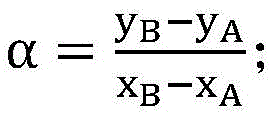
β=y A -αx A 。
wherein, the rule of selecting 4 adjacent reference pixels from all the adjacent reference pixels of the second component block is as follows:
[a] in LM mode, if the left and upper blocks of the image block exist, four points of [ W/4, -1], [3W/4, -1], [ -1, H/4], [ -1,3H/4] are selected; if only the left or upper block is present, then the non-present edges fill in the pixels present at the same time, constituting 4 points.
[b] When the LM_L mode is adopted, four points of [ -1, (W+H)/8 ], [ -1,3 (W+H)/8 ], [ -1,5 (W+H)/8 ], [ -1,7 (W+H)/8 ] are selected.
[c] In the LM_T mode, four points of [ (W+H)/8-1 ], [3 (W+H)/8-1 ], [5 (W+H)/8-1 ], [7 (W+H)/8-1 ] are selected.
Where W and H in this application are the width and height of the image block, respectively.
In another implementation, the prediction model parameters of the first component block may be determined using a determination method of the prediction model parameters in the TSCPM mode.
A. Adjacent reference pixels of each of the first component block and the second component block are acquired first, namely, a plurality of pixel point pairs are selected from adjacent blocks of the image block.
Wherein, the availability of pixels of adjacent blocks of an image block can be classified into the following cases:
If both the right upper and right left pixels of the image block are "available", 2 pixel pairs are selected from the upper side and 2 pixel pairs are selected from the left side. The positions are respectively as follows: upper 0 position (i.e., U (0) pixel in fig. 7), upper idx W Position (i.e., U (6) pixel in fig. 7), left 0 position (i.e., L (0) pixel in fig. 7), and left idx H Position (i.e., L (3) pixel in FIG. 7), where idx W And idx H The calculation formula of (2) is as follows:


if only the upper side of the image block is available, then 4 pixel pairs are selected from the top side, the selected positions being relatively wide: positions at 0/4,1/4,2/4, 3/4;
if only the left side of the image block is available, then 4 pixel pairs are all selected from the positive left side, the selected positions being relatively high: positions at 0/4,1/4,2/4, 3/4;
if neither the left nor the top square is available, default prediction is used. Where α is equal to 0 and β is equal to 1< < (BitDepth-1).
B. The prediction model parameters are determined based on neighboring reference pixels of each of the first component block and the second component block.
The neighboring reference pixels of the first component block are taken as an independent variable x, the chrominance reference pixels are taken as y, and the relationship between x and y is assumed to be identical to the relationship between the first component block and the second component block, and is y=αx+β.
At the time of obtainingAfter 4 adjacent reference pixel pairs, the 4 adjacent reference pixel values are ordered according to the size, and the average value of the adjacent reference pixels with small pixel values and the average value of the adjacent reference pixels with large pixel values are calculated respectively. The two average values of the adjacent reference pixels of the second component block are noted as x min And x max The two average values of the adjacent reference pixels of the first component block are recorded as y min And y max Then the relationship is satisfied:
y min =α*x min +β
y max =α*x max +β
the derived model parameter values are:

β=y min -α*x min
wherein a shift look-up table is used for division.
It will be appreciated that if the intra prediction method of the present application is performed in video coding, the derived prediction model parameters may be encoded into the code stream when encoding the image block, so that the decoding end predicts the first component block using the same prediction model. Or in other embodiments, the prediction mode may be encoded into the code stream when the image block is encoded, so as to transmit the prediction mode to the decoding end, so that the decoding end knows which prediction mode of the prediction modes LM, lm_l or lm_t is adopted in the application, and thus the decoding end uses the same prediction mode to derive the prediction model for predicting the first component block by using the second component block, so as to ensure that the decoding end and the encoding end use the same prediction model to predict the first component block.
In addition, in the calculation of the prediction model parameters in step S102, the types of values of the neighboring reference pixels of the first component block (the types of values may be the reconstructed value or the predicted value) and the types of values of the neighboring reference pixels of the second component block may be kept uniform. For example, the prediction model parameters are calculated using the reconstructed values of the neighboring reference pixels of the first component block and the reconstructed values of the neighboring reference pixels of the second component block. For another example, prediction model parameters are calculated using the predicted values of the neighboring reference pixels of the first component block and the predicted values of the neighboring reference pixels of the second component block. Of course, in other embodiments, the type of values of neighboring reference pixels of the first component block (which may be a reconstructed value or a predicted value) and the type of values of neighboring reference pixels of the second component block may not be uniform.
In order to improve the prediction accuracy, the type of the values of the neighboring reference pixels of the second component block and the type of the values of the second component block calculated in step S101 may be the same when determining the prediction model. For example, assuming that the value of the second component block calculated in step S101 is a predicted value of the second component block, the prediction model parameters are calculated using the predicted values of the neighboring reference pixels of the second component block in step S102.
S103: and obtaining a predicted value of the first component block based on the value of the second component block and the prediction model.
After the value of the second component block and the prediction model are obtained, the first component block may be predicted based on the value of the second component block and the prediction model to obtain a predicted value of the first component block.
In an implementation manner, if the size of the first component block is the same as the size of the second component block, that is, the width and the height of the first component block are equal to the width and the height of the second component block, the value of the second component block may be substituted into the prediction model obtained in step S102 to obtain the predicted value of the first component block, so that when the sizes of the first component block and the second component block are the same, the first component block is predicted by using the second component block, a downsampling process of downsampling or combining filtering is not required in the prediction process, so that prediction errors and time consumption caused by the upsampling process are avoided, prediction time is saved, intra-frame prediction accuracy is improved, and complexity of the encoding and decoding ends is reduced.
In another implementation manner, if the width and height of the second component block are both greater than those of the first component block, and rec (i, j) in step S102 is a value obtained when the second component block is downsampled to the same size as the first component block, the second component block may be downsampled to the same size as the first component block to obtain a downsampled block of the second component block; the downsampled block is then substituted into the prediction model obtained in step S102 to obtain a predicted value of the first component block.
In still another implementation manner, if the width and height of the second component block are both greater than those of the first component block, and pred (i, j) in step S102 is the temporary prediction value of the first component block, then the second component block may be substituted into the prediction model obtained in step S102 to obtain the temporary prediction block of the first component block; and then downsampling the temporary prediction block of the first component block to the same size as the first component block to obtain a prediction value of the first component block.
The temporal prediction block of the second component block or the first component block can be downsampled to the same size as the first component block through downsampling filters such as a 2-tap downsampling filter, a 3-tap downsampling filter, a 5-tap downsampling filter or a 6-tap downsampling filter. Illustratively, the 3-tap downsampling filter is applied at a position of the pixel i=0 or j=0 after downsampling, and the 5-tap downsampling filter may be used at other positions. For another example, a 2-tap downsampling filter may be applied to downsampled pixel i=0, and a 6-tap downsampling filter may be applied to downsampled pixel i=0 at other locations.
The calculation formula of the 2-tap downsampling filter can be as follows:
M[i,j]=(N[2i,2j]+N[2i,2j+1])>>1;
The calculation formula of the 3-tap downsampling filter can be:
M(i,j)=[N(2i-1,2j)+2*N(2i,2j)+N(2i+1,2j)+2]>>2;
the calculation formula of the 5-tap downsampling filter can be:
M(i,j)=[N(2i,2j-1)+N(2i-1,2j)+4*N(2i,2j)+N(2i+1,2j+N2i,2j+1+4>>3;
the calculation formula of the 6-tap downsampling filter can be:
M(i,j)=[2*N(2i,2j)+2*N(2i,2j+1)+N(2i-1,2j)+N(2i+1,2j)+N(2i-1,2j+1)+N(2i+1,2j+1)+4]>>3。
where, in step S102, rec (i, j) is a value obtained when the second component block is downsampled to the same size as the first component block, M (i, j) =rec (i, j), and N (i, j) represents a value of the pixel point (i, j) in the second component block; in the case where pred (i, j) is the temporary prediction value of the first component block in step S102, N (i, j) =pred (i, j), and M (i, j) is the prediction value of the pixel point (i, j) in the first component block.
In addition, if the intra prediction method is applied to video decoding, after obtaining the prediction block of the first component block based on the intra prediction method, the residual block of the first component block reconstructed based on the residual decoded from the encoded code stream of the image block and the prediction block of the first component block may be added to obtain the reconstructed block of the first component block.
If the intra-frame prediction method is applied to video coding, after obtaining the prediction block of the first component block based on the intra-frame prediction method, the original block of the first component block and the prediction block of the first component block may be subtracted, and the obtained value is used as the residual block of the first component block.
In addition, the number of the second component blocks in the above embodiment may be plural, that is, the first component block may be predicted comprehensively by plural second component blocks.
However, in the current method for predicting other components by using multiple components, a model is generated by some methods to predict, and a method of fusing multiple prediction blocks is not used, so that a certain prediction error is generated on the prediction result due to the fact that a whole block adopts the same model.
In order to improve the accuracy and efficiency of intra-frame prediction, the application provides an intra-frame prediction method, which comprehensively predicts a first component block through at least two component blocks, wherein the at least two component blocks predict the first component block by adopting respective prediction models, and a plurality of prediction blocks obtained by predicting the at least two component blocks are subjected to weighted fusion to obtain a prediction value of the first component block, so that a certain prediction error is generated on the prediction result by adopting the same model for a whole block, the intra-frame prediction accuracy can be improved, and the coding and decoding efficiency is improved. Referring specifically to fig. 8, fig. 8 is a flow chart illustrating a second embodiment of the intra prediction method according to the present application. The intra prediction method of the present embodiment includes the following steps.
S201: values of at least two component blocks of the plurality of component blocks other than the first component block are determined, and a prediction model for predicting the first component block using each of the at least two component blocks is determined.
The method comprises the steps of determining values of at least two component blocks except for a first component block in a plurality of component blocks, determining a prediction model for predicting the first component block by utilizing each component block in the at least two component blocks, and predicting the first component block by utilizing the values of each component block in the at least two component blocks and a corresponding prediction model to obtain a predicted value of the first component block corresponding to each component block; and then, the predicted values of the first component block corresponding to at least two component blocks can be subjected to weighted fusion to obtain the predicted value of the first component block.
It is understood that "at least two component blocks other than the first component block" as used herein refers to at least two component blocks other than the first component block selected from the plurality of component blocks. For example, if an image block has 4 component blocks, at least two component blocks may be 2 component blocks other than the first component block or 3 component blocks other than the first component block.
And in this embodiment, the value of each component block may be a predicted value or a reconstructed value of each component block. In addition, the types of values selected for predicting all of the component blocks of the first component block may or may not be uniform. For example, assuming that the format of the image to which the first component block belongs is a YUV format, the first component block is a U component block, at least two component blocks include a Y component block and a V component block, the value of the Y component block may be a reconstructed value of the Y component block, and the value of the V component block may be a predicted value of the V component block.
In particular, a prediction model for predicting the first component block using each of the at least two component blocks may be determined by the method in step S102.
In determining the prediction model corresponding to each component block, the types of values of the component block of the prediction model to be determined and the neighboring reference pixels of the first component block and the type of values of the component block of the prediction model to be determined (the type of values is a reconstruction value or a prediction value) calculated in step S201 may be the same. For example, assuming that the format of the image to which the first component block belongs is a YUV format, the first component block is a U component block, at least two component blocks include a Y component block and a V component block, a prediction model for predicting the U component block using the Y component block is determined based on the reconstructed values of the neighboring reference pixels of the Y component block and the reconstructed values of the neighboring reference pixels of the U component block, and the reconstructed values of the Y component block need to be calculated in step S201. For another example, assuming that the format of the image to which the first component block belongs is a YUV format, the first component block is a V component block, at least two component blocks include a Y component block and a U component block, a prediction model for predicting the V component block using the U component block is determined based on the predicted values of the neighboring reference pixels of the V component block and the predicted values of the neighboring reference pixels of the U component block, and the predicted values of the U component block need to be calculated in step S201.
S202: and calculating the predicted value of the first component block corresponding to each component block based on the value of each component block and the predicted model corresponding to each component block.
The first component block may be predicted using the values of each component block of the at least two component blocks and the corresponding prediction model to obtain a predicted value of the first component block corresponding to each component block.
The values of each component block in the at least two component blocks and the corresponding prediction models may be used to predict the first component block by the method in step S103, so as to obtain the predicted value of the first component block corresponding to each component block, which is not described herein.
S203: and carrying out weighted fusion on the predicted values of the first component block corresponding to at least two component blocks to obtain the predicted value of the first component block.
The predicted values of the first component block corresponding to the at least two component blocks may be weighted and fused to obtain the predicted value of the first component block.
Alternatively, in step S203, the predicted values of the first component block corresponding to at least two component blocks may be weighted-averaged to obtain the predicted value of the first component block. The weighting coefficient of the first component block corresponding to the predicted value of each component block may be set according to the actual situation, and is not limited herein, for example, the weighting coefficient of the first component block corresponding to the predicted value of each component block may be equal to the reciprocal of the total number of component blocks in at least two component blocks.
For example, assuming that the image frame to which the image block belongs is in YUV format, the first component block is a V component block of the image block, and at least two component blocks are a Y component block and a U component block, in step S201, a value of the Y component block and a value of the U component block may be determined, a prediction model for predicting the V component block using the Y component block may be determined, and a prediction model for predicting the V component block using the U component block may be determined; in step S202, predicting a V component block based on a value of the Y component block and a prediction model for predicting the V component block using the Y component block, to obtain a predicted value of the V component block corresponding to the Y component block, and substituting a value of the U component block into the prediction model for predicting the V component block using the U component block, to obtain a predicted value of the V component block corresponding to the U component block; in step S203, the predicted value of the V component block corresponding to the Y component block and the predicted value of the V component block corresponding to the U component block are weighted and fused to obtain the predicted value of the V component block.
For another example, assuming that the image frame to which the image block belongs is in YUV format, the first component block is a U component block of the image block, at least two component blocks are a Y component block and a V component block, in step S201, a value of the Y component block and a value of the V component block may be determined, a prediction model for predicting the U component block by using the Y component block may be determined, and a prediction model for predicting the U component block by using the V component block may be determined; in step S202, predicting a U component block based on a value of the Y component block and a prediction model for predicting the U component block using the Y component block, to obtain a predicted value of the U component block corresponding to the Y component block, and substituting a value of the V component block into the prediction model for predicting the U component block using the V component block, to obtain a predicted value of the U component block corresponding to the V component block; in step S203, the predicted value of the U component block corresponding to the Y component block and the predicted value of the U component block corresponding to the V component block are weighted and fused to obtain the predicted value of the U component block.
To facilitate intra prediction of the cross-component using the same pattern at the codec, a syntax (e.g., pred_mode) may be added to the encoded stream to indicate the pattern in which the first component block is predicted based on at least two component blocks to flag the prediction relationship. For example, when pred_mode is 0, this method is not used, when pred_mode is 1, prediction of V using Y and U is indicated, and when pred_mode is 2, prediction of U using Y and V is indicated.
In order to better illustrate the intra prediction method of the present application, the following specific embodiments of intra prediction are provided for exemplary illustration. Among these, embodiment 1 and embodiment 2 are two embodiments of predicting a first component block based on a predicted value of a second component block, embodiment 3 is one embodiment of predicting another chroma block based on one chroma block, and embodiment 4 is one embodiment of predicting a first component block using a prediction model of each of at least two component blocks. The method comprises the following steps:
example 1:
the reconstruction process for a coded block containing three components of YCbCr is as follows. The Cb component is predicted using the Y component, while the Cr component is predicted using the Y component. The process of predicting Cb component by Y component is as follows, and the Y component predicts Cr component similarly.
In the process of predicting the Cb component for the Y component, as shown in fig. 9, a prediction block pred for the Y component is first used Y Downsampling to obtain downsampled block pred of the same size as Cb component Y After' the prediction model parameters alpha and beta obtained by adopting the transmission of the coding end are adopted, and the Cb component prediction block pred is obtained according to the formula Cb :
pred Cb (i,j)=α*pred Y ’(i,j)+β(1)
Wherein pred is Cb (i, j) represents the predicted value at the position of the Cb component (i, j), pred Y ' i, j denotes the predicted value at the position of the downsampled block i, j of the Y component.
And adding the prediction blocks of the components obtained based on the above process and the residual blocks of the components to obtain the reconstructed blocks of the Y component, the Cb component and the Cr component.
Example 2:
the reconstruction process for a coded block containing three components of YCbCr is as follows. The Cb component is predicted using the Y component, while the Cr component is predicted using the Y component. The process of predicting Cb component by Y component is as follows, and the Y component predicts Cr component similarly.
In the process of predicting the Cb component by the Y component, prediction model parameters alpha and beta are calculated in a deduction mode.
The derivation of the prediction model parameters α and β is as follows, taking a 16×8 image block (chroma 8×4) as an example, and calculating the model parameters using pixel values of reference pixels at 1/4 and 3/4 on the left side of the image block in fig. 10:
Assuming that the pixel values at the 1/4 and 3/4 positions of the Y component are Y1 and Y2, respectively, and the pixel values at the 1/4 and 3/4 positions of the Cb component are c1 and c2, respectively, the prediction parameters can be obtained:
α=(c2-c1)/(y2-y1);
β=c1–α*y1;
the prediction process for predicting Cb component using prediction model parameters and a prediction block of Y component is as follows:
in the process of predicting the Cb component for the Y component, a prediction block pred for the Y component Y Downsampling to obtain downsampled block pred of the same size as Cb component Y ' after that, a Cb component prediction block pred is obtained according to the formula Cb :
pred Cb (i,j)=a·pred Y ’(i,j)+b;
Wherein pred is Cb (i, j) represents the predicted pixel value at the position of Cb component (i, j), pred Y ' i, j denotes the predicted value at the position of the downsampled block i, j of the Y component.
And adding the prediction blocks of the components obtained based on the above process and the residual blocks of the components to obtain the reconstructed blocks of the Y component, the Cb component and the Cr component.
Example 3:
the reconstruction process for a coded block containing YUV three components is as follows. Firstly reconstructing a Y component reconstruction block and a U component reconstruction block, then predicting a V component prediction block by adopting the U component reconstruction block, and reconstructing a V component reconstruction block by combining a V component residual block.
The prediction model adopted is as follows:
pred V (i,j)=α*rec U (i,j)+β
wherein rec U (iJ) represents the reconstructed pixel value at the position of the U component (i, j), pred V (i, j) represents the predicted pixel value at the position of the V component (i, j).
The decoding process is as follows (the codec side calculates the prediction model parameters α and β in the same way):
(1) Calculating prediction model parameters from neighboring reference pixels of the U component and neighboring reference pixels of the V component
Taking the example of calculating the prediction model parameters by using the U component of the 16x8 image block and the adjacent reference pixels of the V component of the 16x8 image block in fig. 11, the codec obtains the values of the reference pixels at 1/4 and 3/4 of the left side of the 8x4 chroma block, and if the pixel values at 1/4 and 3/4 of the left side of the U component are U1 and U2, respectively, and the pixel values at 1/4 and 3/4 of the left side of the V component are V1 and V2, respectively, the prediction parameters can be obtained:
α=(v2-v1)/(u2-u1);
β=v1–α*u1;
(2) And calculating the prediction block of the V component based on the reconstructed pixel value of the U component according to the prediction parameter calculation formula.
(3) And reconstructing a V component reconstruction block according to the prediction block and the residual block of the V component.
Example 4:
the reconstruction process for a coded block containing YUV three components is as follows. Firstly, reconstructing a reconstruction block recY of the Y component and a reconstruction block recU of the U component are reconstructed.
Determination of prediction model parameters Using reference pixels at 1/4 and 3/4 left of the Y and V components, as shown in FIG. 10, prediction model parameters α are determined from the 4 pixel values labeled in FIG. 10 1 And beta 1 。
Generating a temporary prediction block tempY of the V component by using the reconstructed block recY of the Y component and a prediction model, wherein the size of the temporary prediction block is 16x8, and the model is as follows:
tempY=α 1 ·recY+β 1
the 8x4 prediction block yprdv is downsampled from the temporary prediction block tempY.
Determining a prediction model using reference pixels 1/4 and 3/4 left of the U and V components, as shown in FIG. 11The model parameter alpha is determined from the 4 pixel values marked in fig. 11 2 And beta 2 。
Generating a predicted block of U prediction by using a reconstructed block recU of the U component and a predicted model, wherein the model is as follows:
UpredV=α 2 *recU+β 2
the final predicted block is predv=a×ypedv+b×uppedv (a and B are weight coefficients of ypedv and uppedv, respectively, a and B are settable values, and a+b=1)
In addition, in a scene where a technical scheme of predicting another chroma block based on one chroma block is applicable as in example 2, a syntax (e.g., chroma pred flag) indicating whether the technical scheme of predicting another chroma block based on one chroma block is used may be transmitted, a value of 1 indicates that such a prediction method is used, and a value of 0 indicates that such a prediction method is not used.
If the inter-chroma component prediction method is used, a syntax (e.g., pred_component) is required to flag which chroma component is predicted. For example, a value of 1 indicates that the U component predicts the V component, and a value of 0 indicates that the V component predicts the V component, and a value of 1 indicates that the U component is predicted.
Referring to fig. 12, fig. 12 is a flowchart illustrating an embodiment of a video/image encoding/decoding method according to the present application. It should be noted that, if there are substantially the same results, the present embodiment is not limited to the flow sequence shown in fig. 12. In this embodiment, the video/image encoding/decoding method includes the steps of:
s301: the optimal prediction value of the current block is determined based on any of the above-described intra prediction methods.
S302: the current block is encoded or decoded based on the optimal prediction value.
Referring to fig. 13, fig. 13 is a schematic structural diagram of an embodiment of an encoder of the present application. The present encoder 10 includes a processor 12, the processor 12 for executing instructions to implement the intra prediction method and the video/image codec method described above. The specific implementation process is described in the above embodiments, and will not be described herein.
The processor 12 may also be referred to as a CPU (Central Processing Unit ). The processor 12 may be an integrated circuit chip having signal processing capabilities. Processor 12 may also be a general purpose processor, a Digital Signal Processor (DSP), an Application Specific Integrated Circuit (ASIC), a Field Programmable Gate Array (FPGA) or other programmable logic device, discrete gate or transistor logic, discrete hardware components. A general purpose processor may be a microprocessor or the processor 12 may be any conventional processor or the like.
The codec system 10 may further comprise a memory 11 for storing instructions and data required for the operation of the processor 12.
The processor 12 is configured to execute instructions to implement the methods provided by any of the embodiments and any non-conflicting combinations of the intra prediction method and video/image codec method of the present application described above.
Referring to fig. 14, fig. 14 is a schematic structural diagram of an embodiment of a decoder of the present application. The present decoder 20 includes a processor 22, the processor 22 being configured to execute instructions to implement the intra prediction method and the video/image codec method described above. The specific implementation process is described in the above embodiments, and will not be described herein.
The processor 22 may also be referred to as a CPU (Central Processing Unit ). The processor 22 may be an integrated circuit chip having signal processing capabilities. Processor 22 may also be a general purpose processor, a Digital Signal Processor (DSP), an Application Specific Integrated Circuit (ASIC), a Field Programmable Gate Array (FPGA) or other programmable logic device, discrete gate or transistor logic, discrete hardware components. The general purpose processor may be a microprocessor or the processor 22 may be any conventional processor or the like.
The codec system 20 may further comprise a memory 21 for storing instructions and data required for the operation of the processor 22.
The processor 22 is configured to execute instructions to implement the methods provided by any of the embodiments and any non-conflicting combinations of the intra prediction method and video/image codec method of the present application described above.
Referring to fig. 15, fig. 15 is a schematic structural diagram of a computer readable storage medium according to an embodiment of the present application. The computer readable storage medium 30 of the present embodiment stores instruction/program data 31, which when executed, implements the methods provided by any of the embodiments of the intra prediction method and video/image codec method of the present application, as well as any non-conflicting combinations. Wherein the instructions/program data 31 may be stored in the storage medium 30 as a software product to enable a computer device (which may be a personal computer, a server, or a network device, etc.) or a processor (processor) to perform all or part of the steps of the methods of the embodiments of the present application. And the aforementioned storage medium 30 includes: a U-disk, a removable hard disk, a Read-Only Memory (ROM), a random access Memory (RAM, random Access Memory), a magnetic disk, an optical disk, or other various media capable of storing program codes, or a terminal device such as a computer, a server, a mobile phone, a tablet, or the like.
In the several embodiments provided in this application, it should be understood that the disclosed systems, apparatuses, and methods may be implemented in other ways. For example, the apparatus embodiments described above are merely illustrative, e.g., the division of elements is merely a logical functional division, and there may be additional divisions of actual implementation, e.g., multiple elements or components may be combined or integrated into another system, or some features may be omitted, or not performed. Alternatively, the coupling or direct coupling or communication connection shown or discussed with each other may be an indirect coupling or communication connection via some interfaces, devices or units, which may be in electrical, mechanical or other form.
In addition, each functional unit in each embodiment of the present application may be integrated in one processing unit, or each unit may exist alone physically, or two or more units may be integrated in one unit. The integrated units may be implemented in hardware or in software functional units.
The foregoing is only the embodiments of the present application, and not the patent scope of the present application is limited by the foregoing description, but all equivalent structures or equivalent processes using the contents of the present application and the accompanying drawings, or directly or indirectly applied to other related technical fields, which are included in the patent protection scope of the present application.
Claims (10)
1. An intra prediction method for predicting a first component block of an image block having a plurality of component blocks, the method comprising:
determining values of at least two component blocks of the plurality of component blocks except the first component block, and determining a prediction model for predicting the first component block by using each component block of the at least two component blocks, wherein parameters of the prediction model corresponding to each component block are derived by using values of adjacent reference pixels of each component block and values of adjacent reference pixels of the first component block;
predicting the first component block by adopting the values of the component blocks and the prediction models corresponding to the component blocks to obtain the prediction values of the first component block corresponding to the component blocks;
and carrying out weighted fusion on the predicted values of the first component block corresponding to each component block to obtain the predicted value of the first component block.
2. The intra prediction method according to claim 1, wherein the step of weighted fusing the predicted values of the first component block corresponding to the respective component blocks includes:
and carrying out weighted average on the predicted values of the first component blocks corresponding to the component blocks to obtain the predicted values of the first component blocks.
3. The method of intra prediction according to claim 2, wherein the image block includes a luminance component block, a first chrominance component block, and a second chrominance component block, the first component block is a first chrominance component block, and the step of weighting and fusing the predicted values of the first component block corresponding to the respective component blocks to obtain the predicted values of the first component block includes:
and carrying out weighted average on the predicted value of the first chrominance component block corresponding to the brightness component block and the predicted value of the first chrominance component block corresponding to the second chrominance component block to obtain the predicted value of the first chrominance component block.
4. The method of intra prediction according to claim 1, wherein the at least two component blocks include a luminance component block, the first component block is a first chrominance component block, and the predicting the first component block using the values of the respective component blocks and the prediction model corresponding to the respective component blocks, the step of obtaining the predicted values of the first component block corresponding to the respective component blocks includes:
downsampling the brightness component block to the same size as the first color component block to obtain a downsampled block; substituting the downsampling block into a prediction model corresponding to the brightness component block to obtain a predicted value of the first color component block corresponding to the brightness component block; or alternatively, the first and second heat exchangers may be,
Substituting the brightness component block into a prediction model corresponding to the brightness component block to obtain a temporary prediction block of the first color component block corresponding to the brightness component block; downsampling the temporary prediction block to the same size as the first chrominance component block to obtain a prediction value of the first chrominance component block corresponding to the luminance component block.
5. The method of intra prediction according to claim 1, wherein the step of determining a prediction model for predicting the first component block using each of the at least two component blocks comprises:
deriving prediction model parameters corresponding to the component blocks by using the values of the adjacent reference pixels of the component blocks and the values of the adjacent reference pixels of the first component block;
substituting the prediction model parameters corresponding to the component blocks into a prediction model to obtain the prediction model corresponding to the component blocks.
6. The method according to claim 1, wherein predicting the first component block using the values of the respective component blocks and the prediction model corresponding to the respective component blocks, and obtaining the predicted values of the first component block corresponding to the respective component blocks comprises:
Predicting the first component block by adopting the predicted value of each component block and a predicted model corresponding to each component block to obtain the predicted value of the first component block corresponding to each component block; or alternatively, the first and second heat exchangers may be,
and predicting the first component block by adopting the reconstruction value of each component block and the prediction model corresponding to each component block to obtain the prediction value of the first component block corresponding to each component block.
7. A video/image encoding and decoding method, the method comprising:
determining an optimal prediction value of the current block based on the intra prediction method of any one of claims 1 to 6;
the current block is encoded or decoded based on the optimal prediction value.
8. An encoder, the encoder comprising a processor; the processor is configured to execute instructions to implement the steps of the method according to any one of claims 1-6.
9. A decoder, the decoder comprising a processor; the processor is configured to execute instructions to implement the steps of the method according to any one of claims 1-6.
10. A computer readable storage medium having stored thereon a program and/or instructions, which when executed, implement the steps of the method of any of claims 1-6.
Priority Applications (1)
| Application Number | Priority Date | Filing Date | Title |
|---|---|---|---|
| CN202110751422.2A CN113489974B (en) | 2021-07-02 | 2021-07-02 | Intra-frame prediction method, video/image encoding and decoding method and related devices |
Applications Claiming Priority (1)
| Application Number | Priority Date | Filing Date | Title |
|---|---|---|---|
| CN202110751422.2A CN113489974B (en) | 2021-07-02 | 2021-07-02 | Intra-frame prediction method, video/image encoding and decoding method and related devices |
Publications (2)
| Publication Number | Publication Date |
|---|---|
| CN113489974A CN113489974A (en) | 2021-10-08 |
| CN113489974B true CN113489974B (en) | 2023-05-16 |
Family
ID=77940350
Family Applications (1)
| Application Number | Title | Priority Date | Filing Date |
|---|---|---|---|
| CN202110751422.2A Active CN113489974B (en) | 2021-07-02 | 2021-07-02 | Intra-frame prediction method, video/image encoding and decoding method and related devices |
Country Status (1)
| Country | Link |
|---|---|
| CN (1) | CN113489974B (en) |
Families Citing this family (4)
| Publication number | Priority date | Publication date | Assignee | Title |
|---|---|---|---|---|
| CN116260966A (en) * | 2021-12-10 | 2023-06-13 | 四川大学 | An Optimization Method of VVC Intra-frame Prediction Based on Inter-block Correlation |
| CN114501012B (en) * | 2021-12-31 | 2024-06-11 | 浙江大华技术股份有限公司 | Image filtering, encoding and decoding methods and related equipment |
| CN118803251B (en) * | 2023-04-14 | 2025-09-09 | 维沃移动通信有限公司 | Image block prediction method and device and electronic equipment |
| CN118524218B (en) * | 2024-06-25 | 2024-11-29 | 张禄 | Big data node collaborative processing system |
Citations (4)
| Publication number | Priority date | Publication date | Assignee | Title |
|---|---|---|---|---|
| JP2010251952A (en) * | 2009-04-14 | 2010-11-04 | Sony Corp | Image coding apparatus, image coding method, and computer program |
| CN110290388A (en) * | 2019-06-17 | 2019-09-27 | 浙江大华技术股份有限公司 | Intra-frame prediction method, method for video coding, computer equipment and storage device |
| CN110881125A (en) * | 2019-12-10 | 2020-03-13 | 中国科学院深圳先进技术研究院 | Intra-frame prediction method, video coding method, video decoding method and related equipment |
| CA3145479A1 (en) * | 2019-08-01 | 2021-02-04 | Biao Wang | An encoder, a decoder and corresponding methods of chroma intra mode derivation |
Family Cites Families (8)
| Publication number | Priority date | Publication date | Assignee | Title |
|---|---|---|---|---|
| KR101700966B1 (en) * | 2008-01-10 | 2017-01-31 | 톰슨 라이센싱 | Methods and apparatus for illumination compensation of intra-predicted video |
| KR102695490B1 (en) * | 2013-10-18 | 2024-08-16 | 지이 비디오 컴프레션, 엘엘씨 | Multi-component picture or video coding concept |
| CN105306944B (en) * | 2015-11-30 | 2018-07-06 | 哈尔滨工业大学 | Chromatic component Forecasting Methodology in hybrid video coding standard |
| EP3737093A4 (en) * | 2017-11-28 | 2022-02-09 | Electronics and Telecommunications Research Institute | METHOD AND APPARATUS FOR ENCODING/DECODING IMAGES AND RECORDING MEDIA STORED WITH A BITSTREAM |
| KR101956756B1 (en) * | 2018-06-12 | 2019-03-11 | 광운대학교 산학협력단 | A method and an apparatus for processing a video signal based on reference between components |
| WO2020015433A1 (en) * | 2018-07-15 | 2020-01-23 | Huawei Technologies Co., Ltd. | Method and apparatus for intra prediction using cross-component linear model |
| KR20210042355A (en) * | 2018-08-09 | 2021-04-19 | 광동 오포 모바일 텔레커뮤니케이션즈 코포레이션 리미티드 | Video image component prediction method, apparatus and computer storage medium |
| US12114000B2 (en) * | 2019-03-08 | 2024-10-08 | Qualcomm Incorporated | Combined residual coding in video coding |
-
2021
- 2021-07-02 CN CN202110751422.2A patent/CN113489974B/en active Active
Patent Citations (4)
| Publication number | Priority date | Publication date | Assignee | Title |
|---|---|---|---|---|
| JP2010251952A (en) * | 2009-04-14 | 2010-11-04 | Sony Corp | Image coding apparatus, image coding method, and computer program |
| CN110290388A (en) * | 2019-06-17 | 2019-09-27 | 浙江大华技术股份有限公司 | Intra-frame prediction method, method for video coding, computer equipment and storage device |
| CA3145479A1 (en) * | 2019-08-01 | 2021-02-04 | Biao Wang | An encoder, a decoder and corresponding methods of chroma intra mode derivation |
| CN110881125A (en) * | 2019-12-10 | 2020-03-13 | 中国科学院深圳先进技术研究院 | Intra-frame prediction method, video coding method, video decoding method and related equipment |
Also Published As
| Publication number | Publication date |
|---|---|
| CN113489974A (en) | 2021-10-08 |
Similar Documents
| Publication | Publication Date | Title |
|---|---|---|
| CN113489974B (en) | Intra-frame prediction method, video/image encoding and decoding method and related devices | |
| US10743033B2 (en) | Method and device for optimizing encoding/decoding of compensation offsets for a set of reconstructed samples of an image | |
| JP5918328B2 (en) | Image encoding method and image decoding method | |
| US8903188B2 (en) | Method and device for processing components of an image for encoding or decoding | |
| JP2023065581A (en) | video encoding and decoding | |
| CN109845263B (en) | Apparatus and method for video encoding | |
| US8204120B2 (en) | Method for intra prediction coding of image data | |
| US20140192860A1 (en) | Method, device, computer program, and information storage means for encoding or decoding a scalable video sequence | |
| WO2012175646A1 (en) | Method and device for processing colour information in an image | |
| CN116980596B (en) | An intra-frame prediction method, encoder, decoder, and storage medium | |
| GB2495942A (en) | Prediction of Image Components Using a Prediction Model | |
| JP2025098127A (en) | Motion vector prediction in video encoding and decoding | |
| CN118202651A (en) | Prediction method and device based on cross-component linear model in video coding and decoding system | |
| CN102396231A (en) | Image-processing device and method | |
| JP6680260B2 (en) | IMAGE ENCODING DEVICE, IMAGE ENCODING METHOD, IMAGE ENCODING PROGRAM, IMAGE DECODING DEVICE, IMAGE DECODING METHOD, AND IMAGE DECODING PROGRAM | |
| CN119072921A (en) | Method, device and medium for video processing | |
| JP2023030585A (en) | Image encoder, method and program | |
| WO2025118292A1 (en) | Encoding and decoding method, code stream, decoder, encoder, and storage medium | |
| WO2024200475A1 (en) | Methods and apparatuses for encoding and decoding an image or a video | |
| AU2010267185B8 (en) | Image processing device and method | |
| CN119343922A (en) | Encode/decode video frame data | |
| GB2509706A (en) | Encoding or decoding a scalable video sequence using inferred SAO parameters |
Legal Events
| Date | Code | Title | Description |
|---|---|---|---|
| PB01 | Publication | ||
| PB01 | Publication | ||
| SE01 | Entry into force of request for substantive examination | ||
| SE01 | Entry into force of request for substantive examination | ||
| GR01 | Patent grant | ||
| GR01 | Patent grant |