CN113488982B - Communication-free working mode selection method applied to series photovoltaic power optimizer - Google Patents
Communication-free working mode selection method applied to series photovoltaic power optimizer Download PDFInfo
- Publication number
- CN113488982B CN113488982B CN202110658226.0A CN202110658226A CN113488982B CN 113488982 B CN113488982 B CN 113488982B CN 202110658226 A CN202110658226 A CN 202110658226A CN 113488982 B CN113488982 B CN 113488982B
- Authority
- CN
- China
- Prior art keywords
- optimizer
- threshold
- power optimizer
- power
- output voltage
- Prior art date
- Legal status (The legal status is an assumption and is not a legal conclusion. Google has not performed a legal analysis and makes no representation as to the accuracy of the status listed.)
- Active
Links
Images


Classifications
-
- H—ELECTRICITY
- H02—GENERATION; CONVERSION OR DISTRIBUTION OF ELECTRIC POWER
- H02J—CIRCUIT ARRANGEMENTS OR SYSTEMS FOR SUPPLYING OR DISTRIBUTING ELECTRIC POWER; SYSTEMS FOR STORING ELECTRIC ENERGY
- H02J1/00—Circuit arrangements for DC mains or DC distribution networks
- H02J1/10—Parallel operation of DC sources
- H02J1/102—Parallel operation of DC sources being switching converters
-
- H02J2101/25—
-
- Y—GENERAL TAGGING OF NEW TECHNOLOGICAL DEVELOPMENTS; GENERAL TAGGING OF CROSS-SECTIONAL TECHNOLOGIES SPANNING OVER SEVERAL SECTIONS OF THE IPC; TECHNICAL SUBJECTS COVERED BY FORMER USPC CROSS-REFERENCE ART COLLECTIONS [XRACs] AND DIGESTS
- Y02—TECHNOLOGIES OR APPLICATIONS FOR MITIGATION OR ADAPTATION AGAINST CLIMATE CHANGE
- Y02E—REDUCTION OF GREENHOUSE GAS [GHG] EMISSIONS, RELATED TO ENERGY GENERATION, TRANSMISSION OR DISTRIBUTION
- Y02E10/00—Energy generation through renewable energy sources
- Y02E10/50—Photovoltaic [PV] energy
- Y02E10/56—Power conversion systems, e.g. maximum power point trackers
Landscapes
- Engineering & Computer Science (AREA)
- Power Engineering (AREA)
- Supply And Distribution Of Alternating Current (AREA)
- Control Of Electrical Variables (AREA)
Abstract
本发明涉及分布式光伏发电技术,旨在提供一种应用于串联光伏功率优化器的无通讯工作模式选择方法。包括:功率优化器在启动后检测自身的输出电压,当低于滞环阈值下限时打开功率优化器,当高于滞环阈值上限时关闭功率优化器;在光照条件满足功率优化器启动数量的阈值后,整个串联型光伏功率优化器系统完成启动并向后级传输功率;系统启动完成后,当输出电压高于关机阈值时,功率优化器进入待机状态,等待光照条件变化;在待机状态下,当检测到输出电压低于重启阈值时,功率优化器重启。本发明中各功率优化器根据自身端口电气参数选择工作模式,各功率优化器无需通讯模块,可以实现安全启动、运行、关机与重启,降低了硬件成本与安装成本。

The invention relates to distributed photovoltaic power generation technology, and aims to provide a method for selecting a non-communication working mode applied to a series photovoltaic power optimizer. Including: the power optimizer detects its own output voltage after startup, turns on the power optimizer when it is lower than the lower limit of the hysteresis threshold, and turns off the power optimizer when it is higher than the upper limit of the hysteresis threshold; After the threshold, the entire series-type photovoltaic power optimizer system completes startup and transmits power to the subsequent stage; after the system startup is completed, when the output voltage is higher than the shutdown threshold, the power optimizer enters the standby state and waits for changes in lighting conditions; in the standby state , the power optimizer restarts when it detects that the output voltage is lower than the restart threshold. In the present invention, each power optimizer selects an operating mode according to the electrical parameters of its own ports, and each power optimizer does not need a communication module, and can realize safe start, operation, shutdown and restart, reducing hardware costs and installation costs.
Description
技术领域technical field
本发明涉及分布式光伏发电领域,具体涉及一种应用于串联型光伏功率优化器的工作模式选择方法。The invention relates to the field of distributed photovoltaic power generation, in particular to a working mode selection method applied to a series photovoltaic power optimizer.
背景技术Background technique
太阳能安全、清洁、高效、可持续、分布广泛,因而光伏产业发展迅猛。串联型功率优化器结构是众多光伏发电系统结构中的一种,功率优化器控制光伏电池输出电压,实现最大功率点追踪(MPPT),输出端串联后构成直流母线接后级系统。串联型功率优化器结构可以有效解决阴影遮挡、组件老化导致的不匹配问题,具备模块化、低成本、灵活性高的特点。Solar energy is safe, clean, efficient, sustainable, and widely distributed, so the photovoltaic industry is developing rapidly. The series power optimizer structure is one of many photovoltaic power generation system structures. The power optimizer controls the output voltage of photovoltaic cells to achieve maximum power point tracking (MPPT). The output terminals are connected in series to form a DC bus connected to the subsequent system. The series power optimizer structure can effectively solve the mismatch problem caused by shadow shading and component aging, and has the characteristics of modularization, low cost and high flexibility.
串联型功率优化器系统中每台光伏组件均连接对应的功率优化器,功率优化器的输出串联,各个优化器的输出电流相等,即:In the series power optimizer system, each photovoltaic module is connected to the corresponding power optimizer, the output of the power optimizer is connected in series, and the output current of each optimizer is equal, that is:
Iout1=Iout2=…=Ioutn=Ibus,其中Ibus为直流母线的电流。I out1 =I out2 =...=I outn =I bus , where I bus is the current of the DC bus.
中间直流母线的电压由后级系统控制,前级各优化器的输出电压之和为母线电压值,即:The voltage of the intermediate DC bus is controlled by the subsequent system, and the sum of the output voltages of the previous optimizers is the bus voltage value, namely:

其中Vbus为直流母线的电压。Where V bus is the voltage of the DC bus.
系统的输出功率等于所有优化器的输出功率之和,即:
系统在稳态工作时,各个功率优化器的输出电压与其输出功率成正比,即:When the system works in a steady state, the output voltage of each power optimizer is proportional to its output power, namely:

由于优化器输出电压正比于优化器输出功率,所以在相对功率偏差较大时(如日出、发生遮挡时),升压型功率优化器输出电压分配不均,可能威胁系统安全。一般来讲,串联功率优化器需要获取系统总体的功率信息并判断目前的光照条件是否满足安全工作条件,以确保光伏系统安全工作。Since the output voltage of the optimizer is proportional to the output power of the optimizer, when the relative power deviation is large (such as sunrise, when shading occurs), the output voltage of the step-up power optimizer is unevenly distributed, which may threaten system security. Generally speaking, the series power optimizer needs to obtain the overall power information of the system and judge whether the current lighting conditions meet the safe working conditions, so as to ensure the safe operation of the photovoltaic system.
传统的控制方法需要通讯模块来保证系统的启动、保护以及稳定运行,这势必增加了成本,提高了系统控制的复杂度,对通讯系统的要求也很高。Traditional control methods require communication modules to ensure system start-up, protection and stable operation, which will inevitably increase the cost, increase the complexity of system control, and have high requirements on the communication system.
发明内容Contents of the invention
本发明要解决的技术问题是,克服现有技术中的不足,提供一种应用于串联光伏功率优化器的无通讯工作模式选择方法。该方法能够消除对通讯系统的需求,降低了整体成本。The technical problem to be solved by the present invention is to overcome the deficiencies in the prior art and provide a method for selecting a non-communication working mode applied to a series photovoltaic power optimizer. This approach eliminates the need for a communication system, reducing overall costs.
为解决技术问题,本发明的解决方案是:For solving technical problem, solution of the present invention is:
提供一种应用于串联光伏功率优化器的无通讯工作模式选择方法,在串联型光伏功率优化器系统中,每一台光伏功率优化器根据自身端口电气参数独立选择其工作模式;具体包括:A method for selecting a non-communication working mode applied to a series photovoltaic power optimizer is provided. In a series photovoltaic power optimizer system, each photovoltaic power optimizer independently selects its working mode according to its own port electrical parameters; specifically includes:
(1)功率优化器在启动后检测自身的输出电压Vout,当低于滞环阈值下限VL时打开功率优化器,当高于滞环阈值上限VH时关闭功率优化器;(1) The power optimizer detects its own output voltage V out after starting, when it is lower than the lower limit V L of the hysteresis threshold, the power optimizer is turned on, and when it is higher than the upper limit V H of the hysteresis threshold, the power optimizer is turned off;
(2)在光照条件满足功率优化器启动数量的阈值后,整个串联型光伏功率优化器系统完成启动并向后级传输功率;(2) After the lighting conditions meet the threshold of the number of startups of the power optimizer, the entire series photovoltaic power optimizer system completes the startup and transmits power to the subsequent stage;
(3)系统启动完成后,当输出电压Vout高于关机阈值Voff时,功率优化器进入待机状态,等待光照条件变化;(3) After the system startup is completed, when the output voltage V out is higher than the shutdown threshold V off , the power optimizer enters the standby state and waits for the light condition to change;
(4)在待机状态下,当检测到输出电压Vout低于重启阈值VT时,功率优化器重启。(4) In the standby state, when it is detected that the output voltage V out is lower than the restart threshold V T , the power optimizer restarts.
本发明中,当某一功率优化器检测到自身功率稳定保持时间超过时间阈值T后,判定整个串联系统已顺利启动;此时关闭该功率优化器的启动滞环限制,以扩大整个串联系统的最大功率点追踪范围。In the present invention, when a power optimizer detects that its own power stability maintenance time exceeds the time threshold T, it is determined that the entire series system has been successfully started; at this time, the start-up hysteresis limit of the power optimizer is turned off to expand the entire series system. Maximum power point tracking range.
本发明中,各功率优化器采用升压型拓扑,串联后的母线电压Vbus已知且受后级控制。In the present invention, each power optimizer adopts a step-up topology, and the bus voltage V bus connected in series is known and controlled by the subsequent stage.
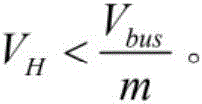
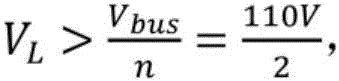
本发明中,根据预设的启动数量阈值n与不启动数量阈值m,确定启动滞环的滞环阈值下限VL和滞环阈值上限VH;其中,滞环阈值下限VL应满足

启动数量阈值n小于或等于实际光伏功率优化器的个数;不启动阈值m应满足:
本发明中,所述关机阈值Voff为优化器最大输出耐压。所述重启阈值
与现有技术相比,本发明的有益效果是:Compared with prior art, the beneficial effect of the present invention is:
1、本发明中根据启动数量需求、母线电压数值以及优化器应力承受能力,针对串联型光伏功率优化器系统中每一台功率优化器单独设计启动、运行、关机、重启策略中的相关参数。各功率优化器根据自身端口电气参数选择工作模式,系统实现无通讯的安全运行。1. In the present invention, according to the start-up quantity requirements, the bus voltage value and the stress tolerance of the optimizer, the relevant parameters in the start-up, operation, shutdown and restart strategies are individually designed for each power optimizer in the series photovoltaic power optimizer system. Each power optimizer selects the working mode according to the electrical parameters of its own port, and the system realizes safe operation without communication.
2、本发明中各功率优化器无需通讯模块,可以实现串联优化器系统的安全启动、运行、关机与重启,降低了功率优化器的硬件成本与安装成本。2. Each power optimizer in the present invention does not need a communication module, and can realize safe startup, operation, shutdown and restart of the series optimizer system, reducing the hardware cost and installation cost of the power optimizer.
附图说明Description of drawings
图1是本发明所述的串联型光伏功率优化器系统示意图。Fig. 1 is a schematic diagram of a series photovoltaic power optimizer system according to the present invention.
图2是本发明所述的串联光伏功率优化器无通讯工作模式选择方法流程图。Fig. 2 is a flow chart of the method for selecting the non-communication working mode of the series photovoltaic power optimizer according to the present invention.
图3是本发明所述的控制方法完整过程的优化器输出电压波形示意图(各优化器逐渐接受光照后顺利启动)。Fig. 3 is a schematic diagram of the output voltage waveform of the optimizer in the complete process of the control method of the present invention (each optimizer starts up smoothly after gradually receiving light).
图4是优化器输出电压波形示意图(发生部分遮挡时优化器关机又重启)。Figure 4 is a schematic diagram of the output voltage waveform of the optimizer (the optimizer shuts down and restarts when partial shading occurs).
具体实施方式Detailed ways
以下结合附图详细描述本发明的实施方式。可以理解的是,此处所描述的具体实施例仅仅用于解释本发明,而非对本发明的限定。Embodiments of the present invention will be described in detail below in conjunction with the accompanying drawings. It should be understood that the specific embodiments described here are only used to explain the present invention, but not to limit the present invention.
针对串联型光伏功率优化器系统中每一台功率优化器单独设计启动、运行、关机、重启策略中的相关参数。各功率优化器根据自身端口电气参数选择工作模式,系统实现无通讯的安全运行。For each power optimizer in the series photovoltaic power optimizer system, the relevant parameters in the start-up, operation, shutdown and restart strategies are individually designed. Each power optimizer selects the working mode according to the electrical parameters of its own port, and the system realizes safe operation without communication.
(1)通过设置优化器启动滞环,各优化器检测自身的输出电压Vout,当优化器输出电压低于滞环阈值下限VL时,优化器打开;当优化器输出电压高于滞环阈值上限VH时,优化器关闭。光照条件满足启动数量阈值后,系统正常启动。(1) By setting the optimizer to start the hysteresis loop, each optimizer detects its own output voltage V out , when the optimizer output voltage is lower than the hysteresis threshold lower limit V L , the optimizer is turned on; when the optimizer output voltage is higher than the hysteresis loop When the upper threshold V H is reached, the optimizer shuts down. After the light conditions meet the startup quantity threshold, the system starts normally.
(2)优化器单机通过“自身功率维持稳定”这一要素判定系统启动成功,自此关闭启动滞环以扩大MPPT范围。(2) The single unit of the optimizer judges that the system starts successfully through the factor of "maintaining its own power stability", and then closes the start-up hysteresis to expand the range of MPPT.
(3)在优化器的关机与重启策略中,优化器检测到输出电压高于安全阈值电压Voff时进入待机状态,在待机状态中等待触发重启阈值VT后重启。有两类原因可导致输出电压过高优化器关闭:一是正常日落时相对功率偏差较大,此时关机阈值Voff可确保系统安全关闭;二是遮挡导致光照不匹配,遮挡消失会导致重启阈值VT被触发,此时尝试重启会使遮挡消失后的系统重新恢复运行。(3) In the shutdown and restart strategy of the optimizer, the optimizer enters the standby state when it detects that the output voltage is higher than the safety threshold voltage Voff , and restarts after waiting for the restart threshold VT to be triggered in the standby state. There are two types of reasons that can cause the output voltage to be too high. The optimizer is turned off: one is that the relative power deviation is large at normal sunset, and the shutdown threshold V off at this time can ensure the safety of the system shut down; the other is that the shading causes the light to not match, and the shading disappears will cause a restart Threshold V T is triggered, at which point an attempted restart will resume operation of the system after the occlusion disappears.
基于上述三部分结合,能够实现功率优化器的无通讯启动、运行、关机以及重启。Based on the combination of the above three parts, the power optimizer can be started, run, shut down and restarted without communication.
在启动过程中,包含以下步骤:During startup, the following steps are included:
步骤(1):明确当前系统的启动数量阈值n、不启动数量阈值m以及中间母线电压Vbus,启动环节中的VL与VH由这些参数确定。Step (1): Determine the threshold n of the number of starting, the threshold m of the number of non-starting and the intermediate bus voltage V bus of the current system. V L and V H in the starting link are determined by these parameters.
步骤(2):设置启动滞环阈值下限
在从启动状态切换至正常运行状态的过程中,主要包含以下步骤:The process of switching from the startup state to the normal operation state mainly includes the following steps:
步骤(1):优化器检测自身输出功率,当自身输出功率长期保持稳定时判定目前整个系统已启动。这是因为在前述的无通讯启动过程中,优化器总在开启与关断状态之间切换,故长时间维持功率传输就意味着启动过程的结束。Step (1): The optimizer detects its own output power, and when its own output power remains stable for a long time, it is determined that the entire system has been started. This is because the optimizer is always switching between on and off states during the aforementioned no-communication start-up process, so maintaining power transmission for a long time means the end of the start-up process.
步骤(2):判定系统启动后,取消启动环节的输出上下限滞环以尽量放大优化器系统对光照不匹配的处理能力。Step (2): After the system is determined to start, cancel the output upper and lower limit hysteresis in the start-up link to maximize the processing ability of the optimizer system for the mismatch of light.
在关断与重启过程中,主要包含以下步骤:In the process of shutting down and restarting, it mainly includes the following steps:
步骤(1):各功率优化器检测各自输出电压Vout,如果Vout>Voff,则功率优化器进入待机状态,等待光照条件变化;Step (1): Each power optimizer detects its own output voltage V out , if V out > V off , the power optimizer enters a standby state and waits for changes in lighting conditions;
步骤(2):待机状态的优化器检测到输出电压低于重启阈值电压VT后,优化器重新进入启动模式,尝试重新启动。如果优化器的输出过压是正常日落时的相对功率不匹配导致的,关机阈值Voff能够确保整个关机过程不发生过压;如果优化器输出过压是由光照失配导致的,当光照失配消失,待机优化器的输出电压将低至VT,系统可以恢复正常运行。Step (2): After the optimizer in standby state detects that the output voltage is lower than the restart threshold voltage V T , the optimizer re-enters the startup mode and tries to restart. If the output overvoltage of the optimizer is caused by the relative power mismatch at normal sunset, the shutdown threshold V off can ensure that no overvoltage occurs during the entire shutdown process; if the output overvoltage of the optimizer is caused by the mismatch of light, when the light fails If the configuration disappears, the output voltage of the standby optimizer will drop to V T , and the system can resume normal operation.
关机环节的两个参数Voff与VT,与优化器硬件应力、母线电压、优化器组串个数有关。The two parameters V off and V T in the shutdown link are related to the hardware stress of the optimizer, the bus voltage, and the number of strings of the optimizer.
具体实施例:Specific examples:
本实施例中,串联型光伏功率优化器系统的结构如图1所示。该示例中包括三个光伏组件,以及对应的三台光伏功率优化器。已知电压的直流母线Vbus,该直流母线可由多种方式(电池、直流变换器、光伏逆变器等)给出;In this embodiment, the structure of the series photovoltaic power optimizer system is shown in FIG. 1 . This example includes three photovoltaic modules and corresponding three photovoltaic power optimizers. A DC bus V bus of known voltage, which can be provided by various methods (battery, DC converter, photovoltaic inverter, etc.);
串联光伏功率优化器无通讯工作模式选择方法流程如图2所示。前级功率优化器采用Boost拓扑,实现前级光伏板的最大功率点跟踪,并根据本发明所述的模式选择方法决定当前工作状态。设定启动数量阈值n=2,有两个及以上的光伏组件接收到光照后,系统可以顺利启动。The flow chart of the selection method of the non-communication working mode of the series photovoltaic power optimizer is shown in Fig. 2 . The front-stage power optimizer adopts Boost topology to realize the maximum power point tracking of the front-stage photovoltaic panel, and determines the current working state according to the mode selection method of the present invention. Set the startup quantity threshold n=2, after two or more photovoltaic modules receive light, the system can start smoothly.
中间直流母线电压由后级蓄电池控制,有:The intermediate DC bus voltage is controlled by the secondary battery, including:
Vbus=Vout1+Vout2+Vout3 V bus =V out1 +V out2 +V out3
其中,Vouti为各功率优化器输出电压(i=1、2、3),Vbus为中间直流母线电压即蓄电池电压。Wherein, V outi is the output voltage of each power optimizer (i=1, 2, 3), and V bus is the intermediate DC bus voltage, that is, the battery voltage.
由于各优化器之间相互串联,故其输出电流相同,其输出电压之间分配关系满足:Since the optimizers are connected in series, their output currents are the same, and the distribution relationship between their output voltages satisfies:

其中Pi为各功率优化器的输出功率,Ptot为所有功率优化器的总功率。Among them, P i is the output power of each power optimizer, and P tot is the total power of all power optimizers.
在启动过程中,优化器的输出电压都趋向于稳态电压值。当接受光照的优化器数量不足(即尚未启动成功)时,系统中优化器的输出电压具有以下规律:处于启动状态的优化器输出电压上升,处于关机状态的优化器输出电压下降,因此这一阶段的各优化器的输出电压会在启动滞环之间震荡。良好的滞环参数设计能确保整个系统达到光照条件后正常启动。During the start-up process, the output voltage of the optimizer tends to the steady-state voltage value. When the number of optimizers receiving light is insufficient (that is, they have not been successfully started), the output voltage of the optimizers in the system has the following rules: the output voltage of the optimizers in the starting state rises, and the output voltage of the optimizers in the shutdown state decreases, so this The output voltage of each optimizer in the stage will oscillate between start-up hysteresis. A good hysteresis parameter design can ensure the normal start of the whole system after reaching the light condition.
这一优化器系统要求当一台优化器受光时系统不启动,两台优化器受光时系统启动,Vbus已知等于110V。根据前述方法设计相关参数,其中:
启动成功后进入正常运行状态。当光照条件变差,整个优化器串中可能有优化器输出电压高于Voff,此时这一优化器关闭,其他尚在运行的优化器因此输出电压上升。关闭优化器过多会促使整个系统关闭。如果优化器的输出过压是正常日落时的相对功率不匹配导致的,关机阈值Voff会确保优化器安全;如果优化器输出过压是由光照失配导致的,当光照失配消失,系统可以恢复正常运行,重新开始传输功率。After the startup is successful, it enters the normal operation state. When the light condition becomes bad, the output voltage of an optimizer in the entire optimizer string may be higher than V off , and this optimizer is turned off at this time, and the output voltage of other optimizers that are still running therefore rises. Turning off the optimizer too much can cause the whole system to shut down. If the output overvoltage of the optimizer is caused by the relative power mismatch at normal sunset, the shutdown threshold V off will ensure the safety of the optimizer; if the output overvoltage of the optimizer is caused by the mismatch of light, when the mismatch of light disappears, the system Normal operation can be resumed and power delivery can resume.
下面结合图3、4说明工作模式选择方法的执行过程。The following describes the execution process of the working mode selection method with reference to FIGS. 3 and 4 .
图3展示了三优化器系统在光照变强的过程中逐个打开的过程。t0时刻之前,三块光伏组件均未接收到光照,三台优化器的控制器尚未开始工作。t0时刻,I号优化器对应的光伏组件受到光照,开始启动,输出电压上升;II、III号优化器控制器依然未开始工作,boost变换器的功率管不驱动,II、III号优化器的输出电压因Vo_1的上升而下降。t1时刻,I号优化器输出电压Vo_1上升至VH,根据滞环启动逻辑,此时I号优化器进入关机状态,三台优化器的输出电压均保持不变,直到下一阶段外部光照发生变化。t2时刻,II号优化器对应的光伏组件受到光照,开始启动,输出电压上升,I、III号优化器处于关机状态,输出电压被动下降,t3时刻因III号优化器输出电压已经下降到了零所以不再继续下降,t3时刻后I号优化器输出电压依然下降。t4时刻I号优化器输出电压下降至VL,根据滞环启动策略开始启动,此时I、II号优化器均处于启动状态,且他们工作电压不高于VH。所以t4时刻后,已经接收到光照的I、II号优化器开始向后级正常的传输功率。t5时刻,新接收到光照的III号优化器也能平滑并入系统中。Figure 3 shows how the three optimizer systems are turned on one by one as the light becomes stronger. Before time t0, the three photovoltaic modules have not received light, and the controllers of the three optimizers have not yet started to work. At time t0, the photovoltaic module corresponding to the No. I optimizer is exposed to light, starts to start, and the output voltage rises; the controllers of No. The output voltage drops due to the rise of Vo_1. At time t1, the output voltage Vo_1 of the No. I optimizer rises to V H . According to the hysteresis start-up logic, the No. I optimizer enters the shutdown state at this time, and the output voltages of the three optimizers remain unchanged until the external light occurs in the next stage. Variety. At time t2, the photovoltaic module corresponding to No. II optimizer is exposed to light, starts to start, and the output voltage rises. No. I and No. III optimizers are in the shutdown state, and the output voltage drops passively. At time t3, the output voltage of No. III optimizer has dropped to zero. No further decline, the output voltage of the No. I optimizer still declines after time t3. At t4, the output voltage of No. I optimizer drops to V L , and starts to start according to the hysteresis start-up strategy. At this time, No. I and No. II optimizers are in the start-up state, and their working voltage is not higher than V H . Therefore, after time t4, the optimizers I and II that have received the light start to transmit power normally to the subsequent stage. At time t5, the No. III optimizer that has newly received light can also be smoothly incorporated into the system.
在实际的多优化器系统中,优化器的实际输出电压受到电容放电、随机光照条件等影响,各优化器的真实输出电压无法解算。但本方法所制定的VH与VL参数规避了对输出电压的精确计算,将多台优化器视作整体,确保了系统的启动。In an actual multi-optimizer system, the actual output voltage of the optimizer is affected by capacitor discharge, random lighting conditions, etc., and the actual output voltage of each optimizer cannot be solved. However, the V H and V L parameters formulated by this method avoid the precise calculation of the output voltage, and multiple optimizers are regarded as a whole to ensure the startup of the system.
图4展示了三优化器系统在光照变化的情况下逐个关闭后又重启的过程。t0时刻之前,三块光伏组件受到均匀光照,各优化器输出电压均为Vav。t0时刻,III号优化器对应组件受到遮挡,对应电压下降,I、II号优化器输出电压因此上升,但幅度尚在安全范围内,故I、II号优化器共同承担母线电压,保持功率输出,稳定后优化器的输出电压如t1~t2阶段所示。t2时刻,II号优化器开始受到遮挡,系统中仅有I号优化器对应光伏组件接受光照,此时输出电压过高,触及Voff后关闭,I号优化器进入待机状态。整个关断过程至此结束,在整个关断过程中优化器各端口均未出现过压。t4时刻II号优化器重新接收到光照,此时控制器执行启动程序,II号优化器的输出电压上升,I号优化器输出电压因此下降至VT,也尝试重新启动。图3中的t4时刻的系统情况与图3中的t4时刻类似,系统开始正常向后级传输功率,成功重启。Figure 4 shows the process of the three-optimizer system shutting down and restarting one by one under the condition of illumination changes. Before time t0, the three photovoltaic modules are uniformly illuminated, and the output voltage of each optimizer is V av . At time t0, the corresponding components of No. III optimizer are blocked, and the corresponding voltage drops, so the output voltage of No. I and No. II optimizers rises, but the range is still within the safe range. Therefore, No. I and No. II optimizers share the bus voltage to maintain power output , the output voltage of the optimizer after stabilization is shown in the t1 ~ t2 stage. At t2, No. II optimizer starts to be blocked, and only No. I optimizer receives light corresponding to the photovoltaic module. At this time, the output voltage is too high, and it turns off after touching V off , and No. I optimizer enters the standby state. The entire shutdown process ends here, and no overvoltage occurs at each port of the optimizer during the entire shutdown process. At time t4, No. II optimizer receives light again. At this time, the controller executes the start-up procedure, the output voltage of No. II optimizer rises, and the output voltage of No. I optimizer drops to V T , and a restart is also attempted. The system situation at time t4 in Figure 3 is similar to that at time t4 in Figure 3, the system starts to transmit power to the subsequent stage normally and restarts successfully.
Claims (3)


Priority Applications (1)
| Application Number | Priority Date | Filing Date | Title |
|---|---|---|---|
| CN202110658226.0A CN113488982B (en) | 2021-06-13 | 2021-06-13 | Communication-free working mode selection method applied to series photovoltaic power optimizer |
Applications Claiming Priority (1)
| Application Number | Priority Date | Filing Date | Title |
|---|---|---|---|
| CN202110658226.0A CN113488982B (en) | 2021-06-13 | 2021-06-13 | Communication-free working mode selection method applied to series photovoltaic power optimizer |
Publications (2)
| Publication Number | Publication Date |
|---|---|
| CN113488982A CN113488982A (en) | 2021-10-08 |
| CN113488982B true CN113488982B (en) | 2023-03-14 |
Family
ID=77935299
Family Applications (1)
| Application Number | Title | Priority Date | Filing Date |
|---|---|---|---|
| CN202110658226.0A Active CN113488982B (en) | 2021-06-13 | 2021-06-13 | Communication-free working mode selection method applied to series photovoltaic power optimizer |
Country Status (1)
| Country | Link |
|---|---|
| CN (1) | CN113488982B (en) |
Families Citing this family (1)
| Publication number | Priority date | Publication date | Assignee | Title |
|---|---|---|---|---|
| CN120856043A (en) * | 2025-09-22 | 2025-10-28 | 珠海格力电器股份有限公司 | Photovoltaic power optimizer, series connection system, non-communication operation control method and storage medium |
Family Cites Families (5)
| Publication number | Priority date | Publication date | Assignee | Title |
|---|---|---|---|---|
| CN104079001B (en) * | 2014-07-15 | 2017-08-25 | 浙江昱能科技有限公司 | To the control method of optimizer in photovoltaic parallel in system based on tandem type optimizer |
| CN107247475A (en) * | 2017-04-25 | 2017-10-13 | 北京交通大学 | Suitable for the stagnant ring disturbance global maximum power point tracking method of band of photovoltaic optimizer |
| CN110391671B (en) * | 2018-04-23 | 2023-03-10 | 台达电子工业股份有限公司 | Optimizer, control method and parallel structure for photovoltaic inverter system |
| CN109787290B (en) * | 2019-03-19 | 2022-03-25 | 矽力杰半导体技术(杭州)有限公司 | Photovoltaic system and control circuit and control method thereof |
| CN110957781B (en) * | 2019-12-02 | 2021-02-09 | 浙江大学 | A non-communication floating charge control method for a two-stage series photovoltaic power optimizer system |
-
2021
- 2021-06-13 CN CN202110658226.0A patent/CN113488982B/en active Active
Also Published As
| Publication number | Publication date |
|---|---|
| CN113488982A (en) | 2021-10-08 |
Similar Documents
| Publication | Publication Date | Title |
|---|---|---|
| CN111756072B (en) | Control method and operation control method of MLPE equipment and photovoltaic system | |
| US12107534B2 (en) | Photovoltaic system, inverter, and bus voltage control method for inverter | |
| CN112217227A (en) | Direct-current coupling photovoltaic off-grid hydrogen production system and control method thereof | |
| US11128142B2 (en) | Photovoltaic power generation system and method for controlling the same | |
| WO2024045653A1 (en) | Photovoltaic system and control method | |
| CN113488982B (en) | Communication-free working mode selection method applied to series photovoltaic power optimizer | |
| CN107508463A (en) | Photovoltaic DC converter exports pressure limiting method and device | |
| CN112242712B (en) | Power control method for two-stage photovoltaic inverter system | |
| CN110429643A (en) | Inter-level coordinated startup method and system suitable for distributed photovoltaic DC collection system | |
| CN112994055B (en) | Storage medium, photovoltaic power generation system and control method thereof | |
| WO2023240977A1 (en) | Photovoltaic system and update method for networking of optimizer thereof | |
| WO2026021177A1 (en) | Photovoltaic power generation control method, inverter, main control device and photovoltaic system | |
| WO2026021193A1 (en) | Photovoltaic power generation control method, main control device and photovoltaic system | |
| WO2026021183A1 (en) | Control method for power converter, power converter, and photovoltaic system | |
| CN117955426B (en) | Power equipment, power equipment control method and photovoltaic power generation system | |
| CN110957781B (en) | A non-communication floating charge control method for a two-stage series photovoltaic power optimizer system | |
| CN119813352A (en) | A coordinated control system of photovoltaic-storage DC microgrid converter based on DC bus voltage signal | |
| US20250088144A1 (en) | Photovoltaic system, inverter starting method and photovoltaic energy storage system | |
| US20230104616A1 (en) | Inverter, inverter system, and method | |
| CN109787292A (en) | A kind of multimode and the central controlled photovoltaic inverter system of machine and control method | |
| CN117613998A (en) | Photovoltaic grid-connected system and its operation method | |
| CN117458580A (en) | Photovoltaic system and input voltage adjustment method of photovoltaic system | |
| JP5532429B2 (en) | Operation control method of photovoltaic power generation system | |
| CN115085273B (en) | Distributed photovoltaic system and control method thereof | |
| CN219779790U (en) | Energy-saving photovoltaic micro-inverter aging system |
Legal Events
| Date | Code | Title | Description |
|---|---|---|---|
| PB01 | Publication | ||
| PB01 | Publication | ||
| SE01 | Entry into force of request for substantive examination | ||
| SE01 | Entry into force of request for substantive examination | ||
| GR01 | Patent grant | ||
| GR01 | Patent grant |