CN113486160B - Dialogue method and system based on cross-language knowledge - Google Patents
Dialogue method and system based on cross-language knowledge Download PDFInfo
- Publication number
- CN113486160B CN113486160B CN202110577065.2A CN202110577065A CN113486160B CN 113486160 B CN113486160 B CN 113486160B CN 202110577065 A CN202110577065 A CN 202110577065A CN 113486160 B CN113486160 B CN 113486160B
- Authority
- CN
- China
- Prior art keywords
- knowledge
- language
- dialogue
- representation vector
- cross
- Prior art date
- Legal status (The legal status is an assumption and is not a legal conclusion. Google has not performed a legal analysis and makes no representation as to the accuracy of the status listed.)
- Active
Links
Images


Classifications
-
- G—PHYSICS
- G06—COMPUTING OR CALCULATING; COUNTING
- G06F—ELECTRIC DIGITAL DATA PROCESSING
- G06F16/00—Information retrieval; Database structures therefor; File system structures therefor
- G06F16/30—Information retrieval; Database structures therefor; File system structures therefor of unstructured textual data
- G06F16/33—Querying
- G06F16/332—Query formulation
- G06F16/3329—Natural language query formulation
-
- Y—GENERAL TAGGING OF NEW TECHNOLOGICAL DEVELOPMENTS; GENERAL TAGGING OF CROSS-SECTIONAL TECHNOLOGIES SPANNING OVER SEVERAL SECTIONS OF THE IPC; TECHNICAL SUBJECTS COVERED BY FORMER USPC CROSS-REFERENCE ART COLLECTIONS [XRACs] AND DIGESTS
- Y02—TECHNOLOGIES OR APPLICATIONS FOR MITIGATION OR ADAPTATION AGAINST CLIMATE CHANGE
- Y02D—CLIMATE CHANGE MITIGATION TECHNOLOGIES IN INFORMATION AND COMMUNICATION TECHNOLOGIES [ICT], I.E. INFORMATION AND COMMUNICATION TECHNOLOGIES AIMING AT THE REDUCTION OF THEIR OWN ENERGY USE
- Y02D10/00—Energy efficient computing, e.g. low power processors, power management or thermal management
Landscapes
- Engineering & Computer Science (AREA)
- Physics & Mathematics (AREA)
- Mathematical Physics (AREA)
- Theoretical Computer Science (AREA)
- Artificial Intelligence (AREA)
- Human Computer Interaction (AREA)
- Computational Linguistics (AREA)
- Data Mining & Analysis (AREA)
- Databases & Information Systems (AREA)
- General Engineering & Computer Science (AREA)
- General Physics & Mathematics (AREA)
- Machine Translation (AREA)
Abstract
The invention belongs to the field of cross-language conversation and provides a conversation method and system based on cross-language knowledge. The method comprises the steps of obtaining a dialogue problem and obtaining a dialogue problem expression vector through a multi-language encoder; retrieving a knowledge representation vector closest to a dialog problem representation vector from a pre-stored multi-language knowledge representation vector library; splicing the conversation problem representation vector and the retrieved knowledge representation vector; and inputting the spliced vector into a cross-language seq2seq model to obtain a reply corresponding to the dialogue problem.
Description
Technical Field
The invention belongs to the field of dialog systems, and particularly relates to a dialog method and a dialog system based on cross-language knowledge.
Background
The statements in this section merely provide background information related to the present disclosure and may not necessarily constitute prior art.
In recent years, chatty dialog systems have been developed. Based on the model of seq2seq structure, a smooth reply can be generated according to the history of the conversation. People still experience and chat with real people when interacting with such systems. One important reason for this problem is that chat systems have difficulty exploring a particular topic when generating replies due to lack of knowledge about them. To address this problem, knowledge-based dialogs (KGCs) have been proposed that leverage external knowledge to enhance the dialog system.
However, the existing KGC-related studies all use extensive present language knowledge. However, the inventor has found that the amount of knowledge available in different languages is unbalanced, such as English with a wiki knowledge base 6 times that of Chinese, while using the seventh word Bengali in the world, only about 1/60 of English is available. Building a sufficiently large knowledge base for each language is impractical due to the extremely high resource overhead.
Disclosure of Invention
In order to solve the technical problems in the background art, the invention provides a conversation method and a conversation system based on cross-language knowledge, which can improve the topic richness of a conversation system and avoid the overhead of repeatedly constructing a single-language knowledge base.
In order to achieve the purpose, the invention adopts the following technical scheme:
a first aspect of the invention provides a method of dialog based on cross-language knowledge.
A method of dialog based on cross-language knowledge, comprising:
obtaining a dialogue problem and obtaining a dialogue problem expression vector through a multi-language encoder;
retrieving a knowledge representation vector closest to a dialog problem representation vector from a pre-stored multi-language knowledge representation vector library;
splicing the dialogue problem expression vector and the retrieved knowledge expression vector;
and inputting the spliced vector into a cross-language seq2seq model to obtain a reply corresponding to the dialogue problem.
A second aspect of the invention provides a dialog system based on cross-language knowledge.
A cross-language knowledge based dialog system, comprising:
the dialogue problem coding module is used for acquiring dialogue problems and obtaining dialogue problem expression vectors through a multi-language coder;
the knowledge representation vector retrieval module is used for retrieving a knowledge representation vector closest to the dialog problem representation vector from a pre-stored multi-language knowledge representation vector library;
the vector splicing module is used for splicing the conversation problem expression vector and the retrieved knowledge expression vector;
and the dialogue question reply module is used for inputting the spliced vector to the cross-language seq2seq model to obtain a reply corresponding to the dialogue question.
A third aspect of the invention provides a computer-readable storage medium.
A computer-readable storage medium, on which a computer program is stored which, when being executed by a processor, carries out the steps of the cross-language knowledge based dialog method as described above.
A fourth aspect of the invention provides a computer apparatus.
A computer device comprising a memory, a processor and a computer program stored on the memory and executable on the processor, the processor implementing the steps in the cross-language knowledge based dialog method as described above when executing the program.
Compared with the prior art, the invention has the beneficial effects that:
(1) The invention provides a conversation method and a conversation system based on cross-language knowledge for the first time, and the obtained conversation problem is processed by a multi-language encoder to obtain a conversation problem expression vector; retrieving a knowledge representation vector closest to a dialog problem representation vector from a pre-stored multi-language knowledge representation vector library; splicing the conversation problem representation vector and the retrieved knowledge representation vector; the spliced vector is input into the cross-language seq2seq model to obtain the reply corresponding to the dialogue problem, so that the dialogue system can be constructed by directly using rich foreign language knowledge base for the languages with deficient resources, the topic richness of the dialogue system is improved, and the expense of repeatedly constructing a single language knowledge base is avoided.
(3) The invention optimizes the multi-language encoder and the cross-language seq2seq model and improves the accuracy of dialogue reply by using a large amount of foreign language dialogue to learn the knowledge selection and knowledge expression ability of the model under the condition of lacking knowledge annotation and distilling the ability to the target language by a self-knowledge distillation method.
Advantages of additional aspects of the invention will be set forth in part in the description which follows, and in part will be obvious from the description, or may be learned by practice of the invention.
Drawings
The accompanying drawings, which are incorporated in and constitute a part of this specification, are included to provide a further understanding of the invention, and are included to illustrate an exemplary embodiment of the invention and not to limit the invention.
FIG. 1 is a flow diagram of a cross-linguistic knowledge based dialog method of an embodiment of the invention;
FIG. 2 is a knowledge retrieval and reply generation portion of an embodiment of the present invention;
FIG. 3 illustrates a training method for self-knowledge distillation according to an embodiment of the present invention.
Detailed Description
The invention is further described with reference to the following figures and examples.
It is to be understood that the following detailed description is exemplary and is intended to provide further explanation of the invention as claimed. Unless defined otherwise, all technical and scientific terms used herein have the same meaning as commonly understood by one of ordinary skill in the art to which this invention belongs.
It is noted that the terminology used herein is for the purpose of describing particular embodiments only and is not intended to be limiting of exemplary embodiments according to the invention. As used herein, the singular forms "a", "an" and "the" are intended to include the plural forms as well, and it should be understood that when the terms "comprises" and/or "comprising" are used in this specification, they specify the presence of stated features, steps, operations, devices, components, and/or combinations thereof, unless the context clearly indicates otherwise.
Example one
As shown in fig. 1, the present embodiment provides a dialog method based on cross-language knowledge, which specifically includes the following steps:
step S101: the dialog question is obtained and a dialog question representation vector is obtained via a multi-language encoder.
Step S102: in a library of pre-stored multi-lingual knowledge representation vectors, the knowledge representation vector closest to the dialog problem representation vector is retrieved.
Step S103: and splicing the dialogue question representation vector and the retrieved knowledge representation vector.
Step S104: and inputting the spliced vector into a cross-language seq2seq model to obtain a reply corresponding to the dialogue problem.
Specifically, step S101 and step S102 search a part, and step S103 and step S104 are a generation part.
In the retrieval part, a multi-lingual encoder is trained. Firstly, each piece of knowledge in the foreign language knowledge base is encoded by using an encoder to obtain a representation vector, and the vector is stored. For a given section of dialogue history, sentences of the dialogue history are spliced, a coder is used for coding to obtain a representation vector, and then a vector retrieval module based on FAISS acceleration is used for retrieving one closest to the cosine from the prestored knowledge representation vector to serve as the selected knowledge. Wherein, the input of the FAISS accelerated vector retrieval module is: one query and multiple documents. The module will calculate the correlation between the query and each document and output: the K documents with the highest relevance.
In particular, given a session (C, R), and a large knowledge base Where C and R represent the history of the conversation and the corresponding reply, respectively. First, a transform-Encoder is used to encode the dialog history

Wherein Representing a d-dimensional sentence representation. We use the same approach to->
 Each knowledge in is encoded to get->
 Next, a Knowledge Pool (Knowledge Pool) of C is constructed using the nearest neighbor (KNN) algorithm:

this process is accelerated using the FAISS. Next, in the knowledge pool, a piece of knowledge is further selected in a fine-grained manner as the knowledge used in the current dialog:

in the generation part, a cross-language seq2seq model is trained. Firstly, the history of the conversation and the knowledge of the foreign language retrieved in the last step are spliced to be used as the input of the model. Next, each word in the reply is generated in turn.
Specifically, for a given dialog history C and a piece of knowledge K selected in the previous step, we first concatenate them as the input I = { C; [ SEP ]; k, where [ SEP ] is a splice. Next, reply R is generated using mBART, and the language of the reply to be generated is indicated using language indicator [ LANG ]. Here, the mBART is a pre-trained language model proposed by Facebook, and belongs to the seq2seq model.
In order to train the above-mentioned retrieval and generation models in the absence of training data, a CSKD (curriculum self-knowledge simulation) scheme is proposed, which generally utilizes large-scale foreign language dialogue data to improve the capability of cross-language retrieval and generation of models in the language.
Suppose we have dialog data from a target language Knowledge base from auxiliary language->
 And a large amount of dialog data from an auxiliary language->
In particular, a given segment is from an auxiliary language dialog (C) A ,R A ) Wherein A represents an auxiliary language. First construct a knowledge pool based on replies using a standard IR (information retrieval) model (based on BM 25) and predicted using the IR modelUsing MLE (maximum likelihood) to optimize the multi-lingual encoder model of the knowledge retrieval part and the generation of replies as labels. Next, reward is computed using the generative model, and the knowledge retrieval model is further optimized using reinforcement learning. The reinforcement learning objective is:

wherein

Wherein P (K | ·) is P (K | C) A KP), R | A I is the length of the reply; b is a reference for reducing gradient variance; ε is the temperature coefficient.
Extracting parallel dialogue data from dialogue data of two languages For unsupervised extraction of parallel dialogs, all dialogs in both languages are first encoded using an mBART-Encoder as part of the search, resulting in ^ or ^ based>
 And
And next, for each dialog from the target language, we use KNN algorithm to extract the dialog with the cosine nearest to the target language, and get a set of parallel dialogs (C) T ,R T )-(C A ,R A ). Next, a ratio margin function is used to define the semantic similarity between the two sessions.

Where NN (-) represents the N nearest neighbors based on cosine distance.
And distilling the knowledge selection and knowledge expression capability obtained by pre-training the multilingual coder and the cross-language seq2seq model on the auxiliary language to the target language by using a self-knowledge distillation method based on the extracted parallel dialogues. For a given set of parallel dialogues (C) T ,R T )-(C A ,R A ) Two knowledge distillation objectives were used:


wherein KP is KP (R) A ) Represents a knowledge pool constructed using replies to an auxiliary language; l represents the l-th layer of an n-layer mBART-Decoder; in the l-th layer representing the Decoder, replying an attention matrix of R to input knowledge K, and representing that each word in R is generated according to the part in the knowledge; KL represents the Kullback-Leibler divergence. In addition, reply generation for the target language is optimized by NLL loss:

wherein K to P (K | R) A ,KP(R A ) Is according to R) A A piece of knowledge selected.
In order to address the noise associated with automated parallel dialogue retrieval, a method of curriculum learning is incorporated into the distillation of knowledge. Specifically, we first define a difficulty function for each set of parallel dialogs:
d=S(C T ,R T ,C A ,R A )P(K best |R A ,KP(R A ))
wherein K best Representing the piece of knowledge with the highest probability of selection. Next, the training data is sorted in ascending order according to the difficulty degree d, and at the mth step of training, training is performed using the batch sampled in the data of the top f (m) portion. The definition of f (m) is:
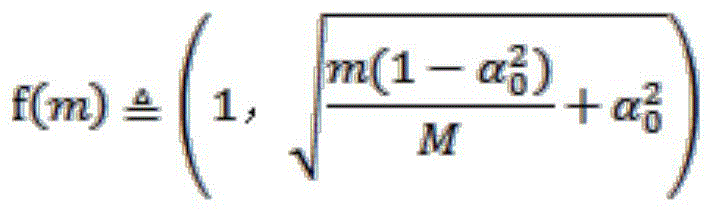
wherein Represents how much proportion of the data is used for training in the initial stage, and M represents the maximum number of training steps. In the training process, the model is firstly trained by using easy data, and the proportion of difficult data is gradually increased until all data is used.
Example two
The embodiment provides a dialog system based on cross-language knowledge, which comprises:
the dialogue problem coding module is used for acquiring dialogue problems and obtaining dialogue problem expression vectors through a multi-language coder;
the knowledge representation vector retrieval module is used for retrieving a knowledge representation vector closest to the dialogue problem representation vector from a prestored multi-language knowledge representation vector library;
the vector splicing module is used for splicing the conversation problem expression vector and the retrieved knowledge expression vector;
and the dialogue question reply module is used for inputting the spliced vector to the cross-language seq2seq model to obtain a reply corresponding to the dialogue question.
It should be noted that, each module in the present embodiment corresponds to each step in the first embodiment one to one, and the specific implementation process is the same, which is not described here again.
EXAMPLE III
The present embodiment provides a computer-readable storage medium, on which a computer program is stored, which when executed by a processor implements the steps in the cross-language knowledge based dialog method as described in the first embodiment above.
Example four
The present embodiment provides a computer device, which includes a memory, a processor, and a computer program stored in the memory and executable on the processor, and the processor executes the program to implement the steps in the cross-language knowledge based dialog method according to the first embodiment.
As will be appreciated by one skilled in the art, embodiments of the present invention may be provided as a method, system, or computer program product. Accordingly, the present invention may take the form of a hardware embodiment, a software embodiment, or an embodiment combining software and hardware aspects. Furthermore, the present invention may take the form of a computer program product embodied on one or more computer-usable storage media (including, but not limited to, disk storage, optical storage, and the like) having computer-usable program code embodied therein.
The present invention is described with reference to flowchart illustrations and/or block diagrams of methods, apparatus (systems), and computer program products according to embodiments of the invention. It will be understood that each flow and/or block of the flow diagrams and/or block diagrams, and combinations of flows and/or blocks in the flow diagrams and/or block diagrams, can be implemented by computer program instructions. These computer program instructions may be provided to a processor of a general purpose computer, special purpose computer, embedded processor, or other programmable data processing apparatus to produce a machine, such that the instructions, which execute via the processor of the computer or other programmable data processing apparatus, create means for implementing the functions specified in the flowchart flow or flows and/or block diagram block or blocks.
These computer program instructions may also be stored in a computer-readable memory that can direct a computer or other programmable data processing apparatus to function in a particular manner, such that the instructions stored in the computer-readable memory produce an article of manufacture including instruction means which implement the function specified in the flowchart flow or flows and/or block diagram block or blocks.
These computer program instructions may also be loaded onto a computer or other programmable data processing apparatus to cause a series of operational steps to be performed on the computer or other programmable apparatus to produce a computer implemented process such that the instructions which execute on the computer or other programmable apparatus provide steps for implementing the functions specified in the flowchart flow or flows and/or block diagram block or blocks.
It will be understood by those skilled in the art that all or part of the processes of the methods of the embodiments described above may be implemented by a computer program, which may be stored in a computer readable storage medium and executed by a computer to implement the processes of the embodiments of the methods described above. The storage medium may be a magnetic disk, an optical disk, a Read-Only Memory (ROM), a Random Access Memory (RAM), or the like.
The above description is only a preferred embodiment of the present invention and is not intended to limit the present invention, and various modifications and changes may be made by those skilled in the art. Any modification, equivalent replacement, or improvement made within the spirit and principle of the present invention should be included in the protection scope of the present invention.
Claims (7)
Priority Applications (1)
| Application Number | Priority Date | Filing Date | Title |
|---|---|---|---|
| CN202110577065.2A CN113486160B (en) | 2021-05-26 | 2021-05-26 | Dialogue method and system based on cross-language knowledge |
Applications Claiming Priority (1)
| Application Number | Priority Date | Filing Date | Title |
|---|---|---|---|
| CN202110577065.2A CN113486160B (en) | 2021-05-26 | 2021-05-26 | Dialogue method and system based on cross-language knowledge |
Publications (2)
| Publication Number | Publication Date |
|---|---|
| CN113486160A CN113486160A (en) | 2021-10-08 |
| CN113486160B true CN113486160B (en) | 2023-04-11 |
Family
ID=77933164
Family Applications (1)
| Application Number | Title | Priority Date | Filing Date |
|---|---|---|---|
| CN202110577065.2A Active CN113486160B (en) | 2021-05-26 | 2021-05-26 | Dialogue method and system based on cross-language knowledge |
Country Status (1)
| Country | Link |
|---|---|
| CN (1) | CN113486160B (en) |
Families Citing this family (2)
| Publication number | Priority date | Publication date | Assignee | Title |
|---|---|---|---|---|
| CN115982583A (en) * | 2022-12-30 | 2023-04-18 | 北京百度网讯科技有限公司 | Training method, device, equipment and medium for pre-trained language model |
| CN116860930B (en) * | 2023-06-27 | 2025-07-11 | 建信金融科技有限责任公司 | Dialogue generation method and device |
Family Cites Families (6)
| Publication number | Priority date | Publication date | Assignee | Title |
|---|---|---|---|---|
| US9996533B2 (en) * | 2015-09-30 | 2018-06-12 | International Business Machines Corporation | Question answering system using multilingual information sources |
| CN106844368B (en) * | 2015-12-03 | 2020-06-16 | 华为技术有限公司 | Method for man-machine conversation, neural network system and user equipment |
| CN110188182B (en) * | 2019-05-31 | 2023-10-27 | 中国科学院深圳先进技术研究院 | Model training method, dialogue generation method, device, equipment and medium |
| CN112100354B (en) * | 2020-09-16 | 2023-07-25 | 北京奇艺世纪科技有限公司 | Man-machine conversation method, device, equipment and storage medium |
| CN112214593B (en) * | 2020-11-05 | 2024-08-27 | 腾讯科技(深圳)有限公司 | Question-answering processing method and device, electronic equipment and storage medium |
| CN112541087A (en) * | 2020-12-18 | 2021-03-23 | 清华大学 | Cross-language knowledge graph construction method and device based on encyclopedia |
-
2021
- 2021-05-26 CN CN202110577065.2A patent/CN113486160B/en active Active
Also Published As
| Publication number | Publication date |
|---|---|
| CN113486160A (en) | 2021-10-08 |
Similar Documents
| Publication | Publication Date | Title |
|---|---|---|
| US12254865B2 (en) | Multi-dialect and multilingual speech recognition | |
| US20250315622A1 (en) | Performing machine learning tasks using instruction-tuned neural networks | |
| CN112836514B (en) | Nested entity identification method, apparatus, electronic device and storage medium | |
| CN110990555B (en) | End-to-end retrieval type dialogue method and system and computer equipment | |
| CN111666764B (en) | Automatic abstracting method and device based on XLNet | |
| CN114387537B (en) | Video question-answering method based on descriptive text | |
| JP7753500B2 (en) | Generating neural network outputs by enriching latent embeddings using self-attention and mutual attention operations | |
| CN114218921B (en) | A method to optimize BERT question semantic matching | |
| CN113268989B (en) | Multi-tone word processing method and device | |
| US20240104353A1 (en) | Sequence-to sequence neural network systems using look ahead tree search | |
| CN118982030B (en) | A method for extracting sentiment from multi-turn conversations using large language model reasoning | |
| CN117035064B (en) | A joint training method and storage medium for retrieval enhanced language model | |
| JP2024538019A (en) | Joint Unsupervised and Supervised Training (JUST) for Multilingual Automatic Speech Recognition | |
| CN118051635A (en) | Conversational image retrieval method and device based on large language model | |
| CN113971212B (en) | Multilingual question-answering methods, devices, electronic devices and storage media | |
| CN113486160B (en) | Dialogue method and system based on cross-language knowledge | |
| CN113806520B (en) | Text summary generation method and system based on reinforcement learning | |
| CN111814433B (en) | Uygur language entity identification method and device and electronic equipment | |
| CN117828024A (en) | A plug-in search method, device, storage medium and equipment | |
| CN117332788A (en) | A semantic analysis method based on English spoken text | |
| CN117217233A (en) | Text correction, text correction model training method and device | |
| CN110717316B (en) | Method and device for topic segmentation of subtitle dialogue stream | |
| CN115994533A (en) | Question controllable generation method, system and computer readable medium based on prompt learning | |
| CN111831792B (en) | Electric power knowledge base construction method and system | |
| CN113065324A (en) | Text generation method and device based on structured triples and anchor templates |
Legal Events
| Date | Code | Title | Description |
|---|---|---|---|
| PB01 | Publication | ||
| PB01 | Publication | ||
| SE01 | Entry into force of request for substantive examination | ||
| SE01 | Entry into force of request for substantive examination | ||
| GR01 | Patent grant | ||
| GR01 | Patent grant |