JP2024538019A - Joint Unsupervised and Supervised Training (JUST) for Multilingual Automatic Speech Recognition - Google Patents
Joint Unsupervised and Supervised Training (JUST) for Multilingual Automatic Speech Recognition Download PDFInfo
- Publication number
- JP2024538019A JP2024538019A JP2024520856A JP2024520856A JP2024538019A JP 2024538019 A JP2024538019 A JP 2024538019A JP 2024520856 A JP2024520856 A JP 2024520856A JP 2024520856 A JP2024520856 A JP 2024520856A JP 2024538019 A JP2024538019 A JP 2024538019A
- Authority
- JP
- Japan
- Prior art keywords
- latent
- loss
- speech recognition
- training
- speech
- Prior art date
- Legal status (The legal status is an assumption and is not a legal conclusion. Google has not performed a legal analysis and makes no representation as to the accuracy of the status listed.)
- Granted
Links
Images

Classifications
-
- G—PHYSICS
- G06—COMPUTING OR CALCULATING; COUNTING
- G06N—COMPUTING ARRANGEMENTS BASED ON SPECIFIC COMPUTATIONAL MODELS
- G06N3/00—Computing arrangements based on biological models
- G06N3/02—Neural networks
- G06N3/04—Architecture, e.g. interconnection topology
- G06N3/044—Recurrent networks, e.g. Hopfield networks
-
- G—PHYSICS
- G06—COMPUTING OR CALCULATING; COUNTING
- G06N—COMPUTING ARRANGEMENTS BASED ON SPECIFIC COMPUTATIONAL MODELS
- G06N3/00—Computing arrangements based on biological models
- G06N3/02—Neural networks
- G06N3/04—Architecture, e.g. interconnection topology
- G06N3/045—Combinations of networks
-
- G—PHYSICS
- G06—COMPUTING OR CALCULATING; COUNTING
- G06N—COMPUTING ARRANGEMENTS BASED ON SPECIFIC COMPUTATIONAL MODELS
- G06N3/00—Computing arrangements based on biological models
- G06N3/02—Neural networks
- G06N3/04—Architecture, e.g. interconnection topology
- G06N3/0464—Convolutional networks [CNN, ConvNet]
-
- G—PHYSICS
- G06—COMPUTING OR CALCULATING; COUNTING
- G06N—COMPUTING ARRANGEMENTS BASED ON SPECIFIC COMPUTATIONAL MODELS
- G06N3/00—Computing arrangements based on biological models
- G06N3/02—Neural networks
- G06N3/04—Architecture, e.g. interconnection topology
- G06N3/048—Activation functions
-
- G—PHYSICS
- G06—COMPUTING OR CALCULATING; COUNTING
- G06N—COMPUTING ARRANGEMENTS BASED ON SPECIFIC COMPUTATIONAL MODELS
- G06N3/00—Computing arrangements based on biological models
- G06N3/02—Neural networks
- G06N3/04—Architecture, e.g. interconnection topology
- G06N3/0495—Quantised networks; Sparse networks; Compressed networks
-
- G—PHYSICS
- G06—COMPUTING OR CALCULATING; COUNTING
- G06N—COMPUTING ARRANGEMENTS BASED ON SPECIFIC COMPUTATIONAL MODELS
- G06N3/00—Computing arrangements based on biological models
- G06N3/02—Neural networks
- G06N3/08—Learning methods
- G06N3/088—Non-supervised learning, e.g. competitive learning
-
- G—PHYSICS
- G06—COMPUTING OR CALCULATING; COUNTING
- G06N—COMPUTING ARRANGEMENTS BASED ON SPECIFIC COMPUTATIONAL MODELS
- G06N3/00—Computing arrangements based on biological models
- G06N3/02—Neural networks
- G06N3/08—Learning methods
- G06N3/0895—Weakly supervised learning, e.g. semi-supervised or self-supervised learning
-
- G—PHYSICS
- G06—COMPUTING OR CALCULATING; COUNTING
- G06N—COMPUTING ARRANGEMENTS BASED ON SPECIFIC COMPUTATIONAL MODELS
- G06N3/00—Computing arrangements based on biological models
- G06N3/02—Neural networks
- G06N3/08—Learning methods
- G06N3/09—Supervised learning
-
- G—PHYSICS
- G10—MUSICAL INSTRUMENTS; ACOUSTICS
- G10L—SPEECH ANALYSIS TECHNIQUES OR SPEECH SYNTHESIS; SPEECH RECOGNITION; SPEECH OR VOICE PROCESSING TECHNIQUES; SPEECH OR AUDIO CODING OR DECODING
- G10L15/00—Speech recognition
- G10L15/02—Feature extraction for speech recognition; Selection of recognition unit
-
- G—PHYSICS
- G10—MUSICAL INSTRUMENTS; ACOUSTICS
- G10L—SPEECH ANALYSIS TECHNIQUES OR SPEECH SYNTHESIS; SPEECH RECOGNITION; SPEECH OR VOICE PROCESSING TECHNIQUES; SPEECH OR AUDIO CODING OR DECODING
- G10L15/00—Speech recognition
- G10L15/06—Creation of reference templates; Training of speech recognition systems, e.g. adaptation to the characteristics of the speaker's voice
- G10L15/063—Training
-
- G—PHYSICS
- G10—MUSICAL INSTRUMENTS; ACOUSTICS
- G10L—SPEECH ANALYSIS TECHNIQUES OR SPEECH SYNTHESIS; SPEECH RECOGNITION; SPEECH OR VOICE PROCESSING TECHNIQUES; SPEECH OR AUDIO CODING OR DECODING
- G10L15/00—Speech recognition
- G10L15/08—Speech classification or search
- G10L15/16—Speech classification or search using artificial neural networks
-
- G—PHYSICS
- G10—MUSICAL INSTRUMENTS; ACOUSTICS
- G10L—SPEECH ANALYSIS TECHNIQUES OR SPEECH SYNTHESIS; SPEECH RECOGNITION; SPEECH OR VOICE PROCESSING TECHNIQUES; SPEECH OR AUDIO CODING OR DECODING
- G10L15/00—Speech recognition
- G10L15/08—Speech classification or search
- G10L15/18—Speech classification or search using natural language modelling
- G10L15/183—Speech classification or search using natural language modelling using context dependencies, e.g. language models
- G10L15/19—Grammatical context, e.g. disambiguation of the recognition hypotheses based on word sequence rules
Landscapes
- Engineering & Computer Science (AREA)
- Physics & Mathematics (AREA)
- Theoretical Computer Science (AREA)
- Computational Linguistics (AREA)
- Health & Medical Sciences (AREA)
- Artificial Intelligence (AREA)
- Evolutionary Computation (AREA)
- Biomedical Technology (AREA)
- Mathematical Physics (AREA)
- Software Systems (AREA)
- General Physics & Mathematics (AREA)
- Life Sciences & Earth Sciences (AREA)
- General Engineering & Computer Science (AREA)
- Biophysics (AREA)
- Data Mining & Analysis (AREA)
- General Health & Medical Sciences (AREA)
- Molecular Biology (AREA)
- Computing Systems (AREA)
- Human Computer Interaction (AREA)
- Multimedia (AREA)
- Acoustics & Sound (AREA)
- Audiology, Speech & Language Pathology (AREA)
- Computer Vision & Pattern Recognition (AREA)
- Machine Translation (AREA)
Abstract
対応する潜在音声表現のターゲット(標的)量子化ベクトルトークン(312)および標的トークンインデックス(314)を生成する。対応するマスクされていない、またはマスク済み潜在音声表現(212u、212m)の対照コンテキストベクトル(322)を生成する。対応する対照コンテキストベクトルに対応する標的量子化ベクトルトークンに基づき、対照的な自己教師有り損失(355a)を導出する。対照コンテキストベクトルに基づき、高レベルコンテキストベクトル(334)を生成する。標的トークンインデックスに基づくクロスエントロピー損失(355b)を使用することで標的トークンインデックスを予測するように学習する。音声認識仮説(342)を予測する。教師無し損失(355)および教師有り損失(365)を使用することで多言語自動音声認識ASRモデル(200)をトレーニングする。
Generate a target quantized vector token (312) and a target token index (314) of the corresponding latent speech representation. Generate a contrast context vector (322) of the corresponding unmasked or masked latent speech representation (212u, 212m). Derive a contrastive self-supervised loss (355a) based on the target quantized vector token corresponding to the corresponding contrast context vector. Generate a high-level context vector (334) based on the contrast context vector. Learn to predict the target token index by using a cross-entropy loss (355b) based on the target token index. Predict the speech recognition hypothesis (342). Train a multilingual automatic speech recognition ASR model (200) by using unsupervised loss (355) and supervised loss (365).
Description
本開示は、多言語自動音声認識(ASR)の教師無しおよび教師有り共同(ジョイント_アンスーパーバイズド_アンド_スーパーバイズド)トレーニングに関する。 This disclosure relates to joint unsupervised and supervised training of multilingual automatic speech recognition (ASR).
自動音声認識(ASR:オートマティックスピーチレコグニション)は、オーディオ入力を取得することでテキストに転写(トランスクライブ、書き起こし)する処理であり、モバイルデバイスおよびその他のデバイスで使用される重要な技術である。一般に、自動音声認識ASRは、オーディオ入力(たとえば、音声発話)を取得するとともに、そのオーディオ入力をテキストに転写することで、人が言った内容の正確な転写(トランスクリプション、書き起こし)を提供しようとする。最新の自動音声認識ASRモデルは、ディープ(深層)ニューラルネットワークの継続的な開発に基づき、精度(たとえば、低い単語誤り率(WER))および遅延(たとえば、ユーザの発話と転写との間の遅延)の両方の性能を継続的に改善させている。 Automatic speech recognition (ASR), the process of taking audio input and transcribing it into text, is an important technology used in mobile and other devices. In general, ASR attempts to take audio input (e.g., a spoken utterance) and transcribe the audio input into text to provide an accurate transcription of what a person said. Modern ASR models are based on the continuous development of deep neural networks, and continue to improve performance in both accuracy (e.g., low word error rate (WER)) and latency (e.g., delay between user speech and transcription).
しかしながら、ディープラーニングベースの自動音声認識ASRモデルを開発する際の課題の1つは、自動音声認識ASRモデルのパラメータがトレーニングデータに過剰適合する傾向があることで、その結果、トレーニングデータが十分に広範囲ではない場合、自動音声認識ASRモデルが見ていないデータを一般化することが困難になることである。その結果、一層大きなトレーニングデータセットで自動音声認識ASRモデルをトレーニングすると、自動音声認識ASRモデルの精度が改善する。ラベル無しトレーニングデータとラベル付きトレーニングデータとを組み込むことで、自動音声認識ASRモデルをトレーニングするべく使用されるトレーニングデータの量を増やすことができる。 However, one of the challenges in developing a deep learning-based automatic speech recognition ASR model is that the parameters of the automatic speech recognition ASR model tend to overfit to the training data, which makes it difficult for the automatic speech recognition ASR model to generalize to unseen data if the training data is not extensive enough. As a result, training the automatic speech recognition ASR model with a larger training data set improves the accuracy of the automatic speech recognition ASR model. The amount of training data used to train the automatic speech recognition ASR model can be increased by incorporating unlabeled and labeled training data.
本開示の1つの態様は、多言語自動音声認識(ASR)モデルをトレーニングするための、教師無しおよび教師有りの共同トレーニング(JUST)フレームワークを提供する。教師無しおよび教師有り共同トレーニングJUSTフレームワークには、音声の発話に対応するオーディオ特徴(フィーチャ)を入力として受け取ることで、かつ複数の時間ステップの各々で潜在音声表現(ラテントスピーチレプリゼンテーション)を生成するように構成されている特徴(フィーチャ)エンコーダが含まれる。教師無しおよび教師有り共同トレーニングJUSTフレームワークには、複数の時間ステップの各々において特徴エンコーダによって生成済みの潜在音声表現を入力として受け取るとともに、複数の時間ステップの各々において、特徴エンコーダによって生成済みの対応する潜在音声表現のターゲット量子化ベクトルトークンおよびターゲットトークンインデックスを生成するように構成されている量子化器(クオンタイザー)も含まれる。ここで、ターゲットトークンインデックスは、対応する潜在音声表現を、コードブックに記憶されたターゲット量子化ベクトルトークンにマッピングする。教師無しおよび教師有り共同トレーニングJUSTフレームワークは、潜在音声表現のサブセットをマスクした後、複数の時間ステップの各々において特徴エンコーダによって生成済みの潜在音声表現を入力として受け取ることで、複数の時間ステップの各々において、対応するマスクされていない、またはマスク済み潜在音声表現の対照(コントラスティブ)コンテキストベクトルを生成するとともに、複数の時間ステップの各々において、対応する対照コンテキストベクトルと、対応する潜在音声表現についての量子化器によって生成済みの対応するターゲット量子化ベクトルトークンと、に基づき対照的な自己教師有り損失(セルフスーパーバイズドロス)を導出するように構成されている対照(コントラスティブ)ネットも備えている。教師無しおよび教師有り共同トレーニングJUSTフレームワークは、複数の時間ステップの各々において対照ネットによって生成済みの対照コンテキストベクトルを入力として受け取ることで、複数の時間ステップの各々において高レベルコンテキストベクトルを生成するとともに、高レベルコンテキストベクトルごとに、対応する時間ステップにおいて量子化器によって生成済みのターゲットトークンインデックスに基づくクロスエントロピー損失を使用することで、対応する時間ステップにおけるターゲットトークンインデックスを予測するように学習するように構成されているマスク言語モデリング(MLM)モジュールも備えている。教師無しおよび教師有り共同トレーニングJUSTフレームワークは、マスク言語(マスクドランゲージ)モデリングMLMモジュールによって複数の時間ステップの各々で生成済みの高レベルコンテキストベクトルを入力として受け取ることで、発話に対する音声認識仮説を予測するように構成されているデコーダも備えている。ここで、教師無しおよび教師有り共同トレーニングJUSTフレームワークでは、クロスエントロピー損失と対照的な自己教師有り損失とに基づく教師無し損失と、予測済みの音声認識仮説と発話のグラウンドトゥルース転写とに基づく教師有り損失と、において多言語自動音声認識ASRモデルをトレーニングする。 One aspect of the present disclosure provides a joint unsupervised and supervised training (JUST) framework for training a multilingual automatic speech recognition (ASR) model. The joint unsupervised and supervised training JUST framework includes a feature encoder configured to receive as input audio features corresponding to speech utterances and generate a latent speech representation at each of a plurality of time steps. The joint unsupervised and supervised training JUST framework also includes a quantizer configured to receive as input the latent speech representation generated by the feature encoder at each of the plurality of time steps and generate a target quantized vector token and a target token index for the corresponding latent speech representation generated by the feature encoder at each of the plurality of time steps. Here, the target token index maps the corresponding latent speech representation to a target quantized vector token stored in a codebook. The unsupervised and supervised joint training JUST framework also includes a contrastive net configured to receive as input the latent speech representations generated by the feature encoder at each of the multiple time steps after masking a subset of the latent speech representations, to generate a contrastive context vector for a corresponding unmasked or masked latent speech representation at each of the multiple time steps, and to derive a contrastive self-supervised loss at each of the multiple time steps based on the corresponding contrast context vector and a corresponding target quantization vector token generated by the quantizer for the corresponding latent speech representation. The unsupervised and supervised joint training JUST framework also includes a masked language modeling (MLM) module configured to receive as input the contrast context vectors generated by the contrast net at each of the multiple time steps, to generate a high-level context vector at each of the multiple time steps, and to learn to predict a target token index at the corresponding time step by using a cross-entropy loss based on the target token index generated by the quantizer at the corresponding time step for each high-level context vector. The unsupervised and supervised joint training JUST framework also includes a decoder configured to predict speech recognition hypotheses for the utterance by receiving as input the high-level context vectors generated by the masked language modeling MLM module at each of a number of time steps. Here, the unsupervised and supervised joint training JUST framework trains a multilingual automatic speech recognition (ASR) model in an unsupervised loss based on a self-supervised loss as opposed to a cross-entropy loss, and a supervised loss based on the predicted speech recognition hypotheses and a ground truth transcription of the utterance.
本開示の実施態様には、以下の任意選択の特徴の1つまたは複数が含まれる場合がある。いくつかの実施態様では、特徴エンコーダは2つの畳み込みニューラルネットワーク(CNN)ブロックを備えている。いくつかの例では、潜在音声表現のサブセットをマスクする工程は、潜在音声表現のサブセットにおける各々の潜在音声表現を、対応するランダムベクトルにランダムに置き換える工程を備えている。対照ネットによって導出済みの対照的な自己教師有り損失は、潜在表現(潜在音声表現)のマスク済みサブセットからのマスク済み潜在音声表現に対応する、コードブックに記憶されたターゲット量子化ベクトルトークンから均一にサンプリングされたK個の負のサンプル/ディストラクタにさらに基づくものであってよい。 Implementations of the present disclosure may include one or more of the following optional features: In some implementations, the feature encoder comprises two convolutional neural network (CNN) blocks. In some examples, masking the subset of latent speech representations comprises randomly replacing each latent speech representation in the subset of latent speech representations with a corresponding random vector. The contrastive self-supervised loss derived by the contrastive net may be further based on K negative samples/distractors uniformly sampled from target quantized vector tokens stored in a codebook that correspond to the masked latent speech representations from the masked subset of latent representations.
いくつかの実施態様では、教師有り損失は、コードブックに関連付けられたエントロピーベースの多様性損失(ダイバーシティロス)にさらに基づく。多言語自動音声認識ASRモデルは、複数の異なる言語で話された発話をトレーニングすることでトレーニングされる。いくつかの例では、多言語自動音声認識ASRモデルのトレーニングは、先(プライアー)の事前トレーニング(プレ訓練)を行なわずに多言語自動音声認識ASRモデルのトレーニングを行なう工程を備えている。他の例では、多言語自動音声認識ASRモデルのトレーニングは、事前トレーニング済みのチェックポイントから多言語自動音声認識ASRモデルを微調整(ファインチューニング)する工程を備えている。いくつかの実施態様では、多言語自動音声認識ASRモデルのトレーニングは、多言語自動音声認識ASRモデルを教師無し損失および教師有り損失で共同して(ジョイントして)トレーニングする工程を備えている。教師有り損失は、リカレントニューラルネットワークトランスデューサ(RNN-T)損失を含み得る。 In some implementations, the supervised loss is further based on an entropy-based diversity loss associated with the codebook. The multilingual automatic speech recognition ASR model is trained by training utterances spoken in a plurality of different languages. In some examples, training the multilingual automatic speech recognition ASR model comprises training the multilingual automatic speech recognition ASR model without prior pre-training. In other examples, training the multilingual automatic speech recognition ASR model comprises fine-tuning the multilingual automatic speech recognition ASR model from a pre-trained checkpoint. In some implementations, training the multilingual automatic speech recognition ASR model comprises jointly training the multilingual automatic speech recognition ASR model with unsupervised and supervised losses. The supervised loss may include a recurrent neural network transducer (RNN-T) loss.
本開示の別の態様は、データ処理ハードウェアと、データ処理ハードウェア上で実行されるとデータ処理ハードウェアに動作を実行させる命令を記憶するメモリハードウェアと、を備えているシステムを提供する。動作は、音声の発話に対応するオーディオ特徴を受け取ることで、かつ複数の時間ステップの各々において、オーディオ特徴に基づき潜在音声表現を生成する工程を備えている。動作は、複数の時間ステップの各々において、対応する潜在音声表現のターゲット量子化ベクトルトークンおよびターゲットトークンインデックスを生成する工程も備えている。ターゲットトークンインデックスは、対応する潜在音声表現をコードブックに記憶されたターゲット量子化ベクトルトークンにマッピング(写像)する。動作は、複数の時間ステップの各々において、対応するマスクされていない、またはマスク済み潜在音声表現の対照コンテキストベクトルを生成する工程も備えている。動作は、複数の時間ステップの各々において、対応する対照ベクトルおよび対応するターゲット量子化ベクトルトークンに基づき対照的な自己教師有り損失を導出する工程も備えている。動作はまた、複数の時間ステップの各々において、対照コンテキストベクトルに基づき高レベルコンテキストベクトルを生成する工程と、各々の高レベルコンテキストベクトルについて、ターゲットトークンインデックスに基づくクロスエントロピー損失を使用することで対応する時間ステップでターゲットトークンインデックスを予測するように学習する工程と、を備えている。動作はまた、高レベルコンテキストベクトルに基づき発話の音声認識仮説を予測する工程と、かつ、対照的な自己教師有り損失とクロスエントロピー損失とに基づく教師無し損失と、予測済みの音声認識仮説と発話のグラウンドトゥルース転写とに基づく教師有り損失と、を使用することで多言語自動音声認識(ASR)モデルをトレーニングする工程と、も備えている。 Another aspect of the present disclosure provides a system comprising data processing hardware and memory hardware storing instructions that, when executed on the data processing hardware, cause the data processing hardware to perform operations. The operations include receiving audio features corresponding to a speech utterance and generating a latent speech representation based on the audio features at each of a plurality of time steps. The operations also include generating a target quantization vector token and a target token index for the corresponding latent speech representation at each of the plurality of time steps. The target token index maps the corresponding latent speech representation to the target quantization vector token stored in the codebook. The operations also include generating a contrast context vector for the corresponding unmasked or masked latent speech representation at each of the plurality of time steps. The operations also include deriving a contrastive self-supervised loss based on the corresponding contrast vector and the corresponding target quantization vector token at each of the plurality of time steps. The operations also include generating a high-level context vector based on the contrast context vector at each of the multiple time steps, and for each high-level context vector, learning to predict a target token index at a corresponding time step by using a cross-entropy loss based on the target token index. The operations also include predicting a speech recognition hypothesis for the utterance based on the high-level context vector, and training a multilingual automatic speech recognition (ASR) model using an unsupervised loss based on the contrastive self-supervised loss and the cross-entropy loss, and a supervised loss based on the predicted speech recognition hypothesis and a ground truth transcription of the utterance.
本開示の実施態様には、以下の任意選択の特徴の1つまたは複数が含まれる場合がある。いくつかの実施態様では、潜在音声表現を生成する工程は、特徴エンコーダによって、複数の時間ステップの各々において潜在音声表現を生成する工程を備えている。特徴エンコーダは、2つの畳み込みニューラルネットワーク(CNN)ブロックを備えている。動作は、潜在音声表現のサブセットにおける各々の潜在音声表現を、対応するランダムベクトルにランダムに置き換えることによって潜在音声表現のサブセットをマスクする工程、をさらに備えている。いくつかの例では、対照的な自己教師有り損失は、潜在音声表現のマスク済みサブセットからのマスク済み潜在音声表現に対応する、コードブックに記憶されたターゲット量子化ベクトルトークンから均一にサンプリングされたK個の負のサンプル/ディストラクタにさらに基づく。 Implementations of the present disclosure may include one or more of the following optional features. In some implementations, generating a latent speech representation comprises generating a latent speech representation at each of a plurality of time steps by a feature encoder. The feature encoder comprises two convolutional neural network (CNN) blocks. The operations further comprise masking the subset of latent speech representations by randomly replacing each latent speech representation in the subset of latent speech representations with a corresponding random vector. In some examples, the contrasting self-supervised loss is further based on K negative samples/distractors uniformly sampled from a target quantized vector token stored in a codebook that corresponds to a masked latent speech representation from the masked subset of latent speech representations.
いくつかの実施態様では、教師無し損失は、コードブックに関連付けられたエントロピーベースの多様性損失にさらに基づく。多言語自動音声認識ASRモデルは、複数の異なる言語で話された発話をトレーニングすることでトレーニングされ得る。いくつかの例では、多言語自動音声認識ASRモデルのトレーニングは、先の事前トレーニングを行なわずに多言語自動音声認識ASRモデルのトレーニングを行なう工程を備えている。多言語自動音声認識ASRモデルをトレーニングする工程は、事前トレーニング済みのチェックポイントから多言語自動音声認識ASRモデルを微調整する工程を含み得る。いくつかの実施態様では、多言語自動音声認識ASRモデルをトレーニングする工程は、多言語自動音声認識ASRモデルを教師無し損失および教師有り損失で共同してトレーニングする工程を備えている。いくつかの例では、教師有り損失は、リカレントニューラルネットワークトランスデューサ(RNN-T)損失を備えている。 In some implementations, the unsupervised loss is further based on an entropy-based diversity loss associated with the codebook. The multilingual automatic speech recognition ASR model may be trained by training utterances spoken in a plurality of different languages. In some examples, training the multilingual automatic speech recognition ASR model comprises training the multilingual automatic speech recognition ASR model without prior pre-training. Training the multilingual automatic speech recognition ASR model may include fine-tuning the multilingual automatic speech recognition ASR model from a pre-trained checkpoint. In some implementations, training the multilingual automatic speech recognition ASR model comprises jointly training the multilingual automatic speech recognition ASR model with unsupervised and supervised losses. In some examples, the supervised loss comprises a recurrent neural network transducer (RNN-T) loss.
本開示の1つまたは複数の実施態様の詳細は、添付の図面および以下の説明において述べられる。他の態様、特徴、および利点、は説明および図面ならびに請求項から明らかになるであろう。 The details of one or more embodiments of the disclosure are set forth in the accompanying drawings and the description below. Other aspects, features, and advantages will become apparent from the description and drawings, and from the claims.
様々な図面における同様の参照記号は、同様の要素を指す。
事前トレーニング(プレ訓練)済みの自動音声認識(ASR)モデルの使用は、大規模なラベル無しトレーニングデータから一般的な潜在表現(潜在音声表現)を学習するための効果的な方法であることが実証されている。自動音声認識ASRモデルを事前トレーニングすると、下流の微調整におけるトレーニングの複雑さが大幅に軽減される。ここで、微調整(ファインチューニング)とは、自動音声認識ASRモデルが既にラベル無しトレーニングデータを使用することで事前トレーニングされているので、事前トレーニング済みの自動音声認識ASRモデルに対して小さなラベル付きトレーニングデータセットを使用することで教師有りトレーニングを実行することを指す。よって、自動音声認識ASRモデルが事前トレーニングされた後、事前トレーニング済みの自動音声認識ASRモデルは、より小さいおよび/またはより多様性の低いラベル付きトレーニングデータセットのみを使用することでトレーニング(すなわち、微調整トレーニング)され得る。特に、事前トレーニング済みの自動音声認識ASRモデルを、より小さなラベル付きトレーニングデータセットを使用することで微調整すると、事前トレーニングを受けずに一層大規模なおよび/または一層多様なラベル付きトレーニングデータセットを使用することでトレーニングする自動音声認識ASRモデルとで同等(またはそれ以上)の性能(パフォーマンス)が得られる。
Like reference symbols in the various drawings indicate like elements.
The use of pre-trained automatic speech recognition (ASR) models has been demonstrated to be an effective method for learning general latent representations from large-scale unlabeled training data. Pre-training an automatic speech recognition ASR model significantly reduces the training complexity of downstream fine-tuning. Here, fine-tuning refers to performing supervised training on a pre-trained automatic speech recognition ASR model by using a small labeled training dataset, since the automatic speech recognition ASR model has already been pre-trained by using unlabeled training data. Thus, after the automatic speech recognition ASR model is pre-trained, the pre-trained automatic speech recognition ASR model can be trained by using only a smaller and/or less diverse labeled training dataset (i.e., fine-tuning training). In particular, fine-tuning a pre-trained automatic speech recognition ASR model by using a smaller labeled training dataset can achieve comparable (or better) performance than an automatic speech recognition ASR model trained by using a larger and/or more diverse labeled training dataset without pre-training.
自動音声認識ASRモデルの事前トレーニングは通常、2段階のアプローチを備えている。第1段階では、自動音声認識ASRモデルは、ラベル無しトレーニングデータから導出済みの自己教師有り損失を使用することでトレーニングすることで一般的な潜在音声表現を学習する。その後、第2段階では、自動音声認識ASRモデルは教師有り損失に基づき、トレーニングを微調整する。ここで、自動音声認識ASRモデルはラベル無しトレーニングデータを使用することで既に事前トレーニングされているので、トレーニングの第2段階では、ラベル付きトレーニングデータ(すなわち、対応するラベル付きの転写を有しているオーディオデータ)の小さなセットのみが必要になる。この2段階のトレーニングアプローチはシーケンスモデリングでは成功していることが証明されているが、このアプローチにはいくつかの問題がある。たとえば、事前トレーニング済みモデルは壊滅的忘却(カタストロフィックフォーゲッティング)の影響を受けやすくなる。つまり、事前トレーニング済みモデルは、ラベル無しトレーニングデータを使用するトレーニングの第1段階で以前に学習済みの潜在音声表現を、忘れてしまう場合がある。言い換えれば、第2段階で教師有り損失を使用することで自動音声認識ASRモデルをトレーニングすると、第1段階のトレーニングで学習済みの潜在音声表現が上書きされるので、それによって、第1段階で自動音声認識ASRモデルを事前トレーニングすることで受けられるいずれの利益も減少する場合がある。以前に学習済みの潜在音声表現を忘れることは、ラベル付きトレーニングデータセットが大きいときに特によく起こる。 Pre-training of an automatic speech recognition (ASR) model typically involves a two-stage approach. In the first stage, the automatic speech recognition (ASR) model learns general latent speech representations by training using a self-supervised loss derived from unlabeled training data. Then, in the second stage, the automatic speech recognition (ASR) model fine-tunes the training based on the supervised loss. Here, since the automatic speech recognition (ASR) model has already been pre-trained using unlabeled training data, the second stage of training only requires a small set of labeled training data (i.e., audio data with corresponding labeled transcriptions). Although this two-stage training approach has proven successful for sequence modeling, it suffers from several problems. For example, the pre-trained model is susceptible to catastrophic forgetting. That is, the pre-trained model may forget the latent speech representations previously learned in the first stage of training using unlabeled training data. In other words, training an automatic speech recognition ASR model using supervised losses in the second stage overwrites the latent speech representations learned in the first stage training, which may reduce any benefits gained by pre-training an automatic speech recognition ASR model in the first stage. Forgetting previously learned latent speech representations is especially common when the labeled training dataset is large.
2段階のトレーニングアプローチに関するもう1つの問題は、事前トレーニング済みのチェックポイントの選択である。事前トレーニング済みのチェックポイントは、自動音声認識ASRモデルの事前トレーニング(すなわち、第1段階)が終了しているとともに、微調整トレーニング(すなわち、第2段階)が開始されるポイントである。よって、事前トレーニング済みのチェックポイントは、自動音声認識ASRモデルが受ける事前トレーニングの量に基づき変化する。とりわけ、事前トレーニングをいつ停止するとともに微調整トレーニングを開始するかを決定することが問題である。特に、事前トレーニングを行ない過ぎると、実際に自動音声認識ASRモデルの性能が低下する虞がある。他方では、事前トレーニングが少な過ぎると、自動音声認識ASRモデルの性能が低下する虞もある。さらに、多言語自動音声認識ASRモデルでは、多言語トレーニングデータセットの互いに異なる言語同士のバランスが崩れていることが多いので、事前トレーニング済みのチェックポイントの選択の問題はより一層重大である。 Another problem with the two-phase training approach is the selection of the pre-trained checkpoint. The pre-trained checkpoint is the point at which the pre-training (i.e., first phase) of the automatic speech recognition ASR model ends and the fine-tuning training (i.e., second phase) begins. Thus, the pre-trained checkpoint varies based on the amount of pre-training the automatic speech recognition ASR model receives. In particular, the problem is determining when to stop pre-training and start fine-tuning training. In particular, too much pre-training may actually degrade the performance of the automatic speech recognition ASR model. On the other hand, too little pre-training may degrade the performance of the automatic speech recognition ASR model. Furthermore, the problem of selecting the pre-trained checkpoint is even more critical for multilingual automatic speech recognition ASR models, since the multilingual training dataset is often imbalanced between different languages.
それ故に、本明細書における実施態様は、教師無しおよび教師有り共同トレーニング(JUST)処理を使用することで、自動音声認識(ASR)モデルをトレーニングすることに向けられている。教師無しおよび教師有り共同トレーニングJUST処理では、自動音声認識ASRモデルを最初からトレーニングする(つまり、いずれの事前トレーニングも受けていない自動音声認識ASRモデル)ことも、事前トレーニング済みの自動音声認識ASRモデルを事前トレーニング済みのチェックポイントからトレーニングすることも、行なってよい。さらに、教師無しおよび教師有り共同トレーニングJUST処理は、単一言語または多言語の自動音声認識ASRモデルをトレーニングしてもよい。明らかになるように、教師無しおよび教師有り共同トレーニングJUST処理は、クロスエントロピー損失および自己教師有り損失から導出済みの教師無し損失と、予測済みの音声認識仮説およびグラウンドトゥルース転写から導出済みの教師有り損失と、を使用することで自動音声認識ASRモデルをトレーニングする。 Therefore, embodiments herein are directed to training an automatic speech recognition (ASR) model using a joint unsupervised and supervised training (JUST) process. The joint unsupervised and supervised training JUST process may train an automatic speech recognition ASR model from scratch (i.e., an automatic speech recognition ASR model without any pre-training) or a pre-trained automatic speech recognition ASR model from a pre-trained checkpoint. Furthermore, the joint unsupervised and supervised training JUST process may train a monolingual or multilingual automatic speech recognition ASR model. As will become apparent, the joint unsupervised and supervised training JUST process trains an automatic speech recognition ASR model using unsupervised losses derived from cross-entropy loss and self-supervised loss, and supervised losses derived from predicted speech recognition hypotheses and ground truth transcriptions.
図1は、ユーザ104のユーザデバイス102上、および/またはユーザデバイス102に通信するリモートコンピューティングデバイス201(たとえば、クラウドコンピューティング環境で実行される分散システムの1つまたは複数のサーバ)上に存在する自動音声認識ASRモデル200を実装する自動音声認識(ASR)システム100を示す。ユーザデバイス102はモバイルコンピューティングデバイス(たとえば、スマートフォン)として示されているが、ユーザデバイス102は、タブレットデバイス、ラップトップ/デスクトップコンピュータ、ウェアラブルデバイス、デジタルアシスタントデバイス、スマートスピーカー/ディスプレイ、スマート器具、車載インフォテインメントシステム、またはモノのインターネット(IoT)デバイス、などこれらに限定されないいずれのタイプのコンピューティングデバイスにも対応し得、データ処理ハードウェア111およびメモリハードウェア113を備えている。 1 illustrates an automatic speech recognition (ASR) system 100 that implements an automatic speech recognition ASR model 200 that resides on a user device 102 of a user 104 and/or on a remote computing device 201 (e.g., one or more servers of a distributed system running in a cloud computing environment) that communicates to the user device 102. Although the user device 102 is illustrated as a mobile computing device (e.g., a smartphone), the user device 102 may correspond to any type of computing device, such as, but not limited to, a tablet device, a laptop/desktop computer, a wearable device, a digital assistant device, a smart speaker/display, a smart appliance, an in-vehicle infotainment system, or an Internet of Things (IoT) device, and includes data processing hardware 111 and memory hardware 113.
ユーザデバイス102は、ユーザ104が話した発話106を受け取るとともに(たとえば、ユーザデバイス102は、発した発話106を記録するための1つまたは複数のマイクロフォンを含み得る)、かつ、発話106を、自動音声認識ASRシステム100によって処理可能な入力音響フレーム(すなわち、オーディオ特徴)110に関連付けられた対応するデジタルフォーマットに変換するように構成されているオーディオサブシステム108を備えている。示されている例では、ユーザは「ニューヨーク市の天気はどうですか?」(ワットイズザウェザーインニューヨークシティ)というフレーズについて、英語の自然言語で各々の発話106を話しているので、オーディオサブシステム108は、発話106を対応する音響フレーム110に変換することで自動音声認識ASRシステム100に入力する。その後、自動音声認識ASRモデル200は、発話106に対応する音響フレーム110を入力として受け取ることで、発話106の対応する転写120(たとえば、認識結果/仮説)を出力として生成/予測する。示されている例では、ユーザデバイス102および/またはリモートコンピューティングデバイス201は、発話106の転写120の表現をユーザデバイス102のユーザ104に提示するように構成されているユーザインタフェース生成器107も実行する。いくつかの構成では、自動音声認識ASRシステム100から出力済みの転写120は、たとえば、ユーザデバイス102またはリモートコンピューティングデバイス201上で実行される自然言語理解(NLU)モジュールによって処理されることで、ユーザコマンドが実行される。さらにまたは代替的には、テキスト読み上げシステム(たとえば、ユーザデバイス102またはリモートコンピューティングデバイス201の任意の組合せで実行される)は、転写を合成音声に変換することで別のデバイスで聞こえるように出力し得る。たとえば、元の発話106は、ユーザ104が友人に送るメッセージに対応し得、そのメッセージでは、転写120が合成音声に変換されることで、元の発話106で伝えられたメッセージを友人が聞くために聞こえるように出力される。 The user device 102 includes an audio subsystem 108 configured to receive utterances 106 spoken by a user 104 (e.g., the user device 102 may include one or more microphones for recording the utterances 106) and convert the utterances 106 into a corresponding digital format associated with input acoustic frames (i.e., audio features) 110 that can be processed by the automatic speech recognition ASR system 100. In the illustrated example, the user speaks each utterance 106 in the natural language of English for the phrase "What is the weather in New York City?", so that the audio subsystem 108 converts the utterances 106 into corresponding acoustic frames 110 for input to the automatic speech recognition ASR system 100. The automatic speech recognition ASR model 200 then receives the acoustic frames 110 corresponding to the utterances 106 as input to generate/predict a corresponding transcription 120 (e.g., recognition result/hypothesis) of the utterance 106 as output. In the illustrated example, the user device 102 and/or the remote computing device 201 also execute a user interface generator 107 configured to present a representation of the transcription 120 of the utterance 106 to the user 104 of the user device 102. In some configurations, the output transcription 120 from the automatic speech recognition ASR system 100 is processed by, for example, a natural language understanding (NLU) module executing on the user device 102 or the remote computing device 201 to execute user commands. Additionally or alternatively, a text-to-speech system (e.g., executing on any combination of the user device 102 or the remote computing device 201) may convert the transcription into synthetic speech to be output audibly on another device. For example, the original utterance 106 may correspond to a message the user 104 is sending to a friend in which the transcription 120 is converted into synthetic speech to be output audibly for the friend to hear the message conveyed in the original utterance 106.
図2を参照すると、例示の自動音声認識ASRモデル200は、対話型アプリケーションに関連付けられた遅延制約に準拠したリカレントニューラルネットワークトランスデューサ(RNN-T)モデルアーキテクチャを備えているフレームアライメントベースのトランスデューサモデル200であってよい。RNN-Tモデルアーキテクチャの使用は例示的なものであり、フレームアライメントベースのトランスデューサモデル200は、とりわけトランスフォーマトランスデューサ、コンフォーマトランスデューサ、およびコンフォーマエンコーダモデルアーキテクチャ、などの他のアーキテクチャを含み得る。RNN-Tモデル200は、計算フットプリントが小さいとともに、従来の自動音声認識ASRアーキテクチャよりも利用するメモリ要件も少ないので、RNN-Tモデルアーキテクチャは、ユーザデバイス102上で完全に音声認識を実行するのに適している(たとえば、リモートサーバとの通信は不要である)。RNN-Tモデル200は、エンコーダネットワーク210、予測ネットワーク220、および共同ネットワーク230、を備えている。従来の自動音声認識ASRシステムの音響モデル(AM)にほぼ類似したエンコーダネットワーク210は、積み重なったセルフアテンション層(たとえば、コンフォーマ層またはトランスフォーマ層)、または積み重ねられた長短期記憶(LSTM)層、の回帰ネットワークを備えている。たとえば、エンコーダネットワーク210は、d次元特徴ベクトルのシーケンス(たとえば、音響フレーム110(図1))x=(x1,x2,…,xT)、式中xt∈Rd(Rは白抜き文字)を読み取ることで、各々の出力ステップで高次特徴表現を生成する。この高次特徴表現は、 2, an exemplary automatic speech recognition ASR model 200 may be a frame alignment based transducer model 200 comprising a recurrent neural network transducer (RNN-T) model architecture conforming to delay constraints associated with interactive applications. The use of the RNN-T model architecture is exemplary, and the frame alignment based transducer model 200 may include other architectures such as transformer transducer, conformer transducer, and conformer encoder model architectures, among others. Because the RNN-T model 200 has a small computational footprint and utilizes less memory requirements than traditional automatic speech recognition ASR architectures, the RNN-T model architecture is suitable for performing speech recognition entirely on the user device 102 (e.g., no communication with a remote server is required). The RNN-T model 200 comprises an encoder network 210, a prediction network 220, and a collaboration network 230. The encoder network 210, roughly similar to an acoustic model (AM) in a conventional automatic speech recognition (ASR) system, comprises a recurrent network of stacked self-attention layers (e.g., conformer or transformer layers) or stacked long short-term memory (LSTM) layers. For example, the encoder network 210 reads a sequence of d-dimensional feature vectors (e.g., acoustic frames 110 (FIG. 1)) x=( x1 , x2 ,..., xT ), where xt∈Rd ( R in bold), and generates a high-level feature representation at each output step. The high-level feature representation can be expressed as
と記載される。
同様に、予測ネットワーク220もLSTMネットワークであり、言語モデル(LM)とで同様に、最終ソフトマックス層240によってこれまでに出力済みの非空白記号のシーケンスy0,…,yui-1,を密な表現
It is written as follows.
Similarly, the prediction network 220 is also an LSTM network, and like the language model (LM), it generates a dense representation of the sequence of non-blank symbols y 0 , . . . , y ui-1 , output so far by the final softmax layer 240 .
に変換する。最後に、RNN-Tモデルアーキテクチャでは、エンコーダネットワーク210および予測/デコーダネットワーク220によって生成済みの表現が、共同ネットワーク230によって結合される。予測ネットワーク220は、埋め込みルックアップテーブルに置き換えられて、高密度表現を処理する代わりにルックアップされた疎埋め込みを出力することによって遅延を改善し得る。次いで、共同ネットワーク230は、次の出力記号上の分布である Finally, in the RNN-T model architecture, the representations already generated by the encoder network 210 and the prediction/decoder network 220 are combined by the collaborative network 230. The prediction network 220 may be replaced by an embedding lookup table to improve latency by outputting a looked-up sparse embedding instead of processing a dense representation. The collaborative network 230 then calculates the distribution over the next output symbol,
を予測する。言い換えれば、共同ネットワーク230は、各々の出力ステップ(たとえば、時間ステップ)で、考えられる音声認識仮説の確率分布を生成する。ここで、「考えられる音声認識仮説」(ポッシブルスピーチレコグニションヒポセシス)は、指定された自然言語の記号/文字を各々表現する出力ラベルのセットに対応する。たとえば、自然言語が英語の場合、出力ラベルのセットには、英語のアルファベットの26文字の各々に1つのラベルと、スペースを明示する1つのラベルと、などの27個の記号が含まれる場合がある。それ故に、共同ネットワーク230は、所定の出力ラベルのセットの各々の発生確率を示す値のセットを出力し得る。この値のセットはベクトルであり得、出力ラベルのセットにわたる確率分布を示すことができる。場合によっては、出力ラベルは書記素(たとえば、個々の文字、ならびに潜在的に句読点およびその他の記号)であるが、出力ラベルのセットはそのように制限されない。たとえば、出力ラベルのセットは、書記素(グラフェム)に加えてまたは書記素の代わりに、単語片(ワードピース)および/または単語(ワード)全体を備えていることができる。共同ネットワーク230の出力分布は、異なる出力ラベルの各々に対する事後確率値を備えていることができる。よって、異なる書記素または他の記号を表す100個の異なる出力ラベルがある場合、共同ネットワーク230の出力yiは、出力ラベルごとに1つずつ、100個の異なる確率値を備えていることができる。次いで、確率分布を使用することで、ビームサーチ処理(たとえば、ソフトマックス層240によって)で候補正字法(オルソグラフィック)要素(たとえば、書記素(グラフェム)、単語片(ワードピース)、および/または単語(ワード))を選択するとともにこれにスコアを割り当てることで、転写(トランスクリプションん、書き起こし)120を決定することができる。 In other words, the collaborative network 230 generates a probability distribution of possible speech recognition hypotheses at each output step (e.g., time step), where a "possible speech recognition hypothesis" corresponds to a set of output labels, each representing a symbol/character of a specified natural language. For example, if the natural language is English, the set of output labels may include 27 symbols, one label for each of the 26 letters of the English alphabet, one label to designate a space, etc. The collaborative network 230 may therefore output a set of values indicating the probability of occurrence of each of a given set of output labels. This set of values may be a vector, indicating a probability distribution over the set of output labels. In some cases, the output labels are graphemes (e.g., individual characters, as well as potentially punctuation and other symbols), although the set of output labels is not so limited. For example, the set of output labels may comprise word pieces and/or entire words in addition to or instead of graphemes. The output distribution of the collaborative network 230 can comprise a posterior probability value for each of the different output labels. Thus, if there are 100 different output labels representing different graphemes or other symbols, the output yi of the collaborative network 230 can comprise 100 different probability values, one for each output label. The probability distribution can then be used to determine the transcription 120 by selecting and assigning scores to candidate orthographic elements (e.g., graphemes, wordpieces, and/or words) in a beam search process (e.g., by a softmax layer 240).
ソフトマックス層240は、分布内で最も高い確率を持つ出力ラベル/記号を、対応する出力ステップでRNN-Tモデル200によって予測される次の出力記号として選択するべく、任意の手法を採用することができる。このように、RNN-Tモデル200は条件付き独立性の仮定を行なわず、各記号の予測は音響だけでなく、これまでに出力済みのラベルのシーケンスにも条件付けられる。RNN-Tモデル200は、出力記号が将来の音響フレーム110から独立していると想定しており、これによって、RNN-Tモデルをストリーミング方式で採用することができる。 The softmax layer 240 may employ any technique to select the output label/symbol with the highest probability in the distribution as the next output symbol predicted by the RNN-T model 200 at the corresponding output step. In this way, the RNN-T model 200 does not make any conditional independence assumptions and the prediction of each symbol is conditioned not only on the acoustics but also on the sequence of previously output labels. The RNN-T model 200 assumes that the output symbols are independent of future acoustic frames 110, which allows the RNN-T model to be employed in a streaming manner.
いくつかの例では、RNN-Tモデル200のエンコーダネットワーク210には、コンフォーマブロックなどのセルフアテンション(自己注意)層/ブロックのスタックが含まれる。ここで、各コンフォーマブロックは、一連のマルチヘッドセルフアテンション、深さ方向の畳み込み、およびフィードフォワード層を備えている。エンコーダネットワーク210には、セルフアテンション層/セルフアテンションブロックの代わりにLSTM層が含まれる場合がある。 In some examples, the encoder network 210 of the RNN-T model 200 includes a stack of self-attention layers/blocks, such as conformer blocks, where each conformer block comprises a series of multi-head self-attention, depthwise convolution, and feedforward layers. The encoder network 210 may include LSTM layers instead of self-attention layers/blocks.
予測ネットワーク220には、2048次元のLSTM層が2つあり、各層の後には640次元の投影層が続く。あるいは、予測ネットワーク220には、LSTM層の代わりに、トランスフォーマブロックまたはコンフォーマブロックのスタック、または埋め込みルックアップテーブル、が含まれる場合がある。最後に、共同ネットワーク230には640個の隠れユニットが存在する場合もある。ソフトマックス層240は、複数のトレーニングデータセット内のすべての一意の単語片または書記素を使用することで生成される統合された単語片または書記素セットで構成され得る。 The prediction network 220 has two 2048-dimensional LSTM layers, each followed by a 640-dimensional projection layer. Alternatively, the prediction network 220 may include a stack of transformer or conformer blocks, or an embedded lookup table, instead of the LSTM layers. Finally, there may be 640 hidden units in the joint network 230. The softmax layer 240 may consist of a unified word chunk or grapheme set that is generated by using all unique word chunks or graphemes in multiple training datasets.
図3Aおよび図3Bは、自動音声認識ASRモデル200(図2)をトレーニングするための教師無しおよび教師有り共同トレーニングJUSTのトレーニング処理300の一例を示す。自動音声認識ASRモデル200は、多言語自動音声認識ASRモデルであってもよいし、単一言語自動音声認識ASRモデルであってもよい。いくつかの実施形態では、例示の教師無しおよび教師有り共同トレーニングJUSTのトレーニング処理300(単に「トレーニング処理300」とも呼ばれる)は、トレーニングされていない自動音声認識ASRモデル200をトレーニングする。つまり、トレーニング処理300は、まだ事前トレーニングされていない自動音声認識ASRモデル200をトレーニングする。他の例では、トレーニング処理300は、事前トレーニング済みのチェックポイントから、事前トレーニング済みの自動音声認識ASRモデル200をトレーニングする。ここでは、自動音声認識ASRモデル200はすでに事前トレーニングされているので、トレーニング処理300は事前トレーニング済みのチェックポイントから、事前トレーニング済みの自動音声認識ASRモデルを微調整する。 3A and 3B show an example of a training process 300 of the joint unsupervised and supervised training JUST for training the automatic speech recognition ASR model 200 (FIG. 2). The automatic speech recognition ASR model 200 may be a multilingual automatic speech recognition ASR model or a monolingual automatic speech recognition ASR model. In some embodiments, the training process 300 of the example joint unsupervised and supervised training JUST (also referred to simply as "training process 300") trains an untrained automatic speech recognition ASR model 200. That is, the training process 300 trains an automatic speech recognition ASR model 200 that has not yet been pre-trained. In another example, the training process 300 trains a pre-trained automatic speech recognition ASR model 200 from a pre-trained checkpoint. Here, since the automatic speech recognition ASR model 200 has already been pre-trained, the training process 300 fine-tunes the pre-trained automatic speech recognition ASR model from the pre-trained checkpoint.
トレーニング処理300は、未転写音声発話(つまり、ラベル無しのトレーニングデータ)302のセットと、転写済み音声発話(つまり、ラベル付きトレーニングデータ)304のセットと、を備えている利用可能なトレーニングデータを使用することで、自動音声認識ASRモデル200をトレーニングし得る。各未転写音声発話302には、オーディオのみのデータ(つまり、ペアになっていないデータ)が含まれているので、未転写音声発話302は、いずれの対応する転写ともペアになっていない。一方、各転写済み音声発話304には、各々転写済み音声発話304の対応する音声表現とでペアになった対応するグラウンドトゥルース転写306(すなわち、ペアになったデータ)が含まれる。さらに、未転写音声発話302のセットおよび転写済み音声発話304のセットには、各々、非合成音声表現か、テキスト発話(図示せず)を使用することでテキスト読み上げ(TTS:テキストツースピーチ)システムによって生成済みの合成音声表現か、またはそれらの組合せか、のいずれかが含まれる場合がある。いくつかの例では、未転写音声発話302のセットおよび転写済み音声発話304のセットには各々、多言語自動音声認識ASRモデルをトレーニングするための複数の異なる言語で話された発話が含まれている。 The training process 300 may train the automatic speech recognition ASR model 200 by using available training data comprising a set of untranscribed speech utterances (i.e., unlabeled training data) 302 and a set of transcribed speech utterances (i.e., labeled training data) 304. Each untranscribed speech utterance 302 includes audio-only data (i.e., unpaired data), such that the untranscribed speech utterance 302 is not paired with any corresponding transcription. Meanwhile, each transcribed speech utterance 304 includes a corresponding ground truth transcription 306 (i.e., paired data) that is paired with a corresponding phonetic representation of the transcribed speech utterance 304. Furthermore, the set of untranscribed speech utterances 302 and the set of transcribed speech utterances 304 may each include either a non-synthetic phonetic representation, a synthetic phonetic representation that has been generated by a text-to-speech (TTS) system using text utterances (not shown), or a combination thereof. In some examples, the set of untranscribed speech utterances 302 and the set of transcribed speech utterances 304 each include utterances spoken in multiple different languages for training a multilingual automatic speech recognition (ASR) model.
明瞭化するべく、トレーニング処理300には、教師無し損失部分300a(図3A)と教師有り損失部分300b(図3B)とが含まれる。トレーニング処理300は、教師無し損失部分300aからの教師無し損失355(図3A)と、教師有り損失部分300bからの教師有り損失365(図3B)と、に基づき自動音声認識ASRモデル200をトレーニングする。いくつかの例では、トレーニング処理300は、教師無し損失355および教師有り損失365を共同で使用することで自動音声認識ASRモデル200をトレーニングする。 For clarity, the training process 300 includes an unsupervised loss portion 300a (FIG. 3A) and a supervised loss portion 300b (FIG. 3B). The training process 300 trains the automatic speech recognition ASR model 200 based on the unsupervised loss 355 (FIG. 3A) from the unsupervised loss portion 300a and the supervised loss 365 (FIG. 3B) from the supervised loss portion 300b. In some examples, the training process 300 trains the automatic speech recognition ASR model 200 by jointly using the unsupervised loss 355 and the supervised loss 365.
図3Aおよび図3Bを引き続き参照すると、教師無し損失部分300aおよび教師有り損失部分300bは両方とも、特徴エンコーダ311、マスキングモジュール215、対照ネット320、およびマスク言語モデリング(MLM)モジュール330、を備えている。ここで、トレーニング処理300(つまり、教師無し損失部分300aおよび教師有り損失部分300b)は、未転写音声発話302のセット、転写済み音声発話304のセット、および/またはそれらの組合せ(図示せず)、を備えているトレーニングデータを使用することができる。他の例では、教師無し損失部分300aは、未転写音声発話302を使用することで自動音声認識ASRモデル200をトレーニングしており、教師有り損失部分300bは、転写済み音声発話304を使用することで自動音声認識ASRモデル200をトレーニングする。 3A and 3B, both the unsupervised loss portion 300a and the supervised loss portion 300b include a feature encoder 311, a masking module 215, a contrast net 320, and a masked language modeling (MLM) module 330. Here, the training process 300 (i.e., the unsupervised loss portion 300a and the supervised loss portion 300b) can use training data that includes a set of untranscribed speech utterances 302, a set of transcribed speech utterances 304, and/or a combination thereof (not shown). In another example, the unsupervised loss portion 300a trains the automatic speech recognition ASR model 200 using the untranscribed speech utterances 302, and the supervised loss portion 300b trains the automatic speech recognition ASR model 200 using the transcribed speech utterances 304.
特徴エンコーダ311は、入力として、未転写音声発話302の1つまたは転写済み音声発話304の1つに対応する入力オーディオ特徴/ベクトル The feature encoder 311 receives as input an input audio feature/vector corresponding to one of the untranscribed speech utterances 302 or one of the transcribed speech utterances 304.
のシーケンス(たとえば、図1の音響フレーム110のようなメル周波数スペクトログラム)を受け取るように構成されており、式中のLはトレーニング音声発話の元の長さを表す。入力オーディオ特徴/ベクトルのシーケンスは、未転写音声発話302の1つまたは転写済み音声発話304の1つに関連付けられる。入力オーディオ特徴/ベクトルのシーケンスを受け取った後、特徴エンコーダ311は、複数の時間ステップTの各々において、出力として潜在音声表現 (e.g., Mel-frequency spectrograms such as the acoustic frame 110 in FIG. 1 ), where L represents the original length of the training speech utterance. The sequence of input audio features/vectors is associated with one of the untranscribed speech utterances 302 or one of the transcribed speech utterances 304. After receiving the sequence of input audio features/vectors, the feature encoder 311 generates as output, at each of a number of time steps T, a latent speech representation
212を生成する。ここで、潜在音声表現212は、未転写音声発話302の1つ、または転写済み音声発話304の1つ、のうちの各々1つに対応する。いくつかの実施態様では、特徴エンコーダ311は、各々が3×3のフィルタサイズと、(2、2)のストライドと、を有している2つの畳み込みニューラルネットワーク(CNN)ブロック(たとえば、2つの畳み込み層)を備えている。これらの実施態様では、2つのCNNブロックのうちの第1CNNブロックには128個のチャネルが含まれ、2つのCNNブロックのうちの第2CNNブロックには32個のチャネルが含まれる。他の実施態様では、特徴エンコーダ311には、特徴の次元とシーケンス長とを4倍に縮小したサブサンプリングブロックが含まれる。 212, where the latent speech representation 212 corresponds to one of the untranscribed speech utterances 302 or one of the transcribed speech utterances 304. In some implementations, the feature encoder 311 includes two convolutional neural network (CNN) blocks (e.g., two convolutional layers), each having a filter size of 3×3 and a stride of (2, 2). In these implementations, the first of the two CNN blocks includes 128 channels and the second of the two CNN blocks includes 32 channels. In other implementations, the feature encoder 311 includes a subsampling block that reduces the feature dimensions and sequence length by a factor of 4.
特徴エンコーダ311から出力済みの潜在音声表現212は、マスキングモジュール215に送られてから、ここで潜在音声表現212の一部がランダムに選択されるとともに、すべてのマスキング済み時間ステップ同士間で共有されるトレーニング済みの特徴ベクトルに置き換えられることで、対応するマスキング済み潜在音声表現212、212mが提供される。代替的に、ランダムに選択済みの潜在音声表現212をランダム特徴ベクトルに置き換えることで、対応するマスク済み潜在音声表現212mが生成され得る。いくつかの例では、マスキングモジュール215は、開始インデックスとなるすべての時間ステップTの一定の割合pを置換なしでランダムにサンプリングすることによって、ランダムに選択済みの潜在音声表現212をマスクしており、その後、すべてのサンプルインデックスから後続のM個の連続する時間ステップをマスクする。これによって、一部のスパン同士が重複する可能性がある。したがって、マスキングモジュール215は、潜在音声表現212の全体のセットのサブセットのみをマスクしており、その結果、マスク済み潜在音声表現212mのサブセットと、マスクされていない潜在音声表現212、212uのサブセットと、が生成される。 The latent speech representations 212 output from the feature encoder 311 are sent to a masking module 215, which randomly selects a portion of the latent speech representations 212 and replaces it with a trained feature vector shared among all masked time steps to provide the corresponding masked latent speech representations 212, 212m. Alternatively, the corresponding masked latent speech representations 212m can be generated by replacing the randomly selected latent speech representations 212 with a random feature vector. In some examples, the masking module 215 masks the randomly selected latent speech representations 212 by randomly sampling a percentage p of all time steps T starting from the starting index without replacement, and then masking the following M consecutive time steps from all sample indexes. This may result in some spans overlapping. Thus, the masking module 215 masks only a subset of the entire set of latent speech representations 212, resulting in a subset of masked latent speech representations 212m and a subset of unmasked latent speech representations 212, 212u.
対照(コントラスティブ)ネット320は、潜在音声表現212mのサブセットをマスクした後、複数の時間ステップの各々において特徴エンコーダ311によって生成済みの潜在音声表現212を入力として受け取るように構成されている。言い換えれば、対照ネット320は、マスク済み潜在音声表現212mのサブセットと、マスクされていない潜在音声表現212uのサブセットと、の両方を受け取る。その後、対照ネット320は、複数の時間ステップの各々において、対応するマスクされていない潜在音声表現212uまたは対応するマスク済み潜在音声表現212mの対照コンテキストベクトル The contrastive net 320 is configured to receive as input the latent speech representations 212 generated by the feature encoder 311 at each of the multiple time steps after masking the subset of latent speech representations 212m. In other words, the contrastive net 320 receives both the subset of masked latent speech representations 212m and the subset of unmasked latent speech representations 212u. The contrastive net 320 then generates a contrast context vector of the corresponding unmasked latent speech representation 212u or the corresponding masked latent speech representation 212m at each of the multiple time steps.
322を生成する。対照ネット320には、各々がマルチヘッドセルフアテンションと、深さ方向畳み込みと、およびフィードフォワード層と、を備えたコンフォーマブロックのスタックが含まれる場合がある。たとえば、対照ネット320には8つのコンフォーマブロックが含まれ、各コンフォーマブロックには隠れ次元1024、8つのアテンションヘッド、およびサイズが5である畳み込みカーネル、が含まれる。 322. The control net 320 may include a stack of conformer blocks, each with a multi-head self-attention, depthwise convolution, and feedforward layer. For example, the control net 320 includes eight conformer blocks, each with a hidden dimension of 1024, eight attention heads, and a convolution kernel of size 5.
ここで図3Aを参照すると、いくつかの実施態様では、教師無し損失部分300aには、潜在音声表現212も受け取る量子化器310が含まれる。特に、量子化器310は、複数の時間ステップの各々において特徴エンコーダ311によって生成済みの潜在音声表現212を入力として受け取ることで、複数の時間ステップの各々において、出力として特徴エンコーダ311によって生成済みの対応する潜在音声表現212についてのターゲット量子化ベクトルトークン312およびターゲットトークンインデックス314を生成するように構成されている。このように、量子化器310は、マスキングを含まない潜在音声表現212を使用することで、ターゲット量子化ベクトルトークン(qi)312およびターゲットトークンインデックス(yi)314を生成する。ここで、量子化器310は 3A , in some implementations, the unsupervised loss portion 300a includes a quantizer 310 that also receives the latent speech representation 212. In particular, the quantizer 310 is configured to receive as input the latent speech representation 212 generated by the feature encoder 311 at each of a plurality of time steps, and to generate as output, at each of a plurality of time steps, a target quantized vector token 312 and a target token index 314 for the corresponding latent speech representation 212 generated by the feature encoder 311. In this manner, the quantizer 310 generates the target quantized vector token (q i ) 312 and the target token index (y i ) 314 by using the masking-free latent speech representation 212. Here, the quantizer 310
に従ってターゲット量子化ベクトルトークン312を生成する。量子化器310は、すべての潜在音声表現212を、代表的なターゲット量子化ベクトルトークン(つまり、識別音声トークン)312に要約する。量子化器310によって生成済みの代表的なターゲット量子化ベクトルトークン312は、コードブック315と呼ばれる代表的なターゲット量子化ベクトルトークンの有限セットを表す。コードブック315は量子化器310に記憶されており、Vはコードブック315のサイズを表す。ターゲットトークンインデックス314は、対応する潜在音声表現212を、コードブック315に記憶されたターゲット量子化ベクトルトークン312の各々1つずつにマッピング(写像)する。さらに、コードブック315内の代表的なターゲット量子化ベクトルトークン312はすべて、トレーニング処理300中に学習可能にされている。 The quantizer 310 summarizes all latent speech representations 212 into a representative target quantization vector token (i.e., a discriminative speech token) 312. The representative target quantization vector tokens 312 generated by the quantizer 310 represent a finite set of representative target quantization vector tokens called a codebook 315. The codebook 315 is stored in the quantizer 310, and V represents the size of the codebook 315. The target token index 314 maps the corresponding latent speech representation 212 to each one of the target quantization vector tokens 312 stored in the codebook 315. Furthermore, all the representative target quantization vector tokens 312 in the codebook 315 are made available for learning during the training process 300.
教師無し損失部分300aは、正と負の両方のトレーニング例を表現するべくコードブック315に依存する。したがって、トレーニング処理300は、コードブック315に関連付けられたエントロピーベースの多様性損失(ダイバーシティロス)Ldを使用することで、コードブック315内の代表的なターゲット量子化ベクトルトークン312の使用を増加させる。つまり、トレーニング処理300は、各コードブック(G)315のV個のエントリを均等に使用することを促進しており、それによって、次式で表されるトレーニング用発話のバッチ全体にわたって、各コードブック The unsupervised loss portion 300a relies on the codebook 315 to represent both positive and negative training examples. Thus, the training process 300 uses an entropy-based diversity loss L d associated with the codebook 315 to increase the usage of representative target quantized vector tokens 312 in the codebook 315. That is, the training process 300 promotes uniform usage of the V entries of each codebook (G) 315, thereby increasing the usage of the V entries of each codebook 315 across the entire batch of training utterances,
のコードブックエントリにわたって平均化されたソフトマックス分布のエントロピーを最大化する。 Maximize the entropy of the softmax distribution averaged over the codebook entries of .
いくつかの例では、トレーニング処理300は、複数のコードブック315ではなく、単一のコードブック315を使用する。
マスク言語モデリングMLMモジュール330は、複数の時間ステップの各々において対照ネット320によって生成済みの対照コンテキストベクトル322を入力として受け取ることで、複数の時間ステップの各々において高レベルコンテキストベクトル
In some examples, the training process 300 uses a single codebook 315 rather than multiple codebooks 315 .
The masked language modeling MLM module 330 receives as input the contrast context vector 322 generated by the contrast net 320 at each of the multiple time steps, and calculates a high-level context vector
334を出力として生成するように構成されている。つまり、マスク言語モデリングMLMモジュール330は、対照コンテキストベクトル322から高レベルのコンテキスト化された音声表現を抽出することによって、高レベルコンテキストベクトル334を生成する。各高レベルコンテキストベクトル334は、線形層によって生成済みのターゲットトークンインデックス予測を表す。マスク言語モデリングMLMモジュール330には、各々が1024の隠れ次元、8つのアテンションヘッド、およびサイズが5である畳み込みカーネル、を持つ16個のコンフォーマブロックのスタックが含まれる場合がある。 334 as output. That is, the masked language modeling MLM module 330 generates high-level context vectors 334 by extracting high-level contextualized speech representations from the contrast context vectors 322. Each high-level context vector 334 represents a target token index prediction generated by the linear layer. The masked language modeling MLM module 330 may include a stack of 16 conformer blocks, each with 1024 hidden dimensions, 8 attention heads, and a convolution kernel of size 5.
いくつかの実施形態では、教師無し損失部分300aには、教師無し損失355を導出する教師無し損失モジュール350が含まれる。教師無し損失モジュール350は、対照ネット320(図示せず)上に存在してもよいし、マスク言語モデリングMLMモジュール330上に存在してもよいし、独立したモジュール(たとえば、対照ネット320にもマスク言語モデリングMLMモジュール330にも存在しない)であってもよい。教師無し損失モジュール350は、対照コンテキストベクトル322とターゲット量子化ベクトルトークン312とを受け取る。潜在音声表現212ごとに、教師無し損失モジュール350は、対照ネット320からの対応する対照コンテキストベクトル322と、量子化器310によって生成済みの対応するターゲット量子化ベクトルトークン312と、に基づき対照的な自己教師有り損失(355、355a)を導出する。教師無し損失モジュール350は、対照的な自己教師有り損失355a(Lc)を次のように導出し得る。 In some embodiments, the unsupervised loss portion 300a includes an unsupervised loss module 350 that derives an unsupervised loss 355. The unsupervised loss module 350 may be on the contrast net 320 (not shown), on the masked language modeling MLM module 330, or may be an independent module (e.g., not present in the contrast net 320 or the masked language modeling MLM module 330). The unsupervised loss module 350 receives the contrast context vector 322 and the target quantization vector token 312. For each latent speech representation 212, the unsupervised loss module 350 derives a contrastive self-supervised loss (355, 355a) based on the corresponding contrast context vector 322 from the contrast net 320 and the corresponding target quantization vector token 312 generated by the quantizer 310. The unsupervised loss module 350 may derive the contrastive self-supervised loss 355a (L c ) as follows:
式(2)において、Lcは対照的な自己教師有り損失355aを表しており、qiは正のサンプルとしてのターゲット量子化ベクトルトークン312を表しており、 In equation (2), L represents the symmetric self-supervised loss 355a, q represents the target quantized vector token 312 as a positive sample, and
は、同じ発話内の他のマスク済み潜在音声表現212mのターゲット量子化ベクトルトークン(qj)から均一にサンプリングされたK個の負のサンプル/ディストラクタを表す。さらに、式(2)において、sim(a,b)はaとbの間のコサイン類似度の指数を表す。したがって、教師無し損失モジュール350によって導出済みの対照的な自己教師有り損失355aは、潜在音声表現212mのマスク済みサブセットからのマスク済み潜在音声表現212mに対応している、コードブック315に記憶されたターゲット量子化ベクトルトークン312から均一にサンプリングされたK個の負のサンプル/ディストラクタにさらに基づく。 represents K negative samples/distractors uniformly sampled from the target quantized vector tokens (q j ) of other masked latent speech representations 212 m in the same utterance. Furthermore, in equation (2), sim(a, b) represents the index of cosine similarity between a and b. Thus, the symmetric self-supervised loss 355 a derived by the unsupervised loss module 350 is further based on K negative samples/distractors uniformly sampled from the target quantized vector tokens 312 stored in the codebook 315 that correspond to the masked latent speech representations 212 m from the masked subset of the latent speech representations 212 m.
教師無し損失モジュール350はまた、ターゲットトークンインデックス324および高レベルコンテキストベクトル334を受け取る。ここで、潜在音声表現212ごとに、教師無し損失モジュール350は、対応するターゲットトークンインデックス324を、対応する高レベルコンテキストベクトル(つまり、ターゲットトークンインデックス予測)334とで比較することによって、クロスエントロピー損失(Lm)(355、355b)を判定する。したがって、高レベルコンテキストベクトル334ごとに、マスク言語モデリングMLMモジュール330は、対応する時間ステップにおいて量子化器310によって生成済みのターゲットトークンインデックス314に基づき、クロスエントロピー損失355bを使用することで、対応する時間ステップにおいてターゲットトークンインデックス314を予測するように学習する。 The unsupervised loss module 350 also receives the target token index 324 and the high-level context vector 334. Here, for each latent speech representation 212, the unsupervised loss module 350 determines a cross-entropy loss (L m ) (355, 355b) by comparing the corresponding target token index 324 with the corresponding high-level context vector (i.e., the target token index prediction) 334. Thus, for each high-level context vector 334, the masked language modeling MLM module 330 learns to predict the target token index 314 at the corresponding time step by using the cross-entropy loss 355b based on the target token index 314 already generated by the quantizer 310 at the corresponding time step.
教師無し損失モジュール350は、対照的な自己教師有り損失355aとクロスエントロピー損失355bとを備えている教師無し損失355を、自動音声認識ASRモデル200へのフィードバックとして提供する。教師無し損失355(Lu)は、次式で表されるように、対照的な自己教師有り損失355a(Lc)とクロスエントロピー損失355b(Lm)とに基づく。 The unsupervised loss module 350 provides an unsupervised loss 355, comprising a symmetric self-supervised loss 355a and a cross-entropy loss 355b, as feedback to the automatic speech recognition ASR model 200. The unsupervised loss 355 (L u ) is based on the symmetric self-supervised loss 355a (L c ) and the cross-entropy loss 355b (L m ), as follows:
式(3)において、Luは教師無し損失355を表しており、αは重み付けパラメータを表す。トレーニング処理300の教師無し損失部分300aは、教師無し損失355に基づき、自動音声認識ASRモデル200のパラメータを更新し得る。 In equation (3), L u represents the unsupervised loss 355, and α represents a weighting parameter. The unsupervised loss portion 300 a of the training process 300 may update parameters of the automatic speech recognition ASR model 200 based on the unsupervised loss 355.
ここで図3Bを参照すると、いくつかの実施態様では、教師有り損失部分300bは、さらにデコーダ340および教師有り損失モジュール360を備えている。マスク言語モデリングMLMモジュール330は、複数の時間ステップの各々において、対照ネット320によって生成済みの対照コンテキストベクトル322を入力として受け取ることで、複数の時間ステップの各々において、高レベルコンテキストベクトル Now, referring to FIG. 3B, in some implementations, the supervised loss portion 300b further includes a decoder 340 and a supervised loss module 360. The masked language modeling MLM module 330 receives as input the contrast context vector 322 generated by the contrast net 320 at each of the multiple time steps, thereby generating a high-level context vector at each of the multiple time steps.
334を出力として生成するように構成されている。つまり、マスク言語モデリングMLMモジュール330は、対照コンテキストベクトル322から高レベルのコンテキスト化された音声表現を抽出することによって、高レベルコンテキストベクトル334を生成する。各高レベルコンテキストベクトル334は、線形層によって生成済みのターゲットトークンインデックス予測を表す。 That is, the masked language modeling MLM module 330 generates high-level context vectors 334 by extracting high-level contextualized speech representations from the contrast context vectors 322. Each high-level context vector 334 represents a target token index prediction generated by the linear layer.
デコーダ340は、マスク言語モデリングMLMモジュール330によって複数の時間ステップの各々において生成済みの高レベルコンテキストベクトル334を入力として受け取ることで、発話に対する音声認識仮説342を予測するように構成されている。デコーダ340には、3072個の隠れユニットを備えた2層768次元の長短期記憶(LSTM)ベースのリカレントニューラルネットワークトランスデューサ(RNN-T)が含まれる場合がある。ここで、デコーダ340は、対応する高レベルコンテキストベクトル334に対して考えられる音声認識仮説342にわたって確率分布を生成することができる。教師有り損失モジュール360は、考えられる音声認識仮説342の確率分布とグラウンドトゥルース転写306とを比較することによって、教師有り損失(Ls)365を生成する。つまり、教師有り損失モジュール360は、各々転写済み音声発話304に対する考えられる音声認識仮説342の確率分布を、各々転写済み音声発話304に対応するグラウンドトゥルース転写とで比較する。いくつかの例では、教師有り損失365にはRNN-T損失が含まれる。トレーニング処理300の教師有り損失部分300bは、教師有り損失365を自動音声認識ASRモデル200へのフィードバックとして提供することができる。したがって、トレーニング処理300の教師有り損失部分300bは、教師有り損失365に基づき自動音声認識ASRモデル200のパラメータを更新することができる。 The decoder 340 is configured to predict speech recognition hypotheses 342 for an utterance by receiving as input the high-level context vectors 334 generated by the masked language modeling MLM module 330 at each of a number of time steps. The decoder 340 may include a two-layer 768-dimensional long short-term memory (LSTM)-based recurrent neural network transducer (RNN-T) with 3072 hidden units. Here, the decoder 340 may generate a probability distribution over the possible speech recognition hypotheses 342 for the corresponding high-level context vector 334. The supervised loss module 360 generates a supervised loss (L s ) 365 by comparing the probability distribution of the possible speech recognition hypotheses 342 to the ground truth transcription 306. That is, the supervised loss module 360 compares the probability distribution of the possible speech recognition hypotheses 342 for each transcribed speech utterance 304 with the ground truth transcription corresponding to each transcribed speech utterance 304. In some examples, supervised loss 365 includes RNN-T loss. Supervised loss portion 300b of training process 300 can provide supervised loss 365 as feedback to automatic speech recognition ASR model 200. Thus, supervised loss portion 300b of training process 300 can update parameters of automatic speech recognition ASR model 200 based on supervised loss 365.
図3Aおよび図3Bを再度参照すると、いくつかの実施態様では、トレーニング処理300は、次式で表される教師無し損失355(Lu)および教師有り損失365(Ls)に基づく合計損失を判定する。 3A and 3B, in some implementations, the training process 300 determines a total loss based on the unsupervised loss 355 (L u ) and the supervised loss 365 (L s ), where L u is the total loss, L s is the total loss, ...s is the total loss, L u
式(4)において、Lは合計損失を表しており、βはトレードオフの重みを表現する。したがって、トレーニング処理300は、合計損失Lを使用することで自動音声認識ASRモデル200をトレーニングしているので、トレーニング処理300が、教師無し損失355および教師有り損失365を使用することで自動音声認識ASRモデル200を共同でトレーニングするようにしてもよい。特に、合計損失Lを使用することで自動音声認識ASRモデル200を共同でトレーニングすると、トレーニング処理300が、教師無し損失355および教師有り損失365の両方を使用することで自動音声認識ASRモデル200を共同(ジョイントリー)で(つまり、同時(コンカレントリー)に)トレーニングする。したがって、自動音声認識ASRモデル200が事前トレーニング中に以前に学習済みの潜在音声表現を忘れるリスクを排除する。さらに、トレーニング処理300は、共同トレーニングアプローチであるので、事前トレーニング済みのチェックポイントの選択を排除する。つまり、トレーニング処理300は、1段階のアプローチで教師無し損失355と教師有り損失365とを使用することで自動音声認識ASRモデル200を共同でトレーニングしているので、それによって、2段階のアプローチを使用することで自動音声認識ASRモデル200を事前トレーニングする際の問題を排除する。 In equation (4), L represents the total loss, and β represents the trade-off weight. Thus, since the training process 300 trains the automatic speech recognition ASR model 200 by using the total loss L, the training process 300 may jointly train the automatic speech recognition ASR model 200 by using the unsupervised loss 355 and the supervised loss 365. In particular, when the automatic speech recognition ASR model 200 is jointly trained by using the total loss L, the training process 300 jointly (i.e., concurrently) trains the automatic speech recognition ASR model 200 by using both the unsupervised loss 355 and the supervised loss 365. Thus, the risk that the automatic speech recognition ASR model 200 forgets the previously learned latent speech representation during pre-training is eliminated. Furthermore, the training process 300 eliminates the selection of a pre-trained checkpoint because of the joint training approach. That is, the training process 300 jointly trains the automatic speech recognition ASR model 200 using unsupervised loss 355 and supervised loss 365 in a one-stage approach, thereby eliminating the problems of pre-training the automatic speech recognition ASR model 200 using a two-stage approach.
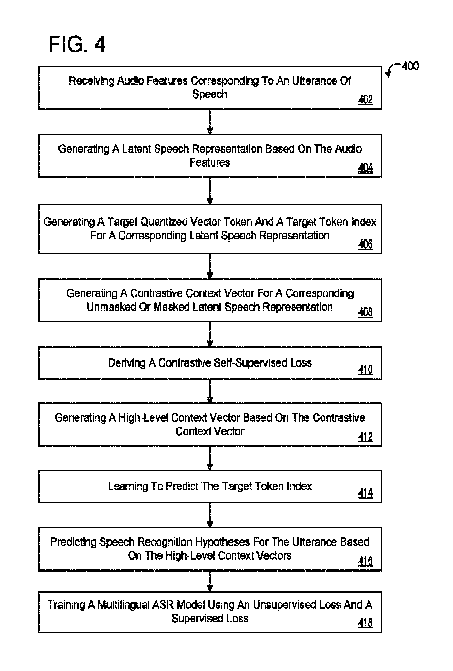
図4は、教師無しトレーニングおよび教師有りトレーニングを使用することで自動音声認識ASRモデル200を共同トレーニングする方法400の動作の配列例を示すフローチャートである。方法400は、メモリハードウェア520(図5)に記憶された命令を使用することで、データ処理ハードウェア510(図5)上で実行することができる。データ処理ハードウェア510およびメモリハードウェア520は、コンピューティングデバイス500(図5)に対応する図1のリモートコンピュータ/サーバ201上に存在してもよい。
FIG. 4 is a flow chart illustrating an example sequence of operations for method 400 for jointly training automatic speech recognition ASR model 200 using unsupervised and supervised training. Method 400 can be executed on data processing hardware 510 (FIG. 5) using instructions stored in memory hardware 520 (FIG. 5).
動作402では、方法400は、未転写音声発話302の1つまたは転写済み音声発話304の1つに対応するオーディオ特徴110を受け取る工程を備えている。動作404では、方法400は、複数の時間ステップの各々において、オーディオ特徴110に基づき潜在音声表現212を生成する工程を備えている。動作406では、方法400は、複数の時間ステップの各々において、対応する潜在音声表現212のターゲット量子化ベクトルトークン312およびターゲットトークンインデックス314を生成する工程を備えている。ここで、ターゲットトークンインデックス314は、対応する潜在音声表現212をコードブック315に記憶されたターゲット量子化ベクトルトークン312にマッピングする。動作408では、方法400は、複数の時間ステップの各々において、対応するマスクされていない、またはマスク済み潜在音声表現212u、212mの対照(コントラスティブ)コンテキストベクトル322を生成する工程を備えている。動作410では、方法400は、複数の時間ステップの各々において、対応する対照コンテキストベクトル322および対応するターゲット量子化ベクトルトークン312に基づき、対照的な自己教師有り損失355aを導出する工程を備えている。 In operation 402, the method 400 comprises receiving audio features 110 corresponding to one of the untranscribed speech utterances 302 or one of the transcribed speech utterances 304. In operation 404, the method 400 comprises generating a latent speech representation 212 based on the audio features 110 at each of a plurality of time steps. In operation 406, the method 400 comprises generating a target quantization vector token 312 and a target token index 314 of the corresponding latent speech representation 212 at each of a plurality of time steps, where the target token index 314 maps the corresponding latent speech representation 212 to the target quantization vector token 312 stored in the codebook 315. In operation 408, the method 400 comprises generating a contrastive context vector 322 of the corresponding unmasked or masked latent speech representation 212u, 212m at each of a plurality of time steps. At operation 410, the method 400 includes deriving a contrastive self-supervised loss 355a based on the corresponding contrast context vector 322 and the corresponding target quantization vector token 312 at each of a plurality of time steps.
動作412では、方法400は、複数の時間ステップの各々において、対照コンテキストベクトル322に基づき高レベルコンテキストベクトル334を生成する工程を備えている。動作414では、高レベルコンテキストベクトル334ごとに、方法400は、ターゲットトークンインデックス314に基づき、クロスエントロピー損失355bを使用することで、対応する時間ステップでターゲットトークンインデックス314を予測するように学習する工程を備えている。動作416では、方法400は、高レベルコンテキストベクトル334に基づき発話に対する音声認識仮説342を予測する工程を備えている。動作416では、方法400は、対照的な自己教師有り損失355aとクロスエントロピー損失355bとに基づく教師無し損失355と、予測済みの音声認識仮説342と発話302、304のグラウンドトゥルース転写306とに基づく教師有り損失365と、を使用することで多言語自動音声認識ASRモデル200をトレーニングする工程を備えている。 In operation 412, the method 400 comprises generating a high-level context vector 334 based on the contrast context vector 322 at each of a plurality of time steps. In operation 414, for each high-level context vector 334, the method 400 comprises learning to predict the target token index 314 at the corresponding time step by using a cross-entropy loss 355b based on the target token index 314. In operation 416, the method 400 comprises predicting a speech recognition hypothesis 342 for the utterance based on the high-level context vector 334. In operation 416, the method 400 comprises training the multilingual automatic speech recognition ASR model 200 by using an unsupervised loss 355 based on the contrastive self-supervised loss 355a and the cross-entropy loss 355b, and a supervised loss 365 based on the predicted speech recognition hypothesis 342 and the ground truth transcription 306 of the utterance 302, 304.
図5は、本明細書に記載のシステムおよび方法を実装するべく使用され得るコンピューティングデバイス500の一例の概略図である。コンピューティングデバイス500は、ラップトップ、デスクトップ、ワークステーション、パーソナルデジタルアシスタント、サーバ、ブレードサーバ、メインフレーム、およびその他の適切なコンピュータ、などさまざまな形式のデジタルコンピュータを表すことを意図する。ここに示された構成要素、それらの接続および関係、およびそれらの機能は例示的なものに過ぎず、本明細書に記載および/または特許請求される本発明の実施を限定するものではない。
FIG. 5 is a schematic diagram of an example of a
コンピューティングデバイス500は、プロセッサ510、メモリ520、記憶デバイス530、メモリ520および高速拡張ポート550に接続する高速インタフェース/コントローラ540、および低速バス570および記憶デバイス530に接続する低速インタフェース/コントローラ560を備えている。各構成要素510、520、530、540、550、および560は、さまざまなバスを使用することで相互接続されており、共通のマザーボード上に、または適宜他の方法で実装され得る。プロセッサ510は、メモリ520または記憶デバイス530に記憶されている命令を備えている、コンピューティングデバイス500内で実行するための命令を処理して、高速インタフェース540に結合されたディスプレイ580などの外部入出力デバイスにグラフィカルユーザインタフェース(GUI)のグラフィカル情報を表示することができる。他の実施態様では、複数のメモリおよびメモリの種類とで共に、必要に応じて複数のプロセッサおよび/または複数のバスが使用され得る。また、複数のコンピューティングデバイス500が接続されて各デバイスは必要な動作の一部を提供する(たとえば、サーババンク、ブレードサーバのグループ、またはマルチプロセッサシステムとして)。
The
メモリ520は、コンピューティングデバイス500内に情報を非一時的に記憶する。メモリ520は、コンピュータ可読媒体、揮発性メモリユニット(複数可)、または不揮発性メモリユニット(複数可)であってもよい。非一時的メモリ520は、コンピューティングデバイス500で使用するべく、一時的または永続的にプログラム(たとえば、命令のシーケンス)またはデータ(たとえば、プログラム状態情報)を記憶するべく使用される物理デバイスであってもよい。不揮発性メモリの例には、フラッシュメモリおよび読み取り専用メモリ(ROM)/プログラム可能な読み取り専用メモリ(PROM)/消去可能なプログラム可能な読み取り専用メモリ(EPROM)/電子的に消去可能なプログラム可能な読み取り専用メモリ(EEPROM)(たとえば、通常はブートプログラムなどのファームウェアに使用される)が含まれるが、これらに限定されない。揮発性メモリの例には、ランダムアクセスメモリ(RAM)、ダイナミックランダムアクセスメモリ(DRAM)、スタティックランダムアクセスメモリ(SRAM)、相変化メモリ(PCM)ならびにディスクまたはテープなどが含まれるが、これらに限定されない。
The
記憶デバイス530は、コンピューティングデバイス500に大容量ストレージを提供することができる。いくつかの実施態様では、記憶デバイス530はコンピュータ可読媒体である。さまざまに異なる実施態様において、記憶デバイス530は、フロッピー(登録商標)ディスクデバイス、ハードディスクデバイス、光ディスクデバイス、またはテープデバイス、フラッシュメモリまたはその他の同様のソリッドステートメモリデバイス、またはストレージエリアネットワークまたはその他の構成内のデバイスを備えているデバイスのアレイであり得る。追加の実施態様では、コンピュータプログラム製品は、情報キャリア内に有形に具体化される。コンピュータプログラム製品は、実行されると、上記で説明されている方法などの、1つまたは複数の方法を実行する命令を備えている。情報キャリアは、メモリ520、記憶デバイス530、またはプロセッサ510上のメモリなどのコンピュータ可読媒体または機械可読媒体である。
The
高速コントローラ540は、コンピューティングデバイス500のための帯域幅を消費する動作を管理しており、低速コントローラ560は、より帯域幅を消費しない動作を管理する。このような機能の割当ては、例示に過ぎない。いくつかの実施態様では、高速コントローラ540は、メモリ520、(たとえば、グラフィックプロセッサまたはアクセラレータを介して)ディスプレイ580、およびさまざまな拡張カード(図示せず)を受け入れ得る高速拡張ポート550に結合される。いくつかの実施態様では、低速コントローラ560は、記憶デバイス530および低速拡張ポート590に結合される。様々な通信ポート(たとえば、USB、ブルートゥース(登録商標)、イーサネット(登録商標)、無線イーサネット(登録商標))を備えていることができる低速拡張ポート590は、キーボード、ポインティングデバイス、スキャナなどの1つまたは複数の入出力デバイスに、またはたとえばネットワークアダプタを介して、スイッチまたはルータなどのネットワークデバイスに結合されてもよい。
The high-
コンピューティングデバイス500は、図に示すように、いくつかの異なる形態で実装することができる。たとえば、標準サーバ500aとして、またはそのようなサーバ500aのグループ内で複数回、ラップトップコンピュータ500bとして、またはラックサーバシステム500cの一部として実装されてもよい。
The
ここに記載するシステムおよび技術の様々な実施態様は、デジタル電気および/または光回路、集積回路、特別に設計されたASIC(特定用途向け集積回路)、コンピュータハードウェア、ファームウェア、ソフトウェア、および/またはそれらの組合せで実現することができる。これらの様々な実施態様は、少なくとも1つのプログラム可能なプロセッサを備えているプログラム可能なシステム上で実行可能および/または解釈可能な1つまたは複数のコンピュータプログラムにおける実施態様を備えていることができ、プログラム可能なプロセッサは、専用または汎用であり得、ストレージシステム、少なくとも1つの入力デバイス、および少なくとも1つの出力デバイスに結合されており、データおよび命令を送受信する。 Various implementations of the systems and techniques described herein may be realized in digital electrical and/or optical circuitry, integrated circuits, specially designed ASICs (application specific integrated circuits), computer hardware, firmware, software, and/or combinations thereof. These various implementations may include implementations in one or more computer programs executable and/or interpretable on a programmable system having at least one programmable processor, which may be special purpose or general purpose, coupled to a storage system, at least one input device, and at least one output device to transmit and receive data and instructions.
これらのコンピュータプログラム(プログラム、ソフトウェア、ソフトウェアアプリケーションまたはコードとしても知られる)は、プログラム可能なプロセッサ用の機械命令を備えており、高度な手順および/またはオブジェクト指向プログラミング言語で、および/またはアセンブリ/機械言語で実装することができる。本明細書で使用される場合、「機械可読媒体」および「コンピュータ可読媒体」という用語は、機械可読信号として機械命令を受信する機械可読媒体を備えているプログラム可能なプロセッサに機械命令および/またはデータを提供するのに使用される、(たとえば、磁気ディスク、光ディスク、メモリ、プログラム可能な論理装置(PLD)などの)任意のコンピュータプログラム製品、非一時的なコンピュータ可読媒体、装置および/またはデバイスを指す。「機械可読信号」という用語は、機械命令および/またはデータをプログラム可能なプロセッサに提供するべく使用される任意の信号を指す。 These computer programs (also known as programs, software, software applications or codes) comprise machine instructions for a programmable processor and may be implemented in high level procedural and/or object-oriented programming languages and/or in assembly/machine languages. As used herein, the terms "machine-readable medium" and "computer-readable medium" refer to any computer program product, non-transitory computer-readable medium, apparatus and/or device (e.g., magnetic disk, optical disk, memory, programmable logic device (PLD), etc.) used to provide machine instructions and/or data to a programmable processor that comprises a machine-readable medium that receives the machine instructions as a machine-readable signal. The term "machine-readable signal" refers to any signal used to provide machine instructions and/or data to a programmable processor.
本明細書で説明されている処理および論理フローは、入力データに対して動作しており、出力を生成することによって機能を実行するべく1つまたは複数のコンピュータプログラムを実行する、データ処理ハードウェアとも呼ばれる1つまたは複数のプログラム可能なプロセッサによって実行することができる。処理および論理フローは、専用論理回路、たとえば、FPGA(フィールドプログラマブルゲートアレイ)またはASIC(特定用途向け集積回路)によって実行することもできる。コンピュータプログラムの実行に適したプロセッサは、例として、汎用および専用の両方のマイクロプロセッサ、ならびに任意の種類のデジタルコンピュータの任意の1つまたは複数のプロセッサを備えている。一般に、プロセッサは、読み出し専用メモリまたはランダムアクセスメモリまたはその両方から指示およびデータを受け取る。コンピュータの本質的な要素は、命令を実行するためのプロセッサと、命令とデータとを記憶するための1つまたは複数のメモリデバイスである。一般に、コンピュータは、データを記憶するための1つまたは複数の大容量記憶デバイス、たとえば、磁気ディスク、光磁気ディスク、または光ディスクも備えているか、あるいはそれらからデータを受信、もしくはそれらにデータを送信、またはその両方を行なうように動作可能に結合される。しかしながら、コンピュータは、そのようなデバイスを有している必要はない。コンピュータプログラム命令とデータとを記憶するのに適したコンピュータ可読媒体は、例として、半導体メモリデバイス、たとえば、EPROM、EEPROM、およびフラッシュメモリデバイス、磁気ディスク、たとえば、内部ハードディスクまたはリムーバブルディスク、光磁気ディスク、ならびにCD ROMおよびDVD-ROMディスクを備えている、すべての形態の不揮発性メモリ、媒体、およびメモリデバイスを備えている。プロセッサおよびメモリは、専用論理回路によって補完することができ、または専用論理回路の中に組み込むことができる。 The processes and logic flows described herein can be performed by one or more programmable processors, also referred to as data processing hardware, which operate on input data and execute one or more computer programs to perform functions by generating output. The processes and logic flows can also be performed by special purpose logic circuitry, for example, an FPGA (field programmable gate array) or an ASIC (application specific integrated circuit). Processors suitable for executing computer programs include, by way of example, both general purpose and special purpose microprocessors, as well as any one or more processors of any type of digital computer. In general, a processor receives instructions and data from a read-only memory or a random access memory or both. The essential elements of a computer are a processor for executing instructions and one or more memory devices for storing instructions and data. In general, a computer also includes one or more mass storage devices, for example, magnetic disks, magneto-optical disks, or optical disks, for storing data, or is operatively coupled to receive data from or transmit data to, or both. However, a computer need not have such devices. Computer-readable media suitable for storing computer program instructions and data include all forms of non-volatile memory, media, and memory devices, including, by way of example, semiconductor memory devices, e.g., EPROM, EEPROM, and flash memory devices, magnetic disks, e.g., internal hard disks or removable disks, magneto-optical disks, and CD ROM and DVD-ROM disks. The processor and the memory can be supplemented by, or incorporated in, special purpose logic circuitry.
ユーザとの対話を提供するべく、本開示の1つまたは複数の態様は、ユーザに情報を表示するための表示デバイス、たとえば、CRT(陰極線管)、LCD(液晶ディスプレイ)モニタ、またはタッチスクリーンと、任意選択で、ユーザがコンピュータに入力を提供することができるキーボードおよびポインティングデバイス、たとえば、マウスまたはトラックボールとを有しているコンピュータ上に実装することができる。他の種類のデバイスも同様にユーザとの対話を提供するべく使用することができ、たとえば、ユーザに提供されるフィードバックは、任意の形態の感覚的フィードバック、たとえば、視覚的フィードバック、聴覚的フィードバック、または触覚的フィードバックとすることができ、ユーザからの入力は、音響的入力、音声入力、または触覚的入力を備えている任意の形態で受信することができる。それに加えて、コンピュータは、ユーザによって使用されるデバイスにドキュメントを送信しており、そのデバイスからドキュメントを受信することによって、たとえば、ユーザのクライアントデバイス上のウェブブラウザから受信された要求に応じて、ウェブブラウザにウェブページを送信することによって、ユーザとで対話することができる。 To provide for user interaction, one or more aspects of the present disclosure can be implemented on a computer having a display device, e.g., a CRT (cathode ray tube), LCD (liquid crystal display) monitor, or touch screen, for displaying information to the user, and optionally a keyboard and pointing device, e.g., a mouse or trackball, by which the user can provide input to the computer. Other types of devices can be used to provide for user interaction as well, e.g., feedback provided to the user can be any form of sensory feedback, e.g., visual feedback, auditory feedback, or tactile feedback, and input from the user can be received in any form that includes acoustic, speech, or tactile input. In addition, the computer can interact with the user by sending documents to a device used by the user and receiving documents from the device, e.g., by sending a web page to the web browser in response to a request received from the web browser on the user's client device.
いくつかの実施態様について説明してきた。それにもかかわらず、本開示の要旨および範囲から逸脱することなく、様々な変更が行なわれ得ることが理解されよう。したがって、他の実施態様は、以下の特許請求の範囲内に存在する。 Several implementations have been described. Nevertheless, it will be understood that various modifications may be made without departing from the spirit and scope of the disclosure. Accordingly, other implementations are within the scope of the following claims.
Claims (20)
特徴エンコーダ(311)であって、
音声の発話(302、304)に対応するオーディオ特徴(110)を入力として受け取るように、かつ
複数の時間ステップの各々において、潜在音声表現(212)を生成するように、
構成されている、前記特徴エンコーダ(311)と、
量子化器(310)であって、
複数の前記時間ステップの各々において前記特徴エンコーダ(311)によって生成済みの前記潜在音声表現(212)を入力として受け取るように、かつ
複数の前記時間ステップの各々において、前記特徴エンコーダ(311)によって生成済みの対応する前記潜在音声表現(212)に対するターゲット量子化ベクトルトークン(312)およびターゲットトークンインデックス(314)を生成するとともに、前記ターゲットトークンインデックス(314)が、対応する前記潜在音声表現(212)を、コードブック(315)に記憶された前記ターゲット量子化ベクトルトークン(312)にマッピングするように、
構成されている、前記量子化器(310)と、
対照ネット(320)であって、
前記潜在音声表現(212)のサブセットをマスクした後、複数の前記時間ステップの各々において前記特徴エンコーダ(311)によって生成済みの前記潜在音声表現(212)を入力として受け取るように、
複数の前記時間ステップの各々において、対応するマスクされていない、またはマスク済み前記潜在音声表現(212u、212m)の対照コンテキストベクトル(322)を生成するように、かつ
複数の前記時間ステップの各々において、対応する前記対照コンテキストベクトル(322)と、対応する前記潜在音声表現(212)についての前記量子化器(310)によって生成済みの対応する前記ターゲット量子化ベクトルトークン(312)と、に基づき対照的な自己教師有り損失(355a)を導出するように、
構成されている、前記対照ネット(320)と、
マスク言語モデリング(MLM)モジュール(330)であって、
複数の前記時間ステップの各々において、前記対照ネット(320)によって生成済みの、前記対照コンテキストベクトル(322)を入力として受け取るように、
複数の前記時間ステップの各々において、高レベルコンテキストベクトル(334)を生成するように、かつ
前記高レベルコンテキストベクトル(334)ごとに、対応する前記時間ステップにおいて、前記量子化器(310)によって生成済みの前記ターゲットトークンインデックス(314)に基づくクロスエントロピー損失(355b)を使用することで、対応する前記時間ステップにおいて、前記ターゲットトークンインデックス(314)を予測するように学習するように、
構成されている、マスク言語モデリングMLMモジュール(330)と、
デコーダ(340)であって、
複数の前記時間ステップの各々において、前記マスク言語モデリングMLMモジュール(330)によって生成済みの前記高レベルコンテキストベクトル(334)を入力として受け取るように、かつ
前記発話(302、304)に対する音声認識仮説(342)を予測するように、
構成されている、前記デコーダ(340)と、を備えており、
多言語自動音声認識ASRモデル(200)は、
前記対照的な自己教師有り損失(355a)および前記クロスエントロピー損失(355b)に基づく教師無し損失(355)と、
予測済みの前記音声認識仮説(342)と、前記発話(302、304)のグラウンドトゥルース転写(306)と、に基づく教師有り損失(365)と、
に基づきトレーニングされる、JUSTフレームワーク(300)。 A joint unsupervised and supervised training (JUST) framework (300) for training a multilingual automatic speech recognition (ASR) model (200), comprising:
A feature encoder (311),
receiving as input audio features (110) corresponding to a speech utterance (302, 304); and generating a latent speech representation (212) at each of a plurality of time steps.
The feature encoder (311),
A quantizer (310),
receiving as input the latent speech representation (212) generated by the feature encoder (311) at each of a plurality of said time steps; and generating a target quantized vector token (312) and a target token index (314) for a corresponding latent speech representation (212) generated by the feature encoder (311) at each of a plurality of said time steps, the target token index (314) mapping the corresponding latent speech representation (212) to the target quantized vector token (312) stored in a codebook (315).
The quantizer (310),
A control net (320),
receiving as input the latent speech representations (212) generated by the feature encoder (311) at each of a plurality of said time steps after masking a subset of the latent speech representations (212);
generating, at each of a plurality of said time steps, a contrast context vector (322) for a corresponding unmasked or masked latent speech representation (212u, 212m); and deriving, at each of a plurality of said time steps, a contrast self-supervised loss (355a) based on the corresponding contrast context vector (322) and the corresponding target quantization vector token (312) generated by the quantizer (310) for the corresponding latent speech representation (212).
The control net (320),
A Masked Language Modeling (MLM) module (330), comprising:
receiving as input, at each of a plurality of said time steps, said contrast context vector (322) generated by said contrast net (320);
generating a high-level context vector (334) for each of a plurality of said time steps; and for each of said high-level context vectors (334), learning to predict the target token index (314) for the corresponding time step by using a cross-entropy loss (355b) based on the target token index (314) generated by the quantizer (310) for the corresponding time step.
A masked language modeling (MLM) module (330) configured as:
A decoder (340),
receiving as input the high-level context vector (334) generated by the masked language modeling (MLM) module (330) at each of a plurality of said time steps; and predicting a speech recognition hypothesis (342) for said utterance (302, 304);
and the decoder (340) configured as:
The multilingual automatic speech recognition ASR model (200) includes:
an unsupervised loss (355) based on the symmetric self-supervised loss (355a) and the cross-entropy loss (355b);
a supervised loss (365) based on the predicted speech recognition hypotheses (342) and a ground truth transcription (306) of the utterance (302, 304);
The JUST framework (300) is trained based on
請求項1に記載のJUSTフレームワーク(300)。 The feature encoder (311) comprises two convolutional neural network (CNN) blocks.
The JUST framework (300) of claim 1.
請求項1または2に記載のJUSTフレームワーク(300)。 masking the subset of latent speech representations (211) comprises randomly replacing each latent speech representation (212) in the subset of latent speech representations (212) with a corresponding random vector.
The JUST framework (300) according to claim 1 or 2.
請求項1~3のいずれか1項に記載のJUSTフレームワーク(300)。 the contrastive self-supervised loss (355a) derived by the contrast net (320) is further based on K negative samples/distractors uniformly sampled from the target quantized vector tokens (312) stored in the codebook (315) corresponding to the masked latent speech representations (212m) from a masked subset of the latent speech representations (212m);
The JUST framework (300) according to any one of claims 1 to 3.
請求項1~4のいずれか1項に記載のJUSTフレームワーク(300)。 the unsupervised loss (355) is further based on an entropy-based diversity loss associated with the codebook (315).
The JUST framework (300) according to any one of claims 1 to 4.
請求項1~5のいずれか1項に記載のJUSTフレームワーク(300)。 The multilingual automatic speech recognition (ASR) model (200) is trained by training the utterances (302, 304) spoken in a plurality of different languages.
The JUST framework (300) according to any one of claims 1 to 5.
請求項1~6のいずれか1項に記載のJUSTフレームワーク(300)。 Training the multilingual automatic speech recognition ASR model (200) comprises training the multilingual automatic speech recognition ASR model (200) without prior pre-training.
The JUST framework (300) according to any one of claims 1 to 6.
請求項1~6のいずれか1項に記載のJUSTフレームワーク(300)。 Training the multilingual automatic speech recognition ASR model (200) comprises fine-tuning the multilingual automatic speech recognition ASR model (200) from a pre-trained checkpoint.
The JUST framework (300) according to any one of claims 1 to 6.
請求項1~8のいずれか1項に記載のJUSTフレームワーク(300)。 Training the multilingual automatic speech recognition ASR model (200) comprises jointly training the multilingual automatic speech recognition ASR model (200) with the unsupervised loss (355) and the supervised loss (365).
The JUST framework (300) according to any one of claims 1 to 8.
請求項1~9のいずれか1項に記載のJUSTフレームワーク(300)。 The supervised loss (365) comprises a recurrent neural network transducer (RNN-T) loss.
The JUST framework (300) according to any one of claims 1 to 9.
音声の発話(302、304)に対応するオーディオ特徴(110)を受け取る工程と、
複数の時間ステップの各々において、前記オーディオ特徴(110)に基づき潜在音声表現(212)を生成する工程と、
複数の前記時間ステップの各々において、対応する前記潜在音声表現(212)に対するターゲット量子化ベクトルトークン(312)およびターゲットトークンインデックス(314)を生成するとともに、前記ターゲットトークンインデックス(314)が、対応する前記潜在音声表現(212)を、コードブック(315)に記憶された前記ターゲット量子化ベクトルトークン(312)にマッピングする工程と、
複数の前記時間ステップの各々において、対応するマスクされていない、またはマスク済み潜在音声表現(212u、212m)の対照コンテキストベクトル(322)を生成する工程と、
複数の前記時間ステップの各々において、対応する前記対照コンテキストベクトル(322)および対応する前記ターゲット量子化ベクトルトークン(312)に基づき対照的な自己教師有り損失(355a)を導出する工程と、
複数の前記時間ステップの各々において、前記対照コンテキストベクトル(322)に基づき高レベルコンテキストベクトル(334)を生成する工程と、
前記高レベルコンテキストベクトル(334)ごとに、対応する前記時間ステップにおいて、前記ターゲットトークンインデックス(314)に基づくクロスエントロピー損失(355b)を使用することで、前記ターゲットトークンインデックス(314)を予測するように学習する工程と、
前記高レベルコンテキストベクトル(334)に基づき前記発話(302、304)に対する音声認識仮説(342)を予測する工程と、
前記対照的な自己教師有り損失(355a)と前記クロスエントロピー損失(355b)とに基づく教師無し損失(355)と、予測済みの前記音声認識仮説(342)と前記発話(302、304)のグラウンドトゥルース転写(306)とに基づく教師有り損失(365)と、を使用することで多言語自動音声認識ASRモデル(200)をトレーニングする工程と、を備えている、動作を実行させる、
コンピュータ実装方法(400)。 A computer-implemented method (400), when executed by data processing hardware (510), causing the data processing hardware (510) to:
receiving audio features (110) corresponding to a speech utterance (302, 304);
generating a latent speech representation (212) based on the audio features (110) at each of a plurality of time steps;
generating a target quantized vector token (312) and a target token index (314) for a corresponding latent speech representation (212) at each of a plurality of said time steps, the target token index (314) mapping the corresponding latent speech representation (212) to the target quantized vector token (312) stored in a codebook (315);
generating, at each of a plurality of said time steps, a contrast context vector (322) for a corresponding unmasked or masked latent speech representation (212u, 212m);
At each of a plurality of said time steps, deriving a contrastive self-supervised loss (355a) based on the corresponding said contrast context vector (322) and the corresponding said target quantization vector token (312);
generating a high-level context vector (334) based on the contrast context vector (322) at each of a plurality of said time steps;
for each of the high-level context vectors (334), learning to predict the target token index (314) at the corresponding time step by using a cross-entropy loss (355b) based on the target token index (314);
predicting a speech recognition hypothesis (342) for the utterance (302, 304) based on the high-level context vector (334);
training a multilingual automatic speech recognition (ASR) model (200) using an unsupervised loss (355) based on the contrastive self-supervised loss (355a) and the cross-entropy loss (355b), and a supervised loss (365) based on the predicted speech recognition hypotheses (342) and a ground truth transcription (306) of the utterance (302, 304);
A computer-implemented method (400).
請求項11に記載のコンピュータ実装方法(400)。 generating the latent speech representation (212) comprises generating the latent speech representation (212) at each of a plurality of said time steps by a feature encoder (311), the feature encoder (311) comprising two convolutional neural network (CNN) blocks;
12. The computer-implemented method (400) of claim 11.
請求項11または12に記載のコンピュータ実装方法(400)。 The operations further comprise masking the subset of latent speech representations (212) by randomly replacing each of the latent speech representations (212) in the subset of latent speech representations (212) with a corresponding random vector.
13. A computer implemented method (400) according to claim 11 or 12.
請求項11~13のいずれか1項に記載のコンピュータ実装方法(400)。 the symmetric self-supervised loss (355a) is further based on K negative samples/distractors uniformly sampled from the target quantized vector tokens (312) stored in the codebook (315) corresponding to the masked latent speech representations (211m) from a masked subset of the latent speech representations (211m);
A computer implemented method (400) according to any one of claims 11 to 13.
請求項11~14のいずれか1項に記載のコンピュータ実装方法(400)。 the unsupervised loss (355) is further based on an entropy-based diversity loss associated with the codebook (315).
A computer implemented method (400) according to any one of claims 11 to 14.
請求項11~15のいずれか1項に記載のコンピュータ実装方法(400)。 The multilingual automatic speech recognition (ASR) model (200) is trained by training the utterances (302, 304) spoken in a plurality of different languages.
A computer implemented method (400) according to any one of claims 11 to 15.
請求項11~16のいずれか1項に記載のコンピュータ実装方法(400)。 Training the multilingual automatic speech recognition ASR model (200) comprises training the multilingual automatic speech recognition ASR model (200) without prior pre-training.
A computer implemented method (400) according to any one of claims 11 to 16.
請求項11~16のいずれか1項に記載のコンピュータ実装方法(400)。 Training the multilingual automatic speech recognition ASR model (200) comprises fine-tuning the multilingual automatic speech recognition ASR model (200) from a pre-trained checkpoint.
A computer implemented method (400) according to any one of claims 11 to 16.
請求項11~18のいずれか1項に記載のコンピュータ実装方法(400)。 Training the multilingual automatic speech recognition ASR model (200) comprises jointly training the multilingual automatic speech recognition ASR model (200) with the unsupervised loss (355) and the supervised loss (365).
A computer implemented method (400) according to any one of claims 11 to 18.
請求項11~19のいずれか1項に記載のコンピュータ実装方法(400)。 The supervised loss (365) comprises a recurrent neural network transducer (RNN-T) loss.
A computer implemented method (400) according to any one of claims 11 to 19.
Applications Claiming Priority (3)
| Application Number | Priority Date | Filing Date | Title |
|---|---|---|---|
| US202163262174P | 2021-10-06 | 2021-10-06 | |
| US63/262,174 | 2021-10-06 | ||
| PCT/US2022/075998 WO2023059969A1 (en) | 2021-10-06 | 2022-09-06 | Joint unsupervised and supervised training for multilingual automatic speech recognition |
Publications (2)
| Publication Number | Publication Date |
|---|---|
| JP2024538019A true JP2024538019A (en) | 2024-10-18 |
| JP7678227B2 JP7678227B2 (en) | 2025-05-15 |
Family
ID=83447762
Family Applications (1)
| Application Number | Title | Priority Date | Filing Date |
|---|---|---|---|
| JP2024520856A Active JP7678227B2 (en) | 2021-10-06 | 2022-09-06 | Joint Unsupervised and Supervised Training (JUST) for Multilingual Automatic Speech Recognition |
Country Status (6)
| Country | Link |
|---|---|
| US (1) | US12249317B2 (en) |
| EP (1) | EP4405936B1 (en) |
| JP (1) | JP7678227B2 (en) |
| KR (1) | KR20240089276A (en) |
| CN (1) | CN118489136A (en) |
| WO (1) | WO2023059969A1 (en) |
Families Citing this family (6)
| Publication number | Priority date | Publication date | Assignee | Title |
|---|---|---|---|---|
| US11989941B2 (en) * | 2021-11-16 | 2024-05-21 | Salesforce, Inc. | Systems and methods for video and language pre-training |
| KR102830711B1 (en) * | 2022-09-15 | 2025-07-08 | 한국전자통신연구원 | Self-supervised learning method based on permutation invariant cross entropy and electronic device tehreof |
| US12431122B2 (en) * | 2022-12-14 | 2025-09-30 | Google Llc | Training a language model of an end-to-end automatic speech recognition model using random encoder features |
| CN116434759B (en) * | 2023-04-11 | 2024-03-01 | 兰州交通大学 | A speaker recognition method based on SRS-CL network |
| US12079587B1 (en) | 2023-04-18 | 2024-09-03 | OpenAI Opco, LLC | Multi-task automatic speech recognition system |
| CN119832940B (en) * | 2025-01-14 | 2025-10-03 | 南京邮电大学 | A distillation-based continuous self-supervised multi-type speech acoustic feature representation method |
Citations (2)
| Publication number | Priority date | Publication date | Assignee | Title |
|---|---|---|---|---|
| US20200160836A1 (en) * | 2018-11-21 | 2020-05-21 | Google Llc | Multi-dialect and multilingual speech recognition |
| US20200380215A1 (en) * | 2019-05-28 | 2020-12-03 | Google Llc | Large-Scale Multilingual Speech Recognition With A Streaming End-To-End Model |
Family Cites Families (7)
| Publication number | Priority date | Publication date | Assignee | Title |
|---|---|---|---|---|
| US10783601B1 (en) * | 2015-03-20 | 2020-09-22 | Digimarc Corporation | Digital watermarking and signal encoding with activable compositions |
| US10733979B2 (en) * | 2015-10-09 | 2020-08-04 | Google Llc | Latency constraints for acoustic modeling |
| EP4361897A3 (en) * | 2020-01-28 | 2024-07-17 | Google Llc | Language-agnostic multilingual modeling using effective script normalization |
| US11924445B2 (en) * | 2020-09-25 | 2024-03-05 | Qualcomm Incorporated | Instance-adaptive image and video compression using machine learning systems |
| US11551668B1 (en) * | 2020-12-30 | 2023-01-10 | Meta Platforms, Inc. | Generating representations of speech signals using self-supervised learning |
| US11735171B2 (en) * | 2021-05-14 | 2023-08-22 | Microsoft Technology Licensing, Llc | Unified speech representation learning |
| US12206851B2 (en) * | 2021-05-21 | 2025-01-21 | Qualcomm Incorporated | Implicit image and video compression using machine learning systems |
-
2022
- 2022-09-06 CN CN202280081192.6A patent/CN118489136A/en active Pending
- 2022-09-06 EP EP22777570.7A patent/EP4405936B1/en active Active
- 2022-09-06 US US17/929,934 patent/US12249317B2/en active Active
- 2022-09-06 KR KR1020247014720A patent/KR20240089276A/en active Pending
- 2022-09-06 WO PCT/US2022/075998 patent/WO2023059969A1/en not_active Ceased
- 2022-09-06 JP JP2024520856A patent/JP7678227B2/en active Active
Patent Citations (2)
| Publication number | Priority date | Publication date | Assignee | Title |
|---|---|---|---|---|
| US20200160836A1 (en) * | 2018-11-21 | 2020-05-21 | Google Llc | Multi-dialect and multilingual speech recognition |
| US20200380215A1 (en) * | 2019-05-28 | 2020-12-03 | Google Llc | Large-Scale Multilingual Speech Recognition With A Streaming End-To-End Model |
Non-Patent Citations (1)
| Title |
|---|
| JUNWEN BAI ET AL.: "Joint Unsupervised and Supervised Training for Multilingual ASR", [ONLINE], JPN6024051558, 15 November 2021 (2021-11-15), ISSN: 0005492818 * |
Also Published As
| Publication number | Publication date |
|---|---|
| EP4405936B1 (en) | 2025-12-10 |
| US20230104228A1 (en) | 2023-04-06 |
| KR20240089276A (en) | 2024-06-20 |
| JP7678227B2 (en) | 2025-05-15 |
| WO2023059969A1 (en) | 2023-04-13 |
| EP4405936A1 (en) | 2024-07-31 |
| US12249317B2 (en) | 2025-03-11 |
| CN118489136A (en) | 2024-08-13 |
Similar Documents
| Publication | Publication Date | Title |
|---|---|---|
| CN113811946B (en) | End-to-end automatic speech recognition of digit sequences | |
| JP7092953B2 (en) | Phoneme-based context analysis for multilingual speech recognition with an end-to-end model | |
| JP7678227B2 (en) | Joint Unsupervised and Supervised Training (JUST) for Multilingual Automatic Speech Recognition | |
| JP7590520B2 (en) | Proper noun recognition in end-to-end speech recognition | |
| JP7753567B2 (en) | Using non-parallel voice conversion to train speech recognition models. | |
| US12230249B2 (en) | Supervised and unsupervised training with contrastive loss over sequences | |
| JP7575641B1 (en) | Contrastive Siamese Networks for Semi-Supervised Speech Recognition | |
| JP7544989B2 (en) | Lookup Table Recurrent Language Models | |
| JP2024530969A (en) | Improving speech recognition with speech synthesis-based model adaptation | |
| JP7690137B2 (en) | Alignment prediction for feeding text into automatic speech recognition training | |
| US20240153484A1 (en) | Massive multilingual speech-text joint semi-supervised learning for text-to-speech | |
| JP2025111462A (en) | Reducing streaming asr model latency using self alignment | |
| KR20230156795A (en) | Word segmentation regularization | |
| US20240177706A1 (en) | Monte Carlo Self-Training for Speech Recognition | |
| JP7799899B2 (en) | Using Aligned Text and Speech Representations to Train Automatic Speech Recognition Models Without Transcribed Speech Data | |
| US12512095B2 (en) | Unsupervised data selection via discrete speech representation for automatic speech recognition | |
| JP7773571B2 (en) | Text Insertion in Self-Supervised Speech Pre-Training | |
| US20250279089A1 (en) | Using Synthetic Data to Improve Word Error Rate of Differentially Private ASR Models | |
| US20240290321A1 (en) | Chunk-wise attention for longform asr | |
| US20250006217A1 (en) | Automatic Speech Recognition Accuracy With Multimodal Embeddings Search | |
| WO2025117152A1 (en) | Speech recognition |
Legal Events
| Date | Code | Title | Description |
|---|---|---|---|
| A521 | Request for written amendment filed |
Free format text: JAPANESE INTERMEDIATE CODE: A523 Effective date: 20240524 |
|
| A621 | Written request for application examination |
Free format text: JAPANESE INTERMEDIATE CODE: A621 Effective date: 20240524 |
|
| A871 | Explanation of circumstances concerning accelerated examination |
Free format text: JAPANESE INTERMEDIATE CODE: A871 Effective date: 20241127 |
|
| A131 | Notification of reasons for refusal |
Free format text: JAPANESE INTERMEDIATE CODE: A131 Effective date: 20241224 |
|
| A521 | Request for written amendment filed |
Free format text: JAPANESE INTERMEDIATE CODE: A523 Effective date: 20250110 |
|
| TRDD | Decision of grant or rejection written | ||
| A01 | Written decision to grant a patent or to grant a registration (utility model) |
Free format text: JAPANESE INTERMEDIATE CODE: A01 Effective date: 20250415 |
|
| A61 | First payment of annual fees (during grant procedure) |
Free format text: JAPANESE INTERMEDIATE CODE: A61 Effective date: 20250501 |
|
| R150 | Certificate of patent or registration of utility model |
Ref document number: 7678227 Country of ref document: JP Free format text: JAPANESE INTERMEDIATE CODE: R150 |