CN113406525B - Lithium battery pack residual life prediction method based on optimization variation modal decomposition - Google Patents
Lithium battery pack residual life prediction method based on optimization variation modal decomposition Download PDFInfo
- Publication number
- CN113406525B CN113406525B CN202110658203.XA CN202110658203A CN113406525B CN 113406525 B CN113406525 B CN 113406525B CN 202110658203 A CN202110658203 A CN 202110658203A CN 113406525 B CN113406525 B CN 113406525B
- Authority
- CN
- China
- Prior art keywords
- lithium battery
- battery pack
- data sequence
- discharge
- charge
- Prior art date
- Legal status (The legal status is an assumption and is not a legal conclusion. Google has not performed a legal analysis and makes no representation as to the accuracy of the status listed.)
- Active
Links
Images


Classifications
-
- G—PHYSICS
- G01—MEASURING; TESTING
- G01R—MEASURING ELECTRIC VARIABLES; MEASURING MAGNETIC VARIABLES
- G01R31/00—Arrangements for testing electric properties; Arrangements for locating electric faults; Arrangements for electrical testing characterised by what is being tested not provided for elsewhere
- G01R31/36—Arrangements for testing, measuring or monitoring the electrical condition of accumulators or electric batteries, e.g. capacity or state of charge [SoC]
- G01R31/396—Acquisition or processing of data for testing or for monitoring individual cells or groups of cells within a battery
-
- G—PHYSICS
- G01—MEASURING; TESTING
- G01R—MEASURING ELECTRIC VARIABLES; MEASURING MAGNETIC VARIABLES
- G01R31/00—Arrangements for testing electric properties; Arrangements for locating electric faults; Arrangements for electrical testing characterised by what is being tested not provided for elsewhere
- G01R31/36—Arrangements for testing, measuring or monitoring the electrical condition of accumulators or electric batteries, e.g. capacity or state of charge [SoC]
- G01R31/367—Software therefor, e.g. for battery testing using modelling or look-up tables
-
- G—PHYSICS
- G01—MEASURING; TESTING
- G01R—MEASURING ELECTRIC VARIABLES; MEASURING MAGNETIC VARIABLES
- G01R31/00—Arrangements for testing electric properties; Arrangements for locating electric faults; Arrangements for electrical testing characterised by what is being tested not provided for elsewhere
- G01R31/36—Arrangements for testing, measuring or monitoring the electrical condition of accumulators or electric batteries, e.g. capacity or state of charge [SoC]
- G01R31/392—Determining battery ageing or deterioration, e.g. state of health
-
- G—PHYSICS
- G06—COMPUTING OR CALCULATING; COUNTING
- G06F—ELECTRIC DIGITAL DATA PROCESSING
- G06F30/00—Computer-aided design [CAD]
- G06F30/20—Design optimisation, verification or simulation
-
- Y—GENERAL TAGGING OF NEW TECHNOLOGICAL DEVELOPMENTS; GENERAL TAGGING OF CROSS-SECTIONAL TECHNOLOGIES SPANNING OVER SEVERAL SECTIONS OF THE IPC; TECHNICAL SUBJECTS COVERED BY FORMER USPC CROSS-REFERENCE ART COLLECTIONS [XRACs] AND DIGESTS
- Y02—TECHNOLOGIES OR APPLICATIONS FOR MITIGATION OR ADAPTATION AGAINST CLIMATE CHANGE
- Y02E—REDUCTION OF GREENHOUSE GAS [GHG] EMISSIONS, RELATED TO ENERGY GENERATION, TRANSMISSION OR DISTRIBUTION
- Y02E60/00—Enabling technologies; Technologies with a potential or indirect contribution to GHG emissions mitigation
- Y02E60/10—Energy storage using batteries
Landscapes
- Physics & Mathematics (AREA)
- General Physics & Mathematics (AREA)
- Engineering & Computer Science (AREA)
- Theoretical Computer Science (AREA)
- Computer Hardware Design (AREA)
- Evolutionary Computation (AREA)
- Geometry (AREA)
- General Engineering & Computer Science (AREA)
- Secondary Cells (AREA)
- Charge And Discharge Circuits For Batteries Or The Like (AREA)
Abstract
本发明公开了一种基于优化变分模态分解的锂电池组剩余寿命预测方法,测量锂电池组随着充放电周期的放电容量数据序列,并生成充放电周期数据序列;采用后验反馈置信度的方法处理锂电池组放电容量数据序列,优选变分模态分解模态层数,并生成本征模态分量数据序列;生成放电容量退化趋势分量数据序列与噪声分量数据序列;应用非线性最小二乘法优化后的粒子滤波预测锂电池组未来充放电周期的放电容量退化趋势数据序列;应用高斯过程回归建立噪声预测模型,预测锂电池组未来充放电周期的噪声数据序列;计算锂电池组未来充放电周期的放电容量数据序列;基于锂电池组失效阈值,计算锂电池组的剩余寿命。本发明具有误差小、预测精度高的优点。
The invention discloses a method for predicting the remaining life of a lithium battery pack based on optimized variational modal decomposition, which measures the discharge capacity data sequence of the lithium battery pack along with the charge and discharge cycle, and generates the charge and discharge cycle data sequence; adopts posteriori feedback confidence The method of processing the discharge capacity data series of lithium battery packs, optimizing the number of variational mode decomposition modal layers, and generating the data series of the eigenmode components; generating the data series of the discharge capacity degradation trend component and the data series of the noise component; applying nonlinear The particle filter optimized by the least squares method predicts the discharge capacity degradation trend data sequence of the lithium battery pack in the future charge and discharge cycle; the Gaussian process regression is used to establish a noise prediction model to predict the noise data sequence of the lithium battery pack in the future charge and discharge cycle; the lithium battery pack is calculated The discharge capacity data sequence of future charge and discharge cycles; based on the failure threshold of the lithium battery pack, the remaining life of the lithium battery pack is calculated. The invention has the advantages of small error and high prediction accuracy.
Description
技术领域Technical Field
本发明涉及电池技术领域,尤其涉及一种基于优化变分模态分解的锂电池组剩余寿命预测方法。The present invention relates to the field of battery technology, and in particular to a method for predicting the remaining life of a lithium battery pack based on optimized variational mode decomposition.
背景技术Background Art
锂电池作为燃油的替代品,因其比能量高、比功率大、自放电率低等特点,在电动汽车上广泛装备成组使用。由于其强环境依赖性,在电动汽车使用过程中锂电池组健康状态不断恶化,导致用户对电动汽车的续航里程与安全问题感到担忧,因此,为了提前预知锂电池组的健康状态,对其剩余寿命进行精准预测必不可少。As a substitute for fuel, lithium batteries are widely used in electric vehicles due to their high specific energy, high specific power, and low self-discharge rate. Due to their strong environmental dependence, the health of lithium battery packs continues to deteriorate during the use of electric vehicles, causing users to worry about the range and safety of electric vehicles. Therefore, in order to predict the health status of lithium battery packs in advance, it is essential to accurately predict their remaining life.
锂电池组的健康状况一般用作锂电池组容量老化程度的量化指标,而放电容量数据在不断的充放电循环测试中获得,其数据获取过程不可避免存在各种因素影响,从而导致对锂电池组的剩余寿命无法精确预测。The health status of a lithium battery pack is generally used as a quantitative indicator of the degree of capacity aging of the lithium battery pack. The discharge capacity data is obtained through continuous charge and discharge cycle tests. The data acquisition process is inevitably affected by various factors, which makes it impossible to accurately predict the remaining life of the lithium battery pack.
变分模态分解是一种新兴的信号处理方法,通过确定每个分量的频率中心和带宽,能够提取锂电池组退化趋势数据,将不同程度的噪声数据分离,而其模态层数对分解结果至关重要,但一直未有统一的模态层数的确定规则。粒子滤波是通过从后验概率中抽取的随机状态粒子表示数据分布的顺序重要性采样法,提高其观测初值对提高粒子滤波预测精度有一定意义。高斯过程回归是一种具有泛用性和可解析性的概率模型,在时间序列分析问题中广泛应用。通过优选变分模态分解模态层数,利用优化后的变分模态分解生成本征模态函数,本征模态函数生成锂电池组放电容量退化趋势分量与噪声数据分量,对锂电池组放电容量退化趋势与噪声数据分别采用粒子滤波与高斯过程回归进行预测,最后基于粒子滤波与高斯过程回归的预测结果,对锂电池组未来充放电周期的放电容量与剩余寿命进行预测,有效提高寿命预测的精度、效率与泛化能力。Variational mode decomposition is an emerging signal processing method. By determining the frequency center and bandwidth of each component, it can extract the degradation trend data of lithium battery packs and separate the noise data of different degrees. The number of modal layers is crucial to the decomposition results, but there has been no unified rule for determining the number of modal layers. Particle filtering is a sequential importance sampling method that represents the distribution of data by random state particles extracted from the posterior probability. Improving its initial observation value is of certain significance to improving the prediction accuracy of particle filtering. Gaussian process regression is a probabilistic model with generality and analyzability, which is widely used in time series analysis problems. By optimizing the number of variational mode decomposition modal layers, the optimized variational mode decomposition is used to generate the intrinsic mode function, and the intrinsic mode function generates the degradation trend component and noise data component of the discharge capacity of the lithium battery pack. The degradation trend and noise data of the discharge capacity of the lithium battery pack are predicted by particle filtering and Gaussian process regression respectively. Finally, based on the prediction results of particle filtering and Gaussian process regression, the discharge capacity and remaining life of the lithium battery pack in the future charge and discharge cycle are predicted, which effectively improves the accuracy, efficiency and generalization ability of life prediction.
发明内容Summary of the invention
本发明目的就是为了弥补已有技术的缺陷,提供一种基于优化变分模态分解的锂电池组剩余寿命预测方法,能够有效反应锂电池组放电容量的退化,精确预测锂电池组的剩余寿命。The purpose of the present invention is to remedy the defects of the prior art and provide a method for predicting the remaining life of a lithium battery pack based on optimized variational mode decomposition, which can effectively reflect the degradation of the discharge capacity of the lithium battery pack and accurately predict the remaining life of the lithium battery pack.
本发明是通过以下技术方案实现的:The present invention is achieved through the following technical solutions:
一种基于优化变分模态分解的锂电池组剩余寿命预测方法,具体包括以下步骤:A method for predicting the remaining life of a lithium battery pack based on optimized variational mode decomposition specifically comprises the following steps:
S1、测量锂电池组随着充放电周期的放电容量数据序列,并生成充放电周期数据序列;S1, measuring the discharge capacity data sequence of the lithium battery pack along with the charge and discharge cycle, and generating the charge and discharge cycle data sequence;
S2、采用后验反馈置信度的方法处理锂电池组放电容量数据序列,优选变分模态分解模态层数,并生成本征模态分量数据序列;S2. Processing the lithium battery pack discharge capacity data sequence using the posterior feedback confidence method, optimizing the number of variational mode decomposition modal layers, and generating an intrinsic modal component data sequence;
S3、基于本征模态分量数据序列生成放电容量退化趋势分量数据序列与噪声分量数据序列;S3, generating a discharge capacity degradation trend component data sequence and a noise component data sequence based on the intrinsic mode component data sequence;
S4、基于锂电池组放电容量退化趋势分量数据序列与充放电周期数据序列,应用非线性最小二乘法优化后的粒子滤波预测锂电池组未来充放电周期的放电容量退化趋势数据序列;S4. Based on the discharge capacity degradation trend component data sequence of the lithium battery pack and the charge and discharge cycle data sequence, the particle filter optimized by the nonlinear least squares method is used to predict the discharge capacity degradation trend data sequence of the lithium battery pack in the future charge and discharge cycles;
S5、基于噪声分量数据序列训练集与充放电周期数据序列,应用高斯过程回归建立噪声预测模型,预测锂电池组未来充放电周期的噪声数据序列;S5. Based on the noise component data sequence training set and the charge and discharge cycle data sequence, a noise prediction model is established by applying Gaussian process regression to predict the noise data sequence of the future charge and discharge cycle of the lithium battery pack;
S6、利用未来充放电周期放电容量退化趋势数据序列与未来充放电周期的噪声数据序列,计算锂电池组未来充放电周期放电容量数据序列;S6. Calculate the discharge capacity data sequence of the future charge and discharge cycles of the lithium battery pack by using the discharge capacity degradation trend data sequence of the future charge and discharge cycles and the noise data sequence of the future charge and discharge cycles;
S7、基于锂电池组失效阈值,计算锂电池组的剩余寿命。S7. Calculate the remaining life of the lithium battery pack based on the failure threshold of the lithium battery pack.
所述步骤S1具体内容如下:The specific contents of step S1 are as follows:
测量的锂电池组随着充放电周期的放电容量数据序列为[C1,...,Ci,...,Cn],其中,Ci为第i(i=1,2,...,n)个充放电周期锂电池组的放电容量,n为充放电周期个数;The measured discharge capacity data sequence of the lithium battery pack along with the charge and discharge cycle is [C 1 ,...,C i ,...,C n ], where Ci is the discharge capacity of the lithium battery pack in the i-th (i=1,2,...,n) charge and discharge cycle, and n is the number of charge and discharge cycles;
锂电池组充放电周期数据序列为[T1,...,Ti,...,Tn],其中,Ti为第i次充放电周期对应的充放电循环次数。The data sequence of the charge and discharge cycle of the lithium battery pack is [T 1 , ..., Ti , ..., T n ], where Ti is the number of charge and discharge cycles corresponding to the i-th charge and discharge cycle.
步骤S2所述的采用后验反馈置信度的方法处理锂电池组放电容量数据序列,优选变分模态分解模态层数,具体步骤为:The method of using a posteriori feedback confidence to process the lithium battery pack discharge capacity data sequence in step S2 preferably uses the variational mode decomposition mode layer number, and the specific steps are:
(a)初始化变分模态分解算法,其中,包括本征模态分解模态层数、迭代次数λ与算法终止条件等,其中,初始本征模态分解模态层数为2;(a) Initializing the variational mode decomposition algorithm, including the number of intrinsic mode decomposition modal layers, the number of iterations λ and the algorithm termination condition, where the initial intrinsic mode decomposition modal layer number is 2;
(b)应用变分模态分解算法将初始放电容量数据序列μ分解为μλ,1、μλ,2,验证μ与μλ,1、μλ,2的Pearson相关性程度,并检验是否达到结束条件1,其中,μλ,1、μλ,2分别为第λ次迭代时μ的两个本征模态分量,所述结束条件1定义为:μ与μλ,1、μλ,2的最大相关显著水平ρλ≥0.05(ρλ=max{ρλ,1,ρλ,2}),即μ与μλ,1、μλ,2的最大相关置信度小于95%;(b) applying the variational mode decomposition algorithm to decompose the initial discharge capacity data sequence μ into μ λ,1 , μ λ,2 , verifying the Pearson correlation degree between μ and μ λ,1 , μ λ,2 , and checking whether the
(c)计算数据序列u',验证μ与u'的Pearson相关程度,并检验是否达到结束条件2,其中,
(d)若两次检验都未达到结束条件,则更新放电容量数据序列μ(μ=μ')与迭代次数λ=λ+1,并重复步骤(b)~(c)直至满足算法结束条件,反之,算法结束,输出对初始放电容量数据序列μ应用变分模态分解时优选后的模态层数个数K=λ'+1,其中,λ'为算法结束时的迭代次数。(d) If the termination condition is not met in both tests, the discharge capacity data sequence μ (μ = μ') and the number of iterations λ = λ + 1 are updated, and steps (b) to (c) are repeated until the algorithm termination condition is met. Otherwise, the algorithm terminates and the number of modal layers K = λ' + 1 after the variational modal decomposition is applied to the initial discharge capacity data sequence μ is output, where λ' is the number of iterations at the end of the algorithm.
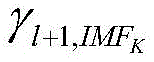
所述的采用后验反馈置信度的方法处理锂电池组放电容量数据序列,优选变分模态分解模态层数,并生成的本征模态分量数据序列为:


所述的步骤S3的具体内容如下:The specific content of step S3 is as follows:
放电容量退化趋势分量数据序列为IMF1,噪声分量数据序列为IMF2,...,IMFK,共K-1个。The discharge capacity degradation trend component data series is IMF 1 , and the noise component data series is IMF 2 , ..., IMF K , with a total of K-1 data series.
所述的步骤S4的具体内容如下:The specific content of step S4 is as follows:
非线性最小二乘法优化后的粒子滤波是指:基于锂电池组放电容量退化趋势分量IMF1,应用非线性最小二乘法优化粒子滤波观测方程初始值,具体步骤如下:The particle filter optimized by the nonlinear least square method means: based on the discharge capacity degradation trend component IMF 1 of the lithium battery pack, the initial value of the particle filter observation equation is optimized by the nonlinear least square method. The specific steps are as follows:
(1)定义观测方程:
(2)计算n个数据点(Ti,Ci)到放电容量观测值f(Ti)的距离

(3)输出J(a,b,c,d)最小时所对应的参数a,b,c,d,即为粒子滤波观测方程初始值;(3) The parameters a, b, c, d corresponding to the minimum output J(a, b, c, d) are the initial values of the particle filter observation equation;
非线性最小二乘法优化后的粒子滤波预测的锂电池组未来充放电周期的放电容量退化趋势数据为


所述步骤S5的具体内容如下:The specific content of step S5 is as follows:
噪声分量数据序列训练集为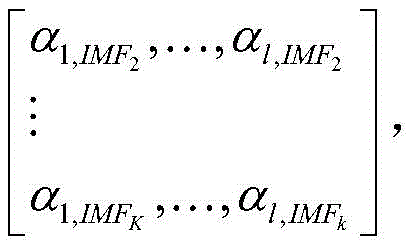


所述的步骤S6的具体内容如下:利用未来充放电周期的放电容量退化趋势数据序列与未来充放电周期的噪声数据序列,计算锂电池组未来充放电周期的放电容量数据序列的方法为:The specific content of step S6 is as follows: the method of calculating the discharge capacity data sequence of the future charge and discharge cycle of the lithium battery pack by using the discharge capacity degradation trend data sequence of the future charge and discharge cycle and the noise data sequence of the future charge and discharge cycle is:

其中,[Cl+1,predicted,...,Cn,predicted]为预测的锂电池组未来充放电周期的放电容量数据序列。Wherein, [C l+1,predicted ,...,C n,predicted ] is the predicted discharge capacity data sequence of the future charge and discharge cycles of the lithium battery pack.
所述的步骤S7的具体内容如下:The specific content of step S7 is as follows:
所述的锂电池组失效的容量阈值为锂电池组放电容量下降到标称容量的70%;The capacity threshold of the lithium battery pack failure is that the discharge capacity of the lithium battery pack drops to 70% of the nominal capacity;
所述剩余寿命为锂电池组发生失效前剩余的充放电周期数,RUL=|Ttrue-Tpredicted|,其中,RUL为锂电池组剩余寿命,Ttrue为测量的锂电池组放电容量达到失效阈值时对应的充放电周期数,Tpredicted为预测的锂电池组未来充放电周期的放电容量达到失效阈值时对应的充放电周期数。The remaining life is the number of charge and discharge cycles remaining before the lithium battery pack fails, RUL = |T true -T predicted |, where RUL is the remaining life of the lithium battery pack, T true is the number of charge and discharge cycles corresponding to when the measured discharge capacity of the lithium battery pack reaches the failure threshold, and T predicted is the number of charge and discharge cycles corresponding to when the discharge capacity of the predicted future charge and discharge cycles of the lithium battery pack reaches the failure threshold.
本发明的优点是:(1)本发明首次提出基于后验反馈置信度的方法的变分模态分解模态层数确定方法,降低系统工作时间的同时保证最大程度不丢失有效数据;The advantages of the present invention are: (1) the present invention proposes for the first time a method for determining the number of modal layers of variational modal decomposition based on a posterior feedback confidence method, which reduces the system working time while ensuring that valid data is not lost to the greatest extent;
(2)本发明利用非线性二乘法优化的粒子滤波预测的放电容量退化趋势数据与高斯过程回归预测的噪声数据,对锂离子电池组进行寿命预测,其预测精度明显高于传统的单粒子滤波预测或单高斯过程回归预测。(2) The present invention uses the discharge capacity degradation trend data predicted by the particle filter optimized by the nonlinear square method and the noise data predicted by the Gaussian process regression to predict the life of the lithium-ion battery pack. Its prediction accuracy is significantly higher than that of the traditional single particle filter prediction or single Gaussian process regression prediction.
附图说明BRIEF DESCRIPTION OF THE DRAWINGS
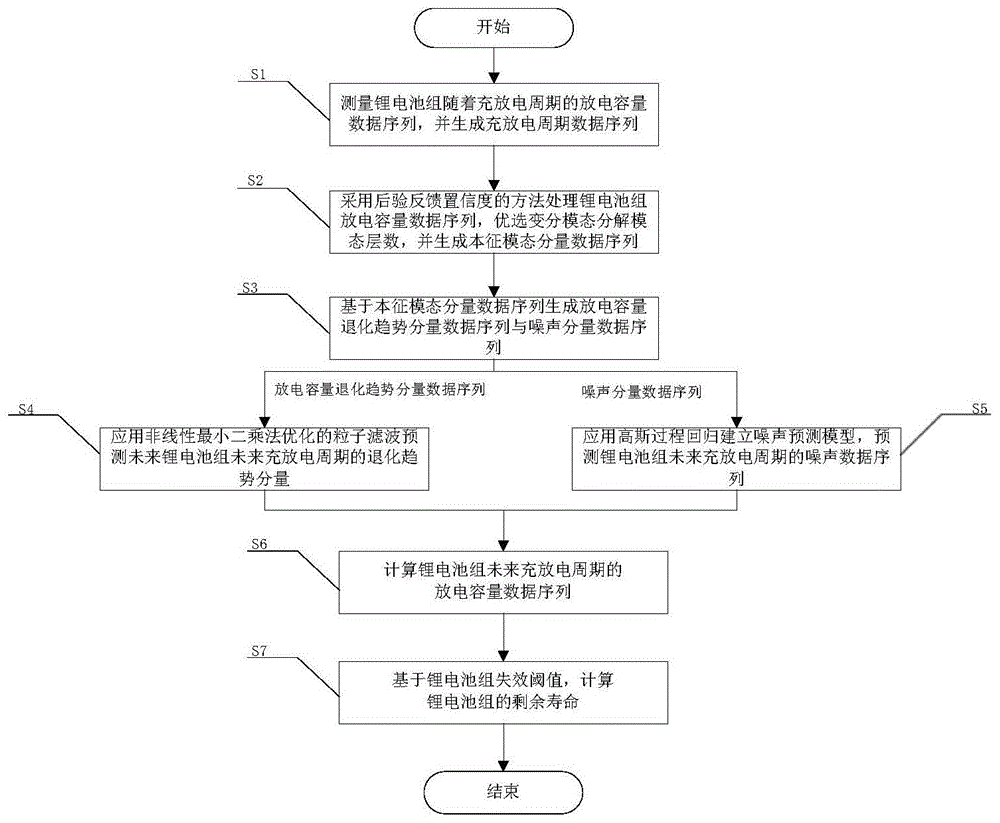
图1是本发明实施例提供的一种基于优化变分模态分解的锂电池组剩余寿命预测方法流程示意图;1 is a schematic flow chart of a method for predicting the remaining life of a lithium battery pack based on optimized variational mode decomposition provided by an embodiment of the present invention;
图2是本发明实施例提供的锂电池组放电容量退化展示图;FIG2 is a diagram showing the degradation of the discharge capacity of a lithium battery pack provided by an embodiment of the present invention;
图3是本发明实施例提供的锂电池组数据序列的变分模态分解的数据分解展示图;3 is a data decomposition diagram showing the variational modal decomposition of a lithium battery pack data sequence provided by an embodiment of the present invention;
图4是本发明实施例提供的一种基于优化变分模态分解的锂电池组剩余寿命预测方法与其他两种方法对锂电池组剩余寿命预测结果对比图;4 is a comparison diagram of the prediction results of the remaining life of a lithium battery pack by a method for predicting the remaining life of a lithium battery pack based on optimized variational mode decomposition provided by an embodiment of the present invention and two other methods;
具体实施方式DETAILED DESCRIPTION
为了使本发明的目的、技术方案及优点更加清楚明白,以下结合附图及实施例,对本发明进行进一步详细说明。应当理解,此处所描述的具体实施例仅仅用以解释本发明,并不用于限定本发明。此外,下面所描述的本发明各个实施方式中所涉及到的技术特征只要彼此之间未构成冲突就可以相互组合。In order to make the purpose, technical solutions and advantages of the present invention more clearly understood, the present invention is further described in detail below in conjunction with the accompanying drawings and embodiments. It should be understood that the specific embodiments described herein are only used to explain the present invention and are not intended to limit the present invention. In addition, the technical features involved in the various embodiments of the present invention described below can be combined with each other as long as they do not conflict with each other.
如图1所示是本发明实施例提供的一种基于优化变分模态分解的锂电池组剩余寿命预测方法的流程示意图,在图1所示的方法中,包括以下步骤:FIG1 is a flow chart of a method for predicting the remaining life of a lithium battery pack based on optimized variational mode decomposition according to an embodiment of the present invention. The method shown in FIG1 includes the following steps:
S1、测量锂电池组随着充放电周期的放电容量数据序列,并生成充放电周期数据序列。S1. Measure the discharge capacity data sequence of the lithium battery pack along with the charge and discharge cycle, and generate the charge and discharge cycle data sequence.
测量的锂电池组随着充放电周期的放电容量数据序列为[C1,...,Ci,...,Cn],其中,Ci为第i(i=1,2,...,n)个充放电周期锂电池组的放电容量,n为充放电周期个数;The measured discharge capacity data sequence of the lithium battery pack along with the charge and discharge cycle is [C 1 ,...,C i ,...,C n ], where Ci is the discharge capacity of the lithium battery pack in the i-th (i=1,2,...,n) charge and discharge cycle, and n is the number of charge and discharge cycles;
在本发明实施例中,在步骤S1中,锂电池组充放电周期数据序列为[T1,...,Ti,...,Tn],其中,Ti为第i次充放电周期对应的充放电循环次数。In the embodiment of the present invention, in step S1, the lithium battery pack charge and discharge cycle data sequence is [ T1 , ..., Ti , ..., Tn ], wherein Ti is the number of charge and discharge cycles corresponding to the i-th charge and discharge cycle.
S2、采用后验反馈置信度的方法处理锂电池组放电容量数据序列,优选变分模态分解模态层数,并生成本征模态分量数据序列。S2. Use the posterior feedback confidence method to process the lithium battery pack discharge capacity data sequence, optimize the variational mode decomposition modal layer number, and generate the intrinsic modal component data sequence.
在本发明实施例中,在步骤S2中,采用后验反馈置信度的方法处理锂电池组放电容量数据序列,优选变分模态分解模态层数,具体步骤为:In the embodiment of the present invention, in step S2, the lithium battery pack discharge capacity data sequence is processed by a posterior feedback confidence method, preferably the variational mode decomposition mode layer number, and the specific steps are:
(a)初始化变分模态分解算法,其中,包括本征模态分解模态层数、迭代次数λ与算法终止条件等,其中,初始本征模态分解模态层数为2;(a) Initializing the variational mode decomposition algorithm, including the number of intrinsic mode decomposition modal layers, the number of iterations λ and the algorithm termination condition, where the initial intrinsic mode decomposition modal layer number is 2;
(b)应用变分模态分解算法将初始放电容量数据序列μ分解为μλ,1、μλ,2,验证μ与μλ,1、μλ,2的Pearson相关性程度,并检验是否达到结束条件1,其中,μλ,1、μλ,2分别为第λ次迭代时μ的两个本征模态分量,所述结束条件1定义为:μ与μλ,1、μλ,2的最大相关显著水平ρλ≥0.05(ρλ=max{ρλ,1,ρλ,2}),即μ与μλ,1、μλ,2的最大相关置信度小于95%;(b) applying the variational mode decomposition algorithm to decompose the initial discharge capacity data sequence μ into μ λ,1 , μ λ,2 , verifying the Pearson correlation degree between μ and μ λ,1 , μ λ,2 , and checking whether the
(c)计算数据序列u',验证μ与u'的Pearson相关程度,并检验是否达到结束条件2,其中,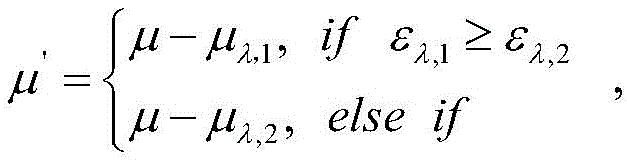
(d)若两次检验都未达到结束条件,则更新放电容量数据序列μ(μ=μ')与迭代次数λ=λ+1,并重复步骤(b)~(c)直至满足算法结束条件,反之,算法结束,输出对初始放电容量数据序列μ应用变分模态分解时优选后的模态层数个数K=λ'+1,其中,λ'为算法结束时的迭代次数。(d) If the termination condition is not met in both tests, the discharge capacity data sequence μ (μ = μ') and the number of iterations λ = λ + 1 are updated, and steps (b) to (c) are repeated until the algorithm termination condition is met. Otherwise, the algorithm terminates and the number of modal layers K = λ' + 1 after the variational modal decomposition is applied to the initial discharge capacity data sequence μ is output, where λ' is the number of iterations at the end of the algorithm.
采用后验反馈置信度的方法处理锂电池组放电容量数据序列,优选变分模态分解模态层数,并生成的本征模态分量数据序列为:


S3、基于本征模态分量数据序列生成放电容量退化趋势分量数据序列与噪声分量数据序列。S3. Generate a discharge capacity degradation trend component data sequence and a noise component data sequence based on the intrinsic mode component data sequence.
在本发明实施例中,在步骤S3中,放电容量退化趋势分量数据序列为IMF1,噪声分量数据序列为IMF2,...,IMFK,共K-1个。In the embodiment of the present invention, in step S3, the discharge capacity degradation trend component data sequence is IMF 1 , and the noise component data sequence is IMF 2 , ..., IMF K , which is K-1 in total.
S4、基于锂电池组放电容量退化趋势分量数据序列与充放电周期数据序列,应用非线性最小二乘法优化后的粒子滤波预测锂电池组未来充放电周期的放电容量退化趋势数据序列。S4. Based on the discharge capacity degradation trend component data sequence and the charge and discharge cycle data sequence of the lithium battery pack, the particle filter optimized by the nonlinear least squares method is used to predict the discharge capacity degradation trend data sequence of the lithium battery pack in the future charge and discharge cycles.
在本发明实施例中,在步骤S4中,In the embodiment of the present invention, in step S4,
非线性最小二乘法优化后的粒子滤波指的是:基于锂电池组放电容量退化趋势分量IMF1,应用非线性最小二乘法优化粒子滤波观测方程初始值,具体步骤如下:The particle filter optimized by the nonlinear least square method refers to: based on the discharge capacity degradation trend component IMF 1 of the lithium battery pack, the initial value of the particle filter observation equation is optimized by the nonlinear least square method. The specific steps are as follows:
(1)定义观测方程:
(2)计算n个数据点(Ti,Ci)到放电容量观测值f(Ti)的距离

(3)输出J(a,b,c,d)最小时所对应的参数a,b,c,d,即为粒子滤波观测方程初始值。(3) The parameters a, b, c, d corresponding to the minimum output J(a, b, c, d) are the initial values of the particle filter observation equation.
非线性最小二乘法优化后的粒子滤波预测的锂电池组未来充放电周期的放电容量退化趋势数据为


S5、基于噪声分量数据序列训练集与充放电周期数据序列,应用高斯过程回归建立噪声预测模型,预测锂电池组未来充放电周期的噪声数据序列。S5. Based on the noise component data sequence training set and the charge and discharge cycle data sequence, a noise prediction model is established by applying Gaussian process regression to predict the noise data sequence of the future charge and discharge cycle of the lithium battery pack.
在本发明实施例中,在步骤S5中,噪声分量数据序列训练集为


S6、利用未来充放电周期放电容量退化趋势数据序列与未来充放电周期噪声数据序列,计算锂电池组未来充放电周期放电容量数据序列。S6. Calculate the discharge capacity data sequence of the future charge and discharge cycles by using the discharge capacity degradation trend data sequence of the future charge and discharge cycles and the noise data sequence of the future charge and discharge cycles.
在本发明实施例中,在步骤S6中,In the embodiment of the present invention, in step S6,
利用未来充放电周期的放电容量退化趋势数据序列与未来充放电周期的噪声数据序列,计算锂电池组未来充放电周期的放电容量数据序列的方法为:The method for calculating the discharge capacity data sequence of the future charge and discharge cycles of the lithium battery pack by using the discharge capacity degradation trend data sequence of the future charge and discharge cycles and the noise data sequence of the future charge and discharge cycles is:

其中,[Cl+1,predicted,...,Cn,predicted]为预测的锂电池组未来充放电周期的放电容量数据序列。Wherein, [C l+1,predicted ,...,C n,predicted ] is the predicted discharge capacity data sequence of the future charge and discharge cycles of the lithium battery pack.
S7、基于锂电池组失效阈值,计算锂电池组的剩余寿命。S7. Calculate the remaining life of the lithium battery pack based on the failure threshold of the lithium battery pack.
在本发明实施例中,在步骤S7中,锂电池组失效的容量阈值为锂电池组放电容量下降到标称容量的70%。剩余寿命为锂电池组发生失效前剩余的充放电周期数,RUL=|Ttrue-Tpredicted|,其中,RUL为锂电池组剩余寿命,Ttrue为测量的锂电池组放电容量达到失效阈值时对应的充放电周期数,Tpredicted为预测的锂电池组未来充放电周期的放电容量达到失效阈值时对应的充放电周期数。In an embodiment of the present invention, in step S7, the capacity threshold of lithium battery pack failure is that the discharge capacity of the lithium battery pack drops to 70% of the nominal capacity. The remaining life is the number of charge and discharge cycles remaining before the lithium battery pack fails, RUL = |T true -T predicted |, where RUL is the remaining life of the lithium battery pack, T true is the number of charge and discharge cycles corresponding to when the measured discharge capacity of the lithium battery pack reaches the failure threshold, and T predicted is the number of charge and discharge cycles corresponding to when the discharge capacity of the predicted future charge and discharge cycles of the lithium battery pack reaches the failure threshold.
为展示本发明提出的一种基于优化变分模态分解的锂电池组剩余寿命预测方法的过程与估计性能,在此以一个实例说明。In order to demonstrate the process and estimation performance of the remaining life prediction method of a lithium battery pack based on optimized variational mode decomposition proposed by the present invention, an example is used here to illustrate.
实验室中以某品牌六节额定容量为2.4Ah、放电容量为2.2Ah的磷酸铁锂电池串联成组,对锂电池组进行充放电实验,充电阶段以1.2A电流恒流充电,当锂电池组端电压达到24.9V,保持端电压不变继续充电,当充电电流降至48mA,充电结束。搁置10s后以2A电流恒流放电,当锂电池组端电压降至19.3V,放电结束。对锂电池组重复充放电,当锂电池组放电容量低于额定容量的65%,实验结束。实验共计729充放电循环,图2中展示了锂电池组放电容量随着充放电周期的退化过程。基于实验室测得的随着充放电周期锂电池组放电容量退化数据,预测锂电池组剩余寿命,具体操作步骤如下:In the laboratory, six lithium iron phosphate batteries of a certain brand with a rated capacity of 2.4Ah and a discharge capacity of 2.2Ah were connected in series to form a group, and a charge and discharge experiment was carried out on the lithium battery group. During the charging stage, the battery was charged at a constant current of 1.2A. When the terminal voltage of the lithium battery group reached 24.9V, the terminal voltage was kept unchanged and charging continued. When the charging current dropped to 48mA, the charging was completed. After 10s of suspension, the battery was discharged at a constant current of 2A. When the terminal voltage of the lithium battery group dropped to 19.3V, the discharge was completed. The lithium battery group was repeatedly charged and discharged. When the discharge capacity of the lithium battery group was less than 65% of the rated capacity, the experiment ended. The experiment had a total of 729 charge and discharge cycles. Figure 2 shows the degradation process of the discharge capacity of the lithium battery group with the charge and discharge cycle. Based on the laboratory measured data on the degradation of the discharge capacity of the lithium battery group with the charge and discharge cycle, the remaining life of the lithium battery group is predicted. The specific steps are as follows:
(1)基于实验室中测得的锂电池组数据,共计729组数据序列。(1) Based on lithium battery pack data measured in the laboratory, a total of 729 data sequences.
(2)采用后验反馈置信度的方法处理锂电池组放电容量数据序列,优选变分模态分解模态层数,得到该锂电池组数据序列的最佳变分模态分解模态层数为4,并生成本征模态分量数据序列,图3为锂电池组数据应用变分模态分解后生成本征模态分量数据序列图。(2) The posterior feedback confidence method is used to process the lithium battery pack discharge capacity data sequence, and the variational mode decomposition modal layer number is optimized. The optimal variational mode decomposition modal layer number of the lithium battery pack data sequence is obtained to be 4, and the intrinsic modal component data sequence is generated. Figure 3 is a diagram of the intrinsic modal component data sequence generated after applying variational mode decomposition to the lithium battery pack data.
(3)基于本征模态分量数据序列生成放电容量退化趋势分量数据序列IMF1与噪声分量数据序列IMF2,IMF3,IMF4。(3) Generate the discharge capacity degradation trend component data sequence IMF 1 and the noise component data sequences IMF 2 , IMF 3 , and IMF 4 based on the intrinsic mode component data sequence.
(4)基于锂电池组放电容量退化趋势分量数据序列IMF1与充放电周期数据序列,应用非线性最小二乘法优化后的粒子滤波预测锂电池组未来充放电周期的放电容量退化趋势数据序列,预测起点为第365个充放电周期。(4) Based on the discharge capacity degradation trend component data sequence IMF1 of the lithium battery pack and the charge and discharge cycle data sequence, the particle filter optimized by the nonlinear least squares method is used to predict the discharge capacity degradation trend data sequence of the lithium battery pack in the future charge and discharge cycles, and the prediction starting point is the 365th charge and discharge cycle.
(5)基于噪声分量数据序列IMF2、IMF3、IMF4训练集与充放电周期数据序列,以第365个充放电周期为起点,应用高斯过程回归建立噪声预测模型,预测锂电池组未来充放电周期的噪声数据序列。(5) Based on the noise component data sequences IMF2, IMF3, and IMF4 training sets and the charge and discharge cycle data sequences, taking the 365th charge and discharge cycle as the starting point, a noise prediction model is established using Gaussian process regression to predict the noise data sequences of future charge and discharge cycles of the lithium battery pack.
(6)利用未来充放电周期的放电容量退化趋势数据序列与未来充放电周期的噪声数据序列,计算锂电池组未来充放电周期的放电容量数据序列。(6) Calculate the discharge capacity data sequence of the future charge and discharge cycles of the lithium battery pack by using the discharge capacity degradation trend data sequence of the future charge and discharge cycles and the noise data sequence of the future charge and discharge cycles.
(7)计算锂电池组失效阈值为1.68Ah,计算锂电池组的剩余寿命。(7) The failure threshold of the lithium battery pack is calculated to be 1.68 Ah, and the remaining life of the lithium battery pack is calculated.
与此同时,为验证本发明提出方法的优越性,采用粒子滤波与高斯过程回归与本发明提出的方法进行对比实验,图4为三种方法的预测结果对比图,表2为三种方法对锂电池组剩余寿命的预测结果的平均绝对百分比误差与均方根误差。At the same time, in order to verify the superiority of the method proposed in the present invention, particle filtering and Gaussian process regression were used to conduct comparative experiments with the method proposed in the present invention. FIG4 is a comparison chart of the prediction results of the three methods. Table 2 is the average absolute percentage error and root mean square error of the prediction results of the remaining life of the lithium battery pack by the three methods.
表1Table 1

表2Table 2

从对锂电池组剩余寿命预测的结果对比图与误差表中可以看出,本发明提出的一种基于优化变分模态分解的锂电池组剩余寿命预测方法计算的未来充放电周期的放电容量退化数据与真实放电容量退化数据更加贴合,同样的结论可从表1中得出。本发明提出的锂电池组剩余寿命预测方法的平均绝对百分比误差与均方根误差均低于单独的粒子滤波预测与高斯过程回归预测。与此同时,针对锂电池组失效阈值的预测,本发明提出的混合预测方法误差周期为9,而粒子滤波与高斯过程回归的误差周期分别为50、31,显然本发明提出的寿命预测方法的精度更高。综上,本发明提出的一种基于优化变分模态分解锂电池组的剩余寿命预测方法具有误差小、效率高等优点。From the comparison chart and error table of the results of the remaining life prediction of the lithium battery pack, it can be seen that the discharge capacity degradation data of the future charge and discharge cycles calculated by the remaining life prediction method of the lithium battery pack based on optimized variational mode decomposition proposed in the present invention is more consistent with the actual discharge capacity degradation data, and the same conclusion can be drawn from Table 1. The mean absolute percentage error and root mean square error of the remaining life prediction method of the lithium battery pack proposed in the present invention are lower than those of the separate particle filter prediction and Gaussian process regression prediction. At the same time, for the prediction of the failure threshold of the lithium battery pack, the error period of the hybrid prediction method proposed in the present invention is 9, while the error periods of the particle filter and Gaussian process regression are 50 and 31 respectively. It is obvious that the life prediction method proposed in the present invention has higher accuracy. In summary, the remaining life prediction method of the lithium battery pack based on optimized variational mode decomposition proposed in the present invention has the advantages of small error and high efficiency.
需要指出,根据实施的需要,可将本申请中描述的各个步骤/部件拆分为更多步骤/部件,也可将两个或多个步骤/部件或者步骤/部件的部分操作组合成新的步骤/部件,以实现本发明的目的。It should be pointed out that, according to the needs of implementation, the various steps/components described in this application can be split into more steps/components, and two or more steps/components or partial operations of steps/components can be combined into new steps/components to achieve the purpose of the present invention.
本领域的技术人员容易理解,以上所述仅为本发明的较佳实施例而已,并不用以限制本发明,凡在本发明的精神和原则之内所作的任何修改、等同替换和改进等,均应包含在本发明的保护范围之内。It will be easily understood by those skilled in the art that the above description is only a preferred embodiment of the present invention and is not intended to limit the present invention. Any modifications, equivalent substitutions and improvements made within the spirit and principles of the present invention should be included in the protection scope of the present invention.
Claims (6)







Priority Applications (1)
| Application Number | Priority Date | Filing Date | Title |
|---|---|---|---|
| CN202110658203.XA CN113406525B (en) | 2021-06-15 | 2021-06-15 | Lithium battery pack residual life prediction method based on optimization variation modal decomposition |
Applications Claiming Priority (1)
| Application Number | Priority Date | Filing Date | Title |
|---|---|---|---|
| CN202110658203.XA CN113406525B (en) | 2021-06-15 | 2021-06-15 | Lithium battery pack residual life prediction method based on optimization variation modal decomposition |
Publications (2)
| Publication Number | Publication Date |
|---|---|
| CN113406525A CN113406525A (en) | 2021-09-17 |
| CN113406525B true CN113406525B (en) | 2023-06-02 |
Family
ID=77683813
Family Applications (1)
| Application Number | Title | Priority Date | Filing Date |
|---|---|---|---|
| CN202110658203.XA Active CN113406525B (en) | 2021-06-15 | 2021-06-15 | Lithium battery pack residual life prediction method based on optimization variation modal decomposition |
Country Status (1)
| Country | Link |
|---|---|
| CN (1) | CN113406525B (en) |
Families Citing this family (6)
| Publication number | Priority date | Publication date | Assignee | Title |
|---|---|---|---|---|
| CN114491952B (en) * | 2021-12-27 | 2025-07-29 | 宁波力斗智能技术有限公司 | Lithium battery residual service life prediction method based on long-short-time memory network |
| WO2024010175A1 (en) * | 2022-07-07 | 2024-01-11 | Samsung Electronics Co., Ltd. | Method and electronic device for forecasting remaining useful life (rul) of battery |
| CN115166531A (en) * | 2022-07-18 | 2022-10-11 | 金陵科技学院 | Lithium battery residual life prediction method based on double-Gaussian aging model |
| CN115494418A (en) * | 2022-11-22 | 2022-12-20 | 湖北工业大学 | Lithium battery single body abnormity detection method and system based on time series decomposition algorithm |
| CN115877223B (en) * | 2023-03-03 | 2023-07-04 | 浙江天能新材料有限公司 | Lithium battery detection method, device, equipment and storage medium |
| CN118033431B (en) * | 2024-03-27 | 2024-12-03 | 山东大学 | Battery remaining life prediction method and system based on decomposition and integration asymmetric strategy |
Citations (14)
| Publication number | Priority date | Publication date | Assignee | Title |
|---|---|---|---|---|
| JP2003092836A (en) * | 2001-09-19 | 2003-03-28 | Internatl Business Mach Corp <Ibm> | Electric device, computer device, intelligent battery, total capacity correction method, deterioration amount recognition method, and program |
| WO2009091407A2 (en) * | 2008-01-18 | 2009-07-23 | Medtronic, Inc | Estimating remaining battery service life in an implantable medical device |
| CN107015165A (en) * | 2017-06-14 | 2017-08-04 | 安庆师范大学 | Lithium battery method for predicting residual useful life based on sparse coefficient multinuclear Method Using Relevance Vector Machine |
| CN108022014A (en) * | 2017-12-05 | 2018-05-11 | 国网山东省电力公司济南供电公司 | A kind of Load Prediction In Power Systems method and system |
| CN108303652A (en) * | 2018-01-18 | 2018-07-20 | 武汉理工大学 | A kind of lithium battery method for predicting residual useful life |
| CN109975013A (en) * | 2019-04-30 | 2019-07-05 | 南京工程学院 | Fault feature extraction method of wind turbine gearbox based on IVMD-SE |
| CN110221225A (en) * | 2019-07-08 | 2019-09-10 | 中国人民解放军国防科技大学 | Spacecraft lithium ion battery cycle life prediction method |
| CN110515364A (en) * | 2019-07-15 | 2019-11-29 | 北京工业大学 | A kind of cutting-tool wear state detection method based on variation mode decomposition and LS-SVM |
| CN110988694A (en) * | 2019-12-17 | 2020-04-10 | 南京航空航天大学 | Lithium ion battery residual life prediction method and system aiming at capacity regeneration |
| CN111143973A (en) * | 2019-12-05 | 2020-05-12 | 云南电网有限责任公司玉溪供电局 | Degradation trend prediction method of valve-regulated lead-acid battery based on Gaussian process regression |
| CN112327188A (en) * | 2020-09-30 | 2021-02-05 | 北京交通大学 | A Model-Data Hybrid-Driven Remaining Life Prediction Method for Li-ion Batteries |
| CN112348185A (en) * | 2020-11-04 | 2021-02-09 | 上海海事大学 | A Lithium Battery Remaining Life Prediction Method Based on Variational Mode Decomposition and Integrated Depth Model |
| CN112487702A (en) * | 2020-10-26 | 2021-03-12 | 湖州师范学院 | Method for predicting remaining service life of lithium ion battery |
| CN112733603A (en) * | 2020-12-11 | 2021-04-30 | 江苏大学 | Frequency conversion scroll compressor fault diagnosis method based on improved VMD and SVM |
Family Cites Families (3)
| Publication number | Priority date | Publication date | Assignee | Title |
|---|---|---|---|---|
| US6711523B2 (en) * | 2001-05-24 | 2004-03-23 | Simmonds Precision Products, Inc. | Method and apparatus for determining a condition indicator for use in evaluating the health of a component |
| US10209314B2 (en) * | 2016-11-21 | 2019-02-19 | Battelle Energy Alliance, Llc | Systems and methods for estimation and prediction of battery health and performance |
| US11124317B2 (en) * | 2018-01-26 | 2021-09-21 | Dalian University Of Technology | Method for prediction of key performance parameters of aero-engine in transition condition |
-
2021
- 2021-06-15 CN CN202110658203.XA patent/CN113406525B/en active Active
Patent Citations (14)
| Publication number | Priority date | Publication date | Assignee | Title |
|---|---|---|---|---|
| JP2003092836A (en) * | 2001-09-19 | 2003-03-28 | Internatl Business Mach Corp <Ibm> | Electric device, computer device, intelligent battery, total capacity correction method, deterioration amount recognition method, and program |
| WO2009091407A2 (en) * | 2008-01-18 | 2009-07-23 | Medtronic, Inc | Estimating remaining battery service life in an implantable medical device |
| CN107015165A (en) * | 2017-06-14 | 2017-08-04 | 安庆师范大学 | Lithium battery method for predicting residual useful life based on sparse coefficient multinuclear Method Using Relevance Vector Machine |
| CN108022014A (en) * | 2017-12-05 | 2018-05-11 | 国网山东省电力公司济南供电公司 | A kind of Load Prediction In Power Systems method and system |
| CN108303652A (en) * | 2018-01-18 | 2018-07-20 | 武汉理工大学 | A kind of lithium battery method for predicting residual useful life |
| CN109975013A (en) * | 2019-04-30 | 2019-07-05 | 南京工程学院 | Fault feature extraction method of wind turbine gearbox based on IVMD-SE |
| CN110221225A (en) * | 2019-07-08 | 2019-09-10 | 中国人民解放军国防科技大学 | Spacecraft lithium ion battery cycle life prediction method |
| CN110515364A (en) * | 2019-07-15 | 2019-11-29 | 北京工业大学 | A kind of cutting-tool wear state detection method based on variation mode decomposition and LS-SVM |
| CN111143973A (en) * | 2019-12-05 | 2020-05-12 | 云南电网有限责任公司玉溪供电局 | Degradation trend prediction method of valve-regulated lead-acid battery based on Gaussian process regression |
| CN110988694A (en) * | 2019-12-17 | 2020-04-10 | 南京航空航天大学 | Lithium ion battery residual life prediction method and system aiming at capacity regeneration |
| CN112327188A (en) * | 2020-09-30 | 2021-02-05 | 北京交通大学 | A Model-Data Hybrid-Driven Remaining Life Prediction Method for Li-ion Batteries |
| CN112487702A (en) * | 2020-10-26 | 2021-03-12 | 湖州师范学院 | Method for predicting remaining service life of lithium ion battery |
| CN112348185A (en) * | 2020-11-04 | 2021-02-09 | 上海海事大学 | A Lithium Battery Remaining Life Prediction Method Based on Variational Mode Decomposition and Integrated Depth Model |
| CN112733603A (en) * | 2020-12-11 | 2021-04-30 | 江苏大学 | Frequency conversion scroll compressor fault diagnosis method based on improved VMD and SVM |
Non-Patent Citations (3)
| Title |
|---|
| Capacity Prognostics of Lithium-Ion Batteries using EMD Denoising and Multiple Kernel RVM;Chaolong Zhang等;《 IEEE Access 》;全文 * |
| 基于 EEMD 和 MKRVM 的锂电池剩余寿命预测方法;张朝龙;《电力系统及其自动化学报》;第第30卷卷(第第7期期);全文 * |
| 基于改进 VMD 算法的液压泵寿命状态检测方法;宣元等;《液压与气动》(第第10期期);全文 * |
Also Published As
| Publication number | Publication date |
|---|---|
| CN113406525A (en) | 2021-09-17 |
Similar Documents
| Publication | Publication Date | Title |
|---|---|---|
| CN113406525B (en) | Lithium battery pack residual life prediction method based on optimization variation modal decomposition | |
| CN113740736B (en) | Electric vehicle lithium battery SOH estimation method based on deep network self-adaption | |
| Hong et al. | State-of-health estimation and remaining useful life prediction for lithium-ion batteries based on an improved particle filter algorithm | |
| CN106909716B (en) | Modeling and SOC estimation method of lithium iron phosphate battery considering capacity loss | |
| CN102831100B (en) | Battery charge state evaluation method and device | |
| CN112540317A (en) | Battery health state estimation and residual life prediction method based on real vehicle data | |
| CN112327188A (en) | A Model-Data Hybrid-Driven Remaining Life Prediction Method for Li-ion Batteries | |
| CN110058160B (en) | Lithium battery state of health prediction method based on square root extended Kalman filter | |
| CN105203968B (en) | A kind of on-line measurement system of lead-acid accumulator dump energy | |
| CN112986831A (en) | Lithium ion battery life prediction method based on correlation coefficient particle filtering | |
| CN108872869B (en) | Lithium ion battery degradation classification method based on BP neural network | |
| CN107843847A (en) | A kind of battery SOC estimation online methods based on EKF algorithms | |
| CN113109716B (en) | Lithium battery SOP estimation method based on electrochemical model | |
| Lin et al. | State of health estimation of lithium-ion batteries based on remaining area capacity | |
| CN109633456B (en) | A SOC estimation method for power lithium battery pack based on segmented voltage identification method | |
| CN117783884A (en) | A method for estimating the health status of lithium-ion batteries based on fragmented charging data | |
| CN112816893A (en) | Method for rapidly estimating capacity of battery pack based on residual charging capacity of battery pack monomer | |
| CN114839553B (en) | Method and device for predicting remaining battery life | |
| CN116338468A (en) | A method and system for predicting the state of health and remaining usable life of a lithium battery | |
| CN111967194A (en) | Battery classification method based on cloud historical data | |
| CN114814591B (en) | A lithium battery SOE estimation method, device and system | |
| CN114839537A (en) | Battery state of charge prediction method and device | |
| CN116774045A (en) | A lithium battery health status prediction method based on HHO-SVR | |
| CN112580289A (en) | Hybrid capacitor power state online estimation method and system | |
| CN118777909A (en) | A method for estimating SOC of vehicle-mounted lithium battery |
Legal Events
| Date | Code | Title | Description |
|---|---|---|---|
| PB01 | Publication | ||
| PB01 | Publication | ||
| SE01 | Entry into force of request for substantive examination | ||
| SE01 | Entry into force of request for substantive examination | ||
| TA01 | Transfer of patent application right | ||
| TA01 | Transfer of patent application right |
Effective date of registration: 20230509 Address after: No. 99 Jiangning Road, Nanjing District hirokage 211169 cities in Jiangsu Province Applicant after: JINLING INSTITUTE OF TECHNOLOGY Address before: 246133 No. 1318 Jixian North Road, Anqing City, Anhui Province Applicant before: ANQING NORMAL University |
|
| GR01 | Patent grant | ||
| GR01 | Patent grant |