CN113382985A - Bis-octahydrophenanthrenecarboxamide derivatives and protein conjugates thereof as LXR agonists - Google Patents
Bis-octahydrophenanthrenecarboxamide derivatives and protein conjugates thereof as LXR agonists Download PDFInfo
- Publication number
- CN113382985A CN113382985A CN201980089547.4A CN201980089547A CN113382985A CN 113382985 A CN113382985 A CN 113382985A CN 201980089547 A CN201980089547 A CN 201980089547A CN 113382985 A CN113382985 A CN 113382985A
- Authority
- CN
- China
- Prior art keywords
- compound
- group
- amino acid
- acid
- antibody
- Prior art date
- Legal status (The legal status is an assumption and is not a legal conclusion. Google has not performed a legal analysis and makes no representation as to the accuracy of the status listed.)
- Pending
Links
- 108090000623 proteins and genes Proteins 0.000 title abstract description 11
- 102000004169 proteins and genes Human genes 0.000 title abstract description 9
- 239000000556 agonist Substances 0.000 title description 5
- 150000001875 compounds Chemical class 0.000 claims abstract description 341
- 238000000034 method Methods 0.000 claims abstract description 150
- 239000000611 antibody drug conjugate Substances 0.000 claims abstract description 30
- 229940049595 antibody-drug conjugate Drugs 0.000 claims abstract description 30
- -1 C1-6Alkylene radical Chemical class 0.000 claims description 215
- 239000011230 binding agent Substances 0.000 claims description 147
- 125000000217 alkyl group Chemical group 0.000 claims description 122
- 229940024606 amino acid Drugs 0.000 claims description 114
- 235000001014 amino acid Nutrition 0.000 claims description 110
- 125000006850 spacer group Chemical group 0.000 claims description 108
- 125000005647 linker group Chemical group 0.000 claims description 106
- 239000000427 antigen Substances 0.000 claims description 96
- 108091007433 antigens Proteins 0.000 claims description 96
- 102000036639 antigens Human genes 0.000 claims description 96
- 125000000592 heterocycloalkyl group Chemical group 0.000 claims description 96
- 150000001413 amino acids Chemical class 0.000 claims description 76
- 239000012634 fragment Substances 0.000 claims description 76
- 150000003839 salts Chemical class 0.000 claims description 75
- 125000000539 amino acid group Chemical group 0.000 claims description 65
- 108090000765 processed proteins & peptides Proteins 0.000 claims description 59
- 239000012453 solvate Substances 0.000 claims description 55
- IJGRMHOSHXDMSA-UHFFFAOYSA-N nitrogen Substances N#N IJGRMHOSHXDMSA-UHFFFAOYSA-N 0.000 claims description 46
- 239000003623 enhancer Substances 0.000 claims description 44
- 238000006243 chemical reaction Methods 0.000 claims description 41
- 125000005842 heteroatom Chemical group 0.000 claims description 37
- 125000002252 acyl group Chemical group 0.000 claims description 36
- 125000003118 aryl group Chemical group 0.000 claims description 36
- 229910052757 nitrogen Inorganic materials 0.000 claims description 32
- 150000003254 radicals Chemical class 0.000 claims description 31
- 125000003710 aryl alkyl group Chemical group 0.000 claims description 28
- 229910052736 halogen Inorganic materials 0.000 claims description 22
- 125000000547 substituted alkyl group Chemical group 0.000 claims description 19
- DHMQDGOQFOQNFH-UHFFFAOYSA-N Glycine Chemical compound NCC(O)=O DHMQDGOQFOQNFH-UHFFFAOYSA-N 0.000 claims description 16
- 102220476512 Interleukin-18 receptor 1_N297Q_mutation Human genes 0.000 claims description 16
- KDXKERNSBIXSRK-UHFFFAOYSA-N Lysine Natural products NCCCCC(N)C(O)=O KDXKERNSBIXSRK-UHFFFAOYSA-N 0.000 claims description 16
- 239000004472 Lysine Substances 0.000 claims description 16
- 235000018977 lysine Nutrition 0.000 claims description 16
- KDXKERNSBIXSRK-YFKPBYRVSA-N L-lysine Chemical compound NCCCC[C@H](N)C(O)=O KDXKERNSBIXSRK-YFKPBYRVSA-N 0.000 claims description 15
- 229960003767 alanine Drugs 0.000 claims description 15
- QJGQUHMNIGDVPM-UHFFFAOYSA-N nitrogen group Chemical group [N] QJGQUHMNIGDVPM-UHFFFAOYSA-N 0.000 claims description 15
- 229960004295 valine Drugs 0.000 claims description 15
- 239000004474 valine Substances 0.000 claims description 15
- ZDXPYRJPNDTMRX-VKHMYHEASA-N L-glutamine Chemical compound OC(=O)[C@@H](N)CCC(N)=O ZDXPYRJPNDTMRX-VKHMYHEASA-N 0.000 claims description 14
- 235000018417 cysteine Nutrition 0.000 claims description 14
- 229960002433 cysteine Drugs 0.000 claims description 14
- XUJNEKJLAYXESH-UHFFFAOYSA-N cysteine Natural products SCC(N)C(O)=O XUJNEKJLAYXESH-UHFFFAOYSA-N 0.000 claims description 14
- 239000008103 glucose Substances 0.000 claims description 14
- 235000004554 glutamine Nutrition 0.000 claims description 14
- ZDXPYRJPNDTMRX-UHFFFAOYSA-N glutamine Natural products OC(=O)C(N)CCC(N)=O ZDXPYRJPNDTMRX-UHFFFAOYSA-N 0.000 claims description 14
- 239000008194 pharmaceutical composition Substances 0.000 claims description 14
- XUJNEKJLAYXESH-REOHCLBHSA-N L-Cysteine Chemical compound SC[C@H](N)C(O)=O XUJNEKJLAYXESH-REOHCLBHSA-N 0.000 claims description 13
- KZSNJWFQEVHDMF-BYPYZUCNSA-N L-valine Chemical compound CC(C)[C@H](N)C(O)=O KZSNJWFQEVHDMF-BYPYZUCNSA-N 0.000 claims description 13
- KZSNJWFQEVHDMF-UHFFFAOYSA-N Valine Natural products CC(C)C(N)C(O)=O KZSNJWFQEVHDMF-UHFFFAOYSA-N 0.000 claims description 13
- 235000014393 valine Nutrition 0.000 claims description 13
- WHUUTDBJXJRKMK-UHFFFAOYSA-N Glutamic acid Natural products OC(=O)C(N)CCC(O)=O WHUUTDBJXJRKMK-UHFFFAOYSA-N 0.000 claims description 12
- QNAYBMKLOCPYGJ-REOHCLBHSA-N L-alanine Chemical compound C[C@H](N)C(O)=O QNAYBMKLOCPYGJ-REOHCLBHSA-N 0.000 claims description 12
- 235000004279 alanine Nutrition 0.000 claims description 12
- 235000013922 glutamic acid Nutrition 0.000 claims description 12
- 239000004220 glutamic acid Substances 0.000 claims description 12
- DCXYFEDJOCDNAF-UHFFFAOYSA-N Asparagine Natural products OC(=O)C(N)CC(N)=O DCXYFEDJOCDNAF-UHFFFAOYSA-N 0.000 claims description 11
- DCXYFEDJOCDNAF-REOHCLBHSA-N L-asparagine Chemical compound OC(=O)[C@@H](N)CC(N)=O DCXYFEDJOCDNAF-REOHCLBHSA-N 0.000 claims description 11
- CKLJMWTZIZZHCS-REOHCLBHSA-N L-aspartic acid Chemical compound OC(=O)[C@@H](N)CC(O)=O CKLJMWTZIZZHCS-REOHCLBHSA-N 0.000 claims description 11
- WHUUTDBJXJRKMK-VKHMYHEASA-N L-glutamic acid Chemical compound OC(=O)[C@@H](N)CCC(O)=O WHUUTDBJXJRKMK-VKHMYHEASA-N 0.000 claims description 11
- 235000009582 asparagine Nutrition 0.000 claims description 11
- 229960001230 asparagine Drugs 0.000 claims description 11
- 235000003704 aspartic acid Nutrition 0.000 claims description 11
- 229960005261 aspartic acid Drugs 0.000 claims description 11
- OQFSQFPPLPISGP-UHFFFAOYSA-N beta-carboxyaspartic acid Natural products OC(=O)C(N)C(C(O)=O)C(O)=O OQFSQFPPLPISGP-UHFFFAOYSA-N 0.000 claims description 11
- 239000004475 Arginine Substances 0.000 claims description 10
- ODKSFYDXXFIFQN-BYPYZUCNSA-P L-argininium(2+) Chemical compound NC(=[NH2+])NCCC[C@H]([NH3+])C(O)=O ODKSFYDXXFIFQN-BYPYZUCNSA-P 0.000 claims description 10
- MTCFGRXMJLQNBG-UHFFFAOYSA-N Serine Natural products OCC(N)C(O)=O MTCFGRXMJLQNBG-UHFFFAOYSA-N 0.000 claims description 10
- 235000009697 arginine Nutrition 0.000 claims description 10
- ODKSFYDXXFIFQN-UHFFFAOYSA-N arginine Natural products OC(=O)C(N)CCCNC(N)=N ODKSFYDXXFIFQN-UHFFFAOYSA-N 0.000 claims description 10
- 229960003121 arginine Drugs 0.000 claims description 10
- 208000030159 metabolic disease Diseases 0.000 claims description 10
- 230000004770 neurodegeneration Effects 0.000 claims description 10
- 208000015122 neurodegenerative disease Diseases 0.000 claims description 10
- 229960001153 serine Drugs 0.000 claims description 10
- 235000004400 serine Nutrition 0.000 claims description 10
- 235000002374 tyrosine Nutrition 0.000 claims description 10
- 229960004441 tyrosine Drugs 0.000 claims description 10
- OUYCCCASQSFEME-UHFFFAOYSA-N tyrosine Natural products OC(=O)C(N)CC1=CC=C(O)C=C1 OUYCCCASQSFEME-UHFFFAOYSA-N 0.000 claims description 10
- MTCFGRXMJLQNBG-REOHCLBHSA-N (2S)-2-Amino-3-hydroxypropansäure Chemical compound OC[C@H](N)C(O)=O MTCFGRXMJLQNBG-REOHCLBHSA-N 0.000 claims description 9
- 208000032928 Dyslipidaemia Diseases 0.000 claims description 9
- 239000004471 Glycine Substances 0.000 claims description 9
- ONIBWKKTOPOVIA-BYPYZUCNSA-N L-Proline Chemical compound OC(=O)[C@@H]1CCCN1 ONIBWKKTOPOVIA-BYPYZUCNSA-N 0.000 claims description 9
- HNDVDQJCIGZPNO-YFKPBYRVSA-N L-histidine Chemical compound OC(=O)[C@@H](N)CC1=CN=CN1 HNDVDQJCIGZPNO-YFKPBYRVSA-N 0.000 claims description 9
- AGPKZVBTJJNPAG-WHFBIAKZSA-N L-isoleucine Chemical compound CC[C@H](C)[C@H](N)C(O)=O AGPKZVBTJJNPAG-WHFBIAKZSA-N 0.000 claims description 9
- ROHFNLRQFUQHCH-YFKPBYRVSA-N L-leucine Chemical compound CC(C)C[C@H](N)C(O)=O ROHFNLRQFUQHCH-YFKPBYRVSA-N 0.000 claims description 9
- FFEARJCKVFRZRR-BYPYZUCNSA-N L-methionine Chemical compound CSCC[C@H](N)C(O)=O FFEARJCKVFRZRR-BYPYZUCNSA-N 0.000 claims description 9
- COLNVLDHVKWLRT-QMMMGPOBSA-N L-phenylalanine Chemical compound OC(=O)[C@@H](N)CC1=CC=CC=C1 COLNVLDHVKWLRT-QMMMGPOBSA-N 0.000 claims description 9
- AYFVYJQAPQTCCC-GBXIJSLDSA-N L-threonine Chemical compound C[C@@H](O)[C@H](N)C(O)=O AYFVYJQAPQTCCC-GBXIJSLDSA-N 0.000 claims description 9
- QIVBCDIJIAJPQS-VIFPVBQESA-N L-tryptophane Chemical compound C1=CC=C2C(C[C@H](N)C(O)=O)=CNC2=C1 QIVBCDIJIAJPQS-VIFPVBQESA-N 0.000 claims description 9
- OUYCCCASQSFEME-QMMMGPOBSA-N L-tyrosine Chemical compound OC(=O)[C@@H](N)CC1=CC=C(O)C=C1 OUYCCCASQSFEME-QMMMGPOBSA-N 0.000 claims description 9
- ROHFNLRQFUQHCH-UHFFFAOYSA-N Leucine Natural products CC(C)CC(N)C(O)=O ROHFNLRQFUQHCH-UHFFFAOYSA-N 0.000 claims description 9
- 208000017170 Lipid metabolism disease Diseases 0.000 claims description 9
- ONIBWKKTOPOVIA-UHFFFAOYSA-N Proline Natural products OC(=O)C1CCCN1 ONIBWKKTOPOVIA-UHFFFAOYSA-N 0.000 claims description 9
- AYFVYJQAPQTCCC-UHFFFAOYSA-N Threonine Natural products CC(O)C(N)C(O)=O AYFVYJQAPQTCCC-UHFFFAOYSA-N 0.000 claims description 9
- 239000004473 Threonine Substances 0.000 claims description 9
- QIVBCDIJIAJPQS-UHFFFAOYSA-N Tryptophan Natural products C1=CC=C2C(CC(N)C(O)=O)=CNC2=C1 QIVBCDIJIAJPQS-UHFFFAOYSA-N 0.000 claims description 9
- 235000014304 histidine Nutrition 0.000 claims description 9
- 229960002885 histidine Drugs 0.000 claims description 9
- HNDVDQJCIGZPNO-UHFFFAOYSA-N histidine Natural products OC(=O)C(N)CC1=CN=CN1 HNDVDQJCIGZPNO-UHFFFAOYSA-N 0.000 claims description 9
- 229960000310 isoleucine Drugs 0.000 claims description 9
- AGPKZVBTJJNPAG-UHFFFAOYSA-N isoleucine Natural products CCC(C)C(N)C(O)=O AGPKZVBTJJNPAG-UHFFFAOYSA-N 0.000 claims description 9
- 235000014705 isoleucine Nutrition 0.000 claims description 9
- 229960003136 leucine Drugs 0.000 claims description 9
- 235000005772 leucine Nutrition 0.000 claims description 9
- 229930182817 methionine Natural products 0.000 claims description 9
- 235000006109 methionine Nutrition 0.000 claims description 9
- COLNVLDHVKWLRT-UHFFFAOYSA-N phenylalanine Natural products OC(=O)C(N)CC1=CC=CC=C1 COLNVLDHVKWLRT-UHFFFAOYSA-N 0.000 claims description 9
- 229960005190 phenylalanine Drugs 0.000 claims description 9
- 235000008729 phenylalanine Nutrition 0.000 claims description 9
- 235000013930 proline Nutrition 0.000 claims description 9
- 229960002429 proline Drugs 0.000 claims description 9
- 235000008521 threonine Nutrition 0.000 claims description 9
- 229960002898 threonine Drugs 0.000 claims description 9
- FDKWRPBBCBCIGA-REOHCLBHSA-N (2r)-2-azaniumyl-3-$l^{1}-selanylpropanoate Chemical compound [Se]C[C@H](N)C(O)=O FDKWRPBBCBCIGA-REOHCLBHSA-N 0.000 claims description 7
- FDKWRPBBCBCIGA-UWTATZPHSA-N D-Selenocysteine Natural products [Se]C[C@@H](N)C(O)=O FDKWRPBBCBCIGA-UWTATZPHSA-N 0.000 claims description 7
- 206010061218 Inflammation Diseases 0.000 claims description 7
- 208000016097 disease of metabolism Diseases 0.000 claims description 7
- 230000004054 inflammatory process Effects 0.000 claims description 7
- 229940055619 selenocysteine Drugs 0.000 claims description 7
- 235000016491 selenocysteine Nutrition 0.000 claims description 7
- ZKZBPNGNEQAJSX-UHFFFAOYSA-N selenocysteine Natural products [SeH]CC(N)C(O)=O ZKZBPNGNEQAJSX-UHFFFAOYSA-N 0.000 claims description 7
- 239000002671 adjuvant Substances 0.000 claims description 4
- 239000003085 diluting agent Substances 0.000 claims description 4
- 101100314454 Caenorhabditis elegans tra-1 gene Proteins 0.000 claims description 3
- 101001123448 Homo sapiens Prolactin receptor Proteins 0.000 claims description 3
- 102100029000 Prolactin receptor Human genes 0.000 claims description 3
- JXASPPWQHFOWPL-UHFFFAOYSA-N Tamarixin Natural products C1=C(O)C(OC)=CC=C1C1=C(OC2C(C(O)C(O)C(CO)O2)O)C(=O)C2=C(O)C=C(O)C=C2O1 JXASPPWQHFOWPL-UHFFFAOYSA-N 0.000 claims description 3
- 125000000291 glutamic acid group Chemical group N[C@@H](CCC(O)=O)C(=O)* 0.000 claims description 3
- 125000005843 halogen group Chemical group 0.000 claims 5
- 239000000203 mixture Substances 0.000 abstract description 168
- 239000000562 conjugate Substances 0.000 abstract description 54
- 102000004311 liver X receptors Human genes 0.000 abstract description 26
- 108090000865 liver X receptors Proteins 0.000 abstract description 25
- 239000003814 drug Substances 0.000 abstract description 8
- 208000037765 diseases and disorders Diseases 0.000 abstract 1
- 229940079593 drug Drugs 0.000 abstract 1
- 239000002253 acid Substances 0.000 description 316
- 229910006069 SO3H Inorganic materials 0.000 description 168
- 229920000858 Cyclodextrin Polymers 0.000 description 134
- WEVYAHXRMPXWCK-UHFFFAOYSA-N Acetonitrile Chemical compound CC#N WEVYAHXRMPXWCK-UHFFFAOYSA-N 0.000 description 120
- 125000003917 carbamoyl group Chemical group [H]N([H])C(*)=O 0.000 description 120
- 239000007787 solid Substances 0.000 description 106
- 239000000243 solution Substances 0.000 description 101
- HFHDHCJBZVLPGP-UHFFFAOYSA-N schardinger α-dextrin Chemical compound O1C(C(C2O)O)C(CO)OC2OC(C(C2O)O)C(CO)OC2OC(C(C2O)O)C(CO)OC2OC(C(O)C2O)C(CO)OC2OC(C(C2O)O)C(CO)OC2OC2C(O)C(O)C1OC2CO HFHDHCJBZVLPGP-UHFFFAOYSA-N 0.000 description 86
- 239000011541 reaction mixture Substances 0.000 description 84
- JGFZNNIVVJXRND-UHFFFAOYSA-N N,N-Diisopropylethylamine (DIPEA) Chemical compound CCN(C(C)C)C(C)C JGFZNNIVVJXRND-UHFFFAOYSA-N 0.000 description 82
- 238000004895 liquid chromatography mass spectrometry Methods 0.000 description 82
- XEKOWRVHYACXOJ-UHFFFAOYSA-N Ethyl acetate Chemical compound CCOC(C)=O XEKOWRVHYACXOJ-UHFFFAOYSA-N 0.000 description 81
- YMWUJEATGCHHMB-UHFFFAOYSA-N Dichloromethane Chemical compound ClCCl YMWUJEATGCHHMB-UHFFFAOYSA-N 0.000 description 77
- QTBSBXVTEAMEQO-UHFFFAOYSA-N acetic acid Substances CC(O)=O QTBSBXVTEAMEQO-UHFFFAOYSA-N 0.000 description 72
- IAZDPXIOMUYVGZ-UHFFFAOYSA-N Dimethylsulphoxide Chemical compound CS(C)=O IAZDPXIOMUYVGZ-UHFFFAOYSA-N 0.000 description 62
- 238000005160 1H NMR spectroscopy Methods 0.000 description 55
- KXDHJXZQYSOELW-UHFFFAOYSA-M Carbamate Chemical compound NC([O-])=O KXDHJXZQYSOELW-UHFFFAOYSA-M 0.000 description 48
- 238000003818 flash chromatography Methods 0.000 description 46
- 125000000404 glutamine group Chemical group N[C@@H](CCC(N)=O)C(=O)* 0.000 description 46
- 125000004432 carbon atom Chemical group C* 0.000 description 45
- 150000001345 alkine derivatives Chemical class 0.000 description 44
- 125000004404 heteroalkyl group Chemical group 0.000 description 40
- XLYOFNOQVPJJNP-UHFFFAOYSA-N water Substances O XLYOFNOQVPJJNP-UHFFFAOYSA-N 0.000 description 38
- 230000002441 reversible effect Effects 0.000 description 36
- DTQVDTLACAAQTR-UHFFFAOYSA-N trifluoroacetic acid Substances OC(=O)C(F)(F)F DTQVDTLACAAQTR-UHFFFAOYSA-N 0.000 description 36
- 230000015572 biosynthetic process Effects 0.000 description 34
- 208000037265 diseases, disorders, signs and symptoms Diseases 0.000 description 34
- 239000000543 intermediate Substances 0.000 description 33
- 229920001223 polyethylene glycol Polymers 0.000 description 33
- 238000003786 synthesis reaction Methods 0.000 description 33
- NQRYJNQNLNOLGT-UHFFFAOYSA-N Piperidine Chemical compound C1CCNCC1 NQRYJNQNLNOLGT-UHFFFAOYSA-N 0.000 description 30
- 238000002953 preparative HPLC Methods 0.000 description 29
- 239000002202 Polyethylene glycol Substances 0.000 description 28
- 108060008539 Transglutaminase Proteins 0.000 description 28
- 102000003601 transglutaminase Human genes 0.000 description 28
- 125000002947 alkylene group Chemical group 0.000 description 27
- 125000004429 atom Chemical group 0.000 description 25
- 125000005518 carboxamido group Chemical group 0.000 description 25
- 230000003014 reinforcing effect Effects 0.000 description 25
- 239000001116 FEMA 4028 Substances 0.000 description 24
- HFHDHCJBZVLPGP-RWMJIURBSA-N alpha-cyclodextrin Chemical compound OC[C@H]([C@H]([C@@H]([C@H]1O)O)O[C@H]2O[C@@H]([C@@H](O[C@H]3O[C@H](CO)[C@H]([C@@H]([C@H]3O)O)O[C@H]3O[C@H](CO)[C@H]([C@@H]([C@H]3O)O)O[C@H]3O[C@H](CO)[C@H]([C@@H]([C@H]3O)O)O3)[C@H](O)[C@H]2O)CO)O[C@@H]1O[C@H]1[C@H](O)[C@@H](O)[C@@H]3O[C@@H]1CO HFHDHCJBZVLPGP-RWMJIURBSA-N 0.000 description 24
- WHGYBXFWUBPSRW-FOUAGVGXSA-N beta-cyclodextrin Chemical compound OC[C@H]([C@H]([C@@H]([C@H]1O)O)O[C@H]2O[C@@H]([C@@H](O[C@H]3O[C@H](CO)[C@H]([C@@H]([C@H]3O)O)O[C@H]3O[C@H](CO)[C@H]([C@@H]([C@H]3O)O)O[C@H]3O[C@H](CO)[C@H]([C@@H]([C@H]3O)O)O[C@H]3O[C@H](CO)[C@H]([C@@H]([C@H]3O)O)O3)[C@H](O)[C@H]2O)CO)O[C@@H]1O[C@H]1[C@H](O)[C@@H](O)[C@@H]3O[C@@H]1CO WHGYBXFWUBPSRW-FOUAGVGXSA-N 0.000 description 24
- 235000011175 beta-cyclodextrine Nutrition 0.000 description 24
- 229960004853 betadex Drugs 0.000 description 24
- GDSRMADSINPKSL-HSEONFRVSA-N gamma-cyclodextrin Chemical compound OC[C@H]([C@H]([C@@H]([C@H]1O)O)O[C@H]2O[C@@H]([C@@H](O[C@H]3O[C@H](CO)[C@H]([C@@H]([C@H]3O)O)O[C@H]3O[C@H](CO)[C@H]([C@@H]([C@H]3O)O)O[C@H]3O[C@H](CO)[C@H]([C@@H]([C@H]3O)O)O[C@H]3O[C@H](CO)[C@H]([C@@H]([C@H]3O)O)O[C@H]3O[C@H](CO)[C@H]([C@@H]([C@H]3O)O)O3)[C@H](O)[C@H]2O)CO)O[C@@H]1O[C@H]1[C@H](O)[C@@H](O)[C@@H]3O[C@@H]1CO GDSRMADSINPKSL-HSEONFRVSA-N 0.000 description 24
- 229940080345 gamma-cyclodextrin Drugs 0.000 description 24
- 210000004602 germ cell Anatomy 0.000 description 24
- 150000001540 azides Chemical class 0.000 description 22
- 238000005859 coupling reaction Methods 0.000 description 22
- 125000002924 primary amino group Chemical group [H]N([H])* 0.000 description 22
- 201000010099 disease Diseases 0.000 description 21
- HIXDQWDOVZUNNA-UHFFFAOYSA-N 2-(3,4-dimethoxyphenyl)-5-hydroxy-7-methoxychromen-4-one Chemical compound C=1C(OC)=CC(O)=C(C(C=2)=O)C=1OC=2C1=CC=C(OC)C(OC)=C1 HIXDQWDOVZUNNA-UHFFFAOYSA-N 0.000 description 20
- 125000002915 carbonyl group Chemical group [*:2]C([*:1])=O 0.000 description 20
- RTZKZFJDLAIYFH-UHFFFAOYSA-N ether Substances CCOCC RTZKZFJDLAIYFH-UHFFFAOYSA-N 0.000 description 20
- 108010047041 Complementarity Determining Regions Proteins 0.000 description 19
- 238000010168 coupling process Methods 0.000 description 19
- 230000002708 enhancing effect Effects 0.000 description 19
- 239000007821 HATU Substances 0.000 description 18
- OKKJLVBELUTLKV-UHFFFAOYSA-N Methanol Chemical compound OC OKKJLVBELUTLKV-UHFFFAOYSA-N 0.000 description 18
- 125000000738 acetamido group Chemical group [H]C([H])([H])C(=O)N([H])[*] 0.000 description 18
- 150000001732 carboxylic acid derivatives Chemical class 0.000 description 18
- 230000008878 coupling Effects 0.000 description 18
- 125000002496 methyl group Chemical group [H]C([H])([H])* 0.000 description 18
- 239000003208 petroleum Substances 0.000 description 18
- 125000003088 (fluoren-9-ylmethoxy)carbonyl group Chemical group 0.000 description 17
- 150000002367 halogens Chemical group 0.000 description 17
- 229910052760 oxygen Inorganic materials 0.000 description 16
- 125000001997 phenyl group Chemical group [H]C1=C([H])C([H])=C(*)C([H])=C1[H] 0.000 description 16
- 239000002904 solvent Substances 0.000 description 16
- 125000001424 substituent group Chemical group 0.000 description 15
- ATRRKUHOCOJYRX-UHFFFAOYSA-N Ammonium bicarbonate Chemical compound [NH4+].OC([O-])=O ATRRKUHOCOJYRX-UHFFFAOYSA-N 0.000 description 14
- LSNNMFCWUKXFEE-UHFFFAOYSA-M Bisulfite Chemical compound OS([O-])=O LSNNMFCWUKXFEE-UHFFFAOYSA-M 0.000 description 14
- 125000003275 alpha amino acid group Chemical group 0.000 description 14
- 150000001408 amides Chemical class 0.000 description 14
- 239000012267 brine Substances 0.000 description 14
- HVYWMOMLDIMFJA-DPAQBDIFSA-N cholesterol Chemical compound C1C=C2C[C@@H](O)CC[C@]2(C)[C@@H]2[C@@H]1[C@@H]1CC[C@H]([C@H](C)CCCC(C)C)[C@@]1(C)CC2 HVYWMOMLDIMFJA-DPAQBDIFSA-N 0.000 description 14
- HPALAKNZSZLMCH-UHFFFAOYSA-M sodium;chloride;hydrate Chemical compound O.[Na+].[Cl-] HPALAKNZSZLMCH-UHFFFAOYSA-M 0.000 description 14
- 229910000013 Ammonium bicarbonate Inorganic materials 0.000 description 13
- PMZURENOXWZQFD-UHFFFAOYSA-L Sodium Sulfate Chemical compound [Na+].[Na+].[O-]S([O-])(=O)=O PMZURENOXWZQFD-UHFFFAOYSA-L 0.000 description 13
- 125000003545 alkoxy group Chemical group 0.000 description 13
- 235000012538 ammonium bicarbonate Nutrition 0.000 description 13
- 239000001099 ammonium carbonate Substances 0.000 description 13
- 239000012230 colorless oil Substances 0.000 description 13
- 229960003646 lysine Drugs 0.000 description 13
- 125000000999 tert-butyl group Chemical group [H]C([H])([H])C(*)(C([H])([H])[H])C([H])([H])[H] 0.000 description 13
- 238000011282 treatment Methods 0.000 description 13
- 229920001450 Alpha-Cyclodextrin Polymers 0.000 description 12
- HEDRZPFGACZZDS-MICDWDOJSA-N Trichloro(2H)methane Chemical compound [2H]C(Cl)(Cl)Cl HEDRZPFGACZZDS-MICDWDOJSA-N 0.000 description 12
- 229940043377 alpha-cyclodextrin Drugs 0.000 description 12
- 208000035475 disorder Diseases 0.000 description 12
- 229910052740 iodine Inorganic materials 0.000 description 12
- 230000035772 mutation Effects 0.000 description 12
- 125000001820 oxy group Chemical group [*:1]O[*:2] 0.000 description 12
- 239000000047 product Substances 0.000 description 12
- 125000003342 alkenyl group Chemical group 0.000 description 11
- 125000000304 alkynyl group Chemical group 0.000 description 11
- 239000000706 filtrate Substances 0.000 description 11
- 229960002743 glutamine Drugs 0.000 description 11
- 238000002360 preparation method Methods 0.000 description 11
- 102000004196 processed proteins & peptides Human genes 0.000 description 11
- 125000006413 ring segment Chemical group 0.000 description 11
- 229910052938 sodium sulfate Inorganic materials 0.000 description 11
- 235000011152 sodium sulphate Nutrition 0.000 description 11
- 239000003039 volatile agent Substances 0.000 description 11
- 150000001412 amines Chemical class 0.000 description 10
- 238000012650 click reaction Methods 0.000 description 10
- 230000000694 effects Effects 0.000 description 10
- 230000014509 gene expression Effects 0.000 description 10
- 229920001184 polypeptide Polymers 0.000 description 10
- 238000000746 purification Methods 0.000 description 10
- 102000014452 scavenger receptors Human genes 0.000 description 10
- VEXZGXHMUGYJMC-UHFFFAOYSA-N Hydrochloric acid Chemical compound Cl VEXZGXHMUGYJMC-UHFFFAOYSA-N 0.000 description 9
- 229960002173 citrulline Drugs 0.000 description 9
- 125000004093 cyano group Chemical group *C#N 0.000 description 9
- 229960002989 glutamic acid Drugs 0.000 description 9
- VLKZOEOYAKHREP-UHFFFAOYSA-N n-Hexane Chemical compound CCCCCC VLKZOEOYAKHREP-UHFFFAOYSA-N 0.000 description 9
- KDLHZDBZIXYQEI-UHFFFAOYSA-N palladium Substances [Pd] KDLHZDBZIXYQEI-UHFFFAOYSA-N 0.000 description 9
- 229920006395 saturated elastomer Polymers 0.000 description 9
- 108010078070 scavenger receptors Proteins 0.000 description 9
- 238000010898 silica gel chromatography Methods 0.000 description 9
- 239000000126 substance Substances 0.000 description 9
- KUZSBKJSGSKPJH-VXGBXAGGSA-N 5-[(9R)-6-[(3R)-3-methylmorpholin-4-yl]-11-oxa-1,3,5-triazatricyclo[7.4.0.02,7]trideca-2,4,6-trien-4-yl]pyrazin-2-amine Chemical compound C[C@@H]1COCCN1c1nc(nc2N3CCOC[C@H]3Cc12)-c1cnc(N)cn1 KUZSBKJSGSKPJH-VXGBXAGGSA-N 0.000 description 8
- 201000001320 Atherosclerosis Diseases 0.000 description 8
- FERIUCNNQQJTOY-UHFFFAOYSA-N Butyric acid Natural products CCCC(O)=O FERIUCNNQQJTOY-UHFFFAOYSA-N 0.000 description 8
- 239000002841 Lewis acid Substances 0.000 description 8
- UIIMBOGNXHQVGW-UHFFFAOYSA-M Sodium bicarbonate Chemical compound [Na+].OC([O-])=O UIIMBOGNXHQVGW-UHFFFAOYSA-M 0.000 description 8
- DTQVDTLACAAQTR-UHFFFAOYSA-M Trifluoroacetate Chemical compound [O-]C(=O)C(F)(F)F DTQVDTLACAAQTR-UHFFFAOYSA-M 0.000 description 8
- 125000000852 azido group Chemical group *N=[N+]=[N-] 0.000 description 8
- 125000001495 ethyl group Chemical group [H]C([H])([H])C([H])([H])* 0.000 description 8
- 125000001072 heteroaryl group Chemical group 0.000 description 8
- 125000004029 hydroxymethyl group Chemical group [H]OC([H])([H])* 0.000 description 8
- 230000001965 increasing effect Effects 0.000 description 8
- 150000007517 lewis acids Chemical class 0.000 description 8
- 125000003588 lysine group Chemical group [H]N([H])C([H])([H])C([H])([H])C([H])([H])C([H])([H])C([H])(N([H])[H])C(*)=O 0.000 description 8
- 125000004430 oxygen atom Chemical group O* 0.000 description 8
- 125000004213 tert-butoxy group Chemical group [H]C([H])([H])C(O*)(C([H])([H])[H])C([H])([H])[H] 0.000 description 8
- LFKDJXLFVYVEFG-UHFFFAOYSA-N tert-butyl carbamate Chemical compound CC(C)(C)OC(N)=O LFKDJXLFVYVEFG-UHFFFAOYSA-N 0.000 description 8
- 238000006736 Huisgen cycloaddition reaction Methods 0.000 description 7
- 108010021625 Immunoglobulin Fragments Proteins 0.000 description 7
- 102000008394 Immunoglobulin Fragments Human genes 0.000 description 7
- VYPSYNLAJGMNEJ-UHFFFAOYSA-N Silicium dioxide Chemical compound O=[Si]=O VYPSYNLAJGMNEJ-UHFFFAOYSA-N 0.000 description 7
- 125000000732 arylene group Chemical group 0.000 description 7
- 125000004104 aryloxy group Chemical group 0.000 description 7
- 229910052796 boron Inorganic materials 0.000 description 7
- 239000003153 chemical reaction reagent Substances 0.000 description 7
- 235000012000 cholesterol Nutrition 0.000 description 7
- 125000004122 cyclic group Chemical group 0.000 description 7
- 125000000151 cysteine group Chemical group N[C@@H](CS)C(=O)* 0.000 description 7
- VFRSADQPWYCXDG-LEUCUCNGSA-N ethyl (2s,5s)-5-methylpyrrolidine-2-carboxylate;2,2,2-trifluoroacetic acid Chemical compound OC(=O)C(F)(F)F.CCOC(=O)[C@@H]1CC[C@H](C)N1 VFRSADQPWYCXDG-LEUCUCNGSA-N 0.000 description 7
- 125000000524 functional group Chemical group 0.000 description 7
- 238000004128 high performance liquid chromatography Methods 0.000 description 7
- 239000001257 hydrogen Substances 0.000 description 7
- 229910052739 hydrogen Inorganic materials 0.000 description 7
- 239000001301 oxygen Substances 0.000 description 7
- 229920000570 polyether Polymers 0.000 description 7
- 229940124597 therapeutic agent Drugs 0.000 description 7
- NLXLAEXVIDQMFP-UHFFFAOYSA-N Ammonia chloride Chemical compound [NH4+].[Cl-] NLXLAEXVIDQMFP-UHFFFAOYSA-N 0.000 description 6
- AEMRFAOFKBGASW-UHFFFAOYSA-N Glycolic acid Chemical compound OCC(O)=O AEMRFAOFKBGASW-UHFFFAOYSA-N 0.000 description 6
- ZMANZCXQSJIPKH-UHFFFAOYSA-N Triethylamine Chemical compound CCN(CC)CC ZMANZCXQSJIPKH-UHFFFAOYSA-N 0.000 description 6
- 125000002877 alkyl aryl group Chemical group 0.000 description 6
- 210000004027 cell Anatomy 0.000 description 6
- 239000000460 chlorine Substances 0.000 description 6
- 239000012043 crude product Substances 0.000 description 6
- 125000001301 ethoxy group Chemical group [H]C([H])([H])C([H])([H])O* 0.000 description 6
- 229960002449 glycine Drugs 0.000 description 6
- 230000013595 glycosylation Effects 0.000 description 6
- 238000006206 glycosylation reaction Methods 0.000 description 6
- 238000001727 in vivo Methods 0.000 description 6
- 229960004452 methionine Drugs 0.000 description 6
- 230000002062 proliferating effect Effects 0.000 description 6
- 235000018102 proteins Nutrition 0.000 description 6
- LMBFAGIMSUYTBN-MPZNNTNKSA-N teixobactin Chemical compound C([C@H](C(=O)N[C@@H]([C@@H](C)CC)C(=O)N[C@@H](CO)C(=O)N[C@H](CCC(N)=O)C(=O)N[C@H]([C@@H](C)CC)C(=O)N[C@@H]([C@@H](C)CC)C(=O)N[C@@H](CO)C(=O)N[C@H]1C(N[C@@H](C)C(=O)N[C@@H](C[C@@H]2NC(=N)NC2)C(=O)N[C@H](C(=O)O[C@H]1C)[C@@H](C)CC)=O)NC)C1=CC=CC=C1 LMBFAGIMSUYTBN-MPZNNTNKSA-N 0.000 description 6
- XKXIQBVKMABYQJ-UHFFFAOYSA-M tert-butyl carbonate Chemical compound CC(C)(C)OC([O-])=O XKXIQBVKMABYQJ-UHFFFAOYSA-M 0.000 description 6
- 230000001225 therapeutic effect Effects 0.000 description 6
- 229960004799 tryptophan Drugs 0.000 description 6
- LMDZBCPBFSXMTL-UHFFFAOYSA-N 1-ethyl-3-(3-dimethylaminopropyl)carbodiimide Chemical compound CCN=C=NCCCN(C)C LMDZBCPBFSXMTL-UHFFFAOYSA-N 0.000 description 5
- 108060003951 Immunoglobulin Proteins 0.000 description 5
- RHGKLRLOHDJJDR-BYPYZUCNSA-N L-citrulline Chemical compound NC(=O)NCCC[C@H]([NH3+])C([O-])=O RHGKLRLOHDJJDR-BYPYZUCNSA-N 0.000 description 5
- RHGKLRLOHDJJDR-UHFFFAOYSA-N Ndelta-carbamoyl-DL-ornithine Natural products OC(=O)C(N)CCCNC(N)=O RHGKLRLOHDJJDR-UHFFFAOYSA-N 0.000 description 5
- 125000003277 amino group Chemical group 0.000 description 5
- 150000001491 aromatic compounds Chemical class 0.000 description 5
- QVGXLLKOCUKJST-UHFFFAOYSA-N atomic oxygen Chemical compound [O] QVGXLLKOCUKJST-UHFFFAOYSA-N 0.000 description 5
- IVRMZWNICZWHMI-UHFFFAOYSA-N azide group Chemical group [N-]=[N+]=[N-] IVRMZWNICZWHMI-UHFFFAOYSA-N 0.000 description 5
- 125000000051 benzyloxy group Chemical group [H]C1=C([H])C([H])=C(C([H])=C1[H])C([H])([H])O* 0.000 description 5
- 125000001951 carbamoylamino group Chemical group C(N)(=O)N* 0.000 description 5
- 125000006297 carbonyl amino group Chemical group [H]N([*:2])C([*:1])=O 0.000 description 5
- 235000013477 citrulline Nutrition 0.000 description 5
- 239000010949 copper Substances 0.000 description 5
- 150000002148 esters Chemical class 0.000 description 5
- 230000006870 function Effects 0.000 description 5
- 238000007429 general method Methods 0.000 description 5
- NPZTUJOABDZTLV-UHFFFAOYSA-N hydroxybenzotriazole Substances O=C1C=CC=C2NNN=C12 NPZTUJOABDZTLV-UHFFFAOYSA-N 0.000 description 5
- 102000018358 immunoglobulin Human genes 0.000 description 5
- 210000002540 macrophage Anatomy 0.000 description 5
- 230000014759 maintenance of location Effects 0.000 description 5
- 239000000463 material Substances 0.000 description 5
- 150000003141 primary amines Chemical class 0.000 description 5
- 230000008569 process Effects 0.000 description 5
- 238000002741 site-directed mutagenesis Methods 0.000 description 5
- WYURNTSHIVDZCO-UHFFFAOYSA-N tetrahydrofuran Substances C1CCOC1 WYURNTSHIVDZCO-UHFFFAOYSA-N 0.000 description 5
- NFGXHKASABOEEW-UHFFFAOYSA-N 1-methylethyl 11-methoxy-3,7,11-trimethyl-2,4-dodecadienoate Chemical compound COC(C)(C)CCCC(C)CC=CC(C)=CC(=O)OC(C)C NFGXHKASABOEEW-UHFFFAOYSA-N 0.000 description 4
- XKRFYHLGVUSROY-UHFFFAOYSA-N Argon Chemical compound [Ar] XKRFYHLGVUSROY-UHFFFAOYSA-N 0.000 description 4
- UHNRLQRZRNKOKU-UHFFFAOYSA-N CCN(CC1=NC2=C(N1)C1=CC=C(C=C1N=C2N)C1=NNC=C1)C(C)=O Chemical compound CCN(CC1=NC2=C(N1)C1=CC=C(C=C1N=C2N)C1=NNC=C1)C(C)=O UHNRLQRZRNKOKU-UHFFFAOYSA-N 0.000 description 4
- QCMHGCDOZLWPOT-FMNCTDSISA-N COC1=C(CC[C@@H]2CCC3=C(C2)C=CC(=C3)[C@H]2CC[C@](N)(CO)C2)C=CC=C1 Chemical compound COC1=C(CC[C@@H]2CCC3=C(C2)C=CC(=C3)[C@H]2CC[C@](N)(CO)C2)C=CC=C1 QCMHGCDOZLWPOT-FMNCTDSISA-N 0.000 description 4
- 208000024172 Cardiovascular disease Diseases 0.000 description 4
- RYGMFSIKBFXOCR-UHFFFAOYSA-N Copper Chemical compound [Cu] RYGMFSIKBFXOCR-UHFFFAOYSA-N 0.000 description 4
- 108020004414 DNA Proteins 0.000 description 4
- 102000004190 Enzymes Human genes 0.000 description 4
- 108090000790 Enzymes Proteins 0.000 description 4
- WSFSSNUMVMOOMR-UHFFFAOYSA-N Formaldehyde Chemical group O=C WSFSSNUMVMOOMR-UHFFFAOYSA-N 0.000 description 4
- UFHFLCQGNIYNRP-UHFFFAOYSA-N Hydrogen Chemical compound [H][H] UFHFLCQGNIYNRP-UHFFFAOYSA-N 0.000 description 4
- NQTADLQHYWFPDB-UHFFFAOYSA-N N-Hydroxysuccinimide Chemical compound ON1C(=O)CCC1=O NQTADLQHYWFPDB-UHFFFAOYSA-N 0.000 description 4
- 101100088138 Pinus taeda RPL10 gene Proteins 0.000 description 4
- 108010003723 Single-Domain Antibodies Proteins 0.000 description 4
- DKGAVHZHDRPRBM-UHFFFAOYSA-N Tert-Butanol Chemical compound CC(C)(C)O DKGAVHZHDRPRBM-UHFFFAOYSA-N 0.000 description 4
- 150000007513 acids Chemical class 0.000 description 4
- 239000013543 active substance Substances 0.000 description 4
- 238000005576 amination reaction Methods 0.000 description 4
- 125000001797 benzyl group Chemical group [H]C1=C([H])C([H])=C(C([H])=C1[H])C([H])([H])* 0.000 description 4
- 239000000872 buffer Substances 0.000 description 4
- 125000000484 butyl group Chemical group [H]C([*])([H])C([H])([H])C([H])([H])C([H])([H])[H] 0.000 description 4
- 229940126214 compound 3 Drugs 0.000 description 4
- 238000001816 cooling Methods 0.000 description 4
- 229910052802 copper Inorganic materials 0.000 description 4
- 238000006352 cycloaddition reaction Methods 0.000 description 4
- 238000000105 evaporative light scattering detection Methods 0.000 description 4
- 125000006588 heterocycloalkylene group Chemical group 0.000 description 4
- 125000003707 hexyloxy group Chemical group [H]C([H])([H])C([H])([H])C([H])([H])C([H])([H])C([H])([H])C([H])([H])O* 0.000 description 4
- 125000004435 hydrogen atom Chemical group [H]* 0.000 description 4
- 208000027866 inflammatory disease Diseases 0.000 description 4
- 239000012528 membrane Substances 0.000 description 4
- 239000003921 oil Substances 0.000 description 4
- 108010071584 oxidized low density lipoprotein Proteins 0.000 description 4
- BWHMMNNQKKPAPP-UHFFFAOYSA-L potassium carbonate Chemical compound [K+].[K+].[O-]C([O-])=O BWHMMNNQKKPAPP-UHFFFAOYSA-L 0.000 description 4
- 239000011734 sodium Substances 0.000 description 4
- 229910000030 sodium bicarbonate Inorganic materials 0.000 description 4
- 235000017557 sodium bicarbonate Nutrition 0.000 description 4
- 238000006467 substitution reaction Methods 0.000 description 4
- KZNICNPSHKQLFF-UHFFFAOYSA-N succinimide Chemical compound O=C1CCC(=O)N1 KZNICNPSHKQLFF-UHFFFAOYSA-N 0.000 description 4
- 125000004434 sulfur atom Chemical group 0.000 description 4
- XOAAWQZATWQOTB-UHFFFAOYSA-N taurine Chemical compound NCCS(O)(=O)=O XOAAWQZATWQOTB-UHFFFAOYSA-N 0.000 description 4
- 150000003852 triazoles Chemical group 0.000 description 4
- AOSZTAHDEDLTLQ-AZKQZHLXSA-N (1S,2S,4R,8S,9S,11S,12R,13S,19S)-6-[(3-chlorophenyl)methyl]-12,19-difluoro-11-hydroxy-8-(2-hydroxyacetyl)-9,13-dimethyl-6-azapentacyclo[10.8.0.02,9.04,8.013,18]icosa-14,17-dien-16-one Chemical compound C([C@@H]1C[C@H]2[C@H]3[C@]([C@]4(C=CC(=O)C=C4[C@@H](F)C3)C)(F)[C@@H](O)C[C@@]2([C@@]1(C1)C(=O)CO)C)N1CC1=CC=CC(Cl)=C1 AOSZTAHDEDLTLQ-AZKQZHLXSA-N 0.000 description 3
- WTBXFPFCUZKREB-XIFFEERXSA-N (2s)-2-(9h-fluoren-9-ylmethoxycarbonylamino)-3-[1-(9h-fluoren-9-ylmethoxycarbonyl)imidazol-4-yl]propanoic acid Chemical compound C12=CC=CC=C2C2=CC=CC=C2C1COC(=O)N[C@H](C(=O)O)CC1=CN(C(=O)OCC2C3=CC=CC=C3C3=CC=CC=C32)C=N1 WTBXFPFCUZKREB-XIFFEERXSA-N 0.000 description 3
- OTKXCALUHMPIGM-FQEVSTJZSA-N (2s)-2-(9h-fluoren-9-ylmethoxycarbonylamino)-5-[(2-methylpropan-2-yl)oxy]-5-oxopentanoic acid Chemical compound C1=CC=C2C(COC(=O)N[C@@H](CCC(=O)OC(C)(C)C)C(O)=O)C3=CC=CC=C3C2=C1 OTKXCALUHMPIGM-FQEVSTJZSA-N 0.000 description 3
- BDNKZNFMNDZQMI-UHFFFAOYSA-N 1,3-diisopropylcarbodiimide Chemical compound CC(C)N=C=NC(C)C BDNKZNFMNDZQMI-UHFFFAOYSA-N 0.000 description 3
- LXSICJODKMOTRT-UHFFFAOYSA-N 2-[3-[2-[2-[2-(2-azidoethoxy)ethoxy]ethoxy]ethoxy]propanoylamino]ethanesulfonic acid Chemical compound OS(=O)(=O)CCNC(=O)CCOCCOCCOCCOCCN=[N+]=[N-] LXSICJODKMOTRT-UHFFFAOYSA-N 0.000 description 3
- IELMMGIVWJNLEX-UHFFFAOYSA-N 3,3-difluorocyclooctyne Chemical compound FC1(F)CCCCCC#C1 IELMMGIVWJNLEX-UHFFFAOYSA-N 0.000 description 3
- FPQQSJJWHUJYPU-UHFFFAOYSA-N 3-(dimethylamino)propyliminomethylidene-ethylazanium;chloride Chemical compound Cl.CCN=C=NCCCN(C)C FPQQSJJWHUJYPU-UHFFFAOYSA-N 0.000 description 3
- ZUHQCDZJPTXVCU-UHFFFAOYSA-N C1#CCCC2=CC=CC=C2C2=CC=CC=C21 Chemical compound C1#CCCC2=CC=CC=C2C2=CC=CC=C21 ZUHQCDZJPTXVCU-UHFFFAOYSA-N 0.000 description 3
- 229940126657 Compound 17 Drugs 0.000 description 3
- QOSSAOTZNIDXMA-UHFFFAOYSA-N Dicylcohexylcarbodiimide Chemical compound C1CCCCC1N=C=NC1CCCCC1 QOSSAOTZNIDXMA-UHFFFAOYSA-N 0.000 description 3
- 206010058467 Lung neoplasm malignant Diseases 0.000 description 3
- PXHVJJICTQNCMI-UHFFFAOYSA-N Nickel Chemical compound [Ni] PXHVJJICTQNCMI-UHFFFAOYSA-N 0.000 description 3
- 241000187747 Streptomyces Species 0.000 description 3
- YXFVVABEGXRONW-UHFFFAOYSA-N Toluene Chemical compound CC1=CC=CC=C1 YXFVVABEGXRONW-UHFFFAOYSA-N 0.000 description 3
- JIAARYAFYJHUJI-UHFFFAOYSA-L Zinc chloride Inorganic materials [Cl-].[Cl-].[Zn+2] JIAARYAFYJHUJI-UHFFFAOYSA-L 0.000 description 3
- 230000002378 acidificating effect Effects 0.000 description 3
- 230000004913 activation Effects 0.000 description 3
- 150000001299 aldehydes Chemical class 0.000 description 3
- 235000019270 ammonium chloride Nutrition 0.000 description 3
- 230000006907 apoptotic process Effects 0.000 description 3
- VBOOPDOMANCLLY-UHFFFAOYSA-N bicyclo[6.1.0]non-7-ene Chemical class C1CCCCC=C2CC21 VBOOPDOMANCLLY-UHFFFAOYSA-N 0.000 description 3
- 229910052794 bromium Inorganic materials 0.000 description 3
- 125000002837 carbocyclic group Chemical group 0.000 description 3
- 125000003178 carboxy group Chemical group [H]OC(*)=O 0.000 description 3
- 239000003054 catalyst Substances 0.000 description 3
- 229910052801 chlorine Inorganic materials 0.000 description 3
- 229940125782 compound 2 Drugs 0.000 description 3
- 230000021615 conjugation Effects 0.000 description 3
- 239000007819 coupling partner Substances 0.000 description 3
- 125000000753 cycloalkyl group Chemical group 0.000 description 3
- 238000011161 development Methods 0.000 description 3
- BGRWYRAHAFMIBJ-UHFFFAOYSA-N diisopropylcarbodiimide Natural products CC(C)NC(=O)NC(C)C BGRWYRAHAFMIBJ-UHFFFAOYSA-N 0.000 description 3
- 239000000539 dimer Substances 0.000 description 3
- 238000001914 filtration Methods 0.000 description 3
- 229910052731 fluorine Inorganic materials 0.000 description 3
- 125000001188 haloalkyl group Chemical group 0.000 description 3
- 125000004474 heteroalkylene group Chemical group 0.000 description 3
- 125000004051 hexyl group Chemical group [H]C([H])([H])C([H])([H])C([H])([H])C([H])([H])C([H])([H])C([H])([H])* 0.000 description 3
- 238000000589 high-performance liquid chromatography-mass spectrometry Methods 0.000 description 3
- 125000002887 hydroxy group Chemical group [H]O* 0.000 description 3
- 208000026278 immune system disease Diseases 0.000 description 3
- 229940127121 immunoconjugate Drugs 0.000 description 3
- 238000000338 in vitro Methods 0.000 description 3
- 230000002757 inflammatory effect Effects 0.000 description 3
- 238000011068 loading method Methods 0.000 description 3
- 201000005202 lung cancer Diseases 0.000 description 3
- 208000020816 lung neoplasm Diseases 0.000 description 3
- 238000012423 maintenance Methods 0.000 description 3
- 125000005439 maleimidyl group Chemical group C1(C=CC(N1*)=O)=O 0.000 description 3
- 230000001404 mediated effect Effects 0.000 description 3
- 125000000956 methoxy group Chemical group [H]C([H])([H])O* 0.000 description 3
- 125000001147 pentyl group Chemical group C(CCCC)* 0.000 description 3
- 238000005897 peptide coupling reaction Methods 0.000 description 3
- 229910052698 phosphorus Inorganic materials 0.000 description 3
- LPNYRYFBWFDTMA-UHFFFAOYSA-N potassium tert-butoxide Chemical compound [K+].CC(C)(C)[O-] LPNYRYFBWFDTMA-UHFFFAOYSA-N 0.000 description 3
- 230000002265 prevention Effects 0.000 description 3
- 125000001436 propyl group Chemical group [H]C([*])([H])C([H])([H])C([H])([H])[H] 0.000 description 3
- 239000000758 substrate Substances 0.000 description 3
- 235000000346 sugar Nutrition 0.000 description 3
- 229960003080 taurine Drugs 0.000 description 3
- 125000006633 tert-butoxycarbonylamino group Chemical group 0.000 description 3
- LKCVKSWNCZKKNB-YHYVQYDKSA-N tert-butyl N-[(4bS,8S,8aR)-8-carbamoyl-4b,8-dimethyl-5,6,7,8a,9,10-hexahydrophenanthren-3-yl]carbamate Chemical compound C(N)(=O)[C@]1(CCC[C@@]2(C=3C=C(C=CC=3CC[C@@H]12)NC(OC(C)(C)C)=O)C)C LKCVKSWNCZKKNB-YHYVQYDKSA-N 0.000 description 3
- 125000001412 tetrahydropyranyl group Chemical group 0.000 description 3
- 238000011269 treatment regimen Methods 0.000 description 3
- 239000003643 water by type Substances 0.000 description 3
- CYPYTURSJDMMMP-WVCUSYJESA-N (1e,4e)-1,5-diphenylpenta-1,4-dien-3-one;palladium Chemical compound [Pd].[Pd].C=1C=CC=CC=1\C=C\C(=O)\C=C\C1=CC=CC=C1.C=1C=CC=CC=1\C=C\C(=O)\C=C\C1=CC=CC=C1.C=1C=CC=CC=1\C=C\C(=O)\C=C\C1=CC=CC=C1 CYPYTURSJDMMMP-WVCUSYJESA-N 0.000 description 2
- GLGNXYJARSMNGJ-VKTIVEEGSA-N (1s,2s,3r,4r)-3-[[5-chloro-2-[(1-ethyl-6-methoxy-2-oxo-4,5-dihydro-3h-1-benzazepin-7-yl)amino]pyrimidin-4-yl]amino]bicyclo[2.2.1]hept-5-ene-2-carboxamide Chemical compound CCN1C(=O)CCCC2=C(OC)C(NC=3N=C(C(=CN=3)Cl)N[C@H]3[C@H]([C@@]4([H])C[C@@]3(C=C4)[H])C(N)=O)=CC=C21 GLGNXYJARSMNGJ-VKTIVEEGSA-N 0.000 description 2
- VCQURUZYYSOUHP-UHFFFAOYSA-N (2,3,4,5,6-pentafluorophenyl) 2,2,2-trifluoroacetate Chemical compound FC1=C(F)C(F)=C(OC(=O)C(F)(F)F)C(F)=C1F VCQURUZYYSOUHP-UHFFFAOYSA-N 0.000 description 2
- WMSUFWLPZLCIHP-UHFFFAOYSA-N (2,5-dioxopyrrolidin-1-yl) 9h-fluoren-9-ylmethyl carbonate Chemical compound C12=CC=CC=C2C2=CC=CC=C2C1COC(=O)ON1C(=O)CCC1=O WMSUFWLPZLCIHP-UHFFFAOYSA-N 0.000 description 2
- LJIOTBMDLVHTBO-CUYJMHBOSA-N (2s)-2-amino-n-[(1r,2r)-1-cyano-2-[4-[4-(4-methylpiperazin-1-yl)sulfonylphenyl]phenyl]cyclopropyl]butanamide Chemical compound CC[C@H](N)C(=O)N[C@]1(C#N)C[C@@H]1C1=CC=C(C=2C=CC(=CC=2)S(=O)(=O)N2CCN(C)CC2)C=C1 LJIOTBMDLVHTBO-CUYJMHBOSA-N 0.000 description 2
- IWZSHWBGHQBIML-ZGGLMWTQSA-N (3S,8S,10R,13S,14S,17S)-17-isoquinolin-7-yl-N,N,10,13-tetramethyl-2,3,4,7,8,9,11,12,14,15,16,17-dodecahydro-1H-cyclopenta[a]phenanthren-3-amine Chemical compound CN(C)[C@H]1CC[C@]2(C)C3CC[C@@]4(C)[C@@H](CC[C@@H]4c4ccc5ccncc5c4)[C@@H]3CC=C2C1 IWZSHWBGHQBIML-ZGGLMWTQSA-N 0.000 description 2
- DPRJPRMZJGWLHY-HNGSOEQISA-N (e,3r,5s)-7-[5-(4-fluorophenyl)-3-propan-2-yl-1-pyrazin-2-ylpyrazol-4-yl]-3,5-dihydroxyhept-6-enoic acid Chemical compound OC(=O)C[C@H](O)C[C@H](O)/C=C/C=1C(C(C)C)=NN(C=2N=CC=NC=2)C=1C1=CC=C(F)C=C1 DPRJPRMZJGWLHY-HNGSOEQISA-N 0.000 description 2
- RYHBNJHYFVUHQT-UHFFFAOYSA-N 1,4-Dioxane Chemical compound C1COCCO1 RYHBNJHYFVUHQT-UHFFFAOYSA-N 0.000 description 2
- UNILWMWFPHPYOR-KXEYIPSPSA-M 1-[6-[2-[3-[3-[3-[2-[2-[3-[[2-[2-[[(2r)-1-[[2-[[(2r)-1-[3-[2-[2-[3-[[2-(2-amino-2-oxoethoxy)acetyl]amino]propoxy]ethoxy]ethoxy]propylamino]-3-hydroxy-1-oxopropan-2-yl]amino]-2-oxoethyl]amino]-3-[(2r)-2,3-di(hexadecanoyloxy)propyl]sulfanyl-1-oxopropan-2-yl Chemical compound O=C1C(SCCC(=O)NCCCOCCOCCOCCCNC(=O)COCC(=O)N[C@@H](CSC[C@@H](COC(=O)CCCCCCCCCCCCCCC)OC(=O)CCCCCCCCCCCCCCC)C(=O)NCC(=O)N[C@H](CO)C(=O)NCCCOCCOCCOCCCNC(=O)COCC(N)=O)CC(=O)N1CCNC(=O)CCCCCN\1C2=CC=C(S([O-])(=O)=O)C=C2CC/1=C/C=C/C=C/C1=[N+](CC)C2=CC=C(S([O-])(=O)=O)C=C2C1 UNILWMWFPHPYOR-KXEYIPSPSA-M 0.000 description 2
- NLWMOUDRJACCCZ-UHFFFAOYSA-N 2-(2-hydroxyethoxy)ethyl carbamate Chemical compound NC(=O)OCCOCCO NLWMOUDRJACCCZ-UHFFFAOYSA-N 0.000 description 2
- 125000000094 2-phenylethyl group Chemical group [H]C1=C([H])C([H])=C(C([H])=C1[H])C([H])([H])C([H])([H])* 0.000 description 2
- MPUUQNGXJSEWTF-UHFFFAOYSA-N 4-azaniumyl-5-oxopentanoate Chemical compound O=CC(N)CCC(O)=O MPUUQNGXJSEWTF-UHFFFAOYSA-N 0.000 description 2
- GSDQYSSLIKJJOG-UHFFFAOYSA-N 4-chloro-2-(3-chloroanilino)benzoic acid Chemical compound OC(=O)C1=CC=C(Cl)C=C1NC1=CC=CC(Cl)=C1 GSDQYSSLIKJJOG-UHFFFAOYSA-N 0.000 description 2
- IJRKLHTZAIFUTB-UHFFFAOYSA-N 5-nitro-2-(2-phenylethylamino)benzoic acid Chemical compound OC(=O)C1=CC([N+]([O-])=O)=CC=C1NCCC1=CC=CC=C1 IJRKLHTZAIFUTB-UHFFFAOYSA-N 0.000 description 2
- IRBAWVGZNJIROV-SFHVURJKSA-N 9-(2-cyclopropylethynyl)-2-[[(2s)-1,4-dioxan-2-yl]methoxy]-6,7-dihydropyrimido[6,1-a]isoquinolin-4-one Chemical compound C1=C2C3=CC=C(C#CC4CC4)C=C3CCN2C(=O)N=C1OC[C@@H]1COCCO1 IRBAWVGZNJIROV-SFHVURJKSA-N 0.000 description 2
- 101150092476 ABCA1 gene Proteins 0.000 description 2
- 108700005241 ATP Binding Cassette Transporter 1 Proteins 0.000 description 2
- 102100022594 ATP-binding cassette sub-family G member 1 Human genes 0.000 description 2
- 241001251200 Agelas Species 0.000 description 2
- 208000024827 Alzheimer disease Diseases 0.000 description 2
- 101710168921 Amyloid beta precursor like protein 2 Proteins 0.000 description 2
- 102100040038 Amyloid beta precursor like protein 2 Human genes 0.000 description 2
- 102000005427 Asialoglycoprotein Receptor Human genes 0.000 description 2
- 229910015900 BF3 Inorganic materials 0.000 description 2
- 244000063299 Bacillus subtilis Species 0.000 description 2
- 235000014469 Bacillus subtilis Nutrition 0.000 description 2
- 108090000342 C-Type Lectins Proteins 0.000 description 2
- 102000003930 C-Type Lectins Human genes 0.000 description 2
- 101100112922 Candida albicans CDR3 gene Proteins 0.000 description 2
- 206010009900 Colitis ulcerative Diseases 0.000 description 2
- 208000011231 Crohn disease Diseases 0.000 description 2
- 238000006646 Dess-Martin oxidation reaction Methods 0.000 description 2
- MYMOFIZGZYHOMD-UHFFFAOYSA-N Dioxygen Chemical compound O=O MYMOFIZGZYHOMD-UHFFFAOYSA-N 0.000 description 2
- GKQLYSROISKDLL-UHFFFAOYSA-N EEDQ Chemical compound C1=CC=C2N(C(=O)OCC)C(OCC)C=CC2=C1 GKQLYSROISKDLL-UHFFFAOYSA-N 0.000 description 2
- 101100118545 Holotrichia diomphalia EGF-like gene Proteins 0.000 description 2
- 101000916644 Homo sapiens Macrophage colony-stimulating factor 1 receptor Proteins 0.000 description 2
- MHAJPDPJQMAIIY-UHFFFAOYSA-N Hydrogen peroxide Chemical compound OO MHAJPDPJQMAIIY-UHFFFAOYSA-N 0.000 description 2
- 208000031226 Hyperlipidaemia Diseases 0.000 description 2
- 108010054477 Immunoglobulin Fab Fragments Proteins 0.000 description 2
- 102000001706 Immunoglobulin Fab Fragments Human genes 0.000 description 2
- 108700005091 Immunoglobulin Genes Proteins 0.000 description 2
- 108010067060 Immunoglobulin Variable Region Proteins 0.000 description 2
- 102000017727 Immunoglobulin Variable Region Human genes 0.000 description 2
- 208000022559 Inflammatory bowel disease Diseases 0.000 description 2
- XEEYBQQBJWHFJM-UHFFFAOYSA-N Iron Chemical compound [Fe] XEEYBQQBJWHFJM-UHFFFAOYSA-N 0.000 description 2
- 150000008575 L-amino acids Chemical group 0.000 description 2
- 108010064171 Lysosome-Associated Membrane Glycoproteins Proteins 0.000 description 2
- 102000014944 Lysosome-Associated Membrane Glycoproteins Human genes 0.000 description 2
- 102100028198 Macrophage colony-stimulating factor 1 receptor Human genes 0.000 description 2
- 102100034184 Macrophage scavenger receptor types I and II Human genes 0.000 description 2
- CSNNHWWHGAXBCP-UHFFFAOYSA-L Magnesium sulfate Chemical compound [Mg+2].[O-][S+2]([O-])([O-])[O-] CSNNHWWHGAXBCP-UHFFFAOYSA-L 0.000 description 2
- PEEHTFAAVSWFBL-UHFFFAOYSA-N Maleimide Chemical compound O=C1NC(=O)C=C1 PEEHTFAAVSWFBL-UHFFFAOYSA-N 0.000 description 2
- 108010090314 Member 1 Subfamily G ATP Binding Cassette Transporter Proteins 0.000 description 2
- 241001465754 Metazoa Species 0.000 description 2
- 102000006386 Myelin Proteins Human genes 0.000 description 2
- 108010083674 Myelin Proteins Proteins 0.000 description 2
- ZNSPHKJFQDEABI-NZQKXSOJSA-N Nc1nc(O[C@H](c2ccc(Cl)cc2-c2ccccc2)C(F)(F)F)cc(n1)N1CCC2(CN[C@@H](C2)C(O)=O)CC1 Chemical compound Nc1nc(O[C@H](c2ccc(Cl)cc2-c2ccccc2)C(F)(F)F)cc(n1)N1CCC2(CN[C@@H](C2)C(O)=O)CC1 ZNSPHKJFQDEABI-NZQKXSOJSA-N 0.000 description 2
- 206010028980 Neoplasm Diseases 0.000 description 2
- 102100033616 Phospholipid-transporting ATPase ABCA1 Human genes 0.000 description 2
- 229920000954 Polyglycolide Polymers 0.000 description 2
- 206010060862 Prostate cancer Diseases 0.000 description 2
- 208000000236 Prostatic Neoplasms Diseases 0.000 description 2
- JUJWROOIHBZHMG-UHFFFAOYSA-N Pyridine Chemical compound C1=CC=NC=C1 JUJWROOIHBZHMG-UHFFFAOYSA-N 0.000 description 2
- 208000000102 Squamous Cell Carcinoma of Head and Neck Diseases 0.000 description 2
- 241000187389 Streptomyces lavendulae Species 0.000 description 2
- 241001495137 Streptomyces mobaraensis Species 0.000 description 2
- NINIDFKCEFEMDL-UHFFFAOYSA-N Sulfur Chemical compound [S] NINIDFKCEFEMDL-UHFFFAOYSA-N 0.000 description 2
- 201000006704 Ulcerative Colitis Diseases 0.000 description 2
- CLZISMQKJZCZDN-UHFFFAOYSA-N [benzotriazol-1-yloxy(dimethylamino)methylidene]-dimethylazanium Chemical compound C1=CC=C2N(OC(N(C)C)=[N+](C)C)N=NC2=C1 CLZISMQKJZCZDN-UHFFFAOYSA-N 0.000 description 2
- 150000001371 alpha-amino acids Chemical class 0.000 description 2
- 235000008206 alpha-amino acids Nutrition 0.000 description 2
- VSCWAEJMTAWNJL-UHFFFAOYSA-K aluminium trichloride Chemical compound Cl[Al](Cl)Cl VSCWAEJMTAWNJL-UHFFFAOYSA-K 0.000 description 2
- 230000009435 amidation Effects 0.000 description 2
- 238000007112 amidation reaction Methods 0.000 description 2
- 229910052786 argon Inorganic materials 0.000 description 2
- 239000012300 argon atmosphere Substances 0.000 description 2
- 206010003246 arthritis Diseases 0.000 description 2
- 108010006523 asialoglycoprotein receptor Proteins 0.000 description 2
- 125000000613 asparagine group Chemical group N[C@@H](CC(N)=O)C(=O)* 0.000 description 2
- 238000003556 assay Methods 0.000 description 2
- KKTCWAXMXADOBB-UHFFFAOYSA-N azanium;hydrogen carbonate;hydrate Chemical compound [NH4+].O.OC([O-])=O KKTCWAXMXADOBB-UHFFFAOYSA-N 0.000 description 2
- 230000008901 benefit Effects 0.000 description 2
- AGEZXYOZHKGVCM-UHFFFAOYSA-N benzyl bromide Chemical compound BrCC1=CC=CC=C1 AGEZXYOZHKGVCM-UHFFFAOYSA-N 0.000 description 2
- 125000002619 bicyclic group Chemical group 0.000 description 2
- 230000004071 biological effect Effects 0.000 description 2
- 230000033228 biological regulation Effects 0.000 description 2
- ACBQROXDOHKANW-UHFFFAOYSA-N bis(4-nitrophenyl) carbonate Chemical compound C1=CC([N+](=O)[O-])=CC=C1OC(=O)OC1=CC=C([N+]([O-])=O)C=C1 ACBQROXDOHKANW-UHFFFAOYSA-N 0.000 description 2
- WTEOIRVLGSZEPR-UHFFFAOYSA-N boron trifluoride Substances FB(F)F WTEOIRVLGSZEPR-UHFFFAOYSA-N 0.000 description 2
- FJDQFPXHSGXQBY-UHFFFAOYSA-L caesium carbonate Chemical compound [Cs+].[Cs+].[O-]C([O-])=O FJDQFPXHSGXQBY-UHFFFAOYSA-L 0.000 description 2
- 229910000024 caesium carbonate Inorganic materials 0.000 description 2
- 201000011510 cancer Diseases 0.000 description 2
- HCSHUEPPBIJJCB-UHFFFAOYSA-N carbamic acid;2,2,2-trifluoroacetic acid Chemical compound NC(O)=O.OC(=O)C(F)(F)F HCSHUEPPBIJJCB-UHFFFAOYSA-N 0.000 description 2
- 150000001720 carbohydrates Chemical class 0.000 description 2
- 235000014633 carbohydrates Nutrition 0.000 description 2
- 150000001721 carbon Chemical group 0.000 description 2
- 229910052799 carbon Inorganic materials 0.000 description 2
- 239000011203 carbon fibre reinforced carbon Substances 0.000 description 2
- PFKFTWBEEFSNDU-UHFFFAOYSA-N carbonyldiimidazole Chemical compound C1=CN=CN1C(=O)N1C=CN=C1 PFKFTWBEEFSNDU-UHFFFAOYSA-N 0.000 description 2
- 150000001733 carboxylic acid esters Chemical class 0.000 description 2
- 230000015556 catabolic process Effects 0.000 description 2
- 230000001413 cellular effect Effects 0.000 description 2
- AEULIVPVIDOLIN-UHFFFAOYSA-N cep-11981 Chemical compound C1=C2C3=C4CNC(=O)C4=C4C5=CN(C)N=C5CCC4=C3N(CC(C)C)C2=CC=C1NC1=NC=CC=N1 AEULIVPVIDOLIN-UHFFFAOYSA-N 0.000 description 2
- 125000003636 chemical group Chemical group 0.000 description 2
- 239000007795 chemical reaction product Substances 0.000 description 2
- 230000035605 chemotaxis Effects 0.000 description 2
- 229940125758 compound 15 Drugs 0.000 description 2
- 229940125876 compound 15a Drugs 0.000 description 2
- NZNMSOFKMUBTKW-UHFFFAOYSA-N cyclohexanecarboxylic acid Chemical compound OC(=O)C1CCCCC1 NZNMSOFKMUBTKW-UHFFFAOYSA-N 0.000 description 2
- 238000006731 degradation reaction Methods 0.000 description 2
- 238000010511 deprotection reaction Methods 0.000 description 2
- NKLCNNUWBJBICK-UHFFFAOYSA-N dess–martin periodinane Chemical compound C1=CC=C2I(OC(=O)C)(OC(C)=O)(OC(C)=O)OC(=O)C2=C1 NKLCNNUWBJBICK-UHFFFAOYSA-N 0.000 description 2
- 238000010828 elution Methods 0.000 description 2
- 125000003827 glycol group Chemical group 0.000 description 2
- 239000003102 growth factor Substances 0.000 description 2
- 150000004820 halides Chemical class 0.000 description 2
- 125000005179 haloacetyl group Chemical group 0.000 description 2
- 125000005549 heteroarylene group Chemical group 0.000 description 2
- 229940088597 hormone Drugs 0.000 description 2
- 239000005556 hormone Substances 0.000 description 2
- 150000007857 hydrazones Chemical class 0.000 description 2
- 125000001183 hydrocarbyl group Chemical group 0.000 description 2
- 125000002632 imidazolidinyl group Chemical group 0.000 description 2
- 230000002452 interceptive effect Effects 0.000 description 2
- RBTARNINKXHZNM-UHFFFAOYSA-K iron trichloride Chemical compound Cl[Fe](Cl)Cl RBTARNINKXHZNM-UHFFFAOYSA-K 0.000 description 2
- 125000001449 isopropyl group Chemical group [H]C([H])([H])C([H])(*)C([H])([H])[H] 0.000 description 2
- 150000002540 isothiocyanates Chemical class 0.000 description 2
- 230000000670 limiting effect Effects 0.000 description 2
- 150000002632 lipids Chemical class 0.000 description 2
- YNESATAKKCNGOF-UHFFFAOYSA-N lithium bis(trimethylsilyl)amide Chemical compound [Li+].C[Si](C)(C)[N-][Si](C)(C)C YNESATAKKCNGOF-UHFFFAOYSA-N 0.000 description 2
- DLEDOFVPSDKWEF-UHFFFAOYSA-N lithium butane Chemical compound [Li+].CCC[CH2-] DLEDOFVPSDKWEF-UHFFFAOYSA-N 0.000 description 2
- 239000011777 magnesium Substances 0.000 description 2
- 238000004519 manufacturing process Methods 0.000 description 2
- 238000005259 measurement Methods 0.000 description 2
- 201000001441 melanoma Diseases 0.000 description 2
- 238000013508 migration Methods 0.000 description 2
- 230000005012 migration Effects 0.000 description 2
- 230000003278 mimic effect Effects 0.000 description 2
- 125000002950 monocyclic group Chemical group 0.000 description 2
- 125000002757 morpholinyl group Chemical group 0.000 description 2
- 238000002703 mutagenesis Methods 0.000 description 2
- 231100000350 mutagenesis Toxicity 0.000 description 2
- 210000005012 myelin Anatomy 0.000 description 2
- MZRVEZGGRBJDDB-UHFFFAOYSA-N n-Butyllithium Substances [Li]CCCC MZRVEZGGRBJDDB-UHFFFAOYSA-N 0.000 description 2
- YRCHYHRCBXNYNU-UHFFFAOYSA-N n-[[3-fluoro-4-[2-[5-[(2-methoxyethylamino)methyl]pyridin-2-yl]thieno[3,2-b]pyridin-7-yl]oxyphenyl]carbamothioyl]-2-(4-fluorophenyl)acetamide Chemical compound N1=CC(CNCCOC)=CC=C1C1=CC2=NC=CC(OC=3C(=CC(NC(=S)NC(=O)CC=4C=CC(F)=CC=4)=CC=3)F)=C2S1 YRCHYHRCBXNYNU-UHFFFAOYSA-N 0.000 description 2
- 125000004108 n-butyl group Chemical group [H]C([H])([H])C([H])([H])C([H])([H])C([H])([H])* 0.000 description 2
- 125000004123 n-propyl group Chemical group [H]C([H])([H])C([H])([H])C([H])([H])* 0.000 description 2
- 125000004433 nitrogen atom Chemical group N* 0.000 description 2
- 230000000269 nucleophilic effect Effects 0.000 description 2
- 230000000771 oncological effect Effects 0.000 description 2
- 201000002740 oral squamous cell carcinoma Diseases 0.000 description 2
- 125000000160 oxazolidinyl group Chemical group 0.000 description 2
- 150000002926 oxygen Chemical class 0.000 description 2
- 229910052763 palladium Inorganic materials 0.000 description 2
- XDRYMKDFEDOLFX-UHFFFAOYSA-N pentamidine Chemical compound C1=CC(C(=N)N)=CC=C1OCCCCCOC1=CC=C(C(N)=N)C=C1 XDRYMKDFEDOLFX-UHFFFAOYSA-N 0.000 description 2
- 125000004344 phenylpropyl group Chemical group 0.000 description 2
- 125000004437 phosphorous atom Chemical group 0.000 description 2
- 230000000704 physical effect Effects 0.000 description 2
- 125000003386 piperidinyl group Chemical group 0.000 description 2
- 229920000747 poly(lactic acid) Polymers 0.000 description 2
- 229920000070 poly-3-hydroxybutyrate Polymers 0.000 description 2
- 125000003367 polycyclic group Chemical group 0.000 description 2
- SCVFZCLFOSHCOH-UHFFFAOYSA-M potassium acetate Chemical compound [K+].CC([O-])=O SCVFZCLFOSHCOH-UHFFFAOYSA-M 0.000 description 2
- 229910000027 potassium carbonate Inorganic materials 0.000 description 2
- 238000012545 processing Methods 0.000 description 2
- 125000000719 pyrrolidinyl group Chemical group 0.000 description 2
- 102000005962 receptors Human genes 0.000 description 2
- 108020003175 receptors Proteins 0.000 description 2
- 238000011084 recovery Methods 0.000 description 2
- 230000002829 reductive effect Effects 0.000 description 2
- TZSZZENYCISATO-WIOPSUGQSA-N rodatristat Chemical compound CCOC(=O)[C@@H]1CC2(CN1)CCN(CC2)c1cc(O[C@H](c2ccc(Cl)cc2-c2ccccc2)C(F)(F)F)nc(N)n1 TZSZZENYCISATO-WIOPSUGQSA-N 0.000 description 2
- 238000007127 saponification reaction Methods 0.000 description 2
- 125000002914 sec-butyl group Chemical group [H]C([H])([H])C([H])([H])C([H])(*)C([H])([H])[H] 0.000 description 2
- 229940126586 small molecule drug Drugs 0.000 description 2
- 150000003384 small molecules Chemical class 0.000 description 2
- 241000894007 species Species 0.000 description 2
- 238000010561 standard procedure Methods 0.000 description 2
- 229960002317 succinimide Drugs 0.000 description 2
- 125000000542 sulfonic acid group Chemical group 0.000 description 2
- 229910052717 sulfur Inorganic materials 0.000 description 2
- 239000011593 sulfur Substances 0.000 description 2
- 208000024891 symptom Diseases 0.000 description 2
- DYHSDKLCOJIUFX-UHFFFAOYSA-N tert-butoxycarbonyl anhydride Chemical compound CC(C)(C)OC(=O)OC(=O)OC(C)(C)C DYHSDKLCOJIUFX-UHFFFAOYSA-N 0.000 description 2
- RFDSJHHLGFFVHD-UHFFFAOYSA-N tert-butyl n-(2-hydroxyethyl)-n-methylcarbamate Chemical compound OCCN(C)C(=O)OC(C)(C)C RFDSJHHLGFFVHD-UHFFFAOYSA-N 0.000 description 2
- RZZQCIBGHFVPJC-UHFFFAOYSA-N tert-butyl n-[2-[2-(2-hydroxyethoxy)ethylamino]ethyl]-n-methylcarbamate Chemical compound CC(C)(C)OC(=O)N(C)CCNCCOCCO RZZQCIBGHFVPJC-UHFFFAOYSA-N 0.000 description 2
- MSWTVSDFEYSRMQ-UHFFFAOYSA-N tert-butyl n-methyl-n-(2-oxoethyl)carbamate Chemical compound O=CCN(C)C(=O)OC(C)(C)C MSWTVSDFEYSRMQ-UHFFFAOYSA-N 0.000 description 2
- 150000003536 tetrazoles Chemical class 0.000 description 2
- 125000001984 thiazolidinyl group Chemical group 0.000 description 2
- 150000003573 thiols Chemical class 0.000 description 2
- 230000009261 transgenic effect Effects 0.000 description 2
- 229960001612 trastuzumab emtansine Drugs 0.000 description 2
- 125000001425 triazolyl group Chemical group 0.000 description 2
- QAEDZJGFFMLHHQ-UHFFFAOYSA-N trifluoroacetic anhydride Chemical compound FC(F)(F)C(=O)OC(=O)C(F)(F)F QAEDZJGFFMLHHQ-UHFFFAOYSA-N 0.000 description 2
- ONDSBJMLAHVLMI-UHFFFAOYSA-N trimethylsilyldiazomethane Chemical compound C[Si](C)(C)[CH-][N+]#N ONDSBJMLAHVLMI-UHFFFAOYSA-N 0.000 description 2
- 239000011701 zinc Substances 0.000 description 2
- 239000011592 zinc chloride Substances 0.000 description 2
- HDTRYLNUVZCQOY-UHFFFAOYSA-N α-D-glucopyranosyl-α-D-glucopyranoside Natural products OC1C(O)C(O)C(CO)OC1OC1C(O)C(O)C(O)C(CO)O1 HDTRYLNUVZCQOY-UHFFFAOYSA-N 0.000 description 1
- SIRPVCUJLVXZPW-IBGZPJMESA-N (2s)-2-(9h-fluoren-9-ylmethoxycarbonylamino)-3-(1h-imidazol-5-yl)propanoic acid Chemical compound C([C@@H](C(=O)O)NC(=O)OCC1C2=CC=CC=C2C2=CC=CC=C21)C1=CNC=N1 SIRPVCUJLVXZPW-IBGZPJMESA-N 0.000 description 1
- UMRUUWFGLGNQLI-QFIPXVFZSA-N (2s)-2-(9h-fluoren-9-ylmethoxycarbonylamino)-6-[(2-methylpropan-2-yl)oxycarbonylamino]hexanoic acid Chemical compound C1=CC=C2C(COC(=O)N[C@@H](CCCCNC(=O)OC(C)(C)C)C(O)=O)C3=CC=CC=C3C2=C1 UMRUUWFGLGNQLI-QFIPXVFZSA-N 0.000 description 1
- QWXZOFZKSQXPDC-NSHDSACASA-N (2s)-2-(9h-fluoren-9-ylmethoxycarbonylamino)propanoic acid Chemical group C1=CC=C2C(COC(=O)N[C@@H](C)C(O)=O)C3=CC=CC=C3C2=C1 QWXZOFZKSQXPDC-NSHDSACASA-N 0.000 description 1
- KQZMZNLKVKGMJS-XOBRGWDASA-N (2s)-2-[[(2s)-2-(9h-fluoren-9-ylmethoxycarbonylamino)-3-methylbutanoyl]amino]propanoic acid Chemical compound C1=CC=C2C(COC(=O)N[C@@H](C(C)C)C(=O)N[C@@H](C)C(O)=O)C3=CC=CC=C3C2=C1 KQZMZNLKVKGMJS-XOBRGWDASA-N 0.000 description 1
- VEGGTWZUZGZKHY-GJZGRUSLSA-N (2s)-2-[[(2s)-2-amino-3-methylbutanoyl]amino]-5-(carbamoylamino)-n-[4-(hydroxymethyl)phenyl]pentanamide Chemical compound NC(=O)NCCC[C@H](NC(=O)[C@@H](N)C(C)C)C(=O)NC1=CC=C(CO)C=C1 VEGGTWZUZGZKHY-GJZGRUSLSA-N 0.000 description 1
- FHBCSPANXVQYCP-IUCAKERBSA-N (2s)-2-[[(2s)-3-methyl-2-[(2-methylpropan-2-yl)oxycarbonylamino]butanoyl]amino]propanoic acid Chemical compound CC(C)(C)OC(=O)N[C@@H](C(C)C)C(=O)N[C@@H](C)C(O)=O FHBCSPANXVQYCP-IUCAKERBSA-N 0.000 description 1
- ZJLNQOIFTYLCHC-VXKWHMMOSA-N (2s)-5-(carbamoylamino)-2-[[(2s)-2-(9h-fluoren-9-ylmethoxycarbonylamino)-3-methylbutanoyl]amino]pentanoic acid Chemical compound C1=CC=C2C(COC(=O)N[C@@H](C(C)C)C(=O)N[C@@H](CCCNC(N)=O)C(O)=O)C3=CC=CC=C3C2=C1 ZJLNQOIFTYLCHC-VXKWHMMOSA-N 0.000 description 1
- IAYJZWFYUSNIPN-KFRZSCGFSA-N (2s,3r,4s,5s,6r)-2-[(2r,3s,4r,5r,6s)-4,5-dihydroxy-2-(hydroxymethyl)-6-(4-nitrophenoxy)oxan-3-yl]oxy-6-(hydroxymethyl)oxane-3,4,5-triol Chemical compound O[C@@H]1[C@@H](O)[C@H](O)[C@@H](CO)O[C@H]1O[C@@H]1[C@@H](CO)O[C@@H](OC=2C=CC(=CC=2)[N+]([O-])=O)[C@H](O)[C@H]1O IAYJZWFYUSNIPN-KFRZSCGFSA-N 0.000 description 1
- NUJWKQSEJDYCDB-GNRVTEMESA-N (3s)-1-[(1s,2r,4r)-4-[methyl(propan-2-yl)amino]-2-propylcyclohexyl]-3-[[6-(trifluoromethyl)quinazolin-4-yl]amino]pyrrolidin-2-one Chemical compound CCC[C@@H]1C[C@H](N(C)C(C)C)CC[C@@H]1N1C(=O)[C@@H](NC=2C3=CC(=CC=C3N=CN=2)C(F)(F)F)CC1 NUJWKQSEJDYCDB-GNRVTEMESA-N 0.000 description 1
- NXLNNXIXOYSCMB-UHFFFAOYSA-N (4-nitrophenyl) carbonochloridate Chemical compound [O-][N+](=O)C1=CC=C(OC(Cl)=O)C=C1 NXLNNXIXOYSCMB-UHFFFAOYSA-N 0.000 description 1
- FRJJJAKBRKABFA-TYFAACHXSA-N (4r,6s)-6-[(e)-2-[6-chloro-4-(4-fluorophenyl)-2-propan-2-ylquinolin-3-yl]ethenyl]-4-hydroxyoxan-2-one Chemical compound C(\[C@H]1OC(=O)C[C@H](O)C1)=C/C=1C(C(C)C)=NC2=CC=C(Cl)C=C2C=1C1=CC=C(F)C=C1 FRJJJAKBRKABFA-TYFAACHXSA-N 0.000 description 1
- OIIOPWHTJZYKIL-PMACEKPBSA-N (5S)-5-[[[5-[2-chloro-3-[2-chloro-3-[6-methoxy-5-[[[(2S)-5-oxopyrrolidin-2-yl]methylamino]methyl]pyrazin-2-yl]phenyl]phenyl]-3-methoxypyrazin-2-yl]methylamino]methyl]pyrrolidin-2-one Chemical compound C1(=C(N=C(C2=C(C(C3=CC=CC(=C3Cl)C3=NC(OC)=C(N=C3)CNC[C@H]3NC(=O)CC3)=CC=C2)Cl)C=N1)OC)CNC[C@H]1NC(=O)CC1 OIIOPWHTJZYKIL-PMACEKPBSA-N 0.000 description 1
- KZPYGQFFRCFCPP-UHFFFAOYSA-N 1,1'-bis(diphenylphosphino)ferrocene Chemical compound [Fe+2].C1=CC=C[C-]1P(C=1C=CC=CC=1)C1=CC=CC=C1.C1=CC=C[C-]1P(C=1C=CC=CC=1)C1=CC=CC=C1 KZPYGQFFRCFCPP-UHFFFAOYSA-N 0.000 description 1
- SPEUIVXLLWOEMJ-UHFFFAOYSA-N 1,1-dimethoxyethane Chemical group COC(C)OC SPEUIVXLLWOEMJ-UHFFFAOYSA-N 0.000 description 1
- 125000001399 1,2,3-triazolyl group Chemical group N1N=NC(=C1)* 0.000 description 1
- IMLSAISZLJGWPP-UHFFFAOYSA-N 1,3-dithiolane Chemical group C1CSCS1 IMLSAISZLJGWPP-UHFFFAOYSA-N 0.000 description 1
- FJZNNKJZHQFMCK-LRDDRELGSA-N 1-[(3S,4R)-4-(2,6-difluoro-4-methoxyphenyl)-2-oxopyrrolidin-3-yl]-3-phenylurea Chemical compound C1(=CC(=CC(=C1[C@H]1[C@@H](C(=O)NC1)NC(=O)NC1=CC=CC=C1)F)OC)F FJZNNKJZHQFMCK-LRDDRELGSA-N 0.000 description 1
- ONBQEOIKXPHGMB-VBSBHUPXSA-N 1-[2-[(2s,3r,4s,5r)-3,4-dihydroxy-5-(hydroxymethyl)oxolan-2-yl]oxy-4,6-dihydroxyphenyl]-3-(4-hydroxyphenyl)propan-1-one Chemical compound O[C@@H]1[C@H](O)[C@@H](CO)O[C@H]1OC1=CC(O)=CC(O)=C1C(=O)CCC1=CC=C(O)C=C1 ONBQEOIKXPHGMB-VBSBHUPXSA-N 0.000 description 1
- YKYWUHHZZRBGMG-JWTNVVGKSA-N 1-methyl-2-[[(1r,5s)-6-[[5-(trifluoromethyl)pyridin-2-yl]methoxymethyl]-3-azabicyclo[3.1.0]hexan-3-yl]methyl]benzimidazole Chemical compound C1([C@@H]2CN(C[C@@H]21)CC=1N(C2=CC=CC=C2N=1)C)COCC1=CC=C(C(F)(F)F)C=N1 YKYWUHHZZRBGMG-JWTNVVGKSA-N 0.000 description 1
- 238000001644 13C nuclear magnetic resonance spectroscopy Methods 0.000 description 1
- 238000004293 19F NMR spectroscopy Methods 0.000 description 1
- FPVCVHVTMPCZTH-UHFFFAOYSA-N 2-[2-[2-(2-azidoethoxy)ethoxy]ethoxy]ethanamine Chemical compound NCCOCCOCCOCCN=[N+]=[N-] FPVCVHVTMPCZTH-UHFFFAOYSA-N 0.000 description 1
- LQGIUMVCEGETLO-UHFFFAOYSA-O 2-[3-[2-[2-[2-(2-azidoethoxy)ethoxy]ethoxy]ethoxy]propanoylamino]ethyl-trimethylazanium Chemical compound C[N+](C)(C)CCNC(=O)CCOCCOCCOCCOCCN=[N+]=[N-] LQGIUMVCEGETLO-UHFFFAOYSA-O 0.000 description 1
- NYOGGQBMEGUVIX-WCCKRBBISA-N 2-aminoacetic acid;(2s)-2-amino-3-methylbutanoic acid Chemical compound NCC(O)=O.CC(C)[C@H](N)C(O)=O NYOGGQBMEGUVIX-WCCKRBBISA-N 0.000 description 1
- GPIQOFWTZXXOOV-UHFFFAOYSA-N 2-chloro-4,6-dimethoxy-1,3,5-triazine Chemical compound COC1=NC(Cl)=NC(OC)=N1 GPIQOFWTZXXOOV-UHFFFAOYSA-N 0.000 description 1
- MPNXSZJPSVBLHP-UHFFFAOYSA-N 2-chloro-n-phenylpyridine-3-carboxamide Chemical compound ClC1=NC=CC=C1C(=O)NC1=CC=CC=C1 MPNXSZJPSVBLHP-UHFFFAOYSA-N 0.000 description 1
- TXEBWPPWSVMYOA-UHFFFAOYSA-N 4-[3-[(1-amino-2-chloroethyl)amino]propyl]-1-[[3-(2-chlorophenyl)phenyl]methyl]-5-hydroxyimidazolidin-2-one Chemical compound NC(CCl)NCCCC1NC(=O)N(Cc2cccc(c2)-c2ccccc2Cl)C1O TXEBWPPWSVMYOA-UHFFFAOYSA-N 0.000 description 1
- WCDLCPLAAKUJNY-UHFFFAOYSA-N 4-[4-[3-(1h-pyrazol-4-yl)pyrazolo[1,5-a]pyrimidin-6-yl]phenyl]morpholine Chemical compound C1COCCN1C1=CC=C(C2=CN3N=CC(=C3N=C2)C2=CNN=C2)C=C1 WCDLCPLAAKUJNY-UHFFFAOYSA-N 0.000 description 1
- FWMNVWWHGCHHJJ-SKKKGAJSSA-N 4-amino-1-[(2r)-6-amino-2-[[(2r)-2-[[(2r)-2-[[(2r)-2-amino-3-phenylpropanoyl]amino]-3-phenylpropanoyl]amino]-4-methylpentanoyl]amino]hexanoyl]piperidine-4-carboxylic acid Chemical compound C([C@H](C(=O)N[C@H](CC(C)C)C(=O)N[C@H](CCCCN)C(=O)N1CCC(N)(CC1)C(O)=O)NC(=O)[C@H](N)CC=1C=CC=CC=1)C1=CC=CC=C1 FWMNVWWHGCHHJJ-SKKKGAJSSA-N 0.000 description 1
- 125000004042 4-aminobutyl group Chemical group [H]C([*])([H])C([H])([H])C([H])([H])C([H])([H])N([H])[H] 0.000 description 1
- JVVRCYWZTJLJSG-UHFFFAOYSA-N 4-dimethylaminophenol Chemical compound CN(C)C1=CC=C(O)C=C1 JVVRCYWZTJLJSG-UHFFFAOYSA-N 0.000 description 1
- 229960000549 4-dimethylaminophenol Drugs 0.000 description 1
- VHYFNPMBLIVWCW-UHFFFAOYSA-N 4-dimethylaminopyridine Substances CN(C)C1=CC=NC=C1 VHYFNPMBLIVWCW-UHFFFAOYSA-N 0.000 description 1
- QRXMUCSWCMTJGU-UHFFFAOYSA-N 5-bromo-4-chloro-3-indolyl phosphate Chemical compound C1=C(Br)C(Cl)=C2C(OP(O)(=O)O)=CNC2=C1 QRXMUCSWCMTJGU-UHFFFAOYSA-N 0.000 description 1
- ZCYVEMRRCGMTRW-UHFFFAOYSA-N 7553-56-2 Chemical compound [I] ZCYVEMRRCGMTRW-UHFFFAOYSA-N 0.000 description 1
- MITGKKFYIJJQGL-UHFFFAOYSA-N 9-(4-chlorobenzoyl)-6-methylsulfonyl-2,3-dihydro-1H-carbazol-4-one Chemical compound ClC1=CC=C(C(=O)N2C3=CC=C(C=C3C=3C(CCCC2=3)=O)S(=O)(=O)C)C=C1 MITGKKFYIJJQGL-UHFFFAOYSA-N 0.000 description 1
- QTBSBXVTEAMEQO-UHFFFAOYSA-M Acetate Chemical compound CC([O-])=O QTBSBXVTEAMEQO-UHFFFAOYSA-M 0.000 description 1
- 206010069754 Acquired gene mutation Diseases 0.000 description 1
- 108010005094 Advanced Glycation End Products Proteins 0.000 description 1
- 206010002383 Angina Pectoris Diseases 0.000 description 1
- 108010032595 Antibody Binding Sites Proteins 0.000 description 1
- 208000037260 Atherosclerotic Plaque Diseases 0.000 description 1
- 208000023275 Autoimmune disease Diseases 0.000 description 1
- 229910015844 BCl3 Inorganic materials 0.000 description 1
- IYHHRZBKXXKDDY-UHFFFAOYSA-N BI-605906 Chemical compound N=1C=2SC(C(N)=O)=C(N)C=2C(C(F)(F)CC)=CC=1N1CCC(S(C)(=O)=O)CC1 IYHHRZBKXXKDDY-UHFFFAOYSA-N 0.000 description 1
- ZOXJGFHDIHLPTG-UHFFFAOYSA-N Boron Chemical compound [B] ZOXJGFHDIHLPTG-UHFFFAOYSA-N 0.000 description 1
- 206010006187 Breast cancer Diseases 0.000 description 1
- 208000026310 Breast neoplasm Diseases 0.000 description 1
- WKBOTKDWSSQWDR-UHFFFAOYSA-N Bromine atom Chemical compound [Br] WKBOTKDWSSQWDR-UHFFFAOYSA-N 0.000 description 1
- 101710183446 C-type lectin domain family 4 member E Proteins 0.000 description 1
- 102100040839 C-type lectin domain family 6 member A Human genes 0.000 description 1
- 101710125370 C-type lectin domain family 6 member A Proteins 0.000 description 1
- 102100040840 C-type lectin domain family 7 member A Human genes 0.000 description 1
- 102100039521 C-type lectin domain family 9 member A Human genes 0.000 description 1
- QUMCIHKVKQYNPA-RUZDIDTESA-N C1(CCCCC1)CN1[C@@H](C=2N(C=3C=NC(=NC1=3)NC1=C(C=C(C(=O)NC3CCN(CC3)C)C=C1)OC)C(=NN=2)C)CC Chemical compound C1(CCCCC1)CN1[C@@H](C=2N(C=3C=NC(=NC1=3)NC1=C(C=C(C(=O)NC3CCN(CC3)C)C=C1)OC)C(=NN=2)C)CC QUMCIHKVKQYNPA-RUZDIDTESA-N 0.000 description 1
- 108010045374 CD36 Antigens Proteins 0.000 description 1
- 102000053028 CD36 Antigens Human genes 0.000 description 1
- 239000004215 Carbon black (E152) Substances 0.000 description 1
- 102000014914 Carrier Proteins Human genes 0.000 description 1
- 108010078791 Carrier Proteins Proteins 0.000 description 1
- 102000019034 Chemokines Human genes 0.000 description 1
- 108010012236 Chemokines Proteins 0.000 description 1
- ZAMOUSCENKQFHK-UHFFFAOYSA-N Chlorine atom Chemical compound [Cl] ZAMOUSCENKQFHK-UHFFFAOYSA-N 0.000 description 1
- 108091007403 Cholesterol transporters Proteins 0.000 description 1
- 241000251730 Chondrichthyes Species 0.000 description 1
- 108010012278 Class D Scavenger Receptors Proteins 0.000 description 1
- 102000050083 Class E Scavenger Receptors Human genes 0.000 description 1
- 102000050106 Class F Scavenger Receptors Human genes 0.000 description 1
- 108020004705 Codon Proteins 0.000 description 1
- 102000008186 Collagen Human genes 0.000 description 1
- 108010035532 Collagen Proteins 0.000 description 1
- 102100024330 Collectin-12 Human genes 0.000 description 1
- 108091035707 Consensus sequence Proteins 0.000 description 1
- 229910021590 Copper(II) bromide Inorganic materials 0.000 description 1
- 229910021592 Copper(II) chloride Inorganic materials 0.000 description 1
- 102000004127 Cytokines Human genes 0.000 description 1
- 108090000695 Cytokines Proteins 0.000 description 1
- FBPFZTCFMRRESA-FSIIMWSLSA-N D-Glucitol Natural products OC[C@H](O)[C@H](O)[C@@H](O)[C@H](O)CO FBPFZTCFMRRESA-FSIIMWSLSA-N 0.000 description 1
- 150000008574 D-amino acids Chemical group 0.000 description 1
- FBPFZTCFMRRESA-JGWLITMVSA-N D-glucitol Chemical compound OC[C@H](O)[C@@H](O)[C@H](O)[C@H](O)CO FBPFZTCFMRRESA-JGWLITMVSA-N 0.000 description 1
- KDXKERNSBIXSRK-RXMQYKEDSA-N D-lysine group Chemical group N[C@H](CCCCN)C(=O)O KDXKERNSBIXSRK-RXMQYKEDSA-N 0.000 description 1
- 108010037897 DC-specific ICAM-3 grabbing nonintegrin Proteins 0.000 description 1
- LCGLNKUTAGEVQW-UHFFFAOYSA-N Dimethyl ether Chemical compound COC LCGLNKUTAGEVQW-UHFFFAOYSA-N 0.000 description 1
- 108010016626 Dipeptides Proteins 0.000 description 1
- 239000004593 Epoxy Substances 0.000 description 1
- IAYPIBMASNFSPL-UHFFFAOYSA-N Ethylene oxide Chemical compound C1CO1 IAYPIBMASNFSPL-UHFFFAOYSA-N 0.000 description 1
- PXGOKWXKJXAPGV-UHFFFAOYSA-N Fluorine Chemical compound FF PXGOKWXKJXAPGV-UHFFFAOYSA-N 0.000 description 1
- 208000018522 Gastrointestinal disease Diseases 0.000 description 1
- KAJAOGBVWCYGHZ-JTQLQIEISA-N Gly-Gly-Phe Chemical compound [NH3+]CC(=O)NCC(=O)N[C@H](C([O-])=O)CC1=CC=CC=C1 KAJAOGBVWCYGHZ-JTQLQIEISA-N 0.000 description 1
- 102000003886 Glycoproteins Human genes 0.000 description 1
- 108090000288 Glycoproteins Proteins 0.000 description 1
- 102000015779 HDL Lipoproteins Human genes 0.000 description 1
- 108010010234 HDL Lipoproteins Proteins 0.000 description 1
- 208000017604 Hodgkin disease Diseases 0.000 description 1
- 208000021519 Hodgkin lymphoma Diseases 0.000 description 1
- 208000010747 Hodgkins lymphoma Diseases 0.000 description 1
- 101000888548 Homo sapiens C-type lectin domain family 9 member A Proteins 0.000 description 1
- 101000909528 Homo sapiens Collectin-12 Proteins 0.000 description 1
- 101000716481 Homo sapiens Lysosome membrane protein 2 Proteins 0.000 description 1
- 101000576894 Homo sapiens Macrophage mannose receptor 1 Proteins 0.000 description 1
- 101001134216 Homo sapiens Macrophage scavenger receptor types I and II Proteins 0.000 description 1
- 101000934372 Homo sapiens Macrosialin Proteins 0.000 description 1
- 101000684887 Homo sapiens Scavenger receptor class A member 5 Proteins 0.000 description 1
- 101000743488 Homo sapiens V-set and immunoglobulin domain-containing protein 4 Proteins 0.000 description 1
- 108091006905 Human Serum Albumin Proteins 0.000 description 1
- 102000008100 Human Serum Albumin Human genes 0.000 description 1
- 208000023105 Huntington disease Diseases 0.000 description 1
- 208000035150 Hypercholesterolemia Diseases 0.000 description 1
- 229910021576 Iron(III) bromide Inorganic materials 0.000 description 1
- 229910021578 Iron(III) chloride Inorganic materials 0.000 description 1
- JVTAAEKCZFNVCJ-UHFFFAOYSA-M Lactate Chemical compound CC(O)C([O-])=O JVTAAEKCZFNVCJ-UHFFFAOYSA-M 0.000 description 1
- 102000008072 Lymphokines Human genes 0.000 description 1
- 108010074338 Lymphokines Proteins 0.000 description 1
- 102100020983 Lysosome membrane protein 2 Human genes 0.000 description 1
- 102000009571 Macrophage Inflammatory Proteins Human genes 0.000 description 1
- 108010009474 Macrophage Inflammatory Proteins Proteins 0.000 description 1
- 101710134306 Macrophage scavenger receptor types I and II Proteins 0.000 description 1
- 102100025136 Macrosialin Human genes 0.000 description 1
- FYYHWMGAXLPEAU-UHFFFAOYSA-N Magnesium Chemical compound [Mg] FYYHWMGAXLPEAU-UHFFFAOYSA-N 0.000 description 1
- 102000018697 Membrane Proteins Human genes 0.000 description 1
- 108010052285 Membrane Proteins Proteins 0.000 description 1
- 206010027480 Metastatic malignant melanoma Diseases 0.000 description 1
- 238000006845 Michael addition reaction Methods 0.000 description 1
- 208000003445 Mouth Neoplasms Diseases 0.000 description 1
- 241000699666 Mus <mouse, genus> Species 0.000 description 1
- 241000699670 Mus sp. Species 0.000 description 1
- HPKJGHVHQWJOOT-ZJOUEHCJSA-N N-[(2S)-3-cyclohexyl-1-oxo-1-({(2S)-1-oxo-3-[(3S)-2-oxopyrrolidin-3-yl]propan-2-yl}amino)propan-2-yl]-1H-indole-2-carboxamide Chemical compound C1C(CCCC1)C[C@H](NC(=O)C=1NC2=CC=CC=C2C=1)C(=O)N[C@@H](C[C@H]1C(=O)NCC1)C=O HPKJGHVHQWJOOT-ZJOUEHCJSA-N 0.000 description 1
- UGJBHEZMOKVTIM-UHFFFAOYSA-N N-formylglycine Chemical compound OC(=O)CNC=O UGJBHEZMOKVTIM-UHFFFAOYSA-N 0.000 description 1
- 108010057466 NF-kappa B Proteins 0.000 description 1
- 102000003945 NF-kappa B Human genes 0.000 description 1
- 238000005481 NMR spectroscopy Methods 0.000 description 1
- 108091007491 NSP3 Papain-like protease domains Proteins 0.000 description 1
- 206010028851 Necrosis Diseases 0.000 description 1
- 229910021586 Nickel(II) chloride Inorganic materials 0.000 description 1
- 108020005497 Nuclear hormone receptor Proteins 0.000 description 1
- 108091028043 Nucleic acid sequence Proteins 0.000 description 1
- 101150086211 OLR1 gene Proteins 0.000 description 1
- MUBZPKHOEPUJKR-UHFFFAOYSA-N Oxalic acid Chemical compound OC(=O)C(O)=O MUBZPKHOEPUJKR-UHFFFAOYSA-N 0.000 description 1
- 229910019142 PO4 Inorganic materials 0.000 description 1
- 208000018737 Parkinson disease Diseases 0.000 description 1
- 208000005764 Peripheral Arterial Disease Diseases 0.000 description 1
- 208000030831 Peripheral arterial occlusive disease Diseases 0.000 description 1
- ABLZXFCXXLZCGV-UHFFFAOYSA-N Phosphorous acid Chemical class OP(O)=O ABLZXFCXXLZCGV-UHFFFAOYSA-N 0.000 description 1
- OAICVXFJPJFONN-UHFFFAOYSA-N Phosphorus Chemical compound [P] OAICVXFJPJFONN-UHFFFAOYSA-N 0.000 description 1
- 239000004721 Polyphenylene oxide Substances 0.000 description 1
- 229920001213 Polysorbate 20 Polymers 0.000 description 1
- 108030001310 Protein-glutamine gamma-glutamyltransferases Proteins 0.000 description 1
- 239000004373 Pullulan Substances 0.000 description 1
- 229920001218 Pullulan Polymers 0.000 description 1
- 108010045108 Receptor for Advanced Glycation End Products Proteins 0.000 description 1
- 102000005622 Receptor for Advanced Glycation End Products Human genes 0.000 description 1
- 102000004940 SCARA5 Human genes 0.000 description 1
- 102100037076 Scavenger receptor class F member 2 Human genes 0.000 description 1
- 108091015658 Scavenger receptor class F member 2 Proteins 0.000 description 1
- BQCADISMDOOEFD-UHFFFAOYSA-N Silver Chemical compound [Ag] BQCADISMDOOEFD-UHFFFAOYSA-N 0.000 description 1
- FAPWRFPIFSIZLT-UHFFFAOYSA-M Sodium chloride Chemical compound [Na+].[Cl-] FAPWRFPIFSIZLT-UHFFFAOYSA-M 0.000 description 1
- 102100024471 Stabilin-1 Human genes 0.000 description 1
- 101710164042 Stabilin-1 Proteins 0.000 description 1
- 102100024470 Stabilin-2 Human genes 0.000 description 1
- 101710164033 Stabilin-2 Proteins 0.000 description 1
- 241000187392 Streptomyces griseus Species 0.000 description 1
- 229930006000 Sucrose Natural products 0.000 description 1
- CZMRCDWAGMRECN-UGDNZRGBSA-N Sucrose Chemical compound O[C@H]1[C@H](O)[C@@H](CO)O[C@@]1(CO)O[C@@H]1[C@H](O)[C@@H](O)[C@H](O)[C@@H](CO)O1 CZMRCDWAGMRECN-UGDNZRGBSA-N 0.000 description 1
- 206010049418 Sudden Cardiac Death Diseases 0.000 description 1
- 239000012317 TBTU Substances 0.000 description 1
- ATJFFYVFTNAWJD-UHFFFAOYSA-N Tin Chemical compound [Sn] ATJFFYVFTNAWJD-UHFFFAOYSA-N 0.000 description 1
- 229910021627 Tin(IV) chloride Inorganic materials 0.000 description 1
- RTAQQCXQSZGOHL-UHFFFAOYSA-N Titanium Chemical compound [Ti] RTAQQCXQSZGOHL-UHFFFAOYSA-N 0.000 description 1
- 102000040945 Transcription factor Human genes 0.000 description 1
- 108091023040 Transcription factor Proteins 0.000 description 1
- HDTRYLNUVZCQOY-WSWWMNSNSA-N Trehalose Natural products O[C@@H]1[C@@H](O)[C@@H](O)[C@@H](CO)O[C@@H]1O[C@@H]1[C@H](O)[C@@H](O)[C@@H](O)[C@@H](CO)O1 HDTRYLNUVZCQOY-WSWWMNSNSA-N 0.000 description 1
- 241000209140 Triticum Species 0.000 description 1
- 235000021307 Triticum Nutrition 0.000 description 1
- 102100038296 V-set and immunoglobulin domain-containing protein 4 Human genes 0.000 description 1
- 108070000030 Viral receptors Proteins 0.000 description 1
- TVXBFESIOXBWNM-UHFFFAOYSA-N Xylitol Natural products OCCC(O)C(O)C(O)CCO TVXBFESIOXBWNM-UHFFFAOYSA-N 0.000 description 1
- 229910052769 Ytterbium Inorganic materials 0.000 description 1
- HCHKCACWOHOZIP-UHFFFAOYSA-N Zinc Chemical compound [Zn] HCHKCACWOHOZIP-UHFFFAOYSA-N 0.000 description 1
- IEDXPSOJFSVCKU-HOKPPMCLSA-N [4-[[(2S)-5-(carbamoylamino)-2-[[(2S)-2-[6-(2,5-dioxopyrrolidin-1-yl)hexanoylamino]-3-methylbutanoyl]amino]pentanoyl]amino]phenyl]methyl N-[(2S)-1-[[(2S)-1-[[(3R,4S,5S)-1-[(2S)-2-[(1R,2R)-3-[[(1S,2R)-1-hydroxy-1-phenylpropan-2-yl]amino]-1-methoxy-2-methyl-3-oxopropyl]pyrrolidin-1-yl]-3-methoxy-5-methyl-1-oxoheptan-4-yl]-methylamino]-3-methyl-1-oxobutan-2-yl]amino]-3-methyl-1-oxobutan-2-yl]-N-methylcarbamate Chemical compound CC[C@H](C)[C@@H]([C@@H](CC(=O)N1CCC[C@H]1[C@H](OC)[C@@H](C)C(=O)N[C@H](C)[C@@H](O)c1ccccc1)OC)N(C)C(=O)[C@@H](NC(=O)[C@H](C(C)C)N(C)C(=O)OCc1ccc(NC(=O)[C@H](CCCNC(N)=O)NC(=O)[C@@H](NC(=O)CCCCCN2C(=O)CCC2=O)C(C)C)cc1)C(C)C IEDXPSOJFSVCKU-HOKPPMCLSA-N 0.000 description 1
- BFKVXNPJXXJUGQ-UHFFFAOYSA-N [CH2]CCCC Chemical compound [CH2]CCCC BFKVXNPJXXJUGQ-UHFFFAOYSA-N 0.000 description 1
- GRDYVZGPVYTMEH-UHFFFAOYSA-K [Cl-].C(C)(C)[Ti+3].[Cl-].[Cl-] Chemical compound [Cl-].C(C)(C)[Ti+3].[Cl-].[Cl-] GRDYVZGPVYTMEH-UHFFFAOYSA-K 0.000 description 1
- XLIJUKVKOIMPKW-BTVCFUMJSA-N [O].OC[C@@H](O)[C@@H](O)[C@H](O)[C@@H](O)C=O Chemical group [O].OC[C@@H](O)[C@@H](O)[C@H](O)[C@@H](O)C=O XLIJUKVKOIMPKW-BTVCFUMJSA-N 0.000 description 1
- 230000001594 aberrant effect Effects 0.000 description 1
- 239000008351 acetate buffer Substances 0.000 description 1
- 230000009471 action Effects 0.000 description 1
- 210000000577 adipose tissue Anatomy 0.000 description 1
- 230000002411 adverse Effects 0.000 description 1
- 238000001261 affinity purification Methods 0.000 description 1
- 230000001270 agonistic effect Effects 0.000 description 1
- 150000001298 alcohols Chemical class 0.000 description 1
- 229920003232 aliphatic polyester Polymers 0.000 description 1
- 125000005262 alkoxyamine group Chemical group 0.000 description 1
- 238000005804 alkylation reaction Methods 0.000 description 1
- HDTRYLNUVZCQOY-LIZSDCNHSA-N alpha,alpha-trehalose Chemical compound O[C@@H]1[C@@H](O)[C@H](O)[C@@H](CO)O[C@@H]1O[C@@H]1[C@H](O)[C@@H](O)[C@H](O)[C@@H](CO)O1 HDTRYLNUVZCQOY-LIZSDCNHSA-N 0.000 description 1
- HSFWRNGVRCDJHI-UHFFFAOYSA-N alpha-acetylene Natural products C#C HSFWRNGVRCDJHI-UHFFFAOYSA-N 0.000 description 1
- 229910052782 aluminium Inorganic materials 0.000 description 1
- XAGFODPZIPBFFR-UHFFFAOYSA-N aluminium Chemical compound [Al] XAGFODPZIPBFFR-UHFFFAOYSA-N 0.000 description 1
- 238000010640 amide synthesis reaction Methods 0.000 description 1
- 125000004103 aminoalkyl group Chemical group 0.000 description 1
- 206010002026 amyotrophic lateral sclerosis Diseases 0.000 description 1
- 238000004458 analytical method Methods 0.000 description 1
- 238000002399 angioplasty Methods 0.000 description 1
- 150000001448 anilines Chemical class 0.000 description 1
- 230000003042 antagnostic effect Effects 0.000 description 1
- 239000005557 antagonist Substances 0.000 description 1
- 125000002178 anthracenyl group Chemical group C1(=CC=CC2=CC3=CC=CC=C3C=C12)* 0.000 description 1
- 230000000879 anti-atherosclerotic effect Effects 0.000 description 1
- 102000025171 antigen binding proteins Human genes 0.000 description 1
- 108091000831 antigen binding proteins Proteins 0.000 description 1
- 230000000890 antigenic effect Effects 0.000 description 1
- 239000004599 antimicrobial Substances 0.000 description 1
- 229910052787 antimony Inorganic materials 0.000 description 1
- WATWJIUSRGPENY-UHFFFAOYSA-N antimony atom Chemical compound [Sb] WATWJIUSRGPENY-UHFFFAOYSA-N 0.000 description 1
- 239000003963 antioxidant agent Substances 0.000 description 1
- 208000007474 aortic aneurysm Diseases 0.000 description 1
- 208000011454 apolipoprotein A-I deficiency Diseases 0.000 description 1
- 239000007864 aqueous solution Substances 0.000 description 1
- 230000003143 atherosclerotic effect Effects 0.000 description 1
- 239000012298 atmosphere Substances 0.000 description 1
- 230000001363 autoimmune Effects 0.000 description 1
- 125000003828 azulenyl group Chemical group 0.000 description 1
- 230000009286 beneficial effect Effects 0.000 description 1
- 230000008827 biological function Effects 0.000 description 1
- 239000012620 biological material Substances 0.000 description 1
- 230000031018 biological processes and functions Effects 0.000 description 1
- IPWKHHSGDUIRAH-UHFFFAOYSA-N bis(pinacolato)diboron Chemical compound O1C(C)(C)C(C)(C)OB1B1OC(C)(C)C(C)(C)O1 IPWKHHSGDUIRAH-UHFFFAOYSA-N 0.000 description 1
- GDTBXPJZTBHREO-UHFFFAOYSA-N bromine Substances BrBr GDTBXPJZTBHREO-UHFFFAOYSA-N 0.000 description 1
- 125000004369 butenyl group Chemical group C(=CCC)* 0.000 description 1
- 125000004106 butoxy group Chemical group [*]OC([H])([H])C([H])([H])C(C([H])([H])[H])([H])[H] 0.000 description 1
- 125000000480 butynyl group Chemical group [*]C#CC([H])([H])C([H])([H])[H] 0.000 description 1
- 239000006227 byproduct Substances 0.000 description 1
- 210000004899 c-terminal region Anatomy 0.000 description 1
- 150000004649 carbonic acid derivatives Chemical class 0.000 description 1
- 150000001735 carboxylic acids Chemical class 0.000 description 1
- 239000000969 carrier Substances 0.000 description 1
- 239000003638 chemical reducing agent Substances 0.000 description 1
- 239000003795 chemical substances by application Substances 0.000 description 1
- 238000004296 chiral HPLC Methods 0.000 description 1
- 230000031154 cholesterol homeostasis Effects 0.000 description 1
- 238000004587 chromatography analysis Methods 0.000 description 1
- 239000007979 citrate buffer Substances 0.000 description 1
- 238000003776 cleavage reaction Methods 0.000 description 1
- 229920001436 collagen Polymers 0.000 description 1
- 230000000295 complement effect Effects 0.000 description 1
- 229940127206 compound 14d Drugs 0.000 description 1
- 229940126142 compound 16 Drugs 0.000 description 1
- 229940125898 compound 5 Drugs 0.000 description 1
- 230000001268 conjugating effect Effects 0.000 description 1
- 230000001276 controlling effect Effects 0.000 description 1
- 229920001577 copolymer Polymers 0.000 description 1
- QTMDXZNDVAMKGV-UHFFFAOYSA-L copper(II) bromide Substances [Cu+2].[Br-].[Br-] QTMDXZNDVAMKGV-UHFFFAOYSA-L 0.000 description 1
- ORTQZVOHEJQUHG-UHFFFAOYSA-L copper(II) chloride Chemical compound Cl[Cu]Cl ORTQZVOHEJQUHG-UHFFFAOYSA-L 0.000 description 1
- 208000029078 coronary artery disease Diseases 0.000 description 1
- 125000000000 cycloalkoxy group Chemical group 0.000 description 1
- 125000006448 cycloalkyl cycloalkyl group Chemical group 0.000 description 1
- 125000001995 cyclobutyl group Chemical group [H]C1([H])C([H])([H])C([H])(*)C1([H])[H] 0.000 description 1
- 229940097362 cyclodextrins Drugs 0.000 description 1
- VZFUCHSFHOYXIS-UHFFFAOYSA-N cycloheptane carboxylic acid Natural products OC(=O)C1CCCCCC1 VZFUCHSFHOYXIS-UHFFFAOYSA-N 0.000 description 1
- XLYAWOZURIJDCI-UHFFFAOYSA-N cyclohexanecarboxylic acid pyrrole-2,5-dione Chemical group C1(CCCCC1)C(=O)O.C1(C=CC(N1)=O)=O XLYAWOZURIJDCI-UHFFFAOYSA-N 0.000 description 1
- 125000000596 cyclohexenyl group Chemical group C1(=CCCCC1)* 0.000 description 1
- 125000000113 cyclohexyl group Chemical group [H]C1([H])C([H])([H])C([H])([H])C([H])(*)C([H])([H])C1([H])[H] 0.000 description 1
- 125000002933 cyclohexyloxy group Chemical group C1(CCCCC1)O* 0.000 description 1
- 125000001511 cyclopentyl group Chemical group [H]C1([H])C([H])([H])C([H])([H])C([H])(*)C1([H])[H] 0.000 description 1
- 125000001559 cyclopropyl group Chemical group [H]C1([H])C([H])([H])C1([H])* 0.000 description 1
- 108010025838 dectin 1 Proteins 0.000 description 1
- 230000007812 deficiency Effects 0.000 description 1
- 238000012217 deletion Methods 0.000 description 1
- 230000037430 deletion Effects 0.000 description 1
- 230000001419 dependent effect Effects 0.000 description 1
- 238000009795 derivation Methods 0.000 description 1
- 206010012601 diabetes mellitus Diseases 0.000 description 1
- 238000011026 diafiltration Methods 0.000 description 1
- 238000000502 dialysis Methods 0.000 description 1
- FBVDLYBQGQLANQ-UHFFFAOYSA-N dicyclohexylboranyl trifluoromethanesulfonate Chemical compound C1CCCCC1B(OS(=O)(=O)C(F)(F)F)C1CCCCC1 FBVDLYBQGQLANQ-UHFFFAOYSA-N 0.000 description 1
- HPNMFZURTQLUMO-UHFFFAOYSA-N diethylamine Chemical compound CCNCC HPNMFZURTQLUMO-UHFFFAOYSA-N 0.000 description 1
- 230000029087 digestion Effects 0.000 description 1
- XBDQKXXYIPTUBI-UHFFFAOYSA-N dimethylselenoniopropionate Natural products CCC(O)=O XBDQKXXYIPTUBI-UHFFFAOYSA-N 0.000 description 1
- 125000005879 dioxolanyl group Chemical group 0.000 description 1
- VHJLVAABSRFDPM-QWWZWVQMSA-N dithiothreitol Chemical compound SC[C@@H](O)[C@H](O)CS VHJLVAABSRFDPM-QWWZWVQMSA-N 0.000 description 1
- 230000002222 downregulating effect Effects 0.000 description 1
- 239000003937 drug carrier Substances 0.000 description 1
- 238000001035 drying Methods 0.000 description 1
- 229940121647 egfr inhibitor Drugs 0.000 description 1
- 206010014665 endocarditis Diseases 0.000 description 1
- 230000003511 endothelial effect Effects 0.000 description 1
- 238000006911 enzymatic reaction Methods 0.000 description 1
- 238000005886 esterification reaction Methods 0.000 description 1
- 125000002534 ethynyl group Chemical group [H]C#C* 0.000 description 1
- 238000002270 exclusion chromatography Methods 0.000 description 1
- 239000013604 expression vector Substances 0.000 description 1
- 125000003983 fluorenyl group Chemical group C1(=CC=CC=2C3=CC=CC=C3CC12)* 0.000 description 1
- 239000011737 fluorine Substances 0.000 description 1
- 235000013305 food Nutrition 0.000 description 1
- 239000012458 free base Substances 0.000 description 1
- 238000007306 functionalization reaction Methods 0.000 description 1
- 238000002523 gelfiltration Methods 0.000 description 1
- 238000010353 genetic engineering Methods 0.000 description 1
- 239000003862 glucocorticoid Substances 0.000 description 1
- 230000014101 glucose homeostasis Effects 0.000 description 1
- 229930182478 glucoside Natural products 0.000 description 1
- 150000008131 glucosides Chemical class 0.000 description 1
- 125000003147 glycosyl group Chemical group 0.000 description 1
- 125000004438 haloalkoxy group Chemical group 0.000 description 1
- 229940042795 hydrazides for tuberculosis treatment Drugs 0.000 description 1
- 229930195733 hydrocarbon Natural products 0.000 description 1
- 150000002430 hydrocarbons Chemical class 0.000 description 1
- 150000003840 hydrochlorides Chemical class 0.000 description 1
- 230000007062 hydrolysis Effects 0.000 description 1
- 238000006460 hydrolysis reaction Methods 0.000 description 1
- 208000020346 hyperlipoproteinemia Diseases 0.000 description 1
- 208000015210 hypertensive heart disease Diseases 0.000 description 1
- 208000006575 hypertriglyceridemia Diseases 0.000 description 1
- 238000003384 imaging method Methods 0.000 description 1
- 230000005847 immunogenicity Effects 0.000 description 1
- 229940051026 immunotoxin Drugs 0.000 description 1
- 230000002637 immunotoxin Effects 0.000 description 1
- 239000002596 immunotoxin Substances 0.000 description 1
- 231100000608 immunotoxin Toxicity 0.000 description 1
- 238000011065 in-situ storage Methods 0.000 description 1
- 230000002401 inhibitory effect Effects 0.000 description 1
- 230000015788 innate immune response Effects 0.000 description 1
- 238000003780 insertion Methods 0.000 description 1
- 230000037431 insertion Effects 0.000 description 1
- 102000002467 interleukin receptors Human genes 0.000 description 1
- 210000000936 intestine Anatomy 0.000 description 1
- 230000003834 intracellular effect Effects 0.000 description 1
- 239000011630 iodine Substances 0.000 description 1
- 150000002500 ions Chemical class 0.000 description 1
- 229910052742 iron Inorganic materials 0.000 description 1
- 125000000959 isobutyl group Chemical group [H]C([H])([H])C([H])(C([H])([H])[H])C([H])([H])* 0.000 description 1
- 238000002955 isolation Methods 0.000 description 1
- 125000001972 isopentyl group Chemical group [H]C([H])([H])C([H])(C([H])([H])[H])C([H])([H])C([H])([H])* 0.000 description 1
- 150000002576 ketones Chemical class 0.000 description 1
- 239000002523 lectin Substances 0.000 description 1
- 230000003902 lesion Effects 0.000 description 1
- 239000003446 ligand Substances 0.000 description 1
- 208000012987 lip and oral cavity carcinoma Diseases 0.000 description 1
- 230000004322 lipid homeostasis Effects 0.000 description 1
- 210000004185 liver Anatomy 0.000 description 1
- 230000006674 lysosomal degradation Effects 0.000 description 1
- 108091005446 macrophage receptors Proteins 0.000 description 1
- 108091005485 macrophage scavenger receptors Proteins 0.000 description 1
- 229910052749 magnesium Inorganic materials 0.000 description 1
- 229910001623 magnesium bromide Inorganic materials 0.000 description 1
- OTCKOJUMXQWKQG-UHFFFAOYSA-L magnesium bromide Chemical compound [Mg+2].[Br-].[Br-] OTCKOJUMXQWKQG-UHFFFAOYSA-L 0.000 description 1
- 229910052943 magnesium sulfate Inorganic materials 0.000 description 1
- 235000019341 magnesium sulphate Nutrition 0.000 description 1
- HEBKCHPVOIAQTA-UHFFFAOYSA-N meso ribitol Natural products OCC(O)C(O)C(O)CO HEBKCHPVOIAQTA-UHFFFAOYSA-N 0.000 description 1
- 230000004060 metabolic process Effects 0.000 description 1
- 208000021039 metastatic melanoma Diseases 0.000 description 1
- AYEIJQRLYWJQHC-UHFFFAOYSA-N methylsulfanylmethane;trichloroborane Chemical compound CSC.ClB(Cl)Cl AYEIJQRLYWJQHC-UHFFFAOYSA-N 0.000 description 1
- BRWZPVRDOUWXKE-UHFFFAOYSA-N methylsulfanylmethane;trifluoroborane Chemical compound CSC.FB(F)F BRWZPVRDOUWXKE-UHFFFAOYSA-N 0.000 description 1
- 125000006216 methylsulfinyl group Chemical group [H]C([H])([H])S(*)=O 0.000 description 1
- 244000005700 microbiome Species 0.000 description 1
- 238000002156 mixing Methods 0.000 description 1
- 230000004048 modification Effects 0.000 description 1
- 238000012986 modification Methods 0.000 description 1
- 238000001823 molecular biology technique Methods 0.000 description 1
- 238000012544 monitoring process Methods 0.000 description 1
- 208000010125 myocardial infarction Diseases 0.000 description 1
- 208000031225 myocardial ischemia Diseases 0.000 description 1
- 125000000740 n-pentyl group Chemical group [H]C([H])([H])C([H])([H])C([H])([H])C([H])([H])C([H])([H])* 0.000 description 1
- XBXCNNQPRYLIDE-UHFFFAOYSA-M n-tert-butylcarbamate Chemical compound CC(C)(C)NC([O-])=O XBXCNNQPRYLIDE-UHFFFAOYSA-M 0.000 description 1
- 125000001624 naphthyl group Chemical group 0.000 description 1
- 230000017074 necrotic cell death Effects 0.000 description 1
- 125000001971 neopentyl group Chemical group [H]C([*])([H])C(C([H])([H])[H])(C([H])([H])[H])C([H])([H])[H] 0.000 description 1
- 229910052759 nickel Inorganic materials 0.000 description 1
- QMMRZOWCJAIUJA-UHFFFAOYSA-L nickel dichloride Chemical compound Cl[Ni]Cl QMMRZOWCJAIUJA-UHFFFAOYSA-L 0.000 description 1
- 125000000449 nitro group Chemical group [O-][N+](*)=O 0.000 description 1
- 231100000252 nontoxic Toxicity 0.000 description 1
- 230000003000 nontoxic effect Effects 0.000 description 1
- 238000000655 nuclear magnetic resonance spectrum Methods 0.000 description 1
- 102000006255 nuclear receptors Human genes 0.000 description 1
- 108020004017 nuclear receptors Proteins 0.000 description 1
- 238000011275 oncology therapy Methods 0.000 description 1
- 230000003287 optical effect Effects 0.000 description 1
- 230000003647 oxidation Effects 0.000 description 1
- 238000007254 oxidation reaction Methods 0.000 description 1
- CHNLPLHJUPMEOI-UHFFFAOYSA-N oxolane;trifluoroborane Chemical compound FB(F)F.C1CCOC1 CHNLPLHJUPMEOI-UHFFFAOYSA-N 0.000 description 1
- 230000036961 partial effect Effects 0.000 description 1
- 125000004115 pentoxy group Chemical group [*]OC([H])([H])C([H])([H])C([H])([H])C(C([H])([H])[H])([H])[H] 0.000 description 1
- 238000010647 peptide synthesis reaction Methods 0.000 description 1
- 150000002978 peroxides Chemical class 0.000 description 1
- 125000001792 phenanthrenyl group Chemical group C1(=CC=CC=2C3=CC=CC=C3C=CC12)* 0.000 description 1
- PHEDXBVPIONUQT-RGYGYFBISA-N phorbol 13-acetate 12-myristate Chemical compound C([C@]1(O)C(=O)C(C)=C[C@H]1[C@@]1(O)[C@H](C)[C@H]2OC(=O)CCCCCCCCCCCCC)C(CO)=C[C@H]1[C@H]1[C@]2(OC(C)=O)C1(C)C PHEDXBVPIONUQT-RGYGYFBISA-N 0.000 description 1
- 235000021317 phosphate Nutrition 0.000 description 1
- 239000008363 phosphate buffer Substances 0.000 description 1
- 150000003013 phosphoric acid derivatives Chemical class 0.000 description 1
- 239000011574 phosphorus Substances 0.000 description 1
- LFGREXWGYUGZLY-UHFFFAOYSA-N phosphoryl Chemical group [P]=O LFGREXWGYUGZLY-UHFFFAOYSA-N 0.000 description 1
- 230000004962 physiological condition Effects 0.000 description 1
- 229920001606 poly(lactic acid-co-glycolic acid) Polymers 0.000 description 1
- 229920000642 polymer Polymers 0.000 description 1
- 102000040430 polynucleotide Human genes 0.000 description 1
- 108091033319 polynucleotide Proteins 0.000 description 1
- 239000002157 polynucleotide Substances 0.000 description 1
- 229920005862 polyol Polymers 0.000 description 1
- 150000003077 polyols Chemical class 0.000 description 1
- 239000000256 polyoxyethylene sorbitan monolaurate Substances 0.000 description 1
- 235000010486 polyoxyethylene sorbitan monolaurate Nutrition 0.000 description 1
- 239000000244 polyoxyethylene sorbitan monooleate Substances 0.000 description 1
- 235000010482 polyoxyethylene sorbitan monooleate Nutrition 0.000 description 1
- 229940068977 polysorbate 20 Drugs 0.000 description 1
- 229920000053 polysorbate 80 Polymers 0.000 description 1
- 229940068968 polysorbate 80 Drugs 0.000 description 1
- 235000011056 potassium acetate Nutrition 0.000 description 1
- 239000002244 precipitate Substances 0.000 description 1
- 239000002243 precursor Substances 0.000 description 1
- 125000004368 propenyl group Chemical group C(=CC)* 0.000 description 1
- 235000019260 propionic acid Nutrition 0.000 description 1
- 125000002572 propoxy group Chemical group [*]OC([H])([H])C(C([H])([H])[H])([H])[H] 0.000 description 1
- 125000002568 propynyl group Chemical group [*]C#CC([H])([H])[H] 0.000 description 1
- 230000002797 proteolythic effect Effects 0.000 description 1
- 235000019423 pullulan Nutrition 0.000 description 1
- 125000001725 pyrenyl group Chemical group 0.000 description 1
- UMJSCPRVCHMLSP-UHFFFAOYSA-N pyridine Natural products COC1=CC=CN=C1 UMJSCPRVCHMLSP-UHFFFAOYSA-N 0.000 description 1
- 238000002708 random mutagenesis Methods 0.000 description 1
- 230000009257 reactivity Effects 0.000 description 1
- 238000003259 recombinant expression Methods 0.000 description 1
- 230000009467 reduction Effects 0.000 description 1
- 238000006722 reduction reaction Methods 0.000 description 1
- 238000011160 research Methods 0.000 description 1
- 208000037803 restenosis Diseases 0.000 description 1
- 206010039073 rheumatoid arthritis Diseases 0.000 description 1
- 239000000523 sample Substances 0.000 description 1
- 229910052706 scandium Inorganic materials 0.000 description 1
- SIXSYDAISGFNSX-UHFFFAOYSA-N scandium atom Chemical compound [Sc] SIXSYDAISGFNSX-UHFFFAOYSA-N 0.000 description 1
- 108091005451 scavenger receptor class A Proteins 0.000 description 1
- 102000035013 scavenger receptor class A Human genes 0.000 description 1
- 108091005418 scavenger receptor class E Proteins 0.000 description 1
- 108091005421 scavenger receptor class F Proteins 0.000 description 1
- 230000007017 scission Effects 0.000 description 1
- 150000003335 secondary amines Chemical class 0.000 description 1
- 230000028327 secretion Effects 0.000 description 1
- 125000003607 serino group Chemical group [H]N([H])[C@]([H])(C(=O)[*])C(O[H])([H])[H] 0.000 description 1
- 230000011664 signaling Effects 0.000 description 1
- 229910052710 silicon Inorganic materials 0.000 description 1
- 239000010703 silicon Substances 0.000 description 1
- 239000000377 silicon dioxide Substances 0.000 description 1
- 229910052709 silver Inorganic materials 0.000 description 1
- 239000004332 silver Substances 0.000 description 1
- 208000017520 skin disease Diseases 0.000 description 1
- 239000012279 sodium borohydride Substances 0.000 description 1
- 229910000033 sodium borohydride Inorganic materials 0.000 description 1
- 239000011780 sodium chloride Substances 0.000 description 1
- AKHNMLFCWUSKQB-UHFFFAOYSA-L sodium thiosulfate Chemical compound [Na+].[Na+].[O-]S([O-])(=O)=S AKHNMLFCWUSKQB-UHFFFAOYSA-L 0.000 description 1
- 235000019345 sodium thiosulphate Nutrition 0.000 description 1
- XHFLOLLMZOTPSM-UHFFFAOYSA-M sodium;hydrogen carbonate;hydrate Chemical class [OH-].[Na+].OC(O)=O XHFLOLLMZOTPSM-UHFFFAOYSA-M 0.000 description 1
- 230000003381 solubilizing effect Effects 0.000 description 1
- 230000000392 somatic effect Effects 0.000 description 1
- 230000037439 somatic mutation Effects 0.000 description 1
- 239000000600 sorbitol Substances 0.000 description 1
- 230000000087 stabilizing effect Effects 0.000 description 1
- 230000004936 stimulating effect Effects 0.000 description 1
- 238000003756 stirring Methods 0.000 description 1
- 239000008362 succinate buffer Substances 0.000 description 1
- 239000005720 sucrose Substances 0.000 description 1
- 150000008163 sugars Chemical class 0.000 description 1
- 125000000472 sulfonyl group Chemical group *S(*)(=O)=O 0.000 description 1
- 125000004963 sulfonylalkyl group Chemical group 0.000 description 1
- 239000004094 surface-active agent Substances 0.000 description 1
- 239000000725 suspension Substances 0.000 description 1
- 230000008685 targeting Effects 0.000 description 1
- FRACPXUHUTXLCX-BELIEFIBSA-N tert-butyl N-{1-[(1S)-1-{[(1R,2S)-1-(benzylcarbamoyl)-1-hydroxy-3-[(3S)-2-oxopyrrolidin-3-yl]propan-2-yl]carbamoyl}-2-cyclopropylethyl]-2-oxopyridin-3-yl}carbamate Chemical compound CC(C)(C)OC(=O)NC1=CC=CN(C1=O)[C@@H](CC2CC2)C(=O)N[C@@H](C[C@@H]3CCNC3=O)[C@H](C(=O)NCC4=CC=CC=C4)O FRACPXUHUTXLCX-BELIEFIBSA-N 0.000 description 1
- 238000012360 testing method Methods 0.000 description 1
- 125000004632 tetrahydrothiopyranyl group Chemical group S1C(CCCC1)* 0.000 description 1
- CZDYPVPMEAXLPK-UHFFFAOYSA-N tetramethylsilane Chemical compound C[Si](C)(C)C CZDYPVPMEAXLPK-UHFFFAOYSA-N 0.000 description 1
- WROMPOXWARCANT-UHFFFAOYSA-N tfa trifluoroacetic acid Chemical compound OC(=O)C(F)(F)F.OC(=O)C(F)(F)F WROMPOXWARCANT-UHFFFAOYSA-N 0.000 description 1
- 125000005458 thianyl group Chemical group 0.000 description 1
- 229910052718 tin Inorganic materials 0.000 description 1
- 239000011135 tin Substances 0.000 description 1
- HPGGPRDJHPYFRM-UHFFFAOYSA-J tin(iv) chloride Chemical compound Cl[Sn](Cl)(Cl)Cl HPGGPRDJHPYFRM-UHFFFAOYSA-J 0.000 description 1
- 210000001519 tissue Anatomy 0.000 description 1
- 229910052719 titanium Inorganic materials 0.000 description 1
- 239000010936 titanium Substances 0.000 description 1
- XJDNKRIXUMDJCW-UHFFFAOYSA-J titanium tetrachloride Chemical compound Cl[Ti](Cl)(Cl)Cl XJDNKRIXUMDJCW-UHFFFAOYSA-J 0.000 description 1
- 125000005425 toluyl group Chemical group 0.000 description 1
- 238000013518 transcription Methods 0.000 description 1
- 230000035897 transcription Effects 0.000 description 1
- FEONEKOZSGPOFN-UHFFFAOYSA-K tribromoiron Chemical compound Br[Fe](Br)Br FEONEKOZSGPOFN-UHFFFAOYSA-K 0.000 description 1
- AHZJKOKFZJYCLG-UHFFFAOYSA-K trifluoromethanesulfonate;ytterbium(3+) Chemical compound [Yb+3].[O-]S(=O)(=O)C(F)(F)F.[O-]S(=O)(=O)C(F)(F)F.[O-]S(=O)(=O)C(F)(F)F AHZJKOKFZJYCLG-UHFFFAOYSA-K 0.000 description 1
- 125000005951 trifluoromethanesulfonyloxy group Chemical group 0.000 description 1
- 125000001493 tyrosinyl group Chemical group [H]OC1=C([H])C([H])=C(C([H])=C1[H])C([H])([H])C([H])(N([H])[H])C(*)=O 0.000 description 1
- 238000000108 ultra-filtration Methods 0.000 description 1
- VBEQCZHXXJYVRD-GACYYNSASA-N uroanthelone Chemical compound C([C@@H](C(=O)N[C@H](C(=O)N[C@@H](CS)C(=O)N[C@@H](CC(N)=O)C(=O)N[C@@H](CS)C(=O)N[C@H](C(=O)N[C@@H]([C@@H](C)CC)C(=O)NCC(=O)N[C@@H](CC=1C=CC(O)=CC=1)C(=O)N[C@@H](CO)C(=O)NCC(=O)N[C@@H](CC(O)=O)C(=O)N[C@@H](CCCNC(N)=N)C(=O)N[C@@H](CS)C(=O)N[C@@H](CCC(N)=O)C(=O)N[C@@H]([C@@H](C)O)C(=O)N[C@@H](CCCNC(N)=N)C(=O)N[C@@H](CC(O)=O)C(=O)N[C@@H](CC(C)C)C(=O)N[C@@H](CCCNC(N)=N)C(=O)N[C@@H](CC=1C2=CC=CC=C2NC=1)C(=O)N[C@@H](CC=1C2=CC=CC=C2NC=1)C(=O)N[C@@H](CCC(O)=O)C(=O)N[C@@H](CC(C)C)C(=O)N[C@@H](CCCNC(N)=N)C(O)=O)C(C)C)[C@@H](C)O)NC(=O)[C@H](CO)NC(=O)[C@H](CC(O)=O)NC(=O)[C@H](CC(C)C)NC(=O)[C@H](CO)NC(=O)[C@H](CCC(O)=O)NC(=O)[C@@H](NC(=O)[C@H](CC=1NC=NC=1)NC(=O)[C@H](CCSC)NC(=O)[C@H](CS)NC(=O)[C@@H](NC(=O)CNC(=O)CNC(=O)[C@H](CC(N)=O)NC(=O)[C@H](CC(C)C)NC(=O)[C@H](CS)NC(=O)[C@H](CC=1C=CC(O)=CC=1)NC(=O)CNC(=O)[C@H](CC(O)=O)NC(=O)[C@H](CC=1C=CC(O)=CC=1)NC(=O)[C@H](CO)NC(=O)[C@H](CO)NC(=O)[C@H]1N(CCC1)C(=O)[C@H](CS)NC(=O)CNC(=O)[C@H]1N(CCC1)C(=O)[C@H](CC=1C=CC(O)=CC=1)NC(=O)[C@H](CO)NC(=O)[C@@H](N)CC(N)=O)C(C)C)[C@@H](C)CC)C1=CC=C(O)C=C1 VBEQCZHXXJYVRD-GACYYNSASA-N 0.000 description 1
- JQSHBVHOMNKWFT-DTORHVGOSA-N varenicline Chemical compound C12=CC3=NC=CN=C3C=C2[C@H]2C[C@@H]1CNC2 JQSHBVHOMNKWFT-DTORHVGOSA-N 0.000 description 1
- 125000000391 vinyl group Chemical group [H]C([*])=C([H])[H] 0.000 description 1
- BFDBKMOZYNOTPK-UHFFFAOYSA-N vonoprazan Chemical compound C=1C=CN=CC=1S(=O)(=O)N1C=C(CNC)C=C1C1=CC=CC=C1F BFDBKMOZYNOTPK-UHFFFAOYSA-N 0.000 description 1
- 238000005406 washing Methods 0.000 description 1
- 239000000811 xylitol Substances 0.000 description 1
- HEBKCHPVOIAQTA-SCDXWVJYSA-N xylitol Chemical compound OC[C@H](O)[C@@H](O)[C@H](O)CO HEBKCHPVOIAQTA-SCDXWVJYSA-N 0.000 description 1
- 229960002675 xylitol Drugs 0.000 description 1
- 235000010447 xylitol Nutrition 0.000 description 1
- NAWDYIZEMPQZHO-UHFFFAOYSA-N ytterbium Chemical compound [Yb] NAWDYIZEMPQZHO-UHFFFAOYSA-N 0.000 description 1
- 229910052725 zinc Inorganic materials 0.000 description 1
- PAPBSGBWRJIAAV-UHFFFAOYSA-N ε-Caprolactone Chemical compound O=C1CCCCCO1 PAPBSGBWRJIAAV-UHFFFAOYSA-N 0.000 description 1
Images


Classifications
-
- C—CHEMISTRY; METALLURGY
- C08—ORGANIC MACROMOLECULAR COMPOUNDS; THEIR PREPARATION OR CHEMICAL WORKING-UP; COMPOSITIONS BASED THEREON
- C08L—COMPOSITIONS OF MACROMOLECULAR COMPOUNDS
- C08L5/00—Compositions of polysaccharides or of their derivatives not provided for in groups C08L1/00 or C08L3/00
- C08L5/16—Cyclodextrin; Derivatives thereof
-
- C—CHEMISTRY; METALLURGY
- C07—ORGANIC CHEMISTRY
- C07C—ACYCLIC OR CARBOCYCLIC COMPOUNDS
- C07C237/00—Carboxylic acid amides, the carbon skeleton of the acid part being further substituted by amino groups
- C07C237/52—Carboxylic acid amides, the carbon skeleton of the acid part being further substituted by amino groups having the nitrogen atom of at least one of the carboxamide groups further acylated
-
- A—HUMAN NECESSITIES
- A61—MEDICAL OR VETERINARY SCIENCE; HYGIENE
- A61K—PREPARATIONS FOR MEDICAL, DENTAL OR TOILETRY PURPOSES
- A61K47/00—Medicinal preparations characterised by the non-active ingredients used, e.g. carriers or inert additives; Targeting or modifying agents chemically bound to the active ingredient
- A61K47/50—Medicinal preparations characterised by the non-active ingredients used, e.g. carriers or inert additives; Targeting or modifying agents chemically bound to the active ingredient the non-active ingredient being chemically bound to the active ingredient, e.g. polymer-drug conjugates
- A61K47/51—Medicinal preparations characterised by the non-active ingredients used, e.g. carriers or inert additives; Targeting or modifying agents chemically bound to the active ingredient the non-active ingredient being chemically bound to the active ingredient, e.g. polymer-drug conjugates the non-active ingredient being a modifying agent
- A61K47/68—Medicinal preparations characterised by the non-active ingredients used, e.g. carriers or inert additives; Targeting or modifying agents chemically bound to the active ingredient the non-active ingredient being chemically bound to the active ingredient, e.g. polymer-drug conjugates the non-active ingredient being a modifying agent the modifying agent being an antibody, an immunoglobulin or a fragment thereof, e.g. an Fc-fragment
- A61K47/6801—Drug-antibody or immunoglobulin conjugates defined by the pharmacologically or therapeutically active agent
- A61K47/6803—Drugs conjugated to an antibody or immunoglobulin, e.g. cisplatin-antibody conjugates
-
- A—HUMAN NECESSITIES
- A61—MEDICAL OR VETERINARY SCIENCE; HYGIENE
- A61K—PREPARATIONS FOR MEDICAL, DENTAL OR TOILETRY PURPOSES
- A61K47/00—Medicinal preparations characterised by the non-active ingredients used, e.g. carriers or inert additives; Targeting or modifying agents chemically bound to the active ingredient
- A61K47/50—Medicinal preparations characterised by the non-active ingredients used, e.g. carriers or inert additives; Targeting or modifying agents chemically bound to the active ingredient the non-active ingredient being chemically bound to the active ingredient, e.g. polymer-drug conjugates
- A61K47/51—Medicinal preparations characterised by the non-active ingredients used, e.g. carriers or inert additives; Targeting or modifying agents chemically bound to the active ingredient the non-active ingredient being chemically bound to the active ingredient, e.g. polymer-drug conjugates the non-active ingredient being a modifying agent
- A61K47/68—Medicinal preparations characterised by the non-active ingredients used, e.g. carriers or inert additives; Targeting or modifying agents chemically bound to the active ingredient the non-active ingredient being chemically bound to the active ingredient, e.g. polymer-drug conjugates the non-active ingredient being a modifying agent the modifying agent being an antibody, an immunoglobulin or a fragment thereof, e.g. an Fc-fragment
- A61K47/6835—Medicinal preparations characterised by the non-active ingredients used, e.g. carriers or inert additives; Targeting or modifying agents chemically bound to the active ingredient the non-active ingredient being chemically bound to the active ingredient, e.g. polymer-drug conjugates the non-active ingredient being a modifying agent the modifying agent being an antibody, an immunoglobulin or a fragment thereof, e.g. an Fc-fragment the modifying agent being an antibody or an immunoglobulin bearing at least one antigen-binding site
- A61K47/6849—Medicinal preparations characterised by the non-active ingredients used, e.g. carriers or inert additives; Targeting or modifying agents chemically bound to the active ingredient the non-active ingredient being chemically bound to the active ingredient, e.g. polymer-drug conjugates the non-active ingredient being a modifying agent the modifying agent being an antibody, an immunoglobulin or a fragment thereof, e.g. an Fc-fragment the modifying agent being an antibody or an immunoglobulin bearing at least one antigen-binding site the antibody targeting a receptor, a cell surface antigen or a cell surface determinant
-
- A—HUMAN NECESSITIES
- A61—MEDICAL OR VETERINARY SCIENCE; HYGIENE
- A61K—PREPARATIONS FOR MEDICAL, DENTAL OR TOILETRY PURPOSES
- A61K47/00—Medicinal preparations characterised by the non-active ingredients used, e.g. carriers or inert additives; Targeting or modifying agents chemically bound to the active ingredient
- A61K47/50—Medicinal preparations characterised by the non-active ingredients used, e.g. carriers or inert additives; Targeting or modifying agents chemically bound to the active ingredient the non-active ingredient being chemically bound to the active ingredient, e.g. polymer-drug conjugates
- A61K47/51—Medicinal preparations characterised by the non-active ingredients used, e.g. carriers or inert additives; Targeting or modifying agents chemically bound to the active ingredient the non-active ingredient being chemically bound to the active ingredient, e.g. polymer-drug conjugates the non-active ingredient being a modifying agent
- A61K47/68—Medicinal preparations characterised by the non-active ingredients used, e.g. carriers or inert additives; Targeting or modifying agents chemically bound to the active ingredient the non-active ingredient being chemically bound to the active ingredient, e.g. polymer-drug conjugates the non-active ingredient being a modifying agent the modifying agent being an antibody, an immunoglobulin or a fragment thereof, e.g. an Fc-fragment
- A61K47/6835—Medicinal preparations characterised by the non-active ingredients used, e.g. carriers or inert additives; Targeting or modifying agents chemically bound to the active ingredient the non-active ingredient being chemically bound to the active ingredient, e.g. polymer-drug conjugates the non-active ingredient being a modifying agent the modifying agent being an antibody, an immunoglobulin or a fragment thereof, e.g. an Fc-fragment the modifying agent being an antibody or an immunoglobulin bearing at least one antigen-binding site
- A61K47/6883—Polymer-drug antibody conjugates, e.g. mitomycin-dextran-Ab; DNA-polylysine-antibody complex or conjugate used for therapy
-
- A—HUMAN NECESSITIES
- A61—MEDICAL OR VETERINARY SCIENCE; HYGIENE
- A61K—PREPARATIONS FOR MEDICAL, DENTAL OR TOILETRY PURPOSES
- A61K47/00—Medicinal preparations characterised by the non-active ingredients used, e.g. carriers or inert additives; Targeting or modifying agents chemically bound to the active ingredient
- A61K47/50—Medicinal preparations characterised by the non-active ingredients used, e.g. carriers or inert additives; Targeting or modifying agents chemically bound to the active ingredient the non-active ingredient being chemically bound to the active ingredient, e.g. polymer-drug conjugates
- A61K47/51—Medicinal preparations characterised by the non-active ingredients used, e.g. carriers or inert additives; Targeting or modifying agents chemically bound to the active ingredient the non-active ingredient being chemically bound to the active ingredient, e.g. polymer-drug conjugates the non-active ingredient being a modifying agent
- A61K47/68—Medicinal preparations characterised by the non-active ingredients used, e.g. carriers or inert additives; Targeting or modifying agents chemically bound to the active ingredient the non-active ingredient being chemically bound to the active ingredient, e.g. polymer-drug conjugates the non-active ingredient being a modifying agent the modifying agent being an antibody, an immunoglobulin or a fragment thereof, e.g. an Fc-fragment
- A61K47/6889—Conjugates wherein the antibody being the modifying agent and wherein the linker, binder or spacer confers particular properties to the conjugates, e.g. peptidic enzyme-labile linkers or acid-labile linkers, providing for an acid-labile immuno conjugate wherein the drug may be released from its antibody conjugated part in an acidic, e.g. tumoural or environment
-
- A—HUMAN NECESSITIES
- A61—MEDICAL OR VETERINARY SCIENCE; HYGIENE
- A61P—SPECIFIC THERAPEUTIC ACTIVITY OF CHEMICAL COMPOUNDS OR MEDICINAL PREPARATIONS
- A61P25/00—Drugs for disorders of the nervous system
- A61P25/28—Drugs for disorders of the nervous system for treating neurodegenerative disorders of the central nervous system, e.g. nootropic agents, cognition enhancers, drugs for treating Alzheimer's disease or other forms of dementia
-
- A—HUMAN NECESSITIES
- A61—MEDICAL OR VETERINARY SCIENCE; HYGIENE
- A61P—SPECIFIC THERAPEUTIC ACTIVITY OF CHEMICAL COMPOUNDS OR MEDICINAL PREPARATIONS
- A61P29/00—Non-central analgesic, antipyretic or antiinflammatory agents, e.g. antirheumatic agents; Non-steroidal antiinflammatory drugs [NSAID]
-
- A—HUMAN NECESSITIES
- A61—MEDICAL OR VETERINARY SCIENCE; HYGIENE
- A61P—SPECIFIC THERAPEUTIC ACTIVITY OF CHEMICAL COMPOUNDS OR MEDICINAL PREPARATIONS
- A61P3/00—Drugs for disorders of the metabolism
-
- A—HUMAN NECESSITIES
- A61—MEDICAL OR VETERINARY SCIENCE; HYGIENE
- A61P—SPECIFIC THERAPEUTIC ACTIVITY OF CHEMICAL COMPOUNDS OR MEDICINAL PREPARATIONS
- A61P3/00—Drugs for disorders of the metabolism
- A61P3/06—Antihyperlipidemics
-
- C—CHEMISTRY; METALLURGY
- C07—ORGANIC CHEMISTRY
- C07D—HETEROCYCLIC COMPOUNDS
- C07D225/00—Heterocyclic compounds containing rings of more than seven members having one nitrogen atom as the only ring hetero atom
- C07D225/04—Heterocyclic compounds containing rings of more than seven members having one nitrogen atom as the only ring hetero atom condensed with carbocyclic rings or ring systems
- C07D225/08—Heterocyclic compounds containing rings of more than seven members having one nitrogen atom as the only ring hetero atom condensed with carbocyclic rings or ring systems condensed with two six-membered rings
-
- C—CHEMISTRY; METALLURGY
- C07—ORGANIC CHEMISTRY
- C07D—HETEROCYCLIC COMPOUNDS
- C07D233/00—Heterocyclic compounds containing 1,3-diazole or hydrogenated 1,3-diazole rings, not condensed with other rings
- C07D233/54—Heterocyclic compounds containing 1,3-diazole or hydrogenated 1,3-diazole rings, not condensed with other rings having two double bonds between ring members or between ring members and non-ring members
- C07D233/64—Heterocyclic compounds containing 1,3-diazole or hydrogenated 1,3-diazole rings, not condensed with other rings having two double bonds between ring members or between ring members and non-ring members with substituted hydrocarbon radicals attached to ring carbon atoms, e.g. histidine
-
- C—CHEMISTRY; METALLURGY
- C07—ORGANIC CHEMISTRY
- C07D—HETEROCYCLIC COMPOUNDS
- C07D249/00—Heterocyclic compounds containing five-membered rings having three nitrogen atoms as the only ring hetero atoms
- C07D249/16—Heterocyclic compounds containing five-membered rings having three nitrogen atoms as the only ring hetero atoms condensed with carbocyclic rings or ring systems
-
- C—CHEMISTRY; METALLURGY
- C07—ORGANIC CHEMISTRY
- C07H—SUGARS; DERIVATIVES THEREOF; NUCLEOSIDES; NUCLEOTIDES; NUCLEIC ACIDS
- C07H17/00—Compounds containing heterocyclic radicals directly attached to hetero atoms of saccharide radicals
- C07H17/02—Heterocyclic radicals containing only nitrogen as ring hetero atoms
-
- C—CHEMISTRY; METALLURGY
- C08—ORGANIC MACROMOLECULAR COMPOUNDS; THEIR PREPARATION OR CHEMICAL WORKING-UP; COMPOSITIONS BASED THEREON
- C08B—POLYSACCHARIDES; DERIVATIVES THEREOF
- C08B37/00—Preparation of polysaccharides not provided for in groups C08B1/00 - C08B35/00; Derivatives thereof
- C08B37/0006—Homoglycans, i.e. polysaccharides having a main chain consisting of one single sugar, e.g. colominic acid
- C08B37/0009—Homoglycans, i.e. polysaccharides having a main chain consisting of one single sugar, e.g. colominic acid alpha-D-Glucans, e.g. polydextrose, alternan, glycogen; (alpha-1,4)(alpha-1,6)-D-Glucans; (alpha-1,3)(alpha-1,4)-D-Glucans, e.g. isolichenan or nigeran; (alpha-1,4)-D-Glucans; (alpha-1,3)-D-Glucans, e.g. pseudonigeran; Derivatives thereof
- C08B37/0012—Cyclodextrin [CD], e.g. cycle with 6 units (alpha), with 7 units (beta) and with 8 units (gamma), large-ring cyclodextrin or cycloamylose with 9 units or more; Derivatives thereof
-
- C—CHEMISTRY; METALLURGY
- C07—ORGANIC CHEMISTRY
- C07C—ACYCLIC OR CARBOCYCLIC COMPOUNDS
- C07C2603/00—Systems containing at least three condensed rings
- C07C2603/02—Ortho- or ortho- and peri-condensed systems
- C07C2603/04—Ortho- or ortho- and peri-condensed systems containing three rings
- C07C2603/22—Ortho- or ortho- and peri-condensed systems containing three rings containing only six-membered rings
-
- C—CHEMISTRY; METALLURGY
- C07—ORGANIC CHEMISTRY
- C07C—ACYCLIC OR CARBOCYCLIC COMPOUNDS
- C07C2603/00—Systems containing at least three condensed rings
- C07C2603/02—Ortho- or ortho- and peri-condensed systems
- C07C2603/04—Ortho- or ortho- and peri-condensed systems containing three rings
- C07C2603/22—Ortho- or ortho- and peri-condensed systems containing three rings containing only six-membered rings
- C07C2603/26—Phenanthrenes; Hydrogenated phenanthrenes
Landscapes
- Health & Medical Sciences (AREA)
- Chemical & Material Sciences (AREA)
- Organic Chemistry (AREA)
- Engineering & Computer Science (AREA)
- Bioinformatics & Cheminformatics (AREA)
- Life Sciences & Earth Sciences (AREA)
- Medicinal Chemistry (AREA)
- General Health & Medical Sciences (AREA)
- Veterinary Medicine (AREA)
- Pharmacology & Pharmacy (AREA)
- Animal Behavior & Ethology (AREA)
- Public Health (AREA)
- Immunology (AREA)
- Epidemiology (AREA)
- Chemical Kinetics & Catalysis (AREA)
- General Chemical & Material Sciences (AREA)
- Nuclear Medicine, Radiotherapy & Molecular Imaging (AREA)
- Biotechnology (AREA)
- Biomedical Technology (AREA)
- Neurology (AREA)
- Neurosurgery (AREA)
- Polymers & Plastics (AREA)
- Cell Biology (AREA)
- Diabetes (AREA)
- Obesity (AREA)
- Hematology (AREA)
- Biochemistry (AREA)
- Molecular Biology (AREA)
- Hospice & Palliative Care (AREA)
- Psychiatry (AREA)
- Rheumatology (AREA)
- Pain & Pain Management (AREA)
- Materials Engineering (AREA)
- Genetics & Genomics (AREA)
- Peptides Or Proteins (AREA)
- Medicinal Preparation (AREA)
- Medicines That Contain Protein Lipid Enzymes And Other Medicines (AREA)
- Acyclic And Carbocyclic Compounds In Medicinal Compositions (AREA)
- Pharmaceuticals Containing Other Organic And Inorganic Compounds (AREA)
- Organic Low-Molecular-Weight Compounds And Preparation Thereof (AREA)
Abstract
本发明提供了化合物或有效负载、连接体‑有效负载、抗体‑药物偶联物、和组合物,以及治疗与肝X受体相关的疾病和病症的方法,包括双八氢菲羧酰胺类化合物及其蛋白质(例如抗体)药物偶联物。

The present invention provides compounds or payloads, linker-payloads, antibody-drug conjugates, and compositions, and methods of treating diseases and disorders associated with the liver X receptor, including bis-octahydrophenanthrene carboxamides and its protein (eg antibody) drug conjugates.
Description
Technical Field
The present invention provides novel bis-octahydrophenanthrene carboxamides and protein conjugates thereof, and methods for treating various diseases, disorders, and conditions comprising administering the bis-octahydrophenanthrene carboxamides and protein conjugates thereof.
Background
Antibody-drug conjugates (ADCs) are antibodies that are linked to a biologically active small molecule drug, thus combining the targeting specificity of the antibody with the mode of action and potency of the small molecule drug. The therapeutic role of ADCs has been validated in cancer therapy and is a major continuing focus of research. (bentruximab VEdotin) and
 (ado-trastuzumab emtansine conjugate (ado-trastuzumab emtansine)) are ADCs approved for the treatment of certain cancer types, and at least 40 ADCs are currently in clinical development.
Liver X Receptors (LXRs) include LXR α and LXR β, which are ligand-dependent transcription factors that control the expression of genes involved in cholesterol, lipid and glucose homeostasis, inflammation, and innate immunity. LXR α is highly expressed in liver, intestine, adipose tissue, and differentiated macrophages; while LXR β is ubiquitously expressed. LXRs have a variety of biological functions, including: (i) stimulating the expression of cholesterol transporters (e.g., ABCA1 and ABCG1), both ABCA1 and ABCG1 mediating cellular cholesterol efflux; (ii) down-regulating macrophage inflammatory gene expression by inhibiting NF-kB activation. LXRs are also associated with atherosclerosis, proliferative diseases, neurodegenerative diseases and inflammation. Proliferative diseases include melanoma, lung cancer, oral squamous cell carcinoma, and prostate cancer (Pencheva et al 2004; Wu et al 2015; Kaneko et al 2015; Chuu et al 2006). Neurodegenerative diseases include Alzheimer's disease and myelin gene expression (Terwel et al 2011; Sandoval-Hernandez et al 2016; Meffre et al 2014). Inflammation includes inflammatory bowel disease, ulcerative colitis, crohn's disease, and arthritis (Anderson et al 2011; Huang et al 2015; Cui et al 2012). Macrophage LXR is known to have anti-atherosclerotic activity. LXR agonists are thought to be able to (i) inhibit the development and delay the progression of atherosclerosis; (ii) reducing atherosclerosis and stabilizing established atherosclerotic lesions; and (iii) reducing diseased macrophage content by apoptosis.
The therapeutic potential of small molecule LXR modulators is limited by, for example, undesirable modulation of LXR by non-target cells and/or low bioavailability. Modulation of LXRs by non-target cells can lead to adverse side effects and may exhibit low bioavailability, including but not limited to low solubility, for a variety of reasons, which further exacerbates the poor therapeutic window. The development of ADCs comprising LXR modulators will allow target-specific modulation of LXR, thereby avoiding side effects caused by off-target modulation of LXR. In addition, such ADCs would provide improved modulation of biological targets, improved bioavailability, and improved therapeutic window. Thus, there is a continuing need for small molecule ADCs that use LXR modulators to effectively treat, for example, metabolic diseases.
Summary of the invention
The present invention provides compounds that are useful, for example, in the treatment of metabolic diseases, including but not limited to dyslipidemia. The invention also provides compounds useful, for example, in the treatment of inflammatory or neurodegenerative diseases.
In one embodiment, the present invention provides a compound of formula I:

or a pharmaceutically acceptable salt, solvate, or stereoisomer form thereof, wherein,
Q1and Q2Each independently is-CH 2–、–C(O)–、–C(H)(OH)–、–C(OH)2–、–SO2–、–SO–、–PO(OR3)–、–PO(NR3NR4)–、–NR3-, or-N ═ N;
w is-CH2-, -N (H) -, or-O-;
R1is-N (H) R4or-N (R)5)2;
R2is-N (H) R4;
Each R4Each independently in each instance is H, an amino acid residue, an N-alkyl amino acid residue, a peptide residue, a biodegradable moiety, an alkyl group, a substituted alkyl group, an acyl group, or a substituted acyl group;
R5is alkyl, aryl, arylalkyl, heterocycloalkyl, or substituted heterocycloalkyl, wherein each heterocycloalkyl or substituted heterocycloalkyl contains 1, 2, or 3 heteroatoms selected from N and O, respectively, and when substituted contains at least one-OH and-CH2OH, or at least one primary or secondary nitrogen;
each R6Each independently is halogen, C1-6Alkyl radical, C1-6Alkoxy, -CN, O-glucose, O-amino acid residue, or O-PEGn1Wherein each n is an integer from 0 to 14, and each n1 is an integer from 1 to 12; and
each R3Each independently is H, alkyl, or aryl.
In one embodiment, the present invention provides a compound of formula I:

or a pharmaceutically acceptable salt, solvate, or stereoisomer form thereof, wherein,
Q1and Q2Each independently is-CH2–、–C(O)–、–C(H)(OH)–、–C(OH)2–、–SO2–、–SO–、–PO(OR3)–、–PO(NR3NR4)–、–NR3-, or-N ═ N;
w is-CH2-, -N (H) -, or-O-;
R1is-N (H) R4or-N (R)5)2;
R2is-N (H) R4;
Each R4In each case independently H, an amino acid residue, an N-alkyl amino acid residue, a peptide residue, a biodegradable moiety, or an alkyl group;
R5is alkyl, aryl, arylalkyl, heterocycloalkyl, or substituted heterocycloalkyl, wherein each heterocycloalkyl or substituted heterocycloalkyl contains 1, 2, or 3 heteroatoms selected from N and O, respectively, and when substituted contains at least one-OH and-CH2OH, or at least one primary or secondary nitrogen;
each R6Each independently is halogen, C1-6Alkyl radical, C1-6Alkoxy, -CN, O-glucose, O-amino acid residue, or O-PEGn1Wherein each n is an integer from 0 to 14, and each n1 is an integer from 1 to 1412 is an integer; and
each R3Each independently is H, alkyl, or aryl.
In another embodiment, the invention provides a linker-payload having a compound of formula I as described above attached to a linker.
In another embodiment, the invention provides an antibody-drug conjugate having a compound of formula I or linker-payload as described above attached to an antibody or antigen-binding fragment thereof.
In one embodiment, the present invention provides a compound of formula A, B, C, or D:


Or a pharmaceutically acceptable salt, or a stereoisomer form thereof, wherein,
l is a linker;
BA is a binder;
k is an integer from 1 to 30;
Q1and Q2Each independently is-CH2–、–C(O)–、–C(H)(OH)–、–C(OH)2–、–SO2–、–SO–、–PO(OR3)–、–PO(NR3NR4)–、–NR3-, or-N ═ N;
w is-CH2-, -N (H) -, or-O-;
R1is-N (H) R4、–N(H)R4–、–N(H)–、–N(R5)2or-N (R)5)2–;
R2is-N (H) R4、–N(H)R4-, or-N (H) -;
each R4In each case independently of one another H, an amino acid residue, an N-alkyl amino acid residue, a peptide residue,A biodegradable moiety, an alkyl group, a substituted alkyl group, an acyl group, a substituted acyl group, or-alkylene-;
R5is alkyl, aryl, arylalkyl, heterocycloalkyl, or substituted heterocycloalkyl, wherein each heterocycloalkyl or substituted heterocycloalkyl contains 1, 2, or 3 heteroatoms selected from N and O, respectively, and when substituted contains at least one-OH and-CH2OH, or at least one primary or secondary nitrogen;
each R6Each independently is halogen, C1-6Alkyl radical, C1-6Alkylene radical, C1-6Alkoxy, -CN, O-glucose, O-amino acid residue, or O-PEGn1Wherein each n is an integer from 0 to 14, and each n1 is an integer from 1 to 12; and
each R3Each independently is H, alkyl, or aryl.
In another embodiment, the present invention provides a compound of formula A, B, C, or D:

Or a pharmaceutically acceptable salt, or a stereoisomer form thereof, wherein,
l is a linker;
BA is a binder;
k is an integer from 1 to 30;
Q1and Q2Each independently is-CH2–、–C(O)–、–C(H)(OH)–、–C(OH)2–、–SO2–、–SO–、–PO(OR3)–、–PO(NR3NR4)–、–NR3-, or-N ═ N;
w is-CH2-, -N (H) -, or-O-;
R1is-N (H) R4、–N(H)R4–、–N(H)–、–N(R5)2or-N (R)5)2–;
R2is-N (H) R4、–N(H)R4-, or-N (H) -;
each R4In each case independently H, an amino acid residue, an N-alkyl amino acid residue, a peptide residue, a biodegradable moiety, an alkyl group, or an-alkylene-;
R5is alkyl, aryl, arylalkyl, heterocycloalkyl, or substituted heterocycloalkyl, wherein each heterocycloalkyl or substituted heterocycloalkyl contains 1, 2, or 3 heteroatoms selected from N and O, respectively, and when substituted contains at least one-OH and-CH2OH, or at least one primary or secondary nitrogen;
each R6Each independently is halogen, C1-6Alkyl radical, C1-6Alkylene radical, C1-6Alkoxy, -CN, O-glucose, O-amino acid residue, or O-PEGn1Wherein each n is an integer from 0 to 14, and each n1 is an integer from 1 to 12; and
each R3Each independently is H, alkyl, or aryl.
In another embodiment, the invention provides a pharmaceutical composition comprising a compound, linker-payload, or antibody-drug conjugate of the invention, and a pharmaceutically acceptable adjuvant, carrier, or diluent.
In another embodiment, the invention provides a method of treating dyslipidemia, a metabolic disease, inflammation, or a neurodegenerative disease in a subject, comprising administering to the subject a therapeutically effective amount of a compound, linker-payload or antibody-drug conjugate, or pharmaceutical composition of the invention.
In another embodiment, the invention provides methods of making the compounds, linker-payloads, or antibody-drug conjugates, and compositions described herein.
Brief description of the drawings
Fig. 1 and 2 show the synthetic chemistry schemes for the payload, compound and bis-octahydrophenanthrenecarboxamides.
FIGS. 3-9 show linker-payload, cyclodextrin-based linker-payload, PEG-based4-taurine linker-payload, and wheat basedLinker-payload of pullulan synthetic chemistry protocol.
FIGS. 10-12 show cyclodextrin-azide, azido-PEG4Chemical scheme for synthesis of taurine and maltose-azide.
FIG. 13 shows EC for activation of cholesterol efflux by anti-MSR 1 ADC with P2 payload50Figure (a).
Detailed Description
The present invention provides compounds or payloads, linker-payloads, antibody-drug conjugates, compositions, and methods for treating, for example, dyslipidemia, metabolic disease, inflammation, or neurodegenerative disease in a subject.
Unless defined otherwise, all technical and scientific terms used herein have the same meaning as commonly understood by one of ordinary skill in the art to which this invention belongs. The term "about" as used herein with reference to a particular recited value means that the value may differ from the recited value by no more than 1%. For example, as used herein, the expression "about 100" includes 99 and 101 and all values therebetween (e.g., 99.1, 99.2, 99.3, 99.4, etc.).
Although any methods and materials/materials similar or equivalent to those described herein can be used in the practice or testing of the present invention, the preferred methods and materials/materials are now described. All patents, patent applications, and non-patent publications mentioned in this specification are herein incorporated in their entirety by reference.
Definition of
When referring to a compound or payload, linker-payload (LP), or antibody-drug conjugate provided by the invention, the following terms have the following meanings, unless otherwise specified. Unless defined otherwise, all technical and scientific terms used herein have the same meaning as commonly understood by one of ordinary skill in the art. In the event that there are multiple definitions of terms provided herein, those definitions shall control unless otherwise indicated.
As used herein, "alkyl" refers to a monovalent and saturated hydrocarbonA radical moiety. Alkyl groups are optionally substituted and may be straight chain, branched or cyclic, i.e. cycloalkyl. Alkyl groups include, but are not limited to, those having 1-20 carbon atoms, i.e., C1-20An alkyl group; 1 to 12 carbon atoms, i.e. C1-12An alkyl group; 1 to 8 carbon atoms, i.e. C1-8An alkyl group; 1 to 6 carbon atoms, i.e. C1-6An alkyl group; and 1 to 3 carbon atoms, i.e. C1-3Those of alkyl groups. Examples of alkyl group moieties include, but are not limited to, methyl, ethyl, n-propyl, isopropyl, n-butyl, sec-butyl, tert-butyl, isobutyl, pentyl group moieties, hexyl group moieties, and structural isomers thereof, cyclopropyl, cyclobutyl, cyclopentyl, and cyclohexyl.
As used herein, "structural isomers" refers to compounds having the same molecular formula but differing in chemical structure due to the arrangement of the atoms. Exemplary configurational isomers include n-propyl and isopropyl; n-butyl, sec-butyl, and tert-butyl; and n-pentyl, isopentyl, and neopentyl, and the like.
As used herein, "alkylene" refers to a divalent alkyl group. Unless otherwise specified, alkylene groups include, but are not limited to, 1 to 20 carbon atoms. The alkylene group is optionally substituted with alkyl as described herein. In some embodiments, the alkylene group is unsubstituted.
The term "O-amino acid" or "HO-amino acid" as used herein denotes an amino acid in which the natural amino group of the N-terminus of the amino acid or amino acid sequence has been replaced by an oxygen or hydroxyl group, respectively. For example, "O-AAAA" or "HO-AAAA" is intended to mean an amino acid sequence (AAAA) in which the natural amino group at the N-terminus is replaced by an oxygen or hydroxyl group, respectively (e.g., such as Wherein each R is independently an amino acid side chain). Similarly, the term "O-amino acid residue" or "HO-amino acid residue" refers to the portion of a chemical group within a compound that remains after a chemical reaction has been performed. For example, "O-amino acid residue" or "HO-amino acid residue" means that the O-amino acid or HO-amino acid is amide-coupled or peptide-coupled with a suitable coupling partnerThe product of (a); wherein water molecules are driven off, for example after amide or peptide coupling of O-or HO-amino acids, to form products in which O-or HO-amino acid residues are incorporated.
The name of an amino acid or amino acid residue, without specifying its stereochemistry, is intended to encompass the L form of an amino acid, the D form of an amino acid, or a racemic mixture thereof.
"haloalkyl" as used herein refers to an alkyl group as defined above, wherein said alkyl group includes at least one substituent selected from halogen, such as fluorine (F), chlorine (Cl), bromine (Br), or iodine (I). Examples of haloalkyl groups include, but are not limited to, -CF 3、-CH2CF3、–CCl2F and-CCl3。
"alkenyl" as used herein refers to a monovalent hydrocarbyl radical moiety comprising at least two carbon atoms and one or more non-aromatic carbon-carbon double bonds. Alkenyl groups are optionally substituted and may be straight chain, branched or cyclic. Alkenyl groups include, but are not limited to, those having 2-20 carbon atoms, i.e., C2-20An alkenyl group; 2 to 12 carbon atoms, i.e. C2-12An alkenyl group; 2 to 8 carbon atoms, i.e. C2-8An alkenyl group; 2 to 6 carbon atoms, i.e. C2-6An alkenyl group; and 2 to 4 carbon atoms, i.e. C2-4Those of alkenyl. Examples of alkenyl moieties include, but are not limited to, ethenyl, propenyl, butenyl, and cyclohexenyl.
As used herein, "alkynyl" refers to a monovalent hydrocarbyl radical moiety comprising at least two carbon atoms and one or more carbon-carbon triple bonds. Alkynyl groups are optionally substituted and may be straight chain, branched or cyclic. Alkynyl groups include, but are not limited to, those having 2-20 carbon atoms, i.e., C2-20An alkynyl group; 2 to 12 carbon atoms, i.e. C2-12An alkynyl group; 2 to 8 carbon atoms, i.e. C2-8An alkynyl group; 2 to 6 carbon atoms, i.e. C2-6An alkynyl group; and 2 to 4 carbon atoms, i.e. C2-4Those of alkynyl. Examples of alkynyl moieties include, but are not limited to, ethynyl, propynyl, and butynyl.
As used herein, "alkoxy" refers to a monovalent and saturated hydrocarbyl moiety, wherein The hydrocarbon comprising a single bond to an oxygen atom, and wherein the radical is located on an oxygen atom, e.g. ethoxy CH3CH2-O. An alkoxy substituent is attached to a compound which is substituted by the oxygen atom of the alkoxy substituent. Alkoxy groups are optionally substituted and may be straight chain, branched or cyclic, i.e., cycloalkoxy. Alkoxy groups include, but are not limited to, those having 1-20 carbon atoms, i.e., C1-20An alkoxy group; 1 to 12 carbon atoms, i.e. C1-12An alkoxy group; 1 to 8 carbon atoms, i.e. C1-8An alkoxy group; 1 to 6 carbon atoms, i.e. C1-6An alkoxy group; and 1 to 3 carbon atoms, i.e. C1-3Those of alkoxy groups. Examples of alkoxy moieties include, but are not limited to, methoxy, ethoxy, n-propoxy, isopropoxy, n-butoxy, sec-butoxy, tert-butoxy, isobutoxy, pentoxy moieties, and hexoxy moieties, cyclopropoxy, cyclobutoxy, cyclopentoxy, and cyclohexoxy (i.e., each is individually methoxy, ethoxy, n-propoxy, isopropoxy, n-butoxy, sec-butoxy, tert-butoxy, isobutoxy, pentoxy moieties, and hexoxy moieties)
 )。
)。
"haloalkoxy" as used herein refers to an alkoxy group as defined above, wherein the alkoxy group includes at least one substituent selected from halogen, such as F, Cl, Br or I.
As used herein, "aryl" refers to a monovalent radical moiety that is a radical of an aromatic compound in which the ring atoms are all carbon atoms. Aryl is optionally substituted and may be monocyclic or polycyclic, e.g., bicyclic or tricyclic. Examples of aryl moieties include, but are not limited to, moieties having 6 to 20 ring carbon atoms, i.e., C 6-20An aryl group; 6 to 15 ring carbon atoms, i.e. C6-15An aryl group; and 6 to 10 ring carbon atoms, i.e. C6-10Those of aryl groups. Examples of aryl moieties include, but are not limited to, phenyl, naphthyl, fluorenyl, azulenyl, anthracenyl, phenanthrenyl, and pyrenyl.
As used herein, "arylalkyl" refers to a radical of an alkyl compoundA monovalent group moiety, wherein the alkyl compound is substituted with an aromatic substituent, i.e., the aromatic compound includes a single bond attached to an alkyl group, and wherein the radical is located on the alkyl group. The arylalkyl group is attached to the chemical structure shown through the alkyl group. Arylalkyl groups can be represented by the following structures, for example, wherein B is an aromatic moiety, such as phenyl. Arylalkyl is optionally substituted, i.e. the aryl group and/or the alkyl group may be substituted as described herein. Examples of arylalkyl groups include, but are not limited to, benzyl.
As used herein, "alkylaryl" refers to a monovalent radical moiety of an aryl compound radical wherein the aryl compound is substituted with an alkyl substituent, i.e., the aryl compound includes a single bond to an alkyl group wherein the radical is located on the aryl group. The alkylaryl group is attached to the chemical structure shown through the aryl group. The alkylaryl group can be represented by the following structure, for example,  Wherein B is an aromatic moiety, such as phenyl. Alkylaryl is optionally substituted, i.e. the aryl group and/or the alkyl group may be substituted as described herein. Examples of alkylaryl groups include, but are not limited to, toluyl.
As used herein, "aryloxy/aryloxy" refers to a monovalent radical moiety of an aromatic compound radical, wherein the ring atoms are all carbon atoms, and wherein the ring is substituted with an oxy group, i.e., the aromatic compound includes a single bond attached to an oxygen atom, and wherein the radical is located on an oxygen atom, such as phenoxy The aryloxy substituents are attached to the compounds they are substituted with via this oxygen atom. Aryloxy is optionally substituted. Aryloxy radicals includeNot restricted to having 6 to 20 ring carbon atoms, i.e. C6-20An aryloxy group; 6 to 15 ring carbon atoms, i.e. C6-15Aryloxy group, and 6 to 10 ring carbon atoms, i.e. C6-10Those of aryloxy. Examples of aryloxy moieties include, but are not limited to, phenoxy, naphthoxy, and anthracenoxy.
"R" used in the present inventionaRbN-aryloxy "refers to a monovalent radical moiety of an aromatic radical, wherein the ring atoms are all carbon atoms, and wherein the ring is substituted with at least one R aRbN-substituent and at least one oxy substituent, i.e. the aromatic compound comprises a substituent with RaRbA single bond to an N-substituent and a single bond to an oxygen atom, wherein the radical is located on the oxygen atom, e.g. RaRbThe N-aryloxy substituents are attached to the compounds they are substituted with via this oxygen atom. RaRbThe N-aryloxy group is optionally substituted. RaRbN-aryloxy includes, but is not limited to, having 6 to 20 ring carbon atoms, e.g., C6-20(RaRbN)nnAryloxy, 6 to 15 ring carbon atoms, e.g. C6-15(RaRbN)nnAryloxy, and 6 to 10 ring carbon atoms, e.g. C6-10(RaRbN)nnThose of the aryloxy group in which nn represents RaRbThe number of N-substituents. RaRbExamples of N-aryloxy moieties include but are not limited to 4- (dimethylamino) -phenoxy,
as used herein, "arylene" refers to a divalent radical moiety of an aromatic compound in which the ring atoms are carbon atoms only. Arylene is optionally substituted and may be monocyclic or polycyclic, e.g., bicyclic or tricyclic. Examples of arylene moieties include, but are not limited to, having 6 to 20To carbon atoms of a ring, i.e. C6-20An arylene group; 6 to 15 ring carbon atoms, i.e. C6-15An arylene group; and 6 to 10 ring carbon atoms, i.e. C6-10Those of arylene groups.
As used herein, "heteroalkyl" refers to an alkyl group in which one or more carbon atoms are replaced with a heteroatom. "Heteroalkenyl" as used herein refers to alkenyl groups in which one or more carbon atoms are replaced by a heteroatom. "Heteroalkynyl" as used herein refers to alkynyl groups in which one or more carbon atoms are replaced by a heteroatom. Suitable heteroatoms include, but are not limited to, nitrogen, oxygen, and sulfur atoms. Heteroalkyl groups are optionally substituted. Examples of heteroalkyl moiety include, but are not limited to, aminoalkyl, sulfonylalkyl, and sulfinylalkyl. Examples of heteroalkyl moiety also include, but are not limited to, methylamino, methanesulfonyl, and methylsulfinyl. As used herein, "heteroalkylene," "heteroalkenylene," and "heteroalkynylene" are divalent forms of heteroalkyl, heteroalkenyl, and heteroalkynyl, respectively.
As used herein, "heteroaryl" refers to a monovalent radical moiety of an aromatic compound radical in which the ring atoms contain carbon atoms and at least one oxygen, sulfur, nitrogen, or phosphorus atom. Examples of heteroaryl group moieties include, but are not limited to, those having 5 to 20 ring atoms, 5 to 15 ring atoms, and 5 to 10 ring atoms. Heteroaryl is optionally substituted.
As used herein, "heteroarylene" refers to an arylene group in which one or more ring atoms of the aromatic ring are replaced with an oxygen, sulfur, nitrogen, or phosphorus atom. Heteroarylene is optionally substituted.
As used herein, "heterocycloalkyl" refers to a cycloalkyl group in which one or more carbon atoms are replaced by a heteroatom. Suitable heteroatoms include, but are not limited to, nitrogen, oxygen, and sulfur atoms. Heterocycloalkyl is optionally substituted. Examples of heterocycloalkyl group moieties include, but are not limited to, morpholinyl, piperidinyl, tetrahydropyranyl, pyrrolidinyl, imidazolidinyl, oxazolidinyl, thiazolidinyl, dioxolanyl, dithiolane, tetrahydropyranyl (oxanyl), or tetrahydrothiopyranyl (thianyl).
Used in the invention"Lewis acid" refers to a molecule or ion that accepts a lone pair of electrons. The lewis acids used in the process of the present invention are those other than protons. Lewis acids include, but are not limited to, non-metallic acids, hard lewis acids, and soft lewis acids. Lewis acids include, but are not limited to, lewis acids of aluminum, boron, iron, tin, titanium, magnesium, copper, antimony, phosphorus, silver, ytterbium, scandium, nickel, and zinc. Exemplary lewis acids include, but are not limited to: AlBr 3,AlCl3,BCl3Boron trichloride methyl sulfide, BF3Boron trifluoride methyl ether complex, boron trifluoride methyl sulfide, boron trifluoride tetrahydrofuran, dicyclohexylboron trifluoromethanesulfonate, iron (III) bromide, iron (III) chloride, tin (IV) chloride, titanium (IV) chloride, isopropyl titanium (IV) chloride, Cu (OTf)2,CuCl2,CuBr2Zinc chloride, alkylaluminum halides (R)nAlX3-nWherein R is a hydrocarbon group, Zn (OTf)2,ZnCl2,Yb(OTf)3,Sc(OTf)3,MgBr2,NiCl2,Sn(OTf)2,Ni(OTf)2And Mg (OTf)2。
As used herein, "N-containing heterocycloalkyl" refers to a cycloalkyl group in which one or more carbon atoms are replaced by a heteroatom, and in which at least one heteroatom is a nitrogen atom. Suitable heteroatoms include, but are not limited to, oxygen and sulfur atoms in addition to nitrogen atoms. The N-containing heterocycloalkyl group is optionally substituted. Examples of N-containing heterocycloalkyl group moieties include, but are not limited to, morpholinyl, piperidinyl, pyrrolidinyl, imidazolidinyl, oxazolidinyl, or thiazolidinyl.
As used herein, "O-glucose" refers to a monovalent radical moiety attached through an exocyclic glucose oxygen atom. Suitable O-glucosyl group moieties include but are not limited to, and the like.
"O-PEG" used in the present inventionn1"refers to a monovalent radical moiety attached through a terminal oxygen atom, where nl is from 1 to 100. For example, when n When l is 1, then O-PEGn1is-O-CH2CH2OH; when n1 is 2, then O-PEGn1is-O-CH2CH2O–CH2CH2OH; and when n1 is 3, then O-PEGn1is-O-CH2CH2O–CH2CH2O–CH2CH2OH。
As used herein, "optionally substituted," when used to describe a moiety, such as optionally substituted alkyl, means that the moiety is optionally attached to one or more substituents. Examples of such substituents include, but are not limited to, halogen, cyano, nitro, optionally substituted haloalkyl, azido, epoxy, optionally substituted heteroaryl, optionally substituted heterocycloalkyl,

 oxo or
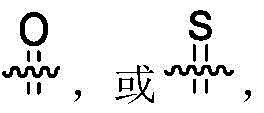 Wherein R isA、RBAnd RCEach occurrence independently is a hydrogen atom, an alkyl, alkenyl, alkynyl, aryl, alkylaryl, arylalkyl, heteroalkyl, heteroaryl, or heterocycloalkyl, or RAAnd RBTogether with the atoms to which they are attached form a saturated or unsaturated carbocyclic ring, wherein the ring is optionally substituted, and wherein one or more ring atoms are optionally replaced by heteroatoms. In certain embodiments, when a moiety is optionally substituted with an optionally substituted heteroaryl, an optionally substituted heterocycloalkyl, or an optionally substituted saturated or unsaturated carbocyclic ring, the substituent on the optionally substituted heteroaryl, optionally substituted heterocycloalkyl, or optionally substituted saturated or unsaturated carbocyclic ring, if they are substituted, is not substituted with a substituent further optionally substituted with another substituent. In that In some embodiments, when a group described herein is optionally substituted, the substituent attached to the group is unsubstituted, unless otherwise specified.
As used herein, "acyl" refers to Wherein R isAIs alkyl, or optionally substituted alkyl. Also, as used herein, "optionally substituted acyl" means when R isAWhen optionally substituted.
As used herein, a "binding agent" refers to any molecule, such as a protein, that is capable of specifically binding to a given binding partner (e.g., an antigen).
As used herein, "linker" refers to a divalent, trivalent, or multivalent moiety that covalently links the binding agent to one or more compounds described herein (e.g., the payload compound and the enhancer described herein).
As used herein, "amide synthesis conditions" refer to reaction conditions suitable to promote the formation of an amide, for example, by reacting a carboxylic acid, activated carboxylic acid, or acid halide with an amine. In some embodiments, "amide synthesis conditions" refer to reaction conditions suitable to promote formation of an amide bond between a carboxylic acid and an amine. In some of these embodiments, the carboxylic acid is first converted to an activated carboxylic acid prior to reacting the activated carboxylic acid with an amine to form an amide. Suitable conditions for effecting amide formation include, but are not limited to, those utilizing reagents to effect the reaction between the carboxylic acid and the amine, including, but not limited to, Dicyclohexylcarbodiimide (DCC), Diisopropylcarbodiimide (DIC), (benzotriazol-1-yloxy) tris (dimethylamino) phosphonium hexafluorophosphate (BOP), (benzotriazol-1-yloxy) trispyrrolidinylphosphonium hexafluorophosphate (PyBOP), (7-azobenzotriazol-1-yloxy) trispyrrolidinylphosphonium hexafluorophosphate (PyAOP), trispyrrolidinylphosphonium bromide hexafluorophosphate (PyBrOP), O- (benzotriazol-1-yl) -N, N, N ', N' -tetramethyluronium Hexafluorophosphate (HBTU), O- (benzotriazol-1-yl) -N, n, N ', N ' -tetramethyluronium hexafluoroborate (TBTU), 1- [ bis (dimethylamino) methylene ] -1H-1,2, 3-triazolo [4,5-b ] pyridinium 3-oxide Hexafluorophosphate (HATU), N-ethoxycarbonyl-2-ethoxy-1, 2-dihydroquinoline (EEDQ), N-ethyl-N ' - (3-dimethylaminopropyl) carbodiimide (EDC), 2-chloro-1, 3-dimethylimidazolium hexafluorophosphate (CIP), 2-chloro-4, 6-dimethoxy-1, 3, 5-triazine (CDMT), and Carbonyldiimidazole (CDI). In some embodiments, the carboxylic acid is first converted to an activated carboxylic acid ester, which is then treated with an amine to form an amide bond. In some embodiments, the carboxylic acid is treated with a reagent. The reagent activates the carboxylic acid by deprotonating the carboxylic acid, which then forms a product complex with the deprotonated carboxylic acid as a result of nucleophilic attack of the deprotonated carboxylic acid on the protonating reagent. For certain carboxylic acids, the activated carboxylic acid ester is more susceptible to nucleophilic attack by the amine than the carboxylic acid is to be converted to the activated ester. This results in the formation of amide bonds. Thus, the carboxylic acid is described as activated. Exemplary reagents include DCC and DIC.
"regioisomer" or "mixture of regioisomers" as used herein refers to a suitable azide (e.g., -N) resulting from treatment with a suitable alkyne compound3Or PEG-N3Derivatized antibody) or strain-promoted alkyne-azide cycloaddition (SPAAC) (also known as a click reaction) product. In certain embodiments, for example, the regioisomers and mixtures of regioisomers are characterized by the click reaction product shown below:


in certain embodiments, more than one suitable azide and more than one suitable alkyne can be used in a product-generating synthesis scheme, where each pair of azide-alkynes can participate in one or more independent click reactions to generate a mixture of regioisomeric click reaction products. For example, the skilled artisan will recognize that a first suitable azide can be independently reacted with a first suitable alkyne and a second suitable azide can be independently reacted with a second suitable alkyne en route to a product, thereby generating four possible click-reaction regioisomers or a mixture of the four possible click-reaction regioisomers in an ADC sample according to the invention. By way of further example, the skilled artisan will recognize that a first suitable azide may be independently reacted with a first suitable alkyne, and a second suitable azide may be independently reacted with a second suitable alkyne en route to a product, thereby generating four possible click-reaction regioisomers or a mixture of the four possible click-reaction regioisomers in the LP samples of the invention.
The term "residue" as used herein refers to the portion of a chemical group that remains after a chemical reaction in a compound. For example, the term "amino acid residue" or "N-alkyl amino acid residue" refers to the product of amide coupling or peptide coupling of an amino acid or N-alkyl amino acid with a suitable coupling partner; wherein, for example, water molecules are expelled after amide coupling or peptide coupling of amino acids or N-alkyl amino acids, thereby obtaining a product into which amino acid residues or N-alkyl amino acid residues are incorporated.
As used herein, a "therapeutically effective amount" refers to an amount (of a compound or payload) sufficient to provide a therapeutic benefit when a patient is treating or controlling a disease or condition, or delaying or minimizing one or more symptoms associated with a disease or condition.
Certain groups, molecules/group moieties, substituents, and atoms are described as having wavy lines intersecting bonds to indicate the atoms through which the groups, molecules/group moieties, substituents, atoms are attached. For example, a phenyl group substituted with a propyl group can be represented by:
has the following structure:


the phrase "reactive linker" or the abbreviation "RL" as used herein refers to a monovalent group comprising a reactive group and a spacer group, e.g. Wherein RG is the reactive group and SP is the spacer group. As described herein, a reactive linker may comprise more than one reactive group and more than one spacer group. The spacer group is any divalent moiety that bridges a reactive (reactive) group to another group (e.g., a payload). The active linkers (RL) together with the payload to which they are attached constitute intermediates ("linker-payloads") that can be used as synthetic precursors for the preparation of antibody conjugates of the invention. The reactive linker comprises a reactive group ("RG") that is capable of reacting with another group (e.g., an antibody)A modified antibody, or antigen binding fragment thereof, or an enhancing group). The moiety resulting from the reaction of the reactive group with the antibody, modified antibody or antigen-binding fragment thereof, together with the linking group, constitutes the "binder linker" ("BL") moiety of the conjugate of the invention. In certain embodiments, the "active group" is a functional group or moiety (e.g., maleimide or N-hydroxysuccinimide (NHS) ester) that reacts with a cysteine or lysine residue of the antibody or antigen-binding fragment thereof. In certain embodiments, the "reactive group" is a functional group or moiety capable of undergoing click chemistry reactions (see, e.g., click chemistry, Huisgen proc.chem.soc.1961, Wang et al.j.am.chem.soc.2003, and Agard et al.j.am.chem.soc.2004). In some embodiments of the click chemistry reaction, the reactive group is an alkyne capable of 1, 3-cycloaddition with an azide. Such suitable reactive groups include, but are not limited to, strained alkynes, such as those suitable for strain-promoted alkyne-azide cycloaddition (SPAAC), cycloalkynes, such as cyclooctynes, benzocycloated alkynes, and alkynes capable of 1, 3-cycloaddition reactions with alkynes in the absence of a copper catalyst. Suitable alkynes also include, but are not limited to, dibenzoazacyclooctyne or
  (DIBAC), dibenzocyclooctyne or
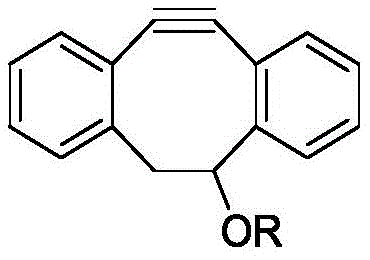 (DIBO), a diarylazacyclooctynone or
 (BARAC), difluorocyclooctyne or
 (DIFO), substituted alkynes such as fluorinated alkynes, nitrogen heterocyclic alkynes, bicyclo [6.1.0]Nonene or
 (BCN, where R is alkyl, alkoxy, or acyl), and derivatives thereof. Particularly useful alkynes include
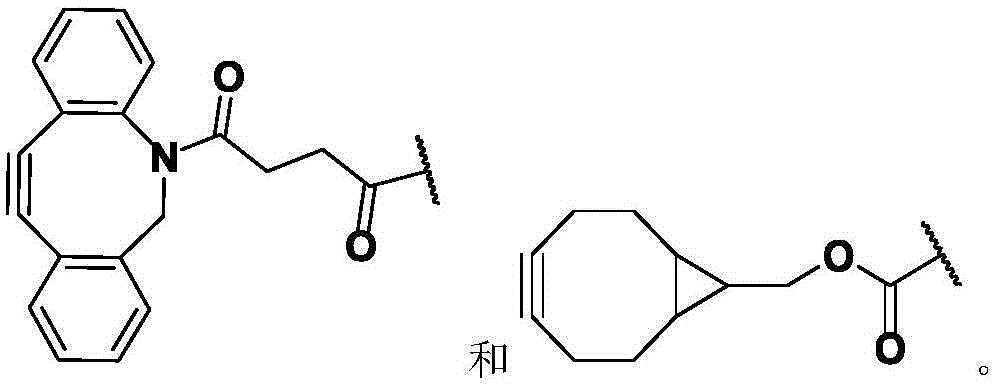 Linker-payloads comprising such reactive groups can be used to couple antibodies that have been functionalized with azido groups. Such functionalized antibodies include antibodies functionalized with azido-polyethylene glycol groups. In certain embodiments, such functionalized antibodies are derived by treating an antibody having at least one glutamine residue (e.g., heavy chain Gln295) with a compound bearing an amino group and an azido group in the presence of transglutaminase.
In some embodiments, the reactive group is an alkyne, e.g. Which can be coupled to azides by click chemistry (e.g.
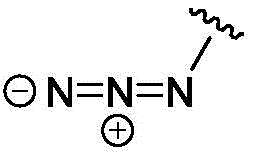 ) To form click chemistry products, e.g.
 In some embodiments, the group reacts with an azide on the modified antibody or antigen-binding fragment thereof. In some embodiments, the reactive group is an alkyne, e.g.
 Which can be coupled to azides by click chemistry (e.g.
 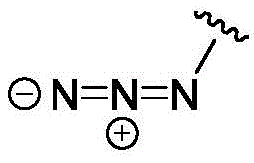 ) To form click chemistry products, e.g.
 In some embodiments, the reactive group is an alkyne, e.g.
 Which can be coupled to azides by click chemistry (e.g.
 ) To form click chemistry products, e.g.
 In some embodiments, the reactive group is a functional group, e.g.
 Which react with cysteine residues on the antibody or antigen-binding fragment thereof to form a bond therewith, e.g.
 Where Ab refers to an antibody or antigen-binding fragment thereof and S refers to the S atom of a cysteine residue through which the functional group binds to Ab. In some embodiments, the reactive group is a functional group, e.g.
 Which react with lysine residues on the antibody or antigen-binding fragment thereof to form a bond therewith, e.g.
 Wherein Ab refers to an antibody or antigen-binding fragment thereof and NH refers to the NH atom of a lysine side chain residue through which the functional group is bound to Ab.
The phrase "biodegradable moiety" as used herein refers to a moiety that degrades in vivo into a non-toxic, biocompatible component that can be removed from the body by common biological processes. In some embodiments, the biodegradable moiety is completely or substantially degraded in vivo in about 90 days or less, about 60 days or less, or about 30 days or less, wherein the degree of degradation is based on the percent mass loss of the biodegradable moiety, wherein complete degradation corresponds to 100% mass loss. Exemplary biodegradable moieties include, but are not limited to, aliphatic polyesters such as poly (. epsilon. -caprolactone) (PCL), poly (3-hydroxybutyrate) (PHB), poly (glycolic acid) (PGA), poly (lactic acid) (PLA) and copolymers thereof with glycolic acid (i.e., poly (D, L-lactide-co-glycolide) (PLGA) (Vert M, Schwach G, Engel R and Coudane J (1998) J Control Release 53(1-3): 85-92; Jain R A (2000) Biomaterials 21(23): 2475-.
The phrase "effective amount," "physiologically effective amount," or "prophylactically effective amount" as used herein refers to an amount of a compound sufficient to achieve a therapeutic effect when administered to a subject in need of such treatment. By "physiologically effective amount" of an active substance is meant an effective amount of the active substance that has a significant, externally observable effect on the patient. Thus, the physiologically effective amount affects one or more characteristics (e.g., phenotype) in the patient without the need for specialized equipment to determine the effect. For example, a physiologically effective amount of a compound disclosed herein has a significant, externally observable effect on the behavior of a patient by reducing one or more symptoms of the condition being treated. Thus, it can be determined whether an effective amount of active substance has been administered by observing the patient and observing whether the patient has changed due to the active substance.
The phrase "binding agent linker," or "BL," as used herein, refers to any divalent, trivalent, or multivalent group or moiety that links, binds, or bonds a binding agent (e.g., an antibody or antigen-binding fragment thereof) to a payload compound (e.g., a bis-octahydrophenanthrenecarboxamide compound) described herein, and optionally to one or more side chain compounds. In general, suitable binding agent linkers of the antibody conjugates described herein are those that are sufficiently stable to take advantage of the circulating half-life of the antibody, and at the same time are capable of releasing their payload following antigen-mediated internalization of the conjugate. The linker may be cleavable or non-cleavable. A cleavable linker is one that is cleaved by intracellular metabolism after internalization, e.g., by hydrolysis, reduction, or enzymatic reaction. A non-cleavable linker is one that releases the attached payload by lysosomal degradation of the antibody upon internalization. Suitable linkers include, but are not limited to, acid-labile linkers, hydrolytically labile linkers, enzymatically cleavable linkers, reductively labile linkers, self-degradable (self-immolative) linkers, and non-cleavable linkers. Suitable linkers also include, but are not limited to, those that are or comprise peptides, glucosides, succinimide-thioethers, polyethylene glycol (PEG) units, hydrazones, maleimide (mal) -hexanoyl units, dipeptide units, valine-citrulline units, and p-aminobenzyl (PAB) units. In some embodiments, the binding agent linker (BL) comprises a moiety formed by reaction of an active group (RG) of an active linker (RL) with an active portion of a binding agent (e.g., an antibody, a modified antibody, or an antigen-binding fragment thereof).
In some embodiments, the BL comprises the following moiety: or said triazolyl regioisomer, wherein
 Is a bond to the binding agent. In some embodiments, the BL comprises the following moiety:
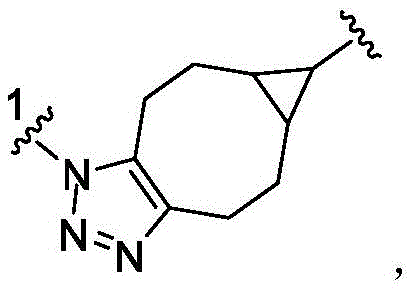 wherein
 Is a bond to the binding agent. In some embodiments, the BL comprises the following moiety:
 or said triazolyl regioisomer, wherein
 Is a bond to the binding agent. In some embodiments, the BL comprises the following moiety:
 wherein
 Is a bond to the cysteine of the antibody or antigen-binding fragment thereof. In some embodiments, the BL comprises the following moiety:
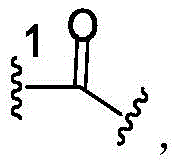 wherein
 Is a bond to the lysine of the antibody or antigen-binding fragment thereof.
Compounds or payloads
In some embodiments, the present invention provides compounds having the structure shown in formula (I):

or a pharmaceutically acceptable salt, solvate, or stereoisomer form thereof, wherein,
Q1and Q2Each independently is-CH2-, -C (O) -, -C (H) (OH) -, or-C (OH)2–;
W is-CH2-, -N (H) -, or-O-;
R1is-N (H) R4or-N (R)5)2;
R2is-N (H) R4;
Each R4In each case independently of one another H, an amino acid residue, an N-alkyl amino acid residue, a peptide residue, a biodegradable moiety Alkyl, substituted alkyl, acyl, or substituted acyl;
R5is alkyl, aryl, arylalkyl, heterocycloalkyl, or substituted heterocycloalkyl, wherein each heterocycloalkyl or substituted heterocycloalkyl contains 1, 2, or 3 heteroatoms selected from N and O, respectively, and when substituted contains at least one-OH and-CH2OH, or at least one primary or secondary nitrogen; and
each R6Each independently is halogen, C1-6Alkyl radical, C1-6Alkoxy, -CN, O-glucose, O-amino acid residue, or O-PEGn1Wherein each n is an integer from 0 to 14, and each n1 is an integer from 1 to 12.
In one embodiment of formula I, Q1is-CH2–,Q2is-C (O) -, and W is-CH2-. In one embodiment of formula I, Q1is-CH2–,Q2is-C (O) -, and W is-O-. In one embodiment of formula I, Q1is-CH2–,Q2is-C (O) -, and W is-NH-. In any of the embodiments in this paragraph, R1is-N (H) R4or-N (R)5)2And R2is-N (H) R4. In any of the embodiments in this paragraph, R1is-N (H) R4And R2is-N (H) R4. In any of the embodiments in this paragraph, R1is-N (R)5)2And R2is-N (H) R4. In any of the embodiments in this paragraph, each R 4In each case independently H, an amino acid residue, an N-alkyl amino acid residue, a peptide residue, a biodegradable moiety, an alkyl group, a substituted alkyl group, an acyl group, or a substituted acyl group. In any of the embodiments in this paragraph, each R4In each case independently of the others, H, an amino acid residue, an N-alkyl amino acid residue, a peptide residue, a biodegradable moiety, or an alkyl group. In any of the embodiments in this paragraph, each R4Are each H. In any of the embodiments in this paragraph, each R4In each case independently of one anotherAre amino acid residues. In any of the embodiments in this paragraph, each R4In each case independently of one another, is an N-alkyl amino acid residue. In any of the embodiments in this paragraph, each R4In each case independently a peptide residue. In any of the embodiments in this paragraph, each R4In each case independently of one another, a biodegradable moiety. In any of the embodiments in this paragraph, each R4In each case independently of one another is an alkyl radical. In any of the embodiments in this paragraph, each R4In each case independently of the others, a substituted alkyl group. In any of the embodiments in this paragraph, each R 4In each case independently an acyl group. In any of the embodiments in this paragraph, each R4In each case independently a substituted acyl group. In any of the embodiments in this paragraph, one R4Is H, and another R4Is an amino acid residue. In any of the embodiments in this paragraph, one R4Is H, and another R4Is a peptide residue. In any of the embodiments in this paragraph, one R4Is H, and another R4Is a substituted alkyl group. In any of the embodiments in this paragraph, one R4Is H, and another R4Is an acyl group. In any of the embodiments in this paragraph, one R4Is H, and another R4Is a substituted acyl group. In any of the embodiments in this paragraph, R5Is alkyl, aryl, arylalkyl, heterocycloalkyl, or substituted heterocycloalkyl, wherein each heterocycloalkyl or substituted heterocycloalkyl contains 1, 2, or 3 heteroatoms selected from N and O, respectively, and when substituted contains at least one-OH and-CH2OH, or at least one primary or secondary nitrogen. In any of the embodiments in this paragraph, R5Is an alkyl group. In any of the embodiments in this paragraph, R5Is an aryl group. In any of the embodiments in this paragraph, R5Is an arylalkyl group. In any of the embodiments in this paragraph, R 5Is a heterocycloalkyl group. In any of the embodiments in this paragraph, R5Is a substituted heterocycloalkyl group. In any of the embodiments in this paragraph, R5Is heterocycloalkyl, and heterocycloalkyl bagContaining 1 heteroatom selected from N and O. In any of the embodiments in this paragraph, R5Is heterocycloalkyl, and heterocycloalkyl contains 1N atom. In any of the embodiments in this paragraph, R5Is heterocycloalkyl, and heterocycloalkyl contains 1O atom. In any of the embodiments in this paragraph, R5Is heterocycloalkyl, and heterocycloalkyl contains 2 heteroatoms selected from N and O. In any of the embodiments in this paragraph, R5Is heterocycloalkyl, and heterocycloalkyl contains 2N atoms. In any of the embodiments in this paragraph, R5Is heterocycloalkyl, and heterocycloalkyl contains 2O atoms. In any of the embodiments in this paragraph, R5Is heterocycloalkyl, and heterocycloalkyl contains 1N atom and 1O atom. In any of the embodiments in this paragraph, R5Is heterocycloalkyl, and heterocycloalkyl contains 3 heteroatoms selected from N and O. In any of the embodiments in this paragraph, R5Is heterocycloalkyl, and heterocycloalkyl contains 3N atoms. In any of the embodiments in this paragraph, R5Is heterocycloalkyl, and heterocycloalkyl contains 2N atoms and 1O atom. In any of the embodiments in this paragraph, R 5Is a substituted heterocycloalkyl group and contains 1 heteroatom selected from N and O. In any of the embodiments in this paragraph, R5Is a substituted heterocycloalkyl group and contains 1N atom. In any of the embodiments in this paragraph, R5Is a substituted heterocycloalkyl group and contains 1O atom. In any of the embodiments in this paragraph, R5Is a substituted heterocycloalkyl group and contains 2 heteroatoms selected from N and O. In any of the embodiments in this paragraph, R5Is a substituted heterocycloalkyl group and contains 2N atoms. In any of the embodiments in this paragraph, R5Is a substituted heterocycloalkyl group and contains 2O atoms. In any of the embodiments in this paragraph, R5Is a substituted heterocycloalkyl group and contains 1N atom and 1O atom. In any of the embodiments in this paragraph, R5Is a substituted heterocycloalkyl group and contains 3 heteroatoms selected from N and O. In any of the embodiments in this paragraph, R5Is a substituted heterocycloalkyl group and contains 3N atoms. In any of the embodiments in this paragraph, R5Is a substituted heterocycloalkyl group and contains 2N atoms and 1O atom. In thatIn any of the embodiments in this paragraph, R5Is a substituted heterocycloalkyl group and contains 1 heteroatom selected from N and O, as defined above, and at least one of-OH and-CH 2And (5) OH. In any of the embodiments in this paragraph, R5Is a substituted heterocycloalkyl group and contains 2 heteroatoms selected from N and O, as defined above, and at least one of-OH and-CH2And (5) OH. In any of the embodiments in this paragraph, R5Is a substituted heterocycloalkyl group and contains 3 heteroatoms selected from N and O, as defined above, and at least one of-OH and-CH2And (5) OH. In any of the embodiments in this paragraph, R5Is a substituted heterocycloalkyl group and contains 1 heteroatom selected from N and O, as described above, and contains at least one primary nitrogen. In any of the embodiments in this paragraph, R5Is a substituted heterocycloalkyl group and contains 2 heteroatoms selected from N and O, as described above, and at least one primary nitrogen. In any of the embodiments in this paragraph, R5Is a substituted heterocycloalkyl group and contains 3 heteroatoms selected from N and O, as described above, and at least one primary nitrogen. In any of the embodiments in this paragraph, R5Is a substituted heterocycloalkyl group and contains 1 heteroatom selected from N and O, as described above, and contains at least one secondary nitrogen. In any of the embodiments in this paragraph, R5Is a substituted heterocycloalkyl group and contains 2 heteroatoms selected from N and O, as described above, and at least one secondary nitrogen. In any of the embodiments in this paragraph, R 5Is a substituted heterocycloalkyl group and contains 3 heteroatoms selected from N and O, as described above, and at least one secondary nitrogen. In any of the embodiments in this paragraph, each R6Each independently is halogen, C1-6Alkyl radical, C1-6Alkoxy, -CN, O-glucose, O-amino acid residue, or O-PEGn1Wherein each n is an integer from 0 to 14, and each n1 is an integer from 1 to 12. In any of the embodiments in this paragraph, each R6Each independently is a halogen. In any of the embodiments in this paragraph, each R6Are each independently C1-6An alkyl group. In any of the embodiments in this paragraph, each R6Are each independently C1-6An alkoxy group. In any of the embodiments in this paragraphEach R6Are respectively-CN. In any of the embodiments in this paragraph, each R6Are each independently O-glucose. In any of the embodiments in this paragraph, each R6Are each independently an O-amino acid residue. In any of the embodiments in this paragraph, each R6Are each independently O-PEGn1Wherein each n1 is an integer from 1 to 12. In any of the embodiments in this paragraph, each R6Are each independently O-PEGn1Wherein each n1 is 1. In any of the embodiments in this paragraph, each R6Are each independently O-PEGn1Wherein each n1 is 2. In any of the embodiments in this paragraph, each R 6Are each independently O-PEGn1Wherein each n1 is 3. In any of the embodiments in this paragraph, each R6Are each independently O-PEGn1Wherein each n1 is 4. In any of the embodiments in this paragraph, each R6Are each independently O-PEGn1Wherein each n1 is 5. In any of the embodiments in this paragraph, each R6Are each independently O-PEGn1Wherein each n1 is 6. In any of the embodiments in this paragraph, each R6Are each independently O-PEGn1Wherein each n1 is 7. In any of the embodiments in this paragraph, each R6Are each independently O-PEGn1Wherein each n1 is 8. In any of the embodiments in this paragraph, each R6Are each independently O-PEGn1Wherein each n1 is 9. In any of the embodiments in this paragraph, each R6Are each independently O-PEGn1Wherein each n1 is 10. In any of the embodiments in this paragraph, each R6Are each independently O-PEGn1Wherein each n1 is 11. In any of the embodiments in this paragraph, each R6Are each independently O-PEGn1Wherein each n1 is 12. In any of the embodiments in this paragraph, each R6Each independently is halogen, C1-6Alkyl radical, C1-6Alkoxy, -CN, O-glucose, O-amino acid residue, or O-PEG n1Wherein each n is an integer from 0 to 14, and each n1 is an integer from 1 to 12, respectively, and any combination thereof. For example, in one embodimentOne R6Is halogen, and another R6Is C1-6An alkyl group. As will be understood by those skilled in the art, other exemplary Rs have been considered6A combination of embodiments. In any of the embodiments in this paragraph, suitable amino acids as amino acid residues or in combination as peptide residues include alanine, isoleucine, leucine, methionine, phenylalanine, tryptophan, tyrosine, valine, serine, threonine, asparagine, glutamine, cysteine, selenocysteine, glycine, proline, arginine, histidine, lysine, aspartic acid and glutamic acid, and any combination thereof as peptide residues, as understood by one of skill in the art. Those skilled in the art will recognize that amino acid residues may be achiral or chiral, e.g., L-amino acid residues or D-amino acid residues. One skilled in the art will recognize that peptide residues may be achiral or chiral, e.g., including racemic DL-amino acids or non-racemic D-or L-amino acids and diastereomeric mixtures thereof. In any of the embodiments in this paragraph, suitable arylalkyl group moieties include benzyl, phenethyl, phenylpropyl, α -methylbenzyl, and each stereoisomer thereof, and 2-phenylpropyl, and each stereoisomer thereof. In any of the embodiments in this paragraph, the arylalkyl group is benzyl. In any of the embodiments in this paragraph, the arylalkyl group is phenethyl. In any of the embodiments in this paragraph, the arylalkyl group is phenylpropyl. In any of the embodiments in this paragraph, the arylalkyl group is α -methylbenzyl and each stereoisomer thereof. In any of the embodiments in this paragraph, the arylalkyl group is (R) - α -methylbenzyl. In any of the embodiments in this paragraph, the arylalkyl group is (S) - α -methylbenzyl. In any of the embodiments in this paragraph, the arylalkyl group is 2-phenylpropyl (i.e., CH) 3CH(Ph)CH2-) and each of its stereoisomers. In any of the embodiments in this paragraph, the arylalkyl group is (R) -2-phenylpropyl. In any of the embodiments in this paragraph, the arylalkyl group is (S) -2-phenylpropyl. In any of the embodiments in this paragraph, the halogen is selected from the group consisting of F, Cl, Br, and I. In any of the embodiments in this paragraph, the halogen is F. In any of the embodiments in this paragraph, halogen is Cl. In any of the embodiments in this paragraph, the halogen is Br. In any of the embodiments in this paragraph, the halogen is I. In any of the embodiments in this paragraph, C1-6The alkyl group is selected from the group consisting of: methyl, ethyl, propyl, butyl, pentyl and hexyl, and their structural isomers. In any of the embodiments in this paragraph, C1-6Alkyl is methyl or-CH3. In any of the embodiments in this paragraph, C1-6Alkyl is ethyl or-CH2CH3. In any of the embodiments in this paragraph, C1-6Alkyl is propyl or a structural isomer thereof. In any of the embodiments in this paragraph, C1-6Alkyl is butyl or its structural isomer. In any of the embodiments in this paragraph, C1-6Alkyl is pentyl or a structural isomer thereof. In any of the embodiments in this paragraph, C1-6Alkyl is hexyl or its structural isomer. In any of the embodiments in this paragraph, C 1-6Alkoxy is selected from the group consisting of: methoxy, ethoxy, propoxy, butoxy, pentoxy and hexoxy, and structural isomers thereof. In any of the embodiments in this paragraph, C1-6Alkoxy is methoxy or-OCH3. In any of the embodiments in this paragraph, C1-6Alkoxy is ethoxy or-OCH2CH3. In any of the embodiments in this paragraph, C1-6Alkoxy is propoxy or its structural isomer. In any of the embodiments in this paragraph, C1-6Alkoxy is butoxy or a structural isomer thereof. In any of the embodiments in this paragraph, C1-6Alkoxy is pentyloxy or a structural isomer thereof. In any of the embodiments in this paragraph, C1-6Alkoxy is hexyloxy or a structural isomer thereof.
In one embodiment of formula I, Q1is-C (H), (OH) -, Q2is-C (O) -, and W is-CH2-. In one embodiment of formula I, Q1is-C (H), (OH) -, Q2is-C (O) -, and W is-O-. In one embodiment of formula I, Q1is-C (H), (OH) -, Q2is-C (O) -, and W is-NH-. In any of the embodiments in this paragraph, R1、R2、R4、R5And R6Are as described above in the context of formula I.
In one embodiment of formula I, Q1is-C (O) -, Q 2is-C (O) -, and W is-CH2-. In one embodiment of formula I, Q1is-C (O) -, Q2is-C (O) -, and W is-O-. In one embodiment of formula I, Q1is-C (O) -, Q2is-C (O) -, and W is-NH-. In any of the embodiments in this paragraph, R1、R2、R4、R5And R6Are as described above in the context of formula I.
In one embodiment of formula I, Q1is-C (O) -, Q2is-CH2-, and W is-CH2-. In one embodiment of formula I, Q1is-C (O) -, Q2is-CH2-, and W is-O-. In one embodiment of formula I, Q1is-C (O) -, Q2is-CH2-, and W is-NH-. In any of the embodiments in this paragraph, R1、R2、R4、R5And R6Are as described above in the context of formula I.
In one embodiment of formula I, Q1is-C (O) -, Q2is-C (H), (OH) -, and W is-CH2-. In one embodiment of formula I, Q1is-C (O) -, Q2is-C (H), (OH) -, and W is-O-. In one embodiment of formula I, Q1is-C (O) -, Q2is-C (H), (OH) -, and W is-NH-. In any of the embodiments in this paragraph, R1、R2、R4、R5And R6Are as described above in the context of formula I.
In some embodiments, the present invention provides a compound or payload having a structure represented by formula (II):

Or a pharmaceutically acceptable salt, solvate, or stereoisomer form thereof. In any of the embodiments in this paragraph, R1、R2、R4、R5And R6Are as described above in the context of formula I.
In some embodiments, the present invention provides a compound or payload having a structure represented by formula (III):

or a pharmaceutically acceptable salt, solvate, or stereoisomer form thereof. In any of the embodiments in this paragraph, R1、R2、R4、R5And R6Are as described above in the context of formula I.
In some embodiments, the present invention provides a compound or payload of formula I, II, or III, wherein R1is-N (H) R4. In some embodiments, the present invention provides a compound or payload of formula I, II, or III, wherein R1is-N (R)5)2. In any of the embodiments in this paragraph, R2、R4、R5And R6Are as described above in the context of formula I.
In some embodiments, the present invention provides a compound or payload of formula I, II, or III, wherein R1is-NH2(ii) a And R4Is an amino acid residue, an N-alkyl amino acid residue, a peptide residue, a biodegradable moiety, an alkyl group, a substituted alkyl group, an acyl group, or a substituted acyl group. In one embodiment, the invention provides a compound or payload of formula I, II, or III, wherein R 1is-NH2(ii) a And R4Is an amino acid residue. In one embodiment, the invention provides a compound or payload of formula I, II, or III, wherein R1is-NH2(ii) a And R4Is an N-alkyl amino acid residue. In one embodiment, the present invention providesA compound or payload of formula I, II, or III, wherein R1is-NH2(ii) a And R4Is a peptide residue. In one embodiment, the invention provides a compound or payload of formula I, II, or III, wherein R1is-NH2(ii) a And R4Is a biodegradable moiety. In one embodiment, the invention provides a compound or payload of formula I, II, or III, wherein R1is-NH2(ii) a And R4Is an alkyl group. In one embodiment, the invention provides a compound or payload of formula I, II, or III, wherein R1is-NH2(ii) a And R4Is a substituted alkyl group. In one embodiment, the invention provides a compound or payload of formula I, II, or III, wherein R1is-NH2(ii) a And R4Is an acyl group. In one embodiment, the invention provides a compound or payload of formula I, II, or III, wherein R1is-NH2(ii) a And R4Is a substituted acyl group. In any embodiment of this paragraph, suitable amino acid residues are as described above in the context of formula I. In any embodiment of this paragraph, suitable peptide residues are as described above in the context of formula I. In one embodiment, the invention provides a compound or payload wherein R is 1is-NH2(ii) a And R4Is an amino acid residue, and the amino acid residue is selected from the group consisting of: alanine, isoleucine, leucine, methionine, phenylalanine, tryptophan, tyrosine, valine, serine, threonine, asparagine, glutamine, cysteine, selenocysteine, glycine, proline, arginine, histidine, lysine, aspartic acid, and glutamic acid. In one embodiment, the invention provides a compound or payload wherein R is1is-NH2(ii) a And R4Is a peptide residue, wherein the peptide residue comprises an amino acid residue selected from the group consisting of: alanine, isoleucine, leucine, methionine, phenylalanine, tryptophan, tyrosine, valine, serine, threonine, asparagine, glutamine, cysteineSelenocysteine, glycine, proline, arginine, histidine, lysine, aspartic acid, and glutamic acid. In any of the embodiments in this paragraph, R6As described above in the context of formula I.
In some embodiments, the invention provides a compound or payload, wherein R is1And R2Are each-N (H) R4. In one embodiment, the invention provides a compound or payload wherein R is 1And R2Are each-N (H) R4And R4In each case independently of one another, an amino acid residue; and the amino acid residue is selected from the group consisting of: alanine, isoleucine, leucine, methionine, phenylalanine, tryptophan, tyrosine, valine, serine, threonine, asparagine, glutamine, cysteine, selenocysteine, glycine, proline, arginine, histidine, lysine, aspartic acid, and glutamic acid.
In certain embodiments, the present invention provides a compound or payload selected from the group consisting of:


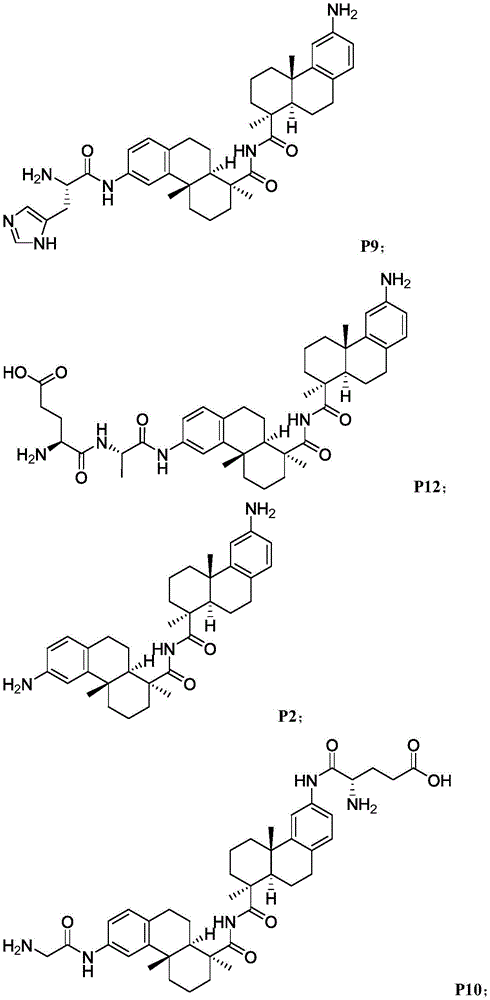

a pharmaceutically acceptable salt, or solvate thereof.
In one embodiment, the present invention provides a compound having the structure:

The present invention also provides a compound or payload selected from the group consisting of:
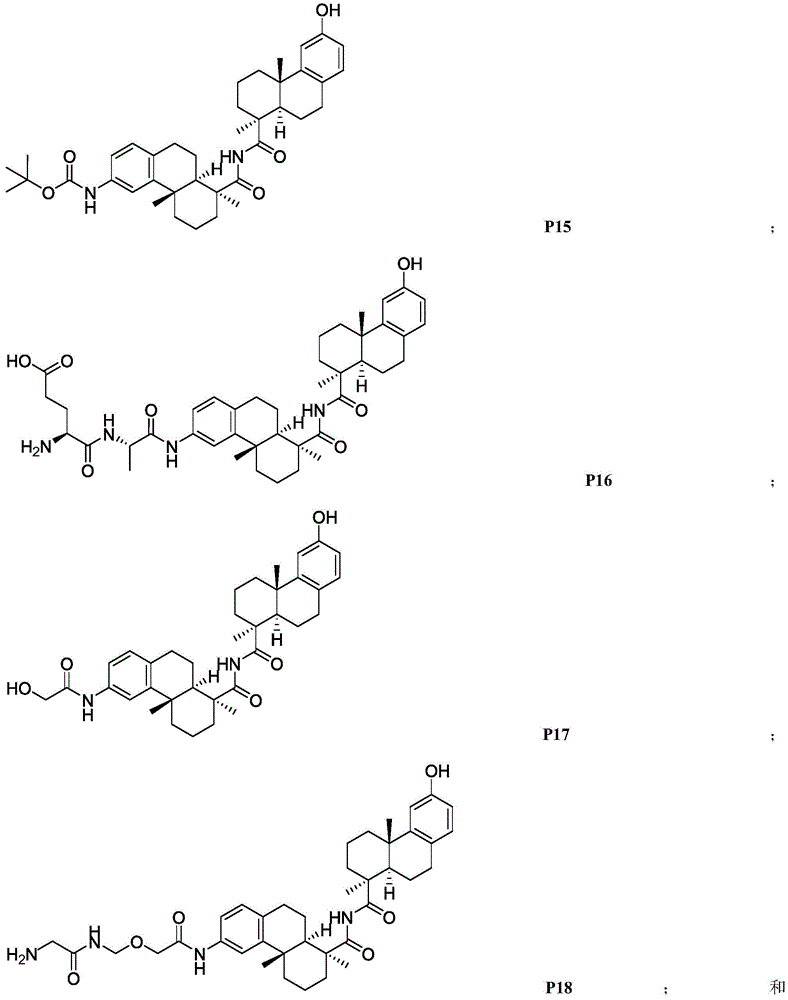

binding agents
Suitable binding agents for any of the conjugates provided herein include, but are not limited to, antibodies, lymphokines, hormones, growth factors, viral receptors, interleukins, or any other cell-or peptide-binding molecule or species.
In some embodiments, the binding agent is an antibody or antigen-binding fragment thereof. The antibody may be in any form known to those skilled in the art. The term "antibody" as used herein refers to any antigen binding molecule or molecular complex comprising at least one Complementarity Determining Region (CDR) that specifically binds to or interacts with a particular antigen. The term "antibody" includes immunoglobulin molecules comprising four polypeptide chains, two heavy (H) chains and two light (L) chains interconnected by disulfide bonds, as well as multimers thereof (e.g., IgM). Each heavy chain comprises a heavy chain variable region (abbreviated herein as HCVR or V)H) And a heavy chain constant region. The heavy chain constant region comprises three domains, C H1、C H2 and C H3. Each light chain comprises a light chain variable region (abbreviated as LCVR or V herein)L) And a light chain constant region. The light chain constant region comprises a domain (C)L1). The V isHRegion and VLThe regions may be further subdivided into regions of hypervariability, termed Complementarity Determining Regions (CDRs), interspersed with regions that are more conserved, termed boxesFramework Region (FR). Each VHAnd VLEach consisting of three CDRs and four FRs, arranged from amino-terminus to carboxy-terminus in the following order: FR1, CDR1, FR2, CDR2, FR3, CDR3, FR 4. In various embodiments of the invention, the FR of the antibody (or antigen-binding portion thereof) suitable for use in a compound or payload of the invention may be identical to a human germline sequence, or may be naturally occurring, or artificially modified. Amino acid consensus sequences can be defined based on a side-by-side analysis of two or more CDRs. The term "antibody" as used herein also includes antigen-binding fragments of intact antibody molecules. The term "antigen-binding portion" of an antibody, "antigen-binding fragment" of an antibody, and the like, as used herein includes any naturally occurring, enzymatically obtainable, synthetic, or genetically engineered polypeptide or glycoprotein that specifically binds an antigen to form a complex. Antigen-binding fragments of antibodies may be derived from intact antibody molecules, for example, using any suitable standard technique, e.g., proteolytic digestion or recombinant genetic engineering techniques involving manipulation and expression of DNA encoding antibody variable and optionally constant domains. Such DNA is known and/or readily obtained, for example, from commercial sources, DNA libraries (including, for example, phage-antibody libraries), or may be synthetically derived. DNA can be sequenced and manipulated chemically or by using molecular biology techniques, e.g., to arrange one or more variable and/or constant domains into the appropriate configuration, or to introduce codons, create cysteine residues, modify, add or delete amino acids, etc. Non-limiting examples of antigen-binding fragments include: (i) a Fab fragment; (ii) a F (ab')2 fragment; (iii) (ii) a fragment of Fd; (iv) (iv) an Fv fragment; (v) single chain fv (scFv) molecules; (vi) a dAb fragment; and (vii) a minimal recognition unit consisting of amino acid residues that mimic a hypervariable region of an antibody (e.g., an isolated Complementarity Determining Region (CDR), such as a CDR3 peptide) or a constrained FR3-CDR3-FR4 peptide. Other engineered molecules, such as domain-specific antibodies, single domain antibodies, domain-deleted antibodies, chimeric antibodies, CDR-grafted antibodies, diabodies, triabodies, tetrabodies, minibodies, nanobodies (e.g., monovalent nanobodies, divalent nanobodies, etc.), Both Small Modular Immunopharmaceutical (SMIP) and shark variable IgNAR domains are also encompassed within the expression "antigen-binding fragment" as used herein. Antigen-binding fragments of antibodies typically comprise at least one variable domain. The variable domain may be of any size or amino acid composition, and typically comprises at least one CDR that is adjacent to or in-frame with one or more framework sequences. In a region having a sum of VLDomain-related VHIn an antigen-binding fragment of a domain, the VHAnd VLThe domains may be positioned relative to each other in any suitable arrangement. For example, the variable region may be dimeric and contain VH-VH、VH-VLOr VL-VLA dimer. Alternatively, the antigen-binding fragment of the antibody may comprise a monomeric VHOr VLA domain. In certain embodiments, an antigen-binding fragment of an antibody may comprise at least one variable domain covalently linked to at least one constant domain. Non-limiting exemplary configurations of variable and constant domains that can be found within antigen-binding fragments of the antibodies disclosed herein include: (i) vH-C H1;(ii)VH-C H2;(iii)VH-C H3;(iv)VH-CH1-C H2;(v)VH-CH1-CH2-C H3;(vi)VH-CH2-C H3;(vii)VH-CL;(viii)VL-C H1;(ix)VL-C H2;(x)VL-C H3;(xi)VL-CH1-C H2;(xii)VL-CH1-CH2-C H3;(xiii)VL-CH2-C H3; and (xiv) VL-CL. In any configuration of the variable and constant domains, including any of the exemplary configurations listed above, the variable and constant domains may be directly linked to each other or may be linked by a complete or partial hinge or linker region. The hinge region can be composed of at least 2 (e.g., 5, 10, 15, 20, 40, 60, or more) amino acids The amino acids result in flexible or semi-flexible linkages between adjacent variable and/or constant domains in a single polypeptide molecule. As with intact antibody molecules, antigen-binding fragments can be monospecific or multispecific (e.g., bispecific). Multispecific antigen-binding fragments of antibodies typically comprise at least two different variable domains, wherein each variable domain is capable of specifically binding to a separate antigen or to a different epitope on the same antigen. Any multispecific antibody format, including the exemplary bispecific antibody formats disclosed herein, can be adapted for use in the context of an antigen-binding fragment of an antibody of the invention using routine techniques available in the art. In certain embodiments of the invention, the antibody of the invention is a human antibody. The term "human antibody" as used herein is intended to include antibodies having variable and constant regions derived from human germline immunoglobulin sequences. The human antibodies of the invention can include amino acid residues not encoded by human germline immunoglobulin sequences (e.g., mutations introduced by random or site-specific mutagenesis in vitro or by somatic mutation in vivo), for example in the CDRs, particularly in CDR 3. However, the term "human antibody" as used herein is not intended to include antibodies in which CDR sequences derived from the germline of another mammalian species (e.g., a mouse) have been grafted onto human framework sequences. The term "human antibody" does not include naturally occurring molecules that normally exist in naturally occurring, unmodified organisms without modification or human intervention/manipulation. In some embodiments, the antibodies of the invention can be recombinant human antibodies. The term "recombinant human antibody" as used herein is intended to include all human antibodies that have been prepared, expressed, produced or isolated by recombinant means, such as antibodies expressed using recombinant expression vectors transfected into host cells (described further below); antibodies isolated from libraries of recombinant, combinatorial human antibodies (described further below); antibodies isolated from animals (e.g., mice) that are transgenic for human immunoglobulin genes (see, e.g., Taylor et al (1992) Nucl. acids Res.20: 6287-6295); or by any of the methods involving splicing of human immunoglobulin gene sequences to other DNA sequences Antibodies produced, expressed, produced or isolated by other methods. Such recombinant human antibodies have variable and constant regions derived from human germline immunoglobulin sequences. However, in certain embodiments, such recombinant human antibodies are subjected to in vitro mutagenesis (or, when animals with transgenic human Ig sequences are used, in vivo somatic mutagenesis) and thus the V of the recombinant antibodyHRegion and VLThe amino acid sequence of the region is derived from human germline VHAnd VLSequences related thereto, but may not naturally exist in the human antibody germline repertoire in vivo. Human antibodies can exist in two forms associated with hinge heterogeneity. In one form, the immunoglobulin molecule comprises a stable four-chain construct of about 150-160kDa, wherein the dimers are linked together by interchain heavy chain disulfide bonds. In the second form, the dimers are not linked by interchain disulfide bonds and form a molecule of about 75-80kDa, consisting of covalently coupled light and heavy chains (half-antibodies). Even after affinity purification, these forms are extremely difficult to isolate. The frequency of appearance of the second form in various intact IgG isotypes is due to, but not limited to, structural differences associated with the hinge region isotypes of antibodies. Single amino acid substitutions in the hinge region of the human IgG4 hinge can significantly reduce the appearance of the second form (acquired (1993) Molecular Immunology 30:105) to levels typically observed with the human IgG1 hinge. The present disclosure includes at the hinge region, C HRegion 2 or C H3, which may be desired, e.g., in production, to increase the yield of the desired antibody form. The antibody of the invention may be an isolated antibody. An "isolated antibody" as used herein refers to an antibody that has been identified and isolated and/or recovered from at least one component of its natural environment. For example, for the purposes of the present invention, an antibody that has been isolated or removed from at least one component of an organism or from a tissue or cell in which the antibody naturally occurs or is naturally produced is an "isolated antibody". Isolated antibodies also include in situ antibodies within recombinant cells. An isolated antibody is an antibody that has been subjected to at least one purification or isolation step. According to certain embodiments, the isolated antibody may be substantiallyWithout other cellular material and/or chemicals. The antibodies used in the invention may comprise one or more amino acid substitutions, insertions and/or deletions in the framework and/or CDR regions of the heavy and light chain variable domains as compared to the corresponding germline sequences from which the antibodies were derived. Such mutations can be readily determined by comparing the amino acid sequences disclosed herein to germline sequences available from, for example, public antibody sequence databases. The present invention includes antibodies and antigen-binding fragments thereof derived from any of the amino acid sequences disclosed herein, wherein one or more amino acids within one or more framework and/or CDR regions are mutated to the corresponding residue of the germline sequence from which the antibody is derived, or to the corresponding residue of another human germline sequence, or to conservative amino acid substitutions of the corresponding germline residue (such sequence changes are collectively referred to herein as "germline mutations"). One of ordinary skill in the art can generate a number of antibodies and antigen-binding fragments that contain one or more individual germline mutations or combinations thereof, starting from the heavy and light chain variable region sequences disclosed herein. In certain embodiments, V HAnd/or VLAll framework and/or CDR residues within the domain are mutated back to the residues found in the original germline sequence from which the antibody was derived. In other embodiments, only certain residues are mutated back to the original germline sequence, e.g., mutated residues found only within the first 8 amino acids of FR1 or within the last 8 amino acids of FR4, or mutated residues found only in CDR1, CDR2, or CDR 3. In other embodiments, one or more framework and/or CDR residues are mutated to the corresponding residues of a different germline sequence (i.e., a germline sequence that is different from the germline sequence from the antibody originally derived). Furthermore, the antibodies of the invention may comprise any combination of two or more germline mutations within the framework and/or CDR regions, e.g., wherein certain individual residues are mutated to the corresponding residues of a particular germline sequence, while certain other residues that differ from the original germline sequence remain or are mutated to the corresponding residues of a different germline sequence. Once obtained, antibodies and antigen-binding fragments containing one or more germline mutations can be readily tested for one or more desired properties, such as improved binding specificity, increased knobAvidity, improved or enhanced antagonistic or agonistic biological properties (as the case may be), reduced immunogenicity, and the like. Antibodies and antigen-binding fragments obtained in this general manner are included in the present invention. Antibodies useful in the compounds or payloads of the invention also include antibodies comprising variants of any of the HCVR, LCVR and/or CDR amino acid sequences disclosed herein with one or more conservative substitutions. The term "epitope" refers to an antigenic determinant that interacts with a specific antigen binding site, called a paratope, in the variable region of an antibody molecule. A single antigen may have more than one epitope. Thus, different antibodies may bind to different regions on an antigen and may have different biological effects. Epitopes can be conformational or linear. Conformational epitopes are produced by spatially juxtaposed amino acids of different segments of a linear polypeptide chain. Linear epitopes are produced by adjacent amino acid residues in a polypeptide chain. In certain embodiments, an epitope may include a carbohydrate, phosphoryl, or sulfonyl moiety on an antigen.
In certain embodiments, the antibody comprises a light chain. In certain embodiments, the light chain is a kappa light chain. In certain embodiments, the light chain is a lambda light chain. In certain embodiments, the antibody comprises a heavy chain. In some embodiments, the heavy chain is IgA. In some embodiments, the heavy chain is IgD. In some embodiments, the heavy chain is IgE. In some embodiments, the heavy chain is IgG. In some embodiments, the heavy chain is IgM. In some embodiments, the heavy chain is IgG 1. In some embodiments, the heavy chain is IgG 2. In some embodiments, the heavy chain is IgG 3. In some embodiments, the heavy chain is IgG 4. In some embodiments, the heavy chain is IgA 1. In some embodiments, the heavy chain is IgA 2.
In some embodiments, the antibody is an antibody fragment. In some embodiments, the antibody fragment is an Fv fragment. In some embodiments, the antibody fragment is a Fab fragment. In some embodiments, the antibody fragment is F (ab')2And (3) fragment. In some embodiments, the antibody fragment is a Fab' fragment. In some embodiments of the present invention, the substrate is,the antibody fragment is a scFv (sFv) fragment. In some embodiments, the antibody fragment is a scFv-Fc fragment.
In some embodiments, the antibody is a monoclonal antibody. In some embodiments, the antibody is a polyclonal antibody.
In some embodiments, the antibody is a chimeric antibody. In some embodiments, the antibody is a humanized antibody. In some embodiments, the antibody is a human antibody.
The antibody may have binding specificity for any antigen deemed suitable to one of skill in the art. In certain embodiments, the antigen is a transmembrane molecule (e.g., receptor) or growth factor. Exemplary antigens include, but are not limited to, molecules such as class A scavenger receptors (including scavenger receptor A (SR-A or MSR1)), macrophage receptors with collagen structure (MARCO), scavenger receptor with C-type lectins (SRCL), and molecules of scavenger receptor A-5(SCARA5), COLEC12, class B macrophage scavenger receptors (including CD36, LIMPII, SRBI, SRBII), class D scavenger receptor CD68, and lysosomal membrane glycoproteins (LAMP), class E scavenger receptors (including lectin-like oxidized low density lipoprotein receptor 1LOX-1 and Dectin-1), class F scavenger receptors (including endothelial cell-I (SREC-I) and SREC-II and various Epidermal Growth Factor (EGF) -like domains (MEGF)10 expressed scavenger receptors), CXG scavenger receptor class CXG 63C 16, molecules of class H scavenger receptors including Fasciclin (Fasciclin), EGF-like, lamin-type EGF-like and class I scavenger receptor 1(FEEL-1) and receptor 2(FEEL-2) containing linking domains, molecules of class I scavenger receptor CD163, and class J scavenger receptor for advanced glycation end products (RAGE), molecules of other C-type lectin superfamily members including DEC205, CD206, Dectin-2, Mincle, DC-SIGN and DNGR-1, and molecules of other membrane protein classes such as B7 family related members including V-set and Ig-containing domain 4(VSIG4), molecules of colony stimulating factor 1 receptor (CSF1R), molecules of asialoglycoprotein receptor (ASGPR), and molecules of amyloid β precursor-like protein 2 (APLP-2). In some embodiments, the antigen is PRLR or HER 2. In some embodiments, the antibody is an anti-PRLR antibody or an anti-HER 2 antibody. In some embodiments, the antibody is an anti-MSR 1 antibody. Exemplary anti-MSR 1 antibodies are described herein.
The binding agent linker can be linked to the binding agent (e.g., an antibody or antigen binding molecule) by attachment at a specific amino acid within the antibody or antigen binding molecule. Exemplary amino acid attachments that can be used in the context of this aspect of the invention include, for example, lysine (see, e.g., U.S. Pat. No. 5,208,020; U.S. Pat. No. 2010/0129314; Hollander et al, Bioconjugate chem.,2008,19: 358-361; WO 2005/089808; U.S. Pat. No. 5,714,586; U.S. Pat. No. 2013/0101546; and U.S. Pat. No. 2012/0585592); cysteine (see, e.g., US 2007/0258987; WO 2013/055993; WO 2013/055990; WO 2013/053873; WO 2013/053872; WO 2011/130598; US 2013/0101546; and US 7,750,116); selenocysteine (see, e.g., WO 2008/122039; and Hofer et al, Proc. Natl. Acad. Sci., USA,2008,105: 12451-; formylglycine (see, e.g., Carrico et al, nat. chem. biol.,2007,3: 321-; unnatural amino acids (see, e.g., WO 2013/068874, and WO 2012/166559), and acidic amino acids (see, e.g., WO 2012/05982). Linkers can also be coupled to antigen binding proteins by attachment to carbohydrates (see, e.g., US 2008/0305497, WO 2014/065661, and Ryan et al, Food & Agriculture immune, 2001,13: 127-.
In some embodiments, the binding agent is an antibody or antigen binding molecule, and the antibody is linked to the linker by a lysine residue. In some embodiments, the antibody or antigen binding molecule is linked to the linker through a cysteine residue.
Linkers can also be coupled to one or more glutamine residues by transglutaminase-based chemical enzyme coupling (see, e.g., Dennler et al, Bioconjugate chem.2014,25, 569-. For example, one or more glutamine residues of an antibody can be conjugated to a primary amine compound in the presence of transglutaminase. Briefly, in some embodiments, an antibody having glutamine residues (e.g., Gln295 residues) is treated with a primary amine compound in the presence of transglutaminase, as described in more detail below. Primary amine-based compounds include, for example, payloads or linker-payloads that directly provide antibody drug conjugates via transglutaminase-mediated conjugation. Primary amine based compounds also include linkers and spacer groups functionalized with reactive groups, which can then be treated with further compounds to synthesize antibody drug conjugates. Antibodies comprising glutamine residues can be isolated from natural sources or engineered to comprise one or more glutamine residues. Techniques for engineering glutamine residues into antibody polypeptide chains (glutaminyl-modified antibodies or antigen-binding molecules) are within the skill of those in the art. In certain embodiments, the antibody is aglycosylated.
In certain embodiments, the antibody comprises a glutamine residue at one or more heavy chain positions numbered 295 in the EU numbering system. In the present invention, this position is referred to as glutamine 295, or as Gln295, or as Q295. The skilled artisan will recognize that it is a conserved glutamine residue in the wild-type sequence of many antibodies. In other useful embodiments, the antibody can be designed to contain glutamine residues. Techniques for modifying antibody sequences to include glutamine residues are within the skill of those in the art (see, e.g., Ausubel et al current protocol.
In certain embodiments, the antibody or glutamine-modified antibody or antigen binding molecule comprises at least one glutamine residue in at least one polypeptide chain sequence. In certain embodiments, the antibody or glutamine-modified antibody or antigen binding molecule comprises two heavy chain polypeptides, each of which has one Gln295 residue. In further embodiments, the antibody or glutamine-modified antibody or antigen binding molecule comprises one or more glutamine residues at a site other than heavy chain 295. The invention includes antibodies of this section having the Asn297Gln (N297Q) mutation described herein. The invention includes antibodies of this section having Gln55(Q55) residues. As described herein, residue numbering is according to the EU numbering system.
Primary amine compound
In certain embodiments, the primary amine compound useful for transglutaminase-mediated coupling of an antibody (or antigen-binding compound) comprising glutamine can be any primary amine compound that the ordinarily skilled artisan would find useful. Typically, the primary amine compound has the formula H2N-R, wherein R can be any group compatible with the antibody and reaction conditions. In certain embodiments, R is alkyl, substituted alkyl, heteroalkyl, or substituted heteroalkyl.
In some embodiments, the primary amine compound comprises a reactive group or a protected reactive group. Useful reactive groups include azides, alkynes, cycloalkynes, thiols, alcohols, ketones, aldehydes, acids, esters, hydrazides, anilines, and amines. In certain embodiments, the reactive group is selected from the group consisting of azide, alkyne, thiol, cycloalkyne, aldehyde, and carboxyl.
In certain embodiments, the primary amine compound has the formula H2N-LL-X, wherein LL is a divalent spacer group and X is a reactive group or a protected reactive group. In a particular embodiment, LL is a divalent polyethylene glycol (PEG) group. In certain embodiments, X is selected from the group consisting of-SH, -N 3Alkyne, aldehyde and tetrazole. In a particular embodiment, X is-N3。
In certain embodiments, the primary amine compound has a structure according to one of the following general formulas:
H2N-(CH2)n-X;
H2N-(CH2CH2O)n-(CH2)p-X;
H2N-(CH2)n-N(H)C(O)-(CH2)m-X;
H2N-(CH2CH2O)n-N(H)C(O)-(CH2CH2O)m-(CH2)p-X;
H2N-(CH2)n-C(O)N(H)-(CH2)m-X;
H2N-(CH2CH2O)n-C(O)N(H)-(CH2CH2O)m-(CH2)p-X;
H2N-(CH2)n-N(H)C(O)-(CH2CH2O)m-(CH2)p-X;
H2N-(CH2CH2O)n-N(H)C(O)-(CH2)m-X;
H2N-(CH2)n-C(O)N(H)-(CH2CH2O)m-(CH2)p-X; and
H2N-(CH2CH2O)n-C(O)N(H)-(CH2)m-X;
wherein n is an integer selected from 1 to 12;
m is an integer selected from 0 to 12;
p is an integer selected from 0 to 2;
and X is selected from the group consisting of: -SH, -N3-C ≡ CH, -C (O) H, tetrazole, and one of:

in the above, any of the alkyl groups (i.e., -CH)2-) groups may each be optionally substituted by, for example, C1-8Alkyl, methyl formyl, or-SO3And H is substituted. In certain embodiments, the alkyl groups are both unsubstituted.
In certain embodiments, the primary amine compound is selected from the group consisting of:

in particular embodiments, the primary amine compound is:

exemplary conditions for the above reaction are provided in the following examples.
Connecting body
In certain embodiments, the linker L moiety of the conjugates of the invention is a moiety, such as a divalent moiety, that covalently links the binding agent to the payload compound of the invention. In other embodiments, linker L is a trivalent or multivalent moiety that covalently links the binding agent to the payload compound described herein. Suitable linkers can be found in, for example, Antibody-Drug Conjugates and Immunotoxins; phillips, g.l., ed.; springer Verlag, New York, 2013; Antibody-Drug Conjugates; ducry, l., ed; humana Press, 2013; Antibody-Drug Conjugates; wang, j., Shen, w. -c., and Zaro, j.l., eds.; springer International Publishing,2015, the contents of each of which are incorporated by reference in their entirety. Payload compounds include compounds of formulas I, II and III, above, as well as the residue thereof after attachment or conjugation to linker L, where the compound or combination of payload and linker L is linker-payload (LP). One skilled in the art will recognize that certain functional groups of the compound or payload moiety facilitate attachment to a linker and/or binding agent. These groups include amines, hydroxyls, phosphates and sugars.
In certain embodiments, the linker is stable under physiological conditions. In certain embodiments, the linker is cleavable, e.g., capable of releasing at least the compound or payload moiety in the presence of an enzyme or at a particular pH range or pH value. In some embodiments, the linker comprises an enzyme cleavable group moiety. Exemplary enzymatically cleavable moiety groups include, but are not limited to, peptide bonds, ester bonds, hydrazones, and disulfide bonds. In some embodiments, the linker comprises a cathepsin-cleavable linker.
In some embodiments, the linker comprises a non-cleavable group moiety. In some embodiments, the non-cleavable linker is derived from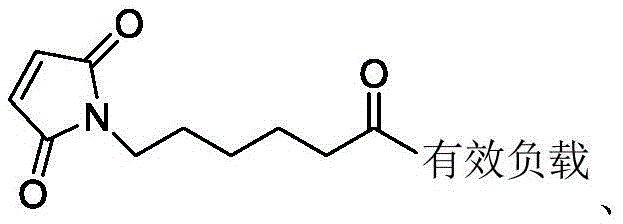 Or a residue thereof. In some embodiments, the non-cleavable linker-payload is
 Or a regioisomer thereof. In some embodiments, the non-cleavable linker is derived from
 Or a residue thereof. In some embodiments, the non-cleavable linker-payload is
 Or a regioisomer thereof. In one embodiment, the linker is maleimide cyclohexanecarboxylate or 4- (N-maleimidomethyl) cyclohexanecarboxylic acid (MCC). In the above-described structure, the first and second electrodes are formed on the substrate,
  Representing a bond to a binding agent. In the described structure, the first and second electrodes, in some embodiments,
 representing click chemistry residues resulting from, for example, the reaction of a binding agent and a linker payload.
In some embodiments, suitable linkers include, but are not limited to, those that chemically bond to two cysteine residues of a single binding agent (e.g., an antibody). Such linkers can be used to mimic the disulfide bond of the antibody that is disrupted by the coupling process.
In some embodiments, the linker comprises one or more amino acids. Suitable amino acids include natural, non-natural, standard, non-standard, proteinogenic, non-proteinogenic, and L-or D-form alpha-amino acids. In some embodiments, the linker comprises alanine, valine, glycine, leucine, isoleucine, methionine, tryptophan, phenylalanine, proline, serine, threonine, cysteine, tyrosine, asparagine, glutamine, aspartic acid, glutamic acid, lysine, arginine, histidine, or citrulline, or a derivative thereof, or a combination thereof. In certain embodiments, one or more side chains of the amino acid are attached to a side chain group as described below. In some embodiments, the linker comprises valine and citrulline. In some embodiments, the linker comprises lysine, valine, and citrulline. In some embodiments, the linker comprises lysine, valine, and alanine. In some embodiments, the linker comprises valine and alanine.
In some embodiments, the linker comprises a self-degrading (self-immolative) group. The self-degrading group may be any such group known to the skilled person. In a particular embodiment, the self-degrading group is p-aminobenzyl (PAB) or a derivative thereof. Useful derivatives include p-aminobenzyloxycarbonyl (PABC). One skilled in the art will recognize that the self-degrading group is capable of undergoing a chemical reaction that releases the remaining atoms of the linker from the payload.
In some embodiments, the linker is:

wherein:
SP1is a spacer group;
SP2is a spacer group;
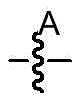

each AA is an amino acid; and
p1 is an integer from 0 to 10.
SP1The spacer group is a (AA)p1Moiety attached to a Binder (BA) or to a radical moiety attached to an active radical residue attached to BA. Suitable SP1Spacer groups include, but are not limited to, those containing alkylene groups or polyethers or both alkylene and polyethers. The end of the spacer group, e.g., the portion of the spacer group attached to the binding agent or AA, can be a moiety derived from a reactive group moiety used for the purpose of coupling the antibody or AA to the spacer group during chemical synthesis of the conjugate. In certain embodiments, p1 is 0, 1, 2, 3, or 4. In particular embodiments, p1 is 0. In a particular embodiment, p1 is 2. In a particular embodiment, p1 is 3. In particular embodiments, p1 is 4.
In some embodiments, SP1The spacer group comprises an alkylene group. In some embodiments, SP1The spacer group comprising C5-7An alkylene group. In some embodiments, SP1The spacer group comprises a polyether. In some embodiments, SP1The spacer group comprises a polymer of ethylene oxide, such as polyethylene glycol.
In some embodiments, SP1The spacer group is:

wherein:
RG' is the active group residue after the active group RG reacts with the binding agent;


b is an integer from 2 to 8; and
p1 is an integer from 0 to 4.
The reactive group RG can be any reactive group known to those skilled in the art that is capable of being linked to a binding agent to form one or more bonds. The reactive group RG is included in its structure that is capable of reacting with a binding agent (e.g., reacting with an antibody at a cysteine or lysine residue or an azide group portion of the antibody, e.g., with PEG-N at one or more glutamine residues3Functionalized antibody) to form a moiety of formula A, B, C, D, A ', B', C ', D', or a "of the moiety of the compound of formula A, B, C, D, A ', B', C ', D', or a". After coupling with the binding agent, the reactive group becomes a reactive group (RG') residue. Exemplary reactive groups include, but are not limited to, those comprising haloacetyl, isothiocyanate, succinimide, N-hydroxysuccinimide, or maleimide moieties capable of reacting with the binding agent.
In certain embodiments, reactive groups include, but are not limited to, alkynes. In certain embodiments, the alkyne is an alkyne that is capable of undergoing a 1, 3-cycloaddition reaction with an azide in the absence of a copper catalyst, such as a strained alkyne. Strained alkynes are those suitable for strain-promoted alkyne-azide cycloaddition (SPAAC), cycloalkynes, such as cyclooctynes, benzocycloated alkynes. Suitable alkynes also include, but are not limited to, dibenzoazacyclooctyne or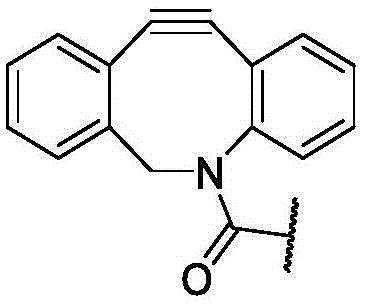 (DIBAC), dibenzocyclooctyne or
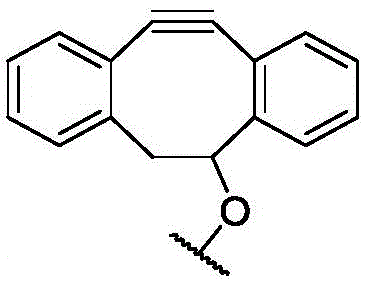 (DIBO), a diarylazacyclooctynone or
 (BARAC), difluorocyclooctyne or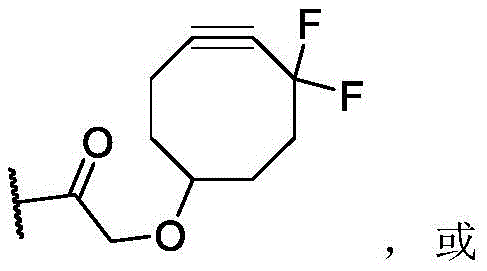
 (DIFO), substituted, e.g. fluorinated alkynes, aza-cycloalkynes, bicyclo [6.1.0]Nonene or
 (BCN), and derivatives thereof. Particularly useful alkynes include
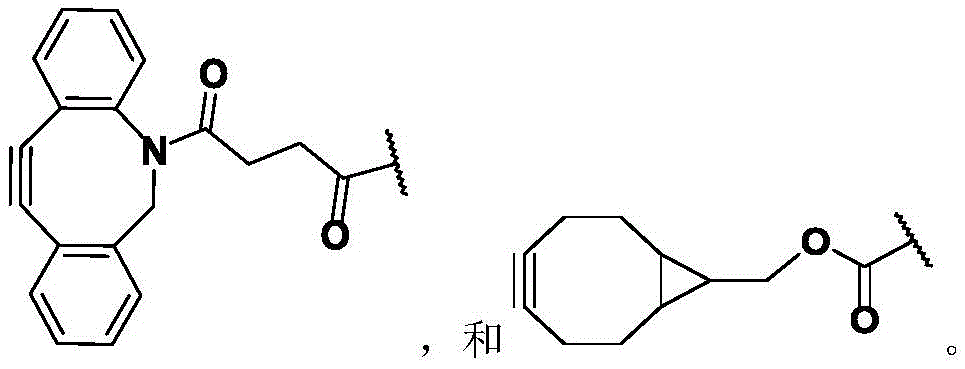
In certain embodiments, the binding agent is directly linked to RG'. In certain embodiments, the binding agent is through the following spacer group, e.g., SP4Is connected to RG'. In particular embodiments, the binding agent is attached to RG' via a PEG spacer group. As discussed in detail below, in certain embodiments, the binding agent is prepared by functionalization with one or more azide groups. Each azido group is individually capable of reacting with RG to form RG'. In particular embodiments, the binding agent employs-PEG-N linked to a glutamine residue 3And (4) derivation. The invention provides an exemplary-N3Derivatized binding agents, methods of making them, and methods of their use in reactions with RG. In certain embodiments, RG is an alkyne suitable for participating in a 1, 3-cycloaddition, and RG' is a 1,2, 3-triazolyl moiety formed by the reaction of RG with an azido-functionalized binder. As a further example, in certain embodiments RG' is linked to a binding agent, e.g. As shown, or a mixture of regioisomers. Each R and R' has the meaning described in the present application.
SP2The spacer group is a (AA)p1The moiety is attached to a payload moiety. Suitable spacer groups include, but are not limited to, the aboveDescribed as SP1Those of spacer groups. Other suitable SPs2Spacer groups include, but are not limited to, those comprising alkylene groups or polyethers or both alkylene and polyethers. SP2The end of the spacer group (e.g., the portion of the spacer group directly attached to the payload or AA) can be a moiety derived from a reactive group moiety used to link the payload or AA to the SP during chemical synthesis of the conjugate2The purpose of the spacer coupling. In some embodiments, SP2The end of the spacer group (e.g., SP directly attached to the payload or AA) 2Part of the spacer group) may be the residue of a reactive group moiety used for the purpose of coupling a payload or AA to the spacer group during chemical synthesis of the conjugate.
In some embodiments, SP2The spacer group is selected from the group consisting of-O-, -N (R)6')–、–R4'–、–R5'–、–OR5' -, and-OP (O) (OR)6') O-, wherein:
R4'is-Z' -Y-X-;
x is selected from the group consisting of-O-and-N (H) -;
y is selected from the group consisting of alkylene, substituted alkylene (including but not limited to oxo-substituted, i.e., ═ O), heteroalkylene, and substituted heteroalkylene;
z' is selected from the group consisting of-O-and-N (H) -;
R5' is a heterocycloalkylene group, or a substituted heterocycloalkylene group, wherein each heterocycloalkylene group or substituted heterocycloalkylene group contains 1, 2, or 3 heteroatoms selected from N and O, respectively, including groups selected from-O-, -N (H) -, and at least two radical moieties of the group for attachment to the remainder of the molecule; and
each R6' are each independently-H, an amino acid residue, a peptide, or an alkyl group.
In certain embodiments, SP2The spacer group is selected from the group consisting of:–O-,–N(H)–,

 in certain embodiments, each
 Respectively, a key connected to said payload, and each
  Are respectively and (AA)p1A linked key.
In the above formula, each AA is independently an amino acid, or optionally a p-aminobenzyloxycarbonyl residue (PABC), or Wherein c is 1, 2, 3, 4, 5, or 6. If a PABC is present, then preferably only one PABC is present. Preferably, if a PABC residue is present, then the linkage is to (AA)p1The terminal AA in the group is located proximal to the payload. If it is not
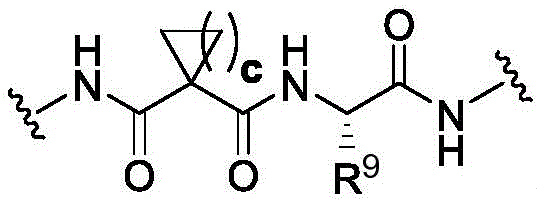 If present, then preferably c is 2. Preferably, if said
 Residue present and c is 2, then linked to (AA)p1The terminal AA in the group is located at the distal end of the payload. Suitable amino acids for each AA include natural, non-natural, standard, non-standard, proteinogenic, non-proteinogenic, and L-or D-form alpha-amino acids. In some embodiments, the linker AA comprises alanine, valine, leucine, isoleucine, methionine, tryptophan, phenylalanine, proline, serine, threonine, cysteine, tyrosine, lysine, arginine, or a combination thereof,Asparagine, glutamine, aspartic acid, glutamic acid, lysine, arginine, histidine, or citrulline, a derivative thereof, or a combination thereof. In certain embodiments, one or more side chains of the amino acid are attached to a side chain group as described below. In some embodiments, p1 is 0. In some embodiments, p1 is 2. In some embodiments, the (AA) p1Is valine-citrulline. In some embodiments, (AA)p1Is citrulline-valine. In some embodiments, (AA)p1Is valine-alanine. In some embodiments, (AA)p1Is alanine-valine. In some embodiments, (AA)p1Is valine-glycine. In some embodiments, (AA)p1Is glycine-valine. In some embodiments, p1 is 3. In some embodiments, (AA)p1Is valine-citrulline-PABC. In some embodiments, (AA)p1Is citrulline-valine-PABC. In some embodiments, the (AA)p1Is lysine-valine-citrulline-PABC. In some embodiments, (AA)p1Is glutamic acid-valine-citrulline. In some embodiments, (AA)p1Is glutamine-valine-citrulline. In some embodiments, (AA)p1Is lysine-valine-alanine. In some embodiments, (AA)p1Is lysine-valine-citrulline. In some embodiments, p1 is 4. In some embodiments, (AA)p1Is glutamic acid-valine-citrulline-PAB. In some embodiments, (AA)p1Is glutamine-valine-citrulline-PABC. The skilled artisan will recognize that PABC is the residue of a p-aminobenzyloxycarbonyl group having the following exemplary structure:

PABC residues have been shown to facilitate cleavage of certain linkers in vitro and in vivo.
In some embodiments, the linker is:


wherein:
each one of Each a bond to the binding agent;
each one of Each a key connected to the payload;
each R9Are respectively-CH3Or- (CH)2)3N(H)C(O)NH2(ii) a And
each A is independently-O-, -N (H) -,

 wherein ZZ is H, or a side chain of an amino acid, as discussed elsewhere herein. For example, in one embodiment ZZ is C1-6An alkyl group. As another example, in one embodiment ZZ is C1-6A heteroalkyl group. As discussed above, the bond to the binding agent may be direct or via a spacer. In certain embodiments, the bond attached to the binding agent is a glutamine residue attached to the binding agent via a PEG spacer group.
In some embodiments, the linker is:


wherein:
each one of Each a bond to the binding agent;
each one of Each a key connected to the payload;
each R9Are respectively-CH3、–CH(CH3)2Or is- (CH)2)3N(H)C(O)NH2;
q is an integer from 1 to 3; and
each A is independently-O-, -N (H) -,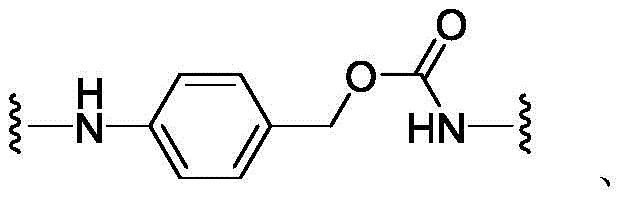


In some embodiments, the linker is:


each one of Each a bond to the binding agent;
each one of Each a key connected to the payload;
each R9Are respectively-CH3Or- (CH)2)3N(H)C(O)NH2(ii) a And
each A is independently-O-, -N (H) -,


In some embodiments, the linker is:
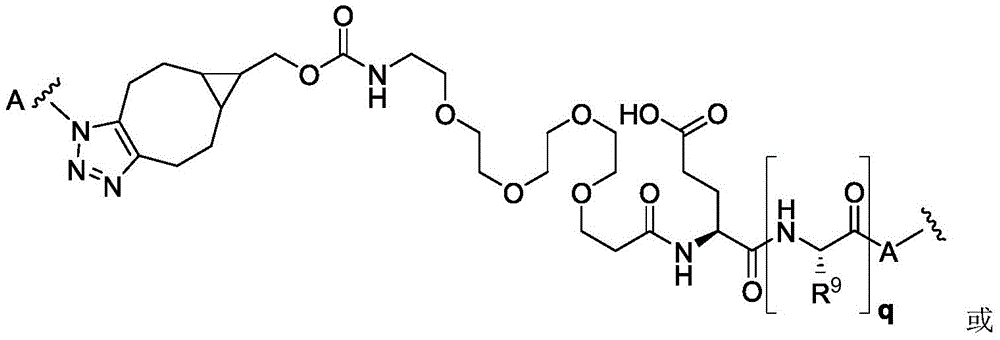

each one of Each a bond to the binding agent;
each one of Each a key connected to the payload;
each R9Are respectively-CH3、–CH(CH3)2Or is- (CH)2)3N(H)C(O)NH2;
q is an integer from 1 to 3; and
each A is independently-O-, -N (H) -,

 wherein ZZ is H, or a side chain of an amino acid, as discussed elsewhere herein; q1 is an integer from 1 to 5; and H is-O-or-NH-. For example, in one embodiment ZZ is C1-6An alkyl group. As another example, in one embodiment ZZ is C1-6A heteroalkyl group. In one embodiment, H is-O-. In one embodiment, H is-NH-. As discussed above, the bond to the binding agent may be direct or via a spacer. In certain embodiments, the invention relates toThe bond to which the binding agent is attached is via a PEG spacer group to a glutamine residue of the binding agent.
In any of the above embodiments, (AA)p1The groups may be modified with one or more reinforcing groups. Advantageously, the reinforcing group may be attached to (AA)p1The side chain of any amino acid in (a). Useful amino acids for attachment of the enhancing group include lysine, asparagine, aspartic acid, glutamine, glutamic acid, and citrulline. The attachment to the enhancing group may be a direct attachment to the amino acid side chain, or the attachment may be an indirect attachment via a spacer and/or a reactive group. Useful spacer and reactive groups include any of the above groups. The reinforcing group may be any group which the skilled person would consider useful. For example, the enhancing group can be any group that confers a beneficial effect on the compound, payload, linker payload, or antibody conjugate, including but not limited to biological, biochemical, synthetic, solubilizing, imaging, detecting, and reactivity/activity aspects, among others. In certain embodiments, the reinforcing group is a hydrophilic group. In certain embodiments, the enhancing group is a cyclodextrin. In certain embodiments, the reinforcing group is an alkyl sulfonic acid, heteroalkyl sulfonic acid, alkylene sulfonic acid, or heteroalkylene sulfonic acid. The cyclodextrin may be any cyclodextrin known to the skilled person. In certain embodiments, the cyclodextrin is an alpha-cyclodextrin, beta-cyclodextrin, or gamma-cyclodextrin, or a mixture thereof. In certain embodiments, the cyclodextrin is an a-cyclodextrin. In certain embodiments, the cyclodextrin is β -cyclodextrin. In certain embodiments, the cyclodextrin is gamma-cyclodextrin. In certain embodiments, the enhancing group is capable of improving the solubility of the remainder of the conjugate. In certain embodiments, the alkyl sulfonic acid, heteroalkyl sulfonic acid, alkylene sulfonic acid, or heteroalkylene sulfonic acid is substituted or unsubstituted. In certain embodiments, the alkylsulfonic acid, heteroalkylsulfonic acid, alkylenesulfonic acid, or heteroalkylenesulfonic acid is- (CH) 2)1-5SO3H,–(CH2)n2–NH-(CH2)1- 5SO3H,–(CH2)n2–C(O)NH-(CH2)1-5SO3H,–(CH2CH2O)m2–C(O)NH-(CH2)1-5SO3H,–(CH2)n2–N((CH2)1-5C(O)NH(CH2)1-5SO3H)2,–(CH2)n2–C(O)N((CH2)1-5C(O)NH(CH2)1-5SO3H)2Or is- (CH)2CH2O)m2–C(O)N((CH2)1-5C(O)NH(CH2)1-5SO3H)2Wherein n2 is 1, 2, 3, 4, or 5, and m2 is 1, 2, 3, 4, or 5. In one embodiment, the alkyl, or alkylene, sulfonic acid is- (CH)2)1-5SO3H. In another embodiment, the heteroalkylsulfonic acid, or heteroalkylenesulfonic acid is- (CH)2)n2–NH-(CH2)1-5SO3H, wherein n2 is 1, 2, 3, 4, or 5. In another embodiment, the alkylsulfonic acid, heteroalkylsulfonic acid, alkylenesulfonic acid, or heteroalkylenesulfonic acid is- (CH)2)n2–C(O)NH-(CH2)1-5SO3H, wherein n2 is 1, 2, 3, 4, or 5. In another embodiment, the alkylsulfonic acid, heteroalkylsulfonic acid, alkylenesulfonic acid, or heteroalkylenesulfonic acid is- (CH)2CH2O)m2–C(O)NH-(CH2)1-5SO3H, wherein m2 is 1, 2, 3, 4, or 5. In another embodiment, the alkylsulfonic acid, heteroalkylsulfonic acid, alkylenesulfonic acid, or heteroalkylenesulfonic acid is- (CH)2)n2–N((CH2)1- 5C(O)NH(CH2)1-5SO3H)2Wherein n2 is 1, 2, 3, 4, or 5. In another embodiment, the alkylsulfonic acid, heteroalkylsulfonic acid, alkylenesulfonic acid, or heteroalkylenesulfonic acid is- (CH)2)n2–C(O)N((CH2)1-5C(O)NH(CH2)1-5SO3H)2Wherein n2 is 1, 2, 3, 4, or 5. In another embodimentThe alkylsulfonic acid, heteroalkylsulfonic acid, alkylenesulfonic acid, or heteroalkylenesulfonic acid is- (CH)2CH2O)m2–C(O)N((CH2)1-5C(O)NH(CH2)1-5SO3H)2Wherein m2 is 1, 2, 3, 4, or 5. In some embodiments, the linker is:

Wherein:
SP1is a spacer group;
SP2is a spacer group;
SP3is a spacer group, attached to (AA)p1AA of (1);


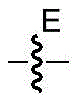
each AA is an amino acid; and
p1 is an integer from 1 to 10.
As discussed above, the bond to the binding agent may be either a direct bond or via a spacer. In certain embodiments, the bond attached to the binding agent is a glutamine residue attached to the binding agent via a PEG spacer group.
SP1The spacer group has the definition as described above. SP2The spacer group has the definition as described above. Each (AA)p1The groups each have the definitions as described above.
SP3The spacer group is a (AA)p1Moiety to a reinforcing group (EG). Suitable SP3Spacer groups include, but are not limited to, those comprising alkylene groups or polyethers, or both alkylene groups and polyethers. SP3The end of the spacer group (i.e., SP directly attached to the reinforcing group or AA)3Part of a spacer group) may be a moiety derived from a reactive group moiety used to reinforce groups or AA and SP during chemical synthesis of the conjugate 3The purpose of the spacer coupling. In some embodiments, SP3The end of the spacer group (i.e., the portion of the spacer group directly attached to the enhancing group or AA) may be the residue of a reactive group moiety that is used for the purpose of coupling the enhancing group or AA to the spacer group during chemical synthesis of the conjugate. In certain embodiments, SP3Is a spacer group, attached to (AA)p1One and only one AA. In certain embodiments, SP3The spacer group is attached to (AA)p1The side chain of a lysine residue of (a).
In some embodiments, SP3The spacer group is:

wherein:
RG' is the active group residue after the reaction of the active group RG and the enhancer EG;


a is an integer from 2 to 8; and
p1 is an integer from 1 to 4.
The reactive group RG may be any reactive group known to the person skilled in the art that is capable of linking to an enhancer to form one or more bonds. The reactive group RG is a group moiety that comprises in its structure a moiety capable of reacting with an enhancer to form a compound of formula LPa, LPb, LPc, LPd, LPa ', LPb', LPc ', LPd', A, B, C, D, A ', B', C ', D', or a ". After coupling with the reinforcing group, the reactive group becomes a reactive group residue (RG'). The reactive group RG can be any of the reactive groups described above. Exemplary reactive groups include, but are not limited to, those comprising haloacetyl, isothiocyanate, succinimide, N-hydroxysuccinimide, or maleimide moieties capable of reacting with the binding agent.
In certain embodiments, reactive groups include, but are not limited to, alkynes. In certain embodiments, the alkyne is an alkyne that is capable of undergoing a 1, 3-cycloaddition reaction with an azide in the absence of a copper catalyst, such as a strained alkyne. Strained alkynes are those suitable for strain-promoted alkyne-azide cycloaddition (SPAAC), cycloalkynes, such as cyclooctynes, benzocycloated alkynes. Suitable alkynes include, but are not limited to, dibenzoazacyclooctyne or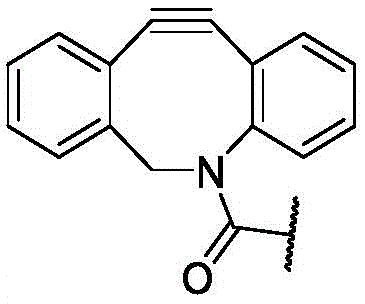 (DIBAC), dibenzocyclooctyne or
 (DIBO), a diarylazacyclooctynone or
 (BARAC), difluorocyclooctyne or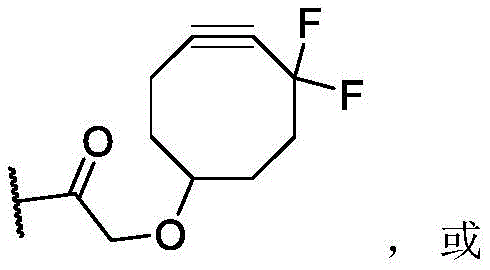
 (DIFO), substituted, e.g. fluorinated alkynes, aza-cycloalkynes, bicyclo [6.1.0]Nonene or
 (BCN), and derivatives thereof. Particularly useful alkynes include

In some embodiments, the linker is:
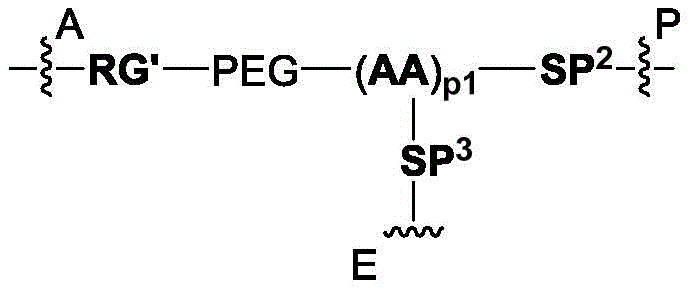
wherein:
RG' is the active group residue after the active group RG reacts with the binding agent;
PEG is-NH-PEG 4-C (O) -;
SP2is a spacer group;
SP3is a spacer group, attached to (AA)p1AA of (1);


Each AA is an amino acid residue; and
p1 is an integer from 1 to 10.
As discussed above, the bond to the binding agent may be direct, or via a spacer. In certain embodiments, the bond attached to the binding agent is a glutamine residue attached to the binding agent via a PEG spacer group.
In certain embodiments, the linker is:

or a pharmaceutically acceptable salt, solvate, or stereoisomeric form thereof, or a regioisomer thereof, or a mixture of regioisomers thereof, wherein:
each one of Each a bond to the binding agent;
each one of Each a key connected to the payload;
each one of Each a bond to the enhancer;
each R9Are respectively-CH3Or- (CH)2)3N(H)C(O)NH2(ii) a And
each A is independently-O-, -N (H) -,

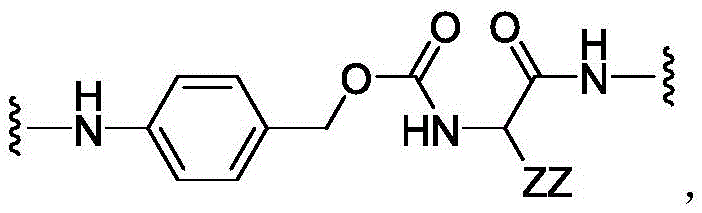 wherein ZZ is hydrogen, or a side chain of an amino acid as discussed elsewhere herein. For example, in one embodiment ZZ is C1-6An alkyl group. As another example, in one embodiment ZZ is C1-6A heteroalkyl group. In certain embodiments, the 1, 3-cycloaddition or SPAAC regioisomer or mixture of regioisomers is derived from PEG-N treated with a suitable alkyne3A derivatized antibody. Such as In one embodiment, the linker is:
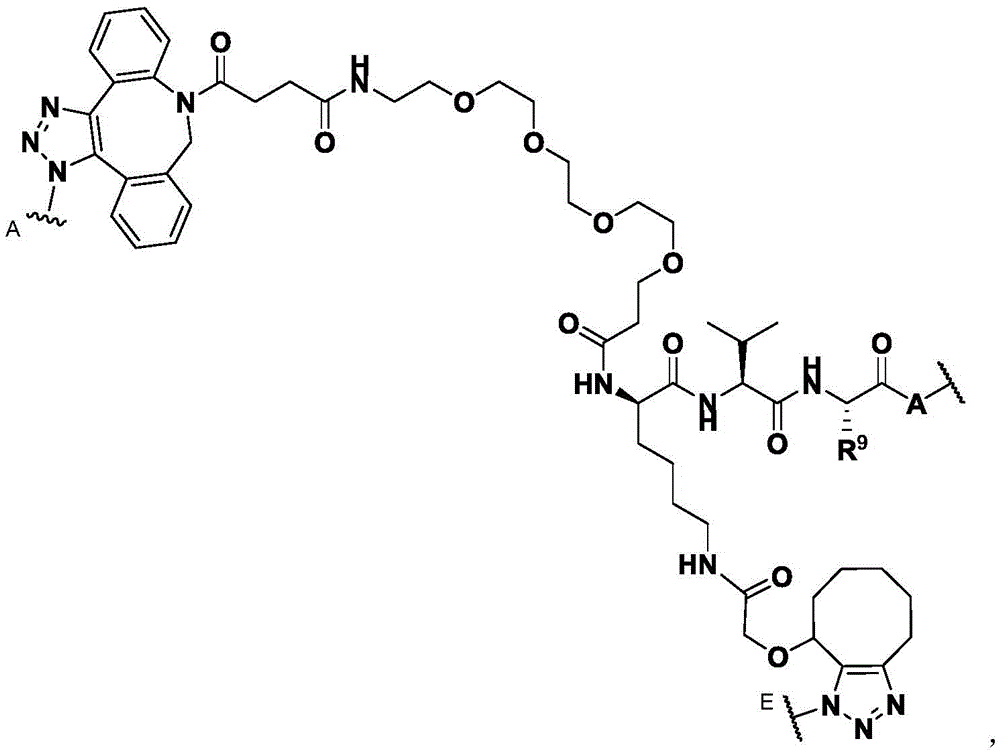


In some embodiments, the linker is:

or a pharmaceutically acceptable salt, solvate, or stereoisomeric form thereof, or a regioisomer thereof, or a mixture of regioisomers thereof, wherein:
each one of Each a bond to the binding agent;
each one of Each a bond to the enhancer;
each one of Each a key connected to the payload;
each R9Are respectively-CH3Or- (CH)2)3N(H)C(O)NH2(ii) a And
each A is independently-O-, -N (H) -,

 wherein ZZ is H, or a side chain of an amino acid as discussed elsewhere herein. For example, in one embodiment ZZ is C1-6An alkyl group. As another example, in one embodiment ZZ is C1-6A heteroalkyl group. As discussed above, the bond to the binding agent may be either a direct bond or via a spacer. In certain embodiments, the bond attached to the binding agent is a glutamine residue attached to the binding agent via a PEG spacer group. In certain embodiments, the enhancer is a hydrophilic group. In certain embodiments, the enhancer is a cyclodextrin. In certain embodiments, the enhancer is an alkyl sulfonic acid, heteroalkyl sulfonic acid, alkylene sulfonic acid, or heteroalkylene sulfonic acid. The cyclodextrin may be any cyclodextrin known to the skilled person. In certain embodiments, the cyclodextrin is an alpha-cyclodextrin, beta-cyclodextrin, or gamma-cyclodextrin, or a mixture thereof. In certain embodiments, the cyclodextrin is an a-cyclodextrin. In certain embodiments, the cyclodextrin is β -cyclodextrin. In certain embodiments, the cyclodextrin is gamma-cyclodextrin. In certain embodiments, the alkylsulfonic acid, heteroalkylsulfonic acid, alkylenesulfonic acid, or heteroalkylenesulfonic acid is- (CH) 2)1-5SO3H,–(CH2)n2–NH-(CH2)1-5SO3H,–(CH2)n2–C(O)NH-(CH2)1-5SO3H,–(CH2CH2O)m2–C(O)NH-(CH2)1-5SO3H,–(CH2)n2–N((CH2)1-5C(O)NH(CH2)1-5SO3H)2,–(CH2)n2–C(O)N((CH2)1-5C(O)NH(CH2)1-5SO3H)2Or is- (CH)2CH2O)m2–C(O)N((CH2)1-5C(O)NH(CH2)1-5SO3H)2Wherein n2 is 1, 2, 3, 4, or 5, and m2 is 1, 2, 3, 4, or 5. In one embodiment, the alkyl, or alkylene, sulfonic acid is- (CH)2)1-5SO3H. In another embodiment, the heteroalkylsulfonic acid, or heteroalkylenesulfonic acid is- (CH)2)n2–NH-(CH2)1-5SO3H, wherein n2 is 1, 2, 3, 4, or 5. In another embodiment, the alkylsulfonic acid, heteroalkylsulfonic acid, alkylenesulfonic acid, or heteroalkylenesulfonic acid is- (CH)2)n2–C(O)NH-(CH2)1-5SO3H, wherein n2 is 1, 2, 3, 4, or 5. In another embodiment, the alkylsulfonic acid, heteroalkylsulfonic acid, alkylenesulfonic acid, or heteroalkylenesulfonic acid is- (CH)2CH2O)m2–C(O)NH-(CH2)1-5SO3H, wherein m2 is 1, 2, 3, 4, or 5. In another embodiment, the alkylsulfonic acid, heteroalkylsulfonic acid, alkylenesulfonic acid, or heteroalkylenesulfonic acid is- (CH)2)n2–N((CH2)1-5C(O)NH(CH2)1-5SO3H)2Wherein n2 is 1, 2, 3, 4, or 5. In another embodiment, the alkylsulfonic acid, heteroalkylsulfonic acid, alkylenesulfonic acid, or heteroalkylenesulfonic acid is- (CH)2)n2–C(O)N((CH2)1-5C(O)NH(CH2)1-5SO3H)2Wherein n2 is 1, 2, 3, 4, or 5. In another embodiment, the alkylsulfonic acid, heteroalkylsulfonic acid, alkylenesulfonic acid, or heteroalkylenesulfonic acid is- (CH)2CH2O)m2–C(O)N((CH2)1-5C(O)NH(CH2)1-5SO3H)2Wherein m2 is 1, 2, 3, 4, or 5.
In some embodiments, the linker is:
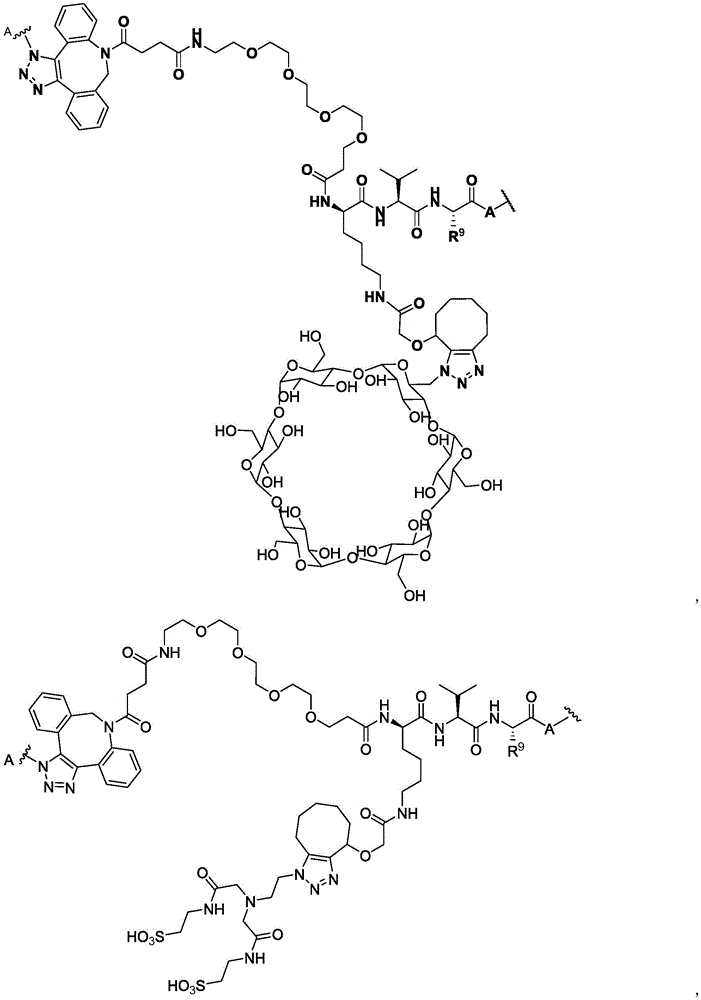

Or a pharmaceutically acceptable salt, solvate, or stereoisomeric form thereof, or a regioisomer thereof, or a mixture of regioisomers thereof, wherein:
each one of Each a bond to the binding agent;
each one of Each a key connected to the payload;
R9is-CH3Or- (CH)2)3N(H)C(O)NH2(ii) a And
a is-O-, -N (H) -,
 wherein ZZ is H, or a side chain of an amino acid as discussed elsewhere herein. For example, in one embodiment ZZ is C1-6An alkyl group. As another example, in one embodiment ZZ is C1-6A heteroalkyl group. As discussed above, the bond to the binding agent may be either a direct bond or via a spacer group. In certain embodiments, the bond attached to the binding agent is a glutamine residue attached to the binding agent via a PEG spacer group.
In some embodiments, the linker is:


or a pharmaceutically acceptable salt, solvate, or stereoisomeric form thereof, or a regioisomer thereof, or a mixture of regioisomers thereof, wherein:
each one of Each a bond to the binding agent;
each one of Each a key connected to the payload;
R9is-CH3Or- (CH) 2)3N(H)C(O)NH2(ii) a And
a is-O-, -N (H) -,
 wherein ZZ is H, or a side chain of an amino acid as discussed elsewhere herein. For example, in one embodiment ZZ is C1-6An alkyl group. As another example, in one embodiment ZZ is C1-6A heteroalkyl group. As discussed above, the bond to the binding agent may be either a direct bond or via a spacer group. In certain embodiments, the bond attached to the binding agent is a glutamine residue attached to the binding agent via a PEG spacer group.
In some embodiments, the linker is:
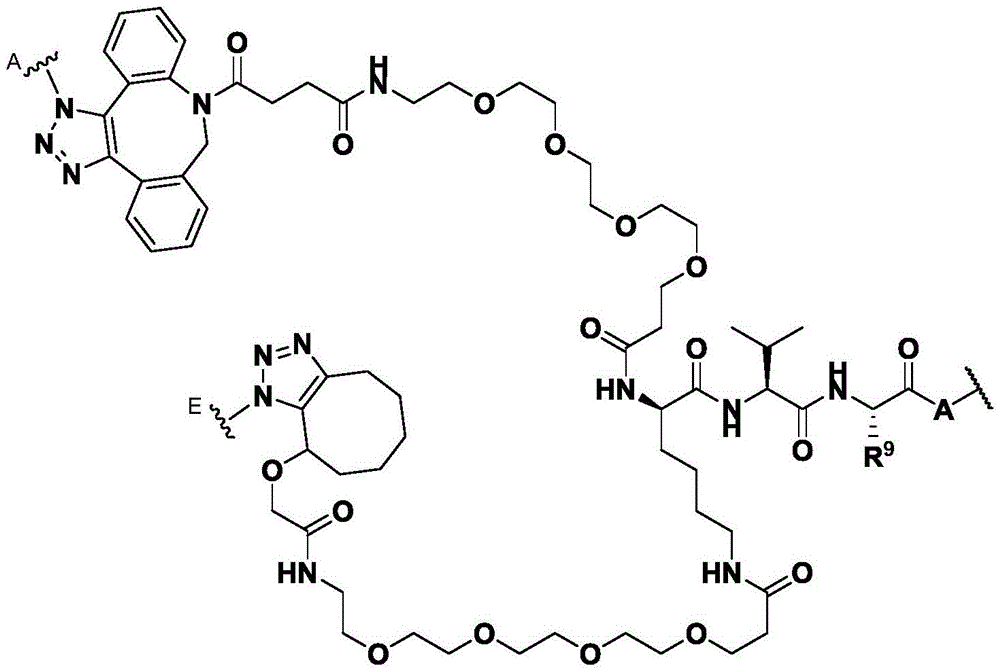
or a pharmaceutically acceptable salt, solvate, or stereoisomeric form thereof, or a regioisomer thereof, or a mixture of regioisomers thereof, wherein:
each one of Each a bond to the binding agent;
each one of Each a key connected to the payload;
each one of Each is a bond to the reinforcing group;
each R9Are respectively-CH3Or- (CH)2)3N(H)C(O)NH2(ii) a And
each A is independently-O-, -N (H) -,

 wherein ZZ is H, or a side chain of an amino acid as discussed elsewhere herein. For example, in one embodiment ZZ is C1-6An alkyl group. As another example, in one embodiment ZZ is C 1-6A heteroalkyl group. As discussed above, the bond to the binding agent may be either a direct bond or via a spacer. In certain embodiments, the bond attached to the binding agent is a glutamine residue attached to the binding agent via a PEG spacer group. In certain embodiments, the enhancer is a hydrophilic group. In certain embodiments, the enhancer is a cyclodextrin. In certain embodiments, the reinforcing group is an alkyl sulfonic acid, heteroalkyl sulfonic acid, alkylene sulfonic acid, or heteroalkylene sulfonic acid. The cyclodextrin may be any cyclodextrin known to the skilled person. In certain embodiments, the cyclodextrinThe essence is alpha-cyclodextrin, beta-cyclodextrin, or gamma-cyclodextrin, or a mixture thereof. In certain embodiments, the cyclodextrin is an a-cyclodextrin. In certain embodiments, the cyclodextrin is β -cyclodextrin. In certain embodiments, the cyclodextrin is gamma-cyclodextrin. In certain embodiments, the alkylsulfonic acid, heteroalkylsulfonic acid, alkylenesulfonic acid, or heteroalkylenesulfonic acid is- (CH)2)1-5SO3H,–(CH2)n2–NH-(CH2)1-5SO3H,–(CH2)n2–C(O)NH-(CH2)1-5SO3H,–(CH2CH2O)m2–C(O)NH-(CH2)1-5SO3H,–(CH2)n2–N((CH2)1-5C(O)NH(CH2)1-5SO3H)2,–(CH2)n2–C(O)N((CH2)1-5C(O)NH(CH2)1-5SO3H)2Or is- (CH)2CH2O)m2–C(O)N((CH2)1-5C(O)NH(CH2)1-5SO3H)2Wherein n2 is 1, 2, 3, 4, or 5, and m2 is 1, 2, 3, 4, or 5. In one embodiment, the alkyl, or alkylene, sulfonic acid is- (CH) 2)1-5SO3H. In another embodiment, the heteroalkylsulfonic acid, or heteroalkylenesulfonic acid is- (CH)2)n2–NH-(CH2)1-5SO3H, wherein n2 is 1, 2, 3, 4, or 5. In another embodiment, the alkylsulfonic acid, heteroalkylsulfonic acid, alkylenesulfonic acid, or heteroalkylenesulfonic acid is- (CH)2)n2–C(O)NH-(CH2)1-5SO3H, wherein n2 is 1, 2, 3, 4, or 5. In another embodiment, the alkylsulfonic acid, heteroalkylsulfonic acid, alkylenesulfonic acid, or heteroalkylenesulfonic acid is- (CH)2CH2O)m2–C(O)NH-(CH2)1-5SO3H, wherein m2 is 1, 2, 3, 4, or 5. In another embodiment, the alkyl sulfonic acid, heteroalkyl sulfonic acid, alkylene sulfonic acid, or heteroalkaneRadical sulfonic acid is- (CH)2)n2–N((CH2)1-5C(O)NH(CH2)1-5SO3H)2Wherein n2 is 1, 2, 3, 4, or 5. In another embodiment, the alkylsulfonic acid, heteroalkylsulfonic acid, alkylenesulfonic acid, or heteroalkylenesulfonic acid is- (CH)2)n2–C(O)N((CH2)1-5C(O)NH(CH2)1-5SO3H)2Wherein n2 is 1, 2, 3, 4, or 5. In another embodiment, the alkylsulfonic acid, heteroalkylsulfonic acid, alkylenesulfonic acid, or heteroalkylenesulfonic acid is- (CH)2CH2O)m2–C(O)N((CH2)1-5C(O)NH(CH2)1-5SO3H)2Wherein m2 is 1, 2, 3, 4, or 5.
In some embodiments, the linker is:

or a pharmaceutically acceptable salt, solvate, or stereoisomeric form thereof, or a regioisomer thereof, or a mixture of regioisomers thereof, wherein:
Each one of Each a bond to the binding agent;
each one of Each a key connected to the payload;
each R9Are respectively-CH3Or- (CH)2)3N(H)C(O)NH2(ii) a And
each A is independently-O-, -N (H) -,

 wherein ZZ is H, or a side chain of an amino acid as discussed elsewhere herein. For example, in one embodiment ZZ is C1-6An alkyl group. As another example, in one embodiment ZZ is C1-6A heteroalkyl group. As discussed above, the bond to the binding agent may be either a direct bond or via a spacer. In certain embodiments, the bond attached to the binding agent is a glutamine residue attached to the binding agent via a PEG spacer group. In certain embodiments, the enhancer is a hydrophilic group. In certain embodiments, the enhancer is a cyclodextrin. In certain embodiments, the reinforcing group is an alkyl sulfonic acid, heteroalkyl sulfonic acid, alkylene sulfonic acid, or heteroalkylene sulfonic acid. The cyclodextrin may be any cyclodextrin known to the skilled person. In certain embodiments, the cyclodextrin is an alpha-cyclodextrin, beta-cyclodextrin, or gamma-cyclodextrin, or a mixture thereof. In certain embodiments, the cyclodextrin is an a-cyclodextrin. In certain embodiments, the cyclodextrin is β -cyclodextrin. In certain embodiments, the cyclodextrin is gamma-cyclodextrin. In certain embodiments, the alkylsulfonic acid, heteroalkylsulfonic acid, alkylenesulfonic acid, or heteroalkylenesulfonic acid is- (CH) 2)1-5SO3H,–(CH2)n2–NH-(CH2)1-5SO3H,–(CH2)n2–C(O)NH-(CH2)1-5SO3H,–(CH2CH2O)m2–C(O)NH-(CH2)1-5SO3H,–(CH2)n2–N((CH2)1-5C(O)NH(CH2)1-5SO3H)2,–(CH2)n2–C(O)N((CH2)1-5C(O)NH(CH2)1-5SO3H)2Or is- (CH)2CH2O)m2–C(O)N((CH2)1-5C(O)NH(CH2)1-5SO3H)2Wherein n2 is 1, 2, 3, 4, or 5, and m2 is 1, 2, 3, 4, or 5. In one embodiment, the alkyl, or alkylene, sulfonic acid is- (CH)2)1-5SO3H. In another embodiment, the heteroalkylsulfonic acid, or heteroalkylenesulfonic acid is- (CH)2)n2–NH-(CH2)1-5SO3H, wherein n2 is 1, 2, 3, 4, or 5. In another embodiment, the alkylsulfonic acid, heteroalkylsulfonic acid, alkylenesulfonic acid, or heteroalkylenesulfonic acid is- (CH)2)n2–C(O)NH-(CH2)1-5SO3H, wherein n2 is 1, 2, 3, 4, or 5. In another embodiment, the alkylsulfonic acid, heteroalkylsulfonic acid, alkylenesulfonic acid, or heteroalkylenesulfonic acid is- (CH)2CH2O)m2–C(O)NH-(CH2)1-5SO3H, wherein m2 is 1, 2, 3, 4, or 5. In another embodiment, the alkylsulfonic acid, heteroalkylsulfonic acid, alkylenesulfonic acid, or heteroalkylenesulfonic acid is- (CH)2)n2–N((CH2)1-5C(O)NH(CH2)1-5SO3H)2Wherein n2 is 1, 2, 3, 4, or 5. In another embodiment, the alkylsulfonic acid, heteroalkylsulfonic acid, alkylenesulfonic acid, or heteroalkylenesulfonic acid is- (CH)2)n2–C(O)N((CH2)1-5C(O)NH(CH2)1-5SO3H)2Wherein n2 is 1, 2, 3, 4, or 5. In another embodiment, the alkylsulfonic acid, heteroalkylsulfonic acid, alkylenesulfonic acid, or heteroalkylenesulfonic acid is- (CH)2CH2O)m2–C(O)N((CH2)1-5C(O)NH(CH2)1-5SO3H)2Wherein m2 is 1, 2, 3, 4, or 5.
In some embodiments, the linker is:


each one of Each a bond to the binding agent;
each one of Each a key connected to the payload; and H is-O-or-NH-.
In some embodiments, the linker is:
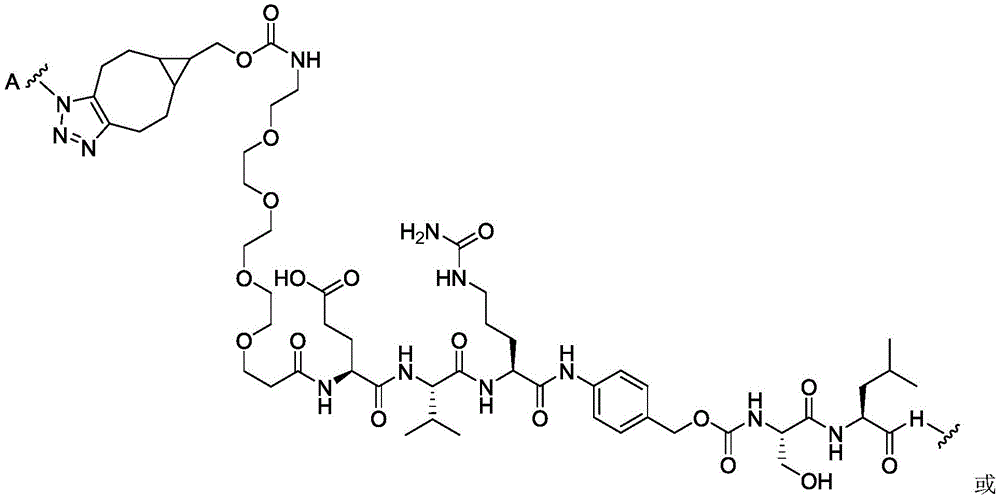
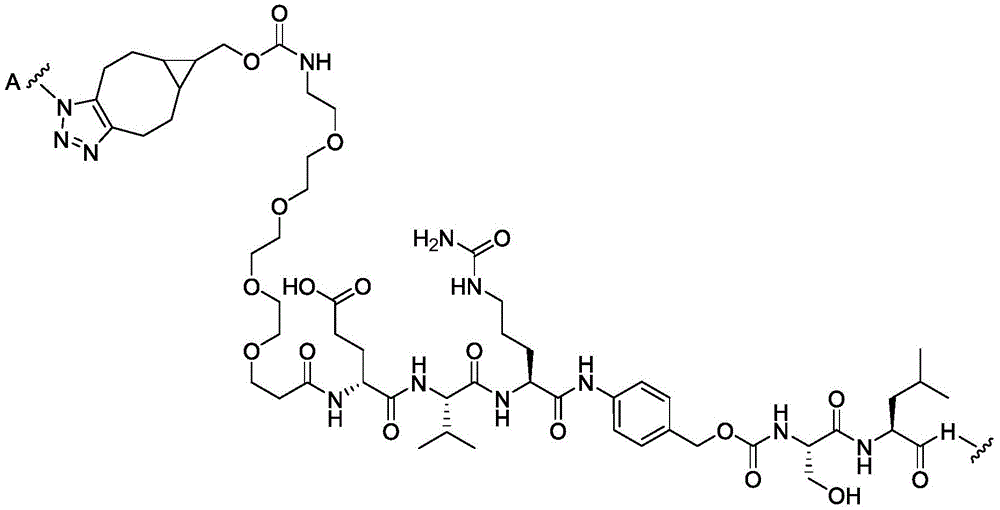
wherein:
each one of Each a bond to the binding agent;
each one of Each a key connected to the payload; and H is-O-or-NH-.
In some embodiments, the linker is:


or a pharmaceutically acceptable salt, solvate, or stereoisomeric form thereof, or a regioisomer thereof, or a mixture of regioisomers thereof, wherein:
each one of Each a bond to the binding agent;
each one of Each a key connected to the payload;
R9is-CH3Or- (CH)2)3N(H)C(O)NH2(ii) a And
a is-O-, -N (H) -,
 wherein ZZ is H, or a side chain of an amino acid as discussed elsewhere herein. For example, in one embodiment ZZ is C1-6An alkyl group. As another example, in one embodiment ZZ is C1-6A heteroalkyl group. As discussed above, the bond to the binding agent may be either a direct bond or via a spacer group. In certain embodiments, the bond attached to the binding agent is a glutamine residue attached to the binding agent via a PEG spacer group.
In some embodiments, the linker is:


or a pharmaceutically acceptable salt, solvate, or stereoisomeric form thereof, or a regioisomer thereof, or a mixture of regioisomers thereof, wherein:
each one of Each a bond to the binding agent;
each one of Each a key connected to the payload;
R9is-CH3Or- (CH)2)3N(H)C(O)NH2(ii) a And
a is-O-, -N (H) -,
 wherein ZZ is H, or a side chain of an amino acid as discussed elsewhere herein. For example, in one embodiment ZZ is C1-6An alkyl group. As another example, in one embodiment ZZ is C1-6A heteroalkyl group. As discussed above, the bond to the binding agent may be either a direct bond or via a spacer group. In certain embodiments, the bond attached to the binding agent is a glutamine residue attached to the binding agent via a PEG spacer group.
Linker-payload or active linker-payload
The invention provides a linker-payload or active linker-payload derived from any of the compounds or payloads described herein (e.g., a compound or payload of formula I, II or III) and a linker. In certain embodiments described below, the conjugates provided herein can be made from a linker-payload or an active linker-payload having a reactive group RG as described above. The linker-payload or active linker-payload can be attached to the reinforcing group and/or binding agent according to the methods described below.
In certain embodiments, the linker-payload comprises any particular payload comprised by any one or more of formulas I, II or III above attached to a linker, wherein a linker of the invention comprises a moiety that reacts with a binding agent, antibody or antigen binding fragment thereof, and/or an enhancing group of the invention. In certain embodiments, the linker is attached to R1、R2Or R6Or R1、R2Or R6As shown in any one or more of the above payload formulas I, II or III. In one embodiment, the linker-payload has a structure represented by formula LPa:

wherein L is a linker as described above, and Q1、Q2、W、–R1–、R2、R4、R5And R6Are as described above in the context of formula I. In one embodiment, the linker-payload has a structure represented by formula LPb:

wherein L is a linker as described above, and Q1、Q2、W、R1、–R2–、R4、R5And R6Are as described above in the context of formula I.
In one embodiment, the linker-payload has a structure represented by formula LPc:
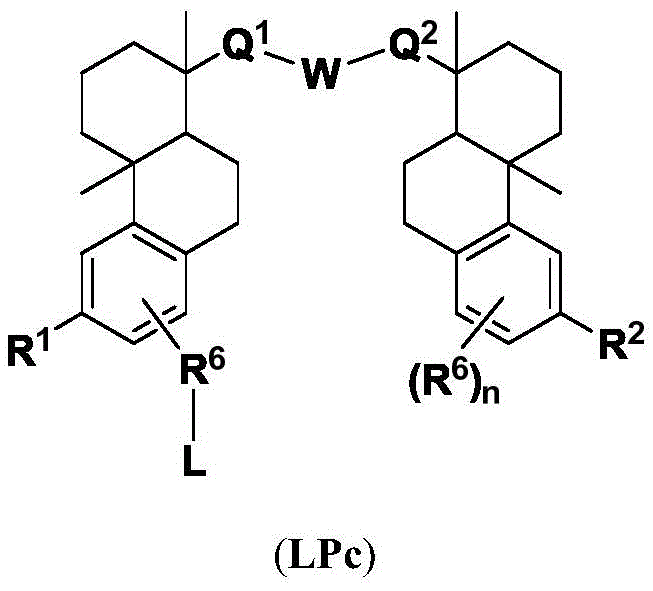
wherein L is a linker as described above, and Q1、Q2、W、R1、R2、R4、R5and-R6-are all as described above in the context of formula I.
In one embodiment, the linker-payload has a structure represented by formula LPd:

Wherein L is a linker as described above, and Q1、Q2、W、R1、R2、R4、R5and-R6-are all as described above in the context of formula I.
In one embodiment, the linker-payload has a structure according to formula LPa':

wherein SP1And SP2All are spacer groups as described above, each AA is an amino acid residue as described above, Q1、Q2、W、–R1–、R2、R4、R5And R6Both as described above in the context of formula I, and p1 is an integer from 1 to 10. In one embodiment, the linker-payload has a structure according to formula LPb':

wherein SP1And SP2All are spacer groups as described above, each AA is an amino acid residue as described above, Q1、Q2、W、R1、–R2–、R4、R5And R6Are all as described in the context of formula I, and p1 is an integer from 1 to 10. In one implementationIn one embodiment, the linker-payload has a structure according to formula LPc':

wherein SP1And SP2All are spacer groups as described above, each AA is an amino acid residue as described above, Q1、Q2、W、R1、R2、R4、R5and-R6-are as described in the context of formula I, and p1 is an integer from 1 to 10. In one embodiment, the linker-payload has a structure according to formula LPd':

wherein SP1And SP2All are spacer groups as described above, each AA is an amino acid residue as described above, Q 1、Q2、W、R1、R2、R4、R5and-R6-are as described in the context of formula I, and p1 is an integer from 1 to 10. In any of the embodiments in this paragraph, p1 is 1, 2, 3, 4, 5, 6, 7, 8, 9, or 10. In any of the embodiments of this paragraph, the linker L or spacer group SP2Attached to the aryl nitrogen, or to a separate amino acid residue or an amino acid residue within the peptide. In any of the embodiments in this paragraph, each R4In each case independently H, an amino acid residue, an N-alkyl amino acid residue, a peptide residue, a biodegradable moiety, an alkyl group, a substituted alkyl group, an acyl group, or a substituted acyl group. In any of the embodiments in this paragraph, each R4In each case independently of each other H, an amino acid residue, an N-alkyl amino acid residue, a peptide residue, a biodegradable moiety, or an alkyl group.
In some embodiments, the linker-payload or active linker-payload is:


or a pharmaceutically acceptable salt, solvate, or stereoisomer form thereof, wherein:
each RG is independently a reactive group, as described herein;
Q1、Q2、W、R1、R2、R4、R5and R6Are all as described in the context of formula I;
each R9Are respectively-CH3Or- (CH)2)3N(H)C(O)NH2(ii) a And
Each A is independently-O-, -N (H) -,

 wherein ZZ is H, or a side chain of an amino acid as discussed elsewhere herein. For example, in one embodiment ZZ is C1-6An alkyl group. As another example, in one embodiment ZZ is C1-6A heteroalkyl group.
In some embodiments, the linker-payload or active linker-payload is:
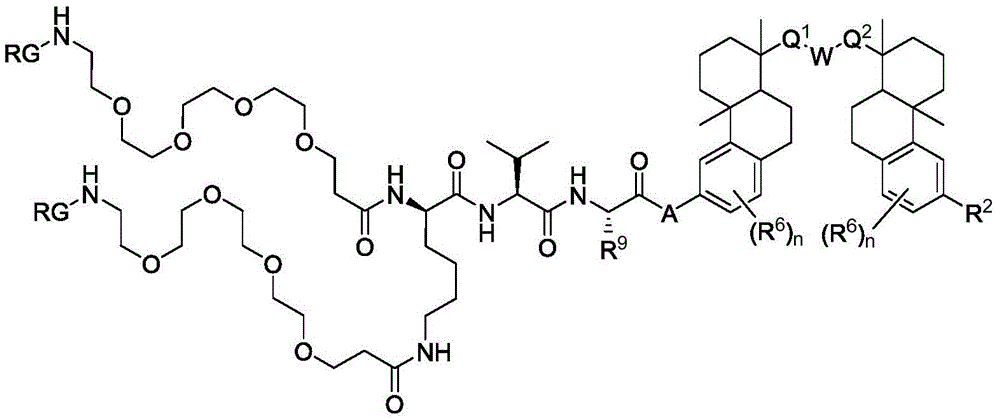
or a pharmaceutically acceptable salt, solvate, or stereoisomer form thereof, wherein:
each RG is independently a reactive group, as described herein;
Q1、Q2、W、R1、R2、R4、R5and R6Are all as described in the context of formula I;
each R9Are respectively-CH3Or- (CH)2)3N(H)C(O)NH2(ii) a And
each A is independently-O-, -N (H) -,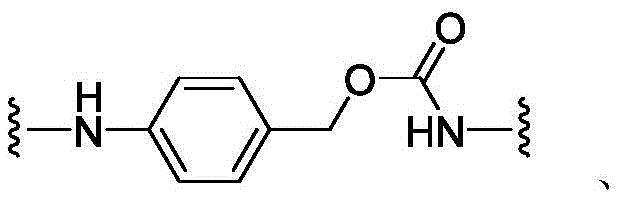


In some embodiments, the linker-payload or active linker-payload is:


or a pharmaceutically acceptable salt, solvate, or stereoisomer form thereof, wherein:
Q1、Q2、W、R1、R2、R4、R5and R6Are all as described in the context of formula I;
each R9Are respectively-CH3Or- (CH)2)3N(H)C(O)NH2(ii) a And
each A is independently-O-, -N (H) -, 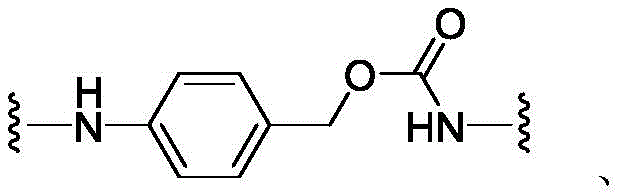

 Wherein ZZ is H, or a side chain of an amino acid as discussed elsewhere herein. For example, in one embodiment ZZ is C1-6An alkyl group. As another example, in one embodiment ZZ is C1-6A heteroalkyl group.
In some embodiments, the linker-payload or active linker-payload is:

or a pharmaceutically acceptable salt, solvate, or stereoisomer form thereof, wherein:
Q1、Q2、W、R1、R2、R4、R5and R6Are all as described in the context of formula I;
each R9Are respectively-CH3Or- (CH)2)3N(H)C(O)NH2(ii) a And
each A is independently-O-, -N (H) -,

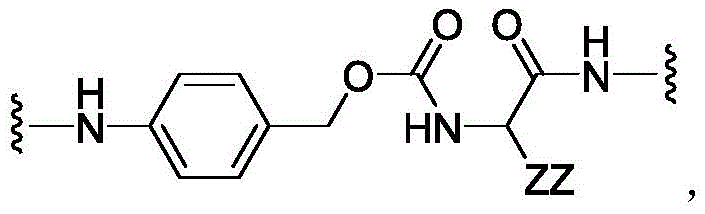 wherein ZZ is H, or a side chain of an amino acid as discussed elsewhere herein. For example, in one embodiment ZZ is C1-6An alkyl group. As another example, in one embodiment ZZ is C1-6A heteroalkyl group.
In some embodiments, the active linker-payload is:


or a pharmaceutically acceptable salt, solvate, or stereoisomeric form thereof, or a regioisomer thereof, wherein:
Q1、Q2、W、R1、R2、R4、R5and R6Are all as described in the context of formula I;
each R9Are respectively-CH3Or- (CH)2)3N(H)C(O)NH2(ii) a And
each A is independently-O-, -N (H) -,

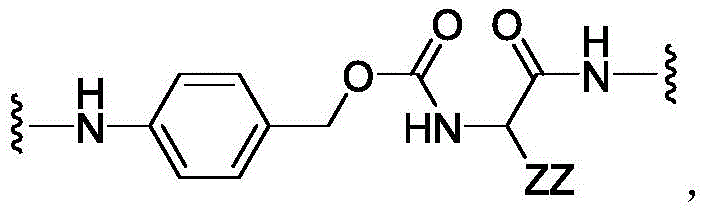 wherein ZZ is H, or a side chain of an amino acid as discussed elsewhere herein. For example, in one embodiment ZZ is C 1-6An alkyl group. As another example, in one embodiment ZZ is C1-6A heteroalkyl group.
In some embodiments, the active linker-payload is:


or a pharmaceutically acceptable salt, solvate, or stereoisomeric form thereof, or a regioisomer thereof, wherein:
Q1、Q2、W、R1、R2、R4、R5and R6Are all as described in the context of formula I;
each R9Are respectively-CH3Or- (CH)2)3N(H)C(O)NH2(ii) a And
each A is independently-O-, -N (H) -,

 wherein ZZ is H, or a side chain of an amino acid as discussed elsewhere herein. For example, in one embodiment ZZ is C1-6An alkyl group. As another example, in one embodiment ZZ is C1-6A heteroalkyl group.
In some embodiments, the linker-payload or active linker-payload is:

or a pharmaceutically acceptable salt, solvate, or stereoisomer form thereof, wherein:
Q1、Q2、W、R1、R2、R4、R5and R6Are all as described in the context of formula I;
each R9Are respectively-CH3Or- (CH)2)3N(H)C(O)NH2(ii) a And
each A is independently-O-, -N (H) -,

 wherein ZZ is H, or a side chain of an amino acid as discussed elsewhere herein. For example, in one embodiment ZZ is C1-6An alkyl group. As another example, in one embodiment ZZ is C1-6A heteroalkyl group.
In some embodiments, the linker-payload or active linker-payload is:

or a pharmaceutically acceptable salt, solvate, or stereoisomer form thereof, wherein:
Q1、Q2、W、R1、R2、R4、R5and R6Are all as described in the context of formula I;
each R9Are respectively-CH3Or- (CH)2)3N(H)C(O)NH2(ii) a And
each A is independently-O-, -N (H) -,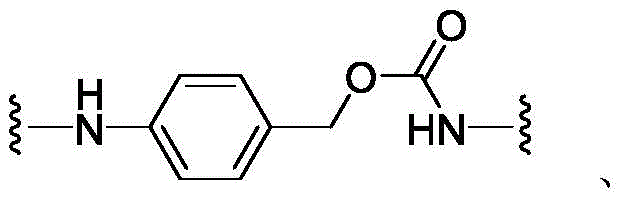

 wherein ZZ is H, or a side chain of an amino acid as discussed elsewhere herein. For example, in one embodiment ZZ is C1-6An alkyl group. As another example, in one embodiment ZZ is C1-6A heteroalkyl group.
In some embodiments, the linker-payload or active linker-payload is:


or a pharmaceutically acceptable salt, solvate, or stereoisomeric form thereof, or a regioisomer thereof, wherein:
Q1、Q2、W、R1、R2、R4、R5and R6Are all as described in the context of formula I;
each R9Are respectively-CH3Or- (CH)2)3N(H)C(O)NH2(ii) a And
each A is independently-O-, -N (H) -,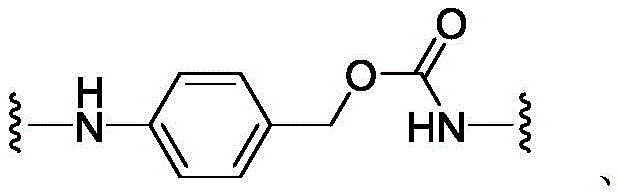

 wherein ZZ is H, or a side chain of an amino acid as discussed elsewhere herein. For example, in one embodiment ZZ is C1-6An alkyl group. As another example, in one embodiment ZZ is C1-6A heteroalkyl group.
In some embodiments, the linker-payload or active linker-payload is:


Or a pharmaceutically acceptable salt, solvate, or stereoisomeric form thereof, or a regioisomer thereof, wherein:
Q1、Q2、W、R1、R2、R4、R5and R6Are all as described in the context of formula I;
each R9Are respectively-CH3Or- (CH)2)3N(H)C(O)NH2(ii) a And
each A is independently-O-, -N (H) -,

 wherein ZZ is H, or a side chain of an amino acid as discussed elsewhere herein. For example, in one embodiment ZZ is C1-6An alkyl group. As another example, in one embodiment ZZ is C1-6A heteroalkyl group.
In some embodiments, the linker-payload or active linker-payload is selected from:


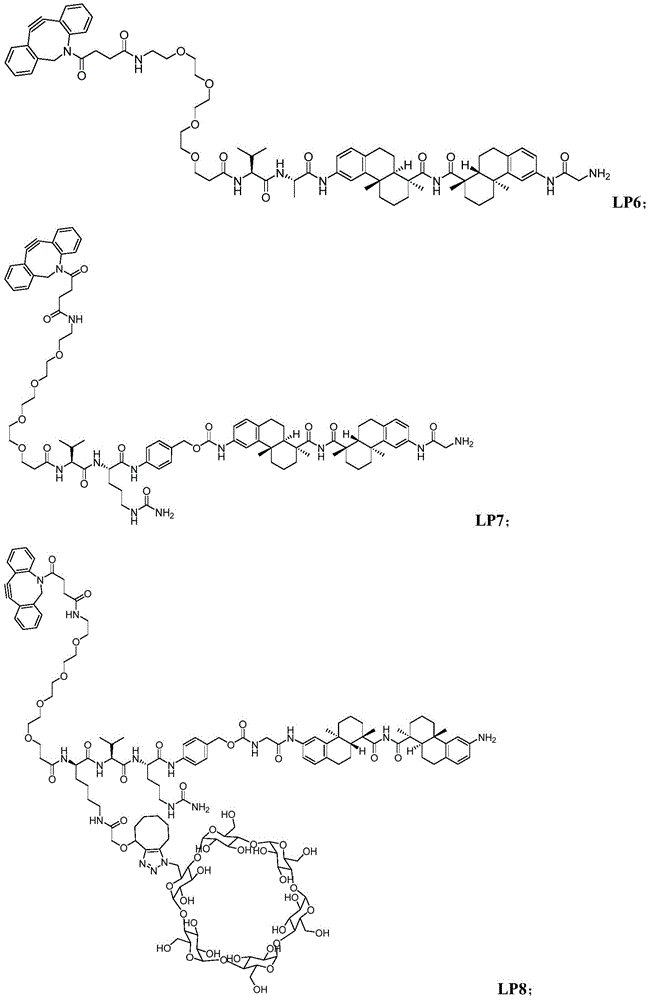

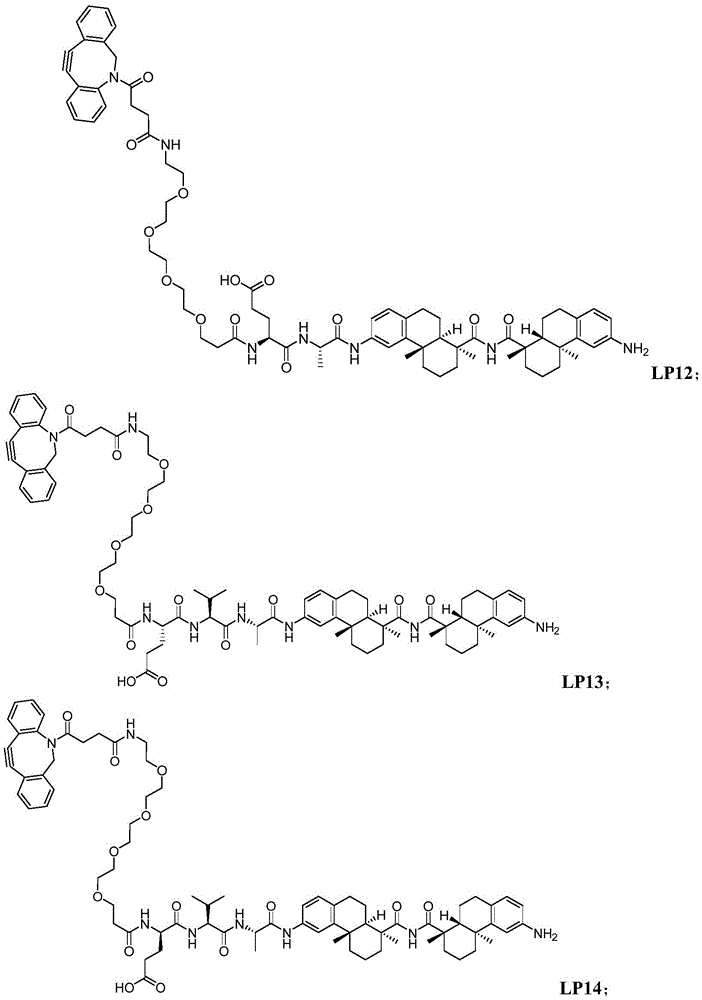

a pharmaceutically acceptable salt, or solvate thereof.
The invention also provides a linker-payload selected from the group consisting of:
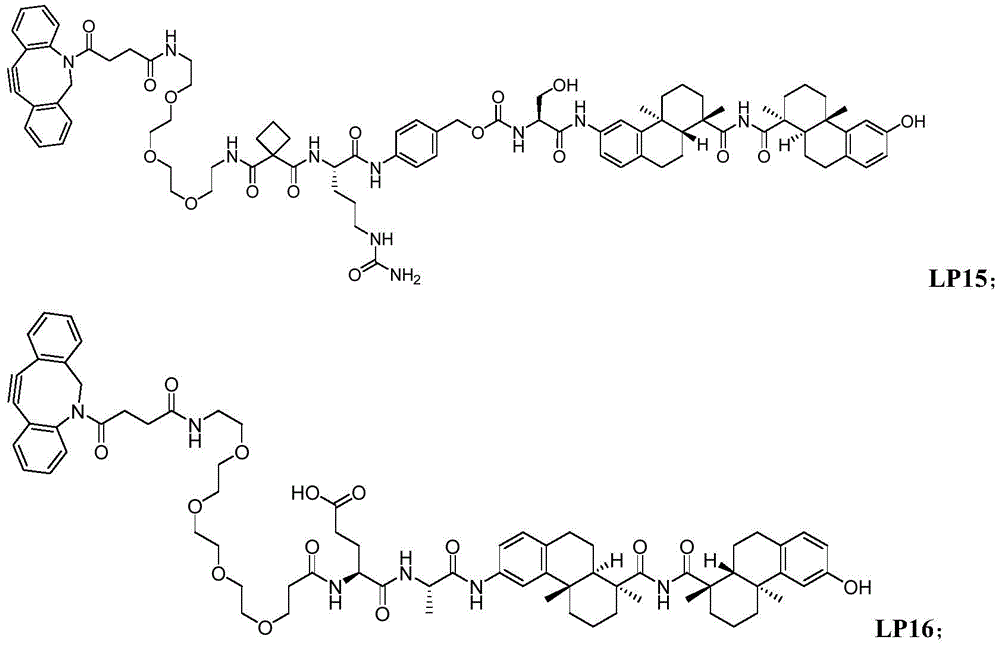
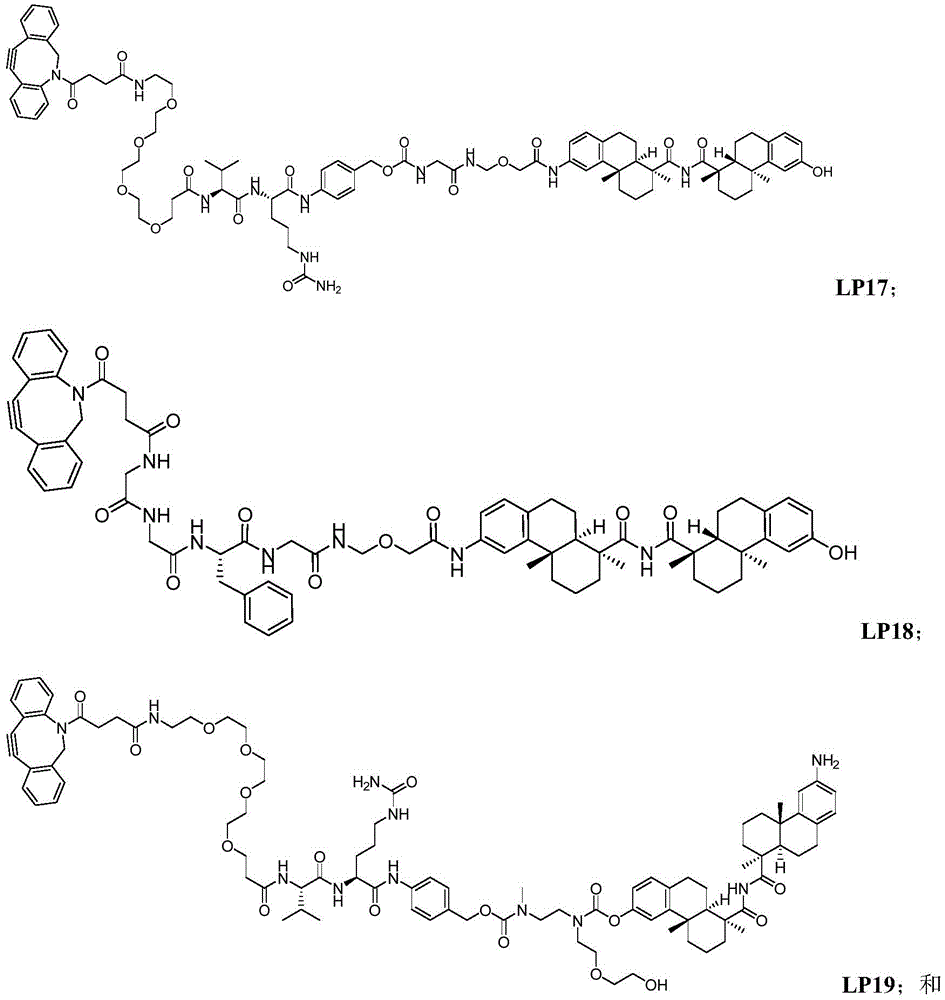
a pharmaceutically acceptable salt, or solvate thereof.
The above-described linker, linker-payload, or active linker-payload can be used to provide the following conjugates.
conjugate/Antibody Drug Conjugate (ADC)
The invention provides an antibody or antigen-binding fragment thereof, wherein the antibody is conjugated to one or more compounds of formula I, II or III as described herein.
The present invention provides a compound or conjugate of formula a:


or a pharmaceutically acceptable salt, or stereoisomer form thereof, wherein BA is a binding agent, L is a linker, Q is a pharmaceutically acceptable salt, or stereoisomer form thereof 1、Q2、W、–R1–、R2、R4、R5And R6Are all asAs described above in the context of formula I, and k is 1, 2, 3, 4, 5, 6, 7, 8, 9, or 10. In certain embodiments, the compound or payload coupled to-L-BA in formula a comprises one or more compounds of formulae I, II and/or III above, wherein BA is a binding agent; l is a linker; and k is 1, 2, 3, 4, 5, 6, 7, 8, 9, or 10. In any of the embodiments of this paragraph, the BA is an antibody, or antigen-binding fragment thereof, wherein the antibody is conjugated to a compound of formula I, as described above. In any of the embodiments of this paragraph, the BA is an antibody, or antigen-binding fragment thereof, wherein the antibody is conjugated to a compound of formula II, as described above. In any of the embodiments of this paragraph, the BA is an antibody, or antigen-binding fragment thereof, wherein the antibody is conjugated to a compound of formula III, as described above. In any of the embodiments in this paragraph, k is in the range of 1-2, 1-3, 2-4, 3-4, or 1-4. In any of the embodiments in this paragraph, k is 1. In any of the embodiments in this paragraph, k is 2. In any of the embodiments in this paragraph, k is 3. In any of the embodiments in this paragraph, k is 4. In any of the embodiments in this paragraph, each R 4In each case independently H, an amino acid residue, an N-alkyl amino acid residue, a peptide residue, a biodegradable moiety, an alkyl group, a substituted alkyl group, an acyl group, or a substituted acyl group. In any of the embodiments in this paragraph, each R4In each case independently of each other H, an amino acid residue, an N-alkyl amino acid residue, a peptide residue, a biodegradable moiety, or an alkyl group.
The invention provides a compound or conjugate shown in formula B:
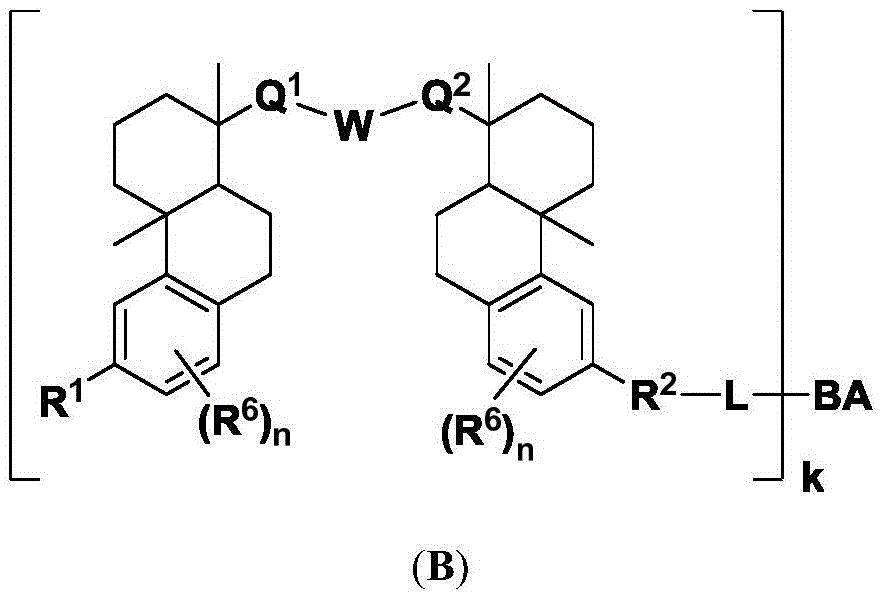
or a pharmaceutically acceptable salt, or stereoisomer form thereof, wherein BA is a binding agent, L is a linker, Q is a pharmaceutically acceptable salt, or stereoisomer form thereof1、Q2、W、R1、–R2–、R4、R5And R6Are all as described above in the context of formula I, and k is 1, 2, 3, 4, 5, 6, 7, 8, 9,Or 10. In certain embodiments, the compound or payload coupled to-L-BA in formula B comprises one or more compounds of formulae I, II and/or III above, wherein BA is a binding agent; l is a linker; and k is 1, 2, 3, 4, 5, 6, 7, 8, 9, or 10. In any of the embodiments of this paragraph, the BA is an antibody, or antigen-binding fragment thereof, wherein the antibody is conjugated to a compound of formula I, as described above. In any of the embodiments of this paragraph, the BA is an antibody, or antigen-binding fragment thereof, wherein the antibody is conjugated to a compound of formula II, as described above. In any of the embodiments of this paragraph, the BA is an antibody, or antigen-binding fragment thereof, wherein the antibody is conjugated to a compound of formula III, as described above. In any of the embodiments in this paragraph, k is in the range of 1-2, 1-3, 2-4, 3-4, or 1-4. In any of the embodiments in this paragraph, k is 1. In any of the embodiments in this paragraph, k is 2. In any of the embodiments in this paragraph, k is 3. In any of the embodiments in this paragraph, k is 4. In any of the embodiments in this paragraph, each R 4In each case independently H, an amino acid residue, an N-alkyl amino acid residue, a peptide residue, a biodegradable moiety, an alkyl group, a substituted alkyl group, an acyl group, or a substituted acyl group. In any of the embodiments in this paragraph, each R4In each case independently of each other H, an amino acid residue, an N-alkyl amino acid residue, a peptide residue, a biodegradable moiety, or an alkyl group.
The invention provides a compound or conjugate of formula C:

or a pharmaceutically acceptable salt, or stereoisomer form thereof, wherein BA is a binding agent, L is a linker, Q is a pharmaceutically acceptable salt, or stereoisomer form thereof1、Q2、W、R1、R2、R4、R5and-R6-are all as described above in the context of formula I, and k is 1, 2, 3, 4, 5, 6, 7, 8, 9, or 10. In certain embodiments, the compound coupled to-L-BA in formula C is effectively negativeA carrier comprising one or more compounds of formulae I, II and/or III above, wherein BA is a binding agent; l is a linker; and k is 1, 2, 3, 4, 5, 6, 7, 8, 9, or 10. In any of the embodiments of this paragraph, the BA is an antibody, or antigen-binding fragment thereof, wherein the antibody is conjugated to a compound of formula I, as described above. In any of the embodiments of this paragraph, the BA is an antibody, or antigen-binding fragment thereof, wherein the antibody is conjugated to a compound of formula II, as described above. In any of the embodiments of this paragraph, the BA is an antibody, or antigen-binding fragment thereof, wherein the antibody is conjugated to a compound of formula III, as described above. In any of the embodiments in this paragraph, k is in the range of 1-2, 1-3, 2-4, 3-4, or 1-4. In any of the embodiments in this paragraph, k is 1. In any of the embodiments in this paragraph, k is 2. In any of the embodiments in this paragraph, k is 3. In any of the embodiments in this paragraph, k is 4. In any of the embodiments in this paragraph, each R 4In each case independently H, an amino acid residue, an N-alkyl amino acid residue, a peptide residue, a biodegradable moiety, an alkyl group, a substituted alkyl group, an acyl group, or a substituted acyl group. In any of the embodiments in this paragraph, each R4In each case independently of each other H, an amino acid residue, an N-alkyl amino acid residue, a peptide residue, a biodegradable moiety, or an alkyl group.
The present invention provides a compound or conjugate of formula D:
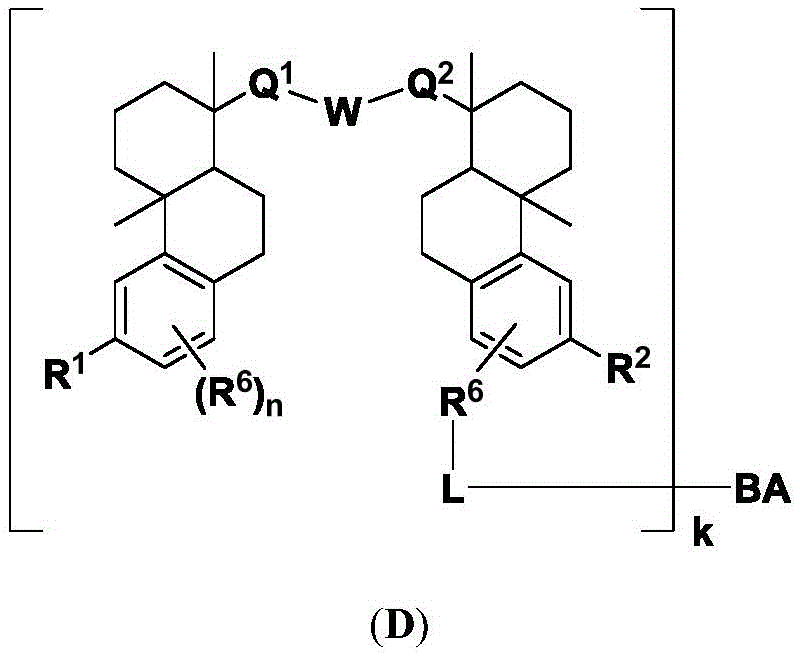
or a pharmaceutically acceptable salt, or stereoisomer form thereof, wherein BA is a binding agent, L is a linker, Q is a pharmaceutically acceptable salt, or stereoisomer form thereof1、Q2、W、R1、R2、R4、R5and-R6-are all as described above in the context of formula I, and k is 1, 2, 3, 4, 5, 6, 7, 8, 9, or 10. In certain embodiments, the compound or payload coupled to-L-BA in formula D comprises one or more compounds of formulas I, II and/or III described above, wherein BA is the bindingAn agent; l is a linker; and k is 1, 2, 3, 4, 5, 6, 7, 8, 9, or 10. In any of the embodiments of this paragraph, the BA is an antibody, or antigen-binding fragment thereof, wherein the antibody is conjugated to a compound of formula I, as described above. In any of the embodiments of this paragraph, the BA is an antibody, or antigen-binding fragment thereof, wherein the antibody is conjugated to a compound of formula II, as described above. In any of the embodiments of this paragraph, the BA is an antibody, or antigen-binding fragment thereof, wherein the antibody is conjugated to a compound of formula III, as described above. In any of the embodiments in this paragraph, k is in the range of 1-2, 1-3, 2-4, 3-4, or 1-4. In any of the embodiments in this paragraph, k is 1. In any of the embodiments in this paragraph, k is 2. In any of the embodiments in this paragraph, k is 3. In any of the embodiments in this paragraph, k is 4. In any of the embodiments in this paragraph, each R 4In each case independently H, an amino acid residue, an N-alkyl amino acid residue, a peptide residue, a biodegradable moiety, an alkyl group, a substituted alkyl group, an acyl group, or a substituted acyl group. In any of the embodiments in this paragraph, each R4In each case independently of each other H, an amino acid residue, an N-alkyl amino acid residue, a peptide residue, a biodegradable moiety, or an alkyl group.
In any one of the preceding four paragraphs, L is a linker or X-Y-Z, wherein X is-NH-or-O-; y is an enzymatically cleavable group moiety, a self-degradable (self-immolative) group, an acid labile group moiety, PEGn1A glycosyl moiety, or a reinforcing group; and Z is a Binder Linker (BL), wherein Z is covalently linked to BA. Exemplary enzymatically cleavable group moieties include, but are not limited to, any di-or tripeptide (e.g., VC-PAB and VA, as described elsewhere in the invention). Exemplary self-degrading groups are described elsewhere herein. Exemplary acid labile group moieties include, but are not limited to, alkoxyamines, ketooxyamines, carbonates, or phosphonates. Exemplary reinforcing groups are described elsewhere in the present disclosure. Exemplary reactive/reactive group moieties are described elsewhere herein. In certain embodiments, Y does not include PEG n1Wherein n1 is 1, 2, 3, 4, or5. In certain embodiments, amino acids may be used to link the payload, the enhancing group and the antibody (each as described elsewhere herein) to one another, as described elsewhere herein and as is apparent elsewhere herein. It will be appreciated by those skilled in the art that attachment of the payload, the reinforcing group, and the antibody via an amino acid may be by an amide coupling reaction, a thio-michael addition, or aniline-NH-alkylation. For example, the amino acid linking the payload, the enhancing group and the antibody is lysine. As a further example, in one embodiment, the amino acid linking the payload, the enhancing group and the antibody is D-lysine. As a further example, in one embodiment, the amino acid linking the payload, the enhancing group and the antibody is aspartic acid. As a further example, in one embodiment, the amino acid linking the payload, the enhancing group and the antibody is glutamic acid. As a further example, in one embodiment, the amino acid linking the payload, the enhancing group and the antibody is serine. As a further example, in one embodiment, the amino acid linking the payload, the enhancing group and the antibody is cysteine. As a further example, in one embodiment, the amino acid linking the payload, the enhancing group and the antibody is tyrosine.
The present invention provides compounds or conjugates having a structure represented by formula a ', B', C ', or D':


or a pharmaceutically acceptable salt, or stereoisomer form thereof, wherein BA is a binding agent, Q1、Q2、W、R1、–R1–、R2、R2–、R4、R5And R6or-R6-all as described above in the context of formula I, SP1And SP2When present, are spacer groups, each AA is an amino acid residue, and p1 is an integer from 1 to 10. In one embodiment, the compound or conjugate is formula a', or a pharmaceutically acceptable salt, or stereoisomer form thereof, wherein BA is a binding agent, Q1、Q2、W、–R1–、R2、R4、R5And R6All as described above in the context of formula I, SP1And SP2When present, are spacer groups, each AA is an amino acid residue, and p1 is an integer from 1 to 10. In one embodiment, the compound or conjugate is of formula B', or a pharmaceutically acceptable salt, or stereoisomer form thereof, wherein BA is a binding agent, Q1、Q2、W、R1、–R2–、R4、R5And R6All as described above in the context of formula I, SP1And SP2When present, are spacer groups, each AA is an amino acid residue, and p1 is an integer from 1 to 10. In one embodiment, the compound or conjugate is formula C', or a pharmaceutically acceptable salt, or stereoisomer form thereof, wherein BA is a binding agent, Q 1、Q2、W、R1、R2、R4、R5and-R6-all as described above in the context of formula I, SP1And SP2When present, are spacer groups, each AA is an amino acid residue, and p1 is an integer from 1 to 10. In one embodiment, the compound or conjugate is formula D', or a pharmaceutically acceptable salt, or a stereoisomeric form thereof, wherein BA is a binding agent, Q1、Q2、W、R1、R2、R4、R5and-R6-all as described above in the context of formula I, SP1And SP2When present, are spacer groups, each AA is an amino acid residue, and p1 is an integer from 1 to 10. In any of the embodiments of this paragraph, BA is an antibody, or antigen binding fragment thereof, wherein the antibody is conjugated to formula IThe compounds are as described above. In any of the embodiments of this paragraph, the BA is an antibody, or antigen-binding fragment thereof, wherein the antibody is conjugated to a compound of formula II, as described above. In any of the embodiments of this paragraph, the BA is an antibody, or antigen-binding fragment thereof, wherein the antibody is conjugated to a compound of formula III, as described above. In any of the embodiments in this paragraph, p1 is 1, 2, 3, 4, or 5. In any of the embodiments in this paragraph, k is 1, 2, 3, 4, 5, 6, 7, 8, 9, or 10. In any of the embodiments in this paragraph, k is in the range of 1-2, 1-3, 2-4, 3-4, or 1-4. In any of the embodiments in this paragraph, k is 1. In any of the embodiments in this paragraph, k is 2. In any of the embodiments in this paragraph, k is 3. In any of the embodiments in this paragraph, k is 4.
In some embodiments, the compound or conjugate is of formula a ":

or a pharmaceutically acceptable salt, or a stereoisomeric form thereof, or a regioisomer thereof, wherein:
BA is a binder;
each SP1、SP2And SP3Are each a spacer group as described above, wherein SP3Is connected to (AA)p1One amino acid residue AA of (a);
p1 is an integer from 1 to 10;
EG is an enhancer;
k is an integer from 1 to 30;
Q1、Q2、W、–R1–、R2、R4、R5and R6Are as described in the context of formula I.
As described above, the bond to the binding agent may be either a direct bond or via a spacer. In certain embodiments, the bond attached to the binding agent is a glutamine residue attached to the binding agent via a PEG spacer group. In certain embodiments, the enhancer is a hydrophilic group.In certain embodiments, the enhancer is a cyclodextrin. In certain embodiments, the enhancer is an alkyl sulfonic acid, heteroalkyl sulfonic acid, alkylene sulfonic acid, or heteroalkylene sulfonic acid. The cyclodextrin may be any cyclodextrin known to the skilled person. In certain embodiments, the cyclodextrin is an alpha-cyclodextrin, beta-cyclodextrin, or gamma-cyclodextrin, or a mixture thereof. In certain embodiments, the cyclodextrin is an a-cyclodextrin. In certain embodiments, the cyclodextrin is β -cyclodextrin. In certain embodiments, the cyclodextrin is gamma-cyclodextrin. In certain embodiments, the alkylsulfonic acid, heteroalkylsulfonic acid, alkylenesulfonic acid, or heteroalkylenesulfonic acid is- (CH) 2)1-5SO3H,–(CH2)n2–NH-(CH2)1- 5SO3H,–(CH2)n2–C(O)NH-(CH2)1-5SO3H,–(CH2CH2O)m2–C(O)NH-(CH2)1-5SO3H,–(CH2)n2–N((CH2)1-5C(O)NH(CH2)1-5SO3H)2,–(CH2)n2–C(O)N((CH2)1-5C(O)NH(CH2)1-5SO3H)2Or is- (CH)2CH2O)m2–C(O)N((CH2)1-5C(O)NH(CH2)1-5SO3H)2Wherein n2 is 1, 2, 3, 4, or 5, and m2 is 1, 2, 3, 4, or 5. In one embodiment, the alkyl, or alkylene, sulfonic acid is- (CH)2)1-5SO3H. In another embodiment, the heteroalkylsulfonic acid, or heteroalkylenesulfonic acid is- (CH)2)n2–NH-(CH2)1-5SO3H, wherein n2 is 1, 2, 3, 4, or 5. In another embodiment, the alkylsulfonic acid, heteroalkylsulfonic acid, alkylenesulfonic acid, or heteroalkylenesulfonic acid is- (CH)2)n2–C(O)NH-(CH2)1-5SO3H, wherein n2 is 1, 2, 3, 4, or 5. In another embodiment, the alkyl sulfonic acid, heteroalkyl sulfonic acid, or alkyl sulfonic acid,The alkylene or heteroalkylene sulfonic acid being- (CH)2CH2O)m2–C(O)NH-(CH2)1-5SO3H, wherein m2 is 1, 2, 3, 4, or 5. In another embodiment, the alkylsulfonic acid, heteroalkylsulfonic acid, alkylenesulfonic acid, or heteroalkylenesulfonic acid is- (CH)2)n2–N((CH2)1- 5C(O)NH(CH2)1-5SO3H)2Wherein n2 is 1, 2, 3, 4, or 5. In another embodiment, the alkylsulfonic acid, heteroalkylsulfonic acid, alkylenesulfonic acid, or heteroalkylenesulfonic acid is- (CH)2)n2–C(O)N((CH2)1-5C(O)NH(CH2)1-5SO3H)2Wherein n2 is 1, 2, 3, 4, or 5. In another embodiment, the alkylsulfonic acid, heteroalkylsulfonic acid, alkylenesulfonic acid, or heteroalkylenesulfonic acid is- (CH)2CH2O)m2–C(O)N((CH2)1-5C(O)NH(CH2)1-5SO3H)2Wherein m2 is 1, 2, 3, 4, or 5. In one embodiment, the SP 1The spacer group is:

wherein RG' is the active group residue after the reaction of the active group RG with the binding agent; is a bond directly or indirectly to the binding agent; and b is an integer from 1 to 4; the (AA)p1–SP2-is-NH-lysine-valine-alanine-, -NH-lysine-valine-citrulline-, or-NH-lysine-valine-citrulline-PABC-; the SP3The spacer group is:
 wherein RG' is the residue of the reactive group after the reaction of the reactive group RG with the enhancer EG;
 is a bond to the enhancer; and
 is and (AA)p1A linked key. In any of the embodiments of this paragraph, the BA is an antibody, or antigen-binding fragment thereof, wherein the antibody is conjugated to a compound of formula I, as described above. In any of the embodiments of this paragraph, the BA is an antibody, or antigen-binding fragment thereof, wherein the antibody is conjugated to a compound of formula II, as described above. In any of the embodiments of this paragraph, the BA is an antibody, or antigen-binding fragment thereof, wherein the antibody is conjugated to a compound of formula III, as described above. In any of the embodiments in this paragraph, p1 is 1, 2, 3, 4, or 5. In any of the embodiments in this paragraph, k is 1, 2, 3, 4, 5, 6, 7, 8, 9, or 10. In any of the embodiments in this paragraph, k is in the range of 1-2, 1-3, 2-4, 3-4, or 1-4. In any of the embodiments in this paragraph, k is 1. In any of the embodiments in this paragraph, k is 2. In any of the embodiments in this paragraph, k is 3. In any of the embodiments in this paragraph, k is 4.
In some embodiments, the compound or conjugate is:

or a pharmaceutically acceptable salt, solvate, or stereoisomeric form thereof, or a regioisomer thereof, wherein:
BA is a binder;
each RG' is independently the residue of a reactive group, as described herein;
EG is an enhancer;
k is an integer from 1 to 30;
Q1、Q2、W、R1、R2、R4、R5and R6Are as described in the context of formula I.
Each R9Are respectively-CH3Or- (CH)2)3N(H)C(O)NH2(ii) a And
each A is independently-O-, -N (H) -,


In some embodiments, the compound or conjugate is:

Or a pharmaceutically acceptable salt, solvate, or stereoisomeric form thereof, or a regioisomer thereof, wherein:
BA is a binder;
each RG' is independently the residue of a reactive group, as described herein;
EG is an enhancer;
k is an integer from 1 to 30;
Q1、Q2、W、R1、R2、R4、R5and R6Are as described in the context of formula I.
Each R9Are respectively-CH3Or- (CH)2)3N(H)C(O)NH2(ii) a And
each A is independently-O-, -N (H) -,

 wherein ZZ is H, or a side chain of an amino acid as discussed elsewhere herein. For example, in one embodiment ZZ is C1-6An alkyl group. As another example, in one embodiment ZZ is C1-6A heteroalkyl group. As discussed above, the bond to the binding agent may be either a direct bond or via a spacer. In certain embodiments, the bond attached to the binding agent is a glutamine residue attached to the binding agent via a PEG spacer group. In certain embodiments, the enhancer is a hydrophilic group. In some embodiments of the present invention, the substrate is,the enhancer is cyclodextrin. In certain embodiments, the reinforcing group is an alkyl sulfonic acid, heteroalkyl sulfonic acid, alkylene sulfonic acid, or heteroalkylene sulfonic acid. The cyclodextrin may be any cyclodextrin known to the skilled person. In certain embodiments, the cyclodextrin is an alpha-cyclodextrin, beta-cyclodextrin, or gamma-cyclodextrin, or a mixture thereof. In certain embodiments, the cyclodextrin is an a-cyclodextrin. In certain embodiments, the cyclodextrin is β -cyclodextrin. In certain embodiments, the cyclodextrin is gamma-cyclodextrin. In certain embodiments, the alkylsulfonic acid, heteroalkylsulfonic acid, alkylenesulfonic acid, or heteroalkylenesulfonic acid is- (CH) 2)1-5SO3H,–(CH2)n2–NH-(CH2)1-5SO3H,–(CH2)n2–C(O)NH-(CH2)1-5SO3H,–(CH2CH2O)m2–C(O)NH-(CH2)1-5SO3H,–(CH2)n2–N((CH2)1-5C(O)NH(CH2)1-5SO3H)2,–(CH2)n2–C(O)N((CH2)1-5C(O)NH(CH2)1-5SO3H)2Or is- (CH)2CH2O)m2–C(O)N((CH2)1-5C(O)NH(CH2)1-5SO3H)2Wherein n2 is 1, 2, 3, 4, or 5, and m2 is 1, 2, 3, 4, or 5. In one embodiment, the alkyl, or alkylene, sulfonic acid is- (CH)2)1-5SO3H. In another embodiment, the heteroalkylsulfonic acid, or heteroalkylenesulfonic acid is- (CH)2)n2–NH-(CH2)1-5SO3H, wherein n2 is 1, 2, 3, 4, or 5. In another embodiment, the alkylsulfonic acid, heteroalkylsulfonic acid, alkylenesulfonic acid, or heteroalkylenesulfonic acid is- (CH)2)n2–C(O)NH-(CH2)1-5SO3H, wherein n2 is 1, 2, 3, 4, or 5. In another embodiment, the alkyl sulfonic acid, heteroalkyl sulfonic acid, alkylene sulfonic acid, or heteroalkyleneThe sulfonic acid being- (CH)2CH2O)m2–C(O)NH-(CH2)1-5SO3H, wherein m2 is 1, 2, 3, 4, or 5. In another embodiment, the alkylsulfonic acid, heteroalkylsulfonic acid, alkylenesulfonic acid, or heteroalkylenesulfonic acid is- (CH)2)n2–N((CH2)1-5C(O)NH(CH2)1-5SO3H)2Wherein n2 is 1, 2, 3, 4, or 5. In another embodiment, the alkylsulfonic acid, heteroalkylsulfonic acid, alkylenesulfonic acid, or heteroalkylenesulfonic acid is- (CH)2)n2–C(O)N((CH2)1-5C(O)NH(CH2)1-5SO3H)2Wherein n2 is 1, 2, 3, 4, or 5. In another embodiment, the alkylsulfonic acid, heteroalkylsulfonic acid, alkylenesulfonic acid, or heteroalkylenesulfonic acid is- (CH)2CH2O)m2–C(O)N((CH2)1-5C(O)NH(CH2)1-5SO3H)2Wherein m2 is 1, 2, 3, 4, or 5.
In some embodiments, the compound or conjugate is:


Or a pharmaceutically acceptable salt, solvate, or stereoisomeric form thereof, or a regioisomer thereof, wherein:
BA is a binder;
k is an integer from 1 to 30;
Q1、Q2、W、R1、R2、R4、R5and R6Are all as described in the context of formula I;
each one of Each is a bond to the reinforcing group;
each R9Are respectively-CH3Or- (CH)2)3N(H)C(O)NH2(ii) a And
each A is independently-O-, -N (H) -,

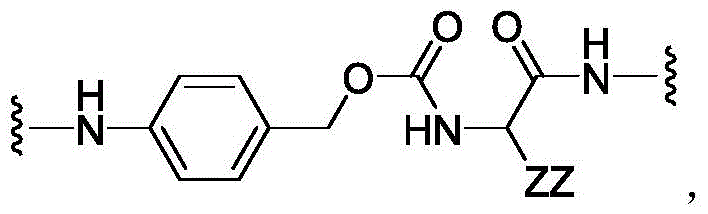 wherein ZZ is H, or a side chain of an amino acid as discussed elsewhere herein. For example, in one embodiment ZZ is C1-6An alkyl group. As another example, in one embodiment ZZ is C1-6A heteroalkyl group. In certain embodiments, the enhancer is a hydrophilic group. In certain embodiments, the enhancer is a cyclodextrin. In certain embodiments, the reinforcing group is an alkyl sulfonic acid, heteroalkyl sulfonic acid, alkylene sulfonic acid, or heteroalkylene sulfonic acid. The cyclodextrin may be any cyclodextrin known to the skilled person. In certain embodiments, the cyclodextrin is an alpha-cyclodextrin, beta-cyclodextrin, or gamma-cyclodextrin, or a mixture thereof. In certain embodiments, the cyclodextrin is an a-cyclodextrin. In certain embodiments, the cyclodextrin is β -cyclodextrin. In certain embodiments, the cyclodextrin is gamma-cyclodextrin. In certain embodiments, the alkylsulfonic acid, heteroalkylsulfonic acid, alkylenesulfonic acid, or heteroalkylenesulfonic acid is- (CH) 2)1-5SO3H,–(CH2)n2–NH-(CH2)1-5SO3H,–(CH2)n2–C(O)NH-(CH2)1-5SO3H,–(CH2CH2O)m2–C(O)NH-(CH2)1-5SO3H,–(CH2)n2–N((CH2)1-5C(O)NH(CH2)1-5SO3H)2,–(CH2)n2–C(O)N((CH2)1-5C(O)NH(CH2)1-5SO3H)2Or is- (CH)2CH2O)m2–C(O)N((CH2)1-5C(O)NH(CH2)1-5SO3H)2Wherein n2 is 1, 2, 3, 4, or 5, and m2 is 1, 2, 3, 4, or 5. In one embodiment, the alkyl, or alkylene, sulfonic acid is- (CH)2)1-5SO3H. In another embodiment, the heteroalkylsulfonic acid, or heteroalkylenesulfonic acid is- (CH)2)n2–NH-(CH2)1-5SO3H, wherein n2 is 1, 2, 3, 4, or 5. In another embodiment, the alkylsulfonic acid, heteroalkylsulfonic acid, alkylenesulfonic acid, or heteroalkylenesulfonic acid is- (CH)2)n2–C(O)NH-(CH2)1-5SO3H, wherein n2 is 1, 2, 3, 4, or 5. In another embodiment, the alkylsulfonic acid, heteroalkylsulfonic acid, alkylenesulfonic acid, or heteroalkylenesulfonic acid is- (CH)2CH2O)m2–C(O)NH-(CH2)1-5SO3H, wherein m2 is 1, 2, 3, 4, or 5. In another embodiment, the alkylsulfonic acid, heteroalkylsulfonic acid, alkylenesulfonic acid, or heteroalkylenesulfonic acid is- (CH)2)n2–N((CH2)1-5C(O)NH(CH2)1-5SO3H)2Wherein n2 is 1, 2, 3, 4, or 5. In another embodiment, the alkylsulfonic acid, heteroalkylsulfonic acid, alkylenesulfonic acid, or heteroalkylenesulfonic acid is- (CH)2)n2–C(O)N((CH2)1-5C(O)NH(CH2)1-5SO3H)2Wherein n2 is 1, 2, 3, 4, or 5. In another embodiment, the alkylsulfonic acid, heteroalkylsulfonic acid, alkylenesulfonic acid, or heteroalkylenesulfonic acid is- (CH)2CH2O)m2–C(O)N((CH2)1-5C(O)NH(CH2)1-5SO3H)2Wherein m2 is 1, 2, 3, 4, or 5.
In some embodiments, the conjugate is:
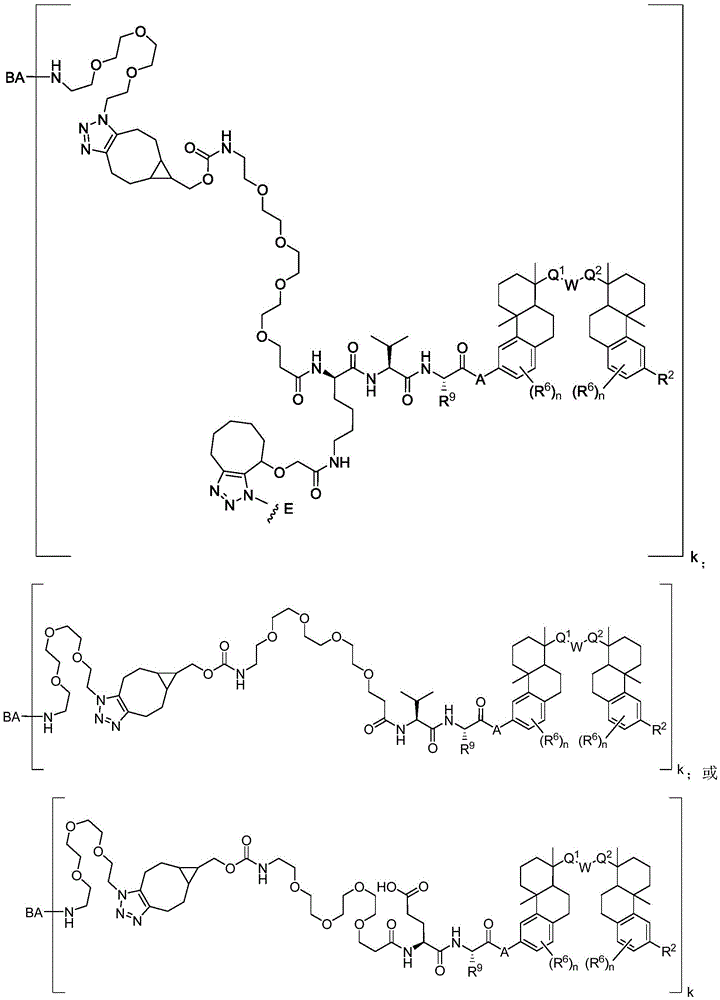
Or a pharmaceutically acceptable salt, solvate, or stereoisomeric form thereof, or a regioisomer thereof, wherein:
BA is a binder;
k is an integer from 1 to 30;
Q1、Q2、W、R1、R2、R4、R5and R6Are all as described in the context of formula I;
each one of Each is a bond to the reinforcing group;
each R9Are respectively-CH3Or- (CH)2)3N(H)C(O)NH2(ii) a And
each A is independently-O-, -N (H) -,

 wherein ZZ is H, or a side chain of an amino acid as discussed elsewhere herein. For example, in one embodiment ZZ is C1-6An alkyl group. As another example, in one embodiment ZZ is C1-6A heteroalkyl group.
In certain embodiments, the enhancer is a hydrophilic group. In certain embodiments, the enhancer is a cyclodextrin. In certain embodiments, the reinforcing group is an alkyl sulfonic acid, heteroalkyl sulfonic acid, alkylene sulfonic acid, or heteroalkylene sulfonic acid. The cyclodextrin may be any cyclodextrin known to the skilled person. In certain embodiments, the cyclodextrin is an alpha-cyclodextrin, beta-cyclodextrin, or gamma-cyclodextrin, or a mixture thereof. At a certain pointIn some embodiments, the cyclodextrin is an a-cyclodextrin. In certain embodiments, the cyclodextrin is β -cyclodextrin. In certain embodiments, the cyclodextrin is gamma-cyclodextrin. In certain embodiments, the alkylsulfonic acid, heteroalkylsulfonic acid, alkylenesulfonic acid, or heteroalkylenesulfonic acid is- (CH) 2)1-5SO3H,–(CH2)n2–NH-(CH2)1-5SO3H,–(CH2)n2–C(O)NH-(CH2)1-5SO3H,–(CH2CH2O)m2–C(O)NH-(CH2)1-5SO3H,–(CH2)n2–N((CH2)1-5C(O)NH(CH2)1-5SO3H)2,–(CH2)n2–C(O)N((CH2)1-5C(O)NH(CH2)1-5SO3H)2Or is- (CH)2CH2O)m2–C(O)N((CH2)1-5C(O)NH(CH2)1-5SO3H)2Wherein n2 is 1, 2, 3, 4, or 5, and m2 is 1, 2, 3, 4, or 5. In one embodiment, the alkyl, or alkylene, sulfonic acid is- (CH)2)1-5SO3H. In another embodiment, the heteroalkylsulfonic acid, or heteroalkylenesulfonic acid is- (CH)2)n2–NH-(CH2)1-5SO3H, wherein n2 is 1, 2, 3, 4, or 5. In another embodiment, the alkylsulfonic acid, heteroalkylsulfonic acid, alkylenesulfonic acid, or heteroalkylenesulfonic acid is- (CH)2)n2–C(O)NH-(CH2)1-5SO3H, wherein n2 is 1, 2, 3, 4, or 5. In another embodiment, the alkylsulfonic acid, heteroalkylsulfonic acid, alkylenesulfonic acid, or heteroalkylenesulfonic acid is- (CH)2CH2O)m2–C(O)NH-(CH2)1-5SO3H, wherein m2 is 1, 2, 3, 4, or 5. In another embodiment, the alkylsulfonic acid, heteroalkylsulfonic acid, alkylenesulfonic acid, or heteroalkylenesulfonic acid is- (CH)2)n2–N((CH2)1- 5C(O)NH(CH2)1-5SO3H)2Wherein n2 is 1, 2, 3, 4, or 5. In another embodiment, the alkylsulfonic acid, heteroalkylsulfonic acid, alkylenesulfonic acid, or heteroalkylenesulfonic acid is- (CH)2)n2–C(O)N((CH2)1-5C(O)NH(CH2)1-5SO3H)2Wherein n2 is 1, 2, 3, 4, or 5. In another embodiment, the alkylsulfonic acid, heteroalkylsulfonic acid, alkylenesulfonic acid, or heteroalkylenesulfonic acid is- (CH)2CH2O)m2–C(O)N((CH2)1-5C(O)NH(CH2)1-5SO3H)2Wherein m2 is 1, 2, 3, 4, or 5.
In some embodiments, the compound or conjugate is:


Or a pharmaceutically acceptable salt, solvate, or stereoisomeric form thereof, or a regioisomer thereof, wherein:
BA is a binder;
k is an integer from 1 to 30;
Q1、Q2、W、R1、R2、R4、R5and R6Are all as described in the context of formula I;
each R9Are respectively-CH3Or- (CH)2)3N(H)C(O)NH2(ii) a And
each A is independently-O-, -N (H) -,

 wherein ZZ is H, or a side chain of an amino acid as discussed elsewhere herein. For example, in one embodiment ZZ is C1-6An alkyl group. As another example, in one embodiment ZZ is C1-6A heteroalkyl group.
In some embodiments, the compound or conjugate is:
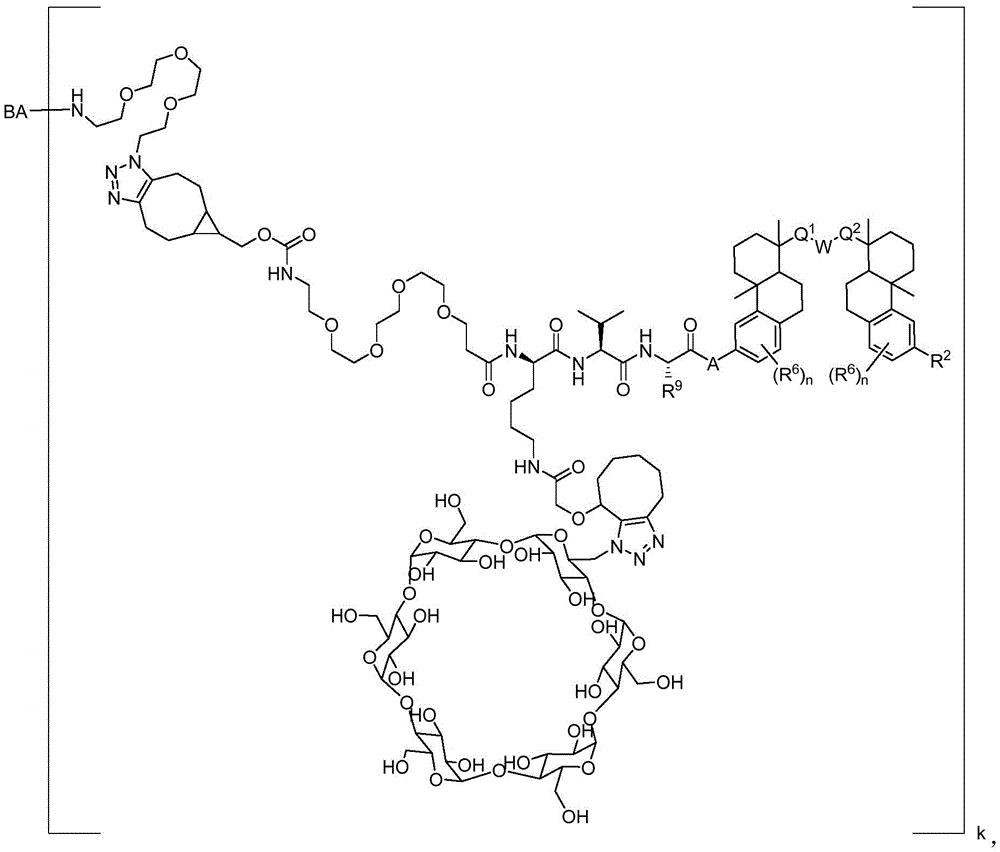


or a pharmaceutically acceptable salt, solvate, or stereoisomeric form thereof, or a regioisomer thereof, wherein:
BA is a binder;
k is an integer from 1 to 30;
Q1、Q2、W、R1、R2、R4、R5and R6Are all as described in the context of formula I;
each R9Are respectively-CH3Or- (CH)2)3N(H)C(O)NH2(ii) a And
each A is independently-O-, -N (H) -,

 wherein ZZ is H, orSide chains of amino acids as discussed elsewhere in the present invention. For example, in one embodiment ZZ is C1-6An alkyl group. As another example, in one embodiment ZZ is C1-6A heteroalkyl group.
In some embodiments, the compound or conjugate is:

Or a pharmaceutically acceptable salt, solvate, or stereoisomeric form thereof, or a regioisomer thereof, wherein:
BA is a binder;
k is an integer from 1 to 30;
Q1、Q2、W、R1、R2、R4、R5and R6Are all as described in the context of formula I;
each one of Each is a bond to the reinforcing group;
each R9Are respectively-CH3Or- (CH)2)3N(H)C(O)NH2(ii) a And
each A is independently-O-, -N (H) -,

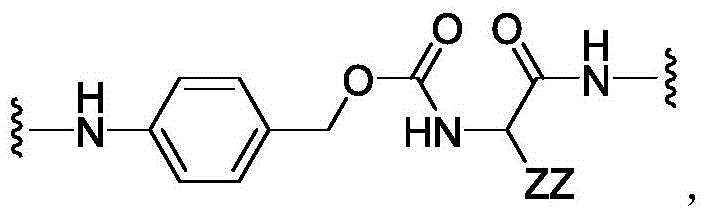 wherein ZZ is H, or a side chain of an amino acid as discussed elsewhere herein. For example, in one embodiment ZZ is C1-6An alkyl group. As another example, in one embodiment ZZ is C1-6A heteroalkyl group. In certain embodiments, the enhancer is a hydrophilic group. In certain embodiments, the enhancer is a cyclodextrin. In some instancesIn embodiments, the reinforcing group is an alkyl sulfonic acid, heteroalkyl sulfonic acid, alkylene sulfonic acid, or heteroalkylene sulfonic acid. The cyclodextrin may be any cyclodextrin known to the skilled person. In certain embodiments, the cyclodextrin is an alpha-cyclodextrin, beta-cyclodextrin, or gamma-cyclodextrin, or a mixture thereof. In certain embodiments, the cyclodextrin is an a-cyclodextrin. In certain embodiments, the cyclodextrin is β -cyclodextrin. In certain embodiments, the cyclodextrin is gamma-cyclodextrin. In certain embodiments, the alkylsulfonic acid, heteroalkylsulfonic acid, alkylenesulfonic acid, or heteroalkylenesulfonic acid is- (CH) 2)1-5SO3H,–(CH2)n2–NH-(CH2)1-5SO3H,–(CH2)n2–C(O)NH-(CH2)1-5SO3H,–(CH2CH2O)m2–C(O)NH-(CH2)1-5SO3H,–(CH2)n2–N((CH2)1-5C(O)NH(CH2)1-5SO3H)2,–(CH2)n2–C(O)N((CH2)1-5C(O)NH(CH2)1-5SO3H)2Or is- (CH)2CH2O)m2–C(O)N((CH2)1-5C(O)NH(CH2)1-5SO3H)2Wherein n2 is 1, 2, 3, 4, or 5, and m2 is 1, 2, 3, 4, or 5. In one embodiment, the alkyl, or alkylene, sulfonic acid is- (CH)2)1-5SO3H. In another embodiment, the heteroalkylsulfonic acid, or heteroalkylenesulfonic acid is- (CH)2)n2–NH-(CH2)1-5SO3H, wherein n2 is 1, 2, 3, 4, or 5. In another embodiment, the alkylsulfonic acid, heteroalkylsulfonic acid, alkylenesulfonic acid, or heteroalkylenesulfonic acid is- (CH)2)n2–C(O)NH-(CH2)1-5SO3H, wherein n2 is 1, 2, 3, 4, or 5. In another embodiment, the alkylsulfonic acid, heteroalkylsulfonic acid, alkylenesulfonic acid, or heteroalkylenesulfonic acid is- (CH)2CH2O)m2–C(O)NH-(CH2)1-5SO3H, wherein m2 is 1, 2, 3, 4, or 5. In another embodiment, the alkylsulfonic acid, heteroalkylsulfonic acid, alkylenesulfonic acid, or heteroalkylenesulfonic acid is- (CH)2)n2–N((CH2)1-5C(O)NH(CH2)1-5SO3H)2Wherein n2 is 1, 2, 3, 4, or 5. In another embodiment, the alkylsulfonic acid, heteroalkylsulfonic acid, alkylenesulfonic acid, or heteroalkylenesulfonic acid is- (CH)2)n2–C(O)N((CH2)1-5C(O)NH(CH2)1-5SO3H)2Wherein n2 is 1, 2, 3, 4, or 5. In another embodiment, the alkylsulfonic acid, heteroalkylsulfonic acid, alkylenesulfonic acid, or heteroalkylenesulfonic acid is- (CH)2CH2O)m2–C(O)N((CH2)1-5C(O)NH(CH2)1-5SO3H)2Wherein m2 is 1, 2, 3, 4, or 5.
In some embodiments, the compound or conjugate is:

Or a pharmaceutically acceptable salt, solvate, or stereoisomeric form thereof, or a regioisomer thereof, wherein:
BA is a binder;
k is an integer from 1 to 30;
Q1、Q2、W、R1、R2、R4、R5and R6Are all as described in the context of formula I;
each one of Each is a bond to the reinforcing group;
each R9Are respectively-CH3Or- (CH)2)3N(H)C(O)NH2(ii) a And
each A is-O–、–N(H)–、

 Wherein ZZ is H, or a side chain of an amino acid as discussed elsewhere herein. For example, in one embodiment ZZ is C1-6An alkyl group. As another example, in one embodiment ZZ is C1-6A heteroalkyl group. In certain embodiments, the enhancer is a hydrophilic group. In certain embodiments, the enhancer is a cyclodextrin. In certain embodiments, the reinforcing group is an alkyl sulfonic acid, heteroalkyl sulfonic acid, alkylene sulfonic acid, or heteroalkylene sulfonic acid. The cyclodextrin may be any cyclodextrin known to the skilled person. In certain embodiments, the cyclodextrin is an alpha-cyclodextrin, beta-cyclodextrin, or gamma-cyclodextrin, or a mixture thereof. In certain embodiments, the cyclodextrin is an a-cyclodextrin. In certain embodiments, the cyclodextrin is β -cyclodextrin. In certain embodiments, the cyclodextrin is gamma-cyclodextrin. In certain embodiments, the alkylsulfonic acid, heteroalkylsulfonic acid, alkylenesulfonic acid, or heteroalkylenesulfonic acid is- (CH) 2)1-5SO3H,–(CH2)n2–NH-(CH2)1-5SO3H,–(CH2)n2–C(O)NH-(CH2)1-5SO3H,–(CH2CH2O)m2–C(O)NH-(CH2)1-5SO3H,–(CH2)n2–N((CH2)1-5C(O)NH(CH2)1-5SO3H)2,–(CH2)n2–C(O)N((CH2)1-5C(O)NH(CH2)1-5SO3H)2Or is- (CH)2CH2O)m2–C(O)N((CH2)1-5C(O)NH(CH2)1-5SO3H)2Wherein n2 is 1, 2, 3, 4, or 5, and m2 is 1, 2, 3, 4, or 5. In one embodiment, the alkyl, or alkylene, sulfonic acid is- (CH)2)1-5SO3H. In another embodiment, the heteroalkylsulfonic acid, or heteroalkylenesulfonic acid is- (CH)2)n2–NH-(CH2)1-5SO3H, wherein n2 is 1, 2, 3, 4, or 5. In another embodiment, the alkylsulfonic acid, heteroalkylsulfonic acid, alkylenesulfonic acid, or heteroalkylenesulfonic acid is- (CH)2)n2–C(O)NH-(CH2)1-5SO3H, wherein n2 is 1, 2, 3, 4, or 5. In another embodiment, the alkylsulfonic acid, heteroalkylsulfonic acid, alkylenesulfonic acid, or heteroalkylenesulfonic acid is- (CH)2CH2O)m2–C(O)NH-(CH2)1-5SO3H, wherein m2 is 1, 2, 3, 4, or 5. In another embodiment, the alkylsulfonic acid, heteroalkylsulfonic acid, alkylenesulfonic acid, or heteroalkylenesulfonic acid is- (CH)2)n2–N((CH2)1-5C(O)NH(CH2)1-5SO3H)2Wherein n2 is 1, 2, 3, 4, or 5. In another embodiment, the alkylsulfonic acid, heteroalkylsulfonic acid, alkylenesulfonic acid, or heteroalkylenesulfonic acid is- (CH)2)n2–C(O)N((CH2)1-5C(O)NH(CH2)1-5SO3H)2Wherein n2 is 1, 2, 3, 4, or 5. In another embodiment, the alkylsulfonic acid, heteroalkylsulfonic acid, alkylenesulfonic acid, or heteroalkylenesulfonic acid is- (CH)2CH2O)m2–C(O)N((CH2)1-5C(O)NH(CH2)1-5SO3H)2Wherein m2 is 1, 2, 3, 4, or 5.
In some embodiments, the compound or conjugate is:
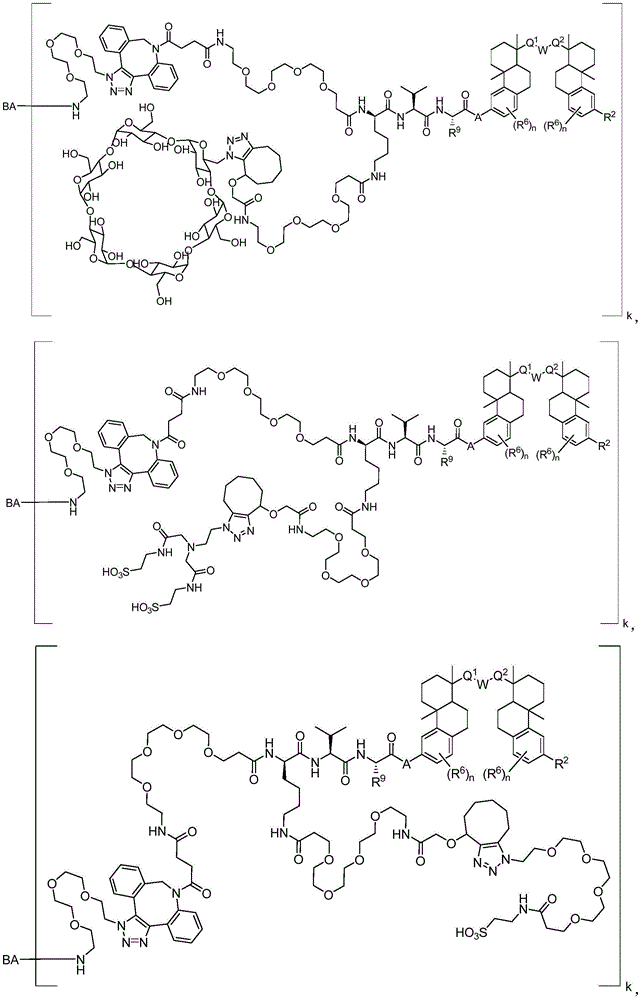
Or a pharmaceutically acceptable salt, solvate, or stereoisomeric form thereof, or a regioisomer thereof, wherein:
BA is a binder;
k is an integer from 1 to 30;
Q1、Q2、W、R1、R2、R4、R5and R6Are all as described in the context of formula I;
each R9Are respectively-CH3Or- (CH)2)3N(H)C(O)NH2(ii) a And
each A is independently-O-, -N (H) -,

 wherein ZZ is H, or a side chain of an amino acid as discussed elsewhere herein. For example, in one embodiment ZZ is C1-6An alkyl group. As another example, in one embodiment ZZ is C1-6A heteroalkyl group.
In some embodiments, the compound or conjugate is:


or a pharmaceutically acceptable salt, solvate, or stereoisomeric form thereof, or a regioisomer thereof, wherein:
BA is a binder;
k is an integer from 1 to 30;
Q1、Q2、W、R1、R2、R4、R5and R6Are all as in formula IAs described in the context of (a);
each R9Are respectively-CH3Or- (CH)2)3N(H)C(O)NH2(ii) a And
each A is independently-O-, -N (H) -,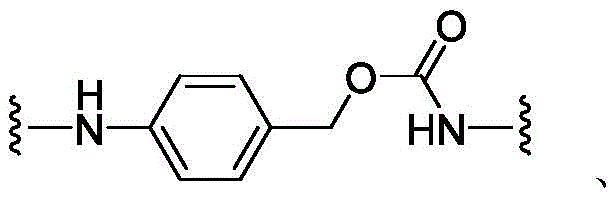

 wherein ZZ is H, or a side chain of an amino acid as discussed elsewhere herein. For example, in one embodiment ZZ is C1-6An alkyl group. As another example, in one embodiment ZZ is C1-6A heteroalkyl group.
In each of the above embodiments, the conjugate can be made from a binding agent functionalized with an azide group and its residues, as described in the following sections. For convenience, triazole residues in several of the structures described above are depicted in parentheses. The skilled artisan will recognize that triazoles may be formed from the azide group of the azide-derived binding agent and the alkyne of the linker-payload LP.
In some embodiments, the compound or conjugate is selected from:

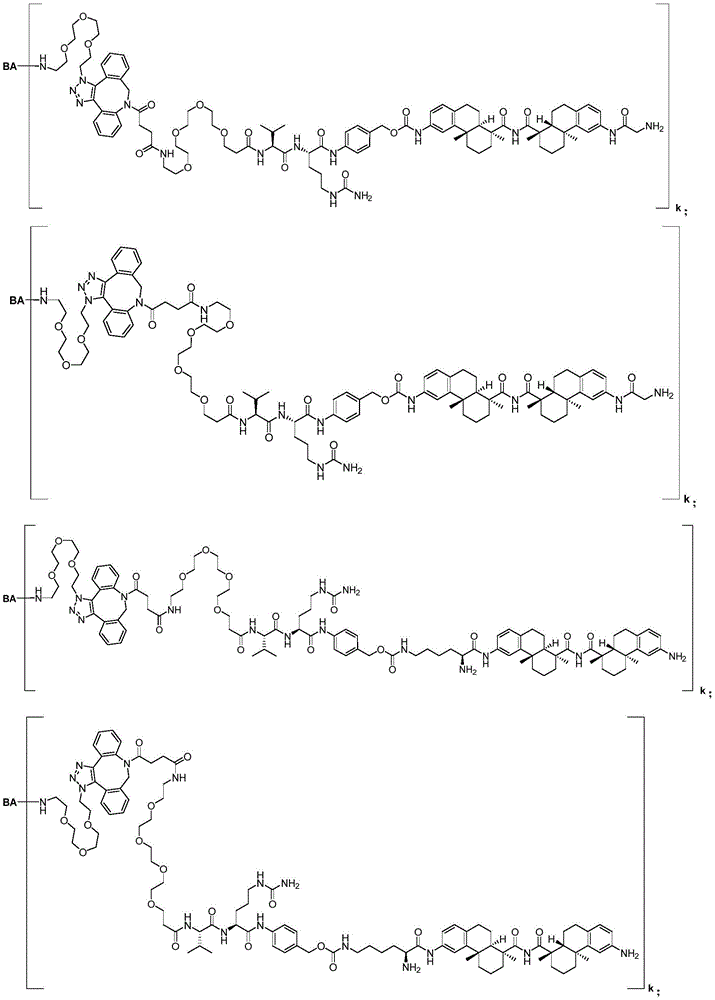


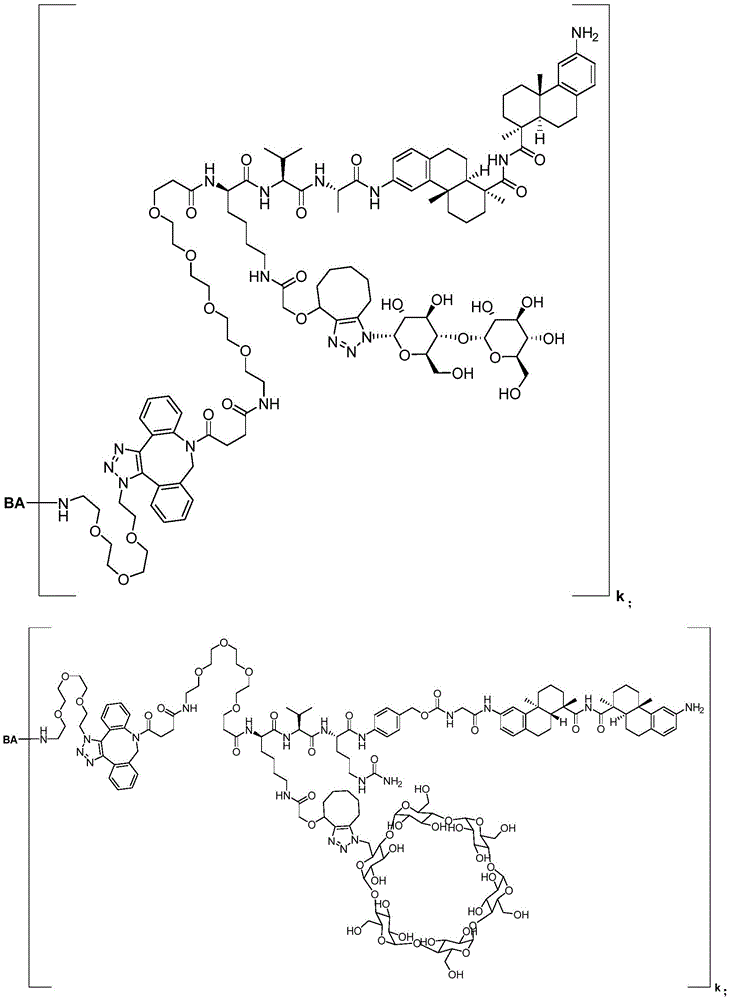


or a regioisomeric, or stereoisomeric form thereof. In any of the embodiments in this paragraph, BA is the binding agent. In any of the embodiments of this paragraph, the BA is an antibody, or an antigen-binding fragment thereof. In any of the embodiments in this paragraph, k is an integer from 1 to 30. In any of the embodiments in this paragraph, k is 1, 2, 3, 4, 5, 6, 7, 8, 9, or 10. In any of the embodiments in this paragraph, k is in the range of 1-2, 1-3, 2-4, 3-4, or 1-4. In any of the embodiments in this paragraph, k is 1. In any of the embodiments in this paragraph, k is 2. In any of the embodiments in this paragraph, k is 3. In any of the embodiments in this paragraph, k is 4.
The present invention also provides an ADC selected from the group consisting of:


in any of the compound or conjugate embodiments provided, BA is an antibody or antigen-binding fragment thereof that binds HER 2. In any of the compound or conjugate embodiments provided, BA is an antibody or antigen-binding fragment thereof that binds PRLR. In any of the compound or conjugate embodiments provided, BA is an antibody or antigen binding fragment thereof and is conjugated via at least one Q295 residue. In any of the compound or conjugate embodiments provided, BA is an antibody or antigen binding fragment thereof and is conjugated via two Q295 residues. In any of the compound or conjugate embodiments provided, BA is an N297Q antibody or antigen binding fragment thereof. In any of the compound or conjugate embodiments provided, BA is an N297Q antibody or antigen binding fragment thereof, and is conjugated via at least one Q295 residue and at least one Q297 residue. In any of the compound or conjugate embodiments provided, BA is an N297Q antibody or antigen binding fragment thereof, and is coupled via two Q295 residues and two Q297 residues. In a particular embodiment, the numbering is according to the EU numbering system.
In any of the embodiments above, BA is an anti-MSR 1 antibody. In certain embodiments, BA is anti-MSR 1 antibody H1H21234N described in the examples below. In certain embodiments, BA is the anti-MSR 1 antibody H1H21234NN297Q described in the examples below.
In certain embodiments, BA is a polypeptide comprising an amino acid sequence according to SEQ ID NO: 2 and a HCVR according to SEQ ID NO: 10, an anti-MSR 1 antibody to the LCVR. In certain embodiments, BA is an anti-MSR 1 antibody comprising amino acid sequences according to SEQ ID NOs: 4. SEQ ID NO: 6. SEQ ID NO: 8. SEQ ID NO: 12. SEQ ID NO: 14 and SEQ ID NO: 1, 2, 3, 4, 5 or 6 of 16 HCDR1, HCDR2, HCDR3, LCDR1, LCDR2 and LCDR 3. In certain embodiments, the HCVR is a HCVR consisting of SEQ id no: 1 encoding. In certain embodiments, the LCVR is a polypeptide consisting of SEQ ID NO: and 9, coding. In certain embodiments, 1, 2, 3, 4, 5, or 6 of HCDR1, HCDR2, HCDR3, LCDR1, LCDR2, and LCDR3 are encoded by the polynucleotide sequence of SEQ ID NO: 3. SEQ ID NO: 5. SEQ ID NO: 7. SEQ ID NO: 11. SEQ ID NO: 13 and SEQ ID NO: and 15, coding. N297Q indicates that one or more residues 297 are mutated from asparagine (N) to glutamine (Q). Preferably, each residue 297 is mutated individually to Q. In a preferred embodiment, the numbering is according to the EU numbering system. In certain embodiments of this paragraph, k is 1 to 4. In certain embodiments, k is 1, 2, 3, or 4. In certain embodiments, k is 4. In certain embodiments, BA is an anti-MSR 1 antibody described in WO 2019/217591 filed 5/8 in 2019, the contents of which are incorporated herein by reference in their entirety.
Process for preparing compounds
The compounds provided herein may be prepared, isolated or obtained by any method apparent to those skilled in the art. Exemplary methods of preparation are described in detail in the examples below. In certain embodiments, the compounds provided herein can be prepared according to synthesis schemes a and B.
Synthesis scheme a. exemplary preparation scheme

In an exemplary preparation scheme a of the process,Q1、Q2、W、R1、R2、R6and n are each as defined above and below in the context of formula (I). After the initial esterification reaction, either R is protected1And/or R1Amination to form R2And P. In the protection of R1Thereafter, saponification and activation of, for example, a carboxylic acid moiety to provide a compound having Q1Of a first coupling partner of (a). After amination, saponification and amidation of, for example, carboxylic acid moieties, provided with Q2Of a second coupling partner of (a). Respectively will have Q1And Q2Are linked and then R is separately ligated1And R2Deprotection to provide compounds of formula I. Exemplary methods of preparation are described in detail in the examples below.
In certain embodiments, one or more protection or deprotection steps may be included in the preparation methods of synthesis scheme a above.
The linker-payloads of the invention can be synthesized by a series of coupling steps. For example, the payload on the right can be attached to the SP by one or more standard coupling reactions 2. In an advantageous embodiment, the payload compound of the invention comprises a free amino group that can be used for coupling under the amide synthesis conditions described herein. (AA)p1The amino acid(s) of (a) can be added by amide synthesis conditions, e.g., peptide synthesis conditions. Spacer group SP2Can be reacted with (AA) by one or more standard coupling reactionsp1And (4) connecting. In an advantageous embodiment, the SP according to the invention2And (AA)p1Groups include free amino or carboxyl groups that can be used for coupling under the amide synthesis conditions described herein. When present, the spacer group SP3Can be reacted with (AA) by one or more standard coupling reactionsp1And (4) connecting. In an advantageous embodiment, the SP according to the invention3And (AA)p1Groups include free amino or carboxyl groups that can be used for coupling under the amide synthesis conditions described herein.
Synthetic scheme b1. exemplary preparation scheme

In exemplary preparation scheme B1, B1 was oxidatively decarboxylated to provide B2, then B2 was payload (HO-payload or H)2N-payload) to give B3 or B4. Alternatively, B5 was esterified, or the peptide was esterified with a payload (HO-payload or H, respectively)2N-payload) to give B6 or B7.
Synthetic scheme b2. exemplary preparation scheme

In exemplary preparation scheme B2, B3, B4, B6, or B7 is a peptide coupled to BB, which is then deprotected to give B8, B9, B10, or B11. B8-B11 are each independently a peptide, which is coupled to either enantiomer of protected glutamic acid to give B12-B19. The B20 or B21 carboxylic acid ester was activated to provide B22 or B23, which were then each independently coupled to one of B12-B19 to provide B24-B27.
When a spacer group SP is present3When it terminates with a reactive group RG. The reactive group may be linked to the enhancer EG by coupling conditions deemed suitable by the person skilled in the art. In certain embodiments, the spacer group SP3The enhancer EG was linked by amide synthesis conditions. In certain embodiments, the spacer group SP3The linkage to the enhancer EG was by click chemistry. In these embodiments, the spacer group SP3Terminating with a reactive group suitable for a click reaction (e.g. an azide or an alkyne), and the enhancer EG comprises a complementary reactive group suitable for a click reaction, e.g. an alkyne or an azide. In a preferred embodiment, SP3Terminated with a strained alkyne, and EG comprises an azide; or SP3Terminated with a carboxylic acid, and EG comprises an amine. When EG is part of a cyclodextrin group, the cyclodextrin may comprise an azide. Azido cyclodextrins can be prepared synthetically or obtained from commercial sources. When EG is a sulfonic acid group moiety, one end of EG is terminated with a sulfonic acid group and the other end is terminated with a primary or secondary amine And (6) terminating.
Conjugates of the invention can be synthesized by conjugating a linker-payload of the invention to a binding agent (e.g., an antibody) under standard conjugation conditions (see, e.g., Doronina et al nature biotechnology2003,21,7,778, which is incorporated herein by reference in its entirety). When the binding agent is an antibody, the antibody may be coupled to the linker-payload through one or more cysteine or lysine residues of the antibody. The linker-payload can be conjugated to the cysteine residue, for example, by subjecting the antibody to a reducing agent (e.g., dithiothreitol) to cleave the disulfide bond of the antibody, purifying the reduced antibody, e.g., by gel filtration, and then treating the antibody with a linker-payload containing a suitable reactive group moiety (e.g., a maleimide group). Suitable solvents include, but are not limited to, water, DMA, DMF, and DMSO. A linker-payload containing a reactive group such as an activated ester or acid halide group can be coupled to a lysine residue of the antibody. Suitable solvents include, but are not limited to, water, DMA, DMF, and DMSO. The conjugate can be purified using known protein techniques, including, for example, volume exclusion chromatography, dialysis, and ultrafiltration/diafiltration.
Binding agents, such as antibodies, may also be conjugated by click chemistry. In some embodiments of the click chemistry reaction, the linker-payload comprises a reactive group capable of 1, 3-cycloaddition reaction with an azide, such as an alkyne. Such suitable reactive groups are described above. The antibodies include one or more azide groups. Such antibodies include antibodies functionalized with, for example, azido-polyethylene glycol groups. In certain embodiments, such functionalized antibodies are derived by treating an antibody having at least one glutamine residue (e.g., heavy chain Gln295 or Gln55) with a primary amine compound in the presence of transglutaminase. In certain embodiments, such functionalized antibodies are derived by treating an antibody having at least one glutamine residue (e.g., heavy chain Gln297) with a primary amine compound in the presence of transglutaminase. Such antibodies include Asn297Gln (N297Q) mutant. In certain embodiments, such functionalized antibodies are derived by treating an antibody having at least two glutamine residues (e.g., heavy chain Gln295 and heavy chain Gln297) with a primary amine compound in the presence of transglutaminase. Such antibodies include Asn297Gln (N297Q) mutant. In certain embodiments, the antibody has two heavy chains as described in this paragraph for a total of two or a total of four glutamine residues.
In certain embodiments, the antibody comprises two glutamine residues, one in each heavy chain. In particular embodiments, the antibody comprises Q295 residues in each heavy chain. In further embodiments, the antibody comprises 1, 2, 3, 4, 5, 6, 7, 8, or more glutamine residues. These glutamine residues can be located in the heavy chain, in the light chain, or in both the heavy and light chains. Exemplary glutamine residues include Q55. These glutamine residues can be wild-type residues, or engineered residues. The antibodies can be prepared according to standard techniques.
Those skilled in the art will recognize that antibodies are typically glycosylated at residue N297 near residue Q295 in the heavy chain sequence. Glycosylation at residue N297 can interfere with transglutaminase at residue Q295 (Dennler et al, supra). Thus, in an advantageous embodiment, the antibody is not glycosylated. In certain embodiments, the antibody is deglycosylated or aglycosylated. In a particular embodiment, the antibody heavy chain has the N297 mutation. In other words, the antibody is mutated to no longer have an asparagine residue at position 297. In particular embodiments, the antibody heavy chain has the N297Q mutation. Such antibodies can be prepared by site-directed mutagenesis to remove or nullify the glycosylation sequence or by site-directed mutagenesis to insert glutamine residues into the site without loss of antibody function or binding function. In some embodiments, an antibody having the Q295 residue and/or the N297Q mutation contains in its variable region one or more additional naturally occurring glutamine residues accessible to transglutaminase, such that the residues are capable of coupling to a linker or linker-payload. An exemplary naturally occurring glutamine residue can be found, for example, at Q55 of the light chain. In such a case, the antibody conjugated by transglutaminase can have a drug-antibody ratio (DAR) higher than expected (e.g., DAR higher than 4). Any such antibody may be isolated from natural or artificial sources.
The antibody that does not interfere with glycosylation is then reacted with a primary amine compound. In certain embodiments, aglycosylated antibodies are reacted with a primary amine compound to produce a glutaminyl-modified antibody. In certain embodiments, deglycosylated antibodies are reacted with a primary amine compound to produce a glutaminyl-modified antibody.
The amino acid sequence of the antibody can be numbered using any known numbering scheme, including the scheme described by Kabat et al (the "Kabat" numbering scheme); the protocol described in Al-Lazikani et Al, 1997, J.mol.biol.,273: 927-; the protocol ("Contact" numbering scheme) described in MacCallum et al, 1996, J.mol.biol.262: 732-; the scheme described in Lefranc et al, Dev.Comp.Immunol.,2003,27:55-77 ("IMGT" numbering scheme); and the protocol described in Honegge and Pl ü ckthun, J.mol.biol.,2001,309:657-70 ("AHo" numbering scheme). Unless otherwise indicated, the numbering scheme used in the present invention is the Kabat numbering scheme. However, the choice of numbering scheme is not intended to imply that there are differences in the absence of sequence, and one skilled in the art can readily ascertain sequence position by examining the amino acid sequence of one or more antibodies. Unless otherwise indicated, "EU numbering scheme" is typically used when referring to residues in the constant region of an antibody heavy chain (e.g., as reported by Kabat et al, supra).
The term "aglycosylated antibody" or "aglycosylated antibody" refers to an antibody that does not comprise a glycosylation sequence that may interfere with the transglutaminase amination reaction, e.g., an antibody that does not have a sugar group at N297 of one or more heavy chains. In a particular embodiment, the antibody heavy chain has the N297 mutation. In other words, the antibody is mutated to no longer have an asparagine residue at position 297, according to the EU numbering system disclosed in Kabat et al. In particular embodiments, the antibody heavy chain has an N297Q or N297D mutation. Such antibodies can be made by removing or nullifying the glycosylation sequence by site-directed mutagenesis or by inserting glutamine residues into sites other than any interfering glycosylation site or any other interfering structure by site-directed mutagenesis. Such antibodies may also be isolated from natural or artificial sources.
The term "deglycosylated antibody" refers to an antibody in which the sugar group at N297 is removed, thereby opening Q295 for transglutaminase amidation. In particular embodiments, the present invention provides methods comprising the additional step of deglycosylating an antibody (e.g., an N297 antibody).
The primary amine may be any primary amine capable of forming a covalent bond with a glutamine residue in the presence of transglutaminase. Useful primary amines are described below. The transglutaminase may be any transglutaminase considered suitable by the person skilled in the art. In certain embodiments, the transglutaminase is an enzyme that catalyzes the formation of isopeptide bonds between free amine groups on primary amine compounds and acyl groups on the side chains of glutamine residues. Transglutaminase is also known as protein-glutamine-gamma-glutamyltransferase. In a particular embodiment, the transglutaminase is classified as ec 2.3.2.13. The transglutaminase may be from any source deemed suitable. In certain embodiments, the transglutaminase is a microorganism. Useful transglutaminases have been isolated from streptoverticillium mobaraense (Streptomyces mobaraense), Streptomyces cinnamomi (Streptomyces cinnamoneum), Streptomyces griseus (Streptomyces griseo-carreum), Streptomyces lavendulae (Streptomyces lavendulae) and Bacillus subtilis (Bacillus subtilis). Non-microbial transglutaminase enzymes may also be used, including mammalian transglutaminase enzymes. In certain embodiments, the transglutaminase can be produced by any technique or obtained from any source deemed suitable by one skilled in the art. In a particular embodiment, the transglutaminase is obtained from a commercial source.
In particular embodiments, the primary amine compound comprises a reactive group capable of further reaction after transglutaminase amination. In these embodiments, the glutaminyl-modified antibody can be reacted with or treated with an active payload compound, linker-payload, or active linker-payload compound to form an antibody-payload conjugate. In certain embodiments, the primary amine compound comprises an azide.
In certain embodiments, a glutaminyl-modified antibody is reacted with or treated with a linker-payload or active linker-payload to form an antibody-payload conjugate. The reaction may be carried out under conditions deemed appropriate by the person skilled in the art. In certain embodiments, a glutaminyl-modified antibody is contacted with a linker-payload or active linker-payload compound under conditions suitable for formation of a bond between the glutaminyl-modified antibody and the linker-payload compound. Suitable reaction conditions are well known to those skilled in the art.
Exemplary reactions are provided in the following examples.
Pharmaceutical compositions and methods of treatment
The present invention provides methods of treating and preventing a disease, condition, or disorder comprising administering a therapeutically or prophylactically effective amount of one or more compounds disclosed herein, e.g., one or more compounds of the general formula provided herein. Diseases, disorders and/or conditions include, but are not limited to, those associated with the antigens listed in the present invention.
The compounds of the present invention may be administered alone or in combination with one or more additional therapeutic agents. One or more additional therapeutic agents may be administered prior to, concurrently with, or shortly after administration of the compounds of the present invention. The invention also includes pharmaceutical compositions comprising any of the compounds described herein in combination with one or more additional therapeutic agents, as well as methods of treatment comprising administering such combinations to a subject in need thereof.
Suitable additional therapeutic agents include, but are not limited to: a second glucocorticoid, an autoimmune therapeutic agent, a hormone, a biologic, or a monoclonal antibody. Suitable therapeutic agents also include, but are not limited to, any pharmaceutically acceptable salts, acids or derivatives of the compounds of the present invention.
In some embodiments of the methods of the invention, multiple doses of the compound of the invention (or a pharmaceutical composition comprising a combination of the compound of the invention and any additional therapeutic agent mentioned herein) may be administered to a subject over a defined period of time. Methods according to this aspect of the disclosure include sequentially administering multiple doses of a compound of the invention to a subject. As used herein, "sequentially administering" refers to administering each dose of a compound to a subject at different time points, e.g., on different days separated by predetermined intervals (e.g., hours, days, weeks, or months). The invention encompasses methods comprising sequentially administering to a patient a single initial dose of a compound of the invention, followed by one or more secondary doses of the compound, and optionally followed by one or more tertiary doses of the compound.
The terms "initial dose", "secondary dose", and "tertiary dose" refer to the time sequence of administration of the compounds of the present invention. Thus, an "initial dose" is a dose administered at the beginning of a treatment regimen (also referred to as a "baseline dose"); "Secondary dose" is the dose administered after administration of the initial dose; and "three doses" are the doses administered after the administration of the two doses. The initial, secondary and tertiary doses may all contain the same amount of a compound of the invention, but may generally differ from one another in terms of frequency of administration. In some embodiments, the amounts of the compounds contained in the initial, secondary, and/or tertiary doses are varied from one another (e.g., adjusted up or down as appropriate) over the course of treatment. In some embodiments, at the beginning of a treatment regimen, two or more (e.g., 2, 3, 4, or 5) doses are administered as a "loading dose" followed by subsequent doses (e.g., "maintenance doses") in a less frequent manner.
In some exemplary embodiments described herein, each secondary and/or tertiary dose is administered 1 to 26 weeks after the preceding dose (e.g., 1, 11/2, 2, 21/2, 3, 31/2, 4, 41/2, 5, 51/2, 6, 61/2, 7, 71/2, 8, 81/2, 9, 91/2, 10, 101/2, 11, 111/2, 12, 121/2, 13, 131/2, 14, 141/2, 15, 151/2, 16, 161/2, 17, 171/2, 18, 181/2, 19, 191/2, 20, 201/2, 21, 211/2, 22, 221/2, 23, 231/2, 24, 241/2, 25, 251/2, 26, 261/2, Or more). The phrase "immediately following the preceding dose" as used herein refers to a dose of a compound of the present invention administered to a patient in a sequence of multiple administrations, immediately prior to administration of the next dose, in which sequence no intervening doses are present.
The methods of this aspect of the invention may comprise administering any number of secondary and/or tertiary doses of a compound of the invention to a patient. For example, in some embodiments, only a single, secondary dose is administered to the patient. In other embodiments, two or more (e.g., 2, 3, 4, 5, 6, 7, 8 or more) secondary doses are administered to the patient. Likewise, in certain embodiments, only a single three-dose is administered to the patient. In other embodiments, the patient is administered two or more (e.g., 2, 3, 4, 5, 6, 7, 8 or more) three doses. The dosing regimen may be carried out indefinitely over the lifetime of the particular subject, or until such treatment is no longer therapeutically necessary or advantageous.
In embodiments involving multiple secondary doses, each secondary dose may be administered/dosed at the same frequency as the other secondary doses. For example, each secondary dose may be administered to the patient for 1 to 2 weeks or 1 to 2 months following the aforementioned dose. Similarly, in embodiments involving multiple tertiary doses, each tertiary dose may be administered/dosed at the same frequency as the other tertiary doses. For example, each of the three doses may be administered to the patient for 2 to 12 weeks following the preceding dose. In some embodiments of the invention, the frequency of administering the secondary and/or tertiary doses to the patient may vary over the course of the treatment regimen. The frequency of administration can also be adjusted by the physician during the course of treatment, according to the needs of the individual patient after clinical examination.
The invention includes dosing regimens in which 2 to 6 loading doses are administered to the patient at a first frequency (e.g., once per week, once every two weeks, once every three weeks, once per month, once every two months, etc.), followed by two or more maintenance doses administered to the patient in a less frequent manner. For example, if the loading dose is administered at a frequency of once a month according to this aspect of the invention, the maintenance dose may be administered once every 6 weeks, once every two months, once every three months, etc.
The invention encompasses pharmaceutical compositions of the compounds, payloads, linker-payloads, and/or conjugates of the invention (e.g., compounds of formula I, II, and/or III), e.g., compositions comprising a compound of the invention, a salt, stereoisomer, polymorph thereof, and a pharmaceutically acceptable carrier, diluent, and/or adjuvant. Examples of suitable carriers, diluents and adjuvants include, but are not limited to: buffers for maintaining the pH of the appropriate composition (e.g., citrate buffer, succinate buffer, acetate buffer, phosphate buffer, lactate buffer, oxalate buffer, etc.), carrier proteins (such as human serum albumin), saline, polyols (e.g., trehalose, sucrose, xylitol, sorbitol, etc.), surfactants (e.g., polysorbate 20, polysorbate 80, polyoxyethylate, etc.), antimicrobials, and antioxidants.
In some embodiments, the present invention provides methods of treating a disease, disorder, or condition comprising administering to a patient having the disorder a therapeutically effective amount of a compound of formula I, II, and/or III, or a pharmaceutical composition thereof.
In some embodiments, the present invention provides a method of preventing a disease, disorder, or condition comprising administering to a patient having the disorder a prophylactically effective amount of a compound of formula I, II, and/or III, or a pharmaceutical composition thereof.
In some embodiments, the invention provides methods for treating or preventing any disease, disorder, or condition that is responsive to modulation of LXR signaling. In some embodiments, the disease or disorder is associated with LXR function, LXR polymorphism, LXR agonist activity, or LXR antagonist activity. In some embodiments, the present invention provides methods of treating or preventing a disease, disorder, or condition selected from the group consisting of: proliferative diseases, neurodegenerative diseases, immunological diseases, autoimmune diseases, inflammatory diseases, skin diseases, metabolic diseases, cardiovascular diseases and gastrointestinal diseases.
The proliferative disease may be any proliferative disease known to the skilled person. In certain embodiments, the proliferative disease includes, but is not limited to, an oncological disease, wherein the oncological disease may be any cancer disease known to the skilled artisan. In certain embodiments, the present invention provides methods of treating or preventing melanoma. In certain embodiments, the present invention provides methods of treating or preventing metastatic melanoma. In certain embodiments, the present invention provides methods of treating or preventing lung cancer. In certain embodiments, the present invention provides methods of treating or preventing EGFR-tyrosine kinase inhibitor resistant lung cancer. In certain embodiments, the present invention provides methods of treating or preventing oral cancer. In certain embodiments, the present invention provides methods of treating or preventing oral squamous cell carcinoma. In certain embodiments, the present invention provides methods of treating or preventing prostate cancer. In certain embodiments, the present invention provides methods of treating or preventing hodgkin's lymphoma. In certain embodiments, the present invention provides methods of treating or preventing breast cancer.
The neurodegenerative disease can be any neurodegenerative disease known to the skilled person. In certain embodiments, the present invention provides methods of treating or preventing alzheimer's disease. In certain embodiments, the present invention provides methods of treating or preventing parkinson's disease. In certain embodiments, the invention provides methods of treating or preventing huntington's disease. In certain embodiments, the present invention provides methods of treating or preventing amyotrophic lateral sclerosis. In certain embodiments, the invention provides methods of treating or preventing myelin gene expression. In certain embodiments, the invention provides methods of treating or preventing myelinated and remyelinated conditions, diseases or disorders.
The immune disease may be any immune disease known to the skilled person. In certain embodiments, the invention provides methods of treating or preventing inflammatory bowel disease. In certain embodiments, the present invention provides methods of treating or preventing ulcerative colitis. In certain embodiments, the present invention provides methods of treating or preventing crohn's disease.
The inflammatory disease may be any inflammatory disease known to the skilled person. In certain embodiments, the present invention provides methods of treating or preventing arthritis. In certain embodiments, the present invention provides methods for treating or preventing rheumatoid arthritis.
The metabolic disease may be any metabolic disease known to the skilled person. In certain embodiments, the metabolic disease is dyslipidemia. The dyslipidemia can be any dyslipidemia known to those skilled in the art. In certain embodiments, the dyslipidemia is selected from the group consisting of: hyperlipidemia, hypercholesterolemia, hypertriglyceridemia, hyperlipoproteinemia, HDL deficiency, ApoA-I deficiency, and cardiovascular diseases such as coronary artery disease (including, for example, the treatment and prevention of angina pectoris, myocardial infarction, and sudden cardiac death); atherosclerosis (including, for example, the treatment and prevention of atherosclerosis); and restenosis (including, for example, the prevention or treatment of atherosclerotic plaques formed as a result of medical procedures such as balloon angioplasty). In certain embodiments, the present invention provides methods for treating or preventing diabetes.
The cardiovascular disease may be any cardiovascular disease known to the skilled person. In certain embodiments, the invention provides methods of treating or preventing atherosclerosis. In certain embodiments, the present invention provides methods of treating or preventing atherosclerosis that results from aberrant macrophage processing. In certain embodiments, the present invention provides methods of treating or preventing atherosclerosis derived from the formation of oxidized low density lipoprotein (oxLDL), wherein macrophages are unable to process oxidized low density lipoprotein (oxLDL). In certain embodiments, the present invention provides methods of treating or preventing ischemic heart disease. In certain embodiments, the present invention provides methods of treating or preventing stroke. In certain embodiments, the present invention provides methods of treating or preventing hypertensive heart disease. In certain embodiments, the present invention provides methods of treating or preventing an aortic aneurysm. In certain embodiments, the present invention provides methods of treating or preventing endocarditis. In certain embodiments, the present invention provides methods of treating or preventing peripheral arterial disease. In certain embodiments, the present invention provides methods of treating or preventing any of the diseases provided in this paragraph.
In some embodiments, the invention provides methods of modulating nuclear receptor function. By way of non-limiting example, the function may be selected from the group consisting of expression/secretion of inflammatory mediators (e.g., cytokines, chemokines), cholesterol regulation, cholesterol uptake, cholesterol efflux, cholesterol oxidation, migration, chemotaxis, apoptosis and necrosis, inflammatory activity, lipid regulation, apoptosis, migration, chemotaxis, gene transcription, and protein expression.
Examples
The present invention provides novel bis-octahydrophenanthrenecarboxamides, protein conjugates thereof, and methods for treating diseases, disorders, and conditions comprising administering the bis-octahydrophenanthrenecarboxamides and conjugates.
In some embodiments, the compound of formula (I) is a compound identified in table 1.
TABLE 1 payload List
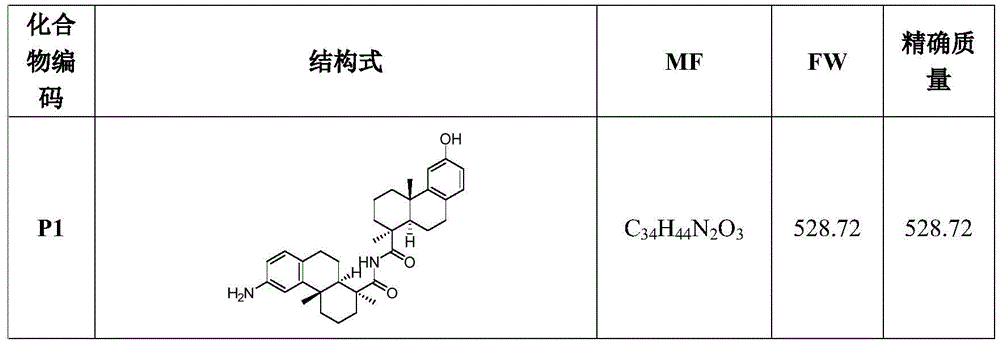


Examples of linker-payloads of the present invention include, but are not limited to, those described in table 2 below.
TABLE 2 linker-payload List

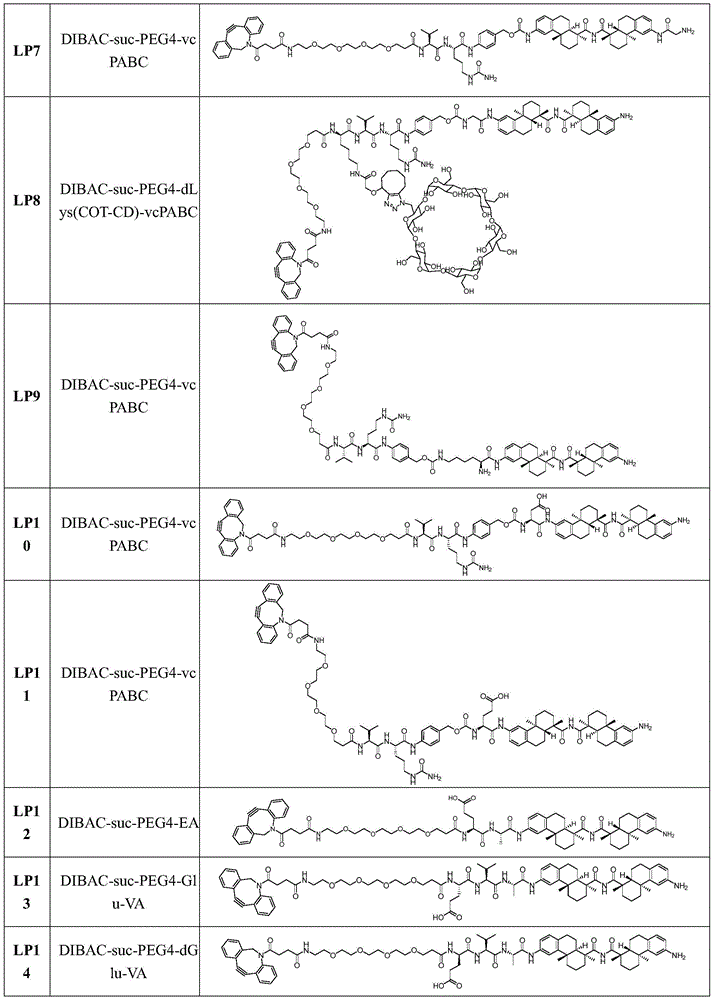

Certain embodiments of the present invention are illustrated by the following non-limiting examples.
Unless otherwise specifically indicated, reagents and solvents were obtained from commercial sources, such as the national pharmaceutical group chemical reagents, Inc. (SCRC), Sigma-Aldrich, Alfa, or other suppliers.
Recording on Bruker AVIII 400 or Bruker AVIII 5001H NMR and other NMR spectra. Proton shift parts per million (ppm) of internal standard Tetramethylsilane (TMS) downfield was determined by processing the data with Nuts software or MestReNova software.
The HPLC-MS assay was run on an Agilent 1200HPLC/6100SQ system using the following conditions:
method a for HPLC-MS determination comprises as mobile phase: a: water (0.01% trifluoroacetic acid TFA) and B: acetonitrile (0.01% TFA); gradient phase: increasing from 5% B to 95% B at a flow rate of 1.0mL/min over a period of 15 minutes (min); the column used was SunFire C18, 4.6x50mm, 3.5 μm. The column temperature was 50 ℃. The detectors include analog-to-digital converter evaporative light scattering detectors (hereinafter "ADC ELSD"), diode array detectors (DAD, 214nm and 254nm), and electrospray ionization-atmospheric pressure ionization (ES-API).
Method B for HPLC-MS determination included as mobile phase: a: water (10 mMNH)4HCO3) And B: acetonitrile; the gradient phase is B increasing from 5% to 95% over 15 minutes (min) at a flow rate of 1.0 mL/min; the column used was XBridgeC18, 4.6x50mm, 3.5 μm. The column temperature was 50 ℃. The detectors include ADCELSD, DAD (214nm and 254nm), and mass selective detector (MSD ES-API).
The LC-MS assay was run on an Agilent 1200HPLC/6100SQ system using the following conditions:
method A for LC-MS measurements was performed on a WATERS 2767 instrument. The chromatographic columns are Shimadzu Shim-Pack, PRC-ODS, 20X250mm, 15 μm, and the two are connected in series; the mobile phase is A: water (0.01% TFA) and B: acetonitrile (0.01% TFA). The gradient phase was increased from 5% B to 95% B at a flow rate of 1.8-2.3mL/min over 3 minutes. The column was SunFireC18, 4.6 × 50mm, 3.5 μm. The column temperature was 50 ℃. The detectors included ADC ELSD, DAD (214nm and 254nm), and MSD ES-API.
Method B for LC-MS measurements was performed on a Gilson GX-281 apparatus. The column is Xbridge Prep C1810 um OBD, 19X250 mm. The mobile phase is A: water (10 mMNH)4HCO3) And B: and (3) acetonitrile. The gradient phase was increased from 5% B to 95% B at a flow rate of 1.8-2.3mL/min over 3 minutes. The column was XBridge C18, 4.6x50mm, 3.5 μm. The column temperature was 50 ℃. The detectors included ADC ELSD, DAD (214nm and 254nm), and MSD ES-API.
Preparative high pressure liquid chromatography (preparative HPLC) was performed on a Gilson GX-281 apparatus. Two solvent systems are used, one being acidic and the other being basic. The acidic solvent system (method A) comprises a Waters SunAire 10 μmC18 column (A)  250x19 mm). Solvent a for preparative HPLC was 0.05% TFA in water and solvent B was acetonitrile. The elution conditions were a linear gradient that increased from 5% solvent B to 100% solvent B over a 20 minute period at a flow rate of 30 mL/min. The basic solvent system (method B) comprises a
 Waters Xbridge 10. mu. mC18 column (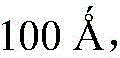 250x19 mm). Solvent A for preparative HPLC was 10mM ammonium bicarbonate (NH)4HCO3) The solvent B is acetonitrile. The elution conditions were a linear gradient that increased from 5% solvent B to 100% solvent B over a 20 minute period at a flow rate of 30 mL/min.
Flash chromatography was performed on a Biotage instrument using an Agela scintillation Column (Flash Column) silica gel-CS (silica-CS). Reverse phase flash chromatography was performed on a Biotage instrument using a Boston ODS or Agela C18 column, unless explicitly stated otherwise.
As used herein, the symbols and conventions used in the methods, schemes and examples are consistent with those used in the scientific literature of the present invention (e.g., the journal of the american chemical society or the journal of biochemistry), whether or not specific abbreviations are specifically defined. Specifically, but not limited to, the following abbreviations may be used in the examples and throughout the specification:
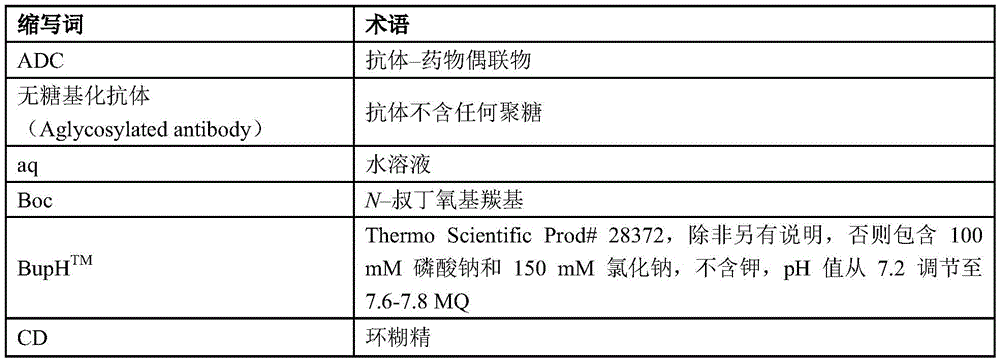


Preparation method
Example 1
This example illustrates a general method for the synthesis of the podocarpine acid derivatives P1, P15, and P2 of table 1 above. This example relates to the compounds numbered 1 to 12a-b and P1, P15 and P2 in fig. 1.
(1S,4aS,10aR) -6-hydroxy-1, 4 a-dimethyl-1, 2,3,4,4a,9,10,10 a-octahydrophenanthrene-1-carboxylic acid methyl ester (2)

To a solution of podocaronic acid (1, 90g, 0.33mol) in methanol (200mL) and toluene (600mL) was added (trimethylsilyl) diazomethane (2M in hexane, 200 mL). The reaction mixture was stirred at room temperature for 2 hours. The podocararic acid was then completely depleted as monitored by LCMS. The volatiles were removed by concentration in vacuo and the residue triturated with petroleum ether (2L) to give compound 2(91g, 96% yield) as a white solid. ESI M/z:289(M + H)+。1H NMR(400MHz,DMSOd6)δ8.95(s,1H),6.79(d,J=8.2Hz,1H),6.63(d,J=2.4Hz,1H),6.48(dd,J=8.2,2.4Hz,1H),3.58(s,3H),2.80-2.55(m,2H),2.20-2.02(m,3H),1.96-1.71(m,2H),1.56-1.45(m,2H),1.27(t,J=13.5Hz,1H),1.21(s,3H),1.09(td,J=13.5,4.1Hz,1H),0.91(s,3H)ppm。
(1S,4aS,10aR) -1,4 a-dimethyl-6- (trifluoromethanesulfonyloxy) -1,2,3,4,4a,9,10,10 a-octahydrophenanthrene-1-carboxylic acid methyl ester (3)

To a solution of compound 2(10g, 35mmol) in dichloromethane (200mL) under nitrogen was added pyridine (3.3g, 42mmol) and DMAP (0.84g, 6.9 mmol). The mixture was cooled to-78 deg.C, trifluoroacetic anhydride (12g, 42mmol) was added, and the resulting mixture was then warmed to 25 deg.C and stirred at 25 deg.C for an additional 4 hours. The reaction mixture was diluted with DCM (500mL) and washed with water (100mL), aqueous hydrochloric acid (1N, 150mL) and brine (100mL), dried over sodium sulfate and concentrated in vacuo to give crude compound 3(14g, 97% crude yield) as a viscous oil which was pure enough to be used in the next step. The crude compound 3 can be purified by flash chromatography (0-10% ethyl acetate in petroleum ether) to afford pure product 3 as a viscous oil. ESI M/z 421.2(M +1) +。1H NMR(400MHz,CDCl3)δ7.12(d,J=2.5Hz,1H),7.10(d,J=8.5Hz,1H),6.97(dd,J=8.5,2.5Hz,1H),3.67(s,J=3.4Hz,3H),2.93(dd,J=17.2,4.4Hz,1H),2.85-2.71(m,1H),2.29(d,J=13.5Hz,1H),2.25-2.14(m,2H),2.03-1.89(m,2H),1.71-1.61(m,1H),1.56-1.48(m,1H),1.40(td,J=13.4,4.2Hz,1H),1.30-1.22(m,3H),1.09(td,J=13.6,4.2Hz,1H),1.02(s,3H)ppm。
(1S,4aS,10aR) -6- ((tert-butoxycarbonyl) amino) -1,4 a-dimethyl-1, 2,3,4,4a,9,10,10 a-octahydrophenanthrene-1-carboxylic acid methyl ester (4)

To compound 3(14g, 34mmol) and tert-butyl carbamate (BocNH) at room temperature27.9g, 68mmol) of tert-butanol (100mL) was added successively cesium carbonate (22g, 68mmol), tris (dibenzylideneacetone) dipalladium (0) (Pd)2(dba)31.8g, 2.0mmol) and 2-dicyclohexylphosphonium-2, 4, 6-triisopropylbiphenyl (X-Phos, 1.8g, 4.0 mmol). The mixture was degassed and degassed 3 times with argon, then stirred overnight at 80 ℃ under argon atmosphere (balloon) until compound 3 had been completely depleted as monitored by TLC. After cooling to room temperature, the reaction mixture was diluted with ethyl acetate and filtered through celite. The solid was washed 3 times with ethyl acetate. The combined filtrates were concentrated in vacuo and the resulting residue was purified by silica gel column chromatography (0-6.25% ethyl acetate in petroleum ether) to give compound 4(11g, 82% yield) as a white solid. ESI M/z:410(M +23)+。1H NMR(500MHz,DMSOd6)δ9.07(s,1H),7.39(s,1H),7.13(d,J=8.5Hz,1H),6.87(d,J=8.3Hz,1H),3.59(s,3H),2.76(dd,J=16.4,4.5Hz,1H),2.70-2.61(m,1H),2.16-2.05(m,3H),2.00-1.75(m,2H),1.65-1.50(m,2H),1.45(s,9H),1.31-1.25(m,1H),1.21(s,3H),1.10(td,J=13.5,4.1Hz,1H),0.92(s,3H)ppm。
(1S,4aS,10aR) -6- { [ (tert-butoxy) carbonyl ] amino } -1,4 a-dimethyl-1, 2,3,4,4a,9,10,10 a-octahydrophenanthrene-1-carboxylic acid (5)

To a DMSO solution of compound 4(4.9g, 13mmol) was added potassium tert-butoxide (15g, 0.13mol) in one portion at room temperature. The reaction mixture is under argon Stir under atmosphere at 60 ℃ for 3 hours until the reaction is complete as monitored by LCMS. After cooling to room temperature, the reaction mixture was poured into ice and then slowly acidified with aqueous hydrochloric acid (0.5M) to a pH of 5 during which the temperature did not exceed 25 ℃. The precipitate was collected by filtration and then washed several times with water. The crude product was further purified by silica gel column chromatography (0-20% ethyl acetate in petroleum ether) to afford compound 5(4.5g, 93% yield) as a white solid. ESI M/z 318(M-55)+。1H NMR(500MHz,DMSOd6)δ12.08(s,1H),9.08(s,1H),7.40(s,1H),7.11(s,1H),6.87(d,J=8.3Hz,1H),2.79-2.68(m,1H),2.65(d,J=12.6Hz,1H),2.17-2.03(m,4H),1.94-1.76(m,2H),1.53(d,J=13.7Hz,1H),1.46(d,J=7.4Hz,9H),1.29-1.14(m,5H),1.04(s,3H)ppm。
N- [ (4bS,8S,8aR) -8-carbamoyl-4 b, 8-dimethyl-4 b,5,6,7,8,8a,9, 10-octahydrophenanthren-3-yl ] carbamic acid tert-butyl ester (6)

To a solution of 5(4.5g, 12mmol) and HATU (4.9g, 13mmol) in DMF (50mL) was added diisopropylethylamine (20mL, 0.12mol) and the mixture was stirred at 25 ℃ for 1 h. Ammonium chloride (16g, 0.30mol) was then added to the mixture, and the mixture was stirred at room temperature overnight. The resulting mixture was diluted with ethyl acetate, then washed with water and brine, dried over sodium sulfate and concentrated in vacuo. The resulting residue was purified by flash chromatography (0-20% ethyl acetate in petroleum ether) to afford compound 6(4.2g, 94% yield) as a white solid. ESI M/z 373.3(M +1) +。1H NMR(500MHz,MeOHd4)δ7.20(s,1H),6.97(d,J=7.7Hz,1H),6.80(d,J=8.3Hz,1H),2.77-2.68(m,2H),2.66-2.55(m,1H),2.20(d,J=12.9Hz,1H),2.13(dd,J=13.2,5.3Hz,1H),2.08(d,J=14.0Hz,1H),2.03-1.86(m,2H),1.54(d,J=11.1Hz,1H),1.40(s,9H),1.26(t,J=26.7Hz,1H),1.18(s,3H),1.14-1.03(m,4H)ppm。
(1S,4aS,10aR) -6-amino-1, 4 a-dimethyl-1, 2,3,4,4a,9,10,10 a-octahydrophenanthrene-1-carboxylic acid methyl ester trifluoroacetate (7)

To a solution of compound 4(6.0g, 15mmol) in DCM (60mL) was added TFA (12mL) at room temperature. The resulting mixture was stirred at room temperature for 2 hours until Boc was completely removed, monitored by TLC. The reaction mixture was concentrated in vacuo to afford crude compound 7 as TFA salt, which was used in the next step without further purification. ESI M/z 288(M +1)+。
(1S,4aS,10aR) -6- (benzyloxy) -1,4 a-dimethyl-1, 2,3,4,4a,9,10,10 a-octahydrophenanthrene-1-carboxylic acid methyl ester (8a)

A mixture of compound 2(12g, 40mmol) and cesium carbonate (14g, 44mmol) in DMF (100mL) was stirred at 20-25 ℃ for 15 minutes. To the mixture was added benzyl bromide (7.1mL, 60mmol) at room temperature. After the reaction was stirred at room temperature for 4 hours, the resulting mixture was poured into cold water and extracted with ethyl acetate. The combined organic solutions were washed with water and brine, dried over sodium sulfate and concentrated in vacuo. The crude product was purified by flash chromatography (0-10% ethyl acetate in petroleum ether) to afford the title compound 8a (13g, 89% yield) as a white solid. ESI M/z 379(M + H)+。1H NMR(500MHz,MeOHd4)δ7.60-7.20(m,5H),7.00-6.82(m,2H),6.73(d,J=7.1Hz,1H),5.03(s,2H),3.66(s,3H),2.95-2.58(m,2H),2.36-2.10(m,3H),2.10-1.85(m,2H),1.70-1.48(m,2H),1.44-1.21(m,4H),1.15(t,J=17.2Hz,1H),1.01(s,3H)ppm。
(1S,4aS,10aR) -6- (dibenzylamino) -1,4 a-dimethyl-1, 2,3,4,4a,9,10,10 a-octahydrophenanthrene-1-carboxylic acid methyl ester (8b)

To a solution of crude compound 7 (calculated amount, 15mmol) obtained above in DMF (60mL) at room temperature was added potassium carbonate (6.4)g, 46mmol) and benzyl bromide (5.8g, 34 mmol). The reaction mixture was stirred at 80 ℃ overnight until completion by TLC. After cooling to room temperature, the mixture was poured into cold water (300mL) and extracted with ethyl acetate (× 3). The combined organic solutions were washed with water and brine, dried over sodium sulfate and concentrated in vacuo to give crude product 8b, which was used in the next step without further purification. ESI M/z 468(M +1)+。
(1S,4aS,10aR) -6- (benzyloxy) -1,4 a-dimethyl-1, 2,3,4,4a,9,10,10 a-octahydrophenanthrene-1-carboxylic acid (9a)

A mixture of compound 8a (11g, 29mmol) and potassium tert-butoxide (33g, 0.29mol) in DMSO (0.19L) was stirred at 100 ℃ for 1 hour until complete depletion of the ester was monitored by LCMS and TLC. After the reaction was cooled to 25 ℃, the mixture was quenched with aqueous hydrochloric acid (1N) and then extracted with ethyl acetate. The combined organic solutions were washed with brine, dried over sodium sulfate and concentrated in vacuo. The resulting residue was purified by silica gel column chromatography (0-24% ethyl acetate in petroleum ether) to give compound 9a (7.5g, 71% yield) as a white solid. ESI M/z 365(M + H) +。1H NMR(500MHz,MeOHd4)δ7.42(d,J=7.4Hz,2H),7.36(t,J=7.5Hz,2H),7.30(t,J=7.3Hz,1H),6.92(d,J=8.4Hz,1H),6.87(d,J=2.5Hz,1H),6.72(dd,J=8.4,2.5Hz,1H),5.02(s,2H),2.82(dd,J=16.3,4.4Hz,1H),2.77-2.65(m,1H),2.24(d,J=13.2Hz,2H),2.19(dd,J=13.8,6.0Hz,1H),2.11-1.96(m,2H),1.64-1.56(m,1H),1.53(d,J=11.0Hz,1H),1.35(td,J=13.3,3.7Hz,1H),1.30(s,3H),1.13(s,3H),1.11-1.05(m,1H)ppm。
(1S,4aS,10aR) -6- (dibenzylamino) -1,4 a-dimethyl-1, 2,3,4,4a,9,10,10 a-octahydrophenanthrene-1-carboxylic acid (9b)

To the crude compound 8b (calculated amount, 15mmol) obtained above in DMSO (10) at room temperature0mL) was added to the solution in one portion potassium tert-butoxide (17g, 0.15 mol). The reaction mixture was stirred at 100 ℃ for 2 hours under argon atmosphere until completion of the reaction, monitored by LCMS. After cooling to room temperature, the reaction mixture was poured into ice and then slowly acidified to pH 5 with aqueous hydrochloric acid (4M), during which time the temperature was not higher than 25 ℃. The mixture was extracted with ethyl acetate and the combined organic solutions were washed with water and brine, dried over sodium sulfate and concentrated in vacuo. The crude product was purified by silica gel column chromatography (0-20% ethyl acetate in petroleum ether) to give compound 9b (6.8g, 99% over 3 steps from compound 4) as a white solid. ESI M/z 454(M +1)+。
(1S,4aS,10aR) -6- (benzyloxy) -1,4 a-dimethyl-1, 2,3,4,4a,9,10,10 a-octahydrophenanthrene-1-carboxylic acid pentafluorophenyl ester (10a)

To a solution of 9a (9.6g, 26mmol) in DMF (100mL) were added DIPEA (14mL, 79mmol) and perfluorophenyl 2,2, 2-trifluoroacetate (15g, 53 mmol). The resulting mixture was stirred at room temperature overnight and monitored by LCMS. The reaction mixture was then diluted with ether (200mL) and washed with water (300mL) and brine (200 mL). The organic solution was dried over sodium sulfate and concentrated in vacuo. The resulting residue was purified by flash chromatography (0-10% ethyl acetate in petroleum ether) to afford compound 10a (12g, 88% yield) as a white solid. ESI M/z:531(M + H) +。1H NMR(500MHz,DMSOd6)δ7.43(d,J=7.1Hz,2H),7.38(t,J=7.4Hz,2H),7.31(t,J=7.2Hz,1H),6.93(dd,J=10.2,5.5Hz,2H),6.76(dd,J=8.4,2.5Hz,1H),5.05(s,2H),2.81(dd,J=16.3,4.5Hz,1H),2.77-2.68(m,1H),2.28-2.19(m,2H),2.18(dd,J=13.4,5.6Hz,1H),2.00-1.83(m,2H),1.74(d,J=11.8Hz,1H),1.65(d,J=14.1Hz,1H),1.47(s,3H),1.38-1.27(m,2H),1.08(s,3H)ppm。
(1S,4aS,10aR) -6- (dibenzylamino) -1,4 a-dimethyl-1, 2,3,4,4a,9,10,10 a-octahydrophenanthrene-1-carboxylic acid pentafluorophenyl ester (10b)

To a solution of 9b (6.8g, 15mmol) in DMF (100mL) was added DIPEA (10mL, 0.61mol) and perfluorophenyl 2,2, 2-trifluoroacetate (10mL, 58 mmol). The resulting mixture was stirred overnight at 25 ℃ under nitrogen and then diluted with ether. The organics were washed with water and brine, dried over sodium sulfate and concentrated in vacuo. The residue was purified by silica gel column chromatography (0-10% ethyl acetate in petroleum ether) to give compound 10b (7.5g, 81% yield) as a white solid. ESI M/z 620(M +1)+。H NMR(400MHz,CDCl3)δ7.36-7.25(m,10H),6.92(d,J=8.4Hz,1H),6.67(d,J=2.8Hz,1H),6.63(dd,J=8.4,2.6Hz,1H),4.63(m,4H),2.85-2.73(m,2H),2.41-2.37(m,1H),2.22-2.20(m,1H),2.15-1.91(m,3H),1.71-1.65(m,2H),1.51(s,3H),1.37-1.19(m,2H),1.10(s,3H)ppm。
Tert-butyl N- [ (4bS,8S,8aR) -8- ({ [ (1S,4aS,10aR) -6- (benzyloxy) -1,4 a-dimethyl-1, 2,3,4,4a,9,10,10 a-octahydrophenanthren-1-yl ] carboxamido } carbonyl) -4b, 8-dimethyl-4 b,5,6,7,8,8a,9, 10-octahydrophenanthren-3-yl ] carbamate (11a)

To a solution of compound 6(2.3g, 6.2mmol) in THF (20mL) was added n-BuLi (2.5M in hexane, 5.5mL, 14mmol) dropwise at-78 deg.C. The reaction mixture was stirred at-78 ℃ for 1 hour. To the mixture was added a solution of 10a (3.0g, 5.6mmol) in THF (20mL) and the resulting mixture was stirred at 10-20 ℃ overnight until compound 10a was depleted as monitored by LCMS. The reaction was then quenched with saturated aqueous ammonium chloride solution and extracted with ethyl acetate. The combined organic solutions were washed with water and brine, dried over sodium sulfate and concentrated in vacuo. The resulting residue was purified by flash chromatography (0-30% ethyl acetate in petroleum ether) to afford compound 11a (1.59g, 51% yield) as a white solid. ESI M/z 719(M +1) +。
(compared to the process of 11b below, where n-BuLi was used instead of LiHMDS. although 6 was not completely consumed, this process resulted in less by-product and the yield of 11a increased from about 40% to 51%. unreacted compound 6 was recovered (recovery: 10-20%).
N- [ (4bS,8S,8aR) -8- ({ [ (1S,4aS,10aR) -6- (dibenzylamino) -1,4 a-dimethyl-1, 2,3,4,4a,9,10,10 a-octahydrophenanthren-1-yl ] carboxamido } carbonyl) -4b, 8-dimethyl-4 b,5,6,7,8,8a,9, 10-octahydrophenanthren-3-yl ] carbamic acid tert-butyl ester (11b)

To a solution of compound 6(1g, 2.7mmol) in THF (15mL) was added dropwise lithium bis (trimethylsilyl) amide (1M in hexane, 8.0mL) at 0 deg.C. The reaction was stirred at 0 ℃ for 1 hour. To the mixture was added a solution of compound 10b (2.5g, 4.0mmol) in THF (10mL), and the resulting mixture was stirred at room temperature overnight. The reaction was then quenched with saturated aqueous ammonium chloride solution and extracted with ethyl acetate. The combined organic solutions were washed with water and brine, dried over sodium sulfate and concentrated in vacuo. The residue was purified by flash chromatography (0-35% ethyl acetate in petroleum ether) to give compound 11b (0.95g, 44% yield) as a white solid; and Compound 6 was recovered (37% recovery). ESI M/z:808(M +1) +。1H NMR(400MHz,CDCl3)δ8.16(s,1H),7.35-7.24(m,10H),7.12(d,J=8Hz,1H),7.00(d,J=8.4Hz,1H),6.91(d,J=8.4Hz,1H),6.62-6.59(m,2H),6.42(s,1H),4.62(s,3H),2.98-2.75(m,4H),2.31-2.22(m,5H),2.10-1.97(m,5H),1.69-1.63(m,4H),1.56(s,9H),1.32-1.27(m,9H),1.43-1.27(m,5H),1.05(s,3H)ppm。
Tert-butyl N- [ (4bS,8S,8aR) -8- ({ [ (1S,4aS,10aR) -6-hydroxy-1, 4 a-dimethyl-1, 2,3,4,4a,9,10,10 a-octahydrophenanthren-1-yl ] carboxamido } carbonyl) -4b, 8-dimethyl-4 b,5,6,7,8,8a,9, 10-octahydrophenanthren-3-yl ] carbamate (12a) (P15)

To a solution of 11a (2.0g, 2.78mmol) in ethyl acetate (40mL) under nitrogen was added wet palladium on carbon (10%Pd, 0.9 g). The mixture was degassed and vented with hydrogen then stirred overnight at room temperature under a hydrogen balloon until complete depletion of 11a was monitored by LCMS. The mixture was filtered through celite and the filtrate was concentrated in vacuo. The resulting residue was purified by silica gel column chromatography (0-55% ethyl acetate in petroleum ether) to give 12a (P15; 1.06g, 61% yield) as a white solid. ESI M/z:629(M + H)+。1H NMR(500MHz,DMSOd6)δ9.10(s,1H),8.98(s,1H),8.11(s,1H),7.40(s,1H),7.15(d,J=7.5Hz,1H),6.90(d,J=8.4Hz,1H),6.81(d,J=8.3Hz,1H),6.63(d,J=2.3Hz,1H),6.50(dd,J=8.2,2.4Hz,1H),2.84(td,J=16.3,3.8Hz,2H),2.77-2.64(m,2H),2.30-2.22(m,2H),2.14(t,J=10.9Hz,4H),2.00-1.80(m,4H),1.65-1.54(m,4H),1.45(s,9H),1.34-1.28(m,2H),1.27(d,J=2.5Hz,6H),1.15-1.08(m,2H),0.99(s,6H)ppm。
N- [ (4bS,8S,8aR) -8- ({ [ (1S,4aS,10aR) -6-amino-1, 4 a-dimethyl-1, 2,3,4,4a,9,10,10 a-octahydrophenanthren-1-yl ] carboxamido } carbonyl) -4b, 8-dimethyl-4 b,5,6,7,8,8a,9, 10-octahydrophenanthren-3-yl ] carbamic acid tert-butyl ester (12b)

To a solution of 11b (0.45g, 0.56mmol) in ethyl acetate (5mL) was added wet palladium on carbon (10% Pd, 50mg) under nitrogen. The mixture was degassed and degassed 3 times with hydrogen, then stirred under a hydrogen balloon at room temperature overnight. The mixture was filtered through celite and the filtrate was concentrated in vacuo to give compound 12b (0.33g, 94% yield) as a white solid. ESI M/z:628(M +1) +。
(1S,4aS,10aR) -N- [ (1S,4aS,10aR) -6-amino-1, 4 a-dimethyl-1, 2,3,4,4a,9,10,10 a-octahydrophenanthrene-1-carbonyl ] -6-hydroxy-1, 4 a-dimethyl-1, 2,3,4,4a,9,10,10 a-octahydrophenanthrene-1-carboxamide (P1)

To a solution of compound 12a (0.17g, 0.27mmol) in DCM (10mL) was added TFA dropwise at room temperature(3 mL). The reaction mixture was stirred at room temperature for 1 hour until Boc had been stripped off according to LCMS. The volatiles were removed in vacuo and the residue was purified by preparative HPLC (method B) to give P1(0.10g, 70% yield) as a white solid. ESI M/z 529.3(M +1)+. Optical rotation (. alpha.) +2.53 ° (1.7g/100mL THF,25 ℃).
1H NMR(400MHz,CDCl3)δ8.14(s,1H),6.92(d,J=8.3Hz,1H),6.86(d,J=8.1Hz,1H),6.73(d,J=2.5Hz,1H),6.65-6.57(m,2H),6.50(dd,J=8.1,2.3Hz,1H),4.75(s,1H),3.49(s,1H),2.99-2.85(m,2H),2.79(tt,J=11.6,5.8Hz,2H),2.34-2.14(m,6H),2.15-1.95(m,4H),1.74-1.51(m,5H),1.46-1.34(m,2H),1.30(s,6H),1.21-1.06(m,8H)ppm。
1H NMR(400MHz,DMSOd6)δ8.99(s,1H),8.09(s,1H),6.81(d,J=8.0Hz,1H),6.68(d,J=8.0Hz,1H),6.63(d,J=2.5Hz,1H),6.50(dd,J=8.0,2.5Hz,1H),6.48(d,J=2.5Hz,1H),6.34(dd,J=8.0,2.5Hz,1H),4.69(s,2H),2.86-2.60(m,4H),2.28-2.10(m,6H),1.94-1.75(m,4H),1.65-1.53(m,4H),1.35-1.20(m,8H),1.20-1.06(m,2H),0.98(s,6H)ppm。
13C NMR(100MHz,DMSOd6)δ174.03,173.92,155.34,148.39,147.63,146.43,129.56,129.09,124.60,121.65,113.23,112.58,111.81,110.77,52.32,52.09,45.56,45.52,39.20,39.36,38.23,38.17,37.18,37.12,31.08,31.00,27.65,27.64,23.08,23.03,21.43,21.27,19.64,19.61ppm。
HPLC (method B) retention time 8.92min, purity 99.4%. Chiral HPLC > 99.9% (in chromatography columns AD, AS, OD and OJ).
(1S,4aS,10aR) -6-amino-N- ((1S,4aS,10aR) -6-amino-1, 4 a-dimethyl-1, 2,3,4,4a,9,10,10 a-octahydrophenanthrene-1-carbonyl) -1,4 a-dimethyl-1, 2,3,4,4a,9,10,10 a-octahydrophenanthrene-1-carboxamide (P2)

To a solution of compound 12b (0.63g, 1.0mmol) in DCM (10mL) was added TFA (3mL) dropwise at room temperature. The reaction mixture was stirred at room temperature for 4 hours until Boc had been stripped off according to LCMS. Mixing ofThe compound was directly purified by preparative HPLC (method B) to give P2(0.42g, 79% yield) as a white solid. ESI M/z 528.2(M +1) +。1H NMR(500MHz,DMSOd6)δ8.28(s,1H),6.67(d,J=8.0Hz,2H),6.47(d,J=2.0Hz,2H),6.33(dd,J=8.0,2.0Hz,2H),4.69(s,4H),2.80-2.75(m,2H),2.70-2.60(m,2H),2.26-2.20(m,2H),2.19-2.05(m,4H),1.95-1.75(m,4H),1.62-1.50(m,4H),1.33-1.20(m,8H),1.12(t,J=8.8Hz,2H),0.98(s,6H)ppm。
Example 2
This example illustrates a general method for the synthesis of the podocarpine acid derivative P3 in table 1 above. This example relates to compounds numbered 11b and P3 in fig. 2A.
(3S,8R,9S,10R,13S,14S) -17-imino-10, 13-dimethyl-2, 3,4,7,8,9,10,11,12,13,14,15,16, 17-tetradecahydro-1H-cyclopenta [ a ] phenanthren-3-ol, trifluoroacetate (P3)

To a solution of compound 11b (10mg, 12. mu. mol) in DCM (2mL) was added TFA (1 mL). The reaction mixture was stirred at room temperature for 2 hours until Boc had been stripped off according to LCMS. The volatiles were removed in vacuo and the residue was dissolved in 5% aqueous acetonitrile. The solution was lyophilized to give compound P3(7mg, 80% yield) as a pale yellow solid. ESI M/z 354.8(M/2+ H)+。1H NMR(400MHz,DMSOd6)δ9.38(br s,2H),8.08(s,1H),7.35-7.06(m,12H),6.97(d,J=8.8Hz,1H),6.73(d,J=8.8Hz,1H),6.51(s,1H),6.46(d,J=6.4Hz,1H),4.68-4.55(m,4H),3.00-2.50(m,4H),2.40-2.00(m,6H),1.94-1.73(m,5H),1.70-1.50(m,3H),1.50-1.00(m,11H),0.98(s,3H),0.83(s,3H)ppm。19F NMR(376MHz,DMSOd6)δ-74.08ppm。
Example 3
This example illustrates the general method for the synthesis of the podocaronic acid derivatives P4-P8 of table 1 above. This example relates to compounds numbered 12b in FIG. 2A as well as P4-P9, P13, P14, and P17.
Example 3a
Intermediates 13a to 13e

To a solution of compound 12b (1.0 eq) in DMF or DCM was added sequentially Fmoc-amino acid (1.1-1.2 eq), HATU (1.2-1.5 eq) and DIPEA (2.0-3.0 eq). The reaction mixture was stirred at room temperature for 4 hours, monitored by LCMS. The mixture was concentrated in vacuo (DCM as solvent) and the residue was purified by silica gel column chromatography (0-90% ethyl acetate in petroleum ether); or the reaction mixture (when DMF is the solvent) was directly purified by reverse phase flash chromatography (50-90% acetonitrile in ammonium bicarbonate water (10mM)) to give compound 13 as a white solid.

9H-Fluoren-9-ylmethyl N- ({ [ (4bS,8S,8aR) -8- ({ [ (1S,4aS,10aR) -6- { [ (tert-butoxy) carbonyl ] amino } -1,4 a-dimethyl-1, 2,3,4,4a,9,10,10 a-octahydrophenanthren-1-yl ] carboxamido } carbonyl) -4b, 8-dimethyl-4 b,5,6,7,8,8a,9, 10-octahydrophenanthren-3-yl ] carbamoyl } methyl) carbamate (13a)

Following the general procedure for intermediates 13a-13e, compound 13a (0.14g, 78% yield) was obtained as a white solid. ESI M/z 907(M + H)+。
9H-Fluoren-9-ylmethyl N- [ (1S) -1- { [ (4bS,8S,8aR) -8- ({ [ (1S,4aS,10aR) -6- { [ (tert-butoxy) carbonyl ] amino } -1,4 a-dimethyl-1, 2,3,4,4a,9,10,10 a-octahydrophenanthren-1-yl ] carboxamido } carbonyl) -4b, 8-dimethyl-4 b,5,6,7,8,8a,9, 10-octahydrophenanthren-3-yl ] carbamoyl } -2-hydroxyethyl ] carbamate (13b)

Following general description of intermediates 13a-13eProcedure gave compound 13b (0.39g, 83% yield) as a white solid. ESIm/z:938(M + H)+。
9H-Fluoren-9-ylmethyl N- [ (5S) -5- { [ (4bS,8S,8aR) -8- ({ [ (1S,4aS,10aR) -6- { [ (tert-butoxy) carbonyl ] amino } -1,4 a-dimethyl-1, 2,3,4,4a,9,10,10 a-octahydrophenanthren-1-yl ] carboxamido } carbonyl) -4b, 8-dimethyl-4 b,5,6,7,8,8a,9, 10-octahydrophenanthren-3-yl ] carbamoyl } -5- { [ (9H-fluoren-9-ylmethoxy) carbonyl ] amino } pentyl ] carbamate (13c)
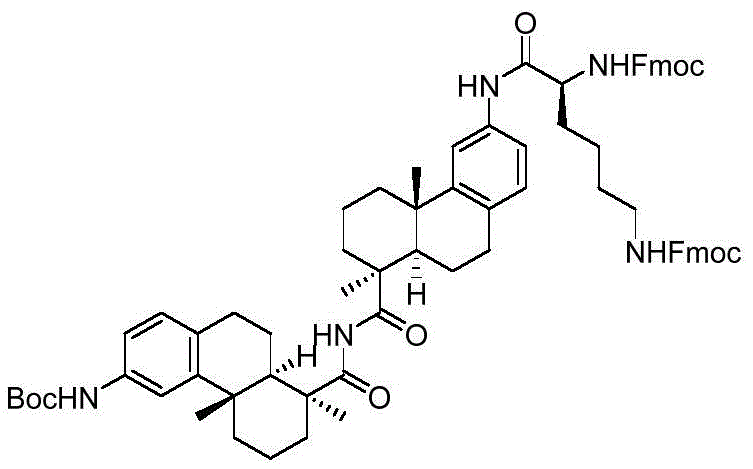
Following the general procedure for intermediates 13a-13e, compound 13c (0.30g, 78% yield) was obtained as a white solid. ESIm/z 1201(M + H)+。
(S) -tert-butyl 3- (((9H-fluoren-9-yl) methoxy) carbonylamino) -4- ((4bS,8S,8aR) -8- ((1S,4aS,10aR) -6- (tert-butoxycarbonylamino) -1,4 a-dimethyl-1, 2,3,4,4a,9,10,10 a-octahydrophenanthrene-1-carbonylcarbamoyl) -4b, 8-dimethyl-4 b,5,6,7,8,8a,9, 10-octahydrophenanthren-3-ylamino) -4-oxobutanoate (13d)

Following the general procedure for intermediates 13a-13e, compound 13d (0.43g, 85% yield) was obtained as a white solid. ESIm/z 1021(M + H)+。
(S) -tert-butyl 4- (((9H-fluoren-9-yl) methoxy) carbonylamino) -5- ((4bS,8S,8aR) -8- ((1S,4aS,10aR) -6- (tert-butoxycarbonylamino) -1,4 a-dimethyl-1, 2,3,4,4a,9,10,10 a-octahydrophenanthrene-1-carbonylcarbamoyl) -4b, 8-dimethyl-4 b,5,6,7,8,8a,9, 10-octahydrophenanthren-3-ylamino) -5-oxopentanoate (13e)

Following the general procedure for intermediates 13a-13e, compound 13e (0.42g, 82% yield) was obtained as a white solid. ESIm/z:1036(M+H)+。
Example 3b

To a solution of compound 13(1.0 eq) in DCM was added TFA at room temperature. The reaction mixture was stirred at room temperature for 1 hour and concentrated in vacuo to afford crude 14 as a colorless oil which was used in the next step without further purification.

9H-Fluoren-9-ylmethyl N- ({ [ (4bS,8S,8aR) -8- ({ [ (1S,4aS,10aR) -6-amino-1, 4 a-dimethyl-1, 2,3,4,4a,9,10,10 a-octahydrophenanthren-1-yl ] carboxamido } carbonyl) -4b, 8-dimethyl-4 b,5,6,7,8,8a,9, 10-octahydrophenanthren-3-yl ] carbamoyl } methyl) carbamate, trifluoroacetate (14a)

Following the general procedure for intermediates 14a-14e, crude compound 14a (0.14g, 99% yield, TFA salt) was obtained as a colorless oil. ESI M/z 807(M +1)+。
9H-Fluoren-9-ylmethyl (S) -1- ((4bS,8S,8aR) -8- ((1S,4aS,10aR) -6-amino-1, 4 a-dimethyl-1, 2,3,4,4a,9,10,10 a-octahydrophenanthrene-1-carbonylcarbamoyl) -4b, 8-dimethyl-4 b,5,6,7,8,8a,9, 10-octahydrophenanthren-3-ylamino) -3-hydroxy-1-oxopropan-2-ylcarbamate, trifluoroacetate (14b)

Following the general procedure for intermediates 14a-14e, crude compound 14b (0.14g, 99% yield, TFA salt) was obtained as a colorless oil. ESI M/z 837(M +1)+。
9H-Fluoren-9-ylmethyl N- [ (5S) -5- { [ (4bS,8S,8aR) -8- ({ [ (1S,4aS,10aR) -6-amino-1, 4 a-dimethyl-1, 2,3,4,4a,9,10,10 a-octahydrophenanthren-1-yl ] carboxamido } carbonyl) -4b, 8-dimethyl-4 b,5,6,7,8,8a,9, 10-octahydrophenanthren-3-yl ] carbamoyl } -5- { [ (9H-fluoren-9-ylmethoxy) carbonyl ] amino } pentyl ] carbamate, trifluoroacetate (14c)

Following the general procedure for intermediates 14a-14e, crude compound 14c (0.22g, 92% yield, TFA salt) was obtained as a colorless oil. ESI M/z:1101(M +1)+。
(S) -3- (((9H-fluoren-9-yl) methoxy) carbonylamino) -4- ((4bS,8S,8aR) -8- ((1S,4aS,10aR) -6-amino-1, 4 a-dimethyl-1, 2,3,4,4a,9,10,10 a-octahydrophenanthrene-1-carbonylcarbamoyl) -4b, 8-dimethyl-4 b,5,6,7,8,8a,9, 10-octahydrophenanthren-3-ylamino) -4-oxobutanoic acid, trifluoroacetate (14d)

Following the general procedure for intermediates 14a-14e, crude compound 14d (0.10g, 87% yield, TFA salt) was obtained as a colorless oil. ESI M/z:866(M +1)+。
(S) -4- (((9H-fluoren-9-yl) methoxy) carbonylamino) -5- ((4bS,8S,8aR) -8- ((1S,4aS,10aR) -6-amino-1, 4 a-dimethyl-1, 2,3,4,4a,9,10,10 a-octahydrophenanthrene-1-carbonylcarbamoyl) -4b, 8-dimethyl-4 b,5,6,7,8,8a,9, 10-octahydrophenanthren-3-ylamino) -5-oxopentanoic acid, trifluoroacetate (14e)

Following the general procedure for intermediates 14a-14e, compound 14e (84mg, 86% yield, TFA salt) was obtained as a colorless oil. ESI M/z 880(M +1)+。
Example 3c
Payloads P4-P9, P13, P14, and P17

Piperidine was added to the DMF solution of crude 14 obtained above. The mixture was stirred at room temperature for half an hour, monitored by LCMS. The mixture was directly purified by preparative HPLC (method B) to give payload P4-P8 as a white solid.

(1S,4aS,10aR) -N- [ (1S,4aS,10aR) -6- (2-aminoacetamido) -1,4 a-dimethyl-1, 2,3,4,4a,9,10,10 a-octahydrophenanthrene-1-carbonyl ] -6-amino-1, 4 a-dimethyl-1, 2,3,4,4a,9,10,10 a-octahydrophenanthrene-1-carboxamide (P4)

Following the general procedure for payload P4-P8, compound P4(12mg, 28% yield) was obtained as a white solid. ESI M/z 585(M +1)+。1H NMR(500MHz,DMSOd6)δ9.79(s,1H),8.12(s,1H),7.50(s,1H),7.41(dd,J=8.5Hz,1.5Hz,1H),6.96(d,J=8.5Hz,1H),6.68(d,J=8.5Hz,1H),6.48(d,J=1.5Hz,1H),6.34(dd,J=7.5Hz,1.5Hz,1H),4.70(m,2H),3.20(s,3H),2.95-2.83(m,1H),2.80-2.70(m,2H),2.70-2.60(m,1H),2.30-2.20(m,2H),2.20-2.10(m,4H),2.05-1.70(m,4H),1.70-1.50(m,4H),1.31-1.25(m,8H),1.20-1.10(m,2H),1.05(d,J=7.5Hz,6H)ppm。
(1S,4aS,10aR) -6-amino-N- ((1S,4aS,10aR) -6- ((S) -2-amino-3-hydroxypropionylamino) -1,4 a-dimethyl-1, 2,3,4,4a,9,10,10 a-octahydrophenanthrene-1-carbonyl) -1,4 a-dimethyl-1, 2,3,4,4a,9,10,10 a-octahydrophenanthrene-1-carboxamide (P5)

Following the general procedure for payload P4-P8, compound P5(41mg, 67% yield) was obtained as a white solid. ESI M/z 615(M +1)+。1H NMR(500MHz,DMSOd6)δ8.09(s,1H),7.52(s,1H),7.41(dd,J=8.5Hz,1.5Hz,1H),6.96(d,J=8.5Hz,1H),6.68(d,J=8.5Hz,1H),6.48(d,J=1.5Hz,1H),6.34(dd,J=7.5Hz,1.5Hz,1H),4.84-4.76(m,1H),4.67(s,2H),3.60-3.45(m,2H),2.95-2.83(m,1H),2.80-2.60(m,4H),2.30-2.20(m,3H),2.20-2.10(m,4H),1.95-1.75(m,5H),1.70-1.50(m,4H),1.40-1.30(m,2H),1.28(s,3H),1.26(s,3H),1.20-1.10(m,3H),1.01(s,3H),0.98(s,3H)ppm。
(1S,4aS,10aR) -6-amino-N- ((1S,4aS,10aR) -6- ((S) -2, 6-diaminohexanamido) -1,4 a-dimethyl-1, 2,3,4,4a,9,10,10 a-octahydrophenanthrene-1-carbonyl) -1,4 a-dimethyl-1, 2,3,4,4a,9,10,10 a-octahydrophenanthrene-1-carboxamide (P6)

Following the general procedure for payload P4-P8, compound P6(5mg, 17% yield) was obtained as a white solid. ESI M/z:656(M +1)+。1H NMR(500MHz,DMSOd6)δ8.09(s,1H),7.52(s,1H),7.41(dd,J=8.5Hz,1.5Hz,1H),6.96(d,J=8.5Hz,1H),6.68(d,J=8.5Hz,1H),6.48(d,J=1.5Hz,1H),6.34(dd,J=7.5Hz,1.5Hz,1H),4.70(m,2H),3.20(s,2H),2.95-2.83(m,2H),2.80-2.70(m,2H),2.70-2.60(m,2H),2.37-2.35(m,1H),2.30-2.20(m,3H),2.20-2.10(m,5H),2.05-1.95(m,2H),1.95-1.75(m,5H),1.70-1.50(m,6H),1.31-1.25(m,8H),1.20-1.10(m,3H),1.05(d,J=7.5Hz,6H),0.85(t,J=6.0Hz,1H)ppm。
(S) -3-amino-4- ((4bS,8S,8aR) -8- ((1S,4aS,10aR) -6-amino-1, 4 a-dimethyl-1, 2,3,4,4a,9,10,10 a-octahydrophenanthrene-1-carbonylcarbamoyl) -4b, 8-dimethyl-4 b,5,6,7,8,8a,9, 10-octahydrophenanthrene-3-ylamino) -4-oxobutanoic acid (P7)

Following the general procedure for payload P4-P8, the compounds were obtainedP7(39mg, 51% yield) was a white solid. ESI M/z 643(M +1)+。1H NMR(500MHz,DMSOd6)δ10.5-10.0(br,1H),8.09(s,1H),7.52(s,1H),7.41(dd,J=8.5Hz,1.5Hz,1H),6.96(d,J=8.5Hz,1H),6.68(d,J=8.5Hz,1H),6.48(d,J=1.5Hz,1H),6.34(dd,J=7.5Hz,1.5Hz,1H),4.84-4.50(m,2H),3.75-3.68(m,2H),2.95-2.83(m,1H),2.80-2.60(m,4H),2.40-2.20(m,4H),2.20-2.10(m,5H),1.95-1.70(m,5H),1.70-1.50(m,5H),1.27(d,J=7.5Hz,6H),1.20-1.10(m,2H),1.01(s,3H),0.98(s,3H)ppm。
(S) -4-amino-5- ((4bS,8S,8aR) -8- ((1S,4aS,10aR) -6-amino-1, 4 a-dimethyl-1, 2,3,4,4a,9,10,10 a-octahydrophenanthrene-1-carbonylcarbamoyl) -4b, 8-dimethyl-4 b,5,6,7,8,8a,9, 10-octahydrophenanthrene-3-ylamino) -5-oxopentanoic acid (P8)

Following the general procedure for payload P4-P8, compound P8(44mg, 58% yield) was obtained as a white solid. ESI M/z 657(M +1)+。1H NMR(500MHz,DMSOd6)δ8.09(s,1H),7.52(s,1H),7.41(dd,J=8.5Hz,1.5Hz,1H),6.96(d,J=8.5Hz,1H),6.68(d,J=8.5Hz,1H),6.48(d,J=1.5Hz,1H),6.34(dd,J=7.5Hz,1.5Hz,1H),4.70(m,2H),2.95-2.83(m,1H),2.80-2.60(m,5H),2.30-2.20(m,4H),2.20-2.10(m,5H),1.95-1.75(m,5H),1.70-1.50(m,5H),1.50-1.40(m,4H),1.27(d,J=7.5Hz,6H),1.20-1.10(m,2H),1.01(s,3H),0.98(s,3H)ppm。
(1S,4aS,10aR) -6-amino-N- ((1S,4aS,10aR) -6- ((S) -2-amino-3- (1H-imidazol-4-yl) propionamido) -1,4 a-dimethyl-1, 2,3,4,4a,9,10,10 a-octahydrophenanthrene-1-carbonyl) -1,4 a-dimethyl-1, 2,3,4,4a,9,10,10 a-octahydrophenanthrene-1-carboxamide (P9)

To a solution of Fmoc-His-OH (0.38g, 1.0mmol) in DCM (5mL) was added Fmoc-OSu (0.37g, 1.1mmol) and DIPEA (0.26g, 2.0 mmol). The reaction mixture was stirred at room temperature overnight. Vacuum evaporationThe residue was purified by flash chromatography (5-10% methanol in DCM) to give Fmoc-His (Fmoc) -OH (0.50g, 84% yield, ESIm/z:600(M +1)+) As a white solid.
To a solution of compound 12b (0.31g, 0.50mmol) in DCM (20mL) was added sequentially Fmoc-His (Fmoc) -OH (0.33g, 0.55mmol) obtained above, HATU (0.23g, 0.60mmol) and DIPEA (0.19g, 1.5 mmol). The resulting mixture was stirred at room temperature for 4 hours, monitored by LCMS. Piperidine (0.5mL) was added to the reaction mixture and the mixture was stirred at room temperature for 1 hour until Fmoc removal was complete, as monitored by LCMS. The mixture was concentrated in vacuo and the residue was purified by reverse phase flash chromatography (50-80% acetonitrile in water) to give Boc-P9(0.15g) as a white solid, half of which was dissolved in DCM (20 mL). To the resulting solution was added TFA (3 mL). The mixture was stirred at room temperature for 1 hour until Boc had been stripped off according to LCMS. The volatiles were removed in vacuo and the residue was purified by preparative HPLC (method B) to give compound P9(17mg, 12% yield) as a white solid. ESI M/z:665(M +1) +。1H NMR(500MHz,DMSOd6)δ11.82(s,1H),9.75(s,1H),8.09(s,1H),7.52-7.50(m,2H),7.41(dd,J=8.5Hz,1.5Hz,1H),6.96(d,J=8.5Hz,1H),6.90-6.80(m,1H),6.68(d,J=8.5Hz,1H),6.48(d,J=1.5Hz,1H),6.34(dd,J=7.5Hz,1.5Hz,1H),4.84-4.50(m,2H),3.60-3.45(m,2H),2.95-2.83(m,2H),2.80-2.70(m,2H),2.70-2.60(m,2H),2.40-2.10(m,8H),1.95-1.70(m,5H),1.70-1.50(m,4H),1.27(d,J=7.5Hz,6H),1.20-1.10(m,2H),1.01(s,3H),0.98(s,3H)ppm。
(1S,4aS,10aR) -N- [ (1S,4aS,10aR) -6-amino-1, 4 a-dimethyl-1, 2,3,4,4a,9,10,10 a-octahydrophenanthrene-1-carbonyl ] -6- [ (2S) -2-aminopropionylamino ] -1,4 a-dimethyl-1, 2,3,4,4a,9,10,10 a-octahydrophenanthrene-1-carboxamide (P13)

Following a similar procedure to P9, except substituting Fmoc-Ala-OH for Fmoc-his (Fmoc) -OH, the payload P13(12mg, 59% yield) was obtained as a white solid.1H NMR(400MHz,DMSOd6)δ9.85(br s,1H),8.09(s,1H),7.54-7.51(m,1H),7.41-7.39(m,1H),6.95(d,J=8.4Hz,1H),6.68(d,J=8.0Hz,1H),6.48(d,J=1.6Hz,1H),6.35-6.32(m,1H),4.69(s,2H),3.58-3.41(m,3H),2.91-2.61(m,4H),2.26-2.14(m,6H),1.91-1.78(m,4H),1.66-1.55(m,4H),1.33-1.08(m,13H),1.00(s,3H),0.98(s,3H)ppm。
(1S,4aS,10aR) -N- [ (1S,4aS,10aR) -6- (2-hydroxyacetamido) -1,4 a-dimethyl-1, 2,3,4,4a,9,10,10 a-octahydrophenanthrene-1-carbonyl ] -6-amino-1, 4 a-dimethyl-1, 2,3,4,4a,9,10,10 a-octahydrophenanthrene-1-carboxamide (P14)

To a mixture of glycolic acid (2.2mg, 29. mu. mol) and HATU (18.2mg, 48. mu. mol) in DMF (2.0mL) was added DIPEA (12. mu.L, 72. mu. mol) and compound 12b (15mg, 24. mu. mol). The reaction mixture was stirred at room temperature for 2 hours, monitored by LCMS. The resulting mixture was directly purified by reverse phase flash chromatography (0-100% acetonitrile in ammonium bicarbonate water (10mM)) to afford Boc-P14, which was dissolved in DCM (2 mL). To the resulting solution was added TFA (0.5mL) and the mixture was stirred at room temperature for 2 hours until Boc was completely removed, monitored by LCMS. The resulting mixture was concentrated in vacuo and the residue was purified by preparative HPLC (method B) to give payload P14(4.3mg, 31% yield) as a white solid. ESI M/z 686.5(M +1) +。1H NMR(400MHz,DMSOd6)δ9.46(s,1H),8.10(s,1H),7.59(d,J=1.8Hz,1H),7.49(dd,J=8.3,1.9Hz,1H),6.96(d,J=8.3Hz,1H),6.68(d,J=8.2Hz,1H),6.47(d,J=2.1Hz,1H),6.33(dd,J=8.1,2.1Hz,1H),5.65(t,J=6.0Hz,1H),4.70(s,2H),3.94(d,J=6.0Hz,2H),2.93-2.85(m,1H),2.80-2.72(m,2H),2.71-2.63(m,1H),2.34-2.08(m,6H),1.94-1.76(m,4H),1.68-1.52(m,4H),1.35-1.23(m,8H),1.19-1.10(m,2H),0.99(d,J=8.1Hz,6H)ppm。
(1S,4aS,10aR) -N- [ (1S,4aS,10aR) -6- (2-hydroxyacetamido) -1,4 a-dimethyl-1, 2,3,4,4a,9,10,10 a-octahydrophenanthrene-1-carbonyl ] -6-hydroxy-1, 4 a-dimethyl-1, 2,3,4,4a,9,10,10 a-octahydrophenanthrene-1-carboxamide (P17)

To a solution of payload P1(10mg, 0.019mmol) in DMF (2mL) was added HATU (14mg, 0.038mmol) and DIPEA (9.8mg, 0.076mmol) at room temperature. The mixture was stirred at room temperature for 15 minutes, then glycolic acid (1.73mg, 0.0228mmol) was added. The reaction mixture was stirred at room temperature and monitored by LCMS. The resulting mixture was directly purified by preparative HPLC (method B) to give P17(5.7mg, 51% yield) as a white solid. ESI M/z 587.4(M +1)+。1H NMR(400MHz,DMSOd6)δ9.46(s,1H),9.00(s,1H),8.11(s,1H),7.59(s,1H),7.53-7.45(m,1H),6.96(d,J=8.3Hz,1H),6.82(d,J=8.3Hz,1H),6.63(d,J=2.3Hz,1H),6.50(dd,J=8.2,2.4Hz,1H),5.64(t,J=6.0Hz,1H),3.94(d,J=5.9Hz,2H),2.93-2.66(m,4H),2.29-2.10(m,6H),2.00-1.80(m,4H),1.72-1.50(m,4H),1.30-0.90(m,16H)ppm。
Example 4
This example illustrates the general method for the synthesis of the podocarpine acid derivatives P10 and P11 of table 1 above. This example relates to compounds numbered 14a, 15a-15B, and P10 and P11 in fig. 2B.
(S) -tert-butyl 4-amino-5- ((4bS,8S,8aR) -8- ((1S,4aS,10aR) -6- (2-aminoacetamido) -1,4 a-dimethyl-1, 2,3,4,4a,9,10,10 a-octahydrophenanthrene-1-carbonylcarbamoyl) -4b, 8-dimethyl-4 b,5,6,7,8,8a,9, 10-octahydrophenanthren-3-ylamino) -5-oxopentanoate, bistrifluoroacetate (15a)

To a solution of Fmoc-Glu (OtBu) -OH (74mg, 0.17mmol) and DIPEA (55. mu.L, 0.32mmol) in DMF (5.0mL) was added HATU (91mg, 0.24 mmol). The mixture was stirred at room temperature for 15 minutes, then compound 14a (0.14g, 0.16mmol) was added. The reaction mixture was stirred at room temperature overnight, monitored by LCMS. Piperidine (1mL) was then added dropwise to the reaction mixture. The reaction mixture was stirred at room temperature for 1 hour until Fmoc had been completely removed by LCMS. Subjecting the resulting mixture to reverse phase flash chromatography (of 0-100% acetonitrile) Aqueous TFA (0.01%)) was isolated directly to give compound 15a (0.13g, 80% yield) as a yellow solid. ESIm/z 770.5(M +1)+。
(4S,4'S) -tert-butyl 5,5' - (4bS,4b 'S,8S,8aR,8' S,8a 'R) -8,8' - (aminodiylbis (oxomethylene)) bis (4b, 8-dimethyl-4 b,5,6,7,8,8a,9, 10-octahydrophenanthrene-8, 3-diyl) bis (aminodiyl) bis (4-amino-5-oxopentanoate) bistrifluoroacetate (15b)

To a solution of Fmoc-Glu (OtBu) -OH (0.15g, 0.35mmol) and DIPEA (83. mu.L, 0.48mmol) in DMF (5.0mL) was added HATU (0.15g, 0.40 mmol). The mixture was stirred at room temperature for 30 minutes, then Compound P2(0.10g, 0.16mmol) was added. The reaction mixture was stirred at room temperature overnight, monitored by LCMS. Piperidine (1mL) was then added dropwise to the reaction mixture. The reaction mixture was stirred at room temperature for 3 hours until Fmoc had been completely removed by LCMS. The resulting mixture was directly isolated by reverse phase flash chromatography (0-100% acetonitrile in TFA (0.01%)) to afford compound 15b (0.14g, 78% yield) as a yellow solid. ESIm/z 899(M +1)+。
(S) -4-amino-5- ((4bS,8S,8aR) -8- ((1S,4aS,10aR) -6- (2-aminoacetamido) -1,4 a-dimethyl-1, 2,3,4,4a,9,10,10 a-octahydrophenanthrene-1-carbonylcarbamoyl) -4b, 8-dimethyl-4 b,5,6,7,8,8a,9, 10-octahydrophenanthren-3-ylamino) -5-oxopentanoic acid (P10)

A mixture of compound 15a (0.13g, 0.13mmol) in neat TFA (2.0mL) was stirred at RT for 1 hour, monitored by LCMS. The resulting mixture was diluted with DCM (20mL) and concentrated in vacuo. The residue was purified by reverse phase flash chromatography (0-100% acetonitrile in aqueous sodium bicarbonate (10mM)) to give P10(20mg, 22% yield) as a white solid. ESI M/z 358(M/2+1)+;714.5(M+1)+。1H NMR(400MHz,DMSOd6)δ9.85(br s,1H),812(s,1H),7.51(s,2H),7.42-7.36(m,2H),6.96(dd, J ═ 8.0Hz and 3.0Hz,2H),3.67(br s,8H),3.36-3.33(m,1H),3.22(s,2H),2.91-2.87(m,2H),2.80-2.71(m,2H),2.31-2.28(m,4H),2.17-2.14(m,4H),1.91-1.82(m,5H),1.69-1.58(m,5H),1.34-1.23(m,6H),1.19-1.12(m,2H),1.01(s,6H) ppm.
(4S,4'S) -5,5' - (4bS,4b 'S,8S,8aR,8' S,8a 'R) -8,8' - (aminodiylbis (oxomethylene)) bis (4b, 8-dimethyl-4 b,5,6,7,8,8a,9, 10-octahydrophenanthrene-8, 3-diyl) bis (aminodiyl) bis (4-amino-5-oxopentanoic acid) (P11)
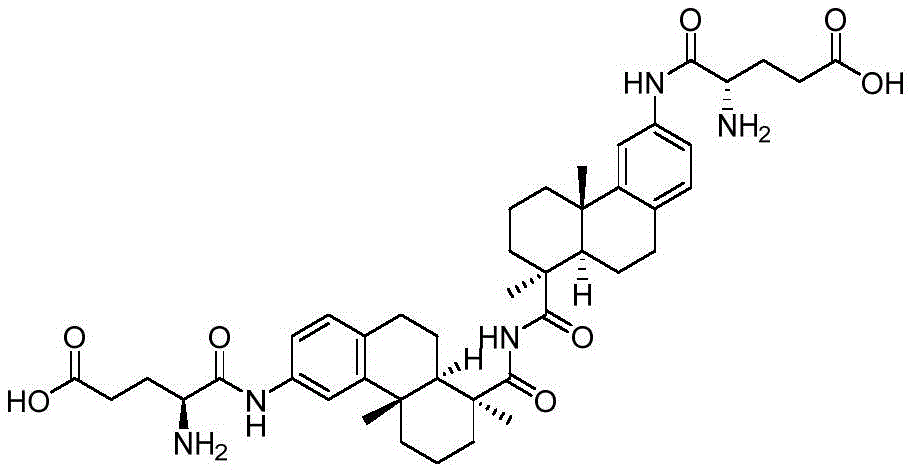
A mixture of compound 15b (0.14g, 0.14mmol) in neat TFA (3.0mL) was stirred at RT for 1 hour, monitored by LCMS. The resulting mixture was diluted with DCM (30mL) and concentrated in vacuo. The residue was purified by reverse phase flash chromatography (0-100% acetonitrile in sodium bicarbonate (10mM)) to give P11(20mg, 18% yield) as a white solid. ESI M/z 394(M/2+1) +。1H NMR(400MHz,DMSOd6) δ 9.85(brs,2H),8.12(s,1H),7.51(s,2H),7.9(dd, J ═ 8.4Hz and 1.6Hz,2H),6.97(d, J ═ 8.0Hz,2H),3.5 (brs, 6H),3.40-3.37(m,2H),3.16(s,1H),2.91-2.88(m,2H),2.79-2.66(m,2H),2.33-2.29(m,7H),2.18-2.15(m,4H),1.91-1.84(m,6H),1.71-1.59(m,6H),1.35-1.23(m,6H),1.18-1.12(m,2H),1.01(s,6H) ppm.
Example 4a
This example illustrates a general method for the synthesis of the podocarpine acid derivative P19 in table 1 above. This example relates to the compound in figure 2C.
(4bS,8S,8aR) -8- { [ (1S,4aS,10aR) -6- { [ (tert-butoxy) carbonyl ] amino } -1,4 a-dimethyl-1, 2,3,4,4a,9,10,10 a-octahydrophenanthrene-1-carbonyl ] carbamoyl } -4b, 8-dimethyl-4 b,5,6,7,8,8a,9, 10-octahydrophenanthrene-3-yl tert-butyl carbonate (16)

To a payload of P1(0.10g, 0.19mmol) in t-butanol (2 mL) at room temperature) Potassium carbonate (78mg, 0.57mmol) and Boc anhydride (0.12g, 0.57mmol) were added to the mixture and the reaction mixture was stirred at 60 ℃ for 3 h, monitored by LCMS. The resulting mixture was then cooled and concentrated in vacuo. The residue was dissolved in DCM (100mL), the solution washed with water and brine, dried over anhydrous sodium sulfate and concentrated in vacuo to give crude 16(0.14g, crude) as a white solid which was used in the next step without further purification. ESIm/z 729.4(M +1) +。
(4bS,8S,8aR) -8- { [ (1S,4aS,10aR) -7-bromo-6- { [ (tert-butoxy) carbonyl ] amino } -1,4 a-dimethyl-1, 2,3,4,4a,9,10,10 a-octahydrophenanthrene-1-carbonyl ] carbamoyl } -4b, 8-dimethyl-4 b,5,6,7,8,8a,9, 10-octahydrophenanthren-3-yl tert-butyl carbonate (17)

To a solution of crude compound 16(0.14g, obtained as above) in DMF (4mL) was added NBS (50mg, 0.28mmol) and the reaction mixture was stirred at RT overnight, monitored by LCMS. The resulting mixture was directly purified by reverse phase flash chromatography (0-100% acetonitrile in TFA (0.01%)) to afford compound 17(40mg, 26% over 2 steps) as a yellow solid. ESI M/z 807.3(M +1)+. (4bS,8S,8aR) -8- { [ (1S,4aS,10aR) -6- { [ (tert-butoxy) carbonyl]Amino } -7-hydroxy-1, 4 a-dimethyl-1, 2,3,4,4a,9,10,10 a-octahydrophenanthrene-1-carbonyl]Carbamoyl } -4b, 8-dimethyl-4 b,5,6,7,8,8a,9, 10-octahydrophenanthren-3-yl tert-butyl carbonate (19)

A mixture of Compound 17(40mg, 50. mu. mol), potassium acetate (12mg, 0.12mmol) and bis (pinacolato) diboron 18(50mg, 0.20mmol) in anhydrous dioxane (5mL) was degassed and purged with nitrogen 3 times. Pd (dppf) Cl was added to the mixture under nitrogen2(1.8mg, 2.5. mu. mol). The resulting suspension was stirred at 90 ℃ for half an hour under nitrogen and monitored by LCMS. The mixture was then cooled to room temperature and passed through silicon And (5) filtering the diatomite. To the filtrate was added dropwise hydrogen peroxide (30% aqueous solution, 2.0mL) at 0 ℃ over 10 minutes. The reaction mixture was stirred at 0 ℃ for another half hour and monitored by LCMS. The resulting mixture was then directly purified by reverse phase flash chromatography (0-100% acetonitrile in TFA (0.01%)) to afford crude compound 19(35mg, 50% purity, 95% crude yield) as a yellow solid, which was used in the next step without further purification. ESI M/z 745.5(M +1)+。
(1S,4aS,10aR) -N- [ (1S,4aS,10aR) -6-amino-7-hydroxy-1, 4 a-dimethyl-1, 2,3,4,4a,9,10,10 a-octahydrophenanthrene-1-carbonyl ] -6-hydroxy-1, 4 a-dimethyl-1, 2,3,4,4a,9,10,10 a-octahydrophenanthrene-1-carboxamide (P19)

To a solution of crude compound 19(35mg, obtained as above) in DCM (5mL) was added TFA (2mL) dropwise over 5 min at 0 ℃. The reaction mixture was stirred at room temperature for half an hour until complete Boc removal, monitored by LCMS. The volatiles were removed in vacuo and the residue was purified by preparative HPLC (method a) to give payload P19(6.5mg, 24% yield from compound 17) as an off-white solid. ESI M/z 545.3(M +1)+。1H NMR(400MHz,DMSOd6)δ9.03(s,1H),8.76(s,1H),8.08(s,1H),6.81(d,J=8.4Hz,1H),6.62(d,J=2.4Hz,1H),6.49(dd,J=8.4,2.8Hz,1H),6.47(s,1H),6.27(s,1H),4.21(s,2H),2.84-2.80(m,1H),2.73-2.57(m,3H),2.25-2.19(m,2H),2.15-2.08(m,4H),1.89-1.77(m,4H),1.62-1.54(m,4H),1.30(s,3H),1.28(s,3H),1.31-1.20(m,2H),1.14-1.10(m,2H),0.98(s,3H),0.94(s,3H)ppm。
Example 5
This example illustrates the synthesis of linker-payloads LP1-LP5 and LP20 of Table 2 above. This example relates to compounds numbered 12b and 102a-102b through 106a-106e in FIG. 3, and linker-payloads LP1-LP 5.
Example 5a
Intermediates 102a-102b

To a solution of acid (Fmoc-Val-Ala-OH (101a, 1.2 equiv.) or Fmoc-Val-Cit-OH (101b, 1.2 equiv.)) in DMF at room temperature was added HATU (1.2 equiv.) and DIPEA (2.0-3.0 equiv.). After the mixture was stirred at room temperature for 5 minutes, compound 12b (1.0 equivalent) was added. The resulting mixture was stirred at room temperature for 4-20 hours until amine depletion was monitored by LCMS. Piperidine (excess) was then added to the mixture and the mixture was stirred at room temperature for 1-6 hours until Fmoc was completely stripped off, monitored by LCMS. The reaction mixture was filtered through a membrane and the filtrate was purified directly by preparative HPLC (method B) or reverse phase flash chromatography to afford compound 102 (38-72% yield) as a white solid.

Tert-butyl N- [ (4bS,8S,8aR) -8- ({ [ (1S,4aS,10aR) -6- [ (2S) -2- [ (2S) -2-amino-3-methylbutanamido ] propionamido ] -1,4 a-dimethyl-1, 2,3,4,4a,9,10,10 a-octahydrophenanthren-1-yl ] carbonyl } carbamoyl) -4b, 8-dimethyl-4 b,5,6,7,8,8a,9, 10-octahydrophenanthren-3-yl ] carbamate (102a)
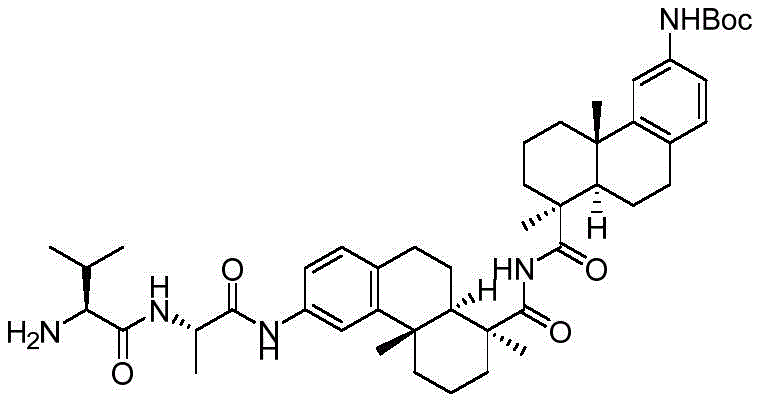
Following the general procedure for intermediates 102a, 102b, compound 102a (0.29g, 72% yield) was obtained as a white solid. ESI M/z 799(M +1)+。
Tert-butyl N- [ (4bS,8S,8aR) -8- ({ [ (1S,4aS,10aR) -6- [ (2S) -2- [ (2S) -2-amino-3-methylbutanamido ] -5- (carbamoylamino) pentanamido ] -1,4 a-dimethyl-1, 2,3,4,4a,9,10,10 a-octahydrophenanthren-1-yl ] carbonyl } carbamoyl) -4b, 8-dimethyl-4 b,5,6,7,8,8a,9, 10-octahydrophenanthren-3-yl ] carbamate (102b)

Following the general procedure for intermediates 102a, 102b, compound 102b was obtained (0.27g, 38% yield) as a white solid. ESI M/z 885(M +1)+。
Example 5b
Intermediates 104a-104b
N- [ (4bS,8S,8aR) -8- ({ [ (1S,4aS,10aR) -6- [ (2S) -2- [ (2S) -2- { 2-amino-6- [2- (cycloocta-2-yn-1-yloxy) acetamido ] hexanamido } -3-methylbutanamido ] propionamido ] -1,4 a-dimethyl-1, 2,3,4,4a,9,10,10 a-octahydrophenanthren-1-yl ] carbonyl } carbamoyl) -4b, 8-dimethyl-4 b,5,6,7,8,8a,9, 10-octahydrophenanthren-3-yl ] carbamic acid tert-butyl ester (104a)

To a solution of compound 103(70mg, 0.13mmol) in DMF (2mL) was added HATU (68mg, 0.18mmol) and DIPEA (44. mu.L, 0.24mmol) at room temperature. The mixture was stirred at room temperature for 5 minutes, then compound 102a (95mg, 0.12mmol) was added. The reaction mixture was then stirred at room temperature for 3 hours until compound 102a was completely consumed, monitored by LCMS. Piperidine (0.5mL, excess) was then added to the reaction mixture. The mixture was stirred at room temperature for 2 hours. The mixture was then filtered and the filtrate was concentrated. The residue was purified by reverse phase flash chromatography (0-100% acetonitrile in aqueous ammonium bicarbonate (10mM)) to give compound 104a (0.13g, 96% yield) as a white solid. ESI M/z 518.0((M-55)/2) +。
N- [ (4bS,8S,8aR) -8- ({ [ (1S,4aS,10aR) -6- [ (2S) -2- [ (2S) -2- { 2-amino-6- [2- (cycloocta-2-yn-1-yloxy) acetamido ] hexanamido } -3-methylbutanamido ] -5- (carbamoylamino) pentanamido ] -1,4 a-dimethyl-1, 2,3,4,4a,9,10,10 a-octahydrophenanthren-1-yl ] carbonyl } carbamoyl) -4b, 8-dimethyl-4 b,5,6,7,8,8a,9, 10-octahydrophenanthren-3-yl ] carbamic acid tert-butyl ester (104 b).

To a solution of compound 103(0.27g, 0.31mmol) and DIPEA (0.11mL, 0.61mmol) in DMF (6mL) was added compound 102b (0.18g, 0.34mmol) followed by HATU (0.14g, 0.37 mmol). The reaction mixture was stirred at room temperature for 3 hours, monitored by LCMS. The resulting solution was directly purified by reverse phase flash chromatography to give the compound Fmoc-104b (0.30g, ESI M/z:711((M + Na)/2+1)+) As a pale yellow solid, it was dissolved in DCM (6.0 mL). Piperidine (0.5mL) was added to the solution and the reaction mixture was stirred at room temperature for 2 hours until Fmoc had been completely removed by LCMS. The volatiles were removed in vacuo and the residue triturated with petroleum ether to give compound 104b (0.26g, 65% yield) as a pale yellow solid. ESI M/z 1177.6((M + H)+。
Example 5c
Intermediates 105a-105c
Azido intermediate alpha-CD-N 3(105a) Was synthesized according to J.Am.chem.Soc.,2012,134(46), 19108-.
Azido-15-oxo-3, 6,9, 12-tetraoxa-16-azaoctadecane-18-sulfonic acid (105b) (FIG. 11)
To 2, 5-dioxopyrrolidin-1-yl 1-azido-3, 6,9, 12-tetraoxapentadecane-15-oic acid ester (N)3-PEG4A solution of OSu, 0.10g, 0.26mmol) and taurine 105b-A (39mg, 0.31mmol) in anhydrous DMF (4mL) was added DIPEA (15mg, 0.52 mmol). The mixture was stirred at room temperature overnight. The reaction mixture was filtered and the resulting solution was purified by preparative HPLC (method a) to give intermediate 105b (0.80g, 78% yield) as a colorless oil. ESI M/z 399.1(M + H)+。1H NMR(500MHz,D2O)δ3.69(t,J=6.0Hz,2H),3.64-3.59(m,14H),3.49(t,J=6.5Hz,2H),3.41(t,J=4.5Hz,2H),3.00(t,J=7.0Hz,2H),2.45(t,J=6.0Hz,2H)ppm。
[2- (1-azido-3, 6,9, 12-tetraoxapentadecan-15-amido) ethyl ] trimethylammonium chlornitride (105d)
Trimethyl ammonium chloride 105d (0.13g, 64% yield) was obtained as a colorless oil following a similar procedure as described above for 105b, except that 105d-A was used in place of 105 b-A. ESI M/z 376(M + H)+。1H NMR(500MHz,DMSOd6)δ3.65-3.58(m,4H),3.58-3.45(m,16H),3.45-3.30(m,12H),2.35(t,J=6.5Hz,2H)ppm。
Azido intermediate maltose-N3(105c) Was synthesized according to Tetrahedron Letters,2001,42(7), 1325-.
Example 5d
Intermediates 106a-106f

To a solution of compound 104 in DMF at room temperature was added azido intermediate 105. The reaction was stirred at room temperature for 3-48 hours until LCMS indicated completion of the reaction. The reaction mixture was directly purified by preparative HPLC to afford compound Boc-106 as a white solid, which was dissolved in TFA solution (or neat TFA). The resulting solution was stirred at room temperature for 0.5-20 hours until the Boc had been stripped off according to LCMS. The solution was concentrated to give 106 (as TFA salt).

Not all Boc-106a were used for Boc removal.
(1S,4aS,10aR) -N- [ (1S,4aS,10aR) -6-amino-1, 4 a-dimethyl-2, 3,4,9,10,10 a-hexahydrophenanthrene-1-carbonyl]-6- [ (2S) -2- [ (2S) -2- [ (2R) -2-amino-6- {2- [ (1- { [31,32,33,34,35,36,37,38,39,40,41, 42-dodecahydroxy-10, 15,20,25, 30-pentakis (hydroxymethyl) -2,4,7,9,12,14,17,19,22,24,27, 29-dodecaheptaoxacyclo [26.2.2.2 ]3,6.28,11.213,16.218,21.223,26]Forty-dioxane-5-yl]Methyl } -4H,5H,6H,7H,8H, 9H-cycloocta [ d][1,2,3]Triazol-4-yl) oxy]Acetamido } hexanamide radical]-3-methylbutanamido group]Propionamido group]-1,4 a-dimethyl-2, 3,4,9,10,10 a-hexahydrophenanthrene-1-carboxamide trifluoroacetate salt (106a)

Following the general procedure for intermediates 106a-106e, the compound Boc-106a (72mg, 76% yield as a mixture of triazole regioisomers) was obtained as a white solid (ESIm/z:1045(M/2+1)+). After further purification by reverse phase flash chromatography (0-60% acetonitrile in TFA (0.01%)), a small amount of pure major isomer (7mg) was obtained by1H NMR(500MHz,DMSOd6) (including regioisomers) determination of δ 9.92(s,0.5H),9.82(s,0.5H),9.10(s,1H),8.58-8.53(m,1H),8.50-8.35(m,1H),8.12(s,1H),8.04(s,3H),7.88-7.82(m,1H),7.55(s,0.5H),7.46(s,0.5H),7.41(s,1H),7.40-7.26(m,1H),7.14(d, J-7.0 Hz,1H),6.97(d, J-8.0 Hz,1H),6.90(d, J-8.5 Hz,1H),5.51(br,12H),4.83-4.70(m, 8.0H), 4.57-4.7H, 3.7 (m, 3.0H), 3.50-7.26H), 3.26 (m,3H), 3.26H), 2.76-2.63(m,3H),2.29-2.25(m,2H),2.17-1.99(m,4H),1.96-1.93(m,6H),1.88-1.63(m,9H),1.56-1.54(m,15H),1.33-1.28(m,15H),1.18-1.13(m,3H),1.01-0.99(m,6H),0.89-0.83(m,7H) ppm. To Boc-106a (as a mixture of regioisomers) (20mg, 9.6. mu. mol) in DCM (3mL) was added TFA (1 mL). The resulting mixture was stirred at RT for 1 hour until Boc was stripped, monitored by LCMS. The volatiles were removed in vacuo to give compound 106a (19mg, 69% yield from 104 a) as a pale yellow solid, which was used in the next step without further purification. ESI M/z:995(M/2+1) +。
(1S,4aS,10aR) -N- { [ (1S,4aS,10aR) -6- [ (2S) -2- [ (2S) -2- [ (2R) -2-amino-6- {2- [ (1- { [31,32,33,34,35,36,37,38,39,40,41, 42-dodecahydroxy-10, 15,20,25, 30-pentakis (hydroxymethyl) -2,4,7,9,12,14,17,19,22,24,27, 29-dodecaxetaheptacyclo [26.2.2.23,6.28,11.213,16.218,21.223,26]Forty-dioxane-5-yl]Methyl } -1H,4H,5H,6H,7H,8H, 9H-cycloocta [ d][1,2,3]Triazol-4-yl) oxy]Acetamido } hexanamide radical]-3-methylbutanamido group]-5- (carbamoylamino) pentanamide]-1,4 a-dimethyl-1, 2,3,4,4a,9,10,10 a-octahydrophenanthren-1-yl]Carbonyl } -6-amino-1, 4 a-dimethyl-1, 2,3,4,4a,9,10,10 a-octahydrophenanthrene-1-carboxamide trifluoroacetate salt (106b)

Following the general procedure for intermediates 106a-106e, compound 106b (76mg, 87% yield from 104 b) was obtained as a yellow solid. ESI M/z:692(M/3+1)+。
1- (4- (2- (((R) -5-amino-6- (((S) -1- (((S) -1- (((4bS,8S,8aR) -8- (((1S,4aS,10aR) -6-amino-1, 4 a-dimethyl-1, 2,3,4,4a,9,10,10 a-octahydrophenanthrene-1-carbonyl) carbamoyl) -4b, 8-dimethyl-4 b,5,6,7,8,8a,9, 10-octahydrophenanthren-3-yl) amino) -1-oxopropan-2-yl) amino) -3-methyl-1-oxobutan-2-yl) amino) -6-oxohexyl) amino) -2-oxoethoxy) -4,5,6,7,8, 9-hexahydro-1H-cycloocta [ d ] [1,2,3] triazol-1-yl) -15-oxo-3, 6,9, 12-tetraoxa-16-azaoctadecane-18-sulfonic acid (106c)

Following the general procedure for intermediates 106a-106e, compound 106c (90mg, 39% yield from 104 c) was obtained as a yellow solid. ESI M/z 463.8(M/3+1)+。
1- (4- (((6S,9S,12R) -1, 12-diamino-6- (((4bS,8S,8aR) -8- (((1S,4aS,10aR) -6-amino-1, 4 a-dimethyl-1, 2,3,4,4a,9,10,10 a-octahydrophenanthrene-1-carbonyl) carbamoyl) -4b, 8-dimethyl-4 b,5,6,7,8,8a,9, 10-octahydrophenanthren-3-yl) carbamoyl) -9-isopropyl-1, 8,11, 18-tetraoxo-2, 7,10, 17-tetraazanonadecan-19-yl) oxy) -4,5,6,7,8, 9-hexahydro-1H-cycloocta [ d ] [1,2,3] triazol-1-yl) -15-oxo-3, 6,9, 12-tetraoxa-16-azaoctadecane-18-sulfonic acid (106d)

Following the general procedure for intermediates 106a-106e, after purification by reverse phase flash chromatography (0-80% acetonitrile in water over 25 min), compound 106d (22mg, 36% yield) was obtained as its TFA salt as a white solid. ESI M/z 788(M/2+ H)+。
(1S,4aS,10aR) -6-amino-N- ((1S,4aS,10aR) -6- ((2S) -2- ((2S) -2- ((2R) -2-amino-6- (2- ((1- ((2S,3R,4R,5S,6R) -3, 4-dihydroxy-6- (hydroxymethyl) -5- (((2R,3R,4S,5S,6R) -3,4, 5-trihydroxy-6- (hydroxymethyl) tetrahydro-2H-pyran-2-yl) oxy) tetrahydro-2H-pyran-2-yl) -3a,4,5,6,7,8,9,9 a-octahydro-1H-cycloocta [ d ] [1,2,3] triazol-4-yl) oxy) acetamido) hexanamido) -3-methylbutyrylamido) propionamido) -1,4 a-dimethyl-1, 2,3,4,4a,9,10,10 a-octahydrophenanthrene-1-carbonyl) -1,4 a-dimethyl-1, 2,3,4,4a,9,10,10 a-octahydrophenanthrene-1-carboxamide (106e)

Following the general procedure for intermediates 106a-106e, compound 106e (34mg, 77% yield) was obtained as its TFA salt as a colorless oil. ESI M/z:1358(M + H)+。
(2- {1- [4- ({ [ (5R) -5-amino-5- { [ (1S) -1- { [ (1S) -1- { [ (4bS,8S,8aR) -8- ({ [ (1S,4aS,10aR) -6-amino-1, 4 a-dimethyl-1, 2,3,4,4a,9,10,10 a-octahydrophenanthren-1-yl ] carboxamido } carbonyl) -4b, 8-dimethyl-4 b,5,6,7,8,8a,9, 10-octahydrophenanthren-3-yl ] carbamoyl } ethyl ] carbamoyl } -2-methylpropyl ] carbamoyl } pentyl ] carbamoyl } methoxy) -1H,4H,5H,6H,7H,8H, 9H-cycloocta [ d ] [1,2,3] triazol-1-yl ] -3,6,9, 12-tetraoxapentadecan-15-amido } ethyl) trimethylammonium nitrogen trifluoroacetate (106f)

Compound 106f (20mg, 42% yield from 104 a) was obtained as a white solid according to the general procedure. ESIm/z 455.8(M/3)+。
Example 5e
Linker-payloads LP1-LP5 and LP20

The compound DIBAC-PEG was added to a DMF solution of compound 106 at room temperature4NHS 107 and DIPEA. The reaction mixture was stirred at room temperature for 3 hours. The reaction mixture was directly purified by preparative HPLC (method B) or reverse phase flash chromatography (method B) to afford compounds LP1-LP5 and LP 20.

And 7mg of compound 106a was recovered as the free base.
1- (4- { 2-Azotricyclo [10.4.0.0 ]4,9]Hexadec-1 (12),4(9),5,7,13, 15-hexaen-10-yn-2-yl } -4-oxobutanamido) -N- [ (1R) -1- { [ (1S) -1- { [ (1S) -1- { [ (4bS,8S,8aR) -8- { [ (1S,4aS,10aR) -6-amino-1, 4 a-dimethyl-2, 3,4,9,10,10 a-hexahydrophenanthrene-1-carbonyl]Carbamoyl } -4b, 8-dimethyl-5, 6,7,8a,9, 10-hexahydrophenanthren-3-yl]Carbamoyl } ethyl group]Carbamoyl } -2-methylpropyl radical]Carbamoyl } -5- {2- [ (1- { [31,32,33,34,35,36,37,38,39,40,41, 42-dodecahydroxy-10, 15,20,25, 30-pentakis (hydroxymethyl) -2,4,7,9,12,14,17,19,22,24,27, 29-dodecaheptaoxacyclo [26.2.2.2 ]3,6.28,11.213,16.218,21.223,26]Forty-dioxane-5-yl]Methyl } -4H,5H,6H,7H,8H, 9H-cycloocta [ d][1,2,3]Triazol-4-yl) oxy]Acetamido } pentyl group]-3,6,9, 12-Tetraoxapentadecane-15-amide (LP1)

Following the general procedure for linker-payload LP1-LP5, linker-payload LP1(8mg, 36% yield) was obtained as a white solid. ESIm/z 842(M/3+1)+;1262(M/2+1)+。1H NMR(400MHz,DMSOd6)δ9.69(s,0.5H),9.28(s,0.5H),8.20-8.00(m,5H),7.81-7.75(m,2H),7.66(d,J=7.6Hz,1H),7.60(d,J=7.6Hz,1H),7.53-7.27(m,9H),6.96-6.92(m,1H),6.67(d,J=8.0Hz,1H),6.47(s,1H),6.32(d,J=8.4Hz,1H),5.57-5.47(m,14H),5.13-4.99(m,2H),4.81-4.68(m,11H),4.59-4.52(m,5H),4.36-4.29(m,3H),4.16-4.08(m,1H),3.99-3.98(m,1H),3.84-3.53(m,30H),3.45-3.38(m,12H),3.13-3.03(m,4H),2.90-2.66(m,5H),2.36-2.32(m,1H),2.26-2.20(m,3H),2.15-2.12(m,4H),2.00-1.99(m,2H),1.88-1.72(m,6H),1.64-1.40(m,14H),1.33-1.24(m,17H),1.14-1.09(m,3H),1.00-0.97(m,7H),0.89-0.81(m,8H)ppm。
Analytical HPLC: 95%, retention time: 7.93min (method B).
1- (4- { 2-Azotricyclo [10.4.0.0 ]4,9]Hexadec-1 (12),4(9),5,7,13, 15-hexaen-10-yn-2-yl } -4-oxobutanamido) -N- [ (1R) -1- { [ (1S) -1- { [ (1S) -1- { [ (4bS,8S,8aR) -8- ({ [ (1S,4aS,10aR) -6-amino-1, 4 a-dimethyl-1, 2,3,4,4a,9,10,10 a-octahydrophenanthren-1-yl ]Carboxamido } carbonyl) -4b, 8-dimethyl-4 b,5,6,7,8,8a,9, 10-octahydrophenanthren-3-yl]Carbamoyl } -4- (carbamoylamino) butyl]Carbamoyl } -2-methylpropyl radical]Carbamoyl } -5- {2- [ (1- { [31,32,33,34,35,36,37,38,39,40,41, 42-dodecahydroxy-10, 15,20,25, 30-pentakis (hydroxymethyl) -2,4,7,9,12,14,17,19,22,24,27, 29-dodecaheptaoxacyclo [26.2.2.2 ]3,6.28,11.213,16.218,21.223,26]Forty-dioxane-5-yl]Methyl } -1H,4H,5H,6H,7H,8H, 9H-cycloocta [ d][1,2,3]Triazol-4-yl) oxy]Acetamido } pentyl group]-3,6,9, 12-Tetraoxapentadecane-15-amide (LP2)

Following the general procedure for linker-payload LP1-LP5, linker-payload LP2(20mg, 21% yield) was obtained as a white solid. ESI M/z:870(M/3+ H)+。1H NMR(400MHz,DMSOd6)δ9.76(s,1H),9.31(s,1H),8.26-8.16(m,1H),8.11-8.07(m,1H),8.03-7.98(m,1H),7.78-7.75(m,1H),7.68-7.66(m,1H),7.62-7.60(d,J=7.2Hz,1H),7.55-7.52(m,1H),7.48-7.44(m,4H),7.39-7.30(m,4H),6.96-6.93(m,1H),6.68-6.77(d,J=8.4Hz,1H),6.47(m,1H),6.34-6.32(dd,J=8.0Hz,1.6Hz,1H),5.96(brs,1H),5.59-5.56(m,5H),5.52-5.45(m,7H),538(s,2H),5.13(brs,1H),5.04-5.00(d, J ═ 14.0Hz,1H),4.81-4.69(m,10H),4.60-4.51(m,5H),4.36-4.11(m,5H),3.98(brs,2H),3.85-3.77(m,11H),3.70-3.58(m,10H),3.45-3.40(m,20H),3.30-3.27(m,4H),3.12-3.04(m,5H),2.98-2.86(m,4H),2.77-2.67(m,4H),2.27-2.19(m,4H),2.16-2.10(m,4H),2.02-1.96(m,2H), 1.73-1.7 (m, 1H), 1.7-1.26 (m, 1H), 1.26-1H), 1.01-0.97(m,6H),0.89-0.82(m,6H) ppm. Analytical HPLC: 100%, retention time: 7.35min (method B). Solubility: <0.1mg/mL water.
2- {1- [4- ({ [ (5R) -5- [1- (4- { 2-Azotricyclo [10.4.0.0 ]4,9]Hexadec-1 (12),4(9),5,7,13, 15-hexaen-10-yn-2-yl } -4-oxobutanamido) -3,6,9, 12-tetraoxapentadecane-15-carboxamide]-5- { [ (1S) -1- { [ (1S) -1- { [ (4bS,8S,8aR) -8- ({ [ (1S,4aS,10aR) -6-amino-1, 4 a-dimethyl-1, 2,3,4,4a,9,10,10 a-octahydrophenanthren-1-yl]Carbonyl } carbamoyl) -4b, 8-dimethyl-4 b,5,6,7,8,8a,9, 10-octahydrophenanthren-3-yl]Carbamoyl } ethyl group]Carbamoyl } -2-methylpropyl radical]Carbamoyl } pentyl group]Carbamoyl } methoxy) -1H,4H,5H,6H,7H,8H, 9H-cycloocta [ d][1,2,3]Triazol-1-yl]-3,6,9, 12-tetraoxapentadecane-15-amido } ethane-1-sulfonic acid (LP3)
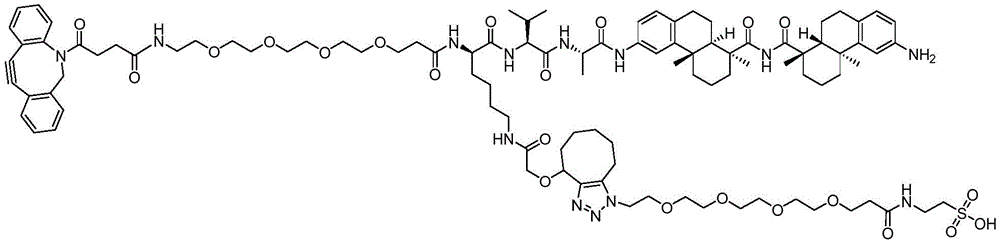
Following the general procedure for linker-payload LP1-LP5, linker-payload LP3(60mg, 52% yield) was obtained as a white solid. ESIm/z:642(M/3+ H)+。1H NMR(500MHz,CDCl3)δ9.68(s,0.6H),9.25(s,0.4H),8.22-8.07(m,3H),8.02-7.86(m,2H),7.77-7.72(m,2H),7.68-7.60(m,2H),7.54-7.52(m,1H),7.50-7.42(m,4H),7.39-7.27(m,4H),7.22(s,1H),7.08(s,1H),6.97-6.94(m,2H),6.74(d,J=10.5Hz,1H),6.58(s,1H),6.43(dd,J=10.0Hz,2.0Hz,1H),5.62(br s,1H),5.04-5.00(m,1H),4.93-4.90(m,0.4H),4.76-4.72(m,0.6H),4.52-4.26(m,4H),4.16-4.08(m,1H),3.81-3.75(m,4H),3.61-3.55(m,4H),3.46-3.44(m,24H),3.30-3.27(m,5H),3.08-3.06(m,5H),2.97-2.89(m,2H),2.80-2.74(m,4H),2.54-2.52(m,2H),2.40-2.31(m,2H),2.27-2.22(m,4H),2.16-2.13(m,4H),2.02-1.71(m,8H),1.69-1.45(m,10H),1.40-1.21(m,14H),1.17-1.08(m,4H),1.01-0.98(m,6H),0.89-0.82(m,6H)ppm。
2- {1- [4- ({ [ (5R) -5- [1- (4- { 2-Azotricyclo [10.4.0.0 ]4,9]Hexadec-1 (12),4(9),5,7,13, 15-hexaen-10-yn-2-yl } -4-oxobutanamido) -3,6,9, 12-tetraoxapentadecane-15-carboxamide]-5- { [ (1S) -1- { [ (1S) -1- { [ (4bS,8S,8aR) -8- ({ [ (1S,4aS,10aR) -6-amino-1, 4 a-dimethyl-1, 2,3,4,4a,9,10,10 a-octahydrophenanthren-1-yl]Carbonyl } carbamoyl) -4b, 8-dimethyl-4 b,5,6,7,8,8a,9, 10-octahydrophenanthren-3-yl ]Carbamoyl } -4- (carbamoylamino) butyl]Carbamoyl } -2-methylpropyl radical]Carbamoyl } pentyl group]Carbamoyl } methoxy) -1H,4H,5H,6H,7H,8H, 9H-cycloocta [ d][1,2,3]Triazol-1-yl]-3,6,9, 12-tetraoxapentadecane-15-amido } ethane-1-sulfonic acid (LP4)

Following the general procedure of linker-payload LP1-LP5, compound LP4(6.0mg, 20% yield) was obtained as a white solid. ESIm/z 671(M/3+ H)+。1H NMR(500MHz,CDCl3)δ9.37(s,1H),9.29(s,1H),8.24-8.22(m,1H),8.18-8.17(m,2H),8.09(s,2H),8.01-7.99(m,1H),7.97-7.94(m,2H),7.89-7.84(m,1H),7.76(m,5H),7.68(d,J=7.5Hz,2H),7.62(d,J=7.5Hz,2H),7.55(m,2H),7.51-7.43(m,7H),7.39-7.28(m,7H),7.08(m,4H),6.96-6.93(t,J=7.0Hz,2H),6.68(d,J=8.5Hz,2H),6.48(s,2H),6.35-6.33(m,2H),5.97-5.95(m,2H),5.37(s,4H),5.04-5.01(m,2H),4.74-4.69(m,5H),4.52(m,1H),4.42(t,J=5.5Hz,2H),4.34-4.27(m,4H),4.18(m,1H),4.13-4.11(m,1H),3.82-3.77(m,5H),3.58-3.55(m,6H),3.49-3.44(m,14H),3.10-3.05(m,4H),2.98-2.93(m,4H),2.77-2.75(m,4H),2.28-2.25(m,4H),2.03-1.99(m,2H),1.64-1.51(m,6H),1.27-1.24(m,11H),1.01-0.98(m,11H),0.89-0.82(m,8H)ppm。
1- (4- { 2-Azotricyclo [10.4.0.0 ]4,9]Hexadec-1 (12),4(9),5,7,13, 15-hexaen-10-yn-2-yl } -4-oxobutanamido) -N- [ (1R) -1- { [ (1S) -1- { [ (1S) -1- { [ (4bS,8S,8aR) -8- { [ (1S,4aS,10aR) -6-amino-1, 4 a-dimethyl-1, 2,3,4,4a,9,10,10 a-octahydrophenanthrene-1-carbonyl]Amino-methylAcyl } -4b, 8-dimethyl-4 b,5,6,7,8,8a,9, 10-octahydrophenanthren-3-yl]Carbamoyl } ethyl group]Carbamoyl } -2-methylpropyl radical]Carbamoyl } -5- [2- ({1- [ (2S,3R,4R,5S,6R) -3, 4-dihydroxy-6- (hydroxymethyl) -5- { [ (2R,3R,4S,5S,6R) -3,4, 5-trihydroxy-6- (hydroxymethyl) tetrahydropyran-2-yl]Oxy } tetrahydropyran-2-yl]-1H,4H,5H,6H,7H,8H, 9H-cycloocta [ d][1,2,3]Triazol-4-yl } oxy) acetamido]Pentyl radical]-3,6,9, 12-Tetraoxapentadecane-15-amide (LP5)

Following the general procedure of linker-payload LP1-LP5, compound LP5(15mg, 27% yield) was obtained as a white solid. ESI M/z 947(M/2+ H) +。1H NMR(400MHz,DMSOd6)δ9.69(s,0.55H),9.27(s,0.45H),8.25-8.15(m,2H),8.15-8.05(m,2H),8.05-7.90(m,1H),7.90-7.80(m,1H),7.76(t,J=6.4Hz,1H),7.66(d,J=8.0Hz,1H),7.60(d,J=6.8Hz,1H),7.55-7.40(m,4H),7.40-7.25(m,3H),7.00-6.90(m,1H),6.67(d,J=8.4Hz,1H),6.47(s,1H),6.32(d,J=8.0Hz,1H),5.75-5.70(m,1H),5.56(d,J=6.0Hz,1H),5.50-5.40(m,2H),5.20-4.92(m,4H),4.80-4.70(m,1H),4.70-4.65(m,2H),4.65-4.55(m,2H),4.40-4.25(m,2H),4.20-3.95(m,2H),3.80-3.75(m,2H),3.75-3.45(m,23H),3.30-3.20(m,3H),3.20-2.90(m,5H),2.90-2.65(m,3H),2.60-2.55(m,1H),2.40-1.95(m,12H),1.90-1.70(m,5H),1.70-1.35(m,14H),1.35-1.20(m,15H),1.15-1.05(m,3H),1.00-0.90(m,7H),0.90-0.80(m,7H)ppm。
(2- {1- [4- ({ [ (5R) -5- [1- (4- { 2-Azotricyclo [10.4.0.0 ]4,9]Hexadec-1 (12),4(9),5,7,13, 15-hexaen-10-yn-2-yl } -4-oxobutanamido) -3,6,9, 12-tetraoxapentadecane-15-carboxamide]-5- { [ (1S) -1- { [ (1S) -1- { [ (4bS,8S,8aR) -8- ({ [ (1S,4aS,10aR) -6-amino-1, 4 a-dimethyl-1, 2,3,4,4a,9,10,10 a-octahydrophenanthren-1-yl]Carboxamido } carbonyl) -4b, 8-dimethyl-4 b,5,6,7,8,8a,9, 10-octahydrophenanthren-3-yl]Carbamoyl } ethyl group]Carbamoyl } -2-methylpropyl radical]Carbamoyl } pentyl group]Carbamoyl } methoxy) -1H,4H,5H,6H,7H,8H, 9H-cycloocta [ d][1,2,3]Triazol-1-yl]-3,6,9, 12-tetraoxapentadecan-15-amido } ethyl) trimethylAmmonium Nitrogen trifluoroacetate salt (LP20)

Following the general procedure of linker-payload LP1-LP5, compound LP20(7mg, 24% yield) was obtained as a white solid. ESI M/z 950.8(M/2)+。
Example 6
Linker-payload LP6
This example illustrates the synthesis of linker-payload LP6 in table 2 above. This example relates to compounds numbered 109 to 113 in figure 4, and linker-payload LP 6.
1- (4- { 2-Azotricyclo [10.4.0.0 ]4,9]Hexadec-1 (12),4(9),5,7,13, 15-hexaen-10-yn-2-yl } -4-oxobutanamido) -N- [ (1S) -1- { [ (1S) -4- (carbamoylamino) -1- { [4- (hydroxymethyl) phenyl ]Carbamoyl } butyl group]Carbamoyl } -2-methylpropyl radical]-3,6,9, 12-tetraoxapentadecane-15-amide (110)

To a solution of compound 108(0.30g, 0.54mmol) in DMF (10mL) was added HATU (0.31g, 0.81mmol) and DIPEA (0.14g, 1.1mmol) sequentially at room temperature. The mixture was stirred at room temperature for 15 minutes. VC-PAB-OH 109(CAS:159857-79-1, 0.21g, 0.54mmol) was then added to the reaction solution at room temperature and the resulting mixture was stirred at room temperature for 3h until 108 or 109 was exhausted, monitored by LCMS. The reaction mixture was then filtered through a filter membrane, the filtrate was concentrated and the residue was directly purified by reverse phase flash chromatography (0-100% acetonitrile in water (containing 10mmol/L ammonium bicarbonate)) to afford compound 110(0.30g, 60% yield) as a white solid. ESI M/z:617(M + H)+。
{4- [ (2S) -2- [ (2S) -2- [1- (4- { 2-Azotricyclo [10.4.0.0 ]4,9]Hexadec-1 (12),4(9),5,7,13, 15-hexaen-10-yn-2-yl } -4-oxobutanamido) -3,6,9, 12-tetraoxapentadecane-15-carboxamide]-3-methyl butanamido group]-5- (carbamoylamino) pentanamide]Phenyl } methyl 4-nitrophenyl carbonate (112)

To a solution of compound 110(0.15g, 0.16mmol) in DMF (10mL) at 0 deg.C was added bis (4-nitrophenyl) carbonate 111(0.15g, 0.49mmol) and DIPEA (63mg, 0.49mmol) in that order. The mixture was then stirred at room temperature for 3 hours until 110 was consumed, monitored by LCMS. The reaction mixture was filtered through a filter, the filtrate was concentrated, and the residue was directly purified by reverse phase flash chromatography (0-100% acetonitrile in water (containing 10mmol/L ammonium bicarbonate)) to give compound 112(50mg, 28% yield) as a white solid. ESI M/z 1079(M + H) +。
9H-Fluoren-9-ylmethyl N- ({ [ (4bS,8S,8aR) -8- ({ [ (1S,4aS,10aR) -6- { [ ({4- [ (2S) -2- [ (2S) -2- [1- (4- { 2-azatricyclo [10.4.0.0 ]4,9]Hexadec-1 (12),4(9),5,7,13, 15-hexaen-10-yn-2-yl } -4-oxobutanamido) -3,6,9, 12-tetraoxapentadecane-15-carboxamide]-3-methylbutanamido group]-5- (carbamoylamino) pentanamide]Phenyl } methoxy) carbonyl]Amino } -1,4 a-dimethyl-1, 2,3,4,4a,9,10,10 a-octahydrophenanthren-1-yl]Carboxamido } carbonyl) -4b, 8-dimethyl-4 b,5,6,7,8,8a,9, 10-octahydrophenanthren-3-yl]Carbamoyl } methyl) carbamate (113)

To a mixture of compound 14a (0.10g, 0.12mmol) and compound 112(0.15g, 0.14mmol) in DMF (5mL) was added HOBt (20mg, 0.15mmol) and DIPEA (48mg, 0.37mmol), and the mixture was stirred at room temperature for 4 hours, monitored by LCMS. The reaction mixture was purified by preparative HPLC (method B) to give compound 113(0.16g, 72% yield) as a pale yellow solid. ESI M/z:874(M/2+1)+。
{4- [ (2S) -2- [ (2S) -2- [1- (4- { 2-Azotricyclo [10.4.0.0 ]4,9]Hexadec-1 (12),4(9),5,7,13, 15-hexaen-10-yne-2-yl } -4-oxobutanamido) -3,6,9, 12-tetraoxapentadecane-15-carboxamide]-3-methylbutanamido group]-5- (carbamoylamino) pentanamide ]Phenyl } methyl N- [ (4bS,8S,8aR) -8- { [ (1S,4aS,10aR) -6- (2-aminoacetamido) -1,4 a-dimethyl-1, 2,3,4,4a,9,10,10 a-octahydrophenanthrene-1-carbonyl]Carbamoyl } -4b, 8-dimethyl-4 b,5,6,7,8,8a,9, 10-octahydrophenanthren-3-yl]Carbamate (LP6)
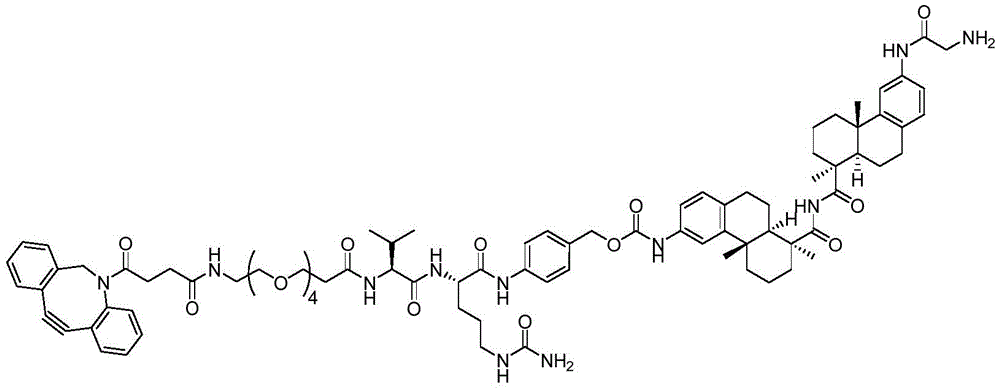
To a solution of compound 113(0.10g, 0.057mmol) in DMF (5mL) was added piperidine (1mL) and the mixture was stirred at room temperature for half an hour until Fmoc had been completely removed by LCMS. The reaction mixture was directly purified by preparative HPLC (method B) to give compound LP6(35mg, 23% yield) as a white solid. ESI M/z:763(M/2+1)+。1H NMR(500MHz,DMSOd6)δ10.0(s,1H),9.51(s,1H),8.15-8.08(m,2H),7.87(d,J=8.5Hz,1H),7.76(t,J=5.0Hz,1H),7.70-7.65(m,1H),7.61(t,J=8.5Hz,3H),7.51-7.42(m,4H),7.41-7.30(m,8H),7.20-7.10(m,1H),7.00-6.90(m,2H),6.00-5.95(m,1H),5.40(s,2H),5.35-5.30(m,1H),5.10-5.00(m,3H),4.40-4.35(m,1H),4.25-4.20(m,1H),3.65-3.55(m,3H),3.50-3.40(m,14H),3.25(s,3H),3.10-3.00(m,4H),3.00-2.85(m,4H),2.80-2.70(m,2H),2.63-2.61(m,1H),2.60-2.55(m,1H),2.45-2.35(m,3H),2.31-2.20(m,3H),2.20-2.10(m,4H),2.10-1.92(m,5H),1.90-1.82(m,4H),1.68-1.53(m,6H),1.50-1.40(m,2H),1.20-1.10(m,2H),1.02-0.96(m,6H),0.90-0.80(m,8H)ppm。
Example 7
Linker-payload LP7
This example illustrates the synthesis of linker-payload LP7 in table 2 above. This example relates to compounds numbered 14a, 107, 114 and 115 in figure 5, and linker-payload LP 7.
9H-Fluoren-9-ylmethyl N- ({ [ (4bS,8S,8aR) -8- ({ [ (1S,4aS,10aR) -6- [ (2S) -2- [ (2S) -2- { [ (tert-butoxy) carbonyl ] amino } -3-methylbutanamido ] propionamido ] -1,4 a-dimethyl-1, 2,3,4,4a,9,10,10 a-octahydrophenanthren-1-yl ] formamido } carbonyl) -4b, 8-dimethyl-4 b,5,6,7,8,8a,9, 10-octahydrophenanthren-3-yl ] carbamoyl } methyl) carbamate (114)

To a solution of compound 14a (66mg, 0.082mmol) in DMF (10mL) was added Boc-Val-Ala-OH 101c (28mg, 0.098mmol), DIPEA (32mg, 0.25mmol) and HATU (47mg, 0.12 mmol). The reaction mixture was stirred at room temperature for 4 hours, monitored by LCMS. The mixture was directly purified by reverse phase flash chromatography (50-90% acetonitrile in aqueous ammonium bicarbonate (10mM)) to give compound 114(74mg, 84% yield) as a white solid. ESI M/z 978 (M-Boc +1) +。
9H-Fluoren-9-ylmethyl N- ({ [ (4bS,8S,8aR) -8- ({ [ (1S,4aS,10aR) -6- [ (2S) -2- [ (2S) -2-amino-3-methylbutanamido ] propionamido ] -1,4 a-dimethyl-1, 2,3,4,4a,9,10,10 a-octahydrophenanthren-1-yl ] formamido } carbonyl) -4b, 8-dimethyl-4 b,5,6,7,8,8a,9, 10-octahydrophenanthren-3-yl ] carbamoyl } methyl) carbamate trifluoroacetate (115)

To a solution of compound 114(74mg, 0.069mmol) in DCM (3mL) was added TFA (1 mL). The reaction mixture was stirred at room temperature for 1 hour until complete Boc removal by LCMS. The volatiles were removed in vacuo to give crude product 115(66mg, 97% yield as TFA salt) as a colorless oil. ESI M/z 978(M +1)+。
1- (4- { 2-Azotricyclo [10.4.0.0 ]4,9]Hexadec-1 (12),4(9),5,7,13, 15-hexaen-10-yn-2-yl } -4-oxobutanamido) -N- [ (1S) -1- { [ (1S) -1- { [ (4bS,8S,8aR) -8- { [ (1S,4aS,10aR) -6- (2-aminoacetamido) -1,4 a-dimethyl-1, 2,3,4,4a,9,10,10 a-octahydrophenanthrene-1-carbonyl]Carbamoyl } -4b, 8-dimethyl-4 b,5,6,7,8,8a,9, 10-octahydrophenanthren-3-yl]Carbamoyl } ethyl group]Carbamoyl } -2-methylpropyl radical]-3,6,9, 12-Tetraoxapentadecane-15-amide (LP7)

To a solution of compound 115(60mg, 61. mu. mol) in DMF (5mL) was added DIBAC-suc-PEG4-OSu 107(48mg, 74. mu. mol) and DIPEA (24mg, 0.18 mmol). The reaction mixture was stirred at room temperature for 4 hours, monitored by LCMS. Piperidine (0.2mL, excess) was then added to the reaction. The reaction mixture was stirred at room temperature for 30 min until Fmoc had been completely removed according to LCMS. The reaction mixture was directly purified by preparative HPLC (method B) to give LP7(22mg, 28% yield) as a white solid. ESIm/z 1292(M + H) +。1H NMR(500MHz,DMSOd6) (including regioisomers) δ 9.66(s,0.5H),9.51(s,0.5H),8.43(d, J ═ 7.5Hz,0.5H),8.15 to 8.10(m,1.5H),8.05(d, J ═ 7.5Hz,0.5H),7.90(d, J ═ 7.5Hz,0.5H),7.77(t, J ═ 5.5Hz,1H),7.70 to 7.65(m,1H),7.65 to 7.60(m,1H),7.55 to 7.25(m,11H),6.97(d, J ═ 8.5Hz,2H),5.02(d, J ═ 14.5Hz,1H),4.40 to 4.35(m,1H),4.18(t, 7.5H), 3.5H, 3.85 (m, 3.5H), 3.3.5H), 3.5H, 3H, 3.5H, 3H, 5H, 3H, 7H, 5H, 3H, 5H, 3H, 7H, 3H, 5H, 3H, 5H, 3H, 7H, 2.60-2.55(m,1H),2.40-2.10(m,12H),2.00-1.80(m,5H),1.80-1.70(m,1H),1.70-1.55(m,5H),1.24(s,1H),1.20-1.10(m,3H),1.10-0.90(m,8H),0.90-0.80(m,8H) ppm.
Example 8
Linker-payload LP8
This example illustrates the synthesis of linker-payload LP8 in table 2 above. This example relates to compounds numbered P4, 117 and 120 in FIG. 6, and linker-payload LP 8.
{4- [ (2S) -2- [ (2S) -2-amino-3-methylbutanamido ] -5- (carbamoylamino) pentanamido ] phenyl } methyl N- ({ [ (4bS,8S,8aR) -8- { [ (1S,4aS,10aR) -6-amino-1, 4 a-dimethyl-1, 2,3,4,4a,9,10,10 a-octahydrophenanthrene-1-carbonyl ] carbamoyl } -4b, 8-dimethyl-4 b,5,6,7,8,8a,9, 10-octahydrophenanthren-3-yl ] carbamoyl } methyl) carbamate (117)
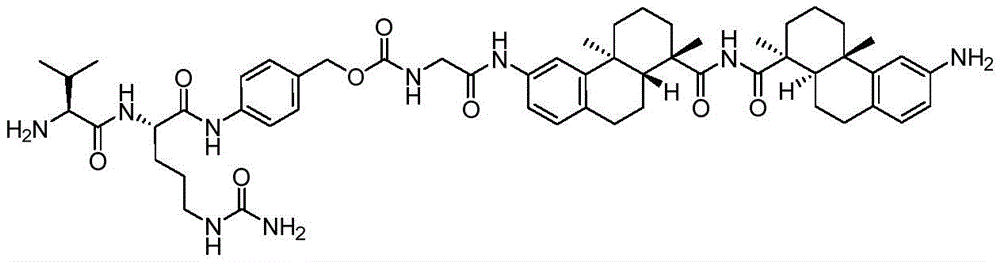
To a solution of Fmoc-vc-PAB-PNP 116(0.14g, 0.18mmol) and payload P4(0.11g, 0.18mmol) in DMF (2mL) was added HOBt (24mg, 0.18mmol) and DIPEA (70mg, 0.54mmol) by syringe at room temperature. The mixture was stirred at room temperature for 2 hours and the exhaustion of compound P4 was monitored by LCMS. Piperidine (42mg, 0.50mmol) was added to the resulting mixture and the reaction was stirred at room temperature for 2 hours until Fmoc was completely removed, monitored by LCMS. After filtration through a membrane, the filtrate was concentrated and the residue was directly purified by preparative HPLC (method B) to give compound 117(45mg, 27% yield) as a white solid. ESI M/z:991(M +1)+。
1H NMR(400MHz,DMSOd6)δ10.11(s,1H),9.80(s,1H),8.20-8.04(m,2H),7.60(d,J=8.4Hz,2H),7.52-7.44(m,2H),7.36-7.20(m,3H),6.96(d,J=8.4Hz,1H),6.68(d,J=8.2Hz,1H),6.48(d,J=1.7Hz,1H),6.36-6.29(m,1H),5.98(t,J=5.6Hz,1H),5.41(s,2H),4.97(s,2H),4.70(s,2H),4.52-4.42(m,1H),3.75(d,J=6.0Hz,2H),3.07-2.85(m,4H),2.82-2.61(m,3H),2.31-2.06(m,6H),2.00-1.78(m,6H),1.72-1.52(m,6H),1.44-1.09(m,13H),0.99(d,J=8.5Hz,6H),0.87(d,J=8.1Hz,3H),0.78(d,J=6.8Hz,3H)ppm。
2, 5-dioxopyrrolidin-1-yl (2R) -6- [2- (cyclooct-2-yn-1-yloxy) acetamido ] -2- { [ (9H-fluoren-9-ylmethoxy) carbonyl ] amino } hexanoate (118)

A mixture of compound 103(0.10g, 0.19mmol), EDCI (72mg, 0.38mmol) and HOSu (43mg, 0.38mmol) in DCM (3mL) was stirred at room temperature for 3 h. The reaction mixture was concentrated and the residue was purified by silica gel column chromatography (70% ethyl acetate in petroleum ether) to give intermediate 118(55mg, 47% yield) as a white solid, which was used in the next step without purification. ESI M/z 630(M +1)+。
{4- [ (2S) -2- [ (2S) -2- [ (2R) -2-amino-6- [2- (cyclooct-2-yn-1-yloxy) acetamido ] hexanamido ] -3-methylbutanamido ] -5- (carbamoylamino) pentanamido ] phenyl } methyl N- ({ [ (4bS,8S,8aR) -8- { [ (1S,4aS,10aR) -6-amino-1, 4 a-dimethyl-1, 2,3,4,4a,9,10,10 a-octahydrophenanthrene-1-carbonyl ] carbamoyl } -4b, 8-dimethyl-4 b,5,6,7,8,8a,9, 10-Octahydrophenanthrene-3-yl ] carbamoyl } methyl) carbamate (119)

To a solution of compound 117(55mg, 56 μmol) and DIPEA (24mg, 0.19mmol) in DMF (1.5mL) was added crude intermediate 118(40mg, 63 μmol). The reaction mixture was stirred at room temperature for 2 hours until 118 was consumed as monitored by LCMS. The reaction mixture was directly purified by reverse phase flash chromatography (0-100% acetonitrile in water) to afford Fmoc-119(60mg, ESI M/z:753(M/2+1)+) As a white solid, it was dissolved in DMF (1.5 mL). Diethylamine (24mg, 0.33mmol) was added to the solution and the solution was stirred at room temperature for 2 hours until complete removal of Fmoc as monitored by LCMS. The reaction mixture was directly purified by reverse phase flash chromatography (0-100% acetonitrile in aqueous ammonium bicarbonate) to give compound 119(35mg, 50% yield from compound 117) as a white solid. ESIm/z 1282(M + H)+。
{4- [ (2S) -2- [ (2S) -2- [ (2R) -2-amino-6- {2- [ (1- { [31,32,33,34,35,36,37,38,39,40,41, 42-dodecahydroxy-10, 15,20,25, 30-pentakis (hydroxymethyl) -2,4,7,9,12,14,17,19,22,24,27, 29-dodecaoxaheptacyclo [26.2.2.2 ]3,6.28,11.213,16.218,21.223,26]Forty-dioxane-5-yl]Methyl } -1H,4H,5H,6H,7H,8H, 9H-cycloocta [ d][1,2,3]Triazol-4-yl) oxy]Acetamido } hexanamide radical]-3-methylbutanamido group]-5- (carbamoylamino) pentanamide ]Phenyl } methyl N- ({ [ (4bS,8S,8aR) -8- { [ (1S,4aS,10aR) -6-amino-1, 4 a-dimethyl-1, 2,3,4,4a,9,10,10 a-octahydrophenanthrene-1-carbonyl]Carbamoyl } -4b, 8-dimethyl-4 b,5,6,7,8,8a,9, 10-octahydrophenanthren-3-yl]Carbamoyl } methyl) carbamate (120)

To a solution of compound 119(70mg, 54. mu. mol) in DMF (3mL) was added α -CD-N 3105a (0.16g, 0.16 mmol). The reaction mixture was stirred at 50 ℃ for 3 days, monitored by LCMS. The resulting mixture was then directly purified by reverse phase flash chromatography (0-100% acetonitrile in aqueous ammonium bicarbonate (10mM)) to afford compound 120(20mg, 16% yield) as a white solid. ESI M/z:1141(M/2+1)+。
{4- [ (2S) -2- [ (2S) -2- [ (2R) -2- [1- (4- { 2-Azotricyclo [10.4.0.0 ]4,9]Hexadec-1 (12),4(9),5,7,13, 15-hexaen-10-yn-2-yl } -4-oxobutanamido) -3,6,9, 12-tetraoxapentadecane-15-carboxamide]-6- {2- [ (1- { [31,32,33,34,35,36,37,38,39,40,41, 42-dodecahydroxy-10, 15,20,25, 30-pentakis (hydroxymethyl) -2,4,7,9,12,14,17,19,22,24,27, 29-dodecaheptaoxacyclo [26.2.2.2 ]3,6.28,11.213,16.218,21.223,26]Forty-dioxane-5-yl]Methyl } -1H,4H,5H,6H,7H,8H, 9H-cycloocta [ d][1,2,3]Triazol-4-yl) oxy]Acetamido } hexanamide radical]-3-methylbutanamido group]-5- (carbamoylamino) pentanamide ]Phenyl } methyl N- ({ [ (4bS,8S,8aR) -8- { [ (1S,4aS,10aR) -6-amino-1, 4 a-dimethyl-1, 2,3,4,4a,9,10,10 a-octahydrophenanthrene-1-carbonyl]Carbamoyl } -4b, 8-dimethyl-4 b,5,6,7,8,8a,9, 10-octahydrophenanthren-3-yl]Carbamoyl } methyl) carbamate (LP8)

To a solution of compound 120(10mg, 4.4. mu. mol) and intermediate 107(5mg, 7.7. mu. mol) in DMF (2mL) was added DIPEA (16mg, 0.12mmol), and the mixture was stirred at room temperature for 16 h. The reaction mixture was directly purified twice by preparative HPLC (method B) to give LP8(1.5mg, 12% yield) as a white solid. ESI M/z 939(M/3+ H)+。1H NMR(500MHz,DMSOd6)δ9.87-9.66(m,1H),8.22-8.08(m,4H),7.91-7.76(m,2H),7.71-7.61(m,4H),7.56-7.45(m,4H),7.40-7.28(m,5H),6.96(d,J=8.5Hz,1H),6.68(d,J=8.1Hz,1H),6.48(s,1H),6.34(d,J=8.2Hz,1H),6.03-5.96(m,1H),5.67-5.31(m,12H),5.06-4.95(m,3H),4.87-4.66(m,7H),4.63-4.50(m,3H),4.38-4.29(m,3H),4.22-4.13(m,1H),4.06-3.93(m,1H),3.86-3.40(m,54H),3.30-3.19(m,4H),3.17-2.85(m,4H),2.81-2.62(m,2H),2.60-2.54(m,3H),2.41-1.95(m,11H),1.92-1.71(m,5H),1.68-1.40(m,13H), 1.33-1.33 (m,1H), 1.02-1.78 (m,9H), 0.78-0.93 (m, 9H). Analytical HPLC (as a mixture of triazole regioisomers) 63%, retention time 6.03 min; 36%, retention time 6.13min (method B).
Example 9
Linker-payload LP9
This example illustrates the synthesis of linker-payload LP9 in table 2 above. This example relates to compounds numbered 12b, 15, 112, 121, and 122 in fig. 7, and linker-payload LP 9.
9H-Fluoren-9-ylmethyl N- [ (4bS,8S,8aR) -8- ({ [ (1S,4aS,10aR) -6-amino-1, 4 a-dimethyl-1, 2,3,4,4a,9,10,10 a-octahydrophenanthren-1-yl ] carboxamido } carbonyl) -4b, 8-dimethyl-4 b,5,6,7,8,8a,9, 10-octahydrophenanthren-3-yl ] carbamate, trifluoroacetate (15)

To a solution of compound 12b (0.63g, 1.0mmol) in DCM (50mL) were added Fmoc-OSu (0.40g, 1.2mmol) and DIPEA (0.26g, 2.0 mmol). The mixture was stirred at room temperature for 16 hours, monitored by LCMS. The mixture was concentrated in vacuo and the residue was purified by silica gel column chromatography (50-80% ethyl acetate in petroleum ether) to give Boc-15(0.71g) as a white solid which was dissolved in DCM (10 mL). To the resulting solution was added TFA (3mL) at room temperature. The reaction mixture was stirred at room temperature for 4 hours until complete stripping of Boc as monitored by LCMS. Volatiles were removed in vacuo to give compound 15 as a TFA salt (0.62g, 74% yield) and a colorless oil. ESI M/z 751(M + H)+。
9H-Fluoren-9-ylmethyl N- [ (4bS,8S,8aR) -8- ({ [ (1S,4aS,10aR) -6- [ (2S) -6-amino-2- { [ (9H-Fluoren-9-ylmethoxy) carbonyl ] amino } hexanamido ] -1,4 a-dimethyl-1, 2,3,4,4a,9,10,10 a-octahydrophenanthren-1-yl ] carboxamido } carbonyl) -4b, 8-dimethyl-4 b,5,6,7,8,8a,9, 10-octahydrophenanthren-3-yl ] carbamate, trifluoroacetate (122)

To a solution of compound 15(0.30g, 0.40mmol) in DMF (20mL) was added Fmoc-Lys (Boc) -OH 121(0.23g, 0.48mmol), HATU (228mg, 0.60mmol) and DIPEA (0.16g, 1.2mmol) sequentially at room temperature. The reaction mixture was stirred at room temperature for 4 hours, monitored by LCMS. The resulting mixture was directly purified by reverse phase flash chromatography (50-90% acetonitrile in ammonium bicarbonate (10mM)) to afford Boc-122(0.41g) as a white solid, 0.24g of which was dissolved in DCM (20 mL). To the resulting solution was added TFA (3mL) and the reaction mixture was stirred at room temperature for 1 hour until complete removal of Boc as monitored by LCMS. Volatiles were removed in vacuo to give compound 122 as a TFA salt (0.22g, 79% yield) and a colorless oil. ESI M/z:1101(M + H)+。
{4- [ (2S) -2- [ (2S) -2- [1- (4- { 2-Azotricyclo [10.4.0.0 ]4,9]Hexadec-1 (12),4(9),5,7,13, 15-hexaen-10-yn-2-yl } -4-oxobutanamido) -3,6,9, 12-tetraoxapentadecane-15-carboxamide]-3-methylbutanamido group]-5- (carbamoylamino) pentanamide]Phenyl } methyl N- [ (5S) -5-amino-5- { [ (4bS,8S,8aR) -8- { [ (1S,4aS,10aR) -6-amino-1, 4 a-dimethyl-1, 2,3,4,4a,9,10,10 a-octahydrophenanthrene-1-carbonyl]Carbamoyl } -4b, 8-dimethyl-4 b,5,6,7,8,8a,9, 10-octahydrophenanthren-3-yl ]Carbamoyl } pentyl group]Carbamate (LP9)
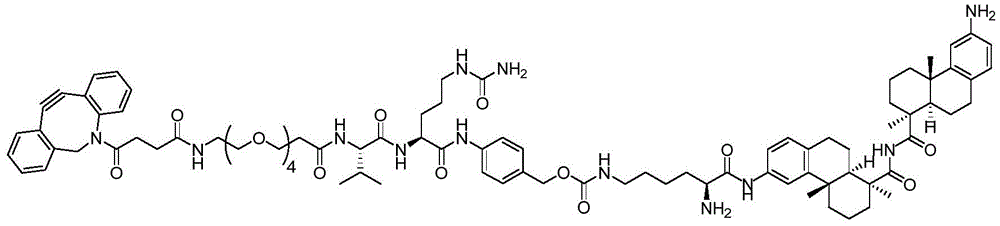
To a mixture of compound 122(14mg, 12 μmol) and compound 112(15mg, 14 μmol) in DMF (5mL) was added HOBt (2mg, 15 μmol) and DIPEA (5mg, 37 μmol), and the mixture was stirred at room temperature for 4 hours, monitored by LCMS. Piperidine (0.5mL) was then added to the reaction mixture and the mixture was stirred at room temperature for 0.5 h until complete removal of Fmoc according to LCMS monitoring. The reaction mixture was then filtered through a membrane, the filtrate was concentrated, and the residue was directly purified by preparative HPLC (method B) to give LP9(6mg, 31% yield) as a white solid. ESI M/z 798(M/2+ H)+。1H NMR(500MHz,DMSOd6)δ10.0(s,1H),8.15-8.08(m,2H),7.87(d,J=8.5Hz,1H),7.76(t,J=5.0Hz,1H),7.67(d,J=7.0Hz,1H),7.61(d,J=7.0Hz,1H),7.60-7.56(m,2H),7.51-7.42(m,4H),7.41-7.24(m,6H),7.20-7.16(m,1H),6.95(d,J=8.5Hz,1H),6.68(d,J=8.0Hz,1H),6.50-6.46(m,1H),6.36-6.32(m,1H),6.00-5.96(m,1H),5.40(s,2H),5.02(d,J=9.0Hz,1H),4.91(s,2H),4.69(s,2H),4.40-4.35(m,1H),4.25-4.20(m,1H),3.65-3.55(m,3H),3.50-3.40(m,14H),3.24-3.20(m,2H),3.10-3.05(m,2H),3.00-2.92(m,3H),2.92-2.85(m,1H),2.80-2.70(m,2H),2.65-2.55(m,2H),2.45-2.35(m,2H),2.31-2.20(m,4H),2.20-2.10(m,4H),2.10-1.92(m,3H),1.90-1.70(m,6H),1.68-1.53(m,6H),1.50-1.30(m,8H),1.25-1.20(m,7H),1.20-1.10(m,3H),1.02-0.96(m,6H),0.90-0.80(m,6H)ppm。
Example 10
Linker-payloads LP10 and LP11
This example illustrates the synthesis of linker-payloads LP10-LP11 of Table 2 above. This example relates to compounds numbered P7, P8, 116, 123a-123b in fig. 8, and linker-payloads LP10 and LP 11.
(S) -4- ((4bS,8S,8aR) -8- ((1S,4aS,10aR) -6-amino-1, 4 a-dimethyl-1, 2,3,4,4a,9,10,10 a-octahydrophenanthrene-1-carbonylcarbamoyl) -4b, 8-dimethyl-4 b,5,6,7,8,8a,9, 10-octahydrophenanthren-3-ylamino) -3- ((4- ((S) -2- ((S) -2-amino-3-methylbutanamido) -5-ureidopentanamido) benzyloxy) carbonylamino) -4-oxobutanoic acid (123a)

To a solution of payload P7(64mg, 0.10mmol) in DMF (5mL) was added intermediate 116(92mg, 0.12mmol) and DIPEA (26mg, 0.20mmol) sequentially at room temperature. The reaction mixture was stirred at room temperature for 4 hours, monitored by LCMS. Piperidine (0.5mL) was then added to the mixture and the reaction mixture was cooled to room temperatureStir for 10 min until Fmoc had been completely stripped off as monitored by LCMS. The mixture was directly purified by reverse phase flash chromatography (40-70% acetonitrile in aqueous ammonium bicarbonate (10mM)) to give compound 123a (41mg, 39% yield) as a white solid. ESI M/z 1049(M + H)+。
(S) -5- ((4bS,8S,8aR) -8- ((1S,4aS,10aR) -6-amino-1, 4 a-dimethyl-1, 2,3,4,4a,9,10,10 a-octahydrophenanthrene-1-carbonylcarbamoyl) -4b, 8-dimethyl-4 b,5,6,7,8,8a,9, 10-octahydrophenanthren-3-ylamino) -4- ((4- ((S) -2- ((S) -2-amino-3-methylbutanamido) -5-allopentylamido) benzyloxy) carbonylamino) -5-oxopentanoic acid (123b)

Following a similar procedure to 123a, except substituting P8(0.53g, 0.81mmol) for P7, provided compound 123b (0.61g, 71% yield) as a white solid. ESI M/z 1063(M + H)+。
(3S) -3- { [ ({4- [ (2S) -2- [ (2S) -2- [1- (4- { 2-Aza-tricyclo [10.4.0.0 ]4,9]Hexadec-1 (12),4(9),5,7,13, 15-hexaen-10-yn-2-yl } -4-oxobutanamido) -3,6,9, 12-tetraoxapentadecane-15-carboxamide ]-3-methylbutanamido group]-5- (carbamoylamino) pentanamide]Phenyl } methoxy) carbonyl]Amino } -3- { [ (4bS,8S,8aR) -8- { [ (1S,4aS,10aR) -6-amino-1, 4 a-dimethyl-1, 2,3,4,4a,9,10,10 a-octahydrophenanthrene-1-carbonyl]Carbamoyl } -4b, 8-dimethyl-4 b,5,6,7,8,8a,9, 10-octahydrophenanthren-3-yl]Carbamoyl } propanoic acid (LP10)

To a solution of compound 123(21mg, 20 μmol) in DMF (2mL) was added intermediate 107(16mg, 24 μmol) and DIPEA (5mg, 40 μmol) sequentially at room temperature. The reaction mixture was stirred at room temperature for 4 hours, monitored by LCMS. The resulting mixture was directly purified by preparative HPLC (method B) to give compound LP10(12mg, 38% yield) as a white solid. ESI M/z 792(M/2+ H)+。1H NMR(400MHz,DMSOd6)δ10.0(s,1H),8.14(d,J=7.2Hz,1H),8.09(s,1H),7.90(d,J=8.8Hz,1H),7.85-7.75(m,1H),7.68(d,J=8.0Hz,1H),7.65-7.55(m,3H),7.55-7.40(m,4H),7.40-7.25(m,5H),6.95(d,J=8.8Hz,1H),6.67(d,J=8.0Hz,1H),6.47(s,1H),6.32(d,J=8.0Hz,1H),6.05-5.95(m,1H),5.43(s,2H),5.05-4.90(m,3H),4.80-4.60(m,1H),4.40-4.35(m,2H),4.25-4.20(m,1H),3.65-3.55(m,3H),3.50-3.40(m,25H),3.20-2.85(m,4H),2.80-2.55(m,3H),2.40-2.30(m,3H),2.30-2.20(m,3H),2.20-2.05(m,4H),2.0-1.50(m,12H),1.50-1.30(m,3H),1.30-1.20(m,6H),1.20-1.05(m,2H),1.05-0.90(m,5H),0.90-0.80(m,6H)ppm。
(4S) -4- { [ ({4- [ (2S) -2- [ (2S) -2- [1- (4- { 2-Aza-tricyclo [10.4.0.0 ]4,9]Hexadec-1 (12),4(9),5,7,13, 15-hexaen-10-yn-2-yl } -4-oxobutanamido) -3,6,9, 12-tetraoxapentadecane-15-carboxamide]-3-methylbutanamido group]-5- (carbamoylamino) pentanamide]Phenyl } methoxy) carbonyl]Amino } -4- { [ (4bS,8S,8aR) -8- { [ (1S,4aS,10aR) -6-amino-1, 4 a-dimethyl-1, 2,3,4,4a,9,10,10 a-octahydrophenanthrene-1-carbonyl]Carbamoyl } -4b, 8-dimethyl-4 b,5,6,7,8,8a,9, 10-octahydrophenanthren-3-yl ]Carbamoyl } butanoic acid (LP11)
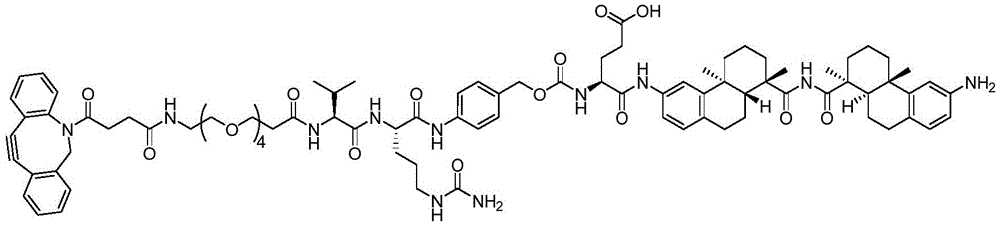
Following a similar procedure to LP10, except 123a was replaced with 123b (0.10g, 94. mu. mol), compound LP11(50mg, 33% yield) was provided as a white solid. ESI M/z 799(M/2+ H)+。1H NMR(400MHz,DMSOd6)δ10.0(s,1H),9.91(s,1H),8.14(d,J=7.2Hz,1H),8.09(s,1H),7.90(d,J=8.8Hz,1H),7.85-7.75(m,1H),7.68(d,J=8.0Hz,1H),7.65-7.55(m,3H),7.55-7.40(m,4H),7.40-7.25(m,6H),6.95(d,J=8.8Hz,1H),6.67(d,J=8.0Hz,1H),6.47(s,1H),6.32(d,J=8.0Hz,1H),6.05-5.95(m,1H),5.43(s,2H),5.05-4.90(m,3H),4.40-4.35(m,2H),4.25-4.20(m,1H),3.65-3.55(m,4H),3.50-3.40(m,25H),3.20-2.85(m,4H),2.80-2.55(m,3H),2.40-2.30(m,3H),2.30-2.20(m,3H),2.20-2.05(m,4H),2.00-1.50(m,12H),1.50-1.30(m,3H),1.30-1.20(m,6H),1.20-1.05(m,2H),1.05-0.90(m,5H),0.90-0.80(m,6H)ppm。
Example 11
Payloads P12 and P16; and linker-payloads LP12 and LP16
This example illustrates the synthesis of payloads P12 and P16 of Table 1 above and linker-payloads LP12 and LP16 of Table 2 above. This example relates to compounds numbered 12b, 107, 124, 125 and 126 in figure 9; and payloads P12 and P16; and linker-payloads LP12 and LP 16.
((S) -2- ((((9H-fluoren-9-yl) methoxy) carbonyl) amino) -5- (tert-butoxy) -5-oxopentanoyl) -L-alanine (125)

To a solution of Fmoc-Glu (OtBu) -OH (6.0g, 14mmol) in DCM (300mL) was added HOSu (3.2g, 28mmol) and EDCI (5.4g, 28 mmol). The reaction mixture was stirred at room temperature overnight, monitored by LCMS. The resulting mixture was diluted with DCM (200mL) and washed with water (100 mL. times.2) and brine (100 mL). The organic solution was dried over anhydrous sodium sulfate, filtered, and concentrated in vacuo to give crude compound 124(8.5g, ESI M/z:545(M +23)+) It was dissolved in DMF (10 mL). To the resulting solution was added alanine (4.2g, 48mmol) and DIPEA (6.2g, 48 mmol). The reaction mixture was stirred at room temperature overnight, monitored by LCMS. The resulting mixture was poured into water (100mL) and acidified to pH 5-6 with acetic acid. The mixture was extracted with ethyl acetate and the combined organic solutions were concentrated in vacuo. The crude product was purified by reverse phase flash chromatography (0-60% acetonitrile in TFA (0.01%)) to afford compound 125(1g, 15% yield) as a white solid. ESI M/z:497(M + H) +。
(S) -tert-butyl 4-amino-5- ((S) -1- ((4bS,8S,8aR) -8- ((1S,4aS,10aR) -6- (tert-butoxycarbonylamino) -1,4 a-dimethyl-1, 2,3,4,4a,9,10,10 a-octahydrophenanthrene-1-carbonylcarbamoyl) -4b, 8-dimethyl-4 b,5,6,7,8,8a,9, 10-octahydrophenanthren-3-ylamino) -1-oxopropan-2-ylamino) -5-oxopentanoate (126a)

To a solution of compound 125(42mg, 84. mu. mol) and DIPEA (28. mu.l, 0.16mmol) in DMF (3.0mL) was added HATU (36mg, 95. mu. mol). The reaction mixture was stirred at room temperature for 10 min, then compound 12b (50mg, 80 μmol) was added and the mixture was stirred at room temperature overnight, monitored by LCMS. Piperidine (1.0mL) was then added to the reaction mixture and the mixture was stirred at room temperature for 3 hours until Fmoc had been completely removed as monitored by LCMS. The resulting mixture was directly purified by reverse phase flash chromatography (0-100% acetonitrile in TFA (0.01%)) to afford compound 126a (20mg, 28% yield) as a yellow solid. ESI M/z 885(M + H)+。
Tert-butyl (4S) -4-amino-4- { [ (1S) -1- { [ (4bS,8S,8aR) -8- ({ [ (1S,4aS,10aR) -6-hydroxy-1, 4 a-dimethyl-1, 2,3,4,4a,9,10,10 a-octahydrophenanthren-1-yl ] carboxamido } carbonyl) -4b, 8-dimethyl-4 b,5,6,7,8,8a,9, 10-octahydrophenanthren-3-yl ] carbamoyl } ethyl ] carbamoyl } butanoate (126b)

(S) -4-amino-5- ((S) -1- ((4bS,8S,8aR) -8- ((1S,4aS,10aR) -6-amino-1, 4 a-dimethyl-1, 2,3,4,4a,9,10,10 a-octahydrophenanthrene-1-carbonylcarbamoyl) -4b, 8-dimethyl-4 b,5,6,7,8,8a,9, 10-octahydrophenanthren-3-ylamino) -1-oxopropan-2-ylamino) -5-oxopentanoic acid (P12)

A mixture of compound 126a (57mg, 64. mu. mol) in neat TFA (2.0mL) was stirred at RT for 1 hour, monitored by LCMS. The resulting mixture was diluted with DCM (20mL) and concentrated in vacuo. The residue was purified by reverse phase flash chromatography (0-100% acetonitrile in aqueous sodium bicarbonate (10mM))P12(20mg, 43% yield) was obtained as a white solid. ESI M/z 365(M/2+ H)+。1H NMR(400MHz,DMSOd6) δ 9.90(s,1H),8.30(br s,1H),8.09(s,1H),7.50(s,1H),7.33(d, J ═ 8.4Hz,1H),6.96(d, J ═ 8.4Hz,1H),6.67(d, J ═ 8.0Hz,1H),6.46(s,1H),6.33(dd, J ═ 7.6Hz and 2.0Hz,1H),4.70(br s,1H),4.41-4.36(m,1H),3.42-3.30(m,6H),2.91-2.85(m,1H),2.78-2.75(m,2H),2.67-2.61(m,1H),2.32-2.27(m,4H), 2.16.88 (m, 13.88H), 1.65 (m,1H), 1.7-1H (m,1H), 1.7.7-4.7 (m,1H), 1.7-1H, 2.7-6H, 1H, 1H.
(4S) -4-amino-4- { [ (1S) -1- { [ (4bS,8S,8aR) -8- ({ [ (1S,4aS,10aR) -6-hydroxy-1, 4 a-dimethyl-1, 2,3,4,4a,9,10,10 a-octahydrophenanthren-1-yl ] carboxamido } carbonyl) -4b, 8-dimethyl-4 b,5,6,7,8,8a,9, 10-octahydrophenanthren-3-yl ] carbamoyl } ethyl ] carbamoyl } butanoic acid (P16)

Following a similar procedure to P12, except substituting 126b for 126a, the payload P16(18mg, 53% yield) was obtained as a yellow solid. ESI M/z 729.5(M +1)+。1H NMR(400MHz,DMSOd6)δ9.95-9.90(d,J=18.8Hz,1H),8.30(brs,1H),8.11(s,1H),7.52(s,1H),7.37-7.33(m,1H),6.96(d,J=8.0Hz,1H),6.81(d,J=8.0Hz,1H),6.63(d,J=2.8Hz,1H),6.50(dd,J=8.0,2.0Hz,1H),4.39(br s,1H),3.32-3.16(m,4H),2.90-2.66(m,5H),2.27-2.13(m,8H),1.88-1.80(m,4H),1.66-1.59(m,4H),1.47(br s,1H),1.31-1.23(m,11H),1.17-1.10(m,2H),1.00-0.98(m,6H)ppm。
(4S) -4- [1- (4- { 2-Azotricyclo [10.4.0.0 ]4,9]Hexadec-1 (12),4(9),5,7,13, 15-hexaen-10-yn-2-yl } -4-oxobutanamido) -3,6,9, 12-tetraoxapentadecane-15-carboxamide]-4- { [ (1S) -1- { [ (4bS,8S,8aR) -8- ({ [ (1S,4aS,10aR) -6-amino-1, 4 a-dimethyl-1, 2,3,4,4a,9,10,10 a-octahydrophenanthren-1-yl]Carboxamido } carbonyl) -4b, 8-dimethyl-4 b,5,6,7,8,8a,9, 10-octahydrophenanthren-3-yl]Carbamoyl } ethyl group]Carbamoyl } butanoic acid (LP12)

To a solution of compound P12(10mg, 14. mu. mol) in DMF (2.0ml) were added DIPEA (6. mu.l, 21. mu. mol) and compound 107(11mg, 16. mu. mol). The reaction mixture was stirred at room temperature for 3 hours, monitored by LCMS. The resulting mixture was directly purified by preparative HPLC (method B) to give compound LP12(3.5mg, 20% yield) as a white solid. ESI M/z:632(M/2+ H) +。1H NMR(400MHz,DMSOd6) δ 9.64(s,1H),9.49(s,1H),8.41-8.39(m,1H),8.12-8.09(m,1H),7.79(br s,1H),7.67(d, J ═ 7.2Hz,1H),7.61(d, J ═ 7.2Hz,1H),7.60(br s,1H),7.52-7.27(m,8H),6.95(d, J ═ 8.4Hz,1H),6.67(d, J ═ 8.4Hz,1H),6.47(s,1H),6.33(dd, J ═ 8.4Hz and 1.6Hz,1H),5.02(d, J ═ 14.0, 1H),4.70-4.67(br s,1H), 4.36-4.36 (s,1H), 4.30.4H (m, 3.42H), 3.42-3.7 (m, 3.7H), 3.7 (m, 3.7H), 3.7H), 5.19 (m ═ 8, 3.4H, 3.06, 3.7H), 3.7H, 3.4H, 3, 3.61 m (m), 1.98-1.73(m,7H),1.65-1.54(m,3H),1.29-1.25(m,12H),1.17-1.11(m,2H),0.99-0.97(m,6H) ppm.
(4S) -4- [1- (4- { 2-Azotricyclo [10.4.0.0 ]4,9]Hexadec-1 (12),4(9),5,7,13, 15-hexaen-10-yn-2-yl } -4-oxobutanamido) -3,6,9, 12-tetraoxapentadecane-15-carboxamide]-4- { [ (1S) -1- { [ (4bS,8S,8aR) -8- ({ [ (1S,4aS,10aR) -6-hydroxy-1, 4 a-dimethyl-1, 2,3,4,4a,9,10,10 a-octahydrophenanthren-1-yl]Carboxamido } carbonyl) -4b, 8-dimethyl-4 b,5,6,7,8,8a,9, 10-octahydrophenanthren-3-yl]Carbamoyl } ethyl group]Carbamoyl } butanoic acid (LP16)

Following a similar procedure to P12, except substituting P16 for P12, the linker-payload LP16(12mg, 69% yield) was obtained as a white solid. ESI M/z 632.5(M/2+1)+。1H NMR(400MHz,DMSOd6)δ9.63(s,1H),9.49(s,1H),8.97(s,1H),8.38(d,J=5.6Hz,1H),8.11(s,1H),7.78(brs,1H),7.67(d,J=7.6Hz,1H),7.61(d,J=6.4Hz,1H),7.56-7.27(m,8H),6.95(d,J=8.0Hz,1H),6.81(d,J=8.4Hz,1H),6.63(d,J=8.4Hz,1H),6.51-6.48(m,1H),5.02(d,J=13.6Hz,1H),4.36-4.30(m,1H),4.20-4.15(m,1H),3.61-3.54(m,3H),3.46-3.43(m,14H),3.10-3.06(m,2H),2.89-2.66(m,5H),2.44-2.11(m,12H),2.02-1.73(m,7H),1.65-1.56(m,3H),1.31-1.22(m,12H),1.17-1.09(m,2H),1.00-0.98(m,6H)ppm。
Example 12
Linker-payloads LP13 and LP14
This example illustrates the synthesis of linker-payloads LP13 and LP14 of Table 2 above. This example relates to compounds numbered 102a, 127a/b, 128a/b, 107 in FIG. 9A, as well as linker-payloads LP13 and LP 14.
(4S) -4-amino-4- { [ (1S) -1- { [ (1S) -1- { [ (4bS,8S,8aR) -8- ({ [ (1S,4aS,10aR) -6-amino-1, 4 a-dimethyl-1, 2,3,4,4a,9,10,10 a-octahydrophenanthren-1-yl ] carboxamido } carbonyl) -4b, 8-dimethyl-4 b,5,6,7,8,8a,9, 10-octahydrophenanthren-3-yl ] carbamoyl } ethyl ] carbamoyl } -2-methylpropyl ] carbamoyl } butanoic acid (128a)
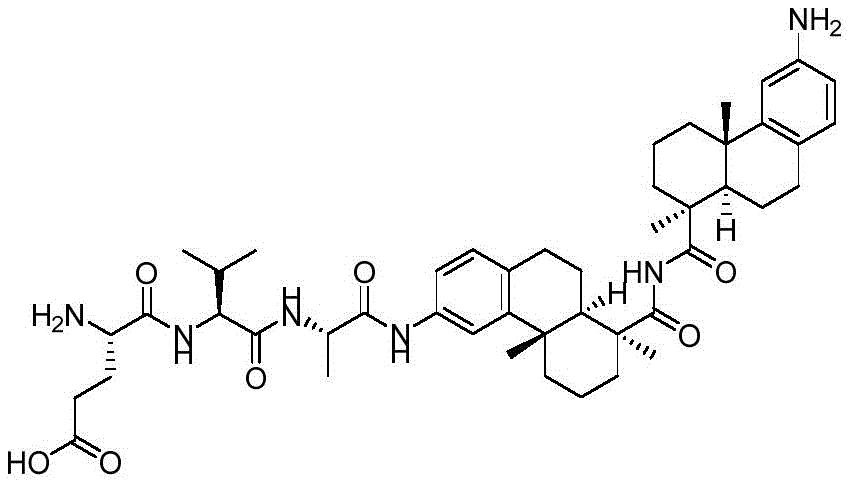
A solution of compound 127a (6.4mg, 21. mu. mol) and HATU (8.0mg, 21. mu. mol) in DMF (2.0mL) was stirred at RT for 15min, then compound 102a (14mg, 17.5. mu. mol) and DIPEA (6.8mg, 52.5. mu. mol) were added. The reaction mixture was stirred at room temperature for 1 hour, monitored by LCMS. The mixture was directly purified by reverse phase flash chromatography (0-100% acetonitrile in water) to afford protected 128a (12mg) as a white solid, which was dissolved in DCM (4 mL). To the stirred solution was added TFA (0.5mL) and the mixture was stirred at RT for 1 hour, monitored by LCMS. The resulting mixture was directly purified by reverse phase flash chromatography (0-100% acetonitrile in aqueous ammonium bicarbonate (10mM)) to afford compound 128a (7.1mg, 49% yield) as a white solid. ESI M/z:827.5(M +1) +.
(4R) -4-amino-4- { [ (1S) -1- { [ (1S) -1- { [ (4bS,8S,8aR) -8- ({ [ (1S,4aS,10aR) -6-amino-1, 4 a-dimethyl-1, 2,3,4,4a,9,10,10 a-octahydrophenanthren-1-yl ] carboxamido } carbonyl) -4b, 8-dimethyl-4 b,5,6,7,8,8a,9, 10-octahydrophenanthren-3-yl ] carbamoyl } ethyl ] carbamoyl } -2-methylpropyl ] carbamoyl } butanoic acid (128b)

(4S) -4- [1- (4- { 2-Azotricyclo [10.4.0.0 ]4,9]Hexadec-1 (12),4(9),5,7,13, 15-hexaen-10-yn-2-yl } -4-oxobutanamido) -3,6,9, 12-tetraoxapentadecane-15-carboxamide]-4- { [ (1S) -1- { [ (1S) -1- { [ (4bS,8S,8aR) -8- ({ [ (1S,4aS,10aR) -6-amino-1, 4 a-dimethyl-1, 2,3,4,4a,9,10,10 a-octahydrophenanthren-1-yl]Carboxamido } carbonyl) -4b, 8-dimethyl-4 b,5,6,7,8,8a,9, 10-octahydrophenanthren-3-yl]Carbamoyl } ethyl group]Carbamoyl } -2-methylpropyl radical]Carbamoyl } butanoic acid (LP13)

To a mixture of compound 128a (7.1mg, 8.6 μmol) in DMF (2.0mL) was added compound 107(5.6mg, 8.6 μmol) and DIPEA (3.3mg, 26 μmol), and the reaction mixture was stirred at room temperature for 1 hour and monitored by LCMS. The resulting mixture was directly purified by reverse phase flash chromatography (0-100% acetonitrile in aqueous ammonium bicarbonate (10mM)) to afford linker-payload LP13(5.5mg, 47% yield) as a white solid. ESI M/z 681.6(M/2+1) +。1H NMR(400MHz,DMSOd6)δ9.75(dd,J=12,0.6Hz,1H),8.31(dd,J=12,3.5Hz,1H),8.19(dd,J=7.5,2.1Hz,1H),8.16-8.08(m,2H),7.82-7.70(m,2H),7.68(dd,J=7.5,1.1Hz,1H),7.64-7.59(m,1H),7.56-7.44(m,4H),7.41-7.27(m,4H),6.96(dd,J=8.8,3.2Hz,1H),6.68(d,J=8.2Hz,1H),6.47(d,J=1.8Hz,1H),6.33(dd,J=8.1,2.1Hz,1H),5.02(d,J=14.0Hz,1H),4.43-4.26(m,3H),4.22-4.08(m,2H),3.62-3.55(m,3H),3.51-3.42(m,12H),3.30-3.20(m,2H),3.12-2.84(m,3H),2.80-2.55(m,4H),2.47-2.10(m,12H),2.04-1.52(m,13H),1.37-1.23(m,10H),1.17-1.08(m,2H),0.99(d,J=7.7Hz,6H),0.88-0.78(m,6H)ppm。
(4R) -4- [1- (4- { 2-Azotricyclo [10.4.0.0 ]4,9]Hexadec-1 (12),4(9),5,7,13, 15-hexaen-10-yn-2-yl } -4-oxobutanamido) -3,6,9, 12-tetraoxapentadecane-15-carboxamide]-4- { [ (1S) -1- { [ (1S) -1- { [ (4bS,8S,8aR) -8- ({ [ (1S,4aS,10aR) -6-amino-1, 4 a-dimethyl-1, 2,3,4,4a,9,10,10 a-octahydrophenanthren-1-yl]Carboxamido } carbonyl) -4b, 8-dimethyl-4 b,5,6,7,8,8a,9, 10-octahydrophenanthren-3-yl]Carbamoyl } ethyl group]Carbamoyl } -2-methylpropyl radical]Carbamoyl } butanoic acid (LP14)

Following a similar procedure to LP13, except substituting 128b for 128a, the linker-payload LP14(10mg, 76% yield) was obtained as a white solid. ESI M/z 681.5(M/2+1)+。1H NMR(400MHz,DMSOd6)δ9.79(br,1H),9.35(s,1H),8.28-8.23(m,1H),8.21(d,J=6.6Hz,1H),8.17-8.13(m,1H),8.12-8.03(m,2H),8.02-7.95(m,1H),7.76(t,J=5.8Hz,1H),7.67(dd,J=7.3,1.1Hz,1H),7.64-7.60(m,1H),7.51(dd,J=5.0,1.9Hz,1H),7.49-7.42(m,3H),7.40-7.31(m,3H),7.29(dd,J=7.4,1.5Hz,1H),6.95(dd,J=8.2,4.7Hz,1H),6.68(d,J=8.2Hz,1H),6.48(d,J=2.1Hz,1H),6.33(dd,J=7.9,2.1Hz,1H),5.02(d,J=14.0Hz,1H),4.40-4.30(m,2H),4.20-4.12(m,1H),3.62-3.49(m,4H),3.45-3.33(m,12H),3.33-3.28(m,2H),3.12-3.05(m,2H),2.92-2.85(m,1H),2.81-2.73(m,2H),2.69-2.63(m,1H),2.61-2.54(m,1H),2.43-2.20(m,7H),2.20-1.95(m,6H),1.91-1.70(m,6H),1.68-1.50(m,5H),1.34-1.22(m,10H),1.18-1.08(m,2H),1.03-0.96(m,6H),0.90(d,J=6.8Hz,2H),0.86-0.80(m,4H)ppm。
Example 12A
Linker-payload LP15
This example illustrates the synthesis of linker-payload LP15 in table 2 above. This example relates to compounds numbered 129, 130, 131, 132, 133, Ser-P1 in fig. 9B, and linker-payload LP 15. Compound 129 was synthesized according to WO2015/095124a 1.
1-N- (2- {2- [2- (2-azidoethoxy) ethoxy ] ethoxy } ethyl) -1-N' - [ (1S) -4- (carbamoylamino) -1- { [4- (hydroxymethyl) phenyl ] carbamoyl } butyl ] cyclobutane-1, 1-dicarboxamide (130)
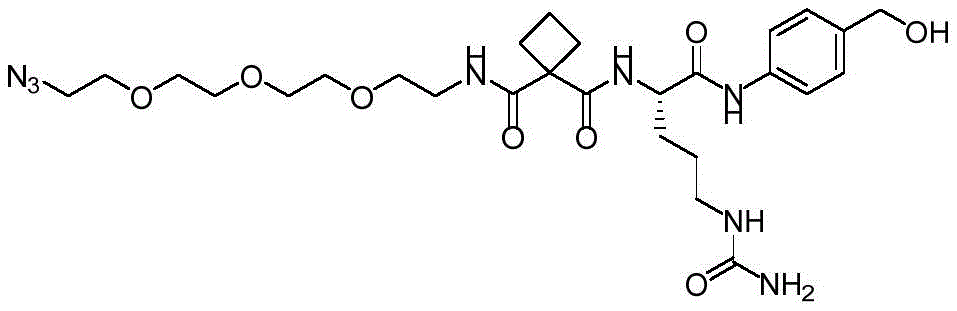
To a solution of compound 129(0.18g, 0.44mmol) in dry DMF (6mL) was added amino-PEG 3-azide (0.10g, 0.46mmol) and EDCI (0.13g, 0.65mmol) and the mixture was stirred at RT for 20 h. The resulting mixture was directly purified by reverse phase flash chromatography (0-100% acetonitrile in water) to afford compound 130(0.19g, 70% yield) as an off-white solid. ESI M/z 607.3(M +1)+。
1-N- (2- {2- [2- (2-aminoethoxy) ethoxy ] ethoxy } ethyl) -1-N' - [ (1S) -4- (carbamoylamino) -1- { [4- (hydroxymethyl) phenyl ] carbamoyl } butyl ] cyclobutane-1, 1-dicarboxamide (131)

To a solution of compound 130(0.18g, 0.30mmol) in methanol (10mL) under nitrogen was added 10% Pd/C (20 mg). The mixture was degassed and degassed 3 times with hydrogen, then stirred at room temperature under hydrogen for 20 hours. The resulting mixture was filtered through celite and the filtrate was concentrated in vacuo to afford crude compound 131(0.16g, 92% yield) as a white solid. ESI M/z:581.4(M +1)+。
(2S) -2- [ (1- { [2- (2- {2- [2- (4- { 2-azatricyclo [10.4.0.0 ]4,9]Hexadec-1 (12),4(9),5,7,13, 15-hexaen-10-yn-2-yl } -4-oxobutanamido) ethoxy]Ethoxy } ethoxy) ethyl]Carbamoyl } cyclobutyl) carboxamido radical ]-5- (carbamoylamino) -N- [4- (hydroxymethyl) phenyl]Pentamide (133)

To crude compound 131(0.16g, 0.28mmol)DIBAC-suc-OSu 132(0.12g, 0.30mmol) and DIPEA (0.2mL, 0.83mmol) were added to a solution of DMF (4mL) and the reaction mixture was stirred at room temperature for 2 hours, monitored by LCMS. The resulting mixture was directly purified by reverse phase flash chromatography (0-100% acetonitrile in aqueous ammonium bicarbonate (10mM)) to afford compound 133(50mg, 21% yield) as a yellow solid. ESI M/z:434.8(M/2+1)+。
{4- [ (2S) -2- [ (1- { [2- (2- {2- [2- (4- { 2-Azotricyclo [10.4.0.0 ]4,9]Hexadec-1 (12),4(9),5,7,13, 15-hexaen-10-yn-2-yl } -4-oxobutanamido) ethoxy]Ethoxy } ethoxy) ethyl]Carbamoyl } cyclobutyl) carboxamido radical]-5- (carbamoylamino) pentanamide]Phenyl } methyl N- [ (1S) -1- { [ (4bS,8S,8aR) -8- ({ [ (1S,4aS,10aR) -6-hydroxy-1, 4 a-dimethyl-1, 2,3,4,4a,9,10,10 a-octahydrophenanthren-1-yl]Carboxamido } carbonyl) -4b, 8-dimethyl-4 b,5,6,7,8,8a,9, 10-octahydrophenanthren-3-yl]Carbamoyl } -2-hydroxyethyl]Carbamate (LP15)

To a solution of compound 133(50mg, 58. mu. mol) in anhydrous DMF (3mL) was added bis (4-nitrophenyl) carbonate (PNPC) (35mg, 0.12mmol) followed by DIPEA (45. mu.L, 0.17mmol) and the reaction mixture was stirred at room temperature overnight. The mixture was purified by reverse phase flash chromatography (0-100% acetonitrile in water). The solution was lyophilized to give a yellow solid, of which 16mg (16. mu. mol) was dissolved in DMF (5 mL). To the resulting solution was added Px2(Ser-P1, reported in WO2018/213082A1, incorporated herein by reference) (10mg, 16. mu. mol) and DIPEA (10. mu.L, 64. mu. mol). The resulting mixture was stirred at room temperature overnight, monitored by LCMS. The mixture was directly purified by preparative HPLC (method B) to give linker-payload LP15(4.0mg, 16% yield from Px 2) as an orange solid. ESI M/z 755.5(M/2+1) +。1H NMR(400MHz,DMSOd6)δδ10.0(s,1H),9.84(s,1H),8.11(s,1H),7.89-7.84(m,2H),7.78-7.75(tm,1H),7.68-7.65(m,1H),7.62-7.60(m,3H),7.54(s,1H),7.50-7.44(m,3H),7.39-7.22(m,10H),6.96(d,J=8.4Hz,1H),6.81(d,J=8.4Hz,1H),6.67(br s,1H),6.63(d,J=2.0Hz,1H),6.50(dd,J=2.0Hz,8.0Hz,1H),6.04-6.02(m,1H),5.43(s,2H),5.32(t,J=4.8Hz,2H),5.04-4.95(m,3H),4.44-4.37(m,1H),4.20-4.15(m,1H),3.71-3.62(m,2H),3.53-3.48(m,12H),3.34-3.25(m,2H),2.47-2.37(m,3H),2.16-2.13(m,4H),2.03-1.95(m,8H),1.79-1.71(m,4H),1.66-1.54(m,6H),1.49-1.42(m,4H),1.27-1.26(m,8H),1.00(s,3H),0.98(s,3H),0.87-0.83(m,6H)ppm。
Example 12B
A payload P18; and linker-payloads LP17 and LP18
This example illustrates the synthesis of payload P18 from table 1 above, and linker-payloads LP17 and LP18 from table 2 above. This example relates to compounds numbered 134, P1, P18, 112, 135 in fig. 9C, and linker-payloads LP17 and LP 18. Compound 134 was synthesized according to WO 2015/155998 a 1.
(1S,4aS,10aR) -N- [ (1S,4aS,10aR) -6- {2- [ (2-Aminoacetamido) methoxy ] acetamido } -1,4 a-dimethyl-1, 2,3,4,4a,9,10,10 a-octahydrophenanthrene-1-carbonyl ] -6-hydroxy-1, 4 a-dimethyl-1, 2,3,4,4a,9,10,10 a-octahydrophenanthrene-1-carboxamide (P18)

To a solution of compound 134(42mg, 0.11mmol) in DMF (5mL) were added HATU (79mg, 0.21mmol) and DIPEA (54mg, 0.44mmol), and the mixture was stirred at room temperature for 15 minutes, followed by the addition of payload P1(63mg, 0.12 mmol). The reaction mixture was stirred at room temperature for 2 hours, monitored by LCMS. The resulting mixture was directly purified by preparative HPLC (method B) to give Fmoc-P18(47mg, ESI M/z:895.4(M +1)+) This was dissolved in DMF (5 mL). Piperidine (13mg, 0.15mmol) was added to the resulting solution and the mixture was stirred at room temperature for 1 hour until Fmoc was completely removed, monitored by LCMS. The resulting mixture was directly purified by preparative HPLC (method B) to give compound P18(34mg, 47% yield) as a white solid. ESI M/z 673.5(M +1) +。1H NMR(400MHz,DMSOd6)δ9.54(s,1H),8.99(s,1H),8.85(br s,1H),8.11(s,1H),7.59(d,J=1.5Hz,1H),7.45(dd,J=8.4,1.5Hz,1H),6.97(d,J=8.4Hz,1H),6.82(d,J=8.4Hz,1H),6.63(d,J=2.2Hz,1H),6.50(dd,J=8.4,2.2Hz,1H),4.66(d,J=1.6Hz,2H),4.00(s,2H),3.14(s,2H),2.94-2.64(m,4H),2.35-2.32(m,1H),2.32-2.22(m,2H),2.22-2.09(m,4H),1.95-1.78(m,4H),1.68-1.52(m,4H),1.36-1.28(m,2H),1.28(s,3H),1.27(s,3H),1.20-1.09(m,2H),1.01(s,3H),0.99(s,3H)ppm。
{4- [ (2S) -2- [ (2S) -2- [1- (4- { 2-Azotricyclo [10.4.0.0 ]4,9]Hexadec-1 (12),4(9),5,7,13, 15-hexaen-10-yn-2-yl } -4-oxobutanamido) -3,6,9, 12-tetraoxapentadecane-15-carboxamide]-3-methylbutanamido group]-5- (carbamoylamino) pentanamide]Phenyl } methyl N- ({ [ ({ [ (4bS,8S,8aR) -8- { [ (1S,4aS,10aR) -6-hydroxy-1, 4 a-dimethyl-1, 2,3,4,4a,9,10,10 a-octahydrophenanthrene-1-carbonyl]Carbamoyl } -4b, 8-dimethyl-4 b,5,6,7,8,8a,9, 10-octahydrophenanthren-3-yl]Carbamoyl } methoxy) methyl]Carbamoyl } methyl) carbamate (LP17)

To a solution of compound P18(16mg, 24. mu. mol) in DMF (5mL) at 25 ℃ was added compound 112(26mg, 24. mu. mol) and DIPEA (6.2mg, 0.048 mmol). The mixture was stirred at 25 ℃ overnight, monitored by LCMS. The resulting mixture was directly purified by preparative HPLC (method B) to give linker-payload LP17(20mg, 53% yield) as a white solid. ESI M/z:807(M/2+1)+。1H NMR(400MHz,DMSOd6)δ10.00(s,1H),9.53(s,1H),8.99(s,1H),8.92-8.83(m,1H),8.19-8.07(m,2H),7.88(d,J=8.1Hz,1H),7.77(t,J=5.6Hz,1H),7.68(d,J=6.0Hz,1H),7.64-7.56(m,4H),7.53-7.25(m,9H),6.96(d,J=8.5Hz,1H),6.81(d,J=8.3Hz,1H),6.63(s,1H),6.50(d,J=7.9Hz,1H),6.02-5.94(m,1H),5.42(s,2H),5.02(d,J=14Hz,1H),4.95(s,2H),4.65(d,J=6.5Hz,2H),4.43-4.32(m,1H),4.26-4.19(m,1H),4.00(s,2H),3.70-3.54(m,5H),3.50-3.41(m,12H),3.31-3.26(m,1H),3.13-2.54(m,8H),2.41-2.08(m,11H),2.06-1.52(m,14H),1.47-1.08(m,12H),1.00(s,3H),0.98(s,3H),0.86(d,J=6.8Hz,3H),0.82(d,J=6.8Hz,3H)ppm。
(2S) -2- {2- [2- (4- { 2-Azotricyclo [10.4.0.0 ]4,9]Hexadeca-1 (12),4(9),5,7,13, 15-hexaen-10-yn-2-yl } -4-oxobutanoylamino) acetamido]Acetamido } -3-phenylpropionic acid (135)

To a solution of the peptide Gly-Gly-Phe (65mg, 0.16mmol) in DMF (5mL) was added compound 132(56mg, 0.16mmol) and DIPEA (63mg, 0.49mmol), and the reaction mixture was stirred at room temperature for 2 h, monitored by LCMS. The mixture was directly purified by preparative HPLC (method B) to give compound 135(58mg, 64% yield) as a white solid. ESI M/z 567(M +1) +。
(1S,4aS,10aR) -N- [ (1S,4aS,10aR) -6- [2- ({2- [ (2S) -2- {2- [2- (4- { 2-azatricyclo [10.4.0.0 ]4,9]Hexadeca-1 (12),4(9),5,7,13, 15-hexaen-10-yn-2-yl } -4-oxobutanoylamino) acetamido]Acetylamino } -3-phenylpropionamido]Acetamido } methoxy) acetamido]1,4 a-dimethyl-1, 2,3,4,4a,9,10,10 a-octahydrophenanthrene-1-carbonyl]-6-hydroxy-1, 4 a-dimethyl-1, 2,3,4,4a,9,10,10 a-octahydrophenanthrene-1-carboxamide (LP18)

To a solution of compound 135(8.5mg, 15. mu. mol) in DMF (5mL) was added HATU (11mg, 30. mu. mol) and DIPEA (7.7mg, 60. mu. mol), the mixture was stirred at room temperature for 15 minutes, then compound P18(10mg, 15. mu. mol) was added. The reaction mixture was stirred at room temperature for 2 hours, monitored by LCMS. The resulting mixture was directly purified by preparative HPLC (method B) to give linker-payload LP18(8.4mg, 46% yield) as a white solid. ESI M/z 635 (M-M)P17)+。1H NMR(400MHz,DMSOd6)δ9.53(s,1H),8.99(s,1H),8.70(d,J=5.2Hz,1H),8.36(d,J=5.0Hz,1H),8.20-7.96(m,4H),7.69-7.62(m,1H),7.61-7.56(m,2H),7.51-7.39(m,4H),7.38-7.32(m,2H),7.31-7.20(m,5H),7.19-7.13(m,1H),6.95(d, J ═ 8.7Hz,1H),6.82(d, J ═ 8.2Hz,1H),6.63(d, J ═ 2.2Hz,1H),6.50(dd, J ═ 8.2 and 2.2Hz,1H),4.99(dd, J ═ 13.9 and 1.9Hz,1H),4.64(d, J ═ 6Hz,2H),4.51-4.43(m,1H),4.00(s,2H),3.80-3.66(m,3H),3.62-3.56(m,3H),3.08-2.99(m,1H),2.91-2.59(m,7H),2.34-2.23(m,3H), 2.62-3.56 (m,3H),3.08-2.99(m,1H),2.91-2.59(m,7H),2.34-2.23(m,3H), 2.5H), 1.5 (m,1H), 1H, 1.5-1H, 1H, 5 (m-5H), 2H) 0.99(s,3H),0.98(s,3H) ppm.
Example 12C
Linker-payload LP19
This example illustrates the synthesis of linker-payload LP19 in table 2 above. This example relates to the compounds numbered 136-138, 140, P15, 141-143, 106, 116 in FIG. 9D, and the linker-payload LP 19.
2-hydroxyethyl (methyl) carbamic acid tert-butyl ester (137)

To a mixture of compound 136(3.8g, 50mmol) in DCM (90mL) was added Boc dropwise at 0 deg.C2O (11g, 52mmol) in DCM (10 mL). The mixture was stirred at room temperature overnight. The mixture was washed twice with brine and the organic solution was concentrated in vacuo to give compound 137(8.5g, 97% yield) as a colorless oil. ESI M/z:198(M + Na)+。
Methyl (2-oxoethyl) carbamic acid tert-butyl ester (138)

To a solution of compound 137(4.4g, 25mmol) in dry DCM (50mL) was added Dess-Martin (Dess-Martin) peroxide (12g, 25mmol) in portions at 0 deg.C. The reaction mixture was stirred at room temperature overnight and then quenched with saturated aqueous sodium bicarbonate and saturated aqueous sodium thiosulfate. The quenched mixture was stirred at room temperature for 0.5 h. Collecting organic solution, washing with saturated sodium bicarbonate water solution, drying with magnesium sulfate,concentration in vacuo afforded crude 138, which was purified by flash chromatography (12-18% acetate in petroleum ether, checked by TLC using PMA) to afford compound 138(2.6g, 60% yield) as a light yellow oil. 1H NMR(400MHz,DMSOd6)δ9.48(d,J=8.4Hz,1H),4.03(br,2H),2.85(s,3H),1.41(s,9H)ppm。
2- (2- (2-Hydroxyethyloxy) ethylamino) ethyl (methyl) carbamic acid tert-butyl ester (140)

A mixture of compound 138(2.6g, 15mmol) and compound 139(1.7g, 16mmol) in dry methanol (20mL) was stirred at room temperature for 4 hours, then sodium borohydride (1.1g, 30mmol) was added to the mixture in portions at 0 ℃. The mixture was slowly warmed to room temperature and stirred at room temperature overnight. The mixture was quenched with cold water and concentrated in vacuo. The residue was purified by flash chromatography (0-100% methanol in DCM) to give compound 140(2.4g, 61% yield) as a yellow oil. ESI M/z 263.1(M + H)+。1H NMR(400MHz,DMSOd6)δ3.50-3.43(m,4H),3.41-3.38(m,2H),3.21(t,J=6.4Hz,2H),2.78(s,3H),2.69-2.63(m,4H),2.08(s,1H),1.39(s,9H)ppm。
Tert-butyl N- [ (4bS,8S,8aR) -8- ({ [ (1S,4aS,10aR) -6- { [ (2- { [ (tert-butoxy) carbonyl ] (methyl) amino } ethyl) [2- (2-hydroxyethoxy) ethyl ] carbamoyl ] oxy } -1,4 a-dimethyl-1, 2,3,4,4a,9,10,10 a-octahydrophenanthren-1-yl ] carboxamido } carbonyl) -4b, 8-dimethyl-4 b,5,6,7,8,8a,9, 10-octahydrophenanthren-3-yl ] carbamate (141)

To a solution of payload P15(0.44g, 0.70mmol) in dry DCM (15mL) was added a solution of triethylamine (0.21g, 2.1mmol) and 4-nitrophenyl chloroformate (0.15g, 0.74mmol) in dry DCM (5 mL). The reaction mixture was stirred at room temperature for 1.5 hours, monitored by LCMS. The mixture was concentrated in vacuo to give crude PNP ester (0.58g) dissolved in DCM (15 mL). To the resulting solution was added HOBt (19mg, 0.14mmol) and compound 140(0.32g, 1.2mmol) in DCM (5 mL). The reaction mixture was stirred at room temperature for 18 hours until completion according to LCMS. The reaction mixture was diluted with DCM, washed with water and brine, dried over sodium sulfate and concentrated in vacuo. The residue was purified by reverse phase flash chromatography (0-100% acetonitrile in TFA (0.01%)) to afford compound 141(0.50g, 78% yield) as a white solid. ESI M/z 940.5(M + Na)+。
(4bS,8S,8aR) -8- ((1S,4aS,10aR) -6-amino-1, 4 a-dimethyl-1, 2,3,4,4a,9,10,10 a-octahydrophenanthrene-1-carbonylcarbamoyl) -4b, 8-dimethyl-4 b,5,6,7,8,8a,9, 10-octahydrophenanthren-3-yl 2- (2-hydroxyethoxy) ethyl (2- (methylamino) ethyl) carbamate (142)
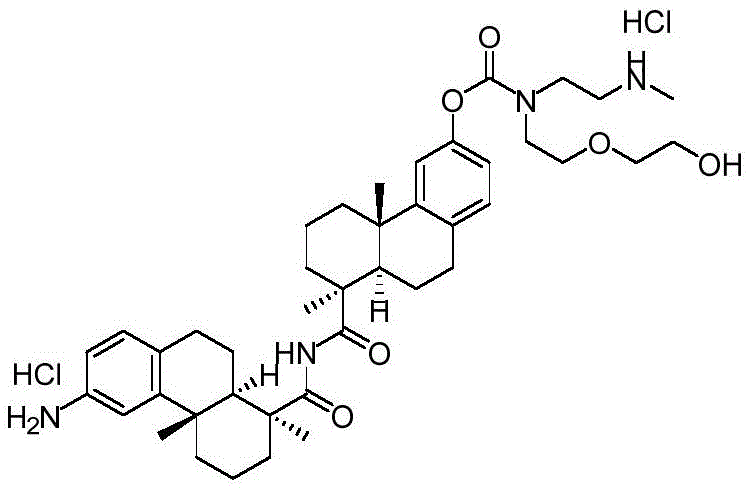
To a solution of compound 141(0.30g, 0.33mmol) in acetonitrile (5mL) was added a solution of HCl in dioxane (4N, 3 mL). The reaction mixture was stirred at room temperature for 3 hours until complete stripping of Boc as monitored by LCMS. Volatiles were removed and the residue was purified by reverse phase flash chromatography (0-100% acetonitrile in water) to give compound 142 as the HCl salt (0.19g, 73% yield) as a white solid, which was unstable even in alkaline buffer (pH) >7) The following steps. ESI M/z 717.2(M + H)+。
(4bS,8S,8aR) -8- (((1S,4aS,10aR) -6-amino-1, 4 a-dimethyl-1, 2,3,4,4a,9,10,10 a-octahydrophenanthrene-1-carbonyl) carbamoyl) -4b, 8-dimethyl-4 b,5,6,7,8,8a,9, 10-octahydrophenanthren-3-yl (2- ((((4- ((S) -2- ((S) -2-amino-3-methylbutanamido) -5-allophanate) benzyl) oxy) carbonyl) (methyl) amino) ethyl) (2- (2-hydroxyethoxy) ethyl) carbamate (143)

To freshly synthesized compound 142(35mg, 49. mu. mol) in dry DMF was mixed at room temperatureTo this was added triethylamine (15mg, 0.15mmol), HOBt (7.0mg, 49. mu. mol) and Fmoc-vcPAB-PNP (116, 35mg, 45. mu. mol) in dry DMF (5mL) in that order. The mixture was stirred at room temperature overnight. Piperidine (13mg, 0.15mmol) was added to the reaction mixture. The mixture was stirred at room temperature for 3 hours until Fmoc removal was complete as monitored by LCMS. The reaction mixture was directly purified by reverse phase flash chromatography (5-95% acetonitrile in aqueous ammonium bicarbonate (10mM)) to give compound 143(62mg, 58% yield) as a white solid. ESI M/z 1145.6(M + Na)+。
(4bS,8S,8aR) -8- { [ (1S,4aS,10aR) -6-amino-1, 4 a-dimethyl-1, 2,3,4,4a,9,10,10 a-octahydrophenanthrene-1-carbonyl]Carbamoyl } -4b, 8-dimethyl-4 b,5,6,7,8,8a,9, 10-octahydrophenanthren-3-yl N- (2- { [ ({4- [ (2S) -2- [ (2S) -2- [1- (4- { 2-azatricyclo [10.4.0.0 ] 4,9]Hexadec-1 (12),4(9),5,7,13, 15-hexaen-10-yn-2-yl } -4-oxobutanamido) -3,6,9, 12-tetraoxapentadecane-15-carboxamide]-3-methylbutanamido group]-5- (carbamoylamino) pentanamide]Phenyl } methoxy) carbonyl](methyl) amino } ethyl) -N- [2- (2-hydroxyethoxy) ethyl]Carbamate (LP19)

To a solution of compound 143(30mg, 27. mu. mol) in dry DMF (5mL) at room temperature was added DIBAC-suc-PEG in sequence4OSu (107, 21mg, 30. mu. mol) and DIPEA (10mg, 78. mu. mol). The reaction mixture was stirred at room temperature overnight. The reaction mixture was directly purified by preparative HPLC (method B) to give compound LP19(15mg, 34% yield) as a white solid. ESI M/z 829.0(M/2+ H)+。1H NMR(400MHz,DMSOd6)δ10.00(br,1H),8.13-8.10(m,2H),7.88-7.86(m,1H),7.78-7.74(m,1H),7.69-7.66(m,1H),7.62-7.44(m,6H),7.39-7.28(m,4H),7.22-7.20(m,1H),6.99-6.97(m,2H),6.75-6.74(m,1H),6.69-6.66(m,1H),6.47(s,1H),6.35-6.32(m,1H),5.97-5.96(m,1H),5.41(s,2H),5.04-4.92(m,3H),4.69(s,2H),4.60-4.58(m,1H),4.39-4.35(m,1H),4.30-4.20(m,1H),3.62-2.53(m,39H),2.40-1.36(m,25H),1.27-1.25(m,8H),1.14-1.11(m,2H),0.99-0.97(m,6H),0.87-0.81(m,7H)ppm。
Analytical examples
Example 13
The structural formulae, calculated LogP values, MS and HPLC results of the above payload compounds are summarized in table 3.
TABLE 3 chemical and physical Properties of the payload


6<+++<12;4<++≤6;0<+<4
Example 14
The molecular formula, molecular weight, calculated LogP value, MS and HPLC results of the linker-payload compounds described above are summarized in table 4.
TABLE 4 chemical and physical Properties of the payload

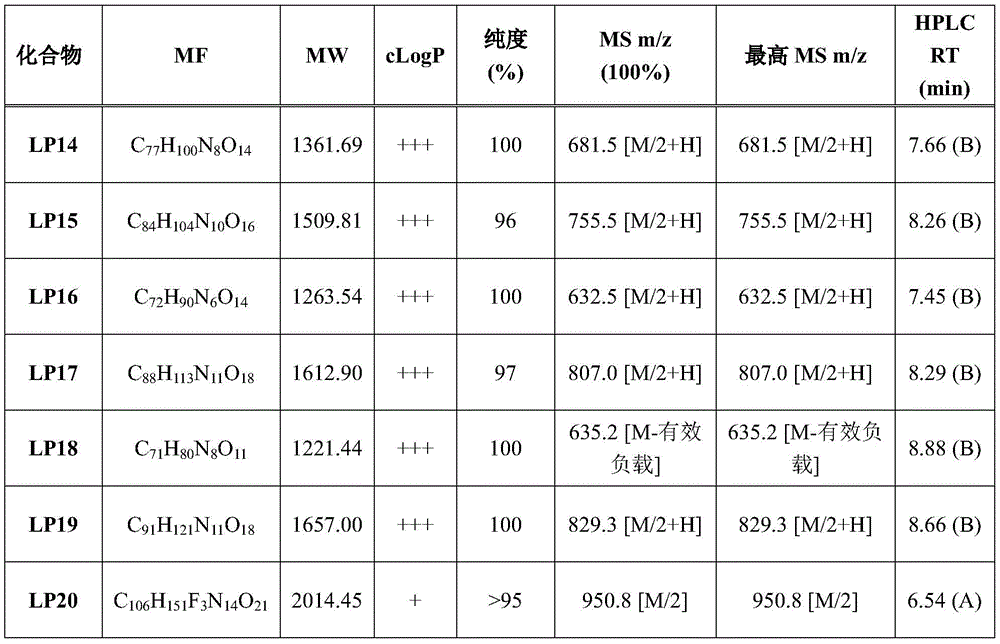
6<+++<12;4<++<6;-2<+≤4
Example 15
The activity of certain LXR agonist payloads described herein is evaluated in a cell-based LXR-responsive luciferase reporter assay. To generate assay test cell lines, an LXR-regulated luciferase Reporter (Cignal Lenti LXR Reporter (luc) kit (Qiagen, Cat. No. CLS-001L)) was transduced into THP1 cells and cultured in puromycin Cells were selected for two weeks. Lentiviruses express the firefly luciferase gene under the control of the minimal CMV promoter and tandem repeat sequences of the LXR transcription response elements. The resulting cell line was designated THP1/LXR-Luc cells. For the assay, THP1/LXR-Luc cells were seeded at a concentration of 40,000 cells/well in medium containing RPMI supplemented with 10% FBS and penicillin/streptomycin on 96-well plates and then differentiated for 3 days with 200nM Phorbol Myristate Acetate (PMA). The medium was subsequently removed and replaced with 80uL of fresh medium without PMA. Three-fold serial dilutions of the free payload were made in 100% DMSO, transferred to fresh medium, and then 20uL was added to the cells at a final DMSO constant concentration of 0.2%, with the final concentration of the free payload ranging from 100nM to 0.015 nM. The last well in the plate was used as a blank, containing only medium and 0.2% DMSO (untreated wells), and was plotted as a 3-fold dilution in series. After 48 hours, One-Glo was added to each wellTMLuciferase activity was measured after the reagent (Promega, cat. No. E6130). Relative Light Units (RLU) were determined on a Victor photometer (PerkinElmer) and EC was determined on a 10-point dose response curve (GraphPad Prism) using a four-parameter logistic equation 50The value is obtained. Table 1 shows the EC for each molecule tested50The value is obtained. The signal-to-noise ratio (S/N) was determined by the ratio of the highest RLU on the dose response curve to the RLU in untreated wells. As shown in Table 5, all tested payload compounds increased LXR-dependent luciferase activity, EC, in THP1/LXR-Luc cells50Values of 112pM to 3.51nM, S/N values of 10.4 to 13.8.
TABLE 5 LXR-reporter activity of payload compounds in differentiated THP-1/LXR-Luc cells
| Payload compound | EC50(M) | S/N |
| P1 | 1.14E-09 | 11.4 |
| P2 | 2.92E-10 | 11.3 |
| P4 | 1.25E-10 | 10.4 |
| P6 | 3.34E-09 | 10.9 |
| P5 | 1.74E-10 | 13.8 |
| P7 | 2.53E-10 | 12.5 |
| P9 | 2.34E-10 | 12.8 |
| P8 | 3.51E-09 | 10.8 |
| P10 | 2.22E-10 | 11.1 |
| P12 | 2.96E-10 | 11.4 |
| P11 | 1.12E-10 | 10.7 |
Example 16
Coupling of the antibody cysteine was carried out in two steps using methods similar to those described in mol. pharm.2015,12(6), 1863-71. In an exemplary method, dithiothreitol or TCEP is used to reduce a monoclonal antibody (mAb). After gel filtration, a DMSO solution of the appropriate linker-payload is added to the reduced antibody and the mixture is adjusted to the appropriate pH. The reaction was stirred. The resulting conjugate was purified by SEC. The dar (uv) value is determined using the measured absorbance of the ADC and the extinction coefficient of the antibody linker-payload.
Site-specific antibody coupling, for example, can be performed in two steps: (1) enzymatic attachment of azido-PEG-amines to site-specific mutated antibodies based on microbial transglutaminase, e.g. (MTGEC 2.3.2.13, Zedira, Darmstadt (Darmstadt), Germany), and (2) via [2+3 ] ]Cycloaddition, e.g., 1, 3-dipolar cycloaddition (e.g., without copper click chemistry) between the azido group moiety of the functionalized antibody and the appropriate cyclooctyne group moiety of the linker-payload attaches the appropriate linker-payload to the azido-PEG-amine functionalized antibody. See, Baskin, j.m.; prescher, j.a.; laughlin, s.t.; agrard, n.j.; chang, p.v.; miller, i.a.; lo, a.; codelil, j.a.; bertozzi, c.r.pnas 2007,104(43),16793-7. For example, at BupHTM(pH 6.5-8.0) an aglycosylated human antibody IgG (IgG1, IgG4, etc.) or human IgG1 isotype is mixed with 200 molar equivalents or more of azido-dPEG3-amines (MW 218.26 g/mol). The resulting solution was mixed with transglutaminase (25U/mL; 5 per mg of antibody)U MTG, Zedira from Darmstadt, Germany or Ajinomoto, were mixed such that the final concentration of antibody was 0.5-5 mg/mL, the solution was maintained at pH 6.5-8.0, and then incubated at 37 ℃ for 4-24 h with gentle shaking. The reaction was monitored by ESI-MS. After completion of the reaction, excess amine and MTG were removed by SEC or protein a column chromatography eluting with acidic buffer, followed by neutralization with Tris buffer (pH 8) to generate the azido-functionalized antibody. The product was analyzed by SDS-PAGE and ESI. azido-dPEG 3-amine addition to two sites of antibody-Q295 and Q297-, rendering the 4DAR aglycosylated antibody-PEG —3Azide conjugate increase 804 Da. Peptide sequence mapping of heavy chain by Trypsin digestion, in EEQConnecting bodyYQConnecting bodySTYR(EEQLinkerYQLinkerSty r) to identify and confirm the conjugation site of the 4DAR azido functionalized antibody.
In another embodiment, [2+3 ] between the antibody and the alkyne comprising the linker-payload is functionalized by the azide group]Click reactions to prepare site-specific aglycosylated antibody-drug conjugates with human IgG (IgG1, IgG4, etc.) containing the N297Q mutation (EU numbering). In particular, by combining mAb-PEG3–N3(1-3 mg/mL) in an aqueous medium (e.g., PBS containing 5% glycerol, HBS) with ≧ 6 molar equivalents of linker in a suitable organic solvent (e.g., DMSO, DMF, or DMA) (i.e., the reaction mixture contains 5-20% organic solvent, v/v) are payload incubated at 24 ℃ to 37 ℃ for 6 hours to thereby subject the azido-functionalized aglycosylated human IgG1 antibody (mAb-PEG)3–N3) Coupled to a suitable linker payload. Reaction progress was monitored by ESI-MS and mAb-PEG was absent3–N3Indicating that the coupling was complete. Excess linker payload and organic solvent were removed by elution with PBS by SEC, or acidic buffer by protein a column chromatography, followed by Tris (pH 8) neutralization. The purified conjugates were analyzed by SEC, SDS-PAGE and ESI-MS.
Antibodies and antibody-drug conjugates can be characterized by SDS-PAGE, SEC, and MS (ESI). In one of the methods, SDS-PAGE conditions included non-reduced and reduced samples (2-4 μ g) and BenchMark prestained Protein Ladder (BenchMark Pre-stabilized Protein Ladder, Invitrogen, Cat. No. 10748-010; L #1671922.), loaded (1.0 mm. times.10 wells) into Novex 4-20% Tris-glycine gels per lane and run at 180V, 300mA for 80 minutes. Analytical samples were prepared using Novex Tris-glycine SDS buffer (2 fold) (Invitrogen, Cat. LC2676) and the reducing samples were prepared using SDS sample buffer (2 fold) containing 10% 2-mercaptoethanol.
Example 16a
Cell-based LXR luciferase reporter assay
LXR agonists described herein were evaluated in cell-based LXR responsive luciferase reporter assay assays. To generate assay test cell lines, LXR-regulated luciferase Reporter (Cignal Lenti LXR Reporter (luc) kit (Qiagen, cat. No. CLS-001L)) was transduced into THP1 cells and cells were selected in puromycin for two weeks. The lentivirus expresses the firefly luciferase gene under the control of the basic promoter and the tandem repeat sequence of the LXR transcription response element. The resulting cell line was designated THP1/LXR-Luc cells. For the assay, THP1/LXR-Luc cells were seeded at a concentration of 40,000 cells/well in medium containing RPMI supplemented with 10% FBS and penicillin/streptomycin on 96-well plates and then differentiated for 3 days with 200nM Phorbol Myristate Acetate (PMA). The medium was subsequently removed and replaced with 80 μ L of fresh medium without PMA. Three-fold serial dilutions of the free payload were made in 100% DMSO, transferred to fresh growth medium, and then 20 μ Ι _ was added to the cells at a final DMSO constant concentration of 0.2%, with the final concentration of the free payload ranging from 100nM to 0.015 nM. The last well in the plate was used as a blank, containing only medium and 0.2% DMSO (untreated wells), and was plotted as a 3-fold dilution in series. After 48 hours, One-Glo was added to each well TMLuciferase activity was measured after the reagent (Promega, cat. No. E6130). Relative Light Units (RLU) were determined on an Envision photometer (Perkinelmer) and using a four parameter logisticEquation EC was determined on a 10-point dose response curve (GraphPad Prism)50The value is obtained. Table 5a shows the EC for each test molecule50The value is obtained. The signal-to-noise ratio (S/N) was determined by the ratio of the highest RLU on the dose response curve to the RLU in untreated wells. As shown in Table 5a, LXR agonists all increased LXR-dependent luciferase activity, EC, in THP1/LXR-Luc cells50Values of 78.8pM to 72.9nM, S/N values of 8.8 to 13.1.
Table 5 a: LXR reporter gene activity of LXR agonists in differentiated THP-1/LXR-Luc cells
| LXR agonist payloads | EC50(M) | S/N |
| P14 | 1.52E-10 | 10.8 |
| P18 | 2.78E-09 | 11.5 |
| P1 | 1.91E-10 | 11.9 |
| P2 | 4.50E-10 | 13.1 |
| P15 | 7.29E-08 | 8.8 |
| P13 | 7.88E-11 | 11.9 |
| P16 | 5.08E-10 | 11.5 |
| P17 | 1.03E-09 | 12.5 |
| P19 | 5.64E-10 | 11.4 |
Example 17
A plurality of linker-payloads (LPs) were derived from the payload compounds in table 1 and were coupled to anti-MSR 1 antibodies (H1H21234N-N297Q) or non-binding controls using the techniques described in the previous examples. The activity of the resulting anti-MSR 1 LXR agonist antibody-drug conjugate (ADC) was tested in the THP1/LXRLuc reporter gene assay, as described above for the payload compounds. As shown in Table 6, all tested anti-MSR 1 LXR agonist ADCs showed stimulation of THP1/LXR-Luc cells with EC 50Values of 414pM to 2.11nM, S/N values of 9.4 to 13.7. Unconjugated anti-MSR 1 had no effect on LXR-Luc activity, EC of non-binding control antibody conjugated to LP1 (control ADC-LP1)50Value of>100nM, maximum S/N value<5.0。
anti-MSR 1 antibody H1H21234N has an amino acid sequence according to SEQ ID NO: 2 and a HCVR according to SEQ ID NO: 10 LCVR. Comprising the amino acid sequences according to SEQ ID NO: 4. SEQ ID NO: 6. SEQ ID NO: 8. SEQ ID NO: 12. SEQ ID NO: 14 and SEQ ID NO: 16 HCDR1, HCDR2, HCDR3, LCDR1, LCDR2 and LCDR 3. The polypeptide sequence may consist of the polynucleotide sequence of SEQ ID NO: 1. SEQ ID NO: 3. SEQ ID NO: 5. SEQ ID NO: 7. SEQ ID NO: 9. SEQ ID NO: 11. SEQ ID NO: 13 and SEQ ID NO: and 15, coding. N297Q indicates that residue 297 is mutated from asparagine (N) to glutamine (Q). All numbering is according to the EU numbering system.
Table 6: activity of anti-MSR 1-LXR agonist conjugates in differentiated THP-1/LXR-Luc cells


Example 18
Characterization of ADC by LC-ESI-MS
The intact mass of the ADC samples was determined by LC-ESI-MS to determine the drug-payload distribution curve and calculate the average DAR. Each test sample (20-50ng, 5uL) was loaded onto an Acquity UPLC Protein BEH C4 chromatography column (10Kpsi,  1.7 μm, 75 μm × 100 mm; directory number 186003810). After 3 min of desalting, the proteins were eluted and mass spectra were obtained by a Waters Synapt G2-Si mass spectrometer. As shown in table 7, most site-specific conjugates of site-specific ADCs had 3.9 DAR.
TABLE 7 ADC Properties

Example 19
LXR agonist antibody-drug conjugates activate cholesterol efflux in differentiated THP1 macrophages
The ability of anti-MSR 1-LXR agonist ADCs to activate cholesterol efflux in the human macrophage line (THP-1; ATCC accession number TIB-202) was evaluated using fluorescent cholesterol analogs. To pairIn the assay, THP-1 cells were seeded at a concentration of 100,000 cells/well in RPMI 1640 medium (Irvine Scientific, Cat. 9160) containing 10% FBS (Gibco, Cat. No. 1043010), 10. mu.g/mL penicillin-streptomycin (Gibco, Cat. No. 15140122) in 5% CO on 96-well polylysine coated plates (Corning, Cat. No. 354640)2At 37 ℃. Cells were differentiated into macrophages by adding 100nM phorbol-12 myristate 13-acetate (Sigma, cat # P8139) to the medium (described above) and further incubated for 96 hours. The differentiated macrophages were then incubated for 24 hours in phenol red free RPMI 1640 medium (Gibco, Cat. No. 32404-014) containing 25. mu.M BODIPY-cholesterol (Avanti Polarlipids, Cat. No. 810255P), 0.2% bovine serum albumin (BSA; Sigma Cat. No. A7211), and 10. mu.g/mL penicillin-streptomycin, followed by 1x10 ncADC (H1H21234N-N297Q-29d1 and H1H21234N-N297Q-LP1), or homo-control LXR agonist ncADC (homo-N297Q-LP 1) with a free payload (P1 or P2) -7M to 5x10-17M serial dilutions were treated in RPMI 1640 medium containing 0.2% BSA but no phenol red for 24 hours. The cells were washed with RPMI 1640 medium without phenol red and incubated with 100 μ L of recipient medium containing 50 μ g/mL high density lipoprotein (Millipore, cat # 437641), 10 μ g/mL apolipoprotein a1(Millipore, cat # ALP10) in RPMI 1640 medium without phenol red for 5 hours, after which the recipient medium was collected and the cells were lysed in 100 μ L of RIPA buffer (Millipore, cat # 20-188) for 2 hours at room temperature with gentle stirring. The fluorescence of these fractions was measured at excitation 482nm and emission 515nm in a SpectraMax i3 microplate reader (plate reader, Molecular Devices). The percentage of BODIPY-cholesterol efflux was calculated using the following formula: [ fluorescence in receptor Medium/(fluorescence in receptor Medium + fluorescence in cell lysate)]×100。
As shown in Table 8 and FIG. 13, after 24 hours, free payloads P1 and P2 showed similar amounts of cholesterol efflux, EC50The values were 20pM and 14pM, respectively. H1H21234N-N297Q-29d1 ncADC showed EC50The value was 12pM, while H1H21234N-N297Q-LP1 ncADC showed EC50The value was 98 pM. Isotype control-N297Q-LP 1 ncADC showed minimal cholesterol efflux, EC 50The value was 13 nM.
Table 8: LXR agonists and LXR agonist antibody-drug conjugates activate cholesterol efflux
| Test molecules | Cholesterol efflux activating EC50(M) |
| P1 | 2.0E-11 |
| P2 | 1.4E-11 |
| H1H21234N-N297Q-29d1 | 1.2E-11 |
| H1H21234N-N297Q-LP1 | 9.8E-11 |
| Isotype control-N297Q- |
1.3E-8 |


Claims (56)
1. A compound of formula I:

or a pharmaceutically acceptable salt, solvate, or stereoisomer form thereof, wherein,
Q1and Q2Each independently is-CH2–、–C(O)–、–C(H)(OH)–、–C(OH)2–、–SO2–、–SO–、–PO(OR3)–、–PO(NR3NR4)–、–NR3-, or-N ═ N;
w is-CH2-, -N (H) -, or-O-;
R1is-N (H) R4or-N (R)5)2;
R2is-N (H) R4;
Each R4Each independently in each instance is H, an amino acid residue, an N-alkyl amino acid residue, a peptide residue, a biodegradable moiety, an alkyl group, a substituted alkyl group, an acyl group, or a substituted acyl group;
R5is alkyl, aryl, arylalkyl, heterocycloalkyl, or substituted heterocycloalkyl, wherein each heterocycloalkyl or substituted heterocycloalkyl contains 1, 2, or 3 heteroatoms selected from N and O, respectively, and when substituted contains at least one-OH and-CH2OH, or at leastA primary or secondary nitrogen;
each R6Each independently is halogen, C1-6Alkyl radical, C1-6Alkoxy, -CN, O-glucose, O-amino acid residue, or O-PEGn1Wherein each n is an integer from 0 to 14, and each n1 is an integer from 1 to 12; and
Each R3Each independently is H, alkyl, or aryl.
2. The compound of claim 1, having the structure of formula I:

or a pharmaceutically acceptable salt, solvate, or stereoisomer form thereof, wherein,
Q1and Q2Each independently is-CH2–、–C(O)–、–C(H)(OH)–、–C(OH)2–、–SO2–、–SO–、–PO(OR3)–、–PO(NR3NR4)–、–NR3-, or-N ═ N;
w is-CH2-, -N (H) -, or-O-;
R1is-N (H) R4or-N (R)5)2;
R2is-N (H) R4;
Each R4In each case independently H, an amino acid residue, an N-alkyl amino acid residue, a peptide residue, a biodegradable moiety, or an alkyl group;
R5is alkyl, aryl, arylalkyl, heterocycloalkyl, or substituted heterocycloalkyl, wherein each heterocycloalkyl or substituted heterocycloalkyl contains 1, 2, or 3 heteroatoms selected from N and O, respectively, and when substituted contains at least one-OH and-CH2OH, or at least one primary or secondary nitrogen;
each R6Each independently is halogen, C1-6Alkyl radical, C1-6Alkoxy, -CN, O-glucose, O-amino acid residue, or O-PEGn1Wherein each n is an integer from 0 to 14, and each n1 is an integer from 1 to 12; and
each R3Each independently is H, alkyl, or aryl.
3. The compound of claim 1, having the structure of formula I:

Or a pharmaceutically acceptable salt, solvate, or stereoisomer form thereof, wherein,
Q1and Q2Each independently is-CH2-, -C (O) -, -C (H) (OH) -, or-C (OH)2–;
W is-CH2-, -N (H) -, or-O-;
R1is-N (H) R4or-N (R)5)2;
R2is-N (H) R4;
Each R4In each case independently H, an amino acid residue, an N-alkyl amino acid residue, a peptide residue, a biodegradable moiety, or an alkyl group;
R5is alkyl, aryl, arylalkyl, heterocycloalkyl, or substituted heterocycloalkyl, wherein each heterocycloalkyl or substituted heterocycloalkyl contains 1, 2, or 3 heteroatoms selected from N and O, respectively, and when substituted contains at least one-OH and-CH2OH, or at least one primary or secondary nitrogen; and
each R6Each independently is halogen, C1-6Alkyl radical, C1-6Alkoxy, -CN, O-glucose, O-amino acid residue, or O-PEGn1Wherein each n is an integer from 0 to 14, and each n1 is an integer from 1 to 12.
4. The compound of claim 3, having the structure of formula II:

or a pharmaceutically acceptable salt, solvate, or stereoisomer form thereof.
5. A compound according to any one of the preceding claims, wherein Q 1is-CH2-, and Q2is-C (O) -.
6. A compound according to any one of the preceding claims, wherein Q1is-C (H), (OH) -, and Q2is-C (O) -.
7. A compound according to any one of the preceding claims, wherein Q1is-C (O) -, and Q2is-C (O) -.
8. A compound according to any one of the preceding claims, wherein Q1is-C (O) -, and Q2is-CH2–。
9. A compound according to any one of the preceding claims, wherein Q1is-C (O) -, and Q2is-C (H) (OH) -.
10. The compound according to any one of the preceding claims, wherein W is-CH2–。
11. A compound according to any one of the preceding claims, wherein W is-O-.
12. A compound according to any one of the preceding claims, wherein W is-NH-.
13. The compound of any preceding claim, having the structure of formula III:
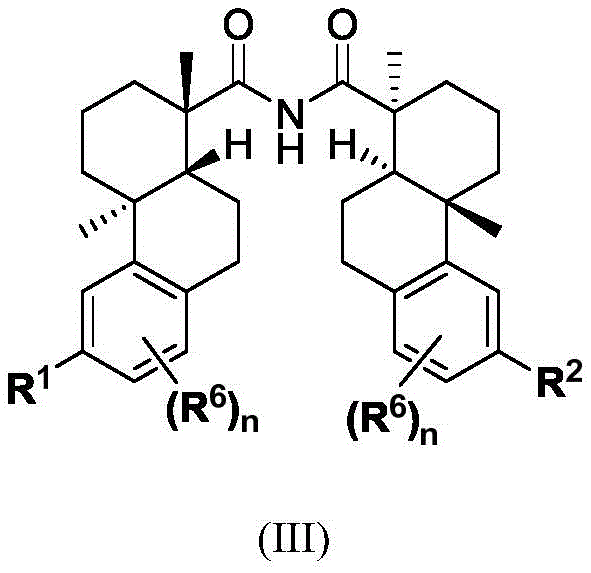
or a pharmaceutically acceptable salt, solvate, or stereoisomer form thereof.
14. The compound according to any one of claims 1-13, wherein R1is-N (H) R4。
15. The compound according to any one of claims 1-13, wherein R1is-N (R)5)2。
16. The compound of claim 14, wherein R 1is-NH2(ii) a And
each R4In each case independently an amino acid residue, an N-alkyl amino acid residue, a peptide residue, a biodegradable moiety, or an alkyl group.
17. The compound of claim 16, wherein each R4In each case independently of one another, an amino acid residue; and
the amino acid residue is selected from the group consisting of: alanine, isoleucine, leucine, methionine, phenylalanine, tryptophan, tyrosine, valine, serine, threonine, asparagine, glutamine, cysteine, selenocysteine, glycine, proline, arginine, histidine, lysine, aspartic acid, and glutamic acid.
18. The compound of claim 17, selected from the group consisting of:


A pharmaceutically acceptable salt, or solvate thereof.
19. The compound of claim 16, wherein each R4In each case independently a peptide residue, wherein the peptide residue comprises an amino acid selected from the group consisting of: alanine, isoleucine, leucine, methionine, phenylalanine, tryptophan, tyrosine, valine, serine, threonine, asparagine, glutamine, cysteine, selenocysteine, glycine, proline, arginine, histidine, lysine, aspartic acid, and glutamic acid, and residues thereof.
20. The compound of claim 19, wherein the compound is
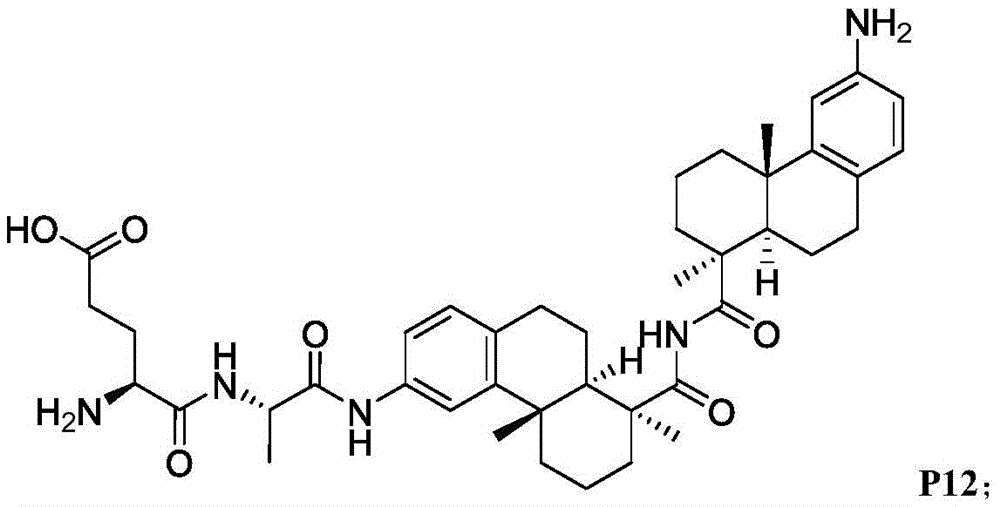
A pharmaceutically acceptable salt, or solvate thereof.
21. The compound of claim 14, wherein the compound is

A pharmaceutically acceptable salt, or solvate thereof.
22. The compound according to any one of claims 1-13, wherein R1And R2Are each-N (H) R4。
23. The compound of claim 22, wherein each R4In each case independently of one another, an amino acid residue; wherein,
the amino acid is selected from the group consisting of: alanine, isoleucine, leucine, methionine, phenylalanine, tryptophan, tyrosine, valine, serine, threonine, asparagine, glutamine, cysteine, selenocysteine, glycine, proline, arginine, histidine, lysine, aspartic acid, and glutamic acid, and residues thereof.
24. The compound of claim 23, wherein the compound is selected from the group consisting of:


25. The compound of claim 15, wherein the compound is

26. The compound of claim 22, wherein the compound is Or
Or
A pharmaceutically acceptable salt, or solvate thereof.
27. A linker-payload comprising a compound of any one of the preceding claims linked to a linker.
28. The linker-payload of any preceding claim, having a structure represented by formula LPa, LPb, LPc, or LPd:


or a pharmaceutically acceptable salt, solvate, or stereoisomer form thereof, wherein,
l is a linker;
Q1and Q2Each independently is-CH2–、–C(O)–、–C(H)(OH)–、–C(OH)2–、–SO2–、–SO–、–PO(OR3)–、–PO(NR3NR4)–、–NR3-, or-N ═ N;
w is-CH2-, -N (H) -, or-O-;
R1is-N (H) R4、–N(H)R4–、–N(H)–、–N(R5)2or-N (R)5)2–;
R2is-N (H) R4、–N(H)R4-, or-N (H) -;
each R4Each occurrence is independently H, an amino acid residue, an N-alkyl amino acid residue, a peptide residue, a biodegradable moiety, an alkyl group, a substituted alkyl group, an acyl group, a substituted acyl group, or-alkylene-;
R5is alkyl, aryl, arylalkyl, heterocycloalkyl, or substituted heterocycloalkyl, wherein each heterocycloalkyl or substituted heterocycloalkyl contains 1, 2, or 3 heteroatoms selected from N and O, respectively, and when substituted contains at least one-OH and-CH 2OH, or at least one primary or secondary nitrogen;
each R6Each independently is halogen, C1-6Alkyl radical, C1-6Alkylene radical, C1-6Alkoxy, -CN, O-glucose, O-amino acid residue, or O-PEGn1Wherein each n is an integer from 0 to 14, and each n1 is an integer from 1 to 12; and
each R3Each independently is H, alkyl, or aryl.
29. The linker-payload of claim 28, where each R is4In each case independently of each other H, an amino acid residue, an N-alkyl amino acid residue, a peptide residue, a biodegradable moiety, an alkyl group, or an-alkylene group-.
30. The linker-payload of claim 28, having a structure according to formula LPa ', LPb', LPc ', or LPd':


wherein SP1And SP2When present, are spacer groups;
each AA is an amino acid residue; and
p1 is an integer from 1 to 10.
31. The linker-payload of any one of the preceding claims, wherein the linker L or spacer group SP2Is attached to the aryl nitrogen, or to a separate amino acid residue or an amino acid residue within the peptide.
32. The linker-payload of any one of claims 27-31, selected from the group consisting of:


Or a pharmaceutically acceptable salt, or solvate thereof.
33. An antibody-drug conjugate comprising a compound or linker-payload of any preceding claim linked to an antibody or antigen-binding fragment thereof.
34. A compound of formula A, B, C, or D:
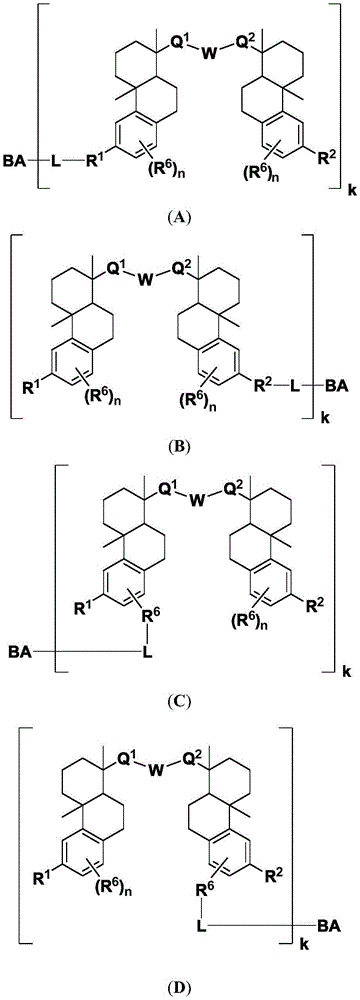
or a pharmaceutically acceptable salt, or a stereoisomer form thereof, wherein,
l is a linker;
BA is a binder;
k is an integer from 1 to 30;
Q1and Q2Each independently is-CH2–、–C(O)–、–C(H)(OH)–、–C(OH)2–、–SO2–、–SO–、–PO(OR3)–、–PO(NR3NR4)–、–NR3-, or-N ═ N;
w is-CH2-, -N (H) -, or-O-;
R1is-N (H) R4、–N(H)R4–、–N(H)–、–N(R5)2or-N (R)5)2–;
R2is-N (H) R4、–N(H)R4-, or-N (H) -;
each R4Each occurrence is independently H, an amino acid residue, an N-alkyl amino acid residue, a peptide residue, a biodegradable moiety, an alkyl group, a substituted alkyl group, an acyl group, a substituted acyl group, or-alkylene-;
R5is alkyl, aryl, arylalkyl, heterocycloalkyl, or substituted heterocycloalkyl, wherein each heterocycloalkyl or substituted heterocycloalkyl contains 1, 2, or 3 heteroatoms selected from N and O, respectively, and when substituted contains at least one-OH and-CH2OH, or at least one primary or secondary nitrogen;
each R6Each independently is halogen, C 1-6Alkyl radical, C1-6Alkylene radical, C1-6Alkoxy, -CN, O-glucose, O-amino acid residue, or O-PEGn1Wherein each n is an integer from 0 to 14, and each n1 is an integer from 1 to 12; and
each R3Each independently is H, alkyl, or aryl.
35. The compound of claim 34, wherein each R4In each case independently of one another H, an amino acid residue,An N-alkyl amino acid residue, a peptide residue, a biodegradable moiety, an alkyl group, or an-alkylene group-.
36. The compound of claim 34, having a structure of formula a ', B', C ', or D':
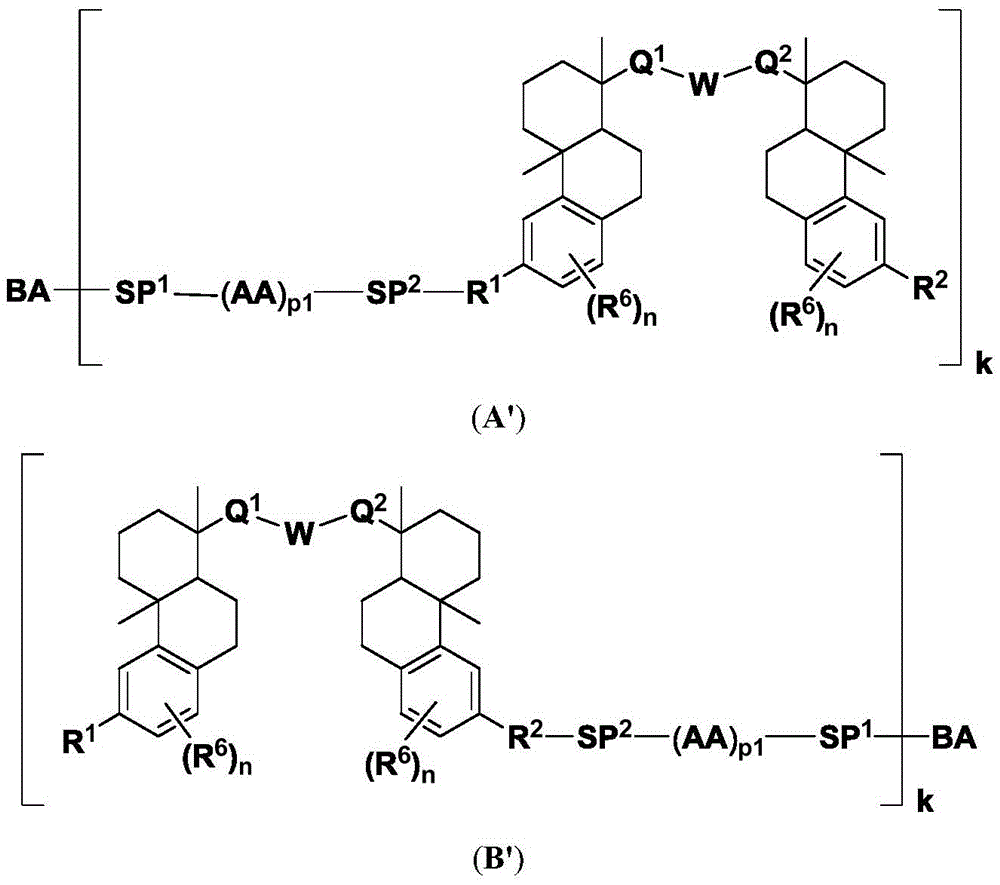

wherein SP1And SP2When present, are spacer groups;
each AA is an amino acid residue; and
p1 is an integer from 1 to 10.
37. The compound of claim 36, wherein the compound is selected from the group consisting of:

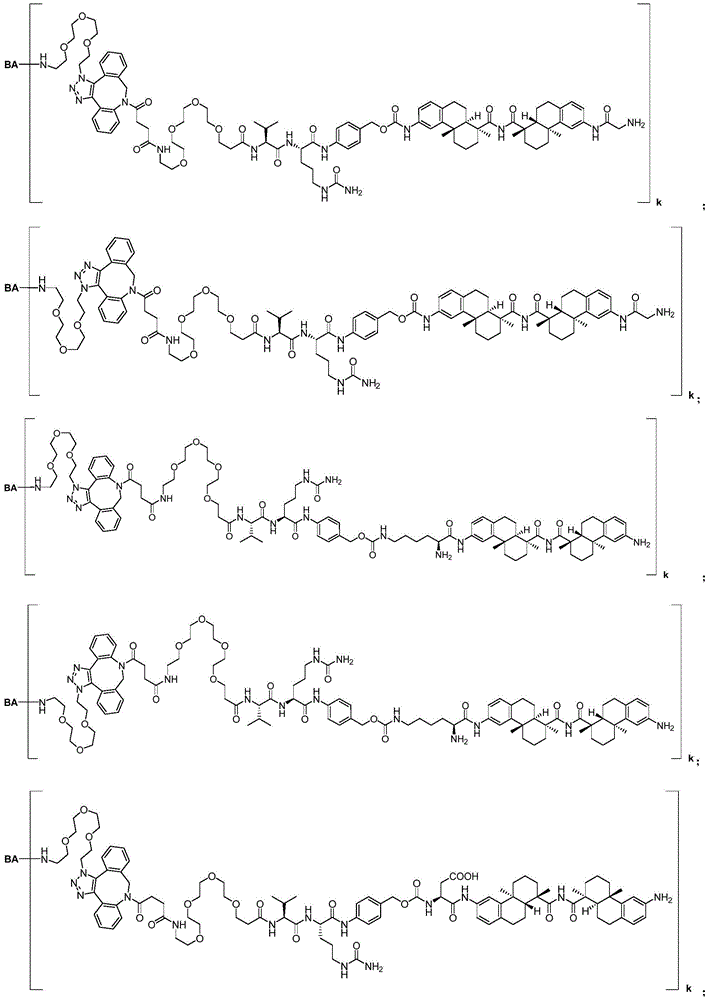


38. the compound of claim 34, having the structure of formula (a "):

or a pharmaceutically acceptable salt, or a stereoisomeric form thereof, or a regioisomer thereof, wherein,
each SP1、SP2And SP3Are each a spacer group, wherein SP3Is connected to (AA)p1AA of (1);
each AA is an amino acid residue;
p1 is an integer from 1 to 10; and
EG is an enhancer.
39. The compound of claim 38, wherein,
the SP1The spacer group is:

wherein RG' is the active group residue after the reaction of the active group RG with the binding agent;

b is an integer from 1 to 4;
the (AA)p1–SP2-is-NH-lysine-valine-alanine-, -NH-lysine-valine-citrulline-, or-NH-lysine-valine-citrulline-PABC-;
the SP3The spacer group is:

wherein RG' is the residue of the reactive group after the reaction of the reactive group RG with the enhancer EG;


40. The compound of any one of claims 38 and 39, wherein the compound is selected from the group consisting of:
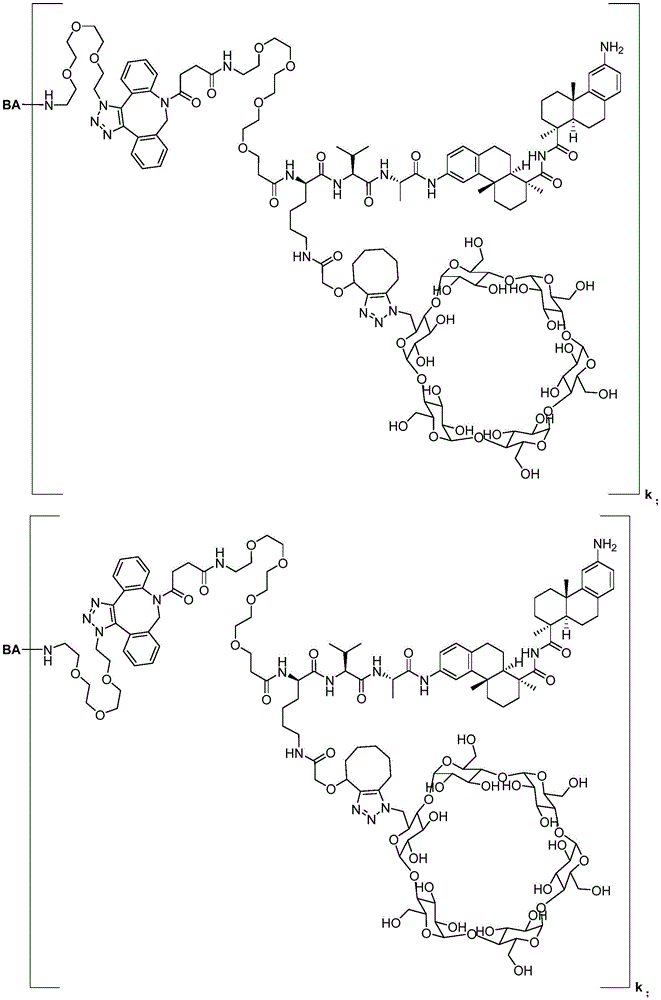


41. the compound of any one of claims 34-40, wherein BA is an antibody or antigen-binding fragment thereof.
42. The compound of any one of claims 34-41, wherein k is an integer from 1 to 4.
43. The compound of any one of claims 34-42, wherein BA is an antibody or antigen-binding fragment thereof that binds HER 2.
44. The compound of any one of claims 34-42, wherein BA is an antibody or antigen-binding fragment thereof that binds PRLR.
45. The compound of any one of claims 34-42, wherein BA is an antibody or antigen-binding fragment thereof that binds MSR 1.
46. The compound of any one of claims 34-45, wherein BA is an antibody or antigen-binding fragment thereof and is conjugated through at least one Q295 residue.
47. The compound of any one of claims 34-45, wherein BA is an antibody or antigen-binding fragment thereof and is coupled through two Q295 residues.
48. The compound of any one of claims 34-47, wherein BA is an N297Q antibody or antigen-binding fragment thereof.
49. The compound of any one of claims 34-48, wherein BA is an N297Q antibody or antigen-binding fragment thereof, and is coupled through at least one Q295 residue and at least one Q297 residue.
50. The compound of any one of claims 34-49, wherein BA is an N297Q antibody or antigen-binding fragment thereof, and is coupled through two Q295 residues and two Q297 residues.
51. A pharmaceutical composition comprising a compound, linker-payload, or antibody-drug conjugate of any preceding claim, and a pharmaceutically acceptable adjuvant, carrier, or diluent.
52. A method of treating dyslipidemia, a metabolic disease, inflammation, or a neurodegenerative disease in a subject, comprising administering to the subject a therapeutically effective amount of a compound or pharmaceutical composition of any of the preceding claims.
53. A method of treating dyslipidemia in a subject, comprising administering to the subject a therapeutically effective amount of a compound or pharmaceutical composition according to any of the preceding claims.
54. A method of treating a metabolic disease in a subject, comprising administering to the subject a therapeutically effective amount of a compound or pharmaceutical composition of any of the preceding claims.
55. A method of treating inflammation in a subject, comprising administering to the subject a therapeutically effective amount of a compound or pharmaceutical composition of any one of the preceding claims.
56. A method of treating a neurodegenerative disease in a subject comprising administering to the subject a therapeutically effective amount of a compound or pharmaceutical composition of any one of the preceding claims.
Applications Claiming Priority (3)
| Application Number | Priority Date | Filing Date | Title |
|---|---|---|---|
| US201862769946P | 2018-11-20 | 2018-11-20 | |
| US62/769946 | 2018-11-20 | ||
| PCT/US2019/062302 WO2020106780A1 (en) | 2018-11-20 | 2019-11-19 | Bis-octahydrophenanthrene carboxamide derivatives and protein conjugates thereof for use as lxr agonists |
Publications (1)
| Publication Number | Publication Date |
|---|---|
| CN113382985A true CN113382985A (en) | 2021-09-10 |
Family
ID=69005818
Family Applications (1)
| Application Number | Title | Priority Date | Filing Date |
|---|---|---|---|
| CN201980089547.4A Pending CN113382985A (en) | 2018-11-20 | 2019-11-19 | Bis-octahydrophenanthrenecarboxamide derivatives and protein conjugates thereof as LXR agonists |
Country Status (20)
| Country | Link |
|---|---|
| US (2) | US12209180B2 (en) |
| EP (2) | EP4428142A3 (en) |
| JP (2) | JP7702866B2 (en) |
| KR (1) | KR20210094568A (en) |
| CN (1) | CN113382985A (en) |
| AU (1) | AU2019384136B2 (en) |
| BR (1) | BR112021009673A2 (en) |
| CA (1) | CA3120528A1 (en) |
| CL (1) | CL2021001308A1 (en) |
| CO (1) | CO2021007581A2 (en) |
| EA (1) | EA202191430A1 (en) |
| ES (1) | ES2984190T3 (en) |
| IL (1) | IL283313B2 (en) |
| MA (1) | MA53455B1 (en) |
| MX (1) | MX2021005822A (en) |
| MY (1) | MY206542A (en) |
| PH (1) | PH12021551153A1 (en) |
| SG (1) | SG11202105175WA (en) |
| WO (1) | WO2020106780A1 (en) |
| ZA (1) | ZA202103431B (en) |
Cited By (2)
| Publication number | Priority date | Publication date | Assignee | Title |
|---|---|---|---|---|
| CN115505028A (en) * | 2022-09-16 | 2022-12-23 | 辽宁键凯科技有限公司 | Branched polyethylene glycol linker and application thereof |
| CN115594766A (en) * | 2021-12-30 | 2023-01-13 | 辽宁键凯科技有限公司(Cn) | A conjugate and antibody-coupled drug prepared therefrom |
Families Citing this family (6)
| Publication number | Priority date | Publication date | Assignee | Title |
|---|---|---|---|---|
| IL307357A (en) | 2016-11-08 | 2023-11-01 | Regeneron Pharma | Steroids and protein-conjugates thereof |
| EP3790899A1 (en) | 2018-05-09 | 2021-03-17 | Regeneron Pharmaceuticals, Inc. | Anti-msr1 antibodies and methods of use thereof |
| CN118085100A (en) * | 2020-07-13 | 2024-05-28 | 瑞泽恩制药公司 | Camptothecin analogues conjugated to glutamine residues in proteins and uses thereof |
| EP4243876A1 (en) | 2020-11-10 | 2023-09-20 | Regeneron Pharmaceuticals, Inc. | Selenium antibody conjugates |
| US11806405B1 (en) | 2021-07-19 | 2023-11-07 | Zeno Management, Inc. | Immunoconjugates and methods |
| CN116018160A (en) * | 2021-11-02 | 2023-04-25 | 烟台迈百瑞国际生物医药股份有限公司 | An antibody-drug conjugate intermediate comprising SN38 and its preparation method |
Citations (6)
| Publication number | Priority date | Publication date | Assignee | Title |
|---|---|---|---|---|
| WO2001041704A2 (en) * | 1999-12-13 | 2001-06-14 | Merck & Co., Inc. | Method for the prevention and/or treatment of atherosclerosis |
| US20030125357A1 (en) * | 2001-06-11 | 2003-07-03 | Adams Alan D. | Therapeutic compounds for treating dyslipidemic conditions |
| EP1398032A1 (en) * | 2002-09-10 | 2004-03-17 | PheneX Pharmaceuticals AG | 4-Oxo-quinazolines as LXR nuclear receptor binding compounds |
| US20090030082A1 (en) * | 2007-02-23 | 2009-01-29 | Barry Forman | SYNTHETIC LIGANDS SELECTIVE FOR LXRbeta OVER LXRalpha, IDENTIFICATION AND METHODS OF USE THEREOF |
| CN101679297A (en) * | 2006-12-08 | 2010-03-24 | 埃克塞利希斯股份有限公司 | lxr and fxr modulators |
| US20160324981A1 (en) * | 2015-05-08 | 2016-11-10 | The California Institute For Biomedical Research | Liver x receptor agonists and uses thereof |
Family Cites Families (28)
| Publication number | Priority date | Publication date | Assignee | Title |
|---|---|---|---|---|
| US5208020A (en) | 1989-10-25 | 1993-05-04 | Immunogen Inc. | Cytotoxic agents comprising maytansinoids and their therapeutic use |
| US5714586A (en) | 1995-06-07 | 1998-02-03 | American Cyanamid Company | Methods for the preparation of monomeric calicheamicin derivative/carrier conjugates |
| US20070258987A1 (en) | 2000-11-28 | 2007-11-08 | Seattle Genetics, Inc. | Recombinant Anti-Cd30 Antibodies and Uses Thereof |
| AR048098A1 (en) | 2004-03-15 | 2006-03-29 | Wyeth Corp | CALIQUEAMYCIN CONJUGATES |
| WO2006000577A2 (en) | 2004-06-24 | 2006-01-05 | Galapagos N.V. | Lxr agonists to promote bone homeostasis |
| US7750116B1 (en) | 2006-02-18 | 2010-07-06 | Seattle Genetics, Inc. | Antibody drug conjugate metabolites |
| WO2008122039A2 (en) | 2007-04-02 | 2008-10-09 | The Government Of The United States Of America, As Represented By The Secretary, Department Of Health And Human Services | Selenocysteine mediated hybrid antibody molecules |
| US7985557B2 (en) | 2007-05-23 | 2011-07-26 | Ventana Medical Systems, Inc. | Polymeric carriers for immunohistochemistry and in situ hybridization |
| EP2276506A4 (en) | 2008-04-30 | 2014-05-07 | Immunogen Inc | Potent conjugates and hydrophilic linkers |
| KR101000067B1 (en) | 2008-12-30 | 2010-12-10 | 엘지전자 주식회사 | Laser firing apparatus for high efficiency solar cell and manufacturing method of high efficiency solar cell |
| MA34277B1 (en) | 2010-04-15 | 2013-06-01 | Spirogen Developments Sarl | PYRROLOBENZODIAZEPINES AND CONJUGATES THEREOF |
| WO2012005982A2 (en) | 2010-07-06 | 2012-01-12 | Board Of Supervisors Of Louisiana State University And Agricultural And Mechanical College | Reporter for rna polymerase ii termination |
| BR112013030362B1 (en) | 2011-05-27 | 2022-08-30 | Ambrx, Inc | COMPOUND DERIVED FROM DOLASTATIN, METHOD TO DERIVATIZE IT AND PHARMACEUTICAL COMPOSITION COMPRISING SUCH COMPOUND |
| US8815226B2 (en) | 2011-06-10 | 2014-08-26 | Mersana Therapeutics, Inc. | Protein-polymer-drug conjugates |
| EP2751111B1 (en) | 2011-10-14 | 2017-04-26 | MedImmune Limited | Asymmetrical bis-(5H-Pyrrolo[2,1-c][1,4]benzodiazepin-5-one) derivatives for the treatment of proliferative or autoimmune diseases |
| JP6393617B2 (en) | 2011-10-14 | 2018-09-19 | シアトル ジェネティクス,インコーポレーテッド | Pyrrolobenzodiazepine and target conjugates |
| US9102704B2 (en) | 2011-10-14 | 2015-08-11 | Spirogen Sarl | Synthesis method and intermediates useful in the preparation of pyrrolobenzodiazepines |
| AU2012322613B2 (en) | 2011-10-14 | 2016-04-21 | Medimmune Limited | Pyrrolobenzodiazepines and targeted conjugates |
| WO2013068874A1 (en) | 2011-11-11 | 2013-05-16 | Pfizer Inc. | Antibody-drug conjugates |
| SMT201800096T1 (en) | 2012-10-23 | 2018-05-02 | Synaffix Bv | Modified antibody, antibody-conjugate and process for the preparation thereof |
| BR112016014126B1 (en) | 2013-12-16 | 2023-02-14 | Medimmune Limited | NON-PEPTIDE COMPOUNDS, ANTIBODY-DRUG CONJUGATES THEREOF, USE OF SAID CONJUGATES FOR THE TREATMENT OF CANCER AND PHARMACEUTICAL COMPOSITION COMPRISING THEM |
| WO2015110935A1 (en) * | 2014-01-27 | 2015-07-30 | Pfizer Inc. | Bifunctional cytotoxic agents |
| AU2015245122B2 (en) | 2014-04-10 | 2019-10-24 | Daiichi Sankyo Company, Limited | Anti-HER3 antibody-drug conjugate |
| CN108349231B (en) * | 2015-11-04 | 2019-08-13 | 博里利斯股份公司 | Method of making a multilayer laminate |
| EP3419670A2 (en) | 2016-02-26 | 2019-01-02 | Regeneron Pharmaceuticals, Inc. | Optimized transglutaminase site-specific antibody conjugation |
| IL307357A (en) * | 2016-11-08 | 2023-11-01 | Regeneron Pharma | Steroids and protein-conjugates thereof |
| JP7728636B2 (en) | 2017-05-18 | 2025-08-25 | レゲネロン ファーマシューティカルス,インコーポレーテッド | Bis-octahydrophenanthrenecarboxamide and its protein conjugates |
| EP3790899A1 (en) | 2018-05-09 | 2021-03-17 | Regeneron Pharmaceuticals, Inc. | Anti-msr1 antibodies and methods of use thereof |
-
2019
- 2019-11-19 MY MYPI2021002708A patent/MY206542A/en unknown
- 2019-11-19 CA CA3120528A patent/CA3120528A1/en active Pending
- 2019-11-19 AU AU2019384136A patent/AU2019384136B2/en active Active
- 2019-11-19 US US17/295,420 patent/US12209180B2/en active Active
- 2019-11-19 CN CN201980089547.4A patent/CN113382985A/en active Pending
- 2019-11-19 EA EA202191430A patent/EA202191430A1/en unknown
- 2019-11-19 IL IL283313A patent/IL283313B2/en unknown
- 2019-11-19 KR KR1020217018084A patent/KR20210094568A/en not_active Ceased
- 2019-11-19 SG SG11202105175WA patent/SG11202105175WA/en unknown
- 2019-11-19 BR BR112021009673A patent/BR112021009673A2/en unknown
- 2019-11-19 EP EP24186656.5A patent/EP4428142A3/en active Pending
- 2019-11-19 WO PCT/US2019/062302 patent/WO2020106780A1/en not_active Ceased
- 2019-11-19 ES ES19827877T patent/ES2984190T3/en active Active
- 2019-11-19 JP JP2021527836A patent/JP7702866B2/en active Active
- 2019-11-19 MA MA53455A patent/MA53455B1/en unknown
- 2019-11-19 MX MX2021005822A patent/MX2021005822A/en unknown
- 2019-11-19 EP EP19827877.2A patent/EP3883926B1/en active Active
-
2021
- 2021-05-19 CL CL2021001308A patent/CL2021001308A1/en unknown
- 2021-05-20 PH PH12021551153A patent/PH12021551153A1/en unknown
- 2021-05-20 ZA ZA2021/03431A patent/ZA202103431B/en unknown
- 2021-06-10 CO CONC2021/0007581A patent/CO2021007581A2/en unknown
-
2024
- 2024-12-16 US US18/983,183 patent/US20250171622A1/en active Pending
-
2025
- 2025-06-24 JP JP2025106091A patent/JP2025138724A/en active Pending
Patent Citations (6)
| Publication number | Priority date | Publication date | Assignee | Title |
|---|---|---|---|---|
| WO2001041704A2 (en) * | 1999-12-13 | 2001-06-14 | Merck & Co., Inc. | Method for the prevention and/or treatment of atherosclerosis |
| US20030125357A1 (en) * | 2001-06-11 | 2003-07-03 | Adams Alan D. | Therapeutic compounds for treating dyslipidemic conditions |
| EP1398032A1 (en) * | 2002-09-10 | 2004-03-17 | PheneX Pharmaceuticals AG | 4-Oxo-quinazolines as LXR nuclear receptor binding compounds |
| CN101679297A (en) * | 2006-12-08 | 2010-03-24 | 埃克塞利希斯股份有限公司 | lxr and fxr modulators |
| US20090030082A1 (en) * | 2007-02-23 | 2009-01-29 | Barry Forman | SYNTHETIC LIGANDS SELECTIVE FOR LXRbeta OVER LXRalpha, IDENTIFICATION AND METHODS OF USE THEREOF |
| US20160324981A1 (en) * | 2015-05-08 | 2016-11-10 | The California Institute For Biomedical Research | Liver x receptor agonists and uses thereof |
Non-Patent Citations (2)
| Title |
|---|
| JAYNE CHIN ET AL.: "Miniaturization of Cell-Based b-Lactamase-Dependent FRET Assays to Ultra-High Throughput Formats to Identify Agonists of Human Liver X Receptors", 《ASSAY AND DRUG DEVELOPMENT TECHNOLOGIES》, vol. 1, no. 6, pages 777 - 787, XP001206567, DOI: 10.1089/154065803772613417 * |
| SHEO B. SINGH ET AL.: "Discovery and development of dimeric podocarpic acid leads as potent agonists of liver X receptor with HDL cholesterol raising activity in mice and hamsters", 《BIOORG. MED. CHEM. LETT. 》, vol. 15, pages 2824 * |
Cited By (4)
| Publication number | Priority date | Publication date | Assignee | Title |
|---|---|---|---|---|
| CN115594766A (en) * | 2021-12-30 | 2023-01-13 | 辽宁键凯科技有限公司(Cn) | A conjugate and antibody-coupled drug prepared therefrom |
| WO2023124537A1 (en) * | 2021-12-30 | 2023-07-06 | 辽宁键凯科技有限公司 | Conjugate and antibody-drug conjugate prepared using same |
| CN115505028A (en) * | 2022-09-16 | 2022-12-23 | 辽宁键凯科技有限公司 | Branched polyethylene glycol linker and application thereof |
| WO2024055886A1 (en) * | 2022-09-16 | 2024-03-21 | 辽宁键凯科技有限公司 | Branched polyethylene glycol linker and use thereof |
Also Published As
| Publication number | Publication date |
|---|---|
| CA3120528A1 (en) | 2020-05-28 |
| CO2021007581A2 (en) | 2021-06-21 |
| IL283313B2 (en) | 2025-08-01 |
| AU2019384136B2 (en) | 2024-06-06 |
| IL283313B1 (en) | 2025-04-01 |
| EP4428142A3 (en) | 2024-11-20 |
| US20220080052A1 (en) | 2022-03-17 |
| EP3883926A1 (en) | 2021-09-29 |
| SG11202105175WA (en) | 2021-06-29 |
| IL283313A (en) | 2021-07-29 |
| KR20210094568A (en) | 2021-07-29 |
| JP7702866B2 (en) | 2025-07-04 |
| WO2020106780A1 (en) | 2020-05-28 |
| EP3883926B1 (en) | 2024-07-10 |
| BR112021009673A2 (en) | 2021-12-14 |
| ZA202103431B (en) | 2024-09-25 |
| AU2019384136A1 (en) | 2021-06-10 |
| US12209180B2 (en) | 2025-01-28 |
| ES2984190T3 (en) | 2024-10-29 |
| EA202191430A1 (en) | 2021-11-29 |
| EP4428142A2 (en) | 2024-09-11 |
| MA53455B1 (en) | 2022-11-30 |
| US20250171622A1 (en) | 2025-05-29 |
| PH12021551153A1 (en) | 2021-11-03 |
| CL2021001308A1 (en) | 2022-03-11 |
| JP2025138724A (en) | 2025-09-25 |
| JP2022507781A (en) | 2022-01-18 |
| MY206542A (en) | 2024-12-20 |
| MA53455A1 (en) | 2021-12-31 |
| MX2021005822A (en) | 2021-07-15 |
Similar Documents
| Publication | Publication Date | Title |
|---|---|---|
| US20250270163A1 (en) | Bis-octahydrophenanthrene carboxamides and protein conjugates thereof | |
| US12134631B2 (en) | Hydrophilic linkers for antibody drug conjugates | |
| CN113382985A (en) | Bis-octahydrophenanthrenecarboxamide derivatives and protein conjugates thereof as LXR agonists | |
| US11491237B2 (en) | Cyclodextrin protein drug conjugates | |
| CN115867563B (en) | Tubulolysin and protein-tubulolysin conjugates | |
| CN112533951A (en) | anti-MSR 1 antibodies and methods of use thereof | |
| HK40116735A (en) | Bis-octahydrophenanthrene carboxamide derivatives and protein conjugates thereof | |
| US20240408223A1 (en) | Hydrophilic linkers for antibody drug conjugates | |
| HK40060716B (en) | Bis-octahydrophenanthrene carboxamide derivatives and protein conjugates thereof for use as lxr agonists | |
| HK40060716A (en) | Bis-octahydrophenanthrene carboxamide derivatives and protein conjugates thereof for use as lxr agonists | |
| EA049882B1 (en) | BIS-OCTAHYDROPHENANTHRENECARBOXAMIDE DERIVATIVES AND THEIR PROTEIN CONJUGATES | |
| EA046890B1 (en) | HYDROPHILIC LINKERS FOR ANTIBODY-DRUG CONJUGATES | |
| EA047045B1 (en) | BIS-OCTAHYDROPHENANTHRENE CARBOXAMIDES AND THEIR PROTEIN CONJUGATES | |
| EA046545B1 (en) | CYCLODEXTRIN-PROTEIN-DRUG CONJUGATES |
Legal Events
| Date | Code | Title | Description |
|---|---|---|---|
| PB01 | Publication | ||
| PB01 | Publication | ||
| SE01 | Entry into force of request for substantive examination | ||
| SE01 | Entry into force of request for substantive examination |