CN1133602A - polyester toner - Google Patents
polyester toner Download PDFInfo
- Publication number
- CN1133602A CN1133602A CN94193892A CN94193892A CN1133602A CN 1133602 A CN1133602 A CN 1133602A CN 94193892 A CN94193892 A CN 94193892A CN 94193892 A CN94193892 A CN 94193892A CN 1133602 A CN1133602 A CN 1133602A
- Authority
- CN
- China
- Prior art keywords
- alkyl
- group
- hydrogen
- replacement
- alkylidene group
- Prior art date
- Legal status (The legal status is an assumption and is not a legal conclusion. Google has not performed a legal analysis and makes no representation as to the accuracy of the status listed.)
- Granted
Links
Classifications
-
- C—CHEMISTRY; METALLURGY
- C08—ORGANIC MACROMOLECULAR COMPOUNDS; THEIR PREPARATION OR CHEMICAL WORKING-UP; COMPOSITIONS BASED THEREON
- C08G—MACROMOLECULAR COMPOUNDS OBTAINED OTHERWISE THAN BY REACTIONS ONLY INVOLVING UNSATURATED CARBON-TO-CARBON BONDS
- C08G63/00—Macromolecular compounds obtained by reactions forming a carboxylic ester link in the main chain of the macromolecule
- C08G63/68—Polyesters containing atoms other than carbon, hydrogen and oxygen
-
- C—CHEMISTRY; METALLURGY
- C08—ORGANIC MACROMOLECULAR COMPOUNDS; THEIR PREPARATION OR CHEMICAL WORKING-UP; COMPOSITIONS BASED THEREON
- C08G—MACROMOLECULAR COMPOUNDS OBTAINED OTHERWISE THAN BY REACTIONS ONLY INVOLVING UNSATURATED CARBON-TO-CARBON BONDS
- C08G63/00—Macromolecular compounds obtained by reactions forming a carboxylic ester link in the main chain of the macromolecule
- C08G63/68—Polyesters containing atoms other than carbon, hydrogen and oxygen
- C08G63/685—Polyesters containing atoms other than carbon, hydrogen and oxygen containing nitrogen
- C08G63/6854—Polyesters containing atoms other than carbon, hydrogen and oxygen containing nitrogen derived from polycarboxylic acids and polyhydroxy compounds
- C08G63/6856—Dicarboxylic acids and dihydroxy compounds
-
- C—CHEMISTRY; METALLURGY
- C08—ORGANIC MACROMOLECULAR COMPOUNDS; THEIR PREPARATION OR CHEMICAL WORKING-UP; COMPOSITIONS BASED THEREON
- C08G—MACROMOLECULAR COMPOUNDS OBTAINED OTHERWISE THAN BY REACTIONS ONLY INVOLVING UNSATURATED CARBON-TO-CARBON BONDS
- C08G63/00—Macromolecular compounds obtained by reactions forming a carboxylic ester link in the main chain of the macromolecule
- C08G63/68—Polyesters containing atoms other than carbon, hydrogen and oxygen
- C08G63/688—Polyesters containing atoms other than carbon, hydrogen and oxygen containing sulfur
- C08G63/6884—Polyesters containing atoms other than carbon, hydrogen and oxygen containing sulfur derived from polycarboxylic acids and polyhydroxy compounds
- C08G63/6886—Dicarboxylic acids and dihydroxy compounds
-
- C—CHEMISTRY; METALLURGY
- C09—DYES; PAINTS; POLISHES; NATURAL RESINS; ADHESIVES; COMPOSITIONS NOT OTHERWISE PROVIDED FOR; APPLICATIONS OF MATERIALS NOT OTHERWISE PROVIDED FOR
- C09B—ORGANIC DYES OR CLOSELY-RELATED COMPOUNDS FOR PRODUCING DYES, e.g. PIGMENTS; MORDANTS; LAKES
- C09B67/00—Influencing the physical, e.g. the dyeing or printing properties of dyestuffs without chemical reactions, e.g. by treating with solvents grinding or grinding assistants, coating of pigments or dyes; Process features in the making of dyestuff preparations; Dyestuff preparations of a special physical nature, e.g. tablets, films
- C09B67/0033—Blends of pigments; Mixtured crystals; Solid solutions
-
- C—CHEMISTRY; METALLURGY
- C09—DYES; PAINTS; POLISHES; NATURAL RESINS; ADHESIVES; COMPOSITIONS NOT OTHERWISE PROVIDED FOR; APPLICATIONS OF MATERIALS NOT OTHERWISE PROVIDED FOR
- C09B—ORGANIC DYES OR CLOSELY-RELATED COMPOUNDS FOR PRODUCING DYES, e.g. PIGMENTS; MORDANTS; LAKES
- C09B67/00—Influencing the physical, e.g. the dyeing or printing properties of dyestuffs without chemical reactions, e.g. by treating with solvents grinding or grinding assistants, coating of pigments or dyes; Process features in the making of dyestuff preparations; Dyestuff preparations of a special physical nature, e.g. tablets, films
- C09B67/0033—Blends of pigments; Mixtured crystals; Solid solutions
- C09B67/0034—Mixtures of two or more pigments or dyes of the same type
- C09B67/0038—Mixtures of anthraquinones
-
- Y—GENERAL TAGGING OF NEW TECHNOLOGICAL DEVELOPMENTS; GENERAL TAGGING OF CROSS-SECTIONAL TECHNOLOGIES SPANNING OVER SEVERAL SECTIONS OF THE IPC; TECHNICAL SUBJECTS COVERED BY FORMER USPC CROSS-REFERENCE ART COLLECTIONS [XRACs] AND DIGESTS
- Y10—TECHNICAL SUBJECTS COVERED BY FORMER USPC
- Y10T—TECHNICAL SUBJECTS COVERED BY FORMER US CLASSIFICATION
- Y10T428/00—Stock material or miscellaneous articles
- Y10T428/13—Hollow or container type article [e.g., tube, vase, etc.]
- Y10T428/1352—Polymer or resin containing [i.e., natural or synthetic]
-
- Y—GENERAL TAGGING OF NEW TECHNOLOGICAL DEVELOPMENTS; GENERAL TAGGING OF CROSS-SECTIONAL TECHNOLOGIES SPANNING OVER SEVERAL SECTIONS OF THE IPC; TECHNICAL SUBJECTS COVERED BY FORMER USPC CROSS-REFERENCE ART COLLECTIONS [XRACs] AND DIGESTS
- Y10—TECHNICAL SUBJECTS COVERED BY FORMER USPC
- Y10T—TECHNICAL SUBJECTS COVERED BY FORMER US CLASSIFICATION
- Y10T428/00—Stock material or miscellaneous articles
- Y10T428/13—Hollow or container type article [e.g., tube, vase, etc.]
- Y10T428/1352—Polymer or resin containing [i.e., natural or synthetic]
- Y10T428/1397—Single layer [continuous layer]
Landscapes
- Chemical & Material Sciences (AREA)
- Chemical Kinetics & Catalysis (AREA)
- Organic Chemistry (AREA)
- Health & Medical Sciences (AREA)
- Medicinal Chemistry (AREA)
- Polymers & Plastics (AREA)
- Polyesters Or Polycarbonates (AREA)
- Compositions Of Macromolecular Compounds (AREA)
- Developing Agents For Electrophotography (AREA)
- Organic Low-Molecular-Weight Compounds And Preparation Thereof (AREA)
- Manufacture Of Macromolecular Shaped Articles (AREA)
Abstract
Description
本发明属于有机化学领域。具体而言,本发明涉及与某些红色蒽醌和蒽并吡啶酮(anthrapyridone)(3H-二苯并[f,ij]异喹啉-2,7-二酮)化合物相结合的某些取代的1,4-双(2,6-二烷基苯氨基)蒽醌化合物,它们在聚酯中用作有机调色剂体系。The present invention belongs to the field of organic chemistry. In particular, the invention relates to certain substituted compounds in combination with certain red anthraquinone and anthrapyridone (3H-dibenzo[f,ij]isoquinoline-2,7-dione) compounds. 1,4-bis(2,6-dialkylanilino)anthraquinone compounds, which are used in polyester toner systems.
不幸的是,所生产的国产的聚酯纤维和塑料通常具有不合乎需要的黄色外观。目前,为了改善聚酯纤维的表观白度或聚酯塑料的中性颜色特征,人们将某些所谓的调色剂掺入聚酯中以遮掩或中和黄颜色。Unfortunately, the domestically produced polyester fibers and plastics often have an undesirable yellow appearance. Currently, in order to improve the apparent whiteness of polyester fibers or the neutral color characteristics of polyester plastics, certain so-called toners are incorporated into polyesters to mask or neutralize the yellow color.
乙酸钴是工业中用来掩蔽聚合物的黄色的最广泛使用的调色剂之一。但是,乙酸钴具有许多值得注意的缺点。例如,用乙酸钴调色的材料在贮藏中往往是不稳定的且对温度和湿度特别敏感,往往会发生不希望有的变黄的色位移。而且,当需要高的钴浓度来遮掩某些聚合物的黄色时往往会使聚合物变成灰色。Cobalt acetate is one of the most widely used toners in industry to mask the yellow color of polymers. However, cobalt acetate has a number of notable disadvantages. For example, materials tinted with cobalt acetate tend to be unstable in storage and are particularly sensitive to temperature and humidity, tending to experience an undesirable color shift towards yellowing. Also, when high cobalt concentrations are required to mask the yellow color of certain polymers, they tend to turn the polymer gray.
使用乙酸钴的另一缺点是受到各级政府机构设置的在聚酯催化剂体系中可允许的钴含量的限制。Another disadvantage of using cobalt acetate is the limit imposed by various government agencies on the amount of cobalt that can be allowed in polyester catalyst systems.
而且,钴盐往往会降低所得聚合物的热稳定性并增加聚(对苯二甲酸乙二醇酯)中乙醛的形成。Furthermore, cobalt salts tend to reduce the thermal stability of the resulting polymer and increase the formation of acetaldehyde in poly(ethylene terephthalate).
最后,钴在生产处理设备中具有形成不溶性残留物的强烈倾向,因而造成生产问题。Finally, cobalt has a strong tendency to form insoluble residues in production processing equipment, thus causing production problems.
US4745174中揭示了某些1-氰基-3H-二苯并[f,ij]异喹啉-2,7-二酮,它用作聚酯纤维和塑料的有机调色剂并解决了许多上述问题。但是,这些化合物在生产和提供环境安全的,以及提供与它们的生产和使用有关的毒物学保护方面是昂贵的。Certain 1-cyano-3H-dibenzo[f,ij]isoquinoline-2,7-diones are disclosed in US4745174, which are used as organic toners for polyester fibers and plastics and solve many of the above-mentioned problems. question. However, these compounds are expensive to produce and provide environmentally safe, as well as toxicological protections associated with their production and use.
适宜的聚酯调色剂必须是不能从聚合物中提取的以便提供最大程度的安全性。同时,它们对阳光和宽范围的温度和湿度条件必须是稳定的。而且,在聚酯生产过程中遇到非常高的温度的情况下它们必须不升华或改变色调。此外,该调色剂对聚酯聚合物的物理性质必须没有副作用。Suitable polyester toners must be non-extractable from the polymer to provide maximum safety. At the same time, they must be stable to sunlight and a wide range of temperature and humidity conditions. Furthermore, they must not sublimate or change shade under the very high temperatures encountered during polyester production. Furthermore, the toner must have no adverse effect on the physical properties of the polyester polymer.
US3488195和3849139揭示了某些1,4-双(芳氨基)蒽醌包括1,4-双(2,6-二烷基苯氨基)蒽醌的用途,即将X-射线照相底片调成蓝色以便有助于观察其中得到的X-射线图,从而得到对复杂射线照片的准确判断。但是,在其中每一篇专利中都没有提到这些蓝色化合物可以特别有效地与某些红色着色剂结合作为调色剂以克服聚酯固有的黄色特征。US3488195 and 3849139 disclose the use of certain 1,4-bis(arylamino)anthraquinones, including 1,4-bis(2,6-dialkylanilino)anthraquinones, to tint radiographic negatives blue In order to facilitate the observation of the X-ray diagram obtained therein, so as to obtain accurate judgments on complex radiographs. However, there is no mention in each of these patents that these blue compounds are particularly effective as toners in combination with certain red colorants to overcome the inherent yellow character of polyester.
US2731476说明了某些蓝色1,4-双(2,6-二烷基苯氨基)蒽醌磺酰胺衍生物作为着色漆和塑料的染料和颜料的用途。US2731476 describes the use of certain blue 1,4-bis(2,6-dialkylanilino)anthraquinonesulfonamide derivatives as dyes and pigments for colored paints and plastics.
最后,US4359570、4403092、4420581、4790581、4740581和4999418揭示了着色聚酯组合物,它含有用于该发明中的被共聚化的不同含量的蓝色和红色着色剂;但是,这些专利中没有提及所公开的化合物作为生产聚酯的有效调色剂体系组分的潜在应用。Finally, US4359570, 4403092, 4420581, 4790581, 4740581 and 4999418 disclose colored polyester compositions containing different levels of blue and red colorants that are copolymerized for use in the invention; however, no mention is made in these patents and the potential use of the disclosed compounds as effective toner system components for the production of polyesters.
本发明提供了某些与选定的红色蒽醌和蒽并吡啶酮(3H-二苯并[fi,j]异喹啉-2,7-二酮)化合物相结合的蓝色的取代的1,4-双(2,6-二烷基苯氨基)蒽醌化合物,它们提供用于给予具有黄色外观的聚酯合乎要求的非彩色至浅蓝色色调的调色剂体系。所述热稳定的着色化合物具有活性基团并且可以在聚合过程中被并入到聚酯聚合物结构中。The present invention provides certain blue substituted 1 , 4-bis(2,6-dialkylanilino)anthraquinone compounds, which provide toner systems for imparting desirable neutral to bluish hues to polyesters having a yellow appearance. The thermally stable coloring compound has reactive groups and can be incorporated into the polyester polymer structure during polymerization.
本发明提供了用于聚酯纤维和塑料的经济、安全和环境可以接受的调色剂体系。该调色剂具有适当的颜色特征(色调),对热、光、湿度及各种环境因素是稳定的并且克服了上述已知调色剂体系遇到的许多问题。已经表明,本发明调色剂对紫外光、高温、酵解和水解是稳定的。而且,红色和蓝色化合物的比例可以根据调色剂体系需得到的颜色特征的需要而变化,以便对具有不同黄颜色且色调有所不同的不同聚酯提供有效的调色剂性能。The present invention provides an economical, safe and environmentally acceptable toner system for polyester fibers and plastics. The toner has suitable color characteristics (hue), is stable to heat, light, humidity and various environmental factors and overcomes many of the problems encountered with the known toner systems described above. The toners of the present invention have been shown to be stable to ultraviolet light, high temperature, glycolysis and hydrolysis. Furthermore, the ratio of red and blue compounds can be varied as desired for the desired color characteristics of the toner system in order to provide effective toner performance for different polyesters having different yellow colors and varying shades.
用于本发明的调色剂体系的主要部分由至少一种蓝色的式(I)的1,4-双(2,6-二烷基苯氨基)蒽醌构成:
R1和R2独立地为C1-C6烷基;R 1 and R 2 are independently C 1 -C 6 alkyl;
R3选自氢、卤素、C1-C6烷基、取代的C1-C6烷基、羟基、C1-C6烷氧基、取代的C1-C6烷氧基、氰基、氰硫基、C1-C6烷硫基、取代的C1-C6烷硫基、C1-C6烷基磺酰基、取代的C1-C6烷基磺酰基、C1-C6烷氧羰基、羧基、芳氧基、芳硫基、芳基磺酰基以及当m和/或n是0时为SO2N(R4)R5X;R 3 is selected from hydrogen, halogen, C 1 -C 6 alkyl, substituted C 1 -C 6 alkyl, hydroxyl, C 1 -C 6 alkoxy, substituted C 1 -C 6 alkoxy, cyano , thiocyanate, C 1 -C 6 alkylthio, substituted C 1 -C 6 alkylthio, C 1 -C 6 alkylsulfonyl, substituted C 1 -C 6 alkylsulfonyl, C 1 - C 6 alkoxycarbonyl, carboxyl, aryloxy, arylthio, arylsulfonyl and when m and/or n is 0, it is SO 2 N(R 4 )R 5 X;
R4选自氢、C1-C6烷基、取代的C1-C6烷基、C3-C8链烯基、C3-C8炔基、C3-C7环烷基和芳基;R 4 is selected from hydrogen, C 1 -C 6 alkyl, substituted C 1 -C 6 alkyl, C 3 -C 8 alkenyl, C 3 -C 8 alkynyl, C 3 -C 7 cycloalkyl and Aryl;
R5是选自C1-C8亚烷基、C1-C6亚烷基-Z-C1-C6亚烷基、亚芳基-C1-C6-亚烷基、亚芳基-Z-C1-C6亚烷基、C3-C7-环亚烷基、C1-C6-亚烷基-环亚烷基-C1-C6-亚烷基、C1-C6-亚烷基-亚芳基-C1-C6-亚烷基和C1-C6-亚烷基-Z-亚芳基-Z-C1-C6-亚烷基的连接基团,其中Z选自-O-、-S-或SO2;R 5 is selected from C 1 -C 8 alkylene, C 1 -C 6 alkylene-ZC 1 -C 6 alkylene, arylene-C 1 -C 6 -alkylene, arylene- ZC 1 -C 6 -alkylene, C 3 -C 7 -cycloalkylene, C 1 -C 6 -alkylene-cycloalkylene-C 1 -C 6 -alkylene, C 1 -C 6 -Alkylene-arylene-C 1 -C 6 -alkylene and the linking group of C 1 -C 6 -alkylene-Z-arylene-ZC 1 -C 6 -alkylene, wherein Z is selected from -O-, -S- or SO 2 ;
X是氢或聚酯活性基;和X is hydrogen or a polyester reactive group; and
m和n独立地是0或1;其前提条件是至少存在一个聚酯活性基。m and n are independently 0 or 1; a prerequisite for this is the presence of at least one polyester reactive group.
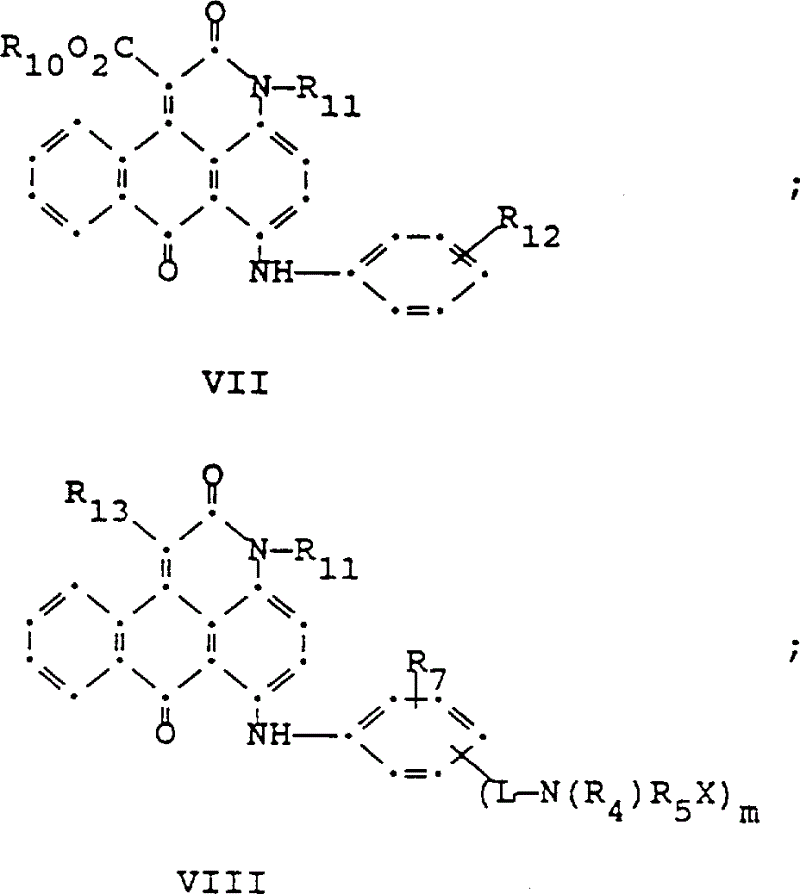
可以与上面式I的蓝色组分掺混的红色组分具有下列式II-X结构; 

R6选自氢、C1-C6烷基、取代的C1-C6烷基、C3-C7环烷基或芳基;R 6 is selected from hydrogen, C 1 -C 6 alkyl, substituted C 1 -C 6 alkyl, C 3 -C 7 cycloalkyl or aryl;
R7是氢或1至3个选自C1-C6烷基、取代的C1-C6烷基、C1-C6烷酰基氨基、卤素、羟基、C1-C6烷基C1-C6烷氧基、C1-C6烷硫基的基团;R 7 is hydrogen or 1 to 3 selected from C 1 -C 6 alkyl, substituted C 1 -C 6 alkyl, C 1 -C 6 alkanoylamino, halogen, hydroxyl, C 1 -C 6 alkyl C 1 -C 6 alkoxy, C 1 -C 6 alkylthio groups;
R8和R9可以相同或不同,选自C1-C6烷基、取代的C1-C6烷基、C3-C7环烷基或芳基;R 8 and R 9 may be the same or different, and are selected from C 1 -C 6 alkyl, substituted C 1 -C 6 alkyl, C 3 -C 7 cycloalkyl or aryl;
R10选自C1-C6烷基、C3-C7环烷基或芳基;R 10 is selected from C 1 -C 6 alkyl, C 3 -C 7 cycloalkyl or aryl;
R11选自氢、C1-C12烷基、取代的C1-C12烷基、C3-C7环烷基和芳基;R 11 is selected from hydrogen, C 1 -C 12 alkyl, substituted C 1 -C 12 alkyl, C 3 -C 7 cycloalkyl and aryl;
R12是氢或1至3个选自C1-C6烷基、取代的C1-C6烷基、C1-C6烷氧基、取代的C1-C6烷氧基、C1-C6烷硫基、取代的C1-C6烷硫基、卤素、羟基、C1-C6烷酰基氨基、芳酰基氨基、C1-C6烷基磺酰氨基和芳基磺酰氨基的基团;R 12 is hydrogen or 1 to 3 selected from C 1 -C 6 alkyl, substituted C 1 -C 6 alkyl, C 1 -C 6 alkoxy, substituted C 1 -C 6 alkoxy, C 1 -C 6 alkylthio, substituted C 1 -C 6 alkylthio, halogen, hydroxy, C 1 -C 6 alkanoylamino, aroylamino, C 1 -C 6 alkylsulfonylamino and arylsulfonyl A group of amido groups;
R13和R14选自氢、氰基或CO2R10;R 13 and R 14 are selected from hydrogen, cyano or CO 2 R 10 ;
R15是如前面所定义的R4或R5X;R 15 is R 4 or R 5 X as previously defined;
L是-CO-或-SO2-;X如前面定义m是0或1;p是1或2:其前提条件是当m是0时R13是氢且至少存在一个聚酯活性基。L is -CO- or -SO 2 -; X is as defined above m is 0 or 1; p is 1 or 2: with the proviso that when m is 0 R 13 is hydrogen and at least one polyester reactive group is present.
在优选的实施方案中,蓝色蒽醌化合物相应于上面结构式(I),其中R是氢;R1和R2独立地选自甲基和乙基:R3是氢、甲基或溴;R4是氢、C1-C4烷基或芳基;R5选自C1-C6亚烷基、C1-C4亚烷基-O-C1-C4亚烷基、-CH2C6H10CH2-、亚芳基或-CH2-亚芳基-,红色组分相应于式(V),其中R7是C1-C6烷氧基,R4和R5如权利要求1所定义。In a preferred embodiment, the blue anthraquinone compound corresponds to the above structural formula (I), wherein R is hydrogen; R and R are independently selected from methyl and ethyl: R is hydrogen, methyl or bromine; R 4 is hydrogen, C 1 -C 4 alkyl or aryl; R 5 is selected from C 1 -C 6 alkylene, C 1 -C 4 alkylene-OC 1 -C 4 alkylene, -CH 2 C 6 H 10 CH 2 -, arylene or -CH 2 -arylene-, the red component corresponds to formula (V), wherein R 7 is C 1 -C 6 alkoxy, R 4 and R 5 are as Claim 1 as defined.
在进一步优选的实施方案中,蓝色和红色化合物的浓度之和是约0.5ppm至约10ppm。最优选的是蓝色化合物的总浓度是1至7ppm,红色化合物的总浓度是0.5至3ppm。In a further preferred embodiment, the sum of the concentrations of the blue and red compounds is from about 0.5 ppm to about 10 ppm. Most preferably the total concentration of blue compounds is 1 to 7 ppm and the total concentration of red compounds is 0.5 to 3 ppm.
本文中使用术语“聚酯活性基团”来描述对在聚酯形成条件下用来制备聚酯的至少一个官能团是反应性的基团。可以用X表示的该基团的实例包括羟基、羧基、酯基、氨基、C1-C6烷氨基等等。酯基可以是任何具有下列式子的基团:或其中R16选自C1-C6烷基、取代的C1-C6烷基、C3-C7环烷基或芳基。活性基团X优选为羟基、羧基、C1-C2烷氧羰基或乙酰氧基。The term "polyester-reactive group" is used herein to describe a group that is reactive with at least one functional group used to prepare the polyester under polyester-forming conditions. Examples of the group that can be represented by X include hydroxyl, carboxyl, ester, amino, C 1 -C 6 alkylamino, and the like. An ester group can be any group having the following formula: or Wherein R 16 is selected from C 1 -C 6 alkyl, substituted C 1 -C 6 alkyl, C 3 -C 7 cycloalkyl or aryl. The reactive group X is preferably hydroxyl, carboxyl, C 1 -C 2 alkoxycarbonyl or acetoxy.
在术语“取代的C1-C6烷基”、“取代的C1-C12烷基”、“取代的C1-C6烷氧基”、“取代的C1-C6烷硫基”、“取代的C1-C6烷基磺酰基”、“C1-C6-烷基磺酰氨基”、“取代的亚烷基”、“C1-C6烷氧羰基”中,烷基和亚烷基或部分这些基团可以含有作为进一步的取代基的1个或多个基团,优选1个至3个选自羟基、卤素、氰基、芳基、芳氧基、芳硫基、C1-C4烷硫基、C1-C4烷硫基、C3-C7环烷基、C1-C4烷酰氧基和
本文中使用的术语“芳基”优选表示苯基和被1至3个选自C1-C6烷基、C1-C6烷氧基、卤素、羧基、氰基、C1-C6烷硫基、C1-C6烷基磺酰基、三氟甲基、羟基、C1-C6烷酰氧基、C1-C6烷酰氨基和C1-C6烷氧羰基的基团取代的苯基。The term "aryl" as used herein preferably represents phenyl and 1 to 3 members selected from C 1 -C 6 alkyl, C 1 -C 6 alkoxy, halogen, carboxyl, cyano, C 1 -C 6 Alkylthio, C 1 -C 6 alkylsulfonyl, trifluoromethyl, hydroxy, C 1 -C 6 alkanoyloxy, C 1 -C 6 alkanoylamino and C 1 -C 6 alkoxycarbonyl Group substituted phenyl groups.
术语“亚芳基”包括1,2-、1,3-和1,4-亚苯基以及被C1-C6烷基、C1-C6烷氧基、C1-C6烷氧羰基或卤素取代1至3次的这些基团。The term "arylene" includes 1,2-, 1,3- and 1,4-phenylene as well as C 1 -C 6 alkyl, C 1 -C 6 alkoxy, C 1 -C 6 alkoxy These groups are substituted 1 to 3 times by carbonyl or halogen.
术语“C3-C8链烯基”和“C3-C8炔基”分别用于表示具有3-8个碳并含有至少一个碳-碳双键和至少一个碳-碳叁键的脂肪烃基团。The terms "C 3 -C 8 alkenyl" and "C 3 -C 8 alkynyl" are used to denote, respectively, aliphatic compounds having 3 to 8 carbons and containing at least one carbon-carbon double bond and at least one carbon-carbon triple bond. Hydrocarbon group.
术语“卤素”用于表示溴、氯、氟和碘。The term "halogen" is used to denote bromine, chlorine, fluorine and iodine.
术语“C1-C6烷酰氧基”和“C1-C6烷酰氨基”分别用于表示式
因此,本发明提供了模制或纤维级聚酯,该聚酯中共聚有其量足以改善聚酯的表观白度的式(I)的蓝色1,4-双(2,6-二烷基苯氨基)蒽醌化合物和式(II)-(X)的红色蒽醌或蒽并吡啶酮化合物。这里,蓝色和红色化合物不会以足够给予聚酯明显颜色的量存在。Accordingly, the present invention provides molding or fiber grade polyesters copolymerized with blue 1,4-bis(2,6-bis) of formula (I) in an amount sufficient to improve the apparent whiteness of the polyester. Alkylanilino)anthraquinone compounds and red anthraquinone or anthrapyridone compounds of formulas (II)-(X). Here, the blue and red compounds will not be present in sufficient amounts to impart a noticeable color to the polyester.
本发明的另一方面是提供了将通常显黄色的聚酯变白的方法,包括在所说的聚酯中共聚至少一种式(I)的蓝色1,4-双(2,6-二烷基苯氨基)蒽醌化合物以及上述式II-X的红色蒽醌或蒽并吡啶酮化合物。Another aspect of the present invention is to provide a process for whitening a normally yellow polyester comprising copolymerizing in said polyester at least one blue 1,4-bis(2,6- Dialkylanilino)anthraquinone compounds and red anthraquinone or anthrapyridone compounds of formula II-X above.
如上所述,本发明的调色剂掺混物可以在聚合之前或聚合期间加入。相应地,本发明的另一方面提供了含有至少一种式(I)的蓝色1,4-双(2,6-二烷基苯氨基)蒽醌化合物以及上面式(II)-(X)的红色蒽醌或蒽并吡啶酮化合物的掺混物的预混合组合物。该预混合组合物可以是红色和蓝色化合物的纯掺混物或者可以是预先溶于一个聚酯单体(例如乙二醇)中的组合物。As noted above, the toner blends of the present invention can be added prior to polymerization or during polymerization. Correspondingly, another aspect of the present invention provides at least one blue 1,4-bis(2,6-dialkylanilino)anthraquinone compound containing at least one formula (I) and the above formulas (II)-(X ) premixed composition of a blend of red anthraquinone or anthrapyridone compounds. The premix composition can be a pure blend of red and blue compounds or can be a composition pre-dissolved in a polyester monomer such as ethylene glycol.
当然,加入的调色剂组分的总量取决于聚酯中原有的黄色程度。通常,所需混合的调色剂组分的最大浓度是约10ppm,最小浓度是约0.5ppm,其中优选约1-7ppm蓝色组分(I)与约0.5-3ppm的式(II-X)的红色组分相结合。Of course, the total amount of toner components added depends on the degree of yellowness inherent in the polyester. Generally, the maximum concentration of the toner components required to be mixed is about 10ppm, and the minimum concentration is about 0.5ppm, wherein about 1-7ppm of the blue component (I) and about 0.5-3ppm of the formula (II-X) are preferred. The red components are combined.
在本发明的优选实施方案中,蓝色蒽醌化合物相应于上面结构(I),其中R是氢;R1和R2独立地选自甲基和乙基;R3是氢、甲基或溴;R4是氢、C1-C4烷基或芳基;R5选自C1-C6-亚烷基、C1-C4-亚烷基-O-C1-C4-亚烷基、-CH2C6H10CH2-、亚芳基或-CH2-亚芳基-,红色组分相应于式(V),其中R7是C1-C6烷氧基,R4和R5如上面优选的蓝色组分(I)中所定义。In a preferred embodiment of the present invention, the blue anthraquinone compound corresponds to structure (I) above, wherein R is hydrogen; R and R are independently selected from methyl and ethyl; R is hydrogen, methyl or Bromine; R 4 is hydrogen, C 1 -C 4 alkyl or aryl; R 5 is selected from C 1 -C 6 -alkylene, C 1 -C 4 -alkylene-OC 1 -C 4 -alkylene radical, -CH 2 C 6 H 10 CH 2 -, arylene or -CH 2 -arylene-, the red component corresponds to formula (V), wherein R 7 is C 1 -C 6 alkoxy, R 4 and R 5 are as defined above for the preferred blue component (I).
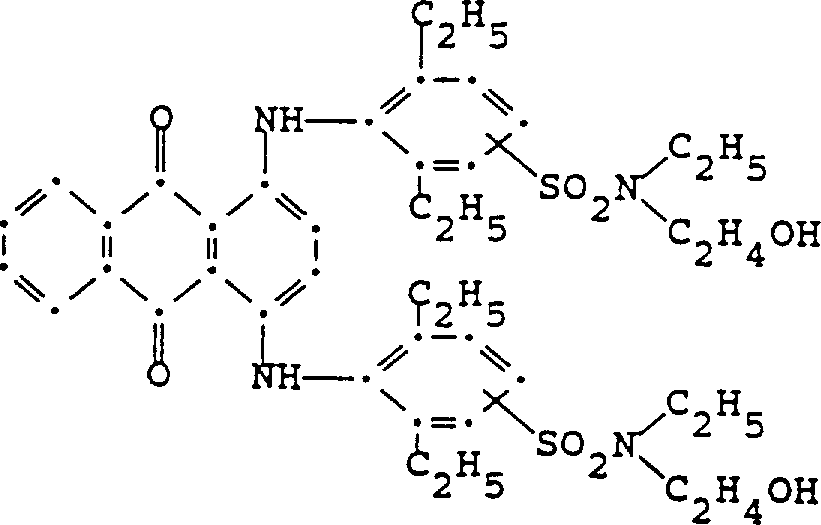
在本发明特别优选的实施方案中,式(I)的蓝色化合物是

式(I)的蓝色蒽醌一般可以通过无色醌茜(1,4,9,10-四羟基蒽)化合物与过量的芳胺,优选在如US3918976(被本文引用作为参考)中描述的硼酸一类的酸催化剂存在下经下面的反应制备: The blue anthraquinone of formula (I) can generally be obtained by a leucoquinizarin (1,4,9,10-tetrahydroxyanthracene) compound with an excess of aromatic amine, preferably as described in US3918976 (hereby incorporated by reference) In the presence of an acid catalyst such as boric acid, it is prepared through the following reaction:
如果需要的话,可以容易地将由此制备的1,4-双(2,6-二烷基苯氨基)蒽醌化合物官能化,首先通过用氯磺酸氯磺化制备双磺酰氯,双磺酰氯可以与含聚酯活性基团的胺反应,该一般性方法揭示在US2731476中,该专利在本文中被引用作为参考。The 1,4-bis(2,6-dialkylanilino)anthraquinone compound thus prepared can be readily functionalized, if desired, by first preparing the bissulfonyl chloride, bissulfonyl chloride, by chlorosulfonation with chlorosulfonic acid Reaction with amines containing polyester reactive groups is possible, the general procedure is disclosed in US2731476, which patent is incorporated herein by reference.
相应于式HN(R4)R5X的典型的胺包括2-氨基乙醇、2,2-亚氨基二乙醇、1-氨基-2,3-丙二醇、2-甲氨基乙醇、2-乙氨基乙醇、2-苯氨基乙醇、氨茴酸甲酯、间氨基苯甲酸甲酯、对氨基苯甲酸、间氨基苯酚、6-氨基己酸、β-丙氨酸、甘氨酸乙酯、2-(对氨基苯基)乙醇、2-(对氨基苯氧基)乙醇、4-氨基甲基环己烷甲醇和3-氨基-2,2-二甲基-1-丙醇。Typical amines corresponding to formula HN( R4 ) R5X include 2-aminoethanol, 2,2-iminodiethanol, 1-amino-2,3-propanediol, 2-methylaminoethanol, 2-ethylamino Ethanol, 2-phenylaminoethanol, methyl anthranilate, methyl m-aminobenzoate, p-aminobenzoic acid, m-aminophenol, 6-aminocaproic acid, β-alanine, ethyl glycine, 2-(p- aminophenyl)ethanol, 2-(p-aminophenoxy)ethanol, 4-aminomethylcyclohexanemethanol and 3-amino-2,2-dimethyl-1-propanol.
红色化合物(II)可以通过将1,5-二氯蒽醌和/或1,8-二氯蒽醌或其混合物与邻、间-和对-氨基苯甲酸(及其酯)经改良的涉及苯胺化合物的氮芳基化的Ullmann反应在铜催化剂存在下制备(参见US4359580,该专利本文引用作为参考)。The red compound (II) can be obtained by 1,5-dichloroanthraquinone and/or 1,8-dichloroanthraquinone or a mixture thereof and o-, m- and p-aminobenzoic acid (and its ester) through the improved The Ullmann reaction of the nitrogen arylation of aniline compounds was prepared in the presence of a copper catalyst (see US4359580, incorporated herein by reference).
式(III)的红色化合物可以根据US4420581所述方法制备,式(VI)化合物可以根据US4999418中的方法制备,这两篇专利被本文引用作为参考。The red compound of formula (III) can be prepared according to the method described in US4420581, and the compound of formula (VI) can be prepared according to the method in US4999418, both of which are incorporated herein by reference.
式(IV)的红色蒽醌化合物可以通过将1,5-二氯蒽醌和1,8-二氯蒽醌或其混合物与取代的苄胺按类似于制备式(III)和(VI)化合物所使用的方法方法反应而制备。The red anthraquinone compound of formula (IV) can be by 1,5-dichloroanthraquinone and 1,8-dichloroanthraquinone or its mixture with the benzylamine of substitution and formula (III) and (VI) compound are prepared analogously The method used is prepared by reaction.
式(VII)的红色蒽并吡啶酮化合物可以按US4790581(被本文引用作为参考)中揭示和方法制备;用于制备紫红色蒽并吡啶酮化合物(VIII)和(IX)的方法揭示在US4745174中,该专利被本文引用作为参考。The red anthrapyridone compound of formula (VII) can be prepared according to the method disclosed in US4790581 (hereby incorporated by reference); the method for preparing the purple anthrapyridone compound (VIII) and (IX) is disclosed in US4745174 , which is incorporated herein by reference.
本文涉及的聚酯包括从一种或多种二醇和一种或多种二羧酸通过常规的聚合技术制备的线形、热塑性、结晶或无定形聚酯。该聚酯通常是模制或纤维级的,在25℃下在60/40重量比的苯酚/四氯乙烷中测得的比浓对数粘度(I.V.)为约0.4至约1.2(dL/g)。References herein to polyesters include linear, thermoplastic, crystalline or amorphous polyesters prepared from one or more diols and one or more dicarboxylic acids by conventional polymerization techniques. The polyester is usually molding or fiber grade and has an inherent viscosity (I.V.) of about 0.4 to about 1.2 (dL/ g).
所述聚酯的适当的二醇组分可以选自乙二醇、1,4-环己烷二甲醇、1,2-丙二醇、1,3-丙二醇、1,4-丁二醇、2,2-二甲基-1,3-丙二醇、1,6-己二醇、1,2-环己二醇、1,4-环己二醇、1,2-环己烷二甲醇、1,3-环己烷二甲醇、Z,8-双(羟甲基)-三环[5.2.1.0]癸烷,其中Z表示3、4或5:以及在链中含有一个或多个氧原子的二醇,例如二甘醇、三甘醇、双丙甘醇、三丙甘醇等等。通常,这些二醇含2至18、优选2至8个碳原子。脂环族二醇可以以它的顺式或反式构型或两种形式的混合物使用。A suitable diol component of the polyester may be selected from ethylene glycol, 1,4-cyclohexanedimethanol, 1,2-propanediol, 1,3-propanediol, 1,4-butanediol, 2, 2-Dimethyl-1,3-propanediol, 1,6-hexanediol, 1,2-cyclohexanediol, 1,4-cyclohexanediol, 1,2-cyclohexanedimethanol, 1, 3-Cyclohexanedimethanol, Z,8-bis(hydroxymethyl)-tricyclo[5.2.1.0]decane, where Z represents 3, 4 or 5: and those containing one or more oxygen atoms in the chain Glycols such as diethylene glycol, triethylene glycol, dipropylene glycol, tripropylene glycol, and the like. Generally, these diols contain 2 to 18, preferably 2 to 8, carbon atoms. The cycloaliphatic diol can be used in its cis or trans configuration or a mixture of both forms.
线性聚酯的适当的酸组分(脂肪、脂环或芳族二羧酸)选自例如对苯二甲酸、间苯二甲酸、1,4-环己烷二羧酸、1,3-环己烷二羧酸、琥珀酸、戊二酸、己二酸、癸二酸、1,12-十二双酸、2,6-萘二羧酸等等。在聚合物制备中,经常优选使用相应官能酸的衍生物如二羧酸的二甲酯、二乙酯或二丙酯。实际上也可以使用这些酸的酸酐或酰卤。Suitable acid components (aliphatic, alicyclic or aromatic dicarboxylic acids) of linear polyesters are selected from e.g. terephthalic acid, isophthalic acid, 1,4-cyclohexanedicarboxylic acid, 1,3-cyclohexanedicarboxylic acid, Hexanedicarboxylic acid, succinic acid, glutaric acid, adipic acid, sebacic acid, 1,12-dodecanedioic acid, 2,6-naphthalene dicarboxylic acid, and the like. In the preparation of polymers, it is often preferred to use derivatives of corresponding functional acids such as dimethyl, diethyl or dipropyl esters of dicarboxylic acids. Anhydrides or halides of these acids may also be used in practice.
优选的聚酯含有至少约50mol%的对苯二甲酸残基和至少约50mol%乙二醇和/或1,4-环己烷二甲醇残基以及约2-8mol%式(I)化合物的残基。尤其优选的聚酯含约75-100mol%对苯二甲酸残基和约75-100mol%乙二醇残基。Preferred polyesters contain at least about 50 mole % residues of terephthalic acid and at least about 50 mole % residues of ethylene glycol and/or 1,4-cyclohexanedimethanol and about 2-8 mole % residues of compounds of formula (I) base. Especially preferred polyesters contain about 75-100 mole percent terephthalic acid residues and about 75-100 mole percent ethylene glycol residues.
线形聚酯可以根据现有技术中公知的聚酯形成条件制备。例如,可以在酯化和/或聚酯化催化剂存在下在约150℃至约300℃温度和大气压至约0.2mmHg的压力下将一种或多种二羧酸、优选芳族二羧酸或其成酯衍生物与一种或多种二醇的混合物加热。通常,在大气压下在所规定的温度范围的下限的温度下二羧酸或其衍生物被二醇酯化或酯交换。然后通过提高温度和降低压力进行缩聚同时将过量的二醇从混合物中除去。Linear polyesters can be prepared according to polyester-forming conditions known in the art. For example, one or more dicarboxylic acids, preferably aromatic dicarboxylic acids or A mixture of its ester-forming derivative and one or more diols is heated. Typically, dicarboxylic acids or derivatives thereof are esterified or transesterified with diols at atmospheric pressure at a temperature of the lower limit of the specified temperature range. The polycondensation is then carried out by increasing the temperature and reducing the pressure while removing excess diol from the mixture.
聚酯缩合的典型催化剂或催化剂体系在现有技术中是公知的。例如,披露在US4025492、US4136089、US4176224、US4238593和US4208527(它们被本文引用作为参考)中的催化剂在这方面被认为是适合的。另外,R.E.Wilfong在Journal of Polymer Science,54,385(1961)中说明了用于聚酯缩合反应的典型催化剂。Typical catalysts or catalyst systems for polyester condensation are well known in the prior art. For example, the catalysts disclosed in US4025492, US4136089, US4176224, US4238593 and US4208527 (which are incorporated herein by reference) are considered suitable in this regard. Additionally, R.E. Wilfong describes typical catalysts for polyester condensation reactions in Journal of Polymer Science, 54, 385 (1961).
用于聚酯缩合的优选的温度范围是约260℃至300℃。The preferred temperature range for polyester condensation is about 260°C to 300°C.
下列详细的步骤进一步说明调色剂组分的制备,表1-10的表列实例提供了可用于实施本发明的蓝色和红色化合物的进一步说明。The following detailed procedures further illustrate the preparation of the toner components, and the tabulated examples in Tables 1-10 provide further illustrations of the blue and red compounds useful in the practice of this invention.
实验部分Experimental part
实施例1和其他实施例的氯磺酰基化合物也可以通过在1994年3月18日递交的待审美国专利申请08/210785中描述的方法制备。在该方法中,反应混合物被浸没在C3-C6脂肪酮或C3-C6脂肪酮混合物中,经搅拌和冷却沉淀由此制备的固体芳基磺酰卤。丙酮是优选的C3-C6脂肪酮。或者可以使用异丙醇或异丙醇/丙酮混合物(优选约80/20(体积))。在该方法中,观察到较少的反应热,这样使得浸没卤代磺化反应混合物更安全和更加可控制。而且,气体从浸没的混合物中放出的氯化氢气体较少,并且通常制得更多高纯度的芳基磺酰氯。The chlorosulfonyl compounds of Example 1 and other examples can also be prepared by the methods described in co-pending US Patent Application Serial No. 08/210785, filed March 18,1994. In this method, the reaction mixture is immersed in a C 3 -C 6 aliphatic ketone or a C 3 -C 6 aliphatic ketone mixture, and the solid arylsulfonyl halide thus prepared is precipitated by stirring and cooling. Acetone is the preferred C3 - C6 aliphatic ketone. Alternatively isopropanol or an isopropanol/acetone mixture (preferably about 80/20 by volume) may be used. In this method, less heat of reaction is observed, which makes submersion of the halosulfonation reaction mixture safer and more controllable. Also, the gas evolves less hydrogen chloride gas from the submerged mixture and generally produces more high purity arylsulfonyl chloride.
实施例1Example 1
在搅拌下将1,4-双(2-乙基-6-甲基苯氨基)蒽醌(50.0g,0.11mol)以使得温度从25℃升至约45℃的速率分批加入氯磺酸(250ml)中。在不加热的条件下将得到的溶液搅拌2.0小时,然后在良好的搅拌条件下将该溶液以细流形式加入0-5℃的冰-水混合物(3.0升)中。经过滤收集得到的二磺酰氯产物,用水洗涤,挤压以除去大部分水,然后加入四氢呋喃(1.0升)中并搅拌成溶液。将乙醇胺(30.0g,0.5mol)溶于四氢呋喃(50.0ml)中。在搅拌下将该溶液滴加入二磺酰氯的溶液中。室温搅拌约12.0小时之后,在约100英寸压力下除去四氢呋喃。然后将残余物溶于乙酸(500ml)中。在搅拌下慢慢将该溶液溶入水(3.5升)中。过滤收集蓝色产物。用热水洗涤并干燥(产量77.5g,理论产量的97.7%)。质谱支持了下列结构:在N,N-二甲基甲酰胺溶剂中的可见吸收光谱中观察到的最大吸收在578nm(ε-15694)和621nm(ε-16817)。1,4-bis(2-ethyl-6-methylanilino)anthraquinone (50.0 g, 0.11 mol) was added portionwise to chlorosulfonic acid with stirring at a rate such that the temperature rose from 25°C to about 45°C (250ml). The resulting solution was stirred without heating for 2.0 hours and then added in a thin stream to an ice-water mixture (3.0 L) at 0-5°C with good stirring. The resulting disulfonyl chloride product was collected by filtration, washed with water, squeezed to remove most of the water, then added to tetrahydrofuran (1.0 L) and stirred into solution. Ethanolamine (30.0 g, 0.5 mol) was dissolved in tetrahydrofuran (50.0 ml). This solution was added dropwise to the solution of disulfonyl chloride with stirring. After stirring at room temperature for about 12.0 hours, THF was removed at about 100 inches of pressure. The residue was then dissolved in acetic acid (500ml). The solution was slowly dissolved in water (3.5 L) with stirring. The blue product was collected by filtration. Washed with hot water and dried (yield 77.5 g, 97.7% of theory). Mass Spec supports the following structures: The maximum absorption observed in the visible absorption spectrum in N,N-dimethylformamide solvent is at 578 nm (ε-15694) and 621 nm (ε-16817).
实施例2Example 2
将完全根据实施例1描述的方法通过1,4-双(2-乙基-6-甲基苯氨基)蒽醌(0.051mol)的氯磺化作用制备的蒽醌二磺酰氯加入4-甲酯基苄胺盐酸盐(22.3g,0.111mol)在二氯甲烷(250ml)中的浆液(其中已经加入三乙胺(26.3g,0.260mol))中。在室温下搅拌该反应混合物之后,加入活性炭(5.0g)和硫酸镁(5.0g),然后过滤混合物以除去固体。在真空条件下从滤液中除去溶剂,将残余物在约500ml水中制成浆液。基本上以定量产率得到了产物,该产物具有被质谱证明的下列结构:
它在二氯甲烷中的可见吸收光谱中的最大吸收在597nm(ε-11971)和622nm(ε-15126)。Its maximum absorption in the visible absorption spectrum in dichloromethane is at 597nm (ε-11971) and 622nm (ε-15126).
实施例3Example 3
将完全根据实施例1中描述的方法通过1,4-双(2-乙基-6-甲基苯氨基)蒽醌(0.037mol)的氯磺化作用制备的蒽醌二磺酰氯完全根据实施例2中所描述的方法与甘氨酸乙酯的盐酸盐(10.78g,0.077mol)反应得到29.5g(理论产量的99.0%)下列蓝色产物:
在二氯甲烷中的可见吸收光谱中观察到的最大吸收在577nm(ε-14713)和621nm(ε-15517)。The maximum absorption observed in the visible absorption spectrum in dichloromethane is at 577 nm (ε-14713) and 621 nm (ε-15517).
实施例4Example 4
在搅拌下向邻二氯苯(100ml)中加入1,4-双(2-乙基-6-甲基苯氨基)蒽醌(9.48g,0.02mol)。在溶液变均匀之后,将溶于邻二氯苯(20ml)中的溴(7.04g,0.044mol)在25-30℃下滴入(很少的放热)。加完后,将反应混合物在25-30℃加热1.0小时,将反应混合物冷至室温,然后倾入甲醇(500ml)中。产物结晶,过滤收集产物,用甲醇洗涤并在空气中干燥。经质谱证明的下列二溴化物的产量是9.44g(理论产量的74.7%):
在二氯甲烷中的可见吸收光谱中观察到的最大吸收在582nm(ε-16953)和625nm(ε-16953)。The maximum absorption observed in the visible absorption spectrum in dichloromethane is at 582 nm (ε-16953) and 625 nm (ε-16953).
实施例5Example 5
在低于35℃和良好搅拌条件下,向氯磺酸(35.0ml)中分批加入1,4-双(4-溴-2-乙基-6-甲基苯氨基)蒽醌(6.32g,0.01mol)(从实施例4得到)。在约90-95℃经过加热和搅拌反应溶液1.0小时氯磺化作用完全,然后在搅拌下将反应溶液逐渐倒入约500ml冰/水混合物中。经过滤收集得到蓝色二磺酰氯并挤压干。然后将湿压滤饼加入乙醇胺(50.0ml)中,将反应混合物在90-95℃搅拌0.5小时,然后倒入水(300ml)中。经酸化至pH小于4之后,过滤混合物,固体用水洗并在空气中干燥。薄层色谱显示,除了所需产物之外,还有一些高极性物,估计是单或二磺酸或其混合物。将部分(1.0g)粗产物溶于二氯甲烷(40ml)中,然后在粗熔结玻璃漏斗中通过MgO3Si(FLORISIL)使用二氯甲烷进行色谱分离除去具有高Rf值(似乎是原料)的少量蓝色物来提纯产物。然后将产物用四氢呋喃洗脱。再从洗脱液中除去溶剂得到油状残余物,将其溶于乙酸(10ml)中,然后将溶液倒入水中。过滤收集蓝色产物,用水洗并在空气中干燥(产量0.6g)。质谱和薄层色谱显示产物大部分是所需产物: 1,4-bis(4-bromo-2-ethyl-6-methylanilino)anthraquinone (6.32 g , 0.01 mol) (obtained from Example 4). Chlorosulfonation was completed by heating and stirring the reaction solution at about 90-95°C for 1.0 hour, and then pouring the reaction solution gradually into about 500 ml of ice/water mixture with stirring. The blue disulfonyl chloride was collected by filtration and squeezed dry. The wet press cake was then added to ethanolamine (50.0ml) and the reaction mixture was stirred at 90-95°C for 0.5 hours and then poured into water (300ml). After acidification to a pH of less than 4, the mixture was filtered, the solid was washed with water and dried in air. Thin-layer chromatography showed that, in addition to the desired product, there were some highly polar species, presumably mono- or di-sulfonic acids or mixtures thereof. A portion (1.0 g) of the crude product was dissolved in dichloromethane (40 ml) and then chromatographed over MgO 3 Si (FLORISIL) using dichloromethane in a coarse fritted glass funnel to remove A small amount of blue matter to purify the product. The product was then eluted with tetrahydrofuran. Removal of the solvent from the eluate gave an oily residue which was dissolved in acetic acid (10ml) and the solution was poured into water. The blue product was collected by filtration, washed with water and air dried (yield 0.6 g). Mass spectroscopy and thin layer chromatography showed the product to be mostly the desired product:
同时存在少量单磺酰胺衍生物。在二氯甲烷中的可见吸收光谱中观察到的最大吸收在576nm(ε-16519)和619nm(ε-17222)。There is also a small amount of monosulfonamide derivatives. The maximum absorption observed in the visible absorption spectrum in dichloromethane is at 576 nm (ε-16519) and 619 nm (ε-17222).
实施例6Example 6
在搅拌下向1,4-双(2-乙基-6-甲基苯氨基)蒽醌(3.0g,0.00632mol)和对甲苯磺酸(0.05g)在N,N-二甲基甲酰胺(10ml)中的溶液中滴加三氟乙酸酐(10ml)并允许温度升高。将反应混合物在约50℃加热15分钟,在此期间颜色从蓝色蓝移到红色迁移指示已经发生酰化。将反应混合物倒入水(250ml)中,过滤收集红色产物,用水洗涤并在空气中干燥(产量3.50g,理论产量的97.2%)。质谱支持了下列单酰化产物: Add 1,4-bis(2-ethyl-6-methylanilino)anthraquinone (3.0g, 0.00632mol) and p-toluenesulfonic acid (0.05g) in N,N-dimethylformamide under stirring To the solution in (10ml) was added trifluoroacetic anhydride (10ml) dropwise and allowed to rise in temperature. The reaction mixture was heated at about 50°C for 15 minutes, during which time a color shift from bluish to red indicated that acylation had occurred. The reaction mixture was poured into water (250ml) and the red product was collected by filtration, washed with water and dried in air (yield 3.50g, 97.2% of theory). Mass spectroscopy supported the following monoacylated products:
在二氯甲烷中的可见吸收光谱中观察到的最大吸收在522nm(ε-7079)。The maximum absorption observed in the visible absorption spectrum in dichloromethane is at 522 nm (ε-7079).
实施例7Example 7
在室温下将部分(1.5g,0.00263mol)实施例6的产物分批加入氯磺酸(15ml)中。在室温搅拌约30分钟之后,在搅拌下将反应混合物倒入冰/水混合物中。过滤收集黄红色产物,用水洗涤,挤压除去大部分水,然后加入乙醇胺(20ml)中。在约90-95℃加热同时搅拌1.0小时形成磺酰胺产物之后,通过用2-乙氧基乙醇(15.0ml)、水(5.0ml)和0.5ml 50%NaOH溶液处理反应混合物并且加热和搅拌0.5小时经水解除去三氟乙酰基。在此期间反应混合物的颜色由红变蓝。将最终的反应混合物倒入水(200ml)中,过滤收集蓝色产物,用水洗涤并在空气中干燥(产量1.27g)。质谱指示得到的所需单磺酰胺产物具有下列结构:
在二氯甲烷中的可见吸收光谱中观察到的最大吸收在582nm(ε-14706)和627nm(ε-15902)。The maximum absorption observed in the visible absorption spectrum in dichloromethane is at 582 nm (ε-14706) and 627 nm (ε-15902).
实施例8Example 8
将由1,4-双(2-乙基-6-甲基苯氨基)蒽醌(0.01mol)的氯磺化作用制备的蒽醌二磺酰氯分批加入2-甲氨基乙醇(1.80g,0.024mol)在含有三乙胺(2.53g,0.025mol)的二氯甲烷(70.0ml)中的溶液中并允许温度自发升至约27℃。室温下搅拌反应混合物约30分钟之后薄层色谱显示反应完全。有机反应混合物用250ml水提取两次并除去水层。减压下除去二氯甲烷得到油层,经用正己烷研制后固化。经过滤收集之后,用正己烷洗涤并在空气中干燥,得到的深蓝色产物重6.32g(理论产量的84.5%)。质谱支持下列结构: Anthraquinone disulfonyl chloride prepared by chlorosulfonation of 1,4-bis(2-ethyl-6-methylanilino)anthraquinone (0.01mol) was added in portions to 2-methylaminoethanol (1.80g, 0.024 mol) in dichloromethane (70.0 ml) containing triethylamine (2.53 g, 0.025 mol) and allow the temperature to rise spontaneously to about 27°C. Thin layer chromatography showed the reaction to be complete after stirring the reaction mixture at room temperature for about 30 minutes. The organic reaction mixture was extracted twice with 250 ml of water and the aqueous layer was removed. The dichloromethane was removed under reduced pressure to obtain an oily layer which solidified after trituration with n-hexane. After being collected by filtration, washed with n-hexane and dried in air, the dark blue product was obtained weighing 6.32 g (84.5% of theoretical yield). Mass Spec supports the following structures:
在二氯甲烷中的可见吸收光谱中观察到的最大吸收在578nm(ε-14511)和621nm(ε-15334)。The maximum absorption observed in the visible absorption spectrum in dichloromethane is at 578 nm (ε-14511) and 621 nm (ε-15334).
实施例9Example 9
在室温和搅拌下将由1,4-双(2-乙基-6-甲基苯氨基)蒽醌(0.0025mol)的氯磺化作用制备的蒽醌二磺酰氯加入被搅拌的2-乙氨基乙醇(0.54g,0.006mol)和三乙胺(0.64g,0.0065mol)在二氯甲烷(15.0ml)中的溶液中。观察到轻微放热,将反应混合物搅拌约30分钟。薄层色谱(1∶1四氢呋喃∶环己烷)显示反应完全。蓝色二氯甲烷溶液用200ml水洗涤5次,然后用饱和氯化钠溶液洗涤。蒸发除去二氯甲烷,在正己烷中研制残余物得到一固体,过滤收集固体,用正己烷洗涤并在空气中干燥(产量1.83g,理论产量94.39%)。质谱支持下列结构: Anthraquinone disulfonyl chloride, prepared by the chlorosulfonation of 1,4-bis(2-ethyl-6-methylanilino)anthraquinone (0.0025 mol), was added to the stirred 2-ethylamino A solution of ethanol (0.54 g, 0.006 mol) and triethylamine (0.64 g, 0.0065 mol) in dichloromethane (15.0 ml). A slight exotherm was observed and the reaction mixture was stirred for about 30 minutes. Thin layer chromatography (1:1 tetrahydrofuran:cyclohexane) showed the reaction to be complete. The blue dichloromethane solution was washed 5 times with 200 ml of water and then with saturated sodium chloride solution. The dichloromethane was removed by evaporation and the residue was triturated in n-hexane to give a solid which was collected by filtration, washed with n-hexane and dried in air (yield 1.83 g, 94.39% of theory). Mass Spec supports the following structures:
在二氯甲烷中的可见吸收光谱中观察到的最大吸收在579nm(ε-15054)和622nm(ε-15986)。The maximum absorption observed in the visible absorption spectrum in dichloromethane is at 579 nm (ε-15054) and 622 nm (ε-15986).
实施例10Example 10
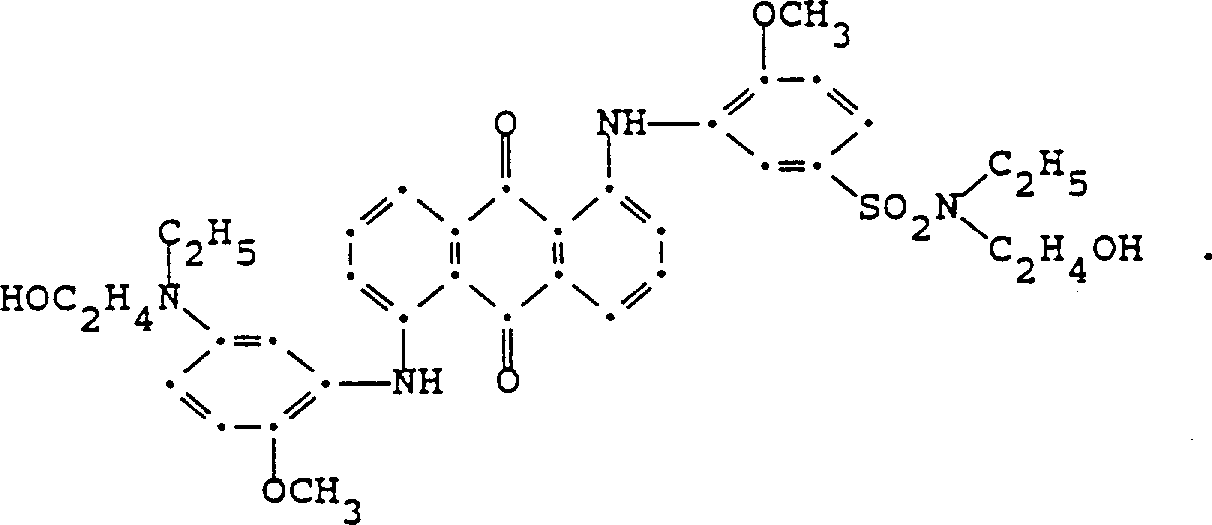
在低于35℃和搅拌下,将1,5-双(2-茴香氨基)蒽醌(2.25g,0.005mol)分批加入氯磺酸(12.5ml)中。室温下搅拌反应混合物3.0小时,然后在冷却下将其滴入丙酮(250ml)中。沉淀的固体二磺酰氯经过滤收集,用丙酮洗涤并在空气中干燥(产量2.85g)。将所有二磺酰氯加入2-氨基乙醇(35.0g,0.57mol)中,将反应混合物在约90-95℃搅拌1.0小时,冷至室温然后倒入丙酮(200ml)中。过滤收集深红色产物,用丙酮洗涤并在空气中干燥(产量2.15g,基于原料1,4-双(2-茴香氨基)蒽醌的理论产量的61.7%)。被质谱支持的建议性结构如下: 1,5-Bis(2-anisidine)anthraquinone (2.25 g, 0.005 mol) was added portionwise to chlorosulfonic acid (12.5 ml) under stirring at below 35°C. The reaction mixture was stirred at room temperature for 3.0 hours, then it was dropped into acetone (250ml) under cooling. The precipitated solid disulfonyl chloride was collected by filtration, washed with acetone and air dried (yield 2.85 g). All of the disulfonyl chloride was added to 2-aminoethanol (35.0 g, 0.57 mol), the reaction mixture was stirred at about 90-95°C for 1.0 hour, cooled to room temperature and poured into acetone (200 ml). The dark red product was collected by filtration, washed with acetone and dried in air (yield 2.15 g, 61.7% of theory based on starting material 1,4-bis(2-anisidine)anthraquinone). The proposed structure supported by mass spectrometry is as follows:
在二氯甲烷中的紫外-可见吸收光谱的最大吸收在333nm(ε-20132)和543nm(ε-15508)。The UV-Vis absorption spectrum in dichloromethane has maximum absorption at 333nm (ε-20132) and 543nm (ε-15508).
实施例11Example 11
如实施例10中描述的那样,将由0.005mol1,5-双(2-茴香氨基)蒽醌制备的蒽醌二磺酰氯加入2-甲氨基乙醇(40.0ml)中,在90-95℃搅拌反应混合物1.0小时,在此期间二磺酰胺产物结晶。过滤收集产物,用丙酮洗涤并在空气中干燥(产量2.17g,基于原料1,4-双(2-茴香氨基)蒽醌的理论产量的59.97%)。质谱支持下列结构: As described in Example 10, anthraquinone disulfonyl chloride prepared from 0.005 mol of 1,5-bis(2-anisidine)anthraquinone was added to 2-methylaminoethanol (40.0 ml), and the reaction was stirred at 90-95°C The mixture was 1.0 hour during which time the disulfonamide product crystallized. The product was collected by filtration, washed with acetone and dried in air (yield 2.17 g, 59.97% of theory based on starting material 1,4-bis(2-anisidine)anthraquinone). Mass Spec supports the following structures:
在N,N-二甲基甲酰胺中的可见吸收光谱中观察到的最大吸收在530nm(ε-15150)。The maximum absorption observed in the visible absorption spectrum in N,N-dimethylformamide is at 530 nm (ε-15150).
实施例12Example 12
如实施例10中描述的那样,将由0.01mol1,5-双(2-茴香氨基)蒽醌制备的蒽醌二磺酰氯加入2-(4-氨基苯基)乙醇(4.37g,0.04mol)在吡啶(35ml)中的溶液中。在搅拌下将反应混合物加热至约55℃,然后让反应混合物在室温下放置过夜。在良好搅拌下将反应混合物倒入含NaCl(10.0g)的水(200ml)中。加入乙酸(25.0ml)并将混合物加热至约75℃,让其冷却。过滤收集红色沉淀并用水洗涤,在空气中干燥(产量7.14g)。质谱支持下列所建议的结构: As described in Example 10, anthraquinone disulfonyl chloride prepared from 0.01 mol of 1,5-bis(2-anisidine)anthraquinone was added to 2-(4-aminophenyl)ethanol (4.37 g, 0.04 mol) in solution in pyridine (35ml). The reaction mixture was heated to about 55°C with stirring, and then the reaction mixture was allowed to stand at room temperature overnight. The reaction mixture was poured into water (200ml) containing NaCl (10.0g) with good stirring. Acetic acid (25.0ml) was added and the mixture was heated to about 75°C and allowed to cool. The red precipitate was collected by filtration and washed with water, dried in air (yield 7.14 g). Mass spectra support the following proposed structures:
在N,N-二甲基甲酰胺中的可见吸收光谱中观察到的最大吸收在533nm(ε-14062)。The maximum absorption observed in the visible absorption spectrum in N,N-dimethylformamide is at 533 nm (ε-14062).
实施例13Example 13
将6-溴-1-氰基-3-甲基-3H-二苯并(f,ij)异喹啉-2,7-二酮(1.82g,0.005mol)、4-氨基-3,5-二甲基苯酚(2.74g,0.02mol)、碳酸钾(0.35g)、乙酸铜(0.30g)和N,N-二甲基甲酰胺(DMF)(10.0ml)的混合物在80-90℃加热1.0小时,冷至约50℃,然后再加入5.0ml DMF稀释。然后过滤收集得到产物,用DMF洗涤,用甲醇洗涤并在空气中干燥(产量2.10g,理论产量的48.6%)。质谱支持下列结构: 6-Bromo-1-cyano-3-methyl-3H-dibenzo(f,ij)isoquinoline-2,7-dione (1.82g, 0.005mol), 4-amino-3,5 - A mixture of dimethylphenol (2.74g, 0.02mol), potassium carbonate (0.35g), copper acetate (0.30g) and N,N-dimethylformamide (DMF) (10.0ml) at 80-90°C Heat for 1.0 hour, cool to about 50°C, and then add 5.0ml of DMF to dilute. The resulting product was then collected by filtration, washed with DMF, washed with methanol and dried in air (yield 2.10 g, 48.6% of theory). Mass Spec supports the following structures:
在二氯甲烷中的可见吸收光谱中观察到的最大吸收在549nm(ε-9964)和585nm(ε-12860)。The maximum absorption observed in the visible absorption spectrum in dichloromethane is at 549 nm (ε-9964) and 585 nm (ε-12860).
实施例14Example 14
将6-溴-1-氰基-3-甲基-3H-二苯并[f,ij]异喹啉-2,7-二酮(3.65g,0.01mol)、3-氨基苯甲酸乙酯(6.60g,0.04mol)、碳酸钾(1.00g)、乙酸铜(1.20g)和N,N-二甲基甲酰胺(10.0ml)的混合物加热至约80℃。将反应混合物浓缩,然后通过加入20.0ml DMF稀释。逐渐加热至约130℃并再加入10.0ml DMF以有利于搅拌。将反应混合物加热回流2.0小时,然后倒入热烧杯中并使用DMF将固体冲洗出反应烧瓶。然后将混合物过滤,固体用DMF洗涤,用乙醇洗涤并在空气中干燥(产量3.0g,理论产量的66.8%),质谱支持下列结构:
在二氯甲烷中的紫外-可见吸收光谱中观察到的最大吸收在359nm(ε-12319)和585nm(ε-15313)。The absorption maxima observed in the UV-Vis absorption spectrum in dichloromethane were at 359 nm (ε-12319) and 585 nm (ε-15313).
实施例15Example 15
在搅拌下将6-溴-1-氰基-3-甲基-3H-二苯并[f,ij]异喹咻-2,7-二酮(3.65g,0.01mol)、5-氨基间苯二甲酸二甲酯(8.4g,0.04mol)、碳酸钾(1.0g)、乙酸铜(1.2g)和N,N-二甲基甲酰胺(DMF)(20.0ml)的混合物加热至约120℃。反应混合物变得很稠,再加DMF(70.0ml)以便于搅拌。在140-145℃加热15分钟之后,将反应混合物倒入烧杯中并用DMF冲洗烧瓶。过滤收集产物,用DMF洗涤,用1∶1的DMF∶甲醇洗涤,最后用甲醇洗涤并在空气中干燥(产量3.02g,理论产量的61.1%)。质谱支持下列所建议的结构:
在N,N-二甲基甲酰胺中的紫外-可见光谱显示最大吸收在353nm和584nm。The UV-Vis spectrum in N,N-dimethylformamide shows absorption maxima at 353 nm and 584 nm.
实施例16Example 16
在良好的搅拌下向氯磺酸(50.0ml)中分批加入6-苯氨基-1-氰基-3-甲基-3H-二苯并[f,ij]异喹啉-2,7-二酮(7.54g)并允许温度升高。然后将反应混合物倒入冰/饱和NaCl溶液中。过滤收集固体磺酰氯化合物,用饱和NaCl溶液洗涤,然后在良好的搅拌下以湿态加到二乙醇胺(50.0ml)中。然后在50℃加热反应混合物0.5小时,在搅拌下倒入水中。过滤收集固体产物,用水洗涤并在空气中干燥(产量9.0g)。质谱支持下列所建议的结构:
实施例17Example 17
将6-溴-1-氰基-3-甲基-3H-二苯并[f,ij]异喹啉-2,7-二酮(36.5 g)、4-氨基苯甲酸甲酯(75.0g)、碳酸钾(10.0g)、乙酸铜(12.0g)和N,N-二甲基甲酰胺(DMF)(120ml)的混合物在约110℃下加热3.0小时。再加入DMF(140ml),让反应混合物冷却至约30℃。过滤收集产物,用DMF洗涤,用水洗涤最后用异丙醇洗涤,然后在空气中干燥(产量34.0g)。通过加热回流混合物然后让其冷却至100℃由DMF(620ml)中重结晶提纯产物。过滤收集产物,用DMF洗涤,用异丙醇洗涤,然后在空气中干燥(产量18.8g)。建议的结构如下:
实施例18Example 18
将6-溴-1-氰基-3-甲基-3H-二苯并[f,ij]异喹啉-2,7-二酮(3.65g,0.01mol)、4-氨基-N-(2-羟乙基)邻苯二甲酰亚胺(8.24g,0.04mol)、碳酸钾(1.0g)、乙酸铜(1.0g)和N,N-二甲基甲酰胺(DMF)(20ml)的混合物在搅拌下加热至135℃,并在135-140℃保持1.0小时,然后将热的反应混合物逐渐地倒入150ml丙酮中。过滤收集固体,用丙酮洗涤,用DMF洗涤,再在50∶50的丙酮∶水中制成浆液,再过滤,用丙酮洗涤并在空气中干燥(产量2.85g,理论产量的58.2%)。质谱支持下列结构:
实施例19Example 19
将6-溴-1-氰基-3-甲基-3H-二苯并[f,ij]异喹啉-2,7-二酮(1.0g,0.003mol)、4-[3-(氨基苯甲酰氨基)]苯甲酸乙酯(3.41g,0.012mol)、碳酸钾(0.30g)、乙酸铜(0.36g)和N,N-二甲基甲酰胺(10ml)的混合物在120-125℃加热并搅拌6.0小时。让反应混合物冷却,然后在搅拌下倒入稀乙酸水溶液中。过滤收集固体产物,用水洗涤,在甲醇(200ml)中再浆液化,再过滤,用甲醇洗涤并在空气中干燥(产量1.63g)。使用FLORISIL柱色谱法,将样品溶于二氯甲烷并加入柱子中,然后用二氯甲烷之后用50∶50的二氯甲烷∶四氢呋喃洗脱对产物进行提纯。蒸发溶剂得到产物(0.59g)。质谱支持下列结构:
在二氯甲烷中的可见吸收光谱中观察到的最大吸收在584nm。The maximum absorption observed in the visible absorption spectrum in dichloromethane was at 584 nm.
实施例20Example 20
完全象实施例19中描述的那样,使6-溴-1-氰基-3-甲基-3H-二苯并[f,ij]异喹啉-2,7-二酮(1.0g,0.003mol)、α-(3-氨基苯甲酰氨基)乙酸乙酯(2.66g,0.012mol)、碳酸钾(0.30g)、乙酸铜(0.36g)和N,N-二甲基甲酰胺(10ml)的混合物反应,粗产物经粗色谱法分离和提纯得到0.24g纯化的产物。质谱支持下列结构:
在二氯甲烷中的可见吸收光谱中观察到的最大吸收在585nm(ε-16431)。The maximum absorption observed in the visible absorption spectrum in dichloromethane is at 585 nm (ε-16431).
实施例21Example 21
在室温下将由0.005ml 1,5-双(2-茴香氨基)蒽醌制备的蒽醌二磺酰氯(如实施例10中制备)分批加入2-乙氨基乙醇(1.07g,0.012mol)和三乙胺(1.27g,0.013mol)溶于二氯甲烷(50.0ml)中的溶液中。室温下搅拌3.0小时之后,过滤反应混合物,深红色固体用二氯甲烷洗涤,用异丙醇洗涤然后在空气中干燥(产量2.24g,理论产量的59.6%)。质谱支持下列所需的结构: Anthraquinone disulfonyl chloride (prepared as in Example 10) prepared from 0.005 ml of 1,5-bis(2-anisidine) anthraquinone was added in portions to 2-ethylaminoethanol (1.07 g, 0.012 mol) and Triethylamine (1.27g, 0.013mol) was dissolved in a solution of dichloromethane (50.0ml). After stirring at room temperature for 3.0 hours, the reaction mixture was filtered and the dark red solid was washed with dichloromethane, washed with isopropanol and dried in air (yield 2.24 g, 59.6% of theory). Mass Spec supports the following required structures:
在二氯甲烷中的可见吸收光谱中观察到的最大吸收在529nm(ε-15040)。The maximum absorption observed in the visible absorption spectrum in dichloromethane is at 529 nm (ε-15040).
表I-X中的实施例22-322在调色剂组分的有用的结构方面进一步说明本发明的范围。Examples 22-322 in Tables I-X further illustrate the scope of the invention in terms of useful structures for toner components.
实施例323-343说明了改良的聚(对苯二甲酸乙二醇酯)聚酯聚合物的制备方法,该聚合物含有共聚入其中的代表性量的适当的蓝色和红色组分。使用HUNTER LAB ULTRASCAN SPECTROCOLORIMETER(Hunter Associates Laboratory,Inc.)测量每个聚合物的颜色并确定Hunter Rd、a、b值。染色程度(a和b)给出下列颜色标志。Examples 323-343 illustrate the preparation of modified poly(ethylene terephthalate) polyester polymers having copolymerized therein representative amounts of the appropriate blue and red components. The color of each polymer was measured using a HUNTER LAB ULTRASCAN SPECTROCOLORIMETER (Hunter Associates Laboratory, Inc.) and Hunter Rd, a, b values were determined. The degree of staining (a and b) gives the following color notation.
a正数为红色,负数为绿色a positive number is red, negative number is green
b正数为黄色,负数为蓝色bPositive numbers are yellow, negative numbers are blue
实施例323(聚酯聚合物的制备)Embodiment 323 (preparation of polyester polymer)
将下列原料放入500ml单颈圆底烧瓶中:The following materials were placed in a 500ml single neck round bottom flask:
97g(0.5mol)对苯二甲酸二甲酯97g (0.5mol) dimethyl terephthalate
42.8g(0.69mol)乙二醇42.8g (0.69mol) ethylene glycol
22.3g(0.16mol)1,4-环己烷二甲醇22.3g (0.16mol) 1,4-cyclohexanedimethanol
0.00609g来自乙酰基-三异丙基钛酸酯的正丁醇溶液的钛(Ti)0.00609 g titanium (Ti) from n-butanol solution of acetyl-triisopropyl titanate
0.0050g来自乙酸锰的乙二醇溶液的锰(Mn)0.0050 g manganese (Mn) from the ethylene glycol solution of manganese acetate
0.0003261g(3.0ppm)实施例1的蓝色化合物(自乙二醇溶液)0.0003261g (3.0ppm) blue compound of embodiment 1 (from ethylene glycol solution)
0.000168g(1.68ppm)实施例10的红色化合物(自乙二醇溶液)0.000168g (1.68ppm) the red compound of embodiment 10 (from ethylene glycol solution)
将烧瓶装上氮气入口、搅拌器、真空出口和冷凝烧瓶。将烧瓶和内容物在Belmont金属浴中在200℃加热80分钟,同时用氮气吹扫并搅拌(搅拌器速度在开始15分钟升至25rpm,用5分钟从25升至200rpm,然后保持在200rpm直到最后的缩聚阶段)。将该浴的温度用5分钟时间升至225℃。将烧瓶和内容物在225℃加热60分钟。然后加入0.0087g磷的混合磷酯组合物(Merpol A)的1.05ml乙二醇/正丁醇溶液。用20分钟时间将浴温升至282℃。施加真空5分钟时间直到压力减至400mmHg。用5分钟时间将压力从400mmHg减至100mmHg。再用5分钟时间将压力从100mmHg减至10mmHg。再用5分钟时间将压力从10mmHg减至0.2mmHg。在282℃和0.2mmHg压力下再将烧瓶和内容物加热45分钟,同时搅拌器的速度范围是从开始时的200rpm至结束时的25rpm。将烧瓶从金属浴中移出,让聚合物在氮气氛中冷却。得到的聚合物在60/40重量比的苯酚/四氯乙烷中在每100ml 0.5g的浓度下测得的比浓对数粘度是0.76。让聚合物在液氮(~-195℃)中冷却,然后将其打成碎片,使用Wiley研磨机将其研磨以便通过3mm筛子。在Wabash水压机(Wabash Metal Products,Wabash,IN)中在约245℃以20000磅力用1.0分钟将大约8.0g该颗粒模制成直径约为1.5英寸、厚度为125密耳的小片。根据上述的方法测定小片的颜色值并将其列于表11中。Equip the flask with nitrogen inlet, stirrer, vacuum outlet and condensation flask. The flask and contents were heated in a Belmont metal bath at 200°C for 80 minutes while purging with nitrogen and stirring (stirrer speed increased to 25 rpm for the first 15 minutes, increased from 25 to 200 rpm over 5 minutes, then held at 200 rpm until final polycondensation stage). The temperature of the bath was raised to 225°C over a period of 5 minutes. The flask and contents were heated at 225°C for 60 minutes. A solution of 0.0087 g of phosphorus in 1.05 ml of ethylene glycol/n-butanol of a mixed phosphorous ester composition (Merpol A) was then added. The bath temperature was raised to 282°C over 20 minutes. Vacuum was applied for a period of 5 minutes until the pressure decreased to 400 mmHg. Reduce the pressure from 400mmHg to 100mmHg over 5 minutes. Reduce the pressure from 100 mmHg to 10 mmHg over a further 5 minutes. The pressure was reduced from 10 mmHg to 0.2 mmHg over a further 5 minutes. The flask and contents were heated for an additional 45 minutes at 282°C and 0.2 mmHg pressure with the stirrer speed ranging from 200 rpm at the beginning to 25 rpm at the end. The flask was removed from the metal bath and the polymer was allowed to cool under a nitrogen atmosphere. The resulting polymer had an inherent viscosity of 0.76 measured at a concentration of 0.5 g per 100 ml in 60/40 by weight phenol/tetrachloroethane. The polymer was allowed to cool in liquid nitrogen (~-195°C), then broken into pieces and ground using a Wiley mill to pass through a 3 mm sieve. About 8.0 g of the pellets were molded into pellets about 1.5 inches in diameter and 125 mils thick in a Wabash hydraulic press (Wabash Metal Products, Wabash, IN) at about 245°C for 1.0 minute at 20,000 pounds force. The color values of the tablets were determined according to the method described above and are listed in Table 11.
对比实施例1Comparative Example 1
除了省略了蓝色和红色调色剂组分之外重复实施例323,由此提供了用于比较的“对照”样品。其颜色值列于表11中,该值表明该样品是很黄的。Example 323 was repeated except that the blue and red toner components were omitted, thereby providing a "control" sample for comparison. Its color value is listed in Table 11, which indicates that the sample is very yellow.
实施例324-343Examples 324-343
除了如表11中所示的那样改变蓝包和红色调色剂组分之外完全重复实施例323的方法。如上所述的那样确定颜色值并列于表11中。观察到许多体系显示出的接近零的“b”值和所有显示的“b”值小于没有任何调色剂存在的对比实施例1的聚合物的“b”值表明了调色剂体系消除聚合物黄颜色的有效性。The procedure of Example 323 was repeated except that the blue pack and red toner components were changed as shown in Table 11. Color values were determined as described above and are listed in Table 11. The observation that many systems exhibit "b" values near zero and all exhibit "b" values that are less than the "b" value of the polymer of Comparative Example 1 without any toner present indicates that the toner system eliminates polymerization Effectiveness of the yellow color of the substance.
下列实施例(实施例344-346)说明含有各种量的蓝色和红色调The following examples (Examples 344-346) illustrate various amounts of blue and red tint
在二氯甲烷中的可见吸收光谱中观察到的最大吸收在529nm(ε-15040)。The maximum absorption observed in the visible absorption spectrum in dichloromethane is at 529 nm (ε-15040).
表I-X中的实施例22-322在调色剂组分的有用的结构方面进一步说明本发明的范围。Examples 22-322 in Tables I-X further illustrate the scope of the invention in terms of useful structures for toner components.
实施例323-343说明了改良的聚(对苯二甲酸乙二醇酯)聚酯聚合物的制备方法,该聚合物含有共聚入其中的代表性量的适当的蓝色和红色组分。使用HUNTER LAB ULTRASCAN SPECTROCOLORIMETER(Hunter Associates Laboratory,Inc.)测量每个聚合物的颜色并确定Hunter Rd、a、b值。染色程度(a和b)给出下列颜色标志。Examples 323-343 illustrate the preparation of modified poly(ethylene terephthalate) polyester polymers having copolymerized therein representative amounts of the appropriate blue and red components. The color of each polymer was measured using a HUNTER LAB ULTRASCAN SPECTROCOLORIMETER (Hunter Associates Laboratory, Inc.) and Hunter Rd, a, b values were determined. The degree of staining (a and b) gives the following color notation.
a正数为红色,负数为绿色a positive number is red, negative number is green
b正数为黄色,负数为蓝色bPositive numbers are yellow, negative numbers are blue
实施例323(聚酯聚合物的制备)Embodiment 323 (preparation of polyester polymer)
将下列原料放入500ml单颈圆底烧瓶中:The following materials were placed in a 500ml single neck round bottom flask:
97g(0.5mol)对苯二甲酸二甲酯97g (0.5mol) dimethyl terephthalate
42.8g(0.69mol)乙二醇42.8g (0.69mol) ethylene glycol
22.3g(0.16mol)1,4-环己烷二甲醇22.3g (0.16mol) 1,4-cyclohexanedimethanol
0.00609g来自乙酰基-三异丙基钛酸酯的正丁醇溶液的钛(Ti)0.00609 g titanium (Ti) from n-butanol solution of acetyl-triisopropyl titanate
0.0050g来自乙酸锰的乙二醇溶液的锰(Mn)0.0050 g manganese (Mn) from the ethylene glycol solution of manganese acetate
0.0003261g(3.0ppm)实施例1的蓝色化合物(自乙二醇溶液)0.0003261g (3.0ppm) blue compound of embodiment 1 (from ethylene glycol solution)
0.000168g(1.68ppm)实施例10的红色化合物(自乙二醇溶液)0.000168g (1.68ppm) the red compound of embodiment 10 (from ethylene glycol solution)
将烧瓶装上氮气入口、搅拌器、真空出口和冷凝烧瓶。将烧瓶和内容物在Belmont金属浴中在200℃加热80分钟,同时用氨气吹扫并搅拌(搅拌器速度在开始15分钟升至25rpm,用5分钟从25升至200rpm,然后保持在200rpm直到最后的缩聚阶段)。将该浴的温度用5分钟时间升至225℃。将烧瓶和内容物在225℃加热60分钟。在285℃和6mmHg压力下加热25分钟。用3分钟将压力减至0.3mmHg并继续缩聚37分钟。将烧瓶从金属浴中移出并在氮气氛中冷却同时聚合物结晶。得到的聚合物在60/40重量比的苯酚/四氯乙烷中在每100ml 0.5g的浓度下测得的比浓对数粘度是0.65。在缩聚期间在收集到蒸馏物中没有观察到经蒸发损失的着色剂。使用Wiley研磨机将聚合物研磨通过3mm筛子,根据上述方法测定该颗粒的颜色。其性质列于表12中。Equip the flask with nitrogen inlet, stirrer, vacuum outlet and condensation flask. The flask and contents were heated in a Belmont metal bath at 200°C for 80 minutes while purging with ammonia gas and stirring (stirrer speed increased to 25 rpm for the first 15 minutes, increased from 25 to 200 rpm over 5 minutes, then held at 200 rpm until the final polycondensation stage). The temperature of the bath was raised to 225°C over a period of 5 minutes. The flask and contents were heated at 225°C for 60 minutes. Heat at 285°C and 6mmHg pressure for 25 minutes. The pressure was reduced to 0.3 mmHg over 3 minutes and polycondensation was continued for 37 minutes. The flask was removed from the metal bath and cooled under a nitrogen atmosphere while the polymer crystallized. The resulting polymer had an inherent viscosity of 0.65 measured at a concentration of 0.5 g per 100 ml in 60/40 phenol/tetrachloroethane by weight. No loss of colorant to evaporation was observed in the collected distillate during polycondensation. The polymer was ground through a 3 mm sieve using a Wiley mill and the color of the granules determined according to the method described above. Its properties are listed in Table 12.
实施例345Example 345
除了将4.0ppm的实施例8的蓝色化合物和2.0ppm的实施例11的红色化合物用作调色剂体系之外,完全如实施例344中描述的那样制备聚(对苯二甲酸乙二醇酯)的样品。其性质列于表12中。Poly(ethylene terephthalate) was prepared exactly as described in Example 344, except that 4.0 ppm of the blue compound of Example 8 and 2.0 ppm of the red compound of Example 11 were used as the toner system. ester) samples. Its properties are listed in Table 12.
实施例346Example 346
除了将4.5ppm实施例9的蓝色化合物和2.0ppm的表5中实施例168的红色化合物用作调色剂体系之外,完全如实施例344中描述的那样制备聚(对苯二甲酸乙二醇酯)样品。其性质列于表12中。Poly(ethylene terephthalate Glycol ester) samples. Its properties are listed in Table 12.
表1 Table 1
结构式I的蓝色蒽醌化合物
表1(续)Table 1 (continued)
结构式I的蓝色蒽醌化合物
表1(续)Table 1 (continued)
结构式I的蓝色蒽醌化合物

表1(续)Table 1 (continued)
结构式I的蓝色蒽醌化合物实施例序号 R R1 R2 R3 R4 R5 x m n42 H C2H5 C2H5 CO2CH3 - - - 0 043 H CH3 CH3 COOH - - - 0 044 6(7)COOH CH3 CH3 CN - - - 0 045 6(7)CO2CH3 CH3 CH3 OC6H5 - - - 0 046 H CH3 CH3 SCH2CH2OH - - - 0 047 H CH3 CH3 SO2CH2)4OH - - - 0 048 H C2H5 C2H5 H H 1,4-C6H4 CO2CH3 1 1Blue anthraquinone compound of structural formula I Example number R R 1 R 2 R 3 R 4 R 5 x m n42 H C 2 H 5 C 2 H 5 CO 2 CH 3 - - - 0 043 H CH 3 CH 3 COOH - - - 0 044 6(7)COOH CH 3 CH 3 CN - - - 0 045 6(7)CO 2 CH 3 CH 3 CH 3 OC 6 H 5 - - - 0 046 H CH 3 CH 3 SCH 2 CH 2 OH - - - 0 047 H CH 3 CH 3 SO 2 CH 2 ) 4 OH - - - 0 048 H C 2 H 5 C 2 H 5 H H 1,4-C 6 H 4 CO 2 CH 3 1 1
表1(续)Table 1 (continued)
结构式I的蓝色蒽醌化合物实施例序号 R R1 R2 R3 R4 R5 x m n49 H C2H5 C2H5 H CH3 1,4-C6H4 CO2C2H5 0 150 H C2H5 C2H5 H CH2CH2OH CH2CH2 OH 0 151 H C2H5 C2H5 H C2H5 1,3-C6H4 CO2CH3 0 152 H C2H5 C2H5 H CH2CH=CH2 CH2CH2 OCOCH3 1 153 H C2H5 C2H5 H CH2C≡CH CH2CH2CH2 OCO2C2H5 1 154 H C2H5 C2H5 H C6H11 CH2CH2OCH2CH2 OH 1 155 H C2H5 CH3 H CH3 CH2C(CH3)2CH2 OH 1 1Blue anthraquinone compound of structural formula I Example No. R R 1 R 2 R 3 R 4 R 5 x m n49 H C 2 H 5 C 2 H 5 H CH 3 1,4-C 6 H 4 CO 2 C 2 H 5 0 150 H C 2 H 5 C 2 H 5 H CH 2 CH 2 OH CH 2 CH 2 OH 0 151 H C 2 H 5 C 2 H 5 H C 2 H 5 1,3-C 6 H 4 CO 2 CH 3 0 152 H C 2 H 5 C 2 H 5 H CH 2 CH=CH 2 CH 2 CH 2 OCOCH 3 1 153 H C 2 H 5 C 2 H 5 H CH 2 C≡CH CH 2 CH 2 CH 2 OCO 2 C 2 H 5 1 154 H C 2 H 5 C 2 H 5 H C 6 H 11 CH 2 CH 2 OCH 2 CH 2 OH 1 155 H C 2 H 5 CH 3 H CH 3 CH 2 C(CH 3 ) 2 CH 2 OH 1 1
表1(续)Table 1 (continued)
结构式I的蓝色蒽醌化合物
表1(续)Table 1 (continued)
结构式I的蓝色蒽醌化合物实施例序号 R R1 R2 R3 R4 R5 x m n61 H C2H5 CH3 CH H 1,4-C6H10 OH 1 162 H C2H5 CH3 Br H CH2-1,4-C6H4-CH2 OH 1 163 H C2H5 CH3 CH3 H CH2CH2SCH2CH2 OCOC6H11 1 164 H C2H5 CH3 H H 1,4-C6H4-SO2CH2CH2 CO2C2H5 1 165 H C2H5 C2H5 H H CH2CH2O-1,4-C6H4OCH2CH2 OH 1 1Blue anthraquinone compound of structural formula I Example No. R R 1 R 2 R 3 R 4 R 5 x m n61 H C 2 H 5 CH 3 CH H 1,4-C 6 H 10 OH 1 162 H C 2 H 5 CH 3 Br H CH 2 -1,4-C 6 H 4 -CH 2 OH 1 163 H C 2 H 5 CH 3 CH 3 H CH 2 CH 2 SCH 2 CH 2 OCOC 6 H 11 1 164 H C 2 H 5 CH 3 H H 1,4-C 6 H 4 -SO 2 CH 2 CH 2 CO 2 C 2 H 5 1 165 H C 2 H 5 C 2 H 5 H H CH 2 CH 2 O-1,4-C 6 H 4 OCH 2 CH 2 OH 1 1
表1(续)Table 1 (continued)
结构式I的蓝色蒽醍化合物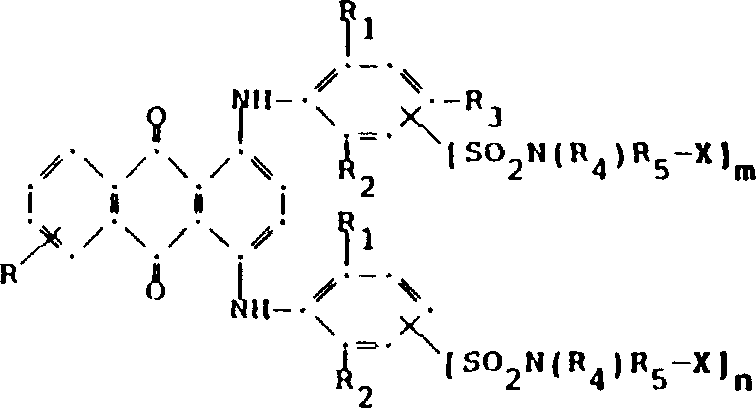
表1(续)Table 1 (continued)
结构式I的蓝色蒽醌化合物实施例序号R R1 R2 R3 R4 R5 x m n71 H C2H5 CH3 H CH2C6H11

表1(续)Table 1 (continued)
结构式I的蓝色葸醌化合物实施例序号 R R1 R2 R3 R4 R5 x m n74 H C2H5 C2H5 H H

表1(续)Table 1 (continued)
结构式I的蓝色蒽醌化合物实施例序号 R R1 R2 R3 R4 R5 x m n79 6(7)COOH CH3 CH3 CH3 H CH2CH2 OH 1 180 6(7)COOH C2H5 CH3 H - - - 0 081 6(7)CO2CH3 CH3 CH3 CH3 - - - 0 082 6(7)CO2CH3 C2H5 C2H5 SO2CH3 - - - 0 083 6(7)CO2CH3 C2H5 CH3 Br - - - 0 084 6(7)CO2H C2H5 C2H5 SCN - - - 0 0Blue anthraquinone compound of structural formula I Example No. R R 1 R 2 R 3 R 4 R 5 x m n79 6(7)COOH CH 3 CH 3 CH 3 H CH 2 CH 2 OH 1 180 6(7)COOH C 2 H 5 CH 3 H - - - 0 081 6(7)CO 2 CH 3 CH 3 CH 3 CH 3 - - - 0 082 6(7)CO 2 CH 3 C 2 H 5 C 2 H 5 SO 2 CH 3 - - - 0 083 6(7)CO 2 CH 3 C 2 H 5 CH 3 Br - - - 0 084 6(7) CO 2 H C 2 H 5 C 2 H 5 SCN - - - 0 0
表1(续)Table 1 (continued)
结构式I的蓝色蒽醌化合物实施例序号 R R1 R2 R3 R4 R5 x m n85 6(7)CO2C2H5 CH3 CH3 SCH3 - - - 0 086 6(7)CO2CH3 CH3 CH3 OH - - - 0 087 6(7)CO2CH3 CH3 CH3 OCH3 - - - 0 088 6(7)CO2CH3 CH3 CH3 OCH2C6H5 - - - 0 089 6(7)CO2CH3 CH3 CH3 OC6H5 - - - 0 090 6(7)CO2CH3 CH3 CH3 SC6H5 - - - 0 0Blue anthraquinone compound of structural formula I Example number R R 1 R 2 R 3 R 4 R 5 x m n85 6(7)CO 2 C 2 H 5 CH 3 CH 3 SCH 3 - - - 0 086 6(7)CO 2 CH 3 CH 3 CH 3 OH - - - 0 087 6(7)CO 2 CH 3 CH 3 CH 3 OCH 3 - - - 0 088 6(7)CO 2 CH 3 CH 3 CH 3 OCH 2 C 6 H 5 - - - 0 089 6(7) CO 2 CH 3 CH 3 CH 3 OC 6 H 5 - - - 0 090 6(7) CO 2 CH 3 CH 3 CH 3 SC 6 H 5 - - - 0 0
表1(续)Table 1 (continued)
结构式I的蓝色蒽醌化合物实施例序号 R R1 R2 R3 R4 R5 x m n91 6(7)CO2CH3 CH3 CH3 SO2C6H4-4-CH3 - - - 0 092 6(7)CO2H CH3 CH3 OCH2CO2C2H5 - - - 0 0- 表示无取代基。Blue anthraquinone compound of structural formula I Example number R R 1 R 2 R 3 R 4 R 5 x m n91 6(7)CO 2 CH 3 CH 3 CH 3 SO 2 C 6 H 4 -4 -CH 3 - - - 0 092 6(7)CO 2 H CH 3 CH 3 OCH 2 CO 2 C 2 H 5 - - - 0 0- represents no substituent.
表2 Table 2
结构式II的红色蒽醌化合物
表2(续)Table 2 (continued)
结构式II的红色蒽醌化合物
表2(续)Table 2 (continued)
结构式II的红色蒽醌化合物
表2(续)Table 2 (continued)
结构式II的红色蒽醌化合物
表2(续)Table 2 (continued)
结构式II的红色蒽醌化合物
表3 table 3
结构式III的红色蒽醌化合物
表3(续)Table 3 (continued)
结构式III的红色蒽醌化合物
表3(续)Table 3 (continued)
结构式III的红色蒽醌化合物
表3(续)Table 3 (continued)
结构式III的红色蒽醌化合物
表3(续)Table 3 (continued)
结构式III的红色蒽醌化合物实施例 -NH-在环A上的位置 x序号148 5(8) COCH2CH2Cl149 5 OCON(CH3)2150 5 CO2(CH2)4OH151 5 CO2CH2C6H11152 8 OCO2C6H5 Red anthraquinone compound of structural formula III Example -NH-position on ring A x number 148 5(8) COCH 2 CH 2 Cl149 5 OCON(CH 3 ) 2 150 5 CO 2 (CH 2 ) 4 OH151 5 CO 2 CH 2 C 6 H 11 152 8 OCO 2 C 6 H 5
表4 Table 4
结构式IV的红色蒽醌化合物
表4(续)Table 4 (continued)
结构式IV的红色蒽醌化合物实施例 -NH-在环A上的位置 -CO2R6在环序号 C和D上的位置 R6 P160 5 2 CH3 1161 5 4 CH2CH3 1162 5 4 CH2CH2OH 1163 5(8) 4 (CH2CH2O)3H 1164 5 3 C6H5 1165 5 4 C6H11 1Red anthraquinone compound of structural formula IV Example -NH-Position on ring A -Position of CO 2 R 6 on ring numbers C and D R 6 P160 5 2 CH 3 1161 5 4 CH 2 CH 3 1162 5 4 CH 2 CH 2 OH 1163 5( 8) 4 (CH 2 CH 2 O) 3 H 1164 5 3 C 6 H 5 1165 5 4 C 6 H 11 1
表4(续)Table 4 (continued)
结构式IV的红色蒽醌化合物
表5 table 5
结构式V的红色蒽醌化合物实施例 -NH-在环 -CO2R6在环序号 A上的位置 C和D上的位置 R4 R5 R7 x168 5 5 H -CH2CH2CH2- 2-OCH3 OH169 5 5 CH3 -CH2CH2- 2-SCH3 OH170 8 5 H -CH2CH2- 2-Cl OH171 5(8) 5 CH2CH3 -(CH2)3 2-Br OCOCH3172 5 5 C6H5 -CH2CH2- 2-OC4H9-n OH173 5 5 C6H5 -CH2C6H4- 2-OCH3 CO2CH3 Red anthraquinone compound of structural formula V Example -NH-in the ring -CO 2 R 6 in ring number A Positions C and D positions R 4 R 5 R 7 x168 5 5 H -CH 2 CH 2 CH 2 - 2-OCH 3 OH169 5 5 CH 3 -CH 2 CH 2 - 2-SCH 3 OH170 8 5 H -CH 2 CH 2 - 2-Cl OH171 5(8) 5 CH 2 CH 3 -(CH 2 ) 3 2-Br OCOCH 3 172 5 5 C 6 H 5 -CH 2 CH 2 - 2-OC 4 H 9 -n OH173 5 5 C 6 H 5 -CH 2 C 6 H 4 - 2-OCH 3 CO 2 CH 3
表5(续)Table 5 (continued)
结构式V的红色蒽醌化合物实施例 -NH-存环 -CO2R6在序号 A上的位置环 C和D上的位置 R4 R5 R7 x174 5 5 C6H11 -(CH2)4- 2-OC2H5 OH175 5 5 CH2CH2OH CH2CH2- 2-OCH3 OH176 5 5 CH2CH=CH2 -CH2CH2- 2-SC4H9-n OH177 5 5 CH2C≡CH 1,4-C6H4- 2-OCH3 CO2CH3178 5 3(5) H -CH2CH2- 2,6-di-CH3 OH179 5 2(3) H 1,4-C6H4- 4-CH3 OHRed anthraquinone compound of structural formula V Example -NH-Storage ring -CO 2 R 6 position on serial number A position on ring C and D position R 4 R 5 R 7 x174 5 5 C 6 H 11 -(CH 2 ) 4 - 2-OC 2 H 5 OH175 5 5 CH 2 CH 2 OH CH 2 CH 2 - 2-OCH 3 OH176 5 5 CH 2 CH=CH 2 -CH 2 CH 2 - 2-SC 4 H 9 -n OH177 5 5 CH 2 C≡CH 1 , 4-C 6 H 4 - 2-OCH 3 CO 2 CH 3 178 5 3(5) H -CH 2 CH 2 - 2,6-di-CH 3 OH179 5 2(3) H 1,4-C 6 H 4 - 4-CH 3 OH
表5(续)Table 5 (continued)
结构式V的红色蒽醌化合物
表5(续)Table 5 (continued)
结构式V的红色蒽醌化合物实施例 -NH-在环 -CO2R6在环序号 A上的位置 C和D上的位置 R4 R5 R7 x186 5 5 H -CH2C6H4-4-CH2- 2-OCH3 OH187 5 5 H -CH2CH2SCH2CH2- 2-OCH3 OH188 5 5 H -CH2CH2SO2-4-C6H4- 2-OCH3 CO2CH3189 5 5 C6H4-4-CO2H -CH2CH2- 2-OCH3 CO2H190 5 5 C4H9-n -CH2C(CH3)2CH2- SC4H9-n OH191 5 5 H

表5(续)Table 5 (continued)
结构式V的红色蒽醌化合物实施例 -NH-在环 -CO2R6在环序号 A上的位置 C和D上的位置 R4 R5 R7 x192 5 3(5) C3H5


表5(续)Table 5 (continued)
结构式V的红色蒽醌化合物实施例 -NH-在环 -CO2R6在环序号 A上的位置 C和D上的位置 R4 R5 R7 x196 5 5 H -CH2CH2 2-OCH(CH3)2 NHCH3197 5 2(3) H -CH2CH(OH)CH2- 4-C(CH3)3 OH198 5 2(3) H -CH2C(CH3)CH2- 4-C6H13-n OH199 5 5 CH2CH2OCOCH3 -CH2CH2- 2-OCH3 OCOCH3200 5 5 CH2CH2OCO2CH3 -CH2CH2- 2-OCH3 OCO2CH3201 5 5 CH3 2-OCH2CH3 CO2C2H5 Red anthraquinone compound of structural formula V Example -NH-in the ring -CO 2 R 6 in ring number A Positions C and D positions R 4 R 5 R 7 x196 5 5 H -CH 2 CH 2 2-OCH(CH 3 ) 2 NHCH 3 197 5 2(3) H -CH 2 CH(OH)CH 2 - 4-C(CH 3 ) 3 OH198 5 2(3) H -CH 2 C(CH 3 )CH 2 - 4-C 6 H 13 - n OH199 5 5 CH 2 CH 2 OCOCH 3 -CH 2 CH 2 - 2-OCH 3 OCOCH 3 200 5 5 CH 2 CH 2 OCO 2 CH 3 -CH 2 CH 2 - 2-OCH 3 OCO 2 CH 3 201 5 5 CH3 2 - OCH2CH3CO2C2H5 _ _
表6Table 6
结构式VI的红色蒽醌化合物实施例 -NH-在环A上的位置 R8 R9 x序号202 1,5 CH3 CH3 OH203 1,8 CH3 CH3 OH204 1,5(8) CH3 CH3 OCOCH3205 1,5 CH3 CH2CH(CH3)2 OH206 1,5 CH3 C6H11 OCOC2H5 Red anthraquinone compound of structural formula VI Example -NH-position on Ring A R 8 R 9 x No. 202 1,5 CH 3 CH 3 OH203 1,8 CH 3 CH 3 OH204 1,5(8) CH 3 CH 3 OCOCH 3 205 1,5 CH 3 CH 2 CH(CH 3 ) 2 OH2O6 1,5 CH 3 C 6 H 11 OCOC 2 H 5
表6(续)Table 6 (continued)
结构式VI的红色蒽醌化合物实施例 -NH-在环A上的位置 R8 R9 x序号207 1,5 C6H5 C6H5 OCONHC6H5208 1,8 C6H5 CH2C6H5 OCO2C2H5209 1,8 C2H5 CH3 NH2210 1,5 CH3 C6H5 NHCH3211 1,5 CH3 C5H9 NHC2H5 Red anthraquinone compound of structural formula VI Example -NH-Position on Ring A R 8 R 9 x No. 207 1,5 C 6 H 5 C 6 H 5 OCONHC 6 H 5 208 1,8 C 6 H 5 CH 2 C 6 H 5 OCO 2 C 2 H 5 209 1,8 C 2 H 5 CH 3 NH 2 210 1,5 CH 3 C 6 H 5 NHCH 3 211 1,5 CH 3 C 5 H 9 NHC 2 H 5
表6(续)Table 6 (continued)
结构式VI的红色蒽醌化合物
表6(续)Table 6 (continued)
结构式VI的红色葸醌化合物
表6(续)Table 6 (continued)
结构式VI的红色蒽醌化合物实施例 -NH-在环A上的位置 R8 R9 x序号222 1,5 CH3 CH3 OCO2C6H5223 1,5 CH3 CH3 OCOCH2OH224 1,5 CH2C6H5 CH2C6H5 OHRed anthraquinone compound of structural formula VI Example - NH - position on ring A R 8 R 9 x number 222 1,5 CH 3 CH 3 OCO 2 C 6 H 5 223 1,5 CH 3 CH 3 OCOCH 2 OH224 1,5 CH 2 C 6 H 5 CH 2 C 6 H 5 OH
表7Table 7
结构式VII的红色蒽并吡啶酮化合物实施例序号 R10 R11 R12225 CH3 CH3 H226 CH2CH3 CH3 4-CH3227 CH2CH3 CH2CH(C2H5)C4H9-n H228 CH3 C4H9-n 4-Cl229 CH2CH3 C12H25 4-CH3 Red anthrapyridone compound of structural formula VII Example No. R 10 R 11 R 12 225 CH 3 CH 3 H226 CH 2 CH 3 CH 3 4-CH 3 227 CH 2 CH 3 CH 2 CH(C 2 H 5 )C 4 H 9 -n H228 CH 3 C 4 H 9 -n 4-Cl229 CH 2 CH 3 C 12 H 25 4-CH 3
表7(续)Table 7 (continued)
结构式VII的红色蒽并吡啶酮化合物
表7(续)Table 7 (continued)
结构式VII的红色蒽并吡啶酮化合物实施例序号 R10 R11 R12236 CH2CH3 CH2C(CH3)2CH2OH 4-OC2H4OH237 CH2CH3 C6H5 4-SC2H4OH238 CH2CH3 CH2C6H5 4-NHCOCH3239 CH2CH3 CH2CH2C6H5 4-NHCOC2H5240 CH2CH3 CH2CH2OC6H5 3-NHCOCH3 Red anthrapyridone compound of structural formula VII Example No. R 10 R 11 R 12 236 CH 2 CH 3 CH 2 C(CH 3 ) 2 CH 2 OH 4-OC 2 H 4 OH237 CH 2 CH 3 C 6 H 5 4-SC 2 H 4 OH238 CH 2 CH 3 CH 2 C 6 H 5 4-NHCOCH 3 239 CH 2 CH 3 CH 2 CH 2 C 6 H 5 4-NHCOC 2 H 5 240 CH 2 CH 3 CH 2 CH 2 OC 6 H 5 3-NHCOCH 3
表7(续)Table 7 (continued)
结构式VII的红色蒽并吡啶酮化合物实施例序号 R10 R11 R12241 CH2CH3 CH2CH 2CN 3-NHCOC6H5242 CH2CH3 CH2CH2OCO2C2H5 3-NHCOC6H4-4-OCH3243 CH2CH3 CH2C(CH3)2CH2OH 4-SC6H5244 CH2CH3 CH2C(CH3)2CH2OH 4-SC4H9-n245 CH2CH3 CH2C(CH3)2CH2OH 4-NHSO2CH3 Red anthrapyridone compound of structural formula VII Example number R 10 R 11 R 12 241 CH 2 CH 3 CH 2 CH 2 CN 3-NHCOC 6 H 5 242 CH 2 CH 3 CH 2 CH 2 OCO 2 C 2 H 5 3-NHCOC 6 H 4 -4-OCH 3 243 CH 2 CH 3 CH 2 C(CH 3 ) 2 CH 2 OH 4-SC 6 H 5 244 CH 2 CH 3 CH 2 C(CH 3 ) 2 CH 2 OH 4-SC 4 H 9 -n245 CH 2 CH 3 CH 2 C(CH 3 ) 2 CH 2 OH 4-NHSO 2 CH 3
表7(续)Table 7 (continued)
结构式VII的红色蒽并吡啶酮化合物实施例序号 R10 R11 R12246 CH2CH3 CH2C(CH3)2CH2OH 4-NHSO2C6H5247 C6H5 CH3 4-NHSO2C6H4-4-CH3248 C6H11 CH2CH(OH)CH2OH 4-NHSO2C6H4-4-OCH3249 C5H9 (CH2)4OH 4-NHSO2C2H5250 C4H7 CH2C6H10-4-CH2OH 4-NHCOCH2C6H5 Red anthrapyridone compound of structural formula VII Example number R 10 R 11 R 12 246 CH 2 CH 3 CH 2 C(CH 3 ) 2 CH 2 OH 4-NHSO 2 C 6 H 5 247 C 6 H 5 CH 3 4-NHSO 2 C 6 H 4 -4 -CH 3 248 C 6 H 11 CH 2 CH(OH)CH 2 OH 4-NHSO 2 C 6 H 4 -4-OCH 3 249 C 5 H 9 (CH 2 ) 4 OH 4-NHSO 2 C 2 H 5 250 C 4 H 7 CH 2 C 6 H 10 -4-CH 2 OH 4-NHCOCH 2 C 6 H 5
表7(续)Table 7 (continued)
结构式VII的红色蒽并吡啶酮化合物
表8Table 8
结构式VIII的红色蒽并吡啶酮化合物实施例序号 L R4 R5 R7 R11 R13 x m254 3-SO2- H -CH2CH2- H CH3 H OH 1255 3-SO2- -CH2CH2OH -CH2CH2- H CH3 H OH 1256 5-SO2- -CH3 -CH2CH2- 2-OCH3 CH3 H OCOCH3 1257 5-SO2- -CH2CH2OH -CH2CH2- 2-CH3 CH3 H OH 1258 5-SO2- -CH2CH3 -CH2CH2- 2-OC2H5 C4H9-n H OH 1Red anthrapyridone compound of structural formula VIII Example No. L R 4 R 5 R 7 R 11 R 13 x m254 3-SO 2 - H -CH 2 CH 2 - H CH 3 H OH 1255 3-SO 2 - -CH 2 CH 2 OH -CH 2 CH 2 - H CH 3 H OH 1256 5-SO 2 - -CH 3 -CH 2 CH 2 - 2-OCH 3 CH 3 H OCOCH 3 1257 5-SO 2 - -CH 2 CH 2 OH -CH 2 CH 2 - 2-CH 3 CH 3 H OH 1258 5-SO 2 - -CH 2 CH 3 -CH 2 CH 2 - 2-OC 2 H 5 C 4 H 9 -n H OH 1
表8(续)Table 8 (continued)
结构式VIII的红色蒽并吡啶酮化合物
表8(续)Table 8 (continued)
结构式VIII的红色蒽并吡啶酮化合物实施例序号 L R4 R5 R7 R11 R13 x m264 3-CO- H -CH2- H CH3 CO2C2H5 CO2C2H5 1265 3-CO- CH3 -CH2CH2- H CH2CH2C6H5 CN OH 1266 3-SO2- H -CH2CH2- H CH2C6H5 CN OH 1267 3-SO2- C2H5 -CH2CH2- H CH3 CN OH 1268 3-CO- H -1,2-C6H4- H CH3 CN CO2CH3 1Red anthrapyridone compound of structural formula VIII Example number L R 4 R 5 R 7 R 11 R 13 x m264 3-CO- H -CH 2 - H CH 3 CO 2 C 2 H 5 CO 2 C 2 H 5 1265 3-CO- CH 3 -CH 2 CH 2 - H CH 2 CH 2 C 6 H 5 CN OH 1266 3-SO 2 -H -CH 2 CH 2 -H CH 2 C 6 H 5 CN OH 1267 3-SO 2 -C 2 H 5 -CH 2 CH 2 -H CH 3 CN OH 1268 3-CO-H-1,2-C 6 H 4 -H CH 3 CN CO 2 CH 3 1
表8(续)Table 8 (continued)
结构式VIII的红色蒽并吡啶酮化合物实施例序号 L R4 R5 R7 R11 R13 x m269 4-SO2- H -1,3-C6H4- H CH2CH2OCOCH3 CN CO2CH3 1270 4-CO- H -1,4-C6H4- H C6H11 CN CO2CH3 1271 4-CO- H -1,3-C6H4- H C6H5 CN CO2CH3 1272 4-CO- H -CH2CH2OCH2CH2- H CH2C(CH3)2CH2OH CN OH 1273 3-SO2- H -CH2-1,4-C6H4- H CH3 CN CO2CH3 1Red anthrapyridone compound of structural formula VIII Example No. L R 4 R 5 R 7 R 11 R 13 x m269 4-SO 2 -H -1, 3-C 6 H 4 -H CH 2 CH 2 OCOCH 3 CN CO 2 CH 3 1270 4-CO-H - 1,4 - C6H4 - HC6H11CNCO2CH31271 4 - CO - H - 1,3- C6H4 - HC6H5CNCO2CH312724 - CO - H- CH 2 CH 2 OCH 2 CH 2 -H CH 2 C(CH 3 ) 2 CH 2 OH CN OH 1273 3-SO 2 -H -CH 2 -1,4-C 6 H 4 -H CH 3 CN CO 2 CH 3 1
表8(续)Table 8 (continued)
结构式VIII的红色蒽并吡啶酮化合物
表9Table 9
结构式IX的红色蒽并吡啶酮化合物实施例 -CO2R6在序号 环A上的位置 R6 R11 R14 P277 3 CH3 CH3 H 1278 4 CH2CH3 CH2CH3 H 1279 2 H C4H9-n H 1280 3,5-di CH3 C12H25-n H 2281 3 CH2CH2OH CH2CH(C2H5)C4H9-n H 1Red anthrapyridone compound of structural formula IX Example - CO 2 R 6 Position on Ring A R 6 R 11 R 14 P277 3 CH 3 CH 3 H 1278 4 CH 2 CH 3 CH 2 CH 3 H 1279 2 H C 4 H 9 -n H 1280 3, 5-di CH 3 C 12 H 25 -n H 2281 3 CH 2 CH 2 OH CH 2 CH(C 2 H 5 )C 4 H 9 -n H 1
表9(续)Table 9 (continued)
结构式IX的红色蒽并吡啶酮化合物
表9(续)Table 9 (continued)
结构式IX的红色蒽并吡啶酮化合物
表9(续)Table 9 (continued)
结构式IX的红色蒽并吡啶酮化合物实施例序号 -CO2R6在环A上的位置 R6 R11 R14 P292 3 CH2CH2SCH2CH2OH CH3 CN 1293 3 CH2CH2OCOCH3 CH3 CN 1294 3 CH2CH(OCOCH3)CH2OCOCH3 CH3 CN 1295 3 C2H5 CH2C(CH3)2CH2OH CN 1296 4 CH3 CH2C(CH3)2OCOCH3 CN 1Red anthrapyridone compound of structural formula IX Example No. -Position of CO 2 R 6 on Ring A R 6 R 11 R 14 P292 3 CH 2 CH 2 SCH 2 CH 2 OH CH 3 CN 1293 3 CH 2 CH 2 OCOCH 3 CH 3 CN 1294 3 CH 2 CH (OCOCH 3 )CH 2 OCOCH 3 CH 3 CN 1295 3 C 2 H 5 CH 2 C(CH 3 ) 2 CH 2 OH CN 1296 4 CH 3 CH 2 C(CH 3 ) 2 OCOCH 3 CN 1
表9(续)Table 9 (continued)
结构式IX的红色蒽并吡啶酮化合物
表10Table 10
结构式X的红色蒽并吡啶酮化合物实施例 -NH-在邻苯二甲酰序号 亚胺环上的位置 R11 R14 R15300 4 CH3 H CH2CH2OH301 4 CH3 CO2C2H5 CH2CH2OH302 4 CH3 CO2CH3 CH2CH(OH)CH2OH303 3 CH3 CO2C2H5 (CH2)4OH304 3 CH2CH2OH H CH2C6H4-4-CO2CH3 Red anthracenopyridone compound of structural formula X Example -NH- on the position of phthaloyl imine ring R 11 R 14 R 15 300 4 CH 3 H CH 2 CH 2 OH301 4 CH 3 CO 2 C 2 H 5 CH 2 CH 2 OH302 4 CH 3 CO 2 CH 3 CH 2 CH(OH)CH 2 OH303 3 CH 3 CO 2 C 2 H 5 (CH 2 ) 4 OH304 3 CH 2 CH 2 OH H CH 2 C 6 H 4 -4-CO 2 CH 3
表10(续)Table 10 (continued)
结构式X的红色蒽并吡啶酮化合物实施例 -NH-在邻苯二甲序号 酰亚胺环上的位置 R11 R14 R15305 4 CH2C(CH3)2CH2OH CN H306 4 CH2CH2OCOCH3 CN C2H5307 4 C6H11 CN CH2CH2OCOCH3308 3 CH2CH2C6H5 CN CH2CH2OCOC2H5309 3 C12H25 CN CH2CH2OCOC6H5 Red anthracenopyridone compound of structural formula X Example -NH- in Phthalo No. Position on imide ring R 11 R 14 R 15 305 4 CH 2 C(CH 3 ) 2 CH 2 OH CN H306 4 CH 2 CH 2 OCOCH 3 CN C 2 H 5 307 4 C 6 H 11 CN CH 2 CH 2 OCOCH 3 308 3 CH 2 CH 2 C 6 H 5 CN CH 2 CH 2 OCOC 2 H 5 309 3 C 12 H 25 CN CH 2 CH 2 OCOC 6 H 5
表10(续)Table 10 (continued)
结构式X的红色蒽并吡啶酮化合物
表10(续)Table 10 (continued)
结构式X的红色蒽并吡啶酮化合物
表10(续)Table 10 (continued)
结构式X的红色蒽并吡啶酮化合物实施例 -NH-在邻苯二甲序号 酰亚胺环上的位置 R11 R14 R15320 4 CH3 CN CH2CH2OC6H4-3-COOH321 4 CH3 CN C6H4-2-CO2CH3322 4 CH3 CN C6H4-3-CO2CH3 Red anthracenopyridone compound of structural formula X Example -NH- on the position of phthalic imide ring R 11 R 14 R 15 320 4 CH 3 CN CH 2 CH 2 OC 6 H 4 -3-COOH321 4 CH 3 CN C 6 H 4 - 2-CO 2 CH 3 322 4 CH 3 CN C 6 H 4 -3-CO 2 CH 3
表11Table 11
含调色剂的聚酯组合物实施例序号 蓝色化合物 红色化合物 IV Rd 颜色Example No. of Polyester Compositions Containing Toner Blue Compound Red Compound IV Rd Color
a b对比实施例1 无 无 0.74 51.9 -2.29 3.18
323 实施例1(3.0ppm) 实施例10(1.68ppm) 0.75 48.3 -0.94 -0.03323 Example 1 (3.0ppm) Example 10 (1.68ppm) 0.75 48.3 -0.94 -0.03
324 实施例1(3.0ppm) 表2的实施例93 0.72 47.6 -0.42 -0.58324 Example 1 (3.0ppm) Example 93 of Table 2 0.72 47.6 -0.42 -0.58
(1.5ppm)(1.5ppm)
325 实施例1(3.0ppm) 实施例12(2.0ppm) 0.74 46.3 -0.99 -0.39325 Example 1 (3.0ppm) Example 12 (2.0ppm) 0.74 46.3 -0.99 -0.39
326 实施例1(3.3ppm) 实施例12(2.2ppm) 0.74 44.2 -0.97 -0.08326 Example 1 (3.3ppm) Example 12 (2.2ppm) 0.74 44.2 -0.97 -0.08
327 实施例1(1.3ppm) 实施例13(2.0ppm) 0.75 48.3 -1.31 -0.31327 Example 1 (1.3ppm) Example 13 (2.0ppm) 0.75 48.3 -1.31 -0.31
328 实施例1(1.5ppm) 实施例14(2.5ppm) 0.76 43.7 -0.92 -0.90328 Example 1 (1.5ppm) Example 14 (2.5ppm) 0.76 43.7 -0.92 -0.90
329 实施例1(3.0ppm) 实施例14(5.0ppm) 0.75 40.3 -0.33 -3.67329 Example 1 (3.0ppm) Example 14 (5.0ppm) 0.75 40.3 -0.33 -3.67
330 实施例1(1.125ppm) 实施例16(2.25ppm) 0.71 44.6 -1.34 -0.58330 Example 1 (1.125ppm) Example 16 (2.25ppm) 0.71 44.6 -1.34 -0.58
331 实施例1(1.5ppm) 实施例15(3.0ppm) 0.76 46.7 -0.71 -0.42331 Example 1 (1.5ppm) Example 15 (3.0ppm) 0.76 46.7 -0.71 -0.42
表11(续)Table 11 (continued)
含调色剂的聚酯组合物实施例序号 蓝色化合物 红色化合物 IV Rd 颜色Example No. of Polyester Compositions Containing Toner Blue Compound Red Compound IV Rd Color
a b对比实施例1 无 无 0.74 51.9 -2.29 3.18
332 实施例1(1.0ppm) 实施例17(3.0ppm) 0.75 49.1 -0.93 -1.29332 Example 1 (1.0ppm) Example 17 (3.0ppm) 0.75 49.1 -0.93 -1.29
333 实施例1(0.83ppm) 实施例17(2.5ppm) 0.72 43.5 -1.37 -0.38333 Example 1 (0.83ppm) Example 17 (2.5ppm) 0.72 43.5 -1.37 -0.38
314 实施例1(1.67ppm) 实施例15(2.5ppm) 0.73 44.4 -0.70 -0.11314 Example 1 (1.67ppm) Example 15 (2.5ppm) 0.73 44.4 -0.70 -0.11
335 实施例1(1.41ppm) 实施例16(2.81ppm) 0.75 46.8 -1.19 0.13335 Example 1 (1.41ppm) Example 16 (2.81ppm) 0.75 46.8 -1.19 0.13
336 实施例1(1.3ppm) 实施例13(2.0ppm) 0.66 45.2 -1.47 -0.49336 Example 1 (1.3ppm) Example 13 (2.0ppm) 0.66 45.2 -1.47 -0.49
337 实施例1(2.0ppm) 实施例18(2.5ppm) 0.71 46.9 -0.87 -0.42337 Example 1 (2.0ppm) Example 18 (2.5ppm) 0.71 46.9 -0.87 -0.42
338 实施例1(3.31ppm) 实施例10(1.87ppm) 0.67 46.8 -0.87 -0.99338 Example 1 (3.31ppm) Example 10 (1.87ppm) 0.67 46.8 -0.87 -0.99
表11(续)Table 11 (continued)
含调色剂的聚酯组合物实施例序号 蓝色化合物 红色化合物 IV Rd 颜色Example No. of Polyester Compositions Containing Toner Blue Compound Red Compound IV Rd Color
a b对比实施例1 无 无 0.74 51.9 -2.29 3.18
339 实施例5(3.5ppm) 表2的实施例93 0.70 40.6 -1.01 -2.00339 Example 5 (3.5ppm) Example 93 of Table 2 0.70 40.6 -1.01 -2.00
(1.0ppm)(1.0ppm)
340 实施例1(3.44ppm) 表6的实施例202 0.72 48.3 -1.19 0.50340 Example 1 (3.44ppm) Example 202 of Table 6 0.72 48.3 -1.19 0.50
(1.25ppm)(1.25ppm)
341 实施例1(3.44ppm) 表8的实施例260 0.73 49.4 -2.19 1.49341 Example 1 (3.44ppm) Example 260 of Table 8 0.73 49.4 -2.19 1.49
(1.25ppm)(1.25ppm)
342 实施例1(3.44ppm) 表3的实施例123 0.75 48.0 -1.66 1.10342 Example 1 (3.44ppm) Example 123 of Table 3 0.75 48.0 -1.66 1.10
(1.25ppm)(1.25ppm)
343 实施例9(4.125) 实施例21(1.75ppm) 0.70 49.3 -1.04 -0.91343 Example 9 (4.125) Example 21 (1.75ppm) 0.70 49.3 -1.04 -0.91
表12Table 12
聚(对苯二甲酸乙二醇酯)组合物实施例序号 蓝色化合物 红色化合物 IV L* a* b* Poly(ethylene terephthalate) composition example serial number blue compound red compound IV L * a * b *
344 实施例1(3.3ppm) 实施例1O(1.86ppm) 0.65 84.8 -0.72 -0.14344 Example 1 (3.3ppm) Example 10 (1.86ppm) 0.65 84.8 -0.72 -0.14
345 实施例8(4.0ppm) 实施例11(2.0ppm) 0.61 83.4 -0.28 -1.00345 Example 8 (4.0ppm) Example 11 (2.0ppm) 0.61 83.4 -0.28 -1.00
346 实施例9(4.5ppm) 实施例21(2.0ppm) 0.58 83.8 -0.60 -1.45346 Example 9 (4.5ppm) Example 21 (2.0ppm) 0.58 83.8 -0.60 -1.45
Claims (12)








Applications Claiming Priority (3)
| Application Number | Priority Date | Filing Date | Title |
|---|---|---|---|
| US08/116,419 US5372864A (en) | 1993-09-03 | 1993-09-03 | Toners for polyesters |
| US08/116,419 | 1993-09-03 | ||
| US08/116419 | 1993-09-03 |
Publications (2)
| Publication Number | Publication Date |
|---|---|
| CN1133602A true CN1133602A (en) | 1996-10-16 |
| CN1052738C CN1052738C (en) | 2000-05-24 |
Family
ID=22367085
Family Applications (1)
| Application Number | Title | Priority Date | Filing Date |
|---|---|---|---|
| CN94193892A Expired - Fee Related CN1052738C (en) | 1993-09-03 | 1994-08-17 | Toners for polyesters |
Country Status (19)
| Country | Link |
|---|---|
| US (2) | US5372864A (en) |
| EP (1) | EP0716666B1 (en) |
| JP (1) | JP3055698B2 (en) |
| KR (1) | KR100335545B1 (en) |
| CN (1) | CN1052738C (en) |
| AT (1) | ATE166081T1 (en) |
| AU (1) | AU680292B2 (en) |
| BR (1) | BR9407453A (en) |
| CA (1) | CA2170145C (en) |
| CO (1) | CO4410419A1 (en) |
| CZ (1) | CZ61396A3 (en) |
| DE (1) | DE69410277T2 (en) |
| ES (1) | ES2115971T3 (en) |
| HU (1) | HU214928B (en) |
| MY (1) | MY111530A (en) |
| NZ (1) | NZ273139A (en) |
| PL (1) | PL309635A1 (en) |
| RU (1) | RU2142477C1 (en) |
| WO (1) | WO1995006677A1 (en) |
Families Citing this family (152)
| Publication number | Priority date | Publication date | Assignee | Title |
|---|---|---|---|---|
| US6495656B1 (en) | 1990-11-30 | 2002-12-17 | Eastman Chemical Company | Copolyesters and fibrous materials formed therefrom |
| WO1997018253A1 (en) * | 1995-11-13 | 1997-05-22 | Eastman Chemical Company | Thermally stable polyesters formed utilizing antimony compounds as catalysts |
| US5608031A (en) * | 1995-11-30 | 1997-03-04 | Eastman Chemical Company | Polyesters modified with 1,4-cyclohexaned imethanol having high clarity prepared utilizing an antimony containing catalyst/stabilizer system |
| KR100472917B1 (en) * | 1996-09-11 | 2005-03-07 | 니폰 가야꾸 가부시끼가이샤 | Anthrapyridone compounds, water-base ink composition, and articles colored therewith |
| US5962557A (en) * | 1996-09-30 | 1999-10-05 | Eastman Chemical Corporation | Polyesters containing copolymerized substituted 1,4-bis(2,6-dialkylanilino)-9, 10-anthraquinones as colorants |
| CN1245516A (en) | 1996-11-27 | 2000-02-23 | 伊斯曼化学公司 | Process for preparing light-absorbing polymer compositions |
| US5859116A (en) * | 1997-01-21 | 1999-01-12 | Eastman Chemical Company | Clarity and adjustable shrinkage of shrink films using miscible polyester blends |
| US5688899A (en) * | 1997-01-21 | 1997-11-18 | Eastman Chemical Company | Clarity copolyester |
| US5716769A (en) * | 1997-03-07 | 1998-02-10 | Eastman Kodak Company | Elements containing blue tinted hydrophilic colloid layers |
| US6270945B1 (en) * | 1997-03-19 | 2001-08-07 | Kodak Polychrome Graphics, Llc | Photosensitive compositions and elements comprising dyed photosensitive polyesters |
| US5851243A (en) * | 1997-04-30 | 1998-12-22 | Eastman Kodak Company | Radiographic elements capable of rapid access processing modified to reduce red light transmission |
| US5744294A (en) * | 1997-04-30 | 1998-04-28 | Eastman Kodak Company | Radiographic element modified to provide protection from visual fatigue |
| EP0883032B1 (en) * | 1997-06-05 | 2001-12-05 | Dainichiseika Color & Chemicals Mfg. Co. Ltd. | Production process of colored fine particulate composition and colored fine particulate composition produced by the process |
| EP1015674B1 (en) | 1997-08-28 | 2006-10-18 | Eastman Chemical Company | Improved copolymer binder fibers |
| US6231976B1 (en) | 1997-08-28 | 2001-05-15 | Eastman Chemical Company | Copolyester binder fibers |
| JP2001522947A (en) * | 1997-11-06 | 2001-11-20 | イーストマン ケミカル カンパニー | Copolyester binder fiber |
| CA2325484C (en) * | 1998-03-25 | 2009-09-15 | Nippon Kayaku Kabushiki Kaisha | Novel anthrapyridone compounds, water-based magenta ink composition and method of ink-jet recording |
| CN1377380A (en) | 1999-08-06 | 2002-10-30 | 伊斯曼化学公司 | Polyesters having a controlled melting point and fibers formed therefrom |
| US6362306B1 (en) * | 1999-08-17 | 2002-03-26 | Eastman Chemical Company | Reactor grade copolyesters for shrink film applications |
| DE69912649T2 (en) * | 1999-08-24 | 2004-09-30 | Eastman Chemical Co., Kingsport | METHOD FOR PRODUCING POLYESTERS WITH ACID PHOSPHORUS COMPOUNDS |
| US6384180B1 (en) | 1999-08-24 | 2002-05-07 | Eastman Chemical Company | Method for making polyesters employing acidic phosphorus-containing compounds |
| WO2001014452A1 (en) * | 1999-08-24 | 2001-03-01 | Eastman Chemical Company | Preparation of polyesters employing antimony catalysts and acidic phosphorus compounds |
| WO2002012401A2 (en) * | 2000-08-07 | 2002-02-14 | Eastman Chemical Company | Thermally stable, anthraquinone colorants containing copolymerizable vinyl groups |
| WO2002012400A2 (en) | 2000-08-07 | 2002-02-14 | Eastman Chemical Company | Thermally stable, anthraquinone colorants containing copolymerizable vinyl groups |
| US6620858B2 (en) | 2000-08-07 | 2003-09-16 | Eastman Chemical Company | Colorants containing copolymerizable vinyl groups and sulfonamide linkages |
| US6727372B2 (en) * | 2000-08-07 | 2004-04-27 | Eastman Chemical Company | Colorant compounds containing copolymerizable vinyl groups |
| US20020082360A1 (en) * | 2000-11-03 | 2002-06-27 | Conn Roy Lee | Films and articles formed from blends of polycarbonate and polyester |
| US6569957B2 (en) | 2000-11-03 | 2003-05-27 | Eastman Chemical Company | Blends of polycarbonate and polyester and sheets and films formed therefrom |
| US7513947B2 (en) * | 2000-11-13 | 2009-04-07 | Ei Du Pont De Nemours And Company | Colored thermoplastic resin compositions for laser welding, specific neutral anthraquinone dyes as colorants therefor, and molded product therefrom |
| US6429278B1 (en) | 2001-01-22 | 2002-08-06 | Eastman Chemical Company | Process for manufacture of polyesters based on 1,4-cyclohexanedimethanol and isophthalic acid |
| US6489433B2 (en) | 2001-02-23 | 2002-12-03 | E. I. Du Pont De Nemours And Company | Metal-containing composition and process therewith |
| US20070032598A1 (en) * | 2001-07-24 | 2007-02-08 | Cyr Michael J | Thermally stable, anthraquinone colorants containing copolymerizable vinyl groups |
| US6713641B2 (en) * | 2001-10-19 | 2004-03-30 | Eastman Chemical Company | Reactive anthraquinone colorant compounds and polymeric materials reacted therewith |
| US6641920B2 (en) | 2002-02-08 | 2003-11-04 | Eastman Chemical Company | Ultraviolet protected multi-layer structures of copolyester/polycarbonate blends |
| US6723768B2 (en) | 2002-03-27 | 2004-04-20 | Eastman Chemical Company | Polyester/polycarbonate blends with reduced yellowness |
| US6835333B2 (en) * | 2002-05-07 | 2004-12-28 | Milliken & Company | Combinations for use as toners in polyesters |
| US6875811B2 (en) | 2002-05-07 | 2005-04-05 | Milliken & Company | Single compound toners for use in polyesters |
| US6914120B2 (en) * | 2002-11-13 | 2005-07-05 | Eastman Chemical Company | Method for making isosorbide containing polyesters |
| CN100339516C (en) * | 2003-03-18 | 2007-09-26 | 西巴特殊化学品控股有限公司 | Colored polymeric articles having high melt temperatures |
| US20050054757A1 (en) * | 2003-09-10 | 2005-03-10 | Pearson Jason Clay | Method for reducing the acetaldehyde level in polyesters |
| US20050065247A1 (en) * | 2003-09-19 | 2005-03-24 | Carico Douglas Weldon | Liquid coating compositions having improved whiteness |
| JP2007512543A (en) | 2003-12-01 | 2007-05-17 | デイド・ベーリング・マルブルク・ゲゼルシヤフト・ミツト・ベシユレンクテル・ハフツング | Homogeneous detection method |
| US7358322B2 (en) * | 2004-03-09 | 2008-04-15 | Eastman Chemical Company | High IV melt phase polyester polymer catalyzed with antimony containing compounds |
| US7368523B2 (en) | 2004-11-12 | 2008-05-06 | Eastman Chemical Company | Polyester polymer and copolymer compositions containing titanium nitride particles |
| US20050267283A1 (en) * | 2004-05-27 | 2005-12-01 | Weaver Max A | Process for adding nitrogen containing methine light absorbers to poly(ethylene terephthalate) |
| US7541407B2 (en) * | 2004-05-27 | 2009-06-02 | Eastman Chemical Company | Process for adding methine UV light absorbers to PET prepared by direct esterification |
| US7622580B2 (en) * | 2004-08-13 | 2009-11-24 | Xerox Corporation | Colorant compounds |
| DK1778791T3 (en) | 2004-08-17 | 2009-01-12 | Invista Tech Sarl | Colored oxygen scavenging polymers |
| US20060047102A1 (en) | 2004-09-02 | 2006-03-02 | Stephen Weinhold | Spheroidal polyester polymer particles |
| US7662880B2 (en) | 2004-09-03 | 2010-02-16 | Eastman Chemical Company | Polyester polymer and copolymer compositions containing metallic nickel particles |
| US20060051542A1 (en) * | 2004-09-03 | 2006-03-09 | Zhiyong Xia | Polyester polymer and copolymer compositions containing metallic molybdenum particles |
| US20060105129A1 (en) * | 2004-11-12 | 2006-05-18 | Zhiyong Xia | Polyester polymer and copolymer compositions containing titanium carbide particles |
| US7300967B2 (en) * | 2004-11-12 | 2007-11-27 | Eastman Chemical Company | Polyester polymer and copolymer compositions containing metallic titanium particles |
| US7262476B2 (en) * | 2004-11-30 | 2007-08-28 | Agere Systems Inc. | Semiconductor device having improved power density |
| US20060122300A1 (en) * | 2004-12-07 | 2006-06-08 | Zhiyong Xia | Polyester polymer and copolymer compositions containing steel particles |
| US20060177614A1 (en) * | 2005-02-09 | 2006-08-10 | Zhiyong Xia | Polyester polymer and copolymer compositions containing metallic tantalum particles |
| US7868128B2 (en) | 2005-06-17 | 2011-01-11 | Eastman Chemical Company | Skylights and windows comprising polyester compositions formed from 2,2,4,4,-tetramethyl-1,3-cyclobutanediol and 1,4-cyclohexanedimethanol |
| US20060222795A1 (en) * | 2005-03-31 | 2006-10-05 | Howell Earl E Jr | Polyester polymer and copolymer compositions containing particles of one or more transition metal compounds |
| CN1313512C (en) * | 2005-05-17 | 2007-05-02 | 薛纪良 | Process of preparing polyester slices for high transparent energy saving film |
| US20060270773A1 (en) * | 2005-05-26 | 2006-11-30 | Hale Wesley R | Polyester-polycarbonate blends for diffuser sheets with improved luminance |
| US20060270806A1 (en) * | 2005-05-26 | 2006-11-30 | Hale Wesley R | Miscible high Tg polyester/polymer blend compositions and films formed therefrom |
| US8557950B2 (en) | 2005-06-16 | 2013-10-15 | Grupo Petrotemex, S.A. De C.V. | High intrinsic viscosity melt phase polyester polymers with acceptable acetaldehyde generation rates |
| US20060287471A1 (en) * | 2005-06-16 | 2006-12-21 | Schreiber Benjamin R | Accelerated acetaldehyde testing of polymers |
| US7704605B2 (en) | 2006-03-28 | 2010-04-27 | Eastman Chemical Company | Thermoplastic articles comprising cyclobutanediol having a decorative material embedded therein |
| US20100298523A1 (en) * | 2005-06-17 | 2010-11-25 | Eastman Chemical Company | Polyester Compositions Which Comprise Cyclobutanediol and at Least One Phosphorus Compound |
| US20110144266A1 (en) * | 2005-06-17 | 2011-06-16 | Eastman Chemical Company | Thermoplastic Articles Comprising Cyclobutanediol Having a Decorative Material Embedded Therein |
| US7655746B2 (en) | 2005-09-16 | 2010-02-02 | Eastman Chemical Company | Phosphorus containing compounds for reducing acetaldehyde in polyesters polymers |
| US7932345B2 (en) | 2005-09-16 | 2011-04-26 | Grupo Petrotemex, S.A. De C.V. | Aluminum containing polyester polymers having low acetaldehyde generation rates |
| US7745512B2 (en) | 2005-09-16 | 2010-06-29 | Eastman Chemical Company | Polyester polymer and copolymer compositions containing carbon-coated iron particles |
| US7838596B2 (en) | 2005-09-16 | 2010-11-23 | Eastman Chemical Company | Late addition to effect compositional modifications in condensation polymers |
| US9267007B2 (en) | 2005-09-16 | 2016-02-23 | Grupo Petrotemex, S.A. De C.V. | Method for addition of additives into a polymer melt |
| US8431202B2 (en) | 2005-09-16 | 2013-04-30 | Grupo Petrotemex, S.A. De C.V. | Aluminum/alkaline or alkali/titanium containing polyesters having improved reheat, color and clarity |
| US7776942B2 (en) | 2005-09-16 | 2010-08-17 | Eastman Chemical Company | Polyester polymer and copolymer compositions containing particles of titanium nitride and carbon-coated iron |
| US20100087574A1 (en) * | 2005-10-28 | 2010-04-08 | Emmett Dudley Crawford | Polyester compositions containing cyclobutanediol having a certain combination of inherent viscosity and moderate glass transition temperature and articles made therefrom |
| US20070106054A1 (en) * | 2005-10-28 | 2007-05-10 | Crawford Emmett D | Polyester compositions containing cyclobutanediol having a certain combination of inherent viscosity and high glass transition temperature and articles made therefrom |
| US20100096589A1 (en) * | 2005-10-28 | 2010-04-22 | Emmett Dudley Crawford | Polyester compositions containing low amounts of cyclobutanediol and articles made therefrom |
| US20070100122A1 (en) * | 2005-10-28 | 2007-05-03 | Crawford Emmett D | Polyester compositions containing cyclobutanediol and articles made therefrom |
| EP1940909B1 (en) * | 2005-10-28 | 2009-10-07 | Eastman Chemical Company | Restaurant smallware comprising polyester compositions formed from 2,2,4,4-tetramethyl-1,3-cyclobutanediol and 1,4-cyclohexanedimethanol |
| US8193302B2 (en) | 2005-10-28 | 2012-06-05 | Eastman Chemical Company | Polyester compositions which comprise cyclobutanediol and certain phosphate thermal stabilizers, and/or reaction products thereof |
| EP1940907B1 (en) | 2005-10-28 | 2011-04-13 | Eastman Chemical Company | Polyester compositions containing cyclobutanediol having high glass transition temperature and articles made therefrom |
| US20070100125A1 (en) * | 2005-10-28 | 2007-05-03 | Crawford Emmett D | Polyester compositions comprising minimal amounts of cyclobutanediol |
| US9598533B2 (en) | 2005-11-22 | 2017-03-21 | Eastman Chemical Company | Polyester compositions containing cyclobutanediol having a certain combination of inherent viscosity and moderate glass transition temperature and articles made therefrom |
| US7737246B2 (en) | 2005-12-15 | 2010-06-15 | Eastman Chemical Company | Polyester compositions which comprise cyclobutanediol, cyclohexanedimethanol, and ethylene glycol and manufacturing processes therefor |
| US20070142511A1 (en) * | 2005-12-15 | 2007-06-21 | Crawford Emmett D | Polyester compositions which comprise cyclobutanediol ethylene glycol, titanium, and phosphorus with improved color and manufacturing processes therefor |
| US20070232779A1 (en) * | 2006-03-28 | 2007-10-04 | Leslie Shane Moody | Certain polyester compositions which comprise cyclohexanedimethanol, moderate cyclobutanediol, cyclohexanedimethanol, and high trans cyclohexanedicarboxylic acid |
| US20100300918A1 (en) * | 2006-03-28 | 2010-12-02 | Eastman Chemical Company | Bottles comprising polyester compositions which comprise cyclobutanediol |
| US9169388B2 (en) | 2006-03-28 | 2015-10-27 | Eastman Chemical Company | Polyester compositions which comprise cyclobutanediol and certain thermal stabilizers, and/or reaction products thereof |
| US20070232778A1 (en) * | 2006-03-28 | 2007-10-04 | Leslie Shane Moody | Certain polyester compositions which comprise cyclobutanediol, cyclohexanedimethanol, and high trans-cyclohexanedicarboxylic acid |
| US20070260002A1 (en) * | 2006-05-04 | 2007-11-08 | Zhiyong Xia | Titanium nitride particles, methods of making them, and their use in polyester compositions |
| US7709593B2 (en) | 2006-07-28 | 2010-05-04 | Eastman Chemical Company | Multiple feeds of catalyst metals to a polyester production process |
| US7709595B2 (en) | 2006-07-28 | 2010-05-04 | Eastman Chemical Company | Non-precipitating alkali/alkaline earth metal and aluminum solutions made with polyhydroxyl ether solvents |
| US20080027207A1 (en) * | 2006-07-28 | 2008-01-31 | Jason Christopher Jenkins | Non-precipitating alkali/alkaline earth metal and aluminum compositions made with mono-ol ether solvents |
| US7745368B2 (en) | 2006-07-28 | 2010-06-29 | Eastman Chemical Company | Non-precipitating alkali/alkaline earth metal and aluminum compositions made with organic hydroxyacids |
| US20080058495A1 (en) * | 2006-09-05 | 2008-03-06 | Donna Rice Quillen | Polyester polymer and copolymer compositions containing titanium and yellow colorants |
| US20080085390A1 (en) * | 2006-10-04 | 2008-04-10 | Ryan Thomas Neill | Encapsulation of electrically energized articles |
| US8563677B2 (en) | 2006-12-08 | 2013-10-22 | Grupo Petrotemex, S.A. De C.V. | Non-precipitating alkali/alkaline earth metal and aluminum solutions made with diols having at least two primary hydroxyl groups |
| US20080255280A1 (en) * | 2007-04-11 | 2008-10-16 | Susan Sims | Oxygen-scavenging polymer blends suitable for use in packaging |
| US8207289B2 (en) * | 2007-05-23 | 2012-06-26 | Grupo Petrotemex, S.A. De C.V. | High molecular weight polyester polymers with reduced acetaldehyde |
| US8287970B2 (en) | 2007-11-21 | 2012-10-16 | Eastman Chemical Company | Plastic baby bottles, other blow molded articles, and processes for their manufacture |
| US8501287B2 (en) | 2007-11-21 | 2013-08-06 | Eastman Chemical Company | Plastic baby bottles, other blow molded articles, and processes for their manufacture |
| US8980389B2 (en) * | 2008-01-14 | 2015-03-17 | Eastman Chemical Company | Copolyesters and blends with improved recyclability, processes for their manufacture, and articles prepared therefrom |
| US8198371B2 (en) | 2008-06-27 | 2012-06-12 | Eastman Chemical Company | Blends of polyesters and ABS copolymers |
| DE102008044487A1 (en) | 2008-08-29 | 2010-03-04 | Lurgi Zimmer Gmbh | Process for the preparation of polymers with neutral color |
| US20100159176A1 (en) * | 2008-12-18 | 2010-06-24 | Eastman Chemical Company | Miscible blends of terephthalate polyesters containing 1,4-cyclohexanedimethanol and 2,2,4,4-tetramethylcyclobutane-1,3-diol |
| US8895654B2 (en) | 2008-12-18 | 2014-11-25 | Eastman Chemical Company | Polyester compositions which comprise spiro-glycol, cyclohexanedimethanol, and terephthalic acid |
| TWI473832B (en) | 2009-03-13 | 2015-02-21 | Saudi Basic Ind Corp | Process for making polyethylene terephthalate |
| EP2287225A1 (en) | 2009-08-20 | 2011-02-23 | Saudi Basic Industries Corporation | Process for making polyethylene terephthalate |
| US8394997B2 (en) | 2010-12-09 | 2013-03-12 | Eastman Chemical Company | Process for the isomerization of 2,2,4,4-tetraalkylcyclobutane-1,3-diols |
| US8420868B2 (en) | 2010-12-09 | 2013-04-16 | Eastman Chemical Company | Process for the preparation of 2,2,4,4-tetraalkylcyclobutane-1,3-diols |
| US8420869B2 (en) | 2010-12-09 | 2013-04-16 | Eastman Chemical Company | Process for the preparation of 2,2,4,4-tetraalkylcyclobutane-1,3-diols |
| US8633262B2 (en) | 2011-01-17 | 2014-01-21 | Eastman Chemical Company | Haze reduction for blends of aromatic-aliphatic polyesters with aliphatic polyesters and antimicrobial additives |
| US20130029068A1 (en) | 2011-07-28 | 2013-01-31 | Eastman Chemical Company | Extrusion blow molded articles |
| WO2013026451A1 (en) | 2011-08-24 | 2013-02-28 | Coloplast A/S | Polymers comprising photoinitiator moieties and dye moieties |
| US8906587B2 (en) | 2011-11-02 | 2014-12-09 | Canon Kabushiki Kaisha | Colored resin powder and toner using the colored resin powder |
| US20130217830A1 (en) | 2012-02-16 | 2013-08-22 | Eastman Chemical Company | Clear Semi-Crystalline Articles with Improved Heat Resistance |
| CN104540837A (en) | 2012-06-28 | 2015-04-22 | 沙特基础工业公司 | Novel titanium catalyst end process for the preparation thereof |
| CN103289435B (en) * | 2013-03-04 | 2015-09-02 | 连云港市添立润化工有限公司 | A kind of liquid crystal display pigment derivative and manufacture method thereof |
| US9517584B2 (en) | 2013-12-18 | 2016-12-13 | Eastman Chemical Company | Articles comprising isosorbide and processes for their manufacture |
| EP3500616B1 (en) | 2016-08-18 | 2021-03-24 | Eastman Chemical Company | Polyester compositions which comprise tetramethylcyclobutandiol and ethylene glycol, with improved catalyst system |
| EP3878888A1 (en) | 2016-08-18 | 2021-09-15 | Eastman Chemical Company | Polyester compositions which comprise tetramethyl cyclobutanediol and ethylene glycol, with improved catalyst system |
| CN109563248B (en) | 2016-08-18 | 2021-10-08 | 伊士曼化工公司 | Orientation and shrink films containing polyesters containing tetramethylcyclobutanediol and ethylene glycol |
| EP3703946A2 (en) | 2017-10-30 | 2020-09-09 | Eastman Chemical Company | Low density void containing films |
| US10543656B2 (en) | 2018-01-11 | 2020-01-28 | Eastman Chemical Company | Tough shrinkable films |
| WO2020076749A1 (en) | 2018-10-08 | 2020-04-16 | Eastman Chemical Company | Crystallizable shrinkable films and thermoformable sheets made from resin blends |
| CN112789155B (en) | 2018-10-08 | 2024-03-15 | 伊士曼化工公司 | Crystallizable shrink film and thermoformable sheet made from reactor-grade resin |
| US20220227993A1 (en) | 2019-05-10 | 2022-07-21 | Eastman Chemical Company | Recyclable extrusion blow molded articles from blends of copolyesters and recycled pet |
| EP3966266A1 (en) | 2019-05-10 | 2022-03-16 | Eastman Chemical Company | Recyclable molded articles from blends of copolyesters and recycled pet |
| CN114729113B (en) | 2019-10-08 | 2025-03-18 | 伊士曼化工公司 | Catalyst systems for crystallizable reactor-grade resins |
| KR20220079916A (en) | 2019-10-08 | 2022-06-14 | 이스트만 케미칼 컴파니 | Catalyst System for Crystallizable Reactor Grade Resins with Recycled Content |
| WO2021080779A1 (en) | 2019-10-25 | 2021-04-29 | Eastman Chemical Company | Crystallizable shrinkable films and thermoformable films and sheets made from reactor grade resins with recycled content |
| KR20210071535A (en) * | 2019-12-06 | 2021-06-16 | (주)경인양행 | Dye compounds and the use thereof |
| CN119192795A (en) | 2020-04-06 | 2024-12-27 | 伊士曼化工公司 | Crystallizable shrinkable films and thermoformable sheets made from resin blends |
| JP2023522001A (en) | 2020-04-13 | 2023-05-26 | イーストマン ケミカル カンパニー | Heat-fillable articles made from multilayer thermoformable films and sheets |
| JP7567277B2 (en) * | 2020-08-20 | 2024-10-16 | 三菱瓦斯化学株式会社 | Monolayer container, its manufacturing method, and manufacturing method of recycled polyester |
| EP4225827A1 (en) | 2020-10-08 | 2023-08-16 | Eastman Chemical Company | Shrinkable polyester films |
| US20240117105A1 (en) | 2020-12-18 | 2024-04-11 | Eastman Chemical Company | Polyester compositions comprising tetramethyl cyclobutanediol and 1,4-cyclohexanedimethanol having an improved catalyst system comprising lithium and gallium |
| US20250101178A1 (en) | 2021-08-19 | 2025-03-27 | Solutia Inc. | High molecular weight polyesteramides |
| TW202315906A (en) | 2021-10-08 | 2023-04-16 | 美商伊士曼化學公司 | Shrinkable polyester films with reduced shrinkage |
| US20250002440A1 (en) | 2021-10-25 | 2025-01-02 | Eastman Chemical Company | Low temperature processes for recycling poly(ethylene terephthalate) |
| WO2023091542A1 (en) | 2021-11-22 | 2023-05-25 | Eastman Chemical Company | Process for making recyclable copolyesters articles with living hinges |
| EP4437029A1 (en) | 2021-11-22 | 2024-10-02 | Eastman Chemical Company | Recyclable copolyesters articles with living hinges |
| EP4436891A1 (en) | 2021-11-22 | 2024-10-02 | Eastman Chemical Company | Recyclable copolyesters articles with living hinges |
| CN118339083A (en) | 2021-11-22 | 2024-07-12 | 伊士曼化工公司 | Method of making recyclable copolyester articles with living hinges |
| EP4448614A1 (en) | 2021-12-16 | 2024-10-23 | Eastman Chemical Company | Polyester compositions comprising cyclohexanedimethanol or 2,2,4,4-tetramethyl-1,3-cyclobutanediol with improved catalyst systems therefor |
| WO2023178221A1 (en) | 2022-03-18 | 2023-09-21 | Eastman Chemical Company | Multilayer crystallizable shrinkable film and sheet |
| KR20240173366A (en) | 2022-04-06 | 2024-12-11 | 이스트만 케미칼 컴파니 | Multilayer shrinkable polyester film with improved toughness |
| KR20250022159A (en) | 2022-06-13 | 2025-02-14 | 이스트만 케미칼 컴파니 | Copolyester composition with low coefficient of friction |
| US20250361397A1 (en) | 2022-06-13 | 2025-11-27 | Eastman Chemical Company | Copolyesters compositions having low coefficient of friction |
| EP4584316A1 (en) | 2022-09-06 | 2025-07-16 | Eastman Chemical Company | Copolyester blow molded articles with a transparent view stripe |
| EP4608893A1 (en) | 2022-10-28 | 2025-09-03 | Eastman Chemical Company | Recycleable hot melt adhesive copolyester compositions |
| WO2024220458A1 (en) | 2023-04-19 | 2024-10-24 | Eastman Chemical Company | Copolyester compositions for recyclable heavy gauge sheet articles |
| WO2024220454A1 (en) | 2023-04-19 | 2024-10-24 | Eastman Chemical Company | Copolyester compositions for recyclable heavy gauge sheet articles |
Family Cites Families (11)
| Publication number | Priority date | Publication date | Assignee | Title |
|---|---|---|---|---|
| DE935987C (en) * | 1951-10-18 | 1955-12-01 | Sandoz Ag | Process for the preparation of sulfonic acid amides of the anthraquinone series |
| BR6787718D0 (en) * | 1966-06-29 | 1973-06-07 | Eastman Kodak Co | LIGHT SENSITIVE PHOTOGRAPHIC ELEMENT |
| JPS5443014B2 (en) * | 1971-09-09 | 1979-12-18 | ||
| JPS4910017A (en) * | 1972-05-24 | 1974-01-29 | ||
| US4267306A (en) * | 1979-02-15 | 1981-05-12 | Eastman Kodak Company | Polyester polymers containing residues of anthroquinone dyes |
| US4420581A (en) * | 1979-03-19 | 1983-12-13 | Eastman Kodak Company | Thermoplastic polyester molding compositions |
| US4359570A (en) * | 1980-05-08 | 1982-11-16 | Eastman Kodak Company | Colored polyester containing copolymerized dyes as colorants |
| US4403092A (en) * | 1982-11-22 | 1983-09-06 | Eastman Kodak Company | Polyesters containing copolymerized, anthraquinone colorant compounds containing sulfonamido groups |
| US4740581A (en) * | 1987-02-24 | 1988-04-26 | Eastman Kodak Company | Condensation copolymers containing copolymerized isoquinoline derivative colorants and products therefrom |
| US4745174A (en) * | 1987-04-23 | 1988-05-17 | Eastman Kodak Company | Polyesters having improved whiteness |
| US4999418A (en) * | 1989-08-31 | 1991-03-12 | Eastman Kodak Company | Polyesters colored with the residue of heat stable anthraquinone compounds |
-
1993
- 1993-09-03 US US08/116,419 patent/US5372864A/en not_active Expired - Lifetime
-
1994
- 1994-02-16 US US08/197,527 patent/US5384377A/en not_active Expired - Lifetime
- 1994-08-02 MY MYPI94002014A patent/MY111530A/en unknown
- 1994-08-17 RU RU96107237/04A patent/RU2142477C1/en not_active IP Right Cessation
- 1994-08-17 HU HU9600512A patent/HU214928B/en not_active IP Right Cessation
- 1994-08-17 JP JP7508142A patent/JP3055698B2/en not_active Expired - Fee Related
- 1994-08-17 BR BR9407453A patent/BR9407453A/en not_active IP Right Cessation
- 1994-08-17 EP EP94926521A patent/EP0716666B1/en not_active Expired - Lifetime
- 1994-08-17 DE DE69410277T patent/DE69410277T2/en not_active Expired - Lifetime
- 1994-08-17 PL PL94309635A patent/PL309635A1/en unknown
- 1994-08-17 KR KR1019960701056A patent/KR100335545B1/en not_active Expired - Fee Related
- 1994-08-17 WO PCT/US1994/009294 patent/WO1995006677A1/en not_active Ceased
- 1994-08-17 CA CA002170145A patent/CA2170145C/en not_active Expired - Fee Related
- 1994-08-17 CN CN94193892A patent/CN1052738C/en not_active Expired - Fee Related
- 1994-08-17 NZ NZ273139A patent/NZ273139A/en unknown
- 1994-08-17 CZ CZ96613A patent/CZ61396A3/en unknown
- 1994-08-17 ES ES94926521T patent/ES2115971T3/en not_active Expired - Lifetime
- 1994-08-17 AU AU76334/94A patent/AU680292B2/en not_active Ceased
- 1994-08-17 AT AT94926521T patent/ATE166081T1/en active
- 1994-09-05 CO CO94039526A patent/CO4410419A1/en unknown
Also Published As
| Publication number | Publication date |
|---|---|
| WO1995006677A1 (en) | 1995-03-09 |
| DE69410277T2 (en) | 1998-09-10 |
| BR9407453A (en) | 1996-11-12 |
| KR100335545B1 (en) | 2002-10-18 |
| AU7633494A (en) | 1995-03-22 |
| HU214928B (en) | 1998-07-28 |
| AU680292B2 (en) | 1997-07-24 |
| RU2142477C1 (en) | 1999-12-10 |
| EP0716666B1 (en) | 1998-05-13 |
| CN1052738C (en) | 2000-05-24 |
| ATE166081T1 (en) | 1998-05-15 |
| JPH09502470A (en) | 1997-03-11 |
| CZ61396A3 (en) | 1996-07-17 |
| ES2115971T3 (en) | 1998-07-01 |
| NZ273139A (en) | 1997-11-24 |
| JP3055698B2 (en) | 2000-06-26 |
| CO4410419A1 (en) | 1997-01-09 |
| US5384377A (en) | 1995-01-24 |
| HUT75192A (en) | 1997-04-28 |
| CA2170145C (en) | 1999-06-22 |
| US5372864A (en) | 1994-12-13 |
| DE69410277D1 (en) | 1998-06-18 |
| KR960704961A (en) | 1996-10-09 |
| MY111530A (en) | 2000-07-31 |
| CA2170145A1 (en) | 1995-03-09 |
| HU9600512D0 (en) | 1996-04-29 |
| PL309635A1 (en) | 1995-10-30 |
| EP0716666A1 (en) | 1996-06-19 |
Similar Documents
| Publication | Publication Date | Title |
|---|---|---|
| CN1052738C (en) | Toners for polyesters | |
| CN1029852C (en) | colored thermoplastic resin composition | |
| CN1231530C (en) | Highly Compatible Hydroxyphenyl Triazine UV Absorbers | |
| CN1091127C (en) | Benzotriazole UV absorbers having enhanced durability | |
| CN1222556C (en) | Graft copolymer pigment dispersant | |
| CN1145661C (en) | Biodegradable and thermosensitive polyphosphazenes and their preparation | |
| CN1066767C (en) | Mixed crystals and solid solutions of 1,4-diketopyrrolopyrroles | |
| CN1051738A (en) | The composition of liquid polymer and polyol and the preparation method who contains the phenol functional group polymkeric substance | |
| CN1558933A (en) | Novel anthrapyridone compound, water-based magenta ink composition, and inkjet recording method | |
| CN1447843A (en) | Functionalized Perylene Tetracarboxylic Diimide | |
| CN86101649A (en) | The method for preparing the goods that formalize by polycondensation polymer | |
| CN1501921A (en) | Diamine, acid dianhydride, polyimide composition having reactive group and comprising the same, and method for producing the same | |
| CN1234046A (en) | Polyester composition containing near-infrared light-absorbing material | |
| CN1166177A (en) | primer composition | |
| CN1273241A (en) | Hydroxy substituted N-alkoxy hindered amine | |
| CN1553912A (en) | Process for the preparation of diketopyrrolopyrroles | |
| CN1216769A (en) | Lipophilic polymeric UV absorbers | |
| CN1599764A (en) | Compounds suitable as dispersion agent for pigments | |
| CN1076369C (en) | Solid solutions of 1,4-diketopyrrbopyrroles | |
| CN1232482A (en) | Aqueous ink compositions | |
| CN1675284A (en) | Polyester resin and its production method | |
| CN1165529C (en) | Amino- and hydroxyl-substituted triphenyl-S-triazines as stabilizers | |
| CN1421437A (en) | Bridged peryleneone/quinolindeone | |
| CN1711348A (en) | Amphoteric fluorescent whitening agent | |
| CN1015895B (en) | Elastomers |
Legal Events
| Date | Code | Title | Description |
|---|---|---|---|
| C06 | Publication | ||
| PB01 | Publication | ||
| C10 | Entry into substantive examination | ||
| SE01 | Entry into force of request for substantive examination | ||
| C14 | Grant of patent or utility model | ||
| GR01 | Patent grant | ||
| C56 | Change in the name or address of the patentee |
Owner name: EASTMAN CHEMICAL COMPANY Free format text: FORMER NAME OR ADDRESS: YISIMAN CHEMICAL COMPANY |
|
| CP01 | Change in the name or title of a patent holder |
Address after: Tennessee Patentee after: EASTMAN CHEMICAL Co. Address before: Tennessee Patentee before: EASTMAN CHEMICAL Co. |
|
| C17 | Cessation of patent right | ||
| CF01 | Termination of patent right due to non-payment of annual fee |
Granted publication date: 20000524 Termination date: 20110817 |