CN1245516A - Process for preparing light-absorbing polymer compositions - Google Patents
Process for preparing light-absorbing polymer compositions Download PDFInfo
- Publication number
- CN1245516A CN1245516A CN97181559A CN97181559A CN1245516A CN 1245516 A CN1245516 A CN 1245516A CN 97181559 A CN97181559 A CN 97181559A CN 97181559 A CN97181559 A CN 97181559A CN 1245516 A CN1245516 A CN 1245516A
- Authority
- CN
- China
- Prior art keywords
- alkyl
- group
- aryl
- hydrogen
- cycloalkyl
- Prior art date
- Legal status (The legal status is an assumption and is not a legal conclusion. Google has not performed a legal analysis and makes no representation as to the accuracy of the status listed.)
- Pending
Links
Classifications
-
- C—CHEMISTRY; METALLURGY
- C09—DYES; PAINTS; POLISHES; NATURAL RESINS; ADHESIVES; COMPOSITIONS NOT OTHERWISE PROVIDED FOR; APPLICATIONS OF MATERIALS NOT OTHERWISE PROVIDED FOR
- C09B—ORGANIC DYES OR CLOSELY-RELATED COMPOUNDS FOR PRODUCING DYES, e.g. PIGMENTS; MORDANTS; LAKES
- C09B69/00—Dyes not provided for by a single group of this subclass
- C09B69/10—Polymeric dyes; Reaction products of dyes with monomers or with macromolecular compounds
-
- C—CHEMISTRY; METALLURGY
- C09—DYES; PAINTS; POLISHES; NATURAL RESINS; ADHESIVES; COMPOSITIONS NOT OTHERWISE PROVIDED FOR; APPLICATIONS OF MATERIALS NOT OTHERWISE PROVIDED FOR
- C09B—ORGANIC DYES OR CLOSELY-RELATED COMPOUNDS FOR PRODUCING DYES, e.g. PIGMENTS; MORDANTS; LAKES
- C09B31/00—Disazo and polyazo dyes of the type A->B->C, A->B->C->D, or the like, prepared by diazotising and coupling
- C09B31/02—Disazo dyes
-
- C—CHEMISTRY; METALLURGY
- C09—DYES; PAINTS; POLISHES; NATURAL RESINS; ADHESIVES; COMPOSITIONS NOT OTHERWISE PROVIDED FOR; APPLICATIONS OF MATERIALS NOT OTHERWISE PROVIDED FOR
- C09B—ORGANIC DYES OR CLOSELY-RELATED COMPOUNDS FOR PRODUCING DYES, e.g. PIGMENTS; MORDANTS; LAKES
- C09B1/00—Dyes with anthracene nucleus not condensed with any other ring
- C09B1/16—Amino-anthraquinones
- C09B1/20—Preparation from starting materials already containing the anthracene nucleus
- C09B1/26—Dyes with amino groups substituted by hydrocarbon radicals
- C09B1/32—Dyes with amino groups substituted by hydrocarbon radicals substituted by aryl groups
-
- C—CHEMISTRY; METALLURGY
- C09—DYES; PAINTS; POLISHES; NATURAL RESINS; ADHESIVES; COMPOSITIONS NOT OTHERWISE PROVIDED FOR; APPLICATIONS OF MATERIALS NOT OTHERWISE PROVIDED FOR
- C09B—ORGANIC DYES OR CLOSELY-RELATED COMPOUNDS FOR PRODUCING DYES, e.g. PIGMENTS; MORDANTS; LAKES
- C09B1/00—Dyes with anthracene nucleus not condensed with any other ring
- C09B1/56—Mercapto-anthraquinones
- C09B1/58—Mercapto-anthraquinones with mercapto groups substituted by aliphatic, cycloaliphatic, araliphatic or aryl radicals
- C09B1/585—Mercapto-anthraquinones with mercapto groups substituted by aliphatic, cycloaliphatic, araliphatic or aryl radicals substituted by aryl radicals
-
- C—CHEMISTRY; METALLURGY
- C09—DYES; PAINTS; POLISHES; NATURAL RESINS; ADHESIVES; COMPOSITIONS NOT OTHERWISE PROVIDED FOR; APPLICATIONS OF MATERIALS NOT OTHERWISE PROVIDED FOR
- C09B—ORGANIC DYES OR CLOSELY-RELATED COMPOUNDS FOR PRODUCING DYES, e.g. PIGMENTS; MORDANTS; LAKES
- C09B1/00—Dyes with anthracene nucleus not condensed with any other ring
- C09B1/56—Mercapto-anthraquinones
- C09B1/62—Mercapto-anthraquinones with mercapto groups substituted by a heterocyclic ring
-
- C—CHEMISTRY; METALLURGY
- C09—DYES; PAINTS; POLISHES; NATURAL RESINS; ADHESIVES; COMPOSITIONS NOT OTHERWISE PROVIDED FOR; APPLICATIONS OF MATERIALS NOT OTHERWISE PROVIDED FOR
- C09B—ORGANIC DYES OR CLOSELY-RELATED COMPOUNDS FOR PRODUCING DYES, e.g. PIGMENTS; MORDANTS; LAKES
- C09B29/00—Monoazo dyes prepared by diazotising and coupling
- C09B29/0003—Monoazo dyes prepared by diazotising and coupling from diazotized anilines
- C09B29/0007—Monoazo dyes prepared by diazotising and coupling from diazotized anilines containing acid groups, e.g. CO2H, SO3H, PO3H2, OSO3H, OPO2H2; Salts thereof
-
- C—CHEMISTRY; METALLURGY
- C09—DYES; PAINTS; POLISHES; NATURAL RESINS; ADHESIVES; COMPOSITIONS NOT OTHERWISE PROVIDED FOR; APPLICATIONS OF MATERIALS NOT OTHERWISE PROVIDED FOR
- C09B—ORGANIC DYES OR CLOSELY-RELATED COMPOUNDS FOR PRODUCING DYES, e.g. PIGMENTS; MORDANTS; LAKES
- C09B29/00—Monoazo dyes prepared by diazotising and coupling
- C09B29/0025—Monoazo dyes prepared by diazotising and coupling from diazotized amino heterocyclic compounds
-
- C—CHEMISTRY; METALLURGY
- C09—DYES; PAINTS; POLISHES; NATURAL RESINS; ADHESIVES; COMPOSITIONS NOT OTHERWISE PROVIDED FOR; APPLICATIONS OF MATERIALS NOT OTHERWISE PROVIDED FOR
- C09B—ORGANIC DYES OR CLOSELY-RELATED COMPOUNDS FOR PRODUCING DYES, e.g. PIGMENTS; MORDANTS; LAKES
- C09B29/00—Monoazo dyes prepared by diazotising and coupling
- C09B29/06—Monoazo dyes prepared by diazotising and coupling from coupling components containing amino as the only directing group
- C09B29/08—Amino benzenes
-
- C—CHEMISTRY; METALLURGY
- C09—DYES; PAINTS; POLISHES; NATURAL RESINS; ADHESIVES; COMPOSITIONS NOT OTHERWISE PROVIDED FOR; APPLICATIONS OF MATERIALS NOT OTHERWISE PROVIDED FOR
- C09B—ORGANIC DYES OR CLOSELY-RELATED COMPOUNDS FOR PRODUCING DYES, e.g. PIGMENTS; MORDANTS; LAKES
- C09B29/00—Monoazo dyes prepared by diazotising and coupling
- C09B29/34—Monoazo dyes prepared by diazotising and coupling from other coupling components
- C09B29/36—Monoazo dyes prepared by diazotising and coupling from other coupling components from heterocyclic compounds
-
- C—CHEMISTRY; METALLURGY
- C09—DYES; PAINTS; POLISHES; NATURAL RESINS; ADHESIVES; COMPOSITIONS NOT OTHERWISE PROVIDED FOR; APPLICATIONS OF MATERIALS NOT OTHERWISE PROVIDED FOR
- C09B—ORGANIC DYES OR CLOSELY-RELATED COMPOUNDS FOR PRODUCING DYES, e.g. PIGMENTS; MORDANTS; LAKES
- C09B5/00—Dyes with an anthracene nucleus condensed with one or more heterocyclic rings with or without carbocyclic rings
- C09B5/02—Dyes with an anthracene nucleus condensed with one or more heterocyclic rings with or without carbocyclic rings the heterocyclic ring being only condensed in peri position
- C09B5/14—Benz-azabenzanthrones (anthrapyridones)
-
- C—CHEMISTRY; METALLURGY
- C09—DYES; PAINTS; POLISHES; NATURAL RESINS; ADHESIVES; COMPOSITIONS NOT OTHERWISE PROVIDED FOR; APPLICATIONS OF MATERIALS NOT OTHERWISE PROVIDED FOR
- C09B—ORGANIC DYES OR CLOSELY-RELATED COMPOUNDS FOR PRODUCING DYES, e.g. PIGMENTS; MORDANTS; LAKES
- C09B69/00—Dyes not provided for by a single group of this subclass
- C09B69/10—Polymeric dyes; Reaction products of dyes with monomers or with macromolecular compounds
- C09B69/101—Polymeric dyes; Reaction products of dyes with monomers or with macromolecular compounds containing an anthracene dye
-
- C—CHEMISTRY; METALLURGY
- C09—DYES; PAINTS; POLISHES; NATURAL RESINS; ADHESIVES; COMPOSITIONS NOT OTHERWISE PROVIDED FOR; APPLICATIONS OF MATERIALS NOT OTHERWISE PROVIDED FOR
- C09B—ORGANIC DYES OR CLOSELY-RELATED COMPOUNDS FOR PRODUCING DYES, e.g. PIGMENTS; MORDANTS; LAKES
- C09B69/00—Dyes not provided for by a single group of this subclass
- C09B69/10—Polymeric dyes; Reaction products of dyes with monomers or with macromolecular compounds
- C09B69/106—Polymeric dyes; Reaction products of dyes with monomers or with macromolecular compounds containing an azo dye
-
- C—CHEMISTRY; METALLURGY
- C09—DYES; PAINTS; POLISHES; NATURAL RESINS; ADHESIVES; COMPOSITIONS NOT OTHERWISE PROVIDED FOR; APPLICATIONS OF MATERIALS NOT OTHERWISE PROVIDED FOR
- C09B—ORGANIC DYES OR CLOSELY-RELATED COMPOUNDS FOR PRODUCING DYES, e.g. PIGMENTS; MORDANTS; LAKES
- C09B69/00—Dyes not provided for by a single group of this subclass
- C09B69/10—Polymeric dyes; Reaction products of dyes with monomers or with macromolecular compounds
- C09B69/109—Polymeric dyes; Reaction products of dyes with monomers or with macromolecular compounds containing other specific dyes
-
- C—CHEMISTRY; METALLURGY
- C09—DYES; PAINTS; POLISHES; NATURAL RESINS; ADHESIVES; COMPOSITIONS NOT OTHERWISE PROVIDED FOR; APPLICATIONS OF MATERIALS NOT OTHERWISE PROVIDED FOR
- C09K—MATERIALS FOR MISCELLANEOUS APPLICATIONS, NOT PROVIDED FOR ELSEWHERE
- C09K3/00—Materials not provided for elsewhere
Landscapes
- Chemical & Material Sciences (AREA)
- Organic Chemistry (AREA)
- Engineering & Computer Science (AREA)
- Materials Engineering (AREA)
- Compositions Of Macromolecular Compounds (AREA)
- Plural Heterocyclic Compounds (AREA)
- Polyamides (AREA)
- Polyesters Or Polycarbonates (AREA)
- Optical Filters (AREA)
- Heterocyclic Carbon Compounds Containing A Hetero Ring Having Nitrogen And Oxygen As The Only Ring Hetero Atoms (AREA)
Abstract
Description
相关申请related application
本申请基于并要求1996年11月27日提交的临时申请60/031,478的优先权。发明背景This application is based on and claims priority to provisional application 60/031,478, filed November 27,1996. Background of the invention
本发明涉及制备吸光聚合物组合物的改进方法,该组合物作为粉末或粒料可通过常规熔融或溶液共混技术用于加入到各种热塑性树脂,如纤维素酯类、聚酯类、聚烯烃类、聚碳酸酯类、聚酰胺类等中。如此生产的着色热塑性树脂具有良好的透明性、良好的显色性、卓越的耐光性并可用于需要无害的、非迁移性的或非萃取性的色料的各种最终用途中。The present invention relates to an improved process for the preparation of light-absorbing polymer compositions as powders or pellets for incorporation into various thermoplastic resins, such as cellulose esters, polyesters, polyesters, Olefins, polycarbonates, polyamides, etc. The pigmented thermoplastic resins so produced have good clarity, good color rendering, excellent light fastness and can be used in a variety of end uses requiring non-hazardous, non-migrating or non-extractable colorants.
众所周知,热塑性聚合物可经添加颜料或溶剂染料而着色(例如,见《塑料着色》,Thomas G.Weber编,John Wiley & Sons,纽约,1979)。然而,颜料的使用带来了各种非所需性能,如不透明性、黯淡的颜色、低着色强度等。此外,在使不溶颜料与热塑性树脂均匀共混方面经常遇到困难。溶剂染料也可用于着色热塑性聚合物(K.Venkataraman编,《合成染料化学》,第8卷,Academic Press,纽约,1978,81-131页),所得组合物具有改善的透明性、色彩亮度和高着色强度,但溶剂染料可导致染料从着色热塑性聚合物中迁移、萃取等。当溶剂染料用于着色具有低玻璃化转变温度的软质聚合物,如聚氯乙烯、聚乙烯和聚丙烯时,要特别考虑这些问题。It is well known that thermoplastic polymers can be colored by the addition of pigments or solvent dyes (see, for example, Coloring Plastics, Thomas G. Weber, ed., John Wiley & Sons, New York, 1979). However, the use of pigments brings about various undesirable properties such as opacity, dull color, low tinting strength, and the like. Furthermore, difficulties are often encountered in uniformly blending insoluble pigments with thermoplastic resins. Solvent dyes can also be used to color thermoplastic polymers (Edited by K. Venkataraman, "Chemistry of Synthetic Dyes", Vol. 8, Academic Press, New York, 1978, pp. 81-131), the resulting compositions have improved transparency, color brightness and High tinting strength, but solvent dyes can cause dye migration, extraction, etc. from the colored thermoplastic polymer. These issues are of particular concern when solvent dyes are used to color soft polymers with low glass transition temperatures, such as polyvinyl chloride, polyethylene, and polypropylene.
塑料、涂料、印刷油墨、橡胶、化妆品和类似材料一般用有机颜料着色,这时优异的亮度和着色强度是重要的。对于有机颜料的使用,往往要考虑毒性问题,因为有些已被证明是潜在的致癌物质并引起接触皮炎。Plastics, paints, printing inks, rubber, cosmetics and similar materials are generally colored with organic pigments, where excellent brightness and tinting strength are important. For the use of organic pigments, toxicity issues are often considered, because some have been shown to be potential carcinogens and cause contact dermatitis.
塑料也通过使用浓色母料着色,该浓色母料由聚合物和着色剂(通常为溶剂染料)的物理混合物组成。然而,使用这类物理混合物着色聚合物材料,例如聚对苯二甲酸乙二醇酯及其共混物之类的聚酯,存在许多问题,包括:Plastics are also colored through the use of color concentrates, which consist of a physical mixture of polymers and colorants, usually solvent dyes. However, using such physical mixtures to color polymeric materials, such as polyesters such as polyethylene terephthalate and its blends, presents a number of problems, including:
在干燥已着色聚酯粒料时的着色剂迁移;Colorant migration when drying colored polyester pellets;
挤出时的着色剂迁移以及着色剂在模具上的聚集,这需要停工清洗。这种着色剂迁移和聚集作用不仅费时而且清洗困难,特别是随后要在同一设备上加工另一种颜色的聚合物时。Colorant migration during extrusion and buildup of colorant on the die, which requires downtime for cleaning. This colorant migration and accumulation is time-consuming and difficult to clean, especially if another color of polymer is subsequently processed on the same equipment.
着色剂可能混合不匀,例如,如果使用两种或多种浓色母料以获得特定色调;Colorants may not be mixed evenly, for example, if two or more color concentrates are used to obtain a particular shade;
在储存和使用已着色聚合物材料期间,着色剂可扩散或渗出。During storage and use of the colored polymeric material, the colorant may spread or bleed.
通过本发明的方法制备的着色聚合物组合物可消除或减少因使用常规染料和颜料而带来的上述问题。现有技术The colored polymer composition prepared by the method of the present invention can eliminate or reduce the above-mentioned problems caused by the use of conventional dyes and pigments. current technology
为了克服上述的一些问题,特别是涉及着色聚酯的问题,已通过在聚合物制备期间共聚较少量单体着色剂而制备出着色聚酯组合物(美国专利5,194,571;5,106,942;5,102,980;5,032,670;4,892,922;4,740,581;4,403,092;4,359,570;4,267,306和WO92/07913)。然而,这些着色聚合物的制备要求具有显著热稳定性的染料,因为在聚酯形成所需的长时段内着色剂要暴露于很高的温度,这严重限制了有效着色剂的选择。例如,仅有非偶氮型着色剂在共聚到聚酯中时才具有足够的热稳定性,因为偶氮型化合物不具备必需的共聚热稳定性。In order to overcome some of the above-mentioned problems, especially those related to colored polyesters, colored polyester compositions have been prepared by copolymerizing relatively small amounts of monomeric colorants during polymer preparation (U.S. Patents 5,194,571; 5,106,942; 5,102,980; 5,032,670; 4,892,922; 4,740,581; 4,403,092; 4,359,570; 4,267,306 and WO92/07913). However, the preparation of these colored polymers requires dyes with significant thermal stability, since the exposure of the colorants to very high temperatures over the long periods of time required for polyester formation severely limits the selection of effective colorants. For example, only non-azo-type colorants have sufficient thermal stability when copolymerized into polyesters, because azo-type compounds do not possess the necessary copolymerization thermal stability.
此外,通过使包含反应性羟基和氨基的染料与有机二酰氯在溶剂中反应来制备聚合物染料是已知的(美国专利2,994,693;3,403,200;4,619,990;4,778,742;5,401,612)。尽管制备聚合物的这一方法允许使用包括偶氮化合物在内的各种发色团作为着色剂单体,但是在所有情况下,聚合反应均使用有毒的高活性有机二酰氯,且在其制备中难以处理无机卤化物,而且在水存在下水解会带来严重的操作和储存问题。水解产物(HCl)是特别腐蚀性的并使这些化合物储存困难。此外,由于二酰氯可与水反应,因此单体染料必须经特别干燥以避免聚合物制备中的副反应。Furthermore, it is known to prepare polymeric dyes by reacting dyes containing reactive hydroxyl and amino groups with organic diacid chlorides in solvents (US Patents 2,994,693; 3,403,200; 4,619,990; 4,778,742; 5,401,612). Although this method of preparing polymers allows the use of a variety of chromophores, including azo compounds, as colorant monomers, in all cases the polymerization uses toxic highly reactive organic diacid chlorides, and in their preparation Inorganic halides are difficult to handle, and hydrolysis in the presence of water poses serious handling and storage problems. The hydrolysis products (HCl) are particularly corrosive and make storage of these compounds difficult. Furthermore, since diacid chlorides can react with water, monomeric dyes must be specially dried to avoid side reactions in polymer preparation.
在使用较低温度制备聚合物染料的相似尝试中,已通过使带两个羟烷基的染料与脂族和芳族异氰酸酯反应而制备了聚氨酯(美国专利5,194,463)。然而,有机异氰酸酯自身极毒且存在操作困难的问题。它们也与水反应,因此该反应要求特别干燥的单体染料。同样,这种着色聚氨酯不具有卓越的热稳定性。In a similar attempt to prepare polymeric dyes using lower temperatures, polyurethanes have been prepared by reacting dyes bearing two hydroxyalkyl groups with aliphatic and aromatic isocyanates (US Patent 5,194,463). However, the organic isocyanate itself is extremely toxic and has problems of difficult handling. They also react with water, so the reaction requires particularly dry monomeric dyes. Also, such pigmented polyurethanes do not have excellent thermal stability.
通过使可聚合的内酯或羟基链烷酸与包含反应性羟基的染料反应来制备着色缩聚物也是已知的(美国专利4,933,426)。该方法也要求较高的反应温度和长时间并使用大大过量的内酯反应物。一些内酯可能为致癌物质这一事实进一步阻碍了该方法。It is also known to prepare colored polycondensates by reacting polymerizable lactones or hydroxyalkanoic acids with dyes containing reactive hydroxyl groups (US Patent 4,933,426). This process also requires relatively high reaction temperatures and long periods of time and uses large excesses of lactone reactants. This approach is further hampered by the fact that some lactones may be carcinogens.
也已通过乙烯基官能化吸光单体的自由基聚合生产了吸光聚合物组合物(美国专利5,310,837;5,334,710;5,359,008;5,434,231和5,461,131)。Light-absorbing polymer compositions have also been produced by free radical polymerization of vinyl-functional light-absorbing monomers (US Patents 5,310,837; 5,334,710; 5,359,008; 5,434,231 and 5,461,131).
最后,已知可用包含对苯二甲酸、间苯二甲酸、或两者的残基、低分子量三羟甲基烷烃,即1,1,1-三羟甲基丙烷和可共聚着色剂的低熔点、交联的着色聚酯组合物来着色塑料,特别是聚烯烃,所述着色剂以0.1-25重量%的量存在(美国专利4,116,923)。然而,在制备这些高度交联的着色聚合物时遇到了困难,因为必须极度注意温度、真空度、着色剂存在量和反应时间以努力重现出相同质量的交联着色聚酯组合物。此外,这些着色聚酯组合物是脆性的或低熔的,并当加入足够量以产生高着色度时可引起热塑性聚合物的物理性质变劣。发明实践Finally, it is known that low molecular weight trimethylolalkanes comprising residues of terephthalic acid, isophthalic acid, or both, low molecular weight trimethylolpropane, 1,1,1-trimethylolpropane, and copolymerizable colorants can be used. Melting point, cross-linked colored polyester compositions for coloring plastics, especially polyolefins, said colorant being present in an amount of 0.1-25% by weight (US Patent 4,116,923). However, difficulties have been encountered in preparing these highly crosslinked colored polymers because extreme attention must be paid to temperature, vacuum, amount of colorant present and reaction time in an effort to reproduce the same quality crosslinked colored polyester compositions. In addition, these colored polyester compositions are brittle or low-melting and can cause deterioration of the physical properties of the thermoplastic polymer when added in sufficient amounts to produce a high degree of coloration. invention practice
本发明涉及制备具有式I的吸光线型聚合物组合物的方法其中A包括二元酸性单体的残基,该二元酸性单体包含约1-100摩尔%的在约300nm-1200nm之间有最大光吸收的至少一种吸光单体,且其中A的剩余部分包括非吸光单体的残基,该非吸光单体在高于300nm波长处明显无吸收或在300nm以下具有最大光吸收,并且其中B为二价有机基团,该有机基团选自C2-C12亚烷基、C3-C8亚环烷基、C1-C4亚烷基-C3-C8亚环烷基-C1-C4亚烷基、C1-C4亚烷基-亚芳基-C1-C4亚烷基、C2-C4亚烷基-O-C2-C4亚烷基、和C2-C4亚烷基-L-亚芳基-C2-C4亚烷基及C2-C4亚烷基-(L-C2-C4亚烷基)1-4,其中L为选自-O-、-S-、-SO2-、-NH-、-N(C1-C6烷基)-、-N(芳基)-、-N(SO2C1-C6烷基)-、-N(SO2芳基)-、-SO2N(C1-C6烷基)-及其组合基团的连接基团;其中n至少为2。The present invention relates to a process for the preparation of a light-absorbing polymer composition of formula I wherein A comprises the residues of a dibasic acidic monomer comprising about 1-100 mole percent of at least one light-absorbing monomer having a light absorption maximum between about 300nm-1200nm, and wherein the remainder of A Partially includes the residue of a non-absorbing monomer that has appreciably no absorption at wavelengths above 300 nm or has a maximum light absorption below 300 nm, and wherein B is a divalent organic group selected from the group consisting of C 2 -C 12 alkylene, C 3 -C 8 cycloalkylene, C 1 -C 4 alkylene-C 3 -C 8 cycloalkylene-C 1 -C 4 alkylene, C 1 -C 4- Alkylene-Arylene-C 1 -C 4 Alkylene, C 2 -C 4 Alkylene-OC 2 -C 4 Alkylene, and C 2 -C 4 Alkylene-L-Arylene Group -C 2 -C 4 alkylene and C 2 -C 4 alkylene -(LC 2 -C 4 alkylene) 1-4 , wherein L is selected from -O-, -S-, -SO 2 -, -NH-, -N(C 1 -C 6 alkyl)-, -N(aryl)-, -N(SO 2 C 1 -C 6 alkyl)-, -N(SO 2 aryl) A linking group of -, -SO 2 N(C 1 -C 6 alkyl)- and combinations thereof; wherein n is at least 2.
该方法包括使所述二元酸性单体与式II的有机化合物反应:The method comprises reacting the dibasic acidic monomer with an organic compound of formula II:
X-B-X1 XBX 1
II其中B定义如上,X和X1为反应性基团且独立地选自溴、碘和R-SO2O;其中R选自C1-C6烷基;被氯、氟、C1-C6烷氧基、芳基、芳氧基、芳硫基或C3-C8环烷基取代的C1-C6烷基;C3-C8环烷基或芳基,所述反应在碱存在下在溶剂中进行;其中有用的二元酸吸光单体具有式III:II wherein B is defined as above, X and X 1 are reactive groups independently selected from bromine, iodine and R-SO 2 O; wherein R is selected from C 1 -C 6 alkyl; by chlorine, fluorine, C 1 - C 6 alkoxy, aryl, aryloxy, arylthio or C 3 -C 8 cycloalkyl substituted C 1 -C 6 alkyl; C 3 -C 8 cycloalkyl or aryl, the reaction in a solvent in the presence of a base; where useful dibasic acid light-absorbing monomers have the formula III:
H-Y-HH-Y-H
III其中H代表酸性氢原子;Y为二价吸光部分,选自各种发色团(chromophoric classes),其中包括偶氮、二重氮、双偶氮、次甲基、亚芳基、多次甲基(polymethine)、偶氮次甲基、氮杂次甲基、蒽醌、蒽吡啶酮(3H-二苯并[f,ij]异喹啉-2,7-二酮)、硝基芳胺、蒽吡啶(7H-二苯并[f,ij]异喹啉-7-酮)、邻苯二甲酰吩噻嗪(14H-萘并[2,3-a]吩噻嗪-8,13-二酮)、苯并蒽酮(7H(de)蒽-7-酮)、蒽嘧啶(7H-苯并[e]啶-7-酮)、蒽吡唑、蒽异噻唑、三吩二噁嗪、噻吨-9-酮、fluorindine(5,12-二氢喹喔啉[2,3-b]吩嗪、喹酞酮、酞菁、金属酞菁、萘菁(naphthalocyanine)、金属萘菁、镍dithiolenes、squarylium化合物、croconium化合物、香豆素(2H-1-苯并吡喃-2-酮)、香豆素亚胺(2H-1-苯并吡喃-2-亚胺)、perinone、苯并二呋喃、邻苯二甲酰吖啶酮、邻苯二甲酰吩噁嗪(14H-萘并[2,3-a]吩噁嗪-8,13-二酮)、邻苯二甲酰吖啶酮(13H-萘并[2,3-c]吖啶-5,8,14-三酮)、蒽醌噻吨(8H-萘并[2,3-c]噻吨-5,8,13-三酮)、蒽哒酮、吡咯并[3,4-c]吡咯、靛蓝、硫靛蓝、喹啉、呫吨、吖啶、吖嗪、花青、噁嗪、1,4-和1,5-萘醌、2,5-二芳氨基对苯二甲酸及酯、1,2,4,5-苯四甲酰二亚胺、萘-1,4,5,8-四甲酰二亚胺、3,4,9,10-苝四甲酰二亚胺、3-芳基-2,5-二氧吡咯啉、3-芳基-5-二氰基亚甲基-2-氧吡咯啉、芳基异二氢吲哚、羟基苯酮、苯并三唑、萘并三唑、二亚氨基异二氢吲哚、萘并吡喃(3H-萘并[2,1-6]吡喃-3-酮和3-亚胺)、邻苯二甲酰亚胺、2-芳基吲哚、喹诺酮、1,2-二芳基乙烯、2,5-二芳基噻吩、2,5-二芳基-1,3,4-噁二唑、三嗪、2,5-二芳基呋喃、2,5-二芳基-1,3,4-噻二唑、噻吩、1,3-二苯基-2-吡唑啉、2-芳基苯并呋喃、2,6-二苯基苯并呋喃、喹啉、喹喔啉、3,4-二芳基呋喃酮、联苯乙烯芳烃、苯并蒽酮、多芳烃和萘二甲酰亚胺;其中式III的氢原子独立地与作为吸光部分Y的一部分的氧、硫或氮原子结合;其中有用的非吸光单体具有式IV:III wherein H represents an acidic hydrogen atom; Y is a divalent light-absorbing moiety, selected from various chromophores (chromophoric classes), including azo, didiazo, disazo, methine, arylene, multiple Methyl (polymethine), azomethine, azamethine, anthraquinone, anthrapyridone (3H-dibenzo[f,ij]isoquinoline-2,7-dione), nitroaryl Amines, anthrapyridine (7H-dibenzo[f,ij]isoquinolin-7-one), phthaloylphenothiazine (14H-naphtho[2,3-a]phenothiazine-8, 13-diketone), benzoanthrone (7H(de)anthracene-7-one), anthrapyrimidine (7H-benzo[e]pyridin-7-one), anthracenepyrazole, anthraisothiazole, triphen Dioxazine, thioxanth-9-one, fluororindine (5,12-dihydroquinoxaline [2,3-b] phenazine, quinophthalone, phthalocyanine, metallophthalocyanine, naphthalocyanine (naphthalocyanine), metal Naphthalene cyanine, nickel dithiolenes, squarylium compound, croconium compound, coumarin (2H-1-benzopyran-2-one), coumarinimine (2H-1-benzopyran-2-imine) , perinone, benzodifuran, phthalylacridone, phthalylphenoxazine (14H-naphtho[2,3-a]phenoxazine-8,13-dione), ortho Phthaloylacridone (13H-naphtho[2,3-c]acridine-5,8,14-trione), anthraquinonethioxanthene (8H-naphtho[2,3-c]thioxanthene -5,8,13-trione), anthracene, pyrrolo[3,4-c]pyrrole, indigo, thioindigo, quinoline, xanthene, acridine, azine, cyanine, oxazine, 1 , 4- and 1,5-naphthoquinone, 2,5-diarylaminoterephthalic acid and its esters, 1,2,4,5-pyrellitic diimide, naphthalene-1,4,5,8 -tetracarboximide, 3,4,9,10-perylenetetracarboximide, 3-aryl-2,5-dioxypyrroline, 3-aryl-5-dicyanomethylene Base-2-oxopyrroline, arylisoindoline, hydroxybenzophenone, benzotriazole, naphthotriazole, diiminoisoindoline, naphthopyran (3H-naphtho[2 , 1-6] pyran-3-one and 3-imine), phthalimide, 2-arylindole, quinolone, 1,2-diarylethene, 2,5-diaryl thiophene, 2,5-diaryl-1,3,4-oxadiazole, triazine, 2,5-diarylfuran, 2,5-diaryl-1,3,4-thiadiazole , Thiophene, 1,3-diphenyl-2-pyrazoline, 2-arylbenzofuran, 2,6-diphenylbenzofuran, quinoline, quinoxaline, 3,4-diaryl Furanones, distyryl aromatics, benzanthrones, polyaromatics, and naphthalimides; wherein the hydrogen atom of formula III is independently bonded to an oxygen, sulfur, or nitrogen atom that is part of the light-absorbing moiety Y; wherein useful Non-absorbing monomers have the formula IV:
H-Y1-H HY1 -H
IV其中H代表酸性氢原子;Y1为二价部分,选自-O2C-R1-CO2-和-O-R2-O-及-O2C-R3-O-,其中R1选自C2-C12亚烷基、1-4-亚环己基、亚芳基、亚芳基-O-亚芳基、亚芳基-SO2-亚芳基、亚芳基-S-亚芳基,和C1-C4亚烷基-O-C1-C4亚烷基;其中R2选自亚芳基、亚芳基-O-亚芳基、亚芳基-S-亚芳基、亚芳基-SO2-亚芳基、亚苯基-亚苯基、和亚苯基-C(R4)2-亚苯基;其中R4选自氢和C1-C4烷基;其中R3选自亚芳基。IV wherein H represents an acidic hydrogen atom; Y 1 is a divalent moiety selected from -O 2 CR 1 -CO 2 - and -OR 2 -O- and -O 2 CR 3 -O-, wherein R 1 is selected from C 2 -C 12 alkylene, 1-4-cyclohexylene, arylene, arylene-O-arylene, arylene-SO 2 -arylene, arylene-S-arylene, and C 1 -C 4 alkylene-OC 1 -C 4 alkylene; wherein R 2 is selected from arylene, arylene-O-arylene, arylene-S-arylene, arylene Base-SO 2 -arylene, phenylene-phenylene, and phenylene-C(R 4 ) 2 -phenylene; wherein R 4 is selected from hydrogen and C 1 -C 4 alkyl; wherein R 3 is selected from arylene.
在具有式III的二元酸吸光单体中,氢原子优选与氧、硫或氮原子相连,共同提供可在碱性条件下通过去除质子而产生相应阴离子的两个酸性官能团。酸性官能团通常具有约10-1.5-约10-12的酸解离常数(pKa为约1.5-约12)。在氮原子的情况下,两个质子可与一个连接于磺酰基部分的氮原子相连以在一个官能团上提供两个酸性氢。In the dibasic acid light-absorbing monomer of formula III, the hydrogen atom is preferably linked to an oxygen, sulfur or nitrogen atom, together providing two acidic functional groups that can generate the corresponding anion by deprotonation under basic conditions. Acidic functional groups typically have an acid dissociation constant (pKa of about 1.5 to about 12 ) of about 10 −1.5 to about 10 −12 . In the case of a nitrogen atom, two protons can be attached to a nitrogen atom attached to a sulfonyl moiety to provide two acidic hydrogens on a functional group.
通常,提供一个酸性氢的酸性基团包括-CO2H、-SH、与芳环连接的-OH、-CONHCO-、-SO2-NH-CO-、-SO2-NH-SO2-、1(H)-1,2,4-三唑-3-基-、咪唑基、苯并咪唑基、吡唑基、与芳环连接的-SO2H、-NHSO2R5和-SO2NHR5,其中R5选自C1-C6烷基;被选自C1-C6烷氧基、芳基、芳氧基、芳硫基或C3-C8环烷基的至少一个基团取代的C1-C6烷基;C3-C8环烷基;芳基。Typically, acidic groups that donate an acidic hydrogen include -CO 2 H, -SH, -OH attached to an aromatic ring, -CONHCO-, -SO 2 -NH-CO-, -SO 2 -NH-SO 2 -, 1(H)-1,2,4-triazol-3-yl-, imidazolyl, benzimidazolyl, pyrazolyl, -SO 2 H, -NHSO 2 R 5 and -SO 2 linked to an aromatic ring NHR 5 , wherein R 5 is selected from C 1 -C 6 alkyl; at least one selected from C 1 -C 6 alkoxy, aryl, aryloxy, arylthio or C 3 -C 8 cycloalkyl Group substituted C 1 -C 6 alkyl; C 3 -C 8 cycloalkyl; aryl.
可提供两个与氮相连的酸性氢的酸性官能团的实例为氨磺酰基团(-SO2NH2)。An example of an acidic functional group that can provide two acidic hydrogens attached to nitrogen is a sulfamoyl group (—SO 2 NH 2 ).
生产吸光聚合组合物的优选方法是利用式III的单体,其中质子是-CO2H、与芳环连接的OH、-CONHCO-或1(H)-1,2,4-三唑-3-基官能团的一部分。羧基通常与作为Y的一部分的芳环碳或脂族碳相连。羟基通常与作为Y的一部分的未取代或取代苯基或萘基相连。-CONHCO-基团通常与芳环相连以提供作为Y的一部分的酰亚胺,例如邻苯二甲酰亚胺或萘二甲酰亚胺。1(H)-1,2,4-三唑-3-基基团具有下式V: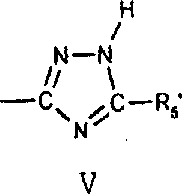

1(H)-1,2,4-三唑-3-基基团优选与连接于Y的剩余部分的硫原子相连。The 1(H)-1,2,4-triazol-3-yl group is preferably attached to the sulfur atom attached to the remainder of Y.
本发明的方法广义上包括,通过使二元酸性单体与有机化合物反应而制备吸光聚合物组合物的方法,所述二元酸性单体包含至少1mol%的由H-A-H代表的至少一种二元酸性吸光单体,所述有机化合物包含两个反应性基团由X-B-X1代表,其中B、X和X1定义如上。因此,该方法可概述为:
作为最有利的方法,二元酸性单体H-A-H的酸性必须足够强以在常规反应条件下在碱存在时形成两个亲核基团。这通常需要二元酸性单体具有约12或更低的pKa值。As the most favorable approach, the acidity of the dibasic acidic monomer H-A-H must be strong enough to form two nucleophilic groups in the presence of a base under conventional reaction conditions. This generally requires the dibasic acidic monomer to have a pKa value of about 12 or less.
通过由碱去除两个氢原子而形成的双亲核单体可进攻亲电化合物II,由此替换掉阴离子X-和x1 -,通过共价键首尾相接产生线型聚合物
适宜的碱包括碱金属碳酸盐;碱金属碳酸氢盐;叔胺如三乙胺、三正丁胺、N-甲基哌啶、N,N’-二甲基哌嗪、N-甲基吗啉、N,N,N’,N’-四甲基乙二胺等;芳族含氮碱如吡啶、甲基吡啶、喹啉、异喹啉、N-烷基吡咯、N-烷基咪唑等;具有无阻电子对的双环含氮碱,例如1,8-二氮杂双环[5,4,0]十一碳-7-烯(DBU)、1,5-二氮杂双环[4,3,0]壬-5-烯(DBN)和1,4-二氮杂双环[2,2,2]辛烷(DABCO).Suitable bases include alkali metal carbonates; alkali metal bicarbonates; tertiary amines such as triethylamine, tri-n-butylamine, N-methylpiperidine, N,N'-dimethylpiperazine, N-methyl Morpholine, N, N, N', N'-tetramethylethylenediamine, etc.; aromatic nitrogenous bases such as pyridine, picoline, quinoline, isoquinoline, N-alkylpyrrole, N-alkyl Imidazole, etc.; bicyclic nitrogenous bases with unimpeded electron pairs, such as 1,8-diazabicyclo[5,4,0]undec-7-ene (DBU), 1,5-diazabicyclo[4 , 3,0]non-5-ene (DBN) and 1,4-diazabicyclo[2,2,2]octane (DABCO®).
用于聚合反应的典型溶剂包括非质子传递的极性溶剂,例如N,N-二甲基乙酰胺、N,N-二甲基甲酰胺、N-甲基-2-吡咯烷酮、N-甲基-N-苯基甲酰胺、二甲亚砜、脂族腈、环丁砜、六甲基磷酰胺等及其混合物。水、醇、酮、吡啶和醚醇,如溶纤剂有时也是有用的。要求这些溶剂在碱存在下,不形成比得自二元酸性单体H-A-H的更强的亲核试剂。Typical solvents used in polymerization reactions include aprotic polar solvents such as N,N-dimethylacetamide, N,N-dimethylformamide, N-methyl-2-pyrrolidone, N-methyl -N-phenylformamide, dimethylsulfoxide, aliphatic nitrile, sulfolane, hexamethylphosphoramide, etc., and mixtures thereof. Water, alcohols, ketones, pyridines, and ether alcohols, such as cellosolves, are also sometimes useful. These solvents are required not to form a stronger nucleophile than that derived from the dibasic acidic monomer H-A-H in the presence of a base.
本发明的新型改进方法允许在较低温度,通常在约75℃-约125℃,无需延长加热时问,制备可吸收近紫外(UV-A,UV-B和UV-C)光、可见光和近红外光的线型聚合物组合物。此外,该方法适用于问歇法生产,这有利于生产昂贵产品,如着色剂、近红外吸光剂和近紫外吸光剂。该方法适用于各种发色团,因为聚合物的制备反应是在较低温度下进行的,这允许例如容易由非常重要的偶氮类着色剂制备着色聚合物组合物.The novel and improved process of the present invention allows the preparation of near-ultraviolet (UV-A, UV-B and UV-C) light, visible light and Linear polymer compositions for near-infrared light. In addition, this method is suitable for batch production, which is advantageous for the production of expensive products such as colorants, near-infrared absorbers, and near-ultraviolet absorbers. The method is applicable to a wide variety of chromophores, since the polymer preparation reactions are carried out at lower temperatures, which allows, for example, easy preparation of colored polymer compositions from very important azo colorants.
具有式II:has the formula II:
X-B-X1的优选反应物为二磺酸酯化合物,其中X和X1都为式-OSO2R的磺酸酯,其中R选自C1-C4烷基、苯基、对甲苯基且其中B选自C2-C6亚烷基、-CH2-1,4-亚环己基-CH2-、2,2,4,4-四甲基-1,3-亚环丁基、1,4-亚环己基、-CH2CH2(OCH2CH2)2-3和-CH2CH2O-1,4-亚苯基-O-CH2CH2-。特别优选的式II的反应物为,其中B选自-CH2CH2-、-CH2CH(CH3)CH2-、-CH2C(CH3)2CH2-、-(CH2)4-、-(CH2)6-、-CH2CH2(OCH2CH21-4和-CH2-1,4-亚环己基-CH2-者。Preferred reactants for XBX 1 are disulfonate compounds, wherein both X and X 1 are sulfonate esters of formula -OSO 2 R, wherein R is selected from C 1 -C 4 alkyl, phenyl, p-tolyl and wherein B is selected from C 2 -C 6 alkylene, -CH 2 -1,4-cyclohexylene-CH 2 -, 2,2,4,4-tetramethyl-1,3-cyclobutylene, 1 , 4-cyclohexylene, -CH 2 CH 2 (OCH 2 CH 2 ) 2-3 and -CH 2 CH 2 O-1, 4-phenylene-O-CH 2 CH 2 -. Particularly preferred reactants of formula II are those wherein B is selected from -CH2CH2- , -CH2CH ( CH3 ) CH2- , -CH2C ( CH3 ) 2CH2- , -( CH2 ) 4 -, -(CH 2 ) 6 -, -CH 2 CH 2 (OCH 2 CH 2 1-4 and -CH 2 -1,4-cyclohexylene-CH 2 -.
典型的式II反应物如下:CH3SO2OCH2CH2OSO2CH3

磺酸酯)CH3SO2O(CH2)6OSO2CH2

二甲磺酸酯 CH3SO2OCH2CH2OCH2CH2OSO2CH31,4-环己烷二甲醇-二甲磺酸酯 乙醇-2,2’-氧二-二甲磺酸dimesylate CH 3 SO 2 OCH 2 CH 2 OCH 2 CH 2 OSO 2 CH 3 1,4-cyclohexanedimethanol-dimethylsulfonate ethanol-2,2'-oxodi-dimethylsulfonic acid
酯本发明也涉及具有式Ia的吸光线型聚合物组合物: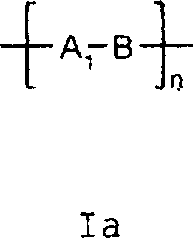
本发明也涉及具有式Ib的吸光线型聚合物组合物:
此处称式I、Ia和Ib的聚合物组合物为“聚合染料”,这时它们吸收可见光因此被强烈着色。The polymer compositions of formulas I, Ia and Ib are referred to herein as "polymeric dyes" when they absorb visible light and are therefore intensely colored.
本发明进一步涉及一种热塑性聚合物组合物,该组合物包括与至少一种上式I、Ia或Ib的吸光线型聚合物组合物共混的热塑性聚合物。热塑性聚合物组合物通常选自聚酯、聚烯烃、聚酰胺、聚酰亚胺、聚氯乙烯、聚氨酯、聚碳酸酯、纤维素酯、聚丙烯酸酯、聚乙烯基酯、聚酯-酰胺、聚苯乙烯、聚丙烯腈-丁二烯-苯乙烯和聚苯乙烯-丙烯腈。优选的热塑性聚合物组合物包括式Ia的吸光聚合物组合物。The present invention further relates to a thermoplastic polymer composition comprising a thermoplastic polymer blended with at least one line-absorbing polymer composition of formula I, Ia or Ib above. The thermoplastic polymer composition is generally selected from polyesters, polyolefins, polyamides, polyimides, polyvinyl chlorides, polyurethanes, polycarbonates, cellulose esters, polyacrylates, polyvinyl esters, polyester-amides, Polystyrene, polyacrylonitrile-butadiene-styrene and polystyrene-acrylonitrile. Preferred thermoplastic polymer compositions include light-absorbing polymer compositions of Formula Ia.
本发明也涉及一些用于制备式I、Ia或Ib的吸光聚合物组合物的二元酸性吸光单体。The present invention also relates to certain dibasic acidic light-absorbing monomers for the preparation of light-absorbing polymer compositions of formula I, Ia or Ib.
优选用于本发明的偶氮化合物对应于式VIPreferred azo compounds for use in the present invention correspond to the formula VI
R6-N=N-ZR 6 -N=NZ
VI其中R6为已被重氮化和已用偶联组份H-Z偶联的芳胺或杂芳胺的残基,并且优选衍生自芳胺和杂芳胺类:苯胺、1-氨基萘、1-氨基蒽醌、4-氨基偶氮苯、2-氨基噻唑、2-氨基苯并噻唑、3-氨基-2,1-苯并异噻唑、2-氨基噻吩并[2,3-d]噻唑、5-氨基异噻唑、5-氨基吡唑、4-氨基吡唑并异噻唑、2-氨基-1,3,4-噻二唑、5-氨基1,2,4-噻二唑、5-氨基-1,2,3-三唑、2-氨基-1,3,4-三唑、2(5)-氨基咪唑、3-氨基吡啶、2(3)-氨基噻吩、2(3)-氨基苯并[b]噻吩、2-氨基噻吩并[3,2-b]噻吩、3-氨基噻吩并[2,3-c]异噻唑、3-氨基-7-苯并-2,1-异噻唑、3-氨基苯并噻吩并异噻唑、3-氨基异噻唑[3,4-d]嘧啶、5-氨基-1,2,3-三唑、3(4)-氨基邻苯二甲酰亚胺和5(6)-氨基-1,2-苯并isothiazolon-1,1-二氧化物;其中所述芳环和杂芳环体系未被取代或被一个或多个基团取代,该基团选自C1-C10烷基、C1-C6烷氧基、C3-C8环烷基、羧基、卤素、C1-C6烷氧基羰基、甲酰、C1-C6烷酰基、C1-C6烷酰基氧基、二氰基乙烯基、C3-C8环烷酰基、氰硫基、三氟乙酰基、氰基、氨甲酰基、-CONHC1-C6烷基、CONH芳基、CON(C1-C6烷基)2、氨磺酰基、SO2NHC1-C6烷基、SO2N(C1-C6烷基)2、SO2NH芳基、SO2NHC3-C8环烷基、CONHC3-C8环烷基、芳基、芳酰基、-NHSO2C1-C6烷基、-N(C1-C6烷基)SO2C1-C6烷基、-NHSO2芳基、NHCOC1-C6烷基、NHCOC3-C8环烷基、NHCO芳基、NHCO2C1-C6烷基、NHCONHC1-C6烷基、NHCONH芳基、N(C1-C6烷基)芳基、芳基偶氮、杂芳基、芳氧基、芳硫基、C3-C8环烷氧基、杂芳基偶氮、杂芳硫基、芳基磺酰基、三氰基乙烯基、芳氧基磺酰基、C1-C6烷基磺酰基、三氟甲基、氟代磺酰基、三氟甲基磺酰基、氰硫基、羟基、硝基或CH=D,其中D为下面定义的活性亚甲基化合物的残基。VI wherein R is the residue of an aryl or heteroarylamine that has been diazotized and coupled with the coupling component HZ, and is preferably derived from aryl and heteroarylamines: aniline, 1-aminonaphthalene, 1-aminoanthraquinone, 4-aminoazobenzene, 2-aminothiazole, 2-aminobenzothiazole, 3-amino-2,1-benzisothiazole, 2-aminothieno[2,3-d] Thiazole, 5-aminoisothiazole, 5-aminopyrazole, 4-aminopyrazoloisothiazole, 2-amino-1,3,4-thiadiazole, 5-amino1,2,4-thiadiazole, 5-amino-1,2,3-triazole, 2-amino-1,3,4-triazole, 2(5)-aminoimidazole, 3-aminopyridine, 2(3)-aminothiophene, 2(3 )-aminobenzo[b]thiophene, 2-aminothieno[3,2-b]thiophene, 3-aminothieno[2,3-c]isothiazole, 3-amino-7-benzo-2, 1-isothiazole, 3-aminobenzothienoisothiazole, 3-aminoisothiazo[3,4-d]pyrimidine, 5-amino-1,2,3-triazole, 3(4)-amino-o-phenyl Dicarboximide and 5(6)-amino-1,2-benzoisothiazolon-1,1-dioxide; wherein the aromatic and heteroaromatic ring systems are unsubstituted or replaced by one or more groups Substituted, the group is selected from C 1 -C 10 alkyl, C 1 -C 6 alkoxy, C 3 -C 8 cycloalkyl, carboxyl, halogen, C 1 -C 6 alkoxycarbonyl, formyl, C 1 -C 6 alkanoyl, C 1 -C 6 alkanoyloxy, dicyanovinyl, C 3 -C 8 cycloalkanoyl, thiocyano, trifluoroacetyl, cyano, carbamoyl, - CONHC 1 -C 6 alkyl, CONH aryl, CON(C 1 -C 6 alkyl) 2 , sulfamoyl, SO 2 NHC 1 -C 6 alkyl, SO 2 N(C 1 -C 6 alkyl) 2. SO 2 NH aryl, SO 2 NHC 3 -C 8 cycloalkyl, CONHC 3 -C 8 cycloalkyl, aryl, aroyl, -NHSO 2 C 1 -C 6 alkyl, -N(C 1 -C 6 alkyl) SO 2 C 1 -C 6 alkyl, -NHSO 2 aryl, NHCOC 1 -C 6 alkyl, NHCOC 3 -C 8 cycloalkyl, NHCO aryl, NHCO 2 C 1 -C 6 Alkyl, NHCONHC 1 -C 6 alkyl, NHCONH aryl, N(C 1 -C 6 alkyl)aryl, arylazo, heteroaryl, aryloxy, arylthio, C 3 -C 8 Cycloalkoxy, heteroaryl azo, heteroarylthio, arylsulfonyl, tricyanovinyl, aryloxysulfonyl, C 1 -C 6 alkylsulfonyl, trifluoromethyl, fluoro Sulfonyl, trifluoromethylsulfonyl, thiocyanate, hydroxy, nitro or CH=D, where D is the residue of an active methylene compound as defined below.
Z为选自下列种类的富电子偶联组份的残基:苯胺、1-氨基萘、1,2-二氢喹啉、1,2,3,4-四氢喹啉、苯并吗啉(3,4-二氢-2H-1,4-苯并噁嗪)、吡唑啉酮、吡唑、3-氰基-6-羟基-2-吡啶酮、2,3-二氢吲哚、吲哚、4-羟基香豆素、4-羟基-2-喹诺酮、咪唑并[2,1-b]噻唑、久洛尼定(2,3,6,7-四氢-1H,5H-苯并[ij]喹嗪)、1-噁久洛尼定、1,2,5,6-四氢-4H-吡咯并[3,2,1-ij]喹啉、2,6-二氨基-3-氰基吡啶、2-氨基噻唑、2-氨基噻吩、5,5-二甲基-1,3-环己烷二酮(双甲酮)、苯酚、萘酚、2,4-戊烷二酮或乙酰乙酰芳基化物;前提条件是式VI的化合物包含两个各含有一个酸性氢的酸性官能团或者包含一个含有两个酸性氢的氨磺酰基团(-SO2NH2)。Z is the residue of an electron-rich coupling component selected from the following classes: aniline, 1-aminonaphthalene, 1,2-dihydroquinoline, 1,2,3,4-tetrahydroquinoline, benzomorpholine (3,4-dihydro-2H-1,4-benzoxazine), pyrazolone, pyrazole, 3-cyano-6-hydroxy-2-pyridone, 2,3-dihydroindole , indole, 4-hydroxycoumarin, 4-hydroxy-2-quinolone, imidazo[2,1-b]thiazole, julonidine (2,3,6,7-tetrahydro-1H,5H- benzo[ij]quinazine), 1-oxjulonidine, 1,2,5,6-tetrahydro-4H-pyrrolo[3,2,1-ij]quinoline, 2,6-diamino -3-cyanopyridine, 2-aminothiazole, 2-aminothiophene, 5,5-dimethyl-1,3-cyclohexanedione (dimethedone), phenol, naphthol, 2,4-pentane Alkanediones or acetoacetylarylates; with the proviso that the compound of the formula VI contains two acidic functions each containing one acidic hydrogen or contains one sulfamoyl group containing two acidic hydrogens (—SO 2 NH 2 ).
优选的二重氮化合物对应于式VII:A preferred didiazonium compound corresponds to formula VII:
R6-N=N-R7N=N-Z VII其中R6和Z定义如上,R7为二价芳族或杂芳族基团,选自以下各类:1,4-亚苯基、萘-1,4-二基、噻唑-2,5-二基和噻吩-2,5-二基:
优选的次甲基、亚芳基、多次甲基、氮杂次甲基、3-芳基-2,5-二氧吡咯啉、3-芳基-5-二氰基亚甲基-2-氧代吡咯啉和芳基异二氢吲哚化合物分别对应于式VIII、VIIIa、VIIIb、IX、X、XI和XII:R11-CH=D

R11-N=D

优选的偶氮-次甲基化合物对应于式XIII:Preferred azo-methine compounds correspond to formula XIII:
D=HC-R7-N=N-ZD=HC-R 7 -N=NZ
XIII其中D、R7和Z定义如前。XIII wherein D, R 7 and Z are as defined above.
双偶氮化合物对应于式VIIa:Bisazo compounds correspond to formula VIIa:
R6-N=N-Y1N=N-R6 R 6 -N=NY 1 N=NR 6
VIIa其中R6定义如上并且Y1为双偶联组份的残基,所述组份选自下列各类:苯胺、1,2-二氢喹啉、1,2,3,4-四氢喹啉、苯并吗啉(3,4-二氢-2H-1,4-苯并噁嗪)、3-氰基-6-羟基-2-吡啶酮、2,6-二氨基吡啶、2,3-二氢吲哚、萘基胺、2-氨基噻唑或它们的组合物;前提条件是式VIIa的化合物包含两个各含有一个酸性氢的酸性官能团或者包含一个含有两个酸性氢的氨磺酰基团(-SO2NH2)。VIIa wherein R is as defined above and Y is the residue of a double coupling component selected from the following classes: aniline, 1,2-dihydroquinoline, 1,2,3,4-tetrahydro Quinoline, benzomorpholine (3,4-dihydro-2H-1,4-benzoxazine), 3-cyano-6-hydroxy-2-pyridone, 2,6-diaminopyridine, 2 , 3-indoline, naphthylamine, 2-aminothiazole or combinations thereof; provided that the compound of formula VIIa contains two acidic functional groups each containing one acidic hydrogen or contains an ammonia containing two acidic hydrogens Sulfonyl group (-SO 2 NH 2 ).
美国专利4,804,719和3,689,501所述的一些二元酸单体可用于本发明,其中包括各种蒽醌、蒽吡啶酮、蒽异噻唑、蒽嘧啶、蒽嘧啶酮、邻苯二甲酰吖啶酮等。Some dibasic acid monomers described in U.S. Patents 4,804,719 and 3,689,501 can be used in the present invention, including various anthraquinones, anthrapyridones, anthraisothiazoles, anthrapyrimidines, anthrapyrimidones, phthalylacridones, etc. .
一些优选的蒽醌、蒽吡啶酮和蒽嘧啶化合物对应于式XIV-XIXf的吸光化合物:


由上式VI、VII、XIII中的Z代表的分别对应偶氮、二重氮和偶氮-次甲基化合物类的典型偶联剂残基包括:


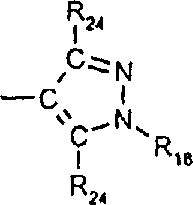


在式VIII-XII中,由R11代表的典型富电子芳族残基包括: 
优选用于本发明的香豆素化合物对应于下式:
式VIIa中由Y1代表的典型偶联剂残基包括式(Z1-L1-Z2)所代表者,其中Z1和Z2独立地选自:

在上述定义中,对于术语C1-C6烷基、C1-C6烷氧基、C1-C6烷氧羰基、C1-C6烷硫基、C1-C6烷基磺酰基、C1-C6烷酰基、-CONHC1-C6烷基、-SO2NHC1-C6烷基、-CON(C1-C6烷基)2、-SO2N(C1-C6烷基)2、-NHSO2C1-C6烷基、-N(C1-C6烷基)SO2C1-C6烷基等,除非另外指明,基团中的C1-C6烷基部分是指含有1-6个碳原子的直链或支链烷基以及这些被选自下列基团的一个或多个基团取代者,所述取代基团为:羧基、氰基、-SO2NH2、SO2NHC1-C6烷基、氰基、氟、氯、C1-C6烷氧基、芳氧基、芳基、杂芳基、芳硫基、杂芳硫基、C3-C8环烷基、-O2CC1-C6烷基或-CO2C1-C6烷基。In the above definitions, for the terms C 1 -C 6 alkyl, C 1 -C 6 alkoxy, C 1 -C 6 alkoxycarbonyl, C 1 -C 6 alkylthio, C 1 -C 6 alkylsulfonyl Acyl, C 1 -C 6 alkanoyl, -CONHC 1 -C 6 alkyl, -SO 2 NHC 1 -C 6 alkyl, -CON(C 1 -C 6 alkyl) 2 , -SO 2 N(C 1 -C 6 alkyl) 2 , -NHSO 2 C 1 -C 6 alkyl, -N(C 1 -C 6 alkyl)SO 2 C 1 -C 6 alkyl, etc., unless otherwise specified, C in the group The 1 - C6 alkyl moiety refers to a straight chain or branched chain alkyl group containing 1 to 6 carbon atoms and these are substituted by one or more groups selected from the group consisting of: carboxyl , cyano, -SO 2 NH 2 , SO 2 NHC 1 -C 6 alkyl, cyano, fluorine, chlorine, C 1 -C 6 alkoxy, aryloxy, aryl, heteroaryl, arylthio , heteroarylthio, C 3 -C 8 cycloalkyl, -O 2 CC 1 -C 6 alkyl or -CO 2 C 1 -C 6 alkyl.
术语C1-C4亚烷基、C2-C4亚烷基、C1-C6亚烷基、C2-C6亚烷基和C2-C12亚烷基分别用来表示含有1-4个碳原子、2-4个碳原子、1-6个碳原子、2-6个碳原子或2-12个碳原子的二价脂族烃基,及其任选地被选自C1-C6烷氧基、羟基、-O2CC1-C6烷基、羧基、CO2C1-C6烷基、氯、氟、芳基或芳氧基中的一个或多个基团取代者。The terms C 1 -C 4 alkylene, C 2 -C 4 alkylene, C 1 -C 6 alkylene, C 2 -C 6 alkylene and C 2 -C 12 alkylene are used to denote, respectively, those containing A divalent aliphatic hydrocarbon group of 1-4 carbon atoms, 2-4 carbon atoms, 1-6 carbon atoms, 2-6 carbon atoms or 2-12 carbon atoms, and it is optionally selected from C One or more of 1 -C 6 alkoxy, hydroxyl, -O 2 CC 1 -C 6 alkyl, carboxyl, CO 2 C 1 -C 6 alkyl, chlorine, fluorine, aryl or aryloxy group replacer.
术语C3-C8环烷基和C3-C8亚环烷基分别用来表示完全饱和的单价和二价环脂族基团,及其被一个或多个C1-C6烷基取代者。The terms C 3 -C 8 cycloalkyl and C 3 -C 8 cycloalkylene are used to denote fully saturated monovalent and divalent cycloaliphatic radicals, respectively, which are replaced by one or more C 1 -C 6 alkyl groups replacer.
术语C3-C8烯基和C3-C8炔基分别用来表示分别含有至少一个双键或至少一个三键的直链或支链烃基。The terms C 3 -C 8 alkenyl and C 3 -C 8 alkynyl are used to denote straight-chain or branched hydrocarbon radicals respectively containing at least one double bond or at least one triple bond, respectively.
在术语芳基、NH芳基、芳氧基、芳酰基、芳硫基、芳基磺酰基、芳氧基磺酰基、-N(SO2芳基)-、-N(CO芳基)-、NHCO芳基、-NHCONH芳基、NHSO2-芳基等中,这些基团的芳基部分代表苯基和萘基及其被选自下列基团的一个或多个基团取代者,所述取代基团为:-CO2H、C1-C6烷基、CO2C1-C6烷基、SO2NH2、SO2NHC1-C6烷基、羟基、OC1-C6烷基、SC1-C6烷基、苯基、O-亚芳基-CO2H、-S-亚芳基-CO2H、SO2亚芳基-CO2H、卤素、NHSO2C1-C6烷基、三氟甲基、NHCOC1-C6烷基、氰基、或1(H)-1,2,4-三唑-3-基硫。In terms of aryl, NH aryl, aryloxy, aroyl, arylthio, arylsulfonyl, aryloxysulfonyl, -N( SO aryl)-, -N(CO aryl)-, In NHCO aryl, -NHCONH aryl, NHSO 2 -aryl, etc., the aryl part of these groups represents phenyl and naphthyl and those substituted by one or more groups selected from the following groups, said Substituent groups are: -CO 2 H, C 1 -C 6 alkyl, CO 2 C 1 -C 6 alkyl, SO 2 NH 2 , SO 2 NHC 1 -C 6 alkyl, hydroxyl, OC 1 -C 6 Alkyl, SC 1 -C 6 alkyl, phenyl, O-arylene-CO 2 H, -S-arylene-CO 2 H, SO 2 arylene-CO 2 H, halogen, NHSO 2 C 1 -C 6 alkyl, trifluoromethyl, NHCOC 1 -C 6 alkyl, cyano, or 1(H)-1,2,4-triazol-3-ylsulfur.
术语亚芳基用来代表1,2-、1,3-和1,4-亚苯基及其任选地被一个或多个上述可能作为芳基上的取代基的基团所取代者。The term arylene is used to denote 1,2-, 1,3- and 1,4-phenylene and those optionally substituted by one or more of the groups mentioned above as possible substituents on aryl groups.
术语“杂芳基”用来描述含有一个氧原子、和/或一个硫原子、和/或最多三个氮原子的5或6元杂环芳环,所述杂环芳基环任选地与一个或两个苯环或另一个5或6元杂芳基环稠合。这类环系的实例包括噻吩基、呋喃基、吡咯基、咪唑基、吡唑基、噻唑基、异噻唑基、噁唑基、异噁唑基、三唑基、噻二唑基、噁二唑基、四唑基、噻三唑基、噁三唑基、吡啶基、嘧啶基、吡嗪基、哒嗪基、噻嗪基、噁嗪基、三嗪基、噻二嗪基、噁二嗪基、二噻嗪基、二噁嗪基、噁噻嗪基、tetrazynyl、噻三嗪基、噁三嗪基、二噻二嗪基、咪唑啉基、二氢嘧啶基、四氢嘧啶基、四唑并[1,5-b]-哒嗪基和嘌呤基(purinyl)、苯并噁唑基、苯并噻唑基、苯并咪唑基、吲哚基等以及这些被一个或多个在上面定义术语“芳基”中所列的取代基取代的环。The term "heteroaryl" is used to describe a 5- or 6-membered heterocyclic aromatic ring containing one oxygen atom, and/or one sulfur atom, and/or up to three nitrogen atoms, optionally with One or two benzene rings or another 5 or 6 membered heteroaryl ring are fused. Examples of such ring systems include thienyl, furyl, pyrrolyl, imidazolyl, pyrazolyl, thiazolyl, isothiazolyl, oxazolyl, isoxazolyl, triazolyl, thiadiazolyl, oxadiazolyl, Azolyl, tetrazolyl, thiatriazolyl, oxatriazolyl, pyridyl, pyrimidinyl, pyrazinyl, pyridazinyl, thiazinyl, oxazinyl, triazinyl, thiadiazinyl, oxadi Azinyl, dithiazinyl, dioxazinyl, oxathiazinyl, tetrazynyl, thiatriazinyl, oxatriazinyl, dithiadiazinyl, imidazolinyl, dihydropyrimidinyl, tetrahydropyrimidinyl, Tetrazolo[1,5-b]-pyridazinyl and purinyl (purinyl), benzoxazolyl, benzothiazolyl, benzimidazolyl, indolyl, etc. and these are one or more of the above Definitions Rings substituted with the substituents listed in the term "aryl".
术语卤素用来表示氟、氯、溴和碘。The term halogen is used to denote fluorine, chlorine, bromine and iodine.
在以上定义中,未取代和取代C1-C10烷基基团或所述基团的一部分是指含有1-10个碳原子、或直链或支链的完全饱和烃基,以及这些烷基被下列一个或多个基团取代的基团:C3-C8环烷基、芳基、羟基、氰基、-O-C2-C4亚烷基OH、-O-C2-C4亚烷基O2C-C1-C6烷基、-S-C2-C4亚烷基-OH、氯、氟、-O-C1-C6烷基、-O-芳基、-SO2芳基、-SO2-C1-C6烷基、2-吡咯烷基(pyrrolidino)、苯并吡咯酮基(phthalimidino)、苯二甲酰亚氨基、琥珀酰亚氨基、戊二酰亚胺基、邻苯甲酸硫酰亚胺、乙烯基磺酰基、-NHCOC1-C6烷基、NHCOH、-NHSO2-C1-C6烷基、NHSO2芳基、-NHCO芳基、-NH-CO2-C1-C6烷基、-SO2NH2、-SO2-NH-C1-C6烷基、-SO2N-(C1-C6烷基)2、-CO2-C1-C6烷基、CONH2、-CONH-C1-C6烷基、-CO2-芳基、-CON(C1-C6烷基)2、-CONH芳基、-CONH(C1-C6烷基)-芳基、-SO2N(C1-C6烷基)芳基、-SO2-NH-C3-C8环烷基、-CONH-C3-C8环烷基、-OCO2-C1-C6烷基、-O-C2-C4亚烷基CN;下式的基团:其中Y2选自1,2-亚苯基,被C1-C6烷基、C1-C6烷氧基、卤素、-CO2H、-CO2C1-C5烷基或硝基取代的1,2-亚苯基;C2-C4亚烷基、亚乙烯基、-OCH2-、-SCH2-、-CH2OCH2-、-OCH2CH2-、-CH2SCH2-、-NHCH2-、-NHCH2CH2、-N(C1-C6烷基)CH2-、NHC(C1-C6烷基)2、-N(C1-C6烷基)CH2CH2或-NHC(芳基)2-;下式的基团:In the above definitions, unsubstituted and substituted C 1 -C 10 alkyl groups or part of said groups refer to fully saturated hydrocarbon groups containing 1-10 carbon atoms, or straight or branched chains, and these alkyl groups Groups substituted by one or more of the following groups: C 3 -C 8 cycloalkyl, aryl, hydroxyl, cyano, -OC 2 -C 4 alkylene OH, -OC 2 -C 4 alkylene O 2 CC 1 -C 6 alkyl, -SC 2 -C 4 alkylene-OH, chlorine, fluorine, -OC 1 -C 6 alkyl, -O-aryl, -SO 2 aryl, -SO 2 -C 1 -C 6 alkyl, 2-pyrrolidino (pyrrolidino), benzopyrrolidone (phthalimidino), phthalimide, succinimidyl, glutarimide, phthalic acid sulfur Imide, vinylsulfonyl, -NHCOC 1 -C 6 alkyl, NHCOH, -NHSO 2 -C 1 -C 6 alkyl, NHSO 2 aryl, -NHCO aryl, -NH-CO 2 -C 1 -C 6 alkyl, -SO 2 NH 2 , -SO 2 -NH-C 1 -C 6 alkyl, -SO 2 N-(C 1 -C 6 alkyl) 2 , -CO 2 -C 1 -C 6 alkyl, CONH 2 , -CONH-C 1 -C 6 alkyl, -CO 2 -aryl, -CON(C 1 -C 6 alkyl) 2 , -CONH aryl, -CONH(C 1 -C 6 alkyl)-aryl, -SO 2 N(C 1 -C 6 alkyl) aryl, -SO 2 -NH-C 3 -C 8 cycloalkyl, -CONH-C 3 -C 8 cycloalkyl , -OCO 2 -C 1 -C 6 alkyl, -OC 2 -C 4 alkylene CN; groups of the following formula: Wherein Y 2 is selected from 1,2-phenylene, replaced by C 1 -C 6 alkyl, C 1 -C 6 alkoxy, halogen, -CO 2 H, -CO 2 C 1 -C 5 alkyl or nitr substituted 1,2-phenylene; C 2 -C 4 alkylene, vinylene, -OCH 2 -, -SCH 2 -, -CH 2 OCH 2 -, -OCH 2 CH 2 -, -CH 2 SCH 2 -, -NHCH 2 -, -NHCH 2 CH 2 , -N(C 1 -C 6 alkyl)CH 2 -, NHC(C 1 -C 6 alkyl) 2 , -N(C 1 -C 6 alkyl) CH 2 CH 2 or —NHC(aryl) 2 —; groups of the formula:
-SR25、-SO2CH2CH2SR25、-OCH2CH2SR25、

术语“吸光”用来表示吸收近紫外、可见或近红外光,特别是吸收波长在300-1200nm,优选约325-1100nm,且最优选约325-1000nm之间的光的特性。The term "light-absorbing" is used to denote the property of absorbing near-ultraviolet, visible or near-infrared light, especially light having a wavelength between 300-1200 nm, preferably about 325-1100 nm, and most preferably about 325-1000 nm.
用作偶联组份以制备式VI、VII和VIII化合物及作为中间体以制备式VIII、VIIIa、IX、X、XI和XII化合物的典型芳胺如下:


文献中大量公开了分别用于制备式VI,VII和VIIa的偶氮、二重氮和双偶氮化合物的典型可重氮化胺(R6NH2),例如:Typical diazotizable amines (R 6 NH 2 ) for the preparation of azo, disazo and disazo compounds of the formulas VI, VII and VIIa, respectively, are extensively disclosed in the literature, for example:
M.Weaver和L.Shuttleworth的《染料与颜料》,3(1982)81-121;Dyes and Pigments by M.Weaver and L.Shuttleworth, 3(1982) 81-121;
L.Shuttleworth和M.Weaver的《化学应用染料》,1990,107-63,D.Waring和G.Hallas编,Plenum,纽约,N.Y.;L. Shuttleworth and M. Weaver, Chemically Applied Dyes, 1990, 107-63, edited by D. Waring and G. Hallas, Plenum, New York, N.Y.;
美国专利3,438,961;3,573,273;3,639,384;3,707,532;3,790,557;3,816,388;3,816,392;3,878,189;3,980,634;4,012,372;4,039,522;4,049,643;4,083,684;4,083,844;4,097,475;4,105,655;4,119,621;4,140,683;4,180,503;4,189,428;4,207,233;4,211,696;4,264,495;4,283,332;4,400,318;4,431,585;4,456,551;4,487,719;4,542,207;4,564,673;4,619,991;4,621,136;4,650,861;4,668,775;4,734,490;4,751,288;4,760,133;4,764,600;4,837,269;4,841,036;4,843,153;4,888,432;4,960,874;5,037,966;5,132,411;5,144,015;5,283,326;5,296,325;5,352,774。美国专利3,438,961;3,573,273;3,639,384;3,707,532;3,790,557;3,816,388;3,816,392;3,878,189;3,980,634;4,012,372;4,039,522;4,049,643;4,083,684;4,083,844;4,097,475;4,105,655;4,119,621;4,140,683;4,180,503;4,189,428;4,207,233;4,211,696;4,264,495;4,283,332; 4,400,318;4,431,585;4,456,551;4,487,719;4,542,207;4,564,673;4,619,991;4,621,136;4,650,861;4,668,775;4,734,490;4,751,288;4,760,133;4,764,600;4,837,269;4,841,036;4,843,153;4,888,432;4,960,874;5,037,966;5,132,411;5,144,015;5,283,326;5,296,325;5,352,774。
分别用于制备式VI,VII和XIII的偶氮化合物、二重氮和偶氮-次甲基化合物的典型偶联组份H-Z公开于文献中,例如H.R.Schwander的《染料与颜料》,3(1982)133-160;L.Shuttleworth和M.Weaver的《化学应用染料》,1990,107-63,D.Waring和G.Hallas编,Plenum,纽约,N.Y.;美国专利3,639,384;3,639,385;3,657,215;3,673,169;3,816,388;3,829,410;3,919,188;3,950,130;3,980,634;4,041,025;4,097,475;4,119,621;4,179,435;4,234,482;4,283,332;4,341,700;4,400,318;4,431,585;4,396,547;4,619,992;4,642,339;4,650,861;4,668,775;4,764,600;4,837,269;4,843,153;5,235,047;5,283,326;5,352,774。Typical coupling components H-Z for the preparation of azo compounds, disazo and azo-methine compounds of formula VI, VII and XIII, respectively, are disclosed in the literature, for example in "Dyes and Pigments" by H.R.Schwander, 3( 1982) 133-160; L. Shuttleworth and M. Weaver, "Chemical Applied Dyes", 1990, 107-63, edited by D. Waring and G. Hallas, Plenum, New York, N.Y.; U.S. Patents 3,639,384; 3,639,385; 3,657,215; 3,673,169 ;3,816,388;3,829,410;3,919,188;3,950,130;3,980,634;4,041,025;4,097,475;4,119,621;4,179,435;4,234,482;4,283,332;4,341,700;4,400,318;4,431,585;4,396,547;4,619,992;4,642,339;4,650,861;4,668,775;4,764,600;4,837,269;4,843,153;5,235,047;5,283,326;5,352,774 .
分别用于制备对应于式VIII,VIIIa,VIIIb,IX和XIII的次甲基、亚芳基、多次甲基、氮杂次甲基和偶氮-次甲基化合物的典型活性亚甲基化合物公开于文献中,例如美国专利4,338,247;4,617,373;4,617,374;4,707,537;4,749,774;4,826,903;4,845,187;4,950,732;4,981,516和5,283,326。Typical reactive methylene compounds for the preparation of methine, arylene, polymethyl, azamethine and azo-methine compounds corresponding to formulas VIII, VIIIa, VIIIb, IX and XIII, respectively Disclosed in the literature, for example, US Patents 4,338,247; 4,617,373; 4,617,374; 4,707,537; 4,749,774; 4,826,903;
根据本发明,通过使用常规技术,例如溶液或熔融共混技术,如将其它添加剂引入到这些聚合物中采用的技术,可将吸光聚合物组合物引入到各种各样的热塑性聚合物中(见R.Gchter和H.Meller编:《塑料添加剂手册》,Hansu出版社,纽约,1985,507-533页;729-741页)。例如,吸光聚合物组合物可以粒料或粉末形式在加入或不加入增粘剂或分散剂的情况下干混。随后可在挤塑机或注塑机上加工该预混物。其它的常规添加剂,如增塑剂、成核剂、阻燃剂、润滑剂等也可存在于最终的热塑性组合物中。According to the present invention, the light-absorbing polymer composition can be incorporated into a wide variety of thermoplastic polymers by using conventional techniques, such as solution or melt blending techniques, such as are used to introduce other additives into these polymers ( See R.Göchter and H.Möeller, eds.: Plastic Additives Handbook, Hansu Press, New York, 1985, pp. 507-533; pp. 729-741). For example, the light absorbing polymer composition can be dry blended in pellet or powder form with or without the addition of tackifiers or dispersants. The premix can then be processed on an extruder or injection molding machine. Other conventional additives such as plasticizers, nucleating agents, flame retardants, lubricants, etc. may also be present in the final thermoplastic composition.
用于与吸光聚合物组合物共混的各种各样的热塑性聚合物在本领域是已知的,并且包括聚酯如聚对苯二甲酸乙二酯的均聚物、共聚物和共混物;聚烯烃,例如聚丙烯、聚乙烯、线型低密度聚乙烯、聚丁烯、及由乙烯、丙烯和/或丁烯制备的共聚物;来自丙烯腈、丁二烯和苯乙烯的共聚物;来自苯乙烯和丙烯腈的共聚物;聚酰胺,例如尼龙6和尼龙66;聚氯乙烯;聚氨酯;聚偏二氯乙烯;聚碳酸酯;纤维素酯,例如纤维素乙酸酯、丙酸酯、丁酸酯、或混合酯;聚丙烯酸酯,例如聚甲基丙烯酸甲酯;聚酰亚胺;聚酯-酰胺;聚苯乙烯;及其混合物或共混物等。A wide variety of thermoplastic polymers for blending with light absorbing polymer compositions are known in the art and include homopolymers, copolymers and blends of polyesters such as polyethylene terephthalate compounds; polyolefins such as polypropylene, polyethylene, linear low density polyethylene, polybutene, and copolymers prepared from ethylene, propylene and/or butene; from the copolymerization of acrylonitrile, butadiene and styrene copolymers from styrene and acrylonitrile; polyamides such as nylon 6 and nylon 66; polyvinyl chloride; polyurethane; polyvinylidene chloride; polycarbonate; cellulose esters such as cellulose acetate, acrylic esters, butyrates, or mixed esters; polyacrylates, such as polymethyl methacrylate; polyimides; polyester-amides; polystyrene; and mixtures or blends thereof.
也应该知道,可以根据已知的着色技术,通过混合各种颜色,例如黄色、洋红色和青色之类的减色而获得多种多样的颜色(见N.Ohta的《照相科学与工程》,15卷,第5期,9月-10月,1971,395-415页)。It should also be known that a wide variety of colors can be obtained by mixing various colors such as subtractive colors such as yellow, magenta and cyan according to known coloring techniques (see N. Ohta, Photographic Science and Engineering, pp. 15, No. 5, September-October, 1971, pp. 395-415).
当然,存在的特定发色团可决定被着色聚合物组合物的颜色(色调+色值+色度)并最终决定本发明的热塑性聚合物共混物的颜色(色调+色值+色度)。如上所述,可获得多种颜色。Of course, the presence of specific chromophores can determine the color (hue + color value + chroma) of the polymer composition being pigmented and ultimately the color (hue + color value + chroma) of the thermoplastic polymer blends of the present invention . As mentioned above, a variety of colors are available.
用于与热塑性聚合物结合的吸光聚合物的实际用量将取决于用于制备吸光聚合物的发色团的固有着色强度、用于制备吸光聚合物的吸光单体的mol%及获得某种特性所必须的光吸收水平。通常,加入到热塑性聚合物中的吸光聚合物的量应使得,在最终热塑性共混物中,吸光聚合物的总量占约0.001重量%-约20重量%,优选约0.01重量%-约10重量%。如此得到的最终热塑性聚合物共混物可用作各种各样的模塑和挤塑制品,包括厚和薄的塑料薄膜、塑料片材、模塑塑料制品、容器和纤维等。The actual amount of light-absorbing polymer used in combination with the thermoplastic polymer will depend on the intrinsic tinting strength of the chromophore used to make the light-absorbing polymer, the mole percent of light-absorbing monomer used to make the light-absorbing polymer, and the desired properties. The necessary level of light absorption. Typically, the amount of light-absorbing polymer added to the thermoplastic polymer is such that the total amount of light-absorbing polymer in the final thermoplastic blend is from about 0.001% by weight to about 20% by weight, preferably from about 0.01% by weight to about 10% by weight. weight%. The final thermoplastic polymer blend thus obtained can be used as a wide variety of molded and extruded articles, including thick and thin plastic films, plastic sheets, molded plastic articles, containers, fibers, and the like.
当吸光聚合物组合物吸收可见光时,它们可被用来为热塑性塑料提供各种或深或浅的颜色。某些具有只吸收可见光特性的化合物也可用作调色剂,这样赋予具有黄色外表的聚酯以希望的非彩色至浅蓝色,如美国专利5,384,377所述,该专利公开了一些为此目的的热稳定着色剂在生产聚酯期间的共聚反应。一些吸收红外光的聚合物组合物可用于赋予热塑性塑料以不可见标记,如美国专利5,461,136所述,其中吸收红外光的化合物在近红外区是发荧光的并且在生产期间被共聚到热塑性缩聚物中。吸收紫外光的聚合物组合物可用来赋予热塑性塑料屏蔽紫外(UV)光的特性;用作热塑性塑料的荧光增白剂;或者用作聚合物本身或其它吸光剂,如着色剂的UV稳定剂。When light-absorbing polymer compositions absorb visible light, they can be used to impart a variety of darker or lighter colors to thermoplastics. Certain compounds having the property of absorbing only visible light can also be used as toners, thus imparting the desired neutral to bluish color to polyesters with a yellow appearance, as described in U.S. Patent 5,384,377 which discloses some Copolymerization of thermally stable colorants during the production of polyester. Some infrared-absorbing polymer compositions can be used to impart invisible markings to thermoplastics, as described in U.S. Patent No. 5,461,136, where the infrared-absorbing compound is fluorescent in the near-infrared region and is copolymerized to the thermoplastic condensation polymer during production middle. Polymer compositions that absorb UV light can be used to impart ultraviolet (UV) light shielding properties to thermoplastics; as optical brighteners for thermoplastics; or as UV stabilizers for the polymer itself or other light absorbing agents, such as colorants .
使用凝胶渗透色谱(GPC)分析,测定聚合物组合物的重均分子量(Mw)和数均分子量(Mn)。The weight average molecular weight (Mw) and number average molecular weight (Mn) of the polymer composition were determined using gel permeation chromatography (GPC) analysis.
下面的实施例进一步说明了本发明。实施例1The following examples further illustrate the invention. Example 1
将1,5-二(2-羧基苯基硫)蒽醌(25.60g,0.05mol)、1,2-乙二醇-二甲磺酸酯(10.90g,0.05mol)、碳酸钾(13.82g,0.10mol)和N-甲基-2-吡咯烷酮(NMP)(400mL)的混合物在125℃下搅拌加热1.0小时。搅拌下将反应混合物倒入甲醇(600mL)中。过滤收集黄色聚合产物并用甲醇洗涤直至滤液基本透明。将甲醇-湿滤饼在1.0L水中浆化,通过加入乙酸将混合物酸化并过滤收集黄色产物,用热水洗涤并在空气下干燥(产量21.16g)。通过凝胶渗透色谱(GPC)测定聚合产物的重均分子量为6,083,数均分子量为3,000且多分散性值为2.03。实施例21,5-bis(2-carboxyphenylthio)anthraquinone (25.60g, 0.05mol), 1,2-ethanediol-dimethylsulfonate (10.90g, 0.05mol), potassium carbonate (13.82g , 0.10 mol) and N-methyl-2-pyrrolidone (NMP) (400 mL) was stirred and heated at 125° C. for 1.0 h. The reaction mixture was poured into methanol (600 mL) with stirring. The yellow polymer product was collected by filtration and washed with methanol until the filtrate was substantially clear. The methanol-wet cake was slurried in 1.0 L of water, the mixture was acidified by adding acetic acid and the yellow product was collected by filtration, washed with hot water and dried under air (yield 21.16 g). The polymer product had a weight average molecular weight of 6,083, a number average molecular weight of 3,000 and a polydispersity value of 2.03 as determined by gel permeation chromatography (GPC). Example 2
将包含两个羧基且具有以下结构:
将1,5-二(异丁基氨基)-4,8-二溴蒽醌(25.3g,0.05mol)、硫代水杨酸(23.1g,0.15mol)、无水K2CO3(20.7g,0.15mol)、氯化铜二水合物(1.2g)和DMF(250mL)的混合物在90-95℃下搅拌加热2.0小时。使用1∶1的四氢呋喃(THF)∶环己烷的薄层色谱(TLC)显示,红色起始原料完全转化为所需的蓝色极性产物。让反应混合物冷却并随后倒入水(800mL)中。搅拌下用乙酸酸化沉淀出蓝色固体。在间歇搅拌下,将混合物加热至约60℃并过滤收集固体,用热水洗涤并在空气下干燥。通过在热甲醇(300mL)中再浆化产物完成进一步的纯化,让其冷却到室温,过滤收集,用甲醇洗涤并在空气下干燥得到实施例2的起始原料(31.5g)。实施例2b1,5-bis(isobutylamino)-4,8-dibromoanthraquinone (25.3g, 0.05mol), thiosalicylic acid (23.1g, 0.15mol), anhydrous K 2 CO 3 (20.7 g, 0.15 mol), copper chloride dihydrate (1.2 g) and DMF (250 mL) was stirred and heated at 90-95°C for 2.0 hours. Thin layer chromatography (TLC) using 1:1 tetrahydrofuran (THF):cyclohexane showed complete conversion of the red starting material to the desired blue polar product. The reaction mixture was allowed to cool and then poured into water (800 mL). Acidification with acetic acid with stirring precipitated a blue solid. With intermittent stirring, the mixture was heated to about 60°C and the solid was collected by filtration, washed with hot water and dried in air. Further purification was accomplished by reslurrying the product in hot methanol (300 mL), allowing to cool to room temperature, collecting by filtration, washing with methanol and air drying to give the starting material of Example 2 (31.5 g). Example 2b
将1,5-二(异丁基氨基)蒽醌(28.0g,0.08mol)加入到DMF(300mL)中并在室温搅拌该混合物。向温热至约50℃的反应混合物中,滴加溶解在DMF(75.0mL)中的1,3-二溴-5,5-二甲基海因(23.0g,0.08m)溶液。当溴化试剂完全加入后,将反应混合物在50-60℃加热1.5小时,冷却并随后在搅拌下逐步加入水(500mL)将其淹没。过滤收集红色产物,用水洗涤并在空气下干燥。产物的产量为39.6g并且场解吸质谱分析(FDMS)显示,产物为用作实施例2a中的中间体1,5-二(异丁基氨基)-4,8-二溴蒽醌。实施例2c1,5-Bis(isobutylamino)anthraquinone (28.0 g, 0.08 mol) was added to DMF (300 mL) and the mixture was stirred at room temperature. To the reaction mixture warmed to about 50°C, a solution of 1,3-dibromo-5,5-dimethylhydantoin (23.0 g, 0.08 m) dissolved in DMF (75.0 mL) was added dropwise. After complete addition of the brominating reagent, the reaction mixture was heated at 50-60° C. for 1.5 hours, cooled and subsequently flooded with gradual addition of water (500 mL) with stirring. The red product was collected by filtration, washed with water and dried in air. The yield of the product was 39.6 g and field desorption mass spectrometry (FDMS) showed that the product was 1,5-bis(isobutylamino)-4,8-dibromoanthraquinone used as intermediate in Example 2a. Example 2c
将1,5-二氯蒽醌(69.5g,0.25mol)、异丁胺(100g,1.4mol)和2-乙氧基乙醇(400mL)的混合物在回流下加热36.0小时并冷却。加入甲醇(400mL)以使包含结晶产物的混合物更易搅拌。过滤收集深红色产物,用甲醇洗涤,在热甲醇中再浆化并冷却,过滤收集,用甲醇洗涤并在空气下干燥(产量67.7g)。FDMS显示,产物为用作实施例2b的起始原料的高纯度1,5-二(异丁基氨基)蒽醌。实施例3A mixture of 1,5-dichloroanthraquinone (69.5 g, 0.25 mol), isobutylamine (100 g, 1.4 mol) and 2-ethoxyethanol (400 mL) was heated at reflux for 36.0 hours and cooled. Methanol (400 mL) was added to make the mixture containing the crystalline product more stirrable. The dark red product was collected by filtration, washed with methanol, reslurried in hot methanol and cooled, collected by filtration, washed with methanol and air dried (yield 67.7 g). FDMS showed that the product was the highly pure 1,5-bis(isobutylamino)anthraquinone used as starting material in Example 2b. Example 3
将包含两个1(H)-1,2,4-三唑基-3-硫基且具有以下结构:的偶氮化合物(2.93g,0.005m)、1,2-乙二醇-二甲磺酸酯(1.08g,0.005mol)、碳酸钾(1.50g)和DMF(25.0mL)的混合物在约95℃下搅拌加热2.5小时。将反应混合物倒入甲醇(150mL)中并过滤收集红色聚合物产物,用含有少量乙酸的水洗涤,然后用热水洗涤并在空气下干燥(产量2.35g)。通过GPC分析,聚合物的重均分子量为5,396,数均分子量为3,044且多分散性值为1.77。实施例4will contain two 1(H)-1,2,4-triazolyl-3-thio groups and have the following structure: A mixture of azo compound (2.93g, 0.005m), 1,2-ethanediol-dimethethanesulfonate (1.08g, 0.005mol), potassium carbonate (1.50g) and DMF (25.0mL) at about 95 It was stirred and heated at ℃ for 2.5 hours. The reaction mixture was poured into methanol (150 mL) and the red polymer product was collected by filtration, washed with water containing a small amount of acetic acid, then hot water and dried in air (yield 2.35 g). By GPC analysis, the polymer had a weight average molecular weight of 5,396, a number average molecular weight of 3,044 and a polydispersity value of 1.77. Example 4
将EastarPETG共聚酯6763,聚对苯二甲酸(亚乙基-1,4-环己烷二亚甲基)酯(伊斯曼化学品公司)(400g预先干燥的颗粒)与实施例1的黄色蒽醌聚合物组合物(0.12g)干混。在250℃用配有混合螺杆的C.W.Brabender 3/4英寸挤出机将共混物挤塑到水浴中并将挤出物造粒。Eastar® PETG copolyester 6763, polyethylene (ethylene-1,4-cyclohexanedimethylene) terephthalate (Eastman Chemical Company) (400 g pre-dried granules) was mixed with Example The yellow anthraquinone polymer composition of 1 (0.12 g) was dry blended. The blend was extruded at 250°C using a CW Brabender 3/4 inch extruder equipped with a mixing screw into a water bath and the extrudate was pelletized.
在70℃约1-5托压力下将粒料再干燥约17小时。使用直径为2英寸的圆形模具,在Pasadena液压机有限公司的压机上,用12,000磅的活塞力(4英寸活塞)在250℃将一部分干燥的粒料(1.40g)压成18-20密耳的薄膜。生产出具有优异显色性的透明黄色薄膜,该薄膜含有约300ppm(重量)的黄色聚合物组合物。实施例5The pellets were then dried at about 1-5 torr at 70°C for about 17 hours. A portion of the dried pellets (1.40 g) were pressed to 18-20 densities at 250°C on a Pasadena Hydraulic Press Co. The membrane of the ear. A clear yellow film containing about 300 ppm by weight of the yellow polymer composition was produced with excellent color rendering. Example 5
使用0.12g的实施例2蓝色蒽醌聚合物组合物重复实施例4,得到具有良好显色性的亮蓝色透明共聚酯薄膜。实施例6Example 4 was repeated using 0.12 g of the blue anthraquinone polymer composition of Example 2 to obtain a bright blue transparent copolyester film with good color rendering. Example 6
使用0.12g的实施例3红色偶氮聚合物组合物重复实施例4,生产出具有良好显色性的亮红色透明薄膜。实施例7Example 4 was repeated using 0.12 g of the red azo polymer composition of Example 3 to produce a bright red transparent film with good color rendering. Example 7
将包含两个酸性1(H)-1,2,4-三唑-3-基硫基且具有以下结构: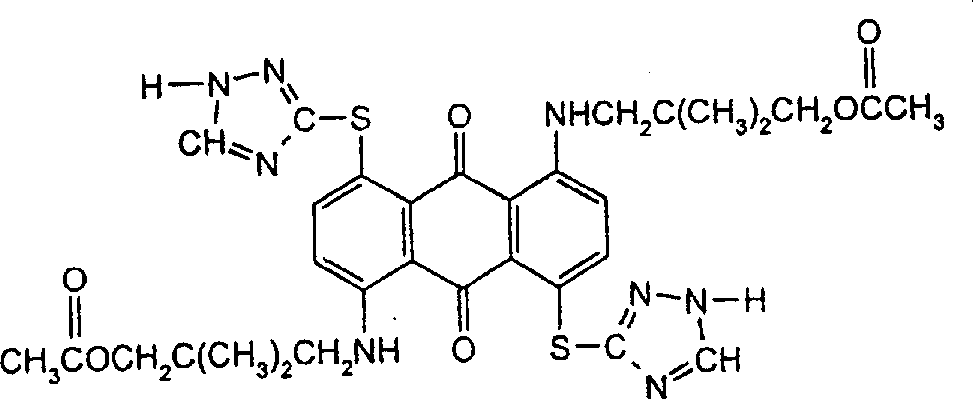
将1,5-二[(3-乙酸基-2,2-二甲基丙基)氨基]-4,8-二溴蒽醌(6.50g,0.01mol)(实施例2的产物-发明报告摘要70524号)、3-巯基-1(H)-1,2,4-三唑(3.03g,0.03mol)、碳酸钾(4.15g,0.03mol)、氯化铜二水合物(0.65g)和DMF(100mL)的混合物在约100-105℃下加热14小时。将反应混合物倒入水(400mL)和10%的盐酸水溶液(200mL)的混合物中。过滤收集蓝色产物,用热水洗涤并在空气下干燥(产量6.58g)。FDMS证实产物具有实施例7的起始蒽醌化合物所要求的结构。实施例81,5-bis[(3-acetoxy-2,2-dimethylpropyl)amino]-4,8-dibromoanthraquinone (6.50g, 0.01mol) (the product of Example 2-Invention Report Abstract No. 70524), 3-mercapto-1(H)-1,2,4-triazole (3.03g, 0.03mol), potassium carbonate (4.15g, 0.03mol), copper chloride dihydrate (0.65g) A mixture with DMF (100 mL) was heated at about 100-105 °C for 14 hours. The reaction mixture was poured into a mixture of water (400 mL) and 10% aqueous hydrochloric acid (200 mL). The blue product was collected by filtration, washed with hot water and air dried (yield 6.58 g). FDMS confirmed that the product had the structure required for the starting anthraquinone compound of Example 7. Example 8
将具有以下结构: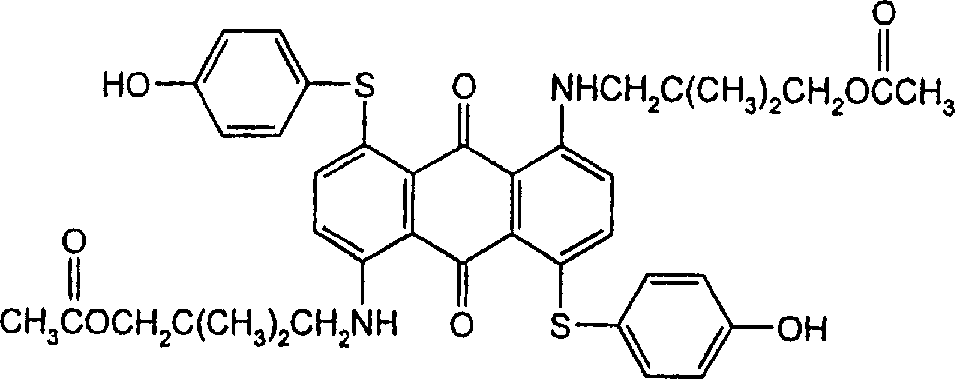
将1,5-二[(3-乙酸基-2,2-二甲基丙基)氨基]-4,8-二溴蒽醌(19.56g,0.03mol)、对羟基苯硫醇(17.64g,0.14mol)、碳酸钾(19.32g,0.14mol)、氯化铜二水合物(1.0g)和DMF(150mL)的混合物在约90-95℃下加热7.0小时并随后在120℃下再加热约2.0小时。TLC(50∶50,THF∶环己烷)显示,大多数为所要求的蓝色产物,但还有少量紫色半反应产物存在。将反应混合物倒入甲醇(500mL)中并让混合物冷却。结晶后,过滤收集蓝色固体,用甲醇洗涤,再用热水洗涤并在空气下干燥(产量17.6g)。FDMS证实,产物具有实施例8的起始蒽醌化合物所要求的结构。在可见光吸收光谱中,观察到在DMF中的最大吸收(λmax)在652nm(消光系数ε为24,638)。实施例91,5-bis[(3-acetoxy-2,2-dimethylpropyl)amino]-4,8-dibromoanthraquinone (19.56g, 0.03mol), p-hydroxybenzenethiol (17.64g , 0.14mol), potassium carbonate (19.32g, 0.14mol), copper chloride dihydrate (1.0g) and DMF (150mL) mixture was heated at about 90-95°C for 7.0 hours and then reheated at 120°C About 2.0 hours. TLC (50:50, THF:cyclohexane) showed most of the desired blue product, but a small amount of purple half-reaction product was also present. The reaction mixture was poured into methanol (500 mL) and the mixture was allowed to cool. After crystallization, the blue solid was collected by filtration, washed with methanol, then hot water and dried in air (yield 17.6 g). FDMS confirmed that the product had the structure required for the starting anthraquinone compound of Example 8. In the visible light absorption spectrum, the maximum absorption (λmax) in DMF was observed at 652 nm (the extinction coefficient ε was 24,638). Example 9
将1,4-二-(2,6-二甲基-4-羟基苯氨基)蒽醌(4.78g,0.01mol)(美国专利3,918,976的合成实施例1)、1,2-乙二醇-二甲磺酸酯(2.18g,0.01mol)、碳酸钾(3.0g)和DMF(60mL)的混合物在约90-95℃下搅拌加热4.0小时。将反应混合物倒入甲醇(300mL)中后,过滤收集产物并用甲醇洗涤直到滤液基本无色。将甲醇-湿滤饼在100mL水中再浆化并通过搅拌下加入乙酸酸化。加热到约50℃后,过滤收集产物,用热水洗涤并在空气下干燥(产量1.2g)。由GPC测定蓝色聚合染料的重均分子量(Mw)为2,764,数均分子量(Mn)为1,607且多分散性为1.72。在DMF中,该产物在可见光吸收光谱中的最大吸收为于586,630nm处。实施例101,4-bis-(2,6-dimethyl-4-hydroxyanilino)anthraquinone (4.78 g, 0.01 mol) (synthesis example 1 of US Patent No. 3,918,976), 1,2-ethylene glycol- A mixture of dimesylate (2.18 g, 0.01 mol), potassium carbonate (3.0 g) and DMF (60 mL) was stirred and heated at about 90-95° C. for 4.0 hours. After the reaction mixture was poured into methanol (300 mL), the product was collected by filtration and washed with methanol until the filtrate was substantially colorless. The methanol-wet cake was reslurried in 100 mL of water and acidified by adding acetic acid with stirring. After heating to about 50°C, the product was collected by filtration, washed with hot water and dried in air (yield 1.2 g). The blue polymeric dye had a weight average molecular weight (Mw) of 2,764, a number average molecular weight (Mn) of 1,607 and a polydispersity of 1.72 as determined by GPC. In DMF, the product has an absorption maximum at 586,630 nm in the visible light absorption spectrum. Example 10
将具有以下结构:
将1,5-二-(4-甲基环己烷甲基氨基)-4,8-二溴蒽醌(20.0g,0.0324mol)、硫代水杨酸(11.55g,0.075mol)、碳酸钾(10.35g,0.075m)、氯化铜二水合物(1.0g)和DMF(175mL)的混合物在约95℃下加热4.0小时并随后倒入丙酮(400mL)中。过滤收集结晶后的固体,用丙酮洗涤直到滤液不再为红色。通过加入到水中(500mL)并搅拌,将二元酸性蒽醌化合物的二钾盐溶解。用乙酸酸化沉淀出蓝色产物,过滤收集该产物,用热水洗涤并随后在空气下干燥(产量21.5g)。FDMS显示,产物结构与在实施例10中给出的起始二元酸性蒽醌化合物的结构一致。实施例10b1,5-bis-(4-methylcyclohexanemethylamino)-4,8-dibromoanthraquinone (20.0g, 0.0324mol), thiosalicylic acid (11.55g, 0.075mol), carbonic acid A mixture of potassium (10.35 g, 0.075 m), copper chloride dihydrate (1.0 g) and DMF (175 mL) was heated at about 95° C. for 4.0 hours and then poured into acetone (400 mL). The crystallized solid was collected by filtration and washed with acetone until the filtrate was no longer red. The dipotassium salt of the dibasic acidic anthraquinone compound was dissolved by adding to water (500 mL) and stirring. Acidification with acetic acid precipitated a blue product which was collected by filtration, washed with hot water and then air dried (yield 21.5 g). FDMS showed that the structure of the product was consistent with that of the starting dibasic acidic anthraquinone compound given in Example 10. Example 10b
用N-溴琥珀酰亚胺(50.5g,0.284mol)在DMF(200mL)中的溶液处理通过在约55℃搅拌溶解在DMF(1.0L)中的1,5-二-(4-甲基环己烷甲基氨基)蒽醌(65.0g,0.142mol)的溶液。加毕后,溴化反应通过在55-60℃加热2.0小时完成。加入水(1.0L)沉淀出红色产物,过滤收集该产物,用水洗涤并在空气下干燥。在热甲醇中再浆化并冷却后,过滤收集产物,用少量甲醇洗涤并在空气下干燥(产量84.0g)。FDMS显示,产物结构为实施例10a的起始二溴化蒽醌化合物的结构。实施例10c1,5-Bis-(4-methyl) dissolved in DMF (1.0 L) by stirring at about 55 °C was treated with a solution of N-bromosuccinimide (50.5 g, 0.284 mol) in DMF (200 mL). A solution of cyclohexanemethylamino)anthraquinone (65.0 g, 0.142 mol). After the addition was complete, the bromination reaction was completed by heating at 55-60°C for 2.0 hours. Addition of water (1.0 L) precipitated a red product which was collected by filtration, washed with water and dried in air. After reslurry in hot methanol and cooling, the product was collected by filtration, washed with a small amount of methanol and dried in air (yield 84.0 g). FDMS showed that the product structure was that of the starting dibrominated anthraquinone compound of Example 10a. Example 10c
将1,5-二氯蒽醌(48.0g,0.17mol)、4-甲基-1-氨基甲基环己烷(88.9g,0.70mol)、2-乙氧基乙醇(400mL)的混合物在回流下搅拌加热35.0小时并让反应混合物冷却。加入甲醇沉淀出红色产物,过滤收集该产物,用甲醇洗涤并在空气下干燥(产量66.0g)。FDMS显示,产物为实施例10b的起始蒽醌化合物。实施例11A mixture of 1,5-dichloroanthraquinone (48.0g, 0.17mol), 4-methyl-1-aminomethylcyclohexane (88.9g, 0.70mol), and 2-ethoxyethanol (400mL) was Heat with stirring at reflux for 35.0 hours and allow the reaction mixture to cool. Addition of methanol precipitated a red product which was collected by filtration, washed with methanol and air dried (yield 66.0 g). FDMS showed that the product was the starting anthraquinone compound of Example 10b. Example 11
将具有以下结构: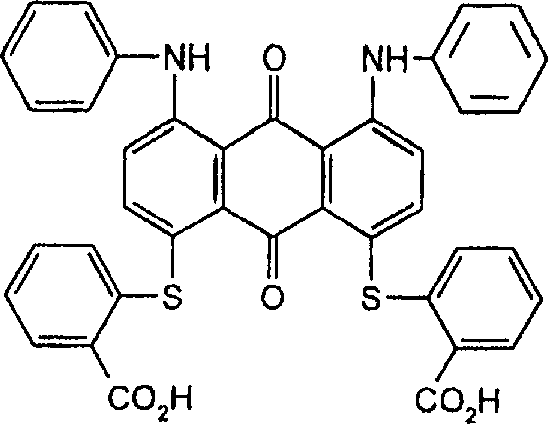
将1,8-二-(2-羧基苯基硫)-4,5-二硝基蒽醌(4.00g,0.0066mol)、苯胺(2.5g)和硝基苯(30.0mL)的混合物在回流下搅拌加热5.0小时。将反应混合物倒入己烷中并倾析出己烷。通过加入己烷、搅拌及倾析,再次洗涤产物。在丙酮中将粗产物浆化并加热至回流,过滤收集蓝色产物,用水洗涤并在空气下干燥(产量0.75g)。FDMS显示,产物大多数为实施例11的起始二元酸性蒽醌化合物,1,8-二苯胺基-4,5-二-(2-羧基苯基硫)蒽醌。实施例11bA mixture of 1,8-bis-(2-carboxyphenylthio)-4,5-dinitroanthraquinone (4.00g, 0.0066mol), aniline (2.5g) and nitrobenzene (30.0mL) was refluxed Heat with stirring for 5.0 hours. The reaction mixture was poured into hexane and the hexane was decanted. The product was washed again by adding hexane, stirring and decanting. The crude product was slurried in acetone and heated to reflux, the blue product was collected by filtration, washed with water and dried in air (yield 0.75 g). FDMS showed that most of the product was the starting dibasic acidic anthraquinone compound of Example 11, 1,8-dianilino-4,5-bis-(2-carboxyphenylthio)anthraquinone. Example 11b
通过加入到DMF(75mL)中并在碳酸钾(8.70g,0.06mol)存在下于约95℃加热2小时制备硫代水扬酸(4.75g,0.03mol)的钾盐。搅拌下,在约0-5℃,将冷却的混合物加入到溶解于DMF(150mL)的1,8-二氯-4,5-二硝基蒽醌(5.51g,0.015mol)的溶液中。让反应混合物温热至约25℃,继续搅拌2.0小时,然后将其倒入水中。通过缓慢用10%盐酸酸化得到基本定量生成的产物,然后过滤收集该产物,用水洗涤并在空气下干燥。FDMS显示,产物大多数为实施例11a中使用的起始蒽醌化合物。实施例12The potassium salt of thiosalicylic acid (4.75 g, 0.03 mol) was prepared by adding to DMF (75 mL) and heating in the presence of potassium carbonate (8.70 g, 0.06 mol) at about 95°C for 2 hours. The cooled mixture was added to a solution of 1,8-dichloro-4,5-dinitroanthraquinone (5.51 g, 0.015 mol) dissolved in DMF (150 mL) at about 0-5 °C with stirring. The reaction mixture was allowed to warm to about 25°C, stirring was continued for 2.0 hours, and then it was poured into water. Substantially quantitative product was obtained by slow acidification with 10% hydrochloric acid, which was then collected by filtration, washed with water and dried in air. FDMS showed that the product was mostly the starting anthraquinone compound used in Example 11a. Example 12
将具有以下结构:
将具有以下结构:
将1-氨基-2,4-二溴蒽醌(7.62g,0.02mol)、5-(4-氨基苯氧基)间苯二甲酸二甲酯(9.03g,0.03mo1)、1-戊醇(100mL)、乙酸钾(4.0g)和乙酸铜(0.2g)的混合物在回流下加热4.0小时,直到由TLC(20∶80,THF∶环己烷)分析显示所有的起始原料都已用完。观察到几种蓝色组份,这些组份被认为是由酯交换反应产生的酯产物的混合物。将反应混合物倒入甲醇(100mL)中并过滤收集产物,用甲醇彻底洗涤以除去红色副产物,然后用水洗涤并在空气下干燥(产量7.81g)。FDMS显示了对应于产物的二甲酯、单戊基酯和二戊基酯的离子-实施例12a的起始原料的结构。实施例12c1-amino-2,4-dibromoanthraquinone (7.62g, 0.02mol), 5-(4-aminophenoxy) dimethyl isophthalate (9.03g, 0.03mol), 1-pentanol (100 mL), potassium acetate (4.0 g) and copper acetate (0.2 g) was heated at reflux for 4.0 hours until analysis by TLC (20:80, THF:cyclohexane) showed that all starting material had been used over. Several blue components were observed, which were believed to be mixtures of ester products resulting from the transesterification reaction. The reaction mixture was poured into methanol (100 mL) and the product was collected by filtration, washed thoroughly with methanol to remove the red by-product, then washed with water and dried in air (yield 7.81 g). FDMS showed ions corresponding to the dimethyl, monoamyl and diamyl esters of the product - the structure of the starting material from Example 12a. Example 12c
在高压釜中,于90℃、1500psi的氢压下,将5-(4-硝基苯氧基)间苯二甲酸二甲酯(30.0g,0.09mol)、异丙醇(350mL)和乙醇温蓝尼镍催化剂(5.0g)的混合物氢化4.0小时。向从高压釜中排出的反应混合物中加入异丙醇(100mL)并通过加热将固体产物溶解。热过滤除去蓝尼镍并让滤液冷却。过滤收集黄白色固体并在空气下干燥(产量17.8g)。FDMS显示,产物是用于实施例12b的5-(4-氨基苯氧基)间苯二甲酸二甲酯。实施例12dIn an autoclave at 90°C under a hydrogen pressure of 1500 psi, dimethyl 5-(4-nitrophenoxy)isophthalate (30.0 g, 0.09 mol), isopropanol (350 mL) and ethanol The mixture of Welany nickel catalyst (5.0 g) was hydrogenated for 4.0 hours. To the reaction mixture discharged from the autoclave was added isopropanol (100 mL) and the solid product was dissolved by heating. The Raney nickel was removed by hot filtration and the filtrate was allowed to cool. The off-white solid was collected by filtration and air dried (yield 17.8 g). FDMS showed that the product was dimethyl 5-(4-aminophenoxy)isophthalate used in Example 12b. Example 12d
将1-氯-4-硝基苯(47.1g,0.30mol)、5-羟基间苯二甲酸二甲酯(63.0g,0.30mol)、无水碳酸钾(41.4g)、碘化钾(0.2g)和DMF(200mL)的混合物在120-125℃下加热1.5小时,在缓慢的氮气流吹扫下进行以使一些蒸馏物(约75mL)经Dean-Stark冷阱除去。另外的DMF(50mL)被加回到反应混合物中并继续再加热1.5小时,同时使另外量的蒸馏物(25mL)收集在Dean-Stark冷阱中。让反应混合物冷却至约45℃。得到浅黄色产物的粘稠淤浆,通过加入冰-水混合物(350g)在良好搅拌下将其稀释。过滤,然后用水洗涤并在空气下干燥,得到用于实施例12c的浅黄色5-(4-硝基苯氧基)间苯二甲酸二甲酯(90.7g)(结构由FDMS证明)。实施例131-Chloro-4-nitrobenzene (47.1g, 0.30mol), dimethyl 5-hydroxyisophthalate (63.0g, 0.30mol), anhydrous potassium carbonate (41.4g), potassium iodide (0.2g) The mixture with DMF (200 mL) was heated at 120-125° C. for 1.5 hours under a slow nitrogen purge to allow some distillate (ca. 75 mL) to be removed through a Dean-Stark cold trap. Additional DMF (50 mL) was added back to the reaction mixture and heating was continued for an additional 1.5 hours while an additional amount of distillate (25 mL) was collected in the Dean-Stark cold trap. The reaction mixture was allowed to cool to about 45°C. A thick slurry of pale yellow product was obtained which was diluted by adding ice-water mixture (350 g) with good stirring. Filtration, followed by washing with water and air drying afforded light yellow dimethyl 5-(4-nitrophenoxy)isophthalate (90.7 g) (structure confirmed by FDMS) for Example 12c. Example 13
将具有以下结构:
混合一部分(1.72g,0.003mol)实施例12a的溴代蒽醌产物、苯亚磺酸钠盐(0.98g,0.006mol)、碳酸钾(1.38g)和DMF(25mL),并将该反应混合物在90-95℃搅拌加热1.0小时。随着蒽醌核上的2-溴取代基被2-苯基磺酰基取代,可观察到颜色的红移。将绿蓝色溶液倒入丙酮(100mL)中并过滤收集固体物质,用丙酮洗涤直至滤液为浅蓝色。搅拌下将丙酮-湿固体加到水(200mL)中并用乙酸将混合物酸化。加热到约75℃后,过滤反应混合物并用热水洗涤深蓝色固体,然后在空气下干燥(产量1.50g)。FDMS显示,结构是用于实施例13的起始二元酸性蒽醌化合物的结构。实施例14Mix a portion (1.72g, 0.003mol) of the bromoanthraquinone product of Example 12a, sodium salt of benzenesulfinic acid (0.98g, 0.006mol), potassium carbonate (1.38g) and DMF (25mL), and dissolve the reaction mixture Heat with stirring at 90-95°C for 1.0 hour. A red shift in color is observed as the 2-bromo substituent on the anthraquinone core is replaced by a 2-phenylsulfonyl group. The green-blue solution was poured into acetone (100 mL) and the solid material was collected by filtration, washed with acetone until the filtrate was light blue. The acetone-wet solid was added to water (200 mL) with stirring and the mixture was acidified with acetic acid. After heating to about 75°C, the reaction mixture was filtered and the dark blue solid was washed with hot water and dried in air (yield 1.50 g). FDMS showed that the structure was that of the starting dibasic acidic anthraquinone compound used in Example 13. Example 14
将具有以下结构:
将具有以下结构:
在搅拌下,向DMF(40mL)中加入1-氨基-2-溴-4-(5-氯磺酰基-2-甲氧基苯氨基)蒽醌(4.0g)。当溶解完成时,加入浓氢氧化铵(4.0g)并继续在环境温度下搅拌30分钟。使用50∶50THF∶环己烷的TLC显示,由磺酰氯化合物生成所要求的磺酰胺的反应是完全的。将反应混合物倒入水中并过滤收集蓝色产物,用水洗涤并在空气下干燥(产量3.8g)。FDMS显示,结构为实施例15的起始化合物。实施例15bTo DMF (40 mL) was added 1-amino-2-bromo-4-(5-chlorosulfonyl-2-methoxyanilino)anthraquinone (4.0 g) with stirring. When dissolution was complete, concentrated ammonium hydroxide (4.0 g) was added and stirring was continued at ambient temperature for 30 minutes. TLC using 50:50 THF:cyclohexane showed that the reaction from the sulfonyl chloride compound to the desired sulfonamide was complete. The reaction mixture was poured into water and the blue product was collected by filtration, washed with water and dried in air (yield 3.8 g). FDMS showed the structure to be that of the starting compound of Example 15. Example 15b
在良好搅拌下于25-30℃向氯磺酸(100mL)中分批加入1-氨基-4-邻甲氧苯氨基-2-溴蒽醌(10.0g,0.0236mol)。加完后,将反应混合物在室温搅拌1.0小时。搅拌下将反应混合物以细流形式加入冷异丙醇(800mL)中。通过在烧结玻板漏斗上真空抽滤,收集蓝色产物,用异丙醇洗涤,在空气下干燥(产量10.3g),并不经进一步纯化而用于实施例15a中。实施例16To chlorosulfonic acid (100 mL) was added 1-amino-4-o-methoxyanilino-2-bromoanthraquinone (10.0 g, 0.0236 mol) in portions under good stirring at 25-30°C. After the addition was complete, the reaction mixture was stirred at room temperature for 1.0 hour. The reaction mixture was added to cold isopropanol (800 mL) in a thin stream with stirring. The blue product was collected by vacuum filtration on a sintered glass funnel, washed with isopropanol, dried under air (yield 10.3 g) and used without further purification in Example 15a. Example 16
将具有以下结构:
将1,8-二氨基-2,7-二溴-4,5-二羟基蒽醌(2.19g,0.005mol)、硫代水扬酸(1.60g,0.104mol)、碳酸钾(1.5g)和DMF(25.0mL)的混合物在95-100℃加热6.0小时。随着两个溴原子被2-羧基苯基硫基取代,观察到颜色的红移。将反应混合物倒入甲醇中,过滤收集固体产物并用甲醇洗涤。将产物溶解在水(100mL)中并过滤收集通过加入乙酸沉淀出的二元酸性蒽醌,用水洗涤并在空气下干燥(产量0.86g)。FDMS显示,产物是用于实施例16的原料。实施例171,8-diamino-2,7-dibromo-4,5-dihydroxyanthraquinone (2.19g, 0.005mol), thiosalicylic acid (1.60g, 0.104mol), potassium carbonate (1.5g) The mixture with DMF (25.0 mL) was heated at 95-100 °C for 6.0 hours. A red shift in color was observed as two bromine atoms were replaced by 2-carboxyphenylthio groups. The reaction mixture was poured into methanol, and the solid product was collected by filtration and washed with methanol. The product was dissolved in water (100 mL) and the dibasic acid anthraquinone precipitated by addition of acetic acid was collected by filtration, washed with water and dried in air (yield 0.86 g). FDMS showed that the product was the starting material for Example 16. Example 17
混合具有以下结构:

将具有以下结构:
将1-氨基-2,4-二溴蒽醌(11.43g,0.03mol)、3-巯基-1(H)-1,2,4-三唑(9.09g,0.09mol)、碳酸钾(11.52g,0.09mol)和DMF(150mL)的混合物在约95℃搅拌加热1.0小时。搅拌下将反应混合物倒入水(500mL)中并用乙酸酸化,过滤收集红色产物,用水洗涤并在空气下干燥(产量12.64g)。FDMS显示,产物是用于实施例18的二元酸性蒽醌化合物。实施例191-amino-2,4-dibromoanthraquinone (11.43g, 0.03mol), 3-mercapto-1(H)-1,2,4-triazole (9.09g, 0.09mol), potassium carbonate (11.52 g, 0.09 mol) and DMF (150 mL) was stirred and heated at about 95°C for 1.0 h. The reaction mixture was poured into water (500 mL) with stirring and acidified with acetic acid, the red product was collected by filtration, washed with water and dried in air (yield 12.64 g). FDMS showed that the product was the dibasic acidic anthraquinone compound used in Example 18. Example 19
将1,5-二-(4-羟基苯基硫)蒽醌(4.56g,0.01mol)、1,2-乙二醇-二甲磺酸酯(2.18g,0.01mol)、碳酸钾(3.0g)和DMF(50mL)的混合物在约95℃搅拌加热2.0小时。将反应混合物倒入甲醇(100mL)中,过滤收集黄色聚合染料并用甲醇洗涤。将甲醇-湿滤饼在水(500mL)中再浆化并酸化,然后过滤收集聚合染料并用水洗涤,然后在空气下干燥(产量4.25g)。GPC分析显示,聚合染料的重均分子量为1,901,数均分子量为1,588且多分散性为1.20。在可见光吸收光谱中,观察到在DMF中的最大吸收在461nm。实施例19a1,5-bis-(4-hydroxyphenylthio)anthraquinone (4.56g, 0.01mol), 1,2-ethanediol-dimethylsulfonate (2.18g, 0.01mol), potassium carbonate (3.0 g) and DMF (50 mL) was stirred and heated at about 95°C for 2.0 hours. The reaction mixture was poured into methanol (100 mL), and the yellow polydye was collected by filtration and washed with methanol. The methanol-wet cake was reslurried in water (500 mL) and acidified, then the aggregated dye was collected by filtration and washed with water, then air dried (yield 4.25 g). GPC analysis showed that the polymerized dye had a weight average molecular weight of 1,901, a number average molecular weight of 1,588 and a polydispersity of 1.20. In the visible light absorption spectrum, the maximum absorption in DMF was observed at 461 nm. Example 19a
将1,5-二氯蒽醌(5.54g,0.02mol)、4-羟基苯硫醇(6.30g,0.05mol)、碳酸钾(6.90g,0.05mol)和DMF(100mL)的混合物在约95℃加热5.0小时。将反应混合物倒入水(400mL)中并过滤收集黄色产物,用水洗涤并在空气下干燥(产量9.0g)。将该固体加入到乙酸(150mL)中并将该混合物加热至沸腾。冷却后,过滤收集黄色固体,用乙酸洗涤并在空气下干燥(产量6.75g)。FDMS证实,产物是用于实施例19的1,5-二-(4-羟基苯基硫)蒽醌。实施例20A mixture of 1,5-dichloroanthraquinone (5.54g, 0.02mol), 4-hydroxybenzenethiol (6.30g, 0.05mol), potassium carbonate (6.90g, 0.05mol) and DMF (100mL) was prepared at about 95 °C for 5.0 hours. The reaction mixture was poured into water (400 mL) and the yellow product was collected by filtration, washed with water and dried in air (yield 9.0 g). This solid was added to acetic acid (150 mL) and the mixture was heated to boiling. After cooling, the yellow solid was collected by filtration, washed with acetic acid and dried under air (yield 6.75 g). FDMS confirmed that the product was 1,5-bis-(4-hydroxyphenylthio)anthraquinone used in Example 19. Example 20
将1,4-二-(2-羧基苯基硫)蒽醌(1.53g,0.003m)、1,2-乙二醇-二甲磺酸酯(0.66g,0.003mol)、碳酸钾(0.75g)和DMF(8.0mL)的混合物在约95℃间歇搅拌下加热2.0小时。然后将反应混合物倒入甲醇(100mL)中,过滤收集暗橙色聚合染料,用含有一些乙酸的水洗涤,随后用热水洗涤并在空气下干燥(产量0.50g)。GPC分析显示,重均分子量为8,686,数均分子量为1,356且多分散性为6.41。实施例20a1,4-bis-(2-carboxyphenylthio)anthraquinone (1.53g, 0.003m), 1,2-ethanediol-dimethylsulfonate (0.66g, 0.003mol), potassium carbonate (0.75 A mixture of g) and DMF (8.0 mL) was heated at about 95° C. with intermittent stirring for 2.0 hours. The reaction mixture was then poured into methanol (100 mL), and the dark orange polydye was collected by filtration, washed with water containing some acetic acid, followed by hot water and dried in air (yield 0.50 g). GPC analysis showed a weight average molecular weight of 8,686, a number average molecular weight of 1,356 and a polydispersity of 6.41. Example 20a
将1,4-二氯蒽醌(2.77g,0.01mol)、硫代水杨酸(3.85g,0.025m)、碳酸钾(3.45g,0.025m)、氯化铜二水合物(0.1g)和DMF(50mL)的混合物在约95-100℃下搅拌加热4.0小时。将反应混合物倒入丙酮中,过滤收集固体并用丙酮洗涤。搅拌下将所得产物的钾盐溶解在水中(200mL)。中和该红色溶液,得到橙色产物,过滤收集该产物,用水洗涤并在空气下干燥(产量4.58g)。FDMS显示,结构是实施例20的原料。在可见光吸收光谱中,观察到的最大吸收在501nm。实施例211,4-dichloroanthraquinone (2.77g, 0.01mol), thiosalicylic acid (3.85g, 0.025m), potassium carbonate (3.45g, 0.025m), copper chloride dihydrate (0.1g) A mixture with DMF (50 mL) was stirred and heated at about 95-100° C. for 4.0 hours. The reaction mixture was poured into acetone, and the solid was collected by filtration and washed with acetone. The potassium salt of the resulting product was dissolved in water (200 mL) with stirring. Neutralization of the red solution gave an orange product which was collected by filtration, washed with water and air dried (yield 4.58 g). FDMS showed that the structure was the starting material for Example 20. In the visible light absorption spectrum, the observed maximum absorption is at 501 nm. Example 21
将1,8-二-(2-羧基苯基硫)-4,5-二-(对甲苯基硫)蒽醌(1.51g,0.002mol)、1,4-丁二醇-二甲磺酸酯(0.49g,0.002mol)、碳酸钾(0.60g)和DMF(8.0mL)的混合物在90-95℃间歇搅拌下加热2.5小时。然后将反应混合物倒入甲醇(100mL)中,过滤收集红色聚合染料,用甲醇、含有乙酸的水、热水洗涤并随后在空气下干燥(产量1.1g)。GPC分析显示,重均分子量为2,157,数均分子量为1,111且多分散性为1.94。在可见光吸收光谱中,观察到在DMF中的最大吸收在529nm。1,8-bis-(2-carboxyphenylthio)-4,5-bis-(p-tolylthio)anthraquinone (1.51g, 0.002mol), 1,4-butanediol-dimethylsulfonic acid A mixture of ester (0.49 g, 0.002 mol), potassium carbonate (0.60 g) and DMF (8.0 mL) was heated at 90-95 °C with intermittent stirring for 2.5 hours. The reaction mixture was then poured into methanol (100 mL), and the red polydye was collected by filtration, washed with methanol, water with acetic acid, hot water and then dried in air (yield 1.1 g). GPC analysis showed a weight average molecular weight of 2,157, a number average molecular weight of 1,111 and a polydispersity of 1.94. In the visible light absorption spectrum, the maximum absorption in DMF was observed at 529 nm.
实施例21aExample 21a
将硫代水杨酸(4.75g,0.03mol)、碳酸钾(8.70g,0.06mol)和DMF(75mL)的混合物在约100℃热1.0小时,将冷却后的该反应混合物在良好搅拌下于0-5℃加入到1,8-二氯-4,5-二硝基蒽醌(5.51g,0.015mol)溶解在DMF(150mL)的溶液中。撤去冷浴,让反应混合物的温度回升到室温并将该混合物搅拌约3.0小时。搅拌下将溶解在DMF(80mL)中的对硫代甲酚(3.73g,0.03mol)溶液加入到该反应混合物中,然后将温度升高到约100℃并保持2.0小时。冷却后,将反应混合物倒入水(300mL)中并通过加入10%的盐酸水溶液逐渐将该混合物酸化。过滤收集红色固体产物,用水洗涤并在空气下干燥(产量11.28g)。FDMS分析显示,产物主要由实施例21的原料组成。实施例22A mixture of thiosalicylic acid (4.75g, 0.03mol), potassium carbonate (8.70g, 0.06mol) and DMF (75mL) was heated at about 100°C for 1.0 hour, and the cooled reaction mixture was placed in Add to a solution of 1,8-dichloro-4,5-dinitroanthraquinone (5.51 g, 0.015 mol) dissolved in DMF (150 mL) at 0-5°C. The cooling bath was removed, the temperature of the reaction mixture was allowed to warm to room temperature and the mixture was stirred for about 3.0 hours. A solution of p-thiocresol (3.73 g, 0.03 mol) dissolved in DMF (80 mL) was added to the reaction mixture with stirring, and the temperature was raised to about 100° C. for 2.0 hours. After cooling, the reaction mixture was poured into water (300 mL) and the mixture was gradually acidified by adding 10% aqueous hydrochloric acid. The red solid product was collected by filtration, washed with water and air dried (yield 11.28 g). FDMS analysis showed that the product consisted mainly of the starting material from Example 21. Example 22
将1,5-二-(2-羧基苯基硫)蒽醌(1.54g,0.003mol)、1,5-二-(2-羧基苯基硫)-4,8-二-(异丁基氨基)蒽醌(1.31g,0.002mol)(实施例2a的产物)、1,2-乙二醇-二甲磺酸酯(1.09g,0.005mol)、碳酸钾(1.0g)和DMF(10mL)的混合物在90-95℃间歇搅拌下加热2.0小时。将反应混合物倒入甲醇(100mL)中,用甲醇、含有乙酸的水、热水洗涤绿色聚合染料并随后在空气下干燥(产量1.30g)。GPC分析显示,重均分子量为1,839,数均分子量为1,040且多分散性为1.77。在可见光吸收光谱中,观察到在DMF中的最大吸收在448、603和645nm。实施例231,5-bis-(2-carboxyphenylthio)anthraquinone (1.54g, 0.003mol), 1,5-bis-(2-carboxyphenylthio)-4,8-bis-(isobutyl Amino)anthraquinone (1.31g, 0.002mol) (the product of Example 2a), 1,2-ethanediol-dimesylate (1.09g, 0.005mol), potassium carbonate (1.0g) and DMF (10mL ) mixture was heated at 90-95°C for 2.0 hours with intermittent stirring. The reaction mixture was poured into methanol (100 mL), the green polydye was washed with methanol, water with acetic acid, hot water and then dried in air (yield 1.30 g). GPC analysis showed a weight average molecular weight of 1,839, a number average molecular weight of 1,040 and a polydispersity of 1.77. In the visible light absorption spectrum, the maximum absorption in DMF was observed at 448, 603 and 645 nm. Example 23
将1,5-二-(2-羧基苯基硫)蒽醌(1.28g,0.0025mol)、1,4-环己烷二甲醇-二甲磺酸酯(1.75g,0.0025mol)、碳酸钾(0.82g)和DMF(7.5mL)的混合物在约95℃间歇搅拌下加热3.0小时。将反应混合物倒入甲醇(100mL)中并过滤收集黄色聚合染料,用甲醇、含有乙酸的水、热水洗涤并随后在空气下干燥(产量0.31g)。GPC分析显示,重均分子量为1,158,数均分子量为1,008且多分散性为1.15。实施例241,5-bis-(2-carboxyphenylthio)anthraquinone (1.28g, 0.0025mol), 1,4-cyclohexanedimethanol-dimethylsulfonate (1.75g, 0.0025mol), potassium carbonate (0.82 g) and DMF (7.5 mL) was heated at about 95° C. with intermittent stirring for 3.0 hours. The reaction mixture was poured into methanol (100 mL) and the yellow polydye was collected by filtration, washed with methanol, water with acetic acid, hot water and then dried under air (yield 0.31 g). GPC analysis showed a weight average molecular weight of 1,158, a number average molecular weight of 1,008 and a polydispersity of 1.15. Example 24
重复实施例23,但所用二磺酸酯为1,3-丙二醇-2,2-二甲基-二甲磺酸酯(0.65g,0.0025mol),得到黄色聚合染料(产量0.76g),由GPC分析的重均分子量为1,056,数均分子量为979且多分散性为1.08。实施例25Example 23 was repeated, but the disulfonate used was 1,3-propanediol-2,2-dimethyl-dimethethanesulfonate (0.65 g, 0.0025 mol) to give a yellow polymer dye (yield 0.76 g), obtained from GPC analysis gave a weight average molecular weight of 1,056, a number average molecular weight of 979 and a polydispersity of 1.08. Example 25
重复实施例23,但用1,6-己二醇-二甲磺酸酯(0.68g,0.0025mol)作为二磺酸酯,得到黄色聚合染料(产量1.16g),由GPC分析的重均分子量为1,827,数均分子量为961且多分散性为1.90。实施例26Example 23 was repeated, but using 1,6-hexanediol-dimesylate (0.68 g, 0.0025 mol) as the disulfonate to give a yellow polymer dye (yield 1.16 g), weight average molecular weight by GPC analysis was 1,827, the number average molecular weight was 961 and the polydispersity was 1.90. Example 26
重复实施例23,但用二磺酸酯为1,2-乙二醇-二(4-甲基苯磺酸酯)(0.82g,0.0025mol),得到黄色聚合染料(产量0.41g),由GPC分析的重均分子量为2,442,数均分子量为1,885且多分散性为1.29。实施例27Example 23 was repeated, but using the disulfonate as 1,2-ethanediol-bis(4-methylbenzenesulfonate) (0.82 g, 0.0025 mol) to give a yellow polymer dye (yield 0.41 g), obtained from The GPC analysis gave a weight average molecular weight of 2,442, a number average molecular weight of 1,885 and a polydispersity of 1.29. Example 27
将具有以下结构:的酸性蒽醌化合物(2.02g,0.0027mol)、具有以下结构: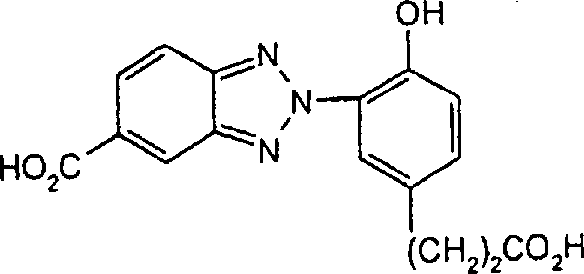
将具有以下结构:的二元酸性蒽醌化合物(1.27g,0.002mol)、1,2-乙二醇-二甲磺酸酯(0.44g,0.002mol)、碳酸钾(0.75g)和DMF(8.0mL)的混合物在90-95℃间歇搅拌下加热2.0小时。将反应混合物倒入甲醇(100mL)中,过滤收集暗红色聚合染料,用甲醇、含有乙酸的水、热水洗涤并随后在空气下干燥(产量1.23g)。GPC分析显示,重均分子量为1,545,数均分子量为1,213且多分散性为1.27。实施例28awill have the following structure: A mixture of dibasic acidic anthraquinone compound (1.27g, 0.002mol), 1,2-ethanediol-dimethylsulfonate (0.44g, 0.002mol), potassium carbonate (0.75g) and DMF (8.0mL) Heat at 90-95°C with intermittent stirring for 2.0 hours. The reaction mixture was poured into methanol (100 mL), and the dark red polydye was collected by filtration, washed with methanol, water with acetic acid, hot water and then dried in air (yield 1.23 g). GPC analysis showed a weight average molecular weight of 1,545, a number average molecular weight of 1,213 and a polydispersity of 1.27. Example 28a
在搅拌下,于室温向1,5-二(2-羧基苯氨基)蒽醌(9.57g,0.02mol)在DMF(250mL)中的混合物中分批加入N-溴琥珀酰亚胺(7.12g,0.04mol)。然后将反应混合物在约60℃热1.5小时并使之冷却。滴加水以沉淀产物,过滤收集该产物,用水洗涤并在空气下干燥(产量11.17g)。FDMS显示,产物的结构为实施例28的起始蒽醌化合物。实施例29To a mixture of 1,5-bis(2-carboxyanilino)anthraquinone (9.57 g, 0.02 mol) in DMF (250 mL) was added N-bromosuccinimide (7.12 g , 0.04mol). The reaction mixture was then heated at about 60°C for 1.5 hours and allowed to cool. Water was added dropwise to precipitate the product, which was collected by filtration, washed with water and air dried (yield 11.17 g). FDMS showed that the structure of the product was the starting anthraquinone compound of Example 28. Example 29
将具有以下结构:
将1,5-二氯蒽醌(6.93g,0.025mol)、3-巯基-1(H)-1,2,4-三唑(5.56g,0.055mol)、碳酸钾(6.91g,0.05mol)和DMF(100mL)的混合物在约95℃搅拌加热5.0小时。将反应混合物倒入水中,过滤收集黄色产物,用水洗涤并在空气下干燥。将滤饼在热异丙醇中再浆化并过滤收集产物,用异丙醇洗涤并在空气下干燥(产量8.62g)。FDMS显示,产物是用作实施例29的二元酸性蒽醌原料的1,5-二-[1(H)-1,2,4-三唑-3-基硫]蒽醌。实施例301,5-dichloroanthraquinone (6.93g, 0.025mol), 3-mercapto-1(H)-1,2,4-triazole (5.56g, 0.055mol), potassium carbonate (6.91g, 0.05mol ) and DMF (100 mL) was stirred and heated at about 95°C for 5.0 hours. The reaction mixture was poured into water and the yellow product was collected by filtration, washed with water and dried in air. The filter cake was reslurried in hot isopropanol and the product was collected by filtration, washed with isopropanol and air dried (yield 8.62 g). FDMS showed that the product was 1,5-bis-[1(H)-1,2,4-triazol-3-ylthio]anthraquinone used as the dibasic acidic anthraquinone starting material in Example 29. Example 30
将具有以下结构:
将1,8-二氯蒽醌(6.93g,0.025mol)、2-巯基咪唑(5.01g,0.05mol)、碳酸钾(6.91g)和DMF(60mL)的混合物在约95℃搅拌加热8.0小时。将反应混合物倒入水中并用乙酸酸化。过滤收集黄色产物,用水洗涤并在空气下干燥。FDMS显示,产物是用作实施例30的原料的1,8-二-(咪唑-2-基硫]蒽醌。实施例31A mixture of 1,8-dichloroanthraquinone (6.93g, 0.025mol), 2-mercaptoimidazole (5.01g, 0.05mol), potassium carbonate (6.91g) and DMF (60mL) was stirred and heated at about 95°C for 8.0 hours . The reaction mixture was poured into water and acidified with acetic acid. The yellow product was collected by filtration, washed with water and dried in air. FDMS showed that the product was 1,8-bis-(imidazol-2-ylthio]anthraquinone used as starting material in Example 30. Example 31
将1,5-二-[1(H)-1,2,4-三唑-3-基硫]蒽醌(1.80g,0.00443mol)(实施例29a的产物)、1,4-二溴丁烷(0.96g,0.00444mol)、三丁胺(1.64g,0.00885mol)和N-甲基-2-吡咯烷酮(30mL)的混合物在约130℃搅拌加热8.0小时。将反应混合物倒入丙酮(150mL)中并过滤收集黄色聚合染料,用丙酮洗涤直至滤液基本透明并在空气下干燥。GPC分析显示,重均分子量为5,022,数均分子量为3,220且多分散性为1.56。实施例321,5-bis-[1(H)-1,2,4-triazol-3-ylthio]anthraquinone (1.80 g, 0.00443 mol) (the product of Example 29a), 1,4-dibromo A mixture of butane (0.96 g, 0.00444 mol), tributylamine (1.64 g, 0.00885 mol) and N-methyl-2-pyrrolidone (30 mL) was stirred and heated at about 130° C. for 8.0 hours. The reaction mixture was poured into acetone (150 mL) and the yellow polydye was collected by filtration, washed with acetone until the filtrate was substantially clear and air dried. GPC analysis showed a weight average molecular weight of 5,022, a number average molecular weight of 3,220 and a polydispersity of 1.56. Example 32
将具有以下结构:
将1,4-二氨基-2,3-二氯蒽醌(12.24g,0.04mol)、硫代水杨酸(15.4g,0.10mol)、碳酸钾(13.8g,0.10mol)和DMF(150mL)的混合物在约95℃搅拌加热2.0小时。随着反应进行,观察到颜色由紫色向蓝色的红移。将反应混合物倒入丙酮(500mL)中,过滤收集固体产物并用丙酮充分洗涤。将丙酮-湿滤饼加入到水(600mL)中并用乙酸酸化该混合物以沉淀出游离酸化合物,过滤收集该化合物,用水洗涤并在空气下干燥(产量21.4g)。FDMS显示,产物是用于实施例32的1,4-二氨基-2,3-二(2-羧基苯基硫)蒽醌。实施例331,4-diamino-2,3-dichloroanthraquinone (12.24g, 0.04mol), thiosalicylic acid (15.4g, 0.10mol), potassium carbonate (13.8g, 0.10mol) and DMF (150mL ) mixture was stirred and heated at about 95°C for 2.0 hours. As the reaction progressed, a red shift in color from violet to blue was observed. The reaction mixture was poured into acetone (500 mL), and the solid product was collected by filtration and washed well with acetone. The acetone-wet cake was added to water (600 mL) and the mixture was acidified with acetic acid to precipitate the free acid compound, which was collected by filtration, washed with water and dried in air (yield 21.4 g). FDMS showed that the product was 1,4-diamino-2,3-bis(2-carboxyphenylthio)anthraquinone used in Example 32. Example 33
将1,5-二-(2-羧基苯基硫)蒽醌(1.02g,0.002mol)、对苯二甲酸(1.00g,0.006mol)、碳酸钾(1.38g)、1,2-乙二醇-二甲磺酸酯(1.74g,0.008mol)和DMF(10mL)的混合物在约95℃间歇搅拌下加热2.0小时。将反应混合物倒入甲醇(100mL)中并过滤收集黄色聚合染料,用甲醇、含有乙酸的水、热水洗涤并在空气下干燥(产量1.88g)。GPC分析显示,重均分子量为794,数均分子量为713且多分散性为1.11。实施例341,5-bis-(2-carboxyphenylthio)anthraquinone (1.02g, 0.002mol), terephthalic acid (1.00g, 0.006mol), potassium carbonate (1.38g), 1,2-ethanedi A mixture of alcohol-dimesylate (1.74 g, 0.008 mol) and DMF (10 mL) was heated at about 95° C. with intermittent stirring for 2.0 hours. The reaction mixture was poured into methanol (100 mL) and the yellow polydye was collected by filtration, washed with methanol, water with acetic acid, hot water and dried in air (yield 1.88 g). GPC analysis showed a weight average molecular weight of 794, a number average molecular weight of 713 and a polydispersity of 1.11. Example 34
使用1,5-二-(2-羧基苯基硫)蒽醌(1.02g,0.002mol)和对苯二甲酸(0.33g,0.002mol)、1,2-乙二醇-二甲磺酸酯(0.87g,0.004mol)及碳酸钾(0.87g)来重复实施例33,得到黄色聚合染料(0.90g)。GPC分析显示重均分子量为875,数均分子量为811且多分散性为1.08。实施例35Using 1,5-bis-(2-carboxyphenylthio)anthraquinone (1.02 g, 0.002 mol) and terephthalic acid (0.33 g, 0.002 mol), 1,2-ethylene glycol-dimethylsulfonate (0.87g, 0.004mol) and potassium carbonate (0.87g) to repeat Example 33 to obtain a yellow polymer dye (0.90g). GPC analysis showed a weight average molecular weight of 875, a number average molecular weight of 811 and a polydispersity of 1.08. Example 35
将具有以下结构: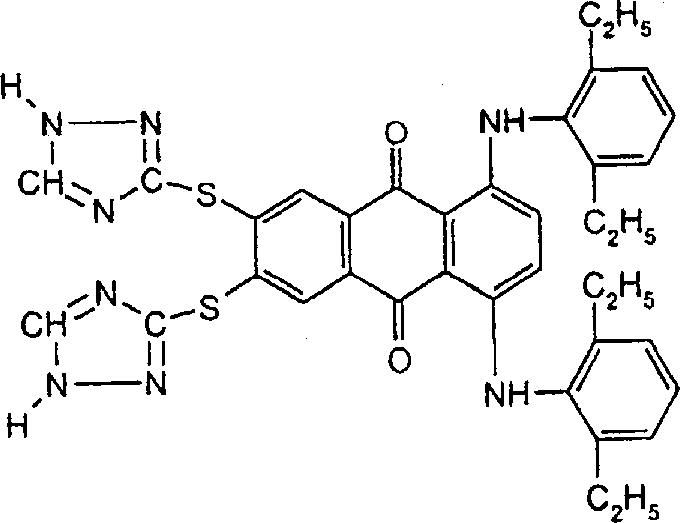
将具有以下结构:
着色EASTAR共聚酯6763薄膜是通过熔融共混实施例7-36的聚合染料并根据下列生产实施例37-66的步骤挤塑而生成的(表1)。Pigmented EASTAR (R) copolyester 6763 films were produced by melt blending the polymeric dyes of Examples 7-36 and extruding according to the following procedure for producing Examples 37-66 (Table 1).
将EASTARPETG聚酯6763,聚对苯二甲酸(亚乙基-1,4-环己烷二亚甲基)酯(伊斯曼化学品公司)(300g前述的干燥粒料)与蒽醌聚合染料组合物(0.12g)干混。在250℃下,用配有混合螺杆的C.W.Brabender 3/4英寸挤出机将共混物挤塑到水浴中并将挤出物造粒。 EASTAR® PETG polyester 6763, polyethylene terephthalate (ethylene-1,4-cyclohexane dimethylene) ester (Eastman Chemical Company) (300 g of the aforementioned dry pellets) and anthraquinone The polymeric dye composition (0.12g) was dry blended. The blend was extruded at 250°C using a CW Brabender 3/4 inch extruder equipped with a mixing screw into a water bath and the extrudate was pelletized.
在70℃、约1-5托压力下,将粒料再干燥17小时。使用直径为2英寸的圆形模具,在Pasadena液压机有限公司的压机上,用12,000磅的活塞力(4英寸活塞),在250℃将一部分干燥粒料(1.40g)压成18-20密耳的薄膜。透明薄膜含有约300ppm的聚合染料并且每一个都显示出可得到表1所示颜色的优异显色性。实施例67The pellets were dried for an additional 17 hours at 70°C under a pressure of about 1-5 Torr. A portion of the dry pellets (1.40 g) was pressed to 18-20 densities at 250°C on a Pasadena Hydraulic Press Ltd press using 12,000 lbs of piston force (4 inch piston) using a 2 inch diameter circular die. The membrane of the ear. The transparent films contained about 300 ppm of polymerized dyes and each exhibited excellent color rendering to give the colors shown in Table 1. Example 67
将1,4-二-(2-羧基苯基硫)蒽醌(15.4g,0.03mol)(按实施例20a制备)、1,5-二-(2-羧基苯基硫)-4,8-二(异丁基氨基)蒽醌(6.55g,0.01mol)(实施例2a)、1,2-乙二醇-二甲磺酸酯(8.72g,0.04mol)、碳酸钾(8.0g)和DMF(100mL)的混合物在约95℃间歇搅拌下加热2.0小时。将反应混合物倒入甲醇(500mL)中并过滤收集黑色聚合染料,用含有乙酸的水、热水洗涤并在空气下干燥(产量9.5g)。GPC分析显示,重均分子量为7,512,数均分子量为1,700且多分散性为4.42。实施例681,4-bis-(2-carboxyphenylthio)anthraquinone (15.4g, 0.03mol) (prepared according to Example 20a), 1,5-bis-(2-carboxyphenylthio)-4,8 - bis(isobutylamino)anthraquinone (6.55g, 0.01mol) (Example 2a), 1,2-ethanediol-dimethylsulfonate (8.72g, 0.04mol), potassium carbonate (8.0g) A mixture with DMF (100 mL) was heated at about 95° C. with intermittent stirring for 2.0 hours. The reaction mixture was poured into methanol (500 mL) and the black polydye was collected by filtration, washed with water containing acetic acid, hot water and dried in air (yield 9.5 g). GPC analysis showed a weight average molecular weight of 7,512, a number average molecular weight of 1,700 and a polydispersity of 4.42. Example 68
将EASTARPETG共聚酯6763(291g前述的干燥粒料)与实施例67的黑色聚合染料(9.0g)干混,并使用实施例4所述的步骤将一部分所得粒料压制成含有约3.0重量%的聚合染料的黑色薄膜。实施例69 EASTAR® PETG copolyester 6763 (291 g of the previously described dry pellets) was dry blended with the black polymeric dye of Example 67 (9.0 g) and a portion of the resulting pellets were compressed using the procedure described in Example 4 to contain about 3.0 Black film of polymerized dye in % by weight. Example 69
将具有以下结构:
将具有以下结构:的二溴偶氮苯染料(6.01g,0.010mol)、3-巯基-1(H)-1,2,4-三唑(2.2g,0.022mol)、碳酸钾(3.45g,0.025mol)和DMF(100mL)的混合物在约95℃搅拌加热2.0小时。TLC(75份THF∶25份环己烷)显示反应不完全。加入更多量(1.01g,0.01m)的3-巯基-1(H)-1,2,4-三唑并再继续加热搅拌2.0小时。TLC显示,生成紫色产物的反应基本完全。将反应混合物倒入水(400mL)中并通过加入乙酸将该混合物酸化,加热到约40℃并过滤。用温水洗涤产物并在空气下干燥(产量5.60g)。FDMS显示,产物具有用于实施例69的二元酸性偶氮苯化合物的结构。实施例70will have the following structure: Dibromoazobenzene dye (6.01g, 0.010mol), 3-mercapto-1(H)-1,2,4-triazole (2.2g, 0.022mol), potassium carbonate (3.45g, 0.025mol) and A mixture of DMF (100 mL) was heated with stirring at about 95°C for 2.0 hours. TLC (75 parts THF: 25 parts cyclohexane) showed that the reaction was incomplete. A further amount (1.01 g, 0.01 m) of 3-mercapto-1(H)-1,2,4-triazole was added and heating and stirring continued for an additional 2.0 hours. TLC showed that the reaction to the purple product was essentially complete. The reaction mixture was poured into water (400 mL) and the mixture was acidified by adding acetic acid, heated to about 40 °C and filtered. The product was washed with warm water and dried in air (yield 5.60 g). FDMS showed that the product had the structure of the dibasic acidic azobenzene compound used in Example 69. Example 70
将具有以下结构:
将具有以下结构: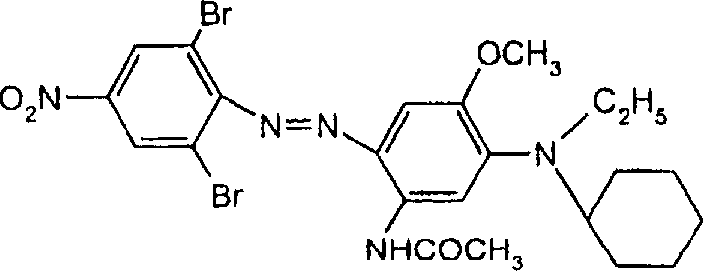
将具有以下结构:的二元酸性偶氮化合物(1.59g,0.005mol)、1,2-乙二醇-二甲磺酸酯(1.09g,0.005mol)、碳酸钾(1.5g)和DMF(10mL)的混合物在约95℃搅拌加热3.0小时。将反应混合物倒入甲醇(100mL)中并过滤收集深棕色聚合染料,用甲醇、含有乙酸的水、热水洗涤并在空气下干燥(产量0.66g)。GPC分析显示,Mw为4,926,Mn为1,574且Mw/Mn为3.13。实施例72will have the following structure: A mixture of dibasic acidic azo compound (1.59g, 0.005mol), 1,2-ethanediol-dimethylsulfonate (1.09g, 0.005mol), potassium carbonate (1.5g) and DMF (10mL) was Heat at about 95°C with stirring for 3.0 hours. The reaction mixture was poured into methanol (100 mL) and the dark brown polydye was collected by filtration, washed with methanol, water with acetic acid, hot water and dried in air (yield 0.66 g). GPC analysis showed Mw of 4,926, Mn of 1,574 and Mw/Mn of 3.13. Example 72
将具有以下结构:
在室温下,向搅拌着的偶氮化合物(4.05g,0.01mol)[4-(3’,5’-二甲酯基-4’-甲基噻吩-2-基偶氮)-N-乙基-N(2-羟乙基)苯胺]和2-乙氧基乙醇(50mL)的混合物中加入50%的NaOH水溶液(3.75g)。在约95℃加热1.0小时后,将反应产物倒入丙酮(300mL)中。过滤收集二元酸性偶氮染料的二钠盐,用丙酮洗涤并随后迅速溶解在水(200mL)中。用乙酸酸化沉淀出游离二酸染料,过滤收集该染料,用水洗涤并在空气下干燥(产量2.35g)。FDMS显示,产物具有用于实施例72的二元酸性偶氮化合物的结构。实施例73At room temperature, to the stirred azo compound (4.05g, 0.01mol) [4-(3', 5'-dimethylcarboxylate-4'-methylthiophen-2-yl azo)-N-ethyl 50% NaOH in water (3.75 g) was added to a mixture of N(2-hydroxyethyl)aniline] and 2-ethoxyethanol (50 mL). After heating at about 95°C for 1.0 hour, the reaction product was poured into acetone (300 mL). The disodium salt of the dibasic acid azo dye was collected by filtration, washed with acetone and then rapidly dissolved in water (200 mL). Acidification with acetic acid precipitated the free diacid dye, which was collected by filtration, washed with water and air dried (yield 2.35 g). FDMS showed that the product had the structure of the dibasic acidic azo compound used in Example 72. Example 73
将具有以下结构: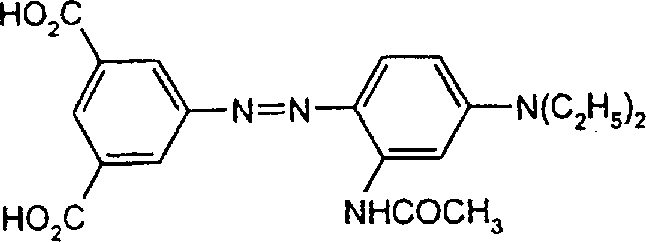
向3-乙酰氨基4-(3’,5’-二甲酯基苯基偶氮)-N,N-二乙基苯胺(1.7g,0.004mol)在2-乙氧基乙醇(20mL)中的混合物加入50%的NaOH水溶液(1.6g)。将反应混合物在约95℃搅拌加热10分钟,然后倒入水(100mL)中。用乙酸酸化该溶液沉淀出二酸染料,过滤收集该染料,用水洗涤并在空气下干燥(产量1.6g)。FDMS显示,结构为实施例73的起始二元酸偶氮苯化合物。实施例74To 3-acetamido 4-(3',5'-dimethylcarbohydridophenylazo)-N,N-diethylaniline (1.7g, 0.004mol) in 2-ethoxyethanol (20mL) The mixture was added with 50% aqueous NaOH (1.6 g). The reaction mixture was heated with stirring at about 95°C for 10 minutes, then poured into water (100 mL). The solution was acidified with acetic acid to precipitate the diacid dye, which was collected by filtration, washed with water and air dried (yield 1.6 g). FDMS showed that the structure was the starting dibasic acid azobenzene compound of Example 73. Example 74
将具有以下结构:的二元酸性偶氮苯化合物(1.10g,0.003mol)、1,6-己二醇-二甲磺酸酯(0.82g,0.003mol)、碳酸钾(0.45g)和DMF(8.0mL)的混合物在95℃间歇搅拌下加热2.0小时。将反应混合物倒入甲醇(100mL)中。得到略粘稠的黄色产物。倾析除去甲醇并在搅拌加热下将产物溶解在DMF(10mL)中。加入水(100mL)并通过加入乙酸酸化该混合物。过滤收集固体黄色聚合染料,用水洗涤并在空气下干燥(产量0.47g)。GPC分析显示,Mw为9,314,Mn为3,208且Mw/Mn为2.90。在可见光吸收光谱中,观察到在DMF中的最大吸收在428nm。实施例74awill have the following structure: Dibasic acidic azobenzene compound (1.10g, 0.003mol), 1,6-hexanediol-dimethylsulfonate (0.82g, 0.003mol), potassium carbonate (0.45g) and DMF (8.0mL) The mixture was heated at 95°C with intermittent stirring for 2.0 hours. The reaction mixture was poured into methanol (100 mL). A slightly viscous yellow product was obtained. Methanol was removed by decantation and the product was dissolved in DMF (10 mL) with stirring and heating. Water (100 mL) was added and the mixture was acidified by adding acetic acid. The solid yellow polydye was collected by filtration, washed with water and air dried (yield 0.47 g). GPC analysis showed a Mw of 9,314, a Mn of 3,208 and a Mw/Mn of 2.90. In the visible light absorption spectrum, the maximum absorption in DMF was observed at 428 nm. Example 74a
向4-(2’,5’-二甲酯基苯基偶氮)-N-(2-氰基乙基)-N-乙基苯胺(1.97g,0.005mol)在2-乙氧基乙醇(20mL)中的混合物加入50%的NaOH水溶液(1.90g)。将反应混合物在95℃加热15分钟,然后倒入水(200mL)中。酸化该溶液并过滤收集沉淀出的黄色染料,用水洗涤并在空气下干燥(产量1.75g)。FDMS显示,结构为实施例74的起始二元酸偶氮苯染料。实施例754-(2',5'-Dimethoxyphenylazo)-N-(2-cyanoethyl)-N-ethylaniline (1.97g, 0.005mol) in 2-ethoxyethanol (20 mL) was added 50% aqueous NaOH (1.90 g). The reaction mixture was heated at 95 °C for 15 minutes, then poured into water (200 mL). The solution was acidified and the precipitated yellow dye was collected by filtration, washed with water and air dried (yield 1.75 g). FDMS showed that the structure was the starting dibasic acid azobenzene dye of Example 74. Example 75
将具有以下结构:
向二酯染料(41.4g,0.10mol)[3-氰基-5-(3’,5’-二甲酯基苯基偶氮)-6-羟基-N-(2-羟乙基)-4-甲基-2-吡啶酮]在2-乙氧基乙醇(400mL)中的混合物加入50%的NaOH水溶液(40.0g),并将反应混合物在75-80℃加热约30分钟。将丙酮(200mL)加入到稍冷却的反应混合物中。过滤收集黄色固体,用丙酮洗涤并然后在温水(750mL)中再浆化。用浓盐酸(20mL)酸化后,过滤收集黄色二元酸染料,用热水洗涤并在空气下干燥(产量36.0g)。FDMS显示,结构为实施例75的起始二元酸偶氮化合物。实施例76To the diester dye (41.4g, 0.10mol) [3-cyano-5-(3',5'-dimethylcarboxyphenylazo)-6-hydroxy-N-(2-hydroxyethyl)- 4-Methyl-2-pyridinone] in 2-ethoxyethanol (400 mL) was added to 50% aqueous NaOH (40.0 g) and the reaction mixture was heated at 75-80° C. for about 30 minutes. Acetone (200 mL) was added to the slightly cooled reaction mixture. The yellow solid was collected by filtration, washed with acetone and then reslurried in warm water (750 mL). After acidification with concentrated hydrochloric acid (20 mL), the yellow dibasic acid dye was collected by filtration, washed with hot water and dried in air (yield 36.0 g). FDMS showed the structure to be the starting dibasic acid azo compound of Example 75. Example 76
将具有以下结构:
将具有以下结构:
向3-(3’,5’-二羧基甲氧基苯基偶氮)-2-苯基吲哚(1.0g,0.00242mol)在2-乙氧基乙醇(10mL)中的混合物加入50%的NaOH水溶液(0.75g),并通过在约95℃加热30分钟进行水解反应。将反应混合物倒入水(100mL)中并用乙酸处理该溶液以沉淀出产物,过滤收集该产物,用水洗涤并在空气下干燥(产量0.85g)。FDMS显示,结构为实施例77的起始二元酸性偶氮化合物。实施例78To a mixture of 3-(3',5'-dicarboxymethoxyphenylazo)-2-phenylindole (1.0 g, 0.00242 mol) in 2-ethoxyethanol (10 mL) was added 50% NaOH aqueous solution (0.75 g), and the hydrolysis reaction was carried out by heating at about 95°C for 30 minutes. The reaction mixture was poured into water (100 mL) and the solution was treated with acetic acid to precipitate the product, which was collected by filtration, washed with water and dried in air (yield 0.85 g). FDMS showed the structure to be the starting dibasic acidic azo compound of Example 77. Example 78
将具有以下结构:
将具有以下结构: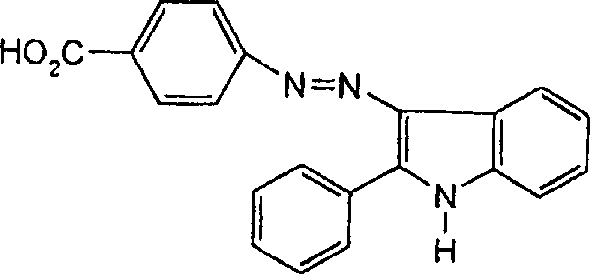
将具有以下结构:
将具有以下结构:的二元酸性偶氮化合物(1.25g,0.003mol)、1,2-乙二醇-二甲磺酸酯(0.65g,0.003mol)、碳酸钾(1.0g)和DMF(10mL)的混合物在约95℃间歇搅拌下加热3.0小时。将反应混合物倒入甲醇(25mL)中并过滤收集橙色聚合染料,用甲醇、含有乙酸的水、热水洗涤并在空气下干燥(产量0.75g)。GPC分析显示,Mw为2,014,Mn为1,520且Mw/Mn为1.32。在可见光吸收光谱中,观察到在DMF中的最大吸收在493nm。实施例82will have the following structure: A mixture of dibasic acidic azo compounds (1.25g, 0.003mol), 1,2-ethanediol-dimethylsulfonate (0.65g, 0.003mol), potassium carbonate (1.0g) and DMF (10mL) was Heat at about 95°C with intermittent stirring for 3.0 hours. The reaction mixture was poured into methanol (25 mL) and the orange polydye was collected by filtration, washed with methanol, water with acetic acid, hot water and dried in air (yield 0.75 g). GPC analysis showed Mw to be 2,014, Mn to be 1,520 and Mw/Mn to be 1.32. In the visible light absorption spectrum, the maximum absorption in DMF was observed at 493 nm. Example 82
将具有以下结构:
将具有以下结构:
将具有以下结构:
将实施例84的一部分聚合染料(0.5g)、二氰基铜酸钠(0.2g)和DMF(8.0mL)的混合物在约95℃间歇搅拌下加热3.0小时。随着取代反应的进行,反应混合物的颜色由红蓝色变为中性蓝色(neutral-blue),随后将该反应混合物倒入甲醇中并过滤收集聚合染料,用甲醇洗涤并在空气下干燥。GPC分析显示,Mw为9,427,Mn为1,117且Mw/Mn为8.44。在可见光吸收光谱中观察到在DMF中的最大吸收在590nm。实施例86A mixture of a portion of the polymeric dye from Example 84 (0.5 g), sodium dicyanocuprate (0.2 g), and DMF (8.0 mL) was heated at about 95° C. with intermittent stirring for 3.0 hours. As the substitution reaction progressed, the color of the reaction mixture changed from red-blue to neutral-blue, then the reaction mixture was poured into methanol and the aggregated dye was collected by filtration, washed with methanol and dried in air . GPC analysis showed Mw of 9,427, Mn of 1,117 and Mw/Mn of 8.44. The maximum absorption in DMF was observed in the visible light absorption spectrum at 590 nm. Example 86
将具有以下结构:
在搅拌下,向浓H2SO4(33.0mL)中加入2,6-二氯-4-硝基苯胺(6.21g,0.03mol)。将该溶液冷却到0-5℃,并在搅拌下在5℃以下加入亚硝基硫酸混合物,亚硝基硫酸混合物是通过在搅拌下向浓H2SO4(15mL)中分批加入亚硝酸钠(2.19g)并让温度升高而制备的。将重氮化反应混合物在0-5℃搅拌2.0小时。在0-5℃、搅拌下,将重氮盐溶液的等分试样(0.01mol)加入溶解在含有一些浓HCl(5.0mL)的1∶5(1份丙酸∶5份乙酸)(120mL)中的二酸偶联剂(3.95g,0.01mol)(N,N-二(4-羧基苯基甲基)-3-氯苯胺)的冷溶液中。通过在搅拌下加入乙酸铵来中和偶联反应混合物,并间歇搅拌使其在5℃以下保持约1.0小时。加入水沉淀出固体染料,过滤收集该染料,用水洗涤并在空气下干燥(产量4.0g)。将粗品染料在热甲醇中再浆化并让混合物冷却。过滤收集最终染料,用甲醇洗涤并在空气下干燥。观察到在DMF中的最大吸收在431nm。该二酸染料用作实施例86的原料。实施例86bTo concentrated H2SO4 (33.0 mL ) was added 2,6-dichloro-4-nitroaniline (6.21 g, 0.03 mol) with stirring. The solution was cooled to 0-5°C and the nitrosylsulfuric acid mixture was added below 5°C with stirring by adding nitrosylsulfuric acid in portions to concentrated H2SO4 (15 mL) Sodium (2.19g) and allowed to warm up. The diazotization reaction mixture was stirred at 0-5°C for 2.0 hours. An aliquot (0.01 mol) of the diazonium salt solution was added in 1:5 (1 part propionic acid: 5 parts acetic acid) (120 mL) containing some concentrated HCl (5.0 mL) with stirring at 0-5°C ) in a cold solution of diacid coupling agent (3.95 g, 0.01 mol) (N,N-bis(4-carboxyphenylmethyl)-3-chloroaniline). The coupling reaction mixture was neutralized by adding ammonium acetate with stirring and kept below 5°C for about 1.0 hour with intermittent stirring. Water was added to precipitate a solid dye which was collected by filtration, washed with water and air dried (yield 4.0 g). The crude dye was reslurried in hot methanol and the mixture was allowed to cool. The final dye was collected by filtration, washed with methanol and air dried. The absorption maximum in DMF was observed at 431 nm. This diacid dye was used as the starting material for Example 86. Example 86b
在搅拌下,将间氯苯胺(2.56g,0.02mol)、4-(溴甲基)苯甲酸甲酯(10.08g,0.044mol)、碳酸钠(4.66g)和碘化钠(0.2g)及2-乙氧基乙醇(50mL)的混合物在氮气下于约90℃加热3.0小时。将反应混合物倒入水中并将产物提取到二氯甲烷中。除去二氯甲烷,留下油状产物(11.0g),将该产物加入到2-乙氧基乙醇(100mL)中。向该溶液中加入50%的NaOH水溶液(7.50g)并将反应混合物温热。在约30℃,白色固体开始沉淀并且在约50℃反应混合物变得非常稠。当温度达到70℃时,加入水(20mL)以溶解二元酸性产物的盐。在70℃搅拌1.5小时后,将反应混合物经硅藻土助滤剂过滤澄清并通过加入10%的HCl水溶液至pH约为4.0而将滤液酸化。过滤收集白色固体,用水洗涤并在空气下干燥(产量7.20g)。FDMS显示,产物具有用于实施例86a的偶联剂的结构。实施例87Under stirring, m-chloroaniline (2.56g, 0.02mol), 4-(bromomethyl) methyl benzoate (10.08g, 0.044mol), sodium carbonate (4.66g) and sodium iodide (0.2g) and A mixture of 2-ethoxyethanol (50 mL) was heated at about 90° C. for 3.0 hours under nitrogen. The reaction mixture was poured into water and the product was extracted into dichloromethane. Removal of the dichloromethane left an oily product (11.0 g), which was added to 2-ethoxyethanol (100 mL). To this solution was added 50% aqueous NaOH (7.50 g) and the reaction mixture was warmed. At about 30°C, a white solid started to precipitate and at about 50°C the reaction mixture became very thick. When the temperature reached 70°C, water (20 mL) was added to dissolve the salt of the dibasic acid product. After stirring at 70°C for 1.5 hours, the reaction mixture was clarified by filtration through celite filter aid and the filtrate was acidified by adding 10% aqueous HCl to a pH of approximately 4.0. The white solid was collected by filtration, washed with water and air dried (yield 7.20 g). FDMS showed that the product had the structure of the coupling reagent used in Example 86a. Example 87
将具有以下结构:
在搅拌下,于0-5℃将实施例86a中制备的2,6-二氯-4-硝基苯胺的重氮盐的等分试样(0.01mol)加入到溶解在1∶5酸(100mL)中的具有以下结构:的偶联剂(3.29g,0.01mol)冷溶液中。搅拌下加入乙酸铵直到偶联混合物对刚果红试纸显中性。保持1.0小时后,向偶联混合物中加入水以沉淀出染料,过滤收集该染料,用水洗涤并在空气下干燥(产量4.27g)。在可见光吸收光谱中观察到在DMF中的最大吸收在460nm。实施例87bAn aliquot (0.01 mol) of the diazonium salt of 2,6-dichloro-4-nitroaniline prepared in Example 86a (0.01 mol) was added at 0-5°C with stirring in 1:5 acid ( 100mL) has the following structure: In the cold solution of coupling agent (3.29g, 0.01mol). Ammonium acetate was added with stirring until the coupling mixture was neutral to Congo red paper. After 1.0 hour hold, water was added to the coupling mixture to precipitate the dye, which was collected by filtration, washed with water and air dried (yield 4.27 g). The maximum absorption in DMF was observed in the visible light absorption spectrum at 460 nm. Example 87b
在搅拌下,将N-(2-氯乙基)-N-乙基苯胺(46.0g,0.25mol)、5-羟基间苯二甲酸二甲酯(52.5g,0.25mol)、碳酸钾(69.08g)、痕量粉末状碘化钾和DMF(350mL)的混合物在125-30℃加热3.5小时。让反应混合物冷却并将其倒入水/冰混合物(1.0L)。分离产物为棕色油状物,通过倾析除去水层。向油状产物中加入2-乙氧基乙醇(175mL)和50%NaOH水溶液(50.0g),并且在60-65℃加热约20分钟进行水解反应。向反应混合物中加入丙酮并过滤收集白色固体,用丙酮洗涤并在空气下干燥(产量99.0g)。搅拌下将二钠盐溶解在水(250mL)中。用浓HCl酸化使pH约为3.0,得到稍粘稠的产物,该产物几分钟后固化。过滤收集浅黄色颗粒状固体,用水洗涤并在空气下干燥(产量58.0g)。FDMS显示,结构为用于实施例87a的偶联剂的结构。实施例88Under stirring, N-(2-chloroethyl)-N-ethylaniline (46.0g, 0.25mol), dimethyl 5-hydroxyisophthalate (52.5g, 0.25mol), potassium carbonate (69.08 g), a mixture of traces of powdered potassium iodide and DMF (350 mL) was heated at 125-30°C for 3.5 hours. The reaction mixture was allowed to cool and poured into a water/ice mixture (1.0 L). The product was isolated as a brown oil and the aqueous layer was removed by decantation. 2-Ethoxyethanol (175 mL) and 50% NaOH aqueous solution (50.0 g) were added to the oily product, and heated at 60-65° C. for about 20 minutes to carry out hydrolysis reaction. Acetone was added to the reaction mixture and the white solid was collected by filtration, washed with acetone and dried under air (yield 99.0 g). The disodium salt was dissolved in water (250 mL) with stirring. Acidification with concentrated HCl to a pH of about 3.0 gave a slightly viscous product which solidified after a few minutes. The pale yellow granular solid was collected by filtration, washed with water and air dried (yield 58.0 g). FDMS showed that the structure was that of the coupling agent used in Example 87a. Example 88
将具有以下结构:的二元酸性偶氮化合物(0.70g,0.0013mol)、1,6-己二醇-二甲磺酸酯(0.36g,0.0013mol)、碳酸钾(0.35g)和DMF(5.0mL)的混合物在约95℃间歇搅拌下加热2.0小时。将反应混合物倒入甲醇(50mL)中并过滤收集聚合染料,用甲醇、含有乙酸的水、热水洗涤并在空气下干燥(产量0.55g)。GPC分析显示,Mw为7,353,Mn为2,431且Mw/Mn为3.02。在可见光吸收光谱中,观察到在DMF中的最大吸收在537nm。实施例88awill have the following structure: A mixture of dibasic acidic azo compounds (0.70g, 0.0013mol), 1,6-hexanediol-dimethylsulfonate (0.36g, 0.0013mol), potassium carbonate (0.35g) and DMF (5.0mL) Heat at about 95°C for 2.0 hours with intermittent stirring. The reaction mixture was poured into methanol (50 mL) and the polymerized dye was collected by filtration, washed with methanol, water with acetic acid, hot water and dried in air (yield 0.55 g). GPC analysis showed Mw to be 7,353, Mn to be 2,431 and Mw/Mn to be 3.02. In the visible light absorption spectrum, the maximum absorption in DMF was observed at 537 nm. Example 88a
向具有以下结构:的二酯染料(1.75g,0.0013mol)和2-乙氧基乙醇(20mL)的混合物中加入50%NaOH水溶液(1.2g),并将该水解混合物在约95℃加热约10分钟。将反应混合物倒入丙酮中并过滤收集固体物质。搅拌下将丙酮-湿物质溶解在水(200mL)中并通过加入乙酸沉淀出二元酸染料。过滤收集产物,用水洗涤并在空气下干燥(产量1.35g)。FDMS显示产物主要为
将具有以下结构:
在搅拌下,分批向浓H2SO4(7.5mL)中加入干燥的NaNO2(1.08g)并让温度升高。将亚硝基硫酸混合物冷却,并在搅拌下于10℃以下加入1∶5酸(15mL)。在0-5℃搅拌下,向此混合物中加入5-(4’-氨基-2’,6’-二溴苯氧基)间苯二甲酸二甲酯(6.86g,0.015mol),然后加入15mL的1∶5酸。将重氮化反应混合物在0-5℃搅拌2.0小时,并随后在0-5℃将一份等分试样(0.0075mol)加入到3-乙酰氨基-N,N-二乙基苯胺(1.54g,0.0075mol)溶解在1∶5酸(75mL)的溶液中。搅拌下将乙酸铵加入到偶联混合物中,直到对刚果红试纸显中性。让偶联反应在0-5℃继续进行1.0小时并随后加入水沉淀出染料,过滤收集该染料,用水洗涤并在空气下干燥。FDMS显示,结构为实施例88b的起始二溴偶氮染料的结构。在可见光吸收光谱中,观察到在DMF中的最大吸收在546nm。实施例88dTo concentrated H2SO4 (7.5 mL ) was added dry NaNO2 (1.08 g) in portions with stirring and the temperature was allowed to rise. The nitrosylsulfuric acid mixture was cooled and 1:5 acid (15 mL) was added with stirring below 10 °C. Under stirring at 0-5°C, dimethyl 5-(4'-amino-2',6'-dibromophenoxy)isophthalate (6.86g, 0.015mol) was added to this mixture, followed by 15 mL of 1:5 acid. The diazotization reaction mixture was stirred at 0-5°C for 2.0 hours, and then an aliquot (0.0075 mol) was added to 3-acetamido-N,N-diethylaniline (1.54 g, 0.0075 mol) was dissolved in a 1:5 solution of acid (75 mL). Ammonium acetate was added to the coupling mixture with stirring until neutral to Congo red paper. The coupling reaction was allowed to continue at 0-5°C for 1.0 hour and then water was added to precipitate the dye which was collected by filtration, washed with water and air dried. FDMS showed the structure to be that of the starting dibromoazo dye from Example 88b. In the visible light absorption spectrum, the maximum absorption in DMF was observed at 546 nm. Example 88d
在搅拌下,用溴(17.4g,0.11mol)处理5-(4’-氨基苯氧基)间苯二甲酸二甲酯(15.0g,0.05mol)(实施例12c)、无水乙酸钠(9.6g)和乙酸(85mL)的混合物,其中允许温度升高。将反应混合物在70-80℃加热1.5小时,冷却,并随后倒入冰水(350mL)中。过滤收集产物,用水洗涤并在空气下干燥(产量21.9g)。FDMS显示,结构为实施例88c中重氮化的胺化合物的结构。实施例89将具有以下结构:
将具有以下结构:的二元酸性偶氮化合物(1.23g,0.004mol)、1,2-己二醇-二甲磺酸酯(1.1g,0.004mol)、碳酸钾(0.55g)和DMF(8.0mL)的混合物在95℃加热1小时。将反应混合物倒入含有乙酸(5.0mL)的水(250mL)中。过滤收集黄色聚合染料,用水洗涤并在空气下干燥(产量1.21g)。GPC分析显示,Mw为1,726,Mn为1,079且Mw/Mn为1.6。在可见光吸收光谱中,观察到在DMF中的最大吸收在400nm。实施例91will have the following structure: A mixture of dibasic acidic azo compound (1.23g, 0.004mol), 1,2-hexanediol-dimethylsulfonate (1.1g, 0.004mol), potassium carbonate (0.55g) and DMF (8.0mL) Heat at 95°C for 1 hour. The reaction mixture was poured into water (250 mL) containing acetic acid (5.0 mL). The yellow polydye was collected by filtration, washed with water and air dried (yield 1.21 g). GPC analysis showed Mw to be 1,726, Mn to be 1,079 and Mw/Mn to be 1.6. In the visible light absorption spectrum, the maximum absorption in DMF was observed at 400 nm. Example 91
将具有以下结构:的二元酸性偶氮化合物(1.71g,0.003mol)、1,6-己二醇-二甲磺酸酯(0.82g,0.003mol)、碳酸钾(0.85g)和DMF(8.0mL)的混合物在95℃间歇搅拌下加热2.0小时。将反应混合物倒入甲醇(100mL)中并过滤收集红色聚合染料,用甲醇、含有乙酸的水、热水洗涤并在空气下干燥(产量1.5g)。GPC显示,Mw为2,090,Mn为1,235且Mw/Mn为1.69。在可见光吸收光谱中,观察到在DMF中的最大吸收在545nm。实施例91awill have the following structure: A mixture of dibasic acidic azo compound (1.71g, 0.003mol), 1,6-hexanediol-dimethylsulfonate (0.82g, 0.003mol), potassium carbonate (0.85g) and DMF (8.0mL) Heat at 95°C with intermittent stirring for 2.0 hours. The reaction mixture was poured into methanol (100 mL) and the red polydye was collected by filtration, washed with methanol, water with acetic acid, hot water and dried in air (yield 1.5 g). GPC showed Mw was 2,090, Mn was 1,235 and Mw/Mn was 1.69. In the visible light absorption spectrum, the maximum absorption in DMF was observed at 545 nm. Example 91a
在搅拌下,分批向浓H2SO4(5.0mL)中加入干燥的NaNO2(0.72g)并让温度升高。搅拌亚硝基硫酸混合物并将其冷却,在低于约15℃的温度下加入1∶5酸(10mL),然后在0-5℃加入5-氨基-4-氰基-3-甲基异噻唑(1.39g,0.01mol)和1∶5酸(10mL)。在0-5℃搅拌2.0小时后,在0-5℃将重氮化溶液的等分试样(0.005mol)加入到搅拌着的3-乙酰氨基-N,N-二-(4-羧基苯基甲基)苯胺(2.09g,0.005mol)溶解在1∶5酸(30mL)的溶液中。加入乙酸铵以中和偶联混合物直到对刚果红试纸显中性。将水加入到偶联混合物中以沉淀出红色染料,过滤收集该染料并在空气下干燥(产量2.67g)。将该产物在热甲醇中再浆化,让其冷却并过滤收集固体,用甲醇洗涤并在空气下干燥(产量2.10g)。FDMS显示,结构为用作实施例91的起始材料二元酸偶氮染料的结构。实施例91bTo concentrated H2SO4 (5.0 mL ) was added dry NaNO2 (0.72 g) in portions with stirring and the temperature was allowed to rise. Stir and cool the nitrosylsulfuric acid mixture, add 1:5 acid (10 mL) at a temperature below about 15°C, then add 5-amino-4-cyano-3-methyliso Thiazole (1.39 g, 0.01 mol) and 1:5 acid (10 mL). After stirring at 0-5°C for 2.0 hours, an aliquot (0.005 mol) of the diazotization solution was added to the stirred 3-acetamido-N,N-bis-(4-carboxybenzene (2.09 g, 0.005 mol) was dissolved in a 1:5 solution of acid (30 mL). Ammonium acetate was added to neutralize the coupling mixture until neutral to Congo red paper. Water was added to the coupling mixture to precipitate the red dye, which was collected by filtration and air dried (yield 2.67 g). The product was reslurried in hot methanol, allowed to cool and the solid collected by filtration, washed with methanol and dried in air (yield 2.10 g). FDMS showed that the structure was that of the dibasic acid azo dye used as the starting material of Example 91. Example 91b
向具有以下结构: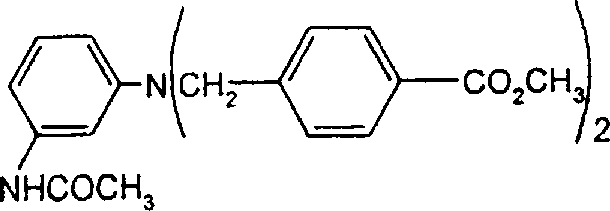
将具有以下结构:的二元酸性偶氮化合物(0.83g,0.002mol)、1,2-乙二醇-二甲磺酸酯(0.44g,0.002mol)、碳酸钾(0.5g)和DMF(7.5mL)的混合物在95℃加热3.0小时。通过将反应混合物倒入水中并用乙酸酸化、然后过滤、用水洗涤并在空气下干燥来分离聚合染料。GPC分析显示,Mw为2,379,Mn为1,363且Mw/Mn为1.74。在可见光吸收光谱中,观察到在DMF中的最大吸收在480nm。实施例93will have the following structure: A mixture of dibasic acidic azo compounds (0.83g, 0.002mol), 1,2-ethanediol-dimethylsulfonate (0.44g, 0.002mol), potassium carbonate (0.5g) and DMF (7.5mL) Heat at 95°C for 3.0 hours. The polymeric dye is isolated by pouring the reaction mixture into water and acidifying with acetic acid, then filtering, washing with water and drying in air. GPC analysis showed Mw to be 2,379, Mn to be 1,363 and Mw/Mn to be 1.74. In the visible light absorption spectrum, the maximum absorption in DMF was observed at 480 nm. Example 93
将具有以下结构:的二元酸性偶氮化合物(1.26g,0.003mol)、1,6-己二醇-二甲磺酸酯(0.82g,0.003mol)、碳酸钾(0.50g)和DMF(8.0mL)的混合物在约95℃加热1.5小时。将反应混合物倒入甲醇(100mL)中并加入乙酸(1.0mL)。保持约1.0小时后,最初粘稠的聚合染料固化,过滤收集该聚合染料,用甲醇、含有乙酸的水、热水洗涤并在空气下干燥(产量0.60g)。GPC分析显示,Mw为2,667,Mn为1,695且Mw/Mn为1.57。在可见光吸收光谱中,观察到在DMF中的最大吸收在508nm。实施例93awill have the following structure: A mixture of dibasic acidic azo compounds (1.26g, 0.003mol), 1,6-hexanediol-dimethylsulfonate (0.82g, 0.003mol), potassium carbonate (0.50g) and DMF (8.0mL) Heat at about 95°C for 1.5 hours. The reaction mixture was poured into methanol (100 mL) and acetic acid (1.0 mL) was added. After about 1.0 hour, the initially viscous polymeric dye solidified and was collected by filtration, washed with methanol, water with acetic acid, hot water and air dried (yield 0.60 g). GPC analysis showed Mw of 2,667, Mn of 1,695 and Mw/Mn of 1.57. In the visible light absorption spectrum, the maximum absorption in DMF was observed at 508 nm. Example 93a
将具有以下结构: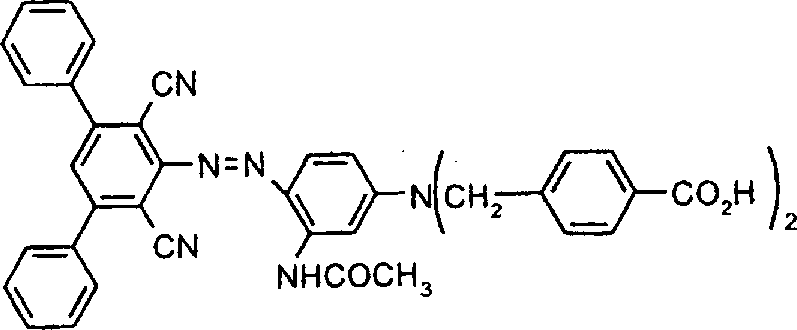
在搅拌下,分批向浓H2SO4(5.0mL)中加入干燥的NaNO2(0.72g)并让温度升高。搅拌亚硝基硫酸混合物并将其冷却,在低于约15℃的温度下加入1∶5酸(1份丙酸∶5份乙酸)(10mL),然后在0-5℃加入2,6-二氰基-3,5-二苯基苯胺(2.95g,0.01m)和1∶5酸(10mL)。在0-5℃搅拌2.0小时后,在0-5℃将重氮化溶液加入到搅拌着的3-乙酰氨基-N,N-二-(4-羧基苯基甲基)苯胺(4.18g,0.01m)溶解在1∶5酸(75mL)与15%硫酸水溶液(15mL)的混合物的溶液中。分批加入乙酸铵直到偶联混合物对刚果红试纸显中性。约1.0小时后,将水加入到偶联混合物中并将所得淤浆加热到约60℃。过滤收集红色产物,用热水充分洗涤并在空气下干燥(产量5.43g)。FDMS显示,结构为用作实施例93-1的原料的结构。实施例93cTo concentrated H2SO4 (5.0 mL ) was added dry NaNO2 (0.72 g) in portions with stirring and the temperature was allowed to rise. The nitrosylsulfuric acid mixture was stirred and allowed to cool, and a 1:5 acid (1 part propionic acid: 5 parts acetic acid) (10 mL) was added below about 15°C, followed by 2,6- Dicyano-3,5-diphenylaniline (2.95 g, 0.01 m) and 1:5 acid (10 mL). After stirring at 0-5°C for 2.0 hours, the diazotization solution was added to stirred 3-acetamido-N,N-bis-(4-carboxyphenylmethyl)aniline (4.18g, 0.01 M) was dissolved in a solution of a 1:5 mixture of acid (75 mL) and 15% aqueous sulfuric acid (15 mL). Ammonium acetate was added in portions until the coupling mixture was neutral to Congo red paper. After about 1.0 hour, water was added to the coupling mixture and the resulting slurry was heated to about 60°C. The red product was collected by filtration, washed well with hot water and air dried (yield 5.43 g). FDMS showed that the structure was that used as the starting material of Example 93-1. Example 93c
将具有以下结构:
将2-氨基-5-乙基硫基-1,3,4-噻二唑(1.61g,0.01m)样品重氮化,并用3-乙酰氨基-N,N-二-(4-羧基苯基甲基)苯胺(4.18g,0.01m)偶联,利用上述实施例93-1a的步骤分离红色产物。FDMS显示,偶氮化合物的结构为实施例93-2的原料的结构。实施例94-118A sample of 2-amino-5-ethylthio-1,3,4-thiadiazole (1.61g, 0.01m) was diazotized and treated with 3-acetylamino-N,N-bis-(4-carboxybenzene (methyl)aniline (4.18 g, 0.01 m) was coupled, and the red product was isolated using the procedure of Example 93-1a above. FDMS showed that the structure of the azo compound was that of the raw material of Example 93-2. Examples 94-118
着色EASTARPETG 6763薄膜是通过熔融共混实施例69-93的聚合染料并根据下列生产实施例94-118的步骤挤塑而生成的(表2)。Pigmented EASTAR® PETG 6763 films were produced by melt blending the polymerized dyes of Examples 69-93 and extruding according to the following procedure for producing Examples 94-118 (Table 2).
将EASTARPETG聚酯6763,聚对苯二甲酸(亚乙基-环己烷二亚甲基)酯(伊斯曼化学品公司)(300g前述的干燥粒料)与偶氮染料组合物(0.12g)干混并挤出共混物,最后按上述实施例37-66的方式制备18-20密耳厚的薄膜。实施例119 EASTAR® PETG polyester 6763, poly(ethylene-cyclohexanedimethylene) terephthalate (Eastman Chemical Company) (300 g of the aforementioned dry pellets) was mixed with an azo dye composition ( 0.12 g) was dry blended and extruded the blend, and finally 18-20 mil thick films were prepared in the manner described above for Examples 37-66. Example 119
将具有以下结构:
向在2-乙氧基乙醇(50mL)中搅拌着的1-氰基-6-(3’,5’-二甲酯基苯基氨基)-3-甲基-3H-二苯并[f,ij]异喹啉-2,7-二酮(2.00g,0.00405mol)混合物中加入50%的NaOH水溶液(2.47g)。将反应混合物在90-95℃加热50分钟并随后倒入水中。通过加入乙酸酸化该混合物并过滤收集固体产物,用水洗涤并在空气下干燥(产量1.78g)。FDMS显示,产物为在实施例119中起反应的二元酸性蒽吡啶酮化合物。实施例119bTo stirred 1-cyano-6-(3',5'-carbomethoxyphenylamino)-3-methyl-3H-dibenzo[f in 2-ethoxyethanol (50mL) , ij] To a mixture of isoquinoline-2,7-dione (2.00 g, 0.00405 mol) was added 50% aqueous NaOH (2.47 g). The reaction mixture was heated at 90-95°C for 50 minutes and then poured into water. The mixture was acidified by adding acetic acid and the solid product was collected by filtration, washed with water and air dried (yield 1.78 g). FDMS showed that the product was the dibasic acid anthrapyridone compound reacted in Example 119. Example 119b
将6-溴-1-氰基-3-甲基-3H-二苯并[f,ij]异喹啉-2,7-二酮(11.0g,0.03mol)、5-氨基间苯二甲酸二甲酯(25.1g,0.12mol)、乙酸铜(3.6g)、碳酸钾(3.0g)和DMF(90mL)的混合物在氮气下于约135-40℃搅拌加热。反应混合物变得非常稠并变为紫色。加入另外的DMF(40mL)并在135-40℃继续加热2.0小时。让反应混合物冷却至约60℃,然后倒在粗糙的烧结玻璃漏斗上抽滤。用DMF和水洗涤产物并将水-湿滤饼在沸腾的丙酮(250mL)中再浆化。冷却后,过滤收集产物,用丙酮洗涤并在空气下干燥(产量10.8g)。FDMS显示,产物为用于实施例119a的二酯蒽吡啶酮化合物。实施例1206-Bromo-1-cyano-3-methyl-3H-dibenzo[f,ij]isoquinoline-2,7-dione (11.0g, 0.03mol), 5-aminoisophthalic acid A mixture of dimethyl ester (25.1 g, 0.12 mol), copper acetate (3.6 g), potassium carbonate (3.0 g) and DMF (90 mL) was stirred and heated at about 135-40 °C under nitrogen. The reaction mixture became very thick and turned purple. Additional DMF (40 mL) was added and heating was continued at 135-40 °C for 2.0 h. The reaction mixture was allowed to cool to about 60°C, then poured onto a coarse sintered glass funnel and filtered with suction. The product was washed with DMF and water and the water-wet cake was reslurried in boiling acetone (250 mL). After cooling, the product was collected by filtration, washed with acetone and dried under air (yield 10.8 g). FDMS showed that the product was the diester anthrapyridone compound used in Example 119a. Example 120
将具有以下结构:的二元酸性硝基芳胺化合物(2.50g,0.0057mol)、1,2-乙二醇-二甲磺酸酯(1.25g,0.0057mol)、碳酸钾(1.6g)和DMF(15mL)的混合物在95℃加热2.5小时。将反应混合物倒入甲醇(200mL)中并过滤收集黄色聚合染料,用含有乙酸的水、水洗涤并在40℃干燥(产量0.77g)。在可见光吸收光谱中,观察到在DMF中的最大吸收在412nm。实施例121将具有以下结构:
着色聚酯薄膜是根据生产实施例37-66的步骤,通过熔融共混并挤塑EASTARPETG聚酯6763(伊斯曼化学品公司)(300g前述的干燥粒料)而生成的,EASTARPETG聚酯6763已分别与实施例119、120、121的聚合染料干混生成实施例122-124。实施例122的薄膜为紫色,而实施例123和124的薄膜为亮黄色。实施例125Pigmented polyester film was produced by melt blending and extruding EASTAR® PETG Polyester 6763 (Eastman Chemical Company) (300 g of the previously described dry pellets) according to the procedure of Production Examples 37-66, EASTAR® PETG Polyester 6763 (Eastman Chemical Company) PETG polyester 6763 has been dry blended with the polymeric dyes of Examples 119, 120, 121 respectively to generate Examples 122-124. The film of Example 122 was purple, while the films of Examples 123 and 124 were bright yellow. Example 125
将具有以下结构: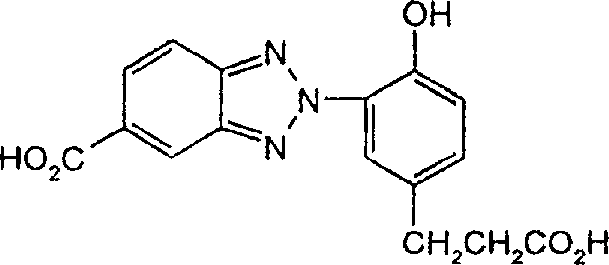
将具有以下结构:
将EASTAPAKPET 7352,聚对苯二甲酸乙二醇酯(伊斯曼化学品公司)(400g前述的干燥粒料)与实施例126的聚合紫外荧光物质(0.16g)干混。在285℃用配有混合螺杆的C.w.Brabender 3/4英寸挤出机将共混物挤塑到水浴中并将挤出物造粒。含有约400ppm紫外光吸收剂的粒料在紫外光下显示出强烈的蓝白荧光。实施例128 EASTAPAK® PET 7352, polyethylene terephthalate (Eastman Chemical Company) (400 g of the dry pellets described above) was dry blended with the polymeric UV fluorescent material of Example 126 (0.16 g). The blend was extruded at 285°C using a CwBrabender 3/4 inch extruder equipped with a mixing screw into a water bath and the extrudate was pelletized. Pellets containing about 400 ppm UV absorber showed strong blue-white fluorescence under UV light. Example 128
重复实施例127,但向EASTAPAKPET 7352中加入8mg实施例126的紫外荧光物质。所得粒料在紫外光下显示出强烈的蓝白荧光并且在日光下看上去非常白。实施例129Example 127 was repeated, but to EASTAPAK® PET 7352 was added 8 mg of the UV fluorescent substance of Example 126. The resulting pellets exhibit strong blue-white fluorescence under UV light and appear very white in daylight. Example 129
将Pc-Al-O-C6H3-3,5-二CO2H(Pc=酞菁)(1.74g,0.0024mol)、1,6-己二醇-二甲磺酸酯(0.66g,0.0024mol)、碳酸钾(0.83g)和DMF(10mL)的混合物在约125℃搅拌加热1小时,然后在约140℃搅拌加热1小时。将反应混合物倒入甲醇(50mL)中并过滤收集聚合产物,用甲醇、含有乙酸的水、热水洗涤并在空气下干燥(产量1.48g)。实施例130Pc-Al-OC 6 H 3 -3,5-diCO 2 H (Pc=phthalocyanine) (1.74 g, 0.0024 mol), 1,6-hexanediol-dimethylsulfonate (0.66 g, 0.0024 mol), potassium carbonate (0.83 g) and DMF (10 mL) was heated with stirring at about 125°C for 1 hour, then at about 140°C for 1 hour. The reaction mixture was poured into methanol (50 mL) and the polymer product was collected by filtration, washed with methanol, water with acetic acid, hot water and dried in air (yield 1.48 g). Example 130
将EASTAPAKPET 7352,聚对苯二甲酸乙二醇酯(伊斯曼化学品公司)(400g前述的干燥粒料)与实施例129的聚合酞菁化合物(0.12g)干混。在285℃用配有混合螺杆的C.W.Brabender 3/4英寸挤出机将共混物挤塑到水浴中并将挤出物造粒。在70℃、约1-5托压力下,将青色粒料再干燥约17小时。使用直径为2英寸的圆形模具,在Pasadena液压机有限公司的压机上,用12,000磅的活塞力(4英寸活塞),在285℃将一部分干燥粒料(1.40g)压成薄膜。通过在水中骤冷生产出透明的青色薄膜,该薄膜在光吸收光谱的684nm处具有最大吸收。实施例131 EASTAPAK® PET 7352, polyethylene terephthalate (Eastman Chemical Company) (400 g of the dry pellets described above) was dry blended with the polymeric phthalocyanine compound of Example 129 (0.12 g). The blend was extruded at 285°C using a CW Brabender 3/4 inch extruder equipped with a mixing screw into a water bath and the extrudate was pelletized. The cyan pellets were then dried for about 17 hours at 70°C under a pressure of about 1-5 Torr. A portion of the dry pellets (1.40 g) was pressed into a film at 285° C. using a 2 inch diameter circular die on a Pasadena Hydraulic Press Ltd. press with 12,000 lbs of piston force (4 inch piston). Quenching in water produced a transparent cyan film with an absorption maximum at 684 nm of the light absorption spectrum. Example 131
重复实施例130,但向PET中加入4mg实施例129的聚合酞菁化合物。最后的薄膜含有约10ppm的酞菁化合物并且在685nm处有最大吸收。实施例132Example 130 was repeated, but 4 mg of the polymeric phthalocyanine compound of Example 129 was added to the PET. The final film contains about 10 ppm phthalocyanine compound and has an absorption maximum at 685 nm. Example 132
将EASTAPAKPET 7352,聚对苯二甲酸乙二醇酯(伊斯曼化学品公司)(400g前述的干燥粒料)与实施例18的聚合染料(0.6g)干混。在285℃用配有混合螺杆的C.W.Brabender 3/4英寸挤出机将共混物挤塑到水浴中并将挤出物造粒。得到良好的颜色,该颜色不会出现升华损失,得到含有约0.15重量%的聚合染料的深红色粒料。实施例133 EASTAPAK® PET 7352, polyethylene terephthalate (Eastman Chemical Company) (400 g of the dry pellets described above) was dry blended with the polymeric dye of Example 18 (0.6 g). The blend was extruded at 285°C using a CW Brabender 3/4 inch extruder equipped with a mixing screw into a water bath and the extrudate was pelletized. A good color was obtained without loss of sublimation, giving a dark red pellet containing about 0.15% by weight of polymerized dye. Example 133
重复实施例132,但用0.6g实施例75的聚合染料作为着色剂,得到含有约0.15重量%的聚合染料的黄色粒料。未观察到由升华引起的颜色损失。实施例134-182Example 132 was repeated, but using 0.6 g of the polymeric dye of Example 75 as the colorant to give yellow pellets containing about 0.15% by weight of the polymeric dye. No color loss due to sublimation was observed. Examples 134-182
在DMF中,在碳酸钾存在下,使表3中的式VI二元酸性偶氮化合物与基本等摩尔量的1,2-乙二醇-二甲磺酸酯反应生成表3中实施例134-182的聚合染料。实施例183-193In DMF, in the presence of potassium carbonate, the dibasic acidic azo compound of formula VI in Table 3 is reacted with substantially equimolar amounts of 1,2-ethanediol-dimethylsulfonate to generate Example 134 in Table 3 -182 polymeric dyes. Examples 183-193
在DMF中,在碳酸钾存在下,使表4中的式VII二元酸性重氮化合物与基本等摩尔量的1,4-丁二醇-二甲磺酸酯反应生成表4中实施例183-193的聚合染料。实施例194-202In DMF, in the presence of potassium carbonate, the dibasic acidic diazonium compound of formula VII in Table 4 was reacted with substantially equimolar amounts of 1,4-butanediol-dimethylsulfonate to generate Example 183 in Table 4 -193 polymeric dyes. Examples 194-202
在DMF中在碳酸钠存在下使表5中的式VIIa二元酸性双偶氮化合物与基本等摩尔量的1,3-丙二醇-二甲磺酸酯反应生成表5中实施例194-202的聚合染料。实施例203-211The dibasic acidic disazo compound of formula VIIa in Table 5 was reacted with a substantially equimolar amount of 1,3-propanediol-dimethylsulfonate in DMF in the presence of sodium carbonate to produce the compounds of Examples 194-202 in Table 5. polymeric dyes. Examples 203-211
在DMF中,在碳酸钠存在下,使表6中的苯亚甲基(次甲基)二元酸性化合物与基本等摩尔量的1,4-环己烷二甲醇-二甲磺酸酯反应生成表6中实施例203-211的聚合染料。实施例212-220The benzylidene (methine) dibasic acidic compound of Table 6 was reacted with an essentially equimolar amount of 1,4-cyclohexanedimethanol-dimethylsulfonate in DMF in the presence of sodium carbonate The polymeric dyes of Examples 203-211 in Table 6 were generated. Examples 212-220
在DMF中,在碳酸钾存在下,使表7中的式X3-芳基-2,5-二氧吡咯啉二元酸性化合物与基本等摩尔量的二甘醇-二甲磺酸酯反应生成表7中实施例212-220的聚合染料。实施例221-230In DMF, in the presence of potassium carbonate, the formula X3-aryl-2,5-dioxypyrroline dibasic acidic compound in Table 7 was reacted with a substantially equimolar amount of diethylene glycol-dimethylsulfonate to form Polymeric dyes of Examples 212-220 in Table 7. Examples 221-230
使表8中的式XI3-芳基-5-二氰基亚甲基-2-氧吡咯啉二元酸性化合物与基本等摩尔量的三甘醇-二甲磺酸酯反应生成表8中实施例221-230的聚合染料。实施例231-239Make formula XI3-aryl group-5-dicyano methylene-2-oxypyrroline dibasic acidic compound in table 8 react with triethylene glycol-dimethanesulfonate of substantially equimolar amount to form implementation in table 8 Polymeric dyes of Examples 221-230. Examples 231-239
在DMF中,在碳酸钾存在下,使表9中的式XIII偶氮-次甲基二元酸性化合物与基本等摩尔量的1,4-丁二醇-二甲磺酸酯反应生成表9中实施例231-239的聚合染料。实施例240-269In DMF, in the presence of potassium carbonate, the azo-methine dibasic acid compound of formula XIII in Table 9 was reacted with a substantially equimolar amount of 1,4-butanediol-dimethylsulfonate to generate Table 9 The polymeric dyes of Examples 231-239. Examples 240-269
在N,N-二甲基乙酰胺中,在碳酸钾存在下,使表10中的式XIV二元酸性蒽醌化合物与基本等摩尔量的2,2,4,4-四甲基-1,3-环丁二醇-二甲磺酸酯反应生成表10中实施例240-269的聚合染料。实施例270-326In N,N-dimethylacetamide, in the presence of potassium carbonate, the dibasic acidic anthraquinone compound of formula XIV in Table 10 and substantially equimolar amounts of 2,2,4,4-tetramethyl-1 , 3-cyclobutanediol-dimethanesulfonate reacted to form the polymeric dyes of Examples 240-269 in Table 10. Examples 270-326
在DMF中,在碳酸钾存在下,使表11中的式XV二元酸性蒽醌化合物与基本等摩尔量的1,2-乙二醇-二甲磺酸酯反应生成表11中实施例270-326的聚合染料。实施例327-344In DMF, in the presence of potassium carbonate, the dibasic acidic anthraquinone compound of formula XV in Table 11 was reacted with a substantially equimolar amount of 1,2-ethanediol-dimethanesulfonate to produce Example 270 in Table 11 -326 polymeric dye. Examples 327-344
在N-甲基-2-吡咯烷酮中,在碳酸钠存在下,使表12中的式XVI二元酸性蒽醌化合物与基本等摩尔量的1,6-己二醇-二甲磺酸酯反应生成表12中实施例327-344的聚合染料。实施例345-361The dibasic acidic anthraquinone compound of formula XVI in Table 12 was reacted with a substantially equimolar amount of 1,6-hexanediol-dimethylsulfonate in N-methyl-2-pyrrolidone in the presence of sodium carbonate The polymeric dyes of Examples 327-344 in Table 12 were generated. Examples 345-361
在DMF存在下,使表13中的式XVIII二元酸性蒽吡啶化合物与基本等摩尔量的1,4-丁二醇-二对甲苯磺酸酯反应生成表13中实施例345-361的聚合染料。实施例362-381Reaction of the dibasic acidic anthrapyridine compound of formula XVIII in Table 13 with a substantially equimolar amount of 1,4-butanediol-di-p-toluenesulfonate in the presence of DMF yields the polymers of Examples 345-361 in Table 13 dye. Examples 362-381
在DMF中,在碳酸钾存在下,使表14中的式XIX二元酸性蒽醌化合物与基本等摩尔量的2,2-二甲基-1,3-丙二醇-二甲磺酸酯反应生成表14中实施例362-381的聚合染料。实施例382-396In DMF, in the presence of potassium carbonate, the dibasic acidic anthraquinone compound of formula XIX in Table 14 is reacted with a substantially equimolar amount of 2,2-dimethyl-1,3-propanediol-dimethylsulfonate to form Polymeric dyes of Examples 362-381 in Table 14. Examples 382-396
在DMF中,在碳酸钾存在下,使表15中的式XIXc二元酸性蒽醌化合物与基本等摩尔量的1,2-乙二醇-二甲磺酸酯反应生成表15中实施例382-396的聚合染料。实施例397-414Reaction of the dibasic acidic anthraquinone compound of formula XIXc in Table 15 with a substantially equimolar amount of 1,2-ethanediol-dimethylsulfonate in the presence of potassium carbonate in DMF yields Example 382 in Table 15 -396 polymeric dyes. Examples 397-414
在DMF中,在碳酸钾存在下,使表16中的式XIXd二元酸性蒽醌化合物与基本等摩尔量的1,6-己二醇-二甲磺酸酯反应生成表16中实施例397-414的聚合染料。实施例415-435Reaction of the dibasic acidic anthraquinone compound of formula XIXd in Table 16 with a substantially equimolar amount of 1,6-hexanediol-dimethylsulfonate in the presence of potassium carbonate in DMF yields Example 397 in Table 16 -414 is a polymeric dye. Example 415-435
在DMF中,在碳酸钾存在下,使表17中的式XIXe二元酸性蒽醌化合物与基本等摩尔量的乙二醇-二甲磺酸酯反应生成表17中实施例414-435的聚合染料。实施例436-449Reaction of the dibasic acidic anthraquinone compound of formula XIXe in Table 17 with a substantially equimolar amount of ethylene glycol dimethanesulfonate in the presence of potassium carbonate in DMF yields the polymers of Examples 414-435 in Table 17 dye. Examples 436-449
在DMF中,在碳酸钾存在下,使表18中的式XIXf二元酸性蒽醌化合物与基本等摩尔量的1,4-环己烷二甲醇-二甲磺酸酯反应生成表18中实施例436-449的聚合染料。实施例450-455In DMF, in the presence of potassium carbonate, the dibasic acidic anthraquinone compound of formula XIXf in Table 18 is reacted with a substantially equimolar amount of 1,4-cyclohexanedimethanol-dimethylsulfonate to form the compound described in Table 18. Polymeric dyes of Examples 436-449. Example 450-455
在DMF中,在碳酸钾存在下,使表19中的二元酸性蒽吡啶化合物与基本等摩尔量的1,6-己二醇-二对甲苯磺酸酯反应生成表19中实施例450-455的聚合染料。实施例456-465In DMF, in the presence of potassium carbonate, the dibasic acidic anthrapyridine compound in Table 19 was reacted with a substantially equimolar amount of 1,6-hexanediol-di-p-toluenesulfonate to form Example 450- 455 polymeric dyes. Example 456-465
在DMF中,在碳酸钾存在下,使表20中的二元酸性硝基芳胺化合物与基本等摩尔量的1,4-丁二醇-二甲磺酸酯反应生成表20中实施例456-465的聚合染料。实施例466-505Reaction of the dibasic acidic nitroarylamine compound in Table 20 with a substantially equimolar amount of 1,4-butanediol-dimethylsulfonate in the presence of potassium carbonate in DMF yields Example 456 in Table 20 -465 polymeric dye. Example 466-505
在DMF中,在碳酸钾存在下,使表21中的混杂二元酸性化合物与基本等摩尔量的表21的二磺酸酯化合物反应生成表21中实施例466-505的聚合染料。实施例506-522The polymeric dyes of Examples 466-505 of Table 21 were produced by reacting the miscellaneous dibasic acid compounds of Table 21 with substantially equimolar amounts of the disulfonate compounds of Table 21 in the presence of potassium carbonate in DMF. Examples 506-522
在DMF中,在碳酸钾存在下,使表22的紫外光吸收二元酸性化合物与基本等摩尔量的表22二磺酸酯化合物反应生成表22中实施例506-522的聚合紫外吸收剂。实施例523-536The polymeric UV absorbers of Examples 506-522 in Table 22 were formed by reacting the UV absorbing dibasic acid compounds of Table 22 with substantially equimolar amounts of the disulfonate compounds of Table 22 in DMF in the presence of potassium carbonate. Examples 523-536
在DMF中在碳酸钾存在下使表23的红外光吸收二元酸性化合物与基本等摩尔量的表23的二磺酸酯化合物反应生成表23中实施例523-536的聚合红外吸收化合物。Reacting the infrared light absorbing dibasic acid compounds of Table 23 with substantially equimolar amounts of the disulfonate compounds of Table 23 in the presence of potassium carbonate in DMF yields the polymeric infrared absorbing compounds of Examples 523-536 in Table 23.
表1 Table 1
EASTARPETG中的蒽醌聚合染料Anthraquinone polymerized dyes in EASTAR® PETG
(300ppm)
表2 Table 2
EASTARPETG 6763中的偶氮聚合染料Azo polymeric dyes in EASTAR® PETG 6763
(300ppm)
表3 table 3
来自式VI二元酸性化合物的聚合染料Polymeric dyes derived from dibasic acidic compounds of formula VI
R6-N=N-Z实施例号 R6 Z 颜色134


表3 table 3
来自式VI二元酸性化合物的聚合染料 Polymeric dyes derived from dibasic acidic compounds of formula VI
R6-N=N-Z实施例号 R6 Z 颜色137
紫色138


表3 table 3
来自式VI二元酸性化合物的聚合from the polymerization of dibasic acidic compounds of formula VI
R6-N=N-Z实施例号 R6 Z 颜色140
紫色141

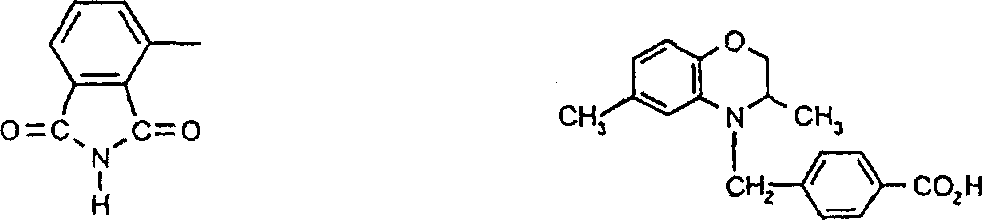
表3 table 3
来自式VI二元酸性化合物的聚合染料 Polymeric dyes derived from dibasic acidic compounds of formula VI
R6-N=N-Z实施例号 R6 Z 颜色143


表3 table 3
来自式VI二元酸性化合物的聚合染料 Polymeric dyes derived from dibasic acidic compounds of formula VI
R6-N=N-Z实施例号 R6 Z 颜色146
蓝红色147


表3 table 3
来自式VI二元酸性化合物的聚合染料 Polymeric dyes derived from dibasic acidic compounds of formula VI
R6-N=N-Z实施例号 R6 Z 颜色149


表3 table 3
来自式VI二元酸性化合物的聚合染料 Polymeric dyes derived from dibasic acidic compounds of formula VI
R6-N=N-Z实施例号 R6 Z 颜色152


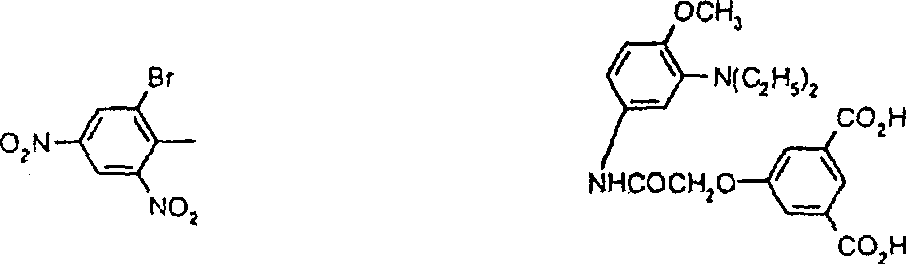
表3 table 3
来自式VI二元酸性化合物的聚合染料 Polymeric dyes derived from dibasic acidic compounds of formula VI
R6-N=N-Z实施例号 R6 Z 颜色155
蓝色156


表3 table 3
来自式VI二元酸性化合物的聚合染料 Polymeric dyes derived from dibasic acidic compounds of formula VI
R6-N=N-Z实施例号 R6 Z 颜色158
红色159


表3 table 3
来自式VI二元酸性化合物的聚合染料 Polymeric dyes derived from dibasic acidic compounds of formula VI
R6-N=N-Z实施例号 R6 Z 颜色161


表3 table 3
来自式VI二元酸性化合物的聚合染料 Polymeric dyes derived from dibasic acidic compounds of formula VI
R6-N=N-Z实施例号 R6 Z 颜色164


表3 table 3
来自式VI二元酸性化合物的聚合染料Polymeric dyes derived from dibasic acidic compounds of formula VI
R6-N=N-Z实施例号 R6 Z 颜色167
橙色168


表3 table 3
来自式VI二元酸性化合物的聚合染料 Polymeric dyes derived from dibasic acidic compounds of formula VI
R6-N=N-Z实施例号 R6 Z 颜色170


表3 table 3
来自式VI二元酸性化合物的聚合染料 Polymeric dyes derived from dibasic acidic compounds of formula VI
R6-N=N-Z实施例号 R6 Z 颜色173


表3 table 3
来自式VI二元酸性化合物的聚合染料 Polymeric dyes derived from dibasic acidic compounds of formula VI
R6-N=N-Z实施例号 R6 Z 颜色176
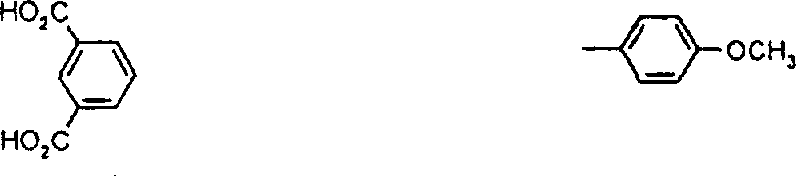


表3 table 3
来自式VI二元酸性化合物的聚合染料 Polymeric dyes derived from dibasic acidic compounds of formula VI
R6-N=N-Z实施例号 R6 Z 颜色179

表4 Table 4
来自式VII二元酸性化合物的聚合染料 Polymeric dyes derived from dibasic acidic compounds of formula VII
R6-N=N-R7-N=N-Z实施例号 R6 R7 Z 颜色183 红色184 红色185 红黄色R 6 -N=NR 7 -N=NZ Example No. R 6 R 7 Z Color 183 red 184 red 185 red yellow
表4 Table 4
来自式VII二元酸性化合物的聚合染料A polymeric dye derived from a dibasic acidic compound of formula VII
R6-N=N-R7-N=N-Z实施例号 R6 R7 Z 颜色186
红黄色187


表4 Table 4
来自式VII二元酸性化合物的聚合染料A polymeric dye derived from a dibasic acidic compound of formula VII
R6-N=N-R7-N=N-Z实施例号 R6 R7 Z 颜色189
蓝色190

表4 Table 4
来自式VII二元酸性化合物的聚合染料A polymeric dye derived from a dibasic acidic compound of formula VII
R6-N=N-R7-N=N-Z实施例号 R6 R7 Z 颜色192


表5 table 5
来自式VIIa二元酸性化合物的聚合染料 Polymeric dyes derived from dibasic acidic compounds of formula VIIa
R6-N=N-Y1-N=N-R6实施例号 R6 Y1 颜色194


表5 table 5
来自式VIIa二元酸性化合物的聚合染料 Polymeric dyes derived from dibasic acidic compounds of formula VIIa
R6-N=N-Y1-N=N-R6实施例号 R6 Y1 颜色197


表5 table 5
来自式VIIa二元酸性化合物的聚合染料 Polymeric dyes derived from dibasic acidic compounds of formula VIIa
R6-N=N-Y1-N=N-R6实施例号 R6 Y1 颜色200
紫色201
黄色202

表6Table 6
来自式VIII二元酸性化合物的聚合染料 Polymeric dyes derived from dibasic acidic compounds of formula VIII
R11-CH=D实施例号 R11 D 颜色203
黄色204


表6Table 6
来自式VIII二元酸性化合物的聚合染料 Polymeric dyes derived from dibasic acidic compounds of formula VIII
R11-CH=D实施例号 R11 D 颜色206

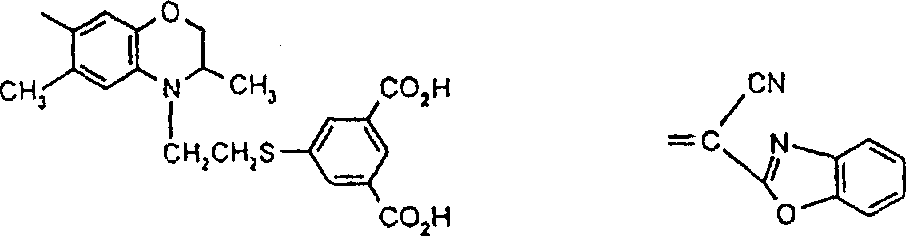
表7Table 7
来自式X二元酸性化合物的聚合染料

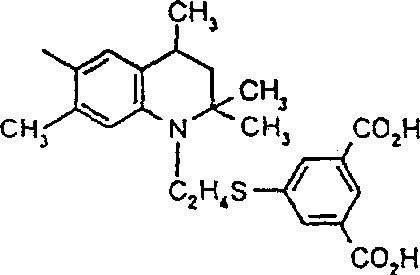

表7Table 7
来自式X二元酸性化合物的聚合染料
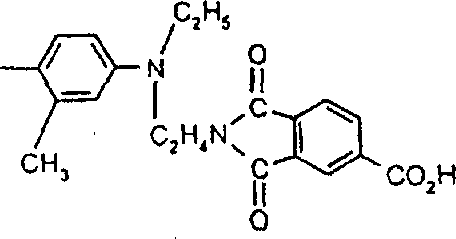
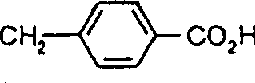


表8Table 8
来自式XI二元酸性化合物的聚合染料实施例号 R11 R12 颜色221
H 蓝色222

表8Table 8
来自式XI二元酸性化合物的聚合染料实施例号 R11 R12 颜色224
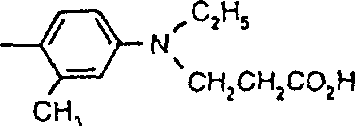


表8Table 8
来自式XI二元酸性化合物的聚合染料


表8Table 8
来自式XI二元酸性化合物的聚合染料实施例号 R11 R12 颜色230

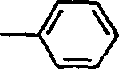
表9Table 9
来自式XIII二元酸性化合物的聚合染料 Polymeric dyes derived from dibasic acidic compounds of formula XIII
D=HC-R7-N=N-Z实施例号 D R7 Z 颜色231


表9Table 9
来自式XIII二元酸性化合物的聚合染料 Polymeric dyes derived from dibasic acidic compounds of formula XIII
D=HC-R7-N=N-Z实施例号 D R7 Z 颜色234



表9Table 9
来自式XIII二元酸性化合物的聚合染料 Polymeric dyes derived from dibasic acidic compounds of formula XIII
D=HC-R7-N=N-Z实施例号 D R7 Z 颜色237


表6Table 6
来自式VIII二元酸性化合物的聚合染料Polymeric dyes derived from dibasic acidic compounds of formula VIII
R11-CH=D实施例号 R11 D 颜色209 红色210 黄色211 黄色R 11 -CH=D Example No. R 11 D Color 209 red 210 yellow 211 yellow
表7Table 7
来自式X二元酸性化合物的聚合染料实施例号 R11 R12 颜色212
C2H5 红色213
H 红色214

表7Table 7
来自式X二元酸性化合物的聚合染料实施例号 R11 R12 颜色215


表7Table 7
来自式X二元酸性化合物的聚合染料

表8Table 8
来自式XI二元酸性化合物的聚合染料
表8Table 8
来自式XI二元酸性化合物的聚合染料实施例号 R11 R12 颜色224


表8Table 8
来自式XI二元酸性化合物的聚合染料实施例号 R11 R12 颜色227


表8Table 8
来自式XI二元酸性化合物的聚合染料

表9Table 9
来自式XIII二元酸性化合物的聚合染料 Polymeric dyes derived from dibasic acidic compounds of formula XIII
D=HC-R7-N=N-Z实施例号 D R7 Z 颜色231


表9Table 9
来自式XIII二元酸性化合物的聚合染料 Polymeric dyes derived from dibasic acidic compounds of formula XIII
D=HC-R7-N=N-Z实施例号 D R7 Z 颜色234



表9Table 9
来自式XIII二元酸性化合物的聚合染料 Polymeric dyes derived from dibasic acidic compounds of formula XIII
D=HC-R7-N=N-Z实施例号 D R7 Z 颜色237
蓝色238


表10Table 10
来自式XIV的二元酸性蒽醌化合物的聚合染料
表10Table 10
来自式XIV的二元酸性蒽醌化合物的聚合染料实施例号 Q R14 颜色254 4-NH- 1-OH 紫色255 2-S- 1,4-二-OH 橙色256 2-SO2- 1,4-二-OH 橙色257 4-S- 1-NHCH3 紫色258 4-S- 1-NHCH2CH(C2H5)C4H9 紫色259 6(7)S- 1,4-二-NHC6H3-2,6-diC2H5 青色260 6(7)S- 1,4-二-NHC6H2-2,4,6-triCH3 青色261 6(7)SO2- 1,4-二-NHC6H3-2-CH3,6-C2H5青色262 4-NH- 1,8-二-OH,5-NO2 蓝色263 4-NH- 1,8-二OH,5-NH2 蓝色264 4-NH- 1,8-二-OH,5-NHC6H5 蓝色265 4-NH- 1,5-二-OH,8-NO2 蓝色266 4-NH- 1-NH2,2-CN 青色267 4-NH- 1-NH2,2-S-C6H5 蓝色268 4-NH- 蓝色269 4-NH- 蓝色Polymeric dyes from dibasic acidic anthraquinone compounds of formula XIV Example No. Q R 14 Color 254 4-NH-1-OH Purple 255 2-S-1,4-Di-OH Orange 256 2 -SO2-1,4-Di-OH Orange 257 4-S-1-NHCH 3 Purple 258 4-S- 1-NHCH 2 CH(C 2 H 5 )C 4 H 9 Purple 259 6(7)S- 1,4-Di-NHC 6 H 3 -2,6-diC 2 H 5 Cyan 260 6(7)S- 1,4-di-NHC 6 H 2 -2,4,6-triCH 3 cyan 261 6(7)SO 2 - 1,4-di-NHC 6 H 3 -2-CH 3 , 6-C 2 H 5 cyan 262 4-NH- 1,8-di-OH, 5-NO 2 blue 263 4-NH- 1,8-diOH, 5-NH 2 blue 264 4-NH- 1,8-Di-OH, 5-NHC 6 H 5 Blue 265 4-NH- 1,5-Di-OH, 8-NO 2 Blue 266 4-NH- 1-NH 2 , 2-CN Cyan 267 4-NH- 1-NH 2 , 2-SC 6 H 5 Blue 268 4-NH- Blue 269 4-NH- blue
表11Table 11
来自式XV的二元酸性蒽醌化合物的聚合染料实施例号

CO2H274 2-OC6H4-4-CO2H,4-NHC6H4-2- 1-NH2 紫色CO 2 H274 2-OC 6 H 4 -4-CO 2 H, 4-NHC 6 H 4 -2- 1-NH 2 Purple
CO2H275 2-OC6H4-3-CO2H,4-S-NHC6H4-2- 1-NH2 红色CO 2 H275 2-OC 6 H 4 -3-CO 2 H, 4-S-NH C 6H 4 -2- 1-NH 2 red
CO2H276 2,4-二-S-C6H4-2-CO2H 1-OH 橙色277 4,5-二-S-C6H4-2-CO2H 1,8-二-NHCH3 蓝色278 4,5-二-S-C6H4-3-CO2H 1,8-二-NHCH2CH(CH3)2 蓝色279 4,5-二-S-C6H4-4-CO2H 1,8-二NH(CH2)7CH3 蓝色280 4,5-二-S-C6H4-2-CO2H 1,8-二-NHCH2CH(C2H5)C4H9n 蓝色281 4,5-二-S-C5H4-2-CO2H 1,8-二-NHC6H4-4-CH3 蓝色282 4,5-二-S-C6H4-2-CO2H 1,8-二-NHC6H11 蓝色CO 2 H276 2,4-Di-SC 6 H 4 -2-CO 2 H 1-OH Orange 277 4,5-Di-SC 6 H 4 -2-CO 2 H 1,8-Di-NHCH 3 Blue 278 4,5-Di-SC 6 H 4 -3-CO 2 H 1,8-Di-NHCH 2 CH(CH 3 ) 2 Blue 279 4,5-Di-SC 6 H 4 -4-CO 2 H 1,8-Di-NH(CH 2 ) 7 CH 3 Blue 280 4,5-Di-SC 6 H 4 -2-CO 2 H 1,8-Di-NHCH 2 CH(C 2 H 5 )C 4 H 9n Blue 281 4,5-Di-SC 5 H 4 -2-CO 2 H 1,8-Di-NHC 6 H 4 -4-CH 3 Blue 282 4,5-Di-SC 6 H 4 -2 -CO 2 H 1,8-di-NHC 6 H 11 blue
表11Table 11
来自式XV的二元酸性蒽醌化合物的聚合染料
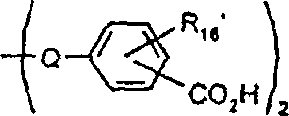


表11Table 11
来自式XV的二元酸性蒽醌化合物的聚合染料实施例号
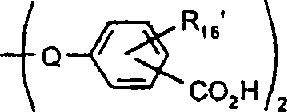
表11Table 11
来自式XV的二元酸性蒽醌化合物的聚合染料实施例号
R14 颜色313 4,8-二-S-C6H4-2-CO2H 1,5-二苯并噻唑基-2-基硫 红色314 4,8-二-S-C6H4-2-CO2H
红色315 2,6-二-S-C6H4-2-CO2H 1,5-二-NH2,4,8-二-OH 蓝色316 2,6-二-O-C6H4-2-CO2H 1,4,5,8-四-NH2 蓝色317 4,8-二-S-C6H4-2-CO2H 1,5-二-NH2,2,6-二-Br 蓝色318 2,7-二-S-C6H4-2-CO2H 1,8-二-NH2,4,5-二-NHCO2CH3 蓝色319 2,7-二-SO2-C6H4-2-CO2H 1,8-二-NH2,4,5-二-OH 青色320 4,5-二-S-C6H4-2-CO2H 1,8-二-NHCOCH3 橙色321 2,7-二-S-C6H4-2-CO2H 1,8-二-NH2,4,5-二-NHC6H5 青色322 2,6-二-O-C6H4-2-CO2H 1,8-二-NH2,4,5-二NHC6H11 蓝色323 2,8-二-SO2-C6H4-4-CO2H 1,4,5,8-四-NH2 青色324 4,8-二-S-C6H4-2-CO2H

表12Table 12
来自式XVI的二元酸蒽醌化合物的聚合染料实施例号

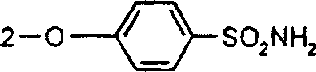
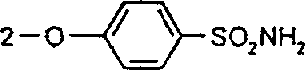

表12Table 12
来自式XVI的二元酸蒽醌化合物的聚合染料


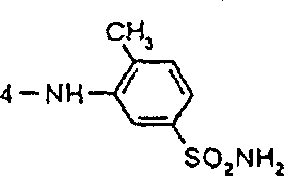
表12Table 12
来自式XVI的二元酸蒽醌化合物的聚合染料


表12Table 12
来自式XVI的二元酸蒽醌化合物的聚合染料




表13Table 13
来自式XVIII的二元酸性蒽吡啶化合物的聚合染料


表13Table 13
来自式XVIII的二元酸性蒽吡啶化合物的聚合染料

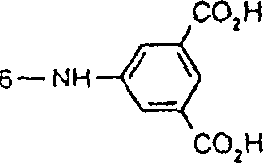
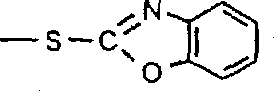


表13Table 13
来自式XVIII的二元酸性蒽吡啶化合物的聚合染料实施例号

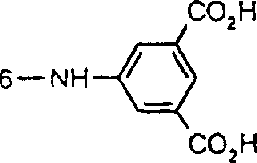
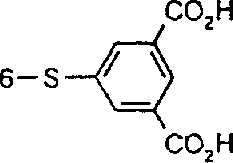


表13Table 13
来自式XVIII的二元酸性蒽吡啶化合物的聚合染料实施例号


表14Table 14
来自式XIX的二元酸性蒽醌化合物的聚合染料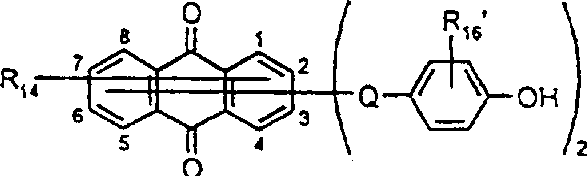
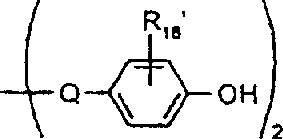


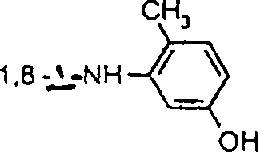

表14Table 14
来自式XIX的二元酸性蒽醌化合物的聚合染料实施例号
R14 颜色367




表14Table 14
来自式XIX的二元酸性蒽醌化合物的聚合染料实施例号
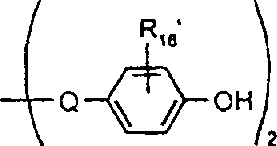


表14Table 14
来自式XIX的二元酸性蒽醌化合物的聚合染料实施例号
R14 颜色377



表15Table 15
来自式XIXc的二元酸性蒽醌化合物的聚合染料


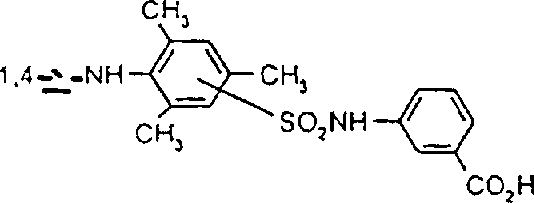
表15Table 15
来自式XIXc的二元酸性蒽醌化合物的聚合染料实施例号
R14 颜色386
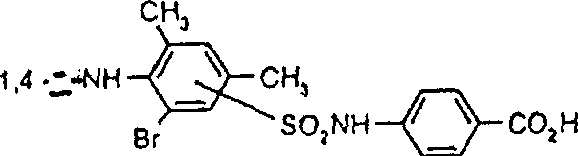
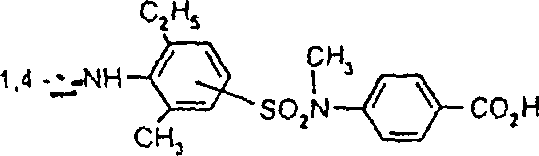
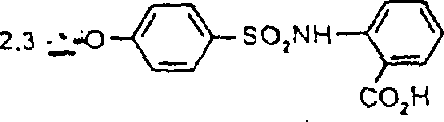
表15Table 15
来自式XIXc的二元酸性蒽醌化合物的聚合染料实施例号
R14 颜色390

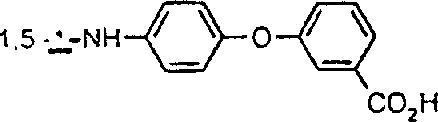


表15Table 15
来自式XIXc的二元酸性蒽醌化合物的聚合染料实施例号
R14 颜色395

表16Table 16
来自式XIXd的二元酸性蒽醌化合物的聚合染料


表16Table 16
来自式XIXd的二元酸性蒽醌化合物的聚合染料实施例号
R14 颜色401

表16Table 16
来自式XIXd的二元酸性蒽醌化合物的聚合染料实施例号

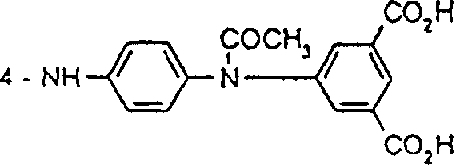
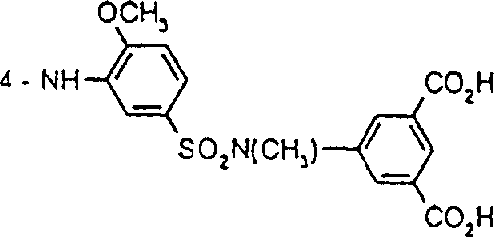


表16Table 16
来自式XIXd的二元酸性蒽醌化合物的聚合染料



表16Table 16
来自式XIXd的二元酸性蒽醌化合物的聚合染料


表17Table 17
来自式XIXe的二元酸性蒽醌化合物的聚合染料实施例号
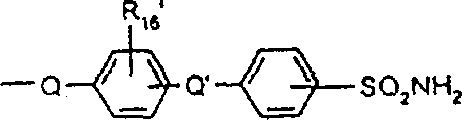



表17Table 17
来自式XIXe的二元酸性蒽醌化合物的聚合染料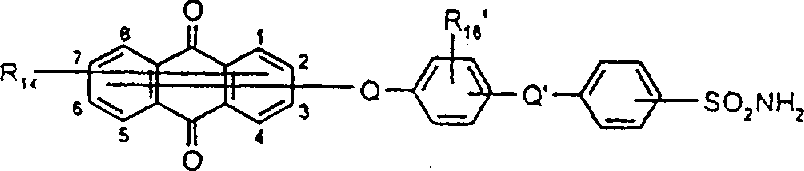





表17Table 17
来自式XIXe的二元酸性蒽醌化合物的聚合染料


表17Table 17
来自式XIXe的二元酸性蒽醌化合物的聚合染料实施例号
R14 颜色430




表17Table 17
来自式XIXe的二元酸性蒽醌化合物的聚合染料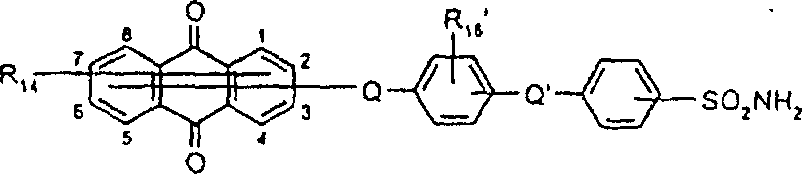

表18Table 18
来自式XIXf的二元酸性蒽醌的聚合染料实施例号
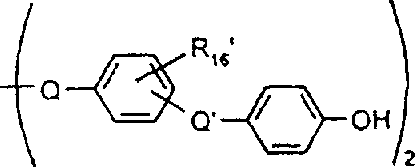

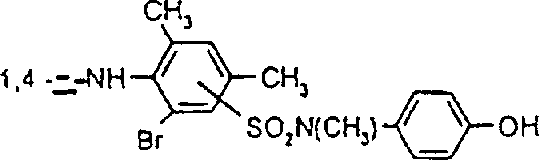


表18Table 18
来自式XIXf的二元酸性蒽醌的聚合染料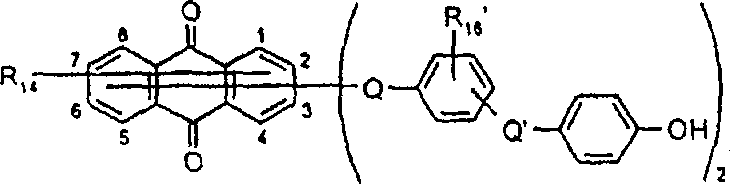
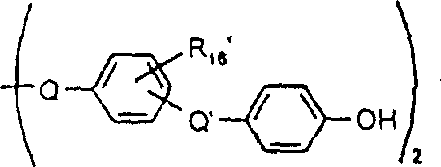
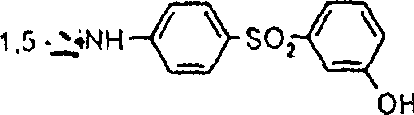
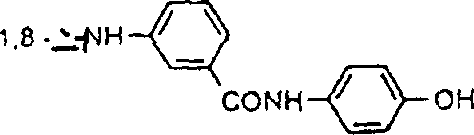

表18Table 18
来自式XIXf的二元酸性蒽醌的聚合染料


表18Table 18
来自式XIXf的二元酸性蒽醌的聚合染料


表19Table 19
来自二元酸性蒽吡啶的聚合染料实施例号 蒽吡啶 颜色450

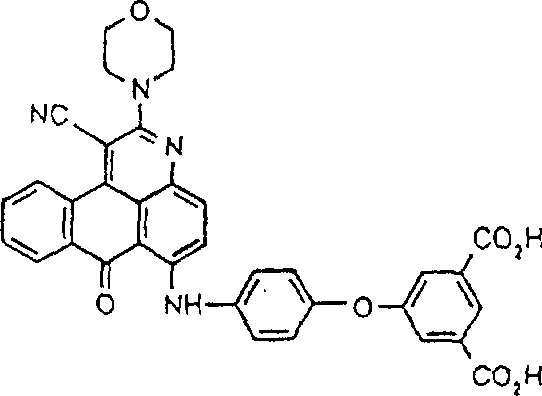
表19Table 19
来自二元酸性蒽吡啶的聚合染料实施例号 蒽吡啶 颜色453
橙色454

表19Table 19
来自二元酸性蒽吡啶的聚合染料实施例号 蒽吡啶 颜色455

表20Table 20
来自二元酸性硝基芳胺的聚合材料实施例号 硝基芳胺化合物 颜色456


表20Table 20
来自二元酸性硝基芳胺的聚合材料实施例号 硝基芳胺化合物 颜色461
黄色462


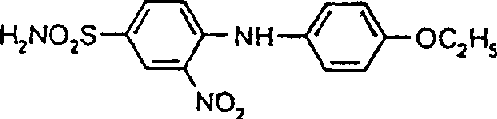
表21Table 21
混杂聚合染料实施例号 反应的二元酸性化合物 反应的二磺酸酯化合物 颜色466


表21Table 21
混合聚合染料实施例号 反应的二元酸性化合物 反应的二磺酸酯化合物 颜色469



表21混杂聚合染料实施例号 反应的二元酸性化合物 反应的二磺酸酯化合物 颜色472
黄色473
CH3SO2(OCH2CH2)3OSO2CH3 黄色474
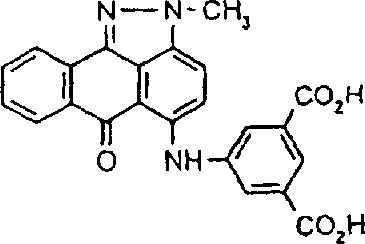
表21Table 21
混杂聚合染料实施例号 反应二元酸性化合物 反应的二磺酸酯化合物 颜色475


表21Table 21
混杂聚合染料实施例号 反应的二元酸性化合物 反应的二磺酸酯化合物 颜色478 CH3SO2OCH2CH2OSO2CH3 橙色479 CH3SO2OCH2CH2OCH2CH2OSO2CH3 橙色480 CH3SO2OCH2CH(CH3)CH2OSO2CH3 黄色Miscellaneous Polymeric Dye Example No. Reacted Dibasic Acid Compound Reacted Disulfonate Compound Color 478 CH3SO2OCH2CH2OSO2CH3Orange 479 _ _ _ _ CH 3 SO 2 OCH 2 CH 2 OCH 2 CH 2 OSO 2 CH 3 Orange 480 CH 3 SO 2 OCH 2 CH(CH 3 )CH 2 OSO 2 CH 3 yellow
表23Table 23
混杂聚合染料实施例号 反应的二元酸性化合物 反应的二磺酸酯化合物 颜色481


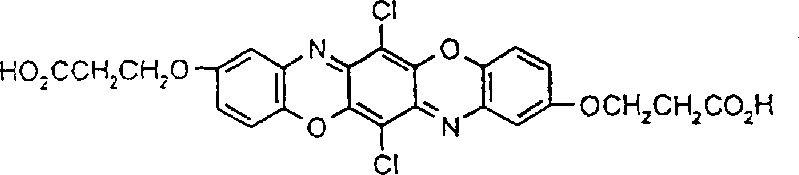


表21Table 21
混杂聚合染料实施例号 反应的二元酸性化合物 反应的二磺酸酯化合物 颜色485



表21Table 21
混杂聚合染料实施例号 反应的二元酸性化合物 反应的二磺酸酯化合物 颜色488



表21Table 21
混杂聚合染料实施例号 反应的二元酸性化合物 反应的二磺酸酯化合物 颜色491



表21Table 21
混杂聚合染料实施例号 反应的二元酸性化合物 反应的二磺酸酯化合物 颜色494


表21Table 21
混杂聚合染料实施例号 反应的二元酸性化合物 反应的二磺酸酯化合物 颜色497
CH3SO2O(CH2)12OSO2CH3 红色498
蓝色499

表21Table 21
混杂聚合染料实施例号 反应的二元酸性化合物 反应的二磺酸酯化合物 颜色500


表21Table 21
混杂聚合染料实施例号 反应的二元酸性化合物 反应的二磺酸酯化合物 颜色503


表22Table 22
聚合紫外吸收剂实施例号 反应的二元酸性化合物 反应的二磺酸酯化合物506
CH3SO2O(CH2)6OSO2CH3507




表22Table 22
聚合紫外吸收剂实施例号 反应的二元酸性化合物 反应的二磺酸酯化合物510


表22Table 22
聚合紫外吸收剂实施例号 反应的二元酸性化合物 反应的二磺酸酯化合物514
CH3SO2O(CH2)6OSO2CH3515

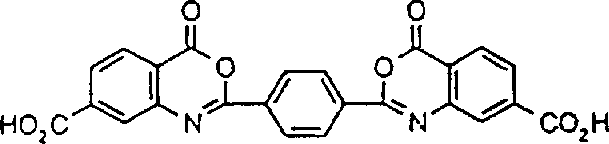
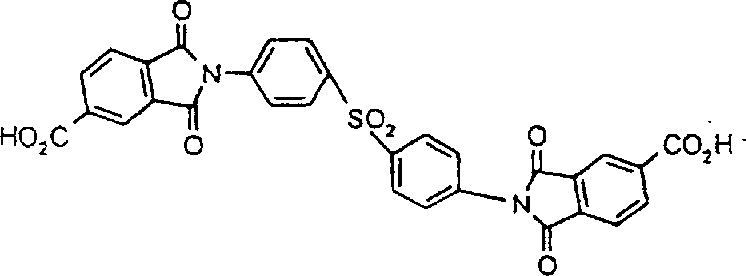
表22Table 22
聚合紫外吸收剂实施例号 反应的二元酸性化合物 反应的二磺酸酯化合物518
CH3SO2OCH2CH2SCH2CH2OSO2CH3519


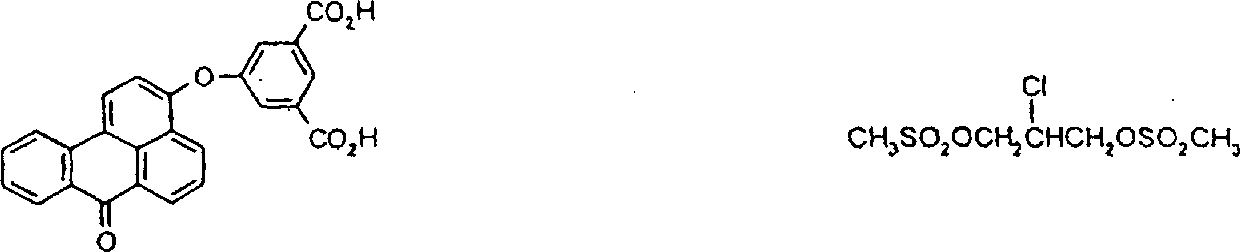
表23Table 23
聚合红外光吸收剂实施例号 反应的二元酸性化合物 反应的二磺酸酯化合物523
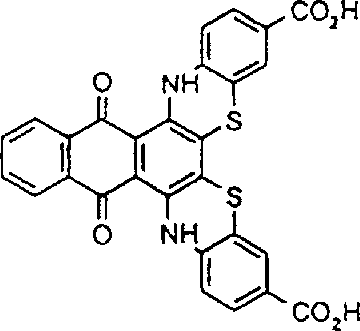

表23Table 23
聚合红外光吸收剂实施例号 反应的二元酸性化合物 反应的二磺酸酯化合物526 CH3SO2O(CH2)6OSO2CH3527 CH3SO2O(CH2)12OSO2CH3 Polymerized infrared light absorber Example number Reactive dibasic acidic compound Reactive disulfonic acid ester compound 526 CH 3 SO 2 O(CH 2 ) 6 OSO 2 CH 3 527 CH 3 SO 2 O(CH 2 ) 12 OSO 2 CH 3
表23Table 23
聚合红外光吸收剂实施例号 反应的二元酸性化合物 反应的二磺酸酯化合物528
CH3SO2OCH2CH2OCH2CH2OSO2CH3529

表23Table 23
聚合红外光吸收剂实施例号 反应的二元酸性化合物 反应的二磺酸酯化合物531



表23Table 23
聚合红外光吸收剂实施例号 反应的二元酸性化合物 反应的二磺酸酯化合物534


Claims (92)
- One kind comprise make following a) and b) reaction method:A) at least a binary acid monomer, this binary acid monomer comprises at least a extinction monomer that maximum light absorption is arranged of about 1-100mol% and the non-extinction monomer of 99-0mol% between the about 1200nm of about 300nm-, this non-extinction monomer does not have substantially and absorbs or have a maximum light absorption below 300nm being higher than 300nm wavelength placeB) has formulaX-B-X 1Organic compound, wherein B is a divalent organic group, this organic group is selected from C 2-C 12Alkylidene group, C 3-C 8Cycloalkylidene, C 1-C 4Alkylidene group-C 3-C 8-cycloalkylidene-C 1-C 4Alkylidene group, C 1-C 4Alkylidene group-arylidene-C 1-C 4Alkylidene group, C 2-C 4Alkylidene group-L-arylidene-L-C 2-C 4Alkylidene group and C 2-C 4Alkylidene group-(L-C 2-C 4Alkylidene group) 1-4, wherein L for be selected from-O-,-S-,-SO 2-,-NH-,-N (C 1-C 6Alkyl)-,-N (aryl)-,-N (SO 2C 1-C 6Alkyl)-,-N (SO 2Aryl)-,-SO 2N (C 1-C 6Alkyl)-and the combination group linking group; X and X 1For reactive group and be independently selected from bromine, iodine and R-SO 2O; Wherein R is selected from C 1-C 6Alkyl; By chlorine, fluorine, C 1-C 6Alkoxyl group, aryl, aryloxy, arylthio or C 3-C 8The C of cycloalkyl substituted 1-C 6Alkyl; C 3-C 8Cycloalkyl or aryl, wherein said being reflected under the alkali existence carried out in solvent, forms the light-absorbing polymeric compositions with following formula structure:Wherein B definition as above, n be at least 2 and A comprise the acid residues of monomers of described binary.

- 2. the process of claim 1 wherein that described extinction monomer has following formula:H-Y-H wherein H represents acid hydrogen atom; Y is a divalence extinction part, be selected from the chromophoric group class of following material: azo, two diazonium, nitrine, tetrazo, methyne, arylidene, polymethine, azomethine, the azepine methyne, anthraquinone, anthrapyridone (3H-dibenzo [f, ij] isoquinoline 99.9-2, the 7-diketone), nitro aromatic amine, anthracene pyridine (7H-dibenzo [f, ij] isoquinoline 99.9-7-ketone), phthalyl thiodiphenylamine (14H-naphtho-[2,3-a] thiodiphenylamine-8, the 13-diketone), benzanthrone (7H (de) anthracene-7-ketone), anthracene pyrimidine (7H-benzo [e] pyridine-7-ketone), the anthracene pyrazoles, anthracene isothiazole, the triphen dioxazine, thioxanthene-9-one, fluorindine (5,12-dihydro-quinoxaline [2,3-b] azophenlyene, quinophthalone, phthalocyanine, metal phthalocyanine, the naphthalene cyanines, metal naphthalene cyanines, nickel dithiolenes, the squarylium compound, the croconium compound, tonka bean camphor (2H-1-chromen-2-one), tonka bean camphor imines (2H-1-chromene-2-imines), perinone, benzo two furans, the phthalyl dihydroketoacridine, phthalyl phenoxazine (14H-naphtho-[2,3-a] phenoxazine-8, the 13-diketone), phthalyl dihydroketoacridine (13H-naphtho-[2,3-c] acridine-5,8, the 14-triketone), anthraquinone thioxanthene (8H-naphtho-[2,3-c] thioxanthene-5,8, the 13-triketone), the anthracene pyridazone, pyrrolo-[3,4-c] pyrroles, indigo, thioindigo, quinoline, xanthene, acridine, azine, cyanine oxazine, 1,4-and 1, the 5-naphthoquinones, 2,5-diarylamino terephthalic acid and ester, 1,2,4, the 5-pyromellitic dimide, naphthalene-1,4,5, the 8-4 formyl-2-imide, 3,4,9,10-perylene 4 formyl-2-imide, 3-aryl-2,5-dioxo pyrroline, 3-aryl-5-dicyano methylene radical-2-oxygen pyrroline, the aryl isoindoline, the hydroxyl benzophenone, benzotriazole, aphthotriazoles, the diimino isoindoline, aphthopyrans (3H-naphtho-[2,1-6] pyrans-3-ketone and 3-imines), phthalic imidine, the 2-(hetero) aryl indole, quinolone, 1, the 2-diarylethene, 2,5-diaryl thiophene, 2,5-diaryl-1,3, the 4-oxadiazole, triazine, 2,5-diaryl furans, 2,5-diaryl-1,3, the 4-thiadiazoles, thiophene, 1,3-phenylbenzene-2-pyrazoline, 2-aryl cumarone, 2,6-phenylbenzene benzo furans, quinoline, quinoxaline, 3,4-diaryl furanone, distyryl aromatic hydrocarbons, benzanthrone, polyaromatic and naphthalimide.
- 3. the method for claim 2, the hydrogen atom of wherein said formula H-Y-H combine and provide jointly two acidic functionalities with oxygen, sulphur or nitrogen-atoms as the part of extinction part Y independently.
- 4. the method for claim 3, wherein said acidic functionality has the pKa value of about 1.5-about 12.
- 5. the method for claim 3, wherein said acidic functionality is independently selected from-CO 2H ,-SH, be connected with aromatic ring-OH ,-CONHCO-,-SO 2-NH-CO-,-SO 2-NH-SO 2-, 1 (H)-1,2,4-triazole-3-base-, imidazolyl, benzimidazolyl-, pyrazolyl, be connected with aromatic ring-SO 2H ,-NHSO 2R 5With-SO 2NHR 5, R wherein 5Be selected from C 1-C 6Alkyl, C 3-C 8Cycloalkyl, aryl and quilt are selected from C 1-C 6Alkoxyl group, aryl, aryloxy, arylthio and C 3-C 8The C that at least one group of cycloalkyl replaces 1-C 6Alkyl.
- 6. the process of claim 1 wherein that described non-extinction monomer has following formula:H-Y 1-H wherein H represents acid hydrogen atom; Y 1Be divalent moiety, be selected from-O 2C-R 1-CO 2-and-O-R 2-O-reaches-O 2C-R 3-O-, wherein R 1Be selected from C 2-C 12Alkylidene group, 1-4-cyclohexylidene, arylidene, arylidene-O-arylidene, arylidene-SO 2-arylidene, arylidene-S-arylidene and C 1-C 4Alkylidene group-O-C 1-C 4Alkylidene group; R wherein 2Be selected from arylidene, arylidene-O-arylidene, arylidene-S-arylidene, arylidene-SO 2-arylidene, phenylene-phenylene and phenylene-C (R 4) 2-phenylene; R wherein 4Be selected from hydrogen and C 1-C 4Alkyl; R wherein 3Be selected from arylidene.
- 7. the process of claim 1 wherein that described polymer composition is a line style.
- 8. the process of claim 1 wherein that described binary acid monomer has about 12 or lower pKa value.
- 9. the method for claim 2, wherein H-Y-H comprises such part, this part is selected from the carboxyl that links to each other with aromatic ring carbon or aliphatic carbons, the hydroxyl that links to each other with not replacement or substituted-phenyl or naphthyl, link to each other with aromatic ring imido-CO-NHCO-group to be provided and to have 1 (H)-1 of following formula, 2,4-triazole-3-base group:R wherein 5' be selected from hydrogen, C 1-C 6Alkyl and aryl.

- 10. the process of claim 1 wherein that n is about 2-about 25.
- 11. the process of claim 1 wherein that n is about 3-about 15.
- 12. the process of claim 1 wherein that described alkali is selected from alkaline carbonate, alkali metal hydrocarbonate and tertiary amine, the aromatics nitrogen base contains dicyclo nitrogenous base of without hindrance electron pair and composition thereof.
- 13. the method for claim 12, wherein said alkali are selected from triethylamine, tri-n-butylamine, N-methyl piperidine, N, N '-lupetazin, N-methylmorpholine and N, N, N ', N '-Tetramethyl Ethylene Diamine, pyridine, picoline, quinoline, isoquinoline 99.9, N-alkyl pyrroles, N-alkyl imidazole, 1,8-diazabicyclo [5,4,0] 11 carbon-7-alkene (DBU), 1,5-diazabicyclo [4,3,0] ninth of the ten Heavenly Stems-5-alkene (DBN) and 1,4-diazabicyclo [2,2,2] octane (DABCO ) and composition thereof.
- 14. the process of claim 1 wherein that described solvent is one or more non-proton transfering polarity solvents.
- 15. the method for claim 1, wherein said solvent is selected from N, N-N,N-DIMETHYLACETAMIDE, N, dinethylformamide, N-N-methyl-2-2-pyrrolidone N-, N-methyl-N-phenyl formamide, methyl-sulphoxide, fatty nitrile, tetramethylene sulfone, hexamethylphosphoramide, water, alcohol, ketone, pyridine and ether alcohol and composition thereof.
- 16. the method for claim 15, wherein said solvent is selected from N, N-N,N-DIMETHYLACETAMIDE, N, dinethylformamide, N-N-methyl-2-2-pyrrolidone N-, N-methyl-N-phenyl formamide, methyl-sulphoxide, fatty nitrile, tetramethylene sulfone and hexamethylphosphoramide and composition thereof.
- 17. the process of claim 1 wherein that described reaction is to carry out in about 75 ℃-125 ℃ temperature.
- 18. the process of claim 1 wherein and have following formula:X-B-X 1Described organic compound be selected from the disulfonate compound, wherein X and X 1All be formula-OSO 2The sulphonate of R, wherein R is selected from C 1-C 4Alkyl, phenyl, p-methylphenyl, and wherein B is selected from C 2-C 6Alkylidene group ,-CH 2-1,4-cyclohexylidene-CH 2-,-CH 2CH 2(OCH 2CH 2) 1-4With-CH 2CH 2O-1,4-phenylene-O-CH 2CH 2-.
- 19. the method for claim 18, the B of the organic compound of wherein said formula II partly is selected from-CH 2CH 2-,-CH 2CH (CH 3) CH 2-,-CH 2C (CH 3) 2CH 2-,-(CH 2) 4-,-(CH 2) 6-,-CH 2CH 2OCH 2CH 2-and-CH 2-1,4-cyclohexylidene-CH 2-.
- 20. the process of claim 1 wherein the described formula X-B-X that has 1Organic compound be selected from 1-two methanesulfonates, 1-two (4-toluene sulfonic acide ester); 1,4-butyleneglycol-two methanesulfonates; 1,6-hexylene glycol-two methanesulfonates; 1, ammediol-2,2-dimethyl-two methanesulfonates; 1,4 cyclohexane dimethanol-two methanesulfonates; 1,1,3,3-tetramethylcyclobutanediol-two methanesulfonates and ethanol-2,2 '-oxygen, two-two methanesulfonates.
- 21. the process of claim 1 wherein that the A of described light-absorbing polymeric compositions comprises the described extinction monomer of 100mol%.
- 22. the process of claim 1 wherein that the acid extinction monomer of described binary has maximum light absorption and is present in the described light-absorbing polymeric compositions with the content at least about 50 weight % between the about 1200nm of about 300nm-.
- 23. an extinction composition, said composition has following formula: A wherein 1Be included in the acid residues of monomers of at least a binary that maximum light absorption is arranged between the about 1200nm of about 300nm-, and wherein B is a divalent organic group, this organic group is selected from C 2-C 12Alkylidene group, C 3-C 8Cycloalkylidene, C 1-C 4Alkylidene group-C 3-C 8-cycloalkylidene-C 1-C 4Alkylidene group, C 1-C 4Alkylidene group-arylidene-C 1-C 4Alkylidene group and C 2-C 4-alkylidene group-L-arylidene-L-C 2-C 4Alkylidene group and C 2-C 4Alkylidene group-(L-C 2-C 4Alkylidene group) 1-4, wherein L for be selected from-O-,-S-,-SO 2-,-NH-,-N (C 1-C 6Alkyl)-,-N (aryl)-,-N (SO 2C 1-C 6Alkyl)-,-N (SO 2Aryl)-,-SO 2N (C 1-C 6Alkyl)-and the combination group linking group; Wherein n is at least 2.
- 24. a composition, said composition comprise the thermoplastic polymer with at least a extinction linear polymer composition blend of claim 23.
- 25. the composition of claim 24, wherein said thermoplastic polymer is selected from polyester, polyolefine, polymeric amide, polyimide, polyvinyl chloride, urethane, polycarbonate, cellulose ester, polyacrylic ester, polyvinylesters, polyester-amides, polystyrene, polyacrylonitrile-butadiene-styrene, polystyrene-vinyl cyanide and composition thereof and blend.
- 26. the composition of claim 23, wherein A 1Comprise and have following formulaThe acid residues of monomers of at least a binary of H-Y-H structure, wherein to represent acid hydrogen atom and Y be divalence extinction part to H, wherein H represents acid hydrogen atom; Y is a divalence extinction part, be selected from the chromophoric group class of following material: azo, two diazonium, nitrine, tetrazo, methyne, arylidene, polymethine, azomethine, the azepine methyne, anthraquinone, anthrapyridone (3H-dibenzo [f, ij] isoquinoline 99.9-2, the 7-diketone), nitro aromatic amine, anthracene pyridine (7H-dibenzo [f, ij] isoquinoline 99.9-7-ketone), phthalyl thiodiphenylamine (14H-naphtho-[2,3-a] thiodiphenylamine-8, the 13-diketone), benzanthrone (7H (de) anthracene-7-ketone), anthracene pyrimidine (7H-benzo [e] pyridine-7-ketone), the anthracene pyrazoles, anthracene isothiazole, the triphen dioxazine, thioxanthene-9-one, fluorindine (5,12-dihydro-quinoxaline [2,3-b] azophenlyene, quinophthalone, phthalocyanine, metal phthalocyanine, the naphthalene cyanines, metal naphthalene cyanines, nickel dithiolenes, the squarylium compound, the croconium compound, tonka bean camphor (2H-1-chromen-2-one), tonka bean camphor imines (2H-1-chromene-2-imines), perinone, benzo two furans, the phthalyl dihydroketoacridine, phthalyl phenoxazine (14H-naphtho-[2,3-a] phenoxazine-8, the 13-diketone), phthalyl dihydroketoacridine (13H-naphtho-[2,3-c] acridine-5,8, the 14-triketone), anthraquinone thioxanthene (8H-naphtho-[2,3-c] thioxanthene-5,8, the 13-triketone), the anthracene pyridazone, pyrrolo-[3,4-c] pyrroles, indigo, thioindigo, quinoline, xanthene, acridine, azine, cyanine oxazine, 1,4-and 1, the 5-naphthoquinones, 2,5-diarylamino terephthalic acid and ester, 1,2,4, the 5-pyromellitic dimide, naphthalene-1,4,5, the 8-4 formyl-2-imide, 3,4,9,10-perylene 4 formyl-2-imide, 3-aryl-2,5-dioxo pyrroline, 3-aryl-5-dicyano methylene radical-2-oxygen pyrroline, the aryl isoindoline, the hydroxyl benzophenone, benzotriazole, aphthotriazoles, the diimino isoindoline, aphthopyrans (3H-naphtho-[2,1-6] pyrans-3-ketone and 3-imines), phthalic imidine, the 2-(hetero) aryl indole, quinolone, 1, the 2-diarylethene, 2,5-diaryl thiophene, 2,5-diaryl-1,3, the 4-oxadiazole, triazine, 2,5-diaryl furans, 2,5-diaryl-1,3, the 4-thiadiazoles, thiophene, 1,3-phenylbenzene-2-pyrazoline, 2-aryl cumarone, 2,6-phenylbenzene benzo furans, quinoline, quinoxaline, 3,4-diaryl furanone, distyryl aromatic hydrocarbons, benzanthrone, polyaromatic and naphthalimide.
- 27. the extinction linear polymer composition of claim 23 or 26, wherein A 1Also comprise the following formula that has that is less than the about 50 weight % of total compositionH-Y 1At least a non-extinction residues of monomers of-H, wherein Y 1Be divalent moiety, be selected from-O 2C-R 1-CO 2-and-O-R 2-O-reaches-O 2C-R 3-O-, wherein R 1Be selected from C 2-C 12Alkylidene group, 1-4-cyclohexylidene, arylidene, arylidene-O-arylidene, arylidene-SO 2-arylidene, arylidene-S-arylidene and C 1-C 4Alkylidene group-O-C 1-C 4Alkylidene group; R wherein 2Be selected from arylidene, arylidene-O-arylidene, arylidene-S-arylidene, arylidene-SO 2-arylidene, phenylene-phenylene and phenylene-C (R 4) 2-phenylene; R wherein 4Be selected from hydrogen and C 1-C 4Alkyl; R wherein 3Be selected from arylidene; Wherein B is a divalent organic group, is selected from C 2-C 12Alkylidene group, C 3-C 8Cycloalkylidene, C 1-C 4Alkylidene group-C 3-C 8-cycloalkylidene-C 1-C 4Alkylidene group, C 1-C 4Alkylidene group-arylidene-C 1-C 4Alkylidene group and C 2-C 4-alkylidene group-L-arylidene-L-C 2-C 4Alkylidene group and C 2-C 4Alkylidene group-(L-C 2-C 4Alkylidene group) 1-4, wherein L for be selected from-O-,-S-,-SO 2-,-NH-,-N (C 1-C 6Alkyl)-,-N (aryl)-,-N (SO 2C 1-C 6Alkyl)-,-N (SO 2Aryl)-,-SO 2N (C 1-C 6Alkyl)-and the combination group linking group; Wherein n is at least 2.
- 28. the extinction linear polymer composition of claim 25, wherein A 1Comprise the acid residues of monomers of at least a binary, described binary acid monomer contains at least one acidic-group beyond the carboxyl and have maximum light absorption between the about 1200nm of about 300nm-, and wherein B is a divalent organic group, and it is selected from C 2-C 12Alkylidene group, C 3-C 8Cycloalkylidene, C 1-C 4Alkylidene group-C 3-C 8-cycloalkylidene-C 1-C 4Alkylidene group, C 1-C 4Alkylidene group-arylidene-C 1-C 4Alkylidene group and C 2-C 4Alkylidene group-L-arylidene-L-C 2-C 4Alkylidene group and C 2-C 4Alkylidene group-(L-C 2-C 4Alkylidene group) 1-4, wherein L for be selected from-O-,-S-,-SO 2-,-NH-,-N (C 1-C 6Alkyl)-,-N (aryl)-,-N (SO 2C 1-C 6Alkyl)-,-(SO 2Aryl)-,-SO 2N (C 1-C 6Alkyl)-and the combination group linking group; Wherein n is at least 2.
- 29. the method for claim 2, wherein said extinction monomer comprise that two carboxylic groups are as acidic functionality.
- 30. the method for claim 2, wherein said extinction monomer comprises two 1 (H)-1,2, and 4-triazole-3-base sulfenyl is as acidic functionality.
- 31. the method for claim 2, wherein said extinction monomer comprise a carboxyl and one 1 (H)-1,2,4-triazole-3-base sulfenyl is as acidic functionality.
- 32. the method for claim 2, wherein said extinction monomer comprises two hydroxyls that link to each other with aromatic ring.
- 33. the method for claim 2, wherein said extinction monomer comprise an imide group and a carboxyl.
- 34. the method for claim 2, wherein said extinction monomer comprise an imide group and one 1 (H)-1,2,4-triazole-3-base sulfenyl.
- 35. the composition of claim 25, wherein said extinction monomer comprise that two carboxyls are as acidic functionality.
- 36. the composition of claim 25, wherein said extinction monomer comprises two 1 (H)-1,2, and 4-triazole-3-base sulfenyl is as acidic functionality.
- 37. the composition of claim 25, wherein said extinction monomer comprise a carboxyl and one 1 (H)-1,2,4-triazole-3-base sulfenyl is as acidic functionality.
- 38. the composition of claim 25, wherein said extinction monomer comprises two hydroxyls that link to each other with aromatic ring.
- 39. the composition of claim 25, wherein said extinction monomer comprise an imide group and a carboxyl.
- 40. the composition of claim 23, wherein said extinction monomer comprise an imide group and one 1 (H)-1,2,4-triazole-3-base sulfenyl.
- 41. the composition of claim 23, wherein said extinction monomer comprise the acid sulphonamide (SO of a binary 2NH 2) group.
- 42. the composition of claim 25, wherein said extinction monomer comprises two acidic-groups that independently are selected from following groups, and these groups are-CO 2H ,-SH, the hydroxyl that is connected with aromatic ring ,-CONHCO-(imide) ,-SO 2NHCO-,-SO 2NHSO 2-, 1 (H)-1,2,4-triazole-3-base-, imidazolyl, benzimidazolyl-, pyrazolyl, be connected with aromatic ring-SO 2H ,-NHSO 2R 5With-SO 2NHR 5, R wherein 5Be selected from C 1-C 6Alkyl; Be selected from C 1-C 6Alkoxyl group, aryl, aryloxy, arylthio and C 3-C 8The C that at least one group of cycloalkyl replaces 1-C 6Alkyl; C 3-C 8Cycloalkyl; Aryl.
- 43. the composition of claim 27, wherein said extinction monomer comprise that two carboxyls are as acidic functionality.
- 44. the composition of claim 27, wherein said extinction monomer comprises two 1 (H)-1,2, and 4-triazole-3-base sulfenyl is as acidic functionality.
- 45. the composition of claim 27, wherein said extinction monomer comprise a carboxyl and one 1 (H)-1,2,4-triazole-3-base sulfenyl is as acidic functionality.
- 46. the composition of claim 27, wherein said extinction monomer comprises two hydroxyls that link to each other with aromatic ring.
- 47. the composition of claim 27, wherein said extinction monomer comprise an imide group and a carboxyl.
- 48. the composition of claim 27, wherein said extinction monomer comprise an imide group and one 1 (H)-1,2,4-triazole-3-base sulfenyl.
- 49. the composition of claim 27, wherein said extinction monomer comprise the acid sulphonamide (SO of binary 2NH 2) group.
- 50. the composition of claim 27, wherein said extinction monomer comprises two acidic-groups that independently are selected from following groups, and these groups are-CO 2H, SH, the hydroxyl that is connected with aromatic ring ,-CONHCO-(imide) ,-SO 2NHCO-,-SO 2NHSO 2-, 1 (H)-1,2,4-triazole-3-base-, imidazolyl, benzimidazolyl-, pyrazolyl, be connected with aromatic ring-SO 2H ,-NHSO 2R 6With-SO 2NHR 5, R wherein 5Be selected from C 1-C 6Alkyl; Be selected from C 1-C 6Alkoxyl group, aryl, aryloxy, arylthio or C 3-C 8The C that at least one group of cycloalkyl replaces 1-C 6Alkyl; C 3-C 8Cycloalkyl; Aryl.
- 51. the extinction linear polymer composition of claim 27, wherein said at least a binary acid monomer account for total composition at least about 50 weight %.
- 52. the composition of claim 51, wherein the described light absorption unit branch of A comprises being selected to have following structure:
 Anthraquinone and the acid extinction residues of monomers of at least a binary of anthrapyridone, wherein R 14Be selected from hydrogen and be selected from a following 1-4 group: amino, C 1-C 10Alkylamino, C 3-C 8Alkenyl amino, C 3-C 8Alkynyl amino, C 3-C 8Cycloalkyl amino, arylamino, halogen, C 1-C 6Alkoxyl group, C 1-C 6Alkylthio, aryl, aroyl, C 1-C 6Alkyloyl, C 1-C 6Alkanoyloxy, NHCOC 1-C 6Alkyl, NHCO aryl, NHCO 2C 1-C 6Alkyl, NHSO 2C 1-C 6Alkyl, NHSO 2Aryl, C 1-C 6Alkoxy carbonyl, aryloxy, arylthio, heteroarylthio, cyano group, nitro, trifluoromethyl, thiocyano, SO 2C 1-C 6Alkyl, SO 2Aryl ,-SO 2NHC 1-C 6Alkyl ,-SO 2N (C 1-C 6Alkyl) 2,-SO 2N (C 1-C 6Alkyl) aryl, CONHC 1-C 6Alkyl, CON (C 1-C 6Alkyl) 2, CON (C 1-C 6Alkyl) aryl, C 1-C 6Alkyl, furfuryl group amino, tetrahydrofurfuryl amino, 4-(methylol) hexanaphthene methylamino,
 Or hydroxyl; Q and Q ' be independently selected from-O-,-N (COR 10)-,-N (SO 2R1 0)-,-N (R 10)-,-S-,-SO 2-,-CO 2-,-CON (R 10)-, SO 2N (R 10)-, be R wherein 10Be selected from hydrogen, aryl, C 3-C 8Cycloalkyl or C 1-C 10Alkyl; R 15Be selected from hydrogen, cyano group, C 1-C 6Alkylamino, C 1-C 6Alkoxyl group, halogen, arylthio, aryl, heteroaryl, heteroarylthio, C 1-C 6Alkoxy carbonyl, aroyl or aryl sulfonyl; R 16Be selected from hydrogen, C 1-C 6Alkyl, C 3-C 8Cycloalkyl and aryl; R 16' be selected from hydrogen, C 1-C 6Alkyl, halogen and C 1-C 6Alkoxyl group; Each C wherein 1-C 6Alkyl and as the C of the part of another group 1-C 6Alkyl can comprise that at least one is selected from hydroxyl, cyano group, chlorine, fluorine, C 1-C 6Alkoxyl group, C 3-C 8Cycloalkyloxy, C 1-C 6The substituting group of alkyl-cyclohexyl, methylol cyclohexyl, aryl and heteroaryl; Precondition is that an acidic-group that respectively comprises two acidic-groups of an acid proton or comprise two acidic hydrogens is present in this binary acidic cpd.
- 53. the composition of claim 26 or 27, wherein the described light absorption unit branch of A comprises being selected to have structure respectively:R 6-N=N-Z, R 6-N=N-R 7-N=N-Z, R 6-N=N-Y 1-N=N-R 6With the residue of at least a extinction monomeric groups of azo, two diazonium, tetrazo and the azomethine of D=HC-N=N-Z, wherein R 6For by diazotization with used the residue of coupling component H-Z link coupled arylamine or assorted arylamine, and derived from the amine that is selected from arylamine or assorted arylamine class, be selected from: aniline, the 1-amino naphthalenes, the 1-aminoanthraquinone, the 4-aminoazobenzene, thiazolamine, the 2-aminobenzothiazole, 3-amino-2, the 1-benzisothiazole, 2-aminothiophene also [2,3-d] thiazole, the 5-aminoisothiazoles, the 5-amino-pyrazol, 4-amino-pyrazol and isothiazole, 2-amino-1,3, the 4-thiadiazoles, 5-amino-1,2, the 4-thiadiazoles, 5-amino-1,2, the 3-triazole, 2-amino-1,3, the 4-triazole, 2 (5)-aminooimidazoles, the 3-aminopyridine, 2 (3)-aminothiophenes, 2 (3)-amino benzo [b] thiophene, 2-aminothiophene also [3,2-b] thiophene, 3-aminothiophene also [2,3-c] isothiazole, 3-amino-7-benzo-2,1-isothiazole, 3-amino-benzene thiophthene and isothiazole, 3-aminoisothiazoles [3,4-d] pyrimidine, 5-amino-1,2, the 3-triazole, 3 (4)-aminophthalimides and 5 (6)-amino-1,2-benzo isothiazolon-1,1-dioxide, wherein said aromatic ring and hetero-aromatic ring system are not substituted or are replaced by one or more groups, and this group is selected from C 1-C 10Alkyl, C 1-C 6Alkoxyl group, C 3-C 8Cycloalkyl, carboxyl, halogen, C 1-C 6Alkoxy carbonyl, formyl, C 1-C 6Alkyloyl, C 1-C 6Alkyloyl oxygen base, dicyano vinyl, C 3-C 8-cycloalkanes acyl group, thiocyano, trifluoroacetyl group, cyano group, carbamyl ,-CONH-C 1-C 6Alkyl, CONH aryl, CON (C 1-C 6Alkyl) 2, sulfamyl, SO 2NHC 1-C 6Alkyl, SO 2N (C 1-C 6Alkyl) 2, SO 2NH aryl, SO 2NHC 3-C 8Cycloalkyl, CONHC 3-C 8Cycloalkyl, aryl, aroyl ,-NHSO 2C 1-C 6Alkyl ,-N (C 1-C 6Alkyl) SO 2C 1-C 6Alkyl ,-NHSO 2Aryl, NHCOC 1-C 6Alkyl, NHCOC 3-C 8Cycloalkyl, NHCO aryl, NHCO 2C 1-C 6Alkyl, NHCONHC 1-C 6Alkyl, NHCONH aryl, N (C 1-C 6Alkyl) aryl, arylazo, heteroaryl, aryloxy, arylthio, C 3-C 8Cycloalkyloxy, heteroaryl azo, heteroarylthio, aryl sulfonyl, tricyano vinyl, aryloxy sulfonyl, C 1-C 6Alkyl sulphonyl, trifluoromethyl, fluoro alkylsulfonyl, trifluoromethyl sulfonyl, sulfenyl cyano group, hydroxyl, nitro or CH=D; wherein D is the residue of activity methene compound, and described compound is selected from propane dinitrile, alpha-cyano acetic ester, malonic ester, alpha-cyano ethanamide, α-C 1-C 6Alkyl sulphonyl acetonitrile, alpha-aromatic alkylsulfonyl acetonitrile, α-C 1-C 6Alkyloyl acetonitrile, α-aroyl acetonitrile, α-heteroaryl acetonitrile, two (heteroaryl) methane, 2; 3-dihydro-1; 3-indenes diketone, 2-furanone, benzo-2-furanone, naphtho--2-furanone, 2-indolone, 3-cyano group-1; 6-dihydro-4-methyl-2; 6-dioxy (2H)-pyridine, benzo (b) thieno--3-subunit propane dinitrile-5; 5-dioxide, 1; 3-two (dicyano methylene radical)-1; 2-indane, malonylurea, 5-pyrazolone, methone, 3-oxo-2; 3-dihydro-1-thionaphthene-1,1-dioxide or aryl-C (CH 3) C=C (CN) 2R wherein 7Be divalent aromatic or heteroaromatic group, be selected from 1,4-phenylene, naphthalene-1,4-two bases, thiazole-2,5-two base and thiophene-2,5-two bases:R wherein 8Be selected from hydrogen or 1-2 and be selected from C 1-C 6Alkyl, C 1-C 6Alkoxyl group, cyano group, halogen ,-NHCOC 1-C 6Alkyl ,-NHCO 2C 1-C 6Alkyl ,-the NHCO aryl ,-NHCONH aryl or NHCONHC 1-C 6The group of alkyl; R 9Be selected from hydrogen, C 1-C 6Alkyl, halogen, aryl, heteroaryl; R 10Be selected from hydrogen, C 1-C 6Alkoxy carbonyl, cyano group, carbamyl, aryl, aryl sulfonyl, aroyl ,-CONHC 1-C 6Alkyl or C 1-C 6Alkyl sulphonyl; Wherein Z is the residue that is selected from the coupling compound of following electron rich compounds, these electron rich compounds comprise: aniline, the 1-amino naphthalenes, 1, the 2-dihydroquinoline, 1,2,3, the 4-tetrahydroquinoline, benzo morpholine (3,4-dihydro-2H-1, the 4-benzoxazine), pyrazolone, pyrazoles, 3-cyano group-6-hydroxyl-2-pyridone, 2, the 3-indoline, indoles, 4 hydroxy coumarin, 4-hydroxyl-2-quinolone, imidazo [2,1-b] thiazole, julolidine (2,3,6,7-tetrahydrochysene-1H, 5H-benzo [ij] quinolizine), 1-Evil julolidine, 1,2,5,6-tetrahydrochysene-4H-pyrrolo-[3,2,1-ij] quinoline, 2,6-diamino-3-cyanopyridine, thiazolamine, the 2-aminothiophene, 5,5-dimethyl-1,3-cyclohexanedione (methone), phenol, naphthols, 2,4-pentane diketone or acetyl acetyl aryl compound; Y wherein 1Residue for the double couple crosslinking component, these components are selected from aniline, 1,2-dihydroquinoline, 1,2,3,4-tetrahydroquinoline, benzo morpholine (3,4-dihydro-2H-1, the 4-benzoxazine), 3-cyano group-6-hydroxyl-2-pyridone, 2,6-diamino-pyridine, 2,3-indoline, ALPHA-NAPHTHYL AMINE, thiazolamine or their composition; Precondition is that the functional group of respectively containing two acidic functionalities of an acidic hydrogen or containing two acidic hydrogens is present in the acid extinction monomer of binary.

- 54. the composition of claim 53, wherein Z is selected from following groups:
 Or
Or R wherein 17Be selected from hydrogen, be selected from a following 1-2 group: C 1-C 6Alkyl, C 1-C 6Alkoxyl group, C 1-C 6Alkylthio ,-O-C 2-C 6Alkylidene group-OH, O-C 2-C 6Alkylidene group-C 1-C 6Alkanoyloxy, C 1-C 6Alkylidene group-OH, C 1-C 6Alkylidene group-C 1-C 6Alkanoyloxy, halogen, carboxyl, C 1-C 6Alkoxy carbonyl, trifluoromethyl, NHCOR 24, NHCO 2R 24, NHCON (R 24) R 25And NHSO 2R 25, R wherein 24Be selected from hydrogen, C 1-C 10Alkyl, C 3-C 8Cycloalkyl or aryl, R 25Be selected from C 1-C 10Alkyl, C 3-C 8Cycloalkyl or aryl, wherein R 24And R 25In each C 1-C 10Alkyl can be further by one or more following group replacement: C that are selected from 3-C 8Cycloalkyl, aryl, aryloxy, arylthio, CO 2H, CO 2C 1-C 6Alkyl, cyano group, hydroxyl, succinimido, C 1-C 6Alkoxyl group,
 Or
Or R wherein 5' be selected from hydrogen, C 1-C 6Alkyl or aryl; R 16' be selected from hydrogen or one or two is selected from C 1-C 6Alkyl, halogen and C 1-C 6The group of alkoxyl group; Q is selected from-O-,-N (COR 10)-,-N (R 10)-,-S-,-SO 2-,-CO 2-,-CON (R 10) ,-SO 2(R 10)-, be R wherein 10Be selected from hydrogen, aryl, C 3-C 8Cycloalkyl or C 1-C 10Alkyl; R 18And R 19Be independently selected from hydrogen, unsubstituted C 1-C 10The C of alkyl, replacement 1-C 10Alkyl, C 3-C 8Cycloalkyl, C 3-C 8Thiazolinyl, C 3-C 8Alkynyl and aryl, perhaps R 18And R 19Can combine with another unit, they are joined together to form the group Z with following formula:
 Q wherein 2Be selected from covalent linkage ,-O-,-S-,-SO 2-,-CO-,-CO 2-,-N-(C 1-C 6Alkyl)-,-N (COC 1-C 6Alkyl)-,-N (SO 2C 1-C 6Alkyl)-,-N (CO aryl)-or-N (SO 2Aryl); R 20, R 21And R 22Be independently selected from hydrogen or C 1-C 6Alkyl; R 23Be selected from hydrogen, C 1-C 6Alkyl, C 3-C 8Cycloalkyl, heteroaryl or aryl.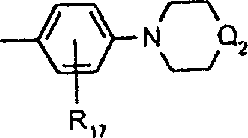
- 55. the composition of claim 26 or 51, wherein the described light absorption unit branch of A comprises at least a extinction residues of monomers, described monomer is selected from methyne, arylidene, polymethine, azepine methyne, 3-aryl-2,5-dioxy pyrroline, 3-aryl-5-dicyano methylene radical-2-oxygen pyrroline and aryl isoindoline and have following structure: R respectively 11-CH=DR 11-CH=CH-CH=DR 11-N=D
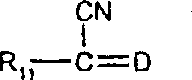 R wherein 11Residue for the electron rich aromatic compound, described compound is selected from aniline, the 1-ALPHA-NAPHTHYL AMINE, 1, the 2-dihydroquinoline, 1,2,3, the 4-tetrahydroquinoline, 1,3,3-trimethylammonium-2-methylene radical indoles, 1,3-dihydroxyl-2-methylene radical-1,1,3-trimethylammonium-2H-benzo [e] indoles, imidazo [2,1-b] thiazole, benzo morpholine (3,4-dihydro-2H-1, the 4-benzoxazine), 2, the 3-indoline, indoles, thiazolamine, julolidine (2,3,6,7-tetrahydrochysene-1H, 5H-benzo [ij] quinolizine), 1-Evil julolidine, 4H-pyrrolo-[3,2,1-ij] quinoline, phenol, naphthols, thiophenol, the pyrroles, pyrazoles, furans, thiophene, carbazole, thiodiphenylamine Huo phenoxazine compound; R 12Be selected from hydrogen, C 1-C 10Alkyl, C 3-C 8Thiazolinyl, C 3-C 8Alkynyl, C 3-C 8Cycloalkyl, aryl ,-(CH 2CH 2O-)- 1-3R 13And C 1-C 4Alkylidene group-C 3-C 8Cycloalkylidene, wherein C 1-C 6Alkyl group can be selected from carboxyl, C by at least one 1-C 6Carbalkoxy, C 1-C 6Alkanoyloxy, cyano group, hydroxyl, chlorine, fluorine, C 1-C 6Alkoxyl group, C 3-C 8The group of cycloalkyl or aryl replaces; R 13Be selected from hydrogen, C 1-C 6Alkoxyl group or C 1-C 6Alkanoyloxy; Wherein D is the residue of activity methene compound, and described compound is selected from propane dinitrile, alpha-cyano acetic ester, malonic ester, alpha-cyano ethanamide, α-C 1-C 6Alkyl sulphonyl acetonitrile, alpha-aromatic alkylsulfonyl acetonitrile, α-C 1-C 6Alkyloyl acetonitrile, α-aroyl acetonitrile, α-heteroaryl acetonitrile, two (heteroaryl) methane, 2; 3-dihydro-1; 3-indenes diketone, 2-furanone, benzo-2-furanone, naphtho--2-furanone, 2-indolone, 3-cyano group-1; 6-dihydro-4-methyl-2; 6-dioxy (2H)-pyridine, benzo (b) thieno--3-subunit propane dinitrile-5; 5-dioxide, 1; 3-two (dicyano methylene radical)-1; 2-indane, malonylurea, 5-pyrazolone, methone, 3-oxo-2; 3-dihydro-1-thionaphthene-1,1-dioxide or aryl-C (CH 3) C=C (CN) 2, precondition is to have two acidic functionalities that respectively comprise an acidic hydrogen or the functional group that comprises two acidic hydrogens.
- 56. the composition of claim 55, wherein R 11Be selected from corresponding to following array structure:
 Or
Or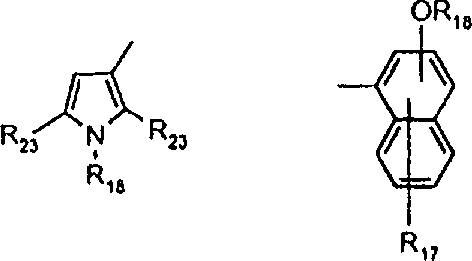 The residue of electron rich aromatics, R wherein 26Be selected from hydrogen or be selected from C 1-C 6Alkoxy carbonyl, CO 2H, C 1-C 6Alkyl or C 1-C 6The group of alkoxyl group; R wherein 17Be selected from hydrogen and 1-2 and be selected from following group: C 1-C 6Alkyl, C 1-C 6Alkoxyl group, C 1-C 6Alkylthio ,-O-C 2-C 6Alkylidene group-OH, OC 2-C 6Alkylidene group-C 1-C 6Alkanoyloxy, C 1-C 6Alkylidene group-OH, C 1-C 6Alkylidene group-C 1-C 6Alkanoyloxy, halogen, carboxyl, C 1-C 6Alkoxy carbonyl, trifluoromethyl, NHCOR 24, NHCO 2R 24, NHCON (R 24) R 25And NHSO 2R 25, R wherein 24Be selected from hydrogen, C 1-C 10Alkyl, C 3-C 8Cycloalkyl or aryl, R 25Be selected from C 1-C 10Alkyl, C 3-C 8Cycloalkyl or aryl, wherein R 24And R 25In each C 1-C 10Alkyl can be further by one or more following group replacement: C that are selected from 3-C 8Cycloalkyl, aryl, aryloxy, arylthio, CO 2H, CO 2C 1-C 6Alkyl,
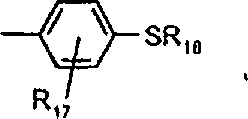 Or
Or R wherein 5' be selected from hydrogen, C 1-C 6Alkyl or aryl; R 16' be selected from hydrogen, one or two is selected from C 1-C 6Alkyl, halogen and C 1-C 6The group of alkoxyl group; Q is selected from-O-,-N (COR 10)-,-N (R 10)-,-S-,-SO 2-,-CO 2-, CON (R 10), SO 2(R 10)-, be R wherein 10Be selected from hydrogen, aryl, C 3-C 8Cycloalkyl or C 1-C 10Alkyl; R 18And R 19Be independently selected from hydrogen, unsubstituted C 1-C 10The C of alkyl, replacement 1-C 10Alkyl, C 3-C 8Cycloalkyl, C 3-C 8Thiazolinyl, C 3-C 8Alkynyl and aryl, perhaps 18And R 19Can combine with another unit, they are joined together to form the group Z with following formula:
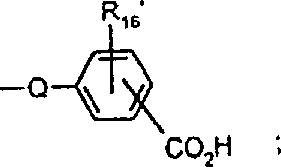 Q wherein 2Be selected from covalent linkage ,-O-,-S-,-SO 2-,-CO-,-CO 2-,-N-(C 1-C 6Alkyl)-,-N (COC 1-C 6Alkyl)-,-N (SO 2C 1-C 6Alkyl)-,-N (CO aryl)-or-N (SO 2Aryl); R 20, R 21And R 22Be independently selected from hydrogen or C 1-C 6Alkyl; R 23Be selected from hydrogen, C 1-C 6Alkyl, C 3-C 8Cycloalkyl, heteroaryl or aryl.
- 57. the composition of claim 51, wherein A 2The light absorption unit branch comprise and be selected from down array structure: The residue of the acid coumarin compound of at least a binary, Z wherein 3Be selected from cyano group, C 1-C 6Alkoxy carbonyl, C 1-C 6Alkyl sulphonyl, aryl sulfonyl, aryl, heteroaryl, formyl radical, aroyl, C 1-C 6Alkyloyl or-CH=D, wherein R 17Be selected from hydrogen, individual following group: the C that is selected from of 1-2 1-C 6Alkyl, C 1-C 6Alkoxyl group, C 1-C 6Alkylthio ,-OC 2-C 6Alkylidene group-OH, OC 2-C 6Alkylidene group-C 1-C 6Alkanoyloxy, C 1-C 6Alkylidene group-OH, C 1-C 6Alkylidene group-C 1-C 6Alkanoyloxy, halogen, carboxyl, C 1-C 6Alkoxy carbonyl, trifluoromethyl, NHCOR 24, NHCO 2R 24, NHCON (R 24) R 25And NHSO 2R 25, R wherein 24Be selected from hydrogen, C 1-C 10Alkyl, C 3-C 8Cycloalkyl or aryl, R 25Be selected from C 1-C 10Alkyl, C 3-C 8Cycloalkyl or aryl, wherein R 24And R 25In each C 1-C 10Alkyl can be further by one or more following group replacement: C that are selected from 3-C 8Cycloalkyl, aryl, aryloxy, arylthio, CO 2H, CO 2C 1-C 6Alkyl, cyano group, hydroxyl, succinimido, C 1-C 6Alkoxyl group,Or
 R wherein 5' be selected from hydrogen, C 1-C 6Alkyl or aryl; R 16' be selected from hydrogen or one or two is selected from C 1-C 6Alkyl, halogen and C 1-C 6The group of alkoxyl group; Q is selected from-O-,-N (COR 10)-,-N (R 10)-,-S-,-SO 2-,-CO 2-, CON (R 10), SO 2(R 10)-, be R wherein 10Be selected from hydrogen, aryl, C 3-C 8Cycloalkyl or C 1-C 10Alkyl; R 18And R 19Be independently selected from hydrogen, unsubstituted C 1-C 10The C of alkyl, replacement 1-C 10Alkyl, C 3-C 8Cycloalkyl, C 3-C 8Thiazolinyl, C 3-C 8Alkynyl and aryl or R 18And R 19Can combine with another unit, they are joined together to form the group Z with following formula:
 Q wherein 2Be selected from covalent linkage ,-O-,-S-,-SO 2-,-CO-,-CO 2-,-N-(C 1-C 6Alkyl)-,-N (COC 1-C 6Alkyl)-,-N (SO 2C 1-C 6Alkyl)-,-N (CO aryl)-or-N (SO 2Aryl); R 20, R 21And R 22Be independently selected from or C 1-C 6Alkyl; R 23Be selected from hydrogen, C 1-C 6Alkyl, C 3-C 8Cycloalkyl, heteroaryl or aryl; Wherein D is the residue of activity methene compound, and described compound is selected from propane dinitrile, alpha-cyano acetic ester, malonic ester, alpha-cyano ethanamide, α-C 1-C 6Alkyl sulphonyl acetonitrile, alpha-aromatic alkylsulfonyl acetonitrile, α-C 1-C 6Alkyloyl acetonitrile, α-aroyl acetonitrile, α-heteroaryl acetonitrile, two (heteroaryl) methane, 2; 3-dihydro-1; 3-indenes diketone, 2-furanone, benzo-2-furanone, naphtho--2-furanone, 2-indolone, 3-cyano group-1; 6-dihydro-4-methyl-2; 6-dioxy (2H)-pyridine, benzo (b) thieno--3-subunit propane dinitrile-5; 5-dioxide, 1; 3-two (dicyano methylene radical)-1; 2-indane, malonylurea, 5-pyrazolone, methone, 3-oxo-2; 3-dihydro-1-thionaphthene-1,1-dioxide or aryl-C (CH 3) C=C (CN) 2, precondition is to have two acidic functionalities that respectively comprise an acidic hydrogen or the functional group that comprises two acidic hydrogens.
- 58. the composition of claim 54, wherein A1Light absorption unit divide the residue that comprises at least a bisazo extinction monomer, wherein double couple crosslinking component Y1By structure Z1-L 1-Z 2Representative, wherein Z1And Z2Be independently selected from:Or
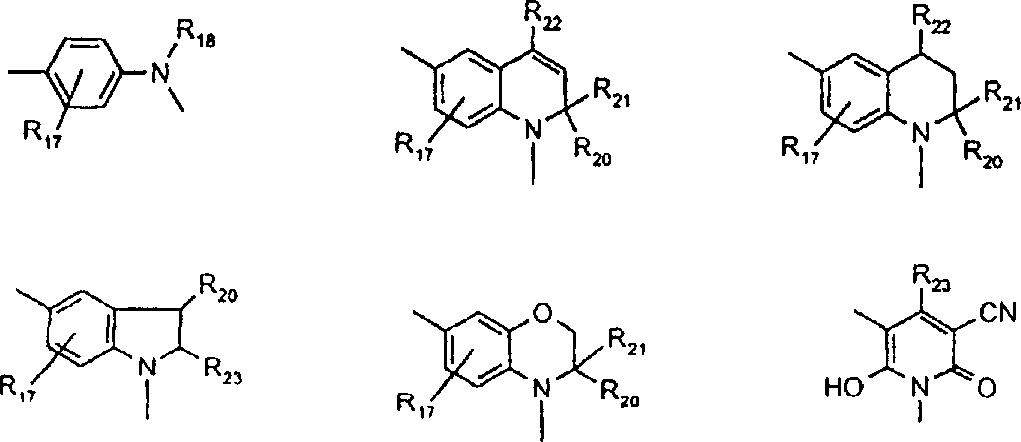 L wherein1With Z1And Z2The nitrogen-atoms combination; L wherein1Be selected from C2-C 12Alkylidene, C3-C 8Cycloalkylidene, arlydene, C1-C 4Alkylidene-C3-C 8Cycloalkylidene-C1-C 4Alkylidene, C1-C 4Alkylidene-arlydene-C1-C 4Alkylidene, C2-C 4Alkylidene-O-arlydene-O-C2-C 4Alkylidene, C2-C 4Alkylidene-O 1-3C 2-C 4Alkylidene, C2-C 4Alkylidene-S-C2-C 4Alkylidene, C2- C 4Alkylidene-SO2-C 2-C 4Alkylidene, C2-C 4Alkylidene-N (SO2C 1-C 6Alkyl)-C2-C 4Alkylidene, C2-C 4Alkylidene-N (SO2Aryl)-C2-C 4-alkylidene, C2-C 4Alkylidene-OCO2-C 2-C 4Alkylidene, C2-C 4Alkylidene-O2C-arlydene-CO2-C 2-C 4Alkylidene, C2-C 4Alkylidene-O2C-C 1-C 12Alkylidene-CO2-C 2-C 4Alkylidene, C2-C 4Alkylidene-O2C-C 3-C 8Cycloalkylidene-CO2-C 2-C 4Alkylidene, C2-C 4Alkylidene-NHCO-C2-C 4Alkylidene and C2-C 4Alkylidene-NHSO2-C 2-C 4Alkylidene; R wherein17Be selected from hydrogen, individual following group: the C that is selected from of 1-21-C 6Alkyl, C1-C 6Alkoxyl, C1-C 6Alkylthio group ,-OC2-C 6Alkylidene-OH, OC2-C 6Alkylidene-C1-C 6Alkanoyloxy, C1-C 6Alkylidene-OH, C1-C 6Alkylidene-C1-C 6Alkanoyloxy, halogen, carboxyl, C1-C 6Alkoxy carbonyl, trifluoromethyl, NHCOR24、NHCO 2R 24、NHCON(R 24)R 26And NHSO2R 25, R wherein24Be selected from hydrogen, C1-C 10Alkyl, C3-C 8Cycloalkyl or aryl, R25Be selected from C1-C 10Alkyl, C5-C 8Cycloalkyl or aryl, wherein R24And R25In each C1-C 10Alkyl can further be replaced by one or more groups that are selected from following groups: C3-C 8Cycloalkyl, aryl, aryloxy group, arylthio, CO2H、CO 2C 1-C 6Alkyl, cyano group, hydroxyl, succinimide base, C1-C 6Alkoxyl,OrR wherein5' be selected from hydrogen, C1-C 6Alkyl or aryl; R16' be selected from hydrogen or one or two is selected from C1-C 6Alkyl, halogen and C1-C 6The group of alkoxyl; Q is selected from-O-,-N (COR10)-、-N(R 10)-、 -S-、-SO 2-、-CO 2-、CON(R 10)、SO 2(R 10)-, be R wherein10Be selected from hydrogen, aryl, C3-C 8Cycloalkyl or C1-C 10Alkyl; R18Be selected from hydrogen, unsubstituted C1-C 10The C of alkyl, replacement1-C 10Alkyl, C3-C 8Cycloalkyl, C3-C 8Thiazolinyl, C3-C 8Alkynyl and aryl; R20、R 21And R22Be independently selected from or C1-C 6Alkyl; R23Be selected from hydrogen, C1-C 6Alkyl, C3-C 8Cycloalkyl, heteroaryl or aryl.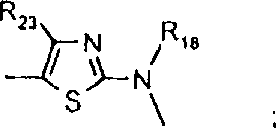
- 59. the acid anthraquinone compounds of binary, this compound has following formula: R wherein 14Be selected from hydrogen, 1-4 and be selected from following group: amino, C 1-C 10Alkylamino, C 3-C 8Alkenyl amino, C 3-C 8Alkynyl amino, C 3-C 6Cycloalkyl amino, arylamino, halogen, C 1-C 6Alkoxyl group, C 1-C 6Alkylthio, aryl, aroyl, C 1-C 6Alkyloyl, C 1-C 6Alkanoyloxy, NHCOC 1-C 6Alkyl, NHCO aryl, NHCO 2C 1-C 6Alkyl, NHSO 2C 1-C 6Alkyl, NHSO 2Aryl, C 1-C 6Alkoxy carbonyl, aryloxy, arylthio, heteroarylthio, cyano group, nitro, trifluoromethyl, thiocyano, SO 2C 1-C 6Alkyl, SO 2Aryl ,-SO 2NHC 1-C 6Alkyl ,-SO 2N (C 1-C 6Alkyl) 2,-SO 2N (C 1-C 6Alkyl) aryl, CONHC 1-C 6Alkyl, CON (C 1-C 6Alkyl) 2, CON (C 1-C 6Alkyl) aryl, C 1-C 6Alkyl, furfuryl group amino, tetrahydrofurfuryl amino, 4-(methylol) hexanaphthene methylamino,Or hydroxyl; Q and Q ' be independently selected from-O-,-N (COR 10)-,-N (SO 2R 10)-,-N (R 10)-,-S-,-SO 2-,-CO 2-,-CON (R 10)-, SO 2N (R 10)-, be R wherein 10Be selected from hydrogen, aryl, C 3-C 8Cycloalkyl or C 1-C 10Alkyl; R 16' be selected from hydrogen or one or two is selected from C 1-C 6Alkyl, halogen and C 1-C 6The group of alkoxyl group; Each C wherein 1-C 6Alkyl and as the C of the part of another group 1-C 6Alkyl can comprise that at least one is selected from hydroxyl, cyano group, chlorine, fluorine, C 1-C 6Alkoxyl group, C 3-C 8Cycloalkyloxy, C 1-C 6The substituting group of alkyl-cyclohexyl, methylol cyclohexyl, aryl and heteroaryl; Precondition is that an acidic-group that respectively comprises two acidic-groups of an acid proton or comprise two acidic hydrogens is present in the compound of formula XIV, XIXc, XIXd, XIXe and XIXf.

- 60. the acid anthraquinone compounds of the binary of claim 57, this compound has following structure:Wherein Sub is selected from following substituting group: halogen, trifluoromethyl, aroyl, C 1-C 6Alkyloyl, C 1-C 6Alkoxy carbonyl, C 1-C 6Alkoxyl group, C 1-C 6Alkylthio, aryloxy, arylthio, heteroarylthio, cyano group, nitro, SO 2NHC 1-C 6Alkyl, SO 2N (C 1-C 6Alkyl) 2 SO, 2N (C 1-C 6Alkyl) aryl, CONHC 1-C 6Alkyl, CON (C 1-C 6Alkyl) 2, CON (C 1-C 6Alkyl) aryl, C 1-C 6Alkyl, SO 2C 1-C 6Alkyl sulphonyl and SO 2Aryl; Sub 1For being selected from amino, C 1-C 12Alkylamino, arylamino and C 3-C 8The substituting group of cycloalkyl amino.

- 61. the acid Anthrapyridone compounds of binary, this compound has following structure: R wherein 14Be selected from hydrogen, 1-4 and be selected from following group: amino, C 1-C 10Alkylamino, C 3-C 8Alkenyl amino, C 3-C 8Alkynyl amino, C 3-C 8Cycloalkyl amino, arylamino, halogen, C 1-C 6Alkoxyl group, C 1-C 6Alkylthio, aryl, aroyl, C 1-C 6Alkyloyl, C 1-C 6Alkanoyloxy, NHCOC 1-C 6Alkyl, NHCO aryl, NHCO 2C 1-C 6Alkyl, NHSO 2C 1-C 6Alkyl, NHSO 2Aryl, C 1-C 6Alkoxy carbonyl, aryloxy, arylthio, heteroarylthio, cyano group, nitro, trifluoromethyl, thiocyano, SO 2C 1-C 6Alkyl, SO 2Aryl ,-SO 2NHC 1-C 6Alkyl ,-SO 2N (C 1-C 6Alkyl) 2,-SO 2N (C 1-C 6Alkyl) aryl, CONHC 1-C 6Alkyl, CON (C 1-C 6Alkyl) 2, CON (C 1-C 6Alkyl) aryl, C 1-C 6Alkyl or hydroxyl; Q and Q ' be independently selected from-O-,-N (COR 10)-,-N (SO 2R 10)-,-N (R 10)-,-S-,-SO 2-,-CO 2-,-CON (R 10)-, SO 2N (R 10)-, be R wherein 10Be selected from hydrogen, aryl, C 3-C 8Cycloalkyl or C 1-C 10Alkyl; R 15Be selected from hydrogen, cyano group, C 1-C 6Alkylamino, C 1-C 6Alkoxyl group, halogen, arylthio, aryl, heteroaryl, heteroarylthio, C 1-C 6Alkoxy carbonyl, aroyl or aryl sulfonyl; R 16Be selected from hydrogen, C 1-C 6Alkyl, C 3-C 8Cycloalkyl and aryl; R 16' be selected from hydrogen or one or two is selected from C 1-C 6Alkyl, halogen and C 1-C 6The group of alkoxyl group; Each C wherein 1-C 6Alkyl and as the C of the part of another group 1-C 6Alkyl can comprise that at least one is selected from hydroxyl, cyano group, chlorine, fluorine, C 1-C 6Alkoxyl group, C 3-C 8Cycloalkyloxy, C 1-C 6The substituting group of alkyl-cyclohexyl, methylol cyclohexyl, aryl and heteroaryl; Precondition is that an acidic-group that respectively comprises two acidic-groups of an acid proton or comprise two acidic hydrogens is present in the compound of formula XVIII, XVIIIa, XVIIIb and XIXa.
- 62. the acid Anthrapyridone compounds of the binary of claim 61, this compound has following structure:

- 63. the acid anthraquinone compounds of binary, this compound has following structure: OrR wherein 16' be selected from hydrogen or one or two is selected from C 1-C 6Alkyl, halogen and C 1-C 6The group of alkoxyl group; And Sub 3For being selected from C 1-C 6The substituting group of alkylthio, arylthio and heteroarylthio, and Sub 2For being selected from following substituting group: amino, C 1-C 10Alkylamino, C 3-C 8Alkenyl amino, C 3-C 8Alkynyl amino, C 3-C 8Cycloalkyl amino, arylamino, furfuryl group amino, tetrahydrofurfuryl amino, 4-(methylol) hexanaphthene methylamino, NHCOC 1-C 6Alkyl, NHCO aryl, NHCO 2C 1-C 6Alkyl, NHSO 2C 1-C 6Alkyl, NHSO 2Aryl and


- 64. the acid anthraquinone compounds of the binary of claim 59, this compound has following structure:Sub wherein 2Such as in the claim 63 definition; Sub 4Be selected from Sub 2, NHCOC 1-C 6Alkyl, NHCO 2C 1-C 6Alkyl, NHCO aryl, NHSO 2C 1-C 6Alkyl, NHSO 2Aryl, C 1-C 6Alkylthio, arylthio, heteroarylthio and hydroxyl; Q is selected from-O-, S-,-SO 2-; Q ' is selected from-O-,-N (COR 10)-,-N (SO 2R 10)-,-N (R 10)-,-S-,-SO 2-,-CO 2-,-CON (R 10)-, SO 2N (R 10)-, be R wherein 10Be selected from hydrogen, aryl, C 3-C 8Cycloalkyl or C 1-C 10Alkyl.
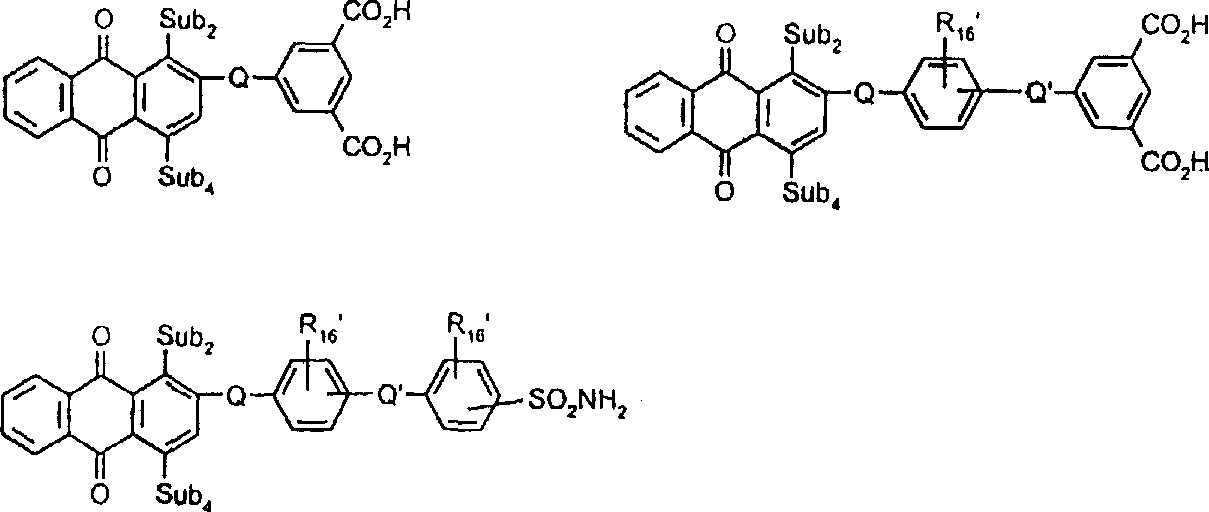
- 65. the acid anthraquinone compounds of binary, this compound has following structure:Wherein Sub, Sub 1And R 16' such as in the claim 60 definition.
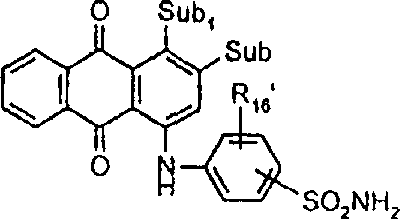
- 66. the acid anthraquinone compounds of binary, this compound has following structure: Wherein Q be selected from-O-,-S-and-SO 2-; Q ' is selected from-O-,-N (COR 10)-,-N (SO 2R 10)-,-N (R 10)-,-S-,-SO 2-,-CO 2-,-CON (R 10)-, SO 2N (R 10)-, be R wherein 10Be selected from hydrogen, aryl, C 3-C 8Cycloalkyl or C 1-C 10Alkyl; And R 16' be selected from hydrogen or one or two is selected from C 1-C 6Alkyl, halogen and C 1-C 6The group of alkoxyl group.
- 67. the acid anthraquinone compounds of binary, this compound has following structure:Sub wherein 1Such as in the claim 60 definition, Sub 4Such as in the claim 64 definition, Q is selected from-O-,-S-and-SO 2-; Q ' is selected from-O-,-N (COR 10)-,-N (SO 2R 10)-,-N (R 10)-,-S-,-SO 2-,-CO 2-,-CON (R 10)-, SO 2N (R 10)-, be R wherein 10Be selected from hydrogen, aryl, C 3-C 8Cycloalkyl or C 1-C 10Alkyl; And R 16' be selected from hydrogen or one or two is selected from C 1-C 6Alkyl, halogen and C 1-C 6The group of alkoxyl group.
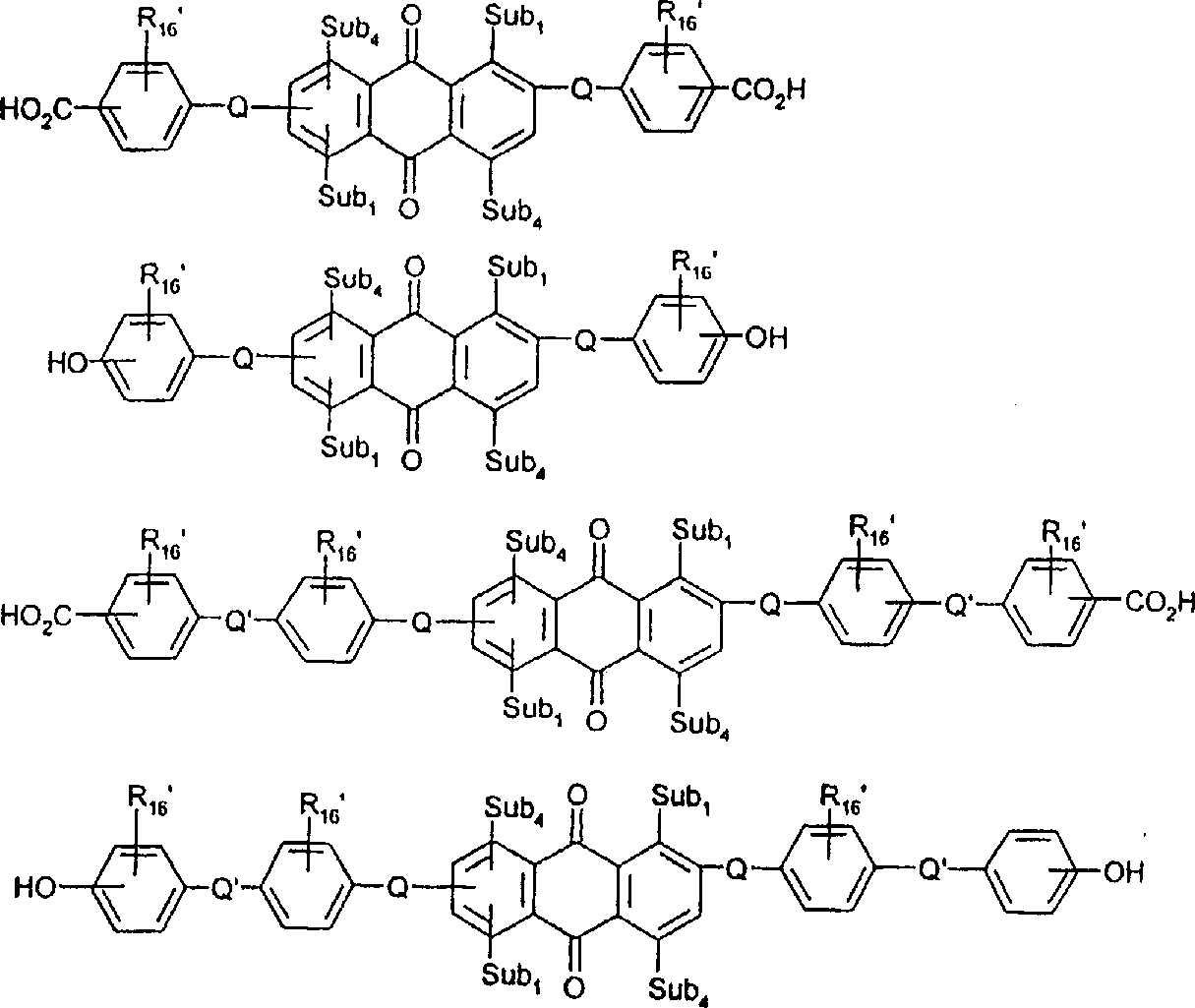
- 68. the acid anthraquinone compounds of binary, this compound has following structure: Wherein Q be selected from-O-,-S-and-SO 2-; Sub 1For being selected from amino, C 1-C 12Alkylamino, arylamino and C 3-C 8The substituting group of cycloalkyl amino; Q ' is selected from-O-,-N (COR 10)-,-N (SO 2R 10)-,-N (R 10)-,-S-,-SO 2-,-CO 2-,-CON (R 10)-, SO 2N (R 10)-, be R wherein 10Be selected from hydrogen, aryl, C 3-C 8Cycloalkyl or C 1-C 10Alkyl; And R 16' be selected from hydrogen or one or two is selected from C 1-C 6Alkyl, halogen and C 1-C 6The group of alkoxyl group.
- 69. difference corresponding R 6-N=N-Z (VI) and R 6-N=N-R 7The acid azo of the binary of-N=N-Z (VII) and disazo compound, wherein R 6For the residue and the Z of diazotizing arylamine or assorted arylamine is the residue of electron rich coupling component, described coupling component is selected from following kind: aniline, the 1-amino naphthalenes, 1, the 2-dihydroquinoline, 1,2,3, the 4-tetrahydroquinoline, benzo morpholine (3,4-dihydro-2H-1, the 4-benzoxazine), pyrazolone, pyrazoles, 3-cyano group-6-hydroxyl-2-pyridone, 2, the 3-indoline, indoles, 4 hydroxy coumarin, 4-hydroxyl-2-quinolone, imidazo [2,1-b] thiazole, julolidine (2,3,6,7-tetrahydrochysene-1H, 5H-benzo [ij] quinolizine), 1-Evil julolidine, 1,2,5,6-tetrahydrochysene-4H-pyrrolo-[3,2,1-ij] quinoline, 2,6-diamino-3-cyanopyridine, thiazolamine, the 2-aminothiophene, 5,5-dimethyl-1,3-cyclohexanedione (methone), phenol, naphthols, 2,4-pentane diketone or acetyl acetyl aryl compound; R 7Be divalent aromatic or heteroaromatic group, be selected from following kind: 1,4-phenylene, naphthalene-1,4-two bases, thiazole-2,5-two base and thiophene-2,5-two-Ji; Precondition is R 6Or Z comprises carboxyl (CO 2H) acidic-group, and be selected from (CO 2H) ,-SH, be connected with aromatic ring-OH ,-CONHCO-,-SO 2NH-CO-,-SO 2NH-SO 2-and 1 (H) 1,2, another acidic-group of 4-triazole-3-base is present in R 6Z goes up or as its part so that each R 6All comprise an acidic-group with the Z part.
- 70. the acid azo of the binary of claim 69 and disazo compound, wherein R 6With each self-contained carboxyl (CO of Z 2H) acidic-group.
- 71. the acid azo of the binary of claim 69 and tetrazo compound, wherein R 6For the diazotization that replaces arylamine or the residue of assorted aromatic amine compound, described compound deriving is from following kind: aniline, the 1-amino naphthalenes, the 1-aminoanthraquinone, the 4-aminoazobenzene, thiazolamine, the 2-aminobenzothiazole, 3-amino-2, the 1-benzisothiazole, 2-aminothiophene also [2,3-d] thiazole, the 5-aminoisothiazoles, the 5-amino-pyrazol, 4-amino-pyrazol and isothiazole, 2-amino-1,3, the 4-thiadiazoles, 5-amino-1,2, the 4-thiadiazoles, 5-amino-1,2, the 3-triazole, 2-amino-1,3, the 4-triazole, 2 (5)-aminooimidazoles, the 3-aminopyridine, 2 (3)-aminothiophenes, 2 (3)-amino benzo [b] thiophene, 2-aminothiophene also [3,2-b] thiophene, 3-aminothiophene also [2,3-c] isothiazole, 3-amino-7-benzo-2,1-isothiazole, 3-amino-benzene thiophthene and isothiazole, 3-aminoisothiazoles [3,4-d] pyrimidine, 5-amino-1,2, the 3-triazole, 3 (4)-aminophthalimides and 5 (6)-amino-1,2-benzo isothiazolon-1, the 1-dioxide, and Z is for being selected from down array structure:
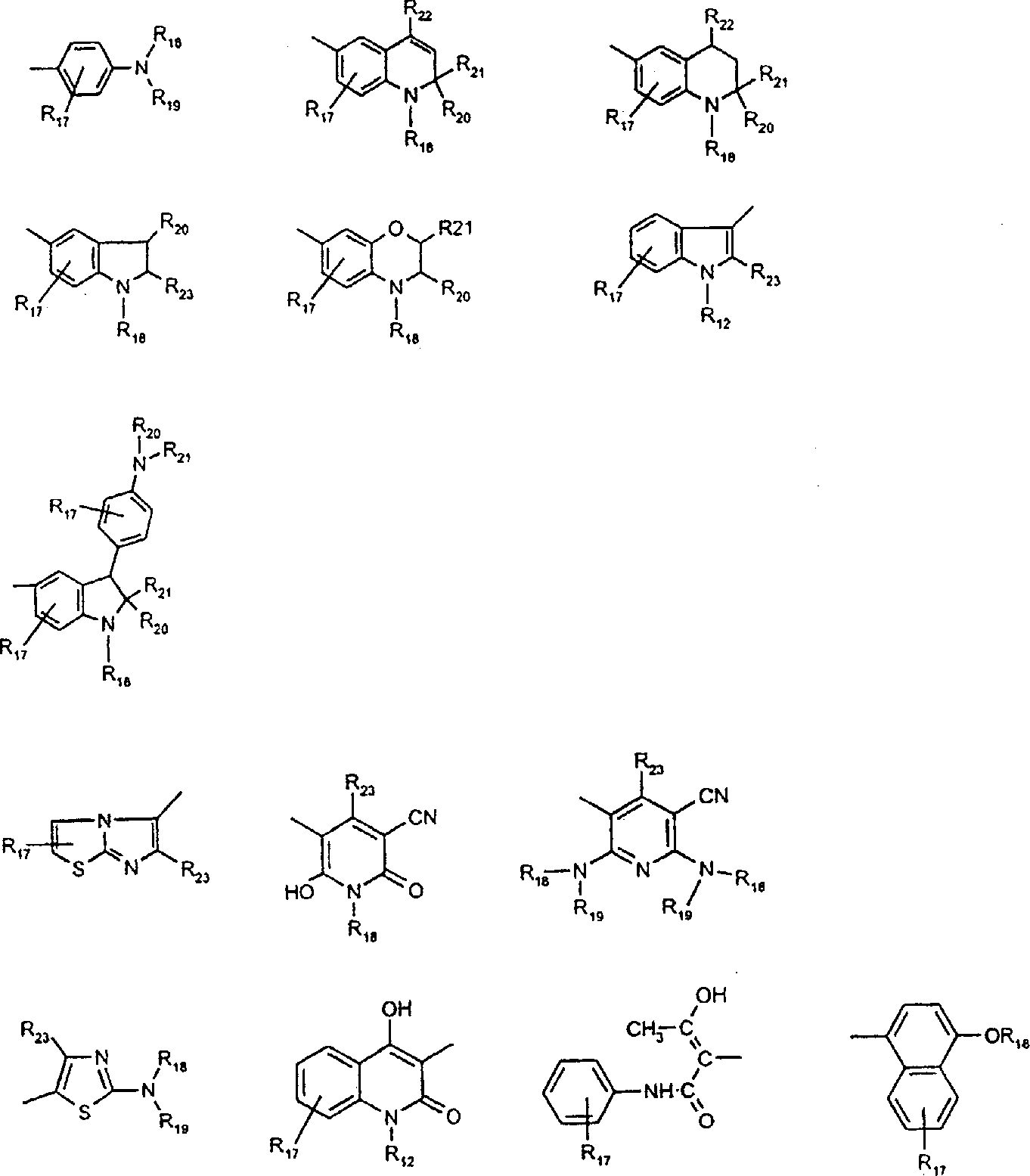 Or The residue of electron rich coupling agent residue, R wherein 17Be selected from hydrogen, individual following group: the C that is selected from of 1-2 1-C 6Alkyl, C 1-C 6Alkoxyl group, C 1-C 6Alkylthio ,-OC 2-C 6Alkylidene group-OH, OC 2-C 6Alkylidene group-C 1-C 6Alkanoyloxy, C 1-C 6Alkylidene group-OH, C 1-C 6Alkylidene group-C 1-C 6Alkanoyloxy, halogen, carboxyl, C 1-C 6Alkoxy carbonyl, trifluoromethyl, NHCOR 24, NHCO 2R 24, NHCON (R 24) R 25And NHSO 2R 25, R wherein 24Be selected from hydrogen, C 1-C 10Alkyl, C 3-C 8Cycloalkyl or aryl, R 25Be selected from C 1-C 10Alkyl, C 3-C 8Cycloalkyl or aryl, wherein R 24And R 25In each C 1-C 10Alkyl can be further by one or more following group replacement: C that are selected from 3-C 8Cycloalkyl, aryl, aryloxy, arylthio, CO 2H, CO 2C 1-C 6Alkyl, cyano group, hydroxyl, succinimido, C 1-C 6Alkoxyl group,
 Or
Or R wherein 5', R 16' and Q such as claim 63 definition; R 18And R 19Be independently selected from hydrogen, unsubstituted C 1-C 10The C of alkyl, replacement 1-C 10Alkyl, C 3-C 8Cycloalkyl, C 3-C 8Thiazolinyl, C 3-C 8Alkynyl and aryl or R 18And R 19Can combine with another unit, they are joined together to form the group Z with following formula:
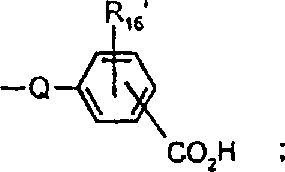 Q wherein 2Be selected from covalent linkage ,-O-,-S-,-SO 2-,-CO-,-CO 2-,-N-(C 1-C 6Alkyl)-,-N (COC 1-C 6Alkyl)-,-N (SO 2C 1-C 6Alkyl)-,-N (CO aryl)-or-N (SO 2Aryl); R 20, R 21And R 22Be independently selected from or C 1-C 6Alkyl; R 23Be selected from hydrogen, C 1-C 6Alkyl, C 3-C 8Cycloalkyl, heteroaryl or aryl.
- 72. difference corresponding R 6-N=N-Z (VI) and R 6The acid azo of the binary of the claim 69 of-N=N-R7-N=N-Z (VII) and disazo compound, wherein R 6Comprise two carboxyl (CO with one of Z 2H) acidic-group.
- 73. the acid azo of the binary of claim 69 or 72 and disazo compound, wherein R 6For derived from following amine by diazotizing replacement or unsubstituted by the residue of diazotizing arylamine or assorted aromatic amine compound, this amine is selected from: aniline, the 1-amino naphthalenes, the 1-aminoanthraquinone, the 4-aminoazobenzene, thiazolamine, the 2-aminobenzothiazole, 3-amino-2, the 1-benzisothiazole, 2-aminothiophene also [2,3-d] thiazole, the 5-aminoisothiazoles, the 5-amino-pyrazol, 4-amino-pyrazol and isothiazole, 2-amino-1,3, the 4-thiadiazoles, 5-amino-1,2, the 4-thiadiazoles, 5-amino-1,2, the 3-triazole, 2-amino-1,3, the 4-triazole, 2 (5)-aminooimidazoles, the 3-aminopyridine, 2 (3)-aminothiophenes, 2 (3)-amino benzo [b] thiophene, 2-aminothiophene also [3,2-b] thiophene, 3-aminothiophene also [2,3-c] isothiazole, 3-amino-7-benzo-2,1-isothiazole, 3-amino-benzene thiophthene and isothiazole, 3-aminoisothiazoles [3,4-d] pyrimidine, 5-amino-1,2, the 3-triazole, 3 (4)-aminophthalimides and 5 (6)-amino-1,2-benzo isothiazolon-1, the 1-dioxide, and Z is following for being selected from:
 Or
Or The residue of electron rich coupling component, R wherein 17Be selected from hydrogen, individual following group: the C that is selected from of 1-2 1-C 6Alkyl, C 1-C 6Alkoxyl group, C 1-C 6Alkylthio ,-OC 2-C 6Alkylidene group-OH, OC 2-C 6Alkylidene group-C 1-C 6Alkanoyloxy, C 1-C 6Alkylidene group-OH, C 1-C 6Alkylidene group-C 1-C 6Alkanoyloxy, halogen, carboxyl, C 1-C 6Alkoxy carbonyl, trifluoromethyl, NHCOR 24, NHCO 2R 24, NHCON (R 24) R 25And NHSO 2R 25, R wherein 24Be selected from hydrogen, C 1-C 10Alkyl, C 3-C 8Cycloalkyl or aryl, R 25Be selected from C 1-C 10Alkyl, C 3-C 8Cycloalkyl or aryl, wherein R 24And R 25In each C 1-C 10Alkyl can be further by one or more following group replacement: C that are selected from 3-C 8Cycloalkyl, aryl, aryloxy, arylthio, CO 2H, CO 2C 1-C 6Alkyl, cyano group, hydroxyl, succinimido, C 1-C 6Alkoxyl group, Or
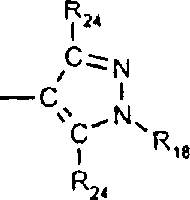 R wherein 5', R 16' and Q such as claim 63 definition; R 18And R 19Be independently selected from hydrogen, unsubstituted C 1-C 10The C of alkyl, replacement 1-C 10Alkyl, C 3-C 8Cycloalkyl, C 3-C 8Thiazolinyl, C 3-C 8Alkynyl and aryl or R 18And R 19Can combine with another unit, they are joined together to form the group Z with following formula: Q wherein 2Be selected from covalent linkage ,-O-,-S-,-SO 2-,-CO-,-CO 2-,-N-(C 1-C 6Alkyl)-,-N (COC 1-C 6Alkyl)-,-N (SO 2C 1-C 6Alkyl)-,-N (CO aryl)-or-N (SO 2Aryl); R 20, R 21And R 22Be independently selected from or C 1-C 6Alkyl; R 23Be selected from hydrogen, C 1-C 6Alkyl, C 3-C 8Cycloalkyl, heteroaryl or aryl.
- 74. acid azo of the binary of claim 72 and tetrazo compound, wherein Z is following for being selected from:Or
 The electron rich coupling agent, R wherein 17Be selected from hydrogen, individual following group: the C that is selected from of 1-2 1-C 6Alkyl, C 1-C 6Alkoxyl group, C 1-C 6Alkylthio ,-OC 2-C 6Alkylidene group-OH, OC 2-C 6Alkylidene group-C 1-C 6Alkanoyloxy, C 1-C 6Alkylidene group-OH, C 1-C 6Alkylidene group-C 1-C 6Alkanoyloxy, halogen, carboxyl, C 1-C 6Alkoxy carbonyl, trifluoromethyl, NHCOR 24, NHCO 2R 24, NHCON (R 24) R 25And NHSO 2R 25, R wherein 24Be selected from hydrogen, C 1-C 10Alkyl, C 3-C 8Cycloalkyl or aryl, R 25Be selected from C 1-C 10Alkyl, C 3-C 8Cycloalkyl or aryl, wherein R 24And R 25In each C 1-C 10Alkyl can be further by one or more following group replacement: C that are selected from 3-C 8Cycloalkyl, aryl, aryloxy, arylthio, CO 2H, CO 2C 1-C 6Alkyl, cyano group, hydroxyl, succinimido, C 1-C 6Alkoxyl group,
 Or
Or R wherein 5', R 16' and Q such as claim 63 definition; R 18And R 19Be independently selected from hydrogen, unsubstituted C 1-C 10The C of alkyl, replacement 1-C 10Alkyl, C 3-C 8Cycloalkyl, C 3-C 8Thiazolinyl, C 3-C 8Alkynyl and aryl or R 18And R 19Can combine with another unit, they are joined together to form the group Z with following formula:
 Q wherein 2Be selected from covalent linkage ,-O-,-S-,-SO 2-,-CO-,-CO 2-,-N-(C 1-C 6Alkyl)-,-N (CO-C 1-C 6Alkyl)-,-N (SO 2C 1-C 6Alkyl)-,-N (CO aryl)-or-N (SO 2Aryl); R 20, R 21And R 22Be independently selected from or C 1-C 6Alkyl; R 23Be selected from hydrogen, C 1-C 6Alkyl, C 3-C 8Cycloalkyl, heteroaryl or aryl.
- 75. have formula R 6-N=N-Y 1-N=N-R 6(VIIa) binary acid tetrazo compound, wherein R 6For the diazotization that replaces arylamine or the residue of assorted aromatic amine compound, described compound deriving is from following kind: aniline, the 1-amino naphthalenes, the 1-aminoanthraquinone, the 4-aminoazobenzene, thiazolamine, the 2-aminobenzothiazole, 3-amino-2, the 1-benzisothiazole, 2-aminothiophene also [2,3-d] thiazole, the 5-aminoisothiazoles, the 5-amino-pyrazol, 4-amino-pyrazol and isothiazole, 2-amino-1,3, the 4-thiadiazoles, 5-amino-1,2, the 4-thiadiazoles, 5-amino-1,2, the 3-triazole, 2-amino-1,3, the 4-triazole, 2 (5)-aminooimidazoles, the 3-aminopyridine, 2 (3)-aminothiophenes, 2 (3)-amino benzo [b] thiophene, 2-aminothiophene also [3,2-b] thiophene, 3-aminothiophene also [2,3-c] isothiazole, 3-amino-7-benzo-2,1-isothiazole, 3-amino-benzene thiophthene and isothiazole, 3-aminoisothiazoles [3,4-d] pyrimidine, 5-amino-1,2, the 3-triazole, 3 (4)-aminophthalimides and 5 (6)-amino-1,2-benzo isothiazolon-1,1-dioxide, and Y 1Residue for the double couple crosslinking component, described component is selected from following kind: aniline, 1,2-dihydroquinoline, 1,2,3,4-tetrahydroquinoline, benzo morpholine (3,4-dihydro-2H-1,4-benzoxazine), 3-cyano group-6-hydroxyl-2-pyridone, 2,6-diamino-pyridine, 2,3-indoline, ALPHA-NAPHTHYL AMINE, thiazolamine or their composition, precondition are each R 6Group comprises the acidic-group that is selected from following groups a :-CO 2H ,-SH, be connected with aromatic ring-OH ,-NHCONH-,-SO 2NHCO-,-SO 2NHSO 2-, 1 (H)-1,2,4-triazole-3-base-, imidazolyl, benzimidazolyl-, pyrazolyl and be connected with aromatic ring-SO 2H.
- 76. the tetrazo compound of claim 75, wherein each R 6Group contains a carboxyl (CO 2H) group.
- 77. the tetrazo compound of claim 75, wherein Y 1Has formula Z 1-L 1-Z 2, Z wherein 1And Z 2Be independently selected from:Or
 L wherein 1With Z 1And Z 2The nitrogen-atoms combination; L wherein 1Be selected from C 2-C 12Alkylidene group, C 3-C 8Cycloalkylidene, arylidene, C 1-C 4Alkylidene group-C 3-C 8Cycloalkylidene-C 1-C 4Alkylidene group, C 1-C 4Alkylidene group-arylidene-C 1-C 4Alkylidene group, C 2-C 4Alkylidene group-O-arylidene-O-C 2-C 4Alkylidene group, (C 2-C 4Alkylidene group O-) 1-3C 2-C 4Alkylidene group, C 2-C 4Alkylidene group-S-C 2-C 4Alkylidene group, C 2-C 4Alkylidene group-SO 2-C 2-C 4Alkylidene group, C 2-C 4Alkylidene group-N (SO 2C 1-C 6Alkyl)-C 2-C 4Alkylidene group, C 2-C 4Alkylidene group-N (SO 2Aryl)-C 2-C 4-alkylidene group, C 2-C 4Alkylidene group-OCO 2-C 2-C 4Alkylidene group, C 2-C 4Alkylidene group-O 2C-arylidene-CO 2-C 2-C 4Alkylidene group, C 2-C 4Alkylidene group-O 2C-C 1-C 12Alkylidene group-CO 2-C 2-C 4Alkylidene group, C 2-C 4Alkylidene group-O 2C-C 3-C 8Cycloalkylidene-CO 2-C 2-C 4Alkylidene group, C 2-C 4Alkylidene group-NHCO-C 2-C 4Alkylidene group and C 2-C 4Alkylidene group-NHSO 2-C 2-C 4Alkylidene group; R 17Be selected from hydrogen, individual following group: the C that is selected from of 1-2 1-C 6Alkyl, C 1-C 6Alkoxyl group, C 1-C 6Alkylthio ,-OC 2-C 6Alkylidene group-OH, OC 2-C 6Alkylidene group-C 1-C 6Alkanoyloxy, C 1-C 6Alkylidene group-OH, C 1-C 6Alkylidene group-C 1-C 6Alkanoyloxy, halogen, carboxyl, C 1-C 6Alkoxy carbonyl, trifluoromethyl, NHCOR 24, NHCO 2R 24, NHCON (R 24) R 25And NHSO 2R 25, R wherein 24Be selected from hydrogen, C 1-C 10Alkyl, C 3-C 8Cycloalkyl or aryl, R 25Be selected from C 1-C 10Alkyl, C 3-C 8Cycloalkyl or aryl, wherein R 24And R 25In each C 1-C 10Alkyl can be further by one or more following group replacement: C that are selected from 3-C 8Cycloalkyl, aryl, aryloxy, arylthio, CO 2H, CO 2C 1-C 6Alkyl, cyano group, hydroxyl, succinimido, C 1-C 6Alkoxyl group,
 Or
Or R wherein 5', R 16' and Q such as claim 63 definition; R 18Be selected from hydrogen, be selected from following group: unsubstituted C 1-C 10The C of alkyl, replacement 1-C 10Alkyl, C 3-C 8Cycloalkyl, C 3-C 8Thiazolinyl, C 3-C 8Alkynyl and aryl; R 20, R 21And R 22Be independently selected from or C 1-C 6Alkyl; R 23Be selected from hydrogen, C 1-C 6Alkyl, C 3-C 8Cycloalkyl, heteroaryl or aryl.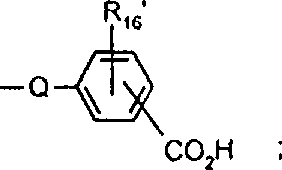
- 78. correspond respectively to the acid methyne of the binary of formula VIII, VIIIa, VIIIb, IX, X, XI and XII, arylidene, polymethine, azepine methyne, 3-aryl-2,5-dioxy pyrroline, 3-aryl-5-dicyano methylene radical-2-oxygen pyrroline and aryl isoindoline:R wherein 11Residue for following compounds: aniline, the 1-ALPHA-NAPHTHYL AMINE, 1, the 2-dihydroquinoline, l, 2,3, the 4-tetrahydroquinoline, 1,3,3-trimethylammonium-2-methylene radical indoles, l, 3-dihydroxyl-2-methylene radical-1,1,3-trimethylammonium-2H-benzo [e] indoles, imidazo [2,1-b] thiazole, the benzo morpholine (3,4-dihydro-2H-1, the 4-benzo uh piperazine), indoles, 2, the 3-indoline, thiazolamine, julolidine (2,3,6,7-tetrahydrochysene-lH, 5H-benzo [ij] quinolizine), 1-Evil julolidine, 4H-pyrrolo-[3,2,1-ij] quinoline, phenol, naphthols, thiophenol, the pyrroles, pyrazoles, furans, thiophene, carbazole, thiodiphenylamine Huo phenoxazine compound; R 12Be selected from hydrogen, C 1-C 10Alkyl, C 3-C 8Thiazolinyl, C 3-C 8Alkynyl, C 8-C 8Cycloalkyl, aryl, CH 2CH 2O 1-3R 13And C 1-C 4Alkylidene group-C 3-C 8Cycloalkylidene, wherein C 1-C 6Alkyl group can be selected from carboxyl, C by at least one 1-C 6Carbalkoxy, C 1-C 6Alkanoyloxy, cyano group, hydroxyl, chlorine, fluorine, C 1-C 6Alkoxyl group, C 3-C 8The group of cycloalkyl or aryl replaces; R 13Be selected from hydrogen, C 1-C 5Alkoxyl group or C 1-C 6Alkanoyloxy; Wherein D is the residue of activity methene compound, and described compound is selected from propane dinitrile, alpha-cyano acetic ester, malonic ester, alpha-cyano ethanamide, α-C 1-C 6Alkyl sulphonyl acetonitrile, alpha-aromatic alkylsulfonyl acetonitrile, α-C 1-C 6Alkyloyl acetonitrile, α-aroyl acetonitrile, α-heteroaryl acetonitrile, two (heteroaryl) methane, 2; 3-dihydro-1; 3-indenes diketone, 2-furanone, benzo-2-furanone, naphtho--2-furanone, 2-indolone, 3-cyano group-1; 6-dihydro-4-methyl-2; 6-dioxy (2H)-pyridine, benzo (b) thieno--3-subunit propane dinitrile-5; 5-dioxide, l; 3-two (dicyano methylene radical)-l; 2-indane, malonylurea, 5-pyrazolone, methone, 3-oxygen-2; 3-dihydro-1-thionaphthene-1,1-dioxide or aryl-C (CH 3) C=C (CN) 2, precondition is to exist to be selected from-CO 2H ,-SH, be connected with aromatic ring-OH ,-CONHCO-,-SO 2NHCO-,-SO 2NHSO 2-, 1 (H)-1,2,4-triazole-3-base-, imidazolyl, benzimidazolyl-, pyrazolyl and the SO that is connected with aromatic ring 2Two acidic functionalities of H or have the acid sulfamyl (SO of binary 2NH 2).

- 79. the acid anthracene pyridine compounds of binary, this compound has following array structure:Sub wherein 5For being selected from-N (C 1-C 10Alkyl) 2,-N (C 1-C 10Alkyl) aryl ,-N (C 1-C 10Alkyl) C 3-C 8The substituting group of cycloalkyl, morpholino and piperidino-(1-position only); Q and Q ' be selected from-NH-,-O-,-S-and-SO 2-, R 16' be selected from hydrogen, C 1-C 6Alkyl, halogen and C 1-C 6Alkoxyl group.

- 80. nitro aromatic amine compound, this compound has following structure:Wherein encircle A and can be selected from following one or more groups replacements: halogen ,-SO 2N (C 1-C 6Alkyl) 2,-CON (C 1-C 6Alkyl) 2, SO 2C 1-C 6Alkyl, SO 2Aryl, C 1-C 6Alkyl, C 1-C 6Alkoxyl group, carboxyl and nitro; Ar is that O-phthalic imide-3 (or 4)-Ji, phenyl or 2-thiophene phenyl or these groups are by one or more halogen, C of being selected from 1-C 6Alkyl, C 1-C 6Alkoxyl group, 1 (H)-1,2, the group substituent of 4-triazolyl-3-base sulfenyl, carboxyl or hydroxyl, precondition is to have two acidic-groups.

- 81. the nitro aromatic amine compound of claim 80, wherein two carboxyls are present on Ar or the ring A or on each Ar and the ring A and all have a carboxyl.
- 82. the binary acidic cpd of claim 72, it has formula R 6-N=N-Z, wherein R 6Be selected from: WithSub wherein 6Be selected from hydrogen, individual following group: the C that is selected from of 1-4 1-C 10Alkyl, C 1-C 6Alkoxyl group, C 3-C 8Cycloalkyl, halogen, C 1-C 6Alkoxy carbonyl, formyl, C 1-C 6Alkyloyl, C 1-C 6Alkyloyl oxygen base, dicyano vinyl, C 3-C 8Cycloalkanes acyl group, thiocyano, trifluoroacetyl group, cyano group, carbamyl ,-CONHC 1-C 6Alkyl, CONH aryl, CON (C 1-C 6Alkyl) 2, SO 2N (C 1-C 6Alkyl) 2, CONH-C 3-C 8Cycloalkyl, aryl, aroyl ,-N (C 1-C 6Alkyl) SO 2C 1-C 6Alkyl, NHCOC 1-C 6Alkyl, NHCOC 3-C 8Cycloalkyl, NHCO aryl, NHCO 2C 1-C 6Alkyl, NHCONHC 1-C 6Alkyl, NHCONH aryl, N (C 1-C 6Alkyl) aryl, arylazo, heteroaryl, aryloxy, arylthio, C 3-C 8Cycloalkyloxy, heteroaryl azo, heteroarylthio, aryl sulfonyl, tricyano vinyl, aryloxy sulfonyl, C 1-C 6Alkyl sulphonyl, trifluoromethyl, fluoro alkylsulfonyl, trifluoromethyl sulfonyl, thiocyano, nitro and CH=D; wherein D is the residue of activity methene compound, and described compound is selected from propane dinitrile, alpha-cyano acetic ester, malonic ester, alpha-cyano ethanamide, α-C 1-C 6Alkyl sulphonyl acetonitrile, alpha-aromatic alkylsulfonyl acetonitrile, α-C 1-C 6Alkyloyl acetonitrile, α-aroyl acetonitrile, α-heteroaryl acetonitrile, two (heteroaryl) methane, 2; 3-dihydro-1; 3-indenes diketone, 2-furanone, benzo-2-furanone, naphtho--2-furanone, 2-indolone, 3-cyano group-1; 6-dihydro-4-methyl-2; 6-dioxy (2H)-pyridine, benzo (b) thieno--3-subunit propane dinitrile-5; 5-dioxide, 1; 3-two (dicyano methylene radical)-1; 2-indane, malonylurea, 5-pyrazolone, methone, 3-oxygen-2; 3-dihydro-1-thionaphthene-1,1-dioxide and aryl-C (CH 3) C=C (CN) 2Precondition is one and is selected from following: carboxyl,
 With Acidic-group be present in or R 17, R 18, R 19Go up or R 24On; Q is selected from-O-,-S-and-SO 2-.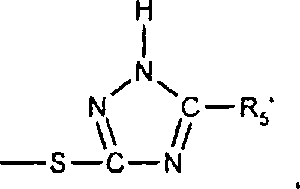
- 83. the compound of claim 82, wherein R 18Be selected from C 1-C 10Alkylidene group-CO 2H,

- 84. the binary acidic cpd of claim 82, wherein R 6Be selected from WithAnd Z is selected from
 With
With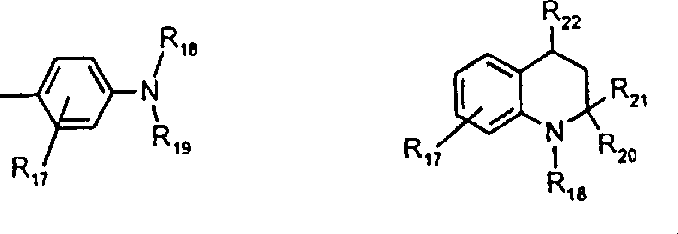 R wherein 17Be selected from hydrogen, individual following group: the C that is selected from of 1-2 1-C 6Alkyl, C 1-C 6Alkoxyl group, halogen, NHCOR 24, NHCO 2R 24And NHCONHR 24, R wherein 24Be selected from hydrogen, C 1-C 10Alkyl, C 3-C 8Cycloalkyl and aryl; R wherein 24In each C 1-C 10Alkyl can be further by one or more following group replacement: C that are selected from 3-C 8Cycloalkyl, carboxyl, aryl, aryloxy, arylthio, CO 2C 1-C 6Alkyl, cyano group, hydroxyl, succinimido, C 1-C 6Alkoxyl group and
 R 18And R 19Be independently selected from hydrogen, unsubstituted C 1-C 10The C of alkyl, replacement 1-C 10Alkyl, C 3-C 8Alkyl, C 3-C 8Thiazolinyl and aryl or R 18And R 19Can combine with another unit, they are joined together to form group:
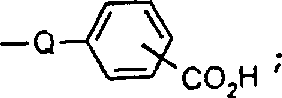 Q wherein 2Be selected from-O-,-S-,-SO 2-,-CO-,-CO 2-,-N (COC 1-C 6Alkyl)-,-N (SO 2C 1-C 6Alkyl)-,-N (CO aryl)-and-N (SO 2Aryl)-; R 20, R 21And R 22Be independently selected from or C 1-C 6Alkyl; Precondition is R 17Comprise one be selected from carboxyl and
 Acidic-group and radicals R 18And R 19There are not acidic-group or R 17There are not acidic-group and R 18Be selected from C 1-C 10Alkylidene group-CO 2H,
 With
With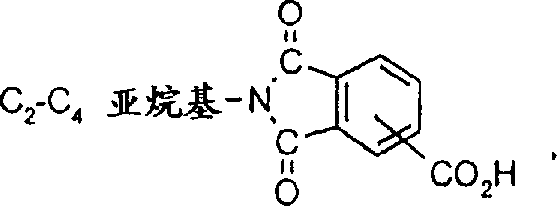 Wherein Q be selected from-O-,-S-and-SO 2-; Last condition is only to have two carboxylic groups.
- 85. have formula R 6The binary acidic cpd of the claim 61 of-N=N-Z, wherein R 6For the heterocycle diazotization that replaces amine residue and be selected from:
 With
With Sub wherein 7Be selected from following substituting group for one or more: hydrogen, halogen, C 1-C 6Alkyl, aryl, heteroaryl, C 1-C 6Alkyloyl, CONHC 1-C 6Alkyl, SO 2C 1-C 6Alkyl, SO 2Aryl, C 1-C 6Alkoxy carbonyl, aroyl, cyano group, formyl radical and nitro; Sub 8Be selected from hydrogen, halogen, C 1-C 6Alkyl, aryl and heteroaryl; Sub 9Be selected from C 1-C 6Alkyl, C 3-C 8Cycloalkyl, C 3-C 8Thiazolinyl and aryl; Sub 10Be selected from cyano group, nitro, C 1-C 6Alkyl sulphonyl, arylthio, aryl sulfonyl and C 1-C 6Alkoxy carbonyl; Sub 11Be hydrogen, one or more following substituting group: C that is selected from 1-C 6Alkyl, cyano group, nitro, halogen, arylthio, heteroarylthio, aryl sulfonyl, aryloxy and C 1-C 6Alkyl sulphonyl; Q is selected from-O-,-S-and-SO 2-; Wherein Z is the coupling component, is selected from:
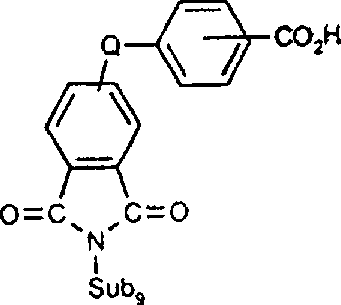 With R wherein 17Be selected from hydrogen, individual following group: the C that is selected from of 1-2 1-C 6Alkyl, C 1-C 6Alkoxyl group, C 1-C 6Alkylthio ,-OC 2-C 6Alkylidene group-OH, OC 2-C 6Alkylidene group-C 1-C 6Alkanoyloxy, C 1-C 6Alkylidene group-OH, C 1-C 6Alkylidene group-C 1-C 6Alkanoyloxy, halogen, C 1-C 6Alkoxy carbonyl, trifluoromethyl, NHCOR 24, NHCO 2R 24And NHCONHR 24, R wherein 24Be selected from hydrogen, C 1-C 10Alkyl, C 3-C 8Cycloalkyl and aryl; R wherein 24In each C 1-C 10Alkyl can be further by one or more following group replacement: C that are selected from 3-C 8Cycloalkyl, aryl, aryloxy, arylthio, CO 2C 1-C 6Alkyl, cyano group, hydroxyl, succinimido, C 1-C 6Alkoxyl group,
 With
With R wherein 5' be selected from hydrogen, C 1-C 6Alkyl and aryl; R 16' be selected from hydrogen, one or two is selected from C 1-C 6Alkyl, halogen and C 1-C 6The group of alkoxyl group; R 18And R 19Be independently selected from hydrogen, unsubstituted C 1-C 10The C of alkyl, replacement 1-C 10Alkyl, C 3-C 8Cycloalkyl, C 3-C 8Thiazolinyl, C 3-C 8Alkynyl and aryl, perhaps R 18And R 19Can combine with another unit, they are joined together to form the group Z with following formula: Q wherein 2Be selected from covalent linkage ,-O-,-S-,-SO 2-,-CO-,-CO 2-,-N-(C 1-C 6Alkyl)-,-N (COC 1-C 6Alkyl)-,-N (SO 2C 1-C 6Alkyl)-,-N (CO aryl)-or-N (SO 2Aryl); R 20, R 21And R 22Be independently selected from or C 1-C 6Alkyl; R 23Be selected from hydrogen, C 1-C 6Alkyl, C 3-C 8Cycloalkyl, heteroaryl or aryl; Precondition be one be selected from carboxyl, With Acidic-group exist or R 17, R 18, R 19Or R 24On; Q is selected from-O-,-S-and-SO 2-; Precondition is R 6Respectively comprise an acidic-group with Z.
- 86. have formula R 6The binary acidic cpd of the claim 85 of-N=N-Z, wherein R 6Be selected from:
 With And Z is selected from:
 With
With R wherein 17Be selected from hydrogen, individual following group: the C that is selected from of 1-2 1-C 6Alkyl, C 1-C 6Alkoxyl group, halogen, NHCOR 24, NHCO 2R 24And NHCONHR 24, R wherein 24Be selected from hydrogen, C 1-C 10Alkyl, C 3-C 8Cycloalkyl and aryl; R wherein 24In each C 1-C 10Alkyl can be further by one or more following group replacement: C that are selected from 3-C 8Cycloalkyl, carboxyl, aryl, aryloxy, arylthio, CO 2C 1-C 6Alkyl, cyano group, hydroxyl, succinimido, C 1-C 6Alkoxyl group and R 18And R 19Be independently selected from hydrogen, unsubstituted C 1-C 10The C of alkyl, replacement 1-C 10Alkyl, C 3-C 8Alkyl, C 3-C 8Thiazolinyl and aryl, perhaps R 18And R 19Can combine with another unit, they are joined together to form group:
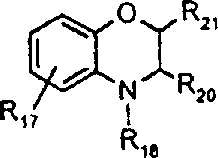 Q wherein 2Be selected from-O-,-S-,-SO 2-,-CO-,-CO 2-,-N (COC 1-C 6Alkyl)-,-N (SO 2C 1-C 6Alkyl)-,-N (CO aryl)-and-N (SO 2Aryl)-; R 20, R 21And R 22Be independently selected from or C 1-C 6Alkyl; Precondition is or R 17Comprise one be selected from carboxyl and
 Acidic-group and R 18And R 19There are not acidic-group or R 17There are not acidic-group and R 18Be selected from C 1-C 10Alkylidene group-CO 2H,
 With
With Wherein Q be selected from-O-,-S-and-SO 2-; Last condition is only to have two carboxylic groups.
- 87. have formula R 6The binary acidic cpd of the claim 71 of-N=N-Z, wherein R 6For diazotization arylamine residue and be selected from:With
 Sub wherein 12Be selected from following group for one or more: hydrogen, C 1-C 6Alkyl, cyano group, nitro, C 1-C 6Alkylthio, C 1-C 6Alkyl sulphonyl, aryl, heteroaryl, arylthio, aryl sulfonyl, halogen, trifluoromethyl, alkyloyl, aroyl, formyl, NHCO aryl, NHCOC 1-C 6Alkyl, C 1-C 6Alkoxy carbonyl, C 1-C 6Alkoxyl group and-SO 2N (C 1-C 6Alkyl) 2Q is selected from-O-,-S-,-SO 2-,-CONH-and-SO 2N (C 1-C 6Alkyl)-; Z is selected from:
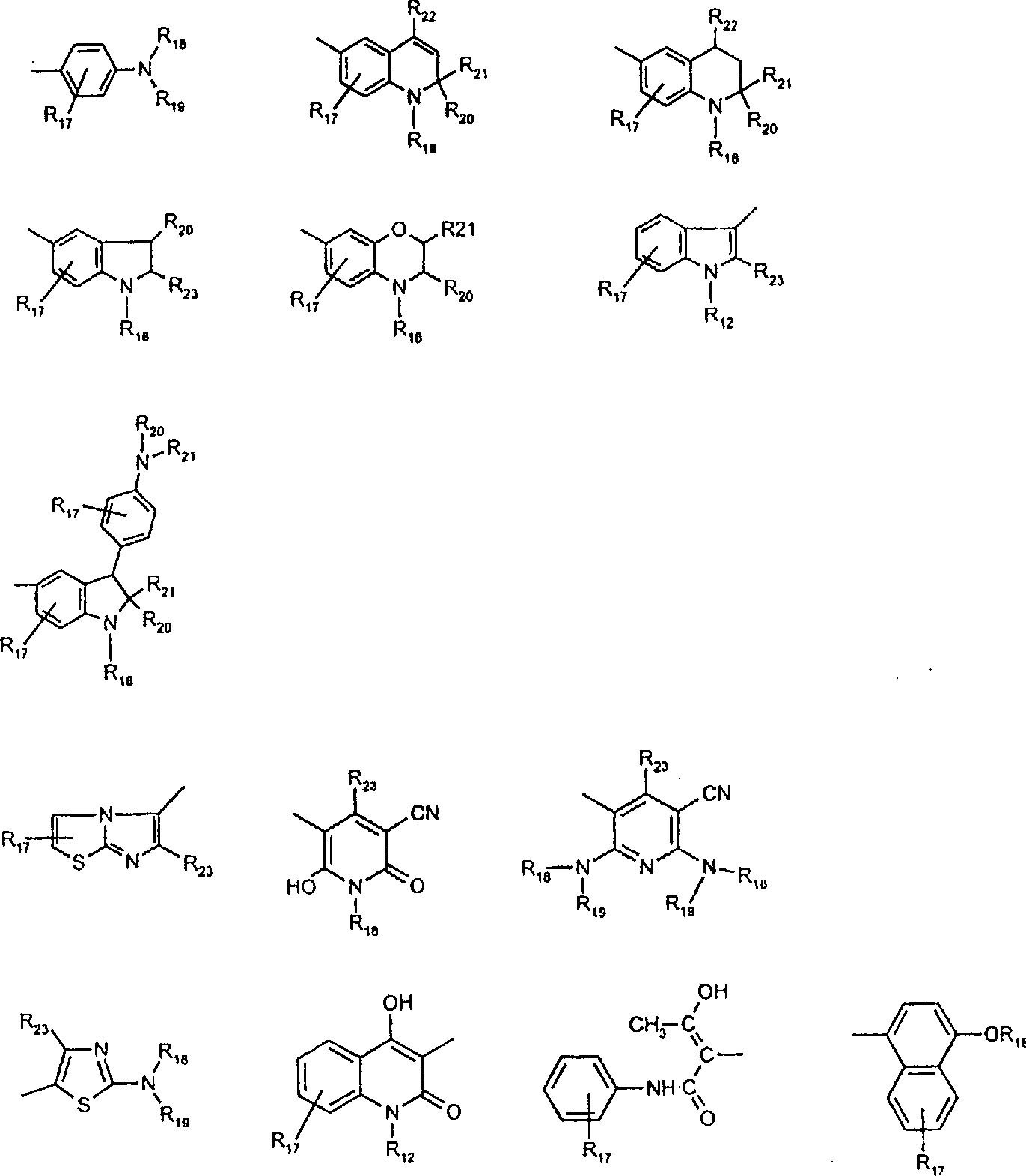 With R wherein 17Be selected from hydrogen, individual following group: the C that is selected from of 1-2 1-C 6Alkyl, C 1-C 6Alkoxyl group, C 1-C 6Alkylthio ,-O-C 2-C 6Alkylidene group-OH, O-C 2-C 6Alkylidene group-C 1-C 6Alkanoyloxy, C 1-C 6Alkylidene group-OH, C 1-C 6Alkylidene group-C 1-C 6Alkanoyloxy, halogen, C 1-C 6Alkoxy carbonyl, trifluoromethyl, NHCOR 24, NHCO 2R 24And NHCON (R 24) R 25, R wherein 24Be selected from hydrogen, C 1-C 10Alkyl, C 3-C 8Cycloalkyl and aryl; R 25Be selected from C 1-C 10Alkyl, C 3-C 8Cycloalkyl and aryl; R wherein 24And R 25In each C 1-C 10Alkyl can be further by one or more following group replacement: C that are selected from 3-C 8Cycloalkyl, aryl, aryloxy, arylthio, CO 2C 1-C 6Alkyl, cyano group, hydroxyl, succinimido and C 1-C 6Alkoxyl group; R 18And R 19Be selected from hydrogen, C 1-C 10The C of alkyl, replacement 1-C 10Alkyl, C 3-C 8Cycloalkyl, C 3-C 8Thiazolinyl, C 3-C 8Alkynyl and aryl; R 18And R 19Can combine with another unit jointly, they and this unit are joined together to form the group Z with following formula:
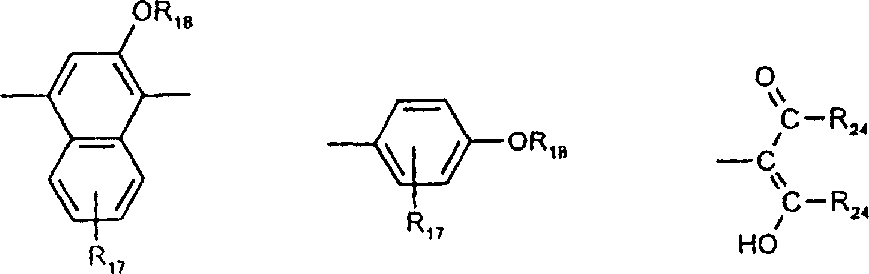 Q wherein 2Be selected from covalent linkage ,-O-,-SO 2-,-S-,-CO-,-CO 2-,-N (COC 1-C 6Alkyl)-,-N (SO 2C 1-C 6Alkyl)-,-N (CO aryl)-,-N (SO 2Aryl)-; R 20, R 21And R 22Be independently selected from or C 1-C 6Alkyl; R 23Be selected from hydrogen, C 1-C 6Alkyl, C 3-C 8Cycloalkyl, heteroaryl or aryl; Precondition is not have acidic-group on the Z.
- 88. the binary acidic cpd of claim 87, wherein R 6Have following array structure:And Z is selected from following groups:
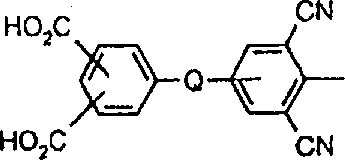 With
With
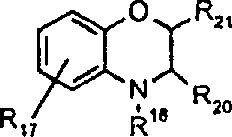
- 89. the binary acidic cpd of claim 72, wherein R 6For diazotization heterocyclic amine residue and be selected from:
 With
With Sub wherein 8Be selected from hydrogen, C 1-C 6Alkyl, halogen, aryl and heteroaryl; Sub 9Be selected from C 1-C 6Alkyl, C 3-C 8Cycloalkyl, C 3-C 8Thiazolinyl and aryl; Q is selected from-O-,-S-and-SO 2-; Precondition is not have acidic-group on the Z.
- 90. the binary acid compound of claim 72, wherein R6Be selected from:
 WithSub wherein8Be selected from hydrogen, C1-C 6Alkyl, heteroaryl and aryl; Sub9Be selected from C1-C 6Alkyl, C3-C 8Cycloalkyl, C3-C 8Thiazolinyl and aryl; Sub13Be selected from hydrogen, one or more following group: C that is selected from1-C 10Alkyl, C1-C 6Alkoxyl, C3-C 8Cycloalkyl, halogen, C1-C 6Alkoxy carbonyl, formyl, C1-C 6Alkanoyl, C1-C 6Alkanoyl oxygen base, dicyano vinyl, C3-C 8Cycloalkanes acyl group, thiocyano, trifluoroacetyl group, cyano group, carbamyl ,-CONHC1-C 6Alkyl, CONH aryl, CON (C1-C 6Alkyl)2、SO 2N(C 1-C 6Alkyl)2、CONHC 3-C 8Cycloalkyl, aryl, aroyl ,-N (C1-C 6Alkyl) SO2C 1-C 6Alkyl, NHCOC1-C 6Alkyl, NHCOC3-C 8Cycloalkyl, NHCO aryl, NHCO2C 1-C 6Alkyl, NHCONHC1-C 6Alkyl, NHCONH aryl, N (C1-C 6Alkyl) aryl, arylazo, heteroaryl, aryloxy group, arylthio, C3-C 8Cycloalkyloxy, heteroaryl azo, heteroarylthio, aryl sulfonyl, tricyano vinyl, aryloxy sulfonyl, C1-C 6Alkyl sulphonyl, trifluoromethyl, fluoro sulfonyl, trifluoromethyl sulfonyl, thiocyano, nitro and CH=D; wherein D is the residue of activity methene compound, and described methylene compound is selected from malononitrile, alpha-cyano acetic acid esters, malonate, alpha-cyano acetamide, α-C1-C 6Alkyl sulphonyl acetonitrile, alpha-aromatic sulfonyl acetonitrile, α-C1-C 6Alkanoyl acetonitrile, α-aroyl acetonitrile, α-heteroaryl acetonitrile, two (heteroaryl) methane, 2; 3-dihydro-1; 3-indenes diketone, 2-furanone, benzo-2-furanone, naphtho--2-furanone, 2-indolone, 3-cyano group-1; 6-dihydro-4-methyl-2; 6-dioxy (2H)-pyridine, benzo (b) thieno-3-subunit malononitrile-5; 5-dioxide, 1; 3-two (dicyano methylene)-1; 2-dihydroindene, barbituric acid, 5-pyrazolone, dimetone, 3-oxo-2; 3-dihydro-1-benzothiophene-1,1-dioxide and aryl-C (CH3)C=C(CN) 2;Sub 14Be selected from hydrogen, halogen, cyano group, C1-C 6Alkylthio group, arylthio, C1-C 6Alkoxy carbonyl, nitro, heteroarylthio, C1-C 6Alkyl sulphonyl, aryl sulfonyl and aryloxy group; Sub15Be selected from hydrogen, C1-C 6Alkylthio group, C1-C 6Alkyl sulphonyl, aryl, arylazo ,-CH=D, cyano group, C1-C 6Alkyl sulphonyl, aryl, heteroaryl, arylthio, aryl sulfonyl, C1-C 6Alkoxyl, trifluoromethyl and C1-C 6Alkoxy carbonyl; Sub16Be selected from hydrogen, one or two is selected from halogen, C1-C 6Alkyl sulphonyl, nitro, cyano group, C1-C 6Alkoxy carbonyl, thiocyano and C1-C 6The group of alkylthio group; Sub17Be selected from hydrogen, one or two is selected from C1-C 6Alkyl, halogen, nitro and SO2N(C 1-C 6Alkyl)2Group; Sub18Be selected from hydrogen, aryl, C1-C 6Alkylthio group, C1-C 6Alkyl sulphonyl and heteroaryl; Sub19Be selected from hydrogen, one or two is selected from C1-C 6Alkyl, cyano group, nitro, aryl, heteroaryl, arylazo ,-CH=D, C1-C 6Alkoxy carbonyl, C1-C 6Alkyl sulphonyl, aryl sulfonyl, CONHC1-C 6Alkyl, C1-C 6The group of alkanoyl, aroyl, halogen, formyl and heteroaryl azo; Sub20Be selected from hydrogen, one or two is selected from C1-C 6Alkyl, aryl, cyano group, nitro, C1-C 6Alkoxy carbonyl, C1-C 6Alkyl sulphonyl, arylazo, heteroaryl azo, heteroaryl, SO2N(C 1-C 6Alkyl)2, formyl and-group of CH=D; Sub21Be selected from hydrogen, the individual C that is selected from of 1-31-C 6Alkyl, halogen, cyano group, C1-C 6Alkylthio group, C1-C 6Alkyl sulphonyl, aryl sulfonyl, arylthio, heteroarylthio, C1-C 6The group of alkoxyl and aryloxy group; Sub22Be selected from hydrogen, the individual C that is selected from of 1-31-C 6Alkyl, halogen, C1-C 6The group of alkyl sulphonyl, nitro, cyano group, arylthio and heteroarylthio; Z is selected from:
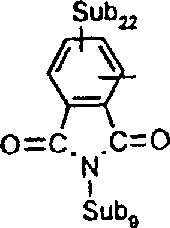 With
With R wherein17Be selected from hydrogen, individual following group: the C that is selected from of 1-21-C 6Alkyl, C1-C 6Alkoxyl, C1-C 6Alkylthio group ,-OC2-C 6Alkylidene-OH, OC2-C 6Alkylidene-C1-C 6Alkanoyloxy, C1- C 6Alkylidene-OH, C1-C 6Alkylidene-C1-C 6Alkanoyloxy, halogen, carboxyl, C1-C 6Alkoxy carbonyl, trifluoromethyl, NHCOR24、NHCO 2R 24、NHCON(R 24)R 25And NHSO2R 25, R wherein24Be selected from hydrogen, C1-C 10Alkyl, C3-C 8Cycloalkyl or aryl, R25Be selected from C1-C 10Alkyl, C3-C 8Cycloalkyl or aryl, wherein R24And R25In each C1-C 10Alkyl can be further by one or more following group replacement: C that are selected from3-C 8Cycloalkyl, aryl, aryloxy group, arylthio, CO2H、CO 2C 1-C 6Alkyl, cyano group, hydroxyl, succinimide base, C1-C 6Alkoxyl,
 OrR wherein5’、R 16' and Q such as claim 63 definition; R18And R19Be independently selected from hydrogen, unsubstituted C1-C 10The C of alkyl, replacement1-C 10Alkyl, C3-C 8Cycloalkyl, C3-C 8Thiazolinyl, C3-C 8Alkynyl and aryl, perhaps R18And R19Can be combined with another unit, they are joined together to form the group Z with following formula:
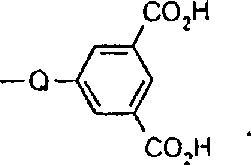 Q wherein2Be selected from covalent bond ,-O-,-S-,-SO2-、-CO-、-CO 2-、-N-(C 1-C 6Alkyl)-,-N (COC1-C 6Alkyl)-,-N (SO2C 1-C 6Alkyl)-,-N (CO aryl)-or-N (SO2Aryl)-; R20、R 21And R22Be independently selected from or C1-C 6Alkyl; R23Be selected from hydrogen, C1-C 6Alkyl, C3-C 8Cycloalkyl, heteroaryl or aryl; Precondition is, two carboxyl (CO2H) group is on Z, and such two carboxyls are present in or R17Perhaps R18On, perhaps R17And R18On can respectively have a carboxyl.
- 91. the binary acidic cpd of claim 90, wherein R 18ForOr R 17For


- 91. the binary acidic cpd of claim 89, wherein R 18And R 19Be independently selected from:With Or R 18Group of just having listed above being selected from and R 17Be selected from:
 Or NHCOC 1-C 4Alkylidene group CO 2H; Wherein Q be selected from-S-,-O-or-SO 2-.
Applications Claiming Priority (4)
| Application Number | Priority Date | Filing Date | Title |
|---|---|---|---|
| US3147896P | 1996-11-27 | 1996-11-27 | |
| US60/031,478 | 1996-11-27 | ||
| US97620697A | 1997-11-21 | 1997-11-21 | |
| US08/976,206 | 1997-11-21 |
Publications (1)
| Publication Number | Publication Date |
|---|---|
| CN1245516A true CN1245516A (en) | 2000-02-23 |
Family
ID=26707299
Family Applications (1)
| Application Number | Title | Priority Date | Filing Date |
|---|---|---|---|
| CN97181559A Pending CN1245516A (en) | 1996-11-27 | 1997-11-25 | Process for preparing light-absorbing polymer compositions |
Country Status (7)
| Country | Link |
|---|---|
| US (3) | US6197223B1 (en) |
| EP (1) | EP0948570A1 (en) |
| JP (1) | JP2002516621A (en) |
| KR (1) | KR20000057281A (en) |
| CN (1) | CN1245516A (en) |
| BR (1) | BR9713145A (en) |
| WO (1) | WO1998023690A1 (en) |
Cited By (3)
| Publication number | Priority date | Publication date | Assignee | Title |
|---|---|---|---|---|
| CN110265556A (en) * | 2013-07-02 | 2019-09-20 | 伦敦大学,玛丽皇后与西田学院 | Optoelectronic device, its manufacturing method and its material |
| CN115197082A (en) * | 2022-05-31 | 2022-10-18 | 上海交通大学 | Anthraquinone-based diamine monomer, magenta intrinsic polyimide derived from same and preparation method thereof |
| CN116376263A (en) * | 2022-12-15 | 2023-07-04 | 苏州易昇光学材料股份有限公司 | Blue light-proof shape memory optical grade GPU self-repairing film |
Families Citing this family (49)
| Publication number | Priority date | Publication date | Assignee | Title |
|---|---|---|---|---|
| US7427680B2 (en) * | 2001-01-12 | 2008-09-23 | The Regents Of The University Of California | Fluorogenic substrates for BETA-lactamase gene expression |
| CN1245516A (en) * | 1996-11-27 | 2000-02-23 | 伊斯曼化学公司 | Process for preparing light-absorbing polymer compositions |
| US6620858B2 (en) | 2000-08-07 | 2003-09-16 | Eastman Chemical Company | Colorants containing copolymerizable vinyl groups and sulfonamide linkages |
| WO2002012400A2 (en) | 2000-08-07 | 2002-02-14 | Eastman Chemical Company | Thermally stable, anthraquinone colorants containing copolymerizable vinyl groups |
| US6727372B2 (en) | 2000-08-07 | 2004-04-27 | Eastman Chemical Company | Colorant compounds containing copolymerizable vinyl groups |
| WO2002012401A2 (en) * | 2000-08-07 | 2002-02-14 | Eastman Chemical Company | Thermally stable, anthraquinone colorants containing copolymerizable vinyl groups |
| JP2002105345A (en) * | 2000-09-28 | 2002-04-10 | Toshiba Corp | Dichroic color and liquid crystal display element |
| US6583180B2 (en) * | 2001-02-14 | 2003-06-24 | Abbott Laboratories | Glucocorticoid receptor modulators |
| MXPA03007261A (en) * | 2001-02-14 | 2006-03-09 | Abbott Lab | Glucocorticoid receptor modulators. |
| US20070032598A1 (en) * | 2001-07-24 | 2007-02-08 | Cyr Michael J | Thermally stable, anthraquinone colorants containing copolymerizable vinyl groups |
| FR2828934B1 (en) * | 2001-08-27 | 2004-08-13 | Inst Nat Sante Rech Med | TEST OF CELL IMMUNITY BY FIXED PEPTIDES ON SOLID SUPPORT |
| EP1441013A1 (en) * | 2001-09-28 | 2004-07-28 | Mitsui Chemicals, Inc. | Watercolor ink |
| US20040072262A1 (en) | 2002-10-11 | 2004-04-15 | Montero-Julian Felix A. | Methods and systems for detecting MHC class I binding peptides |
| US7223822B2 (en) | 2002-10-15 | 2007-05-29 | Exxonmobil Chemical Patents Inc. | Multiple catalyst and reactor system for olefin polymerization and polymers produced therefrom |
| US7541402B2 (en) | 2002-10-15 | 2009-06-02 | Exxonmobil Chemical Patents Inc. | Blend functionalized polyolefin adhesive |
| KR101113341B1 (en) | 2002-10-15 | 2012-09-27 | 엑손모빌 케미칼 패턴츠 인코포레이티드 | Multiple catalyst system for olefin polymerization and polymers produced therefrom |
| US7550528B2 (en) | 2002-10-15 | 2009-06-23 | Exxonmobil Chemical Patents Inc. | Functionalized olefin polymers |
| KR101115291B1 (en) | 2003-04-25 | 2012-03-05 | 가부시키가이샤 한도오따이 에네루기 켄큐쇼 | Droplet discharging device, method for forming pattern and method for manufacturing semiconductor device |
| CA2539443A1 (en) * | 2003-08-19 | 2005-03-03 | Day-Glo Color Corp. | Polymeric colorants and method of coloring thermoplastic resins |
| JP2005139377A (en) * | 2003-11-10 | 2005-06-02 | Nippon Kayaku Co Ltd | New anthrapyridone compound and ink composition using the same |
| JP4571389B2 (en) * | 2003-11-11 | 2010-10-27 | 富士フイルム株式会社 | Liquid crystal composition, liquid crystal element containing the same, and compound |
| US20050227309A1 (en) | 2004-01-21 | 2005-10-13 | Corry Schuyler B | Optically-detectable enzyme substrates and their method of use |
| US7368523B2 (en) * | 2004-11-12 | 2008-05-06 | Eastman Chemical Company | Polyester polymer and copolymer compositions containing titanium nitride particles |
| US8158517B2 (en) * | 2004-06-28 | 2012-04-17 | Semiconductor Energy Laboratory Co., Ltd. | Method for manufacturing wiring substrate, thin film transistor, display device and television device |
| US20060041039A1 (en) * | 2004-08-20 | 2006-02-23 | Gyorgyi Fenyvesi | Fluorescent poly(alkylene terephthalate) compositions |
| US7662880B2 (en) * | 2004-09-03 | 2010-02-16 | Eastman Chemical Company | Polyester polymer and copolymer compositions containing metallic nickel particles |
| US20060051542A1 (en) * | 2004-09-03 | 2006-03-09 | Zhiyong Xia | Polyester polymer and copolymer compositions containing metallic molybdenum particles |
| WO2006041523A1 (en) * | 2004-10-08 | 2006-04-20 | E.I. Dupont De Nemours And Company | Fluorescent poly(alkylene terephthalate) compositions |
| US20060105129A1 (en) * | 2004-11-12 | 2006-05-18 | Zhiyong Xia | Polyester polymer and copolymer compositions containing titanium carbide particles |
| US7300967B2 (en) * | 2004-11-12 | 2007-11-27 | Eastman Chemical Company | Polyester polymer and copolymer compositions containing metallic titanium particles |
| US7262476B2 (en) * | 2004-11-30 | 2007-08-28 | Agere Systems Inc. | Semiconductor device having improved power density |
| US20060122300A1 (en) * | 2004-12-07 | 2006-06-08 | Zhiyong Xia | Polyester polymer and copolymer compositions containing steel particles |
| US7399566B2 (en) * | 2005-01-18 | 2008-07-15 | Milliken & Company | Color toner and developer compositions and processes for making and using such compositions |
| US20060177614A1 (en) * | 2005-02-09 | 2006-08-10 | Zhiyong Xia | Polyester polymer and copolymer compositions containing metallic tantalum particles |
| US20060222795A1 (en) * | 2005-03-31 | 2006-10-05 | Howell Earl E Jr | Polyester polymer and copolymer compositions containing particles of one or more transition metal compounds |
| US8557950B2 (en) | 2005-06-16 | 2013-10-15 | Grupo Petrotemex, S.A. De C.V. | High intrinsic viscosity melt phase polyester polymers with acceptable acetaldehyde generation rates |
| KR100678840B1 (en) * | 2005-06-27 | 2007-02-05 | 제일모직주식회사 | Film for image display device including near infrared absorption and color correction layer and filter for image display device using same |
| US7745512B2 (en) | 2005-09-16 | 2010-06-29 | Eastman Chemical Company | Polyester polymer and copolymer compositions containing carbon-coated iron particles |
| US7776942B2 (en) | 2005-09-16 | 2010-08-17 | Eastman Chemical Company | Polyester polymer and copolymer compositions containing particles of titanium nitride and carbon-coated iron |
| US20070260002A1 (en) * | 2006-05-04 | 2007-11-08 | Zhiyong Xia | Titanium nitride particles, methods of making them, and their use in polyester compositions |
| US20080058495A1 (en) * | 2006-09-05 | 2008-03-06 | Donna Rice Quillen | Polyester polymer and copolymer compositions containing titanium and yellow colorants |
| US8436453B2 (en) * | 2006-12-28 | 2013-05-07 | Texas Instruments Incorporated | Micromechanical device lubrication |
| WO2008122986A2 (en) * | 2007-04-10 | 2008-10-16 | Reliance Industries Limited | An efficient and cost-effective process for production of coloured thermoplastic polymer |
| US8026740B2 (en) | 2008-03-21 | 2011-09-27 | Micron Technology, Inc. | Multi-level signaling for low power, short channel applications |
| JP2009280691A (en) * | 2008-05-22 | 2009-12-03 | Sumitomo Chemical Co Ltd | Azo compound and salt of the same |
| US8258300B2 (en) * | 2008-09-29 | 2012-09-04 | King Abdulaziz University | Azo dyes |
| WO2013026451A1 (en) | 2011-08-24 | 2013-02-28 | Coloplast A/S | Polymers comprising photoinitiator moieties and dye moieties |
| BR112014023153B1 (en) * | 2012-03-19 | 2021-02-23 | Milliken & Company | carboxylate dyes |
| CN110317291B (en) * | 2018-03-30 | 2021-06-08 | 长春理工大学 | Phthalocyanine high molecular polymer containing naphthopyran and its synthesis method |
Family Cites Families (117)
| Publication number | Priority date | Publication date | Assignee | Title |
|---|---|---|---|---|
| US2994693A (en) | 1956-06-29 | 1961-08-01 | Du Pont | Polymeric azo dye |
| DE1239266B (en) * | 1962-04-28 | 1967-04-27 | Basf Ag | Process for dyeing and / or printing textile goods |
| US3438961A (en) | 1965-11-19 | 1969-04-15 | Eastman Kodak Co | Disazo dyes for hydrophobic fibers |
| US4105655A (en) | 1966-02-17 | 1978-08-08 | Bayer Aktiengesellschaft | Phenyl-azo-anilino dyestuff |
| US3403200A (en) | 1966-03-30 | 1968-09-24 | Borg Warner | Polyamide and polysulfonamide azo dyes |
| BE680765A (en) * | 1966-05-09 | 1966-11-09 | ||
| US3573273A (en) | 1967-06-03 | 1971-03-30 | Basf Ag | Water-insoluble monoazo dyes containing 3-amino-2,1-benzisothiazole coupled to an n,n-disubstituted aniline |
| US4083844A (en) | 1967-10-10 | 1978-04-11 | Bayer Aktiengesellschaft | Phenylazo orthocyano phenylazo or orthocyano phenylazo phenylazo containing dyestuffs |
| US3639384A (en) | 1968-07-12 | 1972-02-01 | Eastman Kodak Co | Monoazo compounds containing a 3-acylamidoaniline coupling component |
| US3639385A (en) | 1968-07-26 | 1972-02-01 | Eastman Kodak Co | Heterocyclic monoazo compounds from n n-diaralkyl anilines and polyester textile materials dyed therewith |
| US3816392A (en) | 1968-11-01 | 1974-06-11 | Eastman Kodak Co | Azo compounds containing a triazolylthio group |
| US3816388A (en) | 1968-11-05 | 1974-06-11 | Eastman Kodak Co | Azo compounds from alkyl alpha-anilino toluates |
| US3707532A (en) | 1969-01-03 | 1972-12-26 | Ciba Geigy Ag | Azo dyestuffs containing a benzthiazolyl group |
| US3689501A (en) | 1969-02-27 | 1972-09-05 | Eastman Kodak Co | Anthraquinone compounds containing a triazolylthio group |
| US3673169A (en) | 1969-06-16 | 1972-06-27 | Eastman Kodak Co | 1,3,4-thiadiazolylazo-3-(cyclohexylamino)acylanilide dyes |
| US3657215A (en) | 1969-06-16 | 1972-04-18 | Eastman Kodak Co | Thiadiazolylazo compounds and textile materials dyed therewith |
| BE756638A (en) | 1969-09-27 | 1971-03-25 | Basf Ag | NEW WATER INSOLUBLE MONOAZOIC DYES FROM THE BENZISOTHIAZOLE SERIES |
| US3829410A (en) | 1970-03-19 | 1974-08-13 | Eastman Kodak Co | 5-(cyanovinylene)-2-thiazolylazoaniline compounds |
| US4179435A (en) | 1971-05-03 | 1979-12-18 | Ciba-Geigy Corporation | Azo dyestuffs having a carboxyl group and a substituted sulfonylimino group in the coupling component |
| US3950130A (en) | 1971-08-26 | 1976-04-13 | American Aniline Products, Inc. | Thiazole-azo dyes and the coloration of polyester textile fibers therewith |
| US3790557A (en) | 1972-01-19 | 1974-02-05 | Eastman Kodak Co | Thiadiazolyl-azo-phenyl or-tetrahydroquinoline compounds |
| US4211696A (en) | 1972-01-28 | 1980-07-08 | Imperial Chemical Industries Limited | Disperse monoazo dyestuffs derived from 3,5-dinitro-2-amino thiophene as disazo component and an arylamine coupling component |
| US4264495A (en) | 1972-05-15 | 1981-04-28 | Eastman Kodak Company | 2-Thienyl azo dyestuff compounds |
| GB1425029A (en) * | 1972-07-03 | 1976-02-18 | Ici Ltd | Azo dyes derived from thiophene diazo components |
| GB1448484A (en) * | 1973-04-25 | 1976-09-08 | Ici Ltd | Dyeing process |
| US3878189A (en) | 1973-07-02 | 1975-04-15 | Eastman Kodak Co | Azo dye compounds from amino-1,2-benzisothiazolon-1,1-dioxides |
| US4012372A (en) | 1973-07-02 | 1977-03-15 | Eastman Kodak Company | Phthalimidyl-azo-tetrahydro-quinoline compounds |
| US3980634A (en) | 1973-07-02 | 1976-09-14 | Eastman Kodak Company | Phthalimidyl-azo aniline type compounds and polyester fibers dyed therewith |
| CH584257A5 (en) * | 1973-09-06 | 1977-01-31 | Sandoz Ag | |
| US4039522A (en) | 1974-02-01 | 1977-08-02 | Eastman Kodak Company | Phthalimidyl-azo-m-acylamido-n-substituted aniline compounds and polyester fibers dyed therewith |
| US4097475A (en) | 1974-04-03 | 1978-06-27 | E. I. Du Pont De Nemours And Company | Disperse mono- and bisazo dyes derived from 2-amino-4,5-dicyanoimidazole |
| DE2421375A1 (en) * | 1974-05-03 | 1975-12-04 | Bayer Ag | PROCESS FOR MEASURING POLYESTERS |
| FR2277864A1 (en) | 1974-07-08 | 1976-02-06 | Ugine Kuhlmann | NEW AZOIC DYES FOR SYNTHETIC FIBERS |
| DE2443485C2 (en) | 1974-09-11 | 1983-04-07 | Bayer Ag, 5090 Leverkusen | Disazo dyes and their use |
| DE2446213C3 (en) | 1974-09-27 | 1978-05-18 | Basf Ag, 6700 Ludwigshafen | p-Aminoazo disperse dyes, process for their preparation and their use for dyeing |
| US4049643A (en) | 1974-10-15 | 1977-09-20 | Eastman Kodak Company | Phenylazo compounds from cyclohexylaminoacylanilides |
| DE2507460C3 (en) | 1975-02-21 | 1979-01-25 | Basf Ag, 6700 Ludwigshafen | Azo dyes with benzisothiazole diazo components, their production and use for dyeing synthetic and semi-synthetic organic fibers |
| US4140683A (en) | 1976-02-23 | 1979-02-20 | Eastman Kodak Company | Dyes from thienylazo compounds and cyclohexylaminoacylanilide couplers |
| DE2608345C3 (en) | 1976-03-01 | 1980-05-08 | Basf Ag, 6700 Ludwigshafen | Process for dyeing and / or printing cellulose and cellulose-containing textile material |
| DE2613493A1 (en) | 1976-03-30 | 1977-10-06 | Hoechst Ag | DYED POLYESTERS, THE PROCESS FOR THEIR MANUFACTURING AND THEIR USE FOR THE COLORING OF PLASTICS |
| DE2640542A1 (en) | 1976-09-09 | 1978-03-23 | Basf Ag | AZO DYES |
| CH632291A5 (en) | 1978-01-10 | 1982-09-30 | Sandoz Ag | ORGANIC AZO COMPOUNDS. |
| US4189503A (en) | 1978-05-26 | 1980-02-19 | Cereal Enterprises, Inc. | Method of degerminating a kernel of grain by simultaneously compressing the edges of the kernel |
| US4267306A (en) | 1979-02-15 | 1981-05-12 | Eastman Kodak Company | Polyester polymers containing residues of anthroquinone dyes |
| GB2065693B (en) | 1979-11-06 | 1983-07-06 | Kodak Ltd | Azo dyes containing fluorinated carbozylic or sulphonic ester groups |
| DE3007518A1 (en) | 1980-02-28 | 1981-09-17 | Cassella Ag, 6000 Frankfurt | WATER-INSOLUBLE AZO DYES, METHOD FOR THEIR PRODUCTION AND USE FOR COLORING AND PRINTING SYNTHETIC, HYDROPHOBIC FIBER MATERIAL |
| US4359570A (en) * | 1980-05-08 | 1982-11-16 | Eastman Kodak Company | Colored polyester containing copolymerized dyes as colorants |
| EP0040139A3 (en) * | 1980-05-08 | 1981-12-09 | EASTMAN KODAK COMPANY (a New Jersey corporation) | Polyester polymers comprising copolymerised moieties derived from anthraquinone dyes |
| US4400318A (en) | 1980-05-19 | 1983-08-23 | Eastman Kodak Company | Substituted 5-acyl-3-carbamoyl-2-thienyl azo dyes with aniline, tetrahydroquinoline, and benzomorpholine couplers, process of manufacture, and polyamide testile materials dyed therewith |
| US4338247A (en) | 1980-06-02 | 1982-07-06 | Eastman Kodak Company | Polyester compositions having improved resistance to radiation deterioration |
| US4396547A (en) | 1980-09-02 | 1983-08-02 | Eastman Kodak Company | Acid azo dyes containing heterocyclic couplers |
| DE3170172D1 (en) | 1980-10-30 | 1985-05-30 | Ciba Geigy Ag | Mono-azo compounds |
| GB2093056B (en) | 1980-12-26 | 1985-06-12 | Mitsubishi Chem Ind | Disazo dyestuffs and dyeing process |
| JPS57177060A (en) | 1981-04-24 | 1982-10-30 | Mitsubishi Chem Ind Ltd | Disazo dye for polyester fiber |
| US4619991A (en) | 1981-09-25 | 1986-10-28 | Sandoz Ltd. | Process for the production of azo compounds |
| US4456551A (en) | 1981-10-26 | 1984-06-26 | Eastman Kodak Company | Azo dyes from 2-amino-5-alkylthio-1,3,4-thiadiazoles and N-acyloxyalkyl-m-acylamidoanilines |
| JPS58129059A (en) | 1982-01-28 | 1983-08-01 | Gosei Senriyou Gijutsu Kenkyu Kumiai | Preparation of disazo dye |
| DE3205435A1 (en) | 1982-02-16 | 1983-08-25 | Basf Ag, 6700 Ludwigshafen | ISOTHIAZOLAZO DYES |
| US4487719A (en) | 1982-04-14 | 1984-12-11 | Eastman Kodak Company | Azo dyes from substituted 3-amino-pyridines with aniline, tetrahydroquinoline and benzomorpholine couplers |
| JPS58179268A (en) | 1982-04-15 | 1983-10-20 | Gosei Senriyou Gijutsu Kenkyu Kumiai | Monoazo dye for polyester fiber |
| US4403092A (en) | 1982-11-22 | 1983-09-06 | Eastman Kodak Company | Polyesters containing copolymerized, anthraquinone colorant compounds containing sulfonamido groups |
| JPS5996165A (en) | 1982-11-22 | 1984-06-02 | Gosei Senriyou Gijutsu Kenkyu Kumiai | Monoazo dye for synthetic fiber |
| JPS59170143A (en) | 1983-03-18 | 1984-09-26 | Gosei Senriyou Gijutsu Kenkyu Kumiai | Monoazo dye for polyester fiber |
| US4650861A (en) | 1983-07-15 | 1987-03-17 | Ciba-Geigy Corporation | Azo dyes from 5-amino-4-nitropyrazole compounds and aniline couplers |
| DE3409243A1 (en) | 1984-03-14 | 1985-09-19 | Basf Ag, 6700 Ludwigshafen | ISOTHIAZOLAZO DYES |
| DE3427200A1 (en) | 1984-07-24 | 1986-01-30 | Basf Ag, 6700 Ludwigshafen | METHINE DYES |
| CH664762A5 (en) | 1984-08-30 | 1988-03-31 | Sandoz Ag | THIOPHENIC AZO DYES. |
| US4617373A (en) | 1985-02-15 | 1986-10-14 | Eastman Kodak Company | Condensation polymers and products therefrom |
| US4617374A (en) | 1985-02-15 | 1986-10-14 | Eastman Kodak Company | UV-absorbing condensation polymeric compositions and products therefrom |
| US4619990A (en) | 1985-03-11 | 1986-10-28 | Minnesota Mining And Manufacturing Company | Polymeric dyes with pendent chromophore groups capable of undergoing thermoplastic deformation |
| DE3512760A1 (en) | 1985-04-10 | 1986-10-23 | Basf Ag, 6700 Ludwigshafen | Azo dyes with thiophene diazo components |
| US5283326A (en) | 1985-05-14 | 1994-02-01 | Sandoz Ag | Dyes containing thiophene radicals |
| IN167384B (en) | 1985-05-14 | 1990-10-20 | Basf Ag | |
| DE3622136A1 (en) | 1986-07-02 | 1988-01-07 | Basf Ag | THIENOTHIOPHENE DYES |
| DE3622297A1 (en) | 1986-07-03 | 1988-01-07 | Basf Ag | DISAZOTHIOPHENE DYES |
| US4707537A (en) | 1986-09-30 | 1987-11-17 | Eastman Kodak Company | UV-absorbing condensation polymeric compositions and products therefrom |
| DE3637223A1 (en) | 1986-11-03 | 1988-05-05 | Bayer Ag | METHOD FOR PRODUCING THIOPHENE COMPOUNDS |
| US4950732A (en) | 1986-12-29 | 1990-08-21 | Eastman Kodak Company | Condensation copolymers containing bis-methine moieties and products therefrom |
| US4749774A (en) | 1986-12-29 | 1988-06-07 | Eastman Kodak Company | Condensation polymer containing the residue of a poly-methine compound and shaped articles produced therefrom |
| US4740581A (en) | 1987-02-24 | 1988-04-26 | Eastman Kodak Company | Condensation copolymers containing copolymerized isoquinoline derivative colorants and products therefrom |
| US4778742A (en) * | 1987-10-07 | 1988-10-18 | Xerox Corporation | Colored toner compositions |
| US4892922A (en) | 1987-11-30 | 1990-01-09 | Eastman Kodak Company | Polyester polymer containing the residue of a benzopyran colorant compound and shaped articles produced therefrom |
| US4981516A (en) | 1987-12-29 | 1991-01-01 | Milliken Research Corporation | Methine colorants and washable ink compositions containing methine colorants |
| US4845187A (en) | 1988-01-25 | 1989-07-04 | Eastman Kodak Company | Condensation polymers containing methine ultraviolet radiation-absorbing residues and shaped articles produced therefrom |
| US4804719A (en) | 1988-02-05 | 1989-02-14 | Eastman Kodak Company | Water-dissipatable polyester and polyester-amides containing copolymerized colorants |
| US4826903A (en) | 1988-02-22 | 1989-05-02 | Eastman Kodak Company | Condensation polymer containing the residue of an acyloxystyrl compound and shaped articles produced therefrom |
| GB8806316D0 (en) | 1988-03-17 | 1988-04-13 | Ici Plc | Condensation polymers |
| GB8917764D0 (en) * | 1988-08-24 | 1989-09-20 | Ici Plc | Anionic dye |
| EP0385938A1 (en) | 1989-03-01 | 1990-09-05 | Ciba-Geigy Ag | Heteroaromatic azo dyes |
| US5057594A (en) * | 1989-08-17 | 1991-10-15 | Eastman Kodak Company | Ultraviolet light-absorbing compounds and sunscreen formulations and polymeric materials containing such compounds or residues thereof |
| US5032670A (en) * | 1989-08-30 | 1991-07-16 | Eastman Kodak Company | Copolymerized anthraquinone-polyester color concentrates |
| US4999418A (en) * | 1989-08-31 | 1991-03-12 | Eastman Kodak Company | Polyesters colored with the residue of heat stable anthraquinone compounds |
| US5106942A (en) | 1990-01-08 | 1992-04-21 | Eastman Kodak Company | Copolymerized methine colorant-polyester color concentrates |
| JP2759697B2 (en) | 1990-02-03 | 1998-05-28 | オリヱント化学工業株式会社 | Dicyanoimidazole dye derivatives and related technologies |
| US5102978A (en) * | 1990-04-16 | 1992-04-07 | The Goodyear Tire & Rubber Company | Copolyester |
| US5102980A (en) | 1990-11-13 | 1992-04-07 | Eastman Kodak Company | Colored polyester compositions |
| US5030708A (en) * | 1990-12-17 | 1991-07-09 | Eastman Kodak Company | Colored polyester compositions |
| US5144015A (en) | 1990-12-21 | 1992-09-01 | Eastman Kodak Company | Synthesis of pyrazole dyes |
| DE4213155A1 (en) | 1991-04-29 | 1992-11-05 | Sandoz Ag | CONNECTIONS WITH NON-LINEAR OPTICAL PROPERTIES |
| US5243021A (en) * | 1991-07-17 | 1993-09-07 | Lever Brothers Company, Division Of Conopco, Inc. | Water-dispersible copolymer containing UVA and UVB light-absorbing monomers |
| US5194571A (en) | 1991-08-19 | 1993-03-16 | Eastman Kodak Company | Colored polyester compositions |
| US5235047A (en) | 1991-08-19 | 1993-08-10 | Eastman Kodak Company | Bathochromic azo dyes derived from 2-aminothiophenes and 2-aminothiazoles |
| US5194463B1 (en) | 1991-09-27 | 1995-06-20 | Eastman Kodak Co | Light-absorbing polyurethane compositions and thermoplastic polymers colored therewith |
| DE4132685A1 (en) | 1991-10-01 | 1993-04-08 | Basf Ag | POLYMERISATES CONTAINING AZO DYES |
| DE4135080A1 (en) | 1991-10-24 | 1993-04-29 | Roehm Gmbh | IMPROVED LIQUID CRYSTALINE DYE COPOLYMERS |
| IT1258302B (en) * | 1992-04-10 | 1996-02-22 | Eniricerche Spa | POLYESTEREIMMIDE TRMOTROPICA, PROCEDURE FOR ITS PREPARATION AND USE |
| US5359008A (en) | 1992-05-18 | 1994-10-25 | Nippon Telegraph And Telephone Corporation | Second-order nonlinear optical polymer and method for producing the same |
| US5670603A (en) * | 1993-03-08 | 1997-09-23 | Alliedsignal Inc. | Polymers exhibiting nonlinear optical properties |
| DE4317094A1 (en) | 1993-05-21 | 1994-11-24 | Basf Ag | Polyesters with nonlinear optical chromophores and their use |
| US5372864A (en) | 1993-09-03 | 1994-12-13 | Eastman Chemical Company | Toners for polyesters |
| US5466777A (en) * | 1994-03-28 | 1995-11-14 | General Electric Company | Xanthene polymers, and copolymers, and method for making |
| DE4416993C2 (en) * | 1994-05-13 | 2002-12-12 | Daimler Chrysler Ag | Paint that can be thermally influenced |
| US5504183A (en) * | 1994-09-12 | 1996-04-02 | Motorola | Organometallic fluorescent complex polymers for light emitting applications |
| WO1996013553A1 (en) * | 1994-10-28 | 1996-05-09 | Zeneca Limited | Disaro colorant |
| JPH08220714A (en) * | 1995-02-14 | 1996-08-30 | Fuji Photo Film Co Ltd | Method for preparing color photographic developing solution |
| US5955564A (en) * | 1996-11-27 | 1999-09-21 | Eastman Chemical Company | 1,5(8)-bis (substituted-N-propylamino)-4,8(5)-bis(arylthio)anthraquinone compounds |
| CN1245516A (en) * | 1996-11-27 | 2000-02-23 | 伊斯曼化学公司 | Process for preparing light-absorbing polymer compositions |
-
1997
- 1997-11-25 CN CN97181559A patent/CN1245516A/en active Pending
- 1997-11-25 JP JP52492298A patent/JP2002516621A/en active Pending
- 1997-11-25 BR BR9713145-8A patent/BR9713145A/en not_active Application Discontinuation
- 1997-11-25 EP EP97949760A patent/EP0948570A1/en not_active Withdrawn
- 1997-11-25 WO PCT/US1997/022255 patent/WO1998023690A1/en not_active Ceased
- 1997-11-25 KR KR1019990704683A patent/KR20000057281A/en not_active Withdrawn
-
1999
- 1999-05-26 US US09/320,002 patent/US6197223B1/en not_active Expired - Fee Related
-
2000
- 2000-12-29 US US09/751,766 patent/US6776930B2/en not_active Expired - Fee Related
-
2004
- 2004-04-02 US US10/817,271 patent/US20040195552A1/en not_active Abandoned
Cited By (5)
| Publication number | Priority date | Publication date | Assignee | Title |
|---|---|---|---|---|
| CN110265556A (en) * | 2013-07-02 | 2019-09-20 | 伦敦大学,玛丽皇后与西田学院 | Optoelectronic device, its manufacturing method and its material |
| CN110265556B (en) * | 2013-07-02 | 2021-10-29 | 伦敦大学,玛丽皇后与西田学院 | Optoelectronic device, its manufacturing method and its material |
| CN115197082A (en) * | 2022-05-31 | 2022-10-18 | 上海交通大学 | Anthraquinone-based diamine monomer, magenta intrinsic polyimide derived from same and preparation method thereof |
| CN115197082B (en) * | 2022-05-31 | 2023-09-22 | 上海交通大学 | Anthraquinone diamine monomer, magenta intrinsic polyimide derived from anthraquinone diamine monomer and preparation method of magenta intrinsic polyimide |
| CN116376263A (en) * | 2022-12-15 | 2023-07-04 | 苏州易昇光学材料股份有限公司 | Blue light-proof shape memory optical grade GPU self-repairing film |
Also Published As
| Publication number | Publication date |
|---|---|
| JP2002516621A (en) | 2002-06-04 |
| US20040195552A1 (en) | 2004-10-07 |
| WO1998023690A1 (en) | 1998-06-04 |
| US6197223B1 (en) | 2001-03-06 |
| US6776930B2 (en) | 2004-08-17 |
| BR9713145A (en) | 2000-02-08 |
| KR20000057281A (en) | 2000-09-15 |
| US20010023938A1 (en) | 2001-09-27 |
| EP0948570A1 (en) | 1999-10-13 |
Similar Documents
| Publication | Publication Date | Title |
|---|---|---|
| CN1245516A (en) | Process for preparing light-absorbing polymer compositions | |
| WO1998023690A9 (en) | Method for preparing light-absorbing polymeric compositions | |
| JPH07507578A (en) | Light-absorbing polyurethane composition and thermoplastic polymer colored thereby | |
| CN1052738C (en) | Toners for polyesters | |
| CN1029852C (en) | colored thermoplastic resin composition | |
| KR940000659B1 (en) | Process for the preparation of dyes containing thiophene radicals | |
| CN1218001C (en) | Yellow tone compound and aqueous ink for inkjet recording device using same | |
| CN1553912A (en) | Process for the preparation of diketopyrrolopyrroles | |
| CN1950463A (en) | Polymerizable dichromophoric dichroic azo dyes | |
| JP2609388B2 (en) | Water-soluble azo colorant and its use | |
| JPH0597994A (en) | Intermediate and colorant having poly(oxyalkylene)fluoride group having primary hydroxyl group and their production | |
| CN1076369C (en) | Solid solutions of 1,4-diketopyrrbopyrroles | |
| CN1288211C (en) | Pyridone dyes, a process for their preparation and their use in production of colorued plastics or polymeric colour particles | |
| JP2003221520A (en) | Crosslinked perinone/quinophthalone | |
| US3748330A (en) | Benzoxanthene and benzothioxanthenedicarboxylic acid triazinyl-imide dyestuffs | |
| CN1343207A (en) | Benzofuran-2-ones as colorants for organic materials | |
| US4288362A (en) | Monoazo pigments containing a quinazo linonylacetoacetanilide coupling component | |
| CN1056633C (en) | Dyes | |
| US4525591A (en) | 2,4-Dioxotetrahydropyrimido-(1,2-a)-benzimidazole substituted isoindoline dyes and their use | |
| US4997920A (en) | Monoazo compounds containing long-chain alkyl radicals | |
| CN1116366C (en) | Pyridone-methide azo dyestuffs | |
| US3491082A (en) | Water-insoluble phenyl-,thiazolyl- and benzothiazolylazophenylaminoalkylene - 1,2 - benzisothiazolin-3-one-1,1-dioxide dyes | |
| CN1659238A (en) | Anthraquinone-azo dyes | |
| US4271303A (en) | Heterocyclic compounds | |
| US4340735A (en) | Isoindoline colorants |
Legal Events
| Date | Code | Title | Description |
|---|---|---|---|
| C06 | Publication | ||
| PB01 | Publication | ||
| C10 | Entry into substantive examination | ||
| SE01 | Entry into force of request for substantive examination | ||
| C02 | Deemed withdrawal of patent application after publication (patent law 2001) | ||
| WD01 | Invention patent application deemed withdrawn after publication |