CN113330026A - Fc-silenced Antibody Drug Conjugates (ADCs) and uses thereof - Google Patents
Fc-silenced Antibody Drug Conjugates (ADCs) and uses thereof Download PDFInfo
- Publication number
- CN113330026A CN113330026A CN201980081477.8A CN201980081477A CN113330026A CN 113330026 A CN113330026 A CN 113330026A CN 201980081477 A CN201980081477 A CN 201980081477A CN 113330026 A CN113330026 A CN 113330026A
- Authority
- CN
- China
- Prior art keywords
- antibody
- amino acid
- antigen
- binding portion
- index
- Prior art date
- Legal status (The legal status is an assumption and is not a legal conclusion. Google has not performed a legal analysis and makes no representation as to the accuracy of the status listed.)
- Pending
Links
Images


Classifications
-
- C—CHEMISTRY; METALLURGY
- C07—ORGANIC CHEMISTRY
- C07K—PEPTIDES
- C07K16/00—Immunoglobulins [IGs], e.g. monoclonal or polyclonal antibodies
- C07K16/18—Immunoglobulins [IGs], e.g. monoclonal or polyclonal antibodies against material from animals or humans
- C07K16/28—Immunoglobulins [IGs], e.g. monoclonal or polyclonal antibodies against material from animals or humans against receptors, cell surface antigens or cell surface determinants
- C07K16/2803—Immunoglobulins [IGs], e.g. monoclonal or polyclonal antibodies against material from animals or humans against receptors, cell surface antigens or cell surface determinants against the immunoglobulin superfamily
-
- A—HUMAN NECESSITIES
- A61—MEDICAL OR VETERINARY SCIENCE; HYGIENE
- A61K—PREPARATIONS FOR MEDICAL, DENTAL OR TOILETRY PURPOSES
- A61K47/00—Medicinal preparations characterised by the non-active ingredients used, e.g. carriers or inert additives; Targeting or modifying agents chemically bound to the active ingredient
- A61K47/50—Medicinal preparations characterised by the non-active ingredients used, e.g. carriers or inert additives; Targeting or modifying agents chemically bound to the active ingredient the non-active ingredient being chemically bound to the active ingredient, e.g. polymer-drug conjugates
- A61K47/51—Medicinal preparations characterised by the non-active ingredients used, e.g. carriers or inert additives; Targeting or modifying agents chemically bound to the active ingredient the non-active ingredient being chemically bound to the active ingredient, e.g. polymer-drug conjugates the non-active ingredient being a modifying agent
- A61K47/68—Medicinal preparations characterised by the non-active ingredients used, e.g. carriers or inert additives; Targeting or modifying agents chemically bound to the active ingredient the non-active ingredient being chemically bound to the active ingredient, e.g. polymer-drug conjugates the non-active ingredient being a modifying agent the modifying agent being an antibody, an immunoglobulin or a fragment thereof, e.g. an Fc-fragment
- A61K47/6801—Drug-antibody or immunoglobulin conjugates defined by the pharmacologically or therapeutically active agent
- A61K47/6803—Drugs conjugated to an antibody or immunoglobulin, e.g. cisplatin-antibody conjugates
- A61K47/6807—Drugs conjugated to an antibody or immunoglobulin, e.g. cisplatin-antibody conjugates the drug or compound being a sugar, nucleoside, nucleotide, nucleic acid, e.g. RNA antisense
- A61K47/6809—Antibiotics, e.g. antitumor antibiotics anthracyclins, adriamycin, doxorubicin or daunomycin
-
- A—HUMAN NECESSITIES
- A61—MEDICAL OR VETERINARY SCIENCE; HYGIENE
- A61K—PREPARATIONS FOR MEDICAL, DENTAL OR TOILETRY PURPOSES
- A61K47/00—Medicinal preparations characterised by the non-active ingredients used, e.g. carriers or inert additives; Targeting or modifying agents chemically bound to the active ingredient
- A61K47/50—Medicinal preparations characterised by the non-active ingredients used, e.g. carriers or inert additives; Targeting or modifying agents chemically bound to the active ingredient the non-active ingredient being chemically bound to the active ingredient, e.g. polymer-drug conjugates
- A61K47/51—Medicinal preparations characterised by the non-active ingredients used, e.g. carriers or inert additives; Targeting or modifying agents chemically bound to the active ingredient the non-active ingredient being chemically bound to the active ingredient, e.g. polymer-drug conjugates the non-active ingredient being a modifying agent
- A61K47/68—Medicinal preparations characterised by the non-active ingredients used, e.g. carriers or inert additives; Targeting or modifying agents chemically bound to the active ingredient the non-active ingredient being chemically bound to the active ingredient, e.g. polymer-drug conjugates the non-active ingredient being a modifying agent the modifying agent being an antibody, an immunoglobulin or a fragment thereof, e.g. an Fc-fragment
- A61K47/6801—Drug-antibody or immunoglobulin conjugates defined by the pharmacologically or therapeutically active agent
- A61K47/6803—Drugs conjugated to an antibody or immunoglobulin, e.g. cisplatin-antibody conjugates
- A61K47/6811—Drugs conjugated to an antibody or immunoglobulin, e.g. cisplatin-antibody conjugates the drug being a protein or peptide, e.g. transferrin or bleomycin
- A61K47/6817—Toxins
- A61K47/6831—Fungal toxins, e.g. alpha sarcine, mitogillin, zinniol or restrictocin
-
- A—HUMAN NECESSITIES
- A61—MEDICAL OR VETERINARY SCIENCE; HYGIENE
- A61K—PREPARATIONS FOR MEDICAL, DENTAL OR TOILETRY PURPOSES
- A61K47/00—Medicinal preparations characterised by the non-active ingredients used, e.g. carriers or inert additives; Targeting or modifying agents chemically bound to the active ingredient
- A61K47/50—Medicinal preparations characterised by the non-active ingredients used, e.g. carriers or inert additives; Targeting or modifying agents chemically bound to the active ingredient the non-active ingredient being chemically bound to the active ingredient, e.g. polymer-drug conjugates
- A61K47/51—Medicinal preparations characterised by the non-active ingredients used, e.g. carriers or inert additives; Targeting or modifying agents chemically bound to the active ingredient the non-active ingredient being chemically bound to the active ingredient, e.g. polymer-drug conjugates the non-active ingredient being a modifying agent
- A61K47/68—Medicinal preparations characterised by the non-active ingredients used, e.g. carriers or inert additives; Targeting or modifying agents chemically bound to the active ingredient the non-active ingredient being chemically bound to the active ingredient, e.g. polymer-drug conjugates the non-active ingredient being a modifying agent the modifying agent being an antibody, an immunoglobulin or a fragment thereof, e.g. an Fc-fragment
- A61K47/6835—Medicinal preparations characterised by the non-active ingredients used, e.g. carriers or inert additives; Targeting or modifying agents chemically bound to the active ingredient the non-active ingredient being chemically bound to the active ingredient, e.g. polymer-drug conjugates the non-active ingredient being a modifying agent the modifying agent being an antibody, an immunoglobulin or a fragment thereof, e.g. an Fc-fragment the modifying agent being an antibody or an immunoglobulin bearing at least one antigen-binding site
- A61K47/6849—Medicinal preparations characterised by the non-active ingredients used, e.g. carriers or inert additives; Targeting or modifying agents chemically bound to the active ingredient the non-active ingredient being chemically bound to the active ingredient, e.g. polymer-drug conjugates the non-active ingredient being a modifying agent the modifying agent being an antibody, an immunoglobulin or a fragment thereof, e.g. an Fc-fragment the modifying agent being an antibody or an immunoglobulin bearing at least one antigen-binding site the antibody targeting a receptor, a cell surface antigen or a cell surface determinant
-
- A—HUMAN NECESSITIES
- A61—MEDICAL OR VETERINARY SCIENCE; HYGIENE
- A61K—PREPARATIONS FOR MEDICAL, DENTAL OR TOILETRY PURPOSES
- A61K47/00—Medicinal preparations characterised by the non-active ingredients used, e.g. carriers or inert additives; Targeting or modifying agents chemically bound to the active ingredient
- A61K47/50—Medicinal preparations characterised by the non-active ingredients used, e.g. carriers or inert additives; Targeting or modifying agents chemically bound to the active ingredient the non-active ingredient being chemically bound to the active ingredient, e.g. polymer-drug conjugates
- A61K47/51—Medicinal preparations characterised by the non-active ingredients used, e.g. carriers or inert additives; Targeting or modifying agents chemically bound to the active ingredient the non-active ingredient being chemically bound to the active ingredient, e.g. polymer-drug conjugates the non-active ingredient being a modifying agent
- A61K47/68—Medicinal preparations characterised by the non-active ingredients used, e.g. carriers or inert additives; Targeting or modifying agents chemically bound to the active ingredient the non-active ingredient being chemically bound to the active ingredient, e.g. polymer-drug conjugates the non-active ingredient being a modifying agent the modifying agent being an antibody, an immunoglobulin or a fragment thereof, e.g. an Fc-fragment
- A61K47/6889—Conjugates wherein the antibody being the modifying agent and wherein the linker, binder or spacer confers particular properties to the conjugates, e.g. peptidic enzyme-labile linkers or acid-labile linkers, providing for an acid-labile immuno conjugate wherein the drug may be released from its antibody conjugated part in an acidic, e.g. tumoural or environment
-
- A—HUMAN NECESSITIES
- A61—MEDICAL OR VETERINARY SCIENCE; HYGIENE
- A61P—SPECIFIC THERAPEUTIC ACTIVITY OF CHEMICAL COMPOUNDS OR MEDICINAL PREPARATIONS
- A61P35/00—Antineoplastic agents
- A61P35/02—Antineoplastic agents specific for leukemia
-
- A—HUMAN NECESSITIES
- A61—MEDICAL OR VETERINARY SCIENCE; HYGIENE
- A61P—SPECIFIC THERAPEUTIC ACTIVITY OF CHEMICAL COMPOUNDS OR MEDICINAL PREPARATIONS
- A61P37/00—Drugs for immunological or allergic disorders
-
- C—CHEMISTRY; METALLURGY
- C07—ORGANIC CHEMISTRY
- C07K—PEPTIDES
- C07K16/00—Immunoglobulins [IGs], e.g. monoclonal or polyclonal antibodies
-
- C—CHEMISTRY; METALLURGY
- C07—ORGANIC CHEMISTRY
- C07K—PEPTIDES
- C07K16/00—Immunoglobulins [IGs], e.g. monoclonal or polyclonal antibodies
- C07K16/18—Immunoglobulins [IGs], e.g. monoclonal or polyclonal antibodies against material from animals or humans
- C07K16/28—Immunoglobulins [IGs], e.g. monoclonal or polyclonal antibodies against material from animals or humans against receptors, cell surface antigens or cell surface determinants
- C07K16/2803—Immunoglobulins [IGs], e.g. monoclonal or polyclonal antibodies against material from animals or humans against receptors, cell surface antigens or cell surface determinants against the immunoglobulin superfamily
- C07K16/2806—Immunoglobulins [IGs], e.g. monoclonal or polyclonal antibodies against material from animals or humans against receptors, cell surface antigens or cell surface determinants against the immunoglobulin superfamily against CD2
-
- C—CHEMISTRY; METALLURGY
- C07—ORGANIC CHEMISTRY
- C07K—PEPTIDES
- C07K16/00—Immunoglobulins [IGs], e.g. monoclonal or polyclonal antibodies
- C07K16/18—Immunoglobulins [IGs], e.g. monoclonal or polyclonal antibodies against material from animals or humans
- C07K16/28—Immunoglobulins [IGs], e.g. monoclonal or polyclonal antibodies against material from animals or humans against receptors, cell surface antigens or cell surface determinants
- C07K16/2866—Immunoglobulins [IGs], e.g. monoclonal or polyclonal antibodies against material from animals or humans against receptors, cell surface antigens or cell surface determinants against receptors for cytokines, lymphokines, interferons
-
- C—CHEMISTRY; METALLURGY
- C07—ORGANIC CHEMISTRY
- C07K—PEPTIDES
- C07K16/00—Immunoglobulins [IGs], e.g. monoclonal or polyclonal antibodies
- C07K16/18—Immunoglobulins [IGs], e.g. monoclonal or polyclonal antibodies against material from animals or humans
- C07K16/28—Immunoglobulins [IGs], e.g. monoclonal or polyclonal antibodies against material from animals or humans against receptors, cell surface antigens or cell surface determinants
- C07K16/2875—Immunoglobulins [IGs], e.g. monoclonal or polyclonal antibodies against material from animals or humans against receptors, cell surface antigens or cell surface determinants against the NGF/TNF superfamily, e.g. CD70, CD95L, CD153, CD154
-
- C—CHEMISTRY; METALLURGY
- C07—ORGANIC CHEMISTRY
- C07K—PEPTIDES
- C07K16/00—Immunoglobulins [IGs], e.g. monoclonal or polyclonal antibodies
- C07K16/18—Immunoglobulins [IGs], e.g. monoclonal or polyclonal antibodies against material from animals or humans
- C07K16/28—Immunoglobulins [IGs], e.g. monoclonal or polyclonal antibodies against material from animals or humans against receptors, cell surface antigens or cell surface determinants
- C07K16/2878—Immunoglobulins [IGs], e.g. monoclonal or polyclonal antibodies against material from animals or humans against receptors, cell surface antigens or cell surface determinants against the NGF-receptor/TNF-receptor superfamily, e.g. CD27, CD30, CD40, CD95
-
- C—CHEMISTRY; METALLURGY
- C07—ORGANIC CHEMISTRY
- C07K—PEPTIDES
- C07K16/00—Immunoglobulins [IGs], e.g. monoclonal or polyclonal antibodies
- C07K16/18—Immunoglobulins [IGs], e.g. monoclonal or polyclonal antibodies against material from animals or humans
- C07K16/28—Immunoglobulins [IGs], e.g. monoclonal or polyclonal antibodies against material from animals or humans against receptors, cell surface antigens or cell surface determinants
- C07K16/289—Immunoglobulins [IGs], e.g. monoclonal or polyclonal antibodies against material from animals or humans against receptors, cell surface antigens or cell surface determinants against CD45
-
- C—CHEMISTRY; METALLURGY
- C07—ORGANIC CHEMISTRY
- C07K—PEPTIDES
- C07K16/00—Immunoglobulins [IGs], e.g. monoclonal or polyclonal antibodies
- C07K16/18—Immunoglobulins [IGs], e.g. monoclonal or polyclonal antibodies against material from animals or humans
- C07K16/28—Immunoglobulins [IGs], e.g. monoclonal or polyclonal antibodies against material from animals or humans against receptors, cell surface antigens or cell surface determinants
- C07K16/2896—Immunoglobulins [IGs], e.g. monoclonal or polyclonal antibodies against material from animals or humans against receptors, cell surface antigens or cell surface determinants against molecules with a "CD"-designation, not provided for elsewhere
-
- A—HUMAN NECESSITIES
- A61—MEDICAL OR VETERINARY SCIENCE; HYGIENE
- A61K—PREPARATIONS FOR MEDICAL, DENTAL OR TOILETRY PURPOSES
- A61K39/00—Medicinal preparations containing antigens or antibodies
- A61K2039/505—Medicinal preparations containing antigens or antibodies comprising antibodies
-
- A—HUMAN NECESSITIES
- A61—MEDICAL OR VETERINARY SCIENCE; HYGIENE
- A61K—PREPARATIONS FOR MEDICAL, DENTAL OR TOILETRY PURPOSES
- A61K39/00—Medicinal preparations containing antigens or antibodies
- A61K2039/545—Medicinal preparations containing antigens or antibodies characterised by the dose, timing or administration schedule
-
- C—CHEMISTRY; METALLURGY
- C07—ORGANIC CHEMISTRY
- C07K—PEPTIDES
- C07K2317/00—Immunoglobulins specific features
- C07K2317/20—Immunoglobulins specific features characterized by taxonomic origin
- C07K2317/21—Immunoglobulins specific features characterized by taxonomic origin from primates, e.g. man
-
- C—CHEMISTRY; METALLURGY
- C07—ORGANIC CHEMISTRY
- C07K—PEPTIDES
- C07K2317/00—Immunoglobulins specific features
- C07K2317/20—Immunoglobulins specific features characterized by taxonomic origin
- C07K2317/24—Immunoglobulins specific features characterized by taxonomic origin containing regions, domains or residues from different species, e.g. chimeric, humanized or veneered
-
- C—CHEMISTRY; METALLURGY
- C07—ORGANIC CHEMISTRY
- C07K—PEPTIDES
- C07K2317/00—Immunoglobulins specific features
- C07K2317/30—Immunoglobulins specific features characterized by aspects of specificity or valency
- C07K2317/31—Immunoglobulins specific features characterized by aspects of specificity or valency multispecific
-
- C—CHEMISTRY; METALLURGY
- C07—ORGANIC CHEMISTRY
- C07K—PEPTIDES
- C07K2317/00—Immunoglobulins specific features
- C07K2317/50—Immunoglobulins specific features characterized by immunoglobulin fragments
- C07K2317/52—Constant or Fc region; Isotype
-
- C—CHEMISTRY; METALLURGY
- C07—ORGANIC CHEMISTRY
- C07K—PEPTIDES
- C07K2317/00—Immunoglobulins specific features
- C07K2317/50—Immunoglobulins specific features characterized by immunoglobulin fragments
- C07K2317/52—Constant or Fc region; Isotype
- C07K2317/522—CH1 domain
-
- C—CHEMISTRY; METALLURGY
- C07—ORGANIC CHEMISTRY
- C07K—PEPTIDES
- C07K2317/00—Immunoglobulins specific features
- C07K2317/50—Immunoglobulins specific features characterized by immunoglobulin fragments
- C07K2317/52—Constant or Fc region; Isotype
- C07K2317/524—CH2 domain
-
- C—CHEMISTRY; METALLURGY
- C07—ORGANIC CHEMISTRY
- C07K—PEPTIDES
- C07K2317/00—Immunoglobulins specific features
- C07K2317/50—Immunoglobulins specific features characterized by immunoglobulin fragments
- C07K2317/52—Constant or Fc region; Isotype
- C07K2317/526—CH3 domain
-
- C—CHEMISTRY; METALLURGY
- C07—ORGANIC CHEMISTRY
- C07K—PEPTIDES
- C07K2317/00—Immunoglobulins specific features
- C07K2317/70—Immunoglobulins specific features characterized by effect upon binding to a cell or to an antigen
- C07K2317/71—Decreased effector function due to an Fc-modification
-
- C—CHEMISTRY; METALLURGY
- C07—ORGANIC CHEMISTRY
- C07K—PEPTIDES
- C07K2317/00—Immunoglobulins specific features
- C07K2317/90—Immunoglobulins specific features characterized by (pharmaco)kinetic aspects or by stability of the immunoglobulin
- C07K2317/92—Affinity (KD), association rate (Ka), dissociation rate (Kd) or EC50 value
-
- C—CHEMISTRY; METALLURGY
- C07—ORGANIC CHEMISTRY
- C07K—PEPTIDES
- C07K2317/00—Immunoglobulins specific features
- C07K2317/90—Immunoglobulins specific features characterized by (pharmaco)kinetic aspects or by stability of the immunoglobulin
- C07K2317/94—Stability, e.g. half-life, pH, temperature or enzyme-resistance
-
- C—CHEMISTRY; METALLURGY
- C07—ORGANIC CHEMISTRY
- C07K—PEPTIDES
- C07K2319/00—Fusion polypeptide
- C07K2319/55—Fusion polypeptide containing a fusion with a toxin, e.g. diphteria toxin
Landscapes
- Health & Medical Sciences (AREA)
- Chemical & Material Sciences (AREA)
- Immunology (AREA)
- Life Sciences & Earth Sciences (AREA)
- Organic Chemistry (AREA)
- General Health & Medical Sciences (AREA)
- Medicinal Chemistry (AREA)
- Engineering & Computer Science (AREA)
- Bioinformatics & Cheminformatics (AREA)
- Molecular Biology (AREA)
- Biochemistry (AREA)
- Biophysics (AREA)
- Genetics & Genomics (AREA)
- Proteomics, Peptides & Aminoacids (AREA)
- Animal Behavior & Ethology (AREA)
- Veterinary Medicine (AREA)
- Pharmacology & Pharmacy (AREA)
- Public Health (AREA)
- Epidemiology (AREA)
- Toxicology (AREA)
- Microbiology (AREA)
- General Chemical & Material Sciences (AREA)
- Nuclear Medicine, Radiotherapy & Molecular Imaging (AREA)
- Chemical Kinetics & Catalysis (AREA)
- Mycology (AREA)
- Cell Biology (AREA)
- Hematology (AREA)
- Oncology (AREA)
- Peptides Or Proteins (AREA)
- Medicines Containing Antibodies Or Antigens For Use As Internal Diagnostic Agents (AREA)
- Micro-Organisms Or Cultivation Processes Thereof (AREA)
- Medicines That Contain Protein Lipid Enzymes And Other Medicines (AREA)
- Pharmaceuticals Containing Other Organic And Inorganic Compounds (AREA)
- Medicinal Preparation (AREA)
- Medicines Containing Material From Animals Or Micro-Organisms (AREA)
- Measuring Or Testing Involving Enzymes Or Micro-Organisms (AREA)
Abstract
Antibodies and antibody drug conjugates having an Fc region with a substitution that produces a substantially silent Fc region are disclosed. The antibodies and antibody drug conjugates described herein are useful for cell depletion and treatment of various hematopoietic diseases, metabolic disorders, cancers, such as acute myeloid leukemia and autoimmune diseases, among others. The compositions and methods described herein can be used to directly treat a disorder, for example, by depleting, for example, a CD45+ or CD117+ cancer cell population or a CD45+ autoimmune cell population. The compositions and methods described herein can also be used to prepare patients for hematopoietic stem cell transplantation therapy and improve engraftment of hematopoietic stem cell transplantation by selectively depleting endogenous hematopoietic stem cells prior to the transplantation procedure.
Description
RELATED APPLICATIONS
This application claims priority to U.S. provisional application No. 62/749,662 filed on 23/10/2018; U.S. provisional application No. 62/773,839 filed on 30/11/2018; and U.S. provisional application No. 62/807,363 filed on 19/2/2019. The contents of each of the priority applications are incorporated herein by reference.
Technical Field
The present disclosure relates to the field of antibodies comprising an Fc region that alters effector function due to one or more amino acid substitutions in the Fc region, or antibody drug conjugates thereof. The present disclosure also relates to treating patients with various pathologies (e.g., blood diseases, metabolic disorders, cancer, autoimmune diseases, etc.) by administering antibodies or Antibody Drug Conjugates (ADCs) having modified Fc regions, wherein the antibodies or ADCs are capable of binding to an antigen expressed by a hematopoietic cell (e.g., a hematopoietic stem cell or a cell of the host immune system).
Background
The Fc region of an antibody controls the cytotoxic activity of the antibody and can affect the serum half-life of the antibody. However, in the therapeutic setting, the cytotoxic effector functions of antibodies are often undesirable and may create safety issues and undesirable side effects by activating host immune defenses. Several amino acid changes in the Fc region have been reported to silence or reduce the effector function of antibodies. In fact, previous studies have identified amino acid positions within the Fc region of antibodies that affect the ability of the antibody to bind Fc receptors (see, e.g., Wang et al (2018) Protein cell.2018Jan; 9(1): 63-73). For example, the Fc mutations S239D and I332E have been described in the literature as enhancing ADCC function (see, e.g., Lazar et al (2006) Engineered antibodies Fc variants with enhanced effector function. Proc Natl Acad Sci USA 103: 4005-. Other mutations have been associated with reduced Fc γ R and C1q binding, such as the amino acid changes L234A/L235A In IG1, or F234A/L235A In IG4 (Xun et al In vitro characterization of fixed manipulated OKT3 effector function variant. cell Immunol.2000; 200: 16-26). However, it is less known how Fc mutations may affect Antibody Drug Conjugates (ADCs), particularly when the toxin is conjugated to an antibody or Fc-containing fragment in the Fc region.
Despite advances in the medical field, there remains a need to treat pathologies of the hematopoietic system, such as diseases of specific blood cells, metabolic disorders, cancer, and autoimmune diseases, among others. Although hematopoietic stem cells have significant therapeutic potential, a limiting factor that hinders their clinical utility has been the difficulty associated with ensuring engraftment of Hematopoietic Stem Cell (HSC) transplants in a host. In particular, hematopoietic stem cell therapies involving antibodies targeting cell surface antigens on endogenous HSCs may trigger unwanted immune stimulation and effector functions, impeding the engraftment of exogenous HSC grafts. There is a need for compositions and methods for facilitating the engraftment of exogenous hematopoietic stem cell grafts such that the pluripotency and hematopoietic function of these cells are preserved after transplantation. There is also a need for improved ADCs, for example, which can be used in pretreatment to reduce effector function to reduce potential cytokine secretion and possible side effects.
Disclosure of Invention
Described herein are antibodies and antigen-binding portions thereof comprising an Fc region that alters effector function due to one or more amino acid substitutions in the Fc region, as well as antibody drug conjugates, compositions, and methods of using the antibodies. In particular, provided herein are antibodies or Antibody Drug Conjugates (ADCs) having a modified Fc region, wherein said antibodies or ADCs are capable of binding to an antigen expressed by a hematopoietic cell, e.g., a hematopoietic stem cell or a mature immune cell, e.g., a T cell. Further, provided herein are ADCs containing Fc mutations that provide conjugation sites for toxins and reduce effector function, as well as provide stability. Thus, the present disclosure provides ADCs with unique combinations of Fc mutations.
In one aspect, provided herein is an antibody comprising an Fc region, wherein the Fc region comprises amino acid substitutions at positions L234 and L235 (EU index) and amino acid substitution D265C (EU index), and wherein the antibody is a whole IgG antibody. In one embodiment, the Fc region comprises amino acid substitutions at positions L234 and L235 (EU index) and amino acid substitution D265A (EU index), and wherein the antibody is a whole IgG antibody. In one embodiment, the L234 amino acid substitution is L234A. In one embodiment, the L235 amino acid substitution is L235A.
In some embodiments, the Fc region further comprises an amino acid substitution at position H435 (EU index). In one embodiment, the H435 amino acid substitution is H435A. In one embodiment, the half-life of an antibody comprising the amino acid substitution H435A is reduced relative to the same intact IgG antibody comprising an unmodified Fc region.
In another aspect, provided herein is an antibody comprising an Fc region having amino acid substitutions consisting essentially of amino acid substitutions L234A, L235A, and D265C (EU index), and wherein the antibody is an intact IgG antibody. In one embodiment, the antibody comprises an Fc region with amino acid substitutions consisting essentially of amino acid substitutions L234A, L235A, and D265A (EU index), and wherein the antibody is a complete IgG antibody.
In another aspect, provided herein is an antibody, or antigen-binding portion thereof, comprising an Fc region, wherein the Fc region comprises amino acid substitutions at positions L234, L235(EU index), and D265(EU index). In one embodiment, the D265 amino acid substitution is D265C or D265A (EU index). In another embodiment, the L234 amino acid substitution is L234A or L234V. In another embodiment, the L235 amino acid substitution is L235A. In another embodiment, the Fc region further comprises an amino acid substitution at position N297 (EU index). In another embodiment, the N297 amino acid substitution is selected from N297A, N297G, and N297Q (EU index). In another embodiment, the Fc region further comprises an amino acid substitution at position E233 (EU index). In another embodiment, the E233 amino acid substitution is E233P (EU index). In another embodiment, the Fc region further comprises a deletion of G236(EU index). In another embodiment, the Fc region further comprises an amino acid substitution at position P331 (EU index). In another embodiment, the P331 amino acid substitution is P331G. In another embodiment, the Fc region does not comprise a substitution at position P331 (EU index). In another embodiment, the Fc region further comprises an amino acid substitution at position P329 (EU index). In another embodiment, the P329 amino acid substitution is P329G. In another embodiment, the Fc region does not comprise a substitution at position P329 (EU index). In another embodiment, the Fc region further comprises an amino acid substitution at position I253 (EU index). In another embodiment, the I253 amino acid substitution is I253A. In another embodiment, the Fc region further comprises an amino acid substitution at position H310 (EU index). In another embodiment, the H310 amino acid substitution is H310A.
In another aspect, provided herein is an antibody, or antigen-binding portion thereof, comprising an Fc region, wherein the Fc region comprises amino acid substitutions at positions N297 and D265 (EU index). In one embodiment, the amino acid substitution at position D265 is D265C or D265A (EU index). In another embodiment, the N297 amino acid substitution is selected from N297A, N297G, and N297Q (EU index). In another embodiment, the Fc region further comprises amino acid substitutions at positions L234 and L235 (EU index). In another embodiment, the L234 amino acid substitution is L234A or L234V. In another embodiment, the L235 amino acid substitution is L235A. In another embodiment, the Fc region further comprises an amino acid substitution at position E233 (EU index). In another embodiment, the E233 amino acid substitution is E233P (EU index). In another embodiment, the Fc region further comprises a deletion of G236(EU index). In another embodiment, the Fc region further comprises an amino acid substitution at position P331 (EU index). In another embodiment, the P331 amino acid substitution is P331G. In another embodiment, the Fc region does not comprise a substitution at position P331 (EU index). In another embodiment, the Fc region further comprises an amino acid substitution at position P329 (EU index). In another embodiment, the P329 amino acid substitution is P329G. In another embodiment, the Fc region does not comprise a substitution at position P329 (EU index). In another embodiment, the Fc region further comprises an amino acid substitution at position I253 (EU index). In another embodiment, the I253 amino acid substitution is I253A. In another embodiment, the Fc region further comprises an amino acid substitution at position H310 (EU index). In another embodiment, the H310 amino acid substitution is H310A.
In another aspect, provided herein is an antibody, or antigen-binding portion thereof, comprising an Fc region, wherein the Fc region comprises amino acid substitutions at positions E233, L234, L235, and D265 (EU index) and a deletion of G236(EU index), and an amino acid substitution at position D265 (EU index). In one embodiment, the amino acid substitution at D265 is D265C or D265A (EU index). In another embodiment, the L234 amino acid substitution is L234A or L234V. In another embodiment, the L235 amino acid substitution is L235A. In another embodiment, the E233 amino acid substitution is E233P (EU index). In another embodiment, the Fc region further comprises an amino acid substitution at position N297 (EU index). In another embodiment, the N297 amino acid substitution is selected from N297A, N297G, and N297Q (EU index). In another embodiment, the Fc region further comprises an amino acid substitution at position P331 (EU index). In another embodiment, the P331 amino acid substitution is P331G.
In another embodiment, the Fc region does not comprise a substitution at position P331 (EU index). In another embodiment, the Fc region further comprises an amino acid substitution at position P329 (EU index). In another embodiment, the P329 amino acid substitution is P329G. In another embodiment, the Fc region does not comprise a substitution at position P329 (EU index). In another embodiment, the Fc region further comprises an amino acid substitution at position I253 (EU index). In another embodiment, the I253 amino acid substitution is I253A. In another embodiment, the Fc region further comprises an amino acid substitution at position H310 (EU index). In another embodiment, the H310 amino acid substitution is H310A.
In another aspect, provided herein is an antibody, or antigen-binding portion thereof, comprising an Fc region, wherein the Fc region comprises amino acid substitutions at positions H435 and D265 (EU index). In one embodiment, the amino acid substitution at position D265 is D265C or D265A (EU index). In another embodiment, the H435 amino acid substitution is H435A. In another embodiment, the Fc region further comprises an amino acid substitution at position N297 (EU index). In another embodiment, the N297 amino acid substitution is selected from N297A, N297G, and N297Q (EU index). In another embodiment, the Fc region further comprises amino acid substitutions at positions L234 and L235 (EU index). In another embodiment, the L234 amino acid substitution is L234A or L234V. In another embodiment, the L235 amino acid substitution is L235A. In another embodiment, the Fc region further comprises an amino acid substitution at position E233 (EU index). In another embodiment, the E233 amino acid substitution is E233P (EU index). In another embodiment, the Fc region further comprises a deletion of G236(EU index). In another embodiment, the Fc region further comprises an amino acid substitution at position P331 (EU index). In another embodiment, the P331 amino acid substitution is P331G. In another embodiment, the Fc region does not comprise a substitution at position P331 (EU index). In another embodiment, the Fc region further comprises an amino acid substitution at position P329 (EU index). In another embodiment, the P329 amino acid substitution is P329G. In another embodiment, the Fc region does not comprise a substitution at position P329 (EU index). In another embodiment, the Fc region further comprises an amino acid substitution at position I253 (EU index). In another embodiment, the I253 amino acid substitution is I253A. In another embodiment, the Fc region further comprises an amino acid substitution at position H310 (EU index). In another embodiment, the H310 amino acid substitution is H310A.
In another aspect, provided herein is an antibody, or antigen-binding portion thereof, comprising an Fc region, wherein the Fc region comprises amino acid substitutions at positions L234 and L235 (EU index) and amino acid substitution at position P329 (EU index). In one embodiment, the L234 amino acid substitution is L234A or L234V. In another embodiment, the L235 amino acid substitution is L235A. In one embodiment, the Fc region further comprises an amino acid substitution at position D265 (EU index). In one embodiment, the D265 amino acid substitution is D265C or D265A (EU index). In one embodiment, the Fc region further comprises an amino acid substitution at position N297 (EU index). In one embodiment, the N297 amino acid substitution is selected from N297A, N297G, and N297Q (EU index). In one embodiment, the Fc region further comprises an amino acid substitution at position E233 (EU index). In one embodiment, the E233 amino acid substitution is E233P (EU index). In one embodiment, the Fc region further comprises a deletion of G236(EU index). In one embodiment, the Fc region further comprises an amino acid substitution at position P331 (EU index). In one embodiment, the P331 amino acid substitution is P331G. In one embodiment, the Fc region does not comprise a substitution at position P331 (EU index). In one embodiment, the Fc region further comprises an amino acid substitution at position I253 (EU index). In one embodiment, the I253 amino acid substitution is I253A. In one embodiment, the Fc region further comprises an amino acid substitution at position H310 (EU index). In one embodiment, the H310 amino acid substitution is H310A.
In another aspect, provided herein is an antibody, or antigen-binding portion thereof, comprising an Fc region, wherein the Fc region comprises amino acid substitutions at positions L234 and L235 (EU index) and amino acid substitution P331(EU index). In one embodiment, the L234 amino acid substitution is L234A or L234V. In one embodiment, the L235 amino acid substitution is L235A. In one embodiment, the Fc region further comprises an amino acid substitution at position D265 (EU index). In one embodiment, the D265 amino acid substitution is D265C or D265A (EU index). In one embodiment, the Fc region further comprises an amino acid substitution at position N297 (EU index). In one embodiment, the N297 amino acid substitution is selected from N297A, N297G, and N297Q (EU index). In one embodiment, the Fc region further comprises an amino acid substitution at position E233 (EU index). In one embodiment, the E233 amino acid substitution is E233P (EU index). In one embodiment, the Fc region further comprises a deletion of G236(EU index). In one embodiment, the Fc region further comprises an amino acid substitution at position P329 (EU index). In one embodiment, the P329 amino acid substitution is P329G. In one embodiment, the Fc region does not comprise a substitution at position P329 (EU index). In one embodiment, the Fc region further comprises an amino acid substitution at position I253 (EU index). In one embodiment, the I253 amino acid substitution is I253A. In one embodiment, the Fc region further comprises an amino acid substitution at position H310 (EU index). In one embodiment, the H310 amino acid substitution is H310A.
In another aspect, provided herein is an antibody, or antigen-binding portion thereof, comprising an Fc region, wherein the Fc region comprises amino acid substitutions at positions E233, L234, and L235 (EU index), a deletion of G236(EU index). In one embodiment, the L234 amino acid substitution is L234A or L234V. In one embodiment, the L235 amino acid substitution is L235A. In one embodiment, the E233 amino acid substitution is E233P (EU index). In one embodiment, the Fc region further comprises an amino acid substitution at position H435 (EU index). In one embodiment, the H435 amino acid substitution is H435A. In one embodiment, the Fc region further comprises an amino acid substitution at position N297 (EU index). In one embodiment, the N297 amino acid substitution is selected from N297A, N297G, and N297Q (EU index). In one embodiment, the Fc region further comprises an amino acid substitution at position P331 (EU index). In one embodiment, the P331 amino acid substitution is P331G. In one embodiment, the Fc region does not comprise a substitution at position P331 (EU index). In one embodiment, the Fc region further comprises an amino acid substitution at position P329 (EU index). In one embodiment, the P329 amino acid substitution is P329G. In one embodiment, the Fc region does not comprise a substitution at position P329 (EU index). In one embodiment, the Fc region further comprises an amino acid substitution at position I253 (EU index). In one embodiment, the I253 amino acid substitution is I253A. In one embodiment, the Fc region further comprises an amino acid substitution at position H310 (EU index). In one embodiment, the H310 amino acid substitution is H310A.
In another aspect, provided herein is an antibody, or antigen-binding portion thereof, comprising an Fc region, wherein the Fc region comprises amino acid substitutions at positions I253, H310, and H345 (EU index). In one embodiment, the I253 amino acid substitution is I253A. In another embodiment, the H310 amino acid substitution is H310A. In another embodiment, the H435 amino acid substitution is H435A. In another embodiment, the Fc region further comprises an amino acid substitution at position N297 (EU index). In another embodiment, the N297 amino acid substitution is selected from N297A, N297G, and N297Q (EU index). In another embodiment, the Fc region further comprises an amino acid substitution at position D265 (EU index). In another embodiment, the D265 amino acid substitution is D265C or D265A (EU index). In another embodiment, the Fc region further comprises an amino acid substitution at position E233 (EU index). In another embodiment, the E233 amino acid substitution is E233P (EU index). In another embodiment, the Fc region further comprises a deletion of G236(EU index). In another embodiment, the Fc region further comprises an amino acid substitution at position P329 (EU index). In another embodiment, the P329 amino acid substitution is P329G. In another embodiment, the Fc region does not comprise a substitution at position P329 (EU index). In another embodiment, the Fc region further comprises an amino acid substitution at position P331 (EU index). In another embodiment, the P331 amino acid substitution is P331G. In another embodiment, the Fc region does not comprise a substitution at position P329 (EU index).
In another aspect, provided herein is an antibody, or antigen-binding portion thereof, comprising an Fc region, wherein the Fc region comprises an amino acid substitution at position N297 (EU index). In one embodiment, the Fc region further comprises amino acid substitutions at positions L234 and L235 (EU index). In another embodiment, the L234 amino acid substitution is L234A or L234V. In another embodiment, the L235 amino acid substitution is L235A. In another embodiment, the Fc region does not comprise substitutions at positions L234 and L235 (EU index). In another embodiment, the N297 amino acid substitution is selected from N297A, N297G, and N297Q. In another embodiment, the Fc region further comprises an amino acid substitution at position E233 (EU index). In another embodiment, the E233 amino acid substitution is E233P (EU index). In another embodiment, the Fc region further comprises a deletion of G236(EU index). In another embodiment, the Fc region further comprises an amino acid substitution at position P331 (EU index). In another embodiment, the P331 amino acid substitution is P331G. In another embodiment, the Fc region does not comprise a substitution at position P331 (EU index). In another embodiment, the Fc region further comprises an amino acid substitution at position P329 (EU index). In another embodiment, the P329 amino acid substitution is P329G. In another embodiment, the Fc region does not comprise a substitution at position P329 (EU index). In another embodiment, the Fc region further comprises an amino acid substitution at position I253 (EU index). In another embodiment, the I253 amino acid substitution is I253A. In another embodiment, the Fc region further comprises an amino acid substitution at position H310 (EU index). In another embodiment, the H310 amino acid substitution is H310A.
In some embodiments, the antibody, or antigen-binding portion thereof, comprises any combination of substitutions of the Fc region described herein.
In some embodiments, the antibody, or antigen-binding portion thereof, further comprises an amino acid substitution at position S239 (EU index). In one embodiment, the S239 amino acid substitution is S239C.
In some embodiments, the antibody, or antigen-binding portion thereof, further comprises an amino acid substitution at position H435 (EU index). In one embodiment, the H435 amino acid substitution is H435A. In another embodiment, the antibody comprises the amino acid substitution H435A and has a reduced half-life relative to an identical intact IgG antibody comprising an unmodified Fc region.
In another aspect, provided herein is an antibody, or antigen-binding portion thereof, comprising an Fc region, wherein the Fc region comprises the amino acid substitutions L234A, L235A, S239C, and D265A (EU index).
In another aspect, provided herein is an antibody, or antigen-binding portion thereof, comprising an Fc region, wherein the Fc region comprises the amino acid substitutions L234A, L235A, S239C, and D265C (EU index).
In another aspect, provided herein is an antibody, or antigen-binding portion thereof, comprising an Fc region, wherein said Fc region comprises amino acid substitutions consisting essentially of amino acid substitutions L234A, L235A, and D265C (EU index).
In another aspect, provided herein is an antibody, or antigen-binding portion thereof, comprising an Fc region, wherein said Fc region comprises amino acid substitutions consisting essentially of amino acid substitutions L234A, L235A, and D265A (EU index).
In another aspect, provided herein is an antibody, or antigen-binding portion thereof, comprising an Fc region, wherein the Fc region comprises amino acid substitutions consisting essentially of amino acid substitutions L234A, L235A, S239C, and D265A (EU index).
In another aspect, provided herein is an antibody, or antigen-binding portion thereof, comprising an Fc region, wherein the Fc region comprises amino acid substitutions consisting essentially of amino acid substitutions H435A, L234A, L235A, and D265C (EU index).
In another aspect, provided herein is an antibody, or antigen-binding portion thereof, comprising an Fc region, wherein said Fc region comprises an amino acid substitution consisting essentially of amino acid substitutions N297A and D265C (EU index).
In another aspect, provided herein is an antibody, or antigen-binding portion thereof, comprising an Fc region, wherein said Fc region comprises an amino acid substitution consisting essentially of amino acid substitutions N297G and D265C (EU index).
In another aspect, provided herein is an antibody, or antigen-binding portion thereof, comprising an Fc region, wherein said Fc region comprises an amino acid substitution consisting essentially of amino acid substitutions N297Q and D265C (EU index).
In another aspect, provided herein is an antibody, or antigen-binding portion thereof, comprising an Fc region, wherein said Fc region comprises an amino acid substitution consisting essentially of amino acid substitutions N297A and D265A (EU index).
In another aspect, provided herein is an antibody, or antigen-binding portion thereof, comprising an Fc region, wherein said Fc region comprises an amino acid substitution consisting essentially of amino acid substitutions N297G and D265A (EU index).
In another aspect, provided herein is an antibody, or antigen-binding portion thereof, comprising an Fc region, wherein said Fc region comprises an amino acid substitution consisting essentially of amino acid substitutions N297Q and D265A (EU index).
In another aspect, provided herein is an antibody, or antigen-binding portion thereof, wherein the antibody has reduced effector function, which is defined as reduced binding to an Fc γ receptor (fcyr) relative to the binding to the fcyr of the same antibody comprising an unmodified Fc region. In some embodiments, the reduction in binding is at least 70%, 80%, 90%, 95%, 98%, 99%, or 100% reduction in binding of an antibody that binds to an Fc γ R relative to binding of the same antibody comprising an unmodified Fc region to the Fc γ R. In another embodiment, the antibody binds non-detectably to Fc γ R. In another embodiment, antibodies that bind to Fc γ R are assessed by biolayer interferometry (BLI). In another embodiment, antibodies that bind to Fc γ R are evaluated using assays known to those of ordinary skill in the art. In another embodiment, the Fc γ R is an Fc γ R1 receptor. In another embodiment, the Fc γ R receptor is an Fc γ R2 receptor or an Fc γ R3 receptor. In another embodiment, the Fc γ R2 receptor is Fc γ R2A, Fc γ R2B, or Fc γ R2C. In another embodiment, the Fc γ R3 receptor is Fc γ R3A or Fc γ R3B. In another embodiment, the Fc receptor is a human Fc receptor. In other embodiments, the Fc γ R receptor is an Fc γ R2A 167R receptor. In other embodiments, the Fc γ R receptor is an Fc γ R3A 176V receptor. In other embodiments, the Fc γ R receptor is an Fc γ R3A 176F receptor.
In another aspect, provided herein is an antibody, or antigen-binding portion thereof, wherein the antibody reduces cytokine release in an in vitro cytokine release assay by at least 50% relative to cytokine release of the same antibody comprising an unmodified Fc region. In one embodiment, the reduction in cytokine release is at least 60%, at least 70%, at least 80%, at least 90%, at least 95%, at least 98%, at least 99% or 100% reduction in cytokine release relative to the cytokine release of the same antibody comprising an unmodified Fc region. In another embodiment, the antibody does not exhibit detectable cytokine release. In another embodiment, the in vitro cytokine release assay is a Meso Scale Discovery (MSD) tissue culture pro-inflammatory assay. In another embodiment, the in vitro cytokine release assay is evaluated using assays known to those of ordinary skill in the art. In another embodiment, the antibody reduces mast cell degranulation in an in vitro mast cell degranulation assay by at least 50% relative to mast cell degranulation of the same antibody comprising an unmodified Fc region. In another embodiment, the reduction in mast cell degranulation is at least 60%, at least 70%, at least 80%, at least 90%, at least 95%, at least 98%, at least 99% or 100% reduction in mast cell degranulation relative to mast cell degranulation of the same antibody comprising an unmodified Fc region. In another embodiment, the antibody does not exhibit detectable mast cell degranulation. In another embodiment, the in vitro mast cell degranulation assay is a β -hexosaminidase-based mast cell degranulation assay.
In some embodiments, the IgG isotype is an IgG1 isotype, an IgG2 isotype, an IgG3 isotype, or an IgG4 isotype. In another embodiment, the antibody is a human, chimeric, or humanized antibody. In yet another embodiment, the antibody is a bispecific antibody. In another embodiment, the antibody is a monoclonal antibody. In another embodiment, the antibody is an intact IgG antibody. In another embodiment, the antibody specifically binds to CD117, CD45, CD2, CD5, CD137, or CD 252.
In another aspect, provided herein is an Antibody Drug Conjugate (ADC) comprising an antibody or antigen-binding portion thereof as described herein, wherein the antibody or antigen-binding portion thereof is conjugated to a cytotoxin through a linker. In one embodiment, the cytotoxin is an RNA polymerase inhibitor. In another embodiment, the RNA polymerase inhibitor is amatoxin. In another embodiment, the amatoxin is represented by formula (III)

Wherein R is1Is H, OH, ORAOR ORC;R2Is H, OH, ORBOR ORC;RAAnd RBTaken together with the oxygen atom to which they are bound to form an optionally substituted 5-membered heterocycloalkyl; r 3Is H, RCOr RD;R4、R5、R6And R7Each independently is H, OH, ORC、ORD、RCOr RD;R8Is OH, NH2、ORC、ORD、NHRCOr NRCRD;R9Is H, OH, ORCOR ORD(ii) a x is-S-, -S (O-) or-SO2-;RCis-L-Z; rDIs optionally substituted C1-C6Alkyl, optionally substituted C1-C6Heteroalkyl, optionally substituted C2-C6Alkenyl, optionally substituted C2-C6Heteroalkenyl, optionally substituted C2-C6Alkynyl, optionally substituted C2-C6(ii) heteroalkynyl, optionally substituted cycloalkyl, optionally substituted heterocycloalkyl, optionally substituted aryl, or optionally substituted heteroaryl; l is optionally substituted C1-C6Alkylene, optionally substituted C1-C6Heteroalkylene, optionally substituted C2-C6Alkenylene, optionally substituted C2-C6Heteroalkenylene, optionally substituted C2-C6Alkynylene, optionally substituted C2-C6Heteroalkynylene, optionally substituted cycloalkylene, optionally substituted heterocycloalkylene, optionally substituted arylene, optionally substituted heteroarylene, a peptide, a dipeptide, - (C ═ O) -, disulfide, hydrazone, or a combination thereof; and Z is a chemical moiety formed from a coupling reaction between a reactive substituent present on L and a reactive substituent present in an antibody or antigen-binding fragment thereof, wherein Am comprises exactly one RCAnd (4) a substituent. In another embodiment, the amatoxin is represented by formula (IB)
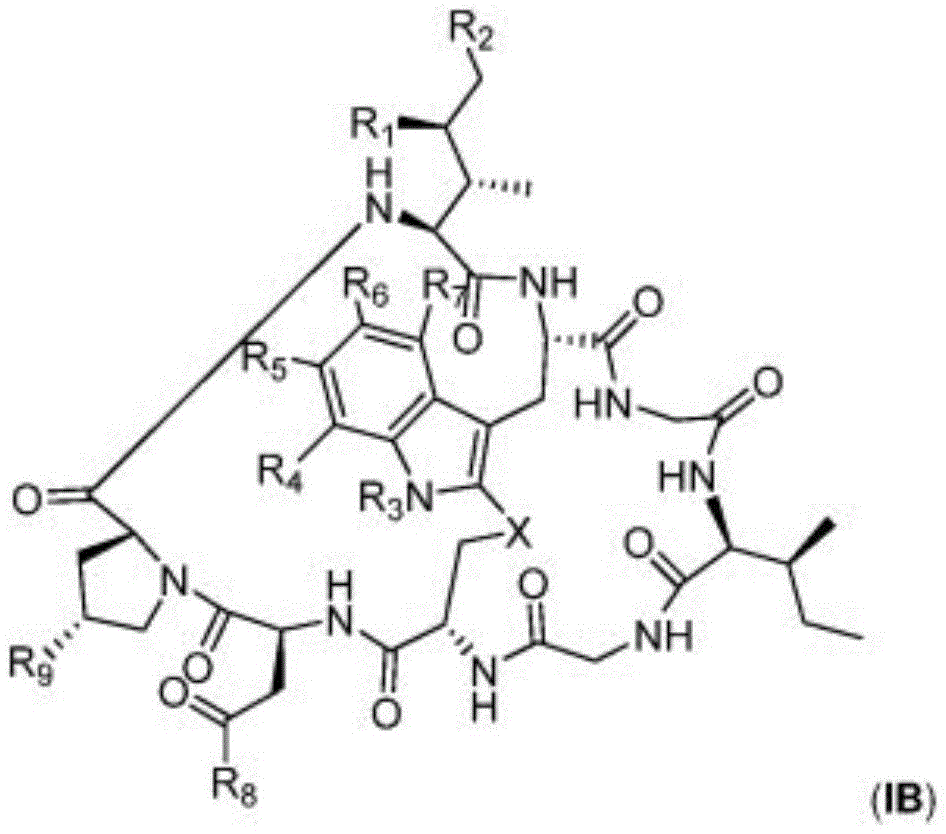
Wherein R is1Is H, OH, ORAOR ORC;R2H, OH,ORBOR ORC;RAAnd RBTaken together with the oxygen atom to which they are bound to form an optionally substituted 5-membered heterocycloalkyl; r3Is H, RCOr RD;R4、R5、R6And R7Each independently is H, OH, ORC、ORD、RCOr RD;R8Is OH, NH2、ORC、ORD、NHRCOr NRCRD;R9Is H, OH, ORCOR ORD(ii) a x is-S-, -S (O-) or-SO2-;RCis-L-Z; rDIs optionally substituted C1-C6Alkyl, optionally substituted C1-C6Heteroalkyl, optionally substituted C2-C6Alkenyl, optionally substituted C2-C6Heteroalkenyl, optionally substituted C2-C6Alkynyl, optionally substituted C2-C6(ii) heteroalkynyl, optionally substituted cycloalkyl, optionally substituted heterocycloalkyl, optionally substituted aryl, or optionally substituted heteroaryl; l is optionally substituted C1-C6Alkylene, optionally substituted C1-C6Heteroalkylene, optionally substituted C2-C6Alkenylene, optionally substituted C2-C6Heteroalkenylene, optionally substituted C2-C6Alkynylene, optionally substituted C2-C6Heteroalkynylene, optionally substituted cycloalkylene, optionally substituted heterocycloalkylene, optionally substituted arylene, optionally substituted heteroarylene, a peptide, a dipeptide, - (C ═ O) -, disulfide, hydrazone, or a combination thereof; and Z is a chemical moiety formed from a coupling reaction between a reactive substituent present on L and a reactive substituent present in an antibody or antigen-binding fragment thereof, wherein Am comprises exactly one R CAnd (4) a substituent. In another embodiment, the RNA polymerase inhibitor is amanitin. In another embodiment, the amanitines are selected from alpha-amanitines, beta-amanitines, gamma-amanitines, epsilon-amanitines, amamides, amanitidesNon-toxic cyclic peptide of amanita, non-toxic cyclic peptide acid of amanita and non-toxic cyclic peptide of amanita. In another embodiment, the cytotoxin is selected from the group consisting of pseudomonas exotoxin A, deBouganin, diphtheria toxin, saporin, maytansine, maytansinoids, auristatin, anthracyclines, calicheamicin, irinotecan, SN-38, duocarmycin, pyrrolobenzodiazepines, pyrrolobenzodiazepine dimer, indolophenyldiazepine, and indolophenyldiazepine dimer. . In another embodiment, the auristatin is MMAE or MMAF. In another embodiment, the antibody or antigen-binding portion thereof is conjugated to the cytotoxin by interchain conjugation to a native hinge cysteine. In another embodiment, the antibody, or antigen binding portion thereof, is conjugated to a cytotoxin through a cysteine residue in the Fc domain of the antibody. In another embodiment, the cysteine residue is introduced by an amino acid substitution in the Fc domain of the antibody. In another embodiment, the amino acid substitution is D265C. In another embodiment, the amino acid substitution is S239C.
In another aspect, provided herein is a pharmaceutical composition comprising an antibody or ADC according to any one of claims 1 to 218, and a pharmaceutically acceptable carrier.
In another aspect, provided herein is a method for depleting a population of Hematopoietic Stem Cells (HSCs) in a human patient, the method comprising administering to the patient an effective amount of an antibody or ADC described herein. In one embodiment, the method comprises administering to the patient a graft comprising hematopoietic stem cells. In one embodiment, the graft is allogeneic. In one embodiment, the graft is autologous.
In another aspect, provided herein is a method comprising administering to a human patient a graft comprising hematopoietic stem cells, wherein the patient has previously been administered an antibody or ADC described herein in an amount sufficient to deplete the patient's hematopoietic stem cell population. In one embodiment, the hematopoietic stem cells are CD117+ or CD45+ cells. In another embodiment, the patient has a hematological disease, metabolic disorder, cancer or autoimmune disease or Severe Combined Immunodeficiency Disease (SCID).
In another aspect, provided herein is a method for treating leukemia in a human patient, the method comprising administering to a human patient having leukemia an antibody or ADC described herein.
In another aspect, provided herein is a method comprising administering to a human patient a graft comprising hematopoietic stem cells, wherein the patient has previously been administered an antibody or ADC described herein in an amount sufficient to deplete the patient's hematopoietic stem cell population. In one embodiment, the immune cell is a CD137+, CD2+, or CD5+ cell. In another embodiment, the immune cell is a T cell.
In another aspect, provided herein is a composition comprising an antibody or ADC described herein, wherein the composition comprises less than 25% hydrophobic degradants after heat stress. In one embodiment, the composition comprises less than 20% hydrophobic degradants after heat stress. In another embodiment, the composition comprises less than 15% hydrophobic degradants after heat stress. In another embodiment, the composition comprises less than 10% hydrophobic degradants after heat stress. In another embodiment, the composition comprises less than 5% hydrophobic degradants after heat stress.
In another aspect, provided herein is a method for treating a stem cell disorder in a human patient, the method comprising administering to the patient a therapeutically effective amount of an antibody, antigen-binding fragment thereof, or ADC described herein.
In another aspect, provided herein is a method for treating an immunodeficiency disorder in a human patient, comprising administering to the patient a therapeutically effective amount of an antibody, antigen-binding fragment thereof, or ADC described herein. In one embodiment, the immunodeficiency disorder is an congenital immunodeficiency or an acquired immunodeficiency.
In another aspect, provided herein is a method for treating a metabolic disorder in a human patient, comprising administering to the patient a therapeutically effective amount of an antibody, antigen-binding fragment thereof, or ADC described herein. In one embodiment, the metabolic disorder is selected from the group consisting of glycogen storage disease, mucopolysaccharidosis, gaucher's disease, huler's disease, sphingolipid metabolism disorders, and metachromatic leukodystrophy.
In another aspect, provided herein is a method for treating an autoimmune disorder in a human patient, the method comprising administering to the patient a therapeutically effective amount of an antibody, antigen-binding fragment thereof, or ADC described herein. In some embodiments, the autoimmune disorder is selected from multiple sclerosis, human systemic lupus erythematosus, rheumatoid arthritis, inflammatory bowel disease, treatment of psoriasis, type 1 diabetes, acute disseminated encephalomyelitis, edison's disease, alopecia universalis, ankylosing spondylitis, antiphospholipid antibody syndrome, aplastic anemia, autoimmune hemolytic anemia, autoimmune hepatitis, autoimmune inner ear disease, autoimmune lymphoproliferative syndrome, autoimmune oophoritis, barlow disease, behcet's disease, bullous pemphigoid, cardiomyopathy, chagas 'disease, chronic fatigue immune dysfunction syndrome, chronic inflammatory demyelinating polyneuropathy, crohn's disease, scarred pemphigoid, celiac sprue herpetiform dermatitis, cold agglutinin disease, CREST syndrome, malignant atrophic papulosis, Discoid lupus, familial autonomic abnormality, endometriosis, idiopathic mixed cryoprecipitating globulinemia, fibromyalgia-fibromyositis, Goodpasture's syndrome, Graves' disease, Guillain-Barre syndrome, Hashimoto's thyroiditis, hidradenitis suppurativa, idiopathic and/or acute thrombocytopenic purpura, idiopathic pulmonary fibrosis, IgA neuropathy, interstitial cystitis, juvenile arthritis, Sjogren's teratosis, lichen planus, Lyme disease, Meniere's disease, mixed connective tissue disease, myasthenia gravis, neuromyotonia nervosa, strabismus clonus-myoclonus syndrome, optic neuritis, Alder thyroiditis, pemphigus vulgaris, pernicious anemia, polychondritis, polymyositis and dermatomyositis, primary biliary cirrhosis, polyarteritis nodosa, polyglandular syndrome, polymyalgia rheumatica, polymyalgia, myalgia, Grave pain, Graves's syndrome, Graves's disease, Graves' disease, multiple sclerosis, Primary agammaglobulinemia, raynaud's phenomenon, reiter's syndrome, rheumatic fever, sarcoidosis, scleroderma,  Syndrome, stiff person syndrome, aortic arch syndrome, temporal arteritis, ulcerative colitis, uveitis, vasculitis, vitiligo, vulvodynia, and wegener's granulomatosis.
In another aspect, provided herein is a method for treating cancer in a human patient, the method comprising administering to the patient a therapeutically effective amount of an antibody, antigen-binding fragment thereof, or ADC described herein. In some embodiments, the cancer is selected from leukemia, lymphoma, multiple myeloma, and neuroblastoma.
In some embodiments of any of the above aspects, the antibody has reduced effector function, reduced effector function defined as reduced binding to an fey receptor (fey R) relative to binding to the fey R of the same antibody comprising an unmodified Fc region. In one embodiment, the reduction in binding is at least 70%, 80%, 90%, 95%, 98%, 99% or 100% less of the antibody that binds to fcyr relative to the binding of the same antibody comprising an unmodified Fc region to fcyr. In certain embodiments, the antibody binds non-detectably to Fc γ R. In some embodiments, the antibody that binds to Fc γ R is assessed by biolayer interferometry (BLI). In some embodiments, the Fc γ R is an Fc γ R1 receptor, an Fc γ R2 receptor, or an Fc γ R3 receptor. In some embodiments, the Fc γ R1 receptor is Fc γ R1A, Fc γ R1B, or Fc γ R1C. In some embodiments, the Fc γ R1 receptor is Fc γ R2A, Fc γ R2B, or Fc γ R2C. In some embodiments, the Fc γ R1 receptor is Fc γ R3A or Fc γ R3B. In some embodiments, the Fc receptor is a human Fc receptor.
In some embodiments of any of the above aspects, the IgG isotype is an IgG1 isotype, an IgG2 isotype, an IgG3 isotype, or an IgG4 isotype.
In some embodiments of any of the above aspects, the antibody is a human antibody.
In some embodiments of any of the above aspects, the antibody is a chimeric antibody or a humanized antibody.
In some embodiments of any of the above aspects, the antibody is a monoclonal antibody.
In some embodiments of any of the above aspects, the antibody specifically binds to CD117, CD45, CD2, CD5, CD137, or CD 252.
In another aspect, provided herein is an Antibody Drug Conjugate (ADC) comprising any of the antibodies herein, wherein the antibody is conjugated to a cytotoxin through a linker.
In some embodiments of the conjugates herein, the cytotoxin is an RNA polymerase inhibitor. In some embodiments, the RNA polymerase inhibitor is amatoxin.
In some embodiments, the amanitin is represented by formula (1A)
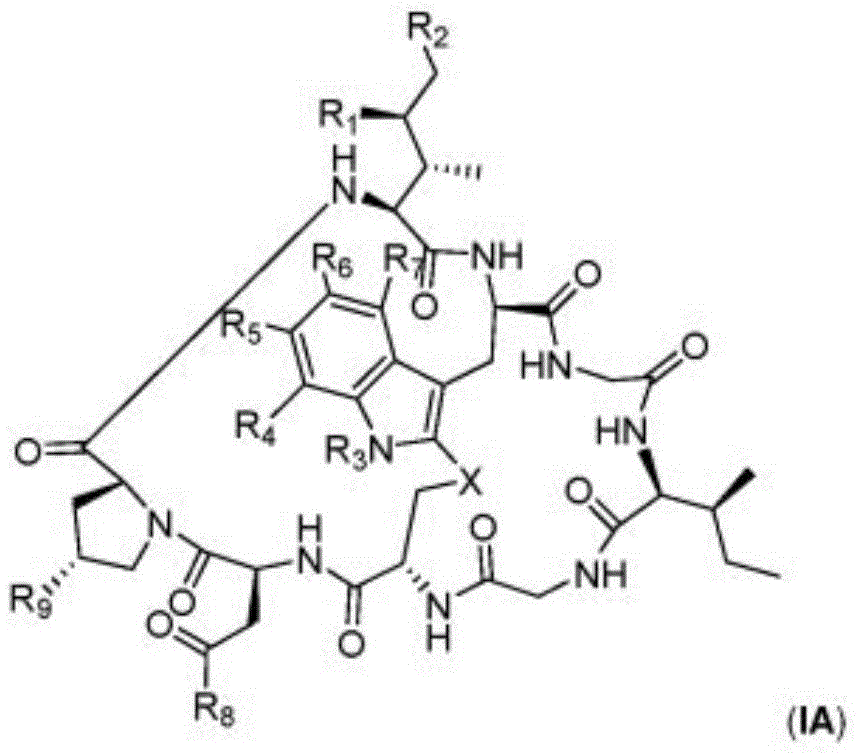
Wherein R is1Is H, OH, ORAOR ORC;
R2Is H, OH, ORBOR ORC;
RAAnd RBTaken together with the oxygen atom to which they are bound to form an optionally substituted 5-membered heterocycloalkyl;
R3Is H, RCOr RD;
R4、R5、R6And R7Each independently is H, OH, ORC、ORD、RCOr RD;
R8Is OH, NH2、ORC、ORD、NHRCOr NRCRD;
R9Is H, OH, ORCOR ORD;
x is-S-, -S (O-) or-SO2-;
RCis-L-Z;
RDis optionally substituted C1-C6Alkyl, optionally substituted C1-C6Heteroalkyl, optionally substituted C2-C6Alkenyl, optionally substituted C2-C6Heteroalkenyl, optionally substituted C2-C6Alkynyl, optionally substituted C2-C6(ii) heteroalkynyl, optionally substituted cycloalkyl, optionally substituted heterocycloalkyl, optionally substituted aryl, or optionally substituted heteroaryl;
l is optionally substituted C1-C6Alkylene, optionally substituted C1-C6Heteroalkylene, optionally substituted C2-C6Alkenylene, optionally substituted C2-C6Heteroalkenylene, optionally substituted C2-C6Alkynylene, optionally substituted C2-C6Heteroalkynylene, optionally substituted cycloalkylene, optionally substituted heterocycloalkylene, optionally substituted arylene, optionally substituted heteroarylene; and is
Z is a chemical moiety formed from a coupling reaction between a reactive substituent present on L and a reactive substituent present in an antibody or antigen-binding fragment thereof,
wherein Am contains exactly one RCAnd (4) a substituent.
In some embodiments, the amatoxin is represented by formula (IB)

Wherein R is1Is H, OH, ORAOR ORC;
R2Is H, OH, ORBOR ORC;
RAAnd RBTaken together with the oxygen atom to which they are bound to form an optionally substituted 5-membered heterocycloalkyl;
R3is H, RCOr RD;
R4、R5、R6And R7Each independently is H, OH, ORC、ORD、RCOr RD;
R8Is OH, NH2、ORC、ORD、NHRCOr NRCRD;
R9Is H, OH, ORCOR ORD;
X is-S-, -S (O-) or-SO2-;
RCis-L-Z;
RDis optionally substituted C1-C6Alkyl, optionally substituted C1-C6Heteroalkyl, optionally substituted C2-C6Alkenyl, optionally substituted C2-C6Heteroalkenyl, optionally substituted C2-C6Alkynyl, optionally substituted C2-C6(ii) heteroalkynyl, optionally substituted cycloalkyl, optionally substituted heterocycloalkyl, optionally substituted aryl, or optionally substituted heteroaryl;
l is optionally substituted C1-C6Alkylene, optionally substituted C1-C6Heteroalkylene, optionally substituted C2-C6Alkenylene, optionally substituted C2-C6Heteroalkenylene, optionally substituted C2-C6Alkynylene, optionally substituted C2-C6Heteroalkynylene, optionally substituted cycloalkylene, optionally substituted heterocycloalkylene, optionally substituted arylene, optionally substituted heteroarylene; and is
Z is a chemical moiety formed from a coupling reaction between a reactive substituent present on L and a reactive substituent present in an antibody or antigen-binding fragment thereof,
Wherein Am contains exactly one RCAnd (4) a substituent.
In some embodiments, the RNA polymerase inhibitor is amanitin. In some embodiments, the amanitine is selected from the group consisting of alpha-amanitine, beta-amanitine, gamma-amanitine, epsilon-amanitine, amanitin, amanamide, amanitin nontoxic cyclic peptide acid, and pre-amanitin nontoxic cyclic peptide.
In some embodiments, the cytotoxin is selected from the group consisting of pseudomonas exotoxin A, deBouganin, diphtheria toxin, saporin, maytansine, maytansinoids, auristatin, anthracyclines, calicheamicin, irinotecan, SN-38, duocarmycin, pyrrolobenzodiazepines, pyrrolobenzodiazepine dimer, indolophenyldiazepine, and indolophenyldiazepine dimer. In some embodiments, the auristatin is MMAE or MMAF.
In some embodiments of the conjugates herein, the antibody is conjugated to the toxin through a cysteine residue in the Fc domain of the antibody. In some embodiments, the cysteine residue is introduced by an amino acid substitution in the Fc domain of the antibody. In some embodiments, the amino acid substitution is D265C.
In another aspect, provided herein is a pharmaceutical composition comprising an antibody or ADC described herein, and a pharmaceutically acceptable carrier.
In yet another aspect, provided herein is a method for depleting a population of Hematopoietic Stem Cells (HSCs) in a human patient, the method comprising administering to the patient an effective amount of an antibody or ADC described herein.
In some embodiments of the methods described herein, the method further comprises administering to the patient a graft comprising hematopoietic stem cells. In some embodiments, the graft is allogeneic. In some embodiments, the graft is allogeneic.
In another aspect, provided herein is a method comprising administering to a human patient a graft comprising hematopoietic stem cells, wherein the patient has previously been administered an antibody or ADC described herein in an amount sufficient to deplete the patient's hematopoietic stem cell population.
In some embodiments of the methods described herein, the patient has a hematological disease, a metabolic disorder, cancer, or an autoimmune disease or Severe Combined Immunodeficiency Disease (SCID).
In another aspect, provided herein is a method for treating leukemia in a human patient, the method comprising administering to a human patient having leukemia an antibody or ADC described herein.
In one aspect, provided herein is a method for depleting a CD117+ cell population in a human patient in need thereof, the method comprising administering to the patient an effective amount of an anti-CD 117 Antibody Drug Conjugate (ADC), wherein the Antibody Drug Conjugate (ADC) comprises an anti-CD 117 antibody conjugated to amanitin through a linker and is represented by the formula Ab-Z-L-Am, wherein Ab is an anti-CD 117 antibody comprising an H435A mutation (EU index) in the Fc region of the antibody, L is a linker, Z is a chemical moiety, and Am is amanitin. In one embodiment, the ADC is administered prior to the patient receiving a transplant comprising hematopoietic stem cells. In another embodiment, the ADC is administered at the same time that the patient receives a transplant comprising hematopoietic stem cells.
In another aspect, provided herein is a method for administering to a human patient an anti-CD 117 Antibody Drug Conjugate (ADC) in an amount sufficient to deplete a CD117+ cell population in a patient in need thereof, wherein the Antibody Drug Conjugate (ADC) comprises an anti-CD 117 antibody conjugated to amanitin through a linker and is represented by the formula Ab-Z-L-Am, wherein Ab is an anti-CD 117 antibody comprising an H435A mutation (EU index) in the Fc region of the antibody, L is a linker, Z is a chemical moiety, and Am is amanitin; and subsequently administering to the patient a graft comprising hematopoietic stem cells. In one embodiment, the transplant comprising hematopoietic stem cells is administered to the patient after the concentration of ADC has been substantially cleared from the patient's blood. In another embodiment, the hematopoietic stem cells or progeny thereof retain the functional potential of the hematopoietic stem cells after two or more days following transplantation of the hematopoietic stem cells into the patient. In yet another embodiment, the hematopoietic stem cells or progeny thereof are capable of being localized to a hematopoietic tissue and/or reconstituting hematopoiesis upon transplantation of the hematopoietic stem cells into a patient. In another embodiment, the patient has a disorder selected from: adenosine deaminase deficiency and severe combined immunodeficiency, hyper-immunoglobulin M syndrome, Chediak-Higashi disease, hereditary lymphohistiocytosis Multiple disease, osteomyelitis, osteogenesis imperfecta, storage disease, thalassemia major, systemic sclerosis, systemic lupus erythematosus, multiple sclerosis, and juvenile rheumatoid arthritis. In another embodiment, the patient has an autoimmune disorder or hematological cancer. In another embodiment, the autoimmune disorder is selected from the group consisting of multiple sclerosis, human systemic lupus erythematosus, rheumatoid arthritis, inflammatory bowel disease, treatment of psoriasis, type 1 diabetes, acute disseminated encephalomyelitis, Edison's disease, alopecia universalis, ankylosing spondylitis, antiphospholipid antibody syndrome, aplastic anemia, autoimmune hemolytic anemia, autoimmune hepatitis, autoimmune inner ear disease, autoimmune lymphoproliferative syndrome, autoimmune oophoritis, Barlow disease, Behcet's disease, bullous pemphigoid, cardiomyopathy, Chagas 'disease, chronic fatigue immune dysfunction syndrome, chronic inflammatory demyelinating polyneuropathy, Crohn's disease, scarred pemphigoid, celiac sprue dermatitis, cold agglutinin disease, CREST syndrome, malignant atrophic papulosis, Discoid lupus, familial autonomic abnormality, endometriosis, idiopathic mixed cryoprecipitating globulinemia, fibromyalgia-fibromyositis, Goodpasture's syndrome, Graves' disease, Guillain-Barre syndrome, Hashimoto's thyroiditis, hidradenitis suppurativa, idiopathic and/or acute thrombocytopenic purpura, idiopathic pulmonary fibrosis, IgA neuropathy, interstitial cystitis, juvenile arthritis, Sjogren's teratosis, lichen planus, Lyme disease, Meniere's disease, mixed connective tissue disease, myasthenia gravis, neuromyotonia nervosa, strabismus clonus-myoclonus syndrome, optic neuritis, Alder thyroiditis, pemphigus vulgaris, pernicious anemia, polychondritis, polymyositis and dermatomyositis, primary biliary cirrhosis, polyarteritis nodosa, polyglandular syndrome, polymyalgia rheumatica, polymyalgia, myalgia, Grave pain, Graves's syndrome, Graves's disease, Graves' disease, multiple sclerosis, Primary agammaglobulinemia, raynaud's phenomenon, reiter's syndrome, rheumatic fever, sarcoidosis, scleroderma,  Syndrome, stiff person syndromeThe diseases include pulseless disease, temporal arteritis, ulcerative colitis, uveitis, vasculitis, vitiligo, vulvodynia and wegener granulomatosis.
In another aspect, provided herein is a method for treating a human subject having a hematologic cancer, comprising administering to a human subject having a hematologic cancer an effective amount of an anti-CD 117 Antibody Drug Conjugate (ADC), wherein the Antibody Drug Conjugate (ADC) comprises an anti-CD 117 antibody conjugated to amanitin through a linker and is represented by the formula Ab-Z-L-Am, wherein Ab is an anti-CD 117 antibody comprising an H435A mutation (EU index) in the Fc region of the antibody, L is a linker, Z is a chemical moiety, and Am is amanitin. In one embodiment, the hematologic cancer is leukemia. In another embodiment, the Fc region of the anti-CD 117 antibody comprises the D265C mutation (EU index). In yet another embodiment, the anti-CD 117 antibody comprises a heavy chain variable region comprising CDR1 comprising the amino acid sequence set forth in SEQ ID NO. 7, CDR2 comprising the amino acid sequence set forth in SEQ ID NO. 8, and CDR3 comprising the amino acid sequence set forth in SEQ ID NO. 9; and comprises a light chain variable region comprising CDR1 comprising the amino acid sequence set forth in SEQ ID NO. 10, CDR2 comprising the amino acid sequence set forth in SEQ ID NO. 11, and CDR3 comprising the amino acid sequence set forth in SEQ ID NO. 12. In another embodiment, the anti-CD 117 antibody comprises a heavy chain variable region comprising the amino acid sequence set forth in SEQ ID NO13 and a light chain variable region comprising the amino acid sequence set forth in SEQ ID NO 14. In another embodiment, the ADC is internalized by cancer cells, autoimmune cells, or hematopoietic stem cells following administration to the patient. In another embodiment, Am-L-Z is represented by formula (I)

Wherein R is1Is H, OH, ORAOR ORC;R2Is H, OH, ORBOR ORC;RAAnd RBWhen present, in combination with themThe oxygen atoms are joined together to form an optionally substituted 5-membered heterocycloalkyl group; r3Is H, RCOr RD;R4、R5、R6And R7Each independently is H, OH, ORC、ORD、RCOr RD;R8Is OH, NH2、ORC、ORD、NHRCOr NRCRD;R9Is H, OH, ORCOR ORD(ii) a x is-S-, -S (O-) or-SO2-;RCis-L-Z; rDIs optionally substituted C1-C6Alkyl, optionally substituted C1-C6Heteroalkyl, optionally substituted C2-C6Alkenyl, optionally substituted C2-C6Heteroalkenyl, optionally substituted C2-C6Alkynyl, optionally substituted C2-C6(ii) heteroalkynyl, optionally substituted cycloalkyl, optionally substituted heterocycloalkyl, optionally substituted aryl, or optionally substituted heteroaryl; l is optionally substituted C1-C6Alkylene, optionally substituted C1-C6Heteroalkylene, optionally substituted C2-C6Alkenylene, optionally substituted C2-C6Heteroalkenylene, optionally substituted C2-C6Alkynylene, optionally substituted C2-C6Heteroalkynylene, optionally substituted cycloalkylene, optionally substituted heterocycloalkylene, optionally substituted arylene, optionally substituted heteroarylene, dipeptide, - (C ═ O) -, disulfide, peptide, or a combination thereof; and Z is a chemical moiety formed from a coupling reaction between a reactive substituent present on L and a reactive substituent present in an antibody or antigen-binding fragment thereof, wherein Am comprises exactly one R CAnd (4) a substituent. In another embodiment, Am-L-Z is represented by formula (IB).

Wherein R is1Is H, OH, ORAOR ORC;R2Is H, OH, ORBOR ORC;RAAnd RBWhen present, combine together with the oxygen atom to which they are bound to form an optionally substituted 5-membered heterocycloalkyl; r3Is H, RCOr RD;R4、R5、R6And R7Each independently is H, OH, ORC、ORD、RCOr RD;R8Is OH, NH2、ORC、ORD、NHRCOr NRCRD;R9Is H, OH, ORCOR ORD(ii) a x is-S-, -S (O-) or-SO2-;RCis-L-Z; rDIs optionally substituted C1-C6Alkyl, optionally substituted C1-C6Heteroalkyl, optionally substituted C2-C6Alkenyl, optionally substituted C2-C6Heteroalkenyl, optionally substituted C2-C6Alkynyl, optionally substituted C2-C6(ii) heteroalkynyl, optionally substituted cycloalkyl, optionally substituted heterocycloalkyl, optionally substituted aryl, or optionally substituted heteroaryl; l is optionally substituted C1-C6Alkylene, optionally substituted C1-C6Heteroalkylene, optionally substituted C2-C6Alkenylene, optionally substituted C2-C6Heteroalkenylene, optionally substituted C2-C6Alkynylene, optionally substituted C2-C6Heteroalkynylene, optionally substituted cycloalkylene, optionally substituted heterocycloalkylene, optionally substituted arylene, optionally substituted heteroarylene, dipeptide, - (C ═ O) -, disulfide, peptide, or a combination thereof; and Z is a chemical moiety formed from a coupling reaction between a reactive substituent present on L and a reactive substituent present in an antibody or antigen-binding fragment thereof, wherein Am comprises exactly one R CAnd (4) a substituent. In another embodiment, the ADC is administered to a human patient at a dose of about 0.1mg/kg to about 0.3 mg/kg.
Drawings
FIGS. 1A-1E graphically depict the results of a standard biolayer interferometry (BLI) assay to assess the binding response of antibodies with the indicated amino acid substitutions to the Fc γ receptors shown in the legend. The normalized binding response of each anti-CD 117 antibody variant relative to WT IgG1 binding is shown in figure 1A, and the quantification of the normalized binding response of each anti-CD 117 antibody variant is shown in figure 1B. FIG. 1C depicts quantification of normalized binding response of anti-CD 45 antibody variants relative to WT anti-CD 45 antibody binding (FIG. 1C; as used herein, "ic" refers to interchain conjugates with native hinge cysteines). The normalized binding response of the additional anti-CD 117 antibody variants is shown in figure 1D and the quantification of the normalized binding response of each anti-CD 117 antibody variant is shown in figure 1E relative to WT IgG1 (isotype control) binding.
Figure 2 graphically depicts the results of a mast cell degranulation assay in which β -hexosaminidase is measured after incubation of mast cells with the indicated antibodies. The beta-hexosaminidase released from mast cells was measured by monitoring the production of p-nitrophenol from the 4-nitrophenyl N-acetyl-beta-D-aminoglycoside substrate and is given as the absorbance of p-nitrophenol at 405nm on the y-axis.
FIGS. 3A, 3B, 3C, 3D and 3E graphically depict the results of an in vitro cytokine release assay to measure IL-6 (FIG. 3A), IL-8 (FIG. 3B), TNF α (FIG. 3C), IL-1B (FIG. 3D) and GM-CSF (FIG. 3E) released from human Peripheral Blood Mononuclear Cells (PBMC) after incubation with the indicated antibodies. Human PBMCs of figures 3A-3D were isolated from one of the four donors, as defined in the legend.
Figures 4A and 4B graphically depict the results of an in vitro antibody-dependent cellular phagocytosis (ADCP) assay showing a reduction in ADCP activity due to Fc effector silencing in certain Fc variants compared to controls. Figure 4A depicts the results of flow cytometry analysis of co-expression of CFSE and CD134 staining. FIG. 4B depicts the results of incubating a mixture of MDM and Kasumi-1 cells (molar ratio 1:2) with increasing concentrations of the indicated antibodies for 2 hours at 37 ℃.
Fig. 5A, 5B, and 5C depict chromatograms of the results of thermal stability assays, in which the melting temperature of each of the indicated antibodies was evaluated.
Fig. 6A and 6B are tables showing melting temperatures of Tm 1(CH2 fold) and Tm2(fab/CH3 fold) for each of the indicated antibodies determined in the thermostability assays depicted in fig. 5A (see fig. 6A) and fig. 5B and 5C (see fig. 6B).
Fig. 7A and 7B depict chromatograms showing elution profiles of antibodies shown after analysis by Hydrophobic Interaction Chromatography (HIC) at room temperature time 0 (non-stressed condition) or after incubation at 60 ℃ for 30 minutes (stressed condition). Fig. 7A depicts a chromatogram showing the elution profiles of Ab1 antibody and certain Ab1 Fc variants after analysis by Hydrophobic Interaction Chromatography (HIC) at time 0 at room temperature (non-stressed conditions; fig. 7A (lower panel is chromatogram)) or after incubation at 60 ℃ for 30 minutes (stressed conditions; fig. 7A (upper panel is chromatogram)). Fig. 7B depicts chromatograms showing the elution profiles of Ab2 antibody and certain Ab2 Fc variants after analysis by Hydrophobic Interaction Chromatography (HIC) at time 0 at room temperature (non-stressed conditions) or after incubation for 30 minutes at 60 ℃ (stressed conditions).
Figures 8A-8E graphically depict the results of the HIC assay of figures 7A and 7B, showing the area percentage of antibody monomeric (i.e., "primary") peaks (figures 8A and 8D) or hydrophobic degradation peaks (figures 8B, 8C, and 8E) of the indicated antibodies after exposure to stressed or unstressed conditions.
Figures 9A-9E graphically depict the results of size exclusion chromatography assays in which the percentage area of antibody monomer peaks (figures 9A and 9D) or the percentage of polymer aggregate peaks (figures 9B, 9C, and 9E) are determined after 30 minutes of incubation of the indicated antibodies at room temperature for either time 0 (non-stressed conditions) or 60 ℃ (stressed conditions).
FIGS. 10A and 10B graphically depict the results of non-human primate pharmacokinetic assays expressed as the concentration (ng/mL) of genetically engineered fast half-life anti-CD 117-amatoxin ADC at different doses (0.1mg/kg and 0.3mg/kg) as the time of action (i.e., hours post-use; x-axis). Figure 10B illustrates that the time of ADC-mediated depletion and clearance provides a window for graft pretreatment after administration.
Fig. 11A-11E graphically depict the results of assays using flow cytometry (fig. 11A and 11C) to detect depletion of representative hematopoietic stem cells (i.e., CD34+ CD90+ CD45RA-HSC) or to evaluate colony forming units in bone marrow aspirates (fig. 11B and 11D) as a function of different doses of ADC1 Antibody Drug Conjugate (ADC) relative to control (i.e., PBS) (x-axis). Fig. 11C and 11D also show data corresponding to unconjugated anti-CD 117 antibody ("anti-CD 117"). Fig. 11E shows phenotypic analysis of bone marrow hematopoietic stem cells (treated versus untreated) using flow cytometry (day 7 post dose administration).
FIGS. 12A-12C graphically depict detecting (FIG. 12A) neutrophil counts (10)3mL) and (FIGS. 12B and 12C) lymphocyte counts (10)3mL) as a function of the number of days following administration of different doses of ADC1 Antibody Drug Conjugate (ADC) (relative to control (i.e. PBS)) dose. Figure 12C also shows data corresponding to lymphocyte counts of cynomolgus monkeys administered unconjugated anti-CD 117 antibody ("anti-CD 117").
FIGS. 13A-13C graphically depict the results of measurements to measure (FIGS. 13A and 13C) plasma alanine aminotransferase (ALT; in U/mL) and (FIG. 13B) plasma bilirubin (in U/mL) levels as a function of the number of days following administration of different doses of ADC1 Antibody Drug Conjugate (ADC) (relative to a control (i.e., PBS)). Figure 13C also shows data corresponding to plasma ALT levels in cynomolgus monkeys administered an unconjugated anti-CD 117 antibody ("anti-CD 117").
Figure 14 shows images of liver and kidney tissues isolated from cynomolgus monkeys 35 days after administration of ADC1(0.3mg/kg) or control (PBS).
FIG. 15 graphically depicts detecting reticulocyte count (10)9mL) as a function of the number of days following administration of different doses (0.1mg/kg or 0.3mg/kg) of ADC1 antibody drug conjugate (relative to control (i.e. PBS) or unconjugated anti-CD 117 antibody).
Detailed Description
Disclosed herein are antibodies and conjugates thereof (antibody drug conjugates; ADCs) having a modified Fc region, wherein the modification reduces or substantially eliminates antibody effector function. Modifications to the Fc region may also allow antibody-drug conjugation and/or reduce the half-life of the antibody. The interaction of antibodies and antibody-antigen complexes with cells of the immune system may affect a variety of responses, including antibody-dependent cell-mediated cytotoxicity (ADCC) and complement-dependent cytotoxicity (CDC). Binding of the Fc region of an antibody to Fc receptors on the cell surface can trigger a number of biological responses, including phagocytosis and destruction of antibody-coated particles, clearance of immune complexes, lysis of antibody-coated target cells by killer cells (i.e., ADCC), release of inflammatory mediators, placental transfer, and control of immunoglobulin production. By reducing or substantially eliminating antibody effector function, the presently disclosed antibodies can, for example, advantageously avoid triggering a variety of immune system responses (e.g., avoid cytokine release or avoid mast cell degranulation) and hematopoietic cell depletion (e.g., for treating blood cancers, immune system diseases and disorders, autoimmune diseases, graft-versus-host disease, etc.) that may be detrimental in certain therapies (e.g., hematopoietic stem cell transplantation therapies)).
Accordingly, included herein are anti-hematopoietic cell antibodies (also referred to as anti-HC antibodies) with modified Fc regions that are useful in therapy. For example, the antibodies or ADCs herein may be used in a pretreatment procedure wherein a patient is prepared to receive a transplant comprising hematopoietic stem cells. Such procedures facilitate the engraftment of hematopoietic stem cell grafts. According to the methods described herein, in some embodiments, a patient (e.g., for hematopoietic stem cell transplantation therapy or immune system replacement) may be pretreated by administering to the patient an ADC, an antibody, or an antigen-binding fragment thereof capable of binding to an antigen, e.g., CD117 (e.g., GNNK + CD117), CD45, CD2, CD5, CD137, CD252, and combinations thereof, expressed by hematopoietic cells (e.g., hematopoietic stem cells, and/or mature immune cells (e.g., T cells)). In some embodiments, the antibodies or ADCs contemplated herein may be used to treat diseases or disorders of the hematopoietic system. For example, in some embodiments, the antibodies or ADCs contemplated herein may be used to treat leukemia. In another non-limiting example, the antibodies or ADCs contemplated herein can be used to treat graft versus host disease ("GvHD"). In certain embodiments, the antibodies or ADCs contemplated herein may be used in the treatment of a T cell mediated disease or disorder. As described herein, the antibody can be covalently bound to a cytotoxin, thereby forming an Antibody Drug Conjugate (ADC). Administration of an ADC, antibody or antigen-binding fragment thereof capable of binding one or more of the foregoing antigens to a patient in need of hematopoietic stem cell transplantation therapy can facilitate the engraftment of a hematopoietic stem cell graft, for example, by selectively depleting endogenous hematopoietic stem cells, thereby creating a void that is filled by an exogenous hematopoietic stem cell graft.
In a particular aspect, the invention provides an isolated anti-CD 117 antibody, particularly an isolated human anti-CD 117 antibody, that binds to the extracellular domain of human CD117, wherein the isolated anti-CD 117 antibody has a modified Fc region, wherein the modification reduces or substantially eliminates antibody effector function. The binding regions of the isolated anti-CD 117 antibodies identified herein are described below.
The following sections describe antibodies or conjugates thereof that can be administered to a patient, such as a patient suffering from cancer or an autoimmune disease, or a patient in need of hematopoietic stem cell transplantation therapy to facilitate hematopoietic stem cell graft engraftment, and methods of administering such therapy to a patient (e.g., prior to hematopoietic stem cell transplantation) are provided.
Definition of
As used herein, the term "about" refers to a value within 5% above or below the stated value.
As used herein, the term "allogeneic", when used in the context of transplantation, is used to define cells (or tissues or organs) that are transplanted from a donor to a recipient of the same species, but genetically different. Thus, the term "heterologous cell" refers to a cell type that is genetically different between two individuals, but belongs to the same species, e.g., human. Generally, the term "allogeneic" is used to define cells, such as stem cells, that are transplanted from a donor to an unrelated recipient of the same species.
The term "autologous" as used herein refers to a cell or graft in which the donor and recipient are the same subject.
As used herein, the term "xenogeneic" refers to cells in which the donor and recipient species are different.
As used herein, the term "immune cell" is intended to include, but is not limited to, cells of hematopoietic origin and which play a role in the immune response. Immune cells include, but are not limited to, T cells and Natural Killer (NK) cells. In one embodiment, natural killer cells include cell lines, such as NK-92 cells. Additional examples of NK cell lines include NKG, YT, NK-YS, HANK-1, YTS cells and NKL cells. The immune cells may be allogeneic or autologous.
As used herein, the term "antibody" refers to an immunoglobulin molecule that specifically binds to or immunoreacts with a particular antigen. Antibodies include, but are not limited to, monoclonal antibodies, polyclonal antibodies, multispecific antibodies (e.g., bispecific antibodies), genetically engineered antibodies, and other modified forms of antibodies, including, but not limited to, chimeric antibodies, humanized antibodies, heteroconjugated antibodies (e.g., bispecific antibodies, trispecific antibodies, and tetraspecific antibodies, diabodies, triabodies, and tetrabodies), and antibody fragments (i.e., antigen-binding fragments of antibodies), including, for example, Fab ', F (ab') 2Fab, Fv, rlgG and scFv fragments, provided that they exhibit the desired antigen binding activity, and the like.
The antibodies of the present disclosure are typically isolated or recombinant. "isolated", as used herein, refers to a polypeptide, such as an antibody, that has been identified, isolated and/or recovered from a cell or cell culture in which it is expressed. Typically, the isolated antibody is prepared by at least one purification step. Thus, an "isolated antibody" refers to an antibody that is substantially free of other antibodies having different antigenic specificities. For example, an isolated antibody that specifically binds to CD117 is substantially free of antibodies that specifically bind to antigens other than CD 117.
As used herein, the term "monoclonal antibody" refers to an antibody derived from a single clone (including any eukaryotic, prokaryotic, or phage clone) by any available or known method in the art, and is not limited to production by hybridoma technologyA crude antibody. Monoclonal antibodies useful in the present disclosure can be prepared using a variety of techniques known in the art, including the use of hybridomas, recombinant, and phage display techniques, or a combination thereof. Unless otherwise indicated, the term "monoclonal antibody" (mAb) is intended to include intact molecules, as well as antibody fragments (including, e.g., Fab and F (ab') 2Fragments). As used herein, Fab and F (ab')2Fragments refer to antibody fragments that lack the Fc fragment of an intact antibody. In one embodiment, the antibody fragment comprises an Fc region.
Typically, antibodies comprise a heavy chain and a light chain comprising an antigen binding region. Each heavy chain consists of a heavy chain variable region (abbreviated herein as HCVR or VH) and a heavy chain constant region. The heavy chain constant region consists of three domains (CH1, CH2, and CH 3). Each light chain consists of a light chain variable region (abbreviated herein as LCVR or VL) and a light chain constant region. The light chain constant region consists of one domain CL. The VH and VL regions can be further subdivided into highly variable regions, termed complementarity determining regions, separated by those more conserved regions termed Framework Regions (FR). Each VH and VL consists of three CDRs and four FRs, arranged from amino-terminus to carboxy-terminus in the following order: FR1, CDR1, FR2, CDR2, FR3, CDR3, FR 4. The variable regions of the heavy and light chains comprise binding domains that interact with an antigen. The constant region of an antibody may mediate the binding of an immunoglobulin to host tissues or factors, including various cells of the immune system (e.g., effector cells) and the first component of the classical complement system (Clq).
As used herein, the term "antigen-binding fragment" refers to one or more portions of an antibody that retain the ability to specifically bind a target antigen. The antigen binding function of an antibody can be achieved by fragments of a full-length antibody. Antibody fragments may be, for example, Fab, F (ab')2, single chain antibody, diabody, triabody, antibody binder, nanobody, aptamer, or domain antibody. The term "antigen-binding fragment" of an antibody encompasses examples of binding fragments including, but not limited to, (i) Fab fragments, monovalent fragments consisting of VL, VH, CL and CH1 domains; (ii) a F (ab')2 fragment comprising a bivalent fragment at the hinge region linking two Fab fragments by a disulfide bond; (iii) an Fd fragment consisting of the VH and CH1 domains; (iv) (ii) an Fv fragment consisting of the VL and VH domains of a single arm of an antibody; (v) a dAb that comprises VH and VL domains; (vi) dAb fragments consisting of VH domains (see, e.g., Ward et al, Nature 341:544-546, 1989); (vii) a dAb consisting of a VH or VL domain; (viii) an isolated Complementarity Determining Region (CDR); and (ix) a combination of two or more (e.g., two, three, four, five, or six) isolated CDRs, which may optionally be joined by a synthetic linker. Furthermore, although the two domains of the Fv fragment, VL and VH, are encoded by separate genes, they can be joined by a linker using recombinant methods to bring them into a single protein chain in which the VL and VH regions pair to form monovalent molecules (known as single chain Fv (scFv); see, e.g., Bird et al, Science 242: 423-. These antibody fragments can be obtained using conventional techniques known to those skilled in the art, and the fragments can be screened for utility in the same manner as intact antibodies. Antigen-binding fragments can be produced by recombinant DNA techniques, enzymatic or chemical cleavage of intact immunoglobulins, or in some cases, by chemical peptide synthesis procedures known in the art. In one embodiment, the antigen binding fragment of the antibody comprises an Fc region.
As used herein, the term "anti-CD 117 antibody" or "antibody that binds to CD 117" refers to an antibody that is capable of binding to CD117 with sufficient affinity such that the antibody is useful as a diagnostic and/or therapeutic agent targeting CD 117.
As used herein, the term "anti-CD 45 antibody" or "antibody that binds CD 45" refers to an antibody that is capable of binding CD45 with sufficient affinity such that the antibody is useful as a diagnostic and/or therapeutic agent targeting CD 45.
As used herein, the term "anti-CD 2 antibody" or "antibody that binds CD 2" or "anti-CD 2 ADC" or "ADC that binds CD 2" refers to an antibody or ADC that specifically binds human CD2 when CD2 is found on the cell surface of a cell, such as a T cell.
As used herein, the term "anti-CD 5 antibody" or "antibody that binds CD 5" or "anti-CD 5 ADC" or "ADC that binds CD 5" refers to an antibody or ADC that specifically binds human CD5 when CD5 is found on the cell surface of a cell, such as a T cell.
As used herein, the term "anti-CD 137 antibody" or "antibody that binds to CD 137" refers to an antibody that is capable of binding CD137 with sufficient affinity such that the antibody is useful as a diagnostic and/or therapeutic agent targeting CD 137.
As used herein, the term "anti-CD 252 antibody" or "antibody that binds to CD 252" refers to an antibody that is capable of binding CD252 with sufficient affinity such that the antibody is useful as a diagnostic and/or therapeutic agent for targeting CD 252. In a preferred embodiment, the antibody specifically binds human CD252(hCD 252). CD252 is present on antigen presenting cells.
The term "bispecific antibody" as used herein refers to, for example, a monoclonal antibody, e.g., a human or humanized antibody, which is capable of binding to at least two different antigens or two different epitopes. For example, one binding specificity may be for an epitope on the hematopoietic stem cell surface antigen CD117 (e.g., GNNK + CD117), and another may specifically bind to an epitope on a different hematopoietic stem cell surface antigen or another cell surface protein, such as a receptor or receptor subunit involved in a signal transduction pathway that enhances cell growth, and the like. In some embodiments, the binding specificity may be directed to distinct, non-overlapping epitopes on the same target antigen (i.e., diabodies).
As used herein, a "complete" or "full-length" antibody refers to an antibody having two heavy chain (H) polypeptides and two light chain (L) polypeptides interconnected by disulfide bonds. Each heavy chain consists of a heavy chain variable region (abbreviated herein as HCVR or VH) and a heavy chain constant region. The heavy chain constant region consists of three domains (CH1, CH2, and CH 3). Each light chain consists of a light chain variable region (abbreviated herein as LCVR or VL) and a light chain constant region. The light chain constant region consists of one domain CL. The VH and VL regions can be further subdivided into highly variable regions, termed complementarity determining regions, separated by those more conserved regions termed Framework Regions (FR). Each VH and VL is composed of three CDRs and four FRs, arranged from amino-terminus to carboxy-terminus in the following order: FR1, CDR1, FR2, CDR2, FR3, CDR3, FR 4. The variable regions of the heavy and light chains comprise binding domains that interact with an antigen. The constant region of an antibody may mediate the binding of an immunoglobulin to host tissues or factors, including various cells of the immune system (e.g., effector cells) and the first component of the classical complement system (Clq).
As used herein, the term "complementarity determining regions" (CDRs) refer to the highly variable regions found in the light and heavy chain variable regions of an antibody. The more highly conserved portions of the variable domains are called the Framework Regions (FR). The amino acid positions that describe the hypervariable regions of an antibody can vary depending on the context and various definitions known in the art. Some positions within a variable domain can be considered to be hybrid highly variable positions, as under one set of criteria these positions can be considered to be within the highly variable region, while under another set of criteria these positions are considered to be outside the highly variable region. One or more of these locations may also be found in the expanded highly variable region. The antibodies described herein may comprise modifications at these hybrid highly variable positions. The variable domains of native heavy and light chains each comprise four framework regions, predominantly in the β -sheet configuration, connected by three CDRs, forming loops connecting, and in some cases, part of, the β -sheet structure. The CDRs in each chain are held tightly together by the framework regions of the FR1-CDR1-FR2-CDR2-FR3-CDR3-FR4 sequence, and together with the CDRs from the other antibody chain, contribute to the formation of the antibody target binding site (see Kabat et al, Sequences of Proteins of Immunological Interest, National Institute of Health, Bethesda, MD., 1987). In certain embodiments, unless otherwise specified, the numbering of immunoglobulin amino acid residues is according to the immunoglobulin amino acid residue numbering system of Kabat et al, (although any antibody numbering scheme may be used, including but not limited to IMGT and Chothia).
As used herein, the term "heat stress" refers to the stress on a molecule (e.g., an antibody, Fc-containing antigen-binding fragment thereof, or ADC) resulting from any change in temperature. In one embodiment, the heat stress is an antibody, Fc-containing antigen-binding fragment thereof, or ADC incubated at 60 ℃ for 30 minutes.
As used herein, the term "specific binding" refers to the ability of an antibody (or ADC) to recognize and bind to a particular protein structure (epitope) rather than to a protein in general. If the antibody is specific for epitope "A", the presence of the molecule containing epitope A (or free, unlabeled A) reduces the amount of labeled A bound to the antibody in a reaction containing labeled "A" and the antibody. By way of example, an antibody "specifically binds" to a target if, when labeled, it can compete away from its target by the corresponding unlabeled antibody. In one embodiment, the antibody specifically binds to a target, e.g., an antigen expressed by hematopoietic stem cells, e.g., CD117 (e.g., GNNK + CD117) or CD45, or an antigen expressed by mature immune cells (e.g., T cells), e.g., CD45, CD2, CD5, CD137, or CD252, if the antibody is directed against the K of the target DIs at least about 10-4M、10-5M、10-6M、10-7M、10-8M、10-9M、10-10M、10-11M、10-12M or less (less means less than 10)-12A number of (2), e.g. 10-13). In one embodiment, the term "specifically binds" refers to an antibody that binds at least about 1x10⁻⁶M、1x10⁻⁷M、1x10⁻⁸M、1x10- 9M、1x10⁻¹⁰M、1x10-11M、1x10-12K of M or greaterdThe ability to bind antigen and/or to bind antigen with an affinity at least two-fold greater than its affinity for non-specific antigen. In one embodiment, K is determined according to standard biolayer interferometry (BLI)D. However, it will be appreciated that an antibody may be capable of specifically binding two or more antigens associated with a sequence. For example, in one embodiment, the antibody can specifically bind to human and non-human (e.g., mouse or non-human primate) orthologs of an antigen, such as CD117 (e.g., GNNK + CD117), CD45, CD2, CD5, CD137, or CD 252.
As used herein, the term "chimeric" antibody refers to an antibody having variable sequences derived from a non-human immunoglobulin (e.g., a rat or mouse antibody) and a human immunoglobulin constant region (typically selected from a human immunoglobulin template). Methods for producing chimeric antibodies are known in the art. See, e.g., Morrison,1985, Science 229(4719): 1202-7; oi et al, 1986, BioTechniques 4: 214-; gillies et al, 1985, J.Immunol.methods 125: 191-202; U.S. patent nos. 5,807,715; 4,816,567; and 4,816,397.
As used herein, the terms "Fc," "Fc region," "Fc domain," and "IgG Fc domain" refer to the portion of an immunoglobulin, such as an IgG molecule, that is associated with a crystallizable fragment obtained by papain digestion of an IgG molecule. The Fc region comprises the C-terminal halves of the heavy chains of two IgG molecules linked by disulfide bonds. It has no antigen binding activity, but contains a carbohydrate moiety and binding sites for complement and Fc receptors, including the FcRn receptor (see below). For example, the Fc domain comprises a second constant domain CH2 (e.g., residues at EU positions 231-340 of human IgG 1) and a third constant domain CH3 (e.g., residues at EU positions 341-447 of human IgG 1). As used herein, an Fc domain comprises a "lower hinge region" (e.g., residues at EU positions 233 and 239 of IgG 1).
Fc may refer to this region alone or in the context of an antibody, antibody fragment or Fc fusion protein. Polymorphisms have been observed at various positions of the Fc domain, including but not limited to EU positions 270, 272, 312, 315, 356, and 358, and thus there may be minor differences between the sequences presented herein and those known in the art. Thus, a "wild-type IgG Fc domain" or a "WT IgG Fc domain" refers to any naturally occurring IgG Fc region (i.e., any allele). The heavy chain sequences of HUMAN IgG1, IgG2, IgG3, and IgG4 can be found in many sequence databases, for example, in the Uniprot database (www.uniprot.org) under accession numbers P01857(IGHG1_ HUMAN), P01859(IGHG2_ HUMAN), P01860(IGHG3_ HUMAN), and P01861(IGHG1_ HUMAN), respectively. An example of a "WT" Fc region (which provides a heavy chain constant region comprising an Fc region) is provided in SEQ ID NO: 15.
As used herein, the term "modified Fc region" or "variant Fc region" refers to an IgG Fc region comprising one or more amino acid substitutions, deletions, insertions, or modifications introduced at any position within the Fc region. In certain aspects, a variant IgG Fc domain comprises one or more amino acid substitutions resulting in a reduction or abolition of binding affinity for fcyr and/or C1q as compared to a wild-type Fc domain that does not comprise the one or more amino acid substitutions. In addition, Fc binding interactions are essential for a variety of effector functions and downstream signaling events, including but not limited to antibody-dependent cell-mediated cytotoxicity (ADCC) and complement-dependent cytotoxicity (CDC). Thus, in certain aspects, an antibody comprising a variant Fc domain (e.g., an antibody, fusion protein, or conjugate) can exhibit altered binding affinity for at least one or more Fc ligands (e.g., fcyr) relative to a corresponding antibody having the same amino acid sequence but not comprising one or more amino acid substitutions, deletions, insertions, or modifications, e.g., a region of unmodified Fc as comprising the naturally occurring amino acid residue at a corresponding position in the Fc region.
The variant Fc domains described herein are defined in terms of the amino acid modifications that make up them. For all amino acid substitutions discussed herein with respect to the Fc region, the numbering is always according to the EU index as in Kabat. Thus, for example, D265C is an Fc variant with aspartic acid (D) at EU position 265 substituted with cysteine (C) relative to the parent Fc domain. Likewise, for example, D265C/L234A/L235A defines a variant Fc variant having substitutions at EU positions 265(D to C), 234(L to a), and 235(L to a) relative to the parent Fc domain. Variants may also be specified according to their final amino acid composition at the mutated EU amino acid position. For example, the L234A, L235A mutants may be referred to as "LALA". As another example, the E233P, L234V, L235A, delG236 (deletion 236) mutants may be referred to as "eplladelg". As yet another example, the I253A, H310A, H435A mutant may be referred to as "IHH". Note that the order in which the substitutions are provided is arbitrary.
As used herein, the term "Fc γ receptor" or "Fc γ R" refers to any member of a family of proteins that bind the Fc region of IgG antibodies and are encoded by Fc γ R genes. In humans, this family includes, but is not limited to, Fc γ RI (CD64), including isoforms Fc γ RIa, Fc γ RIb, and Fc γ RIc; fc γ RII (CD32), including isoforms Fc γ RIIa (including allotype H131 and R131), Fc γ RIIb (including Fc γ RIIb-1 and Fc γ RIIb-2), and Fc γ RIIc; and Fc γ RIII (CD16), including isoforms Fc γ RIIIa (including allotypes V158 and F158) and Fc γ RIIIb (including allotype Fc γ RIIIb-NA1 and Fc γ RIIIb-NA2), as well as any undiscovered human Fc γ Rs or Fc γ R isoform or allotype. The Fc γ R may be from any organism, including but not limited to human, mouse, rat, rabbit, and monkey. Mouse Fc γ Rs include, but are not limited to, Fc γ RI (CD64), Fc γ RII (CD32), Fc γ RIII (CD16), and Fc γ RIII-2(CD16-2), as well as any undiscovered mouse Fc γ Rs or Fc γ R isoforms or allotypes.
As used herein, the term "effector function" refers to the biochemical event resulting from the interaction of an Fc domain with an Fc receptor. Effector functions include, but are not limited to, ADCC, ADCP and cdc. As used herein, "effector cell" means a cell in the immune system that expresses one or more Fc receptors and mediates one or more effector functions. Effector cells include, but are not limited to, monocytes, macrophages, neutrophils, dendritic cells, eosinophils, mast cells, platelets, B cells, large granular lymphocytes, Langerhan cells, Natural Killer (NK) cells, and γ δ T cells, and can be from any organism, including, but not limited to, humans, mice, rats, rabbits, and monkeys.
As used herein, the term "silent (" silent "," silenced "or" silencing ")" refers to an antibody having a modified Fc region described herein that has reduced binding to an Fc γ receptor (Fc γ R) relative to the binding of the same antibody comprising the unmodified Fc region to the Fc γ R (e.g., reduced binding to Fc γ R by at least 70%, at least 80%, at least 90%, at least 95%, at least 98%, at least 99%, or 100% relative to the binding to Fc γ R of the same antibody comprising the unmodified Fc region, as measured by, e.g., BLI). In some embodiments, the Fc-silenced antibody does not detectably bind to an fcyr. Binding of antibodies having a modified Fc region to Fc γ R can be determined using a variety of techniques known in the art, such as, but not limited to, equilibrium methods (e.g., enzyme-linked immunosorbent assay (ELISA); Analytical Biochemistry, e.g., KinExA, rathanawami, vol.373: 52-60, 2008; or Radioimmunoassay (RIA)), or kinetic-based assays by surface plasmon resonance assay or other mechanisms (e.g., biacore. rtm assay or otece. rtm assay (forteBIO)) as well as other methods such as indirect binding assays, competitive binding assays, Fluorescence Resonance Energy Transfer (FRET), gel electrophoresis, and chromatography (e.g., gel filtration). These and other methods may utilize labels on one or more components being examined and/or employ a variety of detection methods, including but not limited to chromogenic, fluorescent, luminescent, or isotopic labeling. A detailed description of binding affinity and kinetics can be found in Paul, w.e., editions, Fundamental Immunology, 4 th edition, Lippincott-Raven, philiadelphia (1999), which focuses on antibody-immunogen interactions. One example of a competitive binding assay is a radioimmunoassay comprising incubating a labeled antigen with an antibody of interest in the presence of increasing amounts of unlabeled antigen and detecting the antibody bound to the labeled antigen. The affinity and binding bias rate of the target antibody to a particular antigen can be determined from the data by scatchard plot analysis. Competition with the second antibody can also be determined using radioimmunoassay. In this case, the antigen is incubated with the antibody of interest conjugated to a labeling compound in the presence of increasing amounts of unlabeled secondary antibody.
As used herein, the term "same antibody comprising an unmodified Fc region" refers to an antibody lacking the amino acid substitutions (e.g., D265C, L234A, L235A, and/or H435A), but in addition; has the same amino acid sequence as the Fc-modified antibody to which it is compared.
The term "antibody-dependent cell-mediated cytotoxicity" or "ADCC" refers to a form of cytotoxicity in which a polypeptide comprising an Fc domain (e.g., an antibody) binds to Fc receptors (fcrs) present on certain cytotoxic cells (e.g., predominantly NK cells, neutrophils, and macrophages) and causes these cytotoxic effector cells to specifically bind to antigen-bearing "target cells" and subsequently kill the target cells with a cytotoxin. (Hogarth et al, Nature review Drug Discovery 2012,11: 313). It is contemplated that in addition to antibodies and fragments thereof, other polypeptides comprising an Fc domain, such as Fc fusion proteins and Fc conjugate proteins, have the ability to specifically bind to target cells bearing an antigen to enable cell-mediated cytotoxicity.
For simplicity, cell-mediated cytotoxicity caused by the activity of the Fc domain-containing polypeptide is also referred to herein as ADCC activity. Any particular polypeptide of the present disclosure can be tested for its ability to mediate ADCC lysis of target cells. To assess ADCC activity, a polypeptide of interest (e.g., an antibody) is added to the target cells in combination with immune effector cells, resulting in lysis of the target cells. Cell lysis is typically detected by the release of a label (e.g., radioactive substrate, fluorescent dye, or native intracellular protein) from the lysed cells. Effector cells used in such assays include Peripheral Blood Mononuclear Cells (PBMC) and Natural Killer (NK) cells. Specific examples of in vitro ADCC assays are described in Bruggemann et al, J.Exp.Med.166:1351 (1987); wilkinson et al, J.Immunol.methods 258:183 (2001); patel et al, J.Immunol.methods 184:29 (1995). Alternatively or additionally, the ADCC activity of the antibody of interest may be assessed in vivo, e.g. in an animal model, e.g. as disclosed in Clynes et al, proc.natl.acad.sci.usa 95:652 (1998).
As used herein, the terms "conditioning" and "conditioning" refer to the process by which a patient is prepared to receive a transplant, such as a transplant comprising hematopoietic stem cells. Such procedures facilitate the engraftment of a hematopoietic stem cell graft (e.g., inferred from a continuing increase in the number of viable hematopoietic stem cells in a blood sample isolated from the patient following a pretreatment procedure and subsequent hematopoietic stem cell transplantation according to the methods described herein, a patient may be pretreated for hematopoietic stem cell transplantation therapy by administering to the patient an ADC, antibody, or antigen-binding fragment thereof, capable of binding to an antigen expressed by the hematopoietic stem cells (e.g., CD117 (e.g., GNNK + CD117), CD45, CD2, CD5, CD137, or CD 252). Creating a void that is filled by the exogenous hematopoietic stem cell graft.
As used herein, the term "effective amount" or "therapeutically effective amount" refers to an amount sufficient to achieve a desired result or to have an effect on an autoimmune disease or cancer.
As used herein, the term "half-life" refers to the time required for the plasma concentration of an antibody drug in the body to decrease by half or 50%. A 50% reduction in serum concentration reflects the amount of drug circulation.
As used herein, the term "human antibody" is intended to include antibodies having variable and constant regions derived from human germline immunoglobulin sequences. Human antibodies can include amino acid residues not encoded by human germline immunoglobulin sequences (e.g., mutations introduced by random or site-specific mutations in vitro, during gene rearrangement, or by somatic mutation in vivo). However, as used herein, the term "human antibody" is not intended to include antibodies in which CDR sequences derived from the germline of another mammalian species (e.g., a mouse) have been grafted into human framework sequences. Human antibodies can be produced in human cells (e.g., by recombinant expression), or by non-human animal or prokaryotic or eukaryotic cells capable of expressing functionally rearranged human immunoglobulin (e.g., heavy and/or light chain) genes. When the human antibody is a single chain antibody, it may include a linker peptide not found in natural human antibodies. For example, the Fv may comprise a linker peptide, e.g., 2 to about 8 glycine or other amino acid residues, that links the heavy chain variable region and the light chain variable region. Such linker peptides are considered to be of human origin. Human antibodies can be made by a variety of methods known in the art, including phage display methods using antibody libraries derived from human immunoglobulin sequences. Human antibodies can also be produced using transgenic mice that do not express functional endogenous immunoglobulins but can express human immunoglobulin genes (see, e.g., PCT publication Nos. WO 1998/24893; WO 1992/01047; WO 1996/34096; WO 1996/33735; U.S. Pat. Nos. 5,413,923; 5,625,126; 5,633,425; 5,569,825; 5,661,016; 5,545,806; 5,814,318; 5,885,793; 5,916,771; and 5,939,598).
A "humanized" form of a non-human (e.g., murine) antibody is a chimeric immunoglobulin that contains minimal sequences derived from a non-human immunoglobulin. Typically, a humanized antibody comprises substantially all of at least one (and typically two) variable domain, wherein all or substantially all of the CDR regions correspond to those of a non-human immunoglobulin and all or substantially all of the FR regions are those of a human immunoglobulin sequence. The humanized antibody may also comprise at least a portion of an immunoglobulin constant region (Fc), typically a portion of a human immunoglobulin consensus sequence. Methods for humanizing antibodies are known in the art. See, e.g., Riechmann et al, 1988, Nature 332: 323-7; U.S. Pat. Nos. 5,530,101 to Queen et al; 5,585,089; 5,693,761; 5,693,762; and 6,180,370; EP 239400; PCT publications WO 91/09967; U.S. Pat. nos. 5,225,539; EP 592106; EP 519596; padlan,1991, mol. Immunol.,28: 489-498; studnicka et al, 1994, prot. eng.7: 805-814; roguska et al, 1994, Proc. Natl. Acad. Sci.91: 969-973; and U.S. Pat. No. 5,565,332.
As used herein, the term "engraftment potential" is used to refer to the ability of hematopoietic stem and progenitor cells to re-engraft tissue, whether such cells are naturally circulating or provided by transplantation. The term encompasses all events surrounding or resulting in implantation, such as tissue homing of cells and colonization of cells within the target tissue (organization). Implantation efficiency or implantation rate may be evaluated or quantified using any clinically acceptable parameter known to those skilled in the art, and may include, for example, an assessment of Competitive Reimplantation Units (CRUs); incorporation or expression of markers in tissues where stem cells have homed, colonized or transplanted; or assessing the progression of the subject by disease progression, survival of hematopoietic stem and progenitor cells, or survival of the recipient. Implantation can also be determined by measuring the white blood cell count in the peripheral blood during the post-transplant period. Engraftment can also be assessed by measuring bone marrow cell recovery of donor cells in a bone marrow aspirate sample.
As used herein, the term "hematopoietic stem cell" ("HSC") refers to an immature blood cell that has the ability to self-renew and differentiate into mature blood cells comprising different lineages, including, but not limited to, granulocytes (e.g., promyelocytes, neutrophils, eosinophils, basophils), erythrocytes (e.g., reticulocytes, erythrocytes), thrombocytes (e.g., megakaryoblasts, platelet-producing megakaryocytes, platelets), monocytes (e.g., monocytes, macrophages), dendritic cells, microglia, osteoclasts, and lymphocytes (e.g., NK cells, B cells, and T cells). Such cells may include CD34+ cells. CD34+ cells are immature cells expressing CD34 cell surface markers. In humans, CD34+ cells are considered to comprise a subpopulation of cells having the above defined stem cell characteristics, whereas in mice, HSCs are CD 34-. Furthermore, HSC are also referred to as long-term reimplantation HSC (LT-HSC) and short-term reimplantation HSC (ST-HSC). LT-HSC and ST-HSC are distinct based on functional potential and cell surface marker expression. For example, human HSCs are CD34+, CD38-, CD45RA-, CD90+, CD49F +, and lin- (negative for mature lineage markers including CD2, CD3, CD4, CD7, CD8, CD10, CD11B, CD19, CD20, CD56, CD 235A). In mice, bone marrow LT-HSCs are CD34-, SCA-1+, C-kit +, CD135-, Slamfl/CD150+, CD48-, and lin- (negative for mature lineage markers including Ter119, CD11B, Gr1, CD3, CD4, CD8, B220, IL7 ra), while ST-HSCs are CD34+, SCA-1+, C-kit +, CD135-, Slamfl/CD150+, and lin- (negative for mature lineage markers including Ter11, CD11B, Gr1, CD3, CD4, CD8, B220, IL7 ra). Furthermore, under self-stabilizing conditions, ST-HSCs are less quiescent and more proliferative than LT-HSCs. However, LT-HSCs have greater self-renewal potential (i.e., they survive throughout adulthood and can be transplanted continuously by continuous recipients), whereas ST-HSCs have limited self-renewal (i.e., they survive only for a limited time and do not have continuous transplantation potential). Any of these HSCs can be used in the methods described herein. ST-HSCs are particularly useful because they are highly proliferative and therefore can produce differentiated progeny more quickly.
As used herein, the term "anti-hematopoietic cell antibody" or "anti-HC antibody" refers to an antibody that specifically binds to an antigen expressed by hematopoietic stem cells, such as CD117 (e.g., GNNK + CD117) or CD 45; or an antigen expressed by a mature immune cell (e.g., a T cell), such as CD45, CD2, CD5, CD137, or CD 252.
As used herein, the term "hematopoietic stem cell functional potential" refers to a functional characteristic of a hematopoietic stem cell, which includes 1) pluripotency (which refers to the ability to differentiate into a variety of different lineages, including, but not limited to, granulocytes (e.g., promyelocytes, neutrophils, eosinophils, basophils), erythrocytes (e.g., reticulocytes, erythrocytes), thrombocytes (e.g., megakaryocytes which produce platelets, platelets), monocytes (e.g., monocytes, macrophages), dendritic cells, microglia, osteoclasts, and lymphocytes (e.g., NK cells, B cells, and T cells), 2) self-renewal (which refers to the ability of a hematopoietic stem cell to produce daughter cells, which have the same potential as the mother cell, and which ability can recur without failure in the lifespan of an individual), and 3) the ability of the hematopoietic stem cells or progeny thereof to be reintroduced into the transplant recipient where they return to the hematopoietic stem cell niche and reconstitute productive and sustained hematopoiesis.
As used herein, the terms "subject" and "patient" refer to an organism, e.g., a human, that is being treated for a particular disease or disorder described herein. For example, a patient, e.g., a human patient, may be treated prior to hematopoietic stem cell transplantation therapy to facilitate the engraftment of exogenous hematopoietic stem cells.
As used herein, the term "donor" refers to a human or animal from which one or more cells are isolated prior to administration of the cells or their progeny into a recipient. The one or more cells may be, for example, a hematopoietic stem cell population.
The term "diabodies" as used herein refers to bivalent antibodies comprising two polypeptide chains, each polypeptide chain comprising a linker (e.g., from five)Linker consisting of amino acids) linked VHAnd VLDomain of the linker which is too short to render VHAnd VLThe domains associate intramolecularly on the same peptide chain. This configuration forces each domain to pair with a complementary domain on the other polypeptide chain, thereby forming a homodimeric structure. Thus, the term "three chain antibody" refers to a trivalent antibody containing three peptide chains, each of which comprises one V linked by a linkerHDomains and a VLA domain that is extremely short (e.g., a linker consisting of 1-2 amino acids) to allow for V within the same peptide chain HAnd VLIntramolecular association of domains. Peptides configured in this manner are typically trimerized in order to fold into their native structure, such that the V's of adjacent peptide chainsHAnd VLThe domains are in close spatial proximity to each other (see, e.g., Holliger et al, Proc. Natl. Acad. Sci. USA 90: 6444-.
As used herein, the term "endogenous" describes a substance, such as a molecule, cell, tissue, or organ (e.g., a hematopoietic stem cell or a cell of a hematopoietic lineage, such as a megakaryocyte, thrombocyte, platelet, erythrocyte, mast cell, medulloblast, basophil, neutrophil, eosinophil, microglia, granulocyte, monocyte, osteoclast, antigen presenting cell, macrophage, dendritic cell, natural killer cell, T lymphocyte, or B lymphocyte), that is naturally present in a particular organism (e.g., a human patient).
As used herein, the term "recipient" refers to a patient who receives a transplant, for example, a transplant containing a hematopoietic stem cell population. The transplanted cells administered to the recipient may be, for example, autologous, syngeneic, or allogeneic cells.
As used herein, the term "sample" refers to a sample (e.g., blood components (e.g., serum or plasma), urine, saliva, amniotic fluid, cerebrospinal fluid, tissue (e.g., placenta or skin), pancreatic juice, chorionic villus samples, and cells) taken from a subject.
As used herein, the term "scFv" refers to single chain Fv antibodies in which the heavy and light chains of the antibodyThe variable domains of the chain have been linked to form a chain. scFv fragments comprise a single polypeptide chain comprising the variable regions of the antibody light chain (V) separated by a linkerL) (e.g., CDR-L1, CDR-L2 and/or CDR-L3) and antibody heavy chain variable region (V)H) (e.g., CDR-H1, CDR-H2, and/or CDR-H3). V linking scFv fragmentsLAnd VHThe linker of the region may be a peptide linker consisting of proteinogenic amino acids. Alternative linkers can be used to increase the resistance of the scFv fragment to proteolytic degradation (e.g., a linker comprising a D-amino acid), to enhance the solubility of the scFv fragment (e.g., a hydrophilic linker such as a linker comprising polyethylene glycol or a polypeptide comprising repeating glycine and serine residues), to increase the biophysical stability of the molecule (e.g., a linker comprising cysteine residues that form an intramolecular or intermolecular disulfide bond), or to reduce the immunogenicity of the scFv fragment (e.g., a linker comprising a glycosylation site). One of ordinary skill in the art will also appreciate that the variable regions of the scFv molecules described herein can be modified such that they differ in amino acid sequence from the antibody molecule from which they are derived. For example, nucleotide or amino acid substitutions (e.g., in CDR and/or framework residues) that result in conservative substitutions or alterations at the amino acid residues can be made to maintain or enhance the ability of the scFv to bind to the antigen recognized by the corresponding antibody.
As used herein, the phrase "substantially cleared from the blood" refers to a point in time after administration of a therapeutic agent (e.g., an anti-CD 117 antibody or antigen-binding fragment thereof) to a patient when the concentration of the therapeutic agent in a blood sample isolated from the patient is such that the therapeutic agent is not detectable by conventional means (e.g., such that the therapeutic agent is not detectable above the noise threshold of the device or assay used to detect the therapeutic agent). A variety of techniques known in the art can be used to detect antibodies, antibody fragments, and protein ligands, such as ELISA-based detection assays known in the art or described herein. Additional assays that can be used to detect antibodies or antibody fragments include immunoprecipitation techniques and immunoblotting assays, as well as other assays known in the art.
As used herein, the term "transfection" refers to any of a variety of techniques commonly used to introduce exogenous DNA into prokaryotic or eukaryotic host cells, such as electroporation, lipofection, calcium phosphate precipitation, DEAE-dextran transfection, and the like.
As used herein, "treating" or "treatment" refers to reducing the severity and/or frequency of disease symptoms, eliminating disease symptoms and/or underlying causes of the symptoms, reducing the frequency or likelihood of disease symptoms and/or underlying causes, and improving or remedying damage caused directly or indirectly by disease, any improvement in any outcome of disease, such as prolonging survival, reducing morbidity, and/or reducing side effects as a by-product of alternative treatment modalities; as is readily understood in the art, complete eradication of the disease is preferred, but not a requirement for therapeutic action. Beneficial or desired clinical results include, but are not limited to, promoting engraftment of exogenous hematopoietic cells in a patient following antibody pretreatment therapy as described herein and subsequent hematopoietic stem cell transplantation therapy. Additional beneficial results include an increase in the cell count or relative concentration of hematopoietic stem cells in a patient in need of hematopoietic stem cell transplantation following pretreatment therapy and subsequent administration of an exogenous hematopoietic stem cell graft to the patient. Beneficial results of the therapies described herein may also include an increase in the cell count or relative concentration of one or more cells of the hematopoietic lineage, such as megakaryocytes, thrombocytes, platelets, erythrocytes, mast cells, myeloblasts, basophils, neutrophils, eosinophils, microglia, granulocytes, monocytes, osteoclasts, antigen presenting cells, macrophages, dendritic cells, natural killer cells, T lymphocytes, or B lymphocytes, following a pretreatment therapy and a subsequent hematopoietic stem cell transplantation therapy. Additional beneficial results may include reducing the number of pathogenic cell populations, such as cancer cell populations (e.g., CD117+ leukemia cells) or autoimmune cells (e.g., CD117+ autoimmune lymphocytes, such as CD117+ T cells that express a T cell receptor that cross-reacts with an autoantigen). To the extent that the methods of the present disclosure relate to preventing a disorder, it is understood that the term "preventing" does not require that the disease state be completely blocked. Rather, as used herein, the term prophylaxis refers to the ability of the skilled artisan to identify a population susceptible to a disorder such that administration of a compound of the invention can occur prior to onset of the disease. The term does not imply that the disease state is completely avoided.
As used herein, patients "in need of" hematopoietic stem cell transplantation include patients who exhibit a deficiency or insufficiency in one or more blood cell types, as well as patients with stem cell disorders, autoimmune diseases, cancer, or other pathologies described herein. Hematopoietic stem cells typically exhibit 1) pluripotency, and thus can differentiate into a variety of different blood lineages, including, but not limited to, granulocytes (e.g., promyelocytes, neutrophils, eosinophils, basophils), erythrocytes (e.g., reticulocytes, erythrocytes), thrombocytes (e.g., megakaryocytes, platelet-producing megakaryocytes, platelets), monocytes (e.g., monocytes, macrophages), dendritic cells, microglia, osteoclasts, and lymphocytes (e.g., NK cells, B cells, and T cells), 2) self-renewal, and thus can produce daughter cells with potential equivalent to that of the mother cell, 3) the ability to reintroduce into the transplant recipient where they return to the hematopoietic stem cell niche and reconstitute productive and persistent hematopoiesis. Thus, hematopoietic stem cells can be administered to patients deficient or deficient in one or more hematopoietic lineage cell types to reconstitute deficient or deficient cell populations in vivo. For example, a patient may suffer from cancer, and the defect may be caused by administration of a chemotherapeutic agent or other drug that selectively or non-specifically depletes the cancer cell population. Additionally or alternatively, the patient may suffer from a hemoglobinopathy (e.g., a non-malignant hemoglobinopathy), such as sickle cell anemia, thalassemia, Fanconi anemia, aplastic anemia, and Wiskott-Aldrich syndrome. The subject may be a subject suffering from adenosine deaminase severe combined immunodeficiency (ADA SCID), HIV/AIDS, metachromatic leukodystrophy, Diamon-Blackfan anemia, and Schwachman-Diamond syndrome. The subject may be afflicted with or affected by a genetic blood disorder (e.g., sickle cell anemia) or an autoimmune disorder. Additionally or alternatively, the subject may have or be affected by a malignancy (e.g., neuroblastoma or hematological cancer). For example, the subject may have leukemia, lymphoma, or myeloma. In some embodiments, the subject has acute myeloid leukemia, acute lymphocytic leukemia, chronic myeloid leukemia, chronic lymphocytic leukemia, multiple myeloma, diffuse large B-cell lymphoma, or non-hodgkin's lymphoma. In some embodiments, the subject has myelodysplastic syndrome. In some embodiments, the subject has an autoimmune disease, such as scleroderma, multiple sclerosis, ulcerative colitis, crohn's disease, type 1 diabetes, or another autoimmune disease described herein. In some embodiments, the subject is in need of a chimeric antigen receptor T cell therapy. In some embodiments, the subject has or is otherwise affected by a metabolic storage disorder. The subject may suffer from or otherwise be affected by a metabolic disorder selected from glycogen deposition Disease, mucopolysaccharidoses, gaucher's Disease, Hurlers Disease, disorders of sphingolipid metabolism, metachromatic leukodystrophy or any other Disease or disorder that may benefit from the treatments and therapies disclosed herein, including but not limited to severe combined immunodeficiency, Wiscott-Aldrich syndrome, hyper-immunoglobulin m (igm) syndrome, Chediak-Higashi Disease, hereditary lymphohistiocytosis, osteopetrosis, osteogenesis imperfecta, storage Disease, thalassemia, sickle cell anemia, systemic sclerosis, systemic lupus erythematosus, multiple sclerosis, juvenile rheumatoid arthritis and those described in "Bone market Transplantation for Non-Malignant Disease," ASH discovery Book,1:319-, the disclosure of which is incorporated herein by reference in its entirety as it relates to pathologies that can be treated by administration of hematopoietic stem cell transplantation therapy. Additionally or alternatively, a patient "in need of" hematopoietic stem cell transplantation may be a patient who has or does not suffer from one of the above pathologies, but still exhibits a reduced level of one or more endogenous cell types in the hematopoietic lineage (e.g., as compared to other healthy subjects), such as megakaryocytes, thrombocytes, platelets, erythrocytes, mast cells, medulloblasts, basophils, neutrophils, eosinophils, microglia, granulocytes, monocytes, osteoclasts, antigen presenting cells, macrophages, dendritic cells, natural killer cells, T lymphocytes, and B lymphocytes. One skilled in the art can readily determine whether the levels of one or more of the foregoing cell types or other blood cell types are reduced relative to other healthy subjects, for example, by flow cytometry and Fluorescence Activated Cell Sorting (FACS) methods, as well as other procedures known in the art.
As used herein, the terms "variant" and "derivative" are used interchangeably and refer to naturally occurring, synthetic, and semi-synthetic analogs of the compounds, peptides, proteins, or other substances described herein. Variants or derivatives of the compounds, peptides, proteins, or other substances described herein may retain or improve the biological activity of the original material.
As used herein, the phrase "stem cell disorder" broadly refers to any disease, disorder or condition that can be treated or cured by pretreating a target tissue of a subject and/or by ablating an endogenous stem cell population in the target tissue (e.g., ablating an endogenous hematopoietic stem cell or progenitor cell population from bone marrow tissue of the subject) and/or by transplanting or implanting stem cells in the target tissue of the subject. For example, type 1 diabetes has been apparently cured by hematopoietic stem cell transplantation and may benefit from pretreatment according to the compositions and methods described herein. Additional diseases that may be treated using the compositions and methods described herein include, but are not limited to, sickle cell anemia, thalassemia, fanconi anemia, aplastic anemia, Wiskott-Aldrich syndrome, ADA SCID, HIV/AIDS, metachromatic leukodystrophy, Diamond-Blackfan anemia, and Schwachman-Diamond syndrome. Additional diseases that may be treated using the patient pretreatment and/or hematopoietic stem cell transplantation methods described herein include hereditary blood diseases (e.g., sickle cell anemia) and autoimmune procedures, such as scleroderma, multiple sclerosis, ulcerative colitis, and crohn's disease. Additional diseases that may be treated using the pretreatment and/or transplantation methods described herein include malignancies, such as neuroblastoma or hematological cancers, such as leukemia, lymphoma and myeloma. For example, the cancer may be acute myeloid leukemia, acute lymphocytic leukemia, chronic myeloid leukemia, chronic lymphocytic leukemia, multiple myeloma, diffuse large B-cell lymphoma or non-hodgkin's lymphoma. Additional diseases treatable using the pretreatment and/or transplantation methods described herein include myelodysplastic syndrome. In some embodiments, the subject has or is otherwise affected by a metabolic storage disorder. For example, the subject may have or be otherwise affected by a metabolic disorder selected from glycogenosis, mucopolysaccharidosis, gaucher's Disease, Hurlers Disease, disorders of sphingolipid metabolism, metachromatic leukodystrophy or any other Disease or disorder that may benefit from the treatments and therapies disclosed herein, including but not limited to severe combined immunodeficiency, Wiscott-Aldrich syndrome, hyper-immunoglobulin m (igm) syndrome, Chediak-hishi Disease, hereditary lymphocytosis, osteopetrosis, osteogenesis imperfecta, storage Disease, thalassemia, sickle cell anemia, systemic sclerosis, systemic lupus erythematosus, multiple sclerosis, juvenile rheumatoid arthritis and those described in "Bone market Transplantation for Non-Malignant Disease," ASH implantation Book,1:319-, the disclosure of which is incorporated herein by reference in its entirety as it relates to pathologies that can be treated by administration of hematopoietic stem cell transplantation therapy.
As used herein, the term "vector" includes nucleic acid vectors, such as plasmids, DNA vectors, plasmids, RNA vectors, viruses, or other suitable replicons. The expression vectors described herein may comprise polynucleotide sequences as well as additional sequence elements, e.g., for protein expression and/or integration of these polynucleotide sequences into the genome of a mammalian cell. Certain vectors that can be used to express the antibodies and antibody fragments of the invention include plasmids that contain regulatory sequences, such as promoters and enhancer regions, that direct gene transcription. Other useful vectors for expressing antibodies and antibody fragments comprise polynucleotide sequences that increase the rate of translation of these genes or improve the stability or nuclear export of mRNA produced by transcription of the genes. These sequence elements may include, for example, 5 'and 3' untranslated regions and polyadenylation signal sites to direct the efficient transcription of genes carried on expression vectors. The expression vectors described herein may also comprise polynucleotides encoding markers for selecting cells comprising such vectors. Examples of suitable markers include genes encoding resistance to antibiotics (e.g., ampicillin, chloramphenicol, kanamycin, and nourseothricin).
As used herein, the term "conjugate" or "antibody drug conjugate" or "ADC" refers to an antibody linked to a cytotoxin. ADCs are formed by chemical bonding of a reactive functional group of one molecule (e.g., an antibody or antigen-binding fragment thereof) to an appropriate reactive functional group of another molecule (e.g., a cytotoxin as described herein). The conjugate may comprise a linker between two molecules that bind to each other, for example a linker between an antibody and a cytotoxin. Examples of linkers useful for forming conjugates include peptide-containing linkers, such as linkers containing naturally occurring or non-naturally occurring amino acids, such as D-amino acids. These linkers can be prepared using a variety of strategies described herein or known in the art. Depending on the reaction components therein, the linker may be cleaved, for example, by enzymatic hydrolysis, photolysis, hydrolysis under acidic conditions, hydrolysis under basic conditions, oxidation, disulfide reduction, nucleophilic cleavage, or organometallic cleavage (see, e.g., Leriche et al, bioorg.Med.chem.,20: 571. multidot. 582,2012).
As used herein, the term "microtubule binding agent" refers to a compound that acts by disrupting the microtubule network necessary for mitotic and interphase cell function in a cell. Examples of microtubule binding agents include, but are not limited to, maytansine, maytansinoids and derivatives thereof, such as those described herein or known in the art; vinca alkaloids, such as vinblastine, vinblastine sulfate, vincristine sulfate, vindesine, and vinorelbine; taxanes such as docetaxel and paclitaxel; macrolides such as discodermolide, colchicine and epothilone; and derivatives thereof, such as epothilone B or derivatives thereof.
As used herein, the term "amatoxin" refers to a member of the amatoxin family of peptides produced by death caps (Amanita phaseoids), or variants or derivatives thereof, e.g., capable of inhibiting RNA polymerase II activity. Amanitins for use in conjunction with the compositions and methods described herein include compounds such as, but not limited to, compounds of formulae (III), (IIIA), (IIIB), and (IIIC), each as described below (e.g., alpha-amanitine, beta-amanitine, gamma-amanitine, epsilon-amanitine, amanitin, amatinamide, amanitin nontoxic cyclic peptide, amanitin nontoxic cyclic peptidic acid, and pre-amanitin nontoxic cyclic peptide). As described herein, amatoxin can be conjugated to an antibody or antigen-binding fragment thereof (thereby forming an ADC), e.g., via a linker moiety (L). Exemplary methods of amanitin conjugation and linkers for such processes are described below. Exemplary linker-containing amatoxins that can be used for conjugation to antibodies or antigen-binding fragments according to the compositions and methods are also described herein.
As used herein, the term "acyl" refers to — C (═ O) R, where R is hydrogen ("aldehyde"), C 1-C12Alkyl radical, C2-C12Alkenyl radical, C2-C12Alkynyl, C3-C7 carbocyclyl, C6-C20Aryl, 5-10 membered heteroaryl, or 5-10 membered heterocyclyl, as defined herein. Non-limiting examples include formyl, acetyl, propionyl, benzoyl and acryloyl.
As used herein, the term "C1-C12Alkyl "refers to a straight or branched saturated hydrocarbon having 1 to 12 carbon atoms. Representative of C1-C12Alkyl groups include, but are not limited to, -methyl, -ethyl, -n-propyl, -n-butyl, -n-pentyl, and-n-hexyl; and branched C1-C12Alkyl groups include, but are not limited to, -isopropyl, -sec-butyl, -isobutyl, -tert-butyl, -isopentyl, and 2-methylbutyl. The branched alkyl groups may be unsubstituted or substituted.
The term "alkenyl" as used herein means containing a compound having at least one substituentC of a normal, secondary or tertiary carbon atom of the saturation site2-C12Hydrocarbons, i.e., carbon-carbon sp2 double bonds. Examples include, but are not limited to: ethylene or vinyl, -allyl, -1-butenyl, -2-butenyl, -isobutenyl, -1-pentenyl, -2-pentenyl, -3-methyl-1-butenyl, -2-methyl-2-butenyl, -2, 3-dimethyl-2-butenyl and the like. Alkenyl groups may be unsubstituted or substituted.
As used herein, "alkynyl" refers to a C containing a normal, secondary, or tertiary carbon atom having at least one site of unsaturation 2-C12Hydrocarbons, i.e. carbon-carbon sp triple bonds. Examples include, but are not limited to, acetylene and propyne. Alkynyl groups may be unsubstituted or substituted.
As used herein, "aryl" refers to C6-C20A carbocyclic aromatic group. Examples of aryl groups include, but are not limited to, phenyl, naphthyl, and anthracenyl. The aryl group may be unsubstituted or substituted.
As used herein, "arylalkyl" refers to an acyclic alkyl group, wherein the carbon atom(s) to which it is bonded (typically terminal or sp)3Carbon atom) is substituted with an aryl group. Typical arylalkyl groups include, but are not limited to, benzyl, 2-phenyleth-1-yl, naphthylmethyl, 2-naphthyleth-1-yl, naphthylbenzyl, 2-naphthyleth-1-yl and the like. Arylalkyl groups contain from 6 to 20 carbon atoms, e.g., the alkyl portion (including alkyl, alkenyl, or alkynyl groups) of an arylalkyl group is from 1 to 6 carbon atoms and the aryl portion is from 5 to 14 carbon atoms. The alkaryl group may be unsubstituted or substituted.
As used herein, "cycloalkyl" refers to a saturated carbocyclic group, which may be monocyclic or bicyclic. Cycloalkyl includes monocyclic or bicyclic rings of 3 to 7 carbon atoms. Examples of monocyclic cycloalkyl groups include cyclopropyl, cyclobutyl, cyclopentyl, cyclohexyl, cycloheptyl, and cyclooctyl. Cycloalkyl groups may be unsubstituted or substituted.
As used herein, "cycloalkenyl" refers to an unsaturated carbocyclic group, which may be monocyclic or bicyclic. Cycloalkenyl includes monocyclic or bicyclic rings of 3 to 6 carbon atoms or 7 to 12 carbon atoms. Examples of monocyclic cycloalkenyl include 1-cyclopent-1-enyl, 1-cyclopent-2-enyl, 1-cyclopent-3-enyl, 1-cyclohex-1-enyl, 1-cyclohex-2-enyl, and 1-cyclohex-3-enyl. The cycloalkenyl group may be unsubstituted or substituted.
As used herein, "heteroaralkyl" refers to an acyclic alkyl group, wherein a carbon atom (typically a terminus or sp) is bonded3Carbon atom) is substituted with a heteroaryl group. Typical heteroarylalkyl groups include, but are not limited to, 2-benzimidazolylmethyl, 2-furanylethyl, and the like. Heteroarylalkyl contains from 6 to 20 carbon atoms, e.g., the alkyl portion (including alkyl, alkenyl, or alkynyl) of heteroarylalkyl is from 1 to 6 carbon atoms, and the heteroaryl portion is from 5 to 14 carbon atoms and from 1 to 3 heteroatoms selected from N, O, P and S. The heteroaryl portion of heteroarylalkyl may be a monocyclic ring having 3 to 7 ring members (2 to 6 carbon atoms) or a bicyclic ring having 7 to 10 ring members (4 to 9 carbon atoms and 1 to 3 heteroatoms selected from N, O, P and S), for example: bicyclo [4,5 ] ]、[5,5]、[5,6]Or [6,6]]Provided is a system.
As used herein, "heteroaryl" and "heterocycloalkyl" refer to aromatic or non-aromatic ring systems, respectively, in which one or more ring atoms are heteroatoms, such as nitrogen, oxygen, and sulfur. Heteroaryl or heterocycloalkyl groups contain 2 to 20 carbon atoms and 1 to 3 heteroatoms selected from nitrogen, oxygen, phosphorus and sulfur. The heteroaryl or heterocycloalkyl group can be a monocyclic ring having 3 to 7 ring members (2 to 6 carbon atoms and 1 to 3 heteroatoms selected from N, O, P and S) or a bicyclic ring having 7 to 10 ring members (4 to 9 carbon atoms and 1 to 3 heteroatoms selected from N, O, P and S), for example: bicyclic [4,5], [5,6] or [6,6] systems. Heteroaryl and heterocycloaryl may be unsubstituted or substituted.
Heteroaryl and heterocycloalkyl are described in Paquette, Leo a; "Principles of Modern Heterocyclic Chemistry" (W.A. Benjamin, New York,1968), in particular chapters 1, 3, 4, 6, 7 and 9; "The Chemistry of Heterocyclic Compounds, A series of monograms" (John Wiley & Sons, New York,1950to present), especially volumes 13, 14, 16, 19 and 28; and J.am.chem.Soc. (1960)82: 5566.
Examples of heteroaryl groups include, by way of example and not limitation, pyridyl, thiazolyl, tetrahydrothienyl, pyrimidinyl, furyl, thienyl, pyrrolyl, pyrazolyl, imidazolyl, tetrazolyl, benzofuryl, thianaphthyl, indolyl, indoxyl, quinolyl, isoquinolyl, benzimidazolyl, isoxazolyl, pyrazinyl, pyridazinyl, indolizinyl, isoindolyl, 3H-indolyl, 1H-indazolyl, purinyl, 4H-quinolyl, phthalazinyl, naphthyridinyl, quinoxalyl, quinazolinyl, cinnolinyl, pteridinyl, 4 aH-carbazolyl, phenanthridinyl, acridinyl, pyrimidinyl, phenanthrolinyl, phenazinyl, phenothiazinyl, furazanyl, phenoxazinyl, isochromanyl, chromanyl, imidazolidinyl, imidazolinyl, pyrazolidinyl, pyrazolinyl, benzotriazolyl, benzisoxazolyl and indoxyl (isatinoyl).
Examples of heterocycloalkyl include, by way of example and not limitation, dihydropyridinyl, tetrahydropyridinyl (piperidinyl), tetrahydrothienyl, piperidinyl, 4-piperidinyl, pyrrolidinyl, 2-pyrrolidinyl, tetrahydrofuranyl, tetrahydropyranyl, bis-tetrahydropyranyl, tetrahydroquinolinyl, tetrahydroisoquinolinyl, decahydroquinolinyl, octahydroisoquinolinyl, piperazinyl, quinuclidinyl, and morpholinyl.
By way of example and not limitation, carbon-bonded heteroaryl and heterocycloalkyl are bonded at the 2, 3, 4, 5, or 6 position of pyridine, at the 3, 4, 5, or 6 position of pyridazine, at the 2, 4, 5, or 6 position of pyrimidine, at the 2, 3, 5, or 6 position of pyrazine, at the 2, 3, 4, or 5 position of furan, tetrahydrofuran, thiofuran (thiofuran), thiophene, pyrrole, or tetrahydropyrrole, at the 2, 4, or 5 position of oxazole, imidazole, or thiazole, at the 3, 4, or 5 position of isoxazole, pyrazole, or isothiazole, at the 2 or 3 position of aziridine, at the 2, 3, or 4 position of azetidine, at the 2, 3, 4, 5, 6, 7, or 8 position of quinoline, or at the 1, 3, 4, 5, 6, 7, or 8 position of isoquinoline. More typically, carbon-bonded heterocycles include 2-pyridyl, 3-pyridyl, 4-pyridyl, 5-pyridyl, 6-pyridyl, 3-pyridazinyl, 4-pyridazinyl, 5-pyridazinyl, 6-pyridazinyl, 2-pyrimidinyl, 4-pyrimidinyl, 5-pyrimidinyl, 6-pyrimidinyl, 2-pyrazinyl, 3-pyrazinyl, 5-pyrazinyl, 6-pyrazinyl, 2-thiazolyl, 4-thiazolyl, or 5-thiazolyl.
By way of illustration and not limitation, nitrogen-bonded heteroaryl and heterocycloalkyl are bonded at the 1-position of aziridine, azetidine, pyrrole, pyrrolidine, 2-pyrroline, 3-pyrroline, imidazole, imidazolidine, 2-imidazoline, 3-imidazoline, pyrazole, pyrazoline, 2-pyrazoline, 3-pyrazoline, piperidine, piperazine, indole, indoline, 1H-indazole, at the 2-position of isoindole or isoindoline, at the 4-position of morpholine, and at the 9-position of carbazole or β -carboline. More typically, nitrogen-bonded heterocycles include 1-aziridinyl, 1-azetidinyl, 1-pyrrolyl, 1-imidazolyl, 1-pyrazolyl and 1-piperidinyl.
As used herein and applied to any of the above alkyl, alkenyl, alkynyl, aryl, arylalkyl, cycloalkyl, heteroaryl, heterocyclyl and the like, "substituted" means that one or more hydrogen atoms are each independently substituted with a substituent. Unless otherwise limited by the definition of a single substituent, the aforementioned chemical moieties, such as "alkyl", "heteroalkyl", "alkenyl", "heteroalkenyl", "alkynyl", "heteroalkynyl", "cycloalkyl", "heterocycloalkyl", "aryl", and "heteroaryl", may be optionally substituted, for example, with 1 to 5 substituents selected from: alkyl, alkynyl, cycloalkyl, heterocycloalkyl, alkylaryl, alkylheteroaryl, alkylcycloalkyl, alkylheterocycloalkyl, amino, ammonium, acyl, acyloxy, acylamino, aminocarbonyl, alkoxycarbonyl, ureido, carbamate, aryl, heteroaryl, sulfinyl, sulfonyl, alkoxy, sulfanyl, halogen, carboxy, trihalomethyl, cyano, hydroxy, mercapto, nitro, and the like. Typical substituents include, but are not limited to, -X, -R, -OH, -OR, -SH, -SR, NH 2、-NHR、-N(R)2、-N+(R)3、-CX3、-CN、-OCN、-SCN、-NCO、-NCS、-NO、-NO2、-N3、-NC(=O)H、-NC(=O)R、-C(=O)H、-C(=O)R、-C(=O)NH2、-C(=O)N(R)2、-SO3-、-SO3H、-S(=O)2R、-OS(=O)2OR、-S(=O)2NH2、-S(=O)2N(R)2、-S(=O)R、-OP(=O)(OH)2、-OP(=O)(OR)2、-P(=O)(OR)2、-PO3、-PO3H2、-C(=O)X、-C(=S)R、-CO2H、-CO2R、-CO2-、-C(=S)OR、-C(=O)SR、-C(=S)SR、-C(=O)NH2、-C(=O)N(R)2、-C(=S)NH2、-C(=S)N(R)2、-C(=NH)NH2and-C (═ NR) N (R)2(ii) a Wherein each X is independently selected in each occurrence from F, Cl, Br, and I; and each R is independently selected at each occurrence from C1-C12Alkyl radical, C6-C20Aryl radical, C3-C14Heterocycloalkyl or heteroaryl, protecting groups, and prodrug moieties. When a group is described as "optionally substituted," the group may be independently substituted in each instance with one or more of the substituents described above. Substitution may include situations where adjacent substituents undergo ring closure, such as ring closure of ortho-functional substituents, to form lactams, lactones, cyclic anhydrides, acetals, hemiacetals, thioacetals, aminals, and hemiaminals, for example, formed by ring closure, e.g., to provide a protecting group.
It is to be understood that, depending on the context, certain radical naming conventions may include single or double radicals. For example, when a substituent requires two points of attachment to the rest of the molecule, it is understood that the substituent is a diradical. For example, substituents identified as alkyl groups requiring two attachment points include diradicals, such as-CH2-、-CH2CH2-、-CH2CH(CH3)CH2-and the like. Other radical naming conventions clearly indicate that the radical is a diradical, such as "alkylene", "alkenylene", "arylene", "heterocycloalkylene", and the like.
As used herein, the term "coupling reaction" refers to a chemical reaction in which two or more substituents adapted to react with each other react to form a chemical moiety that links (e.g., covalently) the molecular fragment bound to each substituent. Conjugation reactions include those in which a reactive substituent bound to a cytotoxic fragment (e.g., a cytotoxin known in the art or described herein) is reacted with an appropriate reactive substituent bound to an antibody fragment or antigen-binding fragment thereof (e.g., an antibody or antigen-binding fragment thereof known in the art or described herein that has specificity for CD117 (e.g., GNNK + CD 117)). Examples of suitable reactive substituents include nucleophile/electrophile pairs (e.g., thiol/haloalkane pairs, amine/carbonyl pairs, or thiol/α, β -unsaturated carbonyl pairs, etc.), diene/dienophile pairs (e.g., azide/alkyne pairs, etc.), and the like. Coupling reactions include, but are not limited to, thiol alkylation, hydroxyalkylation, amine alkylation, amine condensation, amidation, esterification, disulfide formation, cycloaddition (e.g., [4+2] Diels-Alder cycloaddition, [3+2] Huisen cycloaddition, etc.), nucleophilic aromatic substitution, electrophilic aromatic substitution, and other reaction forms known in the art or described herein.
As used herein, "CRU (competitive replanting unit)" refers to a unit of measure of long-term transplanted stem cells, which can be detected after in vivo transplantation.
As used herein, "drug-to-antibody ratio" or "DAR" refers to the number of cytotoxins (e.g., amatoxin) attached to an ADC antibody. The DAR of the ADC may range from 1 to 8, although higher loadings are also possible depending on the number of attachment sites on the antibody. Thus, in certain embodiments, the DAR of an ADC described herein is 1, 2, 3, 4, 5, 6, 7, or 8.
Where all substituents are described as diradicals (i.e., having two points of attachment to the rest of the molecule), it is to be understood that the substituents can be attached in any directional configuration unless otherwise specified.
Fc-modified antibodies
The present disclosure is based, in part, on the discovery that antibodies or antigen-binding fragments thereof having Fc modifications that allow Fc silencing, capable of binding to antigens expressed by hematopoietic cells, are useful as therapeutic agents. For example, the present disclosure is based, in part, on the discovery of Fc modifications with permissive Fc silencing that are capable of binding to (i) antigens expressed by hematopoietic cells, including but not limited to CD117 (e.g., GNNK + CD117) or CD 45; or an antigen expressed by a mature immune cell (e.g., a T cell), including but not limited to an antibody or antigen binding fragment thereof of CD45, CD2, CD5, CD137, or CD252, can be used as a therapeutic agent (e.g., as a "naked" antibody or as ADCs) to (i) treat a patient with CD117+ (e.g., GNNK + CD117) or CD45+ hematopoietic stem cells; or CD45+, CD2+, CD5+, CD137+, or CD252+ immune cells (e.g., T cells) and (ii) facilitate engraftment of transplanted hematopoietic stem cells in patients in need of transplantation therapy. These therapeutic activities may be caused, for example, by binding of anti-Hematopoietic Cell (HC) antibodies (e.g., anti-CD 117 antibodies, anti-CD 45 antibodies, anti-CD 2 antibodies, anti-CD 5 antibodies, anti-CD 137 antibodies, anti-CD 252 antibodies, etc.) or antigen-binding fragments thereof, which bind to antigens (e.g., CD117 (e.g., GNNK + CD117), CD45, CD2, CD5, CD137, CD252, etc.) expressed by hematopoietic cells (e.g., hematopoietic stem cell leukocytes, immune cells, e.g., mature immune cells (e.g., T cells)) (e.g., cancer cells, autoimmune cells, or hematopoietic stem cells), and subsequently induce cell death. Depletion of endogenous hematopoietic stem cells can provide niches into which engrafted hematopoietic stem cells can colonize, and subsequent establishment of productive hematopoiesis. In this manner, the transplanted hematopoietic stem cells can be successfully transplanted into a patient, such as a human patient suffering from the stem cell disorders described herein.
The antibodies or antigen-binding fragments thereof described herein may also include modifications and/or mutations that alter the properties of the antibody and/or fragment, such as those that increase half-life or increase or decrease ADCC.
In one embodiment, antibodies comprising one or more radiolabeled amino acids are provided. Radiolabeled antibodies are useful for diagnostic and therapeutic purposes (conjugation to radiolabeled molecules is another possible feature). Non-limiting examples of polypeptide tags include, but are not limited to, 3H, 14C, 15N, 35S, 90Y, 99Tc and 125I, 131I and 186 Re. Methods for preparing radiolabeled amino acid and related peptide derivatives are known in the art (see, e.g., Junghans et al, in Cancer chemother and Biotherapy 655 686 (editions 2, Chafner and Longo, editions., Lippincott Raven (1996)) and U.S. Pat. No. 4,681,581, U.S. Pat. No. 4,735,210, U.S. Pat. No. 5,101,827, U.S. Pat. No. 5,102,990 (U.S. RE35,500), U.S. Pat. No. 5,648,471, and U.S. Pat. No. 5,697,902. for example, radioisotopes can be conjugated by the chloramine T method.
In one embodiment, an anti-HC antibody (e.g., an anti-CD 117 antibody, an anti-CD 45 antibody, an anti-CD 2 antibody, an anti-CD 5 antibody, an anti-CD 137 antibody, or an anti-CD 252 antibody) or antigen-binding fragment thereof comprises a modified Fc region, wherein the modified Fc region comprises at least one amino acid modification relative to a wild-type Fc region such that the affinity of the molecule for, or binding to, fcgamma ar (fcyr) is altered. Certain amino acid positions within the Fc region are known to be in direct contact with Fc γ R by crystallographic studies. In particular, amino acids 234-. (see Sondermann et al, 2000Nature,406:267- > 273). In some embodiments, an antibody described herein may comprise a variant Fc region comprising a modification of at least one residue, which modification is in direct contact with an fcyr based on structural and crystallographic analysis. In one embodiment, the Fc region of an anti-HC antibody (e.g., an anti-CD 117 antibody, an anti-CD 45 antibody, an anti-CD 2 antibody, an anti-CD 5 antibody, an anti-CD 137 antibody, an anti-CD 252 antibody, etc.) or antigenic fragment thereof, comprises an amino acid substitution at amino acid 265 according to the EU index as in Kabat et al, Sequences of Proteins of Immunological Interest, edition published Health Service, NH1, MD (1991), which is expressly incorporated herein by reference. "EU index as in Kabat" refers to the numbering of the human IgG1 EU antibody. In one embodiment, the Fc region comprises the D265A mutation. In one embodiment, the Fc region comprises the D265C mutation. In some embodiments, the Fc region of the antibody (or fragment thereof) comprises an amino acid substitution at amino acid 234, according to the EU index as in Kabat. In one embodiment, the Fc region comprises the L234A mutation. In some embodiments, the Fc region of the anti-HC antibody (e.g., anti-CD 117 antibody, anti-CD 45 antibody, anti-CD 2 antibody, anti-CD 5 antibody, anti-CD 137 antibody, or anti-CD 252 antibody), or antigenic fragment thereof, comprises an amino acid substitution at amino acid 235, according to the EU index as in Kabat. In one embodiment, the Fc region comprises the L235A mutation. In yet another embodiment, the Fc region comprises L234 and L235A mutations (also referred to herein as "L234a. L235a" or "LALA". in another embodiment, the Fc region comprises L234A and L235A mutations, wherein the Fc region does not comprise a P329G mutation. in another embodiment, the Fc region comprises D265C, L234A, and L235A mutations (also referred to herein as "D265c. L234a. L235a"). in another embodiment, the Fc region comprises D265C, L234A, and L235A mutations, wherein the Fc region does not comprise a P329G mutation. in yet another embodiment, the Fc region comprises D265C, L A, L235A, and H58435 mutations (also referred to herein as "D265c. L234a. 235435a.") in another embodiment, the Fc region comprises D265, L234, L59628, and H599 mutations in yet another embodiment, wherein the Fc region comprises no P26265, H597,8653, No. 35, No. H43435, No. H43265, No. 7, no, The S239C, L234A, and L235A mutations (also referred to herein as "d265a. s239c. l234a. l235a"). In yet another embodiment, the Fc region comprises the D265A, S239C, L234A, and L235A mutations, wherein the Fc region does not comprise the P329G mutation. In another embodiment, the Fc region comprises the D265C, N297G, and H435A mutations (also referred to herein as "d265c.n 297g.h435a"). In another embodiment, the Fc region comprises the D265C, N297Q, and H435A mutations (also referred to herein as "d265c.n 297q.h435a"). In another embodiment, the Fc region comprises E233P, L234V, L235A, and delG236 (deletion 236) mutations (also referred to herein as "E233p. L234v. L235a. delG 236" or as "epllaldelg"). In another embodiment, the Fc region comprises the E233P, L234V, L235A, and delG236 (deletion 236) mutations, wherein the Fc region does not comprise the P329G mutation. In another embodiment, the Fc region comprises the E233P, L234V, L235A, delG236 (deletion 236), and H435A mutations (also referred to herein as "E233p. L234v. L235a. delG236. H435a" or as "eplladel g. H435a"). In another embodiment, the Fc region comprises the E233P, L234V, L235A, delG236 (deletion 236), and H435A mutations, wherein the Fc region does not comprise the P329G mutation. In another embodiment, the Fc region comprises the L234A, L235A, S239C, and D265A mutations. In another embodiment, the Fc region comprises the L234A, L235A, S239C, and D265A mutations, wherein the Fc region does not comprise the P329G mutation. In another embodiment, the Fc region comprises H435A, L234A, L235A, and D265C mutations. In another embodiment, the Fc region comprises H435A, L234A, L235A, and D265C mutations, wherein the Fc region does not comprise the P329G mutation.
In some embodiments, the antibody has a modified Fc region such that the antibody reduces effector function in an in vitro effector function assay, with reduced binding to an Fc receptor (Fc R) relative to binding to an FcR of the same antibody comprising an unmodified Fc region. In some embodiments, the antibody has a modified Fc region such that the antibody reduces effector function in an in vitro effector function assay, with reduced binding to an fey receptor (Fc R) relative to binding to the fey R of the same antibody comprising an unmodified Fc region. In some embodiments, the Fc γ R is Fc γ R1. In some embodiments, the Fc γ R is Fc γ R2A. In some embodiments, the Fc γ R is Fc γ R2B. In other embodiments, the Fc γ R is Fc γ R2C. In some embodiments, the Fc γ R is Fc γ R3A. In some embodiments, the Fc γ R is Fc γ R3B. In other embodiments, the reduction in binding is at least 70%, at least 80%, at least 90%, at least 95%, at least 98%, at least 99%, or 100% less of the antibody that binds to an fcyr relative to the binding of the same antibody comprising an unmodified Fc region to the fcyr. . In other embodiments, the reduction in binding is at least 70% to 100%, at least 80% to 100%, at least 90% to 100%, at least 95% to 100%, or at least 98% to 100% reduction in binding to an fcyr relative to binding to the fcyr by the same antibody comprising an unmodified Fc region.
In some embodiments, the antibody has a modified Fc region such that the antibody reduces cytokine release in an in vitro cytokine release assay by at least 50% relative to cytokine release from the same antibody comprising the unmodified Fc region. In some embodiments, the reduction in cytokine release is at least 70%, at least 80%, at least 90%, at least 95%, at least 98%, at least 99% or 100% reduction in cytokine release relative to cytokine release from the same antibody comprising an unmodified Fc region. In some embodiments, the reduction in cytokine release is at least 70% to 100%, at least 80% to 100%, at least 90% to 100%, at least 95% to 100% reduction in cytokine release relative to cytokine release of the same antibody comprising an unmodified Fc region. In some preferred embodiments, cytokine release is by immune cells.
In some embodiments, the antibody has a modified Fc region such that the antibody reduces mast cell degranulation in an in vitro mast cell degranulation assay by at least 50% relative to mast cell degranulation of the same antibody comprising an unmodified Fc region. In some embodiments, the reduction in mast cell degranulation is at least 70% reduction, at least 80% reduction, at least 90% reduction, at least 95% reduction, at least 98% reduction, at least 99% reduction, or 100% reduction in mast cell degranulation relative to mast cell degranulation of the same antibody comprising an unmodified Fc region. In some embodiments, the reduction in mast cell degranulation is at least a 70% to 100% reduction, at least an 80% to 100% reduction, at least a 90% to 100% reduction, or at least a 95% to 100% reduction in mast cell degranulation relative to mast cell degranulation of the same antibody comprising an unmodified Fc region.
In some embodiments, the antibody has a modified Fc region such that the antibody reduces or prevents antibody-dependent cellular phagocytosis (ADCP) by at least 50% relative to the ADCP of the same antibody comprising the unmodified Fc region in an in vitro antibody-dependent cellular phagocytosis assay. In some embodiments, the reduction in ADCP is at least 70% reduction, at least 80% reduction, at least 90% reduction, at least 95% reduction, at least 98% reduction, at least 99% reduction, or 100% reduction in antibody-dependent cellular phagocytosis relative to the same antibody comprising an unmodified Fc region.
In some embodiments, an anti-HC antibody described herein (e.g., an anti-CD 117 antibody, an anti-CD 45 antibody, an anti-CD 2 antibody, an anti-CD 5 antibody, an anti-CD 137 antibody, or an anti-CD 252 antibody) comprises an Fc region comprising one or a combination of the following modifications: D265A, D265C, D265C/H435A, D265C/LALA, D265C/LALA/H435A, D265A/S239C/L234A/L235A/H435A, D265A/S239C/L234A/L235A, D265C/N297G, D265C/N297G/H435A, D265C (EPLVLAdelG), D265C (EPLVLAdelG)/H435A, D265C/N297Q/H435A, D265C/N297Q, EPLVLAdelG/H435A, EPLVLAdelG/D36297, N A or N36297.
The binding or affinity between the modified Fc region and the Fc γ receptor can be determined using a variety of techniques known in the art, such as, but not limited to, equilibrium methods (e.g., enzyme-linked immunosorbent assay (ELISA); Analytical Biochemistry, such as KinExA, rathanawami, volume 373:52-60, 2008; or Radioimmunoassay (RIA)), or other mechanisms by surface plasmon resonance assay or kinetic-based assay (e.g., biacore. rtm analysis or octet. rtm analysis (forteBIO)), as well as other methods such as indirect binding assays, competitive binding assays, Fluorescence Resonance Energy Transfer (FRET), gel electrophoresis, and chromatography (e.g., gel filtration). These and other methods may utilize labels on one or more components being examined and/or employ a variety of detection methods, including but not limited to chromogenic, fluorescent, luminescent, or isotopic labeling. A detailed description of binding affinity and kinetics can be found in Paul, w.e., editors, Fundamental Immunology, 4 th edition, Lippincott-Raven, philiadelphia (1999), which focuses on antibody-immunogen interactions. One example of a competitive binding assay is a radioimmunoassay comprising incubating a labeled antigen with an antibody of interest in the presence of increasing amounts of unlabeled antigen, and detecting the antibody bound to the labeled antigen. The affinity and binding bias rate of the target antibody to a particular antigen can be determined from the data by scatchard plot analysis. Competition with the second antibody can also be determined using radioimmunoassay. In this case, the antigen is incubated with the antibody of interest conjugated to a labeling compound in the presence of increasing amounts of unlabeled secondary antibody.
In one embodiment, binding of an antibody having an Fc modification described herein (e.g., D265C, L234A, L235A, and/or H435A) to an fey receptor is reduced by at least 70%, reduced by at least 75%, reduced by at least 80%, reduced by at least 85%, reduced by at least 90%, reduced by at least 95%, reduced by at least 98%, reduced by at least 99%, or reduced by 100% (e.g., as assessed by biolayer interferometry (BLI), e.g., as described in example 1) relative to binding of the same antibody comprising an unmodified Fc region to the fey receptor.
Without wishing to be bound by any theory, it is believed that the binding interaction of the Fc region with the fey receptor is essential for a variety of effector functions and downstream signaling events, including but not limited to antibody-dependent cell-mediated cytotoxicity (ADCC) and complement-dependent cytotoxicity (CDC). Thus, in certain aspects, antibodies comprising a modified Fc region (e.g., comprising L234A, L235A, and/or D265C mutations) have effector function that is significantly reduced or eliminated. Effector function can be determined using a variety of methods known in the art, for example, by measuring cellular response to the antibody of interest (e.g., mast cell degranulation or cytokine release). For example, using standard methods in the art, Fc-modified antibodies can be assayed for the ability to trigger mast cell degranulation in vitro (e.g., as described in example 2) or the ability to trigger cytokine release, e.g., by human peripheral blood mononuclear cells (e.g., as described in example 3).
Thus, in one embodiment, the Fc region comprises a mutation that results in a reduction in half-life (e.g., relative to an antibody having an unmodified Fc region). In certain instances where the antibody is expected to act as a short-lived therapeutic agent (e.g., the pretreatment step described herein, wherein HSCs are administered after administration of the antibody), an antibody with a short half-life may be advantageous. Ideally, the antibody is substantially cleared prior to delivery of the HSCs, which typically also express a target antigen (e.g., CD117 (e.g., GNNK + CD117), CD45, CD2, CD5, CD137, or CD252), but are not targets of an anti-HC antibody (e.g., an anti-CD 117 antibody, an anti-CD 45 antibody, an anti-CD 2 antibody, an anti-CD 5 antibody, an anti-CD 137 antibody, or an anti-CD 252 antibody), unlike endogenous stem cells. In one embodiment, the Fc region comprises a mutation at position 435 (EU index according to Kabat). In one embodiment, the mutation is the H435A mutation.
In one embodiment, the half-life (e.g., in a human) of an anti-HC antibody described herein (e.g., an anti-CD 117 antibody, an anti-CD 45 antibody, an anti-CD 2 antibody, an anti-CD 5 antibody, an anti-CD 137 antibody, or an anti-CD 252 antibody) is equal to or less than about 24 hours, equal to or less than about 23 hours, equal to or less than about 22 hours, equal to or less than about 21 hours, equal to or less than about 20 hours, equal to or less than about 19 hours, equal to or less than about 18 hours, equal to or less than about 17 hours, equal to or less than about 16 hours, equal to or less than about 15 hours, equal to or less than about 14 hours, equal to or less than about 13 hours, equal to or less than about 12 hours, or equal to or less than about 11 hours.
In one embodiment, an anti-HC antibody described herein (e.g., an anti-CD 117 antibody, an anti-CD 45 antibody, an anti-CD 2 antibody, an anti-CD 5 antibody, an anti-CD 137 antibody, or an anti-CD 252 antibody) has a half-life (e.g., in a human) of about 1-5 hours, about 5-10 hours, about 10-15 hours, about 15-20 hours, or about 20-25 hours.
In some aspects, the Fc region comprises two or more mutations that confer reduced half-life and reduced effector function to the antibody. In some embodiments, the Fc region comprises a mutation that results in a reduction in half-life and a mutation of at least one residue that can be directly contacted with an Fc γ R (e.g., based on structural and crystallographic analysis). In one embodiment, the Fc region comprises the H435A mutation, the L234A mutation, and the L235A mutation. In one embodiment, the Fc region comprises the H435A mutation and the D265C mutation. In one embodiment, the Fc region comprises the H435A mutation, the L234A mutation, the L235A mutation, and the D265C mutation.
In some embodiments, the antibody or antigen-binding fragment thereof is conjugated to a cytotoxin (e.g., amatoxin) through a cysteine residue in the Fc domain of the antibody or antigen-binding fragment thereof. In some embodiments, the cysteine residue is introduced by mutation in the Fc domain of the antibody or antigen-binding fragment thereof. For example, the cysteine residue may be selected from Cys118, Cys239 and Cys 265. In one embodiment, the Fc region of an anti-HC antibody (e.g., an anti-CD 117 antibody, an anti-CD 45 antibody, an anti-CD 2 antibody, an anti-CD 5 antibody, an anti-CD 137 antibody, or an anti-CD 252 antibody), or an antigen-binding fragment thereof, comprises an amino acid substitution at amino acid 265 (according to the EU index of Kabat). In one embodiment, the Fc region comprises the D265C mutation. In one embodiment, the Fc region comprises the D265C and H435A mutations. In one embodiment, the Fc region comprises the D265C, L234A, and L235A mutations. In one embodiment, the Fc region comprises the D265C, L234A, L235A, and H435A mutations. In one embodiment, the Fc region of an anti-HC antibody (e.g., an anti-CD 117 antibody, an anti-CD 45 antibody, an anti-CD 2 antibody, an anti-CD 5 antibody, an anti-CD 137 antibody, or an anti-CD 252 antibody), or an antigen-binding fragment thereof, comprises an amino acid substitution at amino acid 239 (EU index according to Kabat). In one embodiment, the Fc region comprises the S239C mutation. In one embodiment, the Fc region comprises the L234A mutation, the L235A mutation, the S239C mutation, and the D265A mutation. In another embodiment, the Fc region comprises the S239C and H435A mutations. In another embodiment, the Fc region comprises the L234A mutation, the L235A mutation, and the S239C mutation. In yet another embodiment, the Fc region comprises the H435A mutation, the L234A mutation, the L235A mutation, and the S239C mutation. In yet another embodiment, the Fc region comprises the H435A mutation, the L234A mutation, the L235A mutation, the S239C mutation, and the D265A mutation.
Notably, unless otherwise indicated, Fc amino acid positions are referenced to the EU numbering index.
Methods for genetically engineering antibodies to comprise any of the Fc modifications herein are well known in the art. These methods include, but are not limited to, preparation by site-directed (or oligonucleotide-mediated) mutagenesis, PCR mutagenesis, and cassette mutagenesis of a prepared DNA molecule encoding an antibody or at least an antibody constant region. Site-directed mutagenesis is well known in the art (see, e.g., Carter et al, Nucleic Acids Res.,13:4431-4443(1985) and Kunkel et al, Proc. Natl. Acad. Sci. USA,82:488 (1987)). PCR mutagenesis is also suitable for preparing amino acid sequence variants of the starting polypeptide. See Higuchi, PCR protocol, pages 177 and 183 (Academic Press, 1990); and Vallette et al, Nuc. acids Res.17:723-733 (1989). Another method for preparing sequence variants, cassette mutagenesis, is based on the technique described by Wils et al, Gene,34: 315-.
The present disclosure is also based, in part, on the discovery that antibodies or antigen-binding fragments thereof that are capable of binding to CD117 (e.g., GNNK + CD117) can be used as therapeutic agents alone or as ADCs to (i) treat cancers characterized by CD117+ cells (e.g., acute myelogenous leukemia or myelodysplastic syndrome) and autoimmune diseases, and (ii) facilitate the engraftment of transplanted hematopoietic stem cells in patients in need of transplantation therapy. These therapeutic activities may be induced by: for example, an anti-CD 117 antibody or antigen-binding fragment thereof binds to CD117 (e.g., GNNK + CD117) expressed on the surface of a cell (e.g., a cancer cell, an autoimmune cell, or a hematopoietic stem cell), and subsequently induces cell death. Depletion of endogenous hematopoietic stem cells can provide niches into which engrafted hematopoietic stem cells can colonize, and subsequent establishment of productive hematopoiesis. In this manner, the transplanted hematopoietic stem cells can be successfully transplanted into a patient, such as a human patient suffering from the stem cell disorders described herein.
Antibodies and antigen-binding fragments capable of binding to human CD117 (also referred to as c-Kit, mRNA NCBI reference sequence: NM-000222.2, protein NCBI reference sequence: NP-000213.1), including those capable of binding to GNNK + CD117, may be used in conjunction with the compositions and methods described herein to pre-treat patients undergoing hematopoietic stem cell transplantation therapy. Polymorphisms affecting the CD117 coding region or the extracellular domain in a significant proportion of the population are not currently known in non-neoplastic indications. At least four isoforms of CD117 have been identified with the potential to express additional isoforms in tumor cells. Two CD117 isoforms are located in the intracellular domain of the protein, and two are present in the outer membrane proximal region. The two extracellular isoforms, GNNK + and GNNK-differ in the presence (GNNK +) or the absence (GNNK-) of the 4 amino acid sequences. These isoforms are reported to have the same affinity for ligand (SCF), but ligand binding to GNNK-isoforms is reported to increase internalization and degradation. GNNK + isoforms can be used as immunogens to generate antibodies capable of binding CD117, as antibodies raised against such isoforms include GNNK + and GNNK-proteins.
In one embodiment, the anti-CD 117 antibody or antigen-binding portion thereof comprises the heavy chain variable region as set forth in the amino acid sequence of SEQ ID NO. 13 and the light chain variable region as set forth in the amino acid sequence of SEQ ID NO. 14.
In another embodiment, the anti-CD 117 antibody or antigen-binding portion thereof comprises the three CDR sequences of the heavy chain variable region (VH) amino acid sequence and the three CDR sequences of the light chain variable region (LH) amino acid sequence of Ab 85.
In another embodiment, the anti-CD 117 antibody or antigen-binding portion thereof comprises the heavy chain variable region (VH) amino acid sequence and the light chain variable region (LH) amino acid sequence of Ab85 (also interchangeably referred to herein as Ab 2).
The heavy chain variable region amino acid sequence is provided below as SEQ ID NO 13. The VH CDR amino acid sequence of Ab85 is underlined below and as follows: NYWIG (VH CDR 1; SEQ ID NO: 7); IINPRDSDTRYRPSFQG (VH CDR 2; SEQ ID NO: 8); and HGRGYEGYEGAFDI (VH CDR 3; SEQ ID NO: 9).
Ab85 VH sequence
EVQLVQSGAEVKKPGESLKISCKGSGYSFTNYWIGWVRQMPGKGLEWMAIINPRDSDTRYRPSFQGQVTISADKSISTAYLQWSSLKASDTAMYYCARHGRGYEGYEGAFDIWGQGTLVTVSS(SEQ ID NO:13)
The light chain variable region (VL) amino acid sequence of Ab85 is provided below as SEQ ID NO: 14. The VL CDR amino acid sequence of Ab85 is underlined below and as follows: RSSQGIRSDLG (VLCDR 1; SEQ ID NO: 10); DASNLET (VL CDR 2; SEQ ID NO: 11); and QQANGFPLT (VL CDR 3; SEQ ID NO: 12).
Ab85 VL sequence
DIQMTQSPSSLSASVGDRVTITCRSSQGIRSDLGWYQQKPGKAPKLLIYDASNLETGVPSRFSGSGSGTDFTLTISSLQPEDFATYYCQQANGFPLTFGGGTKVEIK(SEQ ID NO:14)。
In another embodiment, the anti-CD 117 antibody or antigen-binding portion thereof comprises the heavy chain variable region (VH) amino acid sequence and the light chain variable region (LH) amino acid sequence of Ab249 (also interchangeably referred to herein as Ab 3).
The heavy chain variable region (VH) amino acid sequence of Ab249 is provided below as SEQ ID NO: 346. The VH CDR amino acid sequence of Ab249 is underlined below and as follows: TSWIG (VHCDR 1; SEQ ID NO: 340); IIYPGDSDTRYSPSFQG (VH CDR 2; SEQ ID NO: 341); and HGLGYNGYEGAFDI (VH CDR 3; SEQ ID NO: 342).
Ab249 VH sequence
EVQLVQSGAEVKKPGESLKISCKGSGYRFTTSWIGWVRQMPGKGLEWMGIIYPGDSDTRYSPSFQGQVTISADKSISTAYLQWSSLKASDTAMYYCARHGLGYNGYEGAFDIWGQGTLVTVSS(SEQ ID NO:346)。
The light chain variable region (VL) amino acid sequence of Ab249 is provided below as SEQ ID NO: 347. The VL CDR amino acid sequence of Ab249 is underlined below and as follows: RASQGIGSALA (VL CDR 1; SEQ ID NO: 343); DASNLET (VL CDR 2; SEQ ID NO: 344); and QQLNGYPLT (VL CDR 3; SEQ ID NO:345)
Ab249 VL sequence
DIQMTQSPSSLSASVGDRVTITCRASQGIGSALAWYQQKPGKAPKLLIYDASNLETGVPSRFSGSGSGTDFTLTISSLQPEDFATYYCQQLNGYPLTFGQGTRLEIK(SEQ ID NO:347)
Human antibodies Ab85 and Ab249 are both derived from antibody CK6, which is an antagonist of anti-CD 117 antibodies. Ab85 and Ab249 have improved properties, such as improved binding characteristics, compared to CK 6.
Thus, in certain embodiments, the anti-CD 117 antibody comprises a heavy chain comprising the set of CDRs as set forth in SEQ ID NOs: 7, 8 and 9 (CDR1, CDR2 and CDR3) and a light chain comprising the set of CDRs as set forth in SEQ ID NOs 10, 11 and 12. In other embodiments, the anti-CD 117 antibody comprises a heavy chain comprising the set of CDRs as set forth in SEQ ID NOS: 340, 341, and 342 (CDR1, CDR2, and CDR3) and a light chain comprising the set of CDRs as set forth in SEQ ID NOS: 343, 344, and 345.
In another embodiment, the anti-CD 117 antibody or antigen-binding portion thereof comprises the heavy chain variable region (VH) amino acid sequence and the light chain variable region (LH) amino acid sequence of Ab67 (neutral antibody; also interchangeably referred to herein as Ab 1).
The heavy chain variable region (VH) amino acid sequence of Ab67 is provided below as SEQ ID NO: 354. The VH CDR amino acid sequence of Ab67 is underlined below and as follows: FTFSDADMD (VHCDR 1; SEQ ID NO: 348); RTRNKAGSYTTEYAASVKG (VH CDR 2; SEQ ID NO: 349); and AREPKYWIDFDL (VH CDR 3; SEQ ID NO: 350).
Ab67VH sequence
EVQLVESGGGLVQPGGSLRLSCAASGFTFSDADMDWVRQAPGKGLEWVGRTRNKAGSYTTEYAASVKGRFTISRDDSKNSLYLQMNSLKTEDTAVYYCAREPKYWIDFDLWGRGTLVTVSS(SEQ ID NO:354)
The light chain variable region (VL) amino acid sequence of Ab67 is provided below as SEQ ID NO: 355. The VL CDR amino acid sequence of Ab67 is underlined below and as follows: RASQSISSYLN (VLCDR 1; SEQ ID NO: 351); AASSLQS (VL CDR 2; SEQ ID NO: 352); and QQSYIAPYT (VL CDR 3; SEQ ID NO:353)
Ab67 VL sequence
DIQMTQSPSSLSASVGDRVTITCRASQSISSYLNWYQQKPGKAPKLLIYAASSLQSGVPSRFSGSGSGTDFTLTISSLQPEDFATYYCQQSYIAPYTFGGGTKVEIK(SEQ ID NO:355)
Thus, in certain embodiments, an anti-CD 117 antibody comprises a heavy chain comprising the set of CDRs (CDR1, CDR2, and CDR3) as set forth in SEQ ID NOs 348, 349, and 350 and a light chain comprising the set of CDRs as set forth in SEQ ID NOs 351, 352, and 353.
Additional sequences of the anti-CD 117 antibodies or binding fragments described herein are provided in table 5.
The anti-CD 117 antibodies or binding fragments described herein may also include modifications and/or mutations that alter the properties of the antibody and/or fragment, such as those that increase half-life, increase or decrease ADCC, and the like, as are known in the art.
In one embodiment, the anti-CD 117 antibody or binding fragment thereof comprises a variant Fc region, wherein the variant Fc region comprises at least one amino acid modification relative to a wild-type Fc region such that the affinity of the molecule for fcyr is altered. Certain amino acid positions within the Fc region are known to be in direct contact with Fc γ R by crystallographic studies. In particular, amino acids 234-. (see Sondermann et al, 2000Nature,406:267- > 273). For example, amino acid substitutions at amino acid positions 234 and 235 in the Fc region have been identified to reduce the affinity of IgG antibodies to bind Fc receptors, particularly Fc γ receptors (Fc γ R). In one embodiment, the anti-CD 117 antibodies described herein comprise an Fc region comprising amino acid substitutions at L234 and/or L235, e.g., L234A and L235A (EU index). Thus, the anti-CD 117 antibodies described herein may comprise a variant Fc region comprising a modification of at least one residue that is in direct contact with an fcyr based on structural and crystallographic analysis. In one embodiment, the Fc region (or Fc-containing fragment thereof) of the anti-CD 117 antibody comprises an amino acid substitution at amino acid 265 according to the EU index as in Kabat et al, Sequences of Proteins of Immunological Interest, 5 th edition, published Health Service, NH1, MD (1991), which is expressly incorporated herein by reference. Unless otherwise indicated, "EU index as in Kabat" or "EU index" refers to the numbering of human IgG1 EU antibodies, and is used herein with respect to Fc amino acid positions.
In one embodiment, the Fc region comprises the D265A mutation. In one embodiment, the Fc region comprises the D265C mutation.
In some embodiments, the Fc region of the anti-CD 117 antibody (or fragment thereof) comprises an amino acid substitution at amino acid 234, according to the EU index as in Kabat. In one embodiment, the Fc region comprises the L234A mutation. In some embodiments, the Fc region of the anti-CD 117 antibody (or fragment thereof) comprises an amino acid substitution at amino acid 235, according to the EU index as in Kabat. In one embodiment, the Fc region comprises the L235A mutation. In yet another embodiment, the Fc region comprises the L234A and L235A mutations. In another embodiment, the Fc region comprises the D265C, L234A, and L235A mutations.
In certain aspects, a variant IgG Fc domain comprises one or more amino acid substitutions that result in a reduction or abolition of binding affinity to fcyr and/or C1q as compared to a wild-type Fc domain that does not comprise the one or more amino acid substitutions. Fc binding interactions are essential for a variety of effector functions and downstream signaling events, including but not limited to antibody-dependent cell-mediated cytotoxicity (ADCC) and complement-dependent cytotoxicity (CDC). Thus, in certain aspects, antibodies comprising a modified Fc region (e.g., comprising the L234A, L235A, and D265C mutations) have significantly reduced or eliminated effector function.
Affinity for the Fc region can be determined using a variety of techniques known in the art, such as, but not limited to, equilibrium methods (e.g., enzyme-linked immunosorbent assay (ELISA); KinExA, analytic Biochemistry, such as Rathanawami, volume 373:52-60, 2008; or Radioimmunoassay (RIA)), or kinetic-based assays by surface plasmon resonance assay or other mechanism (e.g., BIACORE)TMAnalysis or OctetTMAnalysis (forteBIO)) and other methods such as indirect binding assays, competitive binding assays, Fluorescence Resonance Energy Transfer (FRET), gel electrophoresis, and chromatography (e.g., gel filtration). These and other methods may utilize labels on one or more components being examined and/or employ a variety of detection methods, including but not limited to chromogenic, fluorescent, luminescent, or isotopic labeling. A detailed description of binding affinity and kinetics can be found in Paul, w.e., editions, Fundamental Immunology, 4 th edition, Lippincott-Raven, philiadelphia (1999), which focuses on antibody-immunogen interactions. One example of a competitive binding assay is a radioimmunoassay comprising incubating a labeled antigen with an antibody of interest in the presence of increasing amounts of unlabeled antigen and detecting the antibody bound to the labeled antigen. The affinity and binding bias rate of the target antibody to a particular antigen can be determined from the data by scatchard plot analysis. Competition with the second antibody can also be determined using radioimmunoassay. In this case, the antigen is incubated with the antibody of interest conjugated to a labeling compound in the presence of increasing amounts of unlabeled secondary antibody.
In one embodiment, the anti-CD 117 antibody described herein comprises an Fc region comprising L235A, L235A, and D265C (EU index). The antibodies of the invention may be further engineered by introducing additional Fc mutations to further adjust antibody half-life, for example, as described in (Dall' Acqua et al (2006) J Biol Chem 281:23514-24), (Zalevsky et al (2010) Nat Biotechnol 28:157-9), (Hinton et al (2004) J Biol Chem 279:6213-6), (Hinton et al (2006) J Immunol 176:346-56), (Shields et al (2001) J Biol Chem 276:6591-604), (Petkova et al (2006) Int Immunol 18:1759-69), (Datta-Mannan et al (2007) Drug Metab Dispos 35:86-94), (Vaccaro et al (2005) Nat Biotechnol 23:1283-8), (Yeung et al (2010) Cancer Res 70:3269-77) and (Kim et al (281j 29) J1999) Eubacterium 29: 250-25 and including those described, 252. 253, 254, 256, 257, 307, 376, 380, 428, 434, and 435 bits. Exemplary mutations that can be made individually or in combination are the T250Q, M252Y, 1253A, S254T, T256E, P2571, T307A, D376V, E380A, M428L, H433K, N434S, N434A, N434H, N434F, H435A and H435R mutations.
Thus, in one embodiment, the Fc region comprises a mutation that results in a reduction in half-life. In certain instances where the antibody is expected to act as a short-lived therapeutic agent (e.g., the pretreatment step described herein, wherein HSCs are administered after administration of the antibody), an antibody with a short half-life (also referred to herein as a "fast" half-life) may be advantageous. Ideally, the antibody is substantially cleared prior to delivery of HSCs, which typically also express CD117, but are not targets of anti-CD 117 antibodies, unlike endogenous stem cells. In one embodiment, the Fc region comprises a mutation at position 435 (EU index according to Kabat). In one embodiment, the mutation is the H435A mutation. In another embodiment, the mutation is a D265C mutation. In yet another embodiment, the mutations are the H435A mutation and the D265C mutation.
In one embodiment, the anti-CD 117 antibodies described herein have a half-life of equal to or less than 24 hours, equal to or less than 22 hours, equal to or less than 20 hours, equal to or less than 18 hours, equal to or less than 16 hours, equal to or less than 14 hours, equal to or less than 13 hours, equal to or less than 12 hours, equal to or less than 11 hours, equal to or less than 10 hours, equal to or less than 9 hours, equal to or less than 8 hours, equal to or less than 7 hours, equal to or less than 6 hours, or equal to or less than 5 hours. In one embodiment, the half-life of the antibody is 5 hours to 7 hours; from 5 hours to 9 hours; from 15 hours to 11 hours; from 5 hours to 13 hours; from 5 hours to 15 hours; from 5 hours to 20 hours; from 5 hours to 24 hours; from 7 hours to 24 hours; from 9 hours to 24 hours; from 11 hours to 24 hours; 12 hours to 22 hours; 10 to 20 hours; 8 to 18 hours; or 14 hours to 24 hours.
In one embodiment, the anti-CD 117 antibody described herein comprises an Fc region comprising L235A, L235A, D265C and H435A (EU index).
Additional anti-CD 117 antibodies that can be used in conjunction with the patient pretreatment methods described herein include those described in U.S. patent No. 7,915,391, which describes, for example, humanized SR-1 antibodies; U.S. patent No. 5,808,002, which describes, for example, anti-CD 117 A3C6E2 antibodies; and those described in, for example, WO 2015/050959, which describe anti-CD 117 antibodies that bind an epitope comprising Pro317, Asn320, Glu329, Val331, Asp332, Lus358, Glue360, Glue376, His378 and/or Thr380 of human CD 117; and US 2012/0288506 (also disclosed as U.S. patent No. 8,552,157), which describes, for example, the anti-CD 117 antibody CK6 (also interchangeably referred to herein as Ab4) having the following CDR sequences:
CDR-H1 having the amino acid sequence SYWIG (SEQ ID NO: 1);
CDR-H2 having amino acid sequence IIYPGDSDTRYSPSFQG (SEQ ID NO: 2);
CDR-H3 having amino acid sequence HGRGYNGYEGAFDI (SEQ ID NO: 3);
CDR-L1 having amino acid sequence RASQGISSALA (SEQ ID NO: 4);
CDR-L2 having the amino acid sequence DASSLES (SEQ ID NO: 5); and
CDR-L3 having amino acid sequence CQQFNSYPLT (SEQ ID NO: 6).
The heavy chain variable region amino acid sequence of CK6 is provided in SEQ ID NO 27):
 CDRs are underlined and in bold).
The light chain amino acid variable sequence of CK6 is provided in SEQ ID NO 28:


Additional anti-CD 117 antibodies and antigen-binding fragments thereof that can be used in conjunction with the compositions and methods described herein include those described in US 2015/0320880, such as clone 9P3, NEG024, NEG027, NEG085, NEG086, and 20376.
The disclosure of each of the foregoing publications is incorporated herein by reference as they relate to anti-CD 117 antibodies. Antibodies and antigen-binding fragments that can be used in conjunction with the compositions and methods described herein include the antibodies and antigen-binding fragments thereof described above, as well as humanized variants of those non-human antibodies and antigen-binding fragments described above and antibodies or antigen-binding fragments that bind to the same epitopes as those described above (as assessed, for example, by a competitive CD117 binding assay).
Exemplary antigen-binding fragments of the foregoing antibodies include double variable immunoglobulin domains, single chain Fv molecules (scFv), diabodies, triabodies, nanobodies, antibody-like protein scaffolds, Fv fragments, Fab fragments, F (ab') 2Molecular and tandem bis-scFv, and the like.
Antibodies can be produced using recombinant methods and compositions, for example, as described in U.S. Pat. No. 4,816,567. In one embodiment, isolated nucleic acids encoding the anti-CD 117 antibodies described herein are provided. Such nucleic acids may encode an amino acid sequence comprising a VL and/or an amino acid sequence comprising a VH of an antibody (e.g., a light chain and/or a heavy chain of an antibody). In another embodiment, one or more vectors (e.g., expression vectors) comprising such nucleic acids are provided. In another embodiment, host cells comprising such nucleic acids are provided. In one such embodiment, the host cell comprises (e.g., has been transformed with) (1) a vector comprising nucleic acids encoding an amino acid sequence comprising an antibody VL and an amino acid sequence comprising an antibody VH, or (2) a first vector comprising nucleic acids encoding an amino acid sequence comprising an antibody VL and a second vector comprising nucleic acids encoding an amino acid sequence comprising an antibody VH. In one embodiment, the host cell is a eukaryotic cell, such as a Chinese Hamster Ovary (CHO) cell or a lymphocyte (e.g., Y0, NS0, Sp20 cell). In one embodiment, a method of making an anti-CLL-1 antibody is provided, wherein the method comprises culturing a host cell comprising a nucleic acid encoding the antibody, as provided above, under conditions suitable for expression of the antibody, and optionally recovering the antibody from the host cell (or host cell culture medium).
For recombinant production of anti-CD 117 antibodies, nucleic acids encoding the antibodies are isolated (e.g., as described above) and inserted into one or more vectors for further cloning and/or expression in a host cell. Such nucleic acids can be readily isolated and sequenced using conventional methods (e.g., by using oligonucleotide probes that are capable of specifically binding to genes encoding the heavy and light chains of an antibody).
Suitable host cells for cloning or expressing antibody-encoding vectors include prokaryotic or eukaryotic cells as described herein. For example, antibodies can be produced in bacteria, particularly when glycosylation and Fc effector function are not required. For expression of antibody fragments and polypeptides in bacteria, see, e.g., U.S. Pat. Nos. 5,648,237, 5,789,199, and 5,840,523 (see also Charlton, Methods in Molecular Biology, Vol.248 (B.K.C.Lo, eds., Humana Press, Totowa, N.J.,2003), pp.245-254, which describes expression of antibody fragments in E.coli). After expression, the antibodies can be isolated from the bacterial cell paste in the soluble fraction and can be further purified.
Vertebrate cells can also be used as hosts. For example, mammalian cell lines suitable for growth in suspension may be useful. Other examples of useful mammalian host cell lines are the monkey kidney CV1 cell line transformed by SV40 (COS-7); human embryonic kidney lines (293 or 293 cells as described, for example, in Graham et al, J.Gen Virol.36:59 (1977)); baby hamster kidney cells (BHK); mouse podocytes ((TM4 cells, as described, for example, in Mather, biol. Reprod.23:243- "251 (1980)), monkey kidney cells (CV1), African Green monkey kidney cells (VERO-76), human cervical cancer cells (HELA), canine kidney cells (MDCK), buffalo mouse hepatocytes (BRL 3A), human lung cells (W138), human hepatocytes (Hep G2), mouse mammary tumors (MMT 060562), TRI cells, as described, for example, in Mather et al, Annals N.Y.Acad.Sci.383:44-68(1982), C5 cells, and FS4 cells other useful mammalian host cells include Chinese Hamster Ovary (CHO) cells, including DHFR-CHO cells (Uaub et al, Proc.Natl.Acad.Sci.USA: 4216: 1980), and MRY. 4656, MRY. 4650, and MRS.5925, for the production of certain mammalian host cell lines such as described, for example, Sp 25/2, yazaki and Wu, Methods in Molecular Biology, Vol.248 (B.K.C.Lo, eds., Humana Press, Totowa, N.J.), pp.255,268 (2003).
In one embodiment, the anti-CD 117 antibody or antigen-binding fragment thereof comprises a variable region having an amino acid sequence that is at least 95%, 96%, 97%, or 99% identical to SEQ ID NO disclosed herein. Alternatively, the anti-CD 117 antibody or antigen-binding fragment thereof comprises CDRs comprising the SEQ ID NOs disclosed herein, wherein the framework regions of the variable regions described herein have an amino acid sequence that is at least 95%, 96%, 97%, or 99% identical to the SEQ ID NOs disclosed herein.
In one embodiment, the anti-CD 117 antibody or antigen-binding fragment thereof comprises a heavy chain variable region and a heavy chain constant region having the amino acid sequences disclosed herein. In another embodiment, the anti-CD 117 antibody or antigen-binding fragment thereof comprises a light chain variable region and a light chain constant region having the amino acid sequences disclosed herein. In yet another embodiment, the anti-CD 117 antibody or antigen-binding fragment thereof comprises a heavy chain variable region, a light chain variable region, a heavy chain constant region, and a light chain constant region having the amino acid sequences disclosed herein.
Additional anti-CD 117 antibodies are described in US 2019/0153114 a1 and US 2019/0144558 a1, the contents of both of which are hereby expressly incorporated by reference in their entirety.
The anti-CD 117 antibodies and ADCs described herein are useful in methods of treating a variety of disorders, such as cell type diseases in the hematopoietic lineage, cancer, autoimmune diseases, metabolic disorders, and stem cell disorders, among others. The compositions and methods described herein can (I) directly deplete pathologically-responsible cell populations, such as cancer cell (e.g., leukemia cell) and autoimmune cell populations (e.g., autoreactive T cells), and/or (ii) deplete endogenous hematopoietic stem cell populations, thereby facilitating engraftment of transplanted hematopoietic stem cells by providing niches into which the transplanted cells can settle. The foregoing activity can be achieved by administering an ADC, antibody or antigen-binding fragment thereof that is capable of binding to an antigen expressed by endogenous pathogenic cells, autoimmune cells or hematopoietic stem cells. In the case of direct treatment of the disease, the administration may result in a reduction in the number of cells causing the targeted pathology. In the case of preparing a patient for hematopoietic stem cell transplantation therapy, such administration may result in the selective depletion of the endogenous hematopoietic stem cell population, thereby creating a void in the hematopoietic tissue, e.g., bone marrow, which may then be filled by the transplanted exogenous hematopoietic stem cells. The present invention is based, in part, on the discovery that ADCs, antibodies, or antigen-binding fragments thereof that are capable of binding to CD117 (e.g., GNNK + CD117) can be administered to a patient to affect both of these activities. The ADC, antibody or antigen-binding fragment thereof that binds CD117 can be administered to a patient suffering from cancer or an autoimmune disease to directly deplete a cancer cell or autoimmune cell population, and can be administered to a patient in need of hematopoietic stem cell transplantation therapy to promote survival and engraftment potential of transplanted hematopoietic stem cells.
Engraftment of hematopoietic stem cell grafts due to administration of anti-CD 117 ADCs, antibodies, or antigen-binding fragments thereof, may manifest itself in a variety of empirical measurements. For example, following administration of an ADC, antibody or antigen-binding fragment thereof capable of binding to CD117 and subsequent administration of a hematopoietic stem cell graft, engraftment of the transplanted hematopoietic stem cells can be assessed by assessing the number of Competitive Repopulating Units (CRUs) present in the bone marrow of the patient. Alternatively, the engraftment of hematopoietic stem cell grafts can be observed: a reporter gene (e.g., an enzyme that catalyzes a chemical reaction that produces a fluorescent, chromogenic, or luminescent product) is incorporated into a vector into which donor hematopoietic stem cells have been transfected, and the tissue in which the hematopoietic stem cells have colonized (e.g., bone marrow) is then monitored for a corresponding signal. Hematopoietic stem cell engraftment can also be observed by assessing the number and survival of hematopoietic stem and progenitor cells, for example as determined by Fluorescence Activated Cell Sorting (FACS) analysis methods known in the art. Engraftment may also be determined by measuring the white blood cell count in the peripheral blood during the post-transplant period and/or by measuring the recovery of bone marrow cells by the donor cells in the bone marrow aspirate sample.
anti-CD 2 antibodies
Human CD2 is also known as the T cell surface antigen T11/Leu-5, T11, CD2 antigen (p50) and sheep red blood cell receptor (SRBC). CD2 is expressed on T cells. Two isoforms of human CD2 have been identified. Isoform 1, which contains 351 amino acids, is described in Seed, B.et al (1987)84:3365-69 (see also Sewell et al (1986)83:8718-22) and below (NCBI reference sequence: NP-001758.2):
msfpckfvas fllifnvssk gavskeitna letwgalgqd inldipsfqm sddiddikwe
ktsdkkkiaq frkeketfke kdtyklfkng tlkikhlktd dqdiykvsiy dtkgknvlek
ifdlkiqerv skpkiswtci nttltcevmn gtdpelnlyq dgkhlklsqr vithkwttsl
sakfkctagn kvskessvep vscpekgldi yliigicggg sllmvfvall vfyitkrkkq
rsrrndeele trahrvatee rgrkphqipa stpqnpatsq hpppppghrs qapshrpppp
ghrvqhqpqk rppapsgtqv hqqkgpplpr prvqpkpphg aaenslspss n(SEQ ID NO:29)
the second isoform of CD2 is 377 amino acids and is identified herein as the NCBI reference sequence: NP _ 001315538.1.
In one embodiment, anti-CD 2 antibodies that can be used in conjunction with the compositions and methods described herein include those having one or more or all of the following CDRs:
a. CDR-H1 having the amino acid sequence EyYMY (SEQ ID NO: 30);
b. CDR-H2 having amino acid sequence RIDPEDGSIDYVEKFKK (SEQ ID NO: 31);
c. CDR-H3(SEQ ID NO:32) having amino acid sequence GKFNYRFAY;
d. CDR-L1(SEQ ID NO:33) having an amino acid sequence of RSSQSLLHSSGNTYLN;
e. CDR-L2 having the amino acid sequence LVSKLES (SEQ ID NO: 34); and
f. CDR-L3(SEQ ID NO:35) having amino acid sequence MQFTHYPYT.
In one embodiment, the anti-CD 2 antibody or antigen-binding portion thereof comprises a heavy chain variable region as set forth in the amino acid sequence of SEQ ID NO36 and a heavy chain variable region as set forth in SEQ ID NO: 37, or a light chain variable region as set forth in the amino acid sequence of seq id no.
In one embodiment, anti-CD 2 antibodies that can be used in conjunction with the compositions and methods described herein include those having one or more or all of the following CDRs:
a. CDR-H1(SEQ ID NO:38) having the amino acid sequence GFTFSSY;
b. CDR-H2 having the amino acid sequence SGGGF (SEQ ID NO: 39);
c. CDR-H3 having amino acid sequence SSYGEIMDY (SEQ ID NO: 40);
d. CDR-L1 having amino acid sequence RASQRIGTSIH (SEQ ID NO: 42);
e. CDR-L2 having the amino acid sequence YASESIS (SEQ ID NO: 43); and
f. CDR-L3 having amino acid sequence QQSHGWPFTF (SEQ ID NO: 44).
In one embodiment, the anti-CD 2 antibody or antigen-binding portion thereof comprises a heavy chain variable region as set forth in the amino acid sequence of SEQ ID NO45 and a light chain variable region as set forth in the amino acid sequence of SEQ ID NO 47.
In another embodiment, anti-CD 2 antibodies that can be used in conjunction with the compositions and methods described herein include those having one or more or all of the following CDRs:
a. CDR-H1(SEQ ID NO:38) having the amino acid sequence GFTFSSY;
b. CDR-H2 having the amino acid sequence SGGGF (SEQ ID NO: 39);
c. CDR-H3 having amino acid sequence SSYGELMDY (SEQ ID NO: 41);
d. CDR-L1 having amino acid sequence RASQRIGTSIH (SEQ ID NO: 42);
e. CDR-L2 having the amino acid sequence YASESIS (SEQ ID NO: 43); and
f. CDR-L3 having amino acid sequence QQSHGWPFTF (SEQ ID NO: 44).
In one embodiment, the anti-CD 2 antibody or antigen-binding portion thereof comprises a heavy chain variable region as set forth in the amino acid sequence of SEQ ID NO46 and a light chain variable region as set forth in the amino acid sequence of SEQ ID NO 47.
Antibodies and antigen-binding fragments thereof comprising the foregoing CDR sequences are described, for example, in U.S. patent No. 6,849,258, the disclosure of which is incorporated herein by reference as it relates to anti-CD 2 antibodies and antigen-binding fragments thereof.
Furthermore, in certain embodiments, the serum half-life of the anti-CD 2 antibody in a human subject is 3 days or less.
Additional sequences of the anti-CD 2 antibodies or binding fragments described herein are provided in table 5.
Additional anti-CD 2 antibodies, antigen-binding fragments thereof, or ADCs thereof that can be used in the compositions and methods described herein can be identified using techniques known in the art, e.g., hybridoma production. Hybridomas can be prepared using the murine system. Protocols for immunization and subsequent isolation of splenocytes for fusion are known in the art. Fusion partners and procedures for hybridoma production are also known. Alternatively, anti-CD 2 antibodies can be used using HuMAb-  Or XenoMouseTMAnd (4) generating. In making additional anti-CD 2 antibodies, the CD2 antigen is isolated and/or purified. The CD2 antigen may be a CD2 fragment of the extracellular domain of
 CD 2. Immunization of animals can be carried out by any method known in the art. See, for example, Harlow and Lane, Antibodies: A Laboratory Manual, New York: Cold Spring Harbor Press, 1990. Methods for immunizing animals (e.g., mice, rats, sheep, goats, pigs, cattle, and horses) are well known in the art. See Harlow and Lane, supra, and U.S. patent No. 5,994,619. The CD2 antigen may be administered with an adjuvant to stimulate an immune response. Adjuvants known in the art include complete or incomplete freund's adjuvant, RIBI (muramyl dipeptide), or ISCOM (immune stimulating complex). After immunization of an animal with the CD2 antigen, antibody-producing immortalized cell lines are prepared from cells isolated from the immunized animal. Following immunization, the animals are sacrificed and lymph nodes and/or splenic B cells are immortalized by methods known in the art (e.g., oncogene transfer, oncogenic viral transduction, exposure to oncogenic or mutant compounds, fusion with immortalized cells such as myeloma cells, and inactivation of tumor suppressor genes). See, e.g., Harlow and Lane, supra. Hybridomas can be selected, cloned, and further screened for desirable characteristics, including robust growth, high antibody production, and desirable antibody characteristics.
anti-CD 2 antibodies for anti-CD 2 ADCs described herein may also be identified using high throughput screening of antibody or antibody fragment libraries against molecules capable of binding CD 2. Such methods include in vitro display techniques known in the art, such as phage display, bacterial display, yeast display, mammalian cell display, ribosome display, mRNA display, cDNA display, and the like. The use of phage display to isolate antibodies, antigen-binding fragments or ligands that bind biologically relevant molecules has been described, for example, in Felici et al, Biotechnol. Annual Rev.1:149-183, 1995; katz, Annual Rev.Biophys.Biomol.Structure.26: 27-45, 1997; and Hoogenboom et al, Immunotechnology 4:1-20,1998, the disclosure of each of which is incorporated herein by reference as they relate to in vitro display technology. Random combinatorial peptide libraries have been constructed to select polypeptides that bind to cell surface antigens as described in Kay, Perspect. drug Discovery Des.2:251-268,1995 and Kay et al, mol. servers.1: 139-140,1996, the disclosures of each of which are incorporated herein by reference as they relate to the Discovery of antigen binding molecules. Proteins, such as multimeric proteins, have been successfully phage displayed as functional molecules (see, e.g., EP 0349578; EP 4527839; and EP 0589877, as well as Chiswell and McCafferty, Trends Biotechnol.10: 80-841992, the disclosure of each of which is incorporated herein by reference as they relate to the discovery of antigen binding molecules using in vitro display techniques in addition, functional antibody fragments, such as Fab and scFv fragments, have been expressed in vitro display form (see, e.g., McCafferty et al, Nature 348: 552-.
In addition to in vitro display techniques, the anti-CD 2 antibody or antibody fragment can be designed and identified in silico using computational modeling techniques, for example, using the procedures described in US 2013/0288373, the disclosure of which is incorporated herein as it relates to molecular modeling methods for identifying anti-CD 2 antibodies. For example, using computational modeling techniques, one skilled in the art can screen libraries of antibodies or antibody fragments in silico for molecules capable of binding to a particular epitope on CD2 (e.g., an extracellular epitope of CD 2).
In one embodiment, the anti-CD 2 antibody for the ADC described herein is capable of internalizing into a cell. In identifying an anti-CD 2 antibody (or fragment thereof), additional techniques can be used to identify antibodies or antigen-binding fragments that bind CD2 on the surface of a cell (e.g., a T cell) and are also capable of being internalized by the cell (e.g., by receptor-mediated endocytosis). For example, the in vitro display techniques described above may be suitable for screening for antibodies or antigen-binding fragments thereof that bind CD2 on the surface of hematopoietic stem cells and are subsequently internalized. Phage display represents one technique that can be used in conjunction with this screening format. To identify anti-CD 2 antibodies or fragments thereof that bind to CD2 and are subsequently internalized into CD2+ cells, one skilled in the art can use the phage display technology described in Williams et al, Leukemia 19: 1432-one 1438,2005, the disclosure of which is incorporated herein by reference in its entirety.
The internalizing ability of an anti-CD 2 antibody or fragment thereof can be assessed, for example, using radionuclide internalization assays known in the art. For example, an anti-CD 2 antibody or fragment thereof identified using in vitro display techniques described herein or known in the art can be functionalized by incorporating a radioisotope, e.g.18F、75Br、77Br、122I、123I、124I、125I、129I、131I、211At、67Ga、111In、99Tc、169Yb、186Re、64Cu、67Cu、177Lu、77As、72As、86Y、90Y、89Zr、212Bi、213Bi or225Ac, is used. For example radioactive halogens, e.g.18F、75Br、77Br、122I、123I、124I、125I、129I、131I、211At, beads (e.g., polystyrene beads) containing an electrophilic halogen reagent (e.g., iodinated beads, Thermo Fisher Scientific, inc., Cambridge, MA) can be used to incorporate into an antibody, fragment thereof, or ligand. The radiolabeled antibody or fragment thereof may be incubated with the hematopoietic stem cells for a time sufficient to allow internalization. The internalized antibody or fragment thereof can be identified by detecting radiation (e.g., gamma radiation) emitted by the resulting hematopoietic stem cells and comparing it to radiation (e.g., gamma radiation) emitted by the recovered wash buffer. The foregoing internalization assays can also be used to characterize ADCs.
In some embodiments, the anti-CD 2 antibody (or fragment thereof) has a defined serum half-life. For example, the serum half-life of the anti-CD 2 antibody (or fragment thereof) in a human patient can be about 1-24 hours. For example, the serum half-life of an ADC containing such an anti-CD 2 antibody in a human patient may also be about 1-24 hours. Pharmacokinetic analysis by measuring serum levels can be performed by assays known in the art.
For recombinant production of the anti-CD 2 antibody, the nucleic acid encoding the antibody is isolated (e.g., as described above) and inserted into one or more vectors for further cloning and/or expression in a host cell. Such nucleic acids can be readily isolated and sequenced using conventional procedures (e.g., by using oligonucleotide probes that are capable of specifically binding to genes encoding the heavy and light chains of an antibody).
Suitable host cells for cloning or expressing antibody-encoding vectors include prokaryotic or eukaryotic cells as described herein. For example, antibodies can be produced in bacteria, particularly when glycosylation and Fc effector function are not required. For expression of antibody fragments and polypeptides in bacteria, see, e.g., U.S. Pat. Nos. 5,648,237, 5,789,199, and 5,840,523 (see also Charlton, Methods in Molecular Biology, Vol.248 (B.K.C.Lo, eds., Humana Press, Totowa, N.J.,2003), pp.245-254, which describes expression of antibody fragments in E.coli). After expression, the antibodies can be isolated from the bacterial cell paste in the soluble fraction and can be further purified.
Vertebrate cells can also be used as hosts. For example, mammalian cell lines suitable for growth in suspension may be useful. Other examples of useful mammalian host cell lines are the monkey kidney CV1 cell line transformed by SV40 (COS-7); human embryonic kidney lines (293 or 293 cells as described, for example, in Graham et al, J.Gen Virol.36:59 (1977)); baby hamster kidney cells (BHK); mouse podocytes ((TM4 cells, as described, for example, in Mather, biol. Reprod.23:243- "251 (1980)), monkey kidney cells (CV1), African Green monkey kidney cells (VERO-76), human cervical cancer cells (HELA), canine kidney cells (MDCK), buffalo mouse hepatocytes (BRL 3A), human lung cells (W138), human hepatocytes (Hep G2), mouse mammary tumors (MMT 060562), TRI cells, as described, for example, in Mather et al, Annals N.Y.Acad.Sci.383:44-68(1982), C5 cells, and FS4 cells other useful mammalian host cells include Chinese Hamster Ovary (CHO) cells, including DHFR-CHO cells (Uaub et al, Proc.Natl.Acad.Sci.USA: 4216: 1980), and MRY. 4656, MRY. 4650, and MRS.5925, for the production of certain mammalian host cell lines such as described, for example, Sp 25/2, yazaki and Wu, Methods in Molecular Biology, Vol.248 (B.K.C.Lo, eds., Humana Press, Totowa, N.J.), pp.255,268 (2003). In one embodiment, the host cell is a eukaryotic cell, such as a Chinese Hamster Ovary (CHO) cell or a lymphocyte (e.g., Y0, NS0, Sp20 cell).
anti-CD 5 antibodies
Human CD5 is also known as lymphocyte antigens T1, T1, Leu-1 and LEU 1. CD5 is expressed on human T cells. Two isoforms of human CD5 have been identified. Isoform 1 comprises 495 amino acids and is described in Gladkikh et al (2017) Cancer Med.6(12):2984 and Jones et al (1986) Nature 323(6086): 346). The amino acid sequence of CD5 (isoform 1) is provided below (NCBI reference sequence: NP-055022.2):

the second isoform of human CD5 (SEQ ID NO:339) is 438 amino acids (see underlined section above) and was identified as the NCBI reference sequence: NP _ 001333385.1. Unlike isoform 1, CD5 isoform 2 is an intracellular protein. Isoform 2 contains a different 5 'UTR compared to isoform 1 and lacks the in-frame portion of the 5' coding region. The resulting isoform 2 has a shorter N-terminus compared to isoform 1. CD5 isoform 2 lacks the leader peptide compared to isoform 1 and represents the intracellular isoform found in the B lymphocyte subpopulation. The ADCs described herein are specific for human CD5 isoform 1, which represents the extracellular form of human CD 5.
In one embodiment, the anti-CD 5 antibody useful in the methods and compositions described herein is antibody 5D7v (Ab5D7 v). The heavy chain variable region (VH) amino acid sequence of Ab5D7v is provided below as SEQ ID NO: 49.
QVTLKESGPVLVKPTETLTLTCTFSGFSLSTSGMGVGWIRQAPGKGLEWVAHIWWDDDVYYNPSLKSRLTITKDASKDQVSLKLSSVTAADTAVYYCVRRRATGTGFDYWGQGTLVTVSS(SEQ ID NO:49)
The VH CDR amino acid sequence of Ab5D7v is underlined above and as follows: FSLSTSGMG (VH CDR 1; SEQ ID NO: 51); WWDDD (VH CDR 2; SEQ ID NO: 52); and RRATGTGFDY (VH CDR 3; SEQ ID NO:53).
The light chain variable region (VL) amino acid sequence of Ab5D7v is provided below as SEQ ID NO: 50.
NIVMTQSPSSLSASVGDRVTITCQASQDVGTAVAWYQQKPDQSPKLLIYWTSTRHTGVPDRFTGSGSGTDFTLTISSLQPEDIATYFCHQYNSYNTFGSGTKLEIK(SEQ ID NO:50)
The VL CDR amino acid sequence of Ab5D7v is underlined above and is as follows: QDVGTA (VL CDR 1; SEQ ID NO: 54); WTSTRHT (VL CDR 2; SEQ ID NO: 55); and YNSYNSYNT (VL CDR 3; SEQ ID NO:56).
In one embodiment, the anti-CD 5 ADC comprises an anti-CD 5 antibody, the anti-CD 5 antibody comprising a heavy chain comprising a CDR1 domain comprising an amino acid sequence as set forth in SEQ ID NO:51, a CDR2 domain comprising an amino acid sequence as set forth in SEQ ID NO:52, and a CDR3 domain comprising an amino acid sequence as set forth in SEQ ID NO: 53; and comprises a light chain comprising a CDR1 domain comprising the amino acid sequence as set forth in SEQ ID NO:54, a CDR2 domain comprising the amino acid sequence as set forth in SEQ ID NO:55 and a CDR3 domain comprising the amino acid sequence as set forth in SEQ ID NO:56, wherein the antibody is conjugated to the cytotoxin by a linker.
In one embodiment, the anti-CD 5 ADC comprises an anti-CD 5 antibody, the anti-CD 5 antibody comprises a heavy chain comprising a variable region comprising an amino acid sequence as set forth in SEQ ID No. 49; and comprises a light chain comprising a variable region comprising an amino acid sequence as set forth in SEQ ID NO:50, wherein the antibody is conjugated to a cytotoxin via a linker.
In another embodiment, the anti-CD 5 antibody for the ADCs described herein is a 5D7 antibody (see, e.g., US 20080254027, the disclosure of which is incorporated herein by reference). In another embodiment, the anti-CD 5 antibodies useful in the methods and compositions described herein (including ADCs) are variants of the 5D7 antibody (see, e.g., US 20080254027, the disclosure of which is incorporated herein by reference).
Furthermore, in certain embodiments, the serum half-life of the anti-CD 5 ADC in a human subject is 3 days or less. Additional sequences of the anti-CD 5 antibodies or binding fragments described herein are provided in table 5.
Additional anti-CD 5 antibodies useful in the ADCs described herein may be identified using techniques known in the art, such as hybridoma production. Hybridomas can be prepared using the murine system. Protocols for immunization and subsequent isolation of splenocytes for fusion are known in the art. Fusion partners and procedures for hybridoma production are also known. Alternatively, anti-CD 5 antibodies can be used using HuMAb-  Or XenoMouseTMAnd (4) generating. In making additional anti-CD 5 antibodies, the CD5 antigen is isolated and/or purified. The CD5 antigen may be a CD5 fragment of the extracellular domain of
 CD 5. Immunization of animals can be carried out by any method known in the art. See, for example, Harlow and Lane, Antibodies: A Laboratory Manual, New York: Cold Spring Harbor Press, 1990. Methods for immunizing animals (e.g., mice, rats, sheep, goats, pigs, cattle, and horses) are well known in the art. See Harlow and Lane, supra, and U.S. patent No. 5,994,619. The CD5 antigen may be administered with an adjuvant to stimulate an immune response. Adjuvants known in the art include complete or incomplete freund's adjuvant, RIBI (muramyl dipeptide), or ISCOM (immune stimulating complex). After immunization of an animal with the CD5 antigen, antibody-producing immortalized cell lines are prepared from cells isolated from the immunized animal. Following immunization, the animals are sacrificed and lymph nodes and/or splenic B cells are immortalized by methods known in the art (e.g., oncogene transfer, oncogenic viral transduction, exposure to oncogenic or mutant compounds, fusion with immortalized cells such as myeloma cells, and inactivation of tumor suppressor genes). See, e.g., Harlow and Lane, supra. Hybridomas can be selected, cloned, and further screened for desirable characteristics, including robust growth, high antibody production, and desirable antibody characteristics.
anti-CD 5 antibodies for anti-CD 5 ADCs described herein may also be identified using high throughput screening of antibody or antibody fragment libraries against molecules capable of binding CD 5. Such methods include in vitro display techniques known in the art, such as phage display, bacterial display, yeast display, mammalian cell display, ribosome display, mRNA display, cDNA display, and the like. The use of phage display to isolate antibodies, antigen-binding fragments or ligands that bind biologically relevant molecules has been described, for example, in Felici et al, Biotechnol. Annual Rev.1:149-183, 1995; katz, Annual Rev.Biophys.Biomol.Structure.26: 27-45, 1997; and Hoogenboom et al, Immunotechnology 4:1-20,1998, the disclosure of each of which is incorporated herein by reference as they relate to in vitro display technology. Random combinatorial peptide libraries have been constructed to select polypeptides that bind to cell surface antigens as described in Kay, Perspect. drug Discovery Des.2:251-268,1995 and Kay et al, mol. servers.1: 139-140,1996, the disclosures of each of which are incorporated herein by reference as they relate to the Discovery of antigen binding molecules. Proteins, such as multimeric proteins, have been successfully phage displayed as functional molecules (see, e.g., EP 0349578; EP 4527839; and EP 0589877, as well as Chiswell and McCafferty, Trends Biotechnol.10: 80-841992, the disclosure of each of which is incorporated herein by reference as they relate to the discovery of antigen binding molecules using in vitro display techniques in addition, functional antibody fragments, such as Fab and scFv fragments, have been expressed in vitro display form (see, e.g., McCafferty et al, Nature 348: 552-.
In addition to in vitro display techniques, the anti-CD 5 antibody or antibody fragment can be designed and identified in silico using computational modeling techniques, for example, using the procedures described in US 2013/0288373, the disclosure of which is incorporated herein as it relates to molecular modeling methods for identifying anti-CD 2 antibodies. For example, using computational modeling techniques, one skilled in the art can screen libraries of antibodies or antibody fragments in silico for molecules capable of binding to a particular epitope on CD5 (e.g., an extracellular epitope of CD 5).
In one embodiment, the anti-CD 5 antibody for the ADC described herein is capable of internalizing into a cell. In identifying an anti-CD 5 antibody (or fragment thereof), additional techniques can be used to identify antibodies or antigen-binding fragments that bind CD5 on the surface of a cell (e.g., a T cell) and are also capable of being internalized by the cell (e.g., by receptor-mediated endocytosis). For example, the in vitro display techniques described above may be suitable for screening for antibodies or antigen-binding fragments thereof that bind CD5 on the surface of hematopoietic stem cells and are subsequently internalized. Phage display represents one technique that can be used in conjunction with this screening format. To identify anti-CD 5 antibodies or fragments thereof that bind to CD5 and are subsequently internalized into CD5+ cells, one skilled in the art can use the phage display technology described in Williams et al, Leukemia 19: 1432-one 1438,2005, the disclosure of which is incorporated herein by reference in its entirety.
The internalizing ability of an anti-CD 5 antibody or fragment thereof can be assessed, for example, using radionuclide internalization assays known in the art. For example, an anti-CD 5 antibody or fragment thereof identified using in vitro display techniques described herein or known in the art can be functionalized by incorporating a radioisotope, e.g.18F、75Br、77Br、122I、123I、124I、125I、129I、131I、211At、67Ga、111In、99Tc、169Yb、186Re、64Cu、67Cu、177Lu、77As、72As、86Y、90Y、89Zr、212Bi、213Bi or225Ac, is used. For example radioactive halogens, e.g.18F、75Br、77Br、122I、123I、124I、125I、129I、131I、211At, beads comprising an electrophilic halogen reagent (e.g., iodinated beads, Thermo Fisher Scientific, inc., Cambridge, MA) can be used (e.g.,polystyrene beads) into an antibody, fragment thereof, or ligand. The radiolabeled antibody or fragment thereof may be incubated with the hematopoietic stem cells for a time sufficient to allow internalization. The internalized antibody or fragment thereof can be identified by detecting radiation (e.g., gamma radiation) emitted by the resulting hematopoietic stem cells and comparing it to radiation (e.g., gamma radiation) emitted by the recovered wash buffer. The foregoing internalization assays can also be used to characterize ADCs.
In some embodiments, the anti-CD 5 antibody (or fragment thereof) has a defined serum half-life. For example, the serum half-life of the anti-CD 5 antibody (or fragment thereof) in a human patient can be about 1-24 hours. For example, the serum half-life of an ADC containing such an anti-CD 5 antibody in a human patient may also be about 1-24 hours. Pharmacokinetic analysis by measuring serum levels can be performed by assays known in the art.
For recombinant production of the anti-CD 5 antibody, the nucleic acid encoding the antibody is isolated (e.g., as described above) and inserted into one or more vectors for further cloning and/or expression in a host cell. Such nucleic acids can be readily isolated and sequenced using conventional procedures (e.g., by using oligonucleotide probes that are capable of specifically binding to genes encoding the heavy and light chains of an antibody).
Suitable host cells for cloning or expressing antibody-encoding vectors include prokaryotic or eukaryotic cells as described herein. For example, antibodies can be produced in bacteria, particularly when glycosylation and Fc effector function are not required. For expression of antibody fragments and polypeptides in bacteria, see, e.g., U.S. Pat. Nos. 5,648,237, 5,789,199, and 5,840,523 (see also Charlton, Methods in Molecular Biology, Vol.248 (B.K.C.Lo, eds., Humana Press, Totowa, N.J.,2003), pp.245-254, which describes expression of antibody fragments in E.coli). After expression, the antibodies can be isolated from the bacterial cell paste in the soluble fraction and can be further purified.
Vertebrate cells can also be used as hosts. For example, mammalian cell lines suitable for growth in suspension may be useful. Other examples of useful mammalian host cell lines are the monkey kidney CV1 cell line transformed by SV40 (COS-7); human embryonic kidney lines (293 or 293 cells as described, for example, in Graham et al, J.Gen Virol.36:59 (1977)); baby hamster kidney cells (BHK); mouse podocytes ((TM4 cells, as described, for example, in Mather, biol. Reprod.23:243- "251 (1980)), monkey kidney cells (CV1), African Green monkey kidney cells (VERO-76), human cervical cancer cells (HELA), canine kidney cells (MDCK), buffalo mouse hepatocytes (BRL 3A), human lung cells (W138), human hepatocytes (Hep G2), mouse mammary tumors (MMT 060562), TRI cells, as described, for example, in Mather et al, Annals N.Y.Acad.Sci.383:44-68(1982), C5 cells, and FS4 cells other useful mammalian host cells include Chinese Hamster Ovary (CHO) cells, including DHFR-CHO cells (Uaub et al, Proc.Natl.Acad.Sci.USA: 4216: 1980), and MRY. 4656, MRY. 4650, and MRS.5925, for the production of certain mammalian host cell lines such as described, for example, Sp 25/2, yazaki and Wu, Methods in Molecular Biology, Vol.248 (B.K.C.Lo, eds., Humana Press, Totowa, N.J.), pp.255,268 (2003). In one embodiment, the host cell is a eukaryotic cell, such as a Chinese Hamster Ovary (CHO) cell or a lymphocyte (e.g., Y0, NS0, Sp20 cell).
In some embodiments, anti-CD 5 antibodies that can be used in conjunction with the compositions and methods described herein include antibodies that contain a combination of CDR-H1, CDR-H2, CDR-H3, CDR-L1, CDR-L2, and CDR-L3 regions described in tables 1 and 2 below.
TABLE 1

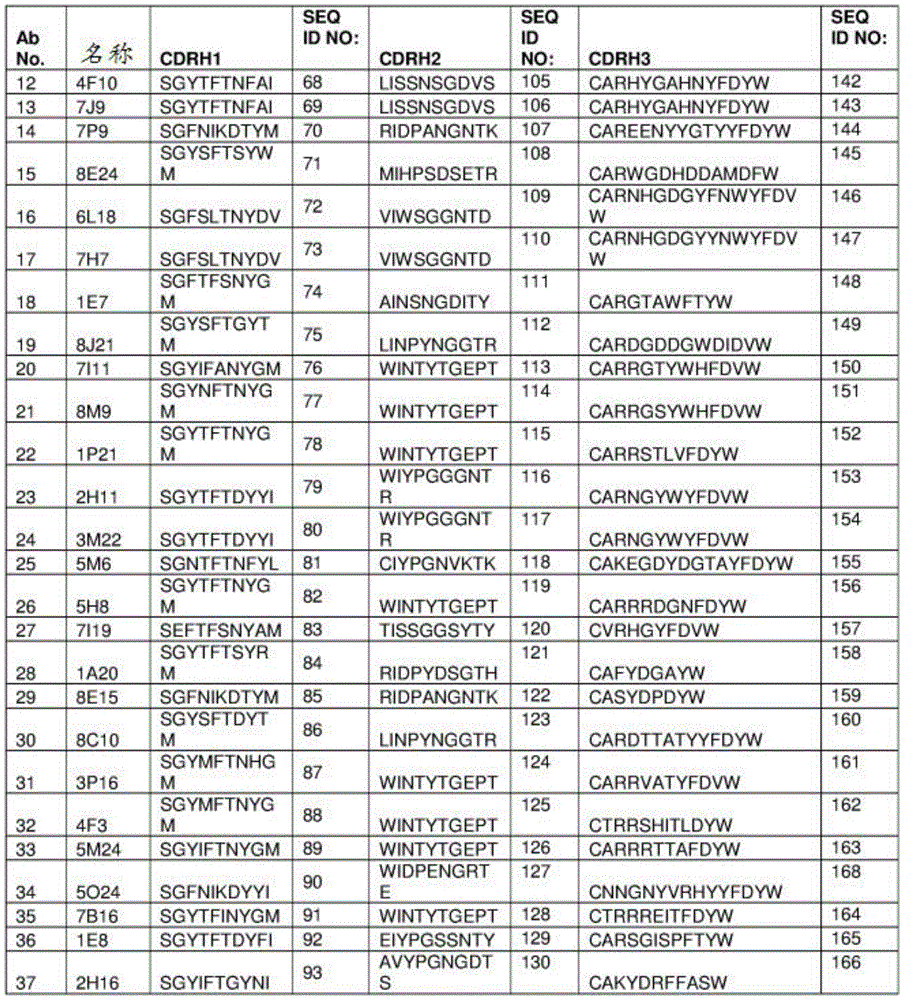
TABLE 2


anti-CD 137 antibodies
CD137 is also known as CDw137, TNFRSF9, 4-1BB, and ILA. anti-CD 137 antibodies, antigen-binding fragments thereof, and ADCs thereof are useful as therapeutic agents to prevent and treat GVHD from hematopoietic stem cells in patients suffering from or at risk of GVHD or autoimmune disease. Additionally, it has been found that ligands that bind CD137, such as human CD137L, can be used as therapeutic agents to prevent or treat patients suffering from, or at risk for, GVHD. These ligands, such as soluble human CD137, may be covalently bound to an effector domain, such as an Fc domain, for example, to promote antibody-dependent cell-mediated cytotoxicity (ADCC).
T cells have been shown to express CD137 because this antigen is a transmembrane TNF receptor superfamily of costimulatory molecules and is expressed on a variety of hematopoietic cells, promoting T cell activation, and regulating T cell proliferation and survival (see, e.g., Cannos et al, J.Immunol.167:1313-1324,2001, the disclosure of which is incorporated herein by reference, as it relates to the expression of CD137 by T cells). Antibodies and antigen-binding fragments thereof can be identified using techniques known in the art and described herein, e.g., by immunization, computational modeling techniques, and in vitro selection methods, e.g., phage display and cell-based display platforms as described below.
anti-CD 137 antibodies useful for the prevention and treatment of GVHD or autoimmune diseases by the methods disclosed herein include those having one or more or all of the following CDRs:
a. CDR-H1(SEQ ID NO:278) having the amino acid sequence STYWIS;
b. CDR-H2 having amino acid sequence KIYPGDSYTNYSPSFQG (SEQ ID NO: 279);
c. CDR-H3 having the amino acid sequence RGYGIFDY (SEQ ID NO: 280);
d. CDR-L1(SEQ ID NO:281) having amino acid sequence SGDNIGDQYAH;
e. CDR-L2 having the amino acid sequence QDKNNRPS (SEQ ID NO: 282); and
f. CDR-L3 having amino acid sequence ATYTGFGSLAV (SEQ ID NO:283)
Additional anti-CD 137 antibodies useful for the prevention and treatment of GVHD and autoimmune diseases by the methods disclosed herein include those having one or more or all of the following CDRs:
a. CDR-H1(SEQ ID NO:278) having the amino acid sequence STYWIS;
b. CDR-H2 having amino acid sequence KIYPGDSYTNYSPSFQG (SEQ ID NO: 279);
c. CDR-H3 having the amino acid sequence RGYGIFDY (SEQ ID NO: 280);
d. CDR-L1(SEQ ID NO:281) having amino acid sequence SGDNIGDQYAH;
e. CDR-L2 having the amino acid sequence QDKNNRPS (SEQ ID NO: 282); and
f. CDR-L3 having amino acid sequence STYTFVGFTTV (SEQ ID NO:284)
Additional anti-CD 137 antibodies include those having one or more or all of the following CDRs:
a. CDR-H1 having the amino acid sequence NSYAIS (SEQ ID NO: 285);
b. CDR-H2(SEQ ID NO:286) having amino acid sequence GIIPGFGTANYAQKFQG;
c. CDR-H3(SEQ ID NO:287) having amino acid sequence RKNEEDGGFDH;
d. CDR-L1(SEQ ID NO:288) having amino acid sequence SGDNLGDYYAS;
e. CDR-L2(SEQ ID NO:289) having the amino acid sequence DDSNRPS; and
f. CDR-L3 having amino acid sequence QTWDGTLHFV (SEQ ID NO: 290).
Additional anti-CD 137 antibodies or ADCs include those having one or more or all of the following CDRs:
a. CDR-H1 having the amino acid sequence SDYYMH (SEQ ID NO: 291);
b. CDR-H2 having amino acid sequence VISGSGSNTYYADSVKG (SEQ ID NO: 292);
c. CDR-H3 having amino acid sequence RLYAQFEGDF (SEQ ID NO: 293);
d. CDR-L1 having amino acid sequence SGDNIGSKYVS (SEQ ID NO:294)
e. CDR-L2 having the amino acid sequence SDSERPS (SEQ ID NO: 295); and
f. CDR-L3 having amino acid sequence QSWDGSISRV (SEQ ID NO: 296).
The foregoing antibody is described, for example, in U.S. patent No. 9,468,678, the disclosure of which is incorporated herein by reference as it relates to anti-CD 137 antibodies and antigen binding fragments thereof. Antibodies and fragments thereof disclosed in U.S. patent No. 9,468,678 may be used in conjunction with the methods disclosed herein.
In another embodiment, the anti-CD 137 antibodies useful in the methods and compositions described herein (including ADC) are the murine anti-CD 137 antibody BBK 2(Thermo Fisher; MS621PABX) or an anti-CD 137 antibody comprising an antigen binding region corresponding to the BBK2 antibody. The BBK2 antibody (which may also be referred to as a BBK-2 antibody or an anti-4-1 BB antibody) is a mouse monoclonal antibody (IgG1, kappa) that binds to the extracellular domain of human 4-1BB recombinant protein (4-1BB also referred to as CD 137). In certain embodiments, the methods and compositions of the present disclosure include anti-CD 137 antibodies comprising binding regions (e.g., CDRs) of a BBK2 antibody. In another embodiment, the methods and compositions of the present disclosure comprise antibodies that competitively inhibit the binding of the BBK2 antibody to its epitope on CD 137. In certain embodiments, the anti-CD 137 antibody is a humanized BBK2 or a chimeric BBK 2.
In one embodiment, the methods and compositions described herein include chimeric anti-CD 137(ch-BBK2) antibodies comprising a variable heavy chain region and a variable light chain region of BBK 2. In certain embodiments, the chimeric BBK2 antibody is an IgG1 antibody comprising human constant regions. The heavy chain amino acid sequence of ch-BBK2 is described in SEQ ID NO:297, and the light chain amino acid sequence of ch-BBK2 is described in SEQ ID NO: 298. The CDR regions (CDR1, CDR2, and CDR3) of each heavy and light chain sequence are described in bold below. The variable regions are italicized.


The foregoing CDR regions (and BBK2 antibodies) are described in Lee et al (2002) European J of immunology 29(5): 449-452. Thus, in one embodiment, the VH CDR amino acid sequences of anti-CD 137 antibody BBK2 (including ch-BBK2) are as follows: SGYTFTSYW (VH CDR 1; SEQ ID NO: 299); NIYPSDSYT (VH CDR 2; SEQ ID NO:300) and TRNGVEGYPHYYAME (VH CDR 3; SEQ ID NO: 301). The VL CDR amino acid sequences of anti-CD 137 antibody BBK2 (including ch-BBK2) are as follows: SQDLSNH (VL CDR 1; SEQ ID NO: 302); YYTS (VL CDR 2; SEQ ID NO:303) and CQQGYTLPY (VL CDR 3; SEQ ID NO: 304).
Alternatively, the CDR regions of BBK2 may be defined according to Kabat numbering. The CDRs defined by Kabat numbering describe each heavy and light chain sequence below (described in bold below). The variable region of BBK2 is italicized.


Thus, in one embodiment, the VH CDR amino acid sequences of anti-CD 137 antibody BBK2 (including ch-BBK2) are as follows: SYWIN (VH CDR 1; SEQ ID NO: 305); NIYPSDSYTNYNQKFKD (VH CDR 2; SEQ ID NO:306) and NGVEYPHYYAMEY (CDR 3; SEQ ID NO:307), and the VL CDR amino acid sequences of the anti-CD 137 antibody BBK2 (including ch-BBK2) are as follows: RASQDLSNHLY (VL CDR 1; SEQ ID NO: 308); YTSRLHS (VL CDR 2; SEQ ID NO:309) and QQGYTLPYT (VL CDR 3; SEQ ID NO: 310).
The heavy chain variable region of BBK2 is set forth in SEQ ID NO:311
QVQLQQPGAELVRPGASVKLSCKASGYTFTSYWINWVKQRPGQGLEWIGNIYPSDSYTNYNQKFKDKATLTVDKSSNTVYMQLNSPTSEDSAVYYCTRNGVEGYPHYYAMEYWGQGTSVTVSS are provided. The light chain variable region of BBK2 is set forth in SEQ ID NO:312
DIQMTQTTSALSASLGDRVTIGCRASQDLSNHLYWYQQKPDGTVKLLIYYTSRLHSGVPSRFSGSGSGTDYSLTIRNLEQEDVATYFCQQGYTLPYTFGGGTKLEIK are provided. anti-CD 137 antibodies (including anti-CD 137 antibodies) can comprise the heavy and light chain variable region amino acid sequences as set forth in SEQ ID NOS: 311 and 312, respectively.
In one embodiment, an anti-CD 137 antibody, such as a chimeric (ch-BBK2) antibody or a humanized BBK2 antibody, comprises a heavy chain variable region comprising CDR1 comprising the amino acid sequence of SEQ ID NO:305, CDR2 comprising the amino acid sequence of SEQ ID NO:306, and CDR3 comprising the amino acid sequence of SEQ ID NO: 307; and comprises a light chain variable region comprising CDR1 comprising the amino acid sequence of SEQ ID NO:308, CDR2 comprising the amino acid sequence of SEQ ID NO:309 and CDR3 comprising the amino acid sequence of SEQ ID NO: 310.
In one embodiment, an anti-CD 137 antibody, such as a chimeric (ch-BBK2) antibody or a humanized BBK2 antibody, comprises a heavy chain variable region comprising CDR1 comprising the amino acid sequence of SEQ ID NO:299, CDR2 comprising the amino acid sequence of SEQ ID NO:300, and CDR3 comprising the amino acid sequence of SEQ ID NO: 301; and comprises a light chain variable region comprising CDR1 comprising the amino acid sequence of SEQ ID NO:302, CDR2 comprising the amino acid sequence of SEQ ID NO:303 and CDR3 comprising the amino acid sequence of SEQ ID NO: 304.
Thus, BBK2, humanized BBK2, or chimeric BBK2 antibodies may be used for the anti-CD 137 ADCs and methods described herein. Each of these antibodies can be conjugated to any of the cytotoxins described below using methods known in the art and those described herein.
Additional sequences of the anti-CD 137 antibodies or binding fragments described herein are provided in table 5.
Other anti-CD 137 antibodies useful for conjugation to the cytotoxins described herein can be identified using techniques known in the art (e.g., hybridoma production). Hybridomas can be prepared using the murine system. Protocols for immunization and subsequent isolation of splenocytes for fusion are known in the art. Fusion partners and procedures for hybridoma production are also known. Human anti-CD 137 antibodiesCan be used in HuMAb- Or XenoMouseTMIs produced. In preparing the anti-CD 137 antibody, the CD137 antigen is isolated and/or purified. The CD137 antigen may be a CD137 fragment of the extracellular domain of CD 137. Immunization of animals can be carried out by any method known in the art. See, for example, Harlow and Lane, Antibodies: A Laboratory Manual, New York: Cold Spring Harbor Press, 1990. Methods for immunizing animals (e.g., mice, rats, sheep, goats, pigs, cattle, and horses) are well known in the art. See, e.g., Harlow and Lane, supra, and U.S. patent No. 5,994,619. The CD137 antigen may be administered with an adjuvant to stimulate an immune response. Adjuvants known in the art include complete or incomplete freund's adjuvant, RIBI (muramyl dipeptide), or ISCOM (immune stimulating complex). After immunization of an animal with the CD137 antigen, antibody-producing immortalized cell lines are prepared from cells isolated from the immunized animal. Following immunization, the animals are sacrificed and lymph nodes and/or splenic B cells are immortalized by methods known in the art (e.g., oncogene transfer, oncogenic viral transduction, exposure to oncogenic or mutant compounds, fusion with immortalized cells such as myeloma cells, and inactivation of tumor suppressor genes). See, e.g., Harlow and Lane, supra. Hybridomas can be selected, cloned, and further screened for desirable characteristics, including robust growth, high antibody production, and desirable antibody characteristics.
anti-CD 137 antibodies can be produced from an isolated nucleic acid molecule comprising a nucleotide sequence encoding the amino acid sequence of a CD137 binding molecule provided by the present disclosure. The amino acid sequence encoded by the nucleotide sequence can be any portion of an antibody, e.g., a CDR, a sequence comprising one, two, or three CDRs, a variable region of a heavy chain, a variable region of a light chain, or can be a full-length heavy chain or a full-length light chain. The nucleic acids of the present disclosure may be, for example, DNA or RNA, and may or may not comprise an intron sequence. Typically, the nucleic acid is a cDNA molecule.
In addition to the antibodies and antigen-binding fragments, a soluble CD137 ligand, such as human CD137 ligand, may be administered to a patient according to the methods described herein to pre-treat the patient prior to hematopoietic stem cell transplantation therapy. For example, a CD137 ligand, such as a human CD137 ligand, can be conjugated to a cytotoxin (e.g., according to the methods described below or known in the art) or another effector molecule (e.g., an Fc domain). Maytansine cytotoxins for use in the methods described herein include, for example, a human CD137 ligand-IgG 1 Fc conjugate, a human CD137 ligand-IgG 2 Fc conjugate, a human CD137 ligand-IgG 3 Fc conjugate, a human CD137 ligand-IgG 4 Fc conjugate, a human CD137 ligand-IgA Fc conjugate, a human CD137 ligand-IgE Fc conjugate, a human CD137 ligand-IgM Fc conjugate, and a human CD137 ligand-IgD Fc conjugate.
Antibodies and ligands useful in conjunction with the compositions and methods described herein include variants of those antibodies described above, e.g., antibody fragments with or without an Fc domain, as well as humanized variants of non-human antibodies and antibody-like protein scaffolds (e.g., of antibodies described herein10Fn3 domain) containing one or more or all CDRs or equivalent regions thereof of an antibody, antibody fragment, or soluble ligand described herein.
anti-CD 252 antibodies
The invention also provides antibodies or antigen-binding fragments thereof (also referred to as OX40 ligand (OX40L), protein NCBI reference sequence: NP-003317.1; Uniprot accession No. P23510; SEQ ID NO:313 or 314) that are capable of binding CD252, useful as therapeutic agents for the prevention and treatment of GVHD. Such antibodies can be used alone or conjugated to cytotoxins as Antibody Drug Conjugates (ADCs).
In one embodiment, the methods and compositions described herein (e.g., ADCs) include an anti-CD 252 antibody whose heavy and light chain amino acid sequences are set forth in SEQ ID NOs 315 and 316, respectively. In one embodiment, the anti-CD 252 antibody, or antigen-binding portion thereof, comprises the heavy chain variable region as set forth in the amino acid sequence of SEQ ID NO:315 and the light chain variable region as set forth in the amino acid sequence of SEQ ID NO: 316. In one embodiment, the anti-CD 252 antibody, or antigen-binding portion thereof, comprises a heavy chain variable region comprising the CDRs as set forth in the amino acid sequence of SEQ ID NO:315 and a light chain variable region comprising the CDRs as set forth in the amino acid sequence of SEQ ID NO: 316. The amino acid sequences of SEQ ID NO315 and 316 are provided below.
In certain embodiments, the anti-CD 252 antibody or antigen-binding portion thereof comprises a heavy chain variable region comprising the CDRs as set forth in the amino acid sequences of SEQ ID NO:317-319 and a light chain variable region comprising the CDRs as set forth in the amino acid sequences of SEQ ID NO: 320-322. The amino acid sequences of SEQ ID NO 3-8 are provided below.
anti-CD 252 VH amino acid sequence (CDR sequences defined by IMGT below)
EVQLVESGGGLVQPGGSLRLSCAASGFTFSNYAMNWVRQAPGKGLEWVSTISGSGGATRYADSVKGRFTISRDNSRNTVYLQMNSLRVEDTAVFYCTKDRLIMATVRGPYYYGMDVWGQGTTVTVSS(SEQ ID NO:315)
CDR-H1:GFTFSNYA(SEQ ID NO:317)
CDR-H2:ISGSGGAT(SEQ ID NO:318)
CDR-H3:TKDRLIMATVRGPYYYGMDV(SEQ ID NO:319)
anti-CD 252 VL amino acid sequence (CDR sequences defined by IMGT below)
DIQMTQSPSSLSASVGDRVTITCRASQSISSYLNWYQQKPGKAPNLLIYAASSLQSGVPSRFSGSGSETDFTLTISSLQPEDFATYYCQQSHSVSFTFGPGTKVDIK(SEQ ID NO:316)
CDR-L1:QSISSY(SEQ ID NO:320)
CDR-L2:AAS(SEQ ID NO:321)
CDR-L3:QQSHSVSFT(SEQ ID NO:322)
In one embodiment, the anti-CD 252 antibody used in the methods and compositions disclosed herein is a whole antibody comprising a heavy chain variable region as set forth in the amino acid sequence of SEQ ID NO:315 and a light chain variable region as set forth in the amino acid sequence of SEQ ID NO: 316. In one embodiment, the anti-CD 252 antibody is genetically engineered to have a short half-life.
In one embodiment, the anti-CD 252 antibody useful in the methods and compositions described herein (including ADCs) is an antibody selected from 11c3.1(Biologend, catalog #326302), 159403(R & D system, catalog # MAB10541), 159408(R & D system, catalog # MAB1054), MM0505-8S23(Novus, catalog # NBP2-11969) or oxeruzumab (oxelumab) (Novus catalog # NBP2)
In one embodiment, the anti-CD 252 antibodies useful in the methods and compositions described herein (including ADCs) are the murine monoclonal anti-CD 252 antibody 11C3.1 or an anti-CD 252 antibody comprising an antigen binding region corresponding to the 11C3.1 antibody. 11C3.1 (sold by Biolegend Cat, Cat. No.326302 (2 months and 27 days 2019)).
In one embodiment, the anti-CD 252 antibody comprises a heavy chain comprising the CDR1, CDR2, and CDR3 of the anti-CD 252 antibody 11C3.1 and a light chain variable region comprising the CDR1, CDR2, and CDR3 of the anti-CD 252 antibody 11C 3.1. In another embodiment, the anti-CD 252 antibody used in the compositions and methods described herein is a humanized anti-CD 252 antibody.
In one embodiment, the anti-CD 252 antibodies useful in the methods and compositions described herein (including ADCs) are murine monoclonal anti-CD 252 antibody 159403 or an anti-CD 252 antibody comprising an antigen binding region corresponding to the 159403 antibody. 159403 (sold by the R & D system, catalog # MAB10541 (date 2019, 2 months and 27 days)).
In one embodiment, the anti-CD 252 antibody comprises a heavy chain comprising the CDRs 1, CDR2 and CDR3 of the anti-CD 252 antibody 159403 and a light chain variable region comprising the CDRs 1, CDR2 and CDR3 of the anti-CD 252 antibody 159403. In another embodiment, the anti-CD 252 antibody used in the compositions and methods disclosed herein is a humanized 159403 antibody.
In one embodiment, the anti-CD 252 antibodies useful in the methods and compositions described herein (including ADCs) are murine monoclonal anti-CD 252 antibody 159408 or an anti-CD 252 antibody comprising an antigen binding region corresponding to the 159408 antibody. 159408 (sold by the R & D system, catalog # MAB1054 (date 2019, 2 months and 27 days)).
In one embodiment, the anti-CD 252 antibody comprises a heavy chain comprising the CDRs 1, CDR2 and CDR3 of the anti-CD 252 antibody 159408 and a light chain variable region comprising the CDRs 1, CDR2 and CDR3 of the anti-CD 252 antibody 159408. In another embodiment, the anti-CD 252 antibody used in the compositions and methods disclosed herein is a humanized 159408 antibody.
In one embodiment, the anti-CD 252 antibodies useful in the methods and compositions described herein (including ADCs) are the murine monoclonal anti-CD 252 antibody MM0505-8S23 or an anti-CD 252 antibody comprising an antigen binding region corresponding to the MM0505-8S23 antibody. MM0505-8S23 (sold by Novus catalog # NBP2-11969 (2 months and 27 days 2019). The antibody is produced by a hybridoma (a mouse myeloma, also known as OX40 ligand, fused to spleen cells of a mouse immunized with human TNFSF 4).
In one embodiment, the anti-CD 252 antibody comprises a heavy chain comprising the CDRs 1, CDRs 2 and CDRs 3 of the anti-CD 252 antibody MM0505-8S23 and a light chain variable region comprising the CDRs 1, CDRs 2 and CDRs 3 of the anti-CD 252 antibody MM0505-8S 23. In another embodiment, the anti-CD 252 antibody used in the compositions and methods disclosed herein is a humanized MM0505-8S23 antibody.
In one embodiment, the anti-CD 252 antibodies useful in the methods and compositions described herein (including ADCs) are the rabbit monoclonal anti-CD 252 antibody oxepirumab or an anti-CD 252 antibody comprising an antigen-binding region corresponding to an oxepirumab antibody. Oxepimumab (sold by Novus, catalog # NBP2-52687-0.1 (2 months and 27 days 2019)).
In one embodiment, the anti-CD 252 antibody comprises a heavy chain comprising CDR1, CDR2, and CDR3 of the anti-CD 252 antibody oxepirumab and a light chain variable region comprising CDR1, CDR2, and CDR3 of the anti-CD 252 antibody oxepirumab. In another embodiment, the anti-CD 252 antibodies used in the compositions and methods disclosed herein are humanized oxepimumab antibodies. In some embodiments, the anti-CD 252 antibody, or antigen-binding portion thereof, comprises a heavy chain as set forth in the amino acid sequence of SEQ ID NO:323 and a light chain as set forth in the amino acid sequence of SEQ ID NO: 324. In some embodiments, the anti-CD 252 antibody, or antigen-binding portion thereof, comprises a heavy chain variable region as set forth in the amino acid sequence of SEQ ID NO331 and a light chain variable region as set forth in the amino acid sequence of SEQ ID NO 332. In one embodiment, the anti-CD 252 antibody or antigen-binding portion thereof comprises a heavy chain variable region comprising the CDRs as set forth in the amino acid sequences of SEQ ID NO:325-327 and a light chain variable region comprising the CDRs as set forth in the amino acid sequences of SEQ ID NO: 328-330. In one embodiment, the antibody is a whole antibody comprising the heavy chain variable region as set forth in the amino acid sequence of SEQ ID NO:331 and the light chain variable region as set forth in the amino acid sequence of SEQ ID NO: 332. The amino acid sequences of SEQ ID NO 323-330 are provided below.
The full-length heavy chain sequence of oxepimumab (the following CDR sequences are defined by IMGT; the heavy chain variable region (SEQ ID NO: 331) is underlined):
EVQLLESGGGLVQPGGSLRLSCAASGFTFNSYAMSWVRQAPGKGLEWVSIISGSGGFTYYADSVKGRF TISRDNSRTTLYLQMNSLRAEDTAVYYCAKDRLVAPGTFDYWGQGALVTVSSASTKGPSVFPLAPSSKSTSGGTAALGCLVKDYFPEPVTVSWNSGALTSGVHTFPAVLQSSGLYSLSSVVTVPSSSLGTQTYICNVNHKPSNTKVDKKVEPKSCDKTHTCPPCPAPELLGGPSVFLFPPKPKDTLMISRTPEVTCVVVDVSHEDPEVKFNWYVDGVEVHNAKTKPREEQYNSTYRVVSVLTVLHQDWLNGKEYKCKVSNKALPAPIEKTISKAKGQPREPQVYTLPPSRDELTKNQVSLTCLVKGFYPSDIAVEWESNGQPENNYKTTPPVLDSDGSFFLYSKLTVDKSRWQQGNVFSCSVMHEALHNHYTQKSLSLSPG(SEQ ID NO:323)
CDR-H1:GFTFNSYA(SEQ ID NO:325)
CDR-H2:ISGSGGFT(SEQ ID NO:326)
CDR-H3:AKDRLVAPGTFDY(SEQ ID NO:327)
the full-length light chain sequence of oxepimumab (the following CDR sequences are defined by IMGT; the light chain variable region (SEQ ID NO: 332) is underlined):
DIQMTQSPSSLSASVGDRVTITCRASQGISSWLAWYQQKPEKAPKSLIYAASSLQSGVPSRFSGSGSG TDFTLTISSLQPEDFATYYCQQYNSYPYTFGQGTKLEIKRTVAAPSVFIFPPSDEQLKSGTASVVCLLNNFYPREAKVQWKVDNALQSGNSQESVTEQDSKDSTYSLSSTLTLSKADYEKHKVYACEVTHQGLSSPVTKSFNRGEC(SEQ ID NO:324)
CDR-L1:QGISSW(SEQ ID NO:328)
CDR-L2:AAS(SEQ ID NO:329)
CDR-L3:QQYNSYPYT(SEQ ID NO:330)
the anti-CD 252 antibodies or binding fragments described herein may also comprise modifications and/or mutations that alter the properties of the antibody and/or fragment, such as those that increase half-life, increase or decrease ADCC, and the like. As is known in the art.
In one embodiment, the anti-CD 252 antibodies or binding fragments thereof for use in the methods and compositions disclosed herein comprise a variant Fc region, wherein the variant Fc region comprises at least one amino acid modification relative to a wild-type Fc region such that the molecule has an altered affinity for fcyr. Certain amino acid positions within the Fc region are known to be in direct contact with Fc γ R by crystallographic studies. In particular, amino acids 234-. (see Sondermann et al, 2000Nature,406:267- > 273). Thus, an antibody described herein may comprise a variant Fc region comprising a modification of at least one residue, which modification is in direct contact with an fcyr based on structural and crystallographic analysis. In one embodiment, the Fc region of the anti-CD 252 antibody (or fragment thereof) comprises an amino acid substitution at amino acid 265 according to the EU index as in Kabat et al, Sequences of Proteins of Immunological Interest, 5 th edition, published Health Service, NH1, MD (1991), which is expressly incorporated herein by reference. "EU index as in Kabat" refers to the numbering of the human IgG1 EU antibody. In one embodiment, the Fc region comprises the D265A mutation. In one embodiment, the Fc region comprises the D265C mutation. In some embodiments, the Fc region of the anti-CD 252 antibody (or fragment thereof) comprises an amino acid substitution at amino acid 234 (according to the EU index as in Kabat). In one embodiment, the Fc region comprises the L234A mutation. In some embodiments, the Fc region of the anti-CD 252 antibody (or fragment thereof) comprises an amino acid substitution at amino acid 235 (according to the EU index as in Kabat). In one embodiment, the Fc region comprises the L235A mutation. In yet another embodiment, the Fc region comprises the L234A and L235A mutations. In another embodiment, the Fc region comprises the D265C, L234A, and L235A mutations.
In certain aspects, a variant IgG Fc domain comprises one or more amino acid substitutions resulting in a reduction or abolition of binding affinity for fcyr and/or C1q as compared to a wild-type Fc domain that does not comprise the one or more amino acid substitutions. Fc binding interactions are essential for a variety of effector functions and downstream signaling events, including but not limited to antibody-dependent cell-mediated cytotoxicity (ADCC) and complement-dependent cytotoxicity (CDC). Thus, in certain aspects, an anti-CD 252 antibody comprising a modified Fc region (e.g., comprising the L234A, L235A, and D265C mutations) has significantly reduced or eliminated effector function.
Affinity for the Fc region can be determined using a variety of techniques known in the art, such as, but not limited to, equilibrium methods (e.g., enzyme-linked immunosorbent assay (ELISA); Analytical Biochemistry, KinExA, Rathanawami et al, volume 373:52-60, 2008; or Radioimmunoassay (RIA)), or other mechanisms by surface plasmon resonance assay or kinetic-based assay (e.g., BIACORE)TMAnalysis or OctetTMAnalysis (forteBIO)) and other methods such as indirect binding assays, competitive binding assays, Fluorescence Resonance Energy Transfer (FRET), gel electrophoresis, and chromatography (e.g., gel filtration). These and other methods may utilize labels on one or more components being examined and/or employ a variety of detection methods, including but not limited to chromogenic, fluorescent, luminescent, or isotopic labeling. A detailed description of binding affinity and kinetics can be found in Paul, w.e., editors, Fundamental Immunology, 4 th edition, Lippincott-Raven, philiadelphia (1999), which focuses on antibody-immunogen interactions. One example of a competitive binding assay is a radioimmunoassay comprising incubating a labeled antigen with an antibody of interest in the presence of increasing amounts of unlabeled antigen, and detecting the antibody bound to the labeled antigen. The affinity and binding bias rate of the target antibody to a particular antigen can be determined from the data by scatchard plot analysis. Competition with the second antibody can also be determined using radioimmunoassay. In this case, the antigen is incubated with the antibody of interest conjugated to a labeling compound in the presence of increasing amounts of unlabeled secondary antibody.
The antibodies of the invention may be further engineered by introducing additional Fc mutations to further adjust antibody half-life, for example, as described in (Dall' Acqua et al (2006) J Biol Chem 281:23514-24), (Zalevsky et al (2010) Nat Biotechnol 28:157-9), (Hinton et al (2004) J Biol Chem 279:6213-6), (Hinton et al (2006) J Immunol 176:346-56), (Shields et al (2001) J Biol Chem 276:6591-604), (Petkova et al (2006) Int Immunol 18:1759-69), (Datta-Mannan et al (2007) Drug Metab Dispos 35:86-94), (Vaccaro et al (2005) Nat Biotechnol 23:1283-8), (Yeung et al (2010) Cancer Res 70:3269-77) and (Kim et al (281j 29) J1999) Eubacterium 29: 250-25 and including those described, 252. 253, 254, 256, 257, 307, 376, 380, 428, 434, and 435 bits. Exemplary mutations that can be made individually or in combination are the T250Q, M252Y, 1253A, S254T, T256E, P2571, T307A, D376V, E380A, M428L, H433K, N434S, N434A, N434H, N434F, H435A and H435R mutations.
Thus, in one embodiment, the Fc region comprises a mutation that results in a reduction in half-life. In certain instances where the antibody is expected to act as a short-lived therapeutic agent (e.g., the pretreatment step described herein, wherein HSCs are administered after administration of the antibody), an antibody with a short half-life may be advantageous. Ideally, the antibody is substantially cleared prior to delivery of HSCs, which typically also express CD117, but are not targets of anti-CD 117 antibodies, unlike endogenous stem cells. In one embodiment, the Fc region comprises a mutation at position 435 (EU index according to Kabat). In one embodiment, the mutation is the H435A mutation.
In one embodiment, the anti-CD 252 antibodies described herein have a half-life of equal to or less than 14 hours, equal to or less than 13 hours, equal to or less than 12 hours, or equal to or less than 11 hours. In one embodiment, the anti-CD 252 antibody described herein has a half-life of equal to or less than 24 hours, equal to or less than 22 hours, equal to or less than 20 hours, or equal to or less than 18 hours, equal to or less than 16 hours, equal to or less than 14 hours, equal to or less than 13 hours, equal to or less than 12 hours, equal to or less than 11 hours. In one embodiment, the half-life of the antibody is about 1 hour to about 20 hours, about 2 hours to about 18 hours, about 4 hours to about 16 hours, about 6 hours to about 14 hours, about 8 hours to about 12 hours, about 11 hours to about 24 hours, about 12 hours to about 22 hours, about 10 hours to about 20 hours, about 8 hours to about 18 hours, about 1 hour to about 6 hours, about 2 hours to about 5 hours, about 3 hours to about 4 hours, or about 14 hours to about 24 hours.
In some aspects, the Fc region comprises two or more mutations that confer reduced half-life and greatly reduce or completely eliminate effector function of the antibody. In some embodiments, the Fc region comprises a mutation that results in a reduction in half-life and a mutation of at least one residue that can be directly contacted with an Fc γ R (e.g., based on structural and crystallographic analysis). In one embodiment, the Fc region comprises the H435A mutation, the L234A mutation, and the L235A mutation. In one embodiment, the Fc region comprises the H435A mutation and the D265C mutation. In one embodiment, the Fc region comprises the H435A mutation, the L234A mutation, the L235A mutation, and the D265C mutation.
In some embodiments, the antibody or antigen-binding fragment thereof is conjugated to a cytotoxin (e.g., amatoxin) through a cysteine residue in the Fc domain of the antibody or antigen-binding fragment thereof. In some embodiments, the cysteine residue is introduced by mutation in the Fc domain of the antibody or antigen-binding fragment thereof. For example, the cysteine residue may be selected from Cys118, Cys239 and Cys 265. In one embodiment, the Fc region of the anti-CD 252 antibody (or fragment thereof) comprises an amino acid substitution at amino acid 265 (according to the EU index as in Kabat). In one embodiment, the Fc region comprises the D265C mutation. In one embodiment, the Fc region comprises the D265C and H435A mutations. In one embodiment, the Fc region comprises the D265C, L234A, and L235A mutations. In one embodiment, the Fc region comprises the D265C, L234A, L235A, and H435A mutations.
In some embodiments of these aspects, a cysteine residue is naturally occurring in the Fc domain of the antibody or antigen-binding fragment thereof. For example, the Fc domain may be an IgG Fc domain, such as a human IgG1 Fc domain, and the cysteine residue may be selected from Cys261, Csy321, Cys367, and Cys 425.
The variant Fc domains described herein are defined in terms of the amino acid modifications that make up them. For all amino acid substitutions discussed herein in relation to the Fc region, the numbering is always according to the EU index. Thus, for example, D265C is an Fc variant in which aspartic acid (D) at EU position 265 is substituted with cysteine (C) relative to the parent Fc domain. Likewise, for example, D265C/L234A/L235A defines variant Fc variants having substitutions at EU positions 265(D to C), 234(L to a), and 235(L to a) relative to the parent Fc domain. Variants may also be specified according to their final amino acid composition at the mutated EU amino acid position. For example, the L234A/L235A mutant may be referred to as LALA. Note that the order in which the substitutions are provided is arbitrary.
In one embodiment, the anti-CD 252 antibody or antigen-binding fragment thereof comprises a variable region having an amino acid sequence that is at least 95%, 96%, 97%, or 99% identical to SEQ ID NO disclosed herein. Alternatively, the anti-CD 252 antibody or antigen-binding fragment thereof comprises CDRs comprising SEQ ID NOs disclosed herein, wherein the framework regions of the variable regions described herein have an amino acid sequence that is at least 95%, 96%, 97%, or 99% identical to the SEQ ID NOs disclosed herein.
In certain embodiments, the anti-CD 252 antibody or antigen-binding fragment thereof has an off-rate, which is particularly advantageous when used as part of a conjugate. For example, in certain embodiments, the anti-CD 252 antibody has an off-rate constant (Koff) of 1x10 for human CD252 and/or rhesus CD252-2To 1x10⁻³、1x10⁻³To 1x10⁻⁴、1x10⁻⁵To 1x10⁻⁶、1x10⁻⁶To 1x10⁻⁷Or 1x10⁻⁷To 1x10⁻⁸As measured by bio-layer interferometry (BLI). In some embodiments, the antibody or antigen-binding fragment thereof is administered at a K of about 100nM or less, about 90nM or less, about 80nM or less, about 70nM or less, about 60nM or less, about 50nM or less, about 40nM or less, about 30nM or less, about 20nM or less, about 10nM or less, about 8nM or less, about 6nM or less, about 4nM or less, about 2nM or less, about 1nM or less, as determined by biolayer interferometry (BLI)DBinds CD252 (e.g., human CD252 and/or rhesus CD 252). In some embodiments, the antibody or antigen-binding fragment thereof is administered in a dose of about 90nM to 100nM, about 80nM to 90nM, about 70nM to 80nM, about 60nM to 70nM, about 50nM to 60nM, about 40nM to 50nM, about 30nM to 40nM, about 50nM to 50nM as determined by biolayer interferometry (BLI)A K of 20nM to 30nM, about 10nM to 20nM, about 8nM to 10nM, about 6nM to 8nM, about 4nM to 6nM, about 2nM to 4nM, about 1nM to 2nM, or about 1nM or less DBinds CD252 (e.g., human CD252 and/or rhesus CD 252).
The antibodies and binding fragments thereof disclosed herein can be used in conjugates, as described in more detail below.
Exemplary antigen-binding fragments of the foregoing antibodies include double variable immunoglobulin domains, single chain Fv molecules (scFv), diabodies, triabodies, nanobodies, antibody-like protein scaffolds, Fv fragments, Fab fragments, F (ab')2Molecular and tandem bis-scFv, and the like. The anti-CD 252 antibodies described herein can be in the form of full-length antibodies, bispecific antibodies, double variable domain antibodies, multi-chain or single chain antibodies, and/or binding fragments that specifically bind to human CD252, including, but not limited to, Fab ', (Fab')2, Fv, scFv (single chain Fv), surrogate antibodies (including surrogate light chain constructs), single domain antibodies, camelized antibodies, and the like. They may also be or be derived from any isotype including, for example, IgA (e.g. IgA1 or IgA2), IgD, IgE, IgG (e.g. IgG1, IgG2, IgG3 or IgG4) or IgM. In some embodiments, the anti-CD 252 antibody is an IgG (e.g., IG1, IG2, IG3, or IG 4).
In one embodiment, the anti-CD 252 antibody or antigen-binding fragment thereof comprises a variable region having an amino acid sequence that is at least 95%, 96%, 97%, or 99% identical to SEQ ID NO disclosed herein. Alternatively, the anti-CD 252 antibody or antigen-binding fragment thereof comprises CDRs comprising SEQ ID NOs disclosed herein, wherein the framework regions of the variable regions described herein have an amino acid sequence that is at least 95%, 96%, 97%, or 99% identical to the SEQ ID NOs disclosed herein.
anti-CD 45 antibodies
Antibodies and antigen-binding fragments capable of binding to human CD45 (NCBI gene reference: NM-080921.3, NCBI protein reference: NP-563578.2), including those capable of binding the CD45RO isoform, may be used in conjunction with the compositions and methods disclosed herein, for example, to facilitate hematopoietic stem cell transplantation in need of hematopoietic stem cell transplantation therapy. In one embodiment, the compositions and methods disclosed herein include an anti-CD 45 antibody or ADC that binds human CD45RO, as described in the amino acid sequence of SEQ ID No. 336. Antibodies that bind to the various isoforms of CD45 disclosed herein are also contemplated for use in the methods and compositions disclosed herein. Multiple isoforms of CD45 are derived from alternative splicing of 34 exons in the primary transcript. Splicing of exons 4, 5, 6 and possibly 7 results in a variety of CD45 variants. Selective exon expression was observed in the CD45 isoforms described in table 3 below.
TABLE 3 exon expression of various CD45 isoforms
| CD45 isoforms | Exon expression pattern |
| CD45RA(SEQ ID NO:333) | Expression of |
| CD45RB(SEQ ID NO:334) | Expression of |
| CD45RC(SEQ ID NO:335) | Expression of |
| CD45RO(SEQ ID NO:336) | Non-expression of exons 4-6 |
Alternative splicing can result in a single exon or a combination of exons expressed in multiple isoforms of the CD45 protein (e.g., CD45RA, CD45RAB, CD45 RABC). In contrast, CD45RO lacks expression of exons 4-6 and results from a combination of exons 1-3 and 7-34. Evidence suggests that exon 7 can also be excluded from the protein, resulting in splicing together of exons 1-3 and 8-34. This protein designated E3-8 has been detected at the mRNA level, but has not been identified by flow cytometry.
CD45RO is currently the only known isoform of CD45 expressed on hematopoietic stem cells. CD45RA and CD45RABC were not detected or excluded from the hematopoietic stem cell phenotype. Studies in mice have shown that CD45RB is expressed on fetal hematopoietic stem cells, but not on adult bone marrow hematopoietic stem cells. Notably, the rate of polymorphism in exon 6 of CD45RC found in asian populations is high (polymorphism in exon 6 of CD45RC found in about 25% of japanese population). This polymorphism resulted in high expression of CD45RO and reduced levels of CD45RA, CD45RB and CD45 RC. Additionally, CD45RA variants (e.g., CD45RAB and CD45RAC) show polymorphisms in exon 4, which are associated with autoimmune disease.
The presence of CD45RO on hematopoietic stem cells and its relatively limited expression on other immune cells (e.g., T and B lymphocyte subsets and various myeloid cells) makes CD45RO particularly suitable as a target for pretreatment therapy for patients in need of hematopoietic stem cell transplantation. Since CD45RO lacks expression of only exons 4, 5, and 6, its use as an immunogen enables screening for pan CD45 Abs and CD45RO specific antibodies.
anti-CD 45 antibodies that may be used in conjunction with the patient modulation methods described herein include anti-CD 45 antibodies and antigen-binding portions thereof. Antigen-binding portions of antibodies are well known in the art and can be readily constructed based on the antigen-binding regions of antibodies. In some exemplary embodiments, the anti-CD 45 antibody used in conjunction with the pretreatment methods described herein can be a monoclonal antibody or antigen-binding fragment thereof, a polyclonal antibody or antigen-binding fragment thereof, a humanized antibody or antigen-binding fragment thereof, a fully human antibody or antigen-binding fragment thereof, a chimeric antibody or antigen-binding fragment thereof, a bispecific antibody or antigen-binding fragment thereof, a double variable immunoglobulin domain, a single chain Fv molecule (scFv), a diabody, a triabody, a nanobody, an antibody-like protein scaffold, an Fv fragment, a Fab fragment, a F (ab') 2 molecule, or a tandem double scFv. Exemplary anti-CD 45 antibodies that may be used in whole or in part in the ADCs and methods described herein are provided below.
In one embodiment, the anti-CD 45 antibody is or is derived from clone HI30 (available from seq id No.) (San Diego, CA) or humanized variants thereof. Humanization of antibodies can be performed according to procedures known in the art (as described, for example, in example 7 below) by replacing framework residues and constant region residues of a non-human antibody with framework residues and constant region residues of a germline human antibody. Additional anti-CD 45 antibodies that can be used in conjunction with the methods described herein include the anti-CD 45 antibodies ab10558, EP322Y, MEM-28, ab10559, 0.N.125, F10-89-4, HIe-1, 2B11, YTH24.5, PD7/26/16, F10-89-4, 1B7, ab154885, B-A11, phosphor S1007, ab170444, EP350, Y321, GA90, D3/9, X16/99, and LT45 (which can be selected from the group consisting of
 (commercially available from Cambridge, MA) and humanized variants thereof. Additional anti-CD 45 antibodies that can be used in conjunction with the patient pretreatment procedures described herein include the anti-CD 45 antibody HPA000440 (available from SIGMA-
 ((St. Louis, MO) purchased) and humanized variants thereof. Additional anti-CD 45 antibodies that may be used in conjunction with the patient pretreatment methods described herein include the murine monoclonal antibody BC8, which is described, for example, in Matthews et al, Blood 78:1864-1874,1991, the disclosure of which is incorporated herein by reference as it relates to anti-CD 45 antibodies and humanized variants thereof. Additional anti-CD 45 antibodies that can be used in conjunction with the methods described herein include monoclonal antibody YAML568, which is described, for example, in Glatting et al, J.Nucl.Med.8:1335-1341,2006, the disclosure of which is incorporated herein by reference as it relates to anti-CD 45 antibodies and humanized variants thereof. Additional uses that can be used in conjunction with the patient pretreatment procedures described herein The anti-CD 45 antibodies of (a) include the monoclonal antibodies YTH54.12 and YTH25.4, which are described, for example, in Brenner et al, ann.n.y.acad.sci.996:80-88,2003, the disclosure of which is incorporated herein by reference as it relates to anti-CD 45 antibodies and humanized variants thereof. Additional anti-CD 45 antibodies for use in the patient pretreatment methods described herein include UCHL1, 2H4, SN130, MD4.3, MBI and MT2, which are described, for example, in Brown et al, Immunology64:331-336,1998, the disclosure of which is incorporated herein by reference as it relates to anti-CD 45 antibodies and humanized variants thereof. Additional anti-CD 45 antibodies that can be used in conjunction with the methods described herein include those produced and released from the American Type Culture Collection (ATCC) accession numbers RA3-6132, RA3-2C2 and TIB122, as well as monoclonal antibodies C363.16A and 13/2, which are described, for example, in Johnson et al, J.Exp.Med.169:1179-1184,1989, the disclosure of which is incorporated herein by reference as it relates to anti-CD 45 antibodies and humanized variants thereof. Additional anti-CD 45 antibodies that can be used in conjunction with the patient pretreatment methods described herein include the monoclonal antibodies AHN-12.1, AHN-12, AHN-12.2, AHN-12.3, AHN-12.4, HLe-1, and KC56(T200), which are described, for example, in Harvath et al, J.Immunol.146:949-957,1991, the disclosure of which is incorporated herein by reference as it relates to anti-CD 45 antibodies and humanized variants thereof.
Additional anti-CD 45 antibodies that can be used in conjunction with the patient pretreatment methods described herein include, for example, in U.S. patent No. 7,265,212 (which describes, for example, anti-CD 45 antibodies 39E11, 16C9, and 1G10, along with other clones); 7,160,987 (which describes, for example, an anti-CD 45 antibody, such as monoclonal antibody 6G3, produced and released by ATCC accession No. HB-11873); and 6,099,838 (which describe, for example, the anti-CD 45 antibody MT3, as well as antibodies produced and released by ATCC accession No. HB220 (also designated MB23G2) and HB 223), and US 2004/0096901 and US 2008/0003224 (which describe, for example, the anti-CD 45 antibody produced and released by ATCC accession No. PTA-7339, such as monoclonal antibody 17.1), the disclosures of each of which are incorporated herein by reference as they relate to the anti-CD 45 antibody.
Additional anti-CD 45 antibodies that can be used in conjunction with the patient pretreatment methods described herein include antibodies produced and released by ATCC accession nos. MB4B4, MB23G2, 14.8, GAP 8.3, 74-9-3, I/24.D6, 9.4, 4B2, M1/9.3.4.hl.2, as well as humanized and/or affinity matured variants thereof. Affinity maturation can be performed, for example, using in vitro display techniques described herein or known in the art, e.g., phage display, as described in example 6 below.
Additional anti-CD 45 antibodies that can be used in conjunction with the patient pretreatment methods described herein include the anti-CD 45 antibody T29/33, which is described, for example, in Morikawa et al, int.J. Hematol.54:495-504,1991, the disclosure of which is incorporated herein by reference as it relates to anti-CD 45 antibodies.
In certain embodiments, the anti-CD 45 antibody is selected from the group consisting of Aituzumab (also known as 90Y-BC8, Imoab-B, BC 8; as described, for example, in US20170326259, WO2017155937, and Orozco et al, blood.127.3(2016): 352:. 359) or BC8- (as described, for example, in Li et al, ploS one 13.10(2018): e 0205135), each of which is incorporated by reference. Other anti-CD 45 antibodies have been described, for example, in WO2003/048327, WO2016/016442, US2017/0226209, US2016/0152733, US9,701,756; US2011/0076270 or US7,825,222, each of which is incorporated herein by reference in its entirety.
For example, in one embodiment, the anti-CD 45 antibody or antigen-binding fragment thereof comprises binding regions, e.g., CDRs, variable regions, corresponding to those of monoclonal antibody (apaistamab). The heavy chain variable region (VH) amino acid sequence of Aituzumab is set forth in SEQ ID NO 337. The light chain variable region (VL) amino acid sequence of erbitumumab is depicted in SEQ ID NO: 338. In other embodiments, the anti-CD 45 antibody or antigen-binding portion thereof comprises a variable heavy chain comprising the amino acid residues set forth in SEQ ID NO 337 and a light chain variable region as set forth in SEQ ID NO 338. In one embodiment, the anti-CD 45 antibody comprises a heavy chain comprising the CDR1, CDR2, and CDR3 of itumumab and a light chain variable region comprising the CDR1, CDR2, and CDR3 of itumumab.
In one embodiment, the anti-CD 45 antibody comprises the heavy chain of the anti-CD 45 antibody described herein and the light chain variable region of the anti-CD 45 antibody described herein. In one embodiment, the anti-CD 45 antibody comprises a heavy chain comprising the CDRs 1, 2 and 3 of the anti-CD 45 antibody described herein and a light chain variable region comprising the CDRs 1, 2 and 3 of the anti-CD 45 antibody described herein.
In another embodiment, the antibody or antigen-binding fragment thereof comprises a heavy chain variable region comprising an amino acid sequence at least 95% identical to an anti-CD 45 antibody herein (e.g., at least 95%, 96%, 97%, 98%, 99% or 100% identical to an anti-CD 45 antibody herein). In certain embodiments, the antibodies comprise a modified Heavy Chain (HC) variable region comprising the HC variable region of the anti-CD 45 antibodies herein or a variant thereof that (i) differs from the anti-CD 45 antibody in 1, 2, 3, 4, or 5 amino acid substitutions, additions, or deletions; (ii) differs from the anti-CD 45 antibody by a substitution, addition, or deletion of up to 5, 4, 3, 2, or 1 amino acids; (iii) differs from the anti-CD 45 antibody in 1-5, 1-3, 1-2, 2-5, or 3-5 amino acid substitutions, additions, or deletions; and/or (iv) comprises an amino acid sequence that is at least about 75%, 80%, 85%, 90%, 95%, 96%, 97%, 98%, or 99% identical to an anti-CD 45 antibody, wherein in any of (i) - (iv) the amino acid substitution can be a conservative amino acid substitution or a non-conservative amino acid substitution; and wherein the modified heavy chain variable region has enhanced biological activity relative to the heavy chain variable region of the anti-CD 45 antibody while maintaining the CD45 binding specificity of the antibody.
The disclosure of each of the foregoing publications is incorporated herein by reference in its entirety. Antibodies and antigen-binding fragments that can be used in conjunction with the compositions and methods described herein include the antibodies and antigen-binding fragments thereof described above, as well as humanized variants of those non-human antibodies and antigen-binding fragments described above and antibodies or antigen-binding fragments that bind to the same epitope as those described above, as assessed, for example, by a competitive CD45 binding assay.
Method for identifying antibodies
For high throughput screening of antibody or antibody fragment libraries capable of binding to an antigen expressed by hematopoietic stem cells (e.g., CD117 (e.g., GNNK + CD117) or CD45) or expressed by mature immune cells (e.g., T cells) (e.g., CD2, CD 5)CD137 or CD252) can be used to identify and affinity mature antibodies for use in treating cancer, autoimmune diseases, and for preconditioning patients (e.g., human patients) in need of hematopoietic stem cell therapy, as described herein. Such methods include in vitro display techniques known in the art, such as phage display, bacterial display, yeast display, mammalian cell display, ribosome display, mRNA display, cDNA display, and the like. The use of phage display to isolate antibodies or antigen-binding fragments that bind biologically relevant molecules has been described in, for example, Felici et al, Biotechnol. Annual Rev.1:149-183, 1995; katz, Annual Rev.Biophys.Biomol.Structure.26: 27-45, 1997; and Hoogenboom et al, Immunotechnology 4:1-20,1998, the disclosure of each of which is incorporated herein by reference as they relate to in vitro display technology. Random combinatorial peptide libraries have been constructed to select polypeptides that bind to cell surface antigens as described in Kay, Perspect. drug Discovery Des.2:251-268,1995 and Kay et al, mol. servers.1: 139-140,1996, the disclosures of each of which are incorporated herein by reference as they relate to the Discovery of antigen binding molecules. Proteins, such as multimeric proteins, have been successfully phage-displayed as functional molecules (see, e.g., EP 0349578; EP 4527839; and EP 0589877, as well as Chiswell and McCafferty, Trends Biotechnol.10: 80-841992, the disclosure of each of which is incorporated herein by reference as they relate to the discovery of antigen-binding molecules using in vitro display techniques in addition, functional antibody fragments, such as Fab and scFv fragments, have been expressed in vitro display form (see, e.g., McCafferty et al, Nature 348:552-, anti-CD 5 antibody, anti-CD 137 antibody, or anti-CD 252 antibody) may also be used, for example, in HuMAb-  Or XenoMouseTMIs produced. Among other things, these techniques can be used to identify and improve the affinity of antibodies, antibodies or fragments that are capable of binding to an antigen expressed by hematopoietic stem cells (e.g., CD117 (e.g., GNNK + CD117) or CD45) or an antigen expressed by mature immune cells (e.g., T cells) (e.g., CD2, CD5, CD137, or CD252), which in turn can be used to deplete endogenous hematopoietic stem cells in a patient (e.g., a human patient) in need of hematopoietic stem cells.
In addition to in vitro display techniques, computational modeling techniques can be used in silico to design and identify antibodies or antibody fragments capable of binding to antigens expressed by hematopoietic stem cells (e.g., CD117 (e.g., GNNK + CD117) or CD45) or by mature immune cells (e.g., T cells) (e.g., CD2, CD5, CD137, or CD 252). For example, using computational modeling techniques, one skilled in the art can screen libraries of antibodies or antibody fragments in silico for molecules capable of binding to a particular epitope (e.g., an extracellular epitope of an antigen) on an antigen expressed by hematopoietic stem cells (e.g., CD117 (e.g., GNNK + CD117) or CD45) or on an antigen expressed by mature immune cells (e.g., T cells (e.g., CD2, CD5, CD137, or CD 252)). Antibodies or antigen-binding fragments thereof identified by these computational techniques can be used in conjunction with the therapeutic methods described herein, such as the cancer and autoimmune disease treatment methods described herein and the patient pretreatment procedures described herein.
Additional techniques can be used to identify antibodies or antibody fragments that are capable of binding to an antigen expressed by hematopoietic stem cells (e.g., CD117 (e.g., GNNK + CD117) or CD45) or an antigen expressed by mature immune cells (e.g., T cells (e.g., CD2, CD5, CD137, or CD252)) and internalized by the cell (e.g., by receptor-mediated endocytosis). For example, the in vitro display techniques described above may be suitable for screening for antibodies or antibody fragments that bind to an antigen expressed by hematopoietic stem cells (e.g., CD117 (e.g., GNNK + CD117) or CD45) or an antigen expressed by mature immune cells (e.g., T cells (e.g., CD2, CD5, CD137, or CD252)) and are subsequently internalized. Phage display represents one technique that can be used in conjunction with this screening format. To identify anti-HC antibodies (e.g., anti-CD 117 antibodies, anti-CD 45 antibodies)anti-CD 2 antibody, anti-CD 5 antibody, anti-CD 137 antibody, or anti-CD 252 antibody), or antibody fragment, and subsequently internalized by hematopoietic stem cells (or immune cells), one of skill in the art can use the phage display technology described in Williams et al, Leukemia 19:1432-1438,2005, the disclosure of which is incorporated herein by reference in its entirety. For example, using mutagenesis methods known in the art, recombinant phage libraries can be generated that encode antibodies, antibody fragments, e.g., scFv fragments, Fab fragments, diabodies, triabodies, and 10Fn3 domain, or the like, or a ligand comprising a random amino acid cassette (e.g., in one or more or all CDRs or equivalent regions thereof or an antibody or antibody fragment). The framework, hinge, Fc, and other regions of an antibody or antibody fragment can be designed such that they are non-immunogenic in humans, e.g., by having human germline antibody sequences or sequences that exhibit only minor changes relative to human germline antibodies.
Using phage display techniques described herein or known in the art, phage libraries containing random antibodies or antibody fragments covalently bound to phage particles can be incubated with an antigen (e.g., CD117 (e.g., GNNK + CD117), CD45, CD2, CD5, CD137, or CD252), for example, by first incubating the phage library with a blocking agent (e.g., milk protein, bovine serum albumin, and/or IgG) to remove phage encoding the antibody or antibody fragment that exhibit non-specific protein binding and phage encoding an antibody or fragment thereof that binds to the Fc domain, and then incubating the phage library with a population of hematopoietic stem cells or mature immune cells (e.g., T cells) that express, for example, CD117 (e.g., GNNK + CD117), CD45, CD2, CD5, CD137, or CD 252. The phage library can be incubated with target cells (e.g., cancer cells, immune cells, or hematopoietic stem cells) for a time sufficient to: an anti-HC antibody (e.g., an anti-CD 117 antibody, an anti-CD 45 antibody, an anti-CD 2 antibody, an anti-CD 5 antibody, an anti-CD 137 antibody, or an anti-CD 252 antibody) or an antibody fragment thereof is allowed to bind to a cognate cell surface antigen (e.g., CD117 (e.g., GNNK + CD117), CD45, CD2, CD5, CD137, or CD252) and is subsequently internalized by hematopoietic stem cells (e.g., 30 minutes to 6 hours at 4 ℃, e.g., 1 hour at 4 ℃). A phage containing an antibody or antibody fragment thereof that does not exhibit sufficient affinity for an antigen (CD117 (e.g., GNNK + CD117), CD45, CD2, CD5, CD137, or CD252) to allow binding to and internalization of a target cell (e.g., a cancer cell, an autoimmune cell, or a hematopoietic stem cell) and can subsequently be removed by washing the cell, for example, with cold (4 ℃)0.1M glycine buffer at pH 2.8. For example, phage that bind to an antibody or antibody fragment thereof that has been internalized by a target cell (e.g., a cancer cell, an autoimmune cell, or a hematopoietic stem cell) can be identified by lysing the cell and recovering the internalized phage from the cell culture medium. The phage may then be amplified in the bacterial cell, for example, by incubating the bacterial cell with the recovered phage in 2xYT medium using methods known in the art. The phage recovered from the medium can then be characterized, for example, by determining the nucleic acid sequence of the gene encoding the antibody or antibody fragment inserted into the phage genome. The encoded antibody or antibody fragment thereof can then be regenerated by chemical synthesis (e.g., an antibody fragment thereof, such as a scFv fragment) or by recombinant expression (e.g., a full-length antibody).
The internalizing ability of the prepared antibodies or antibody fragments thereof can be assessed, for example, using radionuclide internalization assays known in the art. For example, an anti-HC antibody (e.g., an anti-CD 117 antibody, an anti-CD 45 antibody, an anti-CD 2 antibody, an anti-CD 5 antibody, an anti-CD 137 antibody, or an anti-CD 252 antibody) or antibody fragment thereof identified using in vitro display techniques described herein or known in the art can be functionalized by incorporating a radioisotope, e.g.18F、75Br、77Br、122I、123I、124I、125I、129I、131I、211At、67Ga、111In、99Tc、169Yb、186Re、64Cu、67Cu、177Lu、77As、72As、86Y、90Y、89Zr、212Bi、213Bi or225Ac, is used. For example radioactive halogens, e.g.18F、75Br、77Br、122I、123I、124I、125I、129I、131I、211At, beads (e.g., polystyrene beads) containing an electrophilic halogen reagent (e.g., iodinated beads, Thermo Fisher Scientific, inc., Cambridge, MA) can be used for incorporation into the antibody or fragment. The radiolabeled antibody or fragment thereof or ADC may be incubated with the target cell (e.g., cancer cell, autoimmune cell or hematopoietic stem cell) for a time sufficient to allow internalization (e.g., 30 minutes to 6 hours at 4 ℃, e.g., 1 hour at 4 ℃). The cells can then be washed to remove uninitialized antibody or fragment thereof (e.g., using cold (4 ℃)0.1M glycine buffer at pH 2.8). The internalized antibody or antibody fragment thereof can be identified by detecting radiation (e.g., gamma radiation) emitted by the resulting target cell (e.g., cancer cell, autoimmune cell, or hematopoietic stem cell) in comparison to the radiation (e.g., gamma radiation) emitted by the recovered wash buffer. The foregoing internalization assays can also be used to characterize ADCs.
Antibodies can be produced using recombinant methods and compositions, for example, as described in U.S. Pat. No. 4,816,567. In one embodiment, isolated nucleic acids encoding an anti-HC antibody (e.g., an anti-CD 117 antibody, an anti-CD 45 antibody, an anti-CD 2 antibody, an anti-CD 5 antibody, an anti-CD 137 antibody, or an anti-CD 252 antibody) described herein are provided. Such nucleic acids may encode an amino acid sequence comprising a VL and/or an amino acid sequence comprising a VH of an antibody (e.g., a light chain and/or a heavy chain of an antibody). In another embodiment, one or more vectors (e.g., expression vectors) comprising such nucleic acids are provided. In another embodiment, host cells comprising such nucleic acids are provided. In one such embodiment, the host cell comprises (e.g., has been transformed with) (1) a vector comprising nucleic acids encoding an amino acid sequence comprising an antibody VL and an amino acid sequence comprising an antibody VH, or (2) a first vector comprising nucleic acids encoding an amino acid sequence comprising an antibody VL and a second vector comprising nucleic acids encoding an amino acid sequence comprising an antibody VH. In one embodiment, the host cell is a eukaryotic cell, such as a Chinese Hamster Ovary (CHO) cell or a lymphocyte (e.g., Y0, NS0, Sp20 cell). In one embodiment, a method of making an anti-CLL-1 antibody is provided, wherein the method comprises culturing a host cell comprising a nucleic acid encoding the antibody, as provided above, under conditions suitable for expression of the antibody, and optionally recovering the antibody from the host cell (or host cell culture medium).
For recombinant production of anti-HC antibodies (e.g., anti-CD 117 antibodies, anti-CD 45 antibodies, anti-CD 2 antibodies, anti-CD 5 antibodies, anti-CD 137 antibodies, or anti-CD 252 antibodies), nucleic acids encoding the antibodies are isolated (e.g., as described above) and inserted into one or more vectors for further cloning and/or expression in a host cell. Such nucleic acids can be readily isolated and sequenced using conventional methods (e.g., by using oligonucleotide probes that are capable of specifically binding to genes encoding the heavy and light chains of an antibody).
Suitable host cells for cloning or expressing antibody-encoding vectors include prokaryotic or eukaryotic cells as described herein. For example, antibodies can be produced in bacteria, particularly when glycosylation and Fc effector function are not required. For expression of antibody fragments and polypeptides in bacteria, see, e.g., U.S. Pat. Nos. 5,648,237, 5,789,199, and 5,840,523 (see also Charlton, Methods in Molecular Biology, Vol.248 (B.K.C.Lo, eds., Humana Press, Totowa, N.J.,2003), pp.245-254, which describes expression of antibody fragments in E.coli). After expression, the antibodies can be isolated from the bacterial cell paste in the soluble fraction and can be further purified.
Vertebrate cells can also be used as hosts. For example, mammalian cell lines suitable for growth in suspension may be useful. Other examples of useful mammalian host cell lines are the monkey kidney CV1 cell line transformed by SV40 (COS-7); human embryonic kidney lines (293 or 293 cells as described, for example, in Graham et al, J.Gen Virol.36:59 (1977)); baby hamster kidney cells (BHK); mouse podocytes ((TM4 cells, as described, for example, in Mather, biol. Reprod.23:243- "251 (1980)), monkey kidney cells (CV1), African Green monkey kidney cells (VERO-76), human cervical cancer cells (HELA), canine kidney cells (MDCK), buffalo mouse hepatocytes (BRL 3A), human lung cells (W138), human hepatocytes (Hep G2), mouse mammary tumors (MMT 060562), TRI cells, as described, for example, in Mather et al, Annals N.Y.Acad.Sci.383:44-68(1982), C5 cells, and FS4 cells other useful mammalian host cells include Chinese Hamster Ovary (CHO) cells, including DHFR-CHO cells (Uaub et al, Proc.Natl.Acad.Sci.USA: 4216: 1980), and MRY. 4656, MRY. 4650, and MRS.5925, for the production of certain mammalian host cell lines such as described, for example, Sp 25/2, yazaki and Wu, Methods in Molecular Biology, Vol.248 (B.K.C.Lo, eds., Humana Press, Totowa, N.J.), pp.255,268 (2003). In one embodiment, the host cell is a eukaryotic cell, such as a Chinese Hamster Ovary (CHO) cell or a lymphocyte (e.g., Y0, NS0, Sp20 cell).
Antibody Drug Conjugates (ADC)
The antibodies described herein (including anti-CD 117 antibodies) and antigen-binding fragments thereof can be conjugated (linked) to a cytotoxin through a linker. In some embodiments, the cytotoxic molecule is conjugated to a cell internalizing antibody or antigen binding fragment thereof as disclosed herein, such that upon cellular uptake of the antibody or fragment thereof, the cytotoxin can reach its intracellular target and mediate hematopoietic cell death. Any number of cytotoxins may be conjugated to an anti-CD 117 antibody (e.g., 1, 2, 3, 4, 5, 6, 7, or 8).
Cytotoxins suitable for use in the compositions and methods described herein include DNA intercalators (e.g., anthracyclines), agents capable of disrupting mitotic spindles (e.g., vinca alkaloids, maytansine, maytansinoids and derivatives thereof), RNA polymerase inhibitors (e.g., amanitins, e.g., α -amanitins and derivatives thereof), and agents capable of disrupting protein biosynthesis (e.g., agents exhibiting rrnA N-glycosidase activity, e.g., saporin and ricin a chain), as well as others known in the art.
Cytotoxins
Various cytotoxins may be conjugated to an anti-HC antibody (e.g., an anti-CD 117 antibody, an anti-CD 45 antibody, an anti-CD 2 antibody, an anti-CD 5 antibody, an anti-CD 137 antibody, or an anti-CD 252 antibody) through a linker for use in the therapies described herein. In particular, an anti-HC ADC (e.g., anti-CD 117 ADC, anti-CD 45 ADC, anti-CD 2 ADC, anti-CD 5 ADC, anti-CD 137 ADC, or anti-CD 252 ADC) includes an antibody (or antigen-binding fragment thereof) conjugated (i.e., covalently linked by a linker) to a cytotoxic moiety (or cytotoxin). In various embodiments, the cytotoxic moiety exhibits reduced or no cytotoxicity when incorporated in the conjugate, but restores cytotoxicity upon cleavage from the linker. In various embodiments, the cytotoxic moiety remains cytotoxic without cleavage from the linker. In some embodiments, the cytotoxic molecule is conjugated to a cell internalizing antibody or antigen binding fragment thereof disclosed herein, such that upon uptake of the antibody or fragment thereof by a cell, the cytotoxin can reach its intracellular target and mediate, for example, T cell death.
Thus, the ADC of the present disclosure may have the general formula Ab- (Z-L-D)nWherein the antibody or antigen-binding fragment thereof (Ab) is conjugated (covalently linked) to a linker (L) through a chemical moiety (Z) to a cytotoxic moiety ("drug", D), each as disclosed herein.
Thus, the antibody or antigen-binding fragment thereof can be conjugated to a plurality of drug moieties represented by the integer n representing the average number of cytotoxins per antibody, which can range, for example, from about 1 to about 20. In some embodiments, n is 1 to 4. In some embodiments, n is 1. The average number of drug moieties per antibody in ADCs prepared by conjugation reactions can be characterized by conventional means (e.g., mass spectrometry, ELISA assays, and HPLC). The quantitative distribution of the ADC in n can also be determined. In some cases, separation, purification, and characterization of homogeneous ADCs, where n is some value from ADCs of other drug loadings, may be achieved by means such as reverse phase HPLC or electrophoresis.
For some anti-HC ADCs (e.g., anti-CD 117 ADC, anti-CD 45 ADC, anti-CD 2 ADC, anti-CD 5 ADC, anti-CD 137 ADC, or anti-CD 252 ADC), there may be a limit to the number of attachment sites on the antibody. For example, when the attachment is a cysteine thiol, the antibody may have only one or several cysteine thiol groups, or may have only one or several sufficiently reactive thiol groups through which a linker may be attached. Generally, antibodies do not contain many free and reactive cysteine thiol groups to which a drug moiety can be attached; mainly, cysteine thiol residues in antibodies are present as disulfide bonds. In certain embodiments, the antibody may be reduced with a reducing agent, such as Dithiothreitol (DTT) or Tricarbonylethylphosphine (TCEP), under partial or complete reducing conditions to produce a reactive cysteine thiol group. In certain embodiments, higher drug loadings, e.g., n >5, may result in aggregation, insolubility, toxicity, or loss of cell permeability of certain antibody-drug conjugates.
In certain embodiments, less than the theoretical maximum drug moiety binds to the antibody during the conjugation reaction. The antibody may comprise, for example, lysine residues that are not reactive with the drug-linker intermediate or linker reagent, as discussed below. Only the most reactive lysine groups can react with the amine-reactive linker reagent. In certain embodiments, the antibody is subjected to denaturing conditions to reveal reactive nucleophilic groups, such as lysine or cysteine.
The loading (drug/antibody ratio) of the ADC can be controlled in different ways, for example by: (i) limiting the molar excess of drug-linker intermediate or linker reagent relative to the antibody, (ii) limiting the conjugation reaction time or temperature, (iii) partial or limiting reduction conditions for cysteine thiol modification, (iv) genetically engineering the amino acid sequence of the antibody by recombinant techniques such that the number and position of cysteine residues are modified to control the number and/or position of linker-drug attachments.
Cytotoxins suitable for use in the compositions and methods described herein include DNA intercalators (e.g., anthracyclines), agents capable of disrupting mitotic spindles (e.g., vinca alkaloids, maytansine, maytansinoids and derivatives thereof), RNA polymerase inhibitors (e.g., amanitins, e.g., α -amanitins and derivatives thereof), and agents capable of disrupting protein biosynthesis (e.g., agents exhibiting rrnA N-glycosidase activity, e.g., saporin and ricin a chain), as well as others known in the art.
In some embodiments, the cytotoxin is a microtubule binding agent (e.g., a maytansine or maytansinoid), amatoxin, pseudomonas exotoxin A, deBouganin, diphtheria toxin, saporin, maytansine, maytansinoids, auristatin, anthracyclines, calicheamicin, irinotecan, SN-38, duocarmycin, pyrrolobenzodiazepines, pyrrolobenzodiazepine dimers, indolopendrazines, indolophenyldiazepine dimers, indolophenyldiazepine pseudodimers, or variants thereof, or another cytotoxic compound described herein or known in the art.
In some embodiments, the cytotoxin of the antibody-drug conjugate is an RNA polymerase inhibitor. In some embodiments, the RNA polymerase inhibitor is amatoxin or a derivative thereof. In some embodiments, the cytotoxin of an antibody-drug conjugate as disclosed herein is an amatoxin or a derivative thereof, e.g., a-amanitine, β -amanitine, γ -amanitine, e-amanitine, amanitin, amanamide, amanitin nontoxic cyclic peptide acid, pre-amanitin nontoxic cyclic peptide, or a derivative thereof.
Additional details of cytotoxins of anti-HC ADCs (e.g., anti-CD 117 ADC, anti-CD 45 ADC, anti-CD 2 ADC, anti-CD 5 ADC, anti-CD 137 ADC, or anti-CD 252 ADC) that may be used in the methods of the invention are described below.
Amanitin shiitake venom
The methods and compositions disclosed herein comprise ADCs containing an RNA polymerase inhibitor (e.g., amatoxin) as a cytotoxin conjugated to an anti-HC antibody (e.g., an anti-CD 117 antibody). In some embodiments, the cytotoxin of the antibody-drug conjugate is an RNA polymerase inhibitor. In some embodiments, the RNA polymerase inhibitor is amatoxin or a derivative thereof. In some embodiments, the cytotoxin of the antibody-drug conjugate as disclosed herein is amatoxin or a derivative thereof. Such as alpha-amanitin, beta-amanitin, gamma-amanitin, epsilon-amanitin, amanitin amide, amanitin nontoxic cyclic peptide acid, amanitin nontoxic cyclic peptide or derivatives thereof. Suitable amatoxin is disclosed, for example, in Zantotti et al, int.J. peptide Protein Res.30,1987, 450-459.
Amatoxins for use in conjunction with the compositions and methods described herein include, but are not limited to, compounds according to formula (III), including α -amanitine, β -amanitine, γ -amanitine, ε -amanitine, amanitine amide, amanitine nontoxic cyclic peptide acid, or pre-amanitine nontoxic cyclic peptide.
The formula (III) is as follows:
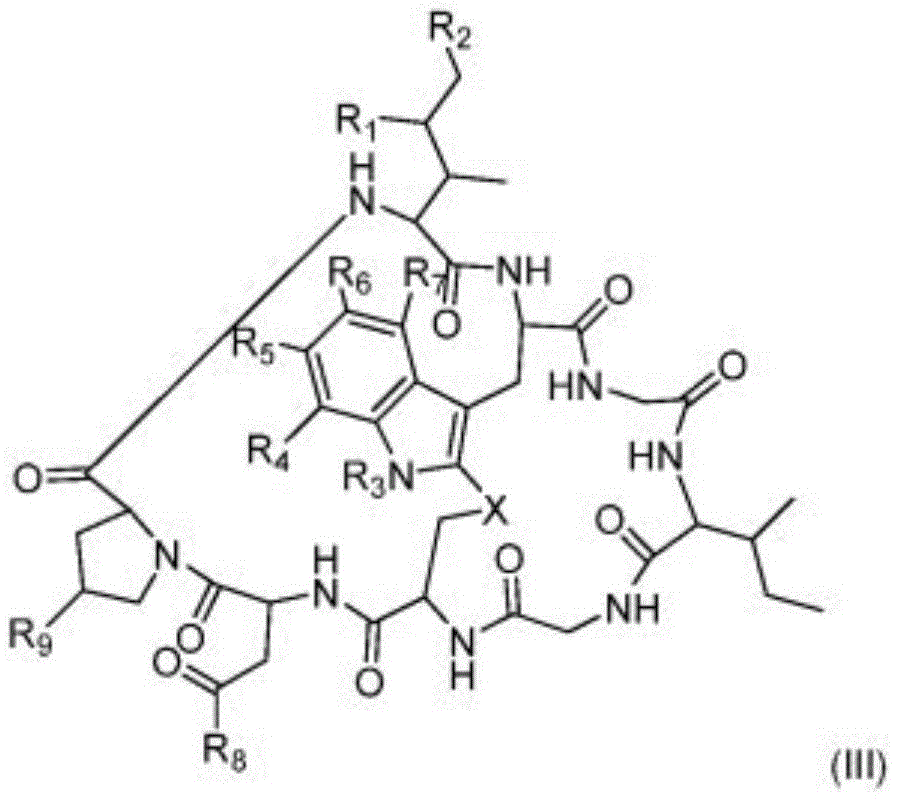
wherein R is1Is H, OH OR ORA;
R2Is H, OH OR ORB;
RAAnd RBWhen present, combine together with the oxygen atom to which they are bound to form an optionally substituted 5-membered heterocycloalkyl;
R3is H or RD;
R4Is H, OH, ORDOr RD;
R5Is H, OH, ORDOr RD;
R6Is H, OH, ORDOr RD;
R7Is H, OH, ORDOr RD;
R8Is OH, NH2OR ORD;
R9Is H, OH OR ORD;
x is-S-, -S (O-) or-SO2-; and is
RDIs optionally substituted alkyl (e.g. C)1-C6Alkyl), optionally substituted heteroalkyl (e.g., C)1-C6Heteroalkyl), optionally substituted alkenyl (e.g., C)2-C6Alkenyl), optionally substituted heteroalkenyl (e.g., C)2-C6A heteroalkenyl group)Optionally substituted alkynyl (e.g., C)2-C6Alkynyl), optionally substituted heteroalkynyl (e.g., C)2-C6Heteroalkynyl), optionally substituted cycloalkyl, optionally substituted heterocycloalkyl, optionally substituted aryl, or optionally substituted heteroaryl.
For example, in one embodiment, amanitins used in conjunction with the compositions and methods described herein include compounds according to formula (IIIA)

Wherein R is4、R5X and R8Each as defined above.
For example, in one embodiment, amanitins used in conjunction with the compositions and methods described herein include compounds according to the following formula (IIIB):

Wherein R is1Is H, OH OR ORA;
R2Is H, OH OR ORB;
RAAnd RBWhen present, combine together with the oxygen atom to which they are bound to form an optionally substituted 5-membered heterocycloalkyl;
R3is H or RD;
R4Is H, OH, ORDOr RD;
R5Is H, OH, ORDOr RD;
R6Is H, OH, ORDOr RD;
R7Is H, OH, ORDOr RD;
R8Is OH, NH2OR ORD;
R9Is H, OH OR ORD;
x is-S-, -S (O-) or-SO2-; and is
RDIs optionally substituted alkyl (e.g. C)1-C6Alkyl), optionally substituted heteroalkyl (e.g., C)1-C6Heteroalkyl), optionally substituted alkenyl (e.g., C)2-C6Alkenyl), optionally substituted heteroalkenyl (e.g., C)2-C6Heteroalkenyl), optionally substituted alkynyl (e.g., C)2-C6Alkynyl), optionally substituted heteroalkynyl (e.g., C)2-C6Heteroalkynyl), optionally substituted cycloalkyl, optionally substituted heterocycloalkyl, optionally substituted aryl, or optionally substituted heteroaryl.
In one embodiment, amanitins used in conjunction with the compositions and methods described herein also include compounds according to the following formula (IIIC):
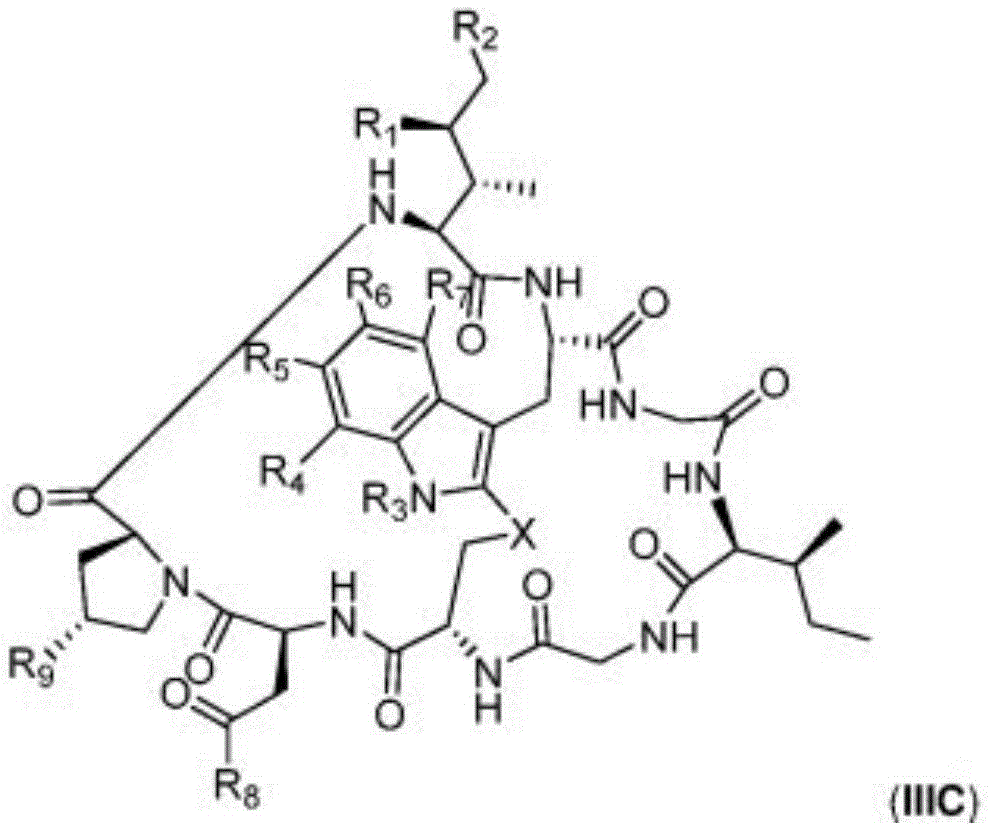
wherein R is1Is H, OH OR ORA;
R2Is H, OH OR ORB;
RAAnd RBWhen present, combine together with the oxygen atom to which they are bound to form an optionally substituted 5-membered heterocycloalkyl;
R3is H or RD;
R4Is H, OH, OR DOr RD;
R5Is H, OH, ORDOr RD;
R6Is H, OH, ORDOr RD;
R7Is H, OH, ORDOr RD;
R8Is OH, NH2OR ORD;
R9Is H, OH OR ORD;
x is-S-, -S (O-) or-SO2-; and is
RDIs optionally substituted alkyl (e.g. C)1-C6Alkyl), optionally substituted heteroalkyl (e.g., C)1-C6Heteroalkyl), optionally substituted alkenyl (e.g., C)2-C6Alkenyl), optionally substituted heteroalkenyl (e.g., C)2-C6Heteroalkenyl), optionally substituted alkynyl (e.g., C)2-C6Alkynyl), optionally substituted heteroalkynyl (e.g., C)2-C6Heteroalkynyl), optionally substituted cycloalkyl, optionally substituted heterocycloalkyl, optionally substituted aryl, or optionally substituted heteroaryl.
In one embodiment, the cytotoxin is amanitin. For example, the antibodies and antigen-binding fragments described herein can bind to amatoxin, thereby forming a conjugate represented by the formula Ab-Z-L-Am, wherein Ab is the antibody or antigen-binding fragment thereof, L is a linker, Z is a chemical moiety, and Am is amatoxin. Many positions on amatoxin or its derivatives may be used as positions for covalently bonding the linking moiety L, and thus the antibody or antigen-binding fragment thereof. Exemplary methods of amanitin conjugation and linkers for such processes are described below. Exemplary linker-containing amanitins useful for conjugation to antibodies or antigen-binding fragments according to the compositions and methods described herein are shown in structural formulae (I), (IA), (IB), (II), (IIA), and (IIB) described herein.
In some embodiments, amanitin-linker conjugate Am-L-Z is represented by formula (I)

Wherein R is1Is H, OH, ORAOR ORC;
R2Is H, OH, ORBOR ORC;
RAAnd RBWhen present, are combined with themAre taken together to form an optionally substituted 5-membered heterocycloalkyl group;
R3is H, RCOr RD;
R4Is H, OH, ORC、ORD、RCOr RD;
R5Is H, OH, ORC、ORD、RCOr RD;
R6Is H, OH, ORC、ORD、RCOr RD;
R7Is H, OH, ORC、ORD、RCOr RD;
R8Is OH, NH2、ORC、ORD、NHRCOr NRCRD;
R9Is H, OH, ORCOR ORD;
x is-S-, -S (O-) or-SO2-;
RCis-L-Z;
RDis optionally substituted C1-C6Alkyl, optionally substituted C1-C6Heteroalkyl, optionally substituted C2-C6Alkenyl, optionally substituted C2-C6Heteroalkenyl, optionally substituted C2-C6Alkynyl, optionally substituted C2-C6(ii) heteroalkynyl, optionally substituted cycloalkyl, optionally substituted heterocycloalkyl, optionally substituted aryl, or optionally substituted heteroaryl;
l is a linker, e.g. optionally substituted alkylene (e.g. C)1-C6Alkylene), optionally substituted heteroalkylene (e.g. C)1-C6Heteroalkylene), optionally substituted alkenylene (e.g., C)2-C6Alkenylene), optionally substituted heteroalkenylene (e.g., C)2-C6Heteroalkenylene), optionally substituted alkynylene (e.g., C)2-C6Alkynylene), optionally substituted heteroalkynylene (e.g., C) 2-C6Heteroalkynylene), optionally substituted cycloalkylene, optionally substituted heterocycloalkylene, optionally substituted arylene, optionally substituted heteroarylene, a peptide, a dipeptide, - (C ═ O) -, disulfide, hydrazone, or a combination thereof;
and is
Z is a chemical moiety formed from a coupling reaction between a reactive substituent present on L and a reactive substituent present in an antibody or antigen-binding fragment thereof, which binds to a target antigen (e.g., CD 117).
In some embodiments, Am comprises exactly one RCAnd (4) a substituent.
In some embodiments, L-Z is

Wherein S is a sulfur atom representing a reactive substituent present in an antibody or antigen-binding fragment thereof, which binds to a target antigen (e.g., the-SH group of a cysteine residue).
In some embodiments, the conjugate Am-L-Z-Ab is represented by one of formulas IV, IVA, or IVB:

wherein X is S, SO or SO2And Ab represents the Ab attachment point.
In some embodiments, Am-L-Z-Ab is
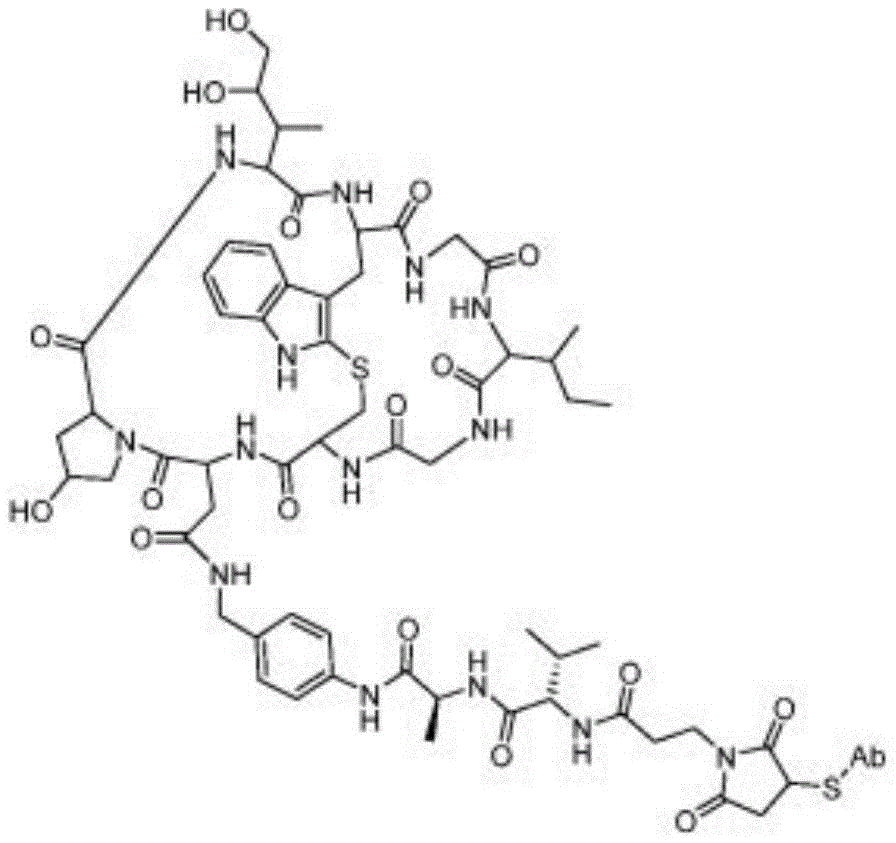
Where Ab represents the Ab attachment point.
In some embodiments, Am-L-Z-Ab is
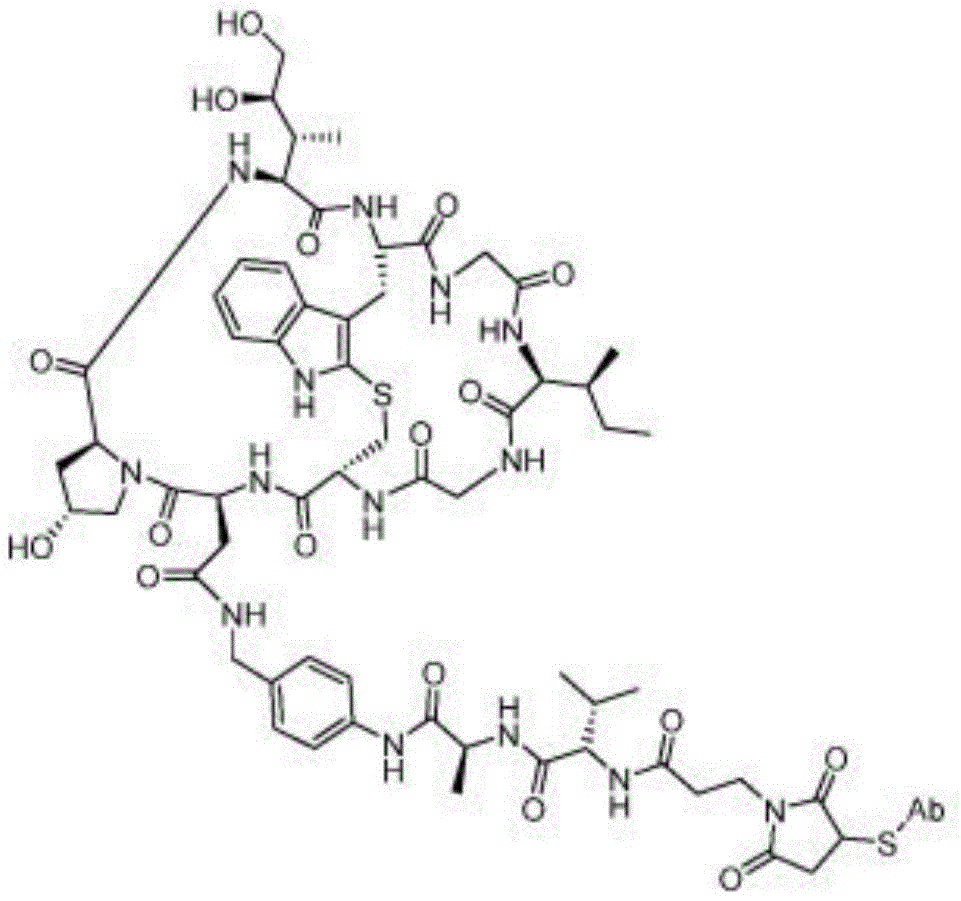
Wherein Ab represents the Ab attachment point.
In some embodiments, Am-L-Z-Ab is

Where Ab represents the Ab attachment point.
In some embodiments, the Am-L-Z-Ab precursor, Am-L-Z', is

Wherein the maleimide reacts with a thiol group found on a cysteine in the antibody.
In some embodiments, the Am-L-Z-Ab precursor, Am-L-Z', is
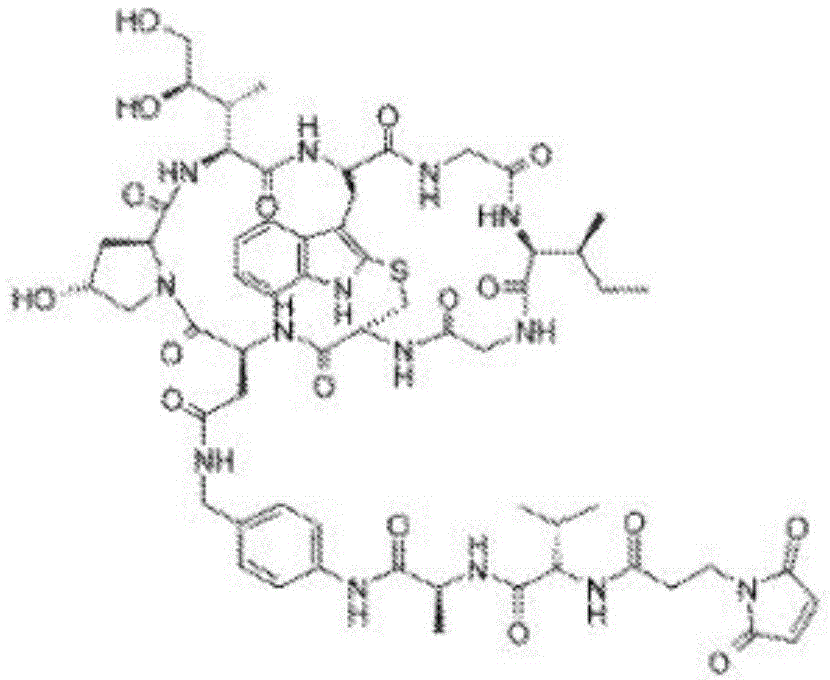
Wherein the maleimide reacts with a thiol group found on a cysteine in the antibody.
In some embodiments, Am-L-Z is represented by formula (IA)

Wherein R is1Is H, OH, ORAOR ORC;
R2Is H, OH, ORBOR ORC;
RAAnd RBWhen present, combine together with the oxygen atom to which they are bound to form an optionally substituted 5-membered heterocycloalkyl;
R3is H, RCOr RD;
R4Is H, OH, ORC、ORD、RCOr RD;
R5Is H, OH, ORC、ORD、RCOr RD;
R6Is H, OH, ORC、ORD、RCOr RD;
R7Is H, OH, ORC、ORD、RCOr RD;
R8Is OH, NH2、ORC、ORD、NHRCOr NRCRD;
R9Is H, OH, ORCOR ORD;
x is-S-, -S (O-) or-SO2-;
RCis-L-Z;
RDis optionally substituted alkyl (e.g. C)1-C6Alkyl), optionally substituted heteroalkyl (e.g., C)1-C6Heteroalkyl), optionally substituted alkenyl (e.g., C)2-C6Alkenyl), optionally substituted heteroalkenyl (e.g., C)2-C6Heteroalkenyl), optionally substituted alkynyl (e.g., C)2-C6Alkynyl), optionally substituted heteroalkynyl (e.g., C)2-C6Heteroalkynyl), optionally substituted cycloalkyl, optionally substituted heterocycloalkyl, optionally substituted aryl, or optionally substituted heteroaryl;
l is a linker, e.g. optionally substituted alkylene (e.g. C) 1-C6Alkylene), optionally substituted heteroalkylene (e.g. C)1-C6Heteroalkylene), optionally substituted alkenylene (e.g., C)2-C6Alkenylene), optionally substituted heteroalkenylene (e.g., C)2-C6Heteroalkenylene), optionally substituted alkynylene (e.g., C)2-C6Alkynylene), optionally substituted heteroalkynylene (e.g., C)2-C6Heteroalkynylene), optionally substituted cycloalkylene, optionally substituted heterocycloalkylene, optionally substituted arylene, optionally substituted heteroarylene, peptideA dipeptide, - (C ═ O) -, disulfide, hydrazone, or a combination thereof;
z is a chemical moiety formed from a coupling reaction between a reactive substituent present on L and a reactive substituent present in an antibody or antigen-binding fragment thereof,
wherein Am contains exactly one RCAnd (4) a substituent.
Z is a chemical moiety formed by a coupling reaction between a reactive substituent present on L and a reactive substituent present in an antibody or antigen-binding fragment thereof, which binds to an HC antigen (i.e., an anti-HC antibody, such as an anti-CD 117 antibody, an anti-CD 45 antibody, an anti-CD 2 antibody, an anti-CD 5 antibody, an anti-CD 137 antibody, or an anti-CD 252 antibody); and is
Wherein Am contains exactly one RCAnd (4) a substituent.
In some embodiments, L-Z is

In some embodiments, L-Z is

In some embodiments, Am-L-Z is represented by formula (IB)

Wherein R is1Is H, OH, ORAOR ORC;
R2Is H, OH, ORBOR ORC;
RAAnd RBWhen present, combine together with the oxygen atom to which they are bound to form an optionally substituted 5-membered heterocycloalkyl;
R3is H, RCOr RD;
R4Is H,OH、ORC、ORD、RCOr RD;
R5Is H, OH, ORC、ORD、RCOr RD;
R6Is H, OH, ORC、ORD、RCOr RD;
R7Is H, OH, ORC、ORD、RCOr RD;
R8Is OH, NH2、ORC、ORD、NHRCOr NRCRD;
R9Is H, OH, ORCOR ORD;
x is-S-, -S (O-) or-SO2-;
RCis-L-Z;
RDis optionally substituted alkyl (e.g. C)1-C6Alkyl), optionally substituted heteroalkyl (e.g., C)1-C6Heteroalkyl), optionally substituted alkenyl (e.g., C)2-C6Alkenyl), optionally substituted heteroalkenyl (e.g., C)2-C6Heteroalkenyl), optionally substituted alkynyl (e.g., C)2-C6Alkynyl), optionally substituted heteroalkynyl (e.g., C)2-C6Heteroalkynyl), optionally substituted cycloalkyl, optionally substituted heterocycloalkyl, optionally substituted aryl, or optionally substituted heteroaryl;
l is a linker, e.g. optionally substituted alkylene (e.g. C)1-C6Alkylene), optionally substituted heteroalkylene (e.g. C)1-C6Heteroalkylene), optionally substituted alkenylene (e.g., C)2-C6Alkenylene), optionally substituted heteroalkenylene (e.g., C) 2-C6Heteroalkenylene), optionally substituted alkynylene (e.g., C)2-C6Alkynylene), optionally substituted heteroalkynylene (e.g., C)2-C6Heteroalkynylene), optionally substituted cycloalkylene, optionally substituted heterocycloalkyleneA group, an optionally substituted arylene group, an optionally substituted heteroarylene group, a peptide, a dipeptide, - (C ═ O) -, a disulfide, a hydrazone, or a combination thereof;
z is a chemical moiety formed from a coupling reaction between a reactive substituent present on L and a reactive substituent present in an antibody or antigen-binding fragment thereof, which binds to an HC antigen (i.e., an anti-HC antibody, such as an anti-CD 117 antibody, an anti-CD 45 antibody, an anti-CD 2 antibody, an anti-CD 5 antibody, an anti-CD 137 antibody, or an anti-CD 252 antibody); and is
Wherein Am contains exactly one RCAnd (4) a substituent.
In some embodiments, L-Z is

In some embodiments, L-Z is

In some embodiments, RAAnd RBWhen present, combine together with the oxygen atom to which they are bound to form a 5-membered heterocycloalkyl group of the formula:

wherein Y is- (C ═ O) -, - (C ═ S) -, - (C ═ NRE) -or- (CR)ERE’) -; and is
REAnd RE’Each independently is optionally substituted C1-C6alkylene-RCOptionally substituted C1-C6Heteroalkylene-RCOptionally substituted C 2-C6alkenylene-RCOptionally substituted C2-C6Heteroalkenylene-RCOptionally substituted C2-C6alkynylene-RCOptionally substitutedC2-C6Heteroalkynylene-RCOptionally substituted cycloalkylene-RCOptionally substituted heterocycloalkylene-RCOptionally substituted arylene-RCOr optionally substituted heteroaryl-RC。
In some embodiments, Am-L-Z is represented by formula (IA) or formula (IB),
wherein R is1Is H, OH, ORAOR ORC;
R2Is H, OH, ORBOR ORC;
RAAnd RBWhen present, combine with the oxygen atom to which they are bound to form:

R3is H or RC;
R4Is H, OH, ORC、ORD、RCOr RD;
R5Is H, OH, ORC、ORD、RCOr RD;
R6Is H, OH, ORC、ORD、RCOr RD;
R7Is H, OH, ORC、ORD、RCOr RD;
R8Is OH, NH2、ORCOr NHRC;
R9Is H or OH;
x is-S-, -S (O-) or-SO2-; and is
Wherein R isCAnd RDEach as defined above.
In some embodiments, Am-L-Z is represented by formula (IA) or formula (IB),
wherein R is1Is H, OH, ORAOR ORC;
R2Is H, OH, ORBOR ORC;
RAAnd RBWhen present, combine with the oxygen atom to which they are bound to form:
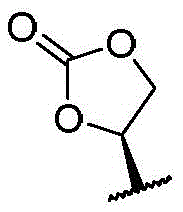
R3is H or RC;
R4And R5Each independently is H, OH, ORC、RCOR ORD;
R6And R7Each independently is H;
R8is OH, NH2、ORCOr NHRC;
R9Is H or OH;
x is-S-, -S (O-) or-SO2-; and is
Wherein R isCAs defined above.
In some embodiments, Am-L-Z is represented by formula (IA) or formula (IB),
Wherein R is1Is H, OH OR ORA;
R2Is H, OH OR ORB;
RAAnd RBWhen present, combine with the oxygen atom to which they are bound to form:

R3、R4、R6and R7Each is H;
R5is ORC;
R8Is OH or NH2;
R9Is H or OH;
x is-S-, -S (O-) or-SO2-; and is
Wherein R isCAs defined above. Such amanitin conjugatesSuch as described in U.S. patent application publication No. 2016/0002298, the disclosure of which is incorporated herein by reference in its entirety.
In some embodiments, Am-L-Z is represented by formula (IA) or formula (IB),
wherein R is1And R2Each independently is H or OH;
R3is RC;
R4、R6And R7Each is H;
R5is H, OH or O C1-C6An alkyl group;
R8is OH or NH2;
R9Is H or OH;
x is-S-, -S (O-) or-SO2-; and is
Wherein R isCAs defined above. Such amanitin conjugates are described, for example, in U.S. patent application publication No. 2014/0294865, the disclosure of which is incorporated herein by reference in its entirety.
In some embodiments, Am-L-Z is represented by formula (IA) or formula (IB),
wherein R is1And R2Each independently is H or OH;
R3、R6and R7Each is H;
R4and R5Each independently is H, OH, ORCOr RC;
R8Is OH or NH2;
R9Is H or OH;
x is-S-, -S (O-) or-SO2-; and is
Wherein R isCAs defined above. Such amanitin conjugates are described, for example, in U.S. patent application publication No. 2015/0218220, the disclosure of which is incorporated herein by reference in its entirety.
In some embodiments, Am-L-Z is represented by formula (IA) or formula (IB),
wherein R is1And R2Each independently is H or OH;
R3、R6and R7Each is H;
R4and R5Each independently is H or OH;
R8is OH, NH2、ORCOr NHRC;
R9Is H or OH;
x is-S-, -S (O-) or-SO2-; and is
Wherein R isCAs defined above. Such amanitin conjugates are described, for example, in U.S. patent nos. 9,233,173 and 9,399,681 and US 2016/0089450, the disclosures of which are incorporated herein by reference in their entirety.
In some embodiments, Am-L-Z' is
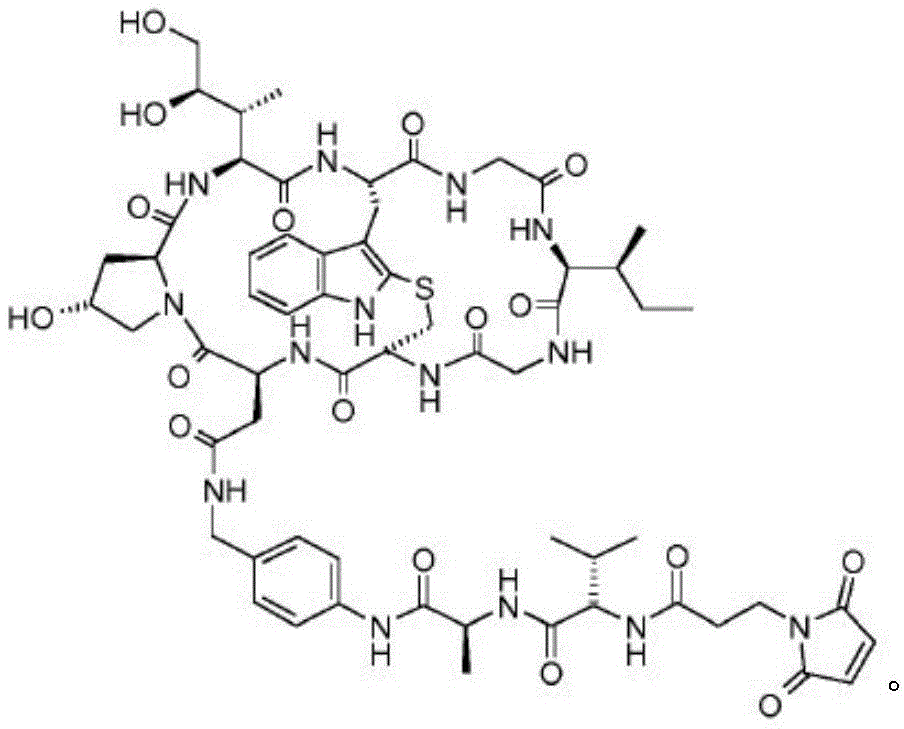
Additional amanitins useful for conjugation to antibodies or antigen-binding fragments thereof according to the compositions and methods described herein are disclosed, for example, in WO 2016/142049; WO 2016/071856; WO 2017/149077; WO 2018/115466; and WO 2017/046658, the disclosure of each of which is incorporated herein by reference in its entirety.
In some embodiments, Am-L-Z is represented by formula (II), formula (IIA), or formula (IIB)

Wherein X is S, SO or SO2;R1Is H or a linker covalently bound to the antibody or antigen-binding fragment thereof via a chemical moiety Z formed by a coupling reaction between a reactive substituent Z' present on the linker and a reactive substituent present in the antibody or antigen-binding fragment thereof; and R is 2Is H or a linker covalently bound to the antibody or antigen-binding fragment thereof via a chemical moiety Z which is a reactive substituent Z' present on the linker and the antibody or antibody thereofFormed by a coupling reaction between reactive substituents present in the original binding fragment; wherein when R is1When is H, R2Is a linker, and when R2When is H, R1Is a joint. In some embodiments, R1Is a linker, and R2Is H, the linker and the chemical moiety taken together as L-Z is
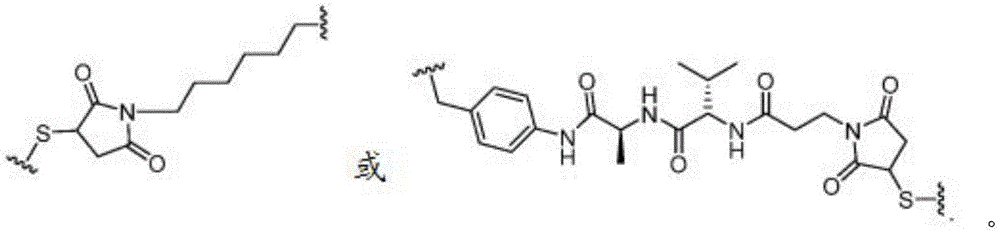
In some embodiments, L-Z is

In one embodiment, Am-L-Z-Ab is:

in one embodiment, Am-L-Z-Ab is:

in some embodiments, the Am-L-Z-Ab precursor (i.e., Am-L-Z') is one of:

wherein the maleimide reacts with a thiol group found on a cysteine in the antibody.
In some embodiments, the cytotoxin is alpha-amanitin. In some embodiments, the α -amanitine is a compound of formula III. In some embodiments, the α -amanitin of formula III is attached to the anti-HC antibody by a linker L. The linker L may be attached to any of several possible positions of the α -amanitine of formula III(e.g., R)1-R9Any of (a) to provide an α -amanitin-linker conjugate of formula I, IA, IB, II, IIA or IIB. In some embodiments, a linker is attached at R 1Location. In some embodiments, a linker is attached at R2Location. In some embodiments, a linker is attached at R3Location. In some embodiments, a linker is attached at R4Location. In some embodiments, a linker is attached at R5Location. In some embodiments, a linker is attached at R6Location. In some embodiments, a linker is attached at R7Location. In some embodiments, a linker is attached at R8Location. In some embodiments, a linker is attached at R9A bit. In some embodiments, the linker comprises a hydrazine, disulfide, thioether, or dipeptide. In some embodiments, the linker comprises a dipeptide selected from Val-Ala and Val-Cit. In some embodiments, the linker comprises a p-aminobenzyl group (PAB). In some embodiments, the linker comprises a PAB-Cit-Val moiety. In some embodiments, the linker comprises a PAB-Ala-Val moiety. In some embodiments, the linker comprises- ((C ═ O) (CH)2)n-units, wherein n is an integer from 1 to 6.
In some embodiments, the linker comprises — (CH)2)n-units, wherein n is an integer from 2 to 6. In some embodiments, the linker is-PAB-Cit-Val- ((C ═ O) (CH)2)n-. In some embodiments, the linker is-PAB-Ala-Val- ((C ═ O) (CH) 2)n-. In some embodiments, linker L and chemical moiety Z taken together as L-Z are
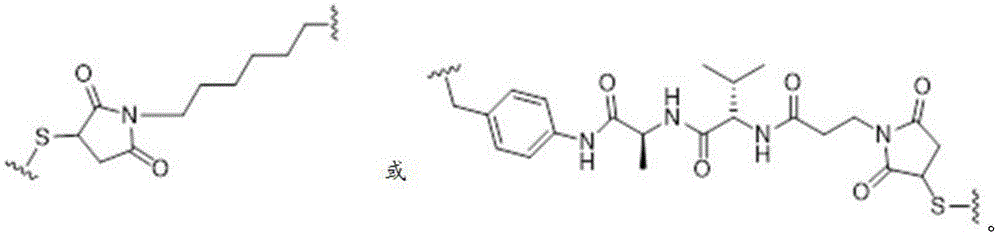
In some embodiments, the cytotoxin is β -amanitin. In some embodiments, the α -amanitine is a compound of formula III. In some embodiments, the α -amanitin of formula III is attached to the anti-HC antibody by a linker L. The linker L may be attached to the alpha-amanitine of formula IIIAny of several possible positions (e.g., R)1-R9Any of (a) to provide an α -amanitin-linker conjugate of formula I, IA, IB, II, IIA or IIB. In some embodiments, a linker is attached at R1Location. In some embodiments, a linker is attached at R2Location. In some embodiments, a linker is attached at R3Location. In some embodiments, a linker is attached at R4Location. In some embodiments, a linker is attached at R5Location. In some embodiments, a linker is attached at R6Location. In some embodiments, a linker is attached at R7Location. In some embodiments, a linker is attached at R8Location. In some embodiments, a linker is attached at R9A bit. In some embodiments, the linker comprises a hydrazine, disulfide, thioether, or dipeptide. In some embodiments, the linker comprises a dipeptide selected from Val-Ala and Val-Cit. In some embodiments, the linker comprises a p-aminobenzyl group (PAB). In some embodiments, the linker comprises a PAB-Cit-Val moiety. In some embodiments, the linker comprises a PAB-Ala-Val moiety. In some embodiments, the linker comprises- ((C ═ O) (CH) 2)n-units, wherein n is an integer from 1 to 6.
In some embodiments, the linker comprises — (CH)2)n-units, wherein n is an integer from 2 to 6. In some embodiments, the linker is-PAB-Cit-Val- ((C ═ O) (CH)2)n-. In some embodiments, the linker is-PAB-Ala-Val- ((C ═ O) (CH)2)n-. In some embodiments, linker L and chemical moiety Z taken together as L-Z are

In some embodiments, the cytotoxin is gamma amanitin. In some embodiments, the gamma-amanitine is a compound of formula III. In some embodiments, the gamma-amanitine of formula III is attached to the anti-HC antibody by a linker L. The joint L canTo attach to any of several possible positions of gamma-amanitine of formula III (e.g., R)1-R9Any of (a) to provide a gamma-amanitine-linker conjugate of formula I, IA, IB, II, IIA or IIB. In some embodiments, a linker is attached at R1Location. In some embodiments, a linker is attached at R2Location. In some embodiments, a linker is attached at R3Location. In some embodiments, a linker is attached at R4Location. In some embodiments, a linker is attached at R5Location. In some embodiments, a linker is attached at R 6Location. In some embodiments, a linker is attached at R7Location. In some embodiments, a linker is attached at R8Location. In some embodiments, a linker is attached at R9A bit. In some embodiments, the linker comprises a hydrazine, disulfide, thioether, or dipeptide. In some embodiments, the linker comprises a dipeptide selected from Val-Ala and Val-Cit. In some embodiments, the linker comprises a p-aminobenzyl group (PAB). In some embodiments, the linker comprises a PAB-Cit-Val moiety. In some embodiments, the linker comprises a PAB-Ala-Val moiety. In some embodiments, the linker comprises- ((C ═ O) (CH)2)n-units, wherein n is an integer from 1 to 6.
In some embodiments, the linker comprises — (CH)2)n-units, wherein n is an integer from 2 to 6. In some embodiments, the linker is-PAB-Cit-Val- ((C ═ O) (CH)2)n-. In some embodiments, the linker is-PAB-Ala-Val- ((C ═ O) (CH)2)n-. In some embodiments, linker L and chemical moiety Z taken together as L-Z are

In some embodiments, the cytotoxin is epsilon-amanitin. In some embodiments, epsilon-amanitine is a compound of formula III. In some embodiments, the epsilon-amanitine of formula III is through a linker L is attached to an anti-HC antibody. Linker L may be attached to any of several possible positions of epsilon-amanitine of formula III (e.g., R)1-R9Any of (a) to provide an epsilon-amanitine-linker conjugate of formula I, IA, IB, II, IIA or IIB. In some embodiments, a linker is attached at R1Location. In some embodiments, a linker is attached at R2Location. In some embodiments, a linker is attached at R3Location. In some embodiments, a linker is attached at R4Location. In some embodiments, a linker is attached at R5Location. In some embodiments, a linker is attached at R6Location. In some embodiments, a linker is attached at R7Location. In some embodiments, a linker is attached at R8Location. In some embodiments, a linker is attached at R9A bit. In some embodiments, the linker comprises a hydrazine, disulfide, thioether, or dipeptide. In some embodiments, the linker comprises a dipeptide selected from Val-Ala and Val-Cit. In some embodiments, the linker comprises a p-aminobenzyl group (PAB). In some embodiments, the linker comprises a PAB-Cit-Val moiety. In some embodiments, the linker comprises a PAB-Ala-Val moiety. In some embodiments, the linker comprises- ((C ═ O) (CH) 2)n-units, wherein n is an integer from 1 to 6.
In some embodiments, the linker comprises — (CH)2)n-units, wherein n is an integer from 2 to 6. In some embodiments, the linker is-PAB-Cit-Val- ((C ═ O) (CH)2)n-. In some embodiments, the linker is-PAB-Ala-Val- ((C ═ O) (CH)2)n-. In some embodiments, linker L and chemical moiety Z taken together as L-Z are
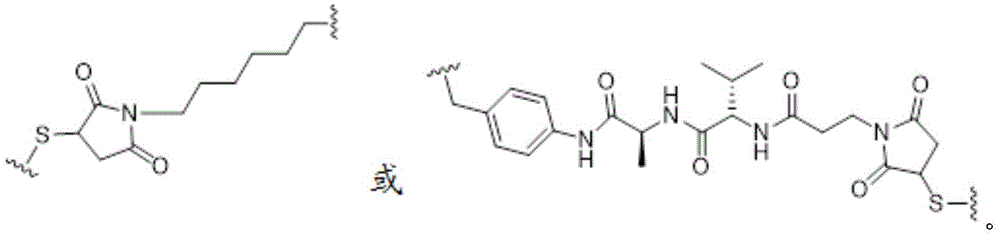
In some embodiments, the cytotoxin is amanitin. In some embodiments, the amanita is a compound of formula III. In some embodiments, the goose of formula IIIThe lectin is attached to the anti-HC antibody via linker L. Linker L may be attached to any of several possible positions of the amanitum of formula III (e.g., R)1-R9Any of (a) to (b) to provide an amanitum-linker conjugate of formula I, IA, IB, II, IIA or IIB. In some embodiments, a linker is attached at R1Location. In some embodiments, a linker is attached at R2Location. In some embodiments, a linker is attached at R3Location. In some embodiments, a linker is attached at R4Location. In some embodiments, a linker is attached at R5Location. In some embodiments, a linker is attached at R6Location. In some embodiments, a linker is attached at R 7Location. In some embodiments, a linker is attached at R8Location. In some embodiments, a linker is attached at R9A bit. In some embodiments, the linker comprises a hydrazine, disulfide, thioether, or dipeptide. In some embodiments, the linker comprises a dipeptide selected from Val-Ala and Val-Cit. In some embodiments, the linker comprises a p-aminobenzyl group (PAB). In some embodiments, the linker comprises a PAB-Cit-Val moiety. In some embodiments, the linker comprises a PAB-Ala-Val moiety. In some embodiments, the linker comprises- ((C ═ O) (CH)2)n-units, wherein n is an integer from 1 to 6.
In some embodiments, the linker comprises — (CH)2)n-units, wherein n is an integer from 2 to 6. In some embodiments, the linker is-PAB-Cit-Val- ((C ═ O) (CH)2)n-. In some embodiments, the linker is-PAB-Ala-Val- ((C ═ O) (CH)2)n-. In some embodiments, linker L and chemical moiety Z taken together as L-Z are

In some embodiments, the cytotoxin is an amanitin amide. In some embodiments, the amanitin amide is a compound of formula III. In some embodimentsIn (b), the amanitin amide of formula III is attached to the anti-HC antibody via linker L. Linker L may be attached to any of several possible positions of the amanitin amide of formula III (e.g., R) 1-R9Any of (a) to provide an amanitin amide-linker conjugate of formula I, IA, IB, II, IIA or IIB. In some embodiments, a linker is attached at R1Location. In some embodiments, a linker is attached at R2Location. In some embodiments, a linker is attached at R3Location. In some embodiments, a linker is attached at R4Location. In some embodiments, a linker is attached at R5Location. In some embodiments, a linker is attached at R6Location. In some embodiments, a linker is attached at R7Location. In some embodiments, a linker is attached at R8Location. In some embodiments, a linker is attached at R9A bit. In some embodiments, the linker comprises a hydrazine, disulfide, thioether, or dipeptide. In some embodiments, the linker comprises a dipeptide selected from Val-Ala and Val-Cit. In some embodiments, the linker comprises a p-aminobenzyl group (PAB). In some embodiments, the linker comprises a PAB-Cit-Val moiety. In some embodiments, the linker comprises a PAB-Ala-Val moiety. In some embodiments, the linker comprises- ((C ═ O) (CH)2)n-units, wherein n is an integer from 1 to 6.
In some embodiments, the linker comprises — (CH) 2)n-units, wherein n is an integer from 2 to 6. In some embodiments, the linker is-PAB-Cit-Val- ((C ═ O) (CH)2)n-. In some embodiments, the linker is-PAB-Ala-Val- ((C ═ O) (CH)2)n-. In some embodiments, linker L and chemical moiety Z taken together as L-Z are

In some embodiments, the cytotoxin is amanitin nontoxic cyclic peptide. In some embodiments, the amanita nontoxic cyclic peptide isA compound of formula III. In some embodiments, the amanitin nontoxic cyclic peptide of formula III is attached to the anti-HC antibody by linker L. Linker L may be attached to any of several possible positions of anserine nontoxic cyclic peptide of formula III (e.g., R)1-R9Any of (a) to provide anserine non-toxic cyclic peptide-linker conjugates of formula I, IA, IB, II, IIA or IIB. In some embodiments, a linker is attached at R1Location. In some embodiments, a linker is attached at R2Location. In some embodiments, a linker is attached at R3Location. In some embodiments, a linker is attached at R4Location. In some embodiments, a linker is attached at R5Location. In some embodiments, a linker is attached at R6Location. In some embodiments, a linker is attached at R 7Location. In some embodiments, a linker is attached at R8Location. In some embodiments, a linker is attached at R9A bit. In some embodiments, the linker comprises a hydrazine, disulfide, thioether, or dipeptide. In some embodiments, the linker comprises a dipeptide selected from Val-Ala and Val-Cit. In some embodiments, the linker comprises a p-aminobenzyl group (PAB). In some embodiments, the linker comprises a PAB-Cit-Val moiety. In some embodiments, the linker comprises a PAB-Ala-Val moiety. In some embodiments, the linker comprises- ((C ═ O) (CH)2)n-units, wherein n is an integer from 1 to 6.
In some embodiments, the linker comprises — (CH)2)n-units, wherein n is an integer from 2 to 6. In some embodiments, the linker is-PAB-Cit-Val- ((C ═ O) (CH)2)n-. In some embodiments, the linker is-PAB-Ala-Val- ((C ═ O) (CH)2)n-. In some embodiments, linker L and chemical moiety Z taken together as L-Z are

In some embodiments, the cytotoxin is amanitin nontoxic cyclic peptideAnd (4) acid. In some embodiments, the amanitin nontoxic cyclic peptide acid is a compound of formula III. In some embodiments, the amanitin nontoxic cyclic peptide acid of formula III is attached to the anti-HC antibody through linker L. Linker L may be attached to any of several possible positions of amanitin nontoxic cyclic peptide acid of formula III (e.g., R) 1-R9Any of the above) to provide a anserine non-toxic cyclic peptide acid-linker conjugate of formula I, IA, IB, II, IIA or IIB. In some embodiments, a linker is attached at R1Location. In some embodiments, a linker is attached at R2Location. In some embodiments, a linker is attached at R3Location. In some embodiments, a linker is attached at R4Location. In some embodiments, a linker is attached at R5Location. In some embodiments, a linker is attached at R6Location. In some embodiments, a linker is attached at R7Location. In some embodiments, a linker is attached at R8Location. In some embodiments, a linker is attached at R9A bit. In some embodiments, the linker comprises a hydrazine, disulfide, thioether, or dipeptide. In some embodiments, the linker comprises a dipeptide selected from Val-Ala and Val-Cit. In some embodiments, the linker comprises a p-aminobenzyl group (PAB). In some embodiments, the linker comprises a PAB-Cit-Val moiety. In some embodiments, the linker comprises a PAB-Ala-Val moiety. In some embodiments, the linker comprises- ((C ═ O) (CH)2)n-units, wherein n is an integer from 1 to 6.
In some embodiments, the linker comprises — (CH) 2)n-units, wherein n is an integer from 2 to 6. In some embodiments, the linker is-PAB-Cit-Val- ((C ═ O) (CH)2)n-. In some embodiments, the linker is-PAB-Ala-Val- ((C ═ O) (CH)2)n-. In some embodiments, linker L and chemical moiety Z taken together as L-Z are

In some embodiments, the cytotoxin is a amanita nontoxic cyclic peptide. In some embodiments, the amanita nontoxic cyclic peptide is a compound of formula III. In some embodiments, the amanita nontoxic cyclic peptide of formula III is attached to the anti-HC antibody by linker L. Linker L may be attached to any of several possible positions of the amanita nontoxic cyclic peptide of formula III (e.g., R)1-R9Any of (a) to provide a procoagulant nontoxic cyclic peptide-linker conjugate of formula I, IA, IB, II, IIA or IIB. In some embodiments, a linker is attached at R1Location. In some embodiments, a linker is attached at R2Location. In some embodiments, a linker is attached at R3Location. In some embodiments, a linker is attached at R4Location. In some embodiments, a linker is attached at R5Location. In some embodiments, a linker is attached at R6Location. In some embodiments, a linker is attached at R 7Location. In some embodiments, a linker is attached at R8Location. In some embodiments, a linker is attached at R9A bit. In some embodiments, the linker comprises a hydrazine, disulfide, thioether, or dipeptide. In some embodiments, the linker comprises a dipeptide selected from Val-Ala and Val-Cit. In some embodiments, the linker comprises a p-aminobenzyl group (PAB). In some embodiments, the linker comprises a PAB-Cit-Val moiety. In some embodiments, the linker comprises a PAB-Ala-Val moiety. In some embodiments, the linker comprises- ((C ═ O) (CH)2)n-units, wherein n is an integer from 1 to 6.
In some embodiments, the linker comprises — (CH)2)n-units, wherein n is an integer from 2 to 6. In some embodiments, the linker is-PAB-Cit-Val- ((C ═ O) (CH)2)n-. In some embodiments, the linker is-PAB-Ala-Val- ((C ═ O) (CH)2)n-. In some embodiments, linker L and chemical moiety Z taken together as L-Z are

Synthetic methods for preparing amatoxins are described in U.S. patent No. 9,676,702, which is incorporated herein by reference.
The antibodies or antigen-binding fragments for use in the compositions and methods described herein can be conjugated to amanitin (e.g., alpha-amanitin) or variants thereof using conjugation techniques known in the art or described herein. For example, an antibody or antigen-binding fragment thereof that recognizes and binds a target antigen (an anti-HC antibody, e.g., an anti-CD 117 antibody, an anti-CD 45 antibody, an anti-CD 2 antibody, an anti-CD 5 antibody, an anti-CD 137 antibody, or an anti-CD 252 antibody) may be conjugated to amanitin (e.g., a-amanitin) or a variant thereof, as described in US2015/0218220, the disclosure of which is incorporated herein by reference as it relates to, e.g., (e.g., a-amanitin) or a variant thereof, and a covalent linker that may be used for covalent conjugation.
Auristatin
anti-HC antibodies described herein (e.g., anti-CD 117 antibodies, anti-CD 45 antibodies, anti-CD 2 antibodies, anti-CD 5 antibodies, anti-CD 137 antibodies, or anti-CD 252 antibodies) and antigen-binding fragments thereof can be conjugated to auristatin cytotoxins (U.S. Pat. nos. 5,635,483; 5,780,588). Auristatins are antimitotic agents that interfere with microtubule dynamics, GTP hydrolysis, nuclear and cell division (Woyke et al (2001) Antimicrob. Agents and Chemother.45(12):3580-3584) and have both anticancer activity (U.S. Pat. No. 5,663,149) and antifungal activity (Pettit et al (1998) Antimicrob. Agents Chemother.42: 2961-2965). (U.S. Pat. Nos. 5,635,483; 5,780,588). The auristatin drug moiety may be attached to the antibody via the N (amino) terminus or the C (carboxyl) terminus of the peptide drug moiety (WO 02/088172).
Exemplary auristatin embodiments include N-terminally attached monomethylauristatin drug moieties DE and DF as disclosed in Senter et al, Proceedings of the American Association for Cancer Research, Vol.45, Abstract number 623, filed 3/28/2004, the disclosure of which is expressly incorporated herein by reference in its entirety.
An exemplary auristatin embodiment is MMAE, where the wavy line represents the point at which the antibody-linker conjugate (-L-Z-Ab or-L-Z', as described herein) is covalently attached to the linker.

Another exemplary auristatin embodiment is MMAF, wherein the wavy line represents the point at which the antibody-linker conjugate (-L-Z-Ab or-L-Z', as described herein) is covalently attached to the linker, as disclosed in US 2005/0238649:

auristatins can be prepared according to U.S. patent nos. 5,635,483; U.S. Pat. nos. 5,780,588; pettit et al (1989) J.Am.chem.Soc.111: 5463-5465; pettit et al (1998) Anti-Cancer Drug Design 13: 243-; pettit, G.R., et al Synthesis,1996, 719-725; pettit et al (1996) J.chem.Soc.Perkin Trans.15: 859-863; and Doronina (2003) nat. Biotechnol.21(7): 778-784.
Maytansinoids
The antibodies and antigen binding fragments thereof described herein may be conjugated to a cytotoxin of a microtubule binding agent. In some embodiments, the microtubule binding agent is a maytansine, maytansinoid, or maytansinoid analog. Maytansinoids are mitotic inhibitors that bind to microtubules and act by inhibiting tubulin polymerization. Maytansine was first isolated from the east African shrub Maytenus serrata (U.S. Pat. No. 3,896,111). Subsequently, it was discovered that certain microorganisms also produce maytansinoids, such as maytansinol and C-3 maytansinol esters (U.S. Pat. No. 4,151,042). Synthetic maytansinol and derivatives and analogs thereof are disclosed in, for example, U.S. Pat. nos. 4,137,230; 4,248,870, respectively; 4,256,746, respectively; 4,260,608, respectively; 4,265,814, respectively; 4,294,757, respectively; 4,307,016, respectively; 4,308,268, respectively; 4,308,269, respectively; 4,309,428, respectively; 4,313,946, respectively; 4,315,929, respectively; 4,317,821, respectively; 4,322,348, respectively; 4,331,598, respectively; 4,361,650, respectively; 4,364,866, respectively; 4,424,219, respectively; 4,450,254, respectively; 4,362,663, respectively; and 4,371,533. Maytansinoid drug moieties are attractive drug moieties in antibody drug conjugates because they are (i) relatively easy to prepare by fermentation or chemical modification, derivatization of the fermentation product, (ii) can be derivatized with functional groups suitable for conjugation to antibodies by non-disulfide bonds, (iii) stable in plasma, and (iv) effective against a variety of tumor cell lines.
Examples of suitable maytansinoids include esters of maytansinol, synthetic maytansinol, and maytansinol analogs and derivatives. Included herein are any cytotoxins that inhibit microtubule formation and are highly toxic to mammalian cells, such as maytansinoids, maytansinol and maytansinol analogs, and derivatives thereof.
Examples of suitable maytansinol esters include those having modified aromatic rings and those having modifications at other positions. Such suitable maytansinoids are described in U.S. Pat. nos. 4,137,230; 4,151,042; 4,248,870, respectively; 4,256,746, respectively; 4,260,608, respectively; 4,265,814, respectively; 4,294,757, respectively; 4,307,016, respectively; 4,308,268, respectively; 4,308,269, respectively; 4,309,428, respectively; 4,313,946, respectively; 4,315,929, respectively; 4,317,821, respectively; 4,322,348, respectively; 4,331,598, respectively; 4,361,650, respectively; 4,362,663, respectively; 4,364,866, respectively; 4,424,219, respectively; 4,450,254, respectively; 4,322,348, respectively; 4,362,663, respectively; 4,371,533, respectively; 5,208,020; 5,416,064; 5,475,092; 5,585,499, respectively; 5,846,545, respectively; 6,333,410; 7,276,497; and 7,473,796, the disclosure of each of which is incorporated herein by reference as they relate to maytansinoids and derivatives thereof.
In some embodiments, the antibody-drug conjugates (ADCs) of the present disclosure utilize a thiol-containing maytansinoid (DM1) (formally referred to as N2 '-deacetyl-N2' - (3-mercapto-1-oxopropyl) -maytansine) as the cytotoxic agent. DM1 is represented by the following structural formula V:
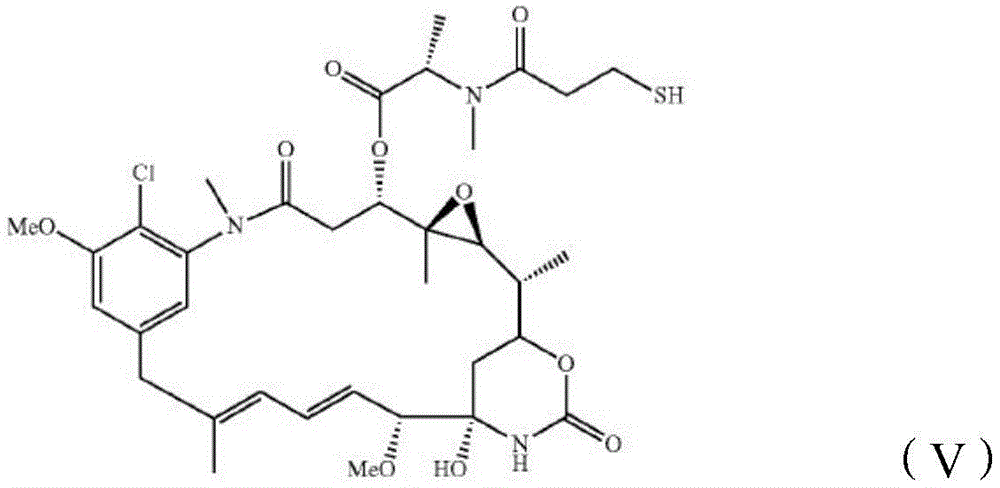
In another embodiment, the conjugates of the present disclosure utilize a thiol-containing maytansinoid N2 '-deacetyl-N2' (4-methyl-4-mercapto-1-oxopentyl) -maytansine (e.g., DM4) as the cytotoxic agent. DM4 is represented by the following structural formula VI:

another maytansinoid comprising a side chain containing a sterically hindered thiol bond is N2 '-deacetyl-N2' (4-mercapto-1-oxopentyl) -maytansine (designated DM3), represented by the following structural formula VII:

each of the maytansinoids taught in U.S. Pat. nos. 5,208,020 and 7,276,497 can also be used in the conjugates of the present disclosure. In this regard, the entire disclosures of 5,208,020 and 7,276,697 are incorporated herein by reference.
Many positions on maytansinoids can be used as positions for covalently bonding the linking moiety, and thus the antibody or antigen-binding fragment thereof (-L-Z-Ab or-L-Z', as described herein). For example, the C-3 position having a hydroxyl group, the C-14 position modified with a hydroxymethyl group, the C-15 position modified with a hydroxyl group, and the C-20 position having a hydroxyl group are all expected to be useful. In some embodiments, the C-3 position serves as the location for a covalently bonded linker moiety, and in some particular embodiments, the C-3 position of maytansinol serves as the location for a covalently bonded linker moiety. There are many known linking groups in the art of making antibody-maytansinoid conjugates, including, for example, U.S. Pat. nos. 5,208,020, 6,441,163, and european patent No. 0425235B 1; chari et al, Cancer Research 52: 127-; and those disclosed in U.S.2005/0169933a1, the disclosures of which are expressly incorporated herein by reference. Additional linking groups are described and exemplified herein.
The present disclosure also includes various isomers and mixtures of maytansinoids and conjugates. Certain compounds and conjugates of the present disclosure can exist in various stereoisomeric, enantiomeric, and diastereomeric forms. Several descriptions for the production of such antibody-maytansinoid conjugates are described in U.S. Pat. nos. 5,208,020; 5,416,064; 6,333,410; 6,441,163; 6,716,821; and 7,368,565, each of which is incorporated herein in its entirety.
Anthracyclines
In other embodiments, the antibodies and antigen-binding fragments thereof described herein can be conjugated to a cytotoxin of an anthracycline molecule. Anthracyclines are antibiotic compounds that exhibit cytotoxic activity. Research has shown that anthracyclines can kill cells by a number of different mechanisms, including 1) insertion of drug molecules into the DNA of cells, thereby inhibiting DNA-dependent nucleic acid synthesis; 2) free radicals are generated by drugs And then reacted with cellular macromolecules to cause cell damage, or 3) drug molecules interact with cell membranes [ see, e.g., C.Peterson et al, "Transport And Storage Of Anthracyclines In Experimental Systems And Man Leukamia" In Anthracycline Antibiotics In Cancer Therapy;Bachur, Free radial Damage id. pp 97-102]. Due to their cytotoxic potential, anthracyclines have been used to treat a variety of cancers, such as leukemia, breast, lung, ovarian, and sarcoma [ see, e.g., P.H-Wiernik, inAnthracycline: Current Status And New DevelopmentsPage 11]. Commonly used anthracyclines include doxorubicin, epirubicin, idarubicin, and daunorubicin.
The anthracycline Analog Doxorubicin (ADRIAMYCINO) is believed to interact with DNA by intercalating and inhibiting the process of topoisomerase II, which unzips the DNA for transcription. Doxorubicin stabilizes the DNA strand after it is replicated by the topoisomerase II complex, preventing the DNA double helix from being resealed, thus stopping the replication process. Adriamycin and Daunorubicin (DAUNOMYCIN) are the prototypical cytotoxic natural products of anthracycline chemotherapeutic drugs (Sessa et al, (2007) cardiovasc. toxicol.7:75-79).
Commonly used anthracyclines include doxorubicin, epirubicin, idarubicin, and daunorubicin. In some embodiments, the cytotoxin is an anthracycline selected from the group consisting of daunorubicin, doxorubicin, epirubicin, and idarubicin.
Representative examples of anthracyclines include, but are not limited to, daunorubicin (Cerubidine; bedford laboratories), doxorubicin (adriamycin; bedford laboratories; also known as doxorubicin hydrochloride, hydroxydaunorubicin, and Rubex), epirubicin (elence; pfeirory), idarubicin (Idamycin; pfeirax). The anthracycline Analog Doxorubicin (ADRIAMYCINO) is believed to interact with DNA by intercalating and inhibiting the process of topoisomerase II, which unzips the DNA for transcription. Doxorubicin stabilizes the DNA strand for replication after it is destroyed by the topoisomerase II complex, preventing the DNA double helix from being resealed, thus stopping the replication process. Adriamycin and Daunorubicin (DAUNOMYCIN) are the prototype cytotoxic natural products of anthracycline chemotherapy (Sessa et al, (2007) Cardiovasc. toxicol.7:75-79).
One non-limiting example of an anthracycline suitable for use herein is PNU-159682 ("PNU"). PNU showed greater than 3000-fold cytotoxicity relative to the parent nemorubicin (Quinieri et al, Clinical Cancer Research 2005,11, 1608-1617). PNU is represented by the following structural formula:

multiple positions on an anthracycline (a granule such as PNU) can be used as the positions for covalently bonding the linking moieties, and thus the anti-CD 117 antibodies or antigen-binding fragments thereof are as described herein. For example, the linker may be introduced by modification of the hydroxymethyl ketone side chain.
In some embodiments, the cytotoxin is a PNU derivative represented by the following structural formula:

wherein the wavy line represents the point of covalent attachment to an ADC linker as described herein.
In some embodiments, the cytotoxin is a PNU derivative represented by the following structural formula:

wherein the wavy line represents the point of covalent attachment to the linker of the ADC as described herein.
Pyrrolobenzodiazepines (PBD)
In other embodiments, an anti-HC antibody described herein (e.g., an anti-CD 117 antibody, an anti-CD 45 antibody, an anti-CD 2 antibody, an anti-CD 5 antibody, an anti-CD 137 antibody, or an anti-CD 252 antibody) or antigen-binding fragment thereof can be conjugated to a Pyrrolobenzodiazepine (PBD) cytotoxin or a PBD-containing cytotoxin. PBDs are natural products produced by certain actinomycetes and have been shown to be sequence selective DNA alkylating compounds. PBD cytotoxins include, but are not limited to, anthramycin, dimeric PBD and those disclosed, for example, in Hartley, JA (2011) The level of pyrazolodiazepines as antisense agents, expert Opin Inv Drug,20(6), 733-oz 744 and Antonow D, Thurston DE (2011) Synthesis of DNA-interactive pyrazoles [2,1-c ] [1,4] benzodiazepines (PBDs), Chem Rev 111: 2815-2864.
In some embodiments, the cytotoxin is a pyrrolobenzodiazepine dimer represented by the following structural formula:

wherein the wavy line represents the attachment point of the joint.
In some embodiments, the cytotoxin is conjugated to the antibody or antigen-binding fragment thereof through a maleimidocaproyl linker.
In some embodiments, the linker comprises one or more of: peptide, oligosaccharide- (CH)2)p-、-(CH2CH2O)q-、-(C=O)(CH2)r-、-(C=O)(CH2CH2O)t-、-(NHCH2CH2)u-, -PAB, Val-Cit-PAB, Val-Ala-PAB, Val-Lys (Ac) -PAB, Phe-Lys (Ac) -PAB, D-Val-Leu-Lys, Gly-Gly-Arg, Ala-Ala-Asn-PAB, or Ala-PAB, wherein each of p, q, r, t, and u is an integer of 1 to 12, independently selected for each occurrence.
In some embodiments, the linker has the following formula:

wherein R is1Is CH3(Ala) or (CH)2)3NH(CO)NH2(Cit)。
In some embodiments, the linker prior to conjugation to the antibody and with the target-reactive substituent Z '(taken together as L-Z') has the following structure:

wherein the wavy line represents the attachment point for the cytotoxin (e.g., PBD). In certain embodiments, R1Is CH3。
In some embodiments, the cytotoxin-linker conjugate prior to conjugation to the antibody and comprising a reactive substituent Z '(taken together as Cy-L-Z') has the following structural formula:

This particular cytotoxin-linker conjugate is referred to as tesiline (SG3249) and is described, for example, in Howard et al, ACS Med. chem. Lett.2016,7(11), 983-.
In some embodiments, the cytotoxin is a pyrrolobenzodiazepine dimer represented by the following structural formula:

wherein the wavy line represents the attachment point of the joint.
In some embodiments, the cytotoxin-linker conjugate prior to conjugation to the antibody and comprising a reactive substituent Z '(taken together as Cy-L-Z') has the following structural formula:

this particular cytotoxin-linker conjugate is termed talin and is described, for example, in the binding of ADC talin-valdotitumab (SGN-CD33A), Mantaj et al, Angewandte Chemie International Edition English 2017,56,462-488, the disclosure of which is incorporated herein by reference in its entirety.
In some embodiments, the cytotoxin is an indolophenyldiazepine dimer having the following structural formula:

wherein the wavy line represents the attachment point of the joint.
In some embodiments, the cytotoxin-linker conjugate prior to conjugation to the antibody and comprising a reactive substituent Z '(taken together as Cy-L-Z') has the following structural formula:

Including ADC IMGN632 disclosed, for example, in international patent application publication No. WO2017004026, which is incorporated herein by reference.
Calicheamicin
In other embodiments, the antibodies and antigen-binding fragments thereof described herein can be conjugated to a cytotoxin of an enediyne anti-tumor antibiotic (e.g., calicheamicin, ozomicin). The calicheamicin family of antibiotics are capable of producing double-stranded DNA breaks at sub-picomolar concentrations. For the preparation of calicheamicin family conjugates, see U.S. Pat. nos. 5,712,374; 5,714,586; 5,739,116; 5,767,285; 5,770,701; 5,770,710; 5,773,001; and 5,877,296 (all of the Cyanamid Company, U.S.A.). Structural analogs of calicheamicin that may be used include, but are not limited to, those described in, for example, Hinman et al, Cancer Research 53:3336-3342 (1993); lode et al, Cancer Research58: 2925-.
Exemplary calicheamicin is designated γ1Which is abbreviated herein as γ, and has the following structural formula:

in some embodiments, the calicheamicin is a gamma-calicheamicin derivative or an N-acetyl gamma-calicheamicin derivative. Structural analogs of calicheamicin that may be used include, but are not limited to, those described in, for example, Hinman et al, Cancer Research 53:3336-3342 (1993); lode et al, Cancer Research58: 2925-. Calicheamicin comprises a methyl trisulfide moiety that can be reacted with an appropriate thiol to form a disulfide, while introducing a functional group that can be used to attach calicheamicin derivatives to the anti-CD 117 antibodies or antigen-binding fragments thereof described herein via a linker. For the preparation of calicheamicin family conjugates, see U.S. Pat. nos. 5,712,374; 5,714,586; 5,739,116; 5,767,285; 5,770,701; 5,770,710; 5,773,001; and 5,877,296 (all of the Cyanamid Company, U.S.A.). Structural analogs of calicheamicin that may be used include, but are not limited to, those described in, for example, Hinman et al, Cancer Research 53:3336-3342 (1993); lode et al, Cancer Research58: 2925-.
In one embodiment, the cytotoxin of an ADC as disclosed herein is a calicheamicin disulfide derivative represented by the following structural formula:

wherein the wavy line represents the attachment point of the joint.
Additional cytotoxins
In other embodiments, the antibodies and antigen-binding fragments thereof described herein may be conjugated to cytotoxins other than or in addition to those disclosed above. Additional cytotoxins suitable for use in the compositions and methods described herein include, but are not limited to, 5-ethynyluracil, abiraterone, acylfulvene, acyclopentanol, aldesvarsin, aldesleukin, altretamine, ambrisentin, amidox, amifostine, aminolevulinic acid, amrubicin, amsacrine, anagrelide, anastrozole, andrographolide, angiogenesis inhibitors, enriches, anti-dorsal morphogenetic protein-1, antiandrogens, prostate cancer, antiestrogens, antineoplastic agents, antisense oligonucleotides, glycine aphidicolin, apoptotic gene modulators, apoptotic modulators, depurination nucleic acids, asularacine, atamestane, atrazine, axinstatin 1, axinstatin 2, axinstatin 3, azasetron, aflatoxin, diazotyrosine, baccatin III derivatives, balanol, batimastat, BCR/ABL antagonists, benzodihydrophenols (benzodichlororins), benzoylstaurosporine, β -lactam derivatives, β -alethine, β -clamycin B, betulinic acid, bFGF inhibitors, bicalutamide, bisantrene, bisaziridinylspermine (bisaziridinylspermine), bisnefamide, bistetralene a, bizelesin, brefflate, bleomycin a2, bleomycin B2, brepirilimine, brootitetium, thionine sulfoxide, calcipotriol, caftarin C, camptothecin derivatives (e.g. 10-hydroxy-camptothecin), capecitabine, carboxamide-amino-triazole, carboxyamidotriazole, cabalensin, casein kinase inhibitors, castanospermine, cecropin B, cetrorelix, chlorotetracycline, chloroquinoxalin, porphyrin, cisaprin, clomipramine, and analogs thereof, Clotrimazole, Collisinin A, Collisinin B, combretastatin A4, combretastatin analogs, concagenin, crambescidin 816, cleistal, Nostocin, cryptophycin A analogs, curcin, cyclopentaquinone, cycloplatam, seupycin, cytarabine phospholiphate, cytolysin, hexestrol phosphate, daclizumab, decitabine, dehydromembranocectin B, 2' deoxy syndiomycin (DCF), deslorelin, dexifosfamide, dexpropinimine, dexverapamil, diazaphorine, hymescin B, didox, dihydro-5-azacitidine, dihydrotaxol, bispyribaccatin, diphenylspiromostatin, discodermolide, icosandiol, Dorassin, deoxyuridine, droloxifene, cannabinol, Duromycin SA, ebselen, etoricochlor, neomycin, epirubicin, eticolestigmatin, etiracetam, epothilone, levamisole, dexecanol, dexecamycin, dexamectin, valacyclindamycin, canamycin, an, a, an, canavanillyl, a, and a, a, Epothilone, epithilone, epristeride, estramustine and analogs thereof, etoposide 4' -phosphate (also known as etoposide etopofosos), exemestane, faprazole, fazarabine, fenretinide, filgrastim, finasteride, fraxidil, fluthristine, flusterone, fludarabine, fluorodaunorubicin hydrochloride (fluodanuronin hydrochloride), fophenicol, formestan, forskocin, fotemtin, motesafen gadolinium, gallium nitrate, galotabine, ganirelix, a gelatinase inhibitor, gemcitabine, a glutathione inhibitor, hepsulfam, homoharringtonine (HHT), hypericin, iposphonic acid, idoxifene, iloxatone, etofosfamide, ilomazepine, imidazophradine, quinacridone, imidyl, valdecoxidone, valrubicin, valdecoxidone, valrubicin, valprozin, valdecoxidone, valrubicin, valdecoxidone, valrubicin, valdecoxidone, valrubicin, val, Isobenconazole, jasplakinolide, kahalalide F, lamellarin-N triacetate, lanreotide, rapamycin, lenolamide, mushroom polysaccharide sulfate, letrozole, a lipophilic platinum compound, lissoclinamide 7, lobaplatin, lometrexol, lonidamine, losoxanone, rozolbin, lurtotecan, lutetium motesafen, lisophylline, maproc, maferin, matrix metalloproteinase inhibitors, minorill, rnaarone, mettirelin, methicillin, metoclopramide, MIF inhibitors, mifepristone, miltefosine, mitripsin, mithramycin, malonamidine, dibromodulcitol, mitonaphthylamine, mitoxantrone, mofetidine, moxastine, mycaperazone B, myriparone, N-acetyl-deacylazone, N-substituted benzamide, furazolidone, ryn, ryanodine, ritin, macaprepinone, mitoxantrone, N-acetyl-benzamide, N-substituted benzamides, rycin, ryanodine, ritinamide, and so, naphyterpin, narcotine, nedaplatin, nemorubicin, neridronic acid, nilutamide, nisamycin, nitrulysin, octreotide, okicenone, onapristone, otacerone, oracin, ormaplatin, oxaliplatin, oxanuromycin, paclitaxel and its analogs, pamolamine, palmitylrhizoxin, pamidronic acid, panatriol, panomifene, paradactin, pacliptin, asparaginase, pefloxacin, pentosan polysulfate, pentostatin, pentoxazole, difluron, hyperphosphamide, phenazinomycin, streptolysin, pirarubicin, pirtroxin, podophyllotoxin, paclitaxel nucleosides, purine nucleoside phosphorylase inhibitors, raltitrexes, rhizomycin, lotemilate, rosigliptin, rubicin B1, rubirubicin, saprophin, oxyphenbutatin, zomepirubicin, doxylamine, sulfadimidine, sulfadoxine, sulfadimidine, sulfadoxine, sulfasalazine, sulfacetamide, sulfadimidine, sulfadimicin, sulfasalazine, sulfadimicin, sulfadoxine, sulfadimicin, sulfadoxine, sulfadimidine, sulfadoxine, sulfa, Temozolomide, teniposide, thalblastine, thiocoraline, tirapazamine, topotecan, topsinin, triciribine, trimetrexate, veratramine, vinorelbine, vinxaline, vorozole, zenilastine, and zilascorb, and the like.
Joint
A variety of linkers can be used to conjugate the antibodies or antibody fragments thereof described herein (e.g., anti-CD 117 antibody, anti-CD 45 antibody, anti-CD 2 antibody, anti-CD 5 antibody, anti-CD 137 antibody, or anti-CD 252 antibody) to a cytotoxic molecule.
The term "linker" as used herein means a divalent chemical moiety comprising a covalent bond or chain of atoms covalently attached to an anti-HC antibody (e.g., an anti-CD 117 antibody, an anti-CD 45 antibody, an anti-CD 2 antibody, an anti-CD 5 antibody, an anti-CD 137 antibody, or an anti-CD 252 Antibody) Drug Conjugate (ADC) (ADC; Ab-Z-L-D, where D is a cytotoxin) of the present disclosure. Suitable linkers have two reactive ends, one for conjugation to an antibody and the other for conjugation to a cytotoxin. The antibody-conjugation reactive terminus (reactive moiety, Z') of the linker is typically a site capable of conjugation to an antibody via a cysteine thiol or lysine amine group on the antibody, and thus is typically a thiol-reactive group (e.g., a double bond (such as maleimide)) or a leaving group (e.g., chloro, bromo, iodo, or R-sulfonyl), or an amine-reactive group (e.g., carboxyl); while the antibody-conjugating reactive end of the linker is typically a site capable of conjugating with a cytotoxin by forming an amide bond with a basic amine or carboxyl group on the cytotoxin, and is thus typically a carboxyl or basic amine group. When the term "linker" is used to describe a conjugated form of a linker, one or both reactive ends will be absent (e.g., reactive moiety Z', already converted to chemical moiety Z) or incomplete (e.g., only the carbonyl group of a carboxylic acid) due to the formation of bonds between the linker and/or cytotoxin and between the linker and/or antibody or antigen-binding fragment thereof. Such conjugation reactions are further described below.
In some embodiments, the linker is cleavable under intracellular conditions such that cleavage of the linker releases the drug unit from the antibody in the intracellular environment. In still other embodiments, the linker unit is non-cleavable, the drug being released, for example, by antibody degradation. The linker used in the ADCs of the present invention is preferably stable extracellularly, preventing aggregation of the ADC molecules, and keeping the ADC freely soluble and monomeric in aqueous media. The ADC is preferably stable and remains intact, i.e. the antibody remains linked to the drug moiety, prior to transport or delivery into the cell. The linker is stable outside the target cell and can be cleaved inside the cell at some effective rate. Effective linkers (1) maintain the specific binding characteristics of the antibody; (ii) allowing intracellular delivery of the conjugate or drug moiety; (iii) remain stable and intact, i.e., not cleaved, until the conjugate has been delivered or transported to its target site; and (iv) maintaining the cytotoxic, cell killing or cytostatic effect of the cytotoxic moiety. The stability of the ADC can be measured by standard analytical techniques, such as mass spectrometry, HPLC and separation/analysis techniques LC/MS. Covalent attachment of the antibody and drug moiety requires the linker to have two reactive functional groups, i.e., a bivalent property in the reactive sense. Bivalent linker reagents (e.g., peptides, nucleic acids, drugs, toxins, antibodies, haptens, and reporter groups) for attaching two or more functional or biologically active moieties are known, and methods for their resulting conjugates have been described (Hermanson, G.T. (1996) Bioconjugate Techniques; Academic Press: New York, p. 234-242).
Linkers include linkers that can be cleaved, e.g., by enzymatic hydrolysis, photolysis, hydrolysis under acidic conditions, hydrolysis under basic conditions, oxidation, disulfide reduction, nucleophilic cleavage, or organometallic cleavage (see, e.g., Leriche et al, bioorg.med.chem.,20: 571-. Suitable cleavable linkers may include, for example, chemical moieties such as hydrazines, disulfides, thioethers, or dipeptides.
Linkers cleavable under acidic conditions include, for example, hydrazones, semicarbazones, thiosemicarbazones, cis-aconitamides, orthoesters, acetals, ketals, and the like. (see, e.g., U.S. Pat. Nos. 5,122,368; 5,824,805; 5,622,929; Dubowchik and Walker,1999, pharm. therapeutics 83: 67-123; Neville et al, 1989, biol. chem.264:14653-14661, the disclosure of each of which is incorporated herein by reference in its entirety as it relates to linkers suitable for covalent conjugation.
Linkers cleavable under reducing conditions include, for example, disulfides. Various disulfide linkers are known in the art, including, for example, those that can be formed using: SATA (N-succinimidyl-S-acetylthioacetate), SPDP (N-succinimidyl-3- (2-pyridyldithio) propionate), SPDB (N-succinimidyl-3- (2-pyridyldithio) butyrate) and SMPT (N-succinimidyl-oxycarbonyl- α -methyl- α - (2-pyridyldithio) toluene), SPDB and SMPT (see, e.g., Thorpe et al, 1987, Cancer Res.47: 5924-: antibodies Conjugates in radiodiagnosis and Therapy of Cancer (edited by c.w. vogel, Oxford u.press,1987), see also us patent No. 4,880,935, the disclosure of each of which is incorporated herein by reference as it relates to linkers suitable for covalent conjugation.
Linkers susceptible to enzymatic hydrolysis may be, for example, peptide-containing linkers that are cleaved by intracellular peptidases or proteases, including but not limited to lysosomal or endosomal proteases. One advantage of using intracellular proteolytic release of the therapeutic agent is that the agent is generally attenuated when conjugated and the serum stability of the conjugate is generally higher. In some embodiments, the peptidyl linker is at least two amino acids long or at least three amino acids long. Exemplary amino acid linkers include dipeptides, tripeptides, tetrapeptides, pentapeptides. Examples of suitable peptides include those containing amino acids such as valine, alanine, citrulline (Cit), phenylalanine, lysine, leucine, and glycine. Amino acid residues comprising the amino acid linker component include those that occur naturally, as well as minor amino acids and non-naturally occurring amino acid analogs, such as citrulline. Exemplary dipeptides include valine-citrulline (vc or val-cit) and alanine-phenylalanine (af or ala-phe). Exemplary tripeptides include glycine-valine-citrulline (gly-val-cit) and glycine-glycine (gly-gly-gly). In some embodiments, the linker comprises a dipeptide, such as Val-Cit, Ala-Val, or Phe-Lys, Val-Lys, Ala-Lys, Phe-Cit, Leu-Cit, Ile-Cit, Phe-Arg, or rp-Cit. Dipeptide-containing linkers (e.g., Val-Cit or Phe-Lys) are disclosed, for example, in U.S. patent No. 6,214,345, the disclosure of which is incorporated herein by reference in its entirety as it relates to linkers suitable for covalent conjugation. In some embodiments, the linker comprises a dipeptide selected from Val-Ala and Val-Cit.
Linkers suitable for conjugating the antibodies or antibody fragments thereof described herein to cytotoxic molecules include those capable of releasing cytotoxins through a 1, 6-elimination process ("suicide" groups). Chemical moieties capable of performing this elimination process include the aminobenzyl (PAB) group, 6-maleimidocyclohexane acid, pH sensitive carbonates and other reagents as described in Jain et al, pharm. Res.32:3526-3540,2015, the disclosure of which is incorporated herein by reference in its entirety as it relates to linkers suitable for covalent conjugation.
In some embodiments, the linker comprises a "suicide" group, such as the aforementioned PAB or PABC (p-aminobenzyloxycarbonyl), which is described in, for example, Carl et al, J.Med.chem. (1981)24: 479-; chakravarty et al (1983) J.Med.chem.26: 638-; US 6214345; US 20030130189; US 20030096743; US 6759509; US 20040052793; US 6218519; US 6835807; US 6268488; US 20040018194; w098/13059; US 20040052793; US 6677435; US 5621002; US 20040121940; w02004/032828. Other such chemical moieties ("suicide linkers") capable of performing the process include methylene carbamates and heteroaryls, such as aminothiazoles, aminoimidazoles, aminopyrimidines, and the like. Linkers containing such heterocyclic suicide groups are described in, for example, U.S. patent publication nos. 20160303254 and 20150079114 and U.S. patent No. 7,754,681; hay et al (1999) bioorg.Med.chem.Lett.9: 2237; US 2005/0256030; de Groot et al (2001) J.org.chem.66: 8815-8830; and US 7223837. In some embodiments, the dipeptide is used in combination with a suicide linker.
Linkers suitable for use herein may also include one or more groups selected from: c1-C6Alkylene radical, C1-C6Heteroalkylene group, C2-C6Alkenylene radical, C2-C6Heteroalkenylene, C2-C6Alkynylene, C2-C6Heteroalkynylene, C3-C6Cycloalkylene, heterocycloalkylene, arylene, heteroarylene, and combinations thereof, each of which may be optionally substituted. Non-limiting examples of such groups include (CH)2)p、(CH2CH2O)pAnd- (C ═ O) (CH)2)p-units, wherein p is an integer from 1 to 6, independently selected in each case.
Suitable linkers may comprise moieties having enhanced solubilityAnd (c) a linear group. For example, Comprising (CH)2CH2O)pThe linker of the unit (polyethylene glycol, PEG) may improve solubility, as may alkyl chains substituted with amino, sulfonic, phosphonic or phosphoric acid residues. Linkers comprising such moieties are disclosed, for example, in U.S. patent nos. 8,236,319 and 9,504,756, the disclosure of each of which is incorporated herein by reference in its entirety as it relates to linkers suitable for covalent conjugation. Additional solubility-enhancing groups include, for example, acyl and carbamoyl sulfonamide groups having the following structure:

wherein a is 0 or 1; and is
R10Selected from hydrogen, C1-C24Alkyl radical, C3-C24Cycloalkyl radical, C1-C24(hetero) aryl, C 1-C24Alkyl (hetero) aryl and C1-C24(hetero) arylalkyl radical, C1-C24Alkyl radical, C3-C24Cycloalkyl radical, C2-C24(hetero) aryl, C3-C24Alkyl (hetero) aryl and C3-C24(hetero) arylalkyl, each of which may optionally be selected from O, S and NR11R12Is substituted and/or optionally interrupted by one or more heteroatoms of (a), wherein R is11And R12Independently selected from hydrogen and C1-C4An alkyl group; or R10Is a cytotoxin, wherein the cytotoxin is attached to the nitrogen, optionally through a spacer moiety. Linkers comprising such groups are described, for example, in U.S. patent No. 9,636,421 and U.S. patent application publication No. 2017/0298145, the disclosures of which are incorporated herein by reference in their entirety, as they relate to linkers suitable for covalent conjugation of cytotoxins and antibodies or antigen-binding fragments thereof.
In some embodiments, the linker may comprise one or more of: hydrazine, disulfide, thioether, dipeptide, p-aminobenzyl (PAB) group, heterocyclic suicideA radical of formula (I), optionally substituted C1-C6Alkyl, optionally substituted C1-C6Heteroalkyl, optionally substituted C2-C6Alkenyl, optionally substituted C2-C6Heteroalkenyl, optionally substituted C2-C6Alkynyl, optionally substituted C2-C6Heteroalkynyl, optionally substituted C3-C6Cycloalkyl, optionally substituted heterocycloalkyl, optionally substituted aryl, optionally substituted heteroaryl, solubility-enhancing group, acyl, - (C ═ O) -, or- (CH) 2CH2O)p- (wherein p is an integer of 1-6). One skilled in the art recognizes that one or more of the groups listed may be present in the form of a divalent (diradical) species, such as C1-C6Alkylene groups, and the like.
In some embodiments, the linker comprises a p-aminobenzyl group (PAB). In one embodiment, the p-aminobenzyl group is located between the cytotoxic drug and the protease cleavage site in the linker. In one embodiment, the para-aminobenzyl group is part of a para-aminobenzyloxycarbonyl unit. In one embodiment, the para-aminobenzyl group is part of a para-aminobenzyl amino unit.
In some embodiments, the linker comprises PAB, Val-Cit-PAB, Val-Ala-PAB, Val-Lys (Ac) -PAB, Phe-Lys (Ac) -PAB, D-Val-Leu-Lys, Gly-Gly-Arg, Ala-Ala-Asn-PAB, or Ala-PAB.
In some embodiments, the linker comprises a combination of one or more of: peptides, oligosaccharides, - (CH)2)p-、-(CH2CH2O)p-, PAB, Val-Cit-PAB, Val-Ala-PAB, Val-Lys (Ac) -PAB, Phe-Lys (Ac) -PAB, D-Val-Leu-Lys, Gly-Gly-Arg, Ala-Ala-Asn-PAB or Ala-PAB.
In some embodiments, the linker comprises- (C ═ O) (CH)2)p-units, wherein p is an integer from 1 to 6.
In some embodiments, the linker comprises — (CH)2)nA unit wherein n is an integer from 2 to 6.
In certain embodiments, the linker of the ADC is a maleimidocaproyl-Val-Ala-p-aminobenzyl group (mc-Val-Ala-PAB).
In certain embodiments, the linker of the ADC is maleimidocaproyl-Val-Cit-p-aminobenzyl (mc-vc-PAB).
In some embodiments, the linker comprises

In some embodiments, the linker comprises MCC (4- [ N-maleimidomethyl ] cyclohexane-1-carboxylate).
In a particular embodiment, the linker comprises the following structure

Wherein the wavy line indicates the point of attachment of the cytotoxin and the reactive moiety Z'. In another specific embodiment, the linker comprises the structure

Wherein the wavy line indicates the point of attachment of the cytotoxin and the reactive moiety Z'. Such PAB-dipeptide-propionyl linkers are disclosed, for example, in patent application publication No. WO2017/149077, the entire contents of which are incorporated herein by reference in their entirety. Furthermore, the cytotoxins disclosed in WO2017/149077 are incorporated herein by reference.
Linkers useful for conjugating an antibody or antigen-binding fragment thereof to a cytotoxic agent include those that are covalently bound to the cytotoxic agent at one end of the linker and contain a chemical moiety at the other end of the linker formed by a coupling reaction between a reactive substituent present on the linker and a reactive substituent present in the antibody or antigen-binding fragment thereof that binds to CD117 (e.g., GNNK + CD 117). Reactive substituents that may be present within an antibody or antigen-binding fragment thereof that bind to CD117 (e.g., GNNK + CD117) include, but are not limited to, hydroxyl moieties of serine, threonine, and tyrosine residues; the amino moiety of a lysine residue; the carboxyl portion of aspartic and glutamic acid residues; and a thiol moiety of a cysteine residue; and propargyl, azido, haloaryl (e.g., fluoroaryl), haloheteroaryl (e.g., fluoroheteroaryl), haloalkyl, and haloheteroalkyl moieties of non-naturally occurring amino acids.
Examples of linkers useful in the synthesis of drug-antibody conjugate conjugates include those containing an electrophile, such as Michael acceptors (e.g., maleimides), activated esters, electron deficient carbonyl compounds, aldehydes, and the like, suitable for reaction with nucleophilic substituents (e.g., amine and thiol moieties) present within the antibody or antigen binding fragment. For example, linkers suitable for use in synthesizing drug-antibody conjugates include, but are not limited to, succinimidyl 4- (N-maleimidomethyl) -cyclohexane-L-carboxylate (SMCC), N-Succinimidyl Iodoacetate (SIA), sulfo-SMCC, m-maleimidobenzoyl-N-hydroxysuccinimide ester (MBS), sulfo-MBS, and succinimidyl iodoacetate, and the like, as described, for example, in Liu et al, 18:690-697,1979, the disclosure of which is incorporated herein by reference as it relates to linkers for chemical conjugation. Additional linkers include non-cleavable maleimidocaproyl linkers which are particularly useful for conjugation to microtubule disrupting agents (e.g., auristatins), these linkers being described by Doronina et al, Bioconjugate chem.17:14-24,2006, the disclosure of which is incorporated herein by reference as it relates to linkers for chemical conjugation.
One of skill in the art recognizes that any one or more of the chemical groups, moieties, and features disclosed herein can be combined in a variety of ways to form linkers for antibody and cytotoxin conjugation as disclosed herein. Additional linkers for use in conjunction with the compositions and methods disclosed herein are described, for example, in U.S. patent application publication No. 2015/0218220, the disclosure of which is incorporated by reference herein in its entirety.
In certain embodiments, the intermediate, which is a linker precursor, is reacted with the drug moiety under suitable conditions. In certain embodiments, reactive groups are used on the drug and/or intermediate or linker. The reaction product between the drug and the intermediate or derivatized drug is then reacted with the antibody or antigen-binding fragment under suitable conditions. Alternatively, the linker or intermediate may be reacted first with the antibody or derivatized antibody and then with the drug or derivatized drug. Such conjugation reactions will now be described more fully.
Many different reactions can be used for covalent attachment of the linker or drug-linker conjugate to the antibody or antigen binding fragment thereof. Suitable attachment points on the antibody molecule include amine groups of lysine, free carboxylic acid groups of glutamic and aspartic acids, sulfhydryl groups of cysteine, and various portions of aromatic amino acids. For example, non-specific covalent attachment can be performed using a carbodiimide reaction to link a carboxyl (or amino) group on a compound to an amino (or carboxyl) group on an antibody moiety. In addition, bifunctional reagents (e.g., dialdehydes or imidoesters) can also be used to attach an amino group on a compound to an amino group on an antibody moiety. Schiff base reactions can also be used for drug attachment to binding agents. This method involves periodate oxidation of a drug containing an ethylene glycol or hydroxyl group to form an aldehyde, which is then reacted with a binding agent. Attachment occurs by forming a schiff base with the amino group of the binding agent. Isothiocyanates can also be used as coupling agents to covalently attach drugs to binding agents. Other techniques are known to the skilled artisan and are within the scope of the present disclosure.
Linkers for conjugation to antibodies or antigen-binding fragments as described herein include, but are not limited to, linkers containing a chemical moiety Z formed by a coupling reaction, as shown in table 4 below. The curves represent the attachment points of the antibody or antigen-binding fragment and the cytotoxic molecule, respectively.
TABLE 4 exemplary chemical moieties Z formed by coupling reactions in the formation of antibody-drug conjugates
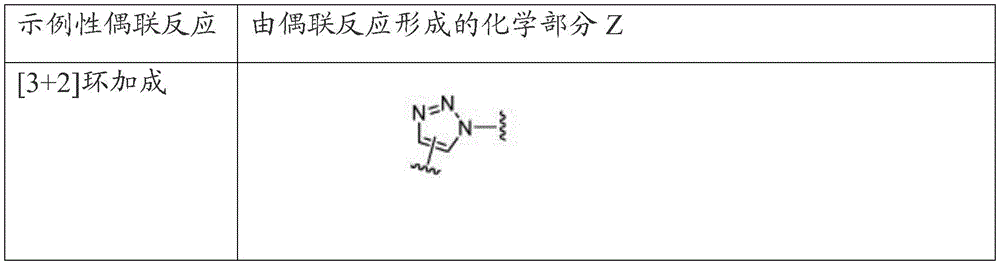


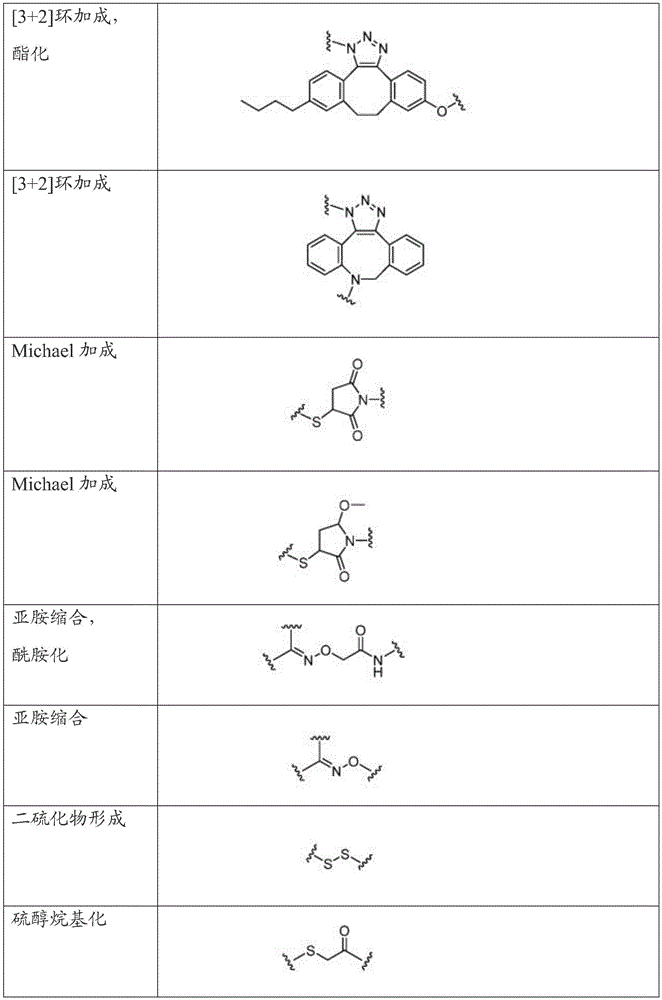

One skilled in the art recognizes that the reactive substituent Z 'attached to the linker and the reactive substituent on the antibody or antigen-binding fragment thereof participate in a covalent coupling reaction to produce the chemical moiety Z, and recognizes the reactive moiety Z'. Thus, an antibody-drug conjugate for use in conjunction with the methods described herein may be formed by reaction of an antibody or antigen-binding fragment thereof with a linker or cytotoxin-linker conjugate, as described herein, the linker or cytotoxin-linker conjugate including a reactive substituent Z', suitable for reaction with a reactive substituent on the antibody or antigen-binding fragment thereof to form chemical moiety Z.
As shown in table 4, examples of suitable reactive substituents on the linker and antibody or antigen-binding fragment thereof include nucleophile/electrophile pairs (e.g., thiol/haloalkyi pairs, amine/carbonyl pairs, or thiol/α, β -unsaturated carbonyl pairs, etc.), diene/diene affibody pairs (e.g., azide/alkyne pairs, or diene/α, β -unsaturated carbonyl pairs, etc.), and the like. Coupling reactions between reactive substituents that form a chemical moiety Z include, but are not limited to, thiol alkylation, hydroxyalkylation, amine alkylation, amine or hydroxylamine condensation, hydrazine formation, amidation, esterification, disulfide formation, cycloaddition (e.g., [4+2] Diels-Alder cycloaddition, [3+2] Huisen cycloaddition, etc.), nucleophilic aromatic substitution, electrophilic aromatic substitution, and other reaction forms known in the art or described herein. Preferably, the linker comprises an electrophilic functional group for reacting with a nucleophilic functional group on the antibody or antigen-binding fragment thereof.
As disclosed herein, reactive substituents that may be present in an antibody or antigen-binding fragment thereof include, but are not limited to, nucleophilic groups, such as (i) N-terminal amine groups; (ii) side chain amine groups, such as lysine; (iii) pendant thiol groups, such as cysteine; and (iv) a sugar hydroxyl or amino group, wherein the antibody is glycosylated. Reactive substituents that may be present in an antibody or antigen-binding fragment thereof, as disclosed herein, include, but are not limited to, hydroxyl moieties of serine, threonine, and tyrosine residues; the amino moiety of a lysine residue; the carboxyl portion of aspartic and glutamic acid residues; and a thiol moiety of a cysteine residue; and propargyl, azido, haloaryl (e.g., fluoroaryl), haloheteroaryl (e.g., fluoroheteroaryl), haloalkyl, and haloheteroalkyl moieties of non-naturally occurring amino acids. In some embodiments, the reactive substituent present in the antibody or antigen-binding fragment thereof is an amine or thiol moiety, as disclosed herein. Some antibodies have reducible interchain disulfides, i.e., cysteine bridges. The antibody may be made reactive for conjugation to a linker reagent by treatment with a reducing agent, such as DTT (dithiothreitol). Theoretically, therefore, two reactive thiol nucleophiles are formed per cysteine bridge. Additional nucleophilic groups can be introduced into the antibody by reaction of lysine with 2-iminothiosilane (Traut's reagent), resulting in conversion of the amine to a thiol. Reactive thiol groups can be introduced into an antibody (or fragment thereof) by introducing one, two, three, four, or more cysteine residues (e.g., making a mutant antibody comprising one or more non-natural cysteine amino acid residues). U.S. patent No. 7,521,541 teaches genetic engineering of antibodies by introducing reactive cysteine amino acids.
In some embodiments, the reactive moiety Z' attached to the linker is a nucleophilic group that reacts with an electrophilic group present on the antibody. Useful electrophilic groups on antibodies include, but are not limited to, aldehyde and ketone carbonyl groups. The heteroatom of the nucleophilic group can react with an electrophilic group on the antibody and form a covalent bond with the antibody. Useful nucleophilic groups include, but are not limited to, hydrazide, oxime, amino, hydroxyl, hydrazine, thiosemicarbazone, hydrazine carboxylate, and aryl hydrazide.
In some embodiments, Z is the reaction product between a reactive nucleophilic substituent and a reactive electrophilic substituent Z' present in an antibody or antigen-binding fragment thereof (e.g., amine and thiol moieties). For example, Z' can be a Michael acceptor (e.g., maleimide), an activated ester, an electron deficient carbonyl compound, an aldehyde, and the like.
For example, suitable linkers for use in synthesizing ADCs include, but are not limited to, reactive substituents Z', such as maleimides or haloalkyl. These can be attached to a linker by reagents such as succinimidyl 4- (N-maleimidomethyl) -cyclohexane-L-carboxylate (SMCC), N-Succinimidyl Iodoacetate (SIA), sulfo-SMCC, m-maleimidobenzoyl-N-hydroxysuccinimide ester (MBS), sulfo-MBS, and succinimidyl iodoacetate, as well as other reagents described in, for example, Liu et al, 18:690-697,1979, the disclosure of which is incorporated herein by reference as it relates to a linker for chemical conjugation.
In some embodiments, the reactive substituent Z' attached to the linker L is a maleimide, an azide, or an alkyne. Examples of maleimide-containing linkers are non-cleavable maleimide-based linkers, which are particularly useful for conjugation of microtubule disrupting agents (e.g., auristatins). Such linkers are described by Doronina et al, Bioconjugate chem.17:14-24,2006, the disclosure of which is incorporated herein by reference as it relates to linkers for chemical conjugation.
In some embodiments, the reactive substituent Z' is- (C ═ O) -or-NH (C ═ O) -, such that the linker may be attached to the antibody or antigen-binding fragment thereof, respectively, through an amide or urea moiety, resulting from reaction of the- (C ═ O) -or-NH (C ═ O) -group with the amino group of the antibody or antigen-binding fragment thereof.
In some embodiments, the reactive substituent is an N-maleimido group, a halogenated N-alkylamido group, a sulfonyloxy N-alkylamido group, a carbonate group, a sulfonyl halide group, a thiol group or derivative thereof, an alkynyl group containing an internal carbon-carbon triple bond, a (hetero-per) cycloalkynyl group, a bicyclo [6.1.0] non-4-yn-9-yl group, an alkenyl group containing an internal carbon-carbon double bond, a cycloalkenyl group, a tetrazinyl group, azido, phosphino, nitrile oxide, nitrone, nitrilo, diazo, keto, (O-alkyl) hydroxyamino, hydrazino, N-maleimidoyl halide, 1-bis (sulfonylmethyl) methylcarbonyl or an eliminated derivative thereof, a carbonyl halide group, or a dienylamide (allenamide), each of which may be optionally substituted. In some embodiments, the reactive substituent comprises a cycloalkenyl group, a cycloalkynyl group, or an optionally substituted (hetero) cycloalkynyl group.
Non-limiting examples of amatoxin-linker conjugates containing a reactive substituent Z 'suitable for reaction with a reactive residue on an antibody or antigen-binding fragment thereof include, but are not limited to, 7' C- (4- (6- (maleimido) hexanoyl) piperazin-1-yl) -amatoxin;
7' C- (4- (6- (maleimido) hexanoylamino) piperidin-1-yl) -amanitin;
7' C- (4- (6- (6- (maleimido) caproylamino) hexanoyl) piperazin-1-yl) -amanitin;
7' C- (4- (4- ((maleimido) methyl) cyclohexanecarbonyl) piperazin-1-yl) -amatoxin;
7' C- (4- (6- (4- (maleimido) methyl) cyclohexanecarboxamido) hexanoyl) piperazin-1-yl) -amatoxin;
7' C- (4- (2- (6- (maleimido) hexanoylamino) ethyl) piperidin-1-yl) -amanitin;
7' C- (4- (2- (6- (6- (maleimido) hexanoylamino) ethyl) piperidin-1-yl) -amanitin;
7' C- (4- (2- (4- ((maleimido) methyl) cyclohexanecarboxamido) ethyl) piperidin-1-yl) -amatoxin;
7' C- (4- (2- (6- (4- (maleimido) methyl) cyclohexanecarboxamido (hexanoylamino) ethyl) piperidin-1-yl) -amatoxin;
7' C- (4- (2- (3-carboxypropionylamino) ethyl) piperidin-1-yl) -amanitin;
7' C- (4- (2- (2-bromoacetamido) ethyl) piperidin-1-yl) -amanitin;
7' C- (4- (2- (3- (pyridin-2-yl-disulfonyl) propionylamino) ethyl) piperidin-1-yl) -amanitin;
7' C- (4- (2- (4- (maleimido) butyrylamino) ethyl) piperidin-1-yl) -amanitin;
7' C- (4- (2- (maleimido) acetyl) piperazin-1-yl) -amanitin;
7' C- (4- (3- (maleimido) propionyl) piperazin-1-yl) -amanitin;
7' C- (4- (4- (maleimido) butyryl) piperazin-1-yl) -amanitin;
7' C- (4- (2- (6- (4- (maleimido) methyl) cyclohexanecarboxamido (hexanoylamino) ethyl) piperidin-1-yl) -amatoxin;
7' C- (3- ((6- (maleimido) hexanoylamino) methyl) pyrrolidin-1-yl) -amanitin;
7' C- (3- ((6- (6- (maleimido) hexanoylamino) methyl) pyrrolidin-1-yl) -amatoxin;
7' C- (3- ((4- ((maleimido) methyl) cyclohexanecarboxamido) methyl) pyrrolidin-1-yl) -amatoxin;
7' C- (3- ((6- ((4- (maleimido) methyl) cyclohexanecarboxamido) hexanoylamino) methyl) pyrrolidin-1-yl) -amatoxin;
7' C- (4- (2- (6- (2- (aminooxy) acetamido) hexanoylamino) ethyl) piperidin-1-yl) -amanitin;
7' C- (4- (2- (4- (2- (aminooxy) acetylamino) butyrylamino) ethyl) piperidin-1-yl) -amanitin;
7' C- (4- (4- (2- (aminooxy) acetylamino) butanoyl) piperazin-1-yl) -amanitin;
7' C- (4- (6- (2- (aminooxy) acetamido) hexanoyl) piperazin-1-yl) -amanitin;
7' C- ((4- (6- (maleimido) hexanoylamino) piperidin-1-yl) methyl) -amatoxin;
7' C- ((4- (2- (6- (maleimido) hexanoylamino) ethyl) piperidin-1-yl) methyl) -amatoxin;
7' C- ((4- (6- (maleimido) hexanoyl) piperazin-1-yl) methyl) -amatoxin;
(R) -7' C- ((3- ((6- (maleimido) hexanoylamino) methyl) pyrrolidin-1-yl) methyl) -amatoxin;
(S) -7' C- ((3- ((6- (maleimido) hexanoylamino) methyl) pyrrolidin-1-yl) methyl) -amatoxin;
7' C- ((4- (2- (6- (6- (maleimido) hexanoylamino) ethyl) piperidin-1-yl) methyl) -amatoxin;
7' C- ((4- (2- (4- ((maleimido) methyl) cyclohexanecarboxamido) ethyl) piperidin-1-yl) methyl) -amatoxin;
7' C- ((4- (2- (6- (4- ((maleimido) methyl) cyclohexanecarboxamido) hexanoylamino) ethyl) piperidin-1-yl) methyl) -amatoxin;
7' C- ((4- (2- (6- (maleimido) hexanoylamino) ethyl) piperazin-1-yl) methyl) -amatoxin;
7' C- ((4- (2- (6- (6- (maleimido) hexanoylamino) ethyl) piperazin-1-yl) methyl) -amatoxin;
7' C- ((4- (2- (4- ((maleimido) methyl) cyclohexanecarboxamido) ethyl) piperazin-1-yl) methyl) -amatoxin;
7' C- ((4- (2- (6- (4- ((maleimido) methyl) cyclohexanecarboxamido) hexanoamido) ethyl) piperazin-1-yl) methyl) -amatoxin;
7' C- ((3- ((6- (6- (maleimido) hexanoylamino) -S-methyl) pyrrolidin-1-yl) methyl) -amatoxin;
7' C- ((3- ((6- (6- (maleimido) hexanoylamino) -R-methyl) pyrrolidin-1-yl) methyl) -amatoxin;
7' C- ((3- ((4- ((maleimido) methyl) cyclohexanecarboxamido) -S-methyl) pyrrolidin-1-yl) methyl) -amatoxin;
7' C- ((3- ((4- ((maleimido) methyl) cyclohexanecarboxamido) -R-methyl) pyrrolidin-1-yl) methyl) -amatoxin;
7' C- ((3- ((6- (4- ((maleimido) methyl) cyclohexanecarboxamido) hexanoamido) methyl) pyrrolidin-1-yl) methyl) -amatoxin;
7' C- ((4- (2- (3-carboxypropionylamino) ethyl) piperazin-1-yl) methyl) -amatoxin;
7' C- ((4- (6- (6- (maleimido) hexanoylamino) hexanoyl) piperazin-1-yl) methyl) -amatoxin;
7' C- ((4- (6- (4- ((maleimido) methyl) cyclohexanecarboxamido) hexanoyl) piperazin-1-yl) methyl) -amatoxin;
7' C- ((4- (2- (maleimido) acetyl) piperazin-1-yl) methyl) -amatoxin;
7' C- ((4- (3- (maleimido) propionyl) piperazin-1-yl) methyl) -amatoxin;
7' C- ((4- (4- (maleimido) butyryl) piperazin-1-yl) methyl) -amatoxin;
7' C- ((4- (2- (2- (maleimido) acetylamino) ethyl) piperidin-1-yl) methyl) -amatoxin;
7' C- ((4- (2- (4- (maleimido) butyrylamino) ethyl) piperidin-1-yl) methyl) -amatoxin;
7' C- ((4- (2- (6- (4- ((maleimido) methyl) cyclohexanecarboxamido) hexanoylamino) ethyl) piperidin-1-yl) methyl) -amatoxin;
7' C- ((3- ((6- (maleimido) hexanoylamino) methyl) azetidin-1-yl) methyl) -amatoxin;
7' C- ((3- (2- (6- (maleimido) hexanoylamino) ethyl) azetidin-1-yl) methyl) -amatoxin;
7' C- ((3- ((4- ((maleimido) methyl) cyclohexanecarboxamido) methyl) azetidin-1-yl) methyl) -amatoxin;
7' C- ((3- (2- (4- ((maleimido) methyl) cyclohexanecarboxamido) ethyl) azetidin-1-yl) methyl) -amatoxin;
7' C- ((3- (2- (6- (4- ((maleimido) methyl) cyclohexanecarboxamido) hexanoylamino) ethyl) azetidin-1-yl) methyl) -amatoxin;
7' C- (((2- (6- (maleimido) -N-methylhexanoylamino) ethyl) (methyl) amino) methyl) -amatoxin;
7' C- (((4- (6- (maleimido) -N-methylhexanamido) butyl (methyl) amino) methyl) -amatoxin;
7' C- ((2- (2- (6- (maleimido) hexanoylamino) ethyl) aziridin-1-yl) methyl) -amatoxin;
7' C- ((2- (2- (6- (4- ((maleimido) methyl) cyclohexanecarboxamido) hexanoylamino) ethyl) aziridin-1-yl) methyl) -amatoxin;
7' C- ((4- (6- (6- (2- (aminooxy) acetamido) hexanoylamino) hexanoyl) piperazin-1-yl) methyl) -amatoxin;
7' C- ((4- (1- (aminooxy) -2-oxo-6, 9,12, 15-tetraoxa-3-azeheptadec-17-yl) piperazin-1-yl) methyl) -amatoxin;
7' C- ((4- (2- (2- (aminooxy) acetamido) acetyl) piperazin-1-yl) methyl) -amanitin;
7' C- ((4- (3- (2- (aminooxy) acetylamino) propionyl) piperazin-1-yl) methyl) -amatoxin;
7' C- ((4- (4- (2- (aminooxy) acetylamino) butanoyl) piperazin-1-yl) methyl) -amatoxin;
7' C- ((4- (2- (6- (2- (aminooxy) acetamido) hexanoylamino) ethyl) piperidin-1-yl) methyl) -amatoxin;
7' C- ((4- (2- (2- (2- (aminooxy) acetamido) ethyl) piperidin-1-yl) methyl) -amatoxin;
7' C- ((4- (2- (4- (2- (aminooxy) acetylamino) butyrylamino) ethyl) piperidin-1-yl) methyl) -amatoxin;
7' C- ((4- (20- (aminooxy) -4, 19-dioxo-6, 9,12, 15-tetraoxa-3, 18-diazacicyl) piperidin-1-yl) methyl) -amanitin;
7' C- (((2- (6- (2- (aminooxy) acetylamino) -N-methylhexanoylamino) ethyl) (methyl) amino) methyl) -amanitin;
7' C- (((4- (6- (2- (aminooxy) acetylamino) -N-methylhexanoylamino) butyl) (methyl) amino) methyl) -amanitin;
7' C- ((3- ((6- (4- ((maleimido) methyl) cyclohexanecarboxamido) hexanoylamino) methyl) pyrrolidin-1-yl) -S-methyl) -amatoxin;
7' C- ((3- ((6- (4- ((maleimido) methyl) cyclohexanecarboxamido) hexanoylamino) -R-methyl) pyrrolidin-1-yl) methyl) -amatoxin;
7' C- ((4- (2- (2-bromoacetamido) ethyl) piperazin-1-yl) methyl) -amatoxin;
7' C- ((4- (2- (2-bromoacetamido) ethyl) piperidin-1-yl) methyl) -amatoxin;
7' C- ((4- (2- (3- (pyridin-2-yl-disulfonyl) propionylamino) ethyl) piperidin-1-yl) methyl) -amatoxin;
6' -O- (6- (6- (maleimido) hexanoylamino) hexyl) -amatoxin;
6' O- (5- (4- ((maleimido) methyl) cyclohexanecarboxamido) pentyl) -amatoxin;
6' O- (2- ((6- (maleimido) hexyl) oxy) -2-oxoethyl) -amatoxin;
6' O- ((6- (maleimido) hexyl) carbamoyl) -amatoxin;
6' O- ((6- (4- ((maleimido) methyl) cyclohexanecarboxamido) hexyl) carbamoyl) -amatoxin;
6' -O- (6- (2-bromoacetamido) hexyl) -amatoxin;
7' C- (4- (6- (azido) hexanoylamino) piperidin-1-yl) -amanitin;
7' C- (4- (hex-5-ylamino) piperidin-1-yl) -amanitin;
7' C- (4- (2- (6- (maleimido) hexanoylamino) ethyl) piperazin-1-yl) -amanitin;
7' C- (4- (2- (6- (6- (maleimido) hexanoylamino) ethyl) piperazin-1-yl) -amanitin;
6' O- (6- (6- (11, 12-didehydro-5, 6-dihydro-dibenzo [ b, f ] azocin-5-yl) -6-oxohexanoylamino) hexyl) -amatoxin;
6' -O- (6- (hex-5-ylamino) hexyl) -amanitin;
6' -O- (6- (2- (aminooxy) acetamido) hexyl) -amanitin;
6' O- ((6-aminooxy) hexyl) -amatoxin; and 6' -O- (6- (2-iodoacetamido) hexyl) -amatoxin.
One skilled in the art recognizes that the linker reactive substituent structure comprises maleimide as the group Z' prior to conjugation to the antibody or antigen-binding fragment thereof. The foregoing linker moieties and amatoxin-linker conjugates, as well as other materials used in conjunction with the compositions and methods described herein, are described, for example, in U.S. patent application publication No. 2015/0218220 and patent application publication No. WO2017/149077, the disclosures of each of which are incorporated herein by reference in their entirety.
In some embodiments, prior to conjugation to the antibody or antigen-binding fragment thereof, the linker-reactive substituent structure L-Z' is:

in some embodiments, amanitin disclosed herein is conjugated with a linker reactive moiety-L-Z' having the formula:
in some embodiments, amanitin disclosed herein is conjugated with a linker reactive moiety-L-Z' having the formula:
the foregoing linker moieties and amatoxin-linker conjugates, as well as other materials used in conjunction with the compositions and methods described herein, are described, for example, in U.S. patent application publication No. 2015/0218220 and patent application publication No. WO2017/149077, the disclosures of each of which are incorporated herein by reference in their entirety.
The foregoing linker moieties and amatoxin-linker conjugates, as well as other materials used in conjunction with the compositions and methods described herein, are described, for example, in U.S. patent application publication No. 2015/0218220 and patent application publication No. WO2017/149077, the disclosures of each of which are incorporated herein by reference in their entirety.
In some embodiments, the ADC comprises an anti-CD 117 antibody conjugated to amatoxin, including but not limited to amatoxin of any of formulae I, IA, IB, II, IIA or IIB disclosed herein, through a linker and a chemical moiety Z. In some embodiments, the linker comprises a hydrazine, disulfide, thioether, or dipeptide. In some embodiments, the linker comprises a dipeptide selected from Val-Ala and Val-Cit. In some embodiments, the linker comprises a p-aminobenzyl group (PAB). In some embodiments, the linker comprises a PAB-Cit-Val moiety. In some embodiments, the linker comprises a PAB-Ala-Val moiety. In some embodiments, the linker comprises one- ((C ═ O) (CH) 2)n-units, wherein n is an integer from 1 to 6. In some embodiments, the linker is-PAB-Cit-Val- ((C ═ O) (CH)2)n–。
In some embodiments, the linker comprises — (CH)2)n-units, wherein n is an integer from 2 to 6. In some embodiments, the linker is-PAB-Cit-Val- ((C ═ O) (CH)2)n-. In some embodiments, the linker is-PAB-Ala-Val- ((C ═ O) (CH)2)n-. In some embodiments, the linker is- (CH)2)n-. In some embodiments, the linker is- ((CH)2)n-, where n is 6.
In some embodiments, chemical moiety Z is selected from table 4. In some embodiments, the chemical moiety Z is

Wherein S is a sulfur atom representing a reactive substituent present in an antibody or antigen-binding fragment thereof, which binds to CD117 (e.g., an-SH group from a cysteine residue).
In some embodiments, linker L and chemical moiety Z taken together as L-Z are

Preparation of antibody-drug conjugates
In the ADCs (ADCs; D-L-Z-abs, where D is a cytotoxin), as disclosed herein, an anti-HC antibody (e.g., an anti-CD 117 antibody, an anti-CD 45 antibody, an anti-CD 2 antibody, an anti-CD 5 antibody, an anti-CD 137 antibody, or an anti-CD 252 antibody) or antigen-binding fragment thereof is conjugated to one or more cytotoxic drug moieties (D) through a linker L and a chemical moiety Z as disclosed herein, e.g., from about 1 to about 20 drug moieties per antibody. The ADCs of the present disclosure may be prepared by several routes using organic chemical reactions, conditions and reagents known to those skilled in the art, including (1) reacting a reactive substituent of an antibody or antigen-binding fragment thereof with a divalent linking reagent to form Ab-Z-L as described above, followed by reaction with a drug moiety D; or (2) the reactive substituent of the drug moiety is reacted with a divalent linking reagent to form D-L-Z', and subsequently reacted with the reactive substituent of the antibody or antigen-binding fragment thereof as described above to form an ADC of the formula D-L-Z-Ab, e.g., Am-Z-L-Ab. Additional methods for preparing ADCs are described herein.
In another aspect, an anti-HC antibody (e.g., an anti-CD 117 antibody, an anti-CD 45 antibody, an anti-CD 2 antibody, an anti-CD 5 antibody, an anti-CD 137 antibody, or an anti-CD 252 antibody) or antigen-binding fragment thereof has one or more lysine residues, which can be chemically modified to introduce one or more sulfhydryl groups. The ADC is then formed by conjugation via the sulfur atom of the thiol group, as described above. Reagents that can be used to modify lysine include, but are not limited to, N-succinimidyl S-acetylthioacetate (SATA) and 2-iminothiolane hydrochloride (Traut' S reagent).
In another aspect, an anti-HC antibody (e.g., an anti-CD 117 antibody, an anti-CD 45 antibody, an anti-CD 2 antibody, an anti-CD 5 antibody, an anti-CD 137 antibody, or an anti-CD 252 antibody) or antigen-binding fragment thereof can have one or more carbohydrate groups, which can be chemically modified to have one or more thiol groups. The ADC is then formed by conjugation via the sulfur atom of the thiol group, as described above.
In yet another aspect, an anti-HC antibody (e.g., an anti-CD 117 antibody, an anti-CD 45 antibody, an anti-CD 2 antibody, an anti-CD 5 antibody, an anti-CD 137 antibody, or an anti-CD 252 antibody) or antigen-binding fragment thereof can have one or more carbohydrate groups that can be oxidized to provide aldehyde groups (-CHO) (see, e.g., Laguzza et al, j.med.chem.1989,32(3),548-55). Other Protocols for Protein modification for cytotoxin attachment or association are described in Coligan et al, Current Protocols in Protein Science, vol.2, John Wiley & Sons (2002), incorporated herein by reference.
Methods for conjugating linker-drug moieties to cell targeting proteins (e.g., antibodies, immunoglobulins, or fragments thereof) are described in, for example, U.S. Pat. nos. 5,208,020; U.S. Pat. nos. 6,441,163; WO 2005037992; WO 2005081711; and WO2006/034488, which is hereby incorporated by reference in its entirety.
Alternatively, fusion proteins comprising the antibody and cytotoxic agent may be prepared, for example by recombinant techniques or peptide synthesis. The length of the DNA may comprise respective regions encoding two portions of the conjugate that are adjacent to each other or separated by a region encoding a linker peptide that does not destroy the desired properties of the conjugate.
The ADCs described herein may be administered to a patient (e.g., a human patient suffering from an immune disease or cancer) in one or more dosage forms. For example, the ADCs described herein may be in the form of an aqueous solution (e.g., an aqueous solution containing one or more pharmaceutically acceptable excipients) for patients suffering from an immune disease or cancer. Suitable pharmaceutically acceptable excipients for use with the compositions and methods described herein include viscosity modifiers. The aqueous solution may be sterilized using techniques known in the art.
Pharmaceutical formulations comprising an anti-HC ADC described herein (e.g., anti-CD 117 ADC, anti-CD 45 ADC, anti-CD 2 ADC, anti-CD 5 ADC, anti-CD 137 ADC, or anti-CD 252 ADC) are prepared by mixing such ADC with one or more optional pharmaceutically acceptable carriers (remington's pharmaceutical science 16 edition, Osol, a.ed. (1980)), in a lyophilized formulation or in an aqueous solution. Pharmaceutically acceptable carriers are generally non-toxic to the recipient at the dosages and concentrations employed, and include, but are not limited to: buffers such as phosphates, citrates and other organic acids; antioxidants, including ascorbic acid and methionine; preservatives (e.g., octadecyl dimethyl benzyl ammonium chloride; hexamethyl ammonium chloride; benzalkonium chloride; benzethonium chloride; phenol, butanol or benzyl alcohol; alkyl parabens, e.g., methyl or propyl paraben; catechol; resorcinol; cyclohexanol; 3-pentanol; and m-cresol); low molecular weight (less than about 10 residues) polypeptides; proteins, such as serum albumin, gelatin, or immunoglobulins; hydrophilic polymers such as polyvinylpyrrolidone; amino acids such as glycine, glutamine, asparagine, histidine, arginine or lysine; monosaccharides, disaccharides, and other carbohydrates including glucose, mannose, or dextrins; chelating agents, such as EDTA; sugars, such as sucrose, mannitol, trehalose, or sorbitol; salt-forming counterions, such as sodium; metal complexes (e.g., Zn-protein complexes); and/or a non-ionic surfactant, such as polyethylene glycol (PEG).
Method of treatment
Also disclosed herein are compositions and methods for treating a variety of diseases, such as cell type diseases in the hematopoietic lineage, cancer, autoimmune diseases, metabolic disorders, stem cell disorders, graft-versus-host disease, and the like. The compositions and methods described herein can (i) directly deplete pathologically-responsible cell populations, such as cancer cell populations (e.g., leukemia cells) and autoimmune cells (e.g., autoreactive T cells), and/or (ii) deplete endogenous hematopoietic stem cell populations, thereby facilitating engraftment of transplanted hematopoietic stem cells by providing niches into which the transplanted cells can settle. The foregoing activity can be achieved by administering an ADC, antibody or antigen-binding fragment thereof that is capable of binding to an antigen expressed by endogenous pathogenic cells or hematopoietic stem cells. In the case of direct treatment of the disease, the administration may result in a reduction in the number of cells causing the targeted pathology. In the case of preparing a patient for hematopoietic stem cell transplantation therapy, such administration may result in the selective depletion of the endogenous hematopoietic stem cell population, thereby creating a void in the hematopoietic tissue, e.g., bone marrow, which may then be filled by the transplanted exogenous hematopoietic stem cells. The present invention is based, in part, on the discovery that ADCs, antibodies, or antigen-binding fragments thereof that are capable of binding to an antigen expressed by hematopoietic stem cells (e.g., CD117 (e.g., GNNK + CD117), or CD45) or an antigen expressed by mature immune cells (e.g., T cells (e.g., CD45, CD2, CD5, CD137, or CD252)) can be administered to a patient to affect both of these activities. ADCs, antibodies, or antigen-binding fragments thereof that bind to an antigen expressed by hematopoietic stem cells (e.g., CD117 (e.g., GNNK + CD117), or CD45) or an antigen expressed by mature immune cells (e.g., T cells (e.g., CD45, CD2, CD5, CD137, or CD252)) may be administered to patients suffering from cancer or autoimmune diseases to directly deplete cancer cells or autoimmune cell populations, and may also be administered to patients in need of hematopoietic stem cell transplantation therapy to promote survival and engraftment potential of transplanted hematopoietic stem cells.
As described herein, hematopoietic stem cell transplantation therapy can be administered to a subject in need of treatment, thereby proliferating or repopulating one or more blood cell types. Hematopoietic stem cells generally exhibit pluripotency and, therefore, can differentiate into a variety of different blood lineages, including, but not limited to, granulocytes (e.g., promyelocytes, neutrophils, eosinophils, basophils), erythrocytes (e.g., reticulocytes, erythrocytes), thrombocytes (e.g., megakaryocytes, platelet-producing megakaryocytes, platelets), monocytes (e.g., monocytes, macrophages), dendritic cells, microglia, osteoclasts, and lymphocytes (e.g., NK cells, B cells, and T cells). Hematopoietic stem cells are additionally capable of self-renewal and thus produce daughter cells with equivalent potential to the mother cells, and also feature the ability to reintroduce into the transplant recipient where they return to the hematopoietic stem cell niche (niche) and reconstitute productive and persistent hematopoiesis.
Thus, hematopoietic stem cells may also be administered to patients with a deficiency or insufficiency of one or more hematopoietic lineage cell types to reconstitute the deficient or insufficient cell population in vivo, thereby treating pathologies associated with a deficiency or depletion of the endogenous blood cell population. Thus, the compositions and methods described herein can be used to treat a non-malignant hemoglobinopathy (e.g., a hemoglobinopathy selected from the group consisting of sickle cell anemia, thalassemia, Fanconi anemia, aplastic anemia, and Wiskott-Aldrich syndrome). Additionally or alternatively, the compositions and methods described herein may be used to treat immunodeficiency, such as congenital immunodeficiency. Additionally or alternatively, the compositions and methods described herein can be used to treat acquired immunodeficiency (e.g., acquired immunodeficiency selected from HIV and AIDS). The compositions and methods described herein are useful for treating a metabolic disorder (e.g., a metabolic disorder selected from glycogen storage disease, mucopolysaccharidosis, gaucher's disease, huler's disease, sphingolipid metabolism disorders, and metachromatic leukodystrophy).
Additionally or alternatively, the compositions and methods described herein may be used to treat malignancies or proliferative disorders, such as hematological cancers, myeloproliferative diseases. In the case of cancer treatment, the compositions and methods described herein can be administered to a patient to deplete the endogenous hematopoietic stem cell population prior to hematopoietic stem cell transplantation therapy, in which case the transplanted cells can return to the niche created by the endogenous cell depletion step and establish productive hematopoiesis. This, in turn, can reconstitute cell populations that are depleted during cancer cell clearance (e.g., during systemic chemotherapy). Exemplary hematologic cancers that can be treated using the compositions and methods described herein include, but are not limited to, acute myeloid leukemia, acute lymphocytic leukemia, chronic myeloid leukemia, chronic lymphocytic leukemia, multiple myeloma, diffuse large B-cell lymphoma, and non-hodgkin's lymphoma, as well as other cancer conditions including neuroblastoma.
Additional diseases that may be treated with the compositions and methods described herein include, but are not limited to, adenosine deaminase deficiency and severe combined immunodeficiency, hyper-immunoglobulin M syndrome, Chediak-Higashi disease, hereditary lymphocytosis, osteomyelitis, osteogenesis imperfecta, storage disease, thalassemia major, systemic sclerosis, systemic lupus erythematosus, multiple sclerosis, and juvenile rheumatoid arthritis.
The antibodies, or antigen-binding fragments and conjugates thereof, described herein are useful for inducing solid organ transplant tolerance. For example, the compositions and methods described herein can be used to deplete or eliminate a cell population from a target tissue (e.g., depletion of hematopoietic stem cells from the bone marrow stem cell niche). After cell depletion of the target tissue, the stem or progenitor cell population of the organ donor (e.g., hematopoietic stem cells of the organ donor) may be administered by hand first, and after implantation of such stem or progenitor cells, transient or stable mixed chimeras may be obtained, achieving long-term tolerance of the transplanted organ without the need for further immunosuppressive agents. For example, the compositions and methods described herein can be used to induce transplantation tolerance in solid organ transplant recipients (e.g., kidney, lung, liver, and heart transplants, etc.). The compositions and methods described herein are well suited for inducing tolerance to solid organ transplantation, for example, because a low percentage of transient or stable donor transplants is sufficient to induce long-term tolerance of the transplanted organ.
In addition, the compositions and methods described herein can be used to directly treat cancer, such as cancer characterized by CD117+ (e.g., GNNK + CD117), CD45+, CD2+, CD5+, CD137+, or CD252+ cells. For example, the compositions and methods described herein can be used to treat leukemia, such as patients exhibiting CD117+ leukemia cells. The compositions and methods described herein can be used to directly treat a variety of cancers by depleting CD117+ cancer cells, such as leukemia cells. Exemplary cancers that may be treated in this manner include hematological cancers such as acute myeloid leukemia, acute lymphocytic leukemia, chronic myeloid leukemia, chronic lymphocytic leukemia, multiple myeloma, diffuse large B-cell lymphoma, and non-hodgkin's lymphoma.
Acute Myeloid Leukemia (AML) is a myeloid-lineage blood cell cancer characterized by rapid growth of abnormal leukocytes that accumulate in the bone marrow and interfere with the production of normal blood cells. AML is the most common acute leukemia affecting adults and its incidence increases with age. The symptoms of AML are caused by the replacement of normal bone marrow by leukemic cells, which results in a decline of red blood cells, platelets, and normal white blood cells. As an acute leukemia, AML progresses rapidly and, if left untreated, can be fatal within weeks or months. In one embodiment, the anti-CD 117 antibodies described herein are used to treat AML in a human patient in need thereof. In certain embodiments, the anti-CD 117 ADC treatment depletes AML cells in the treated subject. In some embodiments, 50% or more of the AML cells are depleted. In other embodiments, 60% or more of the AML cells are depleted, or 70% or more of the AML cells are depleted, or 80% or more or 90% or more, or 95% or more of the AML cells are depleted. In certain embodiments, the anti-CD 117 ADC treatment is a single dose treatment. In certain embodiments, a single dose of anti-CD 117 ADC treatment depletes 60%, 70%, 80%, 90%, or 95% or more of AML cells.
In addition, the compositions and methods described herein can be used to treat autoimmune disorders. For example, the antibody or antigen-binding fragment thereof can be administered to a subject (e.g., a human patient suffering from an autoimmune disorder) to kill CD45+, CD2+, CD5+, CD137+, or CD252+ immune cells. For example, a CD45+, CD2+, CD5+, CD137+, or CD252+ immune cell may be an autoreactive lymphocyte, such as a T cell that expresses a T cell receptor that specifically binds to and generates an immune response against an autoantigen. The compositions and methods described herein may be used to treat autoimmune pathologies, such as those described below, by depleting autoreactive CD45+, CD2+, CD5+, CD137+, or CD252+ cells. Additionally or alternatively, the compositions and methods described herein can be used to treat autoimmune diseases by depleting the endogenous hematopoietic stem cell population prior to hematopoietic stem cell transplantation therapy, in which case the transplanted cells can return to the niche created by the endogenous cell depletion step and establish productive hematopoiesis. This, in turn, can reconstitute the cell population depleted during the clearance of autoimmune cells.
Autoimmune diseases that can be treated using the compositions and methods described herein include, but are not limited to, psoriasis, psoriatic arthritis, Type 1diabetes mellitus (Type 1diabetes mellitis or Type 1diabetes), Rheumatoid Arthritis (RA), human Systemic Lupus Erythematosus (SLE), Multiple Sclerosis (MS), Inflammatory Bowel Disease (IBD), lymphocytic colitis, Acute Disseminated Encephalomyelitis (ADEM), addison's disease, alopecia praecox, ankylosing spondylitis, antiphospholipid antibody syndrome (APS), aplastic anemia, autoimmune hemolytic anemia, autoimmune hepatitis, Autoimmune Inner Ear Disease (AIED), autoimmune lymphoproliferative syndrome (ALPS), autoimmune oophoritis, barllosis, behcet's disease, bullous pemphigoid, cardiomyopathy, chagas ' disease, Chronic Fatigue Immune Dysfunction Syndrome (CFIDS), Chronic inflammatory demyelinating polyneuropathy, crohn's disease, cicatricial pemphigoid, celiac sprue dermatitis herpetiformis, cold agglutinin disease, CREST syndrome, malignant atrophic papulopathy, discoid lupus, familial autonomic abnormalities, endometriosis, idiopathic mixed cryoprecipitation globulinemia, fibromyalgia-fibromyositis, goodpasture's syndrome, graves ' disease, guillain-barre syndrome (GBS), hashimoto's thyroiditis, hidradenitis suppurativa, idiopathic and/or acute thrombocytopenic purpura, idiopathic pulmonary fibrosis, IgA neuropathy, interstitial cystitis, juvenile arthritis, malus, lichen planus, lyme disease, meniere's disease, Mixed Connective Tissue Disease (MCTD), myasthenia gravis, neuromyotonia, strabismus-myoclonus. Sympathy (OMS), optic neuritis, Alder thyroiditis, pemphigus vulgaris, pernicious anemia, polychondritis, polymyositis and dermatomyositis, primary biliary cirrhosis, polyarteritis nodosa, glandular syndrome, polymyalgia rheumatica, primary agammaglobulinemia, Raynaud's phenomenon, Reiter's syndrome, rheumatic fever, sarcoidosis, scleroderma, and combinations thereof, Syndromes, stiff person syndrome, aortic artery disease, temporal arteritis (also known as "giant cell arteritis"), ulcerative colitis, collagenous colitis, uveitis, vasculitis, vitiligo, vulvodynia ("vulvar vestibulitis"), and wegener's granulomatosis.
Also provided herein are methods of preventing and treating Graft Versus Host Disease (GVHD) and autoimmune diseases by administering an antibody, antigen-binding fragment thereof, or ADC that is capable of binding to an antigen (e.g., CD137, CD2, or CD5) expressed by hematopoietic stem cells, wherein the antibody comprises an Fc region comprising a D265C, L234A, L235A, and/or H435A mutation. Such administration may result in selective depletion of T cell populations that respond to the host. For example, antibodies, antigen-binding fragments thereof, or ADCs that are capable of binding to CD137 may be administered to patients to prevent and treat GVHD and autoimmune diseases, such as those resulting from hematopoietic stem cell transplantation therapy. anti-CD 137 antibodies and conjugates thereof, and related methods of use, can be found, for example, in U.S. patent application No. 62/448,741 and PCT publication No. WO 2018/134787, the entire contents of which are incorporated herein by reference.
The compositions and methods described herein can be used to deplete activated T cells (e.g., expressing CD137, CD252, CD134, etc.) associated with graft failure and autoimmune disease to achieve graft tolerance. The compositions and methods described herein are particularly useful for the prevention and treatment of GVHD and autoimmune diseases. The methods and compositions disclosed herein are also useful for reducing the risk of graft failure in human patients receiving allogeneic grafts. Preferably the subject is a human. The amount of antibody, antibody-drug conjugate, or ligand-drug conjugate administered should be sufficient to deplete cells that promote GVHD or autoimmune disease (e.g., activated T cells).
The antibody or antibody-drug conjugate can be administered to a human patient in need thereof prior to, concurrently with, or after transplantation of the cells or solid organ to the patient. In one embodiment, anti-CD 137 ADC is administered to a human patient in need thereof prior to transplantation of the cell or solid organ (e.g., about 3 days ago, about 2 days ago, about 12 hours ago to 3 days ago, about 1 to 3 days ago, about 12 hours ago to 2 days ago, or about 1-2 days ago). In one embodiment, anti-CD 137 ADC is administered to a human patient in need thereof after transplantation of cells or solid organs (e.g., after about 1 day, after about 2 days, after about 3 days, or after about 4 days). A single dose of anti-CD 137 ADC may be administered to a human patient prior to, concurrently with, or after transplantation of a cell or organ, wherein such single dose is sufficient to treat or prevent GVHD or graft failure.
The methods and compositions disclosed herein are useful for preventing or treating graft failure. Graft failure or transplant rejection, including failure following allogeneic hematopoietic stem cell transplantation, may often be manifested by a lack of initial engraftment of donor cells, or by loss of donor cells following initial engraftment (for review see Mattsson et al (2008) Biol Blood Marrow transfer.14 (Suppl 1): 165-170). For example, in a transplant or transplant protocol where transplant failure is of concern, the compositions and methods disclosed herein can be used to deplete CD 137-expressing activated T cells, e.g., where a human patient is at risk of developing transplant failure following a solid organ or cell transplant, particularly where the transplanted cells or organ are allogeneic.
In one embodiment, the anti-CD 137 antibody, antibody-drug conjugate, or ligand-drug conjugate is used to deplete CD137 expressing donor cells, such as CD137 expressing activated T cells, by contacting the cells, graft, or solid organ with the anti-CD 137 antibody, antibody-drug conjugate, or ligand-drug conjugate prior to transplantation of the cells, graft, or organ into a human patient. In one embodiment, the cell, graft or organ is allogeneic.
The risk of GVHD remains high after transplantation with current therapies. The methods and compositions disclosed herein are useful for inhibiting Graft Versus Host Disease (GVHD) in a human patient. anti-CD 137 antibodies can be used to selectively target activated T cells in patients who will receive transplantation (e.g., stem cell transplantation). As described herein, anti-CD 137 ADCs can also be used to reduce the risk of GVHD by targeting and depleting CD137 positive cells in human patients about to receive or who have received a transplant (such as, but not limited to, a HSC transplant). As described herein, anti-CD 252 ADCs can also be used to reduce the risk of GVHD by targeting and depleting CD137 positive cells in human patients about to receive or who have received a transplant (such as, but not limited to, a HSC transplant). In certain embodiments, the compositions and methods disclosed herein are used to treat GVHD in a patient prior to the patient developing symptoms of GVHD following a transplantation therapy (e.g., allogeneic HSCs).
The methods described herein may also be used to prevent host versus graft (HvG) responses. For example, anti-CD 137-ADC may also be used as an immunosuppressant to prevent host versus graft (HvG) responses, thereby preventing or reducing the risk of allograft failure. Use of anti-CD 137 ADCs in patients at risk of an HvG response enabled implantation of donor cells with a greater degree of HLA mismatch. Additional uses include tolerance induction in solid organ transplantation, where host versus graft response is prevented or inhibited by CD 137-ADC. These include solid organ transplantation, including xenotransplantation, with or without hematopoietic stem cell transplantation, wherein the organ is of non-human origin and/or genetically modified.
In one embodiment, anti-CD 137-ADC is used to prevent graft-versus-graft in the context of allografts using two donors (GvG). Examples include the use of 2 cord blood stem cell donors in adult and pediatric patients. GvG prevention allows for faster reconstitution of hematopoiesis (e.g., neutrophils and platelets) after transplantation because both stem cell sources are successfully implanted.
Other therapeutic approaches using anti-CD 137 antibodies or ADCs are described in US 10,434,185, which is incorporated herein by reference.
Other methods of treatment using anti-CD 252 antibodies or ADCs, including prevention of graft versus host disease or induction of post-transplant tolerance, are described in US WO 2019/173780, which is incorporated herein by reference.
Other therapeutic approaches using anti-CD 2 antibodies or ADCs are described in WO 2019/108860, which is incorporated herein by reference.
Other therapeutic approaches using anti-CD 5 antibodies or ADCs are described in WO 2019/108863, which is incorporated herein by reference.
In some embodiments, the transplantation is allogeneic. In some embodiments, the transplantation is autologous.
In some embodiments, the transplantation is a bone marrow transplant, a peripheral blood transplant, or an umbilical cord blood transplant.
In some embodiments, the graft comprises hematopoietic cells (e.g., hematopoietic stem cells).
In any of the embodiments described herein, the graft may be any solid organ or skin graft. In some embodiments, the transplantation is selected from the group consisting of kidney transplantation, heart transplantation, liver transplantation, pancreas transplantation, lung transplantation, intestine transplantation, and skin transplantation.
Additionally, disclosed herein are methods for treating or preventing allograft cell rejection in a human subject, i.e., treating or preventing a host-versus-graft (HvG) disease with an antibody or conjugate thereof having a modified Fc region disclosed herein. For example, the methods disclosed herein include administering both an anti-CD 137 antibody drug conjugate (which binds endogenous CD137+ immune cells, e.g., activated T cells) and an allogeneic cell therapy, wherein the anti-CD 137 antibody comprises an Fc region containing D265C, L234A, L235A, and/or H435A mutations. By administering anti-CD 137 ADCs to human patients receiving allogeneic cell transplantation, endogenous CD137+ T cells are depleted, thus reducing the risk of endogenous cells responding to allogeneic cell therapy.
Route of administration and dosage
The antibodies, antigen-binding fragments thereof, or ADCs described herein can be administered to a patient (e.g., a human patient suffering from cancer, an autoimmune disease, or in need of hematopoietic stem cell transplantation therapy) in a variety of dosage forms. For example, an antibody, antigen-binding fragment thereof, or ADC described herein can be administered in the form of an aqueous solution (e.g., an aqueous solution containing one or more pharmaceutically acceptable excipients) to a patient suffering from cancer, an autoimmune disease, or in need of hematopoietic stem cell transplantation therapy. Pharmaceutically acceptable excipients for use in the compositions and methods described herein include viscosity modifiers. The aqueous solution may be sterilized using techniques known in the art.
Pharmaceutical formulations comprising an anti-HC antibody described herein (e.g., an anti-CD 117 antibody, an anti-CD 45 antibody, an anti-CD 2 antibody, an anti-CD 5 antibody, an anti-CD 137 antibody, or an anti-CD 252 antibody) are prepared by mixing such an antibody or ADC with one or more optional pharmaceutically acceptable carriers (remington's pharmaceutical science 16 th edition, Osol, a.ed. (1980)), in the form of a lyophilized formulation or an aqueous solution. Pharmaceutically acceptable carriers are generally non-toxic to the recipient at the dosages and concentrations employed, and include, but are not limited to: buffers such as phosphates, citrates and other organic acids; antioxidants, including ascorbic acid and methionine; preservatives (e.g., octadecyl dimethyl benzyl ammonium chloride; hexamethyl ammonium chloride; benzalkonium chloride; benzethonium chloride; phenol, butanol or benzyl alcohol; alkyl parabens, e.g., methyl or propyl paraben; catechol; resorcinol; cyclohexanol; 3-pentanol; and m-cresol); low molecular weight (less than about 10 residues) polypeptides; proteins, such as serum albumin, gelatin, or immunoglobulins; hydrophilic polymers such as polyvinylpyrrolidone; amino acids such as glycine, glutamine, asparagine, histidine, arginine or lysine; monosaccharides, disaccharides, and other carbohydrates including glucose, mannose, or dextrins; chelating agents, such as EDTA; sugars, such as sucrose, mannitol, trehalose, or sorbitol; salt-forming counterions, such as sodium; metal complexes (e.g., Zn-protein complexes); and/or a non-ionic surfactant, such as polyethylene glycol (PEG).
The antibodies, antigen-binding fragments, or ADCs described herein may be administered by a variety of routes, e.g., oral, transdermal, subcutaneous, intranasal, intravenous, intramuscular, intraocular, or parenteral. The most suitable administration in any given case will depend on the particular antibody or antigen-binding fragment being administered, the patient, the method of pharmaceutical formulation, the method of administration (e.g., time of administration and route of administration), the age, weight, sex, severity of the disease being treated, the diet of the patient, and the rate of excretion from the patient.
An effective dose of an antibody or antigen-binding fragment thereof described herein can be, for example, from about 0.001 to about 100mg/kg of body weight per single (e.g., bolus) administration, multiple administrations, or consecutive administrations, or to achieve an optimal serum concentration of the antibody or antigen-binding fragment thereof (e.g., a serum concentration of 0.0001-5000 μ g/mL). A subject (e.g., a human) suffering from cancer, an autoimmune disease, or undergoing a pretreatment therapy ready to receive hematopoietic stem cell transplantation may be administered one or more (e.g., 2-10) doses per day, week, or month.
In one embodiment, the dose of anti-HC ADC (e.g., an anti-CD 117 antibody conjugated to amanitin via a linker) administered to a human patient is about 0.1mg/kg to about 0.3 mg/kg.
In one embodiment, the dose of anti-HC ADC (e.g., an anti-CD 117 antibody conjugated to amanitin via a linker) administered to a human patient is about 0.15mg/kg to about 0.3 mg/kg.
In one embodiment, the dose of anti-HC ADC (e.g., an anti-CD 117 antibody conjugated to amanitin via a linker) administered to a human patient is about 0.15mg/kg to about 0.25 mg/kg.
In one embodiment, the dose of anti-HC ADC (e.g., an anti-CD 117 antibody conjugated to amanitin via a linker) administered to a human patient is about 0.2mg/kg to about 0.3 mg/kg.
In one embodiment, the dose of anti-HC ADC (e.g., an anti-CD 117 antibody conjugated to amanitin via a linker) administered to a human patient is about 0.25mg/kg to about 0.3 mg/kg.
In one embodiment, the dose of anti-HC ADC (e.g., an anti-CD 117 antibody conjugated to amanitin via a linker) administered to a human patient is about 0.1 mg/kg.
In one embodiment, the dose of anti-HC ADC (e.g., an anti-CD 117 antibody conjugated to amanitin via a linker) administered to a human patient is about 0.2 mg/kg.
In one embodiment, the dose of anti-HC ADC (e.g., an anti-CD 117 antibody conjugated to amanitin via a linker) administered to a human patient is about 0.3 mg/kg.
In one embodiment, the dose of an anti-HC ADC described herein administered to a human patient is from about 0.001mg/kg to 10mg/kg, from about 0.01mg/kg to 9.5mg/kg, from about 0.1mg/kg to 9mg/kg, from about 0.1mg/kg to 8.5mg/kg, from about 0.1mg/kg to 8mg/kg, from about 0.1mg/kg to 7.5mg/kg, from about 0.1mg/kg to 7mg/kg, from 0.1mg/kg to 6.5mg/kg, from 0.1mg/kg to 6mg/kg, from 0.1mg/kg to 5.5mg/kg, from about 0.1mg/kg to 5mg/kg, from about 0.1mg/kg to 4.5mg/kg, from about 0.1mg/kg to 4mg/kg, from about 0.5mg/kg to 3.5mg/kg, from about 0.5mg/kg to 10mg/kg, from about 0.1mg/kg to 10mg/kg, About 1mg/kg to 9mg/kg, about 1mg/kg to 8mg/kg, about 1mg/kg to 7mg/kg, about 1mg/kg to 6mg/kg, about 1mg/kg to 5mg/kg, about 1mg/kg to 4mg/kg, about 1mg/kg to 3 mg/kg.
In one embodiment, the half-life of an anti-HC ADC described herein administered to a human patient for treatment or pretreatment is equal to or less than 24 hours, equal to or less than 22 hours, equal to or less than 20 hours, equal to or less than 18 hours, equal to or less than 16 hours, equal to or less than 14 hours, equal to or less than 13 hours, equal to or less than 12 hours, equal to or less than 11 hours, equal to or less than 10 hours, equal to or less than 9 hours, equal to or less than 8 hours, equal to or less than 7 hours, equal to or less than 6 hours, or equal to or less than 5 hours. In one embodiment, the half-life of the anti-HC ADC is 5 hours to 7 hours; from 5 hours to 9 hours; from 15 hours to 11 hours; from 5 hours to 13 hours; from 5 hours to 15 hours; from 5 hours to 20 hours; from 5 hours to 24 hours; from 7 hours to 24 hours; from 9 hours to 24 hours; from 11 hours to 24 hours; 12 hours to 22 hours; 10 to 20 hours; 8 to 18 hours; or from 14 hours to 24 hours.
In one embodiment, the methods disclosed herein minimize hepatotoxicity in patients receiving ADC for pretreatment. For example, in certain embodiments, the methods disclosed herein result in the patient's liver marker levels remaining below known toxicity levels for more than 24 hours, 48 hours, 72 hours, or 96 hours. In other embodiments, the methods disclosed herein result in the liver marker level of the patient remaining within the reference range for more than 24 hours, 48 hours, 72 hours, or 96 hours. In certain embodiments, the methods disclosed herein result in an increase in liver marker levels by no more than 1.5-fold, no more than 3-fold, no more than 5-fold, or no more than 10-fold of the reference range over 24 hours, 48 hours, 72 hours, or 96 hours. Examples of liver markers that can be used for toxicity testing include alanine Aminotransferase (ALT), Lactate Dehydrogenase (LDH), and aspartate Aminotransferase (AST). In certain embodiments, administration of an ADC as described herein, i.e., wherein two doses are administered instead of a single dose, results in a transient increase in liver markers, e.g., AST, LDH, and/or ALT. In some cases, elevated levels of a hepatic marker indicative of toxicity may be reached, but within a certain period of time, e.g., about 12 hours, about 18 hours, about 24 hours, about 36 hours, about 48 hours, about 72 hours, more than 3 days, about 3.5 days, about 4 days, about 4.5 days, about 5 days, about 5.5 days, about 6 days, about 6.5 days, about 7 days, about 7.5 days, or less than a week, the hepatic marker levels return to normal levels not associated with hepatic toxicity. For example, in humans (average adult males), the normal non-toxic level of ALT is 7 to 55 units per liter (U/L); and normal non-toxic levels are 8 to 48U/L. In certain embodiments, at least one of the patient's blood AST, ALT, or LDH levels does not reach a toxic level between the first dose of ADC administered to the patient and 14 days after administration of the first dose, e.g., the first dose may be administered to the patient followed by administration of the second, third, fourth, or more doses, e.g., 5, 10, or 14 days after administration of the first dose, but at least one of the patient's blood AST, ALT, or LDH levels does not reach a toxic level between the first dose of ADC administered to the patient and 14 days after administration of the first dose.
In certain embodiments, the patient does not have an increase in at least one of blood AST, ALT, or LDH levels above normal levels, does not have an increase greater than 1.5 times normal levels, does not have an increase greater than 3 times normal levels, does not have an increase greater than 5 times normal levels, or does not have an increase greater than 10 times normal levels.
The invention encompasses dosage regimens that reduce adverse events and toxicity using ADCs that are capable of binding to antigens expressed by hematopoietic cells (e.g., hematopoietic stem cells, immune cells, or cancer cells). Examples of such antigens include, but are not limited to, CD117, CD2, CD5, CD45, CD252, CD134, and CD 137.
In the case of a pre-treatment procedure prior to hematopoietic stem cell transplantation, the antibody or antigen-binding fragment thereof can be administered to the patient at a time that optimally promotes engraftment of the exogenous hematopoietic stem cells, e.g., about 1 hour to about 1 week (e.g., about 1 hour, about 2 hours, about 3 hours, about 4 hours, about 5 hours, about 6 hours, about 7 hours, about 8 hours, about 9 hours, about 10 hours, about 11 hours, about 12 hours, about 13 hours, about 14 hours, about 15 hours, about 16 hours, about 17 hours, about 18 hours, about 19 hours, about 20 hours, about 21 hours, about 22 hours, about 23 hours, about 24 hours, about 2 days, about 3 days, about 4 days, about 5 days, about 6 days, about 7 days) or more prior to administration of the exogenous hematopoietic stem cell transplantation. Ranges including the numbers recited herein are also included in the contemplated methods.
The above dosing ranges may be combined with anti-HC ADCs having a half-life as described herein.
Using the methods disclosed herein, one of skill in the art can administer to a human patient in need of hematopoietic stem cell transplantation therapy an antibody or antigen-binding fragment thereof that is capable of binding to an antigen expressed by hematopoietic stem cells (e.g., CD117 (e.g., GNNK + CD117), or CD45) or an antigen expressed by mature immune cells (e.g., T cells (e.g., CD45, CD2, CD5, CD137, or CD 252)). In this way, the endogenous hematopoietic stem cell population can be depleted prior to administration of the exogenous hematopoietic stem cell graft, thereby facilitating engraftment of the hematopoietic stem cell graft. The antibody may be covalently conjugated to a toxin, such as a cytotoxic molecule described herein or known in the art. For example, an anti-CD 117 antibody or antigen-binding fragment thereof (e.g., an anti-HC antibody (e.g., an anti-CD 117 antibody, an anti-CD 45 antibody, an anti-CD 2 antibody, an anti-CD 5 antibody, an anti-CD 137 antibody, or an anti-CD 252 antibody), or an antigen-binding fragment thereof) can be covalently conjugated to a cytotoxin, such as pseudomonas exotoxin A, deBouganin, diphtheria toxin, amanitin (e.g., gamma-amanitin, alpha-amanitin), maytansine, maytansinoids, auristatin, anthracyclines, calicheamicin, irinotecan, SN-38, duocarmycin, pyrrolobenzodiazepines, pyrrolobenzodiazepine dimers, indolocarbazepine dimers, or variants thereof. The conjugation can be performed using covalent bond formation techniques described herein or known in the art. The antibody, antigen-binding fragment thereof, or drug-antibody conjugate can then be administered to the patient, e.g., by intravenous administration, prior to transplanting exogenous hematopoietic stem cells (e.g., autologous, syngeneic, or allogeneic hematopoietic stem cells) into the patient.
An anti-HC antibody (e.g., an anti-CD 117 antibody, an anti-CD 45 antibody, an anti-CD 2 antibody, an anti-CD 5 antibody, an anti-CD 137 antibody, or an anti-CD 252 antibody), an antigen-binding fragment thereof, or ADC can be administered prior to hematopoietic stem cell transplantation therapy in an amount sufficient to reduce the number of endogenous hematopoietic stem cells (e.g., about 10%, about 20%, about 30%, about 40%, about 50%, about 60%, about 70%, about 80%, about 90%, about 95%, or more). The decrease in hematopoietic stem cell count can be monitored using conventional techniques known in the art, for example by FACS analysis of cells expressing characteristic hematopoietic stem cell surface antigens in blood samples drawn from patients at different intervals during pretreatment therapy. For example, one skilled in the art can draw blood samples from a patient at different time points during pretreatment therapy and determine the extent of endogenous hematopoietic stem cell depletion by FACS analysis to elucidate the relative concentration of hematopoietic stem cells in the sample using antibodies that bind to hematopoietic stem cell marker antigens. According to some embodiments, when the concentration of hematopoietic stem cells reaches a minimum in response to pretreatment therapy with an anti-HC antibody (e.g., an anti-CD 117 antibody, an anti-CD 45 antibody, an anti-CD 2 antibody, an anti-CD 5 antibody, an anti-CD 137 antibody, or an anti-CD 252 antibody), an antigen-binding fragment thereof, or an ADC, the physician may end the pretreatment therapy and may begin preparation of the patient for hematopoietic stem cell transplantation therapy.
anti-HC antibodies (e.g., anti-CD 117 antibodies, anti-CD 45 antibodies, anti-CD 2 antibodies, anti-CD 5 antibodies, anti-CD 137 antibodies, or anti-CD 252 antibodies), antigen-binding fragments thereof, or ADCs can be administered to a patient in an aqueous solution containing one or more pharmaceutically acceptable excipients (e.g., viscosity modifiers). The aqueous solution may be sterilized using techniques described herein or known in the art. The antibody, antigen-binding fragment thereof, or drug-antibody conjugate may be administered in a dosage form of, for example, about 0.001mg/kg to about 100mg/kg, about 0.001mg/kg to about 10mg/kg, about 0.01mg/kg to 9.5mg/kg, about 0.1mg/kg to 9mg/kg, about 0.1mg/kg to 8.5mg/kg, about 0.1mg/kg to 8mg/kg, about 0.1mg/kg to 7.5mg/kg, about 0.1mg/kg to 7mg/kg, about 0.1mg/kg to 6.5mg/kg, about 0.1mg/kg to 6mg/kg, about 0.1mg/kg to 5.5mg/kg, about 0.1mg/kg to 5mg/kg, about 0.1mg/kg to 4.5mg/kg, about 0.1mg/kg to 4mg/kg, about 0.5mg/kg to 3.5mg/kg, about 0.5mg/kg to 3mg/kg, about 0.5mg/kg, A dose of about 1mg/kg to 10mg/kg, about 1mg/kg to 9mg/kg, about 1mg/kg to 8mg/kg, about 1mg/kg to 7mg/kg, about 1mg/kg to 6mg/kg, about 1mg/kg to 5mg/kg, about 1mg/kg to 4mg/kg or about 1mg/kg to 3mg/kg to the patient. The antibody, antigen-binding fragment thereof, or drug-antibody conjugate can be administered to the patient at a time that optimally promotes engraftment of the exogenous hematopoietic stem cells, for example, about 1 hour to about 1 week (e.g., about 1 hour, about 2 hours, about 3 hours, about 4 hours, about 5 hours, about 6 hours, about 7 hours, about 8 hours, about 9 hours, about 10 hours, about 11 hours, about 12 hours, about 13 hours, about 14 hours, about 15 hours, about 16 hours, about 17 hours, about 18 hours, about 19 hours, about 20 hours, about 21 hours, about 22 hours, about 23 hours, about 24 hours, about 2 days, about 3 days, about 4 days, about 5 days, about 6 days, or about 7 days) or more prior to administration of the exogenous hematopoietic stem cell transplant.
After the pretreatment therapy is completed, the patient may receive perfused (e.g., intravenous perfused) exogenous hematopoietic stem cells, e.g., from the same physician performing the pretreatment therapy or from a different physician. The physician may give the patient, for example, at 1x10³To 1x10⁹Hematopoietic stem cell/kg doses an infusion of autologous, homologous or heterologous hematopoietic stem cells is administered. The doctor can monitor the hematopoietic stem cell transplantationThe engraftment of the plant is, for example, by drawing a blood sample from the patient and determining an increase in the concentration of hematopoietic stem cells or hematopoietic lineage cells (e.g., megakaryocytes, thrombocytes, platelets, erythrocytes, mast cells, myeloblasts, basophils, neutrophils, eosinophils, microglia, granulocytes, monocytes, osteoclasts, antigen presenting cells, macrophages, dendritic cells, natural killer cells, T lymphocytes, and B lymphocytes) after administration of the transplant. The assay can be, for example, about 1 hour to about 6 months or more (e.g., about 1 hour, about 2 hours, about 3 hours, about 4 hours, about 5 hours, about 6 hours, about 7 hours, about 8 hours, about 9 hours, about 10 hours, about 11 hours, about 12 hours, about 13 hours, about 14 hours, about 15 hours, about 16 hours, about 17 hours, about 18 hours, about 19 hours, about 20 hours, about 21 hours, about 22 hours, about 23 hours, about 24 hours, about 2 days, about 3 days, about 4 days, about 5 days, about 6 days, about 7 days, about 2 weeks, about 3 weeks, about 4 weeks, about 5 weeks, about 6 weeks, about 7 weeks, about 8 weeks, about 9 weeks, about 10 weeks, about 11 weeks, about 12 weeks, about 13 weeks, about 14 weeks, about 15 weeks, about 16 weeks, about 17 weeks, about 18 weeks, about 19 weeks, about 20 weeks, about 21 weeks, about 11 weeks, about 12 weeks, about 13 weeks, about 14 weeks, about 15 weeks, about 16 weeks, about 17 weeks, about 18 weeks, about 3 weeks, about 21 weeks, about 3 weeks, About 22 weeks, about 23 weeks, about 24 weeks, or longer). The finding that the concentration of hematopoietic stem cells or cells of the hematopoietic lineage increases after transplantation therapy relative to the concentration of the corresponding cell type prior to transplantation therapy (e.g., about 1%, about 2%, about 3%, about 4%, about 5%, about 6%, about 7%, about 8%, about 9%, about 10%, about 20%, about 30%, about 40%, about 50%, about 60%, about 70%, about 80%, about 90%, about 100%, about 200%, about 500% or more) provides an indication that treatment with an anti-HC antibody (e.g., an anti-CD 117 antibody, an anti-CD 45 antibody, an anti-CD 2 antibody, an anti-CD 5 antibody, an anti-CD 137 antibody, or an anti-CD 252 antibody), an antigen-binding fragment thereof, or ADC has successfully facilitated transplantation of a transplanted hematopoietic stem cell graft.
Engraftment of hematopoietic stem cell transplantation due to administration of an anti-HC antibody (e.g., an anti-CD 117 antibody, an anti-CD 45 antibody, an anti-CD 2 antibody, an anti-CD 5 antibody, an anti-CD 137 antibody, or an anti-CD 252 antibody), an antigen-binding fragment thereof, or ADC can be manifested in various empirical measurements. For example, engraftment of transplanted hematopoietic stem cells can be evaluated by: assessing the number of Competitive Replanting Units (CRU) present in the bone marrow of a patient following administration of an antibody or antigen-binding fragment thereof that is capable of binding to an antigen expressed by hematopoietic stem cells (e.g., CD117 (e.g., GNNK + CD117), or CD45) or an antigen expressed by mature immune cells (e.g., T cells (e.g., CD2, CD5, CD137, or CD252)) and subsequent administration of hematopoietic stem cell transplantation. Alternatively, engraftment of a hematopoietic stem cell graft can be observed by incorporating a reporter gene (e.g., an enzyme that catalyzes a chemical reaction that produces a fluorescent, chromogenic, or luminescent product) into a vector into which the donor hematopoietic stem cells have been transfected, and then monitoring the corresponding signal in the tissue (e.g., bone marrow) in which the hematopoietic stem cells are located. Hematopoietic stem cell engraftment can also be observed by assessing the number and survival of hematopoietic stem and progenitor cells, for example, as determined by Fluorescence Activated Cell Sorting (FACS) analysis methods known in the art. Engraftment may also be determined by measuring the white blood cell count in the peripheral blood during the post-transplant period, and/or by measuring the recovery of bone marrow cells by the donor cells in the bone marrow aspirate sample.
Examples
The following examples are put forth so as to provide those of ordinary skill in the art with a complete disclosure of how to use, prepare, and use; the descriptions of the compositions and methods described herein are evaluated and are intended to be purely exemplary of the invention and are not intended to limit the scope of what the inventors regard as their invention. Ab1 refers to an anti-CD 117 antibody having the variable regions of anti-CD 117 antibody Ab67, the sequences of which are provided in table 5. Ab2 refers to an anti-CD 117 antibody having the variable regions of anti-CD 117 antibody Ab85, the sequences of which are provided in table 5. Ab3 refers to an anti-CD 117 antibody having the Ab249 variable region of the anti-CD 117 antibody, the sequences of which are provided in table 5. Ab4 refers to an anti-CD 117 antibody having the variable regions of anti-CD 117 antibody CK6, the sequences of which are provided in table 5. Ab5 refers to a monoclonal antibody directed to CD45 (i.e., anti-CD 45 antibody). Furthermore, "ADC 1" and "ADC 2" refer to two antibody drug conjugates comprising an antibody (as disclosed herein) conjugated to at least one drug, wherein the drug is a amanitin variant disclosed herein, wherein the amanitin variant of ADC1 is different from the amanitin variant of ADC 2. The anti-CD 117 antibody used in examples 7 to 11 is referred to as ADC1 and is an anti-CD 117 antibody Ab85(Ab2) with Fc mutations D265C and H435A (defined by the EU index) conjugated to amanitin through a cleavable linker.
Example 1 in vitro Fc binding Studies of Fc variants
To identify Fc modifications that eliminate Fc γ receptor binding and thereby silence antibody effector function, IgG antibodies containing one or more amino acid substitutions in the Fc region were evaluated in an Octet binding assay to measure their ability to bind to different Fc γ receptors. The following amino acid substitutions within the Fc region of IgG1 were tested (amino acid positions refer to the Fc region according to the EU index):
D265A
D265C
D265C/H435A
D265C/LALA
D265A/LALA
D265C/LALA/H435A
D265C/N297G
D265C/N297G/H435A
D265C (EPLVLAdelG; also referred to herein as "IgG 2")
D265C (EPLVLAdelG; also referred to herein as "IgG 2")/H435A
D265C/N297Q/H435A
D265C/N297Q
EPLVLAdelG/H435A
N297A
N297G
N297Q
D265C/N297A/H435A
LALA/P329G
EPLVLAdelG
LALA/P331G
D265A/H435A
D265C/LALA/P331G/H435A
N297A.IHH (i.e. N297A.I253A.H310A.H435A)
CH2 deletion
D265C/LALA
D265C/LALA/P329A/H435A
"IgG 2" as used in these examples in the context of Fc modification refers to the Fc region with the following mutations: E233P, L234V, L235A, deletion of G236 in hIgG1 backbone (i.e. eplladel G).
Wild Type (WT) as used in these examples refers to the IgG1 Fc region without any substitutions (unless otherwise specified), including those substitutions described herein. "LALA" as used in all examples refers to two amino acid substitutions at positions 234 and 235, particularly L234A and L235A. In some embodiments, the anti-CD 117 antibodies herein (or anti-CD 45 antibodies) comprise an Fc region comprising one of the following modifications or combination of modifications: D265A, D265C, D265C/H435A, D265C/LALA, D265C/LALA/H435A, D265C/N297G, D265C/N297G/H435A, D265C (EPLVLAdelG in IgG 1), D265C (EPLVLAdelG/H435A in IgG1, D265C/N297C/H435C, D265C/N297C/C, EPLVLAdelG/H435C, N297C, D265C/N297C/H435C, LALA/P C, LVEPLAdelG, LALA/P36331, D265/H435, D265/C/H C, D265/LALA/LAP C/H36331, IH/C, IH/H435, and L265/H36265/H C. A variety of substitutions and combinations of substitutions were tested in a number of different anti-CD 117 antibodies (see fig. 1A-1E), including neutral anti-CD 117 human antibodies (i.e., Ab1), CK6 (also called 3100 (i.e., Ab4)), antagonist anti-CD 117 human antibodies (i.e., Ab2 and Ab 3; Ab2 and Ab3 are both antagonist antibodies different from CK 6), and monoclonal antibodies directed to CD45 (i.e., Ab5 (anti-CD 45 antibody)).
Binding assays were performed using a biolayer interferometer (ForteBio) in phosphate buffered saline with (0.1% BSA, 0.02% tween-20) at 25 ℃. Various Fc γ receptors, i.e., human Fc γ R1(hFc γ R1), cynomolgus monkey Fc γ RI (cyno Fc γ R1), hFc γ R2A 167R, hFc γ R2A 167H, hFc γ R2B, hFc γ R2A 167F, hFc γ R3A 176V, or hFc γ R3B, were tagged with biotin ("Bio") or histidine ("His"), respectively, and immobilized on streptavidin or anti-histidine biosensors at a concentration of 10-25 nM. For the correlation step, the indicated antibodies were added at a concentration of 25nM for Fc γ R1 binding studies, or at a concentration of 300nM for Fc γ R2A, 2B, or 3A binding studies. Under similar conditions, the measured binding response of each antibody variant was normalized to the level of WT IgG1 binding.
The normalized binding response of each antibody variant relative to WT IgG1 binding is shown in figure 1A. Quantification of the normalized binding response of each antibody variant is shown in figure 1B.
Additional binding assays were performed as described above to test various combinations of Fc mutations and Fc mutations based on anti-CD 45 antibodies (i.e., Ab5) and corresponding anti-CD 45 ADC (see fig. 1C) and anti-CD 117 antibody (i.e., Ab2) and corresponding anti-CD 117 ADC (see fig. 1D and 1E), normalized to the level of WT IgG1 binding under similar conditions.
These results demonstrate that D265C alone does not completely abrogate Fc γ receptor binding (see fig. 1A and 1B). The data indicate that to abrogate Fc γ receptor binding, the D265C mutation must be combined with other mutations, such as the amino acid substitutions L234A and L235A ("LALA") (see fig. 1A and 1B). It should be noted that antibodies containing the mutation D265C LALA do not substantially bind Fc γ receptors and are therefore silent with respect to effector function (see fig. 1A and 1B). In fact, the level of binding of an anti-CD 117 antibody having an Fc region with a D265C LALA mutation (see fig. 1A and 1B) was essentially zero or undetectable. In addition, the data in fig. 1C indicate that while the D265A variant (alone) or LALA variant (alone) showed some observable binding to Fc γ R1 (i.e., "Hu Fc 1"), the combination of D265A and LALA, and the combination of D265C, N297A, and H435A (i.e., "D265c.n 297a.h 435a") did not substantially bind Fc γ receptors and thus were silent in effector function. The antibody "YTH 24.5 rgig 2 b" is an anti-CD 45 antibody control known to have effector function. The data indicate that the silencing order on human Fc γ R1 (i.e., "Hu Fc 1") was most pronounced for the combination of D265A and LALA (i.e., "D265a. LALA") and the combination of D265C and N297A (data not provided), then LALA (alone), N297A (alone; data not provided), D265A (alone) and wild-type (WT) (see fig. 1C). The data also indicate that the naked (unconjugated) antibody Ab5 and the corresponding ADC (i.e., conjugated antibody) are similar (see fig. 1C), indicating that the toxin does not significantly affect Fc silencing, and also that the corresponding Fc silencing ADC minimizes non-target toxicity. The data in fig. 1D and 1E indicate that the combination of D265C, LALA, and H435A (i.e., "D265c. LALA. H435a") does not substantially bind Fc γ receptors and is therefore silent with respect to effector function. The data also demonstrate that naked (unconjugated) antibodies (i.e., isotype control) and Ab2 ADCs (i.e., conjugated antibodies) do not substantially bind to the tested Fc γ receptor and are therefore silent in effector function (see fig. 1D and 1E), indicating that the toxin does not affect Fc silencing, and also that the corresponding Fc-silenced ADCs minimize non-target toxicity.
Example 2 in vitro analysis of Fc variants Using mast cell degranulation assay
To analyze that Fc modification can reduce antibody-triggered mast cell degranulation, antibodies with Fc mutations described in example 1 were evaluated using an in vitro mast cell degranulation assay.
Mast cells were derived from peripheral blood CD34+ cells mobilized in vitro after 8-12 weeks of culture in the presence of IL-6 and SCF. Cells were cultured overnight in the absence of IL-6 and SCF in the presence of 150mg/kg interferon gamma (IFNy). 100nM of each of the indicated antibodies was incubated with mast cells for 30 min at 37 ℃. Mast cell degranulation is assessed by measuring β -hexosaminidase release into culture supernatants after treatment of the mast cells with positive control antibodies (i.e., "NEG 085" and "104D 2"), negative control antibodies (hIgG1), or each of the indicated neutral or antagonistic antibody variants.
Beta-hexosaminidase release was measured by mixing the supernatant with p-nitrophenyl N-acetyl-beta-D-glucamide (PNAG) at 37 ℃ for 60-90 minutes followed by the addition of glycine, shown in FIG. 2 as absorbance at 405 nm. These results indicate that the combination of D265C LALA mutations identified as Fc silent mutations in example 1 (i.e., "D265c. LALA") was also able to reduce activation of mast cell degranulation in the case of neutral antibodies (i.e., Ab1) as the determined levels were similar to the negative control (IgG1 matched isotype).
Example 3 in vitro analysis of Fc variants Using cytokine Release assay
Each of the antibodies with a modified Fc region (e.g., Ab1, Ab2, Ab4, and Ab5) was evaluated for the ability to trigger cytokine release using an in vitro human Peripheral Blood Mononuclear Cell (PBMC) Cytokine Release (CRA) assay.
Human PBMC isolated from four donors were suspended in Roswell Park clinical Institute (RPMI) medium with 2% autologous serum (FIGS. 3A-3D). The indicator anti-CD 117 antibodies (i.e., Ab1 and Ab2) and variants (i.e., Ab1 and Ab2 variants) or positive control (OKT3) were immobilized by wet coating the antibodies at 37 ℃ for 1 hour (fig. 3A-3D) onto non-tissue culture plates prior to addition of human PBMC (procedure described below). PBMCs were incubated overnight with coated antibodies. Supernatants were collected and analyzed with Meso Scale Discovery (MSD) Tissue Culture (TC) pro-inflammatory kit to assess cytokine release compared to positive controls (i.e., isotype hIgG1, OKT3 (positive control), alemtuzumab (positive control)).
The cytokines tested were IL-6 (FIG. 3A), IL-8 (FIG. 3B), TNFa (FIG. 3C), IL-1B (FIG. 3D), IL12p70 (data not shown), IL-10 (data not shown), and IFNg (data not shown). The levels of IL12p70, IL10 and IFNg were below the limit of quantitation.
For all cytokines tested (fig. 3A-3D), a significant reduction in cytokine release was observed in Fc-silenced anti-CD 117 antibodies (e.g., D265C LALA).
Additional in vitro cytokine release assays were performed to assess the ability of additional antibody variants (i.e., Ab4 and Ab5) to trigger cytokine release (e.g., granulocyte-macrophage colony stimulating factor (GM-CSF)) using an in vitro human Peripheral Blood Mononuclear Cell (PBMC) Cytokine Release (CRA) assay (i.e., fig. 3E).
For these in vitro cytokine assays, three different antibody presentation methods were used. For the wet coating method, non-tissue culture treated round bottom 96 well plates were wet coated with 10 μ g of antibody in 100-150 μ L PBS at 37 ℃ for 1-2 hours. After wet coating of the antibody, excess antibody was removed and washed with 1 × 200 μ L PBS. Fresh human PBMCs were isolated from whole blood of four donors. The PBMCs were resuspended in RPMI medium with 2% autologous serum. Then 250,000PBMC in 200. mu.L of medium were added to each well and incubated at 5% CO2The tissue culture incubator was incubated overnight at 37 ℃ with the wet-coated antibody. Then will beThe 96-well plate was centrifuged at 500G for 10 minutes, 100. mu.L of supernatant was collected and analyzed using the Meso-Scale discovery Multiplex (MSD) human TC proinflammatory kit (Meso Scale Diagnostics, LLC; product number K15008B). The anti-CD 3 monoclonal antibody OKT3 was used as a positive control for the cytokine release assay.
For the dry coating method, 1 or 10 μ g of antibody in 20 μ L PBS was added to a non-tissue culture treated round bottom 96-well plate and incubated overnight at room temperature to evaporate the solution and dry coat the antibody. Fresh human PBMCs were isolated from donor whole blood and resuspended. 250,000PBMC in 200. mu.L of 2% autologous serum with 1% Pen-strep were added to each well of the plate in RPMI 1640 medium and at 5% CO2The tissue culture incubator was incubated overnight at 37 ℃. The 96-well plate was then centrifuged at 500G for 10 minutes, 100. mu.L of the supernatant was collected and analyzed using the mesoscale discovery Multiplex (MSD) human TC proinflammatory kit (Meso Scale Diagnostics, LLC; product number K15008B). anti-CD 3 mAb antibody OKT3 was used as a positive control for cytokine release assays.
For the solution coating method, fresh human PBMCs were isolated from donor whole blood. 250,000 cells were resuspended in 200. mu.L of 2% autologous serum with 1% Pen-strep in RPMI 1640 medium. Cells were then placed in non-tissue culture treated round bottom 96 well plates. Add 10. mu.g of antibody to PBMC-containing wells at 5% CO2The tissue culture incubator was incubated overnight at 37 ℃. The plates were then centrifuged at 500G for 10 minutes, 100. mu.L of supernatant was collected and analyzed using the mesoscale discovery Multiplex (MSD) human TC proinflammatory kit (Meso Scale Diagnostics, LLC; product number K15008B). anti-CD 3 mAb antibody OKT3 was used as a positive control for cytokine release assays.
The results in fig. 3E demonstrate that the release of the cytokine GM-CSF is significantly reduced in Fc-silenced anti-CD 45 antibody (i.e., Ab5) (e.g., d265c.h435a) and Ab4 for each of the three antibody presentation methods. Similar results were observed for TNF α, IL-1 β, IFN γ, and IL-6, which indicated that the Fc-silenced anti-CD 45 antibody (i.e., Ab5) prevented cytokine release in vitro (data not shown).
Example 4 analysis of Fc variants in vitro Using phagocytosis assay
To analyze the extent to which Fc modification can reduce antibody-dependent cellular phagocytosis, anti-CD 117 antibodies (i.e., Ab2) with Fc mutations d265c.lala.h435a or d265c.h435a were evaluated using an in vitro antibody-dependent cellular phagocytosis assay as compared to controls.
Monocytes were isolated from freshly drawn human whole blood using the RosetteSep kit (StemCell Technologies) and then incubated for 6 days in the presence of macrophage colony stimulating factor (M-CSF) to generate Monocyte Derived Macrophages (MDM). The resulting MDM was labeled by staining surface exposed CD14 and incubated with CFSE labeled Kasumi-1 cells and 1:2 molar ratio of MDM to Kasumi-1 cells for 2 hours. The resulting mixture was incubated with increasing concentrations of the indicated antibodies for 2 hours at 37 ℃. By determining the co-expression of CFSE and CD134 staining, after incubation of antibody-dependent phagocytosis (ADCP) (fig. 4A) with the indicated antibodies (i.e., Ab2(WT), Ab2 d265c.lala.h435a, and Ab2 d265c.h435a), positive controls (i.e., effector-enhanced anti-CD 117 antibodies) or negative controls (i.e., isotypes hIgG4 and hIgG1) were assessed using flow cytometry.
The results indicate that effector-enhanced anti-CD 117 antibodies (positive control) and Ab2(WT) favoured potent ADCP activity (fig. 4B). In addition, a partial reduction in ADCP activity was observed for Ab2d265c.h435a due to increased Fc effector silencing (i.e., EC50EC of 14.7pM from effector-enhanced anti-CD 117 antibody50And EC of Ab2(WT) at 23.7pM50Increased EC to 36.4pM of Ab2D265C.H435A50) Whereas the results for Ab2d265c. lala. h435a show a significant reduction in ADCP activity due to potent Fc effector silencing compared to the appropriate control (fig. 4B). Together, these data indicate that ADCP activity can be reduced to baseline levels, where antibodies are genetically engineered to silence Fc.
Example 5 in vitro analysis of thermostability of Fc variants
Fc-modified antibodies were evaluated by differential scanning fluorescence analysis (DSF) to assess the thermostability of each antibody with the indicated amino acid substitutions. 20 micrograms of antibodies in combination with protein heat transfer buffer and dye were analyzed using the Applied biosystems Quant Studio 7Flex instrument from Life Technologies according to protein heat transfer kit instructions (Applied biosystems, part #4461146) and the melting temperature (Tm) of each antibody was determined (see FIGS. 5A, 5B and 5C, and FIGS. 6A and 6B).
Mutations in the same antibody backbone only result in a change in the unfolding temperature of the CH2 domain. The Fab unfolding temperature remained unchanged (fig. 6A and 6B). The introduction of D265C reduced the thermal stability of the WT (fig. 6A). H435A also caused a further decrease in stability (fig. 6A). However, the introduction of LALA mutations into the modified Fc region did not result in additional instability (fig. 6A and 6B).
Example 6: in vitro analysis of accelerated stability of Fc variants
After 30 min incubation at 60 ℃, the accelerated stability of each of the indicated antibodies (and antibody variants) was evaluated by Hydrophobic Interaction Chromatography (HIC) and Size Exclusion Chromatography (SEC). To assess the level of hydrophobic degradants after 30 minutes of treatment at 60 ℃ of each of the indicated antibodies, 25. mu.g of the indicated antibody was injected onto a Tosoh TSKgel Phenyl-5PW,7.5mm ID x7.5cm, 10. mu.M column on a Waters ACQUITY Arc HPLC system. The eluted proteins were detected using UV absorbance at 280nM and the results were reported as the area percentage of antibody monomer peaks (fig. 7A, 7B, 8A and 8D) or hydrophobic degradant peaks (fig. 7A, 7B, 8C and 8E). The D265C LALA and D265C H435A LALA variants showed low levels of hydrophobic degradation after heat stress (fig. 8A). In addition, the d265c.h435a.lala variant showed significantly improved stability compared to the d265c.h435a variant (fig. 8C).
The percentage of High Molecular Weight (HMW) speciation was also tested for each antibody variant using SEC after each antibody was treated at 60 ℃ for 30 minutes, which is an indication of aggregation propensity. SEC analysis was performed on a Waters ACQUITY ARC HPLC system with a Waters ACQUITY UPLC protein BEH SEC column (1.7 μm,4.6mm X150 mm column). 25 μ g of the indicated antibody was injected onto the column and the eluted protein was detected with UV absorbance at 280 nm. The results are reported as the percentage area of antibody monomer peaks (fig. 9A and 9D) or the percentage of HMW aggregation peaks (fig. 9B, 9C and 9E). The D265C LALA and D265C H435A LALA variants showed low levels of aggregation after heat stress (fig. 9B). In addition, the d265c.h435a.lala variant showed improved stability, as well as lower aggregation compared to d265c.h435a (fig. 9C).
Example 7 non-human primate pharmacokinetic analysis
Non-human primate pharmacokinetic assays were performed to determine the clearance of anti-CD 117 ADCs comprising anti-CD 117 antibodies Ab85 (also interchangeably referred to herein as Ab2) with Fc mutations D265C and H435A (defined by the EU index, i.e., Ab2d265c.h435a) conjugated to amatoxin via a linker (cleavable). The results in fig. 10A and 10B indicate that ADCs with Fc modified Ab85 (i.e., Ab2) antibody showed rapid clearance in cynomolgus monkeys with a half-life appropriate for patient preparation for transplantation (n ═ 3/group). Clearance rates were similar for total ADC (solid line) and amatoxin (dashed line) detection. Fig. 10A shows clearance of total ADC (solid line) and amatoxin (dashed line). As shown in fig. 10A and 10B, no more ADC was detectable three days after administration. This provides a window for safe graft perfusion after depletion of target cells of interest and rapid elimination of ADC.
Example 8 analysis of target cell population depletion in vivo dose escalation Studies
An anti-CD 117 ADC comprising anti-CD 117 antibody Ab2 conjugated to amanitin through a linker was genetically engineered to have D265C and H435A mutations (i.e., ADC1), resulting in a fast half-life anti-CD 117 ADC. Different doses of ADC1 or controls (i.e., 0.1 mg/kg; 0.3 mg/kg; or control (PBS)) were administered to cohorts of cynomolgus monkeys on day 0 (3 monkeys per cohort). Bone marrow aspirate was collected on day 7 post administration. Phenotypic HSCs were quantified by flow cytometry (results data provided in fig. 11A and 11C) and assessing Colony Forming Units (CFU) in bone marrow aspirates (results data provided in fig. 11B and 11D). Data are graphically represented as a function (x-axis) of different doses of ADC1 Antibody Drug Conjugate (ADC) relative to control (i.e., PBS), as shown in fig. 11A-11D. Fig. 11C and 11D also show data corresponding to unconjugated anti-CD 117 antibody ("anti-CD 117"). Fig. 11E shows a phenotypic analysis of bone marrow collected on day 7 and detected by flow cytometry (fig. 11E).
The results in fig. 11A-11D show that the genetically engineered fast half-life anti-CD 117-amatoxin ADC (i.e., ADC1) selectively depletes the cynomolgus monkey's target cell population. In particular, the data show that target dose-dependent depletion of HSCs (fig. 11A and 11C) and CFUs (fig. 11B and 11D) was observed. Thus, these data demonstrate that ADC1 exhibits effective selective depletion of NHP HSCs and progenitors in vivo, thus fast half-life ADC1 provides a model for target cell depletion and rapid clearance prior to bone marrow transplantation, potentially providing significant improvements in standard care procedures for patient preparation prior to bone marrow transplantation and allowing more patients to receive transplants.
Example 9 analysis of neutrophil and lymphocyte counts in vivo dose escalation studies
Different doses of ADC1 (i.e., 0.1 mg/kg; 0.3 mg/kg; or control (PBS)) were administered to cynomolgus monkey cohorts on day 0 (3 monkeys per cohort). Peripheral blood was collected throughout the study. Hematology was evaluated throughout the study. Measurement of neutrophil count (10)3/mL) and lymphocyte count (10)3mL) and is graphically represented as a function of days post-administration, as shown in figures 12A-12C. Figure 12C also shows data corresponding to lymphocyte counts of cynomolgus monkeys administered unconjugated anti-CD 117 antibody ("anti-CD 117").
The results in FIGS. 12A-12C show when lymphocytes are retained (i.e., lymphocyte counts remain within the normal range). These data also indicate that protection of the adaptive immune system and delayed onset of neutrophil nadir (18 days), potentially shorten the cycle of neutropenia.
Example 10 analysis of plasma ALT and bilirubin in an in vivo dose escalation study
Different doses of ADC1 were administered to cynomolgus monkey cohorts on day 0 (3 monkeys per cohort), the ADC1 being genetically engineered to have D265C and H435A mutations, resulting in a fast half-life anti-CD 117 ADC (i.e., 0.1 mg/kg; 0.3 mg/kg; or control (PBS)). Clinical chemistry was evaluated throughout the study. Plasma ALT (alanine aminotransferase) and bilirubin levels were measured and graphically expressed as a function of days post-administration as shown in figures 13A-13C. Figure 13C also shows data corresponding to plasma ALT levels in cynomolgus monkeys administered an unconjugated anti-CD 117 antibody ("anti-CD 117"). Liver and kidney tissues were evaluated for an additional 35 days post-treatment (fig. 14). Tissues were formalin fixed, paraffin embedded, stained with hematoxylin and eosin (H & E), and imaged with an Aperio AT2 high throughput scanner (fig. 14).
The results in fig. 13A-13C show that transient dose-dependent increases in liver enzymes and bilirubin were observed in the group treated with the highest dose of isoform-AM (data not shown) and the groups treated with different doses of ADC1 (p <0.05, p <0.01 when comparing ADC1 to vehicle). No change above the normal Upper Limit (ULN) of additional parameters (i.e., GGT, albumin, BUN, PT, ALP, creatinine, glucose, LDH or PTT) was observed. Furthermore, no histopathological changes were observed in liver and kidney tissues 35 days after treatment, as shown in fig. 14.
Example 11 analysis of reticulocyte counts in vivo studies
Different doses of ADC1 were administered to the cynomolgus monkey cohort on day 0, the ADC1 was genetically engineered to have D265C and H435A mutations, resulting in a fast half-life anti-CD 117 ADC (0.1mg/kg, 0.3mg/kg), unconjugated CD117 antibody or control (PBS). Measurement of reticulocyte count using a hematology analyzer (10)9L) and is graphically represented as a function of days post-administration, as shown in figure 15.
The results in fig. 15 show dose-dependent depletion of reticulocytes upon administration of fast half-life ADC 1(0.1mg/kg dose-0.3 mg/kg dose) compared to baseline (i.e., PBS) reticulocyte count. No depletion of the isotype AM control was observed (data not shown), indicating targeted depletion of reticulocytes.
Table 5: summary of amino acid sequences
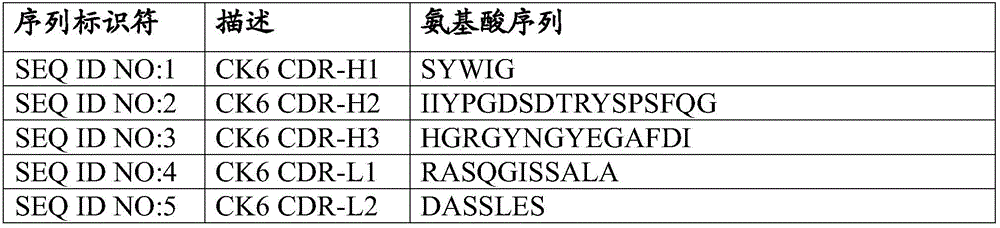


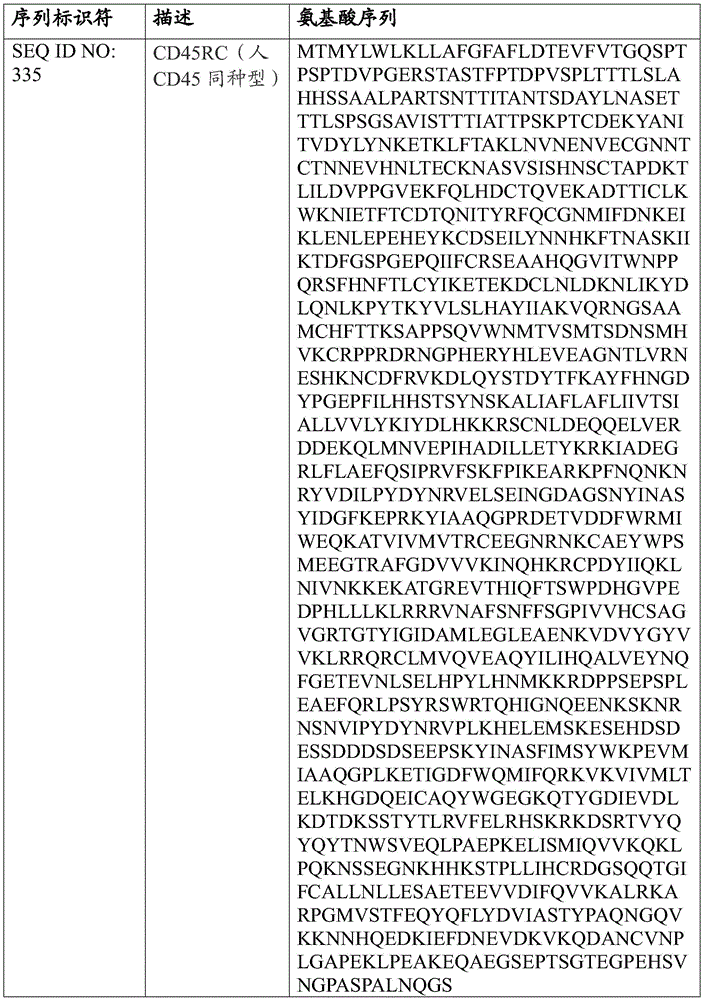


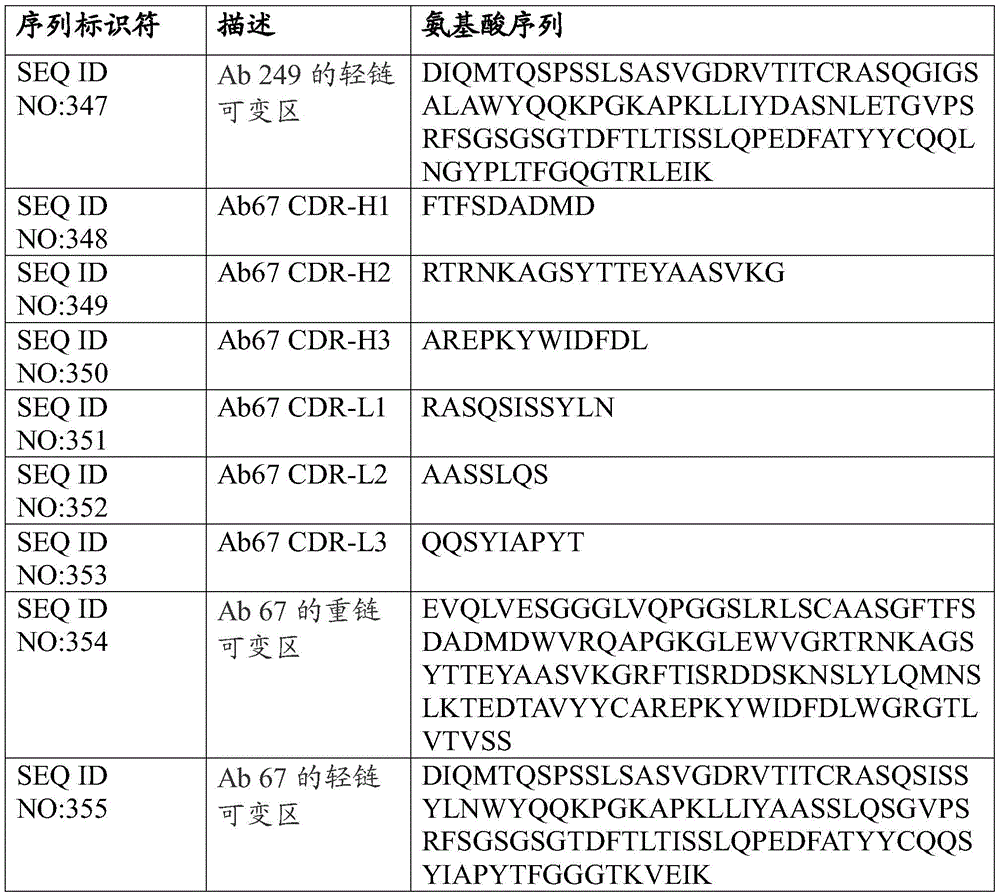
Other embodiments
All publications, patents and patent applications mentioned in this specification are herein incorporated by reference to the same extent as if each individual publication or patent application was specifically and individually indicated to be incorporated by reference.
While the invention has been described in connection with specific embodiments thereof, it will be understood that it is capable of further modifications and this application is intended to cover any variations, uses, or adaptations of the invention following, in general, the principles of the invention and including such departures from the present disclosure as come within known or customary practice within the art to which the invention pertains and as may be applied to the essential features hereinbefore set forth and as follows in the scope of the appended claims.
Other embodiments are within the scope of the following claims.
Sequence listing
<110> Meizhenda therapeutic Co
<120> Fc silenced Antibody Drug Conjugates (ADCs) and uses thereof
<130> M103034 1700WO
<140>
<141>
<150> 62/807,363
<151> 2019-02-19
<150> 62/773,839
<151> 2018-11-30
<150> 62/749,662
<151> 2018-10-23
<160> 355
<170> PatentIn version 3.5
<210> 1
<211> 5
<212> PRT
<213> Artificial sequence
<220>
<223> description of Artificial sequences synthetic peptides
<400> 1
Ser Tyr Trp Ile Gly
1 5
<210> 2
<211> 17
<212> PRT
<213> Artificial sequence
<220>
<223> description of Artificial sequences synthetic peptides
<400> 2
Ile Ile Tyr Pro Gly Asp Ser Asp Thr Arg Tyr Ser Pro Ser Phe Gln
1 5 10 15
Gly
<210> 3
<211> 14
<212> PRT
<213> Artificial sequence
<220>
<223> description of Artificial sequences synthetic peptides
<400> 3
His Gly Arg Gly Tyr Asn Gly Tyr Glu Gly Ala Phe Asp Ile
1 5 10
<210> 4
<211> 11
<212> PRT
<213> Artificial sequence
<220>
<223> description of Artificial sequences synthetic peptides
<400> 4
Arg Ala Ser Gln Gly Ile Ser Ser Ala Leu Ala
1 5 10
<210> 5
<211> 7
<212> PRT
<213> Artificial sequence
<220>
<223> description of Artificial sequences synthetic peptides
<400> 5
Asp Ala Ser Ser Leu Glu Ser
1 5
<210> 6
<211> 10
<212> PRT
<213> Artificial sequence
<220>
<223> description of Artificial sequences synthetic peptides
<400> 6
Cys Gln Gln Phe Asn Ser Tyr Pro Leu Thr
1 5 10
<210> 7
<211> 5
<212> PRT
<213> Artificial sequence
<220>
<223> description of Artificial sequences synthetic peptides
<400> 7
Asn Tyr Trp Ile Gly
1 5
<210> 8
<211> 17
<212> PRT
<213> Artificial sequence
<220>
<223> description of Artificial sequences synthetic peptides
<400> 8
Ile Ile Asn Pro Arg Asp Ser Asp Thr Arg Tyr Arg Pro Ser Phe Gln
1 5 10 15
Gly
<210> 9
<211> 14
<212> PRT
<213> Artificial sequence
<220>
<223> description of Artificial sequences synthetic peptides
<400> 9
His Gly Arg Gly Tyr Glu Gly Tyr Glu Gly Ala Phe Asp Ile
1 5 10
<210> 10
<211> 11
<212> PRT
<213> Artificial sequence
<220>
<223> description of Artificial sequences synthetic peptides
<400> 10
Arg Ser Ser Gln Gly Ile Arg Ser Asp Leu Gly
1 5 10
<210> 11
<211> 7
<212> PRT
<213> Artificial sequence
<220>
<223> description of Artificial sequences synthetic peptides
<400> 11
Asp Ala Ser Asn Leu Glu Thr
1 5
<210> 12
<211> 9
<212> PRT
<213> Artificial sequence
<220>
<223> description of Artificial sequences synthetic peptides
<400> 12
Gln Gln Ala Asn Gly Phe Pro Leu Thr
1 5
<210> 13
<211> 123
<212> PRT
<213> Artificial sequence
<220>
<223> description of Artificial sequences Synthesis of polypeptides
<400> 13
Glu Val Gln Leu Val Gln Ser Gly Ala Glu Val Lys Lys Pro Gly Glu
1 5 10 15
Ser Leu Lys Ile Ser Cys Lys Gly Ser Gly Tyr Ser Phe Thr Asn Tyr
20 25 30
Trp Ile Gly Trp Val Arg Gln Met Pro Gly Lys Gly Leu Glu Trp Met
35 40 45
Ala Ile Ile Asn Pro Arg Asp Ser Asp Thr Arg Tyr Arg Pro Ser Phe
50 55 60
Gln Gly Gln Val Thr Ile Ser Ala Asp Lys Ser Ile Ser Thr Ala Tyr
65 70 75 80
Leu Gln Trp Ser Ser Leu Lys Ala Ser Asp Thr Ala Met Tyr Tyr Cys
85 90 95
Ala Arg His Gly Arg Gly Tyr Glu Gly Tyr Glu Gly Ala Phe Asp Ile
100 105 110
Trp Gly Gln Gly Thr Leu Val Thr Val Ser Ser
115 120
<210> 14
<211> 107
<212> PRT
<213> Artificial sequence
<220>
<223> description of Artificial sequences Synthesis of polypeptides
<400> 14
Asp Ile Gln Met Thr Gln Ser Pro Ser Ser Leu Ser Ala Ser Val Gly
1 5 10 15
Asp Arg Val Thr Ile Thr Cys Arg Ser Ser Gln Gly Ile Arg Ser Asp
20 25 30
Leu Gly Trp Tyr Gln Gln Lys Pro Gly Lys Ala Pro Lys Leu Leu Ile
35 40 45
Tyr Asp Ala Ser Asn Leu Glu Thr Gly Val Pro Ser Arg Phe Ser Gly
50 55 60
Ser Gly Ser Gly Thr Asp Phe Thr Leu Thr Ile Ser Ser Leu Gln Pro
65 70 75 80
Glu Asp Phe Ala Thr Tyr Tyr Cys Gln Gln Ala Asn Gly Phe Pro Leu
85 90 95
Thr Phe Gly Gly Gly Thr Lys Val Glu Ile Lys
100 105
<210> 15
<211> 330
<212> PRT
<213> Intelligent people
<400> 15
Ala Ser Thr Lys Gly Pro Ser Val Phe Pro Leu Ala Pro Ser Ser Lys
1 5 10 15
Ser Thr Ser Gly Gly Thr Ala Ala Leu Gly Cys Leu Val Lys Asp Tyr
20 25 30
Phe Pro Glu Pro Val Thr Val Ser Trp Asn Ser Gly Ala Leu Thr Ser
35 40 45
Gly Val His Thr Phe Pro Ala Val Leu Gln Ser Ser Gly Leu Tyr Ser
50 55 60
Leu Ser Ser Val Val Thr Val Pro Ser Ser Ser Leu Gly Thr Gln Thr
65 70 75 80
Tyr Ile Cys Asn Val Asn His Lys Pro Ser Asn Thr Lys Val Asp Lys
85 90 95
Lys Val Glu Pro Lys Ser Cys Asp Lys Thr His Thr Cys Pro Pro Cys
100 105 110
Pro Ala Pro Glu Leu Leu Gly Gly Pro Ser Val Phe Leu Phe Pro Pro
115 120 125
Lys Pro Lys Asp Thr Leu Met Ile Ser Arg Thr Pro Glu Val Thr Cys
130 135 140
Val Val Val Asp Val Ser His Glu Asp Pro Glu Val Lys Phe Asn Trp
145 150 155 160
Tyr Val Asp Gly Val Glu Val His Asn Ala Lys Thr Lys Pro Arg Glu
165 170 175
Glu Gln Tyr Asn Ser Thr Tyr Arg Val Val Ser Val Leu Thr Val Leu
180 185 190
His Gln Asp Trp Leu Asn Gly Lys Glu Tyr Lys Cys Lys Val Ser Asn
195 200 205
Lys Ala Leu Pro Ala Pro Ile Glu Lys Thr Ile Ser Lys Ala Lys Gly
210 215 220
Gln Pro Arg Glu Pro Gln Val Tyr Thr Leu Pro Pro Ser Arg Asp Glu
225 230 235 240
Leu Thr Lys Asn Gln Val Ser Leu Thr Cys Leu Val Lys Gly Phe Tyr
245 250 255
Pro Ser Asp Ile Ala Val Glu Trp Glu Ser Asn Gly Gln Pro Glu Asn
260 265 270
Asn Tyr Lys Thr Thr Pro Pro Val Leu Asp Ser Asp Gly Ser Phe Phe
275 280 285
Leu Tyr Ser Lys Leu Thr Val Asp Lys Ser Arg Trp Gln Gln Gly Asn
290 295 300
Val Phe Ser Cys Ser Val Met His Glu Ala Leu His Asn His Tyr Thr
305 310 315 320
Gln Lys Ser Leu Ser Leu Ser Pro Gly Lys
325 330
<210> 16
<211> 330
<212> PRT
<213> Artificial sequence
<220>
<223> description of Artificial sequences Synthesis of polypeptides
<400> 16
Ala Ser Thr Lys Gly Pro Ser Val Phe Pro Leu Ala Pro Ser Ser Lys
1 5 10 15
Ser Thr Ser Gly Gly Thr Ala Ala Leu Gly Cys Leu Val Lys Asp Tyr
20 25 30
Phe Pro Glu Pro Val Thr Val Ser Trp Asn Ser Gly Ala Leu Thr Ser
35 40 45
Gly Val His Thr Phe Pro Ala Val Leu Gln Ser Ser Gly Leu Tyr Ser
50 55 60
Leu Ser Ser Val Val Thr Val Pro Ser Ser Ser Leu Gly Thr Gln Thr
65 70 75 80
Tyr Ile Cys Asn Val Asn His Lys Pro Ser Asn Thr Lys Val Asp Lys
85 90 95
Lys Val Glu Pro Lys Ser Cys Asp Lys Thr His Thr Cys Pro Pro Cys
100 105 110
Pro Ala Pro Glu Ala Ala Gly Gly Pro Ser Val Phe Leu Phe Pro Pro
115 120 125
Lys Pro Lys Asp Thr Leu Met Ile Ser Arg Thr Pro Glu Val Thr Cys
130 135 140
Val Val Val Asp Val Ser His Glu Asp Pro Glu Val Lys Phe Asn Trp
145 150 155 160
Tyr Val Asp Gly Val Glu Val His Asn Ala Lys Thr Lys Pro Arg Glu
165 170 175
Glu Gln Tyr Asn Ser Thr Tyr Arg Val Val Ser Val Leu Thr Val Leu
180 185 190
His Gln Asp Trp Leu Asn Gly Lys Glu Tyr Lys Cys Lys Val Ser Asn
195 200 205
Lys Ala Leu Pro Ala Pro Ile Glu Lys Thr Ile Ser Lys Ala Lys Gly
210 215 220
Gln Pro Arg Glu Pro Gln Val Tyr Thr Leu Pro Pro Ser Arg Asp Glu
225 230 235 240
Leu Thr Lys Asn Gln Val Ser Leu Thr Cys Leu Val Lys Gly Phe Tyr
245 250 255
Pro Ser Asp Ile Ala Val Glu Trp Glu Ser Asn Gly Gln Pro Glu Asn
260 265 270
Asn Tyr Lys Thr Thr Pro Pro Val Leu Asp Ser Asp Gly Ser Phe Phe
275 280 285
Leu Tyr Ser Lys Leu Thr Val Asp Lys Ser Arg Trp Gln Gln Gly Asn
290 295 300
Val Phe Ser Cys Ser Val Met His Glu Ala Leu His Asn His Tyr Thr
305 310 315 320
Gln Lys Ser Leu Ser Leu Ser Pro Gly Lys
325 330
<210> 17
<211> 330
<212> PRT
<213> Artificial sequence
<220>
<223> description of Artificial sequences Synthesis of polypeptides
<400> 17
Ala Ser Thr Lys Gly Pro Ser Val Phe Pro Leu Ala Pro Ser Ser Lys
1 5 10 15
Ser Thr Ser Gly Gly Thr Ala Ala Leu Gly Cys Leu Val Lys Asp Tyr
20 25 30
Phe Pro Glu Pro Val Thr Val Ser Trp Asn Ser Gly Ala Leu Thr Ser
35 40 45
Gly Val His Thr Phe Pro Ala Val Leu Gln Ser Ser Gly Leu Tyr Ser
50 55 60
Leu Ser Ser Val Val Thr Val Pro Ser Ser Ser Leu Gly Thr Gln Thr
65 70 75 80
Tyr Ile Cys Asn Val Asn His Lys Pro Ser Asn Thr Lys Val Asp Lys
85 90 95
Lys Val Glu Pro Lys Ser Cys Asp Lys Thr His Thr Cys Pro Pro Cys
100 105 110
Pro Ala Pro Glu Leu Leu Gly Gly Pro Ser Val Phe Leu Phe Pro Pro
115 120 125
Lys Pro Lys Asp Thr Leu Met Ile Ser Arg Thr Pro Glu Val Thr Cys
130 135 140
Val Val Val Cys Val Ser His Glu Asp Pro Glu Val Lys Phe Asn Trp
145 150 155 160
Tyr Val Asp Gly Val Glu Val His Asn Ala Lys Thr Lys Pro Arg Glu
165 170 175
Glu Gln Tyr Asn Ser Thr Tyr Arg Val Val Ser Val Leu Thr Val Leu
180 185 190
His Gln Asp Trp Leu Asn Gly Lys Glu Tyr Lys Cys Lys Val Ser Asn
195 200 205
Lys Ala Leu Pro Ala Pro Ile Glu Lys Thr Ile Ser Lys Ala Lys Gly
210 215 220
Gln Pro Arg Glu Pro Gln Val Tyr Thr Leu Pro Pro Ser Arg Asp Glu
225 230 235 240
Leu Thr Lys Asn Gln Val Ser Leu Thr Cys Leu Val Lys Gly Phe Tyr
245 250 255
Pro Ser Asp Ile Ala Val Glu Trp Glu Ser Asn Gly Gln Pro Glu Asn
260 265 270
Asn Tyr Lys Thr Thr Pro Pro Val Leu Asp Ser Asp Gly Ser Phe Phe
275 280 285
Leu Tyr Ser Lys Leu Thr Val Asp Lys Ser Arg Trp Gln Gln Gly Asn
290 295 300
Val Phe Ser Cys Ser Val Met His Glu Ala Leu His Asn His Tyr Thr
305 310 315 320
Gln Lys Ser Leu Ser Leu Ser Pro Gly Lys
325 330
<210> 18
<211> 330
<212> PRT
<213> Artificial sequence
<220>
<223> description of Artificial sequences Synthesis of polypeptides
<400> 18
Ala Ser Thr Lys Gly Pro Ser Val Phe Pro Leu Ala Pro Ser Ser Lys
1 5 10 15
Ser Thr Ser Gly Gly Thr Ala Ala Leu Gly Cys Leu Val Lys Asp Tyr
20 25 30
Phe Pro Glu Pro Val Thr Val Ser Trp Asn Ser Gly Ala Leu Thr Ser
35 40 45
Gly Val His Thr Phe Pro Ala Val Leu Gln Ser Ser Gly Leu Tyr Ser
50 55 60
Leu Ser Ser Val Val Thr Val Pro Ser Ser Ser Leu Gly Thr Gln Thr
65 70 75 80
Tyr Ile Cys Asn Val Asn His Lys Pro Ser Asn Thr Lys Val Asp Lys
85 90 95
Lys Val Glu Pro Lys Ser Cys Asp Lys Thr His Thr Cys Pro Pro Cys
100 105 110
Pro Ala Pro Glu Leu Leu Gly Gly Pro Ser Val Phe Leu Phe Pro Pro
115 120 125
Lys Pro Lys Asp Thr Leu Met Ile Ser Arg Thr Pro Glu Val Thr Cys
130 135 140
Val Val Val Asp Val Ser His Glu Asp Pro Glu Val Lys Phe Asn Trp
145 150 155 160
Tyr Val Asp Gly Val Glu Val His Asn Ala Lys Thr Lys Pro Arg Glu
165 170 175
Glu Gln Tyr Asn Ser Thr Tyr Arg Val Val Ser Val Leu Thr Val Leu
180 185 190
His Gln Asp Trp Leu Asn Gly Lys Glu Tyr Lys Cys Lys Val Ser Asn
195 200 205
Lys Ala Leu Pro Ala Pro Ile Glu Lys Thr Ile Ser Lys Ala Lys Gly
210 215 220
Gln Pro Arg Glu Pro Gln Val Tyr Thr Leu Pro Pro Ser Arg Asp Glu
225 230 235 240
Leu Thr Lys Asn Gln Val Ser Leu Thr Cys Leu Val Lys Gly Phe Tyr
245 250 255
Pro Ser Asp Ile Ala Val Glu Trp Glu Ser Asn Gly Gln Pro Glu Asn
260 265 270
Asn Tyr Lys Thr Thr Pro Pro Val Leu Asp Ser Asp Gly Ser Phe Phe
275 280 285
Leu Tyr Ser Lys Leu Thr Val Asp Lys Ser Arg Trp Gln Gln Gly Asn
290 295 300
Val Phe Ser Cys Ser Val Met His Glu Ala Leu His Asn Ala Tyr Thr
305 310 315 320
Gln Lys Ser Leu Ser Leu Ser Pro Gly Lys
325 330
<210> 19
<211> 330
<212> PRT
<213> Artificial sequence
<220>
<223> description of Artificial sequences Synthesis of polypeptides
<400> 19
Ala Ser Thr Lys Gly Pro Ser Val Phe Pro Leu Ala Pro Ser Ser Lys
1 5 10 15
Ser Thr Ser Gly Gly Thr Ala Ala Leu Gly Cys Leu Val Lys Asp Tyr
20 25 30
Phe Pro Glu Pro Val Thr Val Ser Trp Asn Ser Gly Ala Leu Thr Ser
35 40 45
Gly Val His Thr Phe Pro Ala Val Leu Gln Ser Ser Gly Leu Tyr Ser
50 55 60
Leu Ser Ser Val Val Thr Val Pro Ser Ser Ser Leu Gly Thr Gln Thr
65 70 75 80
Tyr Ile Cys Asn Val Asn His Lys Pro Ser Asn Thr Lys Val Asp Lys
85 90 95
Lys Val Glu Pro Lys Ser Cys Asp Lys Thr His Thr Cys Pro Pro Cys
100 105 110
Pro Ala Pro Glu Ala Ala Gly Gly Pro Ser Val Phe Leu Phe Pro Pro
115 120 125
Lys Pro Lys Asp Thr Leu Met Ile Ser Arg Thr Pro Glu Val Thr Cys
130 135 140
Val Val Val Cys Val Ser His Glu Asp Pro Glu Val Lys Phe Asn Trp
145 150 155 160
Tyr Val Asp Gly Val Glu Val His Asn Ala Lys Thr Lys Pro Arg Glu
165 170 175
Glu Gln Tyr Asn Ser Thr Tyr Arg Val Val Ser Val Leu Thr Val Leu
180 185 190
His Gln Asp Trp Leu Asn Gly Lys Glu Tyr Lys Cys Lys Val Ser Asn
195 200 205
Lys Ala Leu Pro Ala Pro Ile Glu Lys Thr Ile Ser Lys Ala Lys Gly
210 215 220
Gln Pro Arg Glu Pro Gln Val Tyr Thr Leu Pro Pro Ser Arg Asp Glu
225 230 235 240
Leu Thr Lys Asn Gln Val Ser Leu Thr Cys Leu Val Lys Gly Phe Tyr
245 250 255
Pro Ser Asp Ile Ala Val Glu Trp Glu Ser Asn Gly Gln Pro Glu Asn
260 265 270
Asn Tyr Lys Thr Thr Pro Pro Val Leu Asp Ser Asp Gly Ser Phe Phe
275 280 285
Leu Tyr Ser Lys Leu Thr Val Asp Lys Ser Arg Trp Gln Gln Gly Asn
290 295 300
Val Phe Ser Cys Ser Val Met His Glu Ala Leu His Asn His Tyr Thr
305 310 315 320
Gln Lys Ser Leu Ser Leu Ser Pro Gly Lys
325 330
<210> 20
<211> 330
<212> PRT
<213> Artificial sequence
<220>
<223> description of Artificial sequences Synthesis of polypeptides
<400> 20
Ala Ser Thr Lys Gly Pro Ser Val Phe Pro Leu Ala Pro Ser Ser Lys
1 5 10 15
Ser Thr Ser Gly Gly Thr Ala Ala Leu Gly Cys Leu Val Lys Asp Tyr
20 25 30
Phe Pro Glu Pro Val Thr Val Ser Trp Asn Ser Gly Ala Leu Thr Ser
35 40 45
Gly Val His Thr Phe Pro Ala Val Leu Gln Ser Ser Gly Leu Tyr Ser
50 55 60
Leu Ser Ser Val Val Thr Val Pro Ser Ser Ser Leu Gly Thr Gln Thr
65 70 75 80
Tyr Ile Cys Asn Val Asn His Lys Pro Ser Asn Thr Lys Val Asp Lys
85 90 95
Lys Val Glu Pro Lys Ser Cys Asp Lys Thr His Thr Cys Pro Pro Cys
100 105 110
Pro Ala Pro Glu Ala Ala Gly Gly Pro Ser Val Phe Leu Phe Pro Pro
115 120 125
Lys Pro Lys Asp Thr Leu Met Ile Ser Arg Thr Pro Glu Val Thr Cys
130 135 140
Val Val Val Cys Val Ser His Glu Asp Pro Glu Val Lys Phe Asn Trp
145 150 155 160
Tyr Val Asp Gly Val Glu Val His Asn Ala Lys Thr Lys Pro Arg Glu
165 170 175
Glu Gln Tyr Asn Ser Thr Tyr Arg Val Val Ser Val Leu Thr Val Leu
180 185 190
His Gln Asp Trp Leu Asn Gly Lys Glu Tyr Lys Cys Lys Val Ser Asn
195 200 205
Lys Ala Leu Pro Ala Pro Ile Glu Lys Thr Ile Ser Lys Ala Lys Gly
210 215 220
Gln Pro Arg Glu Pro Gln Val Tyr Thr Leu Pro Pro Ser Arg Asp Glu
225 230 235 240
Leu Thr Lys Asn Gln Val Ser Leu Thr Cys Leu Val Lys Gly Phe Tyr
245 250 255
Pro Ser Asp Ile Ala Val Glu Trp Glu Ser Asn Gly Gln Pro Glu Asn
260 265 270
Asn Tyr Lys Thr Thr Pro Pro Val Leu Asp Ser Asp Gly Ser Phe Phe
275 280 285
Leu Tyr Ser Lys Leu Thr Val Asp Lys Ser Arg Trp Gln Gln Gly Asn
290 295 300
Val Phe Ser Cys Ser Val Met His Glu Ala Leu His Asn Ala Tyr Thr
305 310 315 320
Gln Lys Ser Leu Ser Leu Ser Pro Gly Lys
325 330
<210> 21
<211> 453
<212> PRT
<213> Artificial sequence
<220>
<223> description of Artificial sequences Synthesis of polypeptides
<400> 21
Glu Val Gln Leu Val Gln Ser Gly Ala Glu Val Lys Lys Pro Gly Glu
1 5 10 15
Ser Leu Lys Ile Ser Cys Lys Gly Ser Gly Tyr Ser Phe Thr Asn Tyr
20 25 30
Trp Ile Gly Trp Val Arg Gln Met Pro Gly Lys Gly Leu Glu Trp Met
35 40 45
Ala Ile Ile Asn Pro Arg Asp Ser Asp Thr Arg Tyr Arg Pro Ser Phe
50 55 60
Gln Gly Gln Val Thr Ile Ser Ala Asp Lys Ser Ile Ser Thr Ala Tyr
65 70 75 80
Leu Gln Trp Ser Ser Leu Lys Ala Ser Asp Thr Ala Met Tyr Tyr Cys
85 90 95
Ala Arg His Gly Arg Gly Tyr Glu Gly Tyr Glu Gly Ala Phe Asp Ile
100 105 110
Trp Gly Gln Gly Thr Leu Val Thr Val Ser Ser Ala Ser Thr Lys Gly
115 120 125
Pro Ser Val Phe Pro Leu Ala Pro Ser Ser Lys Ser Thr Ser Gly Gly
130 135 140
Thr Ala Ala Leu Gly Cys Leu Val Lys Asp Tyr Phe Pro Glu Pro Val
145 150 155 160
Thr Val Ser Trp Asn Ser Gly Ala Leu Thr Ser Gly Val His Thr Phe
165 170 175
Pro Ala Val Leu Gln Ser Ser Gly Leu Tyr Ser Leu Ser Ser Val Val
180 185 190
Thr Val Pro Ser Ser Ser Leu Gly Thr Gln Thr Tyr Ile Cys Asn Val
195 200 205
Asn His Lys Pro Ser Asn Thr Lys Val Asp Lys Lys Val Glu Pro Lys
210 215 220
Ser Cys Asp Lys Thr His Thr Cys Pro Pro Cys Pro Ala Pro Glu Leu
225 230 235 240
Leu Gly Gly Pro Ser Val Phe Leu Phe Pro Pro Lys Pro Lys Asp Thr
245 250 255
Leu Met Ile Ser Arg Thr Pro Glu Val Thr Cys Val Val Val Asp Val
260 265 270
Ser His Glu Asp Pro Glu Val Lys Phe Asn Trp Tyr Val Asp Gly Val
275 280 285
Glu Val His Asn Ala Lys Thr Lys Pro Arg Glu Glu Gln Tyr Asn Ser
290 295 300
Thr Tyr Arg Val Val Ser Val Leu Thr Val Leu His Gln Asp Trp Leu
305 310 315 320
Asn Gly Lys Glu Tyr Lys Cys Lys Val Ser Asn Lys Ala Leu Pro Ala
325 330 335
Pro Ile Glu Lys Thr Ile Ser Lys Ala Lys Gly Gln Pro Arg Glu Pro
340 345 350
Gln Val Tyr Thr Leu Pro Pro Ser Arg Asp Glu Leu Thr Lys Asn Gln
355 360 365
Val Ser Leu Thr Cys Leu Val Lys Gly Phe Tyr Pro Ser Asp Ile Ala
370 375 380
Val Glu Trp Glu Ser Asn Gly Gln Pro Glu Asn Asn Tyr Lys Thr Thr
385 390 395 400
Pro Pro Val Leu Asp Ser Asp Gly Ser Phe Phe Leu Tyr Ser Lys Leu
405 410 415
Thr Val Asp Lys Ser Arg Trp Gln Gln Gly Asn Val Phe Ser Cys Ser
420 425 430
Val Met His Glu Ala Leu His Asn His Tyr Thr Gln Lys Ser Leu Ser
435 440 445
Leu Ser Pro Gly Lys
450
<210> 22
<211> 453
<212> PRT
<213> Artificial sequence
<220>
<223> description of Artificial sequences Synthesis of polypeptides
<400> 22
Glu Val Gln Leu Val Gln Ser Gly Ala Glu Val Lys Lys Pro Gly Glu
1 5 10 15
Ser Leu Lys Ile Ser Cys Lys Gly Ser Gly Tyr Ser Phe Thr Asn Tyr
20 25 30
Trp Ile Gly Trp Val Arg Gln Met Pro Gly Lys Gly Leu Glu Trp Met
35 40 45
Ala Ile Ile Asn Pro Arg Asp Ser Asp Thr Arg Tyr Arg Pro Ser Phe
50 55 60
Gln Gly Gln Val Thr Ile Ser Ala Asp Lys Ser Ile Ser Thr Ala Tyr
65 70 75 80
Leu Gln Trp Ser Ser Leu Lys Ala Ser Asp Thr Ala Met Tyr Tyr Cys
85 90 95
Ala Arg His Gly Arg Gly Tyr Glu Gly Tyr Glu Gly Ala Phe Asp Ile
100 105 110
Trp Gly Gln Gly Thr Leu Val Thr Val Ser Ser Ala Ser Thr Lys Gly
115 120 125
Pro Ser Val Phe Pro Leu Ala Pro Ser Ser Lys Ser Thr Ser Gly Gly
130 135 140
Thr Ala Ala Leu Gly Cys Leu Val Lys Asp Tyr Phe Pro Glu Pro Val
145 150 155 160
Thr Val Ser Trp Asn Ser Gly Ala Leu Thr Ser Gly Val His Thr Phe
165 170 175
Pro Ala Val Leu Gln Ser Ser Gly Leu Tyr Ser Leu Ser Ser Val Val
180 185 190
Thr Val Pro Ser Ser Ser Leu Gly Thr Gln Thr Tyr Ile Cys Asn Val
195 200 205
Asn His Lys Pro Ser Asn Thr Lys Val Asp Lys Lys Val Glu Pro Lys
210 215 220
Ser Cys Asp Lys Thr His Thr Cys Pro Pro Cys Pro Ala Pro Glu Ala
225 230 235 240
Ala Gly Gly Pro Ser Val Phe Leu Phe Pro Pro Lys Pro Lys Asp Thr
245 250 255
Leu Met Ile Ser Arg Thr Pro Glu Val Thr Cys Val Val Val Asp Val
260 265 270
Ser His Glu Asp Pro Glu Val Lys Phe Asn Trp Tyr Val Asp Gly Val
275 280 285
Glu Val His Asn Ala Lys Thr Lys Pro Arg Glu Glu Gln Tyr Asn Ser
290 295 300
Thr Tyr Arg Val Val Ser Val Leu Thr Val Leu His Gln Asp Trp Leu
305 310 315 320
Asn Gly Lys Glu Tyr Lys Cys Lys Val Ser Asn Lys Ala Leu Pro Ala
325 330 335
Pro Ile Glu Lys Thr Ile Ser Lys Ala Lys Gly Gln Pro Arg Glu Pro
340 345 350
Gln Val Tyr Thr Leu Pro Pro Ser Arg Asp Glu Leu Thr Lys Asn Gln
355 360 365
Val Ser Leu Thr Cys Leu Val Lys Gly Phe Tyr Pro Ser Asp Ile Ala
370 375 380
Val Glu Trp Glu Ser Asn Gly Gln Pro Glu Asn Asn Tyr Lys Thr Thr
385 390 395 400
Pro Pro Val Leu Asp Ser Asp Gly Ser Phe Phe Leu Tyr Ser Lys Leu
405 410 415
Thr Val Asp Lys Ser Arg Trp Gln Gln Gly Asn Val Phe Ser Cys Ser
420 425 430
Val Met His Glu Ala Leu His Asn His Tyr Thr Gln Lys Ser Leu Ser
435 440 445
Leu Ser Pro Gly Lys
450
<210> 23
<211> 453
<212> PRT
<213> Artificial sequence
<220>
<223> description of Artificial sequences Synthesis of polypeptides
<400> 23
Glu Val Gln Leu Val Gln Ser Gly Ala Glu Val Lys Lys Pro Gly Glu
1 5 10 15
Ser Leu Lys Ile Ser Cys Lys Gly Ser Gly Tyr Ser Phe Thr Asn Tyr
20 25 30
Trp Ile Gly Trp Val Arg Gln Met Pro Gly Lys Gly Leu Glu Trp Met
35 40 45
Ala Ile Ile Asn Pro Arg Asp Ser Asp Thr Arg Tyr Arg Pro Ser Phe
50 55 60
Gln Gly Gln Val Thr Ile Ser Ala Asp Lys Ser Ile Ser Thr Ala Tyr
65 70 75 80
Leu Gln Trp Ser Ser Leu Lys Ala Ser Asp Thr Ala Met Tyr Tyr Cys
85 90 95
Ala Arg His Gly Arg Gly Tyr Glu Gly Tyr Glu Gly Ala Phe Asp Ile
100 105 110
Trp Gly Gln Gly Thr Leu Val Thr Val Ser Ser Ala Ser Thr Lys Gly
115 120 125
Pro Ser Val Phe Pro Leu Ala Pro Ser Ser Lys Ser Thr Ser Gly Gly
130 135 140
Thr Ala Ala Leu Gly Cys Leu Val Lys Asp Tyr Phe Pro Glu Pro Val
145 150 155 160
Thr Val Ser Trp Asn Ser Gly Ala Leu Thr Ser Gly Val His Thr Phe
165 170 175
Pro Ala Val Leu Gln Ser Ser Gly Leu Tyr Ser Leu Ser Ser Val Val
180 185 190
Thr Val Pro Ser Ser Ser Leu Gly Thr Gln Thr Tyr Ile Cys Asn Val
195 200 205
Asn His Lys Pro Ser Asn Thr Lys Val Asp Lys Lys Val Glu Pro Lys
210 215 220
Ser Cys Asp Lys Thr His Thr Cys Pro Pro Cys Pro Ala Pro Glu Ala
225 230 235 240
Ala Gly Gly Pro Ser Val Phe Leu Phe Pro Pro Lys Pro Lys Asp Thr
245 250 255
Leu Met Ile Ser Arg Thr Pro Glu Val Thr Cys Val Val Val Cys Val
260 265 270
Ser His Glu Asp Pro Glu Val Lys Phe Asn Trp Tyr Val Asp Gly Val
275 280 285
Glu Val His Asn Ala Lys Thr Lys Pro Arg Glu Glu Gln Tyr Asn Ser
290 295 300
Thr Tyr Arg Val Val Ser Val Leu Thr Val Leu His Gln Asp Trp Leu
305 310 315 320
Asn Gly Lys Glu Tyr Lys Cys Lys Val Ser Asn Lys Ala Leu Pro Ala
325 330 335
Pro Ile Glu Lys Thr Ile Ser Lys Ala Lys Gly Gln Pro Arg Glu Pro
340 345 350
Gln Val Tyr Thr Leu Pro Pro Ser Arg Asp Glu Leu Thr Lys Asn Gln
355 360 365
Val Ser Leu Thr Cys Leu Val Lys Gly Phe Tyr Pro Ser Asp Ile Ala
370 375 380
Val Glu Trp Glu Ser Asn Gly Gln Pro Glu Asn Asn Tyr Lys Thr Thr
385 390 395 400
Pro Pro Val Leu Asp Ser Asp Gly Ser Phe Phe Leu Tyr Ser Lys Leu
405 410 415
Thr Val Asp Lys Ser Arg Trp Gln Gln Gly Asn Val Phe Ser Cys Ser
420 425 430
Val Met His Glu Ala Leu His Asn His Tyr Thr Gln Lys Ser Leu Ser
435 440 445
Leu Ser Pro Gly Lys
450
<210> 24
<211> 453
<212> PRT
<213> Artificial sequence
<220>
<223> description of Artificial sequences Synthesis of polypeptides
<400> 24
Glu Val Gln Leu Val Gln Ser Gly Ala Glu Val Lys Lys Pro Gly Glu
1 5 10 15
Ser Leu Lys Ile Ser Cys Lys Gly Ser Gly Tyr Ser Phe Thr Asn Tyr
20 25 30
Trp Ile Gly Trp Val Arg Gln Met Pro Gly Lys Gly Leu Glu Trp Met
35 40 45
Ala Ile Ile Asn Pro Arg Asp Ser Asp Thr Arg Tyr Arg Pro Ser Phe
50 55 60
Gln Gly Gln Val Thr Ile Ser Ala Asp Lys Ser Ile Ser Thr Ala Tyr
65 70 75 80
Leu Gln Trp Ser Ser Leu Lys Ala Ser Asp Thr Ala Met Tyr Tyr Cys
85 90 95
Ala Arg His Gly Arg Gly Tyr Glu Gly Tyr Glu Gly Ala Phe Asp Ile
100 105 110
Trp Gly Gln Gly Thr Leu Val Thr Val Ser Ser Ala Ser Thr Lys Gly
115 120 125
Pro Ser Val Phe Pro Leu Ala Pro Ser Ser Lys Ser Thr Ser Gly Gly
130 135 140
Thr Ala Ala Leu Gly Cys Leu Val Lys Asp Tyr Phe Pro Glu Pro Val
145 150 155 160
Thr Val Ser Trp Asn Ser Gly Ala Leu Thr Ser Gly Val His Thr Phe
165 170 175
Pro Ala Val Leu Gln Ser Ser Gly Leu Tyr Ser Leu Ser Ser Val Val
180 185 190
Thr Val Pro Ser Ser Ser Leu Gly Thr Gln Thr Tyr Ile Cys Asn Val
195 200 205
Asn His Lys Pro Ser Asn Thr Lys Val Asp Lys Lys Val Glu Pro Lys
210 215 220
Ser Cys Asp Lys Thr His Thr Cys Pro Pro Cys Pro Ala Pro Glu Ala
225 230 235 240
Ala Gly Gly Pro Ser Val Phe Leu Phe Pro Pro Lys Pro Lys Asp Thr
245 250 255
Leu Met Ile Ser Arg Thr Pro Glu Val Thr Cys Val Val Val Cys Val
260 265 270
Ser His Glu Asp Pro Glu Val Lys Phe Asn Trp Tyr Val Asp Gly Val
275 280 285
Glu Val His Asn Ala Lys Thr Lys Pro Arg Glu Glu Gln Tyr Asn Ser
290 295 300
Thr Tyr Arg Val Val Ser Val Leu Thr Val Leu His Gln Asp Trp Leu
305 310 315 320
Asn Gly Lys Glu Tyr Lys Cys Lys Val Ser Asn Lys Ala Leu Pro Ala
325 330 335
Pro Ile Glu Lys Thr Ile Ser Lys Ala Lys Gly Gln Pro Arg Glu Pro
340 345 350
Gln Val Tyr Thr Leu Pro Pro Ser Arg Asp Glu Leu Thr Lys Asn Gln
355 360 365
Val Ser Leu Thr Cys Leu Val Lys Gly Phe Tyr Pro Ser Asp Ile Ala
370 375 380
Val Glu Trp Glu Ser Asn Gly Gln Pro Glu Asn Asn Tyr Lys Thr Thr
385 390 395 400
Pro Pro Val Leu Asp Ser Asp Gly Ser Phe Phe Leu Tyr Ser Lys Leu
405 410 415
Thr Val Asp Lys Ser Arg Trp Gln Gln Gly Asn Val Phe Ser Cys Ser
420 425 430
Val Met His Glu Ala Leu His Asn Ala Tyr Thr Gln Lys Ser Leu Ser
435 440 445
Leu Ser Pro Gly Lys
450
<210> 25
<211> 107
<212> PRT
<213> Artificial sequence
<220>
<223> description of Artificial sequences Synthesis of polypeptides
<400> 25
Arg Thr Val Ala Ala Pro Ser Val Phe Ile Phe Pro Pro Ser Asp Glu
1 5 10 15
Gln Leu Lys Ser Gly Thr Ala Ser Val Val Cys Leu Leu Asn Asn Phe
20 25 30
Tyr Pro Arg Glu Ala Lys Val Gln Trp Lys Val Asp Asn Ala Leu Gln
35 40 45
Ser Gly Asn Ser Gln Glu Ser Val Thr Glu Gln Asp Ser Lys Asp Ser
50 55 60
Thr Tyr Ser Leu Ser Ser Thr Leu Thr Leu Ser Lys Ala Asp Tyr Glu
65 70 75 80
Lys His Lys Val Tyr Ala Cys Glu Val Thr His Gln Gly Leu Ser Ser
85 90 95
Pro Val Thr Lys Ser Phe Asn Arg Gly Glu Cys
100 105
<210> 26
<211> 214
<212> PRT
<213> Artificial sequence
<220>
<223> description of Artificial sequences Synthesis of polypeptides
<400> 26
Asp Ile Gln Met Thr Gln Ser Pro Ser Ser Leu Ser Ala Ser Val Gly
1 5 10 15
Asp Arg Val Thr Ile Thr Cys Arg Ser Ser Gln Gly Ile Arg Ser Asp
20 25 30
Leu Gly Trp Tyr Gln Gln Lys Pro Gly Lys Ala Pro Lys Leu Leu Ile
35 40 45
Tyr Asp Ala Ser Asn Leu Glu Thr Gly Val Pro Ser Arg Phe Ser Gly
50 55 60
Ser Gly Ser Gly Thr Asp Phe Thr Leu Thr Ile Ser Ser Leu Gln Pro
65 70 75 80
Glu Asp Phe Ala Thr Tyr Tyr Cys Gln Gln Ala Asn Gly Phe Pro Leu
85 90 95
Thr Phe Gly Gly Gly Thr Lys Val Glu Ile Lys Arg Thr Val Ala Ala
100 105 110
Pro Ser Val Phe Ile Phe Pro Pro Ser Asp Glu Gln Leu Lys Ser Gly
115 120 125
Thr Ala Ser Val Val Cys Leu Leu Asn Asn Phe Tyr Pro Arg Glu Ala
130 135 140
Lys Val Gln Trp Lys Val Asp Asn Ala Leu Gln Ser Gly Asn Ser Gln
145 150 155 160
Glu Ser Val Thr Glu Gln Asp Ser Lys Asp Ser Thr Tyr Ser Leu Ser
165 170 175
Ser Thr Leu Thr Leu Ser Lys Ala Asp Tyr Glu Lys His Lys Val Tyr
180 185 190
Ala Cys Glu Val Thr His Gln Gly Leu Ser Ser Pro Val Thr Lys Ser
195 200 205
Phe Asn Arg Gly Glu Cys
210
<210> 27
<211> 123
<212> PRT
<213> Artificial sequence
<220>
<223> description of Artificial sequences Synthesis of polypeptides
<400> 27
Gln Val Gln Leu Val Gln Ser Gly Ala Ala Val Lys Lys Pro Gly Glu
1 5 10 15
Ser Leu Lys Ile Ser Cys Lys Gly Ser Gly Tyr Arg Phe Thr Ser Tyr
20 25 30
Trp Ile Gly Trp Val Arg Gln Met Pro Gly Lys Gly Leu Glu Trp Met
35 40 45
Gly Ile Ile Tyr Pro Gly Asp Ser Asp Thr Arg Tyr Ser Pro Ser Phe
50 55 60
Gln Gly Gln Val Thr Ile Ser Ala Gly Lys Ser Ile Ser Thr Ala Tyr
65 70 75 80
Leu Gln Trp Ser Ser Leu Lys Ala Ser Asp Thr Ala Met Tyr Tyr Cys
85 90 95
Ala Arg His Gly Arg Gly Tyr Asn Gly Tyr Glu Gly Ala Phe Asp Ile
100 105 110
Trp Gly Gln Gly Thr Met Val Thr Val Ser Ser
115 120
<210> 28
<211> 107
<212> PRT
<213> Artificial sequence
<220>
<223> description of Artificial sequences Synthesis of polypeptides
<400> 28
Ala Ile Gln Leu Thr Gln Ser Pro Ser Ser Leu Ser Ala Ser Val Gly
1 5 10 15
Asp Arg Val Thr Ile Thr Cys Arg Ala Ser Gln Gly Ile Ser Ser Ala
20 25 30
Leu Ala Trp Tyr Gln Gln Lys Pro Gly Lys Ala Pro Lys Leu Leu Ile
35 40 45
Tyr Asp Ala Ser Ser Leu Glu Ser Gly Val Pro Ser Arg Phe Ser Gly
50 55 60
Ser Gly Ser Gly Thr Asp Phe Thr Leu Thr Ile Ser Ser Leu Gln Pro
65 70 75 80
Glu Asp Phe Ala Thr Tyr Tyr Cys Gln Gln Phe Asn Ser Tyr Pro Leu
85 90 95
Thr Phe Gly Gly Gly Thr Lys Val Glu Ile Lys
100 105
<210> 29
<211> 351
<212> PRT
<213> Intelligent people
<400> 29
Met Ser Phe Pro Cys Lys Phe Val Ala Ser Phe Leu Leu Ile Phe Asn
1 5 10 15
Val Ser Ser Lys Gly Ala Val Ser Lys Glu Ile Thr Asn Ala Leu Glu
20 25 30
Thr Trp Gly Ala Leu Gly Gln Asp Ile Asn Leu Asp Ile Pro Ser Phe
35 40 45
Gln Met Ser Asp Asp Ile Asp Asp Ile Lys Trp Glu Lys Thr Ser Asp
50 55 60
Lys Lys Lys Ile Ala Gln Phe Arg Lys Glu Lys Glu Thr Phe Lys Glu
65 70 75 80
Lys Asp Thr Tyr Lys Leu Phe Lys Asn Gly Thr Leu Lys Ile Lys His
85 90 95
Leu Lys Thr Asp Asp Gln Asp Ile Tyr Lys Val Ser Ile Tyr Asp Thr
100 105 110
Lys Gly Lys Asn Val Leu Glu Lys Ile Phe Asp Leu Lys Ile Gln Glu
115 120 125
Arg Val Ser Lys Pro Lys Ile Ser Trp Thr Cys Ile Asn Thr Thr Leu
130 135 140
Thr Cys Glu Val Met Asn Gly Thr Asp Pro Glu Leu Asn Leu Tyr Gln
145 150 155 160
Asp Gly Lys His Leu Lys Leu Ser Gln Arg Val Ile Thr His Lys Trp
165 170 175
Thr Thr Ser Leu Ser Ala Lys Phe Lys Cys Thr Ala Gly Asn Lys Val
180 185 190
Ser Lys Glu Ser Ser Val Glu Pro Val Ser Cys Pro Glu Lys Gly Leu
195 200 205
Asp Ile Tyr Leu Ile Ile Gly Ile Cys Gly Gly Gly Ser Leu Leu Met
210 215 220
Val Phe Val Ala Leu Leu Val Phe Tyr Ile Thr Lys Arg Lys Lys Gln
225 230 235 240
Arg Ser Arg Arg Asn Asp Glu Glu Leu Glu Thr Arg Ala His Arg Val
245 250 255
Ala Thr Glu Glu Arg Gly Arg Lys Pro His Gln Ile Pro Ala Ser Thr
260 265 270
Pro Gln Asn Pro Ala Thr Ser Gln His Pro Pro Pro Pro Pro Gly His
275 280 285
Arg Ser Gln Ala Pro Ser His Arg Pro Pro Pro Pro Gly His Arg Val
290 295 300
Gln His Gln Pro Gln Lys Arg Pro Pro Ala Pro Ser Gly Thr Gln Val
305 310 315 320
His Gln Gln Lys Gly Pro Pro Leu Pro Arg Pro Arg Val Gln Pro Lys
325 330 335
Pro Pro His Gly Ala Ala Glu Asn Ser Leu Ser Pro Ser Ser Asn
340 345 350
<210> 30
<211> 5
<212> PRT
<213> Artificial sequence
<220>
<223> description of Artificial sequences synthetic peptides
<400> 30
Glu Tyr Tyr Met Tyr
1 5
<210> 31
<211> 17
<212> PRT
<213> Artificial sequence
<220>
<223> description of Artificial sequences synthetic peptides
<400> 31
Arg Ile Asp Pro Glu Asp Gly Ser Ile Asp Tyr Val Glu Lys Phe Lys
1 5 10 15
Lys
<210> 32
<211> 9
<212> PRT
<213> Artificial sequence
<220>
<223> description of Artificial sequences synthetic peptides
<400> 32
Gly Lys Phe Asn Tyr Arg Phe Ala Tyr
1 5
<210> 33
<211> 16
<212> PRT
<213> Artificial sequence
<220>
<223> description of Artificial sequences synthetic peptides
<400> 33
Arg Ser Ser Gln Ser Leu Leu His Ser Ser Gly Asn Thr Tyr Leu Asn
1 5 10 15
<210> 34
<211> 7
<212> PRT
<213> Artificial sequence
<220>
<223> description of Artificial sequences synthetic peptides
<400> 34
Leu Val Ser Lys Leu Glu Ser
1 5
<210> 35
<211> 9
<212> PRT
<213> Artificial sequence
<220>
<223> description of Artificial sequences synthetic peptides
<400> 35
Met Gln Phe Thr His Tyr Pro Tyr Thr
1 5
<210> 36
<211> 118
<212> PRT
<213> Artificial sequence
<220>
<223> description of Artificial sequences Synthesis of polypeptides
<400> 36
Gln Val Gln Leu Val Gln Ser Gly Ala Glu Val Lys Lys Pro Gly Ala
1 5 10 15
Ser Val Lys Val Ser Cys Lys Ala Ser Gly Tyr Thr Phe Thr Glu Tyr
20 25 30
Tyr Met Tyr Trp Val Arg Gln Ala Pro Gly Gln Gly Leu Glu Leu Met
35 40 45
Gly Arg Ile Asp Pro Glu Asp Gly Ser Ile Asp Tyr Val Glu Lys Phe
50 55 60
Lys Lys Lys Val Thr Leu Thr Ala Asp Thr Ser Ser Ser Thr Ala Tyr
65 70 75 80
Met Glu Leu Ser Ser Leu Thr Ser Asp Asp Thr Ala Val Tyr Tyr Cys
85 90 95
Ala Arg Gly Lys Phe Asn Tyr Arg Phe Ala Tyr Trp Gly Gln Gly Thr
100 105 110
Leu Val Thr Val Ser Ser
115
<210> 37
<211> 112
<212> PRT
<213> Artificial sequence
<220>
<223> description of Artificial sequences Synthesis of polypeptides
<400> 37
Asp Val Val Met Thr Gln Ser Pro Pro Ser Leu Leu Val Thr Leu Gly
1 5 10 15
Gln Pro Ala Ser Ile Ser Cys Arg Ser Ser Gln Ser Leu Leu His Ser
20 25 30
Ser Gly Asn Thr Tyr Leu Asn Trp Leu Leu Gln Arg Pro Gly Gln Ser
35 40 45
Pro Gln Pro Leu Ile Tyr Leu Val Ser Lys Leu Glu Ser Gly Val Pro
50 55 60
Asp Arg Phe Ser Gly Ser Gly Ser Gly Thr Asp Phe Thr Leu Lys Ile
65 70 75 80
Ser Gly Val Glu Ala Glu Asp Val Gly Val Tyr Tyr Cys Met Gln Phe
85 90 95
Thr His Tyr Pro Tyr Thr Phe Gly Gln Gly Thr Lys Leu Glu Ile Lys
100 105 110
<210> 38
<211> 7
<212> PRT
<213> Artificial sequence
<220>
<223> description of Artificial sequences synthetic peptides
<400> 38
Gly Phe Thr Phe Ser Ser Tyr
1 5
<210> 39
<211> 5
<212> PRT
<213> Artificial sequence
<220>
<223> description of Artificial sequences synthetic peptides
<400> 39
Ser Gly Gly Gly Phe
1 5
<210> 40
<211> 9
<212> PRT
<213> Artificial sequence
<220>
<223> description of Artificial sequences synthetic peptides
<400> 40
Ser Ser Tyr Gly Glu Ile Met Asp Tyr
1 5
<210> 41
<211> 9
<212> PRT
<213> Artificial sequence
<220>
<223> description of Artificial sequences synthetic peptides
<400> 41
Ser Ser Tyr Gly Glu Leu Met Asp Tyr
1 5
<210> 42
<211> 11
<212> PRT
<213> Artificial sequence
<220>
<223> description of Artificial sequences synthetic peptides
<400> 42
Arg Ala Ser Gln Arg Ile Gly Thr Ser Ile His
1 5 10
<210> 43
<211> 7
<212> PRT
<213> Artificial sequence
<220>
<223> description of Artificial sequences synthetic peptides
<400> 43
Tyr Ala Ser Glu Ser Ile Ser
1 5
<210> 44
<211> 10
<212> PRT
<213> Artificial sequence
<220>
<223> description of Artificial sequences synthetic peptides
<400> 44
Gln Gln Ser His Gly Trp Pro Phe Thr Phe
1 5 10
<210> 45
<211> 117
<212> PRT
<213> Artificial sequence
<220>
<223> description of Artificial sequences Synthesis of polypeptides
<400> 45
Glu Val Lys Leu Val Glu Ser Gly Gly Gly Leu Val Lys Pro Gly Gly
1 5 10 15
Ser Leu Lys Leu Ser Cys Ala Ala Ser Gly Phe Thr Phe Ser Ser Tyr
20 25 30
Asp Met Ser Trp Val Arg Gln Thr Pro Glu Lys Arg Leu Glu Trp Val
35 40 45
Ala Ser Ile Ser Gly Gly Gly Phe Leu Tyr Tyr Leu Asp Ser Val Lys
50 55 60
Gly Arg Phe Thr Ile Ser Arg Asp Asn Ala Arg Asn Ile Leu Tyr Leu
65 70 75 80
His Met Thr Ser Leu Arg Ser Glu Asp Thr Ala Met Tyr Tyr Cys Ala
85 90 95
Arg Ser Ser Tyr Gly Glu Ile Met Asp Tyr Trp Gly Gln Gly Thr Ser
100 105 110
Val Thr Val Ser Ser
115
<210> 46
<211> 117
<212> PRT
<213> Artificial sequence
<220>
<223> description of Artificial sequences Synthesis of polypeptides
<400> 46
Glu Val Lys Leu Val Glu Ser Gly Gly Gly Leu Val Lys Pro Gly Gly
1 5 10 15
Ser Leu Lys Leu Ser Cys Ala Ala Ser Gly Phe Thr Phe Ser Ser Tyr
20 25 30
Asp Met Ser Trp Val Arg Gln Thr Pro Glu Lys Arg Leu Glu Trp Val
35 40 45
Ala Ser Ile Ser Gly Gly Gly Phe Leu Tyr Tyr Leu Asp Ser Val Lys
50 55 60
Gly Arg Phe Thr Ile Ser Arg Asp Asn Ala Arg Asn Ile Leu Tyr Leu
65 70 75 80
His Met Thr Ser Leu Arg Ser Glu Asp Thr Ala Met Tyr Tyr Cys Ala
85 90 95
Arg Ser Ser Tyr Gly Glu Leu Met Asp Tyr Trp Gly Gln Gly Thr Ser
100 105 110
Val Thr Val Ser Ser
115
<210> 47
<211> 107
<212> PRT
<213> Artificial sequence
<220>
<223> description of Artificial sequences Synthesis of polypeptides
<400> 47
Asp Ile Leu Leu Thr Gln Ser Pro Ala Ile Leu Ser Val Ser Pro Gly
1 5 10 15
Glu Arg Val Ser Phe Ser Cys Arg Ala Ser Gln Arg Ile Gly Thr Ser
20 25 30
Ile His Trp Tyr Gln Gln Arg Thr Thr Gly Ser Pro Arg Leu Leu Ile
35 40 45
Lys Tyr Ala Ser Glu Ser Ile Ser Gly Ile Pro Ser Arg Phe Ser Gly
50 55 60
Ser Gly Ser Gly Thr Asp Phe Thr Leu Ser Ile Asn Ser Val Glu Ser
65 70 75 80
Glu Asp Val Ala Asp Tyr Tyr Cys Gln Gln Ser His Gly Trp Pro Phe
85 90 95
Thr Phe Gly Gly Gly Thr Lys Leu Glu Ile Glu
100 105
<210> 48
<211> 495
<212> PRT
<213> Intelligent people
<400> 48
Met Pro Met Gly Ser Leu Gln Pro Leu Ala Thr Leu Tyr Leu Leu Gly
1 5 10 15
Met Leu Val Ala Ser Cys Leu Gly Arg Leu Ser Trp Tyr Asp Pro Asp
20 25 30
Phe Gln Ala Arg Leu Thr Arg Ser Asn Ser Lys Cys Gln Gly Gln Leu
35 40 45
Glu Val Tyr Leu Lys Asp Gly Trp His Met Val Cys Ser Gln Ser Trp
50 55 60
Gly Arg Ser Ser Lys Gln Trp Glu Asp Pro Ser Gln Ala Ser Lys Val
65 70 75 80
Cys Gln Arg Leu Asn Cys Gly Val Pro Leu Ser Leu Gly Pro Phe Leu
85 90 95
Val Thr Tyr Thr Pro Gln Ser Ser Ile Ile Cys Tyr Gly Gln Leu Gly
100 105 110
Ser Phe Ser Asn Cys Ser His Ser Arg Asn Asp Met Cys His Ser Leu
115 120 125
Gly Leu Thr Cys Leu Glu Pro Gln Lys Thr Thr Pro Pro Thr Thr Arg
130 135 140
Pro Pro Pro Thr Thr Thr Pro Glu Pro Thr Ala Pro Pro Arg Leu Gln
145 150 155 160
Leu Val Ala Gln Ser Gly Gly Gln His Cys Ala Gly Val Val Glu Phe
165 170 175
Tyr Ser Gly Ser Leu Gly Gly Thr Ile Ser Tyr Glu Ala Gln Asp Lys
180 185 190
Thr Gln Asp Leu Glu Asn Phe Leu Cys Asn Asn Leu Gln Cys Gly Ser
195 200 205
Phe Leu Lys His Leu Pro Glu Thr Glu Ala Gly Arg Ala Gln Asp Pro
210 215 220
Gly Glu Pro Arg Glu His Gln Pro Leu Pro Ile Gln Trp Lys Ile Gln
225 230 235 240
Asn Ser Ser Cys Thr Ser Leu Glu His Cys Phe Arg Lys Ile Lys Pro
245 250 255
Gln Lys Ser Gly Arg Val Leu Ala Leu Leu Cys Ser Gly Phe Gln Pro
260 265 270
Lys Val Gln Ser Arg Leu Val Gly Gly Ser Ser Ile Cys Glu Gly Thr
275 280 285
Val Glu Val Arg Gln Gly Ala Gln Trp Ala Ala Leu Cys Asp Ser Ser
290 295 300
Ser Ala Arg Ser Ser Leu Arg Trp Glu Glu Val Cys Arg Glu Gln Gln
305 310 315 320
Cys Gly Ser Val Asn Ser Tyr Arg Val Leu Asp Ala Gly Asp Pro Thr
325 330 335
Ser Arg Gly Leu Phe Cys Pro His Gln Lys Leu Ser Gln Cys His Glu
340 345 350
Leu Trp Glu Arg Asn Ser Tyr Cys Lys Lys Val Phe Val Thr Cys Gln
355 360 365
Asp Pro Asn Pro Ala Gly Leu Ala Ala Gly Thr Val Ala Ser Ile Ile
370 375 380
Leu Ala Leu Val Leu Leu Val Val Leu Leu Val Val Cys Gly Pro Leu
385 390 395 400
Ala Tyr Lys Lys Leu Val Lys Lys Phe Arg Gln Lys Lys Gln Arg Gln
405 410 415
Trp Ile Gly Pro Thr Gly Met Asn Gln Asn Met Ser Phe His Arg Asn
420 425 430
His Thr Ala Thr Val Arg Ser His Ala Glu Asn Pro Thr Ala Ser His
435 440 445
Val Asp Asn Glu Tyr Ser Gln Pro Pro Arg Asn Ser His Leu Ser Ala
450 455 460
Tyr Pro Ala Leu Glu Gly Ala Leu His Arg Ser Ser Met Gln Pro Asp
465 470 475 480
Asn Ser Ser Asp Ser Asp Tyr Asp Leu His Gly Ala Gln Arg Leu
485 490 495
<210> 49
<211> 120
<212> PRT
<213> Artificial sequence
<220>
<223> description of Artificial sequences Synthesis of polypeptides
<400> 49
Gln Val Thr Leu Lys Glu Ser Gly Pro Val Leu Val Lys Pro Thr Glu
1 5 10 15
Thr Leu Thr Leu Thr Cys Thr Phe Ser Gly Phe Ser Leu Ser Thr Ser
20 25 30
Gly Met Gly Val Gly Trp Ile Arg Gln Ala Pro Gly Lys Gly Leu Glu
35 40 45
Trp Val Ala His Ile Trp Trp Asp Asp Asp Val Tyr Tyr Asn Pro Ser
50 55 60
Leu Lys Ser Arg Leu Thr Ile Thr Lys Asp Ala Ser Lys Asp Gln Val
65 70 75 80
Ser Leu Lys Leu Ser Ser Val Thr Ala Ala Asp Thr Ala Val Tyr Tyr
85 90 95
Cys Val Arg Arg Arg Ala Thr Gly Thr Gly Phe Asp Tyr Trp Gly Gln
100 105 110
Gly Thr Leu Val Thr Val Ser Ser
115 120
<210> 50
<211> 106
<212> PRT
<213> Artificial sequence
<220>
<223> description of Artificial sequences Synthesis of polypeptides
<400> 50
Asn Ile Val Met Thr Gln Ser Pro Ser Ser Leu Ser Ala Ser Val Gly
1 5 10 15
Asp Arg Val Thr Ile Thr Cys Gln Ala Ser Gln Asp Val Gly Thr Ala
20 25 30
Val Ala Trp Tyr Gln Gln Lys Pro Asp Gln Ser Pro Lys Leu Leu Ile
35 40 45
Tyr Trp Thr Ser Thr Arg His Thr Gly Val Pro Asp Arg Phe Thr Gly
50 55 60
Ser Gly Ser Gly Thr Asp Phe Thr Leu Thr Ile Ser Ser Leu Gln Pro
65 70 75 80
Glu Asp Ile Ala Thr Tyr Phe Cys His Gln Tyr Asn Ser Tyr Asn Thr
85 90 95
Phe Gly Ser Gly Thr Lys Leu Glu Ile Lys
100 105
<210> 51
<211> 9
<212> PRT
<213> Artificial sequence
<220>
<223> description of Artificial sequences synthetic peptides
<400> 51
Phe Ser Leu Ser Thr Ser Gly Met Gly
1 5
<210> 52
<211> 5
<212> PRT
<213> Artificial sequence
<220>
<223> description of Artificial sequences synthetic peptides
<400> 52
Trp Trp Asp Asp Asp
1 5
<210> 53
<211> 10
<212> PRT
<213> Artificial sequence
<220>
<223> description of Artificial sequences synthetic peptides
<400> 53
Arg Arg Ala Thr Gly Thr Gly Phe Asp Tyr
1 5 10
<210> 54
<211> 6
<212> PRT
<213> Artificial sequence
<220>
<223> description of Artificial sequences synthetic peptides
<400> 54
Gln Asp Val Gly Thr Ala
1 5
<210> 55
<211> 7
<212> PRT
<213> Artificial sequence
<220>
<223> description of Artificial sequences synthetic peptides
<400> 55
Trp Thr Ser Thr Arg His Thr
1 5
<210> 56
<211> 6
<212> PRT
<213> Artificial sequence
<220>
<223> description of Artificial sequences synthetic peptides
<400> 56
Tyr Asn Ser Tyr Asn Thr
1 5
<210> 57
<211> 10
<212> PRT
<213> Artificial sequence
<220>
<223> description of Artificial sequences synthetic peptides
<400> 57
Ser Gly Tyr Ser Phe Thr Gly Tyr Thr Met
1 5 10
<210> 58
<211> 10
<212> PRT
<213> Artificial sequence
<220>
<223> description of Artificial sequences synthetic peptides
<400> 58
Ser Gly Tyr Ser Phe Thr Asp Tyr Thr Met
1 5 10
<210> 59
<211> 10
<212> PRT
<213> Artificial sequence
<220>
<223> description of Artificial sequences synthetic peptides
<400> 59
Ser Gly Tyr Ser Phe Thr Gly Tyr Thr Met
1 5 10
<210> 60
<211> 10
<212> PRT
<213> Artificial sequence
<220>
<223> description of Artificial sequences synthetic peptides
<400> 60
Ser Gly Tyr Ser Phe Thr Gly Tyr Thr Met
1 5 10
<210> 61
<211> 10
<212> PRT
<213> Artificial sequence
<220>
<223> description of Artificial sequences synthetic peptides
<400> 61
Ser Gly Tyr Ser Phe Thr Gly Tyr Thr Met
1 5 10
<210> 62
<211> 10
<212> PRT
<213> Artificial sequence
<220>
<223> description of Artificial sequences synthetic peptides
<400> 62
Ser Gly Phe Thr Phe Ser Asn Tyr Ala Met
1 5 10
<210> 63
<211> 10
<212> PRT
<213> Artificial sequence
<220>
<223> description of Artificial sequences synthetic peptides
<400> 63
Ser Gly Phe Thr Phe Ser Ser Tyr Ala Met
1 5 10
<210> 64
<211> 10
<212> PRT
<213> Artificial sequence
<220>
<223> description of Artificial sequences synthetic peptides
<400> 64
Ser Gly Tyr Ser Phe Thr Ala Tyr Asn Ile
1 5 10
<210> 65
<211> 10
<212> PRT
<213> Artificial sequence
<220>
<223> description of Artificial sequences synthetic peptides
<400> 65
Ser Gly Tyr Ser Phe Thr Ala Tyr Ser Met
1 5 10
<210> 66
<211> 10
<212> PRT
<213> Artificial sequence
<220>
<223> description of Artificial sequences synthetic peptides
<400> 66
Ser Gly Tyr Thr Phe Thr Asn Phe Ala Ile
1 5 10
<210> 67
<211> 10
<212> PRT
<213> Artificial sequence
<220>
<223> description of Artificial sequences synthetic peptides
<400> 67
Ser Gly Tyr Thr Phe Thr Asn Phe Ala Ile
1 5 10
<210> 68
<211> 10
<212> PRT
<213> Artificial sequence
<220>
<223> description of Artificial sequences synthetic peptides
<400> 68
Ser Gly Tyr Thr Phe Thr Asn Phe Ala Ile
1 5 10
<210> 69
<211> 10
<212> PRT
<213> Artificial sequence
<220>
<223> description of Artificial sequences synthetic peptides
<400> 69
Ser Gly Tyr Thr Phe Thr Asn Phe Ala Ile
1 5 10
<210> 70
<211> 10
<212> PRT
<213> Artificial sequence
<220>
<223> description of Artificial sequences synthetic peptides
<400> 70
Ser Gly Phe Asn Ile Lys Asp Thr Tyr Met
1 5 10
<210> 71
<211> 10
<212> PRT
<213> Artificial sequence
<220>
<223> description of Artificial sequences synthetic peptides
<400> 71
Ser Gly Tyr Ser Phe Thr Ser Tyr Trp Met
1 5 10
<210> 72
<211> 10
<212> PRT
<213> Artificial sequence
<220>
<223> description of Artificial sequences synthetic peptides
<400> 72
Ser Gly Phe Ser Leu Thr Asn Tyr Asp Val
1 5 10
<210> 73
<211> 10
<212> PRT
<213> Artificial sequence
<220>
<223> description of Artificial sequences synthetic peptides
<400> 73
Ser Gly Phe Ser Leu Thr Asn Tyr Asp Val
1 5 10
<210> 74
<211> 10
<212> PRT
<213> Artificial sequence
<220>
<223> description of Artificial sequences synthetic peptides
<400> 74
Ser Gly Phe Thr Phe Ser Asn Tyr Gly Met
1 5 10
<210> 75
<211> 10
<212> PRT
<213> Artificial sequence
<220>
<223> description of Artificial sequences synthetic peptides
<400> 75
Ser Gly Tyr Ser Phe Thr Gly Tyr Thr Met
1 5 10
<210> 76
<211> 10
<212> PRT
<213> Artificial sequence
<220>
<223> description of Artificial sequences synthetic peptides
<400> 76
Ser Gly Tyr Ile Phe Ala Asn Tyr Gly Met
1 5 10
<210> 77
<211> 10
<212> PRT
<213> Artificial sequence
<220>
<223> description of Artificial sequences synthetic peptides
<400> 77
Ser Gly Tyr Asn Phe Thr Asn Tyr Gly Met
1 5 10
<210> 78
<211> 10
<212> PRT
<213> Artificial sequence
<220>
<223> description of Artificial sequences synthetic peptides
<400> 78
Ser Gly Tyr Thr Phe Thr Asn Tyr Gly Met
1 5 10
<210> 79
<211> 10
<212> PRT
<213> Artificial sequence
<220>
<223> description of Artificial sequences synthetic peptides
<400> 79
Ser Gly Tyr Thr Phe Thr Asp Tyr Tyr Ile
1 5 10
<210> 80
<211> 10
<212> PRT
<213> Artificial sequence
<220>
<223> description of Artificial sequences synthetic peptides
<400> 80
Ser Gly Tyr Thr Phe Thr Asp Tyr Tyr Ile
1 5 10
<210> 81
<211> 10
<212> PRT
<213> Artificial sequence
<220>
<223> description of Artificial sequences synthetic peptides
<400> 81
Ser Gly Asn Thr Phe Thr Asn Phe Tyr Leu
1 5 10
<210> 82
<211> 10
<212> PRT
<213> Artificial sequence
<220>
<223> description of Artificial sequences synthetic peptides
<400> 82
Ser Gly Tyr Thr Phe Thr Asn Tyr Gly Met
1 5 10
<210> 83
<211> 10
<212> PRT
<213> Artificial sequence
<220>
<223> description of Artificial sequences synthetic peptides
<400> 83
Ser Glu Phe Thr Phe Ser Asn Tyr Ala Met
1 5 10
<210> 84
<211> 10
<212> PRT
<213> Artificial sequence
<220>
<223> description of Artificial sequences synthetic peptides
<400> 84
Ser Gly Tyr Thr Phe Thr Ser Tyr Arg Met
1 5 10
<210> 85
<211> 10
<212> PRT
<213> Artificial sequence
<220>
<223> description of Artificial sequences synthetic peptides
<400> 85
Ser Gly Phe Asn Ile Lys Asp Thr Tyr Met
1 5 10
<210> 86
<211> 10
<212> PRT
<213> Artificial sequence
<220>
<223> description of Artificial sequences synthetic peptides
<400> 86
Ser Gly Tyr Ser Phe Thr Asp Tyr Thr Met
1 5 10
<210> 87
<211> 10
<212> PRT
<213> Artificial sequence
<220>
<223> description of Artificial sequences synthetic peptides
<400> 87
Ser Gly Tyr Met Phe Thr Asn His Gly Met
1 5 10
<210> 88
<211> 10
<212> PRT
<213> Artificial sequence
<220>
<223> description of Artificial sequences synthetic peptides
<400> 88
Ser Gly Tyr Met Phe Thr Asn Tyr Gly Met
1 5 10
<210> 89
<211> 10
<212> PRT
<213> Artificial sequence
<220>
<223> description of Artificial sequences synthetic peptides
<400> 89
Ser Gly Tyr Ile Phe Thr Asn Tyr Gly Met
1 5 10
<210> 90
<211> 10
<212> PRT
<213> Artificial sequence
<220>
<223> description of Artificial sequences synthetic peptides
<400> 90
Ser Gly Phe Asn Ile Lys Asp Tyr Tyr Ile
1 5 10
<210> 91
<211> 10
<212> PRT
<213> Artificial sequence
<220>
<223> description of Artificial sequences synthetic peptides
<400> 91
Ser Gly Tyr Thr Phe Ile Asn Tyr Gly Met
1 5 10
<210> 92
<211> 10
<212> PRT
<213> Artificial sequence
<220>
<223> description of Artificial sequences synthetic peptides
<400> 92
Ser Gly Tyr Thr Phe Thr Asp Tyr Phe Ile
1 5 10
<210> 93
<211> 10
<212> PRT
<213> Artificial sequence
<220>
<223> description of Artificial sequences synthetic peptides
<400> 93
Ser Gly Tyr Ile Phe Thr Gly Tyr Asn Ile
1 5 10
<210> 94
<211> 10
<212> PRT
<213> Artificial sequence
<220>
<223> description of Artificial sequences synthetic peptides
<400> 94
Leu Ile Asn Pro Tyr Asn Gly Gly Thr Thr
1 5 10
<210> 95
<211> 10
<212> PRT
<213> Artificial sequence
<220>
<223> description of Artificial sequences synthetic peptides
<400> 95
Leu Ile Asn Pro Tyr Asn Gly Gly Thr Met
1 5 10
<210> 96
<211> 10
<212> PRT
<213> Artificial sequence
<220>
<223> description of Artificial sequences synthetic peptides
<400> 96
Leu Ile Asn Pro Tyr Asn Gly Gly Thr Met
1 5 10
<210> 97
<211> 10
<212> PRT
<213> Artificial sequence
<220>
<223> description of Artificial sequences synthetic peptides
<400> 97
Leu Ile Asn Pro Tyr Asn Gly Gly Thr Met
1 5 10
<210> 98
<211> 10
<212> PRT
<213> Artificial sequence
<220>
<223> description of Artificial sequences synthetic peptides
<400> 98
Leu Ile Asn Pro Tyr Asn Gly Gly Thr Thr
1 5 10
<210> 99
<211> 9
<212> PRT
<213> Artificial sequence
<220>
<223> description of Artificial sequences synthetic peptides
<400> 99
Ser Ile Ser Ser Gly Gly Asn Thr Phe
1 5
<210> 100
<211> 9
<212> PRT
<213> Artificial sequence
<220>
<223> description of Artificial sequences synthetic peptides
<400> 100
Ser Ile Ser Ser Gly Gly Ser Thr Tyr
1 5
<210> 101
<211> 10
<212> PRT
<213> Artificial sequence
<220>
<223> description of Artificial sequences synthetic peptides
<400> 101
Ser Ile Asp Pro Tyr Tyr Gly Asp Thr Lys
1 5 10
<210> 102
<211> 10
<212> PRT
<213> Artificial sequence
<220>
<223> description of Artificial sequences synthetic peptides
<400> 102
Ser Ile Asp Pro Tyr Tyr Gly Asp Thr Lys
1 5 10
<210> 103
<211> 10
<212> PRT
<213> Artificial sequence
<220>
<223> description of Artificial sequences synthetic peptides
<400> 103
Leu Ile Ser Ser Asn Ser Gly Asp Val Ser
1 5 10
<210> 104
<211> 10
<212> PRT
<213> Artificial sequence
<220>
<223> description of Artificial sequences synthetic peptides
<400> 104
Leu Ile Ser Thr Ser Ser Gly Asp Val Ser
1 5 10
<210> 105
<211> 10
<212> PRT
<213> Artificial sequence
<220>
<223> description of Artificial sequences synthetic peptides
<400> 105
Leu Ile Ser Ser Asn Ser Gly Asp Val Ser
1 5 10
<210> 106
<211> 10
<212> PRT
<213> Artificial sequence
<220>
<223> description of Artificial sequences synthetic peptides
<400> 106
Leu Ile Ser Ser Asn Ser Gly Asp Val Ser
1 5 10
<210> 107
<211> 10
<212> PRT
<213> Artificial sequence
<220>
<223> Artificial sequence description Synthesis
Peptides
<400> 107
Arg Ile Asp Pro Ala Asn Gly Asn Thr Lys
1 5 10
<210> 108
<211> 10
<212> PRT
<213> Artificial sequence
<220>
<223> Artificial sequence description Synthesis
Peptides
<400> 108
Met Ile His Pro Ser Asp Ser Glu Thr Arg
1 5 10
<210> 109
<211> 9
<212> PRT
<213> Artificial sequence
<220>
<223> Artificial sequence description Synthesis
Peptides
<400> 109
Val Ile Trp Ser Gly Gly Asn Thr Asp
1 5
<210> 110
<211> 9
<212> PRT
<213> Artificial sequence
<220>
<223> Artificial sequence description Synthesis
Peptides
<400> 110
Val Ile Trp Ser Gly Gly Asn Thr Asp
1 5
<210> 111
<211> 10
<212> PRT
<213> Artificial sequence
<220>
<223> Artificial sequence description Synthesis
Peptides
<400> 111
Ala Ile Asn Ser Asn Gly Asp Ile Thr Tyr
1 5 10
<210> 112
<211> 10
<212> PRT
<213> Artificial sequence
<220>
<223> Artificial sequence description Synthesis
Peptides
<400> 112
Leu Ile Asn Pro Tyr Asn Gly Gly Thr Arg
1 5 10
<210> 113
<211> 10
<212> PRT
<213> Artificial sequence
<220>
<223> Artificial sequence description Synthesis
Peptides
<400> 113
Trp Ile Asn Thr Tyr Thr Gly Glu Pro Thr
1 5 10
<210> 114
<211> 10
<212> PRT
<213> Artificial sequence
<220>
<223> Artificial sequence description Synthesis
Peptides
<400> 114
Trp Ile Asn Thr Tyr Thr Gly Glu Pro Thr
1 5 10
<210> 115
<211> 10
<212> PRT
<213> Artificial sequence
<220>
<223> Artificial sequence description Synthesis
Peptides
<400> 115
Trp Ile Asn Thr Tyr Thr Gly Glu Pro Thr
1 5 10
<210> 116
<211> 10
<212> PRT
<213> Artificial sequence
<220>
<223> Artificial sequence description Synthesis
Peptides
<400> 116
Trp Ile Tyr Pro Gly Gly Gly Asn Thr Arg
1 5 10
<210> 117
<211> 10
<212> PRT
<213> Artificial sequence
<220>
<223> Artificial sequence description Synthesis
Peptides
<400> 117
Trp Ile Tyr Pro Gly Gly Gly Asn Thr Arg
1 5 10
<210> 118
<211> 10
<212> PRT
<213> Artificial sequence
<220>
<223> Artificial sequence description Synthesis
Peptides
<400> 118
Cys Ile Tyr Pro Gly Asn Val Lys Thr Lys
1 5 10
<210> 119
<211> 10
<212> PRT
<213> Artificial sequence
<220>
<223> Artificial sequence description Synthesis
Peptides
<400> 119
Trp Ile Asn Thr Tyr Thr Gly Glu Pro Thr
1 5 10
<210> 120
<211> 10
<212> PRT
<213> Artificial sequence
<220>
<223> Artificial sequence description Synthesis
Peptides
<400> 120
Thr Ile Ser Ser Gly Gly Ser Tyr Thr Tyr
1 5 10
<210> 121
<211> 10
<212> PRT
<213> Artificial sequence
<220>
<223> Artificial sequence description Synthesis
Peptides
<400> 121
Arg Ile Asp Pro Tyr Asp Ser Gly Thr His
1 5 10
<210> 122
<211> 10
<212> PRT
<213> Artificial sequence
<220>
<223> Artificial sequence description Synthesis
Peptides
<400> 122
Arg Ile Asp Pro Ala Asn Gly Asn Thr Lys
1 5 10
<210> 123
<211> 10
<212> PRT
<213> Artificial sequence
<220>
<223> Artificial sequence description Synthesis
Peptides
<400> 123
Leu Ile Asn Pro Tyr Asn Gly Gly Thr Arg
1 5 10
<210> 124
<211> 10
<212> PRT
<213> Artificial sequence
<220>
<223> Artificial sequence description Synthesis
Peptides
<400> 124
Trp Ile Asn Thr Tyr Thr Gly Glu Pro Thr
1 5 10
<210> 125
<211> 10
<212> PRT
<213> Artificial sequence
<220>
<223> Artificial sequence description Synthesis
Peptides
<400> 125
Trp Ile Asn Thr Tyr Thr Gly Glu Pro Thr
1 5 10
<210> 126
<211> 10
<212> PRT
<213> Artificial sequence
<220>
<223> Artificial sequence description Synthesis
Peptides
<400> 126
Trp Ile Asn Thr Tyr Thr Gly Glu Pro Thr
1 5 10
<210> 127
<211> 10
<212> PRT
<213> Artificial sequence
<220>
<223> Artificial sequence description Synthesis
Peptides
<400> 127
Trp Ile Asp Pro Glu Asn Gly Arg Thr Glu
1 5 10
<210> 128
<211> 10
<212> PRT
<213> Artificial sequence
<220>
<223> Artificial sequence description Synthesis
Peptides
<400> 128
Trp Ile Asn Thr Tyr Thr Gly Glu Pro Thr
1 5 10
<210> 129
<211> 10
<212> PRT
<213> Artificial sequence
<220>
<223> Artificial sequence description Synthesis
Peptides
<400> 129
Glu Ile Tyr Pro Gly Ser Ser Asn Thr Tyr
1 5 10
<210> 130
<211> 10
<212> PRT
<213> Artificial sequence
<220>
<223> Artificial sequence description Synthesis
Peptides
<400> 130
Ala Val Tyr Pro Gly Asn Gly Asp Thr Ser
1 5 10
<210> 131
<211> 15
<212> PRT
<213> Artificial sequence
<220>
<223> Artificial sequence description Synthesis
Peptides
<400> 131
Cys Ala Arg Asp Tyr Tyr Gly Ser Ser Pro Asp Phe Asp Tyr Trp
1 5 10 15
<210> 132
<211> 15
<212> PRT
<213> Artificial sequence
<220>
<223> Artificial sequence description Synthesis
Peptides
<400> 132
Cys Ala Arg Asp Asn Tyr Gly Ser Ser Pro Asp Phe Asp Tyr Trp
1 5 10 15
<210> 133
<211> 15
<212> PRT
<213> Artificial sequence
<220>
<223> Artificial sequence description Synthesis
Peptides
<400> 133
Cys Ala Arg Asp Asn Tyr Gly Ser Ser Pro Tyr Phe Asp Tyr Trp
1 5 10 15
<210> 134
<211> 15
<212> PRT
<213> Artificial sequence
<220>
<223> Artificial sequence description Synthesis
Peptides
<400> 134
Cys Ala Arg Asp Asn Tyr Gly Ser Ser Pro Tyr Phe Asp Tyr Trp
1 5 10 15
<210> 135
<211> 15
<212> PRT
<213> Artificial sequence
<220>
<223> Artificial sequence description Synthesis
Peptides
<400> 135
Cys Ala Arg Asp Tyr Tyr Gly Ser Ser Pro Asp Phe Asp Tyr Trp
1 5 10 15
<210> 136
<211> 16
<212> PRT
<213> Artificial sequence
<220>
<223> Artificial sequence description Synthesis
Peptides
<400> 136
Cys Val Arg Tyr Tyr Tyr Gly Val Thr Tyr Trp Tyr Phe Asp Val Trp
1 5 10 15
<210> 137
<211> 16
<212> PRT
<213> Artificial sequence
<220>
<223> Artificial sequence description Synthesis
Peptides
<400> 137
Cys Val Arg Tyr Tyr Tyr Gly Ile Arg Tyr Trp Tyr Phe Asp Val Trp
1 5 10 15
<210> 138
<211> 16
<212> PRT
<213> Artificial sequence
<220>
<223> Artificial sequence description Synthesis
Peptides
<400> 138
Cys Ala Arg Arg Met Ile Thr Met Gly Asp Trp Tyr Phe Asp Val Trp
1 5 10 15
<210> 139
<211> 16
<212> PRT
<213> Artificial sequence
<220>
<223> Artificial sequence description Synthesis
Peptides
<400> 139
Cys Ala Arg Arg Met Ile Thr Thr Gly Asp Trp Tyr Phe Asp Val Trp
1 5 10 15
<210> 140
<211> 14
<212> PRT
<213> Artificial sequence
<220>
<223> Artificial sequence description Synthesis
Peptides
<400> 140
Cys Ala Arg His Tyr Gly Ala His Asn Tyr Phe Asp Tyr Trp
1 5 10
<210> 141
<211> 14
<212> PRT
<213> Artificial sequence
<220>
<223> Artificial sequence description Synthesis
Peptides
<400> 141
Cys Ala Arg His Tyr Gly Ala Asn Asn Tyr Phe Asp Tyr Trp
1 5 10
<210> 142
<211> 14
<212> PRT
<213> Artificial sequence
<220>
<223> Artificial sequence description Synthesis
Peptides
<400> 142
Cys Ala Arg His Tyr Gly Ala His Asn Tyr Phe Asp Tyr Trp
1 5 10
<210> 143
<211> 14
<212> PRT
<213> Artificial sequence
<220>
<223> Artificial sequence description Synthesis
Peptides
<400> 143
Cys Ala Arg His Tyr Gly Ala His Asn Tyr Phe Asp Tyr Trp
1 5 10
<210> 144
<211> 16
<212> PRT
<213> Artificial sequence
<220>
<223> Artificial sequence description Synthesis
Peptides
<400> 144
Cys Ala Arg Glu Glu Asn Tyr Tyr Gly Thr Tyr Tyr Phe Asp Tyr Trp
1 5 10 15
<210> 145
<211> 14
<212> PRT
<213> Artificial sequence
<220>
<223> Artificial sequence description Synthesis
Peptides
<400> 145
Cys Ala Arg Trp Gly Asp His Asp Asp Ala Met Asp Phe Trp
1 5 10
<210> 146
<211> 17
<212> PRT
<213> Artificial sequence
<220>
<223> Artificial sequence description Synthesis
Peptides
<400> 146
Cys Ala Arg Asn His Gly Asp Gly Tyr Phe Asn Trp Tyr Phe Asp Val
1 5 10 15
Trp
<210> 147
<211> 17
<212> PRT
<213> Artificial sequence
<220>
<223> Artificial sequence description Synthesis
Peptides
<400> 147
Cys Ala Arg Asn His Gly Asp Gly Tyr Tyr Asn Trp Tyr Phe Asp Val
1 5 10 15
Trp
<210> 148
<211> 11
<212> PRT
<213> Artificial sequence
<220>
<223> Artificial sequence description Synthesis
Peptides
<400> 148
Cys Ala Arg Gly Thr Ala Trp Phe Thr Tyr Trp
1 5 10
<210> 149
<211> 14
<212> PRT
<213> Artificial sequence
<220>
<223> Artificial sequence description Synthesis
Peptides
<400> 149
Cys Ala Arg Asp Gly Asp Asp Gly Trp Asp Ile Asp Val Trp
1 5 10
<210> 150
<211> 13
<212> PRT
<213> Artificial sequence
<220>
<223> Artificial sequence description Synthesis
Peptides
<400> 150
Cys Ala Arg Arg Gly Thr Tyr Trp His Phe Asp Val Trp
1 5 10
<210> 151
<211> 13
<212> PRT
<213> Artificial sequence
<220>
<223> Artificial sequence description Synthesis
Peptides
<400> 151
Cys Ala Arg Arg Gly Ser Tyr Trp His Phe Asp Val Trp
1 5 10
<210> 152
<211> 12
<212> PRT
<213> Artificial sequence
<220>
<223> Artificial sequence description Synthesis
Peptides
<400> 152
Cys Ala Arg Arg Ser Thr Leu Val Phe Asp Tyr Trp
1 5 10
<210> 153
<211> 12
<212> PRT
<213> Artificial sequence
<220>
<223> Artificial sequence description Synthesis
Peptides
<400> 153
Cys Ala Arg Asn Gly Tyr Trp Tyr Phe Asp Val Trp
1 5 10
<210> 154
<211> 12
<212> PRT
<213> Artificial sequence
<220>
<223> Artificial sequence description Synthesis
Peptides
<400> 154
Cys Ala Arg Asn Gly Tyr Trp Tyr Phe Asp Val Trp
1 5 10
<210> 155
<211> 16
<212> PRT
<213> Artificial sequence
<220>
<223> Artificial sequence description Synthesis
Peptides
<400> 155
Cys Ala Lys Glu Gly Asp Tyr Asp Gly Thr Ala Tyr Phe Asp Tyr Trp
1 5 10 15
<210> 156
<211> 12
<212> PRT
<213> Artificial sequence
<220>
<223> Artificial sequence description Synthesis
Peptides
<400> 156
Cys Ala Arg Arg Arg Asp Gly Asn Phe Asp Tyr Trp
1 5 10
<210> 157
<211> 10
<212> PRT
<213> Artificial sequence
<220>
<223> Artificial sequence description Synthesis
Peptides
<400> 157
Cys Val Arg His Gly Tyr Phe Asp Val Trp
1 5 10
<210> 158
<211> 9
<212> PRT
<213> Artificial sequence
<220>
<223> Artificial sequence description Synthesis
Peptides
<400> 158
Cys Ala Phe Tyr Asp Gly Ala Tyr Trp
1 5
<210> 159
<211> 9
<212> PRT
<213> Artificial sequence
<220>
<223> Artificial sequence description Synthesis
Peptides
<400> 159
Cys Ala Ser Tyr Asp Pro Asp Tyr Trp
1 5
<210> 160
<211> 14
<212> PRT
<213> Artificial sequence
<220>
<223> Artificial sequence description Synthesis
Peptides
<400> 160
Cys Ala Arg Asp Thr Thr Ala Thr Tyr Tyr Phe Asp Tyr Trp
1 5 10
<210> 161
<211> 12
<212> PRT
<213> Artificial sequence
<220>
<223> Artificial sequence description Synthesis
Peptides
<400> 161
Cys Ala Arg Arg Val Ala Thr Tyr Phe Asp Val Trp
1 5 10
<210> 162
<211> 12
<212> PRT
<213> Artificial sequence
<220>
<223> Artificial sequence description Synthesis
Peptides
<400> 162
Cys Thr Arg Arg Ser His Ile Thr Leu Asp Tyr Trp
1 5 10
<210> 163
<211> 12
<212> PRT
<213> Artificial sequence
<220>
<223> Artificial sequence description Synthesis
Peptides
<400> 163
Cys Ala Arg Arg Arg Thr Thr Ala Phe Asp Tyr Trp
1 5 10
<210> 164
<211> 12
<212> PRT
<213> Artificial sequence
<220>
<223> Artificial sequence description Synthesis
Peptides
<400> 164
Cys Thr Arg Arg Arg Glu Ile Thr Phe Asp Tyr Trp
1 5 10
<210> 165
<211> 12
<212> PRT
<213> Artificial sequence
<220>
<223> Artificial sequence description Synthesis
Peptides
<400> 165
Cys Ala Arg Ser Gly Ile Ser Pro Phe Thr Tyr Trp
1 5 10
<210> 166
<211> 11
<212> PRT
<213> Artificial sequence
<220>
<223> Artificial sequence description Synthesis
Peptides
<400> 166
Cys Ala Lys Tyr Asp Arg Phe Phe Ala Ser Trp
1 5 10
<210> 167
<211> 8
<212> PRT
<213> Artificial sequence
<220>
<223> Artificial sequence description Synthesis
Peptides
<400> 167
Ser Gln Gly Ile Ser Asn His Leu
1 5
<210> 168
<211> 15
<212> PRT
<213> Artificial sequence
<220>
<223> Artificial sequence description Synthesis
Peptides
<400> 168
Cys Asn Asn Gly Asn Tyr Val Arg His Tyr Tyr Phe Asp Tyr Trp
1 5 10 15
<210> 169
<211> 8
<212> PRT
<213> Artificial sequence
<220>
<223> Artificial sequence description Synthesis
Peptides
<400> 169
Ser Gln Gly Ile Ser Asn His Leu
1 5
<210> 170
<211> 8
<212> PRT
<213> Artificial sequence
<220>
<223> Artificial sequence description Synthesis
Peptides
<400> 170
Ser Gln Gly Ile Asn Asn Tyr Leu
1 5
<210> 171
<211> 8
<212> PRT
<213> Artificial sequence
<220>
<223> Artificial sequence description Synthesis
Peptides
<400> 171
Ser Gln Gly Ile Ser Asn His Leu
1 5
<210> 172
<211> 12
<212> PRT
<213> Artificial sequence
<220>
<223> Artificial sequence description Synthesis
Peptides
<400> 172
Ser Gln Ser Val Asp His Asp Gly Asp Ser Tyr Met
1 5 10
<210> 173
<211> 12
<212> PRT
<213> Artificial sequence
<220>
<223> Artificial sequence description Synthesis
Peptides
<400> 173
Ser Gln Ser Val Asp Tyr Asp Gly Asp Ser Tyr Met
1 5 10
<210> 174
<211> 8
<212> PRT
<213> Artificial sequence
<220>
<223> Artificial sequence description Synthesis
Peptides
<400> 174
Ser Gln Asp Ile Ser Asn Tyr Leu
1 5
<210> 175
<211> 8
<212> PRT
<213> Artificial sequence
<220>
<223> Artificial sequence description Synthesis
Peptides
<400> 175
Ser Gln Asp Ile Ser Thr Tyr Leu
1 5
<210> 176
<211> 9
<212> PRT
<213> Artificial sequence
<220>
<223> Artificial sequence description Synthesis
Peptides
<400> 176
Thr Ser Ser Ile Ser Ser Ser Tyr Leu
1 5
<210> 177
<211> 9
<212> PRT
<213> Artificial sequence
<220>
<223> Artificial sequence description Synthesis
Peptides
<400> 177
Asn Ser Ser Val Ser Ser Ser Tyr Leu
1 5
<210> 178
<211> 9
<212> PRT
<213> Artificial sequence
<220>
<223> Artificial sequence description Synthesis
Peptides
<400> 178
Thr Ser Ser Ile Ser Ser Ser Tyr Leu
1 5
<210> 179
<211> 9
<212> PRT
<213> Artificial sequence
<220>
<223> Artificial sequence description Synthesis
Peptides
<400> 179
Thr Ser Ser Ile Ser Ser Ser Tyr Leu
1 5
<210> 180
<211> 8
<212> PRT
<213> Artificial sequence
<220>
<223> Artificial sequence description Synthesis
Peptides
<400> 180
Ser Glu Asn Ile Tyr Tyr Asn Leu
1 5
<210> 181
<211> 8
<212> PRT
<213> Artificial sequence
<220>
<223> Artificial sequence description Synthesis
Peptides
<400> 181
Ser Glu Asn Ile Tyr Gly Tyr Phe
1 5
<210> 182
<211> 8
<212> PRT
<213> Artificial sequence
<220>
<223> Artificial sequence description Synthesis
Peptides
<400> 182
Ser Gln Asp Ile Asn Asn Tyr Ile
1 5
<210> 183
<211> 8
<212> PRT
<213> Artificial sequence
<220>
<223> Artificial sequence description Synthesis
Peptides
<400> 183
Ser Gln Asp Ile Asn Lys Tyr Ile
1 5
<210> 184
<211> 8
<212> PRT
<213> Artificial sequence
<220>
<223> Artificial sequence description Synthesis
Peptides
<400> 184
Ser Glu Asn Ile Tyr Ser Tyr Leu
1 5
<210> 185
<211> 8
<212> PRT
<213> Artificial sequence
<220>
<223> Artificial sequence description Synthesis
Peptides
<400> 185
Ser Gln Gly Ile Arg Asn Tyr Leu
1 5
<210> 186
<211> 8
<212> PRT
<213> Artificial sequence
<220>
<223> Artificial sequence description Synthesis
Peptides
<400> 186
Ser Gln Asp Val Arg Thr Asp Val
1 5
<210> 187
<211> 8
<212> PRT
<213> Artificial sequence
<220>
<223> Artificial sequence description Synthesis
Peptides
<400> 187
Ser Gln Asp Val Ile Thr Ala Val
1 5
<210> 188
<211> 8
<212> PRT
<213> Artificial sequence
<220>
<223> Artificial sequence description Synthesis
Peptides
<400> 188
Ser Gln Ser Ile Gly Thr Ser Ile
1 5
<210> 189
<211> 12
<212> PRT
<213> Artificial sequence
<220>
<223> Artificial sequence description Synthesis
Peptides
<400> 189
Ser Ser Gln Ser Leu Leu Asn Gln Lys Asn Tyr Leu
1 5 10
<210> 190
<211> 9
<212> PRT
<213> Artificial sequence
<220>
<223> Artificial sequence description Synthesis
Peptides
<400> 190
Ser Ser Ser Val Ser Ser Ser Tyr Leu
1 5
<210> 191
<211> 8
<212> PRT
<213> Artificial sequence
<220>
<223> Artificial sequence description Synthesis
Peptides
<400> 191
Ser Glu Asn Ile Tyr Tyr Asn Leu
1 5
<210> 192
<211> 8
<212> PRT
<213> Artificial sequence
<220>
<223> Artificial sequence description Synthesis
Peptides
<400> 192
Ser Gln Thr Ile Gly Thr Ser Ile
1 5
<210> 193
<211> 14
<212> PRT
<213> Artificial sequence
<220>
<223> Artificial sequence description Synthesis
Peptides
<400> 193
Ser Gln Ser Leu Leu Tyr Ser Ser Asp Gln Lys Asn Tyr Leu
1 5 10
<210> 194
<211> 7
<212> PRT
<213> Artificial sequence
<220>
<223> Artificial sequence description Synthesis
Peptides
<400> 194
Asn Ser Ser Val Ser Tyr Met
1 5
<210> 195
<211> 8
<212> PRT
<213> Artificial sequence
<220>
<223> Artificial sequence description Synthesis
Peptides
<400> 195
Ser Glu Asn Ile Tyr Tyr Asn Leu
1 5
<210> 196
<211> 7
<212> PRT
<213> Artificial sequence
<220>
<223> Artificial sequence description Synthesis
Peptides
<400> 196
Ser Ser Ser Leu Ser Tyr Met
1 5
<210> 197
<211> 8
<212> PRT
<213> Artificial sequence
<220>
<223> Artificial sequence description Synthesis
Peptides
<400> 197
Ser Gln Arg Ile Gly Thr Ser Met
1 5
<210> 198
<211> 8
<212> PRT
<213> Artificial sequence
<220>
<223> Artificial sequence description Synthesis
Peptides
<400> 198
Ser Gln Ser Ile Gly Thr Ser Ile
1 5
<210> 199
<211> 8
<212> PRT
<213> Artificial sequence
<220>
<223> Artificial sequence description Synthesis
Peptides
<400> 199
Ser Gln Asn Ile Gly Thr Ser Ile
1 5
<210> 200
<211> 7
<212> PRT
<213> Artificial sequence
<220>
<223> Artificial sequence description Synthesis
Peptides
<400> 200
Ile Ser Ser Val Ser Tyr Met
1 5
<210> 201
<211> 8
<212> PRT
<213> Artificial sequence
<220>
<223> Artificial sequence description Synthesis
Peptides
<400> 201
Ser Gln Thr Ile Ala Thr Ser Ile
1 5
<210> 202
<211> 13
<212> PRT
<213> Artificial sequence
<220>
<223> Artificial sequence description Synthesis
Peptides
<400> 202
Ser Gln Ser Leu Val His Ser Asn Gly Asn Thr Tyr Leu
1 5 10
<210> 203
<211> 12
<212> PRT
<213> Artificial sequence
<220>
<223> Artificial sequence description Synthesis
Peptides
<400> 203
Asn Glu Ser Val Glu Tyr Ser Gly Thr Ser Leu Met
1 5 10
<210> 204
<211> 5
<212> PRT
<213> Artificial sequence
<220>
<223> Artificial sequence description Synthesis
Peptides
<400> 204
Tyr Phe Thr Ser Ser
1 5
<210> 205
<211> 5
<212> PRT
<213> Artificial sequence
<220>
<223> Artificial sequence description Synthesis
Peptides
<400> 205
Tyr Phe Thr Ser Ser
1 5
<210> 206
<211> 5
<212> PRT
<213> Artificial sequence
<220>
<223> Artificial sequence description Synthesis
Peptides
<400> 206
Tyr Phe Thr Ser Ser
1 5
<210> 207
<211> 5
<212> PRT
<213> Artificial sequence
<220>
<223> Artificial sequence description Synthesis
Peptides
<400> 207
Tyr Tyr Thr Ser Ser
1 5
<210> 208
<211> 5
<212> PRT
<213> Artificial sequence
<220>
<223> Artificial sequence description Synthesis
Peptides
<400> 208
Tyr Phe Thr Ser Ser
1 5
<210> 209
<211> 5
<212> PRT
<213> Artificial sequence
<220>
<223> Artificial sequence description Synthesis
Peptides
<400> 209
Tyr Ala Ala Ser Asn
1 5
<210> 210
<211> 5
<212> PRT
<213> Artificial sequence
<220>
<223> Artificial sequence description Synthesis
Peptides
<400> 210
Tyr Ala Ala Ser Asn
1 5
<210> 211
<211> 5
<212> PRT
<213> Artificial sequence
<220>
<223> Artificial sequence description Synthesis
Peptides
<400> 211
Tyr Tyr Thr Ser Arg
1 5
<210> 212
<211> 5
<212> PRT
<213> Artificial sequence
<220>
<223> Artificial sequence description Synthesis
Peptides
<400> 212
Phe Tyr Thr Ser Arg
1 5
<210> 213
<211> 5
<212> PRT
<213> Artificial sequence
<220>
<223> Artificial sequence description Synthesis
Peptides
<400> 213
Tyr Gly Thr Ser Asn
1 5
<210> 214
<211> 5
<212> PRT
<213> Artificial sequence
<220>
<223> Artificial sequence description Synthesis
Peptides
<400> 214
Tyr Gly Thr Ser Asn
1 5
<210> 215
<211> 5
<212> PRT
<213> Artificial sequence
<220>
<223> Artificial sequence description Synthesis
Peptides
<400> 215
Tyr Gly Thr Ser Asn
1 5
<210> 216
<211> 5
<212> PRT
<213> Artificial sequence
<220>
<223> Artificial sequence description Synthesis
Peptides
<400> 216
Tyr Gly Thr Ser Asn
1 5
<210> 217
<211> 5
<212> PRT
<213> Artificial sequence
<220>
<223> Artificial sequence description Synthesis
Peptides
<400> 217
Tyr Asn Ala Asn Ser
1 5
<210> 218
<211> 5
<212> PRT
<213> Artificial sequence
<220>
<223> Artificial sequence description Synthesis
Peptides
<400> 218
Tyr Asn Ala Lys Thr
1 5
<210> 219
<211> 5
<212> PRT
<213> Artificial sequence
<220>
<223> Artificial sequence description Synthesis
Peptides
<400> 219
His Tyr Thr Ser Thr
1 5
<210> 220
<211> 5
<212> PRT
<213> Artificial sequence
<220>
<223> Artificial sequence description Synthesis
Peptides
<400> 220
His Tyr Thr Ser Thr
1 5
<210> 221
<211> 5
<212> PRT
<213> Artificial sequence
<220>
<223> Artificial sequence description Synthesis
Peptides
<400> 221
Tyr Asn Ala Lys Thr
1 5
<210> 222
<211> 5
<212> PRT
<213> Artificial sequence
<220>
<223> Artificial sequence description Synthesis
Peptides
<400> 222
Tyr His Thr Ser Thr
1 5
<210> 223
<211> 5
<212> PRT
<213> Artificial sequence
<220>
<223> Artificial sequence description Synthesis
Peptides
<400> 223
Tyr Ser Ala Ser Phe
1 5
<210> 224
<211> 5
<212> PRT
<213> Artificial sequence
<220>
<223> Artificial sequence description Synthesis
Peptides
<400> 224
Tyr Ser Ala Ser Tyr
1 5
<210> 225
<211> 5
<212> PRT
<213> Artificial sequence
<220>
<223> Artificial sequence description Synthesis
Peptides
<400> 225
Lys Ser Ala Ser Glu
1 5
<210> 226
<211> 5
<212> PRT
<213> Artificial sequence
<220>
<223> Artificial sequence description Synthesis
Peptides
<400> 226
Tyr Trp Ala Ser Thr
1 5
<210> 227
<211> 5
<212> PRT
<213> Artificial sequence
<220>
<223> Artificial sequence description Synthesis
Peptides
<400> 227
Tyr Ser Thr Ser Asn
1 5
<210> 228
<211> 5
<212> PRT
<213> Artificial sequence
<220>
<223> Artificial sequence description Synthesis
Peptides
<400> 228
Tyr Asn Ala Asn Ser
1 5
<210> 229
<211> 5
<212> PRT
<213> Artificial sequence
<220>
<223> Artificial sequence description Synthesis
Peptides
<400> 229
Lys Asn Ala Ser Glu
1 5
<210> 230
<211> 5
<212> PRT
<213> Artificial sequence
<220>
<223> Artificial sequence description Synthesis
Peptides
<400> 230
Tyr Trp Ala Ser Thr
1 5
<210> 231
<211> 5
<212> PRT
<213> Artificial sequence
<220>
<223> Artificial sequence description Synthesis
Peptides
<400> 231
Tyr Asp Thr Ser Lys
1 5
<210> 232
<211> 5
<212> PRT
<213> Artificial sequence
<220>
<223> Artificial sequence description Synthesis
Peptides
<400> 232
Tyr Asn Ala Asn Ser
1 5
<210> 233
<211> 5
<212> PRT
<213> Artificial sequence
<220>
<223> Artificial sequence description Synthesis
Peptides
<400> 233
Tyr Asp Thr Ser Asn
1 5
<210> 234
<211> 5
<212> PRT
<213> Artificial sequence
<220>
<223> Artificial sequence description Synthesis
Peptides
<400> 234
Lys Ser Ala Ser Glu
1 5
<210> 235
<211> 5
<212> PRT
<213> Artificial sequence
<220>
<223> Artificial sequence description Synthesis
Peptides
<400> 235
Lys Ser Ala Ser Glu
1 5
<210> 236
<211> 5
<212> PRT
<213> Artificial sequence
<220>
<223> Artificial sequence description Synthesis
Peptides
<400> 236
Lys Asp Ala Ser Glu
1 5
<210> 237
<211> 5
<212> PRT
<213> Artificial sequence
<220>
<223> Artificial sequence description Synthesis
Peptides
<400> 237
Tyr Ala Thr Ser Asn
1 5
<210> 238
<211> 5
<212> PRT
<213> Artificial sequence
<220>
<223> Artificial sequence description Synthesis
Peptides
<400> 238
Lys Asn Ala Ser Glu
1 5
<210> 239
<211> 5
<212> PRT
<213> Artificial sequence
<220>
<223> Artificial sequence description Synthesis
Peptides
<400> 239
Tyr Lys Val Ser Asn
1 5
<210> 240
<211> 5
<212> PRT
<213> Artificial sequence
<220>
<223> Artificial sequence description Synthesis
Peptides
<400> 240
Ser Ala Ala Ser Asn
1 5
<210> 241
<211> 11
<212> PRT
<213> Artificial sequence
<220>
<223> Artificial sequence description Synthesis
Peptides
<400> 241
Cys Gln Gln Tyr Ser Asn Leu Pro Tyr Thr Phe
1 5 10
<210> 242
<211> 11
<212> PRT
<213> Artificial sequence
<220>
<223> Artificial sequence description Synthesis
Peptides
<400> 242
Cys Gln Gln Tyr Ser Asn Leu Pro Tyr Thr Phe
1 5 10
<210> 243
<211> 11
<212> PRT
<213> Artificial sequence
<220>
<223> Artificial sequence description Synthesis
Peptides
<400> 243
Cys Gln Gln Tyr Ser Asn Leu Pro Tyr Thr Phe
1 5 10
<210> 244
<211> 11
<212> PRT
<213> Artificial sequence
<220>
<223> Artificial sequence description Synthesis
Peptides
<400> 244
Cys Gln Gln Tyr Ser Lys Ile Pro Tyr Thr Cys
1 5 10
<210> 245
<211> 11
<212> PRT
<213> Artificial sequence
<220>
<223> Artificial sequence description Synthesis
Peptides
<400> 245
Cys Gln Gln Tyr Ser Asn Leu Pro Tyr Thr Phe
1 5 10
<210> 246
<211> 10
<212> PRT
<213> Artificial sequence
<220>
<223> Artificial sequence description Synthesis
Peptides
<400> 246
Cys Gln Gln Asn Tyr Glu Asp Pro Thr Phe
1 5 10
<210> 247
<211> 10
<212> PRT
<213> Artificial sequence
<220>
<223> Artificial sequence description Synthesis
Peptides
<400> 247
Cys Gln Gln Ser Asn Glu Asp Pro Thr Phe
1 5 10
<210> 248
<211> 11
<212> PRT
<213> Artificial sequence
<220>
<223> Artificial sequence description Synthesis
Peptides
<400> 248
Cys Gln Gln Gly Asp Ala Leu Pro Trp Thr Phe
1 5 10
<210> 249
<211> 11
<212> PRT
<213> Artificial sequence
<220>
<223> Artificial sequence description Synthesis
Peptides
<400> 249
Cys Gln Gln Gly Asn Ser Leu Pro Phe Thr Phe
1 5 10
<210> 250
<211> 11
<212> PRT
<213> Artificial sequence
<220>
<223> Artificial sequence description Synthesis
Peptides
<400> 250
Cys Gln Gln Trp Ser Ser Arg Pro Pro Thr Phe
1 5 10
<210> 251
<211> 11
<212> PRT
<213> Artificial sequence
<220>
<223> Artificial sequence description Synthesis
Peptides
<400> 251
Cys Gln Gln Tyr Ser Gly Tyr Pro Leu Thr Phe
1 5 10
<210> 252
<211> 11
<212> PRT
<213> Artificial sequence
<220>
<223> Artificial sequence description Synthesis
Peptides
<400> 252
Cys Gln Gln Tyr Ser Asp Tyr Pro Leu Thr Phe
1 5 10
<210> 253
<211> 11
<212> PRT
<213> Artificial sequence
<220>
<223> Artificial sequence description Synthesis
Peptides
<400> 253
Cys Gln Gln Arg Ser Tyr Phe Pro Phe Thr Phe
1 5 10
<210> 254
<211> 11
<212> PRT
<213> Artificial sequence
<220>
<223> Artificial sequence description Synthesis
Peptides
<400> 254
Cys Lys Gln Val Tyr Asp Val Pro Phe Thr Phe
1 5 10
<210> 255
<211> 11
<212> PRT
<213> Artificial sequence
<220>
<223> Artificial sequence description Synthesis
Peptides
<400> 255
Cys Gln His His Tyr Gly Thr Pro Phe Thr Phe
1 5 10
<210> 256
<211> 10
<212> PRT
<213> Artificial sequence
<220>
<223> Artificial sequence description Synthesis
Peptides
<400> 256
Cys Leu Gln Tyr Asp Asn Leu Trp Thr Phe
1 5 10
<210> 257
<211> 10
<212> PRT
<213> Artificial sequence
<220>
<223> Artificial sequence description Synthesis
Peptides
<400> 257
Cys Leu Gln Tyr Asp Asn Leu Trp Thr Phe
1 5 10
<210> 258
<211> 11
<212> PRT
<213> Artificial sequence
<220>
<223> Artificial sequence description Synthesis
Peptides
<400> 258
Cys Gln His His Tyr Gly Tyr Pro Tyr Thr Phe
1 5 10
<210> 259
<211> 11
<212> PRT
<213> Artificial sequence
<220>
<223> Artificial sequence description Synthesis
Peptides
<400> 259
Cys Gln Gln Tyr Ser Asn Leu Pro Leu Thr Phe
1 5 10
<210> 260
<211> 11
<212> PRT
<213> Artificial sequence
<220>
<223> Artificial sequence description Synthesis
Peptides
<400> 260
Cys Gln Gln His Tyr Thr Ser Pro Trp Thr Phe
1 5 10
<210> 261
<211> 11
<212> PRT
<213> Artificial sequence
<220>
<223> Artificial sequence description Synthesis
Peptides
<400> 261
Cys Gln Gln His Tyr Ser Thr Pro Trp Thr Phe
1 5 10
<210> 262
<211> 11
<212> PRT
<213> Artificial sequence
<220>
<223> Artificial sequence description Synthesis
Peptides
<400> 262
Cys Gln Gln Ser Asn Arg Trp Pro Leu Thr Phe
1 5 10
<210> 263
<211> 11
<212> PRT
<213> Artificial sequence
<220>
<223> Artificial sequence description Synthesis
Peptides
<400> 263
Cys Gln Asn Asp Tyr Asp Tyr Pro Tyr Thr Phe
1 5 10
<210> 264
<211> 11
<212> PRT
<213> Artificial sequence
<220>
<223> Artificial sequence description Synthesis
Peptides
<400> 264
Cys His Gln Tyr His Arg Ser Pro Leu Thr Phe
1 5 10
<210> 265
<211> 11
<212> PRT
<213> Artificial sequence
<220>
<223> Artificial sequence description Synthesis
Peptides
<400> 265
Cys Gln Gln Thr Phe Asp Val Pro Trp Thr Phe
1 5 10
<210> 266
<211> 11
<212> PRT
<213> Artificial sequence
<220>
<223> Artificial sequence description Synthesis
Peptides
<400> 266
Cys Gln Gln Ser Asn Ser Trp Pro Leu Thr Tyr
1 5 10
<210> 267
<211> 11
<212> PRT
<213> Artificial sequence
<220>
<223> Artificial sequence description Synthesis
Peptides
<400> 267
Cys Gln Gln Tyr Tyr Asn Tyr Pro Leu Thr Phe
1 5 10
<210> 268
<211> 11
<212> PRT
<213> Artificial sequence
<220>
<223> Artificial sequence description Synthesis
Peptides
<400> 268
Cys Gln Gln Trp Ser Ser Asn Pro Phe Thr Phe
1 5 10
<210> 269
<211> 11
<212> PRT
<213> Artificial sequence
<220>
<223> Artificial sequence description Synthesis
Peptides
<400> 269
Cys Lys Gln Ala Tyr Asp Val Pro Trp Thr Phe
1 5 10
<210> 270
<211> 11
<212> PRT
<213> Artificial sequence
<220>
<223> Artificial sequence description Synthesis
Peptides
<400> 270
Cys Gln Gln Trp Ser Ser Phe Pro Pro Thr Phe
1 5 10
<210> 271
<211> 11
<212> PRT
<213> Artificial sequence
<220>
<223> Artificial sequence description Synthesis
Peptides
<400> 271
Cys Gln Gln Ser Asn Ser Trp Pro Leu Thr Phe
1 5 10
<210> 272
<211> 11
<212> PRT
<213> Artificial sequence
<220>
<223> Artificial sequence description Synthesis
Peptides
<400> 272
Cys Gln Gln Ser Asn Ser Trp Pro Leu Thr Phe
1 5 10
<210> 273
<211> 11
<212> PRT
<213> Artificial sequence
<220>
<223> Artificial sequence description Synthesis
Peptides
<400> 273
Cys Gln Gln Ser Asp Ser Trp Pro Leu Thr Phe
1 5 10
<210> 274
<211> 11
<212> PRT
<213> Artificial sequence
<220>
<223> Artificial sequence description Synthesis
Peptides
<400> 274
Cys Gln Gln Trp Ser Ser Asn Pro Arg Thr Phe
1 5 10
<210> 275
<211> 11
<212> PRT
<213> Artificial sequence
<220>
<223> Artificial sequence description Synthesis
Peptides
<400> 275
Cys Gln Gln Ser Asn Ser Trp Pro Leu Thr Phe
1 5 10
<210> 276
<211> 11
<212> PRT
<213> Artificial sequence
<220>
<223> Artificial sequence description Synthesis
Peptides
<400> 276
Cys Trp Gln Asn Thr His Phe Pro Gln Thr Phe
1 5 10
<210> 277
<211> 11
<212> PRT
<213> Artificial sequence
<220>
<223> Artificial sequence description Synthesis
Peptides
<400> 277
Cys Gln Gln Ser Arg Gln Val Pro Leu Thr Phe
1 5 10
<210> 278
<211> 6
<212> PRT
<213> Artificial sequence
<220>
<223> Artificial sequence description Synthesis
Peptides
<400> 278
Ser Thr Tyr Trp Ile Ser
1 5
<210> 279
<211> 17
<212> PRT
<213> Artificial sequence
<220>
<223> Artificial sequence description Synthesis
Peptides
<400> 279
Lys Ile Tyr Pro Gly Asp Ser Tyr Thr Asn Tyr Ser Pro Ser Phe Gln
1 5 10 15
Gly
<210> 280
<211> 8
<212> PRT
<213> Artificial sequence
<220>
<223> Artificial sequence description Synthesis
Peptides
<400> 280
Arg Gly Tyr Gly Ile Phe Asp Tyr
1 5
<210> 281
<211> 11
<212> PRT
<213> Artificial sequence
<220>
<223> Artificial sequence description Synthesis
Peptides
<400> 281
Ser Gly Asp Asn Ile Gly Asp Gln Tyr Ala His
1 5 10
<210> 282
<211> 7
<212> PRT
<213> Artificial sequence
<220>
<223> Artificial sequence description Synthesis
Peptides
<400> 282
Gln Asp Lys Asn Arg Pro Ser
1 5
<210> 283
<211> 11
<212> PRT
<213> Artificial sequence
<220>
<223> Artificial sequence description Synthesis
Peptides
<400> 283
Ala Thr Tyr Thr Gly Phe Gly Ser Leu Ala Val
1 5 10
<210> 284
<211> 11
<212> PRT
<213> Artificial sequence
<220>
<223> Artificial sequence description Synthesis
Peptides
<400> 284
Ser Thr Tyr Thr Phe Val Gly Phe Thr Thr Val
1 5 10
<210> 285
<211> 6
<212> PRT
<213> Artificial sequence
<220>
<223> Artificial sequence description Synthesis
Peptides
<400> 285
Asn Ser Tyr Ala Ile Ser
1 5
<210> 286
<211> 17
<212> PRT
<213> Artificial sequence
<220>
<223> Artificial sequence description Synthesis
Peptides
<400> 286
Gly Ile Ile Pro Gly Phe Gly Thr Ala Asn Tyr Ala Gln Lys Phe Gln
1 5 10 15
Gly
<210> 287
<211> 11
<212> PRT
<213> Artificial sequence
<220>
<223> Artificial sequence description Synthesis
Peptides
<400> 287
Arg Lys Asn Glu Glu Asp Gly Gly Phe Asp His
1 5 10
<210> 288
<211> 11
<212> PRT
<213> Artificial sequence
<220>
<223> Artificial sequence description Synthesis
Peptides
<400> 288
Ser Gly Asp Asn Leu Gly Asp Tyr Tyr Ala Ser
1 5 10
<210> 289
<211> 7
<212> PRT
<213> Artificial sequence
<220>
<223> Artificial sequence description Synthesis
Peptides
<400> 289
Asp Asp Ser Asn Arg Pro Ser
1 5
<210> 290
<211> 10
<212> PRT
<213> Artificial sequence
<220>
<223> Artificial sequence description Synthesis
Peptides
<400> 290
Gln Thr Trp Asp Gly Thr Leu His Phe Val
1 5 10
<210> 291
<211> 6
<212> PRT
<213> Artificial sequence
<220>
<223> Artificial sequence description Synthesis
Peptides
<400> 291
Ser Asp Tyr Tyr Met His
1 5
<210> 292
<211> 17
<212> PRT
<213> Artificial sequence
<220>
<223> Artificial sequence description Synthesis
Peptides
<400> 292
Val Ile Ser Gly Ser Gly Ser Asn Thr Tyr Tyr Ala Asp Ser Val Lys
1 5 10 15
Gly
<210> 293
<211> 10
<212> PRT
<213> Artificial sequence
<220>
<223> Artificial sequence description Synthesis
Peptides
<400> 293
Arg Leu Tyr Ala Gln Phe Glu Gly Asp Phe
1 5 10
<210> 294
<211> 11
<212> PRT
<213> Artificial sequence
<220>
<223> Artificial sequence description Synthesis
Peptides
<400> 294
Ser Gly Asp Asn Ile Gly Ser Lys Tyr Val Ser
1 5 10
<210> 295
<211> 7
<212> PRT
<213> Artificial sequence
<220>
<223> Artificial sequence description Synthesis
Peptides
<400> 295
Ser Asp Ser Glu Arg Pro Ser
1 5
<210> 296
<211> 10
<212> PRT
<213> Artificial sequence
<220>
<223> Artificial sequence description Synthesis
Peptides
<400> 296
Gln Ser Trp Asp Gly Ser Ile Ser Arg Val
1 5 10
<210> 297
<211> 453
<212> PRT
<213> Artificial sequence
<220>
<223> Artificial sequence description Synthesis
Poly peptide
<400> 297
Gln Val Gln Leu Gln Gln Pro Gly Ala Glu Leu Val Arg Pro Gly Ala
1 5 10 15
Ser Val Lys Leu Ser Cys Lys Ala Ser Gly Tyr Thr Phe Thr Ser Tyr
20 25 30
Trp Ile Asn Trp Val Lys Gln Arg Pro Gly Gln Gly Leu Glu Trp Ile
35 40 45
Gly Asn Ile Tyr Pro Ser Asp Ser Tyr Thr Asn Tyr Asn Gln Lys Phe
50 55 60
Lys Asp Lys Ala Thr Leu Thr Val Asp Lys Ser Ser Asn Thr Val Tyr
65 70 75 80
Met Gln Leu Asn Ser Pro Thr Ser Glu Asp Ser Ala Val Tyr Tyr Cys
85 90 95
Thr Arg Asn Gly Val Glu Gly Tyr Pro His Tyr Tyr Ala Met Glu Tyr
100 105 110
Trp Gly Gln Gly Thr Ser Val Thr Val Ser Ser Ala Ser Thr Lys Gly
115 120 125
Pro Ser Val Phe Pro Leu Ala Pro Ser Ser Lys Ser Thr Ser Gly Gly
130 135 140
Thr Ala Ala Leu Gly Cys Leu Val Lys Asp Tyr Phe Pro Glu Pro Val
145 150 155 160
Thr Val Ser Trp Asn Ser Gly Ala Leu Thr Ser Gly Val His Thr Phe
165 170 175
Pro Ala Val Leu Gln Ser Ser Gly Leu Tyr Ser Leu Ser Ser Val Val
180 185 190
Thr Val Pro Ser Ser Ser Leu Gly Thr Gln Thr Tyr Ile Cys Asn Val
195 200 205
Asn His Lys Pro Ser Asn Thr Lys Val Asp Lys Lys Val Glu Pro Lys
210 215 220
Ser Cys Asp Lys Thr His Thr Cys Pro Pro Cys Pro Ala Pro Glu Leu
225 230 235 240
Leu Gly Gly Pro Ser Val Phe Leu Phe Pro Pro Lys Pro Lys Asp Thr
245 250 255
Leu Met Ile Ser Arg Thr Pro Glu Val Thr Cys Val Val Val Asp Val
260 265 270
Ser His Glu Asp Pro Glu Val Lys Phe Asn Trp Tyr Val Asp Gly Val
275 280 285
Glu Val His Asn Ala Lys Thr Lys Pro Arg Glu Glu Gln Tyr Asn Ser
290 295 300
Thr Tyr Arg Val Val Ser Val Leu Thr Val Leu His Gln Asp Trp Leu
305 310 315 320
Asn Gly Lys Glu Tyr Lys Cys Lys Val Ser Asn Lys Ala Leu Pro Ala
325 330 335
Pro Ile Glu Lys Thr Ile Ser Lys Ala Lys Gly Gln Pro Arg Glu Pro
340 345 350
Gln Val Tyr Thr Leu Pro Pro Ser Arg Asp Glu Leu Thr Lys Asn Gln
355 360 365
Val Ser Leu Thr Cys Leu Val Lys Gly Phe Tyr Pro Ser Asp Ile Ala
370 375 380
Val Glu Trp Glu Ser Asn Gly Gln Pro Glu Asn Asn Tyr Lys Thr Thr
385 390 395 400
Pro Pro Val Leu Asp Ser Asp Gly Ser Phe Phe Leu Tyr Ser Lys Leu
405 410 415
Thr Val Asp Lys Ser Arg Trp Gln Gln Gly Asn Val Phe Ser Cys Ser
420 425 430
Val Met His Glu Ala Leu His Asn His Tyr Thr Gln Lys Ser Leu Ser
435 440 445
Leu Ser Pro Gly Lys
450
<210> 298
<211> 214
<212> PRT
<213> Artificial sequence
<220>
<223> Artificial sequence description Synthesis
Poly peptide
<400> 298
Asp Ile Gln Met Thr Gln Thr Thr Ser Ala Leu Ser Ala Ser Leu Gly
1 5 10 15
Asp Arg Val Thr Ile Gly Cys Arg Ala Ser Gln Asp Leu Ser Asn His
20 25 30
Leu Tyr Trp Tyr Gln Gln Lys Pro Asp Gly Thr Val Lys Leu Leu Ile
35 40 45
Tyr Tyr Thr Ser Arg Leu His Ser Gly Val Pro Ser Arg Phe Ser Gly
50 55 60
Ser Gly Ser Gly Thr Asp Tyr Ser Leu Thr Ile Arg Asn Leu Glu Gln
65 70 75 80
Glu Asp Val Ala Thr Tyr Phe Cys Gln Gln Gly Tyr Thr Leu Pro Tyr
85 90 95
Thr Phe Gly Gly Gly Thr Lys Leu Glu Ile Lys Arg Thr Val Ala Ala
100 105 110
Pro Ser Val Phe Ile Phe Pro Pro Ser Asp Glu Gln Leu Lys Ser Gly
115 120 125
Thr Ala Ser Val Val Cys Leu Leu Asn Asn Phe Tyr Pro Arg Glu Ala
130 135 140
Lys Val Gln Trp Lys Val Asp Asn Ala Leu Gln Ser Gly Asn Ser Gln
145 150 155 160
Glu Ser Val Thr Glu Gln Asp Ser Lys Asp Ser Thr Tyr Ser Leu Ser
165 170 175
Ser Thr Leu Thr Leu Ser Lys Ala Asp Tyr Glu Lys His Lys Val Tyr
180 185 190
Ala Cys Glu Val Thr His Gln Gly Leu Ser Ser Pro Val Thr Lys Ser
195 200 205
Phe Asn Arg Gly Glu Cys
210
<210> 299
<211> 9
<212> PRT
<213> Artificial sequence
<220>
<223> Artificial sequence description Synthesis
Peptides
<400> 299
Ser Gly Tyr Thr Phe Thr Ser Tyr Trp
1 5
<210> 300
<211> 9
<212> PRT
<213> Artificial sequence
<220>
<223> Artificial sequence description Synthesis
Peptides
<400> 300
Asn Ile Tyr Pro Ser Asp Ser Tyr Thr
1 5
<210> 301
<211> 15
<212> PRT
<213> Artificial sequence
<220>
<223> Artificial sequence description Synthesis
Peptides
<400> 301
Thr Arg Asn Gly Val Glu Gly Tyr Pro His Tyr Tyr Ala Met Glu
1 5 10 15
<210> 302
<211> 7
<212> PRT
<213> Artificial sequence
<220>
<223> Artificial sequence description Synthesis
Peptides
<400> 302
Ser Gln Asp Leu Ser Asn His
1 5
<210> 303
<211> 4
<212> PRT
<213> Artificial sequence
<220>
<223> Artificial sequence description Synthesis
Peptides
<400> 303
Tyr Tyr Thr Ser
1
<210> 304
<211> 9
<212> PRT
<213> Artificial sequence
<220>
<223> Artificial sequence description Synthesis
Peptides
<400> 304
Cys Gln Gln Gly Tyr Thr Leu Pro Tyr
1 5
<210> 305
<211> 5
<212> PRT
<213> Artificial sequence
<220>
<223> Artificial sequence description Synthesis
Peptides
<400> 305
Ser Tyr Trp Ile Asn
1 5
<210> 306
<211> 17
<212> PRT
<213> Artificial sequence
<220>
<223> Artificial sequence description Synthesis
Peptides
<400> 306
Asn Ile Tyr Pro Ser Asp Ser Tyr Thr Asn Tyr Asn Gln Lys Phe Lys
1 5 10 15
Asp
<210> 307
<211> 14
<212> PRT
<213> Artificial sequence
<220>
<223> Artificial sequence description Synthesis
Peptides
<400> 307
Asn Gly Val Glu Gly Tyr Pro His Tyr Tyr Ala Met Glu Tyr
1 5 10
<210> 308
<211> 11
<212> PRT
<213> Artificial sequence
<220>
<223> Artificial sequence description Synthesis
Peptides
<400> 308
Arg Ala Ser Gln Asp Leu Ser Asn His Leu Tyr
1 5 10
<210> 309
<211> 7
<212> PRT
<213> Artificial sequence
<220>
<223> Artificial sequence description Synthesis
Peptides
<400> 309
Tyr Thr Ser Arg Leu His Ser
1 5
<210> 310
<211> 9
<212> PRT
<213> Artificial sequence
<220>
<223> Artificial sequence description Synthesis
Peptides
<400> 310
Gln Gln Gly Tyr Thr Leu Pro Tyr Thr
1 5
<210> 311
<211> 123
<212> PRT
<213> Artificial sequence
<220>
<223> Artificial sequence description Synthesis
Poly peptide
<400> 311
Gln Val Gln Leu Gln Gln Pro Gly Ala Glu Leu Val Arg Pro Gly Ala
1 5 10 15
Ser Val Lys Leu Ser Cys Lys Ala Ser Gly Tyr Thr Phe Thr Ser Tyr
20 25 30
Trp Ile Asn Trp Val Lys Gln Arg Pro Gly Gln Gly Leu Glu Trp Ile
35 40 45
Gly Asn Ile Tyr Pro Ser Asp Ser Tyr Thr Asn Tyr Asn Gln Lys Phe
50 55 60
Lys Asp Lys Ala Thr Leu Thr Val Asp Lys Ser Ser Asn Thr Val Tyr
65 70 75 80
Met Gln Leu Asn Ser Pro Thr Ser Glu Asp Ser Ala Val Tyr Tyr Cys
85 90 95
Thr Arg Asn Gly Val Glu Gly Tyr Pro His Tyr Tyr Ala Met Glu Tyr
100 105 110
Trp Gly Gln Gly Thr Ser Val Thr Val Ser Ser
115 120
<210> 312
<211> 107
<212> PRT
<213> Artificial sequence
<220>
<223> Artificial sequence description Synthesis
Poly peptide
<400> 312
Asp Ile Gln Met Thr Gln Thr Thr Ser Ala Leu Ser Ala Ser Leu Gly
1 5 10 15
Asp Arg Val Thr Ile Gly Cys Arg Ala Ser Gln Asp Leu Ser Asn His
20 25 30
Leu Tyr Trp Tyr Gln Gln Lys Pro Asp Gly Thr Val Lys Leu Leu Ile
35 40 45
Tyr Tyr Thr Ser Arg Leu His Ser Gly Val Pro Ser Arg Phe Ser Gly
50 55 60
Ser Gly Ser Gly Thr Asp Tyr Ser Leu Thr Ile Arg Asn Leu Glu Gln
65 70 75 80
Glu Asp Val Ala Thr Tyr Phe Cys Gln Gln Gly Tyr Thr Leu Pro Tyr
85 90 95
Thr Phe Gly Gly Gly Thr Lys Leu Glu Ile Lys
100 105
<210> 313
<211> 183
<212> PRT
<213> Intelligent people
<400> 313
Met Glu Arg Val Gln Pro Leu Glu Glu Asn Val Gly Asn Ala Ala Arg
1 5 10 15
Pro Arg Phe Glu Arg Asn Lys Leu Leu Leu Val Ala Ser Val Ile Gln
20 25 30
Gly Leu Gly Leu Leu Leu Cys Phe Thr Tyr Ile Cys Leu His Phe Ser
35 40 45
Ala Leu Gln Val Ser His Arg Tyr Pro Arg Ile Gln Ser Ile Lys Val
50 55 60
Gln Phe Thr Glu Tyr Lys Lys Glu Lys Gly Phe Ile Leu Thr Ser Gln
65 70 75 80
Lys Glu Asp Glu Ile Met Lys Val Gln Asn Asn Ser Val Ile Ile Asn
85 90 95
Cys Asp Gly Phe Tyr Leu Ile Ser Leu Lys Gly Tyr Phe Ser Gln Glu
100 105 110
Val Asn Ile Ser Leu His Tyr Gln Lys Asp Glu Glu Pro Leu Phe Gln
115 120 125
Leu Lys Lys Val Arg Ser Val Asn Ser Leu Met Val Ala Ser Leu Thr
130 135 140
Tyr Lys Asp Lys Val Tyr Leu Asn Val Thr Thr Asp Asn Thr Ser Leu
145 150 155 160
Asp Asp Phe His Val Asn Gly Gly Glu Leu Ile Leu Ile His Gln Asn
165 170 175
Pro Gly Glu Phe Cys Val Leu
180
<210> 314
<211> 133
<212> PRT
<213> Intelligent people
<400> 314
Met Val Ser His Arg Tyr Pro Arg Ile Gln Ser Ile Lys Val Gln Phe
1 5 10 15
Thr Glu Tyr Lys Lys Glu Lys Gly Phe Ile Leu Thr Ser Gln Lys Glu
20 25 30
Asp Glu Ile Met Lys Val Gln Asn Asn Ser Val Ile Ile Asn Cys Asp
35 40 45
Gly Phe Tyr Leu Ile Ser Leu Lys Gly Tyr Phe Ser Gln Glu Val Asn
50 55 60
Ile Ser Leu His Tyr Gln Lys Asp Glu Glu Pro Leu Phe Gln Leu Lys
65 70 75 80
Lys Val Arg Ser Val Asn Ser Leu Met Val Ala Ser Leu Thr Tyr Lys
85 90 95
Asp Lys Val Tyr Leu Asn Val Thr Thr Asp Asn Thr Ser Leu Asp Asp
100 105 110
Phe His Val Asn Gly Gly Glu Leu Ile Leu Ile His Gln Asn Pro Gly
115 120 125
Glu Phe Cys Val Leu
130
<210> 315
<211> 127
<212> PRT
<213> Artificial sequence
<220>
<223> Artificial sequence description Synthesis
Poly peptide
<400> 315
Glu Val Gln Leu Val Glu Ser Gly Gly Gly Leu Val Gln Pro Gly Gly
1 5 10 15
Ser Leu Arg Leu Ser Cys Ala Ala Ser Gly Phe Thr Phe Ser Asn Tyr
20 25 30
Ala Met Asn Trp Val Arg Gln Ala Pro Gly Lys Gly Leu Glu Trp Val
35 40 45
Ser Thr Ile Ser Gly Ser Gly Gly Ala Thr Arg Tyr Ala Asp Ser Val
50 55 60
Lys Gly Arg Phe Thr Ile Ser Arg Asp Asn Ser Arg Asn Thr Val Tyr
65 70 75 80
Leu Gln Met Asn Ser Leu Arg Val Glu Asp Thr Ala Val Phe Tyr Cys
85 90 95
Thr Lys Asp Arg Leu Ile Met Ala Thr Val Arg Gly Pro Tyr Tyr Tyr
100 105 110
Gly Met Asp Val Trp Gly Gln Gly Thr Thr Val Thr Val Ser Ser
115 120 125
<210> 316
<211> 107
<212> PRT
<213> Artificial sequence
<220>
<223> Artificial sequence description Synthesis
Poly peptide
<400> 316
Asp Ile Gln Met Thr Gln Ser Pro Ser Ser Leu Ser Ala Ser Val Gly
1 5 10 15
Asp Arg Val Thr Ile Thr Cys Arg Ala Ser Gln Ser Ile Ser Ser Tyr
20 25 30
Leu Asn Trp Tyr Gln Gln Lys Pro Gly Lys Ala Pro Asn Leu Leu Ile
35 40 45
Tyr Ala Ala Ser Ser Leu Gln Ser Gly Val Pro Ser Arg Phe Ser Gly
50 55 60
Ser Gly Ser Glu Thr Asp Phe Thr Leu Thr Ile Ser Ser Leu Gln Pro
65 70 75 80
Glu Asp Phe Ala Thr Tyr Tyr Cys Gln Gln Ser His Ser Val Ser Phe
85 90 95
Thr Phe Gly Pro Gly Thr Lys Val Asp Ile Lys
100 105
<210> 317
<211> 8
<212> PRT
<213> Artificial sequence
<220>
<223> Artificial sequence description Synthesis
Peptides
<400> 317
Gly Phe Thr Phe Ser Asn Tyr Ala
1 5
<210> 318
<211> 8
<212> PRT
<213> Artificial sequence
<220>
<223> Artificial sequence description Synthesis
Peptides
<400> 318
Ile Ser Gly Ser Gly Gly Ala Thr
1 5
<210> 319
<211> 20
<212> PRT
<213> Artificial sequence
<220>
<223> Artificial sequence description Synthesis
Peptides
<400> 319
Thr Lys Asp Arg Leu Ile Met Ala Thr Val Arg Gly Pro Tyr Tyr Tyr
1 5 10 15
Gly Met Asp Val
20
<210> 320
<211> 6
<212> PRT
<213> Artificial sequence
<220>
<223> Artificial sequence description Synthesis
Peptides
<400> 320
Gln Ser Ile Ser Ser Tyr
1 5
<210> 321
<211> 3
<212> PRT
<213> Artificial sequence
<220>
<223> Artificial sequence description Synthesis
Peptides
<400> 321
Ala Ala Ser
1
<210> 322
<211> 9
<212> PRT
<213> Artificial sequence
<220>
<223> Artificial sequence description Synthesis
Peptides
<400> 322
Gln Gln Ser His Ser Val Ser Phe Thr
1 5
<210> 323
<211> 449
<212> PRT
<213> Artificial sequence
<220>
<223> Artificial sequence description Synthesis
Poly peptide
<400> 323
Glu Val Gln Leu Leu Glu Ser Gly Gly Gly Leu Val Gln Pro Gly Gly
1 5 10 15
Ser Leu Arg Leu Ser Cys Ala Ala Ser Gly Phe Thr Phe Asn Ser Tyr
20 25 30
Ala Met Ser Trp Val Arg Gln Ala Pro Gly Lys Gly Leu Glu Trp Val
35 40 45
Ser Ile Ile Ser Gly Ser Gly Gly Phe Thr Tyr Tyr Ala Asp Ser Val
50 55 60
Lys Gly Arg Phe Thr Ile Ser Arg Asp Asn Ser Arg Thr Thr Leu Tyr
65 70 75 80
Leu Gln Met Asn Ser Leu Arg Ala Glu Asp Thr Ala Val Tyr Tyr Cys
85 90 95
Ala Lys Asp Arg Leu Val Ala Pro Gly Thr Phe Asp Tyr Trp Gly Gln
100 105 110
Gly Ala Leu Val Thr Val Ser Ser Ala Ser Thr Lys Gly Pro Ser Val
115 120 125
Phe Pro Leu Ala Pro Ser Ser Lys Ser Thr Ser Gly Gly Thr Ala Ala
130 135 140
Leu Gly Cys Leu Val Lys Asp Tyr Phe Pro Glu Pro Val Thr Val Ser
145 150 155 160
Trp Asn Ser Gly Ala Leu Thr Ser Gly Val His Thr Phe Pro Ala Val
165 170 175
Leu Gln Ser Ser Gly Leu Tyr Ser Leu Ser Ser Val Val Thr Val Pro
180 185 190
Ser Ser Ser Leu Gly Thr Gln Thr Tyr Ile Cys Asn Val Asn His Lys
195 200 205
Pro Ser Asn Thr Lys Val Asp Lys Lys Val Glu Pro Lys Ser Cys Asp
210 215 220
Lys Thr His Thr Cys Pro Pro Cys Pro Ala Pro Glu Leu Leu Gly Gly
225 230 235 240
Pro Ser Val Phe Leu Phe Pro Pro Lys Pro Lys Asp Thr Leu Met Ile
245 250 255
Ser Arg Thr Pro Glu Val Thr Cys Val Val Val Asp Val Ser His Glu
260 265 270
Asp Pro Glu Val Lys Phe Asn Trp Tyr Val Asp Gly Val Glu Val His
275 280 285
Asn Ala Lys Thr Lys Pro Arg Glu Glu Gln Tyr Asn Ser Thr Tyr Arg
290 295 300
Val Val Ser Val Leu Thr Val Leu His Gln Asp Trp Leu Asn Gly Lys
305 310 315 320
Glu Tyr Lys Cys Lys Val Ser Asn Lys Ala Leu Pro Ala Pro Ile Glu
325 330 335
Lys Thr Ile Ser Lys Ala Lys Gly Gln Pro Arg Glu Pro Gln Val Tyr
340 345 350
Thr Leu Pro Pro Ser Arg Asp Glu Leu Thr Lys Asn Gln Val Ser Leu
355 360 365
Thr Cys Leu Val Lys Gly Phe Tyr Pro Ser Asp Ile Ala Val Glu Trp
370 375 380
Glu Ser Asn Gly Gln Pro Glu Asn Asn Tyr Lys Thr Thr Pro Pro Val
385 390 395 400
Leu Asp Ser Asp Gly Ser Phe Phe Leu Tyr Ser Lys Leu Thr Val Asp
405 410 415
Lys Ser Arg Trp Gln Gln Gly Asn Val Phe Ser Cys Ser Val Met His
420 425 430
Glu Ala Leu His Asn His Tyr Thr Gln Lys Ser Leu Ser Leu Ser Pro
435 440 445
Gly
<210> 324
<211> 214
<212> PRT
<213> Artificial sequence
<220>
<223> Artificial sequence description Synthesis
Poly peptide
<400> 324
Asp Ile Gln Met Thr Gln Ser Pro Ser Ser Leu Ser Ala Ser Val Gly
1 5 10 15
Asp Arg Val Thr Ile Thr Cys Arg Ala Ser Gln Gly Ile Ser Ser Trp
20 25 30
Leu Ala Trp Tyr Gln Gln Lys Pro Glu Lys Ala Pro Lys Ser Leu Ile
35 40 45
Tyr Ala Ala Ser Ser Leu Gln Ser Gly Val Pro Ser Arg Phe Ser Gly
50 55 60
Ser Gly Ser Gly Thr Asp Phe Thr Leu Thr Ile Ser Ser Leu Gln Pro
65 70 75 80
Glu Asp Phe Ala Thr Tyr Tyr Cys Gln Gln Tyr Asn Ser Tyr Pro Tyr
85 90 95
Thr Phe Gly Gln Gly Thr Lys Leu Glu Ile Lys Arg Thr Val Ala Ala
100 105 110
Pro Ser Val Phe Ile Phe Pro Pro Ser Asp Glu Gln Leu Lys Ser Gly
115 120 125
Thr Ala Ser Val Val Cys Leu Leu Asn Asn Phe Tyr Pro Arg Glu Ala
130 135 140
Lys Val Gln Trp Lys Val Asp Asn Ala Leu Gln Ser Gly Asn Ser Gln
145 150 155 160
Glu Ser Val Thr Glu Gln Asp Ser Lys Asp Ser Thr Tyr Ser Leu Ser
165 170 175
Ser Thr Leu Thr Leu Ser Lys Ala Asp Tyr Glu Lys His Lys Val Tyr
180 185 190
Ala Cys Glu Val Thr His Gln Gly Leu Ser Ser Pro Val Thr Lys Ser
195 200 205
Phe Asn Arg Gly Glu Cys
210
<210> 325
<211> 8
<212> PRT
<213> Artificial sequence
<220>
<223> Artificial sequence description Synthesis
Peptides
<400> 325
Gly Phe Thr Phe Asn Ser Tyr Ala
1 5
<210> 326
<211> 8
<212> PRT
<213> Artificial sequence
<220>
<223> Artificial sequence description Synthesis
Peptides
<400> 326
Ile Ser Gly Ser Gly Gly Phe Thr
1 5
<210> 327
<211> 13
<212> PRT
<213> Artificial sequence
<220>
<223> Artificial sequence description Synthesis
Peptides
<400> 327
Ala Lys Asp Arg Leu Val Ala Pro Gly Thr Phe Asp Tyr
1 5 10
<210> 328
<211> 6
<212> PRT
<213> Artificial sequence
<220>
<223> Artificial sequence description Synthesis
Peptides
<400> 328
Gln Gly Ile Ser Ser Trp
1 5
<210> 329
<211> 3
<212> PRT
<213> Artificial sequence
<220>
<223> Artificial sequence description Synthesis
Peptides
<400> 329
Ala Ala Ser
1
<210> 330
<211> 9
<212> PRT
<213> Artificial sequence
<220>
<223> Artificial sequence description Synthesis
Peptides
<400> 330
Gln Gln Tyr Asn Ser Tyr Pro Tyr Thr
1 5
<210> 331
<211> 120
<212> PRT
<213> Artificial sequence
<220>
<223> Artificial sequence description Synthesis
Poly peptide
<400> 331
Glu Val Gln Leu Leu Glu Ser Gly Gly Gly Leu Val Gln Pro Gly Gly
1 5 10 15
Ser Leu Arg Leu Ser Cys Ala Ala Ser Gly Phe Thr Phe Asn Ser Tyr
20 25 30
Ala Met Ser Trp Val Arg Gln Ala Pro Gly Lys Gly Leu Glu Trp Val
35 40 45
Ser Ile Ile Ser Gly Ser Gly Gly Phe Thr Tyr Tyr Ala Asp Ser Val
50 55 60
Lys Gly Arg Phe Thr Ile Ser Arg Asp Asn Ser Arg Thr Thr Leu Tyr
65 70 75 80
Leu Gln Met Asn Ser Leu Arg Ala Glu Asp Thr Ala Val Tyr Tyr Cys
85 90 95
Ala Lys Asp Arg Leu Val Ala Pro Gly Thr Phe Asp Tyr Trp Gly Gln
100 105 110
Gly Ala Leu Val Thr Val Ser Ser
115 120
<210> 332
<211> 107
<212> PRT
<213> Artificial sequence
<220>
<223> Artificial sequence description Synthesis
Poly peptide
<400> 332
Asp Ile Gln Met Thr Gln Ser Pro Ser Ser Leu Ser Ala Ser Val Gly
1 5 10 15
Asp Arg Val Thr Ile Thr Cys Arg Ala Ser Gln Gly Ile Ser Ser Trp
20 25 30
Leu Ala Trp Tyr Gln Gln Lys Pro Glu Lys Ala Pro Lys Ser Leu Ile
35 40 45
Tyr Ala Ala Ser Ser Leu Gln Ser Gly Val Pro Ser Arg Phe Ser Gly
50 55 60
Ser Gly Ser Gly Thr Asp Phe Thr Leu Thr Ile Ser Ser Leu Gln Pro
65 70 75 80
Glu Asp Phe Ala Thr Tyr Tyr Cys Gln Gln Tyr Asn Ser Tyr Pro Tyr
85 90 95
Thr Phe Gly Gln Gly Thr Lys Leu Glu Ile Lys
100 105
<210> 333
<211> 1211
<212> PRT
<213> Intelligent people
<400> 333
Met Thr Met Tyr Leu Trp Leu Lys Leu Leu Ala Phe Gly Phe Ala Phe
1 5 10 15
Leu Asp Thr Glu Val Phe Val Thr Gly Gln Ser Pro Thr Pro Ser Pro
20 25 30
Thr Gly Leu Thr Thr Ala Lys Met Pro Ser Val Pro Leu Ser Ser Asp
35 40 45
Pro Leu Pro Thr His Thr Thr Ala Phe Ser Pro Ala Ser Thr Phe Glu
50 55 60
Arg Glu Asn Asp Phe Ser Glu Thr Thr Thr Ser Leu Ser Pro Asp Asn
65 70 75 80
Thr Ser Thr Gln Val Ser Pro Asp Ser Leu Asp Asn Ala Ser Ala Phe
85 90 95
Asn Thr Thr Asp Ala Tyr Leu Asn Ala Ser Glu Thr Thr Thr Leu Ser
100 105 110
Pro Ser Gly Ser Ala Val Ile Ser Thr Thr Thr Ile Ala Thr Thr Pro
115 120 125
Ser Lys Pro Thr Cys Asp Glu Lys Tyr Ala Asn Ile Thr Val Asp Tyr
130 135 140
Leu Tyr Asn Lys Glu Thr Lys Leu Phe Thr Ala Lys Leu Asn Val Asn
145 150 155 160
Glu Asn Val Glu Cys Gly Asn Asn Thr Cys Thr Asn Asn Glu Val His
165 170 175
Asn Leu Thr Glu Cys Lys Asn Ala Ser Val Ser Ile Ser His Asn Ser
180 185 190
Cys Thr Ala Pro Asp Lys Thr Leu Ile Leu Asp Val Pro Pro Gly Val
195 200 205
Glu Lys Phe Gln Leu His Asp Cys Thr Gln Val Glu Lys Ala Asp Thr
210 215 220
Thr Ile Cys Leu Lys Trp Lys Asn Ile Glu Thr Phe Thr Cys Asp Thr
225 230 235 240
Gln Asn Ile Thr Tyr Arg Phe Gln Cys Gly Asn Met Ile Phe Asp Asn
245 250 255
Lys Glu Ile Lys Leu Glu Asn Leu Glu Pro Glu His Glu Tyr Lys Cys
260 265 270
Asp Ser Glu Ile Leu Tyr Asn Asn His Lys Phe Thr Asn Ala Ser Lys
275 280 285
Ile Ile Lys Thr Asp Phe Gly Ser Pro Gly Glu Pro Gln Ile Ile Phe
290 295 300
Cys Arg Ser Glu Ala Ala His Gln Gly Val Ile Thr Trp Asn Pro Pro
305 310 315 320
Gln Arg Ser Phe His Asn Phe Thr Leu Cys Tyr Ile Lys Glu Thr Glu
325 330 335
Lys Asp Cys Leu Asn Leu Asp Lys Asn Leu Ile Lys Tyr Asp Leu Gln
340 345 350
Asn Leu Lys Pro Tyr Thr Lys Tyr Val Leu Ser Leu His Ala Tyr Ile
355 360 365
Ile Ala Lys Val Gln Arg Asn Gly Ser Ala Ala Met Cys His Phe Thr
370 375 380
Thr Lys Ser Ala Pro Pro Ser Gln Val Trp Asn Met Thr Val Ser Met
385 390 395 400
Thr Ser Asp Asn Ser Met His Val Lys Cys Arg Pro Pro Arg Asp Arg
405 410 415
Asn Gly Pro His Glu Arg Tyr His Leu Glu Val Glu Ala Gly Asn Thr
420 425 430
Leu Val Arg Asn Glu Ser His Lys Asn Cys Asp Phe Arg Val Lys Asp
435 440 445
Leu Gln Tyr Ser Thr Asp Tyr Thr Phe Lys Ala Tyr Phe His Asn Gly
450 455 460
Asp Tyr Pro Gly Glu Pro Phe Ile Leu His His Ser Thr Ser Tyr Asn
465 470 475 480
Ser Lys Ala Leu Ile Ala Phe Leu Ala Phe Leu Ile Ile Val Thr Ser
485 490 495
Ile Ala Leu Leu Val Val Leu Tyr Lys Ile Tyr Asp Leu His Lys Lys
500 505 510
Arg Ser Cys Asn Leu Asp Glu Gln Gln Glu Leu Val Glu Arg Asp Asp
515 520 525
Glu Lys Gln Leu Met Asn Val Glu Pro Ile His Ala Asp Ile Leu Leu
530 535 540
Glu Thr Tyr Lys Arg Lys Ile Ala Asp Glu Gly Arg Leu Phe Leu Ala
545 550 555 560
Glu Phe Gln Ser Ile Pro Arg Val Phe Ser Lys Phe Pro Ile Lys Glu
565 570 575
Ala Arg Lys Pro Phe Asn Gln Asn Lys Asn Arg Tyr Val Asp Ile Leu
580 585 590
Pro Tyr Asp Tyr Asn Arg Val Glu Leu Ser Glu Ile Asn Gly Asp Ala
595 600 605
Gly Ser Asn Tyr Ile Asn Ala Ser Tyr Ile Asp Gly Phe Lys Glu Pro
610 615 620
Arg Lys Tyr Ile Ala Ala Gln Gly Pro Arg Asp Glu Thr Val Asp Asp
625 630 635 640
Phe Trp Arg Met Ile Trp Glu Gln Lys Ala Thr Val Ile Val Met Val
645 650 655
Thr Arg Cys Glu Glu Gly Asn Arg Asn Lys Cys Ala Glu Tyr Trp Pro
660 665 670
Ser Met Glu Glu Gly Thr Arg Ala Phe Gly Asp Val Val Val Lys Ile
675 680 685
Asn Gln His Lys Arg Cys Pro Asp Tyr Ile Ile Gln Lys Leu Asn Ile
690 695 700
Val Asn Lys Lys Glu Lys Ala Thr Gly Arg Glu Val Thr His Ile Gln
705 710 715 720
Phe Thr Ser Trp Pro Asp His Gly Val Pro Glu Asp Pro His Leu Leu
725 730 735
Leu Lys Leu Arg Arg Arg Val Asn Ala Phe Ser Asn Phe Phe Ser Gly
740 745 750
Pro Ile Val Val His Cys Ser Ala Gly Val Gly Arg Thr Gly Thr Tyr
755 760 765
Ile Gly Ile Asp Ala Met Leu Glu Gly Leu Glu Ala Glu Asn Lys Val
770 775 780
Asp Val Tyr Gly Tyr Val Val Lys Leu Arg Arg Gln Arg Cys Leu Met
785 790 795 800
Val Gln Val Glu Ala Gln Tyr Ile Leu Ile His Gln Ala Leu Val Glu
805 810 815
Tyr Asn Gln Phe Gly Glu Thr Glu Val Asn Leu Ser Glu Leu His Pro
820 825 830
Tyr Leu His Asn Met Lys Lys Arg Asp Pro Pro Ser Glu Pro Ser Pro
835 840 845
Leu Glu Ala Glu Phe Gln Arg Leu Pro Ser Tyr Arg Ser Trp Arg Thr
850 855 860
Gln His Ile Gly Asn Gln Glu Glu Asn Lys Ser Lys Asn Arg Asn Ser
865 870 875 880
Asn Val Ile Pro Tyr Asp Tyr Asn Arg Val Pro Leu Lys His Glu Leu
885 890 895
Glu Met Ser Lys Glu Ser Glu His Asp Ser Asp Glu Ser Ser Asp Asp
900 905 910
Asp Ser Asp Ser Glu Glu Pro Ser Lys Tyr Ile Asn Ala Ser Phe Ile
915 920 925
Met Ser Tyr Trp Lys Pro Glu Val Met Ile Ala Ala Gln Gly Pro Leu
930 935 940
Lys Glu Thr Ile Gly Asp Phe Trp Gln Met Ile Phe Gln Arg Lys Val
945 950 955 960
Lys Val Ile Val Met Leu Thr Glu Leu Lys His Gly Asp Gln Glu Ile
965 970 975
Cys Ala Gln Tyr Trp Gly Glu Gly Lys Gln Thr Tyr Gly Asp Ile Glu
980 985 990
Val Asp Leu Lys Asp Thr Asp Lys Ser Ser Thr Tyr Thr Leu Arg Val
995 1000 1005
Phe Glu Leu Arg His Ser Lys Arg Lys Asp Ser Arg Thr Val Tyr
1010 1015 1020
Gln Tyr Gln Tyr Thr Asn Trp Ser Val Glu Gln Leu Pro Ala Glu
1025 1030 1035
Pro Lys Glu Leu Ile Ser Met Ile Gln Val Val Lys Gln Lys Leu
1040 1045 1050
Pro Gln Lys Asn Ser Ser Glu Gly Asn Lys His His Lys Ser Thr
1055 1060 1065
Pro Leu Leu Ile His Cys Arg Asp Gly Ser Gln Gln Thr Gly Ile
1070 1075 1080
Phe Cys Ala Leu Leu Asn Leu Leu Glu Ser Ala Glu Thr Glu Glu
1085 1090 1095
Val Val Asp Ile Phe Gln Val Val Lys Ala Leu Arg Lys Ala Arg
1100 1105 1110
Pro Gly Met Val Ser Thr Phe Glu Gln Tyr Gln Phe Leu Tyr Asp
1115 1120 1125
Val Ile Ala Ser Thr Tyr Pro Ala Gln Asn Gly Gln Val Lys Lys
1130 1135 1140
Asn Asn His Gln Glu Asp Lys Ile Glu Phe Asp Asn Glu Val Asp
1145 1150 1155
Lys Val Lys Gln Asp Ala Asn Cys Val Asn Pro Leu Gly Ala Pro
1160 1165 1170
Glu Lys Leu Pro Glu Ala Lys Glu Gln Ala Glu Gly Ser Glu Pro
1175 1180 1185
Thr Ser Gly Thr Glu Gly Pro Glu His Ser Val Asn Gly Pro Ala
1190 1195 1200
Ser Pro Ala Leu Asn Gln Gly Ser
1205 1210
<210> 334
<211> 1192
<212> PRT
<213> Intelligent people
<400> 334
Met Thr Met Tyr Leu Trp Leu Lys Leu Leu Ala Phe Gly Phe Ala Phe
1 5 10 15
Leu Asp Thr Glu Val Phe Val Thr Gly Gln Ser Pro Thr Pro Ser Pro
20 25 30
Thr Gly Val Ser Ser Val Gln Thr Pro His Leu Pro Thr His Ala Asp
35 40 45
Ser Gln Thr Pro Ser Ala Gly Thr Asp Thr Gln Thr Phe Ser Gly Ser
50 55 60
Ala Ala Asn Ala Lys Leu Asn Pro Thr Pro Gly Ser Asn Ala Ile Ser
65 70 75 80
Asp Ala Tyr Leu Asn Ala Ser Glu Thr Thr Thr Leu Ser Pro Ser Gly
85 90 95
Ser Ala Val Ile Ser Thr Thr Thr Ile Ala Thr Thr Pro Ser Lys Pro
100 105 110
Thr Cys Asp Glu Lys Tyr Ala Asn Ile Thr Val Asp Tyr Leu Tyr Asn
115 120 125
Lys Glu Thr Lys Leu Phe Thr Ala Lys Leu Asn Val Asn Glu Asn Val
130 135 140
Glu Cys Gly Asn Asn Thr Cys Thr Asn Asn Glu Val His Asn Leu Thr
145 150 155 160
Glu Cys Lys Asn Ala Ser Val Ser Ile Ser His Asn Ser Cys Thr Ala
165 170 175
Pro Asp Lys Thr Leu Ile Leu Asp Val Pro Pro Gly Val Glu Lys Phe
180 185 190
Gln Leu His Asp Cys Thr Gln Val Glu Lys Ala Asp Thr Thr Ile Cys
195 200 205
Leu Lys Trp Lys Asn Ile Glu Thr Phe Thr Cys Asp Thr Gln Asn Ile
210 215 220
Thr Tyr Arg Phe Gln Cys Gly Asn Met Ile Phe Asp Asn Lys Glu Ile
225 230 235 240
Lys Leu Glu Asn Leu Glu Pro Glu His Glu Tyr Lys Cys Asp Ser Glu
245 250 255
Ile Leu Tyr Asn Asn His Lys Phe Thr Asn Ala Ser Lys Ile Ile Lys
260 265 270
Thr Asp Phe Gly Ser Pro Gly Glu Pro Gln Ile Ile Phe Cys Arg Ser
275 280 285
Glu Ala Ala His Gln Gly Val Ile Thr Trp Asn Pro Pro Gln Arg Ser
290 295 300
Phe His Asn Phe Thr Leu Cys Tyr Ile Lys Glu Thr Glu Lys Asp Cys
305 310 315 320
Leu Asn Leu Asp Lys Asn Leu Ile Lys Tyr Asp Leu Gln Asn Leu Lys
325 330 335
Pro Tyr Thr Lys Tyr Val Leu Ser Leu His Ala Tyr Ile Ile Ala Lys
340 345 350
Val Gln Arg Asn Gly Ser Ala Ala Met Cys His Phe Thr Thr Lys Ser
355 360 365
Ala Pro Pro Ser Gln Val Trp Asn Met Thr Val Ser Met Thr Ser Asp
370 375 380
Asn Ser Met His Val Lys Cys Arg Pro Pro Arg Asp Arg Asn Gly Pro
385 390 395 400
His Glu Arg Tyr His Leu Glu Val Glu Ala Gly Asn Thr Leu Val Arg
405 410 415
Asn Glu Ser His Lys Asn Cys Asp Phe Arg Val Lys Asp Leu Gln Tyr
420 425 430
Ser Thr Asp Tyr Thr Phe Lys Ala Tyr Phe His Asn Gly Asp Tyr Pro
435 440 445
Gly Glu Pro Phe Ile Leu His His Ser Thr Ser Tyr Asn Ser Lys Ala
450 455 460
Leu Ile Ala Phe Leu Ala Phe Leu Ile Ile Val Thr Ser Ile Ala Leu
465 470 475 480
Leu Val Val Leu Tyr Lys Ile Tyr Asp Leu His Lys Lys Arg Ser Cys
485 490 495
Asn Leu Asp Glu Gln Gln Glu Leu Val Glu Arg Asp Asp Glu Lys Gln
500 505 510
Leu Met Asn Val Glu Pro Ile His Ala Asp Ile Leu Leu Glu Thr Tyr
515 520 525
Lys Arg Lys Ile Ala Asp Glu Gly Arg Leu Phe Leu Ala Glu Phe Gln
530 535 540
Ser Ile Pro Arg Val Phe Ser Lys Phe Pro Ile Lys Glu Ala Arg Lys
545 550 555 560
Pro Phe Asn Gln Asn Lys Asn Arg Tyr Val Asp Ile Leu Pro Tyr Asp
565 570 575
Tyr Asn Arg Val Glu Leu Ser Glu Ile Asn Gly Asp Ala Gly Ser Asn
580 585 590
Tyr Ile Asn Ala Ser Tyr Ile Asp Gly Phe Lys Glu Pro Arg Lys Tyr
595 600 605
Ile Ala Ala Gln Gly Pro Arg Asp Glu Thr Val Asp Asp Phe Trp Arg
610 615 620
Met Ile Trp Glu Gln Lys Ala Thr Val Ile Val Met Val Thr Arg Cys
625 630 635 640
Glu Glu Gly Asn Arg Asn Lys Cys Ala Glu Tyr Trp Pro Ser Met Glu
645 650 655
Glu Gly Thr Arg Ala Phe Gly Asp Val Val Val Lys Ile Asn Gln His
660 665 670
Lys Arg Cys Pro Asp Tyr Ile Ile Gln Lys Leu Asn Ile Val Asn Lys
675 680 685
Lys Glu Lys Ala Thr Gly Arg Glu Val Thr His Ile Gln Phe Thr Ser
690 695 700
Trp Pro Asp His Gly Val Pro Glu Asp Pro His Leu Leu Leu Lys Leu
705 710 715 720
Arg Arg Arg Val Asn Ala Phe Ser Asn Phe Phe Ser Gly Pro Ile Val
725 730 735
Val His Cys Ser Ala Gly Val Gly Arg Thr Gly Thr Tyr Ile Gly Ile
740 745 750
Asp Ala Met Leu Glu Gly Leu Glu Ala Glu Asn Lys Val Asp Val Tyr
755 760 765
Gly Tyr Val Val Lys Leu Arg Arg Gln Arg Cys Leu Met Val Gln Val
770 775 780
Glu Ala Gln Tyr Ile Leu Ile His Gln Ala Leu Val Glu Tyr Asn Gln
785 790 795 800
Phe Gly Glu Thr Glu Val Asn Leu Ser Glu Leu His Pro Tyr Leu His
805 810 815
Asn Met Lys Lys Arg Asp Pro Pro Ser Glu Pro Ser Pro Leu Glu Ala
820 825 830
Glu Phe Gln Arg Leu Pro Ser Tyr Arg Ser Trp Arg Thr Gln His Ile
835 840 845
Gly Asn Gln Glu Glu Asn Lys Ser Lys Asn Arg Asn Ser Asn Val Ile
850 855 860
Pro Tyr Asp Tyr Asn Arg Val Pro Leu Lys His Glu Leu Glu Met Ser
865 870 875 880
Lys Glu Ser Glu His Asp Ser Asp Glu Ser Ser Asp Asp Asp Ser Asp
885 890 895
Ser Glu Glu Pro Ser Lys Tyr Ile Asn Ala Ser Phe Ile Met Ser Tyr
900 905 910
Trp Lys Pro Glu Val Met Ile Ala Ala Gln Gly Pro Leu Lys Glu Thr
915 920 925
Ile Gly Asp Phe Trp Gln Met Ile Phe Gln Arg Lys Val Lys Val Ile
930 935 940
Val Met Leu Thr Glu Leu Lys His Gly Asp Gln Glu Ile Cys Ala Gln
945 950 955 960
Tyr Trp Gly Glu Gly Lys Gln Thr Tyr Gly Asp Ile Glu Val Asp Leu
965 970 975
Lys Asp Thr Asp Lys Ser Ser Thr Tyr Thr Leu Arg Val Phe Glu Leu
980 985 990
Arg His Ser Lys Arg Lys Asp Ser Arg Thr Val Tyr Gln Tyr Gln Tyr
995 1000 1005
Thr Asn Trp Ser Val Glu Gln Leu Pro Ala Glu Pro Lys Glu Leu
1010 1015 1020
Ile Ser Met Ile Gln Val Val Lys Gln Lys Leu Pro Gln Lys Asn
1025 1030 1035
Ser Ser Glu Gly Asn Lys His His Lys Ser Thr Pro Leu Leu Ile
1040 1045 1050
His Cys Arg Asp Gly Ser Gln Gln Thr Gly Ile Phe Cys Ala Leu
1055 1060 1065
Leu Asn Leu Leu Glu Ser Ala Glu Thr Glu Glu Val Val Asp Ile
1070 1075 1080
Phe Gln Val Val Lys Ala Leu Arg Lys Ala Arg Pro Gly Met Val
1085 1090 1095
Ser Thr Phe Glu Gln Tyr Gln Phe Leu Tyr Asp Val Ile Ala Ser
1100 1105 1110
Thr Tyr Pro Ala Gln Asn Gly Gln Val Lys Lys Asn Asn His Gln
1115 1120 1125
Glu Asp Lys Ile Glu Phe Asp Asn Glu Val Asp Lys Val Lys Gln
1130 1135 1140
Asp Ala Asn Cys Val Asn Pro Leu Gly Ala Pro Glu Lys Leu Pro
1145 1150 1155
Glu Ala Lys Glu Gln Ala Glu Gly Ser Glu Pro Thr Ser Gly Thr
1160 1165 1170
Glu Gly Pro Glu His Ser Val Asn Gly Pro Ala Ser Pro Ala Leu
1175 1180 1185
Asn Gln Gly Ser
1190
<210> 335
<211> 1193
<212> PRT
<213> Intelligent people
<400> 335
Met Thr Met Tyr Leu Trp Leu Lys Leu Leu Ala Phe Gly Phe Ala Phe
1 5 10 15
Leu Asp Thr Glu Val Phe Val Thr Gly Gln Ser Pro Thr Pro Ser Pro
20 25 30
Thr Asp Val Pro Gly Glu Arg Ser Thr Ala Ser Thr Phe Pro Thr Asp
35 40 45
Pro Val Ser Pro Leu Thr Thr Thr Leu Ser Leu Ala His His Ser Ser
50 55 60
Ala Ala Leu Pro Ala Arg Thr Ser Asn Thr Thr Ile Thr Ala Asn Thr
65 70 75 80
Ser Asp Ala Tyr Leu Asn Ala Ser Glu Thr Thr Thr Leu Ser Pro Ser
85 90 95
Gly Ser Ala Val Ile Ser Thr Thr Thr Ile Ala Thr Thr Pro Ser Lys
100 105 110
Pro Thr Cys Asp Glu Lys Tyr Ala Asn Ile Thr Val Asp Tyr Leu Tyr
115 120 125
Asn Lys Glu Thr Lys Leu Phe Thr Ala Lys Leu Asn Val Asn Glu Asn
130 135 140
Val Glu Cys Gly Asn Asn Thr Cys Thr Asn Asn Glu Val His Asn Leu
145 150 155 160
Thr Glu Cys Lys Asn Ala Ser Val Ser Ile Ser His Asn Ser Cys Thr
165 170 175
Ala Pro Asp Lys Thr Leu Ile Leu Asp Val Pro Pro Gly Val Glu Lys
180 185 190
Phe Gln Leu His Asp Cys Thr Gln Val Glu Lys Ala Asp Thr Thr Ile
195 200 205
Cys Leu Lys Trp Lys Asn Ile Glu Thr Phe Thr Cys Asp Thr Gln Asn
210 215 220
Ile Thr Tyr Arg Phe Gln Cys Gly Asn Met Ile Phe Asp Asn Lys Glu
225 230 235 240
Ile Lys Leu Glu Asn Leu Glu Pro Glu His Glu Tyr Lys Cys Asp Ser
245 250 255
Glu Ile Leu Tyr Asn Asn His Lys Phe Thr Asn Ala Ser Lys Ile Ile
260 265 270
Lys Thr Asp Phe Gly Ser Pro Gly Glu Pro Gln Ile Ile Phe Cys Arg
275 280 285
Ser Glu Ala Ala His Gln Gly Val Ile Thr Trp Asn Pro Pro Gln Arg
290 295 300
Ser Phe His Asn Phe Thr Leu Cys Tyr Ile Lys Glu Thr Glu Lys Asp
305 310 315 320
Cys Leu Asn Leu Asp Lys Asn Leu Ile Lys Tyr Asp Leu Gln Asn Leu
325 330 335
Lys Pro Tyr Thr Lys Tyr Val Leu Ser Leu His Ala Tyr Ile Ile Ala
340 345 350
Lys Val Gln Arg Asn Gly Ser Ala Ala Met Cys His Phe Thr Thr Lys
355 360 365
Ser Ala Pro Pro Ser Gln Val Trp Asn Met Thr Val Ser Met Thr Ser
370 375 380
Asp Asn Ser Met His Val Lys Cys Arg Pro Pro Arg Asp Arg Asn Gly
385 390 395 400
Pro His Glu Arg Tyr His Leu Glu Val Glu Ala Gly Asn Thr Leu Val
405 410 415
Arg Asn Glu Ser His Lys Asn Cys Asp Phe Arg Val Lys Asp Leu Gln
420 425 430
Tyr Ser Thr Asp Tyr Thr Phe Lys Ala Tyr Phe His Asn Gly Asp Tyr
435 440 445
Pro Gly Glu Pro Phe Ile Leu His His Ser Thr Ser Tyr Asn Ser Lys
450 455 460
Ala Leu Ile Ala Phe Leu Ala Phe Leu Ile Ile Val Thr Ser Ile Ala
465 470 475 480
Leu Leu Val Val Leu Tyr Lys Ile Tyr Asp Leu His Lys Lys Arg Ser
485 490 495
Cys Asn Leu Asp Glu Gln Gln Glu Leu Val Glu Arg Asp Asp Glu Lys
500 505 510
Gln Leu Met Asn Val Glu Pro Ile His Ala Asp Ile Leu Leu Glu Thr
515 520 525
Tyr Lys Arg Lys Ile Ala Asp Glu Gly Arg Leu Phe Leu Ala Glu Phe
530 535 540
Gln Ser Ile Pro Arg Val Phe Ser Lys Phe Pro Ile Lys Glu Ala Arg
545 550 555 560
Lys Pro Phe Asn Gln Asn Lys Asn Arg Tyr Val Asp Ile Leu Pro Tyr
565 570 575
Asp Tyr Asn Arg Val Glu Leu Ser Glu Ile Asn Gly Asp Ala Gly Ser
580 585 590
Asn Tyr Ile Asn Ala Ser Tyr Ile Asp Gly Phe Lys Glu Pro Arg Lys
595 600 605
Tyr Ile Ala Ala Gln Gly Pro Arg Asp Glu Thr Val Asp Asp Phe Trp
610 615 620
Arg Met Ile Trp Glu Gln Lys Ala Thr Val Ile Val Met Val Thr Arg
625 630 635 640
Cys Glu Glu Gly Asn Arg Asn Lys Cys Ala Glu Tyr Trp Pro Ser Met
645 650 655
Glu Glu Gly Thr Arg Ala Phe Gly Asp Val Val Val Lys Ile Asn Gln
660 665 670
His Lys Arg Cys Pro Asp Tyr Ile Ile Gln Lys Leu Asn Ile Val Asn
675 680 685
Lys Lys Glu Lys Ala Thr Gly Arg Glu Val Thr His Ile Gln Phe Thr
690 695 700
Ser Trp Pro Asp His Gly Val Pro Glu Asp Pro His Leu Leu Leu Lys
705 710 715 720
Leu Arg Arg Arg Val Asn Ala Phe Ser Asn Phe Phe Ser Gly Pro Ile
725 730 735
Val Val His Cys Ser Ala Gly Val Gly Arg Thr Gly Thr Tyr Ile Gly
740 745 750
Ile Asp Ala Met Leu Glu Gly Leu Glu Ala Glu Asn Lys Val Asp Val
755 760 765
Tyr Gly Tyr Val Val Lys Leu Arg Arg Gln Arg Cys Leu Met Val Gln
770 775 780
Val Glu Ala Gln Tyr Ile Leu Ile His Gln Ala Leu Val Glu Tyr Asn
785 790 795 800
Gln Phe Gly Glu Thr Glu Val Asn Leu Ser Glu Leu His Pro Tyr Leu
805 810 815
His Asn Met Lys Lys Arg Asp Pro Pro Ser Glu Pro Ser Pro Leu Glu
820 825 830
Ala Glu Phe Gln Arg Leu Pro Ser Tyr Arg Ser Trp Arg Thr Gln His
835 840 845
Ile Gly Asn Gln Glu Glu Asn Lys Ser Lys Asn Arg Asn Ser Asn Val
850 855 860
Ile Pro Tyr Asp Tyr Asn Arg Val Pro Leu Lys His Glu Leu Glu Met
865 870 875 880
Ser Lys Glu Ser Glu His Asp Ser Asp Glu Ser Ser Asp Asp Asp Ser
885 890 895
Asp Ser Glu Glu Pro Ser Lys Tyr Ile Asn Ala Ser Phe Ile Met Ser
900 905 910
Tyr Trp Lys Pro Glu Val Met Ile Ala Ala Gln Gly Pro Leu Lys Glu
915 920 925
Thr Ile Gly Asp Phe Trp Gln Met Ile Phe Gln Arg Lys Val Lys Val
930 935 940
Ile Val Met Leu Thr Glu Leu Lys His Gly Asp Gln Glu Ile Cys Ala
945 950 955 960
Gln Tyr Trp Gly Glu Gly Lys Gln Thr Tyr Gly Asp Ile Glu Val Asp
965 970 975
Leu Lys Asp Thr Asp Lys Ser Ser Thr Tyr Thr Leu Arg Val Phe Glu
980 985 990
Leu Arg His Ser Lys Arg Lys Asp Ser Arg Thr Val Tyr Gln Tyr Gln
995 1000 1005
Tyr Thr Asn Trp Ser Val Glu Gln Leu Pro Ala Glu Pro Lys Glu
1010 1015 1020
Leu Ile Ser Met Ile Gln Val Val Lys Gln Lys Leu Pro Gln Lys
1025 1030 1035
Asn Ser Ser Glu Gly Asn Lys His His Lys Ser Thr Pro Leu Leu
1040 1045 1050
Ile His Cys Arg Asp Gly Ser Gln Gln Thr Gly Ile Phe Cys Ala
1055 1060 1065
Leu Leu Asn Leu Leu Glu Ser Ala Glu Thr Glu Glu Val Val Asp
1070 1075 1080
Ile Phe Gln Val Val Lys Ala Leu Arg Lys Ala Arg Pro Gly Met
1085 1090 1095
Val Ser Thr Phe Glu Gln Tyr Gln Phe Leu Tyr Asp Val Ile Ala
1100 1105 1110
Ser Thr Tyr Pro Ala Gln Asn Gly Gln Val Lys Lys Asn Asn His
1115 1120 1125
Gln Glu Asp Lys Ile Glu Phe Asp Asn Glu Val Asp Lys Val Lys
1130 1135 1140
Gln Asp Ala Asn Cys Val Asn Pro Leu Gly Ala Pro Glu Lys Leu
1145 1150 1155
Pro Glu Ala Lys Glu Gln Ala Glu Gly Ser Glu Pro Thr Ser Gly
1160 1165 1170
Thr Glu Gly Pro Glu His Ser Val Asn Gly Pro Ala Ser Pro Ala
1175 1180 1185
Leu Asn Gln Gly Ser
1190
<210> 336
<211> 1145
<212> PRT
<213> Intelligent people
<400> 336
Met Thr Met Tyr Leu Trp Leu Lys Leu Leu Ala Phe Gly Phe Ala Phe
1 5 10 15
Leu Asp Thr Glu Val Phe Val Thr Gly Gln Ser Pro Thr Pro Ser Pro
20 25 30
Thr Asp Ala Tyr Leu Asn Ala Ser Glu Thr Thr Thr Leu Ser Pro Ser
35 40 45
Gly Ser Ala Val Ile Ser Thr Thr Thr Ile Ala Thr Thr Pro Ser Lys
50 55 60
Pro Thr Cys Asp Glu Lys Tyr Ala Asn Ile Thr Val Asp Tyr Leu Tyr
65 70 75 80
Asn Lys Glu Thr Lys Leu Phe Thr Ala Lys Leu Asn Val Asn Glu Asn
85 90 95
Val Glu Cys Gly Asn Asn Thr Cys Thr Asn Asn Glu Val His Asn Leu
100 105 110
Thr Glu Cys Lys Asn Ala Ser Val Ser Ile Ser His Asn Ser Cys Thr
115 120 125
Ala Pro Asp Lys Thr Leu Ile Leu Asp Val Pro Pro Gly Val Glu Lys
130 135 140
Phe Gln Leu His Asp Cys Thr Gln Val Glu Lys Ala Asp Thr Thr Ile
145 150 155 160
Cys Leu Lys Trp Lys Asn Ile Glu Thr Phe Thr Cys Asp Thr Gln Asn
165 170 175
Ile Thr Tyr Arg Phe Gln Cys Gly Asn Met Ile Phe Asp Asn Lys Glu
180 185 190
Ile Lys Leu Glu Asn Leu Glu Pro Glu His Glu Tyr Lys Cys Asp Ser
195 200 205
Glu Ile Leu Tyr Asn Asn His Lys Phe Thr Asn Ala Ser Lys Ile Ile
210 215 220
Lys Thr Asp Phe Gly Ser Pro Gly Glu Pro Gln Ile Ile Phe Cys Arg
225 230 235 240
Ser Glu Ala Ala His Gln Gly Val Ile Thr Trp Asn Pro Pro Gln Arg
245 250 255
Ser Phe His Asn Phe Thr Leu Cys Tyr Ile Lys Glu Thr Glu Lys Asp
260 265 270
Cys Leu Asn Leu Asp Lys Asn Leu Ile Lys Tyr Asp Leu Gln Asn Leu
275 280 285
Lys Pro Tyr Thr Lys Tyr Val Leu Ser Leu His Ala Tyr Ile Ile Ala
290 295 300
Lys Val Gln Arg Asn Gly Ser Ala Ala Met Cys His Phe Thr Thr Lys
305 310 315 320
Ser Ala Pro Pro Ser Gln Val Trp Asn Met Thr Val Ser Met Thr Ser
325 330 335
Asp Asn Ser Met His Val Lys Cys Arg Pro Pro Arg Asp Arg Asn Gly
340 345 350
Pro His Glu Arg Tyr His Leu Glu Val Glu Ala Gly Asn Thr Leu Val
355 360 365
Arg Asn Glu Ser His Lys Asn Cys Asp Phe Arg Val Lys Asp Leu Gln
370 375 380
Tyr Ser Thr Asp Tyr Thr Phe Lys Ala Tyr Phe His Asn Gly Asp Tyr
385 390 395 400
Pro Gly Glu Pro Phe Ile Leu His His Ser Thr Ser Tyr Asn Ser Lys
405 410 415
Ala Leu Ile Ala Phe Leu Ala Phe Leu Ile Ile Val Thr Ser Ile Ala
420 425 430
Leu Leu Val Val Leu Tyr Lys Ile Tyr Asp Leu His Lys Lys Arg Ser
435 440 445
Cys Asn Leu Asp Glu Gln Gln Glu Leu Val Glu Arg Asp Asp Glu Lys
450 455 460
Gln Leu Met Asn Val Glu Pro Ile His Ala Asp Ile Leu Leu Glu Thr
465 470 475 480
Tyr Lys Arg Lys Ile Ala Asp Glu Gly Arg Leu Phe Leu Ala Glu Phe
485 490 495
Gln Ser Ile Pro Arg Val Phe Ser Lys Phe Pro Ile Lys Glu Ala Arg
500 505 510
Lys Pro Phe Asn Gln Asn Lys Asn Arg Tyr Val Asp Ile Leu Pro Tyr
515 520 525
Asp Tyr Asn Arg Val Glu Leu Ser Glu Ile Asn Gly Asp Ala Gly Ser
530 535 540
Asn Tyr Ile Asn Ala Ser Tyr Ile Asp Gly Phe Lys Glu Pro Arg Lys
545 550 555 560
Tyr Ile Ala Ala Gln Gly Pro Arg Asp Glu Thr Val Asp Asp Phe Trp
565 570 575
Arg Met Ile Trp Glu Gln Lys Ala Thr Val Ile Val Met Val Thr Arg
580 585 590
Cys Glu Glu Gly Asn Arg Asn Lys Cys Ala Glu Tyr Trp Pro Ser Met
595 600 605
Glu Glu Gly Thr Arg Ala Phe Gly Asp Val Val Val Lys Ile Asn Gln
610 615 620
His Lys Arg Cys Pro Asp Tyr Ile Ile Gln Lys Leu Asn Ile Val Asn
625 630 635 640
Lys Lys Glu Lys Ala Thr Gly Arg Glu Val Thr His Ile Gln Phe Thr
645 650 655
Ser Trp Pro Asp His Gly Val Pro Glu Asp Pro His Leu Leu Leu Lys
660 665 670
Leu Arg Arg Arg Val Asn Ala Phe Ser Asn Phe Phe Ser Gly Pro Ile
675 680 685
Val Val His Cys Ser Ala Gly Val Gly Arg Thr Gly Thr Tyr Ile Gly
690 695 700
Ile Asp Ala Met Leu Glu Gly Leu Glu Ala Glu Asn Lys Val Asp Val
705 710 715 720
Tyr Gly Tyr Val Val Lys Leu Arg Arg Gln Arg Cys Leu Met Val Gln
725 730 735
Val Glu Ala Gln Tyr Ile Leu Ile His Gln Ala Leu Val Glu Tyr Asn
740 745 750
Gln Phe Gly Glu Thr Glu Val Asn Leu Ser Glu Leu His Pro Tyr Leu
755 760 765
His Asn Met Lys Lys Arg Asp Pro Pro Ser Glu Pro Ser Pro Leu Glu
770 775 780
Ala Glu Phe Gln Arg Leu Pro Ser Tyr Arg Ser Trp Arg Thr Gln His
785 790 795 800
Ile Gly Asn Gln Glu Glu Asn Lys Ser Lys Asn Arg Asn Ser Asn Val
805 810 815
Ile Pro Tyr Asp Tyr Asn Arg Val Pro Leu Lys His Glu Leu Glu Met
820 825 830
Ser Lys Glu Ser Glu His Asp Ser Asp Glu Ser Ser Asp Asp Asp Ser
835 840 845
Asp Ser Glu Glu Pro Ser Lys Tyr Ile Asn Ala Ser Phe Ile Met Ser
850 855 860
Tyr Trp Lys Pro Glu Val Met Ile Ala Ala Gln Gly Pro Leu Lys Glu
865 870 875 880
Thr Ile Gly Asp Phe Trp Gln Met Ile Phe Gln Arg Lys Val Lys Val
885 890 895
Ile Val Met Leu Thr Glu Leu Lys His Gly Asp Gln Glu Ile Cys Ala
900 905 910
Gln Tyr Trp Gly Glu Gly Lys Gln Thr Tyr Gly Asp Ile Glu Val Asp
915 920 925
Leu Lys Asp Thr Asp Lys Ser Ser Thr Tyr Thr Leu Arg Val Phe Glu
930 935 940
Leu Arg His Ser Lys Arg Lys Asp Ser Arg Thr Val Tyr Gln Tyr Gln
945 950 955 960
Tyr Thr Asn Trp Ser Val Glu Gln Leu Pro Ala Glu Pro Lys Glu Leu
965 970 975
Ile Ser Met Ile Gln Val Val Lys Gln Lys Leu Pro Gln Lys Asn Ser
980 985 990
Ser Glu Gly Asn Lys His His Lys Ser Thr Pro Leu Leu Ile His Cys
995 1000 1005
Arg Asp Gly Ser Gln Gln Thr Gly Ile Phe Cys Ala Leu Leu Asn
1010 1015 1020
Leu Leu Glu Ser Ala Glu Thr Glu Glu Val Val Asp Ile Phe Gln
1025 1030 1035
Val Val Lys Ala Leu Arg Lys Ala Arg Pro Gly Met Val Ser Thr
1040 1045 1050
Phe Glu Gln Tyr Gln Phe Leu Tyr Asp Val Ile Ala Ser Thr Tyr
1055 1060 1065
Pro Ala Gln Asn Gly Gln Val Lys Lys Asn Asn His Gln Glu Asp
1070 1075 1080
Lys Ile Glu Phe Asp Asn Glu Val Asp Lys Val Lys Gln Asp Ala
1085 1090 1095
Asn Cys Val Asn Pro Leu Gly Ala Pro Glu Lys Leu Pro Glu Ala
1100 1105 1110
Lys Glu Gln Ala Glu Gly Ser Glu Pro Thr Ser Gly Thr Glu Gly
1115 1120 1125
Pro Glu His Ser Val Asn Gly Pro Ala Ser Pro Ala Leu Asn Gln
1130 1135 1140
Gly Ser
1145
<210> 337
<211> 122
<212> PRT
<213> Artificial sequence
<220>
<223> Artificial sequence description Synthesis
Poly peptide
<400> 337
Glu Val Lys Leu Leu Glu Ser Gly Gly Gly Leu Val Gln Pro Gly Gly
1 5 10 15
Ser Leu Lys Leu Ser Cys Ala Ala Ser Gly Phe Asp Phe Ser Arg Tyr
20 25 30
Trp Met Ser Trp Val Arg Gln Ala Pro Gly Lys Gly Leu Glu Trp Ile
35 40 45
Gly Glu Ile Asn Pro Thr Ser Ser Thr Ile Asn Phe Thr Pro Ser Leu
50 55 60
Lys Asp Lys Val Phe Ile Ser Arg Asp Asn Ala Lys Asn Thr Leu Tyr
65 70 75 80
Leu Gln Met Ser Lys Val Arg Ser Glu Asp Thr Ala Leu Tyr Tyr Cys
85 90 95
Ala Arg Gly Asn Tyr Tyr Arg Tyr Gly Asp Ala Met Asp Tyr Trp Gly
100 105 110
Gln Gly Thr Ser Val Thr Val Ser Ser Ala
115 120
<210> 338
<211> 112
<212> PRT
<213> Artificial sequence
<220>
<223> Artificial sequence description Synthesis
Poly peptide
<400> 338
Asp Ile Ala Leu Thr Gln Ser Pro Ala Ser Leu Ala Val Ser Leu Gly
1 5 10 15
Gln Arg Ala Thr Ile Ser Cys Arg Ala Ser Lys Ser Val Ser Thr Ser
20 25 30
Gly Tyr Ser Tyr Leu His Trp Tyr Gln Gln Lys Pro Gly Gln Pro Pro
35 40 45
Lys Leu Leu Ile Tyr Leu Ala Ser Asn Leu Glu Ser Gly Val Pro Ala
50 55 60
Arg Phe Ser Gly Ser Gly Ser Gly Thr Asp Phe Thr Leu Asn Ile His
65 70 75 80
Pro Val Glu Glu Glu Asp Ala Ala Thr Tyr Tyr Cys Gln His Ser Arg
85 90 95
Glu Leu Pro Phe Thr Phe Gly Ser Gly Thr Lys Leu Glu Ile Lys Arg
100 105 110
<210> 339
<211> 438
<212> PRT
<213> Intelligent people
<400> 339
Met Val Cys Ser Gln Ser Trp Gly Arg Ser Ser Lys Gln Trp Glu Asp
1 5 10 15
Pro Ser Gln Ala Ser Lys Val Cys Gln Arg Leu Asn Cys Gly Val Pro
20 25 30
Leu Ser Leu Gly Pro Phe Leu Val Thr Tyr Thr Pro Gln Ser Ser Ile
35 40 45
Ile Cys Tyr Gly Gln Leu Gly Ser Phe Ser Asn Cys Ser His Ser Arg
50 55 60
Asn Asp Met Cys His Ser Leu Gly Leu Thr Cys Leu Glu Pro Gln Lys
65 70 75 80
Thr Thr Pro Pro Thr Thr Arg Pro Pro Pro Thr Thr Thr Pro Glu Pro
85 90 95
Thr Ala Pro Pro Arg Leu Gln Leu Val Ala Gln Ser Gly Gly Gln His
100 105 110
Cys Ala Gly Val Val Glu Phe Tyr Ser Gly Ser Leu Gly Gly Thr Ile
115 120 125
Ser Tyr Glu Ala Gln Asp Lys Thr Gln Asp Leu Glu Asn Phe Leu Cys
130 135 140
Asn Asn Leu Gln Cys Gly Ser Phe Leu Lys His Leu Pro Glu Thr Glu
145 150 155 160
Ala Gly Arg Ala Gln Asp Pro Gly Glu Pro Arg Glu His Gln Pro Leu
165 170 175
Pro Ile Gln Trp Lys Ile Gln Asn Ser Ser Cys Thr Ser Leu Glu His
180 185 190
Cys Phe Arg Lys Ile Lys Pro Gln Lys Ser Gly Arg Val Leu Ala Leu
195 200 205
Leu Cys Ser Gly Phe Gln Pro Lys Val Gln Ser Arg Leu Val Gly Gly
210 215 220
Ser Ser Ile Cys Glu Gly Thr Val Glu Val Arg Gln Gly Ala Gln Trp
225 230 235 240
Ala Ala Leu Cys Asp Ser Ser Ser Ala Arg Ser Ser Leu Arg Trp Glu
245 250 255
Glu Val Cys Arg Glu Gln Gln Cys Gly Ser Val Asn Ser Tyr Arg Val
260 265 270
Leu Asp Ala Gly Asp Pro Thr Ser Arg Gly Leu Phe Cys Pro His Gln
275 280 285
Lys Leu Ser Gln Cys His Glu Leu Trp Glu Arg Asn Ser Tyr Cys Lys
290 295 300
Lys Val Phe Val Thr Cys Gln Asp Pro Asn Pro Ala Gly Leu Ala Ala
305 310 315 320
Gly Thr Val Ala Ser Ile Ile Leu Ala Leu Val Leu Leu Val Val Leu
325 330 335
Leu Val Val Cys Gly Pro Leu Ala Tyr Lys Lys Leu Val Lys Lys Phe
340 345 350
Arg Gln Lys Lys Gln Arg Gln Trp Ile Gly Pro Thr Gly Met Asn Gln
355 360 365
Asn Met Ser Phe His Arg Asn His Thr Ala Thr Val Arg Ser His Ala
370 375 380
Glu Asn Pro Thr Ala Ser His Val Asp Asn Glu Tyr Ser Gln Pro Pro
385 390 395 400
Arg Asn Ser His Leu Ser Ala Tyr Pro Ala Leu Glu Gly Ala Leu His
405 410 415
Arg Ser Ser Met Gln Pro Asp Asn Ser Ser Asp Ser Asp Tyr Asp Leu
420 425 430
His Gly Ala Gln Arg Leu
435
<210> 340
<211> 5
<212> PRT
<213> Artificial sequence
<220>
<223> Artificial sequence description Synthesis
Peptides
<400> 340
Thr Ser Trp Ile Gly
1 5
<210> 341
<211> 17
<212> PRT
<213> Artificial sequence
<220>
<223> Artificial sequence description Synthesis
Peptides
<400> 341
Ile Ile Tyr Pro Gly Asp Ser Asp Thr Arg Tyr Ser Pro Ser Phe Gln
1 5 10 15
Gly
<210> 342
<211> 14
<212> PRT
<213> Artificial sequence
<220>
<223> Artificial sequence description Synthesis
Peptides
<400> 342
His Gly Leu Gly Tyr Asn Gly Tyr Glu Gly Ala Phe Asp Ile
1 5 10
<210> 343
<211> 11
<212> PRT
<213> Artificial sequence
<220>
<223> Artificial sequence description Synthesis
Peptides
<400> 343
Arg Ala Ser Gln Gly Ile Gly Ser Ala Leu Ala
1 5 10
<210> 344
<211> 7
<212> PRT
<213> Artificial sequence
<220>
<223> Artificial sequence description Synthesis
Peptides
<400> 344
Asp Ala Ser Asn Leu Glu Thr
1 5
<210> 345
<211> 9
<212> PRT
<213> Artificial sequence
<220>
<223> Artificial sequence description Synthesis
Peptides
<400> 345
Gln Gln Leu Asn Gly Tyr Pro Leu Thr
1 5
<210> 346
<211> 123
<212> PRT
<213> Artificial sequence
<220>
<223> Artificial sequence description Synthesis
Poly peptide
<400> 346
Glu Val Gln Leu Val Gln Ser Gly Ala Glu Val Lys Lys Pro Gly Glu
1 5 10 15
Ser Leu Lys Ile Ser Cys Lys Gly Ser Gly Tyr Arg Phe Thr Thr Ser
20 25 30
Trp Ile Gly Trp Val Arg Gln Met Pro Gly Lys Gly Leu Glu Trp Met
35 40 45
Gly Ile Ile Tyr Pro Gly Asp Ser Asp Thr Arg Tyr Ser Pro Ser Phe
50 55 60
Gln Gly Gln Val Thr Ile Ser Ala Asp Lys Ser Ile Ser Thr Ala Tyr
65 70 75 80
Leu Gln Trp Ser Ser Leu Lys Ala Ser Asp Thr Ala Met Tyr Tyr Cys
85 90 95
Ala Arg His Gly Leu Gly Tyr Asn Gly Tyr Glu Gly Ala Phe Asp Ile
100 105 110
Trp Gly Gln Gly Thr Leu Val Thr Val Ser Ser
115 120
<210> 347
<211> 107
<212> PRT
<213> Artificial sequence
<220>
<223> Artificial sequence description Synthesis
Poly peptide
<400> 347
Asp Ile Gln Met Thr Gln Ser Pro Ser Ser Leu Ser Ala Ser Val Gly
1 5 10 15
Asp Arg Val Thr Ile Thr Cys Arg Ala Ser Gln Gly Ile Gly Ser Ala
20 25 30
Leu Ala Trp Tyr Gln Gln Lys Pro Gly Lys Ala Pro Lys Leu Leu Ile
35 40 45
Tyr Asp Ala Ser Asn Leu Glu Thr Gly Val Pro Ser Arg Phe Ser Gly
50 55 60
Ser Gly Ser Gly Thr Asp Phe Thr Leu Thr Ile Ser Ser Leu Gln Pro
65 70 75 80
Glu Asp Phe Ala Thr Tyr Tyr Cys Gln Gln Leu Asn Gly Tyr Pro Leu
85 90 95
Thr Phe Gly Gln Gly Thr Arg Leu Glu Ile Lys
100 105
<210> 348
<211> 9
<212> PRT
<213> Artificial sequence
<220>
<223> Artificial sequence description Synthesis
Peptides
<400> 348
Phe Thr Phe Ser Asp Ala Asp Met Asp
1 5
<210> 349
<211> 19
<212> PRT
<213> Artificial sequence
<220>
<223> Artificial sequence description Synthesis
Peptides
<400> 349
Arg Thr Arg Asn Lys Ala Gly Ser Tyr Thr Thr Glu Tyr Ala Ala Ser
1 5 10 15
Val Lys Gly
<210> 350
<211> 12
<212> PRT
<213> Artificial sequence
<220>
<223> Artificial sequence description Synthesis
Peptides
<400> 350
Ala Arg Glu Pro Lys Tyr Trp Ile Asp Phe Asp Leu
1 5 10
<210> 351
<211> 11
<212> PRT
<213> Artificial sequence
<220>
<223> Artificial sequence description Synthesis
Peptides
<400> 351
Arg Ala Ser Gln Ser Ile Ser Ser Tyr Leu Asn
1 5 10
<210> 352
<211> 7
<212> PRT
<213> Artificial sequence
<220>
<223> Artificial sequence description Synthesis
Peptides
<400> 352
Ala Ala Ser Ser Leu Gln Ser
1 5
<210> 353
<211> 9
<212> PRT
<213> Artificial sequence
<220>
<223> Artificial sequence description Synthesis
Peptides
<400> 353
Gln Gln Ser Tyr Ile Ala Pro Tyr Thr
1 5
<210> 354
<211> 121
<212> PRT
<213> Artificial sequence
<220>
<223> Artificial sequence description Synthesis
Poly peptide
<400> 354
Glu Val Gln Leu Val Glu Ser Gly Gly Gly Leu Val Gln Pro Gly Gly
1 5 10 15
Ser Leu Arg Leu Ser Cys Ala Ala Ser Gly Phe Thr Phe Ser Asp Ala
20 25 30
Asp Met Asp Trp Val Arg Gln Ala Pro Gly Lys Gly Leu Glu Trp Val
35 40 45
Gly Arg Thr Arg Asn Lys Ala Gly Ser Tyr Thr Thr Glu Tyr Ala Ala
50 55 60
Ser Val Lys Gly Arg Phe Thr Ile Ser Arg Asp Asp Ser Lys Asn Ser
65 70 75 80
Leu Tyr Leu Gln Met Asn Ser Leu Lys Thr Glu Asp Thr Ala Val Tyr
85 90 95
Tyr Cys Ala Arg Glu Pro Lys Tyr Trp Ile Asp Phe Asp Leu Trp Gly
100 105 110
Arg Gly Thr Leu Val Thr Val Ser Ser
115 120
<210> 355
<211> 107
<212> PRT
<213> Artificial sequence
<220>
<223> Artificial sequence description Synthesis
Poly peptide
<400> 355
Asp Ile Gln Met Thr Gln Ser Pro Ser Ser Leu Ser Ala Ser Val Gly
1 5 10 15
Asp Arg Val Thr Ile Thr Cys Arg Ala Ser Gln Ser Ile Ser Ser Tyr
20 25 30
Leu Asn Trp Tyr Gln Gln Lys Pro Gly Lys Ala Pro Lys Leu Leu Ile
35 40 45
Tyr Ala Ala Ser Ser Leu Gln Ser Gly Val Pro Ser Arg Phe Ser Gly
50 55 60
Ser Gly Ser Gly Thr Asp Phe Thr Leu Thr Ile Ser Ser Leu Gln Pro
65 70 75 80
Glu Asp Phe Ala Thr Tyr Tyr Cys Gln Gln Ser Tyr Ile Ala Pro Tyr
85 90 95
Thr Phe Gly Gly Gly Thr Lys Val Glu Ile Lys
100 105
Claims (244)
1. An antibody, or antigen-binding portion thereof, comprising an Fc region, wherein the Fc region comprises amino acid substitutions at positions L234, L235(EU index), and D265(EU index).
2. The antibody or antigen-binding portion thereof of claim 1, wherein the D265 amino acid substitution is D265C or D265A (EU index).
3. The antibody or antigen binding portion thereof of claim 1 or 2, wherein the L234 amino acid substitution is L234A or L234V.
4. The antibody, or antigen-binding portion thereof, of any one of claims 1-3, wherein the L235 amino acid substitution is L235A.
5. The antibody or antigen-binding portion thereof of any one of claims 1-4, wherein the Fc region further comprises an amino acid substitution at position N297 (EU index).
6. The antibody or antigen binding portion thereof of claim 5, wherein the N297 amino acid substitution is selected from N297A, N297G, and N297Q (EU index).
7. The antibody or antigen-binding portion thereof of any one of claims 1-6, wherein the Fc region further comprises an amino acid substitution at position E233 (EU index).
8. The antibody or antigen-binding portion thereof of claim 7, wherein the E233 amino acid substitution is E233P (EU index).
9. The antibody or antigen-binding portion thereof of any one of claims 1-8, wherein the Fc region further comprises a deletion of G236(EU index).
10. The antibody or antigen-binding portion thereof of any one of claims 1-9, wherein the Fc region further comprises an amino acid substitution at position P331 (EU index).
11. The antibody, or antigen-binding portion thereof, of claim 10, wherein the P331 amino acid substitution is P331G.
12. The antibody or antigen-binding portion thereof of any one of claims 1-9, wherein the Fc region does not comprise a substitution at position P331 (EU index).
13. The antibody or antigen-binding portion thereof of any one of claims 1-12, wherein the Fc region further comprises an amino acid substitution at position P329 (EU index).
14. The antibody, or antigen-binding portion thereof, of claim 13, wherein the P329 amino acid substitution is P329G.
15. The antibody or antigen-binding portion thereof of any one of claims 1-12, wherein the Fc region does not comprise a substitution at position P329 (EU index).
16. The antibody or antigen-binding portion thereof of any one of claims 1-15, wherein the Fc region further comprises an amino acid substitution at position I253 (EU index).
17. The antibody, or antigen-binding portion thereof, of claim 16, wherein the I253 amino acid substitution is I253A.
18. The antibody or antigen-binding portion thereof of any one of claims 1-17, wherein the Fc region further comprises an amino acid substitution at position H310 (EU index).
19. The antibody, or antigen-binding portion thereof, of claim 18, wherein the H310 amino acid substitution is H310A.
20. An antibody, or antigen-binding portion thereof, comprising an Fc region, wherein the Fc region comprises amino acid substitutions at positions N297 and D265 (EU index).
21. The antibody or antigen binding portion thereof of claim 20, wherein the amino acid substitution at position D265 is D265C or D265A (EU index).
22. The antibody or antigen binding portion thereof of claim 20 or 21, wherein the N297 amino acid substitution is selected from N297A, N297G, and N297Q (EU index).
23. The antibody or antigen-binding portion thereof of any one of claims 20-22, wherein the Fc region further comprises amino acid substitutions at positions L234 and L235 (EU index).
24. The antibody or antigen binding portion thereof of claim 23, wherein the L234 amino acid substitution is L234A or L234V.
25. The antibody or antigen binding portion thereof of claim 23 or 24, wherein the L235 amino acid substitution is L235A.
26. The antibody or antigen-binding portion thereof of any one of claims 20-25, wherein the Fc region further comprises an amino acid substitution at position E233 (EU index).
27. The antibody or antigen-binding portion thereof of claim 26, wherein the E233 amino acid substitution is E233P (EU index).
28. The antibody or antigen binding portion thereof of any one of claims 20-27, wherein the Fc region further comprises a deletion of G236(EU index).
29. The antibody or antigen-binding portion thereof of any one of claims 20-28, wherein the Fc region further comprises an amino acid substitution at position P331 (EU index).
30. The antibody, or antigen-binding portion thereof, of claim 29, wherein the P331 amino acid substitution is P331G.
31. The antibody or antigen-binding portion thereof of any one of claims 20-28, wherein the Fc region does not comprise a substitution at position P331 (EU index).
32. The antibody or antigen-binding portion thereof of any one of claims 20-31, wherein the Fc region further comprises an amino acid substitution at position P329 (EU index).
33. The antibody, or antigen-binding portion thereof, of claim 32, wherein the P329 amino acid substitution is P329G.
34. The antibody or antigen-binding portion thereof of any one of claims 20-31, wherein the Fc region does not comprise a substitution at position P329 (EU index).
35. The antibody or antigen-binding portion thereof of any one of claims 20-34, wherein the Fc region further comprises an amino acid substitution at position I253 (EU index).
36. The antibody, or antigen-binding portion thereof, of claim 35, wherein the I253 amino acid substitution is I253A.
37. The antibody or antigen-binding portion thereof of any one of claims 20-36, wherein the Fc region further comprises an amino acid substitution at position H310 (EU index).
38. The antibody, or antigen-binding portion thereof, of claim 37, wherein the H310 amino acid substitution is H310A.
39. An antibody, or antigen-binding portion thereof, comprising an Fc region, wherein the Fc region comprises amino acid substitutions at positions E233, L234, L235, and D265 (EU index) and a deletion of G236(EU index), and an amino acid substitution at position D265 (EU index).
40. The antibody or antigen binding portion thereof of claim 39, wherein the amino acid substitution at D265 is D265C or D265A (EU index).
41. The antibody or antigen binding portion thereof of claim 39 or 40, wherein the L234 amino acid substitution is L234A or L234V.
42. The antibody, or antigen-binding portion thereof, of any one of claims 39-41, wherein the L235 amino acid substitution is L235A.
43. The antibody or antigen-binding portion thereof of any one of claims 39-42, wherein the E233 amino acid substitution is E233P (EU index).
44. The antibody or antigen-binding portion thereof of any one of claims 39-43, wherein the Fc region further comprises an amino acid substitution at position N297 (EU index).
45. The antibody or antigen binding portion thereof of claim 44, wherein the N297 amino acid substitution is selected from N297A, N297G, and N297Q (EU index).
46. The antibody or antigen-binding portion thereof of any one of claims 39-45, wherein the Fc region further comprises an amino acid substitution at position P331 (EU index).
47. The antibody, or antigen-binding portion thereof, of claim 46, wherein the P331 amino acid substitution is P331G.
48. The antibody or antigen-binding portion thereof of any one of claims 39-45, wherein the Fc region does not comprise a substitution at position P331 (EU index).
49. The antibody or antigen-binding portion thereof of any one of claims 39-48, wherein the Fc region further comprises an amino acid substitution at position P329 (EU index).
50. The antibody, or antigen-binding portion thereof, of claim 49, wherein the P329 amino acid substitution is P329G.
51. The antibody or antigen-binding portion thereof of any one of claims 39-48, wherein the Fc region does not comprise a substitution at position P329 (EU index).
52. The antibody or antigen-binding portion thereof of any one of claims 39-51, wherein the Fc region further comprises an amino acid substitution at position I253 (EU index).
53. The antibody, or antigen-binding portion thereof, of claim 52, wherein the I253 amino acid substitution is I253A.
54. The antibody or antigen-binding portion thereof of any one of claims 39-53, wherein the Fc region further comprises an amino acid substitution at position H310 (EU index).
55. The antibody, or antigen-binding portion thereof, of claim 54, wherein the H310 amino acid substitution is H310A.
56. An antibody, or antigen-binding portion thereof, comprising an Fc region, wherein the Fc region comprises amino acid substitutions at positions H435 and D265 (EU index).
57. The antibody or antigen binding portion thereof of claim 56, wherein the amino acid substitution at position D265 is D265C or D265A (EU index).
58. The antibody, or antigen-binding portion thereof, of claim 56 or 57, wherein the H435 amino acid substitution is H435A.
59. The antibody or antigen-binding portion thereof of any one of claims 56-58, wherein the Fc region further comprises an amino acid substitution at position N297 (EU index).
60. The antibody or antigen binding portion thereof of claim 59, wherein the N297 amino acid substitution is selected from N297A, N297G, and N297Q (EU index).
61. The antibody or antigen-binding portion thereof of any one of claims 56-60, wherein the Fc region further comprises amino acid substitutions at positions L234 and L235 (EU index).
62. The antibody or antigen binding portion thereof of claim 61, wherein the L234 amino acid substitution is L234A or L234V.
63. The antibody, or antigen-binding portion thereof, of claim 61 or 62, wherein the L235 amino acid substitution is L235A.
64. The antibody or antigen-binding portion thereof of any one of claims 56-63, wherein the Fc region further comprises an amino acid substitution at position E233 (EU index).
65. The antibody or antigen-binding portion thereof of claim 64, wherein the E233 amino acid substitution is E233P (EU index).
66. The antibody or antigen binding portion thereof of any one of claims 56-65, wherein the Fc region further comprises a deletion of G236(EU index).
67. The antibody or antigen-binding portion thereof of any one of claims 56-66, wherein the Fc region further comprises an amino acid substitution at position P331 (EU index).
68. The antibody, or antigen-binding portion thereof, of claim 67, wherein the P331 amino acid substitution is P331G.
69. The antibody or antigen-binding portion thereof of any one of claims 56-66, wherein the Fc region does not comprise a substitution at position P331 (EU index).
70. The antibody or antigen-binding portion thereof of any one of claims 56-69, wherein the Fc region further comprises an amino acid substitution at position P329 (EU index).
71. The antibody or antigen-binding portion thereof of claim 70, wherein the P329 amino acid substitution is P329G.
72. The antibody or antigen-binding portion thereof of any one of claims 56-69, wherein the Fc region does not comprise a substitution at position P329 (EU index).
73. The antibody or antigen-binding portion thereof of any one of claims 56-72, wherein the Fc region further comprises an amino acid substitution at position I253 (EU index).
74. The antibody, or antigen-binding portion thereof, of claim 73, wherein the I253 amino acid substitution is I253A.
75. The antibody or antigen-binding portion thereof of any one of claims 56-74, wherein the Fc region further comprises an amino acid substitution at position H310 (EU index).
76. The antibody, or antigen-binding portion thereof, of claim 75, wherein the H310 amino acid substitution is H310A.
77. An antibody, or antigen-binding portion thereof, comprising an Fc region, wherein said Fc region comprises amino acid substitutions at positions L234 and L235 (EU index) and amino acid substitution P329(EU index).
78. The antibody or antigen binding portion thereof of claim 77, wherein the L234 amino acid substitution is L234A or L234V.
79. The antibody or antigen binding portion thereof of claim 77 or 78, wherein the L235 amino acid substitution is L235A.
80. The antibody or antigen-binding portion thereof of any one of claims 77-79, wherein the Fc region further comprises an amino acid substitution at position D265 (EU index).
81. The antibody or antigen-binding portion thereof of claim 80, wherein the D265 amino acid substitution is D265C or D265A (EU index).
82. The antibody or antigen-binding portion thereof of any one of claims 77-81, wherein the Fc region further comprises an amino acid substitution at position N297 (EU index).
83. The antibody, or antigen binding portion thereof, according to claim 82, wherein the N297 amino acid substitution is selected from the group consisting of N297A, N297G, and N297Q (EU index).
84. The antibody or antigen-binding portion thereof of any one of claims 77-83, wherein the Fc region further comprises an amino acid substitution at position E233 (EU index).
85. The antibody or antigen binding portion thereof of claim 84, wherein the E233 amino acid substitution is E233P (EU index).
86. The antibody or antigen-binding portion thereof of any one of claims 77-85, wherein the Fc region further comprises a deletion of G236(EU index).
87. The antibody or antigen-binding portion thereof of any one of claims 77-86, wherein the Fc region further comprises an amino acid substitution at position P331 (EU index).
88. The antibody, or antigen-binding portion thereof, of claim 87, wherein the P331 amino acid substitution is P331G.
89. The antibody or antigen-binding portion thereof of any one of claims 77-86, wherein the Fc region does not comprise a substitution at position P331 (EU index).
90. The antibody or antigen-binding portion thereof of any one of claims 77-89, wherein the Fc region further comprises an amino acid substitution at position I253 (EU index).
91. The antibody or antigen binding portion thereof of claim 90, wherein the I253 amino acid substitution is I253A.
92. The antibody or antigen-binding portion thereof of any one of claims 77-91, wherein the Fc region further comprises an amino acid substitution at position H310 (EU index).
93. The antibody, or antigen-binding portion thereof, of claim 92, wherein the H310 amino acid substitution is H310A.
94. An antibody, or antigen-binding portion thereof, comprising an Fc region, wherein said Fc region comprises amino acid substitutions at positions L234 and L235 (EU index) and an amino acid substitution P331(EU index).
95. The antibody or antigen binding portion thereof of claim 94, wherein the L234 amino acid substitution is L234A or L234V.
96. The antibody or antigen binding portion thereof of claim 94 or 95, wherein the L235 amino acid substitution is L235A.
97. The antibody or antigen-binding portion thereof of any one of claims 94-96, wherein the Fc region further comprises an amino acid substitution at position D265 (EU index).
98. The antibody or antigen binding portion thereof of claim 97, wherein the D265 amino acid substitution is D265C or D265A (EU index).
99. The antibody or antigen-binding portion thereof of any one of claims 94-98, wherein the Fc region further comprises an amino acid substitution at position N297 (EU index).
100. The antibody or antigen binding portion thereof of claim 99, wherein the N297 amino acid substitution is selected from the group consisting of N297A, N297G, and N297Q (EU index).
101. The antibody or antigen-binding portion thereof of any one of claims 94-100, wherein the Fc region further comprises an amino acid substitution at position E233 (EU index).
102. The antibody or antigen binding portion thereof of claim 101, wherein the E233 amino acid substitution is E233P (EU index).
103. The antibody or antigen-binding portion thereof of any one of claims 94-102, wherein the Fc region further comprises a deletion of G236(EU index).
104. The antibody or antigen-binding portion thereof of any one of claims 94-103, wherein the Fc region further comprises an amino acid substitution at position P329 (EU index).
105. The antibody or antigen binding portion thereof of claim 104, wherein the P329 amino acid substitution is P329G.
106. The antibody or antigen-binding portion thereof of any one of claims 94-103, wherein the Fc region does not comprise a substitution at position P329 (EU index).
107. The antibody or antigen-binding portion thereof of any one of claims 94-106, wherein the Fc region further comprises an amino acid substitution at position I253 (EU index).
108. The antibody, or antigen binding portion thereof, of claim 107, wherein the I253 amino acid substitution is I253A.
109. The antibody or antigen-binding portion thereof of any one of claims 94-108, wherein the Fc region further comprises an amino acid substitution at position H310 (EU index).
110. The antibody, or antigen binding portion thereof, of claim 109, wherein the H310 amino acid substitution is H310A.
111. An antibody, or antigen-binding portion thereof, comprising an Fc region, wherein the Fc region comprises amino acid substitutions at positions E233 and L234 and L235 (EU index), a deletion of G236(EU index).
112. The antibody or antigen binding portion thereof of claim 111, wherein the L234 amino acid substitution is L234A or L234V.
113. The antibody or antigen binding portion thereof of claim 112 or 113, wherein the L235 amino acid substitution is L235A.
114. The antibody or antigen-binding portion thereof as defined in any one of claims 111-113, wherein the E233 amino acid substitution is E233P (EU index).
115. The antibody or antigen-binding portion thereof of any one of claims 111-114, wherein the Fc region further comprises an amino acid substitution at position H435 (EU index).
116. The antibody, or antigen binding portion thereof, according to claim 115, wherein the H435 amino acid substitution is H435A.
117. The antibody or antigen binding portion thereof as recited in any one of claims 111-116, wherein the Fc region further comprises an amino acid substitution at position N297 (EU index).
118. The antibody or antigen binding portion thereof of claim 117, wherein the N297 amino acid substitution is selected from the group consisting of N297A, N297G, and N297Q (EU index).
119. The antibody or antigen binding portion thereof of any one of claims 111-118, wherein the Fc region further comprises an amino acid substitution at position P331 (EU index).
120. The antibody, or antigen binding portion thereof, of claim 119, wherein the P331 amino acid substitution is P331G.
121. The antibody or antigen binding portion thereof of any one of claims 111-118, wherein the Fc region does not comprise a substitution at position P331 (EU index).
122. The antibody or antigen-binding portion thereof of any one of claims 111-121, wherein the Fc region further comprises an amino acid substitution at position P329 (EU index).
123. The antibody or antigen-binding portion thereof of claim 122, wherein the P329 amino acid substitution is P329G.
124. The antibody or antigen-binding portion thereof of any one of claims 111-121, wherein the Fc region does not comprise a substitution at position P329 (EU index).
125. The antibody or antigen-binding portion thereof of any one of claims 111-124, wherein the Fc region further comprises an amino acid substitution at position I253 (EU index).
126. The antibody or antigen binding portion thereof of claim 125, wherein the I253 amino acid substitution is I253A.
127. The antibody or antigen binding portion thereof as set forth in any one of claims 111-126 wherein the Fc region further comprises an amino acid substitution at position H310 (EU index).
128. The antibody of claim 127, wherein the H310 amino acid substitution is H310A.
129. An antibody, or antigen-binding portion thereof, comprising an Fc region, wherein said Fc region comprises amino acid substitutions at positions I253, H310, and H345 (EU index).
130. The antibody or antigen binding portion thereof of claim 129, wherein the I253 amino acid substitution is I253A.
131. The antibody, or antigen-binding portion thereof, of claim 129 or 130, wherein the H310 amino acid substitution is H310A.
132. The antibody or antigen binding portion thereof of any one of claims 129-131, wherein the H435 amino acid substitution is H435A.
133. The antibody or antigen binding portion thereof of any one of claims 129-132, wherein the Fc region further comprises an amino acid substitution at position N297 (EU index).
134. An antibody or antigen-binding portion thereof according to claim 133, wherein the N297 amino acid substitution is selected from the group consisting of N297A, N297G, and N297Q (EU index).
135. The antibody or antigen binding portion thereof of any one of claims 129-134, wherein the Fc region further comprises an amino acid substitution at position D265 (EU index).
136. The antibody or antigen-binding portion thereof of claim 135, wherein the D265 amino acid substitution is D265C or D265A (EU index).
137. The antibody or antigen-binding portion thereof of any one of claims 129-136, wherein the Fc region further comprises an amino acid substitution at position E233 (EU index).
138. The antibody or antigen binding portion thereof of claim 137, wherein the E233 amino acid substitution is E233P (EU index).
139. The antibody or antigen binding portion thereof of any one of claims 129-138, wherein the Fc region further comprises a deletion of G236(EU index).
140. The antibody or antigen-binding portion thereof of any one of claims 129-139, wherein the Fc region further comprises an amino acid substitution at position P329 (EU index).
141. An antibody or antigen-binding portion thereof according to claim 140, wherein said P329 amino acid substitution is P329G.
142. The antibody or antigen-binding portion thereof of any one of claims 129-139, wherein the Fc region does not comprise a substitution at position P329 (EU index).
143. The antibody or antigen-binding portion thereof of any one of claims 129-142, wherein the Fc region further comprises an amino acid substitution at position P331 (EU index).
144. The antibody, or antigen-binding portion thereof, of claim 143, wherein the P331 amino acid substitution is P331G.
145. The antibody or antigen-binding portion thereof of any one of claims 129-142, wherein the Fc region does not comprise a substitution at position P329 (EU index).
146. An antibody, or an antigen-binding portion thereof, comprising an Fc region, wherein the Fc region comprises an amino acid substitution at position N297 (EU index).
147. The antibody or antigen binding portion thereof of claim 146, wherein the Fc region further comprises amino acid substitutions at positions L234 and L235 (EU index).
148. The antibody or antigen binding portion thereof of claim 147, wherein the L234 amino acid substitution is L234A or L234V.
149. The antibody or antigen binding portion thereof of claim 147 or 148, wherein the L235 amino acid substitution is L235A.
150. The antibody or antigen binding portion thereof of claim 146, wherein the Fc region does not comprise substitutions at positions L234 and L235 (EU index).
151. The antibody or antigen binding portion thereof as recited in any one of claims 146-150, wherein the N297 amino acid substitution is selected from the group consisting of N297A, N297G, and N297Q.
152. The antibody or antigen-binding portion thereof of any one of claims 146-151, wherein the Fc region further comprises an amino acid substitution at position E233 (EU index).
153. The antibody or antigen binding portion thereof of claim 152, wherein the E233 amino acid substitution is E233P (EU index).
154. The antibody or antigen binding portion thereof of any one of claims 146-153, wherein the Fc region further comprises a deletion of G236(EU index).
155. The antibody or antigen-binding portion thereof of any one of claims 146-154, wherein the Fc region further comprises an amino acid substitution at position P331 (EU index).
156. The antibody, or antigen binding portion thereof, of claim 155, wherein the P331 amino acid substitution is P331G.
157. The antibody or antigen-binding portion thereof of any one of claims 146-154, wherein the Fc region does not comprise a substitution at position P331 (EU index).
158. The antibody or antigen binding portion thereof of any one of claims 146-157, wherein the Fc region further comprises an amino acid substitution at position P329 (EU index).
159. The antibody or antigen binding portion thereof of claim 158, wherein the P329 amino acid substitution is P329G.
160. The antibody or antigen binding portion thereof of any one of claims 146-159, wherein the Fc region does not comprise a substitution at position P329 (EU index).
161. The antibody or antigen-binding portion thereof according to any one of claims 146-160, wherein the Fc region further comprises an amino acid substitution at position I253 (EU index).
162. The antibody or antigen binding portion thereof of claim 161, wherein the I253 amino acid substitution is I253A.
163. The antibody or antigen binding portion thereof as recited in any one of claims 146-162, wherein the Fc region further comprises an amino acid substitution at position H310 (EU index).
164. The antibody or antigen binding portion thereof of claim 163, wherein the H310 amino acid substitution is H310A.
165. The antibody or antigen-binding portion thereof of any one of claims 1-164, wherein the Fc region further comprises an amino acid substitution at position S239 (EU index).
166. The antibody or antigen binding portion thereof of claim 165, wherein the S239 amino acid substitution is S239C.
167. The antibody or antigen-binding portion thereof of any one of claims 1-55, 77-114, 117 and 134-166, wherein the Fc region further comprises an amino acid substitution at position H435 (EU index).
168. The antibody, or antigen-binding portion thereof, of claim 165, wherein the H435 amino acid substitution is H435A.
169. The antibody, or antigen binding portion thereof, of claim 166, wherein the half-life of the antibody comprising the amino acid substitution H435A is reduced relative to the same intact IgG antibody comprising an unmodified Fc region.
170. An antibody, or antigen-binding portion thereof, comprising an Fc region, wherein the Fc region comprises the amino acid substitutions L234A, L235A, S239C and D265A (EU index).
171. An antibody, or antigen-binding portion thereof, comprising an Fc region, wherein the Fc region comprises the amino acid substitutions L234A, L235A, S239C and D265C (EU index).
172. An antibody, or antigen-binding portion thereof, comprising an Fc region, wherein said Fc region comprises amino acid substitutions consisting essentially of amino acid substitutions L234A, L235A, and D265C (EU index).
173. An antibody, or antigen-binding portion thereof, comprising an Fc region, wherein said Fc region comprises amino acid substitutions consisting essentially of amino acid substitutions L234A, L235A, and D265A (EU index).
174. An antibody, or antigen-binding portion thereof, comprising an Fc region, wherein the Fc region comprises amino acid substitutions consisting essentially of amino acid substitutions L234A, L235A, S239C, and D265A (EU index).
175. An antibody, or antigen-binding portion thereof, comprising an Fc region, wherein the Fc region comprises amino acid substitutions consisting essentially of amino acid substitutions H435A, L234A, L235A, and D265C (EU index).
176. An antibody, or antigen-binding portion thereof, comprising an Fc region, wherein said Fc region comprises an amino acid substitution consisting essentially of amino acid substitutions N297A and D265C (EU index).
177. An antibody, or antigen-binding portion thereof, comprising an Fc region, wherein said Fc region comprises an amino acid substitution consisting essentially of amino acid substitutions N297G and D265C (EU index).
178. An antibody, or antigen-binding portion thereof, comprising an Fc region, wherein said Fc region comprises an amino acid substitution consisting essentially of amino acid substitutions N297Q and D265C (EU index).
179. An antibody, or antigen-binding portion thereof, comprising an Fc region, wherein said Fc region comprises an amino acid substitution consisting essentially of amino acid substitutions N297A and D265A (EU index).
180. An antibody, or antigen-binding portion thereof, comprising an Fc region, wherein said Fc region comprises an amino acid substitution consisting essentially of amino acid substitutions N297G and D265A (EU index).
181. An antibody, or antigen-binding portion thereof, comprising an Fc region, wherein said Fc region comprises an amino acid substitution consisting essentially of amino acid substitutions N297Q and D265A (EU index).
182. The antibody or antigen binding portion thereof of any one of claims 1-181, wherein the antibody has reduced effector function, reduced effector function defined as reduced binding to an fey receptor (fey R) relative to binding of the same antibody comprising an unmodified Fc region to an fey R.
183. The antibody or antigen binding portion thereof of claim 182, wherein the reduction in binding is at least 70%, at least 80%, at least 90%, at least 95%, at least 98%, at least 99%, or 100% reduction in binding of the antibody to an fcyr relative to binding of the same antibody comprising an unmodified Fc region to the fcyr.
184. The antibody or antigen binding portion thereof of claim 182, wherein the antibody does not bind to fcyr in a detectable manner.
185. The antibody or antigen binding portion thereof of any one of claims 182-184, wherein binding of the antibody to Fc γ R is assessed by biolayer interferometry (BLI).
186. The antibody or antigen binding portion thereof of any one of claims 182 to 185, wherein the fcyr is an fcyr 1 receptor.
187. The antibody or antigen binding portion thereof of any one of claims 182-186, wherein the Fc γ R receptor is an Fc γ R2 receptor or an Fc γ R3 receptor.
188. The antibody or antigen binding portion thereof of claim 187, wherein the fcyr 2 receptor is fcyr 2A, fcyr 2B, or fcyr 2C.
189. The antibody or antigen binding portion thereof of claim 187, wherein the Fc γ R3 receptor is Fc γ R3A or Fc γ R3B.
190. The antibody or antigen binding portion thereof of any one of claims 182 to 189, wherein the Fc receptor is a human Fc receptor.
191. The antibody or antigen binding portion thereof of any one of claims 1-181, wherein the antibody reduces cytokine release in an in vitro cytokine release assay by at least 50% relative to cytokine release of the same antibody comprising an unmodified Fc region.
192. The antibody or antigen binding portion thereof of claim 191, wherein the reduction in cytokine release is at least 60%, at least 70%, at least 80%, at least 90%, at least 95%, at least 98%, at least 99%, or 100% less cytokine release relative to the same antibody comprising an unmodified Fc region.
193. The antibody or antigen binding portion thereof of claim 191, wherein the antibody exhibits no detectable cytokine release.
194. The antibody or antigen binding portion thereof of any one of claims 191 to 193, wherein the in vitro cytokine release assay is a Meso Scale Discovery (MSD) tissue culture pro-inflammatory assay.
195. The antibody or antigen binding portion thereof of any one of claims 1 to 181, wherein the antibody reduces mast cell degranulation in an in vitro mast cell degranulation assay by at least 50% relative to mast cell degranulation of the same antibody comprising an unmodified Fc region.
196. The antibody or antigen binding portion thereof of claim 195, wherein reduction in mast cell degranulation is at least 60%, at least 70%, at least 80%, at least 90%, at least 95%, at least 98%, at least 99%, or 100% reduction in mast cell degranulation relative to mast cell degranulation of the same antibody comprising an unmodified Fc region.
197. The antibody or antigen binding portion thereof of claim 196, wherein the antibody does not exhibit detectable mast cell degranulation.
198. The antibody or antigen-binding portion thereof of any one of claims 195 to 197, wherein the in vitro mast cell degranulation assay is a β -hexosaminidase-based mast cell degranulation assay.
199. The antibody or antigen binding portion thereof of any one of claims 1 to 198, wherein the IgG isotype is an IgG1 isotype, an IgG2 isotype, an IgG3 isotype, or an IgG4 isotype.
200. The antibody or antigen binding portion thereof of any one of claims 1-199, wherein the antibody is a human, chimeric, or humanized antibody.
201. The antibody or antigen binding portion thereof of any one of claims 1 to 200, wherein the antibody is a bispecific antibody.
202. The antibody or antigen binding portion thereof of any one of claims 1 to 201, wherein the antibody is a monoclonal antibody.
203. The antibody of any one of claims 1-202, wherein the antibody is a whole IgG antibody.
204. The antibody of any one of claims 1-203, wherein the antibody specifically binds to CD117, CD45, CD2, CD5, CD137, or CD 252.
205. An Antibody Drug Conjugate (ADC) comprising an antibody or antigen-binding portion thereof according to any one of claims 1-204, wherein the antibody or antigen-binding portion thereof is conjugated to a cytotoxin through a linker.
206. The ADC of claim 205, wherein the cytotoxin is an RNA polymerase inhibitor.
207. The ADC of claim 206, wherein the RNA polymerase inhibitor is amatoxin.
208. The ADC of claim 207, wherein the amatoxin is represented by formula (III)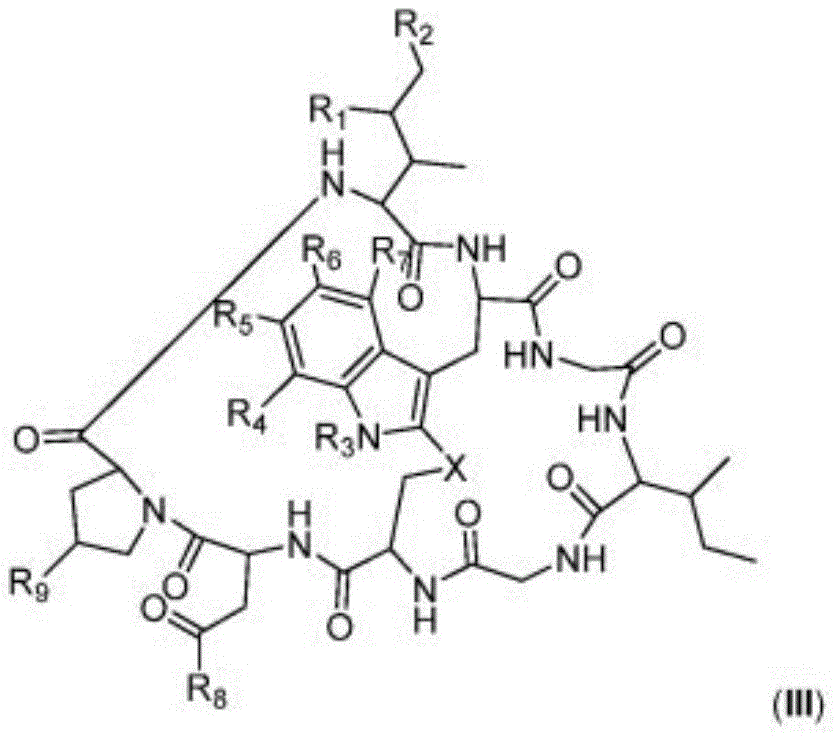
Wherein R is1Is H, OH, ORAOR ORC;
R2Is H, OH, ORBOR ORC;
RAAnd RBTaken together with the oxygen atom to which they are bound to form an optionally substituted 5-membered heterocycloalkyl;
R3is H, RCOr RD;
R4、R5、R6And R7Each independently is H, OH, ORC、ORD、RCOr RD;
R8Is OH, NH2、ORC、ORD、NHRCOr NRCRD;
R9Is H, OH, ORCOR ORD;
x is-S-, -S (O-) or-SO2-;
RCis-L-Z;
RDis optionally substituted C1-C6Alkyl, optionally substituted C1-C6Heteroalkyl, optionally substituted C2-C6Alkenyl, optionally substituted C2-C6Heteroalkenyl, optionally substituted C2-C6Alkynyl, optionally substituted C2-C6(ii) heteroalkynyl, optionally substituted cycloalkyl, optionally substituted heterocycloalkyl, optionally substituted aryl, or optionally substituted heteroaryl;
L is optionally substituted C1-C6Alkylene, optionally substituted C1-C6Heteroalkylene, optionally substituted C2-C6Alkenylene, optionally substituted C2-C6Heteroalkenylene, optionally substituted C2-C6Alkynylene, optionally substituted C2-C6Heteroalkynylene, optionally substituted cycloalkylene, optionally substituted heterocycloalkylene, optionally substituted arylene, optionally substituted heteroarylene, a peptide, a dipeptide, - (C ═ O) -, disulfide, hydrazone, or a combination thereof; and is
Z is a chemical moiety formed from a coupling reaction between a reactive substituent present on L and a reactive substituent present in an antibody or antigen-binding fragment thereof,
wherein Am contains exactly one RCAnd (4) a substituent.
209. The ADC of claim 207, wherein the amatoxin is represented by formula (IB)
Wherein R is1Is H, OH, ORAOR ORC;
R2Is H, OH, ORBOR ORC;
RAAnd RBTaken together with the oxygen atom to which they are bound to form an optionally substituted 5-membered heterocycloalkyl;
R3is H, RCOr RD;
R4、R5、R6And R7Each independently is H, OH, ORC、ORD、RCOr RD;
R8Is OH, NH2、ORC、ORD、NHRCOr NRCRD;
R9Is H, OH, ORCOR ORD;
x is-S-, -S (O-) or-SO2-;
RCis-L-Z;
RDis optionally substituted C1-C6Alkyl, optionally substituted C1-C6Heteroalkyl, optionally substituted C 2-C6Alkenyl, optionally substituted C2-C6Heteroalkenyl, optionally substituted C2-C6Alkynyl, optionally substituted C2-C6(ii) heteroalkynyl, optionally substituted cycloalkyl, optionally substituted heterocycloalkyl, optionally substituted aryl, or optionally substituted heteroaryl;
l is optionally substituted C1-C6Alkylene, optionally substituted C1-C6Heteroalkylene, optionally substituted C2-C6Alkenylene, optionally substituted C2-C6Heteroalkenylene, optionally substituted C2-C6Alkynylene, optionally substituted C2-C6Heteroalkynylene, optionally substituted cycloalkylene, optionally substituted heterocycloalkylene, optionally substituted arylene, optionally substituted heteroarylene, peptide, dipeptide, - (C ═ O) -, disulfide, hydrazone, or group thereofCombining; and is
Z is a chemical moiety formed from a coupling reaction between a reactive substituent present on L and a reactive substituent present in an antibody or antigen-binding fragment thereof,
wherein Am contains exactly one RCAnd (4) a substituent.
210. The ADC of claim 206, wherein the RNA polymerase inhibitor is amanitin.
211. The ADC of claim 210, wherein the amanitine is selected from the group consisting of a-amanitine, β -amanitine, γ -amanitine, e-amanitine, amanitin amide, amanitin nontoxic cyclic peptide acid, and proactin nontoxic cyclic peptide.
212. The ADC of claim 205, wherein the cytotoxin is selected from the group consisting of pseudomonas exotoxin A, deBouganin, diphtheria toxin, saporin, maytansine, maytansinoids, auristatin, anthracyclines, calicheamicin, irinotecan, SN-38, duocarmycin, pyrrolobenzodiazepines, pyrrolobenzodiazepine dimer, indolopendrazine, and indolopendrazine dimer.
213. The ADC of claim 212, wherein the auristatin is MMAE or MMAF.
214. The ADC of any one of claims 205-213 wherein the antibody or antigen-binding portion thereof is conjugated to the cytotoxin by interchain conjugation to a native hinge cysteine.
215. The ADC of any one of claims 205 to 214, wherein the antibody or antigen-binding portion thereof is conjugated to a cytotoxin through a cysteine residue in the Fc domain of the antibody.
216. The ADC of claim 215, wherein the cysteine residue is introduced by an amino acid substitution in the Fc domain of the antibody.
217. The ADC of claim 216, wherein the amino acid substitution is D265C.
218. The ADC of claim 216, wherein the amino acid substitution is S239C.
219. A pharmaceutical composition comprising an antibody or ADC according to any one of claims 1 to 218, and a pharmaceutically acceptable carrier.
220. A method for depleting a Hematopoietic Stem Cell (HSC) population in a human patient, the method comprising administering to the patient an effective amount of the antibody or ADC of any one of claims 1-218.
221. The method of claim 220, further comprising administering to the patient a transplant comprising hematopoietic stem cells.
222. The method of claim 221, wherein the graft is allogeneic.
223. The method of claim 221, wherein the graft is autologous.
224. A method comprising administering to a human patient a graft comprising hematopoietic stem cells, wherein the patient has previously been administered the antibody or ADC of any one of claims 1 to 218 in an amount sufficient to deplete the patient's hematopoietic stem cell population.
225. The method of claim 224, wherein said hematopoietic stem cells are CD117+ or CD45+ cells.
226. The method of any one of claims 220-224, wherein the patient has a hematological disease, a metabolic disorder, cancer or an autoimmune disease or Severe Combined Immunodeficiency Disease (SCID).
227. A method for treating leukemia in a human patient, the method comprising administering to a human patient having leukemia an antibody or ADC according to any one of claims 1 to 218.
228. A method comprising administering a transplant comprising hematopoietic stem cells to a human patient, wherein the patient has previously been administered an amount of the antibody or ADC of any one of claims 1-218 sufficient to deplete the patient's immune cell population.
229. The method of claim 228, wherein the immune cell is a CD137+, CD2+, or CD5+ cell.
230. The method of claim 228 or 229, wherein the immune cell is a T cell.
231. A composition comprising the antibody or ADC of any one of claims 1-218, wherein the composition comprises less than 25% hydrophobic degradants after heat stress.
232. The composition of claim 231, wherein the composition comprises less than 20% hydrophobic degradants after heat stress.
233. The composition of claim 231, wherein the composition comprises less than 15% hydrophobic degradants after heat stress.
234. The composition of claim 231, wherein the composition comprises less than 10% hydrophobic degradants after heat stress.
235. The composition of claim 231, wherein the composition comprises less than 5% hydrophobic degradants after heat stress.
236. A method for treating a stem cell disorder in a human patient, the method comprising administering to the patient a therapeutically effective amount of the antibody, antigen-binding fragment thereof, or ADC of any one of claims 1-218.
237. A method for treating an immunodeficiency disorder in a human patient, comprising administering to the patient a therapeutically effective amount of an antibody, antigen-binding fragment thereof, or ADC according to any one of claims 1-218.
238. The method of claim 237, wherein the immunodeficiency disorder is congenital immunodeficiency or acquired immunodeficiency.
239. A method for treating a metabolic disorder in a human patient, the method comprising administering to the patient a therapeutically effective amount of the antibody, antigen-binding fragment thereof, or ADC of any one of claims 1-218.
240. The method of claim 239, wherein the metabolic disorder is selected from glycogen storage disease, mucopolysaccharidosis, gaucher's disease, huler's disease, sphingolipid metabolism disorders, and metachromatic leukodystrophy.
241. A method for treating an autoimmune disorder in a human patient, the method comprising administering to the patient a therapeutically effective amount of the antibody, antigen-binding fragment thereof, or ADC of any one of claims 1-218.
242. The method of claim 241, wherein the autoimmune disorder is selected from multiple sclerosis, human systemic lupus erythematosus, rheumatoid arthritis, inflammatory bowel disease, treatment of psoriasis, type 1 diabetes, acute disseminated encephalomyelitis, edison's disease, alopecia universalisAnkylosing spondylitis, antiphospholipid syndrome, aplastic anemia, autoimmune hemolytic anemia, autoimmune hepatitis, autoimmune inner ear disease, autoimmune lymphoproliferative syndrome, autoimmune oophoritis, Barlow's disease, Behcet's disease, bullous pemphigoid, cardiomyopathy, Chagas 'disease, chronic fatigue immune dysfunction syndrome, chronic inflammatory demyelinating polyneuropathy, Crohn's disease, cicatricial pemphigoid, celiac sprue dermatitis herpetiformis, cold agglutinin disease, CREST syndrome, pernicious papulosis, discoid lupus, familial autonomic abnormalities, endometriosis, idiopathic mixed cryoprecipitation globulinemia, fibromyalgia-fibromyositis, Goodpasture's syndrome, Graves disease, Guilin-Barre syndrome, Hashimoto's thyroiditis, Hidradenitis suppurativa, idiopathic and/or acute thrombocytopenic purpura, idiopathic pulmonary fibrosis, IgA neuropathy, interstitial cystitis, juvenile arthritis, Sjogren's disease, lichen planus, Lyme disease, Meniere's disease, mixed connective tissue disease, myasthenia gravis, neuromuscular mycosis, strabismus-myoclonus syndrome, optic neuritis, Alder's thyroiditis, pemphigus vulgaris, pernicious anemia, polychondritis, polymyositis and dermatomyositis, primary biliary cirrhosis, polyarteritis nodosa, polyglandular syndrome, polymyalgia rheumatica, primary agammaglobulinemia, Raynaud's phenomenon, Reiter's syndrome, rheumatic fever, sarcoidosis, scleroderma, IgA neuropathy, interstitial cystitis, juvenile arthritis, Sjogren's disease, Graves 'disease's syndrome, etc,  Syndrome, stiff person syndrome, aortic arch syndrome, temporal arteritis, ulcerative colitis, uveitis, vasculitis, vitiligo, vulvodynia, and wegener's granulomatosis.
243. A method for treating cancer in a human patient, the method comprising administering to the patient a therapeutically effective amount of the antibody, antigen-binding fragment thereof, or ADC of any one of claims 1-218.
244. The method of claim 243, wherein the cancer is selected from the group consisting of leukemia, lymphoma, multiple myeloma, and neuroblastoma.
Applications Claiming Priority (7)
| Application Number | Priority Date | Filing Date | Title |
|---|---|---|---|
| US201862749662P | 2018-10-23 | 2018-10-23 | |
| US62/749,662 | 2018-10-23 | ||
| US201862773839P | 2018-11-30 | 2018-11-30 | |
| US62/773,839 | 2018-11-30 | ||
| US201962807363P | 2019-02-19 | 2019-02-19 | |
| US62/807,363 | 2019-02-19 | ||
| PCT/US2019/057741 WO2020086776A1 (en) | 2018-10-23 | 2019-10-23 | Fc silenced antibody drug conjugates (adcs) and uses thereof |
Publications (1)
| Publication Number | Publication Date |
|---|---|
| CN113330026A true CN113330026A (en) | 2021-08-31 |
Family
ID=70331253
Family Applications (1)
| Application Number | Title | Priority Date | Filing Date |
|---|---|---|---|
| CN201980081477.8A Pending CN113330026A (en) | 2018-10-23 | 2019-10-23 | Fc-silenced Antibody Drug Conjugates (ADCs) and uses thereof |
Country Status (13)
| Country | Link |
|---|---|
| US (1) | US20200255523A1 (en) |
| EP (1) | EP3873930A4 (en) |
| JP (2) | JP7709376B2 (en) |
| KR (1) | KR20210081393A (en) |
| CN (1) | CN113330026A (en) |
| AU (1) | AU2019366960A1 (en) |
| BR (1) | BR112021007555A2 (en) |
| CA (1) | CA3115680A1 (en) |
| CO (1) | CO2021006259A2 (en) |
| IL (1) | IL282292A (en) |
| MX (1) | MX2021004231A (en) |
| SG (1) | SG11202103568PA (en) |
| WO (1) | WO2020086776A1 (en) |
Families Citing this family (18)
| Publication number | Priority date | Publication date | Assignee | Title |
|---|---|---|---|---|
| JP7642531B2 (en) | 2018-05-11 | 2025-03-10 | ビーム セラピューティクス インク. | Methods for replacing pathogenic amino acids using a programmable base editor system |
| US20200376135A1 (en) * | 2018-10-23 | 2020-12-03 | Magenta Therapeutics, Inc. | Fc silenced antibody drug conjugates (adcs) and uses thereof |
| CN113302203A (en) | 2018-10-30 | 2021-08-24 | 美真达治疗公司 | anti-CD 45 antibodies and conjugates thereof |
| WO2020219778A2 (en) * | 2019-04-24 | 2020-10-29 | Magenta Therapeutics, Inc. | Anti-cd117 antibody-drug conjugates and uses thereof |
| AU2020261079A1 (en) * | 2019-04-24 | 2021-12-23 | Regeneron Pharmaceuticals, Inc. | Conditioning methods for gene therapy |
| JP2022530442A (en) * | 2019-04-24 | 2022-06-29 | マジェンタ セラピューティクス インコーポレイテッド | Anthracycline antibody drug conjugate and its use |
| KR20220091567A (en) | 2019-11-01 | 2022-06-30 | 마젠타 테라퓨틱스 인코포레이티드 | Anti-CD45 Antibodies and Conjugates Thereof |
| EP4121462A4 (en) * | 2020-03-16 | 2024-04-24 | Magenta Therapeutics, Inc. | T-cell bispecific binding proteins |
| GB2595299B (en) | 2020-05-21 | 2022-08-03 | Mabsolve Ltd | Modified immunoglobulin FC regions |
| JP2023529455A (en) | 2020-06-09 | 2023-07-10 | ハイデルベルク ファルマ リサーチ ゲゼルシャフト ミット ベシュレンクテル ハフツング | Methods for synthesizing thioether-containing peptides |
| WO2021255217A1 (en) | 2020-06-19 | 2021-12-23 | Heidelberg Pharma Research Gmbh | Amatoxin and amatoxin conjugates for use in inhibition of rna virus replication |
| WO2022010847A1 (en) | 2020-07-07 | 2022-01-13 | Cancure, Llc | Mic antibodies and binding agents and methods of using the same |
| WO2024048490A1 (en) | 2022-08-29 | 2024-03-07 | 第一三共株式会社 | Antibody-drug conjugate including mutant fc region |
| WO2024121632A1 (en) * | 2022-12-09 | 2024-06-13 | Crispr Therapeutics Ag | Use of anti-cd117 antibody drug conjugate (adc) |
| WO2024258967A1 (en) * | 2023-06-13 | 2024-12-19 | Synthis Therapeutics, Inc. | Anti-cd5 antibodies and their uses |
| KR20250065477A (en) * | 2023-11-03 | 2025-05-13 | 고려대학교 산학협력단 | Fc variants that prevents Fab-arm exchange and eliminates effector functions |
| WO2025099280A1 (en) * | 2023-11-08 | 2025-05-15 | Oxion Biologics Ab | Improved anti-ox40l antibodies |
| WO2026014615A1 (en) * | 2024-07-10 | 2026-01-15 | 고려대학교 산학협력단 | Novel glycosylated fc variant with effector function deleted |
Citations (9)
| Publication number | Priority date | Publication date | Assignee | Title |
|---|---|---|---|---|
| CN103154037A (en) * | 2010-10-05 | 2013-06-12 | 诺瓦提斯公司 | Anti-IL 12 Rbeta 1 antibodies and their use in treating autoimmune and inflammatory disorders |
| WO2014012085A2 (en) * | 2012-07-13 | 2014-01-16 | Zymeworks Inc. | Bispecific asymmetric heterodimers comprising anti-cd3 constructs |
| CN103649125A (en) * | 2011-06-22 | 2014-03-19 | 霍夫曼-拉罗奇有限公司 | Clearance of target cells by circulating virus-specific cytotoxic T cells utilizing MHC class I-containing complexes |
| WO2014108483A1 (en) * | 2013-01-10 | 2014-07-17 | Genmab B.V. | Inert format |
| CN104508132A (en) * | 2012-08-02 | 2015-04-08 | 弗·哈夫曼-拉罗切有限公司 | Method for producing soluble FcR as an Fc fusion to an inert immunoglobulin Fc region and uses thereof |
| WO2016081746A2 (en) * | 2014-11-21 | 2016-05-26 | Bristol-Myers Squibb Company | Antibodies comprising modified heavy constant regions |
| US20160367697A1 (en) * | 2006-12-01 | 2016-12-22 | Seattle Genetics, Inc. | Variant target binding agents and uses thereof |
| WO2017157948A1 (en) * | 2016-03-14 | 2017-09-21 | Innate Pharma | Anti-cd39 antibodies |
| US20180043033A1 (en) * | 2015-03-09 | 2018-02-15 | Heidelberg Pharma Gmbh | Amatoxin-antibody conjugates |
Family Cites Families (16)
| Publication number | Priority date | Publication date | Assignee | Title |
|---|---|---|---|---|
| AU6223296A (en) * | 1995-06-07 | 1996-12-30 | Novartis Ag | Methods for obtaining compositions enriched for hematopoieti c stem cells and antibodies for use therein |
| US7435596B2 (en) * | 2004-11-04 | 2008-10-14 | St. Jude Children's Research Hospital, Inc. | Modified cell line and method for expansion of NK cell |
| MX349057B (en) * | 2010-11-30 | 2017-07-07 | Chugai Pharmaceutical Co Ltd | THERAPEUTIC AGENT THAT INDUCES CYTOTOXICITY. |
| ES2736326T3 (en) * | 2013-05-31 | 2019-12-27 | Zymeworks Inc | Heteromultimers with reduced or silenced effector function |
| CN117069841A (en) * | 2015-10-06 | 2023-11-17 | 艾利妥 | anti-TREM 2 antibodies and methods of use thereof |
| MA43389A (en) * | 2015-12-02 | 2021-05-12 | Agenus Inc | ANTI-OX40 ANTIBODIES AND PROCESSES FOR USE |
| JP2019502698A (en) * | 2015-12-17 | 2019-01-31 | ヤンセン バイオテツク,インコーポレーテツド | Antibodies that bind specifically to HLA-DR and uses thereof |
| EP3559034B1 (en) * | 2016-12-20 | 2020-12-02 | H. Hoffnabb-La Roche Ag | Combination therapy of anti-cd20/anti-cd3 bispecific antibodies and 4-1bb (cd137) agonists |
| JOP20190155A1 (en) * | 2016-12-21 | 2019-06-23 | Novartis Ag | Antibody drug conjugates for ablating hematopoietic stem cells |
| JP7038717B2 (en) * | 2016-12-23 | 2022-03-18 | ハイデルベルク ファルマ リサーチ ゲゼルシャフト ミット ベシュレンクテル ハフツング | Amanitin antibody conjugate |
| AU2018354189A1 (en) * | 2017-10-24 | 2020-04-23 | Crispr Therapeutics Ag | Compositions and methods for the depletion of CD117+ cells |
| WO2020219778A2 (en) * | 2019-04-24 | 2020-10-29 | Magenta Therapeutics, Inc. | Anti-cd117 antibody-drug conjugates and uses thereof |
| WO2020219775A1 (en) * | 2019-04-24 | 2020-10-29 | Magenta Therapeutics, Inc. | Anti-cd117 antibody-drug conjugates and uses thereof |
| BR112021021165A2 (en) * | 2019-04-24 | 2022-01-04 | Heidelberg Pharma Res Gmbh | Amatoxin antibody-drug conjugates and their use |
| JP2022530442A (en) * | 2019-04-24 | 2022-06-29 | マジェンタ セラピューティクス インコーポレイテッド | Anthracycline antibody drug conjugate and its use |
| AU2020261079A1 (en) * | 2019-04-24 | 2021-12-23 | Regeneron Pharmaceuticals, Inc. | Conditioning methods for gene therapy |
-
2019
- 2019-10-23 CN CN201980081477.8A patent/CN113330026A/en active Pending
- 2019-10-23 WO PCT/US2019/057741 patent/WO2020086776A1/en not_active Ceased
- 2019-10-23 MX MX2021004231A patent/MX2021004231A/en unknown
- 2019-10-23 AU AU2019366960A patent/AU2019366960A1/en active Pending
- 2019-10-23 CA CA3115680A patent/CA3115680A1/en active Pending
- 2019-10-23 JP JP2021518969A patent/JP7709376B2/en active Active
- 2019-10-23 KR KR1020217015206A patent/KR20210081393A/en active Pending
- 2019-10-23 EP EP19875208.1A patent/EP3873930A4/en active Pending
- 2019-10-23 SG SG11202103568PA patent/SG11202103568PA/en unknown
- 2019-10-23 BR BR112021007555-0A patent/BR112021007555A2/en not_active IP Right Cessation
-
2020
- 2020-04-30 US US16/863,948 patent/US20200255523A1/en active Pending
-
2021
- 2021-04-13 IL IL282292A patent/IL282292A/en unknown
- 2021-05-13 CO CONC2021/0006259A patent/CO2021006259A2/en unknown
-
2025
- 2025-07-04 JP JP2025113503A patent/JP2025160215A/en active Pending
Patent Citations (10)
| Publication number | Priority date | Publication date | Assignee | Title |
|---|---|---|---|---|
| US20160367697A1 (en) * | 2006-12-01 | 2016-12-22 | Seattle Genetics, Inc. | Variant target binding agents and uses thereof |
| CN103154037A (en) * | 2010-10-05 | 2013-06-12 | 诺瓦提斯公司 | Anti-IL 12 Rbeta 1 antibodies and their use in treating autoimmune and inflammatory disorders |
| CN103649125A (en) * | 2011-06-22 | 2014-03-19 | 霍夫曼-拉罗奇有限公司 | Clearance of target cells by circulating virus-specific cytotoxic T cells utilizing MHC class I-containing complexes |
| CN104736174A (en) * | 2012-07-06 | 2015-06-24 | 根马布私人有限公司 | Dimeric protein with triple mutation |
| WO2014012085A2 (en) * | 2012-07-13 | 2014-01-16 | Zymeworks Inc. | Bispecific asymmetric heterodimers comprising anti-cd3 constructs |
| CN104508132A (en) * | 2012-08-02 | 2015-04-08 | 弗·哈夫曼-拉罗切有限公司 | Method for producing soluble FcR as an Fc fusion to an inert immunoglobulin Fc region and uses thereof |
| WO2014108483A1 (en) * | 2013-01-10 | 2014-07-17 | Genmab B.V. | Inert format |
| WO2016081746A2 (en) * | 2014-11-21 | 2016-05-26 | Bristol-Myers Squibb Company | Antibodies comprising modified heavy constant regions |
| US20180043033A1 (en) * | 2015-03-09 | 2018-02-15 | Heidelberg Pharma Gmbh | Amatoxin-antibody conjugates |
| WO2017157948A1 (en) * | 2016-03-14 | 2017-09-21 | Innate Pharma | Anti-cd39 antibodies |
Non-Patent Citations (2)
| Title |
|---|
| LO, M, ET AL.: "Effector Attenuating Substitutions that Maintain Antibody Stability and Reduce - Toxicity in Mice", THE AMERICAN SOCIETY FOR BIOCHEMISTRY AND MOLECULAR BIOLOGY, INC. JOURNAL OF BIOLOGICAL CHEMISTRY, 11 January 2017 (2017-01-11), pages 1 * |
| SHIELDS RL等: "High resolution mapping of the binding site on human IgG1 for Fc gamma RI, Fc gamma RII, Fc gamma RIII, and FcRn and design of IgG1 variants with improved binding to the Fc gamma R", J BIOL CHEM., vol. 276, no. 9, 2 March 2001 (2001-03-02), pages 6591 - 6604 * |
Also Published As
| Publication number | Publication date |
|---|---|
| JP7709376B2 (en) | 2025-07-16 |
| US20200255523A1 (en) | 2020-08-13 |
| SG11202103568PA (en) | 2021-05-28 |
| EP3873930A4 (en) | 2022-12-07 |
| KR20210081393A (en) | 2021-07-01 |
| AU2019366960A1 (en) | 2021-05-27 |
| IL282292A (en) | 2021-05-31 |
| MX2021004231A (en) | 2021-06-15 |
| JP2022512629A (en) | 2022-02-07 |
| CO2021006259A2 (en) | 2021-09-09 |
| WO2020086776A1 (en) | 2020-04-30 |
| CA3115680A1 (en) | 2020-04-30 |
| EP3873930A1 (en) | 2021-09-08 |
| BR112021007555A2 (en) | 2021-08-03 |
| JP2025160215A (en) | 2025-10-22 |
Similar Documents
| Publication | Publication Date | Title |
|---|---|---|
| JP7709376B2 (en) | Fc-silenced antibody drug conjugates (ADCs) and uses thereof | |
| JP7650819B2 (en) | Anti-CD45 antibody drug conjugates and uses thereof | |
| US12291576B2 (en) | Anti-CD45 antibodies and conjugates thereof | |
| CN111372608B (en) | Compositions and methods for depleting CD117+ cells | |
| US20190144558A1 (en) | Compositions and methods for the depletion of cd117+ cells | |
| CN114846028B (en) | Anti-CD45 antibodies and their conjugates | |
| CN114174317A (en) | Amatoxin antibody-drug conjugates and uses thereof | |
| US20210379195A1 (en) | Methods for allogeneic hematopoietic stem cell transplantation | |
| US20240075157A1 (en) | Fc silenced antibody drug conjugates (adcs) and uses thereof | |
| CN112566671A (en) | Methods of treatment using Antibody Drug Conjugates (ADCs) | |
| JPWO2020219959A5 (en) | ||
| JP2025172753A (en) | Methods and compositions for treating autoimmune diseases | |
| EP3959242A1 (en) | Anthracycline antibody-drug conjugates and uses thereof | |
| CN113490504A (en) | Use of anti-CD 45 Antibody Drug Conjugates (ADCs) in cell therapy | |
| KR20220154676A (en) | Compositions and methods for allotransplantation | |
| CN114206358A (en) | T cell depletion therapy | |
| JPWO2020219775A5 (en) | ||
| JPWO2020219778A5 (en) | ||
| JPWO2020219774A5 (en) |
Legal Events
| Date | Code | Title | Description |
|---|---|---|---|
| PB01 | Publication | ||
| PB01 | Publication | ||
| SE01 | Entry into force of request for substantive examination | ||
| SE01 | Entry into force of request for substantive examination | ||
| TA01 | Transfer of patent application right | ||
| TA01 | Transfer of patent application right |
Effective date of registration: 20250603 Address after: The American state of Massachusetts Applicant after: VOR biopharmaceutical Co.,Ltd. Country or region after: U.S.A. Address before: Massachusetts, USA Applicant before: MAGENTA THERAPEUTICS, Inc. Country or region before: U.S.A. |