CN112707923A - Organic electroluminescent material and device - Google Patents
Organic electroluminescent material and device Download PDFInfo
- Publication number
- CN112707923A CN112707923A CN202011145644.1A CN202011145644A CN112707923A CN 112707923 A CN112707923 A CN 112707923A CN 202011145644 A CN202011145644 A CN 202011145644A CN 112707923 A CN112707923 A CN 112707923A
- Authority
- CN
- China
- Prior art keywords
- group
- compound
- aryl
- heteroaryl
- combinations
- Prior art date
- Legal status (The legal status is an assumption and is not a legal conclusion. Google has not performed a legal analysis and makes no representation as to the accuracy of the status listed.)
- Granted
Links
Images


Classifications
-
- C—CHEMISTRY; METALLURGY
- C07—ORGANIC CHEMISTRY
- C07F—ACYCLIC, CARBOCYCLIC OR HETEROCYCLIC COMPOUNDS CONTAINING ELEMENTS OTHER THAN CARBON, HYDROGEN, HALOGEN, OXYGEN, NITROGEN, SULFUR, SELENIUM OR TELLURIUM
- C07F5/00—Compounds containing elements of Groups 3 or 13 of the Periodic Table
- C07F5/02—Boron compounds
- C07F5/027—Organoboranes and organoborohydrides
-
- C—CHEMISTRY; METALLURGY
- C07—ORGANIC CHEMISTRY
- C07B—GENERAL METHODS OF ORGANIC CHEMISTRY; APPARATUS THEREFOR
- C07B59/00—Introduction of isotopes of elements into organic compounds ; Labelled organic compounds per se
- C07B59/004—Acyclic, carbocyclic or heterocyclic compounds containing elements other than carbon, hydrogen, halogen, oxygen, nitrogen, sulfur, selenium or tellurium
-
- C—CHEMISTRY; METALLURGY
- C07—ORGANIC CHEMISTRY
- C07D—HETEROCYCLIC COMPOUNDS
- C07D517/00—Heterocyclic compounds containing in the condensed system at least one hetero ring having selenium, tellurium, or halogen atoms as ring hetero atoms
- C07D517/22—Heterocyclic compounds containing in the condensed system at least one hetero ring having selenium, tellurium, or halogen atoms as ring hetero atoms in which the condensed system contains four or more hetero rings
-
- C—CHEMISTRY; METALLURGY
- C07—ORGANIC CHEMISTRY
- C07F—ACYCLIC, CARBOCYCLIC OR HETEROCYCLIC COMPOUNDS CONTAINING ELEMENTS OTHER THAN CARBON, HYDROGEN, HALOGEN, OXYGEN, NITROGEN, SULFUR, SELENIUM OR TELLURIUM
- C07F15/00—Compounds containing elements of Groups 8, 9, 10 or 18 of the Periodic Table
- C07F15/0006—Compounds containing elements of Groups 8, 9, 10 or 18 of the Periodic Table compounds of the platinum group
- C07F15/0086—Platinum compounds
-
- C—CHEMISTRY; METALLURGY
- C07—ORGANIC CHEMISTRY
- C07F—ACYCLIC, CARBOCYCLIC OR HETEROCYCLIC COMPOUNDS CONTAINING ELEMENTS OTHER THAN CARBON, HYDROGEN, HALOGEN, OXYGEN, NITROGEN, SULFUR, SELENIUM OR TELLURIUM
- C07F7/00—Compounds containing elements of Groups 4 or 14 of the Periodic Table
- C07F7/02—Silicon compounds
- C07F7/08—Compounds having one or more C—Si linkages
- C07F7/0803—Compounds with Si-C or Si-Si linkages
-
- C—CHEMISTRY; METALLURGY
- C07—ORGANIC CHEMISTRY
- C07F—ACYCLIC, CARBOCYCLIC OR HETEROCYCLIC COMPOUNDS CONTAINING ELEMENTS OTHER THAN CARBON, HYDROGEN, HALOGEN, OXYGEN, NITROGEN, SULFUR, SELENIUM OR TELLURIUM
- C07F7/00—Compounds containing elements of Groups 4 or 14 of the Periodic Table
- C07F7/02—Silicon compounds
- C07F7/08—Compounds having one or more C—Si linkages
- C07F7/0803—Compounds with Si-C or Si-Si linkages
- C07F7/081—Compounds with Si-C or Si-Si linkages comprising at least one atom selected from the elements N, O, halogen, S, Se or Te
- C07F7/0812—Compounds with Si-C or Si-Si linkages comprising at least one atom selected from the elements N, O, halogen, S, Se or Te comprising a heterocyclic ring
-
- C—CHEMISTRY; METALLURGY
- C07—ORGANIC CHEMISTRY
- C07F—ACYCLIC, CARBOCYCLIC OR HETEROCYCLIC COMPOUNDS CONTAINING ELEMENTS OTHER THAN CARBON, HYDROGEN, HALOGEN, OXYGEN, NITROGEN, SULFUR, SELENIUM OR TELLURIUM
- C07F7/00—Compounds containing elements of Groups 4 or 14 of the Periodic Table
- C07F7/02—Silicon compounds
- C07F7/08—Compounds having one or more C—Si linkages
- C07F7/0803—Compounds with Si-C or Si-Si linkages
- C07F7/081—Compounds with Si-C or Si-Si linkages comprising at least one atom selected from the elements N, O, halogen, S, Se or Te
- C07F7/0812—Compounds with Si-C or Si-Si linkages comprising at least one atom selected from the elements N, O, halogen, S, Se or Te comprising a heterocyclic ring
- C07F7/0816—Compounds with Si-C or Si-Si linkages comprising at least one atom selected from the elements N, O, halogen, S, Se or Te comprising a heterocyclic ring said ring comprising Si as a ring atom
-
- C—CHEMISTRY; METALLURGY
- C07—ORGANIC CHEMISTRY
- C07F—ACYCLIC, CARBOCYCLIC OR HETEROCYCLIC COMPOUNDS CONTAINING ELEMENTS OTHER THAN CARBON, HYDROGEN, HALOGEN, OXYGEN, NITROGEN, SULFUR, SELENIUM OR TELLURIUM
- C07F7/00—Compounds containing elements of Groups 4 or 14 of the Periodic Table
- C07F7/30—Germanium compounds
-
- C—CHEMISTRY; METALLURGY
- C09—DYES; PAINTS; POLISHES; NATURAL RESINS; ADHESIVES; COMPOSITIONS NOT OTHERWISE PROVIDED FOR; APPLICATIONS OF MATERIALS NOT OTHERWISE PROVIDED FOR
- C09K—MATERIALS FOR MISCELLANEOUS APPLICATIONS, NOT PROVIDED FOR ELSEWHERE
- C09K11/00—Luminescent, e.g. electroluminescent, chemiluminescent materials
- C09K11/06—Luminescent, e.g. electroluminescent, chemiluminescent materials containing organic luminescent materials
-
- H—ELECTRICITY
- H10—SEMICONDUCTOR DEVICES; ELECTRIC SOLID-STATE DEVICES NOT OTHERWISE PROVIDED FOR
- H10K—ORGANIC ELECTRIC SOLID-STATE DEVICES
- H10K50/00—Organic light-emitting devices
- H10K50/10—OLEDs or polymer light-emitting diodes [PLED]
- H10K50/11—OLEDs or polymer light-emitting diodes [PLED] characterised by the electroluminescent [EL] layers
-
- H—ELECTRICITY
- H10—SEMICONDUCTOR DEVICES; ELECTRIC SOLID-STATE DEVICES NOT OTHERWISE PROVIDED FOR
- H10K—ORGANIC ELECTRIC SOLID-STATE DEVICES
- H10K50/00—Organic light-emitting devices
- H10K50/10—OLEDs or polymer light-emitting diodes [PLED]
- H10K50/11—OLEDs or polymer light-emitting diodes [PLED] characterised by the electroluminescent [EL] layers
- H10K50/12—OLEDs or polymer light-emitting diodes [PLED] characterised by the electroluminescent [EL] layers comprising dopants
- H10K50/121—OLEDs or polymer light-emitting diodes [PLED] characterised by the electroluminescent [EL] layers comprising dopants for assisting energy transfer, e.g. sensitization
-
- H—ELECTRICITY
- H10—SEMICONDUCTOR DEVICES; ELECTRIC SOLID-STATE DEVICES NOT OTHERWISE PROVIDED FOR
- H10K—ORGANIC ELECTRIC SOLID-STATE DEVICES
- H10K85/00—Organic materials used in the body or electrodes of devices covered by this subclass
- H10K85/30—Coordination compounds
- H10K85/321—Metal complexes comprising a group IIIA element, e.g. Tris (8-hydroxyquinoline) gallium [Gaq3]
- H10K85/322—Metal complexes comprising a group IIIA element, e.g. Tris (8-hydroxyquinoline) gallium [Gaq3] comprising boron
-
- H—ELECTRICITY
- H10—SEMICONDUCTOR DEVICES; ELECTRIC SOLID-STATE DEVICES NOT OTHERWISE PROVIDED FOR
- H10K—ORGANIC ELECTRIC SOLID-STATE DEVICES
- H10K85/00—Organic materials used in the body or electrodes of devices covered by this subclass
- H10K85/30—Coordination compounds
- H10K85/341—Transition metal complexes, e.g. Ru(II)polypyridine complexes
- H10K85/346—Transition metal complexes, e.g. Ru(II)polypyridine complexes comprising platinum
-
- H—ELECTRICITY
- H10—SEMICONDUCTOR DEVICES; ELECTRIC SOLID-STATE DEVICES NOT OTHERWISE PROVIDED FOR
- H10K—ORGANIC ELECTRIC SOLID-STATE DEVICES
- H10K85/00—Organic materials used in the body or electrodes of devices covered by this subclass
- H10K85/40—Organosilicon compounds, e.g. TIPS pentacene
-
- H—ELECTRICITY
- H10—SEMICONDUCTOR DEVICES; ELECTRIC SOLID-STATE DEVICES NOT OTHERWISE PROVIDED FOR
- H10K—ORGANIC ELECTRIC SOLID-STATE DEVICES
- H10K85/00—Organic materials used in the body or electrodes of devices covered by this subclass
- H10K85/60—Organic compounds having low molecular weight
- H10K85/649—Aromatic compounds comprising a hetero atom
- H10K85/654—Aromatic compounds comprising a hetero atom comprising only nitrogen as heteroatom
-
- H—ELECTRICITY
- H10—SEMICONDUCTOR DEVICES; ELECTRIC SOLID-STATE DEVICES NOT OTHERWISE PROVIDED FOR
- H10K—ORGANIC ELECTRIC SOLID-STATE DEVICES
- H10K85/00—Organic materials used in the body or electrodes of devices covered by this subclass
- H10K85/60—Organic compounds having low molecular weight
- H10K85/649—Aromatic compounds comprising a hetero atom
- H10K85/657—Polycyclic condensed heteroaromatic hydrocarbons
-
- H—ELECTRICITY
- H10—SEMICONDUCTOR DEVICES; ELECTRIC SOLID-STATE DEVICES NOT OTHERWISE PROVIDED FOR
- H10K—ORGANIC ELECTRIC SOLID-STATE DEVICES
- H10K85/00—Organic materials used in the body or electrodes of devices covered by this subclass
- H10K85/60—Organic compounds having low molecular weight
- H10K85/649—Aromatic compounds comprising a hetero atom
- H10K85/657—Polycyclic condensed heteroaromatic hydrocarbons
- H10K85/6572—Polycyclic condensed heteroaromatic hydrocarbons comprising only nitrogen in the heteroaromatic polycondensed ring system, e.g. phenanthroline or carbazole
-
- H—ELECTRICITY
- H10—SEMICONDUCTOR DEVICES; ELECTRIC SOLID-STATE DEVICES NOT OTHERWISE PROVIDED FOR
- H10K—ORGANIC ELECTRIC SOLID-STATE DEVICES
- H10K85/00—Organic materials used in the body or electrodes of devices covered by this subclass
- H10K85/60—Organic compounds having low molecular weight
- H10K85/649—Aromatic compounds comprising a hetero atom
- H10K85/657—Polycyclic condensed heteroaromatic hydrocarbons
- H10K85/6574—Polycyclic condensed heteroaromatic hydrocarbons comprising only oxygen in the heteroaromatic polycondensed ring system, e.g. cumarine dyes
-
- H—ELECTRICITY
- H10—SEMICONDUCTOR DEVICES; ELECTRIC SOLID-STATE DEVICES NOT OTHERWISE PROVIDED FOR
- H10K—ORGANIC ELECTRIC SOLID-STATE DEVICES
- H10K85/00—Organic materials used in the body or electrodes of devices covered by this subclass
- H10K85/60—Organic compounds having low molecular weight
- H10K85/649—Aromatic compounds comprising a hetero atom
- H10K85/657—Polycyclic condensed heteroaromatic hydrocarbons
- H10K85/6576—Polycyclic condensed heteroaromatic hydrocarbons comprising only sulfur in the heteroaromatic polycondensed ring system, e.g. benzothiophene
-
- H—ELECTRICITY
- H10—SEMICONDUCTOR DEVICES; ELECTRIC SOLID-STATE DEVICES NOT OTHERWISE PROVIDED FOR
- H10K—ORGANIC ELECTRIC SOLID-STATE DEVICES
- H10K85/00—Organic materials used in the body or electrodes of devices covered by this subclass
- H10K85/60—Organic compounds having low molecular weight
- H10K85/658—Organoboranes
-
- C—CHEMISTRY; METALLURGY
- C09—DYES; PAINTS; POLISHES; NATURAL RESINS; ADHESIVES; COMPOSITIONS NOT OTHERWISE PROVIDED FOR; APPLICATIONS OF MATERIALS NOT OTHERWISE PROVIDED FOR
- C09K—MATERIALS FOR MISCELLANEOUS APPLICATIONS, NOT PROVIDED FOR ELSEWHERE
- C09K2211/00—Chemical nature of organic luminescent or tenebrescent compounds
- C09K2211/10—Non-macromolecular compounds
- C09K2211/1018—Heterocyclic compounds
- C09K2211/1025—Heterocyclic compounds characterised by ligands
- C09K2211/1029—Heterocyclic compounds characterised by ligands containing one nitrogen atom as the heteroatom
-
- C—CHEMISTRY; METALLURGY
- C09—DYES; PAINTS; POLISHES; NATURAL RESINS; ADHESIVES; COMPOSITIONS NOT OTHERWISE PROVIDED FOR; APPLICATIONS OF MATERIALS NOT OTHERWISE PROVIDED FOR
- C09K—MATERIALS FOR MISCELLANEOUS APPLICATIONS, NOT PROVIDED FOR ELSEWHERE
- C09K2211/00—Chemical nature of organic luminescent or tenebrescent compounds
- C09K2211/10—Non-macromolecular compounds
- C09K2211/1018—Heterocyclic compounds
- C09K2211/1025—Heterocyclic compounds characterised by ligands
- C09K2211/1029—Heterocyclic compounds characterised by ligands containing one nitrogen atom as the heteroatom
- C09K2211/104—Heterocyclic compounds characterised by ligands containing one nitrogen atom as the heteroatom with other heteroatoms
-
- C—CHEMISTRY; METALLURGY
- C09—DYES; PAINTS; POLISHES; NATURAL RESINS; ADHESIVES; COMPOSITIONS NOT OTHERWISE PROVIDED FOR; APPLICATIONS OF MATERIALS NOT OTHERWISE PROVIDED FOR
- C09K—MATERIALS FOR MISCELLANEOUS APPLICATIONS, NOT PROVIDED FOR ELSEWHERE
- C09K2211/00—Chemical nature of organic luminescent or tenebrescent compounds
- C09K2211/10—Non-macromolecular compounds
- C09K2211/1018—Heterocyclic compounds
- C09K2211/1025—Heterocyclic compounds characterised by ligands
- C09K2211/1044—Heterocyclic compounds characterised by ligands containing two nitrogen atoms as heteroatoms
-
- C—CHEMISTRY; METALLURGY
- C09—DYES; PAINTS; POLISHES; NATURAL RESINS; ADHESIVES; COMPOSITIONS NOT OTHERWISE PROVIDED FOR; APPLICATIONS OF MATERIALS NOT OTHERWISE PROVIDED FOR
- C09K—MATERIALS FOR MISCELLANEOUS APPLICATIONS, NOT PROVIDED FOR ELSEWHERE
- C09K2211/00—Chemical nature of organic luminescent or tenebrescent compounds
- C09K2211/10—Non-macromolecular compounds
- C09K2211/1018—Heterocyclic compounds
- C09K2211/1025—Heterocyclic compounds characterised by ligands
- C09K2211/1044—Heterocyclic compounds characterised by ligands containing two nitrogen atoms as heteroatoms
- C09K2211/1055—Heterocyclic compounds characterised by ligands containing two nitrogen atoms as heteroatoms with other heteroatoms
-
- C—CHEMISTRY; METALLURGY
- C09—DYES; PAINTS; POLISHES; NATURAL RESINS; ADHESIVES; COMPOSITIONS NOT OTHERWISE PROVIDED FOR; APPLICATIONS OF MATERIALS NOT OTHERWISE PROVIDED FOR
- C09K—MATERIALS FOR MISCELLANEOUS APPLICATIONS, NOT PROVIDED FOR ELSEWHERE
- C09K2211/00—Chemical nature of organic luminescent or tenebrescent compounds
- C09K2211/10—Non-macromolecular compounds
- C09K2211/1018—Heterocyclic compounds
- C09K2211/1025—Heterocyclic compounds characterised by ligands
- C09K2211/1059—Heterocyclic compounds characterised by ligands containing three nitrogen atoms as heteroatoms
-
- C—CHEMISTRY; METALLURGY
- C09—DYES; PAINTS; POLISHES; NATURAL RESINS; ADHESIVES; COMPOSITIONS NOT OTHERWISE PROVIDED FOR; APPLICATIONS OF MATERIALS NOT OTHERWISE PROVIDED FOR
- C09K—MATERIALS FOR MISCELLANEOUS APPLICATIONS, NOT PROVIDED FOR ELSEWHERE
- C09K2211/00—Chemical nature of organic luminescent or tenebrescent compounds
- C09K2211/10—Non-macromolecular compounds
- C09K2211/1018—Heterocyclic compounds
- C09K2211/1025—Heterocyclic compounds characterised by ligands
- C09K2211/1092—Heterocyclic compounds characterised by ligands containing sulfur as the only heteroatom
-
- C—CHEMISTRY; METALLURGY
- C09—DYES; PAINTS; POLISHES; NATURAL RESINS; ADHESIVES; COMPOSITIONS NOT OTHERWISE PROVIDED FOR; APPLICATIONS OF MATERIALS NOT OTHERWISE PROVIDED FOR
- C09K—MATERIALS FOR MISCELLANEOUS APPLICATIONS, NOT PROVIDED FOR ELSEWHERE
- C09K2211/00—Chemical nature of organic luminescent or tenebrescent compounds
- C09K2211/10—Non-macromolecular compounds
- C09K2211/1018—Heterocyclic compounds
- C09K2211/1025—Heterocyclic compounds characterised by ligands
- C09K2211/1096—Heterocyclic compounds characterised by ligands containing other heteroatoms
-
- C—CHEMISTRY; METALLURGY
- C09—DYES; PAINTS; POLISHES; NATURAL RESINS; ADHESIVES; COMPOSITIONS NOT OTHERWISE PROVIDED FOR; APPLICATIONS OF MATERIALS NOT OTHERWISE PROVIDED FOR
- C09K—MATERIALS FOR MISCELLANEOUS APPLICATIONS, NOT PROVIDED FOR ELSEWHERE
- C09K2211/00—Chemical nature of organic luminescent or tenebrescent compounds
- C09K2211/18—Metal complexes
- C09K2211/185—Metal complexes of the platinum group, i.e. Os, Ir, Pt, Ru, Rh or Pd
-
- H—ELECTRICITY
- H10—SEMICONDUCTOR DEVICES; ELECTRIC SOLID-STATE DEVICES NOT OTHERWISE PROVIDED FOR
- H10K—ORGANIC ELECTRIC SOLID-STATE DEVICES
- H10K2101/00—Properties of the organic materials covered by group H10K85/00
- H10K2101/10—Triplet emission
-
- H—ELECTRICITY
- H10—SEMICONDUCTOR DEVICES; ELECTRIC SOLID-STATE DEVICES NOT OTHERWISE PROVIDED FOR
- H10K—ORGANIC ELECTRIC SOLID-STATE DEVICES
- H10K50/00—Organic light-emitting devices
- H10K50/10—OLEDs or polymer light-emitting diodes [PLED]
- H10K50/14—Carrier transporting layers
- H10K50/15—Hole transporting layers
-
- H—ELECTRICITY
- H10—SEMICONDUCTOR DEVICES; ELECTRIC SOLID-STATE DEVICES NOT OTHERWISE PROVIDED FOR
- H10K—ORGANIC ELECTRIC SOLID-STATE DEVICES
- H10K50/00—Organic light-emitting devices
- H10K50/10—OLEDs or polymer light-emitting diodes [PLED]
- H10K50/14—Carrier transporting layers
- H10K50/16—Electron transporting layers
-
- H—ELECTRICITY
- H10—SEMICONDUCTOR DEVICES; ELECTRIC SOLID-STATE DEVICES NOT OTHERWISE PROVIDED FOR
- H10K—ORGANIC ELECTRIC SOLID-STATE DEVICES
- H10K50/00—Organic light-emitting devices
- H10K50/10—OLEDs or polymer light-emitting diodes [PLED]
- H10K50/17—Carrier injection layers
- H10K50/171—Electron injection layers
-
- H—ELECTRICITY
- H10—SEMICONDUCTOR DEVICES; ELECTRIC SOLID-STATE DEVICES NOT OTHERWISE PROVIDED FOR
- H10K—ORGANIC ELECTRIC SOLID-STATE DEVICES
- H10K50/00—Organic light-emitting devices
- H10K50/10—OLEDs or polymer light-emitting diodes [PLED]
- H10K50/18—Carrier blocking layers
Landscapes
- Chemical & Material Sciences (AREA)
- Organic Chemistry (AREA)
- Engineering & Computer Science (AREA)
- Materials Engineering (AREA)
- Physics & Mathematics (AREA)
- Spectroscopy & Molecular Physics (AREA)
- Inorganic Chemistry (AREA)
- Crystallography & Structural Chemistry (AREA)
- Optics & Photonics (AREA)
- Electroluminescent Light Sources (AREA)
- Heterocyclic Carbon Compounds Containing A Hetero Ring Having Oxygen Or Sulfur (AREA)
- Plural Heterocyclic Compounds (AREA)
Abstract
本申请涉及有机电致发光材料和装置。提供了含硼化合物。还提供了包含这些含硼化合物的调配物。另外提供了使用这些含硼化合物的OLED和相关消费型产品。

The present application relates to organic electroluminescent materials and devices. Boron-containing compounds are provided. Formulations comprising these boron-containing compounds are also provided. OLEDs and related consumer products using these boron-containing compounds are also provided.
Description
CROSS-REFERENCE TO RELATED APPLICATIONS
This application claims priority from U.S. provisional application No. 62/926,035 filed on 25.10.10.2020, U.S. provisional application No. 62/971,295 filed on 7.2.2020, U.S. provisional application No. 62/982,883 filed on 28.2.28.2020, all of which are incorporated herein by reference in their entirety, in accordance with 35u.s.c. 119 (e).
Technical Field
The present disclosure relates generally to boron-containing compounds and formulations and various uses thereof, including as host materials and emitters for use in devices, such as organic light emitting diodes and related electronic devices.
Background
Photovoltaic devices utilizing organic materials are becoming increasingly popular for a variety of reasons. Many of the materials used to make such devices are relatively inexpensive, and therefore organic photovoltaic devices have the potential for cost advantages over inorganic devices. In addition, the inherent properties of organic materials (e.g., their flexibility) may make them more suitable for particular applications, such as fabrication on flexible substrates. Examples of organic optoelectronic devices include organic light emitting diodes/devices (OLEDs), organic phototransistors, organic photovoltaic cells, and organic photodetectors. For OLEDs, organic materials may have performance advantages over conventional materials.
OLEDs utilize organic thin films that emit light when a voltage is applied across the device. OLEDs are becoming an increasingly interesting technology for applications such as flat panel displays, lighting and backlighting.
One application of phosphorescent emissive molecules is in full color displays. Industry standards for such displays require pixels adapted to emit a particular color, known as a "saturated" color. In particular, these standards require saturated red, green, and blue pixels. Alternatively, OLEDs can be designed to emit white light. In conventional liquid crystal displays, an absorptive filter is used to filter the emission from a white backlight to produce red, green, and blue emissions. The same technique can also be used for OLEDs. The white OLED may be a single emission layer (EML) device or a stacked structure. Color can be measured using CIE coordinates well known in the art.
Disclosure of Invention
In one aspect, the present disclosure provides a compound comprising the structure of formula I:

wherein X1To X11Each independently is C or N; no more than two N atoms bonded to each other in the same ring; l is1、L2And L3Each independently selected from the group consisting of: o, S, Se and SiRR'; l is1May be present and when L1When present, X10And X11Are all C; l is2And L3Always present; r1、R2And R3Each independently represents zero, single, or up to the maximum permissible substitutions for its consecutive rings; r1、R2And R3Each of which is independently hydrogen or a substituent comprising a structure selected from the group consisting of formula II, III, IV, V, VI, VII, VIII, deuterium, halogen, alkyl, cycloalkyl, heteroalkyl, heterocycloalkyl, arylalkyl, alkoxy, aryloxy, amino, silyl, alkenyl, cycloalkenyl, heteroalkenyl, alkynyl, aryl, heteroaryl, acyl, carboxylic acid, ether, ester, nitrile, isonitrile, thio, sulfinyl, sulfonyl, phosphino, and combinations thereof, R1、R2And R3Comprises a structure selected from the group consisting of: formulae II, III, IV, V, VI, VII, VIII and aza variants thereof as defined in the disclosure.
In another aspect, the present disclosure provides a formulation comprising a compound of the structure of formula I as described herein.
In yet another aspect, the present disclosure provides an OLED having an organic layer comprising a compound comprising a structure of formula I as described herein.
In yet another aspect, the present disclosure provides a consumer product comprising an OLED having an organic layer comprising a compound comprising a structure of formula I as described herein.
In yet another aspect, the present disclosure provides an OLED comprising an emissive layer comprising a first compound and a second compound, wherein the first compound is a boron compound having a triangular planar geometry as described herein, and the second compound is a pt (ii) complex having a square planar geometry.
Drawings
Fig. 1 shows an organic light emitting device.
Fig. 2 shows an inverted organic light emitting device without a separate electron transport layer.
Detailed Description
A. Term(s) for
Unless otherwise specified, the following terms as used herein are defined as follows:
as used herein, the term "organic" includes polymeric materials and small molecule organic materials that may be used to fabricate organic optoelectronic devices. "Small molecule" refers to any organic material that is not a polymer, and "small molecules" may actually be quite large. In some cases, the small molecule may include a repeat unit. For example, the use of long chain alkyl groups as substituents does not remove a molecule from the "small molecule" class. Small molecules can also be incorporated into polymers, for example as pendant groups on the polymer backbone or as part of the backbone. Small molecules can also serve as the core moiety of a dendrimer, which consists of a series of chemical shells built on the core moiety. The core moiety of the dendrimer may be a fluorescent or phosphorescent small molecule emitter. Dendrimers can be "small molecules," and all dendrimers currently used in the OLED art are considered small molecules.
As used herein, "top" means furthest from the substrate, and "bottom" means closest to the substrate. Where a first layer is described as being "disposed" over "a second layer, the first layer is disposed farther from the substrate. Other layers may be present between the first and second layers, unless it is specified that the first layer is "in contact with" the second layer. For example, a cathode may be described as "disposed over" an anode even though various organic layers are present between the cathode and the anode.
As used herein, "solution processable" means capable of being dissolved, dispersed or transported in and/or deposited from a liquid medium in the form of a solution or suspension.
A ligand may be referred to as "photoactive" when it is believed that the ligand contributes directly to the photoactive properties of the emissive material. A ligand may be referred to as "ancillary" when it is believed that the ligand does not contribute to the photoactive properties of the emissive material, but the ancillary ligand may alter the properties of the photoactive ligand.
As used herein, and as will be generally understood by those skilled in the art, if the first energy level is closer to the vacuum energy level, the first "Highest Occupied Molecular Orbital" (HOMO) or "Lowest Unoccupied Molecular Orbital" (LUMO) energy level is "greater than" or "higher than" the second HOMO or LUMO energy level. Since Ionization Potential (IP) is measured as negative energy relative to vacuum level, a higher HOMO level corresponds to an IP with a smaller absolute value (less negative IP). Similarly, a higher LUMO energy level corresponds to an Electron Affinity (EA) with a smaller absolute value (a less negative EA). On a conventional energy level diagram with vacuum levels at the top, the LUMO energy level of a material is higher than the HOMO energy level of the same material. The "higher" HOMO or LUMO energy level appears closer to the top of this figure than the "lower" HOMO or LUMO energy level.
As used herein, and as will be generally understood by those skilled in the art, a first work function is "greater than" or "higher than" a second work function if the first work function has a higher absolute value. Since the work function is typically measured as negative relative to the vacuum level, this means that the "higher" work function is more negative (more negative). On a conventional energy level diagram with vacuum level at the top, the "higher" work function is illustrated as being farther from the vacuum level in the downward direction. Thus, the definitions of HOMO and LUMO energy levels follow a different rule than work functions.
The terms "halo," "halogen," and "halo" are used interchangeably and refer to fluorine, chlorine, bromine, and iodine.
The term "acyl" refers to a substituted carbonyl group (C (O) -Rs)。
The term "ester" refers to a substituted oxycarbonyl group (-O-C (O) -R)sor-C (O) -O-Rs) A group.
The term "ether" means-ORsA group.
The terms "thio" or "thioether" are used interchangeably and refer to-SRsA group.
The term "sulfinyl" refers to-S (O) -RsA group.
The term "sulfonyl" refers to-SO2-RsA group.
The term "phosphino" refers to-P (R)s)3Group, wherein each RsMay be the same or different.
The term "silyl" refers to-Si (R)s)3Group, wherein each RsMay be the same or different.
The term "oxyboronyl" refers to-B (R)s)2Group or Lewis adduct thereof (R) -B (R)s)3Group, wherein RsMay be the same or different.
In each of the above, RsMay be hydrogen or a substituent selected from the group consisting of: deuterium, halogen, alkyl, cycloalkyl, heteroalkyl, heterocycloalkyl, aralkyl, alkoxy, aryloxy, amino, silyl, alkenyl, cycloalkenyl, heteroalkenyl, alkynyl, aryl, heteroaryl, and combinations thereof. Preferred RsSelected from the group consisting of: alkyl, cycloalkyl, aryl, heteroaryl, and combinations thereof.
The term "alkyl" refers to and includes straight and branched chain alkyl groups. Preferred alkyl groups are those containing from one to fifteen carbon atoms and include methyl, ethyl, propyl, 1-methylethyl, butyl, 1-methylpropyl, 2-methylpropyl, pentyl, 1-methylbutyl, 2-methylbutyl, 3-methylbutyl, 1-dimethylpropyl, 1, 2-dimethylpropyl, 2-dimethylpropyl, and the like. In addition, the alkyl group may be substituted.
The term "cycloalkyl" refers to and includes monocyclic, polycyclic and spiroalkyl groups. Preferred cycloalkyl groups are those containing 3 to 12 ring carbon atoms and include cyclopropyl, cyclopentyl, cyclohexyl, bicyclo [3.1.1] heptyl, spiro [4.5] decyl, spiro [5.5] undecyl, adamantyl, and the like. In addition, cycloalkyl groups may be substituted.
The term "heteroalkyl" or "heterocycloalkyl" refers to an alkyl or cycloalkyl group, respectively, having at least one carbon atom replaced with a heteroatom. Optionally, the at least one heteroatom is selected from O, S, N, P, B, Si and Se, preferably O, S or N. In addition, heteroalkyl or heterocycloalkyl groups may be substituted.
The term "alkenyl" refers to and includes straight and branched chain alkenyl groups. An alkenyl group is essentially an alkyl group that includes at least one carbon-carbon double bond in the alkyl chain. Cycloalkenyl is essentially cycloalkyl that includes at least one carbon-carbon double bond in the cycloalkyl ring. The term "heteroalkenyl" as used herein refers to an alkenyl group having at least one carbon atom replaced with a heteroatom. Optionally, the at least one heteroatom is selected from O, S, N, P, B, Si and Se, preferably O, S or N. Preferred alkenyl, cycloalkenyl or heteroalkenyl groups are those containing from two to fifteen carbon atoms. In addition, alkenyl, cycloalkenyl or heteroalkenyl groups may be substituted.
The term "alkynyl" refers to and includes straight and branched chain alkynyl groups. Alkynyl is essentially an alkyl group comprising at least one carbon-carbon triple bond in the alkyl chain. Preferred alkynyl groups are those containing from two to fifteen carbon atoms. In addition, alkynyl groups may be substituted.
The terms "aralkyl" or "arylalkyl" are used interchangeably and refer to an alkyl group substituted with an aryl group. In addition, the aralkyl group may be substituted.
The term "heterocyclyl" refers to and includes both aromatic and non-aromatic cyclic groups containing at least one heteroatom. Optionally, the at least one heteroatom is selected from O, S, N, P, B, Si and Se, preferably O, S or N. Aromatic heterocyclic groups may be used interchangeably with heteroaryl groups. Preferred non-aromatic heterocyclic groups are heterocyclic groups containing 3 to 7 ring atoms including at least one heteroatom and include cyclic amines such as morpholinyl, piperidinyl, pyrrolidinyl and the like, and cyclic ethers/thioethers such as tetrahydrofuran, tetrahydropyran, tetrahydrothiophene and the like. In addition, the heterocyclic group may be substituted.
The term "aryl" refers to and includes monocyclic aromatic hydrocarbon radicals and polycyclic aromatic ring systems. Polycyclic rings can have two or more rings in which two carbons are common to two adjoining rings (the rings are "fused"), wherein at least one of the rings is an aromatic hydrocarbyl, e.g., the other rings can be cycloalkyls, cycloalkenyls, aryls, heterocyclics, and/or heteroaryls. Preferred aryl groups are those containing from six to thirty carbon atoms, preferably from six to twenty carbon atoms, more preferably from six to twelve carbon atoms. Especially preferred are aryl groups having six carbons, ten carbons, or twelve carbons. Suitable aryl groups include phenyl, biphenyl, terphenyl, triphenylene, tetraphenylene, naphthalene, anthracene, phenalene, phenanthrene, fluorene, pyrene, perylene, Perylene and azulene, preferably phenyl, biphenyl, terphenyl, triphenylene, fluorene and naphthalene. In addition, the aryl group may be substituted.
The term "heteroaryl" refers to and includes monocyclic aromatic groups and polycyclic aromatic ring systems that include at least one heteroatom. Heteroatoms include, but are not limited to O, S, N, P, B, Si and Se. In many cases O, S or N are preferred heteroatoms. Monocyclic heteroaromatic systems are preferably monocyclic with 5 or 6 ring atoms, and rings may have one to six heteroatoms. A heteropolycyclic system can have two or more rings in which two atoms are common to two adjoining rings (the rings are "fused"), wherein at least one of the rings is heteroaryl, e.g., the other rings can be cycloalkyls, cycloalkenyls, aryls, heterocycles and/or heteroaryls. The heterocyclic aromatic ring system may have one to six heteroatoms per ring of the polycyclic aromatic ring system. Preferred heteroaryl groups are those containing from three to thirty carbon atoms, preferably from three to twenty carbon atoms, more preferably from three to twelve carbon atoms. Suitable heteroaryl groups include dibenzothiophene, dibenzofuran, dibenzoselenophene, furan, thiophene, benzofuran, benzothiophene, benzoselenophene, carbazole, indolocarbazole, pyridylindole, pyrrolobipyridine, pyrazole, imidazole, triazole, oxazole, thiazole, oxadiazole, oxatriazole, dioxazole, thiadiazole, pyridine, pyridazine, pyrimidine, pyrazine, triazine, oxazine, oxathiazine, oxadiazine, indole, benzimidazole, indazole, indolizine, benzoxazole, benzisoxazole, benzothiazole, quinoline, isoquinoline, quinazoline, quinoxaline, naphthyridine, phthalazine, pteridine, xanthene, acridine, phenazine, phenothiazine, phenoxazine, benzofuropyridine, furobipyridine, benzothienopyridine, thienobipyridine, benzothienopyridine, and selenenopyridine, preferably dibenzothiophene, and benzothiophene, Dibenzofurans, dibenzoselenophenes, carbazoles, indolocarbazoles, imidazoles, pyridines, triazines, benzimidazoles, 1, 2-azaborines, 1, 3-azaborines, 1, 4-azaborines, borazines, and aza analogs thereof. In addition, heteroaryl groups may be substituted.
Of the aryl and heteroaryl groups listed above, triphenylene, naphthalene, anthracene, dibenzothiophene, dibenzofuran, dibenzoselenophene, carbazole, indolocarbazole, imidazole, pyridine, pyrazine, pyrimidine, triazine, and benzimidazole are of particular interest, as well as their respective corresponding aza analogues.
The terms alkyl, cycloalkyl, heteroalkyl, heterocycloalkyl, alkenyl, cycloalkenyl, heteroalkenyl, alkynyl, aralkyl, heterocyclyl, aryl, and heteroaryl, as used herein, are independently unsubstituted or independently substituted with one or more general substituents.
In many cases, typical substituents are selected from the group consisting of: deuterium, halogen, alkyl, cycloalkyl, heteroalkyl, heterocycloalkyl, aralkyl, alkoxy, aryloxy, amino, silyl, oxyboronyl, alkenyl, cycloalkenyl, heteroalkenyl, alkynyl, aryl, heteroaryl, acyl, carboxylic acid, ether, ester, nitrile, isonitrile, thio, sulfinyl, sulfonyl, phosphino, and combinations thereof.
In some cases, preferred general substituents are selected from the group consisting of: deuterium, fluorine, alkyl, cycloalkyl, heteroalkyl, alkoxy, aryloxy, amino, silyl, oxyboronyl, alkenyl, cycloalkenyl, heteroalkenyl, aryl, heteroaryl, nitrile, isonitrile, thio, and combinations thereof.
In some cases, more preferred general substituents are selected from the group consisting of: deuterium, fluorine, alkyl, cycloalkyl, alkoxy, aryloxy, amino, silyl, oxyboronyl, aryl, heteroaryl, thio, and combinations thereof.
In other cases, more preferred general substituents are selected from the group consisting of: deuterium, fluoro, alkyl, cycloalkyl, aryl, heteroaryl, and combinations thereof.
The terms "substituted" and "substitution" mean that a substituent other than H is bonded to the relevant position, e.g., carbon or nitrogen. For example, when R is1When representing a single substitution, then one R1Must not be H (i.e., substituted). Similarly, when R is1When representing disubstituted, then two R1Must not be H. Similarly, when R is1When represents zero or no substitution, R1For example, it may be hydrogen of available valency for the ring atoms, such as the carbon atom of benzene and the nitrogen atom of pyrrole, or it may be hydrogen of only zero for ring atoms having fully saturated valency, such as the nitrogen atom of pyridine. The maximum number of substitutions possible in a ring structure will depend on the total number of available valences in the ring atoms.
As used herein, "a combination thereof" means that one or more members of the applicable list are combined to form a known or chemically stable arrangement that one of ordinary skill in the art can envision from the applicable list. For example, alkyl and deuterium can be combined to form a partially or fully deuterated alkyl; halogen and alkyl may combine to form haloalkyl substituents; and halogen, alkyl, and aryl groups may be combined to form haloaralkyl groups. In one example, the term substituted includes combinations of two to four of the listed groups. In another example, the term substitution includes a combination of two to three groups. In yet another example, the term substitution includes a combination of two groups. Preferred combinations of substituents are those containing up to fifty atoms other than hydrogen or deuterium, or those containing up to forty atoms other than hydrogen or deuterium, or those containing up to thirty atoms other than hydrogen or deuterium. In many cases, a preferred combination of substituents will include up to twenty atoms that are not hydrogen or deuterium.
The term "aza" in the fragment described herein, i.e., aza-dibenzofuran, aza-dibenzothiophene, etc., means that one or more of the C-H groups in the corresponding aromatic ring can be replaced by a nitrogen atom, for example and without any limitation, azatriphenylene encompasses dibenzo [ f, H ] quinoxaline and dibenzo [ f, H ] quinoline. Other nitrogen analogs of the aza-derivatives described above can be readily envisioned by one of ordinary skill in the art, and all such analogs are intended to be encompassed by the term as set forth herein.
As used herein, "deuterium" refers to an isotope of hydrogen. Deuterated compounds can be readily prepared using methods known in the art. For example, U.S. patent No. 8,557,400, patent publication No. WO 2006/095951, and U.S. patent application publication No. US 2011/0037057 (which are incorporated herein by reference in their entirety) describe the preparation of deuterium substituted organometallic complexes. With further reference to \37154min (Ming Yan) et al, Tetrahedron (Tetrahedron)2015,71,1425-30 and azrote (Atzrodt) et al, german applied chemistry (angelw. chem. int. ed.) (review) 2007,46,7744-65, which are incorporated by reference in their entirety, describe efficient routes for deuteration of methylene hydrogens in benzylamines and replacement of aromatic ring hydrogens with deuterium, respectively.
It is understood that when a molecular fragment is described as a substituent or otherwise attached to another moiety, its name can be written as if it were a fragment (e.g., phenyl, phenylene, naphthyl, dibenzofuranyl) or as if it were an entire molecule (e.g., benzene, naphthalene, dibenzofuran). As used herein, these different named substituents or the manner of linking the fragments are considered equivalent.
In some cases, a pair of adjacent substituents may optionally join or be fused to form a ring. Preferred rings are five-, six-or seven-membered carbocyclic or heterocyclic rings, including both cases where a portion of the ring formed by the pair of substituents is saturated and where a portion of the ring formed by the pair of substituents is unsaturated. As used herein, "adjacent" means that the two substituents involved can be on the same ring next to each other, or on two adjacent rings having two nearest available substitutable positions (e.g., the 2,2' positions in biphenyl or the 1, 8 positions in naphthalene), so long as they can form a stable fused ring system.
B. Compounds of the present disclosure
In one aspect, the present disclosure provides a compound comprising the structure of formula I:

wherein:
X1to X9Each independently is C or N;
no more than two N atoms bonded to each other in the same ring;
L2and L3Each independently selected from the group consisting of O, S, Se and SiRR';
L1is not always present, but when present, L1Selected from the group consisting of O, S, Se and SiRR', and X10And X11Are all C;
L2and L3Always present;
R1、R2and R3Each independently represents zero, single, or up to the maximum permissible substitutions for its consecutive rings;
R1、R2and R3Each of which is independently hydrogen or a substituent comprising a structure selected from the group consisting of formula II, III, IV, V, VI, VII, and VIII, deuterium, halogen, alkyl, cycloalkyl, heteroalkyl, heterocycloalkyl, arylalkyl, alkoxy, aryloxy, amino, silyl, oxyboronyl, alkenyl, cycloalkenyl, heteroalkenyl, alkynyl, aryl, heteroaryl, acyl, carboxylic acid, ether, ester, nitrile, isonitrile, thio, sulfinyl, sulfonyl, phosphino, and combinations thereof, wherein R is hydrogen or a substituent comprising a structure selected from the group consisting of formula II, III, IV, V, VI, VII, and VIII, or a pharmaceutically acceptable salt thereof, or a1、R2And R3At least one ofComprising a structure selected from the group consisting of formulas II, III, IV, V, VI, VII, and VIII, and aza variants thereof; wherein formulae II, III, IV, V, VI, VII and VIII are defined as follows:


with the proviso that when X1To X11When both are C, R1、R2And R3At least one of which comprises a group selected from the group consisting of formulas II, III, IV, V, VI and VII;
when R is1、R2And R3When one comprises formula VII, the compound has exactly one B atom;
when X is present1To X11R is C and formula II, III, IV, V, VI and VIII are absent2Comprising formula VII;
Z1、Z2and Z3Each independently is C or N;
Z1、Z2and Z3Is N;
Ar1、Ar2and Ar3Each is a substituted or unsubstituted aryl or heteroaryl ring;
Y4selected from the group consisting of: o, Se, BR, N, NR, CRR ', SiRR ' and GeRR ';
L4is a direct bond or an aromatic radical comprising one or more fused or unfused aromatic rings which may be further substituted;
RR、RPAnd RQEach independently represents zero, single, or up to the maximum permissible substitutions for its consecutive rings;
RR、RPand RQEach of which is independently hydrogen or a general substituent as described herein;
X17selected from the group consisting of: o, S, Se, NR4、CR4R5And SiR4R5;
R、R'、RP、RQ、R4And R5Each of which is independently hydrogen or a substituent selected from the group consisting of: deuterium, halogen, alkyl, cycloalkyl, heteroalkyl, heterocycloalkyl, oxyboronyl, arylalkyl, alkoxy, aryloxy, amino, silyl, alkenyl, cycloalkenyl, heteroalkenyl, alkynyl, aryl, heteroaryl, acyl, carboxylic acid, ether, ester, nitrile, isonitrile, thio, sulfinyl, sulfonyl, phosphino, and combinations thereof;
RRis hydrogen or a substituent selected from the group consisting of: deuterium, halogen, alkyl, cycloalkyl, heteroalkyl, heterocycloalkyl, arylalkyl, alkoxy, aryloxy, amino, silyl, alkenyl, cycloalkenyl, heteroalkenyl, alkynyl, aryl, heteroaryl, acyl, carboxylic acid, ether, ester, nitrile, isonitrile, thio, sulfinyl, sulfonyl, phosphino, and combinations thereof;
ring A is a monocyclic or polycyclic ring system comprising one or more fused 5-or 6-membered carbocyclic or heterocyclic rings,
when R is1、R2And R3When one comprises formula VII, the compound consists of exactly one B atom;
R1、R2、R3、R4、R5、R、R'、RP、RQand RRAny two of which can be joined or fused to form a ring,
with the proviso that Ar1、Ar2And Ar3None of which join to form a ring; and the compound is notThe structure is as follows:

in the above embodiments, each of formula II, formula III, formula IV, and formula V may be further substituted with a general substituent as described herein. In the above embodiments, each of formulas II, III, IV, and V may be attached to the structure of formula I via any suitable atom in each formula, which is further illustrated by a pair of broad brackets "()".
In some embodiments, R, R', R1、R2、R3、R4、R5、RPAnd RQEach of which may be independently hydrogen or a substituent selected from the group consisting of: deuterium, fluorine, alkyl, cycloalkyl, heteroalkyl, alkoxy, aryloxy, amino, silyl, oxyboronyl, alkenyl, cycloalkenyl, heteroalkenyl, aryl, heteroaryl, nitrile, isonitrile, thio, and combinations thereof.
In some embodiments, RRIs hydrogen or a substituent selected from the group consisting of: deuterium, fluorine, alkyl, cycloalkyl, heteroalkyl, alkoxy, aryloxy, amino, silyl, alkenyl, cycloalkenyl, heteroalkenyl, aryl, heteroaryl, nitrile, isonitrile, thio, and combinations thereof.
In some embodiments, L1May not be present. In some embodiments, L1May be present. In some embodiments, L1May be present, and L1、L2And L3Each may be independently selected from the group consisting of O, S, BR and NR. In some embodiments, L1May be present, and L1、L2And L3Each may be O. In some embodiments, L2And L3Each may be O. In some embodiments, L1May be present, and L1、L2And L3Each may be NR. In some embodiments, L2And L3Each may be NR. In some embodiments, L1Can be used forIs present and L1、L2And L3Each may be S. In some embodiments, L2And L3Each may be S. In some embodiments, L1May be present, and L1、L2And L3One may be S and the others may be O. In some embodiments, L1May be present, and L1、L2And L3Two of which may be S and the remainder may be O. In some embodiments, L1May be present, and L1、L2And L3One may be NR and the others may be O. In some embodiments, L1May be present, and L1、L2And L3Two of which may be NR and the remainder may be O. In some embodiments, L1May be present, and L1、L2And L3One may be NR and the others may be S. In some embodiments, L1May be present, and L1、L2And L3Two of which may be NR and the rest may be S. In some embodiments, L2And L3One may be O and the other may be S. In some embodiments, L2And L3One may be O and the other NR. In some embodiments, L2And L3One may be S and the other NR.
In some embodiments, L4Is a direct bond. In some embodiments, L4Is phenyl or biphenyl.
In some embodiments, a is a phenyl ring. In some embodiments, a is a 5 membered heterocyclic ring.
In some embodiments, R may be a 6-membered aromatic ring.
In some embodiments, R1、R2And R3Exactly one of which may comprise a chemical structure selected from the group consisting of: formulae II, III, IV, V, VI, VII, VIII and aza variants thereof.
In some embodiments, R1、R2And R3Exactly one of which can be packedComprising the chemical structure of formula VI and one other chemical structure selected from the group consisting of: formulae II, III, IV, V, VII, VIII and aza variants thereof.
In some embodiments, RRIs aryl or heteroaryl. In some embodiments, RPAnd RQEach is hydrogen or deuterium. In some embodiments, RPOr RQAt least one of which is aryl or heteroaryl. In some embodiments, X17Selected from the group consisting of O, S, Se and NR4A group of combinations thereof.
In some embodiments, the compound may comprise the structure of formula IX
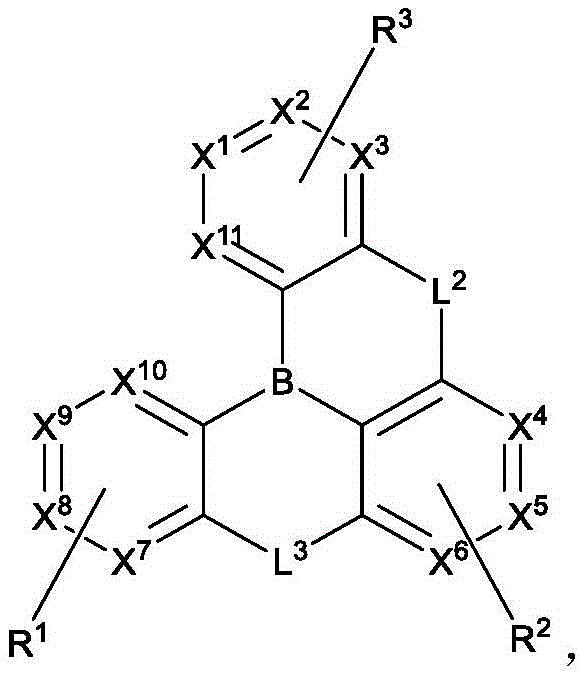
Wherein all variables are as defined above for formula I. In some embodiments, X1To X11May be N. In some embodiments, X10And X11May not be joined together by an atomic linking group. In some embodiments, R1、R2And R3May comprise a structure of formula VIII. In some embodiments, the substituent R1And R3May be joined to form a macrocycle.
In some embodiments, the compound may comprise two structures of formula I.
In some embodiments, the compound may comprise a structure selected from the group consisting of: the following structure shown in list 1:

wherein R isA、RB、RCAnd RFEach of which is independently hydrogen or a substituent selected from the group consisting of: deuterium, fluorine, alkyl, cycloalkyl, heteroalkyl, alkoxy, aryloxy, amino, silyl, oxyboronyl, alkenyl, alkoxyalkoxy, aryloxy, alkoxyalkoxy, aryloxy,cycloalkenyl, heteroalkenyl, aryl, heteroaryl, nitrile, isonitrile, thio, and combinations thereof.
In some embodiments, the compound may comprise a structure selected from the group consisting of:

wherein all variables are as defined above.
In some embodiments, the compound may be selected from the group consisting of the structures shown in table 2 below:


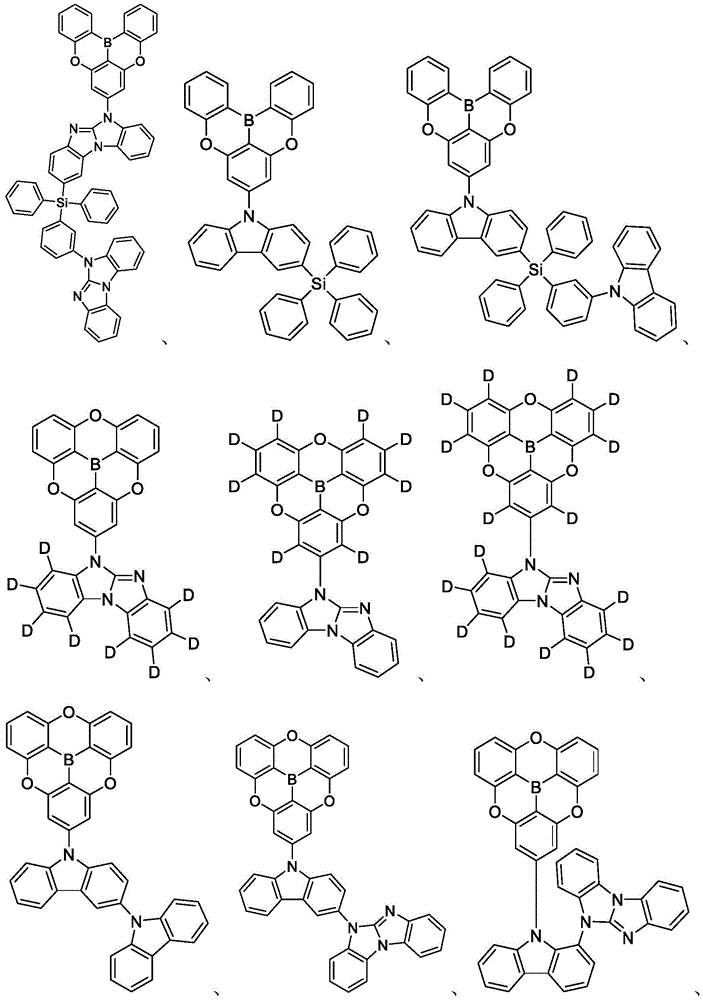

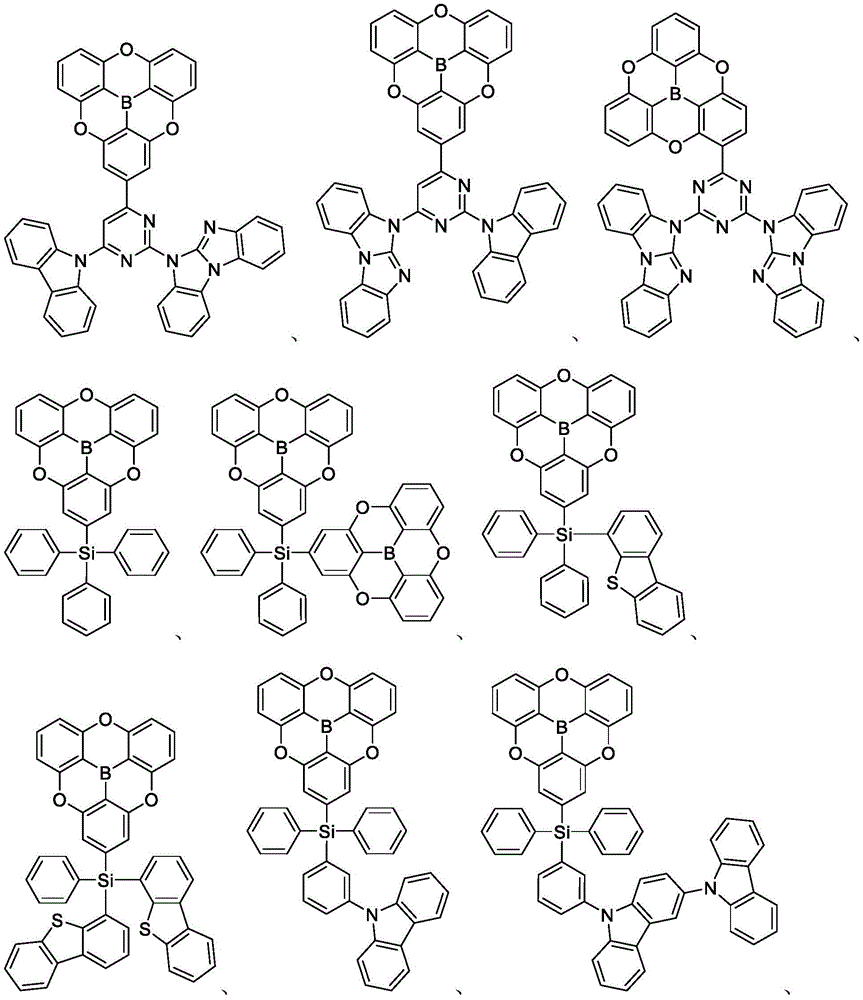


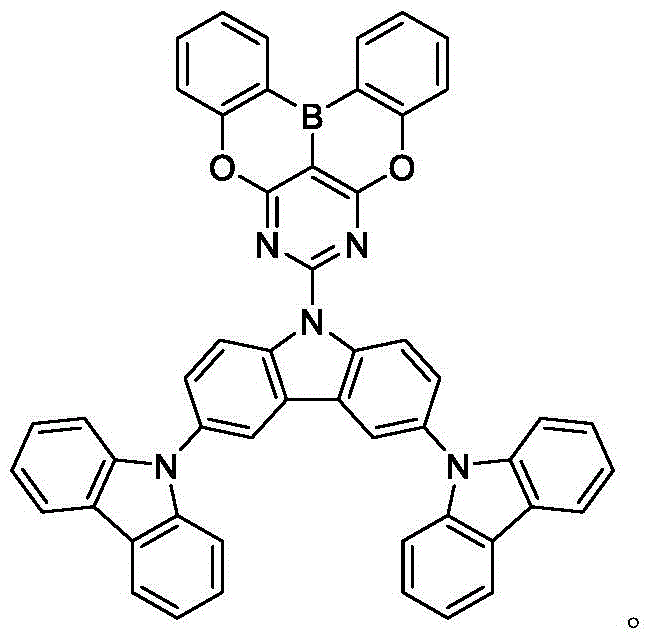
C. OLEDs and devices of the present disclosure
In another aspect, the present disclosure also provides an OLED device comprising an organic layer containing a compound as disclosed in the above compounds section of the present disclosure.
In some embodiments, the organic layer may comprise a compound comprising the structure of formula I:
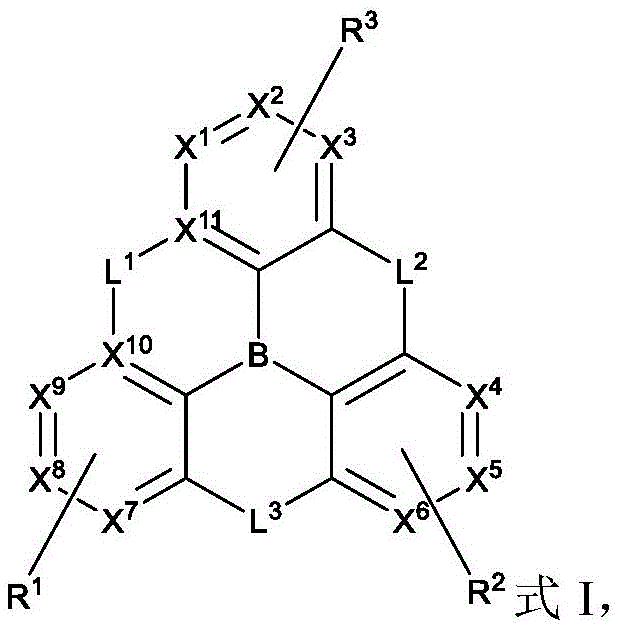
wherein X1To X11Each independently is C or N; no more than two N atoms bonded to each other in the same ring; l is2And L3Each independently selected from the group consisting of: o, S, Se, BR, NR, CRR ', SiRR ' and GeRR '; l is1Is not always present, but when present, L1Selected from the group consisting of O, S, Se and SiRR', and X10And X11Are all C; l is2And L3Always present; r1、R2And R3Each independently represents zero, single, or up to the maximum permissible substitutions for its consecutive rings; each of R and R' is independently hydrogen or a general substituent as described herein; r1、R2And R3Each of which is independently hydrogen or a substituent selected from the group consisting of: formula II, III, IV, V, VI, VII, and VIII, deuterium, halogen, alkyl, cycloalkyl, heteroalkyl, heterocycloalkyl, arylalkyl, alkoxy, aryloxy, amino, silyl, oxyboronyl, alkenyl, cycloalkenyl, heteroalkenyl, alkynyl, aryl, heteroaryl, acyl, carboxylic acid, ether, ester, nitrile, isonitrile, thio, sulfinyl, sulfonyl, phosphino, and combinations thereof, wherein R is independently selected from the group consisting of alkyl, aryl, heteroaryl, aryl, and combinations thereof, wherein R is independently selected from the group consisting of alkyl, aryl, heteroaryl, aryl1、R2And R3At least one of which is selected from the group consisting of: formulae II, III, IV, V, VI, VII, and VIII, and aza variants thereof as defined in the disclosure.
In some embodiments, the organic layer may be an emissive layer and the compound as described herein may be an emissive dopant or a non-emissive dopant.
In some embodiments, a compound as described herein may be a host.
In some embodiments, the organic layer may further comprise a phosphorescent emissive dopant; wherein the emissive dopant is a transition metal complex having at least one ligand or a portion of a ligand if the ligand exceeds bidentate selected from the group consisting of list 3 shown below:

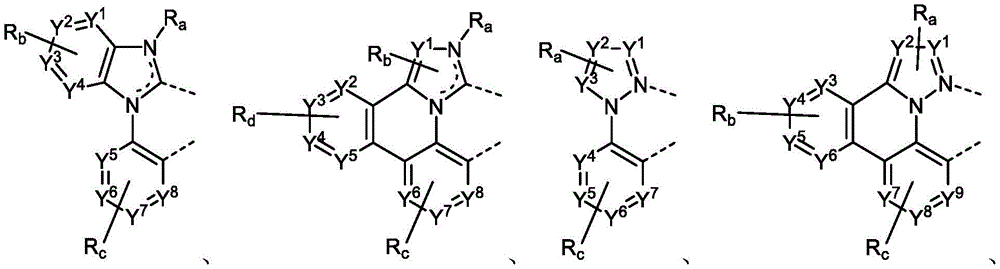


wherein Y is1To Y13Each independently selected from the group consisting of carbon and nitrogen; wherein Y' is selected from the group consisting of: BR (BR)e、NRe、PRe、O、S、Se、C=O、S=O、SO2、CReRf、SiReRfAnd GeReRf(ii) a Wherein R iseAnd RfCan be fused or joined to form a ring; wherein R isa、Rb、RcAnd RdEach may independently represent zero, a single, or up to the maximum permissible substitution of its consecutive rings; wherein R isa、Rb、Rc、Rd、ReAnd RfEach independently is hydrogen or a general substituent as described above; and wherein Ra、Rb、RcAnd RdCan be fused or joined to form a ring or form a multidentate ligand.
In some embodiments, the organic layer may be a transport layer, and the compound as described herein may be a transport material in the organic layer.
In yet another aspect, the present disclosure also provides a consumer product comprising an Organic Light Emitting Device (OLED) having an anode; a cathode; and an organic layer disposed between the anode and the cathode, wherein the organic layer can comprise a compound as disclosed in the compounds section of the disclosure above.
In some embodiments, a consumer product includes an Organic Light Emitting Device (OLED) having an anode; a cathode; and an organic layer disposed between the anode and the cathode, wherein the organic layer can comprise a compound comprising a structure of formula I as described herein.
In some embodiments, the consumer product may be one of the following: a flat panel display, a computer monitor, a medical monitor, a television, a billboard, a light for interior or exterior lighting and/or signaling, a heads-up display, a fully or partially transparent display, a flexible display, a laser printer, a telephone, a cellular telephone, a tablet computer, a phablet, a Personal Digital Assistant (PDA), a wearable device, a laptop computer, a digital camera, a video camera, a viewfinder, a microdisplay with a diagonal of less than 2 inches, a 3D display, a virtual reality or augmented reality display, a vehicle, a video wall containing multiple displays tiled together, a theater or stadium screen, a phototherapy device, and a sign.
In yet another aspect, the present disclosure provides an OLED comprising an anode; a cathode; and an emissive layer disposed between the anode and the cathode, wherein the emissive layer comprises a first compound and a second compound; wherein the first compound is a boron compound having a triangular planar geometry; and wherein the second compound is a Pt (II) complex having a square planar geometry.
In some embodiments, the first compound may comprise a structure of formula I

Wherein:
X1to X11Each independently is C or N;
no more than two N atoms bonded to each other in the same ring;
L2and L3Each independently selected from the group consisting of: o, S, Se, BR, NR, CRR ', SiRR ' and GeRR ';
L1is not always present, but when present, L1Selected from the group consisting of O, S, Se and SiRR', and when L1When present, X10And X11Are all C;
L2and L3Always present;
R1、R2and R3Each independently represents zero, single, or up to the maximum permissible substitutions for its consecutive rings;
each of R and R' is independently hydrogen or a general substituent as described herein;
R1、R2and R3Each of which is independently hydrogen or a substituent selected from the group consisting of: formulae II, III, IV, V, VI, VII and VIII,Deuterium, halogen, alkyl, cycloalkyl, heteroalkyl, heterocycloalkyl, arylalkyl, alkoxy, aryloxy, amino, silyl, oxyboronyl, alkenyl, cycloalkenyl, heteroalkenyl, alkynyl, aryl, heteroaryl, acyl, carboxylic acid, ether, ester, nitrile, isonitrile, thio, sulfinyl, sulfonyl, phosphino, and combinations thereof, wherein R is hydrogen, halogen, alkyl, cycloalkyl, heteroalkyl, heterocycloalkyl, arylalkyl, alkoxy, aryloxy, amino, silyl, oxyboronyl, alkenyl, cycloalkenyl, heteroalkenyl, alkynyl, aryl, heteroaryl, acyl, carboxylic acid, ether, ester1、R2And R3At least one of which is selected from the group consisting of: formulae II, III, IV, V, VI, VII, and VIII, and aza variants thereof as described herein; and the second compound is a Pt complex capable of emitting light at room temperature after optical excitation or electrical excitation.
In some embodiments, the Pt complex may comprise a tetradentate ligand. In some embodiments, the Pt complex may comprise at least one Pt-C bond and at least one Pt-N bond.
In some embodiments, the Pt complex may be a phosphorescent emitter.
In some embodiments, the Pt complex may have at least one ligand or a portion of a ligand if the ligand exceeds bidentate selected from the group consisting of list 3 above.
In some embodiments, the Pt complex may be selected from the group consisting of the structures shown in table 4 below:


wherein R in the above list 4A、RB、RC、RD、RE、RF、RG、RH、RI、RJ、RK、RL、RM、RNEach of which is independently hydrogen or a substituent selected from the group consisting of: deuterium, fluoro, alkyl, cycloalkyl, heteroalkyl, alkoxy, aryloxy, amino, silyl, oxyboronyl, alkenyl, cycloalkenyl, heteroalkenyl, aryl, heteroaryl, nitrile, isonitrile, thio, and combinations thereof;
l is independently at each occurrence O, S, Se, BR, NR, CRR ', SiRR ', and GeRR '; and is
R and R' are as defined above.
In some embodiments, each R, R', R of Listing 4 above1、R2、R3、RD、RE、RP、RQ、R4And R5May independently be hydrogen or a substituent selected from the group consisting of: deuterium, fluorine, alkyl, cycloalkyl, heteroalkyl, alkoxy, aryloxy, amino, silyl, oxyboronyl, alkenyl, cycloalkenyl, heteroalkenyl, aryl, heteroaryl, nitrile, isonitrile, thio, and combinations thereof.
In some embodiments, RRIs hydrogen or a substituent selected from the group consisting of: deuterium, fluorine, alkyl, cycloalkyl, heteroalkyl, alkoxy, aryloxy, amino, silyl, alkenyl, cycloalkenyl, heteroalkenyl, aryl, heteroaryl, nitrile, isonitrile, thio, and combinations thereof.
In some embodiments, L1May not be present. In some embodiments, L1May be present. In some embodiments, L1May be present, and L1、L2And L3Each may be independently selected from the group consisting of O, S, BR and NR. In some embodiments, L1May be present, and L1、L2And L3Each may be O. In some embodiments, L2And L3Each may be O. In some embodiments, L1May be present, and L1、L2And L3Each may be NR. In some embodiments, L2And L3Each may be NR. In some embodiments, L1May be present, and L1、L2And L3Each may be S. In some embodiments, L2And L3Each may be S. In some embodiments, L1May be present, and L1、L2And L3One may be S and the others may be O. In some embodiments, L1May be present, and L1、L2And L3Two of which may be S and the remainder may be O. In some embodiments, L1May be present, and L1、L2And L3One may be NR and the others may be O. In some embodiments, L1May be present, and L1、L2And L3Two of which may be NR and the remainder may be O. In some embodiments, L1May be present, and L1、L2And L3One may be NR and the others may be S. In some embodiments, L1May be present, and L1、L2And L3Two of which may be NR and the rest may be S. In some embodiments, L2And L3One may be O and the other may be S. In some embodiments, L2And L3One may be O and the other NR. In some embodiments, L2And L3One may be S and the other NR.
In some embodiments, L4Is a direct bond. In some embodiments, L4Is phenyl or biphenyl.
In some embodiments, a is a phenyl ring. In some embodiments, a is a 5 membered heterocyclic ring.
In some embodiments, R may be a 6-membered aromatic ring.
In some embodiments, R1、R2And R3May comprise a chemical group selected from the group consisting of: carbazole, dibenzofuran, dibenzothiophene, tetraphenylene, triazine, pyrimidine, pyridine, tetraphenylene, 5H-benzo [ d]Benzo [4, 5]]Imidazo [3,2-a]Imidazole, benzo [ d ]]Benzo [4, 5]]Imidazo [2,1-b ]]Oxazole, benzo [ d ]]Benzo [4, 5]]ImidazoleAnd [2,1-b ]]Thiazole, 6H-indolo [2,3-b ]]Indole, 6H-benzofuro [2,3-b ]]Indole, 6H-benzo [4, 5]]Thieno [2,3-b ]]Indoles, and aza variants thereof.
In some embodiments, RRIs aryl or heteroaryl. In some embodiments, RPAnd RQEach is hydrogen or deuterium. In some embodiments, RPOr RQAt least one of which is aryl or heteroaryl. In some embodiments, X17Selected from the group consisting of O, S, Se and NR4A group of combinations thereof.
In some embodiments, the first compound may comprise a structure selected from the group consisting of the structures shown in table 5 below:


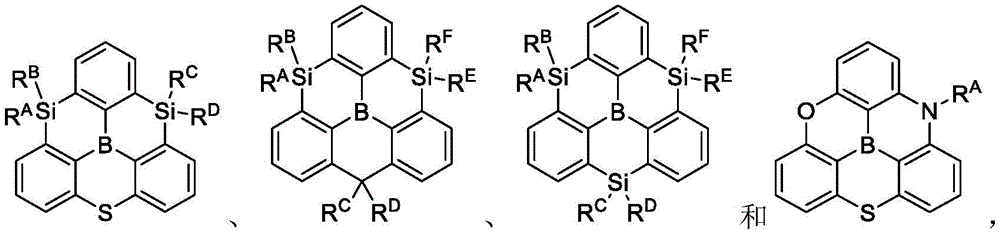
In some embodiments, the first compound may be selected from the group consisting of the structures shown in the following list 6:


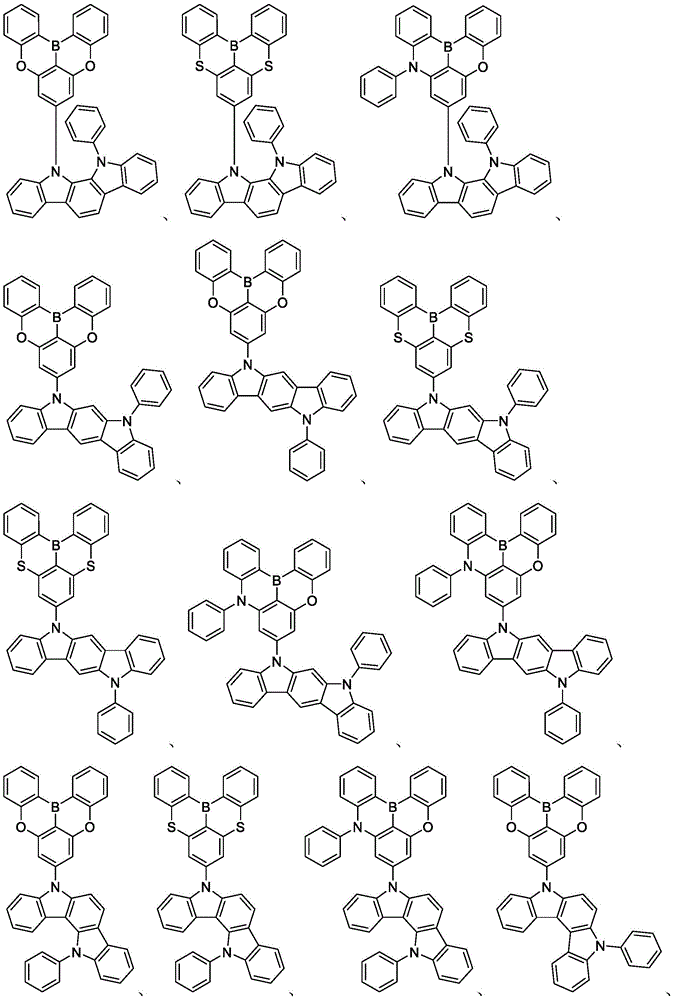


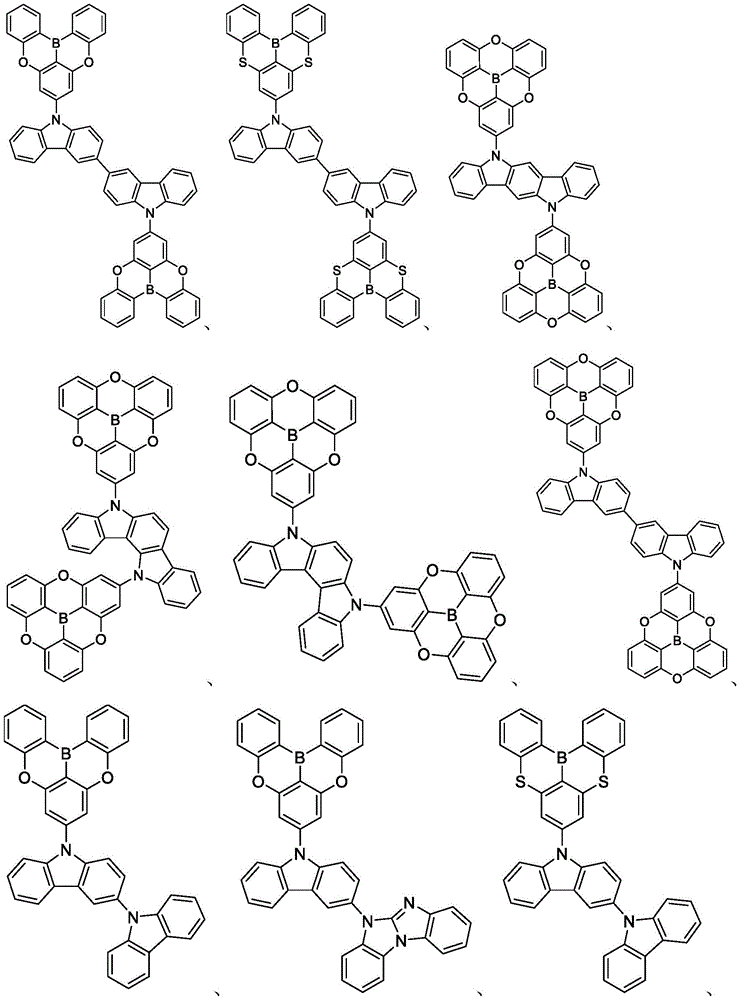

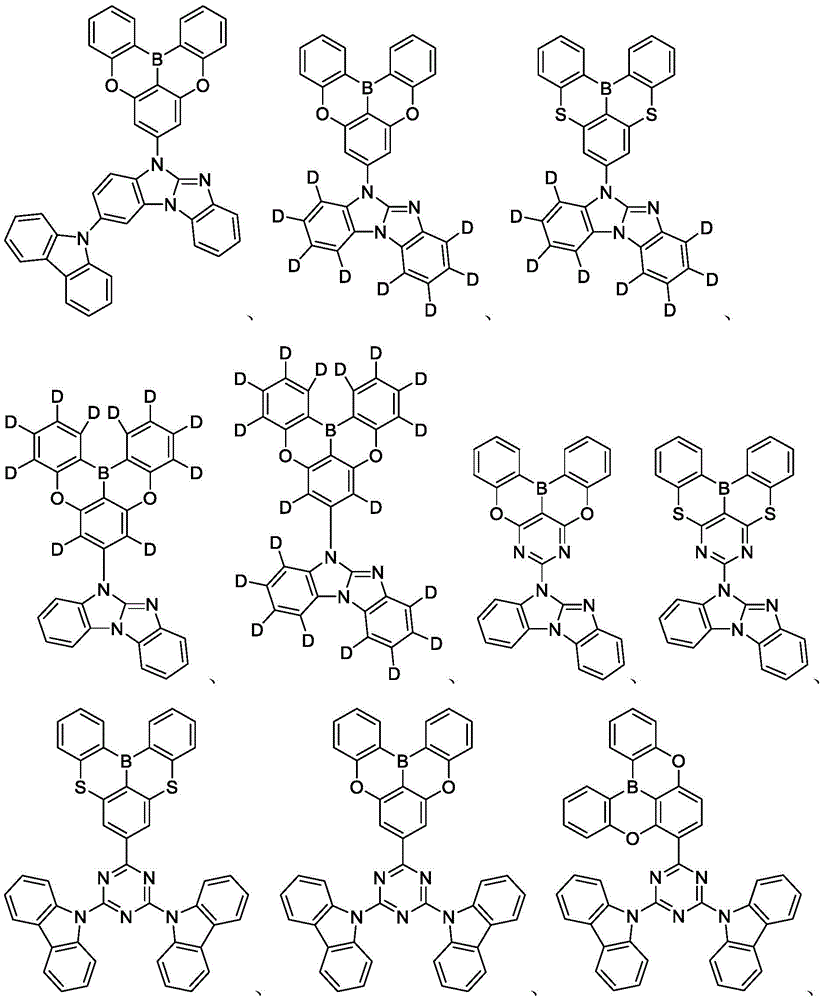
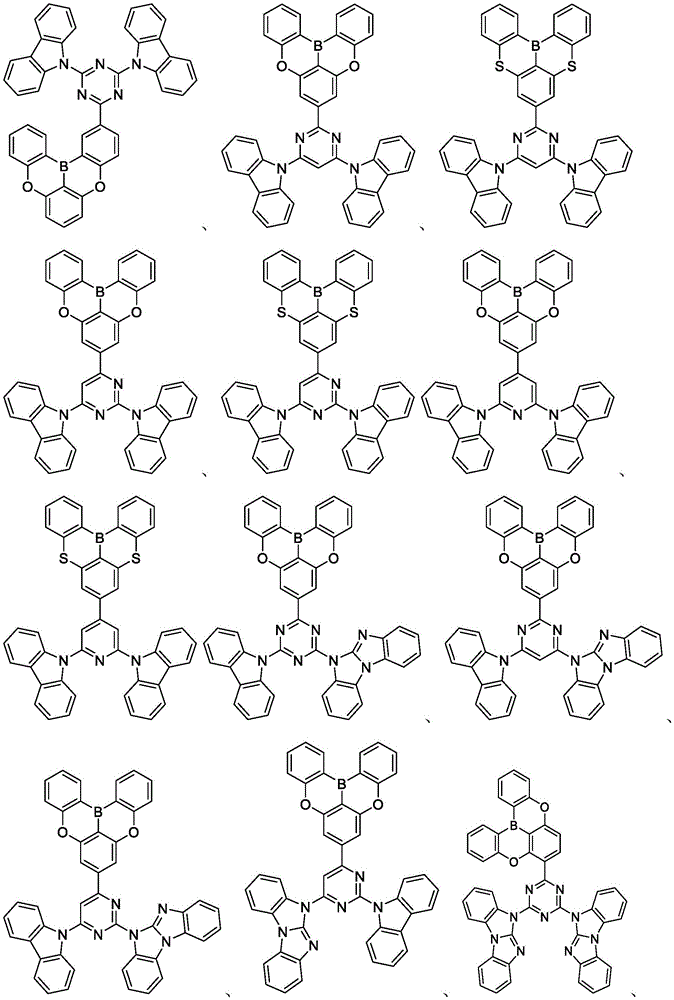


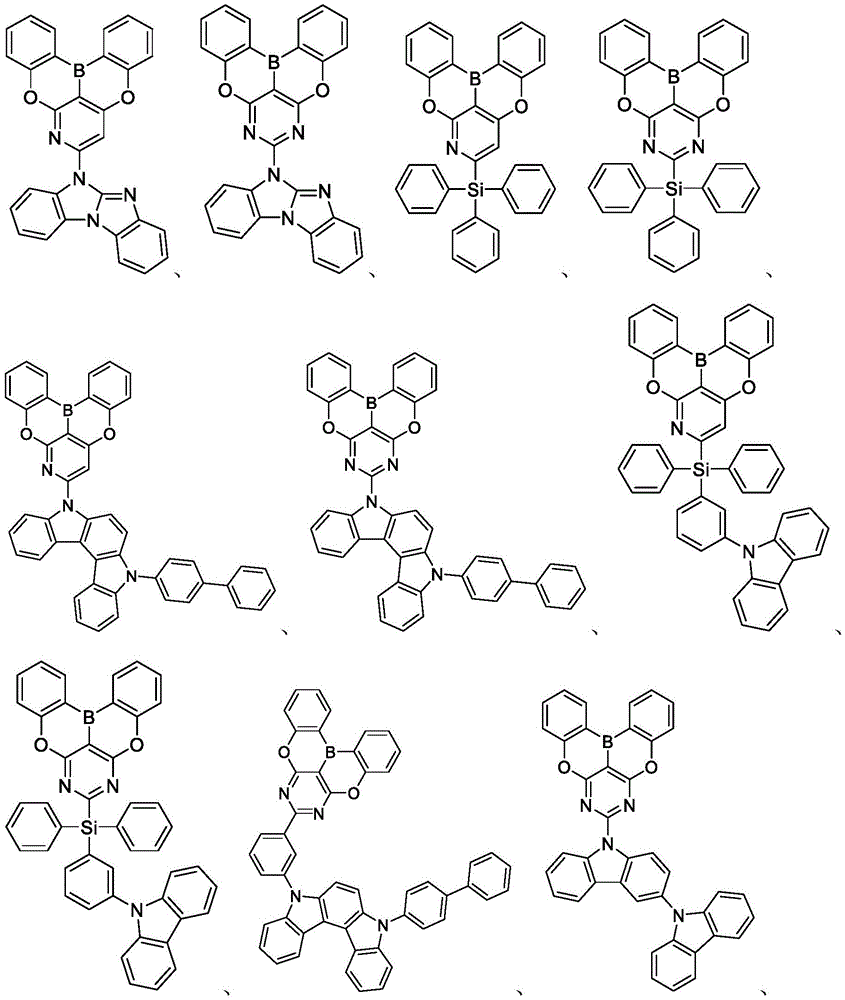


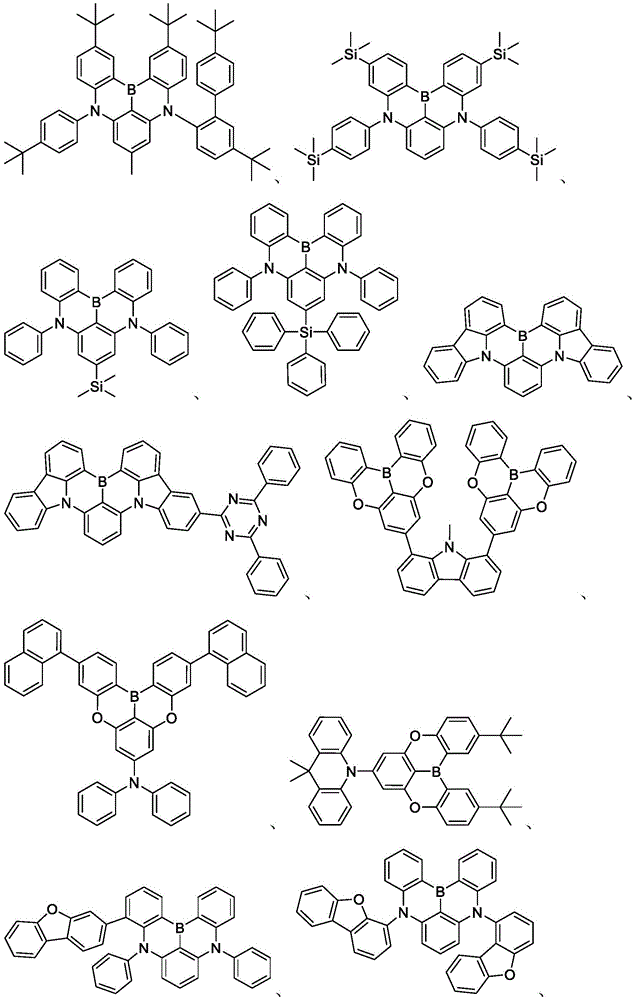


in some embodiments, the compound may be selected from the group consisting of the structures shown in table 7 below:

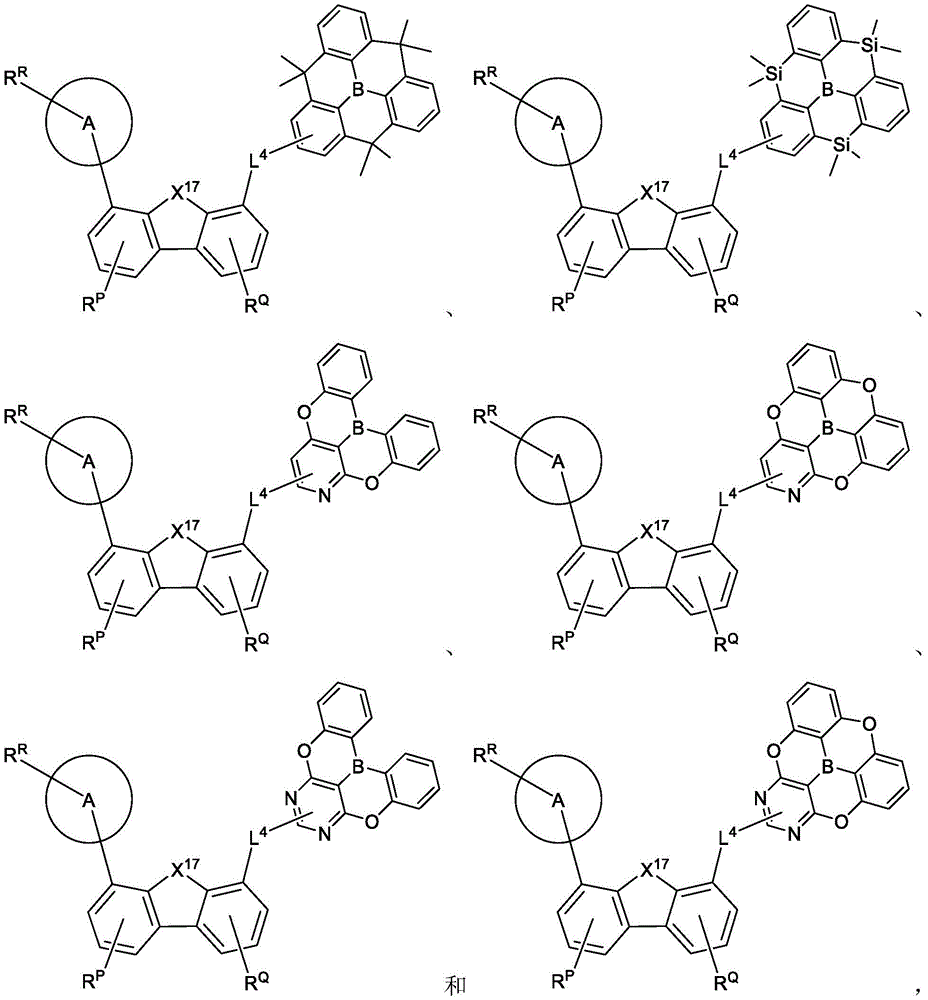
wherein all variables are as defined above.
In some embodiments, the compound is selected from the group consisting of the structures shown in table 8 below:

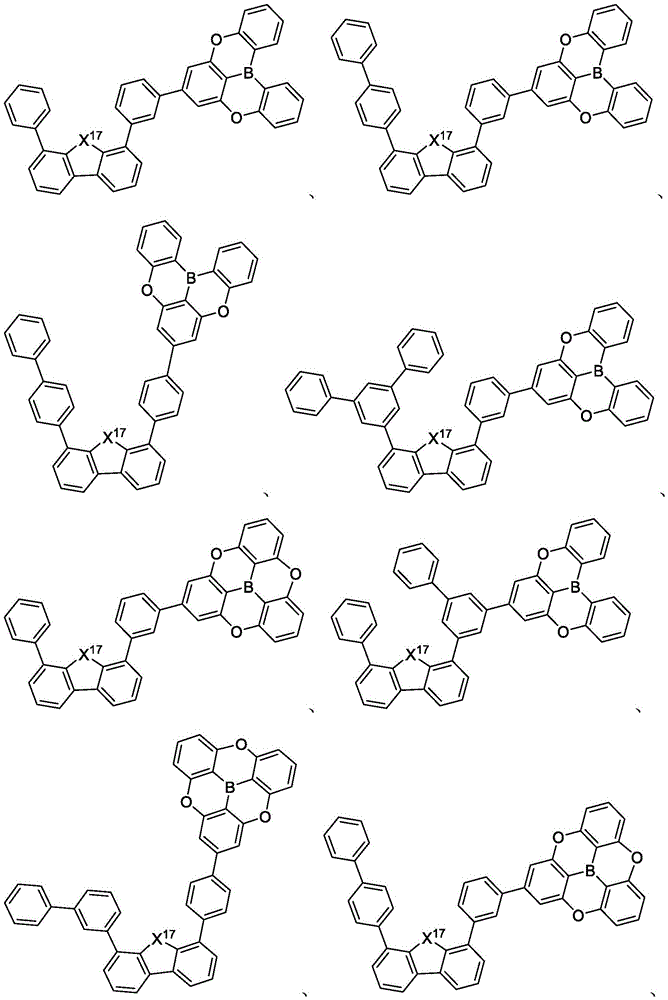


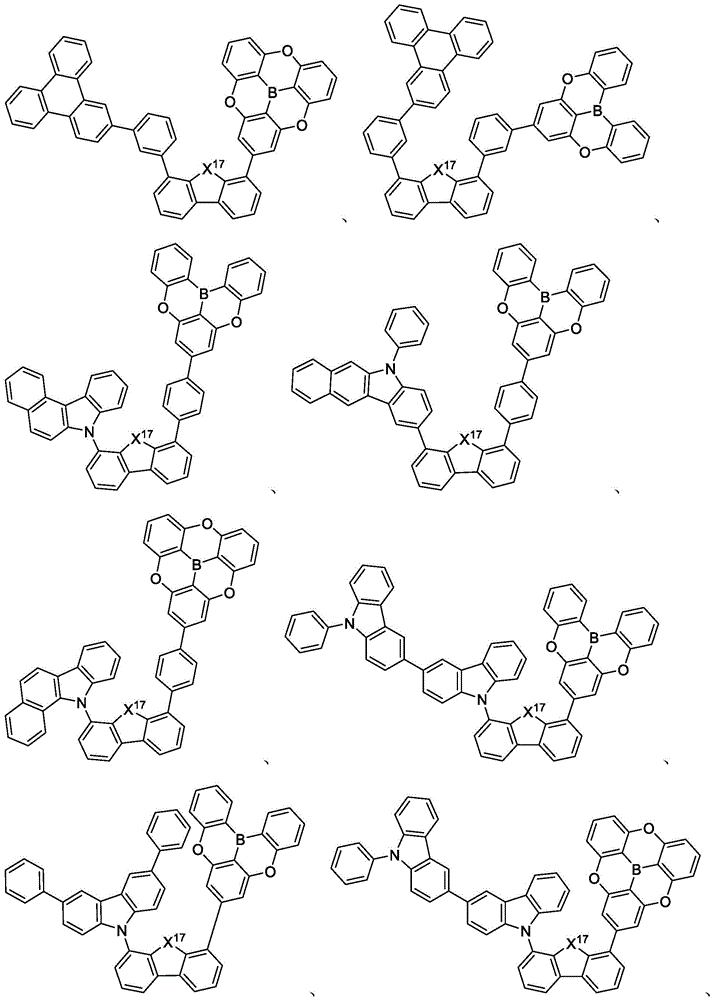


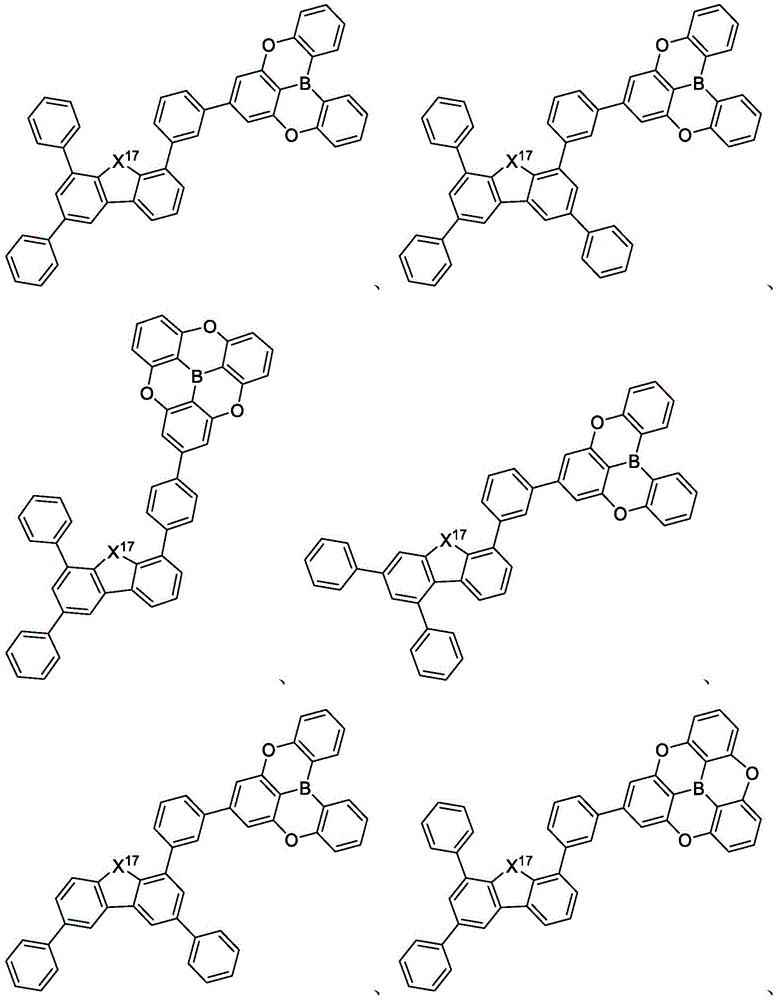


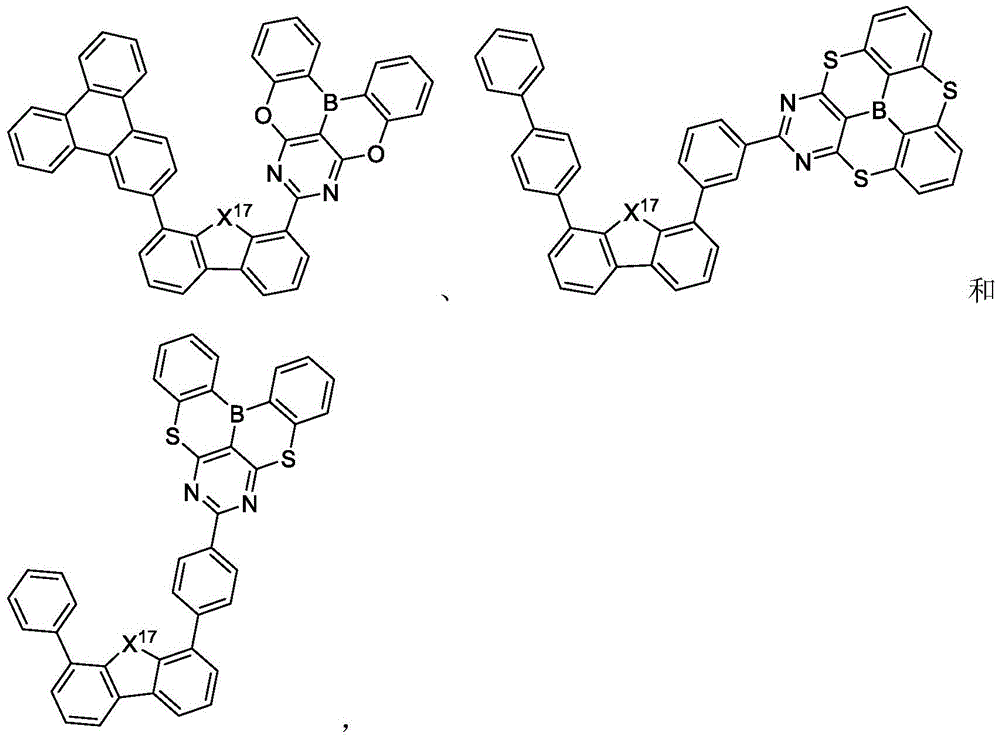
wherein X17Selected from the group consisting of O, S, Se and NR4A group of combinations thereof.
In some embodiments, the first compound may be a host and the second compound an emitter.
In some embodiments, the consumer product comprises an Organic Light Emitting Device (OLED) comprising an anode; a cathode; and an emissive layer disposed between the anode and the cathode, wherein the emissive layer comprises a first compound and a second compound; wherein the first compound is a boron compound having a triangular planar geometry as described herein; and wherein the second compound is a Pt (II) complex having a square planar geometry.
In some embodiments, the consumer product may be one of the following: a flat panel display, a computer monitor, a medical monitor, a television, a billboard, a light for interior or exterior lighting and/or signaling, a heads-up display, a fully or partially transparent display, a flexible display, a laser printer, a telephone, a cellular telephone, a tablet computer, a phablet, a Personal Digital Assistant (PDA), a wearable device, a laptop computer, a digital camera, a video camera, a viewfinder, a microdisplay with a diagonal of less than 2 inches, a 3D display, a virtual reality or augmented reality display, a vehicle, a video wall containing multiple displays tiled together, a theater or stadium screen, a phototherapy device, and a sign.
In yet another aspect, the OLEDs of the present disclosure can further comprise an emissive region comprising a compound as disclosed in the above compounds section of the present disclosure.
In some embodiments, the emissive region may comprise a compound comprising the structure of formula I

Wherein X1To X11Each independently is C or N; no more than two N atoms bonded to each other in the same ring; l is2And L3Each independently selected from the group consisting of: o, S, Se, BR, NR, CRR ', SiRR ' and GeRR '; l is1Is not always present, but when present, L1Selected from the group consisting of O, S, Se and SiRR', and when L1When present, X10And X11Are all C; l is2And L3Always present; r1、R2And R3Each independently represents zero, single, or up to the maximum permissible substitutions for its consecutive rings; each of R and R' is independently hydrogen or a general substituent as described herein; r1、R2And R3Each of which is independently hydrogen or a substituent selected from the group consisting of: formula II, III, IV, V, VI, VII, and VIII, deuterium, halogen, alkyl, cycloalkyl, heteroalkyl, heterocycloalkyl, arylalkyl, alkoxy, aryloxy, amino, silyl, oxyboronyl, alkenyl, cycloalkenyl, heteroalkenyl, alkynyl, aryl, heteroaryl, acyl, carboxylic acid, ether, ester, nitrile, isonitrile, thio, sulfinyl, sulfonyl, phosphino, and combinations thereof, wherein R is independently selected from the group consisting of alkyl, aryl, heteroaryl, aryl, and combinations thereof, wherein R is independently selected from the group consisting of alkyl, aryl, heteroaryl, aryl1、R2And R3At least one of which is selected from the group consisting of: formulae II, III, IV, V, VI, VII, and VIII, and aza variants thereof as defined in the disclosure.
Generally, an OLED comprises at least one organic layer disposed between and electrically connected to an anode and a cathode. When current is applied, the anode injects holes and the cathode injects electrons into the organic layer. The injected holes and electrons each migrate toward the oppositely charged electrode. When an electron and a hole are located on the same molecule, an "exciton," which is a localized electron-hole pair with an excited energy state, is formed. When the exciton relaxes by a light emission mechanism, light is emitted. In some cases, the exciton may be localized on an excimer (eximer) or an exciplex. Non-radiative mechanisms (such as thermal relaxation) may also occur, but are generally considered undesirable.
Several OLED materials and configurations are described in U.S. patent nos. 5,844,363, 6,303,238, and 5,707,745, which are incorporated herein by reference in their entirety.
The initial OLEDs used emissive molecules that emit light from a singlet state ("fluorescence"), as disclosed, for example, in U.S. patent No. 4,769,292, which is incorporated by reference in its entirety. Fluorescence emission typically occurs in a time frame of less than 10 nanoseconds.
More recently, OLEDs having emissive materials that emit light from the triplet state ("phosphorescence") have been demonstrated. Baldo et al, "high efficiency Phosphorescent Emission from Organic Electroluminescent Devices" (Nature), 395, 151-154,1998 ("Baldo-I"); and baldo et al, "Very high-efficiency green organic light-emitting devices based on electrophosphorescence (Very high-efficiency green organic light-emitting devices-based on electrophosphorescence)", applied physical promo (appl. phys. lett.), volume 75, stages 3,4-6 (1999) ("baldo-II"), which are incorporated by reference in their entirety. Phosphorescence is described in more detail in U.S. Pat. No. 7,279,704, columns 5-6, which is incorporated by reference.
Fig. 1 shows an organic light emitting device 100. The figures are not necessarily to scale. Device 100 can include substrate 110, anode 115, hole injection layer 120, hole transport layer 125, electron blocking layer 130, emissive layer 135, hole blocking layer 140, electron transport layer 145, electron injection layer 150, protective layer 155, cathode 160, and blocking layer 170. Cathode 160 is a composite cathode having a first conductive layer 162 and a second conductive layer 164. The device 100 may be fabricated by depositing the layers in sequence. The nature and function of these various layers and example materials are described in more detail in U.S. Pat. No. 7,279,704, columns 6-10, which is incorporated by reference.
More instances of each of these layers are available. For example, a flexible and transparent substrate-anode combination is disclosed in U.S. Pat. No. 5,844,363, which is incorporated by reference in its entirety. An example of a p-doped hole transport layer is doped with F at a molar ratio of 50:14TCNQ m-MTDATA as disclosed in U.S. patent application publication No. 2003/0230980, which is incorporated by reference in its entirety. Examples of luminescent and host materials are disclosed in U.S. Pat. No. 6,303,238 to Thompson et al, which is incorporated by reference in its entirety. An example of an n-doped electron transport layer is BPhen doped with Li at a molar ratio of 1:1, as disclosed in U.S. patent application publication No. 2003/0230980, which is incorporated by reference in its entirety. U.S. Pat. Nos. 5,703,436 and 5,707,745, which are incorporated by reference in their entirety, disclose examples of cathodes comprising composite cathodes having a thin layer of a metal (e.g., Mg: Ag) with an overlying transparent, conductive, sputter-deposited ITO layer. The theory and use of barrier layers is described in more detail in U.S. patent No. 6,097,147 and U.S. patent application publication No. 2003/0230980, which are incorporated by reference in their entirety. Examples of injection layers are provided in U.S. patent application publication No. 2004/0174116, which is incorporated by reference in its entirety. A description of the protective layer may be found in U.S. patent application publication No. 2004/0174116, which is incorporated by reference in its entirety.
Fig. 2 shows an inverted OLED 200. The device includes a substrate 210, a cathode 215, an emissive layer 220, a hole transport layer 225, and an anode 230. The device 200 may be fabricated by depositing the layers in sequence. Because the most common OLED configuration has a cathode disposed above an anode, and device 200 has a cathode 215 disposed below an anode 230, device 200 may be referred to as an "inverted" OLED. Materials similar to those described with respect to device 100 may be used in corresponding layers of device 200. Fig. 2 provides one example of how some layers may be omitted from the structure of device 100.
The simple layered structure illustrated in fig. 1 and 2 is provided by way of non-limiting example, and it is to be understood that embodiments of the present disclosure may be used in conjunction with various other structures. The specific materials and structures described are exemplary in nature, and other materials and structures may be used. Functional OLEDs may be obtained by combining the various layers described in different ways, or the layers may be omitted entirely based on design, performance, and cost factors. Other layers not specifically described may also be included. Materials other than those specifically described may be used. Although many of the examples provided herein describe the various layers as comprising a single material, it is understood that combinations of materials may be used, such as mixtures of hosts and dopants, or more generally, mixtures. Further, the layer may have various sub-layers. The names given to the various layers herein are not intended to be strictly limiting. For example, in device 200, hole transport layer 225 transports holes and injects holes into emissive layer 220, and may be described as a hole transport layer or a hole injection layer. In one embodiment, an OLED may be described as having an "organic layer" disposed between a cathode and an anode. This organic layer may comprise a single layer, or may further comprise multiple layers of different organic materials as described, for example, with respect to fig. 1 and 2.
Structures and materials not specifically described may also be used, such as oleds (pleds) comprising polymeric materials, such as disclosed in U.S. patent No. 5,247,190 to frand (Friend), et al, which is incorporated by reference in its entirety. By way of further example, OLEDs having a single organic layer may be used. The OLEDs may be stacked, for example, as described in U.S. patent No. 5,707,745 to forrister (Forrest) et al, which is incorporated by reference in its entirety. The OLED structure may deviate from the simple layered structure illustrated in fig. 1 and 2. For example, the substrate may include an angled reflective surface to improve out-coupling (out-coupling), such as a mesa structure as described in U.S. Pat. No. 6,091,195 to Foster et al, and/or a pit structure as described in U.S. Pat. No. 5,834,893 to Boolean (Bulovic) et al, which are incorporated by reference in their entirety.
Any of the layers of the various embodiments may be deposited by any suitable method, unless otherwise specified. For organic layers, preferred methods include thermal evaporation, ink jetting (as described in U.S. Pat. Nos. 6,013,982 and 6,087,196, both incorporated by reference in their entirety), organic vapor deposition (OVPD) (as described in U.S. Pat. No. 6,337,102 to Foster et al, both incorporated by reference in their entirety), and deposition by Organic Vapor Jet Printing (OVJP) (as described in U.S. Pat. No. 7,431,968, incorporated by reference in its entirety). Other suitable deposition methods include spin coating and other solution-based processes. The solution-based process is preferably carried out in a nitrogen or inert atmosphere. For other layers, a preferred method includes thermal evaporation. Preferred patterning methods include deposition through a mask, cold welding (as described in U.S. Pat. nos. 6,294,398 and 6,468,819, which are incorporated by reference in their entirety), and patterning associated with some of the deposition methods such as inkjet and Organic Vapor Jet Printing (OVJP). Other methods may also be used. The material to be deposited may be modified to suit the particular deposition method. For example, substituents such as alkyl and aryl groups, branched or unbranched, and preferably containing at least 3 carbons, may be used in small molecules to enhance their ability to undergo solution processing. Substituents having 20 carbons or more may be used, and 3 to 20 carbons is a preferred range. A material with an asymmetric structure may have better solution processibility than a material with a symmetric structure because asymmetric materials may have a lower tendency to recrystallize. Dendrimer substituents may be used to enhance the ability of small molecules to undergo solution processing.
Devices fabricated according to embodiments of the present disclosure may further optionally include a barrier layer. One use of barrier layers is to protect the electrodes and organic layers from damage from exposure to hazardous substances in the environment including moisture, vapor, and/or gas. The barrier layer may be deposited on, under or beside the substrate, electrode, or on any other part of the device, including the edge. The barrier layer may comprise a single layer or multiple layers. The barrier layer may be formed by various known chemical vapor deposition techniques and may include compositions having a single phase and compositions having multiple phases. Any suitable material or combination of materials may be used for the barrier layer. The barrier layer may incorporate an inorganic compound or an organic compound or both. Preferred barrier layers comprise a mixture of polymeric and non-polymeric materials as described in U.S. patent No. 7,968,146, PCT patent application nos. PCT/US2007/023098 and PCT/US2009/042829, which are incorporated herein by reference in their entirety. To be considered a "mixture," the aforementioned polymeric and non-polymeric materials that make up the barrier layer should be deposited under the same reaction conditions and/or simultaneously. The weight ratio of polymeric material to non-polymeric material may be in the range of 95:5 to 5: 95. The polymeric material and the non-polymeric material may be produced from the same precursor material. In one example, the mixture of polymeric material and non-polymeric material consists essentially of polymeric silicon and inorganic silicon.
Devices manufactured according to embodiments of the present disclosure may be incorporated into a wide variety of electronic component modules (or units), which may be incorporated into a wide variety of electronic products or intermediate components. Examples of such electronic products or intermediate components include display screens, lighting devices (e.g., discrete light source devices or lighting panels), etc., which may be utilized by end-user product manufacturers. The electronics module may optionally include drive electronics and/or a power source. Devices manufactured in accordance with embodiments of the present disclosure may be incorporated into a wide variety of consumer products having one or more electronic component modules (or units) incorporated therein. A consumer product comprising an OLED comprising a compound of the present disclosure in an organic layer in the OLED is disclosed. The consumer product shall include any kind of product comprising one or more light sources and/or one or more of some type of visual display. Some examples of such consumer products include flat panel displays, curved displays, computer monitors, medical monitors, televisions, billboards, lights for interior or exterior illumination and/or signaling, heads-up displays, fully or partially transparent displays, flexible displays, rollable displays, foldable displays, stretchable displays, laser printers, telephones, cellular telephones, tablet computers, tablet phones, Personal Digital Assistants (PDAs), wearable devices, laptop computers, digital cameras, video cameras, viewfinders, microdisplays (displays less than 2 inches diagonal), 3-D displays, virtual reality or augmented reality displays, vehicles, video walls containing multiple displays tiled together, theater or stadium screens, phototherapy devices, and signs. Various control mechanisms may be used to control devices made in accordance with the present disclosure, including passive matrices and active matrices. Many of the devices are intended to be used in a temperature range that is comfortable for humans, such as 18 ℃ to 30 ℃, and more preferably at room temperature (20-25 ℃), but can be used outside this temperature range (e.g., -40 ℃ to +80 ℃).
More details regarding OLEDs and the definitions described above can be found in U.S. patent No. 7,279,704, which is incorporated herein by reference in its entirety.
The materials and structures described herein may be applied to devices other than OLEDs. For example, other optoelectronic devices such as organic solar cells and organic photodetectors may employ the materials and structures. More generally, organic devices such as organic transistors may employ the materials and structures.
In some embodiments, the OLED has one or more features selected from the group consisting of: flexible, rollable, foldable, stretchable, and bendable. In some embodiments, the OLED is transparent or translucent. In some embodiments, the OLED further comprises a layer comprising carbon nanotubes.
In some embodiments, the OLED further comprises a layer comprising a delayed fluorescence emitter. In some embodiments, the OLED comprises an RGB pixel arrangement or a white plus color filter pixel arrangement. In some embodiments, the OLED is a mobile device, a handheld device, or a wearable device. In some embodiments, the OLED is a display panel having a diagonal of less than 10 inches or an area of less than 50 square inches. In some embodiments, the OLED is a display panel having a diagonal of at least 10 inches or an area of at least 50 square inches. In some embodiments, the OLED is a lighting panel.
In some embodiments, the compound may be an emissive dopant. In some embodiments, the compounds may produce emission via phosphorescence, fluorescence, thermally activated delayed fluorescence (i.e., TADF, also known as E-type delayed fluorescence, see, e.g., U.S. application No. 15/700,352, which is incorporated herein by reference in its entirety), triplet-triplet annihilation, or a combination of these processes. In some embodiments, the emissive dopant may be a racemic mixture, or may be enriched in one enantiomer. In some embodiments, the compounds may be homoleptic (each ligand is the same). In some embodiments, the compounds may be compounded (at least one ligand being different from the others). In some embodiments, when there is more than one ligand that coordinates to the metal, the ligands may all be the same. In some other embodiments, at least one ligand is different from the other ligands. In some embodiments, each ligand may be different from each other. This is also true in embodiments where the ligand that coordinates to the metal can be linked to other ligands that coordinate to the metal to form a tridentate, tetradentate, pentadentate, or hexadentate ligand. Thus, where the coordinating ligands are linked together, in some embodiments all of the ligands may be the same, and in some other embodiments at least one of the linked ligands may be different from the other ligand(s).
In some embodiments, the compounds may be used as phosphorous photosensitizers in OLEDs, where one or more layers in the OLED contain an acceptor in the form of one or more fluorescent and/or delayed fluorescence emitters. In some embodiments, the compounds may be used as a component of an exciplex to be used as a sensitizer. As a phosphosensitizer, the compound must be capable of energy transfer to the acceptor and the acceptor will emit or further transfer energy to the final emitter. The receptor concentration may range from 0.001% to 100%. The acceptor may be in the same layer as the phosphorous sensitizer or in one or more different layers. In some embodiments, the receptor is a TADF emitter. In some embodiments, the acceptor is a fluorescent emitter. In some embodiments, the emission may be produced by any or all of the sensitizer, the receptor, and the final emitter.
In some embodiments, the compound is an acceptor and the OLED further comprises a sensitizer selected from the group consisting of delayed fluorescence emitters, phosphorescent emitters, and combinations thereof.
In some embodiments, the compound is a fluorescence emitter, a delayed fluorescence emitter, or a component of an excitation complex that is a fluorescence emitter or a delayed fluorescence emitter.
In some embodiments, the compound is a sensitizer and the OLED further comprises an acceptor selected from the group consisting of: fluorescent emitters, delayed fluorescent emitters, and combinations thereof.
According to another aspect, a formulation comprising a compound described herein is also disclosed.
The OLEDs disclosed herein can be incorporated into one or more of consumer products, electronic component modules, and lighting panels. The organic layer may be an emissive layer, and the compound may be an emissive dopant in some embodiments, while the compound may be a non-emissive dopant in other embodiments.
In yet another aspect of the present invention, a formulation comprising the novel compound disclosed herein is described. The formulation may include one or more of the components disclosed herein selected from the group consisting of: a solvent, a host, a hole injection material, a hole transport material, an electron blocking material, a hole blocking material, and an electron transport material.
The present disclosure encompasses any chemical structure comprising the novel compounds of the present disclosure or monovalent or multivalent variants thereof. In other words, the compounds of the present invention or monovalent or multivalent variants thereof may be part of a larger chemical structure. Such chemical structures may be selected from the group consisting of: monomers, polymers, macromolecules and supramolecules (also known as supramolecules). As used herein, "monovalent variant of a compound" refers to a moiety that is the same as a compound but where one hydrogen has been removed and replaced with a bond to the remainder of the chemical structure. As used herein, "multivalent variants of a compound" refers to moieties that are the same as a compound but where more than one hydrogen has been removed and replaced with one or more bonds to the rest of the chemical structure. In the case of supramolecules, the compounds of the invention may also be incorporated into supramolecular complexes without covalent bonds.
D. Combinations of the compounds of the present disclosure with other materials
Materials described herein as suitable for use in a particular layer in an organic light emitting device can be used in combination with a variety of other materials present in the device. For example, the emissive dopants disclosed herein may be used in conjunction with a wide variety of hosts, transport layers, barrier layers, implant layers, electrodes, and other layers that may be present. The materials described or referenced below are non-limiting examples of materials that can be used in combination with the compounds disclosed herein, and one of ordinary skill in the art can readily review the literature to identify other materials that can be used in combination.
a) Conductive dopant:
the charge transport layer may be doped with a conductivity dopant to substantially change its charge carrier density, which in turn will change its conductivity. The conductivity is increased by the generation of charge carriers in the host material and, depending on the type of dopant, a change in the Fermi level of the semiconductor can also be achieved. The hole transport layer may be doped with a p-type conductivity dopant and an n-type conductivity dopant is used in the electron transport layer.
Non-limiting examples of conductivity dopants that can be used in OLEDs in combination with the materials disclosed herein, along with references disclosing those materials, are exemplified below: EP01617493, EP01968131, EP2020694, EP2684932, US20050139810, US20070160905, US20090167167, US2010288362, WO06081780, WO2009003455, WO2009008277, WO2009011327, WO2014009310, US2007252140, US2015060804, US20150123047 and US 2012146012.
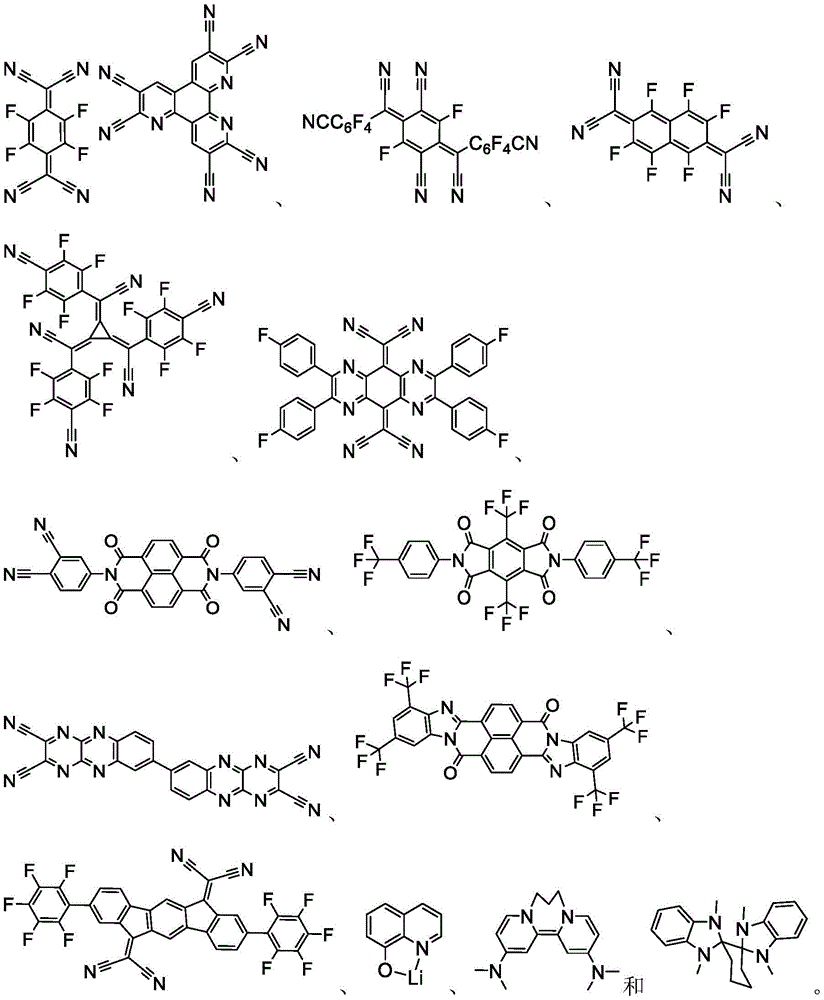
b)HIL/HTL:
The hole injection/transport material used in the present disclosure is not particularly limited, and any compound may be used as long as the compound is generally used as the hole injection/transport material. Examples of materials include (but are not limited to): phthalocyanine or porphyrin derivatives; an aromatic amine derivative; indolocarbazole derivatives; a fluorocarbon-containing polymer; a polymer having a conductive dopant; conductive polymers such as PEDOT/PSS; self-assembling monomers derived from compounds such as phosphonic acids and silane derivatives; metal oxide derivatives, e.g. MoOx(ii) a p-type semiconducting organic compounds, such as 1,4,5,8,9, 12-hexaazatriphenylhexacyano-nitrile; a metal complex; and a crosslinkable compound.
Examples of aromatic amine derivatives for use in HILs or HTLs include, but are not limited to, the following general structures:

Ar1to Ar9Each of which is selected from: a group consisting of aromatic hydrocarbon cyclic compounds such as: benzene, biphenyl, terphenyl, triphenylene, naphthalene, anthracene, phenalene, phenanthrene, fluorene, pyrene, Perylene and azulene; a group consisting of aromatic heterocyclic compounds such as: dibenzothiophene, dibenzofuran, dibenzoselenophene, furan, thiophene, benzofuran, benzothiophene, benzoselenophene, carbazole, indolocarbazole, pyridylindole, pyrrolobipyridine, pyrazole, imidazole, triazole, oxazole, thiazole, oxadiazole, oxatriazole, dioxazole, thiadiazole, pyridine, pyridazine, pyrimidine, pyrazine, triazine, oxazine, oxathiazine, oxadiazine, indole, benzimidazole, indazole, indolizine, benzoxazole, benzisoxazole, benzothiazole, quinoline, isoquinoline, cinnoline, quinazoline, quinoxaline, naphthyridinePhthalazine, pteridine, xanthene, acridine, phenazine, phenothiazine, phenoxazine, benzofuropyridine, furobipyridine, benzothienopyridine, thienobipyridine, benzoselenophenopyridine, and selenophenodipyridine; and a group consisting of 2 to 10 cyclic structural units which are the same type or different types of groups selected from aromatic hydrocarbon ring groups and aromatic heterocyclic groups and are bonded to each other directly or via at least one of an oxygen atom, a nitrogen atom, a sulfur atom, a silicon atom, a phosphorus atom, a boron atom, a chain structural unit and an aliphatic ring group. Each Ar may be unsubstituted or may be substituted with a substituent selected from the group consisting of: deuterium, halogen, alkyl, cycloalkyl, heteroalkyl, heterocycloalkyl, aralkyl, alkoxy, aryloxy, amino, silyl, alkenyl, cycloalkenyl, heteroalkenyl, alkynyl, aryl, heteroaryl, acyl, carboxylic acid, ether, ester, nitrile, isonitrile, thio, sulfinyl, sulfonyl, phosphino, and combinations thereof.
In one aspect, Ar1To Ar9Independently selected from the group consisting of:

wherein k is an integer from 1 to 20; x101To X108Is C (including CH) or N; z101Is NAr1O or S; ar (Ar)1Having the same groups as defined above.
Examples of metal complexes used in HILs or HTLs include, but are not limited to, the following general formulas:
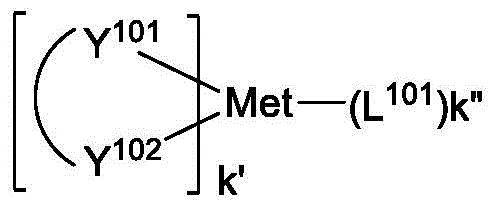
wherein Met is a metal which may have an atomic weight greater than 40; (Y)101-Y102) Is a bidentate ligand, Y101And Y102Independently selected from C, N, O, P and S; l is101Is an ancillary ligand; k' is an integer value from 1 to the maximum number of ligands that can be attached to the metal;and k' + k "is the maximum number of ligands that can be attached to the metal.
In one aspect, (Y)101-Y102) Is a 2-phenylpyridine derivative. In another aspect, (Y)101-Y102) Is a carbene ligand. In another aspect, Met is selected from Ir, Pt, Os and Zn. In another aspect, the metal complex has a structure comparable to Fc+A minimum oxidation potential in solution of less than about 0.6V for/Fc coupling.
Non-limiting examples of HIL and HTL materials that can be used in OLEDs in combination with the materials disclosed herein, along with references disclosing those materials, are exemplified by the following: CN102702075, DE102012005215, EP01624500, EP0169861, EP01806334, EP01930964, EP01972613, EP01997799, EP02011790, EP02055700, EP02055701, EP1725079, EP2085382, EP2660300, EP650955, JP07-073529, JP2005112765, JP2007091, JP 2008021621687, JP2014-009196, KR 201188898, KR20130077473, TW 201139201139402, US06517957, US 2008220158242, US20030162053, US20050123751 751, US 20060282993, US 200602872 14579, US 201181874874, US20070278938, US 20080014014464 091091091, US20080106190, US 200907192605092385, US 12460352009071794392604335200356371798, WO 20120020120020135200353141563543544354435443544354435443544354435443544354435443544354435646, WO 200200352003520035563256325632563256325646, WO 20035200352003520035200435443544354435443544354435443544354435443544354435646, WO 200605646, WO 200605632563256325632563256325646, WO 2002002002002002002002002002002002002002004356325632563256325632563256325632563256325632563256325632563256325632567, WO 2004354435443435632563256325632563256325632563256325632563243544354434354435443544354435443544354435443544354435443541, WO 200200200200200200200200200200200200200200200200200200.


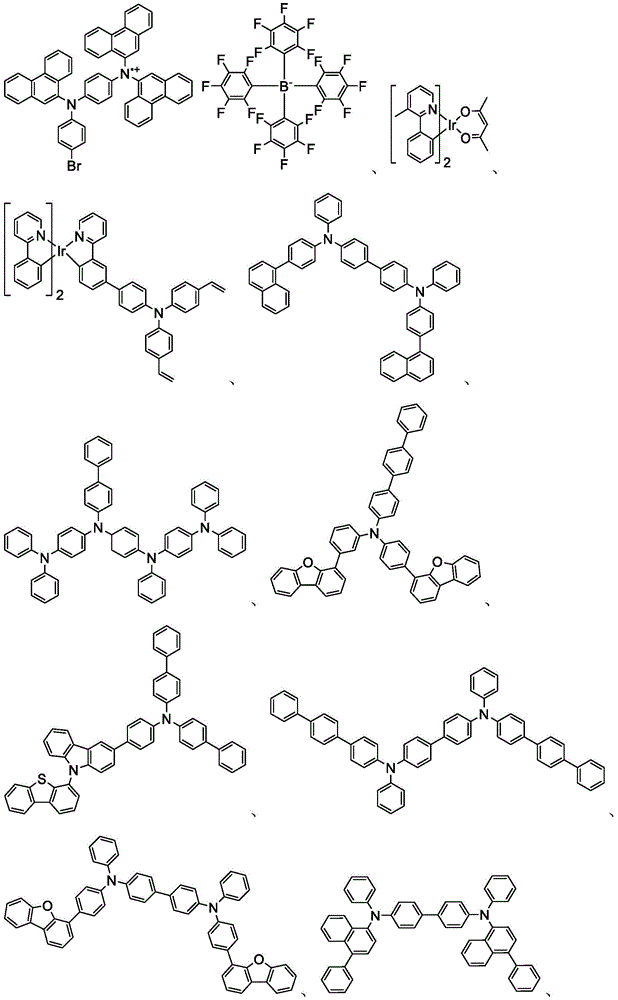


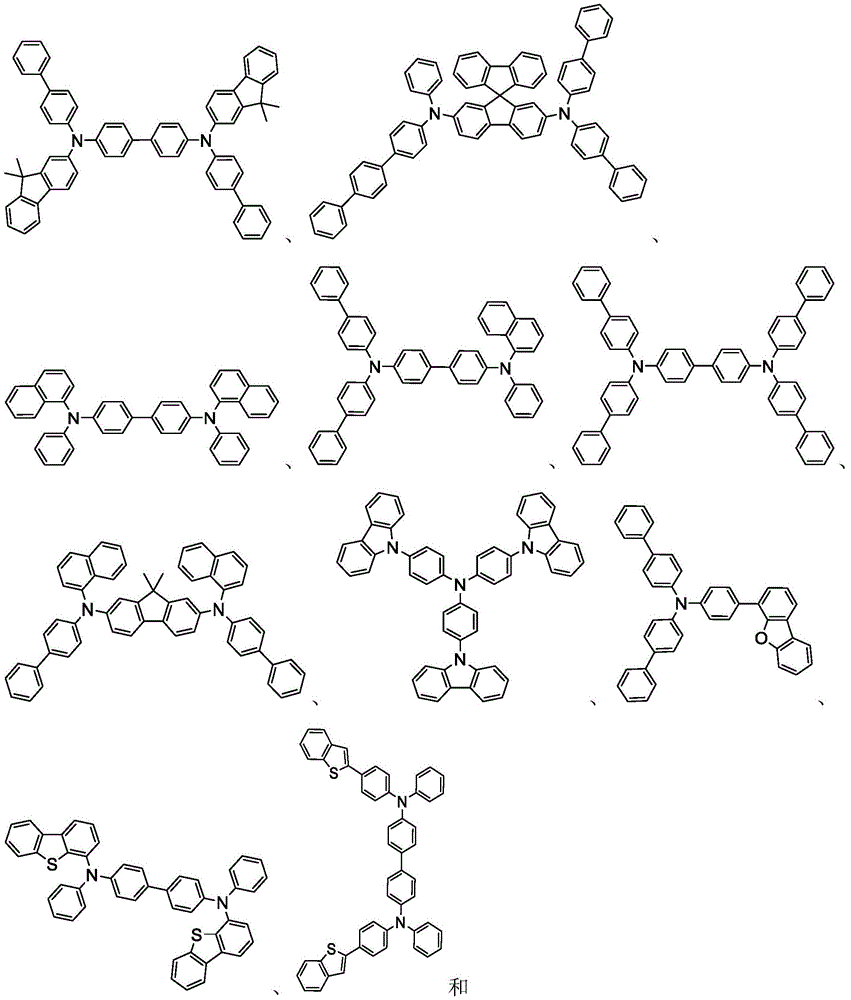

c)EBL:
An Electron Blocking Layer (EBL) may be used to reduce the number of electrons and/or excitons that leave the emissive layer. The presence of such a barrier layer in a device may result in substantially higher efficiency and/or longer lifetime compared to a similar device lacking a barrier layer. In addition, blocking layers can be used to limit the emission to the desired area of the OLED. In some embodiments, the EBL material has a higher LUMO (closer to the vacuum level) and/or higher triplet energy than the emitter closest to the EBL interface. In some embodiments, the EBL material has a higher LUMO (closer to the vacuum level) and/or higher triplet energy than one or more of the bodies closest to the EBL interface. In one aspect, the compound used in the EBL contains the same molecule or the same functional group as used in one of the hosts described below.
d) A main body:
the light-emitting layer of the organic EL device of the present disclosure preferably contains at least a metal complex as a light-emitting material, and may contain a host material using the metal complex as a dopant material. Examples of the host material are not particularly limited, and any metal complex or organic compound may be used as long as the triplet energy of the host is larger than that of the dopant. Any host material may be used with any dopant so long as the triplet criteria are met.
Examples of the metal complex used as the host preferably have the following general formula:

wherein Met is a metal; (Y)103-Y104) Is a bidentate ligand, Y103And Y104Independently selected from C, N, O, P and S; l is101Is another ligand; k' is an integer value from 1 to the maximum number of ligands that can be attached to the metal; and k' + k "is the maximum number of ligands that can be attached to the metal.
In one aspect, the metal complex is:

wherein (O-N) is a bidentate ligand having a metal coordinated to the O and N atoms.
In another aspect, Met is selected from Ir and Pt. In another aspect, (Y)103-Y104) Is a carbene ligand.
In one aspect, the host compound contains at least one selected from the group consisting of: a group consisting of aromatic hydrocarbon cyclic compounds such as: benzene, biphenyl, terphenyl, triphenylene, tetraphenylene, naphthalene, anthracene, phenalene, phenanthrene, fluorene, pyrene, perylene, Perylene and azulene; a group consisting of aromatic heterocyclic compounds such as: dibenzothiophene, dibenzofuran, dibenzoselenophene, furan, thiophene, benzofuran, benzothiophene, benzoselenophene, carbazoleIndolocarbazoles, pyridylindoles, pyrrolobipyridines, pyrazoles, imidazoles, triazoles, oxazoles, thiazoles, oxadiazoles, oxatriazoles, dioxazoles, thiadiazoles, pyridines, pyridazines, pyrimidines, pyrazines, triazines, oxazines, oxathiazines, oxadiazines, indoles, benzimidazoles, indazoles, indolizines, benzoxazoles, benzisoxazoles, benzothiazoles, quinolines, isoquinolines, cinnolines, quinazolines, quinoxalines, naphthyridines, phthalazines, pteridines, xanthenes, acridines, phenazines, phenothiazines, phenoxazines, benzofuropyridines, furobipyridines, benzothienopyridines, thienobipyridines, benzoselenenopyridines, and selenenopyridines; and a group consisting of 2 to 10 cyclic structural units which are the same type or different types of groups selected from aromatic hydrocarbon ring groups and aromatic heterocyclic groups and are bonded to each other directly or via at least one of an oxygen atom, a nitrogen atom, a sulfur atom, a silicon atom, a phosphorus atom, a boron atom, a chain structural unit and an aliphatic ring group. Each option in each group may be unsubstituted or may be substituted with a substituent selected from the group consisting of: deuterium, halogen, alkyl, cycloalkyl, heteroalkyl, heterocycloalkyl, aralkyl, alkoxy, aryloxy, amino, silyl, alkenyl, cycloalkenyl, heteroalkenyl, alkynyl, aryl, heteroaryl, acyl, carboxylic acid, ether, ester, nitrile, isonitrile, thio, sulfinyl, sulfonyl, phosphino, and combinations thereof.
In one aspect, the host compound contains at least one of the following groups in the molecule:
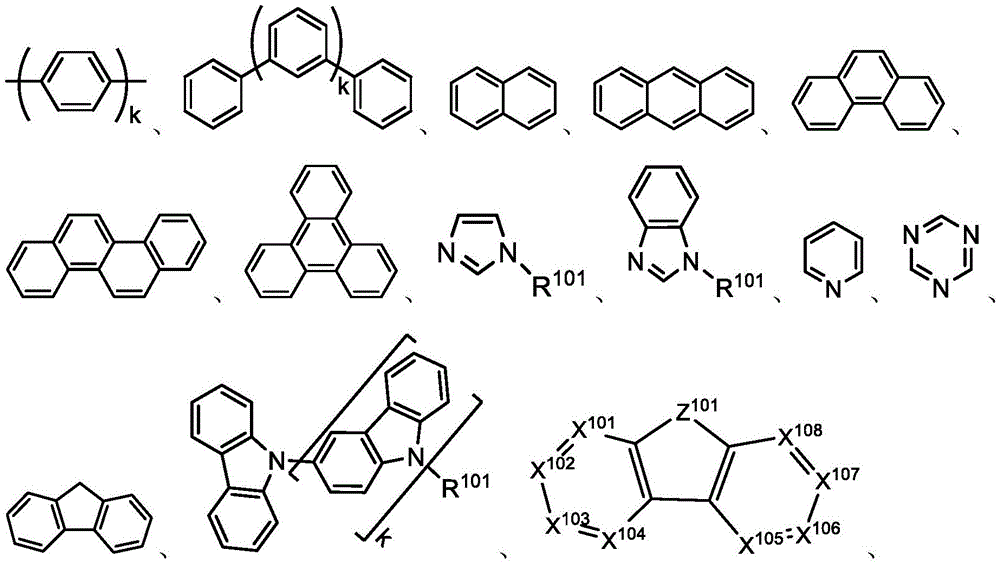
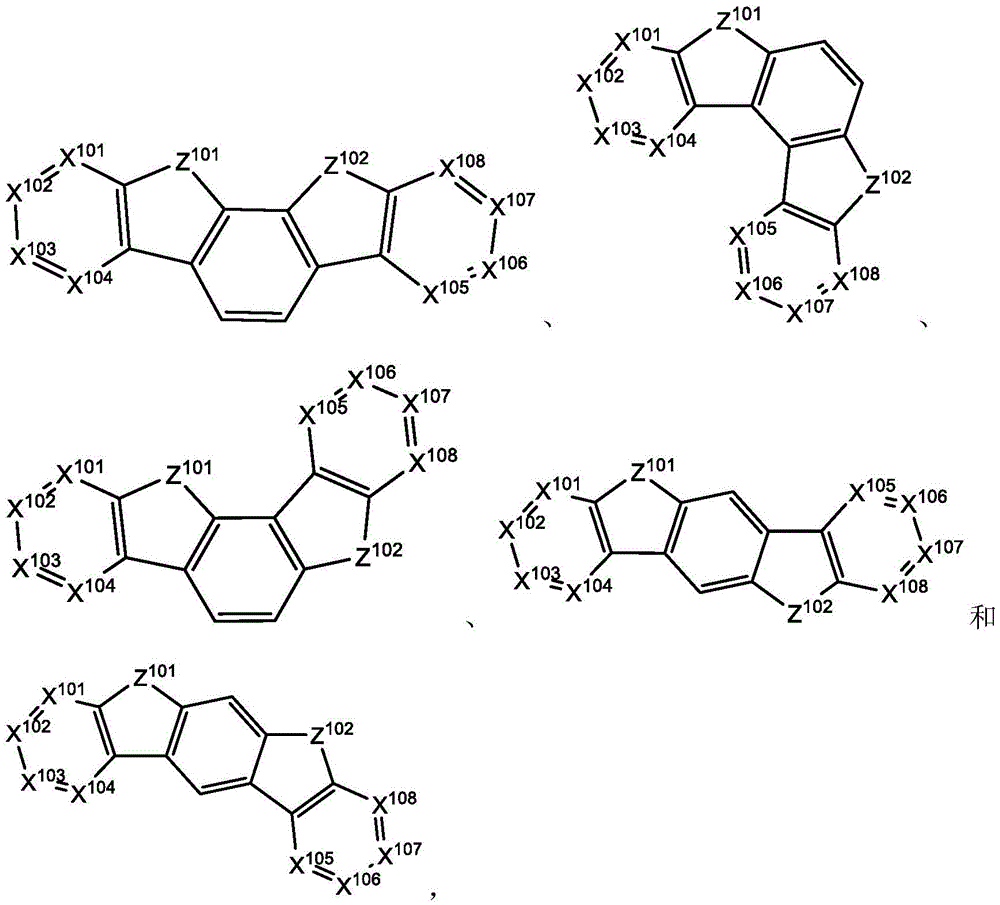
wherein R is101Selected from the group consisting of: hydrogen, deuterium, halogen, alkyl, cycloalkyl, heteroalkyl, heterocycloalkyl, aralkyl, alkoxy, aryloxy, amino, silyl, alkenyl, cycloalkeneA group, a heteroalkenyl, an alkynyl, an aryl, a heteroaryl, an acyl, a carboxylic acid, an ether, an ester, a nitrile, an isonitrile, a thio, a sulfinyl, a sulfonyl, a phosphino, and combinations thereof, and when it is an aryl or heteroaryl, it has a similar definition as Ar mentioned above. k is an integer from 0 to 20 or from 1 to 20. X101To X108Independently selected from C (including CH) or N. Z101And Z102Independently selected from NR101O or S.
Non-limiting examples of host materials that can be used in OLEDs in combination with the materials disclosed herein are exemplified below, along with references disclosing those materials: EP2034538, EP2034538A, EP2757608, JP2007254297, KR20100079458, KR20120088644, KR20120129733, KR20130115564, TW201329200, US20030175553, US20050238919, US20060280965, US20090017330, US20090030202, US20090167162, US20090302743, US20090309488, US20100012931, US20100084966, US20100187984, US2010187984, US2012075273, US2012126221, US2013009543, US2013105787, US2013175519, US 001446, US 20148301503, US20140225088, US2014034914, US7154114, WO2001039234, WO 2004093203203203207, WO 2005014545454545452009020090455646, WO 2002012009020120090201902019072201200907220120020190722012002012002016072201200201200201200201607246, WO 20120020120020160722012002016072201200201200201607246, WO 200201200201200201200201200201200201200201200907220020120020120020120020120020120020120090729, WO 200201200201200201200201200201200201200201200201200201200201200201200201200201200201200201200201200200200201200201200200200200200200200200200200200200200200200200200200200200200200200200200200200200200200200200200200200200200200200200200200200200200200200200200200200200200200200200200200200200,


e) other emitters:
one or more other emitter dopants may be used in combination with the compounds of the present invention. Examples of the other emitter dopant are not particularly limited, and any compound may be used as long as the compound is generally used as an emitter material. Examples of suitable emitter materials include, but are not limited to, compounds that can produce emission via phosphorescence, fluorescence, thermally activated delayed fluorescence (i.e., TADF, also known as E-type delayed fluorescence), triplet-triplet annihilation, or a combination of these processes.
Non-limiting examples of emitter materials that can be used in OLEDs in combination with the materials disclosed herein, along with references disclosing those materials, are exemplified below: CN103694277, CN1696137, EB01238981, EP01239526, EP01961743, EP1239526, EP1244155, EP1642951, EP1647554, EP1841834, EP1841834B, EP2062907, EP2730583, JP 201207440263, JP4478555, KR1020090133652, KR20120032054, KR20130043460, TW201332980, US0669959, US 200100916582, US 20020020034656, US200300685 68526, US20030072964, US 2003013865657, US 2005017878788, US 2002002002002004467673, US2005123791, US 2006052449 449, US20060008670, US20060065890, US 601696, US 601601601601601200601601201601657, US 200501788, US 20020120020120020120020120020120004772002012000477817781435443544354435443544354435443544354435443544354435443544354049, WO 20020020020020020020020020020004779, US 20020120020120020120020004779, US 20020020020020020020020020004779, US 20020120020020020020020020020020004770477819748, US 20020020020020020020020020020020020020020020020020020020020020020020020020020004779, US 2002002002002002002002002002002002002002002002002002002002002002002002002002002002002002002002002002002002002002002002002002002002002002002002002002002000477047704779, US 200200200200200200200200200200200200200201200201200200200200200200200200200200200200200200200200200200200200200200200200200200200200200200200200201200200200200200200200047735,9748,9748, US 200201200200200200201200200200200201200201200201200200200200201200200200200200200200200200200200200200200200200200200201439748,9748,9748,9735, US 200200200200201200200200200200200201200201200200200200201200200200200200200200200200200200200201200201200200200200200200200200200200200200200200200200200200200200200200200200200200200200200200200200200200200200200200200200200200200200200200200200201200201200200200200200200200200200200200200200200200200200200200200200200200200200200200200200200200201200201200201200200200200200200200200200200200201200200200200200200200200200200200200200201439748, US 200201200201439748,9748,9748,9748,9748, US 200201200200200200200201200201200201200201200200201200200200201200201200201200201200201200201200201200201200201200201200200200200200200200200200200200200200200200200200200200200200200200200200200200200, WO2011107491, WO2012020327, WO2012163471, WO2013094620, WO2013107487, WO2013174471, WO2014007565, WO2014008982, WO2014023377, WO2014024131, WO2014031977, WO2014038456, WO 2014112450.
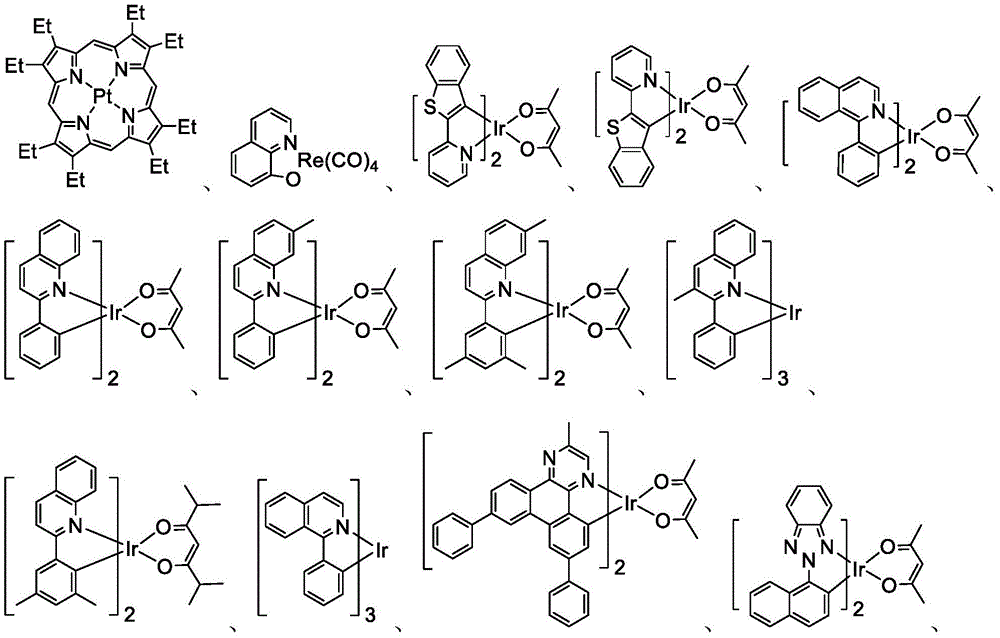


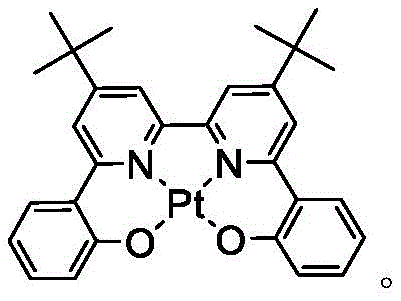
f)HBL:
Hole Blocking Layers (HBLs) may be used to reduce the number of holes and/or excitons that leave the emissive layer. The presence of such a barrier layer in a device may result in substantially higher efficiency and/or longer lifetime compared to a similar device lacking a barrier layer. In addition, blocking layers can be used to limit the emission to the desired area of the OLED. In some embodiments, the HBL material has a lower HOMO (farther from the vacuum level) and/or higher triplet energy than the emitter closest to the HBL interface. In some embodiments, the HBL material has a lower HOMO (farther from the vacuum level) and/or higher triplet energy than one or more of the hosts closest to the HBL interface.
In one aspect, the compound used in the HBL contains the same molecule or the same functional group as used for the host described above.
In another aspect, the compound used in HBL contains in the molecule at least one of the following groups:

wherein k is an integer from 1 to 20; l is101Is another ligand, and k' is an integer of 1 to 3.
g)ETL:
The Electron Transport Layer (ETL) may include a material capable of transporting electrons. The electron transport layer may be intrinsic (undoped) or doped. Doping may be used to enhance conductivity. Examples of the ETL material are not particularly limited, and any metal complex or organic compound may be used as long as it is generally used to transport electrons.
In one aspect, the compound used in the ETL contains in the molecule at least one of the following groups:

wherein R is101Selected from the group consisting of: hydrogen, deuterium, halogen, alkyl, cycloalkyl, heteroalkyl, heterocycloalkyl, aralkyl, alkoxy, aryloxy, amino, silyl, alkenyl, cycloalkenyl, heteroalkenyl, alkynyl, aryl, heteroaryl, acyl, carboxylic acid, ether, ester, nitrile, isonitrile, thio, sulfinyl, sulfonyl, phosphino, and combinations thereof, which when aryl or heteroaryl has a similar definition to Ar described above. Ar (Ar)1To Ar3Have similar definitions as Ar mentioned above. k is an integer of 1 to 20. X101To X108Selected from C (including CH) or N.
In another aspect, the metal complex used in the ETL contains (but is not limited to) the following general formula:

wherein (O-N) or (N-N) is a bidentate ligand having a metal coordinated to atom O, N or N, N; l is101Is another ligand; k' is an integer value from 1 to the maximum number of ligands that can be attached to the metal.
Non-limiting examples of ETL materials that can be used in an OLED in combination with the materials disclosed herein, along with references disclosing those materials, are exemplified as follows: CN103508940, EP01602648, EP01734038, EP01956007, JP2004-022334, JP2005149918, JP2005-268199, KR0117693, KR20130108183, US20040036077, US20070104977, US2007018155, US20090101870, US20090115316, US20090140637, US 2009017959554, US2009218940, US2010108990, US2011156017, US2011210320, US2012193612, US2012214993, US 20140142014014925, US 201401492014927, US 2014028450284580, US 5666612, US 1508431, WO 200306093060979256, WO2007111263, WO2009148269, WO2010067894, WO2010072300, WO 201107070, WO 105373, WO 201303017, WO 201314545477, WO 2014545667, WO 201104376, WO2014104535, WO 2014535,

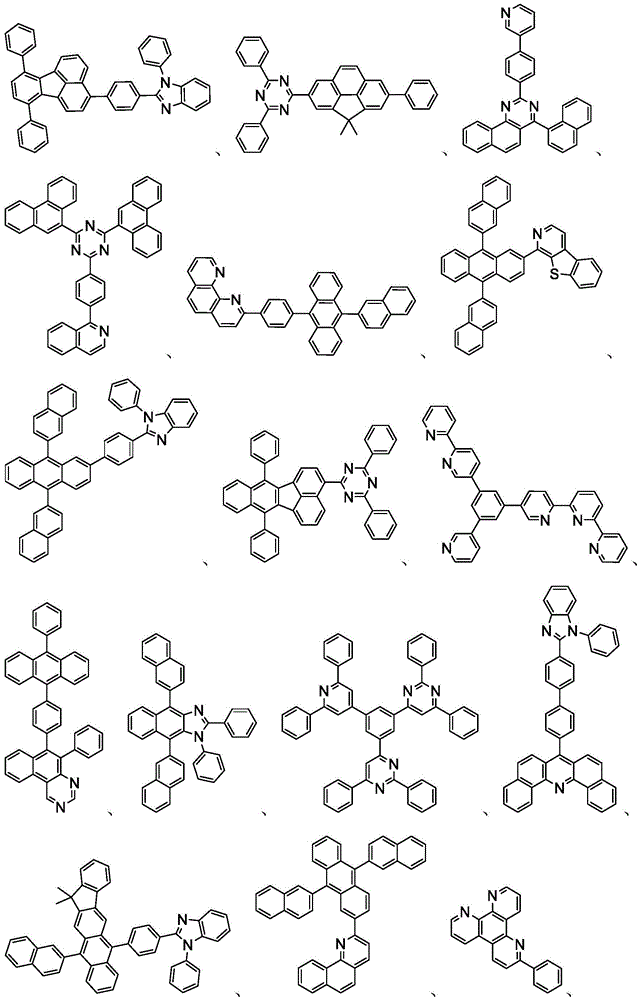
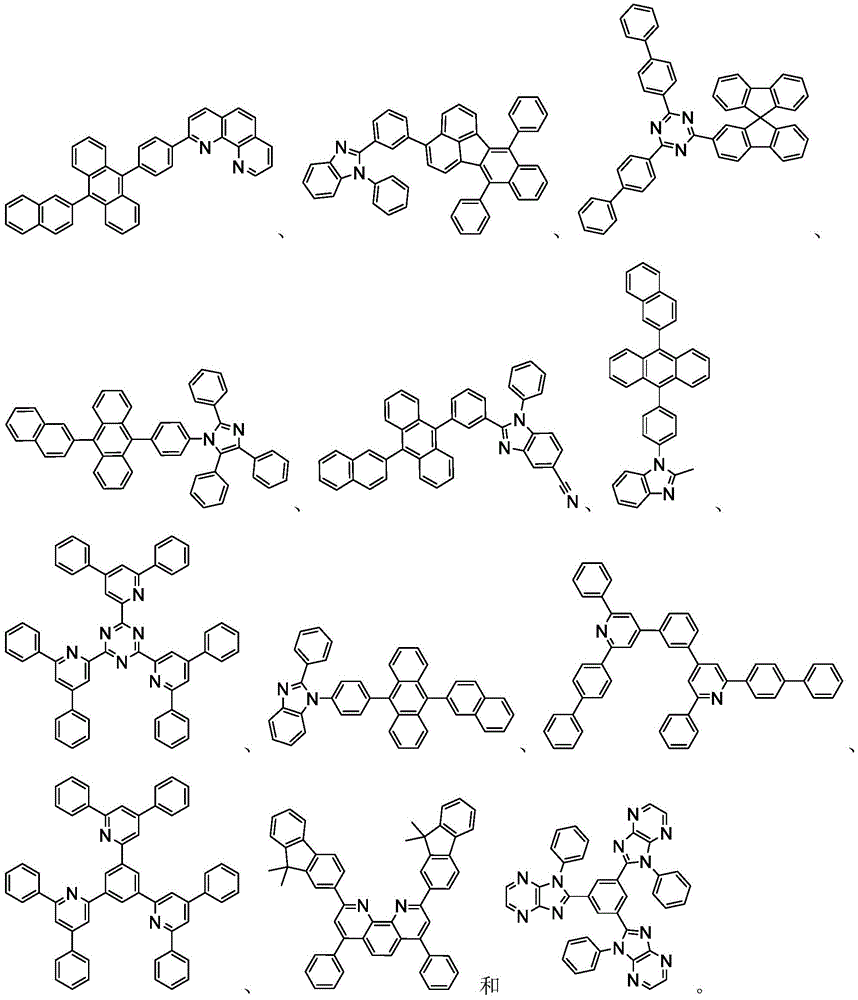
h) charge Generation Layer (CGL)
In tandem or stacked OLEDs, CGL plays a fundamental role in performance, consisting of an n-doped layer and a p-doped layer for injecting electrons and holes, respectively. Electrons and holes are supplied by the CGL and the electrodes. Electrons and holes consumed in the CGL are refilled by electrons and holes injected from the cathode and anode, respectively; subsequently, the bipolar current gradually reaches a steady state. Typical CGL materials include n and p conductivity dopants used in the transport layer.
In any of the above-mentioned compounds used in each layer of the OLED device, the hydrogen atoms may be partially or fully deuterated. Thus, any of the specifically listed substituents, such as (but not limited to) methyl, phenyl, pyridyl, and the like, can be in their non-deuterated, partially deuterated, and fully deuterated forms. Similarly, substituent classes (such as, but not limited to, alkyl, aryl, cycloalkyl, heteroaryl, etc.) can also be non-deuterated, partially deuterated, and fully deuterated forms thereof.
It should be understood that the various embodiments described herein are by way of example only and are not intended to limit the scope of the invention. For example, many of the materials and structures described herein may be substituted with other materials and structures without departing from the spirit of the invention. The invention as claimed may thus comprise variations of the specific examples and preferred embodiments described herein, as will be apparent to those skilled in the art. It should be understood that various theories as to why the invention works are not intended to be limiting.
Experimental data
Synthesis of 7- (4- (6- ([1,1' -biphenyl ] -4-yl) dibenzo [ b, d ] thiophen-4-yl) phenyl) -5, 9-dioxa-13 b-boranaphtha [3,2,1-de ] anthracene (Compound 1)

Step 1 Dibenzo [ b, d ] was added to a 5L 3-neck flask equipped with a water condenser, magnetic stirrer, and thermowell]Thiophen-4-ylboronic acid (60g,263mmol), 4-bromo-1, 1' -biphenyl (73.6g,316mmol), tripotassium phosphate (168g,789mmol), toluene (1196mL) and water (120mL) and the mixture was degassed (nitrogen sparge). Addition of Pd2(dba)3(7.23g, 7.89mmol) and dicyclohexyl (2',4',6 '-triisopropyl- [1,1' -biphenyl)]-2-yl) phosphine (6.48g, 15.78mmol) and the mixture was degassed. The reaction mixture was heated to reflux and stirred for 6 hours. The reaction mixture was cooled to room temperature, and the precipitated solid was collected by filtration. Wet milling the solid with methanol to obtain 4- ([1,1' -biphenyl)]-4-yl) dibenzo [ b, d]Thiophene (87g, 98% yield).
Step 2 to a dry 2L flask was added 4- ([1,1' -biphenyl ] under nitrogen]-4-yl) dibenzo [ b, d]Thiophene (50g, 149mmol) and THF (743 ml). The resulting solution was stirred and cooled to-78 ℃. A solution of sec-butyllithium in cyclohexane (1.4M, 186ml, 260mmol) was added slowly and the reaction mixture was stirred at this temperature for 1 hour. 2-Isopropoxy-4, 4,5, 5-tetramethyl-1, 3, 2-dioxaborolan (48.4g, 260mmol) was then added dropwise and the reaction mixture was allowed to warm slowly to room temperature overnight (about 16 hours). Addition of saturated NH4Cl (250mL) and water (250mL) and the layers were separated. The aqueous layer was extracted with DCM (3X 500mL) and the combined organic layers were washed with brine, over Na2SO4Dried and concentrated. The resulting solid was wet-milled with heptane to give 2- (6- ([1,1' -biphenyl) as a white solid]-4-yl) dibenzo [ b, d]Thien-4-yl) -4,4,5, 5-tetramethyl-1, 3, 2-dioxaborolan (60.4g, 88%).
Step 3, a water condenser and an electromagnetic stirrer are arrangedAnd a 1L 3-neck flask with a thermowell was added with 2- (6- ([1,1' -biphenyl)]-4-yl) dibenzo [ b, d]Thien-4-yl) -4,4,5, 5-tetramethyl-1, 3, 2-dioxaborolan (40g, 87mmol), 1-bromo-4-chlorobenzene (19.87g, 104mmol), tripotassium phosphate (55.1g, 260mmol), toluene (393mL) and water (39mL), and the mixture was purged with nitrogen. Addition of Pd2(dba)3(0.92g, 1.00mmol) and dicyclohexyl (2',4',6 '-triisopropyl- [1,1' -biphenyl)]-2-yl) phosphine (2.131g, 5.19mmol) and the mixture was degassed. The reaction was heated to reflux and stirred for 6 hours. The reaction mixture was cooled to room temperature, and the precipitated solid was collected by filtration. The white solid was further wet-milled with methanol to obtain 4- ([1,1' -biphenyl)]-4-yl) -6- (4-chlorophenyl) dibenzo [ b, d]Thiophene (30.9g, 80% yield).
Step 4 to a 200mL flask was added 4- ([1,1' -biphenyl)]-4-yl) -6- (4-chlorophenyl) dibenzo [ b, d]Thiophene (9.16g, 20.49mmol), 4,4,4',4',5,5,5',5' -octamethyl-2, 2' -bis (1,3, 2-dioxaborolan) (10.41g, 41.0mmol), potassium acetate (6.03g, 61.5mmol) and dioxane (72 mL). The resulting reaction mixture was stirred and degassed by vacuum-nitrogen backfill. Addition of Pd2(dba)3(0.75g, 0.82mmol) and dicyclohexyl (2',6' -dimethoxy- [1,1' -biphenyl)]-2-yl) phosphine (0.67g, 1.64mmol) and the mixture was further degassed. The reaction mixture was then heated to 100 ℃ and stirred for 16 hours. The reaction mixture was concentrated and the residue was dissolved in toluene. The solution was passed through a pad of silica gel and the stopper was washed with toluene. The filtrate was concentrated and the resulting solid was wet-milled with heptane to give 2- (4- (6- ([1,1' -biphenyl)]-4-yl) dibenzo [ b, d]Thiophen-4-yl) phenyl) -4,4,5, 5-tetramethyl-1, 3, 2-dioxaborolan (9g, 82% yield).
Step 5 to a 500mL 3-necked flask equipped with a water condenser, a magnetic stirrer, and a thermowell was added 2- (4- (6- ([1,1' -biphenyl)]-4-yl) dibenzo [ b, d]Thiophen-4-yl) phenyl) -4,4,5, 5-tetramethyl-1, 3, 2-dioxaborolan (9g, 16.71mmol), 7-chloro-5, 9-dioxa-13 b-boranaphtho [3,2,1-de]Anthracene (5.60g, 18.38mmol), tripotassium phosphate (10.64g, 50.10mmol), toluene (85mL), and water (8.5mL), and the mixture was degassed by bubbling nitrogen. Addition of Pd2(dba)3(0.92g, 1.00mmol) and dicyclohexyl (2',4',6 '-triisopropyl- [1,1' -biphenyl)]-2-yl) phosphine (0.96g, 2.01mmol) and degassing the mixture. The reaction mixture was then heated to 77 ℃ and stirred for 8 hours. The reaction mixture was cooled to room temperature, and the precipitated solid was collected by filtration. The solid was dissolved in hot toluene (3L) and filtered through a pad of silica and alumina. The filtrate was concentrated and the resulting solid was wet-milled with methanol followed by ethyl acetate, DCM/methanol, DCM/acetone and acetone to give 7- (4- (6- ([1,1' -biphenyl)]-4-yl) dibenzo [ b, d]Thiophen-4-yl) phenyl) -5, 9-dioxa-13 b-boranonaphtho [3,2,1-de]Anthracene (compound 1) (6.6g, 58% yield).
Synthesis of 3- (6- (4- (5, 9-dioxa-13 b-boranaphtho [3,2,1-de ] anthracen-7-yl) phenyl) dibenzo [ b, d ] thiophen-4-yl) -9-phenyl-9H-carbazole (Compound 2)

Step 1 to a dry 1-L3 neck flask equipped with a water condenser, magnetic stirrer and thermowell, dibenzo [ b, d ] was added under nitrogen]Thiophen-4-ylboronic acid (10g, 43.8mmol), 3-bromo-9-phenyl-9H-carbazole (14.13g, 43.8mmol), tripotassium phosphate (27.9g, 132mmol), toluene (199ml) and water (19.93ml) and the mixture was degassed by purging with nitrogen for 5 minutes. Adding dicyclohexyl (2',6' -dimethoxy- [1,1' -biphenyl)]-2-yl) phosphine (1.080g, 2.63mmol) and Pd2dba3(1.205g, 1.315mmol) and the resulting mixture further degassed. The reaction mixture was heated to reflux. After 16 hours, the reaction mixture was cooled and the organic layer was separated. The organic layer was filtered through celite and concentrated to dryness to give 3- (dibenzo [ b, d ]]Thiophen-4-yl) -9-phenyl-9H-carbazole (17.5g, 94%).
Step 2 to a dry 500mL 3-neck flask equipped with a magnetic stirrer and a thermowell was added 3- (dibenzo [ b, d ] thiophen-4-yl) -9-phenyl-9H-carbazole (17g, 39.9mmol), followed by anhydrous THF (200mL) via a cannula. The resulting solution was stirred, cooled to-75 ℃ and a solution of sec-butyllithium in cyclohexane (1.4M, 49.9ml, 69.9mmol) was added dropwise. The mixture was allowed to warm to-40 ℃ over 90 minutes. The mixture was then cooled to-68 ℃ and 2-isopropoxy-4, 4,5, 5-tetramethyl-1, 3, 2-dioxaborolan-tane (14.26ml, 69.9mmol) was added dropwise. The reaction mixture was slowly warmed to room temperature overnight (about 16 hours). After stirring overnight, the reaction mixture was cooled in an ice bath, quenched with saturated aqueous ammonium solution and stirred for 10 minutes. The organic layer was separated and the aqueous layer was extracted with dichloromethane. The combined organic layers were dried over sodium sulfate, filtered and concentrated to dryness to give an off-white solid, wet-milled with heptane and filtered to give 9-phenyl-3- (6- (4,4,5, 5-tetramethyl-1, 3, 2-dioxaborolan-2-yl) dibenzo [ b, d ] thiophen-4-yl) -9H-carbazole (20g, 91%).
Step 3 to a dry 500mL 3-necked flask equipped with a water condenser, a magnetic stirrer, and a thermowell was added 1-bromo-4-chlorobenzene (8.33g, 43.5mmol), 9-phenyl-3- (6- (4,4,5, 5-tetramethyl-1, 3, 2-dioxaborolan-2-yl) dibenzo [ b, d-cyclopent-2-yl ] benzene]Thien-4-yl) -9H-carbazole (20g, 36.3mmol), toluene (183ml) and water (18.32ml) were added. The resulting mixture was stirred and degassed by purging with nitrogen for 5 minutes. To this mixture was added Pd (PPh)3)4(2.095g, 1.813mmol) and further degassed. The reaction mixture was then heated to reflux for 16 hours. The reaction mixture was cooled to room temperature, the organic layer was separated and concentrated to dryness. The obtained residue was purified by silica gel column chromatography (DCM/cyclohexane) to obtain 3- (6- (4-chlorophenyl) dibenzo [ b, d ]]Thiophen-4-yl) -9-phenyl-9H-carbazole (15g, 77%).
Step 4 to a dry 250mL 3-neck flask equipped with a water condenser, magnetic stirrer, and thermowell was added 3- (6- (4-chlorophenyl) dibenzo [ b, d ]]Thiophen-4-yl) -9-phenyl-9H-carbazole (15g, 28.0mmol), 4,4,4',4',5,5,5',5' -octamethyl-2, 2' -bis (1,3, 2-dioxaborocyclopentane) (14.21g, 56.0mmol), potassium acetate (8.24g, 84mmol) and anhydrous dioxane (112ml) and the mixture was degassed. Addition of Pd2dba3(1.025g, 1.119mmol) and dicyclohexyl (2',6' -dimethoxy- [1,1' -biphenyl)]-2-yl) phosphine (0.919g, 2.238mmol) and the resulting mixture was further degassed. The reaction mixture was then heated to 100 ℃.After 16 hours, TLC indicated complete consumption of the starting material. The reaction mixture was cooled to room temperature and filtered through a pad of silica, and the filtrate was concentrated. The resulting residue was dissolved in toluene and filtered through a short pad of silica. The filtrate was concentrated and the resulting solid was wet-milled in heptane to give 9-phenyl-3- (6- (4- (4,4,5, 5-tetramethyl-1, 3, 2-dioxaborolan-2-yl) phenyl) dibenzo [ b, d]Thiophen-4-yl) -9H-carbazole (13.4g, 76%).
Step 5 to a dry 250mL 3-necked flask equipped with a water condenser, magnetic stirrer, and thermowell was added 7-chloro-5, 9-dioxa-13 b-boranona [3,2,1-de under nitrogen]Anthracene (5g, 16.42mmol), 9-phenyl-3- (6- (4- (4,4,5, 5-tetramethyl-1, 3, 2-dioxaborolan-2-yl) phenyl) dibenzo [ b, d]Thiophen-4-yl) -9H-carbazole (10.30g, 16.42mmol), potassium phosphate (10.46g, 49.3mmol), toluene (83ml) and water (9ml) and the mixture was degassed (vacuum-nitrogen backfilled 5 times). Adding dicyclohexyl (2',4',6 '-triisopropyl- [1,1' -biphenyl)]-2-yl) phosphine (0.939g, 1.970mmol) and Pd2dba3(0.902g, 0.985mmol) and the resulting mixture was further degassed (vacuum-nitrogen back-filled 3 times). The reaction mixture was then heated to 75 ℃ for 16 hours. The reaction mixture was cooled to room temperature, and the precipitated solid was collected by filtration. The solid was then dissolved in hot toluene and filtered through a pad of silica and alumina. The filtrate was concentrated and the resulting solid was wet-milled in methanol, acetone, ethyl acetate, DCM and chloroform to give 3- (6- (4- (5, 9-dioxa-13 b-boranonaphtho [3,2, 1-de) as a white solid]Anthracene-7-yl) phenyl) dibenzo [ b, d]Thiophen-4-yl) -9-phenyl-9H-carbazole (compound 2) (4.7g, 37%).
Synthesis of 9- (6- (5, 9-dioxa-13 b-boranaphtho [3,2,1-de ] anthracen-7-yl) dibenzo [ b, d ] furan-4-yl) -9H-3,9' -dicarbazole (Compound 3)
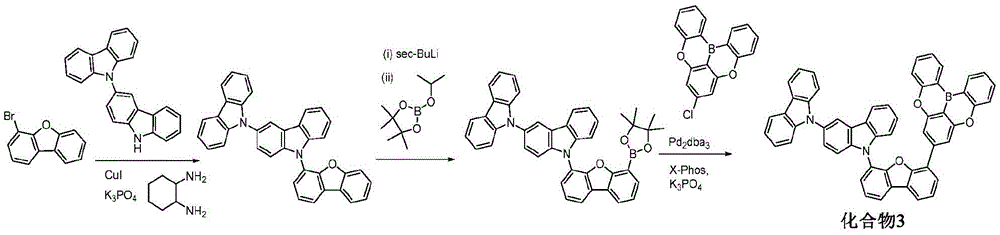
Step 1 to a dry 500mL 3-neck flask equipped with a water condenser, a magnetic stirrer and a thermowell was added 4-bromodibenzo [ b, d ] furan (7.28g, 29.5mmol), 9H-3,9' -dicarbazole (10g, 29.5mmol), potassium phosphate (18.77g, 88mmol), copper (I) iodide (5.61g, 29.5mmol), cyclohexane-1, 2-diamine (7.08mL, 59.0mmol) and toluene (236mL) under nitrogen and the mixture was degassed (vacuum-nitrogen backfilled 3 times). The reaction mixture was heated to reflux. After 18 hours, TLC showed complete consumption of the starting material. The reaction mixture was filtered through a pad of celite. The filtrate was concentrated and the resulting solid was wet-milled in methanol for 20 minutes. The suspension was filtered to give 9- (dibenzo [ b, d ] furan-4-yl) -9H-3,9' -dicarbazole (12g, 82%).
Step 2 to a dry 500mL 3-neck flask equipped with a magnetic stirrer, addition funnel and thermowell was added 9- (dibenzo [ b, d ] furan-4-yl) -9H-3,9' -dicarbazole (12g, 24.07mmol) under nitrogen. Anhydrous THF (540ml) was added and the resulting solution was cooled to-75 ℃. To this mixture was added dropwise a solution of sec-butyllithium in cyclohexane (1.4M, 30.1ml, 42.1 mmol). The reaction mixture was then allowed to warm to-40 ℃ over 90 minutes. The mixture was cooled to-68 ℃ and 2-isopropoxy-4, 4,5, 5-tetramethyl-1, 3, 2-dioxaborolan-tane (8.59ml, 42.1mmol) was added dropwise. The reaction mixture was slowly warmed to room temperature overnight (about 16 hours). The reaction mixture was cooled in an ice bath, quenched with saturated aqueous ammonium chloride, and stirred for 10 minutes. The organic layer was separated and the aqueous layer was extracted with dichloromethane. The organic layers were combined and dried over sodium sulfate, filtered and the filtrate evaporated to dryness to give 9- (6- (4,4,5, 5-tetramethyl-1, 3, 2-dioxaborolan-2-yl) dibenzo [ b, d ] furan-4-yl) -9H-3,9' -dicarbazole (13.1g, 87%).
Step 3 to a dry 250mL 3-necked flask equipped with a water condenser, magnetic stirrer, and thermowell was added 7-chloro-5, 9-dioxa-13 b-boranona [3,2,1-de]Anthracene (5g, 16.42mmol), 9- (6- (4,4,5, 5-tetramethyl-1, 3, 2-dioxaborolan-2-yl) dibenzo [ b, d)]Furan-4-yl) -9H-3,9' -dicarbazole (12.30g, 19.70mmol), potassium phosphate (10.46g, 49.3mmol), toluene (83ml) and water (9 ml). The resulting mixture was stirred and degassed (vacuum-nitrogen backfilled 5 times). Adding dicyclohexyl (2',4',6 '-triisopropyl- [1,1' -biphenyl)]-2-yl) phosphine (0.939g, 1.970mmol) and Pd2dba3(0.902g, 0.985mmol) and the reaction mixture was further degassed (vacuum-nitrogen backfilled 3 times). The reaction mixture was then heated to 75 ℃ for 16 hours. The reaction mixture was cooled to room temperature, and the precipitated solid was collected by filtration. This solid was dissolved in hot toluene and filtered through a pad of silica and alumina. The filtrate was concentrated and the resulting solid was wet-milled sequentially with toluene, methanol, ethyl acetate and DCM/acetone to give 9- (6- (5, 9-dioxa-13 b-boranonaphtho [3,2, 1-de)]Anthracene-7-yl) dibenzo [ b, d]Furan-4-yl) -9H-3,9' -dicarbazole (compound 3) (5.9g, 43.2%).
Synthesis of 9- (6- (5, 9-dioxa-13 b-boranaphtho [3,2,1-de ] anthracen-7-yl) dibenzo [ b, d ] thiophen-4-yl) -9H-3,9' -dicarbazole (Compound 4)

Step 1 to a dry 1L 3 neck flask equipped with a water condenser, electromagnetic stirrer and thermowell was added 4-bromodibenzo [ b, d ] thiophene (23.75g,90mmol), 9H-3,9' -dicarbazole (20g,60.2mmol), potassium phosphate (38.3g,181mmol), copper (I) iodide (11.46g,60.2mmol), cyclohexane-1, 2-diamine (14.45ml, 120mmol) and xylene (430ml) under nitrogen and the mixture was degassed (vacuum-nitrogen backfilled 3 times). The reaction mixture was heated to reflux. After 3 days, additional 4-bromodibenzo [ b, d ] thiophene (23.75g,90mmol), potassium phosphate (38.3g,181mmol), copper (I) iodide (11.46g,60.2mmol), cyclohexane-1, 2-diamine (14.45ml, 120mmol) were added and the reaction was continued. After 6 days, TLC showed unreacted initial dicarbazole. Additional 4-bromodibenzo [ b, d ] thiophene (23.75g,90mmol), potassium phosphate (38.3g,181mmol), copper (I) iodide (11.46g,60.2mmol), cyclohexane-1, 2-diamine (14.45ml, 120mmol) were added and the reaction was continued. After 15 days, the reaction mixture was filtered through a pad of silica. The filtrate was concentrated and the resulting solid was wet-milled in toluene/methanol to give 9- (dibenzo [ b, d ] thiophen-4-yl) -9H-3,9' -dicarbazole (25g, 81%).
Step 2 to a dry 250mL 3-neck flask equipped with a magnetic stirrer, addition funnel and thermowell was added 9- (dibenzo [ b, d ] thiophen-4-yl) -9H-3,9' -dicarbazole (7.34g, 14.26mmol) under nitrogen. Anhydrous THF (57ml) was added and the resulting solution was cooled to-78 ℃. To this mixture was added dropwise a solution of sec-butyllithium in cyclohexane (1.4M, 15.28ml, 21.39 mmol). The reaction mixture was then allowed to warm to-40 ℃ over 90 minutes. The mixture was cooled to-68 ℃ and 2-isopropoxy-4, 4,5, 5-tetramethyl-1, 3, 2-dioxaborolan-tane (5.09ml, 24.96mmol) was added dropwise. The reaction mixture was slowly warmed to room temperature overnight (about 16 hours). The reaction mixture was cooled in an ice bath, quenched with saturated aqueous ammonium chloride, and stirred for 10 minutes. The organic layer was separated and the aqueous layer was extracted with dichloromethane. The organic layers were combined and dried over sodium sulfate, filtered and the filtrate evaporated to dryness to give 9- (6- (4,4,5, 5-tetramethyl-1, 3, 2-dioxaborolan-2-yl) dibenzo [ b, d ] thiophen-4-yl) -9H-3,9' -dicarbazole (8.2g, 90%).
Step 3 to a dry 250mL 3-necked flask equipped with a water condenser, magnetic stirrer, and thermowell was added 7-chloro-5, 9-dioxa-13 b-boranona [3,2,1-de]Anthracene (6.21g, 20.40mmol), 9- (6- (4,4,5, 5-tetramethyl-1, 3, 2-dioxaborolan-2-yl) dibenzo [ b, d]Thiophen-4-yl) -9H-3,9' -dicarbazole (13.09g, 20.40mmol), potassium phosphate (12.99g, 61.2mmol), toluene (103ml) and water (10.3 ml). The resulting mixture was stirred and degassed (vacuum-nitrogen backfilled 5 times). Adding dicyclohexyl (2',4',6 '-triisopropyl- [1,1' -biphenyl)]-2-yl) phosphine (1.167g, 2.448mmol) and Pd2dba3(1.121g, 1.224mmol) and the reaction mixture was further degassed (vacuum-nitrogen back-filled 3 times). The reaction mixture was then heated to 75 ℃ for 3 hours. The reaction mixture was cooled to room temperature, and the precipitated solid was collected by filtration. This solid was dissolved in hot toluene and filtered through a pad of silica and alumina. The filtrate was concentrated and the resulting solid was wet-milled sequentially with toluene, methanol, ethyl acetate and DCM/acetone to give 9- (6- (5, 9-dioxa-13 b-boranonaphtho [3,2, 1-de)]Anthracene-7-yl) dibenzo [ b, d]Thiophen-4-yl) -9H-3,9' -dicarbazole (compound 4) (6g, 37.6%).
Synthesis of 9- (6- (5, 9-dioxa-13 b-boranaphthao [3,2,1-de ] anthracen-7-yl) dibenzo [ b, d ] thiophen-4-yl) -9' -phenyl-9H, 9' H-3,3' -dicarbazole (Compound 5)
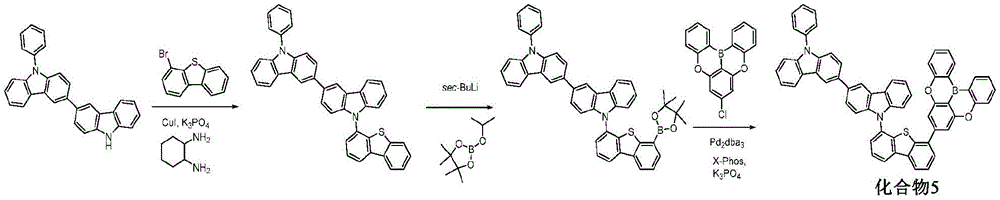
Step 1 to a dry 1L 3 neck flask equipped with a water condenser, electromagnetic stirrer and thermowell was added under nitrogen 4-bromodibenzo [ b, d ] thiophene (19.33g, 73.4mmol), 9-phenyl-9H, 9'H-3,3' -dicarbazole (15g, 36.7mmol), potassium phosphate (23.38g, 110mmol), copper (I) iodide (6.99g, 36.7mmol), cyclohexane-1, 2-diamine (11.02ml, 92mmol) and xylene (400ml) and the mixture was degassed (vacuum-nitrogen backfilled 3 times). The reaction mixture was heated to reflux. After 3 days, additional 4-bromodibenzo [ b, d ] thiophene (19.33g, 73.4mmol), potassium phosphate (23.38g, 110mmol), copper (I) iodide (6.99g, 36.7mmol), cyclohexane-1, 2-diamine (11.02ml, 92mmol) were added and the reaction was continued. After 7 days, the reaction mixture was filtered through a pad of celite. The filtrate was concentrated and the resulting solid was wet-milled in methanol for 20 minutes. The suspension was filtered to give 9- (dibenzo [ b, d ] thiophen-4-yl) -9' -phenyl-9H, 9' H-3,3' -dicarbazole (17g, 78%).
Step 2 to a dry 250mL 3-neck flask equipped with a magnetic stirrer, addition funnel and thermowell was added 9- (dibenzo [ b, d ] thiophen-4-yl) -9' -phenyl-9H, 9' H-3,3' -dicarbazole (5.2g, 8.8mmol) under nitrogen. Anhydrous THF (44ml) was added and the resulting solution was cooled to-78 ℃. To this mixture was added dropwise a solution of sec-butyllithium in cyclohexane (1.4M, 9.43ml, 13.20 mmol). The reaction mixture was then allowed to warm to-40 ℃ over 90 minutes. The mixture was cooled to-68 ℃ and 2-isopropoxy-4, 4,5, 5-tetramethyl-1, 3, 2-dioxaborolan-tane (3.14ml, 15.40mmol) was added dropwise. The reaction mixture was slowly warmed to room temperature overnight (about 16 hours). The reaction mixture was cooled in an ice bath, quenched with saturated aqueous ammonium chloride, and stirred for 10 minutes. The organic layer was separated and the aqueous layer was extracted with dichloromethane. The organic layers were combined and dried over sodium sulfate, filtered and the filtrate evaporated to dryness to give 9-phenyl-9 ' - (6- (4,4,5, 5-tetramethyl-1, 3, 2-dioxaborolan-2-yl) dibenzo [ b, d ] thiophen-4-yl) -9H,9' H-3,3' -dicarbazole (5.5g, 87%).
Step 3 to a dry 250mL 3-necked flask equipped with a water condenser, magnetic stirrer, and thermowell was added 7-chloro-5, 9-dioxa-13 b-boranona [3,2,1-de]Anthracene (1.99g, 6.52mmol), 9-phenyl-9' - (6- (4,4,5, 5-tetramethyl-1, 3, 2-dioxaborolan-2-yl) dibenzo [ b, d]Thiophen-4-yl) -9H,9'H-3,3' -dicarbazole (4.68g, 6.52mmol), potassium phosphate (4.15g, 19.57mmol), toluene (32.9ml) and water (3.29 ml). The resulting mixture was stirred and degassed (vacuum-nitrogen backfilled 5 times). Adding dicyclohexyl (2',4',6 '-triisopropyl- [1,1' -biphenyl)]-2-yl) phosphine (0.373g, 0.783mmol) and Pd2dba3(0.358g, 0.391mmol) and the reaction mixture was further degassed (vacuum-nitrogen backfilled 3 times). The reaction mixture was then heated to 75 ℃ for 3 hours. The reaction mixture was cooled to room temperature, and the precipitated solid was collected by filtration. This solid was dissolved in hot toluene and filtered through a pad of silica and alumina. The filtrate was concentrated and the resulting solid was wet-milled sequentially with toluene, methanol, ethyl acetate and DCM/acetone to give 9- (6- (5, 9-dioxa-13 b-boranonaphtho [3,2, 1-de)]Anthracene-7-yl) dibenzo [ b, d]Thiophen-4-yl) -9' -phenyl-9H, 9' H-3,3' -dicarbazole (compound 5) (3.5g, 62.5%).
Synthesis of 5, 9-dioxa-13 b-bora-naphtho [3,2,1-de ] anthracen-7-yl triphenylsilane (Compound 6)

Step 1 to a 3-neck 2L flask equipped with a mechanical stirrer, thermowell and water condenser was added potassium carbonate (358g, 2591mmol) and NMP (661mL) under nitrogen. The resulting mixture was stirred and phenol (107g, 1140mmol) was slowly added in portions. 1-bromo-3, 5-difluorobenzene (100g, 518mmol) was then added and the mixture heated to 150 ℃ for 2 days. After cooling to room temperature, the mixture was poured into ice-cold water (2.5L). The resulting solid was collected via suction filtration and wet-milled with MeOH (2 × 1L). The white solid was further wet-milled in water (500mL) and then MeOH (500mL) to afford 119g (349mmol) ((5-bromo-1, 3-phenylene) bis (oxy)) biphenyl.
Step 2 to a 3L flask were added ((5-bromo-1, 3-phenylene) bis (oxy)) diphenyl (45g, 132mmol) and THF (900 mL). The resulting solution was stirred and cooled to-78 ℃. To this mixture was added a solution of hexyllithium in hexane (2.3M, 60.2mL, 138mmol) and stirred for 45 minutes. A solution of chlorotritylsilane (42.8g, 145mmol) in THF (360mL) was added slowly and the reaction mixture was allowed to warm to room temperature. After stirring at room temperature for 16 h, the reaction mixture was concentrated under reduced pressure and the resulting residue was dissolved in DCM and water. The organic layer was separated and the aqueous layer was extracted with DCM. The combined organic layers were washed with Na2SO4Dried, filtered and concentrated. The resulting brown oil was dissolved in heptane (100mL) and filtered through a plug of silica gel (300g) eluting with DCM/heptane. All fractions containing the product were combined, concentrated, and the resulting solid wet-milled with heptane (150mL), followed by MeOH (150mL) to afford (3, 5-diphenoxyphenyl) triphenylsilane (44.14g, 80 mmol).
Step 3 to a 1L flask were added (3, 5-diphenoxyphenyl) triphenylsilane (24.12g, 46.3mmol) and m-xylene (172 mL). The resulting mixture was stirred and cooled to 0 ℃. To this mixture was added dropwise a solution of n-butyllithium in hexane (2.5M, 19.46mL, 48.6 mmol). The reaction mixture was allowed to warm to room temperature and then heated to 60 ℃ for 3 hours. The reaction mixture was then cooled to-30 ℃ and tribromoborane (5.04mL, 53.3mmol) was added slowly. After the addition was complete, the reaction mixture was allowed to warm to room temperature and stirred for 18 hours. The reaction mixture was then cooled to 0 ℃ and N-ethyl-N-isopropylpropan-2-amine (20.23mL, 116mmol) was added slowly. The reaction mixture was then heated to 127 ℃ for 2.5 hours. The reaction mixture was cooled to room temperature and saturated NaOAc was used(aq)(400mL) and brine (100 mL). The organic layer was separated and the aqueous layer was extracted with DCM (2X 100 mL). The combined organic layers were washed with Na2SO4Dried, filtered and concentrated. The resulting yellow thick oil was dissolved in acetone (100mL) and dropped in MeOH (400 mL). The precipitated solid was collected by suction filtration and thenThen wet milled with DCM/MeOH (100mL/400 mL). The solid was collected via suction filtration, dissolved in warm toluene (100mL) and filtered through a plug of silica gel (200 g). Further wet trituration with toluene and MeOH afforded 5, 9-dioxa-13 b-boranonaphtho [3,2,1-de as an off white solid]Anthracene-7-yl triphenylsilane (Compound 6) (3.73g,6.96 mmol).
Synthesis of bis (5, 9-dioxa-13 b-boranaphtho [3,2,1-de ] anthracen-7-yl) diphenylsilane (Compound 7)
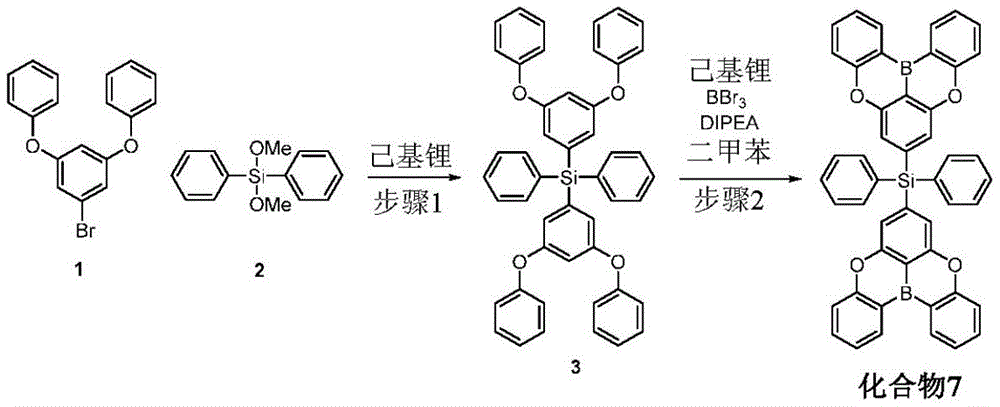
Step 1 to a 3L 3 neck flask equipped with a thermowell, nitrogen inlet was added ((5-bromo-1, 3-phenylene) bis (oxy)) diphenyl (84g, 245mmol) and THF (762ml) under nitrogen. The resulting mixture was stirred and cooled to-78 ℃. To this mixture was added a solution of hexyllithium in hexane (2.3M, 106ml, 245mmol) and stirred for 1 hour. A solution of dimethoxydiphenylsilane (28.5g, 117mmol) in THF (400mL) was then added slowly and the reaction mixture was warmed to room temperature. After 16 h, the reaction mixture was cooled in an ice bath, quenched with saturated aqueous ammonium chloride (20mL), and extracted with ethyl acetate (3 × 300 mL). The combined organic layers were washed with water and Na2SO4Dried and concentrated under reduced pressure. The resulting residue was purified by silica gel column chromatography (DCM/heptane) followed by wet milling with heptane to yield 55g (78mmol, 66.9% yield) of bis (3, 5-phenoxyphenyl) diphenylsilane.
Step 2 to a 2L flask were added bis (3, 5-diphenoxyphenyl) diphenylsilane (54g, 77mmol) and m-xylene (550 mL). The resulting mixture was stirred and cooled to-40 ℃. To this mixture was added dropwise a solution of n-hexyllithium in hexane (2.3M, 69.9ml, 161 mmol). The reaction mixture was allowed to warm to room temperature and then heated to 60 ℃ for 3 hours. The reaction mixture was then cooled to-30 ℃ and tribromoborane (17.45mL, 184mmol) was added slowly. After the addition was complete, the reaction mixture was allowed to warm to room temperature and stirred for 16 hours. The reaction mixture was then cooled to-30 ℃ and slowly addedN-Ethyl-N-isopropylpropan-2-amine (49.5g,383 mmol). The reaction mixture was then heated to 127 ℃ for 5 hours. The reaction mixture was cooled to room temperature and saturated NaOAc was used(aq)(200mL) and brine (200 mL). The organic layer was separated and the aqueous layer was extracted with DCM (3X 200 mL). The combined organic layers were washed with Na2SO4Dried, filtered and concentrated. The resulting residue was purified by silica gel column chromatography (DCM/heptane) followed by toluene, EtOAc and CHCl3Wet grinding to obtain bis (5, 9-dioxa-13 b-bora naphtho [3,2, 1-de)]Anthracene-7-yl) diphenylsilane (Compound 7) (4.5g, 6.23mmol, 8.13% yield).
Synthesis of 9- (3- (5, 9-dioxa-13 b-boranaphtho [3,2,1-de ] anthracen-7-yldiphenylsilyl) phenyl) -9H-carbazole (Compound 8)

Step 1 to a 1L 3-neck flask equipped with a thermowell, nitrogen inlet and electromagnetic stir bar was added 9- (3-bromophenyl) -9H-carbazole (60g, 186mmol) and THF (232ml) under nitrogen. The resulting mixture was stirred and cooled to-78 ℃. To this mixture was added a solution of hexyllithium in hexane (2.3M, 85ml, 196mmol) and stirred for 1 hour. The resulting solution was slowly dropped into a 2L flask containing a solution of dimethoxydiphenylsilane (45.5g, 186mmol) in THF (232ml) at-78 deg.C. The resulting reaction mixture was allowed to warm to room temperature. After stirring for 16 h, the reaction mixture was quenched with water and extracted with EtOAc (3X 150 mL). The combined organic layers were washed with Na2SO4Dried, filtered and concentrated. The resulting residue was purified by silica gel column chromatography (DCM/heptane) followed by wet milling with heptane to yield 57g (67.2% yield) of 9- (3- (methoxydiphenylsilyl) phenyl) -9H-carbazole.
Step 2 to a 2L 3-necked flask equipped with a thermowell, nitrogen inlet was added ((5-bromo-1, 3-phenylene) bis (oxy)) diphenyl (51.2g, 150mmol) and THF (407ml) under nitrogen. The resulting mixture was stirred and cooled to-78 ℃. To this mixture was added hexyllithium in hexane (2.3M)65.3mL, 150mmol) and stirred for 45 minutes. A solution of 9- (3- (methoxydiphenylsilyl) phenyl) -9H-carbazole (57g, 125mmol) in THF (100mL) was then added slowly and the reaction mixture was allowed to warm to room temperature. After 16 h, the reaction mixture was cooled in an ice bath, quenched with saturated aqueous ammonium chloride (5mL), and extracted with ethyl acetate (3 × 50 mL). The combined organic layers were washed with water and Na2SO4Dried and concentrated under reduced pressure. The resulting residue was purified by silica gel column chromatography (DCM/heptane) to give 9- (3- ((3, 5-diphenoxyphenyl) diphenylsilyl) phenyl) -9H-carbazole (7.2g, 10.50mmol, 68.3% yield).
Step 3 to a 2L flask (three-necked flask) equipped with a reflux condenser, thermowell, nitrogen inlet and mechanical stirrer was added 9- (3- ((3, 5-diphenoxyphenyl) diphenylsilyl) phenyl) -9H-carbazole (65.9g, 96mmol) and m-xylene (329 ml). The resulting mixture was stirred and cooled to-40 ℃. To this mixture was added dropwise a solution of hexyllithium in hexane (2.3M, 46.0ml, 106 mmol). The reaction mixture was allowed to warm to room temperature and then heated to 60 ℃ for 3 hours. The reaction mixture was then cooled to-30 ℃ and tribromoborane (11.11ml, 115mmol) was added slowly. After the addition was complete, the reaction mixture was allowed to warm to room temperature and stirred for 16 hours. The reaction mixture was then cooled to-30 ℃ and N-ethyl-N-isopropylpropan-2-amine (42.0ml, 240mmol) was slowly added. The reaction mixture was then heated to 120 ℃ for 2 hours. The reaction mixture was cooled to room temperature and saturated NaOAc was used(aq)(300mL) and brine (300 mL). The organic layer was separated and the aqueous layer was extracted with DCM (250 mL). The combined organic layers were washed with Na2SO4Dried, filtered and concentrated. The resulting residue was purified by column chromatography on silica gel (DCM/heptane) followed by wet milling with methanol, acetone, DCM/MeOH, DCM/acetone to give 9- (3- (5, 9-dioxa-13 b-boranonaphtho [3,2, 1-de) as a white solid]Anthracen-7-yldiphenylsilyl) phenyl) -9H-carbazole (compound 8) (9.9g, 15%).
Synthesis of 9- (5, 9-dioxa-13 b-bora-naphtho [3,2,1-de ] anthracen-7-yl) -3- (triphenylsilyl) -9H-carbazole (Compound 9)
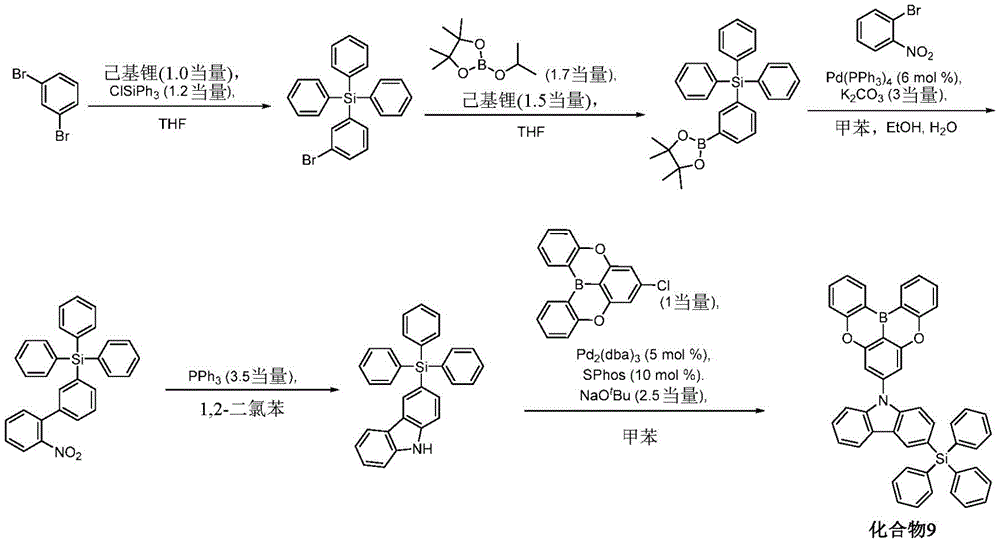
Step 1 to a 5L flask were added 1, 3-dibromobenzene (77ml, 636mmol) and THF (2000ml) under nitrogen. The resulting reaction mixture was cooled to-78 ℃ and a solution of hexalithium in hexane (2.3M, 290ml, 668mmol) was added over 20 minutes and stirred for 45 minutes. A solution of chlorotritylsilane (225g, 763mmol) in THF (800ml) was then added slowly and the reaction mixture was allowed to warm to room temperature and stirred overnight. The reaction mixture was then concentrated and the resulting solid wet-milled with EtOAc/MeOH (800mL/800mL) to afford (3-bromophenyl) triphenylsilane (72g) as a white solid.
Step 2 to a 5L flask were added (3-bromophenyl) triphenylsilane (72.0g, 173mmol) and THF (1576 ml). The resulting reaction mixture was stirred and cooled to-78 ℃. A solution of hexyllithium in hexane (2.3M, 113ml, 260mmol) was added over 20 minutes and stirred for 45 minutes. A solution of 2-isopropoxy-4, 4,5, 5-tetramethyl-1, 3, 2-dioxaborolan (60.1ml, 295mmol) in THF (158ml) was then added slowly and the reaction mixture was allowed to warm to room temperature and stirred overnight (about 16 hours). The reaction mixture was quenched with ice-cold water (1L) and the organic layer was separated. The aqueous layer was extracted with EtOAc (2X 700mL) and the combined organic layers were Na filtered2SO4Dried, filtered and concentrated. The off-white solid was wet-milled with heptane (500mL) to give triphenyl (3- (4,4,5, 5-tetramethyl-1, 3, 2-dioxaborolan-2-yl) phenyl) silane (64.97g) as a white solid.
Step 3 to a 2L flask were added 1-bromo-2-nitrobenzene (25g, 124mmol), potassium carbonate (51.3g, 371mmol), Pd (PPh)3)4(8.58g, 7.43mmol), toluene (300mL), water (100mL), and ethanol (100 mL). The resulting reaction mixture was heated to reflux and stirred for 20 hours. After cooling to room temperature, the reaction mixture was diluted with water (500mL) and the organic layer was separated. The aqueous layer was then extracted with EtOAc (2X 400 mL). The combined organic layers were washed with Na2SO4Dried, filtered and concentrated. The residue obtained is chromatographed on silica gel (DCM/heptane)) To obtain (2 '-nitro- [1,1' -biphenyl) as white solid]-3-yl) triphenylsilane (31.3 g).
Step 4 to a 2L flask equipped with a mechanical stirrer were added (2 '-nitro- [1,1' -biphenyl ] -3-yl) triphenylsilane (31.26g, 68.3mmol), triphenylphosphine (62.7g, 239mmol) and 1, 2-dichlorobenzene (683 mL). The reaction mixture was heated to reflux and stirred for 18 hours. The 1, 2-dichlorobenzene was then removed under reduced pressure and the crude residue was wet-milled with DCM/heptane. The resulting solid was further purified by silica gel column chromatography (DCM/heptane) to give 3- (triphenylsilyl) -9H-carbazole (12.05 g).
Step 5 to a 250mL flask under nitrogen was added 7-chloro-5, 9-dioxa-13 b-boranonaphtho [3,2,1-de]Anthracene (5.75g, 18.88mmol), 3- (triphenylsilyl) -9H-carbazole (8.0g, 18.80mmol), sodium 2-methylpropan-2-olate (4.54g, 47.2mmol), dicyclohexyl (2',6' -dimethoxy- [1,1' -biphenyl)]-2-yl) phosphine (0.775g, 1.888mmol), Pd2(dba)3(0.865g, 0.944mmol) and toluene (95 mL). The resulting mixture was degassed and heated to reflux (107 ℃). After 3 hours, TLC and NMR showed complete consumption of the starting material. The reaction mixture was cooled to room temperature, filtered through a mixed silica/alumina plug, and the plug was washed with toluene. The filtrate was concentrated and the resulting residue was purified by column chromatography on silica gel using DCM/heptane as eluent followed by recrystallization from toluene to give 9- (5, 9-dioxa-13 b-boranonaphtho [3,2, 1-de) as a white solid]Anthracene-7-yl) -3- (triphenylsilyl) -9H-carbazole (Compound 9) (4.2 g).
Synthesis of 9- (5, 9-dioxa-13 b-boranaphtho [3,2,1-de ] anthracen-7-yl) -9H-1,9' -dicarbazole (Compound 10)
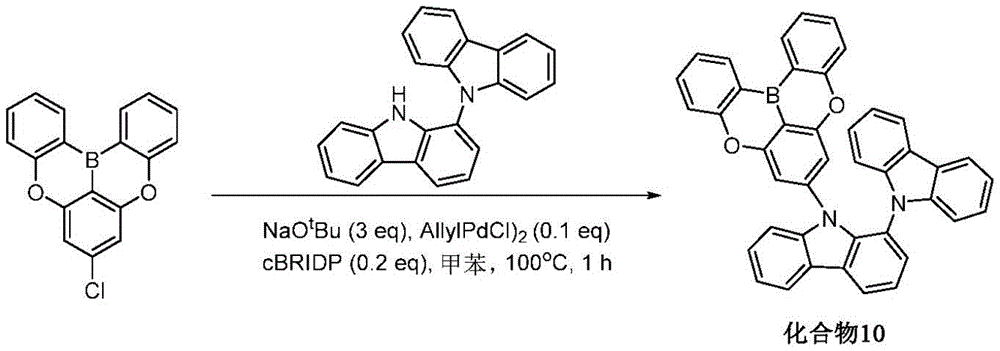
A suspension of 7-chloro-5, 9-dioxa-13 b-boranaphtho [3,2,1-de ] anthracene (5.50g, 18.1mmol), 9H-1,9' -dicarbazole (5.0g, 15mmol), sodium tert-butoxide (4.34g, 45.1mmol), allylpalladium (II) chloride dimer (0.550g, 1.50mmol), and di-tert-butyl (2, 2-diphenyl-1-methyl-1-cyclopropyl) phosphine [ cBRIDP ] (1.06g, 3.01mmol) in toluene (100mL) was bubbled with nitrogen for 10 minutes, and then heated at 100 ℃ for 1 hour under nitrogen. The reaction mixture was cooled to room temperature, pre-adsorbed onto silica gel and purified by flash column chromatography (silica gel, 220g cartridge, solid support, 0 to 20% DCM/isohexane) to give the product. This material was wet milled in refluxing methanol followed by wet milling in refluxing EtOAc. This material was then recrystallized twice from refluxing toluene (40mL) to give 9- (5, 9-dioxa-13 b-boranonaphtho [3,2,1-de ] anthracen-7-yl) -9H-1,9' -dicarbazole (compound 10) (4.25g, 7.01mmol, 47% yield) as a white solid.
Synthesis of 9- (5, 9-dioxa-13 b-boranaphtho [3,2,1-de ] anthracen-7-yl) -9H-3,9' -dicarbazole (Compound 11)

A degassed, preheated (about 130 ℃ C.) solution of allylpalladium chloride dimer (0.183g, 0.5mmol) and cBRIDP (0.705g, 2.001mmol) in m-xylene (75mL) was added to NaOtBu (1.923g, 20.01mmol), 9H-3,9' -dicarbazole (6.65g, 20.01mmol) and 7-chloro-5, 9-dioxa-13 b-boranonaphtho [3,2, 1-de)]Anthracene (6.70g, 22.01mmol) was added to a degassed, preheated (130 ℃ C.) mixture of m-xylene (250mL) and toluene (25 mL). The mixture was stirred at 130 ℃ under Ar for 20 hours. Tlc (15% DCM/hexane) showed the reaction was complete. After cooling to room temperature, water was added. The mixture was filtered. The liquid was extracted with EtOAc and over Na2SO4And (5) drying. The collected gray solid (10.5g) was dissolved in THF (5L), filtered through a pad of Celite, and concentrated to give 9- (5, 9-dioxa-13 b-boranonaphtho [3,2, 1-de) as a white solid]Anthracen-7-yl) -9H-3,9' -dicarbazole (compound 11) (10.18 g).
OLED devices were fabricated using compound 6, compound 10, compound 11, and compound 12 as single hosts for sky-blue Ir emitters (emitter 1) or as electron-transporting co-hosts for deep-blue Pt emitters (emitter 2). The device results are shown in Table 1, where EQE and voltage are at 10mA/cm2Lower acquisitionAnd the life (LT90) is a reduction in luminance to 1000cd/m2Time (hours) 90% of the initial brightness.

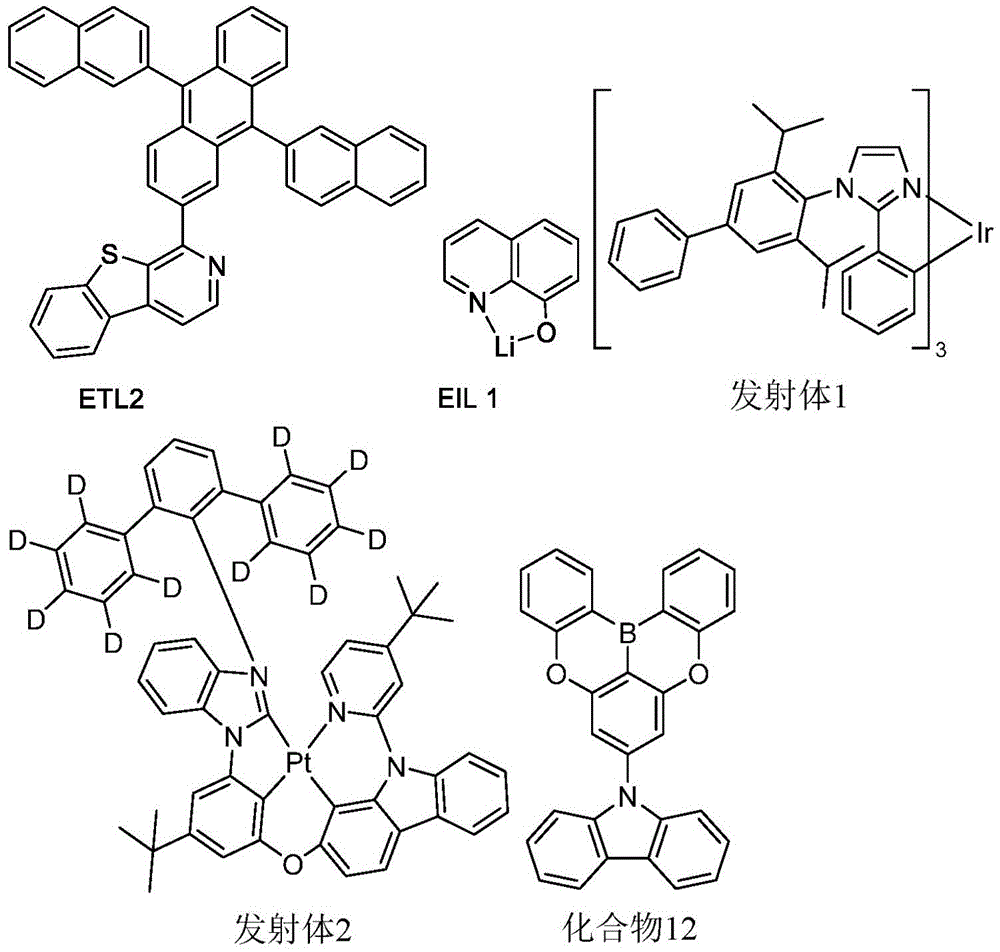
TABLE 1

The OLED is formed by growing an OLED on a glass substrate, wherein the glass substrate is pre-coated with an Indium Tin Oxide (ITO) layer with the sheet resistance of 15-omega/sq. Prior to any organic layer deposition or coating, the substrate was degreased with a solvent, then treated with oxygen plasma at 100 mtorr, 50W for 1.5 minutes and treated with UV ozone for 5 minutes. The apparatus in Table 1 was operated by thermal evaporation under high vacuum (<10-6Tray). The anode electrode is Indium Tin Oxide (ITO). All devices were made immediately after nitrogen glovebox (H)2O and O2<1ppm) was encapsulated with a glass lid, sealed with epoxy, and incorporated with a desiccant inside the encapsulation. The doping percentage is volume percentage. Two device configurations are used.
The organic layers of device structure 1 consist of, in order: the ITO surface, Thickness of HIL1(HIL),
 A HTL1 layer (HTL),
 EBL2(EBL),
 EBL2 with 40% co-host and 12% emitter 2(EML),
 HBL2(HBL),
 ETL2(ETL) doped with 35% EIL1,
 EIL1(EIL), followed by
 Al (cathode).
The organic layers of device structure 2 consist of, in order: the ITO surface, Thickness of HIL1(HIL),
 A HTL1 layer (HTL),
 EBL1(EBL),
 A host doped with 20% of the emitter 1(EML),
 HBL1(HBL),
 ETL1(ETL),
 EIL1(EIL), followed by
 Al (cathode).
Device example 1 is a co-host using compound 6 in device structure 1.
Device example 2 is a co-host using compound 10 in device structure 1.
Device example 3 is a co-host using compound 11 in device structure 1.
Device example 4 is a co-host using compound 12 in device structure 1.
Device comparative example 1 is a co-host using HBL2 in device configuration 1.
Device comparative example 2 is a co-host using compound 12 in device structure 2.
Comparative device example 3 is a co-host using HBL1 in device configuration 2.
The above data show that device example 1 using inventive compound 6 as the host exhibited a more blue color than the comparative compound (compound 12). The blue shift of 1nm and CIEy decrease by 0.015 over any number that may be attributed to experimental error, and the observed improvement is significant. The significant improvement in performance observed in the above data is unexpected based on the fact that compound 6 is structurally similar to compound 12 (differing only in the replacement of triphenylsilane with a carbazole moiety). Without being bound by any theory, this improvement may be attributed to the increase in steric bulk introduced by the tetrahedral silane moiety, inhibiting the formation of any low energy excited complexes between the molecules of the present invention and the platinum complex (emitter 2).
The above data show that device examples 2 and 3, which use inventive compound 10 and compound 11 as hosts, respectively, exhibit higher EQE than the comparative compound (compound 12). The increase in EQE is beyond any value attributable to experimental error and the observed improvement is significant. The significant performance improvements observed in the above data are unexpected based on the fact that the structures of compound 10 and compound 11 are similar to compound 12 (differing only by the substitution of the exocarbazole moiety). Without being bound by any theory, this improvement may be attributed to the improved charge transport properties of the bis-carbazoles of the compounds of the present invention (compound 10 and compound 11) compared to the mono-carbazole substitution of comparative compound 12.
As shown in table 1, the EQE of all devices (example 1 to example 4) using boron-containing hosts was higher than the comparative compound HBL2 in comparative example 1. The increase in EQE is beyond any value attributable to experimental error and the observed improvement is significant. In addition, the enhancement caused by the use of boron-containing hosts was only achieved with the use of Pt complexes (emitter 2). In comparative example 2, when Ir emitters were used, the device exhibited red-shifted emission and reduced EQE compared to comparative example 3. The improved performance of boron containing hosts using platinum emitters when used in conjunction with iridium phosphors is unexpected in view of the reduced performance of compound 12. Without being bound by any theory, this improvement may be attributed to the suppression of excited complex formation in devices using platinum phosphors as compared to iridium phosphors.
Claims (20)
1. A compound comprising the structure of formula I
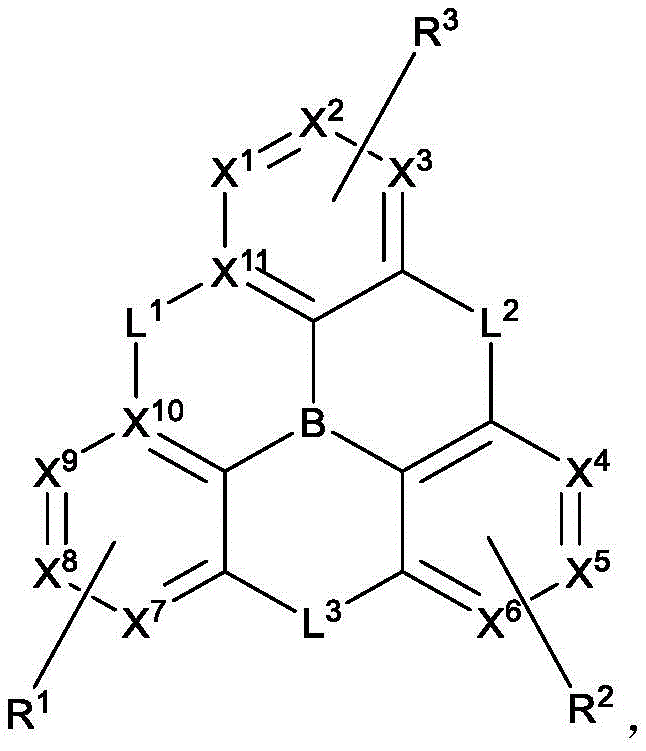
Wherein:
X1to X11Each independently is C or N;
L2and L3Each independently selected from the group consisting of O, S, Se and SiRR';
L1is not always present, but when present, L1Selected from the group consisting of O, S, Se and SiRR', and X10And X11Are all C;
L2and L3Always present;
R1、R2and R3Each independently represents zero, single, or up to the maximum permissible substitutions for its consecutive rings; r1、R2And R3Each of which is independently hydrogen or a substituent selected from the group consisting of: formula II. III, IV, V, VI, VII, and VIII, deuterium, halogen, alkyl, cycloalkyl, heteroalkyl, heterocycloalkyl, arylalkyl, alkoxy, aryloxy, amino, silyl, oxyboronyl, alkenyl, cycloalkenyl, heteroalkenyl, alkynyl, aryl, heteroaryl, acyl, carboxylic acid, ether, ester, nitrile, isonitrile, thio, sulfinyl, sulfonyl, phosphino, and combinations thereof, wherein R is selected from the group consisting of, or a combination thereof1、R2And R3Comprises a structure selected from the group consisting of: formulas II, III, IV, V, VI, VII, and VIII and aza variants thereof;
wherein formulae II, III, IV, V, VI, VII and VIII are defined as follows:
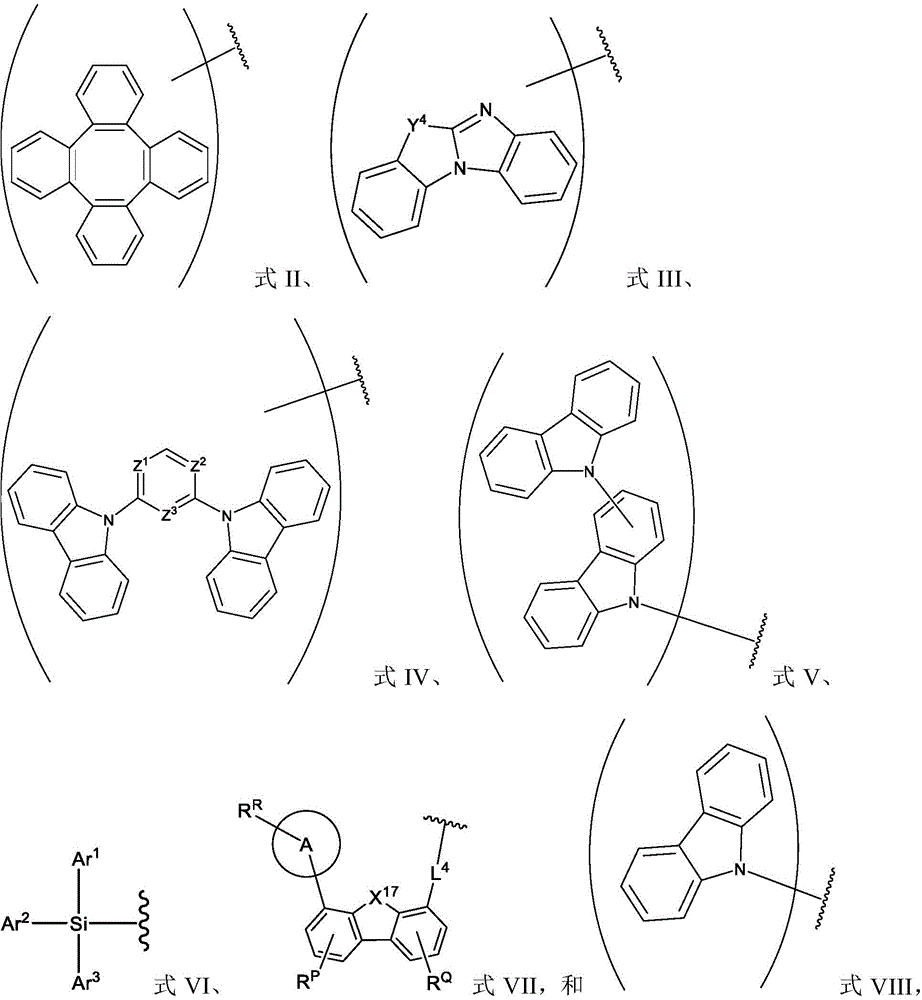
and is
With the proviso that when X1To X11When both are C, R1、R2And R3At least one of which comprises a group selected from the group consisting of formulas II, III, IV, V, VI and VII;
when R is1、R2And R3When one of them comprises formula VII, said compound has exactly one B atom;
when X is present1To X11R is C and formula II, III, IV, V, VI and VIII are absent2Comprising formula VII;
Z1、Z2and Z3Each independently is C or N;
Z1、Z2and Z3Is N;
Ar1、Ar2and Ar3Each is a substituted or unsubstituted aryl or heteroaryl ring;
Y4selected from the group consisting of: o, Se, BR, N, NR, CRR ', SiRR ' and GeRR ';
L4is a direct bond or an aromatic group comprising one or more fused or unfused aromatic rings which can be further substituted;
RR、RPand RQEach independently represents zero, single, or up to the maximum permissible substitutions for its consecutive rings;
X17selected from the group consisting of: o, S, Se, NR4、CR4R5And SiR4R5;
R、R'、RP、RQ、R4And R5Each of which is independently hydrogen or a substituent selected from the group consisting of: deuterium, halogen, alkyl, cycloalkyl, heteroalkyl, heterocycloalkyl, oxyboronyl, arylalkyl, alkoxy, aryloxy, amino, silyl, alkenyl, cycloalkenyl, heteroalkenyl, alkynyl, aryl, heteroaryl, acyl, carboxylic acid, ether, ester, nitrile, isonitrile, thio, sulfinyl, sulfonyl, phosphino, and combinations thereof;
RRis hydrogen or a substituent selected from the group consisting of: deuterium, halogen, alkyl, cycloalkyl, heteroalkyl, heterocycloalkyl, arylalkyl, alkoxy, aryloxy, amino, silyl, alkenyl, cycloalkenyl, heteroalkenyl, alkynyl, aryl, heteroaryl, acyl, carboxylic acid, ether, ester, nitrile, isonitrile, thio, sulfinyl, sulfonyl, phosphino, and combinations thereof;
ring a is a monocyclic or polycyclic ring system comprising one or more fused 5-or 6-membered carbocyclic or heterocyclic rings; and is
R1、R2、R3、R4、R5、R、R'、RP、RQAnd RRAny two of which can be joined or fused to form a ring,
with the proviso that Ar1、Ar2And Ar3None of which join to form a ring; and the compound is not of the structure:
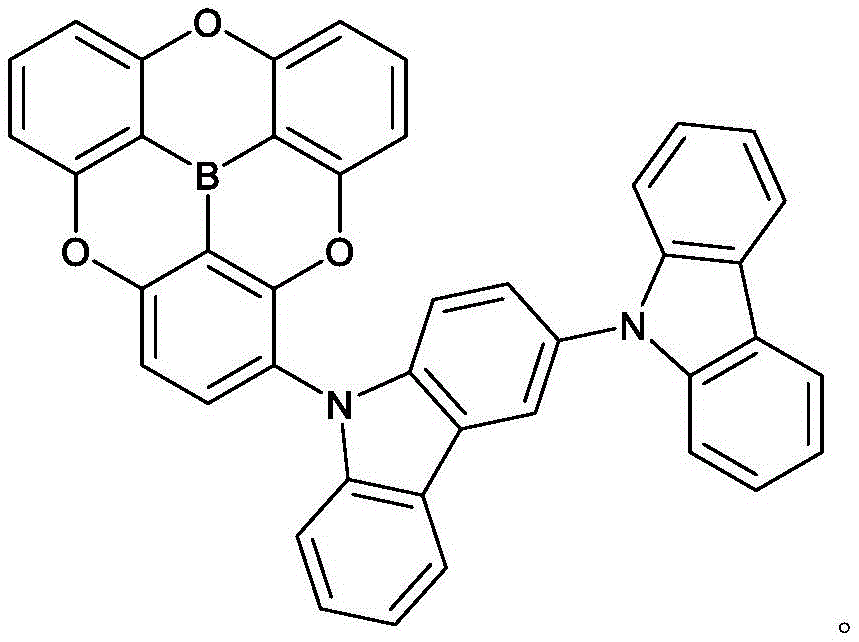
2. according to the claimsThe compound of claim 1, wherein R, R' and R1、R2、R3、R4、R5、RP、RQAnd RREach of which is independently hydrogen or a substituent selected from the group consisting of: deuterium, fluorine, alkyl, cycloalkyl, heteroalkyl, alkoxy, aryloxy, amino, silyl, oxyboronyl, alkenyl, cycloalkenyl, heteroalkenyl, aryl, heteroaryl, nitrile, isonitrile, thio, and combinations thereof.
3. The compound of claim 1, wherein L1Is absent.
4. The compound of claim 1, wherein L1Is present and L1、L2And L3Each independently selected from the group consisting of O and S.
5. The compound of claim 1, wherein L1Is present and L1、L2And L3Each is O.
6. The compound of claim 1, wherein R1、R2And R3Comprising the chemical structure of formula VI and one other chemical structure selected from the group consisting of: formulae II, III, IV, V, VII, VIII and aza variants thereof.
7. The compound of claim 1, wherein RRIs aryl or heteroaryl, or RPOr RQAt least one of which is aryl or heteroaryl.
8. The compound of claim 1, wherein X17Selected from the group consisting of O, S, Se and NR4A group of combinations thereof.
9. The compound of claim 1, wherein the compound comprises the structure of formula IX

10. The compound of claim 9, wherein R1、R2And R3Comprises the structure of formula VIII, or an aza variant thereof.
11. The compound of claim 1, wherein the compound comprises a structure selected from the group consisting of:

wherein R isA、RB、RCAnd RFEach of which is independently hydrogen or a substituent selected from the group consisting of: deuterium, fluorine, alkyl, cycloalkyl, heteroalkyl, alkoxy, aryloxy, amino, silyl, oxyboronyl, alkenyl, cycloalkenyl, heteroalkenyl, aryl, heteroaryl, nitrile, isonitrile, thio, and combinations thereof.
12. The compound of claim 1, wherein the compound is selected from the group consisting of:
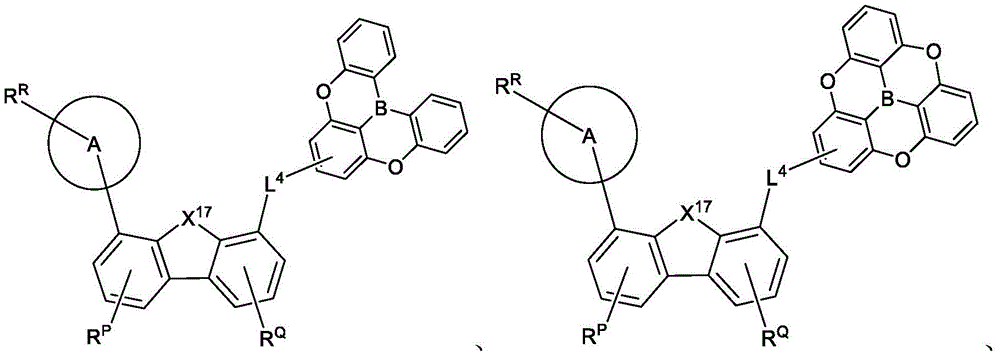
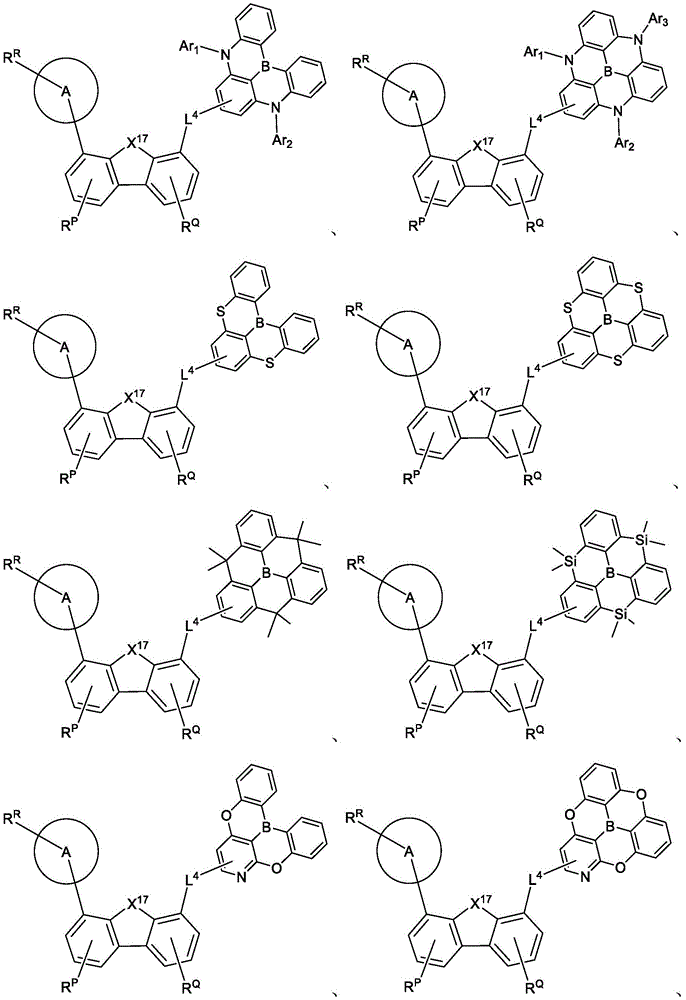

a group consisting of:

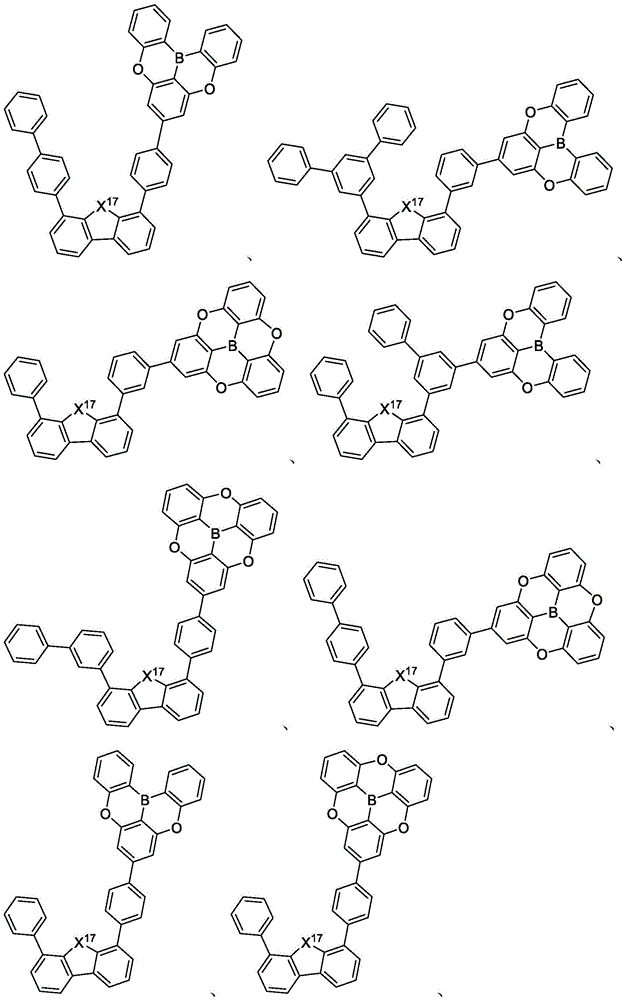
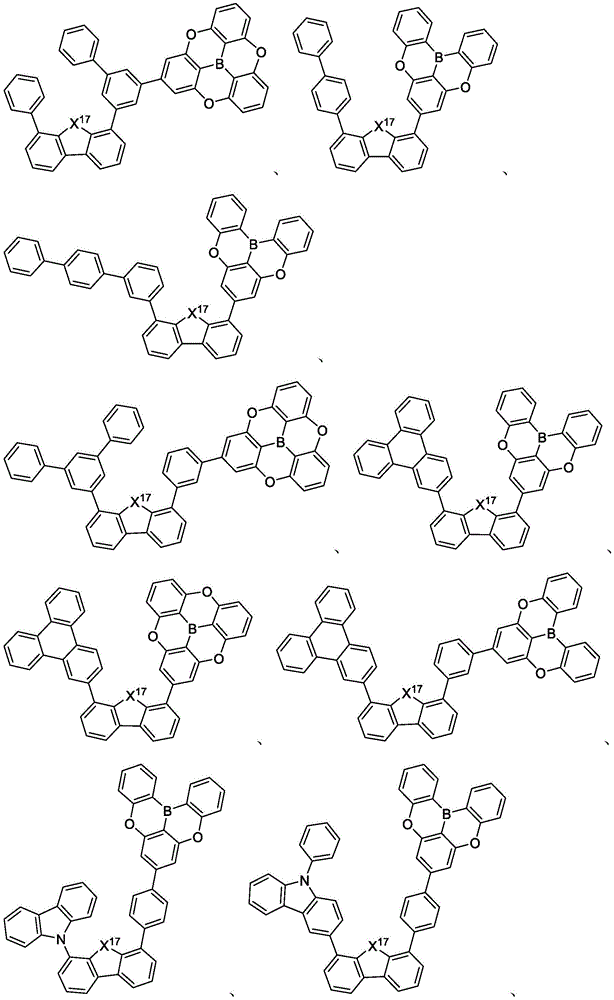

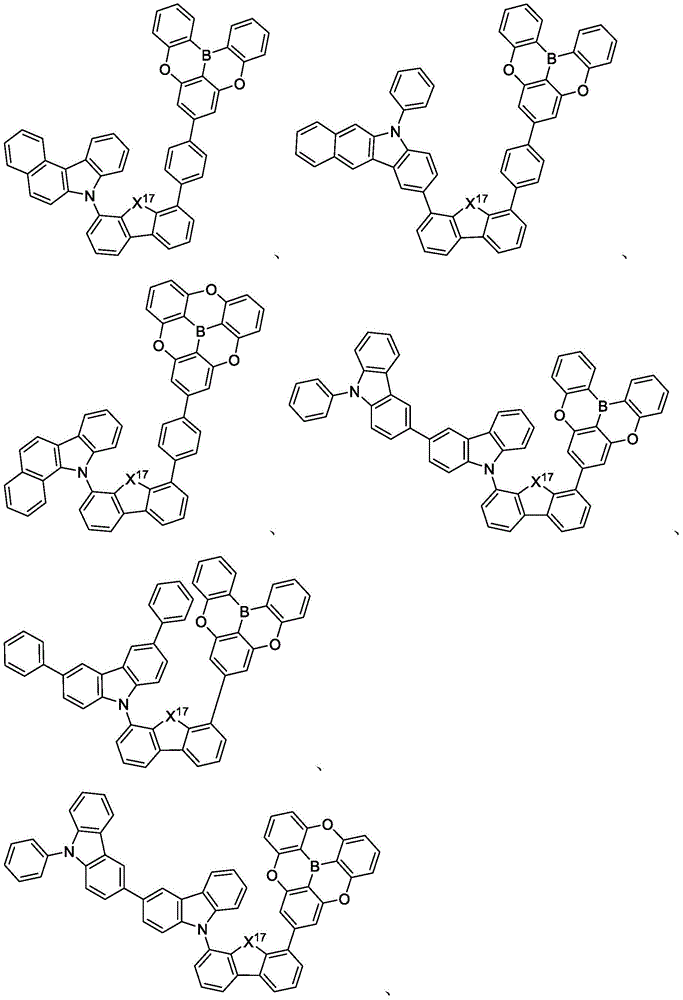
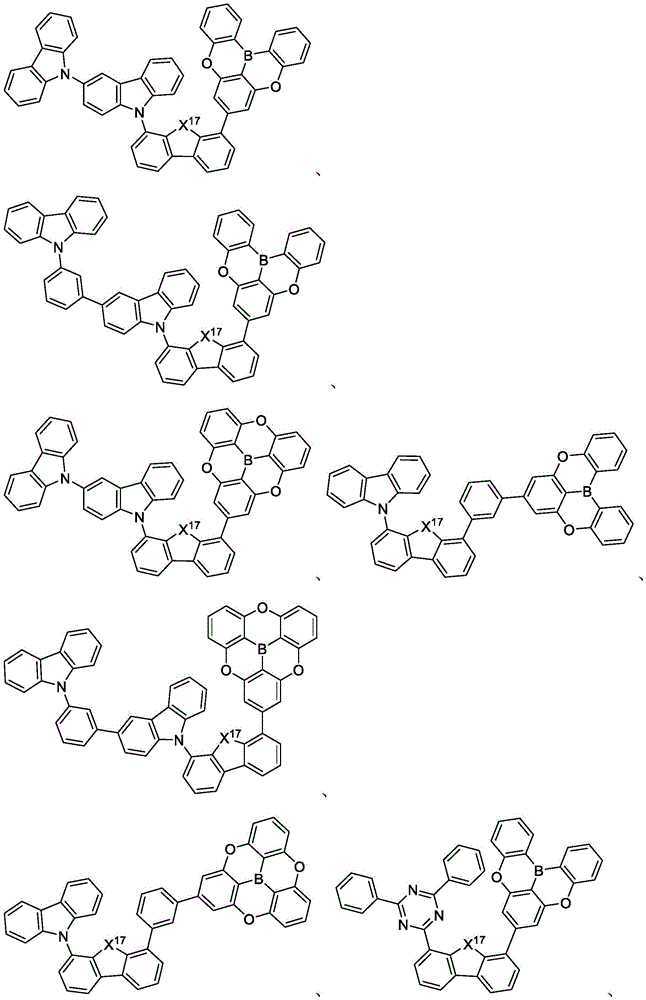
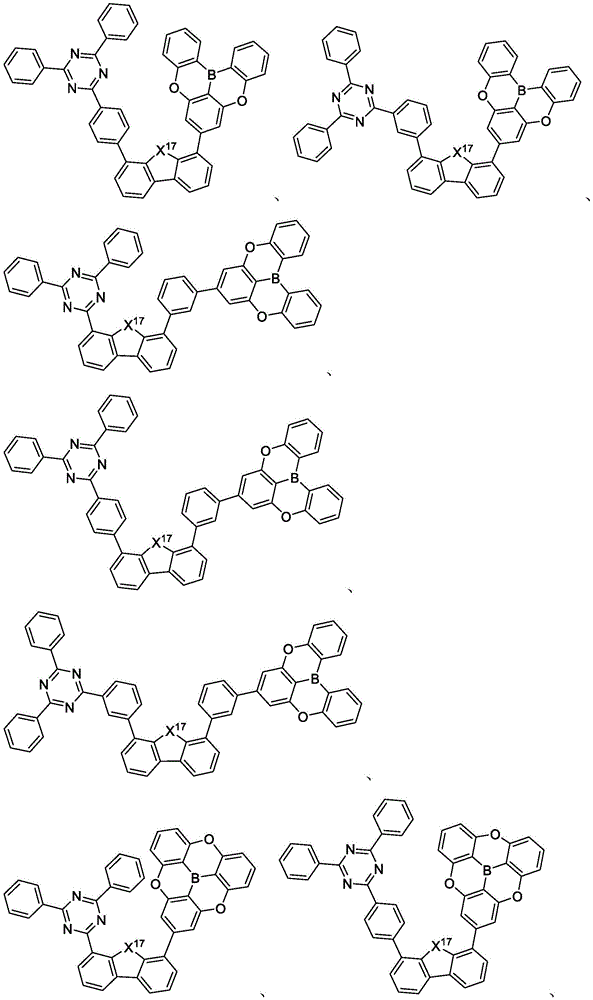
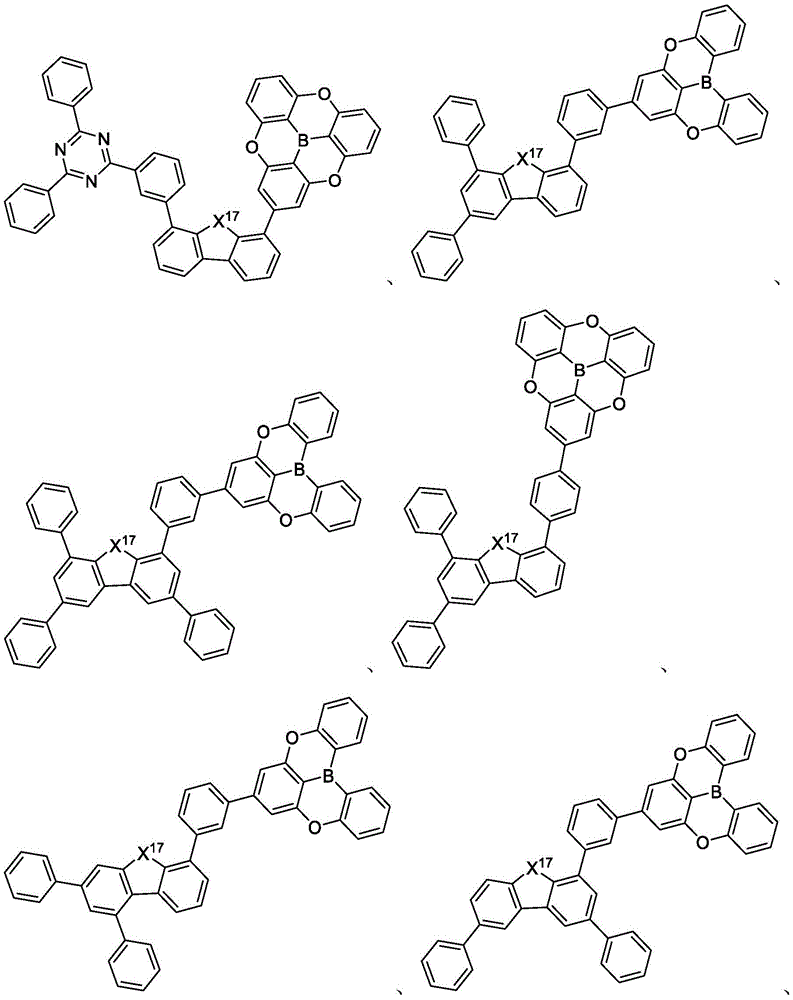
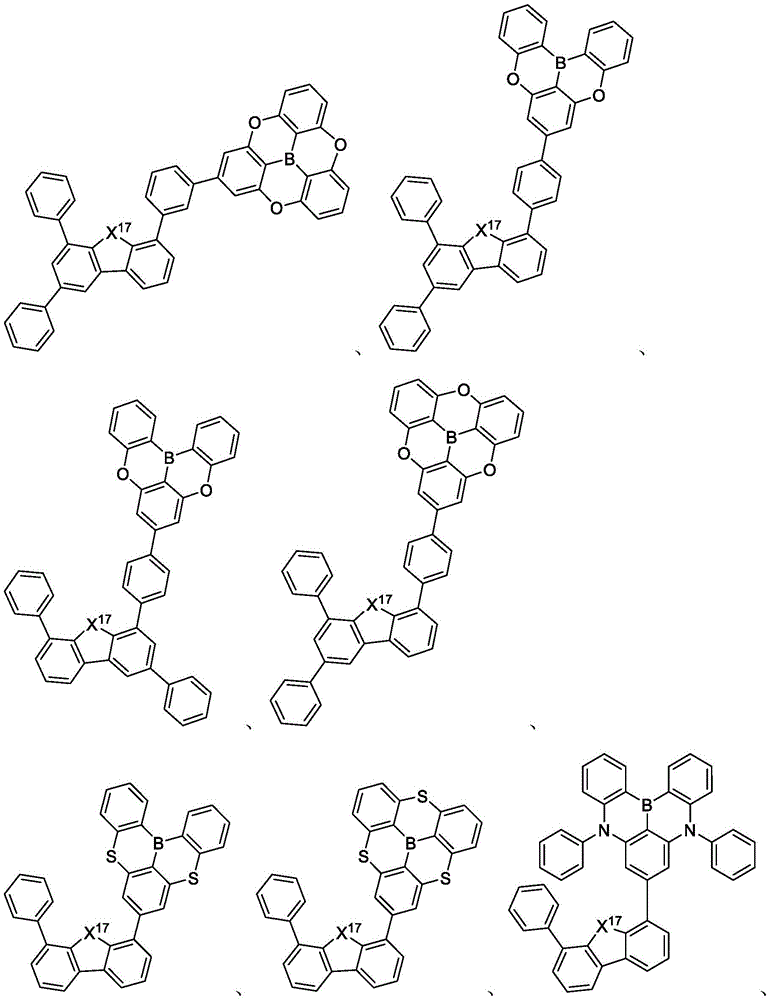

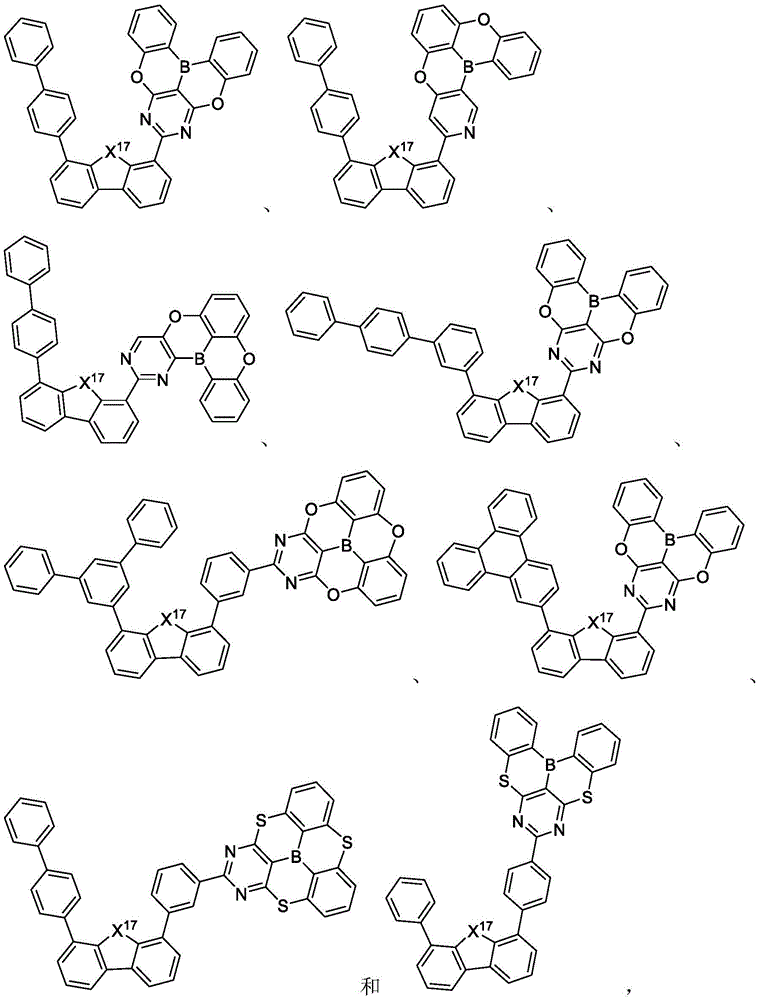
wherein X17Selected from the group consisting of O, S, Se and NR4A group of combinations thereof.
13. The compound of claim 1, wherein the compound comprises a structure selected from the group consisting of:


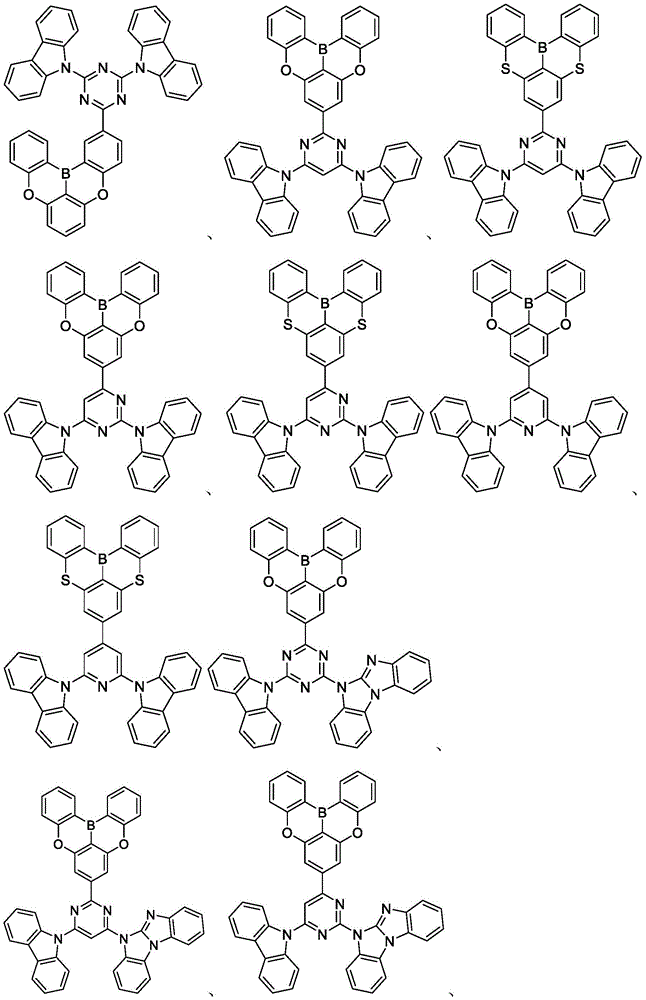
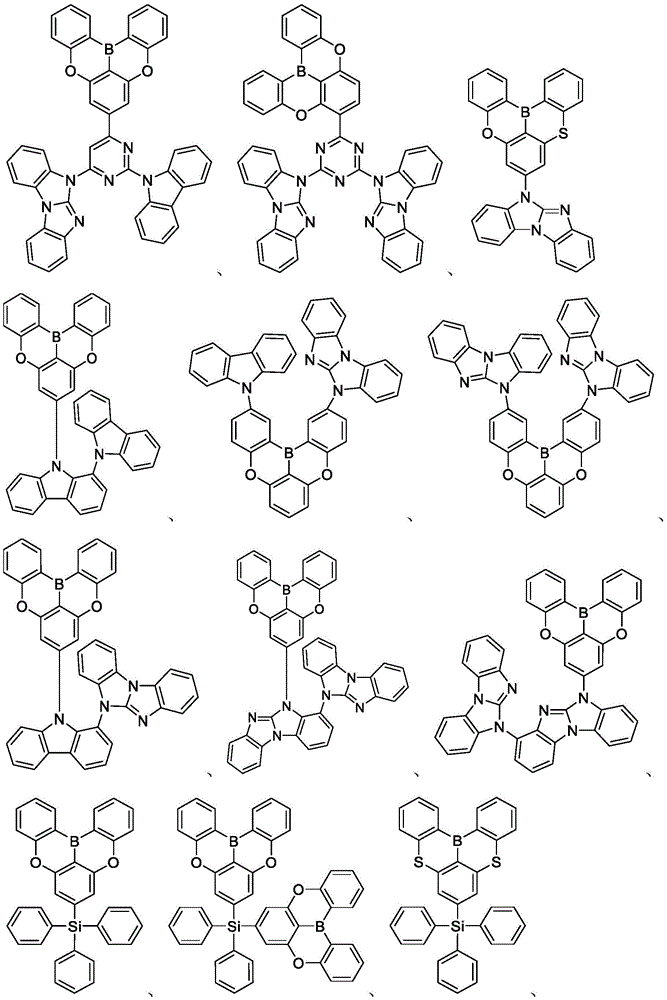
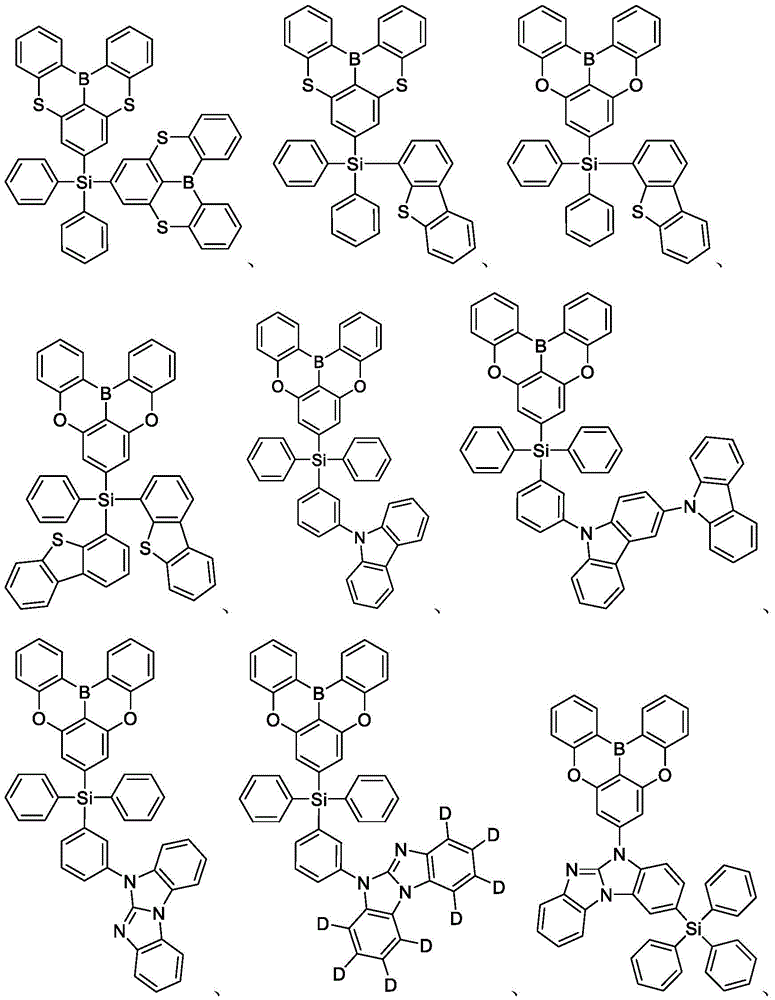


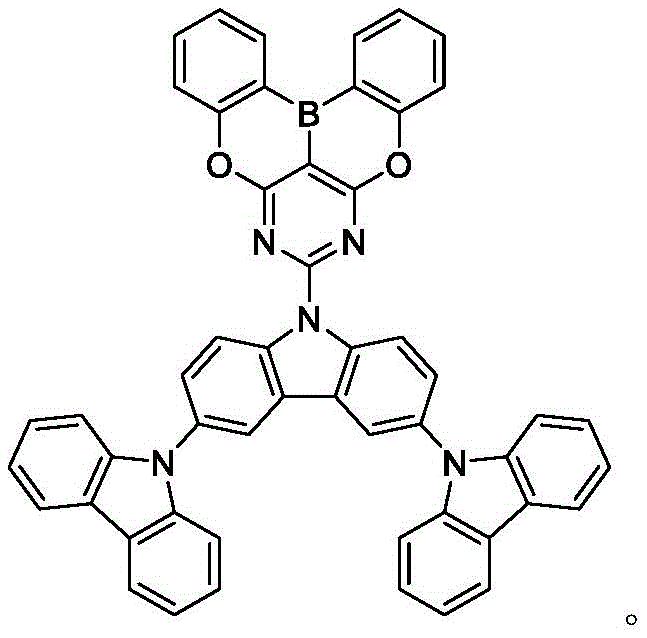
14. an Organic Light Emitting Device (OLED), comprising:
an anode;
a cathode; and
an emissive layer disposed between the anode and the cathode, wherein the emissive layer comprises a compound comprising a structure of formula I
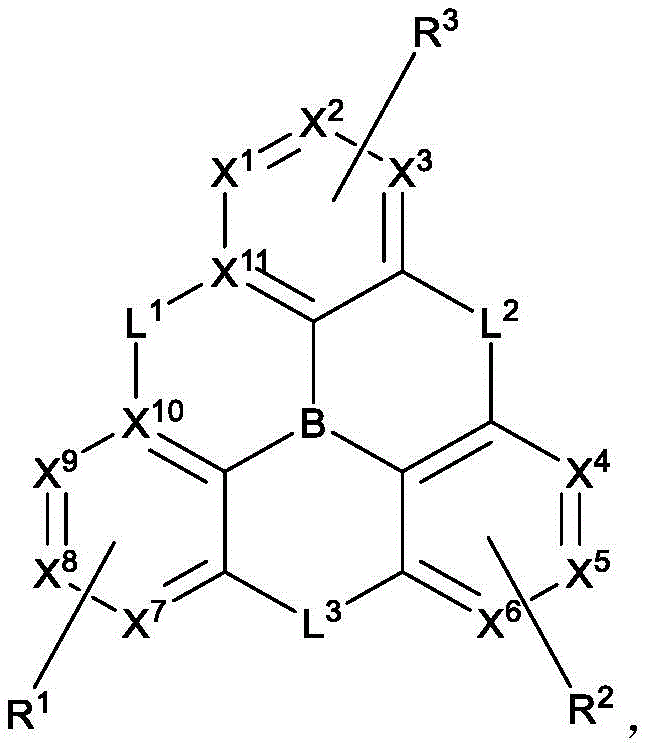
Wherein:
X1to X11Each independently is C or N;
L2and L3Each independently selected from the group consisting of O, S, Se and SiRR';
L1it is not always present,but when present, L1Selected from the group consisting of O, S, Se and SiRR', and X10And X11Are all C;
L2and L3Always present;
R1、R2and R3Each independently represents zero, single, or up to the maximum permissible substitutions for its consecutive rings; r1、R2And R3Each of which is independently hydrogen or a substituent selected from the group consisting of: formula II, III, IV, V, VI, VII, and VIII, deuterium, halogen, alkyl, cycloalkyl, heteroalkyl, heterocycloalkyl, arylalkyl, alkoxy, aryloxy, amino, silyl, oxyboronyl, alkenyl, cycloalkenyl, heteroalkenyl, alkynyl, aryl, heteroaryl, acyl, carboxylic acid, ether, ester, nitrile, isonitrile, thio, sulfinyl, sulfonyl, phosphino, and combinations thereof, wherein R is independently selected from the group consisting of alkyl, aryl, heteroaryl, aryl, and combinations thereof, wherein R is independently selected from the group consisting of alkyl, aryl, heteroaryl, aryl1、R2And R3Comprises a structure selected from the group consisting of: formulas II, III, IV, V, VI, VII, and VIII and aza variants thereof;
wherein formulae II, III, IV, V, VI, VII and VIII are defined as follows:
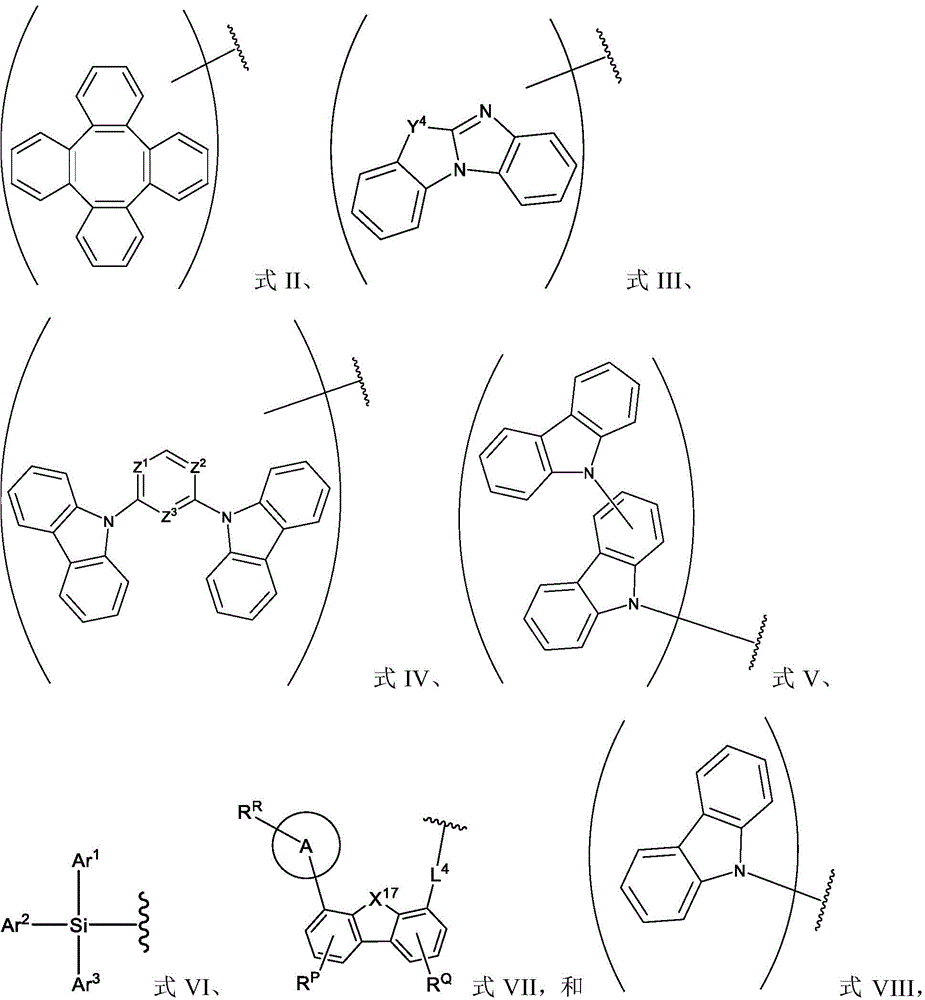
and is
With the proviso that when X1To X11When both are C, R1、R2And R3At least one of which comprises a group selected from the group consisting of formulas II, III, IV, V, VI and VII;
when R is1、R2And R33When one of them comprises formula VII, said compound has exactly one B atom;
when X is present1To X11R is C and formula II, III, IV, V, VI and VIII are absent2Comprising formula VII;
Z1、Z2and Z3Each independently is C or N;
Z1、Z2and Z3Is N;
Ar1、Ar2and Ar3Each is a substituted or unsubstituted aryl or heteroaryl ring;
Y4selected from the group consisting of: o, Se, BR, N, NR, CRR ', SiRR ' and GeRR ';
L4is a direct bond or an aromatic group comprising one or more fused or unfused aromatic rings which can be further substituted;
RR、RPand RQEach independently represents zero, single, or up to the maximum permissible substitutions for its consecutive rings;
X17selected from the group consisting of: o, S, Se, NR4、CR4R5And SiR4R5;
R、R'、RP、RQ、R4And R5Each of which is independently hydrogen or a substituent selected from the group consisting of: deuterium, halogen, alkyl, cycloalkyl, heteroalkyl, heterocycloalkyl, oxyboronyl, arylalkyl, alkoxy, aryloxy, amino, silyl, alkenyl, cycloalkenyl, heteroalkenyl, alkynyl, aryl, heteroaryl, acyl, carboxylic acid, ether, ester, nitrile, isonitrile, thio, sulfinyl, sulfonyl, phosphino, and combinations thereof;
RRis hydrogen or a substituent selected from the group consisting of: deuterium, halogen, alkyl, cycloalkyl, heteroalkyl, heterocycloalkyl, arylalkyl, alkoxy, aryloxy, amino, silyl, alkenyl, cycloalkenyl, heteroalkenyl, alkynyl, aryl, heteroaryl, acyl, carboxylic acid, ether, ester, nitrile, isonitrile, thio, sulfinyl, sulfonyl, phosphino, and combinations thereof;
ring a is a monocyclic or polycyclic ring system comprising one or more fused 5-or 6-membered carbocyclic or heterocyclic rings; and is
R1、R2、R3、R4、R5、R、R'、RP、RQAnd RRAny two of which can be joined or fused toForming a ring,
with the proviso that Ar1、Ar2And Ar3None of which join to form a ring; and the compound is not of the structure:

15. the OLED of claim 14 wherein the compound is a host and the organic layer further comprises a phosphorescent emissive dopant; wherein the emissive dopant is a transition metal complex having at least one ligand or a portion of the ligand if the ligand is more than bidentate selected from the group consisting of list 3 as described herein.
16. The OLED according to claim 14 wherein the compound is an acceptor and the OLED further comprises a sensitizer selected from the group consisting of: delayed fluorescence emitters, phosphorescence emitters and combinations thereof.
17. The OLED of claim 14 wherein the compound is a fluorescence emitter, a delayed fluorescence emitter, or a component in an excitation complex that is a fluorescence emitter or a delayed fluorescence emitter.
18. The OLED according to claim 14 wherein the compound is a sensitizer and the OLED further comprises an acceptor selected from the group consisting of: fluorescent emitters, delayed fluorescent emitters, and combinations thereof.
19. A consumer product comprising an organic light emitting device OLED according to claim 14.
20. An Organic Light Emitting Device (OLED), comprising:
an anode;
a cathode; and
an emissive layer disposed between the anode and the cathode, wherein the emissive layer comprises a first compound and a second compound;
wherein the first compound is a boron compound having a triangular planar geometry; and is
Wherein the second compound is a Pt (II) complex having a square planar geometry.
Priority Applications (3)
| Application Number | Priority Date | Filing Date | Title |
|---|---|---|---|
| CN202510604833.7A CN120463730A (en) | 2019-10-25 | 2020-10-23 | Organic electroluminescent materials and devices |
| CN202510604817.8A CN120463729A (en) | 2019-10-25 | 2020-10-23 | Organic electroluminescent materials and devices |
| CN202510604874.6A CN120463731A (en) | 2019-10-25 | 2020-10-23 | Organic electroluminescent materials and devices |
Applications Claiming Priority (8)
| Application Number | Priority Date | Filing Date | Title |
|---|---|---|---|
| US201962926035P | 2019-10-25 | 2019-10-25 | |
| US62/926,035 | 2019-10-25 | ||
| US202062971295P | 2020-02-07 | 2020-02-07 | |
| US62/971,295 | 2020-02-07 | ||
| US202062982883P | 2020-02-28 | 2020-02-28 | |
| US62/982,883 | 2020-02-28 | ||
| US17/063,884 | 2020-10-06 | ||
| US17/063,884 US11919914B2 (en) | 2019-10-25 | 2020-10-06 | Organic electroluminescent materials and devices |
Related Child Applications (3)
| Application Number | Title | Priority Date | Filing Date |
|---|---|---|---|
| CN202510604874.6A Division CN120463731A (en) | 2019-10-25 | 2020-10-23 | Organic electroluminescent materials and devices |
| CN202510604833.7A Division CN120463730A (en) | 2019-10-25 | 2020-10-23 | Organic electroluminescent materials and devices |
| CN202510604817.8A Division CN120463729A (en) | 2019-10-25 | 2020-10-23 | Organic electroluminescent materials and devices |
Publications (2)
| Publication Number | Publication Date |
|---|---|
| CN112707923A true CN112707923A (en) | 2021-04-27 |
| CN112707923B CN112707923B (en) | 2025-06-03 |
Family
ID=75542858
Family Applications (4)
| Application Number | Title | Priority Date | Filing Date |
|---|---|---|---|
| CN202011145644.1A Active CN112707923B (en) | 2019-10-25 | 2020-10-23 | Organic electroluminescent materials and devices |
| CN202510604817.8A Pending CN120463729A (en) | 2019-10-25 | 2020-10-23 | Organic electroluminescent materials and devices |
| CN202510604833.7A Pending CN120463730A (en) | 2019-10-25 | 2020-10-23 | Organic electroluminescent materials and devices |
| CN202510604874.6A Pending CN120463731A (en) | 2019-10-25 | 2020-10-23 | Organic electroluminescent materials and devices |
Family Applications After (3)
| Application Number | Title | Priority Date | Filing Date |
|---|---|---|---|
| CN202510604817.8A Pending CN120463729A (en) | 2019-10-25 | 2020-10-23 | Organic electroluminescent materials and devices |
| CN202510604833.7A Pending CN120463730A (en) | 2019-10-25 | 2020-10-23 | Organic electroluminescent materials and devices |
| CN202510604874.6A Pending CN120463731A (en) | 2019-10-25 | 2020-10-23 | Organic electroluminescent materials and devices |
Country Status (3)
| Country | Link |
|---|---|
| US (1) | US12479861B2 (en) |
| KR (1) | KR20260002341A (en) |
| CN (4) | CN112707923B (en) |
Cited By (2)
| Publication number | Priority date | Publication date | Assignee | Title |
|---|---|---|---|---|
| CN115181122A (en) * | 2021-09-03 | 2022-10-14 | 清华大学 | Luminescent material, application thereof and organic electroluminescent device comprising luminescent material |
| CN117683032A (en) * | 2022-08-26 | 2024-03-12 | 阜阳欣奕华材料科技有限公司 | A composition, intermediate and organic electroluminescent device containing indolocarbazole compounds |
Citations (6)
| Publication number | Priority date | Publication date | Assignee | Title |
|---|---|---|---|---|
| CN105431439A (en) * | 2014-02-18 | 2016-03-23 | 学校法人关西学院 | Polycyclic aromatic compound |
| CN107735879A (en) * | 2015-03-25 | 2018-02-23 | 学校法人关西学院 | Polycyclc aromatic compound and luminescent layer formation composition |
| CN107851724A (en) * | 2015-03-24 | 2018-03-27 | 学校法人关西学院 | Organic electric-field light-emitting element |
| CN109671852A (en) * | 2017-10-16 | 2019-04-23 | 三星显示有限公司 | Organic luminescent device and panel display apparatus including it |
| WO2019079508A2 (en) * | 2017-10-17 | 2019-04-25 | Jian Li | Phosphorescent excimers with preferred molecular orientation as monochromatic emitters for display and lighting applications |
| US20190214577A1 (en) * | 2015-12-04 | 2019-07-11 | Guangzhou Chinaray Optoelectronic Materials Ltd. | Thermally activated delayed fluorescence material, polymer, mixture, formulation, and organic electronic device |
Family Cites Families (139)
| Publication number | Priority date | Publication date | Assignee | Title |
|---|---|---|---|---|
| US4769292A (en) | 1987-03-02 | 1988-09-06 | Eastman Kodak Company | Electroluminescent device with modified thin film luminescent zone |
| GB8909011D0 (en) | 1989-04-20 | 1989-06-07 | Friend Richard H | Electroluminescent devices |
| US5061569A (en) | 1990-07-26 | 1991-10-29 | Eastman Kodak Company | Electroluminescent device with organic electroluminescent medium |
| DE69412567T2 (en) | 1993-11-01 | 1999-02-04 | Hodogaya Chemical Co., Ltd., Tokio/Tokyo | Amine compound and electroluminescent device containing it |
| US5707745A (en) | 1994-12-13 | 1998-01-13 | The Trustees Of Princeton University | Multicolor organic light emitting devices |
| US5703436A (en) | 1994-12-13 | 1997-12-30 | The Trustees Of Princeton University | Transparent contacts for organic devices |
| US6939625B2 (en) | 1996-06-25 | 2005-09-06 | Nôrthwestern University | Organic light-emitting diodes and methods for assembly and enhanced charge injection |
| US5844363A (en) | 1997-01-23 | 1998-12-01 | The Trustees Of Princeton Univ. | Vacuum deposited, non-polymeric flexible organic light emitting devices |
| US5834893A (en) | 1996-12-23 | 1998-11-10 | The Trustees Of Princeton University | High efficiency organic light emitting devices with light directing structures |
| US6091195A (en) | 1997-02-03 | 2000-07-18 | The Trustees Of Princeton University | Displays having mesa pixel configuration |
| US6013982A (en) | 1996-12-23 | 2000-01-11 | The Trustees Of Princeton University | Multicolor display devices |
| US6303238B1 (en) | 1997-12-01 | 2001-10-16 | The Trustees Of Princeton University | OLEDs doped with phosphorescent compounds |
| US6337102B1 (en) | 1997-11-17 | 2002-01-08 | The Trustees Of Princeton University | Low pressure vapor phase deposition of organic thin films |
| US6087196A (en) | 1998-01-30 | 2000-07-11 | The Trustees Of Princeton University | Fabrication of organic semiconductor devices using ink jet printing |
| US6528187B1 (en) | 1998-09-08 | 2003-03-04 | Fuji Photo Film Co., Ltd. | Material for luminescence element and luminescence element using the same |
| US6830828B2 (en) * | 1998-09-14 | 2004-12-14 | The Trustees Of Princeton University | Organometallic complexes as phosphorescent emitters in organic LEDs |
| US6097147A (en) | 1998-09-14 | 2000-08-01 | The Trustees Of Princeton University | Structure for high efficiency electroluminescent device |
| US6294398B1 (en) | 1999-11-23 | 2001-09-25 | The Trustees Of Princeton University | Method for patterning devices |
| US6458475B1 (en) | 1999-11-24 | 2002-10-01 | The Trustee Of Princeton University | Organic light emitting diode having a blue phosphorescent molecule as an emitter |
| KR100377321B1 (en) | 1999-12-31 | 2003-03-26 | 주식회사 엘지화학 | Electronic device comprising organic compound having p-type semiconducting characteristics |
| US20020121638A1 (en) | 2000-06-30 | 2002-09-05 | Vladimir Grushin | Electroluminescent iridium compounds with fluorinated phenylpyridines, phenylpyrimidines, and phenylquinolines and devices made with such compounds |
| JP2002050860A (en) | 2000-08-04 | 2002-02-15 | Toray Eng Co Ltd | Mounting method and mounting device |
| US6579630B2 (en) | 2000-12-07 | 2003-06-17 | Canon Kabushiki Kaisha | Deuterated semiconducting organic compounds used for opto-electronic devices |
| JP3812730B2 (en) | 2001-02-01 | 2006-08-23 | 富士写真フイルム株式会社 | Transition metal complex and light emitting device |
| JP4307000B2 (en) | 2001-03-08 | 2009-08-05 | キヤノン株式会社 | Metal coordination compound, electroluminescent element and display device |
| JP4310077B2 (en) | 2001-06-19 | 2009-08-05 | キヤノン株式会社 | Metal coordination compound and organic light emitting device |
| CN100440568C (en) | 2001-06-20 | 2008-12-03 | 昭和电工株式会社 | Light-emitting materials and organic light-emitting devices |
| US7071615B2 (en) | 2001-08-20 | 2006-07-04 | Universal Display Corporation | Transparent electrodes |
| US7250226B2 (en) | 2001-08-31 | 2007-07-31 | Nippon Hoso Kyokai | Phosphorescent compound, a phosphorescent composition and an organic light-emitting device |
| US7431968B1 (en) | 2001-09-04 | 2008-10-07 | The Trustees Of Princeton University | Process and apparatus for organic vapor jet deposition |
| US6835469B2 (en) | 2001-10-17 | 2004-12-28 | The University Of Southern California | Phosphorescent compounds and devices comprising the same |
| US7166368B2 (en) | 2001-11-07 | 2007-01-23 | E. I. Du Pont De Nemours And Company | Electroluminescent platinum compounds and devices made with such compounds |
| US6863997B2 (en) | 2001-12-28 | 2005-03-08 | The Trustees Of Princeton University | White light emitting OLEDs from combined monomer and aggregate emission |
| KR100691543B1 (en) | 2002-01-18 | 2007-03-09 | 주식회사 엘지화학 | New material for electron transport and organic light emitting device using the same |
| US20030230980A1 (en) | 2002-06-18 | 2003-12-18 | Forrest Stephen R | Very low voltage, high efficiency phosphorescent oled in a p-i-n structure |
| US7189989B2 (en) | 2002-08-22 | 2007-03-13 | Fuji Photo Film Co., Ltd. | Light emitting element |
| KR100686268B1 (en) | 2002-08-27 | 2007-02-28 | 후지필름 가부시키가이샤 | Organometallic Complex, Organic EL Element, and Organic EL Display |
| US6687266B1 (en) | 2002-11-08 | 2004-02-03 | Universal Display Corporation | Organic light emitting materials and devices |
| JP4365199B2 (en) | 2002-12-27 | 2009-11-18 | 富士フイルム株式会社 | Organic electroluminescence device |
| JP4365196B2 (en) | 2002-12-27 | 2009-11-18 | 富士フイルム株式会社 | Organic electroluminescence device |
| EP1606296B1 (en) | 2003-03-24 | 2009-08-05 | University Of Southern California | PHENYL-PYRAZOLE COMPLEXES OF Ir |
| US7090928B2 (en) | 2003-04-01 | 2006-08-15 | The University Of Southern California | Binuclear compounds |
| JP5318347B2 (en) | 2003-04-15 | 2013-10-16 | メルク パテント ゲーエムベーハー | Mixture of matrix material and organic semiconductor capable of emitting light, use thereof, and electronic component comprising said mixture |
| US7029765B2 (en) | 2003-04-22 | 2006-04-18 | Universal Display Corporation | Organic light emitting devices having reduced pixel shrinkage |
| JP4673744B2 (en) | 2003-05-29 | 2011-04-20 | 新日鐵化学株式会社 | Organic electroluminescence device |
| JP2005011610A (en) | 2003-06-18 | 2005-01-13 | Nippon Steel Chem Co Ltd | Organic electroluminescence device |
| US20050025993A1 (en) | 2003-07-25 | 2005-02-03 | Thompson Mark E. | Materials and structures for enhancing the performance of organic light emitting devices |
| TWI390006B (en) | 2003-08-07 | 2013-03-21 | Nippon Steel Chemical Co | Organic EL materials with aluminum clamps |
| US6917159B2 (en) | 2003-08-14 | 2005-07-12 | Eastman Kodak Company | Microcavity OLED device |
| DE10338550A1 (en) | 2003-08-19 | 2005-03-31 | Basf Ag | Transition metal complexes with carbene ligands as emitters for organic light-emitting diodes (OLEDs) |
| US20060269780A1 (en) | 2003-09-25 | 2006-11-30 | Takayuki Fukumatsu | Organic electroluminescent device |
| JP4822687B2 (en) | 2003-11-21 | 2011-11-24 | 富士フイルム株式会社 | Organic electroluminescence device |
| US7332232B2 (en) | 2004-02-03 | 2008-02-19 | Universal Display Corporation | OLEDs utilizing multidentate ligand systems |
| WO2005089024A1 (en) | 2004-03-11 | 2005-09-22 | Mitsubishi Chemical Corporation | Composition for charge-transporting film and ion compound, charge-transporting film and organic electroluminescent device using same, and method for manufacturing organic electroluminescent device and method for producing charge-transporting film |
| TW200531592A (en) | 2004-03-15 | 2005-09-16 | Nippon Steel Chemical Co | Organic electroluminescent device |
| JP4869565B2 (en) | 2004-04-23 | 2012-02-08 | 富士フイルム株式会社 | Organic electroluminescence device |
| US7491823B2 (en) | 2004-05-18 | 2009-02-17 | The University Of Southern California | Luminescent compounds with carbene ligands |
| US7393599B2 (en) | 2004-05-18 | 2008-07-01 | The University Of Southern California | Luminescent compounds with carbene ligands |
| US7279704B2 (en) | 2004-05-18 | 2007-10-09 | The University Of Southern California | Complexes with tridentate ligands |
| US7445855B2 (en) | 2004-05-18 | 2008-11-04 | The University Of Southern California | Cationic metal-carbene complexes |
| US7154114B2 (en) | 2004-05-18 | 2006-12-26 | Universal Display Corporation | Cyclometallated iridium carbene complexes for use as hosts |
| US7534505B2 (en) | 2004-05-18 | 2009-05-19 | The University Of Southern California | Organometallic compounds for use in electroluminescent devices |
| WO2005123873A1 (en) | 2004-06-17 | 2005-12-29 | Konica Minolta Holdings, Inc. | Organic electroluminescent device material, organic electroluminescent device, display and illuminating device |
| CA2568667A1 (en) | 2004-06-28 | 2006-01-05 | Ciba Specialty Chemicals Holding Inc. | Electroluminescent metal complexes with triazoles and benzotriazoles |
| US20060008670A1 (en) | 2004-07-06 | 2006-01-12 | Chun Lin | Organic light emitting materials and devices |
| EP2178348B1 (en) | 2004-07-23 | 2012-11-21 | Konica Minolta Holdings, Inc. | Organic electroluminescent element, display and illuminator |
| DE102004057072A1 (en) | 2004-11-25 | 2006-06-01 | Basf Ag | Use of Transition Metal Carbene Complexes in Organic Light Emitting Diodes (OLEDs) |
| KR101272435B1 (en) | 2004-12-30 | 2013-06-07 | 이 아이 듀폰 디 네모아 앤드 캄파니 | Organometallic complexes |
| GB2437453B (en) | 2005-02-04 | 2011-05-04 | Konica Minolta Holdings Inc | Material for organic electroluminescence element, organic electroluminescence element, display device and lighting device |
| KR100803125B1 (en) | 2005-03-08 | 2008-02-14 | 엘지전자 주식회사 | Red phosphorescent compound and organic light emitting device using the same |
| JP5125502B2 (en) | 2005-03-16 | 2013-01-23 | コニカミノルタホールディングス株式会社 | Organic electroluminescence element material, organic electroluminescence element |
| DE102005014284A1 (en) | 2005-03-24 | 2006-09-28 | Basf Ag | Use of compounds containing aromatic or heteroaromatic rings containing groups via carbonyl groups as matrix materials in organic light-emitting diodes |
| JPWO2006103874A1 (en) | 2005-03-29 | 2008-09-04 | コニカミノルタホールディングス株式会社 | ORGANIC ELECTROLUMINESCENT ELEMENT MATERIAL, ORGANIC ELECTROLUMINESCENT ELEMENT, DISPLAY DEVICE AND LIGHTING DEVICE |
| GB2439030B (en) | 2005-04-18 | 2011-03-02 | Konica Minolta Holdings Inc | Organic electroluminescent device, display and illuminating device |
| US7807275B2 (en) | 2005-04-21 | 2010-10-05 | Universal Display Corporation | Non-blocked phosphorescent OLEDs |
| JP4533796B2 (en) | 2005-05-06 | 2010-09-01 | 富士フイルム株式会社 | Organic electroluminescence device |
| US9051344B2 (en) | 2005-05-06 | 2015-06-09 | Universal Display Corporation | Stability OLED materials and devices |
| CN101203583A (en) | 2005-05-31 | 2008-06-18 | 通用显示公司 | Benzo [9,10] phenanthrene matrices in phosphorescent emitting diodes |
| WO2006132173A1 (en) | 2005-06-07 | 2006-12-14 | Nippon Steel Chemical Co., Ltd. | Organic metal complex and organic electroluminescent device using same |
| US7638072B2 (en) | 2005-06-27 | 2009-12-29 | E. I. Du Pont De Nemours And Company | Electrically conductive polymer compositions |
| WO2007004380A1 (en) | 2005-07-01 | 2007-01-11 | Konica Minolta Holdings, Inc. | Organic electroluminescent element material, organic electroluminescent element, display device, and lighting equipment |
| WO2007028417A1 (en) | 2005-09-07 | 2007-03-15 | Technische Universität Braunschweig | Triplett emitter having condensed five-membered rings |
| JP4887731B2 (en) | 2005-10-26 | 2012-02-29 | コニカミノルタホールディングス株式会社 | Organic electroluminescence element, display device and lighting device |
| EP1956022B1 (en) | 2005-12-01 | 2012-07-25 | Nippon Steel Chemical Co., Ltd. | Compound for organic electroluminescent element and organic electroluminescent element |
| KR20080085000A (en) | 2005-12-01 | 2008-09-22 | 신닛테츠가가쿠 가부시키가이샤 | Organic electroluminescent device |
| KR101600624B1 (en) | 2006-02-10 | 2016-03-21 | 유니버셜 디스플레이 코포레이션 | METAL COMPLEXES OF CYCLOMETALLATED IMIDAZO[1,2-f]PHENANTHRIDINE AND DIIMIDAZO[1,2-A:1',2'-C]QUINAZOLINE LIGANDS AND ISOELECTRONIC AND BENZANNULATED ANALOGS THEREOF |
| JP4823730B2 (en) | 2006-03-20 | 2011-11-24 | 新日鐵化学株式会社 | Luminescent layer compound and organic electroluminescent device |
| KR101453109B1 (en) | 2006-04-26 | 2014-10-27 | 이데미쓰 고산 가부시키가이샤 | Aromatic amine derivative, and organic electroluminescence element using the same |
| JP5432523B2 (en) | 2006-05-11 | 2014-03-05 | 出光興産株式会社 | Organic electroluminescence device |
| CN101461074B (en) | 2006-06-02 | 2011-06-15 | 出光兴产株式会社 | Material for organic electroluminescence element and organic electroluminescence element using same |
| JP5139297B2 (en) | 2006-08-23 | 2013-02-06 | 出光興産株式会社 | Aromatic amine derivatives and organic electroluminescence devices using them |
| JP5589251B2 (en) | 2006-09-21 | 2014-09-17 | コニカミノルタ株式会社 | Organic electroluminescence element material |
| US8062769B2 (en) | 2006-11-09 | 2011-11-22 | Nippon Steel Chemical Co., Ltd. | Indolocarbazole compound for use in organic electroluminescent device and organic electroluminescent device |
| WO2008062636A1 (en) | 2006-11-24 | 2008-05-29 | Idemitsu Kosan Co., Ltd. | Aromatic amine derivative and organic electroluminescent element using the same |
| US8119255B2 (en) | 2006-12-08 | 2012-02-21 | Universal Display Corporation | Cross-linkable iridium complexes and organic light-emitting devices using the same |
| WO2008101842A1 (en) | 2007-02-23 | 2008-08-28 | Basf Se | Electroluminescent metal complexes with benzotriazoles |
| JP5435883B2 (en) | 2007-03-28 | 2014-03-05 | ユー・ディー・シー アイルランド リミテッド | Organic electroluminescence device |
| EP2150556B1 (en) | 2007-04-26 | 2011-01-12 | Basf Se | Silanes containing phenothiazine-s-oxide or phenothiazine-s,s-dioxide groups and the use thereof in oleds |
| WO2008156879A1 (en) | 2007-06-20 | 2008-12-24 | Universal Display Corporation | Blue phosphorescent imidazophenanthridine materials |
| CN101720330B (en) | 2007-06-22 | 2017-06-09 | Udc爱尔兰有限责任公司 | Light emitting cu (I) complex compound |
| US8373159B2 (en) | 2007-07-05 | 2013-02-12 | Basf Se | Organic light-emitting diodes comprising carbene-transition metal complex emitter, and at least one compound selected from disilylcarbazoles, disilyldibenzofurans, disilyldibenzothiophenes, disilyldibenzophospholes, disilyldibenzothiophene s-oxides and disilyldibe |
| WO2009008205A1 (en) | 2007-07-07 | 2009-01-15 | Idemitsu Kosan Co., Ltd. | Organic electroluminescent device and material for organic electroluminescent device |
| US8779655B2 (en) | 2007-07-07 | 2014-07-15 | Idemitsu Kosan Co., Ltd. | Organic electroluminescence device and material for organic electroluminescence device |
| WO2009008201A1 (en) | 2007-07-07 | 2009-01-15 | Idemitsu Kosan Co., Ltd. | Naphthalene derivative, material for organic el element, and organic el element using the material |
| US20090045731A1 (en) | 2007-07-07 | 2009-02-19 | Idemitsu Kosan Co., Ltd. | Organic electroluminescence device and material for organic electroluminescence device |
| JP5473600B2 (en) | 2007-07-07 | 2014-04-16 | 出光興産株式会社 | Chrysene derivative and organic electroluminescence device using the same |
| TW200903877A (en) | 2007-07-10 | 2009-01-16 | Idemitsu Kosan Co | Material for organic electroluminescence device and organic electroluminescence device utilizing the same |
| US8080658B2 (en) | 2007-07-10 | 2011-12-20 | Idemitsu Kosan Co., Ltd. | Material for organic electroluminescent element and organic electroluminescent element employing the same |
| CN101688052A (en) | 2007-07-27 | 2010-03-31 | E.I.内穆尔杜邦公司 | Aqueous dispersion of conductive polymer comprising inorganic nanoparticles |
| EP2185532B1 (en) | 2007-08-08 | 2016-11-09 | Universal Display Corporation | Benzo-fused thiophene compounds comprising a triphenylene group |
| JP2009040728A (en) | 2007-08-09 | 2009-02-26 | Canon Inc | Organometallic complex and organic light emitting device using the same |
| JP2011500648A (en) | 2007-10-17 | 2011-01-06 | ビーエーエスエフ ソシエタス・ヨーロピア | Transition metal complexes with bridged carbene ligands and their use in OLEDs |
| US20090101870A1 (en) | 2007-10-22 | 2009-04-23 | E. I. Du Pont De Nemours And Company | Electron transport bi-layers and devices made with such bi-layers |
| US7914908B2 (en) | 2007-11-02 | 2011-03-29 | Global Oled Technology Llc | Organic electroluminescent device having an azatriphenylene derivative |
| DE102007053771A1 (en) | 2007-11-12 | 2009-05-14 | Merck Patent Gmbh | Organic electroluminescent devices |
| WO2009063833A1 (en) | 2007-11-15 | 2009-05-22 | Idemitsu Kosan Co., Ltd. | Benzochrysene derivative and organic electroluminescent device using the same |
| US8574725B2 (en) | 2007-11-22 | 2013-11-05 | Idemitsu Kosan Co., Ltd. | Organic el element and solution containing organic el material |
| EP2221896A4 (en) | 2007-11-22 | 2012-04-18 | Idemitsu Kosan Co | ORGANIC EL ELEMENT |
| WO2009073245A1 (en) | 2007-12-06 | 2009-06-11 | Universal Display Corporation | Light-emitting organometallic complexes |
| US8221905B2 (en) | 2007-12-28 | 2012-07-17 | Universal Display Corporation | Carbazole-containing materials in phosphorescent light emitting diodes |
| WO2009085344A2 (en) | 2007-12-28 | 2009-07-09 | Universal Display Corporation | Dibenzothiophene-containing materials in phosphorescent light emitting diodes |
| KR101691610B1 (en) | 2008-02-12 | 2017-01-02 | 유디씨 아일랜드 리미티드 | Electroluminescent metal complexes with dibenzo[f,h]quinoxalines |
| US20110101312A1 (en) | 2009-10-29 | 2011-05-05 | E. I. Du Pont De Nemours And Company | Deuterated compounds for electronic applications |
| CN103518271B (en) | 2011-05-12 | 2016-06-29 | 东丽株式会社 | Light emitting element material and light-emitting component |
| KR102146105B1 (en) | 2013-06-13 | 2020-08-20 | 엘지디스플레이 주식회사 | Blue Phosphorescent Compound and Organic Light Emitting Diode Devices Using The Same |
| CN107925006B (en) | 2015-07-24 | 2020-09-01 | 柯尼卡美能达株式会社 | Organic electroluminescent element, display device, and lighting device |
| CN106467554A (en) | 2016-07-29 | 2017-03-01 | 江苏三月光电科技有限公司 | A kind of boracic organic electroluminescent compounds and its application |
| CN108640940A (en) | 2016-07-29 | 2018-10-12 | 江苏三月光电科技有限公司 | A kind of stable type boracic organic electroluminescent compounds and its application |
| KR102097862B1 (en) | 2017-04-03 | 2020-04-07 | 주식회사 엘지화학 | Compound and organic light emitting device comprising the same |
| KR102088096B1 (en) * | 2017-04-27 | 2020-03-11 | 주식회사 엘지화학 | Hetero cyclic compound and organic light emitting device comprising the same |
| US11502261B2 (en) | 2017-05-02 | 2022-11-15 | Lg Chem Ltd. | Compound and organic light emitting device using the same |
| CN110719914B (en) | 2017-07-07 | 2023-07-28 | 学校法人关西学院 | Polycyclic aromatic compound, material for organic element, organic electroluminescent element, display device, and lighting device |
| CN111788707B (en) | 2018-02-23 | 2023-06-20 | 柯尼卡美能达株式会社 | Composition for electronic device, ink for electronic device, and method for producing electronic device |
| JPWO2020045681A1 (en) | 2018-08-31 | 2021-09-30 | 学校法人関西学院 | Organic electroluminescent device using a light emitting material of a polycyclic aromatic compound |
| US11557738B2 (en) | 2019-02-22 | 2023-01-17 | Universal Display Corporation | Organic electroluminescent materials and devices |
| KR102786853B1 (en) | 2019-07-08 | 2025-03-28 | 삼성디스플레이 주식회사 | Organic electroluminescence device and fused polycyclic compound for organic electroluminescence device |
| KR102054806B1 (en) | 2019-08-02 | 2019-12-10 | 주식회사 엘지화학 | Novel compound and organic light emitting device comprising the same |
| KR102552269B1 (en) | 2020-05-14 | 2023-07-07 | 삼성디스플레이 주식회사 | Heterocyclic compound and organic light emitting device including the same |
| KR102562015B1 (en) | 2020-07-27 | 2023-08-01 | 엘티소재주식회사 | Heterocyclic compound, organic light emitting device comprising same and composition for organic layer of organic light emitting device |
-
2020
- 2020-10-23 CN CN202011145644.1A patent/CN112707923B/en active Active
- 2020-10-23 CN CN202510604817.8A patent/CN120463729A/en active Pending
- 2020-10-23 CN CN202510604833.7A patent/CN120463730A/en active Pending
- 2020-10-23 CN CN202510604874.6A patent/CN120463731A/en active Pending
-
2024
- 2024-01-11 US US18/410,105 patent/US12479861B2/en active Active
-
2025
- 2025-11-28 KR KR1020250185477A patent/KR20260002341A/en active Pending
Patent Citations (7)
| Publication number | Priority date | Publication date | Assignee | Title |
|---|---|---|---|---|
| CN105431439A (en) * | 2014-02-18 | 2016-03-23 | 学校法人关西学院 | Polycyclic aromatic compound |
| CN106905367A (en) * | 2014-02-18 | 2017-06-30 | 学校法人关西学院 | Polycyclc aromatic compound, polymer and its manufacture method and its application |
| CN107851724A (en) * | 2015-03-24 | 2018-03-27 | 学校法人关西学院 | Organic electric-field light-emitting element |
| CN107735879A (en) * | 2015-03-25 | 2018-02-23 | 学校法人关西学院 | Polycyclc aromatic compound and luminescent layer formation composition |
| US20190214577A1 (en) * | 2015-12-04 | 2019-07-11 | Guangzhou Chinaray Optoelectronic Materials Ltd. | Thermally activated delayed fluorescence material, polymer, mixture, formulation, and organic electronic device |
| CN109671852A (en) * | 2017-10-16 | 2019-04-23 | 三星显示有限公司 | Organic luminescent device and panel display apparatus including it |
| WO2019079508A2 (en) * | 2017-10-17 | 2019-04-25 | Jian Li | Phosphorescent excimers with preferred molecular orientation as monochromatic emitters for display and lighting applications |
Non-Patent Citations (1)
| Title |
|---|
| 苏玉苗;林海娟;李文木;: "咔唑及其衍生物在蓝光OLED中的应用", 化学进展, no. 10, pages 1384 - 1399 * |
Cited By (2)
| Publication number | Priority date | Publication date | Assignee | Title |
|---|---|---|---|---|
| CN115181122A (en) * | 2021-09-03 | 2022-10-14 | 清华大学 | Luminescent material, application thereof and organic electroluminescent device comprising luminescent material |
| CN117683032A (en) * | 2022-08-26 | 2024-03-12 | 阜阳欣奕华材料科技有限公司 | A composition, intermediate and organic electroluminescent device containing indolocarbazole compounds |
Also Published As
| Publication number | Publication date |
|---|---|
| KR20260002341A (en) | 2026-01-06 |
| CN112707923B (en) | 2025-06-03 |
| CN120463731A (en) | 2025-08-12 |
| CN120463729A (en) | 2025-08-12 |
| US12479861B2 (en) | 2025-11-25 |
| CN120463730A (en) | 2025-08-12 |
| US20240246999A1 (en) | 2024-07-25 |
Similar Documents
| Publication | Publication Date | Title |
|---|---|---|
| KR102895632B1 (en) | Organic electroluminescent materials and devices | |
| KR102786276B1 (en) | Host materials for electroluminescent devices | |
| CN111606939B (en) | Organic electroluminescent material and device | |
| EP3715353B1 (en) | Organic electroluminescent materials and devices | |
| EP3424934B1 (en) | Organic electroluminescent materials and devices | |
| KR20190000812A (en) | Organic electroluminescent materials and devices | |
| EP3305796B1 (en) | Organic electroluminescent materials and devices | |
| KR20170133281A (en) | Organic electroluminescent materials and devices | |
| KR20160119713A (en) | Organic electroluminescent materials and devices | |
| KR20180122946A (en) | Organic electroluminescent materials and devices | |
| KR20160098064A (en) | Organic electroluminescent materials and devices | |
| KR20170039602A (en) | Organic electroluminescent materials and devices | |
| CN112794814B (en) | Organic electroluminescent materials and devices | |
| KR20200068567A (en) | Organic electroluminescent materials and devices | |
| CN113497210A (en) | Organic electroluminescent material and device | |
| KR20230145289A (en) | Organic electroluminescent materials and devices | |
| KR20260002341A (en) | Organic electroluminescent materials and devices | |
| CN112390827A (en) | Organic electroluminescent material and device | |
| CN111909216A (en) | Organic electroluminescent material and device | |
| CN112341498B (en) | Organic electroluminescent material and device | |
| CN115504998A (en) | Organic electroluminescent material and device | |
| CN113024609A (en) | Organic electroluminescent material and device | |
| CN111978352A (en) | Organic electroluminescent material and device |
Legal Events
| Date | Code | Title | Description |
|---|---|---|---|
| PB01 | Publication | ||
| PB01 | Publication | ||
| SE01 | Entry into force of request for substantive examination | ||
| SE01 | Entry into force of request for substantive examination | ||
| GR01 | Patent grant | ||
| GR01 | Patent grant |