Disclosure of Invention
The embodiment of the disclosure provides an intelligent weighing device and method based on computer vision technology, which can conveniently settle commodities according to a commodity identification result and a weighing result, thereby improving commodity settlement efficiency and reducing labor cost consumed in commodity settlement.
According to one aspect of the present disclosure, there is provided a computer vision technology based intelligent weighing apparatus comprising:
a system configuration component configured to set system configurations of software parameters, hardware parameters, and merchant information of the intelligent weighing apparatus;
a weighing platform configured to place a commodity to be identified and weighed, sense a weight and a change in the weight, and obtain commodity weight information of the commodity;
a visual sensor configured to acquire visual information of an item placed on the weighing platform in response to a first trigger;
an identifier configured to perform article identification based on the visual information, the weight information, and an identification model in response to a second trigger, and terminate article identification to obtain an article identification result in response to a third trigger;
an identification feedback device configured to combine the commodity identification result and commodity information, display candidate commodity information, receive user feedback, transmit commodity information confirmed by the user feedback to a price tag printer or a cash register POS system, and feed back the commodity information to a modeling platform, wherein the price tag printer is configured to print a commodity weighing bar code based on the user feedback, and the cash register POS system is configured to generate cash register information of a commodity according to the user feedback;
a modeling platform configured to train a recognition model based on the collected visual information, weight information, and data of user feedback in use;
and the commodity information synchronization component is configured to update the commodity information, including updating one or more of commodity information such as a commodity name, a commodity number, a title code, a price, a pricing mode and an example graph.
In one embodiment, the system configuration component is configured to set hardware parameters including different hardware model selections for the weighing platform and the price tag printer.
In one embodiment, the system configuration component is configured to set hardware parameters including setting visual sensors including preview resolution, whether to intercept the subject area, subject area screenshot parameters.
In one embodiment, the system configuration component is configured to set hardware parameters including a weigh platform tare setting, including three modes of no tare weight, one-time tare weight, and continuous tare weight.
In one embodiment, the system configuration component is configured to set software parameters including merchant selection, store selection, and merchandise management including name, code, price, charting, merchandise information for browsing and editing.
In one embodiment, the first trigger includes a weighing platform sensing weight change and weight non-zero to automatically trigger a visual sensor to collect visual information of a commodity placed on the weighing platform, the second trigger includes a weighing platform sensing weight change and weight non-zero to automatically trigger an identifier to perform commodity identification, and the third trigger includes a weight signal stabilization to use the stabilized weight signal as commodity weight information for calculating a total price of the commodity and generating a commodity weighing barcode.
In one embodiment, the visual sensor is configured to collect visual information of an item placed on the weighing platform, wherein the visual information includes at least one of an image and a video, the visual sensor configured to collect visual information for modeling a new item; and acquiring visual information for the commodity to be identified, wherein when the visual information is acquired for modeling the new commodity, the visual sensor is configured to perform a shooting mode comprising a single shooting mode, a multiple continuous shooting mode and a video shooting mode, and when the visual information is acquired for the commodity to be identified, the visual sensor is configured to perform a shooting mode comprising a single shooting mode, a multiple continuous shooting mode and a video shooting mode.
In one embodiment, the second trigger comprises a change in the content of a visual signal captured by the visual sensor to trigger the identifier to perform article identification, and the third trigger comprises a stabilization of the visual signal to terminate article identification.
In one embodiment, the visual sensor is located above or at the side of the weighing platform to sense visual information of the commodity on the weighing platform with definition higher than predetermined definition, and when the hardware parameter of the visual sensor is set to intercept the main body area, the main body area of the acquired visual information is intercepted according to the screenshot parameter of the main body area.
In one embodiment, the second trigger comprises a manual selection.
In one embodiment, the recognition model is configured to filter candidate recognition results with weights greater than the maximum weight or less than the minimum weight of the product by using a deep learning based computer vision technique in combination with product weight information, and the recognizer is configured to perform recognition calculation for product recognition by using a calculation unit on top of the intelligent weighing device, an adjacent edge calculation unit, or a cloud calculation unit.
In one embodiment, the cashier POS system comprises a POS system of a traditional cash register and a self-service cash register, and the recognition feedback device is configured to adopt an adaptive display strategy based on recognition confidence when displaying the candidate commodity information, wherein when the recognition confidence of the commodity recognition result is higher than a predetermined confidence, only the commodity recognition results with higher confidence than the predetermined number are displayed as the candidate commodity information, and when the recognition confidence of the commodity recognition result is lower than the predetermined confidence, the number of the displayed commodity recognition results is increased as the candidate commodity information. The difficulty of selection is reduced while the recognition recall rate is guaranteed.
In one embodiment, the interactive behavior of the recognition feedback machine for receiving user feedback comprises click confirmation, re-recognition, searching, screening, price modification, and system configuration return; the interactive behavior of the user feedback comprises that under the preset condition, the commodity identification result is automatically confirmed, the user feedback is automatically transmitted to a price label printer or a cash register POS system and fed back to the modeling platform, wherein the preset condition comprises that the identification confidence coefficient exceeds an automatic issuing threshold value, or the user feedback time exceeds a waiting threshold value.
In one embodiment, the identification feedback includes a search component configured to allow a user to search using the first letter or code of the item name while presenting the hot search candidate item.
In one embodiment, the identification feedback includes a filtering component configured to preferentially present the listings of cleared items of the same or related categories based on the item identification.
In one embodiment, the recognition feedback comprises a price modification component configured to receive an interaction of the item information display card long in the candidate item information or an element of the item icon, name in the card, and trigger a pop-up price modification label for the user to modify the item unit price, total price, or discount coefficient. And when the selected commodity is a piece counting commodity, feeding back the quantity of the commodity through an automatic pop-up window.
In one embodiment, when the confirmed commodity information needs to be transmitted to the cash register POS system, the confirmed commodity information is transmitted to the POS system in a wired or wireless manner, or when the confirmed commodity information needs to be transmitted to the price tag printer, the confirmed commodity information is transmitted to the price tag printer in a wired manner, or when the confirmed commodity information needs to be fed back to the modeling platform, the confirmed commodity information is uploaded to the modeling platform in the cloud in a wired or wireless network manner.
In one embodiment, when the system setting interface needs to be returned, the system setting interface is returned by sliding the screen from left to right or from top to bottom.
In one embodiment, the modeling platform is configured to train a recognition model using computer vision techniques based on deep learning based on the collected visual information, weight information, and user feedback data in use, wherein the commodity weight information is applied to set weight filtering rules to filter out commodity recognition results having weights greater than a maximum weight of the commodity or less than a minimum weight of the commodity, or to a statistical commodity weight distribution model to assist in commodity recognition; the data of the user feedback in use is applied to a continuous iterative optimization of the recognition model; the trained recognition model is issued to an end, edge, or cloud-diverse computing platform.
In one embodiment, the commodity information synchronization component is configured to update updated commodity information into the intelligent weighing device to support display of candidate commodity information, wherein the commodity information synchronization component comprises two forms of a windows program and a mobile phone client, completes updating of the commodity information in a database docking mode, a file uploading mode and a manual editing mode, and simultaneously supports updating of the commodity information in the intelligent weighing device through two connection modes, namely a merchant intranet and a merchant extranet.
In one embodiment, the intelligent weighing device does not comprise a cashier POS system and a price tag printer to be used as a whole and is connected with an external cashier POS system; or the intelligent weighing device comprises a cash register POS system; or the intelligent weighing device comprises a price tag printer.
According to another aspect of the present disclosure, there is provided an intelligent weighing method for an intelligent weighing apparatus based on computer vision technology, comprising:
setting software parameters, hardware parameters and commodity information of the intelligent weighing device by using a system configuration component;
placing a commodity to be identified and weighed by using a weighing platform, sensing weight and weight change, and obtaining commodity weight information of the commodity;
collecting visual information of a commodity placed on the weighing platform by using a visual sensor in response to a first trigger;
performing, with the identifier, in response to a second trigger, article identification based on the visual information, the weight information, and an identification model, and terminating article identification in response to a third trigger to obtain an article identification result;
combining the commodity identification result and commodity information by using an identification feedback device, displaying candidate commodity information, receiving user feedback, transmitting the commodity information confirmed by the user feedback to a price tag printer or a cash register POS system, and feeding the commodity information back to a modeling platform, wherein the price tag printer is configured to print a commodity weighing bar code based on the user feedback, and the cash register POS system is configured to generate cash register information of the commodity according to the user feedback;
training a recognition model based on the collected visual information, weight information and user feedback data in use by using a modeling platform;
and updating the commodity information by utilizing the commodity information synchronization component, wherein the commodity information comprises one or more of commodity information such as commodity name, commodity number, title code, price, pricing mode, example graph and the like.
In one embodiment, hardware parameters including different hardware model selections of the weighing platform and the price tag printer are set using the system configuration component.
In one embodiment, the setting of the hardware parameters of the vision sensor by the system configuration component comprises setting the parameters of preview resolution, whether to intercept the main body area and screen capture of the main body area.
In one embodiment, the system configuration component is utilized to set hardware parameters including a weigh platform tare setting, including three modes of no tare weight, one time tare weight, and continuous tare weight.
In one embodiment, software parameters including merchant selection, store selection, and merchandise management including name, code, price, charting, merchandise information for browsing and editing are set using the system configuration component.
In one embodiment, the first trigger includes a weighing platform sensing weight change and weight non-zero to automatically trigger a visual sensor to collect visual information of a commodity placed on the weighing platform, the second trigger includes a weighing platform sensing weight change and weight non-zero to automatically trigger an identifier to perform commodity identification, and the third trigger includes a weight signal stabilization to use the stabilized weight signal as commodity weight information for calculating a total price of the commodity and generating a commodity weighing barcode.
In one embodiment, visual information of the good placed on the weighing platform is collected using the visual sensor, wherein the visual information includes at least one of an image and a video, the visual sensor configured to collect visual information for modeling a new good; and acquiring visual information for the commodity to be identified, wherein when the visual information is acquired for modeling of a new commodity, a shooting mode comprising a single shooting mode, a multi-continuous shooting mode and a video shooting mode is performed by using the visual sensor, and when the visual information is acquired for the commodity to be identified, a shooting mode comprising the single shooting mode, the multi-continuous shooting mode and the video shooting mode is performed by using the visual sensor.
In one embodiment, the second trigger comprises a change in the content of a visual signal captured by the visual sensor to trigger the identifier to perform article identification, and the third trigger comprises a stabilization of the visual signal to terminate article identification.
In one embodiment, the visual sensor is located above or at the side of the weighing platform to sense visual information of the commodity on the weighing platform with definition higher than predetermined definition, and when the hardware parameter of the visual sensor is set to intercept the main body area, the main body area of the acquired visual information is intercepted according to the screenshot parameter of the main body area.
In one embodiment, the second trigger comprises a manual selection.
In one embodiment, the recognition model is used for filtering candidate recognition results with weights greater than the maximum weight of the commodity or less than the minimum weight of the commodity by using a deep learning-based computer vision technology and combining commodity weight information to perform condition filtering or statistical regression, and the recognizer is configured to complete recognition calculation of commodity recognition by using a calculation unit above an intelligent weighing method, an adjacent edge calculation unit or a cloud calculation unit.
In one embodiment, the cashier POS system comprises a POS system of a traditional cash register and a self-service cash register, and when the candidate commodity information is displayed by using the recognition feedback device, an adaptive display strategy based on recognition confidence is adopted, wherein when the recognition confidence of the commodity recognition result is higher than a predetermined confidence, only the commodity recognition results with the confidence higher than the predetermined confidence are displayed as the candidate commodity information, and when the recognition confidence of the commodity recognition result is lower than the predetermined confidence, the number of the displayed commodity recognition results is increased as the candidate commodity information.
In one embodiment, the interactive activities that receive user feedback with the recognition feedback include click confirmation, re-recognition, searching, screening, price modification, and return to system configuration; the interactive behavior of the user feedback comprises that under the preset condition, the commodity identification result is automatically confirmed, the user feedback is automatically transmitted to a price label printer or a cash register POS system and fed back to the modeling platform, wherein the preset condition comprises that the identification confidence coefficient exceeds an automatic issuing threshold value, or the user feedback time exceeds a waiting threshold value.
In one embodiment, the identification feedback includes a search component with which the user is enabled to search using the first name of the item or code while presenting the hot search candidate item.
In one embodiment, the identification feedback includes a filtering component that is utilized to preferentially present the listings of cleared items of the same or related categories based on the item identification.
In one embodiment, the recognition feedback comprises a price modification component, by which interaction of the item information display card of the long-press candidate item information or the item icon, the element of the name in the card is received, and a price modification label is triggered to pop up so that the user modifies the unit price, the total price, or the discount coefficient of the item. And when the selected commodity is a piece counting commodity, feeding back the quantity of the commodity through an automatic pop-up window.
In one embodiment, when the confirmed commodity information needs to be transmitted to the cash register POS system, the confirmed commodity information is transmitted to the POS system in a wired or wireless manner, or when the confirmed commodity information needs to be transmitted to the price tag printer, the confirmed commodity information is transmitted to the price tag printer in a wired manner, or when the confirmed commodity information needs to be fed back to the modeling platform, the confirmed commodity information is uploaded to the modeling platform in the cloud in a wired or wireless network manner.
In one embodiment, when the system setting interface needs to be returned, the system setting interface is returned by sliding the screen from left to right or from top to bottom.
In one embodiment, the modeling platform is configured to train a recognition model using computer vision techniques based on deep learning based on the collected visual information, weight information, and user feedback data in use, wherein the commodity weight information is applied to set weight filtering rules to filter out commodity recognition results having weights greater than a maximum weight of the commodity or less than a minimum weight of the commodity, or to a statistical commodity weight distribution model to assist in commodity recognition; the data of the user feedback in use is applied to a continuous iterative optimization of the recognition model; the trained recognition model is issued to an end, edge, or cloud-diverse computing platform.
In one embodiment, the commodity information synchronization component is used for updating updated commodity information into the intelligent weighing method so as to support display of candidate commodity information, wherein the commodity information synchronization component comprises a windows program and a mobile phone client, updating of the commodity information is completed in a database butt joint mode, a file uploading mode and a manual editing mode, and meanwhile, updating of the commodity information in the intelligent weighing method is supported through a merchant intranet connection mode and a merchant extranet connection mode.
In one embodiment, the intelligent weighing device does not comprise a cashier POS system and a price tag printer to be used as a whole and is connected with an external cashier POS system; or the intelligent weighing device comprises a cash register POS system; or the intelligent weighing device comprises a price tag printer.
According to another aspect of the present disclosure, there is provided an intelligent weighing method, including the steps of: system configuration, namely setting system configuration of software parameters, hardware parameters and commodity information; the method comprises the steps of synchronous scale transmission, namely uploading one or more of commodity information including the acquired commodity name, the commodity number, the title code, the price, the pricing mode and the example graph; updating a commodity database, and updating the uploaded information into the database; collecting information, namely collecting visual information and weight information of commodities; training a recognition model by combining visual information and weight information of the commodity; issuing the recognition model to a recognition service; placing the weighed commodity on a weighing platform, and weighing to obtain weight information; collecting visual information of the commodity; identifying the commodity type by using an identification model in the identification service; displaying commodity information of the candidate identification result; identifying feedback, receiving user feedback information, transmitting a confirmation result to a cash register POS system or a bar code printer, updating to a cloud training platform, and supporting iterative updating of a model; the cashier POS system adds commodity information or a bar code printer prints price tags.
Detailed Description
The technical solutions in the embodiments of the present disclosure will be clearly and completely described below with reference to the drawings in the embodiments of the present disclosure, and it is obvious that the described embodiments are some, but not all embodiments of the present disclosure. All other embodiments, which can be derived by a person skilled in the art from the embodiments disclosed herein without making any creative effort, shall fall within the protection scope of the present disclosure.
Generally, after a customer selects fruits or vegetables (and packs the fruits or vegetables) in a supermarket, the fruits or vegetables are weighed on a designated weighing machine, a clerk visually recognizes the type of the fruits or vegetables selected by the customer, inputs a corresponding commodity number, prints a bar code identifying the type, weight, unit price and/or total price of the fruits or vegetables while weighing by the weighing machine, and sticks the bar code to the selected fruits or vegetables (or a packing bag for packing the fruits or vegetables). The customer needs to hold the fruit or vegetable (or the packaging bag for packaging the fruit or vegetable) with the bar code attached to the fruit or vegetable to the bank receiving station and then perform bar code brushing and payment. The whole process is very cumbersome and complicated.
The disclosed technology can automatically identify and weigh commodities and obtain commodity settlement data and the like without manually identifying the commodities, weighing, manually pasting the barcodes for identifying the commodities and weighing weight on the commodities and scanning the barcodes when customers receive cash. So can be when will settling accounts actual commodity, utilize the image of commodity, the weight of commodity and commodity identification model to discern the commodity intelligently when weighing, and generate commodity settlement result, whole process can not have the artifical participation of full-time weighing person, has improved the efficiency that the commodity weighed and settled accounts, and reduce the commodity and weigh and the cost of labor who consumes in the settlement. The technical scheme disclosed by the invention can be used for selling commodities in various commodity selling places, including but not limited to shopping malls, supermarkets, vegetable markets, bakeries, various retail food stores and the like.
In addition, the same commodity sold in different commodity sales places and at different times may have respective uniqueness, such as being oranges, but different varieties of oranges sold in different commodity sales places or even the same variety of oranges may differ in characteristics of appearance, size, weight, and the like, or oranges sold at different times in the same commodity sales place may differ in characteristics of appearance, size, weight, and the like. Such items may not be accurately identified differently if using existing or unchanging item identification models. In addition, in some cases, the existing or unchanged commodity identification model may be simple and rough, for example, trained by using some common orange photos, and such a commodity identification model may also result in a wrong commodity identification result if directly applied to a specific commodity sales location. In addition, some new products that cannot be identified in the existing product identification model may appear, such as a new orange or a certain product that has not been sold before, and since the images of these products are not trained in the existing product identification model, the product may not be identified or an erroneous product identification result may be obtained. Inefficiencies and complications may result if the product identification model is also updated by a technician often on-site after the intelligent product identification and weighing is sold to the product sales location.
The examples to be presented below are only corresponding specific examples, and are not intended to limit the embodiments of the present disclosure by the specific forms, hardware, connections, steps, values, conditions, data, orders, and so forth, shown and described. Those skilled in the art can, upon reading this specification, utilize the concepts of the present disclosure to construct additional embodiments not specifically mentioned in the specification.
FIG. 1 schematically illustrates a block diagram of an intelligent weighing apparatus according to one embodiment of the present disclosure. The intelligent weighing apparatus 100 comprises a system configuration component 101 configured to set software parameters, hardware parameters and commodity information of the intelligent weighing apparatus; a weighing platform 102 configured to place an article to be identified and weighed, sense weight and changes in weight, and obtain article weight information for the article; a visual sensor 103 configured to acquire visual information of an item placed on the weighing platform in response to a first trigger; an identifier 104 configured to perform article identification based on the visual information, the weight information and an identification model in response to a second trigger, and terminate article identification to obtain an article identification result in response to a third trigger; an identification feedback device 105 configured to combine the product identification result and the product information, display candidate product information, and receive user feedback, transmit the product information confirmed by the user feedback to a price tag printer 106 or a cashier POS system 107, and feed back to a modeling platform 108, wherein the price tag printer 106 is configured to print a product weighing barcode based on the user feedback, and the cashier POS system 107 is configured to generate cashier information of the product according to the user feedback; a modeling platform 108 configured to train a recognition model based on the collected visual information, weight information, and data of user feedback in use; and the commodity information synchronization component 109 is configured to update commodity information, including updating commodity information such as commodity names, commodity numbers, title codes, prices, pricing manners, example diagrams and the like.
In the technical scheme of the embodiment of the disclosure, under the condition that the image is not initially trained and the commodity identification model is established or only the simple commodity identification model is established, the commodity identification model is gradually established and perfected in the actual running process by taking the actually acquired image of the commodity and the confirmation of the commodity as user feedback, and the process of weighing, using and learning is simplified. User feedback is provided to confirm whether the recognition result of the commodity recognition model is accurate or not and feed back the recognition result to the commodity recognition model to further optimize the model, the use process is very simple, and the experience of customers and commodity sales places is better. In a specific using process, after the commodity identification of the actual commodity is completed, the commodity image collected aiming at the actual commodity and the confirmation of the commodity can be used as training images, and the training images are further used for learning, so that the learning of the commodity identification model is strengthened, the accuracy of the commodity identification is improved, and the time and the cost for independently learning the training images and establishing the commodity identification model are saved. After a product carrying the technology is purchased in a commodity sales place, a commodity identification model which accords with the characteristics of the commodity sales place can be trained and perfected while the product is used for weighing and cashing. In addition, the weighed weight results can be added to further optimize the product identification model itself or optimize the product identification model identification results.
In one embodiment, the system configuration component is configured to set hardware parameters including different hardware model selections for the weighing platform and the price tag printer.
In one embodiment, the system configuration component is configured to set hardware parameters including setting visual sensors including preview resolution, whether to intercept the subject area, subject area screenshot parameters. The preview resolution represents the resolution of the preview camera image.
If the subject area is cut out, for example, an area outside the subject in the image of the article is cut out.
The subject region screenshot parameters may be used to intercept the subject region of the captured image, for example using the subject region screenshot parameters to define the coordinates of the subject region to be intercepted, etc. In some embodiments, for example, by cropping out areas of the image of the item outside of the weighing platform, errors in the image identified or trained by disturbances outside of the weighing platform, such as hands, plastic bags, etc., may be reduced. Alternatively, the image error caused by the recognized or trained image due to the interference such as hands, plastic bags and the like around the commodity (not just outside the weighing platform) can be filtered out by recognizing the commodity foreground and the surrounding background in the image of the commodity and cutting off the background around the commodity in the image of the commodity. Of course, images of articles packed with plastic bags or other packaging may also be used as a whole for identification or training.
In one embodiment, the system configuration component is configured to set hardware parameters including a weigh platform tare setting, including three modes of no tare weight, one-time tare weight, and continuous tare weight. The absence of a tare weight means that no tare weight (weight of the skin of the item) needs to be removed for the current weighing. And (4) removing the tare weight once, which is the current tare weight needing to be removed. And continuously removing the tare weight, namely automatically removing the tare weight for each subsequent weighing for the configured commodities.
In one embodiment, the system configuration component is configured to set software parameters including merchant selection, store selection, and merchandise management including name, code, price, charting, merchandise information for browsing and editing.
In one embodiment, the first trigger includes a weighing platform sensing weight change and weight non-zero to automatically trigger a visual sensor to collect visual information of a commodity placed on the weighing platform, the second trigger includes a weighing platform sensing weight change and weight non-zero to automatically trigger an identifier to perform commodity identification, and the third trigger includes a weight signal stabilization to use the stabilized weight signal as commodity weight information for calculating a total price of the commodity and generating a commodity weighing barcode. For example, when the weight obtained by the weighing platform changes and is not zero, for example, when something is put on the weighing platform, the visual sensor starts to collect the visual information of the commodity, and the identifier starts to identify the commodity, so that the visual sensor can be prevented from collecting an image of interference of the thing which does not need to be weighed, such as shaking the past hand, and the electric power of the visual sensor and the identifier can be saved.
In one embodiment, the visual sensor is configured to collect visual information of an item placed on the weighing platform, wherein the visual information includes at least one of an image and a video, the visual sensor configured to collect visual information for modeling a new item; and collecting visual information for the goods to be identified. The visual sensor is configured to perform shooting modes including a single shooting mode, a plurality of continuous shooting modes and a video shooting mode when modeling and collecting visual information for a new commodity, and the visual sensor is configured to perform shooting modes including a single shooting mode, a plurality of continuous shooting modes and a video shooting mode when collecting visual information for a commodity to be identified.
In one embodiment, the second trigger includes a change in the content of the captured visual signal to trigger the identifier to perform article identification, and the third trigger includes a stabilization of the visual signal to terminate article identification. Therefore, the recognizer starts to recognize the commodity according to the content change of the visual signal acquired by the visual sensor, so that the interference can be avoided, and the electric power of the recognizer is saved.
In one embodiment, the visual sensor is located above or at the side of the weighing platform to sense visual information of the commodity on the weighing platform with definition higher than predetermined definition, and when the hardware parameter of the visual sensor is set to intercept the main body area, the main body area of the acquired visual information is intercepted according to the screenshot parameter of the main body area.
In one embodiment, the second trigger comprises a manual selection. That is, the article recognition by the recognizer is manually started.
In one embodiment, the recognition model is configured to filter candidate recognition results with weights greater than the maximum weight or less than the minimum weight of the product by using a deep learning based computer vision technique in combination with product weight information, and the recognizer is configured to perform recognition calculation for product recognition by using a calculation unit on top of the intelligent weighing device, an adjacent edge calculation unit, or a cloud calculation unit.
For example, if the identification result of the commodity identification model is two different varieties of common watermelon, common watermelon with similar shape and pattern, and the weight obtained by the weighing platform is obviously smaller than the minimum weight of the common watermelon, the watermelon with the same size can be filtered out, and the identification result of the small watermelon is left, or if the identification result of the commodity identification model is the common watermelon, the identification result of the commodity identification model is changed from the common watermelon to the small watermelon, so that the two varieties of watermelon with different sizes can be distinguished more accurately. The filtered or changed product recognition result alone or together with the currently acquired image of the product (and the weight obtained by the weighing platform) can also be input back into the product recognition model, and the product recognition model is further trained or updated so as to be more accurately recognized in the next product recognition.
In one embodiment, the cashier POS system comprises a POS system of a traditional cash register and a self-service cash register, and the recognition feedback device is configured to adopt an adaptive display strategy based on the recognition confidence when displaying the candidate commodity information, wherein when the recognition confidence of the commodity recognition result is higher than the predetermined confidence, only a predetermined number (e.g., a small number) of commodity recognition results with higher than the predetermined confidence are displayed as the candidate commodity information, and when the recognition confidence of the commodity recognition results is lower than the predetermined confidence, the number of the displayed commodity recognition results is increased as the candidate commodity information. The difficulty of selection is reduced while the recognition recall rate is guaranteed.
In one embodiment, the interactive behavior of the recognition feedback machine for receiving user feedback comprises click confirmation, re-recognition, searching, screening, price modification, and system configuration return; the interactive behavior of the user feedback comprises that under the preset condition, the commodity identification result is automatically confirmed, the user feedback is automatically transmitted to a price label printer or a cash register POS system and fed back to the modeling platform, wherein the preset condition comprises that the identification confidence coefficient exceeds an automatic issuing threshold value, or the user feedback time exceeds a waiting threshold value.
Here, for example, the recognition feedback device displays the candidate product recognition result recognized by the product recognition model, and at this time, since the product recognition model is not well established or is obtained by simple training, a large number of product recognition results may be recognized, or an inaccurate product recognition result, for example, a general watermelon with seed, a watermelon without seed, or the like is recognized, and at this time, a cashier or a customer may select an actual product type through an interactive action in the recognition feedback device to confirm the product. The recognition feedback device can be a touch display screen, including a resistance type, a capacitance induction type, an infrared type, a surface acoustic wave type and the like, or other intelligent human-computer interaction devices, such as a voice recognition interface, and also can include human-computer interaction devices which are developed or appeared later. If the actual product type is not present in the product identification result at this time, the cashier or customer may confirm the product by searching the database. The cashier or customer may also use the identification feedback to modify the price of the item, return to the system configuration, and so on.
In one embodiment, the identification feedback includes a search component configured to allow a user to search using the first letter or code of the item name while presenting the hot search candidate item.
In one embodiment, the identification feedback includes a filtering component configured to preferentially present the listings of cleared items of the same or related categories based on the item identification. And the sales promotion commodity list is displayed in a mode of discount and the like.
In one embodiment, the recognition feedback comprises a price modification component configured to receive an interaction of the item information display card long in the candidate item information or an element of the item icon, name in the card, and trigger a pop-up price modification label for the user to modify the item unit price, total price, or discount coefficient. And when the selected commodity is a piece counting commodity, feeding back the quantity of the commodity through an automatic pop-up window. In this manner, the unit price, total price, or discount coefficient, quantity, etc. of the product can be easily changed through a simple interactive action.
In one embodiment, when the confirmed commodity information needs to be transmitted to the cash register POS system, the confirmed commodity information is transmitted to the POS system in a wired or wireless manner, or when the confirmed commodity information needs to be transmitted to the price tag printer, the confirmed commodity information is transmitted to the price tag printer in a wired manner, or when the confirmed commodity information needs to be fed back to the modeling platform, the confirmed commodity information is uploaded to the modeling platform in the cloud in a wired or wireless network manner.
In one embodiment, when the system setting interface needs to be returned, the system setting interface is returned by sliding the screen from left to right or from top to bottom. In this manner, the interface of the system settings can be returned by simple interactive action.
In one embodiment, the modeling platform is configured to train a recognition model using computer vision techniques based on deep learning based on the collected visual information, weight information, and user feedback data in use, wherein the commodity weight information is applied to set weight filtering rules to filter out commodity recognition results having weights greater than a maximum weight of the commodity or less than a minimum weight of the commodity, or to a statistical commodity weight distribution model to assist in commodity recognition; the data of the user feedback in use is applied to a continuous iterative optimization of the recognition model; the trained recognition model is issued to an end, edge, or cloud-diverse computing platform.
In one embodiment, the commodity information synchronization component is configured to update updated commodity information into the intelligent weighing device to support display of candidate commodity information, wherein the commodity information synchronization component comprises two forms of a windows program and a mobile phone client, completes updating of the commodity information in a database docking mode, a file uploading mode and a manual editing mode, and simultaneously supports updating of the commodity information in the intelligent weighing device through two connection modes, namely a merchant intranet and a merchant extranet.
In one embodiment, the intelligent weighing apparatus does not include a cashier POS system and a price tag printer as an integral whole, and is connected with an external cashier POS system. Therefore, the multifunctional weighing card can be used as a visual weighing plug-in unit and can be plugged and used with a cashier POS system of a merchant. Or the intelligent weighing device comprises a cash register POS system so as to be used as an integral visual weighing and cash receiving all-in-one machine. Or the intelligent weighing device comprises a price tag printer so as to print a price tag, and the customer can take the price tag to the cash register POS machine to scan the price tag after weighing so as to pay.
The identification feedback device in the intelligent weighing device can be a touch display screen, or the intelligent weighing device does not comprise the touch display screen and is connected with other equipment with the touch display screen or other user interfaces as a plug-in.
According to the scheme, a complete identification model iteration closed loop is established for the first time, continuous iteration and optimization of the identification model in use are guaranteed, and efficient and accurate identification of weighed commodities is realized; the intelligent weighing and the cashier desk are combined for the first time, and an efficient silver weighing and integrating solution is achieved.
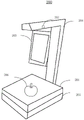
Fig. 2 schematically illustrates an outline structure of an intelligent weighing apparatus according to one embodiment of the present disclosure. The intelligent weighing apparatus 200 may include: a chassis 205; a weighing platform 201 connected to the chassis 205 for weighing an item 206 (e.g., apple) placed thereon; a support bar 204 connected with the chassis 205; the visual sensor 202 is arranged on the weighing platform 201 or outside the weighing platform 201, or on a support bar 204 connected to a chassis 205 of the weighing platform 201, for example as shown in fig. 2, on the upper part of the support bar 204, and the acquisition range thereof covers at least a part of the weighing platform 201 or the surrounding area thereof, for example as shown in fig. 2, the top plane of the weighing platform 201.
The smart item identification and weighing structure 200 may further include: a human-machine-interactor 203 arranged to be removably connected with said support bar 204 and adjustable in position with respect to said support bar, so that a user using the smart goods identification and weighing structure 200 can view the contents displayed on the human-machine-interactor 203 and operate the human-machine-interactor 203.
The positions, shapes and sizes of the chassis 205, the weighing platform 201, the support rods 204 and the human-computer interaction device 203 shown in fig. 2 are only examples, are not limiting and can be changed according to actual situations. For example, the chassis 205 may be larger than the weighing platform 201 to achieve better center of gravity and maintain stability of the whole structure, the support rod 204 may not be L-shaped but vertical, the image capturing assembly 202 may be positioned not on top of the support rod 204 but at a right angle of the support rod 204, and the human-computer interaction device 203 may be positioned not on one side of the support rod 204 but at the center of the support rod 204 to center the human-computer interaction device 203. The connection mode between the structures can also adopt the existing connection mode, and can be fixed connection, and can also be removable or rotatable connection.
A chip or an integrated circuit or a functional module which realizes the intelligent commodity identification and weighing functions and methods together with the weighing platform, the image acquisition assembly 202 and the human-computer interaction device 203 can be arranged inside or outside the chassis 205 or the supporting rod 204 or connected with the chassis or the supporting rod.
The above-described respective constituent devices are illustrative, and some of the devices may be deleted or other devices may be added as necessary. For example, a microphone, a voice recognition device, and a speaker may be added, configured to perform voice interaction with a user to perform various controls. And a price tag printer is added to support the printing of the price tag. Various connecting wires such as a USB connecting wire, a serial port data wire and a network cable are added to support data transmission.
Fig. 3 schematically illustrates a flow chart of an intelligent weighing method 300 according to one embodiment of the present disclosure.
The intelligent weighing method 300 comprises: 301, setting software parameters, hardware parameters and commodity information of the intelligent weighing device by using a system configuration component; 302, placing a commodity to be identified and weighed by using a weighing platform, sensing weight and weight change, and obtaining commodity weight information of the commodity; 303, collecting visual information of a commodity placed on the weighing platform by using a visual sensor in response to a first trigger; step 304, responding to a second trigger by utilizing a recognizer to perform commodity recognition based on the visual information, the weight information and a recognition model, and responding to a third trigger to terminate the commodity recognition to obtain a commodity recognition result; step 305, combining the commodity identification result and the commodity information by using an identification feedback device, displaying candidate commodity information, receiving user feedback, transmitting the commodity information confirmed by the user feedback to a price tag printer or a cash register POS system, and feeding back the commodity information to a modeling platform, wherein the price tag printer is configured to print a commodity weighing bar code based on the user feedback, and the cash register POS system is configured to generate cash register information of the commodity according to the user feedback; step 306, training a recognition model based on the collected visual information, weight information and data fed back by the user in use by using a modeling platform; step 307, updating the commodity information by using the commodity information synchronization component, wherein the commodity information comprises one or more of commodity information such as commodity name, commodity number, title code, price, pricing mode, example graph and the like.
In one embodiment, hardware parameters including different hardware model selections of the weighing platform and the price tag printer are set using the system configuration component.
In one embodiment, the setting of the hardware parameters of the vision sensor by the system configuration component comprises setting the parameters of preview resolution, whether to intercept the main body area and screen capture of the main body area.
In one embodiment, the system configuration component is utilized to set hardware parameters including a weigh platform tare setting, including three modes of no tare weight, one time tare weight, and continuous tare weight.
In one embodiment, software parameters including merchant selection, store selection, and merchandise management including name, code, price, charting, merchandise information for browsing and editing are set using the system configuration component.
In one embodiment, the first trigger includes a weighing platform sensing weight change and weight non-zero to automatically trigger a visual sensor to collect visual information of a commodity placed on the weighing platform, the second trigger includes a weighing platform sensing weight change and weight non-zero to automatically trigger an identifier to perform commodity identification, and the third trigger includes a weight signal stabilization to use the stabilized weight signal as commodity weight information for calculating a total price of the commodity and generating a commodity weighing barcode.
In one embodiment, visual information of the good placed on the weighing platform is collected using the visual sensor, wherein the visual information includes at least one of an image and a video, the visual sensor configured to collect visual information for modeling a new good; and acquiring visual information for the commodity to be identified, wherein when the visual information is acquired for modeling of a new commodity, a shooting mode comprising a single shooting mode, a multi-continuous shooting mode and a video shooting mode is performed by using the visual sensor, and when the visual information is acquired for the commodity to be identified, a shooting mode comprising the single shooting mode, the multi-continuous shooting mode and the video shooting mode is performed by using the visual sensor.
In one embodiment, the second trigger comprises a change in the content of a visual signal captured by the visual sensor to trigger the identifier to perform article identification, and the third trigger comprises a stabilization of the visual signal to terminate article identification.
In one embodiment, the visual sensor is located above or at the side of the weighing platform to sense visual information of the commodity on the weighing platform with definition higher than predetermined definition, and when the hardware parameter of the visual sensor is set to intercept the main body area, the main body area of the acquired visual information is intercepted according to the screenshot parameter of the main body area.
In one embodiment, the second trigger comprises a manual selection.
In one embodiment, the recognition model is used for filtering candidate recognition results with weights greater than the maximum weight of the commodity or less than the minimum weight of the commodity by using a deep learning-based computer vision technology and combining commodity weight information to perform condition filtering or statistical regression, and the recognizer is configured to complete recognition calculation of commodity recognition by using a calculation unit above an intelligent weighing method, an adjacent edge calculation unit or a cloud calculation unit.
In one embodiment, the cashier POS system comprises a POS system of a traditional cash register and a self-service cash register, and when the candidate commodity information is displayed by using the recognition feedback device, an adaptive display strategy based on recognition confidence is adopted, wherein when the recognition confidence of the commodity recognition result is higher than a predetermined confidence, only the commodity recognition results with the confidence higher than the predetermined confidence are displayed as the candidate commodity information, and when the recognition confidence of the commodity recognition result is lower than the predetermined confidence, the number of the displayed commodity recognition results is increased as the candidate commodity information.
In one embodiment, the interactive activities that receive user feedback with the recognition feedback include click confirmation, re-recognition, searching, screening, price modification, and return to system configuration; the interactive behavior of the user feedback comprises that under the preset condition, the commodity identification result is automatically confirmed, the user feedback is automatically transmitted to a price label printer or a cash register POS system and fed back to the modeling platform, wherein the preset condition comprises that the identification confidence coefficient exceeds an automatic issuing threshold value, or the user feedback time exceeds a waiting threshold value.
In one embodiment, the identification feedback includes a search component with which the user is enabled to search using the first name of the item or code while presenting the hot search candidate item.
In one embodiment, the identification feedback includes a filtering component that is utilized to preferentially present the listings of cleared items of the same or related categories based on the item identification.
In one embodiment, the recognition feedback comprises a price modification component, by which interaction of the item information display card of the long-press candidate item information or the item icon, the element of the name in the card is received, and a price modification label is triggered to pop up so that the user modifies the unit price, the total price, or the discount coefficient of the item. And when the selected commodity is a piece counting commodity, feeding back the quantity of the commodity through an automatic pop-up window.
In one embodiment, when the confirmed commodity information needs to be transmitted to the cash register POS system, the confirmed commodity information is transmitted to the POS system in a wired or wireless manner, or when the confirmed commodity information needs to be transmitted to the price tag printer, the confirmed commodity information is transmitted to the price tag printer in a wired manner, or when the confirmed commodity information needs to be fed back to the modeling platform, the confirmed commodity information is uploaded to the modeling platform in the cloud in a wired or wireless network manner.
In one embodiment, when the system setting interface needs to be returned, the system setting interface is returned by sliding the screen from left to right or from top to bottom.
In one embodiment, the modeling platform is configured to train a recognition model using computer vision techniques based on deep learning based on the collected visual information, weight information, and user feedback data in use, wherein the commodity weight information is applied to set weight filtering rules to filter out commodity recognition results having weights greater than a maximum weight of the commodity or less than a minimum weight of the commodity, or to a statistical commodity weight distribution model to assist in commodity recognition; the data of the user feedback in use is applied to a continuous iterative optimization of the recognition model; the trained recognition model is issued to an end, edge, or cloud-diverse computing platform.
In one embodiment, the commodity information synchronization component is used for updating updated commodity information into the intelligent weighing method so as to support display of candidate commodity information, wherein the commodity information synchronization component comprises a windows program and a mobile phone client, updating of the commodity information is completed in a database butt joint mode, a file uploading mode and a manual editing mode, and meanwhile, updating of the commodity information in the intelligent weighing method is supported through a merchant intranet connection mode and a merchant extranet connection mode.
In one embodiment, the intelligent weighing device does not comprise a cashier POS system and a price tag printer to be used as a whole and is connected with an external cashier POS system; or the intelligent weighing device comprises a cash register POS system; or the intelligent weighing device comprises a price tag printer.
According to the scheme, a complete identification model iteration closed loop is established for the first time, continuous iteration and optimization of the identification model in use are guaranteed, and efficient and accurate identification of weighed commodities is realized; the intelligent weighing and the cashier desk are combined for the first time, and an efficient silver weighing and integrating solution is achieved.
Fig. 4 schematically illustrates a flow chart of a smart weighing method 400 according to another embodiment of the present disclosure. As shown, the intelligent weighing method 400 includes the following steps: s401, configuring a system, and setting software and hardware parameters and merchant information; s402, synchronous scale transmission, namely uploading the commodity information including one or more of commodity information such as commodity names, commodity numbers, scale codes, prices, pricing modes, examples and the like; s403, updating the commodity database, and updating the information uploaded in the S402 into the database; s404, information acquisition, namely acquiring visual information and weight information of the commodity; s405, training a recognition model by combining visual information and weight information of the commodity; s406, issuing the identification model to an identification service; s407, placing the weighed commodity on a weighing platform, and weighing to obtain weight information; s408, collecting visual information of the commodity; s409, identifying the commodity type by using an identification model in the identification service; s410, displaying the candidate identification result commodity information; s411, recognizing feedback, receiving user feedback information, transmitting a confirmation result to a POS system or a barcode printer, updating to a cloud training platform, and supporting iterative updating of a model. S412, adding commodity information by the cashier POS system, or printing a price tag by a bar code printer.
In one embodiment, the S401 system configuration includes hardware parameter settings, software parameter settings and merchant information settings. The hardware parameter setting comprises the selection of different hardware models of the weighing platform and the price tag printer. The hardware parameter settings also include visual sensor settings including preview resolution, whether to intercept the subject area, subject area screenshot parameters, and the like. The hardware parameter setting also comprises a weighing platform tare weight setting, which comprises three modes of no tare weight, one-time tare weight and continuous tare weight. The software parameter setting comprises merchant selection, store selection and commodity management. The commodity management also comprises browsing and editing commodity information such as name, code, price, matching picture and the like.
In one embodiment, the S402 upload synchronization includes two forms of windows program and mobile phone client, and commodity information change is completed in various ways of database docking, file uploading and manual editing. Meanwhile, the commodity information in the intelligent weighing device is updated in two connection modes of an internal network and an external network of a merchant. The synchronized information includes one or more of commodity information such as commodity name, commodity number, title code, price, pricing method, example graph and the like.
In one embodiment, S403, the goods database is updated, and the goods database may be deployed in a merchant intranet, through which the goods information in the intelligent weighing device is updated.
In one embodiment, S403, updating the goods database, where the goods database may be deployed in the cloud, and updating the goods information in the intelligent weighing device through an external network.
In one embodiment, S404, the information collecting collects the commodity image through a single-sheet photographing mode; in one embodiment, S404, the information collection collects the commodity image through a single-sheet shooting mode; in one embodiment, S404, the information collection collects commodity images through multiple continuous photographing modes; in one embodiment, the information collecting collects the commodity image through a video photographing mode S404. In one embodiment, S404, information collection, based on the system configuration, intercepts the visual information body area. In one embodiment, S404, information is collected, and meanwhile, commodity weight information is collected.
In one embodiment, the product recognition model is learned through computer vision techniques based on deep learning, based on visual information of the product S405. The visual information of the commodity can be from collected data, reflow data or a combination of the collected data and the reflow data. In one embodiment, the product weight information is applied to build a conditional filtering model that filters out candidate identifications having weights greater than a maximum weight of the product or less than a minimum weight of the product.
In one embodiment, S406, the model is issued to a computing unit on the intelligent weighing device end, and the recognition calculation is completed by using a terminal computing unit; in one embodiment, S406, the model is issued to the edge computing unit, and the edge computing unit near the merchant is used for completing the identification calculation; in one embodiment, S406, the model is issued to a cloud server, and the recognition calculation is completed by the cloud server.
In one embodiment, S407 weighs, senses the weight change, and obtains the weight of the item. The weight signal changes to be used as an identification trigger, when the weight changes and is not zero, the visual sensor is automatically triggered to collect visual signals, and the identifier identifies commodities. The weight signal is stable and is used as one of judgment conditions for finishing the identification, and the stable weight signal is used as the weight of the commodity and is used for calculating the total price of the commodity and generating the barcode information of the commodity.
In one embodiment, the visual information acquisition of the commodity at S408 starts to acquire the commodity image when the weight changes, and transmits the commodity image and the weight to the commodity identification at S409. S409 predicts the commodity category through the visual model and the weight model based on the commodity image and the weight. When the weight of the commodity and the image are stable, the recognition is stopped, and a candidate commodity list and the confidence coefficient of the candidate commodity list are produced.
In one embodiment, the step S410 of displaying the goods employs an adaptive display strategy based on the recognition confidence, when the confidence of the recognition result is high, only a few results with high confidence are displayed, and when the confidence of the recognition result is low, the number of displays is increased. The difficulty of selection is reduced while the recognition recall rate is guaranteed.
In one embodiment, S411 identifies feedback, and the user' S interaction behavior with the identified results includes click confirmation, re-identification, searching, filtering, price modification, and returning to the system configuration. The searching component is configured to enable a user to search by using the first letter or code of the commodity name, and meanwhile, hot searching candidate commodities are displayed, so that the searching efficiency of the user is improved. The screening component is configured to preferentially display the clear commodity lists of similar categories according to the commodity identification result, and therefore the user screening efficiency is improved. The price modification component is configured to display the card or the elements such as the commodity icon and the name in the card according to the commodity information, trigger the popup of a price modification label, and modify the unit price, the total price or the discount coefficient of the commodity. And when the commodities are counting commodities, feeding back the quantity of the commodities through the automatic pop-up window. When the system setting needs to be returned, the system setting interface is returned in a mode that the screen slides from left to right or from top to bottom.
In one embodiment, S411 identifies feedback, the identification result can be automatically confirmed, the identification confidence exceeds an automatic issuing threshold, or when the user feedback time exceeds a waiting threshold, the corresponding result is automatically transmitted to the price tag printer or the POS system and fed back to the modeling platform.
In one embodiment, S411 identifies feedback, and when the merchandise information needs to be transmitted to the POS system, the confirmed merchandise information is transmitted to the POS system by wire.
In one embodiment, S411 identifies feedback, and when the merchandise information needs to be transmitted to the POS system, the confirmed merchandise information is transmitted to the POS system by way of software communication.
In one embodiment, S411 identifies feedback, and when the goods information needs to be transferred to the price tag printer, the confirmed goods information is transmitted to the price tag printer by wire.
In one embodiment, S411 identifies feedback, and when the user feedback information needs to be uploaded to the modeling platform, the feedback information is uploaded to the cloud-end platform in a wireless network manner. In one embodiment, S411 identifies feedback, and when the user feedback information needs to be uploaded to the modeling platform, the feedback is uploaded to the cloud-side platform through a wired network.
In one embodiment, S401, the POS system adds the merchandise information to support further cash register action; in one embodiment, the bar code printer prints the price tag to support the user to enter the POS system by scanning the code S412.
According to the scheme, a complete identification model iteration closed loop is established for the first time, continuous iteration and optimization of the identification model in use are guaranteed, and efficient and accurate identification of weighed commodities is realized; the intelligent weighing and the cashier desk are combined for the first time, and an efficient silver weighing and integrating solution is achieved.
Of course, the above-mentioned embodiments are merely examples and are not limiting, and those skilled in the art can combine and combine some steps and devices from the above-mentioned separately described embodiments to achieve the effects of the present disclosure according to the concept of the present disclosure, and such combined and combined embodiments are also included in the present disclosure, and such combined and combined embodiments are not described herein separately.
Note that advantages, effects, and the like mentioned in the present disclosure are merely examples and not limitations, and they cannot be considered essential to various embodiments of the present disclosure. Furthermore, the foregoing disclosure of specific details is for the purpose of illustration and description and is not intended to be limiting, since the disclosure is not intended to be limited to the specific details so described.
The block diagrams of the systems, methods, and apparatuses referred to in this disclosure are by way of illustrative examples only and are not intended to require or imply that the connections, arrangements, and configurations must be made in the manner shown in the block diagrams. The systems, methods, apparatuses may be connected, arranged, configured in any manner, as will be appreciated by those skilled in the art. Words such as "including," "comprising," "having," and the like are open-ended words that mean "including, but not limited to," and are used interchangeably therewith. The words "or" and "as used herein mean, and are used interchangeably with, the word" and/or, "unless the context clearly dictates otherwise. The word "such as" is used herein to mean, and is used interchangeably with, the phrase "such as but not limited to".
The flowchart of steps in the present disclosure and the above description of methods are merely illustrative examples and are not intended to require or imply that the steps of the various embodiments must be performed in the order presented. As will be appreciated by those skilled in the art, the order of the steps in the above embodiments may be performed in any order. Words such as "thereafter," "then," "next," etc. are not intended to limit the order of the steps; these words are merely configured to guide the reader through the description of these methods. Furthermore, any reference to an element in the singular, for example, using the articles "a," "an," or "the" is not to be construed as limiting the element to the singular.
In addition, the steps and devices in the embodiments are not limited to be implemented in a certain embodiment, and in fact, some steps and devices related to the embodiments in the present disclosure may be combined according to the concept of the present disclosure to conceive new embodiments, and the new embodiments are also included in the scope of the present disclosure.