Measurement and prediction of viral gene mutation patterns
Cross Reference to Related Applications
This application claims the benefit of U.S. provisional application No. 62/687,645 filed 2018, 6, 20, the disclosure of which is incorporated by reference in its entirety.
Background
The present invention relates generally to genetic epidemiology of viral infectious diseases (e.g., influenza), and more particularly to the measurement and prediction of viral gene (or amino acid) mutation patterns of viruses causing infectious diseases.
Influenza, also known as "flu", is an infectious respiratory disease that has plagued humans for centuries. When influenza is found to be caused by a virus (influenza virus), it is desirable to produce an effective vaccine. Influenza vaccines are now widely used after many years of research. However, influenza viruses rapidly mutate to new strains, and a vaccine that is effective against one strain may not be effective against the other (mutated) strain. Thus, the "formulation" of influenza virus strains used in the preparation of influenza vaccines will be modified regularly based on predictions of future effective strains, and the government encourages individuals to receive new influenza vaccines each year to help their immune system keep up with the mutated influenza virus.
Current annual influenza vaccine production and distribution protocols include the need to decide which influenza virus strains to defend against in the next round of vaccination. Currently, this decision is based on studies of influenza virus samples from around the world, known antigenic sites (e.g., specific amino acids in the viral sequence), and empirically learned lessons on the mutation patterns of the virus. The objective is to predict which influenza virus strains will be effective against the human immune system (i.e. producing disease) within about 18 months to 2 years into the future. Influenza vaccines were developed based on this prediction.
Predictions are not always accurate and, therefore, the effectiveness of influenza vaccines varies widely each year. This makes individuals less willing to vaccinate against influenza vaccines, thereby compromising the "community immunity" effect obtained when most people are immunized against an infectious agent.
Therefore, it would be particularly important to improve techniques for predicting viral mutations, and in particular for predicting which mutations will be effective against the human immune system over a time frame of at least two years in the future.
SUMMARY
Certain embodiments of the invention relate to techniques for measuring and predicting viral mutation patterns based on viral sequences (e.g., amino acid sequences) and population prevalence levels. The prediction is based on the identification of "effective mutations", i.e., evolutionarily dominant mutations (variations in amino acid or nucleic acid sequences) that contribute to the virus 'ability to evade human immunity, as opposed to "unimportant mutations" that have no (or negligible) effect on the virus' ability to survive and reproduce. The prediction is also based on the hypothesis that human immunity will ultimately learn to recognize and prevent effective mutations (with or without the aid of a vaccine). This means that the productive mutation has a "productive mutation period," which is the period of time that the mutation enables the virus to escape human immunity. Using the techniques described herein, identifying effective mutations and determining effective mutation periods, it can be more accurately predicted which strains of a given virus (i.e., which mutations) will be prevalent in a future time period. Such prediction may achieve a variety of practical purposes, including: (1) help select virus strains for vaccine production; (2) providing real-time information about the likely efficacy of a given version of a vaccine; and/or (3) predict viral activity (e.g., incidence of infectious disease caused by a virus).
Some illustrative techniques used herein rely on longitudinal cohort analysis of influenza virus composition (amino acid sequence) and infection rate to calculate a measure of the gene mutation activity of influenza virus, referred to herein as a "g-measure". How the g-metric mimics gene activity will be described in more detail below in at least two respects. The first is whether a single mutation should be considered important. Assuming that more adaptive mutations will spread widely after emerging, but unimportant mutations will not, the prevalence of a single residue will result in a higher g-metric. The second aspect of gene activity is embodied in the number of genes mutated simultaneously, the g-metric capturing potential antigenic shifts with multiple residue substitutions simultaneously; at a given prevalence, a higher number of effective mutations will increase the g-metric. Thus, the g-metric reflects the fitness of the mutation and the number of simultaneous effective mutations. Furthermore, if a site exhibits more than one productive mutation phase within the study period, the g-metric will encompass the subsequent productive mutation phases. Calculating the g-metric also includes optimizing parameters that further characterize the activity of the influenza virus gene, such as the threshold of dominance (residues are considered to be the minimum prevalence required for effective mutation) and extended lifespan (representing the time for which an effective mutation remains effective against human immunity after gaining dominance). The g-metric and/or related parameters may be used to predict future gene activity of influenza virus, which may help in selecting a virus strain for the next round of influenza vaccine and/or predicting an influenza outbreak. Similar techniques can be applied to other viruses and related infectious diseases.
The following detailed description together with the accompanying drawings provide a better understanding of the nature and advantages of the claimed invention.
Brief Description of Drawings
FIGS. 1A-1C show simplified examples of coding sequence constructs according to embodiments of the present invention. FIG. 1A shows four exemplary amino acid sequences observed over a period of time. FIG. 1B shows that tag sequences within a study period can be defined according to embodiments of the invention. FIG. 1C shows the coding sequence corresponding to the amino acid sequence of FIG. 1A and the tag sequence of FIG. 1B.
FIG. 1D shows a prevalence vector calculated from the coding sequence of FIG. 1C, according to an embodiment of the present invention.
Figure 2 shows a simplified example of identifying a productive mutation and a productive mutation period from a prevalence vector, according to an embodiment of the invention.
Fig. 3 and 4 are graphs showing the correlation of g-metric with the changes observed in influenza infection in a population. Figure 3 shows data from observations of influenza virus activity in hong kong from 1996 to 2015. Figure 4 shows data from observations of influenza virus activity from 2003 to 2016 in new york.
Fig. 5 shows a flow diagram of a method for measuring and predicting influenza virus activity according to an embodiment of the invention.
Detailed description of the invention
The techniques described herein for modeling viral activity rely on longitudinal cohort analysis of viral composition (amino acid sequence) and infection rate to calculate a measure of the gene mutation activity of the virus, referred to herein as a "g-measure". The analysis was performed in a "study period" divided into a set of time segments of equal duration. In some embodiments, each time period may be one year; other embodiments may define a shorter period of time (e.g., three months, one month, one week) or a longer period of time (e.g., two years, five years, etc.). For illustrative purposes, reference is made to influenza or "flu" viruses; however, the described techniques may be applied to other viruses.
For a given time period t, n is collected
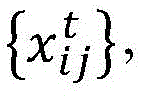
tA sample of a number of influenza viruses (or other target viruses). For each sample i within a time period t, the amino acid sequence of the virus is determined
Wherein the index j represents a specific site within an amino acid sequence and x is an identifier of a specific amino acid. Can make it possible toThe amino acid sequence of a given sample of influenza virus is determined using conventional techniques or other techniques, and the particular sequencing technique is not critical to the understanding of the present invention. In general, n is
tNumber of amino acid sequences
Instances of (c) have been determined.
It is assumed that the virus may mutate during the study period and that different samples of influenza virus collected over the same time period may have different mutations. To facilitate analysis of the mutations, it is helpful to define "tag sequences" within the study period that can be used to represent each sample in a uniform format. For K-1, …, K, the tag sequence may be the amino acid sequence { a }kWhere K is defined as:
wherein J is the total amino acid sequence length of the virus, and qjIs the number of unique amino acids observed at site j throughout the study period. Tag sequence { a }kIs composed of all unique amino acids observed at j attached to each position of the amino acid sequence. The tag sequence enables the assessment of mutations without the creation of a reference sequence (which is a routine operation); thus, the tag sequence is not a comparison of sequences, but rather provides a tool to capture the dynamics of each possible residue.
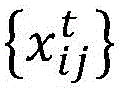
Given a sequence of tags { a }
k}, each observed amino acid sequence
Can be expressed as a coding sequence
The coding sequence may be a sequence of K indicators (e.g., number of bits), one indicator for each position K in the tag sequence; if the corresponding amino group in position jIf an acid is present in sample i, the indicator at the k-th position may be set to a first value (e.g., 1) and, if not present, to a second value (e.g., 0).
FIGS. 1A-1C show coding sequences according to embodiments of the present invention
A simplified example of the construction of (a). Fig. 1A shows four exemplary
amino acid sequences 101, 102, 103, 104 observed during a time period t (e.g., one year); amino acids are represented by the single letter code using the standard IUPAC single letter coding scheme. It can be seen that in the observed sequences 101-104, the first position (j ═ 1) has amino acid N or K; the second position (j ═ 2) has amino acid S; the third position (j ═ 3) has amino acid E or K; the fourth position (j ═ 4) has amino acid N; and the fifth position (j ═ 5) has amino acids a or T.
In this example, it is assumed that the amino acid sequence is also observed in other time periods (e.g., years) during the study period, and that other amino acids are observed at some sites during at least one of those time periods. Specifically, assume that the following observations are made: for position j ═ 1, amino acids V, I, N or K were observed; for position j ═ 2, amino acid S was observed; for position j ═ 3, amino acids E or K were observed; for position j-4, amino acids N or D are observed; and for position j ═ 5, amino acids a or T were observed. FIG. 1B shows a tag sequence 120 that can be defined over a study period according to an embodiment of the invention. In this example, the number of bits of tag sequence 120 is ordered such that the first four tag sequence positions correspond to the amino acids observed at j-1, the next tag sequence position corresponds to the amino acids observed at j-2, and so on. When multiple digits of the tag sequence correspond to the same position in the amino acid sequence, the digits can be ordered based on the time period of the first observation. Other orderings may be used if desired.
Fig. 1C shows coding sequences 131, 132, 133, 134 corresponding to amino acid sequences 101, 102, 103, 104, respectively. The coding sequence 131-. It will be appreciated that the amino acid sequence of the influenza virus is much longer than in this simplified example, and that the number of sequence samples obtained over a period of time can be much greater than the four examples shown. It is also understood that the specific sequences in FIGS. 1A-1C are for illustrative purposes only and may or may not correspond to existing viruses.
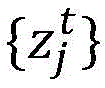
Given a set of n corresponding to samples i observed during a time period t
tA code sequence
Prevalence vectors over a t time period
Can be defined as:
prevalence vector ptCan be understood as the prevalence of a particular amino acid at a particular position in the amino acid sequence. FIG. 1D shows a prevalence vector p calculated from the coding sequence of FIG. 1C according to equation (2)t。
To identify effective mutations, i.e., mutations that provide an evolutionary advantage against human immunity, the prevalence vector p can be analyzed over the entire time period within the study periodt. From time period t by detecting prevalence at tag location k0Zero to a subsequent time period t0A non-zero change of +1, etc., to identify a mutation. Given that a valid mutation will increase prevalence and eventually at least reach a threshold prevalence, referred to herein as a "dominance threshold" and denoted θ. For the purpose of analysis, if there is a time t within the study period0And time tθSo that
Position a of the tag sequencekThe mutation at (a) is defined as effective. The value of the dominance threshold θ may be determined empirically, as described below.
It is also useful to define a productive mutation period (EMP, denoted herein by ω), which represents the length of time that a productive mutation retains its evolutionary advantage. The time period includes a transition time tθ-t0(i.e., from the time of the first appearance of the mutation to the time of the mutation reaching the dominance threshold). EMP also includes an "extended effective mutation period" denoted h, which corresponds to the length of time that a mutation retains its evolutionary advantage after reaching advantage. Thus, for a given mutation at position k, the total EMP is defined as:
ωk(θ,h)={t0<t≤tθ+h|θ,h,k}。 (4)
set of effective mutations during time period t (herein W is used)tRepresentation) can be represented as:
the optimal values for θ and h can be determined empirically using the fitting procedure described below. In principle, the tag sequence { a }kDifferent sites k in the } have their specific values of θ and h; however, in practice, it is sometimes not feasible to collect enough data to determine a fit for each position, so it can be assumed that all mutations share the same values of θ and h. In a specific example, θ is 0.8 and h is 2.
Figure 2 shows a simplified example of identifying valid mutations and EMPs using prevalence vectors according to embodiments of the present invention. Assume the tag sequence from FIG. 1B akAnd assume that the prevalence vector p of fig. 1D is a prevalence vector for a time period t-1. The figure also shows a prevalence vector p for the time period t 2 to t 7t(ii) a These vectors may be determined in the manner described above. For convenience of explanation, it is assumed that θ is 0.8 and h is 2. For each effective mutation (i.e., mutation satisfying the condition of equation (2)), the mutationPrevalence values over time are shown in light gray, prevalence values over extended effective mutation periods are shown in black, and total EMP is outlined in a thick black line. It should be noted that although the values of θ and h are assumed to be independent of the location, the total EMP may vary due to the difference in transition times. In this analysis, mutations at bit points k-6 and k-8 were not identified as valid mutations even though they did meet the dominance threshold for at least some period of time, since the transition from zero prevalence to non-zero prevalence occurred before t-1.
After identifying a valid mutation and an EMP, a measure of the activity of the responsive gene mutation (referred to herein as a "g-measure") can be calculated. In particular, for each time period t, the indicator vector m of the K componentstIs defined as:
where ω (θ, h) is defined according to equation (4). The g-metric may be defined as:
FIG. 2 shows g calculated according to equation (7) for each time segmentt. g-metric vector g ═ gt]Indicating the trend of the mutational activity over different time periods.
The g-metric may be understood as a function (e.g., sum) of the prevalence of all effective mutations over a given time period. It mimics two relevant aspects of gene activity. The first is whether the mutation should be considered important. Assuming that more adaptive mutations will spread widely after emerging, while unimportant mutations will not, the prevalence of a single residue will result in a higher g-metric. The second aspect is the number of simultaneous mutations that capture a potential antigenic shift with multiple residue substitutions simultaneously; at a given prevalence, a higher number of effective mutations will increase the g-metric. Thus, the g-metric reflects the fitness of the mutation and the number of simultaneous effective mutations. Furthermore, if a site exhibits more than one effective mutation phase within the study period, the g-metric will encompass all effective mutation phases. The g-metric may be used for various purposes, including: (1) predicting epidemiology; (2) selecting a virus strain for the next round of influenza vaccine based on the effective mutation and the EMP; (3) currently available influenza vaccine strains are evaluated based on a comparison of currently effective mutations to vaccine strains.
As mentioned above, the g-metric depends on two parameters: a dominance threshold θ and an extended effective mutation period h. In some embodiments, the values of these parameters may be determined empirically based on population level epidemiological variables such as seroprevalence of subtypes, number of cases of viral infection diagnosed over a period of time, or hospitalization rate of viral infection over the period of time. It is expected that temporal changes in the g-metric should correlate with temporal changes in population-level epidemiological variables, as the spread of new effective mutations will lead to more infection in the population.
Thus, in some embodiments of the invention, the following fitting procedure may be used to determine the values of θ and h. A population-level epidemiological variable (e.g., the number of diagnosed cases or the number of hospitalizations) is defined as a vector f ═ f
t]Where the index t represents any time period within the study period. A function S (f, g) is chosen that measures the quality of the match between vectors g and f. For example, S may be the p-value of the goodness-of-fit statistic of the generalized linear model, where f is the reaction variable and g is the predictor variable. In this case, a smaller S value indicates a better match between the reaction and the prediction. The optimal values of θ and h may be defined as the values that minimize S
Namely:
where H ═ 0, 1, 2, · and θ ═ 0.5, 1.
By way of illustration, fig. 3 and 4 show graphs of the correlation of g-measures with changes in influenza infection observed in a population. Figure 3 shows data from observations of influenza virus activity in hong kong from 1996 to 2015. The diamond-shaped data points connected by the dashed line correspond to the number of cases of influenza a diagnosed each year. The circular data points connected by solid lines represent the number of cases predicted using the g-metric calculated as described above. Similarly, fig. 4 shows data obtained from observations of influenza virus activity in new york from 2003 to 2016. The diamond-shaped data points connected by dashed lines show the percentage of influenza cases attributed to the H3 strain of the virus in a given year. The circular data points connected by solid lines represent the number of such cases predicted using the g-metric calculated as described above. As can be seen from fig. 3 and 4, the g-metric with the optimal values of θ and h can model the change in the incidence of influenza in the population.
The g-metric as described herein can be used to make predictions of future influenza virus activity. In some embodiments, a prediction of the future incidence of influenza may be made. For example, if the fitting function S (f, g) is the p-value of the goodness-of-fit statistic of a poisson regression model, the following fitting model can be obtained from the existing data:
where X is an environmental covariate (e.g., temperature and humidity) associated with an epidemic, and T is a time variable; determining coefficients by fitting
To
More complex fitting functions, such as a system dynamic model, may also be used when the sample size is sufficient.
When a sample of the viral sequence is available for time period t +1, p can be used according to equation (7)
t+1And
a g-metric is calculated. When sequence samples are not available (e.g., when t +1 corresponds to a future time period), the distribution of conditional prevalence in existing data can be based on
To estimate p prospectively
t+1(ii) a The estimates of prevalence at time period t +1 are:
where E represents the distribution of prevalence from the condition
The determined expected value. Can be selected from p in the manner described above
t+1To m
t+1And g
t+1And the predicted prevalence level is given by:
in some embodiments, the next dominant influenza subtype may be predicted. For example, a g-metric for each subtype can be obtained and has the highest
Is the predicted predominant subtype over the next time period. In general, the change in g-measure, i.e., a function based on the prevalence of mutations, can be used to predict the next dominant subtype and future influenza trends.
In some embodiments, prediction of effective mutations may also be made. Equation (5) defines the effective mutation W for the time period t
tA collection of (a). Can be selected from W
tEquation (10) begins with W
t+1And a threshold of dominance
Can be used to identify mutations that may become dominant over time period t + 1. Extended effective mutation period
Can be used for identifying W
tMay lose effectiveness over a period of
time t + 1. Predicted effective mutation W
t+1The collection of (a) can be used for vaccine antigen design. For example, for vaccines using genetic engineering, W
t+1The amino acids that need to be included in the vaccine can be identified.
In some embodiments, representative viral sequences for a time period t may be defined
For example, for each amino acid position j, the amino acid with the highest prevalence at that position can be defined as the representative amino acid. For ease of illustration, referring to the tag sequence of fig. 1B and the prevalence vector of fig. 1D, amino acid K has the highest prevalence for position j 1 (p 0.75); for position j ═ 2, amino acid S has the highest prevalence (p ═ 1); for position j ═ 3, amino acids E and K have the same prevalence (p ═ 0.5), so either can be selected; for position j-4, amino acid N has the highest prevalence (p-1); and for position j-5, amino acid T has the highest prevalence (p-0.75). More generally, as described above, the tag sequence { a }
kComprises the number q of amino acids corresponding to each position in the amino acid sequence
j. In this case, representative viral sequences
Will be:
wherein r is0Is such that the following index r is generatedThe value:
wherein for sequence position j, range (r)L,rU) By the following definitions:
rU=rL+qj。 (14b)
representative viral sequences
Is a probabilistic summary of all actively mutated viruses included at time t. Comparing representative virus sequences to strains included in currently available influenza vaccines allows for assessment of the potential effectiveness of the vaccine. For example, representative viral sequences can be calculated
And the distance between strains included in currently available influenza vaccines. To achieve this, the distance between sequences can be defined according to conventional sequence similarity measures, such as the p-distance or Hamming distance (Hamming distance) of amino acids. The smaller the distance, the better the match (and the more effective the vaccine may be for protecting patients from influenza infection).
In some embodiments, representative viral sequences for a future time period
The prospective prevalence vector defined in equation (10) can be used for prediction in the same manner. In the case of influenza vaccines prepared with existing wild-type viruses, representative viral sequences can be identified and predicted
The best candidate virus strain for the next round of vaccine was selected with the closest distance to the existing wild-type virus. As described above, distances can be defined according to conventional sequence similarity measures, such as the p-distance of amino acids. When no predicted significant mutation of a representative viral sequence is found in a wild-type strain, genetic engineering techniques can be applied to the wild-type sequence to make it identical or as similar as possible to the predicted sequence.
The analysis methods described herein may be applied to sequence and epidemiological data, global data, or a combination of regional and global data for a particular region. The prediction of candidate vaccine viruses may be specific to a particular region (e.g., country, continent, or hemisphere) or made for global use.
The assay methods described herein can be applied to any or all gene segments of influenza virus. Since each gene may have different theta and h parameters, when the sample size is large enough, multiple g-metric fits of different genes can be done simultaneously (global estimation), or the theta and h parameters of important genes (e.g., hemagglutinin and neuraminidase-the most common mutated segments) can be estimated first, followed by conditional estimation of the theta and h parameters of the remaining gene segments (local optimization).
The assays described herein can be applied to any influenza virus subtype, such as H3N2, pandemic H1N1, B/Yamagata, B/Victoria. The same approach can be applied to other known infectious disease-causing viruses, such as A-EV71 virus (the cause of hand-foot-and-mouth disease), rhinovirus (the cause of common cold), or emerging pathogens that cause epidemics or pandemics.
The sequencing data used in the analysis of the species described herein can be obtained using any available sequencing technology, including but not limited to first generation sequencing (Sanger), next generation sequencing (Illumina platform), or third generation sequencing (PacBio platform or Nanopore platform).
The assay methods described herein can be used in a computer-implemented method of predicting influenza virus activity. Fig. 5 shows a flow diagram of a process 500 for measuring and predicting influenza virus activity according to an embodiment of the invention. Fig. 5 may be implemented using a computer system of conventional design. The input to the process may include real world data collected over the study period, including data regarding the incidence or rate of influenza report cases and sequence data for influenza viruses observed over the study period.
At block 502, a study period is defined. The study period may be as long as desired, e.g., 10 years, 15 years, 20 years, etc. The study period may be divided into a number of equal length time periods (e.g., one year, three months, etc.). The selection of the study period and the length of each time period may be based on the accessibility of data that can be used to determine the prevalence of particular mutations in influenza viruses.
At block 504, a population-level popularity variable for each time period is obtained. As described above, this may be a variable representing the number or frequency of influenza virus infections occurring in a population. The population level epidemiological variable may be based on the number of reported cases of influenza diagnosis and/or the number of reported cases of influenza hospitalization, depending on which data sources are available. Such data may be obtained from public health records years ago. Additionally, sampling alternatives from prospective longitudinal groupings can also be used, and the process 500 can be implemented for any combination of data acquired retrospectively and/or from ongoing sampling.
At block 506, the amino acid sequences of the influenza virus samples for each time period are obtained. For example, influenza virus samples can be collected periodically and sequenced. The sample may be collected from an infected patient, from an environmental surface, or in any other manner. The amino acid sequence of an influenza virus sample can be determined using conventional techniques. Note that acquisition and sequencing of influenza viruses has become a routine practice in at least some parts of the world, allowing process 500 to be implemented using previously acquired and currently acquired and recorded data.
At block 508, the coding sequence for each sample of influenza virus over all time periods is determined. As described above, the coding sequence can be determined by first generating a tag sequence representing each amino acid observed at each sequence position throughout the study period, and the coding sequence for a particular sample can be determined based on which observed amino acid is present in each sequence position for that particular sample.
At block 510, for each time period, a prevalence vector is determined from the encoded sequences associated with the time period. The prevalence vector may be calculated in the manner described above.
At block 512, one or more valid mutations may be identified based on the prevalence vectors for all time periods within the study period, and for each valid mutation, its valid mutation period may be identified. As described above, the identification of a valid mutation can be based on whether the mutation first occurs after a first time period and whether the mutation reaches a dominance threshold θ. The effective mutation period can be identified as the time from the first occurrence of the mutation to the dominance threshold plus the extended effective mutation period h.
At block 514, the g-metric is optimized based on the one or more significant mutations identified at block 512 and the population-level prevalence variables obtained at block 504. For example, as described above, the similarity function S (f, g) may be defined such that a smaller S represents a closer match between f (a vector representing the observed population-level prevalence variables) and g. The vector g-metric may be calculated using different combinations of values of θ and h, and for each g (θ, h), the value of S may be determined. By iterating through different combinations of values for θ and h, the value that minimizes S can be determined.
At block 516, future influenza virus activity (i.e., activity during at least one "future" time period t +1 after the last time period of the study period) is predicted. Predictions may be made based on g-metrics and/or patterns observed in the prevalence vectors. The above prediction method may be used. For example, the future popularity level may be predicted using equations (10) and (11). Future effective mutations can be predicted using the definitions of effective mutations at equation (10) and equation (5). Future representative viral sequences can be predicted using equations (10) and (12) - (14 b). The vaccine match score may be calculated based on the distance between the current representative viral sequence (as described above) and the viral strains included in the vaccine.
The prediction made at block 516 may be reported to a medical professional for various uses. Examples include: to prepare for the expected increase in influenza virus (including the release of public health bulletins, the production of additional medications for treating influenza patients, etc.); selecting an influenza strain (wild-type or genetically engineered sequence) to be included in an influenza vaccine; and/or to assess the potential effectiveness of currently available influenza vaccines.
Although the present invention has been described with reference to specific embodiments, variations and modifications will occur to those skilled in the art. All of the procedures described above are illustrative and may be modified. The processing operations described as separate blocks may be combined, the order of the operations may be modified to the extent logically permissible, the processing operations described above may be changed or omitted, and additional processing operations not specifically described may be added. The particular definition and data format may be modified as desired.
Depending on the availability of the data, the period of the study may be as long as desired or as short as desired. In some embodiments, the virus sample and population level data can be localized to a particular region (e.g., country, state or region, city), allowing for modeling of geographic variation in virus activity.
Furthermore, although the above embodiments relate specifically to influenza viruses, one skilled in the art will appreciate that the same analytical methods may be applied to other viruses associated with other infectious diseases, and the present invention is not limited to any particular virus.
The data analysis and computation operations described herein may be implemented in a conventionally designed computer system, such as a desktop computer, a laptop computer, a tablet computer, a mobile device (e.g., a smart phone), and so forth. Computing clusters and/or cloud-based computing systems may be used to increase computing power. Such systems include one or more processors executing program code (e.g., general purpose microprocessors that can be used as a Central Processing Unit (CPU) and/or special purpose processors such as a Graphics Processor (GPU), which can provide enhanced parallel processing capabilities); memory and other storage devices that store program codes and data; a user input device (e.g., keyboard, pointing device such as a mouse or touch pad, microphone); user output devices (e.g., display devices, speakers, printers); a combined input/output device (e.g., a touch screen display); a signal input/output port; a network communication interface (e.g., a wired network interface such as an ethernet interface and/or a wireless network communication interface such as Wi-Fi); and so on. Computer programs incorporating various features of the present invention may be encoded and stored on a variety of computer-readable storage media; suitable media include magnetic disks or tapes, optical storage media such as Compact Disks (CDs) or DVDs (digital versatile disks), flash memory, and other non-transitory media. (it should be understood that "storage" of data is in contrast to data propagation using a transitory medium such as a carrier wave.) a computer-readable medium encoded with program code may be packaged together with a compatible computer system or other electronic device, or the program code may be provided separately from the electronic device (e.g., downloaded via the internet or as a separately packaged computer-readable storage medium). The input data and/or output data may be provided in a secure form, for example using blockchains or other encryption techniques.
Therefore, while the invention has been described with respect to specific embodiments, it will be understood that the invention is intended to cover all modifications and equivalents within the scope of the following claims.