CN112131756A - A Pedestrian Crossing Scene Simulation Method Considering Individual Aggressiveness - Google Patents
A Pedestrian Crossing Scene Simulation Method Considering Individual Aggressiveness Download PDFInfo
- Publication number
- CN112131756A CN112131756A CN202011077309.2A CN202011077309A CN112131756A CN 112131756 A CN112131756 A CN 112131756A CN 202011077309 A CN202011077309 A CN 202011077309A CN 112131756 A CN112131756 A CN 112131756A
- Authority
- CN
- China
- Prior art keywords
- pedestrian
- vehicle
- pedestrians
- vehicles
- speed
- Prior art date
- Legal status (The legal status is an assumption and is not a legal conclusion. Google has not performed a legal analysis and makes no representation as to the accuracy of the status listed.)
- Granted
Links
Images


Classifications
-
- G—PHYSICS
- G06—COMPUTING OR CALCULATING; COUNTING
- G06F—ELECTRIC DIGITAL DATA PROCESSING
- G06F30/00—Computer-aided design [CAD]
- G06F30/20—Design optimisation, verification or simulation
-
- G—PHYSICS
- G06—COMPUTING OR CALCULATING; COUNTING
- G06N—COMPUTING ARRANGEMENTS BASED ON SPECIFIC COMPUTATIONAL MODELS
- G06N3/00—Computing arrangements based on biological models
- G06N3/002—Biomolecular computers, i.e. using biomolecules, proteins, cells
Landscapes
- Engineering & Computer Science (AREA)
- Physics & Mathematics (AREA)
- Theoretical Computer Science (AREA)
- Evolutionary Computation (AREA)
- Life Sciences & Earth Sciences (AREA)
- Biophysics (AREA)
- General Physics & Mathematics (AREA)
- General Engineering & Computer Science (AREA)
- Health & Medical Sciences (AREA)
- Computing Systems (AREA)
- Computational Linguistics (AREA)
- Data Mining & Analysis (AREA)
- Artificial Intelligence (AREA)
- General Health & Medical Sciences (AREA)
- Molecular Biology (AREA)
- Biomedical Technology (AREA)
- Spectroscopy & Molecular Physics (AREA)
- Organic Chemistry (AREA)
- Mathematical Physics (AREA)
- Software Systems (AREA)
- Chemical & Material Sciences (AREA)
- Computer Hardware Design (AREA)
- Geometry (AREA)
- Traffic Control Systems (AREA)
Abstract
本发明公开了一种考虑个体激进度的行人穿行场景仿真方法,包括:步骤1,进行车辆与行人初始化;步骤2,在单步时间间隔更新完后,判断人车间距是否小于交互判定边界且行人冻结数未达到上限,若是则进入步骤3;步骤3,通过当前的人车间距以及行人激进度计算行人继续前进的概率;步骤4,产生随机数,判断随机数是否大于前进概率;若是,则进入步骤5;若否,设置行人速度为预设速度,冻结数归零,进入步骤6;其中,所述随机数为大于0小于1的小数;步骤5,行人速度归零,冻结数加一;步骤6,更新行人与车辆的位置和速度;步骤7,判断行人是否已经通过路口,若已通过则仿真结束,若未通过则返回步骤2。
The invention discloses a pedestrian crossing scene simulation method considering individual aggressiveness. The method includes: step 1, initializing vehicles and pedestrians; step 2, after the single-step time interval is updated, judging whether the distance between people and vehicles is smaller than the interaction judgment boundary and the pedestrian is not moving. If the number of people frozen has not reached the upper limit, go to step 3; step 3, calculate the probability of pedestrians continuing to move forward according to the current distance between people and vehicles and the pedestrian's aggressiveness; step 4, generate a random number, and determine whether the random number is greater than the forward probability; if so, Then go to step 5; if not, set the pedestrian speed to the preset speed, the freezing number is zero, and go to step 6; wherein, the random number is a decimal greater than 0 but less than 1; step 5, the pedestrian speed is reset to zero, the freezing number is added 1; Step 6, update the position and speed of the pedestrian and vehicle; Step 7, determine whether the pedestrian has passed the intersection, if it has passed, the simulation ends, if not, return to Step 2.
Description
技术领域technical field
本发明涉及智能网联汽车领域,特别是关于一种考虑个体激进度的行人穿行场景仿真方法。The invention relates to the field of intelligent networked vehicles, in particular to a pedestrian crossing scene simulation method considering individual radicalness.
背景技术Background technique
近年来汽车与人工智能均是业界与学界最关注的问题之一,硬件方面的逐步完善使得汽车的控制越发精细,同时算法方面的进步使得汽车电子控制单元(ECU)的计算能力大幅提升,更多的功能得以实现,因此汽车与人工智能的结合——智能网联汽车(ICV)被认为是当前汽车行业的核心问题之一。In recent years, automobiles and artificial intelligence have been one of the most concerned issues in the industry and academia. The gradual improvement of hardware has made the control of automobiles more refined, and the progress of algorithms has greatly improved the computing power of automobile electronic control units (ECUs). Multiple functions can be realized, so the combination of automobile and artificial intelligence-Intelligent Connected Vehicle (ICV) is considered to be one of the core issues of the current automobile industry.
然而,目前市面上几乎所有已经量产商业化的智能驾驶汽车只能达到L2或L3等级,无法实现L4及以上的高等级自动驾驶。大部分当前智能驾驶无法到达高等级自动驾驶最大的痛点在于人、车混杂的复杂交通场景下通行效率过低。因此,如何设计合理的人车交互算法便是关键问题之一。想要设计出有效的决策系统,必须通过一系列实验以验证算法安全性,然而由于交通场景中的危险性,直接让真人参与到实车实验中是不合规范的,所以如何将行人纳入到仿真流程中,在仿真平台上还原行人的人车交互逻辑便是一个重要的课题。However, at present, almost all the mass-produced and commercialized intelligent driving vehicles on the market can only reach the L2 or L3 level, and cannot achieve the high-level automatic driving of L4 and above. The biggest pain point that most of the current intelligent driving cannot achieve high-level automatic driving is that the traffic efficiency is too low in complex traffic scenarios where people and vehicles are mixed. Therefore, how to design a reasonable human-vehicle interaction algorithm is one of the key issues. In order to design an effective decision-making system, a series of experiments must be carried out to verify the safety of the algorithm. However, due to the dangers in the traffic scene, it is illegal to directly involve real people in real vehicle experiments, so how to include pedestrians in the simulation In the process, restoring the pedestrian's human-vehicle interaction logic on the simulation platform is an important topic.
当前主要的人车混合仿真平台主要有:Prescan、Carla、Sumo。Prescan图形化程度高易于操作,Sumo界面简单且能够导入现有城市地图,然而此二者仿真平台中的行人无法通过接口进行控制,原因在于Prescan与Sumo本质上是宏观的交通流分析软件,行人的参数只有速度、加速度等;而Carla的控制接口虽然很丰富(在最新版本中甚至能够对人体的每一块骨骼进行操控),然而其操作难度相对较大,操控行人的逻辑依托于V2X的集中规划中心,无法在行人中内嵌通行逻辑,同时能够控制的参数除了速度与加速度之外,主要集中于外形(例如性别、年龄等),无法体现行人互相之间的个体内在激进程度差异。以上各平台的特点以及应用场景总结如下表1。At present, the main human-vehicle hybrid simulation platforms mainly include: Prescan, Carla, and Sumo. Prescan has a high degree of graphics and is easy to operate, and Sumo has a simple interface and can import existing city maps. However, pedestrians in the two simulation platforms cannot be controlled through the interface. The reason is that Prescan and Sumo are essentially macro traffic flow analysis software. The parameters are only speed, acceleration, etc.; and although Carla's control interface is very rich (in the latest version, it can even control every bone of the human body), its operation is relatively difficult, and the logic of manipulating pedestrians relies on the centralized V2X. The planning center cannot embed traffic logic in pedestrians, and besides speed and acceleration, the parameters that can be controlled are mainly focused on appearance (such as gender, age, etc.), and cannot reflect the individual inherent radical differences between pedestrians. The characteristics and application scenarios of the above platforms are summarized in Table 1 below.
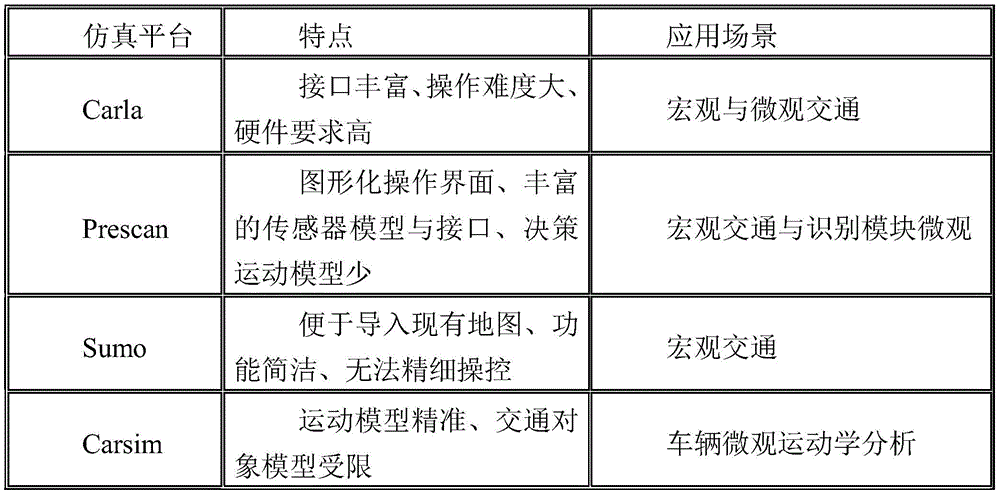
表1各仿真平台特点与应用场景Table 1 Features and application scenarios of each simulation platform
综上,有必要开发一种能够体现行人激进度个体差异性的人车交互仿真方法。To sum up, it is necessary to develop a human-vehicle interaction simulation method that can reflect the individual differences of pedestrian aggression.
为体现每个行人在交通场景中的个体差异性,需要赋予行人单独的内在逻辑,逻辑的主要功能为复现人车交互过程中的一系列决策。元胞自动机(CA)是一种较好的行人模拟机制,将道路划分为网格,行人具有基础的属性,该属性决定平均意义下该个体的速度、加速度等特点,而具体的运动则通过实时对周围8个方格的具体情况实时判定来产生,如果预测在某个方格会与其他个体产生碰撞,便通过交互函数产生一个占据潜在冲突区域的概率。In order to reflect the individual differences of each pedestrian in the traffic scene, it is necessary to give pedestrians a separate internal logic. The main function of the logic is to reproduce a series of decisions in the process of human-vehicle interaction. Cellular automata (CA) is a good pedestrian simulation mechanism. It divides the road into grids, and pedestrians have basic attributes, which determine the characteristics of the individual's speed and acceleration in the average sense, while the specific movement is It is generated by judging the specific situation of the surrounding 8 squares in real time. If it is predicted that a certain square will collide with other individuals, a probability of occupying a potential conflict area is generated through the interaction function.
本发明依托CA提供一种考虑个体激进度的行人穿行场景仿真方法。The invention relies on CA to provide a pedestrian crossing scene simulation method considering individual radicalness.
发明内容SUMMARY OF THE INVENTION
本发明的目的在于提供一种考虑个体激进度的行人穿行场景仿真方法来克服或至少减轻现有技术的上述缺陷中的至少一个。The purpose of the present invention is to provide a pedestrian crossing scene simulation method that considers individual aggressiveness to overcome or at least alleviate at least one of the above-mentioned defects of the prior art.
为实现上述目的,本发明提供一种考虑个体激进度的行人穿行场景仿真方法,包括:In order to achieve the above object, the present invention provides a pedestrian crossing scene simulation method considering the individual radicalness, including:
步骤1,进行车辆与行人初始化,每个行人在初始化时被赋予激进度作为内生参数,所述激进度数值越大代表行人越激进,反之则代表其越保守;Step 1: Initialize vehicles and pedestrians. Each pedestrian is given an aggressiveness as an endogenous parameter during initialization. The larger the aggressiveness value is, the more aggressive the pedestrian is, and vice versa, the more conservative it is;
步骤2,在单步时间间隔更新完后,判断人车间距是否小于交互判定边界且行人冻结数未达到上限,若是则进入步骤3;若否则说明未达成交互条件,行人与车辆继续保持各自移动状态;其中,所述单步时间间隔为预设的仿真步长值;所述交互判定边界为预设的人车间距值;所述行人冻结数表示行人坚持原先决策的难易度,初始值为零,上限为预设数值,上限越大表示行人越容易改变先前决策;Step 2: After the single-step time interval is updated, determine whether the distance between the pedestrian and the vehicle is less than the interactive judgment boundary and the number of pedestrians freezing has not reached the upper limit. If so, go to
步骤3,通过当前的人车间距以及行人激进度计算行人继续前进的概率;Step 3: Calculate the probability of pedestrians continuing to move forward according to the current distance between people and vehicles and the pedestrian's aggressiveness;
其中,通过下式(1)计算所述行人继续前进的概率:Among them, the probability of the pedestrian continuing to move forward is calculated by the following formula (1):

上式(1)中,prob(vehicle.x,agg)表示所述行人继续前进的概率,vehicle.x与vehicle.v表示车辆与行人之间的纵向距离以及车辆的纵向速度,agg表示行人的激进度,ssafe表示所述交互判定边界;In the above formula (1), prob(vehicle.x, agg) represents the probability that the pedestrian continues to move forward, vehicle.x and vehicle.v represent the longitudinal distance between the vehicle and the pedestrian and the longitudinal speed of the vehicle, and agg represents the pedestrian’s Aggressiveness, s safe represents the interactive decision boundary;
步骤4,产生随机数,判断随机数是否大于前进概率;若是,则进入步骤5;若否,设置行人速度为预设速度,冻结数归零,进入步骤6;其中,所述随机数为大于0小于1的小数;Step 4, generate a random number, and judge whether the random number is greater than the forward probability; if so, go to
步骤5,行人速度归零,冻结数加一;
步骤6,更新行人与车辆的位置和速度;
步骤7,判断行人是否已经通过路口,若已通过则仿真结束,若未通过则返回步骤2。
优选的,所述激进度数值为0.1至0.9之间的实数。Preferably, the aggressiveness value is a real number between 0.1 and 0.9.
优选的,预先设定当所述行人冻结数达到上限后,行人将一直停留在原地直至车辆与行人不再产生交互。Preferably, it is preset that when the pedestrian freezing number reaches the upper limit, the pedestrian will stay in place until the vehicle and the pedestrian no longer interact.
优选的,所述预设速度为1.5m/s。Preferably, the preset speed is 1.5m/s.
优选的,该方法还包括:每一组仿真均产生预设数量的初始化数值相同的车辆与行人;在每对行人与车辆的仿真过程中,当车辆还未通过路口时首先记录上一个时间间隔车辆与行人的速度、位置,随后更新车辆与行人的速度与位置,在通过路口后,判断人车是否碰撞,若碰撞则总碰撞次数加一;以及记录所述预设数量的仿真对象中发生车祸的次数和总的通行路口时间数据;其中,步骤1-7应用于每对行人与车辆的仿真过程。Preferably, the method further includes: each group of simulations generates a preset number of vehicles and pedestrians with the same initialization value; in the simulation process of each pair of pedestrians and vehicles, when the vehicle has not passed the intersection, first record the previous time interval The speed and position of the vehicle and the pedestrian, and then update the speed and position of the vehicle and the pedestrian. After passing the intersection, determine whether the pedestrian and the vehicle collided, and if there is a collision, the total number of collisions is increased by one; and record the preset number of simulation objects that occurred The number of car accidents and the total crossing time data; among them, steps 1-7 are applied to the simulation process of each pair of pedestrians and vehicles.
优选的,行人与车辆发生碰撞的条件为同时满足以下两不等式:Preferably, the condition for the collision between the pedestrian and the vehicle is that the following two inequalities are satisfied at the same time:
|vehicle.x|≤0.5m (2)|vehicle.x|≤0.5m (2)
|pedestrian.y|≤0.2m (3)|pedestrian.y|≤0.2m (3)
其中,vehicle.x表示车辆与行人之间的纵向距离,pedestrian.y表示行人与车辆之间的横向距离。Among them, vehicle.x represents the longitudinal distance between the vehicle and the pedestrian, and pedestrian.y represents the lateral distance between the pedestrian and the vehicle.
优选的,所述方法基于采用元胞自动机模式的仿真构型。Preferably, the method is based on a simulation configuration employing a cellular automata model.
本发明由于采取以上技术方案,其具有以下优点:The present invention has the following advantages due to taking the above technical solutions:
提供一种能够体现行人个体激进程度差异性的人车交互场景仿真方法,充分体现了行人在真实场景中的决策连续性以及对侧向来车距离的敏感性,能够较好还原人车交互的过程。Provides a human-vehicle interaction scene simulation method that can reflect the difference in the degree of individual radicality of pedestrians, fully reflects the continuity of pedestrians' decision-making in real scenes and the sensitivity to the distance to vehicles from the side, and can better restore the process of human-vehicle interaction. .
附图说明Description of drawings
图1为本发明实施例中仿真场景的示意图。FIG. 1 is a schematic diagram of a simulation scene in an embodiment of the present invention.
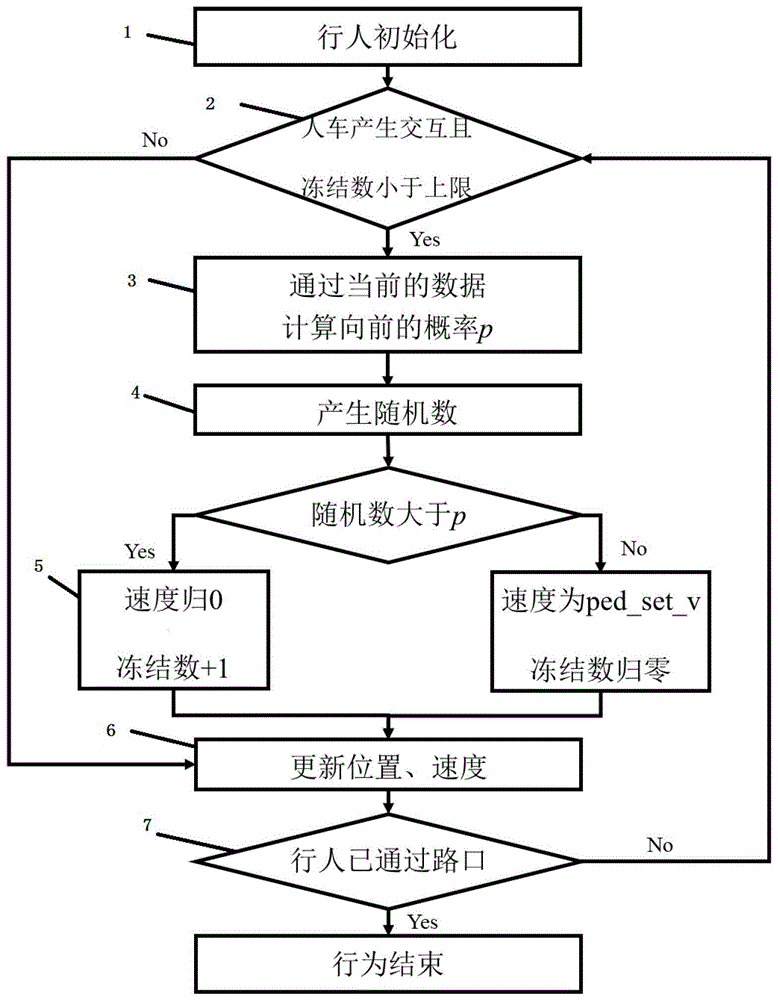
图2为本发明实施例提供的考虑个体激进度的行人穿行场景仿真方法的流传示意图。FIG. 2 is a schematic flow diagram of a method for simulating a pedestrian crossing scene according to an embodiment of the present invention that considers individual radicalness.
图3示出了不同激进度的行人在不同人车距离的前进概率曲线。Figure 3 shows the forward probability curves of pedestrians with different aggressiveness at different distances.
具体实施方式Detailed ways
下面结合附图和实施例对本发明进行详细的描述。The present invention will be described in detail below with reference to the accompanying drawings and embodiments.
本发明实施例提供一种考虑个体激进度的行人穿行场景仿真方法,整体的仿真构型采用和元胞自动机相同的模式。The embodiment of the present invention provides a pedestrian crossing scene simulation method that considers the individual aggressiveness, and the overall simulation configuration adopts the same mode as that of the cellular automaton.
其中,可以设置具有初始化的位置、速度等属性的个体单元,仿真开始后,每经过一个短时间间隔个体单元根据当前的状态来更新下一个时间段的行为。Among them, individual units with initialized position, speed and other attributes can be set. After the simulation starts, the individual units update the behavior of the next time period according to the current state after each short time interval.
本发明实施例提供一种仿真系统,用来实施上述行人穿行场景仿真方法,该系统中,预先设定如表2所示的常数。容易理解,下述表2设定的常数仅为示例,本领域技术人员可以根据需要从中选择部分或者设置其它常数。An embodiment of the present invention provides a simulation system for implementing the above-mentioned method for simulating a pedestrian crossing scene. In the system, constants as shown in Table 2 are preset. It is easy to understand that the constants set in Table 2 below are only examples, and those skilled in the art can select some of them or set other constants as needed.
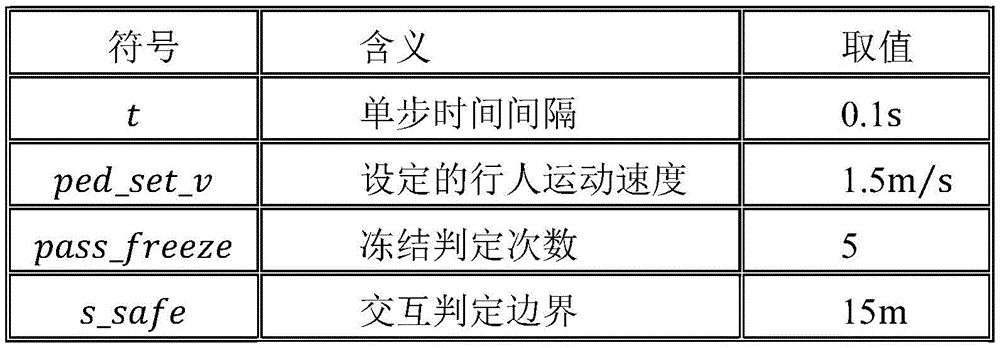
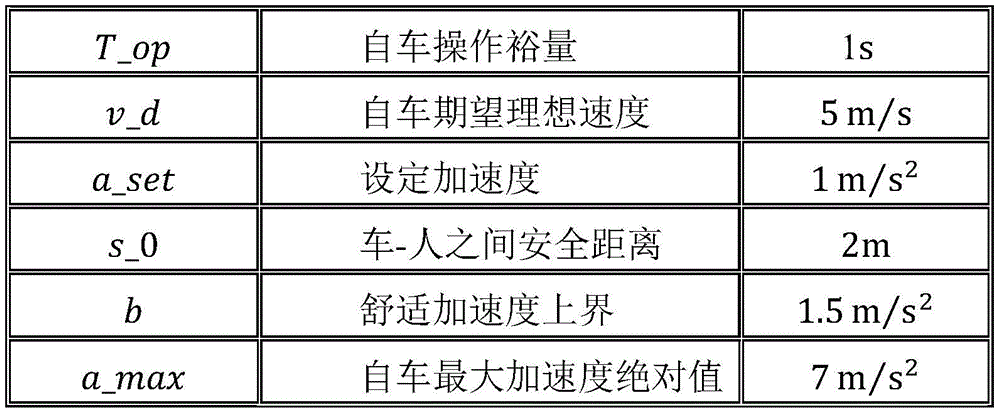
表2Table 2
其中,仿真步长(即单步时间间隔)设置为0.1s,即每隔0.1秒行人以及车辆的位置、速度等信息进行一次更新,该更新频率较高,能够满足仿真的精度需求。设定行人运动速度为正常行人行走速度,比如1.5m/s。冻结判定次数(即冻结数的上限)与后续仿真流程有关,表示行人坚持原先决策的难易度,其数值越大则表示行人越容易改变先前决策。交互判定边界预设为例如15m,即当人车距离小于15米时交互流程开启。车辆常数方面,自车操作裕量指的是留存给自车制动操作的时间,设置为1秒;自车理想速度为5m/s,加速情况下的期望加速度为1m/s2,人车安全距离为2m,舒适加速度上界为1.5m/s2,自车加速度最大值为7m/s2。车辆常数制定遵循IDM(Intelligent Driver Model,智能驾驶员模型)经验值。Among them, the simulation step size (that is, the single-step time interval) is set to 0.1s, that is, the information such as the position and speed of pedestrians and vehicles is updated every 0.1 seconds. The update frequency is high and can meet the accuracy requirements of the simulation. Set the pedestrian movement speed to the normal pedestrian walking speed, such as 1.5m/s. The number of freeze determinations (ie, the upper limit of the number of freezes) is related to the subsequent simulation process, indicating the difficulty of pedestrians sticking to the original decision. The larger the value, the easier it is for the pedestrian to change the previous decision. The interaction determination boundary is preset to, for example, 15m, that is, the interaction process is started when the distance between the person and the vehicle is less than 15m. In terms of vehicle constants, the self-vehicle operating margin refers to the time reserved for the self-vehicle braking operation, which is set to 1 second; the ideal speed of the self-vehicle is 5m/s, the expected acceleration under acceleration is 1m/s 2 , and the person and vehicle The safety distance is 2m, the upper limit of the comfortable acceleration is 1.5m/s 2 , and the maximum value of the self-vehicle acceleration is 7m/s 2 . The vehicle constants are formulated in accordance with the IDM (Intelligent Driver Model, intelligent driver model) experience value.
本发明实施例中,仿真场景的设置如图1所示,本发明中对仿真做出如下假设:In the embodiment of the present invention, the setting of the simulation scene is shown in FIG. 1 , and the following assumptions are made for the simulation in the present invention:
a)车辆与行人均考虑为质点;a) Both vehicles and pedestrians are considered as particles;
b)车辆能够完全精确地接收到行人的激进程度信息;b) The vehicle can receive information on the aggressiveness of pedestrians with complete accuracy;
c)不考虑车辆的长度;c) does not take into account the length of the vehicle;
d)整体模型沿用CA(Cellular Automata,元胞自动机)模型的所有假设;d) The overall model follows all the assumptions of the CA (Cellular Automata, cellular automata) model;
e)车辆不考虑转向操作,即运动为一维(X方向),只有加速和减速两种操作;e) The vehicle does not consider the steering operation, that is, the movement is one-dimensional (X direction), and there are only two operations of acceleration and deceleration;
f)行人运动也为一维(Y方向),只有加速和减速两种操作;f) The pedestrian movement is also one-dimensional (Y direction), with only two operations of acceleration and deceleration;
g)汽车的加速操作认为是可不连续的g) The acceleration operation of the car is considered to be discontinuous
h)行人与车辆发生碰撞的条件为同时满足以下两不等式:h) The condition for the collision between pedestrians and vehicles is to satisfy the following two inequalities at the same time:
|vehicle.x|≤0.5m (2)|vehicle.x|≤0.5m (2)
|pedestrian.y|≤0.2m (3)|pedestrian.y|≤0.2m (3)
其中,vehicle.x表示车辆与行人之间的纵向距离,pedestrian.y表示行人与车辆之间的横向距离。Among them, vehicle.x represents the longitudinal distance between the vehicle and the pedestrian, and pedestrian.y represents the lateral distance between the pedestrian and the vehicle.
容易理解,上述假设仅为示例,本领域技术人员可以根据需要从中选择部分或者设置其它假设。It is easy to understand that the above assumptions are only examples, and those skilled in the art can select some of them or set other assumptions as needed.
该场景中,在路端设定起点线和终点线,具体位置可以由使用者自行调整。图1的示例中起点、终点位置分别位于纵向-15米与+5米处。车辆经过起点线时开始计时,通过终点线时计时终止。行人的初始位置设置为(0,-5)。车道宽3.5米,车辆在道路中央沿直线行驶。In this scenario, the start line and the finish line are set at the end of the road, and the specific positions can be adjusted by the user. In the example of FIG. 1 , the start and end positions are located at -15 meters and +5 meters in the longitudinal direction, respectively. Timing starts when the vehicle passes the start line and ends when it passes the finish line. The initial position of the pedestrian is set to (0,-5). The lane is 3.5 meters wide and vehicles travel in a straight line in the center of the road.
以上初始条件仅为示例,使用者可以根据自身需求灵活调整道路宽度、起点终点位置等数据。The above initial conditions are only examples, and users can flexibly adjust data such as road width, starting and ending positions, etc., according to their own needs.
本发明实施例提供一种考虑个体激进度的行人穿行场景仿真方法,单次仿真的流程如图2所示,包括:An embodiment of the present invention provides a method for simulating a pedestrian crossing scene that considers individual aggressiveness. The flow of a single simulation is shown in Figure 2, including:
步骤1,进行车辆与行人初始化,每个行人在初始化时被赋予激进度作为内生参数,所述激进度数值越大代表行人越激进,反之则代表其越保守。Step 1: Initialize vehicles and pedestrians. Each pedestrian is given an aggressiveness as an endogenous parameter during initialization. The larger the aggressiveness value is, the more aggressive the pedestrian is, and vice versa, the more conservative it is.
内生参数指的是一个对象在被创立之初就设定且不会被后续环节改变的参数。激进度取值范围为0.1至0.9之间的实数,平均值为0.5,在现实中,极端保守以及极端激进的行人出现概率极小,因此初始化中不会出现激进度小于0.1或大于0.9的行人。Endogenous parameters refer to parameters that are set when an object is created and will not be changed by subsequent links. Aggressiveness is a real number ranging from 0.1 to 0.9, with an average value of 0.5. In reality, the probability of extremely conservative and extremely aggressive pedestrians is extremely small, so pedestrians with an aggressiveness less than 0.1 or greater than 0.9 will not appear during initialization. .
步骤2,在单步时间间隔更新完后,判断人车间距是否小于交互判定边界且行人冻结数未达到上限,若是则进入步骤3;若否则说明未达成交互条件,行人与车辆继续保持各自移动状态;其中,所述单步时间间隔为预设的仿真步长值;所述交互判定边界为预设的人车间距值;所述行人冻结数表示行人坚持原先决策的难易度,初始值为零,上限为预设数值,上限越大表示行人越容易改变先前决策。Step 2: After the single-step time interval is updated, determine whether the distance between the pedestrian and the vehicle is less than the interactive judgment boundary and the number of pedestrians freezing has not reached the upper limit. If so, go to
步骤3,通过当前的人车间距以及行人激进度计算行人继续前进的概率。Step 3: Calculate the probability of the pedestrian continuing to move forward according to the current distance between people and vehicles and the pedestrian's aggressiveness.
其中,通过下式(1)计算所述行人继续前进的概率:Among them, the probability of the pedestrian continuing to move forward is calculated by the following formula (1):

上式(1)中,prob(vehicle.x,agg)表示所述行人继续前进的概率,vehicle.x与vehicle.v表示车辆与行人之间的纵向距离以及车辆的纵向速度,agg表示行人的激进度,ssafe表示所述交互判定边界。In the above formula (1), prob(vehicle.x, agg) represents the probability that the pedestrian continues to move forward, vehicle.x and vehicle.v represent the longitudinal distance between the vehicle and the pedestrian and the longitudinal speed of the vehicle, and agg represents the pedestrian’s Aggressiveness, s safe represents the interaction decision boundary.
本示例中,通过当前的人车间距以及行人激进度计算行人继续前进的概率prob,概率产生的数值依赖于两个因素:In this example, the probability prob of pedestrians moving forward is calculated from the current distance between people and vehicles and the aggressiveness of pedestrians. The value of the probability depends on two factors:
i)汽车距离行人的纵向距离:纵向距离越近,行人更倾向于停止,同时距离逼近零时行人前进的概率应当为0;i) The longitudinal distance between the car and the pedestrian: the closer the longitudinal distance is, the more inclined the pedestrian is to stop, and the probability of the pedestrian moving forward should be 0 when the distance approaches zero;
j)行人自身的激进程度:相同的纵向距离下,行人越激进则越倾向于前进。j) Aggressiveness of pedestrians: Under the same vertical distance, the more aggressive the pedestrians, the more inclined they are to move forward.
在行人刚刚进入交互边界时,无论激进度如何都会100%选择前进;当人车距离逼近0时则所有人的前进概率都是0%;当人车距离为交互边界的一半时,此时的前进概率就是激进度。图3示出了不同激进度的行人在不同人车距离的前进概率曲线。When pedestrians just enter the interaction boundary, they will choose to move forward 100% regardless of the degree of aggressiveness; when the distance between the pedestrian and the vehicle approaches 0, the probability of everyone moving forward is 0%; when the distance between the pedestrian and the vehicle is half of the interaction boundary, the The probability of progress is the aggression. Figure 3 shows the forward probability curves of pedestrians with different aggressiveness at different distances.
步骤4,产生随机数,判断随机数是否大于前进概率;若是,则进入步骤5;若否,设置行人速度为预设速度,冻结数归零,进入步骤6;其中,所述随机数为大于0小于1的小数。Step 4, generate a random number, and judge whether the random number is greater than the forward probability; if so, go to
步骤5,行人速度归零,冻结数加一。
在真实交通场景中,当行人某一时刻决定停止前进时,在未来其会更加倾向于维持静止等车的决策直至车辆已通行,例如假设之前的2秒行人A都决定停在原地,在周围环境几乎没有变化时,A此时更倾向继续停在原地。为体现该特性,在流程中加入冻结数机制,冻结数初始为0,每当行人决定停止等车时,则冻结数加一,如果之前该行人已经连续超过5次决定停留在原地,即超过了冻结数上限,则推定之后行人就会一直停留在原地直至车辆与自身不再产生交互。In a real traffic scenario, when a pedestrian decides to stop at a certain moment, in the future, they will be more inclined to maintain the decision to wait for the vehicle until the vehicle has passed. When there is little change in the environment, A is more inclined to stay in place at this time. In order to reflect this feature, a freezing number mechanism is added to the process. The freezing number is initially 0. Whenever a pedestrian decides to stop waiting for a bus, the freezing number is increased by one. If the maximum number of freezes is exceeded, it is presumed that the pedestrian will stay in place until the vehicle no longer interacts with itself.
相反,若某一时刻行人决定前进,则冻结数清零,设置行人速度为预设速度,例如1.5m/s。On the contrary, if a pedestrian decides to move forward at a certain moment, the freezing number will be cleared, and the pedestrian speed will be set to a preset speed, such as 1.5m/s.
步骤6,更新行人与车辆的位置和速度。
本步骤中不限定具体计算方法,例如可以基于定位设备采集的人与车辆的位置信息以及时间信息获得并更新行人与车辆的位置和速度。The specific calculation method is not limited in this step, for example, the position and speed of the pedestrian and the vehicle may be obtained and updated based on the position information and time information of the person and the vehicle collected by the positioning device.
步骤7,判断行人是否已经通过路口,若已通过则仿真结束,若未通过则返回步骤2。
以上步骤1-7为单次仿真流程,在人车交互行为研究中,通常需要研究各种行人在同一场景下的宏观行为表现。为规避概率带来的误差,每一组仿真均产生预设数量(例如500对)初始化数值相同的车辆与行人。在每对行人与车辆的仿真过程中,当车辆还未通过路口时首先记录上一个时间间隔车辆与行人的速度、位置等状态信息,随后更新车辆与行人的速度与位置,更新方法可以根据实际需要灵活设置,例如可以根据不同的决策体系选择不同的车辆速度与位置的更新方法。The above steps 1-7 are a single simulation process. In the study of human-vehicle interaction behavior, it is usually necessary to study the macroscopic behavior of various pedestrians in the same scene. In order to avoid errors caused by probability, each group of simulations generates a preset number (for example, 500 pairs) of vehicles and pedestrians with the same initialization values. In the simulation process of each pair of pedestrian and vehicle, when the vehicle has not passed the intersection, first record the state information such as the speed and position of the vehicle and pedestrian in the previous time interval, and then update the speed and position of the vehicle and pedestrian. The update method can be based on the actual situation. Flexible settings are required, for example, different update methods of vehicle speed and position can be selected according to different decision systems.
在通过路口后,判断人车是否碰撞,若碰撞则总碰撞次数加一;最后,记录预设数量的仿真对象中发生车祸的次数,还可以记录其它信息,例如总的通行路口时间等仿真实验操作人所需要的数据。After passing the intersection, it is judged whether people and vehicles have collided, and if there is a collision, the total number of collisions is increased by one; finally, the number of car accidents in a preset number of simulation objects is recorded, and other information can also be recorded, such as the total crossing time and other simulation experiments Data required by the operator.
最后需要指出的是:以上实施例仅用以说明本发明的技术方案,而非对其限制。本领域的普通技术人员应当理解:可以对前述各实施例所记载的技术方案进行修改,或者对其中部分技术特征进行等同替换;这些修改或者替换,并不使相应技术方案的本质脱离本发明各实施例技术方案的精神和范围。Finally, it should be pointed out that the above embodiments are only used to illustrate the technical solutions of the present invention, but not to limit them. Those of ordinary skill in the art should understand that: the technical solutions described in the foregoing embodiments can be modified, or some technical features thereof can be equivalently replaced; these modifications or replacements do not make the essence of the corresponding technical solutions deviate from the various aspects of the present invention. The spirit and scope of the technical solutions of the embodiments.
Claims (7)

Priority Applications (1)
| Application Number | Priority Date | Filing Date | Title |
|---|---|---|---|
| CN202011077309.2A CN112131756B (en) | 2020-10-10 | 2020-10-10 | A Pedestrian Crossing Scene Simulation Method Considering Individual Aggressiveness |
Applications Claiming Priority (1)
| Application Number | Priority Date | Filing Date | Title |
|---|---|---|---|
| CN202011077309.2A CN112131756B (en) | 2020-10-10 | 2020-10-10 | A Pedestrian Crossing Scene Simulation Method Considering Individual Aggressiveness |
Publications (2)
| Publication Number | Publication Date |
|---|---|
| CN112131756A true CN112131756A (en) | 2020-12-25 |
| CN112131756B CN112131756B (en) | 2021-04-30 |
Family
ID=73844006
Family Applications (1)
| Application Number | Title | Priority Date | Filing Date |
|---|---|---|---|
| CN202011077309.2A Active CN112131756B (en) | 2020-10-10 | 2020-10-10 | A Pedestrian Crossing Scene Simulation Method Considering Individual Aggressiveness |
Country Status (1)
| Country | Link |
|---|---|
| CN (1) | CN112131756B (en) |
Cited By (1)
| Publication number | Priority date | Publication date | Assignee | Title |
|---|---|---|---|---|
| CN114913710A (en) * | 2021-02-07 | 2022-08-16 | 清华大学 | Man-vehicle interaction decision method and device, storage medium and terminal |
Citations (10)
| Publication number | Priority date | Publication date | Assignee | Title |
|---|---|---|---|---|
| US20110068950A1 (en) * | 2009-09-18 | 2011-03-24 | Michael Flaherty | Traffic management systems and methods of informing vehicle operators of traffic signal states |
| US9495874B1 (en) * | 2012-04-13 | 2016-11-15 | Google Inc. | Automated system and method for modeling the behavior of vehicles and other agents |
| CN106428000A (en) * | 2016-09-07 | 2017-02-22 | 清华大学 | Vehicle speed control device and method |
| CN107646111A (en) * | 2015-05-19 | 2018-01-30 | 北京市商汤科技开发有限公司 | System and method for the prediction of pedestrian's pavement |
| CN109992886A (en) * | 2019-04-01 | 2019-07-09 | 浙江大学 | A kind of mixed traffic emulation mode based on social force |
| CN110414365A (en) * | 2019-07-03 | 2019-11-05 | 上海交通大学 | Prediction method, system and medium of pedestrian trajectory on street crossing based on social force model |
| CN110427682A (en) * | 2019-07-26 | 2019-11-08 | 清华大学 | A virtual reality-based traffic scene simulation experiment platform and method |
| CN111081065A (en) * | 2019-12-13 | 2020-04-28 | 北京理工大学 | Intelligent vehicle cooperative lane change decision-making model under mixed traffic conditions |
| CN111071305A (en) * | 2019-12-06 | 2020-04-28 | 北京交通运输职业学院 | Intelligent estimation method and device for stop time of urban rail transit train |
| CN111368650A (en) * | 2020-02-18 | 2020-07-03 | 北京交通大学 | Crowd crowding behavior identification method based on track data |
-
2020
- 2020-10-10 CN CN202011077309.2A patent/CN112131756B/en active Active
Patent Citations (10)
| Publication number | Priority date | Publication date | Assignee | Title |
|---|---|---|---|---|
| US20110068950A1 (en) * | 2009-09-18 | 2011-03-24 | Michael Flaherty | Traffic management systems and methods of informing vehicle operators of traffic signal states |
| US9495874B1 (en) * | 2012-04-13 | 2016-11-15 | Google Inc. | Automated system and method for modeling the behavior of vehicles and other agents |
| CN107646111A (en) * | 2015-05-19 | 2018-01-30 | 北京市商汤科技开发有限公司 | System and method for the prediction of pedestrian's pavement |
| CN106428000A (en) * | 2016-09-07 | 2017-02-22 | 清华大学 | Vehicle speed control device and method |
| CN109992886A (en) * | 2019-04-01 | 2019-07-09 | 浙江大学 | A kind of mixed traffic emulation mode based on social force |
| CN110414365A (en) * | 2019-07-03 | 2019-11-05 | 上海交通大学 | Prediction method, system and medium of pedestrian trajectory on street crossing based on social force model |
| CN110427682A (en) * | 2019-07-26 | 2019-11-08 | 清华大学 | A virtual reality-based traffic scene simulation experiment platform and method |
| CN111071305A (en) * | 2019-12-06 | 2020-04-28 | 北京交通运输职业学院 | Intelligent estimation method and device for stop time of urban rail transit train |
| CN111081065A (en) * | 2019-12-13 | 2020-04-28 | 北京理工大学 | Intelligent vehicle cooperative lane change decision-making model under mixed traffic conditions |
| CN111368650A (en) * | 2020-02-18 | 2020-07-03 | 北京交通大学 | Crowd crowding behavior identification method based on track data |
Non-Patent Citations (5)
| Title |
|---|
| HEYEHUANG 等: "An integrated architecture for intelligence evaluation of automated vehicles", 《ACCIDENT ANALYSIS & PREVENTION》 * |
| ZHEN-XUE LIU 等: "Pedestrian movement intention identification model in mixed pedestrian-bicycle sections based on phase-field coupling theory", 《ADVANCES IN MECHANICAL ENGINEERING》 * |
| 何仁 等: "人-车-路交互下的驾驶人风险响应度建模", 《中国公路学报》 * |
| 肖尧: "基于Voronoi图的行人动力学建模仿真和圆环对跖点实验研究", 《中国博士学位论文全文数据库 工程科技Ⅱ辑》 * |
| 陆斯文 等: "单车道行人激进过街冲突和碰撞事故机理分析", 《重庆交通大学学报(自然科学版)》 * |
Cited By (2)
| Publication number | Priority date | Publication date | Assignee | Title |
|---|---|---|---|---|
| CN114913710A (en) * | 2021-02-07 | 2022-08-16 | 清华大学 | Man-vehicle interaction decision method and device, storage medium and terminal |
| CN114913710B (en) * | 2021-02-07 | 2023-12-05 | 清华大学 | Human-vehicle interaction decision-making method and device, storage medium and terminal |
Also Published As
| Publication number | Publication date |
|---|---|
| CN112131756B (en) | 2021-04-30 |
Similar Documents
| Publication | Publication Date | Title |
|---|---|---|
| CN112784485B (en) | Automatic driving key scene generation method based on reinforcement learning | |
| Shalev-Shwartz et al. | On a formal model of safe and scalable self-driving cars | |
| CN113581182B (en) | Automatic driving vehicle lane change track planning method and system based on reinforcement learning | |
| CN112071059B (en) | A collaborative planning method for intelligent vehicle lane changing trajectory based on instantaneous risk assessment | |
| CN109213148B (en) | A decision-making method for low-speed car following based on deep reinforcement learning | |
| US7487074B2 (en) | Road traffic simulation apparatus | |
| CN103593535B (en) | Urban traffic complex self-adaptive network parallel simulation system and method based on multi-scale integration | |
| JP2019194071A5 (en) | ||
| CN110298131A (en) | Automatic Pilot lane-change decision model method for building up under a kind of mixing driving environment | |
| CN118238847B (en) | Autonomous lane change decision planning method and system adaptive to different driving styles and road surface environments | |
| CN114973650B (en) | Vehicle ramp entrance confluence control method, vehicle, electronic device and storage medium | |
| CN114162145A (en) | Automatic vehicle driving method and device and electronic equipment | |
| CN113823076B (en) | Instant-stop and instant-walking road section blockage relieving method based on networked vehicle coordination control | |
| CN102999646A (en) | Method and system for vehicle following and track change in microscopic traffic simulation | |
| CN115565390B (en) | Intelligent network-connected automobile multi-lane queue traffic control method, system and computer readable storage medium | |
| CN110956851A (en) | A method for cooperative scheduling and lane changing of intelligent networked vehicles | |
| CN115973179A (en) | Model training method, vehicle control method, device, electronic equipment and vehicle | |
| CN112216148B (en) | Lane changing guidance method for two-lane vehicle under vehicle-road coordination | |
| CN109284527A (en) | A method for simulating traffic flow in urban road sections | |
| CN111625989A (en) | Intelligent vehicle influx method and system based on A3C-SRU | |
| CN115257789A (en) | Decision-making method for side anti-collision driving of commercial vehicle in urban low-speed environment | |
| CN112896166A (en) | Vehicle lane changing method and device and electronic equipment | |
| CN104794265A (en) | Moving following model design method based on acceleration information | |
| CN117104272A (en) | Intelligent driving method, system, vehicle and storage medium | |
| CN117755341A (en) | Training of vehicle decision control models and vehicle decision control methods, devices and equipment |
Legal Events
| Date | Code | Title | Description |
|---|---|---|---|
| PB01 | Publication | ||
| PB01 | Publication | ||
| SE01 | Entry into force of request for substantive examination | ||
| SE01 | Entry into force of request for substantive examination | ||
| GR01 | Patent grant | ||
| GR01 | Patent grant |