CN112071059B - A collaborative planning method for intelligent vehicle lane changing trajectory based on instantaneous risk assessment - Google Patents
A collaborative planning method for intelligent vehicle lane changing trajectory based on instantaneous risk assessment Download PDFInfo
- Publication number
- CN112071059B CN112071059B CN202010840942.6A CN202010840942A CN112071059B CN 112071059 B CN112071059 B CN 112071059B CN 202010840942 A CN202010840942 A CN 202010840942A CN 112071059 B CN112071059 B CN 112071059B
- Authority
- CN
- China
- Prior art keywords
- vehicle
- time
- track
- target vehicle
- surrounding
- Prior art date
- Legal status (The legal status is an assumption and is not a legal conclusion. Google has not performed a legal analysis and makes no representation as to the accuracy of the status listed.)
- Active
Links
Images


Classifications
-
- G—PHYSICS
- G08—SIGNALLING
- G08G—TRAFFIC CONTROL SYSTEMS
- G08G1/00—Traffic control systems for road vehicles
- G08G1/01—Detecting movement of traffic to be counted or controlled
- G08G1/0104—Measuring and analyzing of parameters relative to traffic conditions
-
- G—PHYSICS
- G08—SIGNALLING
- G08G—TRAFFIC CONTROL SYSTEMS
- G08G1/00—Traffic control systems for road vehicles
- G08G1/01—Detecting movement of traffic to be counted or controlled
- G08G1/0104—Measuring and analyzing of parameters relative to traffic conditions
- G08G1/0137—Measuring and analyzing of parameters relative to traffic conditions for specific applications
-
- G—PHYSICS
- G08—SIGNALLING
- G08G—TRAFFIC CONTROL SYSTEMS
- G08G1/00—Traffic control systems for road vehicles
- G08G1/16—Anti-collision systems
- G08G1/167—Driving aids for lane monitoring, lane changing, e.g. blind spot detection
Landscapes
- Physics & Mathematics (AREA)
- General Physics & Mathematics (AREA)
- Chemical & Material Sciences (AREA)
- Analytical Chemistry (AREA)
- Traffic Control Systems (AREA)
Abstract
本发明公开了一种基于瞬时风险评估的智能车辆换道轨迹协同规划方法,包括:1)获取交通基础数据:车辆运动数据、车辆相对位置信息、车辆几何参数、道路几何条件和路面摩擦系数;2)采集周围车辆的运动轨迹构建换道样本,利用模糊C聚类算法提取周围车辆运动特征;3)基于周围车辆的运动特征,预测周围车辆在t时刻的车辆运动状态及车辆间距;4)建立换道条件安全判别模型,利用停车距离指标推导车辆运行瞬时风险指标;5)以瞬时风险最小化为目标函数,分别利用梯形加速度法与遗传算法规划车辆横纵向运动轨迹;6)通过计算机编程实现车辆换道轨迹规划功能。本发明可提前识别换道安全性,并规划车辆换道轨迹,为车辆换道轨迹规划系统提供理论参考与技术支持。

The invention discloses a method for collaborative planning of lane changing trajectory of intelligent vehicles based on instantaneous risk assessment, comprising: 1) acquiring basic traffic data: vehicle motion data, vehicle relative position information, vehicle geometric parameters, road geometric conditions and road friction coefficient; 2) Collect the motion trajectories of the surrounding vehicles to construct lane-changing samples, and use the fuzzy C clustering algorithm to extract the motion characteristics of the surrounding vehicles; 3) Based on the motion characteristics of the surrounding vehicles, predict the vehicle motion state and vehicle distance of the surrounding vehicles at time t; 4) Establish a safety discrimination model for lane changing conditions, and use the parking distance index to deduce the instantaneous risk index of vehicle operation; 5) Taking the minimization of the instantaneous risk as the objective function, the trapezoidal acceleration method and the genetic algorithm are used to plan the transverse and longitudinal motion trajectories of the vehicle respectively; 6) Through computer programming Implement the vehicle lane changing trajectory planning function. The invention can identify the lane changing safety in advance, and plan the vehicle lane changing trajectory, and provide theoretical reference and technical support for the vehicle lane changing trajectory planning system.
Description
技术领域technical field
本发明涉及智能车辆换道风险评估与换道轨迹最优性的技术领域,尤其是指一种基于瞬时风险评估的智能车辆换道轨迹协同规划方法。The invention relates to the technical field of intelligent vehicle lane-changing risk assessment and lane-changing trajectory optimality, in particular to a collaborative planning method for intelligent vehicle lane-changing trajectory based on instantaneous risk assessment.
背景技术Background technique
跟车行为与换道行为是车辆在高速公路上行驶时最常见的两种驾驶行为,当驾驶员意图执行换道行为时,驾驶员需要根据周围车辆的间距、运行状态、道路线形、道路使用情况以及交通限速管理等一系列的交通环境因素,对是否执行换道、何时换道以及如何换道等问题做出合理的分析和判断。一旦驾驶员对安全换道的可行性做出错误的判断,极易引发交通事故。据高速公路和快速路交通事故数据统计,与换道过程有关的交通事故占60%以上。由此可见,如何有效提高车辆在高速公路上的换道安全性是一项重要的研究内容。随着计算机技术与传感器技术的快速发展,智能网联汽车逐渐普及。有研究学者表明,自动驾驶技术在降低延误、减少交通事故和提高道路通行能力等方面具有巨大潜在研究价值。当自动驾驶技术发展成熟时,其技术应用可有效帮助驾驶员提升驾驶安全性、舒适性,避免因人为错误操作引发的交通事故。同时,随着5G通讯技术的发展,车辆与交通环境之间的通讯能力得到进一步提高,为自动驾驶技术的应用创造了良好的通讯环境,从而使智能网联汽车得到了加快推广。综上所述,通过电子传感器技术和通信技术实时获取周围环境的交通状态信息,为智能车辆规划安全、可靠、舒适、高效的换道轨迹已成为当今自动驾驶技术的研究热点,解决因行驶环境随机性和复杂性导致的换道轨迹规划安全难题。Car-following behavior and lane-changing behavior are the two most common driving behaviors when a vehicle is driving on a highway. When a driver intends to perform a lane-changing behavior, the driver needs to consider the distance between surrounding vehicles, operating status, road alignment, and road usage. A series of traffic environment factors such as traffic speed limit management, etc., make reasonable analysis and judgment on whether to change lanes, when to change lanes, and how to change lanes. Once the driver makes a wrong judgment on the feasibility of changing lanes safely, it is very easy to cause traffic accidents. According to the statistics of highway and expressway traffic accidents, more than 60% of the traffic accidents are related to the lane changing process. It can be seen that how to effectively improve the lane-changing safety of vehicles on the highway is an important research content. With the rapid development of computer technology and sensor technology, intelligent networked vehicles have gradually become popular. Some researchers have shown that autonomous driving technology has great potential research value in reducing delays, reducing traffic accidents and improving road capacity. When the development of autonomous driving technology matures, its technical application can effectively help drivers improve driving safety and comfort, and avoid traffic accidents caused by human error operations. At the same time, with the development of 5G communication technology, the communication ability between vehicles and the traffic environment has been further improved, creating a good communication environment for the application of autonomous driving technology, thus accelerating the promotion of intelligent networked vehicles. In summary, obtaining real-time traffic status information of the surrounding environment through electronic sensor technology and communication technology, and planning safe, reliable, comfortable and efficient lane-changing trajectories for intelligent vehicles has become a research hotspot in today's autonomous driving technology. The safety problem of lane changing trajectory planning caused by randomness and complexity.
目前,应用于无人驾驶车辆的换道轨迹规划模型种类繁多,主要包含多项式轨迹、回旋曲线、正反梯形横向加速度轨迹和圆弧轨迹等,各种轨迹模型各有侧重,性能存在较大差异。尽管换道轨迹建模已取得一定成果,但尚存部分亟待优化、改进之处。经归纳,不足之处主要表现在:①大部分模型仅考虑当前交通环境的安全性,难以提前评估即将遭遇的换道风险;②多数模型注重研究换道轨迹本身的性能,较少考虑换道车辆与周围车辆的博弈关系及其交互影响。因此,有必要实时提取周围车辆的运动特征,对其运动轨迹进行预测,从而判别智能车辆在未来短时间内的换道风险,并基于此规划换道轨迹。本发明考虑了智能车辆与周围车辆之间的交互作用,可对智能车辆换道风险进行提前识别,并基于未来交通环境与换道瞬时风险规划换道轨迹,从而提高智能车辆在实际应用中的换道安全性。At present, there are many types of lane-changing trajectory planning models applied to unmanned vehicles, mainly including polynomial trajectories, clothoids, positive and negative trapezoidal lateral acceleration trajectories, and circular arc trajectories. . Although some achievements have been made in lane-changing trajectory modeling, there are still some areas that need to be optimized and improved. After summarizing, the main shortcomings are as follows: ①Most models only consider the safety of the current traffic environment, and it is difficult to assess the upcoming lane-changing risk in advance; ②Most models focus on the performance of the lane-changing trajectory itself, and seldom consider lane-changing Game relationship between vehicles and surrounding vehicles and their interactive effects. Therefore, it is necessary to extract the motion characteristics of surrounding vehicles in real time and predict their motion trajectories, so as to determine the lane-changing risk of intelligent vehicles in a short time in the future, and plan lane-changing trajectories based on this. The present invention considers the interaction between the intelligent vehicle and the surrounding vehicles, can identify the lane-changing risk of the intelligent vehicle in advance, and plan the lane-changing trajectory based on the future traffic environment and the instantaneous risk of lane-changing, thereby improving the performance of the intelligent vehicle in practical application. Lane change safety.
鉴于此,本发明基于当前交通条件信息,利用模糊C聚类算法提取周围车辆的运动特征,预测t时刻的周围车辆运动工况。其次,采用停车视距(Stopping sight distance,SSD)实时判别目标车辆在t时刻的换道冲突可能性,并利用停车距离指标(Stoppingdistance index,SDI)得到车辆运行瞬时风险评估指标。最后,以车辆运行瞬时风险最小化为目标函数,设置最大速度、最大加速度以及最大瞬时风险等约束条件,利用梯形加速度法规划车辆横向运动轨迹,采用遗传算法优化车辆纵向运动轨迹,进而组合得到车辆换道运动轨迹。本发明能够有效提取周围车辆运动模式特征,提前评估目标车辆在t时刻的瞬时风险,并综合考虑了车辆在换道过程中的安全性与舒适性,实时规划车辆换道轨迹,从而为车辆换道轨迹规划系统、自动驾驶车辆换道控制提供理论参考与技术支持。In view of this, the present invention uses the fuzzy C clustering algorithm to extract the motion characteristics of the surrounding vehicles based on the current traffic condition information, and predicts the motion conditions of the surrounding vehicles at time t. Secondly, the stopping sight distance (SSD) is used to judge the possibility of lane change conflict of the target vehicle at time t in real time, and the stopping distance index (SDI) is used to obtain the instantaneous risk assessment index of vehicle operation. Finally, the objective function is to minimize the instantaneous risk of vehicle operation, and constraints such as maximum speed, maximum acceleration and maximum instantaneous risk are set, the trapezoidal acceleration method is used to plan the lateral motion trajectory of the vehicle, and the genetic algorithm is used to optimize the longitudinal motion trajectory of the vehicle, and then the vehicle is combined to obtain the vehicle. Lane change trajectory. The present invention can effectively extract the surrounding vehicle motion pattern characteristics, evaluate the instantaneous risk of the target vehicle at time t in advance, and comprehensively consider the safety and comfort of the vehicle during the lane-changing process, and plan the vehicle lane-changing trajectory in real time, so as to provide the vehicle for changing lanes. Provide theoretical reference and technical support for lane trajectory planning system and automatic driving vehicle lane change control.
发明内容SUMMARY OF THE INVENTION
本发明的目的在于克服现有技术的缺点与不足,提出了一种基于瞬时风险评估的智能车辆换道轨迹协同规划方法,通过采集交通基础数据,利用模糊C聚类算法提取周围车辆运动特征,预测周围车辆运动工况。同时,基于SSD判断换道条件是否安全,利用SDI评估车辆运行瞬时风险,并以瞬时风险最小化为目标函数,分别采用梯形加速度法与遗传算法规划车辆横纵向运动轨迹,输出安全、可靠、舒适的车辆换道轨迹方案。The purpose of the present invention is to overcome the shortcomings and deficiencies of the prior art, and propose a collaborative planning method for intelligent vehicle lane changing trajectory based on instantaneous risk assessment. Predict surrounding vehicle motion conditions. At the same time, based on SSD to judge whether the lane changing conditions are safe, use SDI to evaluate the instantaneous risk of vehicle operation, and take the minimization of the instantaneous risk as the objective function, respectively use the trapezoidal acceleration method and the genetic algorithm to plan the horizontal and vertical motion trajectories of the vehicle, and the output is safe, reliable and comfortable. The vehicle lane changing trajectory scheme.
为实现上述目的,本发明所提供的技术方案为:一种基于瞬时风险评估的智能车辆换道轨迹协同规划方法,包括以下步骤:In order to achieve the above purpose, the technical solution provided by the present invention is: a method for collaborative planning of lane-changing trajectories of intelligent vehicles based on instantaneous risk assessment, comprising the following steps:
1)获取交通基础数据,包括车辆运动数据、车辆相对位置信息、车辆几何参数、道路几何条件和路面摩擦系数;1) Obtain basic traffic data, including vehicle motion data, vehicle relative position information, vehicle geometric parameters, road geometric conditions and road friction coefficient;
2)周围车辆运动特征提取:采集目标车辆换道过程中周围车辆的运动轨迹历史数据以构建换道样本,利用模糊C聚类算法提取换道样本中周围车辆的运动特征;2) Motion feature extraction of surrounding vehicles: collect the historical data of the motion trajectories of surrounding vehicles during the lane-changing process of the target vehicle to construct a lane-changing sample, and use the fuzzy C clustering algorithm to extract the motion characteristics of surrounding vehicles in the lane-changing sample;
3)预测周围车辆未来运动工况:基于周围车辆的运动特征,预测周围车辆在t时刻的车辆运动状态及车辆间距;3) Predict the future motion conditions of surrounding vehicles: Based on the motion characteristics of surrounding vehicles, predict the vehicle motion state and vehicle distance of surrounding vehicles at time t;
4)评估车辆运行瞬时风险:基于停车视距建立换道条件安全判别模型,利用SDI获得车辆运行瞬时风险指标,以实时评估t时刻的风险系数;4) Assess the instantaneous risk of vehicle operation: establish a lane-changing condition safety discrimination model based on the parking sight distance, and use SDI to obtain the instantaneous risk index of vehicle operation to evaluate the risk coefficient at time t in real time;
5)构建瞬时风险最小化目标函数,规划车辆横纵向运动轨迹:以车辆运行瞬时风险最小化为目标函数,设置约束条件,包括最大速度、最大加速度以及最大瞬时风险,利用梯形加速度法与遗传算法规划车辆横纵向运动加速度,进而得到车辆换道轨迹;5) Construct the objective function of instantaneous risk minimization, and plan the lateral and longitudinal motion trajectory of the vehicle: take the minimization of the instantaneous risk of vehicle operation as the objective function, set constraints, including the maximum speed, the maximum acceleration and the maximum instantaneous risk, use the trapezoidal acceleration method and the genetic algorithm Plan the lateral and longitudinal motion acceleration of the vehicle, and then obtain the lane-changing trajectory of the vehicle;
6)通过计算机编程实现车辆运行瞬时风险评估功能,并输出车辆换道加速度方案。6) Realize the instantaneous risk assessment function of vehicle operation through computer programming, and output the vehicle lane change acceleration scheme.
在步骤1)中,所述车辆运动数据包括目标车辆与周围车辆的速度与加速度,能够通过智能车辆的车载传感器或路侧监控设备获取车辆实时运动数据;所述车辆相对位置信息包括目标车辆分别与当前车道前车、后车的车辆间距及目标车辆与当前车道前车、后车的车辆间距,能够从智能车辆的车载传感器以及路侧监控设备获取;所述车辆几何参数包括车辆长度和车辆宽度,能够通过读取车身电子标签信息或视频识别获取;所述道路几何条件包括车道数、车道宽度和坡度,能够通过车载导航地图或路侧视频设备识别获取;所述路面摩擦系数包括不同天气情况下的路面摩擦系数,能够通过专家法或相关标准设定。In step 1), the vehicle motion data includes the speed and acceleration of the target vehicle and surrounding vehicles, and real-time vehicle motion data can be obtained through the on-board sensors of the smart vehicle or roadside monitoring equipment; the vehicle relative position information includes the target vehicle respectively. The distance between the vehicle and the vehicle in front of and behind the current lane and the distance between the target vehicle and the vehicle in front and behind the current lane can be obtained from the on-board sensors of the smart vehicle and roadside monitoring equipment; the vehicle geometric parameters include vehicle length and vehicle distance. width, which can be obtained by reading the body electronic label information or video recognition; the road geometric conditions include the number of lanes, lane width and slope, which can be identified and obtained by on-board navigation maps or roadside video equipment; the road friction coefficient includes different weather conditions The friction coefficient of the road surface under the condition can be set by the expert method or related standards.
所述步骤2)包括以下步骤:Described step 2) comprises the following steps:
2.1)定义目标车辆的周围车辆2.1) Define the surrounding vehicles of the target vehicle
目标车辆的周围车辆分布状况由实际情况而定,其数量设为n,则有0≤n≤4,即周围车辆最少为0辆车,最多为4辆车;当n=4时,周围车辆包括目标车辆所在当前车道的后车与前车及目标车辆意图到达目标车道的后车与前车;The distribution of surrounding vehicles of the target vehicle is determined by the actual situation, and its number is set to n, then 0≤n≤4, that is, the surrounding vehicles are at least 0 vehicles and at most 4 vehicles; when n=4, the surrounding vehicles Including the rear and front vehicles in the current lane where the target vehicle is located, and the rear and front vehicles that the target vehicle intends to reach the target lane;
2.2)定义模糊C聚类算法的Hausdorff距离2.2) Define the Hausdorff distance of the fuzzy C clustering algorithm
已知目标车辆与周围车辆的运动轨迹,利用模糊C聚类算法将具有相似运动特征的车辆轨迹聚为同一类,以区分车辆的运动模式;选择Hausdorff距离来度量车辆轨迹的相似性,定义数据采样周期为c,轨迹时间长度为T,T为整数,车辆运动轨迹数为N,则两辆车的运动特征的Hausdorff距离为:Knowing the motion trajectories of the target vehicle and surrounding vehicles, the fuzzy C clustering algorithm is used to cluster the trajectories of vehicles with similar motion characteristics into the same class to distinguish the motion patterns of the vehicles; the Hausdorff distance is selected to measure the similarity of the vehicle trajectories and define the data. The sampling period is c, the trajectory time length is T, T is an integer, and the number of vehicle motion trajectories is N, then the Hausdorff distance of the motion features of the two vehicles is:
H(Fi,Fj)=max{h(Fi,Fj),h(Fj,Fi)}H(F i ,F j )=max{h(F i ,F j ),h(F j ,F i )}
其中,in,


式中,i=1,2,…,N;j=1,2,…,N;N为车辆运动轨迹数;l与k均为时间变量;H(Fi,Fj)表示轨迹Fi与轨迹Fj之间的Hausdorff距离;轨迹Fi=(fi 1,fi 2,…,fi T),轨迹Fj=(fj 1,fj 2,…,fj T);h(Fi,Fj)表示轨迹Fi到轨迹Fj的前向Hausdorff距离;h(Fj,Fi)表示轨迹Fj到轨迹Fi的后向Hausdorff距离;fi k表示车辆i在k时刻的位置坐标(xi k,yi k),fj l表示车辆j在l时刻的位置坐标(xj l,yj l);d(fi k,fj l)表示位置坐标fi k与fj l之间的欧氏距离,即
2.3)基于模糊C聚类算法的车辆运动特征聚类2.3) Vehicle motion feature clustering based on fuzzy C clustering algorithm
选择模糊C聚类算法实现轨迹聚类,模糊C聚类采用模糊思想,设计思路符合实际,有更好的鲁棒性和适用性,模糊C聚类算法实现车辆运动轨迹聚类的算法步骤如下:Select the fuzzy C clustering algorithm to realize the trajectory clustering. The fuzzy C clustering adopts the fuzzy idea, the design idea is in line with the reality, and has better robustness and applicability. The algorithm steps of the fuzzy C clustering algorithm to realize the vehicle motion trajectory clustering are as follows :
Step 1:随机初始化K个轨迹聚类中心;Step 1: Randomly initialize K trajectory clustering centers;
Step 2:计算每条车辆运动轨迹Fi分别到K个轨迹中心θk的Hausdorff距离,即:Step 2: Calculate the Hausdorff distance from each vehicle trajectory F i to the K trajectory centers θ k , namely:
H(Fi,θk)=max{h(Fi,θk),h(θk,Fi)}H(F i ,θ k )=max{h(F i ,θ k ),h(θ k ,F i )}
式中,H(Fi,θk)表示轨迹Fi与轨迹中心θk之间的Hausdorff距离;i=1,2,3,…,N,N为车辆运动轨迹数;k=1,2,…,K,K为轨迹中心的数量;h(Fi,θk)表示轨迹Fi到轨迹中心θk的前向Hausdorff距离;h(θk,Fi)表示轨迹中心θk到轨迹Fi的后向Hausdorff距离;In the formula, H(F i , θ k ) represents the Hausdorff distance between the trajectory Fi and the trajectory center θ k ; i =1, 2, 3,..., N, N is the number of vehicle motion trajectories; k=1, 2 ,...,K, K is the number of track centers; h(F i , θ k ) represents the forward Hausdorff distance from the track Fi to the track center θ k ; h(θ k , Fi ) represents the track center θ k to the track The backward Hausdorff distance of F i ;
Step 3:计算每条车辆运动轨迹Fi分别到K个轨迹中心θk的隶属度μi,k:Step 3: Calculate the membership μ i,k of each vehicle motion trajectory F i to the K trajectory centers θ k :

式中,μi,k为轨迹Fi到轨迹中心θk的隶属度;K为轨迹中心的数量;N为车辆运动轨迹数;θk为第k个轨迹中心;Fi表示第i条轨迹;H(Fi,θk)表示轨迹Fi与轨迹中心θk之间的Hausdorff距离;In the formula, μ i,k is the membership degree from the track F i to the track center θ k ; K is the number of track centers; N is the number of vehicle motion tracks; θ k is the k-th track center; F i represents the i-th track ; H(F i , θ k ) represents the Hausdorff distance between the trajectory Fi and the trajectory center θ k ;
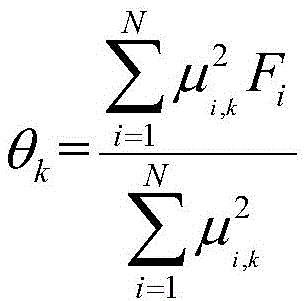
Step 4:根据每条车辆运动轨迹的隶属度更新K个轨迹中心θk:Step 4: Update the K track centers θ k according to the membership of each vehicle trajectory:
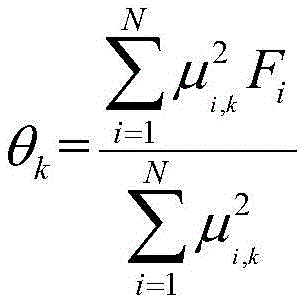
式中,θk为第k个轨迹中心;Fi表示第i条轨迹;μi,k为轨迹Fi到轨迹中心θk的隶属度;N为车辆运动轨迹数;In the formula, θ k is the k-th track center; F i represents the i -th track; μ i,k is the membership degree of the track Fi to the track center θ k ; N is the number of vehicle motion trajectories;
Step 5:根据下式判断K个聚类中心是否收敛,若收敛结束循环,否则执行Step 2;Step 5: Judge whether the K cluster centers converge according to the following formula, if the convergence ends the cycle, otherwise, execute Step 2;

式中,K为轨迹中心的数量;r为迭代次数;θk(r)为第r次迭代的第k个轨迹中心;θk(r+1)为第r+1次迭代的第k个轨迹中心;ε为收敛上界;In the formula, K is the number of trajectory centers; r is the number of iterations; θ k (r) is the k-th trajectory center of the r-th iteration; θ k (r+1) is the k-th iteration of the r+1-th iteration Trajectory center; ε is the upper bound of convergence;
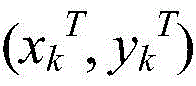
模糊C聚类算法运行结束后,能够得到K个车辆运动轨迹中心θk,即
所述步骤3)包括以下步骤:Described step 3) comprises the following steps:
3.1)车辆运动模式判断3.1) Judgment of vehicle motion mode
基于所选取的车辆运动轨迹中心θk i推导其轨迹位置对应的加速度向量ak i,且ak i={ak i(1),ak i(2),…,ak i(T)},ak i(T)为车辆运动轨迹中心θk i在T时刻的加速度;已知周围车辆i在过去T1秒的运动轨迹数据,根据模糊C聚类算法得到的K个车辆运动轨迹中心结果,分别计算周围车辆i在过去T1秒内的加速度与K个车辆运动轨迹中心在任意T1秒内的加速度之间的方差,通过筛选得到加速度方差最小的车辆运行轨迹中心,即选取与周围车辆i运动模式相似度最高的车辆运动轨迹中心θk i,i≤n,n为周围车辆的数量;Based on the selected vehicle motion trajectory center θ k i , the acceleration vector a k i corresponding to its trajectory position is derived, and a k i ={a k i (1),a k i (2),...,a k i (T )}, a k i (T) is the acceleration of the vehicle motion trajectory center θ k i at time T; the motion trajectory data of the surrounding vehicle i in the past T 1 second is known, and the K vehicle motions obtained according to the fuzzy C clustering algorithm Track center results, calculate the variance between the acceleration of the surrounding vehicle i in the past T 1 second and the acceleration of the K vehicle trajectory centers in any T 1 second, and obtain the vehicle running track center with the smallest acceleration variance through screening, namely Select the vehicle motion trajectory center θ k i with the highest similarity to the motion pattern of the surrounding vehicle i, i≤n, n is the number of surrounding vehicles;
3.2)预测周围车辆在t时刻的速度3.2) Predict the speed of surrounding vehicles at time t
已知周围车辆i的初始速度Vi(T1)、加速度ai(T1)以及相似度最高的车辆运动轨迹中心加速度向量ak i,则周围车辆i在t时刻的速度Vi(t)为:Knowing the initial speed V i (T 1 ), acceleration a i (T 1 ) of the surrounding vehicle i, and the center acceleration vector a k i of the vehicle motion trajectory with the highest similarity, then the speed V i (t ) of the surrounding vehicle i at time t )for:

式中,Vi(t)为周围车辆i在t时刻的速度,单位为m/s;τ为t时间内的任意时间;T1为已经历的时间窗,单位为s;T为轨迹时间长度;ak i(τ)为与周围车辆i运动轨迹点相似度最高的车辆运动轨迹中心在τ时刻的加速度,单位为m/s2;Vi(T1)为周围车辆i的初始速度,单位为m/s;In the formula, V i (t) is the speed of the surrounding vehicle i at time t, in m/s; τ is any time in t time; T 1 is the elapsed time window, in s; T is the trajectory time Length; a k i (τ) is the acceleration of the vehicle motion trajectory center with the highest similarity to the surrounding vehicle i motion trajectory point at time τ, the unit is m/s 2 ; V i (T 1 ) is the initial speed of the surrounding vehicle i , the unit is m/s;
3.3)计算目标车辆与周围车辆在t时刻的车辆间距3.3) Calculate the vehicle distance between the target vehicle and surrounding vehicles at time t
周围车辆i在t时刻的位移Si(t)为:The displacement S i (t) of the surrounding vehicle i at time t is:

式中,Si(t)为周围车辆i在t秒后的位移,单位为m;c为采样周期,单位为s;τ为t时间内的任意时间;Vi(τ)为周围车辆i在τ时刻的速度,单位为m/s;T1为已经历的时间窗,单位为s;T为轨迹时间长度;ak i(τ)为与周围车辆i运动轨迹点相似度最高的车辆运动轨迹中心在τ时刻的加速度,单位为m/s2;In the formula, S i (t) is the displacement of the surrounding vehicle i after t seconds, the unit is m; c is the sampling period, the unit is s; τ is any time within t time; V i (τ) is the surrounding vehicle i The speed at time τ, the unit is m/s; T 1 is the elapsed time window, the unit is s; T is the trajectory time length; a k i (τ) is the vehicle with the highest similarity to the trajectory point of the surrounding vehicle i The acceleration of the motion trajectory center at time τ, in m/s 2 ;
假设目标车辆在换道过程中周围存在n辆车,且1≤n≤4;已知目标车辆与周围车辆的初始车辆间距di(T1),且i=1,2,…,n,则目标车辆与周围车辆i在t时刻的车辆间距di(t)为:Assuming that there are n vehicles around the target vehicle during the lane change process, and 1≤n≤4; the initial vehicle distance d i (T 1 ) between the target vehicle and surrounding vehicles is known, and i=1,2,...,n, Then the vehicle distance d i (t) between the target vehicle and the surrounding vehicle i at time t is:
di(t)=SF(t)-SR(t)+di(T1)d i (t)=SF (t)-S R (t)+d i ( T 1 )
式中:di(t)为目标车辆与周围车辆i在t时刻的纵向车辆间距,单位为m;SF(t)为目标车辆与周围车辆i两者中处于前方位置的车辆在t时刻的纵向位移,单位为m;SR(t)为目标车辆与周围车辆i两者中处于后方位置的车辆在t时刻的纵向位移,单位为m。In the formula: d i (t) is the longitudinal vehicle distance between the target vehicle and surrounding vehicle i at time t, in m; S F (t) is the vehicle in front of the target vehicle and surrounding vehicle i at time t The longitudinal displacement of , the unit is m; S R (t) is the longitudinal displacement of the vehicle in the rear position of the target vehicle and the surrounding vehicle i at the time t, the unit is m.
所述步骤4)包括以下步骤:Described step 4) comprises the following steps:
4.1)安全换道条件判别4.1) Judgment of safe lane changing conditions
基于目标车辆与周围车辆i在t时刻的速度以及纵向车辆间距,计算目标车辆与周围车辆i之间的停车视距,以判断t时刻的交通条件是否存在换道风险,则各车辆在t时刻的停车视距为Dj(t):Based on the speed of the target vehicle and surrounding vehicle i at time t and the longitudinal vehicle distance, the parking sight distance between the target vehicle and surrounding vehicle i is calculated to determine whether the traffic conditions at time t have a risk of changing lanes, then each vehicle is at time t. The parking sight distance of is D j (t):

式中,Dj(t)为车辆j在t时刻的停车视距,单位为m,j=s,1,2,…,n,j=s表示目标车辆,j=1,2,…,n表示周围车辆;Vj(t)为车辆j在t时刻的速度,单位为km/h;f为路面摩擦系数;g为道路坡度;tr为驾驶员反应时间,单位为s;In the formula, D j (t) is the parking sight distance of vehicle j at time t, the unit is m, j=s, 1, 2,...,n, j=s represents the target vehicle, j=1, 2,..., n represents the surrounding vehicles; V j (t) is the speed of vehicle j at time t, in km/h; f is the road friction coefficient; g is the road gradient; t r is the driver's reaction time, in s;
已知目标车辆与周围车辆i在t时刻的纵向车辆间距以及停车视距,则t时刻目标车辆与周围车辆i之间的停车距离指标SDIi(t)为:Knowing the longitudinal vehicle distance and the parking sight distance between the target vehicle and surrounding vehicle i at time t, the parking distance index SDI i (t) between the target vehicle and surrounding vehicle i at time t is:
SDIi(t)=DF(t)-DR(t)+di(t)-lF SDI i (t)= DF (t)-DR ( t )+d i (t)-l F
式中:SDIi(t)为目标车辆与周围车辆i在t时刻的停车距离指标,i=1,2,…,n,单位为m;DF(t)为目标车辆与周围车辆i两者中处于前方位置的车辆在t时刻的停车视距,单位为m;DR(t)为目标车辆与周围车辆i两者中处于后方位置的车辆在t时刻的停车视距,单位为m;di(t)为目标车辆与周围车辆i在t时刻的纵向车辆间距,单位为m;lF为目标车辆与周围车辆i两者中处于前方位置的车辆的车身长度,单位为m;In the formula: SDI i (t) is the parking distance index between the target vehicle and the surrounding vehicle i at time t, i=1,2,...,n, the unit is m; D F (t) is the distance between the target vehicle and the surrounding vehicle i. Among them, the parking sight distance of the vehicle in the front position at time t, the unit is m; D R (t) is the parking sight distance of the vehicle in the rear position of the target vehicle and the surrounding vehicle i at time t, the unit is m ; d i (t) is the longitudinal vehicle distance between the target vehicle and the surrounding vehicle i at time t, the unit is m; l F is the body length of the vehicle in the front position between the target vehicle and the surrounding vehicle i, the unit is m;
基于停车距离指标SDIi(t)判断t时刻的交通条件是否存在换道风险,则安全换道条件判别函数L(Gs(t),Gi(t),di(t))为:Based on the parking distance index SDI i (t) to determine whether there is a lane change risk in the traffic conditions at time t, the safe lane change condition discriminant function L(G s (t), G i (t), d i (t)) is:

式中:L(Gs(t),Gi(t),di(t))=1表示当前换道条件为安全,否则表示当前换道条件为不安全;Gs(t)为目标车辆在t时刻的运动状态信息,包括速度Vs(t)与加速度as(t);Gi(t)为周围车辆i在t时刻的运动状态信息,包括速度Vi(t)与加速度ai(t);SDIi(t)为目标车辆与周围车辆i在t时刻的停车距离指标;di(t)为目标车辆与周围车辆i在t时刻的纵向车辆间距,单位为m;In the formula: L(G s (t), G i (t), d i (t))=1 means that the current lane changing condition is safe, otherwise it means that the current lane changing condition is unsafe; G s (t) is the target The motion state information of the vehicle at time t, including speed V s (t) and acceleration a s (t); G i (t) is the motion state information of surrounding vehicle i at time t, including speed V i (t) and acceleration a i (t); SDI i (t) is the parking distance index between the target vehicle and surrounding vehicle i at time t; d i (t) is the longitudinal vehicle distance between the target vehicle and surrounding vehicle i at time t, in m;
由上述可知,只有当目标车辆在t时刻的换道条件为不安全时才需要对目标车辆的换道瞬时风险进行评估,即跳转至步骤4.2);若目标车辆在t时刻的交通条件为安全,则无需进一步评估;It can be seen from the above that only when the lane-changing condition of the target vehicle at time t is unsafe, it is necessary to evaluate the instantaneous risk of lane-changing of the target vehicle, that is, jump to step 4.2); if the traffic condition of the target vehicle at time t is safe, no further evaluation is required;
4.2)计算目标车辆在t时刻运行的瞬时风险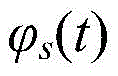
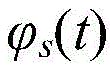
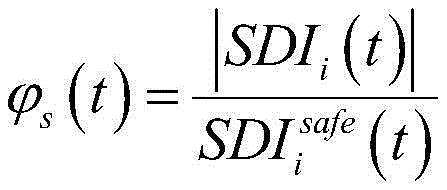
车辆运行瞬时风险
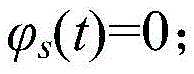



式中: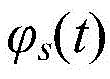
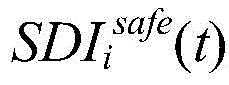
目标车辆在t时刻的换道瞬时风险
所述步骤5)包括以下步骤:Described step 5) comprises the following steps:
5.1)车辆纵向轨迹规划5.1) Vehicle longitudinal trajectory planning
在满足换道安全性、舒适性以及速度限制条件下,以车辆运行瞬时风险最小化为目标函数,以保证局部交通流的稳定运行,其目标函数为:Under the conditions of lane changing safety, comfort and speed limit, the objective function is to minimize the instantaneous risk of vehicle operation to ensure the stable operation of local traffic flow. The objective function is:

同时,满足以下约束:Meanwhile, the following constraints are satisfied:
0<Vs(τ)≤Vmax 0<V s (τ)≤V max
|as(τ)|≤amax |a s (τ)|≤a max

式中,

5.2)车辆横向轨迹规划5.2) Vehicle lateral trajectory planning
采用梯形加速度法规划目标车辆的换道横向轨迹,若给定目标车辆换道最大横向加速度及横向加速度变化率的值,即可得到目标车辆在换道过程中的横向加速度as,y(τ),其表达式为:The trapezoidal acceleration method is used to plan the lateral trajectory of the target vehicle. If the maximum lateral acceleration and the rate of change of the lateral acceleration of the target vehicle are given, the lateral acceleration a s,y (τ of the target vehicle during the lane-changing process can be obtained. ), whose expression is:
as,y(τ)=kaf(τ)-ka(τ-t1)f(τ-t1)-ka(τ-t2)f(τ-t2)+ka(τ-t3)f(τ-t3)+ka(τ-t4)f(τ-t4)-ka(τ-tc)f(τ-tc)a s,y (τ)= ka f (τ)-ka (τ-t 1 )f(τ-t 1 )-ka (τ-t 2 ) f (τ-t 2 )+ ka ( τ-t 3 )f(τ-t 3 )+ ka (τ-t 4 )f(τ-t 4 )-ka (τ-t c )f(τ- t c )
式中,as,y(τ)为目标车辆在换道过程中任意τ时刻的横向加速度,单位为m/s2;ka为目标车辆横向加速度变化率,单位为m/s3;f(τ)为单位阶跃函数,当0≤τ时,f(τ)=1,当τ≤0时,f(τ)=0;f(τ-t1)为单位阶跃函数,当t1≤τ时,f(τ-t1)=1,当τ≤t1时,f(τ-t1)=0;f(τ-t2)为单位阶跃函数,当t2≤τ时,f(τ-t2)=1,当τ≤t2时,f(τ-t2)=0;f(τ-t3)为单位阶跃函数,当t3≤τ时,f(τ-t3)=1,当τ≤t3时,f(τ-t3)=0;f(τ-t4)为单位阶跃函数,当t4≤τ时,f(τ-t4)=1,当τ≤t4时,f(τ-t4)=0;f(τ-tc)为单位阶跃函数,当tc≤τ时,f(τ-tc)=1,当τ≤tc时,f(τ-tc)=0;tc为目标车辆换道持续时间,单位为s;t1、t2、t3、t4均为暂态时间变量,其中t1、t2分别为目标车辆开始与结束最大横向加速度as,y max的时刻,t3、t4分别为目标车辆开始与结束最小横向加速度-as,y max的时刻;In the formula, a s,y (τ) is the lateral acceleration of the target vehicle at any time τ in the lane changing process, the unit is m/s 2 ; ka is the rate of change of the lateral acceleration of the target vehicle, the unit is m/s 3 ; f (τ) is a unit step function, when 0≤τ, f(τ)=1, when τ≤0, f(τ)=0; f(τ-t 1 ) is a unit step function, when t When 1 ≤τ, f(τ-t 1 )=1, when τ≤t 1 , f(τ-t 1 )=0; f(τ-t 2 ) is a unit step function, when t 2 ≤τ When , f(τ-t 2 )=1, when τ≤t 2 , f(τ-t 2 )=0; f(τ-t 3 ) is a unit step function, when t 3 ≤τ, f (τ-t 3 )=1, when τ≤t 3 , f(τ-t 3 )=0; f(τ-t 4 ) is a unit step function, when t 4 ≤τ, f(τ- t 4 )=1, when τ≤t 4 , f(τ-t 4 )=0; f(τ-t c ) is a unit step function, when t c ≤τ, f(τ-t c ) =1, when τ≤t c , f(τ-t c )=0; t c is the lane change duration of the target vehicle, the unit is s; t 1 , t 2 , t 3 , and t 4 are transient times variable, where t 1 and t 2 are the moments when the target vehicle starts and ends the maximum lateral acceleration a s, y max respectively, and t 3 and t 4 are the moments when the target vehicle starts and ends the minimum lateral acceleration - a s, y max respectively;
在目标车辆换道期间,假设车辆在当前车道与目标车道上的横向位移相等,两车道中心线横向间距为D,经过时间tc后车辆恰好完成换道过程,则存在以下关系式:During the lane change of the target vehicle, assuming that the lateral displacement of the vehicle in the current lane and the target lane is equal, the lateral distance between the centerlines of the two lanes is D, and the vehicle just completes the lane-changing process after the time tc , the following relationship exists:

t2-t1=t4-t3 t 2 -t 1 =t 4 -t 3
式中,as,y max为目标车辆最大横向加速度,单位为m/s2;ka为目标车辆横向加速度变化率,单位为m/s3;t1、t2、t3、t4均为暂态时间变量,其中t1、t2分别为目标车辆开始与结束最大横向加速度as,y max的时刻,t3、t4分别为目标车辆开始与结束最小横向加速度-as,y max的时刻;tc为目标车辆换道持续时间,单位为s;In the formula, a s, y max is the maximum lateral acceleration of the target vehicle, the unit is m/s 2 ; ka is the rate of change of the lateral acceleration of the target vehicle, the unit is m/s 3 ; t 1 , t 2 , t 3 , t 4 are transient time variables, in which t 1 , t 2 are the time when the target vehicle starts and ends the maximum lateral acceleration a s, y max , respectively, t 3 , t 4 are the target vehicle start and end minimum lateral acceleration - a s, y max time; t c is the lane change duration of the target vehicle, the unit is s;
在上述假设提前下,能够得到t2的表达式为:Under the above assumptions in advance, the expression for t 2 can be obtained as:

式中,as,y max为目标车辆最大横向加速度,单位为m/s2;t2为目标车辆结束最大横向加速度as,y max的时刻;ka为目标车辆横向加速度变化率,单位为m/s3;D为两车道中心线横向间距,单位为m;In the formula, a s, y max is the maximum lateral acceleration of the target vehicle, the unit is m/s 2 ; t 2 is the moment when the target vehicle ends the maximum lateral acceleration a s, y max ; ka is the rate of change of the lateral acceleration of the target vehicle, the unit is m/s 3 ; D is the lateral distance between the centerlines of the two lanes, in m;
对横向加速度等式进行二次积分,并联立以上3个等式代入横向加速度积分公式得:Integrate the lateral acceleration equation twice, and combine the above three equations into the lateral acceleration integral formula to get:
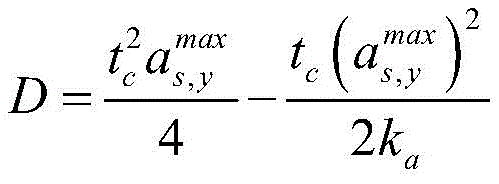
式中,as,y max为目标车辆最大横向加速度,单位为m/s2;ka为目标车辆横向加速度变化率,单位为m/s3;D为两车道中心线横向间距,单位为m;tc为目标车辆换道持续时间,单位为s;In the formula, a s, y max is the maximum lateral acceleration of the target vehicle, the unit is m/s 2 ; ka is the rate of change of the lateral acceleration of the target vehicle, the unit is m/s 3 ; D is the lateral distance between the center lines of the two lanes, the unit is m; t c is the lane change duration of the target vehicle, the unit is s;
由于车辆的换道持续时间过长或过短都存在驾驶风险,在此需要对换道持续时间进行约束:Since the vehicle's lane-changing duration is too long or too short, there is a driving risk, and the lane-changing duration needs to be constrained here:
tmin<tc≤tmax t min <t c ≤t max
式中,目标车辆tc为换道持续时间,单位为s;tmin为目标车辆最短换道时间,单位为s;tmax为目标车辆最大换道时间,单位为s;In the formula, the target vehicle t c is the lane changing duration, the unit is s; t min is the shortest lane changing time of the target vehicle, the unit is s; t max is the maximum lane changing time of the target vehicle, the unit is s;
5.3)车辆横纵向轨迹方案求解5.3) Solution of vehicle lateral and longitudinal trajectory scheme
采用遗传算法求解目标函数,得到车辆横纵向运动的控制策略,算法过程包括编码、种群初始化、交叉重组、变异、选择以及解码,具体步骤如下:The genetic algorithm is used to solve the objective function, and the control strategy for the lateral and longitudinal motion of the vehicle is obtained. The algorithm process includes coding, population initialization, cross-recombination, mutation, selection and decoding. The specific steps are as follows:
a)编码a) encoding
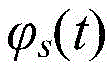
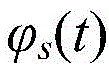
目标函数的求解是对3类决策变量进行优化,包括换道持续时间tc、换道时横向最大加速度as,y max和目标车辆的纵向加速度as(τ);选择浮点数编码的编码方案,基因长度为Z,第1个基因位表示换道时间tc,第2基因位表示换道时横向最大加速度as,y max,第3个至最后一个基因位表示换道时的纵向加速度as(τ);为了解决决策变量数量变化的问题,对个体编码统一采用最长的编码长度;在解码和计算适应度函数的过程中,根据tc确定有效的基因位,只将前tc个纵向加速度ax(τ)参与计算;The solution of the objective function is to optimize three types of decision variables, including the lane change duration t c , the maximum lateral acceleration a s, y max and the longitudinal acceleration of the target vehicle a s (τ) when changing lanes; Scheme, the gene length is Z, the first locus represents the lane-changing time t c , the second locus represents the lateral maximum acceleration a s,y max when changing lanes, and the third to last loci represent the longitudinal direction when changing lanes Acceleration a s (τ); in order to solve the problem of changing the number of decision variables, the longest coding length is uniformly used for individual coding; in the process of decoding and calculating the fitness function, the effective locus is determined according to t c , and only the previous t c longitudinal accelerations a x (τ) participate in the calculation;
b)种群初始化b) Population initialization
在种群初始化的过程,除了要求变量在制定的范围内随机生成,还根据约束条件对个体的实际意义作进一步的判断,对于不满足约束条件的种群,将重新生成:首先,对梯形横向加速度进行判断;然后,根据tc、as,y max和公式
c)交叉重组c) cross recombination
从种群中随机选择2个个体xA和xB,对于这2个个体相同位置的基因位xA,i和xB,i,i=1,2,…,Z,按照以下公式更新:Randomly select 2 individuals x A and x B from the population, for the loci x A,i and x B,i at the same position of these 2 individuals, i=1,2,...,Z, update according to the following formula:


式中,xA,i *和xB,i *表示个体xA和xB交叉后的第i个基因位;xA,i和xB,i表示个体xA和xB的第i个基因位;α是交叉重组的一个常数,取值为(0,1];In the formula, x A, i * and x B, i * represent the i-th locus after the crossover of individuals x A and x B ; x A, i and x B, i represent the i-th locus of individuals x A and x B Gene position; α is a constant for cross-recombination and takes the value (0,1];
d)变异d) Variation
从种群中选择1个个体xA,对于个体xA的基因位xA,i,按照以下公式更新:Select 1 individual x A from the population, and update the locus x A,i of the individual x A according to the following formula:

式中,xA,i #为个体xA变异后的第i个基因位;xA,i表示个体xA的第i个基因位;xA,i max和xA,i min分别表示基因位i的取值上限和下限;β是一个变异常数,取值为(0,1];r是(0,1]之间的随机数;randint(2)表示随机生成一个0或1的整数;In the formula, x A, i # is the i-th locus of the individual x A after the mutation; x A, i represents the i-th locus of the individual x A ; x A, i max and x A, i min respectively represent the gene The upper and lower limits of the value of bit i; β is a variation constant with a value of (0, 1]; r is a random number between (0, 1]; randint(2) means to randomly generate an integer of 0 or 1 ;
e)选择e) selection
采用基于轮盘随机法的选择策略,具有以下4个步骤:A selection strategy based on roulette random method is adopted, which has the following 4 steps:
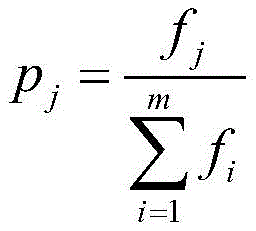
Step 1:根据下式计算个体j被选择保留到下一代种群的概率pj:Step 1: Calculate the probability p j that individual j is selected to be retained in the next generation population according to the following formula:

式中,fj为第j个个体的适应度函数;fi为第i个个体的适应度函数;m为种群的个体数量;In the formula, f j is the fitness function of the j-th individual; f i is the fitness function of the i-th individual; m is the number of individuals in the population;
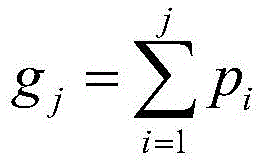
Step 2:计算个体j的累计概率gj:Step 2: Calculate the cumulative probability g j of individual j :

式中,pi为第i个个体被选择保留到下一代种群的概率;In the formula, pi is the probability that the i -th individual is selected to be retained in the next generation;
Step 3:在[0,1]之间随机生成一个随机数r,将r与gj进行比较,若gj-1<r<gj,则个体j被选择保留到下一代种群;gj-1为个体j-1的累计概率;Step 3: Randomly generate a random number r between [0,1], compare r with g j , if g j-1 <r<g j , then individual j is selected to be retained in the next generation; g j -1 is the cumulative probability of individual j-1;
Step 4:重复STEP 3,直到下一代种群规模与当前种群规模一致;Step 4: Repeat STEP 3 until the next generation population size is consistent with the current population size;
f)个体解码f) Individual decoding
经过多次迭代进化后,选择适应度最高的个体进行解码,作为车辆横纵向运行轨迹规划的最终方案。After several iterations of evolution, the individual with the highest fitness is selected for decoding as the final plan for the horizontal and vertical trajectory planning of the vehicle.
本发明与现有技术相比,具有如下优点与有益效果:Compared with the prior art, the present invention has the following advantages and beneficial effects:
1、提出基于瞬时风险评估的智能车辆换道轨迹规划方法,有利于提前识别未来交通条件存在的换道风险,使得轨迹规划方案更加安全合理,避免车辆在执行换道策略时遭遇交通冲突或碰撞等风险。1. A lane-changing trajectory planning method for intelligent vehicles based on instantaneous risk assessment is proposed, which is conducive to identifying the lane-changing risks existing in future traffic conditions in advance, making the trajectory planning scheme safer and more reasonable, and avoiding traffic conflicts or collisions when vehicles are executing the lane-changing strategy. and other risks.
2、区别于以往仅考虑当前交通条件的车辆换道轨迹规划研究,本发明提取了周围车辆的运动模式,并基于此预测周围车辆未来运行工况。本发明考虑了未来交通环境演变的可预测性,解决了现有大多数换道轨迹方法存在时滞性与不确定性问题,使得智能车辆的换道轨迹规划更加科学、合理。2. Different from the previous research on vehicle lane changing trajectory planning that only considers current traffic conditions, the present invention extracts the motion patterns of surrounding vehicles, and predicts future operating conditions of surrounding vehicles based on this. The present invention considers the predictability of the evolution of the future traffic environment, solves the problems of time delay and uncertainty in most existing lane changing trajectory methods, and makes the lane changing trajectory planning of the intelligent vehicle more scientific and reasonable.
3、提出了一种基于停车视距的风险评估指标,可有效识别换道过程中存在的碰撞风险。以瞬时风险最小化为目标函数,设置最大风险系数、最大加速度以及最大速度等约束条件,提高智能车辆换道过程的安全性与舒适性。3. A risk assessment index based on parking sight distance is proposed, which can effectively identify the collision risk in the process of changing lanes. Taking the instantaneous risk minimization as the objective function, the constraints such as the maximum risk coefficient, the maximum acceleration and the maximum speed are set to improve the safety and comfort of the intelligent vehicle lane changing process.
4、采用梯形加速度法规划车辆换道横向轨迹,曲率变化连续、顺畅,具有良好的舒适性与安全性,在换道时间和变量控制方面都具有明显优势,较好适应不同结构尺寸的道路工况变化。4. The trapezoidal acceleration method is used to plan the lateral trajectory of the vehicle lane change. The curvature changes continuously and smoothly, with good comfort and safety. It has obvious advantages in lane change time and variable control. situation changes.
5、运用遗传算法实现车辆换道纵向轨迹规划的快速求解,具有求解速度快、运算灵活、不易陷入局部最优解等优势。5. The genetic algorithm is used to realize the rapid solution of the longitudinal trajectory planning of the vehicle lane change, which has the advantages of fast solution speed, flexible operation, and not easy to fall into the local optimal solution.
附图说明Description of drawings
图1为本发明的建模流程图。FIG. 1 is a flow chart of the modeling of the present invention.
图2为本发明的典型车辆换道场景示意图。FIG. 2 is a schematic diagram of a typical vehicle lane changing scene of the present invention.
图3为本发明的换道轨迹规划方法基本原理流程图。FIG. 3 is a flow chart of the basic principle of the lane changing trajectory planning method of the present invention.
图4为本发明的车辆横向加速度变化图。FIG. 4 is a change diagram of vehicle lateral acceleration according to the present invention.
具体实施方式Detailed ways
下面结合具体实施例对本发明作进一步说明。The present invention will be further described below in conjunction with specific embodiments.
如图1所示,本实施例所提供的基于瞬时风险评估的智能车辆换道轨迹协同规划方法,其具体情况如下:As shown in FIG. 1 , the method for collaborative planning of lane-changing trajectories of intelligent vehicles based on instantaneous risk assessment provided by this embodiment is as follows:
1)获取交通基础数据。交通基础数据包括车辆运动数据、车辆相对位置信息、车辆几何参数、道路几何条件和路面摩擦系数;1) Obtain basic traffic data. The basic traffic data includes vehicle motion data, vehicle relative position information, vehicle geometric parameters, road geometric conditions and road friction coefficient;
所述车辆运动数据包括目标车辆与周围车辆的速度与加速度,能够通过智能车辆的车载传感器或路侧监控设备获取车辆实时运动数据;所述车辆相对位置信息包括目标车辆分别与当前车道前车、后车的车辆间距,目标车辆与当前车道前车、后车的车辆间距,能够从智能车辆的车载传感器以及路侧监控设备获取;所述车辆几何参数包括车辆长度、车辆宽度,能够通过读取车身电子标签信息或视频识别获取;所述道路几何条件包括车道数、车道宽度、坡度,能够通过车载导航地图或路侧视频设备识别获取;所述路面摩擦系数包括不同天气情况下的路面摩擦系数,能够通过专家法或相关标准设定。The vehicle motion data includes the speed and acceleration of the target vehicle and surrounding vehicles, and real-time vehicle motion data can be obtained through the on-board sensors of the intelligent vehicle or roadside monitoring equipment; the vehicle relative position information includes the target vehicle and the vehicle ahead in the current lane, respectively. The vehicle distance between the following vehicles and the vehicle distance between the target vehicle and the preceding and following vehicles in the current lane can be obtained from the on-board sensors of the intelligent vehicle and roadside monitoring equipment; the vehicle geometric parameters include vehicle length and vehicle width, which can be obtained by reading Vehicle body electronic label information or video recognition acquisition; the road geometric conditions include the number of lanes, lane width, and slope, which can be identified and acquired through on-board navigation maps or roadside video equipment; the road friction coefficient includes the road friction coefficient under different weather conditions , which can be set by expert law or related standards.
典型的换道场景如图2所示,车辆运动状态数据为:目标车辆初始速度Vs(T1)=10m/s;当前车道后车的初始速度V1(T1)=8m/s;当前车道前车的初始速度V2(T1)=8m/s;目标车道后车的初始速度V3(T1)=12m/s;目标车道前车的初始速度V4(T1)=12m/s。A typical lane-changing scene is shown in Figure 2. The vehicle motion state data is: the initial speed of the target vehicle V s (T 1 )=10m/s; the initial speed of the vehicle behind the current lane V 1 (T 1 )=8m/s; The initial speed V 2 (T 1 ) of the vehicle in front of the current lane=8m/s; the initial speed of the vehicle behind the target lane V 3 (T 1 )=12m/s; the initial speed of the vehicle in front of the target lane V 4 (T 1 )= 12m/s.
车辆相对位置信息为:目标车辆与当前车道后车的初始车辆间距为d1(T1)=20m;目标车辆与当前车道前车的初始车辆间距为d2(T1)=25m;目标车辆与目标车道后车的初始车辆间距为d3(T1)=20m;目标车辆与目标车道前车的初始车辆间距为d4(T1)=30m。The relative position information of the vehicle is: the initial vehicle distance between the target vehicle and the vehicle behind the current lane is d 1 (T 1 )=20m; the initial vehicle distance between the target vehicle and the vehicle in front of the current lane is d 2 (T 1 )=25m; the target vehicle The initial vehicle distance from the vehicle behind the target lane is d 3 (T 1 )=20m; the initial vehicle distance from the target vehicle to the vehicle ahead of the target lane is d 4 (T 1 )=30m.
车辆几何参数为:假设所有车辆均为小轿车,则有车辆长度ls=4m,车辆宽度W=2.5m。The vehicle geometric parameters are: assuming that all vehicles are cars, there is a vehicle length ls = 4m, and a vehicle width W = 2.5m.
道路几何条件为:车道数为2,车道宽度D为3.75m,坡度为0。The road geometry conditions are: the number of lanes is 2, the lane width D is 3.75m, and the slope is 0.
路面摩擦系数为:假设天气状况为干燥天气,道路表面为水泥路面,则摩擦系数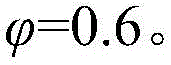
2)周围车辆运动特征提取。采集目标车辆换道过程中周围车辆的运动轨迹历史数据以构建换道样本,利用模糊C聚类算法提取换道样本中周围车辆的运动特征。包括以下步骤:2) Feature extraction of surrounding vehicle motion. The historical data of the motion trajectories of the surrounding vehicles during the lane-changing process of the target vehicle are collected to construct the lane-changing samples, and the motion characteristics of the surrounding vehicles in the lane-changing samples are extracted by the fuzzy C clustering algorithm. Include the following steps:
2.1)定义目标车辆的周围车辆2.1) Define the surrounding vehicles of the target vehicle
如图2所示,设周围车辆的数量为4,包括目标车辆所在当前车道的后车(车辆1)与前车(车辆2),目标车辆意图到达目标车道的后车(车辆3)与前车(车辆4)。As shown in Figure 2, the number of surrounding vehicles is set to 4, including the rear vehicle (vehicle 1) and the front vehicle (vehicle 2) in the current lane where the target vehicle is located, and the rear vehicle (vehicle 3) and the front vehicle (vehicle 3) and the target vehicle intending to reach the target lane. car (vehicle 4).
2.2)定义模糊C聚类算法的Hausdorff距离2.2) Define the Hausdorff distance of the fuzzy C clustering algorithm
定义数据采样周期为c=1秒,轨迹时间长度为T=9秒,车辆运动轨迹数N=10则两辆车的运动特征的Hausdorff距离为:Define the data sampling period as c = 1 second, the trajectory time length as T = 9 seconds, and the number of vehicle motion trajectories N = 10, then the Hausdorff distance of the motion characteristics of the two vehicles is:
H(Fi,Fj)=max{h(Fi,Fj),h(Fj,Fi)}H(F i ,F j )=max{h(F i ,F j ),h(F j ,F i )}
其中in


式中,i=1,2,…,10;j=1,2,…,10;H(Fi,Fj)表示轨迹Fi与轨迹Fj之间的Hausdorff距离;轨迹Fi=(fi 1,fi 2,…,fi T),轨迹Fj=(fj 1,fj 2,…,fj T);fi k表示车辆i在l时刻的位置坐标(xj l,yj l),fj l表示车辆j在l时刻的位置坐标(xi k,yi k);d(fi k,fj l)表示位置坐标fi k与fj l之间的欧氏距离,即
2.3)基于模糊C聚类算法的车辆运动特征聚类2.3) Vehicle motion feature clustering based on fuzzy C clustering algorithm
令轨迹聚类中心数K=2,模糊C聚类算法实现车辆运动轨迹聚类的算法步骤如下:Let the number of trajectory clustering centers K=2, the algorithm steps of the fuzzy C clustering algorithm to realize the clustering of vehicle motion trajectory are as follows:
Step 1:随机初始化2个轨迹聚类中心;Step 1: Randomly initialize 2 trajectory cluster centers;
Step 2:计算每条车辆运动轨迹Fi分别到2个轨迹中心θk的Hausdorff距离,即:Step 2: Calculate the Hausdorff distance from each vehicle trajectory F i to the two trajectory centers θ k , namely:
H(Fi,θk)=max{h(Fi,θk),h(θk,Fi)}H(F i ,θ k )=max{h(F i ,θ k ),h(θ k ,F i )}
式中,H(Fi,θk)表示轨迹Fi与轨迹中心θk之间的Hausdorff距离;i=1,2,3,…,10,k=1,2。In the formula, H(F i , θ k ) represents the Hausdorff distance between the trajectory Fi and the trajectory center θ k ; i =1, 2, 3, . . . , 10, k=1, 2.
Step 3:计算10条车辆运动轨迹Fi分别到2个轨迹中心θk的隶属度μi,k Step 3: Calculate the membership μ i,k of the 10 vehicle motion trajectories F i to the 2 trajectory centers θ k respectively

式中,μi,k为轨迹Fi到轨迹中心θk的隶属度;θk为第k个轨迹中心;Fi表示第i条轨迹;H(Fi,θk)表示轨迹Fi与轨迹中心θk之间的Hausdorff距离。In the formula, μ i,k is the membership degree of the track F i to the track center θ k ; θ k is the k -th track center; F i represents the i - th track; Hausdorff distance between trajectory centers θ k .
Step 4:根据每条车辆运动轨迹的隶属度更新2个轨迹中心θk Step 4: Update the two trajectory centers θ k according to the membership of each vehicle trajectory

式中,θk为第k个轨迹中心;Fi表示第i条轨迹;μi,k为轨迹Fi到轨迹中心θk的隶属度。In the formula, θ k is the k-th track center; F i represents the i -th track; μ i,k is the membership degree from the track Fi to the track center θ k .
Step 5:根据下式判断2个聚类中心是否收敛,若收敛结束循环,否则执行Step 2。Step 5: Judge whether the two cluster centers converge according to the following formula, if the convergence ends the cycle, otherwise go to Step 2.

式中,θk为第k个轨迹中心;ε为收敛上界,r为迭代次数。In the formula, θ k is the k-th trajectory center; ε is the upper bound of convergence, and r is the number of iterations.
模糊C聚类算法运行结束后,可以得到2个车辆运动轨迹中心θk,即
3)基于周围车辆的运动特征,预测周围车辆在t时刻的车辆运动状态及车辆间距。3) Based on the motion characteristics of surrounding vehicles, predict the vehicle motion state and vehicle distance of surrounding vehicles at time t.
3.1)车辆运动模式判断3.1) Judgment of vehicle motion mode
以周围车辆1为例,即目标车辆在换道前的后方车辆。设T1=3秒,运用模糊C聚类算法得到周围车辆1的2个运动轨迹中心θ1 1、θ2 1,推导其轨迹位置对应的加速度向量a1 1和a2 1,其中a1 1={1,1.5,2,2,2,2,2,2,2},a2 1={1.5,1,1,1,1,1,1,0,0},单位为m/s2。设周围车辆1在过去3秒内的加速度为a1={1.5,1,1},分别比较a1与a1 1、a2 1在任意3秒内的相似度(即方差),通过筛选得到运动模式相似度最高的车辆运行轨迹中心。在本案例中,与周围车辆1的运动模式最相近的是车辆运动轨迹中心θ2 1,其加速度向量为a2 1={1.5,1,1,1,1,1,1,0,0},单位为m/s2。Take the surrounding
以此类推,分别得到其他周围车辆运动模式最相近的车辆运动轨迹中心加速度向量a1 2={0,0,0,0,0,0,-1,-1,-1}、a1 3={1,1,0,0,0,0,0,0,0}、a1 4={0,0,1,1,1,1,1,1,1},单位为m/s2。By analogy, the center acceleration vector a 1 2 ={0,0,0,0,0,0,-1,-1,-1}, a 1 3 ={1,1,0,0,0,0,0,0,0}, a 1 4 ={0,0,1,1,1,1,1,1,1}, in m/s 2 .
3.2)预测周围车辆在t=6s时刻的速度3.2) Predict the speed of surrounding vehicles at time t=6s
已知当前车道前车的初始速度V1(3)=8m/s;当前车道后车的初始速度V2(3)=8m/s;目标车道前车的初始速度V3(3)=12m/s;目标车道后车的初始速度V4(3)=12m/s。令t=6,则周围车辆i在t=6s时刻的速度Vi(6)为:It is known that the initial speed of the vehicle in front of the current lane V 1 (3)=8m/s; the initial speed of the vehicle behind the current lane V 2 (3)=8m/s; the initial speed of the vehicle in front of the target lane V 3 (3)=12m /s; initial speed of the vehicle behind the target lane V 4 (3)=12m/s. Let t=6, then the speed V i (6) of the surrounding vehicle i at the time t=6s is:
V1(6)=1+1+1+8=11m/sV 1 (6)=1+1+1+8=11m/s
V2(6)=0+0+0+8=8m/sV 2 (6)=0+0+0+8=8m/s
V3(6)=0+0+0+12=12m/sV 3 (6)=0+0+0+12=12m/s
V4(6)=1+1+1+12=15m/sV 4 (6)=1+1+1+12=15m/s
3.3)计算目标车辆与周围车辆在t=6s时刻的车辆间距3.3) Calculate the vehicle distance between the target vehicle and surrounding vehicles at time t=6s
设周围车辆i在t=6s时刻的位移Si(6)为:Let the displacement S i (6) of the surrounding vehicle i at time t=6s be:




已知目标车辆与周围车辆i的初始车辆间距分别为d1(3)=20m,d2(3)=25m,d3(3)=30m,d4(3)=20m,则目标车辆与周围车辆i在t=6s时刻的车辆间距为:It is known that the initial vehicle distance between the target vehicle and the surrounding vehicle i is d 1 (3)=20m, d 2 (3)=25m, d 3 (3)=30m, d 4 (3)=20m, then the target vehicle and the The distance between the surrounding vehicles i at t=6s is:




4)基于停车视距建立换道条件安全判别模型,利用SDI获得车辆运行瞬时风险指标,以实时评估t=6s时刻的风险系数。4) Establish a lane-changing condition safety discrimination model based on the parking sight distance, and use SDI to obtain the instantaneous risk index of vehicle operation to evaluate the risk factor at t=6s in real time.
4.1)安全换道条件判别4.1) Judgment of safe lane changing conditions
计算目标车辆与周围车辆i之间的停车视距,以判断t=6s时刻的交通条件是否存在换道风险,令驾驶员反应时间tr=1.5s;则各车辆在t=6s时刻的停车视距Dj(6)为:Calculate the parking sight distance between the target vehicle and the surrounding vehicle i to determine whether there is a risk of changing lanes in the traffic conditions at the time of t=6s, so that the driver's reaction time t r =1.5s; then the parking of each vehicle at the time of t=6s The sight distance D j (6) is:




已知目标车辆与周围车辆i在t=6s时刻的纵向车辆间距以及停车视距,则t=6s时刻目标车辆与周围车辆i之间的停车距离指标SDIi(6)为:Knowing the longitudinal vehicle distance and the parking sight distance between the target vehicle and the surrounding vehicle i at the time of t=6s, the parking distance index SDI i (6) between the target vehicle and the surrounding vehicle i at the time of t=6s is:

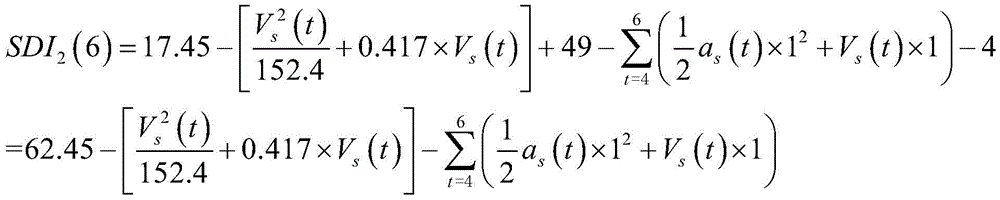


基于停车距离指标SDIi(t)判断t=6s时刻的交通条件是否存在换道风险,则安全换道条件判别函数L(Gsub(t),Gsur(t))为:Based on the parking distance index SDI i (t) to determine whether there is a lane change risk in the traffic conditions at time t=6s, the safe lane change condition discriminant function L(G sub (t), G sur (t)) is:

当目标车辆在t=6s时刻的换道条件为不安全时,需对目标车辆的换道瞬时风险进行评估,即跳转至步骤4.2);若目标车辆在t=6s时刻的交通条件为安全,则无需进一步评估。由于在本案例中尚未给出目标车辆在t=6s时刻的运动状态,故未能进一步判断。When the lane changing condition of the target vehicle at time t=6s is unsafe, it is necessary to evaluate the instantaneous risk of lane changing of the target vehicle, that is, jump to step 4.2); if the traffic condition of the target vehicle at time t=6s is safe , no further evaluation is required. Since the motion state of the target vehicle at time t=6s has not been given in this case, it cannot be further judged.
4.2)计算目标车辆在t=6s时刻运行的瞬时风险
当SDIi(6)≥0时,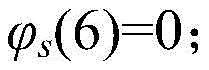

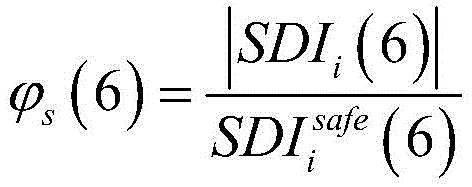

目标车辆在t时刻的换道瞬时风险
5)以车辆运行瞬时风险最小化为目标函数,设置约束条件,包括最大速度、最大加速度以及最大瞬时风险,利用梯形加速度法与遗传算法规划车辆横纵向运动加速度,进而得到车辆换道轨迹。换道轨迹规划方法基本原理如图3所示。5) Taking the minimization of the instantaneous risk of vehicle operation as the objective function, setting constraints, including the maximum speed, the maximum acceleration and the maximum instantaneous risk, using the trapezoidal acceleration method and the genetic algorithm to plan the lateral and longitudinal motion acceleration of the vehicle, and then obtain the vehicle lane changing trajectory. The basic principle of the lane changing trajectory planning method is shown in Figure 3.
5.1)车辆纵向轨迹规划5.1) Vehicle longitudinal trajectory planning
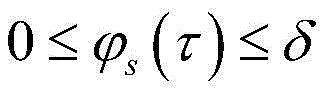
在满足换道安全性、舒适性以及速度限制等条件下,设目标车辆最大纵向限速Vmax=80km/h,目标车辆最大纵向加速度amax=2.5m/s2,预设最大瞬时风险阈值δ=0.1,基因长度Z=8,最短换道时间tmin=3s,最长换道时间tmax=9s。采用遗传算法求解目标函数,得到目标车辆换道持续时间tc=6s与目标车辆纵向加速度变量as(τ),as(τ)={0,1,2,2,2,1},单位为m/s2。基于纵向加速度变量计算目标车辆的纵向速度与位移,进而得到目标车辆与周围车辆的间距,根据停车距离指标推导公式可知,目标车辆在τ时刻的SDIi(τ)均大于0(0≤τ≤6),即

同时,目标车辆的速度、加速度与瞬时风险系数满足以下约束:At the same time, the speed, acceleration and instantaneous risk coefficient of the target vehicle satisfy the following constraints:
0<Vs(τ)≤80km/h0<V s (τ)≤80km/h
|as(τ)|≤2.5m/s2 |a s (τ)|≤2.5m/s 2

5.2)车辆横向轨迹规划5.2) Vehicle lateral trajectory planning
在目标车辆换道期间,假设车辆在当前车道与目标车道上的横向位移相等,两车道中心线横向间距为D=3.75m,经过时间tc=6s后车辆恰好完成换道过程,满足约束:During the lane change of the target vehicle, it is assumed that the lateral displacement of the vehicle in the current lane and the target lane is equal, the lateral distance between the centerlines of the two lanes is D=3.75m, and the vehicle just completes the lane-changing process after the time tc =6s, which satisfies the constraints:
3<tc≤63<t c ≤6
利用遗传算法求解得到最大横向加速度as,y max=1m/s2,则由式

可推导得到t1、t2、t3、t4:t 1 , t 2 , t 3 , t 4 can be derived:


t3=t1+t4-t2=tc-t2=6-1.8321=4.1679st 3 =t 1 +t 4 -t 2 =t c -t 2 =6-1.8321=4.1679s
t4=tc-t1=6-1.75=4.25st 4 =t c -t 1 =6-1.75=4.25s
目标车辆横向加速度方案如图4所示,目标车辆在换道过程中任意τ时刻的横向加速度as,y(t)表达式为:The lateral acceleration scheme of the target vehicle is shown in Figure 4. The lateral acceleration a s,y (t) of the target vehicle at any time τ during the lane change process is expressed as:
as,y(τ)=0.5714f(τ)-0.5714(τ-1.75)f(τ-1.75)-0.5714(τ-1.8321)f(τ-1.8321)+0.5714(τ-4.1679)f(τ-4.1679)+0.5714(τ-4.25)f(τ-4.25)-0.5714(τ-6)f(τ-6)a s,y (τ)=0.5714f(τ)-0.5714(τ-1.75)f(τ-1.75)-0.5714(τ-1.8321)f(τ-1.8321)+0.5714(τ-4.1679)f(τ- 4.1679)+0.5714(τ-4.25)f(τ-4.25)-0.5714(τ-6)f(τ-6)
5.3)车辆横纵向轨迹方案求解5.3) Solution of vehicle lateral and longitudinal trajectory scheme
采用遗传算法求解目标函数,得到车辆横纵向运动的控制策略,算法过程包括编码、种群初始化、交叉重组、变异、选择以及解码,具体步骤如下:The genetic algorithm is used to solve the objective function, and the control strategy for the lateral and longitudinal motion of the vehicle is obtained. The algorithm process includes coding, population initialization, cross-recombination, mutation, selection and decoding. The specific steps are as follows:
a)编码a) encoding
目标函数的求解是对3类决策变量进行优化,包括换道持续时间tc、换道时横向最大加速度as,y max和目标车辆的纵向加速度as(τ);选择浮点数编码的编码方案,基因长度Z=8,第1个基因位表示换道时间tc,第2基因位表示换道时横向最大加速度as,y max,第3个至最后一个基因位表示换道时的纵向加速度as(τ);为了解决决策变量数量变化的问题,对个体编码统一采用最长的编码长度;在解码和计算适应度函数的过程中,根据tc确定有效的基因位,只将前tc个纵向加速度ax(τ)参与计算;The solution of the objective function is to optimize three types of decision variables, including the lane change duration t c , the maximum lateral acceleration a s, y max and the longitudinal acceleration of the target vehicle a s (τ) when changing lanes; Scheme, gene length Z=8, the first locus represents the lane-changing time t c , the second locus represents the lateral maximum acceleration a s, y max during lane-changing, and the third to last loci represent the lane-changing time. Longitudinal acceleration a s (τ); in order to solve the problem of changing the number of decision variables, the longest coding length is uniformly used for individual coding; in the process of decoding and calculating the fitness function, the valid loci are determined according to t c , and only the The first t c longitudinal accelerations a x (τ) participate in the calculation;
b)种群初始化b) Population initialization
在种群初始化的过程,除了要求变量在制定的范围内随机生成,还根据约束条件对个体的实际意义作进一步的判断,对于不满足约束条件的种群,将重新生成:首先,对梯形横向加速度进行判断;然后,根据tc、as,y max和公式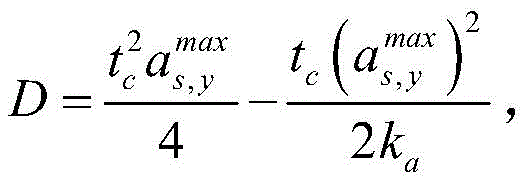
c)交叉重组c) cross recombination
从种群中随机选择2个个体xA和xB,xA=(6,1,0,2,2,1,1,1),xB=(6,1,1,1,2,2,2,1),对于这2个个体相同位置的基因位xA,4和xB,4,设α=0.6,按照以下公式更新:Randomly select 2 individuals x A and x B from the population, x A = (6, 1, 0, 2, 2, 1, 1, 1), x B = (6, 1, 1, 1, 2, 2 , 2, 1), for the loci x A,4 and x B,4 in the same position of these two individuals, set α=0.6, and update according to the following formula:


式中,xA,4 *和xB,4 *表示个体xA和xB交叉后的第4个基因位;xA,4和xB,4表示个体xA和xB的第4个基因位;In the formula, x A, 4 * and x B, 4 * represent the fourth locus after the intersection of individuals x A and x B ; x A, 4 and x B, 4 represent the fourth locus of individuals x A and x B locus;
d)变异d) Variation
从种群中选择1个个体xA,xA=(6,1,0,2,2,1,1,1),设变异常数β=0.5,随机数r=0.6,xA,4 max=2,xA,4 min=-2,则对于个体xA的基因位xA,4,按照以下公式更新:Select 1 individual x A from the population, x A =(6,1,0,2,2,1,1,1), set the variation constant β=0.5, the random number r=0.6, x A,4 max = 2, x A,4 min =-2, then for the locus x A,4 of the individual x A , update it according to the following formula:


其中,xA,4 #为个体xA变异后的第4个基因位;xA,4表示个体xA的第4个基因位;xA,4 max和xA,4 min分别表示基因位4的取值上限和下限;randint(2)表示随机生成一个0或1的整数;Among them, x A,4 # is the fourth locus after the mutation of individual x A ; x A, 4 represents the fourth locus of individual x A ; x A,4 max and x A,4 min respectively represent the locus The upper and lower limits of the value of 4; randint(2) means to randomly generate an integer of 0 or 1;
e)选择e) selection
采用基于轮盘随机法的选择策略,具有以下4个步骤:A selection strategy based on roulette random method is adopted, which has the following 4 steps:
Step 1:设种群的个体数量m=3,所有个体的适应度函数分别为f1=10、f2=20、f3=30,则个体2被选择保留到下一代种群的概率p2为Step 1: Set the number of individuals in the population m = 3, and the fitness functions of all individuals are f 1 =10, f 2 =20, and f 3 =30 respectively, then the probability p 2 of individual 2 being selected and retained to the next generation of the population is:
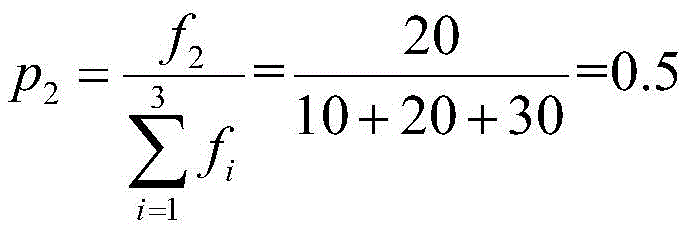
Step 2:计算个体2的累计概率g2:Step 2: Calculate the cumulative probability g 2 of individual 2 :

式中,pi为第i个个体被选择保留到下一代种群的概率;In the formula, pi is the probability that the i -th individual is selected to be retained in the next generation;
Step 3:在[0,1]之间随机生成一个随机数r=0.6,将r与g2进行比较,存在0.17<0.6<0.67,即g1<r<g2,故个体2被选择保留到下一代种群;Step 4:重复STEP 3,直到下一代种群规模与当前种群规模一致;Step 3: Randomly generate a random number r=0.6 between [0,1], compare r with g 2 , there is 0.17<0.6<0.67, that is, g 1 <r<g 2 , so individual 2 is selected to be retained To the next generation population; Step 4: Repeat STEP 3 until the next generation population size is consistent with the current population size;
f)个体解码f) Individual decoding
经过多次迭代进化后,选择适应度最高的个体(6,1,0,1,2,2,2,1)进行解码,得到目标车辆换道持续时间tc=6s、最大横向加速度as,y max=1m/s2以及目标车辆纵向加速度变量as(τ),as(τ)={0,1,2,2,2,1},单位为m/s2 After several iterations of evolution, the individuals with the highest fitness (6, 1, 0, 1, 2, 2, 2, 1) are selected for decoding, and the target vehicle lane changing duration t c =6s and the maximum lateral acceleration a s are obtained. , y max = 1 m/s 2 and the target vehicle longitudinal acceleration variable a s (τ), a s (τ) = {0, 1, 2, 2, 2, 1} in m/s 2
6)通过计算机编程实现车辆运行瞬时风险评估功能,并输出车辆换道加速度方案。6) Realize the instantaneous risk assessment function of vehicle operation through computer programming, and output the vehicle lane change acceleration scheme.
以上所述实施例只为本发明之较佳实施例,并非以此限制本发明的实施范围,故凡依本发明之形状、原理所作的变化,均应涵盖在本发明的保护范围内。The above-mentioned embodiments are only preferred embodiments of the present invention, and are not intended to limit the scope of implementation of the present invention. Therefore, any changes made according to the shape and principle of the present invention should be included within the protection scope of the present invention.
Claims (6)


















Priority Applications (1)
| Application Number | Priority Date | Filing Date | Title |
|---|---|---|---|
| CN202010840942.6A CN112071059B (en) | 2020-08-20 | 2020-08-20 | A collaborative planning method for intelligent vehicle lane changing trajectory based on instantaneous risk assessment |
Applications Claiming Priority (1)
| Application Number | Priority Date | Filing Date | Title |
|---|---|---|---|
| CN202010840942.6A CN112071059B (en) | 2020-08-20 | 2020-08-20 | A collaborative planning method for intelligent vehicle lane changing trajectory based on instantaneous risk assessment |
Publications (2)
| Publication Number | Publication Date |
|---|---|
| CN112071059A CN112071059A (en) | 2020-12-11 |
| CN112071059B true CN112071059B (en) | 2021-07-16 |
Family
ID=73662348
Family Applications (1)
| Application Number | Title | Priority Date | Filing Date |
|---|---|---|---|
| CN202010840942.6A Active CN112071059B (en) | 2020-08-20 | 2020-08-20 | A collaborative planning method for intelligent vehicle lane changing trajectory based on instantaneous risk assessment |
Country Status (1)
| Country | Link |
|---|---|
| CN (1) | CN112071059B (en) |
Cited By (1)
| Publication number | Priority date | Publication date | Assignee | Title |
|---|---|---|---|---|
| WO2025117302A1 (en) * | 2023-11-29 | 2025-06-05 | Zoox, Inc. | Conditional object position prediction by a machine learned model |
Families Citing this family (12)
| Publication number | Priority date | Publication date | Assignee | Title |
|---|---|---|---|---|
| CN112766310B (en) * | 2020-12-30 | 2022-09-23 | 嬴彻星创智能科技(上海)有限公司 | Fuel-saving lane-changing decision-making method and system |
| CN113110486B (en) * | 2021-04-30 | 2023-03-17 | 华砺智行(武汉)科技有限公司 | Intelligent networking automobile cooperative lane change guiding method and system and readable storage medium |
| CN113486822B (en) * | 2021-07-12 | 2022-04-29 | 吉林大学 | Surrounding vehicle track prediction method and system based on driving intention |
| CN113619574A (en) * | 2021-08-27 | 2021-11-09 | 中国第一汽车股份有限公司 | Vehicle avoidance method and device, computer equipment and storage medium |
| CN114543827A (en) * | 2022-02-11 | 2022-05-27 | 齐鲁工业大学 | Path planning method and device |
| CN114613195B (en) * | 2022-03-18 | 2024-06-11 | 重庆大学 | A vehicle lane-changing risk assessment method and device for mixed traffic |
| CN115273514B (en) * | 2022-08-03 | 2023-08-08 | 西南交通大学 | A multi-lane continuous lane-changing trajectory optimization method for autonomous vehicles |
| CN115907253B (en) * | 2022-11-19 | 2025-09-02 | 吉林大学 | V2X-based cooperative lane change path planning method on highways |
| CN115830886B (en) * | 2023-02-09 | 2023-05-12 | 西南交通大学 | Intelligent network-connected vehicle collaborative lane change time sequence calculation method, device, equipment and medium |
| CN116704789B (en) * | 2023-06-21 | 2025-11-14 | 中国第一汽车股份有限公司 | A method, apparatus, electronic device, and storage medium for determining the feasible lane-changing region. |
| CN118124578A (en) * | 2024-03-04 | 2024-06-04 | 中国第一汽车股份有限公司 | Lane-changing trajectory planning method, device, vehicle and storage medium |
| CN119399963A (en) * | 2024-12-31 | 2025-02-07 | 山西嘉鹏佳科技有限公司 | An intelligent traffic cone warning system |
Family Cites Families (7)
| Publication number | Priority date | Publication date | Assignee | Title |
|---|---|---|---|---|
| US7349767B2 (en) * | 2003-12-16 | 2008-03-25 | Nissan Motor Co., Ltd. | Method and system for intention estimation and operation assistance |
| US9381916B1 (en) * | 2012-02-06 | 2016-07-05 | Google Inc. | System and method for predicting behaviors of detected objects through environment representation |
| CN106364486B (en) * | 2016-09-08 | 2019-08-27 | 江苏大学 | A lane-changing control method for intelligent vehicles based on hazard analysis |
| CN106940933B (en) * | 2017-03-08 | 2019-05-24 | 北京理工大学 | A method of intelligent vehicle decision-making based on intelligent transportation system |
| CN110675656B (en) * | 2019-09-24 | 2020-09-22 | 华南理工大学 | A lane change warning method for intelligent vehicles based on instantaneous risk recognition |
| CN110877612B (en) * | 2019-11-26 | 2022-03-22 | 江苏大学 | A vehicle emergency lane change risk assessment method based on vehicle kinematics and genetic algorithm |
| CN111131617A (en) * | 2019-12-28 | 2020-05-08 | 长安大学 | A smart phone-based driving behavior analysis and feedback method |
-
2020
- 2020-08-20 CN CN202010840942.6A patent/CN112071059B/en active Active
Cited By (1)
| Publication number | Priority date | Publication date | Assignee | Title |
|---|---|---|---|---|
| WO2025117302A1 (en) * | 2023-11-29 | 2025-06-05 | Zoox, Inc. | Conditional object position prediction by a machine learned model |
Also Published As
| Publication number | Publication date |
|---|---|
| CN112071059A (en) | 2020-12-11 |
Similar Documents
| Publication | Publication Date | Title |
|---|---|---|
| CN112071059B (en) | A collaborative planning method for intelligent vehicle lane changing trajectory based on instantaneous risk assessment | |
| CN112258841B (en) | Intelligent vehicle risk assessment method based on vehicle track prediction | |
| CN110304074B (en) | Hybrid driving method based on layered state machine | |
| CN114067559B (en) | A merge optimization control method for automatic vehicle-only lanes merging into ordinary lanes | |
| CN111267846B (en) | A Game Theory-Based Method for Predicting the Interaction Behavior of Surrounding Vehicles | |
| CN110015306B (en) | Driving trajectory acquisition method and device | |
| CN104835319B (en) | Method for estimating vehicle import behavior on high-grade road bottleneck zone on-ramp | |
| CN112373485A (en) | Decision planning method for automatic driving vehicle considering interactive game | |
| CN110910646B (en) | Cooperative control method for unmanned buses at intersection | |
| CN106114507A (en) | Local path planning method and device for intelligent vehicle | |
| CN114670867B (en) | Multi-vehicle track prediction system based on layered learning and potential risk model | |
| CN116740945B (en) | Method and system for multi-vehicle collaborative grouping intersection of expressway confluence region in mixed running environment | |
| CN119417671B (en) | Intelligent driving scene self-adaptive teaching method and system based on reinforcement learning | |
| CN115344052B (en) | Vehicle path control method and control system based on improved group optimization algorithm | |
| CN117496689B (en) | Continuous signal intersection fleet cooperative control method and system in mixed traffic environment | |
| CN113920762A (en) | A control method based on the priority of emergency vehicles in the environment of intelligent network connection | |
| CN115096305B (en) | Intelligent driving automobile path planning system and method based on generation of countermeasure network and imitation learning | |
| CN117782126B (en) | Path planning decision method for autonomous driving guided by high-precision maps | |
| CN114997484B (en) | A multi-stage and multi-modal vehicle trajectory prediction method | |
| CN115140048A (en) | Automatic driving behavior decision and trajectory planning model and method | |
| CN115272994A (en) | Automatic driving prediction model training method, device, terminal and medium | |
| CN115909768A (en) | A signal collaborative optimization method and system for an intelligent network-connected mixed traffic flow intersection | |
| CN118861963A (en) | An end-to-end autonomous driving lane change decision method based on multimodal input | |
| CN118430246A (en) | Reinforced learning efficient optimization method for safe passing of left-turn vehicles at signalless intersection | |
| Yuan et al. | Driving intention recognition and speed prediction at complex urban intersections considering traffic environment |
Legal Events
| Date | Code | Title | Description |
|---|---|---|---|
| PB01 | Publication | ||
| PB01 | Publication | ||
| SE01 | Entry into force of request for substantive examination | ||
| SE01 | Entry into force of request for substantive examination | ||
| GR01 | Patent grant | ||
| GR01 | Patent grant |