CN112085348A - Soil fertility assessment method based on fuzzy neural network - Google Patents
Soil fertility assessment method based on fuzzy neural network Download PDFInfo
- Publication number
- CN112085348A CN112085348A CN202010837696.9A CN202010837696A CN112085348A CN 112085348 A CN112085348 A CN 112085348A CN 202010837696 A CN202010837696 A CN 202010837696A CN 112085348 A CN112085348 A CN 112085348A
- Authority
- CN
- China
- Prior art keywords
- soil
- node
- output
- value
- index
- Prior art date
- Legal status (The legal status is an assumption and is not a legal conclusion. Google has not performed a legal analysis and makes no representation as to the accuracy of the status listed.)
- Pending
Links
Classifications
-
- G—PHYSICS
- G06—COMPUTING OR CALCULATING; COUNTING
- G06Q—INFORMATION AND COMMUNICATION TECHNOLOGY [ICT] SPECIALLY ADAPTED FOR ADMINISTRATIVE, COMMERCIAL, FINANCIAL, MANAGERIAL OR SUPERVISORY PURPOSES; SYSTEMS OR METHODS SPECIALLY ADAPTED FOR ADMINISTRATIVE, COMMERCIAL, FINANCIAL, MANAGERIAL OR SUPERVISORY PURPOSES, NOT OTHERWISE PROVIDED FOR
- G06Q10/00—Administration; Management
- G06Q10/06—Resources, workflows, human or project management; Enterprise or organisation planning; Enterprise or organisation modelling
- G06Q10/063—Operations research, analysis or management
- G06Q10/0639—Performance analysis of employees; Performance analysis of enterprise or organisation operations
- G06Q10/06393—Score-carding, benchmarking or key performance indicator [KPI] analysis
-
- G—PHYSICS
- G06—COMPUTING OR CALCULATING; COUNTING
- G06N—COMPUTING ARRANGEMENTS BASED ON SPECIFIC COMPUTATIONAL MODELS
- G06N3/00—Computing arrangements based on biological models
- G06N3/02—Neural networks
- G06N3/04—Architecture, e.g. interconnection topology
- G06N3/045—Combinations of networks
-
- G—PHYSICS
- G06—COMPUTING OR CALCULATING; COUNTING
- G06N—COMPUTING ARRANGEMENTS BASED ON SPECIFIC COMPUTATIONAL MODELS
- G06N3/00—Computing arrangements based on biological models
- G06N3/02—Neural networks
- G06N3/08—Learning methods
-
- G—PHYSICS
- G06—COMPUTING OR CALCULATING; COUNTING
- G06Q—INFORMATION AND COMMUNICATION TECHNOLOGY [ICT] SPECIALLY ADAPTED FOR ADMINISTRATIVE, COMMERCIAL, FINANCIAL, MANAGERIAL OR SUPERVISORY PURPOSES; SYSTEMS OR METHODS SPECIALLY ADAPTED FOR ADMINISTRATIVE, COMMERCIAL, FINANCIAL, MANAGERIAL OR SUPERVISORY PURPOSES, NOT OTHERWISE PROVIDED FOR
- G06Q50/00—Information and communication technology [ICT] specially adapted for implementation of business processes of specific business sectors, e.g. utilities or tourism
- G06Q50/02—Agriculture; Fishing; Forestry; Mining
Landscapes
- Engineering & Computer Science (AREA)
- Business, Economics & Management (AREA)
- Human Resources & Organizations (AREA)
- Theoretical Computer Science (AREA)
- Physics & Mathematics (AREA)
- General Physics & Mathematics (AREA)
- Health & Medical Sciences (AREA)
- Life Sciences & Earth Sciences (AREA)
- Strategic Management (AREA)
- Economics (AREA)
- General Health & Medical Sciences (AREA)
- Evolutionary Computation (AREA)
- Development Economics (AREA)
- General Engineering & Computer Science (AREA)
- Molecular Biology (AREA)
- Mathematical Physics (AREA)
- Software Systems (AREA)
- Data Mining & Analysis (AREA)
- Entrepreneurship & Innovation (AREA)
- Educational Administration (AREA)
- Computing Systems (AREA)
- General Business, Economics & Management (AREA)
- Computational Linguistics (AREA)
- Biophysics (AREA)
- Biomedical Technology (AREA)
- Marketing (AREA)
- Tourism & Hospitality (AREA)
- Artificial Intelligence (AREA)
- Primary Health Care (AREA)
- Mining & Mineral Resources (AREA)
- Marine Sciences & Fisheries (AREA)
- Animal Husbandry (AREA)
- Agronomy & Crop Science (AREA)
- Game Theory and Decision Science (AREA)
- Operations Research (AREA)
- Quality & Reliability (AREA)
- Management, Administration, Business Operations System, And Electronic Commerce (AREA)
Abstract
本发明公开了基于模糊神经网络的土壤肥力评估方法。现有方法测量步骤多、效率低、成本高。本发明方法首先构建土壤肥力评价指标体系,对数据进行预处理,设定语言变量矩阵,确定输出量作为TS模糊神经网络第一次学习的初值,将输入向量代入每一条模糊规则,计算每个规则对应的适应度,得到对应于输入向量的加权平均输出,利用迭代优化的方法确定参数,并对输出误差添加矫正回路,达到矫正回路学习次数上限后,输出经过神经网络学习后的最终肥力评估值以及最终误差。本发明方法将误差用矫正回路进行学习,使得肥力评估精度比一般的TS模糊神经网络更高。本发明方法所需土壤参数测量指标较少,具有较高的肥力评估精确度。The invention discloses a soil fertility evaluation method based on a fuzzy neural network. The existing method has many measurement steps, low efficiency and high cost. The method of the invention first constructs the soil fertility evaluation index system, preprocesses the data, sets the language variable matrix, determines the output as the initial value of the first learning of the TS fuzzy neural network, substitutes the input vector into each fuzzy rule, calculates each The fitness corresponding to each rule is obtained, the weighted average output corresponding to the input vector is obtained, the parameters are determined by iterative optimization method, and a correction loop is added to the output error. Estimated value and final error. The method of the invention uses the correction loop to learn the error, so that the fertility evaluation accuracy is higher than that of the general TS fuzzy neural network. The method of the invention needs less soil parameter measurement indexes and has higher fertility evaluation accuracy.
Description
技术领域technical field
本发明属于计算机技术领域,涉及一种利用模糊神经网络,能够减少土壤参数测量指标,并保证精度的土壤肥力评估方法。The invention belongs to the field of computer technology, and relates to a soil fertility evaluation method that utilizes a fuzzy neural network, can reduce soil parameter measurement indexes and ensure accuracy.
背景技术Background technique
土壤状况是关系到农业生产以及土地资源的重要因素之一,因此对土壤的各项参数进行检测是十分必要的。现有的土壤肥力评估往往以灰色关联法,模糊综合评判法等综合赋权评价为主。这些方法虽然能够保证足够高的精度,但是所需土壤参数测量指标过多,需要利用多种化学实验测量土壤中的有机物含量,测量步骤多,效率低,经济成本高。Soil condition is one of the important factors related to agricultural production and land resources, so it is very necessary to test various parameters of soil. The existing soil fertility assessment is usually based on the grey relational method and the fuzzy comprehensive evaluation method. Although these methods can ensure high enough accuracy, they require too many soil parameters to measure the content of organic matter in the soil. Various chemical experiments are needed to measure the organic matter content in the soil, with many measurement steps, low efficiency and high economic cost.
部分土壤肥力测量方法直接采用电导率进行评估肥力,虽然测量成本低,但电导率并不能全面地反映肥力状况,精度不够。因此需要提出一种所需测量参数少,精度高,测量效率高,经济成本低的土壤评价方法。Some soil fertility measurement methods directly use conductivity to evaluate fertility. Although the measurement cost is low, the conductivity cannot fully reflect the fertility status, and the accuracy is not enough. Therefore, it is necessary to propose a soil evaluation method with few measurement parameters, high precision, high measurement efficiency and low economic cost.
发明内容SUMMARY OF THE INVENTION
本发明的目的在于提供一种基于模糊神经网络的土壤肥力评估方法,该方法所需评价指标少,对土壤肥力的评估精度高,实现对土壤肥力的经济,高效测量。The purpose of the present invention is to provide a soil fertility assessment method based on a fuzzy neural network, which requires less assessment indicators, has high soil fertility assessment accuracy, and realizes economical and efficient measurement of soil fertility.
本发明通过以下方案予以实现:The present invention is realized through the following scheme:
步骤(1).构建土壤肥力评价指标体系:土壤肥力评价指标包括土壤化学性状指标和土壤养分状况指标;土壤化学性状指标包括土壤阳离子交换量、土壤pH值;土壤养分状况指标包括土壤全钾含量、土壤全氮含量、土壤全磷含量、土壤有机质含量等。Step (1). Build a soil fertility evaluation index system: the soil fertility evaluation index includes soil chemical property index and soil nutrient status index; soil chemical property index includes soil cation exchange capacity and soil pH value; soil nutrient status index includes soil total potassium content , soil total nitrogen content, soil total phosphorus content, soil organic matter content, etc.
首先为了保证评估精度,需要构建较为完善的土壤肥力评价体系;接着,通过相关性分析,并结合不同指标测量的难易程度及成本,选取便于测量,且能够反映土壤状况的指标,继而搜集足够的样本数据。First, in order to ensure the evaluation accuracy, it is necessary to build a relatively complete soil fertility evaluation system; then, through correlation analysis, combined with the difficulty and cost of measuring different indicators, select indicators that are easy to measure and can reflect soil conditions, and then collect enough indicators. sample data.
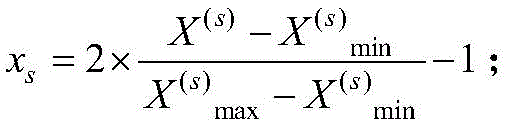
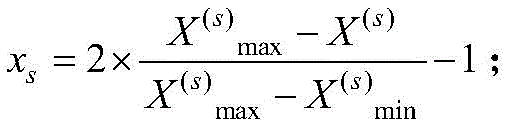
步骤(2).数据预处理:土壤肥力评价问题是多指标模式识别问题,采用TS(Takagi-Sugeno)型模糊神经网络进行综合评估,并对网络进行训练,提高精度。采用TS模糊神经网络需要将测量值通过归一化转化到在[-1,1]中的对应值,第s项指标的任意一个测量值为X(s):Step (2). Data preprocessing: The soil fertility evaluation problem is a multi-index pattern recognition problem. The TS (Takagi-Sugeno) type fuzzy neural network is used for comprehensive evaluation, and the network is trained to improve the accuracy. Using the TS fuzzy neural network needs to normalize the measured value to the corresponding value in [-1,1], and any measured value of the s-th index is X (s) :
如果该指标与土壤肥力呈正相关,则归一化后的输入量的值为
如果该指标与土壤肥力呈负相关,则归一化后的输入量的值为
得到输入向量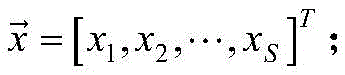
步骤(3).设定语言变量矩阵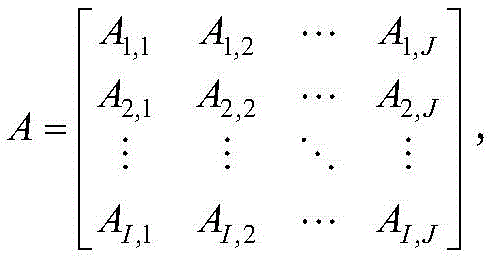
步骤(4).利用输出量与输入量之间的线性关系,确定输出量,作为TS模糊神经网络第一次学习的初值:Step (4). Use the linear relationship between the output and the input to determine the output as the initial value of the first learning of the TS fuzzy neural network:
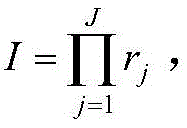
对于第j个输入量,其所含语言变量的总数为rj,则模糊规则总数

步骤(5).将输入向量代入每一条模糊规则,对于第j个归一化后的输入量xj,在Ri中采用高斯型函数得到其对于语言变量Aij的隶属度
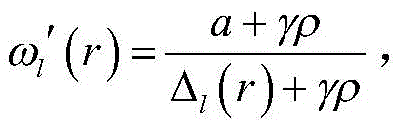
步骤(6).计算每个规则对应的适应度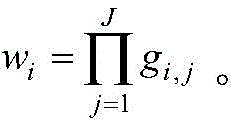
步骤(7).根据适应度wi以及输出量yi,求出对应于输入向量的加权平均输出y:Step (7). According to the fitness wi and the output y i , obtain the weighted average output y corresponding to the input vector:

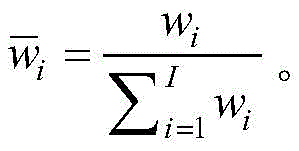
步骤(8).利用迭代优化的方法确定参数:采用梯度下降的参数pi,j学习算法,得到使误差最小;同样利用梯度算法,迭代优化参数ci,j和σi,j,重复步骤(4)~(7),直到达到设定的学习次数上限,输出第l个样本的最后一次迭代得到的肥力状况yl′。Step (8). Determine the parameters using the iterative optimization method: use the gradient descent parameter p i,j learning algorithm to obtain the minimum error; also use the gradient algorithm to iteratively optimize the parameters c i,j and σ i,j , repeat the steps (4) to (7), until the upper limit of the set learning times is reached, output the fertility status yl ′ obtained by the last iteration of the lth sample.
对于参数pi,j的迭代学习算法,则需要以输出误差最小为目标,设输入的训练样本数为m,则第l个输入向量
在迭代结束前,第l个样本在第n次迭代时经神经网络输出的肥力值为yl(n),对应的用于验证的肥力值为Yl,则在第n次迭代时,对全部样本进行学习的总误差:
Yl通过土壤科学数据库获得土壤氮、磷、钾、有机质含量,通过灰色关联法进行计算得到。用于验证的肥力值表达式为
灰色关联法具体如下:The grey relational method is as follows:
首先对指标的测量值进行归一化处理:First, normalize the measured values of the indicators:
若指标与土壤肥力呈正相关,则
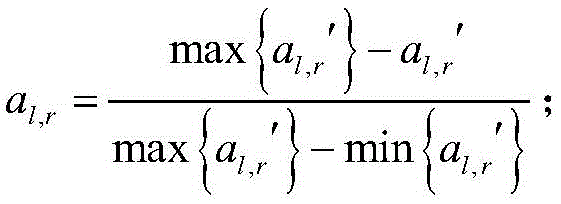

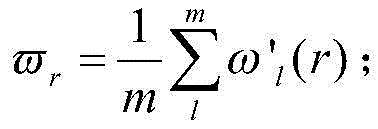
系数
对每个指标下所有样本的关联系数取平均,来表示该指标与母指标之间的关联度: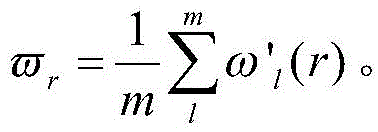
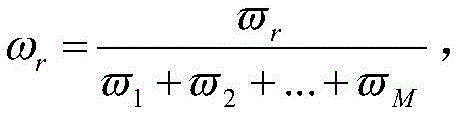
求出各指标对应的权重,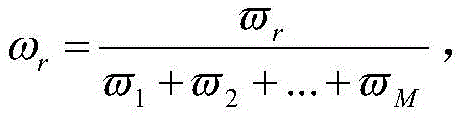

采用基于梯度下降的迭代学习算法优化参数pi,j:The parameters p i,j are optimized using an iterative learning algorithm based on gradient descent:
首先计算总误差随pi,j变化的梯度:
通过如下迭代关系得到pi,j:
参数ci,j和σi,j通过一阶梯度寻优算法进行迭代:The parameters c i,j and σ i,j are iterated by a first-order gradient optimization algorithm:


参数ci,j和σi,j的初值是1~2中的随机数,α为大于0的常数。The initial values of parameters c i,j and σ i,j are random numbers from 1 to 2, and α is a constant greater than 0.
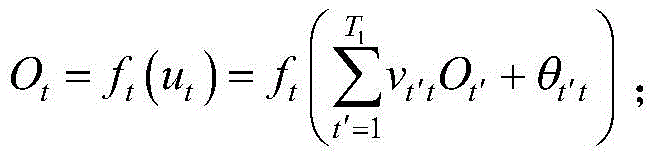
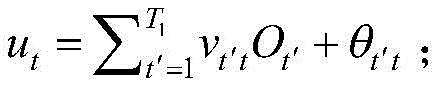
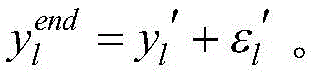
步骤(9).达到学习次数上限后,对输出误差添加矫正回路;矫正回路采用双隐含层BP神经网络,对第l个样本的输出误差εl进行学习,


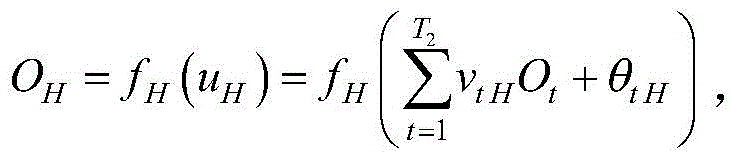
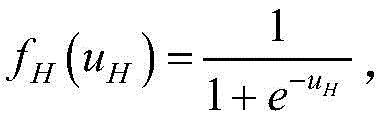
对于第t个节点,其输出
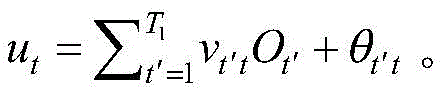
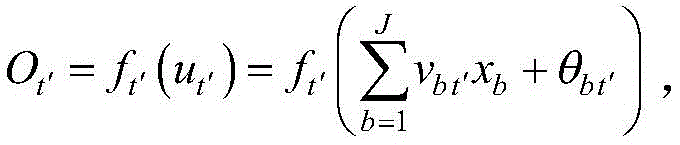
第t个节点为位于第二隐含层上的节点,T1<t≤T1+T2;第t′个节点为位于第一隐含层上的节点,1≤t′≤T1;第t′个节点的输出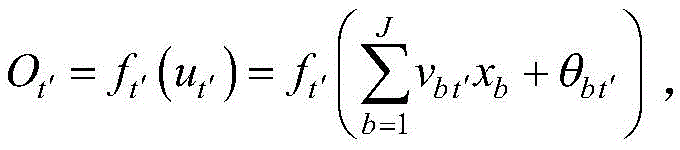

步骤(10).达到矫正回路学习次数上限K′后,输出经过神经网络学习后的最终肥力值以及最终误差,K′=5000~15000;Step (10). After reaching the upper limit K' of the correction loop learning times, output the final fertility value and the final error after learning by the neural network, K'=5000~15000;
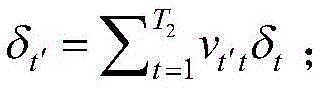
对于隐含层第t个节点的输出误差δt=vtHδH,δH为输出节点对样本误差的学习偏差;第t′个节点的输出误差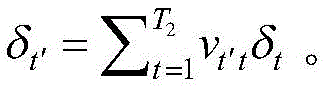
对于第b个输入节点与第t′个节点之间的权重vbt′和阈值θbt′的迭代表达式为:The iterative expressions for the weight v bt' and the threshold θ bt' between the bth input node and the t'th node are:

其中,
对于第t′个输入节点与第t个节点之间的权重vt′t和阈值θt′t的迭代表达式为:The iterative expression for the weight v t't and the threshold θ t't between the t'th input node and the tth node is:

对于输出层与第t个节点之间的权重vtH和阈值θtH的迭代表达式为:The iterative expressions for the weight v tH and the threshold θ tH between the output layer and the t-th node are:

其中,
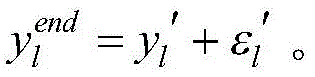
本发明方法所需土壤参数测量指标较少,具有较高的肥力评估精确度。本发明方法通过模糊神经网络,建立了评价指标与肥力之间的关系,利用模糊规则可以减少在建立数学模型上的困难,利用神经网络不断学习的特点可以提高评估精度。相比于传统的TS模糊神经网络,本发明增加了矫正回路,将误差用矫正回路进行学习,使得肥力评估精度比一般的TS模糊神经网络更高。The method of the invention needs less soil parameter measurement indexes and has higher fertility evaluation accuracy. The method of the invention establishes the relationship between the evaluation index and the fertility through the fuzzy neural network, the difficulty in establishing the mathematical model can be reduced by using the fuzzy rules, and the evaluation accuracy can be improved by using the characteristic of continuous learning of the neural network. Compared with the traditional TS fuzzy neural network, the present invention adds a correction circuit, and uses the correction circuit to learn the error, so that the fertility evaluation accuracy is higher than that of the general TS fuzzy neural network.
具体实施方式Detailed ways
为了更加清楚地描述,对本发明实施例中的技术方案进行详细介绍。For a clearer description, the technical solutions in the embodiments of the present invention are described in detail.
基于模糊神经网络的土壤肥力评估方法,具体步骤是:Soil fertility assessment method based on fuzzy neural network, the specific steps are:
步骤(1).以黑色系的土壤,如黑壤、棕壤为例,进行评价并构建指标体系。构建土壤肥力评价指标体系:土壤肥力评价指标包括土壤化学性状指标和土壤养分状况指标;土壤化学性状指标包括土壤阳离子交换量、土壤pH值;土壤养分状况指标包括土壤全钾含量、土壤全氮含量、土壤全磷含量、土壤有机质含量等。Step (1). Taking black soil, such as black soil and brown soil as examples, evaluate and construct an index system. Construct soil fertility evaluation index system: soil fertility evaluation index includes soil chemical property index and soil nutrient status index; soil chemical property index includes soil cation exchange capacity, soil pH value; soil nutrient status index includes soil total potassium content, soil total nitrogen content , soil total phosphorus content, soil organic matter content, etc.
为了保证评估精度,需要构建较为完善的土壤肥力评价体系;通过相关性分析,并结合不同指标测量的难易程度及成本,选取便于测量,且能够反映土壤状况的指标,继而搜集足够的样本数据。In order to ensure the evaluation accuracy, it is necessary to build a relatively complete soil fertility evaluation system; through correlation analysis, combined with the difficulty and cost of measuring different indicators, select indicators that are easy to measure and can reflect soil conditions, and then collect enough sample data. .
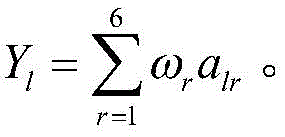
首先需要得出一个较为精确的肥力值,从土壤科学数据库中搜集100种土壤样本数据,运用灰色关联法得到第l个土壤样本的肥力评分Yl。具体的评价体系达式为:
灰色关联法的具体步骤为:The specific steps of the grey relational method are:
对指标的测量值进行归一化处理,
这里选定pH=7为植物的最适土壤酸碱度,变换后pH指标与土壤肥力呈负相关,归一化处理方式为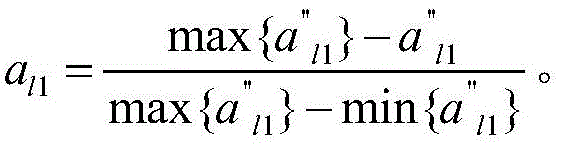
计算关联系数,

对每个指标下所有样本的关联系数取平均,来表示该指标与母指标之间的关联度,
求出各指标对应的权重,
用SPSS软件中的相关性分析模块,得到全部指标与肥力评分之间的皮尔逊相关系数如表1所示:Using the correlation analysis module in SPSS software, the Pearson correlation coefficient between all indicators and the fertility score was obtained as shown in Table 1:
表1土壤评价指标相关性与显著性分析表Table 1 Correlation and significance analysis table of soil evaluation indicators
结合指标的测量成本与测量精度,最终选定土壤阳离子交换量、土壤pH、土壤全氮含量作为评估指标。Combined with the measurement cost and measurement accuracy of the indicators, the soil cation exchange capacity, soil pH, and soil total nitrogen content were finally selected as evaluation indicators.
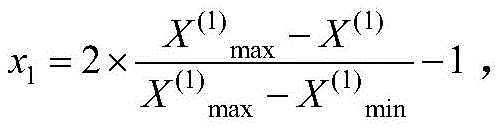
步骤(2)、数据预处理。对于pH值,由于其与肥力之间呈现倒“U”型的关系,代入线性表达式前,需要进行转换:X1=|x1′-7|,x1′为测量得到的土壤pH值。将测量值通过归一化转化到在[-1,1]中的对应值,若第k项指标的任意一个测量值为X(k),则归一化后的输入量的值
对所有测量值采用上述变换,从而得到输入向量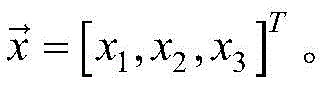
步骤(3)、设定语言变量矩阵A。对于输入量pH而言,语言变量可以为“强酸性”,“适宜”等,构建得到评价体系中的所有指标语言变量如表2所示:Step (3), set the language variable matrix A. For the input pH, the linguistic variables can be "strongly acidic", "suitable", etc. The linguistic variables of all indicators in the evaluation system are constructed as shown in Table 2:
表2土壤评价体系语言变量表Table 2 Language variable table of soil evaluation system
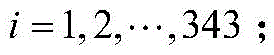
根据语言变量表可知,共有343条模糊规则。According to the language variable table, there are 343 fuzzy rules in total.
步骤(4)、利用输出量与输入量之间的线性关系,确定输出量,作为TS模糊神经网络第一次学习的初值。Step (4), using the linear relationship between the output and the input, to determine the output as the initial value of the first learning of the TS fuzzy neural network.
模糊规则总数I=343,将输入变量进行如下线性组合,确定输出变量yi,即对于Ri有:当x1为Ai,1,且x2为Ai,2,x3为Ai,3,…,xJ为Ai,J时,则yi表达为:
pi,j表示第i条模糊规则的输出量的线性表达式中第j个输入量的系数,pi,0为常数项。pi,j通过不断学习迭代得到,迭代的第一步pi,j取0~0.3任意值,得到初步的输出量yi。pi ,j represents the coefficient of the jth input quantity in the linear expression of the output quantity of the ith fuzzy rule, and pi ,0 is a constant term. pi ,j are obtained through continuous learning and iteration. The first step of the iteration pi ,j takes any value from 0 to 0.3, and the initial output quantity yi is obtained.
步骤(5).将输入向量代入每一条模糊规则,对于第j个归一化后的输入量xj,在Ri中采用高斯型函数得到其对于语言变量Ai,j的隶属度
步骤(6).计算每个规则对应的适应度
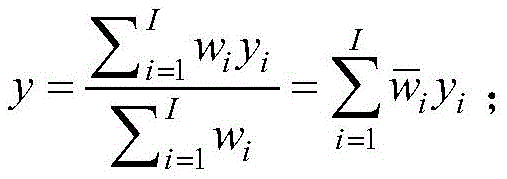
步骤(7).根据适应度wi以及输出量yi,求出对应于输入向量的加权平均输出y:Step (7). According to the fitness wi and the output y i , obtain the weighted average output y corresponding to the input vector:

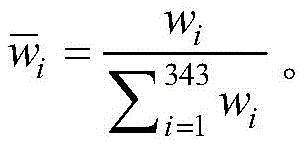
步骤(8).利用迭代优化的方法确定参数:采用梯度下降的参数pi,j学习算法,得到使误差最小;同样利用梯度算法,迭代优化参数ci,j和σi,j,重复步骤(4)~(7),直到达到设定的学习次数上限,输出第l个样本的最后一次迭代得到的肥力状况yl′。Step (8). Determine the parameters using the iterative optimization method: use the gradient descent parameter p i,j learning algorithm to obtain the minimum error; also use the gradient algorithm to iteratively optimize the parameters c i,j and σ i,j , repeat the steps (4) to (7), until the upper limit of the set learning times is reached, output the fertility status yl ′ obtained by the last iteration of the lth sample.
对于参数pi,j的迭代学习算法,则需要以输出误差最小为目标,设输入的训练样本数为100,则第l个输入向量

采用基于梯度下降的参数pi,j的迭代学习算法,计算总误差随pi,j变化的梯度:Using an iterative learning algorithm based on the parameters p i,j of gradient descent, calculate the gradient of the total error as a function of p i,j :

这里的总误差E是随迭代次数k增加而变化的函数。The total error E here is a function of increasing the number of iterations k.
通过如下迭代关系得到pi,j:
参数ci,j和σi,j通过一阶梯度寻优算法进行迭代:The parameters c i,j and σ i,j are iterated by a first-order gradient optimization algorithm:


参数ci,j和σi,j的初值是1~2中的随机数。The initial values of parameters c i,j and σ i,j are random numbers from 1 to 2.
步骤(9).达到学习次数上限后,对输出误差添加矫正回路;矫正回路采用双隐含层BP神经网络,对第l个样本的输出误差εl进行学习,

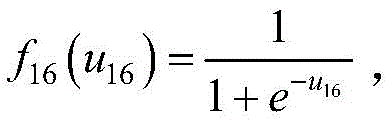

对于第t个节点,其输出

第t个节点为位于第二隐含层上的节点,9<t≤15;第t′个节点为位于第一隐含层上的节点,1≤t′≤9;第t′个节点的输出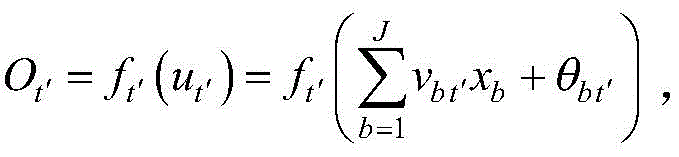

步骤(10).达到矫正回路学习次数上限K′后,输出经过神经网络学习后的最终肥力值以及最终误差,K′=5000~15000;Step (10). After reaching the upper limit K' of the correction loop learning times, output the final fertility value and the final error after learning by the neural network, K'=5000~15000;
对于隐含层第t个节点的输出误差δt=vt16δ16,δ16为输出节点对样本误差的学习偏差;第t′个节点的输出误差
对于第b个输入节点与第t′个节点之间的权重vbt′和阈值θbt′的迭代表达式为:The iterative expressions for the weight v bt' and the threshold θ bt' between the bth input node and the t'th node are:

其中,
对于第t′个输入节点与第t个节点之间的权重vt′t和阈值θt′t的迭代表达式为:The iterative expression for the weight v t't and the threshold θ t't between the t'th input node and the tth node is:

对于输出层与第t个节点之间的权重vt16和阈值θt16的迭代表达式为:The iterative expressions for the weight v t16 and the threshold θ t16 between the output layer and the t-th node are:

其中,

表3矫正前后TS模糊神经网络的误差Table 3 Errors of TS fuzzy neural network before and after correction
训练误差中的学习样本数为100种黑壤与棕壤,测试样本为14种黑壤与棕壤。本发明将测量指标从6个缩减为3个,节省了经济成本且提高了测量效率,精度达到原来的综合评判法的94.26%,说明土壤肥力评估的准确性也得到了保证。The number of learning samples in the training error is 100 kinds of black soil and brown soil, and the test samples are 14 kinds of black soil and brown soil. The invention reduces the measurement indexes from 6 to 3, saves the economic cost and improves the measurement efficiency, and the accuracy reaches 94.26% of the original comprehensive evaluation method, indicating that the accuracy of soil fertility evaluation is also guaranteed.
Claims (10)





















Priority Applications (1)
| Application Number | Priority Date | Filing Date | Title |
|---|---|---|---|
| CN202010837696.9A CN112085348A (en) | 2020-08-19 | 2020-08-19 | Soil fertility assessment method based on fuzzy neural network |
Applications Claiming Priority (1)
| Application Number | Priority Date | Filing Date | Title |
|---|---|---|---|
| CN202010837696.9A CN112085348A (en) | 2020-08-19 | 2020-08-19 | Soil fertility assessment method based on fuzzy neural network |
Publications (1)
| Publication Number | Publication Date |
|---|---|
| CN112085348A true CN112085348A (en) | 2020-12-15 |
Family
ID=73728380
Family Applications (1)
| Application Number | Title | Priority Date | Filing Date |
|---|---|---|---|
| CN202010837696.9A Pending CN112085348A (en) | 2020-08-19 | 2020-08-19 | Soil fertility assessment method based on fuzzy neural network |
Country Status (1)
| Country | Link |
|---|---|
| CN (1) | CN112085348A (en) |
Cited By (3)
| Publication number | Priority date | Publication date | Assignee | Title |
|---|---|---|---|---|
| CN113435707A (en) * | 2021-06-03 | 2021-09-24 | 大连钜智信息科技有限公司 | Soil testing and formulated fertilization method based on deep learning and weighted multi-factor evaluation |
| CN114595806A (en) * | 2022-03-02 | 2022-06-07 | 桂林理工大学 | Forest land soil fertility analysis and evaluation model based on improved capsule network |
| CN115830873A (en) * | 2023-01-10 | 2023-03-21 | 西南交通大学 | Urban road traffic incident classification method, device, equipment and readable storage medium |
Citations (3)
| Publication number | Priority date | Publication date | Assignee | Title |
|---|---|---|---|---|
| CN106650767A (en) * | 2016-09-20 | 2017-05-10 | 河海大学 | Flood forecasting method based on cluster analysis and real time correction |
| CN109374860A (en) * | 2018-11-13 | 2019-02-22 | 西北大学 | A Soil Nutrient Prediction and Comprehensive Evaluation Method Based on Machine Learning Algorithm |
| CN110444291A (en) * | 2019-07-27 | 2019-11-12 | 南京理工大学 | Disease factor extracting method based on improved PSO-BP neural network and Bayesian Method |
-
2020
- 2020-08-19 CN CN202010837696.9A patent/CN112085348A/en active Pending
Patent Citations (3)
| Publication number | Priority date | Publication date | Assignee | Title |
|---|---|---|---|---|
| CN106650767A (en) * | 2016-09-20 | 2017-05-10 | 河海大学 | Flood forecasting method based on cluster analysis and real time correction |
| CN109374860A (en) * | 2018-11-13 | 2019-02-22 | 西北大学 | A Soil Nutrient Prediction and Comprehensive Evaluation Method Based on Machine Learning Algorithm |
| CN110444291A (en) * | 2019-07-27 | 2019-11-12 | 南京理工大学 | Disease factor extracting method based on improved PSO-BP neural network and Bayesian Method |
Non-Patent Citations (6)
| Title |
|---|
| ZHANG, Y: "An Improved T-S Fuzzy Neural Network and Its Application in Soft Sensing for FCCU", 2010 8TH WORLD CONGRESS ON INTELLIGENT CONTROL AND AUTOMATION (WCICA), 1 January 2010 (2010-01-01), pages 466 - 470 * |
| 丁瑜;胡文静;夏振尧;李博;姚小月;许文年;: "生态护坡生境基材土壤肥力动态变化研究", 水生态学杂志, no. 02, 15 March 2017 (2017-03-15) * |
| 刘东海;梁国庆;周卫;王秀斌;夏文建;: "基于神经网络的土壤肥力综合评价", 中国土壤与肥料, no. 05, 10 October 2011 (2011-10-10) * |
| 唐华飞: "基于遗传算法和模糊神经网络的土壤肥力质量评价研究", 中国硕士学位论文全文数据库信息科技辑, no. 07, 1 July 2014 (2014-07-01), pages 08 - 45 * |
| 地力夏提・艾木热拉;丁建丽;穆艾塔尔・赛地;米热古力・艾尼瓦尔;邹杰;: "基于T-S模糊神经网络模型的干旱区土壤盐分预测研究", 西南农业学报, no. 07, 28 July 2018 (2018-07-28) * |
| 王炳萱;李国勇;王艳晖;: "基于LM-PSO算法和BP神经网络的非线性预测控制", 太原理工大学学报, no. 02, 15 March 2016 (2016-03-15) * |
Cited By (4)
| Publication number | Priority date | Publication date | Assignee | Title |
|---|---|---|---|---|
| CN113435707A (en) * | 2021-06-03 | 2021-09-24 | 大连钜智信息科技有限公司 | Soil testing and formulated fertilization method based on deep learning and weighted multi-factor evaluation |
| CN113435707B (en) * | 2021-06-03 | 2023-11-10 | 大连钜智信息科技有限公司 | Soil testing formula fertilization method based on deep learning and weighted multi-factor evaluation |
| CN114595806A (en) * | 2022-03-02 | 2022-06-07 | 桂林理工大学 | Forest land soil fertility analysis and evaluation model based on improved capsule network |
| CN115830873A (en) * | 2023-01-10 | 2023-03-21 | 西南交通大学 | Urban road traffic incident classification method, device, equipment and readable storage medium |
Similar Documents
| Publication | Publication Date | Title |
|---|---|---|
| CN114488140B (en) | Small sample radar one-dimensional image target recognition method based on deep migration learning | |
| CN111860982A (en) | A short-term wind power prediction method for wind farms based on VMD-FCM-GRU | |
| CN112085348A (en) | Soil fertility assessment method based on fuzzy neural network | |
| CN111126575A (en) | Gas sensor array mixed gas detection method and device based on machine learning | |
| CN110542748B (en) | Knowledge-based robust effluent ammonia nitrogen soft measurement method | |
| CN111144552B (en) | Multi-index grain quality prediction method and device | |
| CN112557034B (en) | Bearing fault diagnosis method based on PCA _ CNNS | |
| CN105913450A (en) | Tire rubber carbon black dispersity evaluation method and system based on neural network image processing | |
| CN106096723B (en) | It is a kind of that complex industrial properties of product appraisal procedure is used for based on hybrid neural networks algorithm | |
| CN112578089B (en) | Air pollutant concentration prediction method based on improved TCN | |
| CN117436212B (en) | A distribution network topology identification method and device based on improved SVM algorithm | |
| CN107832789B (en) | Feature weighting K nearest neighbor fault diagnosis method based on average influence value data transformation | |
| CN115984650A (en) | A Recognition Method of Synthetic Aperture Radar Image Based on Deep Learning | |
| CN113255972A (en) | Short-term rainfall prediction method based on Attention mechanism | |
| CN116304587A (en) | A method for predicting the degradation trend of rolling bearings based on CAE and AGRU | |
| CN113191092A (en) | Industrial process product quality soft measurement method based on orthogonal increment random configuration network | |
| CN114707692A (en) | Wetland effluent ammonia nitrogen concentration prediction method and system based on hybrid neural network | |
| CN118824409A (en) | A soft-sensing method for sewage effluent index BOD5 based on Transformer and long short-term memory network | |
| CN115759859A (en) | LSTM-based power distribution network state real-time evaluation method and terminal | |
| CN112651500A (en) | Method for generating quantization model and terminal | |
| CN119518720A (en) | A low voltage station area topology identification method based on graph attention network | |
| CN112580714B (en) | Article identification method for dynamically optimizing loss function in error-cause reinforcement mode | |
| CN118153438A (en) | A method and device for predicting wind pressure field of non-independent low-rise buildings | |
| CN110108672A (en) | A kind of Aerosol Extinction inversion method based on deepness belief network | |
| CN114358502B (en) | A risk assessment method for edible oil based on optimized ELM |
Legal Events
| Date | Code | Title | Description |
|---|---|---|---|
| PB01 | Publication | ||
| PB01 | Publication | ||
| SE01 | Entry into force of request for substantive examination | ||
| SE01 | Entry into force of request for substantive examination | ||
| WD01 | Invention patent application deemed withdrawn after publication |
Application publication date: 20201215 |
|
| WD01 | Invention patent application deemed withdrawn after publication |