CN112029826A - System and method for assaying nucleic acids - Google Patents
System and method for assaying nucleic acids Download PDFInfo
- Publication number
- CN112029826A CN112029826A CN202010422932.0A CN202010422932A CN112029826A CN 112029826 A CN112029826 A CN 112029826A CN 202010422932 A CN202010422932 A CN 202010422932A CN 112029826 A CN112029826 A CN 112029826A
- Authority
- CN
- China
- Prior art keywords
- nucleic acid
- probes
- rna
- probe
- sequences
- Prior art date
- Legal status (The legal status is an assumption and is not a legal conclusion. Google has not performed a legal analysis and makes no representation as to the accuracy of the status listed.)
- Granted
Links
Images


Classifications
-
- C—CHEMISTRY; METALLURGY
- C12—BIOCHEMISTRY; BEER; SPIRITS; WINE; VINEGAR; MICROBIOLOGY; ENZYMOLOGY; MUTATION OR GENETIC ENGINEERING
- C12N—MICROORGANISMS OR ENZYMES; COMPOSITIONS THEREOF; PROPAGATING, PRESERVING, OR MAINTAINING MICROORGANISMS; MUTATION OR GENETIC ENGINEERING; CULTURE MEDIA
- C12N15/00—Mutation or genetic engineering; DNA or RNA concerning genetic engineering, vectors, e.g. plasmids, or their isolation, preparation or purification; Use of hosts therefor
- C12N15/09—Recombinant DNA-technology
- C12N15/10—Processes for the isolation, preparation or purification of DNA or RNA
- C12N15/1034—Isolating an individual clone by screening libraries
- C12N15/1065—Preparation or screening of tagged libraries, e.g. tagged microorganisms by STM-mutagenesis, tagged polynucleotides, gene tags
-
- C—CHEMISTRY; METALLURGY
- C07—ORGANIC CHEMISTRY
- C07H—SUGARS; DERIVATIVES THEREOF; NUCLEOSIDES; NUCLEOTIDES; NUCLEIC ACIDS
- C07H21/00—Compounds containing two or more mononucleotide units having separate phosphate or polyphosphate groups linked by saccharide radicals of nucleoside groups, e.g. nucleic acids
- C07H21/02—Compounds containing two or more mononucleotide units having separate phosphate or polyphosphate groups linked by saccharide radicals of nucleoside groups, e.g. nucleic acids with ribosyl as saccharide radical
-
- C—CHEMISTRY; METALLURGY
- C07—ORGANIC CHEMISTRY
- C07H—SUGARS; DERIVATIVES THEREOF; NUCLEOSIDES; NUCLEOTIDES; NUCLEIC ACIDS
- C07H21/00—Compounds containing two or more mononucleotide units having separate phosphate or polyphosphate groups linked by saccharide radicals of nucleoside groups, e.g. nucleic acids
- C07H21/04—Compounds containing two or more mononucleotide units having separate phosphate or polyphosphate groups linked by saccharide radicals of nucleoside groups, e.g. nucleic acids with deoxyribosyl as saccharide radical
-
- C—CHEMISTRY; METALLURGY
- C12—BIOCHEMISTRY; BEER; SPIRITS; WINE; VINEGAR; MICROBIOLOGY; ENZYMOLOGY; MUTATION OR GENETIC ENGINEERING
- C12N—MICROORGANISMS OR ENZYMES; COMPOSITIONS THEREOF; PROPAGATING, PRESERVING, OR MAINTAINING MICROORGANISMS; MUTATION OR GENETIC ENGINEERING; CULTURE MEDIA
- C12N15/00—Mutation or genetic engineering; DNA or RNA concerning genetic engineering, vectors, e.g. plasmids, or their isolation, preparation or purification; Use of hosts therefor
- C12N15/09—Recombinant DNA-technology
- C12N15/10—Processes for the isolation, preparation or purification of DNA or RNA
-
- C—CHEMISTRY; METALLURGY
- C12—BIOCHEMISTRY; BEER; SPIRITS; WINE; VINEGAR; MICROBIOLOGY; ENZYMOLOGY; MUTATION OR GENETIC ENGINEERING
- C12N—MICROORGANISMS OR ENZYMES; COMPOSITIONS THEREOF; PROPAGATING, PRESERVING, OR MAINTAINING MICROORGANISMS; MUTATION OR GENETIC ENGINEERING; CULTURE MEDIA
- C12N15/00—Mutation or genetic engineering; DNA or RNA concerning genetic engineering, vectors, e.g. plasmids, or their isolation, preparation or purification; Use of hosts therefor
- C12N15/09—Recombinant DNA-technology
- C12N15/10—Processes for the isolation, preparation or purification of DNA or RNA
- C12N15/1034—Isolating an individual clone by screening libraries
- C12N15/1093—General methods of preparing gene libraries, not provided for in other subgroups
-
- C—CHEMISTRY; METALLURGY
- C12—BIOCHEMISTRY; BEER; SPIRITS; WINE; VINEGAR; MICROBIOLOGY; ENZYMOLOGY; MUTATION OR GENETIC ENGINEERING
- C12Q—MEASURING OR TESTING PROCESSES INVOLVING ENZYMES, NUCLEIC ACIDS OR MICROORGANISMS; COMPOSITIONS OR TEST PAPERS THEREFOR; PROCESSES OF PREPARING SUCH COMPOSITIONS; CONDITION-RESPONSIVE CONTROL IN MICROBIOLOGICAL OR ENZYMOLOGICAL PROCESSES
- C12Q1/00—Measuring or testing processes involving enzymes, nucleic acids or microorganisms; Compositions therefor; Processes of preparing such compositions
- C12Q1/68—Measuring or testing processes involving enzymes, nucleic acids or microorganisms; Compositions therefor; Processes of preparing such compositions involving nucleic acids
- C12Q1/6806—Preparing nucleic acids for analysis, e.g. for polymerase chain reaction [PCR] assay
-
- C—CHEMISTRY; METALLURGY
- C12—BIOCHEMISTRY; BEER; SPIRITS; WINE; VINEGAR; MICROBIOLOGY; ENZYMOLOGY; MUTATION OR GENETIC ENGINEERING
- C12Q—MEASURING OR TESTING PROCESSES INVOLVING ENZYMES, NUCLEIC ACIDS OR MICROORGANISMS; COMPOSITIONS OR TEST PAPERS THEREFOR; PROCESSES OF PREPARING SUCH COMPOSITIONS; CONDITION-RESPONSIVE CONTROL IN MICROBIOLOGICAL OR ENZYMOLOGICAL PROCESSES
- C12Q1/00—Measuring or testing processes involving enzymes, nucleic acids or microorganisms; Compositions therefor; Processes of preparing such compositions
- C12Q1/68—Measuring or testing processes involving enzymes, nucleic acids or microorganisms; Compositions therefor; Processes of preparing such compositions involving nucleic acids
- C12Q1/6813—Hybridisation assays
- C12Q1/6816—Hybridisation assays characterised by the detection means
-
- C—CHEMISTRY; METALLURGY
- C12—BIOCHEMISTRY; BEER; SPIRITS; WINE; VINEGAR; MICROBIOLOGY; ENZYMOLOGY; MUTATION OR GENETIC ENGINEERING
- C12Q—MEASURING OR TESTING PROCESSES INVOLVING ENZYMES, NUCLEIC ACIDS OR MICROORGANISMS; COMPOSITIONS OR TEST PAPERS THEREFOR; PROCESSES OF PREPARING SUCH COMPOSITIONS; CONDITION-RESPONSIVE CONTROL IN MICROBIOLOGICAL OR ENZYMOLOGICAL PROCESSES
- C12Q1/00—Measuring or testing processes involving enzymes, nucleic acids or microorganisms; Compositions therefor; Processes of preparing such compositions
- C12Q1/68—Measuring or testing processes involving enzymes, nucleic acids or microorganisms; Compositions therefor; Processes of preparing such compositions involving nucleic acids
- C12Q1/6813—Hybridisation assays
- C12Q1/6834—Enzymatic or biochemical coupling of nucleic acids to a solid phase
- C12Q1/6837—Enzymatic or biochemical coupling of nucleic acids to a solid phase using probe arrays or probe chips
-
- C—CHEMISTRY; METALLURGY
- C12—BIOCHEMISTRY; BEER; SPIRITS; WINE; VINEGAR; MICROBIOLOGY; ENZYMOLOGY; MUTATION OR GENETIC ENGINEERING
- C12Q—MEASURING OR TESTING PROCESSES INVOLVING ENZYMES, NUCLEIC ACIDS OR MICROORGANISMS; COMPOSITIONS OR TEST PAPERS THEREFOR; PROCESSES OF PREPARING SUCH COMPOSITIONS; CONDITION-RESPONSIVE CONTROL IN MICROBIOLOGICAL OR ENZYMOLOGICAL PROCESSES
- C12Q1/00—Measuring or testing processes involving enzymes, nucleic acids or microorganisms; Compositions therefor; Processes of preparing such compositions
- C12Q1/68—Measuring or testing processes involving enzymes, nucleic acids or microorganisms; Compositions therefor; Processes of preparing such compositions involving nucleic acids
- C12Q1/6813—Hybridisation assays
- C12Q1/6841—In situ hybridisation
-
- C—CHEMISTRY; METALLURGY
- C12—BIOCHEMISTRY; BEER; SPIRITS; WINE; VINEGAR; MICROBIOLOGY; ENZYMOLOGY; MUTATION OR GENETIC ENGINEERING
- C12Q—MEASURING OR TESTING PROCESSES INVOLVING ENZYMES, NUCLEIC ACIDS OR MICROORGANISMS; COMPOSITIONS OR TEST PAPERS THEREFOR; PROCESSES OF PREPARING SUCH COMPOSITIONS; CONDITION-RESPONSIVE CONTROL IN MICROBIOLOGICAL OR ENZYMOLOGICAL PROCESSES
- C12Q1/00—Measuring or testing processes involving enzymes, nucleic acids or microorganisms; Compositions therefor; Processes of preparing such compositions
- C12Q1/68—Measuring or testing processes involving enzymes, nucleic acids or microorganisms; Compositions therefor; Processes of preparing such compositions involving nucleic acids
- C12Q1/6844—Nucleic acid amplification reactions
-
- C—CHEMISTRY; METALLURGY
- C12—BIOCHEMISTRY; BEER; SPIRITS; WINE; VINEGAR; MICROBIOLOGY; ENZYMOLOGY; MUTATION OR GENETIC ENGINEERING
- C12Q—MEASURING OR TESTING PROCESSES INVOLVING ENZYMES, NUCLEIC ACIDS OR MICROORGANISMS; COMPOSITIONS OR TEST PAPERS THEREFOR; PROCESSES OF PREPARING SUCH COMPOSITIONS; CONDITION-RESPONSIVE CONTROL IN MICROBIOLOGICAL OR ENZYMOLOGICAL PROCESSES
- C12Q1/00—Measuring or testing processes involving enzymes, nucleic acids or microorganisms; Compositions therefor; Processes of preparing such compositions
- C12Q1/68—Measuring or testing processes involving enzymes, nucleic acids or microorganisms; Compositions therefor; Processes of preparing such compositions involving nucleic acids
- C12Q1/6869—Methods for sequencing
-
- G—PHYSICS
- G16—INFORMATION AND COMMUNICATION TECHNOLOGY [ICT] SPECIALLY ADAPTED FOR SPECIFIC APPLICATION FIELDS
- G16B—BIOINFORMATICS, i.e. INFORMATION AND COMMUNICATION TECHNOLOGY [ICT] SPECIALLY ADAPTED FOR GENETIC OR PROTEIN-RELATED DATA PROCESSING IN COMPUTATIONAL MOLECULAR BIOLOGY
- G16B25/00—ICT specially adapted for hybridisation; ICT specially adapted for gene or protein expression
-
- G—PHYSICS
- G16—INFORMATION AND COMMUNICATION TECHNOLOGY [ICT] SPECIALLY ADAPTED FOR SPECIFIC APPLICATION FIELDS
- G16B—BIOINFORMATICS, i.e. INFORMATION AND COMMUNICATION TECHNOLOGY [ICT] SPECIALLY ADAPTED FOR GENETIC OR PROTEIN-RELATED DATA PROCESSING IN COMPUTATIONAL MOLECULAR BIOLOGY
- G16B25/00—ICT specially adapted for hybridisation; ICT specially adapted for gene or protein expression
- G16B25/20—Polymerase chain reaction [PCR]; Primer or probe design; Probe optimisation
-
- G—PHYSICS
- G16—INFORMATION AND COMMUNICATION TECHNOLOGY [ICT] SPECIALLY ADAPTED FOR SPECIFIC APPLICATION FIELDS
- G16B—BIOINFORMATICS, i.e. INFORMATION AND COMMUNICATION TECHNOLOGY [ICT] SPECIALLY ADAPTED FOR GENETIC OR PROTEIN-RELATED DATA PROCESSING IN COMPUTATIONAL MOLECULAR BIOLOGY
- G16B30/00—ICT specially adapted for sequence analysis involving nucleotides or amino acids
-
- G—PHYSICS
- G16—INFORMATION AND COMMUNICATION TECHNOLOGY [ICT] SPECIALLY ADAPTED FOR SPECIFIC APPLICATION FIELDS
- G16B—BIOINFORMATICS, i.e. INFORMATION AND COMMUNICATION TECHNOLOGY [ICT] SPECIALLY ADAPTED FOR GENETIC OR PROTEIN-RELATED DATA PROCESSING IN COMPUTATIONAL MOLECULAR BIOLOGY
- G16B40/00—ICT specially adapted for biostatistics; ICT specially adapted for bioinformatics-related machine learning or data mining, e.g. knowledge discovery or pattern finding
- G16B40/10—Signal processing, e.g. from mass spectrometry [MS] or from PCR
-
- G—PHYSICS
- G16—INFORMATION AND COMMUNICATION TECHNOLOGY [ICT] SPECIALLY ADAPTED FOR SPECIFIC APPLICATION FIELDS
- G16C—COMPUTATIONAL CHEMISTRY; CHEMOINFORMATICS; COMPUTATIONAL MATERIALS SCIENCE
- G16C20/00—Chemoinformatics, i.e. ICT specially adapted for the handling of physicochemical or structural data of chemical particles, elements, compounds or mixtures
- G16C20/10—Analysis or design of chemical reactions, syntheses or processes
-
- G—PHYSICS
- G06—COMPUTING OR CALCULATING; COUNTING
- G06N—COMPUTING ARRANGEMENTS BASED ON SPECIFIC COMPUTATIONAL MODELS
- G06N7/00—Computing arrangements based on specific mathematical models
- G06N7/01—Probabilistic graphical models, e.g. probabilistic networks
-
- G—PHYSICS
- G16—INFORMATION AND COMMUNICATION TECHNOLOGY [ICT] SPECIALLY ADAPTED FOR SPECIFIC APPLICATION FIELDS
- G16B—BIOINFORMATICS, i.e. INFORMATION AND COMMUNICATION TECHNOLOGY [ICT] SPECIALLY ADAPTED FOR GENETIC OR PROTEIN-RELATED DATA PROCESSING IN COMPUTATIONAL MOLECULAR BIOLOGY
- G16B40/00—ICT specially adapted for biostatistics; ICT specially adapted for bioinformatics-related machine learning or data mining, e.g. knowledge discovery or pattern finding
Landscapes
- Chemical & Material Sciences (AREA)
- Life Sciences & Earth Sciences (AREA)
- Health & Medical Sciences (AREA)
- Engineering & Computer Science (AREA)
- Organic Chemistry (AREA)
- Genetics & Genomics (AREA)
- Biotechnology (AREA)
- Molecular Biology (AREA)
- Zoology (AREA)
- Wood Science & Technology (AREA)
- Physics & Mathematics (AREA)
- Bioinformatics & Cheminformatics (AREA)
- General Health & Medical Sciences (AREA)
- Biochemistry (AREA)
- General Engineering & Computer Science (AREA)
- Biophysics (AREA)
- Proteomics, Peptides & Aminoacids (AREA)
- Microbiology (AREA)
- Analytical Chemistry (AREA)
- Bioinformatics & Computational Biology (AREA)
- Biomedical Technology (AREA)
- Immunology (AREA)
- Medical Informatics (AREA)
- Spectroscopy & Molecular Physics (AREA)
- Theoretical Computer Science (AREA)
- Chemical Kinetics & Catalysis (AREA)
- Crystallography & Structural Chemistry (AREA)
- Evolutionary Biology (AREA)
- Plant Pathology (AREA)
- Artificial Intelligence (AREA)
- Signal Processing (AREA)
- Bioethics (AREA)
- Computer Vision & Pattern Recognition (AREA)
- Data Mining & Analysis (AREA)
- Databases & Information Systems (AREA)
- Epidemiology (AREA)
- Evolutionary Computation (AREA)
- Public Health (AREA)
- Software Systems (AREA)
- Computing Systems (AREA)
Abstract
本发明总体上涉及用于成像或测定例如细胞内的核酸的系统和方法。在一些实施方案中,可测定细胞的转录组。某些实施方案涉及以相对高的分辨率测定细胞内的核酸,诸如mRNA。在一些实施方案中,可将多个核酸探针应用于样品,并例如使用荧光测定它们在样品内的结合,以测定核酸探针在样品内的位置。在一些实施方案中,代码字可基于多个核酸探针的结合,并且在一些情况下,所述代码字可定义误差校正码以减少或防止核酸的误鉴定。在某些情况下,可使用相对少量的标记,例如通过使用各种组合方法来鉴定相对大量的不同靶标。
The present invention generally relates to systems and methods for imaging or assaying nucleic acids, eg, within cells. In some embodiments, the transcriptome of a cell can be determined. Certain embodiments relate to the determination of nucleic acids, such as mRNAs, within cells with relatively high resolution. In some embodiments, multiple nucleic acid probes can be applied to a sample and their binding within the sample measured, eg, using fluorescence, to determine the location of the nucleic acid probes within the sample. In some embodiments, a codeword can be based on the binding of multiple nucleic acid probes, and in some cases, the codeword can define an error correction code to reduce or prevent misidentification of nucleic acids. In some cases, a relatively small number of labels can be used, eg, by using various combinatorial approaches to identify a relatively large number of different targets.
Description
本申请是CN201580052678.7的分案申请。This application is a divisional application of CN201580052678.7.
相关申请Related applications
本申请要求由Zhuang等于2014年7月30日提交的标题为 “Systems and Methodsfor Determining Nucleic Acids”的美国临时专 利申请系列第62/031,062号、由Zhuang等于2015年4月3日提交的 标题为“Systems and Methods for Determining NucleicAcids”的美国 临时专利申请系列62/142,653号以及由Zhuang等于2014年9月15 日提交的标题为“Probe Library Construction”的美国临时专利申请 系列第62/050,636号的权益。上述每一篇通过引用并入本文。This application claims US Provisional Patent Application Serial No. 62/031,062, filed by Zhuang et al. on Jul. 30, 2014, entitled "Systems and Methods for Determining Nucleic Acids," and entitled " U.S. Provisional Patent Application Serial No. 62/142,653 to Systems and Methods for Determining Nucleic Acids" and U.S. Provisional Patent Application Serial No. 62/050,636, filed Sep. 15, 2014, by Zhuang et al. Each of the above is incorporated herein by reference.
政府资金government funding
本发明是在由国立卫生研究院授予的基金号GM096450下的政府 支持下进行的。政府对本发明具有一定的权利。This invention was made with government support under Grant No. GM096450 awarded by the National Institutes of Health. The government has certain rights in this invention.
领域field
本发明总体上涉及用于成像或测定例如细胞内的核酸的系统和方 法。在一些实施方案中,可以测定细胞的转录组。The present invention generally relates to systems and methods for imaging or measuring nucleic acids, such as within cells. In some embodiments, the transcriptome of a cell can be assayed.
背景background
单分子荧光原位杂交(smFISH)是用于检测细胞中个体mRNA分 子的有力方法。该方法的高检测效率和大动态范围向细胞和完整组织 中的表达状态、空间分布和个体mRNA的细胞间差异提供了精细的细 节。此类方法对于了解基因调控和表达的许多最近的见解是必需的。 然而,smFISH的基本限制是其低通量,通常一次仅几个基因。该低 通量是由于缺乏用于标记细胞的可区分的探针以及产生高效染色所需 的大量标记探针的成本。因此,需要改进检测mRNA分子。Single molecule fluorescence in situ hybridization (smFISH) is a powerful method for detecting individual mRNA molecules in cells. The high detection efficiency and large dynamic range of this method provide fine detail on the expression status, spatial distribution, and cell-to-cell differences of individual mRNAs in cells and intact tissues. Such methods are necessary to understand many recent insights into gene regulation and expression. However, a fundamental limitation of smFISH is its low throughput, usually only a few genes at a time. This low throughput is due to the lack of distinguishable probes for labeling cells and the cost of the large number of labeled probes required to produce efficient staining. Therefore, there is a need for improved detection of mRNA molecules.
概述Overview
本发明总体上涉及用于成像或测定例如细胞内的核酸的系统和方 法。在一些实施方案中,可以测定细胞的转录组。在一些情况下,本 发明的主题涉及相关产品,特定问题的替代解决方案和/或一个或多个 系统和/或物品的多个不同用途。The present invention generally relates to systems and methods for imaging or measuring nucleic acids, such as within cells. In some embodiments, the transcriptome of a cell can be assayed. In some cases, the inventive subject matter relates to related products, alternative solutions to particular problems, and/or multiple different uses of one or more systems and/or articles.
在一个方面,本发明总体上涉及组合物。根据一组实施方案,组 合物包含多个核酸探针,其中至少一些包含含有靶序列的第一部分和 多个阅读序列。在一些情况下,每个核酸探针包含含有靶序列的第一 部分和多个阅读序列。在一些实施方案中,多个阅读序列分布在多个 核酸探针上,以定义误差校正码。In one aspect, the present invention generally relates to compositions. According to one set of embodiments, the composition comprises a plurality of nucleic acid probes, at least some of which comprise a first portion comprising a target sequence and a plurality of reading sequences. In some cases, each nucleic acid probe comprises a first portion comprising the target sequence and a plurality of reading sequences. In some embodiments, multiple read sequences are distributed over multiple nucleic acid probes to define error correction codes.
在另一个方面,本发明总体上涉及一种方法。在一组实施方案中, 所述方法包括以下操作:将样品暴露于多个核酸探针;对于每个所述 核酸探针,测定所述核酸探针在所述样品内的结合;基于所述核酸探 针的结合产生代码字(码字)(codeword);以及对于所述代码字中 的至少一些,将所述代码字与有效代码字匹配,其中如果没有找到匹 配,则对所述代码字应用误差校正以形成有效代码字。In another aspect, the present invention generally relates to a method. In one set of embodiments, the method comprises the operations of: exposing a sample to a plurality of nucleic acid probes; for each of the nucleic acid probes, determining the binding of the nucleic acid probe within the sample; based on the Binding of nucleic acid probes produces codewords (codewords); and for at least some of the codewords, matching the codewords with valid codewords, wherein if no match is found, then matching the codewords to the codewords Error correction is applied to form a valid codeword.
在另一组实施方案中,所述方法包括以下操作:将样品暴露于多 个核酸探针,其中所述核酸探针包含含有靶序列的第一部分和包含一 个或多个阅读序列的第二部分,并且其中所述多个核酸探针中的至少 一些包含从取自多个阅读序列的一个或多个阅读序列的组合性组合形 成的可区分的核酸探针;并且对于每个核酸探针,测定样品内的核酸 探针的靶序列的结合。In another set of embodiments, the method comprises exposing the sample to a plurality of nucleic acid probes, wherein the nucleic acid probes comprise a first portion comprising a target sequence and a second portion comprising one or more read sequences , and wherein at least some of the plurality of nucleic acid probes comprise distinguishable nucleic acid probes formed from combinatorial combinations of one or more reads taken from the plurality of reads; and for each nucleic acid probe, Binding of the target sequence of the nucleic acid probe within the sample is determined.
在另一组实施方案中,所述方法包括以下操作:将样品暴露于多 个初级核酸探针(也称为编码探针);将多个初级核酸探针暴露于次级 核酸探针(也称为读出探针)的序列,并测定样品内每个次级核酸探针 的荧光;基于所述次级核酸探针的荧光产生代码字;以及对于所述代 码字中的至少一些,将所述代码字与有效代码字匹配,其中如果没有 找到匹配,则对所述代码字应用误差校正以形成有效代码字。In another set of embodiments, the method comprises the operations of: exposing the sample to a plurality of primary nucleic acid probes (also referred to as coding probes); exposing the plurality of primary nucleic acid probes to secondary nucleic acid probes (also referred to as coding probes) (called readout probes) and determine the fluorescence of each secondary nucleic acid probe within the sample; generate codewords based on the fluorescence of the secondary nucleic acid probes; and for at least some of the codewords, use The codeword is matched to a valid codeword, wherein if no match is found, error correction is applied to the codeword to form a valid codeword.
在一组实施方案中,所述方法包括以下操作:将多个初级核酸探 针暴露于样品;以及将所述多个核酸探针暴露于次级核酸探针的序列, 并测定样品内每个次级探针的荧光。在一些实施方案中,多个次级核 酸探针中的至少一些包含从取自多个阅读序列(或读出探针序列)的一 个或多个阅读序列(或读出探针序列)的组合性组合形成的可区分的次级核酸探针。In one set of embodiments, the method comprises the operations of: exposing a plurality of primary nucleic acid probes to a sample; and exposing the plurality of nucleic acid probes to a sequence of secondary nucleic acid probes, and determining each within the sample Fluorescence of secondary probes. In some embodiments, at least some of the plurality of secondary nucleic acid probes comprise a combination of one or more reads (or read probe sequences) taken from the plurality of read sequences (or read probe sequences) Distinctive secondary nucleic acid probes formed by sexual combinations.
在另一组实施方案中,所述方法包括以下操作:将细胞暴露于多 个核酸探针,将所述多个核酸探针暴露于包含第一信号传导实体的第 一次级探针,以优于500nm的精确度测定第一信号传导实体,使所 述第一信号传导实体失活,将所述多个核酸探针暴露于包含第二信号 传导实体的第二次级探针,以及以优于500nm的精度测定所述第二 信号传导实体。In another set of embodiments, the method comprises the operations of exposing the cell to a plurality of nucleic acid probes, exposing the plurality of nucleic acid probes to a first secondary probe comprising a first signaling entity, to Determining a first signaling entity with an accuracy of better than 500 nm, inactivating the first signaling entity, exposing the plurality of nucleic acid probes to a second secondary probe comprising a second signaling entity, and with The second signaling entity is determined with a precision of better than 500 nm.
在另一组实施方案中,所述方法包括以下操作:将细胞暴露于多 个核酸探针,将多个核酸探针暴露于包含第一信号传导实体的第一次 级探针,以优于100nm的分辨率测定所述第一信号传导实体,使所 述第一信号传导实体失活,将所述多个核酸探针暴露于包含第二信号 传导实体的第二次级探针,以及以优于100nm的分辨率测定所述第 二信号传导实体。In another set of embodiments, the method comprises the operations of exposing the cell to a plurality of nucleic acid probes, exposing the plurality of nucleic acid probes to a first secondary probe comprising a first signaling entity, to be superior to Determining the first signaling entity with a resolution of 100 nm, inactivating the first signaling entity, exposing the plurality of nucleic acid probes to a second secondary probe comprising a second signaling entity, and with The second signaling entity is determined with a resolution better than 100 nm.
在另一组实施方案中,所述方法包括以下操作:将细胞暴露于多 个核酸探针,将所述多个核酸探针暴露于包含第一信号传导实体的第 一次级探针,使用超分辨率成像技术测定所述第一信号传导实体,使 所述第一信号传导实体失活,将所述多个核酸探针暴露于包含第二信 号传导实体的第二次级探针,以及使用超分辨率成像技术测定所述第 二信号传导实体。In another set of embodiments, the method comprises the operations of exposing the cell to a plurality of nucleic acid probes, exposing the plurality of nucleic acid probes to a first secondary probe comprising a first signaling entity, using Super-resolution imaging techniques determine the first signaling entity, inactivate the first signaling entity, expose the plurality of nucleic acid probes to a second secondary probe comprising a second signaling entity, and The second signaling entity is determined using super-resolution imaging techniques.
在某些实施方案中,所述方法包括以下操作:将多个靶标与多个 靶序列和多个代码字相关联,其中所述代码字包括多个位置和每个位 置的值,并且所述代码字形成误差校验和/或误差校正码空间;将多个 可区分的阅读序列与所述多个代码字相关联,以使得每个可区分的阅 读序列表示所述代码字内的位置的值;和形成多个核酸探针,每个核 酸探针包含靶序列和一个或多个阅读序列。In certain embodiments, the method includes associating a plurality of targets with a plurality of target sequences and a plurality of codewords, wherein the codewords include a plurality of positions and a value for each position, and the A codeword forms an error-checking and/or error-correcting code space; associating a plurality of distinguishable read sequences with the plurality of codewords such that each distinguishable read sequence represents a location within the codeword and forming a plurality of nucleic acid probes, each nucleic acid probe comprising a target sequence and one or more read sequences.
另外,在一组实施方案中,所述方法包括以下操作:将多个靶标 与多个靶序列和多个代码字相关联,其中所述代码字包括多个位置和 每个位置的值,并且所述代码字形成误差校验和/或误差校正码空间; 形成多个核酸探针,每个核酸探针包含靶序列;以及形成包含所述多 个核酸探针的组,以使得每组核酸探针对应于所述代码字内的位置的 至少一个共同值。Additionally, in one set of embodiments, the method comprises the operations of associating a plurality of targets with a plurality of target sequences and a plurality of codewords, wherein the codewords include a plurality of positions and a value for each position, and The codeword forms an error checking and/or error correction code space; forming a plurality of nucleic acid probes, each nucleic acid probe comprising a target sequence; and forming a group comprising the plurality of nucleic acid probes such that each group of nucleic acid probes The probes correspond to at least one common value of positions within the codeword.
在另一组实施方案中,所述方法包括以下操作:将多个靶标与多 个靶序列和多个代码字相关联,其中所述代码字包含少于靶标数目的 多个位置,并且其中每个代码字与单个靶标相关联,将多个可区分的 阅读序列与所述多个代码字相关联,以使得每个可区分的阅读序列表 示所述代码字内的位置的值,以及形成多个核酸探针,每个核酸探针 包含靶序列和一个或多个阅读序列。In another set of embodiments, the method includes associating a plurality of targets with a plurality of target sequences and a plurality of codewords, wherein the codewords comprise a plurality of positions that are less than the number of targets, and wherein each codewords are associated with a single target, a plurality of distinguishable read sequences are associated with the plurality of codewords such that each distinguishable read sequence represents a value for a position within the codeword, and a plurality of distinguishable read sequences are formed nucleic acid probes, each nucleic acid probe comprising a target sequence and one or more reading sequences.
在另一组实施方案中,所述方法包括以下操作:将多个核酸探针 暴露于细胞,将所述多个核酸探针暴露于次级探针的序列,并测定细 胞内每个所述次级探针的荧光,并基于每个次级探针的荧光序列,测 定细胞内的核酸In another set of embodiments, the method comprises the operations of exposing a plurality of nucleic acid probes to a cell, exposing the plurality of nucleic acid probes to sequences of secondary probes, and determining each of the nucleic acid probes within the cell Fluorescence of secondary probes and, based on the fluorescence sequence of each secondary probe, assays nucleic acids within cells
在另一组实施方案中,所述方法包括以下操作:将多个靶标与多 个靶序列和多个代码字相关联,其中所述代码字包括多个位置和每个 位置的值,并且所述代码字形成误差校验和/或误差校正码空间;形成 多个核酸探针,每个核酸探针包含靶序列;以及形成包含所述多个核 酸探针的组,以使得每组核酸探针对应于所述代码字内的位置的至少 一个共同值。In another set of embodiments, the method includes associating a plurality of targets with a plurality of target sequences and a plurality of codewords, wherein the codewords include a plurality of positions and a value for each position, and the The codewords form an error checking and/or error correction code space; form a plurality of nucleic acid probes, each nucleic acid probe comprising a target sequence; and form a group comprising the plurality of nucleic acid probes such that each group of nucleic acid probes For at least one common value corresponding to a position within the codeword.
在另一组实施方案中,所述方法包括以下操作:将细胞暴露于多 个核酸探针,将所述多个核酸探针暴露于包含第一信号传导实体的第 一次级探针,使用超分辨率成像技术测定第一信号传导实体,使所述 第一信号传导实体失活,将所述多个核酸探针暴露于包含第二信号传 导实体的第二次级探针,以及使用超分辨率成像技术测定所述第二信 号传导实体。In another set of embodiments, the method comprises the operations of exposing the cell to a plurality of nucleic acid probes, exposing the plurality of nucleic acid probes to a first secondary probe comprising a first signaling entity, using Super-resolution imaging techniques determine a first signaling entity, inactivate the first signaling entity, expose the plurality of nucleic acid probes to a second secondary probe comprising a second signaling entity, and use super-resolution imaging Resolution imaging techniques determine the second signaling entity.
在另一组实施方案中,所述方法包括以下操作:将细胞暴露于多 个核酸探针,将所述多个核酸探针暴露于包含第一信号传导实体的第 一次级探针,以优于500nm的精度测定所述第一信号传导实体,使 所述第一信号传导实体失活,将所述多个核酸探针暴露于包含第二信 号传导实体的第二次级探针,以及以优于500nm的精度测定所述第 二信号传导实体。In another set of embodiments, the method comprises the operations of exposing the cell to a plurality of nucleic acid probes, exposing the plurality of nucleic acid probes to a first secondary probe comprising a first signaling entity, to Determining the first signaling entity with an accuracy of better than 500 nm, inactivating the first signaling entity, exposing the plurality of nucleic acid probes to a second secondary probe comprising a second signaling entity, and The second signaling entity is determined with a precision of better than 500 nm.
在另一组实施方案中,所述方法包括以下操作:将细胞暴露于多 个核酸探针,将所述多个核酸探针暴露于包含第一信号传导实体的第 一次级探针,以优于100nm的分辨率测定第一信号传导实体,使所 述第一信号传导实体失活,将所述多个核酸探针暴露于包含第二信号 传导实体的第二次级探针,以及使用超分辨率成像技术测定所述第二 信号传导实体。In another set of embodiments, the method comprises the operations of exposing the cell to a plurality of nucleic acid probes, exposing the plurality of nucleic acid probes to a first secondary probe comprising a first signaling entity, to Determining a first signaling entity with a resolution better than 100 nm, inactivating the first signaling entity, exposing the plurality of nucleic acid probes to a second secondary probe comprising a second signaling entity, and using Super-resolution imaging techniques determine the second signaling entity.
在另一组实施方案中,所述方法包括以下操作:使多个核酸靶标 与多个靶序列和多个代码字相关联,其中所述代码字包括多个位置和 每个位置的值,并且所述代码字形成误差校验和/或误差校正码;使独 特的阅读序列与所述代码字中的每个位置的每个可能值相关联,其中 所述阅读序列取自一组正交序列,所述正交序列彼此之间以及与样品 中的核酸种类具有有限的同源性;形成多个初级核酸探针,每个初级 核酸探针包含独特地结合核酸靶标的靶序列和一个或多个阅读序列; 形成多个包含信号传导实体和与所述阅读序列之一互补的序列的次级 核酸探针;将样品暴露于所述初级核酸探针,以使得所述核酸探针与 所述样品中的核酸靶标杂交;将样品中的初级核酸探针暴露于次级核 酸探针,以使得所述次级核酸探针与所述初级核酸探针中的至少一些 上的阅读序列杂交;对所述样品成像;以及重复所述暴露和成像步骤 一次或多次,使用不同的次级核酸探针进行至少一些所述重复。In another set of embodiments, the method comprises the operations of associating a plurality of nucleic acid targets with a plurality of target sequences and a plurality of codewords, wherein the codewords include a plurality of positions and a value for each position, and The codeword forms an error checking and/or error correction code; a unique read sequence is associated with each possible value for each position in the codeword, wherein the read sequence is taken from a set of orthogonal sequences , the orthogonal sequences have limited homology with each other and with the nucleic acid species in the sample; forming a plurality of primary nucleic acid probes, each primary nucleic acid probe comprising a target sequence that uniquely binds the nucleic acid target and one or more a read sequence; forming a plurality of secondary nucleic acid probes comprising a signaling entity and a sequence complementary to one of the read sequences; exposing a sample to the primary nucleic acid probes such that the nucleic acid probes interact with the hybridizing nucleic acid targets in the sample; exposing primary nucleic acid probes in the sample to secondary nucleic acid probes such that the secondary nucleic acid probes hybridize to reads on at least some of the primary nucleic acid probes; pair imaging the sample; and repeating the exposing and imaging steps one or more times, using different secondary nucleic acid probes for at least some of the repetitions.
根据另一组实施方案,所述方法包括以下操作:使多个核酸靶标 与多个靶序列和多个代码字相关联,其中所述代码字包括多个位置和 每个位置的值,并且所述代码字形成误差校验和/或误差校正码空间; 形成多个包含信号传导实体和与所述核酸靶标之一特异性结合的靶序 列的核酸探针;将所述核酸探针分组至多个探针库中,其中每个探针 库对应于所述代码字内的独特位置的特定值;将样品暴露于所述探针 库之一;对所述样品成像;以及重复所述暴露和成像步骤一次或多次, 使用不同的探针库进行至少一些所述重复。According to another set of embodiments, the method includes the act of associating a plurality of nucleic acid targets with a plurality of target sequences and a plurality of codewords, wherein the codewords include a plurality of positions and a value for each position, and the the codewords form an error-checking and/or error-correcting code space; form a plurality of nucleic acid probes comprising a signaling entity and a target sequence that specifically binds to one of the nucleic acid targets; group the nucleic acid probes into a plurality of a library of probes, wherein each library of probes corresponds to a particular value at a unique position within the codeword; exposing a sample to one of the libraries of probes; imaging the sample; and repeating the exposure and imaging The steps are repeated one or more times, using different probe libraries for at least some of the repetitions.
在另一个方面,本发明包括制备本文所述的一个或多个实施方案 的方法。在另一个方面,本发明包括使用本文所述的一个或多个实施 方案的方法。In another aspect, the invention includes methods of making one or more of the embodiments described herein. In another aspect, the invention includes methods of using one or more of the embodiments described herein.
当结合附图考虑时,根据本发明的各种非限制性实施方案的以下 详细描述,本发明的其它优点和新颖特征将变得明显。在本说明书和 通过引用并入的文件包括冲突和/或不一致的公开内容的情况下,以本 说明书为准。如果通过引用并入的两个或更多个文件包括彼此相冲突 和/或不一致的公开内容,则以具有较晚生效日期的文件为准。Other advantages and novel features of the present invention will become apparent from the following detailed description of various non-limiting embodiments of the invention when considered in conjunction with the accompanying drawings. In the event that this specification and documents incorporated by reference contain conflicting and/or inconsistent disclosures, the present specification controls. If two or more documents incorporated by reference contain conflicting and/or inconsistent disclosure with each other, the document with the later effective date shall control.
附图简述Brief Description of Drawings
将参照附图通过实例来描述本发明的非限制性实施方案,所述附 图是示意性的,并且不旨在按比例绘制。在图中,所示的每个相同或 几乎相同的组分通常由单个数字表示。为了清楚起见,在其中举例说 明对于使本领域的普通技术人员理解本发明来说是不必要的情况下, 不在每个图中标出每个组分,也不显示本发明的每个实施方案的每个 组分。在附图中:Non-limiting embodiments of the present invention will be described by way of example with reference to the accompanying drawings, which are schematic and not intended to be drawn to scale. In the figures, each identical or nearly identical component shown is typically represented by a single number. For the sake of clarity, not every component has been labeled in every drawing, nor has every embodiment of the invention been shown, where illustration is not necessary to enable one of ordinary skill in the art to understand the invention. each component. In the attached image:
图1A-1C举例说明本发明的某些实施方案中的核酸探针的编码方 案;Figures 1A-1C illustrate encoding schemes for nucleic acid probes in certain embodiments of the invention;
图2A-2G举例说明本发明的一些实施方案中的细胞中的mRNA 的测定;Figures 2A-2G illustrate the determination of mRNA in cells in some embodiments of the invention;
图3A-3B举例说明根据本发明的各种实施方案的核酸的测定;Figures 3A-3B illustrate assays for nucleic acids according to various embodiments of the invention;
图4A-4B是根据本发明的某些实施方案的分布在不同核酸探针的 群体中的多个阅读序列的非限制性实例;Figures 4A-4B are non-limiting examples of multiple reads distributed in a population of different nucleic acid probes according to certain embodiments of the invention;
图5A-5E举例说明根据本发明的另一个实施方案的核酸的测定;Figures 5A-5E illustrate assays for nucleic acids according to another embodiment of the invention;
图6A-6H举例说明本发明的某些实施方案中的细胞中的多种核 酸种类的同时测定;Figures 6A-6H illustrate the simultaneous determination of multiple nucleic acid species in cells in certain embodiments of the invention;
图7A-7E显示根据本发明的一些实施方案测定的基因的表达噪声 和不同基因之间的表达的共变化;Figures 7A-7E show the expression noise of genes and the co-variation of expression between different genes, determined according to some embodiments of the invention;
图8A-8E举例说明根据本发明的一个实施方案测定的细胞中的RNA的空间分布;Figures 8A-8E illustrate the spatial distribution of RNA in cells determined according to one embodiment of the invention;
图9A-9C举例说明本发明的另一个实施方案中的细胞中的多种核 酸种类的同时测定;Figures 9A-9C illustrate the simultaneous determination of multiple nucleic acid species in cells in another embodiment of the invention;
图10A-10B显示根据本发明的另一个实施方案测定的不同基因之 间的表达;Figures 10A-10B show expression between different genes determined according to another embodiment of the present invention;
图11是根据本发明的另一个实施方案的组合标记的示意性描述;Figure 11 is a schematic depiction of a combined marker according to another embodiment of the present invention;
图12显示了本发明的另一实施方案中的汉明距离(Hamming distance)的示意性描述。Figure 12 shows a schematic depiction of the Hamming distance in another embodiment of the present invention.
图13举例说明本发明的另一个实施方案中的探针文库的产生。Figure 13 illustrates the generation of a probe library in another embodiment of the invention.
图14A-14B举例说明本发明的另一个实施方案中的荧光斑点测 定;Figures 14A-14B illustrate fluorescent spot assays in another embodiment of the invention;
图15A-15B举例说明在本发明的另一个实施方案中,误差校正促 进RNA检测;Figures 15A-15B illustrate that in another embodiment of the invention, error correction facilitates RNA detection;
图16A-16B显示本发明的一个实施方案中的误鉴定率和调用率 (calling rates)的表征;Figures 16A-16B show a characterization of false identification and calling rates in one embodiment of the present invention;
图17A-17D显示本发明的另一个实施方案中的误鉴定率和调用率 的表征;Figures 17A-17D show the characterization of false identification rate and call rate in another embodiment of the present invention;
图18A-18C显示根据本发明的一个实施方案的实验的比较;和Figures 18A-18C show a comparison of experiments according to one embodiment of the invention; and
图19A-19D举例说明本发明的另一个实施方案中的解码和误差评 估。19A-19D illustrate decoding and error evaluation in another embodiment of the present invention.
序列简述Sequence Brief
SEQ ID NO:1为: GTTGGCGACGAAAGCACTGCGATTGGAACCGTCCCAAGCGT TGCGCTTAATGGATCATCAATTTTGTCTCACTACGACGGTCA ATCGCGCTGCATACTTGCGTCGGTCGGACAAACGAGG;SEQ ID NO: 1 is: GTTGGCGACGAAAGCACTGCGATTGGAACCGTCCCAAGCGTTGCGCTTAATGGATCATCAATTTTGTCTCACTACGACGGTCAATGCGCTGCATACTTGCGTCGGTCGGACAAACGAGG;
SEQ ID NO:2为CGCAACGCTTGGGACGGTTCCAATCGGATC;SEQ ID NO: 2 is CGCAACGCTTGGGACGGTTCCAATCGGATC;
SEQ ID NO:3为CGAATGCTCTGGCCTCGAACGAACGATAGC;SEQ ID NO: 3 is CGAATGCTCTGGCCTCGAACGAACGATAGC;
SEQ ID NO:4为ACAAATCCGACCAGATCGGACGATCATGGG;SEQ ID NO: 4 is ACAAATCCGACCAGATCGGACGATCATGGG;
SEQ ID NO:5为CAAGTATGCAGCGCGATTGACCGTCTCGTT;SEQ ID NO: 5 is CAAGTATGCAGCGCGATTGACCGTCTCGTT;
SEQ ID NO:6为TGCGTCGTCTGGCTAGCACGGCACGCAAAT;SEQ ID NO: 6 is TGCTCGTCTGGCTAGCACGGCACGCAAAT;
SEQ ID NO:7为AAGTCGTACGCCGATGCGCAGCAATTCACT;SEQ ID NO: 7 is AAGTCGTACGCCGATGCGCAGCAATTCACT;
SEQ ID NO:8为CGAAACATCGGCCACGGTCCCGTTGAACTT;SEQ ID NO: 8 is CGAAACATCGGCCACGGTCCCGTTGAACTT;
SEQ ID NO:9为ACGAATCCACCGTCCAGCGCGTCAAACAGA;SEQ ID NO: 9 is ACGAATCCACCGTCCAGCGCGTCAAACAGA;
SEQ ID NO:10为CGCGAAATCCCCGTAACGAGCGTCCCTTGC;SEQ ID NO: 10 is CGCGAAATCCCCGTAACGAGCGTCCCTTGC;
SEQ ID NO:11为GCATGAGTTGCCTGGCGTTGCGACGACTAA;SEQ ID NO: 11 is GCATGAGTTGCCTGGCGTTGCGACGACTAA;
SEQ ID NO:12为CCGTCGTCTCCGGTCCACCGTTGCGCTTAC;SEQ ID NO: 12 is CCGTCGTCTCCGGTCCACCGTTGCGCTTAC;
SEQ ID NO:13为GGCCAATGGCCCAGGTCCGTCACGCAATTT;SEQ ID NO: 13 is GGCCAATGGCCCAGGTCCGTCACGCAATTT;
SEQ ID NO:14为TTGATCGAATCGGAGCGTAGCGGAATCTGC;SEQ ID NO: 14 is TTGATCGAATCGGAGCGTAGCGGAATCTGC;
SEQ ID NO:15为CGCGCGGATCCGCTTGTCGGGAACGGATAC;SEQ ID NO: 15 is CGCGCGGATCCGCTTGTCGGGAACGGATAC;
SEQ ID NO:16为GCCTCGATTACGACGGATGTAATTCGGCCG;SEQ ID NO: 16 is GCCTCGATTACGACGGATGTAATTCGGCCG;
SEQ ID NO:17为GCCCGTATTCCCGCTTGCGAGTAGGGCAATSEQ ID NO: 17 is GCCCGTATTCCCGCTTGCGAGTAGGGCAAT
SEQ ID NO:18为GTTGGTCGGCACTTGGGTGC;SEQ ID NO: 18 is GTTGGTCGGCACTTGGGTGC;
SEQ ID NO:19为CGATGCGCCAATTCCGGTTC;SEQ ID NO: 19 is CGATGCGCCAATTCCGGTTC;
SEQ ID NO:20为CGCGGGCTATATGCGAACCG;SEQ ID NO: 20 is CGCGGGCTATATGCGAACCG;
SEQ ID NO:21为 TAATACGACTCACTATAGGGAAAGCCGGTTCATCCGGTGG;SEQ ID NO: 21 is TAATACGACTCACTATAGGGAAAGCCGGTTCATCCGGTGG;
SEQ ID NO:22为 TAATACGACTCACTATAGGGTGATCATCGCTCGCGGGTTG;SEQ ID NO: 22 is TAATACGACTCACTATAGGGTGATCATCGCTCGCGGGTTG;
SEQ ID NO:23为 TAATACGACTCACTATAGGGCGTGGAGGGCATACAACGC;SEQ ID NO: 23 is TAATACGACTCACTATAGGGCGTGGAGGGCATACAACGC;
SEQ ID NO:24为 CGCAACGCTTGGGACGGTTCCAATCGGATC/3Cy5Sp/;SEQ ID NO: 24 is CGCAACGCTTGGGACGGTTCCAATCGGATC/3Cy5Sp/;
SEQ ID NO:25为 CGAATGCTCTGGCCTCGAACGAACGATAGC/3Cy5Sp/;SEQ ID NO: 25 is CGAATGCTCTGGCCTCGAACGAACGATAGC/3Cy5Sp/;
SEQ ID NO:26为 ACAAATCCGACCAGATCGGACGATCATGGG/3Cy5Sp/;SEQ ID NO: 26 is ACAAATCCGACCAGATCGGACGATCATGGG/3Cy5Sp/;
SEQ ID NO:27为 CAAGTATGCAGCGCGATTGACCGTCTCGTT/3Cy5Sp/;SEQ ID NO: 27 is CAAGTATGCAGCGCGATTGACCGTCTCGTT/3Cy5Sp/;
SEQ ID NO:28为 GCGGGAAGCACGTGGATTAGGGCATCGACC/3Cy5Sp/;SEQ ID NO: 28 is GCGGGAAGCACGTGGATTAGGGCATCGACC/3Cy5Sp/;
SEQ ID NO:29为 AAGTCGTACGCCGATGCGCAGCAATTCACT/3Cy5Sp/;SEQ ID NO: 29 is AAGTCGTACGCCGATGCGCAGCAATTCACT/3Cy5Sp/;
SEQ ID NO:30为 CGAAACATCGGCCACGGTCCCGTTGAACTT/3Cy5Sp/;SEQ ID NO: 30 is CGAAACATCGGCCACGGTCCCGTTGAACTT/3Cy5Sp/;
SEQ ID NO:31为 ACGAATCCACCGTCCAGCGCGTCAAACAGA/3Cy5Sp/;SEQ ID NO: 31 is ACGAATCCACCGTCCAGCGCGTCAAACAGA/3Cy5Sp/;
SEQ ID NO:32为 CGCGAAATCCCCGTAACGAGCGTCCCTTGC/3Cy5Sp/;SEQ ID NO: 32 is CGCGAAATCCCCGTAACGAGCGTCCCTTGC/3Cy5Sp/;
SEQ ID NO:33为 GCATGAGTTGCCTGGCGTTGCGACGACTAA/3Cy5Sp/;SEQ ID NO: 33 is GCATGAGTTGCCTGGCGTTGCGACGACTAA/3Cy5Sp/;
SEQ ID NO:34为 CCGTCGTCTCCGGTCCACCGTTGCGCTTAC/3Cy5Sp/;SEQ ID NO: 34 is CCGTCGTCTCCGGTCCACCGTTGCGCTTAC/3Cy5Sp/;
SEQ ID NO:35为 GGCCAATGGCCCAGGTCCGTCACGCAATTT/3Cy5Sp/;SEQ ID NO: 35 is GGCCAATGGCCCAGGTCCGTCACGCAATTT/3Cy5Sp/;
SEQ ID NO:36为 TTGATCGAATCGGAGCGTAGCGGAATCTGC/3Cy5Sp/;SEQ ID NO: 36 is TTGATCGAATCGGAGCGTAGCGGAATCTGC/3Cy5Sp/;
SEQ ID NO:37为 CGCGCGGATCCGCTTGTCGGGAACGGATAC/3Cy5Sp/;SEQ ID NO: 37 is CGCGCGGATCCGCTTGTCGGGAACGGATAC/3Cy5Sp/;
SEQ ID NO:38为 GCCTCGATTACGACGGATGTAATTCGGCCG/3Cy5Sp/;以及SEQ ID NO: 38 is GCCTCGATTACGACGGATGTAATTCGGCCG/3Cy5Sp/; and
SEQ ID NO:39为 GCCCGTATTCCCGCTTGCGAGTAGGGCAAT/3Cy5Sp/。SEQ ID NO: 39 is GCCCGTATTCCCGCTTGCGAGTAGGGCAAT/3Cy5Sp/.
图20-1至图20-8显示用于140-基因实验的两个不同的代码本。 分配给每个RNA种类的16位MHD4码的特定代码字在140-基因实 验的两个混洗中进行研究。“基因”栏包含基因的名称。“代码字” 栏包含分配给每个基因的特定二进制字。Figures 20-1 through 20-8 show two different codebooks for the 140-Gene experiment. The specific codewords assigned to the 16-bit MHD4 codes for each RNA species were investigated in two shuffles of the 140-gene experiment. The "Gene" column contains the name of the gene. The "Codeword" column contains the specific binary word assigned to each gene.
详述detail
本发明总体上涉及用于成像或测定例如细胞内的核酸的系统和方 法。在一些实施方案中,可测定细胞的转录组。某些实施方案涉及以 相对高的分辨率测定细胞内的核酸,诸如mRNA。在一些实施方案中, 可将多个核酸探针应用于样品,并例如使用荧光测定它们在样品内的 结合,以测定核酸探针在样品内的位置。在一些实施方案中,代码字 可基于多个核酸探针的结合,并且在一些情况下,所述代码字可定义 误差校正码以减少或防止核酸的误鉴定。在某些情况下,可使用相对 少量的标记,例如通过使用各种组合方法来鉴定相对大量的不同靶标。The present invention generally relates to systems and methods for imaging or measuring nucleic acids, such as within cells. In some embodiments, the transcriptome of a cell can be determined. Certain embodiments relate to the determination of intracellular nucleic acids, such as mRNA, with relatively high resolution. In some embodiments, multiple nucleic acid probes can be applied to a sample and their binding within the sample measured, for example, using fluorescence, to determine the location of the nucleic acid probes within the sample. In some embodiments, a codeword can be based on the binding of multiple nucleic acid probes, and in some cases, the codeword can define an error correction code to reduce or prevent misidentification of nucleic acids. In some cases, a relatively small number of labels can be used, such as by using various combinatorial approaches to identify a relatively large number of different targets.
现在论述两个示例性方法。然而,应当理解,这些方法是以解释 而非限制的方式呈现的;在本文中进一步详细论述了其它方面和实施 方案。在一个示例性方法中,使用初级探针(也称为编码探针)和次级 探针(也称为读出探针),其中所述初级探针编码“代码字”并结合样 品中的靶核酸,并且所述次级探针用于读出来初级探针的代码字。在 另一示例方法中,包含代码字的多个不同初级探针被分为与代码字中 的位置一样多的单独的库,以使得每个初级探针库对应于代码字的某 个位置中的某个值(例如,如在“1001”中的第一位置中的“1”)。Two exemplary methods are now discussed. It should be understood, however, that these methods are presented by way of illustration and not limitation; other aspects and embodiments are discussed in further detail herein. In one exemplary method, a primary probe (also referred to as an encoding probe) and a secondary probe (also referred to as a readout probe) are used, wherein the primary probe encodes a "codeword" and binds to a target nucleic acid, and the secondary probe is used to read out the codeword of the primary probe. In another example method, a plurality of different primary probes containing a codeword are divided into as many separate banks as there are positions in the codeword, such that each bank of primary probes corresponds to a certain position in the codeword (eg, "1" in the first position of "1001").
现参照图3A描述第一实例。如下面将更详细地论述的,在其它 实施方案中,也可以使用其它配置。在该第一实例中,使用一系列核 酸探针来例如定性或定量地测定细胞或其它样品内的核酸。例如,核 酸可以被鉴定为存在或不存在,和/或可以在细胞或其它样品内测定某 些核酸的数目或浓度。在一些情况下,可以以相对高的分辨率,以及 在一些情况下,以优于可见光波长的分辨率来测定探针在细胞或其它 样品内的位置。The first example will now be described with reference to FIG. 3A. In other embodiments, other configurations may also be used, as will be discussed in more detail below. In this first example, a series of nucleic acid probes are used to, for example, qualitatively or quantitatively measure nucleic acids within cells or other samples. For example, nucleic acids can be identified as being present or absent, and/or the number or concentration of certain nucleic acids can be determined within a cell or other sample. In some cases, the position of a probe within a cell or other sample can be determined with relatively high resolution, and in some cases with resolution better than wavelengths of visible light.
该实例总体上涉及例如以相对高的分辨率在空间上检测细胞或其 它样品内的核酸。例如,所述核酸可以是mRNA或本文所述的其它核 酸。在一组实施方案中,细胞内的核酸可通过向细胞递送或施用核酸 探针来测定。在一些情况下,通过使用组合方法,可使用核酸探针上 相对少量的不同标记来测定相对大量的核酸。因此,例如由于核酸探 针与样品中不同的核酸的同时结合,例如,可使用相对少量的实验来 测定样品中相对大量的核酸。This example generally relates to spatially detecting nucleic acids within cells or other samples, for example, with relatively high resolution. For example, the nucleic acid can be mRNA or other nucleic acid described herein. In one set of embodiments, intracellular nucleic acid can be determined by delivering or administering nucleic acid probes to the cell. In some cases, by using a combinatorial approach, a relatively small amount of different labels on a nucleic acid probe can be used to determine a relatively large amount of nucleic acid. Thus, for example, a relatively large amount of nucleic acid in a sample can be determined using a relatively small number of experiments, for example, due to the simultaneous binding of nucleic acid probes to different nucleic acids in a sample.
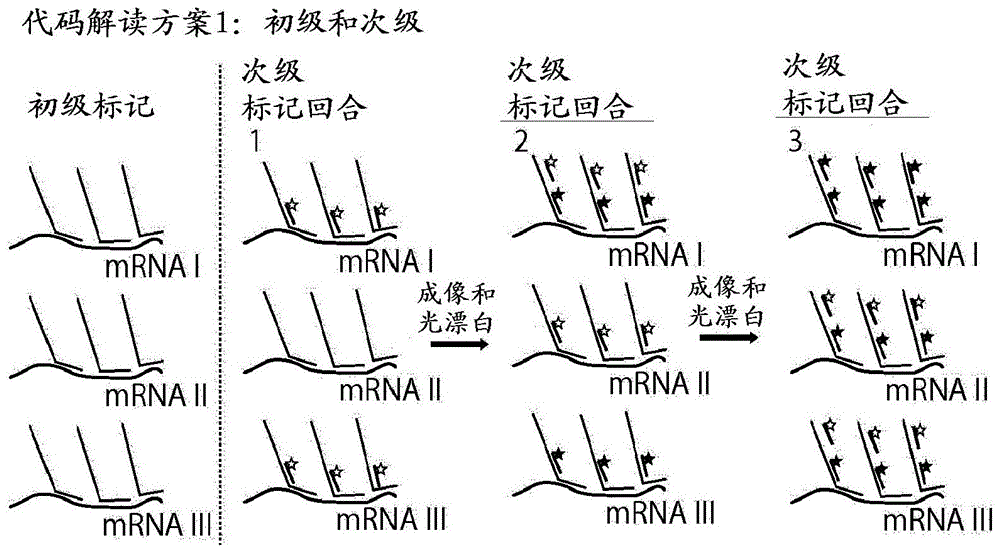
在一组实施方案中,将能够结合怀疑存在于细胞内的核酸的初级 核酸探针群体应用于细胞(或其它样品)。随后,依次添加和例如使用 成像技术诸如荧光显微镜术(例如,常规荧光显微镜术)、STORM(随 机光学重建显微镜术)或其它成像技术测定可以结合一些初级核酸或 以其它方式与一些初级核酸相互作用的次级核酸探针。成像后,将次 级核酸探针失活或去除,并向样品中添加不同的次级核酸探针。这可 以用多种不同的次级核酸探针重复多次。各种次级核酸探针的结合模 式可用于测定在细胞或其它样品内的位置处的初级核酸探针,其可用 于测定存在的mRNA或其它核酸。In one set of embodiments, a population of primary nucleic acid probes capable of binding nucleic acids suspected of being present within the cell is applied to the cell (or other sample). Subsequently, some primary nucleic acids can be bound or otherwise interacted with some primary nucleic acids are subsequently added and determined, eg, using imaging techniques such as fluorescence microscopy (eg, conventional fluorescence microscopy), STORM (stochastic optical reconstruction microscopy), or other imaging techniques secondary nucleic acid probes. After imaging, the secondary nucleic acid probes are inactivated or removed, and a different secondary nucleic acid probe is added to the sample. This can be repeated multiple times with a variety of different secondary nucleic acid probes. The binding modes of the various secondary nucleic acid probes can be used to determine the location of the primary nucleic acid probe within a cell or other sample, which can be used to determine the presence of mRNA or other nucleic acids.
例如,如图3A所示,可将细胞内的核酸群体10(此处由核酸11、 12和13表示)暴露于初级核酸探针群体20(包括探针21和22)。所述 初级核酸探针可包含,例如,可识别核酸(例如,核酸11内的序列)的 靶序列。探针21和22可含有相同或不同的靶向序列,其可以与相同 或不同的核酸结合或与其杂交。作为实例,如图3A所示,探针21包 含将探针靶向至核酸11的第一靶向序列25,而探针22包含与第一靶 向序列25不同并且将探针靶向至核酸12的第二靶向序列26。所述靶 序列可与靶核酸的至少一部分基本上互补,并且可存在足够的靶序列, 以使得所述核酸探针与靶核酸的特异性结合可以发生。For example, as shown in Figure 3A, an intracellular population of nucleic acid 10 (here represented by
初级核酸探针20还可含有一个或多个“阅读”序列。在此实例中 使用两个这样的阅读序列,但是在其它实施方案中,在初级核酸探针 中可存在1个、3个、4个或更多个阅读序列。所述阅读序列可以全部 独立地相同或不同。另外,在一组实施方案中,不同的核酸探针可使 用一个或多个共同的阅读序列。例如,可将不止一个阅读序列组合性 组合在不同的核酸探针上,从而即使仅使用相对少量的阅读序列,亦 产生可以单独鉴定的相对大量的不同核酸探针。因此,例如,在图3A 中,探针21含有阅读序列27和29,而探针22包含阅读序列27和28, 其中两个阅读序列27是相同的,并且不同于阅读序列28和29。Primary
在已将初级核酸探针20引入样品并允许其与核酸11、12和13 相互作用之后,可将一个或多个次级核酸探针30应用于样品以测定初 级核酸探针。次级核酸探针可含有能够识别存在于初级核酸探针群体 内的阅读序列之一的识别序列。例如,所述识别序列可与阅读序列的 至少一部分基本上互补,以使得所述次级核酸探针能够与对应的初级 核酸探针结合或杂交。例如,在此实例中,识别序列35能够识别阅读 序列27。另外,次级核酸探针可含有一个或多个信号传导实体33。例 如,信号传导实体可以是附接于探针的荧光实体,或可以以某种方式 测定的某些核酸序列。可以例如依次使用不止一种次级序列。例如, 如该图所示,可移除初始次级探针30(例如,如下所述),并且可以添 加新的次级探针31,其含有能够识别阅读序列28的识别序列36和一 个或多个信号传导实体。这也可以重复多次,例如,以测定可能存在 的阅读序列29或其它阅读序列。After the primary nucleic acid probes 20 have been introduced into the sample and allowed to interact with the
次级核酸探针30、31等的位置可以通过测定信号传导实体33来 确定。例如,如果信号传导实体是发荧光的,则可使用荧光显微术来 测定信号传导实体。在一些实施方案中,可以以相对高的分辨率使用 样品的成像来测定信号传导实体,并且在一些情况下,可使用超分辨 率成像技术(例如,优于可见光的波长或光的衍射极限的分辨率)。超 分辨率成像技术的实例包括STORM或如本文所论述的其它技术。在 一些情况下,例如,在使用某些超分辨率成像技术诸如STORM的情 况下,可获取不止一个样品图像。The positions of the secondary nucleic acid probes 30, 31, etc. can be determined by measuring the
可将不止一种类型的次级核酸探针应用于细胞或其它样品。例如, 可应用可识别第一阅读序列的第一次级核酸探针,随后可将其或其附 接的信号传导实体失活或去除,并且可以应用可识别第二阅读序列的 第二次级核酸探针。可重复该过程多次,每次使用不同的次级核酸探 针,例如,以测定存在于各种初级核酸探针中的阅读序列。因此,可 基于次级核酸探针的结合模式测定样品中的初级核酸。More than one type of secondary nucleic acid probe can be applied to cells or other samples. For example, a first secondary nucleic acid probe that recognizes a first reading sequence can be used, which or its attached signaling entity can subsequently be inactivated or removed, and a second secondary nucleic acid probe that recognizes a second reading sequence can be used Nucleic acid probes. This process can be repeated multiple times, each time using a different secondary nucleic acid probe, for example, to determine the read sequences present in the various primary nucleic acid probes. Thus, the primary nucleic acid in the sample can be determined based on the binding mode of the secondary nucleic acid probe.
例如,细胞或其它样品内的第一位置可显示第一次级探针和第三 次级探针的结合,但不显示第二或第四次级探针的结合,而第二位置 可显示各种次级探针的不同结合模式。次级探针能够与其结合或杂交 的初级核酸探针可通过考虑各种次级探针的结合模式来测定。例如, 参考图3A,如果第一次级探针能够测定阅读序列27,则第二次级探 针能够测定阅读序列28,并且第三次级探针能够测定阅读序列29,随 后可通过所述第一和第三次级探针(但非第二次级探针)的结合来测定 初级核酸25,而初级核酸26可通过第一和第二次级探针(但非第三次 级探针)的结合来测定。类似地,如果已知第一探针21含有靶序列25, 而第二探针22含有靶序列26,则也可基于各种次级核酸探针的结合 模式例如在空间上测定样品中的核酸11和12。另外,应当注意,由 于在初级核酸探针上存在不止一个阅读序列,因此即使第一探针21 和第二探针22含有共同的阅读序列(阅读序列27),也可因各种次级核 酸探针的不同结合模式而区分样品中的这些探针。For example, a first location within a cell or other sample may show binding of a first secondary probe and a third secondary probe, but not a second or fourth secondary probe, while a second location may show binding of a second or fourth secondary probe Different binding modes for various secondary probes. The primary nucleic acid probe to which the secondary probe is capable of binding or hybridizing can be determined by considering the binding modes of the various secondary probes. For example, referring to Figure 3A, if the first secondary probe is capable of determining
在某些实施方案中,次级核酸探针的结合或杂交的这种模式可以 转化为“代码字”。在此实例中,例如,对于第一探针21和第二探针 22,代码字分别是“101”和“110”,其中值1表示结合,值0表示 无结合。在其它实施方案中,代码字也可以具有更长的长度;仅为了清楚起见,此处仅显示三个探针。代码字可与初级核酸探针的特定靶 核酸序列直接相关。因此,不同的初级核酸探针可匹配某些代码字, 随后可将其用于基于次级探针的结合模式来鉴定初级核酸探针的不同 靶标,即使在一些情况下,在不同次级探针的阅读序列中存在重叠亦 如此,例如,如图3A所示的。然而,如果没有明显的结合(例如,对 于核酸13),则在该实例中,代码字将为“000”。In certain embodiments, this pattern of binding or hybridization of secondary nucleic acid probes can be translated into a "codeword." In this example, for example, for the
在一些实施方案中,还可以以不同的方式分配每个代码字中的值。 例如,值0可以表示结合,而值1表示无结合。类似地,值1可以表 示次级核酸探针与一种类型的信号传导实体的结合,而值0可以表示 次级核酸探针与另一类型的可区分信号传导实体的结合。这些信号传 导实体可以例如通过不同颜色的荧光来区分。在一些情况下,代码字 中的值不必被限制为0和1。所述值还可以从更大的字母表诸如三进 制(例如,0、1和2)或四进制(例如,0、1、2和3)系统得出。每个不 同的值可以例如由不同的可区分的信号传导实体表示,包括(在一些情 况下)可由信号不存在表示的一个值。In some embodiments, the values in each codeword may also be assigned differently. For example, a value of 0 may indicate binding, while a value of 1 indicates no binding. Similarly, a value of 1 may represent binding of a secondary nucleic acid probe to one type of signaling entity, while a value of 0 may represent binding of a secondary nucleic acid probe to another type of distinguishable signaling entity. These signaling entities can be distinguished, for example, by fluorescence of different colors. In some cases, the values in the codeword need not be restricted to 0 and 1. The value may also be derived from a larger alphabet such as a ternary (e.g., 0, 1, and 2) or quaternary (e.g., 0, 1, 2, and 3) system. Each distinct value may, for example, be represented by a different distinguishable signaling entity, including (in some cases) a value that may be represented by the absence of a signal.
每个靶标的代码字可被依次分配,或可被随机分配。例如,参考 图3A所示,可以将第一核酸靶标指定为101,而可将第二核酸靶标指 定为110。另外,在一些实施方案中,可以使用误差检测系统或误差 校正系统,诸如汉明系统、Golay码或扩展汉明系统(或SECDED系统,即单误差校正、双误差检测)来分配代码字。一般来说,此类系统 可以用于鉴定发生了误差的位置,并且在一些情况下,此类系统也可 用于误差校正并确定正确的代码字应该是什么。例如,代码字诸如001 可被检测为无效的并且使用此类系统将其校正为101,例如,如果001 之前未被分配给不同的靶序列。可使用多种不同的误差校正码,其中 许多误差校正码以前已经被开发用于计算机工业中使用;然而,此类 误差校正系统通常不在生物系统内使用。下面更详细地论述此类误差 校正码的另外的实例。The codewords for each target may be assigned sequentially, or may be assigned randomly. For example, referring to Figure 3A, a first nucleic acid target may be designated 101, while a second nucleic acid target may be designated 110. Additionally, in some embodiments, error detection systems or error correction systems, such as Hamming systems, Golay codes, or Extended Hamming systems (or SECDED systems, i.e., single error correction, double error detection) may be used to assign codewords. In general, such systems can be used to identify where errors have occurred, and in some cases, such systems can also be used for error correction and to determine what the correct codeword should be. For example, a codeword such as 001 can be detected as invalid and corrected to 101 using such a system, eg, if 001 was not previously assigned to a different target sequence. A variety of different error correction codes are available, many of which have been previously developed for use in the computer industry; however, such error correction systems are typically not used within biological systems. Additional examples of such error correction codes are discussed in more detail below.
还应当理解,在一些情况下不需要使用码中的所有可能的代码字。 例如,在一些实施方案中,未使用的代码字可以用作阴性对照。类似 地,在一些实施方案中,可以省略一些代码字,因为它们在测量中比 其它代码字更容易出错。例如,在一些实现中,读取具有更多“1” 的值的代码字可能比读取具有更少“1”的值的代码字更易出错。It should also be understood that in some cases it is not necessary to use all possible codewords in the code. For example, in some embodiments, unused codewords can be used as negative controls. Similarly, in some embodiments, some codewords may be omitted because they are more prone to errors in measurements than others. For example, in some implementations, reading codewords with more "1" values may be more error-prone than reading codewords with fewer "1" values.
应当理解,上述描述是本发明的一个实施方案的实例,并且初级 和次级核酸探针在所有实施方案中不是必需的。例如,在一些实施方 案中,使用一系列含有信号传导实体的核酸探针来测定细胞或其它样 品内的核酸,而不一定需要次级探针。It is to be understood that the above description is an example of one embodiment of the invention and that primary and secondary nucleic acid probes are not required in all embodiments. For example, in some embodiments, a series of nucleic acid probes containing signaling entities are used to assay nucleic acids within cells or other samples without necessarily requiring secondary probes.
例如,现在转到图3B,在此实例中,将核酸11、12和13暴露于 探针21、22、23、24等的不同回合。这些探针可各自含有可识别核酸 (例如,核酸11或12内的序列)的靶序列。这些探针可以各自靶向相 同的核酸,但为核酸的不同区域。另外,一些或所有探针可以含有一 个或多个信号传导实体,例如探针21上的信号传导实体29。例如, 信号传导实体可以是附接于探针的荧光实体,或是可以以某种方式测 定的某一核酸序列。For example, turning now to Figure 3B, in this example,
可将第一回合的探针(例如,探针21和探针22)应用于细胞或其它 样品。可使探针21通过靶序列25与核酸11结合。这种结合可以通过 测定信号传导实体29来确定。例如,如果信号传导实体是发荧光的, 则可使用荧光显微术来例如在空间上测定细胞或其它样品内的信号传 导实体。在一些但非所有实施方案中,可以以相对高的分辨率使用样 品的成像以测定信号传导实体,并且在一些情况下,可以使用超分辨 率成像技术。另外,也可以存在不同的探针;例如,含有靶序列26 的探针22可以结合核酸12,并且通过探针22内的信号传导实体29 来进行测定。这些可以例如依次或同时发生。任选地,也可例如在应 用不同回合的探针之间除去探针21和22或使其失活。The probes of the first round (e.g.,
接着,将第二回合的探针(例如,探针23)应用于样品。在此实例 中,探针23能够通过靶向区域结合核酸11,尽管在第二回合中没有 能够结合核酸12的探针。如上所论述的,允许探针的结合发生,并且 结合的测定可以通过信号传导实体来进行。这些信号传导实体可与第 一回合的探针相同或不同。此过程可以用不同的探针重复任何次数。 例如,如图3B所示,第2回合含有能够结合核酸11的探针,而第3 回合含有能够结合核酸12的探针。Next, the probe of the second round (eg, probe 23) is applied to the sample. In this example, probe 23 was able to bind
在某些实施方案中,核酸探针的每回合的结合或杂交可被转化为 “代码字”。在此实例中,通过使用探针21、22、23和24,可以形 成代码字101或110,其中1表示结合,0表示无结合,并且第一位置 对应于探针21或22的结合,而第二位置对应于探针22的结合,第三 位置对应于探针24的结合。000的代码字将表示无结合,例如,如对 于本实例中的核酸13所示的。通过设计合适的核酸探针,代码字可以 与核酸探针的特定靶核酸序列直接相关。因此,例如,110可对应于 第一靶核酸12(例如,含有能够靶向核酸11的探针的第一和第二回合核酸探针,并且这些探针可以靶向核酸11的相同或不同区域),而101 可对应于第二靶核酸(例如,含有能够靶向核酸12的探针的第一和第 三回合核酸探针,并且这些探针可以靶向核酸12的相同或不同区域)。 另外,应当注意,每回合探测可以含有与同一回合中的其它探针和/ 或不同回合中的其它探针相同或不同的信号传导实体。例如,在一组 实施方案中,在所有回合的探针中仅使用一种信号传导实体。In certain embodiments, each round of binding or hybridization of a nucleic acid probe can be converted into a "codeword." In this example, by using
与上文类似,可依次分配,或可随机分配每个靶标的代码字。在 一些实施方案中,可以使用误差检测或误差校正系统(诸如汉明系统,Golay码或扩展汉明系统或SECDED系统(单误差校正、双误差检测)) 在码空间内分配代码字。一般来说,此类误差校正系统可用于鉴定误 差发生的地方,并且在一些情况下,此类系统也可以用于校正误差并 确定正确的代码字应当是怎样的。Similar to above, the codewords for each target may be assigned sequentially, or the codewords for each target may be assigned randomly. In some embodiments, the codewords may be allocated within the code space using an error detection or error correction system, such as a Hamming system, Golay code or an extended Hamming system or a SECDED system (single error correction, double error detection). In general, such error correction systems can be used to identify where errors occur, and in some cases, such systems can also be used to correct errors and determine what the correct codeword should look like.
与上述类似,在某些实施方案中,代码字中每个位置处的值可以 被任意地分配给包含不止一个可区分的信号传导实体的探针的结合或 非结合。Similar to the above, in certain embodiments, the value at each position in the codeword can be arbitrarily assigned to the binding or non-binding of probes comprising more than one distinguishable signaling entity.
在一些情况下,核酸探针可以形成为共享共同特征的核酸的“库” 或组。例如,具有在第一位置中包含1的代码字(例如,110和101而 非011)的针对所有靶标的探针可以包括一个库,而在第二位置包含 1(例如110和011而非101)的针对所有靶标的探针可以包括另一个库。 也见图1C。在一些情况下,核酸探针可以是不止一个组或库的成员。 除了靶序列、阅读序列和/或信号传导实体以外,核酸库的成员还可包 含允许它们与其它组区分开的特征。这些特征可以是用于这些序列的 扩增、产生或分离的短核酸序列。可以例如如本文所述,依次地将每 个组的核酸探针应用于样品。In some cases, nucleic acid probes can be formed as "libraries" or groups of nucleic acids that share common characteristics. For example, a probe against all targets with a codeword containing a 1 in the first position (eg, 110 and 101 instead of 011) may include a library, while a 1 in the second position (eg, 110 and 011 instead of 101) ) of probes against all targets can include another library. See also Figure 1C. In some cases, nucleic acid probes may be members of more than one panel or library. In addition to target sequences, reading sequences and/or signaling entities, members of a nucleic acid library may also contain features that allow them to be distinguished from other groups. These features can be short nucleic acid sequences for amplification, generation or isolation of these sequences. Each set of nucleic acid probes can be sequentially applied to the sample, eg, as described herein.
因此,在一些方面,本发明总体上涉及用于测定细胞或其它样品 内的核酸的系统和方法。样品可以包括细胞培养物,细胞悬浮液,生 物组织,活组织检查,生物体等。样品也可以是无细胞的,但仍然含 有核酸。如果样品含有细胞,则细胞可以是人细胞或任何其它合适的 细胞,例如哺乳动物细胞,鱼细胞,昆虫细胞,植物细胞等。在一些 情况下可存在多于一种细胞。Thus, in some aspects, the present invention generally relates to systems and methods for assaying nucleic acids within cells or other samples. Samples can include cell cultures, cell suspensions, biological tissues, biopsies, organisms, and the like. Samples can also be cell-free, but still contain nucleic acids. If the sample contains cells, the cells may be human cells or any other suitable cells, such as mammalian cells, fish cells, insect cells, plant cells, and the like. In some cases more than one type of cell may be present.
待测定的核酸可以是例如DNA、RNA或存在于细胞(或其它样 品)内的其它核酸。核酸可以是细胞内源的,或者被添加至细胞中。 例如,核酸可以是病毒的或人工产生的。在一些情况下,待测定的核 酸可以由细胞表达。在一些实施方案中,核酸是RNA。RNA可以是 编码和/或非编码RNA。可在细胞内研究的RNA的非限制性实例包括 mRNA,siRNA,rRNA,miRNA,tRNA,lncRNA,snoRNA,snRNA, exRNA,piRNA等。在一些实施方案中,例如,多个寡核苷酸中的至 少一些与特定染色体序列(例如人染色体)的一部分互补。The nucleic acid to be assayed can be, for example, DNA, RNA, or other nucleic acid present within a cell (or other sample). Nucleic acids can be endogenous to the cell, or added to the cell. For example, nucleic acids can be viral or artificially produced. In some cases, the nucleic acid to be assayed can be expressed by a cell. In some embodiments, the nucleic acid is RNA. RNA can be coding and/or non-coding RNA. Non-limiting examples of RNAs that can be studied intracellularly include mRNA, siRNA, rRNA, miRNA, tRNA, lncRNA, snoRNA, snRNA, exRNA, piRNA, and the like. In some embodiments, for example, at least some of the plurality of oligonucleotides are complementary to a portion of a particular chromosomal sequence (e.g., a human chromosome).
在一些情况下,可以研究细胞内的显著部分的核酸。例如,在一 些情况下,可以测定细胞内存在的足够的RNA,以便产生细胞的部分 或完全转录组。在一些情况下,在细胞内测定至少4种类型的mRNA, 并且在一些情况下,可以测定细胞内至少3,至少4,至少7,至少8, 至少12,至少14,至少15,至少16,至少22,至少30,至少31, 至少32,至少50,至少63,至少64,至少72,至少75,至少100, 至少127,至少128,至少140,至少255,至少256,至少500,至 少1,000,至少1,500,至少2,000,至少2,500,至少3,000,至少4,000, 至少5,000,至少7,500,至少10,000,至少12,000,至少15,000,至 少20,000,至少25,000,至少30,000,至少40,000,至少50,000,至 少75,000或至少100,000种类型的mRNA。In some cases, a significant portion of the nucleic acid within the cell can be studied. For example, in some cases, the presence of sufficient RNA within the cell can be determined to generate a partial or complete transcriptome of the cell. In some instances, at least 4 types of mRNAs are assayed within the cell, and in some instances, at least 3, at least 4, at least 7, at least 8, at least 12, at least 14, at least 15, at least 16, at least 22, at least 30, at least 31, at least 32, at least 50, at least 63, at least 64, at least 72, at least 75, at least 100, at least 127, at least 128, at least 140, at least 255, at least 256, at least 500, at least 1,000 , at least 1,500, at least 2,000, at least 2,500, at least 3,000, at least 4,000, at least 5,000, at least 7,500, at least 10,000, at least 12,000, at least 15,000, at least 20,000, at least 25,000, at least 30,000, at least 40,000, at least 50,000, at least 75,000 or at least 100,000 types of mRNA.
在一些情况下,可以测定细胞的转录组。应当理解,转录组通常 包括细胞内产生的所有RNA分子,而不仅仅是mRNA。因此,例如, 转录组也可以包括rRNA、tRNA、siRNA等。在一些实施方案中,可 以测定细胞的转录组的至少5%,至少10%,至少15%,至少20%, 至少25%,至少30%,至少40%,至少50%,至少60%,至少70%, 至少80%,至少90%或100%。In some cases, the transcriptome of the cell can be assayed. It will be appreciated that the transcriptome generally includes all RNA molecules produced within a cell, not just mRNA. Thus, for example, the transcriptome can also include rRNA, tRNA, siRNA, and the like. In some embodiments, at least 5%, at least 10%, at least 15%, at least 20%, at least 25%, at least 30%, at least 40%, at least 50%, at least 60%, at least 70%, at least 80%, at least 90% or 100%.
细胞或其它样品中一种或多种核酸的测定可以是定性和/或定量 的。另外,测定也可以是空间上的,例如,可以在两个或三个维度上 测定细胞或其它样品内的核酸的位置。在一些实施方案中,可以测定 细胞(或其它样品)内的核酸的位置、数量和/或浓度。Determination of one or more nucleic acids in cells or other samples can be qualitative and/or quantitative. Additionally, the determination can also be spatial, for example, the location of nucleic acids within a cell or other sample can be determined in two or three dimensions. In some embodiments, the location, quantity and/or concentration of nucleic acid within a cell (or other sample) can be determined.
在一些情况下,可以测定细胞的基因组的显著部分。所测定的基 因组区段可以是连续的或散布在基因组上。例如,在一些情况下,在 细胞内测定至少4个基因组区段,并且在一些情况下,可测定细胞内 的至少3个、至少4个、至少7个、至少8个、至少12个、至少14个、至少15个、至少16个、至少22个、至少30个、至少31个、至 少32个、至少50个、至少63个、至少64个、至少72个、至少75 个、至少100个、至少127个、至少128个、至少140个、至少255个、至少256个、至少500个、至少1,000个、至少1,500个、至少 2,000个、至少2,500个、至少3,000个、至少4,000个、至少5,000 个、至少7,500个、至少10,000个、至少12,000个、至少15,000个、 至少20,000个、至少25,000个、至少30,000个、至少40,000个、至 少50,000个、至少75,000个或至少100,000个基因组片段。In some cases, a significant portion of a cell's genome can be determined. The genomic segments determined can be contiguous or interspersed over the genome. For example, in some cases, at least 4 genomic segments are determined within the cell, and in some cases, at least 3, at least 4, at least 7, at least 8, at least 12, at least 14, at least 15, at least 16, at least 22, at least 30, at least 31, at least 32, at least 50, at least 63, at least 64, at least 72, at least 75, at least 100 , at least 127, at least 128, at least 140, at least 255, at least 256, at least 500, at least 1,000, at least 1,500, at least 2,000, at least 2,500, at least 3,000, at least 4,000, at least 5,000, at least 7,500, at least 10,000, at least 12,000, at least 15,000, at least 20,000, at least 25,000, at least 30,000, at least 40,000, at least 50,000, at least 75,000, or at least 100,000 genomic fragments.
在一些情况下,可以测定细胞的整个基因组。应当理解,基因组 通常包括在细胞内产生的所有DNA分子,而不仅仅是染色体DNA。 因此,例如,在一些情况下,基因组还可以包括线粒体DNA、叶绿体 DNA、质粒DNA等。在一些实施方案中,可测定至少约5%、至少约10%、至少约15%、至少约20%、至少约25%、至少约30%、至少 约40%、至少约50%、至少约60%、至少约70%、至少约80%、至 少约90%或100%的细胞基因组。In some cases, the entire genome of the cell can be assayed. It will be appreciated that the genome generally includes all DNA molecules produced within a cell, not just chromosomal DNA. Thus, for example, in some cases, the genome may also include mitochondrial DNA, chloroplast DNA, plasmid DNA, and the like. In some embodiments, at least about 5%, at least about 10%, at least about 15%, at least about 20%, at least about 25%, at least about 30%, at least about 40%, at least about 50%, at least about 60%, at least about 70%, at least about 80%, at least about 90% or 100% of the genome of the cell.
如本文所讨论的,多种核酸探针可用于测定细胞或其它样品中的 一种或多种核酸。所述探针可包括诸如DNA、RNA、LNA(锁核酸)、 PNA(肽核酸)或其组合的核酸(或可以例如特异性地与核酸杂交的实 体)。在一些情况下,另外的组分也可存在于核酸探针内,例如,如下 所述的。可将任何合适的方法用于将核酸探针引入细胞。As discussed herein, a variety of nucleic acid probes can be used to assay one or more nucleic acids in cells or other samples. The probes can include nucleic acids (or entities that can, for example, specifically hybridize to nucleic acids) such as DNA, RNA, LNA (locked nucleic acid), PNA (peptide nucleic acid), or combinations thereof. In some cases, additional components may also be present within the nucleic acid probe, e.g., as described below. Any suitable method can be used to introduce nucleic acid probes into cells.
例如,在一些实施方案中,在引入核酸探针之前固定细胞,例如 以保持核酸在细胞内的位置。用于固定细胞的技术是本领域普通技术 人员已知的。作为非限制性实例,可使用化学品诸如甲醛、多聚甲醛、 戊二醛、乙醇、甲醇、丙酮、乙酸等固定细胞。在一个实施方案中, 可使用Hepes-谷氨酸缓冲液媒介的有机溶剂(HOPE)固定细胞。For example, in some embodiments, cells are fixed prior to introduction of nucleic acid probes, e.g., to maintain the location of nucleic acids within cells. Techniques for fixing cells are known to those of ordinary skill in the art. As non-limiting examples, cells can be fixed using chemicals such as formaldehyde, paraformaldehyde, glutaraldehyde, ethanol, methanol, acetone, acetic acid, and the like. In one embodiment, cells can be fixed using Hepes-glutamate buffer mediated organic solvent (HOPE).
可使用任何合适的方法将核酸探针引入细胞(或其它样品)。在一 些情况下,可以充分透化细胞,以使得可通过使含有核酸探针的流体 在细胞周围流动而将核酸探针引入细胞。在一些情况下,可作为固定 过程的一部分来充分透化细胞;在其它实施方案中,可通过将细胞暴 露于某些化学品如乙醇、甲醇,Triton等来透化所述细胞。另外,在 一些实施方案中,可使用诸如电穿孔或显微注射的技术将核酸探针引 入细胞或其它样品。Nucleic acid probes can be introduced into cells (or other samples) using any suitable method. In some cases, the cells can be permeabilized sufficiently so that the nucleic acid probes can be introduced into the cells by flowing a fluid containing the nucleic acid probes around the cells. In some cases, the cells can be sufficiently permeabilized as part of the fixation process; in other embodiments, the cells can be permeabilized by exposing the cells to certain chemicals such as ethanol, methanol, Triton, and the like. Additionally, in some embodiments, nucleic acid probes can be introduced into cells or other samples using techniques such as electroporation or microinjection.
本发明的某些方面总体上涉及被引入细胞(或其它样品)中的核酸 探针。探针可包含可以通常通过Watson-Crick碱基配对与核酸(例如 DNA、RNA、LNA、PNA等,这取决于应用)杂交的多种实体中的任 何实体。核酸探针通常含有能够结合(在一些情况下,特异性地)靶 核酸的至少一部分的靶序列。当被引入细胞或其它系统中时,靶系统 可能能够结合特异性靶核酸(例如mRNA或本文所论述的其它核酸)。 在一些情况下,可使用信号传导实体(例如,如下论述的)和/或通过使 用能够结合核酸探针(即,初级核酸探针)的次级核酸探针来测定核酸 探针。此类核酸探针的测定在下面详细论述。Certain aspects of the invention generally relate to nucleic acid probes that are introduced into cells (or other samples). Probes can comprise any of a variety of entities that can hybridize to nucleic acids (e.g., DNA, RNA, LNA, PNA, etc., depending on the application), typically by Watson-Crick base pairing. Nucleic acid probes typically contain a target sequence capable of binding (in some cases specifically) at least a portion of a target nucleic acid. When introduced into a cell or other system, the target system may be capable of binding a specific target nucleic acid (e.g., mRNA or other nucleic acids discussed herein). In some cases, nucleic acid probes can be assayed using signaling entities (e.g., discussed below) and/or by using secondary nucleic acid probes capable of binding nucleic acid probes (i.e., primary nucleic acid probes). Assays for such nucleic acid probes are discussed in detail below.
在一些情况下,可以将不止一种类型的(初级)核酸探针例如同时 应用于样品。例如,可存在至少2种、至少5种、至少10种、至少 25种、至少50种、至少75种、至少100种、至少300种、至少1,000 种、至少3,000种、至少10,000种或至少30,000种可区分的核酸探针, 可以例如同时或依次地将其施加于样品。In some cases, more than one type of (primary) nucleic acid probe can be applied to the sample, e.g. simultaneously. For example, there may be at least 2, at least 5, at least 10, at least 25, at least 50, at least 75, at least 100, at least 300, at least 1,000, at least 3,000, at least 10,000, or at least 30,000 Differentiable nucleic acid probes can be applied to the sample, eg, simultaneously or sequentially.
靶序列可以位于核酸探针(或初级核酸探针或编码核酸探针)内的 任何地方。靶序列可含有与靶核酸的一部分基本上互补的区域。在一 些情况下,所述部分可以是至少50%、至少60%、至少70%、至少 75%、至少80%、至少85%、至少90%、至少92%、至少94%、至 少95%、至少96%、至少97%、至少98%、至少99%或100%互补。 在一些情况下,靶序列的长度可以是至少5个、至少10个、至少15 个、至少20个、至少25个、至少30个、至少35个、至少40个、至 少50个、至少60个、至少65个、至少75个、至少100个、至少125 个、至少150个、至少175个、至少200个、至少250个、至少300 个、至少350个、至少400个或至少450个核苷酸。在一些情况下, 靶序列的长度可以不超过500个、不超过450个、不超过400个、不超过350个、不超过300个、不超过250个、不超过200个、不超过 175个、不超过150个、不超过125个、不超过100个、不超过75个、 不超过60个、不超过65个、不超过60个、不超过55个、不超过50 个、不超过45个、不超过40个、不超过35个、不超过30个、不超 过20或不超过10个核苷酸。这些中的任何一种的组合也是可能的, 例如,靶序列可以具有10至30个核苷酸、20至40个核苷酸、5至 50个核苷酸、10至200个核苷酸或25至35个核苷酸、10至300个 核苷酸等的长度。通常,基于Watson-Crick核苷酸碱基配对测定互补 性。The target sequence can be located anywhere within the nucleic acid probe (or primary nucleic acid probe or encoding nucleic acid probe). The target sequence may contain a region substantially complementary to a portion of the target nucleic acid. In some cases, the portion can be at least 50%, at least 60%, at least 70%, at least 75%, at least 80%, at least 85%, at least 90%, at least 92%, at least 94%, at least 95%, At least 96%, at least 97%, at least 98%, at least 99% or 100% complementary. In some cases, the target sequence can be at least 5, at least 10, at least 15, at least 20, at least 25, at least 30, at least 35, at least 40, at least 50, at least 60 in length , at least 65, at least 75, at least 100, at least 125, at least 150, at least 175, at least 200, at least 250, at least 300, at least 350, at least 400, or at least 450 nucleosides acid. In some cases, the length of the target sequence can be no more than 500, no more than 450, no more than 400, no more than 350, no more than 300, no more than 250, no more than 200, no more than 175, no more than 150, no more than 125, no more than 100, no more than 75, no more than 60, no more than 65, no more than 60, no more than 55, no more than 50, no more than 45, No more than 40, no more than 35, no more than 30, no more than 20, or no more than 10 nucleotides. Combinations of any of these are also possible, for example, the target sequence may have 10 to 30 nucleotides, 20 to 40 nucleotides, 5 to 50 nucleotides, 10 to 200 nucleotides or Lengths of 25 to 35 nucleotides, 10 to 300 nucleotides, etc. Typically, complementarity is determined based on Watson-Crick nucleotide base pairing.
可以参照怀疑存在于细胞或其它样品内的靶核酸来确定(初级)核 酸探针的靶序列。例如,可使用蛋白质的序列,通过测定经表达以形 成蛋白质的核酸,来确定针对所述蛋白质的靶核酸。在一些情况下, 仅使用编码蛋白质的核酸的一部分,例如,具有如上所述的长度的部 分。另外,在一些情况下,可以使用不止一种可用于鉴定特定靶标的 靶序列。例如,可以依次和/或同时地使用可与同一靶标的不同区域结 合或杂交的多种探针。杂交通常是指退火过程,通过该过程,互补单 链核酸通过Watson-Crick核苷酸碱基配对(例如,氢键合,鸟嘌呤-胞 嘧啶和腺嘌呤-胸腺嘧啶)缔合以形成双链核酸。The target sequence of a (primary) nucleic acid probe can be determined with reference to a target nucleic acid suspected of being present in a cell or other sample. For example, the sequence of the protein can be used to determine the target nucleic acid for the protein by determining the nucleic acid that is expressed to form the protein. In some cases, only a portion of the nucleic acid encoding the protein is used, e.g., a portion having a length as described above. Additionally, in some cases, more than one target sequence may be used that can be used to identify a particular target. For example, multiple probes that can bind or hybridize to different regions of the same target can be used sequentially and/or simultaneously. Hybridization generally refers to the annealing process by which complementary single-stranded nucleic acids associate through Watson-Crick nucleotide base pairing (eg, hydrogen bonding, guanine-cytosine and adenine-thymine) to form a double-stranded nucleic acid.
在一些实施方案中,核酸探针诸如初级核酸探针,还可包含一个 或多个“阅读”序列。然而,应当理解,阅读序列并非在所有情况下 是必需的。在一些实施方案中,核酸探针可以包含1个、2个、3个、 4个、5个、6个、7个、8个、9个、10个、11个、12个、13个、14 个、15个、16个或更多个、20个或更多个、32个或更多个、40个或 更多个、50个或更多个、64个或更多个、75个或更多个、100个或更 多个、128个或更多个阅读序列。阅读序列可以位于核酸探针内的任 何位置。如果存在不止一个阅读序列,则阅读序列可以彼此相邻地定 位,和/或与其它序列分散开。In some embodiments, nucleic acid probes, such as primary nucleic acid probes, may also comprise one or more "reading" sequences. It should be understood, however, that a reading sequence is not required in all cases. In some embodiments, nucleic acid probes may comprise 1, 2, 3, 4, 5, 6, 7, 8, 9, 10, 11, 12, 13, 14, 15, 16 or more, 20 or more, 32 or more, 40 or more, 50 or more, 64 or more, 75 or more, 100 or more, 128 or more read sequences. The read sequence can be located anywhere within the nucleic acid probe. If more than one read sequence is present, the read sequences may be positioned adjacent to each other, and/or separated from other sequences.
阅读序列(如果存在)可具有任何长度。如果使用不止一个阅读序 列,则阅读序列可以独立地具有相同或不同的长度。例如,阅读序列 的长度可以是至少5个、至少10个、至少15个、至少20个、至少 25个、至少30个、至少35个、至少40个、至少50个、至少60个、 至少65个、至少75个、至少100个、至少125个、至少150个、至 少175个、至少200个、至少250个、至少300个、至少350个、至 少400个或至少450个核苷酸。在一些情况下,阅读序列的长度可以不超过500个、不超过450个、不超过400个、不超过350个、不超 过300个、不超过250个、不超过200个、不超过175个、不超过150 个、不超过125个、不超过100个、不超过75个、不超过60个、不 超过65个、不超过60个、不超过55个、不超过50个、不超过45 个、不超过40个、不超过35个、不超过30个、不超过20个或不超 过10个核苷酸。这些中的任何一种的组合也是可能的,例如,阅读序 列可具有10至30个核苷酸、20至40个核苷酸、5至50个核苷酸、 10至200个核苷酸或25至35个核苷酸、10至300个核苷酸等的长度。The read sequence, if present, can be of any length. If more than one read sequence is used, the read sequences may independently be of the same or different lengths. For example, a read sequence can be at least 5, at least 10, at least 15, at least 20, at least 25, at least 30, at least 35, at least 40, at least 50, at least 60, at least 65 long in length at least 75, at least 100, at least 125, at least 150, at least 175, at least 200, at least 250, at least 300, at least 350, at least 400, or at least 450 nucleotides. In some cases, the length of the read sequence may be no more than 500, no more than 450, no more than 400, no more than 350, no more than 300, no more than 250, no more than 200, no more than 175, no more than 150, no more than 125, no more than 100, no more than 75, no more than 60, no more than 65, no more than 60, no more than 55, no more than 50, no more than 45, No more than 40, no more than 35, no more than 30, no more than 20, or no more than 10 nucleotides. Combinations of any of these are also possible, for example, the read sequence may have 10 to 30 nucleotides, 20 to 40 nucleotides, 5 to 50 nucleotides, 10 to 200 nucleotides or Lengths of 25 to 35 nucleotides, 10 to 300 nucleotides, etc.
在一些实施方案中,阅读序列可以是任意的或随机的。在某些情 况下,选择阅读序列以降低或最小化与细胞或其它样品的其它组分的 同源性,例如以使得阅读序列本身不与怀疑存在于细胞或其它样品内 的其它核酸结合或杂交。在一些情况下,同源性可以小于10%、小于 8%、小于7%、小于6%、小于5%、小于4%、小于3%、小于2% 或小于1%。在一些情况下,可存在少于20个碱基对、少于18个碱 基对、少于15个碱基对、少于14个碱基对、少于13个碱基对、少于 12个碱基对、少于11个碱基对或少于10个碱基对的同源性。在一些 情况下,碱基对是序贯的。In some embodiments, the read sequence can be arbitrary or random. In some cases, the read sequence is selected to reduce or minimize homology to other components of the cell or other sample, eg, so that the read sequence itself does not bind or hybridize to other nucleic acids suspected of being present in the cell or other sample . In some cases, the homology can be less than 10%, less than 8%, less than 7%, less than 6%, less than 5%, less than 4%, less than 3%, less than 2%, or less than 1%. In some cases, there may be less than 20 base pairs, less than 18 base pairs, less than 15 base pairs, less than 14 base pairs, less than 13 base pairs, less than 12
在一组实施方案中,核酸探针群体可含有一定数目的阅读序列, 其在一些情况下可以少于核酸探针的靶标数目。本领域普通技术人员 将意识到,如果存在一个信号传导实体和n个阅读序列,则通常可以 独特地鉴定2n-1种不同的核酸靶标。然而,不是所有可能的组合都需 要使用。例如,核酸探针群体可靶向12种不同的核酸序列,但含有不 超过8个阅读序列。作为另一个实例,核酸群体可靶向140种不同的 核酸种类,但含有不超过16个阅读序列。可以通过使用每个探针内的 阅读序列的不同组合来单独鉴定不同的核酸序列靶标。例如,每个探 针可含有1、2、3、4、5、6、7、8、9、10、11、12、13、14、15等 个或更多个阅读序列。在一些情况下,核酸探针群体可各自含有相同 数目的阅读序列,但在其它情况下,在各种探针上可存在不同数目的 阅读序列。In one set of embodiments, the population of nucleic acid probes can contain a number of reads, which in some cases can be less than the number of targets of the nucleic acid probes. One of ordinary skill in the art will appreciate that if there is one signaling entity and n reading sequences, 2n -1 different nucleic acid targets can often be uniquely identified. However, not all possible combinations need to be used. For example, a population of nucleic acid probes can target 12 different nucleic acid sequences, but contain no more than 8 reads. As another example, a nucleic acid population can target 140 different nucleic acid species, but contain no more than 16 reads. Different nucleic acid sequence targets can be individually identified by using different combinations of reads within each probe. For example, each probe may contain 1, 2, 3, 4, 5, 6, 7, 8, 9, 10, 11, 12, 13, 14, 15, etc., or more reads. In some cases, a population of nucleic acid probes may each contain the same number of reads, but in other cases, there may be different numbers of reads on the various probes.
作为非限制性实例,第一核酸探针可含有第一靶序列、第一阅读 序列和第二阅读序列,而第二不同的核酸探针可含有第二靶序列、相 同的第一阅读序列和第三阅读序列而非第二阅读序列。此类探针从而 可通过测定存在的或与给定探针或位置相关的各种阅读序列来进行区 分,如本文所论述的。As a non-limiting example, a first nucleic acid probe can contain a first target sequence, a first reading sequence, and a second reading sequence, while a second, different nucleic acid probe can contain a second target sequence, the same first reading sequence, and The third reading sequence is not the second reading sequence. Such probes can thus be distinguished by determining the various read sequences present or associated with a given probe or position, as discussed herein.
另外,在某些实施方案中,核酸探针(以及它们在编码探针上的对 应的互补位点)可以仅使用4种碱基中的2种或3种(诸如省去探针内 的所有的“G”或所有的“C”)来制备。缺少“G”或“C”的序列在 某些实施方案中可以形成非常少的次级结构,并且可有助于更均匀、更快的杂交。Additionally, in certain embodiments, the nucleic acid probes (and their corresponding complementary sites on the coding probe) may use only 2 or 3 of the 4 bases (such as omitting all of the bases within the probes) of the "G" or all of the "C"). Sequences lacking "G" or "C" can form very few secondary structures in certain embodiments, and can contribute to more uniform, faster hybridization.
在一些实施方案中,核酸探针可以含有信号传导实体。然而,应 当理解,信号传导实体并非在所有情况下是需要的;例如,在一些实 施方案中,可使用次级核酸探针来测定核酸探针,如下面另外详细论 述的。以下还将更详细地论述可以使用的信号传导实体的实例。In some embodiments, nucleic acid probes may contain signaling entities. It should be understood, however, that signaling entities are not required in all cases; for example, in some embodiments, secondary nucleic acid probes may be used to assay nucleic acid probes, as discussed in additional detail below. Examples of signaling entities that may be used are also discussed in greater detail below.
其它组分同样也可存在于核酸探针内。例如,在一组实施方案中, 可存在一个或多个引物序列,例如以允许探针的酶促扩增。本领域普 通技术人员将知道适合于诸如扩增(例如,使用PCR或其它合适的技 术)的应用的引物序列。许多此类引物序列可商购获得。可存在于初级 核酸探针中的序列的其它实例包括但不限于启动子序列、操纵子、鉴 定序列、无义序列等。Other components may likewise be present within the nucleic acid probe. For example, in one set of embodiments, one or more primer sequences may be present, eg, to allow enzymatic amplification of the probe. One of ordinary skill in the art will know primer sequences suitable for applications such as amplification (e.g., using PCR or other suitable techniques). Many such primer sequences are commercially available. Other examples of sequences that may be present in the primary nucleic acid probe include, but are not limited to, promoter sequences, operators, identification sequences, nonsense sequences, and the like.
通常,引物是用作核酸合成的起始点的单链或部分双链核酸(例 如,DNA),从而允许聚合酶诸如核酸聚合酶延伸引物并复制互补链。 引物(例如,被设计为)与靶核酸互补并与其杂交。在一些实施方案中, 引物是合成引物。在一些实施方案中,引物是非天然存在的引物。引 物通常具有10至50个核苷酸的长度。例如,引物可具有10至40个、 10至30个、10至20个、25至50个、15至40个、15至30个、20 至50个、20至40或20至30个核苷酸的长度。在一些实施方案中, 引物具有18至24个核苷酸的长度。Typically, a primer is a single- or partially double-stranded nucleic acid (e.g., DNA) that serves as an initiation point for nucleic acid synthesis, allowing a polymerase, such as a nucleic acid polymerase, to extend the primer and replicate the complementary strand. Primers are (eg, designed) complementary to and hybridize to the target nucleic acid. In some embodiments, the primers are synthetic primers. In some embodiments, the primers are non-naturally occurring primers. Primers are typically 10 to 50 nucleotides in length. For example, primers can have 10 to 40, 10 to 30, 10 to 20, 25 to 50, 15 to 40, 15 to 30, 20 to 50, 20 to 40, or 20 to 30 nucleosides acid length. In some embodiments, the primers are 18 to 24 nucleotides in length.
另外,核酸探针的组分可以以任何合适的顺序排列。例如,在一 个实施方案中,组分可在核酸探针中排列为:引物-阅读序列-靶向序 列-阅读序列-反向引物。该结构中的“阅读序列”可以各自包含任何 数目(包括0)的阅读序列,只要在探针中存在至少一个阅读序列。非限 制性示例性结构包括引物-靶向序列-阅读序列-反向引物、引物-阅读序 列-靶向序列-反向引物、靶向序列-引物-靶向序列-阅读序列-反向引物、 靶向序列-引物-阅读序列-靶向序列-反向引物、引物-靶向序列-阅读序 列--靶向序列-反向引物、靶向序列-引物-阅读序列-反向引物、靶向序 列-阅读序列-引物、阅读序列-靶向序列-引物、阅读序列-引物-靶向序 列-反向引物等。另外,在一些实施方案中(包括在所有上述实例中), 反向引物是任选的。Additionally, the components of the nucleic acid probe can be arranged in any suitable order. For example, in one embodiment, the components can be arranged in a nucleic acid probe as: primer-reading sequence-targeting sequence-reading sequence-reverse primer. The "reads" in this structure can each contain any number (including zero) of reads, as long as at least one read is present in the probe. Non-limiting exemplary structures include primer-targeting-reading-reverse primer, primer-reading-targeting-reverse primer, targeting-primer-targeting-reading-reverse primer, targeting sequence-primer-reading sequence-targeting sequence-reverse primer, primer-targeting sequence-reading sequence--targeting sequence-reverse primer, targeting sequence-primer-reading sequence-reverse primer, targeting Sequence-reading-primer, reading-targeting-primer, reading-primer-targeting-reverse primer, etc. Additionally, in some embodiments (including all of the above examples), the reverse primer is optional.
根据本发明的某些方面,在将核酸探针引入细胞或其它样品后, 可以通过测定信号传导实体(如果存在)来直接测定核酸探针,和/或可 以通过使用一种或多种次级核酸探针来测定核酸探针。如所提及的, 在一些情况下,测定可以是在空间上的(例如,在二维或三维中)。另 外,在一些情况下,测定可以是定量的,例如,可以测定初级核酸探 针(和靶核酸)的量或浓度。另外,取决于应用,次级探针可以包含能 够与核酸(例如DNA、RNA、LNA和/或PNA等)杂交的多种实体 中的任一种。以下更详细地论述信号传导实体。According to certain aspects of the invention, the nucleic acid probe can be assayed directly after its introduction into a cell or other sample by assaying the signaling entity (if present), and/or by using one or more secondary nucleic acid probes to measure nucleic acid probes. As mentioned, in some cases, the assay can be spatial (eg, in two or three dimensions). Additionally, in some cases, the assay can be quantitative, for example, the amount or concentration of primary nucleic acid probe (and target nucleic acid) can be determined. Additionally, depending on the application, secondary probes may comprise any of a variety of entities capable of hybridizing to nucleic acids (e.g., DNA, RNA, LNA, and/or PNA, etc.). The signaling entities are discussed in more detail below.
次级核酸探针可包含能够与初级核酸探针的阅读序列结合或杂交 的识别序列。在一些情况下,结合是特异性的,或者结合可以使得识 别序列与存在的阅读序列中的仅一个序列优先结合或杂交。次级核酸 探针还可以包含一个或多个信号传导实体。如果使用不止一个次级核 酸探针,则信号传导实体可以相同或不同。The secondary nucleic acid probe may comprise a recognition sequence capable of binding or hybridizing to the reading sequence of the primary nucleic acid probe. In some cases, the binding is specific, or the binding may be such that the recognition sequence preferentially binds or hybridizes to only one of the read sequences present. Secondary nucleic acid probes may also comprise one or more signaling entities. If more than one secondary nucleic acid probe is used, the signaling entities can be the same or different.
识别序列可具有任何长度,并且多个识别序列可具有相同或不同 的长度。如果使用不止一个识别序列,则识别序列可独立地具有相同 或不同的长度。例如,识别序列的长度可以为至少5个、至少10个、 至少15个、至少20个、至少25个、至少30个、至少35个、至少40个或至少50个核苷酸。在一些情况下,识别序列的长度可以不超 过75个、不超过60个、不超过65个、不超过60个、不超过55个、 不超过50个、不超过45个、不超过40个、超过35个、不超过30 个、不超过20个或不超过10个核苷酸。这些中的任何一种的组合也 是可能的,例如,识别序列可以具有10至30个、20至40个或25至 35个核苷酸等的长度。在一个实施方案中,识别序列具有与阅读序列 相同的长度。另外,在一些情况下,识别序列可与初级核酸探针的阅 读序列具有至少50%、至少60%、至少70%、至少75%、至少80%、 至少85%、至少90%、至少92、至少94%、至少95%、至少96%、 至少97%、至少98%、至少99%或至少100%的互补性。The recognition sequences can be of any length, and multiple recognition sequences can be of the same or different lengths. If more than one recognition sequence is used, the recognition sequences may independently be of the same or different lengths. For example, the recognition sequence can be at least 5, at least 10, at least 15, at least 20, at least 25, at least 30, at least 35, at least 40, or at least 50 nucleotides in length. In some cases, the length of the identification sequence may be no more than 75, no more than 60, no more than 65, no more than 60, no more than 55, no more than 50, no more than 45, no more than 40, More than 35, no more than 30, no more than 20, or no more than 10 nucleotides. Combinations of any of these are also possible, for example, the recognition sequence may be 10 to 30, 20 to 40, or 25 to 35 nucleotides in length, etc. In one embodiment, the recognition sequence has the same length as the reading sequence. Additionally, in some cases, the recognition sequence may be at least 50%, at least 60%, at least 70%, at least 75%, at least 80%, at least 85%, at least 90%, at least 92%, at least 90%, at least 92%, Complementarity of at least 94%, at least 95%, at least 96%, at least 97%, at least 98%, at least 99%, or at least 100%.
如所提及的,在一些情况下,次级核酸探针可以包含一个或多个 信号传导实体。下面更详细地论述信号传导实体的实例。As mentioned, in some cases, a secondary nucleic acid probe can comprise one or more signaling entities. Examples of signaling entities are discussed in more detail below.
如所论述的,在本发明的某些方面,使用包含各种“阅读序列” 的核酸探针。例如,初级核酸探针的群体可以含有某些“阅读序列”, 其可结合某些次级核酸探针,并且使用例如包含信号传导实体的次级 核酸探针测定初级探针在样品内的位置。如所提及的,在一些情况下, 可在各种组合中组合阅读序列群体以产生不同的核酸探针,例如以使 得相对少量的阅读序列可用于产生相对大量的不同核酸探针。As discussed, in certain aspects of the invention, nucleic acid probes comprising various "reading sequences" are used. For example, a population of primary nucleic acid probes can contain certain "reading sequences" that can bind certain secondary nucleic acid probes, and the location of the primary probes within a sample is determined using, for example, secondary nucleic acid probes comprising signaling entities . As mentioned, in some cases, populations of reads can be combined in various combinations to generate different nucleic acid probes, for example, such that a relatively small number of reads can be used to generate a relatively large number of different nucleic acid probes.
因此,在一些情况下,初级核酸探针(或其它核酸探针)群体可各 自含有一定数目的阅读序列,其中一些阅读序列在不同的初级核酸探 针之间共有,以使得初级核酸探针的总群体探针可包含一定数目的阅 读序列。核酸探针群体可以具有任何合适数目的阅读序列。例如,初 级核酸探针群体可具有1个、2个、3个、4个、5个、6个、7个、8 个、9个、10个、11个、12个、13个、14个、15个、16个、17个、 18个、19个、20个等阅读序列。在一些实施方案中,多于20个也是 可能的。另外,在一些情况下,核酸探针群体可以总共具有1个或多 个、2个或更多个、3个或更多个、4个或更多个、5个或更多个、6 个或更多个、7个或更多个、8个或更多个、9个或更多个、10个或更 多个、11个或更多个、12个或更多个、13个或更多个、14个或更多 个、15个或更多个、16个或更多个、20个或更多个、24个或更多个、32个或更多个、40个或更多个、50个或更多个、60个或更多个、64 个或更多个、100个或更多个、128个或更多个等存在的可能的阅读序 列,尽管一些或所有探针可以各自含有不止一个阅读序列,如本文所 论述的。另外,在一些实施方案中,核酸探针群体可以具有不超过100 个、不超过80个、不超过64个、不超过60个、不超过50个、不超 过40个、不超过32个、不超过24个、不超过20个、不超过16个、 不超过15个、不超过14个、不超过13个、不超过12个、不超过11 个、不超过10个、不超过9个、不超过8个、不超过7个、不超过6 个、不超过5个、不超过4个、不超过3个或不超过2个存在的阅读 序列。这些阅读序列中的任何序列的组合也是可能的,例如,核酸探针群体可包含总共10至15个阅读序列。Thus, in some cases, a population of primary nucleic acid probes (or other nucleic acid probes) may each contain a certain number of reads, some of which are shared among different primary nucleic acid probes, such that The overall population probe can contain a certain number of reads. A population of nucleic acid probes can have any suitable number of reads. For example, the primary nucleic acid probe population can have 1, 2, 3, 4, 5, 6, 7, 8, 9, 10, 11, 12, 13, 14 , 15, 16, 17, 18, 19, 20, etc. read sequences. In some embodiments, more than 20 are also possible. Additionally, in some cases, a population of nucleic acid probes may have 1 or more, 2 or more, 3 or more, 4 or more, 5 or more, 6 in total or more, 7 or more, 8 or more, 9 or more, 10 or more, 11 or more, 12 or more, 13 or more, 14 or more, 15 or more, 16 or more, 20 or more, 24 or more, 32 or more, 40 or more Multiple, 50 or more, 60 or more, 64 or more, 100 or more, 128 or more, etc. possible read sequences exist, although some or all of the probes The needles may each contain more than one reading sequence, as discussed herein. Additionally, in some embodiments, a population of nucleic acid probes may have no more than 100, no more than 80, no more than 64, no more than 60, no more than 50, no more than 40, no more than 32, no more than No more than 24, no more than 20, no more than 16, no more than 15, no more than 14, no more than 13, no more than 12, no more than 11, no more than 10, no more than 9, no No more than 8, no more than 7, no more than 6, no more than 5, no more than 4, no more than 3, or no more than 2 read sequences present. Combinations of any of these reads are also possible, eg, a population of nucleic acid probes may contain a total of 10 to 15 reads.
作为从相对少量的阅读序列组合性产生相对大量核酸探针的方法 的非限制性实例,在6种不同类型的核酸探针的群体中,每种核酸探 针包含一个或多个阅读序列,群体内的阅读序列的总数可以不大于4 种。应当理解,尽管在此实例中使用4个阅读序列以便于解释,但是 在其它实施方案中,取决于应用,可以例如使用5个、8个、10个、 16个、32个等或更多个阅读序列,或任何其它合适数目的本文所述的 阅读序列来实现更大数目的核酸探针。现参考图4A,如果每个初级核 酸探针含有两个不同的阅读序列,则通过使用4个这样的阅读序列(A、 B、C和D),可以分别鉴定多达6种探针。应当注意,在本实例中, 核酸探针上的阅读序列的排序不是必需的,即“AB”和“BA”可以 被视为同义的(尽管在其它实施方案中,阅读序列的排序可以是必需 的,并且“AB”和“BA”可以不必是同义的)。类似地,如果在初级核酸探针群体中使用5个阅读序列(A、B、C、D和E),则可以分别 鉴定多达10种探针,如图4B所示的。例如,本领域普通技术人员将 理解,假设阅读序列的排序不是必需的,对于在每个探针上具有n个 阅读序列的群体中的k个阅读序列,可以产生多达
在一些方面,样品内的核酸探针的结合模式和/或阅读序列可用于 定义误差检测和/或误差校正码,例如以减少或防止核酸的误鉴定或误 差,例如,如参考图3所论述的。因此,例如,如果指示结合(例如, 如使用信号传导实体测定的),则可用“1”标识该位置;相反,如果 没有指示结合,则该位置可用“0”来标识(或者在某些情况下反之亦 然)。随后可使用多个回合的结合测定(例如使用不同的核酸探针)来生 成例如针对该空间位置的“代码字”。在一些实施方案中,可对代码 字进行误差检测和/或校正。例如,可以组织代码字,以使得如果对于 给定组的阅读序列或核酸探针的结合模式没有找到匹配,则匹配可以 被鉴定为误差,并且任选地,可对序列进行误差校正以测定核酸探针 的正确靶标。在一些情况下,代码字可具有比由所述代码字编码的核 酸的总数少的“字母”或位置,例如,当每个代码字编码不同的核酸 时。In some aspects, the binding patterns and/or reading sequences of nucleic acid probes within a sample can be used to define error detection and/or error correction codes, eg, to reduce or prevent misidentification or errors of nucleic acids, eg, as discussed with reference to FIG. 3 of. Thus, for example, if binding is indicated (eg, as determined using a signaling entity), the position may be identified with a "1"; conversely, if binding is not indicated, the position may be identified with a "0" (or in some cases and vice versa). Multiple rounds of binding assays (e.g., using different nucleic acid probes) can then be used to generate, for example, a "codeword" for that spatial location. In some implementations, error detection and/or correction may be performed on the codewords. For example, codewords can be organized such that if a match is not found for a given set of read sequences or binding patterns of nucleic acid probes, the match can be identified as an error, and optionally, the sequences can be error-corrected to determine nucleic acids The correct target of the probe. In some cases, a codeword may have fewer "letters" or positions than the total number of nucleic acids encoded by the codeword, e.g., when each codeword encodes a different nucleic acid.
此类误差检测和/或误差校正码可以采取多种形式。先前已在其它 背景诸如电信行业中开发了多种这样的码,诸如Golay码或汉明码。 在一组实施方案中,分配核酸探针的阅读序列或结合模式,以使得并 非每种可能的组合都被分配。Such error detection and/or error correction codes may take a variety of forms. A variety of such codes, such as Golay codes or Hamming codes, have been previously developed in other contexts such as the telecommunications industry. In one set of embodiments, the read sequences or binding modes of nucleic acid probes are assigned such that not every possible combination is assigned.
例如,如果4种阅读序列是可能的,并且初级核酸探针包含2个 阅读序列,则可以鉴定多达6种初级核酸探针;但所使用的初级核酸 探针的数目可以小于6。类似地,对于在每个初级核酸探针上具有n 个阅读序列的群体中的k个阅读序列,可以产生

作为另一个实例,如果使用多个回合的核酸探针,可以任意选 择回合数。如果在每回合中,每个靶可以给出两种可能的结果,诸如 被检测或未被检测到,对于n个回合的探针,多达2n种不同的靶可以 是可能的,但是实际使用的核酸靶标的数目可以是小于2n的任何数。 例如,如果在每一回合中,每个靶标可以给出多于两个可能的结果, 诸如在不同颜色通道中被检测到,则对于n个回合的探针,多于2n种(例如3n、4n...)不同的靶标可以是可能的。在一些情况下,实际使 用的核酸靶标的数目可以是小于该数的任何数目。另外,这些可以被 随机分配或以特定方式分配以增强检测和/或校正误差的能力。As another example, if multiple rounds of nucleic acid probes are used, the number of rounds can be chosen arbitrarily. If, in each round, each target can give two possible outcomes, such as detected or not detected, up to 2n different targets may be possible for n rounds of probes, but practically The number of nucleic acid targets used can be any number less than 2n . For example, if in each round each target can give more than two possible results, such as being detected in different color channels, then for n rounds of probes, more than 2n (
例如,在一组实施方案中,可在码空间内分配代码字或核酸探针, 以使得所述分配通过汉明距离分开,所述汉明距离测量给定模式中不 正确的“读取”的数目,所述不正确的读取导致核酸探针被误解为不 同的有效核酸探针。在某些情况下,汉明距离可以是至少2、至少3、 至少4、至少5、至少6等。另外,在一组实施方案中,所述分配可以 形成为汉明码,例如汉明(7,4)码、汉明(15,11)码、汉明(31,26)码、 汉明(63,57)码、汉明(127,120)码等。在另一组实施方案中,所述分 配可形成SECDED码,例如SECDED(8,4)码、SECDED(16,4)码、SCEDED(16,11)码、SCEDED(22,16)码、SCEDED(39,32)码、 SCEDED(72,64)码等。在另一组实施方案中,所述分配可形成扩展 的二进制Golay码、完美的二进制Golay码或三进制Golay码。在另 一组实施方案中,所述分配可表示取自上述任何码的可能值的子集。For example, in one set of embodiments, codewords or nucleic acid probes can be allocated within the code space such that the allocations are separated by Hamming distances, which measure incorrect "reads" in a given pattern The number of such incorrect reads resulted in the nucleic acid probe being misinterpreted as a different valid nucleic acid probe. In some cases, the Hamming distance can be at least 2, at least 3, at least 4, at least 5, at least 6, and the like. Additionally, in one set of embodiments, the assignments may be formed as Hamming codes, eg, Hamming (7,4), Hamming (15,11), Hamming (31,26), Hamming (63) , 57) code, Hamming (127,120) code, etc. In another set of embodiments, the assignment may form a SECDED code, eg, SECDED(8,4) code, SECDED(16,4) code, SCEDED(16,11) code, SCEDED(22,16) code, SCEDED (39, 32) code, SCEDED (72, 64) code, etc. In another set of embodiments, the assignment may form an extended binary Golay code, a perfect binary Golay code, or a ternary Golay code. In another set of implementations, the assignments may represent a subset of possible values taken from any of the codes described above.
例如,可通过仅使用包含固定数目(诸如4)的‘1’位的二进制字来 形成具有SECDED码的相同误差校正性质的码,以对靶标进行编码。 在另一组实施方案中,所述分配可表示从上述用于解决不对称读出误 差的目的的码获得的可能的值的子集。例如,在一些情况下,当‘0’位 被测量为‘1’或‘1’位被测量为'0'时的比率不同时,其中‘1’位的数目对于所有使用的二进制字可以是固定的码可以消除具有不同数目的‘1’ 的字的偏倚测量。For example, a code with the same error correction properties of a SECDED code can be formed to encode a target by using only a binary word containing a fixed number (such as 4) of '1' bits. In another set of embodiments, the assignments may represent a subset of possible values obtained from the codes described above for the purpose of addressing asymmetric read errors. For example, in some cases where the ratio of '0' bits measured as '1' or '1' bits as '0' is different, where the number of '1' bits for all binary words used may be A fixed code can eliminate biased measurements of words with different numbers of '1's.
因此,在一些实施方案中,一旦测定了代码字(例如,如本文所论 述的),就可将代码字与已知的核酸代码字进行比较。如果找到匹配, 则可鉴定或测定核酸靶标。如果没有找到匹配,则可鉴定代码字的读 取中的误差。在一些情况下,也可应用误差校正来测定正确的代码字, 并且因此导致核酸靶标的正确的身份。在一些情况下,可以选择代码 字以使得假定只存在一个误差时,只有一个可能的正确代码字是可用 的,因此,核酸靶标只可能有一个正确的身份。在一些情况下,这也 可以被推广至更大的代码字间隔或汉明距离;例如,可选择代码字以 使得如果存在两个、三个或四个误差(或者在一些情况下更多误差),则只有一个可能的正确代码字是可用的,因此,核酸靶标只可能有一 个正确的身份。Thus, in some embodiments, once a codeword is determined (e.g., as discussed herein), the codeword can be compared to known nucleic acid codewords. If a match is found, the nucleic acid target can be identified or assayed. If no match is found, errors in the reading of the codeword can be identified. In some cases, error correction may also be applied to determine the correct codeword, and thus lead to the correct identity of the nucleic acid target. In some cases, the codewords may be chosen such that given only one error, only one possible correct codeword is available, and thus, only one correct identity of the nucleic acid target is possible. In some cases, this can also be generalized to larger codeword spacing or Hamming distances; for example, the codewords can be chosen such that if there are two, three, or four errors (or in some cases more errors) ), only one possible correct codeword is available and, therefore, only one correct identity is possible for the nucleic acid target.
误差校正码可以是二进制误差校正码,或者其可基于其它编号系 统,例如三进制或四进制误差校正码。例如,在一组实施方案中,可 使用不止一种类型的信号传导实体,并将其分配给误差校正码内的不 同数字。因此,作为非限制性实例,第一信号传导实体(或在一些情况 下,不止一个信号传导实体)可以被分配为‘1’,并且第二信号传导实体 (或者在一些情况下,不止一个信号传导实体)被分配为‘2’(其中‘0’指示 不存在信号传导实体),并且代码字被分配来定义三进制误差校正码。 类似地,第三信号传导实体可另外被分配为“3”以产生四进制误差校 正码等。The error correction code may be a binary error correction code, or it may be based on other numbering systems, such as ternary or quaternary error correction codes. For example, in one set of embodiments, more than one type of signaling entity may be used and assigned to different numbers within the error correction code. Thus, by way of non-limiting example, the first signaling entity (or in some cases, more than one signaling entity) may be assigned '1', and the second signaling entity (or in some cases, more than one signaling entity) Conductive entity) is assigned as '2' (where '0' indicates the absence of a signaling entity), and a codeword is assigned to define a ternary error correction code. Similarly, the third signaling entity may additionally be assigned a "3" to generate a quaternary error correction code or the like.
如上所述,在某些方面,测定信号传导实体,例如以测定核酸探 针和/或生成代码字。在一些情况下,可以使用各种技术例如在空间上 测定样品内的信号传导实体。在一些实施方案中,信号传导实体可以 是荧光的,并且用于测定样品内荧光的技术(例如荧光显微镜或共聚 焦显微镜)可以用于在空间上鉴定细胞内信号传导实体的位置。在一 些情况下,可以在两个或甚至三个维度中确定样品内的实体的位置。 另外,在一些实施方案中,可以一次(例如,具有不同颜色或发射的信 号传导实体)和/或依次测定不止一个信号传导实体。As described above, in certain aspects, signaling entities are assayed, e.g., to assay nucleic acid probes and/or to generate codewords. In some cases, various techniques can be used, for example, to spatially determine signaling entities within a sample. In some embodiments, the signaling entity can be fluorescent, and techniques for measuring fluorescence within a sample (e.g., fluorescence microscopy or confocal microscopy) can be used to spatially identify the location of the signaling entity within the cell. In some cases, the location of entities within the sample can be determined in two or even three dimensions. Additionally, in some embodiments, more than one signaling entity may be assayed at one time (e.g., with signaling entities of different colors or emissions) and/or sequentially.
另外,在一些实施方案中,可测定鉴定的核酸靶标的置信水平。 例如,可使用精确匹配的数目与具有一个或多个1-位误差的匹配的数 目的比率来测定置信水平。在一些情况下,可以仅使用具有大于某一 值的置信比的匹配。例如,在某些实施方案中,只有当匹配的置信比 大于约0.01、大于约0.03、大于约0.05、大于约0.1、大于约0.3、大 于约0.5、大于约1、大于约3、大于约5、大于约10、大于约30、大 于约50、大于约100、大于约300、大于约500、大于约1000或任何 其它合适的值时,才可接受匹配。另外,在一些实施方案中,只有当所鉴定的核酸靶标的置信比大于内标或假阳性对照约0.01、约0.03、 约0.05、约0.1、约0.3、约0.5、约1、约3、约5、约10、约30、约 50、约100、约300、约500、约1000或任何其它合适的值时,才可 接受匹配。Additionally, in some embodiments, the confidence level of the identified nucleic acid target can be determined. For example, the confidence level can be determined using the ratio of the number of exact matches to the number of matches with one or more 1-bit errors. In some cases, only matches with a confidence ratio greater than a certain value may be used. For example, in certain embodiments, the confidence ratio for a match is greater than about 0.01, greater than about 0.03, greater than about 0.05, greater than about 0.1, greater than about 0.3, greater than about 0.5, greater than about 1, greater than about 3, greater than about 5 , greater than about 10, greater than about 30, greater than about 50, greater than about 100, greater than about 300, greater than about 500, greater than about 1000, or any other suitable value to accept a match. Additionally, in some embodiments, the nucleic acid target is identified only if the confidence ratio is greater than the internal standard or false positive control by about 0.01, about 0.03, about 0.05, about 0.1, about 0.3, about 0.5, about 1, about 3, about 5 , about 10, about 30, about 50, about 100, about 300, about 500, about 1000, or any other suitable value to accept a match.
在一些实施方案中,可以以相对高的分辨率测定实体(和从而,实 体可以与其相关联的核酸探针)的空间位置。例如,可以以优于约100 微米、优于约30微米、优于约10微米、优于约3微米、优于约1微 米、优于约800nm、优于约600nm、优于约500nm、优于约400nm、优于约300nm、优于约200nm、优于约100nm、优于约90nm、优 于约80nm、优于约70nm、优于约60nm、优于约50nm、优于约 40nm、优于约30nm、优于约20nm或优于约10nm等的空间分辨 率来测定位置。In some embodiments, the spatial location of an entity (and thus, a nucleic acid probe to which the entity can be associated) can be determined with relatively high resolution. For example, better than about 100 microns, better than about 30 microns, better than about 10 microns, better than about 3 microns, better than about 1 micron, better than about 800 nm, better than about 600 nm, better than about 500 nm, better than better than about 400 nm, better than about 300 nm, better than about 200 nm, better than about 100 nm, better than about 90 nm, better than about 80 nm, better than about 70 nm, better than about 60 nm, better than about 50 nm, better than about 40 nm, better Positions are determined at a spatial resolution of about 30 nm, better than about 20 nm, or better than about 10 nm, etc.
存在多种能够例如使用荧光显微镜光学地测定实体的空间位置或 对其成像的技术。在一些情况下,可以以超分辨率或以优于光的波长 或衍射极限的分辨率来测定空间位置。非限制性实例包括STORM(随 机光学重建显微镜术)、STED(受激发射耗尽显微镜术)、NSOM(近场 扫描光学显微镜术)、4Pi显微镜术、SIM(结构照明显微镜术),SMI(空 间调制照明)显微镜术、RESOLFT(可逆可饱和光学线性荧光转换显微 镜术)、GSD(基态耗尽显微镜术)、SSIM(饱和结构照明显微镜术)、 SPDM(光谱精确距离显微镜术)、光激活定位显微镜术(PALM)、荧光 光激活定位显微镜术(FPALM)、LIMON(3D光学显微镜纳米显微镜 术)、超分辨率光学波动成像(SOFI)等。参见,例如,Zhuang等人于 2010年11月23日发布的标题为“Sub-Diffraction Limit Image Resolution and Other Imaging Techniques”的美国专利第7,838,302 号;Zhuang等人于2013年10月22日发布的标题为“Sub-diffraction LimitImage Resolution in Three Dimensions”的美国专利第8,564,792 号;或Zhuang等人于2013年6月20日发布的标题为“High Resolution Dual-Objective Microscopy”的国际专利申请公布第WO 2013/090360 号,每一个通过引用整体并入本文。There are a variety of techniques that can optically determine or image the spatial location of an entity, for example using fluorescence microscopy. In some cases, spatial position can be determined with super-resolution or with resolution better than the wavelength or diffraction limit of light. Non-limiting examples include STORM (stochastic optical reconstruction microscopy), STED (stimulated emission depletion microscopy), NSOM (near-field scanning optical microscopy), 4Pi microscopy, SIM (structured illumination microscopy), SMI (spatial Modulated illumination) microscopy, RESOLFT (reversible saturable optical linear fluorescence conversion microscopy), GSD (ground state depletion microscopy), SSIM (saturated structured illumination microscopy), SPDM (spectral precise distance microscopy), photoactivated localization microscopy Fluorescence Light Activated Localization Microscopy (FPALM), LIMON (3D Optical Microscopy Nanomicroscopy), Super-Resolution Optical Wave Imaging (SOFI), etc. See, eg, US Patent No. 7,838,302, Zhuang et al., issued Nov. 23, 2010, entitled "Sub-Diffraction Limit Image Resolution and Other Imaging Techniques"; Zhuang et al., issued Oct. 22, 2013 US Patent No. 8,564,792 for "Sub-diffraction LimitImage Resolution in Three Dimensions"; or International Patent Application Publication No. WO 2013/, published Jun. 20, 2013 by Zhuang et al. entitled "High Resolution Dual-Objective Microscopy" 090360, each of which is hereby incorporated by reference in its entirety.
作为举例说明性的非限制性实例,在一组实施方案中,样品可用 大数值孔径、具有100倍放大率的油浸物镜以及在电子倍增CCD相 机上收集的光成像。在另一个实例中,样品可用大数值孔径、具有40 倍放大率的油浸透镜和用宽场科学CMOS照相机收集的光成像。在各 种非限制性实施例中,通过利用物镜和相机的不同组合,单个视场可 对应于不小于40×40微米、80×80微米、120×120微米、240×240 微米、340×340微米或500×500微米等。类似地,在一些实施方案 中,单个相机像素可对应于不小于80×80nm、120×120nm、160× 160nm、240×240nm或300×300nm等的样品区域。在另一个实例 中,样品可用低数值孔径、具有10倍放大率的空气透镜和用sCMOS 相机收集的光成像。在另外的实施方案中,可通过经由通过扫描镜或 旋转盘产生的单个或多个扫描的衍射受限焦点照射样品来对所述样品 进行光学切片,并且收集的样品通过单个或多个针孔。在另一个实施 方案中,还可通过经由本领域技术人员已知的多种方法中的任何一种 产生的薄层光照射样品。As an illustrative, non-limiting example, in one set of embodiments, a sample can be imaged with light collected on an electron multiplying CCD camera with a large numerical aperture, oil immersion objective with 100X magnification. In another example, the sample can be imaged with a large numerical aperture, an oil immersion lens with 40X magnification, and light collected with a widefield scientific CMOS camera. In various non-limiting embodiments, by utilizing different combinations of objectives and cameras, a single field of view may correspond to no less than 40×40 microns, 80×80 microns, 120×120 microns, 240×240 microns, 340×340 microns microns or 500 x 500 microns, etc. Similarly, in some embodiments, a single camera pixel may correspond to a sample area no smaller than 80x80nm, 120x120nm, 160x160nm, 240x240nm, or 300x300nm, etc. In another example, the sample can be imaged with a low numerical aperture, an air lens with 10X magnification, and light collected with a sCMOS camera. In further embodiments, the sample can be optically sectioned by illuminating the sample through a single or multiple scanned diffraction limited focus produced by a scanning mirror or rotating disk, and the sample collected through a single or multiple pinholes . In another embodiment, the sample may also be irradiated with a thin layer of light generated via any of a variety of methods known to those skilled in the art.
在一个实施方案中,样品可由单个高斯模激光线照射。在一些实 施方案中,可通过使这些激光线穿过通过压电或其它机械装置振动的 多模光纤来使异形照明变平。在一些实施方案中,可通过使单模高斯 光束通过各种折射光束成形器(诸如piShaper或一系列堆叠的Powell 透镜)来使照明轮廓变平。在另一组实施方案中,高斯光束可以通过各 种不同的漫射元件,诸如磨砂玻璃或工程漫射器,其可以在一些情况 下以高速旋转以移除残余激光散斑。在另一个实施方案中,激光照射 可以通过一系列小透镜阵列以产生接近平面照明场的照明的重叠图 像。In one embodiment, the sample may be irradiated by a single Gaussian mode laser line. In some embodiments, shaped illumination can be flattened by passing the laser lines through a multimode fiber vibrated by piezoelectric or other mechanical means. In some embodiments, the illumination profile can be flattened by passing a single-mode Gaussian beam through various refractive beam shapers, such as a piShaper or a series of stacked Powell lenses. In another set of embodiments, the Gaussian beam can be passed through various diffusing elements, such as frosted glass or engineered diffusers, which in some cases can be rotated at high speed to remove residual laser speckle. In another embodiment, the laser illumination can be passed through a series of lenslet arrays to produce overlapping images of illumination near a planar illumination field.
在一些实施方案中,可测定实体的空间位置的质心。例如,可使 用本领域普通技术人员已知的图像分析算法在图像或一系列图像内测 定信号传导实体的质心。在一些情况下,可选择算法以测定样品中的 非重叠单发射体和/或部分重叠单发射体。合适技术的非限制性实例包 括最大似然算法、最小二乘法算法、贝叶斯算法、压缩感测算法等。 在一些情况下也可以使用这些技术的组合。In some embodiments, the centroid of the spatial location of the entity can be determined. For example, the centroids of signaling entities can be determined within an image or series of images using image analysis algorithms known to those of ordinary skill in the art. In some cases, an algorithm may be selected to determine non-overlapping single emitters and/or partially overlapping single emitters in a sample. Non-limiting examples of suitable techniques include maximum likelihood algorithms, least squares algorithms, Bayesian algorithms, compressed sensing algorithms, and the like. Combinations of these techniques may also be used in some cases.
另外,在一些情况下,可使信号传导实体失活。例如,在一些实 施方案中,可将含有信号传导实体的第一二级核酸探针应用于可以识 别第一阅读序列的样品,随后可在将第二二级核酸探针应用于样品之 前使所述第一二级核酸探针失活。如果使用多个信号传导实体,则可 将相同或不同的技术用于使信号传导实体失活,并且可以例如依次地 或同时地使多个信号传导实体中的一些或全部失活。Additionally, in some cases, signaling entities can be deactivated. For example, in some embodiments, a first secondary nucleic acid probe containing a signaling entity can be applied to a sample that can recognize a first reading sequence, and then the second secondary nucleic acid probe can be applied to the sample prior to application of the second secondary nucleic acid probe to the sample. The first and second nucleic acid probes are inactivated. If multiple signaling entities are used, the same or different techniques can be used to deactivate the signaling entities, and some or all of the multiple signaling entities can be deactivated, for example, sequentially or simultaneously.
可通过除去信号传导实体(例如,从样品或从核酸探针等)和/或通 过以某种方式化学改变信号传导实体(例如通过光漂白信号传导实体、 漂白或化学改变信号传导实体的结构(例如通过还原)等)导致失活。 例如,在一组实施方案中,可通过化学或光学技术诸如氧化、光漂白、 化学漂白、严格洗涤或酶促消化或通过暴露于酶的反应、将信号传导 实体与其它组分(例如,探针)解离、信号传导实体的化学反应(例如, 与能够改变信号传导实体的结构的反应物反应)等来使荧光信号传导 实体失活。例如,漂白可通过暴露于氧、还原剂而发生,或者可从核 酸探针化学切割信号传导实体并通过流体流将其冲走。can be achieved by removing the signaling entity (eg, from a sample or from a nucleic acid probe, etc.) and/or by chemically altering the signaling entity in some way (eg, by photobleaching the signaling entity, bleaching, or chemically altering the structure of the signaling entity ( For example by reduction) etc.) lead to inactivation. For example, in one set of embodiments, signaling entities can be conjugated to other components (eg, probing Needle) dissociation, chemical reaction of the signaling entity (eg, with a reactant capable of changing the structure of the signaling entity), etc. to inactivate the fluorescent signaling entity. For example, bleaching can occur by exposure to oxygen, reducing agents, or the signaling entity can be chemically cleaved from the nucleic acid probe and washed away by fluid flow.
在一些实施方案中,各种核酸探针(包括一级和/或二级核酸探针) 可包括一个或多个信号传导实体。如果使用不止一种核酸探针,则信 号传导实体可以各自相同或不同。在某些实施方案中,信号传导实体 是能够发射光的任何实体。例如,在一个实施方案中,信号传导实体 是发荧光的。在其它实施方案中,信号传导实体可以是发磷光的、放 射性的、吸收性的等。在一些情况下,信号传导实体是可以以相对高 的分辨率(例如以优于可见光波长或衍射极限的分辨率)在样品内测 定的任何实体。信号传导实体可以是例如染料、小分子、肽或蛋白质 等。在一些情况下,信号传导实体可以是单分子。如果使用多个二级 核酸探针,则核酸探针可以包含相同或不同的信号传导实体。In some embodiments, various nucleic acid probes (including primary and/or secondary nucleic acid probes) can include one or more signaling entities. If more than one nucleic acid probe is used, the signaling entities may each be the same or different. In certain embodiments, the signaling entity is any entity capable of emitting light. For example, in one embodiment, the signaling entity is fluorescent. In other embodiments, the signaling entity may be phosphorescent, radioactive, absorptive, and the like. In some cases, a signaling entity is any entity that can be determined within a sample with relatively high resolution (e.g., resolution better than the visible wavelength or diffraction limit). Signalling entities can be, for example, dyes, small molecules, peptides or proteins, and the like. In some cases, the signaling entity can be a single molecule. If multiple secondary nucleic acid probes are used, the nucleic acid probes may comprise the same or different signaling entities.
信号传导实体的非限制性实例包括荧光实体(荧光团)或发磷光实 体,例如花青染料(例如,Cy2、Cy3、Cy3B、Cy5、Cy5.5、Cy7等)、 Alexa Fluor染料、Atto染料、可光切换的染料、可光活化染料、荧光 染料、金属纳米颗粒、半导体纳米颗粒或“量子点”、荧光蛋白诸如 GFP(绿色荧光蛋白)或可光活化荧光蛋白诸如PAGFP、PSCFP、 PSCFP2、Dendra、Dendra2、EosFP、tdEos、mEos2、mEos3、 PAmCherry、PAtagRFP、mMaple、mMaple2和mMaple3。其它合 适的信号传导实体是本领域普通技术人员已知的。参见,例如,美国 专利第7,838,302号或美国专利申请系列第61/979,436号,其每个通过 过引用整体并入本文。Non-limiting examples of signaling entities include fluorescent entities (fluorophores) or phosphorescent entities, such as cyanine dyes (eg, Cy2, Cy3, Cy3B, Cy5, Cy5.5, Cy7, etc.), Alexa Fluor dyes, Atto dyes, Photoswitchable dyes, photoactivatable dyes, fluorescent dyes, metal nanoparticles, semiconductor nanoparticles or "quantum dots", fluorescent proteins such as GFP (green fluorescent protein) or photoactivatable fluorescent proteins such as PAGFP, PSCFP, PSCFP2, Dendra , Dendra2, EosFP, tdEos, mEos2, mEos3, PAmCherry, PAtagRFP, mMaple, mMaple2, and mMaple3. Other suitable signaling entities are known to those of ordinary skill in the art. See, for example, U.S. Patent No. 7,838,302 or U.S. Patent Application Serial No. 61/979,436, each of which is incorporated herein by reference in its entirety.
在一组实施方案中,信号传导实体可以通过可被切割以释放信号 传导实体的键附接于寡核苷酸序列。在一组实施方案中,可将荧光团 通过可切割的键(诸如可光切割的键)缀合于寡核苷酸。可光切割的键 的非限制性实例包括但不限于1-(2-硝基苯基)乙基、2-硝基苄基、生物 素亚磷酰胺、丙烯酸亚磷酰胺、二乙基氨基香豆素、1-(4,5-二甲氧基 -2-硝基苯基)乙基、环十二烷基(二甲氧基-2-硝基苯基)乙基、4-氨基甲 基-3-硝基苄基、(4-硝基-3-(1-氯羰基氧基乙基)苯基)甲基-S-乙酰基硫 代酸酯、(4-硝基-3-(1-氯羰基氧基乙基)苯基)甲基-3-(2-吡啶基二硫代丙 酸)酯、3-(4,4'-二甲氧基三苯甲基)-1-(2-硝基苯基)-丙烷-1,3-二醇-[2-氰 基乙基-(N,N-二异丙基)]-亚磷酰胺、1-[2-硝基-5-(6-三氟乙酰基己酰氨 基甲基)苯基]-乙基-[2-氰乙基-(N,N-二异丙基)]-亚磷酰胺、1-[2-硝基-5-(6-(4,4'-二甲氧基三苯甲基氧基)丁酰胺基甲基)苯基]-乙基-[2-氰乙 基-(N,N-二异丙基)]-亚磷酰胺、1-[2-硝基-5-(6-(N-(4,4'-二甲氧基三苯 甲基))-生物素氨基己酰胺基-甲基)苯基]-乙基-[2-氰乙基-(N,N-二异丙 基)]-亚磷酰胺或类似的接头。在另一组实施方案中,可通过二硫键将 荧光团缀合于寡核苷酸。二硫键可以被多种还原剂切割,所述还原剂 为诸如但不限于二硫苏糖醇、二硫赤藓糖醇、β-巯基乙醇、硼氢化钠、 硫氧还蛋白、谷氧还蛋白、胰蛋白酶原、肼、氢化二异丁基铝、草酸、 甲酸、抗坏血酸、亚磷酸、氯化锡、谷胱甘肽、巯基乙酸酯、2,3-二 巯基丙醇、2-巯基乙胺、2-氨基乙醇、三(2-羧乙基)膦、双(2-巯基乙基) 砜、N,N'-二甲基-N,N'-二(巯基乙酰基)肼、3-巯基己酸酯、二甲基甲酰 胺、硫丙基-琼脂糖、三-正-丁基膦、半胱氨酸、硫酸亚铁、亚硫酸钠、 亚磷酸盐、次磷酸盐、硫代磷酸盐等,和/或任何这些还原剂的组合。 在另一个实施方案中,可通过一个或多个其中硫修饰替代桥接和/或非 桥接氧的硫代磷酸酯修饰的核苷酸将荧光团缀合于寡核苷酸。在某些实施方案中,通过添加化合物诸如但不限于碘乙醇、混合在乙醇中的 碘、硝酸银或氯化汞,可以从寡核苷酸切割荧光团。在另一组实施方 案中,信号传导实体可通过还原或氧化而化学失活。例如,在一个实 施方案中,可使用硼氢化钠将发色团诸如Cy5或Cy7还原为稳定的非 荧光状态。在另一组实施方案中,可通过偶氮键将荧光团缀合于寡核 苷酸,并且偶氮键可用2-[(2-N-芳基氨基)苯偶氮]吡啶切割。在另一组 实施方案中,可通过合适的核酸区段将荧光团缀合于寡核苷酸,所述 核酸区段可在适当地暴露于DNA酶例如外切脱氧核糖核酸酶或内切 脱氧核糖核酸酶时被切割。实例包括但不限于脱氧核糖核酸酶I或脱 氧核糖核酸酶II。在一组实施方案中,可通过限制性内切核酸酶进行 切割。潜在合适的限制性内切核酸酶的非限制性实例包括BamHI、 BsrI、NotI、XmaI、PspAI、DpnI、MboI、MnlI、Eco57I、Ksp632I、 DraIII、AhaII、SmaI、MluI、HpaI、ApaI、BclI、BstEII、TaqI、 EcoRI、SacI、HindII、HaeII、DraII、Tsp509I、Sau3AI、PacI等。 已详细研究了超过3000种限制性酶,超过600种是商购可得的。在另 一组实施方案中,可将荧光团缀合于生物素,以及将寡核苷酸缀合于 抗生物素蛋白或链霉亲和素。生物素与抗生物素蛋白或链霉抗生物素 蛋白之间的相互作用允许荧光团缀合于寡核苷酸,同时对过量添加的 游离生物素的充分暴露可“竞争胜出”键联,从而引起切割发生。另 外,在另一组实施方案中,可使用对应的“立足点探针(toe-hold-probes)”除去探针,所述立足点探针包含与所述探针相同的 序列以及与编码探针具有同源性的额外数目的碱基(例如,1-20个额外 碱基,例如5个额外碱基)。这些探针可通过链置换相互作用去除标记 的读出探针。In one set of embodiments, the signaling entity can be attached to the oligonucleotide sequence through a bond that can be cleaved to release the signaling entity. In one set of embodiments, the fluorophore can be conjugated to the oligonucleotide through a cleavable bond, such as a photocleavable bond. Non-limiting examples of photocleavable bonds include, but are not limited to, 1-(2-nitrophenyl)ethyl, 2-nitrobenzyl, biotin phosphoramidite, acrylic phosphoramidite, diethylamino incense Bean, 1-(4,5-dimethoxy-2-nitrophenyl)ethyl, cyclododecyl(dimethoxy-2-nitrophenyl)ethyl, 4-aminomethyl yl-3-nitrobenzyl, (4-nitro-3-(1-chlorocarbonyloxyethyl)phenyl)methyl-S-acetylthioate, (4-nitro-3- (1-Chlorocarbonyloxyethyl)phenyl)methyl-3-(2-pyridyldithiopropionate)ester, 3-(4,4'-dimethoxytrityl)-1 -(2-Nitrophenyl)-propane-1,3-diol-[2-cyanoethyl-(N,N-diisopropyl)]-phosphoramidite, 1-[2-nitro -5-(6-Trifluoroacetylhexamidomethyl)phenyl]-ethyl-[2-cyanoethyl-(N,N-diisopropyl)]-phosphoramidite, 1-[2 -Nitro-5-(6-(4,4'-Dimethoxytrityloxy)butanamidomethyl)phenyl]-ethyl-[2-cyanoethyl-(N,N -Diisopropyl)]-phosphoramidite, 1-[2-nitro-5-(6-(N-(4,4'-dimethoxytrityl))-biotinaminocaproamide yl-methyl)phenyl]-ethyl-[2-cyanoethyl-(N,N-diisopropyl)]-phosphoramidite or similar linker. In another set of embodiments, the fluorophore can be conjugated to the oligonucleotide through a disulfide bond. Disulfide bonds can be cleaved by a variety of reducing agents such as, but not limited to, dithiothreitol, dithioerythritol, beta-mercaptoethanol, sodium borohydride, thioredoxin, glutaredoxin Protein, trypsinogen, hydrazine, diisobutylaluminum hydride, oxalic acid, formic acid, ascorbic acid, phosphorous acid, tin chloride, glutathione, thioglycolate, 2,3-dimercaptopropanol, 2-mercapto Ethylamine, 2-aminoethanol, tris(2-carboxyethyl)phosphine, bis(2-mercaptoethyl)sulfone, N,N'-dimethyl-N,N'-bis(mercaptoacetyl)hydrazine, 3-mercaptohexanoate, dimethylformamide, thiopropyl-agarose, tri-n-butylphosphine, cysteine, ferrous sulfate, sodium sulfite, phosphite, hypophosphite, phosphorothioate Salts, etc., and/or any combination of these reducing agents. In another embodiment, a fluorophore can be conjugated to an oligonucleotide via one or more phosphorothioate-modified nucleotides in which a sulfur modification replaces a bridging and/or non-bridging oxygen. In certain embodiments, fluorophores can be cleaved from oligonucleotides by adding compounds such as, but not limited to, iodoethanol, iodine mixed in ethanol, silver nitrate, or mercuric chloride. In another set of embodiments, the signaling entity can be chemically inactivated by reduction or oxidation. For example, in one embodiment, sodium borohydride can be used to reduce a chromophore such as Cy5 or Cy7 to a stable, non-fluorescent state. In another set of embodiments, the fluorophore can be conjugated to the oligonucleotide through an azo bond, and the azo bond can be cleaved with 2-[(2-N-arylamino)phenylazo]pyridine. In another set of embodiments, a fluorophore can be conjugated to an oligonucleotide via a suitable nucleic acid segment that can be appropriately exposed to a DNase such as an exodeoxyribonuclease or endodeoxy cleaved by ribonucleases. Examples include, but are not limited to, DNase I or DNase II. In one set of embodiments, cleavage can be performed by restriction endonucleases. Non-limiting examples of potentially suitable restriction endonucleases include BamHI, BsrI, NotI, XmaI, PspAI, DpnI, MboI, MnlI, Eco57I, Ksp632I, DraIII, AhalI, SmaI, MluI, HpaI, ApaI, BclI, BstEII , TaqI, EcoRI, SacI, HindII, HaeII, DraII, Tsp509I, Sau3AI, PacI, etc. Over 3000 restriction enzymes have been studied in detail and over 600 are commercially available. In another set of embodiments, the fluorophore can be conjugated to biotin, and the oligonucleotide can be conjugated to avidin or streptavidin. Interaction between biotin and avidin or streptavidin allows fluorophore conjugation to oligonucleotides, while sufficient exposure to excess added free biotin can "compete" for linkage, thereby cause cutting to occur. Additionally, in another set of embodiments, probes can be removed using corresponding "toe-hold-probes" that comprise the same sequence as the probe and the same sequence as the coding probe. Needles have an additional number of bases of homology (eg, 1-20 additional bases, eg, 5 additional bases). These probes remove labeled readout probes through strand displacement interactions.
如本文所用,术语“光”通常是指具有任何合适的波长(或等效地, 频率)的电磁辐射。例如,在一些实施方案中,光可以包括在光学或可 见范围内的波长(例如,具有在约400nm与约700nm之间的波长, 即“可见光”)、红外波长(例如,具有在约300微米与700nm之间的 波长)、紫外线波长(例如,具有在约400nm与约10nm之间的波长) 等。在某些情况下,如下面详细论述的,可使用不止一个实体,即, 在化学上不同或例如在结构上不同的实体。然而,在其它情况下,实 体可以是化学上相同的或至少基本上化学上相同的。As used herein, the term "light" generally refers to electromagnetic radiation having any suitable wavelength (or equivalently, frequency). For example, in some embodiments, light may include wavelengths in the optical or visible range (eg, having wavelengths between about 400 nm and about 700 nm, ie, "visible light"), infrared wavelengths (eg, having wavelengths between about 300 microns) wavelengths between about 400 nm and about 700 nm), ultraviolet wavelengths (eg, having wavelengths between about 400 nm and about 10 nm), and the like. In some cases, as discussed in detail below, more than one entity may be used, ie, entities that are chemically distinct or, eg, structurally distinct. In other cases, however, the entities may be chemically identical or at least substantially chemically identical.
在一组实施方案中,信号传导实体是“可切换的”,即,实体可 以在两个或更多个状态之间切换,其中至少一个状态发射具有期望波 长的光。在其它状态下,实体可以不发射光,或发射不同波长的光。 例如,实体可以被“激活”至能够产生具有期望波长的光的第一状态, 以及被“去激活”至不能发射相同波长的光的第二状态。如果实体可 由合适波长的入射光激活,则该实体是“可光活化的”。作为非限制 性实例,Cy5可以通过不同波长的光以受控和可逆的方式在荧光与暗 状态之间切换,即633nm(或642nm、647nm、656nm)红光可使Cy5 切换或去激活成稳定的暗状态,而405nm绿光可使Cy5切换或激活 回荧光状态。在一些情况下,实体可以例如在暴露于适当的刺激时于 两个或更多个状态之间可逆地切换。例如,第一刺激(例如,第一波长 的光)可用于激活可切换的实体,而第二刺激(例如,第二波长的光)可 用于去激活可切换的实体,例如,至非发光状态。可使用任何合适的 方法来激活实体。例如,在一个实施方案中,合适波长的入射光可用 于激活实体以发射光,即,实体是“可光切换的”。因此,可光切换 的实体可通过例如不同波长的入射光在不同的发光或非发光状态之间 切换。光可以是单色的(例如,使用激光产生的)或多色的。在另一个 实施方案中,实体可在通过电场和/或磁场刺激时被激活。在其它实施 方案中,所述实体可在暴露于合适的化学环境(例如,通过调节pH, 或诱导涉及所述实体的可逆化学反应等)时被激活。类似地,可使用任 何合适的方法使所述实体失活,激活和去激活实体的方法不需要是相 同的。例如,实体可在暴露于合适波长的入射光时被去激活,或者实 体可通过等待足够的时间而被去激活。In one set of embodiments, the signaling entity is "switchable", that is, the entity can be switched between two or more states, at least one of which emits light having a desired wavelength. In other states, the entity may emit no light, or emit light of a different wavelength. For example, an entity may be "activated" to a first state capable of producing light having a desired wavelength, and "deactivated" to a second state capable of emitting light of the same wavelength. An entity is "photoactivatable" if it is activatable by incident light of a suitable wavelength. As a non-limiting example, Cy5 can be switched between fluorescent and dark states in a controlled and reversible manner by light of different wavelengths, i.e. 633 nm (or 642 nm, 647 nm, 656 nm) red light can switch or deactivate Cy5 into stable , while 405 nm green light can switch or activate Cy5 back to the fluorescent state. In some cases, an entity can reversibly switch between two or more states, for example, upon exposure to an appropriate stimulus. For example, a first stimulus (eg, light of a first wavelength) can be used to activate the switchable entity, while a second stimulus (eg, light of a second wavelength) can be used to deactivate the switchable entity, eg, to a non-luminescent state . Entities can be activated using any suitable method. For example, in one embodiment, incident light of a suitable wavelength can be used to activate the entity to emit light, i.e., the entity is "optically switchable." Thus, an optically switchable entity can be switched between different emitting or non-emitting states by, for example, different wavelengths of incident light. Light can be monochromatic (eg, produced using a laser) or polychromatic. In another embodiment, the entity can be activated upon stimulation by electric and/or magnetic fields. In other embodiments, the entity can be activated upon exposure to a suitable chemical environment (e.g., by adjusting pH, or inducing a reversible chemical reaction involving the entity, etc.). Similarly, the entity may be deactivated using any suitable method, and the methods of activating and deactivating the entity need not be the same. For example, the entity can be deactivated upon exposure to incident light of a suitable wavelength, or the entity can be deactivated by waiting a sufficient amount of time.
通常,本领域普通技术人员可以通过测定处于第一状态的实体在 暴露于激发波长时可以发光的条件,将实体从第一状态切换至第二状 态(例如,在暴露于切换波长的光时),随后显示当暴露于激发波长 时处于第二状态的实体不再能够发射光(或以大大减小的强度发射光) 来鉴定“可切换的”实体。In general, one of ordinary skill in the art can switch an entity from a first state to a second state (eg, upon exposure to switched wavelengths of light) by determining the conditions under which the entity in the first state can emit light when exposed to the excitation wavelength. , subsequently showing that entities in the second state when exposed to excitation wavelengths are no longer able to emit light (or emit light with greatly reduced intensity) to identify "switchable" entities.
在一组实施方案中,如所论述的,可切换的实体可在暴露于光时 被切换。在一些情况下,用于激活可切换的实体的光可来自外部源, 例如,光源诸如激光光源,接近可切换的实体的另一个发光实体等。 在一些情况下,第二发光实体可以是荧光实体,并且在某些实施方案 中,第二发光实体本身也可以是可切换的实体。In one set of embodiments, as discussed, the switchable entity can be switched when exposed to light. In some cases, the light used to activate the switchable entity may come from an external source, eg, a light source such as a laser light source, another light emitting entity proximate the switchable entity, or the like. In some cases, the second light-emitting entity may be a fluorescent entity, and in certain embodiments, the second light-emitting entity may itself be a switchable entity.
在一些实施方案中,可切换的实体包括第一发光部分(例如,荧光 团)和激活或“切换”第一部分的第二部分。例如,在暴露于光时,可 切换的实体的第二部分可激活第一部分,使得第一部分发光。激活剂 部分的实例包括但不限于Alexa Fluor 405(Invitrogen)、Alexa Fluor 488(Invitrogen)、Cy2(GE Healthcare)、Cy3(GEHealthcare)、Cy3B (GE Healthcare)、Cy3.5(GE Healthcare)或其它合适的染料。发光部分的实例包括但不限于Cy5、Cy5.5(GE Healthcare)、Cy7(GE Healthcare)、Alexa Fluor647(Invitrogen)、Alexa Fluor 680 (Invitrogen)、Alexa Fluor 700(Invitrogen)、Alexa Fluor 750 (Invitrogen)、Alexa Fluor 790(Invitrogen)、DiD、DiR、YOYO-3(Invitrogen)、YO-PRO-3(Invitrogen)、TOT-3(Invitrogen)、 TO-PRO-3(Invitrogen)或其它合适的染料。这些可以例如共价地,例 如直接地或通过接头连接在一起,例如形成化合物,诸如但不限于 Cy5-Alexa Fluor 405,Cy5-Alexa Fluor 488,Cy5-Cy2,Cy5-Cy3, Cy5-Cy3.5,Cy5.5-Alexa Fluor 405,Cy5.5-Alexa Fluor 488,Cy5.5-Cy2, Cy5.5-Cy3,Cy5.5-Cy3.5,Cy7-Alexa Fluor 405,Cy7-Alexa Fluor 488, Cy7-Cy2,Cy7-Cy3,Cy7-Cy3.5,Alexa Fluor 647-Alexa Fluor 405, Alexa Fluor 647-Alexa Fluor 488,Alexa Fluor647-Cy2,Alexa Fluor 647-Cy3,Alexa Fluor 647-Cy3.5,Alexa Fluor 750-Alexa Fluor405, Alexa Fluor 750-Alexa Fluor 488,Alexa Fluor 750-Cy2,Alexa Fluor 750-Cy3,或Alexa Fluor 750-Cy3.5.。本领域普通技术人员知道这些和 其它化合物(其中许多是可商购的)的结构。可通过共价键或通过接头 诸如下面详细描述的那些接头连接所述部分。其它发光或激活剂部分 可包括具有通过聚次甲基链连接的两个季铵化氮原子的部分,其中每 个氮独立地为杂芳族部分诸如吡咯、咪唑、噻唑、吡啶、喹啉、吲哚、 苯并噻唑等的一部分,或非芳族胺的一部分。在一些情况下,在两个 氮原子之间可以有5个、6个、7个、8个、9个或更多个碳原子。In some embodiments, the switchable entity includes a first light-emitting moiety (e.g., a fluorophore) and a second moiety that activates or "switches" the first moiety. For example, upon exposure to light, the second portion of the switchable entity may activate the first portion, causing the first portion to emit light. Examples of activator moieties include, but are not limited to, Alexa Fluor 405 (Invitrogen), Alexa Fluor 488 (Invitrogen), Cy2 (GE Healthcare), Cy3 (GE Healthcare), Cy3B (GE Healthcare), Cy3.5 (GE Healthcare), or other suitable of dyes. Examples of luminescent moieties include, but are not limited to, Cy5, Cy5.5 (GE Healthcare), Cy7 (GE Healthcare), Alexa Fluor647 (Invitrogen), Alexa Fluor 680 (Invitrogen), Alexa Fluor 700 (Invitrogen), Alexa Fluor 750 (Invitrogen) , Alexa Fluor 790 (Invitrogen), DiD, DiR, YOYO-3 (Invitrogen), YO-PRO-3 (Invitrogen), TOT-3 (Invitrogen), TO-PRO-3 (Invitrogen) or other suitable dyes. These can eg be linked together covalently, eg directly or via linkers, eg to form compounds such as but not limited to Cy5-Alexa Fluor 405, Cy5-Alexa Fluor 488, Cy5-Cy2, Cy5-Cy3, Cy5-Cy3.5 ,Cy5.5-Alexa Fluor 405,Cy5.5-Alexa Fluor 488,Cy5.5-Cy2,Cy5.5-Cy3,Cy5.5-Cy3.5,Cy7-Alexa Fluor 405,Cy7-Alexa Fluor 488,Cy7 -Cy2,Cy7-Cy3,Cy7-Cy3.5,Alexa Fluor 647-Alexa Fluor 405,Alexa Fluor 647-Alexa Fluor 488,Alexa Fluor647-Cy2,Alexa Fluor 647-Cy3,Alexa Fluor 647-Cy3.5,Alexa Fluor 750-Alexa Fluor405, Alexa Fluor 750-Alexa Fluor 488, Alexa Fluor 750-Cy2, Alexa Fluor 750-Cy3, or Alexa Fluor 750-Cy3.5. The structures of these and other compounds, many of which are commercially available, are known to those of ordinary skill in the art. The moieties can be linked by covalent bonds or by linkers such as those described in detail below. Other luminescent or activator moieties may include moieties having two quaternized nitrogen atoms linked by a polymethine chain, where each nitrogen is independently a heteroaromatic moiety such as pyrrole, imidazole, thiazole, pyridine, quinoline, Part of indole, benzothiazole, etc., or part of non-aromatic amine. In some cases, there may be 5, 6, 7, 8, 9 or more carbon atoms between two nitrogen atoms.
在某些情况下,当彼此分离时,发光部分和激活剂部分各自可以 是荧光团,即当暴露于刺激(例如激发波长)时可发射某一发射波长的 光的实体。然而,当形成包含第一荧光团和第二荧光团的可切换的实 体时,第一荧光团形成第一发光部分,并且第二荧光团形成激活剂部 分,其响应于刺激激活或“切换”第一部分。例如,可切换的实体可 包含直接键合至第二荧光团的第一荧光团,或者第一和第二实体可以 经由接头或共同实体连接。一对发光部分和激活剂部分是否产生合适 的可切换的实体可通过本领域普通技术人员已知的方法来测试。例如, 可使用各种波长的光来激发该对发光部分和激活剂部分,并且可测量来自发光部分的发射光,以确定该对是否形成合适的开关。In some cases, when separated from each other, the luminescent moiety and the activator moiety can each be a fluorophore, i.e., an entity that emits light at an emission wavelength when exposed to a stimulus (e.g., excitation wavelength). However, when a switchable entity comprising a first fluorophore and a second fluorophore is formed, the first fluorophore forms the first light-emitting moiety and the second fluorophore forms the activator moiety, which activates or "switches" in response to a stimulus first part. For example, the switchable entity may comprise a first fluorophore bonded directly to a second fluorophore, or the first and second entities may be linked via a linker or common entity. Whether a pair of luminescent moiety and activator moiety produces a suitable switchable entity can be tested by methods known to those of ordinary skill in the art. For example, various wavelengths of light can be used to excite the pair of light emitting moieties and activator moieties, and the emitted light from the light emitting moieties can be measured to determine whether the pair forms a suitable switch.
作为非限制性实例,可将Cy3和Cy5连接在一起以形成这样的实 体。在此实例中,Cy3是能够激活Cy5(发光部分)的激活剂部分。因 此,在实体的激活或第二部分的吸收最大值处或附近的光(例如,对于 Cy3,接近532nm的光)可使该部分激活第一发光部分,从而使第一 部分发光(例如,对于Cy5,接近647nm)。参见,例如,美国专利第 7,838,302号,其通过引用整体并入本文。在一些情况下,可随后通过 任何合适的技术(例如,通过将647nm红光引导到分子的Cy5部分) 使第一发光部分失活。As a non-limiting example, Cy3 and Cy5 can be linked together to form such an entity. In this example, Cy3 is the activator moiety capable of activating Cy5 (the luminescent moiety). Thus, light at or near the activation of the entity or the absorption maximum of the second moiety (e.g., light near 532 nm for Cy3) can cause that moiety to activate the first emitting moiety, causing the first moiety to emit light (e.g., for Cy5 , close to 647nm). See, e.g., U.S. Patent No. 7,838,302, which is incorporated herein by reference in its entirety. In some cases, the first light-emitting moiety can then be deactivated by any suitable technique (e.g., by directing 647 nm red light to the Cy5 moiety of the molecule).
潜在合适的激活剂部分的其它非限制性实例包括1,5IAEDANS、 1,8-ANS、4-甲基伞形酮、5-羧基-2,7-二氯荧光素、5-羧基荧光素 (5-FAM)、5-羧基萘并荧光素、5-羧基四甲基罗丹明(5-TAMRA)、 5-FAM(5-羧基荧光素)、5-HAT(羟色胺)、5-羟色胺(HAT)、5-ROX(羧基-X-罗丹明)、5-TAMRA(5-羧基四甲基罗丹明)、6-羧基罗丹明6G、 6-CR 6G、6-JOE、7-氨基-4-甲基香豆素、7-氨基放线菌素D(7-AAD)、 7-羟基-4-甲基香豆素、9-氨基-6-氯-2-甲氧基吖啶、ABQ、酸性品红、 ACMA(9-氨基-6-氯-2-甲氧基吖啶)、吖啶橙、吖啶红、吖啶黄、吖啶 黄素、吖啶黄素孚尔根SITSA、Alexa Fluor 350、Alexa Fluor 405、 Alexa Fluor 430、Alexa Fluor 488、Alexa Fluor 500、Alexa Fluor 514、 Alexa Fluor 532、Alexa Fluor546、Alexa Fluor 555、Alexa Fluor 568、 Alexa Fluor 594、Alexa Fluor 610、AlexaFluor 633、Alexa Fluor 635、 茜素复合物、茜素红色、AMC、AMCA-S、AMCA(氨基甲基香豆素)、 AMCA-X、氨基放线菌素D、氨基香豆素、氨基甲基香豆素(AMCA)、 苯胺蓝、硬脂酸蒽酯、APTRA-BTC、APTS、阿斯屈拉松亮红4G、 阿斯屈拉松橙R、阿斯屈拉松红6B、阿斯屈拉松黄7GLL、米帕林、 ATTO 390、ATTO 425、ATTO 465、ATTO 488、ATTO 495、ATTO 520、ATTO 532、ATTO 550、ATTO 565、ATTO 590、ATTO 594、 ATTO 610、ATTO 611X、ATTO 620、ATTO 633、ATTO 635、ATTO 647、ATTO 647N、ATTO 655、ATTO 680、ATTO 700、ATTO 725、 ATTO 740、ATTO-TAG CBQCA、ATTO-TAG FQ、金胺、 Aurophosphine G、Aurophosphine、BAO 9(二氨基苯基噁二唑)、 BCECF(高pH)、BCECF(低pH)、硫酸小檗碱、Bimane、双苯甲酰 胺、双苯酰亚胺(Hoechst)、双-BTC、Blancophor FFG,Blancophor SV、 BOBO-1、BOBO-3、Bodipy 492/515、Bodipy 493/503、Bodipy 500/510、 Bodipy 505/515、Bodipy 530/550、Bodipy 542/563、Bodipy 558/568、 Bodipy 564/570、Bodipy 576/589、Bodipy 581/591、Bodipy 630/650-X、 Bodipy 650/665-X、Bodipy 665/676、Bodipy Fl、Bodipy FL ATP、Bodipy Fl-神经酰胺、Bodipy R6G、Bodipy TMR、Bodipy TMR-X缀 合物、Bodipy TMR-X、SE、Bodipy TR、BodipyTR ATP、Bodipy TR-X SE、BO-PRO-1,BO-PRO-3、亮硫黄素FF、BTC、BTC-5N、钙黄绿 素、钙黄绿素蓝、钙红、钙绿、钙绿-1Ca2+染料、钙绿-2Ca2+、钙绿 -5N Ca2+、钙绿-C18 Ca2+、钙橙、荧光增白剂、羧基-X-罗丹明(5-ROX)、 级联蓝、级联黄、儿茶酚胺、CCF 2(GeneBlazer)、CFDA、色霉素A、 色霉素A、CL-NERF、CMFDA、香豆素鬼笔环肽、CPM甲基香豆素、 CTC、CTC甲瓒、Cy2、Cy3.1 8、Cy3.5、Cy3、Cy5.1 8、环AMP氟 传感器(FiCRhR)、苯甲酰、丹磺酰、丹磺酰胺、丹磺酰尸胺、丹磺酰 氯、丹磺酰DHPE、丹磺酰氟、DAPI、Dapoxyl、Dapoxyl 2、Dapoxyl 3'DCFDA、DCFH(二氯二氢荧光素二乙酸酯)、DDAO、DHR(二氢罗 丹明123)、Di-4-ANEPPS、Di-8-ANEPPS(非比率)、DiA(4-Di-16-ASP)、 二氯二氢荧光素二乙酸酯(DCFH))、DiD-亲脂示踪剂、 DiD(DiIC18(5))、DIDS、二氢罗丹明123(DHR)、DiI(DiIC18(3))、二 硝基苯酚、DiO(DiOC18(3))、DiR、DiR(DiIC18(7))、DM-NERF(高 pH)、DNP、多巴胺、DTAF、DY-630-NHS、DY-635-NHS、DyLight 405、DyLight 488、DyLight 549、DyLight 633、DyLight 649、DyLight 680、DyLight 800、ELF 97、Eosin、赤藓红、赤藓红ITC、溴化乙 啶、乙锭同二聚体-1(EthD-1)、Euchrysin、EukoLight、氯化铕(III)、 Fast Blue、FDA、孚尔根(对硝基苯胺)、FIF(甲醛诱导荧光)、FITC、 Flazo Orange、Fluo-3、Fluo-4、荧光素(FITC)、荧光素二乙酸酯、 Fluoro-Emerald、Fluoro-Gold(羟茋巴脒)、Fluor-Ruby、FluorX、 FM1-43、FM 4-46、Fura Red(高pH)、Fura Red/Fluo-3、Fura-2、 Fura-2/BCECF、Genacryl亮红B、Genacryl亮黄10GF、Genacryl 粉红3G、Genacryl黄5GF、GeneBlazer(CCF2)、Gloxalic Acid、 Granular蓝、血卟啉、Hoechst 33258、Hoechst 33342、Hoechst 34580、 HPTS、羟基香豆素、羟茋巴脒(FluoroGold)、羟色胺、Indo-1,高钙、 Indo-1,低钙、Indodicarbocyanine(DiD)、吲哚三羰花青(DiR)、 Intrawhite Cf、JC-1、JO-JO-1、JO-PRO-1、LaserPro、Laurodan、LDS 751(DNA)、LDS 751(RNA)、Leucophor PAF、Leucophor SF、 Leucophor WS、丽丝胺罗丹明、丽丝胺罗丹明B、钙黄绿素/乙锭同 二聚体、LOLO-1、LO-PRO-1、萤光黄、Lyso示踪蓝、Lyso示踪蓝- 白、Lyso示踪绿、Lyso示踪红、Lyso示踪黄、LysoSensor蓝、LysoSensor 绿、LysoSensor黄/蓝、Mag绿、萘红(根皮红B)、Mag-Fura红色、 Mag-Fura-2、Mag-Fura-5、Mag-Indo-1、镁绿、镁橙、孔雀绿、海蓝、 Maxilon亮黄素10GFF、Maxilon亮黄素8GFF、Merocyanin、甲氧 基香豆素、Mitotracker绿FM、Mitotracker橙、Mitotracker红、二 硝基霉素、一溴代甲烷、一溴代甲烷(mBBr-GSH)、Monochlorobimane、 MPS(甲基绿派罗宁芪)、NBD、NBD胺、尼罗红、硝基苯并恶二唑、 去甲肾上腺素、核坚牢红、核黄、Nylosan Brilliant Iavin E8G、俄勒 冈绿、俄勒冈绿488-X、俄勒冈绿、俄勒冈绿488、俄勒冈绿500、俄 勒冈绿514、太平洋蓝、碱性副品红(Feulgen)、PBFI、Phloxin B(马 格达拉红)、Phorwite AR、Phorwite BKL、PhorwiteRev、Phorwite RPA、磷化氢3R、PKH26(Sigma)、PKH67、PMIA、Pontochrome Blue Black、POPO-1、POPO-3、PO-PRO-1、PO-PRO-3、樱草灵、普施 安黄、碘化丙啶(PI)、PyMPO、芘、派洛宁、派洛宁B、派泽尔亮黄 素7GF、QSY 7、芥奎吖因、卤灵(Resorufin)、RH414、Rhod-2、罗 丹明、罗丹明110、罗丹明123、罗丹明5GLD、罗丹明6G、罗丹明 B、罗丹明B 200、罗丹明B额外、罗丹明BB、罗丹明BG、罗丹明 绿、罗丹明Phallicidine、罗丹明鬼笔环肽、罗丹明红、罗丹明WT、 玫瑰红、S65A、S65C、S65L、S65T、SBFI、5-羟色胺、斯文尼亮红 2B、斯文尼亮红4G、斯文尼亮红B、斯文尼橙、斯文尼黄L、SITS、 SITS(樱草灵)、SITS(均二苯乙烯异硫代磺酸)、SNAFL钙黄绿素、 SNAFL-1、SNAFL-2、SNARF钙黄绿素、SNARF1、钠绿、 SpectrumAqua、SpectrumGreen、SpectrumOrange、SpectrumRed、 SPQ(6-甲氧基-N-(3-磺丙基)喹啉)、芪、磺酰罗丹明B can C、磺酰罗 丹明Extra、SYTO 11、SYTO 12、SYTO 13、SYTO 14、SYTO 15、SYTO 16、SYTO 17、SYTO 18、SYTO 20、SYTO 21、SYTO 22、SYTO 23、SYTO 24、SYTO 25、SYTO40、SYTO 41、SYTO 42、 SYTO 43、SYTO 44、SYTO 45、SYTO 59、SYTO 60、SYTO 61、 SYTO 62、SYTO 63、SYTO 64、SYTO 80、SYTO 81、SYTO 82、 SYTO 83、SYTO 84、SYTO 85、SYTOX蓝、SYTOX绿、SYTOX 橙、四环素、四甲基罗丹明(TAMRA)、德克萨斯红、德克萨斯红-X- 缀合物、噻二唑花青(DiSC3)、噻嗪红R、噻唑橙、硫磺素5、硫磺素 S、硫磺素TCN、Thiolyte、噻唑橙、Tinopol CBS(荧光增白剂)、TMR、 TO-PRO-1、TO-PRO-3、TO-PRO-5、TOTO-1、TOTO-3、TRITC(四 甲基异氰酸异丙酯)、True Blue、TruRed、Ultralite、荧光素钠B、 Uvitex SFC、WW781、X-罗丹明、XRITC、二甲苯橙、Y66F、Y66H、 Y66W、YO-PRO-1、YO-PRO-3、YOYO-1、YOYO-3、SYBR绿、 噻唑橙(相互螯合染料)或其组合。Other non-limiting examples of potentially suitable activator moieties include 1,5IAEDANS, 1,8-ANS, 4-methylumbelliferone, 5-carboxy-2,7-dichlorofluorescein, 5-carboxyfluorescein ( 5-FAM), 5-carboxynaphthofluorescein, 5-carboxytetramethylrhodamine (5-TAMRA), 5-FAM (5-carboxyfluorescein), 5-HAT (serotonin), 5-hydroxytryptamine (HAT ), 5-ROX (carboxy-X-rhodamine), 5-TAMRA (5-carboxytetramethylrhodamine), 6-carboxyrhodamine 6G, 6-CR 6G, 6-JOE, 7-amino-4- Methylcoumarin, 7-aminoactinomycin D (7-AAD), 7-hydroxy-4-methylcoumarin, 9-amino-6-chloro-2-methoxyacridine, ABQ, Acid Fuchsin, ACMA (9-Amino-6-chloro-2-methoxyacridine), Acridine Orange, Acridine Red, Acridine Yellow, Acriflavin, Acriflavin Volgen SITSA, Alexa Fluor 350 , Alexa Fluor 405, Alexa Fluor 430, Alexa Fluor 488, Alexa Fluor 500, Alexa Fluor 514, Alexa Fluor 532, Alexa Fluor 546, Alexa Fluor 555, Alexa Fluor 568, Alexa Fluor 594, Alexa Fluor 610, Alexa Fluor 633, Alexa Fluor 635 , Alizarin Complex, Alizarin Red, AMC, AMCA-S, AMCA (Aminomethylcoumarin), AMCA-X, Aminoactinomycin D, Aminocoumarin, Aminomethylcoumarin (AMCA ), aniline blue, anthracene stearate, APTRA-BTC, APTS, astralasone bright red 4G, astralasone orange R, astralasone red 6B, astralasone yellow 7GLL, Mipalene, ATTO 390, ATTO 425, ATTO 465, ATTO 488, ATTO 495, ATTO 520, ATTO 532, ATTO 550, ATTO 565, ATTO 590, ATTO 594, ATTO 610, ATTO 611X, ATTO 620, ATTO 633, ATTO 635, ATTO 647, ATTO 647N, ATTO 655, ATTO 680, ATTO 700, ATTO 725, ATTO 740, ATTO-TAG CBQCA, ATTO-TAG FQ, Auramine, Aurophosphine G, Aurophosphine, BAO 9 (Diaminophenyloxadiene azole), BCECF (high pH), BCECF (low pH), Berberine Sulfate, Bimane, Bisbenzamide, Bisbenimide (Hoechst), Bis-BTC, Blancophor FFG, Blancophor SV, BOBO-1, BOBO-3, Bodipy 492/515, Bodipy 493/503, Bodipy 500/510, Bodipy 505/515, Bodipy 530/550, Bodipy 542/563, Bodipy 558/568, Bodipy 564/570, Bodipy 576/589, Bodipy 581/591, Bodipy 630/650- X, Bodipy 650/665-X, Bodipy 665/676, Bodipy Fl, Bodipy FL ATP, Bodipy Fl-Ceramide, Bodipy R6G, Bodipy TMR, Bodipy TMR-X conjugate, Bodipy TMR-X, SE, Bodipy TR , BodipyTR ATP, Bodipy TR-X SE, BO-PRO-1, BO-PRO-3, Leuthioflavin FF, BTC, BTC-5N, Calcein, Calcein Blue, Calcium Red, Calcium Green, Calcium Green-1Ca 2+ Dyes, Calcium Green-2Ca 2+ , Calcium Green-5N Ca 2+ , Calcium Green-C18 Ca 2+ , Calcium Orange, Optical Brightener, Carboxyl-X-Rhodamine (5-ROX), Cascade Blue , Cascade Yellow, Catecholamine, CCF 2 (GeneBlazer), CFDA, Chromomycin A, Chromomycin A, CL-NERF, CMFDA, Coumarin Phalloidin, CPM Methyl Coumarin, CTC, CTC A Zan, Cy2, Cy3.1 8, Cy3.5, Cy3, Cy5.1 8, Cyclic AMP Fluorine Sensor (FiCRhR), Benzoyl, Dansyl, Dansylamide, Dansylcadaverine, Dansyl Chloride, Dansyl DHPE, Dansyl fluoride, DAPI, Dapoxl, Dapoxl 2, Dapoxl 3' DCFDA, DCFH (dichlorodihydrofluorescein diacetate), DDAO, DHR (dihydrorhodamine 123), Di-4 -ANEPPS, Di-8-ANEPPS (non-ratiometric), DiA (4-Di-16-ASP), dichlorodihydrofluorescein diacetate (DCFH)), DiD-lipophilic tracer, DiD (DiIC18 (5)), DIDS, Dihydrorhodamine 123(DHR), DiI(DiIC18(3)), Dinitrophenol, DiO(DiOC18(3)), DiR, DiR(DiIC18(7)), DM-NERF (High pH), DNP, Dopamine, DTAF, DY -630-NHS, DY-635-NHS, DyLight 405, DyLight 488, DyLight 549, DyLight 633, DyLight 649, DyLight 680, DyLight 800, ELF 97, Eosin, Erythrosine, Erythrosine ITC, Ethidium Bromide , Ethidium homodimer-1 (EthD-1), Euchrysin, EukoLight, Europium(III) chloride, Fast Blue, FDA, Volgen (p-Nitroaniline), FIF (Formaldehyde-Induced Fluorescence), FITC, Flazo Orange, Fluo-3, Fluo-4, Fluorescein (FITC), Fluorescein Diacetate, Fluoro-Emerald, Fluoro-Gold (Hydroxystilbamidine), Fluor-Ruby, FluorX, FM1-43, FM 4 -46, Fura Red (High pH), Fura Red/Fluo-3, Fura-2, Fura-2/BCECF, Genacryl Bright Red B, Genacryl Bright Yellow 10GF, Genacryl Pink 3G, Genacryl Yellow 5GF, GeneBlazer (CCF2), Gloxalic Acid, Granular Blue, Hematoporphyrin, Hoechst 33258, Hoechst 33342, Hoechst 34580, HPTS, Hydroxycoumarin, Hydroxystilbamidine (FluoroGold), Serotonin, Indo-1, High Calcium, Indo-1, Low Calcium, Indodicarbocyanine(DiD), Indoletricarbocyanine(DiR), Intrawhite Cf, JC-1, JO-JO-1, JO-PRO-1, LaserPro, Laurodan, LDS 751(DNA), LDS 751(RNA), Leucophor PAF, Leucophor SF, Leucophor WS, Lissamine Rhodamine, Lissamine Rhodamine B, Calcein/Ethidium Homodimer, LOLO-1, LO-PRO-1, Lucifer Yellow, Lyso Tracer Blue , Lyso Tracer Blue-White, Lyso Tracer Green, Lyso Tracer Red, Lyso Tracer Yellow, LysoSensor Blue, LysoSensor Green, LysoSensor Yellow/Blue, Mag Green, Naphthalene Red (Root Bark B), Mag-Fura Red , Mag-Fura-2, Mag-Fura-5, Mag-Indo-1, Magnesium Green, Magnesium Orange, Malachite Green, Sea Blue, Maxilon 10GFF, Maxilon 8GFF, Merocyanin, Methoxycoumarin , Mitotrac Kerr Green FM, Mitotracker Orange, Mitotracker Red, Dinitromycin, Monobromomethane, Monobromomethane (mBBr-GSH), Monochlorobimane, MPS (Methyl Green Pyronine Stilbene), NBD, NBD Amine, Nitrogen Roe Red, Nitrobenzoxadiazole, Norepinephrine, Nuclear Fast Red, Nuclear Yellow, Nylosan Brilliant Iavin E8G, Oregon Green, Oregon Green 488-X, Oregon Green, Oregon Green 488, Oregon Green 500, Oregon Green Green 514, Pacific Blue, Basic Parafungus (Feulgen), PBFI, Phloxin B (Magdala Red), Phorwite AR, Phorwite BKL, PhorwiteRev, Phorwite RPA, Phosphine 3R, PKH26 (Sigma), PKH67, PMIA, Pontochrome Blue Black, POPO-1, POPO-3, PO-PRO-1, PO-PRO-3, Primrose, Promethazine, Propidium Iodide (PI), PyMPO, Pyrene, Pylonine , Pylonin B, Pezel Brightin 7GF, QSY 7, Mustard Acridine, Resorufin, RH414, Rhod-2, Rhodamine, Rhodamine 110, Rhodamine 123, Rhodamine 5GLD, Rhodamine Ming 6G, Rhodamine B, Rhodamine B 200, Rhodamine B Extra, Rhodamine BB, Rhodamine BG, Rhodamine Green, Rhodamine Phallicidine, Rhodamine Phalloidin, Rhodamine Red, Rhodamine WT, Rose Red 、S65A、S65C、S65L、S65T、SBFI、5-HT , SITS (stilbene isothiosulfonic acid), SNAFL calcein, SNAFL-1, SNAFL-2, SNARF calcein, SNARF1, sodium green, SpectrumAqua, SpectrumGreen, SpectrumOrange, SpectrumRed, SPQ (6-methoxyl -N-(3-sulfopropyl)quinoline), stilbene, sulforhodamine B can C, sulforhodamine Extra, SYTO 11, SYTO 12, SYTO 13, SYTO 14, SYTO 15, SYTO 16, SYTO 17 , SYTO 18, SYTO 20, SYTO 21, SYTO 22, SYTO 23, SYTO 24, SYTO 25, SYTO40, SYTO 41, SYTO 42, SYTO 43, SYTO 44, SYTO 45, SYTO 59, SYTO 60, SYT O 61, SYTO 62, SYTO 63, SYTO 64, SYTO 80, SYTO 81, SYTO 82, SYTO 83, SYTO 84, SYTO 85, SYTOX Blue, SYTOX Green, SYTOX Orange, Tetracycline, Tetramethylrhodamine (TAMRA), Texas Red, Texas Red-X-Conjugate, Thiadiazole Cyanine (DiSC3), Thiazine Red R, Thiazole Orange, Thioflavin 5, Thioflavin S, Thioflavin TCN, Thiolyte, Thiazole Orange, Tinopol CBS (fluorescent brightener), TMR, TO-PRO-1, TO-PRO-3, TO-PRO-5, TOTO-1, TOTO-3, TRITC (tetramethyl isopropyl isocyanate) ), True Blue, TruRed, Ultralite, Sodium Fluorescein B, Uvitex SFC, WW781, X-Rhodamine, XRITC, Xylene Orange, Y66F, Y66H, Y66W, YO-PRO-1, YO-PRO-3, YOYO- 1. YOYO-3, SYBR green, thiazole orange (mutually chelating dyes) or combinations thereof.
本发明的另一方面涉及计算机执行的方法。例如,可提供能够自 动地和/或重复地执行本文描述的任何方法的计算机和/或自动化系 统。如本文所用,“自动化”设备是指能够在无人指导的情况下操作 的设备,即,自动化设备可以在任何人已经完成采取任何行动来促启 功能(例如,通过将指令输入计算机以启动该过程)之后的一段时间期 间执行该功能。通常,自动化设备可以在该时间点之后执行重复功能。 在一些情况下,处理步骤也可以被记录在机器可读介质上。Another aspect of the invention relates to a computer-implemented method. For example, a computer and/or automated system may be provided capable of automatically and/or repeatedly performing any of the methods described herein. As used herein, an "automated" device refers to a device that is capable of unattended operation, that is, an automated device can initiate a function after anyone has completed taking any action (eg, by entering instructions into a computer to initiate the process) to perform this function during a period of time. Typically, automated equipment can perform repetitive functions after this point in time. In some cases, the processing steps may also be recorded on a machine-readable medium.
例如,在一些情况下,可使用计算机来控制样品的成像,例如使 用荧光显微术、STORM或诸如本文所述的那些超分辨率技术。在一 些情况下,计算机还可控制操作,诸如图像分析中的漂移校正、物理 配准、杂化和聚类对准、聚类解码(例如,荧光聚类解码)、误差检测 或校正(例如,如本文所论述的)、噪声降低、从背景特征(诸如图像中 的噪声或碎片)鉴定前景特征等。作为实例,计算机可用于控制样品内 的信号传导实体的激活和/或激发,和/或信号传导实体的图像的获取。 在一组实施方案中,可使用具有各种波长和/或强度的光激发样品,并 且可使用计算机来将用于激发样品的光的波长序列与含有信号传导实 体的样品的所获取的图像相关联。例如,计算机可向样品施加具有各 种波长和/或强度的光,以在每个目标区域中产生不同平均数目的信号 传导实体(例如,每个位置一个激活的实体,每个位置两个激活的实体 等)。在一些情况下,如上所述,该信息可用于(在一些情况下以高分 辨率)构造图像和/或测定信号传导实体的位置,如上文指出的。For example, in some cases, a computer can be used to control imaging of the sample, for example, using fluorescence microscopy, STORM, or super-resolution techniques such as those described herein. In some cases, the computer may also control operations such as drift correction in image analysis, physical registration, hybridization and cluster alignment, cluster decoding (eg, fluorescence cluster decoding), error detection or correction (eg, as discussed herein), noise reduction, identification of foreground features from background features such as noise or debris in an image, and the like. As an example, a computer can be used to control activation and/or excitation of signaling entities within a sample, and/or acquisition of images of signaling entities. In one set of embodiments, a sample can be excited using light having various wavelengths and/or intensities, and a computer can be used to correlate the sequence of wavelengths of light used to excite the sample to an acquired image of the sample containing the signaling entity link. For example, the computer can apply light of various wavelengths and/or intensities to the sample to produce different average numbers of signaling entities in each target region (eg, one activated entity per location, two activated per location entity, etc.). In some cases, as described above, this information can be used (in some cases at high resolution) to construct images and/or determine the location of signaling entities, as noted above.
在一些方面,将样品置于显微镜上。在一些情况下,显微镜可包 含一个或多个通道,例如微流体通道,以引导或控制流体进入或离开 样品。例如,在一个实施方案中,通过使流体通过一个或多个通道流 入或流出样品,可以从样品中引入和/或除去核酸探针,诸如本文论述 的核酸探针。在一些情况下,还可以有一个或多个腔室或储器用于保 持流体,例如与通道和/或与样品流体连通。本领域普通技术人员将熟 悉用于将流体移入或移出样品的通道,包括微流体通道。In some aspects, the sample is placed on a microscope. In some cases, the microscope may contain one or more channels, such as microfluidic channels, to direct or control fluid into or out of the sample. For example, in one embodiment, nucleic acid probes, such as those discussed herein, can be introduced and/or removed from a sample by flowing a fluid into or out of the sample through one or more channels. In some cases, there may also be one or more chambers or reservoirs for holding fluids, e.g., in fluid communication with the channel and/or with the sample. One of ordinary skill in the art will be familiar with channels, including microfluidic channels, for moving fluids in and out of a sample.
如本文所用,“微流体”、“微观”、“微量”、“微-”前缀(例 如,如“微通道”)等通常是指宽度或直径小于约1mm,在一些情况 下小于约100微米(微米)的元件或制品。在一些实施方案中,对于本 文所论述的任何实施方案,可使用更大的通道代替微流体通道或与微 流体通道结合使用。例如,在某些情况下可使用具有小于约10mm, 小于约9mm,小于约8mm,小于约7mm,小于约6mm,小于约5 mm,小于约4mm,小于约3mm,或小于约2mm的宽度或直径的 通道。在一些情况下,元件或制品包括流体可流过的通道。在所有实 施方案中,指定的宽度可以是最小宽度(即所指定的宽度,其中,在该 位置处,制品可以在不同维度中具有更大的宽度),或最大宽度(即, 其中,在该位置处,制品具有不宽于所指定的宽度,但可具有更大的长度)。因此,例如,微流体通道可具有小于约1mm,小于约500微 米,小于约300微米或小于约100微米的平均横截面尺寸(例如,垂直 于微流体通道中的流体的流动方向)。在一些情况下,微流体通道可以 具有小于约60微米,小于约50微米,小于约40微米,小于约30微 米,小于约25微米,小于约10微米,小于约5微米,小于约3微米 或小于约1微米的平均直径。As used herein, "microfluidics", "microscopic", "microscale", "micro-" prefixes (eg, such as "microchannel"), etc. generally refer to a width or diameter of less than about 1 mm, and in some cases less than about 100 microns (micron) components or articles. In some embodiments, larger channels may be used in place of or in combination with microfluidic channels for any of the embodiments discussed herein. For example, in some cases a width or diameter of the channel. In some cases, the element or article includes channels through which fluids can flow. In all embodiments, the specified width may be a minimum width (ie, a specified width where, at that location, the article may have a greater width in a different dimension), or a maximum width (ie, where the position, the article has a width no wider than specified, but may have a greater length). Thus, for example, a microfluidic channel can have an average cross-sectional dimension (e.g., perpendicular to the direction of flow of fluid in the microfluidic channel) that is less than about 1 mm, less than about 500 micrometers, less than about 300 micrometers, or less than about 100 micrometers. In some cases, the microfluidic channel can have less than about 60 microns, less than about 50 microns, less than about 40 microns, less than about 30 microns, less than about 25 microns, less than about 10 microns, less than about 5 microns, less than about 3 microns or Average diameter of less than about 1 micron.
如本文所用,“通道”意指至少部分地引导流体流动的制品(例如, 基板)上或内的特征。在一些情况下,通道可以至少部分地由单个部件 形成,例如,蚀刻基板或模制单元。通道可以具有任何横截面形状, 例如圆形、椭圆形、三角形、不规则形状、正方形或矩形(具有任何长 宽比)等,并且可以被覆盖或不被覆盖(即,对围绕通道的外部环境是 开放的)。在通道被完全覆盖的实施方案中,通道的至少一部分可具有 被完全封闭的横截面,和/或除了其入口和出口外,整个通道可以沿着 其整个长度被完全封闭。As used herein, "channel" means a feature on or within an article (eg, a substrate) that at least partially directs fluid flow. In some cases, the channel may be formed at least in part from a single component, such as an etched substrate or a molding unit. Channels may have any cross-sectional shape, such as circular, oval, triangular, irregular, square or rectangular (with any aspect ratio), etc., and may or may not be covered (i.e., to the external environment surrounding the channel) is open). In embodiments in which the channel is fully covered, at least a portion of the channel may have a fully enclosed cross-section, and/or the entire channel may be fully enclosed along its entire length, except for its inlet and outlet.
通道可以具有任何长宽比,例如至少约2:1,更通常地至少约3:1, 至少约5:1,至少约10:1等的长宽比(长度对平均横截面尺寸)。如本 文所用,在大致垂直于通道内的流体流动的方向上测量关于流体或微 流体通道的“横截面尺寸”。通道通常将包括促进对流体传输的控制 的特性,例如,结构特性和/或物理或化学特性(疏水性对比亲水性)和/ 或可对流体施加力(例如,包含力)的其它特性。通道内的流体可以部 分地或完全地填充通道。在一些情况下,可以以某种方式例如使用表 面张力(例如,以使得流体保持在弯月面(诸如凹或凸弯月面)内的通道 内)将流体保持或限制在通道或通道的一部分内。在制品或基底中,一 些(或全部)通道可具有特定尺寸或更小,例如,在一些情况下具有小 于约5mm、小于约2mm、小于约12mm、小于约500微米、小于约 200微米、小于约100微米、小于约60微米、小于约50微米、小于 约40微米、小于约30微米、小于约25微米、小于约10微米、小于 约3微米、小于约1微米、小于约300nm、小于约100nm、小于约 30nm或小于约10nm或更小的垂直于流体流动的最大尺寸。在一个 实施方案中,通道是毛细管。The channels can have any aspect ratio, such as an aspect ratio (length to average cross-sectional dimension) of at least about 2:1, more typically at least about 3:1, at least about 5:1, at least about 10:1, etc. As used herein, a "cross-sectional dimension" with respect to a fluid or microfluidic channel is measured in a direction generally perpendicular to fluid flow within the channel. A channel will typically include properties that facilitate control over fluid transport, such as structural properties and/or physical or chemical properties (hydrophobic versus hydrophilic) and/or other properties that can exert (eg, contain) forces on the fluid. The fluid within the channel may partially or completely fill the channel. In some cases, the fluid may be held or confined in a channel or a portion of a channel in some way, eg, using surface tension (eg, to keep the fluid within a channel within a meniscus, such as a concave or convex meniscus) Inside. In an article or substrate, some (or all) of the channels may be of a particular size or smaller, eg, in some cases less than about 5 mm, less than about 2 mm, less than about 12 mm, less than about 500 microns, less than about 200 microns, less than about 100 microns, less than about 60 microns, less than about 50 microns, less than about 40 microns, less than about 30 microns, less than about 25 microns, less than about 10 microns, less than about 3 microns, less than about 1 micron, less than about 300 nm, less than about 100 nm, less than about 30 nm, or less than about 10 nm or less, the largest dimension perpendicular to fluid flow. In one embodiment, the channel is a capillary.
根据本发明的某些方面,多种材料和方法可用于形成包含微流体 通道、腔室等的装置或部件。例如,可从固体材料形成各种装置或部 件,其中可通过微加工、膜沉积工艺诸如旋涂和化学气相沉积、物理 气相沉积、激光制造、光刻技术、蚀刻方法(包括湿化学或等离子体工 艺)、电沉积等形成通道。参见,例如,Scientific American,248:44-55, 1983(Angell等)。According to certain aspects of the present invention, a variety of materials and methods can be used to form devices or components comprising microfluidic channels, chambers, and the like. For example, various devices or components can be formed from solid materials, which can be formed by micromachining, film deposition processes such as spin coating and chemical vapor deposition, physical vapor deposition, laser fabrication, photolithography, etching methods (including wet chemical or plasma process), electrodeposition, etc. to form channels. See, eg, Scientific American, 248:44-55, 1983 (Angell et al.).
在一组实施方案中,各种结构或部件可由聚合物例如弹性体聚合 物诸如聚二甲基硅氧烷(“PDMS”)、聚四氟乙烯(“PTFE”或
潜在合适的聚合物的其它实例包括但不限于聚对苯二甲酸乙二醇 酯(PET)、聚丙烯酸酯、聚甲基丙烯酸酯、聚碳酸酯、聚苯乙烯、聚 乙烯、聚丙烯、聚氯乙烯、环烯烃共聚物(COC)、聚四氟乙烯、氟化 聚合物、硅酮诸如聚二甲基硅氧烷、聚偏二氯乙烯、双-苯并环丁烯 (“BCB”)、聚酰亚胺、聚酰亚胺的氟化衍生物等。还设想了包括上 述聚合物的组合、共聚物或混合物。该设备还可以由复合材料(例如, 聚合物和半导体材料的复合材料)形成。Other examples of potentially suitable polymers include, but are not limited to, polyethylene terephthalate (PET), polyacrylates, polymethacrylates, polycarbonates, polystyrene, polyethylene, polypropylene, poly Vinyl chloride, cyclic olefin copolymer (COC), polytetrafluoroethylene, fluorinated polymers, silicones such as polydimethylsiloxane, polyvinylidene chloride, bis-benzocyclobutene ("BCB") , polyimide, fluorinated derivatives of polyimide, etc. Combinations, copolymers or mixtures comprising the above polymers are also contemplated. The device may also be formed from composite materials (eg, composites of polymers and semiconductor materials).
在一些实施方案中,设备的各种微流体结构或部件由聚合物和/ 或柔性和/或弹性体材料制成,并且可方便地由可硬化流体形成,便于 通过模制(例如复制模制、注射模制、浇铸模制等)制造。可硬化流体 可以基本上是能够被诱导固化或自发固化成能够容纳和/或输送被设 想用于流体网络和与流体网络一起使用的流体的固体的任何流体。在 一个实施方案中,可硬化流体包含聚合物液体或液体聚合物前体(即 “预聚物”)。合适的聚合物液体可包括例如加热至其熔点以上的热塑 性聚合物、热固性聚合物、蜡、金属或其混合物或复合物。作为另一 个实例,合适的聚合物液体可以包括一种或多种聚合物在合适溶剂中 的溶液,该溶液在除去溶剂(例如通过蒸发)后形成固体聚合物材料。 可从例如熔融状态或通过溶剂蒸发固化的此类聚合物材料是本领域普 通技术人员公知的。对于其中一个或两个模具母模由弹性体材料组成 的实施方案,多种聚合材料(其中许多是弹性体的)是合适的,并且也 适合于形成模具或模具母模。此类聚合物的实例的非限制性列表包括 一般类别的硅酮聚合物、环氧聚合物和丙烯酸酯聚合物的聚合物。环 氧聚合物的特征在于存在通常称为环氧基、1,2-环氧化物或环氧乙烷 的三元环醚基团。例如,除了基于芳族胺、三嗪和脂环族主链的化合 物之外,还可使用双酚A的二缩水甘油醚。另一个实例包括公知的酚 醛清漆聚合物。适用于本发明的硅酮弹性体的非限制性实例包括由包 括氯硅烷诸如甲基氯硅烷、乙基氯硅烷、苯基氯硅烷等的前体形成的 那些硅酮弹性体。In some embodiments, the various microfluidic structures or components of the device are fabricated from polymeric and/or flexible and/or elastomeric materials, and can be conveniently formed from hardenable fluids, which are easily accessible by molding (eg, replication molding). , injection molding, casting molding, etc.) manufacturing. A hardenable fluid can be essentially any fluid that can be induced to solidify or spontaneously solidify into a solid capable of containing and/or transporting fluids contemplated for use in and with fluid networks. In one embodiment, the hardenable fluid comprises a polymer liquid or a liquid polymer precursor (i.e., a "prepolymer"). Suitable polymer liquids may include, for example, thermoplastic polymers, thermoset polymers, waxes, metals, or mixtures or composites thereof heated above their melting point. As another example, a suitable polymer liquid may include a solution of one or more polymers in a suitable solvent, which upon removal of the solvent (e.g., by evaporation) forms a solid polymer material. Such polymeric materials, which can be solidified, for example, from the molten state or by solvent evaporation, are well known to those of ordinary skill in the art. For embodiments in which one or both of the mold masters are composed of an elastomeric material, a variety of polymeric materials, many of which are elastomeric, are suitable, and are also suitable for forming the mold or mold master. A non-limiting list of examples of such polymers includes polymers of the general classes of silicone polymers, epoxy polymers, and acrylate polymers. Epoxy polymers are characterized by the presence of three-membered cyclic ether groups commonly referred to as epoxy, 1,2-epoxide or ethylene oxide. For example, in addition to compounds based on aromatic amines, triazines and cycloaliphatic backbones, diglycidyl ethers of bisphenol A can also be used. Another example includes the well-known novolak polymers. Non-limiting examples of silicone elastomers suitable for use in the present invention include those formed from precursors including chlorosilanes such as methylchlorosilane, ethylchlorosilane, phenylchlorosilane, and the like.
在某些实施方案中使用硅酮聚合物,例如,硅酮弹性体聚二甲基 硅氧烷。PDMS聚合物的非限制性实例包括由Dow Chemical Co., Midland,MI以商标Sylgard销售的那些,特别是Sylgard 182、Sylgard 184和Sylgard 186。包括PDMS的硅酮聚合物具有简化本发明的各种 结构的制造的几种有益性质。例如,此类材料便宜,容易获得,并且 可通过用热固化来从预聚物液体固化。例如,PDMS通常可通过将预 聚物液体暴露于例如约65℃至约75℃的温度(持续例如至少约1小时 的暴露时间)而固化。同样地,硅酮聚合物诸如PDMS可以是弹性体 的,因此可用于形成具有相对高的长宽比的非常小的特征,这在本发 明的某些实施方案中是必需的。在这方面,柔性(例如,弹性体)模具 或母模可以是有利的。Silicone polymers are used in certain embodiments, for example, the silicone elastomer polydimethylsiloxane. Non-limiting examples of PDMS polymers include those sold under the trademark Sylgard by Dow Chemical Co., Midland, MI, particularly
从有硅酮聚合物(诸如PDMS)形成结构诸如微流体结构或通道的 一个有利方面是此类聚合物被氧化的能力,例如通过暴露于含氧等离 子体诸如空气等离子体,以使得氧化结构在其表面含有能够与其它氧 化的硅酮聚合物表面或与多种其它聚合物和非聚合物材料的氧化表面 交联的化学基团。因此,可以制造结构,随后将其氧化并且基本上不 可逆地密封至其它硅酮聚合物表面,或者密封至与氧化的硅酮聚合物 表面反应的其它基底的表面,而无需单独的粘合剂或其它密封装置。 在大多数情况下,可以简单地通过使氧化的硅酮表面与另一表面接触 完成密封,而无需施加辅助压力来形成密封。也就是说,预氧化的硅 酮表面用作针对合适的配合表面的接触粘合剂。具体地,除了可不可 逆地密封自身之外,氧化的硅酮诸如氧化的PDMS还可被不可逆地密 封至除了自身之外的一系列氧化材料,包括例如玻璃、硅、氧化硅、 石英、氮化硅、聚乙烯、聚苯乙烯、玻璃碳和环氧聚合物,所述材料 以与PDMS表面类似的方式被氧化(例如,通过暴露于含氧等离子体)。 在本领域中,例如在标题为“Rapid Prototyping of Microfluidic Systems and Polydimethylsiloxane”,Anal.Chem.,70:474-480,1998 (Duffy等)的论文(通过引用并入本文)中描述了可用于本发明上下文中 的氧化和密封方法以及整体模制技术。An advantageous aspect of forming structures such as microfluidic structures or channels from silicone polymers such as PDMS is the ability of such polymers to be oxidized, for example by exposure to oxygen-containing plasmas such as air plasma, such that the oxidized structures are Its surface contains chemical groups capable of crosslinking with other oxidized silicone polymer surfaces or with oxidized surfaces of a variety of other polymeric and non-polymeric materials. Thus, structures can be fabricated that are subsequently oxidized and substantially irreversibly sealed to other silicone polymer surfaces, or to surfaces of other substrates that react with oxidized silicone polymer surfaces, without the need for separate adhesives or Other sealing devices. In most cases, sealing can be accomplished simply by bringing the oxidized silicone surface into contact with another surface without the need to apply auxiliary pressure to form the seal. That is, the pre-oxidized silicone surface acts as a contact adhesive for a suitable mating surface. Specifically, in addition to being irreversibly sealed to itself, oxidized silicones such as oxidized PDMS can be irreversibly sealed to a range of oxidized materials other than themselves, including, for example, glass, silicon, silicon oxide, quartz, nitride Silicon, polyethylene, polystyrene, glassy carbon, and epoxy polymers, which are oxidized in a similar manner to PDMS surfaces (eg, by exposure to oxygen-containing plasma). In the art, for example, in a paper titled "Rapid Prototyping of Microfluidic Systems and Polydimethylsiloxane", Anal. Chem., 70:474-480, 1998 (Duffy et al.) (incorporated herein by reference) described for use in the present invention Oxidation and sealing methods and integral moulding techniques in the context of the invention.
以下文献各自通过引用整体并入本文:由Zhuang等于2010年11 月23日发布的标题为“Sub-Diffraction Limit Image Resolution and Other Imaging Techniques”的美国专利第7,838,302号;由Zhuang 等于2013年10月22日发布的标题为“Sub-diffractionLimit Image Resolution in Three Dimensions”的美国专利第8,564,792号;和由Zhuang等于2013年6月20日公布的标题为“High Resolution Dual-ObjectiveMicroscopy”的国际专利申请公开号WO 2013/090360。The following documents are each incorporated by reference in their entirety: US Patent No. 7,838,302, entitled "Sub-Diffraction Limit Image Resolution and Other Imaging Techniques," issued by Zhuang et al. on Nov. 23, 2010; by Zhuang et al. on Oct. 22, 2013 U.S. Patent No. 8,564,792, entitled "Sub-diffractionLimit Image Resolution in Three Dimensions," issued on June 20, 2013; and International Patent Application Publication No. WO, entitled "High Resolution Dual-ObjectiveMicroscopy," issued June 20, 2013 by Zhuang et al. 2013/090360.
另外,通过引用整体并入的是Zhuang等于2014年7月30日提 交的标题为“Systemsand Methods for Determining Nucleic Acids”的 美国临时专利申请系列第No.62/031,062号;Zhuang等于2014年9 月15日提交的标题为“Probe Library Construction”的美国临时专利 申请系列第62/050,636号;Zhuang等于2015年4月3日提交的标题 为“Systemsand Methods for Determining Nucleic Acids”的美国临时 专利申请系列第62/142,653号;以及由Zhuang等与本申请同一日提 交的标题为“Probe Library Construction”的PCT申请。Also incorporated by reference in its entirety is US Provisional Patent Application Serial No. 62/031,062, entitled "Systems and Methods for Determining Nucleic Acids," filed Jul. 30, 2014 by Zhuang et al.; Zhuang et al., Sept. 15, 2014 U.S. Provisional Patent Application Serial No. 62/050,636, filed on April 3, 2015, entitled "Probe Library Construction," and Zhuang et al. /142,653; and a PCT application entitled "Probe Library Construction" filed on the same date as the present application by Zhuang et al.
以下实施例旨在举例说明本发明的某些实施方案,但不例示本发 明的全部范围。The following examples are intended to illustrate certain embodiments of the invention, but not to illustrate the full scope of the invention.
实施例1Example 1
本实施例提供了使得能够使用新型形式的高度多重荧光原位杂交 (FISH)以高效率和低误差率同时检测单个细胞内数千个不同mRNA 的数目和空间组织的平台。本实施例通过集成和创新用于大规模并行 探针合成、超分辨率成像和自校正误差校验码的方法来完成这些测量。This example provides a platform that enables the simultaneous detection of the number and spatial organization of thousands of distinct mRNAs within a single cell with high efficiency and low error rates using a novel form of highly multiplexed fluorescence in situ hybridization (FISH). This embodiment accomplishes these measurements by integrating and innovating methods for massively parallel probe synthesis, super-resolution imaging, and self-correcting error checking codes.
此处,这些实例提供了用于同时检测细胞中表达的数千个独特 RNA中的一些或全部的方法。该方法不仅有望革新已经有效的单分子 FISH(smFISH)方法的通量,而且允许研究人员从已使得其它全基因 组系统方法对生物学如此有效的假设自由发现方法中受益。例如,该 全基因组方法可以允许研究人员发现其表达水平和/或亚细胞定位模 式在某些目标条件(诸如疾病状态)下改变的RNA,而无需先验地知道 哪种mRNA将在丰度或定位上改变。在单个细胞内同时测量数百个基 因还允许在一些情况下鉴定表达的基因与定位模式之间的相关性。Here, these examples provide methods for the simultaneous detection of some or all of the thousands of unique RNAs expressed in cells. This approach not only promises to revolutionize the throughput of the already effective single-molecule FISH (smFISH) method, but also allows researchers to benefit from the hypothesis-free discovery approach that has made other genome-wide systems approaches so effective for biology. For example, this genome-wide approach could allow researchers to discover RNAs whose expression levels and/or subcellular localization patterns are altered under certain target conditions, such as disease states, without needing to know a priori which mRNAs will be in abundance or change in positioning. Simultaneous measurement of hundreds of genes within a single cell also allows, in some cases, to identify correlations between expressed genes and localization patterns.
这可使用用于通过正交检测探针的连续杂交和超分辨率成像的高 度多重化的smFISH的方法来实现,从而降低探针合成以及最小化对 用户的要求的高度自动化系统的开发的成本,如本文所论述的。这提 供了处理探针设计的生物信息学、误差校正码的数学运算、图像配准 和分析的复杂性、以及通过简单的用户友好界面进行繁琐流体处理的 集成平台。该集成允许在有限的用户训练的情况下进行容易的操作并 且便于快速收集数据。This can be achieved using methods for highly multiplexed smFISH by sequential hybridization of orthogonal detection probes and super-resolution imaging, thereby reducing the cost of probe synthesis and the development of a highly automated system that minimizes the demands on the user , as discussed in this paper. This provides an integrated platform that handles the bioinformatics of probe design, the mathematics of error correction codes, the complexity of image registration and analysis, and tedious fluid handling through a simple user-friendly interface. This integration allows easy operation with limited user training and facilitates rapid data collection.
本实施例举例说明:(1)连接至细胞中所有RNA靶标的“代码字” 的计算设计,其将允许具有一定程度的实验容错性的每种RNA的独 特鉴定,(2)这些代码字至核苷酸序列的翻译和所需单链(ss)寡核苷酸 (例如ssDNA)探针的合成,(3)样品固定和这些探针与RNA靶标的原 位杂交,(4)这些代码字通过利用常规荧光显微术或超分辨荧光显微术 成像的不同荧光探针的连续回合的杂交的读出,以及(5)与计算的误差 校正组合以独特和鲁棒地鉴定个体mRNA的测量的代码字的自动解 码。This example illustrates: (1) the computational design of "codewords" linked to all RNA targets in a cell that would allow the unique identification of each RNA with a degree of experimental tolerance, (2) these codewords to Translation of nucleotide sequences and synthesis of desired single-stranded (ss) oligonucleotide (eg ssDNA) probes, (3) sample immobilization and in situ hybridization of these probes to RNA targets, (4) these codewords Readout by successive rounds of hybridization of different fluorescent probes imaged using conventional fluorescence microscopy or super-resolution fluorescence microscopy, and (5) measurements combined with computational error correction to uniquely and robustly identify individual mRNAs automatic decoding of the codewords.
在第一步骤中,将“代码字”分配给待标记的每个RNA。在典型 的设计中,这些可以是N个二进制字母或位置的串。可以从为数字存 储和通信开发的相同宽范围的现有容错或误差校正编码方案中选择代 码字,例如使用汉明码等。例如,肌动蛋白-RNA可被赋予二进制代 码字11001010。每个代码字可以是独特的,并且与其它代码字相隔汉 明距离h,该汉明距离测量对于一个代码字被误解为不同代码字必须 被错误地读取的字母或位置的数目。在所有代码字之间大于1的汉明 距离允许检测一些测量误差-因为简单的误差将产生不用于编码RNA 的代码字。对于大于2的汉明距离,也可能校正一些误差,因为具有 一个误差的代码字在汉明距离上将最接近单个独特的代码字。待从转 录组中检测的不同RNA的总数和所需的误差校正的量决定代码字的 长度。信息理论提供了几种用于组装误差校正二进制代码本的高效算 法。In the first step, a "codeword" is assigned to each RNA to be labeled. In a typical design, these can be strings of N binary letters or positions. Codewords can be selected from the same wide range of existing error-tolerant or error-correcting coding schemes developed for digital storage and communications, such as using Hamming codes and the like. For example, actin-RNA can be assigned the binary codeword 11001010. Each codeword may be unique and separated from other codewords by a Hamming distance h, which measures the number of letters or positions that must be read incorrectly for one codeword to be misinterpreted as a different codeword. A Hamming distance greater than 1 between all codewords allows some measurement errors to be detected - since a simple error will result in codewords not used to encode RNA. For Hamming distances greater than 2, some error may also be corrected, since a codeword with one error will be closest to a single unique codeword in Hamming distance. The total number of distinct RNAs to be detected from the transcriptome and the amount of error correction required determine the length of the codeword. Information theory provides several efficient algorithms for assembling error-correcting binary codebooks.
在第二步骤中,将该编码方案翻译成一组寡核苷酸(例如DNA)探 针序列,其可被称为初级探针或编码探针,其中每个序列不仅将探针 靶向至目标RNA,而且还编码在一组次级结合位点内的独特二进制代 码字(图1)。例如,首先设计的可以是每种靶向的mRNA的初级结合 序列。这些序列是“靶序列”,其包含被计算选择来满足一组严格的 杂交条件(包括靶基因组中的独特性)的其靶RNA的互补核苷酸序列。 为了提高与个体mRNA杂交的效率,为每个个体RNA设计多个初级 靶序列。随后,代码字的组内的每个位置被分配独特的寡核苷酸(例如 DNA)序列,其被称为阅读序列。这些标签被设计为不与内源mRNA 序列相互作用或不彼此相互作用。例如,对于个体mRNA的代码字中 的所有值“1”,对应的阅读序列附接于针对该mRNA的初级靶向序 列。通常,每个探针将含有靶序列和一个或多个阅读序列。如果必需 阅读序列和初级靶序列的总长度超过合成能力,则可将阅读序列的亚 组附加到不同的靶序列。例如,考虑肌动蛋白的潜在代码字11001010。 该RNA的探针序列可包含对应于附接至多种肌动蛋白特异性靶序列 的代码字中的位置1、2、5和7的阅读序列。在已经设计了所有序列 之后,使用如下所述的方法制造和扩增独特的定制寡核苷酸(例如DNA)序列的所得复杂组。In a second step, the coding scheme is translated into a set of oligonucleotide (eg DNA) probe sequences, which may be referred to as primary probes or coding probes, where each sequence not only targets the probe to the target RNA, but also encodes a unique binary codeword within a set of secondary binding sites (Figure 1). For example, the primary binding sequence for each targeted mRNA may be designed first. These sequences are "target sequences," which comprise the complementary nucleotide sequences of their target RNAs that are computationally selected to satisfy a stringent set of hybridization conditions, including uniqueness in the target genome. To increase the efficiency of hybridization to individual mRNAs, multiple primary target sequences are designed for each individual RNA. Each position within the set of codewords is then assigned a unique oligonucleotide (eg, DNA) sequence, which is referred to as a read sequence. These tags are designed not to interact with endogenous mRNA sequences or with each other. For example, for all values "1" in the codeword of an individual mRNA, the corresponding read sequence is attached to the primary targeting sequence for that mRNA. Typically, each probe will contain a target sequence and one or more read sequences. Subgroups of read sequences can be appended to different target sequences if the total length of the necessary read sequences and primary target sequences exceeds synthetic capacity. For example, consider the potential codeword 11001010 for actin. The probe sequence of the RNA may comprise reading sequences corresponding to
在第三步骤中,将所得的DNA库与例如固定的透化细胞杂交。 在该过程中,个体探针可以通过其对应的靶序列与RNA的杂交而附 接至细胞中的每个RNA,而阅读序列保持游离以结合如下所论述的适 当的次级探针。In a third step, the resulting DNA pool is hybridized to, for example, fixed permeabilized cells. In this process, individual probes can attach to each RNA in the cell by hybridization of their corresponding target sequences to the RNA, while the read sequences remain free to bind appropriate secondary probes as discussed below.
在第四步骤-读出步骤中-将荧光标记的次级核酸探针(也称为读出 探针)依次与附接至在上述步骤中结合至mRNA靶标的靶序列的阅读 序列杂交。当在细胞中对大量不同的RNA种类同时成像时,标记的 RNA的密度可以超过每种RNA可通过常规成像方法解析时所处的密 度。因此,这可以使用超分辨率成像方法,例如STORM(随机光学重 建显微镜术)来进行,以解析标记的分子。在每回合杂交和用次级探针 成像后,通过化学或光学技术例如氧化、化学漂白、光漂白、严格洗 涤或酶消化等淬灭或另外地灭活荧光团。随后将样品用下一个次级探 针进行染色,并且继续该循环直至代码字的所有位置已被读出。在最 简单的形式中,对于代码字内的每个位置将存在一个杂交步骤,例如 对于8字母代码字存在8个杂交步骤(图1)。In the fourth step - the readout step - a fluorescently labeled secondary nucleic acid probe (also referred to as a readout probe) is in turn hybridized to the read sequence attached to the target sequence bound to the mRNA target in the above step. When imaging a large number of different RNA species simultaneously in a cell, the density of labeled RNA can exceed the density at which each RNA can be resolved by conventional imaging methods. Therefore, this can be done using super-resolution imaging methods, such as STORM (Stochastic Optical Reconstruction Microscopy), to resolve labeled molecules. After each round of hybridization and imaging with secondary probes, the fluorophore is quenched or otherwise inactivated by chemical or optical techniques such as oxidation, chemical bleaching, photobleaching, stringent washing, or enzymatic digestion. The sample is then stained with the next secondary probe, and the cycle continues until all positions of the codeword have been read. In its simplest form, there will be one hybridization step for each position within the codeword, e.g. 8 hybridization steps for an 8-letter codeword (Figure 1).
图1显示了此实施例的示意图。图1A显示了代码字的每个位置 被分配予独特的寡核苷酸序列(当该位置具有值“1”时)。随后将所 有mRNA代码字翻译成附接至靶向序列的阅读序列的组合。图1B显 示了本实施例的标记方案的各个步骤。在第一步中,用包含与目标RNA杂交的初级靶向序列和不与内源核苷酸序列相互作用的具有翻 译的代码字的“尾”(即含有阅读序列)的多个寡核苷酸(例如ssDNA) 探针标记所有mRNA(I-III)。在下一步骤中,添加第一次级探针,其 可结合其尾部具有对应于第一位置中的值“1”的阅读序列的所有探针。 对这些次级探针上的染料进行成像和漂白,随后添加下一个次级探针 以结合附接于mRNA的探针,所述探针在其分配的代码字的第二位置 处具有值“1”,以此类推。Figure 1 shows a schematic diagram of this embodiment. Figure 1A shows that each position of the codeword is assigned to a unique oligonucleotide sequence (when the position has the value "1"). All mRNA codewords are then translated into a combination of reading sequences attached to the targeting sequence. Figure 1B shows the various steps of the labeling scheme of this example. In the first step, multiple oligonucleotides containing a primary targeting sequence that hybridizes to the target RNA and a "tail" (ie, containing the reading sequence) with translated codewords that do not interact with the endogenous nucleotide sequence are used. Acid (eg ssDNA) probes label all mRNAs (I-III). In the next step, a first secondary probe is added, which can bind all probes whose tails have a read sequence corresponding to the value "1" in the first position. The dyes on these secondary probes are imaged and bleached, followed by the addition of the next secondary probe to bind the mRNA-attached probe that has the value at the second position of its assigned codeword" 1", and so on.
在最后的步骤中,将来自每个染色和成像回合的显微图像进行例 如计算比对(例如使用在图像采集期间跟踪的基准珠(feducial bead) 或其它标志物),并且鉴定来自不同回合的通过常规荧光显微术或超分 辨率成像(例如STORM)解析的定位簇。这些定位簇从个体靶mRNA 分子产生,并且其中在给定簇中检测到斑点的杂交回合对应于该 mRNA的代码字中的“1”。如果在图像中不存在遗漏检测事件或假 阳性信号,则该代码字将完美地匹配期望的代码字之一。图1描述了 其中代码字具有三个字母,即三个位置,并且三个靶mRNA具有分配 给它们的代码字110、101和011的实例。在真实的实验性实例中,代 码字可包含更多数字。例如,可以为肌动蛋白的mRNA分配代码字 11001010。在该情况下,在第1、第2、第5和第7杂交步骤(意指结 合至该位点的第1、第2、第5和第7次级探针)中含有重叠定位信号的检测到的簇可被鉴定为个体肌动蛋白mRNA分子,因为阳性结合的 模式匹配肌动蛋白的代码字(11001010)。另外,如果在图像数据中存 在漏检测事件或假阳性信号,则这些偏差可通过执行的误差校正方案 来校正。例如,具有与11001010仅具有一个数字偏差的检测到的代码 字(诸如11000010或11101010)的定位簇也可被鉴定为肌动蛋白 mRNA,因为此实施例中的所有其它有效代码字在两个或更多个位置 中与检测到的模式不同。In a final step, the microscopic images from each staining and imaging round are, for example, computationally aligned (eg, using federal beads or other markers tracked during image acquisition), and identification of Localized clusters resolved by conventional fluorescence microscopy or super-resolution imaging (eg STORM). These localized clusters are generated from individual target mRNA molecules, and the hybridization round in which a spot is detected in a given cluster corresponds to a "1" in the codeword for that mRNA. If there are no missed detection events or false positive signals in the image, the codeword will perfectly match one of the expected codewords. Figure 1 depicts an example where a codeword has three letters, i.e. three positions, and three target mRNAs have
实施例2Example 2
本实施例描述了在上述步骤的几个中不同的另一种替代方法。此 方法从第一步开始,即将代码字构建成所需的mRNA靶标,如上所述 的。This embodiment describes another alternative method that differs in several of the above steps. The method begins with the first step, namely, the construction of the codeword into the desired mRNA target, as described above.
在此方法的第二步骤中,设计如上所述的与目标mRNA靶标独特 结合的核酸探针。然而,不是将独特的阅读序列附加至这些靶序列, 而是从这些靶序列构建独特的探针库或探针组。每个库包含靶向所有 mRNA的全部序列或序列亚组,所述mRNA在其代码字中的给定位 置处含有相同的值。例如,第一库将具有针对在其代码字的第一位置 上包含1(例如,110和101而非011)的所有mRNA设计的靶序列 的全部或亚组;第二库可具有针对在其代码字的第二位置上包含1(例 如110和011而非101)的所有mRNA设计的靶序列的全部或亚组;第三库可具有针对在其代码字的第三位置中含有1(例如,011和101 而非110)的所有mRNA设计的靶序列的全部或亚组(图1C)。作为 另一个实例,考虑肌动蛋白的潜在代码字11001010。靶向此mRNA 的探针将包括在库1、2、5和7中,但不包括在库3、4、6和8中。 针对给定的mRNA的相同的靶标可以被包括在或不被包括在库中。例 如,靶向肌动蛋白的相同区域的探针可以被包括在库1、2、5和7或 这些库的任何亚组中。在已经设计了所有库之后,使用如下所述的方 法制造和扩增独特的定制寡核苷酸序列的每个复杂组。In the second step of this method, nucleic acid probes are designed that uniquely bind to the mRNA target of interest as described above. However, instead of appending unique reading sequences to these target sequences, unique probe libraries or sets of probes are constructed from these target sequences. Each library contains the entire sequence or a subset of sequences targeting all mRNAs that contain the same value at a given position in their codeword. For example, a first library will have all or a subset of target sequences designed for all mRNAs that contain a 1 (eg, 110 and 101 but not 011) at the first position of their codeword; All or a subset of all mRNA designed target sequences that contain a 1 in the second position of the codeword (eg, 110 and 011 instead of 101); , 011 and 101 but not 110) all or a subset of the target sequences for all mRNA designs (Fig. 1C). As another example, consider the potential codeword 11001010 for actin. Probes targeting this mRNA will be included in
在此方法的第三步骤中,将第一探针库与例如固定的透化细胞杂 交。在该过程中,附接至该库中的每个探针的荧光团结合至该库的每 个靶标。随后通过荧光显微术测定这些探针的结合。如上所述,可经 由包括常规荧光成像或超分辨率成像方法(诸如STORM)的一系列方 法采集这些图像。在一回合的成像后,通过上述方法使来自第一库的 探针失活或从样品中移除。随后对于每个连续的探针库重复该过程, 直至一些或所有库已被应用于样品并且成像,以使得代码字中的所有 位置已被读出。在最简单的形式中,对于代码字中的每个位置将存在 一个杂交和成像步骤,例如对于具有3个位置的代码字(图1C)存在3回合的杂交和成像,或对于具有8个位置的代码字具有8回合的杂交 和成像。In the third step of this method, the first probe pool is hybridized to, for example, immobilized permeabilized cells. In this process, a fluorophore attached to each probe in the library binds to each target of the library. Binding of these probes was subsequently determined by fluorescence microscopy. As described above, these images can be acquired via a range of methods including conventional fluorescence imaging or super-resolution imaging methods such as STORM. After one round of imaging, probes from the first library were inactivated or removed from the sample by the methods described above. This process is then repeated for each successive probe library until some or all of the libraries have been applied to the sample and imaged so that all positions in the codeword have been read. In its simplest form, there will be one hybridization and imaging step for each position in the codeword, e.g. there will be 3 rounds of hybridization and imaging for a codeword with 3 positions (Figure 1C), or for a codeword with 8 positions The codeword has 8 rounds of hybridization and imaging.
此方法的最后一步与上文所述的步骤相同。The final step of this method is the same as the one described above.
实施例3Example 3
在本实施例中,使用一组(8,4)SECDED码编码14个基因(PGK1、 H3F3B、PKM、ENO1、GPI、EEF2、GNAS、HSPA8、GAPDH、 CALM1、RHOA、PPIA、UBA52和VCP)(图2A-2E)。为了测定这 些测量的精确度,将这14种mRNA的测量丰度与从A549细胞的批 量RNA-seq测量的丰度(公布的ENCODE数据)进行比较。引人注目 的是,发现这两个测量之间存在极好的一致性,因为使用序贯杂交方 法测量的转录物计数与使用RNA-seq测量的基因表达相关,皮尔逊相 关系数r为0.75(图2F)。还测量了来自其它3个细胞的基因表达,并 且发现这14个基因的基因表达在细胞间高度相关,r为0.96(图2G)。In this example, a set of (8,4) SECDED codes were used to encode 14 genes (PGK1, H3F3B, PKM, ENO1, GPI, EEF2, GNAS, HSPA8, GAPDH, CALM1, RHOA, PPIA, UBA52 and VCP) ( 2A-2E). To determine the precision of these measurements, the measured abundances of these 14 mRNAs were compared to those measured from batch RNA-seq of A549 cells (published ENCODE data). Strikingly, excellent agreement was found between these two measurements, as transcript counts measured using the sequential hybridization method correlated with gene expression measured using RNA-seq with a Pearson correlation coefficient r of 0.75 ( Figure 2F). Gene expression from the other 3 cells was also measured, and gene expression of these 14 genes was found to be highly correlated between cells with an r of 0.96 (Fig. 2G).
代码本(Codebook)设计。使用单错校正双错检测(SECDED)码向 靶标组中的每个mRNA分配二进制代码字。SECDED是具有附加奇 偶校验位的扩展汉明代码本。简言之,Matlab的通信系统工具箱用于 生成8或16个字母或位置的SECDED码。在两种情况下,仅使用包 含四个1的那些代码字。这些字被随机分配给靶标组中的mRNA。[0 1 0 1 1 1 0 0]是所使用的8字母代码字的实例(即,这些代码字各自包含 4个1和4个0)。[0 1 0 1 1 1 0 00 0 0 0 0 0 0 0]是所使用的16字母的 代码字的实例(即,每个代码字包含4个1和12个0)。不是每个代码 字都必须分配给mRNA。Codebook design. A binary codeword was assigned to each mRNA in the target set using a single error correction double error detection (SECDED) code. SECDED is an extended Hamming codebook with additional parity bits. Briefly, Matlab's Communication System Toolbox is used to generate SECDED codes of 8 or 16 letters or positions. In both cases, only those codewords containing four ones are used. The words were randomly assigned to mRNAs in the target group. [0 1 0 1 1 1 0 0] is an example of an 8-letter codeword used (i.e., these codewords each contain 4 1s and 4 0s). [0 1 0 1 1 1 0 00 0 0 0 0 0 0] is an example of a 16-letter codeword used (i.e., each codeword contains 4 ones and 12 zeros). Not every codeword must be assigned to mRNA.
ssDNA初级探针序列的计算组装。取决于实验,用于与mRNA 靶标杂交的初级核酸探针的数目范围为200至2000个独特的寡核苷 酸。例如,为了用靶向每个基因的28种寡核苷酸标记14种mRNA, 使用392个独特序列。具有独特序列的大量寡核苷酸购自来自LCSciences或CustomArray的库。然而,阵列合成的寡核苷酸是微量的, 不足以用于原位杂交。下面描述它们的扩增方案。Computational assembly of ssDNA primary probe sequences. Depending on the experiment, the number of primary nucleic acid probes used for hybridization to the mRNA target ranged from 200 to 2000 unique oligonucleotides. For example, to label 14 mRNAs with 28 oligonucleotides targeting each gene, 392 unique sequences were used. Numerous oligonucleotides with unique sequences were purchased from libraries from LCSciences or CustomArray. However, array-synthesized oligonucleotides are in minute quantities and insufficient for in situ hybridization. Their amplification protocols are described below.
每个初级探针包含三个组分:允许探针的酶促扩增的侧翼引物序 列、用于与mRNA原位杂交的靶向序列以及用于代码字的顺序读出的 含有一个或多个阅读序列的次级标签序列。Each primary probe contains three components: flanking primer sequences to allow enzymatic amplification of the probe, a targeting sequence for in situ hybridization to mRNA, and a sequence containing one or more The secondary tag sequence of the read sequence.
以下是初级探针的实例:The following are examples of primary probes:

(SEQ ID NO:1)(SEQ ID NO: 1)
组分按以下序贯排列:正向引物(未加下划线)、次级阅读序列1(加 下划线的)、mRNA靶向序列(未加下划线的)、次级阅读序列2(加下 划线的)和反向引物(未加下划线的)。次级阅读序列是对应的次级探针 的反向互补序列。由于仅使用包含四个'1'的代码字,因此在此实例中 每种mRNA的初级探针需要含有4个不同的次级阅读序列。然而,为 了减少初级探针的总长度,将每种mRNA靶标的靶序列库随机分成两 个库。将两个次级阅读序列连接至两个库之一中的每个探针,并将另 两个次级阅读序列连接至另一个库中的探针。每个组分的设计标准如 下所述。Components are arranged in the following order: forward primer (not underlined), secondary read sequence 1 (underlined), mRNA targeting sequence (not underlined), secondary read sequence 2 (underlined) and Reverse primer (not underlined). The secondary read sequence is the reverse complement of the corresponding secondary probe. Since only codewords containing four '1's are used, the primary probe for each mRNA needs to contain 4 different secondary reading sequences in this example. However, to reduce the overall length of the primary probes, the pool of target sequences for each mRNA target was randomly divided into two pools. Two secondary reads are ligated to each probe in one of the two pools, and the other two secondary reads are ligated to probes in the other pool. The design criteria for each component are described below.
引物设计。通过正交25-bp长序列的240,000个公开的序列的收 集产生特异性索引引物。将这些序列修剪至20bp,针对窄的70至80℃ 的解链温度、不存在3个或更多个碱基的连续重复、并且存在GC夹 (即两个3'末端碱基之一必须是G或C)选择所述序列。为了进一步 提高特异性,随后使用BLAST+(Camacho等2009)针对人类基因组筛 选这些序列,并且消除具有14个或更多个连续碱基同源性的引物。在 随后通过BLAST+的筛选中,还除去共有任何其它引物或T7启动子 的11个或更多个连续碱基或超过5个3'端上的碱基的引物。Primer design. Specific index primers were generated by the collection of 240,000 published sequences of orthogonal 25-bp long sequences. These sequences were trimmed to 20bp for a narrow melting temperature of 70 to 80°C, the absence of consecutive repeats of 3 or more bases, and the presence of a GC clamp (ie one of the two 3' terminal bases must be G or C) select the sequence. To further improve specificity, these sequences were subsequently screened against the human genome using BLAST+ (Camacho et al. 2009), and primers with 14 or more consecutive bases homology were eliminated. In subsequent screening by BLAST+, primers that shared any other primers or 11 or more consecutive bases or more than 5 bases on the 3' end of the T7 promoter were also removed.
次级探针设计。通过串接上述正交引物组的片段生成30-bp长的 次级探针序列。随后就与其它次级分子的正交性(不超过11个碱基对 的同源性)和人基因组中的潜在脱靶结合位点(不超过14个碱基对的同 源性)筛选这些次级分子。表1中提供了在本实施例中使用的次级序 列。Secondary probe design. A 30-bp long secondary probe sequence was generated by concatenating fragments of the orthogonal primer sets described above. These secondary molecules were then screened for orthogonality with other secondary molecules (no more than 11 base pairs of homology) and potential off-target binding sites in the human genome (no more than 14 base pairs of homology) grade molecules. The secondary sequences used in this example are provided in Table 1.
表1Table 1
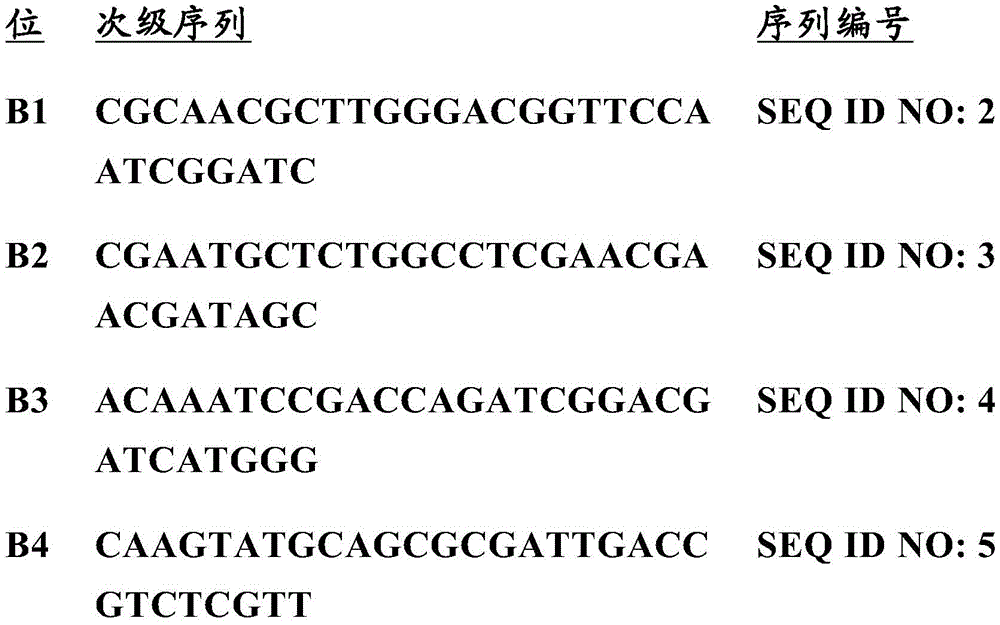

mRNA靶向序列设计。为了测定在这些细胞系中表达的所有基因 的所有同种型的相对丰度,使用公众可获得的软件cufflinks,以及来 自gencode v18的人类基因组注释,处理来自ENCODE项目的针对来 自A549和IMR90细胞的总RNA的转录组分析数据。对应于最高表 达的同种型的基因模型用于构建记录每个基因的显性同种型的 FASTA格式的序列文库。从该文库中选择目标基因。将这些基因分成 1kb的区段,随后使用软件OligoArray2.1来生成人转录组的初级探针 序列,其具有以下限制:30-bp或40-bp的长度,这取决于实验;大 于70℃的探针-靶标解链温度(可变参数);无具有大于72℃的解链温度 的交叉杂交靶标(可变参数);无具有大于76℃的解链温度的预测的内 部次级结构(可变参数);以及无6个或更多个碱基的单核苷酸连续重 复。在OligoArray探针选择后,拒绝定位至不同基因的所有潜在探针, 然而保留具有与同一基因的多重对齐的所有潜在探针。从所有表达的 基因的FASTA文库组装BLAST数据库以筛选探针的独特性。对于每 个基因,选择在OligoArray处理期间产生的14至28个靶向序列。mRNA targeting sequence design. To determine the relative abundance of all isoforms of all genes expressed in these cell lines, the publicly available software cufflinks, along with annotation of the human genome from gencode v18, was processed from the ENCODE project for A549 and IMR90 cells from A549 and IMR90 cells. Transcriptome analysis data of total RNA. The gene model corresponding to the most highly expressed isoform was used to construct a FASTA-formatted sequence library recording the dominant isoform of each gene. Target genes are selected from this library. These genes were divided into 1-kb segments and the software OligoArray2.1 was used to generate primary probe sequences for the human transcriptome with the following limitations: 30-bp or 40-bp in length, depending on the experiment; probes greater than 70°C. Needle-target melting temperature (variable parameter); no cross-hybridization target with melting temperature greater than 72°C (variable parameter); no predicted internal secondary structure with melting temperature greater than 76°C (variable parameter) parameter); and no single nucleotide consecutive repeats of 6 or more bases. After OligoArray probe selection, all potential probes that mapped to different genes were rejected, while all potential probes with multiple alignments to the same gene were retained. A BLAST database was assembled from the FASTA library of all expressed genes to screen probes for uniqueness. For each gene, 14 to 28 targeting sequences generated during OligoArray processing were selected.
探针合成-索引PCR。通过有限循环PCR从复杂寡核苷酸库中选 择特异性探针组的模板。简言之,将0.5至1ng的复杂寡核苷酸库与 0.5微摩尔的每种引物组合。正向引物与所需亚组的引发序列匹配,而 反向引物是该序列与T7启动子的5'串接。为了避免可能难以合成的 G-四联体的生成,从位于合适的引发区5'的G生成T7启动子中所需 的末端G。所有引物均通过IDT合成。使用KAPA实时文库扩增试 剂盒(KAPA Biosystems;KK2701)或通过包括0.8X EvaGreen (Biotum;31000-T)和热启动Phusion聚合酶(New England Biolabs;M0535S)的自制qPCR混合物扩增50微升反应体积。使用Agilent的 MX300P或Biorad的CFXConnect实时进行扩增。在扩增平台期之 前立即除去个体样品,以最小化由于过度扩增引起的模板丰度的扭曲。 按照制造商的说明书(Zymo DNA Clean and Concentrator;D4003)用柱子纯化个体模板,并在无RNA酶的去离子水中洗脱。Probe Synthesis - Indexed PCR. Templates for specific probe sets are selected from complex oligonucleotide libraries by limited cycle PCR. Briefly, 0.5 to 1 ng of the complex oligonucleotide pool was combined with 0.5 micromolar of each primer. The forward primer matched the priming sequence of the desired subset, and the reverse primer was this sequence tandem 5' to the T7 promoter. To avoid the generation of potentially difficult to synthesize G-quadruplexes, the terminal G required in the T7 promoter was generated from a G located 5' to the appropriate priming region. All primers were synthesized by IDT. 50 μl reactions were amplified using the KAPA Real-Time Library Amplification Kit (KAPA Biosystems; KK2701) or by a homemade qPCR mix including 0.8X EvaGreen (Biotum; 31000-T) and hot-start Phusion polymerase (New England Biolabs; M0535S). volume. Amplification was performed in real time using Agilent's MX300P or Biorad's CFXConnect. Individual samples were removed immediately prior to the amplification plateau to minimize distortions in template abundance due to over-amplification. Individual templates were column purified according to the manufacturer's instructions (Zymo DNA Clean and Concentrator; D4003) and eluted in RNase-free deionized water.
通过体外转录的扩增。随后通过体外转录扩增模板。简言之,将0.5至1微克模板DNA在具有高产率RNA聚合酶(New England Biolabs;E2040S)的单个20-30微升反应中扩增至100-200微克的 RNA。反应补充有1X RNA酶抑制剂(Promega RNasin;N2611)。扩 增通常在37℃下进行4至16小时以最大化产率。反应后不纯化RNA, 并且如下所述将其在-80℃下储存或立即转化成DNA。Amplification by in vitro transcription. The template is then amplified by in vitro transcription. Briefly, 0.5 to 1 microgram of template DNA was amplified to 100-200 micrograms of RNA in a single 20-30 microliter reaction with high yield RNA polymerase (New England Biolabs; E2040S). Reactions were supplemented with 1X RNase inhibitor (Promega RNasin; N2611). Amplification is typically performed at 37°C for 4 to 16 hours to maximize yield. RNA was not purified after the reaction and was stored at -80°C or immediately converted to DNA as described below.
逆转录。使用逆转录酶Maxima H-(Thermo Scientific;EP0751) 从上述体外转录反应物产生1至2nmol的荧光标记的ssDNA探针。 使用该酶是因为其具有较高的持续合成能力和耐温性,这允许在不利 于次级结构形成的温度下在小体积内将大量RNA转化为DNA。用1.6 mM的每种dNTP、1-2nmol的荧光标记的正向引物、300单位的 Maxima H-、60单位的RNasin和最终的1X浓度的Maxima RT缓冲 液补充上面生成的未纯化的RNA。将最终75微升体积在50℃下温育 60分钟。reverse transcription. 1 to 2 nmol of fluorescently labeled ssDNA probes were generated from the above in vitro transcription reactions using the reverse transcriptase Maxima H- (Thermo Scientific; EP0751). This enzyme is used because of its high processivity and temperature tolerance, which allows the conversion of large amounts of RNA to DNA in small volumes at temperatures that are not conducive to secondary structure formation. The unpurified RNA generated above was supplemented with 1.6 mM of each dNTP, 1-2 nmol of fluorescently labeled forward primer, 300 units of Maxima H-, 60 units of RNasin, and a final 1X concentration of Maxima RT buffer. The final 75 microliter volume was incubated at 50°C for 60 minutes.
链选择和纯化。随后通过碱性水解从DNA中除去上述反应中的 模板RNA。向每个逆转录反应中加入75微升0.25M EDTA和0.5N NaOH,将样品在95℃温育10分钟。通过用修饰形式的Zymo Oligo Clean和Concentrator方案纯化ssDNA探针来立即中和反应。具体地, 视情况而定,将5微克容量的柱用25微克或100微克容量的DNA柱 替换。按照制造商的说明书进行方案的其余部分。在100微升不含RNA 酶的去离子水中洗脱探针,随后在真空浓缩器中蒸发。将最终的沉淀 重悬于10微升不含RNA酶的水中,并在-20℃储存。变性聚丙烯酰亚 胺凝胶电泳和吸收光谱显示该方案通常产生荧光引物至全长探针的 90-100%的掺入和总荧光探针的75-90%的回收。因此,在不超过150 微升反应体积的情况下,该方案可用于生成~2nmol的荧光探针。Strand selection and purification. The template RNA in the above reaction is subsequently removed from the DNA by alkaline hydrolysis. 75 microliters of 0.25M EDTA and 0.5N NaOH were added to each reverse transcription reaction and the samples were incubated at 95°C for 10 minutes. The reaction was immediately neutralized by purifying the ssDNA probe with a modified version of Zymo Oligo Clean and the Concentrator protocol. Specifically, the 5 microgram capacity column was replaced with a 25 microgram or 100 microgram capacity DNA column, as appropriate. Follow the manufacturer's instructions for the remainder of the protocol. Probes were eluted in 100 microliters of RNase-free deionized water, followed by evaporation in a vacuum concentrator. The final pellet was resuspended in 10 microliters of RNase-free water and stored at -20°C. Denaturing polyacrylimide gel electrophoresis and absorption spectroscopy showed that this protocol typically yielded 90-100% incorporation of fluorescent primers to full-length probes and 75-90% recovery of total fluorescent probes. Therefore, this protocol can be used to generate ~2 nmol of fluorescent probes without exceeding a 150 microliter reaction volume.
细胞培养和固定。A549和IMR90细胞(美国典型培养物保藏中心) 分别用Dulbecco改良伊格尔培养基和伊格尔最低必需培养基培养。将 细胞在37℃和5%CO2下温育36-48小时。将细胞在PBS中的3%的 多聚甲醛(Electron Microscopy Sciences)中固定15分钟,用PBS洗涤, 并在4℃下于70℃乙醇中透化过夜。Cell culture and fixation. A549 and IMR90 cells (American Type Culture Collection) were cultured in Dulbecco's Modified Eagle's Medium and Eagle's Minimum Essential Medium, respectively. Cells were incubated for 36-48 h at 37°C and 5% CO2 . Cells were fixed in 3% paraformaldehyde (Electron Microscopy Sciences) in PBS for 15 minutes, washed with PBS, and permeabilized in ethanol at 70°C overnight at 4°C.
荧光原位杂交(FISH)-初级(编码)探针。将细胞在洗涤缓冲液 (2xSSC,50%甲酰胺)中水化10分钟,在杂交缓冲液(2xSSC,50%甲 酰胺,1mg/mL酵母tRNA和10%硫酸葡聚糖)中用初级寡核苷酸(0.5 nM/序列)在37℃标记过夜,用洗涤缓冲液在47℃洗涤10分钟,进行 两次,并用2xSSC洗涤两次。在成像之前,在2xSSC中以1:10,000 的稀释度加入荧光基准珠(Molecular Probes,F-8809)。Fluorescence in situ hybridization (FISH) - primary (coding) probe. Cells were hydrated for 10 min in wash buffer (2xSSC, 50% formamide) and treated with primary oligosaccharides in hybridization buffer (2xSSC, 50% formamide, 1 mg/mL yeast tRNA and 10% dextran sulfate). Glycosides (0.5 nM/sequence) were labeled overnight at 37°C, washed twice with wash buffer at 47°C for 10 minutes, and washed twice with 2xSSC. Fluorescent reference beads (Molecular Probes, F-8809) were added at a 1:10,000 dilution in 2xSSC prior to imaging.
次级探针。将次级(读出)探针(10nM)在次级杂交缓冲液(2xSSC, 20%甲酰胺和10%硫酸葡聚糖)中与其主靶标在37℃杂交30分钟。在 杂交期间,细胞保留在显微镜载物台上。使用物镜加热器将温度保持 在37℃。用次级洗涤缓冲液(2xSSC,20%甲酰胺)洗涤细胞。secondary probe. Secondary (readout) probes (10 nM) were hybridized to their primary targets in secondary hybridization buffer (2xSSC, 20% formamide and 10% dextran sulfate) for 30 minutes at 37°C. During hybridization, cells remain on the microscope stage. The temperature was maintained at 37 °C using an objective lens heater. Cells were washed with secondary wash buffer (2xSSC, 20% formamide).
流体和STORM成像。在由流体学装置和STORM(随机光学重建 显微术)显微镜组成的自动化平台上进行多个回合连续标记、洗涤、成 像和漂白。流体装置包括流动室(Bioptech FCS2)、蠕动泵(Rainin Dynamax RP-1)和3个计算机控制的8通阀(HamiltonMVP和 Hamilton HVXM 8-5)。该系统允许次级杂交和STORM影像采集的自 动化集成。Fluid and STORM imaging. Multiple rounds of sequential labeling, washing, imaging and bleaching were performed on an automated platform consisting of a fluidics setup and a STORM (stochastic optical reconstruction microscopy) microscope. The fluidic apparatus consisted of a flow chamber (Bioptech FCS2), a peristaltic pump (Rainin Dynamax RP-1), and three computer-controlled 8-port valves (HamiltonMVP and Hamilton HVXM 8-5). The system allows for the automated integration of secondary hybridization and STORM image acquisition.
成像缓冲液包括50mM Tris(pH 8)、10%(w/v)葡萄糖、1%β ME(2-巯基乙醇)或25mM MEA(具有或不具有2mM 1,5-环辛二烯) 和氧清除系统(0.5mg/ml葡萄糖氧化酶(Sigma-Aldrich)和40微克/ml 过氧化氢酶(Sigma-Aldrich))。使用一层矿物油来密封成像缓冲液,防 止其在多次杂交过程中的酸化。Imaging buffers included 50 mM Tris (pH 8), 10% (w/v) glucose, 1% beta ME (2-mercaptoethanol) or 25 mM MEA (with or without 2
STORM设置包括配置来用于斜入射激发的Olympus IX-71倒置 显微镜。用642nm二极管泵浦固态激光器(VFL-P500-642;MPB通 信)连续照射样品。将405nm固态激光器(Cube405-100C;Coherent) 用于染料的活化。使用Olympus(UPlanSApo 100x,1.4NA)物镜收集荧光,并使其通过定制二向色性以及四视图分束器。所有影像使用 EMCCD照相机(AndoriAxon 897)记录,在60Hz成像。在保存之前, 将相机的512x256视场分割成单独的256x256像素影像。该视场的左 半部分包含STORM数据,右半部分包含荧光基准珠的图像。在保存之前将这些后面的影像降采样至1Hz。在数据采集期间,使用自制的 聚焦锁来保持恒定的焦平面。STORM影像在STORM缓冲液中包括 20,000至30,000帧,而漂白影像在洗涤缓冲液中包括10,000帧。The STORM setup consisted of an Olympus IX-71 inverted microscope configured for oblique incidence excitation. The sample was continuously irradiated with a 642 nm diode-pumped solid-state laser (VFL-P500-642; MPB Communications). A 405 nm solid state laser (Cube 405-100C; Coherent) was used for dye activation. Fluorescence was collected using an Olympus (UPlanSApo 100x, 1.4NA) objective and passed through a custom dichroic and four-view beam splitter. All images were recorded using an EMCCD camera (AndoriAxon 897), imaged at 60 Hz. The camera's 512x256 field of view is split into individual 256x256 pixel images before saving. The left half of this field of view contains STORM data, and the right half contains images of fluorescent fiducial beads. Downsample these later images to 1Hz before saving. A home-made focus lock was used to maintain a constant focal plane during data acquisition. STORM images included 20,000 to 30,000 frames in STORM buffer, while bleach images included 10,000 frames in wash buffer.
图像分析-单分子定位的分析。使用先前公开的单发射体定位软件 单独处理单分子定位和荧光基准珠的影像。Image Analysis - Analysis of single molecule localization. Images of single-molecule localization and fluorescent fiducial beads were processed separately using previously published single-emitter localization software.
图像配准。来自每回合杂交的珠的起始位置用于对齐来自每回合 的影像。使用连续杂交的珠图像之间的2D自相关,随后使用最近邻 匹配来匹配图像之间的珠。具有最相似位移矢量的珠的对用于计算刚 性平移-旋转弯曲以对齐珠。该对齐方法对于其中多个基元在成像期间 被移位或分离和重新附接的样品是鲁棒的。Image registration. The starting position of beads from each round of hybridization was used to align images from each round. A 2D autocorrelation between successively hybridized bead images was used, followed by nearest neighbor matching to match beads between images. Pairs of beads with the most similar displacement vectors are used to calculate rigid translation-rotational bending to align the beads. This alignment method is robust to samples in which multiple primitives are displaced or detached and reattached during imaging.
漂移校正。在图像采集期间的漂移使用基准珠的轨迹(在1Hz记 录的)来行校正。在每一帧中连接珠位置。将以最相关的方式移动的两 个珠的轨迹作为漂移轨迹。Drift correction. Drift during image acquisition was corrected using fiducial bead trajectories (recorded at 1 Hz). Connect the bead positions in each frame. Take the trajectory of the two beads moving in the most relevant way as the drift trajectory.
mRNA簇调用。定位首先被筛选为高于阈值数目(通常为2000)的 光子,并且需要在5个其它定位的32nm(可以调节参数)内。将剩余的 分子定位在10×10nm箱(箱尺寸是可变参数)的2D直方图中进行分 箱。所有连接的箱被视为簇的一部分(对角线接触被分类为连接的)。 簇需要在所有杂交中具有超过80个全局定位(可变参数)来被称为 mRNA簇。将来自2D直方图的这些簇的加权质心记录为mRNA位置。mRNA cluster calls. Localizations are first screened for photons above a threshold number (usually 2000) and need to be within 32 nm (parameters can be adjusted) of 5 other localizations. The remaining molecules were localized in a 2D histogram of 10 x 10 nm bins (bin size is a variable parameter) for binning. All connected bins are considered part of a cluster (diagonal contacts are classified as connected). Clusters need to have more than 80 global locations (variable parameters) in all hybridizations to be called mRNA clusters. The weighted centroids of these clusters from the 2D histogram were recorded as mRNA positions.
如果在每个杂交回合中在该mRNA的质心的48nm半径(可变参 数)内发现超过9个定位(可变参数),则给定的簇被记录为单个杂交回 合中的代表。If more than 9 localizations (variable parameter) were found within a 48 nm radius (variable parameter) of the centroid of the mRNA in each hybridization run, a given cluster was recorded as representative in a single hybridization run.
簇解码。对于每个mRNA簇,读出代码字,其包括“0”(对于其 中在质心附近发现小于阈值数目的定位的所有杂交回合)和“1”(对于 其中计数上述阈值数目的定位的回合)。SECDED代码本将这些解码 为与靶mRNA代码字的完全匹配、可以明确映射回靶mRNA的可校正误差,或与代码本中的字相异于两个或更多个字母的不可校正的误 差。Cluster decoding. For each mRNA cluster, a codeword is read that includes "0" (for all hybridization rounds in which less than a threshold number of localizations were found near the centroid) and "1" (for rounds in which the above threshold number of localizations were counted). The SECDED codebook decodes these as exact matches to the target mRNA codewords, correctable errors that can be unambiguously mapped back to the target mRNA, or uncorrectable errors that differ from the word in the codebook by two or more letters.
图2A显示细胞的STORM图像。图2B显示图2A中的加框区域 的放大。每个斑点表示定位。差异地显示来自不同回合成像的定位。 图2C显示来自图2B中的加框区域的代表性定位簇。该簇显示来自4 个不同杂交的定位信号。该簇是用代码字[0 1 0 1 1 1 0 0]编码的推定的 mRNA。图2D显示解码和误差校正后的14个基因的重建的细胞图像。 差异地显示每个基因。图2E显示来自细胞的14个基因的测量的基因 表达。图2F显示转录物计数与全体RNA测序数据的比较。图2G显 示使用所述方法检测的两个细胞之间的转录物表达水平的相关性。Figure 2A shows STORM images of cells. Figure 2B shows an enlargement of the boxed area in Figure 2A. Each spot represents a localization. Localizations from different rounds of imaging are shown differentially. Figure 2C shows representative localization clusters from the boxed regions in Figure 2B. This cluster shows localization signals from 4 different hybrids. This cluster is a putative mRNA encoded with the codeword [0 1 0 1 1 1 0 0]. Figure 2D shows the reconstructed cell images of the 14 genes after decoding and error correction. Each gene is shown differentially. Figure 2E shows the measured gene expression of 14 genes from cells. Figure 2F shows a comparison of transcript counts to overall RNA sequencing data. Figure 2G shows the correlation of transcript expression levels between two cells detected using the method.
实施例4Example 4
以下实施例总体上涉及具有误差鲁棒性编码的多重单分子成像, 其允许在单个细胞中同时测量数千个RNA种类。一般地,RNA在个 体细胞中的表达谱和空间景观的知识是理解细胞行为的丰富的全部组 成部分所必需的。以下实施例报道了涉及单分子成像方法的各种技术, 其允许在单个细胞中测定数千个RNA种类的拷贝数和空间定位。这 些技术中的一些被称为多路误差-鲁棒性荧光原位杂交或 “MERFISH”。The following examples generally relate to multiplexed single-molecule imaging with error-robust coding that allows the simultaneous measurement of thousands of RNA species in a single cell. In general, knowledge of RNA expression profiles and spatial landscapes in individual cells is necessary to understand a rich repertoire of cellular behavior. The following examples report various techniques involving single-molecule imaging methods that allow determination of the copy number and spatial localization of thousands of RNA species in a single cell. Some of these techniques are called multiplex error-robust fluorescence in situ hybridization or "MERFISH".
通过使用误差鲁棒性编码方案来对抗单分子标记和检测误差,这 些实例显示了成百上千的独特RNA种类在数百个个体细胞中的成像。 ~104至~106对基因的相关性分析允许对基因调控网络的约束、许多未 注释基因的新功能的预测和与编码的蛋白质的性质相关的RNA的不 同空间分布模式的鉴定。By using an error-robust encoding scheme to combat single-molecule labeling and detection errors, these examples show the imaging of hundreds of unique RNA species in hundreds of individual cells. Association analysis of -104 to -106 pairs of genes allowed constraints on gene regulatory networks, prediction of novel functions for many unannotated genes, and identification of distinct spatial distribution patterns of RNAs associated with the properties of encoded proteins.
单细胞中的RNA的丰度和空间组织的系统范围分析有望转变细 胞和发育生物学的许多领域的理解,诸如基因调节的机制、细胞的异 质行为,以及细胞命运的发展和维持。单分子荧光原位杂交(smFISH) 已成为用于研究RNA在分离的或在其天然组织环境中的单个细胞中 的拷贝数和空间组织的强大工具。通过利用其以高分辨率映射特定 RNA的空间分布的能力,smFISH已揭示亚细胞RNA定位在不同的 过程诸如细胞迁移、发育和极化中的重要性。同时,smFISH精确地 测量特异性RNA的拷贝数而无扩增偏倚的能力允许定量测量基因表 达中的自然波动,这进而阐明了形成这种波动的调节机制及其在多种 生物过程的作用。A systems-wide analysis of the abundance and spatial organization of RNA in single cells promises to transform the understanding of many areas of cellular and developmental biology, such as the mechanisms of gene regulation, the heterogeneous behavior of cells, and the development and maintenance of cell fate. Single-molecule fluorescence in situ hybridization (smFISH) has emerged as a powerful tool for studying the copy number and spatial organization of RNA in individual cells, either isolated or in their native tissue environment. By exploiting its ability to map the spatial distribution of specific RNAs at high resolution, smFISH has revealed the importance of subcellular RNA localization in diverse processes such as cell migration, development and polarization. At the same time, the ability of smFISH to accurately measure the copy number of specific RNAs without amplification bias allows quantitative measurement of natural fluctuations in gene expression, which in turn elucidate the regulatory mechanisms that shape such fluctuations and their role in various biological processes.
然而,smFISH方法在许多系统级问题中的应用仍然受限于可以 在单个细胞中同时测量的RNA种类的数目。使用通过基于颜色的条 形码或序贯杂交的组合标记的现有技术水平的努力已经能够在个体细 胞中同时测量10-30种不同的RNA种类,但许多有趣的生物学问题将 受益于单个细胞内的数百至数千RNA的测量,这是使用这样的技术 不可实现的。例如,对如此大量RNA的表达谱如何随细胞而变化以 及这些变异如何在不同基因之间相关的分析可用于系统地鉴定共调节 的基因和对调节网络作图;许多RNA的亚细胞组织及其相关性的知 识可以帮助阐明许多局部细胞结构的建立和维持背后的分子机制;以 及在天然组织中的个体细胞的RNA谱表征可允许细胞类型的原位鉴 定。However, the application of smFISH methods to many system-level problems is still limited by the number of RNA species that can be measured simultaneously in a single cell. State-of-the-art efforts using combinatorial labeling via color-based barcoding or sequential hybridization have enabled the simultaneous measurement of 10-30 different RNA species in individual cells, but many interesting biological questions would benefit from within a single cell Measurements of hundreds to thousands of RNAs, which are not achievable using such techniques. For example, analysis of how the expression profile of such a large number of RNAs varies from cell to cell and how these variations are correlated across genes can be used to systematically identify co-regulated genes and map regulatory networks; the subcellular organization of many RNAs and their associated Knowledge of correlations can help elucidate the molecular mechanisms underlying the establishment and maintenance of many local cellular structures; and RNA profiling of individual cells in native tissues can allow for in situ identification of cell types.
以下实施例通常论述称为MERFISH的某些技术,其是高度多重 化的smFISH成像方法,所述方法通过使用利用误差鲁棒性编码方案 的组合标记和序贯成像显著增加可以在个体细胞中同时成像的RNA 种类的数目。这些实例通过使用可检测和校正误差的编码方案同时测 量140种RNA种类,以及使用可以检测但不校正误差的编码方案同 时测量1001种RNA种类来证明该复用成像方法。应当理解,这些数 字仅是示例性的,而不是限制性的。这些基因的拷贝数变异和空间分 布的相关分析允许我们鉴定被共调控的基因的组和在细胞内共享相似 空间分布模式的基因的组。The following examples generally discuss certain techniques known as MERFISH, which is a highly multiplexed smFISH imaging method that significantly increases the ability to simultaneously perform simultaneous imaging in individual cells through the use of combined labeling and sequential imaging utilizing an error-robust coding scheme. Number of RNA species imaged. These examples demonstrate the multiplexed imaging approach by simultaneously measuring 140 RNA species using an encoding scheme that detects and corrects errors, and 1001 RNA species using an encoding scheme that detects but does not correct errors. It should be understood that these numbers are exemplary only and not limiting. Correlation analysis of copy number variation and spatial distribution of these genes allowed us to identify sets of genes that are co-regulated and sets of genes that share similar spatial distribution patterns within cells.
使用误差鲁棒性编码方案的组合标记。通过多个(N)不同信号鉴定 每个RNA种类的组合标记提供了快速增加可以在个体细胞中同时被 探测的RNA种类数目的途径(图5A)。然而,将smFISH的通量按比 例扩大到系统规模的此方法面临重大挑战,因为不仅可寻址RNA种 类的数目随着N而呈指数增加,而且检测误差率也随N呈指数增加(图 5B-5D)。想象一个概念上简单的方案来实现组合标记,其中每个RNA 种类用N-位二进制字编码,并且样品用N个对应的杂交回合来探测, 每回合仅靶向应当在对应位中读取'1'的RNA的亚组(图11)。N回合 的杂交将允许探测2N-1种RNA。只用16个杂交,就可以鉴定超过 64,000种RNA种类,其应覆盖包括信使RNA(mRNA)和非编码RNA 的整个人转录组(图5B;上部符号)。然而,随着N增加,适当检测的 RNA的分数(调用率)将快速减少,并且更麻烦地,被鉴定为不正确种类的RNA的分数(误鉴定率)将快速增加(图5C,下面的符号;图5D, 上面的符号)。通过使用每个杂交的实际误差率(下面测量的),大多数 RNA分子在16回合杂交后将被误鉴定!Combined labeling using an error-robust coding scheme. Combinatorial labeling of each RNA species by multiple (N) distinct signals provides a way to rapidly increase the number of RNA species that can be probed simultaneously in individual cells (Figure 5A). However, this method of scaling up the throughput of smFISH to a system scale presents significant challenges, as not only does the number of addressable RNA species increase exponentially with N, but also the detection error rate increases exponentially with N (Figure 5B). -5D). Imagine a conceptually simple scheme to achieve combinatorial labeling, where each RNA species is encoded with an N-bit binary word, and the sample is probed with N corresponding hybridization rounds, each round only targeting should be read in the corresponding bit' A subset of 1' RNAs (Figure 11). N rounds of hybridization will allow detection of 2N -1 RNAs. With only 16 hybrids, over 64,000 RNA species could be identified, which should cover the entire human transcriptome including messenger RNAs (mRNAs) and noncoding RNAs (Fig. 5B; upper symbols). However, as N increases, the fraction of properly detected RNAs (call rate) will rapidly decrease and, more troublesomely, the fraction of RNAs identified as incorrect species (misidentification rate) will rapidly increase (Figure 5C, lower symbol; Fig. 5D, upper symbol). By using the actual error rate per hybridization (measured below), most RNA molecules will be misidentified after 16 rounds of hybridization!
为了解决该挑战,设计了误差鲁棒性编码方案,其中仅使用由某 一汉明距离分开的2N-1个字的亚组来编码RNA。在其中最小汉明距 离为4(HD4码)的代码本中,必须不正确地读取至少4个位来将一个 代码字改变为另一个代码字(图12A)。结果,每个单-位误差产生独特 地接近单个代码字的字,这允许检测和校正此类误差(图12B)。双位 误差产生来自多个代码字的具有相等的2的汉明距离的字,从而可被 检测但不被校正(图12C)。这样的码应该显著增加调用率并减少误鉴 定率(图5C和5D,中间符号)。为了进一步考虑在smFISH测量中相 对于将背景斑点误鉴定为RNA(0-->1的误差)更可能错过杂交事件 (1-->0的误差)的事实,设计修饰的HD4(MHD4)码,其中'1'位的数目 保持恒定和相对低(每个字只有4个),以减少误差并避免偏倚检测。 该MHD4码应该进一步增加调用率并减少误鉴定率(图5C,上面的符 号;图5D,下面的符号)。To address this challenge, an error-robust encoding scheme was devised in which only a subset of 2N -1 words separated by a certain Hamming distance is used to encode RNA. In a codebook where the minimum Hamming distance is 4 (HD4 code), at least 4 bits must be read incorrectly to change one codeword to another (FIG. 12A). As a result, each single-bit error produces a word that is uniquely close to a single codeword, which allows such errors to be detected and corrected (FIG. 12B). Double bit errors result in words with equal Hamming distances of 2 from multiple codewords, which can be detected but not corrected (FIG. 12C). Such codes should significantly increase the calling rate and reduce the false identification rate (FIGS. 5C and 5D, middle symbols). To further take into account the fact that hybridization events are more likely to be missed (errors of 1-->0) than to misidentify background spots as RNAs (errors of 1-->0) in smFISH measurements, a modified HD4 (MHD4) code was designed , where the number of '1' bits is kept constant and relatively low (only 4 per word) to reduce errors and avoid biased detection. This MHD4 code should further increase the calling rate and reduce the misidentification rate (Fig. 5C, upper symbol; Fig. 5D, lower symbol).
除了误差考虑以外,几个实际的挑战也使得难以探测大量的RNA 种类,诸如所需的大量荧光标记的FISH探针的高成本和完成许多个 回合杂交所需的长时间。为了克服这些挑战,在本实施例中,设计两 步标记方案以编码和读出细胞RNA(图5E)。首先,用一组编码探针(也 称为初级探针)标记细胞RNA,每个探针包含RNA靶向序列和两个侧 翼读出序列。基于RNA的MHD4代码字将N个独特的读出序列中的 四个分配给每个RNA种类。其次,使用互补的FISH探针(读出探针(也 称为次级探针))通过N回合的杂交和成像(每回合使用独特的读出探针) 鉴定这N个读出序列。为了增加信号对背景的比率,每个细胞RNA 用~192个编码探针标记。因为每个编码探针含有与该RNA相关的四 个读出序列中的两个(图5E),因此最多~96个读出探针可在每个杂交 回合中结合每个细胞RNA。为了生成所需的大量编码探针,使用包括 体外转录和随后逆转录的酶促扩增法,从包含数万个定制序列的阵列 衍生的寡核苷酸库扩增它们(图13,关于探针合成参见下文)。该两步 标记方法显著减少了用于实验的总杂交时间:发现与读出序列的高效 杂交仅花费15分钟,而与细胞RNA的高效直接杂交需要超过10小 时。In addition to error considerations, several practical challenges also make it difficult to probe the large number of RNA species, such as the high cost of the large number of fluorescently labeled FISH probes required and the long time required to complete the many rounds of hybridization. To overcome these challenges, in this example, a two-step labeling scheme was designed to encode and read cellular RNA (Figure 5E). First, cellular RNA is labeled with a set of coding probes (also called primary probes), each probe containing an RNA targeting sequence and two flanking readout sequences. The RNA-based MHD4 codeword assigns four of the N unique reads to each RNA species. Second, the N reads are identified by N rounds of hybridization and imaging (each round using a unique read probe) using complementary FISH probes (read probes (also referred to as secondary probes)). To increase the signal to background ratio, each cellular RNA was labeled with -192 coding probes. Because each coding probe contains two of the four reads associated with that RNA (Figure 5E), up to -96 read probes can bind each cellular RNA in each hybridization round. To generate the desired large number of coding probes, they were amplified from array-derived oligonucleotide libraries containing tens of thousands of custom sequences using an enzymatic amplification method involving in vitro transcription followed by reverse transcription (Figure 13, on Probe Needle synthesis see below). This two-step labeling method significantly reduces the overall hybridization time for the experiment: efficient hybridization to the read sequence was found to take only 15 minutes, while efficient direct hybridization to cellular RNA required more than 10 hours.
图5描述了MERFISH,一种使用组合标记和误差鲁棒性编码的 高度复用smFISH法。图5A显示在N回合成像中鉴定多种RNA种 类的示意性描述。每个RNA种类用N位二进制字编码,并且在每回 合成像期间,只有应当在对应位读取'1'的RNA的亚组发射信号。图 5B-5D显示了可寻址RNA种类的数目(图5B),这些RNA被正确鉴定 的比率(调用率)(图5C)和RNA被不正确地鉴定为不同RNA种类的比 率(误鉴定率)(图5D)(作为编码RNA的二进制字中的位数(N)的函数绘 制的)。在图5B和5D中,上面的点是包括所有2N-1个可能的二进制 字的简单二进制码;中间的点是其中分离字的汉明距离为4的HD4 码;而下面的点是其中'1'位的数目保持为4的修饰的HD4(MHD4)码。 这些在图5C中是反过来的。Figure 5 depicts MERFISH, a highly multiplexed smFISH method using combined markers and error robust encoding. Figure 5A shows a schematic depiction of the identification of multiple RNA species in N-round imaging. Each RNA species is encoded with an N-bit binary word, and during each round of imaging, only the subset of RNAs that should read a '1' in the corresponding bit emits a signal. Figures 5B-5D show the number of addressable RNA species (Figure 5B), the rate at which these RNAs were correctly identified (call rate) (Figure 5C) and the rate at which RNAs were incorrectly identified as different RNA species (misidentification rate) ) (Fig. 5D) (plotted as a function of the number of bits (N) in the binary word encoding the RNA). In Figures 5B and 5D, the upper point is a simple binary code including all 2N -1 possible binary words; the middle point is the HD4 code in which the Hamming distance of the separated words is 4; and the lower point is where Modified HD4 (MHD4) code where the number of '1' bits remains four. These are reversed in Figure 5C.
以10%(对于1-->0的误差)和4%(对于0-->1的误差)的每位误差 率计算调用和误鉴定率。图5E是用于RNA鉴定的MHD4码的实施 的示意图。每个RNA种类首先用~192个编码探针标记,所述编码探 针将RNA转化成读出序列(编码hyb)的独特组合。这些编码探针各自 含有中央RNA靶向区,其侧接两个从N个不同序列的库中提取的读 出序列,每个读出序列与特定杂交回合相关。用于特定RNA种类的 编码探针包含N个读出序列中的4个的独特组合,其对应于其中该 RNA应读为'1'的4个杂交回合。使用N个随后回合的利用荧光读出 探针的杂交来探测读出序列(hyb 1,hyb 2,...,hyb N)。通过连续回 合的杂交之间的光漂白使结合的探针失活。为了清楚起见,对于编码 探针此处仅描述了读出序列的一种可能的配对;然而,4个读出序列 的所有可能的对以相同的频率使用并且在实际实验中沿着每个细胞 RNA随机分布。Call and false identification rates were calculated with bit error rates of 10% (for 1-->0 errors) and 4% (for 0-->1 errors). Figure 5E is a schematic diagram of the implementation of the MHD4 code for RNA identification. Each RNA species was first labeled with -192 coding probes that converted the RNA into a unique combination of reads (encoding hyb). Each of these coding probes contains a central RNA targeting region flanked by two reads drawn from a pool of N different sequences, each read associated with a specific hybridization round. Encoding probes for a particular RNA species contain a unique combination of 4 of the N reads, which correspond to 4 hybridization rounds where the RNA should read '1'. Readout sequences (
图11显示基于简单二进制码的组合标记方法的示意性描述。在概 念上简单的标记方法中,2N-1个不同的RNA种类可用所有N位二进 制字(不包括具有全部‘0’的字)独特地编码。在每个杂交回合中,包括 被靶向至在对应位中具有'1'的所有RNA种类的FISH探针。为了增加 区分RNA斑点与背景的能力,每个杂交回合用多个FISH探针寻址每 个RNA。来自结合的探针的信号在下一回合杂交之前消失。对所有N 个杂交回合(hyb 1,hyb 2,...)继续该过程,并且可通过每个杂交回合 中的荧光信号的独特开-关模式来鉴定所有2N-1个RNA种类。Figure 11 shows a schematic description of a simple binary code based combined marking method. In a conceptually simple labeling method, 2N -1 different RNA species can be uniquely encoded with all N-bit binary words (excluding words with all '0's). In each hybridization round, FISH probes targeted to all RNA species with a '1' in the corresponding position were included. To increase the ability to distinguish RNA spots from background, each RNA was addressed with multiple FISH probes per hybridization round. The signal from the bound probe disappeared before the next round of hybridization. The process continues for all N hybridization rounds (
图12显示汉明距离及其在误差的鉴定和校正中的用途的示意性 描述。图12A是汉明距离为4的示意图。图12B和12C是显示利用4 的汉明距离的编码方案校正单-位误差(图12B)或检测但不校正双位误 差(图12C)的能力的示意图。箭头突出显示其上指示的字不同的位。 如果字之一必须从‘1’至‘0’或从‘0’至‘1’翻转4个位以转换成另一个字, 则两个代码字间隔4的汉明距离。单-位误差校正是可能的,因为如果 测量的字与正确代码字相异仅一个位,则很可能是由于误读该代码字 而产生的误差,因为所有其它RNA种类的代码字将与测量的字相异 至少3位。在该情况下,测量的字可被校正为仅相异1位的代码字。 如果测量的字与正确代码字相异2位,则该测量的字仍然可被鉴定为 误差,但是校正不再可能,因为多于一个正确代码字与该测量的字相 异2位。Figure 12 shows a schematic depiction of the Hamming distance and its use in the identification and correction of errors. FIG. 12A is a schematic diagram of a Hamming distance of 4. FIG. 12B and 12C are schematic diagrams showing the ability of a coding scheme utilizing a Hamming distance of 4 to correct single-bit errors (FIG. 12B) or to detect but not correct double-bit errors (FIG. 12C). The arrows highlight the bits on which the indicated word differs. If one of the words must flip 4 bits from '1' to '0' or from '0' to '1' to convert to the other word, then the two codewords are separated by a Hamming distance of 4. Single-bit error correction is possible because if the measured word differs from the correct codeword by only one bit, then errors are likely due to misreading the codeword, since codewords for all other RNA species will differ from the measurement. The words differ by at least 3 bits. In this case, the measured words can be corrected to code words that differ by only 1 bit. If the measured word differs from the correct codeword by 2 bits, the measured word can still be identified as an error, but correction is no longer possible because more than one correct codeword differs from the measured word by 2 bits.
图13显示编码探针文库的产生。将包含~100k个序列的阵列合成 的复杂寡核苷酸库用作用于编码探针(用于不同实验)的酶促扩增的模 板。寡核苷酸库中的每个模板序列含有可结合细胞RNA的中心靶区 域、两个侧翼读出序列和两个侧翼索引引物。在第一步骤中,选择用 于特定实验的所需模板分子,并用索引PCR反应进行扩增。为了允许 通过体外转录进行扩增,在该步骤期间将T7启动子加入PCR产物中。 在第二步骤中,通过体外转录从这些模板分子扩增RNA。在第三步骤 中,将该RNA逆转录回DNA。在最后一个步骤中,通过碱性水解除 去模板RNA,仅留下所需的ssDNA探针。该方案产生~2nmol的编码 探针的复杂库,其含有用于140-基因实验的~20,000种不同的序列或 用于1001-基因实验的~100,000种不同的序列。Figure 13 shows the generation of a library of encoded probes. Array-synthesized complex oligonucleotide libraries containing ~100k sequences were used as templates for enzymatic amplification of coding probes (for different experiments). Each template sequence in the oligonucleotide library contains a central target region that binds cellular RNA, two flanking read sequences, and two flanking index primers. In the first step, the desired template molecule for a specific experiment is selected and amplified using an indexed PCR reaction. To allow amplification by in vitro transcription, the T7 promoter was added to the PCR product during this step. In a second step, RNA is amplified from these template molecules by in vitro transcription. In a third step, the RNA is reverse transcribed back into DNA. In the final step, the template RNA is removed by alkaline hydrolysis, leaving only the desired ssDNA probe. This protocol produces a complex library of -2 nmol encoding probes containing -20,000 different sequences for 140-gene experiments or -100,000 different sequences for 1001-gene experiments.
实施例5Example 5
本实施例举例说明使用16位MHD4码,利用MERFISH测量140 个基因。为了测试该误差鲁棒性复用成像法的可行性,本实施例对人 成纤维细胞(IMR90)使用140-基因测量,使用16位MHD4码来编码 130个RNA种类,同时留下10个代码字作为误鉴定对照(图20)。在 每回合的与荧光读出探针的杂交后,通过利用斜入射照明几何的常规 宽场成像对细胞进行成像。对应于个体RNA的荧光斑点被清楚地检 测到,随后通过短暂的光漂白步骤被有效地熄灭(图6A)。在整个16 回合的迭代标记和成像中,样品是稳定的。未观察到与基于来源于批 量测序(bulk sequencing)的每回合中被靶向的RNA种类的相对丰度预 测的变化匹配的回合间荧光斑点数的变化,并且未观察到随杂交回合 数增加而系统性减少的趋势(图14A)。斑点的平均亮度在回合间变化, 标准偏差为40%,这可能归因于读出探针对编码探针上的不同读出序 列的不同结合效率(图14B)。只观察到斑点亮度随杂交回合增加的小的系统性减少的趋势,其为每回合平均4%(图14B)。This example illustrates the measurement of 140 genes using MERFISH using the 16-bit MHD4 code. To test the feasibility of this error-robust multiplexed imaging method, this example uses 140-gene measurements on human fibroblasts (IMR90), using 16-bit MHD4 codes to encode 130 RNA species, while leaving 10 codes word as a misidentification control (Figure 20). After each round of hybridization to a fluorescent readout probe, cells were imaged by conventional widefield imaging with oblique incidence illumination geometry. Fluorescent spots corresponding to individual RNAs were clearly detected and subsequently effectively quenched by a brief photobleaching step (Fig. 6A). The samples were stable throughout the 16 rounds of iterative labeling and imaging. No change in the number of fluorescent spots between rounds was observed matching the predicted change in relative abundance of the targeted RNA species in each round derived from bulk sequencing, and no change was observed with increasing number of hybridization rounds Systemic decreasing trend (Figure 14A). The average brightness of the spots varied from round to round with a standard deviation of 40%, possibly due to the different binding efficiencies of the read probes to different read sequences on the coding probe (Figure 14B). Only a small systematic decrease in spot brightness was observed with increasing hybridization rounds, which averaged 4% per round (Figure 14B).
接着,二进制字从观察到的荧光斑点基于它们在16个杂交回合上 的开-关模式构建(图6B-6D)。如果该字完全匹配140个MHD4代码 字中的一个(精确匹配)或仅相异1位(可误差校正的匹配),则将其分配 给对应的RNA种类(图6D)。在图6A和6B中描绘的单个细胞内,在 误差校正后检测到对应于130个编码的RNA种类中的87%的多于 1500个RNA分子(图6E)。在来自7个独立实验的~400个细胞中进行 类似的观察。平均而言,与误差校正前获得的值相比,在误差校正后 每细胞检测到多至约4倍的RNA分子和多至约2倍的RNA种类(图15)。Next, binary words were constructed from the observed fluorescent spots based on their on-off patterns over 16 hybridization rounds (Figures 6B-6D). If the word matched exactly one of the 140 MHD4 codewords (exact match) or differed by only 1 bit (error-correctable match), it was assigned to the corresponding RNA species (Figure 6D). Within the single cells depicted in Figures 6A and 6B, more than 1500 RNA molecules corresponding to 87% of the 130 encoded RNA species were detected after error correction (Figure 6E). Similar observations were made in -400 cells from 7 independent experiments. On average, up to about 4 times as many RNA molecules and up to about 2 times as many RNA species were detected per cell after error correction compared to the values obtained before error correction (Figure 15).
在每种RNA种类的拷贝数测量中可出现两种类型的误差:1)未检 测到该RNA种类的一些分子,从而导致调用率降低,以及2)来自其 它RNA种类的一些分子被误鉴定为该RNA种类。为了评估误鉴定的 程度,使用了10个误鉴定对照字,即与任何细胞RNA无关的代码字。 虽然观察到与这些对照字的匹配,但它们发生的频率远低于真实的 RNA编码字:130个RNA编码字中的95%比这些对照字的中值计数 更频繁地被计数。此外,通常发现,对于实际RNA编码字,精确匹 配数与具有1-位误差的匹配数的比率显著高于对于误鉴定对照观察到的相同比率,如所预期的(图16A和16B)。通过将该比率用作RNA鉴 定的置信度的量度,发现130个RNA种类中的91%具有比对于误鉴 定对照观察到的最大置信比更大的置信比(图6F),表明RNA鉴定的 高准确性。仅对这些91%的基因上进行后续分析。Two types of errors can occur in copy number measurements for each RNA species: 1) some molecules of that RNA species are not detected, resulting in lower calling rates, and 2) some molecules from other RNA species are misidentified as the RNA species. To assess the extent of misidentification, 10 misidentification control words, i.e. code words not associated with any cellular RNA, were used. Although matches to these control words were observed, they occurred much less frequently than true RNA-encoded words: 95% of the 130 RNA-encoded words were counted more frequently than the median count of these control words. In addition, it was generally found that the ratio of exact matches to matches with a 1-bit error was significantly higher for the actual RNA coding words than the same ratio observed for the misidentified controls, as expected (Figures 16A and 16B). By using this ratio as a measure of confidence in RNA identification, 91% of the 130 RNA species were found to have a greater confidence ratio than the maximum confidence ratio observed for misidentified controls (Figure 6F), indicating a high degree of RNA identification accuracy. Subsequent analyses were performed only on these 91% genes.
为了评估调用率,使用MHD4码的误差校正能力来测定每个杂交 回合的1-->0误差率(平均10%)和0-->1误差率(平均4%)(图16C和 16D)。通过使用这些误差率,评估误差校正后个体RNA种类的约80% 的调用率,即对应于RNA种类的约80%的荧光斑点被正确解码(图 16E)。注意,尽管剩余20%的斑点导致检测效率的损失,但它们中的 大多数没有引起种类的误鉴定,因为它们被解码为双位误差字并被丢 弃。To assess call rates, the error-correcting power of the MHD4 code was used to determine the 1-->0 error rate (average 10%) and 0-->1 error rate (average 4%) for each hybridization round (Figures 16C and 16D) . Using these error rates, it was estimated that approximately 80% of the calling rates of individual RNA species after error correction, ie approximately 80% of fluorescent spots corresponding to RNA species were correctly decoded (Figure 16E). Note that although the remaining 20% of blobs cause a loss in detection efficiency, most of them do not cause misidentification of the kind, as they are decoded as double-bit error words and discarded.
为了测试这些测量中的潜在技术偏倚,通过混洗不同RNA种类 间的代码字(图20)并改变编码探针序列,用不同的MHD4代码本探测 相同的130个RNA种类。利用该替代码的测量给出了类似的误鉴定 率和调用率(图17)。用这两个代码本测量的每个细胞的个体RNA种类的拷贝数显示优良的一致性,皮尔逊相关系数为0.94(图6G),这表 明编码方案的选择对测量的计数无偏倚。To test for potential technical bias in these measurements, the same 130 RNA species were probed with different MHD4 codebooks by shuffling the codewords between the different RNA species (Figure 20) and changing the coding probe sequences. Measurements with this surrogate code gave similar false identification and call rates (Figure 17). The copy number of individual RNA species per cell measured with these two codebooks showed excellent agreement, with a Pearson correlation coefficient of 0.94 (Fig. 6G), indicating that the choice of encoding scheme did not bias the counts measured.
为了验证从MERFISH实验得到的拷贝数,对130个基因中的15 个(选自3个数量级的全测量丰度范围)进行常规smFISH测量。对 于这些基因中的每一个,跨越许多细胞的平均拷贝数和拷贝数分布在 MERFISH与常规smFISH测量之间定量地一致(图18A和18B)。通过这两种方法测定的拷贝数的比率为0.82+/-0.06(跨15个测量的 RNA种类的平均值+/-SEM,图18B),其与多路复用成像法的估计 的80%调用率一致。该比率与估计的调用率之间在全测量丰度范围上 的定量匹配另外地支持误鉴定误差低的评估。假定MERFISH与常规smFISH结果之间的一致性扩展到最低测量丰度的基因(每细胞<1拷 贝,图18B),估计测量灵敏度为每细胞至少1个拷贝。To validate copy numbers derived from MERFISH experiments, routine smFISH measurements were performed on 15 of the 130 genes (selected from the full measured abundance range of 3 orders of magnitude). For each of these genes, the mean copy number and copy number distribution across many cells were quantitatively consistent between MERFISH and conventional smFISH measurements (Figures 18A and 18B). The ratio of copy number determined by these two methods was 0.82+/-0.06 (mean +/-SEM across 15 measured RNA species, Figure 18B), which is 80% of the estimate from the multiplexed imaging method The call rate is the same. The quantitative match between this ratio and the estimated calling rate over the full measured abundance range additionally supports the assessment of low misidentification error. Assuming concordance between MERFISH and conventional smFISH results extended to the least measured abundance genes (<1 copy per cell, Figure 18B), the measurement sensitivity was estimated to be at least 1 copy per cell.
作为最终验证,将在数百个细胞中平均的每个RNA种类的丰度 与对相同细胞系进行的批量RNA测序测量获得的那些相比较。成像 结果与批量测序结果显著相关,皮尔逊相关系数为0.89(图6H)。As a final validation, the abundances of each RNA species averaged over hundreds of cells were compared to those obtained from bulk RNA sequencing measurements on the same cell lines. Imaging results correlated significantly with batch sequencing results, with a Pearson correlation coefficient of 0.89 (Figure 6H).
图6显示使用利用16位MHD4码的MERFISH同时测量个体细 胞中的140种RNA。图6A显示每个杂交回合(hyb 1-hyb 16)后IMR90 细胞中的RNA分子的图像。光漂白(漂白1)后的图像证明杂交之间荧 光信号的有效去除。图6B显示所有检测到的单分子在该着色的细胞中基于它们测量的二进制字的定位。插图:16个杂交回合的复合荧光 图像,加框的具有编号的圆圈的亚区域指示潜在RNA分子。圆圈指 示不可鉴定的分子,其二进制字即使在误差校正后也不匹配任何16 位MHD4代码字。图6C显示图6B中的加框亚区域的来自每回合杂 交的荧光图像,其中圆圈表示潜在的RNA分子。图6D显示图6C中 鉴定的斑点的对应字。十字表示校正的位。图6E显示在该细胞中在 没有(较低)或具有(较高)误差校正的情况下观察到的每个基因的RNA 拷贝数。图6F显示针对从误鉴定对照(虚线)观察到的最大值标准化的针对130个RNA种类(左)和10个误鉴定对照字(右)测量的置信比。图 6G是利用MHD4码的两个混洗代码本测量的每个细胞的每个RNA 种类的平均拷贝数的散点图。皮尔逊相关系数为0.94,p值为1×10-53。 虚线对应于y=x线。图6H是每个细胞的每个RNA种类的平均拷贝 数相对于每百万读数每千碱基片段(FPKM)中的通过批量测序测定的 丰度的散点图。两次测量的对数丰度之间的皮尔逊相关系数为0.89, p值为3x10-39。Figure 6 shows the simultaneous measurement of 140 RNAs in individual cells using MERFISH using the 16-bit MHD4 code. Figure 6A shows images of RNA molecules in IMR90 cells after each hybridization round (hyb 1-hyb 16). Images after photobleaching (bleach 1) demonstrate efficient removal of fluorescent signal between hybridizations. Figure 6B shows the localization of all detected single molecules in the stained cells based on their measured binary words. Inset: composite fluorescence image of 16 hybridization rounds, boxed subregions with numbered circles indicate potential RNA molecules. Circles indicate unidentifiable molecules whose binary words did not match any of the 16-bit MHD4 codewords even after error correction. Figure 6C shows fluorescence images from each round of hybridization for the boxed subregions in Figure 6B, where the circles represent potential RNA molecules. Figure 6D shows the corresponding words for the spots identified in Figure 6C. Crosses indicate corrected bits. Figure 6E shows the RNA copy number per gene observed in this cell without (lower) or with (higher) error correction. Figure 6F shows the measured confidence ratios for 130 RNA species (left) and 10 misidentified control words (right) normalized to the maximum observed from the misidentified control (dashed line). Figure 6G is a scatter plot of the average copy number of each RNA species per cell measured using two shuffled codebooks of the MHD4 code. The Pearson correlation coefficient was 0.94, and the p value was 1×10 −53 . The dashed line corresponds to the y=x line. Figure 6H is a scatter plot of average copy number of each RNA species per cell versus abundance in fragments per kilobase per million reads per kilobase (FPKM) as determined by batch sequencing. The Pearson correlation coefficient between the log abundances of the two measurements was 0.89, with a p-value of 3x10-39 .
图14显示在漂白之前和之后的16回合杂交中检测到的荧光斑点 的数目和平均亮度。图14A显示每个细胞在光漂白之前(更高)和之后 (更低)观察到的荧光斑点的数目,作为在使用第一16位MHD4码的 所有测量间平均的杂交回合的函数。光漂白使荧光斑点的数目减少两 个或更多个数量级。没有较低条的杂交回合表示在漂白后未观察到分 子的回合。还描述了基于源自批量RNA测序的每个杂交回合中被靶 向的RNA种类的相对丰度预测的回合(循环)间荧光斑点的数目的预 期变化。每个杂交的观察的与预测的斑点数之间的平均差异仅为斑点 平均数的15%。该差异不随着杂交回合数增加而系统地增加。图14B 显示在光漂白之前(上)和之后(下)在利用第一16位MHD4码的所有测 量间平均的每个杂交回合中鉴定的荧光斑点的平均亮度。不同杂交回 合间的亮度变化为40%(标准偏差)。变异模式在具有相同代码的实验 之间是可重现的,这可能归因于读出探针与不同读出序列的结合效率 的差异。存在亮度随着杂交回合的增加而减小的小的系统趋势,其为 每回合平均4%。光漂白使荧光消失至与细胞的自发荧光相似的水平。Figure 14 shows the number and average brightness of fluorescent spots detected in 16 rounds of hybridization before and after bleaching. Figure 14A shows the number of fluorescent spots observed per cell before (higher) and after (lower) photobleaching as a function of hybridization rounds averaged across all measurements using the first 16-bit MHD4 code. Photobleaching reduces the number of fluorescent spots by two or more orders of magnitude. Hybridization rounds without lower bars represent rounds in which no molecule was observed after bleaching. Also described is the expected change in the number of fluorescent spots between rounds (cycles) based on predictions of relative abundances of targeted RNA species in each hybridization round derived from batch RNA sequencing. The mean difference between the observed and predicted number of spots per cross was only 15% of the mean number of spots. This difference did not systematically increase with increasing number of crosses. Figure 14B shows the average brightness of fluorescent spots identified in each hybridization round averaged across all measurements using the first 16-bit MHD4 code before (top) and after (bottom) photobleaching. The brightness variation between different hybridization runs was 40% (standard deviation). Variation patterns were reproducible between experiments with the same code, possibly due to differences in the binding efficiency of read probes to different read sequences. There was a small systematic trend of brightness decreasing with increasing crossover rounds, which averaged 4% per round. Photobleaching causes the fluorescence to disappear to a level similar to the autofluorescence of the cells.
图15显示误差校正显著增加在个体细胞中检测到的RNA分子和 RNA种类的数目。图15A显示在具有误差校正的情况下每个细胞检 测到的分子的总数与在不具有误差校正的情况下所测量的数目的比率 的直方图。图15B是在具有误差校正的情况下每个细胞中检测到的 RNA种类的总数与在不具有误差校正的情况下检测到的RNA种类的 总数的比率的直方图。针对~200个细胞测定两种比率,并且从这些比 率构建直方图。Figure 15 shows that error correction significantly increases the number of RNA molecules and RNA species detected in individual cells. Figure 15A shows a histogram of the ratio of the total number of molecules detected per cell to the number measured without error correction with error correction. Figure 15B is a histogram of the ratio of the total number of RNA species detected in each cell with error correction to the total number of RNA species detected without error correction. Two ratios were determined for -200 cells, and a histogram was constructed from these ratios.
图16显示使用特定的16位MHD4码的140-基因实验的RNA种 类的误鉴定率和调用率的表征。图16A示出了精确匹配对应于FLNA 的代码字的测量的字的数目,其由圆的中心中的条表示,以及与FLNA 的代码字相比较具有1-位误差的测量的字的数目,其由圆上的16个 条表示。除未分配给任何RNA的代码字(即,误鉴定对照字)以外,图 16B与图16A相同。实线将精确匹配与由1-->0的误差生成的1-位误 差字连接。基于对于实际RNA编码字观察到精确匹配数目与可误差 校正的匹配数目的比率通常显著高于对于误鉴定对照物观察到的相同 比率,将该比率定义为用于RNA鉴定的置信比。使用该16位MHD4 码对所有130个RNA种类(中心条)和未分配给任何RNA(外部条)的 10个误鉴定对照字测量的置信比示于图6F中。图16C和16D显示每 个杂交回合的1-->0的误差(图16C)和0-->1的误差(图16D)的平均误差率。图16E显示从1-->0和0-->1误差率估计的每个RNA种类的调 用率。基于测量的丰度(其跨越3个数量级),从左至右对基因进行 排序。调用率很大程度上与基因的丰度无关。Figure 16 shows the characterization of misidentification and calling rates of RNA species using specific 16-bit MHD4 codes for 140-gene experiments. Figure 16A shows the number of measured words that exactly match the codeword corresponding to FLNA, represented by the bar in the center of the circle, and the number of measured words with a 1-bit error compared to the codeword of FLNA, It is represented by 16 bars on the circle. Figure 16B is the same as Figure 16A, except for codewords not assigned to any RNA (i.e., misidentified control words). The solid line connects the exact match with the 1-bit error word generated by an error of 1-->0. The ratio was defined as the confidence ratio for RNA identification based on the fact that the ratio of the number of exact matches to the number of error-correctable matches observed for the actual RNA coding word was generally significantly higher than the same ratio observed for the misidentified controls. Confidence ratios measured using this 16-bit MHD4 code for all 130 RNA species (center bars) and 10 misidentified control words not assigned to any RNA (outer bars) are shown in Figure 6F. Figures 16C and 16D show the average error rates for 1-->0 error (Figure 16C) and 0-->1 error (Figure 16D) for each hybridization round. Figure 16E shows the estimated calling rates for each RNA species from 1-->0 and 0-->1 error rates. Genes are ordered from left to right based on measured abundances, which span 3 orders of magnitude. The calling rate is largely independent of gene abundance.
图17显示第二16位MHD4码的误鉴定率和调用率的表征。在该 第二编码方案中,将140个代码字在不同的RNA种类之间混洗,并 改变编码探针序列。图17A显示对130个RNA种类(左)和未分配给任 何RNA的10个误鉴定对照字(右)测量的经标准化的置信比。以与图6F中相同的方式测定标准化的置信比。图17B和17C显示了对于每 个杂交回合的针对1-->0的误差(图17B)和0-->1的误差(图17C)测定 的平均误差率。图17D显示从1-->0和0-->1误差率估计的针对每个 RNA种类测定的调用率。基于测量的丰度从左到右对基因进行排序。Figure 17 shows a characterization of the misidentification rate and call rate of the second 16-bit MHD4 code. In this second coding scheme, the 140 codewords were shuffled between different RNA species and the coding probe sequences were changed. Figure 17A shows normalized confidence ratios measured for 130 RNA species (left) and 10 misidentified control words (right) not assigned to any RNA. Normalized confidence ratios were determined in the same manner as in Figure 6F. Figures 17B and 17C show the average error rates determined for 1-->0 error (Figure 17B) and 0-->1 error (Figure 17C) for each hybridization round. Figure 17D shows the call rates determined for each RNA species estimated from 1-->0 and 0-->1 error rates. Genes are ordered from left to right based on measured abundance.
图18显示一个亚组的基因的MERFISH测量与常规smFISH结 果的比较。图18A显示了分别在高、中和低丰度范围内的3个示例性 基因KIAA1199、DYNC1H1和LMTK2在单个细胞中的RNA拷贝数 分布。较浅的条:使用MHD4码在140-基因测量中从~400个细胞构 建的分布。较深的条:在常规smFISH测量中从~100个细胞构建的分 布。图18B显示在使用MHD4码的140-基因实验中测量的每个细胞 的平均RNA拷贝数与通过常规smFISH针对15个基因测定的所述平 均RNA拷贝数的比较。使用MHD4测量法测量的拷贝数与使用常规 smFISH测量的拷贝数的平均比率为0.82+/-0.06(15个基因的平均值 +/-SEM)。虚线对应于y=x线。Figure 18 shows a comparison of MERFISH measurements of a subset of genes with conventional smFISH results. Figure 18A shows the RNA copy number distribution in a single cell of three exemplary genes KIAA1199, DYNC1H1 and LMTK2 in the high, medium and low abundance ranges, respectively. Lighter bars: distribution constructed from ~400 cells in a 140-gene measure using the MHD4 code. Darker bars: distributions constructed from ~100 cells in conventional smFISH measurements. Figure 18B shows a comparison of the average RNA copy number per cell measured in a 140-gene experiment using the MHD4 code with the average RNA copy number determined by conventional smFISH for 15 genes. The mean ratio of copy number measured using MHD4 measurements to that measured using conventional smFISH was 0.82 +/- 0.06 (mean +/- SEM for 15 genes). The dashed line corresponds to the y=x line.
图20显示用于140-基因实验的两个不同的代码本。分配给每个 RNA种类的16位MHD4码的特定代码字在140-基因实验的两个混洗 中进行研究。“基因”栏包含基因的名称。“代码字”栏包含分配给 每个基因的特定二进制字。Figure 20 shows two different codebooks used for the 140-gene experiment. The specific codewords assigned to the 16-bit MHD4 codes for each RNA species were investigated in two shuffles of the 140-gene experiment. The "Gene" column contains the name of the gene. The "Codeword" column contains the specific binary word assigned to each gene.
实施例6Example 6
本实施例总体上涉及基因表达的细胞间变化的高通量分析。 MERFISH法允许许多个体RNA种类的测量的并行化和不同RNA种 类之间的共变化分析。在本实施例中,首先通过检查每个测量的基因 的表达水平的细胞间变化来说明并行化方面(图7A)。为了定量测量的 变化,计算所有测量的RNA种类的Fano因子(被定义为方差与平均 RNA拷贝数的比率)。对于许多基因,Fano因子显著偏离1(对于简单 泊松方法所预期的值),并显示出随平均RNA丰度增加的趋势(图7B)。 随平均RNA丰度增加Fano因子的这种趋势可以通过转录速率和/或 启动子关闭转换速率的变化而不是启动子打开速率的变化来解释。This example relates generally to high-throughput analysis of cell-to-cell changes in gene expression. The MERFISH method allows parallelization of measurements of many individual RNA species and analysis of covariation between different RNA species. In this example, the parallelization aspect was first illustrated by examining the cell-to-cell variation in the expression level of each measured gene (Fig. 7A). To quantify measured changes, Fano factors (defined as the ratio of variance to mean RNA copy number) were calculated for all RNA species measured. For many genes, the Fano factor deviates significantly from 1 (the value expected for a simple Poisson method) and shows a trend of increasing with mean RNA abundance (Figure 7B). This trend of increasing Fano factor with average RNA abundance can be explained by changes in transcription rate and/or promoter-off turnover rate rather than by changes in promoter-on rate.
此外,几种RNA种类被鉴定为具有比该平均趋势大得多的Fano 因子。例如,发现SLC5A3、CENPF、MKI67、TNC和KIAA1199 显示显著高于以相似丰度水平表达的其它基因的Fano因子值的Fano 因子值。这些基因中的一些的高变异性可通过它们与细胞周期的关联来解释。例如,这些特别“嘈杂的”基因中的两个基因MKI67和CENPF 被注释为细胞周期相关基因,并且基于它们的双峰表达(图7C),据信 它们的转录受细胞周期强烈调控。其它高可变性基因未显示相同的双 峰表达模式,并且未知与细胞周期有关。In addition, several RNA species were identified as having much larger Fano factors than this average trend. For example, SLC5A3, CENPF, MKI67, TNC and KIAA1199 were found to show significantly higher Fano factor values than those of other genes expressed at similar abundance levels. The high variability in some of these genes can be explained by their association with the cell cycle. For example, two of these particularly "noisy" genes, MKI67 and CENPF, were annotated as cell cycle-related genes, and based on their bimodal expression (Fig. 7C), their transcription is believed to be strongly regulated by the cell cycle. Other hypervariable genes did not show the same bimodal expression pattern and are not known to be related to the cell cycle.
分析不同基因的表达水平的共变化可揭示哪些基因被共调控和阐 明基因调控途径。在群体水平上,这种分析通常需要应用外部刺激来 驱动基因表达变化;因此,可在共享受刺激影响的共同调控元件的基 因中观察相关的表达变化。在单细胞水平,可利用基因表达中的自然 随机波动来进行这样的分析,并且因此可研究多个调控网络,而不必 单独刺激它们中的每一个。这种共变化分析可以限制调控网络,提出 新的调控途径,并基于与共变基因的关联预测未注释基因的功能。Analysis of co-changes in the expression levels of different genes can reveal which genes are co-regulated and elucidate gene regulatory pathways. At the population level, such analyses often require the application of external stimuli to drive changes in gene expression; thus, correlated expression changes can be observed in genes that share common regulatory elements affected by the stimulus. At the single-cell level, such analyses can take advantage of natural stochastic fluctuations in gene expression, and thus multiple regulatory networks can be studied without having to stimulate each of them individually. This covariation analysis can constrain regulatory networks, suggest novel regulatory pathways, and predict the function of unannotated genes based on associations with covariant genes.
将此方法应用于140-基因测量和~10,000个两两相关系数,其描 述如何检查细胞间共变化的每对基因的表达水平。许多高度可变的基 因显示出紧密相关或反相关的变化(图7C)。为了更好地理解所有基因 对的相关性,采用层次聚类方法来基于它们的相关系数组织这些基因(图7D)。从簇树结构中,鉴定了具有显著相关的表达模式的7组基因 (图7D)。在7个组中的每个组中,每个基因显示出与该组外的基因相 比显著更强的与该组的其它成员的平均相关性。为了进一步验证和理 解这些组,鉴定了在这7个组中的每一个中富集的基因本体论(GO)项。 值得注意的是,每个组内富集的GO项共享相似的功能,并且对于每 个组是大体上独特的(图7E),从而验证所观察到的表达的共变化反映 了这些基因的调控中的一些共同性的概念。This method was applied to a 140-gene measure and ~10,000 pairwise correlation coefficients, which describe how to examine the expression levels of each pair of genes that co-varied between cells. A number of highly variable genes showed closely or inversely correlated changes (Fig. 7C). To better understand the correlation of all gene pairs, a hierarchical clustering approach was employed to organize these genes based on their correlation coefficients (Fig. 7D). From the cluster tree structure, 7 groups of genes with significantly correlated expression patterns were identified (Fig. 7D). In each of the 7 groups, each gene showed a significantly stronger average correlation with other members of the group than genes outside the group. To further validate and understand these groups, Gene Ontology (GO) terms enriched in each of these seven groups were identified. Notably, the GO terms enriched within each group shared similar functions and were largely unique to each group (Fig. 7E), validating that the observed co-changes in expression reflect the regulation of these genes some common concepts.
本实施例将这些组中的两个组描述为举例说明性实例。与组1相 关的主要GO项是与细胞外基质(ECM)相关的项(图7D和7E)。该组 的值得注意的成员包括ECM组分,诸如FBN1、FBN2、COL5A、 COL7A和TNC,以及连接ECM与细胞膜的糖蛋白,诸如VCAN和 THBS1。该组还包括未注释的基因KIAA1199,其可基于其与该簇的 关联性预测在ECM代谢中起作用。事实上,该基因最近已被鉴定为 参与透明质酸(ECM的主要糖组分)的调控的酶。This embodiment describes two of these groups as illustrative examples. The predominant GO terms associated with
组6包含许多编码囊泡转运蛋白和与细胞运动性相关的蛋白质的 基因(图7D和7E)。囊泡转运基因包括微管马达和相关基因DYNC1H、 CKAP1以及与囊泡形成和运输相关的因子如DNAJC13和RAB3B。 再一次,在该簇内发现未注释的基因KIAA1462。基于其与DYNC1H1和DNAJC13的强相关性,预测该基因可能参与囊泡转运。该组中的 细胞运动性基因包括肌动蛋白结合蛋白如AFAP1、SPTAN1、SPTBN1 和MYH10,以及参与粘附复合物形成的基因,如FLNA和FLNC。 几个参与细胞运动、附着和收缩的调控的GTP酶相关因子也落入该 组,包括DOCK7、ROCK2、IQGAP1、PRKCA和AMOTL1。一些 细胞运动基因与囊泡运输基因相关的观察结果与囊泡转运在细胞迁移 中的作用一致。组6的另一个令人感兴趣的特征是这些基因的亚组(特 别是与细胞运动性相关的那些基因)与上文论述的ECM组的成员反 相关(图7D)。该反相关性可以反映介导细胞在粘附状态与迁移状态之 间的转换的调控相互作用。
图7显示从140-基因测量测定的RNA种类的细胞间变化和成对 相关性。图7A显示两个个体细胞中的基因表达水平的比较。图7B显 示个体基因的Fano因子。误差条表示从7个独立数据集测定的平均 值的标准误差。图7C显示4对示例性基因的表达变化的Z-评分,该 评分显示100个随机选择的细胞的相关(上面的两个)或反相关(下面的 两个)变化。Z-评分被定义为与通过标准偏差标准化的平均值的不同。 图7D是与层次聚类树一起显示的测量的基因的表达的细胞间变化的 两两相关系数的矩阵。通过簇树上的特定阈值(虚线)鉴定的7个组由 矩阵中的黑框和树上的线表示,树上的灰线指示未分组的基因。可对 簇树进行不同的阈值选择来选择具有更紧密相关性的较小亚组或包含 更弱地偶联的亚组的更大的超组。在右侧扩大7个组中的两个组。图 7E显示在7个组中富集30个选择的统计学上显著富集的GO项。富 集是指具有特定GO项的组内的基因的分数与具有该项的所有测量的 基因的分数的比率。并非此处提供的所有GO项都位于前10列表中。Figure 7 shows cell-to-cell variation and pairwise correlations of RNA species determined from 140-gene measurements. Figure 7A shows a comparison of gene expression levels in two individual cells. Figure 7B shows Fano factors for individual genes. Error bars represent standard error of the mean determined from 7 independent data sets. Figure 7C shows 4 pairs of Z-scores for changes in expression of exemplary genes showing correlated (top two) or inversely correlated (bottom two) changes for 100 randomly selected cells. Z-scores were defined as the difference from the mean normalized by the standard deviation. Figure 7D is a matrix of pairwise correlation coefficients of measured cell-to-cell changes in gene expression shown together with a hierarchical clustering tree. The 7 groups identified by specific thresholds (dashed lines) on the cluster tree are represented by black boxes in the matrix and lines on the tree, with grey lines on the tree indicating ungrouped genes. Different threshold selections can be performed on the cluster tree to select smaller subgroups with tighter correlations or larger supergroups containing weaker coupled subgroups. Expand two of the 7 sets on the right side. Figure 7E shows statistically significantly enriched GO terms enriching 30 selections in 7 groups. Enrichment refers to the ratio of the scores of genes within a group with a particular GO term to the scores of all measured genes with the term. Not all GO items presented here are in the top 10 list.
实施例7Example 7
本实施例举例说明映射RNA的空间分布。作为基于成像的方法, MERFISH还允许同时研究许多RNA种类的空间分布。从个体基因的 目视检查出现几种模式,一些RNA转录物富集在核周区域,一些富 集在细胞周围,并且一些散布在整个细胞中(图8A)。为了鉴定具有相 似空间分布的基因,测定了所有RNA种类对的空间密度分布的相关 系数,并且再次使用层次聚类法基于成对相关性组织这些RNA。相关 系数矩阵显示具有相关空间组织的基因的组,并且具有最强相关性的 两个最显著的组示于图8B中。组I的RNA在核周区域出现富集,而 组II的RNA在细胞周围区域附近出现富集(图8C)。每个RNA分子 与细胞核或细胞周边之间的距离的定量分析确实证实了这种视觉印象 (图8D)。This example illustrates the spatial distribution of mapped RNAs. As an imaging-based method, MERFISH also allows the simultaneous study of the spatial distribution of many RNA species. Several patterns emerged from visual inspection of individual genes, with some RNA transcripts enriched in the perinuclear region, some enriched around the cell, and some scattered throughout the cell (Figure 8A). To identify genes with similar spatial distributions, correlation coefficients were determined for the spatial density distributions of all pairs of RNA species, and again hierarchical clustering was used to organize these RNAs based on pairwise correlations. The correlation coefficient matrix shows groups of genes with related spatial organization, and the two most significant groups with the strongest correlations are shown in Figure 8B. Group I RNAs were enriched in the perinuclear region, whereas group II RNAs were enriched near the pericellular region (Figure 8C). Quantitative analysis of the distance between each RNA molecule and the nucleus or cell periphery indeed confirmed this visual impression (Figure 8D).
组I含有编码胞外蛋白诸如FBN1、FBN2和THSB1、分泌型蛋 白诸如PAPPA以及膜内在蛋白诸如LRP1和GPR107的基因。这些 蛋白质在功能上没有明显的共性。相反,GO分析显示对于位置项诸 如细胞外区域、基底膜或卵黄周空间的显著富集(图8E)。为了到达这 些位置,蛋白质必须通过分泌途径,这通常需要mRNA在内质网(ER) 上的翻译。因此,据信观察到的这些mRNA的空间模式反映了它们在 ER上的共翻译富集。这些mRNA在粗糙ER所在的核周区域(图8C 和8D,较浅的阴影)中的富集支持该结论。Group I contains genes encoding extracellular proteins such as FBN1, FBN2 and THSB1, secreted proteins such as PAPPA, and membrane intrinsic proteins such as LRP1 and GPR107. These proteins have no apparent functional commonality. In contrast, GO analysis showed significant enrichment for location terms such as extracellular region, basement membrane or perivitelline space (Figure 8E). To reach these locations, the protein must pass through the secretory pathway, which usually requires translation of the mRNA at the endoplasmic reticulum (ER). Therefore, it is believed that the observed spatial pattern of these mRNAs reflects their co-translational enrichment at the ER. This conclusion is supported by the enrichment of these mRNAs in the perinuclear region where the rough ER is located (Figures 8C and 8D, lighter shading).
组II含有编码肌动蛋白结合蛋白的基因,包括细丝蛋白FLNA和 FLNC、踝蛋白TLN1和血影蛋白SPTAN1和SPTBN1;微管结合蛋 白CKAP5;和动力蛋白MYH10和DYNC1H1。该组富含GO项诸如 皮质肌动蛋白细胞骨架、肌动蛋白丝结合以及细胞-细胞粘附连接(图 8E)。β-肌动蛋白mRNA可在成纤维细胞中的细胞周围附近富集,编 码肌动蛋白结合性Arp2/3复合物的成员的mRNA亦富集在成纤维细 胞中的细胞周围。在细胞周围区域中的组II mRNA的富集(图8C和 8D)表明组II基因的空间分布可能与肌动蛋白细胞骨架mRNA的分布 有关。Group II contains genes encoding actin-binding proteins, including filamin FLNA and FLNC, talin TLN1 and spectrin SPTAN1 and SPTBN1; microtubule-binding protein CKAP5; and dynein MYH10 and DYNC1H1. This set is enriched for GO terms such as cortical actin cytoskeleton, actin filament binding, and cell-cell adhesion junctions (Fig. 8E). β-actin mRNA can be enriched near the cell periphery in fibroblasts, as is mRNA encoding members of the actin-binding Arp2/3 complex. The enrichment of Group II mRNA in the pericellular region (Figures 8C and 8D) suggests that the spatial distribution of Group II genes may be related to the distribution of actin cytoskeleton mRNA.
图8显示在140-基因测量中观察到的RNA的不同空间分布。图 8A显示在细胞中对四种不同的RNA种类观察到的空间分布的实例。 图8B是与层级聚类树一起显示的描述与每个基因对的空间分布相关 的程度的两两相关系数的矩阵。两个强相关组由矩阵上的黑框和树上 的阴影指示。图8C显示两个示例性细胞中的该两组中所有RNA的空 间分布。较浅的符号:组I基因;较暗的符号:组II基因。图8D显 示针对所有基因的平均距离标准化的组I中的基因和组II中的基因到 细胞边缘或细胞核的平均距离。误差条表示跨7个数据集的SEM。图 8E显示两个组中的每一组中的GO项的富集。Figure 8 shows the different spatial distributions of RNA observed in 140-gene measurements. Figure 8A shows an example of the spatial distribution observed in cells for four different RNA species. Figure 8B is a matrix of pairwise correlation coefficients describing the degree of correlation with the spatial distribution of each gene pair, displayed with a hierarchical clustering tree. Two strongly correlated groups are indicated by black boxes on the matrix and shading on the tree. Figure 8C shows the spatial distribution of all RNAs in the two groups in two exemplary cells. Lighter symbols: Group I genes; darker symbols: Group II genes. Figure 8D shows the average distance to the cell edge or nucleus for genes in group I and genes in group II normalized to the average distance for all genes. Error bars represent SEM across 7 datasets. Figure 8E shows the enrichment of GO terms in each of the two groups.
实施例8Example 8
本实施例举例说明用14位MHD2码测量1001个基因。本实施例 通过同时对~1000个RNA种类进行成像来进一步增加MERFISH测量 的通量。可通过将每个代码字的位数增加至32而同时将每个字的“1” 位的数目保持为4来利用MHD4码实现该增加(图5B)。虽然样品在许 多杂交回合中的稳定性(图14)表明这样的扩展是潜在可行的,但此处 显示了一种替代方法,其不需要通过放宽误差校正要求来增加杂交数 目,而是保持误差检测能力。例如,通过将汉明距离从4减少至2, 可使用包含四个'1'位的所有14-位字来编码1001个基因,并且这些 RNA仅用14回合杂交来进行探测。然而,因为单个误差可产生同等 地接近两个不同代码字的字,因此对于此修改的汉明距离-2(MHD2) 码不再可能进行误差校正。因此,预期调用率将较低,并且使用此编 码方案的误鉴定率较高。This example illustrates the measurement of 1001 genes using the 14-bit MHD2 code. This example further increases the throughput of MERFISH measurements by simultaneously imaging -1000 RNA species. This increase can be achieved with MHD4 codes by increasing the number of bits per codeword to 32 while keeping the number of "1" bits per word at 4 (FIG. 5B). While the stability of the samples over many hybridization rounds (Figure 14) suggests that such an extension is potentially feasible, an alternative approach is shown here that does not require increasing the number of hybridizations by relaxing error correction requirements, but maintains the error Test your ability. For example, by reducing the Hamming distance from 4 to 2, all 14-bit words containing four '1' bits can be used to encode 1001 genes, and these RNAs are probed with only 14 rounds of hybridization. However, error correction is no longer possible for this modified Hamming distance-2 (MHD2) code because a single error can produce words that are equally close to two different code words. Therefore, the expected call rate will be low, and the false identification rate will be high using this encoding scheme.
为了评估此14位MHD2码的性能,将1001个可能的代码字中的 16个留作误鉴定对照,并使用剩余的985个字来编码细胞RNA。在 这985个RNA中包括在140-基因实验中探测的107个RNA种类作为 另外的对照。使用与上述相似的方法在IMR90细胞中进行1001-基因 实验。为了允许从单个100,000-成员的寡核苷酸库合成所有编码探针, 将每个RNA种类的编码探针的数目减少至~94。在与读出探针的每回 合杂交中再次检测到对应于个体RNA分子的荧光斑点,并且基于它 们的开-关模式,将这些斑点解码为RNA(图9A、19A和19B)。在图9所示的细胞中检测到430个RNA种类,并在3个独立实验中于~200 个成像的细胞中获得相似的结果。To evaluate the performance of this 14-bit MHD2 code, 16 of the 1001 possible code words were left as misidentification controls, and the remaining 985 words were used to encode cellular RNA. The 107 RNA species probed in the 140-gene experiment were included in these 985 RNAs as additional controls. The 1001-gene experiment was performed in IMR90 cells using a method similar to that described above. To allow synthesis of all coding probes from a single 100,000-member oligonucleotide pool, the number of coding probes per RNA species was reduced to -94. Fluorescent spots corresponding to individual RNA molecules were detected again in each round of hybridization with the readout probe, and based on their on-off patterns, these spots were decoded as RNA (Figures 9A, 19A and 19B). 430 RNA species were detected in the cells shown in Figure 9 and similar results were obtained in -200 cells imaged in 3 independent experiments.
如所预期的,此方案的误鉴定率高于MHD4码的误鉴定率。77% 的所有真实RNA字被检测的频率高于误鉴定对照的中值计数(而非在 MHD4测量中观察到的95%的值)。通过使用与上述相同的置信比分 析,发现以大于对于误鉴定对照观察到的最大值的置信比测量了985 个RNA种类的73%(而不是对于MHD4测量的91%)(图19C)。从这 些73%的RNA种类测量的RNA拷贝数显示与批量RNA测序结果的 优良相关性(皮尔逊相关系数r=0.76;图9B,黑色)。值得注意的是, 剩余的27%的基因仍然表现出与批量RNA测序数据的良好(虽然较低) 的相关性(r=0.65;图9B,红色),但是采用从进一步分析中排除它们 的保守测量。As expected, the false identification rate of this scheme is higher than that of the MHD4 code. 77% of all true RNA words were detected with a frequency higher than the median count of misidentified controls (rather than 95% of the values observed in MHD4 measurements). Using the same confidence ratio analysis as above, it was found that 73% of the 985 RNA species (rather than 91% measured for MHD4) were measured with a confidence ratio greater than the maximum observed for the misidentified controls (Figure 19C). RNA copy numbers measured from these 73% of RNA species showed excellent correlation with batch RNA sequencing results (Pearson's correlation coefficient r=0.76; Figure 9B, black). Notably, the remaining 27% of genes still showed a good (albeit lower) correlation with the bulk RNA-sequencing data (r=0.65; Figure 9B, red), but with conservation that excluded them from further analysis Measurement.
误差校正能力的缺乏也降低了每种RNA种类的调用率:当比较 1001-基因和140-基因测量中共有的107个RNA种类时,发现这些 RNA种类的每个细胞的拷贝数在1001-基因测量中较低(图9C和19D)。每个细胞的这些RNA的总计数是在140-基因测量中观察到的 总数的~1/3。因此,在MHD2码中的误差校正的缺乏产生~3倍的调用 率减少,这与当不应用误差校正时对于MHD4码观察到的调用率的~4 倍减少一致。如从140-基因测量与常规smFISH结果之间的定量一致 所预期的,1001-基因测量与10个RNA种类的常规smFISH结果的比 较也表明调用率下降至约1/3(图18C)。尽管存在调用率的预期降低, 但在1001-基因测量中观察到的拷贝数与在140-基因测量中以及在常 规smFISH和批量RNA测序测量中观察到的拷贝数之间发现的良好 相关性表明这些RNA的相对丰度可以用MHD2编码方案来进行定量。The lack of error-correcting power also reduced the calling rate for each RNA species: when comparing the 107 RNA species shared in the 1001-gene and 140-gene measurements, these RNA species were found to have a higher number of copies per cell than the 1001-gene lower in the measurements (Figures 9C and 19D). The total count of these RNAs per cell was -1/3 of the total observed in the 140-gene measurement. Thus, the lack of error correction in the MHD2 code produces a -3x reduction in recall rate, which is consistent with the -4x reduction in recall rate observed for the MHD4 code when no error correction is applied. As expected from the quantitative agreement between the 140-gene measurement and conventional smFISH results, comparison of the 1001-gene measurement with conventional smFISH results for 10 RNA species also showed that the calling rate dropped to about 1/3 (Figure 18C). Despite the expected reduction in call rate, the good correlation found between copy number observed in the 1001-gene measurement and that observed in the 140-gene measurement as well as in conventional smFISH and bulk RNA sequencing measurements suggests that The relative abundance of these RNAs can be quantified using the MHD2 encoding scheme.
对个体细胞中的~1000个基因同时成像显著扩大了检测被共调控 的基因的能力。图10A显示从这些基因的表达水平中的细胞间变化测 定的两两相关系数的矩阵。通过使用与上述相同的层次聚类分析,鉴 定了~100组具有相关表达的基因。惊人地,几乎所有这~100组显示功 能上相关的GO项的统计学显著的富集(图10B)。这些包括在140-基 因测量中鉴定的一些组,诸如与细胞复制基因相关的组和与细胞运动 性基因相关的组(图10A和10B,组7和102),以及许多新的组。此处 鉴定的组包括缺乏任何先前的GO注释的46个RNA种类,对于所述 RNA种类,可假设基于它们的组关联性的功能。例如,KIAA1462是 细胞运动性组的一部分,也如140-基因实验中显示的,表明该基因在 细胞运动性中的潜在作用(图10A,组102)。同样,KIAA0355是在与 心脏发育相关的基因中富集的新组的一部分(图10A,组79),C17orf70 是与核糖体RNA加工相关的组的一部分(图10A,组22)。通过使用这 些分组,可以假设61个转录因子和其它未知功能的部分注释蛋白质的 细胞功能。例如,转录因子Z3CH13和CHD8均为细胞运动性组的成 员,表明它们在细胞运动性基因的转录调控中的潜在作用。Simultaneous imaging of ~1000 genes in individual cells significantly expands the ability to detect co-regulated genes. Figure 10A shows a matrix of pairwise correlation coefficients determined from cell-to-cell changes in the expression levels of these genes. Using the same hierarchical clustering analysis as described above, -100 sets of genes with correlated expression were identified. Strikingly, almost all of these ~100 groups showed statistically significant enrichment of functionally relevant GO terms (Figure 10B). These include some of the groups identified in the 140-gene measurements, such as groups related to cell replication genes and groups related to cell motility genes (Figures 10A and 10B,
图9显示使用利用14位MHD2码的MERFISH同时测量单个细 胞中的1001个基因。图9A显示基于其测量的二进制字的所有检测到 的单分子在着色的细胞中的定位。插图:针对具有指示潜在RNA分 子的编号的圆圈的加框的亚区域的14个杂交回合的复合假色荧光图像。圆圈表示不可鉴定的分子,其二进制字与14位MHD2代码字中 的任何一个不匹配。个体杂交回合的图像示于图19A中。图9B是在 1001-基因实验中测量的每个细胞的平均拷贝数相对通过批量测序测 量的丰度的散点图。上面的符号是用于73%的以高于对于误鉴定对照 观察到的最大比率的置信比检测的基因。皮尔逊相关系数为0.76,p 值为3×10-133。下面的符号是用于剩余的27%的基因。皮尔逊相关系 数为0.65,p值为3x10-33。图9C是在利用MHD2码的1001-基因测 量和利用MHD4码的140-基因测量中共享的107个基因的平均拷贝数的散点图。皮尔逊相关系数为0.89,p值为9×10-30。虚线对应于y=x 线。Figure 9 shows the simultaneous measurement of 1001 genes in a single cell using MERFISH using the 14-bit MHD2 code. Figure 9A shows the localization of all detected single molecules in stained cells based on their measured binary words. Inset: composite false-color fluorescence images of 14 hybridization rounds for boxed subregions with circles indicating numbers of potential RNA molecules. Circles represent unidentifiable molecules whose binary words do not match any of the 14-bit MHD2 code words. Images of individual hybridization rounds are shown in Figure 19A. Figure 9B is a scatter plot of mean copy number per cell measured in a 1001-gene experiment versus abundance measured by batch sequencing. The symbols above are for 73% of genes detected with a confidence ratio higher than the maximum rate observed for misidentified controls. The Pearson correlation coefficient was 0.76 and the p-value was 3×10 −133 . The symbols below are for the remaining 27% of genes. The Pearson correlation coefficient was 0.65, and the p-value was 3x10-33 . Figure 9C is a scatter plot of the average copy number of 107 genes shared in the 1001-gene measurement with MHD2 code and the 140-gene measurement with MHD4 code. The Pearson correlation coefficient was 0.89, and the p value was 9×10 −30 . The dashed line corresponds to the y=x line.
图10显示在1001-基因测量中测量的RNA种类的共变化分析。 图10A是用层次聚类树显示的测量的基因的表达的细胞间变化的所有 两两相关系数的矩阵。相关基因的~100个鉴定的组由树上的阴影指 示。文本中描述的组中的4个组的放大示于右侧。图10B是4个组中 20个选择的统计学上显著富集的GO项的富集。Figure 10 shows covariation analysis of RNA species measured in 1001-gene measurements. Figure 10A is a matrix of all pairwise correlation coefficients of measured cell-to-cell changes in gene expression shown with a hierarchical clustering tree. The -100 identified groups of related genes are indicated by shading on the tree. Enlargements of 4 of the groups described in the text are shown on the right. Figure 10B is the enrichment of 20 selected statistically significant enriched GO terms in 4 groups.
图19显示1001-基因实验的解码和误差评估。图19A显示对于14 个杂交回合的每一个的图9A中的细胞的加框的亚区域的图像。最后 的图是这14回合的合成图像。圆圈表示已被鉴定为潜在RNA分子的 荧光斑点。合成图像中的一些圆圈表示不可鉴定的分子,其二进制字 不与任何14位MHD2代码字匹配。图9B显示图9A中鉴定的每个斑 点的对应的二进制字以及其被解码成的RNA种类。“未鉴定的”意 味着测量的二进制字与1001个代码字中的任何一个不匹配。图19C 显示对于985个RNA种类(左)和未被靶向至任何RNA的16个误鉴定 对照字(右)测量的标准化的置信比。标准化的置信比是如图6F中定义 的。图19D显示存在于1001-基因实验和140-基因实验中的107个基 因的检测的丰度的降低的直方图。“拷贝数的倍数减少”被定义为在 140-基因实验中测量的每个种类的每个细胞的RNA分子的平均数除以在1001-个基因实验中测量的对应的平均数。Figure 19 shows decoding and error assessment of the 1001-gene experiment. Figure 19A shows images of boxed sub-regions of the cells in Figure 9A for each of the 14 hybridization rounds. The final image is the composite image of these 14 rounds. Circles indicate fluorescent spots that have been identified as potential RNA molecules. Some circles in the composite image represent unidentifiable molecules whose binary words do not match any of the 14-bit MHD2 code words. Figure 9B shows the corresponding binary word for each spot identified in Figure 9A and the RNA species to which it was decoded. "Unidentified" means that the measured binary word does not match any of the 1001 code words. Figure 19C shows normalized confidence ratios measured for 985 RNA species (left) and 16 misidentified controls that were not targeted to any RNA (right). Normalized confidence ratios are defined as in Figure 6F. Figure 19D shows a histogram of the decrease in detected abundance of the 107 genes present in the 1001-gene experiment and the 140-gene experiment. "Fold reduction in copy number" is defined as the mean number of RNA molecules per cell of each species measured in a 140-gene experiment divided by the corresponding mean number measured in a 1001-gene experiment.
图18C是使用MHD2码的1001-基因实验中测量的每个细胞的平 均RNA拷贝数与通过常规smFISH测定的10个基因的所述平均RNA 拷贝数的比较。使用MHD2测量法测量的拷贝数与使用常规smFISH 测量的所述拷贝数的平均比率为0.30+/-0.05(10个基因的平均值+/- SEM)。虚线对应于y=x线,点线对应于y=0.30x线。Figure 18C is a comparison of the average RNA copy number per cell measured in a 1001-gene experiment using the MHD2 code with the average RNA copy number for 10 genes determined by conventional smFISH. The mean ratio of copy number measured using MHD2 measurements to said copy number measured using conventional smFISH was 0.30 +/- 0.05 (mean of 10 genes +/- SEM). The dashed line corresponds to the y=x line and the dotted line corresponds to the y=0.30x line.
实施例9Example 9
上述实施例举例说明了用于单细胞中系统水平RNA成像的高度 多路复用的检测方案。通过使用组合标记、序贯杂交和成像以及两种 不同的误差鲁棒性编码方案,可对数百个个体人成纤维细胞中的140 个或1001个基因同时成像。在此处给出的两种编码方案当中,MHD4 码能够进行误差检测和误差校正,因此可以提供比MHD2码更高的调 用率和更低的误鉴定率,而MHD2码只能检测但不能校正误差。另一 方面,MHD2提供比MHD4更快的利用位数的多路复用度的缩放。其 它误差鲁棒性编码方案也可用于这种多路复用成像,并且实验者可以 基于实验的具体要求来设置检测精度与多路复用的容易性之间的平 衡。The above examples illustrate a highly multiplexed detection scheme for system-level RNA imaging in single cells. By using combined labeling, sequential hybridization and imaging, and two different error-robust encoding schemes, 140 or 1001 genes can be imaged simultaneously in hundreds of individual human fibroblasts. Among the two encoding schemes presented here, MHD4 code can perform error detection and error correction, so it can provide higher recall rate and lower false identification rate than MHD2 code, while MHD2 code can only detect but not correct error. On the other hand, MHD2 provides faster scaling using the multiplexing degree of bits than MHD4. Other error-robust coding schemes are also available for this multiplexed imaging, and the experimenter can set the trade-off between detection accuracy and ease of multiplexing based on the specific requirements of the experiment.
通过增加代码字中的位数,应该可能使用利用例如MHD4或 MHD2码的MERFISH来进一步增加可检测的RNA种类的数目。例 如,使用具有32个总位以及4个或6个'1'位的MHD4码可分别将可 寻址RNA种类的数目增加至1,240或27,776。后者是人转录组的近似 规模。预测的误鉴定率和调用率对于32位MHD4码仍然是合理的(对 于具有4个“1”位的MHD4码,如图5C和5D所示,并且对于具有 6个“1”位的MHD4码计算出相似的比率)。如果需要更精确的测量, 则位数的额外增加将允许使用具有大于4的汉明距离的编码方案,从 而进一步增强了误差检测和校正能力。虽然通过添加更多杂交回合来 增加位数将增加数据收集时间并可能导致样品降解,但这些问题可通 过在每回合杂交中利用多种颜色读出多个位来减轻。By increasing the number of bits in the codeword, it should be possible to use MERFISH using eg MHD4 or MHD2 codes to further increase the number of detectable RNA species. For example, using the MHD4 code with 32 total bits and 4 or 6 '1' bits increases the number of addressable RNA species to 1,240 or 27,776, respectively. The latter is the approximate size of the human transcriptome. The predicted misidentification and recall rates are still reasonable for 32-bit MHD4 codes (for MHD4 codes with 4 "1" bits, as shown in Figures 5C and 5D, and for MHD4 codes with 6 "1" bits similar ratios are calculated). If more precise measurements are required, the additional increase in the number of bits will allow the use of encoding schemes with Hamming distances greater than 4, further enhancing error detection and correction capabilities. While increasing the number of bits by adding more hybridization runs will increase data collection time and may result in sample degradation, these problems can be mitigated by reading out multiple bits with multiple colors per run of hybridization.
随着复用度的增加,重要的是考虑在每回合成像中需要解析的 RNA的密度的潜在增加。基于成像和测序结果,可以估计,包括IMR90 细胞的整个转录组将导致~200个分子/微米3的总RNA密度。通过使 用当前的成像和分析方法,每个杂交回合可以解析2-3个分子/微米3, 其将在32回合杂交后达到~20个分子/微米3的总RNA密度。该密度 应该允许除了前10%最多表达的基因之外的所有基因同时成像,或者 包括具有甚至更高表达水平的基因的亚组。通过利用更先进的图像分 析算法来更好地解析个体分子的重叠图像,诸如压缩感测,有可能将 可分辨密度扩展~4倍,从而允许除了前2%的最大表达基因之外的所 有基因全部一起成像。As the degree of multiplexing increases, it is important to consider the potential increase in the density of RNAs that need to be resolved in each round of imaging. Based on imaging and sequencing results, it can be estimated that including the entire transcriptome of IMR90 cells will result in a total RNA density of -200 molecules/micron 3 . Using current imaging and analysis methods, 2-3 molecules/micron 3 can be resolved per hybridization round, which will reach a total RNA density of ~20 molecules/micron 3 after 32 rounds of hybridization. This density should allow simultaneous imaging of all but the top 10% most expressed genes, or include subsets of genes with even higher expression levels. By utilizing more advanced image analysis algorithms to better resolve overlapping images of individual molecules, such as compressed sensing, it is possible to expand the resolvable density by a factor of ~4, allowing for all but the top 2% of maximally expressed genes All imaged together.
这些实施例已通过使用共变化和相关分析揭示RNA的不同亚细 胞分布模式、约束基因调控网络以及预测许多以前未注释或部分注释 的具有未知功能的基因的功能来举例说明来源于高度复用RNA成像 的数据的功效。鉴于其在无扩增偏倚的情况下在宽范围的丰度上定量 RNA同时保留天然环境的能力,系统和方法诸如MERFISH将允许培 养物或复杂组织中的个体细胞的原位转录组分析的许多应用。These examples have been exemplified by using covariation and correlation analysis to reveal distinct subcellular distribution patterns of RNAs, constrain gene regulatory networks, and predict the function of many previously unannotated or partially annotated genes with unknown functions derived from highly multiplexed RNAs Efficacy of Imaging Data. Given its ability to quantify RNA over a wide range of abundances without amplification bias while preserving the natural environment, systems and methods such as MERFISH will allow many of the in situ transcriptome analysis of individual cells in culture or complex tissues application.
实施例10Example 10
以下是在上述实施例中使用的各种材料和方法。The following are the various materials and methods used in the above examples.
探针设计。给靶标组中的每个RNA种类随机分配来自16位 MHD4码的所有140个可能代码字或来自14位MHD2码的所有1001 个可能代码字的二进制代码字。Probe Design. Each RNA species in the target set was randomly assigned a binary codeword of all 140 possible codewords from the 16-bit MHD4 code or all 1001 possible codewords from the 14-bit MHD2 code.
阵列合成的寡核苷酸库用作模板以制备编码探针。每个编码探针 的模板分子包含3个组分:i)用于与靶RNA原位杂交的中心靶向序列, ii)设计来与两种不同的读出探针中的每一种杂交的两个侧翼读出序 列,和iii)允许探针的酶促扩增的两个侧翼引物序列(图13)。读出序列 取自16个可能的读出序列,每个读出序列对应于一个杂交回合。读出 序列被分配至编码探针,以使得对于任何RNA种类,4个读出序列中 的每一个沿着靶RNA的长度均匀分布并且以相同的频率出现。140- 基因文库的模板分子还包括在第一PCR引物与第一读出序列之间的 共同的20个核苷酸(nt)的引发区。该引发序列用于下述的逆转录步骤。Array-synthesized oligonucleotide pools were used as templates to make coding probes. The template molecule encoding each probe contains 3 components: i) a central targeting sequence for in situ hybridization to target RNA, ii) a target sequence designed to hybridize to each of the two different readout probes Two flanking read sequences, and iii) two flanking primer sequences allowing enzymatic amplification of the probe (Figure 13). The reads were taken from 16 possible reads, each corresponding to a hybridization round. Reads are assigned to coding probes such that, for any RNA species, each of the 4 reads is evenly distributed along the length of the target RNA and occurs with the same frequency. The template molecule of the 140-gene library also includes a common 20 nucleotide (nt) primer region between the first PCR primer and the first readout sequence. This priming sequence was used in the reverse transcription step described below.
将多个实验嵌入单阵列合成的寡核苷酸库中,并且使用PCR仅选 择性扩增特定实验所需的寡核苷酸。从一组正交的25-nt序列生成用 于该索引PCR反应的引物序列。将这些序列修剪至20nt并就以下进 行选择:i)窄的解链温度范围(70℃至80℃),ii)不存在3个或更多个相 同核苷酸的连续重复,以及iii)存在GC夹,即两个3'末端碱基中的一 个必须是G或C。为了进一步提高特异性,随后使用BLAST+针对人 转录组筛选这些序列,并消除具有14个或更多个连续碱基同源性的引 物。最后,再次使用BLAST+来鉴定和排除在任何其它引物的3'端具 有11-nt同源性区域或在T7启动子的3'端具有5-nt同源性区域的引 物。如上所述测定正向引物序列(引物1),而反向引物各自含有如上所 述的20-nt序列加上20-nt T7启动子序列以促进通过体外转录的扩增 (引物2)。在140-基因和1001-基因实验中使用的引物序列列于下面。Multiple experiments are embedded into a single-array synthesized oligonucleotide library, and PCR is used to selectively amplify only the oligonucleotides required for a particular experiment. Primer sequences for this indexed PCR reaction were generated from a set of orthogonal 25-nt sequences. These sequences were trimmed to 20nt and selected for: i) a narrow melting temperature range (70°C to 80°C), ii) the absence of consecutive repeats of 3 or more identical nucleotides, and iii) the presence of The GC clip, i.e. one of the two 3' terminal bases must be either a G or a C. To further improve specificity, these sequences were then screened against the human transcriptome using BLAST+, and primers with 14 or more consecutive base homology were eliminated. Finally, BLAST+ was used again to identify and exclude primers with an 11-nt region of homology at the 3' end of any other primers or a 5-nt region of homology at the 3' end of the T7 promoter. The forward primer sequences were determined as described above (primer 1), while the reverse primers each contained a 20-nt sequence as described above plus a 20-nt T7 promoter sequence to facilitate amplification by in vitro transcription (primer 2). The primer sequences used in the 140-gene and 1001-gene experiments are listed below.
表2Table 2
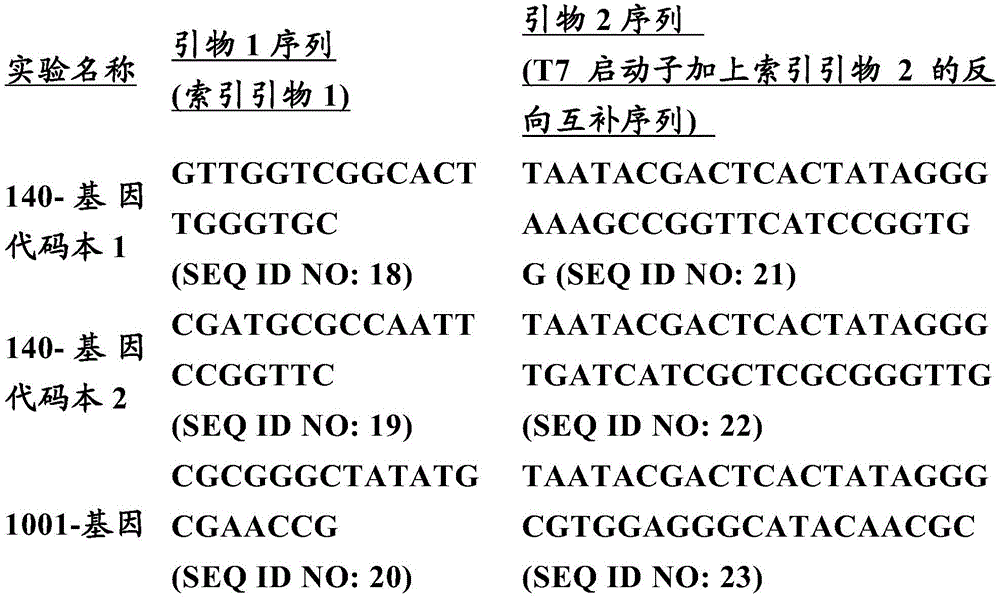
通过串接上述产生的相同正交引物组的片段(通过将一个20-nt引 物与另一个的10-nt片段组合)来生成30-nt长的读出序列。随后使用 BLAST+筛选这些读出序列的与索引引物序列和其它读出序列的正交 性(不超过11nt的同源性)和在人基因组中的潜在脱靶结合位点(不超 过14nt的同源性)。使用具有与读出序列互补的序列的荧光标记的读 出探针来探测这些读出序列,在每个杂交回合中探测一个读出序列。 所有使用的读出探针序列列于下面。A 30-nt long read was generated by concatenating fragments of the same orthogonal primer set generated above (by combining one 20-nt primer with a 10-nt fragment of the other). These reads were then screened using BLAST+ for orthogonality to the index primer sequence and other reads (no more than 11 nt of homology) and potential off-target binding sites (no more than 14 nt of homology) in the human genome ). These reads are probed using fluorescently labeled read probes having sequences complementary to the reads, one read per hybridization round. All read probe sequences used are listed below.
表3table 3


用于140-基因文库的读出探针是探针1至16。用于1001-基因实 验的读出探针是探针1至14。/3Cy5Sp/表示3'Cy5修饰。Readout probes for the 140-gene library were
为了设计编码探针的中心靶向序列,遵照使用Cufflinks v2.1的 IMR90细胞中不同转录物的丰度、来自ENCODE项目的总RNA数 据和来自Gencode v18的人类基因组注释。使用具有以下约束的 OligoArray2.1,从对应于最丰富的同种型的基因模型设计探针:靶序列区域的长度为30-nt;探针和细胞RNA靶标的杂交区域的解链温度 大于70℃;在解链温度大于72℃时不存在交叉杂交靶标;在解链温度 大于76℃时不存在预测的内部次级结构;以及不存在6个或更多个相 同核苷酸的连续重复。调整解链温度以优化这些探针的特异性并使次 级结构最小化,同时仍然产生足够数目的用于文库的探针。为了降低 计算成本,将同种型分成1-kb区域以用于探针设计。通过使用 BLAST+,拒绝映射至不止一个细胞RNA种类的所有潜在探针。保留 在同一RNA上具有多个靶的探针。To design central targeting sequences encoding probes, the abundance of different transcripts in IMR90 cells using Cufflinks v2.1, total RNA data from the ENCODE project and human genome annotations from Gencode v18 were followed. Probes were designed from gene models corresponding to the most abundant isoforms using OligoArray2.1 with the following constraints: the length of the target sequence region is 30-nt; the melting temperature of the hybridization region of the probe and the cellular RNA target is greater than 70 °C; absence of cross-hybridizing targets at melting temperatures greater than 72°C; absence of predicted internal secondary structures at melting temperatures greater than 76°C; and absence of consecutive repeats of 6 or more identical nucleotides. The melting temperature is adjusted to optimize the specificity of these probes and minimize secondary structure, while still generating a sufficient number of probes for the library. To reduce computational cost, isoforms were divided into 1-kb regions for probe design. By using BLAST+, reject all potential probes that map to more than one cellular RNA species. Probes with multiple targets on the same RNA are retained.
对于140-基因实验中的每个基因,通过串接合适的索引引物、读 出序列和靶向区域来产生198个推定的编码探针序列,如图13所示。 为了解决这些序列的串接引入具有与脱靶RNA的同源性的新区域的 可能性,使用BLAST+来针对所有人rRNA和tRNA序列以及高表达 基因(FPKM>10,000的基因)筛选这些推定序列。除去与rRNA或tRNA 具有大于14nt的同源性或与高度表达的基因具有大于17nt的同源性 的探针。在这些切除之后,对于140-基因实验中使用的两个MHD4 代码本,每个基因存在~192个(标准偏差为2)探针。如下使用用于1001- 基因实验的相同方案:从每个基因的96个推定的靶向序列开始,在这 些额外的同源性切除之后,获得每个基因~94个(标准偏差为6)编码探 针。对于1001-基因实验,减少每种RNA的编码探针数目,以使得这 些探针可从单个100,000-成员寡核苷酸库而非两个分开的库合成。每 个编码探针被设计来包含与每个代码字相关的4个读出序列中的两 个,因此在任何给定的杂交回合中,仅一半的结合的编码探针可以结 合读出探针。使用每种RNA~192或~94个编码探针来获得个体RNA 分子的高信号-背景比。每种RNA的编码探针的数目可被显著减少, 但仍允许鉴定单个RNA分子。另外,增加每个编码探针的读出序列 的数目或使用光学切片方法以减少荧光背景可允许进一步减少每种 RNA的编码探针的数目。For each gene in the 140-gene experiment, 198 putative coding probe sequences were generated by concatenating appropriate index primers, readout sequences and targeting regions, as shown in Figure 13. To address the potential for the tandem of these sequences to introduce new regions with homology to off-target RNAs, BLAST+ was used to screen these putative sequences against all human rRNA and tRNA sequences as well as highly expressed genes (genes with FPKM > 10,000). Probes with greater than 14 nt homology to rRNA or tRNA or greater than 17 nt homology to highly expressed genes were removed. Following these excisions, there were ~192 (standard deviation of 2) probes per gene for the two MHD4 codebooks used in the 140-gene experiment. The same protocol used for the 1001-gene experiment was used as follows: starting with 96 putative targeting sequences per gene, after these additional homology excisions, ~94 (standard deviation of 6) codes per gene were obtained probe. For 1001-gene experiments, the number of coding probes for each RNA was reduced so that these probes could be synthesized from a single 100,000-member oligonucleotide pool rather than two separate pools. Each coding probe is designed to contain two of the 4 read sequences associated with each codeword, so in any given hybridization round only half of the bound coding probes can bind the read probes . High signal-to-background ratios for individual RNA molecules were obtained using -192 or -94 coding probes per RNA. The number of coding probes for each RNA can be significantly reduced while still allowing the identification of individual RNA molecules. Additionally, increasing the number of reads per coding probe or using optical sectioning methods to reduce fluorescent background may allow further reductions in the number of coding probes per RNA.
设计了两种类型的误鉴定对照。第一对照(空白字)没有用编码探 针表示。第二类型的对照(无靶标字)具有不靶向任何细胞RNA的编码 探针。这些探针的靶向区域包含经受用于设计上述RNA靶向序列的 相同约束的随机核苷酸序列。此外,针对人转录组筛选这些随机序列, 以确保它们对任何人RNA不具有显著的同源性(>14-nt)。140-基因测 量包含5个空白字和5个无靶标字。1001-基因测量包含11个空白字 和5个无靶标字。Two types of misidentification controls were designed. The first control (blank word) is not represented by the coded probe. A second type of control (no target word) has coding probes that do not target any cellular RNA. The targeting regions of these probes comprise random nucleotide sequences subject to the same constraints used to design the RNA targeting sequences described above. Furthermore, these random sequences were screened against the human transcriptome to ensure that they did not have significant homology (>14-nt) to any human RNA. The 140-gene measurement contains 5 blank words and 5 no-target words. The 1001-gene measurement contains 11 blank words and 5 no-target words.
探针合成。编码探针使用以下步骤合成,并且在图13中举例说明 该合成方案。Probe synthesis. Coding probes were synthesized using the following steps, and the synthesis scheme is illustrated in Figure 13.
步骤1:使用特异于所需探针组的引物序列,在Bio-Rad CFX96 上通过有限循环PCR扩增模板寡核苷酸库(CustomArray)。为了促进 通过体外转录的随后扩增,反向引物包含T7启动子。所有引物均通 过IDT合成。将该反应物进行柱纯化(Zymo DNA Clean andConcentrator;D4003)。Step 1: A template oligonucleotide library (CustomArray) was amplified by limited cycle PCR on a Bio-Rad CFX96 using primer sequences specific to the desired probe set. To facilitate subsequent amplification by in vitro transcription, the reverse primer contained the T7 promoter. All primers were synthesized by IDT. The reaction was subjected to column purification (Zymo DNA Clean and Concentrator; D4003).
步骤2:随后按照制造商的说明书(New England Biolabs, E2040S),将纯化的PCR产物进一步扩增~200倍并通过高产率的体外 转录转化成RNA。每个20微升反应物含有~1微克来自上述的模板 DNA、10mM的每种NTP、1x反应缓冲液、1x RNA酶抑制剂(PromegaRNasin,N2611)和2微升的T7聚合酶。将该反应物在37℃下温育4 小时以最大化产率。在下列步骤之前不纯化该反应物。Step 2: The purified PCR product was then further amplified -200-fold and converted to RNA by high yield in vitro transcription following the manufacturer's instructions (New England Biolabs, E2040S). Each 20 microliter reaction contained -1 microgram of template DNA from above, 10 mM of each NTP, 1x reaction buffer, 1x RNase inhibitor (PromegaRNasin, N2611), and 2 microliters of T7 polymerase. The reaction was incubated at 37°C for 4 hours to maximize yield. The reaction was not purified prior to the following steps.
步骤3:随后通过逆转录反应将来自上述体外转录反应的RNA产 物转化回DNA。每个50微升反应物含有来自步骤2的未纯化的RNA 产品,其补充有1.6mM的每种dNTP、2nmol的逆转录引物、300 单位的Maxima H逆转录酶(Thermo Scientific,EP0751)、60单位的RNasin和最终1x浓度的Maxima RT缓冲液。将该反应物在50℃温 育45分钟,并将逆转录酶在85℃灭活5分钟。140-基因文库的模板 含有用于该逆转录步骤的共同引发区;因此,当生成这些探针时,将 单个引物用于该步骤。其序列为CGGGTTTAGCGCCGGAAATG (SEQ ID NO:40)。对于1001-基因文库,不包括共同的引发区;因此, 用正向引物:CGCGGGCTATATGCGAACCG(SEQ ID NO:20)进行 逆转录。Step 3: The RNA product from the above in vitro transcription reaction is then converted back to DNA by a reverse transcription reaction. Each 50 microliter reaction contained the unpurified RNA product from
步骤4:为了除去模板RNA,将20微升0.25M EDTA和0.5N NaOH添加至上述反应中以选择性水解RNA,并将样品在95℃下温 育10分钟。随后立即使用100微克容量柱(ZymoResearch,D4030)和 Zymo Oligo Clean and Concentrator方案通过柱纯化来纯化该反应物。将最终的探针在100微升不含RNA酶的去离子水中洗脱,在真 空浓缩器中蒸发,随后重悬于10μL编码杂交缓冲液(见下文)中。将 探针于-20℃储存。使用变性聚丙烯酰胺凝胶电泳和吸收光谱来确认探 针的质量,并且揭示该探针合成方案将90-100%的逆转录引物转化为 全长探针,并且在构建的探针中,70-80%在纯化步骤期间被回收。Step 4: To remove template RNA, 20 microliters of 0.25M EDTA and 0.5N NaOH were added to the above reaction to selectively hydrolyze the RNA, and the samples were incubated at 95°C for 10 minutes. The reaction was then immediately purified by column purification using a 100 microgram capacity column (ZymoResearch, D4030) and the Zymo Oligo Clean and Concentrator protocol. The final probe was eluted in 100 [mu]L of RNase-free deionized water, evaporated in a vacuum concentrator, and then resuspended in 10 [mu]L of encoding hybridization buffer (see below). Store the probes at -20°C. Denaturing polyacrylamide gel electrophoresis and absorption spectroscopy were used to confirm the quality of the probes and reveal that this probe synthesis protocol converts 90-100% of the reverse transcription primers to full-length probes, and among the constructed probes, 70 -80% was recovered during the purification step.
荧光标记的读出探针具有与上文描述的读出序列互补的序列和附 接在3'末端的Cy5染料。这些探针获自IDT并经HPLC纯化。The fluorescently labeled readout probe has a sequence complementary to the readout sequence described above and a Cy5 dye attached to the 3' end. These probes were obtained from IDT and purified by HPLC.
样品制备和利用编码探针的标记。将人原代成纤维细胞(美国典型 培养物保藏中心,IMR90)用于此项工作。这些细胞相对大且扁平,便 于宽视场成像,而无需光学切片。用伊格尔最低必需培养基培养细胞。 将细胞以350,000个细胞/盖玻片接种在22-mm,#1.5盖玻片 (Bioptechs,0420-0323-2)上,并在37℃下用5%CO2在陪替氏培养皿 中温育48-96小时。将细胞在室温下于1x磷酸缓冲盐水(PBS;Ambion, AM9625)中的4%多聚甲醛(ElectronMicroscopy Sciences,15714)中固 定20分钟,用0.1%w/v硼氢化钠(Sigma,480886)水溶液还原5分钟 以减少背景荧光,用冰冷的1x PBS洗涤三次,在室温下用在1x PBS 中的0.5%v/v Triton(Sigma,T8787)透化2分钟,并用冰冷的1x PBS 洗涤三次。Sample Preparation and Labeling Using Encoded Probes. Human primary fibroblasts (American Type Culture Collection, IMR90) were used for this work. These cells are relatively large and flat, facilitating wide-field imaging without the need for optical sectioning. Cells were grown in Eagle's minimum essential medium. Cells were seeded on 22-mm, #1.5 coverslips (Bioptechs, 0420-0323-2) at 350,000 cells/coverslip and incubated in petri dishes at 37°C with 5% CO 48-96 hours. Cells were fixed in 4% paraformaldehyde (Electron Microscopy Sciences, 15714) in 1x phosphate buffered saline (PBS; Ambion, AM9625) for 20 minutes at room temperature with 0.1% w/v sodium borohydride (Sigma, 480886) in water Reduced for 5 minutes to reduce background fluorescence, washed three times with ice-cold 1x PBS, permeabilized with 0.5% v/v Triton (Sigma, T8787) in 1x PBS for 2 minutes at room temperature, and washed three times with ice-cold 1x PBS.
将细胞在包含2x盐水-柠檬酸钠缓冲液(SSC)(Ambion,AM9763)、 30%v/v甲酰胺(Ambion,AM9342)和2mM氧钒核糖核苷复合物(NEB, S1402S)的编码洗涤缓冲液中温育5分钟。向含有细胞的盖玻片加入 10微升的编码杂交缓冲液中的100微摩尔(140-基因实验)或200微摩 尔(1001-基因实验)编码探针,并通过将另一个盖玻片放置在样品顶部 来将其均匀铺展。随后将样品在37℃杂交炉内的湿室中温育18-36小 时。编码杂交缓冲液包含补充有1mg/mL酵母tRNA(Life Technologies, 15401-011)和10%w/v硫酸葡聚糖(Sigma,D8906-50G)的编码洗涤缓 冲液。Cells were washed in encoding containing 2x saline-sodium citrate buffer (SSC) (Ambion, AM9763), 30% v/v formamide (Ambion, AM9342) and 2 mM vanadyl ribonucleoside complex (NEB, S1402S) Incubate in buffer for 5 minutes. Add 10 µl of 100 µmol (140-gene assay) or 200 µmol (1001-gene assay) coding probe in coding hybridization buffer to the coverslip containing the cells, and place the probe by placing another coverslip. Spread it evenly on top of the sample. The samples were then incubated in a humid chamber in a hybridization oven at 37°C for 18-36 hours. The coding hybridization buffer contained coding wash buffer supplemented with 1 mg/mL yeast tRNA (Life Technologies, 15401-011) and 10% w/v dextran sulfate (Sigma, D8906-50G).
随后用初级编码洗涤缓冲液洗涤细胞,在47℃温育10分钟,并 重复该洗涤共三次。将在2xSSC中的0.2微米直径的羧酸酯修饰的橙 色荧光珠(Life Technologies,F-8809)的1:1000稀释物超声处理3分钟, 随后与样品温育5分钟。将珠用作基准标志物以对齐从多个连续回合 的杂交获得的图像,如下所述。将样品用2xSSC洗涤一次,随后在室 温下用2×SSC中的4%v/v多聚甲醛后固定30分钟。随后将样品用 2xSSC洗涤三次,并立即成像或在成像前在4℃下储存不长于12小时。 将所有溶液制备为不含RNA酶。Cells were then washed with primary coding wash buffer, incubated at 47[deg.]C for 10 minutes, and the wash was repeated a total of three times. A 1:1000 dilution of 0.2 micron diameter carboxylate-modified orange fluorescent beads (Life Technologies, F-8809) in 2xSSC was sonicated for 3 minutes, followed by incubation with the samples for 5 minutes. Beads were used as fiducial markers to align images obtained from multiple consecutive rounds of hybridization, as described below. The samples were washed once with 2xSSC and then postfixed with 4% v/v paraformaldehyde in 2xSSC for 30 minutes at room temperature. Samples were then washed three times with 2xSSC and imaged immediately or stored at 4°C for no longer than 12 hours prior to imaging. All solutions were prepared RNase free.
利用多个连续回合杂交的MERFISH成像。将样品盖玻片装配至 Bioptech的FCS2流动室中,并且通过由三个计算机控制的8通阀 (Hamilton,MVP和HVXM 8-5)和计算机控制的蠕动泵(Rainin, Dynamax RP-1)组成的自制流体系统控制通过该室的流动。将样品在 围绕Olympus IX-71主体和1.45NA、100x油浸物镜构造的并配置来 用于斜入射激发的自制显微镜上成像。使用Bioptechs物镜加热器将 物镜加热至37℃。使用自制自动对焦系统在整个成像过程中保持恒定 的对焦。使用分别用于激发Cy5标记的读出探针、基准珠和核复染剂 的固态激光器(MPB通信,VFL-P500-642;Coherent, 561-200CWCDRH;和Coherent,1069413/AT)在641nm、561nm 和405nm提供照明。将这些线与定制的二向色(Chroma,zy405/488/561/647/752RP-UF1)组合,并用定制的二向色(Chroma, ZET405/488/561/647-656/752m)过滤发射。使用二向色T560lpxr、 T650lpxr、750dcxxr(Chroma)和发射滤光片ET525/50m、 WT59550m-2f、ET700/75m、HQ770lp(Chroma),利用 QuadView(Photometrics)分离荧光,并用EMCCD照相机(Andor, iXon-897)成像。这样配置相机,以使得像素对应于样品平面中的167 nm。整个系统是完全自动化的,从而使得能够在无需用户干预的情况 下对整个实验进行成像和流体处理。MERFISH imaging using multiple consecutive rounds of hybridization. The sample coverslips were assembled into Bioptech's FCS2 flow cell and consisted of three computer-controlled 8-port valves (Hamilton, MVP and HVXM 8-5) and a computer-controlled peristaltic pump (Rainin, Dynamax RP-1) A homemade fluid system controls the flow through the chamber. Samples were imaged on a homemade microscope constructed around an Olympus IX-71 body and a 1.45NA, 100x oil immersion objective and configured for oblique incidence excitation. Objectives were heated to 37°C using a Bioptechs objective heater. Use a homemade autofocus system to maintain constant focus throughout the imaging process. Solid-state lasers (MPB Communications, VFL-P500-642; Coherent, 561-200CWCDRH; and Coherent, 1069413/AT) at 641 nm, 561 nm were used to excite Cy5-labeled readout probes, fiducial beads, and nuclear counterstain, respectively. and 405nm provide illumination. These lines were combined with a custom dichroic (Chroma, zy405/488/561/647/752RP-UF1) and the emission filtered with a custom dichroic (Chroma, ZET405/488/561/647-656/752m). Fluorescence was separated with QuadView (Photometrics) using dichroic T560lpxr, T650lpxr, 750dcxxr (Chroma) and emission filters ET525/50m, WT59550m-2f, ET700/75m, HQ770lp (Chroma) and EMCCD camera (Andor, iXon- 897) imaging. The camera is configured such that the pixels correspond to 167 nm in the sample plane. The entire system is fully automated, enabling imaging and fluid handling of the entire experiment without user intervention.
序贯杂交、成像和漂白如下进行。将1mL的读出杂交缓冲液 (2xSSC;10%v/v甲酰胺;10%w/v硫酸葡聚糖和2mM氧钒核糖核 苷复合物)中的10nM的合适的荧光标记的读出探针流过样品,停止 流动,并将样品温育15分钟。随后将2mL读出洗涤缓冲液(2xSSC, 20%v/v甲酰胺;和2mM氧钒核糖核苷复合物)流过样品,停止流动, 将样品温育3分钟。将2mL包含2xSSC、50mM TrisHCl pH 8、10% w/v葡萄糖、2mM Trolox(Sigma-Aldrich,238813)、0.5mg/mL葡萄 糖氧化酶(Sigma-Aldrich,G2133)和40微克/mL过氧化氢酶 (Sigma-Aldrich,C30)的成像缓冲液流过样品。随后停止流动,随后 将约75至100个区域暴露于~25mW 642-nm和1mW的561-nm光并 成像。每个区域为40微米×40微米。在显微镜后端口测量激光功率。 因为成像缓冲液对氧气敏感,所以在实验开始时新鲜制备用于单个实 验的~50mL成像缓冲液,随后在整个测量过程中将其储存在一层矿物 油下方。以该方式储存的缓冲液稳定超过24小时。Sequential hybridization, imaging and bleaching were performed as follows. 10 nM of the appropriate fluorescently labeled readout probe in 1 mL of readout hybridization buffer (2xSSC; 10% v/v formamide; 10% w/v dextran sulfate and 2 mM vanadyl ribonucleoside complex) The needle flows through the sample, the flow is stopped, and the sample is incubated for 15 minutes. 2 mL of readout wash buffer (2xSSC, 20% v/v formamide; and 2 mM vanadyl ribonucleoside complex) was then flowed through the sample, the flow was stopped, and the sample was incubated for 3 minutes. 2 mL containing 2xSSC, 50
成像后,读出探针的荧光通过光漂白消除。用2mL光漂白缓冲 液(2xSSC和2mM氧钒核糖核苷复合物)洗涤样品,并将样品的每个 成像区域暴露于200mW的641-nm光,持续3秒。为了确认该光漂 白处理的功效,再次引入成像缓冲液,并且如上所述对样品成像。After imaging, the fluorescence of the readout probe is eliminated by photobleaching. Samples were washed with 2 mL of photobleaching buffer (2xSSC and 2 mM vanadyl ribonucleoside complex), and each imaged area of the sample was exposed to 200 mW of 641-nm light for 3 seconds. To confirm the efficacy of this photobleaching treatment, imaging buffer was reintroduced and the samples were imaged as described above.
对于使用MHD4码的140-基因测量重复上述杂交、成像和光漂白 过程16次,或对于使用MHD2码的1001-基因测量重复所述过程14 次。整个实验通常在~20小时内完成。The hybridization, imaging and photobleaching process described above was repeated 16 times for the 140-gene measurement using the MHD4 code, or 14 times for the 1001-gene measurement using the MHD2 code. The entire experiment is usually completed in ~20 hours.
在成像完成后,将2mL的2×SSC中的Hoescht(ENZ-52401)的 1:1000稀释物流过该室以标记细胞的细胞核。随后立即用2mL的 2×SSC,随后用2mL的成像缓冲液洗涤样品。随后将样品的每个区 域再次用~1mW的405nm光成像。After imaging was complete, 2 mL of a 1:1000 dilution of Hoescht (ENZ-52401) in 2xSSC was flowed through the chamber to label the nuclei of cells. The samples were immediately washed with 2 mL of 2xSSC followed by 2 mL of imaging buffer. Each area of the sample was then imaged again with ~1 mW of 405 nm light.
因为细胞使用利用斜入射照明的宽场成像进行成像而无光学切片 和z扫描,所以使用常规smFISH对6个不同RNA种类定量成像几 何结构的轴向范围之外的个体RNA种类的分数。为此目的,通过在 通过细胞的整个深度的不同焦深处收集图像的堆叠,对这些细胞进行 光学切片。将图像在连续的焦平面中对齐,随后为每个细胞计算在三 维堆叠中检测的但不在基本焦平面中检测到的RNA的分数。发现只 有小部分,15%+/-1%(跨6个不同的RNA种类的平均值+/-SEM) 的RNA分子在没有z扫描的固定焦平面的成像范围之外。这些测量 还证实,激发几何结构照射细胞的完整深度。可在MERFISH中采用 任何光学切片技术来允许在较厚的细胞或组织中对RNA进行成像。Because cells were imaged using widefield imaging with oblique incidence illumination without optical sectioning and z-scanning, the fraction of individual RNA species outside the axial extent of the imaging geometry was quantified using conventional smFISH for 6 different RNA species. For this purpose, these cells are optically sectioned by collecting stacks of images at different focal depths through the entire depth of the cells. Images were aligned in successive focal planes, and the fraction of RNA detected in the three-dimensional stack but not in the base focal plane was then calculated for each cell. Only a small fraction, 15% +/- 1% (average +/- SEM across 6 different RNA species) of RNA molecules were found to be outside the imaging range of the fixed focal plane without z-scan. These measurements also confirmed that the excitation geometry illuminates the full depth of the cell. Any optical sectioning technique can be employed in MERFISH to allow imaging of RNA in thicker cells or tissues.
测量的字的构建。使用多高斯拟合算法(推定具有167nm的均匀 宽度的高斯),在每个图像中鉴定和定位荧光斑点。该算法用于允许区 分和分别拟合部分重叠的斑点。通过设置使用该软件拟合斑点所需的 强度阈值,将RNA斑点与背景信号(即由非特异性结合的探针产生的 信号)区分开来。由于杂交回合之间的斑点亮度的变化,对每个杂交回 合适当地调整该阈值,以使所有杂交回合中的1-->0和0-->1误差率的 组合平均值最小化(140-基因测量),或使具有4个“1”位的测量的字 的数目与具有3个或5个“1”位的测量的字的数目的比率最大化(1001- 基因测量)。使用更快的单高斯拟合算法在每个帧中鉴定基准珠的位置。Measured word construction. Fluorescent spots were identified and localized in each image using a multi-Gaussian fitting algorithm (presumed to have a Gaussian of uniform width of 167 nm). This algorithm is used to allow partially overlapping blobs to be distinguished and fitted separately. RNA spots were distinguished from background signal (i.e., the signal produced by non-specifically bound probes) by setting the intensity threshold required to fit the spots using the software. Due to variations in spot brightness between hybridization runs, this threshold was adjusted appropriately for each hybridization run to minimize the combined mean of 1-->0 and 0-->1 error rates across all hybridization runs (140 - gene measurement), or maximize the ratio of the number of words with a measurement of 4 "1" bits to the number of words with a measurement of 3 or 5 "1" bits (1001-gene measurement). The position of the fiducial bead was identified in each frame using a faster single Gaussian fitting algorithm.
通过旋转和平移图像以对齐同一图像内的两个基准珠(所述两个 基准珠在通过图像相关性的粗初始对齐之后在位置上最相似)来记录 不同回合杂交中的同一样品区域的图像。将所有图像与由在第一回合 杂交中收集的图像建立的坐标系对齐。从5个另外的基准珠之间的残 留距离测定该对齐的质量,对齐误差通常为~20nm。Images of the same sample area in different rounds of hybridization were recorded by rotating and translating the image to align two fiducial beads within the same image that were most similar in position after a rough initial alignment by image correlation . All images were aligned to the coordinate system established from the images collected in the first round of hybridization. The quality of this alignment is determined from the residual distance between 5 additional reference beads, the alignment error is typically -20 nm.
如果斑点之间的距离小于1个像素(167nm),则将不同杂交回合 中的荧光斑点连接至对应于潜在RNA分子的单个串中。对于每个斑 点串,所有杂交回合中的荧光信号的开-关序列用于给潜在的RNA分 子分配二进制字,其中'1'被分配给含有高于阈值的荧光信号的杂交回 合,'0'被分配给其它杂交回合。随后使用上述16位MHD4码或14 位MHD2码将测量的字解码为RNA种类。在16位MHD4码的情况 下,如果测量的二进制字与特定RNA的代码字完全匹配或与所述代 码字相异一个单一位,则将其分配给该RNA。在14位MHD2码的情 况下,只有当测量的二进制字与特定RNA的代码字完全匹配时,才 将其分配给该RNA。为了测定每个细胞的拷贝数,在每个40微米× 40微米成像区域内的个体细胞中计数每个RNA种类的数目。注意, 该数目占细胞内的大多数但不是所有RNA分子,因为细胞的一部分 可以在成像区域或焦深之外。可采用相邻区域和相邻焦平面的平铺图 像来提高计数精度。If the distance between spots was less than 1 pixel (167 nm), the fluorescent spots in different hybridization rounds were linked into a single string corresponding to the potential RNA molecules. For each spot string, an on-off sequence of fluorescent signals in all hybridization rounds is used to assign binary words to potential RNA molecules, where '1' is assigned to hybridization rounds containing fluorescent signals above a threshold, and '0' are assigned to other hybrid rounds. The measured words are then decoded into RNA species using either the 16-bit MHD4 code or the 14-bit MHD2 code described above. In the case of a 16-bit MHD4 code, a measured binary word is assigned to a particular RNA if it matches exactly or differs from the codeword by a single bit. In the case of the 14-bit MHD2 code, the measured binary word is only assigned to a particular RNA if it exactly matches the codeword of that RNA. To determine copy number per cell, the number of each RNA species was counted in individual cells within each 40 μm × 40 μm imaged area. Note that this number accounts for most but not all RNA molecules within the cell, as part of the cell may be outside the imaging area or depth of focus. Tile images of adjacent regions and adjacent focal planes can be used to improve counting accuracy.
在140-基因实验中,细胞核的一些区域偶尔含有太多的荧光信号 以至不能正确地鉴定个体RNA斑点。在1001-基因实验中,细胞核通 常含有太多的荧光信号以至于不能允许鉴定个体RNA分子。这些亮 区被排除在所有随后的分析之外。该工作侧重于富集在细胞质中的 mRNA。为了估计通过排除核区域遗失的mRNA的分数,使用常规 smFISH来定量在核内部发现的6个不同mRNA种类的分子分数。发 现在核中仅发现5%+/-2%(跨6个RNA种类的平均值+/-SEM)的这 些RNA分子。超分辨率成像和/或光学切片的使用可能允许鉴定这些致密核区中的个体分子,这对于探测那些富集在核中的非编码RNA 特别有用。In the 140-gene experiment, some regions of the nucleus occasionally contained too much fluorescent signal to correctly identify individual RNA spots. In 1001-gene experiments, the nucleus often contains too much fluorescent signal to allow identification of individual RNA molecules. These bright areas were excluded from all subsequent analyses. This work focuses on mRNAs enriched in the cytoplasm. To estimate the fraction of mRNA lost by excluding nuclear regions, conventional smFISH was used to quantify the molecular fraction of 6 different mRNA species found inside the nucleus. Only 5% +/- 2% (mean +/- SEM across 6 RNA species) of these RNA molecules were found in the nucleus. The use of super-resolution imaging and/or optical sectioning may allow the identification of individual molecules in these dense nuclear regions, which is particularly useful for probing those noncoding RNAs that are enriched in the nucleus.
个体基因的smFISH测量。每种RNA的48个荧光标记的(Quasar 670)寡核苷酸探针的库购自Biosearch Technologies。直接从用于多路 复用测量的靶向区域的随机亚组获取30-nt的探针序列。如上所述固 定和透化细胞。将10微升编码杂交缓冲液(如上所述)中的250nM寡 核苷酸探针添加至含细胞的盖玻片上,并通过在样品顶部放置另一个 盖玻片将其均匀铺展。随后将样品在37℃杂交炉内的湿室中温育18 小时。随后用编码洗涤缓冲液(如上所述)在37℃下洗涤细胞10分钟, 并重复该洗涤共三次。随后将样品用2xSSC洗涤三次并使用与上文针 对MERFISH所述的相同的成像几何学在成像缓冲液中成像。smFISH measurements of individual genes. A library of 48 fluorescently labeled (Quasar 670) oligonucleotide probes for each RNA was purchased from Biosearch Technologies. 30-nt probe sequences were obtained directly from random subsets of targeted regions for multiplexing measurements. Cells were fixed and permeabilized as described above. 10 microliters of 250 nM oligonucleotide probe in encoding hybridization buffer (as described above) was added to the cell-containing coverslip and spread evenly by placing another coverslip on top of the sample. The samples were then incubated for 18 hours in a humid chamber in a hybridization oven at 37°C. Cells were then washed with coded wash buffer (as described above) at 37°C for 10 minutes, and the wash was repeated a total of three times. Samples were then washed three times with 2xSSC and imaged in imaging buffer using the same imaging geometry as described above for MERFISH.
批量RNA测序(Bulk RNA sequencing)。使用Zymo Quick RNA MiniPrep试剂盒(R1054),按照制造商的说明书从如上培养的IMR90 细胞中提取总RNA。随后选择polyA RNA(NEB;E7490),并使用 NEBNext Ultra RNA文库制备试剂盒(NEB;E7530)构建测序文库,用定制的寡核苷酸进行扩增,从MiSeq获得150-bp的读数。将这些序 列与人基因组(Gencodev18)比对,并用cufflinks计算同种型丰度。Bulk RNA sequencing. Total RNA was extracted from IMR90 cells cultured as above using the Zymo Quick RNA MiniPrep Kit (R1054) according to the manufacturer's instructions. PolyA RNA (NEB; E7490) was subsequently selected, and a sequencing library was constructed using the NEBNext Ultra RNA Library Prep Kit (NEB; E7530), amplified with custom oligonucleotides, and 150-bp reads obtained from MiSeq. These sequences were aligned to the human genome (Gencodev18) and isoform abundances were calculated using cufflinks.
不同编码方案的预测缩放和误差属性的计算。针对可能的代码字 的数目、调用率和误鉴定率对N的依赖性导出分析表达式。调用率被 定义为被正确鉴定的RNA分子的分数。误鉴定率定义为被误鉴定为 错误RNA种类的RNA分子的分数。对于具有误差检测能力的编码方 案,调用率和误鉴定率加起来达不到1,因为未被正确调用的分子的 分数可被检测为误差并被弃去,因此不被误鉴定为错误的种类。这些 计算假定误读位的概率对于所有杂交回合是恒定的,但对于1-->0和 0-->1的误差是不同的。将实验测量的平均1-->0和0-->1误差率(分别 为10%和4%)用于图5B-5D所示的估算。为简单起见,未从计算中移 除对应于所有'0'的字。Predictive scaling and computation of error properties for different coding schemes. Analytical expressions are derived for the dependence of the number of possible codewords, call rate, and misidentification rate on N. The calling rate was defined as the fraction of correctly identified RNA molecules. The misidentification rate was defined as the fraction of RNA molecules that were misidentified as the wrong RNA species. For encoding schemes with error detection capabilities, the calling rate and the false identification rate do not add up to 1, because the fraction of molecules that are not correctly called can be detected as errors and discarded, and thus not misidentified as the wrong species . These calculations assume that the probability of misread bits is constant for all hybridization runs, but differs for 1-->0 and 0-->1 errors. The experimentally measured mean 1-->0 and 0-->1 error rates (10% and 4%, respectively) were used for the estimates shown in Figures 5B-5D. For simplicity, words corresponding to all '0's are not removed from the calculation.
对于其中所有可能的N位二进制字被分配给独特RNA种类的简 单二进制编码方案,可能的代码字的数目是2N。可用于编码RNA的 字的数目实际上是2N-1,因为代码字'00...0'在任何杂交回合中不含可 检测的荧光,但是为了简单起见,对应于所有'0'的字未从随后的计算 中移除。由该近似引入的误差是可忽略的。对于具有m个‘1’和N-m 个‘0’的任何给定的字,测量无误差的该字的概率(被正确调用的RNA 的分数)是:For a simple binary coding scheme in which all possible N-bit binary words are assigned to unique RNA species, the number of possible code words is 2N . The number of words available to encode RNA is actually 2N -1, since the codewords '00...0' have no detectable fluorescence in any hybridization round, but for simplicity, correspond to all '0''s Words are not removed from subsequent calculations. The error introduced by this approximation is negligible. For any given word with m '1's and Nm '0's, the probability of measuring that word without error (fraction of correctly called RNAs) is:
(1-p1)m(1-p0)N-m, (1)(1-p 1 ) m (1-p 0 ) Nm , (1)
其中p1为每位1-->0的误差率,p0为每位0-->1的误差率。因为 该简单的二进制编码方案中的不同的字可具有不同数目的“1”位,因 此如果p1≠p0,则不同字的调用率将不同。根据所有字的等式(1)的值的 加权平均值测定平均调用率(如图5C中报告的)。该加权平均值为:Among them, p 1 is the error rate of 1-->0 per bit, and p 0 is the error rate of 0-->1 per bit. Because different words in this simple binary encoding scheme can have different numbers of "1" bits, the recall rates for different words will be different if p 1 ≠ p 0 . The average call rate (as reported in Figure 5C) was determined from the weighted average of the values of equation (1) for all words. The weighted average is:

其中

为了计算扩展汉明距离4(HD4)码的缩放和误差属性,首先创建使 用标准方法的期望数目的数据位的生成矩阵。生成矩阵测定在给定编 码方案中存在的特定字,并且用于直接测定作为位数的函数的编码的 字的数目。在该编码方案中,调用率对应于无误差情况下的测量的字 的分数以及在单一位误差情况下的测量的字的分数。对于具有m个‘1’ 位的代码字,该分数通过以下表达式测定:To compute the scaling and error properties of an Extended Hamming Distance 4 (HD4) code, a generator matrix for the desired number of data bits using standard methods is first created. The generator matrix determines the specific words present in a given encoding scheme, and is used to directly determine the number of encoded words as a function of the number of bits. In this coding scheme, the recall rate corresponds to the fraction of words measured with no error and the fraction of words measured with a single-bit error. For a codeword with m '1' bits, the score is determined by the following expression:
(1-p1)m(1-p0)N-m+mp1 1(1-p1)m-1(1-p0)N-m+(N-m)p0 1(1-p1)m(1-p0)N-m-1 (4)(1-p 1 ) m (1-p 0 ) Nm +mp 1 1 (1-p 1 ) m-1 (1-p 0 ) Nm +(Nm)p 0 1 (1-p 1 ) m (1 -p 0 ) Nm-1 (4)
其中第一项是不产生任何误差的概率,第二项对应于在m个‘1’ 位的任何位产生一个1-->0的误差而不造成任何其它0-->1误差的总概 率,最后的项对应于在N-m个‘0’位的任何位产生一个0-->1的误差而 不造成任何1-->0的误差的总概率。因为在该编码方案中‘1’位的数目 在字之间可以不同,所以图5C中报告的平均调用率是根据针对m的 不同值的等式(4)的加权平均值计算的。根据从上述生成矩阵测定的包 含m个‘1’位的字的数目来测定每个项的权重。where the first term is the probability of not generating any error, and the second term corresponds to the total probability of generating a 1-->0 error at any of the m '1' bits without any other 0-->1 error , the last term corresponds to the total probability of generating a 0-->1 error at any of the N-m '0' bits without causing any 1-->0 error. Because the number of '1' bits can vary from word to word in this encoding scheme, the average recall rate reported in Figure 5C is calculated from the weighted average of equation (4) for different values of m. The weight of each entry is determined according to the number of words containing m '1' bits determined from the above generator matrix.
因为RNA编码字被为4的最小汉明距离分开,所以需要至少4 个误差来将一个字转换成另一个字。如果应用误差校正,则3或5个 误差也可将一种RNA转化为另一种RNA。因此,对具有m个‘1’位的 代码字估计来自3位、4位和5位误差的所有可能组合的误鉴定率。 技术上,>5位误差也可将一种RNA转换为另一种RNA,但由于每位 误差率较小,所以产生此类误差的概率是可以忽略的。该表达式近似 为:Because RNA encoded words are separated by a minimum Hamming distance of 4, at least 4 errors are required to convert one word to another. If error correction is applied, 3 or 5 errors can also convert one RNA to another. Therefore, the false identification rate from all possible combinations of 3-bit, 4-bit and 5-bit errors is estimated for a codeword with m '1' bits. Technically, >5 bit errors can also convert one RNA to another, but due to the small error rate per bit, the probability of such errors is negligible. This expression is approximately:
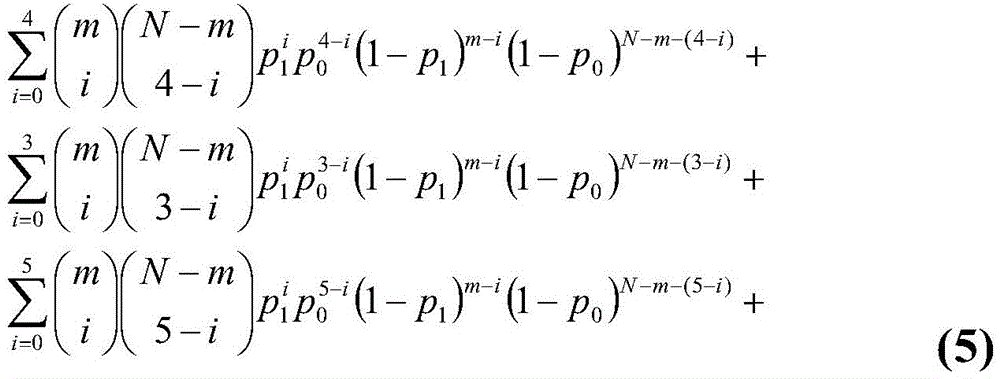
第一和对应于其中可产生正好4个错误的所有方式。类似地,第 二及第三和对应于其中可产生正好3个或5个误差的所有方式。等式 (5)提供误鉴定率的上限,因为不是所有3个、4个或5个位误差产生 与另一个正确字匹配或将被校正为另一个正确字的字。再次地,因为 ‘1’位的数目在字之间可以不同,所以图5D中报告的平均误鉴定率被 计算为针对具有m个‘1’位的字的数目的等式(5)的加权平均值。The first sum corresponds to all ways in which exactly 4 errors can be generated. Similarly, the second and third sums correspond to all ways in which exactly 3 or 5 errors can occur. Equation (5) provides an upper bound on the false identification rate, since not all 3, 4 or 5 bit errors result in a word that matches or will be corrected to another correct word. Again, because the number of '1' bits can vary from word to word, the average false identification rate reported in Figure 5D is calculated as a weight of equation (5) for the number of words with m '1' bits average value.
为了产生其中每个代码字的“1”位的数目被设置为4的MHD4 码,首先如上所述生成HD4码,随后去除不包含4个“1”的所有代 码字。图5C中报告的该码的调用率直接根据公式(4)计算,但m=4, 因为该码中的所有代码字具有4个‘1’位。利用以下考虑通过修改等式(5)来计算图5D中报告的该码的误鉴定率:(i)‘1’位的数目m被设置为 4,并且(ii)排除产生不含4个、3个或5个‘1’位的字的误差。因此, 等式(5)简化为To generate the MHD4 code in which the number of "1" bits per codeword is set to 4, the HD4 code is first generated as described above, and then all codewords that do not contain 4 "1"s are removed. The recall rate for this code reported in Figure 5C is calculated directly from equation (4), but with m=4 since all codewords in this code have 4 '1' bits. The misidentification rate for this code reported in Figure 5D is calculated by modifying Equation (5) using the following considerations: (i) the number m of '1' bits is set to 4, and (ii) exclusion yields no 4, Error for words of 3 or 5 '1' bits. Therefore, equation (5) simplifies to

再次地,该表达式是实际误鉴定率的上限,因为并非所有具有4 个“1”的字都是有效代码字。Again, this expression is an upper bound on the actual false identification rate, since not all words with 4 "1"s are valid codewords.
每个杂交回合的1-->0和0-->1的误差率的估计。为了计算在给定 的杂交回合中误读位的概率,使用MHD4码的误差校正属性。简言之, 以下面的方式导出1-->0或0-->1的误差的概率。假设在第i位(即第i 个杂交回合)产生误差的概率为pi,并且给定种类的RNA分子的实际 数目为A,则对于该RNA的精确匹配的数目将是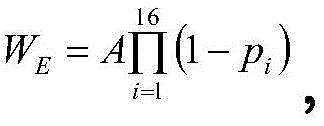


为了计算16个杂交回合中的每一个的平均1-->0或0-->1误差概 率,使用上述方法来计算每个基因的每个位的每位误差率,并且基于 这些误差是对应于1-->0还是0-->1误差来对其进行排序,以及采用通 过对于对应基因观察到的计数的数目加权的每个位的这些误差的平均 值。To calculate the average 1-->0 or 0-->1 error probability for each of the 16 hybridization rounds, the method described above was used to calculate the per-bit error rate for each bit of each gene, and based on these errors were corresponding They were ordered by 1-->0 or 0-->1 error, and the average of these errors for each bit was taken by weighting the number of counts observed for the corresponding gene.
从实际成像数据估计个体RNA种类的调用率。通过估计如上测 定的每回合杂交的1-->0或0-->1误差概率,有可能基于用于编码其的 特定字来估计每个RNA的调用率。具体地,正确调用的RNA种类的 分数由下式测定Estimate calling rates of individual RNA species from actual imaging data. By estimating the 1-->0 or 0-->1 error probability per round of hybridization as determined above, it is possible to estimate the calling rate of each RNA based on the specific word used to encode it. Specifically, the fraction of correctly called RNA species was determined by

其中第一项表示观察代码字的精确匹配的概率,第二项表示观察 误差校正匹配(即,具有1-位误差)的概率。每个RNA种类的每位误差 率pi的值通过该RNA的特定代码字和每回合杂交的测量的1-->0或 0-->1的误差率来测定。如果RNA的代码字在第i位包含‘1’,则从第 i个杂交回合的1-->0误差率测定pi;如果该字在第i位包含‘0’,则从 第i个杂交回合的0-->1误差率测定pi。where the first term represents the probability of observing an exact match of the codeword and the second term represents the probability of observing an error-corrected match (ie, with a 1-bit error). The value of the per-bit error rate pi for each RNA species was determined by the specific codeword for that RNA and the measured 1-->0 or 0-->1 error rate for each round of hybridization. If the codeword of the RNA contains a '1' at the ith position, then determine p i from the 1-->0 error rate of the ith hybridization round; if the word contains a '0' at the ith position, then from the ith The 0-->1 error rate of the hybridization round determines pi .
RNA丰度的共变化的层次聚类分析。如下进行140-基因和1001- 基因实验的基因表达的共变化的层次聚类。首先,将每对基因之间的 距离测定为1减去这两种RNA种类的测量的拷贝数(两者均通过细胞 中计数的总RNA标准化)的细胞间变化的皮尔逊相关系数。因此,高 度相关的基因彼此“更接近”,高度反相关的基因“进一步”分开。 随后使用非加权配对组算术平均法(UPGMA)从这些距离构建凝聚层 次聚类树。具体来说,从个体基因开始,通过根据所有簇间基因对之 间的距离的算术平均值鉴定彼此最接近的两个簇(或个体基因)来构建 层次聚类。随后将具有最小距离的聚类(或个体基因)对分组在一起, 并重复该过程。随后基于这些树内的基因的顺序对两两相关性的矩阵 进行排序。Hierarchical cluster analysis of co-variation in RNA abundance. Hierarchical clustering of co-changes in gene expression for 140-gene and 1001-gene experiments was performed as follows. First, the distance between each pair of genes was determined as 1 minus the Pearson correlation coefficient of the cell-to-cell variation of the measured copy numbers of these two RNA species (both normalized by the total RNA counted in the cells). Thus, genes that are highly correlated are "closer" to each other, and genes that are highly inversely correlated are "further" apart. An agglomerated hierarchical clustering tree was then constructed from these distances using the unweighted paired group arithmetic mean method (UPGMA). Specifically, starting from individual genes, hierarchical clusters are constructed by identifying the two clusters (or individual genes) that are closest to each other based on the arithmetic mean of the distances between gene pairs across all clusters. The pairs of clusters (or individual genes) with the smallest distances are then grouped together and the process is repeated. The matrix of pairwise correlations is then sorted based on the order of genes within these trees.
通过在层次聚类树上选择阈值(由图7D和10A中的虚线指示的) 来鉴定具有显著共变化的基因的组,对于140-基因实验,所述层次聚 类树产生约10个组的基因(其中每个组包含至少4个成员),或对于 1001-基因实验,产生约100个组的基因(其中每个组包含至少3个成 员)。注意,可以改变阈值以便鉴定更紧密偶联的较小组或具有相对宽 松偶联的较大组。Groups of genes with significant co-variation were identified by selecting thresholds (indicated by dashed lines in Figures 7D and 10A) on a hierarchical clustering tree that yielded approximately 10 groups for the 140-gene experiment. Genes (where each group contains at least 4 members), or for a 1001-gene experiment, generate about 100 groups of genes (where each group contains at least 3 members). Note that the threshold can be changed in order to identify smaller groups with tighter coupling or larger groups with relatively loose coupling.
通过计算该基因与该组的所有其它成员之间的平均相关系数与该 基因与该组外的所有其它测量的基因之间的平均相关系数之间的差异 来测定基因属于特定组的置信度的概率值。使用学生氏t检验来测定 该差异的显著性(p-值)。Confidence that a gene belongs to a particular group is determined by calculating the difference between the average correlation coefficient between the gene and all other members of the group and the average correlation coefficient between the gene and all other measured genes outside the group probability value. The significance (p-value) of this difference was determined using Student's t-test.
因为层次聚类固有地是一维分析,即任何给定的基因只能是单个 组的成员,所以该分析不允许鉴定所有相关的基因组。更高维度的分 析,诸如主成分分析或k均值聚类,可用于鉴定更多的共变基因簇。Because hierarchical clustering is inherently a one-dimensional analysis, i.e. any given gene can only be a member of a single group, this analysis does not allow the identification of all related groups of genes. Higher dimensional analysis, such as principal component analysis or k-means clustering, can be used to identify more covariant gene clusters.
RNA空间分布的分析。为了鉴定具有相似空间分布的基因,将每 个测量的细胞细分成2×2个区域,并计算存在于这些箱中的每一个中 的每个RNA种类的分数。为了控制细胞的一些区域天然地比其它区 域含有更多的RNA的事实,计算每个基因的富集,即对于给定的RNA 种类在给定的区域中观察到的分数与在该同一区域中对于所有基因观 察到的平均分数的比率。对于每对RNA种类,测定每个细胞的这两 个RNA种类的富集的区域间差异的皮尔逊相关系数,在7个独立数 据集中在超过~400个成像的细胞中取所述相关系数的平均值。随后使 用上述相同的层次聚类算法基于这些平均相关系数将RNA种类聚类。 由于大量细胞用于分析,因此发现粗空间分箱(每个细胞2×2个区域) 足以捕获基因之间的空间相关性,而更细致的分箱不产生更显著相关 的组。Analysis of RNA spatial distribution. To identify genes with similar spatial distributions, each measured cell was subdivided into 2 × 2 regions and the score for each RNA species present in each of these bins was calculated. To control for the fact that some regions of the cell naturally contain more RNA than others, the enrichment for each gene was calculated, i.e. the fraction observed in a given region for a given RNA species versus in that same region The ratio of the mean scores observed for all genes. For each pair of RNA species, a Pearson correlation coefficient was determined for the difference between the enriched regions of the two RNA species for each cell, taking the sum of the correlation coefficients in over -400 cells imaged in 7 independent data sets average value. RNA species were then clustered based on these average correlation coefficients using the same hierarchical clustering algorithm described above. Since a large number of cells were used for analysis, it was found that coarse spatial binning (2 x 2 regions per cell) was sufficient to capture spatial correlations between genes, while finer binning did not yield more significantly correlated groups.
为了测量基因与细胞核和与细胞边缘的距离,首先使用细胞图像 上的亮度阈值来分割所鉴定的细胞核和细胞边缘。随后测定从每个 RNA分子至细胞核的最近部分和细胞边缘的最近部分的距离。对于每 个数据集,随后计算针对所测量的所有细胞进行平均的每个RNA种 类的平均距离。对于组I基因、组II基因或所有基因取这些距离的平 均值。在该分析中,仅使用每个细胞具有至少10个计数的那些RNA 种类以最小化距离值的统计误差。To measure the gene's distance from the nucleus and from the cell edge, the identified nuclei and cell edges were first segmented using a luminance threshold on the cell image. The distance from each RNA molecule to the nearest part of the nucleus and the nearest part of the cell edge is then determined. For each dataset, the mean distance for each RNA species averaged over all cells measured was then calculated. These distances were averaged for Group I genes, Group II genes, or all genes. In this analysis, only those RNA species with at least 10 counts per cell were used to minimize statistical error in distance values.
基因本体论(GO)分析。如上所述,从层次树中选择基因组。使用 注释的GO项和紧接在所发现的注释的上游或下游的项,测定所有测 量的RNA种类以及与来自最近的人GO注释的每个组相关联的RNA 种类的GO项的集合。从具有该项的每个组内的基因的分数与具有该 项的所有测量的基因的分数的比率计算这些注释的富集,并且通过超 几何函数计算该富集的p-值。仅考虑p值小于0.05的统计学上显著富 集的GO项。Gene Ontology (GO) analysis. Genomes are selected from the hierarchical tree as described above. Using the annotated GO terms and terms immediately upstream or downstream of the annotations found, the set of GO terms for all measured RNA species and the RNA species associated with each group from the most recent human GO annotation was determined. The enrichment of these annotations was calculated from the ratio of the scores of genes within each group with the term to the scores of all measured genes with the term, and the p-value of this enrichment was calculated by a hypergeometric function. Only statistically significantly enriched GO terms with p-values less than 0.05 were considered.
虽然已在本文中描述和说明了几个本发明的实施方案,但本领域 普通技术人员将容易地设想用于进行所述功能和/或获得本文所述的 结果和/或一个或多个有利方面的各种其它方法和/或结构,并且这样 的变化和/或修改的每一种被认为在本文所述的本发明的实施方案的 范围内。更通常地,本领域技术人员将容易地理解,本文所述的所有 参数、尺度、材料和构型意欲为示例性的并且实际参数、尺度、材料 和/或构型将取决于对其使用本发明的教导的具体应用。本领域技术人 员将认可或能够确定本文所述的特定的本发明的实施方案的许多等同 物(通过使用不超过常规实验)。因此,应理解,前述实施方案仅通 过举例的方式提出,并且在所附权利要求和其等同物的范围内,本发 明的实施方案可按与明确描述和要求保护的方式不同的方式来实施。 本发明涉及本文所述的各种个体特性、系统、物品、材料、试剂盒和/ 或方法。另外,如果这样的特性、系统、物品、材料、试剂盒和/或方 法不是相互矛盾的,则两个或更多个这样的特性、系统、物品、材料、 试剂盒和/或方法的任意组合包括在本公开内容的发明范围内。While several embodiments of the invention have been described and illustrated herein, those of ordinary skill in the art will readily contemplate ways to perform the described functions and/or obtain the results and/or one or more advantages described herein Various other methods and/or structures of the aspects, and each of such variations and/or modifications are considered to be within the scope of the embodiments of the invention described herein. More generally, those skilled in the art will readily appreciate that all parameters, dimensions, materials and configurations described herein are intended to be exemplary and that actual parameters, dimensions, materials and/or configurations will depend on the use of the present Specific applications of the teachings of the invention. Those skilled in the art will recognize, or be able to ascertain using no more than routine experimentation, many equivalents to the specific embodiments of the invention described herein. Therefore, it is to be understood that the foregoing embodiments have been presented by way of example only, and that within the scope of the appended claims and their equivalents, embodiments of the invention may be practiced otherwise than as expressly described and claimed. The present invention relates to various individual characteristics, systems, articles, materials, kits and/or methods described herein. In addition, any combination of two or more such properties, systems, articles, materials, kits and/or methods is not contradictory if such properties, systems, articles, materials, kits and/or methods are not mutually exclusive Included within the scope of the invention of the present disclosure.
如本文中所定义和使用的,所有定义应当被理解为优先于词典定 义、通过引用并入的文献中的定义和/或所定义的术语的一般含义。As defined and used herein, all definitions should be understood to take precedence over dictionary definitions, definitions in documents incorporated by reference, and/or ordinary meanings of the defined terms.
除非明确地指示与之相反,否则不定冠词“一种/一个(a)”和“一 种/一个(an)”,如本文中在说明书和权利要求中所用,应当被理解 为意指“至少一种/一个”。Unless expressly indicated to the contrary, the indefinite articles "a/an(a)" and "an/an(an)", as used herein in the specification and claims, should be understood to mean " at least one/one".
短语“和/或”,如在本文中在说明书和权利要求中所用,应当被理 解为意指所连接的元素的“任一个或两者”,即元素在一些情况下结合 地存在以及在其它情况下分离地存在。利用“和/或”列出的多个元素 应当以相同的方式来解释,即所连接的元素的“一个或多个”。除通过 “和/或”从句明确确定的元素外,还可任选地存在其它元素,无论与 明确确定的那些元素相关还是无关。因此,作为非限定性实例,对“A 和/或B”的提及,当与开放性措辞诸如“包含/包括”结合使用时,在一 个实施方案中可仅指A(任选地包括除B外的元素);在另一个实施 方案中可仅指B(任选地包括除A外的元素);在另一个实施方案中, 可指A和B(任选地包括其它元素);依此类推。The phrase "and/or", as used herein in the specification and claims, should be understood to mean "either or both" of the linked elements, ie, the elements are present in combination in some instances and in others exist separately. Multiple elements listed with "and/or" should be construed in the same fashion, i.e., "one or more" of the conjoined elements. Other elements may optionally be present other than the elements expressly identified by the "and/or" clause, whether related or unrelated to those elements expressly identified. Thus, by way of non-limiting example, references to "A and/or B", when used in conjunction with open-ended phrases such as "comprises/includes," may in one embodiment refer to only A (optionally including other than elements other than B); in another embodiment may refer to only B (optionally including elements other than A); in another embodiment, may refer to both A and B (optionally including other elements); And so on.
如本文中在说明书和权利要求中所用,“或”应当被理解为具有与 如上定义的“和/或”相同的含义。例如,当在列表中分开各项时,“或” 或“和/或”应当被理解为是包含性的,即包含至少一个,但也包括许多 个元素或一列元素中的多于一个,以及任选地,包括另外未列出的项。 只有明确地指明相反的术语,例如“……中的仅一个”或“……中的恰好一个”或当用于权利要求中时的“由……组成”将指包含多个元素或一 列元素中的正好一个元素。一般地,如本文中所用的术语“或”应当仅 在冠有排他性的术语诸如“任一”、“……之一”、“……中的仅一 个”或“……中的恰好一个”时被解释为表示排他性选择(即“一个或另一个但非两个”)。“基本上由……组成”,当用于权利要求中时,应 当具有其在专利法领域中使用的普通含义。As used herein in the specification and claims, "or" should be understood to have the same meaning as "and/or" as defined above. For example, "or" or "and/or" when separating items in a list should be understood to be inclusive, ie to include at least one, but also a plurality of elements or more than one of a list of elements, and Optionally, items not listed otherwise are included. Only terms to the contrary, such as "only one of" or "exactly one of" or "consisting of" when used in a claim will mean comprising a plurality of elements or a list of elements exactly one element of . Generally, the term "or" as used herein should only be preceded by exclusive terms such as "either", "one of", "only one of" or "exactly one of" is interpreted to mean exclusive choice (ie "one or the other but not both"). "Consisting essentially of", when used in the claims, shall have its ordinary meaning as used in the field of patent law.
如本文中在说明书和权利要求中所用,关于一列一个或多个元素 的短语“至少一个”应当被理解为意指选自一列元素中的任何一个或多 个元素的至少一个元素,但不一定包括元素列表内明确列出的每一个 元素的至少一个并且不排除元素列表中的元素的任何组合。该定义还 允许可任选地存在除短语“至少一个”所指的元素列表内明确确定的 元素外的元素,无论与那些明确确定的元素相关还是不相关。因此, 作为非限定性实例,“A和B的至少一个”(或,等同地,“A或B的 至少一个”或,等同地“A和/或B的至少一个”)可在一个实施方案中 指至少一个(任选地包括不止一个)A而无B存在(且任选地包括除 B外的元素);在另一个实施方案中指至少一个(任选地包括不止一 个)B而无A存在(且任选地包括除A外的元素);在另一个实施方 案中指至少一个(任选地包括不止一个)A和至少一个(任选地包括 不止一个)B(且任选地包括其它元素);依此类推。As used herein in the specification and claims, the phrase "at least one" in reference to a list of one or more elements should be understood to mean at least one element selected from any one or more of the list of elements, but not necessarily At least one of each element explicitly listed in the element list is included and any combination of elements in the element list is not excluded. This definition also allows that elements may optionally be present other than the elements expressly identified within the list of elements to which the phrase "at least one" refers, whether related or unrelated to those expressly identified elements. Thus, by way of non-limiting example, "at least one of A and B" (or, equivalently, "at least one of A or B" or, equivalently "at least one of A and/or B") may be in one embodiment Middle refers to at least one (optionally including more than one) A and no B present (and optionally includes elements other than B); in another embodiment refers to at least one (optionally including more than one) B and no A present (and optionally including elements other than A); in another embodiment means at least one (optionally including more than one) A and at least one (optionally including more than one) B (and optionally including other elements) );So on and so forth.
还应当理解,除非明确地指明与之相反,否则在包括不止一个步 骤或行为的本文请求保护的任何方法中,所述方法的步骤或行为的顺 序不必须地限定于其中叙述所述方法的步骤或行为的顺序。It should also be understood that in any method claimed herein that includes more than one step or act, the order of the steps or acts of the method is not necessarily limited to the steps in which the method is recited, unless expressly stated to the contrary or sequence of actions.
在权利要求中,以及在上述说明书中,所有过渡短语诸如“包含”、 “包括”、“携带”、“具有”、“含有”、“拥有”、“牵涉”、“持有”、“由…… 组成”等被理解为开放性的,即意指包括但不限于。只有过渡短语 “由……组成”和“基本上由……组成”应当分别是封闭性的或半封闭性 的过渡短语,如美国专利局专利审查程序手册第2111.03节中所示的。In the claims, as well as in the above specification, all transitional phrases such as "comprising", "including", "carrying", "having", "containing", "possessing", "involving", "possessing", "by" "composed" and the like are understood to be open-ended, ie meant to include, but not be limited to. Only the transitional phrases "consisting of" and "consisting essentially of" shall be closed or semi-closed transitional phrases, respectively, as indicated in the USPTO Manual of Patent Examining Procedure Section 2111.03.
序列表sequence listing
<110> 哈佛学院院长及董事<110> Dean and Director of Harvard College
<120> 用于测定核酸的系统和方法<120> Systems and Methods for Determination of Nucleic Acids
<130> H0498.70509WO00<130> H0498.70509WO00
<140> 尚未指定<140> Not yet specified
<141> 同时递交<141> Simultaneous submission
<150> US 62/142,653<150> US 62/142,653
<151> 2015-04-03<151> 2015-04-03
<150> US 62/050,636<150> US 62/050,636
<151> 2014-09-15<151> 2014-09-15
<150> US 62/031,062<150> US 62/031,062
<151> 2014-07-30<151> 2014-07-30
<160> 40<160> 40
<170> PatentIn version 3.5<170> PatentIn version 3.5
<210> 1<210> 1
<211> 120<211> 120
<212> DNA<212> DNA
<213> 人工序列<213> Artificial sequences
<220><220>
<223> 合成的多核苷酸<223> Synthetic polynucleotides
<400> 1<400> 1
gttggcgacg aaagcactgc gattggaacc gtcccaagcg ttgcgcttaa tggatcatca 60gttggcgacg aaagcactgc gattggaacc gtcccaagcg ttgcgcttaa tggatcatca 60
attttgtctc actacgacgg tcaatcgcgc tgcatacttg cgtcggtcgg acaaacgagg 120attttgtctc actacgacgg tcaatcgcgc tgcatacttg cgtcggtcgg acaaacgagg 120
<210> 2<210> 2
<211> 30<211> 30
<212> DNA<212> DNA
<213> 人工序列<213> Artificial sequences
<220><220>
<223> 合成的多核苷酸<223> Synthetic polynucleotides
<400> 2<400> 2
cgcaacgctt gggacggttc caatcggatc 30cgcaacgctt gggacggttc caatcggatc 30
<210> 3<210> 3
<211> 30<211> 30
<212> DNA<212> DNA
<213> 人工序列<213> Artificial sequences
<220><220>
<223> 合成的多核苷酸<223> Synthetic polynucleotides
<400> 3<400> 3
cgaatgctct ggcctcgaac gaacgatagc 30cgaatgctct ggcctcgaac gaacgatagc 30
<210> 4<210> 4
<211> 30<211> 30
<212> DNA<212> DNA
<213> 人工序列<213> Artificial sequences
<220><220>
<223> 合成的多核苷酸<223> Synthetic polynucleotides
<400> 4<400> 4
acaaatccga ccagatcgga cgatcatggg 30acaaatccga ccagatcgga cgatcatggg 30
<210> 5<210> 5
<211> 30<211> 30
<212> DNA<212> DNA
<213> 人工序列<213> Artificial sequences
<220><220>
<223> 合成的多核苷酸<223> Synthetic polynucleotides
<400> 5<400> 5
caagtatgca gcgcgattga ccgtctcgtt 30caagtatgca gcgcgattga ccgtctcgtt 30
<210> 6<210> 6
<211> 30<211> 30
<212> DNA<212> DNA
<213> 人工序列<213> Artificial sequences
<220><220>
<223> 合成的多核苷酸<223> Synthetic polynucleotides
<400> 6<400> 6
tgcgtcgtct ggctagcacg gcacgcaaat 30tgcgtcgtct ggctagcacg gcacgcaaat 30
<210> 7<210> 7
<211> 30<211> 30
<212> DNA<212> DNA
<213> 人工序列<213> Artificial sequences
<220><220>
<223> 合成的多核苷酸<223> Synthetic polynucleotides
<400> 7<400> 7
aagtcgtacg ccgatgcgca gcaattcact 30aagtcgtacg ccgatgcgca gcaattcact 30
<210> 8<210> 8
<211> 30<211> 30
<212> DNA<212> DNA
<213> 人工序列<213> Artificial sequences
<220><220>
<223> 合成的多核苷酸<223> Synthetic polynucleotides
<400> 8<400> 8
cgaaacatcg gccacggtcc cgttgaactt 30cgaaacatcg gccacggtcc cgttgaactt 30
<210> 9<210> 9
<211> 30<211> 30
<212> DNA<212> DNA
<213> 人工序列<213> Artificial sequences
<220><220>
<223> 合成的多核苷酸<223> Synthetic polynucleotides
<400> 9<400> 9
acgaatccac cgtccagcgc gtcaaacaga 30acgaatccac cgtccagcgc gtcaaacaga 30
<210> 10<210> 10
<211> 30<211> 30
<212> DNA<212> DNA
<213> 人工序列<213> Artificial sequences
<220><220>
<223> 合成的多核苷酸<223> Synthetic polynucleotides
<400> 10<400> 10
cgcgaaatcc ccgtaacgag cgtcccttgc 30cgcgaaatcc ccgtaacgag cgtcccttgc 30
<210> 11<210> 11
<211> 30<211> 30
<212> DNA<212> DNA
<213> 人工序列<213> Artificial sequences
<220><220>
<223> 合成的多核苷酸<223> Synthetic polynucleotides
<400> 11<400> 11
gcatgagttg cctggcgttg cgacgactaa 30gcatgagttg cctggcgttg cgacgactaa 30
<210> 12<210> 12
<211> 30<211> 30
<212> DNA<212> DNA
<213> 人工序列<213> Artificial sequences
<220><220>
<223> 合成的多核苷酸<223> Synthetic polynucleotides
<400> 12<400> 12
ccgtcgtctc cggtccaccg ttgcgcttac 30ccgtcgtctc cggtccaccg ttgcgcttac 30
<210> 13<210> 13
<211> 30<211> 30
<212> DNA<212> DNA
<213> 人工序列<213> Artificial sequences
<220><220>
<223> 合成的多核苷酸<223> Synthetic polynucleotides
<400> 13<400> 13
ggccaatggc ccaggtccgt cacgcaattt 30ggccaatggc ccaggtccgt cacgcaattt 30
<210> 14<210> 14
<211> 30<211> 30
<212> DNA<212> DNA
<213> 人工序列<213> Artificial sequences
<220><220>
<223> 合成的多核苷酸<223> Synthetic polynucleotides
<400> 14<400> 14
ttgatcgaat cggagcgtag cggaatctgc 30ttgatcgaat cggagcgtag cggaatctgc 30
<210> 15<210> 15
<211> 30<211> 30
<212> DNA<212> DNA
<213> 人工序列<213> Artificial sequences
<220><220>
<223> 合成的多核苷酸<223> Synthetic polynucleotides
<400> 15<400> 15
cgcgcggatc cgcttgtcgg gaacggatac 30cgcgcggatc cgcttgtcgg gaacggatac 30
<210> 16<210> 16
<211> 30<211> 30
<212> DNA<212> DNA
<213> 人工序列<213> Artificial sequences
<220><220>
<223> 合成的多核苷酸<223> Synthetic polynucleotides
<400> 16<400> 16
gcctcgatta cgacggatgt aattcggccg 30gcctcgatta cgacggatgt aattcggccg 30
<210> 17<210> 17
<211> 30<211> 30
<212> DNA<212> DNA
<213> 人工序列<213> Artificial sequences
<220><220>
<223> 合成的多核苷酸<223> Synthetic polynucleotides
<400> 17<400> 17
gcccgtattc ccgcttgcga gtagggcaat 30gcccgtattc ccgcttgcga gtagggcaat 30
<210> 18<210> 18
<211> 20<211> 20
<212> DNA<212> DNA
<213> 人工序列<213> Artificial sequences
<220><220>
<223> 合成的多核苷酸<223> Synthetic polynucleotides
<400> 18<400> 18
gttggtcggc acttgggtgc 20
<210> 19<210> 19
<211> 20<211> 20
<212> DNA<212> DNA
<213> 人工序列<213> Artificial sequences
<220><220>
<223> 合成的多核苷酸<223> Synthetic polynucleotides
<400> 19<400> 19
cgatgcgcca attccggttc 20cgatgcgcca attccggttc 20
<210> 20<210> 20
<211> 20<211> 20
<212> DNA<212> DNA
<213> 人工序列<213> Artificial sequences
<220><220>
<223> 合成的多核苷酸<223> Synthetic polynucleotides
<400> 20<400> 20
cgcgggctat atgcgaaccg 20
<210> 21<210> 21
<211> 40<211> 40
<212> DNA<212> DNA
<213> 人工序列<213> Artificial sequences
<220><220>
<223> 合成的多核苷酸<223> Synthetic polynucleotides
<400> 21<400> 21
taatacgact cactataggg aaagccggtt catccggtgg 40taatacgact cactataggg aaagccggtt catccggtgg 40
<210> 22<210> 22
<211> 40<211> 40
<212> DNA<212> DNA
<213> 人工序列<213> Artificial sequences
<220><220>
<223> 合成的多核苷酸<223> Synthetic polynucleotides
<400> 22<400> 22
taatacgact cactataggg tgatcatcgc tcgcgggttg 40taatacgact cactataggg tgatcatcgc tcgcgggttg 40
<210> 23<210> 23
<211> 39<211> 39
<212> DNA<212> DNA
<213> 人工序列<213> Artificial sequences
<220><220>
<223> 合成的多核苷酸<223> Synthetic polynucleotides
<400> 23<400> 23
taatacgact cactataggg cgtggagggc atacaacgc 39taatacgact cactataggg cgtggagggc atacaacgc 39
<210> 24<210> 24
<211> 30<211> 30
<212> DNA<212> DNA
<213> 人工序列<213> Artificial sequences
<220><220>
<223> 合成的多核苷酸<223> Synthetic polynucleotides
<220><220>
<221> misc_feature<221> misc_feature
<222> (30)..(30)<222> (30)..(30)
<223> 胞嘧啶通过3’ Cy5 Sp修饰<223> Cytosine is modified by 3’ Cy5 Sp
<400> 24<400> 24
cgcaacgctt gggacggttc caatcggatc 30cgcaacgctt gggacggttc caatcggatc 30
<210> 25<210> 25
<211> 30<211> 30
<212> DNA<212> DNA
<213> 人工序列<213> Artificial sequences
<220><220>
<223> 合成的多核苷酸<223> Synthetic polynucleotides
<220><220>
<221> misc_feature<221> misc_feature
<222> (30)..(30)<222> (30)..(30)
<223> 胞嘧啶通过3’ Cy5 Sp修饰<223> Cytosine is modified by 3’ Cy5 Sp
<400> 25<400> 25
cgaatgctct ggcctcgaac gaacgatagc 30cgaatgctct ggcctcgaac gaacgatagc 30
<210> 26<210> 26
<211> 30<211> 30
<212> DNA<212> DNA
<213> 人工序列<213> Artificial sequences
<220><220>
<223> 合成的多核苷酸<223> Synthetic polynucleotides
<220><220>
<221> misc_feature<221> misc_feature
<222> (30)..(30)<222> (30)..(30)
<223> 鸟嘌呤通过3’ Cy5 Sp修饰<223> Guanine is modified by 3’ Cy5 Sp
<400> 26<400> 26
acaaatccga ccagatcgga cgatcatggg 30acaaatccga ccagatcgga cgatcatggg 30
<210> 27<210> 27
<211> 30<211> 30
<212> DNA<212> DNA
<213> 人工序列<213> Artificial sequences
<220><220>
<223> 合成的多核苷酸<223> Synthetic polynucleotides
<220><220>
<221> misc_feature<221> misc_feature
<222> (30)..(30)<222> (30)..(30)
<223> 胸腺嘧啶通过3’ Cy5 Sp修饰<223> Thymine is modified by 3’ Cy5 Sp
<400> 27<400> 27
caagtatgca gcgcgattga ccgtctcgtt 30caagtatgca gcgcgattga ccgtctcgtt 30
<210> 28<210> 28
<211> 30<211> 30
<212> DNA<212> DNA
<213> 人工序列<213> Artificial sequences
<220><220>
<223> 合成的多核苷酸<223> Synthetic polynucleotides
<220><220>
<221> misc_feature<221> misc_feature
<222> (30)..(30)<222> (30)..(30)
<223> 胞嘧啶通过3’ Cy5 Sp修饰<223> Cytosine is modified by 3’ Cy5 Sp
<400> 28<400> 28
gcgggaagca cgtggattag ggcatcgacc 30gcgggaagca cgtggattag ggcatcgacc 30
<210> 29<210> 29
<211> 30<211> 30
<212> DNA<212> DNA
<213> 人工序列<213> Artificial sequences
<220><220>
<221> misc_feature<221> misc_feature
<222> (30)..(30)<222> (30)..(30)
<223> 胸腺嘧啶通过3’ Cy5 Sp修饰<223> Thymine is modified by 3’ Cy5 Sp
<220><220>
<223> 合成的多核苷酸<223> Synthetic polynucleotides
<400> 29<400> 29
aagtcgtacg ccgatgcgca gcaattcact 30aagtcgtacg ccgatgcgca gcaattcact 30
<210> 30<210> 30
<211> 30<211> 30
<212> DNA<212> DNA
<213> 人工序列<213> Artificial sequences
<220><220>
<223> 合成的多核苷酸<223> Synthetic polynucleotides
<220><220>
<221> misc_feature<221> misc_feature
<222> (30)..(30)<222> (30)..(30)
<223> 胸腺嘧啶通过3’ Cy5 Sp修饰<223> Thymine is modified by 3’ Cy5 Sp
<400> 30<400> 30
cgaaacatcg gccacggtcc cgttgaactt 30cgaaacatcg gccacggtcc cgttgaactt 30
<210> 31<210> 31
<211> 30<211> 30
<212> DNA<212> DNA
<213> 人工序列<213> Artificial sequences
<220><220>
<223> 合成的多核苷酸<223> Synthetic polynucleotides
<220><220>
<221> misc_feature<221> misc_feature
<222> (30)..(30)<222> (30)..(30)
<223> 腺嘌呤通过3’ Cy5 Sp修饰<223> Adenine is modified by 3’ Cy5 Sp
<400> 31<400> 31
acgaatccac cgtccagcgc gtcaaacaga 30acgaatccac cgtccagcgc gtcaaacaga 30
<210> 32<210> 32
<211> 30<211> 30
<212> DNA<212> DNA
<213> 人工序列<213> Artificial sequences
<220><220>
<223> 合成的多核苷酸<223> Synthetic polynucleotides
<220><220>
<221> misc_feature<221> misc_feature
<222> (30)..(30)<222> (30)..(30)
<223> 胞嘧啶通过3’ Cy5 Sp修饰<223> Cytosine is modified by 3’ Cy5 Sp
<400> 32<400> 32
cgcgaaatcc ccgtaacgag cgtcccttgc 30cgcgaaatcc ccgtaacgag cgtcccttgc 30
<210> 33<210> 33
<211> 30<211> 30
<212> DNA<212> DNA
<213> 人工序列<213> Artificial sequences
<220><220>
<223> 合成的多核苷酸<223> Synthetic polynucleotides
<220><220>
<221> misc_feature<221> misc_feature
<222> (30)..(30)<222> (30)..(30)
<223> 腺嘌呤通过3’ Cy5 Sp修饰<223> Adenine is modified by 3’ Cy5 Sp
<400> 33<400> 33
gcatgagttg cctggcgttg cgacgactaa 30gcatgagttg cctggcgttg cgacgactaa 30
<210> 34<210> 34
<211> 30<211> 30
<212> DNA<212> DNA
<213> 人工序列<213> Artificial sequences
<220><220>
<223> 合成的多核苷酸<223> Synthetic polynucleotides
<220><220>
<221> misc_feature<221> misc_feature
<222> (30)..(30)<222> (30)..(30)
<223> 胞嘧啶通过3’ Cy5 Sp修饰<223> Cytosine is modified by 3’ Cy5 Sp
<400> 34<400> 34
ccgtcgtctc cggtccaccg ttgcgcttac 30ccgtcgtctc cggtccaccg ttgcgcttac 30
<210> 35<210> 35
<211> 30<211> 30
<212> DNA<212> DNA
<213> 人工序列<213> Artificial sequences
<220><220>
<223> 合成的多核苷酸<223> Synthetic polynucleotides
<220><220>
<221> misc_feature<221> misc_feature
<222> (30)..(30)<222> (30)..(30)
<223> 胸腺嘧啶通过3’ Cy5 Sp修饰<223> Thymine is modified by 3’ Cy5 Sp
<400> 35<400> 35
ggccaatggc ccaggtccgt cacgcaattt 30ggccaatggc ccaggtccgt cacgcaattt 30
<210> 36<210> 36
<211> 30<211> 30
<212> DNA<212> DNA
<213> 人工序列<213> Artificial sequences
<220><220>
<223> 合成的多核苷酸<223> Synthetic polynucleotides
<220><220>
<221> misc_feature<221> misc_feature
<222> (30)..(30)<222> (30)..(30)
<223> 胞嘧啶通过3’ Cy5 Sp修饰<223> Cytosine is modified by 3’ Cy5 Sp
<400> 36<400> 36
ttgatcgaat cggagcgtag cggaatctgc 30ttgatcgaat cggagcgtag cggaatctgc 30
<210> 37<210> 37
<211> 30<211> 30
<212> DNA<212> DNA
<213> 人工序列<213> Artificial sequences
<220><220>
<223> 合成的多核苷酸<223> Synthetic polynucleotides
<220><220>
<221> misc_feature<221> misc_feature
<222> (30)..(30)<222> (30)..(30)
<223> 胞嘧啶通过3’ Cy5 Sp修饰<223> Cytosine is modified by 3’ Cy5 Sp
<400> 37<400> 37
cgcgcggatc cgcttgtcgg gaacggatac 30cgcgcggatc cgcttgtcgg gaacggatac 30
<210> 38<210> 38
<211> 30<211> 30
<212> DNA<212> DNA
<213> 人工序列<213> Artificial sequences
<220><220>
<223> 合成的多核苷酸<223> Synthetic polynucleotides
<220><220>
<221> misc_feature<221> misc_feature
<222> (30)..(30)<222> (30)..(30)
<223> 鸟嘌呤通过3’ Cy5 Sp修饰<223> Guanine is modified by 3’ Cy5 Sp
<400> 38<400> 38
gcctcgatta cgacggatgt aattcggccg 30gcctcgatta cgacggatgt aattcggccg 30
<210> 39<210> 39
<211> 30<211> 30
<212> DNA<212> DNA
<213> 人工序列<213> Artificial sequences
<220><220>
<223> 合成的多核苷酸<223> Synthetic polynucleotides
<220><220>
<221> misc_feature<221> misc_feature
<222> (30)..(30)<222> (30)..(30)
<223> 胸腺嘧啶通过3’ Cy5 Sp修饰<223> Thymine is modified by 3’ Cy5 Sp
<400> 39<400> 39
gcccgtattc ccgcttgcga gtagggcaat 30gcccgtattc ccgcttgcga gtagggcaat 30
<210> 40<210> 40
<211> 20<211> 20
<212> DNA<212> DNA
<213> 人工序列<213> Artificial sequences
<220><220>
<223> 合成的多核苷酸<223> Synthetic polynucleotides
<400> 40<400> 40
cgggtttagc gccggaaatg 20
Claims (10)
Applications Claiming Priority (8)
| Application Number | Priority Date | Filing Date | Title |
|---|---|---|---|
| US201462031062P | 2014-07-30 | 2014-07-30 | |
| US62/031,062 | 2014-07-30 | ||
| US201462050636P | 2014-09-15 | 2014-09-15 | |
| US62/050,636 | 2014-09-15 | ||
| US201562142653P | 2015-04-03 | 2015-04-03 | |
| US62/142,653 | 2015-04-03 | ||
| CN201580052678.7A CN106715768B (en) | 2014-07-30 | 2015-07-29 | System and method for assaying nucleic acids |
| PCT/US2015/042556 WO2016018960A1 (en) | 2014-07-30 | 2015-07-29 | Systems and methods for determining nucleic acids |
Related Parent Applications (1)
| Application Number | Title | Priority Date | Filing Date |
|---|---|---|---|
| CN201580052678.7A Division CN106715768B (en) | 2014-07-30 | 2015-07-29 | System and method for assaying nucleic acids |
Publications (2)
| Publication Number | Publication Date |
|---|---|
| CN112029826A true CN112029826A (en) | 2020-12-04 |
| CN112029826B CN112029826B (en) | 2025-03-14 |
Family
ID=55218257
Family Applications (5)
| Application Number | Title | Priority Date | Filing Date |
|---|---|---|---|
| CN202510214028.3A Pending CN120099143A (en) | 2014-07-30 | 2015-07-29 | Systems and methods for detecting nucleic acids |
| CN201580052678.7A Active CN106715768B (en) | 2014-07-30 | 2015-07-29 | System and method for assaying nucleic acids |
| CN201580051029.5A Pending CN107075545A (en) | 2014-07-30 | 2015-07-29 | Probe library construction |
| CN202010422932.0A Active CN112029826B (en) | 2014-07-30 | 2015-07-29 | Systems and methods for measuring nucleic acids |
| CN202411490737.6A Pending CN119331954A (en) | 2014-07-30 | 2015-07-29 | Probe library construction |
Family Applications Before (3)
| Application Number | Title | Priority Date | Filing Date |
|---|---|---|---|
| CN202510214028.3A Pending CN120099143A (en) | 2014-07-30 | 2015-07-29 | Systems and methods for detecting nucleic acids |
| CN201580052678.7A Active CN106715768B (en) | 2014-07-30 | 2015-07-29 | System and method for assaying nucleic acids |
| CN201580051029.5A Pending CN107075545A (en) | 2014-07-30 | 2015-07-29 | Probe library construction |
Family Applications After (1)
| Application Number | Title | Priority Date | Filing Date |
|---|---|---|---|
| CN202411490737.6A Pending CN119331954A (en) | 2014-07-30 | 2015-07-29 | Probe library construction |
Country Status (5)
| Country | Link |
|---|---|
| US (12) | US11098303B2 (en) |
| EP (4) | EP4328322A3 (en) |
| CN (5) | CN120099143A (en) |
| ES (2) | ES2968004T3 (en) |
| WO (2) | WO2016018960A1 (en) |
Cited By (1)
| Publication number | Priority date | Publication date | Assignee | Title |
|---|---|---|---|---|
| CN114686571A (en) * | 2020-12-31 | 2022-07-01 | 中国科学院深圳先进技术研究院 | Method for identifying microorganisms through multi-round and multi-color fluorescence in-situ hybridization |
Families Citing this family (169)
| Publication number | Priority date | Publication date | Assignee | Title |
|---|---|---|---|---|
| US10501791B2 (en) | 2011-10-14 | 2019-12-10 | President And Fellows Of Harvard College | Sequencing by structure assembly |
| ES2991004T3 (en) | 2011-12-22 | 2024-12-02 | Harvard College | Methods for the detection of analytes |
| WO2014163886A1 (en) | 2013-03-12 | 2014-10-09 | President And Fellows Of Harvard College | Method of generating a three-dimensional nucleic acid containing matrix |
| US10829816B2 (en) * | 2012-11-19 | 2020-11-10 | Apton Biosystems, Inc. | Methods of analyte detection |
| DK2920725T3 (en) | 2012-11-19 | 2022-02-07 | Apton Biosystems Inc | DIGITAL ANALYSIS OF MOLECULAR ANALYTES USING SINGLE MOLECULE DETECTION |
| WO2014182528A2 (en) | 2013-04-30 | 2014-11-13 | California Institute Of Technology | Multiplex labeling of molecules by sequential hybridization barcoding |
| US10510435B2 (en) | 2013-04-30 | 2019-12-17 | California Institute Of Technology | Error correction of multiplex imaging analysis by sequential hybridization |
| CN105849275B (en) | 2013-06-25 | 2020-03-17 | 普罗格诺西斯生物科学公司 | Method and system for detecting spatial distribution of biological targets in a sample |
| WO2015157246A2 (en) * | 2014-04-07 | 2015-10-15 | Massachusetts Institute Of Technology | Use of microparticle additives to simultaneously enable artifact-free image registration, auto-focusing, and chromatic aberration correction in microscopy |
| US10179932B2 (en) | 2014-07-11 | 2019-01-15 | President And Fellows Of Harvard College | Methods for high-throughput labelling and detection of biological features in situ using microscopy |
| EP4328322A3 (en) | 2014-07-30 | 2024-05-22 | President and Fellows of Harvard College | Probe library construction |
| CA2982146A1 (en) | 2015-04-10 | 2016-10-13 | Spatial Transcriptomics Ab | Spatially distinguished, multiplex nucleic acid analysis of biological specimens |
| WO2017189525A1 (en) | 2016-04-25 | 2017-11-02 | President And Fellows Of Harvard College | Hybridization chain reaction methods for in situ molecular detection |
| WO2017222453A1 (en) | 2016-06-21 | 2017-12-28 | Hauling Thomas | Nucleic acid sequencing |
| US12421540B2 (en) | 2016-08-01 | 2025-09-23 | California Institute Of Technology | Sequential probing of molecular targets based on pseudo-color barcodes with embedded error correction mechanism |
| CA3032649A1 (en) * | 2016-08-01 | 2018-02-08 | California Institute Of Technology | Sequential probing of molecular targets based on pseudo-color barcodes with embedded error correction mechanism |
| WO2018089438A1 (en) | 2016-11-08 | 2018-05-17 | President And Fellows Of Harvard College | Multiplexed imaging using merfish, expansion microscopy, and related technologies |
| US20190264270A1 (en) | 2016-11-08 | 2019-08-29 | President And Fellows Of Harvard College | Matrix imprinting and clearing |
| CN110225980B (en) | 2016-11-21 | 2023-01-06 | 纳米线科技公司 | Chemical compositions and methods of use thereof |
| DE102017211031A1 (en) * | 2016-11-21 | 2018-05-24 | Carl Zeiss Microscopy Gmbh | Method and microscope for determining a fluorescence intensity |
| CA3043639A1 (en) | 2016-12-09 | 2018-06-14 | Ultivue, Inc. | Improved methods for multiplex imaging using labeled nucleic acid imaging agents |
| CN114921537A (en) | 2017-03-17 | 2022-08-19 | 雅普顿生物系统公司 | Sequencing and high-resolution imaging |
| CN107389631B (en) * | 2017-04-28 | 2020-07-07 | 中国科学院生物物理研究所 | High-speed multi-color multi-modal structured light illumination super-resolution microscopy imaging system and method |
| CN110799653B (en) * | 2017-05-01 | 2025-01-03 | 伊鲁米那股份有限公司 | Optimal index sequences for multiplexed massively parallel sequencing |
| CN110832087B (en) * | 2017-05-08 | 2025-03-18 | 伊鲁米那股份有限公司 | Universal short adapter for indexing of polynucleotide samples |
| US11788123B2 (en) | 2017-05-26 | 2023-10-17 | President And Fellows Of Harvard College | Systems and methods for high-throughput image-based screening |
| CN111263819B (en) | 2017-10-06 | 2025-04-15 | 10X基因组学有限公司 | RNA-templated ligation |
| US20210115504A1 (en) * | 2017-12-08 | 2021-04-22 | California Institute Of Technology | Multiplex labeling of molecules by sequential hybridization barcoding with rapid switching and rehybridization of probes |
| WO2019113577A1 (en) * | 2017-12-10 | 2019-06-13 | Yan Wang | A Multiplexed Method for Detecting DNA Mutations and Copy Number Variations |
| US11584065B2 (en) | 2018-01-23 | 2023-02-21 | Rapidflight Holdings, Llc | Additively manufactured structure and method for making the same |
| WO2019173555A1 (en) * | 2018-03-08 | 2019-09-12 | Cornell University | Highly multiplexed phylogenetic imaging of microbial communities |
| JP7502787B2 (en) | 2018-04-09 | 2024-06-19 | ザ ボード オブ トラスティーズ オブ ザ レランド スタンフォード ジュニア ユニバーシティー | Methods for in situ gene sequencing |
| EP3794146B1 (en) | 2018-05-14 | 2025-12-10 | Bruker Spatial Biology, Inc. | Method for identifying a predetermined nucleotide sequence |
| EP3824098A1 (en) * | 2018-07-18 | 2021-05-26 | Max-Delbrück-Centrum für Molekulare Medizin in der Helmholtz-Gemeinschaft | Method for analyzing cell sample heterogeneity |
| US11519033B2 (en) | 2018-08-28 | 2022-12-06 | 10X Genomics, Inc. | Method for transposase-mediated spatial tagging and analyzing genomic DNA in a biological sample |
| CN109182362A (en) * | 2018-08-28 | 2019-01-11 | 大连理工大学 | Recombinant plasmid and cell strain for exosome monomolecular positioning super-resolution imaging and application thereof |
| EP3853382A4 (en) | 2018-09-19 | 2022-06-22 | Apton Biosystems, Inc. | TIGHTLY PACKED ANALYTICAL LAYERS AND DETECTION METHODS |
| WO2020076976A1 (en) | 2018-10-10 | 2020-04-16 | Readcoor, Inc. | Three-dimensional spatial molecular indexing |
| WO2020123309A1 (en) | 2018-12-10 | 2020-06-18 | 10X Genomics, Inc. | Resolving spatial arrays by proximity-based deconvolution |
| JP7660897B2 (en) | 2018-12-13 | 2025-04-14 | プレジデント アンド フェローズ オブ ハーバード カレッジ | Amplification methods and systems for MERFISH and other applications |
| US11649485B2 (en) | 2019-01-06 | 2023-05-16 | 10X Genomics, Inc. | Generating capture probes for spatial analysis |
| US11926867B2 (en) | 2019-01-06 | 2024-03-12 | 10X Genomics, Inc. | Generating capture probes for spatial analysis |
| EP3976820A1 (en) | 2019-05-30 | 2022-04-06 | 10X Genomics, Inc. | Methods of detecting spatial heterogeneity of a biological sample |
| WO2020240025A1 (en) | 2019-05-31 | 2020-12-03 | Cartana Ab | Method of detecting target nucleic acid molecules |
| WO2021091611A1 (en) | 2019-11-08 | 2021-05-14 | 10X Genomics, Inc. | Spatially-tagged analyte capture agents for analyte multiplexing |
| WO2021092433A2 (en) | 2019-11-08 | 2021-05-14 | 10X Genomics, Inc. | Enhancing specificity of analyte binding |
| US20230034263A1 (en) * | 2019-11-19 | 2023-02-02 | The Regents Of The University Of California | Compositions and methods for spatial profiling of biological materials using time-resolved luminescence measurements |
| EP4062154A1 (en) * | 2019-11-20 | 2022-09-28 | President and Fellows of Harvard College | Methods for multi-focal imaging for molecular profiling |
| CA3158888A1 (en) * | 2019-11-21 | 2021-05-27 | Yifeng YIN | Spatial analysis of analytes |
| EP3836148A1 (en) | 2019-12-09 | 2021-06-16 | Lexogen GmbH | Index sequences for multiplex parallel sequencing |
| EP4073246A4 (en) * | 2019-12-12 | 2023-12-06 | President And Fellows Of Harvard College | Compositions and methods for light-directed biomolecular barcoding |
| CN114868010A (en) * | 2019-12-17 | 2022-08-05 | 应用材料公司 | System and method for acquiring and processing multiple fluorescence in-situ hybridization images |
| EP4077718A1 (en) * | 2019-12-19 | 2022-10-26 | Akoya Biosciences, Inc. | Rna detection |
| GB201919032D0 (en) | 2019-12-20 | 2020-02-05 | Cartana Ab | Method of detecting an analyte |
| WO2021133842A1 (en) | 2019-12-23 | 2021-07-01 | 10X Genomics, Inc. | Compositions and methods for using fixed biological samples in partition-based assays |
| EP3891300B1 (en) | 2019-12-23 | 2023-03-29 | 10X Genomics, Inc. | Methods for spatial analysis using rna-templated ligation |
| JP2023509010A (en) * | 2019-12-30 | 2023-03-06 | プレジデント アンド フェローズ オブ ハーバード カレッジ | Genome-scale imaging of chromatin 3D organization and transcriptional activity |
| US12365942B2 (en) | 2020-01-13 | 2025-07-22 | 10X Genomics, Inc. | Methods of decreasing background on a spatial array |
| US12405264B2 (en) | 2020-01-17 | 2025-09-02 | 10X Genomics, Inc. | Electrophoretic system and method for analyte capture |
| US11702693B2 (en) | 2020-01-21 | 2023-07-18 | 10X Genomics, Inc. | Methods for printing cells and generating arrays of barcoded cells |
| US11732299B2 (en) | 2020-01-21 | 2023-08-22 | 10X Genomics, Inc. | Spatial assays with perturbed cells |
| US20210230681A1 (en) | 2020-01-24 | 2021-07-29 | 10X Genomics, Inc. | Methods for spatial analysis using proximity ligation |
| US11821035B1 (en) | 2020-01-29 | 2023-11-21 | 10X Genomics, Inc. | Compositions and methods of making gene expression libraries |
| US12076701B2 (en) | 2020-01-31 | 2024-09-03 | 10X Genomics, Inc. | Capturing oligonucleotides in spatial transcriptomics |
| US12110548B2 (en) | 2020-02-03 | 2024-10-08 | 10X Genomics, Inc. | Bi-directional in situ analysis |
| US11898205B2 (en) | 2020-02-03 | 2024-02-13 | 10X Genomics, Inc. | Increasing capture efficiency of spatial assays |
| US12110541B2 (en) | 2020-02-03 | 2024-10-08 | 10X Genomics, Inc. | Methods for preparing high-resolution spatial arrays |
| US11732300B2 (en) | 2020-02-05 | 2023-08-22 | 10X Genomics, Inc. | Increasing efficiency of spatial analysis in a biological sample |
| US12129516B2 (en) | 2020-02-07 | 2024-10-29 | 10X Genomics, Inc. | Quantitative and automated permeabilization performance evaluation for spatial transcriptomics |
| US11835462B2 (en) | 2020-02-11 | 2023-12-05 | 10X Genomics, Inc. | Methods and compositions for partitioning a biological sample |
| US12281357B1 (en) | 2020-02-14 | 2025-04-22 | 10X Genomics, Inc. | In situ spatial barcoding |
| US12399123B1 (en) | 2020-02-14 | 2025-08-26 | 10X Genomics, Inc. | Spatial targeting of analytes |
| EP4107284A1 (en) | 2020-02-17 | 2022-12-28 | 10X Genomics, Inc. | In situ analysis of chromatin interaction |
| US12173360B2 (en) | 2020-02-21 | 2024-12-24 | 10X Genomics, Inc. | Methods and compositions for integrated in situ spatial assay |
| US11891654B2 (en) | 2020-02-24 | 2024-02-06 | 10X Genomics, Inc. | Methods of making gene expression libraries |
| US11926863B1 (en) | 2020-02-27 | 2024-03-12 | 10X Genomics, Inc. | Solid state single cell method for analyzing fixed biological cells |
| US11768175B1 (en) | 2020-03-04 | 2023-09-26 | 10X Genomics, Inc. | Electrophoretic methods for spatial analysis |
| US12188085B2 (en) | 2020-03-05 | 2025-01-07 | 10X Genomics, Inc. | Three-dimensional spatial transcriptomics with sequencing readout |
| WO2021216708A1 (en) | 2020-04-22 | 2021-10-28 | 10X Genomics, Inc. | Methods for spatial analysis using targeted rna depletion |
| US12416603B2 (en) | 2020-05-19 | 2025-09-16 | 10X Genomics, Inc. | Electrophoresis cassettes and instrumentation |
| WO2021237087A1 (en) | 2020-05-22 | 2021-11-25 | 10X Genomics, Inc. | Spatial analysis to detect sequence variants |
| WO2021236929A1 (en) | 2020-05-22 | 2021-11-25 | 10X Genomics, Inc. | Simultaneous spatio-temporal measurement of gene expression and cellular activity |
| WO2021242834A1 (en) | 2020-05-26 | 2021-12-02 | 10X Genomics, Inc. | Method for resetting an array |
| EP4025692A2 (en) | 2020-06-02 | 2022-07-13 | 10X Genomics, Inc. | Nucleic acid library methods |
| US12265079B1 (en) | 2020-06-02 | 2025-04-01 | 10X Genomics, Inc. | Systems and methods for detecting analytes from captured single biological particles |
| CN116249785A (en) | 2020-06-02 | 2023-06-09 | 10X基因组学有限公司 | Spatial Transcriptomics for Antigen-Receptors |
| US12031177B1 (en) | 2020-06-04 | 2024-07-09 | 10X Genomics, Inc. | Methods of enhancing spatial resolution of transcripts |
| ES2981265T3 (en) | 2020-06-08 | 2024-10-08 | 10X Genomics Inc | Methods for determining a surgical margin and methods of using it |
| EP4446430A3 (en) | 2020-06-10 | 2024-12-18 | 10X Genomics, Inc. | Methods for determining a location of an analyte in a biological sample |
| AU2021288090A1 (en) | 2020-06-10 | 2023-01-19 | 10X Genomics, Inc. | Fluid delivery methods |
| US12435363B1 (en) | 2020-06-10 | 2025-10-07 | 10X Genomics, Inc. | Materials and methods for spatial transcriptomics |
| US12209273B2 (en) | 2020-06-12 | 2025-01-28 | 10X Genomics, Inc. | Nucleic acid assays using click chemistry bioconjugation |
| EP4168172A4 (en) | 2020-06-17 | 2024-10-02 | President and Fellows of Harvard College | Systems and methods for patterning and spatial electrochemical mapping of cells |
| EP4450639B1 (en) | 2020-06-25 | 2025-10-15 | 10X Genomics, Inc. | Spatial analysis of dna methylation |
| US11981960B1 (en) | 2020-07-06 | 2024-05-14 | 10X Genomics, Inc. | Spatial analysis utilizing degradable hydrogels |
| US11761038B1 (en) | 2020-07-06 | 2023-09-19 | 10X Genomics, Inc. | Methods for identifying a location of an RNA in a biological sample |
| US12209280B1 (en) | 2020-07-06 | 2025-01-28 | 10X Genomics, Inc. | Methods of identifying abundance and location of an analyte in a biological sample using second strand synthesis |
| US20220049303A1 (en) | 2020-08-17 | 2022-02-17 | Readcoor, Llc | Methods and systems for spatial mapping of genetic variants |
| US12297499B2 (en) | 2020-08-17 | 2025-05-13 | 10X Genomics, Inc. | Multicomponent nucleic acid probes for sample analysis |
| US11981958B1 (en) | 2020-08-20 | 2024-05-14 | 10X Genomics, Inc. | Methods for spatial analysis using DNA capture |
| WO2022060889A2 (en) | 2020-09-16 | 2022-03-24 | 10X Genomics, Inc. | Methods and systems for barcode error correction |
| AU2021345283B2 (en) | 2020-09-18 | 2024-12-19 | 10X Genomics, Inc. | Sample handling apparatus and image registration methods |
| US20220092288A1 (en) * | 2020-09-22 | 2022-03-24 | Applied Materials, Inc. | Processing of images from fluorescent in-situ hybridization using multiplexed fluorescent switching |
| US11926822B1 (en) | 2020-09-23 | 2024-03-12 | 10X Genomics, Inc. | Three-dimensional spatial analysis |
| US12071667B2 (en) | 2020-11-04 | 2024-08-27 | 10X Genomics, Inc. | Sequence analysis using meta-stable nucleic acid molecules |
| WO2022109181A1 (en) | 2020-11-18 | 2022-05-27 | 10X Genomics, Inc. | Methods and compositions for analyzing immune infiltration in cancer stroma to predict clinical outcome |
| US11827935B1 (en) | 2020-11-19 | 2023-11-28 | 10X Genomics, Inc. | Methods for spatial analysis using rolling circle amplification and detection probes |
| EP4012046A1 (en) | 2020-12-11 | 2022-06-15 | 10X Genomics, Inc. | Methods and compositions for multimodal in situ analysis |
| AU2021409136A1 (en) | 2020-12-21 | 2023-06-29 | 10X Genomics, Inc. | Methods, compositions, and systems for capturing probes and/or barcodes |
| CN112795649A (en) * | 2021-01-05 | 2021-05-14 | 武汉友芝友医疗科技股份有限公司 | Probe set for detecting HER2 gene amplification level and application thereof |
| US12060603B2 (en) | 2021-01-19 | 2024-08-13 | 10X Genomics, Inc. | Methods for internally controlled in situ assays using padlock probes |
| EP4488385A3 (en) | 2021-01-26 | 2025-02-19 | 10x Genomics, Inc. | Nucleic acid analog probes for in situ analysis |
| EP4294571B8 (en) | 2021-02-19 | 2024-07-10 | 10X Genomics, Inc. | Method of using a modular assay support device |
| US12275984B2 (en) | 2021-03-02 | 2025-04-15 | 10X Genomics, Inc. | Sequential hybridization and quenching |
| EP4301873A1 (en) | 2021-03-03 | 2024-01-10 | 10X Genomics, Inc. | Analyte detection in situ using nucleic acid origami |
| WO2022198068A1 (en) | 2021-03-18 | 2022-09-22 | 10X Genomics, Inc. | Multiplex capture of gene and protein expression from a biological sample |
| US20220310202A1 (en) * | 2021-03-25 | 2022-09-29 | Applied Materials, Inc. | Utilization of sparce codebook in multiplexed fluorescent in-situ hybridization imaging |
| EP4428246B1 (en) | 2021-04-14 | 2025-12-24 | 10X Genomics, Inc. | Methods of measuring mislocalization of an analyte |
| EP4083218B1 (en) * | 2021-04-14 | 2025-09-24 | Imec VZW | Method for labelling nucleic acids |
| EP4320271B1 (en) | 2021-05-06 | 2025-03-19 | 10X Genomics, Inc. | Methods for increasing resolution of spatial analysis |
| EP4347877A1 (en) | 2021-06-01 | 2024-04-10 | 10X Genomics, Inc. | Methods and compositions for analyte detection and probe resolution |
| CN117751197A (en) | 2021-06-02 | 2024-03-22 | 10X基因组学有限公司 | Sample analysis using asymmetric circularizable probes |
| EP4582555A3 (en) | 2021-06-03 | 2025-10-22 | 10X Genomics, Inc. | Methods, compositions, kits, and systems for enhancing analyte capture for spatial analysis |
| US20240271194A1 (en) * | 2021-06-08 | 2024-08-15 | California Institute Of Technology | Ratiometric symbols and sequential coding for multiplexed fish |
| US20230026886A1 (en) | 2021-07-13 | 2023-01-26 | 10X Genomics, Inc. | Methods for preparing polymerized matrix with controllable thickness |
| US12139751B2 (en) | 2021-07-30 | 2024-11-12 | 10X Genomics, Inc. | Circularizable probes for in situ analysis |
| ES2988400T3 (en) | 2021-07-30 | 2024-11-20 | 10X Genomics Inc | Methods and compositions for synchronizing reactions in situ |
| US12391984B2 (en) | 2021-08-03 | 2025-08-19 | 10X Genomics, Inc. | Compositions and methods for rolling circle amplification |
| US12460251B2 (en) | 2021-08-03 | 2025-11-04 | 10X Genomics, Inc. | Stabilization and/or compaction of nucleic acid molecules |
| EP4381095A1 (en) | 2021-08-03 | 2024-06-12 | 10X Genomics, Inc. | Nucleic acid concatemers and methods for stabilizing and/or compacting the same |
| US12529096B2 (en) | 2021-08-03 | 2026-01-20 | 10X Genomics, Inc. | Stabilization and/or compaction of nucleic acid structures |
| EP4446426A3 (en) | 2021-08-16 | 2024-11-13 | 10x Genomics, Inc. | Probes comprising a split barcode region and methods of use |
| WO2023034489A1 (en) | 2021-09-01 | 2023-03-09 | 10X Genomics, Inc. | Methods, compositions, and kits for blocking a capture probe on a spatial array |
| EP4419707A1 (en) | 2021-11-10 | 2024-08-28 | 10X Genomics, Inc. | Methods, compositions, and kits for determining the location of an analyte in a biological sample |
| WO2023097231A1 (en) * | 2021-11-24 | 2023-06-01 | Kanvas Biosciences, Inc | A multiplexed fluorescence in situ hybridization method capable of rapid detection of billions of targets |
| EP4305195A2 (en) | 2021-12-01 | 2024-01-17 | 10X Genomics, Inc. | Methods, compositions, and systems for improved in situ detection of analytes and spatial analysis |
| WO2023122033A1 (en) | 2021-12-20 | 2023-06-29 | 10X Genomics, Inc. | Self-test for pathology/histology slide imaging device |
| US20230242974A1 (en) | 2021-12-27 | 2023-08-03 | 10X Genomics, Inc. | Methods and compositions for rolling circle amplification |
| EP4466376A1 (en) | 2022-01-21 | 2024-11-27 | 10X Genomics, Inc. | Multiple readout signals for analyzing a sample |
| WO2023172915A1 (en) | 2022-03-08 | 2023-09-14 | 10X Genomics, Inc. | In situ code design methods for minimizing optical crowding |
| CA3246607A1 (en) | 2022-03-24 | 2023-09-28 | Digital Biology Inc. | Tissue spatial omics |
| CN119032271A (en) | 2022-04-01 | 2024-11-26 | 10X基因组学有限公司 | Compositions and methods for targeted masking of autofluorescence |
| EP4504969A1 (en) | 2022-04-06 | 2025-02-12 | 10X Genomics, Inc. | Methods for multiplex cell analysis |
| JP2025516589A (en) | 2022-05-11 | 2025-05-30 | 10エックス ジェノミクス インコーポレイテッド | Compositions and methods for in situ sequencing |
| WO2023245190A1 (en) | 2022-06-17 | 2023-12-21 | 10X Genomics, Inc. | Catalytic de-crosslinking of samples for in situ analysis |
| WO2024020395A2 (en) | 2022-07-19 | 2024-01-25 | Digital Biology Inc. | Barcode diffusion-based spatial omics |
| EP4558523A1 (en) | 2022-07-19 | 2025-05-28 | Biolegend, Inc. | Anti-cd157 antibodies, antigen-binding fragments thereof and compositions and methods for making and using the same |
| US20240101978A1 (en) | 2022-08-12 | 2024-03-28 | 10X Genomics, Inc. | Puma1 polymerases and uses thereof |
| CN119677873A (en) | 2022-08-16 | 2025-03-21 | 10X基因组学有限公司 | AP50 polymerase and its use |
| CN119968395A (en) | 2022-08-18 | 2025-05-09 | 百进生物科技公司 | Anti-AXL antibodies, antigen-binding fragments thereof, and methods of preparing and using the same |
| CN120129825A (en) | 2022-10-14 | 2025-06-10 | 10X基因组学有限公司 | Methods, compositions and systems for assessing the quality of biological samples |
| US20240167081A1 (en) | 2022-11-08 | 2024-05-23 | 10X Genomics,Inc. | Immobilization methods and compositions for in situ detection |
| US20240158852A1 (en) | 2022-11-16 | 2024-05-16 | 10X Genomics, Inc. | Methods and compositions for assessing performance of in situ assays |
| WO2024107727A1 (en) | 2022-11-18 | 2024-05-23 | 10X Genomics, Inc. | Systems and methods for actively mitigating vibrations |
| US12474994B2 (en) | 2022-12-05 | 2025-11-18 | Western Digital Technologies, Inc. | Preprocessing for correcting insertions and deletions in DNA data storage |
| US20240218437A1 (en) | 2022-12-16 | 2024-07-04 | 10X Genomics, Inc. | Methods and compositions for assessing performance |
| EP4662234A2 (en) * | 2023-02-08 | 2025-12-17 | Toreador Therapeutics, Inc. | Super-resolution microscopy (srm) multiplexing with cleavable moieties |
| CN121152803A (en) | 2023-05-25 | 2025-12-16 | 百进公司 | CEACAM6 binding antibodies and antigen binding fragments thereof |
| US12319956B2 (en) | 2023-07-31 | 2025-06-03 | 10X Genomics, Inc. | Methods and systems for targeted RNA cleavage and target RNA-primed rolling circle amplification |
| WO2025049788A1 (en) | 2023-08-29 | 2025-03-06 | The Broad Institute, Inc. | Optical genetic screens of intracellular and intercellular transcriptional circuits with perturb-fish |
| WO2025072313A1 (en) | 2023-09-27 | 2025-04-03 | BioLegend, Inc. | Anti-gpc4 antibodies |
| WO2025125442A1 (en) * | 2023-12-13 | 2025-06-19 | Resolve Biosciences Gmbh | High resolution multiplex method for detecting at least two targets |
| WO2025189030A1 (en) | 2024-03-07 | 2025-09-12 | Stellaromics, Inc. | Methods and systems for volumetric imaging |
| US20250283822A1 (en) * | 2024-03-11 | 2025-09-11 | Vizgen, Inc. | Compositions and methods for improved multiplexed error robust fluorescence in situ hybridization |
| WO2025194033A1 (en) | 2024-03-15 | 2025-09-18 | 10X Genomics, Inc. | Systems and methods for covering and sealing an open well |
| WO2025235623A1 (en) * | 2024-05-08 | 2025-11-13 | Esbiolab, Llc | Methods and systems for nucleic acid sequencing using an error-buffered coding scheme |
| WO2025240918A1 (en) * | 2024-05-17 | 2025-11-20 | 10X Genomics, Inc. | Systems and methods for generating codebooks |
| WO2025255457A1 (en) | 2024-06-07 | 2025-12-11 | 10X Genomics, Inc. | Compositions and methods for improved on-target spatial profiling |
| CN118737291B (en) * | 2024-06-13 | 2025-06-20 | 德诺杰亿(北京)生物科技有限公司 | Method, system and device for realizing normalization of detection signal of gene analyzer |
Citations (3)
| Publication number | Priority date | Publication date | Assignee | Title |
|---|---|---|---|---|
| US20100291557A1 (en) * | 1999-01-15 | 2010-11-18 | Life Technologies Corporation | Binary probe and clamp composition and methods for target hybridization detection |
| US20100323348A1 (en) * | 2009-01-31 | 2010-12-23 | The Regents Of The University Of Colorado, A Body Corporate | Methods and Compositions for Using Error-Detecting and/or Error-Correcting Barcodes in Nucleic Acid Amplification Process |
| US20140031243A1 (en) * | 2010-03-08 | 2014-01-30 | California Institute Of Technology | Multiplex detection of molecular species in cells by super-resolution imaging and combinatorial labeling |
Family Cites Families (162)
| Publication number | Priority date | Publication date | Assignee | Title |
|---|---|---|---|---|
| US5563033A (en) | 1985-10-22 | 1996-10-08 | The University Of Massachusetts Medical Center | Detection of individual gene transcription |
| US4888278A (en) | 1985-10-22 | 1989-12-19 | University Of Massachusetts Medical Center | In-situ hybridization to detect nucleic acid sequences in morphologically intact cells |
| AU622426B2 (en) | 1987-12-11 | 1992-04-09 | Abbott Laboratories | Assay using template-dependent nucleic acid probe reorganization |
| CA1341584C (en) | 1988-04-06 | 2008-11-18 | Bruce Wallace | Method of amplifying and detecting nucleic acid sequences |
| WO1989009835A1 (en) | 1988-04-08 | 1989-10-19 | The Salk Institute For Biological Studies | Ligase-based amplification method |
| EP0379559B1 (en) | 1988-06-24 | 1996-10-23 | Amgen Inc. | Method and reagents for detecting nucleic acid sequences |
| EP0425563B1 (en) | 1988-07-20 | 1996-05-15 | David Segev | Process for amplifying and detecting nucleic acid sequences |
| US5382511A (en) | 1988-08-02 | 1995-01-17 | Gene Tec Corporation | Method for studying nucleic acids within immobilized specimens |
| US5185243A (en) | 1988-08-25 | 1993-02-09 | Syntex (U.S.A.) Inc. | Method for detection of specific nucleic acid sequences |
| US5573907A (en) | 1990-01-26 | 1996-11-12 | Abbott Laboratories | Detecting and amplifying target nucleic acids using exonucleolytic activity |
| KR950013953B1 (en) | 1990-01-26 | 1995-11-18 | 애보트 래보라토리즈 | Method of amplifying target nucleic acids applicable to ligase chain reactions |
| ES2145044T3 (en) | 1992-02-13 | 2000-07-01 | Surmodics Inc | IMMOBILIZATION OF CHEMICAL SPECIES IN RETICULATED MATRICES. |
| US6001568A (en) | 1992-10-26 | 1999-12-14 | Institut Belka | Solid medium for amplification and expression of nucleic acids as colonies |
| WO1995021271A1 (en) | 1994-02-07 | 1995-08-10 | Molecular Tool, Inc. | Ligase/polymerase-mediated genetic bit analysistm of single nucleotide polymorphisms and its use in genetic analysis |
| US5501954A (en) | 1994-06-13 | 1996-03-26 | Genzyme Corporation | Method of detecting cellular material |
| US5846719A (en) | 1994-10-13 | 1998-12-08 | Lynx Therapeutics, Inc. | Oligonucleotide tags for sorting and identification |
| US7342717B1 (en) | 1997-07-10 | 2008-03-11 | Ruprecht Karts Universitaet Heidelberg | Wave field microscope with detection point spread function |
| US6974669B2 (en) | 2000-03-28 | 2005-12-13 | Nanosphere, Inc. | Bio-barcodes based on oligonucleotide-modified nanoparticles |
| US6511803B1 (en) | 1997-10-10 | 2003-01-28 | President And Fellows Of Harvard College | Replica amplification of nucleic acid arrays |
| US6444421B1 (en) | 1997-11-19 | 2002-09-03 | The United States Of America As Represented By The Department Of Health And Human Services | Methods for detecting intermolecular interactions in vivo and in vitro |
| GB9726431D0 (en) | 1997-12-15 | 1998-02-11 | Dower Steven | Expression cloning and single cell detection of phenotype |
| KR20010042167A (en) | 1998-03-24 | 2001-05-25 | 보스턴 프로브스, 인코포레이티드 | Methods, kits and compositions pertaining to detection complexes |
| EP2045334A1 (en) | 1998-06-24 | 2009-04-08 | Illumina, Inc. | Decoding of array sensors with microspheres |
| US6232067B1 (en) | 1998-08-17 | 2001-05-15 | The Perkin-Elmer Corporation | Adapter directed expression analysis |
| CA2256128A1 (en) | 1998-12-29 | 2000-06-29 | Stephen William Davies | Coded dna processing |
| US6387618B1 (en) | 1999-03-03 | 2002-05-14 | The United States Of America As Represented By The Secretary Of The Navy | Micronucleus assay with genomic DNA hybridization probe and enzymatic color pigment detection |
| US20060275782A1 (en) | 1999-04-20 | 2006-12-07 | Illumina, Inc. | Detection of nucleic acid reactions on bead arrays |
| EP1923471B1 (en) | 1999-04-20 | 2012-12-19 | Illumina, Inc. | Detection of nucleic acid reactions on bead arrays |
| EP1190100B1 (en) | 1999-05-20 | 2012-07-25 | Illumina, Inc. | Combinatorial decoding of random nucleic acid arrays |
| AU5606500A (en) | 1999-06-18 | 2001-01-09 | Applied Imaging Corporation | High efficiency methods for combined immunocytochemistry and in-situ hybridization |
| US6969615B2 (en) | 1999-07-26 | 2005-11-29 | 20/20 Genesystems, Inc. | Methods, devices, arrays and kits for detecting and analyzing biomolecules |
| US6505125B1 (en) | 1999-09-28 | 2003-01-07 | Affymetrix, Inc. | Methods and computer software products for multiple probe gene expression analysis |
| US7582420B2 (en) | 2001-07-12 | 2009-09-01 | Illumina, Inc. | Multiplex nucleic acid reactions |
| JP2004502138A (en) | 2000-06-28 | 2004-01-22 | イルミナ インコーポレイテッド | Composite array using hybridization chamber and microspheres |
| EP1172445A1 (en) | 2000-07-14 | 2002-01-16 | Praenadia GmbH | A method for direct genetic analysis of target cells by using fluorescence probes |
| US7807447B1 (en) * | 2000-08-25 | 2010-10-05 | Merck Sharp & Dohme Corp. | Compositions and methods for exon profiling |
| US6934408B2 (en) | 2000-08-25 | 2005-08-23 | Amnis Corporation | Method and apparatus for reading reporter labeled beads |
| FI115139B (en) | 2001-01-10 | 2005-03-15 | Valtion Teknillinen | Method and test package for quantitative and / or comparative assessment of the variations of polynucleotide amounts in cell or tissue samples |
| DK1370690T3 (en) | 2001-03-16 | 2012-07-09 | Kalim Mir | Arrays and methods for using them |
| US20030104428A1 (en) | 2001-06-21 | 2003-06-05 | President And Fellows Of Harvard College | Method for characterization of nucleic acid molecules |
| AU2002322457A1 (en) | 2001-06-28 | 2003-03-03 | Illumina, Inc. | Multiplex decoding of array sensors with microspheres |
| US7473767B2 (en) | 2001-07-03 | 2009-01-06 | The Institute For Systems Biology | Methods for detection and quantification of analytes in complex mixtures |
| US20050042612A1 (en) | 2001-07-30 | 2005-02-24 | Hubbard Michael Anthony | Graft polymer martrices |
| AU2002360272A1 (en) | 2001-10-10 | 2003-04-22 | Superarray Bioscience Corporation | Detecting targets by unique identifier nucleotide tags |
| US7499806B2 (en) | 2002-02-14 | 2009-03-03 | Illumina, Inc. | Image processing in microsphere arrays |
| US20040002095A1 (en) | 2002-03-22 | 2004-01-01 | Bio-Rad Laboratories, Inc. | Universal signal amplification tail |
| US8450066B2 (en) | 2002-12-03 | 2013-05-28 | Meso Scale Technologies Llc | Methods for identifying the activity of gene products |
| US8323897B2 (en) | 2002-12-04 | 2012-12-04 | Applied Biosystems, Llc | Multiplex amplification of polynucleotides |
| AU2003287527A1 (en) | 2002-12-18 | 2004-07-29 | Aclara Biosciences, Inc. | Single cell analysis of membrane molecules |
| CN103396933B (en) | 2003-02-26 | 2016-04-20 | 凯利达基因组股份有限公司 | By hybridizing the random array DNA analysis carried out |
| US6995020B2 (en) | 2003-07-21 | 2006-02-07 | Aureon Laboratories, Inc. | Methods and compositions for the preparation and use of fixed-treated cell-lines and tissue in fluorescence in situ hybridization |
| CN1570140A (en) | 2003-07-25 | 2005-01-26 | 宋克 | Double probe gene chip signal amplification method |
| EP1660679B1 (en) | 2003-08-01 | 2012-11-14 | Dynal Biotech Inc. | Self-hybridizing multiple target nucleic acid probes and methods of use |
| WO2005019430A2 (en) | 2003-08-22 | 2005-03-03 | Research Development Foundation | In vitro selection of aptamer beacons |
| US20050064435A1 (en) | 2003-09-24 | 2005-03-24 | Xing Su | Programmable molecular barcodes |
| WO2005033340A2 (en) | 2003-09-30 | 2005-04-14 | Applera Corporation | Methods and kits for hybridizing multiple probe panels to nucleic acid samples |
| EP1531183A1 (en) | 2003-11-14 | 2005-05-18 | bioMérieux BV | Method for amplification of RNA sequences |
| US7381529B2 (en) | 2003-12-31 | 2008-06-03 | Intel Corporation | Methods and compositions for detecting nucleic acids using scanning probe microscopy and nanocodes |
| CA2557177A1 (en) | 2004-02-19 | 2005-09-01 | Stephen Quake | Methods and kits for analyzing polynucleotide sequences |
| GB0414825D0 (en) | 2004-07-02 | 2004-08-04 | Biostatus Ltd | Gel formulations and uses thereof |
| US20060024711A1 (en) | 2004-07-02 | 2006-02-02 | Helicos Biosciences Corporation | Methods for nucleic acid amplification and sequence determination |
| US9315862B2 (en) | 2004-10-05 | 2016-04-19 | California Institute Of Technology | Aptamer regulated nucleic acids and uses thereof |
| US7393665B2 (en) | 2005-02-10 | 2008-07-01 | Population Genetics Technologies Ltd | Methods and compositions for tagging and identifying polynucleotides |
| US7727721B2 (en) | 2005-03-08 | 2010-06-01 | California Institute Of Technology | Hybridization chain reaction amplification for in situ imaging |
| US20070020650A1 (en) | 2005-04-01 | 2007-01-25 | Avak Kahvejian | Methods for detecting proteins |
| US20070048759A1 (en) | 2005-06-10 | 2007-03-01 | Dan Luo | Detection of target molecules with labeled nucleic acid detection molecules |
| EP2460893B1 (en) | 2005-06-20 | 2013-08-28 | Advanced Cell Diagnostics, Inc. | Multiplex detection of nucleic acids |
| US20060292559A1 (en) | 2005-06-23 | 2006-12-28 | Beckman Coulter, Inc. | Cell-based microarrays, and methods for their preparation and use |
| US9017992B2 (en) | 2005-07-01 | 2015-04-28 | Dako Denmark A/S | In situ hybridization detection method |
| EP1954838B1 (en) | 2005-11-14 | 2014-02-26 | Life Technologies Corporation | Coded molecules for detecting target analytes |
| ATE481505T1 (en) | 2005-12-12 | 2010-10-15 | Us Gov Health & Human Serv | NUCLEIC ACID SEQUENCING PROBE AND METHOD OF USE |
| WO2007087262A2 (en) | 2006-01-23 | 2007-08-02 | Population Genetics Technologies Ltd. | Selective genome amplification |
| US8114636B2 (en) | 2006-02-10 | 2012-02-14 | Life Technologies Corporation | Labeling and detection of nucleic acids |
| RU2394915C2 (en) | 2006-03-24 | 2010-07-20 | Александр Борисович Четверин | Non-contact methods of detecting molecular colonies, sets of reagents and device for realising said methods |
| US7838302B2 (en) | 2006-08-07 | 2010-11-23 | President And Fellows Of Harvard College | Sub-diffraction limit image resolution and other imaging techniques |
| US7776613B2 (en) | 2006-08-07 | 2010-08-17 | President And Fellows Of Harvard College | Sub-diffraction image resolution and other imaging techniques |
| US9201063B2 (en) | 2006-11-16 | 2015-12-01 | General Electric Company | Sequential analysis of biological samples |
| US7741045B2 (en) | 2006-11-16 | 2010-06-22 | General Electric Company | Sequential analysis of biological samples |
| US7629125B2 (en) | 2006-11-16 | 2009-12-08 | General Electric Company | Sequential analysis of biological samples |
| US20080269068A1 (en) | 2007-02-06 | 2008-10-30 | President And Fellows Of Harvard College | Multiplex decoding of sequence tags in barcodes |
| JP2010520750A (en) * | 2007-03-01 | 2010-06-17 | ジェン−プロウブ インコーポレイテッド | Method and kit for amplifying DNA |
| WO2009018576A1 (en) | 2007-08-02 | 2009-02-05 | Biodesic | Compositions and methods for analyte detection and quantitation |
| EP3136103B1 (en) | 2007-10-05 | 2018-08-29 | Affymetrix, Inc. | Highly multiplexed assays |
| WO2009085218A1 (en) | 2007-12-21 | 2009-07-09 | President And Fellows Of Harvard College | Sub-diffraction limit image resolution in three dimensions |
| CN102171234A (en) | 2008-08-05 | 2011-08-31 | 康奈尔大学 | Photo-crosslinked nucleic acid hydrogels |
| WO2010030818A2 (en) | 2008-09-10 | 2010-03-18 | University Of Medicine And Dentistry Of New Jersey | IMAGING INDIVIDUAL mRNA MOLECULES USING MULTIPLE SINGLY LABELED PROBES |
| US20120088235A1 (en) | 2009-01-29 | 2012-04-12 | Stratos Genomics, Inc. | High throughput nucleic acid sequencing by expansion and related methods |
| US8407554B2 (en) | 2009-02-03 | 2013-03-26 | Complete Genomics, Inc. | Method and apparatus for quantification of DNA sequencing quality and construction of a characterizable model system using Reed-Solomon codes |
| DK2432897T3 (en) | 2009-05-20 | 2013-06-24 | Advandx Inc | Methods for the analysis of whole cells of gram-positive bacteria |
| US20100304994A1 (en) | 2009-06-02 | 2010-12-02 | President And Fellows Of Havard College | Oligonucleotide Paints |
| CN102770455B (en) | 2009-08-03 | 2017-02-08 | 迈阿密大学 | Method for expanding regulatory T cells in vivo |
| US20130023433A1 (en) | 2009-09-28 | 2013-01-24 | Yuling Luo | Methods of detecting nucleic acid sequences with high specificity |
| US9714937B2 (en) | 2009-10-13 | 2017-07-25 | Nanostring Technologies, Inc. | Protein detection via nanoreporters |
| US9677125B2 (en) | 2009-10-21 | 2017-06-13 | General Electric Company | Detection of plurality of targets in biological samples |
| WO2011094669A1 (en) | 2010-01-29 | 2011-08-04 | Advanced Cell Diagnostics, Inc. | Methods of in situ detection of nucleic acids |
| US20110257031A1 (en) | 2010-02-12 | 2011-10-20 | Life Technologies Corporation | Nucleic acid, biomolecule and polymer identifier codes |
| CN103003446A (en) * | 2010-02-24 | 2013-03-27 | 布罗德研究所有限公司 | Method for diagnosing infectious disease pathogens and their drug susceptibility |
| US10267808B2 (en) | 2010-03-08 | 2019-04-23 | California Institute Of Technology | Molecular indicia of cellular constituents and resolving the same by super-resolution technologies in single cells |
| WO2011123246A2 (en) | 2010-04-01 | 2011-10-06 | Illumina, Inc. | Solid-phase clonal amplification and related methods |
| US10787701B2 (en) | 2010-04-05 | 2020-09-29 | Prognosys Biosciences, Inc. | Spatially encoded biological assays |
| SI2556171T1 (en) | 2010-04-05 | 2016-03-31 | Prognosys Biosciences, Inc. | Spatially encoded biological assays |
| US20130059741A1 (en) | 2010-05-13 | 2013-03-07 | Illumina, Inc. | Binding assays for markers |
| WO2012049316A1 (en) | 2010-10-15 | 2012-04-19 | Olink Ab | Dynamic range methods |
| EP3034625B1 (en) | 2010-10-21 | 2017-10-04 | Advanced Cell Diagnostics, Inc. | An ultra sensitive method for in situ detection of nucleic acids |
| WO2012058638A2 (en) | 2010-10-29 | 2012-05-03 | President And Fellows Of Harvard College | Nucleic acid nanostructure barcode probes |
| US9074251B2 (en) * | 2011-02-10 | 2015-07-07 | Illumina, Inc. | Linking sequence reads using paired code tags |
| WO2012106385A2 (en) | 2011-01-31 | 2012-08-09 | Apprise Bio, Inc. | Methods of identifying multiple epitopes in cells |
| AU2012219132B2 (en) | 2011-02-15 | 2016-05-12 | Mats Nilsson Bernitz | Method for localized in situ detection of mRNA |
| US9556473B2 (en) | 2011-02-15 | 2017-01-31 | Leica Biosystems Newcastle Ltd | Methods for identifying nucleic acid sequences |
| WO2013016712A2 (en) | 2011-07-27 | 2013-01-31 | The Rockefeller University | Methods for fixing and detecting rna |
| US10704164B2 (en) | 2011-08-31 | 2020-07-07 | Life Technologies Corporation | Methods, systems, computer readable media, and kits for sample identification |
| US10501791B2 (en) * | 2011-10-14 | 2019-12-10 | President And Fellows Of Harvard College | Sequencing by structure assembly |
| SG11201400375SA (en) | 2011-10-24 | 2014-04-28 | Somalogic Inc | Lung cancer biomarkers and uses thereof |
| WO2013090360A2 (en) | 2011-12-15 | 2013-06-20 | President And Fellows Of Harvard College | High resolution dual-objective microscopy |
| WO2013088446A1 (en) | 2011-12-16 | 2013-06-20 | Targetgene Biotechnologies Ltd | Compositions and methods for modifying a predetermined target nucleic acid sequence |
| WO2014163886A1 (en) | 2013-03-12 | 2014-10-09 | President And Fellows Of Harvard College | Method of generating a three-dimensional nucleic acid containing matrix |
| CA2859761C (en) | 2011-12-22 | 2023-06-20 | President And Fellows Of Harvard College | Compositions and methods for analyte detection |
| ES2991004T3 (en) | 2011-12-22 | 2024-12-02 | Harvard College | Methods for the detection of analytes |
| US20140073520A1 (en) * | 2011-12-23 | 2014-03-13 | California Institute Of Technology | Imaging chromosome structures by super-resolution fish with single-dye labeled oligonucleotides |
| EP2612916A1 (en) | 2012-01-09 | 2013-07-10 | Universität Zürich | Cellular high throughput encapsulation for screening or selection |
| US8765642B2 (en) | 2012-04-17 | 2014-07-01 | Agilent Technolgies, Inc. | Combinatorial probe libraries |
| US20140024024A1 (en) | 2012-07-17 | 2014-01-23 | General Electric Company | Methods of detecting dna, rna and protein in biological samples |
| EP4163617A1 (en) | 2012-08-09 | 2023-04-12 | The Board of Trustees of the Leland Stanford Junior University | Methods and compositions for preparing biological specimens for microscopic analysis |
| US10150988B2 (en) | 2012-08-13 | 2018-12-11 | William Marsh Rice University | Multiplexed in situ molecular analyses and programmable molecular probes for regulated single amplification |
| WO2014071388A1 (en) | 2012-11-05 | 2014-05-08 | Gartner Zev Jordan | Methods of patterning cells on a surface of a substrate and programmed assembly of three-dimensional living tissues |
| AU2014256903B2 (en) | 2013-04-25 | 2020-09-24 | Firefly Bioworks, Inc. | Multiplexed analysis of target nucleic acids |
| US10510435B2 (en) | 2013-04-30 | 2019-12-17 | California Institute Of Technology | Error correction of multiplex imaging analysis by sequential hybridization |
| US20160369329A1 (en) | 2013-04-30 | 2016-12-22 | California Institute Of Technology | Multiplex labeling of molecules by sequential hybridization barcoding using probes with cleavable linkers |
| WO2014182528A2 (en) | 2013-04-30 | 2014-11-13 | California Institute Of Technology | Multiplex labeling of molecules by sequential hybridization barcoding |
| JP6738728B2 (en) | 2013-06-17 | 2020-08-19 | ザ・ブロード・インスティテュート・インコーポレイテッド | Delivery and use of CRISPR-Cas systems, vectors and compositions for liver targeting and therapy |
| EP3027773B1 (en) | 2013-07-30 | 2020-03-25 | President and Fellows of Harvard College | Quantitative dna-based imaging and super-resolution imaging |
| JP2016538569A (en) | 2013-09-20 | 2016-12-08 | カリフォルニア インスティチュート オブ テクノロジー | A method for phenotyping of intact whole tissue |
| US20150105298A1 (en) | 2013-10-10 | 2015-04-16 | The Research Foundation For The State University Of New York | Multi-oligomer in situ hybridization probes |
| JP6747974B2 (en) | 2014-01-08 | 2020-08-26 | プレジデント アンド フェローズ オブ ハーバード カレッジ | RNA-induced gene drive |
| WO2015127183A2 (en) | 2014-02-21 | 2015-08-27 | Massachusetts Institute Of Technology | Expansion microscopy |
| CN103898158B (en) | 2014-03-04 | 2019-10-29 | 上海中医药大学附属曙光医院 | A kind of carrier containing MALAT1 promoter sequence and reporter gene and its construction method and purposes |
| CN110004208A (en) | 2014-03-11 | 2019-07-12 | 哈佛学院院长及董事 | Utilize the high throughput of programmable core acid probe and the imaging of height multiplexing |
| WO2015160690A1 (en) | 2014-04-14 | 2015-10-22 | President And Fellows Of Harvard College | Photoconvertible fluorescent proteins |
| US10829814B2 (en) | 2014-06-19 | 2020-11-10 | Illumina, Inc. | Methods and compositions for single cell genomics |
| JP6565908B2 (en) | 2014-06-24 | 2019-08-28 | ソニー株式会社 | Magnetic recording medium |
| US9499297B2 (en) | 2014-07-29 | 2016-11-22 | Mott's Llp | Carton blank, carton and container package |
| EP4328322A3 (en) | 2014-07-30 | 2024-05-22 | President and Fellows of Harvard College | Probe library construction |
| WO2016028843A2 (en) | 2014-08-19 | 2016-02-25 | President And Fellows Of Harvard College | Rna-guided systems for probing and mapping of nucleic acids |
| CN107208144B (en) | 2014-11-21 | 2021-06-08 | 纳米线科技公司 | Enzyme-free and amplification-free sequencing |
| WO2016154330A1 (en) | 2015-03-23 | 2016-09-29 | Whitehead Institute For Biomedical Research | Reporter of genomic methylation and uses thereof |
| US10059990B2 (en) | 2015-04-14 | 2018-08-28 | Massachusetts Institute Of Technology | In situ nucleic acid sequencing of expanded biological samples |
| US11408890B2 (en) | 2015-04-14 | 2022-08-09 | Massachusetts Institute Of Technology | Iterative expansion microscopy |
| US10526649B2 (en) | 2015-04-14 | 2020-01-07 | Massachusetts Institute Of Technology | Augmenting in situ nucleic acid sequencing of expanded biological samples with in vitro sequence information |
| CN105274144A (en) | 2015-09-14 | 2016-01-27 | 徐又佳 | Preparation method of zebrafish with hepcidin gene knocked out by use of CRISPR / Cas9 technology |
| WO2017143155A2 (en) | 2016-02-18 | 2017-08-24 | President And Fellows Of Harvard College | Multiplex alteration of cells using a pooled nucleic acid library and analysis thereof |
| WO2017189525A1 (en) | 2016-04-25 | 2017-11-02 | President And Fellows Of Harvard College | Hybridization chain reaction methods for in situ molecular detection |
| SG11201809913PA (en) | 2016-05-16 | 2018-12-28 | Nanostring Technologies Inc | Methods for detecting target nucleic acids in a sample |
| CA3032649A1 (en) | 2016-08-01 | 2018-02-08 | California Institute Of Technology | Sequential probing of molecular targets based on pseudo-color barcodes with embedded error correction mechanism |
| US20190264270A1 (en) | 2016-11-08 | 2019-08-29 | President And Fellows Of Harvard College | Matrix imprinting and clearing |
| WO2018089438A1 (en) | 2016-11-08 | 2018-05-17 | President And Fellows Of Harvard College | Multiplexed imaging using merfish, expansion microscopy, and related technologies |
| CN110225980B (en) | 2016-11-21 | 2023-01-06 | 纳米线科技公司 | Chemical compositions and methods of use thereof |
| US11788123B2 (en) | 2017-05-26 | 2023-10-17 | President And Fellows Of Harvard College | Systems and methods for high-throughput image-based screening |
| DE102017220448A1 (en) | 2017-11-16 | 2019-05-16 | Mahle International Gmbh | Fluid line coupling with securing clip |
| JP7660897B2 (en) | 2018-12-13 | 2025-04-14 | プレジデント アンド フェローズ オブ ハーバード カレッジ | Amplification methods and systems for MERFISH and other applications |
| AU2020258458A1 (en) | 2019-04-19 | 2021-11-18 | President And Fellows Of Harvard College | Imaging-based pooled CRISPR screening |
| EP4062154A1 (en) | 2019-11-20 | 2022-09-28 | President and Fellows of Harvard College | Methods for multi-focal imaging for molecular profiling |
| JP2023509010A (en) | 2019-12-30 | 2023-03-06 | プレジデント アンド フェローズ オブ ハーバード カレッジ | Genome-scale imaging of chromatin 3D organization and transcriptional activity |
-
2015
- 2015-07-29 EP EP23207398.1A patent/EP4328322A3/en active Pending
- 2015-07-29 CN CN202510214028.3A patent/CN120099143A/en active Pending
- 2015-07-29 EP EP23183068.8A patent/EP4273263A3/en active Pending
- 2015-07-29 CN CN201580052678.7A patent/CN106715768B/en active Active
- 2015-07-29 WO PCT/US2015/042556 patent/WO2016018960A1/en not_active Ceased
- 2015-07-29 EP EP15828133.7A patent/EP3174993B1/en active Active
- 2015-07-29 CN CN201580051029.5A patent/CN107075545A/en active Pending
- 2015-07-29 CN CN202010422932.0A patent/CN112029826B/en active Active
- 2015-07-29 ES ES15828133T patent/ES2968004T3/en active Active
- 2015-07-29 US US15/329,683 patent/US11098303B2/en active Active
- 2015-07-29 US US15/329,651 patent/US10240146B2/en active Active
- 2015-07-29 WO PCT/US2015/042559 patent/WO2016018963A1/en not_active Ceased
- 2015-07-29 ES ES15827358T patent/ES3014093T3/en active Active
- 2015-07-29 EP EP15827358.1A patent/EP3175023B1/en active Active
- 2015-07-29 CN CN202411490737.6A patent/CN119331954A/en active Pending
-
2019
- 2019-01-22 US US16/253,919 patent/US20190233812A1/en not_active Abandoned
-
2021
- 2021-07-13 US US17/374,000 patent/US12209237B2/en active Active
-
2022
- 2022-10-13 US US18/046,409 patent/US20230279383A1/en active Pending
-
2023
- 2023-03-16 US US18/185,048 patent/US12104151B2/en active Active
- 2023-03-16 US US18/184,967 patent/US11959075B2/en active Active
- 2023-04-07 US US18/297,378 patent/US20230279387A1/en active Pending
-
2024
- 2024-10-15 US US18/915,641 patent/US20250179473A1/en active Pending
- 2024-10-30 US US18/932,298 patent/US12473546B2/en active Active
- 2024-10-30 US US18/932,442 patent/US12522820B2/en active Active
- 2024-10-30 US US18/932,378 patent/US12522819B2/en active Active
Patent Citations (3)
| Publication number | Priority date | Publication date | Assignee | Title |
|---|---|---|---|---|
| US20100291557A1 (en) * | 1999-01-15 | 2010-11-18 | Life Technologies Corporation | Binary probe and clamp composition and methods for target hybridization detection |
| US20100323348A1 (en) * | 2009-01-31 | 2010-12-23 | The Regents Of The University Of Colorado, A Body Corporate | Methods and Compositions for Using Error-Detecting and/or Error-Correcting Barcodes in Nucleic Acid Amplification Process |
| US20140031243A1 (en) * | 2010-03-08 | 2014-01-30 | California Institute Of Technology | Multiplex detection of molecular species in cells by super-resolution imaging and combinatorial labeling |
Cited By (2)
| Publication number | Priority date | Publication date | Assignee | Title |
|---|---|---|---|---|
| CN114686571A (en) * | 2020-12-31 | 2022-07-01 | 中国科学院深圳先进技术研究院 | Method for identifying microorganisms through multi-round and multi-color fluorescence in-situ hybridization |
| CN114686571B (en) * | 2020-12-31 | 2024-06-25 | 中国科学院深圳先进技术研究院 | Method for identifying microorganisms by multi-round and multi-color fluorescence in-situ hybridization |
Also Published As
Similar Documents
| Publication | Publication Date | Title |
|---|---|---|
| CN106715768B (en) | System and method for assaying nucleic acids | |
| JP7660897B2 (en) | Amplification methods and systems for MERFISH and other applications | |
| JP7759093B2 (en) | Imaging-based pooled CRISPR screening | |
| EP4073246A1 (en) | Compositions and methods for light-directed biomolecular barcoding | |
| HK40041375A (en) | System and methods for determining nucleic acids | |
| HK40102815A (en) | Systems and methods for determining nucleic acids | |
| JP2026021332A (en) | Imaging-based pooled CRISPR screening | |
| HK40058822A (en) | Amplification methods and systems for merfish and other applications | |
| HK40062188B (en) | Imaging-based pooled crispr screening |
Legal Events
| Date | Code | Title | Description |
|---|---|---|---|
| PB01 | Publication | ||
| PB01 | Publication | ||
| SE01 | Entry into force of request for substantive examination | ||
| SE01 | Entry into force of request for substantive examination | ||
| REG | Reference to a national code |
Ref country code: HK Ref legal event code: DE Ref document number: 40041375 Country of ref document: HK |
|
| GR01 | Patent grant | ||
| GR01 | Patent grant |