CN111961711A - Universal hybridization enhancers and methods for targeted sequencing - Google Patents
Universal hybridization enhancers and methods for targeted sequencing Download PDFInfo
- Publication number
- CN111961711A CN111961711A CN202010897277.4A CN202010897277A CN111961711A CN 111961711 A CN111961711 A CN 111961711A CN 202010897277 A CN202010897277 A CN 202010897277A CN 111961711 A CN111961711 A CN 111961711A
- Authority
- CN
- China
- Prior art keywords
- sequence
- binding moiety
- linker
- universal hybridization
- hybridization enhancer
- Prior art date
- Legal status (The legal status is an assumption and is not a legal conclusion. Google has not performed a legal analysis and makes no representation as to the accuracy of the status listed.)
- Pending
Links
- 238000009396 hybridization Methods 0.000 title claims abstract description 105
- 239000003623 enhancer Substances 0.000 title claims abstract description 86
- 238000012163 sequencing technique Methods 0.000 title claims abstract description 37
- 238000000034 method Methods 0.000 title claims abstract description 15
- 230000000295 complement effect Effects 0.000 claims description 26
- 125000003729 nucleotide group Chemical group 0.000 claims description 20
- 230000000903 blocking effect Effects 0.000 claims description 19
- 150000007523 nucleic acids Chemical group 0.000 claims description 15
- 230000004048 modification Effects 0.000 claims description 5
- 238000012986 modification Methods 0.000 claims description 5
- 125000006850 spacer group Chemical group 0.000 claims description 4
- 239000011324 bead Substances 0.000 description 20
- 239000000243 solution Substances 0.000 description 12
- 239000002773 nucleotide Substances 0.000 description 11
- 239000011534 wash buffer Substances 0.000 description 11
- 239000000523 sample Substances 0.000 description 8
- 239000006228 supernatant Substances 0.000 description 8
- 108010090804 Streptavidin Proteins 0.000 description 7
- 238000006243 chemical reaction Methods 0.000 description 7
- 238000001179 sorption measurement Methods 0.000 description 7
- 238000010276 construction Methods 0.000 description 5
- 239000012634 fragment Substances 0.000 description 5
- 239000000203 mixture Substances 0.000 description 5
- 108020004707 nucleic acids Proteins 0.000 description 5
- 102000039446 nucleic acids Human genes 0.000 description 5
- 108091092584 GDNA Proteins 0.000 description 4
- 238000004458 analytical method Methods 0.000 description 4
- 238000004140 cleaning Methods 0.000 description 4
- 238000005516 engineering process Methods 0.000 description 4
- 108020004414 DNA Proteins 0.000 description 3
- 108091034117 Oligonucleotide Proteins 0.000 description 3
- 239000003795 chemical substances by application Substances 0.000 description 3
- 230000008878 coupling Effects 0.000 description 3
- 238000010168 coupling process Methods 0.000 description 3
- 238000005859 coupling reaction Methods 0.000 description 3
- 230000002708 enhancing effect Effects 0.000 description 3
- 230000001965 increasing effect Effects 0.000 description 3
- 239000000463 material Substances 0.000 description 3
- 239000000047 product Substances 0.000 description 3
- QKNYBSVHEMOAJP-UHFFFAOYSA-N 2-amino-2-(hydroxymethyl)propane-1,3-diol;hydron;chloride Chemical compound Cl.OCC(N)(CO)CO QKNYBSVHEMOAJP-UHFFFAOYSA-N 0.000 description 2
- KCXVZYZYPLLWCC-UHFFFAOYSA-N EDTA Chemical compound OC(=O)CN(CC(O)=O)CCN(CC(O)=O)CC(O)=O KCXVZYZYPLLWCC-UHFFFAOYSA-N 0.000 description 2
- ZHNUHDYFZUAESO-UHFFFAOYSA-N Formamide Chemical compound NC=O ZHNUHDYFZUAESO-UHFFFAOYSA-N 0.000 description 2
- 229920001213 Polysorbate 20 Polymers 0.000 description 2
- FAPWRFPIFSIZLT-UHFFFAOYSA-M Sodium chloride Chemical compound [Na+].[Cl-] FAPWRFPIFSIZLT-UHFFFAOYSA-M 0.000 description 2
- JLCPHMBAVCMARE-UHFFFAOYSA-N [3-[[3-[[3-[[3-[[3-[[3-[[3-[[3-[[3-[[3-[[3-[[5-(2-amino-6-oxo-1H-purin-9-yl)-3-[[3-[[3-[[3-[[3-[[3-[[5-(2-amino-6-oxo-1H-purin-9-yl)-3-[[5-(2-amino-6-oxo-1H-purin-9-yl)-3-hydroxyoxolan-2-yl]methoxy-hydroxyphosphoryl]oxyoxolan-2-yl]methoxy-hydroxyphosphoryl]oxy-5-(5-methyl-2,4-dioxopyrimidin-1-yl)oxolan-2-yl]methoxy-hydroxyphosphoryl]oxy-5-(6-aminopurin-9-yl)oxolan-2-yl]methoxy-hydroxyphosphoryl]oxy-5-(6-aminopurin-9-yl)oxolan-2-yl]methoxy-hydroxyphosphoryl]oxy-5-(6-aminopurin-9-yl)oxolan-2-yl]methoxy-hydroxyphosphoryl]oxy-5-(6-aminopurin-9-yl)oxolan-2-yl]methoxy-hydroxyphosphoryl]oxyoxolan-2-yl]methoxy-hydroxyphosphoryl]oxy-5-(5-methyl-2,4-dioxopyrimidin-1-yl)oxolan-2-yl]methoxy-hydroxyphosphoryl]oxy-5-(4-amino-2-oxopyrimidin-1-yl)oxolan-2-yl]methoxy-hydroxyphosphoryl]oxy-5-(5-methyl-2,4-dioxopyrimidin-1-yl)oxolan-2-yl]methoxy-hydroxyphosphoryl]oxy-5-(5-methyl-2,4-dioxopyrimidin-1-yl)oxolan-2-yl]methoxy-hydroxyphosphoryl]oxy-5-(6-aminopurin-9-yl)oxolan-2-yl]methoxy-hydroxyphosphoryl]oxy-5-(6-aminopurin-9-yl)oxolan-2-yl]methoxy-hydroxyphosphoryl]oxy-5-(4-amino-2-oxopyrimidin-1-yl)oxolan-2-yl]methoxy-hydroxyphosphoryl]oxy-5-(4-amino-2-oxopyrimidin-1-yl)oxolan-2-yl]methoxy-hydroxyphosphoryl]oxy-5-(4-amino-2-oxopyrimidin-1-yl)oxolan-2-yl]methoxy-hydroxyphosphoryl]oxy-5-(6-aminopurin-9-yl)oxolan-2-yl]methoxy-hydroxyphosphoryl]oxy-5-(4-amino-2-oxopyrimidin-1-yl)oxolan-2-yl]methyl [5-(6-aminopurin-9-yl)-2-(hydroxymethyl)oxolan-3-yl] hydrogen phosphate Polymers Cc1cn(C2CC(OP(O)(=O)OCC3OC(CC3OP(O)(=O)OCC3OC(CC3O)n3cnc4c3nc(N)[nH]c4=O)n3cnc4c3nc(N)[nH]c4=O)C(COP(O)(=O)OC3CC(OC3COP(O)(=O)OC3CC(OC3COP(O)(=O)OC3CC(OC3COP(O)(=O)OC3CC(OC3COP(O)(=O)OC3CC(OC3COP(O)(=O)OC3CC(OC3COP(O)(=O)OC3CC(OC3COP(O)(=O)OC3CC(OC3COP(O)(=O)OC3CC(OC3COP(O)(=O)OC3CC(OC3COP(O)(=O)OC3CC(OC3COP(O)(=O)OC3CC(OC3COP(O)(=O)OC3CC(OC3COP(O)(=O)OC3CC(OC3COP(O)(=O)OC3CC(OC3COP(O)(=O)OC3CC(OC3COP(O)(=O)OC3CC(OC3CO)n3cnc4c(N)ncnc34)n3ccc(N)nc3=O)n3cnc4c(N)ncnc34)n3ccc(N)nc3=O)n3ccc(N)nc3=O)n3ccc(N)nc3=O)n3cnc4c(N)ncnc34)n3cnc4c(N)ncnc34)n3cc(C)c(=O)[nH]c3=O)n3cc(C)c(=O)[nH]c3=O)n3ccc(N)nc3=O)n3cc(C)c(=O)[nH]c3=O)n3cnc4c3nc(N)[nH]c4=O)n3cnc4c(N)ncnc34)n3cnc4c(N)ncnc34)n3cnc4c(N)ncnc34)n3cnc4c(N)ncnc34)O2)c(=O)[nH]c1=O JLCPHMBAVCMARE-UHFFFAOYSA-N 0.000 description 2
- 239000002981 blocking agent Substances 0.000 description 2
- 238000007664 blowing Methods 0.000 description 2
- 238000010523 cascade reaction Methods 0.000 description 2
- 230000003247 decreasing effect Effects 0.000 description 2
- 238000001514 detection method Methods 0.000 description 2
- 238000003745 diagnosis Methods 0.000 description 2
- 238000010586 diagram Methods 0.000 description 2
- 230000000694 effects Effects 0.000 description 2
- 238000012165 high-throughput sequencing Methods 0.000 description 2
- 239000000256 polyoxyethylene sorbitan monolaurate Substances 0.000 description 2
- 235000010486 polyoxyethylene sorbitan monolaurate Nutrition 0.000 description 2
- 238000002360 preparation method Methods 0.000 description 2
- 108090000623 proteins and genes Proteins 0.000 description 2
- 238000012546 transfer Methods 0.000 description 2
- 108700028146 Genetic Enhancer Elements Proteins 0.000 description 1
- 208000026350 Inborn Genetic disease Diseases 0.000 description 1
- 206010028980 Neoplasm Diseases 0.000 description 1
- 238000012408 PCR amplification Methods 0.000 description 1
- 239000004721 Polyphenylene oxide Chemical group 0.000 description 1
- 108091036333 Rapid DNA Proteins 0.000 description 1
- 150000001336 alkenes Chemical class 0.000 description 1
- 125000000217 alkyl group Chemical group 0.000 description 1
- 125000003368 amide group Chemical group 0.000 description 1
- 125000003277 amino group Chemical group 0.000 description 1
- 230000003321 amplification Effects 0.000 description 1
- 239000000872 buffer Substances 0.000 description 1
- 238000005119 centrifugation Methods 0.000 description 1
- 125000003636 chemical group Chemical group 0.000 description 1
- 239000003153 chemical reaction reagent Substances 0.000 description 1
- 238000003759 clinical diagnosis Methods 0.000 description 1
- 238000007405 data analysis Methods 0.000 description 1
- 238000004925 denaturation Methods 0.000 description 1
- 230000036425 denaturation Effects 0.000 description 1
- 238000006471 dimerization reaction Methods 0.000 description 1
- 239000003814 drug Substances 0.000 description 1
- 229940079593 drug Drugs 0.000 description 1
- 238000010828 elution Methods 0.000 description 1
- 150000002170 ethers Chemical class 0.000 description 1
- 238000002474 experimental method Methods 0.000 description 1
- 230000004907 flux Effects 0.000 description 1
- 208000016361 genetic disease Diseases 0.000 description 1
- 238000010438 heat treatment Methods 0.000 description 1
- 239000007788 liquid Substances 0.000 description 1
- 238000003199 nucleic acid amplification method Methods 0.000 description 1
- 229920000570 polyether Chemical group 0.000 description 1
- 229920005862 polyol Polymers 0.000 description 1
- 150000003077 polyols Chemical class 0.000 description 1
- 230000008569 process Effects 0.000 description 1
- 238000000746 purification Methods 0.000 description 1
- 238000003908 quality control method Methods 0.000 description 1
- 239000002096 quantum dot Substances 0.000 description 1
- 230000003252 repetitive effect Effects 0.000 description 1
- 238000007789 sealing Methods 0.000 description 1
- 239000011780 sodium chloride Substances 0.000 description 1
- 239000012064 sodium phosphate buffer Substances 0.000 description 1
- 239000000126 substance Substances 0.000 description 1
- 239000000725 suspension Substances 0.000 description 1
- 238000012360 testing method Methods 0.000 description 1
- 238000003260 vortexing Methods 0.000 description 1
- 238000005406 washing Methods 0.000 description 1
- XLYOFNOQVPJJNP-UHFFFAOYSA-N water Substances O XLYOFNOQVPJJNP-UHFFFAOYSA-N 0.000 description 1
Images


Classifications
-
- C—CHEMISTRY; METALLURGY
- C12—BIOCHEMISTRY; BEER; SPIRITS; WINE; VINEGAR; MICROBIOLOGY; ENZYMOLOGY; MUTATION OR GENETIC ENGINEERING
- C12Q—MEASURING OR TESTING PROCESSES INVOLVING ENZYMES, NUCLEIC ACIDS OR MICROORGANISMS; COMPOSITIONS OR TEST PAPERS THEREFOR; PROCESSES OF PREPARING SUCH COMPOSITIONS; CONDITION-RESPONSIVE CONTROL IN MICROBIOLOGICAL OR ENZYMOLOGICAL PROCESSES
- C12Q1/00—Measuring or testing processes involving enzymes, nucleic acids or microorganisms; Compositions therefor; Processes of preparing such compositions
- C12Q1/68—Measuring or testing processes involving enzymes, nucleic acids or microorganisms; Compositions therefor; Processes of preparing such compositions involving nucleic acids
- C12Q1/6869—Methods for sequencing
- C12Q1/6874—Methods for sequencing involving nucleic acid arrays, e.g. sequencing by hybridisation
Landscapes
- Life Sciences & Earth Sciences (AREA)
- Proteomics, Peptides & Aminoacids (AREA)
- Chemical & Material Sciences (AREA)
- Organic Chemistry (AREA)
- Zoology (AREA)
- Wood Science & Technology (AREA)
- Health & Medical Sciences (AREA)
- Engineering & Computer Science (AREA)
- Microbiology (AREA)
- Immunology (AREA)
- Biotechnology (AREA)
- Molecular Biology (AREA)
- Biophysics (AREA)
- Analytical Chemistry (AREA)
- Physics & Mathematics (AREA)
- Biochemistry (AREA)
- Bioinformatics & Cheminformatics (AREA)
- General Engineering & Computer Science (AREA)
- General Health & Medical Sciences (AREA)
- Genetics & Genomics (AREA)
- Measuring Or Testing Involving Enzymes Or Micro-Organisms (AREA)
Abstract
The invention discloses a universal hybridization enhancer and a method for targeted sequencing. The hybridization enhancer disclosed by the invention can efficiently close the linker sequence, is not influenced by Index in the linker sequence, is simple and convenient to operate, has high closing efficiency, can effectively reduce background signals, promotes effective data volume and reduces sequencing cost.
Description
Technical Field
The invention relates to the field of gene sequencing, in particular to a universal hybridization enhancer for targeted sequencing and a targeted sequencing method.
Background
In the field of high-throughput sequencing, the hybridization capture technology is a targeted sequencing technology with high practicability and low cost, which utilizes the complementary pairing principle between nucleic acid molecules and efficiently enriches interested target regions through biotin-modified probe molecules, thereby reducing the data proportion of non-target regions and improving the data efficiency. At present, the hybrid capture technology has been widely applied to clinical diagnosis, such as concomitant diagnosis of tumor drug, genetic disease auxiliary diagnosis, and the like.
For Human gene-related hybrid capture, the hybridization reaction of a probe to a library (also referred to as a pre-library) comprises the following components, probe, library, Human Cot1DNA, and hybridization enhancer. Wherein, the probe is combined with a target sequence in the library, and the library containing the target sequence is enriched in a targeted manner; the Human Cot1DNA is used for closing the repetitive sequences in the library sequences and reducing background signals; since the library contains the same linker sequence, the library-to-library tandem reaction occurs through complementary pairing of the linker sequences, resulting in increased background signal and decreased target sequence occupancy. Therefore, the hybridization enhancer has the functions of blocking the linker sequences in the library, blocking the tandem reaction between the libraries and improving the data utilization rate.
The hybridization capture technology can complete the detection of a genomic interval of millions of bases at one time, has very high flux, and can complete the detection of a plurality of samples at one time by combining a high-flux sequencer. However, to distinguish between different samples, each sample library has a specific tag (Index) for identification by a high throughput sequencer. In the hybridization reaction, a hybridization enhancer corresponding to Index was added. For example, 12 hybridization enhancers are needed for hybridization capture of 12 libraries with 12 indexes, which is tedious to operate, not smooth in process, and not conducive to the establishment of an automated platform. Therefore, there is a strong need for universal hybridization enhancers that are compatible with different indexes and require only one universal hybridization enhancer regardless of whether the Index is high or low during the hybridization reaction.
Disclosure of Invention
Aiming at least part of technical problems in the prior art, the invention develops the universal hybridization enhancer for hybridization capture, the hybridization enhancer can efficiently seal a linker sequence, is not influenced by Index in the linker sequence, is simple and convenient to operate, has high sealing efficiency, can effectively reduce background signals, promotes effective data volume and reduces sequencing cost.
In a first aspect of the present invention, there is provided a universal hybridization enhancing agent for targeted sequencing, wherein the universal hybridization enhancing agent is capable of binding to both ends of at least one nucleic acid fragment in a library to form a loop structure, the universal hybridization enhancing agent comprises a first binding moiety or a complementary sequence thereof, a second binding moiety or a complementary sequence thereof, and a third binding moiety or a complementary sequence thereof, and when a positive strand of a nucleic acid fragment in a library sequentially comprises a first linker, an insert, and a second linker in a 5 'end to 3' direction, and the first linker sequentially comprises a sequence a and a sequence B in a 5 'end to 3' direction, and the second linker sequentially comprises a sequence C and a sequence D in a 5 'end to 3' direction, the first binding moiety is capable of simultaneously complementarily binding to the sequence a or a partially continuous sequence thereof and the sequence D or a partially continuous sequence thereof, and the second binding moiety is capable of complementarily binding to the sequence B or a partially continuous sequence thereof, the third binding moiety is capable of complementarily binding to sequence C or a partially contiguous sequence thereof.
According to the universal hybridization enhancer for targeted sequencing of the present invention, preferably, at least one of the first binding moiety, the second binding moiety and the third binding moiety comprises a nucleotide analog.
According to the universal hybridization enhancer for targeted sequencing of the present invention, preferably, the nucleotide analogue is selected from at least one of the group consisting of LNA, BNA and MGB.
The universal hybridization enhancer for targeted sequencing according to the present invention, preferably, the first binding moiety and the second binding moiety or the first binding moiety and the third binding moiety are linked by a covalent bond or a linker; or the first binding moiety and the second binding moiety and the first binding moiety and the third binding moiety are each linked by a covalent bond or a linker.
According to the universal hybridization enhancer for targeted sequencing of the present invention, preferably, the covalent bond comprises a phosphodiester bond and the linker comprises a C3 spacer.
According to the universal hybridization enhancer for targeted sequencing, the Tm value of the universal hybridization enhancer is preferably 70-90 ℃.
According to the universal hybridization enhancer for targeted sequencing, the 3' end of the universal hybridization enhancer preferably contains a blocking modification.
The universal hybridization enhancer for targeted sequencing according to the present invention preferably further comprises a first index sequence between sequence a and sequence B, and/or further comprises a second index sequence between sequence C and sequence D.
The universal hybridization enhancer for targeted sequencing according to the present invention preferably further comprises a single molecule tag between sequence a and sequence B and/or between sequence C and sequence D.
In a second aspect of the invention, there is provided a method of targeted sequencing comprising the step of reacting the universal hybridization enhancer with a library.
The universal hybridization enhancer of the present invention has excellent blocking effect and is not affected by Index length compared to the linear blocking based protocol.
Drawings
FIG. 1 is a schematic representation of the basic structure of an exemplary universal hybridization enhancer (UB).
FIG. 2 is a schematic diagram of the operation of an exemplary universal hybridization enhancer (UB).
FIG. 3 is a schematic diagram of the operation of three exemplary classes of universal hybridization enhancers. In the 1-UB, the first binding part and the second binding part and the first binding part and the third binding part are respectively connected through covalent bonds or linkers; 2-UB, the first binding moiety and the third binding moiety are linked by a covalent bond or a linker, and the first binding moiety and the second binding moiety are present independently from each other. 3-UB, the first, second, and third bonding portions each exist independently.
FIG. 4 is a schematic representation of the universal hybridization enhancer of the invention for blocking different types of libraries. Wherein, only one side of the linker in the library may contain the Index sequence (Index), both sides of the linker may contain the Index sequence (Index), and the sequence of the linker may further contain a single molecule tag (UMI) sequence.
Detailed Description
Reference will now be made in detail to various exemplary embodiments of the invention, the detailed description should not be construed as limiting the invention but as a more detailed description of certain aspects, features and embodiments of the invention.
It is to be understood that the terminology used herein is for the purpose of describing particular embodiments only and is not intended to be limiting of the invention. Further, for numerical ranges in this disclosure, it is understood that the upper and lower limits of the range, and each intervening value therebetween, is specifically disclosed. Every smaller range between any stated value or intervening value in a stated range and any other stated or intervening value in a stated range is encompassed within the invention. The upper and lower limits of these smaller ranges may independently be included or excluded in the range.
Unless defined otherwise, all technical and scientific terms used herein have the same meaning as commonly understood by one of ordinary skill in the art to which this invention belongs. Although only preferred methods and materials are described herein, any methods and materials similar or equivalent to those described herein can be used in the practice or testing of the present invention. All documents mentioned in this specification are incorporated by reference herein for the purpose of disclosing and describing the methods and/or materials associated with the documents. In case of conflict with any incorporated document, the present specification will control. Unless otherwise indicated, "%" is percent by weight.
In a first aspect of the invention, universal hybridization enhancers for targeted sequencing are provided. The universal hybridization enhancer of the invention can be compatible with different indexes, and only one universal hybridization enhancer is needed no matter how many or few indexes are used in the hybridization reaction. In addition, the universal hybridization enhancer of the present invention includes both the case of a single-stranded nucleic acid molecule and the case of a nucleic acid molecule formed of a complementary double strand. For convenience of explanation, the following description will be made in the case of a single-stranded nucleic acid molecule.
The universal hybridization enhancer of the invention is capable of binding to both ends of at least one nucleic acid fragment in the library, thereby forming a loop structure. Wherein, the nucleic acid fragment refers to the nucleic acid fragment containing the sequence to be detected and the linker sequences at the two ends of the sequence in the library. In the present invention, the two ends of the nucleic acid fragment generally refer to the linkers at both ends or a portion of small fragments consisting of a continuous sequence in each linker, or a plurality of small fragments consisting of a plurality of continuous sequences, such as two small fragments.
The universal hybridization enhancers of the present invention generally comprise three parts, a first binding moiety, a second binding moiety, and a third binding moiety. Each binding moiety consists of a contiguous plurality of nucleotides or nucleotide analogs, respectively. In certain embodiments, each binding moiety of the invention consists of a contiguous plurality of nucleotides (A, T, C, G). In certain embodiments, at least one binding moiety of the invention further comprises 1 or more, preferably 2 or more, more preferably 4 or more, still more preferably 5 or more, e.g. 6, 8, 10 nucleotide analogues in addition to nucleotides. In general, a nucleotide analog is introduced in each binding moiety so as to increase the Tm value of the binding moiety, for example, by 1 ℃ or more, preferably 2 ℃ or more, more preferably 3 ℃ or more, further preferably 4 ℃ or more, for example, 5 ℃. The present invention controls the Tm of the entire universal hybridization enhancer between 70 and 90 ℃ by introducing nucleotide analogs and the like. For example, 70-80 deg.C, 75-85 deg.C, 80-90 deg.C, 85-90 deg.C. In the present invention, nucleotide analogs are known in the art, examples of which include, but are not limited to, LNA, BNA, and MGB.
For convenience of illustration, it is assumed that a single strand (e.g., a plus strand or a minus strand) of at least one nucleic acid fragment in the library comprises, in order in the 5 'end to 3' direction, a first linker, an insert, and a second linker, and that the first linker comprises, in order in the 5 'end to 3' direction, sequence a and sequence B, and the second linker comprises, in order in the 5 'end to 3' direction, sequence C and sequence D. Sequence a and sequence B correspond to the sequences on both sides in the sequencing adaptor, respectively, and in general, sequence a and sequence B are separated by an index sequence (index sequence). In some cases, there may be no index sequence between sequence a and sequence B, i.e., sequence a and sequence B are directly contiguous. In other cases, other sequences, such as single molecule tag sequences, are further included between sequence a and sequence B in addition to the index sequence. Similarly, sequences C and D correspond to the flanking sequences of the other sequencing adapter of the fragment to be tested, respectively. And is usually separated by an index sequence between the sequence C and the sequence D, but in some cases, the sequence C and the sequence D are directly connected without other separating sequences. In other cases, the sequence C and the sequence D further include other sequences, such as a single molecule tag sequence, in addition to the index sequence.
The first binding moiety of the present invention can complementarily bind to both sequence a or a partially continuous sequence thereof and sequence D or a partially continuous sequence thereof, thereby allowing the nucleic acid fragment to form a loop structure. In this case, the partially continuous sequence of the sequence A means a continuous sequence extending from the 5 'end to the 3' end. A partially continuous sequence of sequence D is a continuous sequence extending from the 3 'end to the 5' end. Preferably, the 5 'end of the first binding moiety is capable of complementary binding to sequence a, and the 3' end is capable of complementary binding to sequence B. The length of the partially continuous sequence of sequence A and the length of the partially continuous sequence of sequence D are not particularly limited, wherein the partially continuous sequence of A is at least 1nt, preferably at least 5nt, more preferably at least 10nt, and may be 20 to 35nt, preferably at least 29nt, and the partially continuous sequence of D is at least 1nt, preferably at least 5nt, more preferably at least 10nt, and may be 20 to 35nt, for example 24 nt. In the case of using an illumina Troseq linker, the A sequence is 10 to 29nt and the D sequence is 24 nt. The length of the partially continuous sequence of the sequence A and the length of the partially continuous sequence of the sequence D may be the same or different.
The second binding moiety of the present invention refers to a moiety capable of complementarily binding to sequence B or a partially continuous sequence thereof. The length of the partially continuous sequence of sequence B is not particularly limited, and is generally at least 1nt, preferably at least 5nt, more preferably at least 10nt, as compared to sequence B, and may be 30 to 40nt, preferably 30 to 35nt, for example 33 nt. The partially continuous sequence of the sequence B can be composed of a plurality of continuous nucleotides extending from the first nucleotide of the 5 'end of the sequence B to the 3' end, or can be composed of a plurality of continuous nucleotides extending from the nth nucleotide of the 5 'end of the sequence B to the 3' end, wherein n can be a natural number of 2-20, preferably n is 5-15, and more preferably n is 6-10.
The third binding moiety of the present invention refers to a moiety capable of complementarily binding to sequence C or a partially continuous sequence thereof. The length of the partially continuous sequence of sequence C is not particularly limited, but is generally at least 1nt, preferably at least 5nt, more preferably at least 10nt less than that of sequence C, and may be 30 to 40nt, preferably 30 to 35nt, for example 34nt, in length. The partially continuous sequence of the sequence C may consist of a continuous plurality of nucleotides extending from the first nucleotide to 5 'of the 3' end of the sequence C, or may consist of a continuous plurality of nucleotides extending from the nth nucleotide to 5 'of the 3' end of the sequence C, wherein n may be a natural number from 2 to 20, preferably n is from 5 to 15, more preferably n is from 6 to 10.
In certain embodiments of the present invention, the first binding moiety, the second binding moiety and the third binding moiety that comprise the universal hybridization enhancer may be present in an independent manner. At this time, the first coupling portion, the second coupling portion, and the third coupling portion may be individually stored. The first binding moiety, the second binding moiety and the third binding moiety may be mixed at a desired ratio to constitute a universal hybridization enhancer, and the molar ratio among the three moieties is not particularly limited, and for example, the first binding moiety, the second binding moiety and the third binding moiety may be used in a molar ratio of (0.1-10): 0.1-10), preferably in a molar ratio of (1-10): 1-10, more preferably in a molar ratio of (1-5): 1-5. In certain embodiments, the three are used in equimolar ratios.
In certain embodiments of the invention, at least two of the first, second and third binding moieties comprising the universal hybridization enhancer are linked by a covalent bond or a linker. For example, the first joint and the second joint are connected. Preferably, the 3 'of the second binding moiety is linked to the 5' of the first binding moiety by a covalent bond or a linker. For another example, the first joint and the third joint are connected. Preferably, the 3 'end of the first binding moiety is linked to the 5' end of the third binding moiety by a covalent bond or linker. In one embodiment, the 3 'end of the second binding moiety is linked to the 5' end of the first binding moiety by a covalent bond or linker, while the 3 'end of the first binding moiety is linked to the 5' end of the third binding moiety by a covalent bond or linker.
In the present invention, covalent bonds for connecting different binding moieties are known, and examples thereof include, but are not limited to, phosphodiester bonds, peptide bonds. Examples of linkers in the present invention include, but are not limited to, C3 spacer arms, alkyl groups, polyether groups, amine groups, amide groups, or other chemical groups. Preferably, the linker is composed of a plurality of repeating units linked by chemical bonds. The length of the linker is not particularly limited, and in general, the length of the linker corresponds to the distance between the bonding regions of two different bonds. For example, the length of the linker is comparable to the length of the index sequence within the linker.
In the universal hybridization enhancer of the present invention, a blocking group may be further included at its free end, e.g., the 5 'end or the 3' end, to prevent its amplification reaction. Blocking groups are known in the art, examples of which include, but are not limited to, ethers, polyols, olefins, or other non-hybridizable groups. In some aspects, the 3' end of the universal hybridization enhancer contains a blocking modification, such as C3 Spacer, NH2, ddC, Inverted dT, and the like. In some aspects, the universal hybridization enhancer contains a wildcard base, such as I.
Based on the above description, the skilled person fully understands that the universal hybridization enhancer of the invention may also be a nucleic acid molecule of a fully complementary double stranded structure. In this case, the universal hybridization enhancer includes a first binding moiety, a second binding moiety, a third binding moiety, a binding moiety complementary to the first binding moiety, a binding moiety complementary to the second binding moiety, and a binding moiety complementary to the third binding moiety. The molar ratio of the first binding moiety to the binding moiety complementary to the first binding moiety is not particularly limited, and may be 0.5:1 to 2:1, preferably 1: 1. The molar ratio of the second binding moiety to the binding moiety complementary to the second binding moiety is not particularly limited, and may be 0.5:1 to 2:1, preferably 1: 1. The molar ratio of the third binding moiety to the binding moiety complementary to the third binding moiety is not particularly limited, and may be 0.5:1 to 2:1, preferably 1: 1.
Based on the above description, one skilled in the art will also appreciate that the universal hybridization enhancer of the present invention may comprise a partially complementary double-stranded structure and a partially single-stranded structure. In certain embodiments, a universal hybridization enhancer of the present invention comprises a first binding moiety, a binding moiety complementary to the first binding moiety, a second binding moiety, a binding moiety complementary to the second binding moiety, and a third binding moiety. In certain embodiments, a universal hybridization enhancer of the present invention comprises a first binding moiety, a second binding moiety, a binding moiety complementary to the second binding moiety, a third binding moiety, a binding moiety complementary to the third binding moiety. In certain embodiments, a universal hybridization enhancer of the present invention includes a first binding moiety, a second binding moiety, a third binding moiety, and a binding moiety complementary to the third binding moiety. Based on the above description, the skilled person is fully aware of other situations involving partially complementary double stranded structures and partially single stranded structures, which are also within the scope of the present invention.
Examples
First, Pre-library construction
The pre-library used in this example was constructed for NA12878 gDNA (Coriell) using a DNA library construction Kit (Rapid DNA Lib Prep Kit, ABClonal) and Illumina Truseq Dual-index linker (FIG. 4) (insert size: 200 bp; PCR cycle number: 7).
Second, hybrid Capture
LNA-containing oligonucleotides were designed and synthesized for the B, A-D and C regions as components constituting a universal hybridization enhancer, wherein the oligonucleotides 3-UB 24LNA-B, 3-UB 24LNA-AD, 3-UB 24LNA-C are complementary to, i.e.block, the B, A-D and C regions, respectively. Subsequently, the combination of universal blocking agent components was subjected to hybridization capture using specific hybridization enhancers corresponding one-to-one to the Index sequences as controls, and tested for blocking effect. The 4 hour hybrid capture (N ═ 2) was performed as shown in a-J following the procedure. The oligonucleotide sequence information is shown in Table 1. The blocking effect of each universal blocking agent is shown in table 2.
TABLE 1

Note: + a, + C, + T, or + G each represent a corresponding LNA base; A. c, T or G represents a DNA base.
TABLE 2


The hybridization capture step is as follows:
A. library Pre-blocking
The reagents of Table 3 below were added to a 0.2mL low adsorption centrifuge tube (Eppendorf) and the solution in the centrifuge tube was evaporated to dryness using a vacuum concentrator (Eppendorf) for use.
TABLE 3

B. Hybridization of probes to libraries
mu.L of hybridization buffer (0.33M Sodium phosphate buffer pH7.0, 0.65% SDS (w/v), 1.31mM EDTA, 1.31 XSSC, 2.62 XDenhardt's Solution, 20% (v/v) formamide) was added to the centrifuge tubes of the above procedure, vortexed and incubated at room temperature for 5 minutes.
Denaturation at 95 ℃ for 10 min followed by addition of 4. mu.L (3pmol) probe pool, 116Kb in size in Panel, vortexed and incubated at 65 ℃ for 4 h.
C. Cleaning solution preparation
Wash buffers were prepared as shown in Table 4, where 1 XWash Buffer S and part of 1 XWash Buffer I were used after pre-heating at 65 ℃ for 30 minutes.
TABLE 4

1X Beads Wash Buffer:1M NaCl、10mM Tris-HCl pH 7.5、1mM EDTA、0.1%(v/v)Tween-20
1X Wash Buffer S:1X SSC、0.1%(v/v)Tween-20,pH7.0
1X Wash Buffer I:1X SSC、0.1%(w/v)SDS,pH7.0
1X Wash Buffer II:0.5X SSC,pH7.0
1X Wash Buffer III:0.2X SSC,pH7.0
D. Streptavidin magnetic bead preparation
Streptavidin magnetic Beads (Dyna Beads M270, Invitrogen) were removed from the freezer (4 ℃) and returned to room temperature (approximately 30 minutes). Vortex for 15 seconds. Add 100. mu.L of streptavidin magnetic beads to a new 1.5mL low adsorption centrifuge tube. Place the centrifuge tube on a magnetic stand until the solution is clear. The supernatant was aspirated away and the beads were left undisturbed. Washing streptavidin magnetic beads according to the following steps:
(1) the centrifuge tube was removed from the magnetic stand, 200. mu.L of 1X Beads Wash Buffer was added, and vortexed for 10 seconds.
(2) The centrifuge tube was centrifuged instantaneously and placed on a magnetic stand until the solution was clear, the supernatant was aspirated away, and the beads were not disturbed.
And (3) repeating the steps (1) and (2).
The centrifuge tube was removed from the magnetic stand and 100. mu.L of 1X Beads Wash Buffer was added. Transfer 100. mu.L of the magnetic bead resuspension from the centrifuge tube to a new 0.2mL low adsorption centrifuge tube (Eppendorf) for use. Place the centrifuge tube on a magnetic stand until the solution is clear. The supernatant was aspirated off, the disturbing beads were removed and the subsequent experimental steps were performed immediately.
E. Streptavidin magnetic bead capture
The hybridization mixture was added to a 0.2mL low adsorption centrifuge tube containing streptavidin magnetic beads. Gently suck 10 times with a pipette and mix well. Incubate for 45 minutes at 65 ℃ using a PCR instrument (hot lid temperature set at 75 ℃). Vortex for 3 seconds every 12 minutes to ensure that the beads are in suspension.
F. Post capture wash
1.65 ℃ cleaning step:
add 100. mu.L of preheated 1 XWash Buffer I to a 0.2mL low adsorption centrifuge tube containing the hybridization mixture. After the mixture was well-mixed by pipetting, the reaction solution containing streptavidin magnetic beads was transferred to a new 1.5mL low-adsorption centrifuge tube. The centrifuge tube was placed on a magnetic stand until the solution was clear and the supernatant was aspirated off.
The cleaning is continued according to the following steps:
(1) add 200. mu.L of preheated 1 XWash Buffer S, mix well by pipetting or vortexing, incubate for 5 minutes at 65 ℃.
(2) And (4) performing instantaneous centrifugation, placing the centrifugal tube on a magnetic rack until the solution is clear, and sucking and discarding the supernatant.
And (3) repeating the steps (1) and (2).
2. Cleaning at room temperature
Add 200. mu.L of 1X Wash Buffer I and vortex for 2 minutes. The centrifuge tube was centrifuged instantaneously and placed on a magnetic stand until the solution was clear and the supernatant was aspirated off. Add 200. mu.L of 1X Wash Buffer II and vortex for 1 min. The centrifuge tube was centrifuged instantaneously and placed on a magnetic stand until the solution was clear and the supernatant was aspirated off. Add 200. mu.L of 1X Wash Buffer III and vortex for 30 seconds. The centrifuge tube was centrifuged instantaneously and placed on a magnetic stand until the solution was clear and the supernatant was aspirated off.
3. Magnetic bead resuspension
20 μ L of sterile enzyme-free water was immediately added. And (4) blowing and sucking 10 times by using a liquid shifter, resuspending the magnetic beads, and entering the subsequent experiment step.
G. PCR amplification
The PCR reaction system was prepared as shown in Table 5.
TABLE 5

And (4) uniformly mixing by blowing and sucking or low-speed vortex to keep the magnetic beads in a suspended state, and immediately entering a PCR step. The procedure of Table 6 was followed using a PCR instrument with a hot lid temperature of 105 ℃.
TABLE 6

Purification of PCR products
Add 75. mu.L of AMPure XP purified magnetic beads (Beckman) to each PCR tube. The PCR product was purified according to the AMPure XP operating manual. Elution was performed using 22. mu.L Tris-HCl (10mM, pH 8.5). Transfer 20 μ L of the eluate containing the capture library to a new 1.5mL low adsorption centrifuge tube (Eppendorf).
I. Library quality control
Library concentrations were measured using a Qubit fluorometer 3.0 (ThermoFisher). The library fragment length was measured using Agilent 2100 and the products were concentrated in 320bp, linker-free dimerization.
J. High throughput sequencing
PE150 mode sequencing was performed using an Illumina Novaseq sequencer.
Third, data analysis
Removing the joints and the low-quality sequence by using Trimmomatic to obtain Clean data, then extracting reads of the target region by using Samtools, and counting the proportion of the reads of the target region to the total reads to obtain the On-target ratio.
As shown in Table 7, for the B, A-D and C regions, the On-Target ratios of the regions B and C were 25-32%, which were similar to the experimental group without the addition of the hybridization enhancer, and had no significant blocking effect. The On-Target ratio of the A-D area is sealed independently and obviously improved to about 38 percent. On the basis of closing the A-D area, the B or C area is further closed, and the On-Target ratio is improved by about 10%. After all three regions B, A-D and C were blocked, the On-Target ratio was 69%, consistent with the level of the panel blocked with specific hybridization enhancers. The results show that the scheme of the universal hybridization enhancer designed by the invention can effectively block the serial connection of the library joints, and achieves the closing effect consistent with that of the specific hybridization enhancer.
TABLE 7 blocking Effect of the respective Universal hybridization enhancers

Example 2
This example was used to explore the Tm values of universal hybridization enhancers. An Illumina Truseq Dual-index adaptor pre-library of NA12878 gDNA (Coriell) was constructed using the method of example 1.
The pre-libraries were subjected to hybrid capture, sequencing and analysis using specific hybridization enhancers and universal hybridization enhancers containing different amounts of LNA (1nmole Each) as shown in table 8 (same method as in example 1) (N ═ 2). The hybridization enhancer sequence information is shown in Table 1.
TABLE 8

As shown in Table 9, the On-Target ratio of the library gradually increased with increasing Tm. When the Tm value of the general hybridization enhancer reaches 80 ℃ (3-UB 12LNA), the On-Target ratio of the general hybridization enhancer is obviously improved compared with the On-Target ratio of a sample without the hybridization enhancer; when the Tm value of the general-purpose hybridization enhancer reaches 83 ℃ or more (3-UB 24LNA/3-UB 27LNA), its On-Target ratio is equivalent to or better than that of the specific hybridization enhancer.
TABLE 9

Example 3
This example was used to study the blocking effect of universal hybridization enhancers on different indexes.
The pre-library used in this example was constructed from NA12878 gdna (coriell) using the library construction method of example 1. 12 pre-libraries were constructed with adaptors of the illumina Truseq Dual-Index and containing different indexes (insert size:. about.200 bp; number of PCR cycles: 7). The 12 pre-libraries were subjected to hybridization capture, sequencing and analysis using 3-UB 24LNA hybridization enhancer (1nmole each) (same procedure as in example 1).
As shown in Table 10, the stable and high-efficiency blocking effect was obtained for 8 types of Adapter-1 and 12 types of Index,3-UB 24LNA hybridization enhancers for Adapter-2.
Watch 10


Example 4
This example was used to study the blocking effect of universal hybridization enhancers on different linkers.
The pre-library used in this example was constructed from NA12878 gdna (coriell) using the library construction method of example 1. As shown in FIG. 4, three pre-libraries of illumina Truseq adaptors, Single-Index, Dual-Index and Dual-Index UMI adapters (insert size:. about.200 bp; number of PCR cycles: 7) were constructed, respectively. The pre-library was subjected to hybrid capture, sequencing and analysis using a 3-UB 24LNA hybridization enhancer (1nmole each) (N2, as in example 1).
As shown in Table 11, 3-UB 24LNA hybridization enhancers all obtained stable and high blocking effect for three linkers of the illumina Truseq.
TABLE 11

Example 5
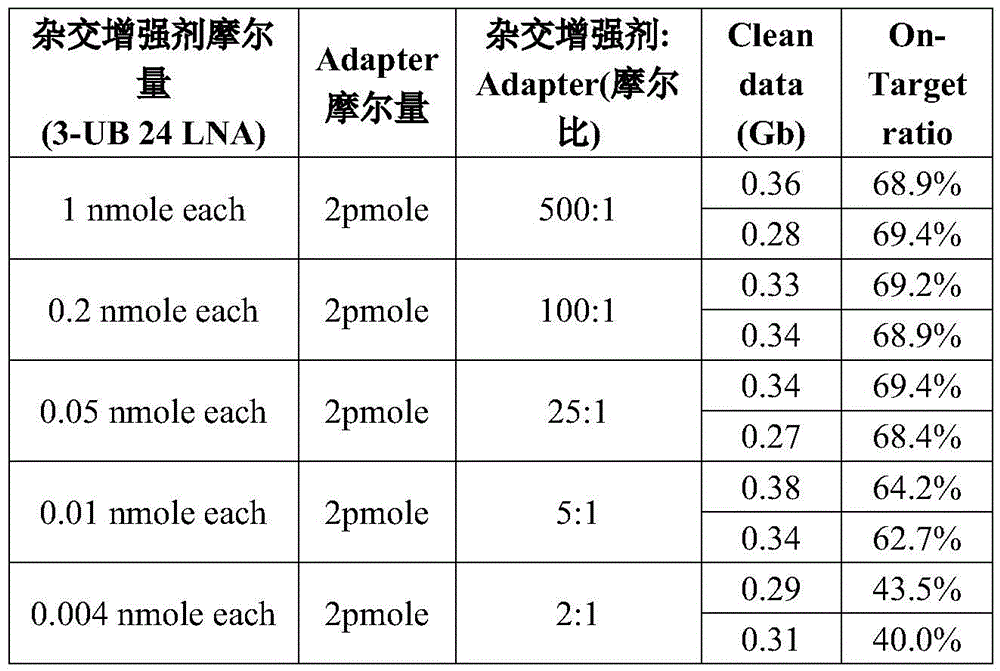
This example is used to investigate the effect of the ratio of universal hybridization enhancer to linker on the blocking effect.
Using the library construction method of example 1, the pre-library used in this example was constructed for NA12878 g DNA (Coriell) (illumina Truseq Dual-Index Adapter, insert size:. about.200 bp; number of PCR cycles: 7). The pre-library was subjected to hybrid capture, sequencing and analysis using a 3-UB 24LNA hybridization enhancer and linker molar ratio of 500:1, 100:1, 25:1 and 5:1, respectively (N ═ 2, as in example 1).
As shown in Table 12, when the molar weight ratio of the 3-UB 24LNA hybridization enhancer to the linker was 25:1 or more, the captured data remained at a level similar to 500:1, when the molar weight ratio was as low as 5:1, the On-Target ratio tended to decrease, and when the molar weight ratio was 2:1, the On-Target ratio decreased to about 40%, indicating that the 3-UB 24LNA hybridization enhancer to the linker at a molar weight ratio of 5:1 or more, all of the works efficiently.
TABLE 12
While the present invention has been described with reference to exemplary embodiments, it is to be understood that the invention is not limited to the disclosed exemplary embodiments. Many modifications and variations may be made to the exemplary embodiments of the present description without departing from the scope or spirit of the present invention. The scope of the claims is to be accorded the broadest interpretation so as to encompass all modifications and equivalent structures and functions.
Claims (10)
1. A universal hybridization enhancer for targeted sequencing, characterized in that the universal hybridization enhancer is capable of binding to both ends of at least one nucleic acid fragment in a library, thereby forming a loop structure, and comprises a first binding moiety or a complementary sequence thereof, a second binding moiety or a complementary sequence thereof, and a third binding moiety or a complementary sequence thereof, wherein the first binding moiety is capable of simultaneously complementarily binding to sequence A or a partially continuous sequence thereof and sequence D or a partially continuous sequence thereof, and the second binding moiety is capable of complementarily binding to sequence B or a partially continuous sequence thereof, when the positive strand of the nucleic acid fragments in the library comprises in sequence from 5 'end to 3' a first linker, an insert, and a second linker, in sequence from 5 'end to 3', and the first linker comprises in sequence from 5 'end to 3' a sequence A and a sequence B or a partially continuous sequence thereof, and the second linker is capable of complementarily binding to sequence B or a partially continuous sequence thereof, the third binding moiety is capable of complementarily binding to sequence C or a partially contiguous sequence thereof.
2. The universal hybridization enhancer for targeted sequencing according to claim 1, wherein at least one of the first binding moiety, the second binding moiety and the third binding moiety comprises a nucleotide analog.
3. The universal hybridization enhancer for targeted sequencing according to claim 2, characterized in that said nucleotide analogue is selected from at least one of the group consisting of LNA, BNA and MGB.
4. The universal hybridization enhancer for targeted sequencing according to claim 1, wherein the first binding moiety and the second binding moiety or the first binding moiety and the third binding moiety are linked by a covalent bond or a linker; or the first binding moiety and the second binding moiety and the first binding moiety and the third binding moiety are each linked by a covalent bond or a linker.
5. The universal hybridization enhancer for targeted sequencing according to claim 4, wherein said covalent bond comprises a phosphodiester bond and said linker comprises a C3 spacer.
6. The universal hybridization enhancer for targeted sequencing according to claim 1, characterized in that the Tm value of the universal hybridization enhancer is between 70 and 90 ℃.
7. The universal hybridization enhancer for targeted sequencing according to claim 1, characterized in that the 3' end of the universal hybridization enhancer contains a blocking modification.
8. The universal hybridization enhancer for targeted sequencing according to claim 1, further comprising a first index sequence between sequence a and sequence B and/or a second index sequence between sequence C and sequence D.
9. The universal hybridization enhancer for targeted sequencing according to claim 1, characterized in that a single molecule tag is further included between sequence a and sequence B and/or between sequence C and sequence D.
10. A method of targeted sequencing comprising the step of reacting a universal hybridization enhancer according to any one of claims 1-9 with a library.
Priority Applications (1)
| Application Number | Priority Date | Filing Date | Title |
|---|---|---|---|
| CN202010897277.4A CN111961711A (en) | 2020-08-31 | 2020-08-31 | Universal hybridization enhancers and methods for targeted sequencing |
Applications Claiming Priority (1)
| Application Number | Priority Date | Filing Date | Title |
|---|---|---|---|
| CN202010897277.4A CN111961711A (en) | 2020-08-31 | 2020-08-31 | Universal hybridization enhancers and methods for targeted sequencing |
Publications (1)
| Publication Number | Publication Date |
|---|---|
| CN111961711A true CN111961711A (en) | 2020-11-20 |
Family
ID=73399451
Family Applications (1)
| Application Number | Title | Priority Date | Filing Date |
|---|---|---|---|
| CN202010897277.4A Pending CN111961711A (en) | 2020-08-31 | 2020-08-31 | Universal hybridization enhancers and methods for targeted sequencing |
Country Status (1)
| Country | Link |
|---|---|
| CN (1) | CN111961711A (en) |
Citations (10)
| Publication number | Priority date | Publication date | Assignee | Title |
|---|---|---|---|---|
| CN104178478A (en) * | 2014-08-13 | 2014-12-03 | 邵华武 | Liquid-phase hybrid capture enriching liquor for genome DNA sequencing library and hybrid method adopting liquid-phase hybrid capture enriching liquor |
| CN107109485A (en) * | 2014-10-10 | 2017-08-29 | 因维蒂公司 | Method for the general blocking oligomer system and improved hybrid capture of multiple capture reaction |
| CN108456713A (en) * | 2017-11-27 | 2018-08-28 | 天津诺禾致源生物信息科技有限公司 | The construction method of tab closure sequence, library construction Kit and sequencing library |
| CN108474032A (en) * | 2015-10-07 | 2018-08-31 | 亿明达股份有限公司 | Capture of missing the target in sequencing technologies reduces |
| CN108676846A (en) * | 2018-05-25 | 2018-10-19 | 艾吉泰康生物科技(北京)有限公司 | A kind of application of bridge-type oligonucleotides in library target area captures |
| US20180305752A1 (en) * | 2017-04-23 | 2018-10-25 | Illumina, Inc. | Compositions and methods for improving sample identification in indexed nucleic acid libraries |
| CN109536579A (en) * | 2018-11-05 | 2019-03-29 | 深圳市艾斯基因科技有限公司 | The construction method of single-stranded sequencing library and its application |
| CN109576346A (en) * | 2018-11-05 | 2019-04-05 | 深圳市艾斯基因科技有限公司 | The construction method of high-throughput sequencing library and its application |
| CN110564831A (en) * | 2019-08-30 | 2019-12-13 | 北京优迅医学检验实验室有限公司 | Blocking reagent for sequencing library and method for improving targeted capture efficiency |
| CN111534518A (en) * | 2020-05-18 | 2020-08-14 | 纳昂达(南京)生物科技有限公司 | Universal blocking sequence and application thereof |
-
2020
- 2020-08-31 CN CN202010897277.4A patent/CN111961711A/en active Pending
Patent Citations (10)
| Publication number | Priority date | Publication date | Assignee | Title |
|---|---|---|---|---|
| CN104178478A (en) * | 2014-08-13 | 2014-12-03 | 邵华武 | Liquid-phase hybrid capture enriching liquor for genome DNA sequencing library and hybrid method adopting liquid-phase hybrid capture enriching liquor |
| CN107109485A (en) * | 2014-10-10 | 2017-08-29 | 因维蒂公司 | Method for the general blocking oligomer system and improved hybrid capture of multiple capture reaction |
| CN108474032A (en) * | 2015-10-07 | 2018-08-31 | 亿明达股份有限公司 | Capture of missing the target in sequencing technologies reduces |
| US20180305752A1 (en) * | 2017-04-23 | 2018-10-25 | Illumina, Inc. | Compositions and methods for improving sample identification in indexed nucleic acid libraries |
| CN108456713A (en) * | 2017-11-27 | 2018-08-28 | 天津诺禾致源生物信息科技有限公司 | The construction method of tab closure sequence, library construction Kit and sequencing library |
| CN108676846A (en) * | 2018-05-25 | 2018-10-19 | 艾吉泰康生物科技(北京)有限公司 | A kind of application of bridge-type oligonucleotides in library target area captures |
| CN109536579A (en) * | 2018-11-05 | 2019-03-29 | 深圳市艾斯基因科技有限公司 | The construction method of single-stranded sequencing library and its application |
| CN109576346A (en) * | 2018-11-05 | 2019-04-05 | 深圳市艾斯基因科技有限公司 | The construction method of high-throughput sequencing library and its application |
| CN110564831A (en) * | 2019-08-30 | 2019-12-13 | 北京优迅医学检验实验室有限公司 | Blocking reagent for sequencing library and method for improving targeted capture efficiency |
| CN111534518A (en) * | 2020-05-18 | 2020-08-14 | 纳昂达(南京)生物科技有限公司 | Universal blocking sequence and application thereof |
Similar Documents
| Publication | Publication Date | Title |
|---|---|---|
| CN103060924B (en) | The library preparation method of trace dna sample and application thereof | |
| AU2005262357B2 (en) | Methods and compositions to detect nucleic acids in a biological sample | |
| CN103131754B (en) | Method for detecting nucleic acid hydroxylmethylation modification, and application thereof | |
| CN107002292B (en) | A kind of construction method and reagent of double-linker single-stranded circular library of nucleic acid | |
| WO2016037394A1 (en) | Method for constructing nucleic acid single-stranded cyclic library and reagents thereof | |
| CN109576346B (en) | Construction method and application of high-throughput sequencing library | |
| EP3388532B1 (en) | Integrated capture and amplification of target nucleic acid for sequencing | |
| CN107604046B (en) | Next-generation sequencing method for bimolecular self-checking library preparation and hybrid capture for ultra-low frequency mutation detection of trace DNA | |
| CN107002080A (en) | A method and reagents for enriching target regions based on multiplex PCR | |
| CN119979527A (en) | Method for isolating poly(A) nucleic acid | |
| CN112410331A (en) | Linker with molecular label and sample label and single-chain library building method thereof | |
| CN114729349A (en) | Method for detecting and sequencing barcode nucleic acid | |
| TW201321520A (en) | Method and system for virus detection | |
| EP3814496B1 (en) | Sample preparation method and system | |
| US20130130917A1 (en) | Method for specific enrichment of nucleic acid sequences | |
| WO2020259678A1 (en) | Oligonucleotide containing blocker | |
| CN114657232A (en) | Universal blocking reagent for improving target capture efficiency and application thereof | |
| CN111961711A (en) | Universal hybridization enhancers and methods for targeted sequencing | |
| CA3168563A1 (en) | Parallelized sample processing and library prep | |
| TW201802244A (en) | Methods of constructing circular template and detecting DNA molecules | |
| CN115820807B (en) | Long fragment capturing and enriching method, kit and application thereof | |
| US20210040540A1 (en) | Parallel liquid-phase hybrid capture method for simultaneously capturing sense and antisense double strands of genomic target region | |
| KR20200005658A (en) | Compositions and Methods for Making Control Groups for Sequence-Based Genetic Testing | |
| CN116162690B (en) | One-tube targeting high-throughput sequencing method | |
| CN116716378A (en) | Probe composition for removing nucleic acid of human host, application and construction method of microbial nucleic acid nanopore sequencing library |
Legal Events
| Date | Code | Title | Description |
|---|---|---|---|
| PB01 | Publication | ||
| PB01 | Publication | ||
| SE01 | Entry into force of request for substantive examination | ||
| SE01 | Entry into force of request for substantive examination | ||
| RJ01 | Rejection of invention patent application after publication |
Application publication date: 20201120 |
|
| RJ01 | Rejection of invention patent application after publication |