CN111817797B - Signal Transmitting Method Based on IRS Phase Rotation to Maximize Received Signal-to-Noise Ratio - Google Patents
Signal Transmitting Method Based on IRS Phase Rotation to Maximize Received Signal-to-Noise Ratio Download PDFInfo
- Publication number
- CN111817797B CN111817797B CN202010571688.4A CN202010571688A CN111817797B CN 111817797 B CN111817797 B CN 111817797B CN 202010571688 A CN202010571688 A CN 202010571688A CN 111817797 B CN111817797 B CN 111817797B
- Authority
- CN
- China
- Prior art keywords
- irs
- phase
- optimal
- phase rotation
- noise ratio
- Prior art date
- Legal status (The legal status is an assumption and is not a legal conclusion. Google has not performed a legal analysis and makes no representation as to the accuracy of the status listed.)
- Active
Links
- 238000000034 method Methods 0.000 title claims abstract description 14
- 230000005540 biological transmission Effects 0.000 claims abstract description 9
- 230000008054 signal transmission Effects 0.000 claims abstract description 3
- 239000011159 matrix material Substances 0.000 claims description 9
- 238000004891 communication Methods 0.000 claims description 8
- 238000004364 calculation method Methods 0.000 abstract description 2
- 235000015429 Mirabilis expansa Nutrition 0.000 abstract 1
- 244000294411 Mirabilis expansa Species 0.000 abstract 1
- 235000013536 miso Nutrition 0.000 abstract 1
- 238000004422 calculation algorithm Methods 0.000 description 19
- 238000005516 engineering process Methods 0.000 description 9
- 230000014509 gene expression Effects 0.000 description 7
- 238000004088 simulation Methods 0.000 description 5
- 238000001514 detection method Methods 0.000 description 3
- 238000010586 diagram Methods 0.000 description 3
- 230000000694 effects Effects 0.000 description 3
- 238000007476 Maximum Likelihood Methods 0.000 description 2
- 238000005457 optimization Methods 0.000 description 2
- 238000004458 analytical method Methods 0.000 description 1
- 238000003491 array Methods 0.000 description 1
- 230000009286 beneficial effect Effects 0.000 description 1
- 238000005562 fading Methods 0.000 description 1
- 230000010363 phase shift Effects 0.000 description 1
- 230000000630 rising effect Effects 0.000 description 1
- 230000003595 spectral effect Effects 0.000 description 1
- 238000001228 spectrum Methods 0.000 description 1
Images


Classifications
-
- H—ELECTRICITY
- H04—ELECTRIC COMMUNICATION TECHNIQUE
- H04B—TRANSMISSION
- H04B17/00—Monitoring; Testing
- H04B17/10—Monitoring; Testing of transmitters
- H04B17/11—Monitoring; Testing of transmitters for calibration
- H04B17/12—Monitoring; Testing of transmitters for calibration of transmit antennas, e.g. of the amplitude or phase
-
- H—ELECTRICITY
- H04—ELECTRIC COMMUNICATION TECHNIQUE
- H04B—TRANSMISSION
- H04B7/00—Radio transmission systems, i.e. using radiation field
- H04B7/02—Diversity systems; Multi-antenna system, i.e. transmission or reception using multiple antennas
- H04B7/04—Diversity systems; Multi-antenna system, i.e. transmission or reception using multiple antennas using two or more spaced independent antennas
- H04B7/04013—Intelligent reflective surfaces
-
- H—ELECTRICITY
- H04—ELECTRIC COMMUNICATION TECHNIQUE
- H04B—TRANSMISSION
- H04B17/00—Monitoring; Testing
- H04B17/30—Monitoring; Testing of propagation channels
- H04B17/309—Measuring or estimating channel quality parameters
- H04B17/336—Signal-to-interference ratio [SIR] or carrier-to-interference ratio [CIR]
-
- H—ELECTRICITY
- H04—ELECTRIC COMMUNICATION TECHNIQUE
- H04B—TRANSMISSION
- H04B7/00—Radio transmission systems, i.e. using radiation field
- H04B7/02—Diversity systems; Multi-antenna system, i.e. transmission or reception using multiple antennas
- H04B7/04—Diversity systems; Multi-antenna system, i.e. transmission or reception using multiple antennas using two or more spaced independent antennas
- H04B7/06—Diversity systems; Multi-antenna system, i.e. transmission or reception using multiple antennas using two or more spaced independent antennas at the transmitting station
- H04B7/0613—Diversity systems; Multi-antenna system, i.e. transmission or reception using multiple antennas using two or more spaced independent antennas at the transmitting station using simultaneous transmission
- H04B7/0615—Diversity systems; Multi-antenna system, i.e. transmission or reception using multiple antennas using two or more spaced independent antennas at the transmitting station using simultaneous transmission of weighted versions of same signal
- H04B7/0617—Diversity systems; Multi-antenna system, i.e. transmission or reception using multiple antennas using two or more spaced independent antennas at the transmitting station using simultaneous transmission of weighted versions of same signal for beam forming
-
- H—ELECTRICITY
- H04—ELECTRIC COMMUNICATION TECHNIQUE
- H04B—TRANSMISSION
- H04B7/00—Radio transmission systems, i.e. using radiation field
- H04B7/02—Diversity systems; Multi-antenna system, i.e. transmission or reception using multiple antennas
- H04B7/04—Diversity systems; Multi-antenna system, i.e. transmission or reception using multiple antennas using two or more spaced independent antennas
- H04B7/08—Diversity systems; Multi-antenna system, i.e. transmission or reception using multiple antennas using two or more spaced independent antennas at the receiving station
- H04B7/0837—Diversity systems; Multi-antenna system, i.e. transmission or reception using multiple antennas using two or more spaced independent antennas at the receiving station using pre-detection combining
- H04B7/0842—Weighted combining
- H04B7/086—Weighted combining using weights depending on external parameters, e.g. direction of arrival [DOA], predetermined weights or beamforming
Landscapes
- Engineering & Computer Science (AREA)
- Computer Networks & Wireless Communication (AREA)
- Signal Processing (AREA)
- Physics & Mathematics (AREA)
- Electromagnetism (AREA)
- Quality & Reliability (AREA)
- Radio Transmission System (AREA)
Abstract
本发明提供一种基于最大化接收信噪比的IRS相位旋转角的信号发射方法,包括步骤:发送方对信息比特进行调制得到已调信号;发送方根据接收方反馈的信道信息以及最大化接收信噪比的原则产生最佳相位旋转角度并通过控制器来调整智能反射面的相位角;发送方使用最优波束赋形方案处理完已调信号后,再通过所有发射天线进行传输。在IRS辅助的MISO系统传输中,对比于传统的相位旋转设计方案,本发明提供的一个新的最优最大化接收信噪比迭代计算方法,该方法能够稳定收敛至全局最优解,且拥有较低的计算复杂度。在实际应用中,IRS上可能仅某些相位单元可调整,该方法依旧可以找到该情况下的最优解,具有很好的灵活性。

The present invention provides a signal transmission method based on an IRS phase rotation angle that maximizes the received signal-to-noise ratio, comprising the steps of: a transmitter modulates information bits to obtain a modulated signal; The principle of signal-to-noise ratio generates the optimal phase rotation angle and adjusts the phase angle of the smart reflector through the controller; the sender uses the optimal beamforming scheme to process the modulated signal, and then transmits it through all transmit antennas. In the IRS-assisted MISO system transmission, compared with the traditional phase rotation design scheme, the present invention provides a new iterative calculation method for optimally maximizing the received signal-to-noise ratio, which can stably converge to the global optimal solution, and has Lower computational complexity. In practical applications, only some phase units may be adjustable on the IRS, and this method can still find the optimal solution in this case, and has good flexibility.
Description
技术领域technical field
本发明涉及无线通信物理层安全技术,特别涉及多输入单输出(Multiple InputSingle Output,MISO)技术、智能反射面(Intelligent Reflecting Surface,IRS)技术。The present invention relates to a wireless communication physical layer security technology, in particular to a Multiple Input Single Output (Multiple Input Single Output, MISO) technology and an Intelligent Reflecting Surface (Intelligent Reflecting Surface, IRS) technology.
背景技术Background technique
智能反射面IRS作为一种提升频谱和能量效率的6G无线传输方案,有多个被动的反射单元,可反射并调节信号的相位。相比于传统的增加天线阵列的方案,IRS技术可提供相似的多径增益且同时避免了昂贵的硬件要求。同时,造价便宜的IRS具有灵活的使用场景,可以被覆盖在户外建筑物的表面以及室内的墙壁上。因此,在未来追求高频谱效率,高能量效率以及低误码率的趋势下,IRS会成为拥有高性能,低代价和高灵活性的无线通信技术。As a 6G wireless transmission solution that improves spectrum and energy efficiency, the intelligent reflective surface IRS has multiple passive reflective units that can reflect and adjust the phase of the signal. Compared to the traditional scheme of adding antenna arrays, IRS technology can provide similar multipath gain while avoiding expensive hardware requirements. At the same time, the inexpensive IRS has flexible usage scenarios and can be covered on the surface of outdoor buildings and on indoor walls. Therefore, under the trend of pursuing high spectral efficiency, high energy efficiency and low bit error rate in the future, IRS will become a wireless communication technology with high performance, low cost and high flexibility.
由于潜力巨大,近年来IRS技术的相位旋转设计吸引了大量研究。单输入单输出(Single Input Single Output,SISO)信道下的IRS最优相位旋转问题相对简单,已得到了充分研究。但多输入单输出(Multiple Input Single Output,MISO)信道下的IRS相位旋转设计较为复杂,存在以下的问题:1.最优相位旋转角可以由遍历方法得到,但复杂度极高。2.目前的研究能够设计出低复杂度的相位旋转角,但相比于遍历方法性能损失巨大。3.目前的很多算法无法保证收敛性,性能不稳定。因此,在IRS辅助的MISO系统下,如何以较低的复杂度稳定地获得最优相位旋转成为了难题。Due to the huge potential, the phase rotation design of IRS technology has attracted a lot of research in recent years. The IRS optimal phase rotation problem under Single Input Single Output (SISO) channels is relatively simple and has been well studied. However, the design of the IRS phase rotation under the Multiple Input Single Output (MISO) channel is relatively complicated, and there are the following problems: 1. The optimal phase rotation angle can be obtained by the ergodic method, but the complexity is extremely high. 2. The current research can design a low-complexity phase rotation angle, but the performance loss is huge compared to the ergodic method. 3. Many current algorithms cannot guarantee convergence and their performance is unstable. Therefore, under the IRS-assisted MISO system, how to stably obtain the optimal phase rotation with low complexity becomes a difficult problem.
发明内容SUMMARY OF THE INVENTION
本发明针对IRS-MISO系统中无法以低复杂度算法稳定获得最优相位旋转的问题,提供一种复杂度较低的最优迭代(Optimal Iteration,OI)计算,该算法具有较低的复杂度,同时能稳定地获得最优相位旋转设计,并且拥有非常灵活的使用场景。Aiming at the problem that the optimal phase rotation cannot be obtained stably with a low-complexity algorithm in the IRS-MISO system, the present invention provides a low-complexity optimal iteration (Optimal Iteration, OI) calculation, and the algorithm has low-complexity , at the same time, the optimal phase rotation design can be stably obtained, and it has very flexible usage scenarios.
本发明为解决上述技术问题所采用的技术方案是,基于最大化接收信噪比的IRS相位旋转设计的信号发射方法,包括以下步骤:The technical solution adopted by the present invention to solve the above-mentioned technical problem is that the signal transmission method based on the IRS phase rotation design of maximizing the received signal-to-noise ratio comprises the following steps:
1)通信双方确定发射天线数M、接收天线数1以及智能反射面IRS上的反射单元数N;1) Both parties of the communication determine the number M of transmitting antennas, the number of receiving
2)发送方对信息比特进行幅度相位调制APM得到已调信号;2) The sender performs amplitude phase modulation APM on the information bits to obtain a modulated signal;
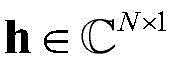
3)发送方根据接收方与IRS反馈的信道信息以及最大化接收信噪比的原则确定N个的反射单元对应的最优相位旋转θ1,θ2,...,θn,然后再通过控制器将对IRS的N个相位旋转单元的相位角分别赋值为最优相位旋转θ1,θ2,...,θn;所述接收方与IRS反馈的信道信息包括发射方到IRS的信道信息


3-1)发送方计算hiHi,m的模值|Ai,m|与相位
3-2)选择第n个反射单元,固定其他N-1个反射单元的相位角θj,计算第n个反射单元的最优相位旋转θn:变量j=1,2,…,N且j≠n;重复步骤3-2-1)与3-2-2)以完成n=1,2,…,N为一轮迭代:3-2) Select the n-th reflection unit, fix the phase angle θ j of the other N-1 reflection units, and calculate the optimal phase rotation θ n of the n-th reflection unit: variable j=1,2,...,N and j≠n; repeat steps 3-2-1) and 3-2-2) to complete n=1,2,...,N as one iteration:
3-2-1)先根据最大化接收信噪比的原则,确定相位角θn的两个可能的最优解


其中
3-2-2)选出

3-3)判断当前一轮迭代后得到的N个的反射单元对应的最优相位旋转θ1,θ2,…,θn是否满足迭代结束条件,如是,将当前一轮迭代后得到的N个最优相位旋转作为最终的N个的反射单元对应的最优相位旋转θ1,θ2,…,θn,再进入步骤4),否则返回步骤3-2);3-3) Determine whether the optimal phase rotation θ 1 , θ 2 ,..., θ n corresponding to the N reflection units obtained after the current round of iterations satisfies the conditions for the end of the iteration. The optimal phase rotations are taken as the optimal phase rotations θ 1 , θ 2 , .
4)确定最优波束赋形方案,经最优波束赋形方案处理后的已调信号通过发射天线进行传输。4) Determine the optimal beamforming scheme, and the modulated signal processed by the optimal beamforming scheme is transmitted through the transmitting antenna.
为了以更低的复杂度获得最优性能,本发明首先推导出当其他相位角固定时,某一相位角的最优解析表达式,然后重复迭代此方法至每一个可调整的相位角至所有相位角收敛为止。In order to obtain optimal performance with lower complexity, the present invention first deduces the optimal analytical expression for a certain phase angle when other phase angles are fixed, and then iterates this method repeatedly for each adjustable phase angle to all until the phase angle converges.
本发明的有益效果为,在IRS-MISO系统传输中,对比于传统的相位旋转设计方案,本发明以解析表达式的形式提供了一个理论上的最优解,它拥有稳定的收敛性,较低的复杂度以及最优的性能。The beneficial effect of the present invention is that, in the IRS-MISO system transmission, compared with the traditional phase rotation design scheme, the present invention provides a theoretical optimal solution in the form of an analytical expression, which has stable convergence and is relatively Low complexity and optimal performance.
附图说明Description of drawings
图1是本发明考虑的IRS辅助的MISO下行链路的无线通信系统示意图;1 is a schematic diagram of a wireless communication system of an IRS-assisted MISO downlink considered by the present invention;
图2是TAP方案与OI方案的误码率性能对比图;Fig. 2 is the bit error rate performance comparison diagram of TAP scheme and OI scheme;
图3是在IRS部分反射单元可调节时的TAP方案与OI方案的误码率性能对比;Fig. 3 is the bit error rate performance comparison between the TAP scheme and the OI scheme when the IRS partial reflection unit is adjustable;
图4是平均迭代轮数Ε{CC}随AP的天线数M的变化情况;Fig. 4 is the variation situation of the average iteration round number E{CC} with the antenna number M of AP;
图5是平均迭代轮数Ε{CC}随IRS的反射单元数N的变化情况;Fig. 5 is the variation situation of average iteration round number E{CC} with the reflection unit number N of IRS;
图6是OI方案下的误码率性能随IRS反射单元数N的变化情况。Figure 6 shows the variation of the bit error rate performance with the number N of IRS reflection units under the OI scheme.
具体实施方式Detailed ways
下面结合附图对本发明的具体实施方式进行描述,以便本领域的技术人员更好地理解本发明。需要特别提醒注意的是,在以下的描述中,当已知功能和设计的详细描述也许会淡化本发明的主要内容时,这些描述在这里就被忽略。The specific embodiments of the present invention are described below with reference to the accompanying drawings, so that those skilled in the art can better understand the present invention. It should be noted that, in the following description, when the detailed description of known functions and designs may dilute the main content of the present invention, these descriptions are omitted here.
由于目前研究中没有充分提及通过遍历所有相位(Traversing all thepossible phase shifts,TAP)的方法来获得最优相位旋转角,之后将给出基于最大化接收信噪比的问题模型,并介绍TAP方案及其复杂度。Since the current research has not fully mentioned the method of traversing all the possible phase shifts (TAP) to obtain the optimal phase rotation angle, the problem model based on maximizing the received signal-to-noise ratio will be given later, and the TAP scheme will be introduced. and its complexity.
为更好地对本发明进行说明,先介绍本发明技术方案所用到的术语和系统结构。In order to better describe the present invention, the terminology and system structure used in the technical solution of the present invention are first introduced.
MISO:MISO技术指在发射端使用多根发射天线,接收端使用单根接收天线,使信号通过发射端的多跟天线与接收端的单根天线进行传送和接收,从而改善通信质量。MISO: MISO technology refers to the use of multiple transmitting antennas at the transmitting end and a single receiving antenna at the receiving end, so that signals are transmitted and received through multiple antennas at the transmitting end and a single antenna at the receiving end, thereby improving communication quality.
IRS:IRS技术是智能反射面技术。智能反射面上有多个被动的反射单元,可以在反射无线信号的同时调整其相位,通过适当的相位旋转设计可以获得更优的性能,其相位旋转角度由发射方进行调整。IRS: IRS technology is an intelligent reflective surface technology. There are multiple passive reflective units on the smart reflective surface, which can adjust the phase while reflecting the wireless signal. Better performance can be obtained through appropriate phase rotation design, and the phase rotation angle is adjusted by the transmitter.
在基于最大化接收信噪比的IRS相位旋转设计方案中,通过最大化接收信噪比的方式以设计IRS的相位旋转,可以最大化提升系统的能量效率。我们提出的最优迭代OI算法能够以较低的复杂度在理论上快速且稳定地收敛至最优解,同时具有很高的灵活性。In the IRS phase rotation design scheme based on maximizing the received signal-to-noise ratio, the energy efficiency of the system can be maximized by designing the phase rotation of the IRS by maximizing the received signal-to-noise ratio. The optimal iterative OI algorithm proposed by us can theoretically converge to the optimal solution rapidly and stably with low complexity, and at the same time has high flexibility.
A.传统IRS-MISO系统模型A. Traditional IRS-MISO system model
考虑一个IRS辅助的MISO下行链路通信系统。由图1所示,发射方接入点AP(AccessPoint)配备M根发射天线,接收方用户User配备单天线,IRS上有N个被动的反射单元,这些反射单元的相位旋转可以由AP通过IRS控制器(IRS Controller)进行调整。除此之外,AP通过无线控制链路(Wireless control link)可以获得所有的瞬时信道信息CSI。所有的瞬时CSI包括AP到IRS的CSI记为


基于上述考虑的系统,用户的接收信号可以表示为:Based on the system considered above, the user's received signal can be expressed as:
y=(hHΦH+gH)ws+n,y=(h H ΦH+g H )ws+n,
其中,


对于任意给定的Φ,w的最佳波束赋形方案可以由最大比传输(MRT)方案给出,以最大化γ值,具体形式可以表示为For any given Φ, the optimal beamforming scheme for w can be given by a maximum ratio transmission (MRT) scheme to maximize the value of γ, which can be expressed as

为了调整Φ以进一步最大化γ,设计相位旋转的最优化问题可如下公式化为To tune Φ to further maximize γ, the optimization problem for designing phase rotation can be formulated as


B.TAP方案B.TAP scheme
理论上来说,上述的最优化问题存在一个最优解,这可以由遍历所有可能的相位旋转(TAP)来得到。具体而言,对任意的θi(i=1,2,…,N),其取值范围为
首先,所有可能的相位旋转组合有QN个,当某一个组合被选定时,计算目标函数所需要的复杂度为


C.OI算法C.OI algorithm
为了获得Φ的理论最优解,我们首先对目标函数||hHΦH+gH||进行如下展开In order to obtain the theoretical optimal solution of Φ, we first expand the objective function ||h H ΦH+g H || as follows

其中,hi代表hH的第i个元素,Hi,m代表H第i行第m列的元素,gm代表gH的第m个元素。当瞬时CSI给定时,hH,H,gH都是固定的,J为目标函数,Φ为目标函数J的自变量。借助|a+bj|2=(a+bj)(a-bj),我们可以进一步展开上式为Among them, hi represents the i-th element of h H , H i ,m represents the element of the i-th row and m-th column of H, and g m represents the m-th element of g H. When the instantaneous CSI is given, h H , H and g H are all fixed, J is the objective function, and Φ is the independent variable of the objective function J. With |a+bj| 2 =(a+bj)(a-bj), we can further expand the above formula as

其中,|Ai,m|和


其中in

可以看出,


我们注意到,最优相位旋转θn的最优解析表达式的获得条件是其它N-1个相位角固定。因此,为了获得所有θ1到θN的最优相位旋转,索引n需要从1到N重复几轮直到所有的相位都收敛为止。完整的OI算法可总结如表1We note that the optimal analytical expression for the optimal phase rotation θ n is obtained under the condition that the other N-1 phase angles are fixed. Therefore, to obtain the optimal phase rotation for all θ 1 to θ N , index n needs to be repeated from 1 to N for several rounds until all phases converge. The complete OI algorithm can be summarized in Table 1
表1:OI算法Table 1: OI Algorithm


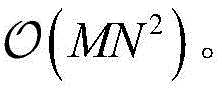
其中,cc被用于计数迭代轮数,sum是求和运算,abs是求模运算,2个sum代表全部元素求和,判断指标是这一轮的结果Φ与上一轮的结果Φsave之差的所有元素绝对值之和接近0。理论上可知,当某一个θn被更新后,J值一定会变大或保持不变,因此,最终的相位旋转至少能收敛至一个局部最优解,所以t<ε(ε→0)被用作唯一的判决门限。另一方面,由于θn的每一次更新均为最优解,该算法具有较快的收敛速度。计算

此外,OI算法可以被非常灵活地使用。在实际情况中,某些反射单元的相位会需要保持不变,在这种情形下,OI算法也可以通过仅在可以变化的相位单元上进行迭代从而获得对应情况下的最优解。Furthermore, the OI algorithm can be used very flexibly. In practical situations, the phase of some reflection units may need to remain unchanged. In this case, the OI algorithm can also obtain the optimal solution for the corresponding situation by iterating only on the phase units that can be changed.
图1给出了本发明考虑的IRS辅助的MISO下行链路的无线通信系统示意图。发送端AP将信息比特经过APM调制,根据IRS和User的CSIhH,H,gH进行相位旋转设计并通过IRS控制器调节反射单元的相位角,然后对APM符号进行波束赋形并经过AP的发送天线发射出去;IRS和User进行信道检测并反馈至AP,使得AP可以基于最大化接收信噪比进行IRS相位旋转设计;User接收到信号后对其进行极大似然估计(ML)检测以恢复出发送的信息比特。FIG. 1 is a schematic diagram of a wireless communication system of IRS-assisted MISO downlink considered by the present invention. The transmitting AP modulates the information bits by APM, designs the phase rotation according to the CSIh H , H, and g H of the IRS and User, adjusts the phase angle of the reflection unit through the IRS controller, and then performs beamforming on the APM symbols and passes the AP's The transmitting antenna transmits it; the IRS and User perform channel detection and feed it back to the AP, so that the AP can design the IRS phase rotation based on maximizing the received signal-to-noise ratio; after the User receives the signal, it performs maximum likelihood estimation (ML) detection to get The transmitted information bits are recovered.
发射步骤:Launch steps:
步骤1:发送方对信息比特进行调制得到已调信号;Step 1: The sender modulates the information bits to obtain a modulated signal;
步骤2:发送方根据接收方反馈的信道信息以及最大化接收信噪比的原则采用OI算法设计最佳相位旋转并通过控制器来调整智能反射面的相位角;Step 2: The sender uses the OI algorithm to design the optimal phase rotation according to the channel information fed back by the receiver and the principle of maximizing the received signal-to-noise ratio, and adjusts the phase angle of the smart reflector through the controller;
步骤3:发送方使用最优波束赋形方案处理完已调信号后,再通过所有发射天线进行传输。Step 3: The sender uses the optimal beamforming scheme to process the modulated signal, and then transmits it through all transmit antennas.
D.仿真结果D. Simulation results
本节首先将TAP与OI方案的误码率仿真结果进行比较。其次,我们利用仿真给出了平均迭代轮数Ε{CC}随AP(Access Point)天线数M与IRS反射单元数N的变化情况,以给出OI方案的总计算复杂度。最后,我们给出了在OI方案下,不同IRS反射单元数N的误码率性能对比。以下仿真的前提均为QPSK调制与极大似然检测准则,TAP方案的Q值设置为100以贴近全局最优解,所有的CSIhH,H,gH均服从瑞利衰落分布CN(0,1),OI算法的所有相位均初始输入为
图2对比了OI方案与TAP方案在M=4时的误码率性能。结果表明,在N=2和N=3的两种情况下,OI方案可以获得与TAP几乎完全一致的效果。具体而言,TAP方案以巨大的计算复杂度为代价获得了最优的误码率性能,而OI方案可以获得同样的最优性能,但OI算法的复杂度远远低于TAP方案。因此,OI方案可以以低复杂度给出全局最优解。Figure 2 compares the bit error rate performance of the OI scheme and the TAP scheme when M=4. The results show that in the two cases of N=2 and N=3, the OI scheme can achieve almost exactly the same effect as TAP. Specifically, the TAP scheme achieves the optimal bit error rate performance at the cost of huge computational complexity, while the OI scheme can achieve the same optimal performance, but the complexity of the OI algorithm is much lower than that of the TAP scheme. Therefore, the OI scheme can give the global optimal solution with low complexity.
图3对比了OI方案与TAP方案的误码率性能,系统参数为M=4和N=4,其中N个IRS的反射单元仅有Na个可以进行相位调整,其它N-Na个均被随机固定设置。由图可知,IRS可调节的反射单元数越少,所获得的误码率性能越差,每个可调节的反射单元大约会带来1dB的误码率增益。此外,在Na=1,2,3时,OI算法均能获得与TAP方案相同的误码率性能。这说明OI算法依然能够找到对应的最优相位设计。因此,OI算法相比于传统算法在实际情况中有着更灵活的应用。Figure 3 compares the bit error rate performance of the OI scheme and the TAP scheme. The system parameters are M=4 and N=4. Among the N IRS reflection units, only N a can be phase-adjusted, and the other N a are randomly Fixed settings. It can be seen from the figure that the less the number of reflectors that can be adjusted by the IRS, the worse the bit error rate performance obtained, and each adjustable reflector will bring about a 1dB bit error rate gain. In addition, when
图4给出了平均迭代轮数Ε{CC}随AP天线数M的变化情况,此时IRS反射单元数N=4。为了展示判决门限ε的影响,我们分别设置ε=10-3,10-4,10-5。结果表明,随着判决门限ε的不断下降,Ε{CC}值不断上升。但随着M的增大,Ε{CC}值几乎稳定不变。因此,平均迭代轮数Ε{CC}与AP天线数M没有明显的关系。Figure 4 shows the variation of the average number of iteration rounds E{CC} with the number of AP antennas M, where the number of IRS reflection units is N=4. To show the effect of the decision threshold ε, we set ε = 10 -3 , 10 -4 , and 10 -5 , respectively. The results show that with the continuous decrease of the decision threshold ε, the value of Ε{CC} increases continuously. But with the increase of M, the value of E{CC} is almost stable. Therefore, the average number of iteration rounds E{CC} has no obvious relationship with the number M of AP antennas.
图5给出了平均迭代轮数Ε{CC}随IRS反射单元数N的变化情况,此时AP天线数M=4。为了展示判决门限ε的影响,我们同样设置了ε=10-3,10-4,10-5。结果表明,随着判决门限ε的不断下降,Ε{CC}值依旧不断上升。除此之外,随着N的增大,Ε{CC}值线性地增大,。因此,平均迭代轮数Ε{CC}与N呈线性正相关关系。结合图4和图5,可以发现E{cc}=k(ε)N。之前我们计算了OI算法迭代一轮的计算复杂度为


图6给出了在OI方案下,不同IRS反射单元数N的误码率性能对比,系统参数为M=4,N=2,4,6,8,10。结果显示,随着N的增大,系统误码率性能变得更好。在高信噪比时,每一个增加的反射单元可以带来2dB左右的性能增益。Figure 6 shows the bit error rate performance comparison of different IRS reflection units N under the OI scheme, and the system parameters are M=4, N=2, 4, 6, 8, and 10. The results show that as N increases, the system BER performance becomes better. At high signal-to-noise ratios, each additional reflector unit can bring about a 2dB performance gain.
Claims (3)




Priority Applications (1)
| Application Number | Priority Date | Filing Date | Title |
|---|---|---|---|
| CN202010571688.4A CN111817797B (en) | 2020-06-22 | 2020-06-22 | Signal Transmitting Method Based on IRS Phase Rotation to Maximize Received Signal-to-Noise Ratio |
Applications Claiming Priority (1)
| Application Number | Priority Date | Filing Date | Title |
|---|---|---|---|
| CN202010571688.4A CN111817797B (en) | 2020-06-22 | 2020-06-22 | Signal Transmitting Method Based on IRS Phase Rotation to Maximize Received Signal-to-Noise Ratio |
Publications (2)
| Publication Number | Publication Date |
|---|---|
| CN111817797A CN111817797A (en) | 2020-10-23 |
| CN111817797B true CN111817797B (en) | 2021-09-24 |
Family
ID=72846340
Family Applications (1)
| Application Number | Title | Priority Date | Filing Date |
|---|---|---|---|
| CN202010571688.4A Active CN111817797B (en) | 2020-06-22 | 2020-06-22 | Signal Transmitting Method Based on IRS Phase Rotation to Maximize Received Signal-to-Noise Ratio |
Country Status (1)
| Country | Link |
|---|---|
| CN (1) | CN111817797B (en) |
Families Citing this family (8)
| Publication number | Priority date | Publication date | Assignee | Title |
|---|---|---|---|---|
| CN112532289B (en) * | 2020-11-20 | 2022-03-08 | 电子科技大学 | Multi-antenna multicast transmission method of symbiotic communication system based on intelligent reflection surface |
| CN112532547B (en) * | 2020-11-21 | 2022-03-01 | 北京邮电大学 | Channel estimation and channel identification method in intelligent reflector communication system |
| CN114630334B (en) * | 2020-12-10 | 2023-06-16 | 大唐移动通信设备有限公司 | Transmission control method and device and intelligent super-surface |
| CN112887002B (en) * | 2021-01-13 | 2022-08-05 | 之江实验室 | Wave beam domain channel angle estimation method for intelligent reflector auxiliary communication |
| CN114765785B (en) * | 2021-01-15 | 2024-02-27 | 哈尔滨工业大学 | A multi-intelligent reflective surface selection method based on maximum signal-to-noise ratio |
| CN113141222B (en) * | 2021-04-25 | 2022-04-08 | 安徽大学 | Asymptotic approach error rate performance analysis method |
| CN113794526B (en) * | 2021-09-14 | 2022-07-15 | 电子科技大学 | Novel frequency division duplex communication system based on reconfigurable intelligent surface |
| CN116647260A (en) * | 2023-05-16 | 2023-08-25 | 华南理工大学 | A RIS-assisted zero-forcing beamforming method based on physical layer security technology |
Citations (8)
| Publication number | Priority date | Publication date | Assignee | Title |
|---|---|---|---|---|
| CN102694587A (en) * | 2012-05-14 | 2012-09-26 | 电子科技大学 | Non-coherent detection method used in SM-OFDM (spatially-multiplexed-orthogonal frequency-division multiplexing) system |
| CN105721375A (en) * | 2016-03-28 | 2016-06-29 | 电子科技大学 | Low signal-to-noise ratio short preamble burst signal demodulation system and method |
| US9838100B2 (en) * | 2014-11-18 | 2017-12-05 | Nxp B.V. | Beam forming with double-null-steering for in-band on-channel reception |
| CN108173578A (en) * | 2018-01-09 | 2018-06-15 | 北京航空航天大学 | Array Antenna Simulated Multi-beamforming Method |
| CN109361442A (en) * | 2018-10-22 | 2019-02-19 | 北京航空航天大学 | Non-orthogonal multiple access downlink transmission method for air array communication |
| CN110351749A (en) * | 2019-06-18 | 2019-10-18 | 西安交通大学 | A kind of wirelessly take can communicate cognition network favorable interference design method |
| CN111123214A (en) * | 2019-12-18 | 2020-05-08 | 南京理工大学 | High-speed and high-maneuvering target detection method based on polynomial rotation-polynomial Fourier transform |
| CN111208538A (en) * | 2018-11-21 | 2020-05-29 | 展讯通信(上海)有限公司 | Method and device for demodulating text |
Family Cites Families (3)
| Publication number | Priority date | Publication date | Assignee | Title |
|---|---|---|---|---|
| US10862459B2 (en) * | 2018-11-01 | 2020-12-08 | Analog Devices, Inc. | Low-loss vector modulator based phase shifter |
| CN111050276B (en) * | 2019-12-23 | 2020-11-24 | 华中科技大学 | Optimization method and equipment for IRS auxiliary communication system based on angle information |
| CN111246491B (en) * | 2020-03-10 | 2021-06-08 | 电子科技大学 | Intelligent reflection surface assisted terahertz communication system design method |
-
2020
- 2020-06-22 CN CN202010571688.4A patent/CN111817797B/en active Active
Patent Citations (8)
| Publication number | Priority date | Publication date | Assignee | Title |
|---|---|---|---|---|
| CN102694587A (en) * | 2012-05-14 | 2012-09-26 | 电子科技大学 | Non-coherent detection method used in SM-OFDM (spatially-multiplexed-orthogonal frequency-division multiplexing) system |
| US9838100B2 (en) * | 2014-11-18 | 2017-12-05 | Nxp B.V. | Beam forming with double-null-steering for in-band on-channel reception |
| CN105721375A (en) * | 2016-03-28 | 2016-06-29 | 电子科技大学 | Low signal-to-noise ratio short preamble burst signal demodulation system and method |
| CN108173578A (en) * | 2018-01-09 | 2018-06-15 | 北京航空航天大学 | Array Antenna Simulated Multi-beamforming Method |
| CN109361442A (en) * | 2018-10-22 | 2019-02-19 | 北京航空航天大学 | Non-orthogonal multiple access downlink transmission method for air array communication |
| CN111208538A (en) * | 2018-11-21 | 2020-05-29 | 展讯通信(上海)有限公司 | Method and device for demodulating text |
| CN110351749A (en) * | 2019-06-18 | 2019-10-18 | 西安交通大学 | A kind of wirelessly take can communicate cognition network favorable interference design method |
| CN111123214A (en) * | 2019-12-18 | 2020-05-08 | 南京理工大学 | High-speed and high-maneuvering target detection method based on polynomial rotation-polynomial Fourier transform |
Non-Patent Citations (5)
| Title |
|---|
| Enhanced Receive Spatial Modulation Based on Power Allocation;Ping Yang 等;《IEEE Journal of Selected Topics in Signal Processing》;20190513;全文 * |
| Highly reliable & adaptive SMART phased array antenna with gain adjustment & beam forming capabilities for space applications;Syed Azhar Hasan;《Proceedings of the 9th International Symposium on Antennas, Propagation and EM Theory》;20101202;全文 * |
| Performance Analysis and Optimization of Secure Generalized Spatial Modulation;Hong Niu 等;《IEEE Transactions on Communications》;20200526;全文 * |
| Variable Active Pre-coding Aided Spatial Modulation;You Li 等;《2019 IEEE 19th International Conference on Communication Technology (ICCT)》;20191019;全文 * |
| 基于仿真的雷达系统非线性分析;庄迎君;《中国优秀硕士学位论文全文库》;20180215;全文 * |
Also Published As
| Publication number | Publication date |
|---|---|
| CN111817797A (en) | 2020-10-23 |
Similar Documents
| Publication | Publication Date | Title |
|---|---|---|
| CN111817797B (en) | Signal Transmitting Method Based on IRS Phase Rotation to Maximize Received Signal-to-Noise Ratio | |
| US6987819B2 (en) | Method and device for multiple input/multiple output transmit and receive weights for equal-rate data streams | |
| CN109714087B (en) | Artificial noise generation method based on maximized eavesdropper bit error rate | |
| CN106209187B (en) | An Adaptive Generalized Spatial Modulation Method Using Joint Optimization | |
| CN110289897B (en) | A Downlink Beamforming Method for Spatial Modulation System | |
| WO2003081836A1 (en) | A self-adapting weighted space time transmitting diversity method and system thereof | |
| CN112311520A (en) | Method for constructing full-duplex direction modulation wireless network | |
| CN104868944A (en) | Adaptive generalized spatial modulation (AGSM) method and simplified method thereof | |
| CN105187355A (en) | Antenna selection-power adaption spatial modulation method | |
| CN102571179B (en) | Based on the cross-layer optimizing method for designing of incomplete channel condition information in mimo system | |
| CN111884692B (en) | A radio frequency mirror enabled transceiver joint spatial modulation transmission method | |
| CN111585620A (en) | Artificial Noise Aided Generalized Spatial Modulation Method Based on Minimized Transmit Power | |
| CN113949428A (en) | Beam forming design method of intelligent reflector assisted safe space modulation system | |
| CN114337751A (en) | A power allocation method for time-reversed OFDM multi-user communication system | |
| CN111917444B (en) | Resource allocation method suitable for millimeter wave MIMO-NOMA system | |
| CN108834210A (en) | A power allocation method for receiving end spatial modulation system | |
| CN110190880A (en) | A generalized spatial modulation incremental transmit antenna combination selection method | |
| CN109818663B (en) | A low-complexity differential orthogonal spatial modulation detection method | |
| CN117062148B (en) | Interference processing method based on intelligent reflection surface auxiliary multi-cellular heterogeneous network | |
| CN110417451A (en) | A kind of incremental emitting antenna combination selection method of generalized space modulation | |
| CN106788630B (en) | Power distribution method based on reduction of upper bound of real-time error bit probability | |
| CN110289894A (en) | A new modulation method | |
| CN108809376B (en) | A Transmitting Antenna Selection Method for Enhanced Spatial Modulation System | |
| CN111756418B (en) | Wireless data energy simultaneous transmission method based on receiving space modulation | |
| CN109412658A (en) | A kind of improved B B search tree detection method based on shade domain |
Legal Events
| Date | Code | Title | Description |
|---|---|---|---|
| PB01 | Publication | ||
| PB01 | Publication | ||
| SE01 | Entry into force of request for substantive examination | ||
| SE01 | Entry into force of request for substantive examination | ||
| GR01 | Patent grant | ||
| GR01 | Patent grant |