CN111382565A - Multi-label-based emotion-reason pair extraction method and system - Google Patents
Multi-label-based emotion-reason pair extraction method and system Download PDFInfo
- Publication number
- CN111382565A CN111382565A CN202010159301.4A CN202010159301A CN111382565A CN 111382565 A CN111382565 A CN 111382565A CN 202010159301 A CN202010159301 A CN 202010159301A CN 111382565 A CN111382565 A CN 111382565A
- Authority
- CN
- China
- Prior art keywords
- clause
- emotion
- prediction
- label
- word
- Prior art date
- Legal status (The legal status is an assumption and is not a legal conclusion. Google has not performed a legal analysis and makes no representation as to the accuracy of the status listed.)
- Granted
Links
Images


Classifications
-
- G—PHYSICS
- G06—COMPUTING OR CALCULATING; COUNTING
- G06F—ELECTRIC DIGITAL DATA PROCESSING
- G06F18/00—Pattern recognition
- G06F18/20—Analysing
- G06F18/24—Classification techniques
- G06F18/241—Classification techniques relating to the classification model, e.g. parametric or non-parametric approaches
-
- G—PHYSICS
- G06—COMPUTING OR CALCULATING; COUNTING
- G06N—COMPUTING ARRANGEMENTS BASED ON SPECIFIC COMPUTATIONAL MODELS
- G06N3/00—Computing arrangements based on biological models
- G06N3/02—Neural networks
- G06N3/04—Architecture, e.g. interconnection topology
- G06N3/044—Recurrent networks, e.g. Hopfield networks
-
- G—PHYSICS
- G06—COMPUTING OR CALCULATING; COUNTING
- G06N—COMPUTING ARRANGEMENTS BASED ON SPECIFIC COMPUTATIONAL MODELS
- G06N3/00—Computing arrangements based on biological models
- G06N3/02—Neural networks
- G06N3/04—Architecture, e.g. interconnection topology
- G06N3/045—Combinations of networks
-
- G—PHYSICS
- G06—COMPUTING OR CALCULATING; COUNTING
- G06N—COMPUTING ARRANGEMENTS BASED ON SPECIFIC COMPUTATIONAL MODELS
- G06N3/00—Computing arrangements based on biological models
- G06N3/02—Neural networks
- G06N3/08—Learning methods
- G06N3/084—Backpropagation, e.g. using gradient descent
-
- Y—GENERAL TAGGING OF NEW TECHNOLOGICAL DEVELOPMENTS; GENERAL TAGGING OF CROSS-SECTIONAL TECHNOLOGIES SPANNING OVER SEVERAL SECTIONS OF THE IPC; TECHNICAL SUBJECTS COVERED BY FORMER USPC CROSS-REFERENCE ART COLLECTIONS [XRACs] AND DIGESTS
- Y02—TECHNOLOGIES OR APPLICATIONS FOR MITIGATION OR ADAPTATION AGAINST CLIMATE CHANGE
- Y02D—CLIMATE CHANGE MITIGATION TECHNOLOGIES IN INFORMATION AND COMMUNICATION TECHNOLOGIES [ICT], I.E. INFORMATION AND COMMUNICATION TECHNOLOGIES AIMING AT THE REDUCTION OF THEIR OWN ENERGY USE
- Y02D10/00—Energy efficient computing, e.g. low power processors, power management or thermal management
Landscapes
- Engineering & Computer Science (AREA)
- Theoretical Computer Science (AREA)
- Physics & Mathematics (AREA)
- Data Mining & Analysis (AREA)
- Evolutionary Computation (AREA)
- Life Sciences & Earth Sciences (AREA)
- Artificial Intelligence (AREA)
- General Physics & Mathematics (AREA)
- General Engineering & Computer Science (AREA)
- General Health & Medical Sciences (AREA)
- Software Systems (AREA)
- Molecular Biology (AREA)
- Computing Systems (AREA)
- Biophysics (AREA)
- Biomedical Technology (AREA)
- Mathematical Physics (AREA)
- Computational Linguistics (AREA)
- Health & Medical Sciences (AREA)
- Bioinformatics & Cheminformatics (AREA)
- Bioinformatics & Computational Biology (AREA)
- Computer Vision & Pattern Recognition (AREA)
- Evolutionary Biology (AREA)
- Machine Translation (AREA)
Abstract
本发明公开了一种基于多标签的情绪‑原因对抽取方法及系统,采用端到端的方式直接抽取情绪‑原因对,该方法主要包括:对新闻数据集进行预处理;构建基于注意力机制的层次双向LSTM模型,建模“词‑子句‑文档”的层次关系,根据多标签的定义特点,本发明设计了两个辅助任务:情绪预测和原因预测;底层双向LSTM用来捕捉词之间的序列关系,注意力机制将词的上下文信息通过加权和得到子句表示,上层双向LSTM用来获得子句间的序列关系,最终获得多标签分类结果。本发明解决了现有技术中每一步都可能存在信息丢失的问题,提升情绪‑原因对抽取的准确性。
The invention discloses a method and system for extracting emotion-cause pairs based on multi-label, which directly extracts emotion-cause pairs in an end-to-end manner. The method mainly includes: preprocessing a news data set; The hierarchical bidirectional LSTM model models the hierarchical relationship of "word-clause-document". According to the definition characteristics of multi-label, the present invention designs two auxiliary tasks: emotion prediction and cause prediction; the underlying bidirectional LSTM is used to capture the difference between words The attention mechanism uses the weighted sum of the context information of the word to obtain the clause representation, and the upper-layer bidirectional LSTM is used to obtain the sequence relationship between the clauses, and finally obtains the multi-label classification result. The present invention solves the problem that information may be lost at each step in the prior art, and improves the accuracy of emotion-cause extraction.
Description
技术领域technical field
本发明涉及自然语言处理技术,特别是一种基于多标签的情绪-原因对抽取方法及系统。The present invention relates to natural language processing technology, in particular to a method and system for extracting emotion-reason pairs based on multiple labels.
背景技术Background technique
当今社会是一个快速发展的时代,比起在日常生活中面对面交流,人们更倾向于在社交媒体上分享他们的经历和情绪。因此,在线文本的情绪分析成为了自然语言处理领域的一个新挑战。近年来,情绪分析研究主要集中在情绪分类上,如分析人们在Twitter上表达的情绪以及新闻中产生的情绪。随着对该领域的一步步探索,很多工作正逐渐从单一地分析情绪表达向对情绪相关的更深层次研究,比如提取情绪触感、情绪状态迁移、隐含情绪分析等。这些方法只关心人们表达了哪种情感,但是有时候我们更关心为什么会产生这种情感,即产生这种情感的原因,做到“知其然”也“知其所以然”。因此衍生出了情绪原因抽取任务,该任务是情绪分析的一项基础性和挑战性的工作,旨在分析产生某种情绪的具体原因。Today’s society is a fast-moving era, and people are more inclined to share their experiences and emotions on social media than face-to-face communication in their daily lives. Therefore, sentiment analysis of online texts has become a new challenge in the field of natural language processing. In recent years, sentiment analysis research has mainly focused on sentiment classification, such as analyzing the sentiments expressed by people on Twitter and the sentiment generated in the news. With the step-by-step exploration of this field, many works are gradually changing from single analysis of emotion expression to deeper research on emotion-related, such as extraction of emotional touch, emotional state transition, implicit emotion analysis, etc. These methods only care about what kind of emotion people express, but sometimes we care more about why this emotion occurs, that is, the reason for this emotion, so that we can "know it" and "know why". Therefore, the emotion reason extraction task is derived, which is a basic and challenging task of emotion analysis, aiming to analyze the specific reasons for a certain emotion.
情绪原因抽取是值得深入研究的一个任务,但是这个任务存在一些问题。首先,如果想抽取出情绪原因必须先对情绪进行标注,这限制了情绪原因抽取在实际场景中的应用。其次,先标注情绪然后抽取原因的方法忽略了情绪和原因之间相互指示的事实。因此出现了一个新任务:情绪-原因对抽取,即在没有提供情绪标注的情况下,直接抽取出文档中潜在的情绪和原因对。为了解决这一问题,以前的工作提出了一种两步走的框架:第一步将情绪-原因对抽取任务转换为两个独立的子任务(情绪抽取和原因抽取);第二步是将情绪子句和原因子句进行配对,训练一个过滤器来筛选掉没有包含因果关系的伪情绪-原因对。然而,两步走的框架存在一些缺陷。首先,虽然在第一步提出了交互式多任务学习网络来获取情绪和原因之间的相关性,但是这种方法只是为了提高多任务的性能,不是为了提取情绪-原因对,情绪和原因之间只是一种间接互动。其次,这个方法不是一个端到端的模型,因此信息在每一步都可能存在信息丢失,最终的结果在很大程度上受第一步抽取准确性的限制。Emotional cause extraction is a task worthy of in-depth study, but there are some problems with this task. First, if you want to extract emotional reasons, you must first label emotions, which limits the application of emotional reason extraction in practical scenarios. Second, the method of labeling emotions first and then extracting causes ignores the fact that emotions and causes indicate each other. Therefore, a new task emerges: emotion-cause pair extraction, which directly extracts potential emotion-cause pairs in documents without providing emotion annotations. To address this issue, previous work proposes a two-step framework: the first step converts the emotion-cause pair extraction task into two independent subtasks (sentiment extraction and cause extraction); Sentiment clauses are paired with cause clauses, and a filter is trained to filter out spurious emotion-cause pairs that do not contain a causal relationship. However, the two-step framework has some flaws. First, although an interactive multi-task learning network is proposed in the first step to capture the correlation between emotion and cause, this method is only to improve the performance of multi-task, not to extract emotion-cause pair, emotion and reason pair It's just an indirect interaction. Second, this method is not an end-to-end model, so information may be lost at each step, and the final result is largely limited by the extraction accuracy of the first step.
发明内容SUMMARY OF THE INVENTION
本发明的目的在于提供一种基于多标签的情绪-原因对抽取方法及系统,将情绪-原因对抽取任务重新定义为一个多标签分类问题,以端到端的方式直接抽取情绪-原因对,本发明还利用两个辅助任务来进一步提升模型的性能。The purpose of the present invention is to provide a method and system for extracting emotion-reason pairs based on multi-label, redefining the task of extracting emotion-reason pairs as a multi-label classification problem, and directly extracting emotion-reason pairs in an end-to-end manner. The invention also utilizes two auxiliary tasks to further improve the performance of the model.
实现本发明目的的技术方案如下:一种基于多标签的情绪-原因对抽取方法,包括如下步骤:The technical solution for realizing the object of the present invention is as follows: a multi-label-based emotion-reason pair extraction method, comprising the following steps:
数据预处理:将数据集中的样本转化为包含多个子句的文档,并处理出情绪子句和原因子句,通过非标注语料,训练得到具有语义信息的词向量;Data preprocessing: convert the samples in the dataset into documents containing multiple clauses, and process emotional clauses and reason clauses, and train to obtain word vectors with semantic information through unlabeled corpus;
模型训练:将文档中子句的每个词映射成对应的词向量,输入到层次神经网络模型中训练,将训练得到的子句进行多标签预测;Model training: map each word of the clause in the document into the corresponding word vector, input it into the hierarchical neural network model for training, and perform multi-label prediction on the clause obtained by training;
结果处理:在层次神经网络的基础上,设计情绪预测和原因预测两个辅助任务,利用它们的预测标签作为特征来指导多标签预测。Result processing: On the basis of hierarchical neural network, two auxiliary tasks, emotion prediction and reason prediction, are designed, and their predicted labels are used as features to guide multi-label prediction.
一种基于多标签的情绪-原因对抽取系统,包括:A multi-label based sentiment-cause pair extraction system, including:
待测数据预处理模块,用于对于数据集中的每一个文档,根据标注处理出情绪和原因对,根据标点符号划分子句,通过大规模训练得到子句中每个词的向量表示;The preprocessing module of the data to be tested is used to process the sentiment and reason pairs according to the annotations for each document in the data set, divide the clauses according to the punctuation marks, and obtain the vector representation of each word in the clauses through large-scale training;
多标签预测模块,用于训练基于多标签的层次神经网络框架,编码“词-子句-文档”之间的关系,以端到端的方式直接抽取情绪-原因对;Multi-label prediction module for training a multi-label based hierarchical neural network framework, encoding the relationship between "word-clause-document", and directly extracting emotion-reason pairs in an end-to-end manner;
结果获取模块,用于根据多标签的预测结果,定位到情绪子句和对应的原因子句的位置,进而抽取出情绪-原因对。The result acquisition module is used to locate the position of the emotion clause and the corresponding reason clause according to the multi-label prediction result, and then extract the emotion-cause pair.
与现有技术相比,本发明的有益效果为:针对现有模型解决情绪-原因对抽取任务存在的问题:一是两步走的框架没有充分利用情绪和原因之间的相关性;二是这种框架不是一种端到端的模型,因此每一步都可能存在信息的丢失;本发明将该任务定义为一个多标签分类问题,用一种层次双向LSTM的模型来直接抽取情绪-原因对,具体为:对于子句中的每个词,利用词级双向LSTM来获得词与词之间的上下文信息;计算每个词相对当前词的权重大小,并通过加权求和得到子句表示向量;利用子句级双向LSTM获得融合了子句上下文信息的子句表示;设计利用情绪和原因两个辅助任务预测标签作为特征,来提升情绪-原因对抽取的准确性。Compared with the prior art, the present invention has the following beneficial effects: solving the problem of emotion-cause extraction tasks for the existing model: firstly, the two-step framework does not fully utilize the correlation between emotion and cause; secondly, This framework is not an end-to-end model, so there may be information loss at each step; the present invention defines the task as a multi-label classification problem, and uses a hierarchical bidirectional LSTM model to directly extract emotion-reason pairs, Specifically: for each word in the clause, use word-level bidirectional LSTM to obtain context information between words; calculate the weight of each word relative to the current word, and obtain the clause representation vector through weighted summation; Clause-level bidirectional LSTM is used to obtain clause representations incorporating contextual information of clauses; two auxiliary tasks, emotion and reason, are used to predict labels as features to improve the accuracy of emotion-cause pair extraction.
附图说明Description of drawings
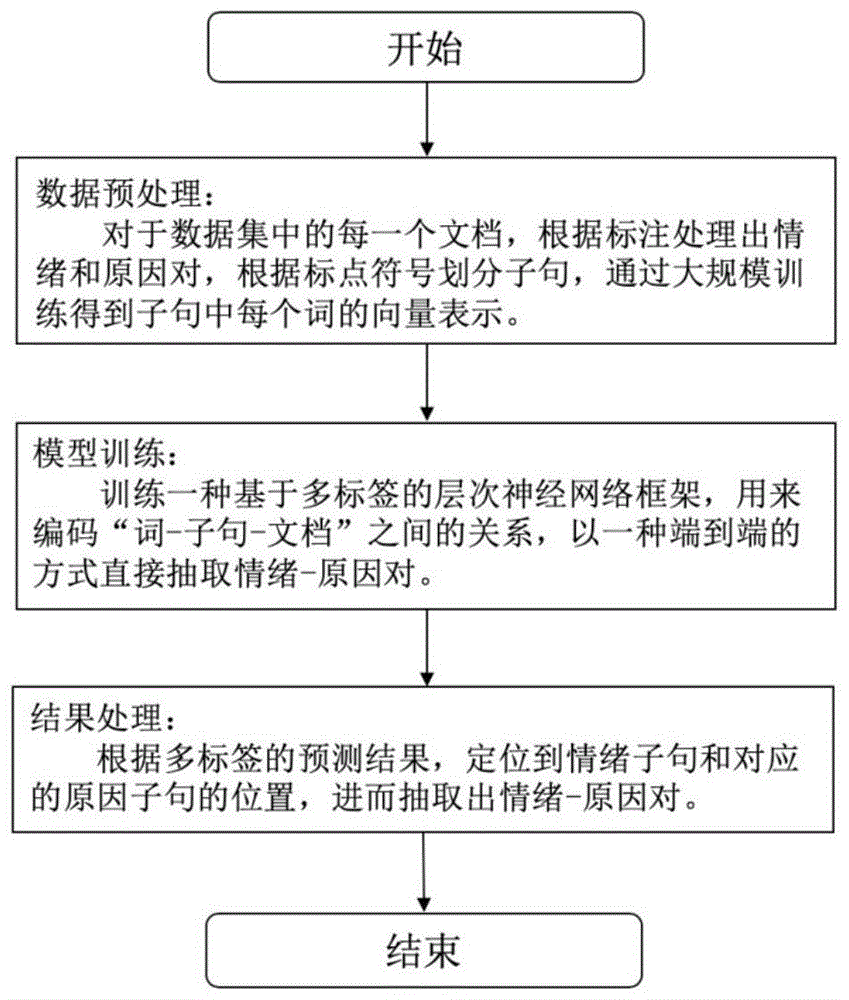
图1为本发明基于多标签的情绪-原因对抽取算法研究流程图。FIG. 1 is a flow chart of the research flow of the multi-label based emotion-reason pair extraction algorithm of the present invention.
图2所为本发明实施例提供的情绪-原因对联合抽取任务示例图。FIG. 2 is an example diagram of an emotion-reason pair joint extraction task provided by an embodiment of the present invention.
图3为本发明实施例提供的情绪-原因对联合抽取模型整体架构图。FIG. 3 is an overall architecture diagram of an emotion-reason pair joint extraction model provided by an embodiment of the present invention.
具体实施方式Detailed ways
如图1所示,一种基于多标签的情绪-原因对抽取方法,包括如下步骤:As shown in Figure 1, a multi-label-based emotion-reason pair extraction method includes the following steps:
数据预处理:将数据集中的样本转化为包含多个子句的文档,并处理出情绪子句和原因子句,通过非标注语料,训练得到具有语义信息的词向量;Data preprocessing: convert the samples in the dataset into documents containing multiple clauses, and process emotional clauses and reason clauses, and train to obtain word vectors with semantic information through unlabeled corpus;
模型训练:将文档中子句的每个词映射成对应的词向量,输入到层次神经网络模型中训练,将训练得到的子句进行多标签预测;Model training: map each word of the clause in the document into the corresponding word vector, input it into the hierarchical neural network model for training, and perform multi-label prediction on the clause obtained by training;
结果处理:在层次神经网络的基础上,设计了情绪预测和原因预测两个辅助任务,并利用它们的预测标签作为特征来指导多标签预测。Result processing: On the basis of hierarchical neural network, two auxiliary tasks, emotion prediction and cause prediction, are designed, and their predicted labels are used as features to guide multi-label prediction.
进一步地,数据预处理具体方法包括:Further, specific methods of data preprocessing include:
将数据集中的文档根据标点符号进行划分,得到每个文档中所包含的所有子句;Divide the documents in the dataset according to punctuation to get all the clauses contained in each document;
根据数据集中的标注,处理出情绪子句和原因子句,得到情绪-原因对;According to the annotations in the dataset, the emotion clause and the reason clause are processed to obtain the emotion-cause pair;
利用在word2vec工具包在微博语料库上训练得到词向量。The word vectors are obtained by training on the Weibo corpus using the word2vec toolkit.
更进一步地,通过对语料进行统计,子句中词的最大长度设为45,文档中子句的最大长度设为75。Furthermore, by counting the corpus, the maximum length of the words in the clause is set to 45, and the maximum length of the clause in the document is set to 75.
更进一步地,数据集中标注了情绪和原因,根据标注处理出情绪子句和原因子句,进而处理出情绪-原因对。Furthermore, emotions and reasons are labeled in the dataset, and emotion clauses and reason clauses are processed according to the labels, and then emotion-cause pairs are processed.
进一步地,模型训练具体方法包括:Further, specific methods for model training include:
将文档中的每个词映射为对应的词向量,并将其作为用一层双向LSTM编码,得到融合上下文词序信息的隐藏层表示;Map each word in the document to a corresponding word vector and encode it as a layer of bidirectional LSTM to obtain a hidden layer representation that fuses contextual word order information;
考虑到每个词在子句表示中的重要性不同,利用注意力机制来获得加权和的子句表示向量;Considering the different importance of each word in the clause representation, the attention mechanism is used to obtain the clause representation vector of the weighted sum;
整个文档包含的子句组成子句序列,将子句序列送入子句级双向LSTM中,得到每个子句的隐层状态表示向量。The clauses contained in the entire document form a clause sequence, and the clause sequence is sent to the clause-level bidirectional LSTM to obtain the hidden layer state representation vector of each clause.
进一步地,模型输入为:Further, the model input is:
包含多个子句的文档表示为d=[c1,…,ci,…,c|d|],ci表示文档d的第i个子句。每一个子句ci由多个词组成
进一步地,模型训练过程包括:Further, the model training process includes:
2-1)将子句的词向量作为双向LSTM的输入,其中一个子句对应一个双向LSTM,双向LSTM隐层状态的输出作为自注意力层的输入;2-1) Use the word vector of the clause as the input of the bidirectional LSTM, one of which corresponds to a bidirectional LSTM, and the output of the hidden layer state of the bidirectional LSTM is used as the input of the self-attention layer;
2-2)注意力层将融合了上下文表示的隐层向量作为输入,计算输入句子中的每个词对子句的贡献程度,并以加权和的形式得到文档子句表示;2-2) The attention layer takes the hidden layer vector fused with the context representation as input, calculates the contribution of each word in the input sentence to the clause, and obtains the document clause representation in the form of a weighted sum;
2-3)将原因预测这一辅助任务的预测标签和经过注意力层获得的子句表示拼接得到的向量,作为上层双向LSTM的输入,通过对子句进行序列编码,获得集成其他子句上下文信息的子句表示,即双向LSTM的输出;2-3) The vector obtained by splicing the prediction label of the auxiliary task of reason prediction and the clause representation obtained by the attention layer is used as the input of the upper bidirectional LSTM, and the context of other clauses is obtained by sequentially encoding the clauses The clause representation of the information, i.e. the output of the bidirectional LSTM;
2-4)将通过层次双向LSTM获得的子句表示和情绪预测这一辅助任务的预测标签拼接,得到的向量用于多标签预测,并通过sigmoid函数获得多标签的预测结果;2-4) Splicing the prediction labels of the auxiliary task of the auxiliary task of sentiment prediction and the clause representation obtained by the hierarchical bidirectional LSTM, the obtained vector is used for multi-label prediction, and the multi-label prediction result is obtained by the sigmoid function;
2-5)选取交叉熵作为模型训练的损失函数;2-5) Select cross entropy as the loss function of model training;
2-6)通过反向传播算法训练模型,更新模型的所有参数,得到层次双向LSTM的多标签预测模型。2-6) Train the model through the back-propagation algorithm, update all the parameters of the model, and obtain the multi-label prediction model of the hierarchical bidirectional LSTM.
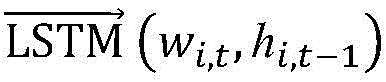
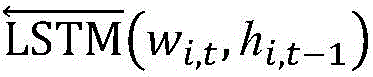
更进一步地,步骤2-1)中所述双向LSTM的输出表示为:Further, the output of the bidirectional LSTM described in step 2-1) is expressed as:

其中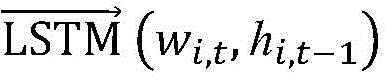

更进一步地,步骤2-2)中利用词级注意力机制来计算得到文档子句表示,包括:Further, in step 2-2), the word-level attention mechanism is used to calculate the document clause representation, including:
a)对于每一个隐层向量hi,t,利用注意力机制来计算每个上下文词的隐层状态向量和它的相关性权重,计算公式为:a) For each hidden layer vector h i,t , use the attention mechanism to calculate the hidden layer state vector of each context word and its relevance weight. The calculation formula is:
ui,t=tanh(Whi,t+b)u i,t =tanh(Wh i,t +b)

其中u表示上下文向量,用于计算权重值,W和b分别表示权重偏置向量,
b)把这些权重和词上下文表示向量相乘并进行加权,得到融合所有词权重的第i个子句上下文信息表示:b) Multiply and weight these weights with the word context representation vector to obtain the ith clause context information representation that fuses all word weights:
ri=∑tαi,thi,t r i =∑ t α i,t h i,t
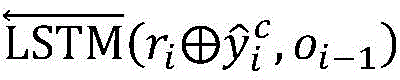
更进一步地,模型预测的多标签每一维表示一个子句和其对应的另一个子句是否为情绪-原因对,因此子句之间的相关性和序列关系对模型性能的影响至关重要,本发明使用双向LSTM来获取子句之间的关系,步骤2-3)中所述双向LSTM的输出表示为:Furthermore, each dimension of the multi-label predicted by the model represents whether a clause and its corresponding clause are a sentiment-cause pair, so the correlation and sequence relationship between clauses are crucial to the model performance. , the present invention uses bidirectional LSTM to obtain the relationship between clauses, and the output of the bidirectional LSTM described in step 2-3) is expressed as:

其中


更进一步地,步骤2-4)中所述多标签预测结果为:Further, the multi-label prediction result described in step 2-4) is:

其中

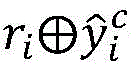
情绪预测和原因预测两个辅助任务在整体模型上的作用为:The role of the two auxiliary tasks of emotion prediction and reason prediction on the overall model is:
将原因预测标签

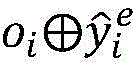
更进一步地,步骤2-5)中所述通过最小化预测概率和真实标签之间的差值来得到最终的优化后的模型,文档中所有子句的交叉熵损失为:Further, as described in step 2-5), the final optimized model is obtained by minimizing the difference between the predicted probability and the true label, and the cross-entropy loss of all clauses in the document is:

其中corpus表示数据集中的所有文档,|d|表示文档中的子句数,yi和
模型的最终损失lossall是原因预测误差lossc、情绪预测误差losse和情绪-原因对抽取任务误差loss再加上L2正则化项后的加权和:The final loss of the model, loss all , is the weighted sum of the cause prediction error loss c , the emotion prediction error loss e , and the emotion-cause pair extraction task error loss plus the L2 regularization term:
lossall=λclossc+λelosse+λloss+λr‖θ‖2 loss all =λ c loss c +λ e loss e +λloss+λ r ‖θ‖ 2
其中λc,λe,λ,λr分别是lossc,losse,loss,L2正则项的权重,θ表示参数集。where λ c , λ e , λ, λ r are the weights of loss c , loss e , loss, and L2 regular terms, respectively, and θ represents the parameter set.
进一步地,结果处理:具体方法包括:Further, result processing: specific methods include:
情绪预测和原因预测两个辅助任务和情绪-原因对抽取任务共享第一层双向LSTM和注意力层参数,获得两者的子句隐层状态表示向量;The two auxiliary tasks of emotion prediction and reason prediction and the emotion-cause pair extraction task share the first-layer bidirectional LSTM and attention layer parameters, and obtain the clause hidden layer state representation vector of both;
两个辅助任务再经过一层双向LSTM独立编码,获得融合上下文序列和文本信息的隐层状态表示;The two auxiliary tasks are then independently encoded by a layer of bidirectional LSTM to obtain the hidden layer state representation that fuses the context sequence and text information;
对辅助任务的子句表示向量进行分类,可以分别获得情绪子句和原因子句在整个文档上的预测结果,并将两者的预测标签作为特征来指导多标签的预测。By classifying the clause representation vector of the auxiliary task, the prediction results of the sentiment clause and the reason clause on the whole document can be obtained respectively, and the predicted labels of the two can be used as features to guide the multi-label prediction.
本发明还提供一种基于多标签的情绪-原因对抽取系统,包括:The present invention also provides a multi-label based emotion-reason pair extraction system, including:
待测数据预处理模块:对于数据集中的每一个文档,根据标注处理出情绪和原因对,根据标点符号划分子句,通过大规模训练得到子句中每个词的向量表示。Data preprocessing module: For each document in the data set, the emotion and reason pairs are processed according to the annotation, the clauses are divided according to the punctuation, and the vector representation of each word in the clause is obtained through large-scale training.
多标签预测模块:训练一种基于多标签的层次神经网络框架,用来编码“词-子句-文档”之间的关系,以一种端到端的方式直接抽取情绪-原因对,此外设计了情绪预测和原因预测两个辅助任务来指导多标签预测;Multi-label prediction module: trains a multi-label based hierarchical neural network framework to encode the relationship between "word-clause-document" to directly extract sentiment-reason pairs in an end-to-end manner, and design Two auxiliary tasks, sentiment prediction and cause prediction, guide multi-label prediction;
结果获取模块:根据多标签的预测结果,定位到情绪子句和对应的原因子句的位置,进而抽取出情绪-原因对。Result acquisition module: According to the multi-label prediction results, locate the position of the emotion clause and the corresponding reason clause, and then extract the emotion-cause pair.
为使本发明的上述目的、特征和优点阐述地更加清晰易懂,下面通过具体实施例并结合附图,对本发明做进一步详细说明:In order to make the above-mentioned purposes, features and advantages of the present invention more clearly explained, the present invention will be described in further detail below through specific embodiments and in conjunction with the accompanying drawings:
实施例Example
图2为本发明实施例提供的情绪-原因对联合抽取任务的一个示例,该任务的目的是输出情绪-原因对,所以输入的测试文本无需提供情绪标注。例如,给定情绪标注“伤心”,情绪原因抽取任务的目标是找到相应的原因子句:“我们为她的去世感到伤心”;同样,给定情绪标注“骄傲”,相应的原因子句为:“但也为她所做的一切”和“以及她的正直和同情心感到骄傲”。对于情绪-原因对抽取任务来说,目标是直接抽取文档中所有成对的情绪子句和原因子句:包括(“我们为她的去世感到伤心”,“我们为她的去世感到伤心”)、(“以及她的正直和同情心感到骄傲”,“但也为她所做的一切”)和(“以及她的正直和同情心感到骄傲”,“但也为她所做的一切”)三个情绪-原因对。FIG. 2 is an example of a joint extraction task of emotion-cause pairs provided by an embodiment of the present invention. The purpose of the task is to output emotion-cause pairs, so the input test text does not need to provide emotion annotations. For example, given the emotion label "sad", the goal of the emotion reason extraction task is to find the corresponding reason clause: "We are sad about her passing"; similarly, given the emotion label "proud", the corresponding reason clause is : "But also proud of what she did" and "and her integrity and compassion". For the emotion-cause extraction task, the goal is to directly extract all pairs of emotion and cause clauses in the document: including (“We are saddened by her passing”, “We are saddened by her passing”) , ("and proud of her integrity and compassion", "but also of everything she did") and ("and proud of her integrity and compassion", "but also of everything she did") Three emotions-reasons right.
为本发明实施例提供的基于多标签的情绪-原因对抽取算法研究流程图,如图1所示,该方法主要包括三个阶段,分别是:数据预处理阶段;基于多标签的层次网络模型训练阶段,对结果进行多标签预测并匹配情绪-原因对结果阶段。The research flow chart of the multi-label-based emotion-reason pair extraction algorithm provided by the embodiment of the present invention, as shown in FIG. 1, the method mainly includes three stages, namely: a data preprocessing stage; a multi-label-based hierarchical network model The training phase, multi-label prediction of outcomes and matching sentiment-cause versus outcome stage.
(一)数据预处理阶段(1) Data preprocessing stage
对于数据集,根据标注处理出情绪子句和原因子句,进而得到情绪-原因对。本发明将情绪-原因对抽取任务定义为多标签分类问题,其中多标签是根据相对位置(relativeposition,rp)来定义的。相对位置指的是其他子句相对于情绪子句的距离,定义情绪子句的相对位置为0,-1表示在情绪子句左边且距离情绪子句的距离为1的子句的相对位置,+2表示在情绪子句右边且距离情绪子句的距离为2的子句的相对位置。假设多标签的维度为n,对于第i个子句ci,每一维多标签依次表示相对位置为
yi={li,rp,…,li,-1,li,0,li,+1,…}y i ={l i,rp ,…,l i,-1 ,l i,0 ,l i,+1 ,…}
其中li,rp表示第i个子句和相对位置为rp的子句是否为情绪-原因对,若是则为1否则为0。where l i,rp indicates whether the i-th clause and the clause whose relative position is rp is an emotion-reason pair, if so, it is 1, otherwise it is 0.
表1Table 1

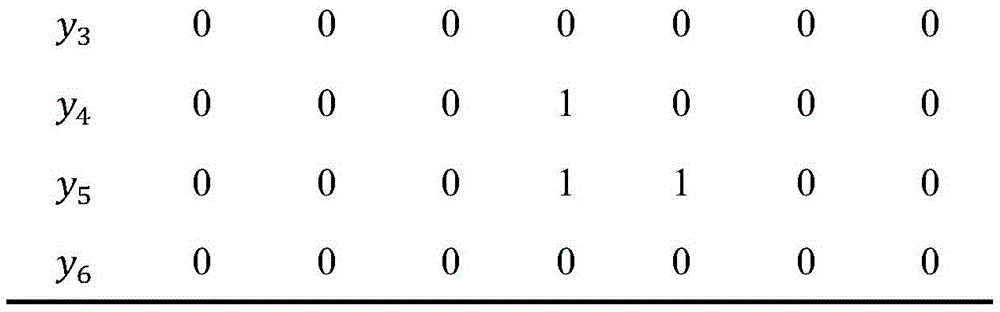
表1所示图2例子中每个子句的多标签表示。例子中第4个子句是情绪子句,它有一个原因且原因子句所在相对位置是0,故l4,0=1;同样,第5个子句也是情绪子句,它有两个原因且原因子句所在相对位置分别为0和+1,故l5,0=1且l5,+1=1。按照这种定义,把情绪-原因对抽取任务转化为多标签预测问题,这样就可以通过一轮预测直接得到情绪和原因对抽取的结果。Table 1 shows the multi-label representation of each clause in the example in Figure 2. In the example, the fourth clause is an emotion clause, it has a reason and the relative position of the reason clause is 0, so l 4,0 = 1; similarly, the fifth clause is also an emotion clause, it has two reasons and The relative positions of the cause clauses are 0 and +1, respectively, so l 5,0 =1 and l 5,+1 =1. According to this definition, the emotion-cause pair extraction task is transformed into a multi-label prediction problem, so that the result of emotion-cause pair extraction can be directly obtained through one round of prediction.
(二)模型训练阶段(2) Model training stage
结合图1和图3,基于多标签的情绪-原因对抽取的层次模型具体包括以下步骤:Combined with Figure 1 and Figure 3, the hierarchical model of multi-label emotion-reason pair extraction specifically includes the following steps:
步骤1,输入为包含多个子句的文档表示为d=[c1,…,ci,…,c|d|],ci表示文档d的第i个子句。每一个子句ci由多个词组成
步骤2,利用通过word2vec训练得到的词向量表示以及预训练好的语言模型,分别将输入子句中的每个词映射成对应的词向量;Step 2, using the word vector representation obtained by word2vec training and the pre-trained language model, respectively map each word in the input clause into a corresponding word vector;
步骤3,子句级上下文表示层,将子句中每个词对应的词向量作为双向LSTM的输入:Step 3, the clause-level context representation layer, takes the word vector corresponding to each word in the clause as the input of the bidirectional LSTM:

其中

步骤4,词级注意力层,利用自注意力机制来计算词的上下文信息,对于每一个隐层向量hi,t,利用注意力机制来计算每个上下文词的隐层状态向量和它的相关性权重,计算公式为:Step 4, word-level attention layer, uses the self-attention mechanism to calculate the context information of the word, for each hidden layer vector h i,t , uses the attention mechanism to calculate the hidden layer state vector of each context word and its The correlation weight is calculated as:
ui,t=tanh(Whi,t+b)u i,t =tanh(Wh i,t +b)
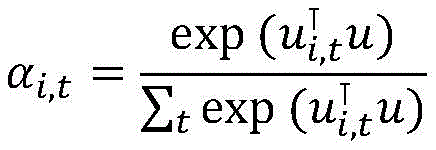
其中u表示上下文向量,用于计算权重值,α为经过归一化后的隐层状态权重向量;where u represents the context vector, which is used to calculate the weight value, and α is the normalized hidden layer state weight vector;
把这些权重和词上下文表示向量相乘并进行加权,得到融合所有词权重的第i个子句上下文信息表示:Multiply and weight these weights with the word context representation vector to obtain the i-th clause context information representation that fuses all word weights:
ri=∑tαi,thi,t r i =∑ t α i,t h i,t
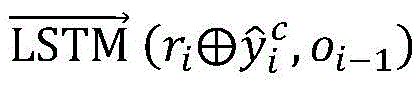
步骤5,子句级上下文表示层,将注意力层得到的子句表示向量作为子句双向LSTM的输入,用来获取子句之间的上下文关系:Step 5, the clause-level context representation layer, uses the clause representation vector obtained by the attention layer as the input of the clause bidirectional LSTM to obtain the context relationship between the clauses:

其中


步骤6,经过层次LSTM和注意力编码后得到的子句表示用来进行多标签分类,多标签预测结果为:Step 6, the clause representation obtained after hierarchical LSTM and attention encoding is used for multi-label classification, and the multi-label prediction result is:

其中

步骤7,最小化预测概率和真实标签之间的差值来得到最终的优化后的模型,文档中所有子句的交叉熵损失为:Step 7: Minimize the difference between the predicted probability and the true label to obtain the final optimized model. The cross-entropy loss of all clauses in the document is:

其中corpus表示数据集中的所有文档,|d|表示文档中的子句数,yi和
模型的最终损失lossall是原因预测误差lossc、情绪预测误差losse和情绪-原因对抽取任务误差loss再加上L2正则化项后的加权和:The final loss of the model, loss all , is the weighted sum of the cause prediction error loss c , the emotion prediction error loss e , and the emotion-cause pair extraction task error loss plus the L2 regularization term:
lossall=λclossc+λelosse+λloss+λr‖θ‖2 loss all =λ c loss c +λ e loss e +λloss+λ r ‖θ‖ 2
其中λc,λe,λ,λr分别是lossc,losse,loss,L2正则项的权重,θ表示参数集。where λ c , λ e , λ, λ r are the weights of loss c , loss e , loss, and L2 regular terms, respectively, and θ represents the parameter set.
(三)结果处理阶段(3) Result processing stage
步骤1,把得到的子句向量输入到训练好的情绪-原因对抽取层次模型中,对文档中的所有子句进行多标签预测;Step 1, input the obtained clause vector into the trained emotion-reason pair extraction hierarchical model, and perform multi-label prediction on all clauses in the document;
步骤2,对比真实标签和多标签的预测结果,利用precision、recall和F1来评估模型的准确性;Step 2, compare the prediction results of real labels and multi-labels, and use precision, recall and F1 to evaluate the accuracy of the model;
步骤3,根据多标签的预测结果,处理出标签为1对应的情绪子句和原因子句,进而得到预测的情绪-原因对。Step 3: According to the multi-label prediction result, the emotion clause and the reason clause corresponding to the label 1 are processed, and then the predicted emotion-cause pair is obtained.
以上所述仅是本发明的优选实施方式,本发明不受上述实施例的限制,相关技术人员在不脱离本发明构思的前提下,可以对本发明做出若干改进和润饰,但均应视为在本发明保护范围。The above descriptions are only the preferred embodiments of the present invention, and the present invention is not limited by the above-mentioned embodiments. Those skilled in the art can make some improvements and modifications to the present invention without departing from the concept of the present invention, but all should be regarded as within the protection scope of the present invention.
Claims (10)










Priority Applications (1)
| Application Number | Priority Date | Filing Date | Title |
|---|---|---|---|
| CN202010159301.4A CN111382565B (en) | 2020-03-09 | 2020-03-09 | Method and system for extracting emotion-cause pairs based on multi-label |
Applications Claiming Priority (1)
| Application Number | Priority Date | Filing Date | Title |
|---|---|---|---|
| CN202010159301.4A CN111382565B (en) | 2020-03-09 | 2020-03-09 | Method and system for extracting emotion-cause pairs based on multi-label |
Publications (2)
| Publication Number | Publication Date |
|---|---|
| CN111382565A true CN111382565A (en) | 2020-07-07 |
| CN111382565B CN111382565B (en) | 2023-08-11 |
Family
ID=71218690
Family Applications (1)
| Application Number | Title | Priority Date | Filing Date |
|---|---|---|---|
| CN202010159301.4A Active CN111382565B (en) | 2020-03-09 | 2020-03-09 | Method and system for extracting emotion-cause pairs based on multi-label |
Country Status (1)
| Country | Link |
|---|---|
| CN (1) | CN111382565B (en) |
Cited By (16)
| Publication number | Priority date | Publication date | Assignee | Title |
|---|---|---|---|---|
| CN111858939A (en) * | 2020-07-27 | 2020-10-30 | 上海五节数据科技有限公司 | A Text Sentiment Classification Method Based on Context Information and Convolutional Neural Networks |
| CN111859957A (en) * | 2020-07-15 | 2020-10-30 | 中南民族大学 | Method, device and equipment for extracting emotion reason clause labels and storage medium |
| CN111930896A (en) * | 2020-09-01 | 2020-11-13 | 平安国际智慧城市科技股份有限公司 | Text emotion analysis method and device, computer equipment and readable storage medium |
| CN112183064A (en) * | 2020-10-22 | 2021-01-05 | 福州大学 | Text emotion reason recognition system based on multi-task joint learning |
| CN112364127A (en) * | 2020-10-30 | 2021-02-12 | 重庆大学 | Short document emotional cause pair extraction method, system and storage medium |
| CN113158644A (en) * | 2021-05-13 | 2021-07-23 | 山西大学 | Retrieval lattice and implicit emotion recognition method based on multitask learning |
| CN113486657A (en) * | 2021-07-26 | 2021-10-08 | 刘德喜 | Emotion-reason pair extraction system based on knowledge assistance |
| CN113657446A (en) * | 2021-07-13 | 2021-11-16 | 广东外语外贸大学 | Processing method, system and storage medium for multi-label emotion classification model |
| CN114065769A (en) * | 2022-01-14 | 2022-02-18 | 四川大学 | Training method, device, equipment and medium for emotional reasons to extraction model |
| CN114817566A (en) * | 2022-04-29 | 2022-07-29 | 天津大学 | Emotion reason pair extraction method based on emotion embedding |
| CN116069930A (en) * | 2023-02-10 | 2023-05-05 | 大连理工大学 | Extraction method of document sentiment reason based on graph neural network with edge feature and document segmentation |
| CN116450818A (en) * | 2023-02-22 | 2023-07-18 | 合肥工业大学 | Multi-label emotion sequence generation method and system based on emotion transfer |
| CN116910255A (en) * | 2023-07-19 | 2023-10-20 | 重庆位图信息技术有限公司 | Emotion cause pair extraction method and device, computer equipment and storage medium |
| CN117743518A (en) * | 2024-02-20 | 2024-03-22 | 北京智精灵科技有限公司 | Emotion cause pair extraction method and system based on multi-stage attribution |
| CN117787267A (en) * | 2023-12-29 | 2024-03-29 | 广东外语外贸大学 | An emotional cause pair extraction method and system based on neural network |
| CN118153553A (en) * | 2024-05-09 | 2024-06-07 | 江西科技师范大学 | Method and system for extracting psychological crisis causes of social network users based on multi-task |
Citations (2)
| Publication number | Priority date | Publication date | Assignee | Title |
|---|---|---|---|---|
| CN109670045A (en) * | 2018-11-02 | 2019-04-23 | 天津大学 | Emotion reason abstracting method based on ontology model and multi-kernel support vector machine |
| CN110162636A (en) * | 2019-05-30 | 2019-08-23 | 中森云链(成都)科技有限责任公司 | Text mood reason recognition methods based on D-LSTM |
-
2020
- 2020-03-09 CN CN202010159301.4A patent/CN111382565B/en active Active
Patent Citations (2)
| Publication number | Priority date | Publication date | Assignee | Title |
|---|---|---|---|---|
| CN109670045A (en) * | 2018-11-02 | 2019-04-23 | 天津大学 | Emotion reason abstracting method based on ontology model and multi-kernel support vector machine |
| CN110162636A (en) * | 2019-05-30 | 2019-08-23 | 中森云链(成都)科技有限责任公司 | Text mood reason recognition methods based on D-LSTM |
Non-Patent Citations (5)
| Title |
|---|
| 张晨等: "基于神经网络的微博情绪识别与诱因抽取联合模型", 《计算机应用》 * |
| 张莹等: "基于双向分层语义模型的多源新闻评论情绪预测", 《计算机研究与发展》 * |
| 李德玉等: "融合CNN和标签特征的中文文本情绪多标签分类", 《山西大学学报(自然科学版)》 * |
| 杨开漠等: "广义文本情感分析综述", 《计算机应用》 * |
| 陈珊珊等: "文本情绪原因检测研究综述", 《现代计算机》 * |
Cited By (25)
| Publication number | Priority date | Publication date | Assignee | Title |
|---|---|---|---|---|
| CN111859957A (en) * | 2020-07-15 | 2020-10-30 | 中南民族大学 | Method, device and equipment for extracting emotion reason clause labels and storage medium |
| CN111859957B (en) * | 2020-07-15 | 2023-11-07 | 中南民族大学 | Extraction method, device, equipment and storage medium for emotional reason clause tags |
| CN111858939A (en) * | 2020-07-27 | 2020-10-30 | 上海五节数据科技有限公司 | A Text Sentiment Classification Method Based on Context Information and Convolutional Neural Networks |
| CN111930896A (en) * | 2020-09-01 | 2020-11-13 | 平安国际智慧城市科技股份有限公司 | Text emotion analysis method and device, computer equipment and readable storage medium |
| CN112183064B (en) * | 2020-10-22 | 2022-06-03 | 福州大学 | Text emotion reason recognition system based on multi-task joint learning |
| CN112183064A (en) * | 2020-10-22 | 2021-01-05 | 福州大学 | Text emotion reason recognition system based on multi-task joint learning |
| CN112364127A (en) * | 2020-10-30 | 2021-02-12 | 重庆大学 | Short document emotional cause pair extraction method, system and storage medium |
| CN113158644B (en) * | 2021-05-13 | 2022-09-20 | 山西大学 | A Rhetoric and Implicit Emotion Recognition Method Based on Multi-task Learning |
| CN113158644A (en) * | 2021-05-13 | 2021-07-23 | 山西大学 | Retrieval lattice and implicit emotion recognition method based on multitask learning |
| CN113657446A (en) * | 2021-07-13 | 2021-11-16 | 广东外语外贸大学 | Processing method, system and storage medium for multi-label emotion classification model |
| CN113486657A (en) * | 2021-07-26 | 2021-10-08 | 刘德喜 | Emotion-reason pair extraction system based on knowledge assistance |
| CN113486657B (en) * | 2021-07-26 | 2023-01-17 | 刘德喜 | Emotion-reason pair extraction system based on knowledge assistance |
| CN114065769B (en) * | 2022-01-14 | 2022-04-08 | 四川大学 | Method, device, equipment and medium for training emotion reason pair extraction model |
| CN114065769A (en) * | 2022-01-14 | 2022-02-18 | 四川大学 | Training method, device, equipment and medium for emotional reasons to extraction model |
| CN114817566A (en) * | 2022-04-29 | 2022-07-29 | 天津大学 | Emotion reason pair extraction method based on emotion embedding |
| CN114817566B (en) * | 2022-04-29 | 2023-03-10 | 天津大学 | Emotional Reason Pair Extraction Method Based on Emotional Embedding |
| CN116069930A (en) * | 2023-02-10 | 2023-05-05 | 大连理工大学 | Extraction method of document sentiment reason based on graph neural network with edge feature and document segmentation |
| CN116069930B (en) * | 2023-02-10 | 2025-07-25 | 大连理工大学 | Neural network based on band edge characteristics and document emotion cause extraction method for document segmentation |
| CN116450818A (en) * | 2023-02-22 | 2023-07-18 | 合肥工业大学 | Multi-label emotion sequence generation method and system based on emotion transfer |
| CN116910255A (en) * | 2023-07-19 | 2023-10-20 | 重庆位图信息技术有限公司 | Emotion cause pair extraction method and device, computer equipment and storage medium |
| CN117787267A (en) * | 2023-12-29 | 2024-03-29 | 广东外语外贸大学 | An emotional cause pair extraction method and system based on neural network |
| CN117787267B (en) * | 2023-12-29 | 2024-06-07 | 广东外语外贸大学 | Emotion cause pair extraction method and system based on neural network |
| CN117743518A (en) * | 2024-02-20 | 2024-03-22 | 北京智精灵科技有限公司 | Emotion cause pair extraction method and system based on multi-stage attribution |
| CN118153553A (en) * | 2024-05-09 | 2024-06-07 | 江西科技师范大学 | Method and system for extracting psychological crisis causes of social network users based on multi-task |
| CN118153553B (en) * | 2024-05-09 | 2024-07-19 | 江西科技师范大学 | Method and system for extracting psychological crisis causes of social network users based on multi-task |
Also Published As
| Publication number | Publication date |
|---|---|
| CN111382565B (en) | 2023-08-11 |
Similar Documents
| Publication | Publication Date | Title |
|---|---|---|
| CN111382565B (en) | Method and system for extracting emotion-cause pairs based on multi-label | |
| CN111241837B (en) | A Named Entity Recognition Method for Legal Documents in Theft Cases Based on Adversarial Transfer Learning | |
| Zhang et al. | Aspect-based sentiment analysis for user reviews | |
| CN112613305A (en) | Chinese event extraction method based on cyclic neural network | |
| CN112434535A (en) | Multi-model-based factor extraction method, device, equipment and storage medium | |
| Sahoo et al. | Comparative analysis of bert models for sentiment analysis on twitter data | |
| CN115759119A (en) | Financial text emotion analysis method, system, medium and equipment | |
| CN114818717A (en) | Chinese named entity recognition method and system fusing vocabulary and syntax information | |
| Jia et al. | Text sentiment analysis based on BERT-CBLBGA | |
| CN111259153A (en) | Attribute-level emotion analysis method of complete attention mechanism | |
| CN115510230A (en) | A Mongolian Sentiment Analysis Method Based on Multidimensional Feature Fusion and Comparative Enhancement Learning Mechanism | |
| CN115169429A (en) | Lightweight aspect-level text emotion analysis method | |
| CN113901813B (en) | An event extraction method based on topic features and implicit sentence structure | |
| Yao | Attention-based BiLSTM neural networks for sentiment classification of short texts | |
| Fei et al. | GFMRC: A machine reading comprehension model for named entity recognition | |
| Samrat et al. | Deep learning techniques for sentiment analysis: a comparative study | |
| CN118296135A (en) | Cross-domain migration-oriented aspect-level emotion triplet extraction method | |
| CN114356990A (en) | Base named entity recognition system and method based on transfer learning | |
| Chi et al. | Research on sentiment analysis of hotel review text based on BERT-TCN-BiLSTM-attention model | |
| CN116578671B (en) | Emotion-reason pair extraction method and device | |
| CN113191135A (en) | Multi-category emotion extraction method fusing facial characters | |
| Si et al. | Sentiment analysis of social network comment text based on LSTM and bert | |
| CN116775862A (en) | Emotion classification method of Bi-LSTM fused with emotion words | |
| CN118503411B (en) | Outline generation method, model training method, equipment and medium | |
| Nguyen | Document understanding with deep learning techniques |
Legal Events
| Date | Code | Title | Description |
|---|---|---|---|
| PB01 | Publication | ||
| PB01 | Publication | ||
| SE01 | Entry into force of request for substantive examination | ||
| SE01 | Entry into force of request for substantive examination | ||
| GR01 | Patent grant | ||
| GR01 | Patent grant |