CN111355956B - Deep learning-based rate distortion optimization rapid decision system and method in HEVC intra-frame coding - Google Patents
Deep learning-based rate distortion optimization rapid decision system and method in HEVC intra-frame coding Download PDFInfo
- Publication number
- CN111355956B CN111355956B CN202010157663.XA CN202010157663A CN111355956B CN 111355956 B CN111355956 B CN 111355956B CN 202010157663 A CN202010157663 A CN 202010157663A CN 111355956 B CN111355956 B CN 111355956B
- Authority
- CN
- China
- Prior art keywords
- decision
- coding
- network
- video
- current
- Prior art date
- Legal status (The legal status is an assumption and is not a legal conclusion. Google has not performed a legal analysis and makes no representation as to the accuracy of the status listed.)
- Active
Links
- 238000000034 method Methods 0.000 title claims abstract description 40
- 238000005457 optimization Methods 0.000 title claims abstract description 15
- 238000013135 deep learning Methods 0.000 title claims abstract description 14
- 238000005192 partition Methods 0.000 claims abstract description 36
- 238000012360 testing method Methods 0.000 claims abstract description 24
- 238000012549 training Methods 0.000 claims abstract description 24
- 239000013598 vector Substances 0.000 claims description 14
- 238000009826 distribution Methods 0.000 claims description 11
- 230000006870 function Effects 0.000 claims description 8
- 238000002360 preparation method Methods 0.000 claims description 5
- 230000011218 segmentation Effects 0.000 claims description 5
- 230000002123 temporal effect Effects 0.000 claims description 5
- 238000010586 diagram Methods 0.000 claims description 3
- 238000004364 calculation method Methods 0.000 abstract description 2
- 238000000638 solvent extraction Methods 0.000 description 7
- 238000013527 convolutional neural network Methods 0.000 description 5
- 239000000284 extract Substances 0.000 description 4
- 230000006835 compression Effects 0.000 description 3
- 238000007906 compression Methods 0.000 description 3
- 238000013459 approach Methods 0.000 description 1
- 230000009286 beneficial effect Effects 0.000 description 1
- 230000000694 effects Effects 0.000 description 1
- 238000011156 evaluation Methods 0.000 description 1
- 238000002474 experimental method Methods 0.000 description 1
- 238000000605 extraction Methods 0.000 description 1
- 238000011176 pooling Methods 0.000 description 1
- 238000011160 research Methods 0.000 description 1
- 230000000007 visual effect Effects 0.000 description 1
Images


Classifications
-
- H—ELECTRICITY
- H04—ELECTRIC COMMUNICATION TECHNIQUE
- H04N—PICTORIAL COMMUNICATION, e.g. TELEVISION
- H04N19/00—Methods or arrangements for coding, decoding, compressing or decompressing digital video signals
- H04N19/10—Methods or arrangements for coding, decoding, compressing or decompressing digital video signals using adaptive coding
- H04N19/134—Methods or arrangements for coding, decoding, compressing or decompressing digital video signals using adaptive coding characterised by the element, parameter or criterion affecting or controlling the adaptive coding
- H04N19/146—Data rate or code amount at the encoder output
- H04N19/149—Data rate or code amount at the encoder output by estimating the code amount by means of a model, e.g. mathematical model or statistical model
-
- H—ELECTRICITY
- H04—ELECTRIC COMMUNICATION TECHNIQUE
- H04N—PICTORIAL COMMUNICATION, e.g. TELEVISION
- H04N19/00—Methods or arrangements for coding, decoding, compressing or decompressing digital video signals
- H04N19/10—Methods or arrangements for coding, decoding, compressing or decompressing digital video signals using adaptive coding
- H04N19/134—Methods or arrangements for coding, decoding, compressing or decompressing digital video signals using adaptive coding characterised by the element, parameter or criterion affecting or controlling the adaptive coding
- H04N19/136—Incoming video signal characteristics or properties
- H04N19/14—Coding unit complexity, e.g. amount of activity or edge presence estimation
-
- H—ELECTRICITY
- H04—ELECTRIC COMMUNICATION TECHNIQUE
- H04N—PICTORIAL COMMUNICATION, e.g. TELEVISION
- H04N19/00—Methods or arrangements for coding, decoding, compressing or decompressing digital video signals
- H04N19/10—Methods or arrangements for coding, decoding, compressing or decompressing digital video signals using adaptive coding
- H04N19/134—Methods or arrangements for coding, decoding, compressing or decompressing digital video signals using adaptive coding characterised by the element, parameter or criterion affecting or controlling the adaptive coding
- H04N19/157—Assigned coding mode, i.e. the coding mode being predefined or preselected to be further used for selection of another element or parameter
- H04N19/159—Prediction type, e.g. intra-frame, inter-frame or bidirectional frame prediction
-
- Y—GENERAL TAGGING OF NEW TECHNOLOGICAL DEVELOPMENTS; GENERAL TAGGING OF CROSS-SECTIONAL TECHNOLOGIES SPANNING OVER SEVERAL SECTIONS OF THE IPC; TECHNICAL SUBJECTS COVERED BY FORMER USPC CROSS-REFERENCE ART COLLECTIONS [XRACs] AND DIGESTS
- Y02—TECHNOLOGIES OR APPLICATIONS FOR MITIGATION OR ADAPTATION AGAINST CLIMATE CHANGE
- Y02T—CLIMATE CHANGE MITIGATION TECHNOLOGIES RELATED TO TRANSPORTATION
- Y02T10/00—Road transport of goods or passengers
- Y02T10/10—Internal combustion engine [ICE] based vehicles
- Y02T10/40—Engine management systems
Landscapes
- Engineering & Computer Science (AREA)
- Multimedia (AREA)
- Signal Processing (AREA)
- Physics & Mathematics (AREA)
- Algebra (AREA)
- General Physics & Mathematics (AREA)
- Mathematical Analysis (AREA)
- Mathematical Optimization (AREA)
- Pure & Applied Mathematics (AREA)
- Compression Or Coding Systems Of Tv Signals (AREA)
Abstract
The invention discloses a rate distortion optimization rapid decision system and a method thereof based on deep learning in HEVC intra-frame coding, and belongs to the technical field of video coding. Considering the inherent relation existing during coding parameter selection, combining with the space-time correlation of video content to determine the CU/PU partition and the prediction mode of the current coding unit, the traversal process in the rate distortion optimization process in HEVC intra-frame coding is avoided, the calculation complexity can be reduced to the greatest extent, and the coding time is saved. The method specifically comprises the following steps: 1) Preparing a video dataset for training and testing a decision network; 2) Training the single-step decision network under different QPs by using the training data set, and storing the trained network model parameters; 3) Embedding the single-step decision network into an HEVC reference model HM.15.0 to realize a low-complexity HEVC encoder; 4) And respectively coding the video on the test set by using single-step decision network models trained under different QPs, and testing the coding complexity and RD performance.
Description
Technical Field
The invention belongs to the technical field of video coding, and particularly relates to a fast decision system and a method for rate distortion optimization based on deep learning in HEVC intra-frame coding.
Background
Video coding technology is the basis of video services, and since the amount of raw video data directly acquired from a visual sensor is huge, compression coding of high rate-distortion (RD) quality and low complexity is necessary for the raw video to be efficiently transmitted and stored. In recent years, further improvement of video resolution and real-time requirements in video services have put higher demands on video coding technology. As the latest video coding standard, the high-efficiency video coding standard h.265/HEVC can achieve a significantly high compression ratio. However, more coding parameters are introduced in h.265/HEVC, and an optimal coding parameter set needs to be determined by traversing the rate-distortion cost during coding, so that higher coding complexity is brought, and real-time requirements in video services are difficult to meet. Thus, many scholars are working on low complexity h.265/HEVC to significantly reduce coding complexity without losing excessive RD quality.
Currently, low complexity h.265/HEVC research mainly involves traditional methods and deep learning-based methods. The traditional method is mainly a heuristic quick decision algorithm, and intermediate features in the coding process are extracted to terminate traversal searching of coding parameters such as a dividing mode, a prediction mode and the like of a Coding Unit (CU) and a Prediction Unit (PU) in the rate distortion optimization process in advance, so that complexity is reduced. This approach is based on manually extracted features and fixed thresholds and is therefore less robust in a wide range of applications. In recent years, a deep learning-based method is widely developed, and the strong learning capability of the convolutional neural network enables the convolutional neural network to automatically extract depth features related to coding parameter decision making, so that decision of rate distortion optimization can be quickly made. However, current methods based on deep learning typically model CU/PU partitioning and prediction mode selection separately as classification problems, on which decisions are made separately. These methods suffer from two major drawbacks. First, from the standpoint of complexity reduction, the decision on CU/PU partitioning and prediction mode selection are an overall traversal process, which together results in a high computational complexity for HEVC encoders. Thus, focusing on only one of the tasks does not minimize complexity. Secondly, there is a clear correlation between CU/PU partition decisions and prediction mode selection, and it is also not advisable to simply consider these decisions as separate processes and make the decisions in two stages.
Disclosure of Invention
The invention provides a single-step decision network for solving the technical problems in the background art, considers the inherent relation existing in the selection of coding parameters, combines the time-space correlation of video content to simultaneously determine the CU/PU partition and the prediction mode of the current coding unit, avoids the traversal process in the rate distortion optimization process in HEVC intra-frame coding, and further reduces the calculation complexity to the greatest extent.
The invention is realized by adopting the following technical scheme: a rate distortion optimization fast decision method based on deep learning in HEVC intra-frame coding specifically comprises the following steps:
step 1) video data set preparation;
step 2), constructing a single-step decision network model;
step 3) training a single-step decision network;
step 4) implementing low-complexity HEVC intra-frame coding by applying a single-step decision network;
step 5) testing the performance and coding complexity of the encoder RD.
In a further embodiment, the step 1) specifically includes the following steps: in order to ensure the generalization performance of the network model and to fairly evaluate the model performance, videos for training and testing are randomly selected from different resolutions; and respectively carrying out full-frame mode coding on the selected video by using the HEVC reference test model, and generating a video data set.
In a further embodiment, the step 2) specifically includes the following steps:
step 201) collecting data from the video collected in step 1), the video data set comprising: inputting data and tag data; the input data includes: luminance information of the current CU and decision information of the co-located CU in the previous frame; the tag data includes: decision information of CU/PU partition and prediction modes of the current CU;
step 202) HEVC intra-frame coding is modeled as 4 th level partition of CU by adopting a PU partition mode, so that the partition decision of CU/PU on each level CU and the selection of 35 intra-frame prediction modes of PU are modeled as multi-classification problems;
step 203) for each CU, since the luminance component contains most of the content information, its luminance information is input into the network, taking into account the temporal correlation of the video content, and also utilizing the decision information of the co-located CU in the previous frame, firstly extracting the texture information having a direct correlation with the decision by means of mean removal;
step 204) dividing the video data into two streams by two convolution layers, respectively: a tributary implemented by three non-overlapping convolutional layers and a tributary implemented by two conventional convolutional layers.
In a further embodiment, tributaries of three non-overlapping convolution layer implementations are used to extract features related to CU/PU partitions, and the step size of the convolution is equal to the width of the corresponding convolution kernel, so each pixel in the output feature map will have a receptive field that does not overlap each other, the size of which corresponds exactly to one sub-CU of the current CU.
In a further embodiment, two tributaries implemented by conventional convolution layers are used to extract features related to prediction mode selection, better extracting the relationship between neighboring pixels in the current CU, providing an overall description of the current CU.
In a further embodiment, the step 3) specifically includes the following steps:
using cross entropy as a loss function in training, which describes the difference between two probability distributions, the cross entropy between probability distributions a and b is expressed as:
H(a,b)=a log b+(1-a)log(1-b)
for each sample r of CU depth l,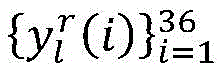 and->
and->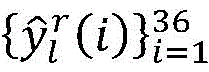 Representing the true value and the output prediction vector of the network, respectively, the loss function is as follows:

the training is performed using the corresponding data sets for networks of different CU depths, respectively.
In a further embodiment, the step 4) specifically includes the following steps:
there are three types of outputs per CU: (1) segmentation, (2) mode selection, (3) uncertainty;
for a given CU of depth i,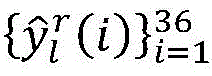 representing the 36-dimensional output probability vector, let Thr P,l And Thr M,l Threshold values representing CU/PU partition and prediction mode selection, respectively,/->
 The maximum value y of (2) max Representing the decision most likely to be made by the input CU;
if y max In the first dimension and y max >Thr P,l The output decision is "split", which means that the current CU will be split directly into four sub-CUs without calculating its own rate-distortion cost;
if y max In the ith dimension (i>1) And y is max >Thr M,l The output decision is "mode select", which means that the current CU will directly select the corresponding prediction mode as the best mode without having to traverse all 35 modes, and will skip the traversal of the deeper CU;
otherwise, if y max Below the corresponding threshold, the output decision is "uncertain".
In a further embodiment, the step 5) specifically includes the following steps:
the degree of complexity reduction is evaluated by the encoding time saving rate Δt:
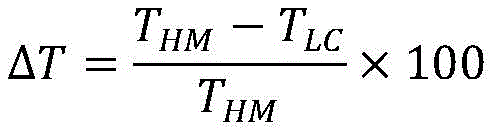
wherein T is HM Represents the encoding time using HM15.0, while T LC Representing the encoding time of a low complexity encoder implemented using a single step decision network;
the single step decision network is performed starting from the second frame of the video to be encoded, since the network requires decision information in the previous frame as input to get the decision result of the current frame.
In a further embodiment, the following modules are included:
a first module for video dataset preparation;
the second module is used for building a single-step decision network model;
a third module for training the single step decision network;
a fourth module for implementing low complexity HEVC intra coding using a single step decision network;
and a fifth module for testing the performance of the encoder RD and the encoding complexity.
In a further embodiment, the first module is further configured to randomly select videos for training and testing from different resolutions in order to guarantee generalization performance of the network model and to fairly evaluate the model performance; performing full-frame mode coding on the selected video by using the HEVC reference test model respectively, and generating a video data set;
the second module is further configured to collect data from the collected video, the video dataset comprising: inputting data and tag data; the input data includes: luminance information of the current CU and decision information of the co-located CU in the previous frame; the tag data includes: decision information of CU/PU partition and prediction modes of the current CU; modeling HEVC intra-frame coding by adopting a PU partition mode as 4 th-level partition of CU, so as to jointly model a partition decision of CU/PU on each-level CU and selection of 35 intra-frame prediction modes of the PU as a multi-classification problem; for each CU, since the luminance component contains most of the content information, its luminance information is input into the network, taking into account the temporal correlation of the video content, and also utilizing the decision information of the co-located CU in the previous frame, firstly extracting the texture information having a direct correlation with the decision by mean removal; the video data is divided into two streams by two convolution layers, respectively: a tributary implemented by three non-overlapping convolutional layers and a tributary implemented by two conventional convolutional layers; the tributaries realized by the three non-overlapping convolution layers are used for extracting the characteristics related to the CU/PU partition, and the step length of convolution is equal to the width of the corresponding convolution kernel, so each pixel in the output characteristic diagram has a receptive field which is not overlapped with each other, and the size of the receptive field corresponds to one sub CU of the current CU; the tributaries implemented by the two conventional convolution layers are used for extracting features related to prediction mode selection, so that the relation between adjacent pixels in the current CU is better extracted, and the overall description of the current CU is provided;
the third module is further configured to use a cross entropy describing a difference between two probability distributions, the cross entropy between probability distributions a and b being expressed as:
H(a,b)=a log b+(1-a)log(1-b)
for each sample r of CU depth l, and->
and->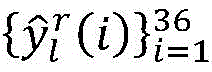 Representing the true value and the output prediction vector of the network, respectively, the loss function is as follows: />

Training the networks with different CU depths by using corresponding data sets respectively;
the fourth module is further configured to have three types of outputs per CU: (1) segmentation, (2) mode selection, (3) uncertainty;
for a given CU of depth i, representing the 36-dimensional output probability vector, let Thr P,l And Thr M,l Threshold values representing CU/PU partition and prediction mode selection, respectively,/->
 The maximum value y of (2) max Representing the decision most likely to be made by the input CU;
if y max In the first dimension and y max >Thr P,l The output decision is "split", which means that the current CU will be split directly into four sub-CUs without calculating its own rate-distortion cost;
if y max In the ith dimension (i>1) And y is max >Thr M,l The output decision is "mode select", which means that the current CU will directly select the corresponding prediction mode as the best mode without having to traverse all 35 modes, and will skip the traversal of the deeper CU;
otherwise, if y max Below the corresponding threshold, the decision is outputIs "uncertain";
the fifth module is further configured to evaluate the degree of complexity reduction by encoding the time saving rate Δt:
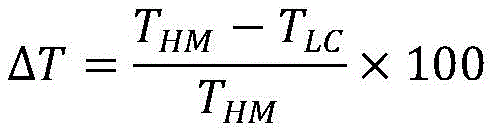
wherein T is HM Represents the encoding time using HM15.0, while T LC Representing the encoding time of a low complexity encoder implemented using a single step decision network;
the single step decision network is performed starting from the second frame of the video to be encoded, since the network requires decision information in the previous frame as input to get the decision result of the current frame.
The invention has the beneficial effects that: the quick decision method for rate distortion optimization based on deep learning in HEVC intra-frame coding provided by the invention solves the problem that CU/PU partition decision and prediction mode selection are regarded as independent processes and decision is respectively carried out in the prior low-complexity HEVC intra-frame coding method. The method is characterized in that a single-step decision network for coding parameters is designed by modeling the partition decision of CU/PU on each level CU and the selection of 35 intra-frame prediction modes of PU as 36 categories of multi-classification problems, taking the correlation between coding parameter decision and video content into consideration and combining the time domain correlation of video, and the aim of maximally reducing coding complexity is fulfilled on the premise of ensuring RD performance.
Further, the first half part in the single-step decision network extracts different characteristics required by CU/PU division decision and prediction mode selection through a two-stream convolution structure, so that possible conflicts of the characteristics required by different decision tasks are avoided, and the decision accuracy is reduced; and connecting the extracted features in the second half part, and learning the interrelationships through the full connection layer so as to reflect the relativity between different decision tasks.
Further, when the single-step decision network is implemented on the HEVC reference model HM.15.0, a threshold is set to realize switching between the single-step decision network and an original traversal method in HEVC, and coding complexity and RD performance of an encoder can be controlled by adjusting the size of the threshold, so that coding requirements in different scenes are realized.
Furthermore, by comparing the method with the existing low-complexity HEVC intra-frame coding method based on the traditional method and the deep learning on the same test data set, the coding time of the low-complexity HEVC encoder realized by the method is obviously shortened, the RD performance is not greatly lost, and the effectiveness of the method is verified.
In summary, the invention models CU/PU division decision and prediction mode selection in HEVC intra-frame coding as multi-classification problems, builds a convolutional neural network with a double-flow structure according to the characteristics of the classification problems to perform feature extraction, and considers the time domain correlation of videos to obtain a final decision through a full connection layer. Experiments prove that the method provided by the invention can reduce the complexity of HEVC intra-frame coding to a greater extent, and has good application value in real-time scenes.
Drawings
Fig. 1 is a flowchart of a fast decision method for rate-distortion optimization based on deep learning in HEVC intra-coding according to the present invention.
FIG. 2 is a single step decision network model framework designed according to the present invention.
Fig. 3 is a flow chart of implementation of a single-step decision network in the HEVC reference model HM 15.0.
Fig. 4 shows RD performance of single step decision networks under different thresholds, where graphs (a) and (b) are the results of tests on test set videos Football and baseball pass, respectively.
Fig. 5 is a run-time percentage of a single-step decision network.
Detailed Description
The overall flow chart of the invention is shown in fig. 1, and the invention is described in detail below with reference to the accompanying drawings:
The invention selects 86 video sequences from video coding joint working group (JCT-VC) and Xiph.org [1] as data sets, in order to ensure diversity of the data sets, the videos have different resolution formats, comprising: SIF, CIF, NTSC, 4CIF, 240p, 480p, 720p, 1080p, WQXGA. A total of 86 video sequences were split into two non-overlapping sets, 72 of which were used to construct the training dataset and 14 of which were used for testing, respectively, for training and testing. In order to ensure the generalization performance of the network model and to fairly evaluate the model performance, videos for training and testing are randomly selected from different resolutions. 4 QP values 22, 27, 32, 37 are chosen and all sequences are full intra mode encoded with HEVC reference test model HM15.0, respectively. Each sample in the generated dataset is made up of input data and tags. The input data has two parts, including the luminance information of the current CU and its decision information of the co-located CU in the previous frame. The tag data is then the decision information of the CU/PU partition and prediction mode of the current CU.
For HEVC intra coding, the n×n partitioning of PUs is only applicable to the smallest CU. Thus, when an 8×8CU selects an n×n PU mode, we consider it as the fourth partition of the entire coding tree unit CTU. In this case, for a CU with depth 0 to 3 (from 64×64 to 8×8), the decision of CU/PU partition and prediction modes can be modeled as a multi-classification problem with 36 classes, the first of which indicates whether the current CU/PU is further partitioned, while the other 35 classes correspond to 35 prediction modes. The final decision is represented by a one-hot vector with 36 dimensions. Thus, a convolutional neural network is used to make a decision on this multi-classification problem, since there are CUs of different sizes with depths 0 to 3 in one CTU, a total of 4 sets of network model frameworks are required. The single-step decision network model framework for the CU with the size of N multiplied by N is shown in figure 2, and N can be 64, 32, 16 and 8.
For each CU, since the luminance component contains most of the content information, its luminance information is input into the network. The decision information of the co-located CUs in the previous frame is also utilized taking into account the temporal correlation of the video content. For luminance information, it can be assumed that the average luminance has little effect on CU/PU partitioning and decision of prediction modes, so texture information having direct correlation with decision is first extracted by mean removal. Thereafter, the image data is divided into two streams:
1) Three non-overlapping convolutional layers (Conv 1-1, conv1-2 and Conv 1-3) constitute tributaries that extract features related to the CU/PU partition. Note that in the non-overlapping convolution layers, the step size of the convolution is equal to the width of the corresponding convolution kernel, and thus each pixel in the output feature map will have a receptive field that does not overlap with each other, which corresponds in size to exactly one sub-CU of the current CU. These feature maps can thus be seen as feature descriptions for the four sub-CUs of the current CU. It is noted that in a single step decision network for CUs of different depths, the convolution kernel size is different to ensure that the pixels in the Conv1-3 extracted feature map have receptive fields corresponding to the sub-CU sizes. See table 1 for more details.
TABLE 1 size of convolution kernel k in single step decision networks for CUs of different depths
| CU depth | Conv1-1 | Conv1-2 | Conv1-3 |
| 0 | k1=4 | k2=4 | k3=2 |
| 1 | k1=4 | k2=2 | k3=2 |
| 2 | k1=2 | k2=2 | k3=2 |
| 3 | k1=2 | k2=2 | k3=1 |
2) Two conventional convolutional layers (Conv 2-1 and Conv 2-2) constitute tributaries that extract features relevant to prediction mode selection. The kernel sizes of both convolution layers are 4 x 4, with a step size of 1. By these convolution layers of step size 1, the relation between neighboring pixels in the current CU can be better extracted than for non-overlapping convolution layers, providing an overall description of the current CU. After the convolution layer, a max-pooling layer is applied to eliminate ambiguous local data and reduce the number of nodes.
After the required characteristics are extracted, the flattened characteristic diagram is connected with the input co-located CU decision information through a connecting layer, and then the cascade vectors are sent to a full connecting layer, wherein the cascade vectors comprise an implicit layer and an output layer, and the probability vectors are output in 36 dimensions.
Step 3, training the single-step decision network
Since a single step decision network enables decisions on classification problems, cross entropy is used as a loss function in training. The cross entropy describes the difference between two probability distributions, the cross entropy between probability distributions a and b being expressed as:
H(a,b)=a log b+(1-a)log(1-b)
for each sample r of CU depth l, and->
and-> Respectively represent true valuesAnd the output predictive vector of the network, the loss function is as follows:
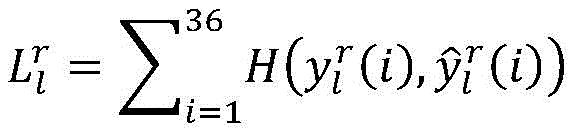
the networks of different CU depths are trained using the corresponding data sets, respectively, and each network needs to be trained on four QP values {22, 27, 32, 37} to meet the diversity requirement of the encoding compression ratio. Before training, all trainable parameters are randomly initialized by normal distribution, the mean value is 0, and the standard deviation is 0.1. The model was trained using a random gradient descent algorithm with momentum set to 0.9 and a batch size R of 64. Furthermore, the initial learning rate of training was 0.01, which was reduced by 1% per 2000 iterations. The total number of iterations for each model was 10 tens of thousands.
The single step decision network can be seen as an alternative way of making the corresponding coding parameter decisions in the CU, the original implementation in HEVC being a traversal search through rate-distortion optimization, the present invention uses a given threshold to switch between the single step decision network and the traversal search to balance the reduction of RD performance and the degree of complexity reduction.
The implementation flow of the single-step decision network in the HEVC reference model HM15.0 is shown in fig. 3. Note that the decision on CU/PU partitioning and selection of prediction modes throughout the CTU is made by a top-down order. Specifically, there are three types of outputs per CU: (1) segmentation, (2) mode selection, (3) uncertainty. For a given CU of depth i, representing the 36-dimensional output probability vector, let Thr P,l And Thr M,l The thresholds for CU/PU partitioning and prediction mode selection are represented, respectively. Thus (S)>
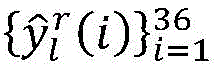 The maximum value y of (2) max Representing the decision most likely to be made by the input CU. If y max In the first dimension and y max >Thr P,l The output decision is "split", which means that the current CU will be split directly into four sub-CUs without calculating its own rate-distortion cost. If y max In the ith dimension (i>1) And y is max >Thr M,l The output decision is "mode select", which means that the current CU will directly select the corresponding prediction mode as the best mode, without having to traverse all 35 modes, and will skip the traversal of the deeper CU. Otherwise, if y max Below the corresponding threshold, the output decision is "uncertain". In this case, it is necessary to acquire the optimal prediction mode through rate-distortion optimization and to divide the current CU into four sub-CUs for traversal, which is the same as the original implementation in HEVC.
Step 5. Testing the RD performance and coding complexity of the encoder
To evaluate the RD performance of the encoder, bjontegaard Delta PSNR (BD-PSNR) performance was tested with HM15.0 as a baseline. Further, the degree of complexity reduction is evaluated by the encoding time saving rate Δt:
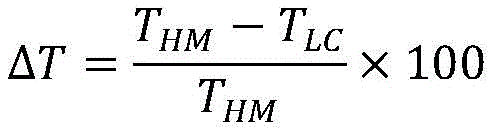
wherein T is HM Represents the encoding time using HM15.0, while T LC Representing the encoding time of a low complexity encoder implemented using a single step decision network. In addition, a single step decision network is performed starting from the second frame of the video to be encoded, since the network requires decision information in the previous frame as input to get the decision result of the current frame. Threshold value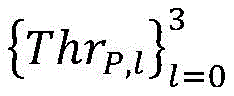 Set to {0.06,0.06,0.06,0.06}, and +.>
 For {0.05,0.05,0.05,0.05}, note the partition decisionThe threshold is different from the threshold size of the prediction mode selection because the impact of choosing different classes on the actual RD performance has different weights. In essence, a total of 35 classes represent that the current CU is not partitioned further and selects one prediction mode, while only 1 class represents that the current CU is partitioned into sub-CUs.
To further evaluate the performance of the method, the invention selects a CU partitioning decision algorithm [2] based on deep learning and a fast CU size decision and candidate pattern reduction algorithm [3] for comparison. For [2], testing was performed using source code [4] provided by its author, including a trained ETH-CNN network model and corresponding low complexity encoder implementation. The results are shown in Table 2 below.
TABLE 2 Performance evaluation and comparison results for single step decision networks

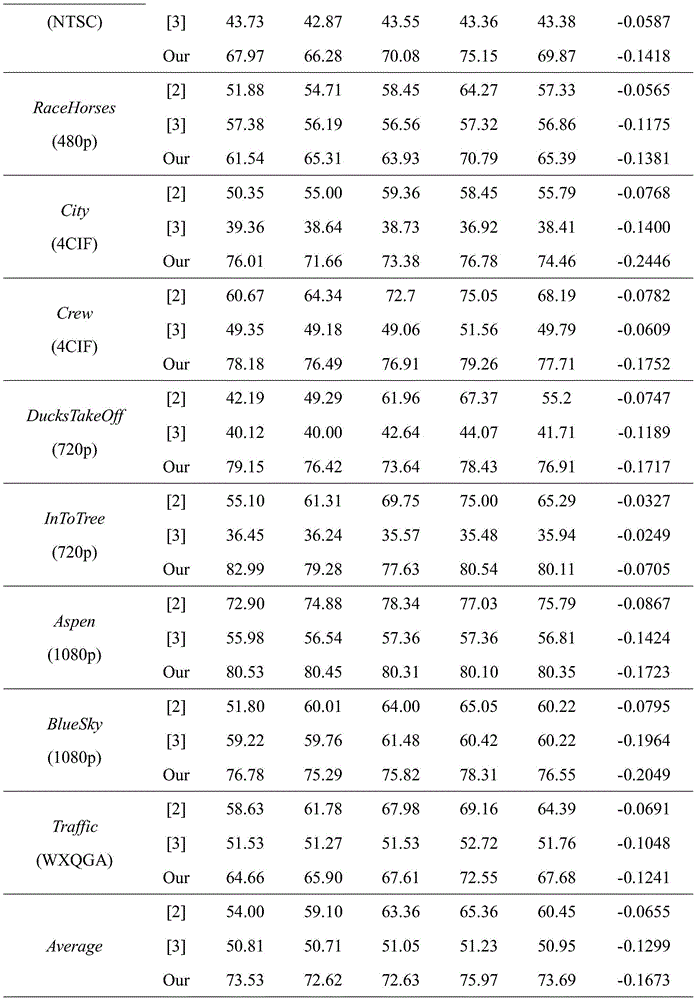
The results show that the method provided by the present invention reduces the coding time by 73.53%, 72.62%, 72.63% and 75.97% on average, better than the complexity reduction of 54.00%, 59.10%, 63.36% and 65.36% in [2], and the complexity reduction of 50.81%, 50.71%, 51.05% and 51.23% in [3], when coded at qp=22, 27, 32 and 37, respectively. In addition, the method provided by the invention is also based on the performance provided in the traditional heuristic algorithm, wherein the traditional algorithm does not look at: a heuristic quick algorithm for CU/PU partition decision in HEVC (high efficiency video coding) inner coding saves 37.91% of coding time; heuristic fast algorithm for prediction mode selection saves 27.3% of encoding time.
In the method of the invention, the prediction mode selection in CU/PU partition decision and internal coding is obtained by a single-step decision network, and only a part of decisions are manually realized in the work, thus the single-step decision network does bring more RD performance loss. Nevertheless, the use of a single-step decision network further reduces the encoding time by about 10% to 20%, with the resultant RD performance penalty being acceptable. In addition, fig. 4 shows that the magnitude of RD performance loss can be controlled by adjusting the threshold value.
To further evaluate the run time of the single step decision network, the percentage of time to run the single step decision network was tested against the code time of HM15.0 and the results are shown in FIG. 5. Note that single step decision networks consume only about 5% of the encoding time required for HM15.0, indicating that single step decision networks introduce only a small time overhead in the encoding process and achieve superior performance in terms of reduced complexity.
Claims (2)
1. The fast rate distortion optimization decision method based on deep learning in HEVC intra-frame coding is characterized by comprising the following steps of:
step 1) video data set preparation;
step 2), constructing a single-step decision network model;
step 3) training a single-step decision network;
step 4) implementing low-complexity HEVC intra-frame coding by applying a single-step decision network;
step 5) testing the RD performance and the coding complexity of the coder;
the step 1) specifically comprises the following steps: in order to ensure the generalization performance of the network model and to fairly evaluate the model performance, videos for training and testing are randomly selected from different resolutions; performing full-frame mode coding on the selected video by using the HEVC reference test model respectively, and generating a video data set;
the step 2) specifically comprises the following steps:
step 201) collecting data from the video collected in step 1), the video data set comprising: inputting data and tag data; the input data includes: luminance information of the current CU and decision information of the co-located CU in the previous frame; the tag data includes: decision information of CU/PU partition and prediction modes of the current CU;
step 202) HEVC intra-frame coding is modeled as 4 th level partition of CU by adopting a PU partition mode, so that the partition decision of CU/PU on each level CU and the selection of 35 intra-frame prediction modes of PU are modeled as multi-classification problems;
step 203) for each CU, since the luminance component contains most of the content information, its luminance information is input into the network, taking into account the temporal correlation of the video content, and also utilizing the decision information of the co-located CU in the previous frame, firstly extracting the texture information having a direct correlation with the decision by means of mean removal;
step 204) dividing the video data into two streams by two convolution layers, respectively: a tributary implemented by three non-overlapping convolutional layers and a tributary implemented by two conventional convolutional layers;
the tributaries implemented by the three non-overlapping convolution layers are used for extracting the features related to the CU/PU partition, and the step size of the convolution is equal to the width of the corresponding convolution kernel, so that each pixel in the output feature map has a receptive field which is not overlapped with each other, and the size of the receptive field corresponds to one sub CU of the current CU;
the tributaries implemented by the two conventional convolution layers are used for extracting features related to prediction mode selection, so that the relation between adjacent pixels in the current CU is better extracted, and the overall description of the current CU is provided;
the step 3) specifically comprises the following steps:
using cross entropy as a loss function in training, which describes the difference between two probability distributions, the cross entropy between probability distributions a and b is expressed as:

depth to CU islIs not equal to the sample number of each sample of (1)r, And->
And-> Representing the true value and the output prediction vector of the network, respectively, the loss function is as follows:
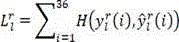
training the networks with different CU depths by using corresponding data sets respectively;
the step 4) specifically comprises the following steps:
there are three types of outputs per CU: (1) segmentation, (2) mode selection, (3) uncertainty;
for depth oflIs used to determine the given CU of (c), represents the 36-dimensional output probability vector, let +.>
 And->
And-> Threshold values representing CU/PU partition and prediction mode selection, respectively,/->
 Maximum value of +.>
 Representing the decision most likely to be made by the input CU;
if it is In the first dimension +.>
 The output decision is "divideCut ", which means that the current CU will be split directly into four sub-CUs without calculating its own rate-distortion cost;
if it is At the first positioniDimension (/ ->
 ) And->
 The output decision is "mode select", which means that the current CU will directly select the corresponding prediction mode as the best mode without having to traverse all 35 modes, and will skip the traversal of the deeper CU;
otherwise, if Below the corresponding threshold, the output decision is "uncertain";
the step 5) specifically comprises the following steps:
time saving rate by encoding To evaluate the degree of complexity reduction:
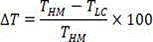
wherein the method comprises the steps of Represents the encoding time using HM15.0, while +.>
 Representing the encoding time of a low complexity encoder implemented using a single step decision network;
the single step decision network is performed starting from the second frame of the video to be encoded, since the network requires decision information in the previous frame as input to get the decision result of the current frame.
2. A fast decision system for rate-distortion optimization based on deep learning in HEVC intra coding, comprising the following modules:
a first module for video dataset preparation;
the second module is used for building a single-step decision network model;
a third module for training the single step decision network;
a fourth module for implementing low complexity HEVC intra coding using a single step decision network;
a fifth module for testing the performance of the encoder RD and the encoding complexity;
the first module is further used for randomly selecting videos for training and testing from different resolutions in order to ensure the generalization performance of the network model and to fairly evaluate the model performance; performing full-frame mode coding on the selected video by using the HEVC reference test model respectively, and generating a video data set;
the second module is further configured to collect data from the collected video, the video dataset comprising: inputting data and tag data; the input data includes: luminance information of the current CU and decision information of the co-located CU in the previous frame; the tag data includes: decision information of CU/PU partition and prediction modes of the current CU; modeling HEVC intra-frame coding by adopting a PU partition mode as 4 th-level partition of CU, so as to jointly model a partition decision of CU/PU on each-level CU and selection of 35 intra-frame prediction modes of the PU as a multi-classification problem; for each CU, since the luminance component contains most of the content information, its luminance information is input into the network, taking into account the temporal correlation of the video content, and also utilizing the decision information of the co-located CU in the previous frame, firstly extracting the texture information having a direct correlation with the decision by mean removal; the video data is divided into two streams by two convolution layers, respectively: a tributary implemented by three non-overlapping convolutional layers and a tributary implemented by two conventional convolutional layers; the tributaries realized by the three non-overlapping convolution layers are used for extracting the characteristics related to the CU/PU partition, and the step length of convolution is equal to the width of the corresponding convolution kernel, so each pixel in the output characteristic diagram has a receptive field which is not overlapped with each other, and the size of the receptive field corresponds to one sub CU of the current CU; the tributaries implemented by the two conventional convolution layers are used for extracting features related to prediction mode selection, so that the relation between adjacent pixels in the current CU is better extracted, and the overall description of the current CU is provided;
the third module is further configured to use a cross entropy describing a difference between two probability distributions, the cross entropy between probability distributions a and b being expressed as:

depth to CU islIs not equal to the sample number of each sample of (1)r, And->
And-> Representing the true value and the output prediction vector of the network, respectively, the loss function is as follows:
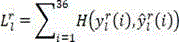
training the networks with different CU depths by using corresponding data sets respectively;
the fourth module is further configured to have three types of outputs per CU: (1) segmentation, (2) mode selection, (3) uncertainty;
for depth oflIs used to determine the given CU of (c), represents the 36-dimensional output probability vector, let +.>
 And->
And-> Threshold values representing CU/PU partition and prediction mode selection, respectively,/->
 Maximum value of +.>
 Representing the decision most likely to be made by the input CU;
if it is In the first dimension +.>
 The output decision is "split", which means that the current CU will be split directly into four sub-CUs without calculating its own rate-distortion cost;
if it is At the first positioniDimension (/ ->
 ) And->
 The output decision is "mode select", which means that the current CU will directly select the corresponding prediction mode as the best mode without having to traverse all 35 modes, and will skip the traversal of the deeper CU;
otherwise, if Below the corresponding threshold, the output decision is "uncertain";
the fifth module is further configured to encode a time saving rate To evaluate the degree of complexity reduction:
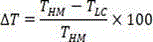
wherein the method comprises the steps of Represents the encoding time using HM15.0, while +.>
 Representing the encoding time of a low complexity encoder implemented using a single step decision network;
the single step decision network is performed starting from the second frame of the video to be encoded, since the network requires decision information in the previous frame as input to get the decision result of the current frame.
Priority Applications (1)
| Application Number | Priority Date | Filing Date | Title |
|---|---|---|---|
| CN202010157663.XA CN111355956B (en) | 2020-03-09 | 2020-03-09 | Deep learning-based rate distortion optimization rapid decision system and method in HEVC intra-frame coding |
Applications Claiming Priority (1)
| Application Number | Priority Date | Filing Date | Title |
|---|---|---|---|
| CN202010157663.XA CN111355956B (en) | 2020-03-09 | 2020-03-09 | Deep learning-based rate distortion optimization rapid decision system and method in HEVC intra-frame coding |
Publications (2)
| Publication Number | Publication Date |
|---|---|
| CN111355956A CN111355956A (en) | 2020-06-30 |
| CN111355956B true CN111355956B (en) | 2023-05-09 |
Family
ID=71197932
Family Applications (1)
| Application Number | Title | Priority Date | Filing Date |
|---|---|---|---|
| CN202010157663.XA Active CN111355956B (en) | 2020-03-09 | 2020-03-09 | Deep learning-based rate distortion optimization rapid decision system and method in HEVC intra-frame coding |
Country Status (1)
| Country | Link |
|---|---|
| CN (1) | CN111355956B (en) |
Families Citing this family (9)
| Publication number | Priority date | Publication date | Assignee | Title |
|---|---|---|---|---|
| CN111800642B (en) * | 2020-07-02 | 2023-05-26 | 中实燃气发展(西安)有限公司 | HEVC intra-frame intra-angle mode selection method, device, equipment and readable storage medium |
| CN112291562B (en) * | 2020-10-29 | 2022-06-14 | 郑州轻工业大学 | Fast CU partition and intra mode decision method for H.266/VVC |
| CN114584776B (en) * | 2020-11-30 | 2025-02-25 | 华为技术有限公司 | Intra-frame prediction mode decoding method and device |
| CN112383776B (en) * | 2020-12-08 | 2022-05-03 | 重庆邮电大学 | Method and device for quickly selecting SHVC (scalable video coding) video coding mode |
| CN112887712B (en) * | 2021-02-03 | 2021-11-19 | 重庆邮电大学 | HEVC intra-frame CTU partitioning method based on convolutional neural network |
| CN115941962A (en) * | 2021-09-30 | 2023-04-07 | 深圳市中兴微电子技术有限公司 | Video coding unit dividing method, device, computer equipment and readable medium |
| CN114584771B (en) * | 2022-05-06 | 2022-09-06 | 宁波康达凯能医疗科技有限公司 | Method and system for dividing intra-frame image coding unit based on content self-adaption |
| CN115334308B (en) * | 2022-10-14 | 2022-12-27 | 北京大学深圳研究生院 | Learning model-oriented coding decision processing method, device and equipment |
| CN117150347B (en) * | 2023-10-25 | 2024-01-26 | 无锡迪富智能电子股份有限公司 | Self-decision method and system for bathroom remote controller |
Family Cites Families (3)
| Publication number | Priority date | Publication date | Assignee | Title |
|---|---|---|---|---|
| CN106131547B (en) * | 2016-07-12 | 2018-07-03 | 北京大学深圳研究生院 | The high-speed decision method of intra prediction mode in Video coding |
| CN106937116B (en) * | 2017-03-15 | 2019-08-27 | 杭州电子科技大学 | Low-complexity video coding method based on adaptive learning of random training set |
| CN109905712A (en) * | 2019-01-09 | 2019-06-18 | 西安邮电大学 | Fast Mode Decision Algorithm for HEVC Intra-coding Based on ResNet |
-
2020
- 2020-03-09 CN CN202010157663.XA patent/CN111355956B/en active Active
Also Published As
| Publication number | Publication date |
|---|---|
| CN111355956A (en) | 2020-06-30 |
Similar Documents
| Publication | Publication Date | Title |
|---|---|---|
| CN111355956B (en) | Deep learning-based rate distortion optimization rapid decision system and method in HEVC intra-frame coding | |
| Lei et al. | Fast intra prediction based on content property analysis for low complexity HEVC-based screen content coding | |
| CN107147911B (en) | Method and device for fast inter-frame coding mode selection based on local luminance compensation LIC | |
| CN114286093B (en) | A fast video encoding method based on deep neural network | |
| CN108322745B (en) | Fast selecting method in a kind of frame based on inseparable quadratic transformation mode | |
| Zhang et al. | Fast CU decision-making algorithm based on DenseNet network for VVC | |
| CN108012157A (en) | Construction method for the convolutional neural networks of Video coding fractional pixel interpolation | |
| CN108924558B (en) | A Video Predictive Coding Method Based on Neural Network | |
| CN109040764B (en) | HEVC screen content intra-frame rapid coding algorithm based on decision tree | |
| US20150319456A1 (en) | Method and device for encoding a sub-aperture image of a set of sub-aperture images obtained from a plenoptic image | |
| Liu et al. | Fast depth intra coding based on depth edge classification network in 3D-HEVC | |
| CN111479110B (en) | Fast Affine Motion Estimation Method for H.266/VVC | |
| CN116437102B (en) | Method, system, equipment and storage medium for learning universal video coding | |
| US20250267295A1 (en) | Image data compression method and device using segmentation and classification | |
| KR102261669B1 (en) | Artificial Neural Network Based Object Region Detection Method, Device and Computer Program Thereof | |
| CN110213584A (en) | Coding unit classification method and coding unit sorting device based on Texture complication | |
| CN109587491A (en) | A kind of intra-frame prediction method, device and storage medium | |
| CN103533355A (en) | Quick coding method for HEVC (high efficiency video coding) | |
| Dai et al. | HEVC video steganalysis based on PU maps and multi-scale convolutional residual network | |
| CN101237581A (en) | A Real-time Video Object Segmentation Method Based on Motion Feature in H.264 Compressed Domain | |
| CN107018412A (en) | A kind of DVC HEVC video transcoding methods based on key frame coding unit partition mode | |
| CN110519597B (en) | HEVC-based encoding method and device, computing equipment and medium | |
| US8253817B2 (en) | Image compression method, device, electronic camera, and program | |
| CN109982079B (en) | Intra-frame prediction mode selection method combined with texture space correlation | |
| CN113784147A (en) | A high-efficiency video coding method and system based on convolutional neural network |
Legal Events
| Date | Code | Title | Description |
|---|---|---|---|
| PB01 | Publication | ||
| PB01 | Publication | ||
| SE01 | Entry into force of request for substantive examination | ||
| SE01 | Entry into force of request for substantive examination | ||
| GR01 | Patent grant | ||
| GR01 | Patent grant |