CN111800642B - HEVC intra-frame intra-angle mode selection method, device, equipment and readable storage medium - Google Patents
HEVC intra-frame intra-angle mode selection method, device, equipment and readable storage medium Download PDFInfo
- Publication number
- CN111800642B CN111800642B CN202010628727.XA CN202010628727A CN111800642B CN 111800642 B CN111800642 B CN 111800642B CN 202010628727 A CN202010628727 A CN 202010628727A CN 111800642 B CN111800642 B CN 111800642B
- Authority
- CN
- China
- Prior art keywords
- images
- neural network
- angle mode
- layer
- convolutional neural
- Prior art date
- Legal status (The legal status is an assumption and is not a legal conclusion. Google has not performed a legal analysis and makes no representation as to the accuracy of the status listed.)
- Active
Links
Images


Classifications
-
- H—ELECTRICITY
- H04—ELECTRIC COMMUNICATION TECHNIQUE
- H04N—PICTORIAL COMMUNICATION, e.g. TELEVISION
- H04N19/00—Methods or arrangements for coding, decoding, compressing or decompressing digital video signals
- H04N19/50—Methods or arrangements for coding, decoding, compressing or decompressing digital video signals using predictive coding
- H04N19/593—Methods or arrangements for coding, decoding, compressing or decompressing digital video signals using predictive coding involving spatial prediction techniques
-
- G—PHYSICS
- G06—COMPUTING OR CALCULATING; COUNTING
- G06N—COMPUTING ARRANGEMENTS BASED ON SPECIFIC COMPUTATIONAL MODELS
- G06N3/00—Computing arrangements based on biological models
- G06N3/02—Neural networks
- G06N3/04—Architecture, e.g. interconnection topology
- G06N3/045—Combinations of networks
-
- G—PHYSICS
- G06—COMPUTING OR CALCULATING; COUNTING
- G06N—COMPUTING ARRANGEMENTS BASED ON SPECIFIC COMPUTATIONAL MODELS
- G06N3/00—Computing arrangements based on biological models
- G06N3/02—Neural networks
- G06N3/08—Learning methods
- G06N3/084—Backpropagation, e.g. using gradient descent
-
- H—ELECTRICITY
- H04—ELECTRIC COMMUNICATION TECHNIQUE
- H04N—PICTORIAL COMMUNICATION, e.g. TELEVISION
- H04N19/00—Methods or arrangements for coding, decoding, compressing or decompressing digital video signals
- H04N19/10—Methods or arrangements for coding, decoding, compressing or decompressing digital video signals using adaptive coding
- H04N19/102—Methods or arrangements for coding, decoding, compressing or decompressing digital video signals using adaptive coding characterised by the element, parameter or selection affected or controlled by the adaptive coding
- H04N19/103—Selection of coding mode or of prediction mode
- H04N19/105—Selection of the reference unit for prediction within a chosen coding or prediction mode, e.g. adaptive choice of position and number of pixels used for prediction
-
- Y—GENERAL TAGGING OF NEW TECHNOLOGICAL DEVELOPMENTS; GENERAL TAGGING OF CROSS-SECTIONAL TECHNOLOGIES SPANNING OVER SEVERAL SECTIONS OF THE IPC; TECHNICAL SUBJECTS COVERED BY FORMER USPC CROSS-REFERENCE ART COLLECTIONS [XRACs] AND DIGESTS
- Y02—TECHNOLOGIES OR APPLICATIONS FOR MITIGATION OR ADAPTATION AGAINST CLIMATE CHANGE
- Y02T—CLIMATE CHANGE MITIGATION TECHNOLOGIES RELATED TO TRANSPORTATION
- Y02T10/00—Road transport of goods or passengers
- Y02T10/10—Internal combustion engine [ICE] based vehicles
- Y02T10/40—Engine management systems
Landscapes
- Engineering & Computer Science (AREA)
- Theoretical Computer Science (AREA)
- Physics & Mathematics (AREA)
- General Health & Medical Sciences (AREA)
- Computing Systems (AREA)
- Biomedical Technology (AREA)
- Biophysics (AREA)
- Computational Linguistics (AREA)
- Data Mining & Analysis (AREA)
- Evolutionary Computation (AREA)
- Life Sciences & Earth Sciences (AREA)
- Molecular Biology (AREA)
- Artificial Intelligence (AREA)
- General Engineering & Computer Science (AREA)
- General Physics & Mathematics (AREA)
- Mathematical Physics (AREA)
- Software Systems (AREA)
- Health & Medical Sciences (AREA)
- Multimedia (AREA)
- Signal Processing (AREA)
- Image Analysis (AREA)
- Compression Or Coding Systems Of Tv Signals (AREA)
Abstract
The invention belongs to the field of video coding, and discloses a method, a device, equipment and a readable storage medium for selecting intra-frame angle modes in HEVC (high efficiency video coding), wherein the method for selecting intra-frame angle modes in HEVC comprises the steps of acquiring a learning video frame image and dividing the learning video frame image into a plurality of PU images; the method comprises the steps of constructing a depth convolution neural network, learning and predicting the optimal angle mode of a current PU image from the PU image to obtain a depth convolution neural network prediction model, embedding the depth convolution neural network prediction model into an HEVC original coding flow, and directly obtaining n mode candidate lists of the optimal angle mode through the depth convolution neural network prediction model to replace 35 types of angle modes in video frame image coding. According to the method, the depth convolution neural network is introduced into HEVC video coding, the problem of PU angle mode selection is suitably solved by learning from an original input video frame image, the quality of video coding can be ensured, and the problem of long time in the video coding process is better solved.
Description
Technical Field
The invention belongs to the field of video coding, and relates to a method, a device, equipment and a readable storage medium for selecting intra-frame angle modes in HEVC (high efficiency video coding).
Background
The new generation of high-efficiency video coding HEVC (High Efficiency Video Coding) is the latest video coding standard, and the intra-frame angle mode selection algorithm is to select the best angle mode to minimize the coding distortion after video coding. In HEVC, a video image is first divided into a plurality of Coding Tree Units (CTUs) that do not overlap with each other, then 35 angle modes of intra-Prediction are fully searched for Prediction blocks (PUs) corresponding to the CTUs, a corresponding optimal Rate Distortion (RD) cost value rdct_0 and a corresponding Prediction mode thereof are found for the Prediction blocks with a size of 64×64, and corresponding optimal Rate Distortion cost values rdct_1, rdct_2, rdct_3 and rdct_4 and their corresponding Prediction modes are calculated for 4 PUs with a size of 32×32, respectively, and then rdct_5 is obtained by summing the optimal Rate Distortion cost values corresponding to the four PUs. Comparing the values of RdCOSt_0 and RdCOSt_5, if the values are small, the current Coding block (Coding Unit, CU) is not continuously divided, otherwise, the current CU is continuously divided into four sub CUs, in the process, 35 angle modes of PUs with different sizes are calculated each time, the process is complex, and the calculated amount is excessive.
In recent years, deep convolutional neural networks (ConvolutionalNeuralNetwork, CNN) have achieved great success in image analysis, speech recognition, and natural language processing, and if intra-HEVC intra-frame angle modes can be predicted by deep learning, coding complexity can be greatly reduced. The angle mode prediction in the current HEVC is mainly optimized by reducing the number of coarse mode selections or the number in a mode candidate list, rather than directly obtaining the optimal angle mode prediction value through a certain algorithm. Machine learning is a branch of artificial intelligence, and machine learning is an algorithm that enables machines to learn rules from a large amount of historical data, thereby intelligently identifying new samples or predicting the future. Wherein the concept of deep learning is derived from the study of artificial neural networks. Deep learning forms more abstract high-level representation attribute categories or features by combining low-level features to discover distributed feature representations of data. On the image net competition in 2012, after the AlexNet network designed by Hinton and Alex is taken to the champion at one time, the deep learning is widely applied to picture classification. Existing angle mode selection algorithms have achieved a lot of success, but the application of deep learning to angle mode selection algorithms is subject to further investigation.
Currently, there are several common ways. A fast intra mode decision algorithm reduces HEVC intra computational complexity by reducing coarse mode decisions and RD optimized candidate modes using a gradient-based approach. The method has the advantages that the complexity of intra-frame coding is reduced, but the overall reduction amplitude is not large, the method needs to be further improved, and finally, candidate modes needing RD optimization are obtained through rough mode selection. There is also a fast intra mode decision of an HEVC encoder to selectively examine potential modes by a Hadamard cost based progressive coarse mode search (Progressive Rough Mode Search, pRMS) instead of traversing all candidates, i.e., 35 angle modes. pRMS will select fewer valid candidates for subsequent rate-distortion optimized quantization (Rate Distortion Optimization Quantification, RDOQ) to derive the rate-distortion best mode. Thereby reducing coding complexity. The method has the advantages that for 35 angle modes, the method is selectively traversed, the coding efficiency can be improved, and the method has the defects that the thought of traversing is reduced, and the aim of compressing the coding efficiency is not achieved most effectively.
Disclosure of Invention
The invention aims to overcome the defects of complex coding, complicated selection process and excessive calculation amount of intra-frame angle mode selection in the prior art and provides a method, a device, equipment and a readable storage medium for selecting intra-frame angle mode in HEVC.
In order to achieve the purpose, the invention is realized by adopting the following technical scheme:
in a first aspect of the present invention, a method for selecting intra-frame angle modes in an HEVC frame includes the steps of:
s1: dividing a plurality of input video frame images into a plurality of PU images respectively, and classifying all the PU images into a training set and a testing set; calculating the average value of pixel values of all the PU images at the same position in the training set to obtain an average value image;
s2: constructing a deep convolutional neural network, and setting the output of the deep convolutional neural network to be in a 35-class angle mode; training the deep convolutional neural network through a training set and an average value image, and testing the deep convolutional neural network through a testing set to obtain a deep convolutional neural network prediction model;
s3: obtaining a video frame image to be predicted, dividing the video frame image to be predicted into a plurality of PU images to be predicted, and predicting the PU images to be predicted through a depth convolution neural network prediction model to obtain an angle mode corresponding to each PU image to be predicted;
s4: and selecting the pre-preset number of angle modes with the largest number to form an angle mode candidate list, and traversing the angle modes in the angle mode candidate list through the HEVC coding flow to obtain the optimal angle mode.
The intra-frame angle mode selection method of HEVC of the invention is further improved in that:
the specific method of the S1 is as follows:
and carrying out non-overlapping division on a plurality of input video frame images according to the sizes of the 4 PU images, scaling all the PU images with the 4 sizes to the same size, and classifying the PU images with the same size into a training set and a testing set.
In the step S1, PU images of the first 50 frames of the input video frame images are used as a training set, and PU images of the rest frames are used as a test set.
In the step S2, the deep convolutional neural network comprises a first convolutional layer, a first pooling layer, a second convolutional layer, a second pooling layer, a first full-connection layer, a second full-connection layer and an output layer which are sequentially arranged, wherein the output of the output layer is set to be in a 35-class angle mode; the first convolution layer and the second convolution layer are set to 64 convolution kernels, and the convolution kernels are 5 multiplied by 5; the first pooling layer and the second pooling layer are both set to be MaxPooling operation, and the pooling window sizes are all 3×3; the first fully-connected layer and the second fully-connected layer are both set to 512-dimensional neuron nodes.
In the step S2, when training the deep convolutional neural network through the training set and the mean value image and when testing the deep convolutional neural network through the testing set, updating and solving the deep convolutional neural network through a least square function and a back propagation BP algorithm.
And in the step S4, the first 3 angle modes with the largest quantity are selected to form an angle mode candidate list.
In S4, when Planar mode and/or DC mode is not included in the top 3 types of angle modes with the largest number, planar mode and/or DC mode is added to the angle mode candidate list.
In a second aspect of the present invention, an intra-frame angle mode selection apparatus in HEVC includes:
the preprocessing module is used for dividing a plurality of input video frame images into a plurality of PU images respectively and classifying all the PU images into a training set and a testing set; calculating the average value of pixel values of all the PU images at the same position in the training set to obtain an average value image;
the model building module is used for building a deep convolutional neural network and setting the output of the deep convolutional neural network into a 35-class angle mode; training the deep convolutional neural network through a training set and an average value image, and testing the deep convolutional neural network through a testing set to obtain a deep convolutional neural network prediction model;
the angle mode prediction module is used for acquiring a video frame image to be predicted, dividing the video frame image to be predicted into a plurality of PU images to be predicted, and predicting the PU images to be predicted through a depth convolution neural network prediction model to obtain an angle mode corresponding to each PU image to be predicted; and
the angle mode determining module is used for selecting the preset number of the angle modes with the largest number to form an angle mode candidate list, and traversing the angle modes in the angle mode candidate list through the HEVC coding flow to obtain the optimal angle mode.
In a third aspect of the present invention, a computer device includes a memory, a processor, and a computer program stored in the memory and executable on the processor, the processor implementing the steps of the above-described intra-frame angle mode selection method when executing the computer program.
In a fourth aspect of the present invention, a computer readable storage medium stores a computer program which, when executed by a processor, implements the steps of the above-described intra-HEVC intra-frame angle mode selection method.
Compared with the prior art, the invention has the following beneficial effects:
according to the method for selecting the angle mode in the HEVC frame, the optimal angle mode of the current PU image is obtained through learning and predicting from the PU image by utilizing the depth convolutional neural network, the depth convolutional neural network prediction model is obtained through training and testing, the depth convolutional neural network prediction model is embedded into the HEVC original coding flow when in use, the angle mode candidate list containing the optimal angle mode is directly obtained through the prediction of the depth convolutional neural network prediction model on the PU image of the video frame, the angle mode candidate list contains n types of angle modes, then the angle mode candidate list is adopted to replace the 35 types of angle modes in the HEVC original coding flow, only the angle modes in the angle mode candidate list are required to be traversed, the rough mode selection process is not required, the coding speed is greatly accelerated, and the coding time is shortened.
Further, when the Planar mode and/or the DC mode is not included in the first 3 types of angle modes with the largest number, the Planar mode and/or the DC mode are added to the angle mode candidate list, the two modes are the two modes which occur most frequently in HEVC coding, and the two modes are added to the angle mode candidate list by default, so that the hit rate of the angle mode candidate list including correct mode selection can be effectively ensured.
Drawings
Fig. 1 is a flow chart of a method for intra-frame angle mode selection in HEVC according to an embodiment of the present invention;
FIG. 2 is a schematic diagram of a deep convolutional neural network according to an embodiment of the present invention;
fig. 3 is a HEVC coding flow chart according to an embodiment of the present invention.
Detailed Description
In order that those skilled in the art will better understand the present invention, a technical solution in the embodiments of the present invention will be clearly and completely described below with reference to the accompanying drawings in which it is apparent that the described embodiments are only some embodiments of the present invention, not all embodiments. All other embodiments, which can be made by those skilled in the art based on the embodiments of the present invention without making any inventive effort, shall fall within the scope of the present invention.
It should be noted that the terms "first," "second," and the like in the description and the claims of the present invention and the above figures are used for distinguishing between similar objects and not necessarily for describing a particular sequential or chronological order. It is to be understood that the data so used may be interchanged where appropriate such that the embodiments of the invention described herein may be implemented in sequences other than those illustrated or otherwise described herein. Furthermore, the terms "comprises," "comprising," and "having," and any variations thereof, are intended to cover a non-exclusive inclusion, such that a process, method, system, article, or apparatus that comprises a list of steps or elements is not necessarily limited to those steps or elements expressly listed but may include other steps or elements not expressly listed or inherent to such process, method, article, or apparatus.
The invention is described in further detail below with reference to the attached drawing figures:
referring to fig. 1 to 3, in the method for selecting an angle mode in an HEVC frame, an optimal angle mode of a current PU is learned and predicted from a PU image, a learned network model is embedded into an HEVC original coding flow, and n mode candidate lists of the optimal angle mode are directly obtained through the network model, so that the aim of reducing coding time is fulfilled; the training set of the PU image is utilized to carry out deep convolutional neural network model training and updating, the training effect is judged through the testing set, and finally the applicability of the deep convolutional neural network is verified in HEVC. The following takes the invention as an example on the basis of unifying the sizes of PU images to be 8 multiplied by 8, and specifically comprises the following steps:
s1: dividing a plurality of input video frame images into a plurality of PU images respectively, and classifying all the PU images into a training set and a testing set; and calculating the average value of pixel values of all the PU images at the same position in the training set to obtain an average value image.
Specifically, for an input video frame, the video frame is divided into 4 PU image sizes without overlapping (if the video frame is 640x640, the video frame may be divided into 100 64 x64 PU images or 25600 4 x 4 PU images), and then all of the generated 64 x64, 32 x 32, 16 x 16,8 x 8, and 4 x 4 PU images are scaled to 8 x 8 sizes. The PU images of the first 50 frames of video data are selected as a training set, and the PU images of the rest frames are selected as a testing set. And finally verifying the merits of the depth convolution neural network prediction model through the whole test video. In the training process, the training data set is 20000 data in each class, and the tested data is 500 data in each class. Wherein, each class of data contains five PU images with the same proportion, namely 20000 data contains 4000 PU images with the sizes of 64×64, 32×32, 16×16,8×8 and 4×4.
S2: constructing a deep convolutional neural network, and setting the output of the deep convolutional neural network to be in a 35-class angle mode; training the deep convolutional neural network through the training set and the mean image, and testing the deep convolutional neural network through the testing set to obtain a deep convolutional neural network prediction model.
Specifically, the input of the depth convolution neural network comprises PU images and mean images, wherein the mean images are obtained by calculating the mean values of pixel values at the same positions of all training set PU images. After the input of the image, two full-connection layers FC1 and FC2 are connected after passing through two convolution layers C1 and C2 and corresponding pooling layers S1 and S2, and the last layer is an FC3 layer, which represents the classification of the image finally, namely, 35 types.
Referring to fig. 1 for a specific network structure, the convolution layers C1 and C2 are set to 64 convolution kernels, the convolution kernels are 5×5 in size, the pooling layers S1 and S2 are set to MaxPooling operation, and the pooling window is 3×3 in size; all connection layers FC1 and FC2 are set to 512-dimensional neuron nodes and the final output is set to 35 classifications. The network input is a gray single-channel 8×8 size image, and the sizes of the characteristic graphs of the convolution layer C1 and the pooling layer S1 are 8×8 and 4×4; the feature map sizes of the convolution layer C2 and the pooling layer S2 are 4 multiplied by 4 and 2 multiplied by 2; the fully connected layers FC1 and FC2 are both set to 512-dimensional neuron nodes, the final output is set to 35 classifications, where the numbered '1' and '2' classifications correspond to Planar mode and DC mode in HECV encoding, and the numbered '3' through '35' classifications correspond to 33 angles in HEVC encoding.
According to training the PU image, updating and solving the weight layer are realized by optimizing a least square function, and a back propagation BP algorithm is utilized to update the deep convolutional neural network; in the test set, the label of the original PU image is compared with the predicted classification result, and the result is the same as the prediction result.
S3: and obtaining a video frame image to be predicted, dividing the video frame image to be predicted into a plurality of PU images to be predicted, and predicting the PU images to be predicted through a depth convolution neural network prediction model to obtain an angle mode corresponding to each PU image to be predicted.
Specifically, in HEVC, the number of PU images is large, in order to increase the speed of obtaining PU images, when training a deep convolutional neural network prediction model on Caffe, a data processing layer is added, that is, a whole frame of picture is input into the network, and the prediction results of PU images with sizes of 64×64, 32×32, 16×16,8×8 and 4×4 are output.
Because the prediction process of the depth convolutional neural network prediction model is time-consuming, a new thread is opened up when video HEVC coding is started, the depth convolutional neural network prediction model processing operation and the prediction process are put into the thread, finally, the prediction result is saved, the prediction result in the new thread is obtained through data sharing among the threads, when the original programming thread runs to angle mode selection, the prediction result is waited, and if the result prediction of the current frame is completed, the angle mode condition of the current PU is determined according to the prediction result; otherwise, waiting for the prediction of the current frame result to be completed.
When the angle mode of the PU image is selected, firstly judging whether the prediction result of the current frame is all completed or not, if so, selecting, otherwise, waiting for the prediction to be completed.
S4: and selecting the preset number of angle modes with the largest number to form an angle mode candidate list, and traversing the video frame image to be predicted into the angle modes in the angle mode candidate list to obtain the optimal angle mode.
When the result prediction of the current frame is completed, determining the angle mode condition of the current PU image according to the prediction result, selecting the first 3 angle modes with the largest quantity to form an angle mode candidate list, and if the three angle modes do not comprise a mode 0 and a mode 1, wherein the mode 0 and the mode 1 are Planar modes and DC modes in HEVC coding, the two modes are the two modes which occur most frequently in HEVC, and the mode 0 and the mode 1 are added into the angle mode candidate list by default to ensure the hit rate of correct mode selection of the angle mode candidate list, and the two modes are added as the current mode candidate list. And finally outputting the depth convolutional neural network prediction model as an angle mode candidate list, returning the angle mode candidate list to the HEVC coding flow, and further selecting an optimal mode from the angle mode candidate list by the HEVC coding flow.
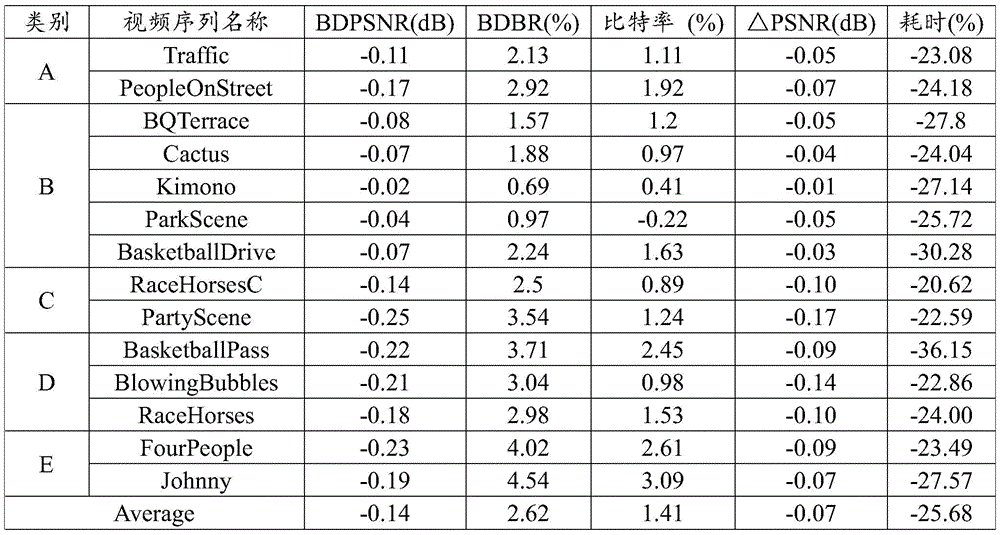
Referring to table 1, the intra-frame angle mode selection method of the present invention obtains the best result on the index of Time on the premise of ensuring Bitrate and PSNR. Experimental results prove that the method for selecting the intra-angle mode in the HEVC frame can ensure the quality of video coding by utilizing the depth convolutional neural network to learn and predict the PU image and the proposed angle mode selection algorithm, thereby better solving the problem of long time in the video coding process.
Table 1 table of experimental results of intra-frame angle mode selection method in HEVC
The invention also discloses an intra-frame angle mode selection device of the HEVC, which comprises a preprocessing module, a model building module, an angle mode prediction module and an angle mode determination module.
The preprocessing module is used for dividing a plurality of input video frame images into a plurality of PU images respectively, and classifying all the PU images into a training set and a testing set; and calculating the average value of pixel values of all the PU images at the same position in the training set to obtain an average value image.
The model building module is used for building a deep convolutional neural network and setting the output of the deep convolutional neural network into a 35-class angle mode; training the deep convolutional neural network through the training set and the mean image, and testing the deep convolutional neural network through the testing set to obtain a deep convolutional neural network prediction model.
The angle mode prediction module is used for obtaining video frame images to be predicted, dividing the video frame images into a plurality of PU images to be predicted, and predicting the PU images to be predicted through a depth convolution neural network prediction model to obtain an angle mode corresponding to each PU image to be predicted.
The angle mode determining module is used for selecting the preset number of angle modes with the largest number to form an angle mode candidate list, and traversing the angle modes in the angle mode candidate list through the HEVC coding flow to obtain the optimal angle mode.
The intra-frame angle mode selection method of the present invention may take the form of an entirely hardware embodiment, an entirely software embodiment or an embodiment combining software and hardware aspects. Furthermore, the present invention may take the form of a computer program product embodied on one or more computer-usable storage media (including, but not limited to, disk storage, CD-ROM, optical storage, and the like) having computer-usable program code embodied therein. The intra-frame angle mode selection method of the present invention, if implemented in the form of a software functional unit and sold or used as a stand-alone product, may be stored in a computer readable storage medium.
Based on such understanding, in an exemplary embodiment, a computer readable storage medium is also provided, where the present invention implements all or part of the flow of the method of the above embodiment, and may also be implemented by a computer program to instruct related hardware, where the computer program may be stored in the computer readable storage medium, where the computer program, when executed by a processor, may implement the steps of each of the method embodiments described above. Wherein the computer program comprises computer program code which may be in source code form, object code form, executable file or some intermediate form etc. Computer-readable storage media, including both non-transitory and non-transitory, removable and non-removable media, may implement information storage by any method or technology. The information may be computer readable instructions, data structures, modules of a program, or other data. It should be noted that the computer readable medium contains content that can be appropriately scaled according to the requirements of jurisdictions in which such content is subject to legislation and patent practice, such as in certain jurisdictions in which such content is subject to legislation and patent practice, the computer readable medium does not include electrical carrier signals and telecommunication signals. The computer storage media may be any available media or data storage device that can be accessed by a computer, including, but not limited to, magnetic storage (e.g., floppy disks, hard disks, magnetic tape, magneto-optical disks (MOs), etc.), optical storage (e.g., CD, DVD, BD, HVD, etc.), and semiconductor storage (e.g., ROM, EPROM, EEPROM, nonvolatile storage (NANDFLASH), solid State Disk (SSD)), etc.
In an exemplary embodiment, a computer device is also provided, comprising a memory, a processor, and a computer program stored in the memory and executable on the processor, the processor implementing the steps of the intra-frame angle mode selection method of HEVC when executing the computer program. The processor may be a central processing unit (CentralProcessingUnit, CPU), but may also be other general purpose processors, digital signal processors (DigitalSignalProcessor, DSP), application specific integrated circuits (ApplicationSpecificIntegratedCircuit, ASIC), off-the-shelf programmable gate arrays (Field-ProgrammableGateArray, FPGA) or other programmable logic devices, discrete gate or transistor logic devices, discrete hardware components, or the like.
The above is only for illustrating the technical idea of the present invention, and the protection scope of the present invention is not limited by this, and any modification made on the basis of the technical scheme according to the technical idea of the present invention falls within the protection scope of the claims of the present invention.
Claims (9)
1. A method for intra-frame angle mode selection in HEVC, comprising the steps of:
s1: dividing a plurality of input video frame images into a plurality of PU images respectively, and classifying all the PU images into a training set and a testing set; calculating the average value of pixel values of all the PU images at the same position in the training set to obtain an average value image;
s2: constructing a deep convolutional neural network, and setting the output of the deep convolutional neural network to be in a 35-class angle mode; training the deep convolutional neural network through a training set and an average value image, and testing the deep convolutional neural network through a testing set to obtain a deep convolutional neural network prediction model;
the deep convolutional neural network comprises a first convolutional layer, a first pooling layer, a second convolutional layer, a second pooling layer, a first full-connection layer, a second full-connection layer and an output layer which are sequentially arranged, wherein the output of the output layer is set to be in a 35-class angle mode; the first convolution layer and the second convolution layer are set to 64 convolution kernels, and the convolution kernels are 5 multiplied by 5; the first pooling layer and the second pooling layer are both set to be MaxPooling operation, and the pooling window sizes are all 3×3; the first full-connection layer and the second full-connection layer are set to 512-dimensional neuron nodes;
s3: obtaining a video frame image to be predicted, dividing the video frame image to be predicted into a plurality of PU images to be predicted, and predicting the PU images to be predicted through a depth convolution neural network prediction model to obtain an angle mode corresponding to each PU image to be predicted;
specifically, all required PU images of a video frame image to be predicted are obtained according to an HEVC original quadtree partitioning mode, unified size processing is carried out on the PU images, the unified size is 8 multiplied by 8, and then the average value is subtracted from each pixel point to obtain the PU image to be predicted;
s4: and selecting the pre-preset number of angle modes with the largest number to form an angle mode candidate list, and traversing the angle modes in the angle mode candidate list through the HEVC coding flow to obtain the optimal angle mode.
2. The intra-frame angle mode selection method according to claim 1, wherein the specific method of S1 is:
and carrying out non-overlapping division on a plurality of input video frame images according to the sizes of the 4 PU images, scaling all the PU images with the 4 sizes to the same size, and classifying the PU images with the same size into a training set and a testing set.
3. The method according to claim 1, wherein in S1, PU images of the first 50 frames of the input video frame image are used as training sets, and PU images of the remaining frames are used as test sets.
4. The method for intra-frame angle mode selection in HEVC according to claim 1, wherein in S2, when training the deep convolutional neural network through a training set and a mean image, and when testing the deep convolutional neural network through a test set, the deep convolutional neural network is updated and solved through a least square function and a back propagation BP algorithm.
5. The method for intra-frame angle mode selection according to claim 1, wherein in S4, the first 3 angle modes with the largest number are selected to form an angle mode candidate list.
6. The method according to claim 5, wherein in S4, planar mode and/or DC mode is added to the candidate list of angle modes when Planar mode and/or DC mode is not included in the top 3 types of angle modes with the largest number.
7. An intra-frame angle mode selection apparatus in HEVC, comprising:
the preprocessing module is used for dividing a plurality of input video frame images into a plurality of PU images respectively and classifying all the PU images into a training set and a testing set; calculating the average value of pixel values of all the PU images at the same position in the training set to obtain an average value image;
the model building module is used for building a deep convolutional neural network and setting the output of the deep convolutional neural network into a 35-class angle mode; training the deep convolutional neural network through a training set and an average value image, and testing the deep convolutional neural network through a testing set to obtain a deep convolutional neural network prediction model;
the deep convolutional neural network comprises a first convolutional layer, a first pooling layer, a second convolutional layer, a second pooling layer, a first full-connection layer, a second full-connection layer and an output layer which are sequentially arranged, wherein the output of the output layer is set to be in a 35-class angle mode; the first convolution layer and the second convolution layer are set to 64 convolution kernels, and the convolution kernels are 5 multiplied by 5; the first pooling layer and the second pooling layer are both set to be MaxPooling operation, and the pooling window sizes are all 3×3; the first full-connection layer and the second full-connection layer are set to 512-dimensional neuron nodes;
the angle mode prediction module is used for acquiring a video frame image to be predicted, dividing the video frame image to be predicted into a plurality of PU images to be predicted, and predicting the PU images to be predicted through a depth convolution neural network prediction model to obtain an angle mode corresponding to each PU image to be predicted; specifically, all required PU images of a video frame image to be predicted are obtained according to an HEVC original quadtree partitioning mode, unified size processing is carried out on the PU images, the unified size is 8 multiplied by 8, and then the average value is subtracted from each pixel point to obtain the PU image to be predicted; and
the angle mode determining module is used for selecting the preset number of the angle modes with the largest number to form an angle mode candidate list, and traversing the angle modes in the angle mode candidate list through the HEVC coding flow to obtain the optimal angle mode.
8. A computer device comprising a memory, a processor and a computer program stored in the memory and executable on the processor, characterized in that the processor implements the steps of the intra-frame angle mode selection method according to any one of claims 1 to 6 when the computer program is executed by the processor.
9. A computer readable storage medium storing a computer program, wherein the computer program when executed by a processor implements the steps of the intra-frame angle mode selection method of any one of claims 1 to 6.
Priority Applications (1)
| Application Number | Priority Date | Filing Date | Title |
|---|---|---|---|
| CN202010628727.XA CN111800642B (en) | 2020-07-02 | 2020-07-02 | HEVC intra-frame intra-angle mode selection method, device, equipment and readable storage medium |
Applications Claiming Priority (1)
| Application Number | Priority Date | Filing Date | Title |
|---|---|---|---|
| CN202010628727.XA CN111800642B (en) | 2020-07-02 | 2020-07-02 | HEVC intra-frame intra-angle mode selection method, device, equipment and readable storage medium |
Publications (2)
| Publication Number | Publication Date |
|---|---|
| CN111800642A CN111800642A (en) | 2020-10-20 |
| CN111800642B true CN111800642B (en) | 2023-05-26 |
Family
ID=72810097
Family Applications (1)
| Application Number | Title | Priority Date | Filing Date |
|---|---|---|---|
| CN202010628727.XA Active CN111800642B (en) | 2020-07-02 | 2020-07-02 | HEVC intra-frame intra-angle mode selection method, device, equipment and readable storage medium |
Country Status (1)
| Country | Link |
|---|---|
| CN (1) | CN111800642B (en) |
Families Citing this family (3)
| Publication number | Priority date | Publication date | Assignee | Title |
|---|---|---|---|---|
| CN116686288A (en) * | 2021-01-22 | 2023-09-01 | Oppo广东移动通信有限公司 | Encoding method, decoding method, encoder, decoder and electronic device |
| CN113781588A (en) * | 2021-07-01 | 2021-12-10 | 杭州未名信科科技有限公司 | A Neural Network-Based Intra-coding Unit Size Division Method |
| CN117395426B (en) * | 2022-06-30 | 2026-01-02 | 深圳市中兴微电子技术有限公司 | Methods, apparatus, electronic devices and storage media for predicting coding patterns |
Citations (4)
| Publication number | Priority date | Publication date | Assignee | Title |
|---|---|---|---|---|
| WO2018010492A1 (en) * | 2016-07-12 | 2018-01-18 | 北京大学深圳研究生院 | Rapid decision making method for intra-frame prediction mode in video coding |
| WO2018099579A1 (en) * | 2016-12-02 | 2018-06-07 | Huawei Technologies Co., Ltd. | Apparatus and method for encoding an image |
| CN109618169A (en) * | 2018-12-25 | 2019-04-12 | 中山大学 | Intra-frame decision method, apparatus and storage medium for HEVC |
| CN111355956A (en) * | 2020-03-09 | 2020-06-30 | 蔡晓刚 | Rate distortion optimization fast decision making system and method based on deep learning in HEVC intra-frame coding |
Family Cites Families (1)
| Publication number | Priority date | Publication date | Assignee | Title |
|---|---|---|---|---|
| WO2019072921A1 (en) * | 2017-10-13 | 2019-04-18 | Fraunhofer-Gesellschaft zur Förderung der angewandten Forschung e.V. | Intra-prediction mode concept for block-wise picture coding |
-
2020
- 2020-07-02 CN CN202010628727.XA patent/CN111800642B/en active Active
Patent Citations (4)
| Publication number | Priority date | Publication date | Assignee | Title |
|---|---|---|---|---|
| WO2018010492A1 (en) * | 2016-07-12 | 2018-01-18 | 北京大学深圳研究生院 | Rapid decision making method for intra-frame prediction mode in video coding |
| WO2018099579A1 (en) * | 2016-12-02 | 2018-06-07 | Huawei Technologies Co., Ltd. | Apparatus and method for encoding an image |
| CN109618169A (en) * | 2018-12-25 | 2019-04-12 | 中山大学 | Intra-frame decision method, apparatus and storage medium for HEVC |
| CN111355956A (en) * | 2020-03-09 | 2020-06-30 | 蔡晓刚 | Rate distortion optimization fast decision making system and method based on deep learning in HEVC intra-frame coding |
Non-Patent Citations (1)
| Title |
|---|
| 一种基于BP网络的H.264快速帧内模式选择算法;季国飞等;《计算机工程与应用》;20080501(第13期);全文 * |
Also Published As
| Publication number | Publication date |
|---|---|
| CN111800642A (en) | 2020-10-20 |
Similar Documents
| Publication | Publication Date | Title |
|---|---|---|
| CN111800642B (en) | HEVC intra-frame intra-angle mode selection method, device, equipment and readable storage medium | |
| WO2019179523A1 (en) | Deep learning method-based block segmentation coding complexity optimization method and device | |
| CN118628939A (en) | A small target detection method for UAV images based on improved YOLOv8 algorithm | |
| CN116306813B (en) | A method based on YOLOX lightweight and network optimization | |
| CN111757110A (en) | Video coding method, coding tree unit dividing method, system, device and readable storage medium | |
| CN111428556A (en) | Traffic sign recognition method based on capsule neural network | |
| KR20180004898A (en) | Image processing technology and method based on deep learning | |
| CN115170988A (en) | Power grid line fault identification method and system based on deep learning | |
| CN108989799A (en) | A kind of selection method, device and the electronic equipment of coding unit reference frame | |
| CN113095335A (en) | Image identification method based on category consistency deep learning | |
| CN117034100A (en) | Adaptive graph classification method, system, equipment and media based on hierarchical pooling architecture | |
| CN120635694A (en) | A short-term precipitation prediction method based on fusion of multi-source and multi-temporal and multi-spatial features | |
| CN117915104A (en) | A VVC multi-level fast inter-frame coding system and method based on neural network | |
| CN117251591B (en) | A method and system for rapid retrieval of distribution network images | |
| CN116452472B (en) | Low-light image enhancement method based on semantic knowledge guidance | |
| CN107690069B (en) | A Data-Driven Concatenated Video Coding Method | |
| CN116958878A (en) | Video anomaly detection method based on spatiotemporal enhanced associative memory | |
| CN108989801B (en) | Space-time characteristic-based adaptive mode selection rapid method | |
| CN113784147A (en) | A high-efficiency video coding method and system based on convolutional neural network | |
| CN119205616A (en) | A transformer component detection method based on Fast RCNN | |
| CN119007288A (en) | Multi-mode video anomaly detection method combining RGB (red, green, blue) appearance, skeleton gesture and audio information and related equipment | |
| CN117974614A (en) | Pipeline defect detection method and system | |
| CN116758614A (en) | Image detection method and device, storage medium and electronic device | |
| CN118196579B (en) | Multimedia content management and control optimization method based on target recognition | |
| CN119583802A (en) | A CU partition mode prediction method for VVC coding unit and video coding device |
Legal Events
| Date | Code | Title | Description |
|---|---|---|---|
| PB01 | Publication | ||
| PB01 | Publication | ||
| SE01 | Entry into force of request for substantive examination | ||
| SE01 | Entry into force of request for substantive examination | ||
| GR01 | Patent grant | ||
| GR01 | Patent grant |