CN111205262B - Amine derivative containing spirofluorene group and application thereof in organic electroluminescent device - Google Patents
Amine derivative containing spirofluorene group and application thereof in organic electroluminescent device Download PDFInfo
- Publication number
- CN111205262B CN111205262B CN202010068392.0A CN202010068392A CN111205262B CN 111205262 B CN111205262 B CN 111205262B CN 202010068392 A CN202010068392 A CN 202010068392A CN 111205262 B CN111205262 B CN 111205262B
- Authority
- CN
- China
- Prior art keywords
- organic electroluminescent
- amine derivative
- mmol
- electroluminescent device
- organic
- Prior art date
- Legal status (The legal status is an assumption and is not a legal conclusion. Google has not performed a legal analysis and makes no representation as to the accuracy of the status listed.)
- Active
Links
- 150000001412 amines Chemical class 0.000 title claims abstract description 20
- 239000000463 material Substances 0.000 claims abstract description 23
- 230000005525 hole transport Effects 0.000 claims abstract description 22
- 238000002360 preparation method Methods 0.000 claims description 11
- 238000000034 method Methods 0.000 claims description 8
- 150000002894 organic compounds Chemical class 0.000 claims description 6
- 125000000217 alkyl group Chemical group 0.000 claims description 5
- 125000004435 hydrogen atom Chemical group [H]* 0.000 claims description 5
- 238000005286 illumination Methods 0.000 claims description 4
- 125000000732 arylene group Chemical group 0.000 claims description 3
- 239000010410 layer Substances 0.000 description 50
- YXFVVABEGXRONW-UHFFFAOYSA-N Toluene Chemical compound CC1=CC=CC=C1 YXFVVABEGXRONW-UHFFFAOYSA-N 0.000 description 30
- 150000001875 compounds Chemical class 0.000 description 19
- MFRIHAYPQRLWNB-UHFFFAOYSA-N sodium tert-butoxide Chemical compound [Na+].CC(C)(C)[O-] MFRIHAYPQRLWNB-UHFFFAOYSA-N 0.000 description 16
- BWHDROKFUHTORW-UHFFFAOYSA-N tritert-butylphosphane Chemical compound CC(C)(C)P(C(C)(C)C)C(C)(C)C BWHDROKFUHTORW-UHFFFAOYSA-N 0.000 description 16
- 230000000694 effects Effects 0.000 description 13
- KDLHZDBZIXYQEI-UHFFFAOYSA-N Palladium Chemical compound [Pd] KDLHZDBZIXYQEI-UHFFFAOYSA-N 0.000 description 12
- VYPSYNLAJGMNEJ-UHFFFAOYSA-N Silicium dioxide Chemical compound O=[Si]=O VYPSYNLAJGMNEJ-UHFFFAOYSA-N 0.000 description 12
- 239000002994 raw material Substances 0.000 description 12
- 239000000203 mixture Substances 0.000 description 10
- 125000003118 aryl group Chemical group 0.000 description 9
- 230000000903 blocking effect Effects 0.000 description 9
- 230000000052 comparative effect Effects 0.000 description 9
- 239000011521 glass Substances 0.000 description 9
- 238000002347 injection Methods 0.000 description 9
- 239000007924 injection Substances 0.000 description 9
- KFZMGEQAYNKOFK-UHFFFAOYSA-N Isopropanol Chemical compound CC(C)O KFZMGEQAYNKOFK-UHFFFAOYSA-N 0.000 description 8
- 238000001816 cooling Methods 0.000 description 8
- 239000000706 filtrate Substances 0.000 description 8
- 239000012299 nitrogen atmosphere Substances 0.000 description 8
- 239000003960 organic solvent Substances 0.000 description 8
- 239000000758 substrate Substances 0.000 description 8
- 125000001072 heteroaryl group Chemical group 0.000 description 6
- 229910052763 palladium Inorganic materials 0.000 description 6
- 238000001953 recrystallisation Methods 0.000 description 6
- 239000000741 silica gel Substances 0.000 description 6
- 229910002027 silica gel Inorganic materials 0.000 description 6
- 239000007858 starting material Substances 0.000 description 6
- 238000004821 distillation Methods 0.000 description 5
- 238000001914 filtration Methods 0.000 description 5
- 229910052751 metal Inorganic materials 0.000 description 5
- 239000002184 metal Substances 0.000 description 5
- 229910052757 nitrogen Inorganic materials 0.000 description 5
- GEQBRULPNIVQPP-UHFFFAOYSA-N 2-[3,5-bis(1-phenylbenzimidazol-2-yl)phenyl]-1-phenylbenzimidazole Chemical compound C1=CC=CC=C1N1C2=CC=CC=C2N=C1C1=CC(C=2N(C3=CC=CC=C3N=2)C=2C=CC=CC=2)=CC(C=2N(C3=CC=CC=C3N=2)C=2C=CC=CC=2)=C1 GEQBRULPNIVQPP-UHFFFAOYSA-N 0.000 description 4
- CSCPPACGZOOCGX-UHFFFAOYSA-N Acetone Chemical compound CC(C)=O CSCPPACGZOOCGX-UHFFFAOYSA-N 0.000 description 4
- 238000006243 chemical reaction Methods 0.000 description 4
- 239000000047 product Substances 0.000 description 4
- 150000004982 aromatic amines Chemical group 0.000 description 3
- 150000004945 aromatic hydrocarbons Chemical class 0.000 description 3
- 239000000969 carrier Substances 0.000 description 3
- 238000000151 deposition Methods 0.000 description 3
- 230000006798 recombination Effects 0.000 description 3
- 238000005215 recombination Methods 0.000 description 3
- 238000006467 substitution reaction Methods 0.000 description 3
- 238000003786 synthesis reaction Methods 0.000 description 3
- 238000007738 vacuum evaporation Methods 0.000 description 3
- -1 α -naphthyl Chemical group 0.000 description 3
- GCTFTMWXZFLTRR-GFCCVEGCSA-N (2r)-2-amino-n-[3-(difluoromethoxy)-4-(1,3-oxazol-5-yl)phenyl]-4-methylpentanamide Chemical compound FC(F)OC1=CC(NC(=O)[C@H](N)CC(C)C)=CC=C1C1=CN=CO1 GCTFTMWXZFLTRR-GFCCVEGCSA-N 0.000 description 2
- IUSARDYWEPUTPN-OZBXUNDUSA-N (2r)-n-[(2s,3r)-4-[[(4s)-6-(2,2-dimethylpropyl)spiro[3,4-dihydropyrano[2,3-b]pyridine-2,1'-cyclobutane]-4-yl]amino]-3-hydroxy-1-[3-(1,3-thiazol-2-yl)phenyl]butan-2-yl]-2-methoxypropanamide Chemical compound C([C@H](NC(=O)[C@@H](C)OC)[C@H](O)CN[C@@H]1C2=CC(CC(C)(C)C)=CN=C2OC2(CCC2)C1)C(C=1)=CC=CC=1C1=NC=CS1 IUSARDYWEPUTPN-OZBXUNDUSA-N 0.000 description 2
- AWXGSYPUMWKTBR-UHFFFAOYSA-N 4-carbazol-9-yl-n,n-bis(4-carbazol-9-ylphenyl)aniline Chemical compound C12=CC=CC=C2C2=CC=CC=C2N1C1=CC=C(N(C=2C=CC(=CC=2)N2C3=CC=CC=C3C3=CC=CC=C32)C=2C=CC(=CC=2)N2C3=CC=CC=C3C3=CC=CC=C32)C=C1 AWXGSYPUMWKTBR-UHFFFAOYSA-N 0.000 description 2
- IJGRMHOSHXDMSA-UHFFFAOYSA-N Atomic nitrogen Chemical compound N#N IJGRMHOSHXDMSA-UHFFFAOYSA-N 0.000 description 2
- 235000009161 Espostoa lanata Nutrition 0.000 description 2
- 240000001624 Espostoa lanata Species 0.000 description 2
- PXGOKWXKJXAPGV-UHFFFAOYSA-N Fluorine Chemical compound FF PXGOKWXKJXAPGV-UHFFFAOYSA-N 0.000 description 2
- 101000837344 Homo sapiens T-cell leukemia translocation-altered gene protein Proteins 0.000 description 2
- 102100028692 T-cell leukemia translocation-altered gene protein Human genes 0.000 description 2
- 125000003545 alkoxy group Chemical group 0.000 description 2
- 125000002947 alkylene group Chemical group 0.000 description 2
- 230000015572 biosynthetic process Effects 0.000 description 2
- 125000004432 carbon atom Chemical group C* 0.000 description 2
- 229940125904 compound 1 Drugs 0.000 description 2
- 229940125807 compound 37 Drugs 0.000 description 2
- 229940125900 compound 59 Drugs 0.000 description 2
- 238000007796 conventional method Methods 0.000 description 2
- 125000004093 cyano group Chemical group *C#N 0.000 description 2
- ZUOUZKKEUPVFJK-UHFFFAOYSA-N diphenyl Chemical compound C1=CC=CC=C1C1=CC=CC=C1 ZUOUZKKEUPVFJK-UHFFFAOYSA-N 0.000 description 2
- 239000007772 electrode material Substances 0.000 description 2
- 229910052731 fluorine Inorganic materials 0.000 description 2
- 239000011737 fluorine Substances 0.000 description 2
- 230000009477 glass transition Effects 0.000 description 2
- 238000012986 modification Methods 0.000 description 2
- 230000004048 modification Effects 0.000 description 2
- YJVFFLUZDVXJQI-UHFFFAOYSA-L palladium(ii) acetate Chemical compound [Pd+2].CC([O-])=O.CC([O-])=O YJVFFLUZDVXJQI-UHFFFAOYSA-L 0.000 description 2
- 125000001997 phenyl group Chemical group [H]C1=C([H])C([H])=C(*)C([H])=C1[H] 0.000 description 2
- 230000008569 process Effects 0.000 description 2
- 239000007787 solid Substances 0.000 description 2
- 238000003756 stirring Methods 0.000 description 2
- 239000000126 substance Substances 0.000 description 2
- 125000001424 substituent group Chemical group 0.000 description 2
- 125000002023 trifluoromethyl group Chemical group FC(F)(F)* 0.000 description 2
- YJTKZCDBKVTVBY-UHFFFAOYSA-N 1,3-Diphenylbenzene Chemical group C1=CC=CC=C1C1=CC=CC(C=2C=CC=CC=2)=C1 YJTKZCDBKVTVBY-UHFFFAOYSA-N 0.000 description 1
- YMRHXVOHLPIMNN-UHFFFAOYSA-N 1-n-(3-methylphenyl)-2-n,2-n-diphenylbenzene-1,2-diamine Chemical compound CC1=CC=CC(NC=2C(=CC=CC=2)N(C=2C=CC=CC=2)C=2C=CC=CC=2)=C1 YMRHXVOHLPIMNN-UHFFFAOYSA-N 0.000 description 1
- VQGHOUODWALEFC-UHFFFAOYSA-N 2-phenylpyridine Chemical compound C1=CC=CC=C1C1=CC=CC=N1 VQGHOUODWALEFC-UHFFFAOYSA-N 0.000 description 1
- XUIMIQQOPSSXEZ-UHFFFAOYSA-N Silicon Chemical group [Si] XUIMIQQOPSSXEZ-UHFFFAOYSA-N 0.000 description 1
- NINIDFKCEFEMDL-UHFFFAOYSA-N Sulfur Chemical compound [S] NINIDFKCEFEMDL-UHFFFAOYSA-N 0.000 description 1
- 239000007983 Tris buffer Substances 0.000 description 1
- 125000001931 aliphatic group Chemical group 0.000 description 1
- 238000004458 analytical method Methods 0.000 description 1
- 125000005428 anthryl group Chemical group [H]C1=C([H])C([H])=C2C([H])=C3C(*)=C([H])C([H])=C([H])C3=C([H])C2=C1[H] 0.000 description 1
- 125000004429 atom Chemical group 0.000 description 1
- QVGXLLKOCUKJST-UHFFFAOYSA-N atomic oxygen Chemical compound [O] QVGXLLKOCUKJST-UHFFFAOYSA-N 0.000 description 1
- 230000009286 beneficial effect Effects 0.000 description 1
- 125000003785 benzimidazolyl group Chemical group N1=C(NC2=C1C=CC=C2)* 0.000 description 1
- 125000004618 benzofuryl group Chemical group O1C(=CC2=C1C=CC=C2)* 0.000 description 1
- 125000004196 benzothienyl group Chemical group S1C(=CC2=C1C=CC=C2)* 0.000 description 1
- 230000005540 biological transmission Effects 0.000 description 1
- 235000010290 biphenyl Nutrition 0.000 description 1
- 239000004305 biphenyl Substances 0.000 description 1
- 125000000609 carbazolyl group Chemical group C1(=CC=CC=2C3=CC=CC=C3NC12)* 0.000 description 1
- 230000015556 catabolic process Effects 0.000 description 1
- 239000003153 chemical reaction reagent Substances 0.000 description 1
- 238000002425 crystallisation Methods 0.000 description 1
- 230000008025 crystallization Effects 0.000 description 1
- 238000006731 degradation reaction Methods 0.000 description 1
- 230000008021 deposition Effects 0.000 description 1
- 238000001514 detection method Methods 0.000 description 1
- 229910052805 deuterium Inorganic materials 0.000 description 1
- 125000004431 deuterium atom Chemical group 0.000 description 1
- 239000012153 distilled water Substances 0.000 description 1
- 238000000921 elemental analysis Methods 0.000 description 1
- 125000001495 ethyl group Chemical group [H]C([H])([H])C([H])([H])* 0.000 description 1
- 238000001704 evaporation Methods 0.000 description 1
- 230000008020 evaporation Effects 0.000 description 1
- 230000005281 excited state Effects 0.000 description 1
- 238000002474 experimental method Methods 0.000 description 1
- 125000003983 fluorenyl group Chemical group C1(=CC=CC=2C3=CC=CC=C3CC12)* 0.000 description 1
- 239000012634 fragment Substances 0.000 description 1
- 125000002541 furyl group Chemical group 0.000 description 1
- PCHJSUWPFVWCPO-UHFFFAOYSA-N gold Chemical compound [Au] PCHJSUWPFVWCPO-UHFFFAOYSA-N 0.000 description 1
- 239000010931 gold Substances 0.000 description 1
- 229910052737 gold Inorganic materials 0.000 description 1
- 230000005283 ground state Effects 0.000 description 1
- 125000005842 heteroatom Chemical group 0.000 description 1
- 238000004770 highest occupied molecular orbital Methods 0.000 description 1
- 125000002883 imidazolyl group Chemical group 0.000 description 1
- 125000000959 isobutyl group Chemical group [H]C([H])([H])C([H])(C([H])([H])[H])C([H])([H])* 0.000 description 1
- 125000001449 isopropyl group Chemical group [H]C([H])([H])C([H])(*)C([H])([H])[H] 0.000 description 1
- 239000007788 liquid Substances 0.000 description 1
- 238000004768 lowest unoccupied molecular orbital Methods 0.000 description 1
- 238000001748 luminescence spectrum Methods 0.000 description 1
- 238000004949 mass spectrometry Methods 0.000 description 1
- 230000007246 mechanism Effects 0.000 description 1
- 125000002496 methyl group Chemical group [H]C([H])([H])* 0.000 description 1
- 238000012544 monitoring process Methods 0.000 description 1
- 125000004108 n-butyl group Chemical group [H]C([H])([H])C([H])([H])C([H])([H])C([H])([H])* 0.000 description 1
- 125000004123 n-propyl group Chemical group [H]C([H])([H])C([H])([H])C([H])([H])* 0.000 description 1
- 125000001624 naphthyl group Chemical group 0.000 description 1
- QJGQUHMNIGDVPM-UHFFFAOYSA-N nitrogen group Chemical group [N] QJGQUHMNIGDVPM-UHFFFAOYSA-N 0.000 description 1
- 239000012044 organic layer Substances 0.000 description 1
- 239000011368 organic material Substances 0.000 description 1
- 229910052760 oxygen Inorganic materials 0.000 description 1
- 239000001301 oxygen Substances 0.000 description 1
- 238000011056 performance test Methods 0.000 description 1
- 125000005561 phenanthryl group Chemical group 0.000 description 1
- 125000000843 phenylene group Chemical group C1(=C(C=CC=C1)*)* 0.000 description 1
- 238000009832 plasma treatment Methods 0.000 description 1
- 125000001725 pyrenyl group Chemical group 0.000 description 1
- 125000004076 pyridyl group Chemical group 0.000 description 1
- 125000000714 pyrimidinyl group Chemical group 0.000 description 1
- 125000005493 quinolyl group Chemical group 0.000 description 1
- 230000004044 response Effects 0.000 description 1
- 125000002914 sec-butyl group Chemical group [H]C([H])([H])C([H])([H])C([H])(*)C([H])([H])[H] 0.000 description 1
- 238000001228 spectrum Methods 0.000 description 1
- 238000010561 standard procedure Methods 0.000 description 1
- 239000011593 sulfur Substances 0.000 description 1
- 229910052717 sulfur Inorganic materials 0.000 description 1
- 125000000999 tert-butyl group Chemical group [H]C([H])([H])C(*)(C([H])([H])[H])C([H])([H])[H] 0.000 description 1
- 238000012360 testing method Methods 0.000 description 1
- 125000001544 thienyl group Chemical group 0.000 description 1
- 238000001771 vacuum deposition Methods 0.000 description 1
- 238000005406 washing Methods 0.000 description 1
- XLYOFNOQVPJJNP-UHFFFAOYSA-N water Chemical compound O XLYOFNOQVPJJNP-UHFFFAOYSA-N 0.000 description 1
Images


Classifications
-
- C—CHEMISTRY; METALLURGY
- C07—ORGANIC CHEMISTRY
- C07D—HETEROCYCLIC COMPOUNDS
- C07D311/00—Heterocyclic compounds containing six-membered rings having one oxygen atom as the only hetero atom, condensed with other rings
- C07D311/96—Heterocyclic compounds containing six-membered rings having one oxygen atom as the only hetero atom, condensed with other rings spiro-condensed with carbocyclic rings or ring systems
-
- C—CHEMISTRY; METALLURGY
- C07—ORGANIC CHEMISTRY
- C07D—HETEROCYCLIC COMPOUNDS
- C07D405/00—Heterocyclic compounds containing both one or more hetero rings having oxygen atoms as the only ring hetero atoms, and one or more rings having nitrogen as the only ring hetero atom
- C07D405/02—Heterocyclic compounds containing both one or more hetero rings having oxygen atoms as the only ring hetero atoms, and one or more rings having nitrogen as the only ring hetero atom containing two hetero rings
- C07D405/04—Heterocyclic compounds containing both one or more hetero rings having oxygen atoms as the only ring hetero atoms, and one or more rings having nitrogen as the only ring hetero atom containing two hetero rings directly linked by a ring-member-to-ring-member bond
-
- C—CHEMISTRY; METALLURGY
- C09—DYES; PAINTS; POLISHES; NATURAL RESINS; ADHESIVES; COMPOSITIONS NOT OTHERWISE PROVIDED FOR; APPLICATIONS OF MATERIALS NOT OTHERWISE PROVIDED FOR
- C09K—MATERIALS FOR MISCELLANEOUS APPLICATIONS, NOT PROVIDED FOR ELSEWHERE
- C09K11/00—Luminescent, e.g. electroluminescent, chemiluminescent materials
- C09K11/06—Luminescent, e.g. electroluminescent, chemiluminescent materials containing organic luminescent materials
-
- H—ELECTRICITY
- H10—SEMICONDUCTOR DEVICES; ELECTRIC SOLID-STATE DEVICES NOT OTHERWISE PROVIDED FOR
- H10K—ORGANIC ELECTRIC SOLID-STATE DEVICES
- H10K50/00—Organic light-emitting devices
-
- H—ELECTRICITY
- H10—SEMICONDUCTOR DEVICES; ELECTRIC SOLID-STATE DEVICES NOT OTHERWISE PROVIDED FOR
- H10K—ORGANIC ELECTRIC SOLID-STATE DEVICES
- H10K50/00—Organic light-emitting devices
- H10K50/10—OLEDs or polymer light-emitting diodes [PLED]
- H10K50/14—Carrier transporting layers
- H10K50/15—Hole transporting layers
-
- H—ELECTRICITY
- H10—SEMICONDUCTOR DEVICES; ELECTRIC SOLID-STATE DEVICES NOT OTHERWISE PROVIDED FOR
- H10K—ORGANIC ELECTRIC SOLID-STATE DEVICES
- H10K85/00—Organic materials used in the body or electrodes of devices covered by this subclass
- H10K85/60—Organic compounds having low molecular weight
- H10K85/615—Polycyclic condensed aromatic hydrocarbons, e.g. anthracene
-
- H—ELECTRICITY
- H10—SEMICONDUCTOR DEVICES; ELECTRIC SOLID-STATE DEVICES NOT OTHERWISE PROVIDED FOR
- H10K—ORGANIC ELECTRIC SOLID-STATE DEVICES
- H10K85/00—Organic materials used in the body or electrodes of devices covered by this subclass
- H10K85/60—Organic compounds having low molecular weight
- H10K85/615—Polycyclic condensed aromatic hydrocarbons, e.g. anthracene
- H10K85/624—Polycyclic condensed aromatic hydrocarbons, e.g. anthracene containing six or more rings
-
- H—ELECTRICITY
- H10—SEMICONDUCTOR DEVICES; ELECTRIC SOLID-STATE DEVICES NOT OTHERWISE PROVIDED FOR
- H10K—ORGANIC ELECTRIC SOLID-STATE DEVICES
- H10K85/00—Organic materials used in the body or electrodes of devices covered by this subclass
- H10K85/60—Organic compounds having low molecular weight
- H10K85/631—Amine compounds having at least two aryl rest on at least one amine-nitrogen atom, e.g. triphenylamine
-
- H—ELECTRICITY
- H10—SEMICONDUCTOR DEVICES; ELECTRIC SOLID-STATE DEVICES NOT OTHERWISE PROVIDED FOR
- H10K—ORGANIC ELECTRIC SOLID-STATE DEVICES
- H10K85/00—Organic materials used in the body or electrodes of devices covered by this subclass
- H10K85/60—Organic compounds having low molecular weight
- H10K85/631—Amine compounds having at least two aryl rest on at least one amine-nitrogen atom, e.g. triphenylamine
- H10K85/633—Amine compounds having at least two aryl rest on at least one amine-nitrogen atom, e.g. triphenylamine comprising polycyclic condensed aromatic hydrocarbons as substituents on the nitrogen atom
-
- H—ELECTRICITY
- H10—SEMICONDUCTOR DEVICES; ELECTRIC SOLID-STATE DEVICES NOT OTHERWISE PROVIDED FOR
- H10K—ORGANIC ELECTRIC SOLID-STATE DEVICES
- H10K85/00—Organic materials used in the body or electrodes of devices covered by this subclass
- H10K85/60—Organic compounds having low molecular weight
- H10K85/631—Amine compounds having at least two aryl rest on at least one amine-nitrogen atom, e.g. triphenylamine
- H10K85/636—Amine compounds having at least two aryl rest on at least one amine-nitrogen atom, e.g. triphenylamine comprising heteroaromatic hydrocarbons as substituents on the nitrogen atom
-
- H—ELECTRICITY
- H10—SEMICONDUCTOR DEVICES; ELECTRIC SOLID-STATE DEVICES NOT OTHERWISE PROVIDED FOR
- H10K—ORGANIC ELECTRIC SOLID-STATE DEVICES
- H10K85/00—Organic materials used in the body or electrodes of devices covered by this subclass
- H10K85/60—Organic compounds having low molecular weight
- H10K85/649—Aromatic compounds comprising a hetero atom
- H10K85/654—Aromatic compounds comprising a hetero atom comprising only nitrogen as heteroatom
-
- H—ELECTRICITY
- H10—SEMICONDUCTOR DEVICES; ELECTRIC SOLID-STATE DEVICES NOT OTHERWISE PROVIDED FOR
- H10K—ORGANIC ELECTRIC SOLID-STATE DEVICES
- H10K85/00—Organic materials used in the body or electrodes of devices covered by this subclass
- H10K85/60—Organic compounds having low molecular weight
- H10K85/649—Aromatic compounds comprising a hetero atom
- H10K85/657—Polycyclic condensed heteroaromatic hydrocarbons
- H10K85/6572—Polycyclic condensed heteroaromatic hydrocarbons comprising only nitrogen in the heteroaromatic polycondensed ring system, e.g. phenanthroline or carbazole
-
- H—ELECTRICITY
- H10—SEMICONDUCTOR DEVICES; ELECTRIC SOLID-STATE DEVICES NOT OTHERWISE PROVIDED FOR
- H10K—ORGANIC ELECTRIC SOLID-STATE DEVICES
- H10K85/00—Organic materials used in the body or electrodes of devices covered by this subclass
- H10K85/60—Organic compounds having low molecular weight
- H10K85/649—Aromatic compounds comprising a hetero atom
- H10K85/657—Polycyclic condensed heteroaromatic hydrocarbons
- H10K85/6574—Polycyclic condensed heteroaromatic hydrocarbons comprising only oxygen in the heteroaromatic polycondensed ring system, e.g. cumarine dyes
-
- C—CHEMISTRY; METALLURGY
- C09—DYES; PAINTS; POLISHES; NATURAL RESINS; ADHESIVES; COMPOSITIONS NOT OTHERWISE PROVIDED FOR; APPLICATIONS OF MATERIALS NOT OTHERWISE PROVIDED FOR
- C09K—MATERIALS FOR MISCELLANEOUS APPLICATIONS, NOT PROVIDED FOR ELSEWHERE
- C09K2211/00—Chemical nature of organic luminescent or tenebrescent compounds
- C09K2211/10—Non-macromolecular compounds
- C09K2211/1003—Carbocyclic compounds
- C09K2211/1007—Non-condensed systems
-
- C—CHEMISTRY; METALLURGY
- C09—DYES; PAINTS; POLISHES; NATURAL RESINS; ADHESIVES; COMPOSITIONS NOT OTHERWISE PROVIDED FOR; APPLICATIONS OF MATERIALS NOT OTHERWISE PROVIDED FOR
- C09K—MATERIALS FOR MISCELLANEOUS APPLICATIONS, NOT PROVIDED FOR ELSEWHERE
- C09K2211/00—Chemical nature of organic luminescent or tenebrescent compounds
- C09K2211/10—Non-macromolecular compounds
- C09K2211/1003—Carbocyclic compounds
- C09K2211/1011—Condensed systems
-
- C—CHEMISTRY; METALLURGY
- C09—DYES; PAINTS; POLISHES; NATURAL RESINS; ADHESIVES; COMPOSITIONS NOT OTHERWISE PROVIDED FOR; APPLICATIONS OF MATERIALS NOT OTHERWISE PROVIDED FOR
- C09K—MATERIALS FOR MISCELLANEOUS APPLICATIONS, NOT PROVIDED FOR ELSEWHERE
- C09K2211/00—Chemical nature of organic luminescent or tenebrescent compounds
- C09K2211/10—Non-macromolecular compounds
- C09K2211/1003—Carbocyclic compounds
- C09K2211/1014—Carbocyclic compounds bridged by heteroatoms, e.g. N, P, Si or B
-
- C—CHEMISTRY; METALLURGY
- C09—DYES; PAINTS; POLISHES; NATURAL RESINS; ADHESIVES; COMPOSITIONS NOT OTHERWISE PROVIDED FOR; APPLICATIONS OF MATERIALS NOT OTHERWISE PROVIDED FOR
- C09K—MATERIALS FOR MISCELLANEOUS APPLICATIONS, NOT PROVIDED FOR ELSEWHERE
- C09K2211/00—Chemical nature of organic luminescent or tenebrescent compounds
- C09K2211/10—Non-macromolecular compounds
- C09K2211/1018—Heterocyclic compounds
- C09K2211/1022—Heterocyclic compounds bridged by heteroatoms, e.g. N, P, Si or B
-
- C—CHEMISTRY; METALLURGY
- C09—DYES; PAINTS; POLISHES; NATURAL RESINS; ADHESIVES; COMPOSITIONS NOT OTHERWISE PROVIDED FOR; APPLICATIONS OF MATERIALS NOT OTHERWISE PROVIDED FOR
- C09K—MATERIALS FOR MISCELLANEOUS APPLICATIONS, NOT PROVIDED FOR ELSEWHERE
- C09K2211/00—Chemical nature of organic luminescent or tenebrescent compounds
- C09K2211/10—Non-macromolecular compounds
- C09K2211/1018—Heterocyclic compounds
- C09K2211/1025—Heterocyclic compounds characterised by ligands
- C09K2211/1029—Heterocyclic compounds characterised by ligands containing one nitrogen atom as the heteroatom
-
- C—CHEMISTRY; METALLURGY
- C09—DYES; PAINTS; POLISHES; NATURAL RESINS; ADHESIVES; COMPOSITIONS NOT OTHERWISE PROVIDED FOR; APPLICATIONS OF MATERIALS NOT OTHERWISE PROVIDED FOR
- C09K—MATERIALS FOR MISCELLANEOUS APPLICATIONS, NOT PROVIDED FOR ELSEWHERE
- C09K2211/00—Chemical nature of organic luminescent or tenebrescent compounds
- C09K2211/10—Non-macromolecular compounds
- C09K2211/1018—Heterocyclic compounds
- C09K2211/1025—Heterocyclic compounds characterised by ligands
- C09K2211/1088—Heterocyclic compounds characterised by ligands containing oxygen as the only heteroatom
-
- Y—GENERAL TAGGING OF NEW TECHNOLOGICAL DEVELOPMENTS; GENERAL TAGGING OF CROSS-SECTIONAL TECHNOLOGIES SPANNING OVER SEVERAL SECTIONS OF THE IPC; TECHNICAL SUBJECTS COVERED BY FORMER USPC CROSS-REFERENCE ART COLLECTIONS [XRACs] AND DIGESTS
- Y02—TECHNOLOGIES OR APPLICATIONS FOR MITIGATION OR ADAPTATION AGAINST CLIMATE CHANGE
- Y02E—REDUCTION OF GREENHOUSE GAS [GHG] EMISSIONS, RELATED TO ENERGY GENERATION, TRANSMISSION OR DISTRIBUTION
- Y02E10/00—Energy generation through renewable energy sources
- Y02E10/50—Photovoltaic [PV] energy
- Y02E10/549—Organic PV cells
Landscapes
- Chemical & Material Sciences (AREA)
- Physics & Mathematics (AREA)
- Engineering & Computer Science (AREA)
- Materials Engineering (AREA)
- Spectroscopy & Molecular Physics (AREA)
- Organic Chemistry (AREA)
- Optics & Photonics (AREA)
- Electroluminescent Light Sources (AREA)
Abstract
And an amine derivative containing spirofluorene groups and application thereof in an organic electroluminescent device, belonging to the technical field of organic photoelectric materials and devices. The molecular structure of the derivative is shown below, and the derivative can be used for preparing a hole transport layer of an organic electroluminescent device (OLED). The organic electroluminescent device prepared by using the amine derivative as a hole transport material has the advantages of high brightness, high efficiency and good stability, and effectively improves the performance of an OLED device.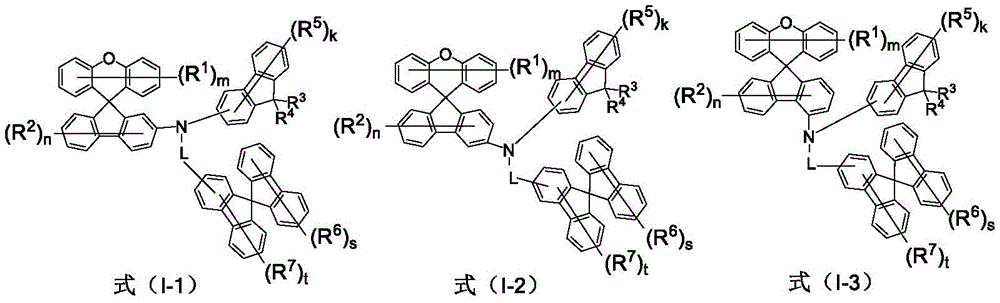
Description
Technical Field
The invention belongs to the technical field of organic photoelectric materials and devices, and particularly relates to an amine derivative containing a spirofluorene group and application thereof in an organic electroluminescent device.
Background
An organic electroluminescent device (OLED: organic Light Emitting Device) is a light emitting diode in which a light emitting layer is a film made of an organic compound, and the OLED device emits light at a certain driving voltage. The light-emitting layer of the organic compound is sandwiched between two electrodes. OLEDs are used in flat panel displays because of their high illumination, low weight, low profile, self-illumination, no need for backlight, low power consumption, and fast response speed.
An OLED device is typically composed of layers of organic material between two electrodes, including a Hole Transport Layer (HTL), an emissive layer (EML), an Electron Transport Layer (ETL). The basic mechanism of an OLED involves injection of carriers, transport, recombination of carriers, and formation of excitons to emit light. When an external voltage is applied to the OLED device, electrons and holes are injected from the cathode and the anode, respectively, electrons are injected from the cathode to the electron transport layer, holes are injected from the anode to the hole transport layer, and when electrons and holes are further injected to the light emitting layer, the electrons and holes are combined with each other to form excitons, and photons are emitted after the excitons are changed from an excited state to a ground state.
OLEDs typically require the preparation of a Hole Blocking Layer (HBL) between the emissive layer (EML) and the Electron Transport Layer (ETL), or require the preparation of an Electron Blocking Layer (EBL) between the emissive layer (EML) and the Hole Transport Layer (HTL). The purpose of using HBL or EBL is to confine carriers in the light emitting layer, effectively improve the injection balance of electrons and holes, limit recombination of injected holes and electrons, and relax excitons generated within the EML, so that the efficiency of the device can be improved.
Currently, many improvements have been made to put the organic electroluminescent device into practical use. The probability of recombination of holes and electrons can be improved by blocking electrons injected through the cathode by improving hole injection property while improving electron blocking property. Therefore, the hole transporting material and the electron blocking material play an important role, and it is desirable to provide a material having high hole injection property, large hole mobility, high electron blocking property, and high heat resistance.
Hole transporting materials used in existing OLED devices are known, such as N, N '-di (α -naphthyl) -N, N' -diphenyl-4, 4 '-diamine (NPB) and 4,4',4 "-tris (3-methylphenylamino) triphenylamine (MTDATA). NPB has a good hole transporting ability, but is difficult to be applied to an organic light emitting device requiring a high current because it has a glass transition temperature (Tg) of 100 ℃ or less and causes degradation of device characteristics due to crystallization under high temperature conditions. The glass transition temperature of MTDATA was 76 ℃. Therefore, a device obtained using the compound as a hole transport layer does not exhibit high heat resistance. In addition, the OLED devices fabricated using the above two compounds as hole transport materials, respectively, are also unsatisfactory in current efficiency and have a driving voltage to be lowered.

Thus, it is an urgent need in commercial applications to obtain an electron blocking material that can reduce the driving voltage and further improve the luminous efficiency.
Disclosure of Invention
In view of the above problems in the prior art, the present invention provides an amine derivative containing a spirofluorene group and an application thereof in an organic electroluminescent device, and the derivative provided by the present invention can be used as a hole transport material or an electron blocking material of an OLED device. The organic light emitting device prepared from the derivative can realize high brightness and high efficiency at a low driving voltage.
The invention firstly provides an amine derivative containing a spirofluorene group, wherein the molecular structure of the derivative is shown as a formula (I-1), a formula (I-2) or a formula (I-3):

wherein R is 1 -R 7 Are identical to or different from each other and are each independently selected from the group consisting of a hydrogen atom, a deuterium atom, fluorine, cyano, trifluoromethyl, substituted or unsubstituted C 1 ~C 30 Alkyl, substituted or unsubstituted C 1 ~C 30 Alkoxy, substituted or unsubstituted C 6 ~C 48 Aryl, substituted or unsubstituted C 3 ~C 48 Heteroaryl, C 6 ~C 40 The or each aromatic amine group may be through C with or without condensed rings 3 ~C 30 Alkylene groups are attached to adjacent substituents to form fused rings;
l represents a single bond, substituted or unsubstituted C 6 ~C 20 Arylene groups;
m, n, k, s, t are each selected from integers of 1 to 6.
Preferably, R 1 -R 7 Each independently selected from hydrogen atom, fluorine, cyano, trifluoromethyl, substituted or unsubstituted C 1 ~C 10 Alkyl, substituted or unsubstituted C 1 ~C 10 Alkoxy, substituted or unsubstituted C 6 ~C 30 Aryl, substituted or unsubstituted C 3 ~C 30 Heteroaryl, C 6 ~C 30 The or each aromatic amine group may be through C with or without condensed rings 3 ~C 30 Alkylene groups are attached to adjacent substituents to form fused rings; l represents a single bond or phenylene.
Preferably, said R 1 -R 7 Each independently selected from any one of the following groups:

preferably, the amine derivative containing a spirofluorene group is selected from any one of the following structures:


those skilled in the art will appreciate that, in accordance with convention used in the art, the present application describes the structural formula of a group as used in It means that the corresponding group is linked to other fragments, groups in the compound through this site.
In the present invention, the number of "substitutions" may be one or more (e.g., 2, 3), and when there are a plurality of "substitutions", the "substitutions" are the same or different.
In the present invention, the "substituted" position may be any position unless otherwise specified.
The term "alkyl" is meant to include both branched and straight chain saturated aliphatic hydrocarbon groups having the indicated number of carbon atoms. For example, "C 1 ~C 4 Alkyl "is defined to include groups having 1, 2, 3 or 4 carbon atoms in a straight or branched chain structure. For example, "C 1 ~C 4 The alkyl group "specifically includes methyl, ethyl, n-propyl, isopropyl, n-butyl, t-butyl, sec-butyl, isobutyl, and the like.
The term "aryl" refers to a group formed by removing one or more hydrogen atoms from the aromatic nucleus of an aromatic hydrocarbon molecule, which may be a monocyclic aryl, polycyclic aryl, or fused ring aryl, e.g. "C 6 ~C 40 The aryl group "of (a) may be selected from phenyl, biphenyl, terphenyl, naphthyl, anthryl, phenanthryl, pyrenyl, fluorenyl, benzophenanthryl, etc., but is not limited thereto.
The term "heteroaryl" refers to the collective term for groups in which one or more of the aromatic nucleus carbons in the aryl group is replaced by a heteroatom, including oxygen, sulfur, nitrogen or silicon atoms, which heteroaryl may be a monocyclic heteroaryl, a polycyclic heteroaryl or a fused ring heteroaryl, e.g. "C 3 ~C 30 The heteroaryl group of (c) may be selected from pyridyl, quinolyl, carbazolyl, thienyl, benzothienyl, furyl, benzofuryl, pyrimidinyl, benzopyrimidinyl, imidazolyl, benzimidazolyl, etc., but is not limited thereto.
The term "arylene" is a covalent bond between two atoms in different positions on an aromatic ring and another group.
The term "aromatic amine group" refers to a group formed from an amine having an aromatic substituent, i.e., -NH-or a nitrogen-containing group, attached to an aromatic hydrocarbon, typically containing one or more benzene rings in the structure of the aromatic hydrocarbon.
The above preferred conditions can be arbitrarily combined on the basis of not deviating from the common knowledge in the art, and thus, each preferred embodiment of the present invention can be obtained.
Unless otherwise indicated, the present invention employs conventional methods of mass spectrometry, elemental analysis, and the various steps and conditions are referred to in the art by conventional procedures and conditions.
The present invention employs, unless otherwise indicated, standard nomenclature for analytical chemistry, organic synthetic chemistry and optics, and standard laboratory procedures and techniques. In some cases, standard techniques are used for chemical synthesis, chemical analysis, and light emitting device performance detection.
The reagents used in the present invention are commercially available.
The raw materials used for the derivative are commercially available or can be prepared according to a chemical synthesis method conventional in the art, and the steps and conditions of the derivative can be referred to as steps and conditions of similar reactions in the art.
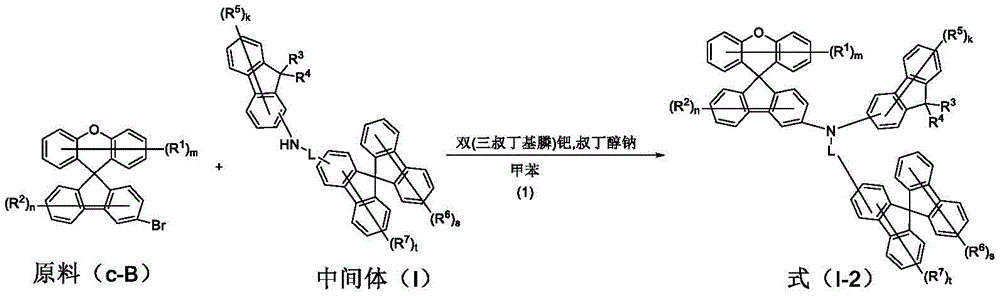
The invention provides a preparation method of derivatives shown in a formula (I), a formula (II) and a formula (III), which can comprise any scheme as follows:
scheme one:

scheme II:
scheme III:
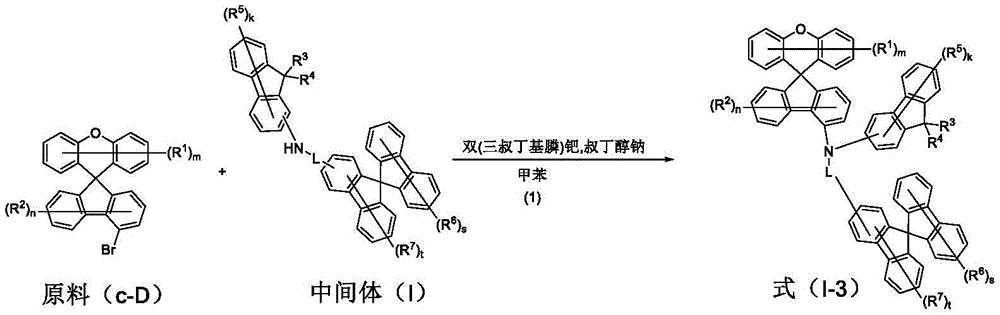
wherein R is 1 -R 7 The definitions of L, m, n, k, s and t are as described above.
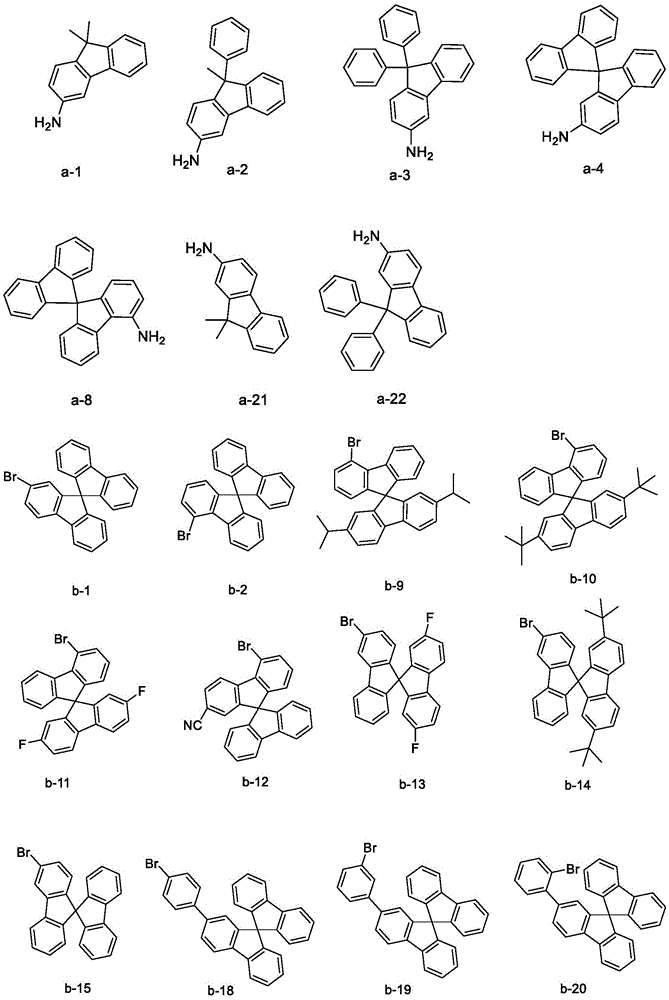
In one synthetic embodiment of the invention, the derivatives according to formula (I), formula (II) and formula (III) are synthesized using the following starting materials:
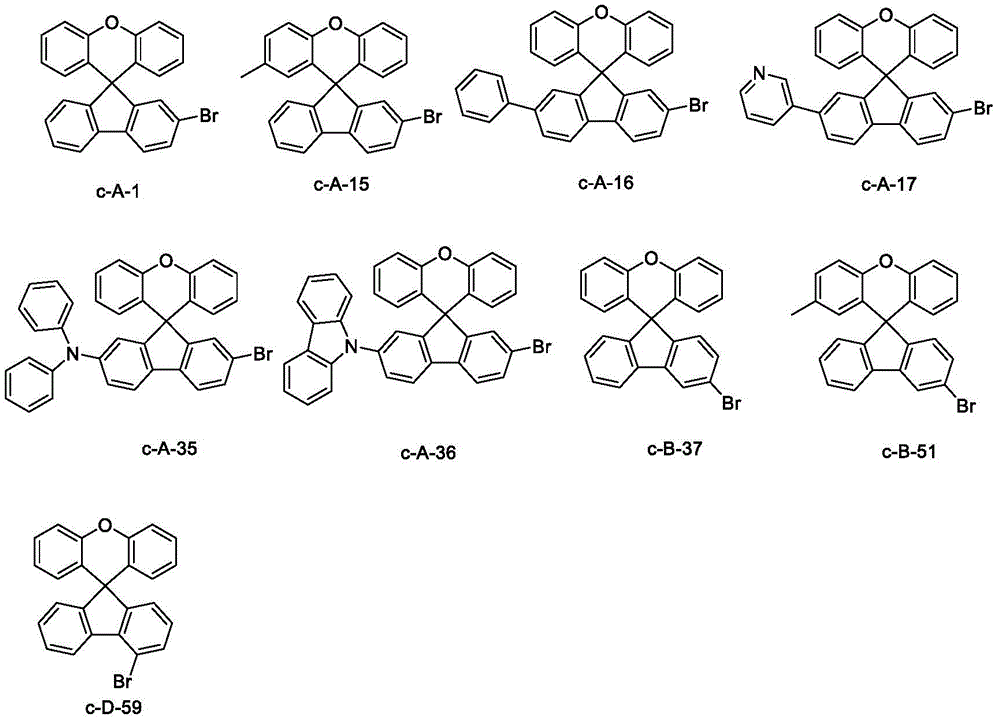
the present invention also provides an organic electroluminescent device (OLED) consisting of a cathode, an anode and one or more organic compound layers interposed between the two electrodes; the organic compound layer at least comprises a hole transport layer, a light emitting layer and an electron transport layer, and the amine derivative containing a spirofluorene group can be used as the hole transport layer alone or together with other materials.
In an OLED device, the transparent anode may be formed by using an electrode material known per se, i.e., by vapor depositing an electrode material having a large work function such as ITO or gold on a substrate (a transparent substrate such as a glass substrate).
The light-emitting layer materials in the present invention may be all light-emitting layer materials for organic electroluminescent devices known in the art, and may be fluorescent or phosphorescent materials.
The amine derivative containing the spirofluorene group can be used as a hole transport material and/or an electron blocking material to be applied to organic electroluminescent devices.
The organic electroluminescent device is used for preparing an organic electroluminescent display, an organic electroluminescent illumination light source and a decorative light source.
The invention has the beneficial effects that:
the amine derivative containing spirofluorene groups provided by the invention contains both spirofluorene-9, 9' -xanthene groups and spirofluorene groups. The rigid plane of spirofluorene in the structure ensures that the derivative has higher thermal stability and chemical stability, and the compound inherits the advantages of two asymmetric pi systems and higher triplet state energy levels shown by the compound with a spirofluorene-9, 9' -xanthene structure.
The amine derivative containing the spirofluorene group can realize the selective adjustment of triplet energy level and HOMO/LUMO, and has good hole transmission capability and film forming property, so that the luminous efficiency and heat resistance of an OLED device can be improved, the driving voltage can be reduced, and the amine derivative is an OLED material with excellent performance.
Drawings
Fig. 1 is a schematic structural view of an organic electroluminescent device in comparative example 1 of the present invention.
Wherein 1 is a transparent substrate, 2 is ITO,3 is a hole transport layer, 4 is a light emitting layer, 5 is an electron transport layer, 6 is an electron injection layer, and 7 is a metal cathode.
Fig. 2 is a schematic structural view of the organic electroluminescent device in examples 1 to 64, which are effects of the present invention.
Wherein 1 is a transparent substrate, 2 is ITO,31 is a hole transport layer I,32 is a hole transport layer II,4 is a light emitting layer, 5 is an electron transport layer, 6 is an electron injection layer, and 7 is a metal cathode.
Detailed Description
For a further understanding of the present invention, reference will now be made in detail to the present embodiments of the invention, examples of which are illustrated in the accompanying drawings. But are not intended to limit the invention to the embodiments so described.
The source of the raw materials used in the following examples is not particularly limited and may be commercially available products or prepared by a preparation method well known to those skilled in the art.
In the examples below, the room temperature is 10-30 ℃.
Examples of synthesis of the compounds
Example 1:
the specific preparation method of the intermediate (I) comprises the following steps:
raw material (a) (15 mmol), raw material (b) (15 mmol) and sodium tert-butoxide (30 mmol) were added to 150mL of anhydrous toluene under nitrogen atmosphere, palladium acetate (0.3 mmol) and tri-tert-butylphosphine (0.3 mmol) were added with stirring, and the mixture was reacted at 80℃for 8 hours. After cooling, the organic solvent was removed from the filtrate by distillation under reduced pressure, the resulting residue was recrystallized in toluene, and the resulting solid was collected by filtration and dried to give intermediate (I). The intermediate structure obtained is shown in table 1.
Specific details of synthetic examples are described with respect to intermediate 1: raw material a-1 (3.14 g,15 mmol), raw material b-1 (5.91 g,15 mmol) and sodium t-butoxide (2.88 g,30 mmol) were added to 150mL of anhydrous toluene under nitrogen atmosphere, palladium acetate (0.07 g,0.3 mmol) and tri-t-butylphosphine (0.06 g,0.3 mmol) were added with stirring, and reacted at 80℃for 8 hours. After cooling, the organic solvent was removed from the filtrate by distillation under reduced pressure, the residue was recrystallized in toluene, and the solid obtained was collected by filtration and dried to give intermediate 1 in 84% yield.
Table 1. According to scheme (1) in scheme one, intermediate (I) is obtained by reacting starting material a with starting material b as follows:
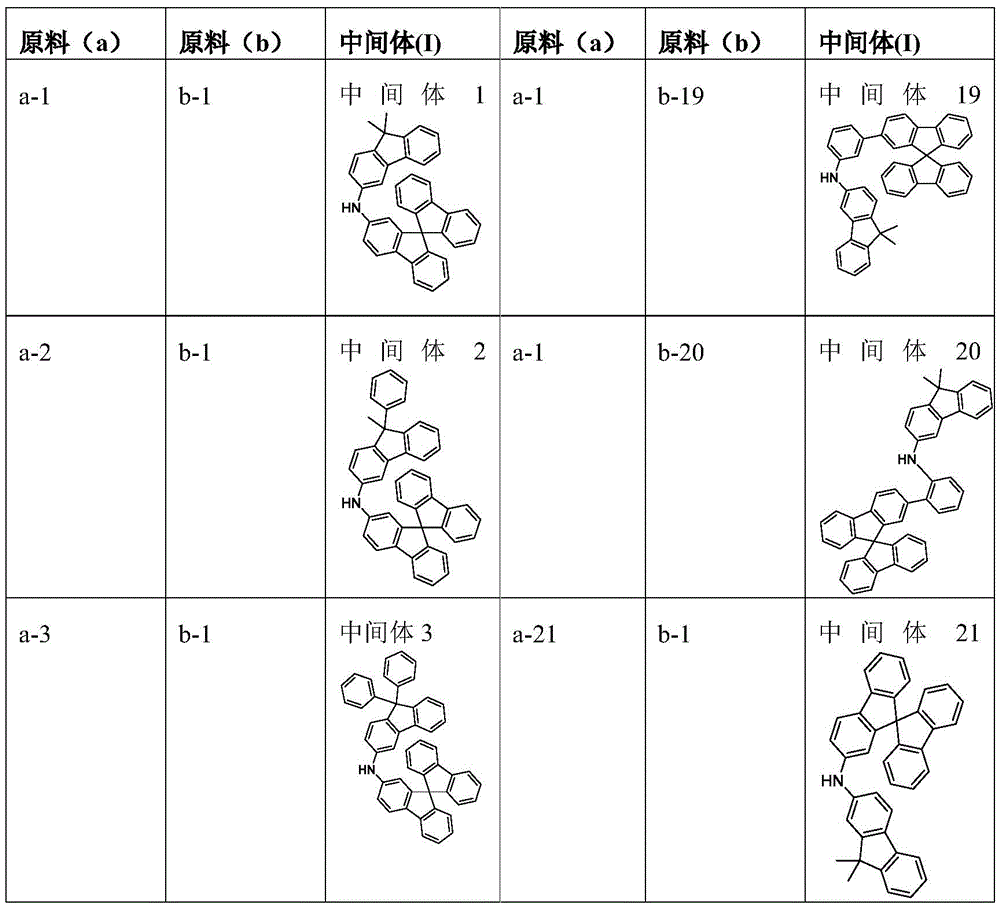

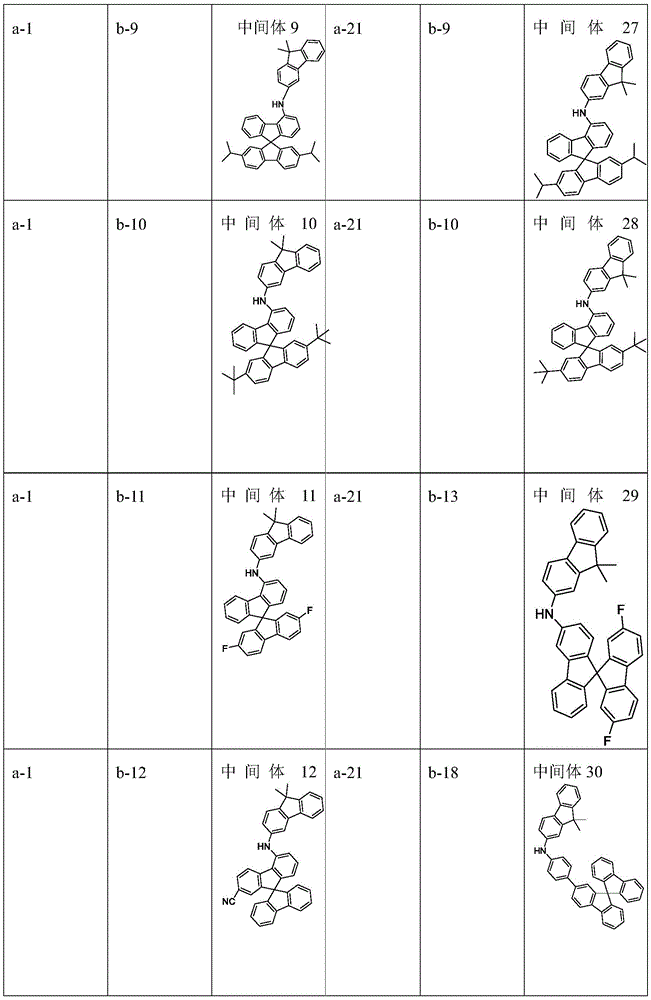
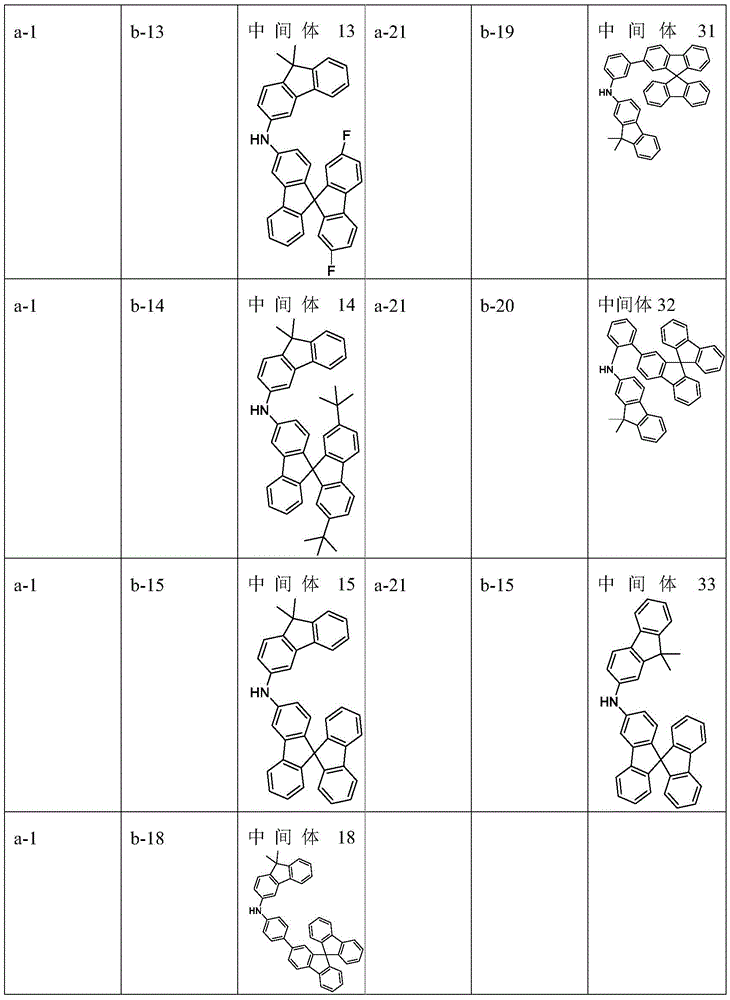
example 2:
the specific preparation method of the compound comprises the following steps:
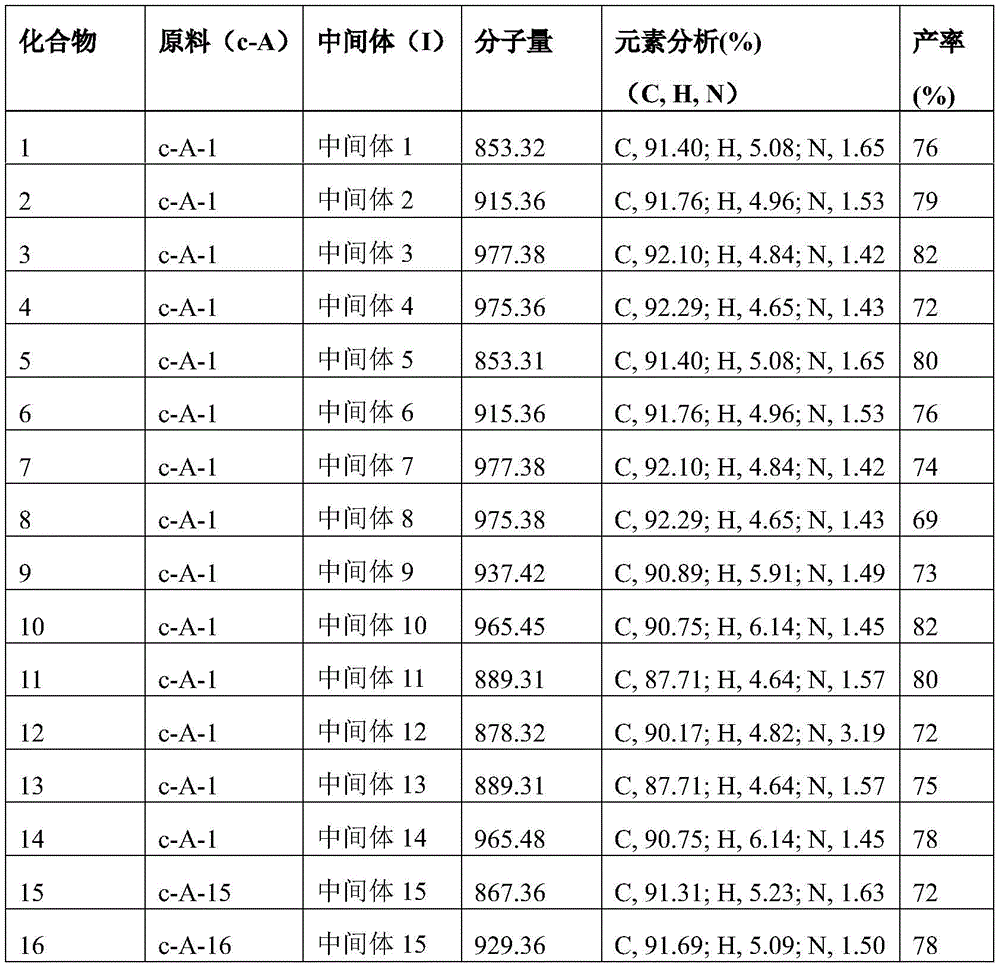
raw material c-A (19.55 mmol), intermediate (I) (20.14 mmol) and sodium t-butoxide (27.0 mmol) were placed in anhydrous toluene under nitrogen atmosphere, and the resulting mixture was heated and stirred and then refluxed, to which [ bis (tri-t-butylphosphine) ] palladium (0.39 mmol,0.02 eq) was placed. After cooling, the mixture was filtered through a celite/silica gel funnel, and the filtrate was distilled off under reduced pressure to remove the organic solvent, followed by recrystallization to prepare a pure compound. The data obtained for the target compounds are shown in Table 2.
Specific details of synthetic examples are described with respect to compound 1: raw material c-A-1 (8.02 g,19.55 mmol), intermediate 1 (10.54 g,20.14 mmol) and sodium t-butoxide (2.6 g,27.0 mmol) were placed in anhydrous toluene under nitrogen atmosphere, and the resulting mixture was heated and stirred and then refluxed, to which [ bis (tri-t-butylphosphine) ] palladium (200 mg,0.02 eq) was placed. After cooling, filtration was performed through a celite/silica gel funnel, and the organic solvent was removed from the filtrate by distillation under reduced pressure, followed by recrystallization to prepare compound 1 (12.68 g,14.8 mmol) in 76% yield.
Table 2. Product data obtained from the reaction of starting material c-A with intermediate (I) according to scheme (2) in scheme one is summarized below:

example 3:
the specific preparation method of the compound comprises the following steps:
raw material c-B (20 mmol), intermediate (I) (21 mmol) and sodium t-butoxide (27.0 mmol) were placed in anhydrous toluene under nitrogen atmosphere, the resulting mixture was heated and stirred and then refluxed, and [ bis (tri-t-butylphosphine) ] palladium (0.4 mmol,0.02 eq) was placed therein. After cooling, the mixture was filtered through a celite/silica gel funnel, and the filtrate was distilled off under reduced pressure to remove the organic solvent, followed by recrystallization to prepare a pure compound. The data obtained for the target compounds are shown in Table 3.
Specific details of synthetic examples are described with respect to compound 37: raw material c-B-37 (8.2 g,20 mmol), intermediate 1 (11.0 g,21 mmol) and sodium t-butoxide (2.6 g,27.0 mmol) were placed in anhydrous toluene under nitrogen atmosphere, and the resulting mixture was heated and stirred and then refluxed, to which [ bis (tri-t-butylphosphine) ] palladium (204 mg) was placed. After cooling, filtration was performed through a celite/silica gel funnel, and the organic solvent was removed from the filtrate by distillation under reduced pressure, followed by recrystallization to prepare compound 37 (12.1 g,14.2 mmol) in 71% yield.
Table 3. Product data obtained from the reaction of starting material c-B with intermediate (I) according to scheme (1) in scheme II are summarized as follows:

example 4:
the specific preparation method of the compound comprises the following steps:
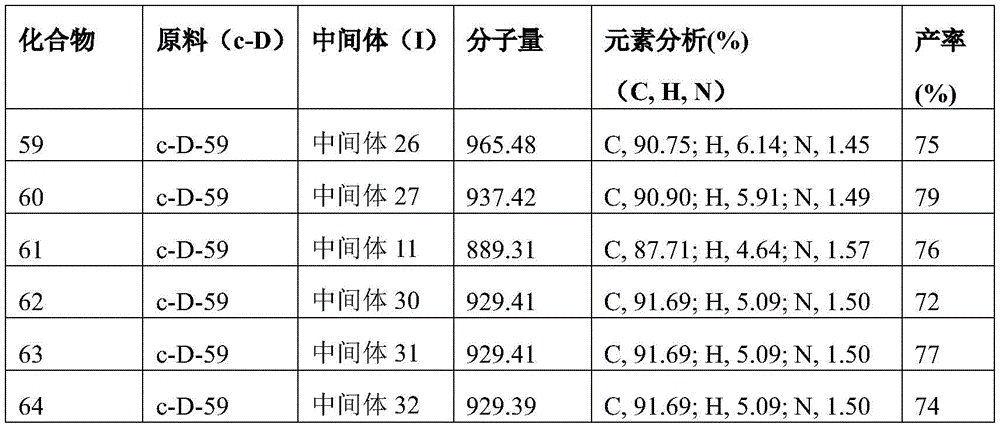
raw material c-D (20 mmol), intermediate (I) (21 mmol) and sodium t-butoxide (27.0 mmol) were placed in anhydrous toluene under nitrogen atmosphere, the resulting mixture was heated and stirred and then refluxed, and [ bis (tri-t-butylphosphine) ] palladium (0.4 mmol,0.02 eq) was placed therein. After cooling, the mixture was filtered through a celite/silica gel funnel, and the filtrate was distilled off under reduced pressure to remove the organic solvent, followed by recrystallization to prepare a pure compound. The data obtained for the target compounds are shown in Table 4.
Specific details of synthetic examples are described with respect to compound 59: raw material c-D-59 (8.2 g,20 mmol), intermediate 26 (13.3 g,21 mmol) and sodium t-butoxide (2.6 g,27.0 mmol) were put into anhydrous toluene under nitrogen atmosphere, and the resulting mixture was heated and stirred and then refluxed, to which [ bis (tri-t-butylphosphine) ] palladium (204 mg) was put. After cooling, filtration was performed through a celite/silica gel funnel, and the organic solvent was removed from the filtrate by distillation under reduced pressure, followed by recrystallization to prepare compound 59 (14.5 g,15.0 mmol) in 75% yield.
Table 4. Product data obtained from the reaction of starting materials c-D and intermediate (I) according to scheme (1) in scheme III are summarized as follows:
effect examples and comparative effect examples the structures of the compounds used in the examples are shown below:

effect examples
The following embodiment of electroluminescent device prepared by the material of the invention, the specific device preparation process and device performance test experiment operation are as follows: the transparent ITO glass is used as a substrate material for preparing devices, the transparent ITO glass is treated by ultrasonic for 30min by ITO washing liquid with the mass fraction of 5%, then sequentially washed by ultrasonic with distilled water (2 times), acetone (2 times) and isopropanol (2 times), and finally the ITO glass is stored in the isopropanol. Before each use, the surface of the ITO glass is carefully wiped by acetone cotton balls and isopropanol cotton balls, and after the isopropanol is washed, the ITO glass is dried, and then plasma treatment is carried out for 5min. The preparation of the device is completed by vacuum coating equipment through a vacuum evaporation process, and when the vacuum degree of a vacuum evaporation system reaches 5 x 10 -4 And starting evaporation when Pa is lower, monitoring the deposition rate by an Saint film thickness meter, and sequentially depositing various organic layers, liF electron injection layers and Al metal cathodes on the ITO glass by using a vacuum evaporation process (the specific device structure is shown in the following effect examples). The current, voltage, brightness, luminescence spectrum and other characteristics of the device are synchronously tested by adopting a PR655 spectrum scanning luminance meter and a Keithley K2400 digital source meter system. Performance testing is performed after the device is packaged.
In the organic electroluminescent device of comparative example 1, ITO glass was used as a transparent substrate, BBPB was used as a hole transport layer, and 95 wt% of TCTA: PIM-TRZ (1:2, wt%) was used as a light emitting layer (EML), and 5 wt% of Ir (ppy) was used as a host 3 For doping the guest with the light emitting material, TPBI is used as an electron transport layer, liF is used as an electron injection layer, and Al is used as a metal cathode. Comparative Effect example the organic electroluminescent device structure was [ ITO/BBPB (50 nm)/EML (30 nm)/TPBI (30 nm)/LiF (1 nm)/Al (100 nm)]EML represents the light emitting layer and comparative effect example results are shown in table 5.
Effect examples 1 to 64 of the organic electroluminescent device using ITO glass as a transparent substrate and BBPB as a first hole transport layer, the present invention providesThe compound was used as the second hole transport layer, and the light emitting layer (EML) was composed of 95% by weight of TCTA: PIM-TRZ (1:2 by weight) as the main component and 5% by weight of Ir (ppy) 3 For doping the guest with the light emitting material, TPBI is used as an electron transport layer, liF is used as an electron injection layer, and Al is used as a metal cathode. Effect example the organic electroluminescent device structure was ITO/BBPB (40 nm)/n (10 nm)/EML (30 nm)/TPBI (30 nm)/LiF (1 nm)/Al (100 nm)]N represents any one of the compounds 1 to 64 prepared in the present invention, EML represents a light-emitting layer, and the results of the effect examples are shown in Table 5.
The difference between the comparative effect example device and the effect example device is that: effect example devices have two hole transport layers composed of BBPB and one of compounds 1-64, whereas comparative effect example devices have only one hole transport layer composed of BBPB.
In effect examples and comparative effect examples, the basic performance indicators of the OLED devices were characterized by conventional methods, including the device turn-on voltage, maximum luminance of light emission, current efficiency (measured in cd/A), and lifetime (T95: device at constant current density 10 mA/cm) 2 The time required for the luminance to decay to 95% of the initial luminance under driving).
Table 5 comparison of effect examples and effect example data


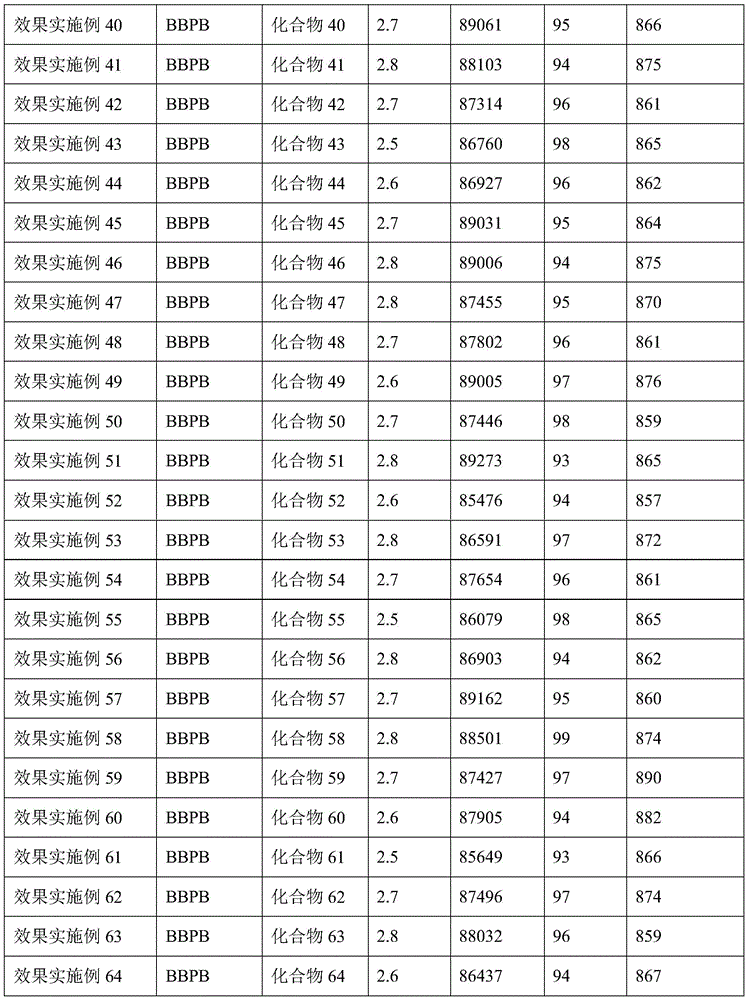
As can be seen from the data of effect examples 1 to 64 and comparative effect example 1 in Table 5, the amine derivative containing a spirofluorene group according to the present invention can be used as a hole transport layer 2 for electroluminescent devices, and the prepared devices have the advantages of high brightness, high efficiency and good stability.
In summary, the amine derivative containing a spirofluorene group of the present invention is applied to an organic electroluminescent device as a hole transport layer 2, which can improve the luminous efficiency of the device and the stability of the device.
It is apparent that the above description of the embodiments is only for aiding in the understanding of the method of the present invention and its core ideas. It should be noted that it will be apparent to those skilled in the art that several improvements and modifications can be made to the present invention without departing from the principles of the invention, and these improvements and modifications also fall within the scope of the claims of the invention.
Claims (4)
1. An amine derivative containing spirofluorene groups has a molecular structural formula shown as formula (I-1), formula (I-2) and formula (I-3):

wherein R is 1 、R 2 、R 5 、R 6 、R 7 Each independently selected from hydrogen atoms; r is R 3 、R 4 Each independently selected from hydrogen atoms or unsubstituted C 1 ~C 10 Alkyl of (a);
l represents unsubstituted C 6 ~C 24 Arylene groups;
m, n, k, s, t are each selected from integers of 1 to 6.
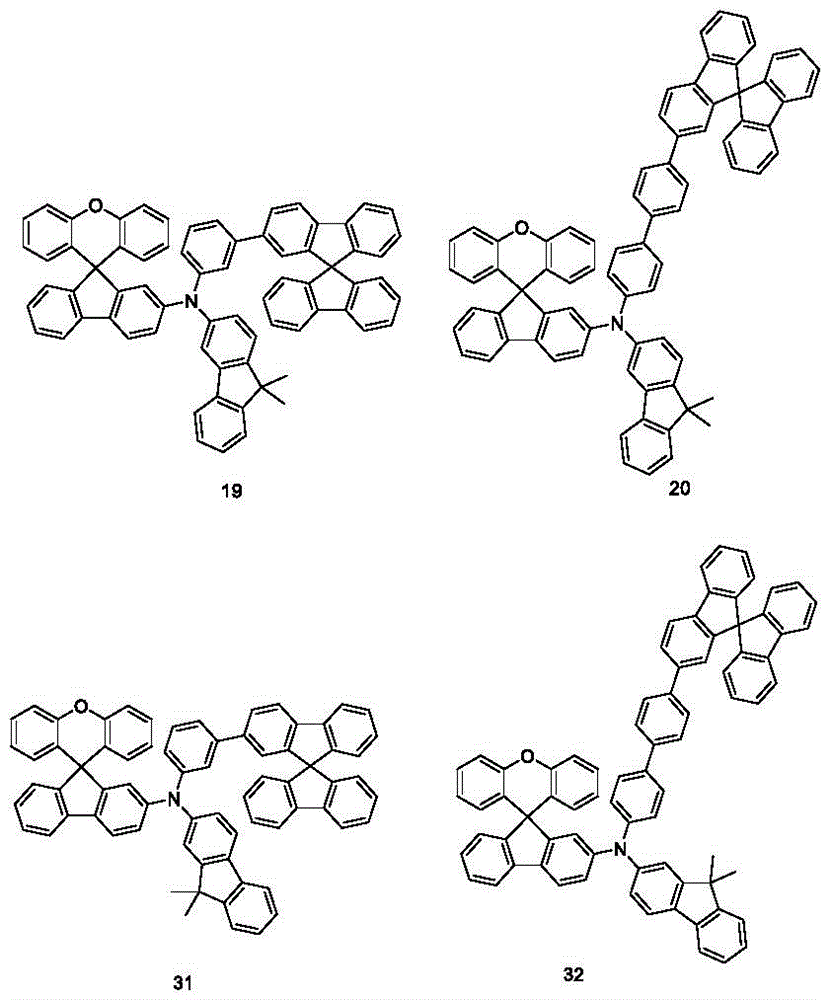
2. An amine derivative containing a spirofluorene group according to claim 1, characterized in that: the structural formula of the amine derivative is shown in one of the following,

3. an organic light-emitting device comprising a cathode, an anode, and one or more organic compound layers disposed between the two electrodes, the organic compound layers including at least a hole transport layer, a light-emitting layer, and an electron transport layer; the method is characterized in that: the spirofluorene group-containing amine derivative according to any one of claims 1 or 2 alone or together with other materials as a hole transporting layer.
4. The organic light emitting device according to claim 3 for use in the preparation of an organic electroluminescent display, an organic electroluminescent illumination source or a decorative light source.
Priority Applications (1)
| Application Number | Priority Date | Filing Date | Title |
|---|---|---|---|
| CN202010068392.0A CN111205262B (en) | 2020-01-21 | 2020-01-21 | Amine derivative containing spirofluorene group and application thereof in organic electroluminescent device |
Applications Claiming Priority (1)
| Application Number | Priority Date | Filing Date | Title |
|---|---|---|---|
| CN202010068392.0A CN111205262B (en) | 2020-01-21 | 2020-01-21 | Amine derivative containing spirofluorene group and application thereof in organic electroluminescent device |
Publications (2)
| Publication Number | Publication Date |
|---|---|
| CN111205262A CN111205262A (en) | 2020-05-29 |
| CN111205262B true CN111205262B (en) | 2023-04-25 |
Family
ID=70781031
Family Applications (1)
| Application Number | Title | Priority Date | Filing Date |
|---|---|---|---|
| CN202010068392.0A Active CN111205262B (en) | 2020-01-21 | 2020-01-21 | Amine derivative containing spirofluorene group and application thereof in organic electroluminescent device |
Country Status (1)
| Country | Link |
|---|---|
| CN (1) | CN111205262B (en) |
Families Citing this family (3)
| Publication number | Priority date | Publication date | Assignee | Title |
|---|---|---|---|---|
| CN111875575B (en) * | 2020-08-24 | 2022-08-16 | 常州南京大学高新技术研究院 | 3',6' -di ((4-vinylbenzyl) oxy) spiro [ fluorene-9, 9' -xanthene ] derivative and preparation method thereof |
| CN113087593A (en) * | 2021-04-08 | 2021-07-09 | 南京工业职业技术大学 | Trifluoromethyl benzene functionalization-based spirofluorene organic laser material, and microcrystal preparation and application |
| CN114989128B (en) * | 2022-05-24 | 2025-12-02 | 上海钥熠电子科技有限公司 | Novel spiro compounds and their applications in organic electroluminescent devices |
Citations (7)
| Publication number | Priority date | Publication date | Assignee | Title |
|---|---|---|---|---|
| CN104781247A (en) * | 2012-11-12 | 2015-07-15 | 默克专利有限公司 | Materials for electronic devices |
| CN107880053A (en) * | 2017-11-27 | 2018-04-06 | 长春海谱润斯科技有限公司 | A kind of spirofluorene derivative and its organic electroluminescence device |
| CN108047244A (en) * | 2017-12-12 | 2018-05-18 | 上海道亦化工科技有限公司 | A kind of snail compound and application thereof and organic electroluminescence device |
| CN108137527A (en) * | 2015-10-07 | 2018-06-08 | 株式会社Lg化学 | New compounds and organic light-emitting diodes containing them |
| WO2019085759A1 (en) * | 2017-11-03 | 2019-05-09 | 江苏三月光电科技有限公司 | Compound provided with an aza-spirofluorene and aryl ketone core, preparation method thereof, and application of same in oleds |
| CN109791979A (en) * | 2016-10-10 | 2019-05-21 | 默克专利有限公司 | Electronic device |
| CN109867652A (en) * | 2017-12-04 | 2019-06-11 | Cmdl有限公司 | Novel Organic Compounds and Organic Electroluminescent Devices Containing the Same |
-
2020
- 2020-01-21 CN CN202010068392.0A patent/CN111205262B/en active Active
Patent Citations (7)
| Publication number | Priority date | Publication date | Assignee | Title |
|---|---|---|---|---|
| CN104781247A (en) * | 2012-11-12 | 2015-07-15 | 默克专利有限公司 | Materials for electronic devices |
| CN108137527A (en) * | 2015-10-07 | 2018-06-08 | 株式会社Lg化学 | New compounds and organic light-emitting diodes containing them |
| CN109791979A (en) * | 2016-10-10 | 2019-05-21 | 默克专利有限公司 | Electronic device |
| WO2019085759A1 (en) * | 2017-11-03 | 2019-05-09 | 江苏三月光电科技有限公司 | Compound provided with an aza-spirofluorene and aryl ketone core, preparation method thereof, and application of same in oleds |
| CN107880053A (en) * | 2017-11-27 | 2018-04-06 | 长春海谱润斯科技有限公司 | A kind of spirofluorene derivative and its organic electroluminescence device |
| CN109867652A (en) * | 2017-12-04 | 2019-06-11 | Cmdl有限公司 | Novel Organic Compounds and Organic Electroluminescent Devices Containing the Same |
| CN108047244A (en) * | 2017-12-12 | 2018-05-18 | 上海道亦化工科技有限公司 | A kind of snail compound and application thereof and organic electroluminescence device |
Also Published As
| Publication number | Publication date |
|---|---|
| CN111205262A (en) | 2020-05-29 |
Similar Documents
| Publication | Publication Date | Title |
|---|---|---|
| KR102051910B1 (en) | Deuteriated organometallic complex and organic light-emitting diode including the same | |
| KR101981375B1 (en) | Compounds for organic electroluminescent components and organic electroluminescent devices using the same | |
| CN109293516B (en) | Triarylamine compound and organic light-emitting device thereof | |
| CN113527268A (en) | A compound containing biscarbazole and triazine structure and organic electroluminescent device | |
| CN111205262B (en) | Amine derivative containing spirofluorene group and application thereof in organic electroluminescent device | |
| US20170040546A1 (en) | Novel compound and organic electronic device using the same | |
| KR20120020818A (en) | Novel compounds for organic electronic material and organic electroluminescent device using the same | |
| CN113402507B (en) | Triphenylene derivative, light-emitting device material, and light-emitting device | |
| KR20140070360A (en) | Hole transport material for organic electroluminescence device and organic electroluminescence device using the same | |
| CN112851698A (en) | Boron-containing compound and organic electroluminescent device using same | |
| CN112939993B (en) | A kind of benzopyran light-emitting auxiliary material and preparation method thereof and organic electroluminescent device | |
| CN111725413B (en) | Organic electroluminescent device and display apparatus | |
| CN112979616A (en) | Benzimidazole compound and preparation method and application thereof | |
| KR101319631B1 (en) | Azaindenoanthracene derivative and organic electroluminescence device using the same | |
| CN111423330B (en) | Aromatic amine derivative based on spirofluorene and application thereof | |
| KR20110119282A (en) | Novel Organic Electronic Materials and Organic Electroluminescent Devices Employing the Same | |
| KR101779914B1 (en) | Naphthalene derivatives and organic light-emitting diode including the same | |
| KR101879846B1 (en) | Organic electroluminescent compounds, producing method of the same and organic electroluminescent device including the same | |
| CN119118847A (en) | Amine compound and organic electroluminescent device | |
| KR102118875B1 (en) | Compound for organic light emitting diode, organic light emitting diode having the same, and display apparatus having organic light emitting diode | |
| KR20180106234A (en) | Hetero-cyclic compound and organic light emitting device comprising the same | |
| CN115873591B (en) | Phosphorescent organic electroluminescent material and light-emitting device | |
| CN114149333B (en) | Compound containing spirobifluoreno adamantane main structure and application of compound in organic electroluminescent device | |
| CN110845496A (en) | Electron transport material and synthesis method and application thereof | |
| CN114195768B (en) | Organic compound and organic electroluminescent device |
Legal Events
| Date | Code | Title | Description |
|---|---|---|---|
| PB01 | Publication | ||
| PB01 | Publication | ||
| SE01 | Entry into force of request for substantive examination | ||
| SE01 | Entry into force of request for substantive examination | ||
| GR01 | Patent grant | ||
| GR01 | Patent grant |