CN111202711B - Liquid protein formulations comprising organophosphates - Google Patents
Liquid protein formulations comprising organophosphates Download PDFInfo
- Publication number
- CN111202711B CN111202711B CN202010059409.6A CN202010059409A CN111202711B CN 111202711 B CN111202711 B CN 111202711B CN 202010059409 A CN202010059409 A CN 202010059409A CN 111202711 B CN111202711 B CN 111202711B
- Authority
- CN
- China
- Prior art keywords
- viscosity
- protein
- formulation
- pharmaceutical formulation
- liquid pharmaceutical
- Prior art date
- Legal status (The legal status is an assumption and is not a legal conclusion. Google has not performed a legal analysis and makes no representation as to the accuracy of the status listed.)
- Active
Links
Images

Classifications
-
- A—HUMAN NECESSITIES
- A61—MEDICAL OR VETERINARY SCIENCE; HYGIENE
- A61K—PREPARATIONS FOR MEDICAL, DENTAL OR TOILETRY PURPOSES
- A61K47/00—Medicinal preparations characterised by the non-active ingredients used, e.g. carriers or inert additives; Targeting or modifying agents chemically bound to the active ingredient
- A61K47/06—Organic compounds, e.g. natural or synthetic hydrocarbons, polyolefins, mineral oil, petrolatum or ozokerite
-
- A—HUMAN NECESSITIES
- A61—MEDICAL OR VETERINARY SCIENCE; HYGIENE
- A61K—PREPARATIONS FOR MEDICAL, DENTAL OR TOILETRY PURPOSES
- A61K9/00—Medicinal preparations characterised by special physical form
- A61K9/0012—Galenical forms characterised by the site of application
- A61K9/0019—Injectable compositions; Intramuscular, intravenous, arterial, subcutaneous administration; Compositions to be administered through the skin in an invasive manner
-
- A—HUMAN NECESSITIES
- A61—MEDICAL OR VETERINARY SCIENCE; HYGIENE
- A61G—TRANSPORT, PERSONAL CONVEYANCES, OR ACCOMMODATION SPECIALLY ADAPTED FOR PATIENTS OR DISABLED PERSONS; OPERATING TABLES OR CHAIRS; CHAIRS FOR DENTISTRY; FUNERAL DEVICES
- A61G3/00—Ambulance aspects of vehicles; Vehicles with special provisions for transporting patients or disabled persons, or their personal conveyances, e.g. for facilitating access of, or for loading, wheelchairs
-
- A—HUMAN NECESSITIES
- A61—MEDICAL OR VETERINARY SCIENCE; HYGIENE
- A61K—PREPARATIONS FOR MEDICAL, DENTAL OR TOILETRY PURPOSES
- A61K38/00—Medicinal preparations containing peptides
-
- A—HUMAN NECESSITIES
- A61—MEDICAL OR VETERINARY SCIENCE; HYGIENE
- A61K—PREPARATIONS FOR MEDICAL, DENTAL OR TOILETRY PURPOSES
- A61K38/00—Medicinal preparations containing peptides
- A61K38/16—Peptides having more than 20 amino acids; Gastrins; Somatostatins; Melanotropins; Derivatives thereof
- A61K38/43—Enzymes; Proenzymes; Derivatives thereof
-
- A—HUMAN NECESSITIES
- A61—MEDICAL OR VETERINARY SCIENCE; HYGIENE
- A61K—PREPARATIONS FOR MEDICAL, DENTAL OR TOILETRY PURPOSES
- A61K39/00—Medicinal preparations containing antigens or antibodies
- A61K39/395—Antibodies; Immunoglobulins; Immune serum, e.g. antilymphocytic serum
-
- A—HUMAN NECESSITIES
- A61—MEDICAL OR VETERINARY SCIENCE; HYGIENE
- A61K—PREPARATIONS FOR MEDICAL, DENTAL OR TOILETRY PURPOSES
- A61K39/00—Medicinal preparations containing antigens or antibodies
- A61K39/395—Antibodies; Immunoglobulins; Immune serum, e.g. antilymphocytic serum
- A61K39/39533—Antibodies; Immunoglobulins; Immune serum, e.g. antilymphocytic serum against materials from animals
- A61K39/3955—Antibodies; Immunoglobulins; Immune serum, e.g. antilymphocytic serum against materials from animals against proteinaceous materials, e.g. enzymes, hormones, lymphokines
-
- A—HUMAN NECESSITIES
- A61—MEDICAL OR VETERINARY SCIENCE; HYGIENE
- A61K—PREPARATIONS FOR MEDICAL, DENTAL OR TOILETRY PURPOSES
- A61K47/00—Medicinal preparations characterised by the non-active ingredients used, e.g. carriers or inert additives; Targeting or modifying agents chemically bound to the active ingredient
- A61K47/06—Organic compounds, e.g. natural or synthetic hydrocarbons, polyolefins, mineral oil, petrolatum or ozokerite
- A61K47/08—Organic compounds, e.g. natural or synthetic hydrocarbons, polyolefins, mineral oil, petrolatum or ozokerite containing oxygen, e.g. ethers, acetals, ketones, quinones, aldehydes, peroxides
- A61K47/12—Carboxylic acids; Salts or anhydrides thereof
-
- A—HUMAN NECESSITIES
- A61—MEDICAL OR VETERINARY SCIENCE; HYGIENE
- A61K—PREPARATIONS FOR MEDICAL, DENTAL OR TOILETRY PURPOSES
- A61K47/00—Medicinal preparations characterised by the non-active ingredients used, e.g. carriers or inert additives; Targeting or modifying agents chemically bound to the active ingredient
- A61K47/06—Organic compounds, e.g. natural or synthetic hydrocarbons, polyolefins, mineral oil, petrolatum or ozokerite
- A61K47/20—Organic compounds, e.g. natural or synthetic hydrocarbons, polyolefins, mineral oil, petrolatum or ozokerite containing sulfur, e.g. dimethyl sulfoxide [DMSO], docusate, sodium lauryl sulfate or aminosulfonic acids
-
- A—HUMAN NECESSITIES
- A61—MEDICAL OR VETERINARY SCIENCE; HYGIENE
- A61K—PREPARATIONS FOR MEDICAL, DENTAL OR TOILETRY PURPOSES
- A61K47/00—Medicinal preparations characterised by the non-active ingredients used, e.g. carriers or inert additives; Targeting or modifying agents chemically bound to the active ingredient
- A61K47/06—Organic compounds, e.g. natural or synthetic hydrocarbons, polyolefins, mineral oil, petrolatum or ozokerite
- A61K47/22—Heterocyclic compounds, e.g. ascorbic acid, tocopherol or pyrrolidones
-
- A—HUMAN NECESSITIES
- A61—MEDICAL OR VETERINARY SCIENCE; HYGIENE
- A61K—PREPARATIONS FOR MEDICAL, DENTAL OR TOILETRY PURPOSES
- A61K47/00—Medicinal preparations characterised by the non-active ingredients used, e.g. carriers or inert additives; Targeting or modifying agents chemically bound to the active ingredient
- A61K47/06—Organic compounds, e.g. natural or synthetic hydrocarbons, polyolefins, mineral oil, petrolatum or ozokerite
- A61K47/24—Organic compounds, e.g. natural or synthetic hydrocarbons, polyolefins, mineral oil, petrolatum or ozokerite containing atoms other than carbon, hydrogen, oxygen, halogen, nitrogen or sulfur, e.g. cyclomethicone or phospholipids
-
- A—HUMAN NECESSITIES
- A61—MEDICAL OR VETERINARY SCIENCE; HYGIENE
- A61K—PREPARATIONS FOR MEDICAL, DENTAL OR TOILETRY PURPOSES
- A61K9/00—Medicinal preparations characterised by special physical form
- A61K9/08—Solutions
-
- A—HUMAN NECESSITIES
- A61—MEDICAL OR VETERINARY SCIENCE; HYGIENE
- A61K—PREPARATIONS FOR MEDICAL, DENTAL OR TOILETRY PURPOSES
- A61K9/00—Medicinal preparations characterised by special physical form
- A61K9/14—Particulate form, e.g. powders, Processes for size reducing of pure drugs or the resulting products, Pure drug nanoparticles
- A61K9/19—Particulate form, e.g. powders, Processes for size reducing of pure drugs or the resulting products, Pure drug nanoparticles lyophilised, i.e. freeze-dried, solutions or dispersions
-
- A—HUMAN NECESSITIES
- A61—MEDICAL OR VETERINARY SCIENCE; HYGIENE
- A61P—SPECIFIC THERAPEUTIC ACTIVITY OF CHEMICAL COMPOUNDS OR MEDICINAL PREPARATIONS
- A61P25/00—Drugs for disorders of the nervous system
-
- A—HUMAN NECESSITIES
- A61—MEDICAL OR VETERINARY SCIENCE; HYGIENE
- A61P—SPECIFIC THERAPEUTIC ACTIVITY OF CHEMICAL COMPOUNDS OR MEDICINAL PREPARATIONS
- A61P29/00—Non-central analgesic, antipyretic or antiinflammatory agents, e.g. antirheumatic agents; Non-steroidal antiinflammatory drugs [NSAID]
-
- A—HUMAN NECESSITIES
- A61—MEDICAL OR VETERINARY SCIENCE; HYGIENE
- A61P—SPECIFIC THERAPEUTIC ACTIVITY OF CHEMICAL COMPOUNDS OR MEDICINAL PREPARATIONS
- A61P31/00—Antiinfectives, i.e. antibiotics, antiseptics, chemotherapeutics
-
- A—HUMAN NECESSITIES
- A61—MEDICAL OR VETERINARY SCIENCE; HYGIENE
- A61P—SPECIFIC THERAPEUTIC ACTIVITY OF CHEMICAL COMPOUNDS OR MEDICINAL PREPARATIONS
- A61P35/00—Antineoplastic agents
-
- A—HUMAN NECESSITIES
- A61—MEDICAL OR VETERINARY SCIENCE; HYGIENE
- A61P—SPECIFIC THERAPEUTIC ACTIVITY OF CHEMICAL COMPOUNDS OR MEDICINAL PREPARATIONS
- A61P37/00—Drugs for immunological or allergic disorders
- A61P37/02—Immunomodulators
- A61P37/06—Immunosuppressants, e.g. drugs for graft rejection
-
- A—HUMAN NECESSITIES
- A61—MEDICAL OR VETERINARY SCIENCE; HYGIENE
- A61P—SPECIFIC THERAPEUTIC ACTIVITY OF CHEMICAL COMPOUNDS OR MEDICINAL PREPARATIONS
- A61P43/00—Drugs for specific purposes, not provided for in groups A61P1/00-A61P41/00
-
- A—HUMAN NECESSITIES
- A61—MEDICAL OR VETERINARY SCIENCE; HYGIENE
- A61P—SPECIFIC THERAPEUTIC ACTIVITY OF CHEMICAL COMPOUNDS OR MEDICINAL PREPARATIONS
- A61P7/00—Drugs for disorders of the blood or the extracellular fluid
-
- C—CHEMISTRY; METALLURGY
- C07—ORGANIC CHEMISTRY
- C07K—PEPTIDES
- C07K1/00—General methods for the preparation of peptides, i.e. processes for the organic chemical preparation of peptides or proteins of any length
- C07K1/14—Extraction; Separation; Purification
-
- C—CHEMISTRY; METALLURGY
- C07—ORGANIC CHEMISTRY
- C07K—PEPTIDES
- C07K16/00—Immunoglobulins [IGs], e.g. monoclonal or polyclonal antibodies
- C07K16/18—Immunoglobulins [IGs], e.g. monoclonal or polyclonal antibodies against material from animals or humans
- C07K16/22—Immunoglobulins [IGs], e.g. monoclonal or polyclonal antibodies against material from animals or humans against growth factors ; against growth regulators
-
- C—CHEMISTRY; METALLURGY
- C07—ORGANIC CHEMISTRY
- C07K—PEPTIDES
- C07K16/00—Immunoglobulins [IGs], e.g. monoclonal or polyclonal antibodies
- C07K16/18—Immunoglobulins [IGs], e.g. monoclonal or polyclonal antibodies against material from animals or humans
- C07K16/24—Immunoglobulins [IGs], e.g. monoclonal or polyclonal antibodies against material from animals or humans against cytokines, lymphokines or interferons
- C07K16/241—Tumor Necrosis Factors
-
- C—CHEMISTRY; METALLURGY
- C07—ORGANIC CHEMISTRY
- C07K—PEPTIDES
- C07K16/00—Immunoglobulins [IGs], e.g. monoclonal or polyclonal antibodies
- C07K16/18—Immunoglobulins [IGs], e.g. monoclonal or polyclonal antibodies against material from animals or humans
- C07K16/28—Immunoglobulins [IGs], e.g. monoclonal or polyclonal antibodies against material from animals or humans against receptors, cell surface antigens or cell surface determinants
- C07K16/2839—Immunoglobulins [IGs], e.g. monoclonal or polyclonal antibodies against material from animals or humans against receptors, cell surface antigens or cell surface determinants against the integrin superfamily
-
- C—CHEMISTRY; METALLURGY
- C07—ORGANIC CHEMISTRY
- C07K—PEPTIDES
- C07K16/00—Immunoglobulins [IGs], e.g. monoclonal or polyclonal antibodies
- C07K16/18—Immunoglobulins [IGs], e.g. monoclonal or polyclonal antibodies against material from animals or humans
- C07K16/28—Immunoglobulins [IGs], e.g. monoclonal or polyclonal antibodies against material from animals or humans against receptors, cell surface antigens or cell surface determinants
- C07K16/2863—Immunoglobulins [IGs], e.g. monoclonal or polyclonal antibodies against material from animals or humans against receptors, cell surface antigens or cell surface determinants against receptors for growth factors, growth regulators
-
- C—CHEMISTRY; METALLURGY
- C07—ORGANIC CHEMISTRY
- C07K—PEPTIDES
- C07K16/00—Immunoglobulins [IGs], e.g. monoclonal or polyclonal antibodies
- C07K16/18—Immunoglobulins [IGs], e.g. monoclonal or polyclonal antibodies against material from animals or humans
- C07K16/28—Immunoglobulins [IGs], e.g. monoclonal or polyclonal antibodies against material from animals or humans against receptors, cell surface antigens or cell surface determinants
- C07K16/2887—Immunoglobulins [IGs], e.g. monoclonal or polyclonal antibodies against material from animals or humans against receptors, cell surface antigens or cell surface determinants against CD20
-
- C—CHEMISTRY; METALLURGY
- C07—ORGANIC CHEMISTRY
- C07K—PEPTIDES
- C07K16/00—Immunoglobulins [IGs], e.g. monoclonal or polyclonal antibodies
- C07K16/18—Immunoglobulins [IGs], e.g. monoclonal or polyclonal antibodies against material from animals or humans
- C07K16/32—Immunoglobulins [IGs], e.g. monoclonal or polyclonal antibodies against material from animals or humans against translation products of oncogenes
-
- A—HUMAN NECESSITIES
- A61—MEDICAL OR VETERINARY SCIENCE; HYGIENE
- A61K—PREPARATIONS FOR MEDICAL, DENTAL OR TOILETRY PURPOSES
- A61K39/00—Medicinal preparations containing antigens or antibodies
- A61K2039/505—Medicinal preparations containing antigens or antibodies comprising antibodies
-
- Y—GENERAL TAGGING OF NEW TECHNOLOGICAL DEVELOPMENTS; GENERAL TAGGING OF CROSS-SECTIONAL TECHNOLOGIES SPANNING OVER SEVERAL SECTIONS OF THE IPC; TECHNICAL SUBJECTS COVERED BY FORMER USPC CROSS-REFERENCE ART COLLECTIONS [XRACs] AND DIGESTS
- Y02—TECHNOLOGIES OR APPLICATIONS FOR MITIGATION OR ADAPTATION AGAINST CLIMATE CHANGE
- Y02P—CLIMATE CHANGE MITIGATION TECHNOLOGIES IN THE PRODUCTION OR PROCESSING OF GOODS
- Y02P20/00—Technologies relating to chemical industry
- Y02P20/50—Improvements relating to the production of bulk chemicals
- Y02P20/54—Improvements relating to the production of bulk chemicals using solvents, e.g. supercritical solvents or ionic liquids
Landscapes
- Health & Medical Sciences (AREA)
- Chemical & Material Sciences (AREA)
- Life Sciences & Earth Sciences (AREA)
- Medicinal Chemistry (AREA)
- General Health & Medical Sciences (AREA)
- Organic Chemistry (AREA)
- Public Health (AREA)
- Animal Behavior & Ethology (AREA)
- Veterinary Medicine (AREA)
- Pharmacology & Pharmacy (AREA)
- Immunology (AREA)
- Engineering & Computer Science (AREA)
- Epidemiology (AREA)
- General Chemical & Material Sciences (AREA)
- Chemical Kinetics & Catalysis (AREA)
- Proteomics, Peptides & Aminoacids (AREA)
- Molecular Biology (AREA)
- Biophysics (AREA)
- Biochemistry (AREA)
- Genetics & Genomics (AREA)
- Bioinformatics & Cheminformatics (AREA)
- Oil, Petroleum & Natural Gas (AREA)
- Nuclear Medicine, Radiotherapy & Molecular Imaging (AREA)
- Oncology (AREA)
- Microbiology (AREA)
- Mycology (AREA)
- Dermatology (AREA)
- Endocrinology (AREA)
- Gastroenterology & Hepatology (AREA)
- Diabetes (AREA)
- Analytical Chemistry (AREA)
- Pain & Pain Management (AREA)
- Communicable Diseases (AREA)
- Hematology (AREA)
- Biomedical Technology (AREA)
- Neurosurgery (AREA)
- Transplantation (AREA)
- Neurology (AREA)
- Rheumatology (AREA)
- Medicinal Preparation (AREA)
Abstract
Description
本申请是申请日为2014年09月11日、申请号为201480061378.0(国际申请号为PCT/US2014/055210)、名称为“包含有机磷酸酯的液体蛋白质制剂”的发明专利申请的分案申请。This application is a divisional application for an invention patent application with an application date of September 11, 2014, an application number of 201480061378.0 (the international application number is PCT/US2014/055210), and the title of "liquid protein preparation containing organophosphate".
对相关申请的交叉引用CROSS-REFERENCE TO RELATED APPLICATIONS
本申请要求2014年7月29日提交的标题为“Low-Viscosity ProteinFormulations Containing Hydrophobic Salts”的美国临时申请62/030,521、2014年7月18日提交的标题为“Low-Viscosity Protein Formulations Containing GRASViscosity-Reducing Agents”的美国临时申请62/026,497、2014年6月5日题为“Low-Viscosity Protein Formulations Containing Ionic Liquids”的美国临时申请62/008,050、2014年5月2日提交的标题为“Low-Viscosity Protein Formulations ContainingOrganophosphates”的美国临时申请61/988,005、2014年2月28日提交的标题为“Concentrated,Low-Viscosity Infliximab Formulations”的美国临时申请61/946,436、2014年2月21日提交的标题为“Concentrated,Low-Viscosity,High-Molecular-Weight-Protein Formulations”的美国临时申请61/943,197、2014年2月14日提交的标题为“Concentrated,Low-Viscosity High-Molecular-Weight Protein Formulations”的美国临时申请61/940,227和2013年9月11日提交的标题为“Concentrated,Low-Viscosity,High-Molecular-Weight Protein Formulations”的美国临时申请61,876,621的优先权和权益,通过引用的方式将其公开的内容明确并入本文。This application claims U.S. Provisional Application 62/030,521, filed July 29, 2014, entitled "Low-Viscosity Protein Formulations Containing Hydrophobic Salts," and filed July 18, 2014, entitled "Low-Viscosity Protein Formulations Containing GRASViscosity-Reducing Agents," U.S. Provisional Application 62/026,497, filed June 5, 2014, U.S. Provisional Application 62/008,050, entitled "Low-Viscosity Protein Formulations Containing Ionic Liquids," filed May 2, 2014, and entitled "Low-Viscosity Protein Formulations Containing Organophosphates" U.S. Provisional Application 61/988,005, filed Feb. 28, 2014, U.S. Provisional Application 61/946,436, filed Feb. 21, 2014, entitled "Concentrated, Low-Viscosity Infliximab Formulations," U.S. Provisional Application 61/943,197, filed February 14, 2014, titled "Concentrated, Low-Viscosity High-Molecular-Weight Protein Formulations" Application 61/940,227 and U.S. Provisional Application 61,876,621, filed September 11, 2013, entitled "Concentrated, Low-Viscosity, High-Molecular-Weight Protein Formulations," the disclosure of which is hereby incorporated by reference. expressly incorporated herein.
技术领域technical field
本发明大体为蛋白质诸如单克隆抗体的注射用药物制剂领域及其制备和使用的方法。The present invention generally relates to the field of injectable pharmaceutical formulations of proteins such as monoclonal antibodies and methods of making and using them.
背景技术Background technique
单克隆抗体(mAb)是重要的基于蛋白质的治疗剂,其用于治疗各种人类疾病诸如癌症、感染性疾病、炎症和自身免疫性疾病。超过20种单克隆抗体产品已被美国食品药品监督管理局(FDA)所批准,且目前在临床试验中正在进行评价的全部生物药物中的约20%是单克隆抗体(Daugherty等人,Adv.Drug Deliv.Rev.58:686-706,2006;和Buss等人,Curr.Opinion in Pharmacol.12:615-622,2012)。Monoclonal antibodies (mAbs) are important protein-based therapeutics for the treatment of various human diseases such as cancer, infectious diseases, inflammation and autoimmune diseases. More than 20 monoclonal antibody products have been approved by the U.S. Food and Drug Administration (FDA), and approximately 20% of all biopharmaceuticals currently being evaluated in clinical trials are monoclonal antibodies (Daugherty et al., Adv. Drug Deliv. Rev. 58:686-706, 2006; and Buss et al., Curr. Opinion in Pharmacol. 12:615-622, 2012).
基于单克隆抗体的治疗剂通常在延长的时段内反复给药且需要若干种mg/kg剂量。抗体溶液或混悬液可通过胃肠外途径来给药,诸如通过静脉内(IV)输注及皮下(SC)或肌内(IM)注射。与静脉内途径相比,皮下或肌内途径在给药期间降低治疗成本,提高患者顺应性且改善患者和医疗服务提供者的方便性。为了成为有效和在药学上可接受的,胃肠外制剂应当优选是无菌的、稳定的、可注射的(例如经由注射器)且在注射部位无刺激性,从而符合FDA指导方针。因为皮下(通常低于约2mL)和肌内(通常低于约5mL)注射需要小体积,所以用于高剂量蛋白质治疗剂的这些给药途径需要浓缩的蛋白质溶液。这些高浓度通常导致非常粘的制剂,其难以通过注射来给药,在注射部位引起疼痛,通常是不精确的和/或可能具有降低的化学和/或物理稳定性。Monoclonal antibody-based therapeutics are typically administered repeatedly over extended periods of time and require several mg/kg doses. Antibody solutions or suspensions can be administered by parenteral routes, such as by intravenous (IV) infusion and subcutaneous (SC) or intramuscular (IM) injection. Compared to the intravenous route, the subcutaneous or intramuscular route reduces the cost of treatment during administration, increases patient compliance, and improves convenience for patients and healthcare providers. To be effective and pharmaceutically acceptable, parenteral formulations should preferably be sterile, stable, injectable (eg, via a syringe) and non-irritating at the injection site, in order to comply with FDA guidelines. Because of the small volumes required for subcutaneous (usually less than about 2 mL) and intramuscular (usually less than about 5 mL) injections, these routes of administration for high-dose protein therapeutics require concentrated protein solutions. These high concentrations often result in very viscous formulations that are difficult to administer by injection, cause pain at the injection site, are often imprecise and/or may have reduced chemical and/or physical stability.
这些特征导致可能不易满足的制备、储存和使用要求,特别是对于具有高浓度的高分子量蛋白质诸如单克隆抗体的制剂。所有蛋白质治疗剂在一定程度上都受到物理和化学不稳定性的影响,诸如聚集、变性、交联、脱酰胺、异构化、氧化和剪裁(Wang等人,J.Pharm.Sci.96:1-26,2007)。因此,优化制剂的开发在商业化蛋白质药物的开发中是至关重要的。These characteristics lead to manufacturing, storage and use requirements that may not be easily met, especially for formulations with high concentrations of high molecular weight proteins such as monoclonal antibodies. All protein therapeutics are affected to some extent by physical and chemical instabilities such as aggregation, denaturation, cross-linking, deamidation, isomerization, oxidation and tailoring (Wang et al., J. Pharm. Sci. 96: 1-26, 2007). Therefore, the development of optimized formulations is crucial in the development of commercial protein drugs.
高蛋白质浓度造成与蛋白质的物理和化学稳定性相关的挑战及蛋白质制剂的生产、储存和递送困难。一个问题是蛋白质在加工和/或储存期间发生聚集并形成颗粒的倾向,这使进一步加工和/或递送期间的操作变得困难。浓度依赖性降解和/或聚集是开发较高浓度的蛋白质制剂中的主要挑战。除非天然蛋白质聚集和颗粒形成的可能性外,可发生水溶液中的可逆性自缔合,这也促进了使注射递送变得复杂的粘度增加(参见例如StevenJ.Shire等人,J.Pharm.Sci.93:1390-1402,2004)。粘度增加是在浓缩的蛋白质组合物中遇到的主要挑战之一,其使生产工艺和通过常规方法容易地递送此类组合物的能力都受到影响(参见例如J.Jezek等人,Advanced Drug Delivery Reviews 63:1107-1117,2011)。High protein concentrations create challenges related to the physical and chemical stability of proteins and difficulties in the production, storage and delivery of protein formulations. One problem is the tendency of proteins to aggregate and form particles during processing and/or storage, which makes handling during further processing and/or delivery difficult. Concentration-dependent degradation and/or aggregation is a major challenge in developing higher concentration protein formulations. In addition to the potential for native protein aggregation and particle formation, reversible self-association in aqueous solutions can occur, which also contributes to the increase in viscosity that complicates injectable delivery (see, eg, Steven J. Shire et al., J. Pharm. Sci .93:1390-1402, 2004). Viscosity increase is one of the main challenges encountered in concentrated protein compositions, which affects both the production process and the ability to easily deliver such compositions by conventional methods (see, eg, J. Jezek et al., Advanced Drug Delivery Reviews 63: 1107-1117, 2011).
高粘性液体制剂难以制备、吸到注射器中并皮下或肌内注射。在操作粘性制剂中力的使用可导致过度起泡,这可进一步使治疗活性蛋白质发生变性和失活。高粘度溶液还需要较大直径的注射用针头并在注射部位产生较多的疼痛。Highly viscous liquid formulations are difficult to prepare, aspirate into a syringe and inject subcutaneously or intramuscularly. The use of force in handling viscous formulations can lead to excessive foaming, which can further denature and inactivate therapeutically active proteins. High viscosity solutions also require larger diameter injection needles and produce more pain at the injection site.
目前市售的通过皮下或肌内注射来给药的单克隆抗体产品通常在含水缓冲液及赋形剂或表面活性剂中配制以防止聚集且改善稳定性,所述含水缓冲液为诸如磷酸盐或L-组氨酸缓冲液,所述赋形剂或表面活性剂为诸如甘露醇、蔗糖、乳糖、海藻糖、

美国专利7,758,860描述了在低分子量蛋白质的制剂中使用缓冲液和使粘度降低的无机盐诸如氯化钙或氯化镁来降低粘度。然而,这些相同的盐对高分子量抗体(IMA-638)制剂的粘度显示出很小的作用。如美国专利7,666,413所述,高分子量蛋白质的含水制剂的粘度已通过添加浓度大于约100mM的精氨酸盐酸盐、硫氰酸钠、硫氰酸铵、硫酸铵、氯化铵、氯化钙、氯化锌或乙酸钠等盐来降低或如美国专利7,740,842所述通过添加有机酸或无机酸来降低。然而,这些盐没有使粘度降低至所需要的水平并在一些情况下使制剂呈足够的酸性以致很可能在注射部位引起疼痛。US Patent 7,758,860 describes the use of buffers and viscosity reducing inorganic salts such as calcium chloride or magnesium chloride to reduce viscosity in the formulation of low molecular weight proteins. However, these same salts showed little effect on the viscosity of the high molecular weight antibody (IMA-638) formulation. As described in US Patent 7,666,413, the viscosity of aqueous formulations of high molecular weight proteins has been determined by adding arginine hydrochloride, sodium thiocyanate, ammonium thiocyanate, ammonium sulfate, ammonium chloride, calcium chloride at concentrations greater than about 100 mM , zinc chloride or sodium acetate, or by addition of organic or inorganic acids as described in US Pat. No. 7,740,842. However, these salts did not reduce viscosity to the desired level and in some cases made the formulation sufficiently acidic to be likely to cause pain at the injection site.
美国专利7,666,413描述了含有特定盐和复溶的抗IgE单克隆抗体的粘度降低的制剂,但是最高抗体浓度至多只有约140mg/mL。美国专利7,740,842描述了含有乙酸盐/乙酸缓冲液的其中抗体浓度高达257mg/mL的E25抗IgE单克隆抗体制剂。盐诸如NaCl、CaCl2或MgCl2的添加被证实降低了高剪切条件下的动态粘度;然而,所述盐在低剪切时产生不合希望且显著的动态粘度增加。此外,无机盐诸如NaCl可降低溶液粘度和/或减少聚集(EP1981824)。US Patent 7,666,413 describes a reduced viscosity formulation containing specific salts and reconstituted anti-IgE monoclonal antibodies, but the highest antibody concentration is only about 140 mg/mL at most. US Patent 7,740,842 describes E25 anti-IgE monoclonal antibody formulations containing acetate/acetic acid buffer with antibody concentrations up to 257 mg/mL. The addition of salts such as NaCl, CaCl2 or MgCl2 was shown to reduce dynamic viscosity under high shear conditions; however, the salts produced an undesirable and significant increase in dynamic viscosity at low shear. In addition, inorganic salts such as NaCl can reduce solution viscosity and/or reduce aggregation (EP1981824).
非水性抗体或蛋白质制剂也已有描述。WO2006/071693描述了高达100mg/mL的单克隆抗体在具有粘度增强剂(聚乙烯基吡咯烷酮即PVP)和溶剂(苯甲酸苄酯或PEG 400)的制剂中的非水性混悬液。WO2004/089335描述了含有PVP、四氢呋喃聚乙二醇醚、苯甲酸苄酯、苄醇或PEG 400的100mg/mL非水性溶菌酶混悬液制剂。US2008/0226689A1描述了100mg/mL人生长激素(hGH)单相三种媒介物组分(聚合物、表面活性剂和溶剂)非水性粘性制剂。美国专利6,730,328描述了用于蛋白质制剂的非水性、疏水性、非极性、低反应性媒介物诸如全氟萘烷。这些制剂不是最佳的并具有妨碍加工、制备和注射的高粘度;导致多种媒介物组分在制剂中的存在;并存在与使用FDA尚未批准的聚合物相关的潜在规章挑战。Non-aqueous antibody or protein formulations have also been described. WO2006/071693 describes non-aqueous suspensions of monoclonal antibodies up to 100 mg/mL in formulations with viscosity enhancers (polyvinylpyrrolidone or PVP) and solvents (benzyl benzoate or PEG 400). WO2004/089335 describes 100 mg/mL non-aqueous lysozyme suspension formulations containing PVP, tetrahydrofuran polyethylene glycol ether, benzyl benzoate, benzyl alcohol or PEG 400. US2008/0226689A1 describes a 100 mg/mL human growth hormone (hGH) single phase three vehicle component (polymer, surfactant and solvent) non-aqueous viscous formulation. US Patent 6,730,328 describes non-aqueous, hydrophobic, non-polar, low-reactivity vehicles such as perfluorodecalin for protein formulations. These formulations are not optimal and have high viscosities that hinder processing, preparation, and injection; result in the presence of various vehicle components in the formulation; and present potential regulatory challenges associated with the use of polymers that have not yet been approved by the FDA.
已描述了使用有机溶剂的可选择的非水性蛋白质或抗体制剂,所述有机溶剂为诸如苯甲酸苄酯(Miller等人,Langmuir 26:1067-1074,2010)、乙酸苄酯、乙醇或甲基乙基酮(Srinivasan等人,Pharm.Res.30:1749-1757,2013)。在这两种情况下,小于50厘泊(cP)的粘度当所配置的蛋白质浓度为至少约200mg/mL时被实现。美国专利6,252,055描述了浓度范围为100mg/mL至高达257mg/mL的单克隆抗体制剂。浓度大于约189mg/mL的制剂显示出显著增加的粘度、低的回收率和加工难度。美国专利申请公开文本2012/0230982描述了浓度为100mg/mL至200mg/mL的抗体制剂。这些制剂都不具有足以使注射变得容易的低粘度。Alternative non-aqueous protein or antibody formulations have been described using organic solvents such as benzyl benzoate (Miller et al., Langmuir 26:1067-1074, 2010), benzyl acetate, ethanol or methyl Ethyl ketone (Srinivasan et al., Pharm. Res. 30:1749-1757, 2013). In both cases, viscosities of less than 50 centipoise (cP) were achieved when the formulated protein concentration was at least about 200 mg/mL. US Patent 6,252,055 describes monoclonal antibody formulations at concentrations ranging from 100 mg/mL to as high as 257 mg/mL. Formulations with concentrations greater than about 189 mg/mL exhibited significantly increased viscosity, low recovery and processing difficulties. US Patent Application Publication 2012/0230982 describes antibody formulations at concentrations of 100 mg/mL to 200 mg/mL. None of these formulations had a viscosity low enough to facilitate easy injection.
Du和Klibanov(Biotechnology and Bioengineering 108:632-636,2011)描述了最大浓度高达400mg/mL的牛血清白蛋白和最大浓度高达300mg/mL的牛丙种球蛋白的浓缩水溶液的粘度降低。Guo等人(Pharmaceutical Research 29:3102-3109,2012)描述了使用疏水性盐来实现四种模型单克隆抗体的低粘度水溶液。Guo所使用的单克隆抗体制剂在添加盐前具有不大于73cP的初始粘度。此外,多种药学上重要的单克隆抗体在治疗相关浓度时的粘度可超过1,000cP。Du and Klibanov (Biotechnology and Bioengineering 108:632-636, 2011) describe the viscosity reduction of concentrated aqueous solutions of bovine serum albumin up to a maximum concentration of 400 mg/mL and bovine gamma globulin up to a maximum concentration of 300 mg/mL. Guo et al. (Pharmaceutical Research 29:3102-3109, 2012) describe the use of hydrophobic salts to achieve low viscosity aqueous solutions of four model monoclonal antibodies. The monoclonal antibody formulation used by Guo had an initial viscosity of no greater than 73 cP prior to the addition of salt. In addition, many pharmaceutically important monoclonal antibodies can have viscosities in excess of 1,000 cP at therapeutically relevant concentrations.
在高浓度单克隆抗体溶液中控制聚集和粘度不是无关紧要的事情(EP2538973)。这被目前市场上呈高浓度制剂(>100mg/mL)形式的寥寥几种单克隆抗体产品所证实(EP2538973)。Controlling aggregation and viscosity in high concentration monoclonal antibody solutions is not trivial (EP2538973). This is demonstrated by the few monoclonal antibody products currently on the market in high concentration formulations (>100 mg/mL) (EP2538973).
上文引用的参考文献表明虽然多个小组已试图制备单克隆抗体和其它在治疗上重要的蛋白质的低粘度制剂,但是对于多种蛋白质尚未获得真正有用的制剂。值得注意的是,上述多篇报道使用了尚未完全建立安全性和毒性特征的物质。因此,这些制剂与含有已知是安全的化合物的制剂相比在获批前会面临较高的规章负担。事实上,即使化合物被证实大幅降低粘度,所述化合物也可能最终不适用于旨在注射到人体中的制剂。The references cited above indicate that while various groups have attempted to prepare low viscosity formulations of monoclonal antibodies and other therapeutically important proteins, no truly useful formulations have been obtained for many proteins. Notably, many of the above reports used substances whose safety and toxicity profiles have not been fully established. As a result, these formulations face a higher regulatory burden prior to approval than formulations containing compounds known to be safe. In fact, even if a compound is shown to significantly reduce viscosity, the compound may ultimately be unsuitable for formulations intended for injection into humans.
由于大蛋白质的浓缩溶液的高粘度和其它性质所带来的问题,多种药学上重要的高分子量蛋白质诸如单克隆抗体目前经由静脉内输注来给药以递送治疗有效量的蛋白质。例如,为了在小于约2mL的体积中提供治疗有效量的多种高分子量蛋白质诸如单克隆抗体,通常需要大于150mg/mL的蛋白质浓度。Due to the problems posed by the high viscosity and other properties of concentrated solutions of large proteins, a variety of pharmaceutically important high molecular weight proteins such as monoclonal antibodies are currently administered via intravenous infusion to deliver therapeutically effective amounts of the protein. For example, to provide therapeutically effective amounts of various high molecular weight proteins, such as monoclonal antibodies, in volumes of less than about 2 mL, protein concentrations greater than 150 mg/mL are typically required.
因此,本发明的目的是提供药学上重要的蛋白质特别是高分子量蛋白质诸如单克隆抗体的浓缩的低粘度液体制剂。It is therefore an object of the present invention to provide concentrated low viscosity liquid formulations of pharmaceutically important proteins, especially high molecular weight proteins such as monoclonal antibodies.
本发明的另一个目的是提供蛋白质特别是高分子量蛋白质诸如单克隆抗体的浓缩的低粘度液体制剂,其能够在可用于皮下和肌内注射的体积中递送治疗有效量的这些蛋白质。Another object of the present invention is to provide concentrated, low viscosity liquid formulations of proteins, especially high molecular weight proteins such as monoclonal antibodies, which are capable of delivering therapeutically effective amounts of these proteins in volumes useful for subcutaneous and intramuscular injection.
本发明的另一个目的是提供蛋白质特别是高分子量蛋白质诸如单克隆抗体的具有低粘度的浓缩的低粘度液体制剂,所述低粘度可改善可注射性和/或患者顺应性、方便性和舒适性。Another object of the present invention is to provide concentrated low viscosity liquid formulations of proteins, especially high molecular weight proteins such as monoclonal antibodies, with low viscosity that can improve injectability and/or patient compliance, convenience and comfort sex.
本发明的目的还在于提供用于制备和储存蛋白质特别是高分子量蛋白质诸如单克隆抗体的浓缩的低粘度制剂的方法。It is also an object of the present invention to provide a method for the preparation and storage of concentrated low viscosity formulations of proteins, especially high molecular weight proteins such as monoclonal antibodies.
本发明的另一个目的是提供给药蛋白质特别是高分子量蛋白质诸如单克隆抗体的浓缩的低粘度液体制剂的方法。本发明的另一个目的是提供用本领域技术人员已知的浓缩和过滤技术加工粘度降低的高浓度生物制剂的方法。Another object of the present invention is to provide a method of administering concentrated low viscosity liquid formulations of proteins, particularly high molecular weight proteins such as monoclonal antibodies. Another object of the present invention is to provide a method of processing high-concentration biological formulations with reduced viscosity using concentration and filtration techniques known to those skilled in the art.
发明内容SUMMARY OF THE INVENTION
已开发出蛋白质的浓缩的低粘度低体积液体药物制剂。此类制剂可通过皮下(SC)或肌内(IM)注射而不是通过长时间静脉内输注来快速且方便地给药。这些制剂包含低分子量和/或高分子量蛋白质诸如单克隆抗体及有机磷酸酯。代表性有机磷酸酯包括焦磷酸硫胺素(TPP)、三磷酸腺苷(ATP)、三磷酸脱氧腺苷(dATP)、三磷酸脱氧鸟苷(dGTP)、三磷酸脱氧胸苷(dTTP)、三磷酸脱氧胞苷(dCTP)、环腺苷酸(cAMP)、烟酰胺腺嘌呤二核苷酸磷酸(NADP+)和磷酸吡哆醛及其盐,其浓度优选为约0.01M至约0.50M,最优选约0.05M至约0.25M。Concentrated low viscosity low volume liquid pharmaceutical formulations of proteins have been developed. Such formulations can be administered rapidly and conveniently by subcutaneous (SC) or intramuscular (IM) injection rather than by prolonged intravenous infusion. These formulations contain low molecular weight and/or high molecular weight proteins such as monoclonal antibodies and organophosphates. Representative organophosphates include thiamine pyrophosphate (TPP), adenosine triphosphate (ATP), deoxyadenosine triphosphate (dATP), deoxyguanosine triphosphate (dGTP), deoxythymidine triphosphate (dTTP), deoxy Cytidine (dCTP), cyclic adenosine monophosphate (cAMP), nicotinamide adenine dinucleotide phosphate (NADP + ) and pyridoxal phosphate and salts thereof, preferably in concentrations of from about 0.01M to about 0.50M, most preferably About 0.05M to about 0.25M.
蛋白质的浓度为约10mg/mL至约5,000mg/mL,更优选约100mg/mL至高达约2,000mg/mL。在一些实施方案中,蛋白质的浓度为约100mg/mL至约500mg/mL,更优选约300mg/mL至高达约500mg/mL。含有蛋白质和有机磷酸酯的制剂当在4℃的温度储存时稳定的时间为至少一个月,优选至少两个月且最优选至少三个月。所述制剂的粘度在约25℃小于约75cP,优选低于50cP且最优选低于20cP。在一些实施方案中,所述粘度在约25℃小于约15cP或甚至小于或为约10cP。在一些实施方案中,所述制剂的粘度为约10cP。含有蛋白质和有机磷酸酯的制剂当使用锥板式粘度计来测量时通常在约0.6s-1至约450s-1且优选约2s-1至约400s-1的剪切速率测量。含有蛋白质和有机磷酸酯的制剂当使用微流体粘度计来测量时通常在约3s-1至约55,000s-1且优选约20s-1至约2,000s-1的剪切速率测量。The concentration of protein is from about 10 mg/mL to about 5,000 mg/mL, more preferably from about 100 mg/mL to up to about 2,000 mg/mL. In some embodiments, the concentration of protein is from about 100 mg/mL to about 500 mg/mL, more preferably from about 300 mg/mL to up to about 500 mg/mL. Formulations containing proteins and organophosphates are stable for at least one month, preferably at least two months and most preferably at least three months when stored at a temperature of 4°C. The viscosity of the formulation is less than about 75 cP at about 25°C, preferably less than 50 cP and most preferably less than 20 cP. In some embodiments, the viscosity is less than about 15 cP or even less than or about 10 cP at about 25°C. In some embodiments, the formulation has a viscosity of about 10 cP. Formulations containing proteins and organophosphates are typically measured at shear rates of about 0.6 s" 1 to about 450 s" 1 and preferably about 2 s" 1 to about 400 s" 1 when measured using a cone and plate viscometer. Formulations containing proteins and organophosphates are typically measured at shear rates of about 3 s" 1 to about 55,000 s" 1 and preferably about 20 s" 1 to about 2,000 s" 1 when measured using a microfluidic viscometer.
蛋白质制剂的粘度由于存在一种或多种使粘度降低的有机磷酸酯而降低。除非另有明确说明,否则术语“使粘度降低的有机磷酸酯”包括单一化合物和两种或更多种化合物的混合物。优选的是,存在于制剂中的一种或多种使粘度降低的有机磷酸酯的浓度小于约1.0M,优选小于约0.50M,更优选小于约0.30M且最优选小于约0.15M。所述制剂所具有的粘度可比在相同条件下除用约相同浓度的适当缓冲剂或盐代替使粘度降低的有机磷酸酯外的相应制剂的粘度低至少约30%,优选低至少约50%,最优选低至少约75%。在一些实施方案中提供低粘度制剂,其中不含使粘度降低的有机磷酸酯的相应制剂的粘度大于约200cP,大于约500cP或甚至高于约1,000cP。在优选实施方案中,所述制剂的剪切速率当使用锥板式粘度计来测量时为至少约0.5s-1或当使用微流体粘度计来测量时为至少约1.0s-1。The viscosity of the protein formulation is reduced by the presence of one or more viscosity reducing organophosphates. Unless expressly stated otherwise, the term "viscosity reducing organophosphate" includes both single compounds and mixtures of two or more compounds. Preferably, the viscosity reducing organophosphate ester(s) are present in the formulation at a concentration of less than about 1.0M, preferably less than about 0.50M, more preferably less than about 0.30M and most preferably less than about 0.15M. The formulation may have a viscosity that is at least about 30% lower, preferably at least about 50% lower, than a corresponding formulation under the same conditions except that the viscosity-reducing organophosphate is replaced with an appropriate buffer or salt at about the same concentration, Most preferably at least about 75% lower. Low viscosity formulations are provided in some embodiments, wherein the viscosity of the corresponding formulation without the viscosity reducing organophosphate ester is greater than about 200 cP, greater than about 500 cP, or even greater than about 1,000 cP. In preferred embodiments, the formulation has a shear rate of at least about 0.5 s" 1 when measured using a cone and plate viscometer or at least about 1.0 s" 1 when measured using a microfluidic viscometer.
对于其中蛋白质为“高分子量蛋白质”的实施方案,高分子量蛋白质所具有的分子量可为约100kDa至约500kDa,优选约120kDa至约1,000kDa且最优选约120kDa至约250kDa。高分子量蛋白质可为抗体诸如单克隆抗体或其聚乙二醇化或其它衍生形式。优选的单克隆抗体包括那他珠单抗(natalizumab)


在一些实施方案中,将蛋白质和使粘度降低的有机磷酸酯提供在冻干剂量单元中,其大小适于用无菌水性药用媒介物复溶以产生浓缩的低粘度液体制剂。与不含使粘度降低的有机磷酸酯的冻干剂量单元相比,一种或多种使粘度降低的有机磷酸酯的存在有助于和/或加速冻干剂量单元的复溶。In some embodiments, the protein and the viscosity reducing organophosphate are provided in a lyophilized dosage unit sized for reconstitution with a sterile aqueous pharmaceutical vehicle to produce a concentrated low viscosity liquid formulation. The presence of one or more viscosity-reducing organophosphate esters facilitates and/or accelerates reconstitution of the lyophilized dosage unit as compared to a lyophilized dosage unit that does not contain the viscosity-reducing organophosphate.
本文提供用于制备高分子量蛋白质诸如单克隆抗体的浓缩的低粘度液体制剂的方法及用于储存低粘度高浓度蛋白质制剂和将其给药于患者的方法。在另一个实施方案中,添加使粘度降低的有机磷酸酯以通过降低蛋白质溶液的粘度而有助于加工(例如泵送、浓缩和/或过滤)。本文中高分子量蛋白质的浓度为约10mg/mL至约5,000mg/mL,最优选约100mg/mL至约2,000mg/mL。所述制剂的粘度小于约75cP,优选低于50cP且最优选低于20cP。在一些实施方案中,所述粘度小于约15cP或甚至小于约10cP。Provided herein are methods for preparing concentrated low viscosity liquid formulations of high molecular weight proteins such as monoclonal antibodies and methods for storing and administering low viscosity high concentration protein formulations to patients. In another embodiment, a viscosity reducing organophosphate is added to aid processing (eg, pumping, concentration, and/or filtration) by reducing the viscosity of the protein solution. The concentration of high molecular weight protein herein is from about 10 mg/mL to about 5,000 mg/mL, most preferably from about 100 mg/mL to about 2,000 mg/mL. The viscosity of the formulation is less than about 75 cP, preferably less than 50 cP and most preferably less than 20 cP. In some embodiments, the viscosity is less than about 15 cP or even less than about 10 cP.
本发明还涉及以下实施方案:The present invention also relates to the following embodiments:
实施方案1.用于注射的液体药物制剂,其包含Embodiment 1. A liquid pharmaceutical formulation for injection comprising
(i)一种或多种蛋白质;(i) one or more proteins;
(ii)一种或多种使粘度降低的有机磷酸酯;和(ii) one or more viscosity reducing organophosphates; and
(iii)药用溶剂;(iii) pharmaceutical solvents;
其中当所述蛋白质与溶剂和有机磷酸酯在适于注射的体积中组合时,所述制剂在25℃具有约1cP至约50cP的绝对粘度,其使用锥板式粘度计来测量;且所述制剂的绝对粘度小于其它方面相同但包含等量的磷酸钠代替所述有机磷酸酯的制剂的绝对粘度;wherein the formulation has an absolute viscosity of about 1 cP to about 50 cP at 25°C when the protein is combined with the solvent and the organophosphate in a volume suitable for injection, as measured using a cone and plate viscometer; and the formulation is less than the absolute viscosity of an otherwise identical formulation containing an equivalent amount of sodium phosphate in place of the organophosphate;
其中每种情况下的绝对粘度为外推零剪切粘度。The absolute viscosity in each case is the extrapolated zero shear viscosity.
实施方案2.实施方案1的制剂,其中所述一种或多种蛋白质是分子量为约70kDa至100kDa、约100kDa至约250kDa或约250kDa至约500kDa的高分子量蛋白质。Embodiment 2. The formulation of Embodiment 1, wherein the one or more proteins are high molecular weight proteins having a molecular weight of about 70 kDa to 100 kDa, about 100 kDa to about 250 kDa, or about 250 kDa to about 500 kDa.
实施方案3.实施方案1和2中任一项的制剂,其中所述蛋白质的分子量为约120kDa至约250kDa。Embodiment 3. The formulation of any one of embodiments 1 and 2, wherein the protein has a molecular weight of from about 120 kDa to about 250 kDa.
实施方案4.实施方案1-3中任一项的制剂,其中至少一种所述蛋白质为酶、抗体或抗体片段、融合蛋白或聚乙二醇化蛋白质。Embodiment 4. The formulation of any one of Embodiments 1-3, wherein at least one of the proteins is an enzyme, an antibody or antibody fragment, a fusion protein, or a pegylated protein.
实施方案5.实施方案1-4中任一项的制剂,其中所述一种或多种蛋白质以约100mg至约2,000mg/1mL(mg/mL)的组合量存在;任选以大于约150mg/mL的组合量存在。Embodiment 5. The formulation of any one of embodiments 1-4, wherein the one or more proteins are present in a combined amount of about 100 mg to about 2,000 mg per 1 mL (mg/mL); optionally greater than about 150 mg A combined amount per mL is present.
实施方案6.实施方案1-5中任一项的制剂,其中所述制剂包含至少两种不同的蛋白质,优选其中所述蛋白质的分子量均为至少约50kDa。Embodiment 6. The formulation of any one of Embodiments 1-5, wherein the formulation comprises at least two different proteins, preferably wherein the proteins each have a molecular weight of at least about 50 kDa.
实施方案7.实施方案1-6中任一项的制剂,其中在添加有机磷酸酯前在相同蛋白质浓度时的初始绝对粘度超过约60cP,超过约80cP或超过约100cP。Embodiment 7. The formulation of any one of Embodiments 1-6, wherein the initial absolute viscosity at the same protein concentration prior to addition of the organophosphate exceeds about 60 cP, exceeds about 80 cP, or exceeds about 100 cP.
实施方案8.实施方案1-7中任一项的制剂,其中所述液体制剂是pH为约5.0至约8.0的水溶液。Embodiment 8. The formulation of any one of Embodiments 1-7, wherein the liquid formulation is an aqueous solution having a pH of from about 5.0 to about 8.0.
实施方案9.实施方案1-8中任一项的制剂,其包含以约0.01M至约1.0M的浓度存在的所述有机磷酸酯。Embodiment 9. The formulation of any one of Embodiments 1-8, comprising the organophosphate ester present at a concentration of from about 0.01M to about 1.0M.
实施方案10.实施方案1-9中任一项的制剂,其包含以小于0.30M或小于0.15M的量存在的所述有机磷酸酯。Embodiment 10. The formulation of any one of Embodiments 1-9, comprising the organophosphate ester present in an amount of less than 0.30M or less than 0.15M.
实施方案11.实施方案1-10中任一项的制剂,其包含一种或多种选自以下的用于皮下或肌内注射的药用赋形剂:糖或糖醇、缓冲剂、防腐剂、载体、抗氧化剂、螯合剂、天然或合成的聚合物、冷冻保护剂、冻干保护剂、表面活性剂、填充剂和稳定剂。Embodiment 11. The formulation of any one of Embodiments 1-10, comprising one or more pharmaceutically acceptable excipients for subcutaneous or intramuscular injection selected from sugars or sugar alcohols, buffers, preservatives agents, carriers, antioxidants, chelating agents, natural or synthetic polymers, cryoprotectants, lyoprotectants, surfactants, fillers and stabilizers.
实施方案12.实施方案11的制剂,其中一种或多种所述赋形剂选自聚山梨醇酯、泊洛沙姆188、月桂基硫酸钠、选自糖醇诸如甘露醇和山梨醇、聚(乙二醇)、甘油、丙二醇和聚(乙烯醇)的多元醇。Embodiment 12. The formulation of Embodiment 11, wherein one or more of said excipients are selected from the group consisting of polysorbates, poloxamers 188, sodium lauryl sulfate, sugar alcohols such as mannitol and sorbitol, polysorbate (ethylene glycol), glycerol, propylene glycol and poly(vinyl alcohol) polyols.
实施方案13.实施方案11的制剂,其中所述表面活性剂以小于约10mg/mL的量存在。Embodiment 13. The formulation of Embodiment 11, wherein the surfactant is present in an amount less than about 10 mg/mL.
实施方案14.实施方案12的制剂,其包含以约2mg/mL至约900mg/mL的量存在的多元醇。Embodiment 14. The formulation of Embodiment 12, comprising the polyol present in an amount from about 2 mg/mL to about 900 mg/mL.
实施方案15.实施方案1-14中任一项的制剂,其中所述绝对粘度在25℃为约5cP至约50cP。Embodiment 15. The formulation of any one of Embodiments 1-14, wherein the absolute viscosity is from about 5 cP to about 50 cP at 25°C.
实施方案16.实施方案1-15中任一项的制剂,其中所述绝对粘度比不含所述有机磷酸酯的除用约相同浓度的合适缓冲剂代替所述有机磷酸酯外在相同条件下测量的制剂的绝对粘度低至少约30%。Embodiment 16. The formulation of any one of Embodiments 1-15, wherein the absolute viscosity ratio without the organophosphate ester is under the same conditions except that the organophosphate ester is replaced with a suitable buffer at about the same concentration The absolute viscosity of the formulation was measured to be at least about 30% lower.
实施方案17.实施方案1-16中任一项的制剂,其中所述绝对粘度是不含所述有机磷酸酯的除用约相同浓度的合适缓冲剂代替所述有机磷酸酯外在相同条件下测量的制剂的绝对粘度的至多约二分之一或四分之一。Embodiment 17. The formulation of any one of Embodiments 1-16, wherein the absolute viscosity is in the absence of the organophosphate under the same conditions except that the organophosphate is replaced with a suitable buffer at about the same concentration Up to about one-half or one-quarter of the absolute viscosity of the formulation measured.
实施方案18.实施方案1-17中任一项的制剂,其呈单位剂量小瓶、容器或预填充注射器形式。Embodiment 18. The formulation of any one of Embodiments 1-17 in the form of a unit dose vial, container, or prefilled syringe.
实施方案19.实施方案18的制剂,其中所述蛋白质、有机磷酸酯和/或赋形剂呈干燥形式,优选是冻干的。Embodiment 19. The formulation of Embodiment 18, wherein the protein, organophosphate and/or excipient are in dry form, preferably lyophilized.
实施方案20.实施方案1-19中任一项的制剂,其中当有机磷酸酯、蛋白质和溶剂组合时,所述制剂的体积就皮下注射而言小于约1.5mL且就肌内注射而言小于约3mL。Embodiment 20. The formulation of any one of Embodiments 1-19, wherein when the organophosphate, protein, and solvent are combined, the volume of the formulation is less than about 1.5 mL for subcutaneous injection and less than about 1.5 mL for intramuscular injection About 3mL.
实施方案21.实施方案1-20中任一项的制剂,其中所述制剂对于人类血清为等张的。Embodiment 21. The formulation of any one of Embodiments 1-20, wherein the formulation is isotonic with respect to human serum.
实施方案22.实施方案1-21中任一项的制剂,在将所述制剂给药于有此需要的人类的条件下,所述制剂在流变学上基本表现为牛顿液体。Embodiment 22. The formulation of any one of Embodiments 1-21, which rheologically behaves substantially as a Newtonian liquid under conditions of administration of the formulation to a human in need thereof.
实施方案23.实施方案1-22中任一项的制剂,其与相同剂量的通过静脉内输注来给药的所述蛋白质相比实现了治疗上有效的给药。Embodiment 23. The formulation of any one of Embodiments 1-22, which achieves a therapeutically effective administration compared to the same dose of the protein administered by intravenous infusion.
实施方案24.实施方案1-23中任一项的制剂,其中当经由皮下或肌内注射来给药时,所述一种或多种有机磷酸酯的存在浓度不引起显著的毒性迹象或注射部位刺激。Embodiment 24. The formulation of any one of Embodiments 1-23, wherein the one or more organophosphates are present at a concentration that does not cause significant signs of toxicity or injection when administered via subcutaneous or intramuscular injection site irritation.
实施方案25.实施方案1-24中任一项的制剂,其中当使用锥板式粘度计来测量时,所述制剂的绝对粘度以至少约0.5s-1的剪切速率来测量。Embodiment 25. The formulation of any one of Embodiments 1-24, wherein the absolute viscosity of the formulation is measured at a shear rate of at least about 0.5 s" 1 when measured using a cone and plate viscometer.
实施方案26.实施方案1-24中任一项的制剂,其中当使用微流体粘度计来测量时,所述制剂的绝对粘度以至少约1.0s-1的剪切速率来测量。Embodiment 26. The formulation of any one of Embodiments 1-24, wherein the absolute viscosity of the formulation is measured at a shear rate of at least about 1.0 s" 1 when measured using a microfluidic viscometer.
实施方案27.给药治疗有效量的蛋白质的方法,所述方法包括皮下或肌内注射实施方案1-26中任一项的制剂。Embodiment 27. A method of administering a therapeutically effective amount of a protein comprising subcutaneous or intramuscular injection of the formulation of any one of Embodiments 1-26.
实施方案28.实施方案27的方法,其中所述皮下或肌内注射用选自以下的注射器进行:经加热的注射器、自混合式注射器、自动注射器、预填充注射器及其组合。Embodiment 28. The method of Embodiment 27, wherein the subcutaneous or intramuscular injection is performed with a syringe selected from the group consisting of heated syringes, self-mixing syringes, auto-injectors, pre-filled syringes, and combinations thereof.
实施方案29.实施方案28的方法,其中所述注射器为经加热的注射器,且在25℃至40℃的温度给药所述制剂。Embodiment 29. The method of Embodiment 28, wherein the syringe is a heated syringe and the formulation is administered at a temperature of 25°C to 40°C.
实施方案30.实施方案27-29中任一项的方法,其中当使用Draize评分系统来评价时,所述制剂引起小于3的主要刺激指数。Embodiment 30. The method of any one of Embodiments 27-29, wherein the formulation causes a major irritation index of less than 3 when assessed using the Draize scoring system.
实施方案31.实施方案27-30中任一项的方法,其中注射力比其它方面相同但不含所述有机磷酸酯的以相同方式给药的制剂的注射力小至少10%或20%。Embodiment 31. The method of any one of Embodiments 27-30, wherein the injection force is at least 10% or 20% less than that of an otherwise identical formulation administered in the same manner without the organophosphate.
实施方案32.实施方案27-31中任一项的方法,其中所述注射用直径为27至31号的针头进行,且用27号针头的注射力小于30N。Embodiment 32. The method of any one of Embodiments 27-31, wherein the injection is performed with a 27 to 31 gauge needle and the injection force with the 27 gauge needle is less than 30N.
实施方案33.制备药物制剂的方法,所述方法包括组合实施方案1-26中任一项的蛋白质、溶剂和有机磷酸酯的步骤。Embodiment 33. A method of making a pharmaceutical formulation comprising the step of combining the protein of any of embodiments 1-26, a solvent, and an organophosphate.
实施方案34.实施方案33的方法,其中所述制剂呈预填充注射器或筒形式。Embodiment 34. The method of Embodiment 33, wherein the formulation is in the form of a pre-filled syringe or cartridge.
实施方案35.促进蛋白质纯化的方法,所述方法包括向蛋白质溶液中添加有效量的实施方案1或7-10中任一项的有机磷酸酯以降低所述蛋白质溶液的粘度。Embodiment 35. A method of promoting protein purification, the method comprising adding to a protein solution an effective amount of the organophosphate of any of embodiments 1 or 7-10 to reduce the viscosity of the protein solution.
实施方案36.实施方案35的方法,其中所述蛋白质-有机磷酸酯溶液使用选自以下的方法来纯化或浓缩:超滤/渗滤、切向流动过滤、离心浓缩和透析。Embodiment 36. The method of Embodiment 35, wherein the protein-organophosphate solution is purified or concentrated using a method selected from the group consisting of ultrafiltration/diafiltration, tangential flow filtration, centrifugal concentration, and dialysis.
附图说明Description of drawings
图1描绘了生物类似物
具体实施方式Detailed ways
I.定义I. Definitions
本文通常使用的术语“蛋白质”是指氨基酸的聚合物,所述氨基酸通过肽键彼此连接以形成其链长足以产生可检测的至少三级结构的多肽。分子量(以kDa表示,其中“Da”代表“道尔顿”且1kDa=1,000Da)大于约100kDa的蛋白质可被指定为“高分子量蛋白质”,而分子量小于约100kDa的蛋白质可被指定为“低分子量蛋白质”。术语“低分子量蛋白质”不包括以下小肽,所述小肽缺乏被认为是蛋白质所需要的必需条件即至少三级结构。蛋白质分子量可使用本领域技术人员已知的标准方法来确定,包括但不限于质谱(例如ESI、MALDI)或由已知的氨基酸序列和糖基化来计算。蛋白质可为天然存在或非天然存在、合成或半合成的。The term "protein" as generally used herein refers to a polymer of amino acids linked to each other by peptide bonds to form polypeptides whose chains are long enough to produce at least detectable tertiary structure. Proteins with a molecular weight (expressed in kDa, where "Da" stands for "Dalton" and 1 kDa = 1,000 Da) greater than about 100 kDa may be designated as "high molecular weight proteins", while proteins with molecular weights less than about 100 kDa may be designated as "low molecular weight proteins" molecular weight proteins". The term "low molecular weight protein" does not include small peptides that lack the requisite requirement to be considered a protein, ie, at least tertiary structure. Protein molecular weight can be determined using standard methods known to those skilled in the art, including but not limited to mass spectrometry (eg, ESI, MALDI) or calculated from known amino acid sequences and glycosylation. Proteins can be naturally occurring or non-naturally occurring, synthetic or semi-synthetic.
“大体纯的蛋白质”和“基本纯的蛋白质”在本文中可互换使用且是指包含至少约90wt%纯蛋白质优选至少约95wt%纯蛋白质的组合物。“大体均质”和“基本均质”在本文中可互换使用且是指以下组合物,其中所存在的蛋白质的至少约90wt%优选至少约95wt%为单体及可逆性二聚和寡聚缔合物(不是不可逆性聚集体)的组合。"Substantially pure protein" and "substantially pure protein" are used interchangeably herein and refer to a composition comprising at least about 90 wt% pure protein, preferably at least about 95 wt% pure protein. "Substantially homogeneous" and "substantially homogeneous" are used interchangeably herein and refer to a composition wherein at least about 90 wt%, preferably at least about 95 wt% of the protein present is monomeric and reversibly dimerized and oligomeric Combinations of polymeric associations (not irreversible aggregates).
本文通常使用的术语“抗体”宽泛地涵盖单克隆抗体(包括具有免疫球蛋白Fc区的全长抗体)、具有聚表位特异性的抗体组合物、双特异性抗体、双抗体和单链抗体分子及抗体片段(例如Fab、Fab’、F(ab’)2和Fv)、单域抗体、多价单域抗体、Fab融合蛋白及其融合体。The term "antibody" as generally used herein broadly encompasses monoclonal antibodies (including full-length antibodies with immunoglobulin Fc regions), antibody compositions with polyepitope specificity, bispecific antibodies, diabodies, and single chain antibodies Molecules and antibody fragments (eg Fab, Fab', F(ab')2 and Fv), single domain antibodies, multivalent single domain antibodies, Fab fusion proteins and fusions thereof.
本文通常使用的术语“单克隆抗体”或“mAb”是指从基本均质的抗体群中获得的抗体,即构成群的各个抗体是相同的,除了可少量存在的可能的天然存在的突变。单克隆抗体针对单个表位是高度特异性的。例如,这些抗体通常通过如Kohler等人(Nature 256:495,1975)所述那样培养杂交瘤细胞来合成或可通过重组DNA方法(参见例如美国专利4,816,567)来制备或使用Clackson等人(Nature 352:624-628,1991)和Marks等人(J.Mol.Biol.222:581-597,1991)所述的技术从噬菌体抗体库中分离。本文使用的“单克隆抗体”具体包括衍生化抗体、抗体-药物缀合物和“嵌合”抗体(其中重链和/或轻链的一部分与衍生自特定物种或属于特定抗体类别或亚类的抗体中的相应序列相同或同源,而所述链的其余部分与衍生自另一个物种或属于另一个抗体类别或亚类的抗体中的相应序列相同或同源)及这些抗体的片段,只要其展现出所期望的生物学活性(美国专利号4,816,567;Morrison等人,Proc.Natl.Acad.Sci.USA 81:6851-6855,1984)。The term "monoclonal antibody" or "mAb" as generally used herein refers to an antibody obtained from a population of substantially homogeneous antibodies, ie, the individual antibodies comprising the population are identical except for possible naturally occurring mutations that may be present in minor amounts. Monoclonal antibodies are highly specific for a single epitope. For example, these antibodies are typically synthesized by culturing hybridoma cells as described by Kohler et al. (Nature 256:495, 1975) or can be prepared by recombinant DNA methods (see, eg, US Pat. No. 4,816,567) or using Clackson et al. (Nature 352 : 624-628, 1991) and the techniques described by Marks et al. (J. Mol. Biol. 222: 581-597, 1991) were isolated from phage antibody libraries. As used herein, "monoclonal antibody" specifically includes derivatized antibodies, antibody-drug conjugates, and "chimeric" antibodies (in which a portion of the heavy and/or light chain is derived from a particular species or belongs to a particular antibody class or subclass). the corresponding sequences in the antibody of which the rest of the chain is identical or homologous to the corresponding sequence in an antibody derived from another species or belonging to another antibody class or subclass) and fragments of these antibodies, so long as it exhibits the desired biological activity (US Patent No. 4,816,567; Morrison et al., Proc. Natl. Acad. Sci. USA 81:6851-6855, 1984).
“抗体片段”包含完整抗体的一部分,包括完整抗体的抗原结合区和/或可变区。抗体片段的实例包括Fab、Fab’、F(ab’)2和Fv片段;双抗体;线性抗体(参见美国专利号5,641,870;Zapata等人,Protein Eng.8:1057-1062,1995);单链抗体分子;多价单域抗体;和由抗体片段形成的多特异性抗体。"Antibody fragments" comprise a portion of an intact antibody, including the antigen-binding and/or variable regions of the intact antibody. Examples of antibody fragments include Fab, Fab', F(ab')2, and Fv fragments; diabodies; linear antibodies (see US Pat. No. 5,641,870; Zapata et al., Protein Eng. 8:1057-1062, 1995); single chain Antibody molecules; multivalent single domain antibodies; and multispecific antibodies formed from antibody fragments.
非人类(例如鼠类)抗体的“人源化”形式是大部分人源序列的嵌合免疫球蛋白、免疫球蛋白链或其片段(诸如Fv、Fab、Fab’、F(ab’)2或抗体的其它抗原结合亚序列),其含有衍生自非人类免疫球蛋白的最小序列(参见例如Jones等人,Nature 321:522-525,1986;Reichmann等人,Nature 332:323-329,1988;和Presta,Curr.Op.Struct.Biol.2:593-596,1992)。"Humanized" forms of non-human (eg, murine) antibodies are chimeric immunoglobulins, immunoglobulin chains or fragments thereof (such as Fv, Fab, Fab', F(ab')2 of mostly human sequence or other antigen-binding subsequences of antibodies) containing minimal sequences derived from non-human immunoglobulins (see, eg, Jones et al., Nature 321:522-525, 1986; Reichmann et al., Nature 332:323-329, 1988 and Presta, Curr. Op. Struct. Biol. 2:593-596, 1992).
“流变学”是指对物质的变形和流动进行的研究。"Rheology" refers to the study of the deformation and flow of matter.
“粘度”是指物质(通常为液体)对流动的阻力。粘度与剪切力的概念相关;其可被理解为流体的不同层当它们彼此相对移动时彼此施加剪切力或对其它表面施加剪切力的效果。有若干种粘度测量方法。粘度的单位是Ns/m2,称为帕斯卡-秒(Pa-s)。粘度可为“动力的”或“绝对的”。动力粘度是对动量通过流体传递的速率的量度。其以史托(St)进行测量。动力粘度是对流体在重力影响下的阻力性流动的量度。当将体积相等但粘度不同的两种流体置于相同的毛细管粘度计中并使其依靠重力流动时,与较低粘性的流体相比,较高粘性的流体需要较长的时间流动通过毛细管。例如,若一种流体需要200秒(s)完成其流动,而另一种流体需要400s,则称第二种流体的粘度在动力粘度量表上两倍于第一种流体。动力粘度的量纲是长度2/时间。通常,动力粘度以厘史托(cSt)表示。动力粘度的SI单位是mm2/s,其等于1cSt。“绝对粘度”(有时称为“动态粘度”或“单纯粘度”)是动力粘度和流体密度的乘积。绝对粘度以厘泊(cP)为单位表示。绝对粘度的SI单位是毫帕斯卡-秒(mPa-s),其中1cP=1mPa-s。粘度可通过使用例如粘度计在给定的剪切速率或多个剪切速率进行测量。“外推零剪切”粘度可如下确定:创建绝对粘度对剪切速率的曲线上的四个最高剪切点的最佳拟合线且线性外推粘度回至零剪切。可选择地,对于牛顿流体,粘度可通过在多个剪切速率的平均粘度值来确定。粘度也可使用微流体粘度计在单个或多个剪切速率(也称为流速)进行测量,其中绝对粘度得自液体流经通道时压力的变化。粘度等于剪切应力比剪切速率。在一些实施方案中,用微流体粘度计测量的粘度可直接与外推零剪切粘度例如由使用锥板式粘度计在多个剪切速率测量的粘度外推的那些粘度进行比较。"Viscosity" refers to the resistance of a substance (usually a liquid) to flow. Viscosity is related to the concept of shear; it can be understood as the effect of different layers of a fluid exerting shear on each other or on other surfaces as they move relative to each other. There are several methods of viscosity measurement. The unit of viscosity is Ns/m 2 , called Pascal-second (Pa-s). Viscosity can be "dynamic" or "absolute". Kinetic viscosity is a measure of the rate at which momentum is transferred through a fluid. It is measured in Stows (St). Kinetic viscosity is a measure of the resistive flow of a fluid under the influence of gravity. When two fluids of equal volume but different viscosities are placed in the same capillary viscometer and allowed to flow by gravity, the higher viscosity fluid takes longer to flow through the capillary than the lower viscosity fluid. For example, if one fluid takes 200 seconds (s) to complete its flow and another fluid takes 400 s, the second fluid is said to have twice the viscosity of the first fluid on a kinematic viscosity scale. The dimension of kinematic viscosity is length2 /time. Typically, kinematic viscosity is expressed in centistokes (cSt). The SI unit of kinematic viscosity is mm 2 /s, which is equal to 1 cSt. "Absolute viscosity" (sometimes referred to as "dynamic viscosity" or "mere viscosity") is the product of dynamic viscosity and fluid density. Absolute viscosity is expressed in centipoise (cP). The SI unit of absolute viscosity is milliPascal-second (mPa-s), where 1 cP = 1 mPa-s. Viscosity can be measured at a given shear rate or shear rates using, for example, a viscometer. The "extrapolated zero shear" viscosity can be determined by creating a best fit line of the four highest shear points on the absolute viscosity versus shear rate curve and linearly extrapolating the viscosity back to zero shear. Alternatively, for Newtonian fluids, viscosity can be determined by averaging the viscosity values at multiple shear rates. Viscosity can also be measured using a microfluidic viscometer at single or multiple shear rates (also known as flow rates), where the absolute viscosity is derived from the change in pressure as the liquid flows through the channel. Viscosity is equal to shear stress to shear rate. In some embodiments, viscosities measured with a microfluidic viscometer can be directly compared to extrapolated zero shear viscosities, such as those extrapolated from viscosities measured at multiple shear rates using a cone and plate viscometer.
“剪切速率”是指一层流体在相邻层上经过时粘度的变化率。速度梯度是速度随着与板的距离的变化率。该简单的情况显示了其中单位为(cm/秒)/(cm)的剪切速率(v1-v2)/h=1/秒的均匀速度梯度。因此,剪切速率的单位为倒数秒或通常为倒数时间。对于微流体粘度计,压力和流速的变化与剪切速率相关。“剪切速率”用于指使材料发生变形的速度。当使用锥板式粘度计和本领域技术人员所适当选择的梭杆进行测量时,含蛋白质和有机磷酸酯的制剂通常在剪切速率为约0.5s-1至约200s-1时测量以在感兴趣的样品的粘度范围内精确地测量粘度(即20cP的样品用固定于DV2T粘度计(Brookfield)的CPE 40梭杆最精确地测量);当使用微流体粘度计进行测量时,剪切速率大于约20s-1至约3,000s-1。"Shear rate" refers to the rate of change in viscosity of a layer of fluid as it passes over an adjacent layer. The velocity gradient is the rate of change of velocity with distance from the plate. This simple case shows a uniform velocity gradient with shear rate (v 1 -v 2 )/h = 1/sec in units of (cm/sec)/(cm). Therefore, the shear rate is in units of reciprocal seconds or usually reciprocal time. For microfluidic viscometers, changes in pressure and flow rate are related to shear rate. "Shear rate" is used to refer to the speed at which a material is deformed. Formulations containing proteins and organophosphates are typically measured at shear rates of from about 0.5 s" 1 to about 200 s" 1 to provide insensitive Viscosity was measured accurately within the viscosity range of the sample of interest (i.e. 20cP samples were most accurately measured with a CPE 40 shuttle rod mounted to a DV2T viscometer (Brookfield)); when measured with a microfluidic viscometer, the shear rate was greater than About 20s -1 to about 3,000s -1 .
对于本文通常使用的经典“牛顿”流体,粘度与剪切速率基本无关。然而,对于“非牛顿流体”,粘度随着剪切速率增加而降低或增加,例如流体分别是“剪切稀化”或“剪切增稠”的。在浓缩的(即高浓度)蛋白质溶液的情况下,这可表现为假塑性剪切稀化行为,即粘度随着剪切速率而降低。For classical "Newtonian" fluids as commonly used herein, viscosity is essentially independent of shear rate. However, for "non-Newtonian fluids" the viscosity decreases or increases with increasing shear rate, eg the fluid is "shear thinning" or "shear thickening", respectively. In the case of concentrated (ie high concentration) protein solutions, this can manifest as pseudoplastic shear thinning behavior, ie viscosity decreases with shear rate.
本文通常使用的术语“化学稳定性”是指制剂中的蛋白质组分抵抗化学途径诸如氧化、脱酰胺或水解所致降解的能力。若小于约5%的组分在4℃保存24个月后发生降解,则蛋白质制剂通常被认为是化学稳定的。The term "chemical stability" as generally used herein refers to the ability of a protein component in a formulation to resist degradation by chemical pathways such as oxidation, deamidation or hydrolysis. A protein formulation is generally considered to be chemically stable if less than about 5% of the components degrade after 24 months of storage at 4°C.
本文通常使用的术语“物理稳定性”是指蛋白质制剂抵抗物理变质诸如聚合的能力。物理稳定的制剂仅形成可接受的百分比的生物活性蛋白质的不可逆性聚集体(例如二聚体、三聚体或其它聚集体)。聚集体的存在可通过多种方式来评价,包括通过借助动态光散射来测量制剂中蛋白质的平均粒度。若所形成的不可逆性聚集体在4℃保存24个月后小于约5%,则制剂被认为是物理稳定的。聚集的杂质的可接受的水平理想地应小于约2%。虽然低至约0.2%的水平是可以实现的,但是约1%是较典型的。The term "physical stability" as generally used herein refers to the ability of a protein formulation to resist physical deterioration such as polymerization. Physically stable formulations form only an acceptable percentage of irreversible aggregates (eg, dimers, trimers, or other aggregates) of the biologically active protein. The presence of aggregates can be assessed in a number of ways, including by measuring the average particle size of the protein in the formulation by means of dynamic light scattering. A formulation is considered physically stable if the irreversible aggregates formed are less than about 5% after 24 months of storage at 4°C. Acceptable levels of aggregated impurities should ideally be less than about 2%. While levels as low as about 0.2% are achievable, about 1% is more typical.
本文通常使用的术语“稳定的制剂”是指既化学稳定又物理稳定的制剂。稳定的制剂可为以下制剂,其中制剂中超过约95%的生物活性蛋白质分子在4℃储存24个月后或在高温等效处理条件下诸如在40℃储存1个月后仍然保留生物活性。用于测量蛋白质稳定性的各种分析技术在本领域中是可得到的并参见例如Peptide and Protein DrugDelivery,247-301,Vincent Lee,Ed.,Marcel Dekker,Inc.,New York,N.Y.(1991)和Jones,A.,Adv.Drug Delivery Revs.10:29-90,1993。稳定性可在所选择的温度测量一定的时段。例如,为了进行快速筛选,可将制剂在40℃保存2周至1个月,然后测量剩余的生物活性并与初始条件进行比较以评价稳定性。当制剂在2℃-8℃储存时,制剂通常应当在30℃或40℃稳定至少1个月和/或在2℃-8℃稳定至少2年。当制剂在室温即约25℃储存时,制剂通常应当在约25℃稳定至少2年和/或在40℃稳定至少约6个月。冻干和储存后聚集的程度可用作蛋白质稳定性的指标。在一些实施方案中,稳定性通过测量制剂中蛋白质的粒度来评价。在一些实施方案中,稳定性可如下评价:使用本领域技术人员已知的标准生物学活性或结合测定来测量制剂的活性。The term "stabilized formulation" as generally used herein refers to formulations that are both chemically and physically stable. A stable formulation may be a formulation in which more than about 95% of the biologically active protein molecules in the formulation retain biological activity after storage at 4°C for 24 months or under high temperature equivalent processing conditions, such as 1 month at 40°C. Various analytical techniques for measuring protein stability are available in the art and see, eg, Peptide and Protein Drug Delivery, 247-301, Vincent Lee, Ed., Marcel Dekker, Inc., New York, N.Y. (1991) and Jones, A., Adv. Drug Delivery Revs. 10:29-90, 1993. Stability can be measured over a period of time at a selected temperature. For example, for rapid screening, formulations can be stored at 40°C for 2 weeks to 1 month, and then the remaining biological activity is measured and compared to initial conditions to assess stability. When the formulation is stored at 2°C-8°C, the formulation should generally be stable at 30°C or 40°C for at least 1 month and/or at 2°C-8°C for at least 2 years. When the formulation is stored at room temperature, ie, about 25°C, the formulation should generally be stable at about 25°C for at least 2 years and/or at 40°C for at least about 6 months. The degree of aggregation after lyophilization and storage can be used as an indicator of protein stability. In some embodiments, stability is assessed by measuring the particle size of the protein in the formulation. In some embodiments, stability can be assessed by measuring the activity of the formulation using standard biological activity or binding assays known to those of skill in the art.
本文通常使用的术语“蛋白质粒度”是指当通过使用已知的粒度仪例如动态光散射、SEC(尺寸排阻色谱)或本领域技术人员已知的其它方法来测定时,制剂中生物活性分子颗粒的主要群体的平均直径或其粒度分布。The term "protein particle size" as generally used herein refers to the amount of biologically active molecules in a formulation when determined by using known particle size analyzers such as dynamic light scattering, SEC (size exclusion chromatography), or other methods known to those skilled in the art The mean diameter of a major population of particles or their particle size distribution.
本文通常使用的术语“浓缩的”或“高浓度”描述了以下液体制剂,其所具有的蛋白质的最终浓度大于约10mg/mL,优选大于约50mg/mL,更优选大于约100mg/mL,更优选大于约200mg/mL或最优选大于约250mg/mL。The terms "concentrated" or "high concentration" as generally used herein describe liquid formulations having a final concentration of protein greater than about 10 mg/mL, preferably greater than about 50 mg/mL, more preferably greater than about 100 mg/mL, more Preferably greater than about 200 mg/mL or most preferably greater than about 250 mg/mL.
本文通常使用的“复溶制剂”是指如下制备的制剂:将干燥粉末即冻干、喷雾干燥或由溶剂析出的蛋白质溶解在稀释剂中,从而将蛋白质溶解或分散在用于给药的水溶液中。A "reconstituted formulation" as generally used herein refers to a formulation prepared by dissolving a dry powder, ie, lyophilized, spray-dried, or solvent-extracted protein, in a diluent, thereby dissolving or dispersing the protein in an aqueous solution for administration middle.
“冻干保护剂”是以下物质,其当与蛋白质组合时在冻干和/或后续储存过程中显著降低蛋白质的化学和/或物理不稳定性。示例性冻干保护剂包括糖及其相应的糖醇,诸如蔗糖、乳糖、海藻糖、葡聚糖、赤藓醇、阿糖醇、木糖醇、山梨醇和甘露醇;氨基酸,诸如精氨酸或组氨酸;易溶盐,诸如硫酸镁;多元醇,诸如丙二醇、甘油、聚(乙二醇)或聚(丙二醇);及其组合。其它示例性冻干保护剂包括明胶、糊精、改性淀粉和羧甲基纤维素。优选的糖醇是通过对单糖和二糖诸如乳糖、海藻糖、麦芽糖、乳果糖和麦芽酮糖进行还原而得到的那些化合物。糖醇的其它实例是葡萄糖醇、麦芽糖醇、乳糖醇和异麦芽酮糖。通常以“冻干保护量”向预冻干制剂中添加冻干保护剂。这是指在冻干保护量的冻干保护剂存在下对蛋白质进行冻干后,蛋白质基本保留其物理和化学稳定性及完整性。A "lyoprotectant" is a substance that, when combined with a protein, significantly reduces the chemical and/or physical instability of a protein during lyophilization and/or subsequent storage. Exemplary lyoprotectants include sugars and their corresponding sugar alcohols such as sucrose, lactose, trehalose, dextran, erythritol, arabitol, xylitol, sorbitol and mannitol; amino acids such as arginine or histidine; readily soluble salts such as magnesium sulfate; polyols such as propylene glycol, glycerol, poly(ethylene glycol) or poly(propylene glycol); and combinations thereof. Other exemplary lyoprotectants include gelatin, dextrin, modified starch, and carboxymethyl cellulose. Preferred sugar alcohols are those obtained by reducing mono- and disaccharides such as lactose, trehalose, maltose, lactulose and maltulose. Other examples of sugar alcohols are glucitol, maltitol, lactitol and isomalt. The lyoprotectant is typically added to the pre-lyophilized formulation in a "lyoprotective amount". This means that after the protein is lyophilized in the presence of a lyoprotective amount of a lyoprotectant, the protein substantially retains its physical and chemical stability and integrity.
本文通常使用的“稀释剂”或“载体”是药学上可接受的(即就向人类或其它哺乳动物给药而言是安全且无毒的)且可用于制备液体制剂(诸如冻干后复溶的含水制剂)的成分。示例性稀释剂包括无菌水、注射用抑菌水(BWFI)、pH缓冲溶液(例如磷酸盐缓冲盐水)、无菌盐水溶液、林格溶液或葡萄糖溶液及其组合。A "diluent" or "carrier" as generally used herein is pharmaceutically acceptable (ie, safe and non-toxic for administration to humans or other mammals) and can be used in the preparation of liquid formulations (such as lyophilized and reconstituted) soluble aqueous preparations). Exemplary diluents include sterile water, bacteriostatic water for injection (BWFI), pH buffered solutions (eg, phosphate buffered saline), sterile saline solution, Ringer's solution, or dextrose solution, and combinations thereof.
“防腐剂”是以下化合物,可将其添加到本发明制剂中以减少由细菌、真菌或其它感染原所引起的污染和/或作用。例如,防腐剂的添加可有助于生产多次使用(多剂量)制剂。潜在的防腐剂的实例包括十八烷基二甲基苄基氯化铵、氯己双铵、苯扎氯铵(氯化烷基苄基二甲基铵的混合物,其中所述烷基为长链的)和苄索氯铵。其它类型的防腐剂包括芳族醇,诸如苯酚、丁醇和苄醇;对羟基苯甲酸烷基酯,诸如对羟基苯甲酸甲酯或对羟基苯甲酸丙酯;儿茶酚;间苯二酚;环己醇;3-戊醇;和间甲酚。"Preservatives" are compounds that may be added to the formulations of the present invention to reduce contamination and/or effects caused by bacteria, fungi or other infectious agents. For example, the addition of preservatives can facilitate the production of multiple-use (multi-dose) formulations. Examples of potential preservatives include octadecyldimethylbenzylammonium chloride, hexamethylene diammonium chloride, benzalkonium chloride (a mixture of alkylbenzyldimethylammonium chlorides wherein the alkyl group is a long chain) and benzethonium chloride. Other types of preservatives include aromatic alcohols, such as phenol, butanol, and benzyl alcohol; alkyl parabens, such as methylparaben or propylparaben; catechol; resorcinol; cyclohexanol; 3-pentanol; and m-cresol.
本文通常使用的“填充剂”是以下化合物,其增加冻干混合物的质量并促成冻干饼的物理结构(例如有助于产生基本均匀的保持开孔结构的冻干饼)。示例性填充剂包括甘露醇、甘氨酸、乳糖、改性淀粉,聚(乙二醇)和山梨醇。As generally used herein, a "bulking agent" is a compound that increases the quality of the lyophilized mixture and contributes to the physical structure of the lyophilized cake (eg, helps to produce a substantially uniform lyophilized cake that maintains an open cell structure). Exemplary fillers include mannitol, glycine, lactose, modified starch, poly(ethylene glycol) and sorbitol.
“治疗有效量”是实现任何症状或特定病症或障碍的可测量的改善或预防、实现预期寿命的可测量的延长或大体改善患者生活质量所需要的最小浓度。治疗有效量取决于具体生物活性分子和待治疗的具体病症或障碍。多种蛋白质诸如本文所述的单克隆抗体的治疗有效量是本领域已知的。尚未确定的蛋白质的治疗有效量或已知的蛋白质诸如单克隆抗体用于治疗特定障碍和临床用于治疗其它障碍的治疗有效量可通过本领域技术人员诸如医师已知的标准技术来确定。A "therapeutically effective amount" is the minimum concentration required to achieve a measurable amelioration or prevention of any symptom or particular condition or disorder, to achieve a measurable extension of life expectancy, or to generally improve a patient's quality of life. A therapeutically effective amount depends on the specific biologically active molecule and the specific condition or disorder to be treated. Therapeutically effective amounts of various proteins such as the monoclonal antibodies described herein are known in the art. A therapeutically effective amount of an as yet undetermined protein or a known protein such as a monoclonal antibody for the treatment of a particular disorder and clinically for the treatment of other disorders can be determined by standard techniques known to those of skill in the art, such as physicians.
本文通常使用的术语“可注射性”或“通针性”是指药物制剂通过配备有18-32号针头的注射器的注射性能。可注射性取决于多种因素诸如注射所需要的压力或力量、流动的均匀性、吸入量和堵塞的避免。液体药物制剂的可注射性可通过对粘度降低制剂的注射力与没有添加使粘度降低的有机磷酸酯的标准制剂的注射力进行比较来评价。含使粘度降低的有机磷酸酯的制剂的注射力的降低反映了该制剂的改善的可注射性。当与在相同条件下除用约相同浓度的适当缓冲液代替使粘度降低的有机磷酸酯外的具有相同蛋白质浓度的标准制剂相比注射力降低至少10%、优选至少30%、更优选至少50%和最优选至少75%时,粘度降低制剂具有改善的可注射性。可选择地,液体药物制剂的可注射性可如下评价:比较当用相同力量按压注射器时注射相同体积诸如0.5mL或更优选约1mL的不同液体蛋白质制剂所需要的时间。The term "syringability" or "passability" as generally used herein refers to the injectability of a pharmaceutical formulation through a syringe equipped with an 18-32 gauge needle. Injectability depends on factors such as pressure or force required for injection, uniformity of flow, volume of inhalation, and avoidance of clogging. The injectability of a liquid pharmaceutical formulation can be evaluated by comparing the injection force of the viscosity-reducing formulation with that of a standard formulation without the addition of a viscosity-reducing organophosphate. The reduced injectability of the formulations containing the viscosity reducing organophosphates reflects the improved injectability of the formulations. Injection force is reduced by at least 10%, preferably at least 30%, more preferably at least 50%, when compared to a standard formulation with the same protein concentration under the same conditions except that the viscosity reducing organophosphate is replaced with an appropriate buffer at about the same concentration % and most preferably at least 75%, the reduced viscosity formulations have improved injectability. Alternatively, the injectability of a liquid pharmaceutical formulation can be assessed by comparing the time required to inject the same volume of different liquid protein formulations, such as 0.5 mL or more preferably about 1 mL, when the syringe is pressed with the same force.
本文通常使用的术语“注射力”是指以给定的注射速度推动给定的液体制剂通过配备有给定大小的针头的给定的注射器所需要的力。注射力通常以牛顿报道。例如,可将注射力测量为以250mm/min的注射速度推动液体制剂通过内径为0.25英寸的配备有0.50英寸27号针头的1mL塑料注射器所需要的力。测试设备可用于测量注射力。当在相同条件下测量时,具有较低粘度的制剂通常将需要整体较低的注射力。The term "injection force" as generally used herein refers to the force required to propel a given liquid formulation through a given syringe equipped with a needle of a given size at a given injection rate. Injection force is usually reported in Newtons. For example, injection force can be measured as the force required to push a liquid formulation through a 0.25 inch inner diameter 1 mL plastic syringe equipped with a 0.50 inch 27 gauge needle at an injection speed of 250 mm/min. Test equipment can be used to measure injection force. Formulations with lower viscosities will generally require an overall lower injection force when measured under the same conditions.
在一个实施方案中,用27号针头进行注射且注射力小于30N。在大多数情况下,制剂可使用非常小号的针头来给药,例如27至31号,通常27、29或31号,任选薄壁的。In one embodiment, the injection is performed with a 27 gauge needle and the injection force is less than 30N. In most cases the formulations can be administered using very small gauge needles, eg 27 to 31 gauge, usually 27, 29 or 31 gauge, optionally thin walled.
本文使用的“粘度梯度”是指蛋白质溶液的粘度当蛋白质浓度增加时的变化率。粘度梯度可由以下曲线图来近似,所述曲线图为粘度对其它方面相同但蛋白质浓度不同的一系列制剂的蛋白质浓度的函数。随着蛋白质浓度增加,粘度以近似指数的方式增加。特定蛋白质浓度时的粘度梯度可由以下曲线图的切线的斜率来近似,所述曲线图为粘度对蛋白质浓度的函数。粘度梯度可由以下曲线图的线性近似来近似,所述曲线图为粘度对任何蛋白质浓度的函数或蛋白质浓度的窄窗口处的曲线图。在一些实施方案中,当粘度对蛋白质浓度的函数近似为指数函数时,若所述指数函数的指数小于就其它方面相同但不含使粘度降低的有机磷酸酯的制剂所得到的指数,则认为制剂具有降低的粘度梯度。以类似的方式,当与第二种制剂比较时,若制剂的指数低于/高于第二种制剂的指数,则认为制剂具有较低/较高的粘度梯度。粘度梯度可通过熟练的制剂研究人员所已知的其它方法由粘度对蛋白质浓度的函数的曲线图进行数值近似。As used herein, "viscosity gradient" refers to the rate of change in the viscosity of a protein solution as the protein concentration increases. The viscosity gradient can be approximated by a graph of viscosity as a function of protein concentration for a series of formulations that are otherwise identical but differ in protein concentration. As the protein concentration increases, the viscosity increases in an approximately exponential manner. The viscosity gradient at a particular protein concentration can be approximated by the slope of the tangent to the following graph as a function of viscosity as a function of protein concentration. The viscosity gradient can be approximated by a linear approximation of the following plots as a function of viscosity as a function of any protein concentration or at a narrow window of protein concentration. In some embodiments, when viscosity as a function of protein concentration is approximated as an exponential function, it is considered that the index of the exponential function is smaller than that obtained for an otherwise identical formulation without the viscosity reducing organophosphate ester The formulation has a decreasing viscosity gradient. In a similar fashion, a formulation is considered to have a lower/higher viscosity gradient if its index is lower/higher than that of the second formulation when compared to the second formulation. The viscosity gradient can be approximated numerically from a graph of viscosity as a function of protein concentration by other methods known to skilled formulation researchers.
本文通常使用的术语“粘度降低制剂”是指具有高浓度的高分子量蛋白质诸如单克隆抗体或低分子量蛋白质的液体制剂,所述液体制剂与不含一种或多种使粘度降低的添加剂的相应制剂相比通过存在一种或多种使粘度降低的添加剂来改性。The term "viscosity-reducing formulation" as generally used herein refers to a liquid formulation having a high concentration of a high molecular weight protein, such as a monoclonal antibody or a low molecular weight protein, that corresponds to a liquid formulation that does not contain one or more viscosity reducing additives The formulation is modified by the presence of one or more viscosity reducing additives.
本文通常使用的术语“摩尔渗透压浓度”是指每升中所溶解的组分的总数。摩尔渗透压浓度类似于摩尔浓度,但是包括溶液中所溶解的各种物质的摩尔总数。1Osm/L的摩尔渗透压浓度是指在每升溶液中有1摩尔所溶解的组分。一些溶质诸如在溶液中离解的离子性溶质将在溶液中贡献超过1摩尔所溶解的组分/摩尔溶质。例如,NaCl在溶液中离解成Na+和Cl-且由此在溶液中提供2摩尔所溶解的组分/1摩尔所溶解的NaCl。生理学摩尔渗透压浓度通常为约280mOsm/L至约310mOsm/L。The term "osmolarity" as generally used herein refers to the total number of dissolved components per liter. Osmolality is similar to molarity, but includes the total number of moles of various substances dissolved in a solution. An osmolarity of 1 Osm/L refers to 1 mole of dissolved components per liter of solution. Some solutes such as ionic solutes that dissociate in solution will contribute more than 1 mole of dissolved components per mole of solute in solution. For example, NaCl dissociates into Na + and Cl- in solution and thus provides 2 moles of dissolved components per 1 mole of dissolved NaCl in solution. Physiological osmolality is typically from about 280 mOsm/L to about 310 mOsm/L.
本文通常使用的术语“张力”是指通过半透膜使两种溶液分离所引起的渗透压梯度。具体地,张力用于描述当细胞暴露于外部溶液时在细胞膜两侧产生的渗透压。可穿过细胞膜的溶质不促成最终的渗透压梯度。只有那些不能穿过细胞膜的所溶解的物质将促成渗透压差及由此促成张力。The term "tonicity" as generally used herein refers to the osmotic pressure gradient caused by the separation of two solutions across a semipermeable membrane. Specifically, tonicity is used to describe the osmotic pressure that develops on both sides of the cell membrane when the cell is exposed to an external solution. Solutes that can cross the cell membrane do not contribute to the final osmotic pressure gradient. Only those dissolved substances that cannot cross the cell membrane will contribute to the osmotic pressure difference and thus the tension.
本文通常使用的术语“高张性”是指溶液所具有的溶质浓度高于在细胞内侧存在的溶质浓度。当将细胞浸入到高张性溶液中时,趋势是水从细胞中流出以平衡溶质的浓度。The term "hypertonicity" as generally used herein refers to a solution having a concentration of solutes that is higher than the concentration of solutes present on the inside of cells. When a cell is immersed in a hypertonic solution, the tendency is for water to flow out of the cell to balance the concentration of the solute.
本文通常使用的术语“低张性”是指溶液所具有的溶质浓度低于在细胞内侧存在的溶质浓度。当将细胞浸入到低张性溶液中时,水流到细胞中以平衡溶质的浓度。The term "hypotonicity" as generally used herein refers to a solution having a concentration of solutes that is lower than the concentration of solutes present on the inside of cells. When cells are immersed in a hypotonic solution, water flows into the cells to balance the concentration of solutes.
本文通常使用的术语“等张性”是指其中在细胞膜两侧的渗透压梯度基本平衡的溶液。等张性制剂是具有与人类血液基本相同的渗透压的制剂。等张性制剂通常将具有约250mOsm/kg至350mOsm/kg的渗透压。The term "isotonicity" as generally used herein refers to a solution in which the osmotic pressure gradient across the cell membrane is substantially balanced. Isotonic formulations are formulations that have substantially the same osmotic pressure as human blood. Isotonic formulations will typically have an osmolarity of about 250 mOsm/kg to 350 mOsm/kg.
本文使用的术语“液体制剂”是在可接受的药物稀释剂中提供的蛋白质或向患者给药前在可接受的药物稀释剂中复溶的蛋白质。The term "liquid formulation" as used herein is a protein provided in an acceptable pharmaceutical diluent or reconstituted in an acceptable pharmaceutical diluent prior to administration to a patient.
术语“品牌”和“参照”当用于指蛋白质或生物制品时在本文中可互换使用且是指根据美国公共卫生服务法案(42U.S.C.§262)第351(a)条所许可的单个生物制品。The terms "brand" and "reference" are used interchangeably herein when used to refer to a protein or biological product and refer to a single product licensed under Section 351(a) of the U.S. Public Health Service Act (42 U.S.C. §262) Biological product.
本文使用的术语“生物类似物”通常与“一般等价物”或“第二代产品”互换使用。例如,“生物类似物单克隆抗体”是指创新者的单克隆抗体的通常由另一家公司生产的后续变体。“生物类似物”当用于指品牌蛋白质或品牌生物制品时可指相对于品牌蛋白质或品牌生物制品进行评价并根据美国公共卫生服务法案(42U.S.C.§262)第351(k)条所许可的生物制品。生物类似物单克隆抗体可为满足由欧洲药品监督管理局人用药品委员会(CHMP)在2012年5月30日正式通过且由欧盟公开为“Guideline on similar biological medicinalproducts containing monoclonal antibodies-non-clinical and clinical issues”的一个或多个指导方针(参考文献EMA/CHMP/BMWP/403543/2010)的生物类似物单克隆抗体。As used herein, the term "biosimilar" is often used interchangeably with "general equivalent" or "second generation product." For example, a "biosimilar monoclonal antibody" refers to a follow-on variant of the innovator's monoclonal antibody, usually produced by another company. "Biosimilar" when used in reference to a branded protein or a branded biological product may mean evaluated relative to a branded protein or branded biological product and licensed under Section 351(k) of the U.S. Public Health Service Act (42 U.S.C. §262) of biological products. Biosimilar monoclonal antibodies can be approved by the European Medicines Agency's Committee for Medicinal Products for Human Use (CHMP) on May 30, 2012 and published by the European Union as "Guideline on similar biological medicinal products containing monoclonal antibodies-non-clinical and Biosimilar monoclonal antibodies according to one or more of the guidelines (ref. EMA/CHMP/BMWP/403543/2010).
生物类似物可通过微生物细胞(原核、真核)、人类或动物来源(例如哺乳动物、鸟类、昆虫)的细胞系或衍生自动物或植物的组织来产生。所提出的生物类似物产物的表达构建体通常将编码与其参照产物相同的主要氨基酸序列。可存在小的修改诸如不会对安全性、纯度或效力产生影响的N-或C-末端截短。Biosimilars can be produced by microbial cells (prokaryotic, eukaryotic), cell lines of human or animal origin (eg, mammalian, avian, insect), or tissues derived from animals or plants. Expression constructs for a proposed biosimilar product will typically encode the same major amino acid sequence as its reference product. There may be minor modifications such as N- or C-terminal truncations that do not affect safety, purity or potency.
生物类似物单克隆抗体在安全性和有效性方面与参照单克隆抗体是物理化学或生物学类似的。生物类似物单克隆抗体可相对于参照单克隆抗体使用包括细节如下的测定在内的一种或多种体外研究来评价:结合于一种或多种目标抗原;结合于Fcγ受体(FcγRI、FcγRII和FcγRIII)、FcRn和补体(C1q)的同工型;Fab相关功能(例如可溶性配体的中和、受体活化或阻断);或Fc相关功能(例如抗体依赖性由细胞介导的细胞毒性、补体依赖性细胞毒性、补体活化)。体外比较可与使药物动力学、药效学和/或安全性的相似性得以证实的体内数据组合。相对于参照单克隆抗体对生物类似物单克隆抗体进行的临床评价可包括比较药物动力学性质(例如AUC0-inf、AUC0-t、Cmax、tmax、Ctrough);药效学终点;或临床效果的相似性(例如使用随机平行组比较性临床试验)。生物类似物单克隆抗体和参照单克隆抗体之间的质量比较可使用已确定的程序来评价,包括“Guideline on similar biologicalmedicinal products containing biotechnology-derived proteins as activesubstance:Quality issues”(EMEA/CHMP/BWP/49348/2005)和“Guideline ondevelopment,production,characterization and specifications for monoclonalantibodies and related substances”(EMEA/CHMP/BWP/157653/2007)所述的那些程序。Biosimilar monoclonal antibodies are physicochemically or biologically similar to reference monoclonal antibodies in terms of safety and efficacy. Biosimilar monoclonal antibodies can be evaluated relative to reference monoclonal antibodies using one or more in vitro studies including assays detailing: binding to one or more target antigens; binding to Fcγ receptors (FcγRI, isoforms of FcγRII and FcγRIII), FcRn, and complement (C1q); Fab-related functions (eg, soluble ligand neutralization, receptor activation, or blocking); or Fc-related functions (eg, antibody-dependent cell-mediated cytotoxicity, complement-dependent cytotoxicity, complement activation). In vitro comparisons can be combined with in vivo data demonstrating similarities in pharmacokinetics, pharmacodynamics, and/or safety. Clinical evaluation of biosimilar monoclonal antibodies relative to reference monoclonal antibodies may include comparison of pharmacokinetic properties (eg, AUCo -inf , AUCo -t , Cmax , tmax , Ctrough ); pharmacodynamic endpoints ; or similarity of clinical effect (eg, using a randomized parallel group comparative clinical trial). Quality comparisons between biosimilar mAbs and reference mAbs can be assessed using established procedures, including the "Guideline on similar biologicalmedicinal products containing biotechnology-derived proteins as activesubstance: Quality issues" (EMEA/CHMP/BWP/ 49348/2005) and those procedures described in “Guideline on development, production, characterization and specifications for monoclonalantibodies and related substances” (EMEA/CHMP/BWP/157653/2007).
生物类似物单克隆抗体与参照单克隆抗体之间的差异可包括翻译后修饰,例如通过使其它生化基团诸如磷酸酯、各种脂质和碳水化合物接附到单克隆抗体;通过在翻译后进行蛋白质水解裂解;通过改变氨基酸的化学性质(例如甲酰化);或通过多种其它机制。其它翻译后修饰可为制备过程操作的结果,例如糖基化可在产物暴露于还原性糖的情况下发生。在其它情况下,储存条件可允许一些降解途径诸如氧化、脱酰胺或聚集。所有这些产物相关变体都可包含在生物类似物单克隆抗体中。Differences between a biosimilar monoclonal antibody and a reference monoclonal antibody may include post-translational modifications, for example by attaching other biochemical groups such as phosphates, various lipids and carbohydrates to the monoclonal antibody; by post-translational modifications Proteolytic cleavage occurs; by altering amino acid chemistry (eg, formylation); or by a variety of other mechanisms. Other post-translational modifications can be the result of manipulations of the manufacturing process, eg, glycosylation can occur when the product is exposed to reducing sugars. In other cases, storage conditions may allow some degradation pathways such as oxidation, deamidation or aggregation. All of these product-related variants can be included in biosimilar monoclonal antibodies.
本文使用的术语“药用盐”是指由药用无毒酸和碱(包括无机酸和碱及有机酸和碱)制备的盐。合适的无毒酸包括无机和有机酸诸如乙酸、苯磺酸、苯甲酸、樟脑磺酸、枸橼酸、乙磺酸、富马酸、葡糖酸、谷氨酸、氢溴酸、盐酸、羟乙磺酸、乳酸、马来酸、苹果酸、扁桃酸、甲磺酸、粘液酸、硝酸、扑酸、泛酸、磷酸、琥珀酸、硫酸、酒石酸和对甲苯磺酸。合适的带正电荷的抗衡离子包括钠、钾、锂、钙和镁。The term "pharmaceutically acceptable salts" as used herein refers to salts prepared from pharmaceutically acceptable non-toxic acids and bases, including inorganic acids and bases and organic acids and bases. Suitable non-toxic acids include inorganic and organic acids such as acetic acid, benzenesulfonic acid, benzoic acid, camphorsulfonic acid, citric acid, ethanesulfonic acid, fumaric acid, gluconic acid, glutamic acid, hydrobromic acid, hydrochloric acid, Isethionic acid, lactic acid, maleic acid, malic acid, mandelic acid, methanesulfonic acid, mucilic acid, nitric acid, pamoic acid, pantothenic acid, phosphoric acid, succinic acid, sulfuric acid, tartaric acid and p-toluenesulfonic acid. Suitable positively charged counterions include sodium, potassium, lithium, calcium and magnesium.
本文使用的术语“离子性液体”是指以下结晶性或无定形的盐、两性离子或其混合物,其在大多数常规盐是固体的温度或在该温度附近是液体,所述温度小于200℃,优选小于100℃或更优选小于80℃。一些离子性液体具有在室温附近的熔融温度例如10℃至40℃或15℃至35℃。术语“两性离子”在本文中用于描述以下电荷总体为中性的分子,其在分子的不同化学基团上带有形式为正的电荷和形式为负的电荷。离子性液体的实例参见Riduan等人,Chem.Soc.Rev.,42:9055-9070,2013;Rantwijk等人,Chem.Rev.,107:2757-2785,2007;Earle等人,Pure Appl.Chem.,72(7):1391-1398,2000;和Sheldon等人,GreenChem.,4:147-151,2002。The term "ionic liquid" as used herein refers to crystalline or amorphous salts, zwitterions, or mixtures thereof, which are liquid at or near temperatures at which most conventional salts are solid, said temperatures being less than 200°C , preferably less than 100°C or more preferably less than 80°C. Some ionic liquids have melting temperatures around room temperature such as 10°C to 40°C or 15°C to 35°C. The term "zwitterion" is used herein to describe a molecule that is generally neutral in charge, having both positive and negative charges on different chemical groups of the molecule. For examples of ionic liquids see Riduan et al., Chem. Soc. Rev., 42:9055-9070, 2013; Rantwijk et al., Chem. Rev., 107:2757-2785, 2007; Earle et al., Pure Appl.Chem ., 72(7): 1391-1398, 2000; and Sheldon et al., Green Chem., 4: 147-151, 2002.
本文使用的“水溶性有机染料”是以下有机分子,其在25℃和pH 7的情况下具有至少0.001M的摩尔溶解度且吸收一些波长的光优选电磁波谱的可见光至红外线部分同时可透射或反射其它波长的光。As used herein, a "water-soluble organic dye" is an organic molecule that has a molar solubility of at least 0.001 M at 25°C and pH 7 and absorbs some wavelengths of light, preferably the visible to infrared portion of the electromagnetic spectrum while being transmissive or reflective other wavelengths of light.
本文使用的术语“硫族元素”是指第16族元素,包括呈任何氧化态的氧、硫和硒。例如,除非另有说明,否则术语“硫族元素”还包括SO2。The term "chalcogen," as used herein, refers to a Group 16 element, including oxygen, sulfur, and selenium in any oxidation state. For example, unless otherwise specified, the term "chalcogen" also includes SO2 .
本文使用的术语“烷基”是指直链、支链和环状烃基。除非另有说明,否则术语“烷基”包括含有一个或多个双键或叁键的烃基。含有至少一个环系的烷基是“环烷基”。含有至少一个双键的烷基是“烯基”,且含有至少一个叁键的烷基是“炔基”。The term "alkyl" as used herein refers to straight chain, branched chain and cyclic hydrocarbon groups. Unless otherwise specified, the term "alkyl" includes hydrocarbyl groups containing one or more double or triple bonds. An alkyl group containing at least one ring system is a "cycloalkyl". An alkyl group containing at least one double bond is an "alkenyl group," and an alkyl group containing at least one triple bond is an "alkynyl group."
本文使用的“芳基”是指包括稠环系统在内的芳族碳环系统。在“芳基”中,形成环的每个原子都为碳原子。"Aryl" as used herein refers to aromatic carbocyclic ring systems including fused ring systems. In "aryl", each atom forming the ring is a carbon atom.
本文使用的“杂芳基”是指包括稠环系统在内的芳族环系统,其中形成环的至少一个原子为杂原子。As used herein, "heteroaryl" refers to aromatic ring systems including fused ring systems wherein at least one of the atoms forming the ring is a heteroatom.
本文使用的“杂环”是指包括稠环系统在内的非芳族环系统,其中形成环的至少一个原子为杂原子。As used herein, "heterocycle" refers to non-aromatic ring systems including fused ring systems wherein at least one of the atoms forming the ring is a heteroatom.
本文使用的“杂原子”为任何非碳或非氢原子。优选的杂原子包括氧、硫和氮。示例性杂芳基和杂环基环包括苯并咪唑基、苯并呋喃基、苯并噻吩基、苯并噻吩基、苯并噁唑基、苯并噁唑啉基、苯并噻唑基、苯并三唑基、苯并四唑基、苯并异噁唑基、苯并异噻唑基、苯并咪唑啉基、咔唑基、4aH-咔唑基、咔啉基、色满基、色烯基、噌啉基、十氢喹啉基、2H,6H-1,5,2-二噻嗪基、二氢呋喃并[2,3-b]四氢呋喃基、呋喃基、呋咱基、咪唑烷基、咪唑啉基、咪唑基、1H-吲唑基、3H-吲哚基、二氢吲哚基、吲嗪基、吲哚基、3H-吲哚基、靛红酰基、异苯并呋喃基、异色满基、异吲唑基、异二氢吲哚基、异吲哚基、异喹啉基、异噻唑基、异噁唑基、亚甲基二氧基苯基、吗啉基、二氮杂萘基、十氢异喹啉基、噁二唑基、1,2,3-噁二唑基、1,2,4-噁二唑基、1,2,5-噁二唑基、1,3,4-噁二唑基、噁唑烷基、噁唑基、羟吲哚基、嘧啶基、菲啶基、菲咯啉基、吩嗪基、吩噻嗪基、吩噻噁基、吩噁嗪基、酞嗪基、哌嗪基、哌啶基、哌啶酮基、4-哌啶酮基、胡椒基、蝶啶基、嘌呤基、吡喃基、吡嗪基、吡唑烷基、吡唑啉基、吡唑基、哒嗪基、吡唑并噁唑基、吡唑并咪唑基、吡唑并噻唑基、吡啶基、吡啶基、嘧啶基、吡咯烷基、吡咯啉基、2H-吡咯基、吡咯基、喹唑啉基、喹啉基、4H-喹嗪基、喹喔啉基、奎宁环基、四氢呋喃基、四氢异喹啉基、四氢喹啉基、四唑基、6H-1,2,5-噻二嗪基、1,2,3-噻二唑基、1,2,4-噻二唑基、1,2,5-噻二唑基、1,3,4-噻二唑基、噻蒽基、噻唑基、噻吩基、噻吩并噻唑基、噻吩并噁唑基、噻吩并咪唑基、噻吩基和呫吨基。As used herein, a "heteroatom" is any atom other than carbon or hydrogen. Preferred heteroatoms include oxygen, sulfur and nitrogen. Exemplary heteroaryl and heterocyclyl rings include benzimidazolyl, benzofuranyl, benzothienyl, benzothienyl, benzoxazolyl, benzoxazolinyl, benzothiazolyl, benzene Triazolyl, benzotetrazolyl, benzisoxazolyl, benzisothiazolyl, benzimidazolinyl, carbazolyl, 4aH-carbazolyl, carboline, chromanyl, chromene base, cinnoline, decahydroquinolinyl, 2H,6H-1,5,2-dithiazinyl, dihydrofuro[2,3-b]tetrahydrofuranyl, furanyl, furanyl, imidazolidine base, imidazolinyl, imidazolyl, 1H-indazolyl, 3H-indolyl, indoline, indolyl, indolyl, 3H-indolyl, isatoyl, isobenzofuranyl , isochromanyl, isoindazolyl, isoindoline, isoindolyl, isoquinolinyl, isothiazolyl, isoxazolyl, methylenedioxyphenyl, morpholinyl, Diazanaphthyl, decahydroisoquinolinyl, oxadiazolyl, 1,2,3-oxadiazolyl, 1,2,4-oxadiazolyl, 1,2,5-oxadiazolyl , 1,3,4-oxadiazolyl, oxazolidinyl, oxazolyl, oxindole, pyrimidinyl, phenanthridine, phenanthroline, phenazinyl, phenothiazinyl, phenothiazine base, phenoxazinyl, phthalazinyl, piperazinyl, piperidinyl, piperidonyl, 4-piperidinyl, piperonyl, pteridyl, purinyl, pyranyl, pyrazinyl, pyridine oxazolidinyl, pyrazolinyl, pyrazolyl, pyridazinyl, pyrazolooxazolyl, pyrazoloimidazolyl, pyrazolothiazolyl, pyridyl, pyridyl, pyrimidinyl, pyrrolidinyl, pyrrole Linyl, 2H-pyrrolyl, pyrrolyl, quinazolinyl, quinolyl, 4H-quinazinyl, quinoxalinyl, quinuclidinyl, tetrahydrofuranyl, tetrahydroisoquinolinyl, tetrahydroquinoline base, tetrazolyl, 6H-1,2,5-thiadiazinyl, 1,2,3-thiadiazolyl, 1,2,4-thiadiazolyl, 1,2,5-thiadiazole 1,3,4-thiadiazolyl, thiananthryl, thiazolyl, thienyl, thienothiazolyl, thienooxazolyl, thienoimidazolyl, thienyl and xanthyl.
本文的术语“有机磷酸酯”是指含有一个或多个磷酰基的化合物,所述磷酰基中的至少一个通过磷酸酯键而共价连接到有机基团。有机磷酸酯可为天然存在或非天然存在、合成或半合成的。The term "organophosphate" as used herein refers to a compound containing one or more phosphoryl groups, at least one of which is covalently attached to an organic group through a phosphate bond. Organophosphates can be naturally occurring or non-naturally occurring, synthetic or semi-synthetic.
本文使用的术语“核酸碱基”泛指经取代和未经取代的含氮杂芳环,优选同时具有氢键供给基团和氢键接受基团且能够与互补碱基形成Watson-Crick氢键。核酸碱基包括天然存在的核酸碱基和非天然存在的核酸碱基。非天然存在的核酸碱基包括在天然核酸中仅罕有或瞬时发现的核酸碱基例如次黄嘌呤、6-甲基腺嘌呤、5-甲基嘧啶诸如5-甲基胞嘧啶、5-羟基甲基胞嘧啶(HMC)、葡萄糖基HMC和龙胆二糖基HMC及合成的核酸碱基例如2-氨基腺苷、2-巯基尿嘧啶、2-巯基胸腺嘧啶、5-溴尿嘧啶、5-羟基甲基尿嘧啶、8-氮杂鸟嘌呤、7-脱氮杂鸟嘌呤、N6-(6-氨基己基)腺嘌呤和2,6-二氨基嘌呤。核酸碱基包括嘌呤和嘌呤碱基诸如腺嘌呤、鸟嘌呤、次黄嘌呤,黄嘌呤和7-甲基鸟嘌呤。核酸碱基包括嘧啶和嘧啶碱基诸如胸腺嘧啶、胞嘧啶、尿嘧啶、5,6-二氢尿嘧啶、5-甲基胞嘧啶和5-羟基甲基胞嘧啶。The term "nucleobase" as used herein refers broadly to substituted and unsubstituted nitrogen-containing heteroaromatic rings, preferably having both a hydrogen bond donating group and a hydrogen bond accepting group and capable of forming Watson-Crick hydrogen bonds with complementary bases . Nucleic acid bases include naturally occurring nucleic acid bases and non-naturally occurring nucleic acid bases. Non-naturally occurring nucleic acid bases include those found only rarely or transiently in natural nucleic acids such as hypoxanthine, 6-methyladenine, 5-methylpyrimidines such as 5-methylcytosine, 5-hydroxymethyl Cytosine (HMC), glucosyl HMC and gentiobiosyl HMC and synthetic nucleic acid bases such as 2-aminoadenosine, 2-mercaptouracil, 2-mercaptothymine, 5-bromouracil, 5- Hydroxymethyluracil, 8-azaguanine, 7-deazaguanine, N6-( 6 -aminohexyl)adenine and 2,6-diaminopurine. Nucleic acid bases include purines and purine bases such as adenine, guanine, hypoxanthine, xanthine and 7-methylguanine. Nucleic acid bases include pyrimidine and pyrimidine bases such as thymine, cytosine, uracil, 5,6-dihydrouracil, 5-methylcytosine, and 5-hydroxymethylcytosine.
一些有机磷酸酯含有酸性或碱性官能团。这些官能团是否完全或部分离子化取决于其所处制剂的pH。除非另有说明,否则当提及含有具有可离子化的官能团的有机磷酸酯的制剂时,既包括母体化合物,又包括任何可能的离子化状态。Some organophosphates contain acidic or basic functional groups. Whether these functional groups are fully or partially ionized depends on the pH of the formulation in which they are placed. Unless otherwise stated, references to formulations containing organophosphates having ionizable functional groups include both the parent compound and any possible ionized state.
本文使用的术语“核苷”是指其中核酸碱基共价偶联到优选呈其环状形式的五碳糖的任何化合物。五碳糖包括核糖、脱氧核糖、阿拉伯糖、木糖、来苏糖及其衍生物。The term "nucleoside" as used herein refers to any compound in which a nucleic acid base is covalently coupled to a five-carbon sugar, preferably in its cyclic form. Five-carbon sugars include ribose, deoxyribose, arabinose, xylose, lyxose and their derivatives.
本文使用的术语“核苷酸”是指其中核苷在糖上的一个或多个位置共价偶联到磷酸酯基团或多磷酸酯基团例如二磷酸酯或三磷酸酯基团的任何化合物。The term "nucleotide," as used herein, refers to any nucleoside in which a nucleoside is covalently coupled to a phosphate or polyphosphate group, such as a diphosphate or triphosphate group, at one or more positions on the sugar. compound.
II.制剂II. Formulation
生物相容性低粘度蛋白质溶液诸如单克隆抗体的那些生物相容性低粘度蛋白质溶液可用于以皮下(SC)和肌内(IM)注射所适用的体积递送治疗有效量的蛋白质,通常对于皮下注射小于或为约2mL且对于肌内注射小于或为约5mL,更优选对于皮下注射小于或为约1mL且对于肌内注射小于或为约3mL。蛋白质通常可具有任何分子量,虽然在一些实施方案中,高分子量蛋白质是优选的。在其它实施方案中,蛋白质是低分子量蛋白质。Biocompatible low viscosity protein solutions such as those of monoclonal antibodies can be used to deliver therapeutically effective amounts of protein in volumes suitable for subcutaneous (SC) and intramuscular (IM) injections, typically for subcutaneous The injection is less than or about 2 mL and less than or about 5 mL for intramuscular injection, more preferably less than or about 1 mL for subcutaneous injection and less than or about 3 mL for intramuscular injection. Proteins can generally be of any molecular weight, although in some embodiments, high molecular weight proteins are preferred. In other embodiments, the protein is a low molecular weight protein.
制剂所具有的蛋白质浓度可为约10mg/mL至约5,000mg/mL。包括单克隆抗体制剂在内的制剂所具有的蛋白质浓度可大于100mg/mL,优选大于150mg/mL,更优选大于约175mg/mL,更优选大于约200mg/mL,更优选大于约225mg/mL,更优选大于约250mg/mL且最优选大于或为约300mg/mL。在不存在有机磷酸酯的情况下,蛋白质制剂的粘度随着浓度增加而以指数方式增加。此类蛋白质制剂在不存在有机磷酸酯的情况下当在25℃测量时所具有的粘度可大于100cP,大于150cP,大于200cP,大于300cP,大于500cP或甚至大于1,000cP。此类制剂通常不适于皮下或肌内注射。一种或多种使粘度降低的有机磷酸酯的使用允许制备当在25℃测量时粘度小于或为约100cP、优选小于或为约75cP、更优选小于或为约50cP、小于或为约30cP、小于或为约20cP或甚至最优选小于或为约10cP的制剂。The formulations may have protein concentrations ranging from about 10 mg/mL to about 5,000 mg/mL. Formulations including monoclonal antibody preparations may have protein concentrations greater than 100 mg/mL, preferably greater than 150 mg/mL, more preferably greater than about 175 mg/mL, more preferably greater than about 200 mg/mL, more preferably greater than about 225 mg/mL, More preferably greater than about 250 mg/mL and most preferably greater than or about 300 mg/mL. In the absence of organophosphates, the viscosity of the protein formulation increases exponentially with increasing concentration. Such protein formulations can have viscosities greater than 100 cP, greater than 150 cP, greater than 200 cP, greater than 300 cP, greater than 500 cP, or even greater than 1,000 cP when measured at 25°C in the absence of organophosphates. Such formulations are generally not suitable for subcutaneous or intramuscular injection. The use of one or more viscosity reducing organophosphate esters allows the preparation of viscosity less than or about 100 cP, preferably less than or about 75 cP, more preferably less than or about 50 cP, less than or about 30 cP, when measured at 25°C. Formulations of less than or about 20 cP or even most preferably less than or about 10 cP.
虽然使粘度降低的有机磷酸酯可用于降低浓缩的蛋白质制剂的粘度,但是其也可用于浓缩程度较小的制剂。在一些实施方案中,制剂所具有的蛋白质浓度可为约10mg/mL至约100mg/mL。制剂所具有的蛋白质浓度可大于约20mg/mL,大于约40mg/mL或大于约80mg/mL。Although viscosity reducing organophosphates can be used to reduce the viscosity of concentrated protein formulations, they can also be used in less concentrated formulations. In some embodiments, the formulation may have a protein concentration of from about 10 mg/mL to about 100 mg/mL. The formulation can have a protein concentration greater than about 20 mg/mL, greater than about 40 mg/mL, or greater than about 80 mg/mL.
对于一些蛋白质,不具有使粘度降低的有机磷酸酯的制剂所具有的粘度可大于约20cP,大于约50cP或大于约80cP。一种或多种使粘度降低的有机磷酸酯的使用允许制备当在25℃测量时粘度小于或为约80cP、优选小于或为约50cP、更优选小于约20cP或最优选小于或为约10cP的制剂。For some proteins, formulations without viscosity-reducing organophosphates may have viscosities greater than about 20 cP, greater than about 50 cP, or greater than about 80 cP. The use of one or more viscosity reducing organophosphate esters allows the preparation of those having a viscosity of less than or about 80 cP, preferably less than or about 50 cP, more preferably less than about 20 cP, or most preferably less than or about 10 cP when measured at 25°C preparation.
在一些实施方案中,当在相同条件下测量时,所述含水蛋白质制剂的粘度比不含一种或多种使粘度降低的有机磷酸酯的类似制剂低至少约30%。在其它实施方案中,所述制剂的粘度比不含一种或多种使粘度降低的有机磷酸酯的类似制剂低40%,低50%,低60%,低70%,低80%,低90%或甚至低90%以上。在优选实施方案中,制剂在小于约2mL、优选小于约1mL或更优选小于约0.75mL的体积中含有治疗有效量的一种或多种高分子量蛋白质诸如单克隆抗体。In some embodiments, the aqueous protein formulation has a viscosity that is at least about 30% lower than a similar formulation without one or more viscosity reducing organophosphates when measured under the same conditions. In other embodiments, the viscosity of the formulation is 40% lower, 50% lower, 60% lower, 70% lower, 80% lower, lower than a similar formulation without one or more viscosity reducing organophosphate esters 90% or even more than 90% lower. In preferred embodiments, the formulation contains a therapeutically effective amount of one or more high molecular weight proteins, such as monoclonal antibodies, in a volume of less than about 2 mL, preferably less than about 1 mL, or more preferably less than about 0.75 mL.
与其它条件相同但不含使粘度降低的有机磷酸酯(例如在磷酸钠缓冲液中)的类似制剂相比,粘度降低制剂具有改善的可注射性且需要较小的注射力。在一些实施方案中,与其它条件相同但不含一种或多种使粘度降低的有机磷酸酯的标准制剂相比,注射力降低超过约20%,超过约30%,超过约40%,超过约50%或超过约2倍。在一些实施方案中,所述制剂具有“牛顿流动特性”,其被定义为具有与剪切速率基本无关的粘度。可容易地将所述蛋白质制剂注射通过大小为约18-32号的针头。用于递送所述低粘度制剂的优选针头大小包括27、29和31号,任选薄壁的。The reduced viscosity formulations have improved injectability and require less injection force than similar formulations otherwise identical but without the viscosity reducing organophosphate (eg, in sodium phosphate buffer). In some embodiments, the injection force is reduced by more than about 20%, more than about 30%, more than about 40%, more than About 50% or more than about 2 times. In some embodiments, the formulation has "Newtonian flow properties," which is defined as having a viscosity that is substantially independent of shear rate. The protein formulation can be easily injected through a needle of about 18-32 gauge in size. Preferred needle sizes for delivering the low viscosity formulation include 27, 29 and 31 gauge, optionally thin walled.
所述制剂可含有一种或多种其它赋形剂诸如缓冲剂、表面活性剂、糖和糖醇、其它多元醇、防腐剂、抗氧化剂和螯合剂。所述制剂具有适于给药但不引起显著不良副作用的pH和摩尔渗透压浓度。在一些实施方案中,浓缩的低粘度制剂的pH为5至8、5.5至7.6、6.0至7.6或5.5至6.5。The formulations may contain one or more other excipients such as buffers, surfactants, sugars and sugar alcohols, other polyols, preservatives, antioxidants and chelating agents. The formulations have pH and osmolarity suitable for administration without causing significant adverse side effects. In some embodiments, the pH of the concentrated low viscosity formulation is 5 to 8, 5.5 to 7.6, 6.0 to 7.6, or 5.5 to 6.5.
低粘度蛋白质制剂可在制剂开发中允许较大的灵活性。与其它方面相同但不含使粘度降低的有机磷酸酯的制剂相比,低粘度制剂可展现出较少依赖于蛋白质浓度的粘度变化。低粘度蛋白质制剂可允许增加蛋白质的浓度并降低蛋白质的给药频率。在一些实施方案中,低粘度蛋白质制剂含有2种或更多种、3种或更多种或4种或更多种不同的蛋白质。例如,可将2种或更多种单克隆抗体的组合提供在单一低粘度蛋白质制剂中。Low viscosity protein formulations can allow greater flexibility in formulation development. Low viscosity formulations may exhibit less protein concentration dependent viscosity changes than formulations that are otherwise identical but do not contain the viscosity reducing organophosphate. Low viscosity protein formulations may allow for increased protein concentration and reduced protein dosing frequency. In some embodiments, the low viscosity protein formulation contains 2 or more, 3 or more, or 4 or more different proteins. For example, a combination of 2 or more monoclonal antibodies can be provided in a single low viscosity protein formulation.
因为可按比其它方面类似但不含使粘度降低的有机磷酸酯的蛋白质制剂高的蛋白质浓度向患者给药蛋白质(诸如单克隆抗体)制剂,所以可降低蛋白质的给药频率。例如,当蛋白质与使粘度降低的有机磷酸酯一起配制时,先前需要每天给药一次的蛋白质可每两天给药一次,每三天给药一次或甚至更不频繁地给药。目前需要在同一天(在一天的同一时间或不同时间)多次给药的蛋白质可按每天较少次的注射来给药。在一些情况下,频率可减少至每天一次单次注射。通过使每次注射给药的剂量增加多倍,可降低给药频率,例如由每2周一次降低至每6周一次。Because formulations of proteins, such as monoclonal antibodies, can be administered to patients at higher protein concentrations than protein formulations that are otherwise similar but do not contain the viscosity-reducing organophosphate, the frequency of dosing of proteins can be reduced. For example, when the protein is formulated with a viscosity reducing organophosphate, a protein that previously required daily dosing can be administered every two days, every three days, or even less frequently. Proteins that currently require multiple administrations on the same day (at the same or different times of the day) can be administered as fewer injections per day. In some cases, the frequency may be reduced to a single injection once a day. By multiplying the dose administered per injection, the frequency of dosing can be reduced, eg, from every 2 weeks to every 6 weeks.
在一些实施方案中,本文的液体制剂所具有的生理学摩尔渗透压浓度为例如约280mOsm/L至约310mOsm/L。在一些实施方案中,所述液体制剂所具有的摩尔渗透压浓度大于约250mOsm/L,大于约300mOsm/L,大于约350mOsm/L,大于约400mOsm/L或大于约500mOsm/L。在一些实施方案中,所述制剂所具有的摩尔渗透压浓度为约200mOsm/L至约2,000mOsm/L或约300mOsm/L至约1,000mOsm/L。在一些实施方案中,所述液体制剂与人类血液是基本等张的。在一些情况下,所述液体制剂可为高张的。In some embodiments, the liquid formulations herein have a physiological osmolality, eg, from about 280 mOsm/L to about 310 mOsm/L. In some embodiments, the liquid formulation has an osmolality greater than about 250 mOsm/L, greater than about 300 mOsm/L, greater than about 350 mOsm/L, greater than about 400 mOsm/L, or greater than about 500 mOsm/L. In some embodiments, the formulation has an osmolality of from about 200 mOsm/L to about 2,000 mOsm/L or from about 300 mOsm/L to about 1,000 mOsm/L. In some embodiments, the liquid formulation is substantially isotonic with human blood. In some cases, the liquid formulation can be hypertonic.
可按任何量引入包括使粘度降低的有机磷酸酯在内的添加剂以实现液体制剂的所需粘度水平,只要所述量不是有毒或有害的且基本不干扰制剂的化学和/或物理稳定性。在一些实施方案中,一种或多种使粘度降低的有机磷酸酯可按以下浓度独立存在:小于约1.0M,优选小于约0.50M,小于或等于约0.30M或小于或等于0.15M。尤其优选的浓度包括约0.10M和约0.30M。对于一些具有两种或更多种使粘度降低的有机磷酸酯的实施方案,所述化合物优选但不必须以相同浓度存在。Additives, including viscosity-reducing organophosphates, can be incorporated in any amount to achieve the desired viscosity level of the liquid formulation, as long as the amount is not toxic or detrimental and does not substantially interfere with the chemical and/or physical stability of the formulation. In some embodiments, the one or more viscosity reducing organophosphates may be present independently at concentrations of less than about 1.0M, preferably less than about 0.50M, less than or equal to about 0.30M, or less than or equal to 0.15M. Particularly preferred concentrations include about 0.10M and about 0.30M. For some embodiments having two or more viscosity reducing organophosphate esters, the compounds are preferably, but not necessarily, present in the same concentration.
使粘度降低的有机磷酸酯允许冻干剂量单元的较快复溶。剂量单元是蛋白质、使粘度降低的有机磷酸酯和其它赋形剂的冻干饼,向所述冻干饼中添加水、盐水或其它药用流体。在不存在使粘度降低的有机磷酸酯的情况下,通常需要10分钟或更长时间以使高蛋白质浓度的冻干饼完全溶解。当冻干饼含有一种或多种使粘度降低的有机磷酸酯时,使冻干饼完全溶解所需要的时间通常减少为原来的二分之一、五分之一或十分之一。在一些实施方案中,使蛋白质浓度大于或为约150、200或甚至300mg/mL的冻干饼完全溶解需要不到1分钟。Organophosphate esters that reduce viscosity allow for faster reconstitution of lyophilized dosage units. A dosage unit is a lyophilized cake of protein, viscosity reducing organophosphate and other excipients to which water, saline or other medicinal fluid is added. In the absence of viscosity reducing organophosphate esters, 10 minutes or more is typically required to fully dissolve the high protein concentration lyophilized cake. When the lyophilized cake contains one or more viscosity reducing organophosphate esters, the time required to completely dissolve the lyophilized cake is typically reduced by one-half, one-fifth, or one-tenth of the original. In some embodiments, it takes less than 1 minute to completely dissolve a lyophilized cake having a protein concentration of greater than or about 150, 200, or even 300 mg/mL.
低粘度蛋白质制剂在制剂开发中允许较大的灵活性。与其它方面相同但不含一种或多种使粘度降低的有机磷酸酯的制剂相比,低粘度制剂展现出当蛋白质浓度增加时改变较少的粘度。与其它方面相同但不含使粘度降低的有机磷酸酯的制剂相比,低粘度制剂展现出降低的粘度梯度。Low viscosity protein formulations allow greater flexibility in formulation development. The low viscosity formulations exhibited less viscosity change as the protein concentration increased compared to formulations that were otherwise identical but did not contain one or more viscosity reducing organophosphate esters. The low viscosity formulation exhibited a reduced viscosity gradient compared to an otherwise identical formulation without the viscosity reducing organophosphate.
与其它方面相同但不含一种或多种使粘度降低的有机磷酸酯的蛋白质制剂的粘度梯度相比,所述蛋白质制剂的粘度梯度可为其二分之一、三分之一或甚至低于三分之一。对于蛋白质浓度为10mL/mg至2,000mL/mg的蛋白质制剂,所述蛋白质制剂的粘度梯度可小于2.0cPmL/mg,小于1.5cPmL/mg,小于1.0cPmL/mg,小于0.8cPmL/mg,小于0.6cPmL/mg或小于0.2cPmL/mg。通过降低制剂的粘度梯度,可在观察到粘度的指数增加前将蛋白质浓度增加至较高的水平。The viscosity gradient of the protein formulation may be one-half, one-third, or even lower than the viscosity gradient of an otherwise identical protein formulation without one or more viscosity-reducing organophosphates to one third. For protein formulations with a protein concentration of 10 mL/mg to 2,000 mL/mg, the protein formulation may have a viscosity gradient of less than 2.0 cPmL/mg, less than 1.5 cPmL/mg, less than 1.0 cPmL/mg, less than 0.8 cPmL/mg, less than 0.6 cPmL/mg or less than 0.2 cPmL/mg. By reducing the viscosity gradient of the formulation, the protein concentration can be increased to higher levels before an exponential increase in viscosity is observed.
A.蛋白质a. protein
可配制任何蛋白质,包括重组、分离或合成的蛋白质、糖蛋白或脂蛋白。这些蛋白质可为抗体(包括抗体片段和重组抗体)、酶、生长因子或激素、免疫调节因子、抗感染因子、抗增殖因子、疫苗或其它治疗性、预防性或诊断性蛋白质。在一些实施方案中,蛋白质所具有的分子量大于约150kDa,大于160kDa,大于170kDa,大于180kDa,大于190kDa或大于200kDa。Any protein can be formulated, including recombinant, isolated or synthetic proteins, glycoproteins or lipoproteins. These proteins can be antibodies (including antibody fragments and recombinant antibodies), enzymes, growth factors or hormones, immunomodulatory factors, anti-infective factors, anti-proliferative factors, vaccines or other therapeutic, prophylactic or diagnostic proteins. In some embodiments, the protein has a molecular weight greater than about 150 kDa, greater than 160 kDa, greater than 170 kDa, greater than 180 kDa, greater than 190 kDa, or greater than 200 kDa.
在一些实施方案中,蛋白质可为聚乙二醇化蛋白质。本文使用的术语“聚乙二醇化蛋白质”是指具有一种或多种聚(乙二醇)或其它隐形聚合物基团的蛋白质,所述一种或多种聚(乙二醇)或其它隐形聚合物基团共价接附到所述蛋白质,任选通过可与所述一种或多种聚合物基团不同的化学连接基。聚乙二醇化蛋白质的特征在于其通常降低的肾滤过、减少的网状内皮系统摄取和减弱的酶降解,从而导致例如延长的半衰期和提高的生物利用度。隐形聚合物包括聚(乙二醇);聚(丙二醇);聚(氨基酸)聚合物,诸如聚(谷氨酸)、聚(羟基乙基-L-天冬酰胺)和聚(羟基乙基-L-谷氨酰胺);聚(甘油);聚(2-噁唑啉)聚合物,诸如聚(2-甲基-2-噁唑啉)和聚(2-乙基-2-噁唑啉);聚(丙烯酰胺);聚(乙烯基吡咯烷酮);聚(N-(2-羟基丙基)甲基丙烯酰胺);及其共聚物和混合物。在优选实施方案中,聚乙二醇化蛋白质中的隐形聚合物是聚(乙二醇)或其共聚物。聚乙二醇化蛋白质可为随机聚乙二醇化的即具有一种或多种共价接附在蛋白质上的一个或多个非特异性位点的隐形聚合物或可按位点特异性方式通过使隐形聚合物共价接附到蛋白质上的一个或多个特异性位点来聚乙二醇化。位点特异性聚乙二醇化可例如使用具有一种或多种反应性官能团的活化隐形聚合物来实现。实例参见例如Hoffman等人,Progress in Polymer Science,32:922-932,2007。In some embodiments, the protein can be a PEGylated protein. The term "pegylated protein" as used herein refers to a protein having one or more poly(ethylene glycol) or other stealth polymer groups that Stealth polymer groups are covalently attached to the protein, optionally through chemical linkers that may be different from the one or more polymer groups. Pegylated proteins are characterized by their generally reduced renal filtration, reduced uptake by the reticuloendothelial system, and reduced enzymatic degradation, resulting in, for example, prolonged half-life and increased bioavailability. Stealth polymers include poly(ethylene glycol); poly(propylene glycol); poly(amino acid) polymers such as poly(glutamic acid), poly(hydroxyethyl-L-asparagine), and poly(hydroxyethyl- L-glutamine); poly(glycerol); poly(2-oxazoline) polymers such as poly(2-methyl-2-oxazoline) and poly(2-ethyl-2-oxazoline) ); poly(acrylamide); poly(vinylpyrrolidone); poly(N-(2-hydroxypropyl)methacrylamide); and copolymers and mixtures thereof. In a preferred embodiment, the stealth polymer in the PEGylated protein is poly(ethylene glycol) or a copolymer thereof. Pegylated proteins can be randomly pegylated, i.e., stealth polymers with one or more non-specific sites for covalent attachment on the protein or can be made in a site-specific manner by using Stealth polymers are covalently attached to one or more specific sites on the protein for pegylation. Site-specific PEGylation can be accomplished, for example, using activated stealth polymers with one or more reactive functional groups. See, for example, Hoffman et al., Progress in Polymer Science, 32:922-932, 2007.
在优选实施方案中,蛋白质为高分子量的且为抗体(最优选单克隆抗体)且在缓冲水溶液中当浓缩到足以就皮下注射而言按不超过1.0至2.0mL的体积和就肌内注射而言按不超过3.0至5.0mL的体积来注射治疗有效量时具有高粘度。高分子量蛋白质可包括以下文献所述的那些高分子量蛋白质:Scolnik,mAbs 1:179-184,2009;Beck,mAbs 3:107-110,2011;Baumann,Curr.Drug Meth.7:15-21,2006;或Federici,Biologicals 41:131-147,2013。用于本文所述制剂的蛋白质优选是大体纯和大体均匀的(即基本不含其污染性蛋白质和/或不可逆性聚集物)。In a preferred embodiment, the protein is of high molecular weight and is an antibody (most preferably a monoclonal antibody) and is in a buffered aqueous solution when concentrated enough to not exceed a volume of 1.0 to 2.0 mL for subcutaneous injection and for intramuscular injection It has a high viscosity when a therapeutically effective amount is injected in a volume not exceeding 3.0 to 5.0 mL. High molecular weight proteins may include those described in: Scolnik, mAbs 1:179-184, 2009; Beck, mAbs 3:107-110, 2011; Baumann, Curr. Drug Meth. 7:15-21, 2006; or Federici, Biologicals 41:131-147, 2013. The proteins used in the formulations described herein are preferably substantially pure and substantially homogeneous (ie, substantially free of contaminating proteins and/or irreversible aggregates thereof).
本文优选的单克隆抗体包括那他珠单抗



本文所述抗体的示例性分子靶标包括CD蛋白,诸如CD3、CD4、CD8、CD19、CD20和CD34;HER受体家族成员,诸如EGF受体、HER2、HER3或HER4受体;细胞粘附分子,诸如LFA-1、Mo1、p150,95、VLA-4、ICAM-1、VCAM和αv/β3整联蛋白,包括其α或β亚基(例如抗CD11a、抗CD18或抗CD11b抗体);生长因子,诸如VEGF;IgE;血型抗原;flk2/flt3受体;肥胖(OB)受体;蛋白C;PCSK9等。Exemplary molecular targets of the antibodies described herein include CD proteins, such as CD3, CD4, CD8, CD19, CD20, and CD34; HER receptor family members, such as the EGF receptor, HER2, HER3, or HER4 receptor; cell adhesion molecules, Integrins such as LFA-1, Mo1, p150,95, VLA-4, ICAM-1, VCAM, and αv/β3, including their α or β subunits (eg, anti-CD11a, anti-CD18, or anti-CD11b antibodies); growth factors , such as VEGF; IgE; blood group antigens; flk2/flt3 receptors; obesity (OB) receptors; protein C; PCSK9, etc.
目前市场上的抗体治疗剂Antibody therapeutics currently on the market
目前市场上的多种蛋白质治疗剂尤其是本文所定义的抗体由于需要高剂量而经由静脉内输注来给药。制剂可包含目前市场上的抗体治疗剂之一或其生物类似物。目前市场上的一些蛋白质治疗剂不是高分子量的,但是由于疗效需要高剂量而仍然经由静脉内输注来给药。在一些实施方案中提供本文所定义的这些低分子量蛋白质的液体制剂,其浓度就皮下或肌内注射而言适于递送治疗有效量。Many protein therapeutics currently on the market, especially the antibodies as defined herein, are administered via intravenous infusion due to the high doses required. The formulation may comprise one of the antibody therapeutics currently on the market or a biosimilar thereof. Some protein therapeutics currently on the market are not high molecular weight, but are still administered via intravenous infusion due to the high doses required for efficacy. Liquid formulations of these low molecular weight proteins as defined herein are provided in some embodiments at concentrations suitable for delivery of therapeutically effective amounts for subcutaneous or intramuscular injection.
目前市场上的抗体治疗剂包括贝利木单抗(belimumab)





那他珠单抗作为针对细胞粘附分子α4-整联蛋白的人源化单克隆抗体用于治疗多发性硬化和克罗恩病。那他珠单抗先前以商品名

本文使用的术语“那他珠单抗”包括以国际非专有名称“NATALIZUMAB”已知的针对细胞粘附分子α4-整联蛋白的单克隆抗体或其抗原结合部分。那他珠单抗包括在美国专利5,840,299、美国专利6,033,665、美国专利6,602,503、美国专利5,168,062、美国专利5,385,839和美国专利5,730,978中所述的抗体。那他珠单抗包括由Biogen Idec和ElanCorporation以商品名
西妥昔单抗是用于治疗转移性结直肠癌和头颈癌的表皮生长因子受体(EGFR)抑制剂。西妥昔单抗是通常通过静脉内输注来给药的嵌合(鼠类/人类)单克隆抗体。西妥昔单抗以商品名
西妥昔单抗适用于与化学疗法联合治疗患有表达表皮生长因子受体(EGFR)的KRAS野生型转移性结直肠癌(mCRC)的患者并在用基于奥沙利铂和伊立替康的疗法不能治疗或不耐受伊立替康的患者中作为单一药物。西妥昔单抗适用于与用于一线治疗复发性和/或转移性疾病的基于铂的化学疗法联合和与用于局部晚期疾病的放射疗法联合治疗患有头颈鳞状细胞癌的患者。患有转移性结直肠癌的患者中的约75%具有表达EGFR的肿瘤且由此根据FDA指导方针据信适于用西妥昔单抗或帕尼单抗治疗。Cetuximab is indicated for the treatment of patients with epidermal growth factor receptor (EGFR)-expressing KRAS wild-type metastatic colorectal cancer (mCRC) in combination with chemotherapy and in combination with oxaliplatin- and irinotecan-based As a single agent in patients untreated or intolerant of irinotecan. Cetuximab is indicated for the treatment of patients with head and neck squamous cell carcinoma in combination with platinum-based chemotherapy for first-line treatment of recurrent and/or metastatic disease and in combination with radiation therapy for locally advanced disease. Approximately 75% of patients with metastatic colorectal cancer have tumors that express EGFR and are thus believed to be suitable for treatment with cetuximab or panitumumab according to FDA guidelines.
本文使用的术语“西妥昔单抗”包括以国际非专有名称“CETUXIMAB”已知的单克隆抗体或其抗原结合部分。西妥昔单抗包括在美国专利6,217,866中所述的抗体。西妥昔单抗包括以商品名
贝伐珠单抗即一种抑制血管内皮生长因子A(VEGF-A)的人源化单克隆抗体作为抗血管生成剂发挥作用。其以商品名


美国国家综合癌症网络(“NCCN”)推荐贝伐珠单抗与任何基于铂的化学疗法联合作为标准一线疗法,然后保持贝伐珠单抗直到疾病进展。NCCN在2010年更新了其针对乳腺癌的肿瘤学临床实践指南(NCCN指南)以肯定关于在治疗转移性乳腺癌中使用贝伐珠单抗(
本文使用的术语“贝伐珠单抗”包括以国际非专有名称/通用名称“BEVACIZUMAB”已知的抑制血管内皮生长因子A(VEGF-A)的单克隆抗体或其抗原结合部分。贝伐珠单抗参见美国专利6,054,297。贝伐珠单抗包括以商品名

曲妥珠单抗是干扰HER2/neu受体的单克隆抗体。曲妥珠单抗以商品名




曲妥珠单抗主要用于治疗一些乳腺癌。HER2基因在20-30%的早期乳腺癌中是扩增的,这使其在细胞膜中过表达表皮生长因子(EGF)受体。曲妥珠单抗对于患有HER2阳性乳腺癌的患者通常作为维持疗法来给药,通常在化学疗法后持续一年。曲妥珠单抗目前以每周一次的频率且以约2mg/kg至约8mg/kg的剂量经由静脉内输注来给药。Trastuzumab is mainly used to treat some breast cancers. The HER2 gene is amplified in 20-30% of early breast cancers, which makes it overexpress epidermal growth factor (EGF) receptors in the cell membrane. Trastuzumab is usually given as maintenance therapy for patients with HER2-positive breast cancer, usually for a year after chemotherapy. Trastuzumab is currently administered via intravenous infusion at a frequency of once a week and at doses of about 2 mg/kg to about 8 mg/kg.
本文使用的术语“曲妥珠单抗”包括以国际非专有名称/通用名称“TRASTUZUMAB”已知的干扰HER2/neu受体的单克隆抗体或其抗原结合部分。曲妥珠单抗参见美国专利5,821,337。曲妥珠单抗包括以商品名




英利昔单抗是用于治疗自身免疫性疾病的针对肿瘤坏死因子α(TNF-α)的单克隆抗体。其以商品名

英利昔单抗含有约30%鼠可变区氨基酸序列,其赋予对人TNFα的抗原结合特异性。剩余70%对应于人IgG1重链恒定区和人κ轻链恒定区。英利昔单抗对人TNFα具有高亲和力,而人TNFα为具有包括介导炎症应答和调节免疫系统在内的多种生物作用的细胞因子。Infliximab contains approximately 30% of the murine variable region amino acid sequence that confers antigen binding specificity for human TNFα. The remaining 70% correspond to human IgG1 heavy chain constant regions and human kappa light chain constant regions. Infliximab has high affinity for human TNFα, a cytokine with multiple biological effects including mediating inflammatory responses and modulating the immune system.
英利昔单抗是通常由小鼠骨髓瘤细胞(SP2/0细胞)产生和分泌的重组抗体。所述抗体目前通过连续预灌注细胞培养物来生产。英利昔单抗使用构成如下的嵌合抗体基因来表达:由鼠抗TNFα杂交瘤细胞A2克隆的可变区序列及由质粒表达载体提供的人抗体恒定区序列。鼠抗TNFα杂交瘤的产生通过用纯化的重组人TNFα使BALB/c小鼠免疫来进行。对重链和轻链载体构建体进行线性化并通过电穿孔而转染到Sp2/0细胞中。标准纯化步骤可包括色谱纯化、病毒灭活、纳米过滤及超滤/渗滤。Infliximab is a recombinant antibody typically produced and secreted by mouse myeloma cells (SP2/0 cells). The antibodies are currently produced by continuous pre-perfusion of cell cultures. Infliximab was expressed using a chimeric antibody gene consisting of variable region sequences cloned from murine anti-TNFa hybridoma A2 and human antibody constant region sequences provided by a plasmid expression vector. Generation of murine anti-TNFα hybridomas was performed by immunizing BALB/c mice with purified recombinant human TNFα. Heavy and light chain vector constructs were linearized and transfected into Sp2/0 cells by electroporation. Standard purification steps can include chromatographic purification, viral inactivation, nanofiltration and ultrafiltration/diafiltration.
本文使用的术语“英利昔单抗”包括以国际非专有名称“INFLIXIMAB”已知的嵌合小鼠/人类单克隆抗体或其抗原结合部分。英利昔单抗通过以高亲和力与TNFα的可溶性跨膜形式结合来中和TNFα的生物活性并抑制TNFα与其受体的结合。英利昔单抗参见美国专利5,698,195。术语“英利昔单抗”包括以商品名
denosumab(

帕尼单抗是FDA批准用于对伴随疾病进展的表达EGFR的转移性癌症进行治疗的完整人单克隆抗体。帕尼单抗以商品名


贝利单抗
阿昔单抗
托西莫单抗

阿仑单抗(以
帕利珠单抗
奥法木单抗是似乎抑制早期B淋巴细胞活化的人抗CD20单克隆抗体。奥法木单抗以商品名


trastuzumab emtansine(在美国,ado-trastuzumab emtansine,以

帕妥珠单抗
达克珠单抗(daclizumab)是人源化抗CD25单克隆抗体并用于预防器官移植特别是肾移植中的排斥。也在研究所述药物用于治疗多发性硬化。达克珠单抗的分子量为约143kDa。达克珠单抗在美国以
艾库组单抗
托珠单抗
利妥昔单抗
利妥昔单抗在美国以商品名


高分子量低粘度液体制剂可包含利妥昔单抗,优选浓度为约475mg/mL至约875mg/mL(使用就5英尺40kg至6英尺100kg的人由Mosteller公式得到的体表面积范围即1.3至2.3平方米来近似)。浓度就1mL制剂来计算。A high molecular weight, low viscosity liquid formulation may contain rituximab, preferably at a concentration of about 475 mg/mL to about 875 mg/mL (using the body surface area range of 1.3 to 2.3 using the Mosteller formula for a 5 foot 40 kg to 6
依匹木单抗是由Bristol-Myers Squibb Company(“Bristol-Myers Squibb”)开发的人单克隆抗体。其以
瑞西巴库单抗
尼妥珠单抗
贝伦妥单抗维多汀
itolizumab
最初由Roche开发并根据与Biogen的合作协议正在进一步开发的obinutuzumab
聚乙二醇化赛妥珠单抗(certolizumab pegol)
可与使粘度降低的有机磷酸酯一起配制的其它抗体治疗剂包括来自Celltrion,Inc.(Celltrion)的CT-P6。Other antibody therapeutics that can be formulated with viscosity reducing organophosphates include CT-P6 from Celltrion, Inc. (Celltrion).
后期试验和开发中的抗体治疗剂Antibody therapeutics in late-stage trials and development
进行至后期临床开发和行政审批的抗体治疗剂以迅猛步伐向前发展。在2014年有超过300种单克隆抗体处于临床试验中且有30种商业上发起的抗体治疗剂正在进行后期研究评价。最近向FDA提交了两种单克隆抗体(维多珠单抗(vedolizumab)和雷莫芦单抗(ramucirumab))的第一次上市申请。Amgen目前正在发起多项针对在患有斑块状银屑病的患者中使用brodalumab而进行的具有额外试验计划或患者招募的III期试验。XBiotech,Inc.已发起了两项MABp1(Xilonix)针对患有晚期癌症或2型糖尿病的患者的I期临床试验。关于MABp1的其它试验正在招募患者。针对用moxetumomab pasudotox治疗白血病,多项试验由MedImmune,LLC(“MedImmune”)发起并正在进行或招募患者。针对使用tildrakizumab治疗慢性斑块状银屑病的长期安全性和有效性而正在进行研究。最近已完成针对使用rilotumumab治疗多种癌症的多项II期试验。Antibody therapeutics in late-stage clinical development and administrative approval are advancing at a rapid pace. In 2014 there were more than 300 monoclonal antibodies in clinical trials and 30 commercially initiated antibody therapeutics undergoing late-stage research evaluation. The first marketing applications for two monoclonal antibodies, vedolizumab and ramucirumab, were recently submitted to the FDA. Amgen is currently initiating multiple Phase III trials with additional trial planning or patient recruitment for brodalumab in patients with plaque psoriasis. XBiotech, Inc. has initiated two Phase I clinical trials of MABp1 (Xilonix) in patients with advanced cancer or type 2 diabetes. Other trials on MABp1 are enrolling patients. A number of trials have been initiated by MedImmune, LLC ("MedImmune") for the treatment of leukemia with moxetumomab pasudotox and are ongoing or recruiting patients. Research is ongoing on the long-term safety and efficacy of tildrakizumab in the treatment of chronic plaque psoriasis. Multiple Phase II trials of rilotumumab in a variety of cancers have recently been completed.
目前针对治疗炎性或免疫性病症、癌症、高胆固醇、骨质疏松症、阿尔茨海默病和感染性疾病正在进行或最近完成III期研究的至少28种单克隆抗体为高分子量蛋白质。目前正在进行或最近完成III期试验的单克隆抗体包括AMG145、elotuzumab、依帕珠单抗(epratuzumab)、farletuzumab(MORAb-003)、gantenerumab(RG1450)、gevokizumab、伊珠单抗奥佐米星(inotuzumab ozogamicin)、itolizumab、ixekizumab、lebrikizumab、美泊利单抗(mepolizumab)、naptumomab estafenatox、necitumumab、nivolumab、ocrelizumab、onartuzumab、racotumomab、ramucirumab、reslizumab、romosozumab、sarilumab、secukinumab、sirukumab、solanezumab、tabalumab和vedolizumab。单克隆抗体混合物(actoxumab和bezlotoxumab)也正在进行III期试验评价。参见例如Reichert,MAbs 5:1-4,2013。At least 28 monoclonal antibodies currently undergoing or recently completing Phase III studies for the treatment of inflammatory or immune disorders, cancer, high cholesterol, osteoporosis, Alzheimer's disease and infectious diseases are high molecular weight proteins. Monoclonal antibodies currently in or recently completed Phase III trials include AMG145, elotuzumab, epratuzumab, farletuzumab (MORAb-003), gantenerumab (RG1450), gevokizumab, inotuzumab ozogamicin ( inotuzumab ozogamicin), itolizumab, ixekizumab, lebrikizumab, mepolizumab, naptumomab estafenatox, necitumumab, nivolumab, ocrelizumab, onartuzumab, racotumomab, ramucirumab, reslizumab, romosozumab, sarilumab, secukinumab, sirukumab, solanezumab, tabalumab, and vedolizumab. A cocktail of monoclonal antibodies (actoxumab and bezlotoxumab) is also being evaluated in phase III trials. See, eg, Reichert, MAbs 5:1-4, 2013.
维多珠单抗是由Millennium Pharmaceuticals,Inc(“Millennium”;TakedaPharmaceuticals Company,Ltd.(“Takeda”)的子公司)开发的单克隆抗体。发现维多珠单抗在患有中度至重度溃疡性结肠炎的患者中就诱导和保持临床缓解而言是安全和高度有效的。III期临床试验表明其在克罗恩病和溃疡性结肠炎患者中实现了诱导临床应答和保持缓解的目的。评价长期临床结果的研究表明接近60%的患者实现了临床缓解。维多珠单抗的常用剂量为静脉内输注6mg/kg。Vedolizumab is a monoclonal antibody developed by Millennium Pharmaceuticals, Inc ("Millennium"; a subsidiary of Takeda Pharmaceuticals Company, Ltd. ("Takeda")). Vedolizumab was found to be safe and highly effective in inducing and maintaining clinical remission in patients with moderate to severe ulcerative colitis. Phase III clinical trials showed that it achieved the purpose of inducing clinical response and maintaining remission in patients with Crohn's disease and ulcerative colitis. Studies evaluating long-term clinical outcomes show that nearly 60% of patients achieve clinical remission. The usual dose of vedolizumab is 6 mg/kg by intravenous infusion.
雷莫芦单抗是被开发用于治疗实体瘤的人单克隆抗体。针对治疗乳腺癌、转移性胃腺癌、非小细胞肺癌和其它类型的癌症正在进行III期临床试验。雷莫芦单抗在一些III期试验中以约8mg/kg通过静脉内输注来给药。Ramucirumab is a human monoclonal antibody developed to treat solid tumors. Phase III clinical trials are underway for the treatment of breast cancer, metastatic gastric adenocarcinoma, non-small cell lung cancer and other types of cancer. Ramucirumab was administered by intravenous infusion at about 8 mg/kg in some Phase III trials.
rilotumumab是对肝细胞生长因子/分散因子的作用进行抑制的人单克隆抗体。其由Amgen开发且处于针对治疗实体瘤的III期试验中。针对在晚期或转移性食管癌患者中用rilotumumab进行治疗的开放式III期研究将经由静脉内输注以约15mg/kg来给药rilotumumab。Rilotumumab is a human monoclonal antibody that inhibits the action of hepatocyte growth factor/scatter factor. It was developed by Amgen and is in Phase III trials for the treatment of solid tumors. An open-label Phase III study for treatment with rilotumumab in patients with advanced or metastatic esophageal cancer will administer rilotumumab via intravenous infusion at approximately 15 mg/kg.
evolocumab(AMG 145)也由Amgen开发且是结合于PCSK9的单克隆抗体。evolocumab的适应症为高胆固醇血症和高脂血症。Evolocumab (AMG 145) was also developed by Amgen and is a monoclonal antibody that binds to PCSK9. The indications for evolocumab are hypercholesterolemia and hyperlipidemia.
alirocumab(REGN727)是来自Regeneron Pharmaceuticals,Inc.(“Regeneron”)和Sanofi-Aventis U.S.LLC(“Sanofi”)的人单克隆抗体,其适应症为高胆固醇血症和急性冠状动脉综合征。alirocumab (REGN727) is a human monoclonal antibody from Regeneron Pharmaceuticals, Inc. ("Regeneron") and Sanofi-Aventis U.S. LLC ("Sanofi") indicated for hypercholesterolemia and acute coronary syndrome.
来自Active Biotech AB(“Active Biotech”)的naptumomab estafenatox即ABR-217620是适用于肾细胞癌的单克隆抗体。naptumomab estafenatox, ABR-217620, from Active Biotech AB ("Active Biotech") is a monoclonal antibody suitable for renal cell carcinoma.
来自CIMAB,SA(“CIMAB”);Laboratorio Elea S.A.C.I.F.y A.的racotumomab是适用于非小细胞肺癌的单克隆抗体。racotumomab from CIMAB, SA ("CIMAB"); Laboratorio Elea S.A.C.I.F.y A. is a suitable monoclonal antibody for non-small cell lung cancer.
可与使粘度降低的有机磷酸酯一起配制的其它抗体包括bococizumab(PF-04950615)和tanezumab;来自Amgen的ganitumab、blinatumomab、trebananib;来自CangeneCorporation的炭疽免疫球蛋白;来自MacroGenics,Inc.的teplizumab;来自Merck&Co(“Merck”)的MK-3222、MK-6072;来自Wilex AG的girentuximab;来自NavideaBiopharmaceuticals(“Navidea”)的RIGScan;来自Pfizer的PF-05280014;来自ChugaiPharmaceutical Co.Ltd.(“Chugai”)的SA237;来自Janssen/Johnson and JohnsonServices,Inc.(“J&J”)的guselkumab;来自Kyowa的抗凝血酶γ(KW-3357);和来自Celltrion的CT-P10。Other antibodies that can be formulated with viscosity reducing organophosphates include bococizumab (PF-04950615) and tanezumab; ganitumab, blinatumomab, trebananib from Amgen; anthrax immunoglobulin from Cangene Corporation; teplizumab from MacroGenics, Inc.; MK-3222, MK-6072 from Merck & Co ("Merck"); girentuximab from Wilex AG; RIGScan from Navidea Biopharmaceuticals ("Navidea"); PF-05280014 from Pfizer; SA237; guselkumab from Janssen/Johnson and Johnson Services, Inc. ("J&J"); antithrombin gamma (KW-3357) from Kyowa; and CT-P10 from Celltrion.
早期临床试验中的抗体Antibodies in early clinical trials
多种单克隆抗体最近已经进入或正在进入临床试验。其可包括目前经由静脉内输注来给药的蛋白质,优选分子量大于约120kDa的那些蛋白质,通常约140kDa至约180kDa。其还可包括也正在进入临床试验或已被FDA批准的高分子量蛋白质诸如与白蛋白缀合的药物或肽。多种来自Amgen的单克隆抗体目前处于临床试验中。这些单克隆抗体可为高分子量蛋白质例如AMG 557,其是由Amgen和AstraZeneca联合开发的人单克隆抗体且目前处于针对治疗狼疮的I期试验中。类似地,AMG 729是由Amgen开发的人源化单克隆抗体且目前处于针对治疗狼疮和类风湿性关节炎的I期试验中。此外,AMG 110是针对上皮细胞粘附分子的单克隆抗体;由Amgen和AstraZeneca联合开发的AMG 157是目前处于针对治疗哮喘的I期试验中的人单克隆抗体;AMG 167是已在多项针对治疗骨质疏松症的I期试验中进行评价的人源化单克隆抗体;已完成I期给药研究且目前处于针对治疗偏头痛和潮热的II期研究中的AMG334是对降钙素基因相关肽进行抑制的人单克隆抗体;AMG 780是对内皮细胞选择性Tie2受体与其配体Ang1和Ang2的相互作用进行抑制的人抗血管生成素单克隆抗体且最近完成了作为癌症疗法的I期试验;AMG 811是抑制干扰素γ且作为用于系统性红斑狼疮的疗法正在被研究的人单克隆抗体;AMG 820是抑制c-fms并降低肿瘤相关巨噬细胞(TAM)功能并作为癌症疗法正在被研究的人单克隆抗体;由Amgen和AstraZeneca联合开发的AMG 181是抑制α4/β7的作用且作为用于溃疡性结肠炎和克罗恩病的疗法处于II期试验中的人单克隆抗体。Several monoclonal antibodies have recently entered or are entering clinical trials. It may include proteins currently administered via intravenous infusion, preferably those with a molecular weight greater than about 120 kDa, typically about 140 kDa to about 180 kDa. It may also include high molecular weight proteins such as albumin conjugated drugs or peptides that are also entering clinical trials or have been approved by the FDA. Several monoclonal antibodies from Amgen are currently in clinical trials. These monoclonal antibodies may be high molecular weight proteins such as AMG 557, a human monoclonal antibody jointly developed by Amgen and AstraZeneca and currently in Phase I trials for the treatment of lupus. Similarly, AMG 729 is a humanized monoclonal antibody developed by Amgen and is currently in Phase I trials for the treatment of lupus and rheumatoid arthritis. In addition, AMG 110 is a monoclonal antibody against epithelial cell adhesion molecules; AMG 157, co-developed by Amgen and AstraZeneca, is a human monoclonal antibody currently in Phase I trials for the treatment of asthma; A humanized monoclonal antibody evaluated in a Phase I trial for the treatment of osteoporosis; AMG334, which has completed a Phase I dosing study and is currently in a Phase II study for the treatment of migraine and hot flashes, is a response to the calcitonin gene A human monoclonal antibody that inhibits related peptides; AMG 780 is a human anti-angiopoietin monoclonal antibody that inhibits the interaction of the endothelial cell-selective Tie2 receptor with its ligands Ang1 and Ang2 and has recently completed I as a cancer therapy Phase trial; AMG 811 is a human monoclonal antibody that inhibits interferon gamma and is being investigated as a therapy for systemic lupus erythematosus; AMG 820 is a human monoclonal antibody that inhibits c-fms and reduces tumor-associated macrophage (TAM) function and acts as a cancer A human monoclonal antibody under investigation for therapy; AMG 181, co-developed by Amgen and AstraZeneca, is a human monoclonal that inhibits the effects of alpha4/beta7 and is in Phase II trials as a therapy for ulcerative colitis and Crohn's disease Antibody.
多种单克隆抗体目前处于针对治疗自身免疫性病症的临床试验中。这些单克隆抗体可包含在低粘度高分子量液体制剂中。RG7624是被设计为特异性且选择性与人白细胞介素-17家族的细胞因子结合的完整人单克隆抗体。针对自身免疫性疾病评价RG7624的I期临床试验正在进行。BIIB033是由Biogen开发的目前处于针对治疗多发性硬化的II期试验中的抗LINGO-1单克隆抗体。A variety of monoclonal antibodies are currently in clinical trials for the treatment of autoimmune disorders. These monoclonal antibodies can be contained in low viscosity high molecular weight liquid formulations. RG7624 is a fully human monoclonal antibody designed to bind specifically and selectively to cytokines of the human interleukin-17 family. Phase I clinical trials evaluating RG7624 in autoimmune diseases are ongoing. BIIB033 is an anti-LINGO-1 monoclonal antibody developed by Biogen that is currently in Phase II trials for the treatment of multiple sclerosis.
高分子量蛋白质还可包括AGS-009即由Argos Therapeutics,Inc.开发的靶向于IFN-α的单克隆抗体,其最近完成了针对治疗狼疮的I期试验。经由静脉内输注向患者给药至多30mg/kg的AGS-009。由AbbVie开发的BT-061处于针对类风湿性关节炎患者的II期试验中。聚乙二醇化赛妥珠单抗
CNTO-136(sirukumab)和CNTO-1959是最近已由Janssen完成II期和III期试验的单克隆抗体。达克珠单抗(先前以

MEDI-546和MEDI-570是目前处于由AstraZeneca针对治疗狼疮而进行的I期和II期试验中的单克隆抗体。MEDI-546在II期研究中通过常规静脉内输注300-1,000mg来给药。MEDI-551是另一种由AstraZeneca开发的用于多种适应症的单克隆抗体且目前也通过静脉内输注来给药。NN8209是由Novo Nordisk A/S(“Novo Nordisk”)开发的用于阻断C5aR受体的单克隆抗体且已完成针对治疗类风湿性关节炎的II期给药研究。NN8210是另一种正在由Novo Nordisk开发的抗C5aR单克隆抗体且目前处于I期试验中。IPH2201(NN8765)是由NovoNordisk正在开发的用于对患有炎性病症和自身免疫性疾病的患者进行治疗的靶向于NKG2A的人源化单克隆抗体。NN8765最近完成了I期试验。MEDI-546 and MEDI-570 are monoclonal antibodies currently in Phase I and Phase II trials by AstraZeneca for the treatment of lupus. MEDI-546 was administered by conventional intravenous infusion of 300-1,000 mg in Phase II studies. MEDI-551 is another monoclonal antibody developed by AstraZeneca for multiple indications and is also currently administered by intravenous infusion. NN8209 is a monoclonal antibody developed by Novo Nordisk A/S ("Novo Nordisk") for blocking the C5aR receptor and has completed a Phase II dosing study for the treatment of rheumatoid arthritis. NN8210 is another anti-C5aR monoclonal antibody being developed by Novo Nordisk and is currently in Phase I trials. IPH2201 (NN8765) is a humanized monoclonal antibody targeting NKG2A being developed by NovoNordisk for the treatment of patients with inflammatory disorders and autoimmune diseases. NN8765 recently completed a Phase I trial.
olokizumab是强效靶向于细胞因子IL-6的人源化单克隆抗体。IL-6参与几种自身免疫性和炎性通路。olokizumab已完成针对治疗类风湿性关节炎的II期试验。otelixizumab(也已知为TRX4)是正在被开发用于治疗1型糖尿病、类风湿性关节炎和其它自身免疫性疾病的单克隆抗体。ozoralizumab是已完成II期试验的人源化单克隆抗体。olokizumab is a humanized monoclonal antibody that potently targets the cytokine IL-6. IL-6 is involved in several autoimmune and inflammatory pathways. olokizumab has completed a phase II trial for the treatment of rheumatoid arthritis. otelixizumab (also known as TRX4) is a monoclonal antibody being developed for the treatment of type 1 diabetes, rheumatoid arthritis and other autoimmune diseases. ozoralizumab is a humanized monoclonal antibody that has completed Phase II trials.
Pfizer目前进行针对单克隆抗体PD-360324和PF-04236921用于治疗狼疮的I期试验。利妥昔单抗生物类似物PF-05280586已由Pfizer开发且处于针对类风湿性关节炎的I期/II期试验中。Pfizer is currently conducting Phase I trials of monoclonal antibodies PD-360324 and PF-04236921 for the treatment of lupus. Rituximab biosimilar PF-05280586 has been developed by Pfizer and is in Phase I/II trials for rheumatoid arthritis.
rontalizumab是正在由Genentech开发的人源化单克隆抗体。其最近完成了针对治疗狼疮的II期试验。SAR113244(抗CXCR5)是由Sanofi开发的处于I期试验中的单克隆抗体。sifalimumab(抗IFN-α单克隆抗体)是处于针对治疗狼疮的II期试验中的单克隆抗体。Rontalizumab is a humanized monoclonal antibody being developed by Genentech. It recently completed a Phase II trial for the treatment of lupus. SAR113244 (anti-CXCR5) is a monoclonal antibody in Phase I trials developed by Sanofi. Sifalimumab (anti-IFN-alpha monoclonal antibody) is a monoclonal antibody in Phase II trials for the treatment of lupus.
高分子量低粘度液体制剂可包含处于针对治疗各种血液疾病的早期临床开发中的单克隆抗体中的一种。例如,贝利木单抗
处于针对治疗各种癌症和相关病症的早期开发中的一种或多种单克隆抗体可包含在低粘度高分子量液体制剂中。United Therapeutics,Corporation具有两种处于I期试验中的单克隆抗体即8H9单克隆抗体和ch14.18单克隆抗体。来自AbbVie的单克隆抗体ABT-806、enavatuzumab和volociximab处于早期开发中。Actinium Pharmaceuticals,Inc.针对单克隆抗体Actimab-A(M195 mAb)、抗CD45 mAb和Iomab-B已进行早期试验。SeattleGenetics,Inc.(“Seattle Genetics”)具有处于针对癌症和相关病症的早期试验中的几种单克隆抗体,包括抗CD22 ADC(RG7593;pinatuzumab vedotin)、抗CD79b ADC(RG7596)、抗STEAP1 ADC(RG7450)、来自Agensys,Inc.(“Agensys”)的ASG-5ME和ASG-22ME、抗体-药物缀合物RG7458和vorsetuzumab mafodotin。来自Genentech的早期癌症治疗剂可包含在低粘度制剂中,包括ALT-836、抗体-药物缀合物RG7600和DEDN6526A、抗CD22ADC(RG7593)、抗EGFL7 mAb(RG7414)、抗HER3/EGFR DAF mAb(RG7597)、抗PD-L1 mAb(RG7446)、DFRF4539A、MINT1526A。Bristol-Myers Squibb正在开发针对癌症治疗剂的早期单克隆抗体,包括被鉴定为抗CXCR4的那些单克隆抗体、抗PD-L1、IL-21(BMS-982470)、lirilumab和urelumab(抗CD137)。作为癌症治疗剂处于早期试验中的其它单克隆抗体包括来自Apeiron BiologicsAG的APN301(hu14.18-IL2)、来自AVEO Pharmaceuticals,Inc.(“AVEO”)的AV-203、来自AlphaVax的AVX701和AVX901、来自Baxter International,Inc.(“Baxter”)的BAX-69、来自Bayer HealthCare AG的BAY 79-4620和BAY 20-10112、来自Novartis AG的BHQ880、来自AREVA Med的212-Pb-TCMCtrastuzumab、来自AbGenomics International Inc.的AbGn-7和来自Abiogen Pharma S.p.A的ABIO-0501(TALL-104)。One or more monoclonal antibodies in early development for the treatment of various cancers and related disorders can be contained in a low viscosity high molecular weight liquid formulation. United Therapeutics, Corporation has two monoclonal antibodies in phase I trials, the 8H9 monoclonal antibody and the ch14.18 monoclonal antibody. Monoclonal antibodies ABT-806, enavatuzumab and volociximab from AbbVie are in early development. Actinium Pharmaceuticals, Inc. has conducted early trials against the monoclonal antibodies Actimab-A (M195 mAb), anti-CD45 mAb and Iomab-B. Seattle Genetics, Inc. ("Seattle Genetics") has several monoclonal antibodies in early-stage trials against cancer and related disorders, including anti-CD22 ADC (RG7593; pinatuzumab vedotin), anti-CD79b ADC (RG7596), anti-STEAP1 ADC ( RG7450), ASG-5ME and ASG-22ME from Agensys, Inc. ("Agensys"), the antibody-drug conjugate RG7458 and vorsetuzumab mafodotin. Early stage cancer therapeutics from Genentech can be included in low viscosity formulations including ALT-836, antibody-drug conjugates RG7600 and DEDN6526A, anti-CD22 ADC (RG7593), anti-EGFL7 mAb (RG7414), anti-HER3/EGFR DAF mAb ( RG7597), anti-PD-L1 mAb (RG7446), DFRF4539A, MINT1526A. Bristol-Myers Squibb is developing early stage monoclonal antibodies against cancer therapeutics, including those identified as anti-CXCR4, anti-PD-L1, IL-21 (BMS-982470), lirilumab and urelumab (anti-CD137). Other monoclonal antibodies in early stage trials as cancer therapeutics include APN301 (hu14.18-IL2) from Apeiron Biologics AG, AV-203 from AVEO Pharmaceuticals, Inc. ("AVEO"), AVX701 and AVX901 from AlphaVax, BAX-69 from Baxter International, Inc. ("Baxter"), BAY 79-4620 and BAY 20-10112 from Bayer HealthCare AG, BHQ880 from Novartis AG, 212-Pb-TCMCtrastuzumab from AREVA Med, from AbGenomics International AbGn-7 from Inc. and ABIO-0501 (TALL-104) from Abiogen Pharma S.p.A.
可与使粘度降低的有机磷酸酯一起配制的其它抗体治疗剂包括alzumab、GA101、daratumumab、siltuximab、ALX-0061、ALX-0962、ALX-0761、bimagumab(BYM338)、CT-011(pidilizumab)、actoxumab/bezlotoxumab(MK-3515A)、MK-3475(pembrolizumab)、dalotuzumab(MK-0646)、icrucumab(IMC-18F1、LY3012212)、AMG 139(MEDI2070)、SAR339658、dupilumab(REGN668)、SAR156597、SAR256212、SAR279356、SAR3419、SAR153192(REGN421,enoticumab)、SAR307746(nesvacumab)、SAR650984、SAR566658、SAR391786、SAR228810、SAR252067、SGN-CD19A、SGN-CD33A、SGN-LIV1A、ASG15ME、抗LINGO、BIIB037、ALXN1007、teprotumumab、concizumab、anrukinzumab(IMA-638)、ponezumab(PF-04360365)、PF-03446962、PF-06252616、etrolizumab(RG7413)、quilizumab、兰尼单抗(ranibizumab)、lampalizumab、onclacumab、gentenerumab、crenezumab(RG7412)、IMC-RON8(narnatumab)、tremelimumab、vantictumab、eemcizumab、ozanezumab、mapatumumab、tralokinumab、XmAb5871、XmAb7195、cixutumumab(LY3012217)、LY2541546(blosozumab)、olaratumab(LY3012207)、MEDI4893、MEDI573、MEDI0639、MEDI3617、MEDI4736、MEDI6469、MEDI0680、MEDI5872、PF-05236812(AAB-003)、PF-05082566、BI 1034020、RG7116、RG7356、RG7155、RG7212、RG7599、RG7636、RG7221、RG7652(MPSK3169A)、RG7686、HuMaxTFADC、MOR103、BT061、MOR208、OMP59R5(抗notch 2/3)、VAY736、MOR202、BAY94-9343、LJM716、OMP52M51、GSK933776、GSK249320、GSK1070806、NN8828、CEP-37250/KHK2804 AGS-16M8F、AGS-16C3F、LY3016859、LY2495655、LY2875358和LY2812176。Other antibody therapeutics that can be formulated with viscosity reducing organophosphates include alzumab, GA101, daratumumab, siltuximab, ALX-0061, ALX-0962, ALX-0761, bimagumab (BYM338), CT-011 (pidilizumab), actoxumab /bezlotoxumab (MK-3515A), MK-3475 (pembrolizumab), dalotuzumab (MK-0646), icrucumab (IMC-18F1, LY3012212), AMG 139 (MEDI2070), SAR339658, dupilumab (REGN668), SAR156597, SAR256212, SAR279356, SAR3419, SAR153192 (REGN421, enoticumab), SAR307746 (nesvacumab), SAR650984, SAR566658, SAR391786, SAR228810, SAR252067, SGN-CD19A, SGN-CD33A, SGN-LIV1A, ASG15ME, anti-LINGO, BIIB037, ALXN1007, umab (IMA-638), ponezumab (PF-04360365), PF-03446962, PF-06252616, etrolizumab (RG7413), quilizumab, ranibizumab, lampalizumab, onclacumab, gentenerumab, crenezumab (RG7412), IMC-RON8 (narnatumab)、tremelimumab、vantictumab、eemcizumab、ozanezumab、mapatumumab、tralokinumab、XmAb5871、XmAb7195、cixutumumab(LY3012217)、LY2541546(blosozumab)、olaratumab(LY3012207)、MEDI4893、MEDI573、MEDI0639、MEDI3617、MEDI4736、MEDI6469、MEDI0680、MEDI5872 , PF-05236812(AAB-003), PF-05082566, BI 1034020, RG7116, RG7356, RG7155, RG7 212, RG7599, RG7636, RG7221, RG7652 (MPSK3169A), RG7686, HuMaxTFADC, MOR103, BT061, MOR208, OMP59R5 (anti-notch 2/3), VAY736, MOR202, BAY94-9343, LJM716, OMP52M51, GSK2490, SK1076 NN8828, CEP-37250/KHK2804 AGS-16M8F, AGS-16C3F, LY3016859, LY2495655, LY2875358, and LY2812176.
可与使粘度降低的有机磷酸酯一起配制的其它早期单克隆抗体包括来自AstraZeneca和MedImmune的benralizumab、MEDI-8968、anifrolumab、MEDI7183、sifalimumab、MEDI-575、tralokinumab;来自Biogen Idec/Eisai Co.LTD(“Eisai”)/BioArctic Neuroscience AB的BAN2401;来自Biogen的CDP7657(一种抗CD40L一价聚乙二醇化抗体Fab片段)、STX-100(一种抗avB6单克隆抗体)、BIIB059、抗TWEAK(BIIB023)和BIIB022;来自Janssen和Amgen的fulranumab;来自BioInvent International/Genentech的BI-204/RG7418;来自Biotest Pharmaceuticals Corporation的BT-062(indatuximabravtansine);来自Boehringer Ingelheim/Xencor的XmAb;来自Bristol-Myers Squibb的抗IP10;来自BZL Biologics LLC的J 591Lu-177;来自Celldex Therapeutics的CDX-011(glembatumumab vedotin)、CDX-0401;来自Crucell的foravirumab;来自Daiichi SankyoCompany Limited的tigatuzumab;来自Eisai的MORAb-004、MORAb-009(amatuximab);来自Eli Lilly的LY2382770;来自EMD Serono Inc.的DI17E6;来自Emergent BioSolutions,Inc.的zanolimumab;来自FibroGen,Inc.的FG-3019;来自Fresenius SE&Co.KGaA的catumaxomab;来自Genentech的pateclizumab、rontalizumab;来自Genzyme和Sanofi的fresolimumab;来自Gilead的GS-6624(simtuzumab);来自Janssen的CNTO-328、bapineuzumab(AAB-001)、carlumab、CNTO-136;来自KaloBios Pharmaceuticals,Inc.的KB003;来自Kyowa的ASKP1240;来自Labrys Biologics Inc.的RN-307;来自Life SciencePharmaceuticals的ecromeximab;来自Eli Lilly的LY2495655、LY2928057、LY3015014、LY2951742;来自MassBiologics的MBL-HCV1;来自MENTRIK Biotech,LLC的AME-133v;来自Merck KGaA的abituzumab;来自Merrimack Pharmaceuticals,Inc.的MM-121;来自Novartis AG的MCS110、QAX576、QBX258、QGE031;来自Novartis AG和XOMA Corporation(“XOMA”)的HCD122;来自Novo Nordisk的NN8555;来自Peregrine Pharmaceuticals,Inc.的bavituximab、cotara;来自Progenics Pharmaceuticals,Inc.的PSMA-ADC;来自QuestPharmatech,Inc.的oregovomab;来自Regeneron的fasinumab(REGN475)、REGN1033、SAR231893、REGN846;来自Roche的RG7160、CIM331、RG7745;来自TaiMed Biologics Inc.的ibalizumab(TMB-355);来自Theraclone Sciences的TCN-032;来自TRACONPharmaceuticals,Inc.的TRC105;来自United Biomedical Inc.的UB-421;来自ViventiaBio,Inc.的VB4-845;来自AbbVie的ABT-110;来自Ablynx的caplacizumab、ozoralizumab;来自CytoDyn,Inc.的PRO 140;来自Medarex,Inc.的GS-CDA1、MDX-1388;来自Amgen的AMG827、AMG 888;来自TG Therapeutics Inc.的ublituximab;来自Tolera Therapeutics,Inc.的TOL101;来自ImmunoGen Inc.的huN901-DM1(lorvotuzumab mertansine);来自Immunomedics,Inc.的epratuzumab Y-90/veltuzumab组合(IMMU-102);来自Agenix,Limited的抗纤维蛋白单克隆抗体/3B6/22Tc-99m;来自Alder Biopharmaceuticals,Inc.的ALD403;来自Pfizer的RN6G/PF-04382923;来自CG Therapeutics,Inc.的CG201;来自KaloBios Pharmaceuticals/Sanofi的KB001-A;来自Kyowa.的KRN-23;来自Immunomedics,Inc.的Y-90hPAM 4;来自Morphosys AG和OncoMed Pharmaceuticals,Inc.的Tarextumab;来自Morphosys AG和Novartis AG的LFG316;来自Morphosys AG和Jannsen的CNTO3157、CNTO6785;来自Roche和Chugai的RG6013;来自Merrimack Pharmaceuticals,Inc.(“Merrimack”)的MM-111;来自GlaxoSmithKline的GSK2862277;来自Amgen的AMG 282、AMG172、AMG 595、AMG 745、AMG 761;来自Biocon的BVX-20;来自Celltrion的CT-P19、CT-P24、CT-P25、CT-P26、CT-P27、CT-P4;来自GlaxoSmithKline的GSK284933、GSK2398852、GSK2618960、GSK1223249、GSK933776A;来自Morphosys AG和Bayer AG的anetumabravtansine;来自Morphosys AG和Boehringer Ingelheim的BI-836845;来自Morphosys AG和Novartis AG的NOV-7、NOV-8;来自Merrimack的MM-302、MM-310、MM-141、MM-131、MM-151;来自Roche和Seattle Genetics的RG7882;来自Roche/Genentech的RG7841;来自Pfizer的PF-06410293、PF-06438179、PF-06439535、PF-04605412、PF-05280586;来自Roche的RG7716、RG7936、gentenerumab、RG7444;来自Astrazeneca的MEDI-547、MEDI-565、MEDI1814、MEDI4920、MEDI8897、MEDI-4212、MEDI-5117、MEDI-7814;来自Bristol-MyersSquibb的ulocuplumab、PCSK9 adnectin;来自FivePrime Therapeutics,Inc.的FPA009、FPA145;来自Gilead的GS-5745;来自Kyowa Hakko Kirin的BIW-8962、KHK4083、KHK6640;来自Merck KGaA的MM-141;来自Regeneron的REGN1154、REGN1193、REGN1400、REGN1500、REGN1908-1909、REGN2009、REGN2176-3、REGN728;来自Sanofi的SAR307746;来自SeattleGenetics的SGN-CD70A;来自Ablynx的ALX-0141、ALX-0171;来自Immunomedics,Inc.的milatuzumab-DOX、milatuzumab、TF2;来自Millennium的MLN0264;来自AbbVie的ABT-981;来自AbGenomics International Inc.的AbGn-168H;来自AVEO的ficlatuzumab;来自BioInvent International的BI-505;来自Celldex Therapeutics的CDX-1127、CDX-301;来自Cellerant Therapeutics Inc.的CLT-008;来自Circadian的VGX-100;来自DaiichiSankyo Company Limited的U3-1565;来自Dekkun Corp.的DKN-01;来自Eli Lilly的flanvotumab(TYRP1蛋白)、IL-1β抗体、IMC-CS4;来自Eli Lilly和ImClone,LLC的VEGFR3单克隆抗体、IMC-TR1(LY3022859);来自Elusys Therapeutics Inc.的Anthim;来自GalaxyBiotech LLC的HuL2G7;来自ImmunoGen Inc.的IMGB853、IMGN529;来自Janssen的CNTO-5、CNTO-5825;来自Kaketsuken的KD-247;来自KaloBios Pharmaceuticals的KB004;来自MacroGenics,Inc.的MGA271、MGAH22;来自MorphoSys AG/Xencor的XmAb5574;来自Neogenix Oncology,Inc.的ensituximab(NPC-1C);来自Novartis AG和XOMA的LFA102;来自Novartis AG的ATI355;来自Santarus Inc.的SAN-300;来自Selexys的SelG1;来自TargaTherapeutics,Corp.的HuM195/rGel;来自Teva Pharmaceuticals,Industries Ltd.(“Teva”)和Vaccinex Inc.的VX15;来自Theraclone Sciences的TCN-202;来自Xencor的XmAb2513、XmAb5872;来自XOMA和美国国立过敏与感染性疾病研究所的XOMA 3AB;来自MabVax Therapeutics的神经母细胞瘤抗体疫苗;来自CytoDyn,Inc.的cytolin;来自Emergent BioSolutions Inc.的thravixa;来自Cytovance Biologics的FB 301;来自Janssen和Sanofi的狂犬病单克隆抗体;来自Janssen且由美国国立卫生研究院部分资助的流感单克隆抗体;来自Mapp Biopharmaceutical,Inc.的MB-003和ZMapp;和来自DefyrusInc.的ZMAb。Other early monoclonal antibodies that can be formulated with viscosity reducing organophosphates include benralizumab from AstraZeneca and MedImmune, MEDI-8968, anifrolumab, MEDI7183, sifalimumab, MEDI-575, tralokinumab; from Biogen Idec/Eisai Co.LTD ( "Eisai")/BAN2401 of BioArctic Neuroscience AB; CDP7657 (an anti-CD40L monovalent PEGylated antibody Fab fragment), STX-100 (an anti-avB6 monoclonal antibody), BIIB059, anti-TWEAK (BIIB023) from Biogen ) and BIIB022; fulranumab from Janssen and Amgen; BI-204/RG7418 from BioInvent International/Genentech; BT-062 (indatuximabravtansine) from Biotest Pharmaceuticals Corporation; XmAb from Boehringer Ingelheim/Xencor; IP10; J 591Lu-177 from BZL Biologics LLC; CDX-011 (glembatumumab vedotin), CDX-0401 from Celldex Therapeutics; foravirumab from Crucell; tigatuzumab from Daiichi SankyoCompany Limited; MORAb-004, MORAb-009 from Eisai (amatuximab); LY2382770 from Eli Lilly; DI17E6 from EMD Serono Inc.; zanolimumab from Emergent BioSolutions, Inc.; FG-3019 from FibroGen, Inc.; catumaxomab from Fresenius SE & Co. KGaA; pateclizumab from Genentech, rontalizumab; fresolimumab from Genzyme and Sanofi; GS-6624 (simtuzumab) from Gilead; CNTO-328, bapineuzumab (AAB-001), carlumab, from Janssen CNTO-136; KB003 from KaloBios Pharmaceuticals, Inc.; ASKP1240 from Kyowa; RN-307 from Labrys Biologics Inc.; eromeximab from Life Science Pharmaceuticals; - HCV1; AME-133v from MENTRIK Biotech, LLC; abituzumab from Merck KGaA; MM-121 from Merrimack Pharmaceuticals, Inc.; MCS110, QAX576, QBX258, QGE031 from Novartis AG; XOMA"); NN8555 from Novo Nordisk; bavituximab, cotara from Peregrine Pharmaceuticals, Inc.; PSMA-ADC from Progenics Pharmaceuticals, Inc.; oregovomab from QuestPharmatech, Inc.; fasinumab (REGN475) from Regeneron, Inc. REGN1033, SAR231893, REGN846; RG7160, CIM331, RG7745 from Roche; ibalizumab (TMB-355) from TaiMed Biologics Inc.; TCN-032 from Theraclone Sciences; TRC105 from TRACON Pharmaceuticals, Inc.; UB-421; VB4-845 from ViventiaBio, Inc.; ABT-110 from AbbVie; caplacizumab, ozoralizumab from Ablynx; PRO 140 from CytoDyn, Inc.; GS-CDA1, MDX-1388 from Medarex, Inc. ; AMG827, AMG 888 from Amgen; ublituximab from TG Therapeutics Inc.; TOL10 from Tolera Therapeutics, Inc. 1; huN901-DM1 (lorvotuzumab mertansine) from ImmunoGen Inc.; epratuzumab Y-90/veltuzumab combination (IMMU-102) from Immunomedics, Inc.; anti-fibrin monoclonal antibody/3B6/22Tc- from Agenix, Limited 99m; ALD403 from Alder Biopharmaceuticals, Inc.; RN6G/PF-04382923 from Pfizer; CG201 from CG Therapeutics, Inc.; KB001-A from KaloBios Pharmaceuticals/Sanofi; KRN-23 from Kyowa.; Y-90hPAM 4 from Morphosys AG and OncoMed Pharmaceuticals, Inc.; LFG316 from Morphosys AG and Novartis AG; CNTO3157, CNTO6785 from Morphosys AG and Jannsen; RG6013 from Roche and Chugai; Inc. ("Merrimack") MM-111; GSK2862277 from GlaxoSmithKline; AMG 282, AMG172, AMG 595, AMG 745, AMG 761 from Amgen; BVX-20 from Biocon; CT-P19, CT- P24, CT-P25, CT-P26, CT-P27, CT-P4; GSK284933, GSK2398852, GSK2618960, GSK1223249, GSK933776A from GlaxoSmithKline; anetumabravtansine from Morphosys AG and Bayer AG; BI-83684 from Morphosys AG and Boehringer Ingelheim ; NOV-7, NOV-8 from Morphosys AG and Novartis AG; MM-302, MM-310, MM-141, MM-131, MM-151 from Merrimack; RG7882 from Roche and Seattle Genetics; RG7841 from Genentech; from Pfize PF-06410293, PF-06438179, PF-06439535, PF-04605412, PF-05280586 from r; RG7716, RG7936, gentenerumab, RG7444 from Roche; MEDI-547, MEDI-565, MEDI1814, MEDI4920, MEDI8897, MEDI-4212, MEDI-5117, MEDI-7814; ulocuplumab, PCSK9 adnectin from Bristol-MyersSquibb; FPA009, FPA145 from FivePrime Therapeutics, Inc.; GS-5745 from Gilead; BIW-8962, KHK4083 from Kyowa Hakko Kirin , KHK6640; MM-141 from Merck KGaA; REGN1154, REGN1193, REGN1400, REGN1500, REGN1908-1909, REGN2009, REGN2176-3, REGN728 from Regeneron; SAR307746 from Sanofi; SGN-CD70A from SeattleGenetics; ALX from Ablynx -0141, ALX-0171; milatuzumab-DOX, milatuzumab, TF2 from Immunomedics, Inc.; MLN0264 from Millennium; ABT-981 from AbbVie; AbGn-168H from AbGenomics International Inc.; ficlatuzumab from AVEO; BI-505 from International; CDX-1127, CDX-301 from Celldex Therapeutics; CLT-008 from Cellerant Therapeutics Inc.; VGX-100 from Circadian; U3-1565 from DaiichiSankyo Company Limited; DKN from Dekkun Corp. -01; flanvotumab (TYRP1 protein) from Eli Lilly, IL-1β antibody, IMC-CS4; VEGFR3 monoclonal antibody, IMC-TR1 from Eli Lilly and ImClone, LLC (LY3022859); from Elusys Therapeuti Anthim from cs Inc.; HuL2G7 from GalaxyBiotech LLC; IMGB853, IMGN529 from ImmunoGen Inc.; CNTO-5, CNTO-5825 from Janssen; KD-247 from Kaketsuken; KB004 from KaloBios Pharmaceuticals; XmAb5574 from MorphoSys AG/Xencor; ensituximab (NPC-1C) from Neogenix Oncology, Inc.; LFA102 from Novartis AG and XOMA; ATI355 from Novartis AG; SAN-300 from Santarus Inc.; SelG1 from Selexys; HuM195/rGel from Targa Therapeutics, Corp.; VX15 from Teva Pharmaceuticals, Industries Ltd. ("Teva") and Vaccinex Inc.; TCN-202 from Theraclone Sciences; XmAb2513, XmAb5872 from Xencor; XOMA and XOMA 3AB from the National Institute of Allergy and Infectious Diseases; neuroblastoma antibody vaccine from MabVax Therapeutics; cytolin from CytoDyn, Inc.; thravixa from Emergent BioSolutions Inc.; FB 301 from Cytovance Biologics; Rabies monoclonal antibodies from Janssen and Sanofi; influenza monoclonal antibodies from Janssen and partially funded by the National Institutes of Health; MB-003 and ZMapp from Mapp Biopharmaceutical, Inc.; and ZMAb from Defyrus Inc.
其它蛋白质治疗剂Other protein therapeutics
蛋白质可为酶、融合蛋白、隐形或聚乙二醇化蛋白质、疫苗或其它生物活性蛋白质(或蛋白质混合物)。本文使用的术语“酶”是指催化靶标分子生化转化成所需产物的蛋白质或其功能性片段。The proteins can be enzymes, fusion proteins, stealth or pegylated proteins, vaccines, or other biologically active proteins (or protein mixtures). The term "enzyme" as used herein refers to a protein or functional fragment thereof that catalyzes the biochemical conversion of a target molecule to a desired product.
作为药物的酶具有至少两个重要的特征即i)通常以高亲和力和特异性结合且作用于其靶标,和ii)催化并转化多种靶标分子成所需产物。在一些实施方案中,蛋白质可如本文所定义的那样为聚乙二醇化的。Enzymes as drugs have at least two important characteristics, i) generally bind and act on their targets with high affinity and specificity, and ii) catalyze and convert a variety of target molecules into desired products. In some embodiments, the protein may be pegylated as defined herein.
本文使用的术语“融合蛋白”是指由对两种单独蛋白质进行编码的两种不同基因产生的蛋白质。融合蛋白通常通过本领域技术人员已知的重组DNA技术来产生。两种蛋白质(或蛋白质片段)共价融合在一起并展现出两种母体蛋白的性质。The term "fusion protein" as used herein refers to a protein produced by two different genes encoding two separate proteins. Fusion proteins are typically produced by recombinant DNA techniques known to those skilled in the art. Two proteins (or protein fragments) are covalently fused together and exhibit the properties of the two parent proteins.
有多种上市的融合蛋白。There are various fusion proteins on the market.
aflibercept在重组中华仓鼠卵巢(CHO)细胞中产生,由Regeneron上市。aflibercept is produced in recombinant Chinese hamster ovary (CHO) cells and is marketed by Regeneron.
ALPROLIXTM即凝血因子IX(重组)Fc融合蛋白是由重组DNA产生的凝血因子IX浓缩物,适用于在患有乙型血友病的成人和儿童中控制和预防出血发作、围手术期管理、旨在防止或减少出血发作频率的常规预防。ALPROLIX ™ , the factor IX (recombinant) Fc fusion protein, is a factor IX concentrate produced from recombinant DNA, indicated for the control and prevention of bleeding episodes, perioperative management, Routine prophylaxis aimed at preventing or reducing the frequency of bleeding episodes.
pegloticase
阿替普酶(alteplase)
glucarpidase
alglucosidaseα
pegdamase bovine
α-半乳糖苷酶是催化糖脂即神经酰胺三己糖苷(GL-3)水解成半乳糖和神经酰胺二己糖苷的溶酶体酶。法布里病是罕见的遗传性溶酶体贮积病,其特征在于低于正常酶活性的α-半乳糖苷酶和由此产生的GL-3积累。半乳糖苷酶α



拉布立酶(rasburicase)

伊米苷酶(imiglucerase)

abraxane即与紫杉醇缀合的白蛋白被批准用于转移性乳腺癌、非小细胞肺癌和晚期胰腺癌。abraxane, albumin conjugated to paclitaxel, is approved for metastatic breast cancer, non-small cell lung cancer, and advanced pancreatic cancer.
taligluceraseα
laronidase

elosulfaseα
可与使粘度降低的有机磷酸酯一起配制的其它生物制品包括asparaginaseerwinia chrysanthemi









开发中的蛋白质治疗剂Protein therapeutics in development
Versartis,Inc.的VRS-317是使用XTEN半衰期延长技术的重组人生长激素(hGH)融合蛋白。其旨在降低患有hGH缺乏的患者所需要的hGH注射的频率。VRS-317已完成II期研究,对其效力与每天注射的非衍生化hGH进行了比较,具有阳性结果。计划进行III期研究。Versartis, Inc.'s VRS-317 is a recombinant human growth hormone (hGH) fusion protein using XTEN half-life extension technology. It is designed to reduce the frequency of hGH injections required by patients suffering from hGH deficiency. VRS-317 has completed a Phase II study comparing its efficacy to daily injections of non-derivatized hGH with positive results. A Phase III study is planned.
弧菌溶血素是由革兰氏阴性海洋微生物Vibrio proteolyticus分泌的蛋白质水解酶。该内切蛋白酶对蛋白质的疏水区具有特异性亲和力且能够在邻近疏水性氨基酸处裂解蛋白质。弧菌溶血素目前正在由Biomarin研究用于烧伤的清理和/或治疗。弧菌溶血素制剂参见专利WO 02/092014。Vibriolysin is a proteolytic enzyme secreted by the Gram-negative marine microorganism Vibrio proteolyticus. This endoprotease has specific affinity for hydrophobic regions of proteins and is capable of cleaving proteins adjacent to hydrophobic amino acids. Vibriolysin is currently being investigated by Biomarin for the cleanup and/or treatment of burns. Vibriolysin formulations are described in patent WO 02/092014.
PEG-PAL(聚乙二醇化重组苯丙氨酸解氨酶或“PAL”)是用于治疗苯丙酮酸尿症(PKU)(一种由于缺乏苯丙氨酸羟化酶(PAH)而引起的遗传性代谢病)的研究性酶代替疗法。PEG-PAL正在被开发作为用于血液苯丙氨酸(Phe)水平没有被

可与使粘度降低的有机磷酸酯一起配制的其它蛋白质治疗剂包括Alprolix/rFIXFc、Eloctate/rFVIIIFc、BMN-190;BMN-250;Lamazyme;Galazyme;ZA-011;Sebelipaseα;SBC-103;和HGT-1110。此外,含XTEN半衰期延长技术的融合蛋白可与使粘度降低的有机磷酸酯一起配制,包括但不限于VRS-317GH-XTEN;凝血因子VIIa、凝血因子VIII、凝血因子IX;PF05280602、VRS-859;艾塞那肽-XTEN;AMX-256;GLP2-2G/XTEN;和AMX-179叶酸-XTEN-DM1。Other protein therapeutics that can be formulated with viscosity reducing organophosphates include Alprolix/rFIXFc, Eloctate/rFVIIIFc, BMN-190; BMN-250; Lamazyme; Galazyme; ZA-011; Sebelipase alpha; SBC-103; and HGT- 1110. In addition, fusion proteins containing XTEN half-life extension technology can be formulated with viscosity reducing organophosphates, including but not limited to VRS-317GH-XTEN; Factor VIIa, Factor VIII, Factor IX; PF05280602, VRS-859; Exenatide-XTEN; AMX-256; GLP2-2G/XTEN; and AMX-179 Folate-XTEN-DM1.
可与使粘度降低的有机磷酸酯一起配制的其它后期蛋白质治疗剂包括来自CureMark LLC的CM-AT;来自Novo Nordisk的NN7999、NN7088、利拉鲁肽(Liraglutide)(NN8022)、NN9211、索马鲁肽(Semaglutide)(NN9535);来自Amgen的AMG 386、非格司亭(Filgrastim);来自CSL Behring的CSL-654、凝血因子VIII;来自Novartis AG的LA-EP2006(聚乙二醇化非格司亭生物类似物);来自CEL-SCI Corporation的Multikine(白细胞介素);来自Eli Lilly的LY2605541、特立帕肽(Teriparatide)(重组PTH 1-34);来自NuronBiotech,Inc.的NU-100;来自Sigma-Tau Pharmaceuticals,Inc.的Calaspargase Pegol;来自Polaris Pharmaceuticals,Inc.的ADI-PEG-20;来自BioMarin的BMN-110、BMN-702;来自Molmed S.p.A.的NGR-TNF;来自Pharming Group/Santarus Inc.的重组人C1酯酶抑制剂;来自LG Life Sciences LTD的生长激素生物类似物;来自NPS Pharmaceuticals,Inc.的Natpara;来自Asahi Kasei Corporation的ART123;来自Baxter的BAX-111;来自Inspiration Biopharmaceuticals的OBI-1;来自Octapharma AG的Wilate;来自AgennixAG的Talactoferrinα;来自Lundbeck的去氨普酶(Desmoteplase);来自Shire的Cinryze;来自Roche和Exelixis,Inc.的RG7421;来自Novartis AG的米哚妥林(Midostaurin)(PKC412);来自Bayer AG的Damoctocogαpegol、BAY 86-6150、BAY 94-9027;来自Bristol-Myers Squibb的聚乙二醇化干扰素λ-1a、Nulojix(Belatacept);来自Merck KGaA的Pergoveris、绒促卵泡素α(MK-8962);来自Biogen的重组凝血因子IX Fc融合蛋白(rFIXFc;BIIB029)和重组凝血因子VIII Fc融合蛋白(rFVIIIFc;BIIB031);和来自AstraZeneca的Myalept。Other late stage protein therapeutics that can be formulated with viscosity reducing organophosphates include CM-AT from CureMark LLC; NN7999, NN7088, Liraglutide (NN8022), NN9211, semaglutide from Novo Nordisk Peptide (Semaglutide) (NN9535); AMG 386, Filgrastim from Amgen; CSL-654, Factor VIII from CSL Behring; LA-EP2006 (pegylated filgrastim) from Novartis AG Biosimilars); Multikine (interleukin) from CEL-SCI Corporation; LY2605541, Teriparatide (recombinant PTH 1-34) from Eli Lilly; NU-100 from NuronBiotech, Inc.; Calaspargase Pegol from Sigma-Tau Pharmaceuticals, Inc.; ADI-PEG-20 from Polaris Pharmaceuticals, Inc.; BMN-110, BMN-702 from BioMarin; NGR-TNF from Molmed S.p.A.; from Pharming Group/Santarus Inc. Biosimilar of growth hormone from LG Life Sciences LTD; Natpara from NPS Pharmaceuticals, Inc.; ART123 from Asahi Kasei Corporation; BAX-111 from Baxter; OBI-from Inspiration Biopharmaceuticals 1; Wilate from Octapharma AG; Talactoferrin alpha from Agennix AG; Desmoteplase from Lundbeck; Cinryze from Shire; RG7421 from Roche and Exelixis, Inc.; Midostaurin from Novartis AG (PKC412); Damoctoco alpha pegol, BAY 86-6150, BAY 94-9027 from Bayer AG; pegylated interferon lambda-1a, Nulojix (Belatacept) from Bristol-Myers Squibb; Pergover from Merck KGaA is, chorionic follitropin alpha (MK-8962); recombinant factor IX Fc fusion protein (rFIXFc; BIIB029) and recombinant factor VIII Fc fusion protein (rFVIIIFc; BIIB031) from Biogen; and Myalept from AstraZeneca.
可与使粘度降低的有机磷酸酯一起配制的其它早期蛋白质生物制品包括来自Hemispherx BioPharma,Inc.的Alferon LDO;来自Stemline Therapeutics,Inc.的SL-401;来自Protalix Biotherapeutics,Inc.的PRX-102;来自Kaketsuken/Teijin PharmaLimited的KTP-001;来自Bayer AG的Vericiguat;来自BioMarin的BMN-111;来自Janssen的ACC-001(PF-05236806);来自Eli Lilly的LY2510924、LY2944876;来自Novo Nordisk的NN9924;来自Exsulin的INGAP肽;来自Abbvie的ABT-122;来自AstraZeneca的AZD9412;来自Biogen的NEUBLASTIN(BG00010);来自Celgene Corporation的Luspatercept(ACE-536)、Sotatercept(ACE-011);来自GlaxoSmithKline的PRAME免疫治疗剂;来自Merck KGaA的Plovamer acetate(PI-2301);来自Shire的PREMIPLEX(607);来自BioMarin的BMN-701;来自Eisai的Ontak;来自Halozyme,Inc.的rHuPH20/胰岛素;来自PhaseBioPharmaceuticals,Inc.的PB-1023;来自Alvine Pharmaceuticals Inc.和Abbvie的ALV-003;来自Novo Nordisk的NN8717;来自Proteon Therapeutics Inc.的PRT-201;来自Halozyme,Inc.的PEGPH20;来自Astellas Pharma Inc.的
其它生物药物Other biological drugs
可与使粘度降低的有机磷酸酯一起配制的其它生物药物包括来自Pfizer的PF-05285401、PF-05231023、RN317(PF-05335810)、PF-06263507、PF-05230907、Dekavil、PF-06342674、PF06252616、RG7598、RG7842、RG7624d、OMP54F28、GSK1995057、BAY1179470、IMC-3G3、IMC-18F1、IMC-35C、IMC-20D7S、PF-06480605、PF-06647263、PF-06650808、PF-05335810(RN317)、PD-0360324、PF-00547659;来自Merck的MK-8237;来自Biogen的BI033;来自Sanofi的GZ402665、SAR438584/REGN2222;IMC-18F1;来自ImClone LLC的Icrucumab、IMC-3G3;来自Novo Nordisk的Ryzodeg、Tresiba、Xultophy;来自Sanofi的Toujeo(U300)、LixiLan、Lyxumia(lixisenatide);来自GlaxoSmithKline的MAGE-A3免疫治疗剂;来自Merck KGaA的Tecemotide;来自Novartis AG的Sereleaxin(RLX030);红细胞生成素;聚乙二醇化非格司亭;来自Eli Lilly的LY2963016、度拉糖肽(Dulaglutide)(LY2182965);和来自Boehringer Ingelheim的甘精胰岛素。Other biopharmaceuticals that can be formulated with viscosity reducing organophosphates include PF-05285401 from Pfizer, PF-05231023, RN317 (PF-05335810), PF-06263507, PF-05230907, Dekavil, PF-06342674, PF06252616, RG7598, RG7842, RG7624d, OMP54F28, GSK1995057, BAY1179470, IMC-3G3, IMC-18F1, IMC-35C, IMC-20D7S, PF-06480605, PF-06647263, PF-06650808, PF-05335860324RN3017) , PF-00547659; MK-8237 from Merck; BI033 from Biogen; GZ402665, SAR438584/REGN2222 from Sanofi; IMC-18F1; Icrucumab, IMC-3G3 from ImClone LLC; Ryzodeg, Tresiba, Xultophy from Novo Nordisk; Toujeo (U300), LixiLan, Lyxumia (lixisenatide) from Sanofi; MAGE-A3 immunotherapeutics from GlaxoSmithKline; Tecemotide from Merck KGaA; Serelaxin (RLX030) from Novartis AG; erythropoietin; Krastim; LY2963016 from Eli Lilly, Dulaglutide (LY2182965); and insulin glargine from Boehringer Ingelheim.
B.有机磷酸酯B. Organophosphates
包含低分子量和/或高分子量蛋白质的液体蛋白质制剂的粘度通过添加一种或多种有机磷酸酯来降低。在一些情况下,通过添加有效量的一种或多种有机磷酸酯将药物制剂由非牛顿流体转变成牛顿流体。本文中的“有机磷酸酯”是含有一个或多个磷酰基的化合物,所述磷酰基中的至少一个通过磷酸酯键而共价连接到有机基团。有机磷酸酯可为磷酸或聚磷酸的单酯。有机磷酸酯可为磷酸或聚磷酸的二酯。有机磷酸酯可为盐或两性离子。术语“两性离子”在本文中用于描述以下电荷总体为中性的化学分子,其在分子的不同化学基团上带有形式为正的电荷和形式为负的电荷。The viscosity of liquid protein formulations containing low molecular weight and/or high molecular weight proteins is reduced by the addition of one or more organophosphates. In some cases, the pharmaceutical formulation is converted from a non-Newtonian fluid to a Newtonian fluid by adding an effective amount of one or more organophosphate esters. An "organophosphate" as used herein is a compound containing one or more phosphoryl groups, at least one of which is covalently attached to an organic group through a phosphate bond. The organophosphate can be a monoester of phosphoric acid or polyphosphoric acid. The organophosphate can be a diester of phosphoric acid or polyphosphoric acid. Organophosphates can be salts or zwitterions. The term "zwitterion" is used herein to describe a generally neutrally charged chemical molecule that bears both positive and negative charges on different chemical groups of the molecule.
有机磷酸酯可为盐或两性离子。术语“两性离子”在本文中用于描述以下电荷总体为中性的化学分子,其在分子的不同化学基团上带有形式为正的电荷和形式为负的电荷。Organophosphates can be salts or zwitterions. The term "zwitterion" is used herein to describe a generally neutrally charged chemical molecule that bears both positive and negative charges on different chemical groups of the molecule.
当有机磷酸酯呈盐形式时,抗衡离子可为碱金属或碱土金属诸如钠、钙、锂、钾等。在其它实施方案中,抗衡离子可为含氮化合物,包括具有连续亚甲基和/或次甲基、苯、萘、莰酮、金刚烷、甲苯、醌、蒽、菲、吡啶、吡嗪、哌嗪、吡咯烷、哌啶、咪唑、吡唑、噁唑、噻吩、苯并咪唑或其经取代的类似物的含氮化合物。示例性含氮化合物包括但不限于L-赖氨酸、L-精氨酸、L-组氨酸、戊烷-1,5-二胺和己烷-1,6-二胺、金刚烷胺、1-(3-氨基丙基)-2-甲基-1H-咪唑、氨基甲基乙基吡咯烷、二甲基氨基丙基哌嗪、氨基乙基哌啶、氨基乙基哌嗪和乙醇胺。例如,有机磷酸酯可为焦磷酸硫胺素和1-(3-氨基丙基)-2-甲基-1H-咪唑的盐,称为TPP-APMI。When the organophosphate is in salt form, the counterion can be an alkali or alkaline earth metal such as sodium, calcium, lithium, potassium, and the like. In other embodiments, the counterion can be a nitrogen-containing compound, including compounds with consecutive methylene and/or methine groups, benzene, naphthalene, camphenone, adamantane, toluene, quinone, anthracene, phenanthrene, pyridine, pyrazine, Nitrogen containing compounds of piperazine, pyrrolidine, piperidine, imidazole, pyrazole, oxazole, thiophene, benzimidazole or substituted analogs thereof. Exemplary nitrogen-containing compounds include, but are not limited to, L-lysine, L-arginine, L-histidine, pentane-1,5-diamine and hexane-1,6-diamine, amantadine, 1-(3-Aminopropyl)-2-methyl-1H-imidazole, aminomethylethylpyrrolidine, dimethylaminopropylpiperazine, aminoethylpiperidine, aminoethylpiperazine and ethanolamine. For example, the organophosphate can be the salt of thiamine pyrophosphate and 1-(3-aminopropyl)-2-methyl-1H-imidazole, known as TPP-APMI.
虽然通常任何有机磷酸酯可降低蛋白质制剂的粘度,但是在一些实施方案中,使粘度降低的有机磷酸酯是核苷酸或核苷酸衍生物或含有核苷酸或核苷酸衍生物。使粘度降低的有机磷酸酯可为一磷酸核苷酸、二磷酸核苷酸、三磷酸核苷酸或其衍生物。使粘度降低的有机磷酸酯可为单磷酸核苷、二磷酸核苷、三磷酸核苷或其衍生物。使粘度降低的有机磷酸酯可含有核酸碱基或其衍生物。在一些实施方案中,使粘度降低的有机磷酸酯是核酸碱基和磷酰基的缀合物;糖和磷酰基的缀合物;或核酸碱基、糖和磷酰基的缀合物。糖可为5-碳糖、6-碳糖或7-碳糖,任选具有一个或多个取代基。核酸碱基可为嘌呤、腺嘌呤、鸟嘌呤、次黄嘌呤、黄嘌呤、7-甲基鸟嘌呤、嘧啶、胸腺嘧啶、胞嘧啶、尿嘧啶、5,6-二氢尿嘧啶、5-甲基胞嘧啶、5-羟基甲基胞嘧啶或其衍生物。核苷可为腺苷、鸟苷、5-甲基尿苷、尿苷、胞苷、脱氧腺苷、脱氧鸟苷、胸苷、脱氧尿苷、脱氧胞苷或其衍生物。核苷酸可为任何上述核苷的一磷酸酯、二磷酸酯或三磷酸酯。While generally any organophosphate can reduce the viscosity of a protein formulation, in some embodiments, the viscosity reducing organophosphate is or contains a nucleotide or a nucleotide derivative. The viscosity reducing organophosphate can be nucleotide monophosphate, nucleotide diphosphate, nucleotide triphosphate or derivatives thereof. The viscosity reducing organophosphate can be a nucleoside monophosphate, nucleoside diphosphate, nucleoside triphosphate or derivatives thereof. The viscosity-reducing organophosphate may contain nucleic acid bases or derivatives thereof. In some embodiments, the viscosity reducing organophosphate is a conjugate of a nucleic acid base and a phosphoryl group; a conjugate of a sugar and a phosphoryl group; or a conjugate of a nucleic acid base, a sugar and a phosphoryl group. The sugar can be a 5-carbon sugar, a 6-carbon sugar or a 7-carbon sugar, optionally with one or more substituents. Nucleic acid bases can be purine, adenine, guanine, hypoxanthine, xanthine, 7-methylguanine, pyrimidine, thymine, cytosine, uracil, 5,6-dihydrouracil, 5-methyl Cytosine, 5-hydroxymethylcytosine or derivatives thereof. The nucleosides can be adenosine, guanosine, 5-methyluridine, uridine, cytidine, deoxyadenosine, deoxyguanosine, thymidine, deoxyuridine, deoxycytidine, or derivatives thereof. Nucleotides may be monophosphates, diphosphates, or triphosphates of any of the foregoing nucleosides.
使粘度降低的有机磷酸酯可具有式I结构,其中X是磷酸酯基团,优选二磷酸酯基团或三磷酸酯基团;Y不存在或是糖,优选核糖、脱氧核糖或其衍生物;且Z为核酸碱基,优选上述那些核酸碱基或其衍生物之一。The viscosity reducing organophosphate can have the structure of formula I, wherein X is a phosphate group, preferably a diphosphate group or a triphosphate group; Y is absent or a sugar, preferably ribose, deoxyribose or derivatives thereof and Z is a nucleic acid base, preferably one of the above-mentioned nucleic acid bases or derivatives thereof.
X-Y-ZX-Y-Z
式IFormula I
使粘度降低的有机磷酸酯可具有式II结构,其中n是1至20、1至10、2至10或2至6的整数;其中R1是具有3至50个碳原子、5至30个碳原子或7至20个碳原子的有机基团,优选R1为核酸碱基、核苷或其衍生物;且其中R2在每次出现时独立选自不存在、氢、一价阳离子基团及具有1至50个碳原子、1至30个碳原子、3至30个碳原子或7至20个碳原子的有机基团。一价阳离子基团包括钾、钠、锂、铵和烷基铵基。无论何时R2都是有机基团,R1和R2可为经取代或未经取代的具有3至50个碳原子、5至30个碳原子或7至20个碳原子的碳环或杂环。R1可为核苷诸如上述那些核苷或其衍生物之一。The viscosity reducing organophosphate can have the structure of Formula II, wherein n is an integer from 1 to 20, 1 to 10, 2 to 10, or 2 to 6; carbon atoms or an organic group of 7 to 20 carbon atoms, preferably R 1 is a nucleic acid base, nucleoside or derivative thereof; and wherein R 2 at each occurrence is independently selected from absence, hydrogen, a monovalent cationic group groups and organic groups having 1 to 50 carbon atoms, 1 to 30 carbon atoms, 3 to 30 carbon atoms, or 7 to 20 carbon atoms. Monovalent cationic groups include potassium, sodium, lithium, ammonium and alkylammonium groups. Whenever R2 is an organic group, R1 and R2 may be substituted or unsubstituted carbocyclic rings having 3 to 50 carbon atoms, 5 to 30 carbon atoms, or 7 to 20 carbon atoms or Heterocycle. R1 can be a nucleoside such as those described above or one of its derivatives.

使粘度降低的有机磷酸酯可具有式III结构,其中n是1至20、1至10、2至10或2至6的整数;其中R3不存在或是糖,优选具有1至30个碳原子、1至20个碳原子或4至20个碳原子的单糖或二糖;其中R4是可经取代或未经取代的大体积环状基团,优选经取代或未经取代的具有3至50个碳原子、5至30个碳原子或7至20个碳原子的碳环或杂环;且其中R5在每次出现时独立选自不存在、氢、一价阳离子基团及具有1至50个碳原子、1至30个碳原子、3至30个碳原子或7至20个碳原子的有机基团。R3可为脱氧核糖、果糖、半乳糖、gentiobiulose、龙胆二糖、葡萄糖、蔗果三糖、异麦芽糖、异麦芽三糖、曲二糖、昆布二糖、麦芽糖、麦芽酮糖、麦芽三糖、麦芽四糖、甘露二糖、甘露糖、蜜二糖、车前二糖、黑曲霉糖、黑曲霉三糖、棉子糖、核糖、芸香糖、芸香二糖、槐糖、海藻糖、β,β-海藻糖、α,β-海藻糖或松二糖,任选含有一个或多个取代基。在一些实施方案中,取代基R3和R5可一起形成环,如在环腺苷酸中发现的那样。The viscosity reducing organophosphate can have the structure of formula III, wherein n is an integer from 1 to 20, 1 to 10, 2 to 10, or 2 to 6; wherein R is absent or a sugar, preferably having 1 to 30 carbons atoms, monosaccharides or disaccharides of 1 to 20 carbon atoms or 4 to 20 carbon atoms; wherein R is a bulky cyclic group which may be substituted or unsubstituted, preferably substituted or unsubstituted with A carbocyclic or heterocyclic ring of 3 to 50 carbon atoms, 5 to 30 carbon atoms, or 7 to 20 carbon atoms; and wherein R at each occurrence is independently selected from absence, hydrogen, a monovalent cationic group, and Organic groups having 1 to 50 carbon atoms, 1 to 30 carbon atoms, 3 to 30 carbon atoms, or 7 to 20 carbon atoms. R 3 can be deoxyribose, fructose, galactose, gentiobiulose, gentiobiose, glucose, fructotriose, isomalt, isomalt, kojibiose, laminabiose, maltose, maltulose, maltotriose Sugar, maltotetraose, mannobiose, mannose, melibiose, psyllium, aspergillus niger, aspergillus niger triose, raffinose, ribose, rutose, rutinobiose, sophorose, trehalose, β,β-trehalose, α,β-trehalose or turanose, optionally containing one or more substituents. In some embodiments, the substituents R3 and R5 may together form a ring, as found in cyclic adenylate.
R4可为含氮杂环。含氮杂环可为饱和或不饱和的。含氮杂环可包括经取代和未经取代的吡咯烷、吡咯、咪唑烷、吡唑烷、咪唑、吡唑、噁唑烷、异噁唑烷、噁唑、异噁唑、哌啶、四氢吡啶、二氢吡啶、吡啶、嘧啶、哌嗪、其多环和稠环结构及其衍生物。R4可为大体积环状基团。合适的大体积环状基团可包括5元碳环和杂环诸如环戊烷、环戊烯、环戊二烯、吡咯烷、吡咯、咪唑烷、吡唑烷、咪唑、吡唑、噁唑烷、异噁唑烷、噁唑、异噁唑、四氢呋喃、呋喃、二氧杂环戊烷、四氢噻吩、噻吩、二硫杂环戊烷、噻唑、异噻唑、磷杂环戊二烯、硅杂环戊二烯、三唑、噁二唑及其衍生物。合适的大体积环状基团可包括6元碳环和杂环诸如环己烷、环己烯、环己-1,3-二烯、环己-1,4-二烯、苯、哌啶、四氢吡啶、二氢吡啶、吡啶、氧杂环己烷、吡喃、哌嗪、吡嗪、嘧啶、哒嗪、吗啉、1,3,5-三嗪及其衍生物。合适的大体积环状基团可包括7元碳环和杂环诸如环庚烷、环庚烯、氮杂环庚烷、氮杂


使粘度降低的有机磷酸酯可为磷酸二核苷酸。使粘度降低的有机磷酸酯可具有式IV结构,其中n是1至20、1至10、2至10或2至6的整数;其中R6在每次出现时独立选自不存在或糖,优选具有1至30个碳原子、1至20个碳原子或4至20个碳原子的单糖或二糖;其中R7在每次出现时独立为可经取代或未经取代的大体积环状基团,优选经取代或未经取代的具有3至50个碳原子、5至30个碳原子或7至20个碳原子的碳环或杂环;且其中R8在每次出现时独立选自不存在、氢、一价阳离子基团及具有1至50个碳原子、1至30个碳原子、3至30个碳原子或7至20个碳原子的有机基团。每个R6可独立为脱氧核糖、果糖、半乳糖、gentiobiulose、龙胆二糖、葡萄糖、蔗果三糖、异麦芽糖、异麦芽三糖、曲二糖、昆布二糖、麦芽糖、麦芽酮糖、麦芽三糖、maltotriulose、甘露二糖、甘露糖、蜜二糖、车前二糖、黑曲霉糖、黑曲霉三糖、棉子糖、核糖、芸香糖、芸香二糖、槐糖、海藻糖、β,β-海藻糖、α,β-海藻糖或松二糖,任选含有一个或多个取代基。每个R7可独立为含氮杂环。含氮杂环可为饱和或不饱和的。含氮杂环可包括经取代和未经取代的吡咯烷、吡咯、咪唑烷、吡唑烷、咪唑、吡唑、噁唑烷、异噁唑烷、噁唑、异噁唑、哌啶、四氢吡啶、二氢吡啶、吡啶、嘧啶、哌嗪、其多环和稠环结构及其衍生物。每个R7可独立为大体积的环状基团。合适的大体积环状基团可包括5元碳环和杂环诸如环戊烷、环戊烯、环戊二烯、吡咯烷、吡咯、咪唑烷、吡唑烷、咪唑、吡唑、噁唑烷、异噁唑烷、噁唑、异噁唑、四氢呋喃、呋喃、二氧杂环戊烷、四氢噻吩、噻吩、二硫杂环戊烷、噻唑、异噻唑、磷杂环戊二烯、硅杂环戊二烯、三唑、噁二唑及其衍生物。合适的大体积环状基团可包括6元碳环和杂环诸如环己烷、环己烯、环己-1,3-二烯、环己-1,4-二烯、苯、哌啶、四氢吡啶、二氢吡啶、吡啶、氧杂环己烷、吡喃、哌嗪、吡嗪、嘧啶、哒嗪、吗啉、1,3,5-三嗪及其衍生物。合适的大体积环状基团可包括7元碳环和杂环诸如环庚烷、环庚烯、氮杂环庚烷、氮杂


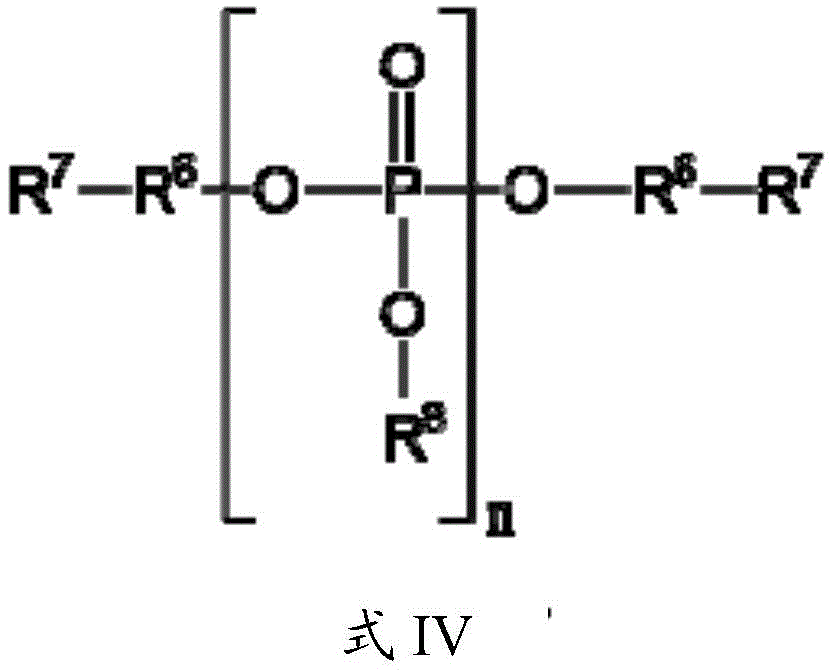
使粘度降低的有机磷酸酯可为结构如下所示呈氯化物盐形式的焦磷酸硫胺素(TPP)或其衍生物。TPP的衍生物可包括用不同的磷酸酯诸如一磷酸酯至三磷酸酯代替二磷酸酯;用其它阴离子成分代替氯阴离子;用较高级的烷基或N-烷基取代基代替一个或多个甲基取代基;用经取代或未经取代的具有1至30个碳原子的烷基、氨基烷基、杂环基、芳基或杂芳基代替一个或多个氨基取代基;用O-酰基或O-烷基代替一个或多个羟基;或其组合。合适的阴离子成分包括卤离子、硫酸根、磺酸根、亚硫酸根、亚磺酸根、磷酸根、膦酸根、亚磷酸根、亚膦酸根、碳酸根和羧酸根阴离子,任选取代有一个或多个烷基、杂烷基、烯基、炔基、碳环或杂环基团,优选具有1至20个或1至12个碳原子。示例性阴离子成分包括氯离子、溴离子、甲基磷酸根、甲基-乙基-磷酸根、甲基硫酸根、甲基磺酸根、甲酸根、乙酸根、丁酸根、枸橼酸根和乳酸根及大体积疏水性阴离子诸如樟脑磺酸(CSA)、苯磺酸(BSA)、甲苯磺酸(TSA)、1-(3-氨基丙基)-2-甲基-1H-咪唑(APMI)或甲磺酸(MSA)。衍生物可包括TPP的使用常规无机碱诸如NaOH或上述示例性疏水性碱的碱加成盐。The viscosity reducing organophosphate may be thiamine pyrophosphate (TPP) or a derivative thereof in the form of a chloride salt with the structure shown below. Derivatives of TPP may include the replacement of diphosphates with different phosphates such as mono- to triphosphates; the replacement of chloride anions with other anionic components; the replacement of one or more with higher alkyl or N-alkyl substituents Methyl substituent; Substitute one or more amino substituents with substituted or unsubstituted alkyl, aminoalkyl, heterocyclyl, aryl or heteroaryl having 1 to 30 carbon atoms; with O- An acyl group or an O-alkyl group replaces one or more hydroxyl groups; or a combination thereof. Suitable anionic components include halide, sulfate, sulfonate, sulfite, sulfinate, phosphate, phosphonate, phosphite, phosphinate, carbonate and carboxylate anions, optionally substituted with one or more an alkyl, heteroalkyl, alkenyl, alkynyl, carbocyclic or heterocyclic group, preferably having 1 to 20 or 1 to 12 carbon atoms. Exemplary anionic components include chloride, bromide, methylphosphate, methyl-ethyl-phosphate, methylsulfate, methylsulfonate, formate, acetate, butyrate, citrate, and lactate Root and bulky hydrophobic anions such as camphorsulfonic acid (CSA), benzenesulfonic acid (BSA), toluenesulfonic acid (TSA), 1-(3-aminopropyl)-2-methyl-1H-imidazole (APMI) or methanesulfonic acid (MSA). Derivatives can include base addition salts of TPP using conventional inorganic bases such as NaOH or the above exemplary hydrophobic bases.
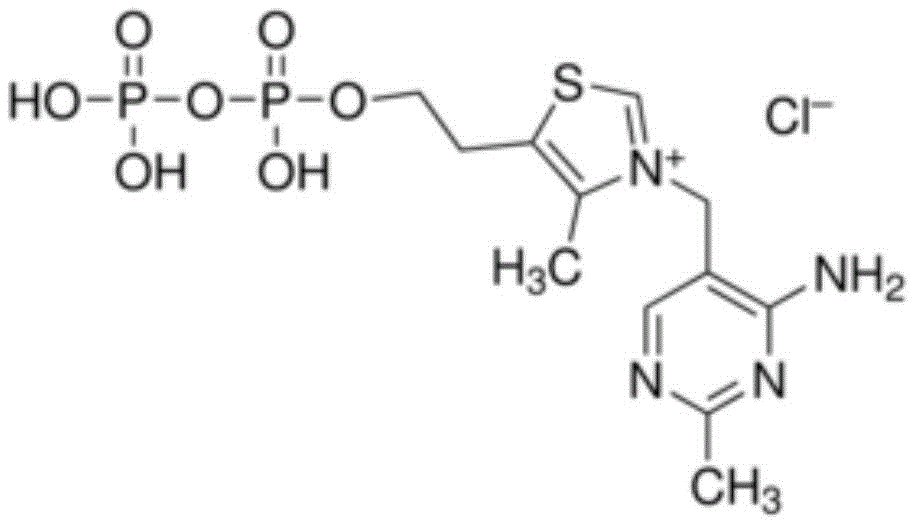
在其它实施方案中,使粘度降低的有机磷酸酯可为苯磷硫胺或相应的二磷酸酯或三磷酸酯类似物。使粘度降低的有机磷酸酯可为一磷酸呋喃硫胺、一磷酸丙舒硫胺或一磷酸蒜硫胺素及其相应的二磷酸酯或三磷酸酯。In other embodiments, the viscosity reducing organophosphate can be benfotiamine or the corresponding diphosphate or triphosphate analog. The viscosity-reducing organophosphates may be fursthiamine monophosphate, prosthiamine monophosphate, or allithiamine monophosphate and their corresponding diphosphates or triphosphates.
使粘度降低的有机磷酸酯可为结构如下所示呈钠盐形式的三磷酸腺苷(ATP)或其衍生物。ATP的衍生物可包括用不同的磷酸酯诸如一磷酸酯或二磷酸酯代替三磷酸酯;用经取代或未经取代的具有1至30个碳原子的烷基、氨基烷基、芳基、杂环基或杂芳基代替氨基取代基;用O-酰基或O-烷基代替一个或多个羟基;或其组合。The viscosity reducing organophosphate can be adenosine triphosphate (ATP) or a derivative thereof in the form of a sodium salt with the structure shown below. Derivatives of ATP may include replacing triphosphates with different phosphates such as monophosphates or diphosphates; substituted or unsubstituted alkyl, aminoalkyl, aryl, Heterocyclyl or heteroaryl in place of an amino substituent; O-acyl or O-alkyl in place of one or more hydroxyl groups; or a combination thereof.
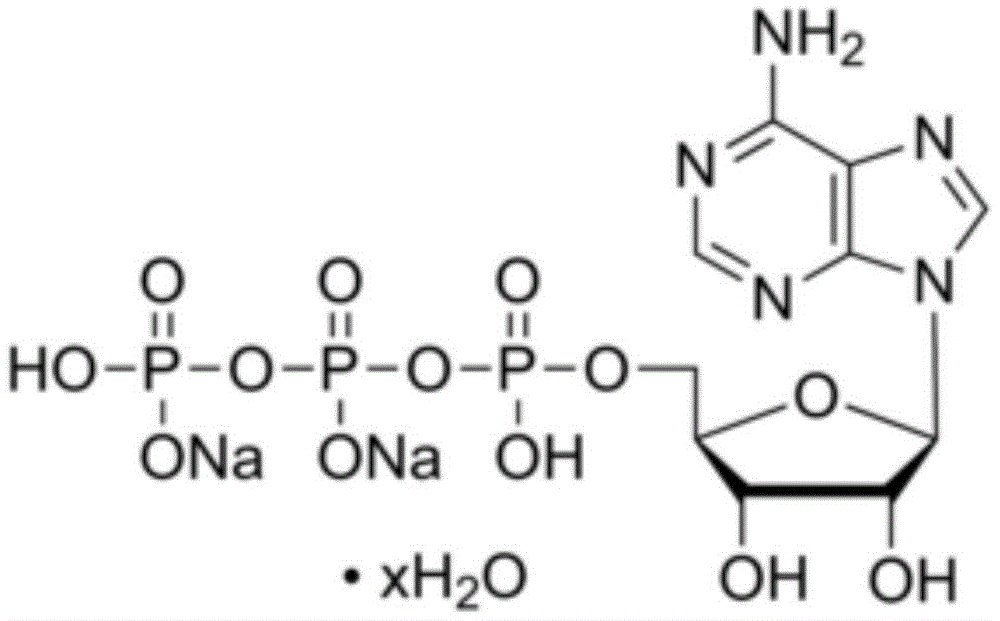
使粘度降低的有机磷酸酯可为结构如下所示的三磷酸脱氧腺苷(dATP)或其衍生物。dATP的衍生物可包括用不同的磷酸酯诸如一磷酸酯或二磷酸酯代替三磷酸酯;用经取代或未经取代的具有1至30个碳原子的烷基、氨基烷基、芳基、杂环基或杂芳基代替氨基取代基;用O-酰基或O-烷基代替一个或多个羟基;或其组合。The viscosity reducing organophosphate can be deoxyadenosine triphosphate (dATP) or a derivative thereof having the structure shown below. Derivatives of dATP may include replacing triphosphates with different phosphates such as monophosphates or diphosphates; substituted or unsubstituted alkyl, aminoalkyl, aryl, Heterocyclyl or heteroaryl in place of an amino substituent; O-acyl or O-alkyl in place of one or more hydroxyl groups; or a combination thereof.

使粘度降低的有机磷酸酯可为结构如下所示的三磷酸脱氧鸟苷(dGTP)或其衍生物。dGTP的衍生物可包括用不同的磷酸酯诸如一磷酸酯或二磷酸酯代替三磷酸酯;用经取代或未经取代的具有1至30个碳原子的烷基、氨基烷基、杂环基、芳基或杂芳基代替氨基取代基;用O-酰基或O-烷基代替一个或多个羟基;或其组合。The viscosity reducing organophosphate may be deoxyguanosine triphosphate (dGTP) or a derivative thereof having the structure shown below. Derivatives of dGTP may include replacing triphosphates with different phosphates such as monophosphates or diphosphates; substituted or unsubstituted alkyls, aminoalkyls, heterocyclyls having 1 to 30 carbon atoms , aryl, or heteroaryl in place of an amino substituent; O-acyl or O-alkyl in place of one or more hydroxyl groups; or a combination thereof.
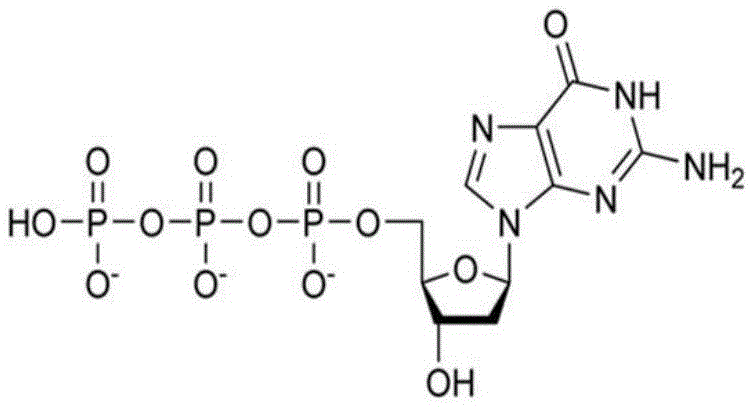
使粘度降低的有机磷酸酯可为结构如下所示的三磷酸脱氧胸苷(dTTP)或其衍生物。dTTP的衍生物可包括用不同的磷酸酯诸如一磷酸酯或二磷酸酯代替三磷酸酯;用较高级的烷基或N-烷基取代基代替甲基取代基;用经取代或未经取代的具有1至30个碳原子的烷基、氨基烷基、杂环基、芳基或杂芳基代替一个或多个氨基取代基;用O-酰基或O-烷基代替一个或多个羟基;或其组合。The viscosity reducing organophosphate may be deoxythymidine triphosphate (dTTP) or a derivative thereof having the structure shown below. Derivatives of dTTP may include replacing triphosphates with different phosphates such as monophosphates or diphosphates; replacing methyl substituents with higher alkyl or N-alkyl substituents; substituted or unsubstituted Alkyl, aminoalkyl, heterocyclyl, aryl or heteroaryl of 1 to 30 carbon atoms in place of one or more amino substituents; O-acyl or O-alkyl in place of one or more hydroxyl groups ; or a combination thereof.

使粘度降低的有机磷酸酯可为结构如下所示的三磷酸脱氧胞苷(dCTP)或其衍生物。dCTP的衍生物可包括用不同的磷酸酯诸如一磷酸酯或二磷酸酯代替三磷酸酯;用经取代或未经取代的具有1至30个碳原子的烷基、氨基烷基、芳基、杂环基或杂芳基代替氨基取代基;用O-酰基或O-烷基代替一个或多个羟基;或其组合。The viscosity reducing organophosphate can be deoxycytidine triphosphate (dCTP) or a derivative thereof having the structure shown below. Derivatives of dCTP may include the replacement of triphosphates with different phosphates such as monophosphates or diphosphates; substitution of substituted or unsubstituted alkyl, aminoalkyl, aryl, Heterocyclyl or heteroaryl in place of an amino substituent; O-acyl or O-alkyl in place of one or more hydroxyl groups; or a combination thereof.
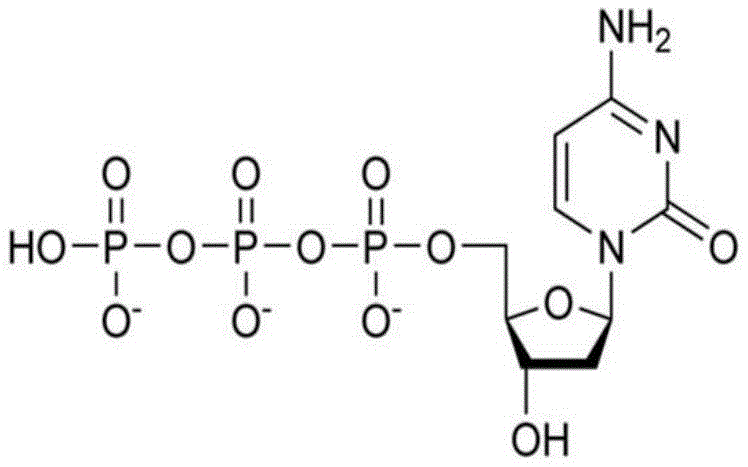
使粘度降低的有机磷酸酯可为结构如下所示的环腺苷酸(cAMP)或其衍生物。cAMP的衍生物可包括用不同的磷酸酯诸如二磷酸酯或三磷酸酯代替一磷酸酯;用经取代或未经取代的具有1至30个碳原子的烷基、氨基烷基、芳基、杂环基或杂芳基代替氨基取代基;用O-酰基或O-烷基代替羟基;或其组合。The viscosity-reducing organophosphate can be cyclic adenosine monophosphate (cAMP) or a derivative thereof having the structure shown below. Derivatives of cAMP may include substitution of monophosphates with different phosphates such as diphosphates or triphosphates; substitution of substituted or unsubstituted alkyl, aminoalkyl, aryl, Heterocyclyl or heteroaryl in place of amino substituent; O-acyl or O-alkyl in place of hydroxy; or a combination thereof.
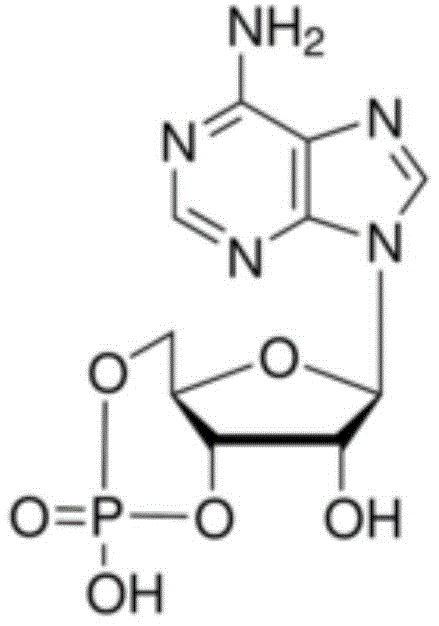
使粘度降低的有机磷酸酯可为结构如下所示的环鸟苷酸(cGMP)或其衍生物。cGMP的衍生物可包括用不同的磷酸酯诸如二磷酸酯或三磷酸酯代替一磷酸酯;用经取代或未经取代的具有1至30个碳原子的烷基、氨基烷基、芳基、杂环基或杂芳基代替氨基取代基;用O-酰基或O-烷基代替一个或多个羟基;或其组合。The viscosity-reducing organophosphate can be cyclic guanylic acid (cGMP) or a derivative thereof having the structure shown below. Derivatives of cGMP may include substitution of monophosphates with different phosphates such as diphosphates or triphosphates; substitution of substituted or unsubstituted alkyl, aminoalkyl, aryl, Heterocyclyl or heteroaryl in place of an amino substituent; O-acyl or O-alkyl in place of one or more hydroxyl groups; or a combination thereof.
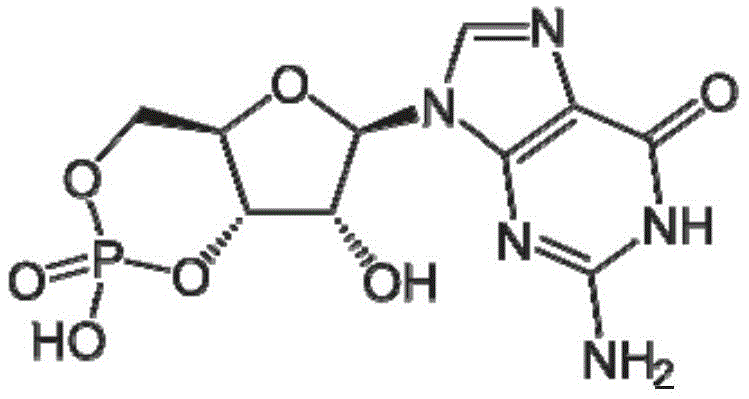
使粘度降低的有机磷酸酯可为结构如下所示的环胸苷酸(cTMP)或其衍生物。cTMP的衍生物可包括用不同的磷酸酯诸如二磷酸酯或三磷酸酯代替一磷酸酯;用较高级的烷基或N-烷基取代基代替甲基取代基;用经取代或未经取代的具有1至30个碳原子的烷基、氨基烷基、芳基、杂环基或杂芳基代替一个或多个氨基取代基;用O-酰基或O-烷基代替一个或多个羟基;或其组合。The viscosity-reducing organophosphate can be cyclic thymidylic acid (cTMP) or a derivative thereof having the structure shown below. Derivatives of cTMP may include substitution of monophosphates with different phosphates such as diphosphates or triphosphates; substitution of methyl substituents with higher alkyl or N-alkyl substituents; substitution of substituted or unsubstituted Alkyl, aminoalkyl, aryl, heterocyclyl or heteroaryl of 1 to 30 carbon atoms in place of one or more amino substituents; O-acyl or O-alkyl in place of one or more hydroxyl groups ; or a combination thereof.

使粘度降低的有机磷酸酯可为结构如下所示的环胞苷酸(cCMP)或其衍生物。cCMP的衍生物可包括用不同的磷酸酯诸如二磷酸酯或三磷酸酯代替一磷酸酯;用经取代或未经取代的具有1至30个碳原子的烷基、氨基烷基、芳基、杂环基或杂芳基代替氨基取代基;用O-酰基或O-烷基代替一个或多个羟基;或其组合。The viscosity-reducing organophosphate may be cyclic cytidylic acid (cCMP) or a derivative thereof having the structure shown below. Derivatives of cCMP may include substitution of monophosphates with different phosphates such as diphosphates or triphosphates; substitution of substituted or unsubstituted alkyl, aminoalkyl, aryl, Heterocyclyl or heteroaryl in place of an amino substituent; O-acyl or O-alkyl in place of one or more hydroxyl groups; or a combination thereof.
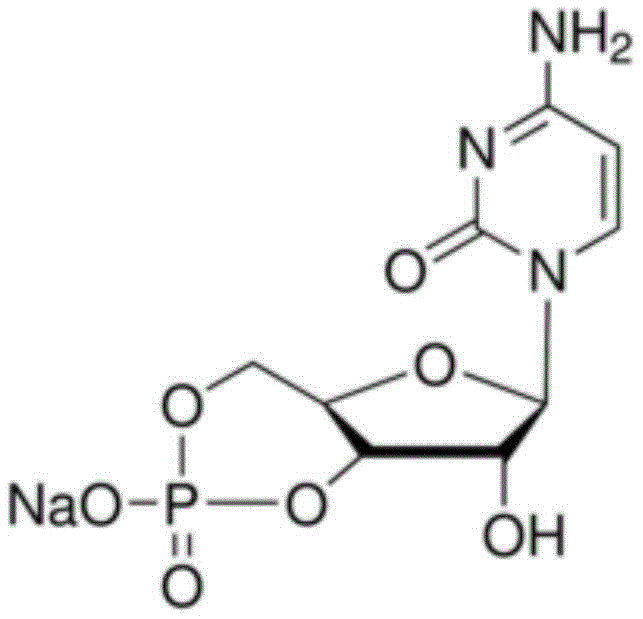
使粘度降低的有机磷酸酯可为结构如下所示的烟酰胺腺嘌呤二核苷酸磷酸(NADP)或其衍生物。NADP的衍生物可包括用不同的磷酸酯诸如一磷酸酯或三磷酸酯代替二磷酸酯;用不同的磷酸酯代替二磷酸酯;用经取代或未经取代的具有1至30个碳原子的烷基、氨基烷基、杂环基、芳基或杂芳基代替一个或多个氨基取代基;用O-酰基或O-烷基代替一个或多个羟基;或其组合。The viscosity-reducing organophosphate can be nicotinamide adenine dinucleotide phosphate (NADP) or a derivative thereof having the structure shown below. Derivatives of NADP may include substitution of diphosphates with different phosphates such as monophosphates or triphosphates; substitution of diphosphates with different phosphates; substitution of substituted or unsubstituted phosphates with 1 to 30 carbon atoms. Alkyl, aminoalkyl, heterocyclyl, aryl, or heteroaryl in place of one or more amino substituents; O-acyl or O-alkyl in place of one or more hydroxy groups; or combinations thereof.
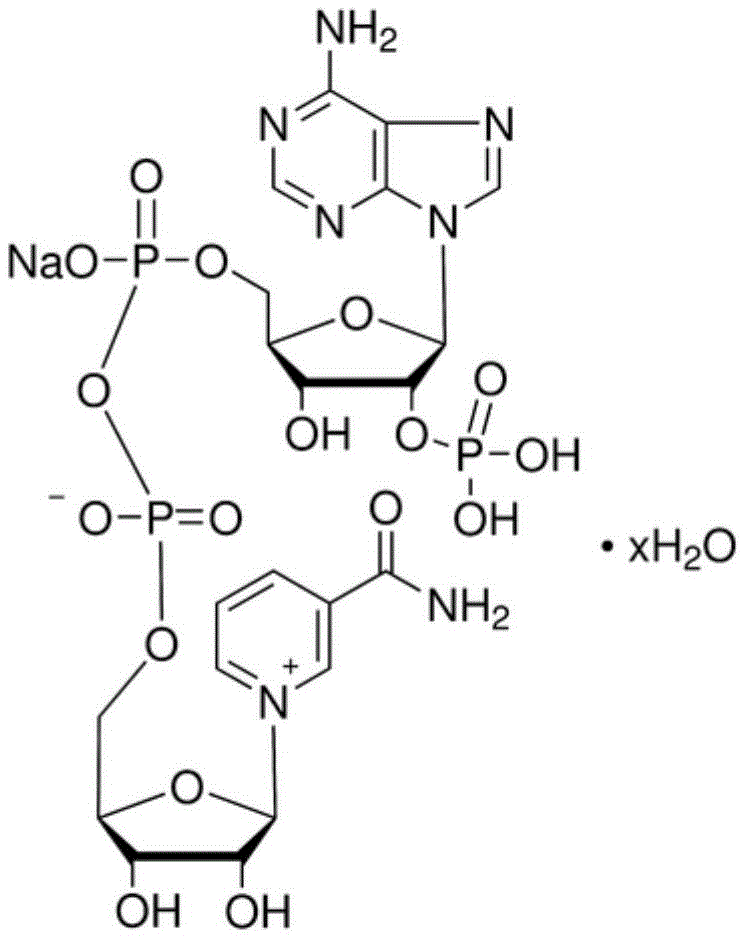
使粘度降低的有机磷酸酯可为结构如下所示的磷酸吡哆醛或其衍生物。磷酸吡哆醛的衍生物可包括用不同的磷酸酯诸如二磷酸酯或三磷酸酯代替一磷酸酯;用较高级的烷基或N-烷基取代基代替甲基取代基;用O-酰基或O-烷基代替一个或多个羟基;或其组合。The viscosity-reducing organophosphate may be pyridoxal phosphate or a derivative thereof having the structure shown below. Derivatives of pyridoxal phosphate may include substitution of monophosphates with different phosphates such as diphosphates or triphosphates; substitution of methyl substituents with higher alkyl or N-alkyl substituents; substitution of O-acyl groups or O-alkyl in place of one or more hydroxyl groups; or a combination thereof.
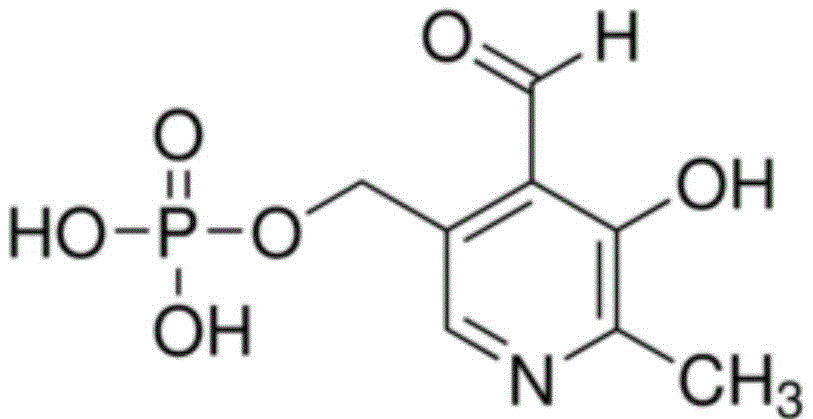
使粘度降低的有机磷酸酯可为结构如下所示的核黄素-5’-磷酸酯或其衍生物。核黄素-5’-磷酸酯的衍生物可包括用不同的磷酸酯诸如二磷酸酯或三磷酸酯代替磷酸酯;用其它阳离子成分代替钠抗衡离子;用较高级的烷基或N-烷基取代基代替一个或多个甲基取代基;用O-酰基或O-烷基代替一个或多个羟基;或其组合。The viscosity-reducing organophosphate may be riboflavin-5'-phosphate having the structure shown below, or a derivative thereof. Derivatives of riboflavin-5'-phosphate may include replacing phosphates with different phosphates such as diphosphates or triphosphates; replacing sodium counterions with other cationic components; using higher alkyl or N-alkanes substitution of one or more methyl substituents with an O-acyl group; substitution of one or more hydroxyl groups with an O-acyl group or O-alkyl group; or a combination thereof.
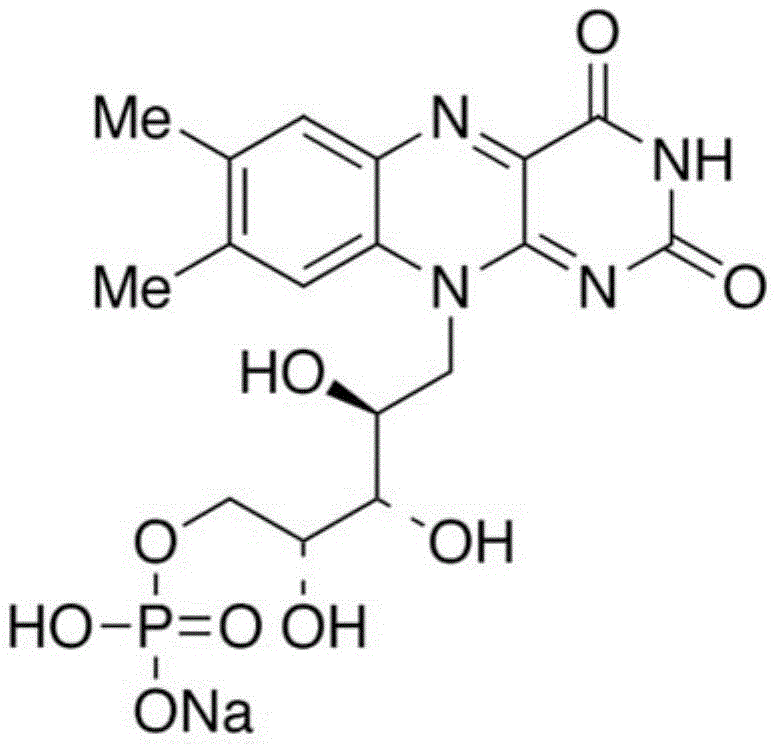
C.赋形剂C. Excipients
很多种可用于液体蛋白质制剂的药物赋形剂是本领域技术人员已知的。其包括一种或多种添加剂,诸如液体溶剂或共溶剂;糖或糖醇,诸如甘露醇、海藻糖、蔗糖、山梨醇、果糖、麦芽糖、乳糖或葡聚糖;表面活性剂,诸如
其它药用载体、赋形剂或稳定剂诸如在Remington:“The Science and Practiceof Pharmacy”,第20版,Alfonso R.Gennaro,Ed.,Lippincott Williams&Wilkins(2000)中描述的那些也可包含在本文所述的蛋白质制剂中,条件是其不会不利地影响制剂的所需性质。Other pharmaceutically acceptable carriers, excipients or stabilizers such as those described in Remington: "The Science and Practice of Pharmacy", 20th Edition, Alfonso R. Gennaro, Ed., Lippincott Williams & Wilkins (2000) may also be included herein. In the protein formulation described above, provided that it does not adversely affect the desired properties of the formulation.
制剂除上述使粘度降低的有机磷酸酯外还可含有一种或多种其它使粘度降低的赋形剂。本文所述的使粘度降低的有机磷酸酯可与一种或多种其它类型的使粘度降低的物质组合,例如在由Arsia Therapeutics共同提交的标题为“LIQUID PROTEIN FORMULATIONSCONTAINING WATER SOLUBLE ORGANIC DYES”的PCT申请中所述的水溶性有机染料;典型的大体积极性有机化合物,诸如疏水性化合物、GRAS(美国食品药品监督管理局通常认为是安全的化合物的列表)中的多种物质和非活性注射用成分及FDA所批准的治疗剂;在由ArsiaTherapeutics共同提交的标题为“LIQUID PROTEIN FORMULATIONS CONTAININGVISCOSITY-LOWERING AGENTS”的PCT申请中所述的物质;和在由Arsia Therapeutics共同提交的标题为“LIQUID PROTEIN FORMULATIONS CONTAINING IONIC LIQUIDS”的PCT申请中所述的离子性液体。The formulation may contain one or more other viscosity reducing excipients in addition to the viscosity reducing organophosphates described above. The viscosity-reducing organophosphates described herein may be combined with one or more other types of viscosity-reducing substances such as described in PCT application co-filed by Arsia Therapeutics entitled "LIQUID PROTEIN FORMULATION SCONTAINING WATER SOLUBLE ORGANIC DYES" Water-soluble organic dyes described in; typical bulky polar organic compounds such as hydrophobic compounds, various substances in the GRAS (US Food and Drug Administration's List of Compounds Generally Recognized as Safe) and inactive injectable ingredients and FDA-approved therapeutics; substances described in a PCT application co-filed by Arsia Therapeutics entitled "LIQUID PROTEIN FORMULATIONS CONTAININGVISCOSITY-LOWERING AGENTS"; " of the ionic liquids described in the PCT application.
III.制备方法III. Preparation method
A.蛋白质制剂A. Protein preparations
待配制的蛋白质诸如单克隆抗体可通过任何已知的技术来产生,诸如通过如本领域已知的那样对用含有一种或多种编码所述蛋白质的核酸序列的载体转化或转染的细胞进行培养或通过合成技术(诸如重组技术和肽合成或这些技术的组合)或可从所述蛋白质的内源性来源中分离。The protein to be formulated, such as a monoclonal antibody, can be produced by any known technique, such as by subjecting cells transformed or transfected with a vector containing one or more nucleic acid sequences encoding the protein, as known in the art. Cultivated or by synthetic techniques such as recombinant techniques and peptide synthesis or a combination of these techniques or can be isolated from endogenous sources of the protein.
待配制的蛋白质的纯化可通过本领域已知的任何合适的技术来进行,诸如乙醇或硫酸铵析出、反相HPLC、硅胶或阳离子交换树脂(例如DEAE-纤维素)色谱、透析、色谱聚焦、使用蛋白A

以使粘度降低的浓度诸如0.010M至1.0M、优选0.050M至0.50M、最优选0.10M至0.30M引入的使粘度降低的有机磷酸酯允许使用本领域技术人员已知的常规方法将药学活性单克隆抗体的溶液纯化和/或浓缩至较高的单克隆抗体浓度,包括但不限于切向流动过滤、离心浓缩和透析。The viscosity-reducing organophosphate esters introduced at viscosity-reducing concentrations such as 0.010M to 1.0M, preferably 0.050M to 0.50M, most preferably 0.10M to 0.30M allow the pharmaceutically active compounds to be converted using conventional methods known to those skilled in the art. Solution purification and/or concentration of monoclonal antibodies to higher concentrations of monoclonal antibodies includes, but is not limited to, tangential flow filtration, centrifugal concentration, and dialysis.
在一些实施方案中,蛋白质的冻干制剂被提供和/或使用在浓缩的低粘度蛋白质制剂的制备和制造中。在一些实施方案中,呈粉末形式的预冻干蛋白质通过溶解在水溶液中来复溶。在该实施方案中,将液体制剂填充到特定剂量单元容器诸如小瓶或预填充的混合式注射器中,冻干,任选与冻干保护剂、防腐剂、抗氧化剂和其它典型的药用赋形剂一起,然后在无菌储存条件下储存直到临用前,此时将其用限定体积的稀释剂复溶以使液体达到所期望的浓度和粘度。In some embodiments, lyophilized formulations of proteins are provided and/or used in the preparation and manufacture of concentrated low viscosity protein formulations. In some embodiments, the pre-lyophilized protein in powder form is reconstituted by dissolving in an aqueous solution. In this embodiment, the liquid formulation is filled into specific dosage unit containers such as vials or prefilled mixing syringes, lyophilized, optionally with lyoprotectants, preservatives, antioxidants and other typical pharmaceutical excipients The dosage form is then stored under sterile storage conditions until immediately before use, at which point it is reconstituted with a defined volume of diluent to bring the liquid to the desired concentration and viscosity.
本文所述的制剂可通过本领域技术人员已知的任何合适的方法来储存。用于制备供储存的蛋白质制剂的方法的非限制性实例包括对液体蛋白质制剂进行冷冻、冻干和喷雾干燥。在一些情况下,冻干制剂在零度以下的温度诸如在约-80℃或在液氮中冷冻储存。在一些情况下,冻干或含水制剂在2-8℃储存。The formulations described herein can be stored by any suitable method known to those skilled in the art. Non-limiting examples of methods for preparing protein formulations for storage include freezing, lyophilizing, and spray drying liquid protein formulations. In some cases, lyophilized formulations are stored frozen at subzero temperatures, such as at about -80°C or in liquid nitrogen. In some cases, lyophilized or aqueous formulations are stored at 2-8°C.
可用于在注射前复溶冻干制剂的稀释剂的非限制性实例包括无菌水、注射用抑菌水(BWFI)、pH缓冲溶液(例如磷酸盐缓冲盐水)、无菌盐水溶液、林格溶液、葡萄糖溶液或盐和/或缓冲剂的水溶液。在一些情况下,将制剂喷雾干燥,然后储存。Non-limiting examples of diluents that can be used to reconstitute the lyophilized formulation prior to injection include sterile water, bacteriostatic water for injection (BWFI), pH buffered solutions (eg, phosphate buffered saline), sterile saline solution, Ringer's solution, dextrose solution or aqueous solution of salt and/or buffer. In some cases, the formulations are spray dried and then stored.
IV.向有此需要的个体给药IV. ADMINISTRATION TO INDIVIDUALS IN NEED
通过肌内、腹膜内(即注射到体腔中)、脑脊髓内或皮下注射使用18-32号针头(任选薄壁的针头)以小于约5mL、小于约3mL、优选小于约2mL、更优选小于约1mL的体积向有此需要的人类给药蛋白质制剂,包括但不限于复溶制剂。By intramuscular, intraperitoneal (ie, injection into a body cavity), intraspinal or subcutaneous injection using an 18-32 gauge needle (optionally a thin-walled needle) to less than about 5 mL, less than about 3 mL, preferably less than about 2 mL, more preferably Volumes of less than about 1 mL are used to administer protein formulations to humans in need thereof, including but not limited to reconstituted formulations.
蛋白质诸如单克隆抗体的适当剂量(“治疗有效量”)将取决于待治疗的病症、疾病或病症的严重程度和病程、给药蛋白质是出于预防还是治疗目的、先前的疗法、患者的临床史和对蛋白质的应答、所用蛋白质的类型及主治医师的判断。蛋白质适当地以单次或多次注射来一次性给药或在一系列治疗过程中作为单一疗法或与其它药物或疗法联合。Appropriate doses of proteins such as monoclonal antibodies ("therapeutically effective amounts") will depend on the condition to be treated, the severity and course of the disease or condition, whether the protein is administered for prophylactic or therapeutic purposes, previous therapy, the patient's clinical history and response to protein, type of protein used, and judgment of the attending physician. The protein is suitably administered in single or multiple injections at one time or over a series of treatments as monotherapy or in combination with other drugs or therapies.
对剂量制剂进行设计以使注射在注射部位不引起显著的刺激迹象,例如其中当使用Draize评分系统进行评价时,主要刺激指数小于3。在可选择的实施方案中,当与注射等体积的盐水溶液相比时,注射引起目视相似的刺激水平。在另一个实施方案中,当与其它方面相同但不含有机磷酸酯的以相同方式给药的制剂相比时,蛋白质的生物利用度是较高的。The dosage formulation is designed so that the injection does not cause significant signs of irritation at the injection site, eg, where the primary irritation index is less than 3 when assessed using the Draize scoring system. In alternative embodiments, injections cause visually similar levels of irritation when compared to injections of an equal volume of saline solution. In another embodiment, the bioavailability of the protein is higher when compared to an otherwise identical formulation administered in the same manner but without the organophosphate ester.
在优选实施方案中,注射所述制剂以得到水平提高的治疗性蛋白质。例如,AUC值可比就其它方面相同但不含一种或多种使粘度降低的有机磷酸酯的以相同方式给药的制剂所计算的AUC值高至少10%,优选至少20%。In preferred embodiments, the formulation is injected to obtain increased levels of the therapeutic protein. For example, the AUC value may be at least 10% higher, preferably at least 20% higher than the AUC value calculated for an otherwise identical formulation administered in the same manner but without one or more viscosity reducing organophosphate esters.
使粘度降低的有机磷酸酯也可影响生物利用度。例如,蛋白质的百分比生物利用度可为其它方面相同但不含一种或多种使粘度降低的有机磷酸酯的以相同方式给药的制剂的百分比生物利用度的至少1.1倍,优选至少1.2倍。Viscosity-reducing organophosphates can also affect bioavailability. For example, the percent bioavailability of the protein may be at least 1.1 times, preferably at least 1.2 times, the percent bioavailability of an otherwise identical formulation that does not contain one or more viscosity-reducing organophosphates .
使粘度降低的有机磷酸酯也可影响药物动力学。例如,皮下或肌内注射后的CMAX可比大致等同的药学上有效的静脉内给药剂量的CMAX低至少10%,优选至少20%。Viscosity-reducing organophosphates can also affect pharmacokinetics. For example, the CMAX following subcutaneous or intramuscular injection may be at least 10% lower, preferably at least 20% lower than the CMAX of an approximately equivalent pharmaceutically effective intravenously administered dose.
在一些实施方案中,蛋白质以比其它方面相同但不含一种或多种使粘度降低的有机磷酸酯的制剂高的剂量和低的频率来给药。In some embodiments, the protein is administered at a higher dose and less frequently than an otherwise identical formulation without one or more viscosity reducing organophosphates.
粘度较低的制剂需要较小的注射力。例如,注射力可比其它方面相同但不含一种或多种使粘度降低的有机磷酸酯的以相同方式给药的制剂所需要的注射力小至少10%,优选至少20%。在一个实施方案中,用27号针头进行注射,且注射力小于30N。在大多数情况下,制剂可使用非常小号的针头来给药,例如27至31号,通常27、29或31号。Less viscous formulations require less injection force. For example, the injection force may be at least 10%, preferably at least 20% less than that required for an otherwise identical formulation administered in the same manner but without one or more viscosity reducing organophosphate esters. In one embodiment, the injection is performed with a 27 gauge needle and the injection force is less than 30N. In most cases, the formulations can be administered using very small gauge needles, such as 27 to 31 gauge, usually 27, 29 or 31 gauge.
使粘度降低的有机磷酸酯可用于制备适于复溶以形成供皮下或肌内注射的液体药物制剂的剂量单元制剂。剂量单元可含有一种或多种蛋白质的干燥粉末;一种或多种使粘度降低的有机磷酸酯;和其它赋形剂。存在于剂量单元中的蛋白质使在药用溶剂中复溶后所得到的制剂具有约100mg至约2,000mg/1mL的蛋白质浓度(mg/mL)。此类复溶制剂可在25℃具有约1cP至约50cP的绝对粘度。The viscosity reducing organophosphates are useful in the preparation of dosage unit formulations suitable for reconstitution to form liquid pharmaceutical formulations for subcutaneous or intramuscular injection. A dosage unit may contain a dry powder of one or more proteins; one or more viscosity reducing organophosphates; and other excipients. The protein present in the dosage unit results in a formulation having a protein concentration (mg/mL) of from about 100 mg to about 2,000 mg/1 mL upon reconstitution in a pharmaceutically acceptable solvent. Such reconstituted formulations can have an absolute viscosity of from about 1 cP to about 50 cP at 25°C.
低粘度制剂可按溶液或剂量单元形式提供,其中在具有或不具有使粘度降低的有机磷酸酯和其它赋形剂的情况下将蛋白质在一个小瓶中冻干,且将具有或不具有使粘度降低的有机磷酸酯和其它赋形剂的溶剂提供在第二个小瓶中。在该实施方案中,在注射前即刻或在注射时向蛋白质中添加溶剂以确保均匀混合和溶解。Low viscosity formulations can be provided as solutions or dosage units in which the protein is lyophilized in a vial with or without viscosity reducing organophosphates and other excipients, and will be with or without viscosity reducing organophosphates and other excipients. Solvents for reduced organophosphate and other excipients are provided in a second vial. In this embodiment, solvent is added to the protein immediately prior to or at the time of injection to ensure uniform mixing and dissolution.
一种或多种使粘度降低的有机磷酸酯按以下浓度存在于制剂中,所述浓度当经由皮下、肌内或其它注射类型来给药时不引起显著的毒性迹象和/或不可逆的毒性迹象。本文使用的“显著的毒性迹象”包括中毒、嗜睡、行为改变诸如当中枢神经系统受损时发生的那些行为改变、不育、严重的心脏毒性迹象诸如心律失常、心肌病、心肌梗塞和心源性或充血性心力衰竭、肾衰竭、肝衰竭、呼吸困难及死亡。One or more viscosity-reducing organophosphates are present in the formulation at concentrations that do not cause significant and/or irreversible signs of toxicity when administered via subcutaneous, intramuscular, or other types of injection . As used herein, "significant signs of toxicity" include intoxication, somnolence, behavioral changes such as those that occur when the central nervous system is damaged, infertility, signs of severe cardiotoxicity such as arrhythmias, cardiomyopathy, myocardial infarction, and cardiac Sexual or congestive heart failure, kidney failure, liver failure, dyspnea, and death.
在优选实施方案中,所述制剂当给药不超过每天两次、每天一次、每周两次、每周一次或每月一次时不引起显著的刺激。所述蛋白质制剂的给药可在注射部位不引起显著的刺激迹象,例如当使用Draize评分系统进行评价时,主要刺激指数小于3,小于2或小于1。本文使用的“显著的刺激迹象”包括在注射部位直径大于10cm、大于5cm或大于2.5cm的红斑、发红和/或肿胀、在注射部位出现坏死,在注射部位出现剥脱性皮炎及妨碍日常活动和/或需要就医或住院的严重疼痛。在一些实施方案中,当与注射等体积的盐水溶液相比时,所述蛋白质制剂的注射引起目视相似的刺激水平。In preferred embodiments, the formulation does not cause significant irritation when administered no more than twice a day, once a day, twice a week, once a week, or once a month. Administration of the protein formulation may result in no significant signs of irritation at the injection site, eg, a major irritation index of less than 3, less than 2, or less than 1 when assessed using the Draize scoring system. As used herein, "significant signs of irritation" include erythema, redness and/or swelling greater than 10 cm, greater than 5 cm, or greater than 2.5 cm in diameter at the injection site, necrosis at the injection site, exfoliative dermatitis at the injection site, and interference with daily activities and/or severe pain requiring medical attention or hospitalization. In some embodiments, injection of the protein formulation causes visually similar levels of irritation when compared to injection of an equal volume of saline solution.
当经由皮下或肌内注射来给药时,所述蛋白质制剂与其它方面相同但不含一种或多种使粘度降低的有机磷酸酯的制剂相比可展现出提高的生物利用度。“生物利用度”是指生物活性物质例如单克隆抗体进入循环或到达作用部位的程度和速率。皮下或肌内注射的整体生物利用度与其它方面相同但不含一种或多种使粘度降低的有机磷酸酯的制剂相比是提高的。“百分比生物利用度”是指生物活性物质的给药剂量中进入循环的分数,其相对于静脉内给药剂量来确定。测量生物利用度的一种方式是通过比较血浆浓度对时间的函数曲线的“曲线下面积”(AUC)。AUC可例如使用线性梯形规则来计算。本文使用的“AUC0-t”是指零时间至后来的t时间的血浆浓度曲线下面积。时间通常将以天进行测量,虽然当上下文明显时,也可使用小时。本文使用的“AUC∞”是指零时间至血浆浓度恢复到基线水平时的时间的血浆浓度曲线下面积。测量生物利用度的一种方式是通过比较血浆浓度对时间的函数曲线的“曲线下面积”(AUC)。AUC可例如使用线性梯形规则来计算。本文使用的“AUC∞”是指零时间至血浆浓度恢复到基线水平时的时间的血浆浓度曲线下面积。本文使用的“AUC0-t”是指零时间至后来的t时间例如至达到基线的时间的血浆浓度曲线下面积。时间通常将以天进行测量,虽然当上下文明显时,也可使用小时。例如,AUC与其它方面相同但不含一种或多种使粘度降低的有机磷酸酯的以相同方式给药的制剂相比可增加超过10%、20%、30%、40%或50%。When administered via subcutaneous or intramuscular injection, the protein formulations may exhibit improved bioavailability compared to otherwise identical formulations without one or more viscosity reducing organophosphates. "Bioavailability" refers to the extent and rate at which a biologically active substance, such as a monoclonal antibody, enters the circulation or reaches the site of action. The overall bioavailability for subcutaneous or intramuscular injection is improved compared to an otherwise identical formulation without one or more viscosity reducing organophosphates. "Percent bioavailability" refers to the fraction of an administered dose of a biologically active substance that enters the circulation, as determined relative to an intravenously administered dose. One way to measure bioavailability is by comparing the "area under the curve" (AUC) of plasma concentration as a function of time. AUC can be calculated, for example, using the linear trapezoidal rule. As used herein, "AUCo -t " refers to the area under the plasma concentration curve from time zero to a subsequent time t. Time will usually be measured in days, although hours may also be used when the context is clear. As used herein, " AUC∞ " refers to the area under the plasma concentration curve from time zero to the time when the plasma concentration returns to baseline levels. One way to measure bioavailability is by comparing the "area under the curve" (AUC) of plasma concentration as a function of time. AUC can be calculated, for example, using the linear trapezoidal rule. As used herein, " AUC∞ " refers to the area under the plasma concentration curve from time zero to the time when the plasma concentration returns to baseline levels. As used herein, "AUCo -t " refers to the area under the plasma concentration curve from time zero to a subsequent time t, eg, to the time to reach baseline. Time will usually be measured in days, although hours may also be used when the context is clear. For example, the AUC can be increased by more than 10%, 20%, 30%, 40% or 50% compared to an otherwise identical formulation administered in the same manner but without one or more viscosity reducing organophosphate esters.
本文使用的“tmax”是指在给药后血浆浓度达到最大值的时间。As used herein, " tmax " refers to the time at which the plasma concentration reaches a maximum after administration.
本文使用的“Cmax”是指在给药剂量后且在给药后续剂量前的最大血浆浓度。As used herein, " Cmax " refers to the maximum plasma concentration following administration of a dose and prior to administration of subsequent doses.
本文使用的“Cmin”或“C谷”是指在给药剂量后且在给药后续剂量前的最小血浆浓度。As used herein, " Cmin " or " Ctrough " refers to the minimum plasma concentration following administration of a dose and prior to administration of subsequent doses.
皮下或肌内注射后的Cmax可比静脉内给药剂量的Cmax小例如至少10%,更优选至少20%。Cmax的这种减少也可使毒性降低。The Cmax following subcutaneous or intramuscular injection may be, for example, at least 10%, and more preferably at least 20% less than the Cmax of an intravenously administered dose. This reduction in Cmax also results in a reduction in toxicity.
药物动力学和药效学参数可使用本领域技术人员已知的措施进行跨物种近似。Pharmacokinetic and pharmacodynamic parameters can be approximated across species using measures known to those skilled in the art.
抗体治疗剂的药物动力学和药效学可基于具体的抗体而是显著不同的。经批准的鼠单克隆抗体在人类中显示出的半衰期为约1天,而人单克隆抗体的半衰期通常将为约25天(Waldmann等人,Int.Immunol.,2001,13:1551-1559)。抗体治疗剂的药物动力学和药效学可基于给药途径而是显著不同的。肌内或皮下注射IgG后达到最大血浆浓度的时间通常为2至8天,尽管可能出现较短或较长的时间(Wang等人,Clin.Pharm.Ther.,2008,84(5):548-558)。抗体治疗剂的药物动力学和药效学可基于制剂而是显著不同的。与其它方面相同但不含一种或多种有机磷酸酯的制剂相比,含有机磷酸酯的蛋白质制剂就皮下或肌内注射而言可展现出改善的药物动力学。皮下或肌内给药后的Cmax与其它方面相同但不含一种或多种使粘度降低的有机磷酸酯的以相同方式给药的制剂相比可为降低的。例如,CMAX与其它方面相同但不含一种或多种使粘度降低的有机磷酸酯的静脉内给药的制剂的CMAX相比可降低超过1天、2天、3天或4天或可降低超过10%、20%、30%、40%或50%。与其它方面相同但不含一种或多种使粘度降低的有机磷酸酯的制剂相比,整体生物利用度就皮下或肌内注射而言可为提高的。整体生物利用度可如下评价:对一个或多个AUC值进行比较或对例如相对于静脉内给药剂量来计算的百分比生物利用度进行比较。例如,AUC与其它方面相同但不含一种或多种使粘度降低的有机磷酸酯的静脉内给药的制剂相比可增加超过10%、20%、30%、40%或50%。The pharmacokinetics and pharmacodynamics of antibody therapeutics can vary significantly based on the specific antibody. Approved murine monoclonal antibodies have been shown to have a half-life in humans of about 1 day, while the half-life of human monoclonal antibodies will typically be about 25 days (Waldmann et al., Int. Immunol., 2001, 13:1551-1559) . The pharmacokinetics and pharmacodynamics of antibody therapeutics can vary significantly based on the route of administration. The time to maximum plasma concentration after intramuscular or subcutaneous injection of IgG is usually 2 to 8 days, although shorter or longer times may occur (Wang et al., Clin. Pharm. Ther., 2008, 84(5):548 -558). The pharmacokinetics and pharmacodynamics of antibody therapeutics can vary significantly based on the formulation. Organophosphate-containing protein formulations may exhibit improved pharmacokinetics for subcutaneous or intramuscular injection compared to otherwise identical formulations but without one or more organophosphates. The Cmax after subcutaneous or intramuscular administration may be reduced compared to an otherwise identical formulation administered in the same manner but without one or more viscosity reducing organophosphates. For example, the CMAX may be reduced by more than 1 day, 2 days, 3 days, or 4 days compared to the CMAX of an intravenously administered formulation that is otherwise identical but does not contain one or more viscosity reducing organophosphate esters or It can be reduced by more than 10%, 20%, 30%, 40% or 50%. Overall bioavailability may be improved for subcutaneous or intramuscular injection compared to an otherwise identical formulation without one or more viscosity reducing organophosphate esters. Overall bioavailability can be assessed by comparing one or more AUC values or by comparing percent bioavailability, eg, calculated relative to an intravenously administered dose. For example, the AUC may be increased by more than 10%, 20%, 30%, 40% or 50% compared to an otherwise identical formulation that is administered intravenously but does not contain one or more viscosity reducing organophosphate esters.
低粘度蛋白质制剂与不含一种或多种使粘度降低的有机磷酸酯的那些蛋白质制剂相比可允许给药中较大的灵活性并降低给药频率。例如,通过使每次注射给药的剂量增加多倍,可在一些实施方案中将给药频率由每2周一次降低至每6周一次。Low viscosity protein formulations may allow greater flexibility in dosing and reduced dosing frequency compared to those protein formulations that do not contain one or more viscosity reducing organophosphates. For example, by multiplying the dose administered per injection, the frequency of dosing can be reduced in some embodiments from once every 2 weeks to once every 6 weeks.
包括但不限于复溶制剂在内的蛋白质制剂可使用经加热的和/或自混合式注射器或自动注射器来给药。蛋白质制剂也可在填充注射器前在单独的温热单元中预加热。Protein formulations, including but not limited to reconstituted formulations, can be administered using heated and/or self-mixing syringes or auto-injectors. The protein formulation can also be preheated in a separate warming unit before filling the syringe.
i.经加热的注射器i. Heated syringe
经加热的注射器可为使用注射器温热装置来预加热的标准注射器。注射器温热装置通常将具有一个或多个各自能够接收含蛋白质制剂的注射器的开口和用于在使用前将注射器加热和保持在特定温度(通常在环境温度以上)的装置。其在本文中将被称为经预加热的注射器。适于经加热的注射器的温热装置包括可得自Vista Dental Products和Inter-Med的那些温热装置。温热装置能够容纳各种尺寸的注射器并加热到至多约130℃的任何温度(通常变化在1℃内)。在一些实施方案中,将注射器在加热浴中预加热,诸如保持在所需温度的水浴。The heated syringe can be a standard syringe that is preheated using a syringe warming device. The syringe warming device will typically have one or more openings each capable of receiving a syringe containing the protein formulation and means for heating and maintaining the syringe at a particular temperature (usually above ambient temperature) prior to use. It will be referred to herein as a preheated syringe. Warming devices suitable for heated syringes include those available from Vista Dental Products and Inter-Med. The warming device can accommodate syringes of various sizes and heat to any temperature up to about 130°C (typically within 1°C). In some embodiments, the syringe is preheated in a heating bath, such as a water bath maintained at the desired temperature.
经加热的注射器可为自加热式注射器即能够将注射器中的液体制剂加热和保持在特定温度。自加热式注射器也可为其已与加热装置接附的标准医用注射器。能够与注射器接附的合适的加热装置包括可得自Watlow Electric Manufacturing Co.,St.Louis,MO的注射器加热器或注射器加热带及可得自Warner Instruments,Hamden,CT的注射器加热模块、阶段式加热器和在线预灌注加热器诸如SW-61型注射器温热器。加热器可通过中央控制器来控制,例如可得自Warner Instruments的TC-324B或TC-344B型加热器控制器。The heated syringe may be a self-heating syringe that is capable of heating and maintaining the liquid formulation in the syringe at a specific temperature. A self-heating syringe can also be a standard medical syringe that has a heating device attached. Suitable heating devices that can be attached to the syringe include syringe heaters or syringe heating tapes available from Watlow Electric Manufacturing Co., St. Louis, MO and syringe heating modules, staged, available from Warner Instruments, Hamden, CT. Heaters and in-line prefill heaters such as the Model SW-61 Syringe Warmer. The heaters can be controlled by a central controller, such as a heater controller model TC-324B or TC-344B available from Warner Instruments.
经加热的注射器将液体蛋白质制剂保持在特定温度或变化在1℃、2℃或5℃内的特定温度。经加热的注射器可将蛋白质制剂保持在室温至高达约80℃、至高达约60℃、至最高达约50℃或至高达约45℃的任何温度,只要蛋白质制剂在该温度是足够稳定的。经加热的注射器可将蛋白质制剂保持在20℃至60℃、21℃至45℃、22℃至40℃或25℃至37℃的温度。通过在注射期间将蛋白质制剂保持在升高的温度而降低了液体制剂的粘度,增加了制剂中蛋白质的溶解度或两者兼备。The heated syringe maintains the liquid protein formulation at a specified temperature or varies within a specified temperature of 1°C, 2°C or 5°C. The heated syringe can maintain the protein formulation at any temperature from room temperature up to about 80°C, up to about 60°C, up to about 50°C, or up to about 45°C, so long as the protein formulation is sufficiently stable at that temperature. The heated syringe can maintain the protein formulation at a temperature of 20°C to 60°C, 21°C to 45°C, 22°C to 40°C, or 25°C to 37°C. By maintaining the protein formulation at an elevated temperature during injection, the viscosity of the liquid formulation is reduced, the solubility of the protein in the formulation is increased, or both.
ii.自混合式注射器ii. Self-mixing syringes
注射器可为自混合式的或可具有所接附的混合器。混合器可为静态混合器或动态混合器。静态混合器的实例包括美国专利5,819,988、6,065,645、6,394,314、6,564,972和6,698,622公开的那些静态混合器。一些动态混合器的实例可包括美国专利6,443,612和6,457,609及美国专利申请公开文本US2002/0190082公开的那些动态混合器。注射器可包括多个用于对液体蛋白质制剂的组分进行混合的桶。美国专利5,819,998描述了具有用于对双组分粘性物质进行混合的两个桶和混合梢的注射器。The syringe may be self-mixing or may have an attached mixer. The mixer can be a static mixer or a dynamic mixer. Examples of static mixers include those disclosed in US Pat. Nos. 5,819,988, 6,065,645, 6,394,314, 6,564,972, and 6,698,622. Examples of some dynamic mixers may include those disclosed in US Patents 6,443,612 and 6,457,609 and US Patent Application Publication US2002/0190082. The syringe may include a plurality of barrels for mixing the components of the liquid protein formulation. US Patent 5,819,998 describes a syringe with two barrels and a mixing tip for mixing two-component viscous materials.
iii.蛋白质制剂的自动注射器和预填充注射器iii. Auto-injectors and pre-filled syringes for protein preparations
液体蛋白质制剂可使用预填充针筒式自动注射器或无针注射装置来给药。自动注射器包括可手持的通常为笔状的用于抓握替换式预填充筒的筒抓握件和用于从预填充筒中皮下或肌内注射液体药物剂量的基于弹簧或类似的机构。自动注射器通常被设计为用于自我给药或由未经培训的人员进行给药。自动注射器可用于从预填充筒中分配单一剂量或多个剂量。自动注射器能够实现不同的用户设置,尤其包括注射深度、注射速度等。其它注射系统可包括美国专利8,500,681所述的那些注射系统。Liquid protein formulations can be administered using prefilled syringe auto-injectors or needle-free injection devices. Autoinjectors include a hand-held, generally pen-shaped, barrel grip for grasping a refill prefilled cartridge and a spring-based or similar mechanism for subcutaneously or intramuscularly injecting a liquid drug dose from the prefilled cartridge. Auto-injectors are typically designed for self-administration or administration by untrained personnel. Auto-injectors can be used to dispense single or multiple doses from pre-filled cartridges. Auto-injectors enable different user settings, including, inter alia, injection depth, injection speed, etc. Other injection systems may include those described in US Pat. No. 8,500,681.
可将经冻干的蛋白质制剂提供在预填充或单位剂量注射器中。美国专利3,682,174、4,171,698和5,569,193描述了含有两个腔室的无菌注射器,其可预填充有能够在注射前即刻混合的干燥制剂和液体。美国专利5,779,668描述了用于药物组合物的冻干、复溶和给药的注射器系统。在一些实施方案中,将蛋白质制剂以冻干形式提供在预填充或单位剂量注射器中,在给药前在注射器中复溶并通过单次皮下或肌内注射来给药。用于递送单位剂量冻干药物的自动注射器参见WO 2012/010,832。自动注射器诸如Safe Click LyoTM(由Future Injection Technologies,Ltd.,Oxford,U.K.上市)可用于给药单位剂量蛋白质制剂,其中所述制剂以冻干形式储存且在给药前即刻复溶。在一些实施方案中,将蛋白质制剂提供在用于冻干药物的单位剂量筒(有时称为Vetter筒)中。合适的筒的实例可包括美国专利5,334,162和5,454,786所述的那些筒。Lyophilized protein formulations can be provided in prefilled or unit dose syringes. US Patents 3,682,174, 4,171,698 and 5,569,193 describe sterile syringes containing two chambers that can be prefilled with dry formulations and liquids that can be mixed immediately prior to injection. US Patent 5,779,668 describes a syringe system for lyophilization, reconstitution and administration of pharmaceutical compositions. In some embodiments, the protein formulation is provided in lyophilized form in a prefilled or unit dose syringe, reconstituted in the syringe prior to administration and administered by a single subcutaneous or intramuscular injection. See WO 2012/010,832 for an auto-injector for delivering a unit dose of lyophilized drug. Auto-injectors such as the Safe Click Lyo ™ (marketed by Future Injection Technologies, Ltd., Oxford, UK) can be used to administer unit dose protein formulations that are stored in lyophilized form and reconstituted immediately prior to administration. In some embodiments, the protein formulation is provided in a unit dose cartridge (sometimes referred to as a Vetter cartridge) for lyophilizing the drug. Examples of suitable cartridges may include those described in US Pat. Nos. 5,334,162 and 5,454,786.
V.纯化和浓缩的方法V. Methods of Purification and Concentration
使粘度降低的有机磷酸酯也可用于协助蛋白质纯化和浓缩。以使粘度降低的有机磷酸酯的有效量向蛋白质中添加一种或多种使粘度降低的有机磷酸酯和赋形剂以降低蛋白质溶液的粘度。例如,添加使粘度降低的有机磷酸酯至浓度为约0.01M至约1M,优选约0.01M至约0.5M且最优选约0.01M至约0.25M。Organophosphates that reduce viscosity can also be used to assist in protein purification and concentration. One or more viscosity reducing organophosphates and excipients are added to the protein in an effective amount of the viscosity reducing organophosphate to reduce the viscosity of the protein solution. For example, the viscosity reducing organophosphate is added to a concentration of from about 0.01M to about 1M, preferably from about 0.01M to about 0.5M and most preferably from about 0.01M to about 0.25M.
然后使用选自超滤/渗滤、切向流动过滤、离心浓缩和透析的方法对蛋白质-有机磷酸酯溶液进行纯化或浓缩。The protein-organophosphate solution is then purified or concentrated using a method selected from ultrafiltration/diafiltration, tangential flow filtration, centrifugal concentration and dialysis.
实施例Example
前述内容将通过以下非限制性实施例来进一步理解。The foregoing will be further understood by the following non-limiting examples.
在25℃平衡5分钟后,所有充分混合的单克隆抗体水溶液的粘度都使用mVROC微流体粘度计(RheoSense)或DV2T锥板式粘度计(Brookfield;“C&P”)来测量(除非另有说明)。mVROC粘度计配备有“A”或“B”芯片,各自被制造有50微米通道。通常,将0.10mL蛋白质溶液在后部加载到气密性微型实验室仪器注射器(Hamilton;100μL)中,固定于芯片并以多个流速(每个芯片的最大压力的约20%、40%和60%)进行测量。例如,约50cP的样品以约10、20和30μL/min(在“A”芯片上分别为约180、350和530s-1)进行测量直到粘度稳定,通常在至少30秒后。然后由这样的至少三次测量结果来计算平均绝对粘度和标准偏差。C&P粘度计配备有CPE40或CPE52梭杆(锥角分别为0.8°和3.0°),且0.50mL样品以2至400s-1的多个剪切速率来测量。具体地,将样品以22.58、24.38、26.25、28.13、30、31.88、45、67.5、90、112.5、135、157.5、180、202.5、247、270、292.5、315、337.5、360、382、400s-1各自测量30秒,开始于实现至少10%转矩的剪切速率并继续直到仪器转矩达到100%,。然后对于在DV2T锥板式粘度计上测量的样品,外推零剪切粘度由动态粘度对剪切速率的曲线图来确定。所报道的外推零剪切粘度是至少三次测量结果的平均值和标准偏差。After 5 minutes of equilibration at 25°C, the viscosity of all well-mixed aqueous monoclonal antibody solutions was measured using an mVROC microfluidic viscometer (RheoSense) or a DV2T cone and plate viscometer (Brookfield; "C&P") (unless otherwise stated). The mVROC viscometers were equipped with "A" or "B" chips, each fabricated with 50 micron channels. Typically, 0.10 mL of the protein solution was rear-loaded into an air-tight micro-lab instrument syringe (Hamilton; 100 μL), immobilized on the chip and delivered at multiple flow rates (approximately 20%, 40% and 40% of the maximum pressure per chip) 60%) were measured. For example, samples of about 50 cP were measured at about 10, 20 and 30 μL/min (about 180, 350 and 530 s −1 , respectively, on an “A” chip) until the viscosity stabilized, usually after at least 30 seconds. The mean absolute viscosity and standard deviation are then calculated from such at least three measurements. The C&P viscometer was equipped with a CPE40 or CPE52 shuttle rod (0.8° and 3.0° taper angles, respectively), and 0.50 mL samples were measured at multiple shear rates ranging from 2 to 400 s −1 . Specifically , the samples were divided into 1 Measure 30 seconds each, starting with a shear rate that achieves at least 10% torque and continuing until the instrument torque reaches 100%. The extrapolated zero shear viscosity was then determined from a plot of dynamic viscosity versus shear rate for samples measured on a DV2T cone and plate viscometer. The reported extrapolated zero shear viscosity is the mean and standard deviation of at least three measurements.
实施例1:有机磷酸酯降低生物类似物
对含有药用赋形剂(聚山梨醇酯20、磷酸盐和枸橼酸盐缓冲剂、甘露醇和NaCl)的市售生物类似物



表1中的数据表明生物类似物
表1.生物类似物
在各种有机磷酸酯存在下在25℃和pH 7的情况下的粘度Viscosity at 25°C and pH 7 in the presence of various organophosphates
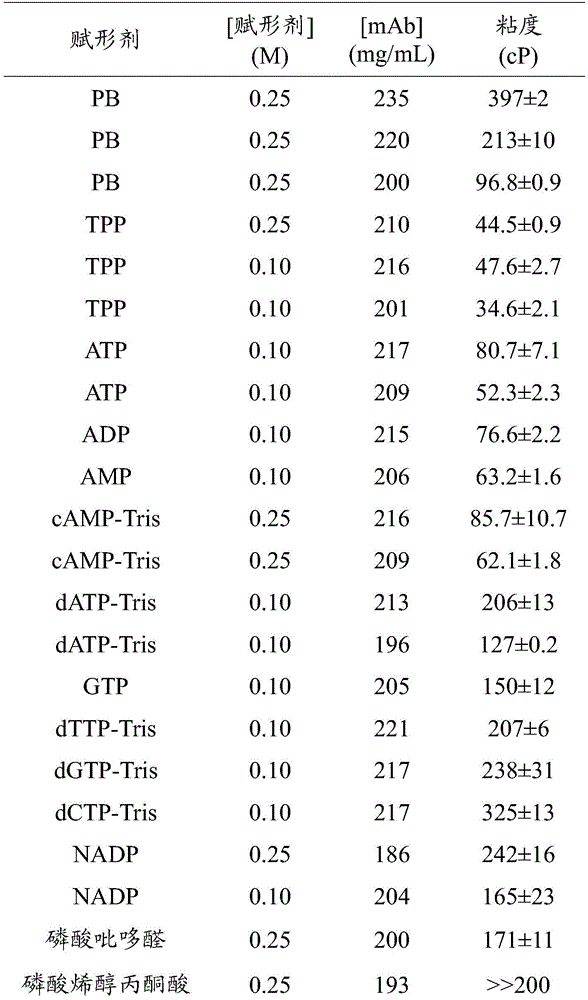

PB:磷酸盐缓冲剂;TPP:焦磷酸硫胺素;ATP:三磷酸腺苷;ADP:二磷酸腺苷;AMP:一磷酸腺苷;cAMP:环腺苷酸;dATP:脱氧三磷酸腺苷;dTTP:脱氧三磷酸胸苷;dGTP:脱氧三磷酸鸟苷;dCTP:脱氧三磷酸胞苷;NADP:烟酰胺腺嘌呤二核苷酸磷酸。除非另有说明,否则所有磷酸盐均为钠盐。PB: phosphate buffer; TPP: thiamine pyrophosphate; ATP: adenosine triphosphate; ADP: adenosine diphosphate; AMP: adenosine monophosphate; cAMP: cyclic adenosine monophosphate; dATP: deoxyadenosine triphosphate; dTTP: deoxytriphosphate Thymidine; dGTP: deoxyguanosine triphosphate; dCTP: deoxycytidine triphosphate; NADP: nicotinamide adenine dinucleotide phosphate. All phosphates are sodium salts unless otherwise stated.
实施例2.生物类似物
市售生物类似物

表2中的数据表明生物类似物
表2.生物类似物
在各种浓度的有机磷酸酯存在下的粘度Viscosity in the presence of various concentrations of organophosphates
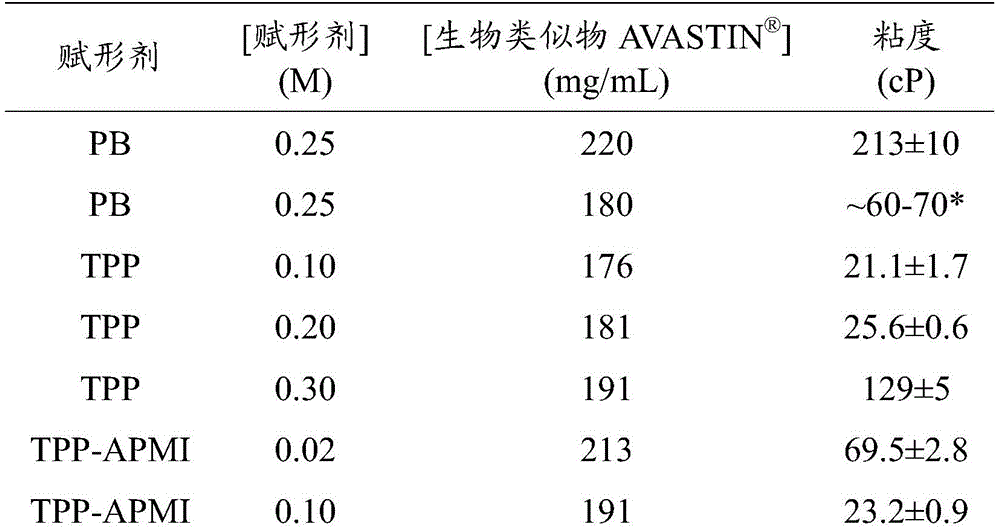
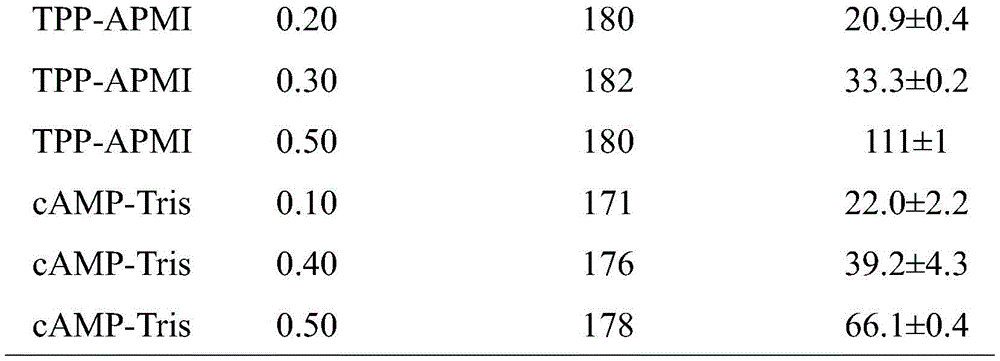
*内插值*Interpolated value
实施例3.有机磷酸酯降低多种治疗相关单克隆抗体的粘度Example 3. Organophosphates reduce the viscosity of various therapeutically relevant monoclonal antibodies
市售生物类似物

以相同方式对含有药用赋形剂(磷酸钠缓冲剂、NaCl、聚山梨醇酯80)的市售




表3中的数据表明使粘度降低的有机磷酸酯可降低多种治疗相关单克隆抗体的浓缩水溶液的粘度。在一些情况下,cAMP-Tris使粘度降低高达约9倍。The data in Table 3 demonstrate that viscosity reducing organophosphates can reduce the viscosity of concentrated aqueous solutions of various therapeutically relevant monoclonal antibodies. In some cases, cAMP-Tris reduced viscosity by up to about 9-fold.
表3.单克隆抗体的水溶液在有机磷酸酯存在下的粘度Table 3. Viscosity of aqueous solutions of monoclonal antibodies in the presence of organophosphates


除非上文另有明确定义,否则本文使用的所有技术和科学术语具有与本领域技术人员通常所理解相同的含义。本领域技术人员仅使用常规实验就将认识到或将能够确定本文所述发明的具体实施方案的多种等效形式。所附权利要求书意在涵盖此类等效形式。Unless explicitly defined otherwise above, all technical and scientific terms used herein have the same meaning as commonly understood by one of ordinary skill in the art. Those skilled in the art will recognize, or will be able to ascertain using no more than routine experimentation, various equivalents to the specific embodiments of the invention described herein. The appended claims are intended to cover such equivalents.
Claims (24)
Applications Claiming Priority (18)
| Application Number | Priority Date | Filing Date | Title |
|---|---|---|---|
| US201361876621P | 2013-09-11 | 2013-09-11 | |
| US61/876,621 | 2013-09-11 | ||
| US201461940227P | 2014-02-14 | 2014-02-14 | |
| US61/940,227 | 2014-02-14 | ||
| US201461943197P | 2014-02-21 | 2014-02-21 | |
| US61/943,197 | 2014-02-21 | ||
| US201461946436P | 2014-02-28 | 2014-02-28 | |
| US61/946,436 | 2014-02-28 | ||
| US201461988005P | 2014-05-02 | 2014-05-02 | |
| US61/988,005 | 2014-05-02 | ||
| US201462008050P | 2014-06-05 | 2014-06-05 | |
| US62/008,050 | 2014-06-05 | ||
| US201462026497P | 2014-07-18 | 2014-07-18 | |
| US62/026,497 | 2014-07-18 | ||
| US201462030521P | 2014-07-29 | 2014-07-29 | |
| US62/030,521 | 2014-07-29 | ||
| PCT/US2014/055210 WO2015038782A1 (en) | 2013-09-11 | 2014-09-11 | Liquid protein formulations containing organophosphates |
| CN201480061378.0A CN105848636B (en) | 2013-09-11 | 2014-09-11 | Liquid protein formulations containing organophosphates |
Related Parent Applications (1)
| Application Number | Title | Priority Date | Filing Date |
|---|---|---|---|
| CN201480061378.0A Division CN105848636B (en) | 2013-09-11 | 2014-09-11 | Liquid protein formulations containing organophosphates |
Publications (2)
| Publication Number | Publication Date |
|---|---|
| CN111202711A CN111202711A (en) | 2020-05-29 |
| CN111202711B true CN111202711B (en) | 2022-06-21 |
Family
ID=51626611
Family Applications (7)
| Application Number | Title | Priority Date | Filing Date |
|---|---|---|---|
| CN201480061378.0A Active CN105848636B (en) | 2013-09-11 | 2014-09-11 | Liquid protein formulations containing organophosphates |
| CN202010059409.6A Active CN111202711B (en) | 2013-09-11 | 2014-09-11 | Liquid protein formulations comprising organophosphates |
| CN201910681927.9A Active CN110496099B (en) | 2013-09-11 | 2014-09-11 | Liquid protein formulations comprising viscosity reducing agents |
| CN201480061504.2A Active CN105722500B (en) | 2013-09-11 | 2014-09-11 | Liquid protein formulations containing ionic liquids |
| CN201480061505.7A Active CN105722501B (en) | 2013-09-11 | 2014-09-11 | Liquid protein formulations containing viscosity reducers |
| CN201910735461.6A Active CN110559435B (en) | 2013-09-11 | 2014-09-11 | Liquid protein formulations comprising ionic liquids |
| CN201480061377.6A Active CN105705139B (en) | 2013-09-11 | 2014-09-11 | Liquid protein formulations containing water-soluble organic dyes |
Family Applications Before (1)
| Application Number | Title | Priority Date | Filing Date |
|---|---|---|---|
| CN201480061378.0A Active CN105848636B (en) | 2013-09-11 | 2014-09-11 | Liquid protein formulations containing organophosphates |
Family Applications After (5)
| Application Number | Title | Priority Date | Filing Date |
|---|---|---|---|
| CN201910681927.9A Active CN110496099B (en) | 2013-09-11 | 2014-09-11 | Liquid protein formulations comprising viscosity reducing agents |
| CN201480061504.2A Active CN105722500B (en) | 2013-09-11 | 2014-09-11 | Liquid protein formulations containing ionic liquids |
| CN201480061505.7A Active CN105722501B (en) | 2013-09-11 | 2014-09-11 | Liquid protein formulations containing viscosity reducers |
| CN201910735461.6A Active CN110559435B (en) | 2013-09-11 | 2014-09-11 | Liquid protein formulations comprising ionic liquids |
| CN201480061377.6A Active CN105705139B (en) | 2013-09-11 | 2014-09-11 | Liquid protein formulations containing water-soluble organic dyes |
Country Status (16)
| Country | Link |
|---|---|
| US (13) | US9833513B2 (en) |
| EP (8) | EP3043772B1 (en) |
| JP (12) | JP6469113B2 (en) |
| KR (5) | KR102289825B1 (en) |
| CN (7) | CN105848636B (en) |
| AU (10) | AU2014318725B2 (en) |
| CA (4) | CA2923844C (en) |
| ES (5) | ES2980815T3 (en) |
| HK (1) | HK1226309A1 (en) |
| IL (5) | IL312865B2 (en) |
| MX (6) | MX386756B (en) |
| RU (2) | RU2710542C2 (en) |
| SG (6) | SG11201601728YA (en) |
| SI (4) | SI3043775T1 (en) |
| WO (4) | WO2015038811A2 (en) |
| ZA (5) | ZA201601968B (en) |
Families Citing this family (76)
| Publication number | Priority date | Publication date | Assignee | Title |
|---|---|---|---|---|
| CN106046159B (en) | 2010-03-12 | 2020-06-16 | 德彪发姆国际有限公司 | CD37 binding molecules and immunoconjugates thereof |
| KR20140031883A (en) | 2011-04-01 | 2014-03-13 | 이뮤노젠 아이엔씨 | Cd37-binding molecules and immunoconjugates thereof |
| UA117466C2 (en) | 2012-12-13 | 2018-08-10 | Мерк Шарп Енд Доме Корп. | STABLE COMPOSITION IN THE VIEW OF AN ANTIBODY ANTIBODY TO IL-23p19 |
| US20140348719A1 (en) * | 2013-03-14 | 2014-11-27 | Bureau Veritas | Pharmaceutical compound stabilizing filter compositions and methods of making and using same |
| IL312865B2 (en) | 2013-09-11 | 2025-06-01 | Eagle Biologics Inc | Liquid protein formulations containing viscosity-reducing agents |
| KR20240017102A (en) * | 2013-12-17 | 2024-02-06 | 제넨테크, 인크. | Methods of treating cancers using pd-1 axis binding antagonists and taxanes |
| AU2015214251B2 (en) | 2014-02-07 | 2017-07-20 | eXIthera Pharmaceuticals Inc. | Therapeutic compounds and compositions |
| US10478498B2 (en) | 2014-06-20 | 2019-11-19 | Reform Biologics, Llc | Excipient compounds for biopolymer formulations |
| WO2015196091A1 (en) | 2014-06-20 | 2015-12-23 | Reform Biologics, Llc | Viscosity-reducing excipient compounds for protein formulations |
| US11357857B2 (en) | 2014-06-20 | 2022-06-14 | Comera Life Sciences, Inc. | Excipient compounds for protein processing |
| CN106999510B (en) | 2014-10-01 | 2021-04-30 | 伊格尔生物制品有限公司 | Polysaccharide and nucleic acid formulations containing viscosity reducing agents |
| EA201792300A1 (en) * | 2015-06-08 | 2018-09-28 | Дебиофарм Интернэшнл, С.А. | COMBINATIONS OF IMMUNOCONGAGED TO CD37 AND ANTIBODIES TO CD20 |
| IL256080B2 (en) | 2015-06-17 | 2025-06-01 | Genentech Inc | Methods for treating locally advanced or metastatic breast cancer using PD-1 axis-binding antagonists and taxanes |
| TWI797060B (en) * | 2015-08-04 | 2023-04-01 | 美商再生元醫藥公司 | Taurine supplemented cell culture medium and methods of use |
| EP4233892A3 (en) * | 2015-08-19 | 2023-10-25 | Astrazeneca AB | Stable anti-ifnar1 formulation |
| JP6890581B2 (en) | 2015-08-28 | 2021-06-18 | デビオファーム インターナショナル, エス. アー. | Antibodies and assays for the detection of CD37 |
| WO2017049205A2 (en) * | 2015-09-18 | 2017-03-23 | Amunix Operating Inc. | Growth hormone formulation |
| WO2017055966A1 (en) * | 2015-10-01 | 2017-04-06 | Pfizer Inc. | Low viscosity antibody compositions |
| CA3129181C (en) | 2015-10-23 | 2023-10-31 | Reform Biologics, Llc | Excipient compounds for biopolymer formulations |
| WO2017075173A2 (en) * | 2015-10-30 | 2017-05-04 | Genentech, Inc. | Anti-factor d antibodies and conjugates |
| US20210206834A1 (en) * | 2015-12-03 | 2021-07-08 | Mor Research Applications Ltd. | Compositions and methods for treatment of ocular diseases |
| WO2017117202A1 (en) * | 2015-12-29 | 2017-07-06 | Oncobiologics, Inc. | Buffered formulations of bevacizumab |
| CN105699555B (en) * | 2016-03-24 | 2018-09-11 | 中国标准化研究院 | A kind of method for preparing liquid chromatography of 1-ethoxy-2-hydroxy-4-propenyl benzene |
| SG11201807474SA (en) * | 2016-04-25 | 2018-11-29 | Medimmune Llc | Compositions comprising coformulation of anti-pd-l1 and anti-ctla-4 antibodies |
| EA201892524A1 (en) * | 2016-05-05 | 2019-04-30 | Дзе Трастиз Оф Дзе Юниверсити Оф Пенсильвания | DNA monoclonal antibodies targeted at IL-6 and CD126 |
| WO2017214332A1 (en) * | 2016-06-07 | 2017-12-14 | National Technology & Engineering Solutions Of Sandia, Llc | Conversion of sugars to ionic liquids |
| MX2019001930A (en) * | 2016-08-18 | 2019-07-04 | Regeneron Pharma | TEST TO DETERMINE THE POTENTIAL FOR THE SELF-ASSOCIATION OF A PROTEIN USING CONCENTRATION DEPENDENT SELF-INTERACTION NANOPARTICLE SPECTROSCOPY. |
| US11274137B1 (en) | 2016-10-04 | 2022-03-15 | United States Of America As Represented By The Secretary Of The Air Force | Ultra-stable protein ionic liquids |
| US11274163B1 (en) | 2016-10-04 | 2022-03-15 | United States Of America As Represented By The Secretary Of The Air Force | Ultra-stable protein ionic liquids |
| US11382976B1 (en) | 2016-10-04 | 2022-07-12 | United States Of America As Represented By The Secretary Of The Air Force | Ultra-stable protein ionic liquids |
| US11385201B1 (en) | 2019-09-30 | 2022-07-12 | United States Of America As Represented By The Secretary Of The Air Force | Ultra-stable protein ionic liquids |
| US11274289B1 (en) | 2016-10-04 | 2022-03-15 | United States Of America As Represented By The Secretary Of The Air Force | Ultra-stable protein ionic liquids |
| US10463733B1 (en) | 2016-10-04 | 2019-11-05 | United States of America as represented by the Secetary of the Air Force | Ultra-stable protein ionic liquids |
| CN117244056A (en) * | 2016-10-27 | 2023-12-19 | 卫材研究发展管理有限公司 | Composition containing anti-Aβ profibril antibody and β-secretase BACE1 inhibitor for treating Alzheimer's disease |
| CN116407644A (en) * | 2016-11-02 | 2023-07-11 | 波拉里集团 | Formulations of pegylated arginine deiminase |
| JP2020510608A (en) | 2016-11-02 | 2020-04-09 | デビオファーム インターナショナル, エス. アー. | Method for improving anti-CD37 immunoconjugate therapy |
| EP3582801A4 (en) * | 2017-02-16 | 2020-12-23 | Reform Biologics LLC | ADDITIVE COMPOUNDS FOR PROTEIN PROCESSING |
| JOP20190204A1 (en) * | 2017-03-08 | 2019-09-05 | Actelion Pharmaceuticals Ltd | Pharmaceutical composition comprising selexipag |
| US9901545B1 (en) | 2017-04-13 | 2018-02-27 | Richard C. Fuisz | Method and composition for making an oral soluble film, containing at least one active agent |
| US10238600B2 (en) | 2017-04-13 | 2019-03-26 | Richard C. Fuisz | Package, system and methods for custody and control of drugs, and method and composition for making an oral soluble film, containing at least one active agent |
| WO2018193471A1 (en) * | 2017-04-18 | 2018-10-25 | Dr. Reddy's Laboratories Limited | Stable liquid pharmaceutical composition |
| US12257343B2 (en) | 2017-04-28 | 2025-03-25 | Amgen Inc. | Excipients to reduce the viscosity of antibody formulations and formulation compositions |
| JOP20190260A1 (en) | 2017-05-02 | 2019-10-31 | Merck Sharp & Dohme | Stable formulations of programmed death receptor 1 (pd-1) antibodies and methods of use thereof |
| WO2018204374A1 (en) | 2017-05-02 | 2018-11-08 | Merck Sharp & Dohme Corp. | Formulations of anti-lag3 antibodies and co-formulations of anti-lag3 antibodies and anti-pd-1 antibodies |
| CA3063324A1 (en) | 2017-05-16 | 2018-11-22 | Bhami's Research Laboratory, Pvt. Ltd. | High concentration protein formulations with reduced viscosity |
| EP3646887A4 (en) * | 2017-06-30 | 2021-03-24 | Korea Advanced Institute of Science and Technology | VEGF-GRAB PROTEIN AND DRUG CONJUGATE, AND ITS USE |
| KR20200044066A (en) * | 2017-08-22 | 2020-04-28 | 바이오젠 엠에이 인코포레이티드 | Pharmaceutical compositions and dosing regimens containing anti-alpha (V) beta (6) antibodies |
| EP3678700B1 (en) * | 2017-09-05 | 2024-06-19 | Merck Sharp & Dohme LLC | Compounds for reducing the viscosity of biological formulations |
| US20200261549A1 (en) * | 2017-11-07 | 2020-08-20 | Alphacore Pharma Llc | Methods of treating and protecting against cardiac disease, cardiovascular disease and related conditions and symptoms |
| CN111918644A (en) | 2017-11-17 | 2020-11-10 | 哈佛大学校长及研究员协会 | Ionic liquids for internal delivery |
| CN108096185A (en) * | 2017-12-20 | 2018-06-01 | 珠海冀百康生物科技有限公司 | A kind of Insulin Aspart and preparation method thereof |
| KR102493469B1 (en) * | 2018-03-07 | 2023-02-07 | 코메라 라이프 사이언시스, 인코포레이티드 | Excipient compounds for protein formulations |
| CN111989121B (en) * | 2018-04-16 | 2024-08-13 | 默克专利股份有限公司 | Viscosity reduction of highly concentrated protein formulations |
| CN108671229B (en) * | 2018-05-08 | 2022-03-25 | 华博生物医药技术(上海)有限公司 | Pharmaceutical composition preparation of recombinant human vascular endothelial growth factor receptor-antibody fusion protein |
| CN112218662A (en) | 2018-05-30 | 2021-01-12 | 德彪发姆国际有限公司 | anti-CD 37 immunoconjugate dosing regimen |
| WO2020017901A1 (en) * | 2018-07-19 | 2020-01-23 | (주)셀트리온 | Stable liquid pharmaceutical preparation |
| CA3113560A1 (en) * | 2018-10-19 | 2020-04-23 | F. Hoffmann-La Roche Ag | Microdosing |
| BR112021008873A8 (en) | 2018-11-07 | 2023-04-11 | Merck Sharp & Dohme | FORMULATION |
| JP7637618B2 (en) * | 2018-11-21 | 2025-02-28 | リジェネロン・ファーマシューティカルズ・インコーポレイテッド | Highly concentrated protein formulations |
| US11058770B1 (en) * | 2019-01-24 | 2021-07-13 | United States Of America As Represented By The Secretary Of The Air Force | Ultrastable antibody ionic liquids |
| KR102735988B1 (en) | 2019-02-18 | 2024-12-03 | 일라이 릴리 앤드 캄파니 | therapeutic antibody preparations |
| US12533315B2 (en) | 2019-03-01 | 2026-01-27 | President And Fellows Of Harvard College | Compositions comprising at least one ionic liquid, a polypeptide, and at least one non-ionic surfactant for protein delivery |
| US20220220196A1 (en) * | 2019-04-24 | 2022-07-14 | Janssen Biotech, Inc. | Antibody formulation |
| EP3771463A1 (en) | 2019-07-29 | 2021-02-03 | Ludwig-Maximilians-Universität München | Stabilizing therapeutic proteins with piperazin- or morpholine-containing zwitterionic buffering substances |
| JP7791813B2 (en) * | 2019-09-17 | 2025-12-24 | メルク パテント ゲゼルシャフト ミット ベシュレンクテル ハフツング | Camphorsulfonic acid and its combination with cationic excipients as viscosity-reducing agents in highly concentrated protein formulations |
| US11684594B2 (en) | 2020-05-12 | 2023-06-27 | President And Fellows Of Harvard College | Antifungal prophylaxis for cornea |
| WO2022178279A1 (en) | 2021-02-19 | 2022-08-25 | Nova Thin Film Pharmaceuticals Llc | Method and system for manufacturing oral soluble films, compositions of oral soluble films, oral soluble films made by thereby, and methods of use thereof |
| AU2021308997A1 (en) * | 2020-07-13 | 2023-02-02 | Merck Patent Gmbh | Viscosity reducing excipients and combinations thereof for highly concentrated protein formulations |
| EP4208160A4 (en) * | 2020-09-01 | 2024-12-18 | I2O Therapeutics, Inc. | Ionic liquid formulations for treating diabetes |
| CN113249358B (en) * | 2021-05-14 | 2022-10-14 | 天津大学 | Method for regulating and controlling crystal form of lysozyme by using ionic liquid |
| JP2024527538A (en) * | 2021-07-01 | 2024-07-25 | アップカラ インコーポレイテッド | Ultra-concentrated formulation of bioactive agents |
| WO2023025437A1 (en) * | 2021-08-25 | 2023-03-02 | Guido Knobel | Device for preparing a pharmaceutical, a food supplement or a cosmetic |
| JP2024544920A (en) | 2021-11-10 | 2024-12-05 | アイ2オー セラピューティクス,インク. | Ionic liquid composition |
| CN115350330B (en) * | 2022-09-01 | 2023-10-20 | 北京化工大学 | Application of a negatively charged small molecule-controlled surface in differential protein adhesion |
| KR20250152101A (en) | 2023-03-13 | 2025-10-22 | 하이델베르크 파마 리서치 게엠베하 | Subcutaneous antibody-drug conjugates for use in cancer treatment |
| US20260015427A1 (en) | 2024-06-25 | 2026-01-15 | Kiniksa Pharmaceuticals, Gmbh | Formulations of anti-interleukin 1 receptor 1 antibodies |
Citations (5)
| Publication number | Priority date | Publication date | Assignee | Title |
|---|---|---|---|---|
| CN101111264A (en) * | 2005-01-28 | 2008-01-23 | 惠氏公司 | Stabilized Liquid Peptide Formulations |
| CN101378782A (en) * | 2005-12-21 | 2009-03-04 | 惠氏公司 | Protein formulations with reduced viscosity and uses thereof |
| CN102573459A (en) * | 2009-08-04 | 2012-07-11 | 弗·哈夫曼-拉罗切有限公司 | Concentrated polypeptide formulations with reduced viscosity |
| CN102946861A (en) * | 2010-03-01 | 2013-02-27 | 普罗杰尼克制药股份有限公司 | Concentrated protein formulations and uses thereof |
| CN102946903A (en) * | 2010-05-14 | 2013-02-27 | 安进公司 | High concentration antibody formulations |
Family Cites Families (178)
| Publication number | Priority date | Publication date | Assignee | Title |
|---|---|---|---|---|
| US190082A (en) | 1877-04-24 | Improvement in apparatus for cooling liquids | ||
| GB750373A (en) | 1953-01-15 | 1956-06-13 | Pfizer & Co C | Improvements in or relating to injectable suspension of penicillin salts |
| DK128416B (en) | 1964-08-13 | 1974-04-29 | Ciba Geigy Ag | Analogous process for the preparation of adrenocorticotropically active nonadecapeptide amides or acid addition salts or complex compounds thereof. |
| BE757195A (en) | 1969-10-07 | 1971-03-16 | Century Disposable Devices | SYRINGE FOR INJECTING A FRESHLY PREPARED MIXTURE OF POWDER AND LIQUID |
| JPS5270014A (en) | 1975-12-05 | 1977-06-10 | Senju Pharma Co | Stabilization of pyrido*3*22a*phenoxadine compounds |
| US4171698A (en) | 1977-08-15 | 1979-10-23 | Abbott Laboratories | Prefilled two-compartment syringe |
| US4816567A (en) | 1983-04-08 | 1989-03-28 | Genentech, Inc. | Recombinant immunoglobin preparations |
| US5168062A (en) | 1985-01-30 | 1992-12-01 | University Of Iowa Research Foundation | Transfer vectors and microorganisms containing human cytomegalovirus immediate-early promoter-regulatory DNA sequence |
| US5506337A (en) | 1985-03-15 | 1996-04-09 | Antivirals Inc. | Morpholino-subunit combinatorial library and method |
| US5166315A (en) | 1989-12-20 | 1992-11-24 | Anti-Gene Development Group | Sequence-specific binding polymers for duplex nucleic acids |
| US5217866A (en) | 1985-03-15 | 1993-06-08 | Anti-Gene Development Group | Polynucleotide assay reagent and method |
| US5521063A (en) | 1985-03-15 | 1996-05-28 | Antivirals Inc. | Polynucleotide reagent containing chiral subunits and methods of use |
| US5034506A (en) | 1985-03-15 | 1991-07-23 | Anti-Gene Development Group | Uncharged morpholino-based polymers having achiral intersubunit linkages |
| DE3687030T2 (en) | 1985-03-15 | 1993-03-11 | Eugene Stirchak | STEREO-REGULAR POLYNUCLEOTID-BINDING POLYMERS. |
| AU4128089A (en) | 1988-09-15 | 1990-03-22 | Rorer International (Overseas) Inc. | Monoclonal antibodies specific to human epidermal growth factor receptor and therapeutic methods employing same |
| US5001000A (en) | 1988-09-26 | 1991-03-19 | E. I. Du Pont De Nemours And Company | Process for forming a composite structure of thermoplastic polymer and sheet molding compound |
| US5114703A (en) | 1989-05-30 | 1992-05-19 | Alliance Pharmaceutical Corp. | Percutaneous lymphography using particulate fluorocarbon emulsions |
| US5730978A (en) | 1989-09-01 | 1998-03-24 | Fred Hutchinson Cancer Research Center | Inhibition of lymphocyte adherence with α4β1-specific antibodies |
| US6033665A (en) | 1989-09-27 | 2000-03-07 | Elan Pharmaceuticals, Inc. | Compositions and methods for modulating leukocyte adhesion to brain endothelial cells |
| JPH03190823A (en) * | 1989-12-21 | 1991-08-20 | Snow Brand Milk Prod Co Ltd | Erythropoietin hypodermic or intramuscular administration agent |
| US5698195A (en) | 1991-03-18 | 1997-12-16 | New York University Medical Center | Methods of treating rheumatoid arthritis using chimeric anti-TNF antibodies |
| US5539082A (en) | 1993-04-26 | 1996-07-23 | Nielsen; Peter E. | Peptide nucleic acids |
| US5714331A (en) | 1991-05-24 | 1998-02-03 | Buchardt, Deceased; Ole | Peptide nucleic acids having enhanced binding affinity, sequence specificity and solubility |
| WO1994004679A1 (en) | 1991-06-14 | 1994-03-03 | Genentech, Inc. | Method for making humanized antibodies |
| JP4124480B2 (en) | 1991-06-14 | 2008-07-23 | ジェネンテック・インコーポレーテッド | Immunoglobulin variants |
| US5356802A (en) | 1992-04-03 | 1994-10-18 | The Johns Hopkins University | Functional domains in flavobacterium okeanokoites (FokI) restriction endonuclease |
| US5487994A (en) | 1992-04-03 | 1996-01-30 | The Johns Hopkins University | Insertion and deletion mutants of FokI restriction endonuclease |
| US5436150A (en) | 1992-04-03 | 1995-07-25 | The Johns Hopkins University | Functional domains in flavobacterium okeanokoities (foki) restriction endonuclease |
| US5736137A (en) | 1992-11-13 | 1998-04-07 | Idec Pharmaceuticals Corporation | Therapeutic application of chimeric and radiolabeled antibodies to human B lymphocyte restricted differentiation antigen for treatment of B cell lymphoma |
| DK0678122T3 (en) | 1993-01-12 | 2000-03-06 | Biogen Inc | Recombinant anti-VLA4 antibody molecules |
| US5334162A (en) | 1993-03-15 | 1994-08-02 | Eli Lilly And Company | Cartridge assembly for a lyophilized compound forming a disposable portion of an injector pen and method for same |
| US5744155A (en) | 1993-08-13 | 1998-04-28 | Friedman; Doron | Bioadhesive emulsion preparations for enhanced drug delivery |
| US5527675A (en) | 1993-08-20 | 1996-06-18 | Millipore Corporation | Method for degradation and sequencing of polymers which sequentially eliminate terminal residues |
| DE4331012A1 (en) | 1993-09-13 | 1995-03-16 | Bayer Ag | Nucleic acid-binding oligomers with N-branching for therapy and diagnostics |
| DE4344824C1 (en) | 1993-12-28 | 1995-08-31 | Immuno Ag | Highly concentrated immunoglobulin preparation and process for its preparation |
| US5840299A (en) | 1994-01-25 | 1998-11-24 | Athena Neurosciences, Inc. | Humanized antibodies against leukocyte adhesion molecule VLA-4 |
| GB9418092D0 (en) | 1994-09-08 | 1994-10-26 | Red Cross Found Cent Lab Blood | Organic compounds |
| JP3524974B2 (en) * | 1994-12-26 | 2004-05-10 | ブラッコ インターナショナル ビーヴィ | Prefilled syringe and package thereof |
| US5569193A (en) | 1995-03-22 | 1996-10-29 | Abbott Laboratories | Syringe system accommodating separately storable prefilled containers for two constituents |
| US5779668A (en) | 1995-03-29 | 1998-07-14 | Abbott Laboratories | Syringe barrel for lyophilization, reconstitution and administration |
| US5641870A (en) | 1995-04-20 | 1997-06-24 | Genentech, Inc. | Low pH hydrophobic interaction chromatography for antibody purification |
| US6685940B2 (en) | 1995-07-27 | 2004-02-03 | Genentech, Inc. | Protein formulation |
| US6267958B1 (en) | 1995-07-27 | 2001-07-31 | Genentech, Inc. | Protein formulation |
| DE19617369A1 (en) | 1996-04-30 | 1997-11-06 | Immuno Ag | Storage-stable fibrinogen preparations |
| US6184037B1 (en) | 1996-05-17 | 2001-02-06 | Genemedicine, Inc. | Chitosan related compositions and methods for delivery of nucleic acids and oligonucleotides into a cell |
| GB9610992D0 (en) | 1996-05-24 | 1996-07-31 | Glaxo Group Ltd | Concentrated antibody preparation |
| US5819998A (en) | 1996-09-30 | 1998-10-13 | Everything Kids | Knapsack with simulated basketball court |
| IN184589B (en) | 1996-10-16 | 2000-09-09 | Alza Corp | |
| US6065645A (en) | 1997-04-01 | 2000-05-23 | Discus Dental Impressions, Inc. | Double-barreled syringe with detachable locking mixing tip |
| US5819988A (en) | 1997-04-01 | 1998-10-13 | Sawhney; Ravi K. | Double-barreled syringe with detachable locking mixing tip |
| US6235883B1 (en) | 1997-05-05 | 2001-05-22 | Abgenix, Inc. | Human monoclonal antibodies to epidermal growth factor receptor |
| US5786571A (en) | 1997-05-09 | 1998-07-28 | Lexmark International, Inc. | Wrapped temperature sensing assembly |
| US6171586B1 (en) | 1997-06-13 | 2001-01-09 | Genentech, Inc. | Antibody formulation |
| DE69837493T2 (en) | 1997-10-15 | 2007-12-13 | Asahi Kasei Pharma Corp. | PROCESS FOR THE QUALITY ASSURANCE OF AQUEOUS PARENTERAL SOLUTIONS WITH THROMBOMODULIN IN STORAGE AND DISTRIBUTION |
| DE69837399T2 (en) | 1997-10-22 | 2007-12-20 | Chugai Seiyaku K.K. | PROCESS FOR SCREENING TGF-BETA INHIBITED SUBSTANCES |
| US7919109B2 (en) | 1999-02-08 | 2011-04-05 | Intarcia Therapeutics, Inc. | Stable non-aqueous single phase viscous vehicles and formulations utilizing such vehicles |
| FR2794649B1 (en) | 1999-06-11 | 2003-04-11 | Solutions | BIOMATERIAL BASED ON AN INSOLUBILIZED DEXTRAN DERIVATIVE AND A GROWTH FACTOR, METHOD FOR PREPARING SAME AND ITS APPLICATIONS |
| AUPQ132599A0 (en) | 1999-07-01 | 1999-07-22 | Commonwealth Scientific And Industrial Research Organisation | Nasogastric enteral formulations |
| US7030097B1 (en) | 1999-07-14 | 2006-04-18 | Cornell Research Foundation, Inc. | Controlled nucleic acid delivery systems |
| EP1072323B1 (en) | 1999-07-29 | 2003-09-10 | Wilhelm A. Keller | Cartridge discharge device with actuator for dynamic mixers |
| CN100389821C (en) | 1999-10-04 | 2008-05-28 | 希龙公司 | Stabilized polypeptide-containing liquid pharmaceutical composition |
| US6394314B1 (en) | 1999-10-12 | 2002-05-28 | Discus Dental Impressions, Inc. | Double-barreled syringe with detachable locking mixing tip |
| US6443612B1 (en) | 1999-12-02 | 2002-09-03 | Wilhelm A. Keller | Dynamic mixer |
| US8703126B2 (en) | 2000-10-12 | 2014-04-22 | Genentech, Inc. | Reduced-viscosity concentrated protein formulations |
| DE60139944D1 (en) | 2000-10-12 | 2009-10-29 | Genentech Inc | LOW VISCOSIS CONCENTRATED PROTEIN FORMULATIONS |
| CA2430499C (en) | 2000-11-30 | 2012-05-22 | Biovalve Technologies, Inc. | Injection systems |
| IL155991A0 (en) | 2000-12-01 | 2003-12-23 | Max Planck Gesellschaft | Rna interference mediating small rna molecules |
| EP1392827A4 (en) | 2001-05-16 | 2005-12-21 | Biomarin Pharm Inc | DESTRUCTION OF PRIONS USING VIBRIOLYSIN OR VARIANTS THEREOF |
| GB0113179D0 (en) | 2001-05-31 | 2001-07-25 | Novartis Ag | Organic compounds |
| US7758890B2 (en) | 2001-06-23 | 2010-07-20 | Lyotropic Therapeutics, Inc. | Treatment using dantrolene |
| CA2454587C (en) | 2001-07-25 | 2012-11-13 | Protein Design Labs, Inc. | Stable lyophilized pharmaceutical formulation of igg antibodies |
| EP1414765A2 (en) | 2001-08-02 | 2004-05-06 | 3M Innovative Properties Company | Method of making amorphous materials and ceramics |
| JP4167820B2 (en) * | 2001-10-19 | 2008-10-22 | アルインコ株式会社 | Deck plate traveling cart |
| GB0212405D0 (en) | 2002-05-29 | 2002-07-10 | Insignion Holdings Ltd | Composition and its therapeutic use |
| WO2004012703A1 (en) * | 2002-07-31 | 2004-02-12 | Alza Corporation | Injectable depot compositions and uses thereof |
| US9415102B2 (en) | 2002-09-06 | 2016-08-16 | Alexion Pharmaceuticals, Inc. | High concentration formulations of anti-C5 antibodies |
| AU2003293543A1 (en) | 2002-12-13 | 2004-07-09 | Abgenix, Inc. | System and method for stabilizing antibodies with histidine |
| EA009383B1 (en) | 2003-03-05 | 2007-12-28 | Хэлозим, Инк. | SOLUBLE HYALURONIDASE (sHASEGP), PROCESS FOR PREPARING THE SAME, USES AND PHARMACEUTICAL COMPOSITIONS COMPRISING THEREOF |
| NZ542867A (en) | 2003-03-31 | 2009-02-28 | Durect Corp | Non-aqueous single phase vehicles and formulations utilizing such vehicles involving a polymer |
| US20050158303A1 (en) | 2003-04-04 | 2005-07-21 | Genentech, Inc. | Methods of treating IgE-mediated disorders comprising the administration of high concentration anti-IgE antibody formulations |
| PL1610820T5 (en) | 2003-04-04 | 2014-01-31 | Genentech Inc | High concentration antibody and protein formulations |
| WO2005030119A2 (en) | 2003-04-11 | 2005-04-07 | Allergan, Inc. | Botulinum toxin a peptides and methods of predicting and reducing immunoresistance to botulinum toxin therapy |
| WO2004092361A1 (en) | 2003-04-15 | 2004-10-28 | Ista Pharmaceuticals, Inc. | Process for isolating and purifing ovine hyaluronidase |
| US20040247672A1 (en) | 2003-05-16 | 2004-12-09 | Alkermes Controlled Therapeutics, Inc. | Injectable sustained release compositions |
| US20070184084A1 (en) | 2003-05-30 | 2007-08-09 | Guohua Chen | Implantable elastomeric caprolactone depot compositions and uses thereof |
| EP2392923B1 (en) | 2003-06-18 | 2014-05-21 | The Scripps Research Institute | Method of producing proteins comprising unnatural amino acid |
| US20050019337A1 (en) | 2003-06-23 | 2005-01-27 | Ryall Robert P. | Immunization method against Neisseria meningitidis serogroups A and C |
| CN1206344C (en) | 2003-07-28 | 2005-06-15 | 中国海洋大学 | Method for producing fucan sulfatase by means of bacteria |
| GB0327723D0 (en) | 2003-09-15 | 2003-12-31 | Vectura Ltd | Pharmaceutical compositions |
| WO2005094785A2 (en) * | 2003-09-17 | 2005-10-13 | Chiasma, Ltd. | Compositions capable of facilitating penetration across a biological barrier |
| EP1532983A1 (en) | 2003-11-18 | 2005-05-25 | ZLB Bioplasma AG | Immunoglobulin preparations having increased stability |
| GB0403938D0 (en) | 2004-02-21 | 2004-03-24 | West Pharm Serv Drug Res Ltd | Chitosan containing solution |
| DK1781705T3 (en) | 2004-06-21 | 2015-01-12 | Squibb & Sons Llc | Interferon-alpha receptor 1 antibodies and uses thereof |
| ATE469191T1 (en) * | 2004-11-25 | 2010-06-15 | Chr Hansen As | METHOD FOR PRODUCING A CARMINAL ACID LACQUER |
| US20060141040A1 (en) | 2004-12-23 | 2006-06-29 | Guohua Chen | Injectable non-aqueous suspension |
| US20060142234A1 (en) | 2004-12-23 | 2006-06-29 | Guohua Chen | Injectable non-aqueous suspension |
| CN101326275B (en) * | 2005-10-07 | 2013-06-05 | 阿拉巴马大学 | Multifunctional ionic liquid composition |
| CN100416002C (en) * | 2005-10-26 | 2008-09-03 | 曲新华 | Sewage recycling apparatus |
| US9309316B2 (en) | 2005-12-20 | 2016-04-12 | Bristol-Myers Squibb Company | Stable subcutaneous protein formulations and uses thereof |
| TW200738261A (en) | 2005-12-20 | 2007-10-16 | Bristol Myers Squibb Co | Stable protein formulations |
| JP5231810B2 (en) | 2005-12-28 | 2013-07-10 | 中外製薬株式会社 | Antibody-containing stabilized preparation |
| CN1823768A (en) | 2006-01-09 | 2006-08-30 | 徐新盛 | Cimetidine freeze dried composition |
| AU2007212147A1 (en) | 2006-02-03 | 2007-08-16 | Medimmune, Llc | Protein formulations |
| DE102006005094A1 (en) | 2006-02-04 | 2007-08-09 | Degussa Gmbh | Titanium dioxide and polycarboxylate ether-containing dispersion |
| ITMI20061030A1 (en) | 2006-05-26 | 2007-11-27 | Altergon Sa | NEW COMPOSITION INCLUDING GLYCOSAMINOGLICANS WITH CONTROLLED VISCOSITY AND USE OF SUCH COMPOSITION IN THE THERAPY OF CHRONIC CYSTITIS |
| CU23526B6 (en) | 2006-10-03 | 2010-05-19 | Ct Ingenieria Genetica Biotech | METHOD FOR MORFOFUNCTIONAL RESTORATION OF PERIPHERAL NERVES IN DIABETIC NEUROPATHY |
| WO2008092084A2 (en) | 2007-01-26 | 2008-07-31 | Centocor, Inc. | Injectable non-aqueous suspension with high concentration of therapeutic agent |
| CN103961315A (en) | 2007-05-31 | 2014-08-06 | 安特里奥公司 | Nucleic acid nanoparticles and uses therefor |
| JP5645659B2 (en) | 2007-07-20 | 2014-12-24 | アプライド マテリアルズ インコーポレイテッドApplied Materials,Incorporated | RF choke for gas delivery, plasma processing apparatus and method having RF choke for gas delivery |
| WO2009015367A2 (en) | 2007-07-25 | 2009-01-29 | Arizona Board Of Regents For And On Behalf Of Arizona State University | Stabilizing proteins using ionic liquids |
| AU2008289225A1 (en) | 2007-08-17 | 2009-02-26 | Amgen Inc. | Formulations of antibodies and Fc-fusion molecules using polycations |
| CA2701032C (en) | 2007-09-27 | 2021-01-26 | Amgen Inc. | Pharmaceutical formulations |
| CN101861335B (en) | 2007-10-16 | 2013-09-04 | 环状药物公司 | Manufacture, composition and use of modulators of coagulation factor VIIA |
| ES2962777T3 (en) | 2007-11-15 | 2024-03-21 | Amgen Inc | Antioxidant-stabilized aqueous antibody formulation for parenteral administration |
| KR20210049186A (en) | 2007-11-30 | 2021-05-04 | 애브비 바이오테크놀로지 리미티드 | Protein formulations and methods of making same |
| WO2009086062A1 (en) | 2007-12-21 | 2009-07-09 | Lyotropic Therapeutics, Inc. | Stabilized formulations of peptides and proteins |
| PE20091174A1 (en) | 2007-12-27 | 2009-08-03 | Chugai Pharmaceutical Co Ltd | LIQUID FORMULATION WITH HIGH CONCENTRATION OF ANTIBODY CONTENT |
| US20120251615A1 (en) * | 2008-01-18 | 2012-10-04 | Horst Kief | Agent for intra-articular injection |
| WO2009120684A1 (en) * | 2008-03-25 | 2009-10-01 | Medimmune, Llc | Antibody formulation |
| WO2009137471A2 (en) | 2008-05-05 | 2009-11-12 | University Of Miami | Azo dye related small molecule modulators of protein-protein interactions |
| EP2123307A1 (en) | 2008-05-20 | 2009-11-25 | Hexal Ag | Method for reducing leachables and extractables in syringes |
| JP5711138B2 (en) | 2008-11-16 | 2015-04-30 | ボード・オブ・リージエンツ,ザ・ユニバーシテイ・オブ・テキサス・システム | High concentration low viscosity suspension |
| TWI342781B (en) | 2008-12-01 | 2011-06-01 | Univ China Medical | Blood sugar-modulating polypeptides |
| SG174258A1 (en) | 2009-03-06 | 2011-10-28 | Genentech Inc | Antibody formulation |
| CN102458469B (en) * | 2009-05-04 | 2014-12-24 | 艾伯维生物技术有限公司 | Stable high protein concentration formulations of human anti-TNF-α antibodies |
| WO2010132047A1 (en) * | 2009-05-14 | 2010-11-18 | Rensselaer Polytechnic Institute | Guanosine/gmp gels and uses thereof |
| EP2434290B1 (en) | 2009-05-20 | 2016-02-10 | Sekisui Medical Co., Ltd. | Blood coagulation time prolonging agent |
| EP2475376B1 (en) | 2009-06-17 | 2016-03-30 | BioMarin Pharmaceutical Inc. | Formulations for lysosomal enzymes |
| EP2458990B1 (en) * | 2009-07-28 | 2016-03-30 | Merck Sharp & Dohme Corp. | Methods for producing high concentration lyophilized pharmaceutical formulations |
| US9345661B2 (en) * | 2009-07-31 | 2016-05-24 | Genentech, Inc. | Subcutaneous anti-HER2 antibody formulations and uses thereof |
| AR078161A1 (en) * | 2009-09-11 | 2011-10-19 | Hoffmann La Roche | VERY CONCENTRATED PHARMACEUTICAL FORMULATIONS OF AN ANTIBODY ANTI CD20. USE OF THE FORMULATION. TREATMENT METHOD |
| PL2477603T3 (en) | 2009-09-17 | 2016-10-31 | Stable co-formulation of hyaluronidase and immunoglobulin, and methods of use thereof | |
| EP2491123B1 (en) | 2009-10-20 | 2018-04-18 | The Regents of The University of California | Single molecule nucleic acid nanoparticles |
| UY32979A (en) | 2009-10-28 | 2011-02-28 | Abbott Lab | IMMUNOGLOBULINS WITH DUAL VARIABLE DOMAIN AND USES OF THE SAME |
| EP3721904B1 (en) | 2009-11-20 | 2021-10-13 | Biocon Limited | Formulations of t1h antibody |
| WO2011069037A2 (en) * | 2009-12-03 | 2011-06-09 | The University Of North Carolina At Charlotte | Stabilization and storage of biological pharmaceutical compositions |
| TR201815882T4 (en) | 2009-12-10 | 2018-11-21 | Univ Iowa State Res Found Inc | Tal effector mediated DNA modification. |
| EP2521528B1 (en) | 2010-01-08 | 2014-08-20 | Chanel Parfums Beauté | Use of at least one extract of flowers of camellia japonica alba plena for moisturizing the skin |
| DK2531218T3 (en) | 2010-02-04 | 2019-04-01 | Csl Behring Ag | immunoglobulin |
| SI3409289T1 (en) | 2010-02-26 | 2020-12-31 | Novo Nordisk A/S | Stable antibody containing compositions |
| WO2011109415A2 (en) | 2010-03-02 | 2011-09-09 | Amgen Inc. | Reducing viscosity of pharmaceutical formulations |
| US20110223208A1 (en) * | 2010-03-09 | 2011-09-15 | Beth Hill | Non-Aqueous High Concentration Reduced Viscosity Suspension Formulations |
| US9072668B2 (en) | 2010-03-09 | 2015-07-07 | Janssen Biotech, Inc. | Non-aqueous high concentration reduced viscosity suspension formulations of antibodies |
| EP2547365A1 (en) | 2010-03-17 | 2013-01-23 | Abbott Research B.V. | Anti-nerve growth factor (ngf) antibody compositions |
| CA2794631A1 (en) * | 2010-03-31 | 2011-10-06 | Universite De Geneve | Stabilized antibody preparations and uses thereof |
| CN101851267A (en) | 2010-04-22 | 2010-10-06 | 江南大学 | A kind of antibody protective agent and its application |
| WO2011139718A1 (en) | 2010-05-03 | 2011-11-10 | Genentech, Inc. | Compositions and methods useful for reducing the viscosity of protein-containing formulations |
| GB201012179D0 (en) | 2010-07-20 | 2010-09-01 | Future Injection Technologies | Injection device |
| AU2011325974B2 (en) * | 2010-11-11 | 2016-10-27 | Abbvie Biotechnology Ltd. | Improved high concentration anti-TNFalpha antibody liquid formulations |
| US8936827B2 (en) | 2011-02-25 | 2015-01-20 | Abbott Cardiovascular Systems Inc. | Methods of loading a hollow stent with a drug or drug formulation |
| AU2012240050B2 (en) | 2011-04-07 | 2016-01-21 | Glaxosmithkline Llc | Formulations with reduced viscosity |
| EP2694708A4 (en) | 2011-04-07 | 2014-10-01 | Glaxosmithkline Llc | FORMULATIONS WITH REDUCED VISCOSITY |
| CA2836042C (en) | 2011-05-12 | 2019-04-02 | Medrad, Inc. | Fluid injection system having various systems for controlling an injection procedure |
| RU2485133C2 (en) | 2011-05-30 | 2013-06-20 | Закрытое Акционерное Общество "Фарм-Синтез" | Protein-polypeptide complex possessing tissue-specific regenerative-reparative and rejuvenating action on skin tissue, method for preparing it, and pharmaceutical composition thereof |
| CN102349895B (en) | 2011-09-28 | 2013-04-10 | 海南良方医药有限公司 | Cimetidine composition for injection and preparation method thereof |
| US11707410B2 (en) | 2011-10-25 | 2023-07-25 | Corning Incorporated | Delamination resistant pharmaceutical glass containers containing active pharmaceutical ingredients |
| CA2951856A1 (en) | 2011-10-28 | 2013-05-02 | Integritybio Inc. | Protein formulations containing amino acids |
| WO2013096791A1 (en) | 2011-12-23 | 2013-06-27 | Genentech, Inc. | Process for making high concentration protein formulations |
| WO2013096835A1 (en) * | 2011-12-23 | 2013-06-27 | Abbvie Inc. | Stable protein formulations |
| AU2013211824B2 (en) * | 2012-01-27 | 2017-06-01 | Gliknik Inc. | Fusion proteins comprising IgG2 hinge domains |
| NZ629204A (en) | 2012-02-16 | 2016-09-30 | Santarus Inc | Anti-vla1 (cd49a) antibody pharmaceutical compositions |
| WO2013173789A2 (en) | 2012-05-17 | 2013-11-21 | Isis Pharmaceuticals, Inc. | Antisense oligonucleotide compositions |
| US9574193B2 (en) | 2012-05-17 | 2017-02-21 | Ionis Pharmaceuticals, Inc. | Methods and compositions for modulating apolipoprotein (a) expression |
| MX389346B (en) | 2012-05-18 | 2025-03-20 | Genentech Inc | HIGH CONCENTRATION MONOCLONAL ANTIBODY FORMULATIONS. |
| PT3241902T (en) | 2012-05-25 | 2018-05-28 | Univ California | METHODS AND COMPOSITIONS FOR MODIFICATION OF TARGETED TARGET DNA BY RNA AND FOR MODULATION DIRECTED BY TRANSCRIPTION RNA |
| EP2854760B1 (en) | 2012-05-25 | 2018-10-17 | Novartis AG | Aqueous pharmaceutical composition containing a biologic therapeutic agent and l-arginine derivative and an injection including the composition |
| CN104520326A (en) | 2012-06-21 | 2015-04-15 | Ucb医药有限公司 | Pharmaceutical formulation |
| KR102530118B1 (en) | 2012-07-25 | 2023-05-08 | 더 브로드 인스티튜트, 인코퍼레이티드 | Inducible dna binding proteins and genome perturbation tools and applications thereof |
| MX2015001678A (en) | 2012-08-09 | 2015-08-14 | Roche Glycart Ag | Asgpr antibodies and uses thereof. |
| FR2994390B1 (en) | 2012-08-10 | 2014-08-15 | Adocia | METHOD FOR LOWERING THE VISCOSITY OF HIGH CONCENTRATION PROTEIN SOLUTIONS |
| US9592297B2 (en) | 2012-08-31 | 2017-03-14 | Bayer Healthcare Llc | Antibody and protein formulations |
| FR2995214B1 (en) | 2012-09-10 | 2014-11-21 | Adocia | REDUCED VISCOSITY SOLUTION OF HIGH CONCENTRATION PROTEIN |
| US10792044B2 (en) | 2013-03-13 | 2020-10-06 | Applied Cardiovascular Solutions, LLC | Methods, compositions, and devices for the occlusion of cavities and passageways |
| US9669242B2 (en) | 2013-07-01 | 2017-06-06 | L'oreal | Compositions containing at least two phenolic compounds, a lipid-soluble antioxidant and at least one hydrotrope for cosmetic use |
| IL312865B2 (en) | 2013-09-11 | 2025-06-01 | Eagle Biologics Inc | Liquid protein formulations containing viscosity-reducing agents |
| WO2015196091A1 (en) | 2014-06-20 | 2015-12-23 | Reform Biologics, Llc | Viscosity-reducing excipient compounds for protein formulations |
| CN106999510B (en) * | 2014-10-01 | 2021-04-30 | 伊格尔生物制品有限公司 | Polysaccharide and nucleic acid formulations containing viscosity reducing agents |
| US10812184B1 (en) | 2019-04-03 | 2020-10-20 | Board Of Trustees Of The University Of Alabama, For And On Behalf Of The University Of Alabama In Huntsville | Signal analysis systems and methods |
-
2014
- 2014-09-10 IL IL312865A patent/IL312865B2/en unknown
- 2014-09-11 CA CA2923844A patent/CA2923844C/en active Active
- 2014-09-11 US US14/484,053 patent/US9833513B2/en active Active
- 2014-09-11 JP JP2016542103A patent/JP6469113B2/en active Active
- 2014-09-11 CN CN201480061378.0A patent/CN105848636B/en active Active
- 2014-09-11 EP EP14781338.0A patent/EP3043772B1/en active Active
- 2014-09-11 EP EP20205250.2A patent/EP3791862B1/en active Active
- 2014-09-11 AU AU2014318725A patent/AU2014318725B2/en active Active
- 2014-09-11 HK HK16114708.6A patent/HK1226309A1/en unknown
- 2014-09-11 JP JP2016542118A patent/JP6463581B2/en active Active
- 2014-09-11 WO PCT/US2014/055245 patent/WO2015038811A2/en not_active Ceased
- 2014-09-11 AU AU2014318691A patent/AU2014318691B2/en active Active
- 2014-09-11 KR KR1020167009551A patent/KR102289825B1/en active Active
- 2014-09-11 ES ES20205250T patent/ES2980815T3/en active Active
- 2014-09-11 IL IL275388A patent/IL275388B2/en unknown
- 2014-09-11 SG SG11201601728YA patent/SG11201601728YA/en unknown
- 2014-09-11 US US14/483,896 patent/US9913905B2/en active Active
- 2014-09-11 EP EP24178356.2A patent/EP4403187A3/en active Pending
- 2014-09-11 ES ES14781338T patent/ES2959451T3/en active Active
- 2014-09-11 IL IL318339A patent/IL318339A/en unknown
- 2014-09-11 EP EP14776953.3A patent/EP3043774B1/en active Active
- 2014-09-11 CA CA2923843A patent/CA2923843C/en active Active
- 2014-09-11 CN CN202010059409.6A patent/CN111202711B/en active Active
- 2014-09-11 KR KR1020227028657A patent/KR102651018B1/en active Active
- 2014-09-11 US US14/484,160 patent/US9925263B2/en active Active
- 2014-09-11 SG SG11201601730TA patent/SG11201601730TA/en unknown
- 2014-09-11 EP EP14781337.2A patent/EP3043776B1/en active Active
- 2014-09-11 ES ES14776954T patent/ES2837629T3/en active Active
- 2014-09-11 WO PCT/US2014/055203 patent/WO2015038777A1/en not_active Ceased
- 2014-09-11 EP EP14776954.1A patent/EP3043775B1/en active Active
- 2014-09-11 SG SG10201913952TA patent/SG10201913952TA/en unknown
- 2014-09-11 US US14/483,880 patent/US10179172B2/en active Active
- 2014-09-11 CN CN201910681927.9A patent/CN110496099B/en active Active
- 2014-09-11 KR KR1020247009336A patent/KR102772684B1/en active Active
- 2014-09-11 SI SI201431702T patent/SI3043775T1/en unknown
- 2014-09-11 SG SG10201806539XA patent/SG10201806539XA/en unknown
- 2014-09-11 CN CN201480061504.2A patent/CN105722500B/en active Active
- 2014-09-11 WO PCT/US2014/055210 patent/WO2015038782A1/en not_active Ceased
- 2014-09-11 SI SI201431701T patent/SI3043774T1/en unknown
- 2014-09-11 CN CN201480061505.7A patent/CN105722501B/en active Active
- 2014-09-11 ES ES14776953T patent/ES2841134T3/en active Active
- 2014-09-11 RU RU2016113283A patent/RU2710542C2/en active
- 2014-09-11 EP EP20199033.0A patent/EP3808338A1/en active Pending
- 2014-09-11 KR KR1020217026965A patent/KR102435648B1/en active Active
- 2014-09-11 SI SI201432065T patent/SI3043776T1/en unknown
- 2014-09-11 AU AU2014318696A patent/AU2014318696B2/en active Active
- 2014-09-11 EP EP23183441.7A patent/EP4272763A3/en active Pending
- 2014-09-11 AU AU2014318637A patent/AU2014318637B2/en active Active
- 2014-09-11 MX MX2016003183A patent/MX386756B/en unknown
- 2014-09-11 CN CN201910735461.6A patent/CN110559435B/en active Active
- 2014-09-11 JP JP2016542105A patent/JP6412575B2/en active Active
- 2014-09-11 KR KR1020167009556A patent/KR102295633B1/en active Active
- 2014-09-11 SG SG10201913950XA patent/SG10201913950XA/en unknown
- 2014-09-11 ES ES14781337T patent/ES2972527T3/en active Active
- 2014-09-11 MX MX2016003182A patent/MX382917B/en unknown
- 2014-09-11 JP JP2016542116A patent/JP6515105B2/en active Active
- 2014-09-11 CA CA2924069A patent/CA2924069C/en active Active
- 2014-09-11 RU RU2016113385A patent/RU2675824C2/en active
- 2014-09-11 SI SI201432039T patent/SI3043772T1/en unknown
- 2014-09-11 CN CN201480061377.6A patent/CN105705139B/en active Active
- 2014-09-11 WO PCT/US2014/055254 patent/WO2015038818A2/en not_active Ceased
- 2014-09-11 CA CA2923859A patent/CA2923859C/en active Active
- 2014-09-11 SG SG10201809401XA patent/SG10201809401XA/en unknown
-
2016
- 2016-03-03 IL IL244430A patent/IL244430B/en active IP Right Grant
- 2016-03-03 IL IL244433A patent/IL244433B/en active IP Right Grant
- 2016-03-10 MX MX2021012050A patent/MX2021012050A/en unknown
- 2016-03-10 MX MX2021012049A patent/MX2021012049A/en unknown
- 2016-03-10 MX MX2021005907A patent/MX2021005907A/en unknown
- 2016-03-10 MX MX2021012048A patent/MX2021012048A/en unknown
- 2016-03-22 ZA ZA2016/01968A patent/ZA201601968B/en unknown
-
2017
- 2017-11-10 US US15/809,602 patent/US10821183B2/en active Active
-
2018
- 2018-02-06 US US15/890,044 patent/US10821184B2/en active Active
- 2018-02-23 US US15/903,635 patent/US10849977B2/en active Active
- 2018-02-23 US US15/903,523 patent/US10646571B2/en active Active
- 2018-03-12 ZA ZA2018/01669A patent/ZA201801669B/en unknown
- 2018-04-03 ZA ZA2018/02108A patent/ZA201802108B/en unknown
- 2018-09-28 JP JP2018183794A patent/JP6564512B2/en active Active
- 2018-12-29 JP JP2018248768A patent/JP6774484B2/en active Active
-
2019
- 2019-02-25 JP JP2019031843A patent/JP6768858B2/en active Active
- 2019-06-11 JP JP2019108536A patent/JP6941137B2/en active Active
- 2019-07-26 JP JP2019137552A patent/JP6840797B2/en active Active
-
2020
- 2020-03-30 AU AU2020202240A patent/AU2020202240B2/en active Active
- 2020-04-06 AU AU2020202408A patent/AU2020202408B2/en active Active
- 2020-04-06 AU AU2020202407A patent/AU2020202407B2/en active Active
- 2020-10-02 JP JP2020167521A patent/JP7214697B2/en active Active
- 2020-10-09 US US17/067,058 patent/US11819550B2/en active Active
- 2020-10-19 US US17/073,618 patent/US11986526B2/en active Active
- 2020-11-23 US US17/101,063 patent/US20210085792A1/en not_active Abandoned
-
2021
- 2021-04-30 ZA ZA2021/02906A patent/ZA202102906B/en unknown
-
2022
- 2022-12-15 JP JP2022200135A patent/JP7583455B2/en active Active
-
2023
- 2023-02-17 AU AU2023200941A patent/AU2023200941A1/en active Pending
- 2023-03-15 ZA ZA2023/03593A patent/ZA202303593B/en unknown
- 2023-09-16 AU AU2023229619A patent/AU2023229619A1/en active Pending
- 2023-10-20 AU AU2023251546A patent/AU2023251546A1/en active Pending
-
2024
- 2024-02-09 US US18/438,199 patent/US20240181063A1/en active Pending
- 2024-04-15 US US18/635,538 patent/US20240285766A1/en active Pending
- 2024-10-25 JP JP2024188410A patent/JP2025010224A/en active Pending
Patent Citations (5)
| Publication number | Priority date | Publication date | Assignee | Title |
|---|---|---|---|---|
| CN101111264A (en) * | 2005-01-28 | 2008-01-23 | 惠氏公司 | Stabilized Liquid Peptide Formulations |
| CN101378782A (en) * | 2005-12-21 | 2009-03-04 | 惠氏公司 | Protein formulations with reduced viscosity and uses thereof |
| CN102573459A (en) * | 2009-08-04 | 2012-07-11 | 弗·哈夫曼-拉罗切有限公司 | Concentrated polypeptide formulations with reduced viscosity |
| CN102946861A (en) * | 2010-03-01 | 2013-02-27 | 普罗杰尼克制药股份有限公司 | Concentrated protein formulations and uses thereof |
| CN102946903A (en) * | 2010-05-14 | 2013-02-27 | 安进公司 | High concentration antibody formulations |
Non-Patent Citations (1)
| Title |
|---|
| Pronerties of Contractile Protein from A Bovine Carotid Artery;MORTON L. MALLIN;《Journal of Cellular and Comparative Physiology》;19651231;第65卷(第3期);第355-360页 * |
Also Published As
Similar Documents
| Publication | Publication Date | Title |
|---|---|---|
| US11819550B2 (en) | Liquid protein formulations containing cyclic adenosine monophosphate (cAMP) or adenosine triphosphate (ATP) | |
| HK40101422A (en) | Liquid protein formulations containing organophosphates | |
| HK40030539B (en) | Liquid protein formulations containing organophosphates | |
| HK40030539A (en) | Liquid protein formulations containing organophosphates | |
| HK40018131A (en) | Liquid protein formulations containing ionic liquids | |
| HK1225979B (en) | Liquid protein formulations containing organophosphates |
Legal Events
| Date | Code | Title | Description |
|---|---|---|---|
| PB01 | Publication | ||
| PB01 | Publication | ||
| SE01 | Entry into force of request for substantive examination | ||
| SE01 | Entry into force of request for substantive examination | ||
| REG | Reference to a national code |
Ref country code: HK Ref legal event code: DE Ref document number: 40030539 Country of ref document: HK |
|
| GR01 | Patent grant | ||
| GR01 | Patent grant |