JP7637618B2 - Highly concentrated protein formulations - Google Patents
Highly concentrated protein formulations Download PDFInfo
- Publication number
- JP7637618B2 JP7637618B2 JP2021527899A JP2021527899A JP7637618B2 JP 7637618 B2 JP7637618 B2 JP 7637618B2 JP 2021527899 A JP2021527899 A JP 2021527899A JP 2021527899 A JP2021527899 A JP 2021527899A JP 7637618 B2 JP7637618 B2 JP 7637618B2
- Authority
- JP
- Japan
- Prior art keywords
- protein
- high concentration
- formulation
- less
- protein formulation
- Prior art date
- Legal status (The legal status is an assumption and is not a legal conclusion. Google has not performed a legal analysis and makes no representation as to the accuracy of the status listed.)
- Active
Links
Classifications
-
- A—HUMAN NECESSITIES
- A61—MEDICAL OR VETERINARY SCIENCE; HYGIENE
- A61K—PREPARATIONS FOR MEDICAL, DENTAL OR TOILETRY PURPOSES
- A61K38/00—Medicinal preparations containing peptides
-
- A—HUMAN NECESSITIES
- A61—MEDICAL OR VETERINARY SCIENCE; HYGIENE
- A61K—PREPARATIONS FOR MEDICAL, DENTAL OR TOILETRY PURPOSES
- A61K39/00—Medicinal preparations containing antigens or antibodies
- A61K39/395—Antibodies; Immunoglobulins; Immune serum, e.g. antilymphocytic serum
- A61K39/39591—Stabilisation, fragmentation
-
- A—HUMAN NECESSITIES
- A61—MEDICAL OR VETERINARY SCIENCE; HYGIENE
- A61K—PREPARATIONS FOR MEDICAL, DENTAL OR TOILETRY PURPOSES
- A61K47/00—Medicinal preparations characterised by the non-active ingredients used, e.g. carriers or inert additives; Targeting or modifying agents chemically bound to the active ingredient
- A61K47/06—Organic compounds, e.g. natural or synthetic hydrocarbons, polyolefins, mineral oil, petrolatum or ozokerite
- A61K47/08—Organic compounds, e.g. natural or synthetic hydrocarbons, polyolefins, mineral oil, petrolatum or ozokerite containing oxygen, e.g. ethers, acetals, ketones, quinones, aldehydes, peroxides
- A61K47/10—Alcohols; Phenols; Salts thereof, e.g. glycerol; Polyethylene glycols [PEG]; Poloxamers; PEG/POE alkyl ethers
-
- A—HUMAN NECESSITIES
- A61—MEDICAL OR VETERINARY SCIENCE; HYGIENE
- A61K—PREPARATIONS FOR MEDICAL, DENTAL OR TOILETRY PURPOSES
- A61K47/00—Medicinal preparations characterised by the non-active ingredients used, e.g. carriers or inert additives; Targeting or modifying agents chemically bound to the active ingredient
- A61K47/06—Organic compounds, e.g. natural or synthetic hydrocarbons, polyolefins, mineral oil, petrolatum or ozokerite
- A61K47/08—Organic compounds, e.g. natural or synthetic hydrocarbons, polyolefins, mineral oil, petrolatum or ozokerite containing oxygen, e.g. ethers, acetals, ketones, quinones, aldehydes, peroxides
- A61K47/14—Esters of carboxylic acids, e.g. fatty acid monoglycerides, medium-chain triglycerides, parabens or PEG fatty acid esters
-
- A—HUMAN NECESSITIES
- A61—MEDICAL OR VETERINARY SCIENCE; HYGIENE
- A61K—PREPARATIONS FOR MEDICAL, DENTAL OR TOILETRY PURPOSES
- A61K47/00—Medicinal preparations characterised by the non-active ingredients used, e.g. carriers or inert additives; Targeting or modifying agents chemically bound to the active ingredient
- A61K47/06—Organic compounds, e.g. natural or synthetic hydrocarbons, polyolefins, mineral oil, petrolatum or ozokerite
- A61K47/16—Organic compounds, e.g. natural or synthetic hydrocarbons, polyolefins, mineral oil, petrolatum or ozokerite containing nitrogen, e.g. nitro-, nitroso-, azo-compounds, nitriles, cyanates
- A61K47/18—Amines; Amides; Ureas; Quaternary ammonium compounds; Amino acids; Oligopeptides having up to five amino acids
- A61K47/183—Amino acids, e.g. glycine, EDTA or aspartame
-
- A—HUMAN NECESSITIES
- A61—MEDICAL OR VETERINARY SCIENCE; HYGIENE
- A61K—PREPARATIONS FOR MEDICAL, DENTAL OR TOILETRY PURPOSES
- A61K47/00—Medicinal preparations characterised by the non-active ingredients used, e.g. carriers or inert additives; Targeting or modifying agents chemically bound to the active ingredient
- A61K47/06—Organic compounds, e.g. natural or synthetic hydrocarbons, polyolefins, mineral oil, petrolatum or ozokerite
- A61K47/22—Heterocyclic compounds, e.g. ascorbic acid, tocopherol or pyrrolidones
-
- A—HUMAN NECESSITIES
- A61—MEDICAL OR VETERINARY SCIENCE; HYGIENE
- A61K—PREPARATIONS FOR MEDICAL, DENTAL OR TOILETRY PURPOSES
- A61K47/00—Medicinal preparations characterised by the non-active ingredients used, e.g. carriers or inert additives; Targeting or modifying agents chemically bound to the active ingredient
- A61K47/06—Organic compounds, e.g. natural or synthetic hydrocarbons, polyolefins, mineral oil, petrolatum or ozokerite
- A61K47/26—Carbohydrates, e.g. sugar alcohols, amino sugars, nucleic acids, mono-, di- or oligo-saccharides; Derivatives thereof, e.g. polysorbates, sorbitan fatty acid esters or glycyrrhizin
-
- A—HUMAN NECESSITIES
- A61—MEDICAL OR VETERINARY SCIENCE; HYGIENE
- A61K—PREPARATIONS FOR MEDICAL, DENTAL OR TOILETRY PURPOSES
- A61K9/00—Medicinal preparations characterised by special physical form
- A61K9/0012—Galenical forms characterised by the site of application
- A61K9/0019—Injectable compositions; Intramuscular, intravenous, arterial, subcutaneous administration; Compositions to be administered through the skin in an invasive manner
-
- A—HUMAN NECESSITIES
- A61—MEDICAL OR VETERINARY SCIENCE; HYGIENE
- A61K—PREPARATIONS FOR MEDICAL, DENTAL OR TOILETRY PURPOSES
- A61K9/00—Medicinal preparations characterised by special physical form
- A61K9/10—Dispersions; Emulsions
Landscapes
- Health & Medical Sciences (AREA)
- Chemical & Material Sciences (AREA)
- Life Sciences & Earth Sciences (AREA)
- Medicinal Chemistry (AREA)
- Pharmacology & Pharmacy (AREA)
- Epidemiology (AREA)
- Animal Behavior & Ethology (AREA)
- General Health & Medical Sciences (AREA)
- Public Health (AREA)
- Veterinary Medicine (AREA)
- Engineering & Computer Science (AREA)
- General Chemical & Material Sciences (AREA)
- Chemical Kinetics & Catalysis (AREA)
- Oil, Petroleum & Natural Gas (AREA)
- Immunology (AREA)
- Bioinformatics & Cheminformatics (AREA)
- Microbiology (AREA)
- Molecular Biology (AREA)
- Biochemistry (AREA)
- Mycology (AREA)
- Dermatology (AREA)
- Dispersion Chemistry (AREA)
- Proteomics, Peptides & Aminoacids (AREA)
- Medicines Containing Antibodies Or Antigens For Use As Internal Diagnostic Agents (AREA)
- Medicinal Preparation (AREA)
- Medicines That Contain Protein Lipid Enzymes And Other Medicines (AREA)
- Preparation Of Compounds By Using Micro-Organisms (AREA)
Description
本発明は、治療用タンパク質の高濃度タンパク質製剤を作製する組成物及び方法に関する。 The present invention relates to compositions and methods for producing high-concentration protein formulations of therapeutic proteins.
高濃度タンパク質製剤を含むバイオ医薬品の皮下投与を用いることには多くの利点がある。皮下投与製剤の利点としては、(i)自己投与が可能であること、(ii)使用しやすさ、(iii)入院費、ひいては治療費の削減、及び(iv)患者コンプライアンスの向上が挙げられる。これらの利点は、喘息、乾癬、または関節疾患などの慢性疾患の治療において特に重要である。結果として、皮下投与に依存する市販のバイオ医薬品が増加している。 There are many advantages to using subcutaneous administration of biopharmaceuticals, including high-concentration protein formulations. Advantages of subcutaneous formulations include (i) the ability to self-administer, (ii) ease of use, (iii) reduced hospitalization and therefore treatment costs, and (iv) improved patient compliance. These advantages are particularly important in the treatment of chronic diseases such as asthma, psoriasis, or joint diseases. As a result, an increasing number of marketed biopharmaceuticals rely on subcutaneous administration.
しかしながら、製剤の物理化学的特性、製剤中の治療用タンパク質の安定性、タンパク質の凝集と溶液濃度の相関関係、ならびに皮下薬物送達装置のための体積及び注射力(injection force)の物理的制限を含め、皮下投与のための高濃度タンパク質製剤の開発を成功させるには多くの課題がある。さらに、抗体及び受容体Fc融合タンパク質などの治療用タンパク質は、患者への投与に適した分子を作製するだけでなく、保管中及び投与部位でそれらの安定性を維持する方法で製剤化されるべきである。 However, there are many challenges to successfully develop high concentration protein formulations for subcutaneous administration, including the physicochemical properties of the formulation, the stability of the therapeutic protein in the formulation, the correlation between protein aggregation and solution concentration, and the physical limitations of volume and injection force for subcutaneous drug delivery devices. Furthermore, therapeutic proteins such as antibodies and receptor Fc fusion proteins should be formulated in a way that not only makes the molecules suitable for administration to patients, but also maintains their stability during storage and at the site of administration.
したがって、これまでタンパク質の体積寄与に基づいて高濃度タンパク質製剤の利用可能性を制限してきた課題を克服する必要がある。 There is therefore a need to overcome the challenges that have so far limited the applicability of high concentration protein formulations based on protein volume contribution.
本発明は、治療用タンパク質の高濃度タンパク質製剤を作製する組成物及び方法に関する。より具体的には、本発明は、概して、約50ニュートン(N)未満の注射摺動力(injection glide force)を有し少なくとも200mg/mLの治療用タンパク質を有する高濃度タンパク質製剤を作製する組成物及び方法に関する。これらの製剤は、特に皮下投与に適している。 The present invention relates to compositions and methods for making highly concentrated protein formulations of therapeutic proteins. More specifically, the present invention relates to compositions and methods for making highly concentrated protein formulations having at least 200 mg/mL of therapeutic protein with an injection glide force of less than about 50 Newtons (N). These formulations are particularly suitable for subcutaneous administration.
本発明は、高濃度タンパク質製剤に従来付随してきた課題を克服することによって、少なくとも200mg/mLの治療用タンパク質を含む高濃度タンパク質製剤の必要性を満たす。本発明の高濃度タンパク質製剤は、治療用タンパク質に加えて適切なビヒクルを含み得る。例えば、本発明のある特定の実施形態では、高濃度タンパク質製剤は、(i)治療用タンパク質と、(ii)疎水性剤と、(iii)粘度低下剤と、を含み得る。 The present invention meets the need for high concentration protein formulations comprising at least 200 mg/mL of therapeutic protein by overcoming challenges traditionally associated with high concentration protein formulations. The high concentration protein formulations of the present invention may comprise a suitable vehicle in addition to the therapeutic protein. For example, in certain embodiments of the present invention, the high concentration protein formulation may comprise (i) a therapeutic protein, (ii) a hydrophobic agent, and (iii) a viscosity-reducing agent.
例えば、一例示的な実施形態では、高濃度タンパク質製剤は、(i)少なくとも200mg/mLの治療用タンパク質と、(ii)25%~75%v/vの疎水性剤と、(iii)25%~75%v/vの粘度低下剤と、を含み得る。疎水性剤は、SASOL、ヒマワリ油、キャスター油、グリセロール、オレイン酸エチル、トリグリセリド、またはこれらの組み合わせから選択され得る。トリグリセリドは、グリセリルトリカプリレート/トリカプリレート(Miglyol(登録商標) 812、Miglyol 810、Miglyol 818、Miglyol 829、Miglyol 840、CAPTEX(商標)300、CAPTEX INJ 300、CAPTEX INJ 335など)、グリセリルトリカプリレート、及びトリアセチン、またはこれらの組み合わせから選択され得る。一例示的な実施形態では、疎水性剤は、Miglyol 812Nである。粘度低下剤は、エタノール、ベンジルアルコール、安息香酸ベンジル、酢酸エチル、N-メチル-2-ピロリドン、乳酸エチル、PEG400、またはこれらの組み合わせから選択され得る。一例示的な実施形態において、粘度低下剤は、ベンジルアルコールである。この実施形態の別の態様では、高濃度タンパク質製剤は、2つ以上のトリグリセリドを含み得る。 For example, in one exemplary embodiment, the high concentration protein formulation may comprise (i) at least 200 mg/mL of a therapeutic protein, (ii) 25%-75% v/v of a hydrophobic agent, and (iii) 25%-75% v/v of a viscosity-lowering agent. The hydrophobic agent may be selected from SASOL, sunflower oil, castor oil, glycerol, ethyl oleate, triglycerides, or combinations thereof. The triglyceride may be selected from glyceryl tricaprylate/tricaprylate ( such as Miglyol® 812, Miglyol 810, Miglyol 818, Miglyol 829, Miglyol 840, CAPTEX ™ 300, CAPTEX INJ 300, CAPTEX INJ 335, etc.), glyceryl tricaprylate, and triacetin, or combinations thereof. In one exemplary embodiment, the hydrophobic agent is Miglyol 812N. The viscosity-lowering agent may be selected from ethanol, benzyl alcohol, benzyl benzoate, ethyl acetate, N-methyl-2-pyrrolidone, ethyl lactate, PEG 400, or combinations thereof. In one exemplary embodiment, the viscosity-lowering agent is benzyl alcohol. In another aspect of this embodiment, the high concentration protein formulation may include two or more triglycerides.
本実施形態の一態様では、高濃度タンパク質製剤中の治療用タンパク質は、シリンジ通針性(syringability)及び/または安定性を最適化するために微細化(micronized)される。一例示的な実施形態では、微細化タンパク質は、噴霧乾燥によって生成される。高濃度タンパク質製剤中の微細化固体タンパク質粉末としてのタンパク質の濃度は、約200mg/mL~約600mg/mL、好ましくは約300mg/mL~約600mg/mL、より好ましくは約400mg/mL~約600mg/mLである。 In one aspect of this embodiment, the therapeutic protein in the high concentration protein formulation is micronized to optimize syringability and/or stability. In one exemplary embodiment, the micronized protein is produced by spray drying. The concentration of the protein as a micronized solid protein powder in the high concentration protein formulation is about 200 mg/mL to about 600 mg/mL, preferably about 300 mg/mL to about 600 mg/mL, and more preferably about 400 mg/mL to about 600 mg/mL.
本実施形態の一態様では、高濃度タンパク質製剤に含まれる微細化タンパク質粉末中の治療用タンパク質は、賦形剤とともに製剤化される。例えば、高濃度タンパク質製剤中の賦形剤は、(i)炭水化物、(ii)アミノ酸、及び(iii)非イオン性界面活性剤を含み得る。炭水化物は、スクロース、マンニトール、ソルビトール、デキストラン、マルトデキストリン、トレハロース、またはこれらの組み合わせから選択され得る。アミノ酸は、プロリン、ヒスチジン、イソロイシン、メチオニン、システイン、グリシン、アルギニン、リジン、L-ロイシン、トリ-ロイシン、アラニン、グルタミン酸、アスパラギン酸、L-スレオニン、2-フェニルアミン、またはこれらの組み合わせから選択され得る。非イオン性界面活性剤は、ポリソルベート20(PS-20)、ポリソルベート28、ポリソルベート40(PS-40)、ポリソルベート65、ポリソルベート80(PS-80)、ポリソルベート81、ポリソルベート85、ポロキサマー181、ポロキサマー188、ポロキサマー407、Triton X-100、Brij-35、Brij-30、Tween 20、Tween 80、ジギトニン、アルキルグリコシド(Ri-O-(CH2)x-R(式中、Rは独立して、CH3またはシクロヘキシル(C6Hn)であり、Riは独立して、グルコースまたはマルトースであり、x=3~15)、Pluronic F127、またはこれらの組み合わせから選択され得る。 In one aspect of this embodiment, the therapeutic protein in the micronized protein powder contained in the high concentration protein formulation is formulated with excipients. For example, the excipients in the high concentration protein formulation may include (i) carbohydrates, (ii) amino acids, and (iii) non-ionic surfactants. The carbohydrates may be selected from sucrose, mannitol, sorbitol, dextran, maltodextrin, trehalose, or combinations thereof. The amino acids may be selected from proline, histidine, isoleucine, methionine, cysteine, glycine, arginine, lysine, L-leucine, tri-leucine, alanine, glutamic acid, aspartic acid, L-threonine, 2-phenylamine, or combinations thereof. The non-ionic surfactant may be selected from polysorbate 20 (PS-20), polysorbate 28, polysorbate 40 (PS-40), polysorbate 65, polysorbate 80 (PS-80), polysorbate 81, polysorbate 85, poloxamer 181, poloxamer 188, poloxamer 407, Triton X-100, Brij-35, Brij-30, Tween 20, Tween 80, digitonin, alkyl glycosides (Ri-O-(CH 2 ) x -R, where R is independently CH 3 or cyclohexyl (C 6 H n ), Ri is independently glucose or maltose, and x=3-15), Pluronic F127, or combinations thereof.
本実施形態の一態様では、高濃度タンパク質製剤は、製剤の分散性を増加させるための添加剤を含んでもよい。添加剤は、ポリビニルアルコール、トリロイシン、または低水溶性の任意の他の既知ポリマー、またはこれらの組み合わせから選択される。 In one aspect of this embodiment, the high concentration protein formulation may include an additive to increase the dispersibility of the formulation. The additive is selected from polyvinyl alcohol, trileucine, or any other known polymer with low water solubility, or a combination thereof.
本実施形態の一態様では、高濃度タンパク質製剤中の治療用タンパク質は、シリンジ通針性及び/または安定性を最適化するために微細化される。一例示的な実施形態では、微細化タンパク質は、噴霧乾燥によって生成される。高濃度タンパク質製剤中の微細化固体タンパク質粉末としてのタンパク質の濃度は、約200mg/mL~約600mg/mL、好ましくは約300mg/mL~約600mg/mL、より好ましくは約400mg/mL~約600mg/mLである。 In one aspect of this embodiment, the therapeutic protein in the high concentration protein formulation is micronized to optimize syringeability and/or stability. In one exemplary embodiment, the micronized protein is produced by spray drying. The concentration of the protein as a micronized solid protein powder in the high concentration protein formulation is about 200 mg/mL to about 600 mg/mL, preferably about 300 mg/mL to about 600 mg/mL, and more preferably about 400 mg/mL to about 600 mg/mL.
本実施形態の一態様では、高濃度タンパク質製剤に含まれる微細化タンパク質粉末中の治療用タンパク質は、賦形剤とともに製剤化される。例えば、高濃度タンパク質製剤中の賦形剤は、(i)炭水化物、(ii)アミノ酸、及び(iii)非イオン性界面活性剤を含み得る。炭水化物は、スクロース、マンニトール、ソルビトール、デキストラン、マルトデキストリン、トレハロース、またはこれらの組み合わせから選択され得る。アミノ酸は、プロリン、ヒスチジン、イソロイシン、メチオニン、システイン、グリシン、アルギニン、リジン、L-ロイシン、トリ-ロイシン、アラニン、グルタミン酸、アスパラギン酸、L-スレオニン、2-フェニルアミン、またはこれらの組み合わせから選択され得る。非イオン性界面活性剤は、ポリソルベート20(PS-20)、ポリソルベート28、ポリソルベート40(PS-40)、ポリソルベート65、ポリソルベート80(PS-80)、ポリソルベート81、ポリソルベート85、ポロキサマー181、ポロキサマー188、ポロキサマー407、Triton X-100、Brij-35、Brij-30、Tween 20、Tween 80、ジギトニン、アルキルグリコシド(Ri-O-(CH2)x-R(式中、Rは独立して、CH3またはシクロヘキシル(C6Hn)であり、Riは独立して、グルコースまたはマルトースであり、x=3~15)、Pluronic F127、またはこれらの組み合わせから選択され得る。 In one aspect of this embodiment, the therapeutic protein in the micronized protein powder contained in the high concentration protein formulation is formulated with excipients. For example, the excipients in the high concentration protein formulation may include (i) carbohydrates, (ii) amino acids, and (iii) non-ionic surfactants. The carbohydrates may be selected from sucrose, mannitol, sorbitol, dextran, maltodextrin, trehalose, or combinations thereof. The amino acids may be selected from proline, histidine, isoleucine, methionine, cysteine, glycine, arginine, lysine, L-leucine, tri-leucine, alanine, glutamic acid, aspartic acid, L-threonine, 2-phenylamine, or combinations thereof. The non-ionic surfactant may be selected from polysorbate 20 (PS-20), polysorbate 28, polysorbate 40 (PS-40), polysorbate 65, polysorbate 80 (PS-80), polysorbate 81, polysorbate 85, poloxamer 181, poloxamer 188, poloxamer 407, Triton X-100, Brij-35, Brij-30, Tween 20, Tween 80, digitonin, alkyl glycosides (Ri-O-(CH 2 ) x -R, where R is independently CH 3 or cyclohexyl (C 6 H n ), Ri is independently glucose or maltose, and x=3-15), Pluronic F127, or combinations thereof.
本実施形態の一態様では、高濃度タンパク質製剤は、約50N未満、または40N未満、または35未満、または30N未満、または25N未満、または20N未満の注射力(injection force)を示す。 In one aspect of this embodiment, the high concentration protein formulation exhibits an injection force of less than about 50 N, or less than 40 N, or less than 35, or less than 30 N, or less than 25 N, or less than 20 N.
本発明の一例示的な実施形態では、高濃度タンパク質製剤は、(i)少なくとも約200mg/mLの治療用タンパク質と、(ii)約25%~約75%のMiglyol 812Nと、(iii)約25%~約75%のベンジルアルコールと、を含む。 In one exemplary embodiment of the invention, the high concentration protein formulation comprises (i) at least about 200 mg/mL of a therapeutic protein, (ii) about 25% to about 75% Miglyol 812N, and (iii) about 25% to about 75% benzyl alcohol.
本実施形態の一態様では、高濃度タンパク質製剤中の治療用タンパク質は、シリンジ通針性及び/または安定性を最適化するために微細化される。一例示的な実施形態では、微細化タンパク質は、噴霧乾燥によって生成される。高濃度タンパク質製剤中の微細化固体タンパク質粉末としてのタンパク質の濃度は、約200mg/mL~約600mg/mL、好ましくは約300mg/mL~約600mg/mL、より好ましくは約400mg/mL~約600mg/mLである。 In one aspect of this embodiment, the therapeutic protein in the high concentration protein formulation is micronized to optimize syringeability and/or stability. In one exemplary embodiment, the micronized protein is produced by spray drying. The concentration of the protein as a micronized solid protein powder in the high concentration protein formulation is about 200 mg/mL to about 600 mg/mL, preferably about 300 mg/mL to about 600 mg/mL, and more preferably about 400 mg/mL to about 600 mg/mL.
本実施形態の一態様では、高濃度タンパク質製剤に含まれる微細化タンパク質粉末中の治療用タンパク質は、賦形剤とともに製剤化される。例えば、高濃度タンパク質製剤中の賦形剤は、(i)炭水化物、(ii)アミノ酸、及び(iii)非イオン性界面活性剤を含み得る。炭水化物は、スクロース、マンニトール、ソルビトール、デキストラン、マルトデキストリン、トレハロース、またはこれらの組み合わせから選択され得る。アミノ酸は、プロリン、ヒスチジン、イソロイシン、メチオニン、システイン、グリシン、アルギニン、リジン、L-ロイシン、トリ-ロイシン、アラニン、グルタミン酸、アスパラギン酸、L-スレオニン、2-フェニルアミン、またはこれらの組み合わせから選択され得る。非イオン性界面活性剤は、ポリソルベート20(PS-20)、ポリソルベート28、ポリソルベート40(PS-40)、ポリソルベート65、ポリソルベート80(PS-80)、ポリソルベート81、ポリソルベート85、ポロキサマー181、ポロキサマー188、ポロキサマー407、Triton X-100、Brij-35、Brij-30、Tween 20、Tween 80、ジギトニン、アルキルグリコシド(Ri-O-(CH2)x-R(式中、Rは独立して、CH3またはシクロヘキシル(C6Hn)であり、Riは独立して、グルコースまたはマルトースであり、x=3~15)、Pluronic F127、またはこれらの組み合わせから選択され得る。 In one aspect of this embodiment, the therapeutic protein in the micronized protein powder contained in the high concentration protein formulation is formulated with excipients. For example, the excipients in the high concentration protein formulation may include (i) carbohydrates, (ii) amino acids, and (iii) non-ionic surfactants. The carbohydrates may be selected from sucrose, mannitol, sorbitol, dextran, maltodextrin, trehalose, or combinations thereof. The amino acids may be selected from proline, histidine, isoleucine, methionine, cysteine, glycine, arginine, lysine, L-leucine, tri-leucine, alanine, glutamic acid, aspartic acid, L-threonine, 2-phenylamine, or combinations thereof. The non-ionic surfactant may be selected from polysorbate 20 (PS-20), polysorbate 28, polysorbate 40 (PS-40), polysorbate 65, polysorbate 80 (PS-80), polysorbate 81, polysorbate 85, poloxamer 181, poloxamer 188, poloxamer 407, Triton X-100, Brij-35, Brij-30, Tween 20, Tween 80, digitonin, alkyl glycosides (Ri-O-(CH 2 ) x -R, where R is independently CH 3 or cyclohexyl (C 6 H n ), Ri is independently glucose or maltose, and x=3-15), Pluronic F127, or combinations thereof.
本実施形態の一態様では、高濃度タンパク質製剤は、約50N未満、または40N未満、または35未満、または30N未満、または25N未満、または20N未満の注射力を示す。 In one aspect of this embodiment, the high concentration protein formulation exhibits an injection force of less than about 50 N, or less than 40 N, or less than 35, or less than 30 N, or less than 25 N, or less than 20 N.
本発明の別の例示的な実施形態では、高濃度タンパク質製剤は、(i)少なくとも約200mg/mLの治療用タンパク質と、(ii)約25%~約75%のMiglyol 812N、及び(iii)約25%~約75%のエタノールと、を含む。 In another exemplary embodiment of the invention, the high concentration protein formulation comprises (i) at least about 200 mg/mL of a therapeutic protein, (ii) about 25% to about 75% Miglyol 812N, and (iii) about 25% to about 75% ethanol.
本実施形態の一態様では、高濃度タンパク質製剤中の治療用タンパク質は、シリンジ通針性及び/または安定性を最適化するために微細化される。一例示的な実施形態では、微細化タンパク質は、噴霧乾燥によって生成される。高濃度タンパク質製剤中の微細化固体タンパク質粉末としてのタンパク質の濃度は、約200mg/mL~約600mg/mL、好ましくは約300mg/mL~約600mg/mL、より好ましくは約400mg/mL~約600mg/mLである。 In one aspect of this embodiment, the therapeutic protein in the high concentration protein formulation is micronized to optimize syringeability and/or stability. In one exemplary embodiment, the micronized protein is produced by spray drying. The concentration of the protein as a micronized solid protein powder in the high concentration protein formulation is about 200 mg/mL to about 600 mg/mL, preferably about 300 mg/mL to about 600 mg/mL, and more preferably about 400 mg/mL to about 600 mg/mL.
本実施形態の一態様では、高濃度タンパク質製剤に含まれる微細化タンパク質粉末中の治療用タンパク質は、賦形剤とともに製剤化される。例えば、高濃度タンパク質製剤中の賦形剤は、(i)炭水化物、(ii)アミノ酸、及び(iii)非イオン性界面活性剤を含み得る。炭水化物は、スクロース、マンニトール、ソルビトール、デキストラン、マルトデキストリン、トレハロース、またはこれらの組み合わせから選択され得る。アミノ酸は、プロリン、ヒスチジン、イソロイシン、メチオニン、システイン、グリシン、アルギニン、リジン、L-ロイシン、トリ-ロイシン、アラニン、グルタミン酸、アスパラギン酸、L-スレオニン、2-フェニルアミン、またはこれらの組み合わせから選択され得る。非イオン性界面活性剤は、ポリソルベート20(PS-20)、ポリソルベート28、ポリソルベート40(PS-40)、ポリソルベート65、ポリソルベート80(PS-80)、ポリソルベート81、ポリソルベート85、ポロキサマー181、ポロキサマー188、ポロキサマー407、Triton X-100、Brij-35、Brij-30、Tween 20、Tween 80、ジギトニン、アルキルグリコシド(Ri-O-(CH2)x-R(式中、Rは独立して、CH3またはシクロヘキシル(C6Hn)であり、Riは独立して、グルコースまたはマルトースであり、x=3~15)、Pluronic F127、またはこれらの組み合わせから選択され得る。 In one aspect of this embodiment, the therapeutic protein in the micronized protein powder contained in the high concentration protein formulation is formulated with excipients. For example, the excipients in the high concentration protein formulation may include (i) carbohydrates, (ii) amino acids, and (iii) non-ionic surfactants. The carbohydrates may be selected from sucrose, mannitol, sorbitol, dextran, maltodextrin, trehalose, or combinations thereof. The amino acids may be selected from proline, histidine, isoleucine, methionine, cysteine, glycine, arginine, lysine, L-leucine, tri-leucine, alanine, glutamic acid, aspartic acid, L-threonine, 2-phenylamine, or combinations thereof. The non-ionic surfactant may be selected from polysorbate 20 (PS-20), polysorbate 28, polysorbate 40 (PS-40), polysorbate 65, polysorbate 80 (PS-80), polysorbate 81, polysorbate 85, poloxamer 181, poloxamer 188, poloxamer 407, Triton X-100, Brij-35, Brij-30, Tween 20, Tween 80, digitonin, alkyl glycosides (Ri-O-(CH 2 ) x -R, where R is independently CH 3 or cyclohexyl (C 6 H n ), Ri is independently glucose or maltose, and x=3-15), Pluronic F127, or combinations thereof.
本実施形態の一態様では、高濃度タンパク質製剤は、約50N未満、または40N未満、または35未満、または30N未満、または25N未満、または20N未満の注射力を示す。 In one aspect of this embodiment, the high concentration protein formulation exhibits an injection force of less than about 50 N, or less than 40 N, or less than 35, or less than 30 N, or less than 25 N, or less than 20 N.
本発明の別の例示的な実施形態では、高濃度タンパク質製剤は、(i)少なくとも約200mg/mLの治療用タンパク質と、(ii)約25%~約75%のMiglyol 810Nと、(iii)約25%~約75%のベンジルアルコールと、を含む。 In another exemplary embodiment of the invention, the high concentration protein formulation comprises (i) at least about 200 mg/mL of a therapeutic protein, (ii) about 25% to about 75% Miglyol 810N, and (iii) about 25% to about 75% benzyl alcohol.
本実施形態の一態様では、高濃度タンパク質製剤中の治療用タンパク質は、シリンジ通針性及び/または安定性を最適化するために微細化される。一例示的な実施形態では、微細化タンパク質は、噴霧乾燥によって生成される。高濃度タンパク質製剤中の微細化固体タンパク質粉末としてのタンパク質の濃度は、約200mg/mL~約600mg/mL、好ましくは約300mg/mL~約600mg/mL、より好ましくは約400mg/mL~約600mg/mLである。 In one aspect of this embodiment, the therapeutic protein in the high concentration protein formulation is micronized to optimize syringeability and/or stability. In one exemplary embodiment, the micronized protein is produced by spray drying. The concentration of the protein as a micronized solid protein powder in the high concentration protein formulation is about 200 mg/mL to about 600 mg/mL, preferably about 300 mg/mL to about 600 mg/mL, and more preferably about 400 mg/mL to about 600 mg/mL.
本実施形態の一態様では、高濃度タンパク質製剤に含まれる微細化タンパク質粉末中の治療用タンパク質は、賦形剤とともに製剤化される。例えば、高濃度タンパク質製剤中の賦形剤は、(i)炭水化物、(ii)アミノ酸、及び(iii)非イオン性界面活性剤を含み得る。炭水化物は、スクロース、マンニトール、ソルビトール、デキストラン、マルトデキストリン、トレハロース、またはこれらの組み合わせから選択され得る。アミノ酸は、プロリン、ヒスチジン、イソロイシン、メチオニン、システイン、グリシン、アルギニン、リジン、L-ロイシン、トリ-ロイシン、アラニン、グルタミン酸、アスパラギン酸、L-スレオニン、2-フェニルアミン、またはこれらの組み合わせから選択され得る。非イオン性界面活性剤は、ポリソルベート20(PS-20)、ポリソルベート28、ポリソルベート40(PS-40)、ポリソルベート65、ポリソルベート80(PS-80)、ポリソルベート81、ポリソルベート85、ポロキサマー181、ポロキサマー188、ポロキサマー407、Triton X-100、Brij-35、Brij-30、Tween 20、Tween 80、ジギトニン、アルキルグリコシド(Ri-O-(CH2)x-R(式中、Rは独立して、CH3またはシクロヘキシル(C6Hn)であり、Riは独立して、グルコースまたはマルトースであり、x=3~15)、Pluronic F127、またはこれらの組み合わせから選択され得る。 In one aspect of this embodiment, the therapeutic protein in the micronized protein powder contained in the high concentration protein formulation is formulated with excipients. For example, the excipients in the high concentration protein formulation may include (i) carbohydrates, (ii) amino acids, and (iii) non-ionic surfactants. The carbohydrates may be selected from sucrose, mannitol, sorbitol, dextran, maltodextrin, trehalose, or combinations thereof. The amino acids may be selected from proline, histidine, isoleucine, methionine, cysteine, glycine, arginine, lysine, L-leucine, tri-leucine, alanine, glutamic acid, aspartic acid, L-threonine, 2-phenylamine, or combinations thereof. The non-ionic surfactant may be selected from polysorbate 20 (PS-20), polysorbate 28, polysorbate 40 (PS-40), polysorbate 65, polysorbate 80 (PS-80), polysorbate 81, polysorbate 85, poloxamer 181, poloxamer 188, poloxamer 407, Triton X-100, Brij-35, Brij-30, Tween 20, Tween 80, digitonin, alkyl glycosides (Ri-O-(CH 2 ) x -R, where R is independently CH 3 or cyclohexyl (C 6 H n ), Ri is independently glucose or maltose, and x=3-15), Pluronic F127, or combinations thereof.
本実施形態の一態様では、高濃度タンパク質製剤は、約50N未満、または40N未満、または35未満、または30N未満、または25N未満、または20N未満の注射力を示す。 In one aspect of this embodiment, the high concentration protein formulation exhibits an injection force of less than about 50 N, or less than 40 N, or less than 35, or less than 30 N, or less than 25 N, or less than 20 N.
本発明の別の例示的な実施形態では、高濃度タンパク質製剤は、(i)少なくとも約200mg/mLの治療用タンパク質と、(ii)約25%~約75%のトリアセチンと、(iii)約25%~約75%のベンジルアルコールと、を含む。 In another exemplary embodiment of the invention, the high concentration protein formulation comprises (i) at least about 200 mg/mL of a therapeutic protein, (ii) about 25% to about 75% triacetin, and (iii) about 25% to about 75% benzyl alcohol.
本実施形態の一態様では、高濃度タンパク質製剤中の治療用タンパク質は、シリンジ通針性及び/または安定性を最適化するために微細化される。一例示的な実施形態では、微細化タンパク質は、噴霧乾燥によって生成される。高濃度タンパク質製剤中の微細化固体タンパク質粉末としてのタンパク質の濃度は、約200mg/mL~約600mg/mL、好ましくは約300mg/mL~約600mg/mL、より好ましくは約400mg/mL~約600mg/mLである。 In one aspect of this embodiment, the therapeutic protein in the high concentration protein formulation is micronized to optimize syringeability and/or stability. In one exemplary embodiment, the micronized protein is produced by spray drying. The concentration of the protein as a micronized solid protein powder in the high concentration protein formulation is about 200 mg/mL to about 600 mg/mL, preferably about 300 mg/mL to about 600 mg/mL, and more preferably about 400 mg/mL to about 600 mg/mL.
本実施形態の一態様では、高濃度タンパク質製剤に含まれる微細化タンパク質粉末中の治療用タンパク質は、賦形剤とともに製剤化される。例えば、高濃度タンパク質製剤中の賦形剤は、(i)炭水化物、(ii)アミノ酸、及び(iii)非イオン性界面活性剤を含み得る。炭水化物は、スクロース、マンニトール、ソルビトール、デキストラン、マルトデキストリン、トレハロース、またはこれらの組み合わせから選択され得る。アミノ酸は、プロリン、ヒスチジン、イソロイシン、メチオニン、システイン、グリシン、アルギニン、リジン、L-ロイシン、トリ-ロイシン、アラニン、グルタミン酸、アスパラギン酸、L-スレオニン、2-フェニルアミン、またはこれらの組み合わせから選択され得る。非イオン性界面活性剤は、ポリソルベート20(PS-20)、ポリソルベート28、ポリソルベート40(PS-40)、ポリソルベート65、ポリソルベート80(PS-80)、ポリソルベート81、ポリソルベート85、ポロキサマー181、ポロキサマー188、ポロキサマー407、Triton X-100、Brij-35、Brij-30、Tween 20、Tween 80、ジギトニン、アルキルグリコシド(Ri-O-(CH2)x-R(式中、Rは独立して、CH3またはシクロヘキシル(C6Hn)であり、Riは独立して、グルコースまたはマルトースであり、x=3~15)、Pluronic F127、またはこれらの組み合わせから選択され得る。 In one aspect of this embodiment, the therapeutic protein in the micronized protein powder contained in the high concentration protein formulation is formulated with excipients. For example, the excipients in the high concentration protein formulation may include (i) carbohydrates, (ii) amino acids, and (iii) non-ionic surfactants. The carbohydrates may be selected from sucrose, mannitol, sorbitol, dextran, maltodextrin, trehalose, or combinations thereof. The amino acids may be selected from proline, histidine, isoleucine, methionine, cysteine, glycine, arginine, lysine, L-leucine, tri-leucine, alanine, glutamic acid, aspartic acid, L-threonine, 2-phenylamine, or combinations thereof. The non-ionic surfactant may be selected from polysorbate 20 (PS-20), polysorbate 28, polysorbate 40 (PS-40), polysorbate 65, polysorbate 80 (PS-80), polysorbate 81, polysorbate 85, poloxamer 181, poloxamer 188, poloxamer 407, Triton X-100, Brij-35, Brij-30, Tween 20, Tween 80, digitonin, alkyl glycosides (Ri-O-(CH 2 ) x -R, where R is independently CH 3 or cyclohexyl (C 6 H n ), Ri is independently glucose or maltose, and x=3-15), Pluronic F127, or combinations thereof.
本実施形態の一態様では、高濃度タンパク質製剤は、約50N未満、または40N未満、または35未満、または30N未満、または25N未満、または20N未満の注射力を示す。 In one aspect of this embodiment, the high concentration protein formulation exhibits an injection force of less than about 50 N, or less than 40 N, or less than 35, or less than 30 N, or less than 25 N, or less than 20 N.
本発明の別の例示的な実施形態では、高濃度タンパク質製剤は、(i)少なくとも約200mg/mLの治療用タンパク質と、(ii)約25%~約75%のトリグリセリドと、(iii)約25%~約75%のベンジルアルコールと、を含む。 In another exemplary embodiment of the invention, the high concentration protein formulation comprises (i) at least about 200 mg/mL of a therapeutic protein, (ii) about 25% to about 75% triglyceride, and (iii) about 25% to about 75% benzyl alcohol.
本実施形態の一態様では、高濃度タンパク質製剤中の治療用タンパク質は、シリンジ通針性及び/または安定性を最適化するために微細化される。一例示的な実施形態では、微細化タンパク質は、噴霧乾燥によって生成される。高濃度タンパク質製剤中の微細化固体タンパク質粉末としてのタンパク質の濃度は、約200mg/mL~約600mg/mL、好ましくは約300mg/mL~約600mg/mL、より好ましくは約400mg/mL~約600mg/mLである。 In one aspect of this embodiment, the therapeutic protein in the high concentration protein formulation is micronized to optimize syringeability and/or stability. In one exemplary embodiment, the micronized protein is produced by spray drying. The concentration of the protein as a micronized solid protein powder in the high concentration protein formulation is about 200 mg/mL to about 600 mg/mL, preferably about 300 mg/mL to about 600 mg/mL, and more preferably about 400 mg/mL to about 600 mg/mL.
本実施形態の一態様では、高濃度タンパク質製剤に含まれる微細化タンパク質粉末中の治療用タンパク質は、賦形剤とともに製剤化される。例えば、高濃度タンパク質製剤中の賦形剤は、(i)炭水化物、(ii)アミノ酸、及び(iii)非イオン性界面活性剤を含み得る。炭水化物は、スクロース、マンニトール、ソルビトール、デキストラン、マルトデキストリン、トレハロース、またはこれらの組み合わせから選択され得る。アミノ酸は、プロリン、ヒスチジン、イソロイシン、メチオニン、システイン、グリシン、アルギニン、リジン、L-ロイシン、トリ-ロイシン、アラニン、グルタミン酸、アスパラギン酸、L-スレオニン、2-フェニルアミン、またはこれらの組み合わせから選択され得る。非イオン性界面活性剤は、ポリソルベート20(PS-20)、ポリソルベート28、ポリソルベート40(PS-40)、ポリソルベート65、ポリソルベート80(PS-80)、ポリソルベート81、ポリソルベート85、ポロキサマー181、ポロキサマー188、ポロキサマー407、Triton X-100、Brij-35、Brij-30、Tween 20、Tween 80、ジギトニン、アルキルグリコシド(Ri-O-(CH2)x-R(式中、Rは独立して、CH3またはシクロヘキシル(C6Hn)であり、Riは独立して、グルコースまたはマルトースであり、x=3~15)、Pluronic F127、またはこれらの組み合わせから選択され得る。 In one aspect of this embodiment, the therapeutic protein in the micronized protein powder contained in the high concentration protein formulation is formulated with excipients. For example, the excipients in the high concentration protein formulation may include (i) carbohydrates, (ii) amino acids, and (iii) non-ionic surfactants. The carbohydrates may be selected from sucrose, mannitol, sorbitol, dextran, maltodextrin, trehalose, or combinations thereof. The amino acids may be selected from proline, histidine, isoleucine, methionine, cysteine, glycine, arginine, lysine, L-leucine, tri-leucine, alanine, glutamic acid, aspartic acid, L-threonine, 2-phenylamine, or combinations thereof. The non-ionic surfactant may be selected from polysorbate 20 (PS-20), polysorbate 28, polysorbate 40 (PS-40), polysorbate 65, polysorbate 80 (PS-80), polysorbate 81, polysorbate 85, poloxamer 181, poloxamer 188, poloxamer 407, Triton X-100, Brij-35, Brij-30, Tween 20, Tween 80, digitonin, alkyl glycosides (Ri-O-(CH 2 ) x -R, where R is independently CH 3 or cyclohexyl (C 6 H n ), Ri is independently glucose or maltose, and x=3-15), Pluronic F127, or combinations thereof.
本実施形態の一態様では、高濃度タンパク質製剤は、約50N未満、または40N未満、または35未満、または30N未満、または25N未満、または20N未満の注射力を示す。 In one aspect of this embodiment, the high concentration protein formulation exhibits an injection force of less than about 50 N, or less than 40 N, or less than 35, or less than 30 N, or less than 25 N, or less than 20 N.
本発明の高濃度タンパク質製剤は、薬学的製剤を保管するのに有用な任意の好適な容器内に含有され得る。そのような好適な容器の例としては、例えば、ガラスまたはプラスチックバイアル、シリンジ、及びカートリッジが挙げられる。容器は、透明または不透明(例えば、琥珀色)であってもよい。ある特定の例示的な実施形態では、バイアルまたはシリンジは、二酸化シリコーンなどのシリコーンでコーティングされる。ある特定の例示的な実施形態では、バイアル内の頭部空間は、抗体の安定性に悪影響を及ぼし得る存在する酸素を置き換えるために不活性ガスで満たされる。かかる不活性ガスを、窒素またはアルゴンから選択してもよい。一例示的な実施形態では、高濃度タンパク質製剤は、予め充填されたシリンジ内に含有されてもよい。 The high concentration protein formulations of the present invention may be contained in any suitable container useful for storing pharmaceutical formulations. Examples of such suitable containers include, for example, glass or plastic vials, syringes, and cartridges. The containers may be transparent or opaque (e.g., amber). In certain exemplary embodiments, the vials or syringes are coated with silicone, such as silicone dioxide. In certain exemplary embodiments, the head space in the vial is filled with an inert gas to replace any oxygen present that may adversely affect the stability of the antibody. Such an inert gas may be selected from nitrogen or argon. In one exemplary embodiment, the high concentration protein formulation may be contained in a pre-filled syringe.
本発明のこれら及び他の態様は、以下の記載及び添付の図面と併せて考慮されるときに、より認識され、理解されるであろう。以下の説明は、様々な実施形態及びその多数の具体的な詳細を示しながら、例証として与えられるが、限定するものではない。本発明の範囲内で、多くの置換、修正、追加、または再配置が行われ得る。 These and other aspects of the present invention will be better appreciated and understood when considered in conjunction with the following description and the accompanying drawings. The following description, while indicating various embodiments and numerous specific details thereof, is given by way of illustration and not by way of limitation. Many substitutions, modifications, additions, or rearrangements may be made within the scope of the present invention.
具体的な方法及び実験条件は変わり得るので、本発明は、記述された具体的な方法及び実験条件に限定されないことが理解される必要がある。本発明の範囲は添付の特許請求の範囲によってのみ限定されるために、本明細書で使用される用語は、特定の実施形態を説明する目的だけのためのものであり、限定することを意図するものではないことも理解されるべきである。 It should be understood that the present invention is not limited to the specific methods and experimental conditions described, since the specific methods and experimental conditions may vary. It should also be understood that the terminology used herein is for the purpose of describing particular embodiments only, and is not intended to be limiting, since the scope of the present invention will be limited only by the appended claims.
バイオ医薬品の皮下投与を用いる多くの利点には、自己投与が可能であること、使用しやすさ、入院費の削減、ひいては、治療費の削減、及び患者コンプライアンスの向上などがある。さらに、タンパク質は、典型的には、溶液ではなく固体状態でより安定しており、固体状態ではタンパク質粒子間で分子相互作用が最小限になることが予想されるため、タンパク質は、同等に高濃度の溶液と比較して、このような高濃度懸濁液においてより安定していることが予想され得る。しかしながら、皮下投与のための高濃度タンパク質製剤の開発に成功するには多くの課題がある(Das et al.(2015)“Commercializing High-Concentration mAbs.”BioPharm International 29(11):47-49;Johnson,B.,&Rostovtsev,A(2017)“High Concentration Biologic Formulations:Challenges and Solutions.Drug Discov.Develop.”p.Online;S.J.,S.,Shahrokh,Z.,&Liu,J.(2004)“Challenges in the development of high protein concentration formulations.”J.Pharm.Sci.93(6):1390-1402)。 The many advantages of using subcutaneous administration of biopharmaceuticals include the possibility of self-administration, ease of use, reduced hospitalization costs and therefore reduced treatment costs, and improved patient compliance. Furthermore, proteins are typically more stable in the solid state rather than in solution, and since in the solid state molecular interactions between protein particles are expected to be minimized, proteins may be expected to be more stable in such highly concentrated suspensions compared to comparably concentrated solutions. However, there are many challenges to successfully developing high-concentration protein formulations for subcutaneous administration (Das et al. (2015) "Commercializing High-Concentration mAbs." BioPharm International 29(11):47-49; Johnson, B., & Rostovtsev, A (2017) "High Concentration Biologic Formulations: Challenges and Solutions. Drug Discov. Develop." p. Online; S.J., S., Shahrokh, Z., & Liu, J. (2004) "Challenges in the development of high protein concentration formulations. "J. Pharm. Sci. 93(6):1390-1402).
皮下投与の場合、実行可能な高濃度タンパク質製剤(例えば、200mg/mL超)のために、特に製造及び加工の考慮事項、保管安定性、ならびに予め充填されたシリンジ投与装置との適合性に関して、粘度及びタンパク質の安定性が主要な制限となり得る。例えば、製剤中の治療用タンパク質(例えば、抗体)は、溶液が適切に製剤化されない限り、分解、凝集、及び/または望ましくない化学修飾を受けやすい。製剤中のタンパク質の安定性は、製剤中で使用される賦形剤の種類だけでなく、可溶性タンパク質の濃度とともに、それらの賦形剤の互いに対する量及び割合に依存する。 For subcutaneous administration, for viable high concentration protein formulations (e.g., greater than 200 mg/mL), viscosity and protein stability can be major limitations, especially with respect to manufacturing and processing considerations, storage stability, and compatibility with prefilled syringe administration devices. For example, therapeutic proteins (e.g., antibodies) in the formulation are susceptible to degradation, aggregation, and/or undesirable chemical modifications unless the solution is properly formulated. The stability of the protein in the formulation depends not only on the types of excipients used in the formulation, but also on the amounts and ratios of those excipients relative to each other, along with the concentration of soluble protein.
これらの課題のために、市販認可されているモノクローナル抗体薬物製品の大部分は、低濃度のタンパク質(例えば、100mg/ml未満)で製剤化され、特に腫瘍医学のための注射を通じて静脈内投与される(Wang(1999)“Instability,stabilization,and formulation of liquid protein pharmaceuticals.”Intl.J.Pharm.185,129-188;Shire(2004)“Formulation and manufacturability of biologics.”Curr.Opin.Biotechnol.20(6),708-714;Garidel and Bassarab(2008)In Quality for Biologics:Critical Quality Attributes,Process and Change Control,Production Variation,characterization,Impurities and Regulatory Concerns pp.94-113.Publishing,London,UK)。したがって、タンパク質の体積寄与に基づいてこれまで高濃度タンパク質製剤の利用可能性を制限してきた課題を克服する必要がある。(Garidel et al.“High-concentration protein formulations:how high is high?”Eur.J.Pharm.and Biopharm.(2017)119:353-360;Johnson,B.,&Rostovtsev,A(2017,06 29)“High Concentration Biologic Formulations:Challenges and Solutions.”Drug Discov.Develop.p.Online)。 Due to these challenges, the majority of commercially approved monoclonal antibody drug products are formulated with low protein concentrations (e.g., less than 100 mg/ml) and administered intravenously via injection, especially for oncology (Wang (1999) "Instability, stabilization, and formulation of liquid protein pharmaceuticals." Intl. J. Pharm. 185, 129-188; Shire (2004) "Formulation and manufacturability of biologics." Curr. Opin. Biotechnol. 20(6), 708-714; Garidel and (Bassarab (2008) In Quality for Biologics: Critical Quality Attributes, Process and Change Control, Production Variation, Characterization, Impurities and Regulatory Concerns pp. 94-113. Publishing, London, UK). Thus, there is a need to overcome the challenges that have so far limited the applicability of high concentration protein formulations based on the volumetric contribution of proteins. (Garidel et al. “High-concentration protein formulations: how high is high?” Eur. J. Pharm. and Biopharm. (2017) 119:353-360; Johnson, B., & Rostovtsev, A. (2017, 06 29) “High Concentration Biological Formulations: Challenges and Solutions.”Drug Discov. Develop. p. Online).
治療用タンパク質の高濃度タンパク質製剤の開発には、注射力とともに、タンパク質の安定性、溶液粘度、ビヒクル毒性の評価が必要である。患者への皮下投与のための安定性を維持しながら、少なくとも200mg/mLのタンパク質を供給することができる、かかる高濃度タンパク質製剤に対する当該技術分野における必要性が依然として存在する。 The development of high concentration protein formulations of therapeutic proteins requires evaluation of protein stability, solution viscosity, vehicle toxicity, as well as injection force. There remains a need in the art for such high concentration protein formulations that can deliver at least 200 mg/mL of protein while maintaining stability for subcutaneous administration to patients.
200mg/mLを超える高濃度タンパク質製剤の開発は、複数の課題と関連付けられ得、これらは、当該技術分野で広範囲に、例えば、次において、論じられてきた:Shire(2004)“Formulation and manufacturability of biologics.”Curr.Opin.Biotechnol.20(6),708-714;Warne et al.(2011)Development of high concentration protein biopharmaceuticals:The use of platform approaches in formulation development.Eur.J.Pharm.Biopharm.78,208-212;Garidel et al.(2015)Prediction of colloidal stability of high concentration protein formulations.Pharm Dev.Technol.20(3),367-374;Allmendinger et al.(2015)Sterile Filtration of Highly Concentrated Protein Formulations:Impact of Protein Concentration,Formulation Composition,and Filter Material.Pharm.Biotechnol.104,3319-3329)。 The development of high concentration protein formulations above 200 mg/mL can be associated with multiple challenges, which have been extensively discussed in the art, for example in: Shire (2004) "Formulation and manufacturability of biologics." Curr. Opin. Biotechnol. 20(6), 708-714; Warne et al. (2011) Development of high concentration protein biopharmaceuticals: The use of platform approaches in formulation development. Eur. J. Pharm. Biopharm. 78, 208-212; Garidel et al. (2015) Prediction of colloidal stability of high concentration protein formulations. Pharm Dev. Technol. 20(3), 367-374; Allmendinger et al. (2015) Sterile Filtration of Highly Concentrated Protein Formulas: Impact of Protein Concentration, Formulation Composition, and Filter Material. Pharm. Biotechnol. 104, 3319-3329).
高濃度タンパク質製剤を作製する組成物及び方法について考慮され得るいくつかの重要な因子がある。第1は、ビヒクルの選択である。ビヒクルは、高濃度タンパク質製剤のレオロジー及び注射針通過性特性に影響を及ぼし得る。ほとんどのビヒクルは、疎水性剤を粘度低下剤と組み合わせる。タンパク質の安定性を確保するためには、タンパク質及び製剤賦形剤が両方の成分において無視可能な程度に可溶性であることが重要であり得る。ビヒクルの選択及び粘度低下剤対疎水性剤の比率は、タンパク質の安定性、溶液粘度、コロイド安定性、及びビヒクル毒性を含むいくつかの因子に依存し得る。 There are several important factors that may be considered for compositions and methods of making high concentration protein formulations. The first is the choice of vehicle. The vehicle may affect the rheological and syringeability properties of the high concentration protein formulation. Most vehicles combine a hydrophobic agent with a viscosity reducing agent. To ensure protein stability, it may be important that the protein and formulation excipients are negligibly soluble in both components. The choice of vehicle and the ratio of viscosity reducing agent to hydrophobic agent may depend on several factors, including protein stability, solution viscosity, colloidal stability, and vehicle toxicity.
本発明は、高濃度タンパク質製剤を調製するのに好適であり治療用タンパク質が安定するビヒクル組成物を同定することを含む。ビヒクルを評価するために使用される基準には、室温で3~24時間後のタンパク質の安定性及び回復(例えば、懸濁して投与するために必要な時間)、ならびに1mLのBD Hypak予充填シリンジ(PFS)において27gのTW針を通して懸濁液を分注するのに必要な注射力(例えば、プラトーでの)が含まれる。限定された安定性についての原則は、少なくとも治療用タンパク質がビヒクル中で懸濁され投与されるときに安定でなければならないことである。製剤は理想的にはPFS内に充填され保管されるが、保管のために疎水性剤中に懸濁し投与の直前に粘度を低下させるために粘度低下剤を添加すること、またはカスタム装置を使用して投与の直前に疎水性剤/粘度低下剤ビヒクル中に懸濁することを含め、製剤化のために使用することができる他の可能性のあるアプローチもある。疎水性剤及び粘度低下剤を有するビヒクル組成は、明確な目的を果たす。疎水性剤は、保管中及び投与中の両方においてコロイド安定性を有する懸濁を確保し、粘度低下剤は粘度を低下させるように作用する。 The present invention involves identifying vehicle compositions suitable for preparing high concentration protein formulations and in which the therapeutic protein is stable. Criteria used to evaluate the vehicles include protein stability and recovery (e.g., time required to suspend and administer) after 3-24 hours at room temperature, as well as the injection force (e.g., at plateau) required to dispense the suspension through a 27 g TW needle in a 1 mL BD Hypak prefilled syringe (PFS). The principle for limited stability is that at least the therapeutic protein must be stable when suspended in the vehicle and administered. The formulation is ideally filled and stored in a PFS, but there are other possible approaches that can be used for formulation, including suspending in a hydrophobic agent for storage and adding a viscosity-reducing agent to reduce viscosity immediately prior to administration, or suspending in a hydrophobic agent/viscosity-reducing agent vehicle immediately prior to administration using a custom device. Vehicle compositions with hydrophobic agents and viscosity-reducing agents serve distinct purposes. The hydrophobic agent ensures a suspension with colloidal stability both during storage and administration, and the viscosity-reducing agent acts to reduce viscosity.
いくつかの例示的な実施形態では、疎水性剤は、SASOL、ヒマワリ油、キャスター油、グリセロール、オレイン酸エチル、トリグリセリド、またはこれらの組み合わせから選択される。いくつかの実施形態では、疎水性剤は、限定されないが、Miglyol 810N、Miglyol 812N、トリアセチン、またはこれらの組み合わせなどのトリグリセリドであり、粘度低下剤は、エタノール、ベンジルアルコール、酢酸エチル、N-メチル-2-ピロリドン、またはこれらの組み合わせから選択される。 In some exemplary embodiments, the hydrophobic agent is selected from SASOL, sunflower oil, castor oil, glycerol, ethyl oleate, triglycerides, or combinations thereof. In some embodiments, the hydrophobic agent is a triglyceride, such as, but not limited to, Miglyol 810N, Miglyol 812N, triacetin, or combinations thereof, and the viscosity reducing agent is selected from ethanol, benzyl alcohol, ethyl acetate, N-methyl-2-pyrrolidone, or combinations thereof.
高濃度懸濁製剤を作製する組成剤及び方法のために考慮すべき第2の因子は、治療用タンパク質の物理的特性である。この文脈において最適化された製剤は、懸濁中でのタンパク質濃度を最大化するために、高いタンパク質含有量及び最小限の賦形剤を有する。高濃度タンパク質製剤のコロイド不安定性は、より高い濃度でより顕著である(Wagner et al.(2012)Colloids and Surfaces:Physicochem.Eng.Aspects 415,421-430;Shire(2004)“Formulation and manufacturability of biologics.”Curr.Opin.Biotechnol.20(6),708-714;Warne et al.(2011)“Development of high concentration protein biopharmaceuticals:The use of platform approaches in formulation development.”Eur.J.Pharm.Biopharm.78,208-212;Garidel et al.(2015)“Prediction of colloidal stability of high concentration protein formulations.”Pharm Dev.Technol.20(3),367-374;and Wagner et al.(2012)“The electrokinetic potential of therapeutic proteins and its modulation:Impact on protein stability” Colloids and Surfaces:Physicochem.Eng. Aspects 415,421-430)。ある特定の場合において、タンパク質安定性を克服するために、液体製剤の代替として高濃度製剤用に凍結乾燥製剤が開発された(Cao et al.(2013)“Rational design of lyophilized high concentration protein formulations-mitigating the challenge of slow reconstitution with multidisciplinary strategies”Eur.J.Pharm.Biopharm.85,287-293)。しかしながら、凍結乾燥高濃度タンパク質製剤の再構成時間は、30分以上にも及び極めて長くなることが観察された(Garidel et al.(2015)“Stability of buffer-free freeze-dried formulations:A feasibility study of a monoclonal antibody at high protein concentrations”Eur.J.Pharm.Biopharm.97,125-139)。 A second factor to consider for compositions and methods of making high concentration suspension formulations is the physical properties of the therapeutic protein. An optimized formulation in this context has a high protein content and minimal excipients to maximize protein concentration in the suspension. Colloidal instability of high concentration protein formulations is more pronounced at higher concentrations (Wagner et al. (2012) Colloids and Surfaces: Physicochem. Eng. Aspects 415, 421-430; Shire (2004) "Formulation and manufacturability of biologics." Curr. Opin. Biotechnol. 20(6), 708-714; Warne et al. (2011) "Development of high concentration protein biopharmaceuticals: The use of platform approaches in formulation development. "Eur. J. Pharm. Biopharm. 78, 208-212; Garidel et al. (2015) "Prediction of colloidal stability of high concentration protein formulations. “Pharm Dev.Technol. 20(3), 367-374; and Wagner et al. (2012) “The electrokinetic potential of therapeutic proteins and Its "Modulation: Impact on protein stability" Colloids and Surfaces: Physicochem. Eng. Aspects 415, 421-430). In certain cases, to overcome protein stability issues, lyophilized formulations have been developed for high concentration formulations as an alternative to liquid formulations (Cao et al. (2013) "Rational design of lyophilized high concentration protein formulations-mitigating the challenge of slow reconstitution with multidisciplinary strategies" Eur. J. Pharm. Biopharm. 85, 287-293). However, it has been observed that the reconstitution time of lyophilized high-concentration protein formulations is extremely long, lasting more than 30 minutes (Garidel et al. (2015) "Stability of buffer-free freeze-dried formulations: A feasibility study of a monoclonal antibody at high protein concentrations" Eur. J. Pharm. Biopharm. 97, 125-139).
噴霧乾燥は、タンパク質を安定化するための実現可能なアプローチとして出現しているが、タンパク質を安定化するための他の方法もまた、利用することができる。タンパク質の物理的特性及び製剤の対応するコロイド特性は、噴霧乾燥などのプロセスに依存し得る。例えば、ミクロン範囲で粒子サイズを増加させることは、実際には、特により高い懸濁濃度において、注射力を低下させ得ることが示されており(例えば、米国特許第9,072,668号を参照されたい)、また、半球粒子は、所与の注射力に対して球状粒子よりも遅く分散すると予測され、同じサイズ及び組成の球状粒子よりも分注の際に針が詰まる可能性が高いことが、インシリコで実証されている。(Whitaker et al.(2011)“Particle size and shape effects in medical syringe needles:experiments and simulations for polymer microparticle injection.”Mater Sci:Mater Med,22:1975-1983)。これらの報告は、医療装置を通じて分注されるコロイド懸濁液を具体的に参照しているが、粉末特性、粒径、及び懸濁媒がコロイド懸濁液の流動体特性にどのように影響を与えるかについての様々な研究も存在する。例えば、学術誌Powder Technologyに掲載されたある論文は、浚渫装置に関連するコロイド懸濁液について研究しているが、15~40μmの範囲で粒径を増加させると、懸濁粘度の固体含有量への依存性が低下し、高懸濁濃度でのずり粘稠化の傾向は、より小さな粒子(6μm)を増加させると低下することを強調している。(Konijin et al(2014)“Experimetnal study of the viscosity of suspensions:effect of solid fraction,particle size and suspending liquid.”Powder Technology 266:61-59)。高濃度タンパク質製剤のタンパク質安定性及びシリンジ通針性に影響を及ぼす因子についてのまとめを図1に示す。 While spray drying has emerged as a viable approach to stabilizing proteins, other methods for stabilizing proteins can also be utilized. The physical properties of the protein and the corresponding colloidal properties of the formulation may depend on the process, such as spray drying. For example, it has been shown that increasing particle size in the micron range can actually reduce the injection force, especially at higher suspension concentrations (see, e.g., U.S. Pat. No. 9,072,668), and it has been demonstrated in silico that hemispherical particles are predicted to disperse slower than spherical particles for a given injection force and are more likely to clog needles during dispensing than spherical particles of the same size and composition. (Whitaker et al. (2011) "Particle size and shape effects in medical syringe needles: experiments and simulations for polymer microparticle injection." Mater Sci: Mater Med, 22:1975-1983.) While these reports refer specifically to colloidal suspensions dispensed through medical devices, there has also been extensive research into how powder characteristics, particle size, and suspending media affect the flow properties of colloidal suspensions. For example, a paper in the journal Powder Technology, studying colloidal suspensions associated with dredge equipment, highlighted that increasing particle size in the 15-40 μm range reduced the dependence of suspension viscosity on solids content, and the tendency for shear thickening at high suspension concentrations decreased with increasing smaller particles (6 μm). (Konijin et al (2014) "Experimental study of the viscosity of suspensions: effect of solid fraction, particle size and suspending liquid." Powder Technology 266:61-59). A summary of factors affecting protein stability and syringeability of high concentration protein formulations is shown in Figure 1.
いくつかの添加剤は、噴霧乾燥タンパク質粒子の分散性を改善することができ、これらの添加剤の選択は、治療用タンパク質及び製剤中のその量に依存する。例えば、添加剤は、アミノ酸、炭水化物、界面活性剤及び/または水溶性ポリマーを含んでもよい。 Some additives can improve the dispersibility of spray-dried protein particles, and the choice of these additives depends on the therapeutic protein and its amount in the formulation. For example, additives may include amino acids, carbohydrates, surfactants and/or water-soluble polymers.
具体的な方法及び実験条件は変わり得るので、本発明は、記述される特定の方法及び条件に限定されない。また、本明細書で使用される用語は、特定の実施形態を説明する目的だけのためのものであり、限定することを意図するものではないと理解されるべきである。 The present invention is not limited to the particular methods and conditions described because the specific methods and experimental conditions may vary. It is also to be understood that the terminology used herein is for the purpose of describing particular embodiments only and is not intended to be limiting.
別段定義されない限り、本明細書で使用される技術用語及び科学用語はすべて、本発明の属する当該技術分野の当業者によって通常理解されるのと同じ意味を有する。本明細書に説明されるものと類似のまたは等価の任意の方法及び材料を実施または試験に使用することができるが、特定の方法及び材料について以下に説明する。言及されるすべての刊行物は、参照により本明細書に組み込まれる。 Unless otherwise defined, all technical and scientific terms used herein have the same meaning as commonly understood by one of ordinary skill in the art to which this invention belongs. Although any methods and materials similar or equivalent to those described herein can be used in the practice or testing, specific methods and materials are described below. All publications mentioned are incorporated herein by reference.
定義
本明細書で使用される用語は、文脈を提供するために以下の意味を付与されるものとし、本明細書の他の箇所に別段の指示がない限り、通常及び慣習的な意味を変更または限定することを意図するものではない。
DEFINITIONS Terms used in this specification are given the following meanings to provide context and are not intended to alter or limit their ordinary and accustomed meanings, unless otherwise indicated elsewhere in this specification.
用語「a」は、「少なくとも1つ」を意味すると理解されるべきであり、用語「約」及び「およそ」は、当業者によって理解されるような標準的なバリエーションを許容すると理解されるべきであり、範囲が提供される場合、エンドポイントは包含される。 The term "a" should be understood to mean "at least one," and the terms "about" and "approximately" should be understood to allow for standard variations as understood by one of ordinary skill in the art, and when ranges are provided, the endpoints are included.
本明細書で使用される場合、用語「含む(include)」、「含む(includes)」、及び「含む(including)」は、非限定的であることを意味し、それぞれ「含む(comprise)」、「含む(comprises)」、及び「含む(comprising)」を意味すると理解される。 As used herein, the terms "include," "includes," and "including" are meant to be open-ended and are understood to mean "comprise," "comprises," and "comprising," respectively.
高濃度タンパク質製剤の開発は、いくつかの製造、安定性、分析、及び送達の課題をもたらす。本発明の高濃度タンパク質製剤は、この課題を克服しようとする。 The development of high concentration protein formulations poses several manufacturing, stability, analytical, and delivery challenges. The high concentration protein formulations of the present invention seek to overcome these challenges.
高濃度タンパク質製剤
本明細書で使用される場合、「高濃度」という用語は、製剤中の治療用タンパク質の少なくとも約200mg/mLの最終濃度を意味する。例示的な実施形態では、治療用タンパク質の高濃度は、約200mg/mL以上であり得る。
High Concentration Protein Formulations As used herein, the term "high concentration" refers to a final concentration of a therapeutic protein in a formulation of at least about 200 mg/mL. In exemplary embodiments, a high concentration of a therapeutic protein can be about 200 mg/mL or greater.
本明細書で使用される場合、「タンパク質製剤」という用語は、1つ以上の薬学的に許容されるビヒクルとともに製剤化される治療用タンパク質を指す。いくつかの実施形態では、治療用タンパク質は、治療レジメンにおいて投与に適切な単位用量で存在する。 As used herein, the term "protein formulation" refers to a therapeutic protein formulated with one or more pharma- ceutically acceptable vehicles. In some embodiments, the therapeutic protein is present in a unit dose suitable for administration in a therapeutic regimen.
本明細書で使用される場合、「懸濁液」という用語は、一般に液体であるビヒクルである第2の相全体にわたって、無視可能な程度に可溶性な固体粒子が分散されている製剤を指す。懸濁液という用語は、固体材料の粒子サイズに関わらず分散体を表す。しかしながら、固体材料の粒子サイズは、その物理的挙動及び化学的挙動の両方に影響を及ぼし得るため、通常、最大約1μmの粒子サイズ範囲を有するコロイドまたはコロイド懸濁液と、より大きな粒子を有する「粗(coarse)分散体」とが区別される。本明細書で使用される懸濁液という用語は、一般に約0.1μm~約10μmの範囲の固体粒子を有する懸濁液に加えて、これらの懸濁液の種類の両方を網羅する。懸濁液は、複数の粒子相互作用をもたらす複数の粒子から構成される。これらの相互作用は、ある程度、個々の粒子の周りの拡散層の相互作用と考えることができ、したがって、電気的二重層が粒子間相互作用を理解するための基礎を提供する。懸濁液中の粒子の挙動は、2個だけの相互作用粒子が考慮される場合でさえも、複雑であり、その挙動は、究極的には、あらゆる分離距離における反発エネルギーと引力エネルギーとの相対的な寄与に依存している。粒子の半径は、引力エネルギーと反発エネルギーの両方に影響を与えると考えられる。それは、所望の小さな粒子サイズを達成するためにより大きな粒子を粉砕もしくは微細化することによって、または溶液から直接小さな粒子を生成することを意図した結晶工学技術によって、比較的容易に制御することができる。 As used herein, the term "suspension" refers to a formulation in which negligibly soluble solid particles are dispersed throughout a second phase, which is a vehicle that is generally a liquid. The term suspension refers to a dispersion regardless of the particle size of the solid material. However, because the particle size of the solid material can affect both its physical and chemical behavior, a distinction is usually made between colloids or colloidal suspensions, which have a particle size range up to about 1 μm, and "coarse dispersions" which have larger particles. The term suspension, as used herein, encompasses both of these suspension types, as well as suspensions with solid particles generally ranging from about 0.1 μm to about 10 μm. Suspensions are composed of multiple particles that result in multiple particle interactions. These interactions can be thought of, to some extent, as the interactions of a diffusion layer around each individual particle, and thus the electrical double layer provides the basis for understanding interparticle interactions. The behavior of particles in suspensions is complex, even when only two interacting particles are considered, and the behavior ultimately depends on the relative contributions of repulsive and attractive energies at any separation distance. The particle radius is thought to affect both the attractive and repulsive energies. It can be relatively easily controlled by milling or micronizing larger particles to achieve the desired small particle size, or by crystal engineering techniques designed to produce small particles directly from solution.
本明細書で使用される場合、「タンパク質」という用語は、アミド結合を介して共有結合した約50個を超えるアミノ酸を有するアミノ酸ポリマーを含む。タンパク質は、当該技術分野で「ポリペプチド」として一般に知られている1つ以上のアミノ酸ポリマー鎖を含有する。タンパク質は、単一の機能生体分子を形成するために1つ以上のポリペプチドを含み得る。「ポリペプチド」は、概して、50個以上のアミノ酸を含有するが、「ペプチド」は、概して、50個以下のアミノ酸を含有する。 As used herein, the term "protein" includes amino acid polymers having more than about 50 amino acids covalently attached via amide bonds. Proteins contain one or more amino acid polymer chains, commonly known in the art as "polypeptides." A protein may contain one or more polypeptides to form a single functional biomolecule. "Polypeptides" generally contain 50 or more amino acids, while "peptides" generally contain 50 or fewer amino acids.
本明細書で使用される場合、「治療用タンパク質」は、タンパク質、研究または治療で使用される組み換えタンパク質、トラップタンパク質及び他のキメラ受容体Fc融合タンパク質、キメラタンパク質、抗体、モノクローナル抗体、ポリクローナル抗体、ヒト抗体、及び二重特異性抗体のうちのいずれをも含む。別の態様では、タンパク質は、抗体断片、ナノボディ、組み換え抗体キメラ、サイトカイン、ケモカイン、ペプチドホルモンなどを含み得る。タンパク質は、昆虫バキュロウイルス系、酵母系(例えば、Pichia sp.)、及び哺乳動物系(例えば、CHO細胞及びCHO-K1細胞などのCHO誘導体)などの組み換え細胞ベースの産生系を使用して産生され得る。生物製剤治療用タンパク質及びそれらの生成を論じる最近のレビューについては、Ghaderi et al.,“Production platforms for biotherapeutic glycoproteins.Occurrence,impact,and challenges of non-human sialylation,”28 Biotechnol Genet Eng.Rev.147-75(2012)を参照されたい。いくつかの例示的な実施形態では、タンパク質は、修飾、付加物、及び他の共有結合部分を含有する。それらの修飾、付加物、及び部分には、例えば、アビジン、ストレプトアビジン、ビオチン、グリカン(例えば、N-アセチルガラクトサミン、ガラクトース、ニューラミン酸、N-アセチルグルコサミン、フコース、マンノース、及び他の単糖類)、PEG、ポリヒスチジン、FLAGタグ、マルトース結合タンパク質(MBP)、キチン結合タンパク質(CBP)、グルタチオン-S-トランスフェラーゼ(GST)myc-エピトープ、蛍光標識及び他の染料などが含まれる。 As used herein, "therapeutic protein" includes any of the following: proteins, recombinant proteins used in research or therapy, trap proteins and other chimeric receptor Fc fusion proteins, chimeric proteins, antibodies, monoclonal antibodies, polyclonal antibodies, human antibodies, and bispecific antibodies. In another aspect, the proteins may include antibody fragments, nanobodies, recombinant antibody chimeras, cytokines, chemokines, peptide hormones, and the like. Proteins may be produced using recombinant cell-based production systems, such as insect baculovirus systems, yeast systems (e.g., Pichia sp.), and mammalian systems (e.g., CHO cells and CHO derivatives such as CHO-K1 cells). For a recent review discussing biopharmaceutical therapeutic proteins and their production, see Ghaderi et al. See, "Production platforms for biotherapeutic glycoproteins. Occurrence, impact, and challenges of non-human sialylation," 28 Biotechnol Genet Eng. Rev. 147-75 (2012). In some exemplary embodiments, the proteins contain modifications, adducts, and other covalently attached moieties. These modifications, adducts, and moieties include, for example, avidin, streptavidin, biotin, glycans (e.g., N-acetylgalactosamine, galactose, neuraminic acid, N-acetylglucosamine, fucose, mannose, and other monosaccharides), PEG, polyhistidine, FLAG tags, maltose binding protein (MBP), chitin binding protein (CBP), glutathione-S-transferase (GST) myc-epitope, fluorescent labels and other dyes, etc.
「抗体」という用語には、本明細書で使用される場合、ジスルフィド結合によって相互接続された4つのポリペプチド鎖、2つの重(H)鎖及び2つの軽(L)鎖を含む免疫グロブリン分子、ならびにこれらの多量体(例えば、IgM)が含まれる。各重鎖は、重鎖可変領域(本明細書ではHCVRまたはVHと略される)及び重鎖定常領域を含む。重鎖定常領域は、CH1、CH2、及びCH3の3つのドメインを含む。各軽鎖は、軽鎖可変領域(本明細書ではLCVRまたはVLと略される)及び軽鎖定常領域を含む。軽鎖定常領域は、1つのドメイン(CL1)を含む。VH領域及びVL領域は、相補性決定領域(CDR)と呼ばれる超可変性の領域にさらに細分化され得、フレームワーク領域(FR)と呼ばれるより保存された領域が散在する。各VH及びVLは、アミノ末端からカルボキシ末端へと配置された3つのCDR及び4つのFR、すなわちFR1、CDR1、FR2、CDR2、FR3、CDR3、FR4からなる。本発明の異なる例示的な実施形態では、抗big-ET-1抗体(もしくはその抗原結合部分)のFRは、ヒト生殖系列配列と同一であってもよく、または天然にもしくは人工的に修飾されていてもよい。アミノ酸コンセンサス配列は、2つ以上のCDRの並列分析に基づいて規定され得る。本明細書で使用される「抗体」という用語はまた、完全抗体分子の抗原結合断片を含む。抗体の「抗原結合部分」、抗体の「抗原結合断片」、及び同様の用語には、本明細書で使用される場合、天然に存在する、酵素処理で入手可能な、合成の、または遺伝子操作された、抗原を特異的に結合して複合体を形成するポリペプチドまたは糖タンパク質が含まれる。抗体の抗原結合断片は、例えば、抗体可変ドメイン及び任意選択で定常ドメインをコードするDNAの操作及び発現に関連するタンパク質消化技術または組み換え遺伝子操作技術などの任意の適切な標準的技術を使用して、完全抗体分子から誘導され得る。かかるDNAは既知であり、及び/または、例えば、市販の供給源、DNAライブラリー(例えば、ファージ-抗体ライブラリーを含む)から容易に入手可能であるか、または合成することができる。DNAは、例えば、1つ以上の可変ドメイン及び/または定常ドメインを好適な構成へと配置するか、またはコドンを導入し、システイン残基を作成し、アミノ酸を修飾、付加、もしくは欠失などするために、化学的に、または分子生物学技術を使用することによって配列決定及び操作され得る。 The term "antibody" as used herein includes immunoglobulin molecules comprising four polypeptide chains, two heavy (H) chains and two light (L) chains, interconnected by disulfide bonds, as well as multimers thereof (e.g., IgM). Each heavy chain comprises a heavy chain variable region (abbreviated herein as HCVR or VH ) and a heavy chain constant region. The heavy chain constant region comprises three domains, C H1 , C H2 , and C H3 . Each light chain comprises a light chain variable region (abbreviated herein as LCVR or VL ) and a light chain constant region. The light chain constant region comprises one domain, C L1 . The V H and V L regions can be further subdivided into regions of hypervariability called complementarity determining regions (CDRs), interspersed with more conserved regions called framework regions (FRs). Each VH and VL is composed of three CDRs and four FRs, namely FR1, CDR1, FR2, CDR2, FR3, CDR3, and FR4, arranged from amino terminus to carboxy terminus. In different exemplary embodiments of the present invention, the FRs of the anti-big-ET-1 antibody (or antigen-binding portion thereof) may be identical to the human germline sequence or may be naturally or artificially modified. An amino acid consensus sequence may be defined based on a side-by-side analysis of two or more CDRs. The term "antibody" as used herein also includes antigen-binding fragments of complete antibody molecules. "Antigen-binding portion" of an antibody, "antigen-binding fragment" of an antibody, and similar terms, as used herein, include naturally occurring, enzymatically obtainable, synthetic, or genetically engineered polypeptides or glycoproteins that specifically bind an antigen to form a complex. Antigen-binding fragments of antibodies may be derived from complete antibody molecules using any suitable standard techniques, such as, for example, proteolytic or recombinant genetic engineering techniques involving the manipulation and expression of DNA encoding antibody variable domains and, optionally, constant domains. Such DNA is known and/or readily available, for example, from commercial sources, DNA libraries (including, for example, phage-antibody libraries), or can be synthesized. The DNA can be sequenced and manipulated, chemically or by using molecular biology techniques, for example, to arrange one or more variable and/or constant domains into a suitable configuration, or to introduce codons, create cysteine residues, modify, add or delete amino acids, etc.
本明細書で使用される場合、「抗体断片」は、インタクト抗体の一部、例えば、抗体の抗原結合領域または可変領域を含む。抗体断片の例としては、Fab断片、Fab’断片、F(ab’)2断片、scFv断片、Fv断片、dsFv二重特異性抗体、dAb断片、Fd’断片、Fd断片、及び単離された相補性決定領域(CDR)領域、ならびに抗体断片から形成される三重特異性抗体、四重特異性抗体、直鎖抗体、一本鎖抗体分子、及び多重特異性抗体が挙げられるが、これらに限定されない。Fv断片は、免疫グロブリン重鎖及び軽鎖の可変領域の組み合わせであり、ScFvタンパク質は、免疫グロブリン軽鎖及び重鎖可変領域がペプチドリンカーによって接続される組み換え単鎖ポリペプチド分子である。いくつかの例示的な実施形態では、抗体断片は、それが親抗体が結合するのと同じ抗原に結合する断片である親抗体の十分なアミノ酸配列を含有し、いくつかの例示的な実施形態では、断片は、親抗体のものと同等の親和性で抗原に結合し、及び/または抗原への結合について親抗体と競合する。抗体断片を、任意の手段によって生成してもよい。例えば、抗体断片を、インタクト抗体の断片化によって酵素的にまたは化学的に生成してもよく、及び/または部分抗体配列をコードする遺伝子から組み換えて生成してもよい。代替的にまたは追加的に、抗体断片を、全体的にまたは部分的に合成により生成してもよい。抗体断片は、任意選択で、単鎖抗体断片を含んでもよい。代替的にまたは追加的に、抗体断片は、例えば、ジスルフィド結合によって一緒に連結されている複数の鎖を含んでもよい。抗体断片は、任意選択で、多分子複合体を含んでもよい。機能性抗体断片は、典型的には、少なくとも約50個のアミノ酸を含み、より典型的には、少なくとも約200個のアミノ酸を含む。 As used herein, an "antibody fragment" includes a portion of an intact antibody, such as the antigen-binding or variable region of an antibody. Examples of antibody fragments include, but are not limited to, Fab fragments, Fab' fragments, F(ab')2 fragments, scFv fragments, Fv fragments, dsFv diabodies, dAb fragments, Fd' fragments, Fd fragments, and isolated complementarity determining region (CDR) regions, as well as triabodies, tetrabodies, linear antibodies, single-chain antibody molecules, and multispecific antibodies formed from antibody fragments. Fv fragments are a combination of the variable regions of immunoglobulin heavy and light chains, and ScFv proteins are recombinant single-chain polypeptide molecules in which immunoglobulin light and heavy chain variable regions are connected by a peptide linker. In some exemplary embodiments, an antibody fragment contains sufficient amino acid sequence of a parent antibody that it is a fragment that binds to the same antigen as the parent antibody, and in some exemplary embodiments, the fragment binds to the antigen with an affinity comparable to that of the parent antibody and/or competes with the parent antibody for binding to the antigen. Antibody fragments may be produced by any means. For example, antibody fragments may be produced enzymatically or chemically by fragmentation of an intact antibody and/or recombinantly produced from a gene encoding a partial antibody sequence. Alternatively or additionally, antibody fragments may be produced synthetically in whole or in part. Antibody fragments may optionally include single chain antibody fragments. Alternatively or additionally, antibody fragments may include multiple chains linked together, for example, by disulfide bonds. Antibody fragments may optionally include multimolecular complexes. Functional antibody fragments typically include at least about 50 amino acids, more typically include at least about 200 amino acids.
本発明のある特定の例示的な実施形態では、高濃度タンパク質製剤は、(i)少なくとも200mg/mLの治療用タンパク質、及び(ii)ビヒクルを含む。「ビヒクル」は、治療用タンパク質が製剤化及び/または投与される担体であってもよい。ビヒクルは、疎水性剤、粘度低下剤、水、またはこれらの組み合わせを含み得る。 In certain exemplary embodiments of the invention, the high concentration protein formulation comprises (i) at least 200 mg/mL of a therapeutic protein, and (ii) a vehicle. A "vehicle" may be a carrier in which a therapeutic protein is formulated and/or administered. The vehicle may comprise a hydrophobic agent, a viscosity-reducing agent, water, or a combination thereof.
本発明のある特定の実施形態では、高濃度タンパク質製剤は、(i)少なくとも200mg/mLの治療用タンパク質、(ii)疎水性剤、及び(iii)粘度低下剤を含む。 In certain embodiments of the invention, the high concentration protein formulation comprises (i) at least 200 mg/mL of a therapeutic protein, (ii) a hydrophobic agent, and (iii) a viscosity-reducing agent.
本明細書で使用される場合、「疎水性剤」という用語は、0~13の親水性-親油性バランス(HLB)値を有する材料を指す。例示的な疎水性剤は、植物油、8~24個の炭素を有する脂肪酸、ワックス、生分解性ポリマー、及び両親媒性材料である。例示的な植物油は、アーモンド油、アニス油、アプリコットカーネルオイル、ラッカセイ油、アルガン油、アボカド油、ルリジサ種子油、カユプテ油、カノラ油、キャラウェイ油、カシア油、ヒマシ油、シナモンオイル、シトロネラ油、クローブオイル、ココナッツオイル、コリアンダーオイル、コーンオイル、綿実油、ユーカリ油、月見草油、フェンネル油、ゼラニウム油、グレープシードオイル、ヘーゼルナッツ油、麻実油、ホホバオイル、ジュニパーオイル、ラベンダーオイル、レモンオイル、マカダミアオイル、メイス油、メラルーカオイル、ニームオイル、ネロリ油、ニアウリオイル、ナツメグオイル、オリーブオイル、オレンジオイル、パームオイル、パームカーネルオイル、パインオイル、ケシ油、ペニーロイヤルオイル、パンプキンシードオイル、ナタネ油、ライスブランオイル、ローズヒップオイル、ローズマリーオイル、ルーオイル、サフラワーオイル、ごま油(SО)、スペアミント油、大豆油、ヒマワリ油、タイム油、くるみ油または小麦胚芽油である。例示的な脂肪酸は、鎖長が異なるカプリル酸、カプリン酸、ラウリン酸、ミリスチン酸、パルミチン酸、ステアリン酸、アラキジン酸、リノール酸、ミリストレイン酸、パルミトレイン酸、サピエン酸、オレイン酸、α-リノレン酸、アラキドン酸、エイコサペンタエン酸、エルカ酸、ドコサヘキサエン酸、エイコサペンタエン酸、ドコサヘキサエン酸、ドコサペンタエン酸、及びグリセリド(モノグリセリド、ジグリセリド、トリグリセリド)である。例示的な生分解性ポリマーは、ポリ乳酸(PLA)、ポリグリコール酸(PGA)、ポリ乳酸-コ-グリコール酸(PLGA)、ポリε-カプロラクトン(PCL)、ポリオルトエステル、ポリヒドロキシブチレート(PHB)、ポリジオキサノン、ポリ無水物、ポリトリメチレンカーボネート、及びポリホスファゼンである。例示的な両親媒性材料は、ポリエトキシル化ヒマシ油またはその誘導体(総称して「ポリエトキシル化ヒマシ油」と称される)、ポリオキシエチレンアルキルエーテル、ポリオキシエチレンソルビタン脂肪酸エステル、ステアリン酸ポリオキシエチレン、ポリエチレンオキシド(「PEO」)-ポリプロピレンオキシド(「PPO」)-PEOのブロックコポリマー、PPO-PEO-PPOのブロックコポリマー、(PEO-PPO)2-(PPO-PEO)2などのPEO-PPOの四官能性ブロックコポリマー、または(PPO-PEO)2-(PEO-PPO)2などのPPO-PEOの四官能性ブロックコポリマーである。製剤中に存在する疎水性剤の量は、約0.2%~99.9%、例えば1%、5%、10%、15%、20%、25%、30%、35%、40%、45%、50%、55%、60%、65%、70%、75%、80%、85%、90%、95%、96%、97%、98%、または99%の範囲であり得る。 As used herein, the term "hydrophobic agent" refers to a material having a hydrophilic-lipophilic balance (HLB) value of 0 to 13. Exemplary hydrophobic agents are vegetable oils, fatty acids having 8 to 24 carbons, waxes, biodegradable polymers, and amphiphilic materials. Exemplary vegetable oils are almond oil, anise oil, apricot kernel oil, peanut oil, argan oil, avocado oil, borage seed oil, cajeput oil, canola oil, caraway oil, cassia oil, castor oil, cinnamon oil, citronella oil, clove oil, coconut oil, coriander oil, corn oil, cottonseed oil, eucalyptus oil, evening primrose oil, fennel oil, geranium oil, grapeseed oil, hazelnut oil, hemp seed oil, jojoba oil, juniper oil, lavender oil, lemon oil, and the like. oil, macadamia oil, mace oil, melaleuca oil, neem oil, neroli oil, niaouli oil, nutmeg oil, olive oil, orange oil, palm oil, palm kernel oil, pine oil, poppy oil, pennyroyal oil, pumpkin seed oil, rapeseed oil, rice bran oil, rosehip oil, rosemary oil, roux oil, safflower oil, sesame oil (SO), spearmint oil, soybean oil, sunflower oil, thyme oil, walnut oil or wheat germ oil. Exemplary fatty acids are caprylic acid, capric acid, lauric acid, myristic acid, palmitic acid, stearic acid, arachidic acid, linoleic acid, myristoleic acid, palmitoleic acid, sapienic acid, oleic acid, α-linolenic acid, arachidonic acid, eicosapentaenoic acid, erucic acid, docosahexaenoic acid, docosahexaenoic acid, docosapentaenoic acid, and glycerides (monoglycerides, diglycerides, triglycerides) of different chain lengths. Exemplary biodegradable polymers are polylactic acid (PLA), polyglycolic acid (PGA), polylactic-co-glycolic acid (PLGA), poly-ε-caprolactone (PCL), polyorthoesters, polyhydroxybutyrate (PHB), polydioxanones, polyanhydrides, polytrimethylene carbonate, and polyphosphazenes. Exemplary amphiphilic materials are polyethoxylated castor oil or derivatives thereof (collectively referred to as "polyethoxylated castor oil"), polyoxyethylene alkyl ethers, polyoxyethylene sorbitan fatty acid esters, polyoxyethylene stearates, block copolymers of polyethylene oxide ("PEO")-polypropylene oxide ("PPO")-PEO, block copolymers of PPO-PEO-PPO, tetrafunctional block copolymers of PEO-PPO such as (PEO-PPO) 2- (PPO-PEO) 2 , or tetrafunctional block copolymers of PPO-PEO such as (PPO-PEO) 2- (PEO-PPO) 2 . The amount of hydrophobic agent present in the formulation may range from about 0.2% to 99.9%, for example 1%, 5%, 10%, 15%, 20%, 25%, 30%, 35%, 40%, 45%, 50%, 55%, 60%, 65%, 70%, 75%, 80%, 85%, 90%, 95%, 96%, 97%, 98%, or 99%.
本明細書で使用される場合、「トリグリセリド」という用語は、グリセロール及び3つの脂肪酸に由来するエステルを指す。例示的なトリグリセリドは、グリセリルトリカプリレート/トリカプレート(Miglyol 812、Miglyol 810、Miglyol 818、Miglyol 829、Miglyol 840、CAPTEX 300、CAPTEX INJ 300、CAPTEX INJ 335など)、グリセリルトリカプリレート、及びトリアセチンである。
As used herein, the term "triglyceride" refers to an ester derived from glycerol and three fatty acids. Exemplary triglycerides are glyceryl tricaprylate/ tricaprate (Miglyol 812, Miglyol 810, Miglyol 818, Miglyol 829, Miglyol 840, CAPTEX 300, CAPTEX INJ 300, CAPTEX INJ 335, etc.), glyceryl tricaprylate, and triacetin.
本明細書で使用される場合、「粘度」は、「動粘度(kinematic viscosity)」または「絶対粘度」であり得る。「動粘度」は、重力の影響下での流体の抵抗流量の尺度である。等しい体積の2つの流体を同一のキャピラリー粘度計に配置し、重力によって流動するようにすると、粘性流体は粘度の低い流体よりもキャピラリーを流れるのに長い時間がかかる。例えば、1つの流体がその流れを完了するのに200秒かかり、別の流体が400秒かかる場合、第2の流体は、動粘度スケール上で第1の流体の2倍の粘度である。「絶対粘度」は、動的(dynamic)粘度または単純粘度と呼ばれることがあり、動粘度及び流体密度(絶対粘度=動粘度×密度)の積である。動粘度の次元は、L2/Tであり、式中、Lは長さであり、Tは時間である。一般に、動粘度は、センチストーク(cSt)で表される。動粘度のSI単位はmm2/sで、1cStである。絶対粘度は、センチポイズ(cP)の単位で表される。絶対粘度のSI単位は、milliPascal-秒(mPa-s)であり、1cP=1mPa-sである。 As used herein, "viscosity" can be "kinematic viscosity" or "absolute viscosity". "Kinematic viscosity" is a measure of the resistive flow of a fluid under the influence of gravity. If equal volumes of two fluids are placed in the same capillary viscometer and allowed to flow by gravity, the more viscous fluid will take longer to flow through the capillary than the less viscous fluid. For example, if one fluid takes 200 seconds to complete its flow and another takes 400 seconds, the second fluid is twice as viscous as the first fluid on the kinematic viscosity scale. "Absolute viscosity", sometimes called dynamic viscosity or simple viscosity, is the product of kinematic viscosity and fluid density (absolute viscosity = kinematic viscosity x density). The dimensions of kinematic viscosity are L2 /T, where L is length and T is time. Generally, kinematic viscosity is expressed in centistokes (cSt). The SI units of kinematic viscosity are mm2 /s, which is 1 cSt. Absolute viscosity is expressed in units of centipoise (cP). The SI unit of absolute viscosity is milliPascal-seconds (mPa-s), where 1 cP = 1 mPa-s.
本明細書で使用される場合、「粘度低下剤」は、ビヒクルまたは製剤中に存在する場合、ビヒクルまたは製剤の粘度または注射力を、粘度低下剤を欠くビヒクルまたは製剤の粘度または注射力と比較して低下させる薬剤を指す。本発明の低下粘度ビヒクルまたは製剤中に存在する粘度低下剤の量は、製剤の約0.2%~約99.9%の範囲、例えば1%、5%、10%、15%、20%、25%、30%、35%、40%、45%、50%、55%、60%、65%、70%、75%、80%、85%、90%、95%、96%、97%、98%、または99%の範囲であり得る。粘度低下剤は、ビヒクルまたは製剤の粘度または注射力を少なくとも5%、例えば5%、10%、15%、20%、25%、30%、35%、40%、45%、50%、55%、60%、65%、70%、75%、80%、85%、または90%低減させ得る。非限定的な例示的な粘度低下剤は、セバシン酸ジエチル、ジエチレングリコールモノエチルエーテル、酢酸エチル、オレイン酸エチル(EO)、ミリスチン酸イソプロピル、リノール酸、プロピオン酸、クエン酸トリエチル、プロピレングリコール、エタノール、プロパノール、イソプロパノール、ポリエチレングリコール、ポリペルフルオロエーテル、フルオロカーボン(ハロタン、メトキシフルラン、エンフルラン、イソフルラン、セボフルラン及びデスフルラン等)、フッ素化ケトン、ペルフルオロデカリン、ペルフルオロアクリレート、ペルフルオロメタクリレート、ベンジルアルコール、ラウリルアルコール、ペルフルオロデカリン、N-メチル-2-ピロリドン、グリコフロール、ポリエチレングリゴール(PEG)、アルキルケトン、クエン酸の低級アルキルエステル、安息香酸ベンジル、安息香酸メチル、安息香酸エチル、安息香酸n-プロピル、安息香酸イソプロピル、安息香酸ブチル、安息香酸イソブチル、安息香酸sec-ブチル、安息香酸tert-ブチル、及び安息香酸イソアミルである。「溶媒」という用語は、本明細書で使用される場合、「粘度低下剤」と互換的に使用される。 As used herein, a "viscosity-reducing agent" refers to an agent that, when present in a vehicle or formulation, reduces the viscosity or injection force of the vehicle or formulation compared to the viscosity or injection force of the vehicle or formulation lacking the viscosity-reducing agent. The amount of viscosity-reducing agent present in a reduced viscosity vehicle or formulation of the invention can range from about 0.2% to about 99.9% of the formulation, e.g., 1%, 5%, 10%, 15%, 20%, 25%, 30%, 35%, 40%, 45%, 50%, 55%, 60%, 65%, 70%, 75%, 80%, 85%, 90%, 95%, 96%, 97%, 98%, or 99%. A viscosity-reducing agent may reduce the viscosity or injection force of a vehicle or formulation by at least 5%, e.g., 5%, 10%, 15%, 20%, 25%, 30%, 35%, 40%, 45%, 50%, 55%, 60%, 65%, 70%, 75%, 80%, 85%, or 90%. Non-limiting exemplary viscosity-reducing agents include diethyl sebacate, diethylene glycol monoethyl ether, ethyl acetate, ethyl oleate (EO), isopropyl myristate, linoleic acid, propionic acid, triethyl citrate, propylene glycol, ethanol, propanol, isopropanol, polyethylene glycol, polyperfluoroethers, fluorocarbons (such as halothane, methoxyflurane, enflurane, isoflurane, sevoflurane, and desflurane), fluorinated ketones, perfluorodecafluoropropane, and the like. Examples of suitable solvents include phosphorus, perfluoroacrylate, perfluoromethacrylate, benzyl alcohol, lauryl alcohol, perfluorodecalin, N-methyl-2-pyrrolidone, glycofurol, polyethylene glycol (PEG), alkyl ketones, lower alkyl esters of citric acid, benzyl benzoate, methyl benzoate, ethyl benzoate, n-propyl benzoate, isopropyl benzoate, butyl benzoate, isobutyl benzoate, sec-butyl benzoate, tert-butyl benzoate, and isoamyl benzoate. The term "solvent" is used interchangeably with "viscosity reducing agent" as used herein.
「非水性高濃度タンパク質製剤」、「高濃度タンパク質製剤」、「高濃度タンパク質製剤」、及び「高濃度懸濁製剤」という用語は、互換的に使用される。 The terms "non-aqueous high concentration protein formulation", "high concentration protein formulation", "high concentration protein formulation", and "high concentration suspension formulation" are used interchangeably.
本発明のある特定の例示的な実施形態では、高濃度タンパク質製剤は、追加の成分または賦形剤を含んでもよい。「賦形剤」には、タンパク質の緩衝、可溶化、安定化、湿潤、及び/または保護、ならびに製剤の張度を維持または調整し、製剤を化学的に及び物理的に安定化させることを含む、様々な目的のために使用される様々な物質が含まれる。そのような賦形剤の例は当該技術分野で周知である。 In certain exemplary embodiments of the invention, the high concentration protein formulations may include additional components or excipients. "Excipients" include a variety of substances used for a variety of purposes, including buffering, solubilizing, stabilizing, wetting, and/or protecting the protein, as well as maintaining or adjusting the tonicity of the formulation and chemically and physically stabilizing the formulation. Examples of such excipients are well known in the art.
本発明のある特定の実施形態では、高濃度タンパク質製剤中の治療用タンパク質は、ビヒクルに実質的に不溶性である。「実質的に不溶性」は、本明細書で使用される場合、10,000mL中の約1mg未満の溶解性を指す。 In certain embodiments of the invention, the therapeutic protein in the high concentration protein formulation is substantially insoluble in the vehicle. "Substantially insoluble," as used herein, refers to a solubility of less than about 1 mg in 10,000 mL.
高濃度タンパク質製剤中の治療用タンパク質の分解は、これらの製剤の開発中に直面する主要な課題の1つである。タンパク質は、液体状態と比較して、コロイド状態で化学分解されにくい。結果として、固体状態で含まれる治療用タンパク質は、高濃度タンパク質製剤に、より高い安定性を提供する。本発明のある特定の実施形態では、高濃度タンパク質製剤中の治療用タンパク質は、噴霧乾燥によって生成される微細化固体タンパク質製剤として存在する。タンパク質粒子は、微細化(micronization)によってサイズを縮小することができる。本明細書で使用される場合、「微細化」という用語は、得られる粒子サイズ分布が約50μm未満であるサイズ低減技術を表すために使用される。高濃度タンパク質製剤は、インサイチュでの微細化、粉砕、高圧均質化、噴霧乾燥、及び超臨界流体(SCF)などの既知の微細化方法のうちのいずれかによって調製することができるが、これらに限定されない。本明細書で使用される場合、「微細化固体タンパク質製剤」という用語は、タンパク質を含む固体製剤であり、高濃度タンパク質製剤を調製するためにビヒクル中に懸濁され得る。「固体製剤」及び「微細化固体タンパク質製剤」という用語は、互換的に使用される。タンパク質に加えて、微細化固体タンパク質製剤は、溶媒、添加剤、アミノ酸、賦形剤、熱安定剤、及び希釈剤を含み得る。 Degradation of therapeutic proteins in high concentration protein formulations is one of the major challenges faced during the development of these formulations. Proteins are less susceptible to chemical degradation in the colloidal state compared to the liquid state. As a result, therapeutic proteins contained in the solid state provide higher stability to the high concentration protein formulation. In certain embodiments of the present invention, the therapeutic protein in the high concentration protein formulation is present as a micronized solid protein formulation produced by spray drying. Protein particles can be reduced in size by micronization. As used herein, the term "micronization" is used to refer to size reduction techniques in which the resulting particle size distribution is less than about 50 μm. High concentration protein formulations can be prepared by any of the known micronization methods, such as, but not limited to, in situ micronization, grinding, high pressure homogenization, spray drying, and supercritical fluids (SCF). As used herein, the term "micronized solid protein formulation" is a solid formulation containing a protein that can be suspended in a vehicle to prepare a high concentration protein formulation. The terms "solid formulation" and "micronized solid protein formulation" are used interchangeably. In addition to the protein, micronized solid protein formulations may include solvents, additives, amino acids, excipients, heat stabilizers, and diluents.
本明細書で使用される場合、「噴霧乾燥」は、流体状態を熱乾燥媒体中に噴霧することによって乾燥粒子形態に変換する技術である。噴霧乾燥は、単段噴霧乾燥機、2段噴霧乾燥機、ショートフォーム(short form)噴霧乾燥機、及びトールフォーム(tall form)噴霧乾燥機などの噴霧乾燥機によって行うことができるが、これらに限定されない。いくつかの例示的な実施形態は、噴霧乾燥によって生成される微細化固体タンパク質を含む製剤を含む。好ましい例示的な実施形態は、粉末の形態の噴霧乾燥タンパク質を含む。開示される微細化固体タンパク質の粉末は、懸濁安定性の向上、均一な粒径、及び改善された分散性を含むが、これらに限定されないいくつかの利点を提供する。タンパク質粒子の物理的特性、及び懸濁液の対応するコロイド特性は、噴霧乾燥プロセス及び製剤に大きく依存する(Vehring,R.(2008)“Pharamceutical particle engineering via spray drying”25(5):999-1022)。いくつかの例示的な実施形態では、微細化固体タンパク質製剤は、炭水化物、アミノ酸、及び界面活性剤を含む。例示的な炭水化物は、スクロース、マンニトール、ソルビトール、デキストラン、マルトデキストリン、またはトレハロースである。微細化固体タンパク質製剤中の炭水化物の量は、約0.01~約50%、例えば、約0.01%、約0.05%、約0.1%、約0.5%、約1%、約5%、約10%、約15%、約20%、約25%、約30%、約35%、約40%、約45%、または約50%の範囲であり得る。例示的なアミノ酸は、プロリン、ヒスチジン、イソロイシン、メチオニン、システイン、グリシン、アルギニン、リジン、ロイシン、トリロイシン、アラニン、グルタミン酸、アスパラギン酸、スレオニン、及び2-フェニルアミンである。微細化固体タンパク質製剤中のアミノ酸の量は、約0.01~約20%、例えば、約0.01%、約0.05%、約0.1%、約0.5%、約1%、約2%、約3%、約4%、約5%、約10%、約15%、または約20%の範囲であり得る。例示的な非イオン性界面活性剤は、ポリソルベート20(PS-20)、ポリソルベート28、ポリソルベート40(PS-40)、ポリソルベート65、ポリソルベート80(PS-80)、ポリソルベート81、ポリソルベート85、ポロキサマー181、ポロキサマー188、ポロキサマー407、Triton X-100、Brij-35、Brij-30、Twen 20、Tween 80、ジギトニン、アルキルグリコシド(Ri-O-(CH2)x-Rであり、式中、Rは独立して、CH3またはシクロヘキシル(C6Hn)であり、Riは独立して、グルコースまたはマルトースであり、x=3~15)、Pluronic F127、またはそれらの組み合わせである。微細化固体タンパク質製剤中の非イオン性界面活性剤の量は、約0.01%~約5%、例えば、約0.01%、約0.02%、約0.03%、約0.04%、約0.05%、約1%、約1%、約3%、約4%、または約5%の範囲であり得る。 As used herein, "spray drying" is a technique that converts a fluid state into a dry particulate form by spraying into a hot drying medium. Spray drying can be performed by spray dryers such as, but not limited to, single stage spray dryers, two stage spray dryers, short form spray dryers, and tall form spray dryers. Some exemplary embodiments include formulations that include micronized solid proteins produced by spray drying. A preferred exemplary embodiment includes spray dried proteins in the form of powders. The disclosed micronized solid protein powders offer several advantages, including, but not limited to, enhanced suspension stability, uniform particle size, and improved dispersibility. The physical properties of the protein particles and the corresponding colloidal properties of the suspension are highly dependent on the spray drying process and formulation (Vehring, R. (2008) "Pharmaceutical particle engineering via spray drying" 25(5):999-1022). In some exemplary embodiments, the micronized solid protein formulation comprises a carbohydrate, an amino acid, and a surfactant. Exemplary carbohydrates are sucrose, mannitol, sorbitol, dextran, maltodextrin, or trehalose. The amount of carbohydrate in the micronized solid protein formulation can range from about 0.01 to about 50%, e.g., about 0.01%, about 0.05%, about 0.1%, about 0.5%, about 1%, about 5%, about 10%, about 15%, about 20%, about 25%, about 30%, about 35%, about 40%, about 45%, or about 50%. Exemplary amino acids are proline, histidine, isoleucine, methionine, cysteine, glycine, arginine, lysine, leucine, trileucine, alanine, glutamic acid, aspartic acid, threonine, and 2-phenylamine. The amount of amino acid in the micronized solid protein formulation can range from about 0.01 to about 20%, e.g., about 0.01%, about 0.05%, about 0.1%, about 0.5%, about 1%, about 2%, about 3%, about 4%, about 5%, about 10%, about 15%, or about 20%. Exemplary non-ionic surfactants are polysorbate 20 (PS-20), polysorbate 28, polysorbate 40 (PS-40), polysorbate 65, polysorbate 80 (PS-80), polysorbate 81, polysorbate 85, poloxamer 181, poloxamer 188, poloxamer 407, Triton X-100, Brij-35, Brij-30, Tween 20, Tween 80, digitonin, alkyl glycosides (Ri-O-(CH 2 ) x -R, where R is independently CH 3 or cyclohexyl (C 6 H n ), Ri is independently glucose or maltose, and x=3-15), Pluronic F127, or combinations thereof. The amount of non-ionic surfactant in the micronized solid protein formulation can range from about 0.01% to about 5%, e.g., about 0.01%, about 0.02%, about 0.03%, about 0.04%, about 0.05%, about 1%, about 1%, about 3%, about 4%, or about 5%.
均一な高濃度タンパク質製剤を維持するために、微細化固体タンパク質製剤は、経時的にビヒクル中で分散可能に維持される必要がある。本明細書で使用される場合、「分散性」は、外部分散力の発揮時に粉末の個々の粒子または凝集塊へ分散する程度を表すために使用される。凝着性粉末の分散性を改善するための従来のアプローチは、それらを、粒子間力を緩和する賦形剤または添加剤と配合することである。いくつかの実施形態では、微細化固体タンパク質製剤は、噴霧乾燥タンパク質粉末を含み、これが噴霧乾燥粒子の分散性を改善するための添加剤を含む。噴霧乾燥粒子の分散性を改善する例示的な添加剤は、アミノ酸、レシチン、ステアリン酸マグネシウム、デンプン、カルボキシメチルセルロースナトリウム、アルギン酸ナトリウム、ポリエチレングリコール、(PEG)、ポリビニルピロリドン(PVP)、ヒドロキシプロピルメチルセルロース、(HPMC)、ポリビニルアルコール(PVA)、b-シクロデキストリン、マンニトール、キトサン、カラゲナン、ポリエチレンオキシド(PEO)/ポリプロピレングリコール(PPG)コポリマー、PEG修飾デンプン、酢酸ビニル/ビニルピロリドンランダムコポリマー、ポリアクリル酸及びポリアクリレート、炭酸アンモニウム、アルブミン、トリロイシン、界面活性剤、または炭水化物である。例示的な実施形態では、微細化固体タンパク質を噴霧乾燥タンパク質粉末の形態で調製するために使用される添加剤は、トリロイシン、アミノ酸、ポリビニルアルコール、ポリエチレングリコール、水溶性ポリマー、またはこれらの組み合わせから選択される。 To maintain a uniform high concentration protein formulation, the micronized solid protein formulation must remain dispersible in the vehicle over time. As used herein, "dispersibility" is used to describe the degree to which the powder disperses into individual particles or agglomerates upon the application of external dispersing forces. The traditional approach to improve the dispersibility of cohesive powders is to formulate them with excipients or additives that mitigate interparticle forces. In some embodiments, the micronized solid protein formulation comprises a spray-dried protein powder, which contains an additive to improve the dispersibility of the spray-dried particles. Exemplary additives that improve the dispersibility of spray-dried particles are amino acids, lecithin, magnesium stearate, starch, sodium carboxymethylcellulose, sodium alginate, polyethylene glycol, (PEG), polyvinylpyrrolidone (PVP), hydroxypropylmethylcellulose, (HPMC), polyvinyl alcohol (PVA), b-cyclodextrin, mannitol, chitosan, carrageenan, polyethylene oxide (PEO)/polypropylene glycol (PPG) copolymers, PEG-modified starch, vinyl acetate/vinylpyrrolidone random copolymers, polyacrylic acid and polyacrylates, ammonium carbonate, albumin, trileucine, surfactants, or carbohydrates. In an exemplary embodiment, the additives used to prepare the finely divided solid protein in the form of a spray-dried protein powder are selected from trileucine, amino acids, polyvinyl alcohol, polyethylene glycol, water-soluble polymers, or combinations thereof.
高濃度タンパク質製剤の安定性
高濃度タンパク質製剤の安定性は、化学的安定性、物理的安定性または機能的安定性を評価することを含み得る。本発明の製剤は、典型的に高レベルのタンパク質安定性を示す。「安定」という用語は、製剤に関して本明細書で使用される場合、製剤内のタンパク質が、本明細書で定義される例示的な条件下で保管された後に許容可能な程度の化学構造または生物学的機能を保持し得ることを意味する。製剤は、その中に含有されるタンパク質が、所定の時間保管された後に、たとえその化学構造または生物学的機能の100%を維持しないとしても、安定であり得る。ある特定の状況下では、所定の時間の保管後のタンパク質の構造または機能の約90%、約95%、約96%、約97%、約98%、または約99%の維持が「安定している」と見なされ得る。安定性は、とりわけ、所定の温度で所定の時間にわたり保管した後に製剤中に残る未変性(native)タンパク質の割合を決定することによって測定され得る。未変性タンパク質の割合は、未変性が非凝集及び非分解を意味するように、とりわけ、サイズ排除クロマトグラフィー(例えば、サイズ排除高速液体クロマトグラフィー[SE-HPLC])によって決定され得る。「許容される安定性の程度」は、この語句が本明細書で使用される場合、タンパク質の未変性形態の少なくとも90%が、所与の温度で所定の時間の保管後に製剤中で検出され得ることを意味する。ある特定の実施形態では、タンパク質の未変性形態の少なくとも約90%、91%、92%、93%、94%、95%、96%、97%、98%、99%、または100%が、所定の温度で所定の時間保管された後に、製剤中で検出され得る。安定性が測定される所定の時間は、少なくとも14日、少なくとも28日、少なくとも1ヶ月、少なくとも2ヶ月、少なくとも3ヶ月、少なくとも4ヶ月、少なくとも5ヶ月、少なくとも6ヶ月、少なくとも7ヶ月、少なくとも8ヶ月、少なくとも9ヶ月、少なくとも10ヶ月、少なくとも11ヶ月、少なくとも12ヶ月、少なくとも18ヶ月、少なくとも24ヶ月、またはそれ以上であり得る。
Stability of High Concentration Protein Formulations The stability of a high concentration protein formulation may include assessing chemical stability, physical stability or functional stability. The formulations of the present invention typically exhibit a high level of protein stability. The term "stable", as used herein with respect to a formulation, means that the protein in the formulation may retain an acceptable degree of chemical structure or biological function after storage under the exemplary conditions defined herein. A formulation may be stable even if the protein contained therein does not maintain 100% of its chemical structure or biological function after storage for a given time. Under certain circumstances, retention of about 90%, about 95%, about 96%, about 97%, about 98%, or about 99% of the protein's structure or function after storage for a given time may be considered "stable". Stability may be measured, among other things, by determining the percentage of native protein remaining in the formulation after storage for a given time at a given temperature. The percentage of native protein may be determined, among other things, by size exclusion chromatography (e.g., size exclusion high performance liquid chromatography [SE-HPLC]), where native means non-aggregated and non-degraded. "Acceptable degree of stability" as the phrase is used herein means that at least 90% of the native form of the protein can be detected in the formulation after storage at a given temperature for a given time. In certain embodiments, at least about 90%, 91%, 92%, 93%, 94%, 95%, 96%, 97%, 98%, 99%, or 100% of the native form of the protein can be detected in the formulation after storage at a given temperature for a given time. The given time at which stability is measured can be at least 14 days, at least 28 days, at least 1 month, at least 2 months, at least 3 months, at least 4 months, at least 5 months, at least 6 months, at least 7 months, at least 8 months, at least 9 months, at least 10 months, at least 11 months, at least 12 months, at least 18 months, at least 24 months, or more.
安定性を評価する際に薬学的製剤が保管され得る所定の温度は、約-80℃~約45℃の任意の温度であり得、例えば、約-80℃、約-30℃、約-20℃、約0℃、約4℃~8℃、約5℃、約25℃、約35℃、約37℃、または約45℃での保管であり得る。例えば、5℃で6ヶ月間保管した後、未変性タンパク質の約95%、96%、97%、または98%超がSE-HPLCによって検出される場合、薬学的製剤は安定していると見なされ得る。薬学的製剤はまた、25℃で6ヶ月間保管した後、未変性タンパク質の約94%、95%、96%、97%、または98%超がSE-HPLCによって検出される場合、安定していると見なされ得る。薬学的製剤はまた、45℃で28日間保管した後、未変性タンパク質の約91%、92%、93%、94%、95%、96%、97%、または98%超がSE-HPLCによって検出される場合、安定していると見なされ得る。薬学的製剤はまた、-20℃で3ヶ月間保管した後、未変性タンパク質の約96%、97%、または98%超がSE-HPLCによって検出される場合、安定していると見なされ得る。薬学的製剤はまた、-30℃で3ヶ月間保管した後、未変性タンパク質の約96%、97%、または98%超がSE-HPLCによって検出される場合、安定していると見なされ得る。薬学的製剤はまた、-80℃で3ヶ月間保管した後、未変性タンパク質の約96%、97%、または98%超がSE-HPLCによって検出される場合、安定していると見なされ得る。 The predetermined temperature at which the pharmaceutical formulation may be stored when assessing stability may be any temperature between about -80°C and about 45°C, for example, storage at about -80°C, about -30°C, about -20°C, about 0°C, about 4°C to 8°C, about 5°C, about 25°C, about 35°C, about 37°C, or about 45°C. For example, after 6 months of storage at 5°C, the pharmaceutical formulation may be considered stable if greater than about 95%, 96%, 97%, or 98% of the native protein is detected by SE-HPLC. The pharmaceutical formulation may also be considered stable if greater than about 94%, 95%, 96%, 97%, or 98% of the native protein is detected by SE-HPLC after 6 months of storage at 25°C. A pharmaceutical formulation may also be considered stable if greater than about 91%, 92%, 93%, 94%, 95%, 96%, 97%, or 98% of the native protein is detected by SE-HPLC after 28 days of storage at 45°C. A pharmaceutical formulation may also be considered stable if greater than about 96%, 97%, or 98% of the native protein is detected by SE-HPLC after 3 months of storage at -20°C. A pharmaceutical formulation may also be considered stable if greater than about 96%, 97%, or 98% of the native protein is detected by SE-HPLC after 3 months of storage at -30°C. A pharmaceutical formulation may also be considered stable if greater than about 96%, 97%, or 98% of the native protein is detected by SE-HPLC after 3 months of storage at -80°C.
安定性は、とりわけ、所定の温度で所定の時間保管した後に製剤内の凝集体中に形成されるタンパク質の割合を決定することによって測定され得、安定性は、形成される凝集体の割合に反比例する。この形態の安定性は、本明細書では「コロイド安定性」とも称される。凝集タンパク質の割合は、とりわけ、サイズ排除クロマトグラフィー(例えば、サイズ排除高速液体クロマトグラフィー[SE-HPLC])によって決定され得る。「許容される安定性の程度」は、この語句が本明細書で使用される場合、タンパク質の最大で6%が、所与の温度で所定の時間保管した後に製剤中で検出される凝集形態であることを意味する。ある特定の実施形態では、許容可能な安定性の程度とは、所与の温度で所定の時間保管した後、最大で約6%、5%、4%、3%、2%、1%、0.5%、または0.1%のタンパク質が製剤中の凝集体で検出され得ることを意味する。安定性が測定される所定の時間は、少なくとも2週間、少なくとも28日、少なくとも1ヶ月、少なくとも2ヶ月、少なくとも3ヶ月、少なくとも4ヶ月、少なくとも5ヶ月、少なくとも6ヶ月、少なくとも7ヶ月、少なくとも8ヶ月、少なくとも9ヶ月、少なくとも10ヶ月、少なくとも11ヶ月、少なくとも12ヶ月、少なくとも18ヶ月、少なくとも24ヶ月、またはそれ以上であり得る。安定性を評価する際に薬学的製剤が保管され得る温度は、約-80℃~約45℃の任意の温度であり得、例えば、約-80℃、約-30℃、約-20℃、約0℃、約4℃~8℃、約5℃、約25℃、約35℃、約37℃、または約45℃での保管であり得る。例えば、5℃で6ヶ月間保管した後、タンパク質の約3%、2%、1%、0.5%、または0.1%未満が凝集形態で検出される場合、薬学的製剤は安定していると見なされ得る。薬学的製剤はまた、25℃で6ヶ月間保管した後、タンパク質の約4%、3%、2%、1%、0.5%、または0.1%未満が凝集形態で検出される場合、安定していると見なされ得る。薬学的製剤はまた、45℃で28日間保管した後、タンパク質の約6%、5%、4%、3%、2%、1%、0.5%、または0.1%未満が凝集形態で検出される場合、安定していると見なされ得る。薬学的製剤はまた、タンパク質の約3%、2%、1%、0.5%、または0.1%未満の-20℃、-30℃、または-80℃での3ヶ月間の保管後に凝集形態で検出される場合、安定していると見なされ得る。 Stability may be measured, among other things, by determining the percentage of protein that forms in aggregates within the formulation after storage at a given temperature for a given time, with stability being inversely proportional to the percentage of aggregates formed. This form of stability is also referred to herein as "colloidal stability." The percentage of aggregated protein may be determined, among other things, by size-exclusion chromatography (e.g., size-exclusion high performance liquid chromatography [SE-HPLC]). "Acceptable degree of stability," as this phrase is used herein, means that at most 6% of the protein is in aggregated form that is detectable in the formulation after storage at a given temperature for a given time. In certain embodiments, acceptable degree of stability means that at most about 6%, 5%, 4%, 3%, 2%, 1%, 0.5%, or 0.1% of the protein may be detected in aggregates in the formulation after storage at a given temperature for a given time. The predetermined time period over which stability is measured may be at least 2 weeks, at least 28 days, at least 1 month, at least 2 months, at least 3 months, at least 4 months, at least 5 months, at least 6 months, at least 7 months, at least 8 months, at least 9 months, at least 10 months, at least 11 months, at least 12 months, at least 18 months, at least 24 months, or more. The temperature at which the pharmaceutical formulation may be stored when assessing stability may be any temperature between about -80°C and about 45°C, such as storage at about -80°C, about -30°C, about -20°C, about 0°C, about 4°C to 8°C, about 5°C, about 25°C, about 35°C, about 37°C, or about 45°C. For example, a pharmaceutical formulation may be considered stable if less than about 3%, 2%, 1%, 0.5%, or 0.1% of the protein is detected in aggregated form after storage at 5°C for 6 months. A pharmaceutical formulation may also be considered stable if less than about 4%, 3%, 2%, 1%, 0.5%, or 0.1% of the protein is detected in aggregated form after storage at 25° C. for 6 months. A pharmaceutical formulation may also be considered stable if less than about 6%, 5%, 4%, 3%, 2%, 1%, 0.5%, or 0.1% of the protein is detected in aggregated form after storage at 45° C. for 28 days. A pharmaceutical formulation may also be considered stable if less than about 3%, 2%, 1%, 0.5%, or 0.1% of the protein is detected in aggregated form after storage at −20° C., −30° C., or −80° C. for 3 months.
安定性はまた、とりわけ、所定の温度で所定の時間保管した後に製剤内の凝集体中に形成されるタンパク質の割合を決定することによって測定することができ、安定性は、形成される凝集体の割合に反比例する。この形態の安定性は、本明細書では「コロイド安定性」とも称される。凝集タンパク質の割合は、特に、サイズ排除クロマトグラフィー(例えば、サイズ排除高速液体クロマトグラフィー[SE-HPLC])によって決定され得る。「許容される安定性の程度」は、この語句が本明細書で使用される場合、タンパク質の最大で6%が、所与の温度で所定の時間保管した後に製剤中で検出される凝集形態であることを意味する。ある特定の実施形態では、許容可能な安定性の程度とは、所与の温度で所定の時間保管した後、タンパク質の最大で約6%、5%、4%、3%、2%、1%、0.5%、または0.1%が製剤中の凝集体で検出され得ることを意味する。安定性が測定される所定の時間は、少なくとも2週間、少なくとも28日、少なくとも1ヶ月、少なくとも2ヶ月、少なくとも3ヶ月、少なくとも4ヶ月、少なくとも5ヶ月、少なくとも6ヶ月、少なくとも7ヶ月、少なくとも8ヶ月、少なくとも9ヶ月、少なくとも10ヶ月、少なくとも11ヶ月、少なくとも12ヶ月、少なくとも18ヶ月、少なくとも24ヶ月、またはそれ以上であり得る。安定性を評価する際に薬学的製剤が保管され得る温度は、約-80℃~約45℃の任意の温度であり得、例えば、約-80℃、約-30℃、約-20℃、約0℃、約4℃~8℃、約5℃、約25℃、約35℃、約37℃、または約45℃での保管であり得る。例えば、5℃で6ヶ月間保管した後、タンパク質の約3%未満、2%未満、1%未満、0.5%未満、または0.1%未満が凝集形態で検出される場合、薬学的製剤は安定していると見なされ得る。薬学的製剤はまた、25℃で6ヶ月間保管した後、タンパク質の約4%、3%、2%、1%、0.5%、または0.1%未満が凝集形態で検出される場合、安定していると見なされ得る。薬学的製剤はまた、45℃で28日間保管した後、タンパク質の約6%、5%、4%、3%、2%、1%、0.5%、または0.1%未満が凝集形態で検出される場合、安定していると見なされ得る。薬学的製剤はまた、タンパク質の約3%、2%、1%、0.5%、または0.1%未満の-20℃、-30℃、または-80℃での3ヶ月間の保管後に凝集形態で検出される場合、安定していると見なされ得る。 Stability can also be measured, among other things, by determining the percentage of protein that forms in aggregates in the formulation after storage at a given temperature for a given time, with stability being inversely proportional to the percentage of aggregates formed. This form of stability is also referred to herein as "colloidal stability." The percentage of aggregated protein can be determined, among other things, by size-exclusion chromatography (e.g., size-exclusion high performance liquid chromatography [SE-HPLC]). "Acceptable degree of stability," as this phrase is used herein, means that at most 6% of the protein is in aggregated form that is detectable in the formulation after storage at a given temperature for a given time. In certain embodiments, acceptable degree of stability means that at most about 6%, 5%, 4%, 3%, 2%, 1%, 0.5%, or 0.1% of the protein can be detected in aggregates in the formulation after storage at a given temperature for a given time. The predetermined time period over which stability is measured may be at least 2 weeks, at least 28 days, at least 1 month, at least 2 months, at least 3 months, at least 4 months, at least 5 months, at least 6 months, at least 7 months, at least 8 months, at least 9 months, at least 10 months, at least 11 months, at least 12 months, at least 18 months, at least 24 months, or more. The temperature at which the pharmaceutical formulation may be stored when assessing stability may be any temperature between about -80°C and about 45°C, such as storage at about -80°C, about -30°C, about -20°C, about 0°C, about 4°C to 8°C, about 5°C, about 25°C, about 35°C, about 37°C, or about 45°C. For example, a pharmaceutical formulation may be considered stable if after 6 months of storage at 5°C, less than about 3%, less than 2%, less than 1%, less than 0.5%, or less than 0.1% of the protein is detected in aggregated form. A pharmaceutical formulation may also be considered stable if less than about 4%, 3%, 2%, 1%, 0.5%, or 0.1% of the protein is detected in aggregated form after storage at 25° C. for 6 months. A pharmaceutical formulation may also be considered stable if less than about 6%, 5%, 4%, 3%, 2%, 1%, 0.5%, or 0.1% of the protein is detected in aggregated form after storage at 45° C. for 28 days. A pharmaceutical formulation may also be considered stable if less than about 3%, 2%, 1%, 0.5%, or 0.1% of the protein is detected in aggregated form after storage at −20° C., −30° C., or −80° C. for 3 months.
安定性は、とりわけ、イオン交換の際にタンパク質の主画分(「主電荷形態」)よりも酸性の画分(「酸性形態」)において移動するタンパク質の割合を決定することによって測定することもでき、安定性は、酸性形態のタンパク質の画分に反比例する。理論に束縛されることを望まないが、タンパク質の脱アミド化は、タンパク質をより負に荷電させ、したがって非脱アミド化タンパク質と比較してより酸性にさせ得る(例えば、Robinson,N.(2002)“Protein Deamidation”PNAS,99(8):5283-5288)を参照されたい)。「酸性化」タンパク質の割合は、とりわけ、イオン交換クロマトグラフィー(例えば、陽イオン交換高速液体クロマトグラフィー[CEX-HPLC])によって決定することができる。この語句が本明細書で使用される場合、「許容される安定性の程度」は、最大で49%のタンパク質が、所定温度で所定の時間保管した後に製剤中で検出される、より酸性の形態であることを意味する。ある特定の例示的な実施形態では、許容される安定性の程度は、所与の温度で所定の時間保管した後、タンパク質の最大で約49%、45%、40%、35%、30%、25%、20%、15%、10%、5%、4%、3%、2%、1%、0.5%、または0.1%が製剤中で酸性形態で検出され得ることを意味する。安定性が測定される所定の時間は、少なくとも2週間、少なくとも28日、少なくとも1ヶ月、少なくとも2ヶ月、少なくとも3ヶ月、少なくとも4ヶ月、少なくとも5ヶ月、少なくとも6ヶ月、少なくとも7ヶ月、少なくとも8ヶ月、少なくとも9ヶ月、少なくとも10ヶ月、少なくとも11ヶ月、少なくとも12ヶ月、少なくとも18ヶ月、少なくとも24ヶ月、またはそれ以上であり得る。 Stability can also be measured, inter alia, by determining the percentage of protein that migrates in an acidic fraction ("acidic form") rather than in the main fraction ("mainly charged form") of the protein upon ion exchange, with stability being inversely proportional to the fraction of protein in acidic form. Without wishing to be bound by theory, deamidation of a protein can cause the protein to become more negatively charged and therefore more acidic compared to non-deamidated protein (see, e.g., Robinson, N. (2002) "Protein Deamidation" PNAS, 99(8):5283-5288). The percentage of "acidified" protein can be determined, inter alia, by ion exchange chromatography (e.g., cation exchange high performance liquid chromatography [CEX-HPLC]). As the phrase is used herein, "acceptable degree of stability" means that up to 49% of the protein is in the more acidic form detected in the formulation after storage at a given temperature for a given time. In certain exemplary embodiments, an acceptable degree of stability means that after storage at a given temperature for a given time, up to about 49%, 45%, 40%, 35%, 30%, 25%, 20%, 15%, 10%, 5%, 4%, 3%, 2%, 1%, 0.5%, or 0.1% of the protein can be detected in the formulation in acidic form. The given time at which stability is measured can be at least 2 weeks, at least 28 days, at least 1 month, at least 2 months, at least 3 months, at least 4 months, at least 5 months, at least 6 months, at least 7 months, at least 8 months, at least 9 months, at least 10 months, at least 11 months, at least 12 months, at least 18 months, at least 24 months, or more.
安定性を評価する際に薬学的製剤が保管され得る温度は、約-80℃~約45℃の任意の温度であり得、例えば、約-80℃、約-30℃、約-20℃、約0℃、約4℃~8℃、約5℃、約25℃、または約45℃での保管であり得る。例えば、-80℃、-30℃、または-20℃で3ヶ月間保管した後、タンパク質の約30%、29%、28%、27%、26%、25%、24%、23%、22%、21%、20%、19%、18%、17%、16%、15%、14%、13%、12%、10%、9%、8%、7%、6%、5%、4%、3%、2%、1%、0.5%、または0.1%未満がより酸性の形態である場合、薬学的製剤は安定していると見なされ得る。また、5℃で6ヶ月間保管した後、タンパク質の約32%、31%、30%、29%、28%、27%、26%、25%、24%、23%、22%、21%、20%、19%、18%、17%、16%、15%、14%、13%、12%、10%、9%、8%、7%、6%、5%、4%、3%、2%、1%、0.5%、または0.1%未満がより酸性の形態である場合、薬学的製剤は安定していると見なされ得る。また、25℃で6ヶ月間保管した後、タンパク質の約43%、42%、41%、40%、39%、38%、37%、36%、35%、34%、33%、32%、31%、30%、29%、28%、27%、26%、25%、24%、23%、22%、21%、20%、19%、18%、17%、16%、15%、14%、13%、12%、10%、9%、8%、7%、6%、5%、4%、3%、2%、1%、0.5%、または0.1%未満がより酸性の形態である場合、薬学的製剤は安定していると見なされ得る。また、45℃で28日間保管した後、タンパク質の約49%、48%、47%、46%、45%、44%、43%、42%、41%、40%、39%、38%、37%、36%、35%、34%、33%、32%、31%、30%、29%、28%、27%、26%、25%、24%、23%、22%、21%、20%、19%、18%、17%、16%、15%、14%、13%、12%、10%、9%、8%、7%、6%、5%、4%、3%、2%、1%、0.5%、または0.1%未満がより酸性の形態で検出され得る場合、薬学的製剤は安定していると見なされ得る。 The temperature at which the pharmaceutical formulation may be stored when assessing stability may be any temperature between about -80°C and about 45°C, such as storage at about -80°C, about -30°C, about -20°C, about 0°C, about 4°C to 8°C, about 5°C, about 25°C, or about 45°C. For example, after 3 months of storage at -80°C, -30°C, or -20°C, the pharmaceutical formulation may be considered stable if less than about 30%, 29%, 28%, 27%, 26%, 25%, 24%, 23%, 22%, 21%, 20%, 19%, 18%, 17%, 16%, 15%, 14%, 13%, 12%, 10%, 9%, 8%, 7%, 6%, 5%, 4%, 3%, 2%, 1%, 0.5%, or 0.1% of the protein is in the more acidic form. Also, a pharmaceutical formulation may be considered stable if, after storage at 5° C. for 6 months, less than about 32%, 31%, 30%, 29%, 28%, 27%, 26%, 25%, 24%, 23%, 22%, 21%, 20%, 19%, 18%, 17%, 16%, 15%, 14%, 13%, 12%, 10%, 9%, 8%, 7%, 6%, 5%, 4%, 3%, 2%, 1%, 0.5%, or 0.1% of the protein is in a more acidic form. Also, a pharmaceutical formulation may be considered stable if, after six months of storage at 25° C., less than about 43%, 42%, 41%, 40%, 39%, 38%, 37%, 36%, 35%, 34%, 33%, 32%, 31%, 30%, 29%, 28%, 27%, 26%, 25%, 24%, 23%, 22%, 21%, 20%, 19%, 18%, 17%, 16%, 15%, 14%, 13%, 12%, 10%, 9%, 8%, 7%, 6%, 5%, 4%, 3%, 2%, 1%, 0.5%, or 0.1% of the protein is in a more acidic form. Also, a pharmaceutical formulation may be considered stable if, after storage at 45° C. for 28 days, less than about 49%, 48%, 47%, 46%, 45%, 44%, 43%, 42%, 41%, 40%, 39%, 38%, 37%, 36%, 35%, 34%, 33%, 32%, 31%, 30%, 29%, 28%, 27%, 26%, 25%, 24%, 23%, 22%, 21%, 20%, 19%, 18%, 17%, 16%, 15%, 14%, 13%, 12%, 10%, 9%, 8%, 7%, 6%, 5%, 4%, 3%, 2%, 1%, 0.5%, or 0.1% of the protein can be detected in the more acidic form.
他の方法、例えば、熱安定性を決定する示差走査熱量測定(DSC)、機械的安定性を決定する制御攪拌(controlled agitation)、及び溶液濁度を決定する約350nmまたは約405nmでの吸光度などが、本発明の製剤の安定性を評価するために使用され得る。例えば、本発明の製剤は、約5℃~約25℃で6ヶ月間以上保管した後、製剤のOD405の変化が、時間ゼロでの製剤のOD405から約0.05未満(例えば、0.04、0.03、0.02、0.01、またはそれ未満)である場合、安定していると見なされ得る。タンパク質のその標的への生物活性または結合親和性を測定することも、安定性を評価するために使用され得る。例えば、本発明の製剤は、例えば、5℃、25℃、45℃などで所定時間(例えば、1~12ヶ月間)保管した後、製剤内に含有されるタンパク質が、保管前のタンパク質の結合親和性の少なくとも90%、95%、またはそれ以上の親和性でその標的に結合する場合、安定していると見なされ得る。結合親和性は、例えば、ELISAまたはプラズモン共鳴によって決定され得る。生物学的活性は、例えば、タンパク質を発現する細胞をタンパク質を含む製剤と接触させるなど、タンパク質活性アッセイによって決定され得る。そのような細胞へのタンパク質の結合は、例えば、FACS分析によって直接的に測定され得る。あるいは、タンパク質系の下流活性が、タンパク質の存在下で測定され得、タンパク質の非存在下でのタンパク質系の活性と比較され得る。製剤中のタンパク質の安定性を評価するための追加の方法が、以下に提示される実施例において実証される。 Other methods, such as differential scanning calorimetry (DSC) to determine thermal stability, controlled agitation to determine mechanical stability, and absorbance at about 350 nm or about 405 nm to determine solution turbidity, may be used to assess the stability of the formulations of the invention. For example, a formulation of the invention may be considered stable if, after storage at about 5° C. to about 25° C. for 6 months or more, the change in OD405 of the formulation is less than about 0.05 (e.g., 0.04, 0.03, 0.02, 0.01, or less) from the OD405 of the formulation at time zero. Measuring the biological activity or binding affinity of a protein to its target may also be used to assess stability. For example, a formulation of the invention may be considered stable if, after storage for a period of time (e.g., 1-12 months) at, for example, 5° C., 25° C., 45° C., etc., the protein contained within the formulation binds to its target with at least 90%, 95%, or more of the binding affinity of the protein prior to storage. Binding affinity can be determined, for example, by ELISA or plasmon resonance. Biological activity can be determined by protein activity assays, such as contacting cells expressing the protein with a formulation containing the protein. Binding of the protein to such cells can be measured directly, for example, by FACS analysis. Alternatively, downstream activity of the protein system can be measured in the presence of the protein and compared to the activity of the protein system in the absence of the protein. Additional methods for assessing the stability of a protein in a formulation are demonstrated in the examples presented below.
高濃度タンパク質製剤用容器
本発明の高濃度タンパク質製剤は、医薬品及び他の治療組成物の保管に好適な任意の容器内に含有され得る。例えば、薬学的製剤は、バイアル、アンプル、シリンジ、カートリッジ、またはボトルなどの所定容積を有する密封されかつ滅菌されたプラスチックまたはガラス容器内に含有され得る。本発明の製剤を含有するために、例えば透明な及び不透明な(例えば琥珀色の)ガラスまたはプラスチックバイアルを含め、異なる種類のバイアルが使用され得る。同様に、本発明の薬学的製剤を含有及び/または投与するために、任意の種類のシリンジを使用することができる。容器内の製剤は、必要に応じて、タンパク質の安定性を改善するために、酸素を除去するために当該技術分野で知られている任意の方法を使用して処理されてもよい。頭部空間(閉鎖容器内の液体の上の気体空間)内の酸素は、窒素またはアルゴンなどの不活性ガスに置換され得る。
Container for High-Concentration Protein Formulations The high-concentration protein formulations of the present invention can be contained in any container suitable for storing pharmaceuticals and other therapeutic compositions. For example, the pharmaceutical formulations can be contained in sealed and sterile plastic or glass containers having a predetermined volume, such as vials, ampoules, syringes, cartridges, or bottles. Different types of vials can be used to contain the formulations of the present invention, including, for example, transparent and opaque (e.g., amber) glass or plastic vials. Similarly, any type of syringe can be used to contain and/or administer the pharmaceutical formulations of the present invention. The formulations in the containers may be treated using any method known in the art to remove oxygen, if necessary, to improve protein stability. Oxygen in the head space (the gas space above the liquid in a closed container) can be replaced with an inert gas, such as nitrogen or argon.
高濃度タンパク質製剤は、注射(例えば、皮下、静脈内、筋肉内、腹腔内など)または経皮、粘膜、鼻腔、肺及び/または経口投与などの非経口経路によって患者に投与され得る。本発明の薬学的製剤を皮下送達するために、数多くの再利用可能なペン送達デバイス及び/または自動注射送達デバイスを使用することができる。数例だけを挙げると、AUTOPEN(商標)(Owen Mumford,Inc.、Woodstock,UK)、DISETRONIC(商標)ペン(Disetronic Medical Systems、Bergdorf,Switzerland)、HUMALOG MIX 75/25(商標)ペン、HUMALOG(商標)ペン、HUMALIN 70/30(商標)ペン(Eli Lilly and Co.、Indianapolis,Ind.)、NOVOPENTM I、II及びIII(Novo Nordisk、Copenhagen,Denmark)、NOVOPEN JUNIOR(商標)(Novo Nordisk、Copenhagen,Denmark)、BD(商標)ペン(Becton Dickinson、Franklin Lakes,N.J.)、OPTIPEN(商標)、OPTIPEN PRO(商標)、OPTIPEN STARLET(商標)及びOPTICLIK(商標)(Sanofi-Aventis、Frankfurt,Germany)が挙げられるが、これらに限定されない。本発明の薬学的組成物の皮下送達での適用性を有する使い捨てペン及び/または自動注射器送達装置を数例だけ挙げると、SOLOSTARTMペン(Sanofi-Aventis)、FLEXPEN(商標)(Novo Nordisk)、及びKWIKPEN(商標)(Eli Lilly)、SURECLICK(商標)Autoinjector(Amgen、Thousand Oaks,Calif.)、PUSHCLICK(商標)(Scandinavian Health Ltd.(SHL)Group)、PENLET(商標)(Haselmeier、Stuttgart,Germany)、EPIPEN(Dey,L.P.)、及びHUMIRATMペン(Abbott Labs、Abbott Park,Ill.)が挙げられるが、これらに限定されない。 The high concentration protein formulations may be administered to a patient by injection (e.g., subcutaneous, intravenous, intramuscular, intraperitoneal, etc.) or parenteral routes, such as transdermal, mucosal, nasal, pulmonary, and/or oral administration. A number of reusable pen delivery devices and/or autoinjector delivery devices can be used to deliver the pharmaceutical formulations of the invention subcutaneously. To name just a few, AUTOPEN™ (Owen Mumford, Inc., Woodstock, UK), DISETRONIC™ pen (Disetronic Medical Systems, Bergdorf, Switzerland), HUMALOG MIX 75/25™ pen, HUMALOG™ pen, HUMALIN 70/30™ pen (Eli Lilly and Co., Indianapolis, Ind.), NOVOPEN™ I, II, and III (Novo Nordisk, Copenhagen, Denmark), NOVOPEN JUNIOR™ (Novo Nordisk, Copenhagen, Denmark), BD™ Pens (Becton Dickinson, Franklin Lakes, N.J.), OPTIPEN™, OPTIPEN PRO™, OPTIPEN STARLET™, and OPTICLIK™ (Sanofi-Aventis, Frankfurt, Germany). Disposable pen and/or autoinjector delivery devices having applicability for subcutaneous delivery of the pharmaceutical compositions of the present invention include the SOLOSTAR™ pen (Sanofi-Aventis), FLEXPEN™ (Novo Nordisk), and KWIKPEN™ (Eli Lilly), SURECLICK™ Autoinjector (Amgen, Thousand Oaks, Calif.), PUSHCLICK™ (Scandinavian Health Ltd. (SHL) Group), PENLET™ (Haselmeier, Stuttgart, Germany), EPIPEN (Dey, L.P.), and HUMIRA™ pen (Abbott, to name just a few. Labs, Abbott Park, Ill.), but are not limited to these.
本発明の高濃度タンパク質製剤を送達するためのマイクロインフューザーの使用もまた、本明細書に企図される。本明細書で使用される場合、「マイクロインフューザー」という用語は、長期間(例えば、約10、15、20、25、30分以上)にわたって大量(約2.5mL以上にも及ぶ)の治療製剤をゆっくりと投与するように設計された皮下送達装置を意味する。例えば、全体が本明細書に組み込まれる、米国特許第6,629,949号、米国特許第6,659,982号、及びMeehan et al.,J.Controlled Release 46:107-116(1996)を参照されたい。マイクロインフューザーは、高濃度の(例えば、約100、125、150、175、200mg/mL以上の)及び/または粘性溶液内に含まれる治療用タンパク質の大用量の送達に特に有用である。 The use of microinfusers to deliver the highly concentrated protein formulations of the present invention is also contemplated herein. As used herein, the term "microinfusers" refers to subcutaneous delivery devices designed to slowly administer large volumes (up to about 2.5 mL or more) of therapeutic formulations over an extended period of time (e.g., about 10, 15, 20, 25, 30 minutes or more). See, for example, U.S. Pat. No. 6,629,949, U.S. Pat. No. 6,659,982, and Meehan et al., J. Controlled Release 46:107-116 (1996), which are incorporated herein in their entirety. Microinfusers are particularly useful for the delivery of large doses of therapeutic proteins that are highly concentrated (e.g., about 100, 125, 150, 175, 200 mg/mL or more) and/or contained within viscous solutions.
本発明のある特定の例示的な実施形態では、高濃度タンパク質製剤を送達するための予め充填されたシリンジも本明細書で企図される。Vetter GmbH、Ravensburg,Germany;Hamilton Robotics、Nevada,United States of America;Terumo、Tokyo,Japan;またはBecton,Dickinson and Company、New Jersey,United States of Americaから入手可能な例示的なシリンジ。本発明のいくつかの例示的な実施形態では、予め充填されたシリンジは、注射の前に懸濁液を形成するための二重チャンバを含んでもよい。いくつかの実施形態では、二重チャンバ内のチャンバの一方は疎水性剤及び粘度低下剤を含むことができ、他方は治療用タンパク質を含むことができる。いくつかの他の実施形態では、二重チャンバ内のチャンバの一方は、疎水性剤に懸濁された治療剤を含むことができ、他方は、粘度低下剤を含むことができる。 In certain exemplary embodiments of the invention, pre-filled syringes for delivering high concentration protein formulations are also contemplated herein. Exemplary syringes available from Vetter GmbH, Ravensburg, Germany; Hamilton Robotics, Nevada, United States of America; Terumo, Tokyo, Japan; or Becton, Dickinson and Company, New Jersey, United States of America. In some exemplary embodiments of the invention, the pre-filled syringe may include a dual chamber for forming a suspension prior to injection. In some embodiments, one of the chambers in the dual chamber may include a hydrophobic agent and a viscosity reducing agent, and the other may include a therapeutic protein. In some other embodiments, one of the chambers in the dual chamber can contain a therapeutic agent suspended in a hydrophobic agent, and the other can contain a viscosity-reducing agent.
本明細書で使用される場合、「シリンジ通針性(syringeability)」とは、製剤が針を通って流れる容易さを反映する、製剤の属性を指す。それは、既定のゲージ及び長さの針を介して所与の注射速度で溶液を注射するために必要な力として計算することができる。シリンジ通針性を説明するために使用される異なる力の用語は、シリンジ力(syringe force)、最大シリンジ力(syringe force maximum)、及びブレイクアウト力(breakout force)である。本明細書で使用される場合、「シリンジ力」は、シリンジの内容物を排出するために一定の速度でのプランジャーの移動を維持するために必要な力を指す。「シリンジ力」、「持続される力(sustained force)」、「摺動力(glide force)」、「注射力(injection force)」、及び「分注力(dispensing force)」という用語は、互換可能に使用され得る。シリンジ力は、懸濁液中の固体濃度、粉末特性、及び分注速度に依存すると仮定されている。シリンジ力は、Instronのシステムに設置されたロードセルによって測定することができる。本明細書で使用される場合、「シリンジ摺動力」は、プランジャー運動をシリンジの前端までの過程で一定の速度で維持するために必要な時間平均力を指す。本明細書で使用される場合、「最大シリンジ力」は、プランジャーがシリンジの前端でその過程を終了する前に測定される最も高い力を指す。本明細書で使用される場合、「ブレイクアウト力」は、プランジャーの移動を開始するために必要な力を指す。実施例で例証されるように、高濃度タンパク質製剤のほとんどについて、Instronのデータから決定される最大シリンジ力とシリンジ力との間の直接相関がある。 As used herein, "syringeability" refers to an attribute of a formulation that reflects the ease with which the formulation flows through a needle. It can be calculated as the force required to inject a solution at a given injection rate through a needle of a defined gauge and length. Different force terms used to describe syringeability are syringe force, syringe force maximum, and breakout force. As used herein, "syringe force" refers to the force required to maintain the movement of the plunger at a constant rate to expel the contents of the syringe. The terms "syringe force," "sustained force," "glide force," "injection force," and "dispensing force" may be used interchangeably. Syringe force is assumed to depend on the solids concentration in the suspension, the powder properties, and the dispensing rate. Syringe force can be measured by a load cell installed in the Instron system. As used herein, "syringe sliding force" refers to the time-averaged force required to maintain the plunger motion at a constant speed on its way to the front end of the syringe. As used herein, "maximum syringe force" refers to the highest force measured before the plunger finishes its way at the front end of the syringe. As used herein, "breakout force" refers to the force required to initiate plunger movement. As illustrated in the Examples, for most high concentration protein formulations, there is a direct correlation between maximum syringe force and syringe force as determined from Instron data.
本本発明のある特定の例示的な実施形態では、0.5インチ26 1/2ゲージ針を装備した、0.25インチ内径を有するリジッドニードルシールドガラスシリンジを通して4mm/秒の注射速度で高濃度タンパク質製剤を押すのに必要なシリンジ力は、約50N未満、例えば、約45N未満、約40N未満、約35N未満、約25N未満、または約25N未満である。好ましい実施形態では、シリンジ力は、約30N未満である。 In certain exemplary embodiments of the present invention, the syringe force required to push a high concentration protein formulation through a rigid needle shielded glass syringe having a 0.25 inch inner diameter equipped with a 0.5 inch 26 1/2 gauge needle at an injection rate of 4 mm/sec is less than about 50 N, e.g., less than about 45 N, less than about 40 N, less than about 35 N, less than about 25 N, or less than about 25 N. In a preferred embodiment, the syringe force is less than about 30 N.
薬学的製剤の治療的使用
本発明の薬学的製剤は、とりわけ、疾患または障害の治療、予防、及び/または改善に有用である。本発明の薬学的製剤の投与によって治療及び/または予防することができる例示的な非限定的な疾患及び障害としては、感染症;呼吸器疾患;神経原性、神経障害性、または侵害受容性疼痛に関連する任意の状態に起因する疼痛;遺伝性障害;先天性障害;がん;ヘルペス状;慢性特発性蕁麻疹;強皮症、肥厚性瘢痕形成;ホイップル病;良性前立腺肥大症;軽度、中度または重度の喘息などの肺障害、アレルギー反応;川崎病、鎌状赤血球症;チャーグ・ストラウス症候群;グレーブス病;子癇前症;シェーグレン症候群;自己免疫性リンパ増殖性症候群;自己免疫性溶血性貧血;バレット食道;自己免疫性ブドウ膜炎;結核;ネフローゼ;慢性関節リウマチを含む関節炎;クローン病及び潰瘍性大腸炎を含む炎症性腸疾患;全身性エリテマトーデス;炎症性疾患;HIV感染症;エイズ;LDLアフェレーシス;PCSK 9活性化突然変異に起因する障害(機能獲得型変異、「GOF」)、ヘテロ接合性家族性高コレステロール血症(heFH)に起因する障害;原発性高コレステロール血症;脂質異常症;胆汁鬱滞性肝疾患;ネフローゼ症候群;甲状腺機能低下症;肥満;アテローム性動脈硬化;心血管疾患;神経変性疾患;新生児期発症多臓器性炎症性疾患(NOM ID/CINCA);Muckle-Wells症候群(MWS);家族性寒冷自己炎症症候群(FCAS);家族性地中海熱(FMF);腫瘍壊死因子受容体関連周期熱症候群(TRAPS);全身型若年性特発性関節炎(スティル病);1型及び2型糖尿病;自己免疫疾患;運動ニューロン疾患;眼疾患;性感染症;結核;VEGFアンタゴニストによって改善される、阻害される、もしくは低減される疾患もしくは状態;PD-1阻害剤によって改善される、阻害される、もしくは低減される疾患もしくは状態;インターロイキン抗体によって改善される、阻害される、もしくは低減される疾患もしくは状態;NGF抗体によって改善される、阻害される、もしくは低減される疾患もしくは状態;PCSK9抗体によって改善される、阻害される、もしくは低減される疾患もしくは状態;ANGPTL抗体によって改善される、阻害される、もしくは低減される疾患もしくは状態;アクチビン抗体によって改善される、阻害される、もしくは低減される疾患もしくは状態;GDF抗体によって改善される、阻害される、もしくは低減される疾患もしくは状態;Feld1抗体によって改善される、阻害される、もしくは低減される疾患もしくは状態;CD抗体によって改善される、阻害される、もしくは低減される疾患もしくは状態;またはC5抗体によって改善される、阻害される、もしくは低減される疾患、もしくはこれらの組み合わせが挙げられる。
Therapeutic Uses of Pharmaceutical Formulations The pharmaceutical formulations of the present invention are useful, inter alia, for the treatment, prevention, and/or amelioration of a disease or disorder. Exemplary non-limiting diseases and disorders that can be treated and/or prevented by administration of the pharmaceutical formulations of the present invention include infectious diseases; respiratory diseases; pain due to any condition associated with neurogenic, neuropathic, or nociceptive pain; genetic disorders; congenital disorders; cancer; herpetic; chronic idiopathic urticaria; scleroderma, hypertrophic scar formation; Whipple's disease; benign prostatic hyperplasia; pulmonary disorders such as mild, moderate or severe asthma, allergic reactions; Kawasaki disease, sickle cell disease; Churg-Strauss syndrome; Graves'disease;pre-eclampsia;Sjogren'ssyndrome; autoimmune lymphoproliferative syndrome; autoimmune hemolytic anemia; Barrett's esophagus; autoimmune uveitis; tuberculosis; nephrosis; arthritis, including rheumatoid arthritis; inflammatory bowel disease, including Crohn's disease and ulcerative colitis; systemic lupus erythematosus; inflammatory diseases; HIV infection; AIDS; LDL apheresis; PCSK. 9 Disorders caused by activating mutations (gain of function mutations, "GOF"), disorders caused by heterozygous familial hypercholesterolemia (heFH); primary hypercholesterolemia; dyslipidemia; cholestatic liver disease; nephrotic syndrome; hypothyroidism; obesity; atherosclerosis; cardiovascular disease; neurodegenerative disease; neonatal-onset multisystem inflammatory disease (NOM) idiopathic idiopathic arthritis (ID/CINCA); Muckle-Wells syndrome (MWS); Familial cold autoinflammatory syndrome (FCAS); Familial Mediterranean fever (FMF); Tumor necrosis factor receptor-associated periodic fever syndrome (TRAPS); Systemic juvenile idiopathic arthritis (Still's disease); Type 1 and Type 2 diabetes; Autoimmune diseases; Motor neuron diseases; Eye diseases; Sexually transmitted diseases; Tuberculosis; Diseases or conditions ameliorated, inhibited, or reduced by VEGF antagonists; Diseases or conditions ameliorated, inhibited, or reduced by PD-1 inhibitors; Diseases or conditions ameliorated, inhibited, or reduced by interleukin antibodies; Diseases or conditions ameliorated, inhibited, or reduced by NGF antibodies a disease or condition that is improved, inhibited or reduced by a PCSK9 antibody; a disease or condition that is improved, inhibited or reduced by an ANGPTL antibody; a disease or condition that is improved, inhibited or reduced by an activin antibody; a disease or condition that is improved, inhibited or reduced by a GDF antibody; a disease or condition that is improved, inhibited or reduced by a Feld1 antibody; a disease or condition that is improved, inhibited or reduced by a CD antibody; or a disease that is improved, inhibited or reduced by a C5 antibody, or a combination thereof.
例示的な製剤
本発明のある特定の例示的な実施形態では、高濃度タンパク質製剤は、少なくとも200mg/mLの治療用タンパク質を含む。例えば、これらの例示的な実施形態によって説明される製剤は、治療用タンパク質を、少なくとも、少なくとも約200mg/mL、少なくとも約210mg/mL、少なくとも約220mg/mL、少なくとも約230mg/mL、少なくとも約250mg/mL、少なくとも約250mg/mL、少なくとも約260mg/mL、少なくとも約270mg/mL、少なくとも約280mg/mL、少なくとも約290mg/mL、少なくとも約300mg/mL、少なくとも約320mg/mL、少なくとも約340mg/mL、少なくとも約350mg/mL、少なくとも約380mg/mL、少なくとも約400mg/mL、少なくとも約420mg/mL、少なくとも約450mg/mL、少なくとも約480mg/mL、少なくとも約500mg/mLの濃度で含む。
Exemplary Formulations In certain exemplary embodiments of the invention, the high concentration protein formulations contain at least 200 mg/mL of therapeutic protein. For example, the formulations described by these exemplary embodiments contain therapeutic protein at a concentration of at least about 200 mg/mL, at least about 210 mg/mL, at least about 220 mg/mL, at least about 230 mg/mL, at least about 250 mg/mL, at least about 250 mg/mL, at least about 260 mg/mL, at least about 270 mg/mL, at least about 280 mg/mL, at least about 290 mg/mL, at least about 300 mg/mL, at least about 320 mg/mL, at least about 340 mg/mL, at least about 350 mg/mL, at least about 380 mg/mL, at least about 400 mg/mL, at least about 420 mg/mL, at least about 450 mg/mL, at least about 480 mg/mL, at least about 500 mg/mL.
本発明のある特定の例示的な実施形態では、高濃度タンパク質製剤中の治療用タンパク質は、微細化固体タンパク質製剤の形態である。好ましい実施形態では、微細化固体タンパク質製剤は、噴霧乾燥プロセスを使用して調製される。一態様では、微細化固体タンパク質製剤中のタンパク質の濃度は、1%~99%の範囲である。別の態様では、微細化固体タンパク質製剤中のタンパク質の濃度は、少なくとも約50%、例えば、少なくとも約51%、少なくとも約52%、例えば、少なくとも約53%、少なくとも約54%、例えば、少なくとも約55%、少なくとも約60%、少なくとも約65%、少なくとも約70%、少なくとも約75%、少なくとも約80%、少なくとも約85%、少なくとも約90%、少なくとも約95%、少なくとも約98%、少なくとも約99%、少なくとも約99.5%、少なくとも約99.9%である。 In certain exemplary embodiments of the present invention, the therapeutic protein in the high concentration protein formulation is in the form of a micronized solid protein formulation. In a preferred embodiment, the micronized solid protein formulation is prepared using a spray drying process. In one aspect, the concentration of the protein in the micronized solid protein formulation ranges from 1% to 99%. In another aspect, the concentration of the protein in the micronized solid protein formulation is at least about 50%, e.g., at least about 51%, at least about 52%, e.g., at least about 53%, at least about 54%, e.g., at least about 55%, at least about 60%, at least about 65%, at least about 70%, at least about 75%, at least about 80%, at least about 85%, at least about 90%, at least about 95%, at least about 98%, at least about 99%, at least about 99.5%, at least about 99.9%.
噴霧乾燥プロセス中に添加剤を添加して、微細化固体タンパク質製剤の分散性を改善することができる。主題の微細化固体タンパク質製剤に含まれ得る添加剤としては、アミノ酸、炭水化物、界面活性剤、及び/または水溶性ポリマーが挙げられる。対象の微細化固体タンパク質製剤に含まれ得る炭水化物は、マンニトール、スクロース、トレハロース、マルトデキストリン、ソルビトール、またはこれらの組み合わせから選択される。微細化固体タンパク質製剤中の炭水化物の濃度は、約50%未満、例えば、約45%未満、約40%未満、約35%未満、約30%未満、約25%未満、約20%未満、約18%未満、約15%未満、約12%未満、約10%未満、約5%未満、約2%未満、約1%未満、約0.5%未満、または約0.1%未満である。対象の微細化固体タンパク質製剤に含まれ得るアミノ酸は、天然に存在するアミノ酸及びその誘導体から選択される。好ましい実施形態では、アミノ酸は、ヒスチジン、イソロイシン、ロイシン、トリロイシン、グリシン、またはこれらの組み合わせから選択される。微細化固体タンパク質製剤中のアミノ酸の濃度は、約20%未満、例えば、約18%未満、約15%未満、約12%未満、約10%未満、約5%未満、約3%未満、約2%未満、約1.5%未満、約1.2%未満、約1.0%未満、約0.5%未満、約0.4%未満、約0.3%未満、約0.2%未満、約0.1%未満、または約0.05%未満である。対象の微細化固体タンパク質製剤に含まれ得る界面活性剤は、ポリソルベート20、ポリソルベート80、ポリソルベート60、ポロキサマー、ポリエチレングリコール、またはこれらの組み合わせから選択される。微細化固体タンパク質製剤中の界面活性剤の濃度は、5%未満、例えば、約5%未満、約4.5%未満、約4%未満、約3.5%未満、約3%未満、約2.5%未満、約2%未満、約1.5%未満、約1%未満、約0.9%未満、約0.8%未満、約0.7%未満、約0.6%未満、約0.5%未満、約0.4%未満、約0.3%未満、約0.2%未満、または約0.1%未満である。 Additives can be added during the spray drying process to improve the dispersibility of the micronized solid protein formulation. Additives that can be included in the subject micronized solid protein formulation include amino acids, carbohydrates, surfactants, and/or water-soluble polymers. Carbohydrates that can be included in the subject micronized solid protein formulations are selected from mannitol, sucrose, trehalose, maltodextrin, sorbitol, or combinations thereof. The concentration of carbohydrates in the micronized solid protein formulation is less than about 50%, e.g., less than about 45%, less than about 40%, less than about 35%, less than about 30%, less than about 25%, less than about 20%, less than about 18%, less than about 15%, less than about 12%, less than about 10%, less than about 5%, less than about 2%, less than about 1%, less than about 0.5%, or less than about 0.1%. Amino acids that can be included in the subject micronized solid protein formulations are selected from naturally occurring amino acids and their derivatives. In a preferred embodiment, the amino acid is selected from histidine, isoleucine, leucine, trileucine, glycine, or a combination thereof.The concentration of amino acid in the micronized solid protein formulation is less than about 20%, for example, less than about 18%, less than about 15%, less than about 12%, less than about 10%, less than about 5%, less than about 3%, less than about 2%, less than about 1.5%, less than about 1.2%, less than about 1.0%, less than about 0.5%, less than about 0.4%, less than about 0.3%, less than about 0.2%, less than about 0.1%, or less than about 0.05%.The surfactant that can be included in the target micronized solid protein formulation is selected from polysorbate 20, polysorbate 80, polysorbate 60, poloxamer, polyethylene glycol, or a combination thereof. The concentration of surfactant in the micronized solid protein formulation is less than 5%, e.g., less than about 5%, less than about 4.5%, less than about 4%, less than about 3.5%, less than about 3%, less than about 2.5%, less than about 2%, less than about 1.5%, less than about 1%, less than about 0.9%, less than about 0.8%, less than about 0.7%, less than about 0.6%, less than about 0.5%, less than about 0.4%, less than about 0.3%, less than about 0.2%, or less than about 0.1%.
本発明のある特定の例示的実施形態では、高濃度タンパク質製剤中の治療タンパク質は、非経口投与によって送達される。製剤は、皮下投与され得る。例示的な一実施形態において、製剤は、予め充填されたシリンジ中に含まれてもよい。例示的な予め充填されたシリンジは、Vetter GmbH、ラーヴェンスブルク、ドイツ;Hamilton Robotics、ネバダ、米国;Terumo、東京、日本;またはBecton,Dickinson and Company、ニュージャージー州、米国から入手可能である。製剤は、シリンジに予め充填され得、したがって、混合または再構成なしで注射の準備ができる。 In certain exemplary embodiments of the present invention, the therapeutic protein in the high concentration protein formulation is delivered by parenteral administration. The formulation may be administered subcutaneously. In an exemplary embodiment, the formulation may be contained in a pre-filled syringe. Exemplary pre-filled syringes are available from Vetter GmbH, Ravensburg, Germany; Hamilton Robotics, Nevada, USA; Terumo, Tokyo, Japan; or Becton, Dickinson and Company, New Jersey, USA. The formulation may be pre-filled in the syringe and thus ready for injection without mixing or reconstitution.
本明細書におけるすべての文献及び特許文献の引用は、それらの全体が参照により本明細書に組み込まれる。 All literature and patent citations herein are incorporated by reference in their entirety.
本開示は以下の実施形態を含む。
実施形態1
非水性高濃度タンパク質製剤であって、
a.微細化固体タンパク質製剤として少なくとも約200mg/mLの治療用タンパク質と、
b.疎水性剤と、
c.粘度低下剤と、を含む、前記非水性高濃度タンパク質製剤。
実施形態2
前記微細化固体タンパク質製剤が、噴霧乾燥によって生成されたものである、実施形態1に記載の非水性高濃度タンパク質製剤。
実施形態3
前記疎水性剤が、トリグリセリドである、実施形態1に記載の非水性高濃度タンパク質製剤。
実施形態4
前記疎水性剤が、Miglyol 810N、Miglyol 812N、トリアセチン、またはこれらの組み合わせからなる群から選択される、実施形態1に記載の非水性高濃度タンパク質製剤。
実施形態5
前記疎水性剤が、Miglyol 812Nである、実施形態1に記載の非水性高濃度タンパク質製剤。
実施形態6
前記疎水性剤が、Miglyol 810Nである、実施形態1に記載の非水性高濃度タンパク質製剤。
実施形態7
前記粘度低下剤が、エタノール、ベンジルアルコール、酢酸エチル、N-メチル-2-ピロリドン、またはこれらの組み合わせからなる群から選択される、実施形態1に記載の非水性高濃度タンパク質製剤。
実施形態8
前記粘度低下剤が、エタノールである、実施形態7に記載の非水性高濃度タンパク質製剤。
実施形態9
前記粘度低下剤が、ベンジルアルコールである、実施形態7に記載の非水性高濃度タンパク質製剤。
実施形態10
前記粘度低下剤が、酢酸エチルである、実施形態7に記載の非水性高濃度タンパク質製剤。
実施形態11
前記微細化固体タンパク質製剤が、前記疎水性剤及び前記粘度低下剤中に無視可能な程度に可溶性である、実施形態1に記載の非水性高濃度タンパク質製剤。
実施形態12
前記微細化固体タンパク質製剤が、粉末の形態である、実施形態1に記載の非水性高濃度タンパク質製剤。
実施形態13
前記粉末が、トリロイシンを使用して製剤化されている、実施形態12に記載の非水性高濃度タンパク質製剤。
実施形態14
前記粉末の濃度が、約200mg/mL~約500mg/mLである、実施形態12に記載の非水性高濃度タンパク質製剤。
実施形態15
前記粉末と前記非水性高濃度タンパク質製剤との重量比(w/w)が、約0.250を超える、実施形態12に記載の非水性高濃度タンパク質製剤。
実施形態16
前記粉末が、前記治療用タンパク質、炭水化物、アミノ酸、または非イオン性界面活性剤を含む、実施形態12に記載の非水性高濃度タンパク質製剤。
実施形態17
前記炭水化物が、スクロース、マンニトール、またはトレハロースである、実施形態16に記載の非水性高濃度タンパク質製剤。
実施形態18
前記アミノ酸が、ヒスチジンまたはプロリンである、実施形態16に記載の非水性高濃度タンパク質製剤。
実施形態19
前記非イオン性界面活性剤が、ポリソルベートである、実施形態16に記載の非水性高濃度タンパク質製剤。
実施形態20
前記ポリソルベートが、ポリソルベート20、ポリソルベート40、ポリソルベート60、ポリソルベート80、またはこれらの組み合わせからなる群から選択される、実施形態19に記載の非水性高濃度タンパク質製剤。
実施形態21
前記タンパク質の濃度(%w/w)が、少なくとも約70%である、実施形態16に記載の非水性高濃度タンパク質製剤。
実施形態22
前記非水性高濃度タンパク質製剤が、約50ニュートン(N)未満の注射摺動力を有する、実施形態1に記載の非水性高濃度タンパク質製剤。
実施形態23
前記注射摺動力が、約30ニュートン(N)未満である、実施形態22に記載の非水性高濃度タンパク質製剤。
実施形態24
前記治療用タンパク質が、モノクローナル抗体である、実施形態1に記載の非水性高濃度タンパク質製剤。
実施形態25
非水性高濃度タンパク質製剤であって、
a.微細化固体タンパク質製剤として少なくとも約200mg/mLの治療用タンパク質と、
b.Miglyol 812Nと、
c.ベンジルアルコールと、を含む、前記非水性高濃度タンパク質製剤。
実施形態26
前記微細化固体タンパク質製剤が、噴霧乾燥によって生成されたものである、実施形態25に記載の非水性高濃度タンパク質製剤。
実施形態27
前記微細化固体タンパク質製剤が、疎水性剤及び粘度低下剤中に無視可能な程度に可溶性である、実施形態25に記載の非水性高濃度タンパク質製剤。
実施形態28
前記微細化固体タンパク質製剤が、粉末の形態である、実施形態25に記載の非水性高濃度タンパク質製剤。
実施形態29
前記粉末が、トリロイシンを使用して製剤化されている、実施形態28に記載の非水性高濃度タンパク質製剤。
実施形態30
前記粉末の量が、約200mg/mL~約500mg/mLである、実施形態28に記載の非水性高濃度タンパク質製剤。
実施形態31
前記粉末と前記非水性高濃度タンパク質製剤との重量比(w/w)が、約0.250を超える、実施形態28に記載の非水性高濃度タンパク質製剤。
実施形態32
前記粉末が、治療用タンパク質、炭水化物、アミノ酸、または非イオン性界面活性剤を含む、実施形態28に記載の非水性高濃度タンパク質製剤。
実施形態33
前記炭水化物が、スクロース、マンニトール、またはトレハロースである、実施形態32に記載の非水性高濃度タンパク質製剤。
実施形態34
前記アミノ酸が、ヒスチジンまたはプロリンである、実施形態32に記載の非水性高濃度タンパク質製剤。
実施形態35
前記非イオン性界面活性剤が、ポリソルベートである、実施形態33に記載の非水性高濃度タンパク質製剤。
実施形態36
前記ポリソルベートが、ポリソルベート20、ポリソルベート40、ポリソルベート60、ポリソルベート80、またはこれらの組み合わせからなる群から選択される、実施形態35に記載の非水性高濃度タンパク質製剤。
実施形態37
前記タンパク質の濃度(%w/w)が、少なくとも約70%である、実施形態32に記載の非水性高濃度タンパク質製剤。
実施形態38
非水性高濃度タンパク質製剤であって、
a.微細化固体タンパク質製剤として少なくとも約200mg/mLの治療用タンパク質と、
b.Miglyol 810N、Miglyol 812N、またはこれらの組み合わせからなる群から選択される疎水性剤と、
c.エタノール、ベンジルアルコール、安息香酸ベンジル、酢酸エチル、N-メチル-2-ピロリドン、またはこれらの組み合わせからなる群から選択される粘度低下剤と、を含む、前記非水性高濃度タンパク質製剤。
本発明は、以下の実施例を参照することによってより十分に理解されるであろう。しかしながら、それらは、本発明の範囲を限定するものとして解釈すべきではない。
The present disclosure includes the following embodiments.
EMBODIMENT 1
1. A non-aqueous high concentration protein formulation comprising:
a. at least about 200 mg/mL of a therapeutic protein as a micronized solid protein formulation;
b. a hydrophobic agent;
c. a viscosity-lowering agent.
EMBODIMENT 2
2. The non-aqueous high concentration protein formulation of embodiment 1, wherein said micronized solid protein formulation is produced by spray drying.
EMBODIMENT 3
2. The non-aqueous high concentration protein formulation of embodiment 1, wherein the hydrophobic agent is a triglyceride.
EMBODIMENT 4
2. The non-aqueous high concentration protein formulation of embodiment 1, wherein the hydrophobic agent is selected from the group consisting of Miglyol 810N, Miglyol 812N, triacetin, or a combination thereof.
EMBODIMENT 5
2. The non-aqueous high concentration protein formulation of embodiment 1, wherein the hydrophobic agent is Miglyol 812N.
EMBODIMENT 6
2. The non-aqueous high concentration protein formulation of embodiment 1, wherein the hydrophobic agent is Miglyol 810N.
EMBODIMENT 7
2. The non-aqueous high concentration protein formulation of embodiment 1, wherein the viscosity-lowering agent is selected from the group consisting of ethanol, benzyl alcohol, ethyl acetate, N-methyl-2-pyrrolidone, or a combination thereof.
EMBODIMENT 8
8. The non-aqueous high concentration protein formulation of embodiment 7, wherein the viscosity-lowering agent is ethanol.
EMBODIMENT 9
8. The non-aqueous high concentration protein formulation of embodiment 7, wherein the viscosity-lowering agent is benzyl alcohol.
EMBODIMENT 10
8. The non-aqueous high concentration protein formulation of embodiment 7, wherein the viscosity-lowering agent is ethyl acetate.
EMBODIMENT 11
2. The non-aqueous high concentration protein formulation of embodiment 1, wherein said micronized solid protein formulation is negligibly soluble in said hydrophobic agent and said viscosity-lowering agent.
EMBODIMENT 12
2. The non-aqueous high concentration protein formulation of embodiment 1, wherein the micronized solid protein formulation is in the form of a powder.
EMBODIMENT 13
13. The non-aqueous high concentration protein formulation of embodiment 12, wherein the powder is formulated with trileucine.
EMBODIMENT 14
13. The non-aqueous high concentration protein formulation of embodiment 12, wherein the concentration of the powder is from about 200 mg/mL to about 500 mg/mL.
EMBODIMENT 15
13. The non-aqueous high concentration protein formulation of embodiment 12, wherein the weight ratio (w/w) of said powder to said non-aqueous high concentration protein formulation is greater than about 0.250.
EMBODIMENT 16
13. The non-aqueous high concentration protein formulation of embodiment 12, wherein the powder comprises the therapeutic protein, a carbohydrate, an amino acid, or a non-ionic surfactant.
EMBODIMENT 17
17. The non-aqueous high concentration protein formulation of embodiment 16, wherein the carbohydrate is sucrose, mannitol, or trehalose.
EMBODIMENT 18
17. The non-aqueous high concentration protein formulation of embodiment 16, wherein the amino acid is histidine or proline.
EMBODIMENT 19
17. The non-aqueous high concentration protein formulation of embodiment 16, wherein the non-ionic surfactant is a polysorbate.
EMBODIMENT 20
20. The non-aqueous high concentration protein formulation of embodiment 19, wherein the polysorbate is selected from the group consisting of polysorbate 20, polysorbate 40, polysorbate 60, polysorbate 80, or combinations thereof.
EMBODIMENT 21
17. The non-aqueous high concentration protein formulation of embodiment 16, wherein the protein concentration (% w/w) is at least about 70%.
EMBODIMENT 22
2. The non-aqueous high concentration protein formulation of embodiment 1, wherein the non-aqueous high concentration protein formulation has an injection sliding force of less than about 50 Newtons (N).
EMBODIMENT 23
23. The non-aqueous high concentration protein formulation of embodiment 22, wherein the injection sliding force is less than about 30 Newtons (N).
EMBODIMENT 24
2. The non-aqueous, high concentration protein formulation of embodiment 1, wherein the therapeutic protein is a monoclonal antibody.
EMBODIMENT 25
1. A non-aqueous high concentration protein formulation comprising:
a. at least about 200 mg/mL of a therapeutic protein as a micronized solid protein formulation;
b. Miglyol 812N;
c. benzyl alcohol.
EMBODIMENT 26
26. The non-aqueous high concentration protein formulation of embodiment 25, wherein said micronized solid protein formulation is produced by spray drying.
EMBODIMENT 27
26. The non-aqueous high concentration protein formulation of embodiment 25, wherein said micronized solid protein formulation is negligibly soluble in the hydrophobic and viscosity-lowering agents.
EMBODIMENT 28
26. The non-aqueous high concentration protein formulation of embodiment 25, wherein said micronized solid protein formulation is in the form of a powder.
EMBODIMENT 29
29. The non-aqueous high concentration protein formulation of embodiment 28, wherein the powder is formulated with trileucine.
EMBODIMENT 30
29. The non-aqueous high concentration protein formulation according to embodiment 28, wherein the amount of said powder is from about 200 mg/mL to about 500 mg/mL.
EMBODIMENT 31
29. The non-aqueous high concentration protein formulation according to embodiment 28, wherein the weight ratio (w/w) of said powder to said non-aqueous high concentration protein formulation is greater than about 0.250.
EMBODIMENT 32
29. The non-aqueous high concentration protein formulation of embodiment 28, wherein the powder comprises a therapeutic protein, a carbohydrate, an amino acid, or a non-ionic surfactant.
EMBODIMENT 33
33. The non-aqueous high concentration protein formulation of embodiment 32, wherein the carbohydrate is sucrose, mannitol, or trehalose.
EMBODIMENT 34
33. The non-aqueous high concentration protein formulation of embodiment 32, wherein the amino acid is histidine or proline.
EMBODIMENT 35
The non-aqueous high concentration protein formulation of embodiment 33, wherein the non-ionic surfactant is a polysorbate.
EMBODIMENT 36
36. The non-aqueous high concentration protein formulation of embodiment 35, wherein the polysorbate is selected from the group consisting of polysorbate 20, polysorbate 40, polysorbate 60, polysorbate 80, or combinations thereof.
EMBODIMENT 37
33. The non-aqueous high concentration protein formulation of embodiment 32, wherein the protein concentration (% w/w) is at least about 70%.
EMBODIMENT 38
1. A non-aqueous high concentration protein formulation comprising:
a. at least about 200 mg/mL of a therapeutic protein as a micronized solid protein formulation;
b. a hydrophobic agent selected from the group consisting of Miglyol 810N, Miglyol 812N, or a combination thereof;
c) a viscosity-lowering agent selected from the group consisting of ethanol, benzyl alcohol, benzyl benzoate, ethyl acetate, N-methyl-2-pyrrolidone, or a combination thereof.
The present invention may be more fully understood by reference to the following examples, which should not, however, be construed as limiting the scope of the invention.
実施例1:懸濁液配合及びローディング
以下の実施例は、本発明の方法及び組成物をどのように作製及び使用するかに関する完全な開示及び説明を当業者に提供するために提示されており、本発明者らが本発明と見なすことの範囲を限定することを意図するものではない。
Example 1: Suspension Formulation and Loading The following examples are presented so as to provide those of ordinary skill in the art with a complete disclosure and description of how to make and use the methods and compositions of the present invention, and are not intended to limit the scope of what the inventors regard as their invention.
異なるビヒクルを含むいくつかの製剤(表1)を、以下に記載される手順に従って調製した。製剤中で使用される例示的な治療用タンパク質は、3つのモノクローナル抗体である。
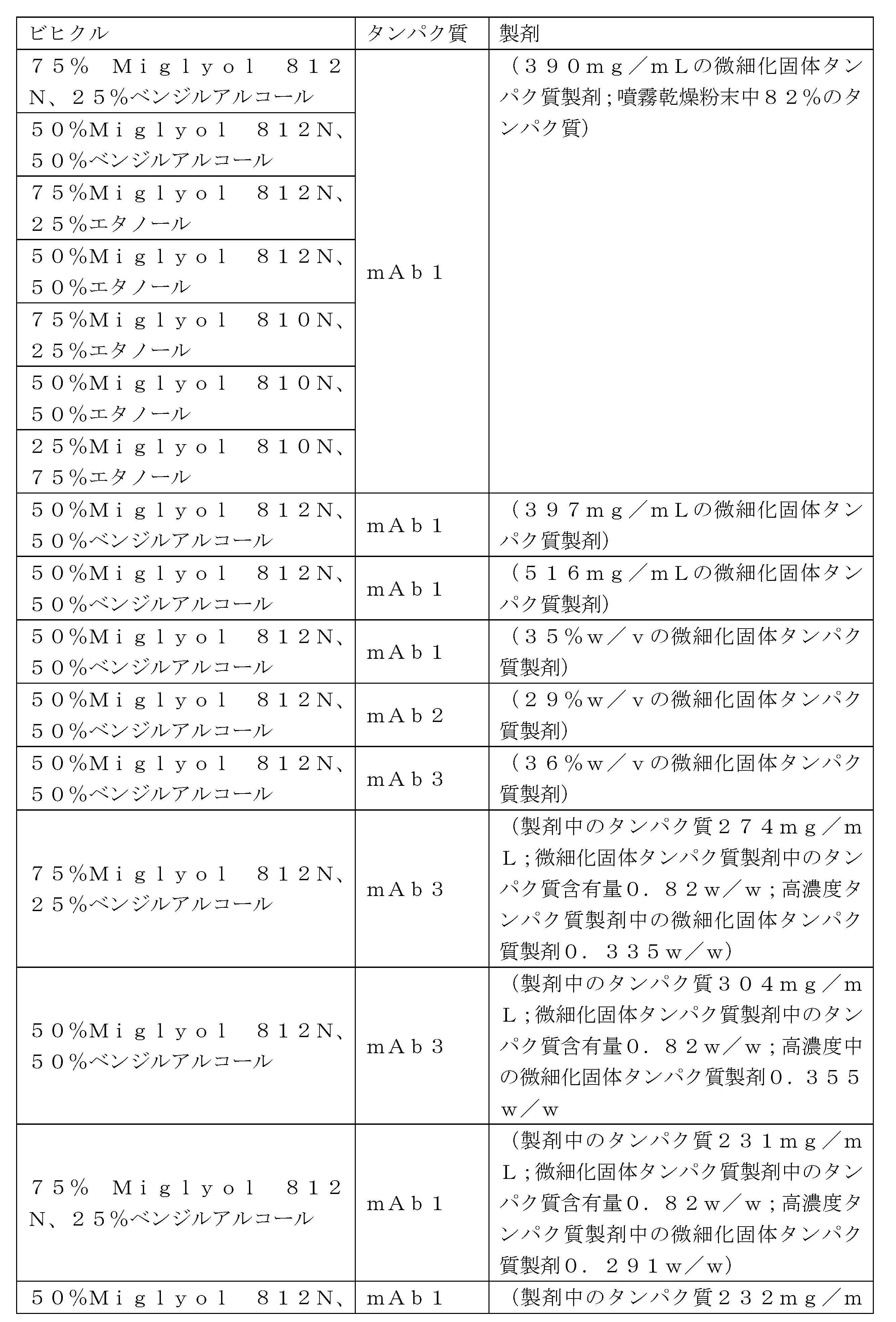
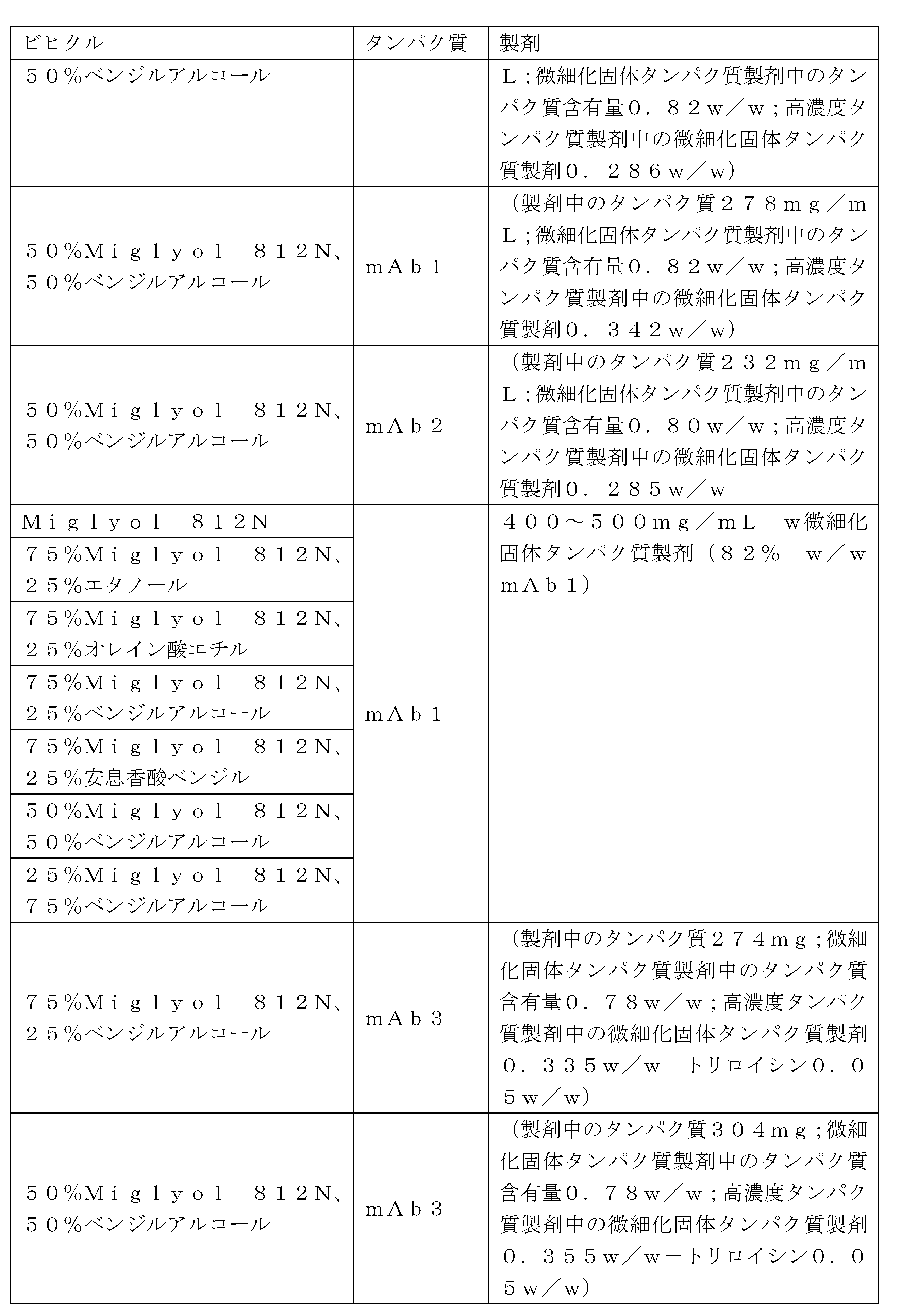
油及び溶媒からなるビヒクルを、体積に基づいて標的組成に配合した。ビヒクルは、蒸発による溶媒の損失がないことを確実にするために毎日新鮮に調製した。 Vehicles consisting of oil and solvent were formulated to target compositions on a volumetric basis. Vehicles were prepared fresh each day to ensure no loss of solvent due to evaporation.
噴霧乾燥タンパク質を丸底Eppendrf 2mL遠心チューブに秤量した。ビヒクル1mL当たりの固体の目標質量に従って、適切なビヒクルを体積に基づいて噴霧乾燥タンパク質に添加した。 The spray-dried protein was weighed into a round-bottom Eppendorf 2 mL centrifuge tube. The appropriate vehicle was added by volume to the spray-dried protein according to the target mass of solids per mL of vehicle.
噴霧乾燥粉末を、強力なボルテックス処理(ボルテックス、反転、ボルテックス、繰り返し)によってビヒクルに混合した。ボルテックス後、試料を遠心分離器内に短時間入れ、チューブの壁から底部に懸濁液を沈降させた。懸濁液の相分離を防止するために、過度の遠心分離を回避した。遠心分離後、試料を1~2分間超音波処理し、必要に応じて混合手順を繰り返した。 The spray-dried powder was mixed into the vehicle by vigorous vortexing (vortex, invert, vortex, repeat). After vortexing, the sample was briefly placed in a centrifuge to allow the suspension to settle from the walls of the tube to the bottom. Excessive centrifugation was avoided to prevent phase separation of the suspension. After centrifugation, the sample was sonicated for 1-2 minutes and the mixing procedure was repeated if necessary.
懸濁液を、より粘度の高いペースト状懸濁液のためにはスパチュラ、またはより粘度の低い懸濁液のためにはピペットの、いずれかを使用して、1mLのガラスシリンジに後ろから充填した。Instronを使用する分注の場合、距離は約10mmを目標とし、したがって、分注される10mmの距離を可能にするのに適切な量の懸濁液を目標とした。シリンジにバックロードした後、針キャップを取り外して、プランジャーを利用して空気を除去し、シリンジの底部に懸濁液を押し込んだ。これは、より粘性の高い懸濁液(スパチュラでバックロードした場合、シリンジバレルの側面に付着する傾向があった)にとっては特に重要であった。分注を行うに先立って、充填プロセスの際にストッパーのリッジに懸濁液が留まらなかったかについて、プランジャー上のストッパーを点検した。懸濁液がストッパーのリッジに付着していた場合は、ストッパーをクリーンなストッパーに交換した。 The suspension was back-filled into a 1 mL glass syringe using either a spatula for thicker, paste-like suspensions or a pipette for less viscous suspensions. For dispensing using the Instron, a distance of approximately 10 mm was targeted, thus targeting an appropriate amount of suspension to allow for a 10 mm distance to be dispensed. After backloading the syringe, the needle cap was removed and the plunger was utilized to remove the air and push the suspension to the bottom of the syringe. This was especially important for the more viscous suspensions (which tended to stick to the sides of the syringe barrel when backloaded with a spatula). Prior to dispensing, the stopper on the plunger was inspected for any suspension that had been lodged on the ridges of the stopper during the filling process. If any suspension had stuck to the ridges of the stopper, the stopper was replaced with a clean stopper.
実施例2:皮下投与のための高濃度タンパク質懸濁液のビヒクルとして好適である適切な非水性溶媒系の特定。
この一連の実験では、すべての評価は、モデルタンパク質としてのmAb1、及び27gTW BD針が装着され4mm/sで分注される1mLのガラスシリンジを通したシリンジ通針性に基づいて実施された。予備評価のためにMiglyol 810Nを使用した。適切な溶媒系の基準は、シリンジ力、ビヒクル中の懸濁液から再構成されたタンパク質の純度(UP-SEC)、及び皮下注射のためのFDA承認済み生成物中のビヒクル成分の使用に基づいていた。FDA承認済み製品での使用(表2)に基づいて、N-メチル-2-ピロリドン及びエタノールを適切な溶媒として特定した。
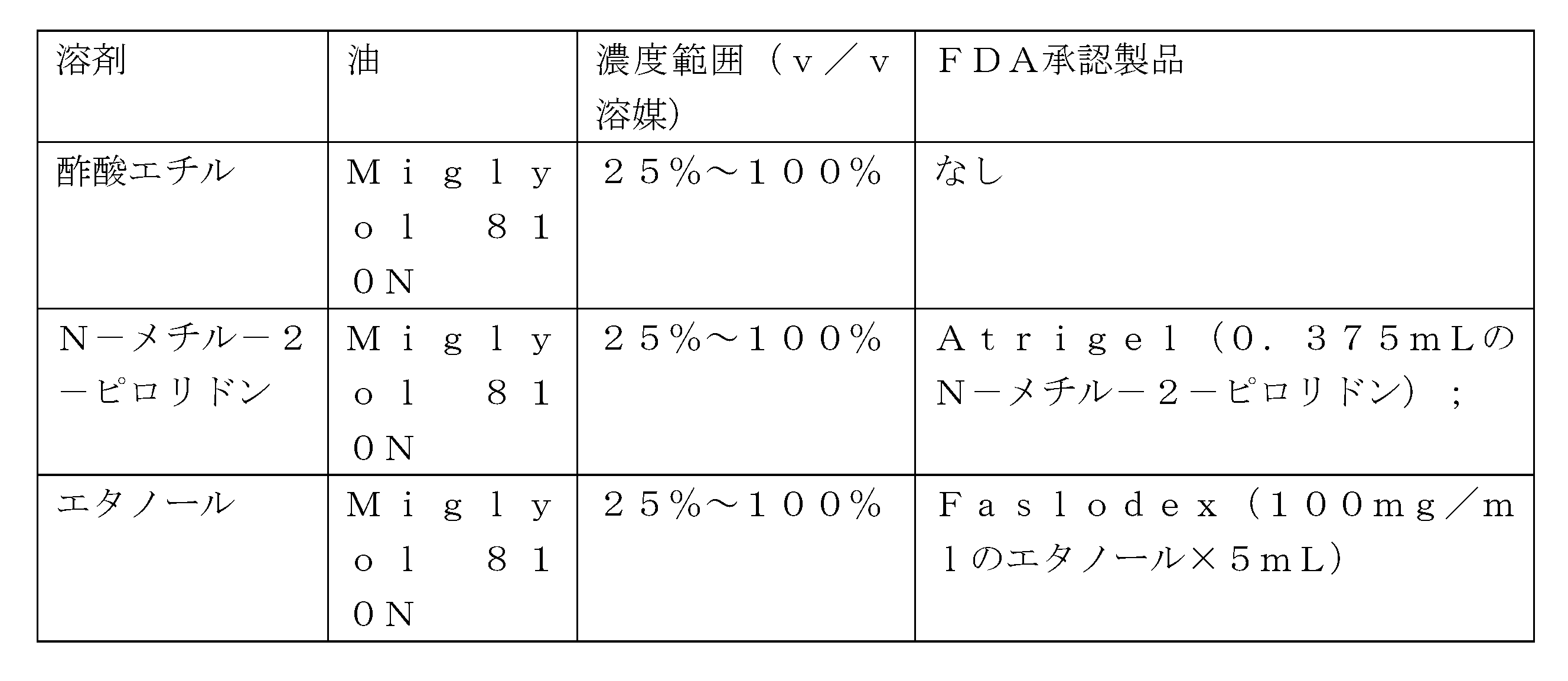
In this series of experiments, all evaluations were performed based on mAb1 as the model protein and syringe passability through a 1 mL glass syringe fitted with a 27 g TW BD needle dispensing at 4 mm/s. Miglyol 810N was used for preliminary evaluation. Criteria for a suitable solvent system were based on syringe force, purity of the protein reconstituted from suspension in vehicle (UP-SEC), and use of vehicle components in FDA-approved products for subcutaneous injection. N-methyl-2-pyrrolidone and ethanol were identified as suitable solvents based on their use in FDA-approved products (Table 2).
摺動力を試験するために、12個の例示的製剤を評価した(図2)。この試験は、コロイド不安定性及びタンパク質不安定性のため、単体(neat)での溶媒がビヒクルとして好適ではない可能性があることを示した。3つすべての溶媒が、25~50%でシリンジ力の同様の減少を示し、エタノール及びN-メチル-2-ピロリドンが組成物の50%超で摺動力を減少させるさらなる利益を示した。酢酸エチル-Miglyolの最大粘度低下効果は25%酢酸エチルで観察された。酢酸エチル溶液ではブレイクポイント後の距離にわたる摺動力のわずかな増加が観察されたが、N-メチル-2-ピロリドンまたはエタノール溶液、及びMiglyol単独では安定したプラトーが観察された。シリンジ力に基づくと、3つすべての溶媒系が好適であった。酢酸エチル/Miglyolについては、25%超の酢酸エチルを必要とせず、N-メチル-2-ピロリドンまたはエタノールについては、溶媒濃度を可能な限り増加させることがシリンジ力を低減するために最適であった。 Twelve exemplary formulations were evaluated to test sliding force (Figure 2). This testing indicated that neat solvents may not be suitable as vehicles due to colloidal and protein instability. All three solvents showed similar reductions in syringe force from 25-50%, with ethanol and N-methyl-2-pyrrolidone showing additional benefits in reducing sliding force at >50% of the composition. The maximum viscosity reduction effect of ethyl acetate-Miglyol was observed at 25% ethyl acetate. A slight increase in sliding force over distance after the breakpoint was observed for the ethyl acetate solution, while a stable plateau was observed for the N-methyl-2-pyrrolidone or ethanol solutions, and Miglyol alone. Based on syringe force, all three solvent systems were suitable. For ethyl acetate/Miglyol, no more than 25% ethyl acetate was required, and for N-methyl-2-pyrrolidone or ethanol, increasing the solvent concentration as much as possible was optimal for reducing syringe force.
実施例3:シリンジ力の決定
Instronを使用して、27gTW針を装着した1mLのガラスシリンジを通して懸濁液を分注するために必要なシリンジ力を決定した。特に断りのない限り、分注速度は4mm/sであり、シリンジ力は、分注に必要な持続される力として報告された。実施例1に従って調製した製剤では、持続される力及び最大力は多くの場合等価であり、これらのシリンジが充填された方法については、ブレイクアウト力は観察されなかった。
Example 3: Determination of Syringe Force An Instron was used to determine the syringe force required to dispense the suspension through a 1 mL glass syringe fitted with a 27 g TW needle. Unless otherwise noted, the dispense rate was 4 mm/s and the syringe force was reported as the sustained force required to dispense. For formulations prepared according to Example 1, the sustained and maximum forces were often equivalent and no breakout forces were observed for the way these syringes were filled.
異なるビヒクルについてのシリンジ力の初期評価を、100%Miglyol 810N、100%Miglyol 812N、100%エタノール、Miglyol 812N中25%v/vベンジルアルコール、Miglyol 812N中75%v/vベンジルアルコール、Miglyol 812N中25%v/vオレイン酸エチル、Miglyol 812N中75%v/vオレイン酸エチル、Miglyol 812N中25%v/vエタノール、Miglyol 812N中75%v/vエタノール、Miglyol 810N中25%v/vエタノール、Miglyol 810N中50%v/vエタノール、Miglyol 810N中75%v/vエタノール、及びMiglyol 812N中25%v/vPEG400を有する25%v/vエタノールを使用して行った。Miglyol 810NはMiglyol 812Nよりも粘度が低かったが、Miglyol 812Nは、複数のFDA承認された市販製剤におけるその前例のために好ましかった。エタノール、ベンジルアルコール、及びオレイン酸エチルはすべて、Miglyol 812Nのシリンジ力(すなわち粘度)を低減することにおいて同等に効果的であった(図3)。 Initial evaluation of syringe force for different vehicles was performed with 100% Miglyol 810N, 100% Miglyol 812N, 100% ethanol, 25% v/v benzyl alcohol in Miglyol 812N, 75% v/v benzyl alcohol in Miglyol 812N, 25% v/v ethyl oleate in Miglyol 812N, 75% v/v ethyl oleate in Miglyol 812N, 25% v/v ethanol in Miglyol 812N, 75% v/v ethanol in Miglyol 812N, 25% v/v ethanol in Miglyol 810N, 50% v/v ethanol in Miglyol 810N, Miglyol This was done using 75% v/v ethanol in 810N and 25% v/v ethanol with 25% v/v PEG400 in Miglyol 812N. Miglyol 810N was less viscous than Miglyol 812N, but Miglyol 812N was preferred due to its precedent in multiple FDA approved commercial formulations. Ethanol, benzyl alcohol, and ethyl oleate were all equally effective in reducing the syringe force (i.e., viscosity) of Miglyol 812N (Figure 3).
高濃度タンパク質製剤についての分注力も、粘度低下剤及びその濃度の選択に依存していることが見出された。一組の実験では、エタノールは、同じ溶媒濃度のベンジルアルコールよりも、懸濁液におけるシリンジ力を低減することにおいてより効果的であった(図4)。同じ溶媒含量での結果の可変性は、懸濁液における不均一な混合及び/または標的固体含有量に対する実際の含有量に起因し得る。 The dispense force for high concentration protein formulations was also found to be dependent on the choice of viscosity-reducing agent and its concentration. In one set of experiments, ethanol was more effective at reducing syringe force in suspensions than benzyl alcohol at the same solvent concentration (Figure 4). The variability in results at the same solvent content may be due to inhomogeneous mixing in the suspension and/or actual content relative to the target solids content.
高濃度タンパク質製剤の分注力は、治療用タンパク質の固体濃度に依存することがさらに見出された(図5)。一組の実験では、Miglyol 812N中の50%v/vベンジルアルコール中のmAb1懸濁液は、固体濃度の増加とともにより高い分注力を示した。 The dispensing force of high concentration protein formulations was further found to depend on the solids concentration of the therapeutic protein (Figure 5). In one set of experiments, mAb1 suspensions in 50% v/v benzyl alcohol in Miglyol 812N showed higher dispensing force with increasing solids concentration.
高濃度タンパク質製剤の分注力は、分子依存性であり得る粉末特性に依存していることも見出された(図6)。分注力の違いは、分子の粉末特性及び/または噴霧乾燥粒子のサイズ、サイズ分布、及び形態の違いに起因し得る。一組の実験では、同じビヒクル(ベンジルアルコール+Miglyol(50/50v/v))中のmAb1、mAb2、及びmAb3は、異なる分注力を示した。29%の固体濃度でのmAb2は、34%の固体濃度でのmAb1よりも高い分注力を示した。したがって、シリンジ力は、懸濁液中の固体濃度、分子依存性であり得る粉末特性、及びビヒクルに依存し得る(表3)。
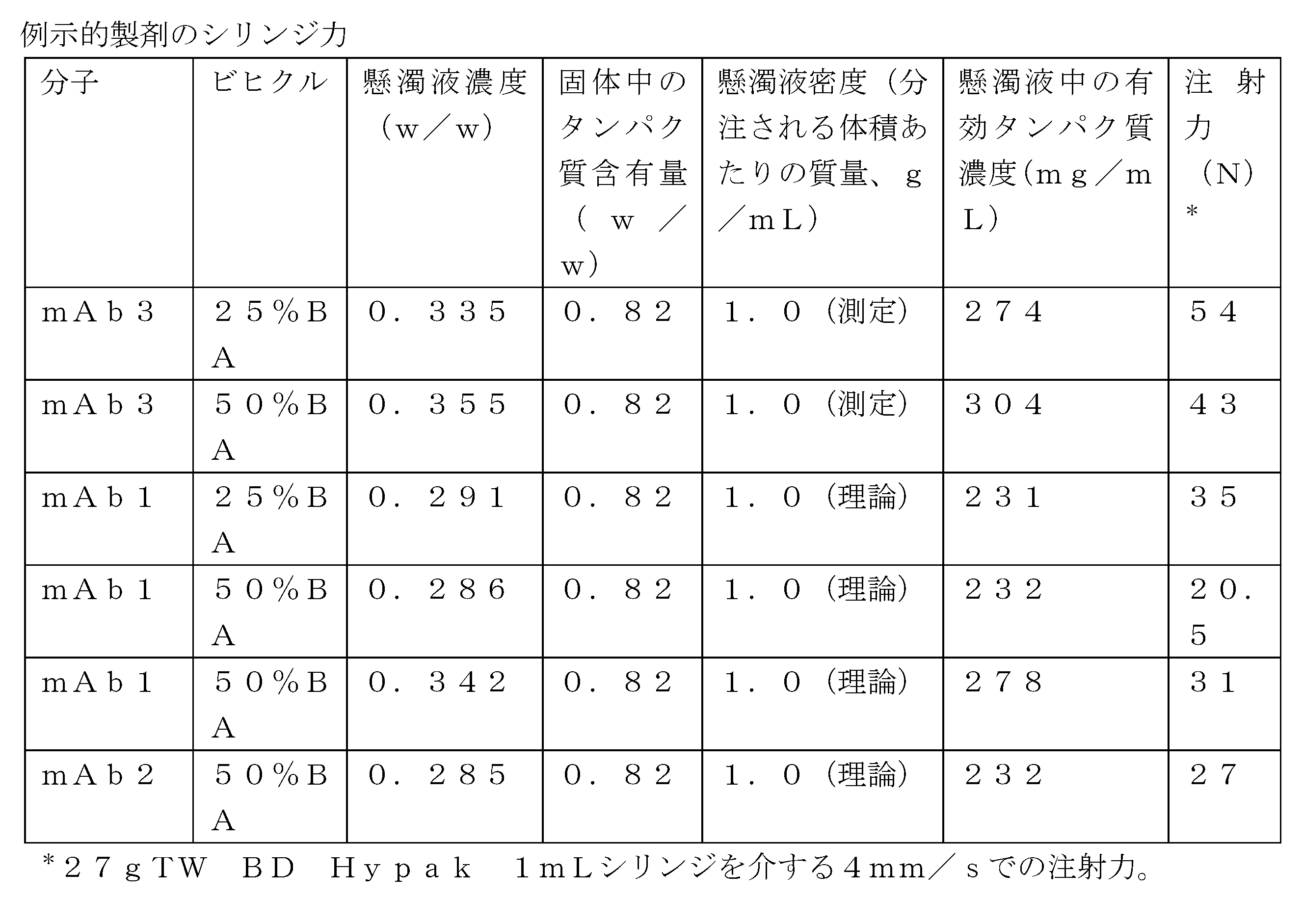
実施例3:タンパク質回収及び安定性
実施例1で使用するために調製した高濃度タンパク質製剤のタンパク質回収及び安定性を、長期安定性について評価した。配合中に決定された懸濁液のw/wタンパク質含有量及び懸濁試料の重量に基づいて示される合計10mg/mlまたは50mg/mlを標的とするように、注射用水(WFI)を懸濁液に添加した。WFIを懸濁試料に添加後、試料を旋回/反転させることによって穏やかに混合して、噴霧乾燥タンパク質を水相に抽出して溶解させた。混合した後、試料を遠心分離して、水相及び油相を分離した(Miglyolの場合、油は水よりも密度が低く、上層を生成する)。水相からの試料を取り出し、UPLCにより分析する前に0.22μmフィルターを通して濾過して不溶性油滴または粒子状物質を除去した。
Example 3: Protein Recovery and Stability Protein recovery and stability of the high concentration protein formulations prepared for use in Example 1 were evaluated for long term stability. Water for injection (WFI) was added to the suspension to target 10 mg/ml or 50 mg/ml total as indicated based on the w/w protein content of the suspension determined during formulation and the weight of the suspension sample. After adding WFI to the suspension sample, the sample was gently mixed by swirling/inverting to extract and dissolve the spray dried protein into the aqueous phase. After mixing, the sample was centrifuged to separate the aqueous and oil phases (in the case of Miglyol, the oil is less dense than water and produces an upper layer). Samples from the aqueous phase were removed and filtered through a 0.22 μm filter to remove insoluble oil droplets or particulate matter before analysis by UPLC.
一組の実験において、懸濁ビヒクルにおける物理的安定性の試験は、凝集が、観察された分解の主な経路であることを実証した(図7)。mAb1の400~500mg/mL噴霧乾燥粉末(81.9%w/wのmAb1)を使用してmAb1製剤を製剤化した。WFIを使用して再構成を実施した。全試料において、完全なタンパク質回収が観察された。mAb1は、所与の溶媒濃度について、エタノールよりもベンジルアルコールを含有するビヒクルにおいて安定していた。 In one set of experiments, physical stability testing in suspension vehicles demonstrated that aggregation was the primary pathway of degradation observed (Figure 7). mAb1 formulations were formulated using 400-500 mg/mL spray-dried powder of mAb1 (81.9% w/w mAb1). Reconstitution was performed using WFI. Full protein recovery was observed in all samples. mAb1 was more stable in vehicles containing benzyl alcohol than ethanol for a given solvent concentration.
別の一連の実験では、懸濁液における安定性は分子特異的であった(図8)。mAb2は、より低い懸濁液濃度にもかかわらず、環境条件下で1時間超、50%BAビヒクル中で安定でいられず、それは、同じビヒクルにおけるmAb1よりも高い分注力を必要とした。 In another set of experiments, stability in suspension was molecule specific (Figure 8). mAb2 was not stable in 50% BA vehicle under ambient conditions for more than 1 hour, despite the lower suspension concentration, and it required a higher dispensing force than mAb1 in the same vehicle.
「タンパク質回収」は、懸濁液の非均一性(試料中のタンパク質の実際の含有量と理論的含有量との違いをもたらす)、ならびに油相における不可逆的な沈殿または捕捉に起因するタンパク質の喪失の両方によって影響を受けた。一般に、この方法は、タンパク質の完全回収(例えば、≧90%)をもたらし、油相からタンパク質を抽出するこの方法が好適であることを示唆していた。 "Protein recovery" was affected both by suspension non-homogeneity (leading to differences between the actual and theoretical content of protein in the sample) as well as protein loss due to irreversible precipitation or entrapment in the oil phase. In general, the method resulted in complete recovery of protein (e.g., ≥ 90%), suggesting the suitability of this method of extracting protein from the oil phase.
実施例4:ビヒクル中の懸濁液から再構成されたタンパク質の純度(UP-SEC)及び回収率。
例示的な製剤についての純度及びタンパク質回収を、350mg/mLのmAb1を含有する製剤で実施し、これらを10mg/mLの濃度でpH7.4のPBSを使用して再構成した(表4)。N-メチル-2-ピロリドンは、タンパク質が再構成時に不可逆的に沈殿し、UP-SECによってさらに分析されなかったため、結果に含まれなかった。酢酸エチル及びエタノールは、単体溶媒としてはタンパク質凝集を引き起こしたが、75%Miglyolの存在下では、溶媒はタンパク質の明らかな物理的分解を引き起こさなかった(表4)。タンパク質の純度に基づいて、25%酢酸エチル/75%Miglyol及び25%エタノール/75%Miglyolを好適な溶媒系として選択した。エタノール-Miglyolは、評価のための3つの基準のすべてを満たす溶媒系の1つであった。
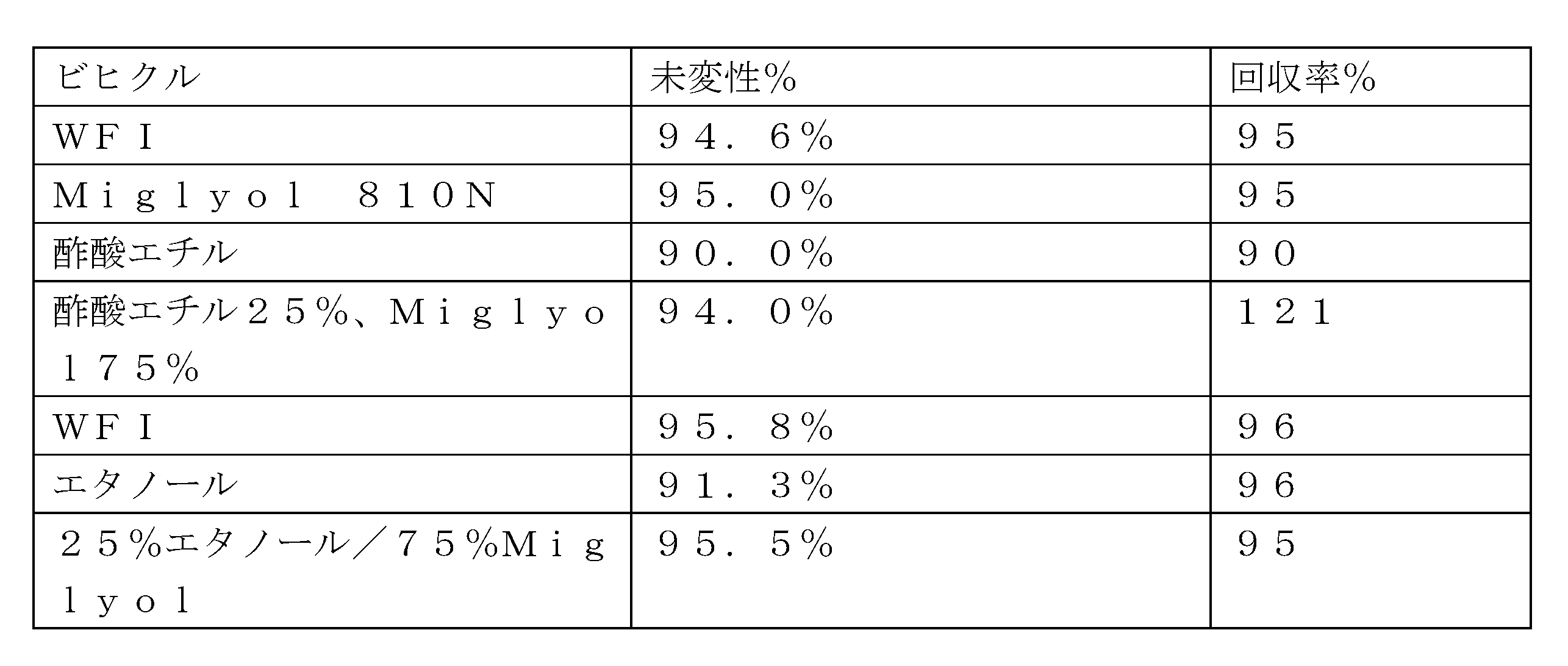
Purity and protein recovery for the exemplary formulations were performed on formulations containing 350 mg/mL mAb1, which were reconstituted using PBS pH 7.4 at a concentration of 10 mg/mL (Table 4). N-methyl-2-pyrrolidone was not included in the results because the protein irreversibly precipitated upon reconstitution and was not further analyzed by UP-SEC. Ethyl acetate and ethanol caused protein aggregation as the sole solvents, but in the presence of 75% Miglyol, the solvents did not cause any obvious physical degradation of the protein (Table 4). Based on protein purity, 25% ethyl acetate/75% Miglyol and 25% ethanol/75% Miglyol were selected as the preferred solvent systems. Ethanol-Miglyol was one of the solvent systems that met all three criteria for evaluation.
Claims (11)
a.微細化固体タンパク質製剤として約200mg/mL~約600mg/mLの治療用タンパク質と、
b.Miglyol(登録商標) 812、Miglyol 810、CAPTEX(商標) 300、またはCAPTEX INJ 300を含む疎水性剤と、
c.エタノール、ベンジルアルコール、酢酸エチル、N-メチル-2-ピロリドン、またはこれらの組み合わせからなる群から選択される粘度低下剤と、を含む、前記非水性高濃度タンパク質製剤。 1. A non-aqueous high concentration protein formulation comprising:
a. about 200 mg/mL to about 600 mg/mL of a therapeutic protein as a micronized solid protein formulation;
b. a hydrophobic agent comprising Miglyol® 812, Miglyol 810, CAPTEX ™ 300, or CAPTEX INJ 300;
c) a viscosity-lowering agent selected from the group consisting of ethanol, benzyl alcohol, ethyl acetate, N-methyl-2-pyrrolidone, or a combination thereof.
前記アミノ酸が、ヒスチジンまたはプロリンであり、および/または
前記非イオン性界面活性剤が、ポリソルベートであり、好ましくは前記ポリソルベートがポリソルベート20、ポリソルベート40、ポリソルベート60、ポリソルベート80、またはこれらの組み合わせからなる群から選択される、
請求項6に記載の非水性高濃度タンパク質製剤。 the carbohydrate is sucrose, mannitol, or trehalose, and/or the amino acid is histidine or proline, and/or the non-ionic surfactant is a polysorbate, preferably the polysorbate is selected from the group consisting of polysorbate 20, polysorbate 40, polysorbate 60, polysorbate 80, or a combination thereof.
The non-aqueous high concentration protein formulation of claim 6.
Applications Claiming Priority (3)
| Application Number | Priority Date | Filing Date | Title |
|---|---|---|---|
| US201862770337P | 2018-11-21 | 2018-11-21 | |
| US62/770,337 | 2018-11-21 | ||
| PCT/US2019/062596 WO2020106948A1 (en) | 2018-11-21 | 2019-11-21 | High concentration protein formulation |
Publications (3)
| Publication Number | Publication Date |
|---|---|
| JP2022532965A JP2022532965A (en) | 2022-07-21 |
| JPWO2020106948A5 JPWO2020106948A5 (en) | 2022-11-28 |
| JP7637618B2 true JP7637618B2 (en) | 2025-02-28 |
Family
ID=68916589
Family Applications (1)
| Application Number | Title | Priority Date | Filing Date |
|---|---|---|---|
| JP2021527899A Active JP7637618B2 (en) | 2018-11-21 | 2019-11-21 | Highly concentrated protein formulations |
Country Status (14)
| Country | Link |
|---|---|
| US (2) | US12036280B2 (en) |
| EP (1) | EP3883542A1 (en) |
| JP (1) | JP7637618B2 (en) |
| KR (1) | KR20210093976A (en) |
| CN (1) | CN113164378A (en) |
| AU (1) | AU2019384160B2 (en) |
| BR (1) | BR112021009463A2 (en) |
| CA (1) | CA3118306A1 (en) |
| EA (1) | EA202191403A1 (en) |
| IL (1) | IL283229B2 (en) |
| MX (1) | MX2021005910A (en) |
| SG (1) | SG11202104166QA (en) |
| WO (1) | WO2020106948A1 (en) |
| ZA (1) | ZA202102816B (en) |
Families Citing this family (4)
| Publication number | Priority date | Publication date | Assignee | Title |
|---|---|---|---|---|
| MX421310B (en) | 2018-05-10 | 2025-03-14 | Regeneron Pharma | High concentration vegf receptor fusion protein containing formulations |
| KR102735988B1 (en) | 2019-02-18 | 2024-12-03 | 일라이 릴리 앤드 캄파니 | therapeutic antibody preparations |
| WO2023039531A1 (en) * | 2021-09-09 | 2023-03-16 | Xeris Pharmaceuticals, Inc. | Injectable high concentration pharmaceutical formulations and methods of manufacturing and use thereof |
| TW202508633A (en) * | 2023-08-24 | 2025-03-01 | 美商瑞澤路特有限公司 | High concentration formulations for anti-insulin receptor antibody and uses thereof |
Citations (3)
| Publication number | Priority date | Publication date | Assignee | Title |
|---|---|---|---|---|
| JP2004515467A (en) | 2000-08-07 | 2004-05-27 | ネクター セラピューティックス | Inhalable, spray-dried, 4-helix bundle protein powder with minimal aggregates |
| JP2014510077A (en) | 2011-03-09 | 2014-04-24 | ヤンセン バイオテツク,インコーポレーテツド | Non-aqueous high-concentration thinning suspension of antibody |
| JP2015520164A (en) | 2012-05-18 | 2015-07-16 | ジェネンテック, インコーポレイテッド | High concentration monoclonal antibody preparation |
Family Cites Families (11)
| Publication number | Priority date | Publication date | Assignee | Title |
|---|---|---|---|---|
| IT1142172B (en) * | 1978-10-19 | 1986-10-08 | Sandoz Ag | NEW THERAPEUTIC USE OF CYCLOSPORINE-A AND DIHYDROCYCLOSPORINE-C |
| US6659982B2 (en) | 2000-05-08 | 2003-12-09 | Sterling Medivations, Inc. | Micro infusion drug delivery device |
| US6629949B1 (en) | 2000-05-08 | 2003-10-07 | Sterling Medivations, Inc. | Micro infusion drug delivery device |
| US20090208492A1 (en) * | 2007-06-14 | 2009-08-20 | Elan Pharmaceuticals, Inc. | Lyophilized Immunoglobulin Formulations and Methods of Preparation |
| US9072668B2 (en) | 2010-03-09 | 2015-07-07 | Janssen Biotech, Inc. | Non-aqueous high concentration reduced viscosity suspension formulations of antibodies |
| WO2012122544A2 (en) * | 2011-03-10 | 2012-09-13 | Board Of Regents, The University Of Texas System | Protein nanoparticle dispersions |
| CN103356490A (en) * | 2012-03-29 | 2013-10-23 | 复旦大学 | Cross-linked food protein stabilized nanometer medicament delivery system capable of being solidified directly |
| UA117466C2 (en) | 2012-12-13 | 2018-08-10 | Мерк Шарп Енд Доме Корп. | STABLE COMPOSITION IN THE VIEW OF AN ANTIBODY ANTIBODY TO IL-23p19 |
| IL312865B2 (en) * | 2013-09-11 | 2025-06-01 | Eagle Biologics Inc | Liquid protein formulations containing viscosity-reducing agents |
| DK2942050T3 (en) * | 2014-05-06 | 2022-11-21 | S I I T S R L Servizio Int Imballaggi Termosaldanti | SPRAYABLE, OIL-CONTAINING COMPOSITION BASED ON FAT-SOLUBLE GROUP D VITAMINS AND USE THEREOF |
| EP3240571A4 (en) * | 2014-12-31 | 2018-06-13 | NovelMed Therapeutics, Inc. | Formulation of aglycosylated therapeutic antibodies |
-
2019
- 2019-11-21 JP JP2021527899A patent/JP7637618B2/en active Active
- 2019-11-21 WO PCT/US2019/062596 patent/WO2020106948A1/en not_active Ceased
- 2019-11-21 AU AU2019384160A patent/AU2019384160B2/en active Active
- 2019-11-21 CN CN201980076726.4A patent/CN113164378A/en active Pending
- 2019-11-21 EP EP19821379.5A patent/EP3883542A1/en active Pending
- 2019-11-21 KR KR1020217018710A patent/KR20210093976A/en active Pending
- 2019-11-21 BR BR112021009463-6A patent/BR112021009463A2/en unknown
- 2019-11-21 EA EA202191403A patent/EA202191403A1/en unknown
- 2019-11-21 US US16/690,956 patent/US12036280B2/en active Active
- 2019-11-21 CA CA3118306A patent/CA3118306A1/en active Pending
- 2019-11-21 MX MX2021005910A patent/MX2021005910A/en unknown
- 2019-11-21 IL IL283229A patent/IL283229B2/en unknown
- 2019-11-21 SG SG11202104166QA patent/SG11202104166QA/en unknown
-
2021
- 2021-04-28 ZA ZA2021/02816A patent/ZA202102816B/en unknown
-
2024
- 2024-06-05 US US18/734,030 patent/US20240316195A1/en not_active Abandoned
Patent Citations (3)
| Publication number | Priority date | Publication date | Assignee | Title |
|---|---|---|---|---|
| JP2004515467A (en) | 2000-08-07 | 2004-05-27 | ネクター セラピューティックス | Inhalable, spray-dried, 4-helix bundle protein powder with minimal aggregates |
| JP2014510077A (en) | 2011-03-09 | 2014-04-24 | ヤンセン バイオテツク,インコーポレーテツド | Non-aqueous high-concentration thinning suspension of antibody |
| JP2015520164A (en) | 2012-05-18 | 2015-07-16 | ジェネンテック, インコーポレイテッド | High concentration monoclonal antibody preparation |
Non-Patent Citations (1)
| Title |
|---|
| J. Pham. Sci.,2008年,vol.97, no.1,p.287-302 |
Also Published As
| Publication number | Publication date |
|---|---|
| CA3118306A1 (en) | 2020-05-28 |
| EP3883542A1 (en) | 2021-09-29 |
| EA202191403A1 (en) | 2021-08-09 |
| WO2020106948A1 (en) | 2020-05-28 |
| ZA202102816B (en) | 2024-08-28 |
| US20240316195A1 (en) | 2024-09-26 |
| KR20210093976A (en) | 2021-07-28 |
| JP2022532965A (en) | 2022-07-21 |
| US20200155678A1 (en) | 2020-05-21 |
| MX2021005910A (en) | 2021-08-16 |
| IL283229B1 (en) | 2025-04-01 |
| CN113164378A (en) | 2021-07-23 |
| AU2019384160B2 (en) | 2025-01-16 |
| AU2019384160A1 (en) | 2021-05-27 |
| US12036280B2 (en) | 2024-07-16 |
| IL283229B2 (en) | 2025-08-01 |
| BR112021009463A2 (en) | 2021-08-10 |
| IL283229A (en) | 2021-07-29 |
| SG11202104166QA (en) | 2021-05-28 |
Similar Documents
| Publication | Publication Date | Title |
|---|---|---|
| US20240316195A1 (en) | High concentration protein formulation | |
| ES2743687T3 (en) | Antibody suspension formulations with reduced viscosity of high non-aqueous concentrations | |
| US9072668B2 (en) | Non-aqueous high concentration reduced viscosity suspension formulations of antibodies | |
| JP2020516608A (en) | Stable antibody formulation | |
| JP2015042638A (en) | Stabilized protein compositions | |
| CA2792517C (en) | Non-aqueous high concentration reduced viscosity suspension formulations | |
| EA047201B1 (en) | COMPOSITION WITH HIGH PROTEIN CONCENTRATION | |
| CA3211692A1 (en) | Formulations of anti-endothelial lipase antibodies | |
| HK1182323A (en) | Non-aqueous high concentration reduced viscosity suspension formulations | |
| HK1193980A (en) | Non-aqueous high concentration reduced viscosity suspension formulations of antibodies | |
| HK1193980B (en) | Non-aqueous high concentration reduced viscosity suspension formulations of antibodies | |
| JPWO2021173537A5 (en) |
Legal Events
| Date | Code | Title | Description |
|---|---|---|---|
| A521 | Request for written amendment filed |
Free format text: JAPANESE INTERMEDIATE CODE: A523 Effective date: 20221117 |
|
| A621 | Written request for application examination |
Free format text: JAPANESE INTERMEDIATE CODE: A621 Effective date: 20221117 |
|
| A131 | Notification of reasons for refusal |
Free format text: JAPANESE INTERMEDIATE CODE: A131 Effective date: 20230822 |
|
| A977 | Report on retrieval |
Free format text: JAPANESE INTERMEDIATE CODE: A971007 Effective date: 20230825 |
|
| A601 | Written request for extension of time |
Free format text: JAPANESE INTERMEDIATE CODE: A601 Effective date: 20231121 |
|
| A521 | Request for written amendment filed |
Free format text: JAPANESE INTERMEDIATE CODE: A523 Effective date: 20240219 |
|
| A131 | Notification of reasons for refusal |
Free format text: JAPANESE INTERMEDIATE CODE: A131 Effective date: 20240521 |
|
| A521 | Request for written amendment filed |
Free format text: JAPANESE INTERMEDIATE CODE: A523 Effective date: 20240815 |
|
| A131 | Notification of reasons for refusal |
Free format text: JAPANESE INTERMEDIATE CODE: A131 Effective date: 20241008 |
|
| A521 | Request for written amendment filed |
Free format text: JAPANESE INTERMEDIATE CODE: A523 Effective date: 20241227 |
|
| TRDD | Decision of grant or rejection written | ||
| A01 | Written decision to grant a patent or to grant a registration (utility model) |
Free format text: JAPANESE INTERMEDIATE CODE: A01 Effective date: 20250204 |
|
| A61 | First payment of annual fees (during grant procedure) |
Free format text: JAPANESE INTERMEDIATE CODE: A61 Effective date: 20250217 |
|
| R150 | Certificate of patent or registration of utility model |
Ref document number: 7637618 Country of ref document: JP Free format text: JAPANESE INTERMEDIATE CODE: R150 |