CN111194043B - Power distribution method based on non-perfect serial interference elimination - Google Patents
Power distribution method based on non-perfect serial interference elimination Download PDFInfo
- Publication number
- CN111194043B CN111194043B CN202010188013.1A CN202010188013A CN111194043B CN 111194043 B CN111194043 B CN 111194043B CN 202010188013 A CN202010188013 A CN 202010188013A CN 111194043 B CN111194043 B CN 111194043B
- Authority
- CN
- China
- Prior art keywords
- user
- base station
- power
- cluster
- price
- Prior art date
- Legal status (The legal status is an assumption and is not a legal conclusion. Google has not performed a legal analysis and makes no representation as to the accuracy of the status listed.)
- Active
Links
Images


Classifications
-
- H—ELECTRICITY
- H04—ELECTRIC COMMUNICATION TECHNIQUE
- H04W—WIRELESS COMMUNICATION NETWORKS
- H04W24/00—Supervisory, monitoring or testing arrangements
- H04W24/02—Arrangements for optimising operational condition
-
- G—PHYSICS
- G06—COMPUTING OR CALCULATING; COUNTING
- G06N—COMPUTING ARRANGEMENTS BASED ON SPECIFIC COMPUTATIONAL MODELS
- G06N5/00—Computing arrangements using knowledge-based models
- G06N5/04—Inference or reasoning models
- G06N5/042—Backward inferencing
-
- H—ELECTRICITY
- H04—ELECTRIC COMMUNICATION TECHNIQUE
- H04W—WIRELESS COMMUNICATION NETWORKS
- H04W72/00—Local resource management
- H04W72/04—Wireless resource allocation
- H04W72/044—Wireless resource allocation based on the type of the allocated resource
- H04W72/0473—Wireless resource allocation based on the type of the allocated resource the resource being transmission power
-
- H—ELECTRICITY
- H04—ELECTRIC COMMUNICATION TECHNIQUE
- H04W—WIRELESS COMMUNICATION NETWORKS
- H04W72/00—Local resource management
- H04W72/50—Allocation or scheduling criteria for wireless resources
- H04W72/53—Allocation or scheduling criteria for wireless resources based on regulatory allocation policies
Landscapes
- Engineering & Computer Science (AREA)
- Computer Networks & Wireless Communication (AREA)
- Signal Processing (AREA)
- Theoretical Computer Science (AREA)
- Evolutionary Computation (AREA)
- Data Mining & Analysis (AREA)
- Computational Linguistics (AREA)
- Physics & Mathematics (AREA)
- Computing Systems (AREA)
- General Engineering & Computer Science (AREA)
- General Physics & Mathematics (AREA)
- Mathematical Physics (AREA)
- Software Systems (AREA)
- Artificial Intelligence (AREA)
- Mobile Radio Communication Systems (AREA)
Abstract
本发明属于通信技术领域,具体涉及一种基于非完美串行干扰消除的功率分配方法,该方法包括:基站设置单位功率价格,并将制定的价格发送给用户端;用户端根据基站设定的价格确定从基站处购买的功率量,并将购买的功率量发送给基站;基站根据用户端的功率购买量重新调整更新价格;基站和用户不断博弈,直至基站的功率价格和用户的功率购买量达到均衡状态;获取均衡后的用户功率,完成功率分配;本发明在保证服务质量和用户公平性前提下采用非完美串行干扰消除的功率分配方法,使得算法更简单和准确。
The invention belongs to the field of communication technologies, and in particular relates to a power allocation method based on imperfect serial interference elimination. The method includes: a base station sets a unit power price, and sends the set price to a user; The price determines the amount of power purchased from the base station, and sends the purchased power amount to the base station; the base station readjusts the update price according to the power purchase amount of the user end; the base station and the user continue to compete until the power price of the base station and the power purchase amount of the user reach Equilibrium state; obtain equalized user power to complete power distribution; the present invention adopts the power distribution method of non-perfect serial interference elimination under the premise of ensuring service quality and user fairness, so that the algorithm is simpler and more accurate.
Description
技术领域technical field
本发明属于通信技术领域,具体涉及一种基于非完美串行干扰消除的功率分配方法。The invention belongs to the technical field of communications, and in particular relates to a power distribution method based on imperfect serial interference cancellation.
背景技术Background technique
随着移动通信技术发展,已从单纯的话音业务拓展到移动互联网业务。由于物联网飞速发展,移动流量呈指数级增长。传统的正交多址接入的频谱效率和允许接入的用户是有限的,已经不能满足这种爆炸性的用户增长。与正交多址接入方式不同,非正交多址接入可在同一频带叠加复用多个用户,并通过串行干扰消除(Successive InterferenceCancellation,SIC)技术消除其他用户所造成的干扰。非正交多址接入技术(Non-Orthogonal Multiple Access,NOMA)作为5G(5th-Generation)关键技术之一,可以在5G物联网时代满足低时延\高可靠以及海量接入等需求。With the development of mobile communication technology, it has expanded from pure voice services to mobile Internet services. Mobile traffic is growing exponentially due to the rapid development of the Internet of Things. The spectral efficiency of the traditional orthogonal multiple access and the users allowed to access are limited, and can no longer meet this explosive user growth. Different from the orthogonal multiple access method, the non-orthogonal multiple access can superimpose multiple users in the same frequency band, and eliminate the interference caused by other users through the serial interference cancellation (Successive Interference Cancellation, SIC) technology. As one of the key technologies of 5G (5th-Generation), Non-Orthogonal Multiple Access (NOMA) can meet the requirements of low latency, high reliability and massive access in the era of 5G IoT.
目前,多天线输入多输出(Multiple-Input Multiple-Output,MIMO)技术是近年来研究的热点,它在4G(4th-Generation)中用于提高通信系统的频谱效率,是4G的关键技术,并且在5G中也同样会作为一项关键技术出现。例如专利申请号为CN201811267625.9的《基于干扰抑制的多小区MIMO-NOMA最优功率分配方法》公开了:构建多小区MIMO-NOMA系统模型;通过干扰技术消除小区干扰得出功率分配的数学模型;构造紧下界系数和相应代换,将原功率分配问题转化为凸优化问题;通过迭代求最优功率。通过该方法使得系统能够更快的传输数据。At present, the Multiple-Input Multiple-Output (MIMO) technology is a hot research topic in recent years. It is used to improve the spectral efficiency of the communication system in 4G (4th-Generation) and is the key technology of 4G. It will also appear as a key technology in 5G. For example, the patent application number CN201811267625.9 "Multi-cell MIMO-NOMA optimal power allocation method based on interference suppression" discloses: building a multi-cell MIMO-NOMA system model; eliminating cell interference through interference technology to obtain a mathematical model of power allocation ; Construct tight lower bound coefficients and corresponding substitutions to transform the original power distribution problem into a convex optimization problem; find the optimal power through iteration. This method enables the system to transmit data faster.
但是该方法在求取最优功率时采用了凸差规划的功率分配算法,该算法的计算量大,计算的过程复杂,不利于数据传输。However, this method adopts the power allocation algorithm of convex difference planning when obtaining the optimal power, which requires a large amount of calculation and complicated calculation process, which is not conducive to data transmission.
发明内容SUMMARY OF THE INVENTION
为解决以上现有技术问题,本发明提出了一种基于非完美串行干扰消除的功率分配方法,包括:基站设置单位功率价格,并将制定的价格发送给用户端;用户端根据基站设定的价格确定从基站处购买的功率量,并将购买的功率量发送给基站;基站根据用户端的功率购买量重新调整更新价格;基站和用户不断博弈,直至基站的功率价格和用户的功率购买量达到均衡状态;获取均衡后的用户功率,完成功率分配;In order to solve the above problems of the prior art, the present invention proposes a power allocation method based on imperfect serial interference cancellation, including: the base station sets a unit power price, and sends the set price to the user; the user sets the price according to the base station. Determine the amount of power purchased from the base station and send the purchased power amount to the base station; the base station readjusts the update price according to the power purchase amount of the user end; the base station and the user continue to compete until the power price of the base station and the power purchase amount of the user The equilibrium state is reached; the balanced user power is obtained, and the power allocation is completed;
所述用户端购买的功率量包括:基站获取用户的有效信道增益,根据每个用户的信干噪比和香农公式构建系统吞吐量最大化模型;根据用户端和基站的连接关系,构建多个一主一从的斯坦克尔伯格博弈模型,定义用户为买方,基站为卖方;根据系统吞吐量最大化模型确定用户的功率限制、系统最大功率约束、用户间公平性约束以及用户服务质量约束条件,得到买方的效用优化模型;采用拉格朗日乘数法和次梯度迭代法计算买方的效用优化模型,根据效用优化模型得到用户端的购买的功率量;The amount of power purchased by the user terminal includes: the base station obtains the effective channel gain of the user, and constructs a system throughput maximization model according to the signal-to-interference noise ratio of each user and the Shannon formula; The Steinkelberg game model of one master and one slave defines the user as the buyer and the base station as the seller; according to the system throughput maximization model, the user's power limit, system maximum power constraint, inter-user fairness constraint and user service quality constraint are determined The buyer's utility optimization model is obtained; the Lagrange multiplier method and the sub-gradient iteration method are used to calculate the buyer's utility optimization model, and the purchased power amount of the user terminal is obtained according to the utility optimization model;
所述基站设置单位功率价格:根据功率价格和基站售卖单位功率的成本获得卖方的效用函数,根据最大化效用函数构建卖方的效用优化模型;根据效用优化模型计算单位功率价格。The base station sets the unit power price: obtains the seller's utility function according to the power price and the cost of selling unit power of the base station, constructs the seller's utility optimization model according to the maximized utility function; calculates the unit power price according to the utility optimization model.
优选的,系统吞吐量最大化模型为:Preferably, the system throughput maximization model is:

优选的,所述系统为MIMO-NOMA系统,系统中基站天线数为M1,用户的天线数为N,且N≥M1;用户已经被分为M簇,每簇内共有L个用户,小区的用户数为G=M×L;每簇用户均使用非正交多址接入技术。Preferably, the system is a MIMO-NOMA system, the number of base station antennas in the system is M1, the number of user antennas is N, and N≥M1; the users have been divided into M clusters, there are L users in each cluster, and the number of users in the cell is L. The number of users is G=M×L; each cluster of users uses non-orthogonal multiple access technology.
进一步的,基站处的发送信号为:Further, the transmitted signal at the base station is:
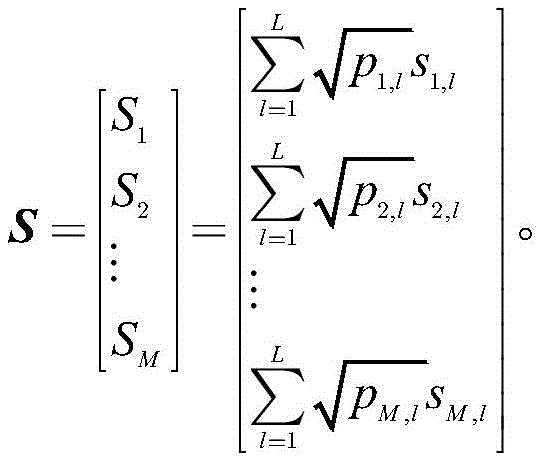
优选的,斯坦克尔伯格博弈模型包括:Preferably, the Steinkelberg game model includes:
各用户端根据基站制定的价格从基站处购买功率,买方的效用函数为:Each client purchases power from the base station according to the price set by the base station, and the buyer's utility function is:

其中,λm,l为基站向UEm,l用户出售功率的价格;where λ m,l is the price at which the base station sells power to UE m,l users;
基站向各用户端出售功率,卖方的效用函数为:UBS m,l=(λm,l-cm,l)pm,l。The base station sells power to each user, and the seller's utility function is: U BS m,l =(λ m,l -c m,l )p m,l .
优选的,买方的效用优化模型为:Preferably, the buyer's utility optimization model is:

Subject to:Subject to:

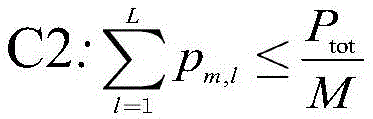



优选的,根据卖方最大化自身效用函数得到卖方的效用优化模型为:Preferably, the seller's utility optimization model is obtained according to the seller's maximization of its own utility function:

优选的,用户的最优购买策略包括:Preferably, the user's optimal purchase strategy includes:
买方的效用最大化问题为:The buyer's utility maximization problem is:

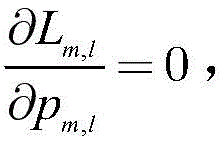
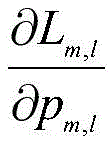
拉格朗日函数对pm,l求导可得:The Lagrangian function can be derived from p m,l to get:

令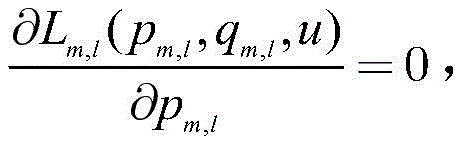
θm,l=um,l+ωm,l+βm,l-γm,l θ m,l =u m,l +ω m,l +β m,l -γ m,l

优选的,得到用户端的购买的功率量的过程包括:Preferably, the process of obtaining the purchased power amount of the user terminal includes:
将最优功率解带入卖方最优问题,得到卖方的最优优问题解:The optimal power solution is brought into the seller's optimal problem, and the seller's optimal solution is obtained:

对卖方的最优问题解的λm,l求导,得到:Taking the derivative of λ m,l of the seller's optimal problem solution, we get:

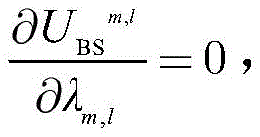
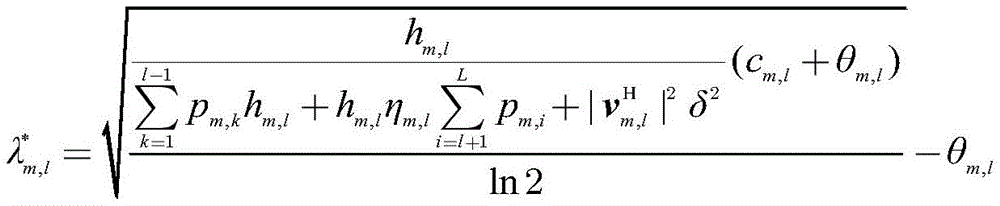
令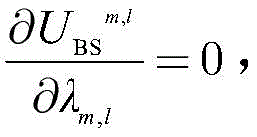
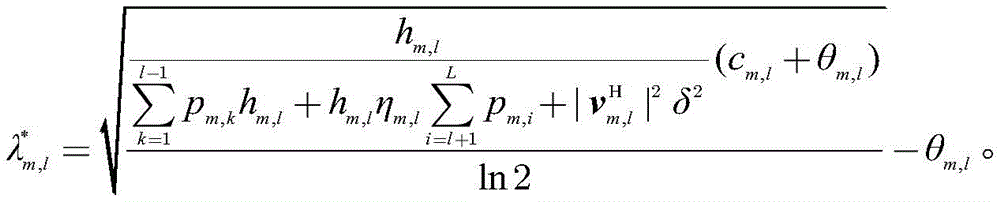
优选的,基站和用户双方进行博弈的过程包括:基站设置单位功率价格并出售功率给各用户,各用户根据基站制定的价格从基站处购买功率,以最大化自身的效益;用户根据最优价格制定策略
本发明根据在MIMO-NOMA系统中考虑SIC残留,算法会随SIC残留因子的大小调整功率价格和用户的功率分配值,使得结果更加接近最优功率;本发明根据在MIMO-NOMA中建立多个一主一从的斯坦克尔伯格博弈模型,在保证服务质量和用户公平性前提下,使得本发明的吞吐量性能更优越,算法复杂度低于基于凸差规划的功率分配算法。The present invention considers the SIC residual in the MIMO-NOMA system, and the algorithm adjusts the power price and the user's power allocation value according to the size of the SIC residual factor, so that the result is closer to the optimal power; the present invention is based on the establishment of multiple The one-master-one-slave Steinkelberg game model, under the premise of ensuring service quality and user fairness, makes the throughput performance of the present invention more superior, and the algorithm complexity is lower than that of the power allocation algorithm based on convex difference planning.
附图说明Description of drawings
图1为本发明的下行MIMO-NOMA系统模型;Fig. 1 is the downlink MIMO-NOMA system model of the present invention;
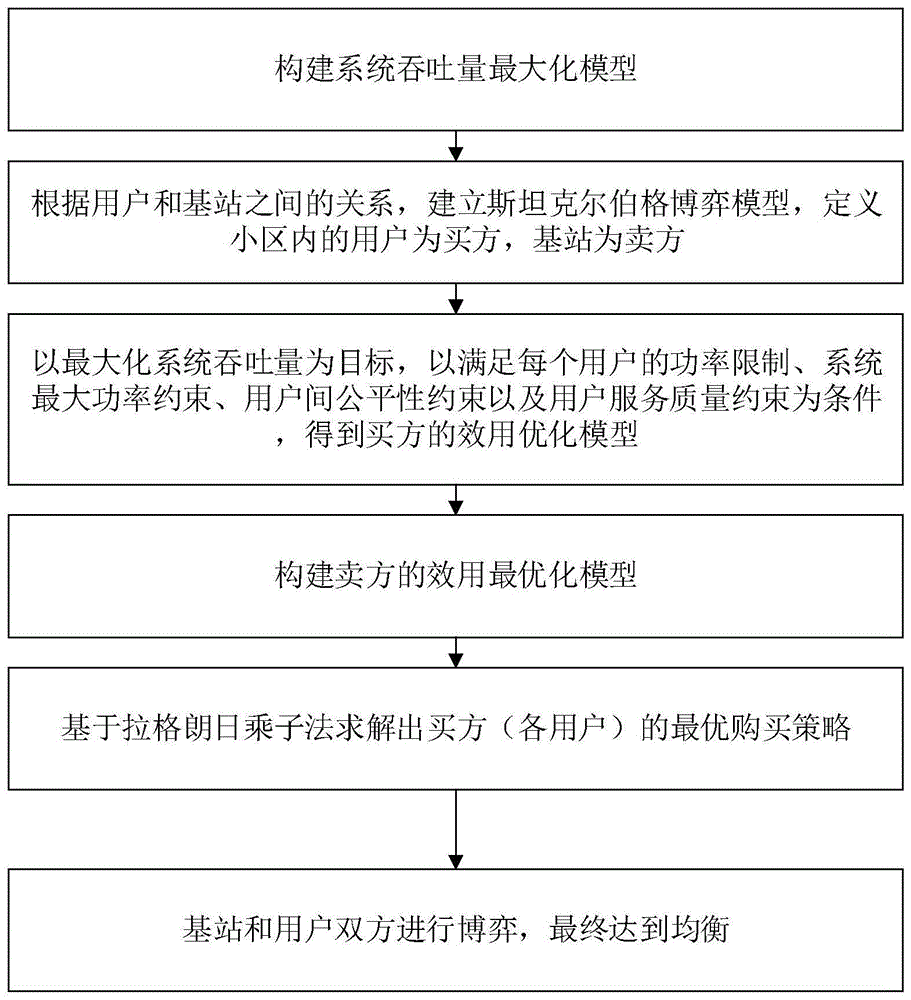
图2为本发明的基于博弈论的吞吐量优化功率分配算法流程图;Fig. 2 is the flow chart of the throughput optimization power allocation algorithm based on game theory of the present invention;
图3为所提算法与基于凸差规划的功率分配的算法复杂度比较;Fig. 3 is the algorithm complexity comparison of the proposed algorithm and the power allocation based on convex difference programming;
图4为本发明的系统吞吐量与基站总功率的关系;4 is the relationship between the system throughput of the present invention and the total power of the base station;
图5为所提算法与基于凸差规划的功率分配的吞吐量比较。Figure 5 shows the throughput comparison between the proposed algorithm and the power allocation based on convex difference planning.
具体实施方式Detailed ways
为了更清楚地说明本发明实施例或现有技术中的技术方案,下面将结合附图,对本发明实施例中的技术方案进行清楚、完整地描述,所描述的实施例仅是本发明一部分实施例,而不是全部的实施例。基于本发明中的实施例,本领域普通技术人员在不付出创造性劳动前提下所获得的所有其他实施例,都属于本发明保护的范围。In order to more clearly illustrate the technical solutions in the embodiments of the present invention or the prior art, the technical solutions in the embodiments of the present invention will be clearly and completely described below with reference to the accompanying drawings, and the described embodiments are only part of the implementation of the present invention. examples, but not all examples. Based on the embodiments of the present invention, all other embodiments obtained by those of ordinary skill in the art without creative efforts shall fall within the protection scope of the present invention.
本发明为一种基于非完美串行干扰消除的功率分配方法,如图2所示,包括:The present invention is a power allocation method based on imperfect serial interference cancellation, as shown in Figure 2, including:
基站设置单位功率价格,并将制定的价格发送给用户端;用户端根据基站设定的价格确定从基站处购买的功率量,并将购买的功率量发送给基站;基站根据用户端的功率购买量重新调整更新价格;基站和用户不断博弈,直至基站的功率价格和用户的功率购买量达到均衡状态;获取均衡后的用户功率,完成功率分配;The base station sets the unit power price, and sends the set price to the user terminal; the user terminal determines the amount of power purchased from the base station according to the price set by the base station, and sends the purchased power amount to the base station; the base station purchases the amount of power according to the user terminal. Re-adjust the update price; the base station and the user continue to compete until the power price of the base station and the user's power purchase amount reach an equilibrium state; obtain the balanced user power and complete the power allocation;
所述用户端购买的功率量包括:基站获取用户的有效信道增益,根据每个用户的信干噪比和香农公式构建系统吞吐量最大化模型;根据用户端和基站的连接关系,构建多个一主一从的斯坦克尔伯格博弈模型,定义用户为买方,基站为卖方;根据系统吞吐量最大化模型确定用户的功率限制、系统最大功率约束、用户间公平性约束以及用户服务质量约束条件,得到买方的效用优化模型;采用拉格朗日乘数法和次梯度迭代法计算买方的效用优化模型,根据效用优化模型得到用户端的购买的功率量;The amount of power purchased by the user terminal includes: the base station obtains the effective channel gain of the user, and constructs a system throughput maximization model according to the signal-to-interference noise ratio of each user and the Shannon formula; The Steinkelberg game model of one master and one slave defines the user as the buyer and the base station as the seller; according to the system throughput maximization model, the user's power limit, system maximum power constraint, inter-user fairness constraint and user service quality constraint are determined The buyer's utility optimization model is obtained; the Lagrange multiplier method and the sub-gradient iteration method are used to calculate the buyer's utility optimization model, and the purchased power amount of the user terminal is obtained according to the utility optimization model;
所述基站设置单位功率价格:根据功率价格和基站售卖单位功率的成本获得卖方的效用函数,根据最大化效用函数构建卖方的效用优化模型;根据效用优化模型计算单位功率价格。The base station sets the unit power price: obtains the seller's utility function according to the power price and the cost of selling unit power of the base station, constructs the seller's utility optimization model according to the maximized utility function; calculates the unit power price according to the utility optimization model.
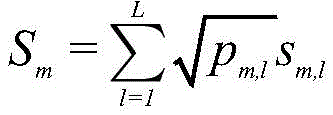
如图1所示,在本发明实施例中,考虑在MIMO-NOMA网络中,基站天线数为M1,基站总功率为Ptot,小区内有G个用户,每个用户的天线数为N(N≥M1),假设用户已经被分为M簇,每簇内共有L个用户,则有G=M×L。在上述MIMO-NOMA网络中,每簇用户均使用非正交多址接入技术,即所有用户在基站处叠加发送,并在接收端使用串行干扰消除技术进行多用户检测,以消除同一簇内的其他用户带来的干扰。基站处的发送信号为:As shown in FIG. 1 , in the embodiment of the present invention, consider that in a MIMO-NOMA network, the number of base station antennas is M1, the total power of the base station is P tot , there are G users in the cell, and the number of antennas of each user is N ( N≥M1), assuming that users have been divided into M clusters, and there are L users in each cluster, then G=M×L. In the above-mentioned MIMO-NOMA network, each cluster of users uses non-orthogonal multiple access technology, that is, all users superimpose transmission at the base station, and use serial interference cancellation technology to perform multi-user detection at the receiving end to eliminate the same cluster. interference from other users within. The transmitted signal at the base station is:

其中,
标记第m簇中的第l个用户为UEm,l,UEm,l接收到的信号表示为:Mark the lth user in the mth cluster as UE m,l , and the signal received by UE m,l is expressed as:
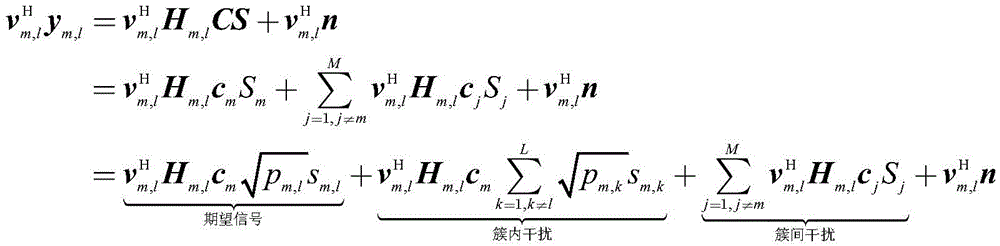
其中,
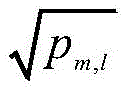
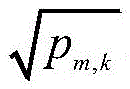
若令
通过串行干扰消除技术和信号检测技术可获得期望得到的信号。假设第m簇用户在接收端的有效信道增益排序为:The desired signal can be obtained by serial interference cancellation technology and signal detection technology. Assume that the effective channel gain ranking of the mth cluster users at the receiving end is:

在接收端使用串行干扰消除技术,假设ηm,l(0≤ηm,l≤1)为UEm,l在第m簇的串行干扰残留系数,表示UEm,l的串行干扰消除能力,ηm,l=0时表示接收端串行干扰消除理想。则经过串行干扰消除后UEm,l接收到的信号可表示为:The serial interference cancellation technique is used at the receiving end, assuming that n m,l (0≤n m, l≤1) is the serial interference residual coefficient of UE m,l in the mth cluster, which represents the serial interference of UE m,l Cancellation capability, when η m, l = 0, it indicates that the serial interference cancellation at the receiving end is ideal. Then the signal received by UE m, l after serial interference cancellation can be expressed as:

经过串行干扰消除后UEm,l的信干噪比可表示:After serial interference cancellation, the signal-to-interference-noise ratio of UE m and l can be expressed as:

其中,SINRm,l表示用户UEm,l的信干噪比。Among them, SINR m, l represents the signal-to-interference and noise ratio of user UE m, l .
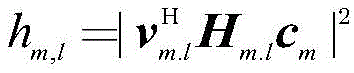
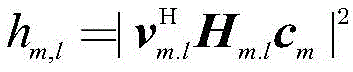
令

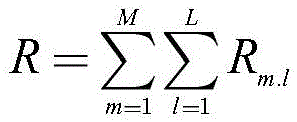
上式计算的结果为单位频谱(1Hz)的吞吐量。系统内所有用户的总吞吐量可表示为:The result calculated by the above formula is the throughput per unit spectrum (1 Hz). The total throughput of all users in the system can be expressed as:
每簇用户间平均分配系统功率,则基站分配给每簇用户的总功率为Ptot/M。The system power is evenly distributed among each cluster of users, and the total power allocated by the base station to each cluster of users is P tot /M.
系统吞吐量最大化模型为:The system throughput maximization model is:

其中,M表示用户总分簇数,L表示每簇的用户数量,Rm,l表示用户UEm,l的吞吐量,pm,l表示基站第m簇中的第l个用户UEm,l分配的功率值,
为解决本发明的吞吐量优化问题,下面给出基于吞吐量最优化功率分配策略:In order to solve the throughput optimization problem of the present invention, a power allocation strategy based on throughput optimization is given below:
构建斯坦克尔伯格博弈模型的过程包括:定义小区内的用户为买方(从方),基站为卖方(主方),基站设置单位功率价格并出售功率给各用户,各用户根据基站制定的价格从基站处购买功率,以最大化自身的效益。The process of constructing the Steinkelberg game model includes: defining the user in the cell as the buyer (slave side), the base station as the seller (master side), the base station setting the unit power price and selling the power to each user, each user according to the base station. The price buys power from the base station to maximize its own benefits.
买方的效用优化模型为:The buyer's utility optimization model is:

其中,Um,l表示用户UEm,l的效用函数,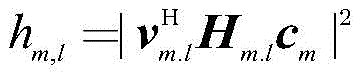

Subject to:Subject to:

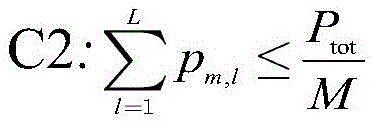

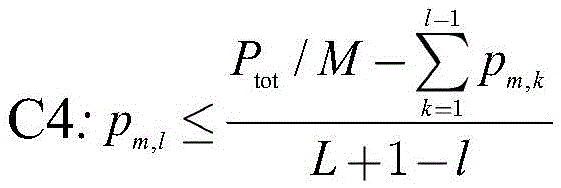

其中,Um,l表示用户UEm,l的效用函数,

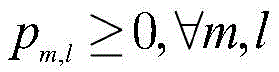
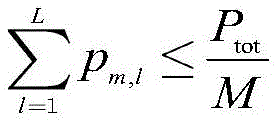
约束条件C1表示单个用户的功率分配值必须大于0,约束条件C2表示基站的总功率约束,约束条件C3和C4为用户间公平性约束,C5为用户的服务质量要求。Constraint C1 indicates that the power allocation value of a single user must be greater than 0, constraint C2 indicates the total power constraint of the base station, constraints C3 and C4 are fairness constraints between users, and C5 is the user's QoS requirement.
卖方的效用模型为:The seller's utility model is:

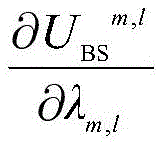
其中,UBS m,l表示表示基站向用户UEm,l出售功率的效用函数,λm,l表示基站向用户UEm,l出售功率的价格,cm,l表示基站向UEm,l出售单位功率的成本,pm,l表示基站为第m簇中的第l个用户UEm,l分配的功率值。Among them, U BS m,l denotes the utility function that the base station sells power to the user UE m,l , λ m,l denotes the price at which the base station sells the power to the user UE m,l , cm, l denotes the base station sells the power to the UE m,l The cost of selling unit power, p m,l represents the power value allocated by the base station to the lth user UE m,l in the mth cluster.
用户的最优购买策略包括:The user's optimal purchasing strategy includes:
本发明采用拉格朗日乘子法求解买方最优化问题,对买方的效用函数构建拉格朗日函数,买方的效用最大化问题转化为:The invention adopts the Lagrange multiplier method to solve the buyer's optimization problem, constructs a Lagrangian function for the buyer's utility function, and transforms the buyer's utility maximization problem into:
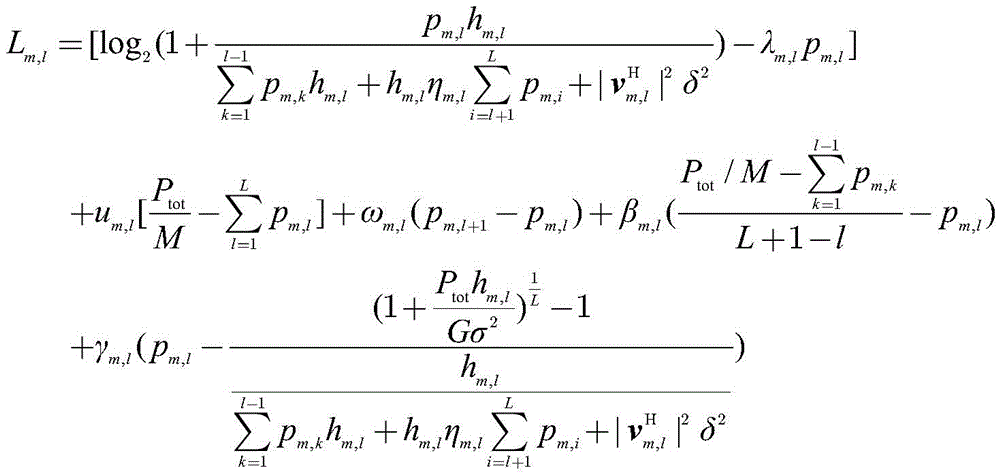
拉格朗日函数对pm,l求导可得:The derivative of the Lagrangian function with respect to p m, l can be obtained:
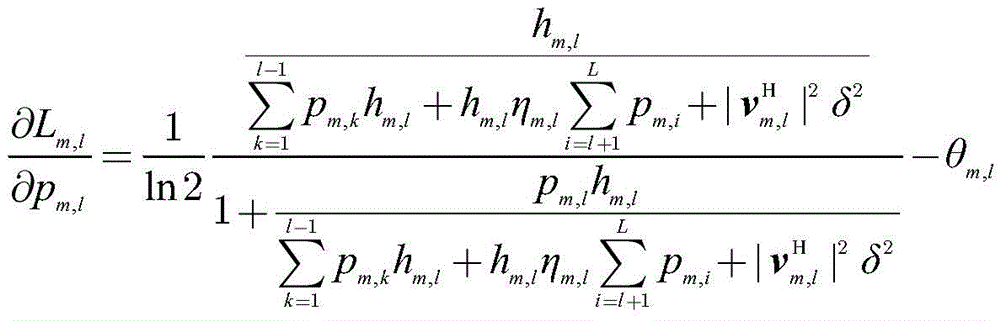
令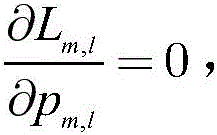

其中,Lm,l表示用户UEm,l效用函数在限制条件下的拉格朗日函数,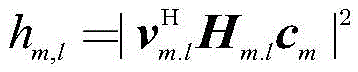


求出用户的最优购买策略的过程包括:The process of finding the user's optimal purchasing strategy includes:
将最优功率解代入卖方最优化问题中,可得卖方的最优化问题为:Substituting the optimal power solution into the seller's optimization problem, the seller's optimization problem can be obtained as:

UBS m,l对λm,l求导,可得:Taking the derivative of U BS m, l with respect to λ m, l , we can get:

令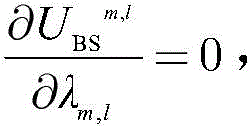
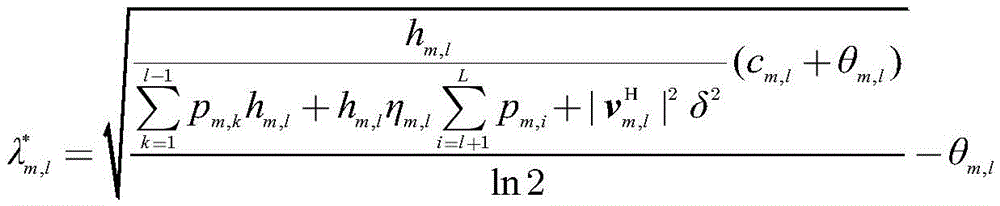
其中,UBS m,l表示基站对于UEm,l的效用函数,λm,l表示基站为UEm,l设置的单位功率价格,cm,l表示基站向UEm,l出售单位功率的成本,pm,l *表示UEm,l的最优功率值,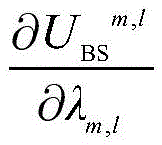


基站和用户双方进行博弈的过程包括:基站设置单位功率价格并出售功率给各用户,各用户根据基站制定的价格从基站处购买功率,以最大化自身的效益。假设基站的报价从成本cm,l开始,用户的功率购买量pm,l从0开始,首先根据最优价格制定策略
假设用户分簇数为M,每簇用户数为L,则小区内总用户数G=M×L。在本发明所提算法中,每个用户根据基站设定的单位功率价格决定最优功率分配策略,在每一次循环中,将有一个用户基于基站设定的价格做出响应,并通过1次计算得到此时的最优功率分配策略。通过考虑所提功率分配算法的最坏情况,可以分析其计算复杂度。假设在最坏的情况下,所有的用户在算法达到最大迭代次数时仍未达到均衡状态,此时进行了K×M×Imax,即G×Imax次计算。故当算法的最大迭代次数为Imax时,算法的时间复杂度为O(G×Imax)。而对于基于凸差规划的功率分配算法,当最大迭代次数为Nmax时,其时间复杂度为O(Nmax×G3)。Assuming that the number of user clusters is M, and the number of users in each cluster is L, the total number of users in the cell is G=M×L. In the algorithm proposed in the present invention, each user decides the optimal power allocation strategy according to the unit power price set by the base station. In each cycle, one user will respond based on the price set by the base station, and pass one The optimal power allocation strategy at this time is obtained by calculation. By considering the worst case of the proposed power allocation algorithm, its computational complexity can be analyzed. It is assumed that in the worst case, all users have not reached the equilibrium state when the algorithm reaches the maximum number of iterations. At this time, K×M×I max , that is, G×I max calculations, are performed. Therefore, when the maximum number of iterations of the algorithm is I max , the time complexity of the algorithm is O(G×I max) . For the power allocation algorithm based on convex difference programming, when the maximum number of iterations is N max , its time complexity is O(N max ×G 3 ).
如图3所示,当Nmax=Imax=30时,两种算法的时间复杂度对比,通过复杂度分析可知,基于斯坦克尔伯格博弈的分布式功率分配算法的复杂度要明显低于基于凸差规划的功率分配策略。As shown in Figure 3, when N max =I max =30, the time complexity of the two algorithms is compared, and the complexity analysis shows that the complexity of the distributed power allocation algorithm based on the Steinkelberg game is significantly lower For the power allocation strategy based on convex difference planning.
为了进一步说明MIMO-NOMA网络中基于博弈论的功率分配算法性能优于分数阶功率分配算法,下面对本发明的功率分配算法进行仿真验证。In order to further illustrate that the performance of the power allocation algorithm based on game theory in the MIMO-NOMA network is better than the fractional order power allocation algorithm, the power allocation algorithm of the present invention is simulated and verified below.
如图4所示,仿真参数设置如下:基站天线数M=2,用户天线数N=2,小区半径R=500m,用户与基站的最小距离dmin=50m,小区内用户数为8,用户随机分布在小区内,信道噪声功率为-70dBm。信道估计为理想状态,路径损耗指数为3,基站总功率范围为24dBm到40dBm,串行干扰消除残留分别为η=0.001和η=0.002。仿真结果表明,所提功率分配算法性能要优于分数阶功率分配算法。在基站总功率相同的情况下,所提算法系统总吞吐量总是高于分数阶功率分配算法,且随着系统总功率的增加,系统总速率也增加,但增加的速度逐渐减缓,这是由于对于本发明所提算法,基站为用户所分配的功率并不会随着系统总功率的增加而无限制的增加。As shown in Figure 4, the simulation parameters are set as follows: the number of base station antennas M=2, the number of user antennas N=2, the cell radius R=500m, the minimum distance between the user and the base station dmin =50m, the number of users in the cell is 8, the user Randomly distributed in the cell, the channel noise power is -70dBm. The channel estimation is ideal, the path loss index is 3, the total power range of the base station is 24dBm to 40dBm, and the serial interference cancellation residuals are η=0.001 and η=0.002, respectively. The simulation results show that the performance of the proposed power allocation algorithm is better than that of the fractional-order power allocation algorithm. When the total power of the base station is the same, the total system throughput of the proposed algorithm is always higher than that of the fractional power allocation algorithm, and with the increase of the total system power, the total system rate also increases, but the speed of increase gradually slows down, which is As for the algorithm proposed in the present invention, the power allocated by the base station to the user does not increase unlimitedly with the increase of the total system power.
如图5所示,将小区内总用户数设置为8时本发明所提算法与基于凸差规划的功率分配算法在系统总吞吐量方面的性能比较。仿真结果表明,基于凸差规划的功率分配算法的系统总速率略高于本发明所提算法,表明本发明在与基于凸差规划的功率分配算法的性能相近的基础上降低了算法复杂度。As shown in FIG. 5 , when the total number of users in the cell is set to 8, the performance comparison between the algorithm proposed in the present invention and the power allocation algorithm based on convex difference planning in terms of total system throughput. The simulation results show that the total system rate of the power allocation algorithm based on the convex difference programming is slightly higher than that of the algorithm proposed by the present invention, indicating that the present invention reduces the algorithm complexity on the basis of similar performance to the power allocation algorithm based on the convex difference programming.
本领域普通技术人员可以理解上述实施例的各种方法中的全部或部分步骤是可以通过程序来指令相关的硬件来完成,该程序可以存储于计算机可读存储介质中,存储介质可以包括:ROM、RAM、磁盘或光盘等。Those of ordinary skill in the art can understand that all or part of the steps in the various methods of the above embodiments can be completed by instructing relevant hardware through a program, and the program can be stored in a computer-readable storage medium, and the storage medium can include: ROM , RAM, disk or CD, etc.
以上所举实施例,对本发明的目的、技术方案和优点进行了进一步的详细说明,所应理解的是,以上所举实施例仅为本发明的优选实施方式而已,并不用以限制本发明,凡在本发明的精神和原则之内对本发明所作的任何修改、等同替换、改进等,均应包含在本发明的保护范围之内。The above-mentioned embodiments further describe the purpose, technical solutions and advantages of the present invention in detail. It should be understood that the above-mentioned embodiments are only preferred embodiments of the present invention, and are not intended to limit the present invention. Any modification, equivalent replacement, improvement, etc. made to the present invention within the spirit and principle of the present invention shall be included within the protection scope of the present invention.
Claims (3)


















Priority Applications (1)
| Application Number | Priority Date | Filing Date | Title |
|---|---|---|---|
| CN202010188013.1A CN111194043B (en) | 2020-03-17 | 2020-03-17 | Power distribution method based on non-perfect serial interference elimination |
Applications Claiming Priority (1)
| Application Number | Priority Date | Filing Date | Title |
|---|---|---|---|
| CN202010188013.1A CN111194043B (en) | 2020-03-17 | 2020-03-17 | Power distribution method based on non-perfect serial interference elimination |
Publications (2)
| Publication Number | Publication Date |
|---|---|
| CN111194043A CN111194043A (en) | 2020-05-22 |
| CN111194043B true CN111194043B (en) | 2022-02-22 |
Family
ID=70710322
Family Applications (1)
| Application Number | Title | Priority Date | Filing Date |
|---|---|---|---|
| CN202010188013.1A Active CN111194043B (en) | 2020-03-17 | 2020-03-17 | Power distribution method based on non-perfect serial interference elimination |
Country Status (1)
| Country | Link |
|---|---|
| CN (1) | CN111194043B (en) |
Citations (7)
| Publication number | Priority date | Publication date | Assignee | Title |
|---|---|---|---|---|
| WO2012061994A1 (en) * | 2010-11-12 | 2012-05-18 | Nokia Siemens Networks Oy | Allocation of resources in a communication system |
| CN105848274A (en) * | 2016-03-25 | 2016-08-10 | 山东大学 | Non-uniform pricing power control method based on Steinberg game theory in bi-layer heterogeneous network |
| CN107172701A (en) * | 2017-03-15 | 2017-09-15 | 中山大学 | A kind of power distribution method of non-orthogonal multiple access system |
| CN107466099A (en) * | 2017-07-31 | 2017-12-12 | 北京邮电大学 | A kind of interference management self-organization method based on non-orthogonal multiple access |
| CN109618351A (en) * | 2019-01-09 | 2019-04-12 | 南京邮电大学 | A Resource Allocation Method in Heterogeneous Network Based on Stackelberg Game |
| CN110087245A (en) * | 2018-01-26 | 2019-08-02 | 华北电力大学 | Heterogeneous network base station deployment and frequency spectrum pricing scheme based on optimal utility |
| CN110809259A (en) * | 2019-10-28 | 2020-02-18 | 南京邮电大学 | A NOMA-enabled D2D communication resource game method based on social relations |
Family Cites Families (4)
| Publication number | Priority date | Publication date | Assignee | Title |
|---|---|---|---|---|
| US9878632B2 (en) * | 2014-08-19 | 2018-01-30 | General Electric Company | Vehicle propulsion system having an energy storage system and optimized method of controlling operation thereof |
| US10989141B2 (en) * | 2014-11-24 | 2021-04-27 | Nirvana Energy Systems, Inc. | Secure control system for multistage thermo acoustic micro-CHP generator |
| CN106034349B (en) * | 2015-03-12 | 2020-11-20 | 株式会社Ntt都科摩 | Transmission power control method and device |
| AU2015101185A4 (en) * | 2015-07-26 | 2015-10-08 | Macau University Of Science And Technology | Power control method for spectrum sharing cognitive radio network |
-
2020
- 2020-03-17 CN CN202010188013.1A patent/CN111194043B/en active Active
Patent Citations (7)
| Publication number | Priority date | Publication date | Assignee | Title |
|---|---|---|---|---|
| WO2012061994A1 (en) * | 2010-11-12 | 2012-05-18 | Nokia Siemens Networks Oy | Allocation of resources in a communication system |
| CN105848274A (en) * | 2016-03-25 | 2016-08-10 | 山东大学 | Non-uniform pricing power control method based on Steinberg game theory in bi-layer heterogeneous network |
| CN107172701A (en) * | 2017-03-15 | 2017-09-15 | 中山大学 | A kind of power distribution method of non-orthogonal multiple access system |
| CN107466099A (en) * | 2017-07-31 | 2017-12-12 | 北京邮电大学 | A kind of interference management self-organization method based on non-orthogonal multiple access |
| CN110087245A (en) * | 2018-01-26 | 2019-08-02 | 华北电力大学 | Heterogeneous network base station deployment and frequency spectrum pricing scheme based on optimal utility |
| CN109618351A (en) * | 2019-01-09 | 2019-04-12 | 南京邮电大学 | A Resource Allocation Method in Heterogeneous Network Based on Stackelberg Game |
| CN110809259A (en) * | 2019-10-28 | 2020-02-18 | 南京邮电大学 | A NOMA-enabled D2D communication resource game method based on social relations |
Non-Patent Citations (6)
| Title |
|---|
| Multi-level Price-Based Power Allocation with User Number Limit for Non-Orthogonal Multiple Access;Nande Zhao等;《2019 IEEE Wireless Communications and Networking Conference (WCNC)》;20191031;全文 * |
| Price-Based Power Allocation for Non-Orthogonal Multiple Access Systems;Chongyang Li等;《IEEE WIRELESS COMMUNICATIONS LETTERS》;20160927;全文 * |
| R1-1801397 "Discussion on application scenarios for NoMA";Huawei等;《3GPP tsg_ran\WG1_RL1》;20180217;全文 * |
| 基于5G网络的非线性预编码技术;张晓丹等;《通信技术》;20190310(第03期);全文 * |
| 基于SIC的非正交多址系统功率分配算法研究;高翔;《中国优秀硕士学位论文库》;20180415;全文 * |
| 非正交多址系统资源分配研究综述;王正强等;《电信科学》;20180820(第08期);全文 * |
Also Published As
| Publication number | Publication date |
|---|---|
| CN111194043A (en) | 2020-05-22 |
Similar Documents
| Publication | Publication Date | Title |
|---|---|---|
| CN111405584B (en) | Energy efficiency power distribution method based on non-orthogonal multiple access in MIMO system | |
| CN111865378B (en) | Large-scale MIMO downlink precoding method based on deep learning | |
| CN107682935B (en) | Wireless self-return resource scheduling method based on system stability | |
| CN109327894B (en) | Optimal power allocation method for multi-cell MIMO-NOMA based on interference suppression | |
| CN114339775B (en) | RIS-assisted unlicensed spectrum coexistence method based on optimized DDPG | |
| CN113472403B (en) | Power distribution method based on overlapped visual area in super-large-scale MIMO system | |
| CN109756874A (en) | An ultra-dense millimeter-wave D2D communication interference management method | |
| CN111901812A (en) | Full-duplex cellular communication network base station and intelligent reflecting surface combined control method | |
| CN104039004A (en) | Method for heterogeneous user pilot frequency power optimal distribution in large-scale multi-input multi-output system | |
| Lu et al. | Joint beamforming and power control for MIMO-NOMA with deep reinforcement learning | |
| CN109068382B (en) | A NOMA Cross-Layer Power Allocation Method Based on Delay QoS | |
| CN104717730B (en) | Extensive antenna system High-energy-efficienresource resource optimization method | |
| CN113766492A (en) | Safe Massive MIMO network resource allocation method | |
| Xiao et al. | Performance analysis of adaptive RIS-assisted clustering strategies in downlink communication systems | |
| CN103944618A (en) | Large-scale MISO collaborative energy efficiency sending method | |
| CN104301968B (en) | A kind of method that access base station cluster is chosen for mobile station | |
| CN111194043B (en) | Power distribution method based on non-perfect serial interference elimination | |
| CN112584403B (en) | Joint optimization method for maximum rate and minimum power of NOMA small cell | |
| CN114143790A (en) | Mass Antenna Cell-free IRS Physical Layer Security Method | |
| CN112600593A (en) | NOMA-based beam selection method | |
| Wang et al. | Optimal beamforming in MIMO two-way relay channels | |
| TW202145005A (en) | Method of parameter estimation for a mimo system based on deep learning | |
| CN118748564A (en) | A Synaesthesia-Integrated Waveform Design Method for Anti-Eavesdropping | |
| CN116886139A (en) | A hybrid precoding design method in distributed millimeter wave massive MIMO systems | |
| CN104734819B (en) | Alignment algorithm is interfered based on the multiple cell of AF panel and capacity boost |
Legal Events
| Date | Code | Title | Description |
|---|---|---|---|
| PB01 | Publication | ||
| PB01 | Publication | ||
| SE01 | Entry into force of request for substantive examination | ||
| SE01 | Entry into force of request for substantive examination | ||
| GR01 | Patent grant | ||
| GR01 | Patent grant | ||
| TR01 | Transfer of patent right | ||
| TR01 | Transfer of patent right |
Effective date of registration: 20240411 Address after: 518000 1104, Building A, Zhiyun Industrial Park, No. 13, Huaxing Road, Henglang Community, Longhua District, Shenzhen, Guangdong Province Patentee after: Shenzhen Hongyue Enterprise Management Consulting Co.,Ltd. Country or region after: China Address before: 400065 Chongwen Road, Nanshan Street, Nanan District, Chongqing Patentee before: CHONGQING University OF POSTS AND TELECOMMUNICATIONS Country or region before: China |
|
| TR01 | Transfer of patent right | ||
| TR01 | Transfer of patent right |
Effective date of registration: 20240414 Address after: Room 1110, No. 266 Yanta South Road, National Civil Aerospace Industry Base, Xi'an City, Shaanxi Province, 710018 Patentee after: Xi'an Rongcan Yunlian Data Technology Co.,Ltd. Country or region after: China Address before: 518000 1104, Building A, Zhiyun Industrial Park, No. 13, Huaxing Road, Henglang Community, Longhua District, Shenzhen, Guangdong Province Patentee before: Shenzhen Hongyue Enterprise Management Consulting Co.,Ltd. Country or region before: China |