CN111047681B - Single-pixel three-dimensional end-to-end reconstruction method and device based on deep learning - Google Patents
Single-pixel three-dimensional end-to-end reconstruction method and device based on deep learning Download PDFInfo
- Publication number
- CN111047681B CN111047681B CN201911081307.8A CN201911081307A CN111047681B CN 111047681 B CN111047681 B CN 111047681B CN 201911081307 A CN201911081307 A CN 201911081307A CN 111047681 B CN111047681 B CN 111047681B
- Authority
- CN
- China
- Prior art keywords
- dimensional
- pixel
- data set
- reconstruction
- network
- Prior art date
- Legal status (The legal status is an assumption and is not a legal conclusion. Google has not performed a legal analysis and makes no representation as to the accuracy of the status listed.)
- Active
Links
Images


Classifications
-
- G—PHYSICS
- G06—COMPUTING OR CALCULATING; COUNTING
- G06T—IMAGE DATA PROCESSING OR GENERATION, IN GENERAL
- G06T17/00—Three dimensional [3D] modelling, e.g. data description of 3D objects
-
- G—PHYSICS
- G01—MEASURING; TESTING
- G01B—MEASURING LENGTH, THICKNESS OR SIMILAR LINEAR DIMENSIONS; MEASURING ANGLES; MEASURING AREAS; MEASURING IRREGULARITIES OF SURFACES OR CONTOURS
- G01B11/00—Measuring arrangements characterised by the use of optical techniques
- G01B11/22—Measuring arrangements characterised by the use of optical techniques for measuring depth
-
- G—PHYSICS
- G01—MEASURING; TESTING
- G01B—MEASURING LENGTH, THICKNESS OR SIMILAR LINEAR DIMENSIONS; MEASURING ANGLES; MEASURING AREAS; MEASURING IRREGULARITIES OF SURFACES OR CONTOURS
- G01B11/00—Measuring arrangements characterised by the use of optical techniques
- G01B11/24—Measuring arrangements characterised by the use of optical techniques for measuring contours or curvatures
-
- G—PHYSICS
- G06—COMPUTING OR CALCULATING; COUNTING
- G06T—IMAGE DATA PROCESSING OR GENERATION, IN GENERAL
- G06T7/00—Image analysis
- G06T7/50—Depth or shape recovery
- G06T7/55—Depth or shape recovery from multiple images
-
- G—PHYSICS
- G06—COMPUTING OR CALCULATING; COUNTING
- G06T—IMAGE DATA PROCESSING OR GENERATION, IN GENERAL
- G06T2200/00—Indexing scheme for image data processing or generation, in general
- G06T2200/08—Indexing scheme for image data processing or generation, in general involving all processing steps from image acquisition to 3D model generation
-
- G—PHYSICS
- G06—COMPUTING OR CALCULATING; COUNTING
- G06T—IMAGE DATA PROCESSING OR GENERATION, IN GENERAL
- G06T2207/00—Indexing scheme for image analysis or image enhancement
- G06T2207/20—Special algorithmic details
- G06T2207/20081—Training; Learning
-
- G—PHYSICS
- G06—COMPUTING OR CALCULATING; COUNTING
- G06T—IMAGE DATA PROCESSING OR GENERATION, IN GENERAL
- G06T2207/00—Indexing scheme for image analysis or image enhancement
- G06T2207/20—Special algorithmic details
- G06T2207/20084—Artificial neural networks [ANN]
Landscapes
- Physics & Mathematics (AREA)
- General Physics & Mathematics (AREA)
- Engineering & Computer Science (AREA)
- Theoretical Computer Science (AREA)
- Computer Graphics (AREA)
- Geometry (AREA)
- Software Systems (AREA)
- Computer Vision & Pattern Recognition (AREA)
- Image Analysis (AREA)
- Length Measuring Devices By Optical Means (AREA)
Abstract
本发明公开了一种基于深度学习的单像素三维端到端重建方法及装置,其中,该方法包括:构建包含多个物体三维信息的三维数据集;对三维数据集进行特定预处理生成单像素探测器的一维测量值;获取三维重建网络,通过三维数据集和一维测量值训练三维重建网络;通过训练后的三维重建网络对待测三维物体进行重建,输出待测三维物体的三维深度信息。该方法设计端到端的神经网络,从单像素探测器的一维测量值重建三维物体的三维深度信息,实现了在单像素三维成像系统中,通过深度学习的方法端到端的完成场景深度信息的重建,计算复杂度低。
The invention discloses a single-pixel three-dimensional end-to-end reconstruction method and device based on deep learning, wherein the method includes: constructing a three-dimensional data set containing three-dimensional information of multiple objects; performing specific preprocessing on the three-dimensional data set to generate a single pixel The one-dimensional measurement value of the detector; obtain the three-dimensional reconstruction network, train the three-dimensional reconstruction network through the three-dimensional data set and the one-dimensional measurement value; reconstruct the three-dimensional object to be measured through the trained three-dimensional reconstruction network, and output the three-dimensional depth information of the three-dimensional object to be measured . In this method, an end-to-end neural network is designed to reconstruct the 3D depth information of 3D objects from the 1D measurement value of the single-pixel detector, so that the depth information of the scene can be obtained end-to-end through the deep learning method in the single-pixel 3D imaging system. Reconstruction with low computational complexity.
Description
技术领域technical field
本发明涉及三维场景计算重构技术领域,特别涉及一种基于深度学习的单像素三维端到端重建方法及装置。The present invention relates to the technical field of three-dimensional scene calculation and reconstruction, in particular to a single-pixel three-dimensional end-to-end reconstruction method and device based on deep learning.
背景技术Background technique
在光学中,三维测量及重建的方法是光学器件和计算机技术的结合。按光照方式,三维测量分为两类,包括主动法和被动法。在主动法中,使用激光作为光源的方法称为激光测距法,例如相关技术提出的结合激光扫描法进行室内场景的三维重建方法。除了激光,还可使用结构光在物体表面形成结构性光场,相关技术中提出使用结构光照射物体后的条带边缘进行定位,能够达到稳定的亚毫米精度三维重建效果。此外,还可使用干涉测量法生成相干信号,结合外差等技术进行三维重建。被动法则不提供主动照明,只使用传感器拍摄物体环境光下的表面反射,通过图像特征来分析解构三维信息。In optics, the method of three-dimensional measurement and reconstruction is a combination of optical devices and computer technology. According to the way of illumination, 3D measurement is divided into two categories, including active method and passive method. In the active method, the method of using a laser as a light source is called a laser ranging method, such as a three-dimensional reconstruction method of an indoor scene combined with a laser scanning method proposed in the related art. In addition to lasers, structured light can also be used to form a structured light field on the surface of an object. In the related art, it is proposed to use structured light to irradiate the strip edge of the object for positioning, which can achieve a stable sub-millimeter precision 3D reconstruction effect. In addition, interferometry can be used to generate coherent signals, combined with techniques such as heterodyne for 3D reconstruction. Passive law does not provide active lighting, only uses sensors to capture surface reflections of objects under ambient light, and analyzes and deconstructs three-dimensional information through image features.
近几年兴起的基于计算机视觉及深度学习的技术,大部分采用被动法。如输入单视点的单幅或多幅图像,通过图像的明暗、阴影等二维特征来推导出场景深度信息,但重建效果一般;又如输入多视点多幅图像,通过匹配特征点及约束条件求取空间三维点的坐标信息,该方法重建效果较好,但运算量较大,重建时间长;以及通过深度学习的方式,对数据集中的每个目标进行特征提取,然后建立待测目标的概率函数,与数据集中的相似目标进行比较进而重建,该方法重建效率高,但对数据集的数量及精度要求高。Most of the technologies based on computer vision and deep learning that have emerged in recent years use passive methods. For example, if a single or multiple images of a single viewpoint are input, the depth information of the scene is derived from the two-dimensional features of the image, such as light and shade, shadows, etc., but the reconstruction effect is general. To obtain the coordinate information of three-dimensional points in space, this method has a good reconstruction effect, but the calculation amount is large and the reconstruction time is long; and by means of deep learning, each target in the data set is feature extraction, and then the target to be tested is established. The probability function is compared with similar targets in the data set and then reconstructed. This method has high reconstruction efficiency, but requires high number and accuracy of the data set.
而在上述光学成像模型下,用传统阵列相机拍摄图像进行后续的三维重建工作具有一定局限性,在存储高清图像时所需内存大,且单幅图像只能感知光的强度信息,丢失场景的深度信息。单像素相机作为计算摄像学领域的器件,使用光电二极管而非阵列传感器捕获图像,具有高信噪比。且单像素探测器无需采集全部像素点,在数据传输以及存储需求上都相应减少,因此具有优于传统阵列传感器的特点,在宽光谱范围及多领域光波段的二维成像得到较多应用。However, under the above optical imaging model, the use of traditional array cameras to capture images for subsequent 3D reconstruction has certain limitations. The memory required to store high-definition images is large, and a single image can only perceive the intensity information of light, and the scene is lost. in-depth information. Single-pixel cameras, as devices in the field of computational photography, use photodiodes instead of array sensors to capture images with a high signal-to-noise ratio. In addition, the single-pixel detector does not need to collect all the pixels, and the data transmission and storage requirements are correspondingly reduced, so it has the characteristics of being superior to the traditional array sensor, and has been widely used in two-dimensional imaging with a wide spectral range and multiple fields of light.
对于传统三维光学重建方法,存在下列问题:(1)所需仪器价格高;(2)采集时间长,次数多;(3)根据不同场景的需求,部分三维重建精度不够;而对于深度学习的三维重建方法,存在的问题则是:(1)需要采集大量单视角多幅图像或多视角多幅图像;(2)需要完备的数据集。较多文章进行了深度学习方面的三维重建研究,但大部分基于深度学习的三维重建方法都在光学的被动法中,利用数据集的高清二维图像进行结构分析,达到高精度的重建,而与单像素探测器的结合较少。For traditional 3D optical reconstruction methods, there are the following problems: (1) The required instruments are expensive; (2) The acquisition time is long and the number of times is large; (3) According to the needs of different scenarios, the accuracy of some 3D reconstructions is not enough; The three-dimensional reconstruction method has the following problems: (1) It needs to collect a large number of single-view multiple images or multi-view multiple images; (2) It needs a complete data set. Many articles have carried out 3D reconstruction research on deep learning, but most of the 3D reconstruction methods based on deep learning are in the passive optical method, using the high-definition 2D images of the dataset for structural analysis to achieve high-precision reconstruction. Less binding with single-pixel detectors.
目前关于单像素三维重建方面的研究仍旧在起步阶段,现有单像素三维重建方法还存在较多问题,包括:(1)所需单像素探测器的数量较多;(2)完整精密重建系统所需仪器(如飞秒激光仪、光栅投射器等)成本高;(3)无法直接求解高度信息,需要经过复杂运算步骤等。因此,使用单像素探测器实现高效三维重建具有重要的研究意义。At present, the research on single-pixel 3D reconstruction is still in its infancy, and the existing single-pixel 3D reconstruction methods still have many problems, including: (1) the number of single-pixel detectors required is large; (2) the complete precision reconstruction system The required instruments (such as femtosecond lasers, grating projectors, etc.) are expensive; (3) the height information cannot be solved directly, and complex operation steps are required. Therefore, the use of single-pixel detectors to achieve efficient 3D reconstruction is of great research significance.
发明内容SUMMARY OF THE INVENTION
本发明旨在至少在一定程度上解决相关技术中的技术问题之一。The present invention aims to solve one of the technical problems in the related art at least to a certain extent.
为此,本发明的一个目的在于提出一种基于深度学习的单像素三维端到端重建方法,该方法实现了在单像素三维成像系统中,通过深度学习的方法端到端地完成场景深度信息的重建,计算复杂度低,在三维成像领域具有广泛的应用。To this end, an object of the present invention is to propose a single-pixel 3D end-to-end reconstruction method based on deep learning, which realizes the end-to-end completion of scene depth information through a deep learning method in a single-pixel 3D imaging system. The reconstruction has low computational complexity and has a wide range of applications in the field of 3D imaging.
本发明的另一个目的在于提出一种基于深度学习的单像素三维端到端重建装置。Another object of the present invention is to propose a single-pixel three-dimensional end-to-end reconstruction device based on deep learning.
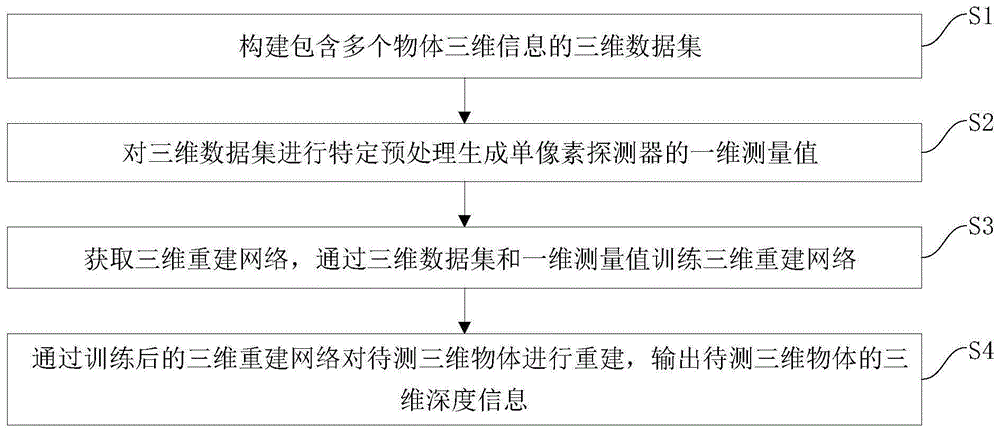
为达到上述目的,本发明一方面实施例提出了一种基于深度学习的单像素三维端到端重建方法,包括:In order to achieve the above object, an embodiment of the present invention proposes a single-pixel 3D end-to-end reconstruction method based on deep learning, including:
S1,构建包含多个物体三维信息的三维数据集;S1, construct a three-dimensional data set containing three-dimensional information of multiple objects;
S2,对所述三维数据集进行特定预处理生成单像素探测器的一维测量值;S2, performing specific preprocessing on the three-dimensional data set to generate a one-dimensional measurement value of a single-pixel detector;
S3,获取三维重建网络,通过所述三维数据集和所述一维测量值训练所述三维重建网络;S3, obtaining a three-dimensional reconstruction network, and training the three-dimensional reconstruction network by using the three-dimensional data set and the one-dimensional measurement value;
S4,通过训练后的三维重建网络对待测三维物体进行重建,输出所述待测三维物体的三维深度信息。S4 , reconstructing the three-dimensional object to be measured through the trained three-dimensional reconstruction network, and outputting the three-dimensional depth information of the three-dimensional object to be measured.
本发明实施例的基于深度学习的单像素三维端到端重建方法,通过建立包含大量物体三维信息的三维数据集,并针对数据集中的每个物体仿真单像素探测器的一维测量值,设计卷积神经网络及并行网络组成的解码网络用以恢复三维信息,使用三维数据集及对应的一维测量值对该网络进行训练,通过测试集对网络进行测试,得到待测三维物体的深度数据。该方法实现了在单像素三维成像系统中,通过深度学习的方法端到端地完成场景深度信息的重建,计算复杂度低,在三维成像领域具有广泛的应用。The deep learning-based single-pixel three-dimensional end-to-end reconstruction method according to the embodiment of the present invention is designed by establishing a three-dimensional data set containing a large number of three-dimensional information of objects, and simulating one-dimensional measurement values of a single-pixel detector for each object in the data set. A decoding network composed of a convolutional neural network and a parallel network is used to recover three-dimensional information. The network is trained using a three-dimensional data set and corresponding one-dimensional measurement values, and the network is tested through the test set to obtain the depth data of the three-dimensional object to be measured. . This method realizes the end-to-end reconstruction of scene depth information through deep learning in a single-pixel 3D imaging system, with low computational complexity, and has a wide range of applications in the field of 3D imaging.
另外,根据本发明上述实施例的基于深度学习的单像素三维端到端重建方法还可以具有以下附加的技术特征:In addition, the deep learning-based single-pixel three-dimensional end-to-end reconstruction method according to the above-mentioned embodiments of the present invention may also have the following additional technical features:
进一步地,在本发明的一个实施例中,还包括:Further, in an embodiment of the present invention, it also includes:
通过输出的所述待测三维物体的三维深度信息恢复所述待测三维物体,将恢复出的待测三维物体与所述待测三维物体进行误差对比,得到三维重建误差,根据所述三维重建误差调整所述三维重建网络。The three-dimensional object to be measured is restored by the output three-dimensional depth information of the three-dimensional object to be measured, and the error of the restored three-dimensional object to be measured is compared with the three-dimensional object to be measured to obtain a three-dimensional reconstruction error. Error adjusts the 3D reconstruction network.
进一步地,在本发明的一个实施例中,所述构建包含多个物体三维信息的三维数据集,包括:Further, in an embodiment of the present invention, the constructing a three-dimensional data set containing three-dimensional information of multiple objects includes:
选取多个三维物体对应的正弦条纹图,计算每张正弦条纹图对应的三维物体的高度信息,根据高度信息生成每张条纹图对应的高度矩阵。The sinusoidal fringe images corresponding to multiple three-dimensional objects are selected, the height information of the three-dimensional objects corresponding to each sinusoidal fringe image is calculated, and the height matrix corresponding to each fringe image is generated according to the height information.
进一步地,在本发明的一个实施例中,所述对所述三维数据集进行特定预处理生成单像素探测器的一维测量值,包括:Further, in an embodiment of the present invention, performing specific preprocessing on the three-dimensional data set to generate a one-dimensional measurement value of a single-pixel detector includes:
S21,利用和所述三维数据集中的正弦条纹图相同像素大小的随机[0,1]矩阵与所述三维数据集中的一张正弦条纹图相乘,并进行各点像素数值叠加,得到单像素探测器的一个测量值;S21, using a random [0,1] matrix with the same pixel size as the sinusoidal fringe image in the three-dimensional data set to multiply a sinusoidal fringe image in the three-dimensional data set, and superimposing the pixel values of each point to obtain a single pixel a measurement of the detector;
S22,设定单像素采集次数为M次,将M个[0,1]矩阵与同一张条纹图像相乘,得到M×1的所述一维测量值;S22, setting the number of single-pixel acquisitions to M times, and multiplying M [0,1] matrices with the same fringe image to obtain the one-dimensional measurement value of M×1;
S23,重复步骤S21和S22,直至将所述三维数据集中的所有条纹图进行处理,得到多个M×1的所述一维测量值。S23 , repeating steps S21 and S22 until all fringe images in the three-dimensional data set are processed to obtain a plurality of M×1 one-dimensional measurement values.
进一步地,在本发明的一个实施例中,所述三维重建网络包括由多种卷积层及多组并行的卷积神经网络组成的解码网络。Further, in an embodiment of the present invention, the three-dimensional reconstruction network includes a decoding network composed of multiple convolutional layers and multiple groups of parallel convolutional neural networks.
为达到上述目的,本发明另一方面实施例提出了一种基于深度学习的单像素三维端到端重建装置,包括:In order to achieve the above object, another embodiment of the present invention provides a single-pixel three-dimensional end-to-end reconstruction device based on deep learning, including:
数据集构建模块,用于构建包含多个物体三维信息的三维数据集;The dataset building module is used to construct a 3D dataset containing 3D information of multiple objects;
数据预处理模块,用于对所述三维数据集进行预处理生成单像素探测器的一维测量值;a data preprocessing module for preprocessing the three-dimensional data set to generate one-dimensional measurement values of the single-pixel detector;
网络训练模块,用于获取三维重建网络,通过所述三维数据集和所述一维测量值训练所述三维重建网络;a network training module, configured to acquire a three-dimensional reconstruction network, and train the three-dimensional reconstruction network by using the three-dimensional data set and the one-dimensional measurement value;
结果测试模块,用于通过训练后的三维重建网络对待测三维物体进行重建,输出所述待测三维物体的三维深度信息。The result testing module is used for reconstructing the three-dimensional object to be measured through the trained three-dimensional reconstruction network, and outputting the three-dimensional depth information of the three-dimensional object to be measured.
本发明实施例的基于深度学习的单像素三维端到端重建装置,通过建立包含大量物体三维信息的三维数据集,并针对数据集中的每个物体仿真单像素探测器的一维测量值,设计卷积神经网络及并行网络组成的解码网络用以恢复三维信息,使用三维数据集及对应的一维测量值对该网络进行训练,通过测试集对网络进行测试,得到待测三维物体的深度数据。该装置实现了在单像素三维成像系统中,通过深度学习的方法端到端地完成场景深度信息的重建,计算复杂度低,在三维成像领域具有广泛的应用。The deep learning-based single-pixel three-dimensional end-to-end reconstruction device according to the embodiment of the present invention is designed by establishing a three-dimensional data set containing a large number of three-dimensional information of objects, and simulating one-dimensional measurement values of a single-pixel detector for each object in the data set. A decoding network composed of a convolutional neural network and a parallel network is used to recover three-dimensional information. The network is trained using a three-dimensional data set and corresponding one-dimensional measurement values, and the network is tested through the test set to obtain the depth data of the three-dimensional object to be measured. . The device realizes the end-to-end reconstruction of scene depth information through a deep learning method in a single-pixel three-dimensional imaging system, with low computational complexity and wide application in the field of three-dimensional imaging.
另外,根据本发明上述实施例的基于深度学习的单像素三维端到端重建装置还可以具有以下附加的技术特征:In addition, the device for single-pixel three-dimensional end-to-end reconstruction based on deep learning according to the foregoing embodiments of the present invention may also have the following additional technical features:
进一步地,在本发明的一个实施例中,还包括:调整模块,Further, in an embodiment of the present invention, it further includes: an adjustment module,
所述调整模块,用于通过输出的所述待测三维物体的三维深度信息恢复所述待测三维物体,将恢复出的待测三维物体与所述待测三维物体进行误差对比,得到三维重建误差,根据所述三维重建误差调整所述三维重建网络。The adjustment module is configured to restore the three-dimensional object to be measured through the output three-dimensional depth information of the three-dimensional object to be measured, and compare the error of the restored three-dimensional object to be measured with the three-dimensional object to be measured to obtain a three-dimensional reconstruction error, and adjust the 3D reconstruction network according to the 3D reconstruction error.
进一步地,在本发明的一个实施例中,所述数据集构建模块,具体用于,Further, in an embodiment of the present invention, the data set building module is specifically used to:
选取多个三维物体对应的正弦条纹图,计算每张正弦条纹图对应的三维物体的高度信息,根据高度信息生成每张条纹图对应的高度矩阵。The sinusoidal fringe images corresponding to multiple three-dimensional objects are selected, the height information of the three-dimensional objects corresponding to each sinusoidal fringe image is calculated, and the height matrix corresponding to each fringe image is generated according to the height information.
进一步地,在本发明的一个实施例中,所述数据预处理模块,具体用于,Further, in an embodiment of the present invention, the data preprocessing module is specifically used to:
利用和所述三维数据集中的正弦条纹图相同像素大小的随机[0,1]矩阵与所述三维数据集中的一张正弦条纹图相乘,并进行各点像素数值叠加,得到单像素探测器的一个测量值;A random [0,1] matrix with the same pixel size as the sinusoidal fringe image in the three-dimensional data set is multiplied by a sinusoidal fringe image in the three-dimensional data set, and the pixel values of each point are superimposed to obtain a single-pixel detector. a measure of ;
设定单像素采集次数为M次,将M个[0,1]矩阵与同一张条纹图像相乘,得到M×1的所述一维测量值;Set the number of single-pixel acquisitions to M times, and multiply M [0,1] matrices with the same fringe image to obtain the one-dimensional measurement value of M×1;
将所述三维数据集中的所有条纹图进行处理,得到多个M×1的所述一维测量值。All fringe images in the three-dimensional data set are processed to obtain a plurality of M×1 one-dimensional measurement values.
进一步地,在本发明的一个实施例中,所述三维重建网络包括由多种卷积层及多组并行的卷积神经网络组成的解码网络。Further, in an embodiment of the present invention, the three-dimensional reconstruction network includes a decoding network composed of multiple convolutional layers and multiple groups of parallel convolutional neural networks.
本发明附加的方面和优点将在下面的描述中部分给出,部分将从下面的描述中变得明显,或通过本发明的实践了解到。Additional aspects and advantages of the present invention will be set forth, in part, from the following description, and in part will be apparent from the following description, or may be learned by practice of the invention.
附图说明Description of drawings
本发明上述的和/或附加的方面和优点从下面结合附图对实施例的描述中将变得明显和容易理解,其中:The above and/or additional aspects and advantages of the present invention will become apparent and readily understood from the following description of embodiments taken in conjunction with the accompanying drawings, wherein:
图1为根据本发明一个实施例的基于深度学习的单像素三维端到端重建方法流程图;1 is a flowchart of a single-pixel 3D end-to-end reconstruction method based on deep learning according to an embodiment of the present invention;
图2为根据本发明一个实施例的生成单像素探测器的一维测量值示意图;2 is a schematic diagram of generating a one-dimensional measurement value of a single-pixel detector according to an embodiment of the present invention;
图3为根据本发明一个实施例的三维重建网络完整结构示意图;3 is a schematic diagram of a complete structure of a three-dimensional reconstruction network according to an embodiment of the present invention;
图4为根据本发明一个实施例的多组并行网络结构示意图;4 is a schematic diagram of a multi-group parallel network structure according to an embodiment of the present invention;
图5为根据本发明又一个实施例的基于深度学习的单像素三维端到端重建方法流程图;5 is a flowchart of a single-pixel three-dimensional end-to-end reconstruction method based on deep learning according to yet another embodiment of the present invention;
图6为根据本发明一个实施例的基于深度学习的单像素三维端到端重建装置结构示意图。FIG. 6 is a schematic structural diagram of a device for single-pixel three-dimensional end-to-end reconstruction based on deep learning according to an embodiment of the present invention.
具体实施方式Detailed ways
下面详细描述本发明的实施例,所述实施例的示例在附图中示出,其中自始至终相同或类似的标号表示相同或类似的元件或具有相同或类似功能的元件。下面通过参考附图描述的实施例是示例性的,旨在用于解释本发明,而不能理解为对本发明的限制。The following describes in detail the embodiments of the present invention, examples of which are illustrated in the accompanying drawings, wherein the same or similar reference numerals refer to the same or similar elements or elements having the same or similar functions throughout. The embodiments described below with reference to the accompanying drawings are exemplary, and are intended to explain the present invention and should not be construed as limiting the present invention.
下面参照附图描述根据本发明实施例提出的基于深度学习的单像素三维端到端重建方法及装置。The method and apparatus for a single-pixel three-dimensional end-to-end reconstruction based on deep learning according to the embodiments of the present invention will be described below with reference to the accompanying drawings.
首先将参照附图描述根据本发明实施例提出的基于深度学习的单像素三维端到端重建方法。First, a single-pixel three-dimensional end-to-end reconstruction method based on deep learning proposed according to an embodiment of the present invention will be described with reference to the accompanying drawings.
图1为根据本发明一个实施例的基于深度学习的单像素三维端到端重建方法流程图。FIG. 1 is a flowchart of a single-pixel three-dimensional end-to-end reconstruction method based on deep learning according to an embodiment of the present invention.
如图1所示,该基于深度学习的单像素三维端到端重建方法包括以下步骤:As shown in Figure 1, the deep learning-based single-pixel 3D end-to-end reconstruction method includes the following steps:
步骤S1,构建包含多个物体三维信息的三维数据集。Step S1, constructing a three-dimensional data set containing three-dimensional information of multiple objects.
进一步地,在本发明的一个实施例中,构建包含多个物体三维信息的三维数据集,包括:Further, in an embodiment of the present invention, constructing a three-dimensional data set containing three-dimensional information of multiple objects includes:
选取包含多个三维物体的多张条纹图PS′,计算每张条纹图对应的三维物体的高度信息,根据高度信息生成每张条纹图对应的高度矩阵。Select multiple fringe images P S ′ containing multiple three-dimensional objects, calculate the height information of the three-dimensional objects corresponding to each fringe image, and generate a height matrix corresponding to each fringe image according to the height information.
对于所要重建的三维物体,首先对其进行数据集的设计。本发明的实施例通过光编码设计正弦强度图案照明,及三维场景调制,最终解出高度。设定模拟正弦光照明的条纹矩阵为PS,PS满足的条件如下:For the three-dimensional object to be reconstructed, the data set is first designed. The embodiment of the present invention designs sinusoidal intensity pattern illumination through optical coding, and three-dimensional scene modulation, and finally solves the height. Set the fringe matrix for simulating sinusoidal light illumination as P S , and P S satisfies the following conditions:

其中,A(x,y)为背景强度,b为条纹的幅度值,u、v为正弦光条纹的角频率,
通过随机生成的二值矩阵,与设定的条纹编码进行点乘,所得的编码即为可进行深度调制的光编码。假设该随机矩阵为PR,PR中的每个元素PR(x,y)满足取值为0或1,则正弦光编码矩阵Pk的式子如下所示:The randomly generated binary matrix is dot-multiplied with the set fringe code, and the resulting code is the optical code that can be deeply modulated. Assuming that the random matrix is P R , and each element P R (x, y) in P R satisfies the value of 0 or 1, the formula of the sinusoidal optical coding matrix P k is as follows:

其中,

对于三维场景调制,设定一个三维样本O(x,y,z),其高度为h(x,y)。三维样本经过正弦光的照射后,该正弦条纹由于受到物体高度的调制而发生扭曲,而通过扭曲的条纹和原始条纹比对可以计算得出相位变化值。该正弦光经过相位调制后可以表示为如下的式子::For 3D scene modulation, set a 3D sample O(x,y,z) with height h(x,y). After the three-dimensional sample is irradiated with sinusoidal light, the sinusoidal fringes are distorted due to the modulation of the height of the object, and the phase change value can be calculated by comparing the distorted fringes with the original fringes. The sinusoidal light can be expressed as the following formula after phase modulation:

其中,
其中,利用样本与接收系统间的几何关系,可以求得物体表面的高度信息与相位差之间的关系,如下所示:Among them, using the geometric relationship between the sample and the receiving system, the relationship between the height information of the object surface and the phase difference can be obtained, as shown below:

其中,L为单像素探测器到待测物背景的距离,T为正弦光周期,D为空间光调制器端到单像素探测器的距离。Among them, L is the distance from the single-pixel detector to the background of the object to be measured, T is the sinusoidal light period, and D is the distance from the spatial light modulator end to the single-pixel detector.
最终,将Pk照明模式照射在待测三维样本O(x,y)上,可使得光编码模式同时调制场景及深度信息,并由单像素探测器端采集到一维测量值:Finally, irradiating the P k illumination mode on the three-dimensional sample O(x,y) to be measured can make the optical encoding mode modulate the scene and depth information at the same time, and the one-dimensional measurement value is collected by the single-pixel detector:

其中,M∈R1×m为单像素探测器端采集一个三维样本O(x,y,z)的测量值。在实际实验中,采用正弦光编码照明模式Pk照射在三维物体上进行采集。Among them, M∈R 1×m is the measurement value of a three-dimensional sample O(x, y, z) collected by the single-pixel detector. In the actual experiment, the sine light encoding illumination mode P k is used to illuminate the three-dimensional object for acquisition.
具体地,构建数据集的步骤为:(1)选取C张(C应满足较大数据量及多样性)正弦条纹图;(2)计算出单幅条纹图像对应的三维物体的高度信息,并使一张条纹图对应一个高度矩阵。构建数据集用于下面的网络训练,其中,还可以在选取的C张条纹图中选取部分作为测试集,在训练好网络后用于测试网络的性能;还可以在选取的C张条纹图中再选取不同于测试集的多幅图像作为验证集,以修正网络及检验效果。Specifically, the steps of constructing a data set are: (1) selecting C (C should satisfy a large amount of data and diversity) sinusoidal fringe images; (2) calculating the height information of the three-dimensional object corresponding to a single fringe image, and Make a fringe map correspond to a height matrix. Build a data set for the following network training, among which, you can also select a part of the selected C fringe graphs as a test set, and use it to test the performance of the network after training the network; you can also use the selected C fringe graphs. Then, multiple images different from the test set are selected as the verification set to correct the network and test the effect.
通过上述步骤得到的二维条纹图为单像素探测器端视线接收到的三维物体平面图,无法直接得到单像素采集到的一维光强值,因此需要进行数据集的进一步处理,从而得到满足实验条件的仿真训练过程。The two-dimensional fringe pattern obtained through the above steps is the three-dimensional object plane view received by the line of sight of the single-pixel detector, and the one-dimensional light intensity value collected by a single pixel cannot be directly obtained. Therefore, further processing of the data set is required to meet the experimental requirements. Conditional simulation training process.
步骤S2,对三维数据集进行预处理生成单像素探测器的一维测量值。Step S2, preprocessing the three-dimensional data set to generate one-dimensional measurement values of the single-pixel detector.
进一步地,作为一种可能实现的方式,对三维数据集的预处理包括:Further, as a possible implementation, the preprocessing of the 3D dataset includes:
S21,利用和三维数据集中的正弦条纹图相同像素大小的随机[0,1]矩阵PR与三维数据集中的一张正弦条纹图PS′相乘,并进行各点像素数值叠加,得到单像素探测器的一个测量值;S21, multiply the random [0,1] matrix PR with the same pixel size as the sinusoidal fringe image in the three-dimensional data set and a sinusoidal fringe image P S ′ in the three-dimensional data set, and superimpose the pixel values of each point to obtain a single a measurement of the pixel detector;
S22,设定单像素采集次数为M次,将M个[0,1]矩阵与同一张条纹图像相乘,得到M×1的一维测量值;S22, setting the number of single-pixel acquisitions to M times, and multiplying M [0,1] matrices with the same fringe image to obtain an M×1 one-dimensional measurement value;
S23,重复步骤S21和S22,直至将三维数据集中的所有条纹图进行处理,得到多个M×1的一维测量值。S23, repeating steps S21 and S22 until all fringe images in the three-dimensional data set are processed to obtain a plurality of M×1 one-dimensional measurement values.
具体地,由步骤S1得到条纹图像后,利用大小和条纹图像相同的随机[0,1]矩阵相乘,可以仿真单像素探测器采集到的一维光强值,具体示意如图2所示。选取C张中的一个条纹图像与一个[0,1]矩阵点乘,并进行各点像素数值叠加,可以得到单像素探测器的一个测量值。设定单像素采集次数为M次,则M个[0,1]矩阵与同一个条纹图像相乘,可得到M×1的测量值,由此完成对数据集中一张条纹图像的处理。Specifically, after the fringe image is obtained in step S1, the one-dimensional light intensity value collected by the single-pixel detector can be simulated by multiplying the random [0,1] matrix with the same size as the fringe image, as shown in Figure 2. . Selecting a fringe image in C sheets and a [0,1] matrix point product, and superimposing the pixel values of each point, a measurement value of a single-pixel detector can be obtained. Set the number of single-pixel acquisitions to M times, then M [0,1] matrices are multiplied by the same fringe image to obtain M×1 measurement values, thus completing the processing of a fringe image in the dataset.
将数据集中所有的条纹图进行处理后,即可得到C个M×1的测量值,由此完成所有数据的预处理。After all the fringe images in the dataset are processed, C M×1 measurement values can be obtained, thus completing the preprocessing of all data.
在下面的网络训练过程中,将预处理得到的C个一维测量值作为网络的输入,而网络的输出为三维数据集中的二维高度矩阵,各点的数值为物体的深度信息。In the following network training process, the C one-dimensional measurement values obtained by preprocessing are used as the input of the network, and the output of the network is the two-dimensional height matrix in the three-dimensional data set, and the value of each point is the depth information of the object.
步骤S3,获取三维重建网络,通过三维数据集和一维测量值训练三维重建网络。In step S3, a three-dimensional reconstruction network is acquired, and the three-dimensional reconstruction network is trained by using the three-dimensional data set and the one-dimensional measurement value.
进一步地,在本发明的一个实施例中,三维重建网络包括由多种卷积层及多组并行的卷积神经网络组成的解码网络,用以恢复深层次的特征信息。Further, in an embodiment of the present invention, the three-dimensional reconstruction network includes a decoding network composed of multiple convolutional layers and multiple groups of parallel convolutional neural networks, so as to restore deep-level feature information.
具体地,在三维数据集预处理完成后,为了从一维测量序列中重建场景的三维信息,得到高度数据,本发明实施例设计了一个三维重建网络(深层卷积神经网络),其结构如图3所示,包含了多层卷积神经网络及并行多组网络部分。具体地,CONV1中首先使用全连接层,使得一维测量值变为二维图像,再通过使用多次卷积运算,并采用不同卷积核,用以更好地提取特征。该网络用于将输入的一维测量值进行二维图像的复现,即恢复为原始的单像素探测器端视角下的二维条纹图像。之后,再通过并行的两组或多组解码网络(即CONV2)进行待测三维图像的边界轮廓及深度信息提取,最终通过一个连接层,将多个通道变为一个通道的输出,由此完成网络的搭建。Specifically, after the preprocessing of the three-dimensional data set is completed, in order to reconstruct the three-dimensional information of the scene from the one-dimensional measurement sequence and obtain the height data, the embodiment of the present invention designs a three-dimensional reconstruction network (deep convolutional neural network), whose structure is as follows As shown in Figure 3, it includes multi-layer convolutional neural network and parallel multi-group network parts. Specifically, in CONV1, a fully connected layer is first used to make the one-dimensional measurement value become a two-dimensional image, and then multiple convolution operations are used and different convolution kernels are used to better extract features. The network is used to reproduce the input one-dimensional measurement value as a two-dimensional image, that is, to restore the original two-dimensional fringe image under the viewing angle of the single-pixel detector. After that, the boundary contour and depth information of the 3D image to be tested are extracted through two or more parallel decoding networks (ie CONV2), and finally a connection layer is used to convert multiple channels into the output of one channel, thus completing Construction of the network.
如图3所示,为完整的网络结构示意图,其中,CONV1层包括全连接层及卷积层,其经过特征映射,从而为重建提供相邻像素。在该网络中,二维或三维卷积核可运用在内,卷积层中间可加入激活函数,包括但不限于sigmoid函数,tanh函数,Relu函数等。而CONV2由可由一组或多组并行网络组成,每个网络包括但不限于卷积网络,残差网络,或U-net等,以增加网络深度,下面以图像方式呈现具体卷积网络设计。As shown in Figure 3, it is a schematic diagram of a complete network structure, in which the CONV1 layer includes a fully connected layer and a convolutional layer, which undergo feature mapping to provide adjacent pixels for reconstruction. In this network, two-dimensional or three-dimensional convolution kernels can be used, and activation functions can be added in the middle of the convolution layer, including but not limited to sigmoid function, tanh function, Relu function, etc. While CONV2 can be composed of one or more groups of parallel networks, each network includes but is not limited to convolutional network, residual network, or U-net, etc., to increase the depth of the network, the following shows the specific convolutional network design in the form of images.
如图4所示,展示了图3中并行网络CONV2结构。对于并行网络来说,该神经网络的输入是具有原图像素的原始条纹图案。然后由卷积层,多个卷积层连续处理,中间可加入全连接层及激活函数,包括但不限于sigmoid函数,tanh函数,Relu函数等,同时可加入下采样及上采样层,以满足每个通道中卷积操作的长宽高要求。同时也可加入残差块,在网络的前馈中进行相应的设置,来提高网络性能。最终经过一个连接层将多个通道连接在一起,并输出代表三维的高度数据,其中每个点上的数据代表该点的高度,当数值为0表示该处为背景,不为待测三维物体。As shown in Figure 4, the parallel network CONV2 structure in Figure 3 is shown. For the parallel network, the input to the neural network is the original fringe pattern with the original image pixels. Then, the convolutional layer and multiple convolutional layers are continuously processed, and the fully connected layer and activation function can be added in the middle, including but not limited to sigmoid function, tanh function, Relu function, etc. At the same time, downsampling and upsampling layers can be added to meet the The length, width and height requirements of the convolution operation in each channel. At the same time, residual blocks can also be added, and corresponding settings can be made in the feedforward of the network to improve the network performance. Finally, multiple channels are connected together through a connection layer, and the height data representing three dimensions is output, in which the data on each point represents the height of the point. When the value is 0, it means that the place is the background, not the three-dimensional object to be measured. .
在完成三维重建网络的完整搭建后,以高度矩阵作为最终的输出目标,一维测量值为输入,最终使用已设计的数据集进行训练。训练好的三维重建网络的输入为一维测量值,输出为待测三维物体的高度矩阵。After completing the complete construction of the 3D reconstruction network, the height matrix is used as the final output target, the one-dimensional measurement value is input, and finally the designed data set is used for training. The input of the trained 3D reconstruction network is the one-dimensional measurement value, and the output is the height matrix of the 3D object to be measured.
在训练中,设定部分参数,包括但不限于学习率,训练样本集次数,动量,权值衰减量,批大小,损失函数,激活函数及优化函数等。而用以训练的图像像素大小依据所需精度进行调整。During training, set some parameters, including but not limited to learning rate, number of training sample sets, momentum, weight decay, batch size, loss function, activation function and optimization function, etc. The image pixel size used for training is adjusted according to the desired accuracy.
其中,对于损失函数,包括但不限于0-1损失函数,绝对值损失函数,对数损失函数,平方损失函数,指数损失函数,交叉熵损失函数及均方误差损失函数等,损失函数用以衡量观测值与真实值之间的偏差。Among them, for the loss function, including but not limited to 0-1 loss function, absolute value loss function, logarithmic loss function, square loss function, exponential loss function, cross entropy loss function and mean square error loss function, etc., the loss function is used for A measure of the deviation between the observed value and the true value.
其中,对于优化函数,包括但不限于梯度下降算法,随机梯度下降算法,批量梯度下降算法,带动量的梯度下降算法,Adagrad,Adadelta,Adam等。优化函数用以将损失值从神经网络的最外层传递到最前面。Among them, for optimization functions, including but not limited to gradient descent algorithm, stochastic gradient descent algorithm, batch gradient descent algorithm, gradient descent algorithm with momentum, Adagrad, Adadelta, Adam, etc. The optimization function is used to pass the loss value from the outermost layer of the neural network to the front.
步骤S4,通过训练后的三维重建网络对待测三维物体进行重建,输出待测三维物体的三维深度信息。Step S4: Reconstruct the three-dimensional object to be measured through the trained three-dimensional reconstruction network, and output the three-dimensional depth information of the three-dimensional object to be measured.
可以理解的是,利用测试集对训练好的三维重建网络进行测试,通过训练好的三维重建网络重建待测三维物体的三维深度信息。It can be understood that the trained 3D reconstruction network is tested by using the test set, and the 3D depth information of the 3D object to be tested is reconstructed through the trained 3D reconstruction network.
进一步地,作为一种可能实现的方式,还包括:通过输出的待测三维物体的三维深度信息恢复待测三维物体,将恢复出的待测三维物体与待测三维物体进行误差对比,得到三维重建误差,根据三维重建误差调整三维重建网络。Further, as a possible implementation method, it also includes: recovering the three-dimensional object to be measured by outputting the three-dimensional depth information of the three-dimensional object to be measured, and comparing the errors of the recovered three-dimensional object to be measured with the three-dimensional object to be measured to obtain a three-dimensional object. Reconstruction error, adjust the 3D reconstruction network according to the 3D reconstruction error.
通过训练好的三维重建网络重建待测三维物体的三维深度信息后,观察网络损失函数的稳定情况,将得到的三维深度信息(高度矩阵)再恢复到可视化的三维物体,与原三维物体进行误差比较,得到三维重建误差。After reconstructing the 3D depth information of the 3D object to be measured through the trained 3D reconstruction network, observe the stability of the loss function of the network, restore the obtained 3D depth information (height matrix) to the visualized 3D object, and compare the error with the original 3D object. By comparison, the 3D reconstruction error is obtained.
进一步地,可以与原三维物体进行误差比较,其中误差比较的方法包括但不限于均方误差,峰值信噪比,结构相似性理论,多尺度结构相似性等,可根据三维重建精度及需求进行选择。Further, the error comparison can be performed with the original 3D object, wherein the method of error comparison includes but not limited to mean square error, peak signal-to-noise ratio, structural similarity theory, multi-scale structural similarity, etc., which can be carried out according to the 3D reconstruction accuracy and requirements. choose.
基于深度学习的单像素三维端到端重建计算方法解决了传统单像素三维重建方法中存在的问题,如所需多视角多幅图像、完整精密重建系统成本高昂、无法直接输出深度信息,容易造成计算的叠加误差等问题,完成了探测器端到结果端的直接输出,可有效的恢复三维物体的深度信息。The single-pixel 3D end-to-end reconstruction calculation method based on deep learning solves the problems existing in traditional single-pixel 3D reconstruction methods, such as the required multi-view and multiple images, the high cost of a complete and precise reconstruction system, and the inability to directly output depth information, which is easy to cause For problems such as the superposition error of the calculation, the direct output from the detector end to the result end is completed, which can effectively restore the depth information of the three-dimensional object.
如图5所示,展示了由一维单像素测量值到完成三维重建的软件完整算法流程图,通过数据集设计模块和数据预处理模块建立包含大量物体三维信息的三维数据集,并针对数据集中的每个物体仿真单像素探测器的一维测量值。As shown in Figure 5, it shows the complete algorithm flow chart of the software from the one-dimensional single-pixel measurement value to the completion of the three-dimensional reconstruction. Through the data set design module and the data preprocessing module, a three-dimensional data set containing a large number of three-dimensional information of objects is established, and the data is analyzed according to the data. Each object in the set simulates a one-dimensional measurement of a single-pixel detector.
具体地,该三维数据集转为二维的高度矩阵,各点的数值为物体的深度信息,高度矩阵作为神经网络的输出;该一维测量值由三维信息转为二维条纹图像,并将该条纹图像点乘随机的M个[0,1]矩阵,生成的M个测量值用以仿真单像素探测器端的采集值,作为神经网络的输入。Specifically, the three-dimensional data set is converted into a two-dimensional height matrix, the value of each point is the depth information of the object, and the height matrix is used as the output of the neural network; the one-dimensional measurement value is converted from three-dimensional information to a two-dimensional fringe image, and the The fringe image is multiplied by random M [0,1] matrices, and the generated M measured values are used to simulate the collected values of the single-pixel detector, as the input of the neural network.
通过三维数据集和对应的一维测量值对神经网络进行训练,训练好的神经网络可以输出待测三维物体的高度矩阵,重建出待测三维物体的三维深度信息。The neural network is trained through the three-dimensional data set and the corresponding one-dimensional measurement values. The trained neural network can output the height matrix of the three-dimensional object to be measured, and reconstruct the three-dimensional depth information of the three-dimensional object to be measured.
根据本发明实施例提出的基于深度学习的单像素三维端到端重建方法,通过建立包含大量物体三维信息的三维数据集,并针对数据集中的每个物体仿真单像素探测器的一维测量值,设计卷积神经网络及并行网络组成的解码网络用以恢复三维信息,使用三维数据集及对应的一维测量值对该网络进行训练,通过测试集对网络进行测试,得到待测三维物体的深度数据。该方法实现了在单像素三维成像系统中,通过深度学习的方法端到端地完成场景深度信息的重建,计算复杂度低,在三维成像领域具有广泛的应用。According to the deep learning-based single-pixel three-dimensional end-to-end reconstruction method proposed in the embodiment of the present invention, a three-dimensional data set containing a large amount of object three-dimensional information is established, and the one-dimensional measurement value of a single-pixel detector is simulated for each object in the data set. , Design a decoding network composed of a convolutional neural network and a parallel network to recover three-dimensional information, use a three-dimensional data set and corresponding one-dimensional measurement values to train the network, test the network through the test set, and obtain the three-dimensional object to be measured. depth data. This method realizes the end-to-end reconstruction of scene depth information through deep learning in a single-pixel 3D imaging system, with low computational complexity, and has a wide range of applications in the field of 3D imaging.
其次参照附图描述根据本发明实施例提出的基于深度学习的单像素三维端到端重建装置。Next, a single-pixel three-dimensional end-to-end reconstruction device based on deep learning proposed according to an embodiment of the present invention will be described with reference to the accompanying drawings.
图6为根据本发明一个实施例的基于深度学习的单像素三维端到端重建装置结构示意图。FIG. 6 is a schematic structural diagram of a device for single-pixel three-dimensional end-to-end reconstruction based on deep learning according to an embodiment of the present invention.
如图6所示,该基于深度学习的单像素三维端到端重建装置包括:数据集构建模块100、数据预处理模块200、网络训练模块300和结果测试模块400。As shown in FIG. 6 , the device for single-pixel 3D end-to-end reconstruction based on deep learning includes: a data
数据集构建模块100,用于构建包含多个物体三维信息的三维数据集。The data
数据预处理模块200,用于对三维数据集进行特定预处理生成单像素探测器的一维测量值。The
网络训练模块300,用于获取三维重建网络,通过三维数据集和一维测量值训练三维重建网络。The
结果测试模块400,用于通过训练后的三维重建网络对待测三维物体进行重建,输出待测三维物体的三维深度信息。The
该装置通过深度学习的方法端到端地完成场景深度信息的重建,计算复杂度低。The device completes the reconstruction of scene depth information end-to-end through a deep learning method, with low computational complexity.
进一步地,在本发明的一个实施例中,还包括:调整模块,Further, in an embodiment of the present invention, it further includes: an adjustment module,
调整模块,用于通过输出的待测三维物体的三维深度信息恢复待测三维物体,将恢复出的待测三维物体与待测三维物体进行误差对比,得到三维重建误差,根据三维重建误差调整三维重建网络。The adjustment module is used to restore the 3D object to be measured through the output 3D depth information of the 3D object to be measured, compare the error between the restored 3D object to be measured and the 3D object to be measured, obtain the 3D reconstruction error, and adjust the 3D reconstruction error according to the 3D reconstruction error. Rebuild the network.
进一步地,在本发明的一个实施例中,数据集构建模块,具体用于,Further, in an embodiment of the present invention, the data set building module is specifically used to:
选取多个三维物体对应的正弦条纹图,计算每张正弦条纹图对应的三维物体的高度信息,根据高度信息生成每张条纹图对应的高度矩阵。The sinusoidal fringe images corresponding to multiple three-dimensional objects are selected, the height information of the three-dimensional objects corresponding to each sinusoidal fringe image is calculated, and the height matrix corresponding to each fringe image is generated according to the height information.
进一步地,在本发明的一个实施例中,数据预处理模块,具体用于,Further, in an embodiment of the present invention, the data preprocessing module is specifically used to:
利用和三维数据集中的正弦条纹图相同像素大小的随机[0,1]矩阵与三维数据集中的一张正弦条纹图相乘,并进行各点像素数值叠加,得到单像素探测器的一个测量值;A random [0,1] matrix with the same pixel size as the sine fringe image in the 3D data set is multiplied by a sine fringe image in the 3D data set, and the pixel values of each point are superimposed to obtain a measurement value of the single-pixel detector. ;
设定单像素采集次数为M次,将M个[0,1]矩阵与同一张条纹图像相乘,得到M×1的一维测量值;Set the number of single-pixel acquisitions to M times, and multiply M [0,1] matrices with the same fringe image to obtain M×1 one-dimensional measurement values;
将三维数据集中的所有条纹图进行处理,得到多个M×1的一维测量值。All fringe images in the 3D dataset are processed to obtain multiple M×1 1D measurements.
进一步地,在本发明的一个实施例中,三维重建网络包括由多种卷积层及多组并行的卷积神经网络组成的解码网络。Further, in an embodiment of the present invention, the three-dimensional reconstruction network includes a decoding network composed of multiple convolutional layers and multiple groups of parallel convolutional neural networks.
需要说明的是,前述对基于深度学习的单像素三维端到端重建方法实施例的解释说明也适用于该实施例的装置,此处不再赘述。It should be noted that, the foregoing explanation of the embodiment of the deep learning-based single-pixel three-dimensional end-to-end reconstruction method is also applicable to the apparatus of this embodiment, and details are not repeated here.
根据本发明实施例提出的基于深度学习的单像素三维端到端重建装置,通过建立包含大量物体三维信息的三维数据集,并针对数据集中的每个物体仿真单像素探测器的一维测量值,设计卷积神经网络及并行网络组成的解码网络用以恢复三维信息,使用三维数据集及对应的一维测量值对该网络进行训练,通过测试集对网络进行测试,得到待测三维物体的深度数据。该装置实现了在单像素三维成像系统中,通过深度学习的方法端到端地完成场景深度信息的重建,计算复杂度低,在三维成像领域具有广泛的应用。According to the deep learning-based single-pixel three-dimensional end-to-end reconstruction device proposed in the embodiment of the present invention, a three-dimensional data set containing a large number of object three-dimensional information is established, and the one-dimensional measurement value of a single-pixel detector is simulated for each object in the data set. , Design a decoding network composed of a convolutional neural network and a parallel network to recover three-dimensional information, use a three-dimensional data set and corresponding one-dimensional measurement values to train the network, test the network through the test set, and obtain the three-dimensional object to be measured. depth data. The device realizes the end-to-end reconstruction of scene depth information through a deep learning method in a single-pixel three-dimensional imaging system, with low computational complexity and wide application in the field of three-dimensional imaging.
此外,术语“第一”、“第二”仅用于描述目的,而不能理解为指示或暗示相对重要性或者隐含指明所指示的技术特征的数量。由此,限定有“第一”、“第二”的特征可以明示或者隐含地包括至少一个该特征。在本发明的描述中,“多个”的含义是至少两个,例如两个,三个等,除非另有明确具体的限定。In addition, the terms "first" and "second" are only used for descriptive purposes, and should not be construed as indicating or implying relative importance or implying the number of indicated technical features. Thus, a feature delimited with "first", "second" may expressly or implicitly include at least one of that feature. In the description of the present invention, "plurality" means at least two, such as two, three, etc., unless otherwise expressly and specifically defined.
在本说明书的描述中,参考术语“一个实施例”、“一些实施例”、“示例”、“具体示例”、或“一些示例”等的描述意指结合该实施例或示例描述的具体特征、结构、材料或者特点包含于本发明的至少一个实施例或示例中。在本说明书中,对上述术语的示意性表述不必须针对的是相同的实施例或示例。而且,描述的具体特征、结构、材料或者特点可以在任一个或多个实施例或示例中以合适的方式结合。此外,在不相互矛盾的情况下,本领域的技术人员可以将本说明书中描述的不同实施例或示例以及不同实施例或示例的特征进行结合和组合。In the description of this specification, description with reference to the terms "one embodiment," "some embodiments," "example," "specific example," or "some examples", etc., mean specific features described in connection with the embodiment or example , structure, material or feature is included in at least one embodiment or example of the present invention. In this specification, schematic representations of the above terms are not necessarily directed to the same embodiment or example. Furthermore, the particular features, structures, materials or characteristics described may be combined in any suitable manner in any one or more embodiments or examples. Furthermore, those skilled in the art may combine and combine the different embodiments or examples described in this specification, as well as the features of the different embodiments or examples, without conflicting each other.
尽管上面已经示出和描述了本发明的实施例,可以理解的是,上述实施例是示例性的,不能理解为对本发明的限制,本领域的普通技术人员在本发明的范围内可以对上述实施例进行变化、修改、替换和变型。Although the embodiments of the present invention have been shown and described above, it should be understood that the above-mentioned embodiments are exemplary and should not be construed as limiting the present invention. Embodiments are subject to variations, modifications, substitutions and variations.
Claims (10)
Priority Applications (1)
| Application Number | Priority Date | Filing Date | Title |
|---|---|---|---|
| CN201911081307.8A CN111047681B (en) | 2019-11-07 | 2019-11-07 | Single-pixel three-dimensional end-to-end reconstruction method and device based on deep learning |
Applications Claiming Priority (1)
| Application Number | Priority Date | Filing Date | Title |
|---|---|---|---|
| CN201911081307.8A CN111047681B (en) | 2019-11-07 | 2019-11-07 | Single-pixel three-dimensional end-to-end reconstruction method and device based on deep learning |
Publications (2)
| Publication Number | Publication Date |
|---|---|
| CN111047681A CN111047681A (en) | 2020-04-21 |
| CN111047681B true CN111047681B (en) | 2022-03-22 |
Family
ID=70231862
Family Applications (1)
| Application Number | Title | Priority Date | Filing Date |
|---|---|---|---|
| CN201911081307.8A Active CN111047681B (en) | 2019-11-07 | 2019-11-07 | Single-pixel three-dimensional end-to-end reconstruction method and device based on deep learning |
Country Status (1)
| Country | Link |
|---|---|
| CN (1) | CN111047681B (en) |
Families Citing this family (11)
| Publication number | Priority date | Publication date | Assignee | Title |
|---|---|---|---|---|
| CN111781733A (en) * | 2020-06-09 | 2020-10-16 | 北京理工大学 | Multi-layer complex domain imaging method and device based on light wave modulation and phase recovery |
| US11644756B2 (en) * | 2020-08-07 | 2023-05-09 | KLA Corp. | 3D structure inspection or metrology using deep learning |
| CN112562059B (en) * | 2020-11-24 | 2023-12-08 | 革点科技(深圳)有限公司 | Automatic structured light pattern design method |
| CN112330814B (en) * | 2020-11-24 | 2023-11-07 | 革点科技(深圳)有限公司 | Structured light three-dimensional reconstruction method based on machine learning |
| CN113048907B (en) * | 2021-02-08 | 2022-04-22 | 浙江大学 | Single-pixel multispectral imaging method and device based on macro-pixel segmentation |
| CN113163201B (en) * | 2021-03-04 | 2022-03-22 | 北京理工大学 | Video multi-frame reconstruction method and device based on single-pixel camera |
| CN113358061B (en) * | 2021-05-31 | 2022-09-09 | 东南大学 | Single stripe three-dimensional point cloud measuring method for end-to-end calibration of deep learning network |
| CN114894740B (en) * | 2022-04-06 | 2025-01-17 | 深圳先进技术研究院 | A terahertz single-pixel imaging method and system |
| CN114859550B (en) * | 2022-05-13 | 2022-11-22 | 哈尔滨工业大学 | End-to-end design method for Fresnel single-lens calculation imaging system |
| CN115266608A (en) * | 2022-07-29 | 2022-11-01 | 江苏大学 | Fruit and vegetable quality detection device and method based on phase and hyperspectral information fusion |
| CN116958276A (en) * | 2023-07-21 | 2023-10-27 | 支付宝(杭州)信息技术有限公司 | Three-dimensional object recognition method and device |
Citations (5)
| Publication number | Priority date | Publication date | Assignee | Title |
|---|---|---|---|---|
| GB2541675A (en) * | 2015-08-25 | 2017-03-01 | Bae Systems Plc | Imaging apparatus and method |
| CN107024850A (en) * | 2017-05-26 | 2017-08-08 | 清华大学 | High-speed structures light 3-D imaging system |
| CN108961184A (en) * | 2018-06-28 | 2018-12-07 | 北京邮电大学 | A kind of bearing calibration of depth image, device and equipment |
| CN109343078A (en) * | 2018-11-27 | 2019-02-15 | 北京理工大学 | A method for realizing 3D ghost imaging with object-oriented slices |
| CN110175971A (en) * | 2019-05-27 | 2019-08-27 | 大连海事大学 | Deep learning image reconstruction method for multispectral single-pixel imaging |
-
2019
- 2019-11-07 CN CN201911081307.8A patent/CN111047681B/en active Active
Patent Citations (5)
| Publication number | Priority date | Publication date | Assignee | Title |
|---|---|---|---|---|
| GB2541675A (en) * | 2015-08-25 | 2017-03-01 | Bae Systems Plc | Imaging apparatus and method |
| CN107024850A (en) * | 2017-05-26 | 2017-08-08 | 清华大学 | High-speed structures light 3-D imaging system |
| CN108961184A (en) * | 2018-06-28 | 2018-12-07 | 北京邮电大学 | A kind of bearing calibration of depth image, device and equipment |
| CN109343078A (en) * | 2018-11-27 | 2019-02-15 | 北京理工大学 | A method for realizing 3D ghost imaging with object-oriented slices |
| CN110175971A (en) * | 2019-05-27 | 2019-08-27 | 大连海事大学 | Deep learning image reconstruction method for multispectral single-pixel imaging |
Non-Patent Citations (5)
| Title |
|---|
| Single-pixel three-dimensional imaging with time-based depth resolution;Sun Mingjie等;《Nature Communications》;20160705;2497-2500 * |
| 傅里叶单像素成像技术与应用;张子邦等;《红外与激光工程》;20190630;第48卷(第6期);第0,2章 * |
| 单像素成像及其在三维重建中的应用;孙鸣捷等;《红外与激光工程》;20190630;第48卷(第6期);41-51 * |
| 基于压缩感知的单像素计算成像;张田田;《中国优秀硕士学位论文全文数据库 信息科技辑》;20190115;第2019年卷(第1期);I138-2141 * |
| 结构光深度图像获取和处理与三维重建研究;范剑英;《中国博士学位论文全文数据库 信息科技辑》;20110615;第2011年卷(第6期);第2,5章 * |
Also Published As
| Publication number | Publication date |
|---|---|
| CN111047681A (en) | 2020-04-21 |
Similar Documents
| Publication | Publication Date | Title |
|---|---|---|
| CN111047681B (en) | Single-pixel three-dimensional end-to-end reconstruction method and device based on deep learning | |
| CN109506589B (en) | Three-dimensional profile measuring method based on structural light field imaging | |
| CN111351450B (en) | Single-frame stripe image three-dimensional measurement method based on deep learning | |
| CN103868524B (en) | A kind of monocular system calibrating method and device based on speckle pattern | |
| CN113379818B (en) | A Phase Resolution Method Based on Multiscale Attention Mechanism Network | |
| CN111043988B (en) | Single stripe projection measurement method based on graphics and deep learning | |
| CN105203044A (en) | Method and system for stereoscopic vision three-dimensional measurement taking computing laser speckles as texture | |
| CN109945802B (en) | Structured light three-dimensional measurement method | |
| CN107525588A (en) | A kind of method for fast reconstruction of the double camera spectrum imaging system based on GPU | |
| CN112529794A (en) | High dynamic range structured light three-dimensional measurement method, system and medium | |
| CN115482225B (en) | Non-interference, non-iterative complex amplitude reading method and device | |
| CN110500957A (en) | An active three-dimensional imaging method, device, equipment and storage medium | |
| Zhu et al. | Light field structured light projection data generation with Blender | |
| CN110766767B (en) | Method, system and device for acquiring Gray code structured light image | |
| CN111047650B (en) | Parameter calibration method for time-of-flight camera | |
| CN112556848B (en) | Fusion calculation imaging method for cooperative tensor expression of two-camera compression measurement | |
| CN115908705B (en) | Three-dimensional imaging method and device based on special coding | |
| CN101840575B (en) | Method for converting De Bruijn color structure light image into weighted and directed diagraph model and simplifying weighted and directed diagraph model | |
| RU2573767C1 (en) | Three-dimensional scene scanning device with non-lambert lighting effects | |
| Shen et al. | Real-time 3-D measurement with dual-frequency fringes by deep learning | |
| CN115775302B (en) | A 3D reconstruction method for highly reflective objects based on Transformer | |
| Garbat et al. | Structured light camera calibration | |
| CN108182727B (en) | Phase Unwrapping Method Based on Multi-View Geometric Consistency | |
| Morinaka et al. | 3D reconstruction under light ray distortion from parametric focal cameras | |
| CN116385653A (en) | A self-supervised method and device for 3D imaging based on monocular high-frequency fringes |
Legal Events
| Date | Code | Title | Description |
|---|---|---|---|
| PB01 | Publication | ||
| PB01 | Publication | ||
| SE01 | Entry into force of request for substantive examination | ||
| SE01 | Entry into force of request for substantive examination | ||
| GR01 | Patent grant | ||
| GR01 | Patent grant |