CN110573665B - Articles and knitted components formed from knitted components comprising at least one layered pod - Google Patents
Articles and knitted components formed from knitted components comprising at least one layered pod Download PDFInfo
- Publication number
- CN110573665B CN110573665B CN201880028170.7A CN201880028170A CN110573665B CN 110573665 B CN110573665 B CN 110573665B CN 201880028170 A CN201880028170 A CN 201880028170A CN 110573665 B CN110573665 B CN 110573665B
- Authority
- CN
- China
- Prior art keywords
- pod
- yarn
- layer
- article
- knitted component
- Prior art date
- Legal status (The legal status is an assumption and is not a legal conclusion. Google has not performed a legal analysis and makes no representation as to the accuracy of the status listed.)
- Active
Links
Images


Classifications
-
- A—HUMAN NECESSITIES
- A43—FOOTWEAR
- A43B—CHARACTERISTIC FEATURES OF FOOTWEAR; PARTS OF FOOTWEAR
- A43B23/00—Uppers; Boot legs; Stiffeners; Other single parts of footwear
- A43B23/02—Uppers; Boot legs
- A43B23/0245—Uppers; Boot legs characterised by the constructive form
- A43B23/025—Uppers; Boot legs characterised by the constructive form assembled by stitching
-
- A—HUMAN NECESSITIES
- A43—FOOTWEAR
- A43B—CHARACTERISTIC FEATURES OF FOOTWEAR; PARTS OF FOOTWEAR
- A43B1/00—Footwear characterised by the material
- A43B1/0072—Footwear characterised by the material made at least partially of transparent or translucent materials
-
- D—TEXTILES; PAPER
- D04—BRAIDING; LACE-MAKING; KNITTING; TRIMMINGS; NON-WOVEN FABRICS
- D04B—KNITTING
- D04B1/00—Weft knitting processes for the production of fabrics or articles not dependent on the use of particular machines; Fabrics or articles defined by such processes
- D04B1/10—Patterned fabrics or articles
-
- D—TEXTILES; PAPER
- D04—BRAIDING; LACE-MAKING; KNITTING; TRIMMINGS; NON-WOVEN FABRICS
- D04B—KNITTING
- D04B1/00—Weft knitting processes for the production of fabrics or articles not dependent on the use of particular machines; Fabrics or articles defined by such processes
- D04B1/10—Patterned fabrics or articles
- D04B1/12—Patterned fabrics or articles characterised by thread material
- D04B1/123—Patterned fabrics or articles characterised by thread material with laid-in unlooped yarn, e.g. fleece fabrics
-
- D—TEXTILES; PAPER
- D04—BRAIDING; LACE-MAKING; KNITTING; TRIMMINGS; NON-WOVEN FABRICS
- D04B—KNITTING
- D04B1/00—Weft knitting processes for the production of fabrics or articles not dependent on the use of particular machines; Fabrics or articles defined by such processes
- D04B1/14—Other fabrics or articles characterised primarily by the use of particular thread materials
- D04B1/16—Other fabrics or articles characterised primarily by the use of particular thread materials synthetic threads
-
- A—HUMAN NECESSITIES
- A43—FOOTWEAR
- A43B—CHARACTERISTIC FEATURES OF FOOTWEAR; PARTS OF FOOTWEAR
- A43B23/00—Uppers; Boot legs; Stiffeners; Other single parts of footwear
- A43B23/02—Uppers; Boot legs
- A43B23/0205—Uppers; Boot legs characterised by the material
- A43B23/0215—Plastics or artificial leather
-
- A—HUMAN NECESSITIES
- A43—FOOTWEAR
- A43B—CHARACTERISTIC FEATURES OF FOOTWEAR; PARTS OF FOOTWEAR
- A43B23/00—Uppers; Boot legs; Stiffeners; Other single parts of footwear
- A43B23/02—Uppers; Boot legs
- A43B23/0205—Uppers; Boot legs characterised by the material
- A43B23/0235—Different layers of different material
-
- A—HUMAN NECESSITIES
- A43—FOOTWEAR
- A43B—CHARACTERISTIC FEATURES OF FOOTWEAR; PARTS OF FOOTWEAR
- A43B23/00—Uppers; Boot legs; Stiffeners; Other single parts of footwear
- A43B23/02—Uppers; Boot legs
- A43B23/0245—Uppers; Boot legs characterised by the constructive form
- A43B23/0255—Uppers; Boot legs characterised by the constructive form assembled by gluing or thermo bonding
-
- A—HUMAN NECESSITIES
- A43—FOOTWEAR
- A43B—CHARACTERISTIC FEATURES OF FOOTWEAR; PARTS OF FOOTWEAR
- A43B23/00—Uppers; Boot legs; Stiffeners; Other single parts of footwear
- A43B23/02—Uppers; Boot legs
- A43B23/0245—Uppers; Boot legs characterised by the constructive form
- A43B23/028—Resilient uppers, e.g. shock absorbing
-
- A—HUMAN NECESSITIES
- A43—FOOTWEAR
- A43B—CHARACTERISTIC FEATURES OF FOOTWEAR; PARTS OF FOOTWEAR
- A43B23/00—Uppers; Boot legs; Stiffeners; Other single parts of footwear
- A43B23/26—Tongues for shoes
-
- A—HUMAN NECESSITIES
- A61—MEDICAL OR VETERINARY SCIENCE; HYGIENE
- A61K—PREPARATIONS FOR MEDICAL, DENTAL OR TOILETRY PURPOSES
- A61K31/00—Medicinal preparations containing organic active ingredients
- A61K31/045—Hydroxy compounds, e.g. alcohols; Salts thereof, e.g. alcoholates
- A61K31/05—Phenols
-
- A—HUMAN NECESSITIES
- A61—MEDICAL OR VETERINARY SCIENCE; HYGIENE
- A61K—PREPARATIONS FOR MEDICAL, DENTAL OR TOILETRY PURPOSES
- A61K9/00—Medicinal preparations characterised by special physical form
- A61K9/0012—Galenical forms characterised by the site of application
- A61K9/0019—Injectable compositions; Intramuscular, intravenous, arterial, subcutaneous administration; Compositions to be administered through the skin in an invasive manner
-
- A—HUMAN NECESSITIES
- A61—MEDICAL OR VETERINARY SCIENCE; HYGIENE
- A61K—PREPARATIONS FOR MEDICAL, DENTAL OR TOILETRY PURPOSES
- A61K9/00—Medicinal preparations characterised by special physical form
- A61K9/14—Particulate form, e.g. powders, Processes for size reducing of pure drugs or the resulting products, Pure drug nanoparticles
- A61K9/16—Agglomerates; Granulates; Microbeadlets ; Microspheres; Pellets; Solid products obtained by spray drying, spray freeze drying, spray congealing,(multiple) emulsion solvent evaporation or extraction
- A61K9/1605—Excipients; Inactive ingredients
- A61K9/1611—Inorganic compounds
-
- A—HUMAN NECESSITIES
- A61—MEDICAL OR VETERINARY SCIENCE; HYGIENE
- A61P—SPECIFIC THERAPEUTIC ACTIVITY OF CHEMICAL COMPOUNDS OR MEDICINAL PREPARATIONS
- A61P35/00—Antineoplastic agents
-
- D—TEXTILES; PAPER
- D10—INDEXING SCHEME ASSOCIATED WITH SUBLASSES OF SECTION D, RELATING TO TEXTILES
- D10B—INDEXING SCHEME ASSOCIATED WITH SUBLASSES OF SECTION D, RELATING TO TEXTILES
- D10B2401/00—Physical properties
- D10B2401/04—Heat-responsive characteristics
- D10B2401/041—Heat-responsive characteristics thermoplastic; thermosetting
-
- D—TEXTILES; PAPER
- D10—INDEXING SCHEME ASSOCIATED WITH SUBLASSES OF SECTION D, RELATING TO TEXTILES
- D10B—INDEXING SCHEME ASSOCIATED WITH SUBLASSES OF SECTION D, RELATING TO TEXTILES
- D10B2403/00—Details of fabric structure established in the fabric forming process
- D10B2403/01—Surface features
- D10B2403/011—Dissimilar front and back faces
- D10B2403/0114—Dissimilar front and back faces with one or more yarns appearing predominantly on one face, e.g. plated or paralleled yarns
-
- D—TEXTILES; PAPER
- D10—INDEXING SCHEME ASSOCIATED WITH SUBLASSES OF SECTION D, RELATING TO TEXTILES
- D10B—INDEXING SCHEME ASSOCIATED WITH SUBLASSES OF SECTION D, RELATING TO TEXTILES
- D10B2403/00—Details of fabric structure established in the fabric forming process
- D10B2403/02—Cross-sectional features
-
- D—TEXTILES; PAPER
- D10—INDEXING SCHEME ASSOCIATED WITH SUBLASSES OF SECTION D, RELATING TO TEXTILES
- D10B—INDEXING SCHEME ASSOCIATED WITH SUBLASSES OF SECTION D, RELATING TO TEXTILES
- D10B2403/00—Details of fabric structure established in the fabric forming process
- D10B2403/02—Cross-sectional features
- D10B2403/022—Lofty fabric with variably spaced front and back plies, e.g. spacer fabrics
- D10B2403/0222—Lofty fabric with variably spaced front and back plies, e.g. spacer fabrics with at least one baggy or puckered ply
-
- D—TEXTILES; PAPER
- D10—INDEXING SCHEME ASSOCIATED WITH SUBLASSES OF SECTION D, RELATING TO TEXTILES
- D10B—INDEXING SCHEME ASSOCIATED WITH SUBLASSES OF SECTION D, RELATING TO TEXTILES
- D10B2403/00—Details of fabric structure established in the fabric forming process
- D10B2403/02—Cross-sectional features
- D10B2403/024—Fabric incorporating additional compounds
- D10B2403/0241—Fabric incorporating additional compounds enhancing mechanical properties
-
- D—TEXTILES; PAPER
- D10—INDEXING SCHEME ASSOCIATED WITH SUBLASSES OF SECTION D, RELATING TO TEXTILES
- D10B—INDEXING SCHEME ASSOCIATED WITH SUBLASSES OF SECTION D, RELATING TO TEXTILES
- D10B2501/00—Wearing apparel
- D10B2501/04—Outerwear; Protective garments
- D10B2501/043—Footwear
Landscapes
- Engineering & Computer Science (AREA)
- Textile Engineering (AREA)
- Knitting Of Fabric (AREA)
- Health & Medical Sciences (AREA)
- Chemical & Material Sciences (AREA)
- Life Sciences & Earth Sciences (AREA)
- Veterinary Medicine (AREA)
- Public Health (AREA)
- Medicinal Chemistry (AREA)
- General Health & Medical Sciences (AREA)
- Animal Behavior & Ethology (AREA)
- Pharmacology & Pharmacy (AREA)
- Epidemiology (AREA)
- Bioinformatics & Cheminformatics (AREA)
- Organic Chemistry (AREA)
- Nuclear Medicine, Radiotherapy & Molecular Imaging (AREA)
- General Chemical & Material Sciences (AREA)
- Chemical Kinetics & Catalysis (AREA)
- Dermatology (AREA)
- Footwear And Its Accessory, Manufacturing Method And Apparatuses (AREA)
- Inorganic Chemistry (AREA)
- Medicinal Preparation (AREA)
- Pharmaceuticals Containing Other Organic And Inorganic Compounds (AREA)
- Materials Engineering (AREA)
Abstract
在一个方面,本公开提供了针织部件,该针织部件包括第一表面和第二表面,该第一表面与该第二表面面向相反。荚形物可以具有第一表面和第二表面,并且边缘区域可以具有第一表面和第二表面,其中,边缘区域至少部分地划分该荚形物。第一纱线可以基本上形成荚形物的第一表面,其中第一纱线是可熔纱线。第二纱线可以基本上形成荚形物的第二表面,并且第二纱线可以基本上形成边缘区域的第一表面。
In one aspect, the present disclosure provides a knitted component that includes a first surface and a second surface, the first surface facing opposite the second surface. The pod can have a first surface and a second surface, and the edge region can have a first surface and a second surface, wherein the edge region at least partially delimits the pod. The first yarn may substantially form the first surface of the pod, wherein the first yarn is a fusible yarn. The second yarn may substantially form the second surface of the pod, and the second yarn may substantially form the first surface of the edge region.
Description
相关申请Related applications
本申请要求于2017年8月4日提交的第62/541,500号美国临时申请的权益,该美国临时申请据此通过引用以其整体并入。This application claims the benefit of US Provisional Application No. 62/541,500, filed August 4, 2017, which is hereby incorporated by reference in its entirety.
领域field
本公开涉及具有至少一个分层荚形物(layered pod)的物品,包括鞋类物品和服装物品。分层荚形物可以由针织部件或其他纺织品形成。更具体地,本公开涉及具有分层荚形物的鞋类物品及其部件。The present disclosure relates to articles having at least one layered pod, including articles of footwear and articles of apparel. Layered pods may be formed from knitted components or other textiles. More specifically, the present disclosure relates to articles of footwear and components thereof having layered pods.
背景background
常规的鞋类物品通常包括两个主要元件:鞋面和鞋底结构。鞋面通常固定到鞋底结构并且可以在鞋类物品内形成空腔以用于舒适地且牢固地接纳足部。鞋底结构通常固定到鞋面的下表面以便定位在鞋面和地面之间。例如,在一些运动鞋类的物品中,鞋底结构可以包括鞋底夹层和鞋外底。鞋底夹层可以由聚合物泡沫材料形成,该聚合物泡沫材料在行走、跑步和其他步行运动期间衰减地面反作用力以减轻作用在足部和腿部上的应力。鞋外底可以固定到鞋底夹层的下表面并且可以形成鞋底结构的地面接合部分,该地面接合部分由耐用且耐磨的材料形成。Conventional articles of footwear typically include two primary elements: an upper and a sole structure. The upper is typically secured to the sole structure and may form a cavity within the article of footwear for comfortably and securely receiving the foot. The sole structure is typically secured to the lower surface of the upper for positioning between the upper and the ground. For example, in some articles of athletic footwear, the sole structure may include a midsole and an outsole. The midsole may be formed from a polymer foam material that attenuates ground reaction forces during walking, running, and other walking movements to relieve stresses on the foot and leg. The outsole may be secured to the lower surface of the midsole and may form a ground engaging portion of the sole structure formed from a durable and wear resistant material.
鞋类物品的鞋面通常在足部的脚背和趾部区域上、沿着足部的内侧和外侧、以及围绕足部的足跟区域延伸,并且在一些情况下在足部下面延伸。通常,通过鞋类的足跟区域中和/或邻近鞋类的足跟区域的踝部开口提供进入鞋面的内部中的空腔的入口。系带系统通常并入到鞋面中以调节鞋面的贴合度,从而促进足部进入鞋面内的空腔和从鞋面内的空腔移开。此外,鞋面可以包括在系带系统下延伸以增强鞋类的可调节性的鞋舌,并且鞋面可以包含其他结构,诸如,例如足跟稳定器以提供支撑和限制足跟的移动。The upper of the article of footwear typically extends over the instep and toe regions of the foot, along the medial and lateral sides of the foot, and around the heel region of the foot, and in some cases under the foot. Typically, access to the cavity in the interior of the upper is provided through an ankle opening in and/or adjacent to the heel region of the footwear. Lacing systems are often incorporated into the upper to adjust the fit of the upper, thereby facilitating entry and removal of the foot from cavities within the upper. Additionally, the upper may include a tongue that extends under the lacing system to enhance the adjustability of the footwear, and may include other structures such as, for example, a heel stabilizer to provide support and limit movement of the heel.
简要概述Brief overview
在一个方面,本公开提供了针织部件,该针织部件包括第一表面和第二表面,该第一表面与该第二表面面向相反。荚形物可以具有第一表面和第二表面,并且边缘区域可以具有第一表面和第二表面,其中,边缘区域至少部分地划分该荚形物。第一纱线可以基本上形成荚形物的第一表面,其中第一纱线是可熔纱线(fusible yarn)。第二纱线可以基本上形成荚形物的第二表面,并且第二纱线可以基本上形成边缘区域的第一表面。In one aspect, the present disclosure provides a knitted component that includes a first surface and a second surface, the first surface facing opposite the second surface. The pod can have a first surface and a second surface, and the edge region can have a first surface and a second surface, wherein the edge region at least partially delimits the pod. The first yarn may substantially form the first surface of the pod, wherein the first yarn is a fusible yarn. The second yarn may substantially form the second surface of the pod, and the second yarn may substantially form the first surface of the edge region.
另一方面,本公开提供了一种由针织部件形成的物品。该物品可以包括第一表面和第二表面,该第一表面与该第二表面面向相反。荚形物可以包括第一表面和第二表面,并且边缘区域可以具有第一表面和第二表面,其中,边缘区域至少部分地划分该荚形物。第一材料可以基本上形成荚形物的第一表面,其中第一材料是包含在第一纱线中的可熔材料。第二纱线可以基本上形成荚形物的第二表面,并且第二纱线可以基本上形成边缘区域的第一表面。In another aspect, the present disclosure provides an article formed from a knitted component. The article may include a first surface and a second surface, the first surface facing opposite the second surface. The pod can include a first surface and a second surface, and the edge region can have the first surface and the second surface, wherein the edge region at least partially delimits the pod. The first material may substantially form the first surface of the pod, wherein the first material is a fusible material contained in the first yarn. The second yarn may substantially form the second surface of the pod, and the second yarn may substantially form the first surface of the edge region.
另一方面,本公开提供了一种由针织部件形成的物品。该物品可以包括第一表面和第二表面,该第一表面与该第二表面面向相反。荚形物可以具有第一表面和第二表面,并且边缘区域可以具有第一表面和第二表面。边缘区域可以至少部分地划分荚形物。第一材料可以基本上形成荚形物的第一表面,其中第一材料是包含在第一纱线中的可熔材料。第二纱线可以基本上形成荚形物的第二表面,其中第二材料镶嵌在荚形物的第一表面和第二表面之间。In another aspect, the present disclosure provides an article formed from a knitted component. The article may include a first surface and a second surface, the first surface facing opposite the second surface. The pod can have a first surface and a second surface, and the edge region can have a first surface and a second surface. The edge region may at least partially delimit the pod. The first material may substantially form the first surface of the pod, wherein the first material is a fusible material contained in the first yarn. The second yarn may substantially form the second surface of the pod with the second material embedded between the first and second surfaces of the pod.
附图简述Brief Description of Drawings
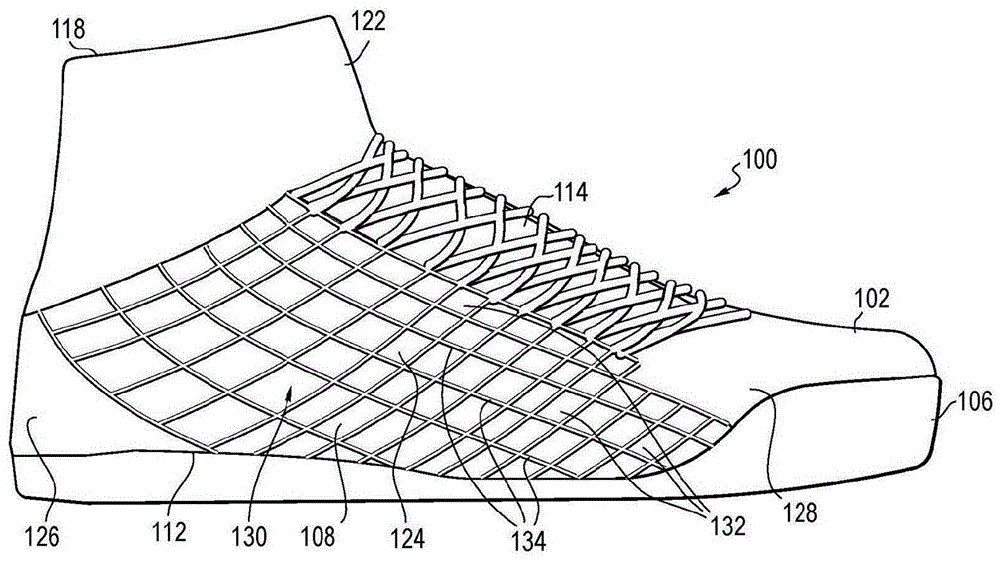
图1是示出了具有根据本公开的某些方面的荚形物的鞋类物品的示例的外侧视图的图示。1 is an illustration showing a lateral side view of an example of an article of footwear having pods in accordance with certain aspects of the present disclosure.
图2是示出了在图1中所描绘的鞋类物品的俯视图的图示。FIG. 2 is an illustration showing a top view of the article of footwear depicted in FIG. 1 .
图3是示出了用于形成图1-图2中的鞋类物品的鞋面的针织部件的俯视图的图示。3 is an illustration showing a top view of a knitted component used to form the upper of the article of footwear in FIGS. 1-2.
图4是示出了被包括在根据本公开的鞋面中的荚形物的侧面剖视图(side cutoutview)的图示,其中荚形物具有三层。4 is an illustration showing a side cutout view of a pod included in an upper according to the present disclosure, wherein the pod has three layers.
图5是示出了被包括在根据本公开的鞋面中的荚形物的侧面剖视图的图示,其中荚形物具有四层。5 is an illustration showing a side cross-sectional view of a pod included in an upper according to the present disclosure, wherein the pod has four layers.
图6是示出了根据本公开的被针织部件的两个边缘区域分开的三个荚形物的侧面剖视图的图示。6 is an illustration showing a side cross-sectional view of three pods separated by two edge regions of a knitted component according to the present disclosure.
图7是示出了用于在针织机上形成图6的针织部件的荚形物(“A”)和边缘区域(“B”)的针织过程的示例的图示。Figure 7 is a diagram showing an example of a knitting process for forming the pods ("A") and edge regions ("B") of the knitted component of Figure 6 on a knitting machine.
图8是示出了具有根据本公开的某些方面的荚形物的鞋类物品的另一实施例的俯视透视图的图示。8 is an illustration showing a top perspective view of another embodiment of an article of footwear having pods in accordance with certain aspects of the present disclosure.
图9是示出了具有根据本公开的某些方面的荚形物的物品的实施例的俯视图的图示。9 is an illustration showing a top view of an embodiment of an article having pods in accordance with certain aspects of the present disclosure.
图10是示出了具有根据本公开的某些方面的不规则荚形物的物品的实施例的俯视图的图示。10 is an illustration showing a top view of an embodiment of an article having irregular pods in accordance with certain aspects of the present disclosure.
详细描述Detailed Description
下文参考附图描述各个方面,在附图中,相似的元件通常由相似的数字识别。通过参考以下详细描述可以更好地理解方面的各个元件的关系和功能。然而,方面不限于附图中图示的或下文明确描述的那些方面。还应理解,附图不一定按比例,并且在某些情况下,可能已经省略对于理解本文公开的方面不是必需的细节,例如常规的制造和组装。The various aspects are described below with reference to the drawings, in which like elements are generally identified by like numerals. The relationship and function of the various elements of the aspects may be better understood by reference to the following detailed description. Aspects, however, are not limited to those illustrated in the drawings or explicitly described below. It is also to be understood that the drawings are not necessarily to scale and that in some instances details not essential to an understanding of the aspects disclosed herein may have been omitted, such as conventional manufacturing and assembly.
本公开的某些方面涉及被配置成用于在鞋类物品中使用的鞋面和/或其他物品(例如,服装物品)。当提及鞋类物品时,本公开可以描述篮球鞋、跑步鞋、骑自行车鞋、交叉训练鞋、橄榄球鞋、高尔夫球鞋、登山鞋和靴子、滑雪靴和滑雪板靴、足球鞋、网球鞋,和/或步行鞋,以及通常被认为是非运动型的鞋类类型,包括但不限于礼服鞋、乐福鞋(loafers)和凉鞋。Certain aspects of the present disclosure relate to uppers and/or other articles (eg, articles of apparel) configured for use in articles of footwear. When referring to articles of footwear, the present disclosure can describe basketball shoes, running shoes, cycling shoes, cross-training shoes, football shoes, golf shoes, hiking shoes and boots, ski and snowboard boots, soccer shoes, tennis shoes, and /or walking shoes, and types of footwear that are generally considered non-athletic, including but not limited to dress shoes, loafers, and sandals.
图1是示出了鞋类物品100的图示,并且图2是鞋类物品100的俯视图。参照图1-图2,鞋类物品100可以包括鞋面102,其中鞋面102基本上形成为纺织品部件。纺织品部件可以是任何合适类型的纺织品,并且在一些实施例中,它可以被形成为针织部件。如图所示,鞋面102可以固定到鞋底结构106。鞋面102可以包括外侧108和内侧110。鞋底结构106与鞋面102连结的区域可以被称为咬合线112。鞋面102可以使用任何合适的技术以固定方式连结到鞋底结构106,例如通过使用粘合剂、通过缝合等。鞋面102可以部分地或完全地围绕穿着者的足部延伸和/或可以与鞋底结构106成一体,并且可以使用或不使用鞋垫。在一些实施例中,鞋底结构106可以包括鞋底夹层(未示出)和鞋外底。鞋面102可以在穿着者的足部下方延伸并形成足下部分,如果需要,该足下部分可以代替鞋底结构106。FIG. 1 is a diagram illustrating article of
鞋面102可以附加地包括从踝部开口118延伸的鞋喉区域114和通向空腔120的踝部开口118,并且鞋领122可以至少部分地围绕踝部开口118。鞋类物品100的空腔120可以配置(例如,设定尺寸和设定形状)成接纳和容纳人的足部。鞋喉区域114可以大致设置在鞋面102的足中部区域124中。鞋面102的足中部区域124可以位于足跟区域126和趾部区域128之间。在一些实施例中,可选的鞋舌(例如图8所示的鞋舌276)可以至少部分地设置在鞋喉区域114中,但是在图1-图2中没有描绘鞋舌。如果包括鞋舌,则鞋舌可以是任何类型的鞋舌,例如,加衬式鞋舌(gusseted tongue)或包卷式鞋舌(burrito tongue)。如果不包括鞋舌,则鞋喉区域114的外侧和内侧可以连结在一起。Upper 102 may additionally include
如图1-图2所描绘的,鞋面102的外表面130被细分成被称为荚形物132的两个或更多个通常限定区域。荚形物132可以至少部分地由鞋面102的边缘区域134划分。在一些实施例中,边缘区域134可以基本上或完全地围绕至少一些荚形物132。在给定的荚形物132内,外表面130可以主要由在鞋类物品100的制造期间被热处理的材料的熔融区域(fusedarea)形成。在本文中“熔融区域”是形成鞋面的材料的不同部分(例如,由热塑性聚合物材料形成的不同的单独的线或纱线)部分地或基本上熔化(melted),并且然后冷却使得材料结合在一起的区域。熔融区域不需要通过任何特定工艺形成。荚形物132和周围边缘区域134的更具体的结构在下面进一步详细描述。As depicted in FIGS. 1-2 ,
鞋面102的至少一部分可以由针织部件104形成(并且针织部件的至少一部分可以被称为“针织元件”)。图3示出了针织部件104,针织部件104可以在针织(例如,在针织横机上)之后,但是在楦鞋或以其他方式操纵成图1-图2所示的鞋类物品100的可穿着形状之前得到。虽然鞋面102在本文被描述为主要由针织部件104形成,但是它可替换地或附加地可以包括由除针织之外的工艺(例如编织)形成的纺织品部件,并且还可以包括其他材料,包括但不限于皮革、塑料、橡胶和适于结合到鞋类物品的鞋面中的任何其他材料。At least a portion of upper 102 may be formed from knitted component 104 (and at least a portion of knitted component may be referred to as a "knit element"). 3 illustrates knitted
使用针织部件104形成鞋面102可以为鞋面102提供有利的特征,包括但不限于特定程度的弹性(例如,以杨氏模量表示)、透气性、弯曲性、强度、吸湿性、重量、耐磨性,和/或其组合。这些特征可以通过选择特定的单层或多层针织结构(例如罗纹针织结构、单面平纹针织结构或双面平纹针织结构)、通过改变针织结构的尺寸和张力、通过使用由特定材料(例如聚酯材料、相对无弹性的材料或相对弹性的材料如氨纶)形成的一根或更多根纱线、通过选择特定尺寸(例如旦尼尔)的纱线,和/或其组合来实现。Using
针织部件104还可以通过包含具有不同颜色、纹理或其它视觉特性的以特定图案布置的纱线来提供期望的美学特征。针织部件104的纱线本身和/或由一根或更多根纱线形成的针织结构可以在不同的位置变化,使得针织部件104具有带有不同特性的两个或更多个部分(例如,形成鞋面102的鞋喉区域114的部分可以是相对弹性的,而另一部分可以是相对无弹性的)。在一些实施例中,针织部件104可以包含一种或更多种材料,该一种或更多种材料具有响应于刺激(例如,温度、湿度、电流、磁场或光)而改变的特性。例如,针织部件104可以包括由一种或更多种热塑性聚合物材料(包括材料复合物)形成的纱线,所述热塑性聚合物材料当经受其熔点或熔点以上的某些温度时会从固态转变为软化态或液态,并且然后当冷却时,转变回固态。热塑性聚合物材料可以提供加热并且然后冷却针织部件104的一部分,从而形成结合或连续材料的区域(本文称为“熔融区域”)的能力,该结合或连续材料的区域表现出某些有利的特性,包括例如相对高的刚度、强度和耐水性程度。热塑性聚合物材料的非限制性示例有聚氨酯、聚酰胺、聚烯烃和/或尼龙。
如图3所示,针织部件104可以基本上形成荚形物132和周围边缘区域134。当热塑性聚合物材料被包括并被配置成在热处理步骤期间熔融时,热塑性聚合物材料可以仅在荚形物132处暴露在针织部件104的外表面130上,并且其他材料可以用于在边缘区域134处形成外表面130。因此,一旦在热处理步骤期间热量被施加到外表面130(例如,在针织之后汽蒸或以其他方式施加热量),该过程的结果可以是在荚形物132的外表面130上形成“壳”。该壳可以增强鞋类物品100的硬性(stiffness)、强度、刚度、耐用性和其他特性。增强的特性可以提供额外的支撑和结构,并且可以支撑或替换其他结构元件(例如足跟稳定器、布里奥(brio)缆线等)。在2017年2月27日提交的美国专利申请第15/443,808号中详细描述了对针织部件的外表面进行热处理的某些方法,该美国专利申请通过引用以其整体并入本文。As shown in FIG. 3 , knitted
在一些实施例中,荚形物132的外表面130的热处理可以导致熔化的热塑性聚合物材料流过边缘区域134,使得一旦材料冷却,边缘区域134至少部分被熔融材料覆盖。可选地,熔融材料可以在外表面130上仅邻近荚形物132隔离,并且可以在邻近边缘区域134处终止,而使外表面130的至少一部分在边缘区域134处没有熔融材料。因此,至少在热处理之后,边缘区域134可以具有第一柔性程度,荚形物132可以具有第二柔性程度,并且第一柔性程度可以大体上大于第二柔性程度(这可以至少部分归因于边缘区域134上没有熔融材料)。类似地,边缘区域134可以具有第一硬性程度,荚形物132可以具有第二硬性程度,且第一硬性程度可以大体上小于第二硬性程度。柔性和硬性的相对程度可以通过向各个部件施加力,以及随后测量这些相同部件的位移量来进行比较。In some embodiments, thermal treatment of the
不同的荚形物132可以具有相同的尺寸,但是荚形物132中的至少一些可以具有基本上不同的尺寸。类似地,边缘区域134可以在整个针织部件104中具有大约相同的尺寸,但是可选地,边缘区域134可以在尺寸上发生变化。因此,可以选择荚形物132和/或边缘区域134的尺寸和位置,以为鞋面102提供强度、刚度、保护和所期望的其他特征,同时还在其他区域或位置处提供合适的柔性、拉伸性和其他特征。为了说明,第一区域136中的荚形物132可以平均大于位于第二区域138中的荚形物132,其中第一区域136定位成更靠近足跟区域126,而第二区域138定位成更靠近趾部区域128。因此,每单位面积上,边缘区域134在第二区域138中可以比第一区域136更普遍。结果,第一区域136可以具有更高程度的强度、刚度、耐用性和硬性(以及与荚形物132相关联的其他特性),而第二区域138可以具有更高程度的柔性、拉伸性和与边缘区域134相关联的其他特性。还可设想,不同的荚形物132可以具有不同的材料成分,使得即使做尺寸的修正,荚形物132也提供不同程度的相关特性。为了说明,第一荚形物在外表面130上可以具有比不同的第二荚形物更大的热塑性聚合物材料密度,并且因此,第一荚形物可以具有比第二荚形物更大的硬性程度。
虽然并非在所有实施例中都需要,但是可设想,基本上整个足跟区域126可以以类似于荚形物132的构造的方式构造(例如,使得一个大的荚形物140形成足跟区域126的大部分)。类似地,基本上整个趾部区域128可以由大的荚形物142形成。有利地,足跟区域126和/或趾部区域128可以支撑或替换足跟稳定器和/或包头元件(toecap elements),从而提供一定程度的所需刚度、强度和用于穿着者的结构支撑等,这在某些应用中是期望的。相比之下,诸如鞋领122的其他部分可以用弹性针织结构形成,和/或可以不进行热处理,使得鞋领122被配置成在接纳足部时拉伸。Although not required in all embodiments, it is contemplated that substantially the
无论鞋面102是否由针织部件104形成,鞋面102可以具有单层或多层。例如,如图4所示(示出了荚形物132中的一个的侧面剖视图),鞋面102的至少一个荚形物132可以包括第一层144和第二层146,其中第一层144是外层,并且第二层146是内层,当结合到鞋类物品100中时,内层更靠近空腔。针织部件还可以具有由第一层144形成的第一表面154(其可以包括图1-图3的外表面130)和由第二层146形成的第二表面156。第二表面156和第一表面154可以面向相反的方向。例如,第一表面154可以面向外(例如,使得当鞋类物品100在使用中时,第一表面154被暴露出来以便观察),而第二表面156可以面向鞋类物品100的空腔或内部。Whether or not upper 102 is formed from
第一层144可以包括上述熔融区域,使得它可以被认为已经形成了用于为外表面130提供保护和其他期望特性的“壳”,并且第二层146可以由具有期望的舒适性相关的特性的材料(例如弹性纤维、棉或聚酯)形成,用于接触穿着者的足部或袜子,该舒适性相关的特性例如是期望的弹性、吸收性和/或抗磨损性。第三层148可以位于形成在第一层144和第二层146之间的腔穴(pocket)152中。如下文更详细描述的,如果鞋面102由针织部件104形成,则第三层148可以包括至少部分地位于第一层144和第二层146之间的镶嵌材料,其中第一层144和第二层146两者都是针织层。由于第一层144的材料的热处理,第三层148可以基本上结合到第一层144,但是这不是必需的。也可以设想有多于或少于三层。例如,如图5所示,第四层150可以位于第二层146和第三层148之间,但是可选地,第四层150也可以位于任何其他位置。The
在一些实施例中,形成第一层144的熔融材料可以是透明的(至少在热处理之后),使得当观察者观察第一表面154时,他或她可以观测下面的第三层148的视觉特征。第三层148可以在制造过程期间形成/被操作,以提供期望的视觉效果而不受限制,因为第三层148可以不需要提供结构特征(其可以替代地基本上由第一层144提供)。然而,也可设想,如果需要,第三层148可以提供某些结构或其他功能特征,例如缓冲。类似地,第四层150可以提供缓冲和/或其他特征,例如附加硬性,或者可选地,例如可能是鞋面102中需要的防水层。在一些实施例中,第一层144的热塑性聚合物材料在热处理步骤之前可以不是透明的,而是可以具有颜色或者可以是不透明的(例如,白色),并且可以从视野隐藏第三层148或者以其他方式从视野遮挡第三层148。在制造期间容易观察形成第一层144的材料的位置以有利地确保满足质量标准时,这可能是有利的。In some embodiments, the molten material forming the
图6是示出了形成鞋面102的多层针织部件104的详细的侧面剖视图的图示。所描绘的针织部件104具有第一荚形物158、第二荚形物160和第三荚形物162。第一荚形物158和第二荚形物160可以由第一边缘区域164分开,而第二荚形物160和第三荚形物162可以由第二边缘区域166分开。为了说明的目的,在图6中,包括四种纱线(例如,具有一股或更多股的纱线类型):第一纱线168、第二纱线170、第三纱线172和第四纱线174。FIG. 6 is an illustration showing a detailed side cross-sectional view of the multilayer knitted
虽然纱线168、170、172、174可以由任何合适的材料制成,但是在示例性实施例中,第一纱线168可以至少部分地用具有合适的熔点的热塑性聚合物材料形成,该熔点大体上低于第二纱线170的熔点和分解点(例如,100℃以下或更低),并且也大体上低于第三纱线172和第四纱线174的熔点和分解点。合适的热塑性聚合物材料的说明性、非限制性示例包括聚氨酯、聚酰胺、聚烯烃和尼龙。在一些实施例中,基本上整个第一纱线168可以由热塑性聚合物材料形成,但是可选地,第一纱线168可以是具有热塑性聚合物鞘的纱线,该热塑性聚合物鞘具有相对低的熔点,包围着在较高温度下保持稳定的芯。基于海平面的大气压,热塑性聚合物材料的熔化温度可以在例如约80℃至约200℃之间,比如从约100℃至约125℃。在另一个实施例中,热塑性聚合物可以是熔点在大约130℃至大约150℃之间,例如大约140℃的尼龙共聚物。附加地或替代地,第一纱线168可以包括热塑性聚氨酯。附加地或替代地,热塑性聚合物材料可以由当升高到其熔点以上并且然后冷却后变得半透明或透明的材料形成。While the
第二纱线170可以由基本上由聚酯或聚酯与弹性纤维结合形成的纱线制成。这种纱线可以提供弹性和抗磨损性,这非常适合于形成鞋面的内表面。形成第二纱线170的材料的熔点或分解点可以相对较高(例如,高于200℃或更高,例如对于某些聚酯为260℃或更高),使得该材料在针织部件104的热处理期间保持稳定。The
像第二纱线170一样,所描绘的第三纱线172可以由在热处理期间保持稳定的材料形成。在一个实施例中,第三纱线172可以包括具有不同颜色的多种聚酯纱线。有利地,当第一纱线168在第一表面154上形成透明壳时,第三纱线172可以提供期望的视觉效果(如下面更详细描述的)。可选地,第三纱线172可以附加地或可选地由在腔穴152内提供膨松度(loft)的材料形成,以向针织部件104提供视觉上吸引人的纹理(在荚形物132相对于边缘区域134向外延伸的位置)。在一个非限制性实施例中,第三纱线172可以包括膨化材料,该膨化材料在针织过程之后尺寸膨胀(例如,响应于诸如热量的刺激),从而增强了在荚形物132内提供的可选膨松度。这些纱线在2016年6月27日提交的美国临时申请第62/355,153号和2017年6月23日提交的美国临时申请第15/631,344号中有详细描述,这两个申请中的每个通过引用以其整体并入本文。Like the
第四纱线174可以是单丝纱线,这可能有利于提供持久和无弹性的系扎(durableand inelastic tie)(如下面更详细描述的)。单丝纱线由合成聚合物材料的单个长形的连续的丝形成。一些单丝纱线,例如由非弹性合成聚合物材料的单根丝制成的单丝纱线可以基本上不具有弹性或具有非常小的弹性。例如,由非弹性合成聚合物材料制成的单丝纱线可以具有小于5%的最大伸长率(例如,纱线在受到接近其断裂力的拉力时的最大长度小于其不受拉力时的长度的105%),并且可设想,这种纱线可以具有1%、0.5%或甚至更小的最大伸长率。The
参考图6所示的针织结构,针织部件104,包括每个所描绘的荚形物和边缘区域,可以包括第一表面154(例如,面向外的表面)和第二表面156。参照第二荚形物160,第一表面154可以基本上由第一纱线168形成,使得当热处理时,第一纱线168中的可熔材料熔融以形成刚性的第一表面154。相比之下,第一边缘区域164的第一表面154可以基本上由第二纱线170形成。如果第二纱线170基本上不含可熔材料,和/或第二纱线170的材料的熔点高于第一纱线168的熔点,边缘区域164、166可以在热处理后(至少在第一表面154上)相对于第一荚形物158保持相对柔性。类似地,第二边缘区域166的第一表面154可以基本上由第二纱线170形成,并且在热处理之后(至少在第一表面154上)相对于第二荚形物160和第三荚形物162保持相对柔性。Referring to the knitted structure shown in FIG. 6 , the
针织部件的第二表面156可以贯穿所描绘的荚形物和边缘区域基本上由第二纱线170形成。有利地,例如,当第二纱线170是聚酯纱线时,第二层146可以具有面向空腔所需的特征。例如,第二表面156可以具有相对柔软和/或其他舒适性相关的特性,这些特性适合并适宜接触穿着者的足部或袜子。如下文更详细描述的,这种结构可以通过利用形成多层结构的针织过程来实现。例如,在第一荚形物158、第二荚形物160和/或第三荚形物162内,具有第一表面154的第一层144可以基本上在针织横机的第一针床上形成,而具有第二表面156的第二层146可以基本上在针织横机的第二针床上形成,使得在第一层144和第二层146之间形成腔穴152。第二纱线170的至少一部分可以在边缘区域164、166处用第一针床针织。也可以考虑其他合适的针织工艺(例如,利用两个针床之间的转移技术)。下面参照图7更详细地描述具体的针织过程。The
第三纱线172可以是镶嵌在第一层144和第二层146之间的纱线。虽然在图6中仅描绘了一根第三纱线172,但是多根纱线可以镶嵌在第一层144和第二层146之间,并且因此所描绘的第三纱线172实际上可以代表多根纱线(例如,多种纱线类型,和/或多根相同类型的单独的纱线)。第三纱线172可以具有一个或更多个视觉特征,以向针织部件104提供期望的视觉特性。例如,当从朝向第一表面154的视角观察针织部件104时,由于热处理后的第一纱线168的材料的透明性,第三纱线172可以在荚形物158、160、162中的至少一个内是可见的。因此,可设想,第三纱线172可以包括各种颜色、视觉纹理、图案或被认为视觉上有吸引力的其他视觉特性。可选地,作为第三纱线172的替代或补充,腔穴152中可以包括材料(例如,除纱线之外的材料)。这种材料可以增强荚形物的填充或缓冲相关的特征。可选地,这种材料可以增强荚形物的刚度或硬化特征,以向特定区域提供更大的结构。一旦第一纱线168被热处理,第一纱线168中的热塑性聚合物材料可以至少部分地结合到第三纱线172。The
可选地,可以包括第四纱线174,以在荚形物158、160、162内的第一层144和第二层146之间提供系扎(例如,结构连接)。因此,第四纱线174可以有利于为荚形物158、160、162提供结构完整性和/或有利于减少第三纱线172在荚形物内的移动。在一些实施例中,并且如上所述,第四纱线174可以是单丝纱线或线。有利地,因为单丝线通常直径相对较小,并且由透明材料形成,同时仍然具有相对高的韧性和强度,所以第四纱线174可以在层144、146之间提供足够的系扎,而不会中断由镶嵌的第三纱线172提供的视觉特征。针织部件104的所得到的针织结构可以具有合适的强度、耐用性、刚度和其他期望的结构特征。在其他实施例中,第四纱线174可能被除去,使得第一层144和第二层146在荚形物158、160、162处是可分离的。Optionally, a
图7分别图示了荚形物和边缘区域的示例性针织图,并且本领域技术人员将知道如何单独地基于这些图来实现针织。在一个示例中,在图7左侧标识为“A”的序列图示了针织序列的一个实施例,该针织序列可用于如图6所示的针织部件104的荚形物158、160、162。类似地,在图7右侧标识为“B”的序列图示了可用于形成针织部件104的边缘区域164、166的针织序列。对于本领域普通技术人员来说明显的是,纱线的类型和针织每根纱线的方式在针织部件104的不同区域之间可以是不同的,并且本文描绘和描述的序列可以稍微或基本上被改变而形成类似的结构。Figure 7 illustrates exemplary knitting diagrams for the pods and edge regions, respectively, and those skilled in the art will know how to achieve knitting based on these diagrams alone. In one example, the sequence identified as "A" on the left side of FIG. 7 illustrates one embodiment of a knitting sequence that may be used for the
参照图7的序列“A”,步骤1表示在第一针床(例如,前针床)的每隔一根针上针织第一纱线168的一个或更多个针织趟次(pass)。在步骤2中,第三纱线172可以镶嵌在针织机的第一针床和第二针床之间。如上面更详细描述的,第三纱线172可以代表多根线或纱线,这些线或纱线可用一个趟次或更多个趟次被镶嵌。例如,在示例性实施例中,第三纱线172可以包括具有选定颜色或其他视觉特征的八(8)根镶嵌聚酯纱线。在步骤3中,第四纱线174可以被针织以使用集圈缝合(tuck stitching)将第一层144锚定或固定(例如,“系扎”)到第二层146。在步骤4中,如图所示,第二纱线170可以在后针床的每隔一根针上针织,而第二纱线170在步骤5中再次在后针床的交替针上针织。在步骤6中,可以再次镶嵌第三纱线172。在步骤7中,可以再次针织第四纱线174,以使用集圈缝合将第一层144系扎到第二层146。最后,在步骤8中,第一纱线168在前针床的在步骤1中没有被使用的每隔一个针上被针织。所得结构可以类似于图6所描述的荚形物158、160、162中的至少一个。Referring to sequence "A" of Figure 7, step 1 represents knitting one or more knitting passes of the
参照图7的序列“B”,其可以表示边缘区域164、166中的一个(如图6所示)的形成,步骤1可以包括镶嵌第一纱线168。在步骤2中,可以镶嵌第三纱线172。在步骤3中,第四纱线174可以被针织以使用集圈缝合锚定相邻的纱线。在步骤4中,如图所示,第二纱线170可以在后针床上针织,其中弹性纱线在步骤5中再次在前针床上针织。在步骤6中,可以再次镶嵌第三纱线172。在步骤7中,第四纱线174可以再次被针织以使用集圈缝合系扎纱线。最后,在步骤8中,可以如图所示镶嵌第一纱线168。Referring to sequence "B" of FIG. 7 , which may represent the formation of one of the
图8是图示了鞋类物品200的另一实施例的俯视透视图的图示。如图所示,鞋类物品200可以包括由针织部件204形成的鞋面202。鞋面202可以包括延伸穿过鞋面202的鞋喉区域214的鞋舌276。鞋舌276可以在针织机上形成为针织部件204的一部分,或者可以单独形成,并且然后在针织过程之后(例如,通过缝纫)附接到针织部件204上。鞋类物品200还可以包括紧固元件。可以使用任何合适类型的紧固元件,例如所描述的系带278、缆线张紧系统和/或任何其他合适的装置。鞋面202可以被配置成固定到紧固元件并与其连接,使得紧固元件可以围绕穿着者的足部调节和/或收紧鞋面202。例如,鞋面202可以包括用于接纳紧固元件的一组孔,但是也可以可替代地使用其他合适的元件。FIG. 8 is a diagram illustrating a top perspective view of another embodiment of article of
类似于上述某些实施例,针织部件204可以包括一个或更多个荚形物232。荚形物232可以包含关于上述实施例描述的任何特征、结构或其他特性。如图所示,荚形物232可以位于鞋面202的外表面230上的针织部件204上除鞋喉区域214之外的位置。附加地或替代地,荚形物232可以位于鞋舌276上。有利的是,鞋舌276上的荚形物232可以在鞋喉区域214中提供保护、刚度、缓冲、耐用性和/或其他相关特征,而不会牺牲鞋面202围绕足部收紧的能力。Similar to certain embodiments described above, knitted
图9是示出了物品300的实施例的俯视图的图示。物品300可以是用于服装物品的样本。服装物品的非限制性示例包括衬衫、裤子、袜子、鞋类、夹克和其他外衣、内裤和其他内衣、帽子等。像上面的示例一样,物品300可以包括被边缘区域334包围的多个荚形物332。在一些实施例中,物品300可基本上由针织部件304形成。针织部件304可以包括与关于上述实施例描述的结构类似的结构,然而也可以设想其他结构。如图所示,荚形物332可以包括多种形状和尺寸。某些荚形物332可以基本上形成为三角形、矩形、五边形、六边形等。可选地,如图所示,至少一些荚形物332可以由弯曲的边缘区域334划分(例如,参见荚形物380)。FIG. 9 is an illustration showing a top view of an embodiment of
在一些实施例中,边缘区域334的尺寸可以变化。例如,第一边缘区域382可以具有第一厚度,第二边缘区域384可以具有第二厚度,并且第一厚度可以大于第二厚度。有利地,较厚的边缘区域可以置于需要更大柔性、拉伸性和/或其他特征的位置。类似地,较大的荚形物332可以置于需要硬性、刚度和/或结构以及其他相关特征的位置。In some embodiments, the size of
参考图10,在一些实施例中,物品300的荚形物332可以具有不规则形状(并且在一些实施例中,可以仅包括一个不规则荚形物)。例如,边缘区域334可以在整个物品300的针织部件304上以不规则路径(例如弯曲、转弯、锯齿状或其他非线性路径)延伸。10, in some embodiments,
根据本公开,可以制造并且实现本文公开的和要求保护的全部结构和方法,而无需过度的实验。尽管本公开可以以许多不同的形式实施,但是在本文中详细描述了本公开的具体方面。本公开是公开内容的原理的示例,并且并非意图将本公开限制于所示的特定方面。此外,除非明确相反地陈述,否则术语“一个(a)”的使用意在包括“至少一个”或“一个或更多个”。例如,“一根纱线”意在包括“至少一根纱线”或“一根或更多根纱线”。In light of the present disclosure, all structures and methods disclosed and claimed herein can be fabricated and implemented without undue experimentation. While the disclosure may be embodied in many different forms, specific aspects of the disclosure are described in detail herein. This disclosure is an example of the principles of the disclosure, and is not intended to be limited to the particular aspects shown. Furthermore, use of the term "a (a)" is intended to include "at least one" or "one or more" unless expressly stated to the contrary. For example, "a yarn" is intended to include "at least one yarn" or "one or more yarns."
以绝对术语或以近似术语给定的任何范围意在涵盖两者,并且本文使用的任何定义意在是阐明性的并且不是限制性的。尽管阐述本公开的广泛范围的数值范围和参数是近似值,但是在具体示例中阐述的数值被尽可能精确地记录。然而,任何数值固有地包含由存在于其相应的测试测量中的标准偏差必然造成的某些误差。此外,本文公开的全部范围应被理解为涵盖归入本文的任何和全部子范围(包括所有的小数值和整数值)。Any ranges given in absolute terms or in approximate terms are intended to encompass both, and any definitions used herein are intended to be illustrative and not restrictive. Notwithstanding that the numerical ranges and parameters setting forth the broad scope of the disclosure are approximations, the numerical values set forth in the specific examples are reported as precisely as possible. Any numerical value, however, inherently contain certain errors necessarily resulting from the standard deviation found in their respective testing measurements. Furthermore, all ranges disclosed herein are to be understood to encompass any and all subranges (including all decimal and integer values) subsumed herein.
此外,本公开包含本文所描述的各个方面中的一些或全部的任何和所有可能的组合。还应理解,对本文描述的方面的各种改变和修改对于本领域技术人员来说将是明显的。在不脱离本公开的精神和范围,并且不减少其预期的优点的情况下,可以作出各种改变和修改。因此意在这样的变化和修改被所附权利要求所覆盖。Furthermore, the present disclosure encompasses any and all possible combinations of some or all of the various aspects described herein. It should also be understood that various changes and modifications to the aspects described herein will be apparent to those skilled in the art. Various changes and modifications may be made without departing from the spirit and scope of the present disclosure, and without diminishing its intended advantages. It is therefore intended that such changes and modifications be covered by the appended claims.
Claims (78)
Priority Applications (2)
| Application Number | Priority Date | Filing Date | Title |
|---|---|---|---|
| CN202210358792.4A CN114766780A (en) | 2017-08-04 | 2018-08-03 | Article and knitted component formed from knitted component including layered pods |
| CN202010819364.8A CN111920135B (en) | 2017-08-04 | 2018-08-03 | Article formed from knitted component comprising layered pods and knitted component |
Applications Claiming Priority (3)
| Application Number | Priority Date | Filing Date | Title |
|---|---|---|---|
| US201762541500P | 2017-08-04 | 2017-08-04 | |
| US62/541,500 | 2017-08-04 | ||
| PCT/US2018/045163 WO2019028347A1 (en) | 2017-08-04 | 2018-08-03 | Article formed of a knitted component comprising at least one layered pod and knitted component |
Related Child Applications (2)
| Application Number | Title | Priority Date | Filing Date |
|---|---|---|---|
| CN202210358792.4A Division CN114766780A (en) | 2017-08-04 | 2018-08-03 | Article and knitted component formed from knitted component including layered pods |
| CN202010819364.8A Division CN111920135B (en) | 2017-08-04 | 2018-08-03 | Article formed from knitted component comprising layered pods and knitted component |
Publications (2)
| Publication Number | Publication Date |
|---|---|
| CN110573665A CN110573665A (en) | 2019-12-13 |
| CN110573665B true CN110573665B (en) | 2022-04-26 |
Family
ID=63245112
Family Applications (5)
| Application Number | Title | Priority Date | Filing Date |
|---|---|---|---|
| CN201880028170.7A Active CN110573665B (en) | 2017-08-04 | 2018-08-03 | Articles and knitted components formed from knitted components comprising at least one layered pod |
| CN202210358792.4A Pending CN114766780A (en) | 2017-08-04 | 2018-08-03 | Article and knitted component formed from knitted component including layered pods |
| CN201821248905.0U Active CN210076733U (en) | 2017-08-04 | 2018-08-03 | Knitted component and article formed from knitted component |
| CN202010819364.8A Active CN111920135B (en) | 2017-08-04 | 2018-08-03 | Article formed from knitted component comprising layered pods and knitted component |
| CN202020139386.5U Active CN213604796U (en) | 2017-08-04 | 2018-08-03 | Knitted parts and articles formed from knitted parts |
Family Applications After (4)
| Application Number | Title | Priority Date | Filing Date |
|---|---|---|---|
| CN202210358792.4A Pending CN114766780A (en) | 2017-08-04 | 2018-08-03 | Article and knitted component formed from knitted component including layered pods |
| CN201821248905.0U Active CN210076733U (en) | 2017-08-04 | 2018-08-03 | Knitted component and article formed from knitted component |
| CN202010819364.8A Active CN111920135B (en) | 2017-08-04 | 2018-08-03 | Article formed from knitted component comprising layered pods and knitted component |
| CN202020139386.5U Active CN213604796U (en) | 2017-08-04 | 2018-08-03 | Knitted parts and articles formed from knitted parts |
Country Status (5)
| Country | Link |
|---|---|
| US (3) | US11346025B2 (en) |
| EP (2) | EP3662102B1 (en) |
| CN (5) | CN110573665B (en) |
| TW (4) | TWI834425B (en) |
| WO (1) | WO2019028347A1 (en) |
Families Citing this family (27)
| Publication number | Priority date | Publication date | Assignee | Title |
|---|---|---|---|---|
| US20100199406A1 (en) | 2009-02-06 | 2010-08-12 | Nike, Inc. | Thermoplastic Non-Woven Textile Elements |
| US20130255103A1 (en) | 2012-04-03 | 2013-10-03 | Nike, Inc. | Apparel And Other Products Incorporating A Thermoplastic Polymer Material |
| CN110573665B (en) * | 2017-08-04 | 2022-04-26 | 耐克创新有限合伙公司 | Articles and knitted components formed from knitted components comprising at least one layered pod |
| CN116172307A (en) * | 2018-04-13 | 2023-05-30 | 耐克创新有限合伙公司 | Knitted parts with inlaid cushioning |
| CN114668213B (en) | 2018-04-16 | 2025-10-31 | 耐克创新有限合伙公司 | Shoe upper including knitted cushioning region and article of footwear incorporating same |
| US11365494B2 (en) | 2018-08-09 | 2022-06-21 | Nike, Inc. | Knitted component with a fused surface region located on a tubular knit structure |
| CN112867412B (en) * | 2018-10-19 | 2023-02-21 | 耐克创新有限合伙公司 | Knitted part with raised structures and method of manufacture |
| US11109641B2 (en) * | 2019-03-22 | 2021-09-07 | Nike, Inc. | Article of footwear having a skin layer between a knitted component and a sole structure |
| US12378707B2 (en) * | 2019-05-06 | 2025-08-05 | Nike, Inc. | Multi-layer knitted component |
| CN116288887A (en) | 2019-05-31 | 2023-06-23 | 耐克创新有限合伙公司 | Knitted part with inner layer having thermoplastic material and related method |
| WO2021026032A1 (en) | 2019-08-02 | 2021-02-11 | Nike, Inc. | An outsole for an article of footwear |
| USD918546S1 (en) * | 2019-08-16 | 2021-05-11 | Nike, Inc. | Shoe |
| CN114729479B (en) * | 2019-11-18 | 2024-07-05 | 耐克创新有限合伙公司 | Foamable yarn, textiles and articles incorporating foamable yarn, and processes for making the same |
| WO2021101979A1 (en) * | 2019-11-18 | 2021-05-27 | Nike Innovate C.V. | Knitted component having a foam surface feature |
| GB2589378B (en) * | 2019-11-29 | 2024-08-21 | Texon Man Limited | A woven upper |
| CN111472084B (en) * | 2020-02-26 | 2022-04-08 | 信泰(福建)科技有限公司 | Dynamic built-in decorative woven vamp |
| DE102020207848A1 (en) * | 2020-06-24 | 2021-12-30 | Adidas Ag | Woven top with pockets and fillings |
| CN116670347A (en) * | 2020-12-31 | 2023-08-29 | 耐克创新有限合伙公司 | Knitted goods with variable characteristics |
| EP4271867B1 (en) | 2020-12-31 | 2025-10-08 | NIKE Innovate C.V. | Athletic sock |
| WO2022146574A1 (en) * | 2020-12-31 | 2022-07-07 | Nike Innovate C.V. | Knit article with variable features |
| US12193521B2 (en) | 2020-12-31 | 2025-01-14 | Nike, Inc. | Sleeve for an extremity |
| WO2022153215A1 (en) * | 2021-01-15 | 2022-07-21 | Puma SE | Article of footwear having a knitted upper |
| US20220240624A1 (en) * | 2021-01-29 | 2022-08-04 | Nike, Inc. | Knitted component with at least one expandable yarn |
| US20220256939A1 (en) * | 2021-02-17 | 2022-08-18 | Aspen Medical Products, Llc | Customized knitted wearable with reactive material for rigidity |
| US11896076B1 (en) * | 2023-05-07 | 2024-02-13 | Nike, Inc. | Footwear upper having a unitary knit structure and method of manufacturing |
| US12433776B2 (en) | 2023-08-12 | 2025-10-07 | Aspen Medical Products, Llc | Customized wearable with integrated pathways and/or interconnects |
| USD1037631S1 (en) * | 2023-09-29 | 2024-08-06 | Nike, Inc. | Shoe |
Citations (5)
| Publication number | Priority date | Publication date | Assignee | Title |
|---|---|---|---|---|
| US6854296B1 (en) * | 2004-01-23 | 2005-02-15 | Sara Lee Corporation | Bi-ply fabric construction and apparel formed therefrom |
| WO2015116295A1 (en) * | 2014-02-03 | 2015-08-06 | Nike Innovate C.V. | An article of footwear including a monofilament knit element with peripheral knit portions |
| CN104919101A (en) * | 2013-01-15 | 2015-09-16 | 耐克创新有限合伙公司 | Spacer textile material with tensile strands in non-linear arrangements |
| CN105533889A (en) * | 2009-10-07 | 2016-05-04 | 耐克创新有限合伙公司 | Article Of Footwear Having An Upper With Knitted Elements |
| CN105747351A (en) * | 2016-01-27 | 2016-07-13 | 厦门翔鹭化纤股份有限公司 | Integrally formed 3D flyknitted vamp and making method thereof |
Family Cites Families (41)
| Publication number | Priority date | Publication date | Assignee | Title |
|---|---|---|---|---|
| US709734A (en) * | 1902-02-15 | 1902-09-23 | Robert w scott | Knitted fabric. |
| US2108925A (en) * | 1935-02-15 | 1938-02-22 | Raynor Harry Avery | Knitted fabric and the production thereof |
| US2372497A (en) * | 1943-06-16 | 1945-03-27 | Clark Co Inc David | Fabric and method of making the same |
| GB1148086A (en) * | 1966-12-23 | 1969-04-10 | Monsanto Textiles Ltd | Fabric and method of knitting same |
| US3964277A (en) * | 1974-07-03 | 1976-06-22 | Miles Thomas E | Weft knit fabric with deflected inlaid yarn |
| GB2233989B (en) * | 1989-07-11 | 1993-12-01 | Courtaulds Plc | Structured knitted fabrics |
| US6974785B1 (en) * | 2000-03-02 | 2005-12-13 | Bacou-Dailoz Protective Apparel | Outer shell fabric for fire protective garments for firefighters and for workers exposed to risk of flash fire or electric arc |
| FR2806424B1 (en) | 2000-03-15 | 2002-07-05 | Ames Europ | NEW DOUBLE-SIDED THICK KNIT WITH FLEXIBLE STRUCTURE |
| FR2832165B1 (en) * | 2001-11-15 | 2004-01-23 | Textiles Plastiques Chomarat | THREE-DIMENSIONAL DOUBLE-SIDED KNIT |
| US20030148076A1 (en) * | 2002-02-01 | 2003-08-07 | Hsi-Ming Huang | Composite fabric for shoes |
| FR2873270B1 (en) * | 2004-07-26 | 2006-10-13 | Salomon Sa | COMFORT ELEMENT FOR CLOTHING ARTICLE OR FOOTWEAR ARTICLE, MANUFACTURING METHOD AND ARTICLE COMPRISING SUCH A MEMBER |
| US7793434B2 (en) * | 2004-09-03 | 2010-09-14 | Nike, Inc. | Article of footwear having an upper with a structured intermediate layer |
| DE102005030651A1 (en) * | 2005-06-30 | 2007-01-11 | Bst Safety Textiles Gmbh | Method for producing a spacer textile |
| US8312645B2 (en) * | 2006-05-25 | 2012-11-20 | Nike, Inc. | Material elements incorporating tensile strands |
| US7774956B2 (en) | 2006-11-10 | 2010-08-17 | Nike, Inc. | Article of footwear having a flat knit upper construction or other upper construction |
| US8225530B2 (en) | 2006-11-10 | 2012-07-24 | Nike, Inc. | Article of footwear having a flat knit upper construction or other upper construction |
| US7380420B1 (en) * | 2007-02-05 | 2008-06-03 | Ruey Tay Fibre Industry Co., Ltd. | Fabric with different thicknesses |
| DE102007023062A1 (en) | 2007-05-16 | 2008-11-20 | Iprotex Gmbh & Co. Kg | Method for producing a fabric and tissue produced thereby |
| US9060570B2 (en) * | 2011-03-15 | 2015-06-23 | Nike, Inc. | Method of manufacturing a knitted component |
| US8839532B2 (en) * | 2011-03-15 | 2014-09-23 | Nike, Inc. | Article of footwear incorporating a knitted component |
| US8800172B2 (en) * | 2011-04-04 | 2014-08-12 | Nike, Inc. | Article of footwear having a knit upper with a polymer layer |
| US9150986B2 (en) | 2011-05-04 | 2015-10-06 | Nike, Inc. | Knit component bonding |
| US20130312284A1 (en) * | 2011-05-27 | 2013-11-28 | Nike, Inc. | Article of Footwear Having Welded Upper |
| US8844167B2 (en) * | 2011-07-18 | 2014-09-30 | Nike, Inc. | Article of footwear having an upper with cord elements |
| US8448474B1 (en) * | 2012-02-20 | 2013-05-28 | Nike, Inc. | Article of footwear incorporating a knitted component with a tongue |
| US8887410B2 (en) * | 2012-02-24 | 2014-11-18 | Nike, Inc. | Articles of footwear with tensile strand elements |
| US20140130373A1 (en) * | 2012-11-15 | 2014-05-15 | Nike, Inc. | Article Of Footwear Incorporating A Knitted Component |
| US9226548B2 (en) * | 2013-01-15 | 2016-01-05 | Nike, Inc. | Spacer textile material with channels having multiple tensile strands |
| US10499706B2 (en) * | 2013-03-22 | 2019-12-10 | Reebok International Limited | Molded footwear upper and method of making same |
| DE102013207163B4 (en) | 2013-04-19 | 2022-09-22 | Adidas Ag | shoe upper |
| US9145629B2 (en) * | 2014-02-03 | 2015-09-29 | Nike, Inc. | Article of footwear including a monofilament knit element with a fusible strand |
| EP3122197B1 (en) * | 2014-03-25 | 2022-06-01 | Under Armour, Inc. | Footwear including textile element |
| US9872537B2 (en) * | 2014-04-08 | 2018-01-23 | Nike, Inc. | Components for articles of footwear including lightweight, selectively supported textile components |
| US9510637B2 (en) * | 2014-06-16 | 2016-12-06 | Nike, Inc. | Article incorporating a knitted component with zonal stretch limiter |
| FR3031015B1 (en) * | 2014-12-31 | 2017-04-28 | Salomon Sas | METHOD FOR MANUFACTURING A FOOTWEAR ARTICLE |
| DE202015101004U1 (en) | 2015-03-03 | 2015-03-24 | Bönning + Sommer Gmbh & Co. Kg | Air permeable climate button |
| EP4365340A3 (en) | 2015-03-31 | 2024-09-04 | adidas AG | Sole for sports shoes |
| DE102015116398A1 (en) * | 2015-09-28 | 2017-03-30 | Visiotex GmbH | Shoe with a textile shaft |
| MX2019000272A (en) | 2016-06-27 | 2019-09-09 | Nike Innovate Cv | A textile including bulking yarn. |
| US10753018B2 (en) * | 2016-06-28 | 2020-08-25 | Aknit International Ltd. | Double-sided fabric and method for knitting double-sided fabric |
| CN110573665B (en) | 2017-08-04 | 2022-04-26 | 耐克创新有限合伙公司 | Articles and knitted components formed from knitted components comprising at least one layered pod |
-
2018
- 2018-08-03 CN CN201880028170.7A patent/CN110573665B/en active Active
- 2018-08-03 CN CN202210358792.4A patent/CN114766780A/en active Pending
- 2018-08-03 EP EP18756123.8A patent/EP3662102B1/en active Active
- 2018-08-03 CN CN201821248905.0U patent/CN210076733U/en active Active
- 2018-08-03 TW TW111147701A patent/TWI834425B/en active
- 2018-08-03 WO PCT/US2018/045163 patent/WO2019028347A1/en not_active Ceased
- 2018-08-03 TW TW107210689U patent/TWM579471U/en unknown
- 2018-08-03 EP EP22153140.3A patent/EP4050140B1/en active Active
- 2018-08-03 TW TW110109211A patent/TWI789721B/en active
- 2018-08-03 US US16/054,132 patent/US11346025B2/en active Active
- 2018-08-03 CN CN202010819364.8A patent/CN111920135B/en active Active
- 2018-08-03 TW TW107127173A patent/TWI724318B/en active
- 2018-08-03 CN CN202020139386.5U patent/CN213604796U/en active Active
- 2018-08-06 US US16/636,478 patent/US20200246278A1/en not_active Abandoned
-
2022
- 2022-05-06 US US17/738,856 patent/US20220259779A1/en active Pending
Patent Citations (5)
| Publication number | Priority date | Publication date | Assignee | Title |
|---|---|---|---|---|
| US6854296B1 (en) * | 2004-01-23 | 2005-02-15 | Sara Lee Corporation | Bi-ply fabric construction and apparel formed therefrom |
| CN105533889A (en) * | 2009-10-07 | 2016-05-04 | 耐克创新有限合伙公司 | Article Of Footwear Having An Upper With Knitted Elements |
| CN104919101A (en) * | 2013-01-15 | 2015-09-16 | 耐克创新有限合伙公司 | Spacer textile material with tensile strands in non-linear arrangements |
| WO2015116295A1 (en) * | 2014-02-03 | 2015-08-06 | Nike Innovate C.V. | An article of footwear including a monofilament knit element with peripheral knit portions |
| CN105747351A (en) * | 2016-01-27 | 2016-07-13 | 厦门翔鹭化纤股份有限公司 | Integrally formed 3D flyknitted vamp and making method thereof |
Also Published As
| Publication number | Publication date |
|---|---|
| EP3662102B1 (en) | 2022-02-09 |
| CN213604796U (en) | 2021-07-06 |
| EP3662102A1 (en) | 2020-06-10 |
| TWI834425B (en) | 2024-03-01 |
| CN111920135A (en) | 2020-11-13 |
| TWI724318B (en) | 2021-04-11 |
| US20190037967A1 (en) | 2019-02-07 |
| TW201909778A (en) | 2019-03-16 |
| CN210076733U (en) | 2020-02-18 |
| US20200246278A1 (en) | 2020-08-06 |
| TWM579471U (en) | 2019-06-21 |
| EP4050140B1 (en) | 2025-05-14 |
| WO2019028347A1 (en) | 2019-02-07 |
| TWI789721B (en) | 2023-01-11 |
| CN110573665A (en) | 2019-12-13 |
| US11346025B2 (en) | 2022-05-31 |
| TW202130293A (en) | 2021-08-16 |
| TW202312901A (en) | 2023-04-01 |
| CN114766780A (en) | 2022-07-22 |
| CN111920135B (en) | 2024-11-01 |
| US20220259779A1 (en) | 2022-08-18 |
| EP4050140A1 (en) | 2022-08-31 |
Similar Documents
| Publication | Publication Date | Title |
|---|---|---|
| CN110573665B (en) | Articles and knitted components formed from knitted components comprising at least one layered pod | |
| US11898279B2 (en) | Knitted component with a fused surface region located on a tubular knit structure | |
| CN110582211B (en) | Knitted component for an article of footwear having a combination of two or more materials | |
| CN112469299A (en) | Upper for an article of footwear with an interior component and a shell | |
| US11375767B2 (en) | Upper for an article of footwear with first and second knitted portions | |
| CN113925251B (en) | Embroidery items | |
| CN116288893B (en) | Knitted components with tubular knitted structures and methods for knitting tubular knitted structures | |
| HK40019135B (en) | Article formed of a knitted component comprising at least one layered pod and knitted component | |
| HK40019135A (en) | Article formed of a knitted component comprising at least one layered pod and knitted component | |
| HK40053301A (en) | Knitted component with a fused surface region located on a tubular knit structure and a method of knitting a tubular knit structure | |
| HK40077160A (en) | Knitted component for an article of footwear with two or more material compositions | |
| HK40019213B (en) | Knitted component for an article of footwear with two or more material compositions | |
| HK40019213A (en) | Knitted component for an article of footwear with two or more material compositions | |
| HK40008545B (en) | Embroidered article |
Legal Events
| Date | Code | Title | Description |
|---|---|---|---|
| PB01 | Publication | ||
| PB01 | Publication | ||
| SE01 | Entry into force of request for substantive examination | ||
| SE01 | Entry into force of request for substantive examination | ||
| REG | Reference to a national code |
Ref country code: HK Ref legal event code: DE Ref document number: 40019135 Country of ref document: HK |
|
| GR01 | Patent grant | ||
| GR01 | Patent grant |