CN110526058B - Elevator door monitoring system, elevator system and elevator door monitoring method - Google Patents
Elevator door monitoring system, elevator system and elevator door monitoring method Download PDFInfo
- Publication number
- CN110526058B CN110526058B CN201810500352.1A CN201810500352A CN110526058B CN 110526058 B CN110526058 B CN 110526058B CN 201810500352 A CN201810500352 A CN 201810500352A CN 110526058 B CN110526058 B CN 110526058B
- Authority
- CN
- China
- Prior art keywords
- elevator
- elevator door
- image data
- door monitoring
- obstacle
- Prior art date
- Legal status (The legal status is an assumption and is not a legal conclusion. Google has not performed a legal analysis and makes no representation as to the accuracy of the status listed.)
- Active
Links
Images


Classifications
-
- B—PERFORMING OPERATIONS; TRANSPORTING
- B66—HOISTING; LIFTING; HAULING
- B66B—ELEVATORS; ESCALATORS OR MOVING WALKWAYS
- B66B1/00—Control systems of elevators in general
- B66B1/34—Details, e.g. call counting devices, data transmission from car to control system, devices giving information to the control system
- B66B1/3415—Control system configuration and the data transmission or communication within the control system
-
- B—PERFORMING OPERATIONS; TRANSPORTING
- B66—HOISTING; LIFTING; HAULING
- B66B—ELEVATORS; ESCALATORS OR MOVING WALKWAYS
- B66B13/00—Doors, gates, or other apparatus controlling access to, or exit from, cages or lift well landings
- B66B13/24—Safety devices in passenger lifts, not otherwise provided for, for preventing trapping of passengers
- B66B13/26—Safety devices in passenger lifts, not otherwise provided for, for preventing trapping of passengers between closing doors
-
- B—PERFORMING OPERATIONS; TRANSPORTING
- B66—HOISTING; LIFTING; HAULING
- B66B—ELEVATORS; ESCALATORS OR MOVING WALKWAYS
- B66B13/00—Doors, gates, or other apparatus controlling access to, or exit from, cages or lift well landings
- B66B13/02—Door or gate operation
- B66B13/14—Control systems or devices
- B66B13/143—Control systems or devices electrical
- B66B13/146—Control systems or devices electrical method or algorithm for controlling doors
-
- B—PERFORMING OPERATIONS; TRANSPORTING
- B66—HOISTING; LIFTING; HAULING
- B66B—ELEVATORS; ESCALATORS OR MOVING WALKWAYS
- B66B5/00—Applications of checking, fault-correcting, or safety devices in elevators
- B66B5/0006—Monitoring devices or performance analysers
- B66B5/0018—Devices monitoring the operating condition of the elevator system
- B66B5/0031—Devices monitoring the operating condition of the elevator system for safety reasons
-
- B—PERFORMING OPERATIONS; TRANSPORTING
- B66—HOISTING; LIFTING; HAULING
- B66B—ELEVATORS; ESCALATORS OR MOVING WALKWAYS
- B66B5/00—Applications of checking, fault-correcting, or safety devices in elevators
- B66B5/02—Applications of checking, fault-correcting, or safety devices in elevators responsive to abnormal operating conditions
-
- G—PHYSICS
- G06—COMPUTING OR CALCULATING; COUNTING
- G06V—IMAGE OR VIDEO RECOGNITION OR UNDERSTANDING
- G06V10/00—Arrangements for image or video recognition or understanding
- G06V10/20—Image preprocessing
- G06V10/28—Quantising the image, e.g. histogram thresholding for discrimination between background and foreground patterns
-
- G—PHYSICS
- G06—COMPUTING OR CALCULATING; COUNTING
- G06V—IMAGE OR VIDEO RECOGNITION OR UNDERSTANDING
- G06V10/00—Arrangements for image or video recognition or understanding
- G06V10/20—Image preprocessing
- G06V10/30—Noise filtering
-
- G—PHYSICS
- G06—COMPUTING OR CALCULATING; COUNTING
- G06V—IMAGE OR VIDEO RECOGNITION OR UNDERSTANDING
- G06V10/00—Arrangements for image or video recognition or understanding
- G06V10/40—Extraction of image or video features
- G06V10/56—Extraction of image or video features relating to colour
-
- G—PHYSICS
- G06—COMPUTING OR CALCULATING; COUNTING
- G06V—IMAGE OR VIDEO RECOGNITION OR UNDERSTANDING
- G06V20/00—Scenes; Scene-specific elements
- G06V20/50—Context or environment of the image
- G06V20/52—Surveillance or monitoring of activities, e.g. for recognising suspicious objects
-
- G—PHYSICS
- G06—COMPUTING OR CALCULATING; COUNTING
- G06V—IMAGE OR VIDEO RECOGNITION OR UNDERSTANDING
- G06V20/00—Scenes; Scene-specific elements
- G06V20/60—Type of objects
- G06V20/64—Three-dimensional objects
-
- G—PHYSICS
- G05—CONTROLLING; REGULATING
- G05B—CONTROL OR REGULATING SYSTEMS IN GENERAL; FUNCTIONAL ELEMENTS OF SUCH SYSTEMS; MONITORING OR TESTING ARRANGEMENTS FOR SUCH SYSTEMS OR ELEMENTS
- G05B2219/00—Program-control systems
- G05B2219/30—Nc systems
- G05B2219/45—Nc applications
- G05B2219/45242—Door, panel, window operation, opening, closing
Landscapes
- Engineering & Computer Science (AREA)
- Physics & Mathematics (AREA)
- General Physics & Mathematics (AREA)
- Multimedia (AREA)
- Theoretical Computer Science (AREA)
- Automation & Control Theory (AREA)
- Computer Networks & Wireless Communication (AREA)
- Elevator Door Apparatuses (AREA)
- Indicating And Signalling Devices For Elevators (AREA)
Abstract
The invention relates to an elevator door monitoring system, an elevator system and an elevator door monitoring method. The elevator door having an open state or a closed state achieved by movement along an elevator sill, the elevator door monitoring system comprising: one or more imaging sensors arranged to acquire image data and depth data of at least one section of an exposed elevator sill when the elevator door is in an open state; a data processing device in communication with the imaging sensor for receiving and processing the image data and the depth data to determine whether an obstruction exists in the zone that prevents the elevator door from entering a closed state. The invention can effectively improve the safety of the elevator door and avoid equipment property loss and personal injury.
Description
Technical Field
The invention relates to the technical field of elevators, in particular to an elevator door monitoring system, an elevator system and an elevator door monitoring method.
Background
Elevators have been widely used in modern society, and great convenience is brought to work and daily life of people. A large number of elevator devices, apparatuses or systems of various types have been provided in the prior art to meet the different requirements of people. However, these existing elevator devices, apparatuses or systems still have drawbacks and deficiencies, such as safety reliability, system performance, intelligent monitoring, etc., that can be further improved and optimized.
Disclosure of Invention
In view of the above, the present invention provides an elevator door monitoring system, an elevator system and an elevator door monitoring method, which solve or at least alleviate one or more of the above problems and other problems in the prior art.
First, according to a first aspect of the present invention, there is provided an elevator door monitoring system, the elevator door having an opened state or a closed state implemented by moving along an elevator sill, the elevator door monitoring system comprising:
one or more imaging sensors arranged to acquire image data and depth data of at least one section of an exposed elevator sill when the elevator door is in an open state; and
a data processing device in communication with the imaging sensor for receiving and processing the image data and the depth data to determine whether there is an obstruction in the zone that prevents the elevator door from entering a closed state.
In the elevator door monitoring system according to the present invention, optionally, the data processing device includes a first module and a second module, which are configured to process based on the image data and the depth data, respectively, to separately determine whether the obstacle exists in the section, and the data processing device is configured to determine that the obstacle exists in the section when the determination result of the first module or the second module is yes.
In the elevator door monitoring system according to the present invention, optionally, the data processing device further includes a third module configured to make a combined judgment on the judgment result of the first module and the judgment result of the second module, and the data processing device is configured to determine that the obstacle has been present in the section when the combined judgment result of the third module is yes.
In the elevator door monitoring system according to the present invention, optionally, the combination determination includes: weighting the judgment result of the first module and the judgment result of the second module, and if the value obtained by weighting exceeds a preset value, making the combined judgment result be yes; or
And comparing the confidence coefficient of the judgment result based on the image data with the confidence coefficient based on the depth data, and selecting the judgment result with high confidence coefficient as the combined judgment result.
In the elevator door monitoring system according to the invention, optionally the first module processes the image data using color background modeling, foreground detection and morphological filtering and/or the second module processes the depth data using 3D background structure modeling, background subtraction and morphological filtering.
In the elevator door monitoring system according to the invention, optionally, the data processing device is arranged to output a signal outwards upon determining that the obstacle is present in the zone.
In the elevator door monitoring system according to the present invention, optionally, the elevator door monitoring system further comprises a control processing device, in communication with the data processing device, for initiating a processing operation upon receiving the signal, the processing operation including at least one of:
prohibiting the elevator door from moving;
sending a warning to a passenger in the elevator car;
alerting passengers within the elevator car to remove the obstruction;
notifying a worker of the presence of an obstacle in the zone; and
a notification that an obstacle is present in the zone is checked out in the announcement area.
In the elevator door monitoring system according to the invention, optionally the signal is transmitted to a control system for controlling the operation of the elevator for a processing operation, which processing operation comprises at least one of the following:
prohibiting the elevator door from moving;
sending out warnings to passengers in the elevator car;
alerting passengers within the elevator car to remove the obstruction;
Notifying a worker of the presence of an obstacle in the zone; and
a notification that an obstacle is present in the zone is checked out in the announcement area.
In the elevator door monitoring system according to the invention, optionally the imaging sensor is arranged in the top inside the elevator car, the bottom inside the elevator car, the elevator door frame and/or in the elevator waiting area.
In the elevator door monitoring system according to the present invention, optionally, the elevator door is at least one of a landing door and a car door.
In the elevator door monitoring system according to the invention, optionally, the imaging sensor comprises an RGB-D sensor.
Secondly, according to a second aspect of the invention, it provides an elevator system comprising an elevator door monitoring system as defined in any of the above.
Further, according to a third aspect of the present invention, there is also provided an elevator door monitoring method, the elevator door having an opened state or a closed state implemented by moving along an elevator sill, the elevator door monitoring method comprising the steps of:
acquiring the current state of the elevator door;
when the current state of the elevator door is an open state, acquiring image data and depth data of at least one section in the exposed elevator sill; and
Processing the image data and the depth data to determine whether there is an obstruction in the zone that prevents the elevator door from entering a closed state.
In the elevator door monitoring method according to the present invention, optionally, it is determined that the obstacle is already present in the section when one of the following conditions is satisfied:
determining that the obstacle exists in the section when processing is performed based on the image data; and
determining that the obstacle is present in the section when processing is performed based on the depth data.
In the elevator door monitoring method according to the invention, optionally, the image data is processed using color background modeling, foreground detection and morphological filtering methods and/or the depth data is processed using 3D background structure modeling, background subtraction and morphological filtering.
In the elevator door monitoring method according to the present invention, optionally, the step of processing the image data and the depth data includes: a combined determination is made on the determination result based on the image data and the determination result based on the depth data to determine that the obstacle exists in the section.
In the elevator door monitoring method according to the present invention, optionally, the combination judgment includes: weighting the judgment result based on the image data and the judgment result based on the depth data, and determining that the obstacle exists in the section when the value obtained by the weighting processing exceeds a preset value; or
And comparing the confidence coefficient of the judgment result based on the image data with the confidence coefficient based on the depth data, and selecting the judgment result with high confidence coefficient as a combined judgment result.
In the elevator door monitoring method according to the present invention, optionally, the elevator door monitoring method further includes the steps of: initiating a processing operation when it is determined that the obstacle is present in the zone, the processing operation including at least one of:
prohibiting the elevator door from moving;
sending a warning to a passenger in the elevator car;
alerting passengers within the elevator car to remove the obstruction;
notifying a worker of the presence of an obstacle in the zone; and
a notification that an obstacle is present in the zone is checked out in the announcement area.
In the elevator door monitoring method according to the invention, optionally, one or more imaging sensors are used for acquiring the image data and the depth data, the imaging sensors comprising RGB-D sensors.
In the elevator door monitoring method according to the present invention, optionally, it is determined whether the elevator door is already in an open state from the image data and/or the depth data acquired by the imaging sensor in real time; alternatively, it is determined whether the elevator door is already in an open state according to a signal obtained from a control device for controlling the operation of the elevator.
The principles, features, characteristics, advantages and the like of various aspects according to the present invention will be clearly understood from the following detailed description taken in conjunction with the accompanying drawings. For example, it will be appreciated that the elevator door monitoring system, the elevator system and the elevator door monitoring method designed according to the present invention have significant technical advantages over the prior art, which can quickly and accurately monitor the obstacle in the elevator floor area that will prevent the elevator door from entering the closed state, thereby being able to take corresponding safety measures in time, thereby effectively eliminating or reducing the problems related to the safety of the elevator door, which will greatly contribute to avoiding equipment property loss and personal injury.
Drawings
The present invention will be described in further detail below with reference to the drawings and examples, but it should be understood that the drawings are designed solely for purposes of illustration and are not necessarily drawn to scale, but rather are intended to conceptually illustrate the structural configurations described herein.
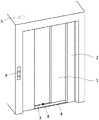
Fig. 1 is a schematic partial perspective view of an elevator showing a portion of an elevator door monitoring system embodiment according to the present invention mounted to the elevator.
Fig. 2 is a partial side view of the interior of the car of the elevator shown in fig. 1.
Figure 3 is a schematic diagram of the composition of an embodiment of an elevator door monitoring system according to the present invention.
Figure 4 is a schematic block diagram of another embodiment of an elevator door monitoring system according to the present invention.
Fig. 5 is a flow diagram of an embodiment of an elevator door monitoring method according to the present invention.
Detailed Description
First of all, it should be noted that the structural composition, steps, features, advantages, etc. of the elevator door monitoring system, the elevator system and the elevator door monitoring method according to the present invention will be described below by way of example, however, all the descriptions should not be construed as forming any limitation to the present invention. With the term "elevator sill" appearing herein, it is possible to provide itself with a guiding function for the elevator door, e.g. by means of guide rails installed in the elevator sill, but it is of course also possible to achieve the guiding of the elevator door without installing guide rails in the elevator sill, by means of e.g. some components or devices installed above the elevator door.
Furthermore, to any single feature described or implicit in an embodiment herein or shown or implicit in any single feature or features shown or implicit in the drawings, the invention still allows any combination or permutation to be continued between the features (or their equivalents) without any technical barriers, and thus further embodiments according to the invention should be considered within the scope of this disclosure. In addition, for simplicity of the drawings, identical or similar parts and features may be indicated in the same drawing only in one or several places.
A partial perspective view of an elevator on which an example of an elevator door monitoring system according to the invention is mounted is schematically illustrated in fig. 1, a partial side view of the interior of the elevator car is further illustrated in fig. 2, while the composition of two elevator door monitoring system embodiments is given in fig. 3 and 4, respectively, and the following detailed description is given by means of these figures.
First, as shown in fig. 1, an elevator is generally provided with an elevator door as a car door 1 and a landing door (also referred to as "hall door") 2, which may take various forms such as a center-split type, a side-open type, etc., and elevator sills 3, 4 may be provided for the car door 1 and the landing door 2, respectively, so that they realize an opened state or a closed state when moving along the elevator sills 3, 4, respectively. Of course, in some cases it is possible not to have to specially provide the landing door 2 with the elevator sill 4 as shown in fig. 1, but to achieve the opening and closing of the landing door 2 only by hoisting the landing door 2 onto the guide rails mounted above it.
The present inventors have studied to find that many elevator safety problems are actually caused by problems related to elevator doors, wherein one important cause of failure or abnormality of elevator doors is the existence of undesirable foreign objects (such as small stones, keys, cards, etc.) in elevator sills of elevator doors, which will affect smooth movement of elevator doors along the elevator sills, especially prevent the opened elevator doors from entering a closed state, thereby possibly damaging the elevator doors and causing serious safety problems. Disadvantageously, since these foreign objects are generally small and often not vivid in color, they are difficult to detect and notice, thereby causing an obstacle that prevents the elevator door from operating properly, such as the obstacle 8 located in the elevator sill 3 as shown in fig. 1, will likely cause the elevator door to fail to close properly, or even damage the elevator door.
To this end, the present invention provides an elevator door monitoring system having various embodiments to effectively solve the above technical problems. In the given example of an elevator door monitoring system, which comprises an imaging sensor 5 and a data processing device 6, wherein the imaging sensor(s) 5 can be provided as one or more and the imaging sensor(s) 5 can be arranged at any suitable location, e.g. at the top in the elevator car, at the bottom in the elevator car, in the elevator door frame and/or in the elevator waiting area (sometimes also referred to as "lobby"), for collecting image data and depth data for a section of the exposed elevator sill 3 when the elevator door is in the open state, the above section may be a part of the elevator sill 3 that is liable to fall into foreign objects to form an obstacle preventing the elevator door from normally operating, and, of course, in some application scenarios, the invention allows the acquisition of image data and depth data for all sections in the elevator sill 3 that can be exposed when the elevator door 1 is in the open state. As described above, it is shown in fig. 2 that the acquisition of image data and depth data can be performed by covering one or all of the exposable sections of the elevator sill 3 by forming a field of view a by means of the imaging sensor 5 mounted on the roof inside the elevator car.
By way of illustration, the imaging sensor 5 may employ any suitable component, component or device (e.g., using commercially available ZED, Kinect, Camcube, etc.) such as an RGB-D sensor to acquire and provide graphic data and depth data to be analyzed and processed by the data processing device 6, for example, height information of a foreign object may be obtained from the depth data to determine whether an obstacle preventing the car door 1 from entering the closed state exists in the elevator sill zone within the coverage of the field of view a formed by the imaging sensor 5.
As for the data processing device 6, it can communicate with the imaging sensor 5 in a wireless or wired manner so as to receive and process the above-mentioned image data and depth data acquired by the imaging sensor 5.
For example, in the embodiment of the elevator door monitoring system shown in fig. 3, the data processing device 6 may include two modules, i.e., a first module 61 and a second module 62, which are respectively used for processing the image data and the depth data, and then individually determine whether an obstacle exists in the elevator sill zone covered by the field of view of the imaging sensor 5 and performing data acquisition according to the respective data processing results. For the first module 61, it may employ any one or more suitable image or video (stream) analysis techniques to process the above image data, such techniques including, but not limited to, color background modeling, foreground detection, morphological filtering methods, and the like. For the second module 62, it may employ any one or more suitable depth image or video (stream) analysis techniques to process the above depth data, including, but not limited to, 3D analysis techniques (e.g., 3D background structure modeling (e.g., GMM methods, codebook methods, etc.), background subtraction, etc.), morphological filtering methods, etc. Since many such processing methods for image data and depth data have been provided in the prior art, they are not described herein too much.
If the judgment result of any one of the first module 61 and the second module 62 is that the existence of the obstacle in the current elevator sill can be confirmed, the data processing device 6 directly determines that the obstacle preventing the elevator door from normally operating to enter the closed state exists in the zone. By adopting the mode, the obstacles in the elevator sill zone can be very simply, conveniently and quickly monitored, and especially the possibility of missed detection of the obstacles can be minimized, so that the safety and the reliability of the elevator door and the operation of the whole elevator system are effectively improved.
By way of further example, in fig. 4 a further embodiment of an elevator door monitoring system is shown, wherein the data processing device 6 may comprise three modules, a first module 61 for processing the acquired image data, a second module 62 for processing the acquired depth data, and a third module 63 for making a combined decision on the decision of the first module 61 and the decision of the second module 62. For the first module 61 and the second module 62, they may process the acquired image data and depth data, respectively, in a data processing manner as discussed above in connection with the example of fig. 3. However, since there are limitations in the acquisition and analysis of image data and the acquisition and analysis of depth data, respectively, difficulties and disadvantages in foreign object monitoring may be caused, i.e., it is possible that obstacles are missed to be detected if only the image data or the depth data is applied.
For example, if the color of a foreign object falling into the elevator sill is not significantly different from the color of the current elevator sill, there is a high possibility that the analysis processing based on, for example, RGB color image data causes a problem in that the foreign object cannot be analyzed and recognized and a determination result that no obstacle exists in the elevator sill section is erroneously given. For another example, if the thickness of the foreign object falling into the elevator sill is very thin, which will cause the depth difference between the foreign object and the elevator sill to be very small, the method based on the depth data is likely to have a problem, i.e. it cannot analyze and judge the foreign object correctly, thereby giving a false judgment result that no obstacle exists in the elevator sill section. Therefore, the above-mentioned third module 63 in the data processing device 6 may be adopted to perform the combined judgment processing on the respective judgment results of the first module 61 and the second module 62, so as to eliminate the above-mentioned drawbacks and disadvantages to provide a more accurate and reliable final judgment result. That is, if the third module 63 determines that there is an obstacle in the monitored section of the current elevator sill after performing the combined determination, the data processing device 6 can finally determine the existence of the obstacle based on the determination, thereby improving the accuracy and reliability of the determination and analysis for the obstacle.
As far as the third module 63 is concerned, it can make a combined judgment in many different ways with respect to the judgment result of the first module 61 and the judgment result of the second module 62. For example, the third module 63 may make a combined determination based on a confidence analysis of the respective detections of the first module 61 and the second module 62. Specifically, the confidence of the judgment result of the first module 61 may be based on the degree of color difference between the detected object and the background, for example, if the color difference is larger, the confidence is higher; the confidence of the judgment result of the second module 62 may be based on the degree of distance difference between the detected object and the background, for example, if the distance difference therebetween is larger, the confidence is higher. Then, the confidences of the respective detection results of the first module 61 and the second module 62 are compared, and the judgment result of the module with the higher confidence is selected as the final confirmation result of the data processing apparatus 6.
For another example, the third module 63 may process the determination result of the first module 61 (for example, by using a digitizing process to determine qualitatively the probability that the obstacle exists) and the determination result of the second module 62 (for example, by using a digitizing process to determine qualitatively the probability that the obstacle exists), where the setting of parameters such as specific weighting factors may be selectively adjusted according to the actual application, and if the value obtained after the weighting process exceeds a preset value (which may be selectively set according to the actual application), the combined determination result may be set to confirm that the obstacle exists in the monitored zone of the current elevator sill.
In an alternative scenario, it is possible to arrange the control processing device 7 in the elevator door monitoring system and to arrange the data processing device 6 in the elevator door monitoring system to: when it has been determined that an obstacle exists in the sill section, a signal is outputted to the outside so as to transmit such a signal to the control processing device 7. The control processing device 7 will start processing operation after receiving the signal, so as to adopt corresponding measures in time to avoid causing injury to people or damage to relevant equipment such as elevator doors and the like. Such processing operations may include one or more of the following: prohibiting the elevator doors from moving, alerting passengers in the elevator cab (e.g., text, sounds, etc., or combinations thereof), alerting passengers in the elevator cab to remove an identified obstruction, notifying workers (e.g., elevator maintainers, building managers, security personnel, etc.) of the presence of an obstruction in the elevator doors (e.g., to prompt them to inspect or repair the elevator, etc.), logging out of the zone in a notification area (e.g., a lobby screen, an electronic screen in the elevator cab, etc.).
Of course, in some embodiments, the output signal of the data processing device 6 can also be transmitted to a control system for controlling the operation of the elevator, and the control system can perform the processing operation as described above or the like, so as to realize timely protection and avoid causing unnecessary personal injury and property damage.
As described above, when the car door 1 is in the open state while moving along the elevator sill 3, there is provided a possibility that a foreign object falls into the elevator sill 3 and forms an obstacle at this time, so that it is necessary to perform obstacle detection for one section or all sections in the elevator sill 3. Since the image data and the depth data which can be acquired in real time by means of the imaging sensor 5, it is very convenient to automatically detect and determine whether the car door 1 is currently in the open state by analyzing such image data and depth data individually or in combination. It is also possible to determine whether the car door 1 is already open by directly obtaining a signal from the control device for controlling the operation of the elevator, for example, when an elevator passenger in a waiting area presses the elevator button 9, the elevator is dispatched to the floor of the waiting area by the control device and opened, and the above elevator operation information including the state of the elevator door can be directly obtained from the control device.
In addition, as shown in fig. 1, in the case where the landing door 2 is provided with the elevator sill 4, it is possible to detect whether or not an obstacle preventing the landing door 2 from entering the closed state exists in one section or all sections of the elevator sill 4 when the landing door 2 is in the open state in the same manner as described above.
The general structural composition, operating principles and technical advantages of the elevator door monitoring system according to the present invention have been described in detail above by referring to these examples shown in fig. 1 to 4 in combination. According to another technical solution of the present invention, there is also provided an elevator system, in which an elevator door monitoring system designed and provided according to the present invention is configured so as to be able to exert the above-mentioned significant technical advantages of the solution of the present invention as compared with the prior art.
In addition, as one aspect which is significantly superior to the prior art, the present invention also provides an elevator door monitoring method. By way of example, as shown in fig. 5, in one example elevator door monitoring method may include the steps of:
in step S11, the current state of the elevator door is acquired;
in step S12, when the current state of the elevator door is an open state, image data and depth data of at least one section of the exposed elevator sill may be acquired by, for example, using one or more imaging sensors (such as RGB-D sensor, etc.); and
in step S13, the above acquired image data and depth data are processed to determine whether there is an obstacle in the above section that prevents the elevator door from entering the closed state.
In some embodiments, the presence or absence of an obstacle in the monitored elevator sill section can be determined in a very easy and quick manner as follows. That is, if it can be determined that there is an obstacle in the section when processing is performed based on the image data, or if it can be determined that there is an obstacle in the section when processing is performed based on the depth data, it can be directly determined that there is an obstacle in the current elevator sill section.
In addition, in some embodiments, a combined judgment analysis may be further performed on the judgment result based on the image data and the judgment result based on the depth data, so as to eliminate the defects and shortcomings caused by the adoption of the image data-based mode and the depth data-based mode, and thus, a more accurate and reliable final judgment result is achieved. In practical applications, the specific combination determination may be performed in many different manners, such as the weighting manner, the confidence comparison manner, and the like discussed above. It is to be understood that, since such technical contents have been described in detail in the foregoing description of the elevator door monitoring system, reference may be made to the detailed description of the corresponding parts, which is not described herein again.
Additionally, in some embodiments, the inventive method also allows for initiating one or more processing operations when an obstruction already exists in the current elevator sill zone. In addition, various modes can be adopted to judge whether the elevator door is in an open state currently so as to determine whether to carry out the image data and depth data acquisition work. With regard to these technical contents, reference may be made directly to the detailed description of the corresponding parts in the foregoing as well, and therefore, the description will not be repeated.
The elevator door monitoring system, the elevator system and the elevator door monitoring method according to the present invention have been explained in detail above by way of examples only, which are provided only for illustrating the principles of the present invention and the embodiments thereof, and not for limiting the present invention, and those skilled in the art can make various modifications and improvements without departing from the spirit and scope of the present invention. Accordingly, all equivalents are intended to be included within the scope of this invention and defined in the claims which follow.
Claims (16)
1. An elevator door monitoring system, the elevator door having an open state or a closed state achieved by movement along an elevator sill, the elevator door monitoring system comprising:
One or more imaging sensors arranged to acquire image data and depth data of at least one section of an exposed elevator sill when the elevator door is in an open state; and
a data processing device in communication with the imaging sensor for receiving and processing the image data and the depth data to determine whether an obstruction exists in the zone that prevents the elevator door from entering a closed state;
wherein the data processing apparatus includes a first module and a second module that are configured to individually determine whether the obstacle exists in the section by performing processing based on the image data and the depth data, respectively, and further includes a third module configured to perform a combined determination on a determination result of the first module and a determination result of the second module, wherein the combined determination includes:
weighting the judgment result of the first module and the judgment result of the second module, and determining that the obstacle exists in the section when the value obtained by weighting exceeds a preset value; or
And comparing the confidence coefficient of the judgment result based on the image data with the confidence coefficient based on the depth data, and selecting the judgment result with high confidence coefficient as the combined judgment result.
2. Elevator door monitoring system according to claim 1, wherein the data processing device is arranged to determine that the obstacle is already present in the sector if the combined determination of the third module is yes.
3. The elevator door monitoring system of claim 1, wherein the first module processes the image data using color background modeling, foreground detection, and morphological filtering, and/or the second module processes the depth data using 3D background structure modeling, background subtraction, and morphological filtering.
4. The elevator door monitoring system of claim 1, wherein the data processing device is configured to output a signal outwardly upon determining the presence of the obstruction in the zone.
5. The elevator door monitoring system of claim 4, wherein the elevator door monitoring system further comprises a control processing device in communication with the data processing device for initiating a processing operation upon receiving the signal, the processing operation including at least one of:
prohibiting the elevator door from moving;
sending a warning to a passenger in the elevator car;
alerting passengers within the elevator car to remove the obstruction;
Notifying a worker of the presence of an obstacle in the zone; and
a notification that an obstacle is present in the zone is checked out in the announcement area.
6. The elevator door monitoring system of claim 4, wherein the signal is communicated to a control system for controlling operation of the elevator for processing operations including at least one of:
prohibiting the elevator door from moving;
sending a warning to a passenger in the elevator car;
alerting passengers within the elevator car to remove the obstruction;
notifying a worker of the presence of an obstacle in the zone; and
a notification that an obstacle is present in the zone is checked out in the announcement area.
7. The elevator door monitoring system of claim 1, wherein the imaging sensor is disposed in a top portion within an elevator car, a bottom portion within an elevator car, an elevator door frame, and/or an elevator waiting area.
8. The elevator door monitoring system of claim 1, wherein the elevator door is at least one of a landing door and a car door.
9. The elevator door monitoring system of claim 1, wherein the imaging sensor comprises an RGB-D sensor.
10. Elevator system, characterized in that the elevator system comprises an elevator door monitoring system according to any of claims 1-9.
11. A method of monitoring an elevator door having an opened state or a closed state implemented by moving along an elevator sill, the method comprising the steps of:
acquiring the current state of the elevator door;
when the current state of the elevator door is an open state, acquiring image data and depth data of at least one section in the exposed elevator sill; and
processing the image data and the depth data to determine whether there is an obstruction in the zone that prevents the elevator door from entering a closed state;
wherein the step of processing the image data and the depth data comprises: performing a combined determination of a determination result based on the image data and a determination result based on the depth data to determine that the obstacle exists in the section; and wherein the combining determination comprises:
weighting the judgment result based on the image data and the judgment result based on the depth data, and determining that the obstacle exists in the section when the value obtained by the weighting processing exceeds a preset value; or
And comparing the confidence coefficient of the judgment result based on the image data with the confidence coefficient based on the depth data, and selecting the judgment result with high confidence coefficient as a combined judgment result.
12. The elevator door monitoring method according to claim 11, wherein it is determined that the obstacle is already present in the section when one of the following conditions is satisfied:
determining that the obstacle exists in the section when processing is performed based on the image data; and
determining that the obstacle is present in the section when processing is performed based on the depth data.
13. Elevator door monitoring method according to claim 11, wherein the image data is processed using color background modeling, foreground detection and morphological filtering methods and/or the depth data is processed using 3D background structure modeling, background subtraction and morphological filtering.
14. The elevator door monitoring method of claim 11, wherein the elevator door monitoring method further comprises the steps of: initiating a processing operation when it is determined that the obstacle is present in the zone, the processing operation including at least one of:
prohibiting the elevator door from moving;
sending out warnings to passengers in the elevator car;
alerting passengers within the elevator car to remove the obstruction;
notifying a worker of the presence of an obstacle in the zone; and
Logging out of a notification of an obstacle in the zone at a public area.
15. The elevator door monitoring method of claim 11, wherein the image data and the depth data are acquired using one or more imaging sensors, the imaging sensors including RGB-D sensors.
16. The elevator door monitoring method of claim 15, wherein determining whether the elevator door is already in an open state is based on the image data and/or the depth data collected by the imaging sensor in real time; alternatively, it is determined whether the elevator door is already in an open state according to a signal obtained from a control device for controlling the operation of the elevator.
Priority Applications (3)
| Application Number | Priority Date | Filing Date | Title |
|---|---|---|---|
| CN201810500352.1A CN110526058B (en) | 2018-05-23 | 2018-05-23 | Elevator door monitoring system, elevator system and elevator door monitoring method |
| DE102019207332.8A DE102019207332A1 (en) | 2018-05-23 | 2019-05-20 | Monitoring system for an elevator door, elevator installation and method for monitoring an elevator door |
| US16/421,016 US11760605B2 (en) | 2018-05-23 | 2019-05-23 | Elevator door monitoring system, elevator system and elevator door monitoring method |
Applications Claiming Priority (1)
| Application Number | Priority Date | Filing Date | Title |
|---|---|---|---|
| CN201810500352.1A CN110526058B (en) | 2018-05-23 | 2018-05-23 | Elevator door monitoring system, elevator system and elevator door monitoring method |
Publications (2)
| Publication Number | Publication Date |
|---|---|
| CN110526058A CN110526058A (en) | 2019-12-03 |
| CN110526058B true CN110526058B (en) | 2022-06-03 |
Family
ID=68499643
Family Applications (1)
| Application Number | Title | Priority Date | Filing Date |
|---|---|---|---|
| CN201810500352.1A Active CN110526058B (en) | 2018-05-23 | 2018-05-23 | Elevator door monitoring system, elevator system and elevator door monitoring method |
Country Status (3)
| Country | Link |
|---|---|
| US (1) | US11760605B2 (en) |
| CN (1) | CN110526058B (en) |
| DE (1) | DE102019207332A1 (en) |
Families Citing this family (11)
| Publication number | Priority date | Publication date | Assignee | Title |
|---|---|---|---|---|
| CN111137774A (en) * | 2019-12-31 | 2020-05-12 | 滁州职业技术学院 | Automatic door with anti-pinch function |
| CN112329504B (en) * | 2020-04-15 | 2024-08-23 | 深圳Tcl新技术有限公司 | Door switch status monitoring method, device, equipment and computer readable storage medium |
| CN111563229B (en) * | 2020-05-13 | 2022-03-22 | 浙江大学 | Fault Diagnosis Method for Overspeed Automatic Reset of Straight Elevator Based on Gaussian Mixture Model |
| US10906774B1 (en) | 2020-06-03 | 2021-02-02 | Scott Akin | Apparatus for elevator and landing alignment |
| CN111680621A (en) * | 2020-06-05 | 2020-09-18 | 浙江新再灵科技股份有限公司 | Elevator door state detection method based on video image |
| CN112320525B (en) * | 2020-11-18 | 2022-04-29 | 日立楼宇技术(广州)有限公司 | Elevator obstacle removal method, device, computer equipment and storage medium |
| CN112529953B (en) * | 2020-12-17 | 2022-05-03 | 深圳市普渡科技有限公司 | Elevator space state judgment method and device and storage medium |
| CN113602927B (en) * | 2021-07-30 | 2023-03-10 | 浙江新再灵科技股份有限公司 | Elevator door opening and closing detection method |
| CN116788960B (en) * | 2023-06-25 | 2025-09-26 | 桂林电子科技大学 | Elevator door pre-sensing anti-pinch system and method based on three-dimensional point cloud deep learning |
| CN117068911A (en) * | 2023-08-31 | 2023-11-17 | 上海三菱电梯有限公司 | Elevator door control device and elevator door system |
| DE202024105132U1 (en) | 2024-09-06 | 2024-10-14 | Genima Innovations Marketing Gmbh | Control of oncoming traffic and management of traffic flow at elevator and emergency exit doors |
Family Cites Families (26)
| Publication number | Priority date | Publication date | Assignee | Title |
|---|---|---|---|---|
| US5387768A (en) | 1993-09-27 | 1995-02-07 | Otis Elevator Company | Elevator passenger detector and door control system which masks portions of a hall image to determine motion and court passengers |
| JP3958940B2 (en) * | 2001-03-12 | 2007-08-15 | 三菱電機株式会社 | Door device and elevator device |
| ATE319263T1 (en) | 2002-03-11 | 2006-03-15 | Inventio Ag | VIDEO MONITORING SYSTEM USING 3-D SEMICONDUCTOR IMAGE SENSOR AND INFRA-RED LIGHT SOURCE |
| WO2004084556A1 (en) | 2003-03-20 | 2004-09-30 | Inventio Ag | Monitoring a lift area by means of a 3d sensor |
| JP4622416B2 (en) | 2004-09-22 | 2011-02-02 | 三菱電機株式会社 | Elevator door safety device |
| JP4664394B2 (en) * | 2008-05-23 | 2011-04-06 | 株式会社日立製作所 | Elevator door safety device and safety control method |
| KR101210182B1 (en) | 2008-07-16 | 2012-12-07 | 미쓰비시덴키 가부시키가이샤 | Slide door device and elevator |
| CN102186758B (en) | 2008-10-20 | 2015-07-29 | 富士达株式会社 | The safety device of elevator |
| JP5070187B2 (en) | 2008-11-05 | 2012-11-07 | 株式会社日立製作所 | Elevator safety equipment |
| JP5069672B2 (en) | 2008-12-24 | 2012-11-07 | 株式会社日立製作所 | Elevator safety equipment |
| WO2010073387A1 (en) * | 2008-12-26 | 2010-07-01 | 三菱電機株式会社 | Slide door device and elevator |
| JP5208853B2 (en) * | 2009-05-21 | 2013-06-12 | 株式会社日立製作所 | Elevator safety device and safety control method |
| JP5690504B2 (en) | 2010-05-14 | 2015-03-25 | 株式会社日立製作所 | Safety elevator |
| JP5491959B2 (en) * | 2010-05-18 | 2014-05-14 | 株式会社日立ビルシステム | Elevator door diagnostic device and door diagnostic method |
| CN103237948B (en) | 2010-12-03 | 2015-05-27 | 纳博特斯克有限公司 | Sensor for automatic door |
| TWI435842B (en) | 2011-09-27 | 2014-05-01 | Hon Hai Prec Ind Co Ltd | Safe control device and method for lift |
| US9212028B2 (en) | 2012-07-31 | 2015-12-15 | Precision Elevator Corp. | Obstruction sensor system and method for elevator entry and exit |
| CN203237899U (en) | 2013-05-15 | 2013-10-16 | 北京晶科华盛科技有限公司 | Elevator door safety protection system and elevator |
| AU2015357147A1 (en) * | 2014-12-03 | 2017-06-29 | Inventio Ag | System and method for alternatively interacting with elevators |
| GB201500513D0 (en) | 2015-01-13 | 2015-02-25 | Avire Ltd | Object detection |
| JP5969149B1 (en) | 2016-01-13 | 2016-08-17 | 東芝エレベータ株式会社 | Elevator system |
| CN205397758U (en) * | 2016-03-03 | 2016-07-27 | 浙江中博信息工程有限公司 | Elevator linkage monitoring system |
| CN107298354B (en) | 2017-07-13 | 2019-03-19 | 日立楼宇技术(广州)有限公司 | Elevator door-motor monitoring method, device, system and computer-readable medium, equipment |
| CN107337044B (en) | 2017-08-07 | 2019-10-29 | 日立楼宇技术(广州)有限公司 | The detection method and system of elevator components failure |
| CN110510486B (en) * | 2018-05-21 | 2023-03-14 | 奥的斯电梯公司 | Elevator door control system, elevator system and elevator door control method |
| US10491885B1 (en) * | 2018-06-13 | 2019-11-26 | Luminar Technologies, Inc. | Post-processing by lidar system guided by camera information |
-
2018
- 2018-05-23 CN CN201810500352.1A patent/CN110526058B/en active Active
-
2019
- 2019-05-20 DE DE102019207332.8A patent/DE102019207332A1/en active Pending
- 2019-05-23 US US16/421,016 patent/US11760605B2/en active Active
Also Published As
| Publication number | Publication date |
|---|---|
| DE102019207332A1 (en) | 2019-11-28 |
| US20190359451A1 (en) | 2019-11-28 |
| US11760605B2 (en) | 2023-09-19 |
| CN110526058A (en) | 2019-12-03 |
Similar Documents
| Publication | Publication Date | Title |
|---|---|---|
| CN110526058B (en) | Elevator door monitoring system, elevator system and elevator door monitoring method | |
| CN101585478B (en) | Safety device and security control method for elevator door | |
| EP2300949B1 (en) | Video-based system and method of elevator door detection | |
| US6339375B1 (en) | Image monitoring apparatus and image monitoring method | |
| US20020117358A1 (en) | Hoistway intrusion detection | |
| WO2007026042B1 (en) | Method and call system | |
| CN110775756B (en) | Elevator component inspection system | |
| KR20140133444A (en) | Passenger counter | |
| JP2004527675A (en) | Safety device controlled by camera | |
| EP3527525A1 (en) | Elevator door control system for detection of obstacle trapping | |
| CN106379787B (en) | A kind of elevator early warning relief car | |
| JP6140436B2 (en) | Shooting system | |
| JP4622416B2 (en) | Elevator door safety device | |
| KR101917808B1 (en) | An Elevator Video Monitoring System And An Elevator Video Monitoring System | |
| JP5682325B2 (en) | Security system | |
| KR101937791B1 (en) | Screen door system and operating method thereof | |
| CN113936250A (en) | A method, device, computer equipment and medium for calculating the opening and closing amplitude of an elevator door | |
| JP2010195537A (en) | Monitoring device in car of elevator | |
| US20240076161A1 (en) | People counting device for an elevator | |
| CN116034579A (en) | Moving object tracking system, moving object tracking device, program, and moving object tracking method | |
| KR101802388B1 (en) | An Elevator Black Box And A Method For Vedio Recoding | |
| JP2020045197A (en) | Step detection device of elevator and step detection system | |
| CN115225667A (en) | Auxiliary method for train safety detection based on edge computing | |
| KR102836440B1 (en) | Elevator safety accident prevention device and method using TOF camera | |
| CN117826273A (en) | Automatic detection method, system and equipment for foreign matters of subway shielding door |
Legal Events
| Date | Code | Title | Description |
|---|---|---|---|
| PB01 | Publication | ||
| PB01 | Publication | ||
| SE01 | Entry into force of request for substantive examination | ||
| SE01 | Entry into force of request for substantive examination | ||
| GR01 | Patent grant | ||
| GR01 | Patent grant |