CN110337665B - System and method for information protection - Google Patents
System and method for information protection Download PDFInfo
- Publication number
- CN110337665B CN110337665B CN201880011494.XA CN201880011494A CN110337665B CN 110337665 B CN110337665 B CN 110337665B CN 201880011494 A CN201880011494 A CN 201880011494A CN 110337665 B CN110337665 B CN 110337665B
- Authority
- CN
- China
- Prior art keywords
- transaction
- commitment
- blinding factor
- combination
- encrypted
- Prior art date
- Legal status (The legal status is an assumption and is not a legal conclusion. Google has not performed a legal analysis and makes no representation as to the accuracy of the status listed.)
- Active
Links
Images



Classifications
-
- H—ELECTRICITY
- H04—ELECTRIC COMMUNICATION TECHNIQUE
- H04L—TRANSMISSION OF DIGITAL INFORMATION, e.g. TELEGRAPHIC COMMUNICATION
- H04L9/00—Cryptographic mechanisms or cryptographic arrangements for secret or secure communications; Network security protocols
- H04L9/32—Cryptographic mechanisms or cryptographic arrangements for secret or secure communications; Network security protocols including means for verifying the identity or authority of a user of the system or for message authentication, e.g. authorization, entity authentication, data integrity or data verification, non-repudiation, key authentication or verification of credentials
- H04L9/3226—Cryptographic mechanisms or cryptographic arrangements for secret or secure communications; Network security protocols including means for verifying the identity or authority of a user of the system or for message authentication, e.g. authorization, entity authentication, data integrity or data verification, non-repudiation, key authentication or verification of credentials using a predetermined code, e.g. password, passphrase or PIN
-
- G—PHYSICS
- G06—COMPUTING OR CALCULATING; COUNTING
- G06F—ELECTRIC DIGITAL DATA PROCESSING
- G06F21/00—Security arrangements for protecting computers, components thereof, programs or data against unauthorised activity
- G06F21/60—Protecting data
-
- G—PHYSICS
- G06—COMPUTING OR CALCULATING; COUNTING
- G06Q—INFORMATION AND COMMUNICATION TECHNOLOGY [ICT] SPECIALLY ADAPTED FOR ADMINISTRATIVE, COMMERCIAL, FINANCIAL, MANAGERIAL OR SUPERVISORY PURPOSES; SYSTEMS OR METHODS SPECIALLY ADAPTED FOR ADMINISTRATIVE, COMMERCIAL, FINANCIAL, MANAGERIAL OR SUPERVISORY PURPOSES, NOT OTHERWISE PROVIDED FOR
- G06Q20/00—Payment architectures, schemes or protocols
- G06Q20/04—Payment circuits
- G06Q20/06—Private payment circuits, e.g. involving electronic currency used among participants of a common payment scheme
- G06Q20/065—Private payment circuits, e.g. involving electronic currency used among participants of a common payment scheme using e-cash
-
- G—PHYSICS
- G06—COMPUTING OR CALCULATING; COUNTING
- G06Q—INFORMATION AND COMMUNICATION TECHNOLOGY [ICT] SPECIALLY ADAPTED FOR ADMINISTRATIVE, COMMERCIAL, FINANCIAL, MANAGERIAL OR SUPERVISORY PURPOSES; SYSTEMS OR METHODS SPECIALLY ADAPTED FOR ADMINISTRATIVE, COMMERCIAL, FINANCIAL, MANAGERIAL OR SUPERVISORY PURPOSES, NOT OTHERWISE PROVIDED FOR
- G06Q20/00—Payment architectures, schemes or protocols
- G06Q20/38—Payment protocols; Details thereof
- G06Q20/382—Payment protocols; Details thereof insuring higher security of transaction
-
- H—ELECTRICITY
- H04—ELECTRIC COMMUNICATION TECHNIQUE
- H04L—TRANSMISSION OF DIGITAL INFORMATION, e.g. TELEGRAPHIC COMMUNICATION
- H04L63/00—Network architectures or network communication protocols for network security
- H04L63/04—Network architectures or network communication protocols for network security for providing a confidential data exchange among entities communicating through data packet networks
- H04L63/0428—Network architectures or network communication protocols for network security for providing a confidential data exchange among entities communicating through data packet networks wherein the data content is protected, e.g. by encrypting or encapsulating the payload
-
- H—ELECTRICITY
- H04—ELECTRIC COMMUNICATION TECHNIQUE
- H04L—TRANSMISSION OF DIGITAL INFORMATION, e.g. TELEGRAPHIC COMMUNICATION
- H04L9/00—Cryptographic mechanisms or cryptographic arrangements for secret or secure communications; Network security protocols
- H04L9/08—Key distribution or management, e.g. generation, sharing or updating, of cryptographic keys or passwords
- H04L9/0861—Generation of secret information including derivation or calculation of cryptographic keys or passwords
-
- H—ELECTRICITY
- H04—ELECTRIC COMMUNICATION TECHNIQUE
- H04L—TRANSMISSION OF DIGITAL INFORMATION, e.g. TELEGRAPHIC COMMUNICATION
- H04L9/00—Cryptographic mechanisms or cryptographic arrangements for secret or secure communications; Network security protocols
- H04L9/08—Key distribution or management, e.g. generation, sharing or updating, of cryptographic keys or passwords
- H04L9/0894—Escrow, recovery or storing of secret information, e.g. secret key escrow or cryptographic key storage
-
- H—ELECTRICITY
- H04—ELECTRIC COMMUNICATION TECHNIQUE
- H04L—TRANSMISSION OF DIGITAL INFORMATION, e.g. TELEGRAPHIC COMMUNICATION
- H04L9/00—Cryptographic mechanisms or cryptographic arrangements for secret or secure communications; Network security protocols
- H04L9/32—Cryptographic mechanisms or cryptographic arrangements for secret or secure communications; Network security protocols including means for verifying the identity or authority of a user of the system or for message authentication, e.g. authorization, entity authentication, data integrity or data verification, non-repudiation, key authentication or verification of credentials
- H04L9/3218—Cryptographic mechanisms or cryptographic arrangements for secret or secure communications; Network security protocols including means for verifying the identity or authority of a user of the system or for message authentication, e.g. authorization, entity authentication, data integrity or data verification, non-repudiation, key authentication or verification of credentials using proof of knowledge, e.g. Fiat-Shamir, GQ, Schnorr, ornon-interactive zero-knowledge proofs
-
- H—ELECTRICITY
- H04—ELECTRIC COMMUNICATION TECHNIQUE
- H04L—TRANSMISSION OF DIGITAL INFORMATION, e.g. TELEGRAPHIC COMMUNICATION
- H04L9/00—Cryptographic mechanisms or cryptographic arrangements for secret or secure communications; Network security protocols
- H04L9/32—Cryptographic mechanisms or cryptographic arrangements for secret or secure communications; Network security protocols including means for verifying the identity or authority of a user of the system or for message authentication, e.g. authorization, entity authentication, data integrity or data verification, non-repudiation, key authentication or verification of credentials
- H04L9/3236—Cryptographic mechanisms or cryptographic arrangements for secret or secure communications; Network security protocols including means for verifying the identity or authority of a user of the system or for message authentication, e.g. authorization, entity authentication, data integrity or data verification, non-repudiation, key authentication or verification of credentials using cryptographic hash functions
- H04L9/3239—Cryptographic mechanisms or cryptographic arrangements for secret or secure communications; Network security protocols including means for verifying the identity or authority of a user of the system or for message authentication, e.g. authorization, entity authentication, data integrity or data verification, non-repudiation, key authentication or verification of credentials using cryptographic hash functions involving non-keyed hash functions, e.g. modification detection codes [MDCs], MD5, SHA or RIPEMD
-
- H—ELECTRICITY
- H04—ELECTRIC COMMUNICATION TECHNIQUE
- H04L—TRANSMISSION OF DIGITAL INFORMATION, e.g. TELEGRAPHIC COMMUNICATION
- H04L9/00—Cryptographic mechanisms or cryptographic arrangements for secret or secure communications; Network security protocols
- H04L9/32—Cryptographic mechanisms or cryptographic arrangements for secret or secure communications; Network security protocols including means for verifying the identity or authority of a user of the system or for message authentication, e.g. authorization, entity authentication, data integrity or data verification, non-repudiation, key authentication or verification of credentials
- H04L9/3247—Cryptographic mechanisms or cryptographic arrangements for secret or secure communications; Network security protocols including means for verifying the identity or authority of a user of the system or for message authentication, e.g. authorization, entity authentication, data integrity or data verification, non-repudiation, key authentication or verification of credentials involving digital signatures
-
- H—ELECTRICITY
- H04—ELECTRIC COMMUNICATION TECHNIQUE
- H04L—TRANSMISSION OF DIGITAL INFORMATION, e.g. TELEGRAPHIC COMMUNICATION
- H04L9/00—Cryptographic mechanisms or cryptographic arrangements for secret or secure communications; Network security protocols
- H04L9/32—Cryptographic mechanisms or cryptographic arrangements for secret or secure communications; Network security protocols including means for verifying the identity or authority of a user of the system or for message authentication, e.g. authorization, entity authentication, data integrity or data verification, non-repudiation, key authentication or verification of credentials
- H04L9/3247—Cryptographic mechanisms or cryptographic arrangements for secret or secure communications; Network security protocols including means for verifying the identity or authority of a user of the system or for message authentication, e.g. authorization, entity authentication, data integrity or data verification, non-repudiation, key authentication or verification of credentials involving digital signatures
- H04L9/3252—Cryptographic mechanisms or cryptographic arrangements for secret or secure communications; Network security protocols including means for verifying the identity or authority of a user of the system or for message authentication, e.g. authorization, entity authentication, data integrity or data verification, non-repudiation, key authentication or verification of credentials involving digital signatures using DSA or related signature schemes, e.g. elliptic based signatures, ElGamal or Schnorr schemes
-
- G—PHYSICS
- G06—COMPUTING OR CALCULATING; COUNTING
- G06Q—INFORMATION AND COMMUNICATION TECHNOLOGY [ICT] SPECIALLY ADAPTED FOR ADMINISTRATIVE, COMMERCIAL, FINANCIAL, MANAGERIAL OR SUPERVISORY PURPOSES; SYSTEMS OR METHODS SPECIALLY ADAPTED FOR ADMINISTRATIVE, COMMERCIAL, FINANCIAL, MANAGERIAL OR SUPERVISORY PURPOSES, NOT OTHERWISE PROVIDED FOR
- G06Q2220/00—Business processing using cryptography
-
- H—ELECTRICITY
- H04—ELECTRIC COMMUNICATION TECHNIQUE
- H04L—TRANSMISSION OF DIGITAL INFORMATION, e.g. TELEGRAPHIC COMMUNICATION
- H04L2209/00—Additional information or applications relating to cryptographic mechanisms or cryptographic arrangements for secret or secure communication H04L9/00
- H04L2209/04—Masking or blinding
-
- H—ELECTRICITY
- H04—ELECTRIC COMMUNICATION TECHNIQUE
- H04L—TRANSMISSION OF DIGITAL INFORMATION, e.g. TELEGRAPHIC COMMUNICATION
- H04L2209/00—Additional information or applications relating to cryptographic mechanisms or cryptographic arrangements for secret or secure communication H04L9/00
- H04L2209/56—Financial cryptography, e.g. electronic payment or e-cash
-
- H—ELECTRICITY
- H04—ELECTRIC COMMUNICATION TECHNIQUE
- H04L—TRANSMISSION OF DIGITAL INFORMATION, e.g. TELEGRAPHIC COMMUNICATION
- H04L9/00—Cryptographic mechanisms or cryptographic arrangements for secret or secure communications; Network security protocols
- H04L9/32—Cryptographic mechanisms or cryptographic arrangements for secret or secure communications; Network security protocols including means for verifying the identity or authority of a user of the system or for message authentication, e.g. authorization, entity authentication, data integrity or data verification, non-repudiation, key authentication or verification of credentials
- H04L9/3247—Cryptographic mechanisms or cryptographic arrangements for secret or secure communications; Network security protocols including means for verifying the identity or authority of a user of the system or for message authentication, e.g. authorization, entity authentication, data integrity or data verification, non-repudiation, key authentication or verification of credentials involving digital signatures
- H04L9/3255—Cryptographic mechanisms or cryptographic arrangements for secret or secure communications; Network security protocols including means for verifying the identity or authority of a user of the system or for message authentication, e.g. authorization, entity authentication, data integrity or data verification, non-repudiation, key authentication or verification of credentials involving digital signatures using group based signatures, e.g. ring or threshold signatures
-
- H—ELECTRICITY
- H04—ELECTRIC COMMUNICATION TECHNIQUE
- H04L—TRANSMISSION OF DIGITAL INFORMATION, e.g. TELEGRAPHIC COMMUNICATION
- H04L9/00—Cryptographic mechanisms or cryptographic arrangements for secret or secure communications; Network security protocols
- H04L9/50—Cryptographic mechanisms or cryptographic arrangements for secret or secure communications; Network security protocols using hash chains, e.g. blockchains or hash trees
Landscapes
- Engineering & Computer Science (AREA)
- Computer Security & Cryptography (AREA)
- Computer Networks & Wireless Communication (AREA)
- Signal Processing (AREA)
- Business, Economics & Management (AREA)
- Accounting & Taxation (AREA)
- Theoretical Computer Science (AREA)
- Physics & Mathematics (AREA)
- General Physics & Mathematics (AREA)
- General Engineering & Computer Science (AREA)
- Computer Hardware Design (AREA)
- Strategic Management (AREA)
- Finance (AREA)
- General Business, Economics & Management (AREA)
- Computing Systems (AREA)
- Health & Medical Sciences (AREA)
- Bioethics (AREA)
- General Health & Medical Sciences (AREA)
- Software Systems (AREA)
- Financial Or Insurance-Related Operations Such As Payment And Settlement (AREA)
- Storage Device Security (AREA)
Abstract
一种计算机实现的用于信息保护的方法包括:利用第一承诺方案对交易的交易金额t承诺以获取交易承诺值,并利用第二承诺方案对所述交易的找零y承诺以获取找零承诺值,所述第一承诺方案包括交易盲因子,且所述第二承诺方案包括找零盲因子;利用第一密钥加密所述找零盲因子和所述找零的第一组合;将所述交易盲因子、所述交易金额和所述交易承诺值传输至与所述交易的接收方关联的接收方节点,以供所述接收方节点验证所述交易;响应于所述接收方节点成功验证所述交易,获取利用第二密钥加密的所述交易盲因子和所述交易金额的加密的第二组合。
A computer-implemented method for information protection comprising: using a first commitment scheme to commit to a transaction amount t of a transaction to obtain a transaction commitment value, and using a second commitment scheme to commit to a change y of the transaction to obtain change A commitment value, the first commitment scheme includes a transaction blinding factor, and the second commitment scheme includes a change blinding factor; the first combination of the change blinding factor and the change is encrypted with a first key; The transaction blinding factor, the transaction amount, and the transaction commitment value are transmitted to a recipient node associated with the recipient of the transaction for the recipient node to verify the transaction; in response to the recipient node Successfully verifying the transaction, obtaining an encrypted second combination of the transaction blinding factor and the transaction amount encrypted using a second key.
Description
技术领域technical field
本公开总体上涉及用于信息保护的方法和设备。The present disclosure generally relates to methods and apparatus for information protection.
背景技术Background technique
隐私对于各种用户之间的通信和数据传送是重要的。在没有保护的情况下,用户暴露于身份盗窃、非法转移或其它潜在损失的风险中。当在线实现通信和传送时,由于对在线信息的自由访问,风险甚至变得更大。Privacy is important to communications and data transfers between various users. Without protection, users are exposed to identity theft, illegal diversion, or other potential losses. When communication and delivery is achieved online, the risk becomes even greater due to the free access to online information.
发明内容Contents of the invention
本公开的各种实施例包括用于信息保护的系统、方法和非暂态计算机可读介质。Various embodiments of the present disclosure include systems, methods, and non-transitory computer-readable media for information protection.
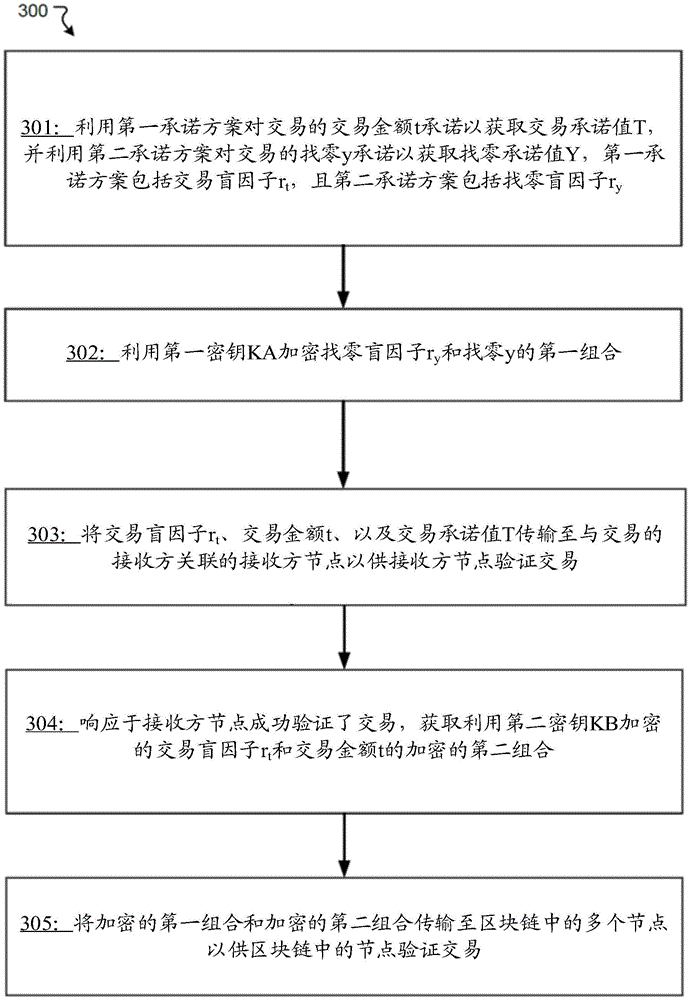
根据一方面,一种计算机实现的用于信息保护的方法包括:利用第一承诺方案对交易的交易金额t承诺以获取交易承诺值T,并利用第二承诺方案对所述交易的找零y承诺以获取找零承诺值Y,所述第一承诺方案包括交易盲因子rt,且所述第二承诺方案包括找零盲因子ry;利用第一密钥KA加密所述找零盲因子ry和所述找零y的第一组合;将所述交易盲因子rt、所述交易金额t和所述交易承诺值T传输至与所述交易的接收方关联的接收方节点,以供所述接收方节点验证所述交易;响应于所述接收方节点成功验证所述交易,获取利用第二密钥KB加密的所述交易盲因子rt和所述交易金额t的加密的第二组合;以及将所述加密的第一组合和所述加密的第二组合传输至区块链中的多个节点以供所述区块链中的所述节点验证所述交易。According to one aspect, a computer-implemented method for information protection includes: using a first commitment scheme to commit to a transaction amount t of a transaction to obtain a transaction commitment value T, and using a second commitment scheme to commit to the change y of the transaction Committing to obtain a change commitment value Y, the first commitment scheme includes a transaction blinding factor r t , and the second commitment scheme includes a change blinding factor ry ; the change blinding factor is encrypted using the first key KA r y and the first combination of the change y; transmit the transaction blinding factor r t , the transaction amount t and the transaction commitment value T to the recipient node associated with the recipient of the transaction to for the recipient node to verify the transaction; in response to the recipient node successfully verifying the transaction, obtain the transaction blinding factor r t encrypted with the second key KB and the encrypted second key of the transaction amount t two combinations; and transmitting the encrypted first combination and the encrypted second combination to a plurality of nodes in a blockchain for verification of the transaction by the nodes in the blockchain.
在一些实施例中,所述第一承诺方案包括至少基于所述交易盲因子rt并且有所述交易金额t作为对应的被承诺值的佩德森(Pedersen)承诺;以及所述第二承诺方案包括至少基于所述找零盲因子ry并且有所述找零作为对应的被承诺值的Pedersen承诺。In some embodiments, said first commitment scheme comprises a Pedersen (Pedersen) commitment based at least on said transaction blinding factor r t and having said transaction amount t as a corresponding committed value; and said second commitment The scheme includes a Pedersen commitment based at least on said change blinding factor ry and having said change as a corresponding committed value.
在一些实施例中,将所述交易盲因子rt、所述交易金额t、以及所述交易承诺值T传输至与所述交易的所述接收方关联的所述接收方节点,以供所述接收方节点验证所述交易,包括:将所述交易盲因子rt、所述交易金额t、以及所述交易承诺值T传输至与所述交易的所述接收方关联的所述接收方节点,促使所述接收方节点验证所述交易承诺值T是否等于所述第一承诺方案利用所述交易盲因子rt对所述交易金额t的承诺。In some embodiments, the transaction blinding factor rt , the transaction amount t, and the transaction commitment value T are transmitted to the recipient node associated with the recipient of the transaction for all The recipient node verifies the transaction, including: transmitting the transaction blinding factor rt , the transaction amount t, and the transaction commitment value T to the recipient associated with the recipient of the transaction A node, prompting the receiver node to verify whether the transaction commitment value T is equal to the commitment of the transaction amount t by using the transaction blinding factor r t in the first commitment scheme.
在一些实施例中,获取所述加密的第二组合,包括:从所述接收方节点接收所述加密的第二组合和与所述加密的第二组合以及所述交易承诺值T关联的签名SIGB。In some embodiments, obtaining the encrypted second combination includes: receiving the encrypted second combination and a signature associated with the encrypted second combination and the transaction commitment value T from the recipient node SIGB.
在一些实施例中,所述交易金额t从所述交易的发送方的一个或多个资产A1,A2,,…,Ak被动用;每个所述资产与(1)至少基于盲因子rak和所述每个资产的价值的Pedersen承诺以及(2)至少基于所述盲因子rak和所述每个资产的所述价值的加密相关联;以及所述找零y是所述交易金额t和所述被动用的资产之间的差值。In some embodiments, the transaction amount t is spent from one or more assets A 1 , A 2 , ..., A k of the sender of the transaction; each of the assets is related to (1) at least based on blind factor r ak and a Pedersen commitment of the value of each asset and (2) cryptographically associated at least based on said blinding factor r ak and said value of each asset; and said change y is said The difference between the transaction amount t and the asset utilized.
在一些实施例中,在将所述加密的第一组合和所述加密的第二组合传输至所述区块链中的所述多个节点之前,还包括:验证所述签名SIGB;以及响应于成功验证所述签名SIGB,生成与所述资产A1,A2,…,Ak、所述第一组合、所述第二组合、所述交易承诺值T、所述找零承诺值Y、以及对应于所述资产A1,A2,…,Ak的盲因子的总和与所述交易盲因子rt和所述找零盲因子ry的总和之间的差值关联的签名SIGA。In some embodiments, before transmitting the encrypted first combination and the encrypted second combination to the plurality of nodes in the blockchain, further comprising: verifying the signature SIGB; and responding After successfully verifying the signature SIGB, generate the assets A 1 , A 2 ,...,A k , the first combination, the second combination, the transaction commitment value T, and the change commitment value Y , and the signature SIGA corresponding to the difference between the sum of the blinding factors of the assets A 1 , A 2 ,...,A k and the sum of the transaction blinding factor r t and the change blinding factor ry .
在一些实施例中,将所述加密的第一组合和所述加密的第二组合传输至所述区块链中的所述多个节点,包括:将所述资产A1,A2,…,Ak、所述第一组合、所述第二组合、所述交易承诺值T、所述找零承诺值Y、对应于所述资产A1,A2,…,Ak的盲因子的总和与所述交易盲因子rt和所述找零盲因子ry的总和之间的差值、所述签名SIGA、以及所述签名SIGB传输至所述区块链中的所述多个节点。In some embodiments, transmitting the encrypted first combination and the encrypted second combination to the plurality of nodes in the blockchain comprises: transmitting the assets A 1 , A 2 , . . . , A k , the first combination, the second combination, the transaction commitment value T, the change commitment value Y, the blinding factors corresponding to the assets A 1 , A 2 ,...,A k The difference between the sum and the sum of the transaction blinding factor rt and the change blinding factor ry , the signature SIGA, and the signature SIGB are transmitted to the plurality of nodes in the blockchain .
在一些实施例中,将所述加密的第一组合和所述加密的第二组合传输至所述区块链中的所述多个节点,以供所述区块链中的所述节点验证所述交易,包括:将所述加密的第一组合和所述加密的第二组合传输至区块链中的所述多个节点,促使所述区块链中的所述节点响应于成功验证所述交易,将所述交易金额t发布至所述接收方,消除所述资产A1,A2,…,Ak并将所述找零y发布至所述发送方。In some embodiments, transmitting said encrypted first combination and said encrypted second combination to said plurality of nodes in said blockchain for verification by said nodes in said blockchain said transaction comprising: transmitting said encrypted first combination and said encrypted second combination to said plurality of nodes in a blockchain, causing said nodes in said blockchain to respond to successful verification The transaction, posting the transaction amount t to the receiver, eliminating the assets A 1 , A 2 , ..., A k and posting the change y to the sender.
根据另一方面,一种存储指令的非暂态计算机可读存储介质,当所述指令由处理器执行时,促使所述处理器执行操作,所述操作包括:利用第一承诺方案对交易的交易金额t承诺以获取交易承诺值T,并利用第二承诺方案对所述交易的找零y承诺以获取找零承诺值Y,所述第一承诺方案包括交易盲因子rt,且所述第二承诺方案包括找零盲因子ry;利用第一密钥KA加密所述找零盲因子ry和所述找零y的第一组合;将所述交易盲因子rt、所述交易金额t和所述交易承诺值T传输至与所述交易的接收方关联的接收方节点,以供所述接收方节点验证所述交易;响应于所述接收方节点成功验证所述交易,获取利用第二密钥KB加密的所述交易盲因子rt和所述交易金额t的加密的第二组合;以及将所述加密的第一组合和所述加密的第二组合传输至区块链中的多个节点以供所述区块链中的所述节点验证所述交易。According to another aspect, a non-transitory computer-readable storage medium stores instructions that, when executed by a processor, cause the processor to perform operations comprising: utilizing a first commitment scheme for a transaction The transaction amount t is committed to obtain the transaction commitment value T, and the second commitment scheme is used to commit to the change y of the transaction to obtain the change commitment value Y, the first commitment scheme includes the transaction blinding factor r t , and the The second commitment scheme includes the change blinding factor ry ; encrypting the first combination of the change blinding factor ry and the change y using the first key KA; The amount t and the transaction commitment value T are transmitted to a recipient node associated with the recipient of the transaction for the recipient node to verify the transaction; in response to the recipient node successfully verifying the transaction, obtaining An encrypted second combination of the transaction blinding factor rt and the transaction amount t encrypted with a second key KB; and transmitting the encrypted first combination and the encrypted second combination to a block chain nodes in the block chain for the nodes in the blockchain to verify the transaction.
根据另一方面,一种用于信息保护的系统,包括处理器和耦接至所述处理器的非暂态计算机可读存储介质,所述存储介质存储有指令,当所述指令由所述处理器执行时,促使所述系统执行操作,所述操作包括:利用第一承诺方案对交易的交易金额t承诺以获取交易承诺值T,并利用第二承诺方案对所述交易的找零y承诺以获取找零承诺值Y,所述第一承诺方案包括交易盲因子rt,且所述第二承诺方案包括找零盲因子ry;利用第一密钥KA加密所述找零盲因子ry和所述找零y的第一组合;将所述交易盲因子rt、所述交易金额t和所述交易承诺值T传输至与所述交易的接收方关联的接收方节点,以供所述接收方节点验证所述交易;响应于所述接收方节点成功验证所述交易,获取利用第二密钥KB加密的所述交易盲因子rt和所述交易金额t的加密的第二组合;以及将所述加密的第一组合和所述加密的第二组合传输至区块链中的多个节点以供所述区块链中的所述节点验证所述交易。According to another aspect, a system for information protection includes a processor and a non-transitory computer-readable storage medium coupled to the processor, the storage medium storing instructions, when the instructions are executed by the When the processor executes, prompt the system to perform operations, the operations include: using the first commitment scheme to commit to the transaction amount t of the transaction to obtain the transaction commitment value T, and using the second commitment scheme to make the change y of the transaction Committing to obtain a change commitment value Y, the first commitment scheme includes a transaction blinding factor r t , and the second commitment scheme includes a change blinding factor ry ; the change blinding factor is encrypted using the first key KA r y and the first combination of the change y; transmit the transaction blinding factor r t , the transaction amount t and the transaction commitment value T to the recipient node associated with the recipient of the transaction to for the recipient node to verify the transaction; in response to the recipient node successfully verifying the transaction, obtain the transaction blinding factor r t encrypted with the second key KB and the encrypted second key of the transaction amount t two combinations; and transmitting the encrypted first combination and the encrypted second combination to a plurality of nodes in a blockchain for verification of the transaction by the nodes in the blockchain.
根据另一方面,一种计算机实现的用于信息保护的方法,包括:从与交易的发送方关联的发送方节点获取交易盲因子rt、交易的交易金额t、以及交易承诺值T,其中,所述交易金额被利用第一承诺方案承诺以获取所述交易承诺值T,所述第一承诺方案包括所述交易盲因子rt;基于所述获取的交易盲因子rt、所述获取的交易的交易金额t以及所述获取的交易承诺值T验证所述交易;响应于成功验证所述交易,利用第二密钥KB加密所述交易盲因子rt和所述交易金额的第二组合;以及将所述加密的第二组合传输至所述发送方节点。According to another aspect, a computer-implemented method for information protection includes: obtaining a transaction blinding factor r t , a transaction amount t, and a transaction commitment value T from a sender node associated with the sender of the transaction, wherein , the transaction amount is committed by using the first commitment scheme to obtain the transaction commitment value T, the first commitment scheme includes the transaction blinding factor r t ; based on the acquired transaction blinding factor r t , the acquired The transaction amount t of the transaction and the acquired transaction commitment value T verify the transaction; in response to successfully verifying the transaction, use the second key KB to encrypt the transaction blinding factor r t and the second value of the transaction amount combining; and transmitting the encrypted second combination to the sender node.
在一些实施例中,基于所述获取的交易盲因子rt、所述获取的交易的交易金额t以及所述获取的交易承诺值T验证所述交易包括验证所述获得的交易承诺值T是否等于所述第一承诺方案利用所述获取的交易盲因子rt对所述获取的交易金额t的承诺。In some embodiments, verifying the transaction based on the obtained transaction blinding factor r t , the obtained transaction amount t and the obtained transaction commitment value T includes verifying whether the obtained transaction commitment value T It is equal to the commitment of the first commitment scheme to the acquired transaction amount t by using the acquired transaction blinding factor r t .
在一些实施例中,在将所述加密的第二组合传输至所述发送方节点之前,还包括:生成与所述加密的第二组合和所述交易承诺值T关联的签名SIGB;以及将所述加密的第二组合传输至所述发送方节点,包括:将所述加密的第二组合和所述签名SIGB传输至所述发送方节点。In some embodiments, before transmitting the encrypted second combination to the sender node, further comprising: generating a signature SIGB associated with the encrypted second combination and the transaction commitment value T; and Transmitting the encrypted second combination to the sender node includes: transmitting the encrypted second combination and the signature SIGB to the sender node.
根据另一方面,一种存储指令的非暂态计算机可读存储介质,当所述指令由处理器执行时,促使所述处理器执行操作,所述操作包括:从与交易的发送方关联的发送方节点获取交易盲因子rt、交易的交易金额t、以及交易承诺值T,其中,所述交易金额t被利用第一承诺方案承诺以获取所述交易承诺值T,所述第一承诺方案包括所述交易盲因子rt;基于所述获取的交易盲因子rt、所述获取的交易的交易金额t以及所述获取的交易承诺值T验证所述交易;响应于成功验证所述交易,利用第二密钥KB加密所述交易盲因子rt和所述交易金额的第二组合;以及将所述加密的第二组合传输至所述发送方节点。According to another aspect, a non-transitory computer-readable storage medium stores instructions that, when executed by a processor, cause the processor to perform operations, the operations comprising: from a The sender node obtains the transaction blinding factor r t , the transaction amount t of the transaction, and the transaction commitment value T, wherein the transaction amount t is committed by using the first commitment scheme to obtain the transaction commitment value T, and the first commitment The scheme includes the transaction blinding factor r t ; verifying the transaction based on the acquired transaction blinding factor r t , the acquired transaction amount t and the acquired transaction commitment value T; in response to successfully verifying the transaction, using a second key KB to encrypt a second combination of the transaction blinding factor rt and the transaction amount; and transmitting the encrypted second combination to the sender node.
根据另一方面,一种用于信息保护的系统,包括处理器和耦接至所述处理器的非暂态计算机可读存储介质,所述存储介质存储有指令,当所述指令由所述处理器执行时,促使所述系统执行操作,所述操作包括:从与交易的发送方关联的发送方节点获取交易盲因子rt、交易的交易金额t、以及交易承诺值T,其中:所述交易金额t被利用第一承诺方案承诺以获取所述交易承诺值T,所述第一承诺方案包括所述交易盲因子rt;基于所述获取的交易盲因子rt、所述获取的交易的交易金额t以及所述获取的交易承诺值T验证所述交易;响应于成功验证所述交易,利用第二密钥KB加密所述交易盲因子rt和所述交易金额的第二组合;以及将所述加密的第二组合传输至所述发送方节点。According to another aspect, a system for information protection includes a processor and a non-transitory computer-readable storage medium coupled to the processor, the storage medium storing instructions, when the instructions are executed by the When the processor executes, it prompts the system to perform operations, the operations including: obtaining the transaction blinding factor r t , the transaction amount t, and the transaction commitment value T from the sender node associated with the transaction sender, wherein: The transaction amount t is committed by using the first commitment scheme to obtain the transaction commitment value T, and the first commitment scheme includes the transaction blinding factor r t ; based on the obtained transaction blinding factor r t , the obtained Verifying the transaction with the transaction amount t and the acquired transaction commitment value T; in response to successfully verifying the transaction, encrypting a second combination of the transaction blinding factor rt and the transaction amount with a second key KB ; and transmitting the encrypted second combination to the sender node.
在参考附图考虑以下描述和所附权利要求书之后,本文公开的系统、方法和非暂态计算机可读介质的这些特征和其它特征,以及操作方法和结构的相关元件的功能以及部件的组合和制造的经济性将变得更加明显,所有附图形成本说明书的一部分,其中在各个附图中,相同的附图标记表示对应的部件。然而,应当清楚地理解,附图仅用于说明和描述的目的,而不意图作为对本发明的限制的定义。These and other features of the systems, methods, and non-transitory computer-readable media disclosed herein, as well as the functions of the relevant elements of the methods of operation and structures, and combinations of components, after considering the following description and the appended claims with reference to the accompanying drawings As will become more apparent and economics of manufacture, all the drawings form a part of this specification, wherein like reference numerals designate corresponding parts throughout the various drawings. It should be clearly understood, however, that the drawings are for purposes of illustration and description only and are not intended as a definition of the limits of the invention.
附图说明Description of drawings
本技术的各种实施例的某些特征在所附权利要求中具体阐述。通过参考以下阐述了利用本发明原理的示例性实施例的详细说明以及附图,将获得对本技术的特征和优点的更好理解,其中,Certain features of various embodiments of the technology are set forth with particularity in the appended claims. A better understanding of the features and advantages of the present technology will be obtained by referring to the following detailed description and the accompanying drawings illustrating exemplary embodiments utilizing the principles of the invention, wherein,
图1示出了根据各种实施例的用于信息保护的示例性系统。FIG. 1 illustrates an exemplary system for information protection, according to various embodiments.
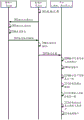
图2示出了根据各种实施例的交易发起和验证的示例性步骤。Figure 2 illustrates exemplary steps for transaction initiation and verification in accordance with various embodiments.
图3示出了根据各种实施例的用于信息保护的示例性方法的流程图。FIG. 3 shows a flowchart of an exemplary method for information protection, according to various embodiments.
图4示出了根据各种实施例的用于信息保护的示例性方法的流程图。FIG. 4 shows a flowchart of an exemplary method for information protection, according to various embodiments.
图5示出了可实现本文所描述的任何实施例的示例性计算机系统的框图。Figure 5 shows a block diagram of an example computer system on which any of the embodiments described herein may be implemented.
具体实施方式Detailed ways
因为操作由网络中的各个节点(例如,计算设备)执行,区块链可以被认为是去中心化的数据库,通常被称为分布式账本。任何信息都可以被写入并被保存至区块链中或从区块链被读取。任何人都可以建立服务器并作为节点加入区块链网络。任何节点都可以通过执行诸如哈希计算的复杂计算以向当前区块链添加区块,从而对维持区块链贡献计算能力,并且所添加的区块可以包含各种类型的数据或信息。可以用代币(例如,数字货币单位)对为所添加的区块贡献计算能力的节点进行奖励。由于区块链没有中心节点,所以每个节点是等同的,并且保存整个区块链数据库。Because operations are performed by individual nodes (eg, computing devices) in the network, blockchains can be thought of as decentralized databases, often referred to as distributed ledgers. Any information can be written and saved to or read from the blockchain. Anyone can set up a server and join the blockchain network as a node. Any node can contribute computing power to maintain the blockchain by performing complex calculations such as hash calculations to add blocks to the current blockchain, and the added blocks can contain various types of data or information. Nodes that contribute computing power to added blocks can be rewarded with tokens (eg, digital currency units). Since the blockchain does not have a central node, each node is equivalent and holds the entire blockchain database.
节点是例如支持区块链网络并保持其平稳运行的计算设备或大型计算机系统。有两种类型的节点,全量节点和轻量节点。全量节点保存区块链的完整副本。区块链网络上的全量节点验证它们接收的交易和区块,并将这些交易和区块中继到连接的对等点,以提供交易的共识验证。另一方面,轻量节点仅下载区块链的一小部分。例如,轻量节点用于数字货币交易。当轻量节点想要进行交易时,轻量节点将与全量节点通信。Nodes are, for example, computing devices or large computer systems that support a blockchain network and keep it running smoothly. There are two types of nodes, full nodes and lightweight nodes. Full nodes keep a complete copy of the blockchain. Full nodes on a blockchain network validate the transactions and blocks they receive and relay those transactions and blocks to connected peers to provide consensus verification of transactions. Lightweight nodes, on the other hand, download only a small portion of the blockchain. For example, lightweight nodes are used for digital currency transactions. When a light node wants to make a transaction, the light node will communicate with the full node.
这种去中心化属性可以帮助防止处于控制位置的管理中心出现。例如,比特币区块链的维护是由运行区域中(装有)比特币软件的通信节点组成的网络执行。本公开使用一个或多个区块链或数字货币,例如比特币和以太币。本领域普通技术人员应当理解,本公开中公开的技术方案可以使用或应用于其他类型的区块链和数字货币。也就是说,取代传统意义上的银行、机构或管理员,多个中间角色以执行比特币软件的计算机服务器的形式存在。这些计算机服务器形成经由因特网连接的网络,其中任何人都可能加入该网络。网络所容纳的交易可以具有以下形式:“用户A想要将Z个比特币发送给用户B”,其中使用容易获得的软件应用程序将交易广播至网络。计算机服务器用作比特币服务器,该比特币服务器可操作以验证这些金融交易,并将这些金融交易的记录添加至其账本的副本中,接着向网络的其它服务器广播这些账本添加操作。This decentralized property can help prevent the emergence of an administrative center in a controlling position. For example, the maintenance of the Bitcoin blockchain is performed by a network of communicating nodes (equipped with) the Bitcoin software in the operating zone. This disclosure uses one or more blockchains or digital currencies, such as Bitcoin and Ethereum. Those of ordinary skill in the art should understand that the technical solutions disclosed in this disclosure can be used or applied to other types of blockchains and digital currencies. That is, instead of banks, institutions, or administrators in the traditional sense, multiple intermediate actors exist in the form of computer servers that execute the Bitcoin software. These computer servers form a network connected via the Internet, where anyone can join the network. A transaction accommodated by the network may be of the form: "user A wants to send Z bitcoins to user B", where the transaction is broadcast to the network using a readily available software application. The computer server acts as a bitcoin server operable to verify these financial transactions and add records of these financial transactions to its copy of the ledger, which then broadcasts these ledger additions to other servers of the network.
维护区块链被称为“挖矿”,并且进行这种维护的人被用如上所述的新创造的比特币和交易费进行奖励。例如,节点可以基于区块链网络已经同意的一组规则确定交易是否有效。矿工可位于任何大陆上,并通过验证每一交易是有效的以及将该交易添加至区块链中来处理支付。通过由多个矿工提供的共识实现这种验证,并且假定不存在系统串通。最后,所有数据将是一致的,因为计算必须满足某些要求才是有效的,并且所有节点将被同步以确保区块链是一致的。因此,数据可以被一致地存储在区块链节点的分布式系统中。Maintaining the blockchain is called "mining" and those who do this maintenance are rewarded with newly created bitcoins and transaction fees as described above. For example, nodes can determine whether a transaction is valid based on a set of rules that the blockchain network has agreed upon. Miners can be located on any continent and process payments by verifying that each transaction is valid and adding it to the blockchain. This verification is achieved through consensus provided by multiple miners and assumes no system collusion. In the end, all data will be consistent, as calculations must meet certain requirements to be valid, and all nodes will be synchronized to ensure that the blockchain is consistent. Therefore, data can be consistently stored in a distributed system of blockchain nodes.
通过挖矿过程,交易诸如资产转移被网络节点验证并被添加至区块链的区块的增长链中。通过遍历整个区块链,验证可包括例如付款方是否有权访问转账资产、资产是否以前已经被花费、转账金额是否正确等。例如,在由发送方签发的假设交易(例如,根据UTXO(未被花费的交易输出)模型的比特币交易,根据账户/余额模型的以太币交易)中,提出的交易可被广播至区块链网络以便挖矿。矿工需要根据区块链历史检查交易是否有资格被执行。如果根据现有的区块链历史,发送方的钱包余额具有足够的资金,则认为交易是有效的,并且可以将该交易添加至区块中。资产转移一旦被验证,其可以被包含于下一个待被添加至区块链的区块中。Through the mining process, transactions such as asset transfers are verified by network nodes and added to a growing chain of blocks in the blockchain. By traversing the entire blockchain, verification can include, for example, whether the payer has access to the transferred asset, whether the asset has been spent before, whether the transferred amount is correct, etc. For example, in a hypothetical transaction signed by the sender (e.g. a bitcoin transaction according to the UTXO (unspent transaction output) model, an ethereum transaction according to the account/balance model), the proposed transaction can be broadcast to the block chain network for mining. Miners need to check whether a transaction is eligible to be executed against the blockchain history. If the sender's wallet balance has sufficient funds based on the existing blockchain history, the transaction is considered valid and can be added to a block. Once the asset transfer is verified, it can be included in the next block to be added to the blockchain.
区块非常像数据库记录。每次写入数据时创建一个区块。这些区块被链接并使用密码术被保护以成为互连的网络。每个区块都连接至前一区块,这也是名称“区块链”的起源。每个区块通常包含前一区块的加密哈希值、生成时间和实际数据。例如,每个区块包含两个部分:记录当前区块的特征值的区块头,以及记录实际数据(例如,交易数据)的主体。区块的链通过区块头链接。每个区块头可以包含多个特征值,例如版本、前一区块哈希值、默克尔(Merkle)根、时间戳、难度目标和随机数。前一区块哈希值不仅包含前一区块的地址,而且包含前一区块内部的数据的哈希值,从而使得区块链不可变。随机数是当被包括时产生具有指定数量的前导零位的哈希值的数。Blocks are very much like database records. A block is created every time data is written. These blocks are linked and secured using cryptography to become an interconnected network. Each block is connected to the previous block, which is where the name "blockchain" comes from. Each block usually contains a cryptographic hash of the previous block, the generation time and the actual data. For example, each block consists of two parts: a block header that records the characteristic values of the current block, and a body that records actual data (eg, transaction data). A chain of blocks is linked by a block header. Each block header can contain multiple characteristic values such as version, previous block hash, Merkle root, timestamp, difficulty target, and nonce. The previous block hash value not only contains the address of the previous block, but also contains the hash value of the data inside the previous block, thus making the blockchain immutable. A nonce is a number that, when included, produces a hash value with a specified number of leading zero bits.
为了挖矿,节点获取新区块的内容的哈希值。随机数(例如,随机字符串)被附加到该哈希值,从而获得新字符串。新字符串被再次进行哈希处理。然后,将最终的哈希值与难度目标(例如,级别)进行比较,并确定最终的哈希值是否实际小于难度目标。如果最终的哈希值不小于难度目标,则改变随机数,并且再次重复该过程。如果最终的哈希值小于难度目标,则将所述区块添加至链中,更新公开账本并提醒所述添加。负责成功添加的节点获得比特币奖励,例如,通过向新区块添加对自身的奖励交易(称为造币生成)。To mine, a node obtains a hash of the content of a new block. A random number (eg, a random string) is appended to this hash value, resulting in a new string. The new string is hashed again. The final hash is then compared to a difficulty target (e.g. level) and it is determined whether the final hash is actually less than the difficulty target. If the final hash value is not less than the difficulty target, the nonce is changed and the process is repeated again. If the resulting hash is less than the difficulty target, the block is added to the chain, the public ledger is updated and the addition is notified. Nodes responsible for successful additions are rewarded in Bitcoin, for example, by adding a reward transaction to themselves to a new block (called minting).
即,对于每个输出“Y”,如果k是从最小熵(min-entropy)高的分布中选择的,则不可能找到输入x以使得H(k|x)=Y,其中K是随机数,x是区块的哈希值,Y是难度目标,并且“|”表示级联(concatenation)。由于加密哈希值基本上是随机的,由于加密哈希值的输出不能从其输入预测,仅存在一种找到随机数的已知方法:一个接一个地尝试整数,例如1、然后2、然后3、等等,这可以被称为蛮力。前导零的数量越大,找到必需的随机数Y所花费的平均时间就越长。在一个示例中,比特币系统不断地调整前导零的数量,使得找到随机数的平均时间约为十分钟。这样,由于计算硬件的处理能力随着时间提高,接下来几年,比特币协议将只需要更多的前导零位,以使得实现挖矿总是花费大约十分钟的持续时间。That is, for each output "Y", if k is chosen from a distribution with high min-entropy, it is impossible to find an input x such that H(k|x)=Y, where K is a random number , x is the hash of the block, Y is the difficulty target, and "|" indicates concatenation. Since cryptographic hashes are essentially random, and since the output of a cryptographic hash cannot be predicted from its input, there is only one known way to find a random number: try integers one after the other, such as 1, then 2, then 3. Wait, this could be called brute force. The larger the number of leading zeros, the longer it takes on average to find the required random number Y. In one example, the Bitcoin system is constantly adjusting the number of leading zeros such that the average time to find a nonce is about ten minutes. In this way, as the processing power of computing hardware increases over time, the Bitcoin protocol will only require more leading zeros over the next few years, so that mining always takes about ten minutes in duration.
如上所述,哈希处理是区块链的重要基础。可以将哈希算法理解为将任何长度的消息压缩成固定长度消息摘要的函数。MD5和SHA是更常使用的。在一些实施例中,区块链的哈希值长度是256位,这意味着无论原始内容是什么,最终都计算256位的二进制数。并且只要原始内容不同,就可以保证相应的哈希值是唯一的。例如,字符串“123”的哈希值是a8fdc205a9f19cc1c7507a60c4f01b13d11d7fd0(十六进制),其当被转换为二进制时具有256位,并且仅“123”具有这个哈希值。区块链中的哈希算法是不可逆的,即,正向计算是容易的(从“123”至a8fdc205a9f19cc1c7507a60c4f01b1c7507a60c4f01b13d11d7fd0),并且即使耗尽所有计算资源,也不能完成逆向计算。因此,区块链的每个区块的哈希值是唯一的。As mentioned above, hashing is an important foundation of the blockchain. A hash algorithm can be understood as a function that compresses a message of any length into a fixed-length message digest. MD5 and SHA are more commonly used. In some embodiments, the hash length of the blockchain is 256 bits, which means that no matter what the original content is, a 256-bit binary number is ultimately calculated. And as long as the original content is different, the corresponding hash value is guaranteed to be unique. For example, the hash value of the string "123" is a8fdc205a9f19cc1c7507a60c4f01b13d11d7fd0 (hexadecimal), which has 256 bits when converted to binary, and only "123" has this hash value. The hash algorithm in the blockchain is irreversible, that is, forward calculation is easy (from "123" to a8fdc205a9f19cc1c7507a60c4f01b1c7507a60c4f01b13d11d7fd0), and reverse calculation cannot be completed even if all computing resources are exhausted. Therefore, the hash value of each block of the blockchain is unique.
此外,如果区块的内容改变,则其哈希值也将改变。区块和哈希值一一对应,并且针对区块头具体计算每个区块的哈希值。即,连接区块头的特征值以形成长字符串,然后为所述字符串计算哈希值。例如,“哈希值=SHA256(区块头)”是区块哈希值计算公式,SHA256是应用于区块头的区块链哈希算法。哈希值由区块头而不是区块主体唯一地确定。如上所述,区块头包含许多内容,包括当前区块的哈希值和前一区块的哈希值。这意味着如果当前区块的内容改变,或者如果前一区块的哈希值改变,则将导致当前区块中的哈希值改变。如果黑客修改了区块,则所述区块的哈希值改变。由于下一区块必须包含前一区块的哈希值,为了使后面的区块连接至被修改的区块,黑客必须依次修改所有随后的区块。否则,被修改的区块将脱离区块链。由于设计原因,哈希值计算是耗时的,几乎不可能在短时间内修改多个区块,除非黑客已经掌握了整个网络51%以上的计算能力。因此,区块链保证了其自身的可靠性,并且一旦数据被写入,数据就不能被篡改。Additionally, if the content of a block changes, its hash will also change. There is a one-to-one correspondence between blocks and hash values, and the hash value of each block is specifically calculated for the block header. That is, the characteristic values of the block headers are concatenated to form a long string, and then a hash value is calculated for the string. For example, "hash value = SHA256 (block header)" is the block hash value calculation formula, and SHA256 is the blockchain hash algorithm applied to the block header. The hash value is uniquely determined by the block header, not the block body. As mentioned above, the block header contains many things, including the hash value of the current block and the hash value of the previous block. This means that if the content of the current block changes, or if the hash of the previous block changes, it will cause the hash in the current block to change. If a hacker modifies a block, the hash of said block changes. Since the next block must contain the hash of the previous block, in order for the following block to connect to the modified block, the hacker must modify all subsequent blocks in turn. Otherwise, the modified block will be detached from the blockchain. Due to design reasons, hash value calculation is time-consuming, and it is almost impossible to modify multiple blocks in a short period of time, unless hackers have mastered more than 51% of the computing power of the entire network. Therefore, the blockchain guarantees its own reliability, and once the data is written, the data cannot be tampered with.
一旦矿工找到了新区块的哈希值(即,合格的签名或解决方案),矿工就将该签名广播至所有其它矿工(区块链中的节点)。现在,其它矿工依次验证所述解决方案是否与发送方的区块的问题相对应(即,确定哈希值输入是否实际上导致所述签名)。如果所述解决方案是有效的,则其它矿工将确认该解决方案,并同意可将新区块添加至区块链。因此,达成了新区块的共识。这也被称为“工作量证明”。已经达成共识的区块现在可以被添加至区块链中,并且与其签名一起被广播至网络上的所有节点。只要区块内的交易在所述时间点正确地对应于当前钱包余额(交易历史),节点就将接受该区块并将保存该区块于节点的交易数据。每当在所述区块的顶部添加新的区块时,所述添加还可算作为对其之前的区块的另一“确认”。例如,如果交易被包括在区块502中,并且区块链有507个区块,这意味着交易具有五个确认(对应于区块507至区块502)。交易具有越多的确认,攻击者就越难改变。Once a miner has found a hash of a new block (ie, a valid signature or solution), the miner broadcasts that signature to all other miners (nodes in the blockchain). Now, the other miners in turn verify whether the solution corresponds to the problem of the sender's block (ie, determine whether the hash value input actually resulted in the signature). If the solution is valid, other miners will confirm the solution and agree that a new block can be added to the blockchain. Thus, consensus for a new block is reached. This is also known as "Proof of Work". Blocks that have reached consensus can now be added to the blockchain and broadcast to all nodes on the network along with their signatures. As long as the transactions within the block correctly correspond to the current wallet balance (transaction history) at that point in time, the node will accept the block and will save the block's transaction data with the node. Whenever a new block is added on top of the block, the addition also counts as another "confirmation" of the block before it. For example, if a transaction is included in
在一些实施例中,示例性区块链资产系统利用公钥密码术,其中生成两个密钥,一个公钥和一个私钥。可认为公钥是账号,而可认为私钥是所有权凭证。例如,比特币钱包是公钥和私钥的集合。可以用属于资产地址的私钥的知识来证明与该地址相关联的资产(例如,数字货币、现金资产、股票、股权、债券)的所有权。例如,比特币钱包软件,有时称为“比特币客户软件”,允许给定用户交易比特币。钱包程序生成并存储私钥,并与比特币网络上的对等点通信。In some embodiments, the exemplary blockchain asset system utilizes public key cryptography, where two keys are generated, a public key and a private key. The public key can be considered as an account number, while the private key can be considered as an ownership certificate. For example, a Bitcoin wallet is a collection of public and private keys. Knowledge of the private key belonging to an asset address can be used to prove ownership of an asset (eg, digital currency, cash asset, stock, equity, bond) associated with that address. For example, bitcoin wallet software, sometimes called "bitcoin client software," allows a given user to trade bitcoins. The wallet program generates and stores private keys and communicates with peers on the Bitcoin network.
在区块链交易中,通过付款人和收款人的公钥在区块链中识别付款人和收款人。例如,大多数当代比特币转移是从一个公钥到不同的公钥。实际上,这些密钥的哈希值被用于区块链中,并且被称为“比特币地址”。原则上,如果使用用户的比特币地址而不是他们的名字,假想的攻击者个人S可以通过简单地向区块链账本添加像“个人A向个人S支付100个比特币”一样的交易从个人A偷钱。比特币协议通过要求每次转账都用付款人的私钥进行数字签名防止这种盗窃,并且只有经签名的转账可以被添加至区块链账本中。由于个人S不能伪造个人A的签名,因此个人S不能通过向区块链添加相当于“个人A向个人S支付200个比特币”的条目来欺骗个人A。同时,任何人都可以使用他/她的公钥来验证个人A的签名,并因此在他/她是付款人的情况下验证他/她已经授权了区块链中的任何交易。In a blockchain transaction, the payer and payee are identified in the blockchain by their public keys. For example, most contemporary bitcoin transfers are from one public key to a different public key. In fact, the hashes of these keys are used in the blockchain and are called "bitcoin addresses". In principle, if a user's bitcoin address is used instead of their name, a hypothetical attacker individual S could receive a transaction from individual S by simply adding a transaction like "Person A pays
在比特币交易的情况下,为了向用户B转移一些比特币,用户A可以构造包含关于通过节点的交易的信息的记录。该记录可以签有用户A的签名密钥(私钥),并且包含用户A的公共验证密钥和用户B的公共验证密钥。签名用于确认交易来自用户A,并且一旦发布交易,还防止该交易被任何人更改。该记录与在新区块中的同一时间窗口中发生的其它记录一起可以被广播至全量节点。在接收到记录时,全量节点可以将记录合并到区块链系统中曾经发生的所有交易的账本中,通过上述挖矿过程将新区块添加至先前接受的区块链,并且针对网络的共识规则验证所添加的区块。In the case of a bitcoin transaction, in order to transfer some bitcoins to user B, user A can construct a record containing information about the transaction through the node. This record may be signed with User A's signing key (private key), and contain User A's public verification key and User B's public verification key. The signature is used to confirm that the transaction came from user A, and also prevents the transaction from being changed by anyone once it is published. This record can be broadcast to the full number of nodes along with other records that occurred in the same time window in the new block. When receiving the record, the full amount of nodes can merge the record into the ledger of all transactions that have ever occurred in the blockchain system, and add the new block to the previously accepted blockchain through the above mining process, and the consensus rules for the network Validate the added blocks.
UTXO(未被花费的交易输出)模型和账户/余额模型是用于实现区块链交易的两个示例性模型。UTXO是区块链对象模型。根据UTXO,资产由尚未被花费的区块链交易的输出表示,所述输出可以用作新交易中的输入。例如,用户A的待转移的资产可以是UTXO的形式。为了花费(交易)资产,用户A必须用私钥签名。比特币是使用UTXO模型的数字货币的示例。在有效的区块链交易的情况下,未被花费的输出可用于实现进一步的交易。在一些实施例中,在进一步的交易中可以仅使用未被花费的输出,以防止双花和欺诈。为此,区块链上的输入在交易发生时被删除,同时创建UTXO形式的输出。这些未被花费的交易输出可以(由私钥持有者,例如,具有数字货币钱包的人)用于未来交易。UTXO (unspent transaction output) model and account/balance model are two exemplary models for implementing blockchain transactions. UTXO is the blockchain object model. According to UTXO, assets are represented by the outputs of blockchain transactions that have not yet been spent, which can be used as inputs in new transactions. For example, user A's assets to be transferred can be in the form of UTXO. In order to spend (transact) an asset, user A must sign it with a private key. Bitcoin is an example of a digital currency that uses the UTXO model. In the case of valid blockchain transactions, unspent outputs can be used to enable further transactions. In some embodiments, only unspent outputs may be used in further transactions to prevent double spending and fraud. To do this, inputs on the blockchain are deleted when transactions occur, while outputs in the form of UTXOs are created. These unspent transaction outputs can be used (by the private key holder, e.g., someone with a digital currency wallet) for future transactions.
另一方面,账户/余额模型(或称为基于账户的交易模型)保持跟踪每个账户的余额作为全局状态。检查账户余额,以确定账户余额大于或等于花费的交易金额。以下提供了账户/余额模型如何在以太坊中工作的示例:On the other hand, the account/balance model (or account-based transaction model) keeps track of the balance of each account as a global state. Check the account balance to determine that the account balance is greater than or equal to the transaction amount spent. The following provides an example of how the account/balance model works in Ethereum:
1.Alice通过挖矿获得5个以太币。在该系统中记录Alice具有5个以太币。1. Alice obtains 5 ether coins through mining. It is recorded in the system that Alice has 5 ethers.
2.Alice想给Bob 1个以太币,因此系统将首先从Alice的账户中扣除1个以太币,因此Alice现在具有4个以太币。2. Alice wants to give Bob 1 Ether, so the system will first deduct 1 Ether from Alice's account, so Alice now has 4 Ether.
3.然后,系统给Bob的账户增加1个以太币。该系统知道Bob本来有2个以太币,因此Bob的余额增加到3个以太币。3. Then, the system adds 1 ether to Bob's account. The system knows that Bob originally had 2 ethers, so Bob's balance increases to 3 ethers.
以太坊的记账方式可以与银行中的记账方式相似。类比是使用ATM/借记卡。银行跟踪每张借记卡有多少钱,当Bob需要花钱时,银行在批准交易之前检查其记录以确保Bob具有足够的余额。The bookkeeping method of Ethereum can be similar to the bookkeeping method in the bank. An analogy is using an ATM/debit card. The bank keeps track of how much money is on each debit card, and when Bob needs to spend money, the bank checks its records to make sure Bob has a sufficient balance before approving the transaction.
由于区块链和其它类似的账本是完全公开的,因此区块链本身没有隐私保护。P2P网络的公开特性意味着尽管使用它的人不是通过名字来识别的,但是将交易链接至个人和公司是可行的。例如,在跨境汇款中或在供应链中,交易金额具有极高级别的隐私保护值,这是因为使用交易金额信息可以推断交易方的特定位置和身份。交易的主题可以包括例如金钱、代币、数字货币、合同、契据、医疗记录、客户详细资料、股票、债券、权益或可以以数字形式描述的任何其他资产。尽管UTXO模型可以例如通过门罗币(Monero)中的环签名(ringsignature)和零知识密码术大零币(Zcash)使得交易金额不公开,但是交易金额在账户/余额模型下仍然是不受保护的。因此,本公开所解决的技术问题是如何保护在线信息诸如交易金额的隐私。这样的交易可以采用账户/余额模型。Since the blockchain and other similar ledgers are completely public, there is no privacy protection in the blockchain itself. The public nature of a P2P network means that although people using it are not identified by name, it is possible to link transactions to individuals and companies. For example, in cross-border remittances or in supply chains, the transaction amount has an extremely high level of privacy protection value, because the specific location and identity of the transaction parties can be inferred using the transaction amount information. The subject of transactions may include, for example, money, tokens, digital currencies, contracts, deeds, medical records, customer details, shares, bonds, equity or any other asset that can be described in digital form. Although UTXO models can make transaction amounts private, e.g. through ring signatures in Monero and zero-knowledge cryptography Zcash, transaction amounts are still unprotected under the account/balance model of. Therefore, the technical problem solved by the present disclosure is how to protect the privacy of online information such as transaction amount. Such transactions may employ an account/balance model.
一些现有技术提出使用佩德森(Pedersen)承诺方案加密交易金额并替换账户/余额模型。在该方案下,发送方通过区块链之外的安全通道向收款人发送交易金额和对应于交易金额的Pedersen承诺的随机数。收款人验证随机数与交易承诺是否匹配,并执行本地存储。例如,根据账户/余额模型,账户可被视为用于保存被汇总但未被合并的资产的钱包(账户)。每个资产可以对应于资产类型(例如,加密货币),并且账户的余额是资产价值的总和。即使是同一类型的资产也不被合并。在交易期间,可以指定转移资产的接收方,并且可以从钱包中移除相应资产以便为交易提供资金。区块链节点验证支付钱包是否具有足以覆盖交易的资产,然后节点从支付钱包中删除转移的资产,并将相应的资产添加至接收方钱包。Some prior art proposes to use Pedersen commitment scheme to encrypt transaction amounts and replace the account/balance model. Under this scheme, the sender sends the transaction amount and the Pedersen-committed random number corresponding to the transaction amount to the payee through a secure channel outside the blockchain. The payee verifies that the nonce matches the transaction commitment and performs local storage. For example, according to the account/balance model, an account can be viewed as a wallet (account) for holding assets that are aggregated but not consolidated. Each asset may correspond to an asset type (eg, cryptocurrency), and the account's balance is the sum of asset values. Even assets of the same type are not merged. During a transaction, the recipient of the transferred asset can be specified and the corresponding asset can be removed from the wallet to fund the transaction. The blockchain node verifies that the payment wallet has sufficient assets to cover the transaction, and then the node deletes the transferred assets from the payment wallet and adds the corresponding assets to the recipient wallet.
然而,这种方案依然存在限制。由Pedersen承诺生成的交易金额和随机数是隐私敏感的数据。除了与交易相关的各方之外的其他方应该没有机会得知所述值。因此,这样的信息应该被加密并保存,且在使用时被解密。承诺值和随机数是在未来花费所交易的资产的必要的元素,但由于缺少安全、稳定且有效的方法适当地存储随机数,因此很容易将其丢失且难以恢复。例如,当前技术的方案要求用户在本地维护永久存储,以管理与加密账户余额对应的随机数和明文余额,且管理实施方式是复杂的。此外,存储在单个本地节点中的与“Pedersen资产”对应的盲因子(如随机数)和明文余额容易丢失或损坏,且由于账户余额频繁变化,多节点备份存储难以实现。However, this approach still has limitations. Transaction amounts and random numbers generated by Pedersen commitments are privacy sensitive data. Parties other than those involved in the transaction should have no chance of knowing the value. Therefore, such information should be encrypted and stored, and decrypted when used. Commitments and nonces are necessary elements to spend a traded asset in the future, but due to the lack of a secure, stable, and efficient way to properly store nonces, they can be easily lost and difficult to recover. For example, the solution of the current technology requires the user to maintain permanent storage locally to manage the random number and the plaintext balance corresponding to the encrypted account balance, and the implementation of management is complicated. In addition, the blinding factors (such as random numbers) and plaintext balances corresponding to "Pedersen assets" stored in a single local node are easily lost or damaged, and due to frequent changes in account balances, multi-node backup storage is difficult to achieve.
本公开中所提出的系统和方法可以克服上述限制,并且实现对承诺方案中的交易金额、资产价值和盲因子的稳健隐私保护。为此,可以使用各种密码信息交换协议来加密/解密随机数和明文余额,从而提供方便的管理。此外,将加密信息存储在区块链中确保了承诺方案中的交易金额、资产价值和盲因子不容易丢失或被篡改。The systems and methods proposed in this disclosure can overcome the above limitations and achieve robust privacy protection for transaction amounts, asset values and blinding factors in commitment schemes. To this end, various cryptographic information exchange protocols can be used to encrypt/decrypt random numbers and plaintext balances, thereby providing convenient management. Additionally, storing encrypted information in the blockchain ensures that transaction amounts, asset values, and blinding factors in commitment schemes are not easily lost or tampered with.
在一些实施例中,承诺方案(例如,Pedersen承诺)可以加密某个值a(例如,交易金额、资产价值、关键参数)如下:In some embodiments, a commitment scheme (e.g., Pedersen Commitment) may encrypt a certain value a (e.g., transaction amount, asset value, key parameter) as follows:
PC(a)=r×G+a×HPC(a)=r×G+a×H
其中r是提供隐藏的随机盲因子(或者称为盲因子),G和H是达成共识的椭圆曲线的生成元/基点,并且可以是随机选择的,sn是承诺的值,C(sn)是用作承诺并被给予对方的曲线点,并且H是另一曲线点。也就是说,G和H可以是被节点已知的参数。可通过利用从一个点映射到另一个点的哈希函数(H=哈希(G))对基点G进行哈希处理,,生成H的“空袖数(nothing up my sleeve)”生成。H和G是给定系统的公共参数(例如,椭圆曲线上的随机生成的点)。尽管以上提供了椭圆曲线形式的Pedersen承诺的示例,但是可以替代地使用各种其它形式的Pedersen承诺或其它承诺方案。where r is the random blinding factor (or called blinding factor) that provides hiding, G and H are the generators/base points of the consensus elliptic curve, and can be randomly selected, sn is the committed value, and C(sn) is A curve point used as a commitment and given to the counterparty, and H is another curve point. That is, G and H may be parameters known by nodes. A "nothing up my sleeve" generation of H can be generated by hashing the base point G with a hash function (H=hash(G)) that maps from one point to another. H and G are common parameters of a given system (eg, randomly generated points on an elliptic curve). Although examples of Pedersen commitments in the form of elliptic curves are provided above, various other forms of Pedersen commitments or other commitment schemes may be used instead.
承诺方案保持数据保密但承诺数据使得数据的发送方稍后不能改变数据。如果一方仅知道承诺值(例如,PC(a)),则它们不能确定哪些底层数据值(例如,a)已经被承诺。数据(例如,a)以及盲因子(例如,r)稍后可以(例如,由发起方节点)显露,承诺的接收方(例如,共识节点)可以运行该承诺,并验证该承诺的数据与所显露的数据相匹配。之所以存在这种盲因子,是因为如果没有这种盲因子,有人可能试图猜测数据。Commitment schemes keep data private but commit data such that the sender of the data cannot change the data later. If a party only knows the committed value (eg, PC(a)), they cannot determine which underlying data values (eg, a) have been committed. The data (e.g., a) and the blinding factor (e.g., r) can later be revealed (e.g., by the initiator node), and the recipient of the commitment (e.g., the consensus node) can run the commitment and verify that the data of the commitment is consistent with the The revealed data match. This blinding factor exists because without it, someone could try to guess the data.
承诺方案是发送方(承诺方)承诺一值(例如,a)使得承诺的值保持隐私,但是可以在当承诺方透露承诺过程的必要参数的稍后时间显示该承诺的值的一种方式。强承诺方案可以是信息隐藏和计算绑定。隐藏是指给定值a和该值的承诺PC(a)应该是不相关的这一概念。即,PC(a)不应显露关于a的信息。在已知PC(a)、G和H的情况下,因为随机数r,几乎不可能知道a。如果几乎不存在使得两个不同的值可以导致相同承诺的方式,则承诺方案是绑定的。Pedersen承诺在离散对数假设下是完全隐藏和计算绑定的。此外,在已知r、G、H和PC(a)的情况下,可以通过确定PC(a)=r×G+a×H是否成立来验证PC(a)。A commitment scheme is a way in which the sender (the committer) commits to a value (eg, a) such that the committed value remains private, but can be revealed at a later time when the committer reveals the necessary parameters of the commitment process. Strong commitment schemes can be information hiding and computation binding. Hiding refers to the notion that a given value a and the commitment PC(a) for that value should be irrelevant. That is, PC(a) should not reveal information about a. In the case where PC(a), G, and H are known, it is almost impossible to know a because of the random number r. A commitment scheme is bound if there is almost no way that two different values can result in the same commitment. Pedersen commitments are fully hidden and computationally bound under the discrete logarithm assumption. Furthermore, in the case where r, G, H, and PC(a) are known, PC(a) can be verified by determining whether PC(a)=r×G+a×H holds.
Pedersen承诺具有加法属性:可以将承诺相加,并且一组承诺的总和与对数据总和的承诺相同(其中盲因子设置为盲因子的总和):Pedersen commitments have additive properties: commitments can be summed, and the sum of a set of commitments is the same as the commitment to the sum of the data (where the blinding factor is set to the sum of the blinding factors):
PC(r1,data1)+PC(r2,data2)==PC(r1+r2,data1+data2);PC(r 1 ,data 1 )+PC(r 2 ,data 2 )==PC(r 1 +r 2 ,data 1 +data 2 );
PC(r1,data1)-PC(r1,data1)==0。PC(r 1 ,data 1 )−PC(r 1 ,data 1 )==0.
换句话说,承诺保留了加法并且交换属性适用,即,Pedersen承诺是相加同态的,因为底层数据可以进行数学运算,就像它没有被加密一样。In other words, commitments preserve additive and commutative properties hold, i.e., Pedersen commitments are additively homomorphic because the underlying data can be mathematically manipulated as if it were not encrypted.
在一个实施例中,用于加密输入值的Pedersen承诺可以使用椭圆曲线点来构造。传统上,椭圆曲线密码(ECC)公钥是通过将用于群(G)的生成元与密钥(r)相乘来创建的:Pub=rG。结果可以被序列化为33字节阵列。ECC公钥可以服从前面关于Pedersen承诺所提到的相加同态属性。即:Pub1+Pub2=(r1+r2(mod n))G。In one embodiment, the Pedersen Commitment used to encrypt the input value can be constructed using elliptic curve points. Traditionally, Elliptic Curve Cryptography (ECC) public keys are created by multiplying the generator for the group (G) with the key (r): Pub=rG. The result can be serialized as a 33 byte array. ECC public keys can obey the additive homomorphic property mentioned earlier about the Pedersen promise. That is: Pub1+Pub2=(r1+r2(mod n))G.
可以通过为所述群挑选附加的生成元(H,在下面的等式中)来创建用于输入值的Pedersen承诺,使得没有人知道第二生成元H相对于第一生成元G的离散对数(反之亦然),这意味着没有人知道使得xG=H的x。这可以例如通过使用G的加密哈希挑选H来完成:A Pedersen commitment for input values can be created by picking an additional generator (H, in the equation below) for the group such that no one knows the discrete pair of the second generator H with respect to the first generator G number (and vice versa), which means that no one knows x such that xG=H. This can be done e.g. by picking H using a cryptographic hash of G:
H=to_point(SHA256(ENCODE(G)))。H=to_point(SHA256(ENCODE(G))).
给定两个生成元G和H,加密输入值的示例性承诺方案可以被定义为:承诺=rG+aH。这里,r可以是秘密盲因子,a可以是被承诺的输入值。因此,如果sn被承诺,则可以获得上述承诺方案PC(a)=r×G+a×H。Pedersen承诺在信息理论上是隐私的:对于任何承诺,存在使一数值与该承诺匹配的盲因子。因为任意映射是不可计算的,Pedersen承诺可以从计算上对抗虚假承诺。Given two generators G and H, an exemplary commitment scheme for encrypting input values can be defined as: Commitment = rG + aH. Here, r can be a secret blinding factor, and a can be a committed input value. Therefore, if sn is committed, the above commitment scheme PC(a)=r*G+a*H can be obtained. Pedersen commitments are information-theoretic private: for any commitment, there exists a blinding factor that matches a value to the commitment. Because arbitrary mappings are not computable, Pedersen commitments are computationally resistant to spurious commitments.
承诺该值的一方(节点)可以通过公开原始值a和完成承诺等式的因子r来公开该承诺。然后,希望公开值PC(a)的一方将再次计算承诺,以验证共享的原始值确实与最初接收的承诺PC(a)相匹配。因此,可以通过将资产类型信息映射至唯一的序列号,然后通过Pedersen承诺对其进行加密来保护资产类型信息。当生成承诺时选择的随机数r使得任何人几乎不可能根据承诺值PC(a)推断出承诺的资产类型的类型。The party (node) that commits to this value can disclose this commitment by disclosing the original value a and the factor r that completes the commitment equation. The party wishing to expose the value PC(a) will then compute the commitment again to verify that the original value shared does indeed match the originally received commitment PC(a). Asset type information can therefore be protected by mapping it to a unique serial number and then encrypting it through a Pedersen commitment. The random number r chosen when generating the commitment makes it nearly impossible for anyone to infer the type of asset type promised from the committed value PC(a).
在一些实施例中,可以使用各种加密信息交换协议,例如公钥协议、对称加密协议、迪菲-赫尔曼(Diffie-Hellman,DH)密钥交换等。例如,DH密钥交换,也称为指数密钥交换,是一种数字加密方法,该方法使用提升至特定幂的数,以基于从不直接传送的组件产生解密密钥,使得潜在的代码破解者的任务在数学上是压倒性的。In some embodiments, various encrypted information exchange protocols may be used, such as public key protocols, symmetric encryption protocols, Diffie-Hellman (DH) key exchange, and the like. For example, DH key exchange, also known as exponential key exchange, is a digital encryption method that uses numbers raised to a specific power to generate a decryption key based on components that are never directly transmitted, making potential code cracking The task of the author is mathematically overwhelming.
在实现Diffie-Hellman(DH)密钥交换的示例中,两个终端用户Alice和Bob在通过他们已知是私有的信道通信时相互对正整数p和q达成共识,即p是素数、q是p的生成元。生成元q是如下的数:当该数被提升至小于p的正整数幂时,任何两个整数都不会产生相同的结果。p的值可以是大的,但是q的值通常是小的。即,q是模p的原根。In the example of implementing a Diffie-Hellman (DH) key exchange, two end users, Alice and Bob, mutually agree on positive integers p and q when communicating over a channel they know to be private, that is, p is a prime number and q is The generator of p. A generator q is a number such that no two integers produce the same result when raised to a positive integer power smaller than p. The value of p can be large, but the value of q is usually small. That is, q is a primitive root modulo p.
一旦Alice和Bob私下对p和q达成共识,他们就选择正整数个人密钥a和b,两者都小于素数模p,并且两者都可以随机生成。用户不向任何人透露他们的个人密钥,并且理想地,他们记住这些数字并且不将它们写在或存储在任何地方。接下来,Alice和Bob根据公式基于他们的个人密钥计算公钥a*和公钥b*Once Alice and Bob privately agree on p and q, they choose positive integer personal keys a and b, both of which are less than a prime modulo p, and both of which can be randomly generated. Users don't reveal their personal keys to anyone, and ideally, they memorize these numbers and don't write or store them anywhere. Next, Alice and Bob calculate the public key a* and public key b* based on their private keys according to the formula
a*=qa mod pa*=q a mod p
与and
b*=qb mod pb*=q b mod p
两个用户可以通过假定不安全的通信介质、诸如因特网或公司广域网(WAN)共享其公钥a*和公钥b*。根据这些公钥,任一用户可以基于他们自己的个人密钥生成数字k1。Two users may share their public key a* and public key b* over an assumed insecure communication medium, such as the Internet or a corporate wide area network (WAN). From these public keys, any user can generate the number k1 based on their own personal key.
Alice使用下式计算k1:k1=(b*)a mod pAlice calculates k1 using the following formula: k1=(b*) a mod p
Bob使用下式计算k1:k1=(a*)b mod pBob calculates k1 using the following formula: k1 = (a*) b mod p
根据上述两个式中的任一个,k1的值被证明是相同的。然而,在K1的计算中关键的个人密钥a和个人密钥b没有通过公共介质传送。即使已知p、q、a*和b*,仍然很难计算a和b。因为k1是大的、明显随机的数字,所以即使在强大的计算机的帮助下进行数百万次试验,潜在的黑客也几乎没有机会正确地猜测k1。因此,理论上,两个用户可以使用解密密钥k1用他们选择的加密方法通过公共介质进行私下通信。According to either of the above two equations, the value of k1 turns out to be the same. However, the key personal key a and personal key b in the calculation of K1 are not transmitted through the public medium. Even if p, q, a* and b* are known, it is still difficult to calculate a and b. Because k1 is a large, apparently random number, a would-be hacker would have little chance of guessing k1 correctly, even with millions of trials with the help of a powerful computer. Thus, in theory, two users can communicate privately over a public medium using the decryption key k1 with an encryption method of their choice.
在实现Diffie-Hellman(DH)密钥交换的另一示例中,所有计算都发生在足够规模的离散群中,其中Diffie-Hellman问题被认为是难的,通常乘法群以大素数(例如,对于经典DH)或椭圆曲线群(例如,对于Diffie-Hellman椭圆曲线)为模。In another example of implementing a Diffie-Hellman (DH) key exchange, all computations take place in discrete groups of sufficient size where the Diffie-Hellman problem is considered hard, usually with a multiplicative group of large primes (e.g., for Classical DH) or the group of elliptic curves (eg, for Diffie-Hellman elliptic curves) as the modulus.
对于双方,每一方选择私钥a或私钥b。每一方计算相应的公钥aG或公钥bG。每一方向对方发送公钥aG或bG。每一方使用接收到的公钥连同其自己的私钥计算新的共享密钥a(bG)=b(aG),其可以随后与密钥导出函数一起用于导出对称加密方案的密钥集。可选地,可以使用各种其它计算方法,例如生成公钥ga和公钥gb以及共享密钥gab或共享密钥gba。For two parties, each party chooses private key a or private key b. Each party computes the corresponding public key aG or public key bG. Each sends the public key aG or bG to the other. Each party uses the received public key together with its own private key to compute a new shared key a(bG)=b(aG), which can then be used with the key derivation function to derive the set of keys for the symmetric encryption scheme. Alternatively, various other computing methods may be used, such as generating public keys g a and g b and shared keys g ab or shared keys g ba .
在交易期间,信息保护对于保护用户隐私是重要的,并且交易金额是一种缺乏保护的信息类型。图1示出了根据各种实施例的用于信息保护的示例性系统100。如图所示,区块链网络可以包括多个节点(例如,在服务器、计算机等中实现的全量节点)。对于某些区块链平台(例如,NEO),具有某级别投票权的全量节点可称为共识节点,共识节点承担交易验证的责任。在本公开中,全量节点、共识节点或其它等效节点可验证交易。During transactions, information protection is important to protect user privacy, and the transaction amount is a type of information that lacks protection. FIG. 1 illustrates an
此外,如图1所示,用户A和用户B可以使用作为轻量节点的相应设备、诸如膝上型计算机和移动电话等执行交易。例如,用户A可能想要通过将用户A的账户中的某些资产转移到用户B的账户来与用户B交易。用户A和用户B可以使用安装有适当的交易用区块链软件的相应设备。用户A的设备可以称为发起方节点A,发起方节点A发起与被称为接收方节点B的用户B的设备的交易。节点A可以通过与节点1的通信访问区块链,而节点B可以通过与节点2的通信访问区块链。例如,节点A和节点B可以通过节点1和节点2向区块链提交交易,以请求向区块链添加交易。除了区块链,节点A和节点B可以具有其它通信信道(例如,不经过节点1和节点2的常规因特网通信)。Furthermore, as shown in FIG. 1, user A and user B can perform transactions using respective devices, such as laptop computers and mobile phones, which are lightweight nodes. For example, User A may want to trade with User B by transferring some assets from User A's account to User B's account. User A and User B can use corresponding devices installed with appropriate blockchain software for transactions. User A's device may be referred to as an originator node A that initiates a transaction with user B's device, referred to as a recipient node B. Node A can access the blockchain through communication with node 1, while node B can access the blockchain through communication with node 2. For example, Node A and Node B can submit a transaction to the blockchain via Node 1 and Node 2 to request that a transaction be added to the blockchain. Besides the blockchain, Node A and Node B may have other communication channels (eg, not via the regular Internet communication of Node 1 and Node 2).
图1中的每个节点可以包括处理器和耦接至该处理器的非暂态计算机可读存储介质,该存储介质用于存储指令,当该指令由处理器执行时促使节点(例如,处理器)执行本文所述的用于信息保护的各种步骤。每个节点可以安装有软件(例如,交易程序)和/或硬件(例如,有线、无线连接)以与其它节点和/或其它设备通信。稍后参考图5描述节点硬件和软件的进一步细节。Each node in FIG. 1 may include a processor and a non-transitory computer-readable storage medium coupled to the processor for storing instructions that, when executed by the processor, cause the node (e.g., process implementer) to perform the various steps described herein for information protection. Each node may be equipped with software (eg, transaction programs) and/or hardware (eg, wired, wireless connections) to communicate with other nodes and/or other devices. Further details of the node hardware and software are described later with reference to FIG. 5 .
图2示出了根据各种实施例的发送方节点A、接收方节点B以及一个或多个验证节点之间的交易和验证的示例性步骤。下面给出的操作旨在说明。取决于实现方式,示例性步骤可以包括以各种顺序执行的或并行执行的附加的、较少的或替代的步骤。Figure 2 illustrates exemplary steps for a transaction and verification between a sender node A, a receiver node B, and one or more validating nodes, according to various embodiments. The operations given below are for illustration. Exemplary steps may include additional, fewer, or alternative steps performed in various sequences or in parallel, depending on implementation.
在各种实施例中,交易方(发送方用户A和接收方用户B)的账户被配置用于账户/余额模型。用户A和用户B可以执行以下步骤以经由一个或多个设备(例如他们的膝上型计算机、移动电话等)执行交易。这些设备可以安装有用于执行各种步骤的适当软件和硬件。每个账户可以与密码术的私钥(密钥)-公钥对相关联。私钥可以被标记为SK,公钥可以被标记为PK。私钥可以用于对传输的信息(例如,交易信息)签名。公钥可以用于验证签名的信息并生成账户地址。每个账户可以包含各种资产,每个资产表示为:(V=PC(r,v),Ek(r,v)),其中v表示资产的面值,V表示面值v的Pedersen承诺,r是盲因子(例如,随机数),PC()是Pedersen承诺算法,E()是加密算法(例如,密钥加密算法),并且K是对于每个账户唯一的加密密钥。例如,每个资产可以被标记为(V=PC(r,v),Ek(r||v)),其中||表示级联。尽管在以下实施例中使用了级联,但可以使用涉及r和v的其他可选表示。可以通过例如私钥协议、密钥导出函数等的各种方法生成加密密钥K(例如,KA、KB)。每个资产还可以包括除了所列出的信息之外的信息,例如资产的源信息。In various embodiments, the accounts of the transacting parties (sender user A and recipient user B) are configured for the account/balance model. User A and User B may perform the following steps to perform a transaction via one or more devices (eg, their laptops, mobile phones, etc.). These devices may be installed with appropriate software and hardware for performing the various steps. Each account may be associated with a cryptographic private key (key)-public key pair. Private keys can be marked as SK and public keys can be marked as PK. The private key can be used to sign transmitted information (eg, transaction information). The public key can be used to verify signed messages and generate account addresses. Each account can contain various assets, and each asset is expressed as: (V=PC(r,v), E k (r,v)), where v represents the face value of the asset, V represents the Pedersen commitment of the face value v, r is the blinding factor (eg, random number), PC() is the Pedersen Commitment algorithm, E() is the encryption algorithm (eg, key encryption algorithm), and K is the encryption key unique to each account. For example, each asset can be denoted as (V=PC(r,v), Ek (r||v)), where || denotes a concatenation. Although concatenation is used in the following embodiments, other alternative representations involving r and v may be used. The encryption key K (for example, KA, KB) can be generated by various methods such as a private key agreement, a key derivation function, and the like. Each asset can also include information in addition to the information listed, such as source information for the asset.
在一个示例中,在用户A在区块链验证的交易中成功地向用户B交易金额t之前,A的账户和B的账户中的资产的地址如下:In one example, before user A successfully transacts an amount t to user B in a blockchain-verified transaction, the addresses of assets in A's account and B's account are as follows:
对于A的账户(账户A)For account A (Account A)
地址:AddrAAddress: AddrA
公钥:PKA Public key: PK A
私钥:SKA Private key: SK A
第一密钥:KAFirst key: KA
价值a1至价值am分别对应的资产A1至资产Am被标记为:Assets A 1 to A m corresponding to value a 1 to value a m are marked as:
(A1=PC(ra1,a1),EKA(ra1,a1)),(A 1 =PC(r a1 ,a 1 ),E KA (r a1 ,a 1 )),
(A2=PC(ra2,a2),EKA(ra2,a2)),(A 2 =PC(r a2 ,a 2 ),E KA (r a2 ,a 2 )),
......
(Am=PC(ram,am),EKA(ram,am))(A m =PC(r am ,a m ),E KA (r am ,a m ))
对于B的账户(账户B)For account B (Account B)
地址:AddrBAddress: AddrB
公钥:PKB Public key: PK B
私钥:SKB Private key: SK B
第二密钥:KBSecond key: KB
价值b1至价值bn分别对应的资产B1至资产Bn被标记为:Assets B 1 to B n corresponding to value b 1 to value b n respectively are marked as:
(B1=PC(rb1,b1),EKB(rb1,b1)),(B 1 =PC(r b1 ,b 1 ),E KB (r b1 ,b 1 )),
(B2=PC(rb2,b2),EKB(rb2,b2)),(B 2 =PC(r b2 ,b 2 ), E KB (r b2 ,b 2 )),
......
(Bn=PC(rbn,bn),EKB(rbn,bn))(B n =PC(r bn ,b n ),E KB (r bn ,b n ))
在一些实施例中,在步骤201处,节点A可以发起与节点B的交易。例如,用户A和用户B可以协商从用户A的账户A到用户B的账户B的交易金额t。账户A和账户B可以对应于本文描述的“钱包”。账户A可具有一个或多个资产。资产可以包括例如货币、代币、数字货币、合同、契约、医疗记录、客户详细资料、股票、债券、权益或能够以数字形式描述的任何其它资产。账户B可以具有一个或多个资产或者不具有资产。每个资产可以与存储在区块链的区块中的各种区块链信息相关联,所述区块链信息包括例如表示资产类型的NoteType、表示资产的唯一标识的NoteID、表示资产价值的承诺(例如,Pedersen承诺)值的承诺值、随机数和资产价值的加密等。In some embodiments, node A may initiate a transaction with node B at step 201 . For example, user A and user B may negotiate a transaction amount t from user A's account A to user B's account B. Account A and Account B may correspond to a "wallet" as described herein. Account A can have one or more assets. Assets may include, for example, currencies, tokens, digital currencies, contracts, deeds, medical records, customer details, shares, bonds, equity or any other asset that can be described in digital form. Account B may have one or more assets or no assets. Each asset can be associated with various blockchain information stored in the block of the blockchain, the blockchain information includes, for example, NoteType indicating the type of asset, NoteID indicating the unique identification of the asset, and NoteID indicating the value of the asset. Commitment (e.g., Pedersen Commitment) value of commitment, encryption of nonce and asset value, etc.
如针对账户A所描述的,在一些实施例中,资产A1至资产Am分别对应于资产价值a1至资产价值am以及随机数ra1至随机数ram。基于随机数ra1至随机数ram,节点A可将账户A中的资产价值交给承诺方案(例如,Pedersen承诺)以获得加密的承诺值。例如,对于账户A,加密的承诺值可以是PC1至PCm,其中PCi=PC(rai,ai)=rai×G+ai×H,G和H是已知的,且i为1至m的变量。除了第一字段PC(…)之外,每个资产还与第二字段E(…)相关联,如前所述。第二字段E(…)可以表示利用密钥KA对相应的随机数和资产价值加密的加密。例如,加密可以是EKA(rai,ai)。每个资产的PC(…)和E(…)可以从先前的交易继承。同一机制可以应用于账户B及其资产。As described for account A, in some embodiments, asset A 1 to asset A m correspond to asset values a 1 to asset values a m and random numbers r a1 to random numbers ram , respectively. Based on the random number r a1 to the random number ram , the node A can submit the asset value in the account A to a commitment scheme (for example, Pedersen commitment) to obtain an encrypted commitment value. For example, for account A, the encrypted commitment values may be PC 1 to PC m , where PC i =PC( rai ,a i )= rai ×G+a i ×H, G and H are known, and i is a variable from 1 to m. In addition to the first field PC(...), each asset is associated with a second field E(...), as previously described. The second field E(...) may represent the encryption of the corresponding random number and asset value encrypted with the key KA. For example, the encryption could be E KA (r ai ,a i ). PC(…) and E(…) for each asset can be inherited from previous transactions. The same mechanism can be applied to account B and its assets.
在一些实施例中,为满足交易金额t,用户A可以使用第一密钥KA(例如,对称加密密钥)来解密来自账户A的总价值至少为t的一个或多个资产。例如,节点A可以动用资产A1,A2,…,Ak以用于该交易,其中k小于等于m。账户A的剩余资产Ak+1,Ak+2,…,Am未被动用。对应地,节点A可以从节点1读取资产PC(ra1,a1),PC(ra2,a2),…,PC(rak,ak)。在随机数ra1,ra2,…,rak被节点A已知的情况下,节点A可以解密读取的资产PC(ra1,a1),PC(ra2,a2),…,PC(rak,ak)以获取资产价值a1,a2,…,ak来确保其总和(a1+a2+…+ak)不小于交易金额t。可以基于各种费率彼此兑换账户内不同的资产。In some embodiments, to satisfy the transaction amount t, user A may use a first key KA (eg, a symmetric encryption key) to decrypt one or more assets from account A with a total value of at least t. For example, node A can use assets A 1 , A 2 , . . . , A k for the transaction, where k is less than or equal to m. The remaining assets A k+1 , A k+2 ,...,A m of account A are not used. Correspondingly, node A can read assets PC(r a1 , a 1 ), PC(r a2 , a 2 ), . . . , PC(r ak , a k ) from node 1. In the case that the random numbers r a1 , r a2 ,…,r ak are known by node A, node A can decrypt the read assets PC(r a1 ,a 1 ),PC(r a2 ,a 2 ),…, PC(r ak , a k ) to obtain asset values a 1 , a 2 ,…, a k to ensure that the sum (a 1 +a 2 +…+a k ) is not less than the transaction amount t. Different assets within the account can be exchanged for each other based on various rates.
在一些实施例中,对称加密密钥可以指在密码术对称密钥算法中使用的用于加密明文和解密密文的相同密钥。密钥可以是相同的或两个密钥之间可能存在简单转换。密钥可以代表双方或更多方之间的可用于维护隐私信息链接的共享的秘密。In some embodiments, a symmetric encryption key may refer to the same key used in cryptographic symmetric key algorithms to encrypt plaintext and decrypt ciphertext. The keys may be the same or there may be a simple conversion between the two keys. A key may represent a shared secret between two or more parties that may be used to maintain a private information link.
在一些实施例中,超过t的所选资产价值的金额,如果存在,则被设置y作为找零。例如,节点A可确定找零y=(a1+a2+…ak)–t。节点A可以选择随机数rt和随机数ry作为盲因子,以生成针对t和y的Pedersen承诺:T=PC(rt,t),Y=PC(ry,y)。也就是说,节点A可针对t生成随机数rt,针对y生成随机数ry。节点A可将t和rt交给承诺方案(例如,同态加密)以获得承诺值T=PC(rt,t),并将y和ry交给承诺方案(例如,同态加密)以获得承诺值Y=PC(ry,y)。此外,节点A可以确定r’=(r1+r2…+rk)–rt–ry。In some embodiments, the amount of the selected asset value over t, if any, is set to y as change. For example, node A may determine change y=(a 1 +a 2 + . . . a k )−t. Node A can choose random number r t and random number ry as blinding factors to generate a Pedersen commitment for t and y: T=PC(r t ,t), Y=PC(ry y ,y). That is to say, node A can generate a random number r t for t, and generate a random number r y for y. Node A can submit t and r t to a commitment scheme (eg, homomorphic encryption) to obtain a committed value T=PC(r t , t), and submit y and ry to a commitment scheme (eg, homomorphic encryption) To obtain the commitment value Y=PC( ry ,y). Furthermore, node A may determine r'=(r 1 +r 2 . . . + rk )−r t −ry y .
在一些实施例中,节点A可以使用第一密钥KA来加密(ry,y),获取加密EKA(ry,y)。节点A可以本地存储EKA(ry,y)。In some embodiments, node A may encrypt ( ry ,y) using the first key KA to obtain encryption E KA ( ry ,y). Node A can store E KA ( ry ,y) locally.
在步骤202,节点A可以将交易信息发送至节点B(例如通过区块链、通过区块链外的安全信道)。发送的交易信息可以包括例如随机数rt、交易金额t和承诺值T。交易信息可以以明文被发送。In step 202, node A may send the transaction information to node B (eg, through the blockchain, through a secure channel outside the blockchain). The sent transaction information may include, for example, a random number rt , a transaction amount t, and a commitment value T. Transaction information can be sent in clear text.
在步骤203,节点B可以验证随机数rt、交易金额t和承诺值T。在一些实施例中,节点B可以验证发送给用户B的金额t是否正确,且T=PC(rt,t)是否成立。对于步骤203,如果匹配/验证失败,则节点B可以拒绝交易。如果匹配/验证成功,则节点B可以在步骤204回复节点A。In step 203, Node B may verify the random number rt , transaction amount t and commitment value T. In some embodiments, node B can verify whether the amount t sent to user B is correct, and whether T=PC(r t ,t) holds. For step 203, if the matching/verification fails, Node B can reject the transaction. Node B may reply to Node A at step 204 if the match/verification is successful.
在步骤204,节点B可以用第二密钥KB(例如,对称加密密钥)加密(rt,t)来获取加密EKB(rt,t),并用用户B的私钥SKB对交易(EKB(rt,t),T)签名以生成签名SIGB。签名可以遵循数字签名算法(DSA),例如椭圆曲线数字签名算法(ECDSA),由此签名的接收方可以用签名人的公钥验证签名以认证经签名的数据。签名SIGB指示接收方节点B同意所述交易。In step 204, node B can encrypt (r t ,t) with the second key KB (e.g., a symmetric encryption key) to obtain encrypted E KB (r t ,t), and use user B's private key SK B to transact (E KB (r t ,t),T) signature to generate signed SIGB. The signature may follow a Digital Signature Algorithm (DSA), such as the Elliptic Curve Digital Signature Algorithm (ECDSA), whereby the recipient of the signature can verify the signature with the signer's public key to authenticate the signed data. The signature SIGB indicates that the recipient Node B agrees to the transaction.
在步骤205,节点B可以将经签名的交易EKB(rt,t)和签名SIGB传输回节点A。At step 205, Node B may transmit the signed transaction E KB ( rt ,t) and the signature SIGB back to Node A.
在步骤206,如果SIGB未被成功验证,则节点A可以拒绝交易。如果SIGB被成功验证,则节点A可生成范围证据RP以证明区块链节点。例如,为了具有PC(rt,t)的有效值,交易金额t可以在有效范围[0,2n–1]内;并且为了具有PC(ry,y)的有效值,找零y可以在有效范围[0,2n–1]内。在一个实施例中,节点A可使用区块证明技术,生成与用于区块链节点(例如,共识节点)的(T,rt,t,Y,ry,y)相关的范围证据RP,以在稍后的步骤中基于范围证据验证交易金额t和找零y是否在有效范围内。所述范围证据可以包括例如防弹(bulletproofs)、Borromean环签名等。At step 206, node A may reject the transaction if the SIGB is not successfully verified. If the SIGB is successfully verified, node A can generate a range proof RP to attest to the blockchain node. For example, to have a valid value of PC(r t , t), the transaction amount t can be in the valid range [0, 2n–1]; and to have a valid value of PC(r y , y), the change y can be in Valid range [0, 2n–1]. In one embodiment, node A may generate a range proof RP associated with (T,r t ,t,Y,ry y ,y) for a blockchain node (e.g., a consensus node) using a block proof technique , to verify whether the transaction amount t and the change y are within the valid range based on the range proof in a later step. The range proofs may include, for example, bulletproofs, Borromean ring signatures, and the like.
此外,节点A可以用用户A的私钥SKA对交易签名以生成签名SIGA。类似地,签名可以遵循数字签名算法(DSA)。在一个实施例中,节点A可以用用户A的私钥对({PC(ra1,a1),EKA(ra1,a1);PC(ra2,a2),EKA(ra2,a2);…PC(rak,ak),EKA(rak,ak)};{PC(ry,y),EKA(ry,y)};{PC(rt,t),EKB(rt,t)};Y;T;r’;RP)签名以生成签名SIGA,其中{PC(ra1,a1),EKA(ra1,a1);PC(ra2,a2),EKA(ra2,a2);…PC(rak,ak),EKA(rak,ak)}代表从账户A动用的用于交易的资产A1,A2,…,Ak。{PC(ry,y),EKA(ry,y)}代表账户A将从交易接收的找零。{PC(rt,t),EKB(rt,t)}代表账户B将从交易接收的转移的资产。In addition, node A can sign the transaction with user A's private key SK A to generate signature SIGA. Similarly, the signature can follow the Digital Signature Algorithm (DSA). In one embodiment, node A can use user A's private key pair ({PC(r a1 ,a 1 ),E KA (r a1 ,a 1 ); PC(r a2 ,a 2 ),E KA (r a2 ,a 2 );…PC(r ak ,a k ),E KA (r ak ,a k )};{PC(r y ,y),E KA (r y ,y)};{PC(r t ,t),E KB (r t ,t)};Y;T;r';RP) signature to generate signature SIGA, where {PC(r a1 ,a 1 ),E KA (r a1 ,a 1 ) ;PC(r a2 ,a 2 ),E KA (r a2 ,a 2 );…PC(r ak ,a k ),E KA (r ak ,a k )} represents the funds drawn from account A for transactions Assets A 1 , A 2 , . . . , A k . {PC(r y ,y),E KA (r y ,y)} represents the change that account A will receive from the transaction. {PC(r t ,t),E KB (r t ,t)} represents the transferred asset that account B will receive from the transaction.
在步骤207,节点A可以向区块链提交交易,使得区块链节点验证交易并确定是否将所述交易添加至区块链。在一个实施例中,节点A可以经由节点1向区块链提交交易({PC(ra1,a1),EKA(ra1,a1);PC(ra2,a2),EKA(ra2,a2);…PC(rak,ak),EKA(rak,ak)};{PC(ry,y),EKA(ry,y)};{PC(rt,t),EKB(rt,t)};Y;T;r’;RP;SIGA;SIGB)以执行交易。交易可以包括附加参数,或者可以不包括所有列出的参数。交易可以被广播至区块链中的一个或多个节点(例如,共识节点)用于验证。如果验证成功,则将所述交易添加至区块链。如果验证失败,则拒绝将所述交易添加至区块链。At step 207, node A may submit the transaction to the blockchain, causing the blockchain node to verify the transaction and determine whether to add the transaction to the blockchain. In one embodiment, node A may submit a transaction to the blockchain via node 1 ({PC(r a1 ,a 1 ),E KA (r a1 ,a 1 ); PC(r a2 ,a 2 ),E KA (r a2 ,a 2 );…PC(r ak ,a k ),E KA (r ak ,a k )};{PC(r y ,y),E KA (r y ,y)};{PC (r t ,t),E KB (r t ,t)};Y;T;r';RP;SIGA;SIGB) to execute the transaction. A transaction may include additional parameters, or may not include all listed parameters. Transactions can be broadcast to one or more nodes (eg, consensus nodes) in the blockchain for verification. If the verification is successful, the transaction is added to the blockchain. If the verification fails, the transaction is refused to be added to the blockchain.
在步骤208至步骤213处,一个或多个节点(例如,共识节点)对所提交交易的签名、范围证据和其它信息进行验证。如果验证失败,则节点拒绝所述交易。如果验证成功,则节点接受所述交易,分别更新用户A的账户和用户B的账户。At steps 208-213, one or more nodes (eg, consensus nodes) verify the signature, scope proof, and other information of the submitted transaction. If verification fails, the node rejects the transaction. If the verification is successful, the node accepts the transaction and updates user A's account and user B's account respectively.
在一些实施例中,为了执行交易,可由各个区块链节点验证交易信息。交易信息可以包括交易地址TXID、签名、输入和输出。TXID可以包括交易内容的哈希值。签名可以包括发送方和接收方的密钥签名。输入可以包括发送方账户在区块链中的地址、从发送方的区块链账户为交易所动用的一个或多个资产等。输出可以包括接收方账户在区块链中的地址、接收方资产的资产类型、接收方资产的承诺值等。输入和输出可包括表格形式的索引信息。在一些实施例中,NoteID值的值可以是“TXID+输出中的资产的索引”。In some embodiments, transaction information may be verified by individual blockchain nodes in order to execute the transaction. Transaction information can include transaction address TXID, signature, input and output. TXID can include a hash of the transaction content. Signatures may include signatures with the sender's and receiver's keys. Inputs may include the address of the sender's account in the blockchain, one or more assets drawn from the sender's blockchain account for the transaction, and the like. The output can include the address of the receiver's account in the blockchain, the asset type of the receiver's asset, the commitment value of the receiver's asset, etc. Inputs and outputs can include index information in tabular form. In some embodiments, the value of the NoteID value may be "TXID + the index of the asset in the output".
在一些实施例中,区块链的一个或多个节点可以验证所提交的交易({PC(ra1,a1),EKA(ra1,a1);PC(ra2,a2),EKA(ra2,a2);…PC(rak,ak),EKA(rak,ak)};{PC(ry,y),EKA(ry,y)};{PC(rt,t),EKB(rt,t)};Y;T;r’;RP;SIGA;SIGB)。In some embodiments, one or more nodes of the blockchain may verify the submitted transaction ({PC(r a1 ,a 1 ), E KA (r a1 ,a 1 ); PC(r a2 ,a 2 ) ,E KA (r a2 ,a 2 );…PC(r ak ,a k ),E KA (r ak ,a k )};{PC(r y ,y),E KA (r y ,y)} ;{PC(r t ,t),E KB (r t ,t)};Y;T;r';RP;SIGA;SIGB).
在步骤208,节点可以使用防双花机制或防重放攻击机制验证是否已经执行所述交易。如果所述交易已经被执行,则节点可以拒绝所述交易;否则,所述方法可进入步骤209。In step 208, the node may use an anti-double spend mechanism or an anti-replay attack mechanism to verify whether the transaction has been executed. If the transaction has been executed, the node may reject the transaction; otherwise, the method may proceed to step 209 .
在步骤209,节点可以检查签名SIGA和签名SIGB(例如,分别基于A的公钥和B的公钥)。如果任何签名是不正确的,则节点可以拒绝所述交易;否则,所述方法可进入步骤210。At step 209, the node may check signature SIGA and signature SIGB (eg, based on A's public key and B's public key, respectively). If any signatures are incorrect, the node may reject the transaction; otherwise, the method may proceed to step 210 .
在可选步骤210,节点可以验证资产类型是否一致。例如,节点可以验证针对A1至Ak的NoteType中的资产类型是否与交易金额t的资产类型一致。如果任何资产类型不一致,则节点可以拒绝所述交易;否则,所述方法可进入步骤211。在一些实施例中,钱包中的原始资产类型可能已经基于兑换汇率被转换为另一类型,可以跳过所述步骤。In optional step 210, the node may verify that the asset type is consistent. For example, the node can verify whether the asset type in the NoteType for A 1 to A k is consistent with the asset type of the transaction amount t. If any asset type is inconsistent, the node may reject the transaction; otherwise, the method may proceed to step 211 . In some embodiments, the original asset type in the wallet may have already been converted to another type based on the exchange rate, and this step may be skipped.
在步骤211,节点可检查范围证据RP以验证PC(rt,t)的值和PC(ry,y)的值。在一个实施例中,节点可检查范围证据RP,以验证交易金额t是否不小于零,以及找零y是否不小于零。如果验证失败,则节点可以拒绝所述交易;否则,所述方法可进入步骤212。In step 211, the node may check the range proof RP to verify the value of PC(r t , t) and PC( ry , y). In one embodiment, the node may check the range proof RP to verify that the transaction amount t is not less than zero and the change y is not less than zero. If the verification fails, the node may reject the transaction; otherwise, the method may proceed to step 212 .
在步骤212处,节点可以检查交易的输入和输出是否一致。在一个实施例中,r’可以基于同态属性对应于资产价值t’=a_1+…+a_k–t–y,其中r’=r_1+…+r_k–r_t–r_y。因为输入资产为a_1至a_k且输出为t+y,当输入与输出一致时:a_1+…a_k=t+y,t’=0。因此,对应于r’的承诺值为PC(r’,t’)=r’×G+t’×H=r’G。因为r’=r_1+…+r_k–r_t–r_y,节点可以通过验证r’G是否等于与r_1+…+r_k–r_t–r_y对应的PC_1+…+PC_k–T–Y来确定输入与输出是否相等。如果r’G等于PC_1+…+PC_k–T–Y,节点可以确定交易的输入与输出一致并进入下一步骤;否则,节点可以确定交易的输入与输出不一致并拒绝交易。At step 212, the node may check whether the inputs and outputs of the transaction are consistent. In one embodiment, r' may correspond to asset value t'=a_1+...+a_k-t-y based on homomorphic properties, where r'=r_1+...+r_k-r_t-r_y. Because the input assets are a_1 to a_k and the output is t+y, when the input and output are consistent: a_1+...a_k=t+y, t'=0. Therefore, the commitment value corresponding to r' is PC(r',t')=r'×G+t'×H=r'G. Since r’=r_1+…+r_k–r_t–r_y, a node can determine whether the input is equal to the output by verifying that r’G is equal to PC_1+…+PC_k–T–Y corresponding to r_1+…+r_k–r_t–r_y. If r’G is equal to PC_1+…+PC_k–T–Y, the node can determine that the input and output of the transaction are consistent and proceed to the next step; otherwise, the node can determine that the input and output of the transaction are inconsistent and reject the transaction.
在步骤213处,节点可以验证节点A是否具有为交易动用的资产。在一个实施例中,节点可以基于存储在区块链中的信息,诸如对应于账户A的信息,执行所述验证。所述信息可以包括所有资产的先前交易信息。因此节点可以确定账户A是否具有用于交易的交易资产。如果确定结果为否,则节点可以拒绝所述交易;否则,所述方法可进入步骤214。At step 213, the node may verify that node A has assets drawn for the transaction. In one embodiment, the node may perform the verification based on information stored in the blockchain, such as information corresponding to account A. The information may include previous transaction information for all assets. So the node can determine whether account A has transaction assets for the transaction. If the determination is negative, the node may reject the transaction; otherwise, the method may proceed to step 214 .
在步骤214处,节点可以更新账户A和账户B。例如,节点可以从账户A中移除金额为t的交易资产,并且将其添加至账户B。基于同态属性,由于Y=PC(ry,y)且节点1知道ry并可以从区块链访问承诺值Y,因此节点1可以解密Y以获得资产价值y并且将其返回至账户A。在步骤202处,节点2从节点1获得随机数rt并且可以从区块链获得承诺值T。因此,节点2可以解密T以获得资产价值t,并将其添加至账户B。At step 214, the node may update Account A and Account B. For example, a node may remove a transaction asset of amount t from account A and add it to account B. Based on the homomorphic property, since Y=PC( ry , y) and node 1 knows ry and can access the committed value Y from the blockchain, node 1 can decrypt Y to obtain asset value y and return it to account A . At step 202, node 2 obtains a random number rt from node 1 and can obtain a commitment value T from the blockchain. Therefore, node 2 can decrypt T to obtain asset value t and add it to account B.
在一个示例中,在更新账户A和账户B之后,账户A接收针对所动用的资产A1,A2,…,Ak的找零y,并接收其未动用的资产Aak+1,…,Am,且账户B接收交易金额t并接收其原始资产B1,B2,…,Bn。A的账户和B的账户中的资产如下:In one example, after updating Account A and Account B, Account A receives change y for drawn assets A 1 , A 2 ,...,A k and receives its unspent assets A ak+1 ,... ,A m , and account B receives the transaction amount t and receives its original assets B 1 ,B 2 ,…,B n . The assets in A's account and B's account are as follows:
对于A的账户(账户A),更新的资产被标记为:For A's account (Account A), the updated asset is marked as:
(Y=PC(ry,y),EKA(ry,y)),(Y=PC(r y ,y), E KA (r y ,y)),
(Aak+1=PC(rak+1,ak+1),EKA(rak+1,ak+1))(A ak+1 =PC(r ak+1 ,a k+1 ),E KA (r ak+1 ,a k+1 ))
(Aak+2=PC(rak+2,ak+2),EKA(rak+2,ak+2))(A ak+2 =PC(r ak+2 ,a k+2 ),E KA (r ak+2 ,a k+2 ))
......
(Am=PC(ram,am),EKA(ram,am))(A m =PC(r am ,a m ),E KA (r am ,a m ))
对于B的账户(账户B),更新的资产被标记为:For B's account (Account B), the updated asset is marked as:
(B1=PC(rb1,b1),EKB(rb1,b1)),(B 1 =PC(r b1 ,b 1 ),E KB (r b1 ,b 1 )),
(B2=PC(rb2,b2),EKB(rb2,b2)),(B 2 =PC(r b2 ,b 2 ), E KB (r b2 ,b 2 )),
......
(Bn=PC(rbn,bn),EKB(rbn,bn)),(B n =PC(r bn ,b n ),E KB (r bn ,b n )),
(T=PC(rt,t),EKB(rt,t))(T=PC(r t ,t), E KB (r t ,t))
尽管本公开使用节点A/用户A和节点B/用户B分别示出发送方和接收方,但是发送方和接收方可以是同一节点/用户。例如,交易的找零y(账户A中的被动用的总资产减去交易金额)可以被发送回交易的发送方。因此,如本文所述的由节点B执行的各种步骤可以替代地由节点A执行。Although this disclosure uses Node A/User A and Node B/User B to show the sender and receiver, respectively, the sender and receiver may be the same node/user. For example, the change y of the transaction (total assets utilized in Account A minus the transaction amount) may be sent back to the sender of the transaction. Accordingly, various steps performed by Node B as described herein may instead be performed by Node A.
图3示出了根据本公开的各种实施例的用于信息保护的示例性方法300的流程图。方法300可由图1的系统100的一个或多个组件(例如,节点A、节点1、节点A和节点1的组合)实现。方法300可由包括处理器和用于存储指令的非暂态计算机可读存储介质(例如,存储器)的系统或设备(例如,计算机、服务器)实现。当所述指令由所述处理器执行时,促使所述系统或设备(例如,处理器)执行方法300。下面给出的方法300的操作旨在是说明。取决于实现方式,示例性方法300可包括以各种顺序或并行执行的附加的、较少的或替代的步骤。FIG. 3 shows a flowchart of an
方框301包括:利用第一承诺方案对交易的交易金额t承诺以获取交易承诺值T,并利用第二承诺方案对交易的找零y承诺以获取找零承诺值Y,第一承诺方案包括交易盲因子rt,且第二承诺方案包括找零盲因子ry。在一些实施例中,第一承诺方案包括至少基于交易盲因子rt且交易金额t作为对应被承诺值的Pedersen承诺。见如,T=PC(rt,t)。第二承诺方案包括至少基于找零盲因子ry且找零y作为对应被承诺值的Pedersen承诺。见如,Y=(ry,y)。Block 301 includes: using the first commitment scheme to commit to the transaction amount t of the transaction to obtain the transaction commitment value T, and using the second commitment scheme to commit to the transaction's change y to obtain the change commitment value Y, the first commitment scheme includes The transaction blinding factor r t , and the second commitment scheme includes the change blinding factor ry . In some embodiments, the first commitment scheme includes a Pedersen commitment based at least on a transaction blinding factor r t and a transaction amount t as a corresponding committed value. See eg, T=PC(r t ,t). The second commitment scheme includes a Pedersen commitment based at least on a change blinding factor ry with change y as the corresponding committed value. See eg, Y=( ry ,y).
方框302包括:利用第一密钥KA加密找零盲因子ry和找零y的第一组合。Block 302 includes encrypting a first combination of change blinding factor ry and change y with a first key KA.
方框303包括:将交易盲因子rt、交易金额t、以及交易承诺值T传输至与交易的接收方关联的接收方节点以供接收方节点验证交易。在一些实施例中,将交易盲因子rt、交易金额t、以及交易承诺值T传输至与交易的接收方关联的接收方节点以供接收方节点验证交易包括:将交易盲因子rt、交易金额t、以及交易承诺值T传输至与交易的接收方关联的接收方节点,促使该接收方节点验证交易承诺值T是否等于第一承诺方案利用交易盲因子rt承诺交易金额t。Block 303 includes: transmitting the transaction blinding factor rt , the transaction amount t, and the transaction commitment value T to a recipient node associated with the recipient of the transaction for the recipient node to verify the transaction. In some embodiments, transmitting the transaction blinding factor r t , the transaction amount t, and the transaction commitment value T to the recipient node associated with the recipient of the transaction for the recipient node to verify the transaction includes: translating the transaction blinding factor r t , The transaction amount t and the transaction commitment value T are transmitted to the receiver node associated with the receiver of the transaction, prompting the receiver node to verify whether the transaction commitment value T is equal to the first commitment scheme using the transaction blind factor r t to commit the transaction amount t.
方框304包括:响应于接收方节点成功验证了交易,获取利用第二密钥KB加密的交易盲因子rt和交易金额t的加密的第二组合。在一些实施例中,获取加密的第二组合包括:从接收方节点接收加密的第二组合以及与加密的第二组合和交易承诺值T关联的签名SIGB。Block 304 includes obtaining an encrypted second combination of the transaction blinding factor r t and the transaction amount t encrypted with the second key KB in response to the recipient node successfully verifying the transaction. In some embodiments, obtaining the encrypted second combination includes receiving the encrypted second combination and the signature SIGB associated with the encrypted second combination and the transaction commitment value T from the recipient node.
方框305包括:将加密的第一组合和加密的第二组合传输至区块链中的多个节点以供区块链中的节点验证交易。Block 305 includes transmitting the encrypted first combination and the encrypted second combination to a plurality of nodes in the blockchain for the nodes in the blockchain to verify the transaction.
在一些实施例中,交易金额t从交易的发送方的一个或多个资产A1,A2,…,Ak被动用;每个资产与(1)至少基于盲因子rak和每个资产的价值的Pedersen承诺以及(2)至少基于盲因子rak和每个资产的价值的加密相关联;且找零y是交易金额t和被动用的资产的差值。In some embodiments, the transaction amount t is spent from one or more assets A 1 , A 2 , . . . , A k of the sender of the transaction; Pedersen commitment of the value of and (2) cryptographically associated at least based on the blinding factor rak and the value of each asset; and the change y is the difference between the transaction amount t and the asset being utilized.
在一些实施例中,在将加密的第一组合和加密的第二组合传输至区块链中的多个节点之前,方法还包括:验证签名SIGB;响应于成功验证签名SIGB,生成与资产A1,A2,…,Ak、第一组合、第二组合、交易承诺值T、找零承诺值Y、以及对应于资产A1,A2,…,Ak的盲因子的总和与交易盲因子rt和找零盲因子ry的总和之间的差值关联的签名SIGA。也即,差值r’=(r1+r2+…+rk)–(rt+ry)。In some embodiments, before transmitting the encrypted first combination and the encrypted second combination to the plurality of nodes in the blockchain, the method further includes: verifying the signature SIGB; in response to successfully verifying the signature SIGB, generating 1 ,A 2 ,…,A k , the first combination, the second combination, the transaction commitment value T, the change commitment value Y, and the sum of the blinding factors corresponding to assets A 1 , A 2 ,…,A k and the transaction The signature SIGA associated with the difference between the sum of the blinding factor rt and the change blinding factor ry . That is, the difference r'=(r 1 +r 2 +...+r k )−(r t +ry y ).
在一些实施例中,将加密的第一组合和加密的第二组合传输至区块链中的多个节点,包括:将资产A1,A2,…,Ak、第一组合、第二组合、交易承诺值T、找零承诺值Y、对应于资产A1,A2,…,Ak的盲因子的总和与交易盲因子rt和找零盲因子ry的总和之间的差值、签名SIGA、以及签名SIGB传输至区块链中的多个节点。In some embodiments, transmitting the encrypted first combination and the encrypted second combination to multiple nodes in the blockchain includes: transferring assets A 1 , A 2 ,...,A k , the first combination, the second The difference between the sum of combination, transaction commitment value T, change commitment value Y, blinding factors corresponding to assets A 1 , A 2 ,...,A k and the sum of transaction blinding factors r t and change blinding factors ry Value, signed SIGA, and signed SIGB are transmitted to multiple nodes in the blockchain.
在一些实施例中,将加密的第一组合和加密的第二组合传输至区块链中的多个节点以供区块链中的节点验证交易,包括:将加密的第一组合和加密的第二组合传输至区块链中的多个节点,促使区块链中的节点响应于成功验证交易,将交易金额t发布至接收方,消除资产A1,A2,…,Ak并将找零y发布至发送方。In some embodiments, transmitting the encrypted first combination and the encrypted second combination to a plurality of nodes in the blockchain for nodes in the blockchain to verify the transaction includes: transmitting the encrypted first combination and the encrypted The second combination is transmitted to multiple nodes in the blockchain, prompting the nodes in the blockchain to respond to the successful verification of the transaction, publish the transaction amount t to the receiver, eliminate assets A 1 , A 2 ,...,A k and The change y is published to the sender.
图4示出了根据本公开的各种实施例的用于信息保护的示例性方法400的流程图。方法400可由图1的系统100的一个或多个组件(例如,节点B、节点2、节点B和节点2的组合等)实现。方法400可以由包括处理器和用于存储指令的非暂态计算机可读存储介质(例如,存储器)的系统或设备(例如,计算机、服务器)实现,当所述指令由所述处理器执行时,促使所述系统或设备(例如,处理器)执行方法400。下面给出的方法400的操作旨在是说明。取决于实现方式,示例性方法400可以包括以各种顺序或并行执行的附加的、较少的或替代的步骤。FIG. 4 shows a flowchart of an
方框401包括:从与交易的发送方关联的发送方节点获取交易盲因子rt、交易的交易金额t和交易承诺值T,其中,交易金额t被利用第一承诺方案承诺以获取交易承诺值T,第一承诺方案包括交易盲因子rt。Block 401 includes: obtaining a transaction blinding factor r t , a transaction amount t of a transaction, and a transaction commitment value T from a sender node associated with the sender of the transaction, wherein the transaction amount t is committed using a first commitment scheme to obtain a transaction commitment value T, the first commitment scheme includes a transaction blinding factor r t .
方框402包括:基于获取的交易盲因子rt、获取的交易的交易金额t、以及获取的交易承诺值T验证交易。在一些实施例中,基于获取的交易盲因子rt、获取的交易的交易金额t、以及获取的交易承诺值T验证交易,包括:验证获取的交易承诺值T是否等于第一承诺方案利用获取的交易盲因子rt承诺获取的交易金额t。Block 402 includes: verifying the transaction based on the obtained transaction blinding factor r t , the obtained transaction amount t of the transaction, and the obtained transaction commitment value T. In some embodiments, verifying the transaction based on the acquired transaction blinding factor r t , the acquired transaction amount t, and the acquired transaction commitment value T includes: verifying whether the acquired transaction commitment value T is equal to The transaction blinding factor r t promises to obtain the transaction amount t.
方框403包括:响应于成功验证交易,利用第二密钥KB加密交易盲因子rt和交易金额t的第二组合。Block 403 includes, in response to successfully verifying the transaction, encrypting a second combination of the transaction blinding factor rt and the transaction amount t using the second key KB.
方框404包括:将加密的第二组合传输至发送方节点。在一些实施例中,在将加密的第二组合传输至发送方节点之前,还包括生成与加密的第二组合和交易承诺值T关联的签名SIGB;且将加密的第二组合传输至发送方节点包括将加密的第二组合和签名SIGB传输至发送方节点。Block 404 includes transmitting the encrypted second combination to the sender node. In some embodiments, before transmitting the encrypted second combination to the sender node, further comprising generating a signature SIGB associated with the encrypted second combination and the transaction commitment value T; and transmitting the encrypted second combination to the sender The node includes transmitting the encrypted second combination and the signed SIGB to the sender node.
如所示出的,可以通过计算技术的各种改进保护交易金额的隐私。例如,帐户结构包括一个或多个字段,诸如与资产价值的Pedersen承诺相关联的第一字段(例如,第一字段是PC(rai,ai),其中i为1至m),以及与Pedersen承诺的随机数和资产价值相关联的第二字段(例如,第二字段是EKA(rai,ai),其中i为1至m)。第一字段和第二字段也用于交易步骤中,并存储在区块链中。As shown, the privacy of transaction amounts can be preserved through various improvements in computing technology. For example, the account structure includes one or more fields, such as a first field associated with a Pedersen commitment of asset value (eg, the first field is PC( rai , ai ), where i is 1 to m), and The second field associated with the random number committed by Pedersen and the asset value (for example, the second field is E KA (r ai ,a i ), where i is 1 to m). The first and second fields are also used in the transaction step and stored in the blockchain.
对于另一示例,密钥用于加密每个Pedersen承诺的随机数和对应的资产价值。用于加密/解密的密钥由账户所有者持有,因此资产价值的隐私被保护以提防不具有密钥的用户。此外,包括加密的随机数和资产价值的交易被存储在区块链中。这种方式为管理随机数、最小化随机数和资产价值的丢失和更改几率提供了便利,并基于分布式且一致的区块链存储提升了安全性。For another example, a key is used to encrypt each Pedersen pledged nonce and corresponding asset value. The keys used for encryption/decryption are held by the account owner, so the privacy of asset value is protected against users who do not have the keys. Additionally, transactions including encrypted nonces and asset values are stored in the blockchain. This approach facilitates the management of random numbers, minimizes the chance of loss and alteration of random numbers and asset values, and improves security based on distributed and consistent blockchain storage.
因为加密和解密过程发生在客户端侧,而区块链存储由E()函数表示的加密的“资产价值+对应的随机数”,因此在将交易提交至区块链之前的步骤可以被认为是“链外”或“预交易”行为。Pedersen承诺可以类似于内部具有资产的保险箱,且“资产价值+对应的随机数”类似于保险箱的钥匙。可以将加密的钥匙和与其关联的保险箱存储在防篡改、防丢失的区块链中。每次用户想要花费资产时,用户可以从区块链中检索保险箱和加密的钥匙并在客户端侧解密该钥匙,使得可以执行“预交易”步骤以组装花费资产的新交易。Because the encryption and decryption process occurs on the client side, and the blockchain stores the encrypted "asset value + corresponding random number" represented by the E() function, the steps before submitting the transaction to the blockchain can be considered as It is an "off-chain" or "pre-transaction" behavior. The Pedersen promise can be similar to a safe with assets inside, and "asset value + corresponding random number" is similar to the key of the safe. Encrypted keys and their associated safes can be stored on a tamper-proof, loss-proof blockchain. Every time a user wants to spend an asset, the user can retrieve the safe and the encrypted key from the blockchain and decrypt the key on the client side so that a "pre-transaction" step can be performed to assemble a new transaction that spends the asset.
这样,可以方便地管理Pedersen承诺的随机数,且没有出错的风险,并且不会导致附加的密钥管理负担。因此,可以彻底地保护交易隐私,并且可以将交易金额保持为秘密。In this way, Pedersen Commitment nonces can be managed conveniently without risk of error and without incurring additional key management burden. Therefore, transaction privacy can be thoroughly protected, and transaction amounts can be kept secret.
本文描述的技术由一个或多个专用计算设备实现。专用计算设备可以是台式计算机系统、服务器计算机系统、便携式计算机系统、手持设备、联网设备或任何其他设备,或包括硬连线和/或程序逻辑以实现所述技术的设备的组合。计算设备通常由操作系统软件控制和协调。传统的操作系统控制和调度用于执行的计算机进程,执行存储器管理,提供文件系统、联网、I/O服务,并提供用户界面功能、例如图形用户界面(GUI)等等。The techniques described herein are implemented by one or more special purpose computing devices. A special purpose computing device can be a desktop computer system, server computer system, portable computer system, handheld device, networked device, or any other device, or combination of devices including hardwired and/or program logic to implement the techniques described. Computing devices are typically controlled and coordinated by operating system software. A conventional operating system controls and schedules computer processes for execution, performs memory management, provides file system, networking, I/O services, and provides user interface functions such as a graphical user interface (GUI), and the like.
图5是示出了可以在其上实现本文描述的任何实施例的计算机系统500的框图。系统500可以在本文描述的任何节点中实现,并且被配置为执行用于信息保护方法的相应步骤。计算机系统500包括总线502或用于传送信息的其它通信机制、与总线502耦合的用于处理信息的一个或多个硬件处理器504。硬件处理器504可以是例如一个或多个通用微处理器。FIG. 5 is a block diagram illustrating a
计算机系统500还包括耦合至总线502的用于存储信息和要由处理器504执行的指令的主存储器506,诸如随机存取存储器(RAM)、高速缓存和/或其他动态存储设备。主存储器506还可以用于存储在执行指令期间要由(一个或多个)处理器504执行的临时变量或其它中间信息。当这些指令被存储在处理器504可访问的存储介质中时,这些指令使计算机系统500呈现为专用机器,所述专用机器被定制为执行指令中所指定的操作。计算机系统500还包括耦合至总线502的用于存储用于处理器504的静态信息和指令的只读存储器(ROM)508或其他静态存储设备。诸如磁盘、光盘或USB拇指驱动器(闪存驱动器)等的存储设备510被提供并耦合至总线502,用于存储信息和指令。
计算机系统500可以使用定制的硬连线逻辑、一个或多个ASIC或FPGA、固件和/或程序逻辑实现本文描述的技术,所述固件和/或程序逻辑与计算机系统相结合使得计算机系统500成为专用机器或将计算机系统500编程为专用机器。根据一个实施例,计算机系统500响应于处理器504执行包含在主存储器506中的一个或多个指令的一个或多个序列,执行本文描述的操作、方法和过程。这些指令可以从另一存储介质诸如存储设备510读入主存储器506。执行包含在主存储器506中的指令序列使得处理器504执行本文描述的处理步骤。在替代实施例中,可以使用硬连线电路代替软件指令,或将硬连线电路与软件指令组合使用。
主存储器506、ROM 508和/或存储设备510可以包括非暂时性存储介质。如本文所使用的术语“非暂时性介质”和类似术语指的是存储用以使机器以特定方式操作的数据和/或指令的介质,所述介质不包括瞬态信号。这种非暂时性介质可包括非易失性介质和/或易失性介质。非易失性介质包括例如光盘或磁盘,诸如存储设备510。易失性介质包括动态存储器,例如主存储器506。非暂时性介质的常见形式包括例如软盘、柔性盘、硬盘、固态驱动器、磁带或任何其它磁性数据存储介质、CD-ROM、任何其它光学数据存储介质、具有孔图案的任何物理介质、RAM、PROM和EPROM、FLASH-EPROM、NVRAM、任何其它存储芯片或存储盒、以及它们的联网版本。
计算机系统500还包括耦合至总线502的网络接口518。网络接口518提供耦合至一个或多个网络链路的双向数据通信,所述一个或多个网络链路连接至一个或多个本地网络。例如,网络接口518可以是综合业务数字网络(ISDN)卡、电缆调制解调器、卫星调制解调器或提供至相应类型的电话线的数据通信连接的调制解调器。作为另一示例,网络接口518可以是提供至兼容局域网(LAN)(或与WAN通信的WAN组件)的数据通信连接的LAN卡。无线链路也可以被实现。在任何这样的实现方式中,网络接口518发送和接收承载表示各种类型的信息的数字数据流的电信号、电磁信号或光信号。
计算机系统500可以通过网络、网络链路和网络接口518发送消息并接收数据,包括程序代码。在因特网示例中,服务器可以通过因特网、ISP、本地网络和网络接口518传输所请求的用于应用程序的代码。
所接收的代码可以在被接收时由处理器504执行,和/或存储在存储设备510或其他非易失性存储设备中以供稍后执行。Received code may be executed by
在前述部分中描述的每个过程、方法和算法可以在由一个或多个计算机系统或包括计算机硬件的计算机处理器执行的代码模块中实现,并且是完全自动化或部分自动化的。过程和算法可以在专用电路中部分或全部地被实现。Each of the processes, methods and algorithms described in the preceding sections can be implemented in code modules executed by one or more computer systems or computer processors including computer hardware, and be fully or partially automated. Processes and algorithms may be implemented partially or fully in dedicated circuitry.
上述各种特征和过程可彼此独立地使用,或者可以各种方式组合。所有可能的组合和子组合都将落入本公开的范围内。另外,在一些实现方式中可以省略某些方法或过程框。本文描述的方法和过程也不限于任何特定次序,且与其相关的框或状态可以以其它适当的次序来执行。例如,所描述的框或状态可以以不同于具体公开的顺序来执行,或者多个框或状态可以被组合在单个框或状态中。示例性框或状态可以串行、并行或以一些其它方式执行。可以向所公开的示例性实施例添加框或状态或从所公开的示例性实施例中移除框或状态。本文所述的示例性系统和组件可与所述的不同地构造。例如,与所公开的示例性实施例相比,可以添加、去除或重新布置元件。The various features and processes described above can be used independently of each other, or can be combined in various ways. All possible combinations and subcombinations are intended to fall within the scope of this disclosure. Additionally, certain method or process blocks may be omitted in some implementations. Nor are the methods and processes described herein limited to any particular order, and blocks or states related thereto may be performed in other suitable orders. For example, described blocks or states may be performed in an order different than specifically disclosed, or multiple blocks or states may be combined in a single block or state. Exemplary blocks or states may be executed serially, in parallel, or in some other fashion. Blocks or states may be added to or removed from the disclosed exemplary embodiments. The example systems and components described herein may be configured differently than described. For example, elements may be added, removed, or rearranged compared to the disclosed exemplary embodiments.
本文描述的示例性方法的各种操作可以至少部分地由算法执行。所述算法可以包括在存储在存储器(例如,上述的非暂时性计算机可读存储介质)中的程序代码或指令中。这种算法可以包括机器学习算法。在一些实施例中,机器学习算法可以不显式地编程计算机以执行功能,但可以从训练数据中学习以建立执行所述功能的预测模型。Various operations of the exemplary methods described herein may be performed, at least in part, by algorithms. The algorithm may be included in program code or instructions stored in memory (eg, the above-mentioned non-transitory computer-readable storage medium). Such algorithms may include machine learning algorithms. In some embodiments, a machine learning algorithm may not explicitly program a computer to perform a function, but may learn from training data to build a predictive model that performs the described function.
本文描述的示例性方法的各种操作可以至少部分地由(例如,通过软件)被临时配置或永久地配置为执行相关操作的一个或多个处理器执行。无论是临时配置还是永久配置,这样的处理器可以构成操作以执行本文描述的一个或多个操作或功能的处理器实现的引擎。The various operations of the example methods described herein may be performed, at least in part, by one or more processors that are temporarily or permanently configured (eg, by software) to perform the relevant operations. Whether temporarily configured or permanently configured, such a processor may constitute a processor-implemented engine operative to perform one or more operations or functions described herein.
类似地,本文描述的方法可以至少部分地由处理器实现,其中特定的一个或多个处理器是硬件的示例。例如,方法的至少一些操作可以由一个或多个处理器或者处理器实现的引擎来执行。此外,一个或多个处理器还可操作以支持“云计算”环境中的相关操作的性能,或作为“软件即服务”(SaaS)操作。例如,至少一些操作可以由一组计算机(例如,包括处理器的机器)执行,这些操作可以经由网络(例如,因特网)并经由一个或多个适当的接口(例如,应用程序接口(API))被访问。Similarly, the methods described herein may be implemented at least in part by a processor, the particular processor or processors being an example of hardware. For example, at least some operations of the methods may be performed by one or more processors or processor-implemented engines. Additionally, one or more processors may also be operable to support the performance of related operations in a "cloud computing" environment, or as a "software as a service" (SaaS) operation. For example, at least some operations may be performed by a set of computers (e.g., a machine including a processor) via a network (e.g., the Internet) and via one or more suitable interfaces (e.g., an application program interface (API)). is visited.
某些操作性能可以分布在处理器之间,不仅驻留在单个机器内,而且跨多个机器部署。在一些示例性实施例中,处理器或处理器实现的引擎可以位于单个地理位置(例如,在家庭环境、办公室环境或服务器群内)。在其它示例性实施例中,处理器或处理器实现的引擎可以分布在多个地理位置上。Certain operational capabilities can be distributed across processors, residing not only within a single machine, but deployed across multiple machines. In some exemplary embodiments, a processor or processor-implemented engine may be located in a single geographic location (eg, within a home environment, office environment, or server farm). In other exemplary embodiments, processors or processor-implemented engines may be distributed across multiple geographic locations.
在整个说明书中,多个实例可以实现被描述为单个实例的组件、操作或结构。尽管将一个或多个方法的各个操作示出并描述为单独的操作,但是这些单个操作中的一个或多个可以同时执行,并且不要求这些操作按所示顺序执行。在示例性配置中作为单独组件呈现的结构和功能可以被实现为组合结构或组件。类似地,作为单个组件呈现的结构和功能可以被实现为单独的组件。这些和其它变化、修改、添加和改进都落入本文的主题的范围内。Throughout this specification, multiple instances may implement a component, operation or structure described as a single instance. Although individual operations of one or more methods are shown and described as separate operations, one or more of these individual operations may be performed concurrently, and the operations are not required to be performed in the order presented. Structures and functionality presented as separate components in example configurations may be implemented as a combined structure or component. Similarly, structures and functionality presented as a single component may be implemented as separate components. These and other variations, modifications, additions and improvements are within the scope of the subject matter herein.
尽管已经参考具体的示例性实施例描述了主题的概述,但是在不脱离本发明的实施例的更广范围的情况下,可以对这些实施例进行各种修改和改变。如果实际上公开了不只一个公开内容或概念,主题的这些实施例在本文中可单独或共同地由术语“发明”指代,这仅仅是为了方便,而不是旨在主动将本申请的范围限制到任何单个公开内容或概念。不应以限制性意义来理解具体实施方式,且各种实施例的范围仅由所附权利要求书连同所述权利要求书有权获得的等效物的全部范围来界定。Although an overview of the subject matter has been described with reference to specific exemplary embodiments, various modifications and changes may be made to these embodiments without departing from the broader scope of embodiments of the present invention. Where in fact more than one disclosure or concept is disclosed, these embodiments of the subject matter may be referred to herein, individually or collectively, by the term "invention", which is for convenience only and is not intended to actively limit the scope of the application. to any single disclosure or concept. The detailed description should not be read in a limiting sense, and the scope of various embodiments is defined only by the appended claims, along with the full scope of equivalents to which such claims are entitled.
Claims (21)
Applications Claiming Priority (1)
| Application Number | Priority Date | Filing Date | Title |
|---|---|---|---|
| PCT/CN2018/117558 WO2019072277A2 (en) | 2018-11-27 | 2018-11-27 | System and method for information protection |
Publications (2)
| Publication Number | Publication Date |
|---|---|
| CN110337665A CN110337665A (en) | 2019-10-15 |
| CN110337665B true CN110337665B (en) | 2023-06-06 |
Family
ID=66100034
Family Applications (1)
| Application Number | Title | Priority Date | Filing Date |
|---|---|---|---|
| CN201880011494.XA Active CN110337665B (en) | 2018-11-27 | 2018-11-27 | System and method for information protection |
Country Status (17)
| Country | Link |
|---|---|
| US (2) | US11218455B2 (en) |
| EP (1) | EP3545644B8 (en) |
| JP (1) | JP6714156B2 (en) |
| KR (1) | KR102150814B1 (en) |
| CN (1) | CN110337665B (en) |
| AU (1) | AU2018347195B2 (en) |
| BR (1) | BR112019008036A2 (en) |
| CA (1) | CA3040357C (en) |
| ES (1) | ES2859569T3 (en) |
| MX (1) | MX376464B (en) |
| MY (1) | MY188126A (en) |
| PH (1) | PH12019500836A1 (en) |
| PL (1) | PL3545644T3 (en) |
| RU (1) | RU2735439C2 (en) |
| SG (1) | SG11201903425PA (en) |
| WO (1) | WO2019072277A2 (en) |
| ZA (1) | ZA201902471B (en) |
Families Citing this family (35)
| Publication number | Priority date | Publication date | Assignee | Title |
|---|---|---|---|---|
| WO2019180590A1 (en) | 2018-03-23 | 2019-09-26 | nChain Holdings Limited | Computer-implemented system and method for exchange of data |
| CN111768304A (en) | 2018-08-06 | 2020-10-13 | 阿里巴巴集团控股有限公司 | Blockchain transaction method and device, electronic device |
| CA3037833C (en) | 2018-11-27 | 2022-04-19 | Alibaba Group Holding Limited | System and method for information protection |
| AU2018347197B2 (en) | 2018-11-27 | 2020-06-25 | Advanced New Technologies Co., Ltd. | System and method for information protection |
| MX379839B (en) | 2018-11-27 | 2025-03-11 | Advanced New Technologies Co Ltd | SYSTEM AND METHOD FOR INFORMATION PROTECTION. |
| US10700850B2 (en) | 2018-11-27 | 2020-06-30 | Alibaba Group Holding Limited | System and method for information protection |
| CN110337665B (en) | 2018-11-27 | 2023-06-06 | 创新先进技术有限公司 | System and method for information protection |
| KR102139897B1 (en) | 2018-11-27 | 2020-07-31 | 알리바바 그룹 홀딩 리미티드 | System and method for information protection |
| DE102019002731A1 (en) | 2019-04-15 | 2020-10-15 | Giesecke+Devrient Gesellschaft mit beschränkter Haftung | Device for the direct transfer of electronic coin data sets to another device and payment system |
| CN110224985B (en) * | 2019-05-07 | 2022-07-08 | 平安科技(深圳)有限公司 | Data processing method and related device |
| GB201907346D0 (en) * | 2019-05-24 | 2019-07-10 | Nchain Holdings Ltd | Using blockchain transactions to provide off-chain functionality |
| US10764062B2 (en) * | 2019-06-03 | 2020-09-01 | Alibaba Group Holding Limited | Blockchain ledger compression |
| US10790990B2 (en) * | 2019-06-26 | 2020-09-29 | Alibaba Group Holding Limited | Ring signature-based anonymous transaction |
| WO2021033026A1 (en) * | 2019-08-19 | 2021-02-25 | Bitfury Surround Gmbh | Techniques for enhanced data privacy in smart contracts for royalty distribution via a distributed ledger network |
| CN111415252A (en) * | 2020-01-23 | 2020-07-14 | 众安信息技术服务有限公司 | Privacy transaction processing method and device based on block chain |
| US12099997B1 (en) | 2020-01-31 | 2024-09-24 | Steven Mark Hoffberg | Tokenized fungible liabilities |
| GB2592980A (en) * | 2020-03-13 | 2021-09-15 | Nchain Holdings Ltd | Blockchain transaction double spend proof |
| CN111447192B (en) * | 2020-03-23 | 2022-05-10 | 齐鲁工业大学 | A Lightweight Attribute-Based Signcryption Method for Cloud-Assisted IoT |
| US11405191B2 (en) * | 2020-05-13 | 2022-08-02 | Apple Inc. | Guaranteed encryptor authenticity |
| GB2595216A (en) | 2020-05-15 | 2021-11-24 | Nchain Holdings Ltd | Multi-layer communication network |
| CN111612600B (en) * | 2020-05-29 | 2023-07-14 | 深圳市迅雷网络技术有限公司 | Block chain auction method, equipment, storage medium and block chain system |
| JP7665725B2 (en) * | 2020-07-16 | 2025-04-21 | セールスフォース,インコーポレイティッド | Securing Data Using Key Sharing |
| JP7250288B2 (en) * | 2020-08-28 | 2023-04-03 | ジャスミー株式会社 | Terminal device and program |
| WO2022104132A1 (en) * | 2020-11-12 | 2022-05-19 | University Of South Florida | Systems and methods for energy efficient and useful blockchain proof of work |
| CN113055179B (en) * | 2021-02-21 | 2022-07-26 | 西安电子科技大学 | A multi-type function zero-knowledge audit method and system for on-chain settlement data |
| KR102568418B1 (en) * | 2021-08-26 | 2023-08-18 | 하이파이브랩 주식회사 | Electronic authentication system and method supporting multi-signature |
| CN113609510B (en) * | 2021-09-28 | 2021-12-24 | 武汉泰乐奇信息科技有限公司 | A method and device for encrypted transmission of big data based on distributed storage |
| KR102435349B1 (en) * | 2021-11-05 | 2022-08-23 | 주식회사 스마트엠투엠 | Method and system for processing de-identified sensing data in private blockchain |
| US12125007B2 (en) * | 2021-11-11 | 2024-10-22 | Nec Corporation | Fast blockchain payment method and system |
| CN114066466B (en) * | 2021-11-17 | 2025-08-01 | 中国银行股份有限公司 | Transaction data processing method and system without background audit state |
| US20230196346A1 (en) * | 2021-12-20 | 2023-06-22 | Mastercard International Incorporated | Method and system of providing for offline transactions in digital currencies |
| CN114338027B (en) * | 2021-12-29 | 2024-05-28 | 浙江吉利控股集团有限公司 | Privacy processing method, request terminal and storage medium of blockchain |
| CN115955315B (en) * | 2022-12-27 | 2024-08-23 | 浙江吉利控股集团有限公司 | Signature verification method, system, equipment and readable storage medium for ring confidential transaction |
| ES3053822A1 (en) * | 2024-07-03 | 2026-01-26 | Univ Cartagena Politecnica | Method and system for verifying the authenticity and integrity of data while preserving privacy |
| CN119150364B (en) * | 2024-11-18 | 2025-04-04 | 南通千鸟纸通宝信息科技有限公司 | Transaction data intelligent protection method and system based on blockchain |
Citations (2)
| Publication number | Priority date | Publication date | Assignee | Title |
|---|---|---|---|---|
| CN106549749A (en) * | 2016-12-06 | 2017-03-29 | 杭州趣链科技有限公司 | A kind of block chain method for secret protection encrypted based on additive homomorphism |
| CN108021821A (en) * | 2017-11-28 | 2018-05-11 | 北京航空航天大学 | Multicenter block chain transaction intimacy protection system and method |
Family Cites Families (137)
| Publication number | Priority date | Publication date | Assignee | Title |
|---|---|---|---|---|
| US4926480A (en) | 1983-08-22 | 1990-05-15 | David Chaum | Card-computer moderated systems |
| US7107246B2 (en) | 1998-04-27 | 2006-09-12 | Esignx Corporation | Methods of exchanging secure messages |
| JP2000207466A (en) | 1999-01-18 | 2000-07-28 | Nippon Telegr & Teleph Corp <Ntt> | An electronic commerce method and electronic commerce means via an electronic commerce document, and a recording medium on which a program is recorded. |
| JP2000299683A (en) | 1999-02-10 | 2000-10-24 | Nippon Telegr & Teleph Corp <Ntt> | Multiple public key storage method, device thereof, and program recording medium therefor |
| WO2001069843A2 (en) | 2000-03-10 | 2001-09-20 | Absolutefuture, Inc. | Method and system for coordinating secure transmission of information |
| US7716484B1 (en) | 2000-03-10 | 2010-05-11 | Rsa Security Inc. | System and method for increasing the security of encrypted secrets and authentication |
| WO2001080479A1 (en) | 2000-04-14 | 2001-10-25 | Wu Wen | Delayed commitment scheme to prevent attacks based on compromised certificates |
| EP1205889A1 (en) | 2000-11-10 | 2002-05-15 | TELEFONAKTIEBOLAGET LM ERICSSON (publ) | Returning of change in an electronic payment system |
| US7181017B1 (en) | 2001-03-23 | 2007-02-20 | David Felsher | System and method for secure three-party communications |
| US7509498B2 (en) * | 2001-06-29 | 2009-03-24 | Intel Corporation | Digital signature validation |
| GB2378282A (en) | 2001-07-31 | 2003-02-05 | Hewlett Packard Co | Automated multivariate negotiation using convertable undeniable signatures |
| EP1436967A2 (en) | 2001-10-19 | 2004-07-14 | Matsushita Electric Industrial Co., Ltd. | Device authentication system and device authentication method |
| KR20070046778A (en) | 2003-11-03 | 2007-05-03 | 코닌클리케 필립스 일렉트로닉스 엔.브이. | Method and apparatus for efficiently performing multiparty multiplication |
| US8156029B2 (en) | 2005-02-24 | 2012-04-10 | Michael Gregory Szydlo | Process for verifiably communicating risk characteristics of an investment portfolio |
| US20090119505A1 (en) | 2005-05-10 | 2009-05-07 | Dts Ltd. | Transaction method and verification method |
| JP4435076B2 (en) | 2005-11-18 | 2010-03-17 | フェリカネットワークス株式会社 | Mobile terminal, data communication method, and computer program |
| US7725446B2 (en) | 2005-12-19 | 2010-05-25 | International Business Machines Corporation | Commitment of transactions in a distributed system |
| KR101316150B1 (en) | 2006-01-25 | 2013-10-08 | 파나소닉 주식회사 | Terminal device, server device, and digital contents distribution system |
| TW200820108A (en) | 2006-05-24 | 2008-05-01 | Ibm | Method for automatically validating a transaction, electronic payment system and computer program |
| US20090177591A1 (en) | 2007-10-30 | 2009-07-09 | Christopher Thorpe | Zero-knowledge proofs in large trades |
| US20090281949A1 (en) | 2008-05-12 | 2009-11-12 | Appsware Wireless, Llc | Method and system for securing a payment transaction |
| US8543091B2 (en) * | 2008-06-06 | 2013-09-24 | Ebay Inc. | Secure short message service (SMS) communications |
| US8281131B2 (en) | 2008-08-28 | 2012-10-02 | International Business Machines Corporation | Attributes in cryptographic credentials |
| US8744077B2 (en) | 2008-10-28 | 2014-06-03 | International Business Machines Corporation | Cryptographic encoding and decoding of secret data |
| JP5264450B2 (en) | 2008-12-02 | 2013-08-14 | 日本電信電話株式会社 | Bit commitment verification system, bit commitment device, verification device, bit commitment verification method, bit commitment method, verification method, bit commitment program, verification program |
| BRPI0923595A2 (en) | 2008-12-23 | 2016-01-26 | Mtn Mobile Money Sa Pty Ltd | method for securely processing a transaction, system for processing a transaction, and mobile device |
| US8762741B2 (en) | 2009-01-29 | 2014-06-24 | Microsoft Corporation | Privacy-preserving communication |
| US8825555B2 (en) | 2010-06-30 | 2014-09-02 | International Business Machines Corporation | Privacy-sensitive sample analysis |
| US8527777B2 (en) | 2010-07-30 | 2013-09-03 | International Business Machines Corporation | Cryptographic proofs in data processing systems |
| US8661240B2 (en) | 2011-04-29 | 2014-02-25 | International Business Machines Corporation | Joint encryption of data |
| US20120317034A1 (en) * | 2011-06-13 | 2012-12-13 | Microsoft Corporation | Transparent virtual currency using verifiable tokens |
| US9858401B2 (en) | 2011-08-09 | 2018-01-02 | Biogy, Inc. | Securing transactions against cyberattacks |
| IN2014DN03111A (en) | 2011-09-29 | 2015-05-15 | Amazon Tech Inc | |
| JP5364141B2 (en) | 2011-10-28 | 2013-12-11 | 楽天株式会社 | Portable terminal, store terminal, transmission method, reception method, payment system, payment method, program, and computer-readable storage medium |
| EP2634738A1 (en) * | 2012-03-02 | 2013-09-04 | Alcatel Lucent | Decentralized electronic transfer system |
| FR2993382B1 (en) | 2012-07-13 | 2015-07-03 | Oberthur Technologies | SECURE ELECTRONIC ENTITY FOR THE AUTHORIZATION OF A TRANSACTION |
| GB201310084D0 (en) | 2013-06-06 | 2013-07-17 | Mastercard International Inc | Improvements to electronic authentication systems |
| US9473306B2 (en) * | 2013-08-05 | 2016-10-18 | Guardtime IP Holdings, Ltd. | Document verification with ID augmentation |
| US9853819B2 (en) | 2013-08-05 | 2017-12-26 | Guardtime Ip Holdings Ltd. | Blockchain-supported, node ID-augmented digital record signature method |
| US11055707B2 (en) * | 2014-06-24 | 2021-07-06 | Visa International Service Association | Cryptocurrency infrastructure system |
| KR20160024185A (en) | 2014-08-25 | 2016-03-04 | 아이보 (주) | Management system and method of crytocurrency using secure element |
| GB201419016D0 (en) | 2014-10-24 | 2014-12-10 | Visa Europe Ltd | Transaction Messaging |
| WO2016161073A1 (en) | 2015-03-31 | 2016-10-06 | Nasdaq, Inc. | Systems and methods of blockchain transaction recordation |
| WO2016164496A1 (en) | 2015-04-06 | 2016-10-13 | Bitmark, Inc. | System and method for decentralized title recordation and authentication |
| US9397985B1 (en) | 2015-04-14 | 2016-07-19 | Manifold Technology, Inc. | System and method for providing a cryptographic platform for exchanging information |
| US9578505B2 (en) * | 2015-04-21 | 2017-02-21 | International Business Machines Corporation | Authentication of user computers |
| US10026082B2 (en) | 2015-05-21 | 2018-07-17 | Mastercard International Incorporated | Method and system for linkage of blockchain-based assets to fiat currency accounts |
| US9870562B2 (en) | 2015-05-21 | 2018-01-16 | Mastercard International Incorporated | Method and system for integration of market exchange and issuer processing for blockchain-based transactions |
| US11080665B1 (en) | 2015-06-08 | 2021-08-03 | Blockstream Corporation | Cryptographically concealing amounts and asset types for independently verifiable transactions |
| WO2016200885A1 (en) | 2015-06-08 | 2016-12-15 | Blockstream Corporation | Cryptographically concealing amounts transacted on a ledger while preserving a network's ability to verify the transaction |
| CN113630416A (en) | 2015-06-30 | 2021-11-09 | 维萨国际服务协会 | Secret authentication and provisioning |
| US20170085555A1 (en) | 2015-07-14 | 2017-03-23 | Fmr Llc | Point-to-Point Transaction Guidance Apparatuses, Methods and Systems |
| US12452075B2 (en) | 2015-07-14 | 2025-10-21 | Fmr Llc | Asynchronous crypto asset transfer and social aggregating, fractionally efficient transfer guidance, conditional triggered transaction, datastructures, apparatuses, methods and systems |
| WO2017079652A1 (en) | 2015-11-05 | 2017-05-11 | Pulsifer Allen | Cryptographic transactions system |
| WO2017091530A1 (en) | 2015-11-24 | 2017-06-01 | Gartland & Mellina Group | Blockchain solutions for financial services and other transaction-based industries |
| EP3384448B1 (en) | 2015-11-30 | 2020-10-14 | Shapeshift AG | Systems and methods for improving security in blockchain-asset exchange |
| US10013573B2 (en) * | 2015-12-16 | 2018-07-03 | International Business Machines Corporation | Personal ledger blockchain |
| US11354658B2 (en) | 2016-02-11 | 2022-06-07 | Mastercard International Incorporated | Method and system for offline blockchain exchanges |
| US20170243193A1 (en) | 2016-02-18 | 2017-08-24 | Skuchain, Inc. | Hybrid blockchain |
| EP3268914B1 (en) | 2016-02-23 | 2018-06-20 | Nchain Holdings Limited | Determining a common secret for the secure exchange of information and hierarchical, deterministic cryptographic keys |
| GB2561729A (en) | 2016-02-23 | 2018-10-24 | Nchain Holdings Ltd | Secure multiparty loss resistant storage and transfer of cryptographic keys for blockchain based systems in conjunction with a wallet management system |
| EP3860037A1 (en) | 2016-02-23 | 2021-08-04 | Nchain Holdings Limited | Cryptographic method and system for secure extraction of data from a blockchain |
| CA3015697C (en) | 2016-02-29 | 2022-11-22 | Securekey Technologies Inc. | Systems and methods for distributed identity verification |
| CN117151853A (en) | 2016-04-11 | 2023-12-01 | 区块链控股有限公司 | Method for secure point-to-point communication on a blockchain |
| CN107306183B (en) | 2016-04-22 | 2021-12-21 | 索尼公司 | Client, server, method and identity verification system |
| KR101780635B1 (en) * | 2016-04-28 | 2017-09-21 | 주식회사 코인플러그 | Method for creating, registering, revoking certificate information and server using the same |
| US10046228B2 (en) | 2016-05-02 | 2018-08-14 | Bao Tran | Smart device |
| US10447478B2 (en) | 2016-06-06 | 2019-10-15 | Microsoft Technology Licensing, Llc | Cryptographic applications for a blockchain system |
| KR101802655B1 (en) | 2016-06-10 | 2017-11-29 | 인하대학교 산학협력단 | Method and system for sage softwate-based one time password generation using remote server |
| US11062366B2 (en) | 2016-06-24 | 2021-07-13 | Raise Marketplace Inc. | Securely processing exchange items in a data communication system |
| US20180006823A1 (en) | 2016-07-01 | 2018-01-04 | Qualcomm Incorporated | Multi-hop secure content routing based on cryptographic partial blind signatures and embedded terms |
| KR101795695B1 (en) | 2016-07-14 | 2017-12-01 | 주식회사 코인플러그 | Method for providing archiving service and verification service of data transceived via messenger service and server using the same |
| US11651352B2 (en) | 2016-07-15 | 2023-05-16 | Visa International Service Association | Digital asset distribution by transaction device |
| EP3273635B1 (en) | 2016-07-20 | 2019-10-30 | Mastercard International Incorporated | Secure channel establishment |
| US10785167B2 (en) | 2016-07-26 | 2020-09-22 | Nec Corporation | Method for controlling access to a shared resource |
| US10067810B2 (en) | 2016-07-28 | 2018-09-04 | Cisco Technology, Inc. | Performing transactions between application containers |
| GB201613176D0 (en) | 2016-07-29 | 2016-09-14 | Eitc Holdings Ltd | Computer-implemented method and system |
| US10769600B2 (en) | 2016-09-26 | 2020-09-08 | International Business Machines Corporation | Cryptocurrency transactions using debit and credit values |
| JP6971019B2 (en) | 2016-09-26 | 2021-11-24 | Gmoインターネット株式会社 | Data management system, information processing device, program, and data management method |
| US20180167198A1 (en) | 2016-12-09 | 2018-06-14 | Cisco Technology, Inc. | Trust enabled decentralized asset tracking for supply chain and automated inventory management |
| TWI815443B (en) | 2016-12-30 | 2023-09-11 | 美商英特爾公司 | Non-transitory machine readable medium for internet of things |
| CN106911470B (en) | 2017-01-23 | 2020-07-07 | 北京航空航天大学 | A Privacy-enhancing Approach for Bitcoin Transactions |
| CN106845960B (en) | 2017-01-24 | 2018-03-20 | 上海壹账通区块链科技有限公司 | Method for secure transactions and system based on block chain |
| US11082418B2 (en) | 2017-02-13 | 2021-08-03 | Avalanche Cloud Corporation | Privacy ensured brokered identity federation |
| CN107025602A (en) | 2017-02-24 | 2017-08-08 | 杭州象链网络技术有限公司 | A kind of financial asset transaction system construction method based on alliance's chain |
| JP6961960B2 (en) | 2017-03-13 | 2021-11-05 | ソニーグループ株式会社 | Information processing device and information processing method |
| JP6719410B2 (en) | 2017-03-17 | 2020-07-08 | Kddi株式会社 | Generation device, verification device, and program |
| US11095432B2 (en) | 2017-04-05 | 2021-08-17 | Samsung Sds Co., Ltd. | System for processing data based on blockchain and operating method thereof |
| US20180293576A1 (en) | 2017-04-05 | 2018-10-11 | Samsung Sds Co., Ltd. | System for custom currency transaction based on blockchain and operating method thereof |
| GB201705621D0 (en) | 2017-04-07 | 2017-05-24 | Nchain Holdings Ltd | Computer-implemented system and method |
| GB201705749D0 (en) | 2017-04-10 | 2017-05-24 | Nchain Holdings Ltd | Computer-implemented system and method |
| GB201705858D0 (en) | 2017-04-11 | 2017-05-24 | Nchain Holdings Ltd | Computer-implemented system and method |
| GB201706132D0 (en) | 2017-04-18 | 2017-05-31 | Nchain Holdings Ltd | Computer-implemented system and method |
| US10320758B2 (en) | 2017-04-25 | 2019-06-11 | International Business Machines Corporation | Cryptography using multi-factor key system and finite state machine |
| US10198949B2 (en) | 2017-04-28 | 2019-02-05 | Mastercard International Incorporated | Method and system for parking verification via blockchain |
| US10560270B2 (en) * | 2017-05-03 | 2020-02-11 | International Business Machines Corporation | Optimal data storage configuration in a blockchain |
| GB201707168D0 (en) | 2017-05-05 | 2017-06-21 | Nchain Holdings Ltd | Computer-implemented system and method |
| GB201707296D0 (en) | 2017-05-08 | 2017-06-21 | Nchain Holdings Ltd | Computer-implemented system and method |
| US11165589B2 (en) | 2017-05-11 | 2021-11-02 | Shapeshift Ag | Trusted agent blockchain oracle |
| CN107451175B (en) | 2017-05-23 | 2020-01-31 | 创新先进技术有限公司 | data processing method and device based on block chain |
| CN107239951A (en) | 2017-06-07 | 2017-10-10 | 北京天德科技有限公司 | A kind of expansible Central Bank's digital cash method of commerce based on third generation block chain |
| WO2018229632A1 (en) | 2017-06-14 | 2018-12-20 | nChain Holdings Limited | Systems and methods for addressing security-related vulnerabilities arising in relation to off-blockchain channels in the event of failures in a network |
| GB201710283D0 (en) | 2017-06-28 | 2017-08-09 | Nchain Holdings Ltd | Computer-implemented system and method |
| US10333710B2 (en) * | 2017-09-12 | 2019-06-25 | Qed-It Systems Ltd. | Method and system for determining desired size of private randomness using Tsallis entropy |
| TWI636411B (en) | 2017-09-13 | 2018-09-21 | 現代財富控股有限公司 | System to provide non-repudiation for non-blockchain node and method thereof |
| US10361870B2 (en) | 2017-09-14 | 2019-07-23 | The Toronto-Dominion Bank | Management of cryptographically secure exchanges of data using permissioned distributed ledgers |
| WO2019067800A1 (en) | 2017-09-29 | 2019-04-04 | Leverage Rock Llc | Transaction privacy in public distributed ledger systems |
| CN107679857B (en) | 2017-10-10 | 2021-04-27 | 马晶瑶 | Block chain cross-chain transaction method and storage medium |
| CN108062671A (en) | 2017-11-03 | 2018-05-22 | 深圳市轱辘车联数据技术有限公司 | Data trade method, block chain node server and data submit terminal |
| US11257077B2 (en) | 2017-11-30 | 2022-02-22 | Visa International Service Association | Blockchain system for confidential and anonymous smart contracts |
| CN108418689B (en) | 2017-11-30 | 2020-07-10 | 矩阵元技术(深圳)有限公司 | Zero-knowledge proof method and medium suitable for block chain privacy protection |
| US10831764B2 (en) | 2017-12-02 | 2020-11-10 | International Business Machines Corporation | Query processing and access control in a blockchain network |
| US11227284B2 (en) | 2017-12-13 | 2022-01-18 | Mastercard International Incorporated | Method and system for consumer-initiated transactions using encrypted tokens |
| CN108282459B (en) | 2017-12-18 | 2020-12-15 | 中国银联股份有限公司 | Data transfer method and system based on smart contract |
| US10896418B2 (en) | 2017-12-29 | 2021-01-19 | Ebay Inc. | Secure management of data files using a blockchain |
| TWM561861U (en) | 2018-01-11 | 2018-06-11 | 網家金融科技股份有限公司 | Internet payment money transfer system |
| US10504314B2 (en) | 2018-01-29 | 2019-12-10 | Accenture Global Solutions Limited | Blockchain-based anonymized cryptologic voting |
| US10373129B1 (en) | 2018-03-05 | 2019-08-06 | Winklevoss Ip, Llc | System, method and program product for generating and utilizing stable value digital assets |
| US20210089676A1 (en) | 2018-02-16 | 2021-03-25 | Ecole Polytechnique Fédérale De Lausanne Epfl-Tto | Methods and systems for secure data exchange |
| CN108512650B (en) | 2018-02-28 | 2021-03-09 | 南京思利华信息科技有限公司 | Block chain-oriented dynamic hash calculation method, device, node and storage medium |
| CN108320228A (en) | 2018-03-07 | 2018-07-24 | 物数(上海)信息科技有限公司 | Transregional piece of chain transaction in assets method, platform, equipment and storage medium |
| CN108288159A (en) | 2018-03-07 | 2018-07-17 | 物数(上海)信息科技有限公司 | Across chain method of commerce, system, equipment and storage medium based on multi-tiling chain |
| US10708243B2 (en) | 2018-04-24 | 2020-07-07 | Capital One Services, Llc | Message encryption using public keychains |
| CN108711105A (en) | 2018-05-16 | 2018-10-26 | 四川吉鼎科技有限公司 | A kind of Secure Transaction verification method and system based on block chain |
| CN108764874B (en) * | 2018-05-17 | 2021-09-07 | 深圳前海微众银行股份有限公司 | Blockchain-based anonymous transfer method, system and storage medium |
| CN108683669B (en) | 2018-05-19 | 2021-09-17 | 深圳市图灵奇点智能科技有限公司 | Data verification method and secure multi-party computing system |
| CN108876332B (en) | 2018-06-04 | 2020-09-22 | 清华大学 | A blockchain security transaction method and device based on biometric signature authentication |
| CN108769054B (en) * | 2018-06-14 | 2019-05-21 | 北京邮电大学 | A kind of block chain transaction verification method and device based on equivalent test promise |
| CN109003184A (en) | 2018-06-22 | 2018-12-14 | 中链科技有限公司 | Block chain assets management method and device |
| US11032068B2 (en) | 2018-06-29 | 2021-06-08 | International Business Machines Corporation | Leakage-deterring encryption for message communication |
| US10917233B2 (en) | 2018-10-16 | 2021-02-09 | International Business Machines Corporation | Selective exchange of transaction data |
| JP6956062B2 (en) | 2018-10-30 | 2021-10-27 | 株式会社Crypto Garage | Transaction method, program, verification device and generation method |
| US11240001B2 (en) | 2018-11-06 | 2022-02-01 | International Business Machines Corporation | Selective access to asset transfer data |
| SG11201903563WA (en) | 2018-11-07 | 2019-05-30 | Alibaba Group Holding Ltd | Blockchain system supporting public and private transactions under account models |
| AU2018347197B2 (en) | 2018-11-27 | 2020-06-25 | Advanced New Technologies Co., Ltd. | System and method for information protection |
| MX379839B (en) | 2018-11-27 | 2025-03-11 | Advanced New Technologies Co Ltd | SYSTEM AND METHOD FOR INFORMATION PROTECTION. |
| CN110337665B (en) | 2018-11-27 | 2023-06-06 | 创新先进技术有限公司 | System and method for information protection |
-
2018
- 2018-11-27 CN CN201880011494.XA patent/CN110337665B/en active Active
- 2018-11-27 RU RU2019111926A patent/RU2735439C2/en active
- 2018-11-27 ES ES18865370T patent/ES2859569T3/en active Active
- 2018-11-27 EP EP18865370.3A patent/EP3545644B8/en active Active
- 2018-11-27 BR BR112019008036-8A patent/BR112019008036A2/en not_active IP Right Cessation
- 2018-11-27 WO PCT/CN2018/117558 patent/WO2019072277A2/en not_active Ceased
- 2018-11-27 US US16/342,653 patent/US11218455B2/en active Active
- 2018-11-27 AU AU2018347195A patent/AU2018347195B2/en active Active
- 2018-11-27 MY MYPI2019002096A patent/MY188126A/en unknown
- 2018-11-27 KR KR1020197011445A patent/KR102150814B1/en active Active
- 2018-11-27 PL PL18865370T patent/PL3545644T3/en unknown
- 2018-11-27 JP JP2019520853A patent/JP6714156B2/en active Active
- 2018-11-27 SG SG11201903425PA patent/SG11201903425PA/en unknown
- 2018-11-27 MX MX2019004357A patent/MX376464B/en active IP Right Grant
- 2018-11-27 CA CA3040357A patent/CA3040357C/en active Active
-
2019
- 2019-04-16 PH PH12019500836A patent/PH12019500836A1/en unknown
- 2019-04-17 ZA ZA2019/02471A patent/ZA201902471B/en unknown
- 2019-12-09 US US16/708,329 patent/US10715500B2/en active Active
Patent Citations (2)
| Publication number | Priority date | Publication date | Assignee | Title |
|---|---|---|---|---|
| CN106549749A (en) * | 2016-12-06 | 2017-03-29 | 杭州趣链科技有限公司 | A kind of block chain method for secret protection encrypted based on additive homomorphism |
| CN108021821A (en) * | 2017-11-28 | 2018-05-11 | 北京航空航天大学 | Multicenter block chain transaction intimacy protection system and method |
Also Published As
| Publication number | Publication date |
|---|---|
| US20200053054A1 (en) | 2020-02-13 |
| WO2019072277A3 (en) | 2019-09-26 |
| CN110337665A (en) | 2019-10-15 |
| EP3545644A2 (en) | 2019-10-02 |
| CA3040357C (en) | 2021-03-09 |
| EP3545644A4 (en) | 2020-02-19 |
| KR102150814B1 (en) | 2020-09-02 |
| CA3040357A1 (en) | 2019-04-18 |
| KR20200066258A (en) | 2020-06-09 |
| US11218455B2 (en) | 2022-01-04 |
| US20200153801A1 (en) | 2020-05-14 |
| RU2019111926A (en) | 2020-10-19 |
| RU2019111926A3 (en) | 2020-10-19 |
| MX2019004357A (en) | 2019-08-05 |
| MX376464B (en) | 2025-03-04 |
| RU2735439C2 (en) | 2020-11-02 |
| US10715500B2 (en) | 2020-07-14 |
| AU2018347195B2 (en) | 2020-09-24 |
| JP2020507222A (en) | 2020-03-05 |
| EP3545644B8 (en) | 2021-03-10 |
| ZA201902471B (en) | 2020-08-26 |
| JP6714156B2 (en) | 2020-06-24 |
| AU2018347195A1 (en) | 2020-06-11 |
| SG11201903425PA (en) | 2019-05-30 |
| PL3545644T3 (en) | 2021-06-28 |
| MY188126A (en) | 2021-11-23 |
| ES2859569T3 (en) | 2021-10-04 |
| WO2019072277A2 (en) | 2019-04-18 |
| BR112019008036A2 (en) | 2019-11-12 |
| EP3545644B1 (en) | 2021-01-06 |
| PH12019500836A1 (en) | 2019-12-02 |
Similar Documents
| Publication | Publication Date | Title |
|---|---|---|
| CN110337665B (en) | System and method for information protection | |
| TWI706275B (en) | System and method for information protection | |
| TWI716034B (en) | System and method for information protection | |
| US11080694B2 (en) | System and method for information protection | |
| AU2019101582A4 (en) | System and method for information protection | |
| HK40011077B (en) | System and method for information protection | |
| HK40011077A (en) | System and method for information protection | |
| HK40016420B (en) | System and method for information protection | |
| HK40016420A (en) | System and method for information protection | |
| HK40011687B (en) | System and method for information protection | |
| HK40011687A (en) | System and method for information protection |
Legal Events
| Date | Code | Title | Description |
|---|---|---|---|
| PB01 | Publication | ||
| PB01 | Publication | ||
| SE01 | Entry into force of request for substantive examination | ||
| SE01 | Entry into force of request for substantive examination | ||
| REG | Reference to a national code |
Ref country code: HK Ref legal event code: DE Ref document number: 40016420 Country of ref document: HK |
|
| TA01 | Transfer of patent application right |
Effective date of registration: 20201014 Address after: Cayman Enterprise Centre, 27 Hospital Road, George Town, Grand Cayman Islands Applicant after: Innovative advanced technology Co.,Ltd. Address before: Cayman Enterprise Centre, 27 Hospital Road, George Town, Grand Cayman Islands Applicant before: Advanced innovation technology Co.,Ltd. Effective date of registration: 20201014 Address after: Cayman Enterprise Centre, 27 Hospital Road, George Town, Grand Cayman Islands Applicant after: Advanced innovation technology Co.,Ltd. Address before: A four-storey 847 mailbox in Grand Cayman Capital Building, British Cayman Islands Applicant before: Alibaba Group Holding Ltd. |
|
| TA01 | Transfer of patent application right | ||
| GR01 | Patent grant | ||
| GR01 | Patent grant | ||
| TR01 | Transfer of patent right |
Effective date of registration: 20240925 Address after: Guohao Times City # 20-01, 128 Meizhi Road, Singapore Patentee after: Ant Chain Technology Co.,Ltd. Country or region after: Singapore Address before: Cayman Enterprise Centre, 27 Hospital Road, George Town, Grand Cayman Islands Patentee before: Innovative advanced technology Co.,Ltd. Country or region before: Cayman Islands |
|
| TR01 | Transfer of patent right |