CN109929037B - Conjugates to programmed death ligands and uses thereof - Google Patents
Conjugates to programmed death ligands and uses thereof Download PDFInfo
- Publication number
- CN109929037B CN109929037B CN201910258182.5A CN201910258182A CN109929037B CN 109929037 B CN109929037 B CN 109929037B CN 201910258182 A CN201910258182 A CN 201910258182A CN 109929037 B CN109929037 B CN 109929037B
- Authority
- CN
- China
- Prior art keywords
- antibody
- present
- cells
- seq
- antibodies
- Prior art date
- Legal status (The legal status is an assumption and is not a legal conclusion. Google has not performed a legal analysis and makes no representation as to the accuracy of the status listed.)
- Active
Links
Images


Classifications
-
- C—CHEMISTRY; METALLURGY
- C07—ORGANIC CHEMISTRY
- C07K—PEPTIDES
- C07K16/00—Immunoglobulins [IGs], e.g. monoclonal or polyclonal antibodies
- C07K16/18—Immunoglobulins [IGs], e.g. monoclonal or polyclonal antibodies against material from animals or humans
- C07K16/28—Immunoglobulins [IGs], e.g. monoclonal or polyclonal antibodies against material from animals or humans against receptors, cell surface antigens or cell surface determinants
- C07K16/2803—Immunoglobulins [IGs], e.g. monoclonal or polyclonal antibodies against material from animals or humans against receptors, cell surface antigens or cell surface determinants against the immunoglobulin superfamily
- C07K16/2827—Immunoglobulins [IGs], e.g. monoclonal or polyclonal antibodies against material from animals or humans against receptors, cell surface antigens or cell surface determinants against the immunoglobulin superfamily against B7 molecules, e.g. CD80, CD86
-
- C—CHEMISTRY; METALLURGY
- C07—ORGANIC CHEMISTRY
- C07K—PEPTIDES
- C07K14/00—Peptides having more than 20 amino acids; Gastrins; Somatostatins; Melanotropins; Derivatives thereof
- C07K14/435—Peptides having more than 20 amino acids; Gastrins; Somatostatins; Melanotropins; Derivatives thereof from animals; from humans
- C07K14/705—Receptors; Cell surface antigens; Cell surface determinants
- C07K14/70503—Immunoglobulin superfamily
- C07K14/7051—T-cell receptor (TcR)-CD3 complex
-
- A—HUMAN NECESSITIES
- A61—MEDICAL OR VETERINARY SCIENCE; HYGIENE
- A61P—SPECIFIC THERAPEUTIC ACTIVITY OF CHEMICAL COMPOUNDS OR MEDICINAL PREPARATIONS
- A61P29/00—Non-central analgesic, antipyretic or antiinflammatory agents, e.g. antirheumatic agents; Non-steroidal antiinflammatory drugs [NSAID]
-
- A—HUMAN NECESSITIES
- A61—MEDICAL OR VETERINARY SCIENCE; HYGIENE
- A61P—SPECIFIC THERAPEUTIC ACTIVITY OF CHEMICAL COMPOUNDS OR MEDICINAL PREPARATIONS
- A61P31/00—Antiinfectives, i.e. antibiotics, antiseptics, chemotherapeutics
-
- A—HUMAN NECESSITIES
- A61—MEDICAL OR VETERINARY SCIENCE; HYGIENE
- A61P—SPECIFIC THERAPEUTIC ACTIVITY OF CHEMICAL COMPOUNDS OR MEDICINAL PREPARATIONS
- A61P35/00—Antineoplastic agents
-
- A—HUMAN NECESSITIES
- A61—MEDICAL OR VETERINARY SCIENCE; HYGIENE
- A61P—SPECIFIC THERAPEUTIC ACTIVITY OF CHEMICAL COMPOUNDS OR MEDICINAL PREPARATIONS
- A61P37/00—Drugs for immunological or allergic disorders
- A61P37/02—Immunomodulators
-
- G01N33/575—
-
- C—CHEMISTRY; METALLURGY
- C07—ORGANIC CHEMISTRY
- C07K—PEPTIDES
- C07K2317/00—Immunoglobulins specific features
- C07K2317/20—Immunoglobulins specific features characterized by taxonomic origin
- C07K2317/24—Immunoglobulins specific features characterized by taxonomic origin containing regions, domains or residues from different species, e.g. chimeric, humanized or veneered
-
- C—CHEMISTRY; METALLURGY
- C07—ORGANIC CHEMISTRY
- C07K—PEPTIDES
- C07K2317/00—Immunoglobulins specific features
- C07K2317/30—Immunoglobulins specific features characterized by aspects of specificity or valency
- C07K2317/33—Crossreactivity, e.g. for species or epitope, or lack of said crossreactivity
-
- C—CHEMISTRY; METALLURGY
- C07—ORGANIC CHEMISTRY
- C07K—PEPTIDES
- C07K2317/00—Immunoglobulins specific features
- C07K2317/50—Immunoglobulins specific features characterized by immunoglobulin fragments
- C07K2317/56—Immunoglobulins specific features characterized by immunoglobulin fragments variable (Fv) region, i.e. VH and/or VL
- C07K2317/565—Complementarity determining region [CDR]
-
- C—CHEMISTRY; METALLURGY
- C07—ORGANIC CHEMISTRY
- C07K—PEPTIDES
- C07K2317/00—Immunoglobulins specific features
- C07K2317/70—Immunoglobulins specific features characterized by effect upon binding to a cell or to an antigen
-
- C—CHEMISTRY; METALLURGY
- C07—ORGANIC CHEMISTRY
- C07K—PEPTIDES
- C07K2317/00—Immunoglobulins specific features
- C07K2317/70—Immunoglobulins specific features characterized by effect upon binding to a cell or to an antigen
- C07K2317/76—Antagonist effect on antigen, e.g. neutralization or inhibition of binding
-
- C—CHEMISTRY; METALLURGY
- C07—ORGANIC CHEMISTRY
- C07K—PEPTIDES
- C07K2317/00—Immunoglobulins specific features
- C07K2317/90—Immunoglobulins specific features characterized by (pharmaco)kinetic aspects or by stability of the immunoglobulin
- C07K2317/92—Affinity (KD), association rate (Ka), dissociation rate (Kd) or EC50 value
-
- C—CHEMISTRY; METALLURGY
- C07—ORGANIC CHEMISTRY
- C07K—PEPTIDES
- C07K2319/00—Fusion polypeptide
-
- C—CHEMISTRY; METALLURGY
- C07—ORGANIC CHEMISTRY
- C07K—PEPTIDES
- C07K2319/00—Fusion polypeptide
- C07K2319/01—Fusion polypeptide containing a localisation/targetting motif
- C07K2319/03—Fusion polypeptide containing a localisation/targetting motif containing a transmembrane segment
-
- C—CHEMISTRY; METALLURGY
- C07—ORGANIC CHEMISTRY
- C07K—PEPTIDES
- C07K2319/00—Fusion polypeptide
- C07K2319/20—Fusion polypeptide containing a tag with affinity for a non-protein ligand
- C07K2319/21—Fusion polypeptide containing a tag with affinity for a non-protein ligand containing a His-tag
-
- G—PHYSICS
- G01—MEASURING; TESTING
- G01N—INVESTIGATING OR ANALYSING MATERIALS BY DETERMINING THEIR CHEMICAL OR PHYSICAL PROPERTIES
- G01N2333/00—Assays involving biological materials from specific organisms or of a specific nature
- G01N2333/435—Assays involving biological materials from specific organisms or of a specific nature from animals; from humans
- G01N2333/705—Assays involving receptors, cell surface antigens or cell surface determinants
- G01N2333/70503—Immunoglobulin superfamily, e.g. VCAMs, PECAM, LFA-3
- G01N2333/70532—B7 molecules, e.g. CD80, CD86
-
- G—PHYSICS
- G01—MEASURING; TESTING
- G01N—INVESTIGATING OR ANALYSING MATERIALS BY DETERMINING THEIR CHEMICAL OR PHYSICAL PROPERTIES
- G01N2800/00—Detection or diagnosis of diseases
- G01N2800/52—Predicting or monitoring the response to treatment, e.g. for selection of therapy based on assay results in personalised medicine; Prognosis
Landscapes
- Health & Medical Sciences (AREA)
- Immunology (AREA)
- Chemical & Material Sciences (AREA)
- Organic Chemistry (AREA)
- Life Sciences & Earth Sciences (AREA)
- General Health & Medical Sciences (AREA)
- Medicinal Chemistry (AREA)
- Nuclear Medicine, Radiotherapy & Molecular Imaging (AREA)
- Public Health (AREA)
- Animal Behavior & Ethology (AREA)
- Pharmacology & Pharmacy (AREA)
- Veterinary Medicine (AREA)
- Chemical Kinetics & Catalysis (AREA)
- General Chemical & Material Sciences (AREA)
- Genetics & Genomics (AREA)
- Proteomics, Peptides & Aminoacids (AREA)
- Molecular Biology (AREA)
- Biophysics (AREA)
- Biochemistry (AREA)
- Cell Biology (AREA)
- Bioinformatics & Cheminformatics (AREA)
- Communicable Diseases (AREA)
- Oncology (AREA)
- Engineering & Computer Science (AREA)
- Toxicology (AREA)
- Zoology (AREA)
- Gastroenterology & Hepatology (AREA)
- Pain & Pain Management (AREA)
- Rheumatology (AREA)
- Peptides Or Proteins (AREA)
- Medicines Containing Antibodies Or Antigens For Use As Internal Diagnostic Agents (AREA)
Abstract
本发明提供了一种针对程序性死亡配体(PD‑L1)的结合物及其应用。具体地,本发明提供了一种新的抗PD‑L1单克隆抗体。本发明的抗体能够高特异性地结合PD‑L1抗原,具有很高的亲和力和生物活性,以及很低的免疫原性,并且用于制备预防或治疗PD‑L1相关的疾病的药物。The invention provides a conjugate against programmed death ligand (PD‑L1) and its application. Specifically, the present invention provides a novel anti-PD‑L1 monoclonal antibody. The antibody of the present invention can bind PD-L1 antigen with high specificity, has high affinity and biological activity, and low immunogenicity, and is used for preparing medicines for preventing or treating PD-L1-related diseases.
Description
技术领域technical field
本发明涉及医药领域,具体地涉及针对程序性死亡配体(PD-L1)的结合物及其应用。The invention relates to the field of medicine, in particular to a conjugate against programmed death ligand (PD-L1) and its application.
背景技术Background technique
程序性死亡1(PD-1)是CD28受体家族的成员,该家族包括CD28、CTLA-4、ICOS、PD-1和BTLA。该家族的最初成员CD28和ICOS通过添加单克隆抗体后增强T细胞增殖的功能而发现(Hutloff等(1999),Nature 397:263-266;Hansen等(1980),Immunogenics10:247-260)。已经鉴定了PD-1的两种细胞表面糖蛋白配体PD-L1和PD-L2,已经表明它们在与PD-1结合后下调T细胞活化和细胞因子分泌(Freeman等(2000),J Exp Med192:1027-34;Latchman等(2001),Nat Immunol 2:261-8;Cater等(2002),Eur J Immunol32:634-43;Ohigashi等(2000),Cl in Cancer Res 11:2947-53)。PD-L1(B7-H1)和PD-L2(B7-DC)都是可与PD-1结合但是不与其他CD28家族成员结合的B7同源物(Blank等2004)。Programmed death 1 (PD-1) is a member of the CD28 receptor family, which includes CD28, CTLA-4, ICOS, PD-1 and BTLA. The original members of this family, CD28 and ICOS, were discovered by their ability to enhance T cell proliferation upon addition of monoclonal antibodies (Hutloff et al. (1999), Nature 397:263-266; Hansen et al. (1980), Immunogenics 10:247-260). Two cell surface glycoprotein ligands of PD-1, PD-L1 and PD-L2, have been identified and have been shown to downregulate T cell activation and cytokine secretion upon binding to PD-1 (Freeman et al. (2000), J Exp Med 192: 1027-34; Latchman et al. (2001), Nat Immunol 2: 261-8; Cater et al. (2002), Eur J Immunol 32: 634-43; Ohigashi et al. (2000), Cl in Cancer Res 11: 2947-53) . Both PD-L1 (B7-H1 ) and PD-L2 (B7-DC) are B7 homologues that bind PD-1 but not other CD28 family members (Blank et al. 2004).
PD-L1的表达已经在几种人类癌症中发现,包括人肺癌、卵巢癌、结肠癌、黑色素瘤和各种骨髓瘤(Iwai等(2002),PNAS 99:12293-7;Ohigashi等(2000,Cl in Cancer Res11:2947-53)。己有的结果显示,肿瘤细胞高表达的PD-L1通过增加T细胞的凋亡从而在肿瘤的免疫逃逸中起着重要的作用。研究者发现,转染PD-L1基因的P815肿瘤细胞系在体外可抵制特异性CTL的裂解,将其接种小鼠体内后具有更强的致瘤性和侵袭性。这些生物学特性均可通过阻断PD-L1而逆转。敲除PD-1基因的小鼠,阻断PD-L1/PD-1通路,则接种肿瘤细胞不能形成肿瘤(Dong等(2002),Nat Med 8:793-800)。也已经提示PD-L1可能与肠粘膜炎症有关,并且PD-L1的抑制防止了与结肠炎有关的萎缩病(Kanai等(2003),JImmunol 171:4156-63)。PD-1是首先在激活的T细胞和B细胞上表达的免疫抑制性受体。该受体与其配体的相互作用在体外和体内一直显示减弱的T细胞应答。阻断PD-1与其配体之一PD-L1间的相互作用显示提高肿瘤特异性CD8+T细胞的免疫性,因此,可有助于免疫系统清除肿瘤细胞。Expression of PD-L1 has been found in several human cancers, including human lung, ovarian, colon, melanoma, and various myelomas (Iwai et al. (2002), PNAS 99:12293-7; Ohigashi et al. (2000, C in Cancer Res11:2947-53). Existing results have shown that PD-L1 highly expressed in tumor cells plays an important role in the immune escape of tumors by increasing the apoptosis of T cells. The researchers found that transfection The P815 tumor cell line with PD-L1 gene can resist the lysis of specific CTL in vitro, and has stronger tumorigenicity and invasion after inoculation in mice. These biological characteristics can be inhibited by blocking PD-L1 Reversal. In mice knocking out the PD-1 gene and blocking the PD-L1/PD-1 pathway, the inoculated tumor cells cannot form tumors (Dong et al. (2002), Nat Med 8:793-800). It has also been suggested that PD -L1 may be associated with intestinal mucosal inflammation, and inhibition of PD-L1 prevents wasting disease associated with colitis (Kanai et al. An immunosuppressive receptor expressed on B cells. The interaction of this receptor with its ligand has consistently shown attenuated T cell responses both in vitro and in vivo. Blocking the interaction between PD-1 and one of its ligands, PD-L1, shows Enhances the immunity of tumor-specific CD8 + T cells, thus, may help the immune system to clear tumor cells.
PD-1/PD-L1途径是开发癌症治疗的抗体疗法的被充分证实的靶标。抗PD-1抗体还可用于慢性病毒性感染。在急性病毒性感染后产生的记忆CD8+T细胞具有很高功能,并构成保护性免疫的重要组分。与此相反,慢性感染的特征常常在于病毒特异性T细胞应答的不同程度的功能受损(衰竭),这种缺陷是宿主不能消除持续的病原体的主要原因。The PD-1/PD-L1 pathway is a well-validated target for the development of antibody therapeutics for cancer treatment. Anti-PD-1 antibodies can also be used in chronic viral infections. Memory CD8 + T cells generated after acute viral infection are highly functional and constitute an important component of protective immunity. In contrast, chronic infection is often characterized by varying degrees of functional impairment (exhaustion) of virus-specific T cell responses, a defect that is a major reason for the host's inability to eliminate persistent pathogens.
尽管在感染的早期阶段最初产生功能效应T细胞,但它们在慢性感染期间逐渐失去功能。Barber等(Barber等,Nature 439:682-687(2006))显示,用LCMV实验室毒株感染的小鼠发展为导致血液和其它组织均有高水平病毒的慢性感染。这些小鼠最初会产生较强的T细胞应答,但随着T细胞衰竭而最终受到感染。作者发现在慢性感染小鼠中的效应T细胞的数量和功能下降可通过注射阻断PD-1和PD-L1之间相互作用的抗体来逆转。Although functional effector T cells are initially generated during the early stages of infection, they gradually lose function during chronic infection. Barber et al. (Barber et al., Nature 439:682-687 (2006)) showed that mice infected with a laboratory strain of LCMV developed a chronic infection that resulted in high levels of virus in both the blood and other tissues. These mice initially mount a strong T cell response, but eventually become infected as the T cells become exhausted. The authors found that the decline in the number and function of effector T cells in chronically infected mice could be reversed by injecting antibodies that block the interaction between PD-1 and PD-L1.
最近,有研究显示PD-1在来自HIV感染的个体的T细胞中高度表达,并且受体表达与T细胞功能损伤和疾病进展相关(D町等,Nature443:350-4(2006);Trautmann L.等,Nat.Med.12:1198-202(2006))。在两项研究中,对配体PD-L1的阻断都显著增加了HIV特异性产IFNγ细胞的体外增殖。Recently, studies have shown that PD-1 is highly expressed in T cells from HIV-infected individuals, and receptor expression is associated with T cell functional impairment and disease progression (Dcho et al., Nature 443:350-4 (2006); Trautmann L . et al., Nat. Med. 12: 1198-202 (2006)). In both studies, blockade of the ligand PD-L1 significantly increased the in vitro proliferation of HIV-specific IFNγ-producing cells.
总之,本领域仍需要能够与PD-L1高亲和力结合,并且能够阻断PD-1与PD-L1结合的抗PD-L1抗体。In conclusion, there is still a need in the field for anti-PD-L1 antibodies that can bind to PD-L1 with high affinity and can block the combination of PD-1 and PD-L1.
发明内容Contents of the invention
本发明目的是提供一种高亲和力高生物活性的PD-L1抗体及其应用,能够与PD-L1高亲和力结合,并且能够阻断PD-1与PD-L1结合。The purpose of the present invention is to provide a PD-L1 antibody with high affinity and high biological activity and its application, which can bind to PD-L1 with high affinity, and can block the combination of PD-1 and PD-L1.
本发明另一目的是提供一种程序性死亡配体1(PD-L1)结合分子及其用途,特别是在治疗和/或预防、或诊断PD-L1相关疾病例如肿瘤中的用途。Another object of the present invention is to provide a programmed death ligand 1 (PD-L1) binding molecule and its use, especially the use in treating and/or preventing or diagnosing PD-L1 related diseases such as tumors.
本发明的第一方面,提供了一种抗体的重链可变区,所述的重链可变区包括以下三个互补决定区CDR:The first aspect of the present invention provides a heavy chain variable region of an antibody, and the heavy chain variable region includes the following three complementarity determining regions (CDRs):
SEQ ID NO.:3所示的CDR1,CDR1 shown in SEQ ID NO.:3,
SEQ ID NO.:4所示的CDR2,和CDR2 shown in SEQ ID NO.:4, and
SEQ ID NO.:5所示的CDR3。CDR3 shown in SEQ ID NO.:5.
在另一优选例中,上述氨基酸序列中任意一种氨基酸序列还包括任选地经过添加、缺失、修饰和/或取代至少一个(如1-3个,较佳地1-2个,更佳地1个)氨基酸并能够保留PD-L1结合亲和力的衍生序列。In another preferred example, any amino acid sequence in the above amino acid sequence also includes at least one (such as 1-3, preferably 1-2, more preferably 1) amino acids and can retain the derivative sequence of PD-L1 binding affinity.
在另一优选例中,所述重链可变区还包括人源的FR区或鼠源的FR区。In another preferred example, the heavy chain variable region further includes a human FR region or a mouse FR region.
在另一优选例中,所述重链可变区具有SEQ ID NO.:1所示的氨基酸序列。In another preferred example, the heavy chain variable region has the amino acid sequence shown in SEQ ID NO.:1.
在另一优选例中,所述重链可变区具有SEQ ID NO.:8所示的氨基酸序列。In another preferred example, the heavy chain variable region has the amino acid sequence shown in SEQ ID NO.:8.
本发明的第二方面,提供了一种抗体的重链,所述的重链具有如本发明第一方面所述的重链可变区。The second aspect of the present invention provides a heavy chain of an antibody, the heavy chain having the heavy chain variable region as described in the first aspect of the present invention.
在另一优选例中,所述的抗体的重链还包括重链恒定区。In another preferred example, the heavy chain of the antibody further includes a heavy chain constant region.
在另一优选例中,所述的重链恒定区为人源、鼠源或兔源的。In another preferred example, the heavy chain constant region is of human, mouse or rabbit origin.
本发明的第三方面,提供了一种抗体的轻链可变区,所述的轻链可变区包括以下三个互补决定区CDR:The third aspect of the present invention provides a light chain variable region of an antibody, the light chain variable region includes the following three complementarity determining regions CDRs:
SEQ ID NO.:6所示的CDR1’,CDR1' shown in SEQ ID NO.:6,
氨基酸序列为GIS的CDR2’,和The amino acid sequence is CDR2' of GIS, and
SEQ ID NO.:7所示的CDR3’。CDR3' shown in SEQ ID NO.:7.
在另一优选例中,上述氨基酸序列中任意一种氨基酸序列还包括任选地经过添加、缺失、修饰和/或取代至少一个(如1-3个,较佳地1-2个,更佳地1个)氨基酸并能够保留PD-L1结合亲和力的衍生序列。In another preferred example, any amino acid sequence in the above amino acid sequence also includes at least one (such as 1-3, preferably 1-2, more preferably 1) amino acids and can retain the derivative sequence of PD-L1 binding affinity.
在另一优选例中,所述轻链可变区还包括人源的FR区或鼠源的FR区。In another preferred example, the light chain variable region further includes a human FR region or a mouse FR region.
在另一优选例中,所述轻链可变区具有SEQ ID NO.:2所示的氨基酸序列。In another preferred example, the light chain variable region has the amino acid sequence shown in SEQ ID NO.:2.
在另一优选例中,所述轻链可变区具有SEQ ID NO.:9所示的氨基酸序列。In another preferred example, the light chain variable region has the amino acid sequence shown in SEQ ID NO.:9.
本发明的第四方面,提供了一种抗体的轻链,所述的轻链具有如权本发明第三方面所述的轻链可变区。The fourth aspect of the present invention provides an antibody light chain, which has the light chain variable region as described in the third aspect of the present invention.
在另一优选例中,所述的抗体的轻链还包括轻链恒定区。In another preferred example, the light chain of the antibody further includes a light chain constant region.
在另一优选例中,所述的轻链恒定区为人源、鼠源或兔源的。In another preferred example, the light chain constant region is of human, mouse or rabbit origin.
本发明的第五方面,提供了一种抗体,所述抗体具有:In the fifth aspect of the present invention, an antibody is provided, the antibody has:
(1)如本发明第一方面所述的重链可变区;和/或(1) The heavy chain variable region according to the first aspect of the present invention; and/or
(2)如本发明第三方面所述的轻链可变区;(2) The light chain variable region as described in the third aspect of the present invention;
或者,所述抗体具有:如本发明第二方面所述的重链;和/或如本发明第四方面所述的轻链。Alternatively, the antibody has: the heavy chain according to the second aspect of the present invention; and/or the light chain according to the fourth aspect of the present invention.
在另一优选例中,所述抗体对人PD-L1蛋白(优选野生型)的亲和力的EC50为30-80ng/ml。In another preferred example, the EC 50 of the affinity of the antibody to human PD-L1 protein (preferably wild type) is 30-80 ng/ml.
在另一优选例中,所述抗体对人PD-L1蛋白(优选野生型)的亲和力的EC50为40-50ng/ml。In another preferred example, the EC 50 of the affinity of the antibody to human PD-L1 protein (preferably wild type) is 40-50 ng/ml.
在另一优选例中,所述抗体选自:动物源抗体、嵌合抗体、人源化抗体、或其组合。In another preferred embodiment, the antibody is selected from: animal-derived antibodies, chimeric antibodies, humanized antibodies, or a combination thereof.
在另一优选例中,所述的抗体为双链抗体、或单链抗体。In another preferred example, the antibody is a double-chain antibody or a single-chain antibody.
在另一优选例中,所述的抗体为单克隆抗体。In another preferred example, the antibody is a monoclonal antibody.
在另一优选例中,所述的抗体是部分或全人源化的单克隆抗体。In another preferred example, the antibody is a partially or fully humanized monoclonal antibody.
在另一优选例中,所述抗体的重链可变区序列如SEQ ID NO.:1或8所示;和/或所述的抗体的轻链可变区序列如SEQ ID NO.:2或9所示。In another preferred example, the heavy chain variable region sequence of the antibody is shown in SEQ ID NO.:1 or 8; and/or the light chain variable region sequence of the antibody is shown in SEQ ID NO.:2 or 9.
在另一优选例中,所述抗体的重链可变区序列如SEQ ID NO.:1所示;并且所述的抗体的轻链可变区序列如SEQ ID NO.:2所示。In another preferred example, the heavy chain variable region sequence of the antibody is shown in SEQ ID NO.:1; and the light chain variable region sequence of the antibody is shown in SEQ ID NO.:2.
在另一优选例中,所述抗体的重链可变区序列如SEQ ID NO.:8所示;并且所述的抗体的轻链可变区序列如SEQ ID NO.:9所示。In another preferred example, the heavy chain variable region sequence of the antibody is shown in SEQ ID NO.:8; and the light chain variable region sequence of the antibody is shown in SEQ ID NO.:9.
在另一优选例中,所述的抗体为药物偶联物形式。In another preferred example, the antibody is in the form of a drug conjugate.
本发明的第六方面,提供了一种重组蛋白,所述的重组蛋白具有:The sixth aspect of the present invention provides a recombinant protein, the recombinant protein has:
(i)如本发明第一方面所述的重链可变区、如本发明第二方面所述的重链、如本发明第三方面所述的轻链可变区、如本发明第四方面所述的轻链、或本发明第五方面所述的抗体;以及(i) The heavy chain variable region as described in the first aspect of the present invention, the heavy chain as described in the second aspect of the present invention, the light chain variable region as described in the third aspect of the present invention, the fourth aspect of the present invention A light chain according to the above aspect, or an antibody according to the fifth aspect of the present invention; and
(ii)任选的协助表达和/或纯化的标签序列。(ii) Optional tag sequences to aid in expression and/or purification.
在另一优选例中,所述的标签序列包括6His标签。In another preferred example, the tag sequence includes a 6His tag.
在另一优选例中,所述的重组蛋白(或多肽)包括融合蛋白。In another preferred example, the recombinant protein (or polypeptide) includes a fusion protein.
在另一优选例中,所述的重组蛋白为单体、二聚体、或多聚体。In another preferred embodiment, the recombinant protein is a monomer, a dimer, or a multimer.
本发明的第七方面,提供了一种CAR构建物,所述的CAR构建物的抗原结合区域包括特异性结合于PD-L1的scFv,并且所述scFv具有如本发明第一方面所述的重链可变区和如本发明第三方面所述的轻链可变区。The seventh aspect of the present invention provides a CAR construct, the antigen-binding region of the CAR construct includes a scFv that specifically binds to PD-L1, and the scFv has the A heavy chain variable region and a light chain variable region as described in the third aspect of the invention.
本发明的第八方面,提供了一种重组的免疫细胞,所述的免疫细胞表达外源的如本发明第七方面所述的CAR构建物。The eighth aspect of the present invention provides a recombinant immune cell expressing an exogenous CAR construct as described in the seventh aspect of the present invention.
在另一优选例中,所述的免疫细胞选自下组:NK细胞、T细胞、NKT细胞、或其组合。In another preferred embodiment, the immune cells are selected from the group consisting of NK cells, T cells, NKT cells, or combinations thereof.
在另一优选例中,所述的免疫细胞来自人或非人哺乳动物(如鼠)。In another preferred example, the immune cells are from humans or non-human mammals (such as mice).
本发明的第九方面,提供了一种抗体药物偶联物,所述的抗体药物偶联物含有:In the ninth aspect of the present invention, an antibody-drug conjugate is provided, and the antibody-drug conjugate contains:
(a)抗体部分,所述抗体部分选自下组:如本发明第一方面所述的重链可变区、如本发明第二方面所述的重链、如本发明第三方面所述的轻链可变区、如本发明第四方面所述的轻链、或本发明第五方面所述的抗体、或其组合;和(a) an antibody part, which is selected from the group consisting of the heavy chain variable region as described in the first aspect of the present invention, the heavy chain as described in the second aspect of the present invention, and the heavy chain as described in the third aspect of the present invention The light chain variable region of the light chain, the light chain as described in the fourth aspect of the present invention, or the antibody described in the fifth aspect of the present invention, or a combination thereof; and
(b)与所述抗体部分偶联的偶联部分,所述偶联部分选自下组:可检测标记物、药物、毒素、细胞因子、放射性核素、酶、或其组合。(b) a coupling moiety coupled to the antibody moiety, the coupling moiety being selected from the group consisting of detectable labels, drugs, toxins, cytokines, radionuclides, enzymes, or combinations thereof.
在另一优选例中,所述的抗体部分与所述的偶联部分通过化学键或接头进行偶联。In another preferred example, the antibody part is coupled to the coupling part through a chemical bond or a linker.
在另一优选例中,所述偶联物部分选自:荧光或发光标记物、放射性标记物、MRI(磁共振成像)或CT(电子计算机X射线断层扫描技术)造影剂、或能够产生可检测产物的酶、放射性核素、生物毒素、细胞因子(如IL-2等)、抗体、抗体Fc片段、抗体scFv片段、金纳米颗粒/纳米棒、病毒颗粒、脂质体、纳米磁粒、前药激活酶(例如,DT-心肌黄酶(DTD)或联苯基水解酶-样蛋白质(BPHL))、化疗剂(例如,顺铂)或任何形式的纳米颗粒等。In another preferred embodiment, the conjugate part is selected from: fluorescent or luminescent markers, radioactive markers, MRI (magnetic resonance imaging) or CT (computerized X-ray tomography) contrast agents, or capable of producing visible Enzymes, radionuclides, biotoxins, cytokines (such as IL-2, etc.), antibodies, antibody Fc fragments, antibody scFv fragments, gold nanoparticles/nanorods, virus particles, liposomes, nanomagnetic particles, Prodrug activating enzymes (eg, DT-diaphorase (DTD) or biphenylhydrolase-like protein (BPHL)), chemotherapeutic agents (eg, cisplatin), or nanoparticles in any form, etc.
本发明的第十方面,提供了一种活性成分的用途,所述活性成分选自下组:如本发明第一方面所述的重链可变区、如本发明第二方面所述的重链、如本发明第三方面所述的轻链可变区、如本发明第四方面所述的轻链、或本发明第五方面所述的抗体、如本发明第六方面所述的重组蛋白、如本发明第八方面所述的免疫细胞、如本发明第九方面所述的抗体药物偶联物、或其组合,所述活性成分用于The tenth aspect of the present invention provides the use of an active ingredient selected from the group consisting of the heavy chain variable region as described in the first aspect of the present invention, the heavy chain variable region as described in the second aspect of the present invention, chain, the light chain variable region as described in the third aspect of the present invention, the light chain as described in the fourth aspect of the present invention, or the antibody as described in the fifth aspect of the present invention, the recombination as described in the sixth aspect of the present invention protein, the immune cell according to the eighth aspect of the present invention, the antibody drug conjugate according to the ninth aspect of the present invention, or a combination thereof, the active ingredient is used for
(a)制备检测试剂或试剂盒;(a) preparing detection reagents or kits;
(b)制备预防和/或治疗PD-L1相关疾病的药物或制剂;和/或(b) preparation of drugs or preparations for the prevention and/or treatment of PD-L1-related diseases; and/or
(c)制备预防和/或治疗癌症或肿瘤的药物或制剂。(c) Preparation of drugs or preparations for preventing and/or treating cancer or tumors.
在另一优选例中,所述PD-L1相关疾病选自下组:肿瘤、炎症反应性疾病、或其组合。In another preferred example, the PD-L1-related disease is selected from the group consisting of tumors, inflammatory diseases, or combinations thereof.
在另一优选例中,所述药物或制剂为PD-L1抑制剂。In another preferred example, the drug or preparation is a PD-L1 inhibitor.
在另一优选例中,所述肿瘤选自下组:血液肿瘤、实体瘤、或其组合。In another preferred example, the tumor is selected from the group consisting of blood tumors, solid tumors, or a combination thereof.
在另一优选例中,所述肿瘤选自下组:卵巢癌、结肠癌、直肠癌、黑色素瘤(例如转移的恶性黑色素瘤)、肾癌、膀胱癌、乳腺癌、肝癌、淋巴瘤、恶性血液病、头颈癌、胶质瘤、胃癌、鼻咽癌、喉癌、宫颈癌、子宫体瘤和骨肉瘤。可以用本发明的方法治疗的其他癌症的例子包括:骨癌、膜腺癌、皮肤癌、前列腺癌、皮肤或眼内恶性黑色素瘤、子宫癌、月工区癌、睾丸癌、输卵管癌、子宫内膜癌、阴道癌、阴户癌、何杰金病、非何杰金氏淋巴瘤、食道癌、小肠癌、内分泌系统癌、甲状腺癌、甲状旁腺癌、肾上腺癌、软组织肉瘤、尿道癌、阴茎癌、慢性或急性白血病,包括急性髓细胞样白血病、慢性髓细胞样白血病、急性成淋巴细胞性白血病、慢性淋巴细胞性白血病、儿童实体瘤、淋巴细胞性淋巴瘤、膀胱癌、肾或输尿管癌、肾孟癌、中枢神经系统(CNS)肿瘤、原发性CNS淋巴瘤、肿瘤血管发生、脊柱肿瘤、脑干神经胶质瘤、垂体腺瘤、卡波因肉瘤、表皮状癌、鳞状细胞癌、T细胞淋巴瘤、环境诱发的癌症,包括石棉诱发的癌症,以及所述癌症的组合。In another preferred example, the tumor is selected from the group consisting of ovarian cancer, colon cancer, rectal cancer, melanoma (such as metastatic malignant melanoma), kidney cancer, bladder cancer, breast cancer, liver cancer, lymphoma, malignant Hematological diseases, head and neck cancer, glioma, gastric cancer, nasopharyngeal cancer, laryngeal cancer, cervical cancer, uterine body tumor and osteosarcoma. Examples of other cancers that may be treated by the methods of the present invention include: bone cancer, pancreatic cancer, skin cancer, prostate cancer, skin or intraocular malignant melanoma, uterine cancer, menstrual region cancer, testicular cancer, fallopian tube cancer, intrauterine cancer Cancer of the membrane, vagina, vulva, Hodgkin's disease, non-Hodgkin's lymphoma, esophagus, small intestine, endocrine system, thyroid, parathyroid, adrenal, soft tissue sarcoma, urethra, penis Cancer, chronic or acute leukemia, including acute myeloid leukemia, chronic myeloid leukemia, acute lymphoblastic leukemia, chronic lymphocytic leukemia, childhood solid tumors, lymphocytic lymphoma, bladder cancer, kidney or ureter cancer , Renal carcinoma, Central nervous system (CNS) tumor, Primary CNS lymphoma, Tumor angiogenesis, Spinal tumor, Brainstem glioma, Pituitary adenoma, Kaposi sarcoma, Epidermal carcinoma, Squamous cell Cancer, T-cell lymphoma, environmentally induced cancer, including asbestos-induced cancer, and combinations of said cancers.
在另一优选例中,所述肿瘤为高表达PD-L1的肿瘤。In another preferred example, the tumor is a tumor that highly expresses PD-L1.
在另一优选例中,所述药物或制剂用于制备预防和/或治疗与PD-L1(表达阳性的)相关的疾病的药物或制剂。In another preferred example, the medicament or preparation is used to prepare a medicament or preparation for preventing and/or treating diseases related to PD-L1 (positive expression).
在另一优选例中,所述的抗体为药物偶联物(ADC)形式。In another preferred embodiment, the antibody is in the form of a drug conjugate (ADC).
在另一优选例中,所述的检测试剂或试剂盒用于诊断PD-L1相关疾病。In another preferred example, the detection reagent or kit is used for diagnosing PD-L1 related diseases.
在另一优选例中,所述检测试剂或试剂盒用于检测样品中PD-L1蛋白。In another preferred example, the detection reagent or kit is used to detect PD-L1 protein in a sample.
在另一优选例中,所述的检测试剂为检测片。In another preferred example, the detection reagent is a detection chip.
本发明的第十一方面,提供了一种药物组合物,所述的药物组合物含有:In the eleventh aspect of the present invention, a pharmaceutical composition is provided, which contains:
(i)活性成分,所述活性成分选自下组:如本发明第一方面所述的重链可变区、如本发明第二方面所述的重链、如本发明第三方面所述的轻链可变区、如本发明第四方面所述的轻链、或本发明第五方面所述的抗体、如本发明第六方面所述的重组蛋白、如本发明第八方面所述的免疫细胞、如本发明第九方面所述的抗体药物偶联物、或其组合;以及(i) an active ingredient selected from the group consisting of the heavy chain variable region as described in the first aspect of the present invention, the heavy chain as described in the second aspect of the present invention, and the heavy chain as described in the third aspect of the present invention The light chain variable region of the present invention, the light chain as described in the fourth aspect of the present invention, or the antibody as described in the fifth aspect of the present invention, the recombinant protein as described in the sixth aspect of the present invention, or the recombinant protein as described in the eighth aspect of the present invention The immune cells of the invention, the antibody drug conjugate according to the ninth aspect of the present invention, or a combination thereof; and
(ii)药学上可接受的载体。(ii) A pharmaceutically acceptable carrier.
在另一优选例中,所述的药物组合物为液态制剂。In another preferred example, the pharmaceutical composition is a liquid preparation.
在另一优选例中,所述的药物组合物为注射剂。In another preferred example, the pharmaceutical composition is an injection.
在另一优选例中,所述的药物组合物用于抑制PD-L1,优选地下调或阻断PD-L1的免疫抑制作用。In another preferred embodiment, the pharmaceutical composition is used for inhibiting PD-L1, preferably down-regulating or blocking the immunosuppressive effect of PD-L1.
在另一优选例中,所述的药物组合物用于增强免疫,优选地刺激免疫细胞(如T细胞)的活化、增殖、分泌细胞因子。In another preferred embodiment, the pharmaceutical composition is used to enhance immunity, preferably to stimulate the activation, proliferation and secretion of cytokines of immune cells (such as T cells).
在另一优选例中,所述的药物组合物用于提高对肿瘤的免疫反应,优选地增强免疫细胞对肿瘤细胞的杀伤作用。In another preferred example, the pharmaceutical composition is used to improve the immune response to tumors, preferably to enhance the killing effect of immune cells on tumor cells.
在另一优选例中,所述的药物组合物用于治疗肿瘤。In another preferred example, the pharmaceutical composition is used for treating tumors.
在另一优选例中,所述肿瘤为高表达PD-L1的肿瘤。In another preferred example, the tumor is a tumor that highly expresses PD-L1.
在另一优选例中,所述药物组合物中还含有额外的抗肿瘤剂。In another preferred example, the pharmaceutical composition also contains additional antitumor agents.
在另一优选例中,所述药物组合物为单元剂型。In another preferred example, the pharmaceutical composition is in unit dosage form.
在另一优选例中,所述抗肿瘤剂包含紫杉醇、多柔比星、环磷酰胺、阿西替尼、乐伐替尼、或派姆单抗。In another preferred example, the anti-tumor agent comprises paclitaxel, doxorubicin, cyclophosphamide, axitinib, lenvatinib, or pembrolizumab.
在另一优选例中,所述的抗肿瘤剂可以与所述抗体单独存在于独立N:\2019年\2019-0295-华博\Other的包装内,或所述抗肿瘤剂可以与所述抗体偶联。In another preferred example, the anti-tumor agent can be present separately with the antibody in an independent N:\2019\2019-0295-Huabo\Other package, or the anti-tumor agent can be combined with the Antibody Conjugation.
在另一优选例中,所述药物组合物的剂型包括胃肠给药剂型或胃肠外给药剂型。In another preferred example, the dosage form of the pharmaceutical composition includes a gastrointestinal administration dosage form or a parenteral administration dosage form.
在另一优选例中,所述的胃肠外给药剂型包括静脉注射、静脉滴注、皮下注射、局部注射、肌肉注射、瘤内注射、腹腔内注射、颅内注射、或腔内注射。In another preferred example, the dosage form for parenteral administration includes intravenous injection, intravenous drip, subcutaneous injection, local injection, intramuscular injection, intratumoral injection, intraperitoneal injection, intracranial injection, or intracavitary injection.
本发明的第十二方面,提供了一种多核苷酸,所述的多核苷酸编码选自下组的多肽:The twelfth aspect of the present invention provides a polynucleotide encoding a polypeptide selected from the group consisting of:
(1)如本发明第一方面所述的重链可变区、如本发明第二方面所述的重链、如本发明第三方面所述的轻链可变区、如本发明第四方面所述的轻链、或本发明第五方面所述的抗体;或(1) The heavy chain variable region as described in the first aspect of the present invention, the heavy chain as described in the second aspect of the present invention, the light chain variable region as described in the third aspect of the present invention, the fourth aspect of the present invention A light chain according to the above aspect, or an antibody according to the fifth aspect of the present invention; or
(2)如本发明第六方面所述的重组蛋白;(2) The recombinant protein as described in the sixth aspect of the present invention;
(3)如本发明第七方面所述的CAR构建物。(3) The CAR construct as described in the seventh aspect of the present invention.
本发明的第十三方面,提供了一种载体,所述的载体含有如本发明第十二方面所述的多核苷酸。The thirteenth aspect of the present invention provides a vector containing the polynucleotide according to the twelfth aspect of the present invention.
在另一优选例中,所述的载体包括:细菌质粒、噬菌体、酵母质粒、植物细胞病毒、哺乳动物细胞病毒如腺病毒、逆转录病毒、或其他载体。In another preferred example, the vectors include: bacterial plasmids, phages, yeast plasmids, plant cell viruses, mammalian cell viruses such as adenovirus, retrovirus, or other vectors.
本发明的第十四方面,提供了一种遗传工程化的宿主细胞,所述的宿主细胞含有如本发明第十三方面所述的载体或基因组中整合有如本发明第十二方面所述的多核苷酸。The fourteenth aspect of the present invention provides a genetically engineered host cell containing the vector as described in the thirteenth aspect of the present invention or integrated in the genome as described in the twelfth aspect of the present invention polynucleotide.
本发明的第十五方面,提供了一种体外检测(包括诊断性或非诊断性)样品中PD-L1蛋白的方法,所述方法包括步骤:A fifteenth aspect of the present invention provides a method for in vitro detection (including diagnostic or non-diagnostic) of PD-L1 protein in a sample, the method comprising the steps of:
(1)在体外,将所述样品与如本发明第五方面所述的抗体接触;和(1) In vitro, contacting the sample with the antibody according to the fifth aspect of the present invention; and
(2)检测是否形成抗原-抗体复合物,其中形成复合物就表示样品中存在PD-L1蛋白。(2) Detect whether the antigen-antibody complex is formed, wherein the formation of the complex indicates the presence of PD-L1 protein in the sample.
本发明的第十六方面,提供了一种检测板,所述的检测板包括:基片(支撑板)和测试条,所述的测试条含有如本发明第五方面所述的抗体或如本发明第九方面所述的免疫偶联物。The sixteenth aspect of the present invention provides a detection plate, said detection plate comprising: a substrate (supporting plate) and a test strip, said test strip contains the antibody as described in the fifth aspect of the present invention or such as The immunoconjugate according to the ninth aspect of the present invention.
本发明的第十七方面,提供了一种试剂盒,其特征在于,所述试剂盒中包括:The seventeenth aspect of the present invention provides a kit, characterized in that the kit includes:
(1)第一容器,所述第一容器中含有如本发明第五方面所述的抗体;和/或(1) a first container containing the antibody according to the fifth aspect of the present invention; and/or
(2)第二容器,所述第二容器中含有抗如本发明第五方面所述的抗体的二抗;(2) a second container containing a secondary antibody against the antibody as described in the fifth aspect of the present invention;
或者,所述试剂盒含有如本发明第十六方面所述的检测板。Alternatively, the kit contains the detection plate as described in the sixteenth aspect of the present invention.
本发明的第十八方面,提供了一种重组多肽的制备方法,其特征在于,所述方法包括:The eighteenth aspect of the present invention provides a method for preparing a recombinant polypeptide, characterized in that the method comprises:
(a)在适合表达的条件下,培养如本发明第十四方面所述的宿主细胞;和(a) under conditions suitable for expression, culturing the host cell as described in the fourteenth aspect of the present invention; and
(b)从培养物中分离出重组多肽,所述的重组多肽是如本发明第五方面所述的抗体或如本发明第六方面所述的重组蛋白。(b) Isolate the recombinant polypeptide from the culture, and the recombinant polypeptide is the antibody according to the fifth aspect of the present invention or the recombinant protein according to the sixth aspect of the present invention.
本发明的第十九方面,提供了一种PD-L1相关疾病的方法,其特征在于,所述方法包括:给需要的对象施用如本发明第五方面所述的抗体、所述抗体的抗体-药物偶联物、或表达所述抗体的CAR-T细胞、或其组合。The nineteenth aspect of the present invention provides a method for PD-L1-related diseases, characterized in that the method comprises: administering the antibody or the antibody of the antibody according to the fifth aspect of the present invention to a subject in need - a drug conjugate, or a CAR-T cell expressing said antibody, or a combination thereof.
应理解,在本发明范围内中,本发明的上述各技术特征和在下文(如实施例)中具体描述的各技术特征之间都可以互相组合,从而构成新的或优选的技术方案。限于篇幅,在此不再一一累述。It should be understood that within the scope of the present invention, the above-mentioned technical features of the present invention and the technical features specifically described in the following (such as embodiments) can be combined with each other to form new or preferred technical solutions. Due to space limitations, we will not repeat them here.
附图说明Description of drawings
图1显示了PD-L1抗体对PBMC的激活作用。Figure 1 shows the activation effect of PD-L1 antibody on PBMC.
图2显示了PD-L1抗体对MLR体系中CD4+T细胞的激活作用,上层细胞培养液中IL-2的分泌量。Figure 2 shows the activation effect of PD-L1 antibody on CD4+ T cells in the MLR system, and the secretion of IL-2 in the supernatant cell culture medium.
图3显示了PD-L1抗体对MLR体系中CD4+T细胞的激活作用,上层细胞培养液中IFN-γ的分泌量。Figure 3 shows the activation effect of PD-L1 antibody on CD4+ T cells in the MLR system, and the secretion of IFN-γ in the supernatant cell culture medium.
具体实施方式Detailed ways
本发明人通过广泛而深入的研究,经过大量筛选,意外地获得一种具有极其优异的亲和力和特异性的抗PD-L1单克隆抗体,基于该抗体而获得的人源化抗体。本发明抗体能够高特异性地结合PD-L1抗原,其具有很高的亲和力和生物活性,并且显著抑制癌性肿瘤(尤其是PD-L1高表达的肿瘤)的生长,而对于哺乳动物本身没有可见的毒副作用。在此基础上完成了本发明。Through extensive and in-depth research and extensive screening, the inventors unexpectedly obtained an anti-PD-L1 monoclonal antibody with extremely excellent affinity and specificity, and obtained a humanized antibody based on this antibody. The antibody of the present invention can bind PD-L1 antigen with high specificity, has high affinity and biological activity, and significantly inhibits the growth of cancerous tumors (especially tumors with high expression of PD-L1), but has no effect on mammals Visible side effects. The present invention has been accomplished on this basis.
术语the term
为了更容易理解本发明,以下具体定义了某些技术和科学术语。除非在本文中另有明确定义,本文使用的所有其它技术和科学术语都具有本发明所属领域的一般技术人员通常理解的含义。For easier understanding of the present invention, certain technical and scientific terms are specifically defined below. Unless clearly defined otherwise herein, all other technical and scientific terms used herein have the meaning commonly understood by one of ordinary skill in the art to which this invention belongs.
本发明所用氨基酸三字母代码和单字母代码如J.biol.chem,243,p3558(1968)中所述。The three-letter codes and one-letter codes of amino acids used in the present invention are as described in J.biol.chem, 243, p3558 (1968).
如本文所用,术语“给予”和“处理”是指外源性药物、治疗剂、诊断剂或组合物应用于动物、人、受试者、细胞、组织、器官或生物流体。“给予”和“处理”可以指治疗、药物代谢动力学、诊断、研究和实验方法。细胞的处理包括试剂与细胞的接触、以及试剂与流体的接触、流体与细胞的接触。“给予”和“处理”还意指通过试剂、诊断、结合组合物或通过另一种细胞体外和离体处理。“处理”当应用于人、动物或研究受试者时,是指治疗处理、预防或预防性措施,研究和诊断;包括抗人PD-L1抗体与人或动物、受试者、细胞、组织、生理区室或生理流体的接触。如本文所用,术语“治疗”指给予患者内用或外用治疗剂,包含本发明的任何一种抗人PD-L1抗体及其组合物,所述患者具有一种或多种疾病症状,而已知所述治疗剂对这些症状具有治疗作用。通常,以有效缓解一种或多种疾病症状的治疗剂的量(治疗有效量)给予患者。As used herein, the terms "administering" and "treating" refer to the application of an exogenous drug, therapeutic agent, diagnostic agent or composition to an animal, human, subject, cell, tissue, organ or biological fluid. "Administering" and "treating" can refer to therapeutic, pharmacokinetic, diagnostic, research and experimental methods. Treatment of cells includes contacting reagents with cells, reagents with fluids, and fluids with cells. "Administering" and "treating" also mean in vitro and ex vivo treatment of a cell by an agent, diagnostic, binding composition, or by another cell. "Treatment" when applied to a human, animal or research subject means therapeutic treatment, prophylactic or preventative measures, research and diagnosis; includes the interaction of anti-human PD-L1 antibodies with human or animal, subject, cell, tissue , physiological compartments or physiological fluids. As used herein, the term "treatment" refers to the administration of internal or external therapeutic agents to a patient, comprising any anti-human PD-L1 antibody and composition thereof, of the present invention, said patient having one or more symptoms of a disease for which known The therapeutic agent has a therapeutic effect on these symptoms. Generally, an amount of the therapeutic agent effective to alleviate one or more symptoms of the disease (therapeutically effective amount) is administered to a patient.
如本文所用,术语“任选”或“任选地”意味着随后所描述的事件或情况可以发生但不是必须发生。例如,“任选包含1-3个抗体重链可变区”是指特定序列的抗体重链可变区可以有但不是必须有,可以是1个、2个或3个。As used herein, the term "optional" or "optionally" means that the subsequently described event or circumstance can but does not have to occur. For example, "optionally comprising 1-3 antibody heavy chain variable regions" means that the specific sequence of antibody heavy chain variable regions can have but not necessarily, and can be 1, 2 or 3.
本发明所述的“序列同一性”表示当具有适当的替换、插入或缺失等突变的情况下最佳比对和比较时,两个核酸或两个氨基酸序列之间的同一性程度。本发明中所述的序列和其具有同一性的序列之间的序列同一性可以至少为85%、90%或95%,优选至少为95%。非限制性实施例包括85%,86%,87%,88%,89%,90%,91%,92%,93%,94%,95%,96%,97%,98%,99%,100%。"Sequence identity" in the present invention means the degree of identity between two nucleic acid or two amino acid sequences when optimally aligned and compared with mutations such as appropriate substitutions, insertions or deletions. The sequence identity between the sequences described in the present invention and their identical sequences may be at least 85%, 90% or 95%, preferably at least 95%. Non-limiting examples include 85%, 86%, 87%, 88%, 89%, 90%, 91%, 92%, 93%, 94%, 95%, 96%, 97%, 98%, 99% , 100%.
本文所述的“结合物”是指能够与靶点结合的可溶性受体或其片段或其类似物,或抗体或其段或其类似物。本发明所述的“PD-L1结合物”,是指能特异性识PD-L1并与PD-L1结合的抗体或其片段或其类似物。The "conjugate" herein refers to a soluble receptor or a fragment or an analog thereof, or an antibody or a fragment or an analog thereof capable of binding to a target. The "PD-L1 binder" in the present invention refers to an antibody or its fragment or its analog that can specifically recognize PD-L1 and bind to PD-L1.
术语“PD-L1”一般是指天然的或重组的人PD-L1,以及人PD-L1的非人同源物。The term "PD-L1" generally refers to natural or recombinant human PD-L1, as well as non-human homologues of human PD-L1.
PD-L1PD-L1
程序性死亡1(PD-1)是CD28受体家族的成员,该家族包括CD28、CTLA-4、ICOS、PD-1和BTLA。该家族的最初成员CD28和ICOS通过添加单克隆抗体后增强T细胞增殖的功能而发现(Hutloff等(1999),Nature 397:263-266;Hansen等(1980),Immunogenics10:247-260)。已经鉴定了PD-1的两种细胞表面糖蛋白配体PD-L1和PD-L2,已经表明它们在与PD-1结合后下调T细胞活化和细胞因子分泌(Freeman等(2000),J Exp Med192:1027-34;Latchman等(2001),Nat Immunol 2:261-8;Cater等(2002),Eur J Immunol32:634-43;Ohigashi等(2000),Cl in Cancer Res 11:2947-53)。PD-L1(B7-H1)和PD-L2(B7-DC)都是可与PD-1结合但是不与其他CD28家族成员结合的B7同源物(Blank等2004)。Programmed death 1 (PD-1) is a member of the CD28 receptor family, which includes CD28, CTLA-4, ICOS, PD-1 and BTLA. The original members of this family, CD28 and ICOS, were discovered by their ability to enhance T cell proliferation upon addition of monoclonal antibodies (Hutloff et al. (1999), Nature 397:263-266; Hansen et al. (1980), Immunogenics 10:247-260). Two cell surface glycoprotein ligands of PD-1, PD-L1 and PD-L2, have been identified and have been shown to downregulate T cell activation and cytokine secretion upon binding to PD-1 (Freeman et al. (2000), J Exp Med 192: 1027-34; Latchman et al. (2001), Nat Immunol 2: 261-8; Cater et al. (2002), Eur J Immunol 32: 634-43; Ohigashi et al. (2000), Cl in Cancer Res 11: 2947-53) . Both PD-L1 (B7-H1 ) and PD-L2 (B7-DC) are B7 homologues that bind PD-1 but not other CD28 family members (Blank et al. 2004).
PD-L1的表达已经在几种人类癌症中发现,包括人肺癌、卵巢癌、结肠癌、黑色素瘤和各种骨髓瘤(Iwai等(2002),PNAS 99:12293-7;Ohigashi等(2000,Cl in Cancer Res11:2947-53)。己有的结果显示,肿瘤细胞高表达的PD-L1通过增加T细胞的凋亡从而在肿瘤的免疫逃逸中起着重要的作用。研究者发现,转染PD-L1基因的P815肿瘤细胞系在体外可抵制特异性CTL的裂解,将其接种小鼠体内后具有更强的致瘤性和侵袭性。这些生物学特性均可通过阻断PD-L1而逆转。敲除PD-1基因的小鼠,阻断PD-L1/PD-1通路,则接种肿瘤细胞不能形成肿瘤(Dong等(2002),Nat Med 8:793-800)。也已经提示PD-L1可能与肠粘膜炎症有关,并且PD-L1的抑制防止了与结肠炎有关的萎缩病(Kanai等(2003),JImmunol 171:4156-63)。PD-1是首先在激活的T细胞和B细胞上表达的免疫抑制性受体。该受体与其配体的相互作用在体外和体内一直显示减弱的T细胞应答。阻断PD-1与其配体之一PD-L1间的相互作用显示提高肿瘤特异性CD8+T细胞的免疫性,因此,可有助于免疫系统清除肿瘤细胞。Expression of PD-L1 has been found in several human cancers, including human lung, ovarian, colon, melanoma, and various myelomas (Iwai et al. (2002), PNAS 99:12293-7; Ohigashi et al. (2000, C in Cancer Res11:2947-53). Existing results have shown that PD-L1 highly expressed in tumor cells plays an important role in the immune escape of tumors by increasing the apoptosis of T cells. The researchers found that transfection The P815 tumor cell line with PD-L1 gene can resist the lysis of specific CTL in vitro, and has stronger tumorigenicity and invasion after inoculation in mice. These biological characteristics can be inhibited by blocking PD-L1 Reversal. In mice knocking out the PD-1 gene and blocking the PD-L1/PD-1 pathway, the inoculated tumor cells cannot form tumors (Dong et al. (2002), Nat Med 8:793-800). It has also been suggested that PD -L1 may be associated with intestinal mucosal inflammation, and inhibition of PD-L1 prevents wasting disease associated with colitis (Kanai et al. An immunosuppressive receptor expressed on B cells. The interaction of this receptor with its ligand has consistently shown attenuated T cell responses both in vitro and in vivo. Blocking the interaction between PD-1 and one of its ligands, PD-L1, shows Enhances the immunity of tumor-specific CD8 + T cells, thus, may help the immune system to clear tumor cells.
PD-1/PD-L1途径是开发癌症治疗的抗体疗法的被充分证实的靶标。抗PD-1抗体还可用于慢性病毒性感染。在急性病毒性感染后产生的记忆CD8+T细胞具有很高功能,并构成保护性免疫的重要组分。与此相反,慢性感染的特征常常在于病毒特异性T细胞应答的不同程度的功能受损(衰竭),这种缺陷是宿主不能消除持续的病原体的主要原因。The PD-1/PD-L1 pathway is a well-validated target for the development of antibody therapeutics for cancer treatment. Anti-PD-1 antibodies can also be used in chronic viral infections. Memory CD8 + T cells generated after acute viral infection are highly functional and constitute an important component of protective immunity. In contrast, chronic infection is often characterized by varying degrees of functional impairment (exhaustion) of virus-specific T cell responses, a defect that is a major reason for the host's inability to eliminate persistent pathogens.
尽管在感染的早期阶段最初产生功能效应T细胞,但它们在慢性感染期间逐渐失去功能。Barber等(Barber等,Nature 439:682-687(2006))显示,用LCMV实验室毒株感染的小鼠发展为导致血液和其它组织均有高水平病毒的慢性感染。这些小鼠最初会产生较强的T细胞应答,但随着T细胞衰竭而最终受到感染。作者发现在慢性感染小鼠中的效应T细胞的数量和功能下降可通过注射阻断PD-1和PD-L1之间相互作用的抗体来逆转。Although functional effector T cells are initially generated during the early stages of infection, they gradually lose function during chronic infection. Barber et al. (Barber et al., Nature 439:682-687 (2006)) showed that mice infected with a laboratory strain of LCMV developed a chronic infection that resulted in high levels of virus in both the blood and other tissues. These mice initially mount a strong T cell response, but eventually become infected as the T cells become exhausted. The authors found that the decline in the number and function of effector T cells in chronically infected mice could be reversed by injecting antibodies that block the interaction between PD-1 and PD-L1.
最近,有研究显示PD-1在来自HIV感染的个体的T细胞中高度表达,并且受体表达与T细胞功能损伤和疾病进展相关(D町等,Nature443:350-4(2006);Trautmann L.等,Nat.Med.12:1198-202(2006))。在两项研究中,对配体PD-L1的阻断都显著增加了HIV特异性产IFNγ细胞的体外增殖。Recently, studies have shown that PD-1 is highly expressed in T cells from HIV-infected individuals, and receptor expression is associated with T cell functional impairment and disease progression (Dcho et al., Nature 443:350-4 (2006); Trautmann L . et al., Nat. Med. 12: 1198-202 (2006)). In both studies, blockade of the ligand PD-L1 significantly increased the in vitro proliferation of HIV-specific IFNγ-producing cells.
抗体Antibody
如本文所用,术语“抗体”指免疫球蛋白,是由两条相同的重链和两条相同的轻链通过链间二硫键连接而成的四肽链结构。免疫球蛋白重链恒定区的氨基酸组成和排列顺序不同,故其抗原性也不同。据此,可将免疫球蛋白分为五类,或称为免疫球蛋白的同种型,即IgM、IgD、IgG、IgA和IgE,其相应的重链分别为μ链、δ链、γ链、α链、和ε链。同一类Ig根据其较链区氨基酸组成和重链二硫键的数目和位置的差别,又可分为不同的亚类,如IgG可分为IgG1,IgG2、IgG3,IgG4。轻链根据恒定区的不同分为κ链或λ链。五类Ig中每类Ig都可以有κ链或λ链。不同类免疫球蛋白的亚单位结构和三维构型是本领域人员所熟知的。本发明所述的抗体轻链可进一步包含轻链恒定区,所述的轻链恒定区包含人源或鼠源的κ、λ链或其变体。As used herein, the term "antibody" refers to an immunoglobulin, which is a tetrapeptide chain structure composed of two identical heavy chains and two identical light chains linked by interchain disulfide bonds. The amino acid composition and sequence of the constant region of the immunoglobulin heavy chain are different, so their antigenicity is also different. Accordingly, immunoglobulins can be divided into five classes, or isotypes, of immunoglobulins, namely IgM, IgD, IgG, IgA, and IgE, and their corresponding heavy chains are mu, delta, and gamma chains, respectively , α chain, and ε chain. The same class of Ig can be divided into different subclasses according to the amino acid composition of its hinge region and the number and position of heavy chain disulfide bonds. For example, IgG can be divided into IgG1, IgG2, IgG3, and IgG4. Light chains are classified as either kappa chains or lambda chains depending on the constant region. Each of the five Ig classes can have either a kappa chain or a lambda chain. The subunit structures and three-dimensional configurations of different classes of immunoglobulins are well known to those skilled in the art. The antibody light chain of the present invention may further comprise a light chain constant region, and the light chain constant region comprises human or mouse κ, λ chain or variants thereof.
在本发明中,本发明所述的抗体重链可进一步包含重链恒定区,所述的重链恒定区包含人源或鼠源的IgG1、IgG2、IgG3、IgG4或其变体。抗体重链和轻链靠近N端的约110个氨基酸的序列变化很大,为可变区(Fv区);靠近C端的其余氨基酸序列相对稳定,为恒定区。可变区包括3个高变区(HVR)和4个序列相对保守的骨架区(FR)。3个高变区决定抗体的特异性,又称为互补性决定区(CDR)。每条轻链可变区(LCVR)和重链可变区(HCVR)由3个CDR区和4个FR区组成,从氨基端到竣基端依次排列的顺序序为:FR1,CDR1,FR2,CDR2,FR3,CDR3和FR4。轻链的3个CDR区指LCDR1、LCDR2和LCDR3;重链的3个CDR区指HCDR1,HCDR2和HCDR3。In the present invention, the antibody heavy chain of the present invention may further comprise a heavy chain constant region, and the heavy chain constant region comprises human or murine IgG1, IgG2, IgG3, IgG4 or variants thereof. The sequence of about 110 amino acids near the N-terminal of the antibody heavy chain and light chain varies greatly, which is the variable region (Fv region); the rest of the amino acid sequence near the C-terminal is relatively stable, which is the constant region. The variable region includes 3 hypervariable regions (HVR) and 4 framework regions (FR) with relatively conserved sequences. Three hypervariable regions determine the specificity of antibodies, also known as complementarity determining regions (CDR). Each light chain variable region (LCVR) and heavy chain variable region (HCVR) are composed of 3 CDR regions and 4 FR regions, and the sequence sequence from the amino terminal to the carboxyl terminal is: FR1, CDR1, FR2 , CDR2, FR3, CDR3 and FR4. The three CDR regions of the light chain refer to LCDR1, LCDR2 and LCDR3; the three CDR regions of the heavy chain refer to HCDR1, HCDR2 and HCDR3.
本发明的抗体包括鼠源抗体、嵌合抗体、人源化抗体,优选人源化抗体。术语“鼠源抗体”在本发明中为根据本领域知识和技能制备的抗人PD-L1的单克隆抗体。制备时用PD-L1抗原注射试验对象,然后分离表达具有所需序列或功能特性的抗体的杂交瘤。在本发明一个优选的实施方案中,所述的鼠源PD-L1抗体或其抗原结合片段,可进一步包含鼠源κ、λ链或其变体的轻链恒定区,或进一步包含鼠源IgG1、IgG2、IgG3或其变体的重链恒定区。The antibodies of the present invention include murine antibodies, chimeric antibodies, humanized antibodies, preferably humanized antibodies. The term "murine antibody" in the present invention refers to an anti-human PD-L1 monoclonal antibody prepared according to the knowledge and skills in the art. In preparation, test subjects are injected with the PD-L1 antigen, and hybridomas expressing antibodies with desired sequence or functional properties are isolated. In a preferred embodiment of the present invention, the murine PD-L1 antibody or antigen-binding fragment thereof may further comprise a light chain constant region of a murine κ, λ chain or variant thereof, or further comprise a murine IgG1 , IgG2, IgG3 or variants thereof heavy chain constant region.
术语“嵌合抗体(chimeric antibody)”是将鼠源性抗体的可变区与人抗体的恒定区融合而成的抗体,可以减轻鼠源性抗体诱发的免疫应答反应。嵌合抗体是由鼠源性抗体的V区基因与人抗体的C区基因拼接为嵌合基因,然后插入载体,转染骨髓瘤组织表达的抗体分子。既保留了亲本鼠抗体的高特异性和亲和力,又使其人源Fc段能有效介导生物学效应功能。The term "chimeric antibody" is an antibody obtained by fusing the variable region of a murine antibody with the constant region of a human antibody, which can reduce the immune response induced by the murine antibody. Chimeric antibody is a chimeric gene spliced by the V region gene of the mouse antibody and the C region gene of the human antibody, which is then inserted into a vector and transfected into an antibody molecule expressed in myeloma tissue. It not only retains the high specificity and affinity of the parent mouse antibody, but also makes its human Fc segment can effectively mediate the biological effect function.
术语“人源化抗体(humanized antibody)”,也称为CDR移植抗体(CDR-graftedantibody),是指将鼠的CDR序列移植到人的抗体可变区框架,即不同类型的人种系抗体构架序列中产生的抗体。人源化抗体是本发明鼠抗的一种可变区改造形式,具有源自(或基本上源自)非人类抗体(优选小鼠单克隆抗体)的CDR区,和基本源自人源抗体序列的FR区和恒定区;即将鼠抗的CDR区序列嫁接到不同类型的人种系抗体构架序列上。因为CDR序列负责大部分的抗体-抗原相互作用,所以可以通过构建表达载体来表达模拟特定天然存在的抗体性质的重组抗体。人源化抗体可以克服嵌合抗体由于携带大量鼠蛋白成分,从而诱导的异源性反应。此类构架序列可以从包括种系抗体基因序列的公共DNA数据库或公开的参考文献获得。为避免免疫原性下降的同时,引起的活性下降,可对所述的人抗体可变区框架序列进行最少反向突变或回复突变,以保持活性。The term "humanized antibody", also known as CDR-grafted antibody (CDR-grafted antibody), refers to the antibody variable region framework grafted with mouse CDR sequences to humans, that is, different types of human germline antibody frameworks Antibodies generated in the sequence. A humanized antibody is a variable region engineered form of the murine antibody of the invention, having CDR regions derived (or substantially derived) from a non-human antibody (preferably a mouse monoclonal antibody), and derived substantially from a human antibody. The FR region and constant region of the sequence; that is, the CDR region sequence of the mouse antibody is grafted onto the framework sequence of different types of human germline antibodies. Because the CDR sequences are responsible for the majority of antibody-antigen interactions, expression vectors can be constructed to express recombinant antibodies that mimic the properties of specific naturally occurring antibodies. Humanized antibodies can overcome the heterologous reaction induced by chimeric antibodies because they carry a large amount of murine protein components. Such framework sequences can be obtained from public DNA databases or published references that include germline antibody gene sequences. In order to avoid decreased immunogenicity and decreased activity, minimal reverse mutations or back mutations can be performed on the human antibody variable region framework sequence to maintain activity.
术语“抗体的抗原结合片段”(或简称“抗体片段”)是指抗体的保持特异性结合抗原(例如,PD-L1)的能力的一个或多个片段。己显示可利用全长抗体的片段来进行抗体的抗原结合功能。术语“抗体的抗原结合片段”中包含的结合片段的实例包括The term "antigen-binding fragment of an antibody" (or simply "antibody fragment") refers to one or more fragments of an antibody that retain the ability to specifically bind an antigen (eg, PD-L1). It has been shown that fragments of full-length antibodies can be utilized to perform the antigen-binding function of the antibody. Examples of binding fragments encompassed within the term "antigen-binding fragment of an antibody" include
(i)Fab片段,由VL、VH、CL和CH1结构域组成的单价片段;(i) Fab fragments, monovalent fragments consisting of VL, VH, CL and CH1 domains;
(ii)F(ab’)2片段,包含通过较链区上的二硫桥连接的两个Fab片段的二价片段;(ii) F(ab') 2 fragments, bivalent fragments comprising two Fab fragments connected by a disulfide bridge on the hinge region;
(iii)由VH和CH1结构域组成的Fd片段;(iii) Fd fragment consisting of VH and CH1 domains;
(iv)由抗体的单臂的VH和VL结构域组成的Fv片段。(iv) Fv fragments consisting of the VH and VL domains of a single arm of an antibody.
Fv抗体含有抗体重链可变区、轻链可变区,但没有恒定区,并具有全部抗原结合位点的最小抗体片段。一般的,Fv抗体还包含VH和VL结构域之间的多肽接头,且能够形成抗原结合所需的结构。Fv antibodies contain antibody heavy chain variable regions, light chain variable regions, but no constant region, and the smallest antibody fragment with all antigen-binding sites. Typically, Fv antibodies also contain a polypeptide linker between the VH and VL domains and are capable of forming the structures required for antigen binding.
本发明的术语“抗原决定簇”指抗原上不连续的,由本发明抗体或抗原结合片段识别的三维空间位点。The term "antigenic determinant" in the present invention refers to a discontinuous three-dimensional site on the antigen recognized by the antibody or antigen-binding fragment of the present invention.
术语“CDR”是指抗体的可变结构域内主要促成抗原结合的6个高变区之一。所述6个CDR的最常用的定义之一由Kabat E.A等人,(1991)Sequences of proteins ofimmunological interest.NIH Publication91-3242)提供。The term "CDR" refers to one of the six hypervariable regions within the variable domain of an antibody that primarily contribute to antigen binding. One of the most commonly used definitions of the six CDRs is provided by Kabat E.A et al., (1991) Sequences of proteins of immunological interest. NIH Publication 91-3242).
术语“表位”或“抗原决定簇”是指抗原上免疫球蛋白或抗体特异性结合的部位(例如,PD-L1分子上的特定部位)。表位通常以独特的空间构象包括至少3,4,5,6,7,8,9,10,11,12,13,14或15个连续或非连续的氨基酸。The term "epitope" or "antigenic determinant" refers to a site on an antigen to which an immunoglobulin or an antibody specifically binds (eg, a specific site on a PD-L1 molecule). An epitope typically comprises at least 3, 4, 5, 6, 7, 8, 9, 10, 11, 12, 13, 14 or 15 contiguous or non-contiguous amino acids in a unique spatial conformation.
术语“特异性结合”、“选择性结合”、“选择性地结合”和“特异性地结合”是指抗体对预先确定的抗原上的表位的结合。通常,抗体以大约小于10-7M,例如大约小于1O-8M、1O-9M或lO-10M或更小的亲和力(KD)结合。The terms "specifically bind", "selectively bind", "selectively bind" and "specifically bind" refer to the binding of an antibody to a predetermined epitope on an antigen. Typically, the antibody binds with an affinity (KD) of about less than 10 "7 M, eg, about less than 10 "8 M, 10" 9 M, or 10"10 M or less.
术语“竞争结合”是指与本发明的单克隆抗体识别人PD-L1的胞外区上的相同表位(也称为抗原决定簇)或相同表位的一部分并与所述抗原结合的抗体。与本发明的单克隆抗体结合相同表位的抗体是指识别并结合于本发明的单克隆抗体所识别的人PD-L1的氨基酸序列的抗体。The term "competing binding" refers to an antibody that recognizes the same epitope (also called an antigenic determinant) or a part of the same epitope on the extracellular region of human PD-L1 as the monoclonal antibody of the present invention and binds to the antigen . The antibody that binds to the same epitope as the monoclonal antibody of the present invention refers to an antibody that recognizes and binds to the amino acid sequence of human PD-L1 recognized by the monoclonal antibody of the present invention.
术语“KD”或“Kd”是指特定抗体-抗原相互作用的解离平衡常数。通常,本发明的抗体以小于大约10-7M,例如小于大约1O-8M、1O-9M或lO-10M或更小的解离平衡常数(KD)结合PD-L1,由使用表面等离子体共振(SPR)技术在BIACORE仪中测定的。The term "KD" or "Kd" refers to the dissociation equilibrium constant for a particular antibody-antigen interaction. Typically, the antibodies of the invention bind PD-L1 with a dissociation equilibrium constant (KD) of less than about 10 −7 M, such as less than about 10 −8 M, 10 −9 M, or 10 −10 M or less, determined by using a surface Plasma resonance (SPR) technique was measured in BIACORE instrument.
如本文所用,术语“抗原决定簇”指抗原上不连续的,由本发明抗体或抗原结合片段识别的三维空间位点。As used herein, the term "antigenic determinant" refers to a discrete three-dimensional site on an antigen recognized by an antibody or antigen-binding fragment of the present invention.
本发明不仅包括完整的抗体,还包括具有免疫活性的抗体的片段或抗体与其他序列形成的融合蛋白。因此,本发明还包括所述抗体的片段、衍生物和类似物。The present invention includes not only complete antibodies, but also fragments of antibodies with immunological activity or fusion proteins formed by antibodies and other sequences. Accordingly, the invention also includes fragments, derivatives and analogs of said antibodies.
在本发明中,抗体包括用本领域技术人员熟知技术所制备的鼠的、嵌合的、人源化的或者全人的抗体。重组抗体,例如嵌合的和人源化的单克隆抗体,包括人的和非人的部分,可以采用本领域熟知的DNA重组技术制备。In the present invention, antibodies include murine, chimeric, humanized or fully human antibodies prepared by techniques well known to those skilled in the art. Recombinant antibodies, such as chimeric and humanized monoclonal antibodies, including human and non-human portions, can be prepared using recombinant DNA techniques well known in the art.
如本文所用,术语“单克隆抗体”指得自单个细胞来源的克隆分泌的抗体。单克隆抗体是高度特异性的,针对单个抗原表位。所述的细胞可能是真核的、原核的或噬菌体的克隆细胞株。As used herein, the term "monoclonal antibody" refers to an antibody secreted by a clone obtained from a single cell source. Monoclonal antibodies are highly specific, directed against a single antigenic epitope. The cells may be eukaryotic, prokaryotic or phage clonal cell strains.
在本发明中,抗体可以是单特异性、双特异性、三特异性、或者更多的多重特异性。In the present invention, antibodies can be monospecific, bispecific, trispecific, or more multiple specific.
在本发明中,本发明的抗体还包括其保守性变异体,指与本发明抗体的氨基酸序列相比,有至多10个,较佳地至多8个,更佳地至多5个,最佳地至多3个氨基酸被性质相似或相近的氨基酸所替换而形成多肽。这些保守性变异多肽最好根据表A进行氨基酸替换而产生。In the present invention, the antibody of the present invention also includes its conservative variant, which means that compared with the amino acid sequence of the antibody of the present invention, there are at most 10, preferably at most 8, more preferably at most 5, and optimally Up to 3 amino acids are replaced by amino acids with similar or similar properties to form a polypeptide. These conservative variant polypeptides are preferably produced by amino acid substitutions according to Table A.
表ATable A
人PD-L1特异性抗体Human PD-L1 specific antibody
本发明提供抗人PD-L1抗体(以下简称PD-L1抗体)。具体地,本发明提供一种针对PD-L1的高特异性和高亲和力的抗体,其包括重链和轻链,所述重链含有重链可变区(VH)氨基酸序列,所述轻链含有轻链可变区(VL)氨基酸序列。The present invention provides an anti-human PD-L1 antibody (hereinafter referred to as PD-L1 antibody). Specifically, the present invention provides an antibody with high specificity and high affinity against PD-L1, which includes a heavy chain and a light chain, the heavy chain contains a heavy chain variable region (VH) amino acid sequence, and the light chain Contains the light chain variable region (VL) amino acid sequence.
优选地,重链可变区(VH)氨基酸序列和轻链可变区(VL)氨基酸序列的各自CDR选自下组:Preferably, the respective CDRs of the heavy chain variable region (VH) amino acid sequence and the light chain variable region (VL) amino acid sequence are selected from the group consisting of:
a1)SEQ ID NO.:3;a1) SEQ ID NO.: 3;
a2)SEQ ID NO.:4;a2) SEQ ID NO.: 4;
a3)SEQ ID NO.:5;a3) SEQ ID NO.: 5;
a4)SEQ ID NO.:6;a4) SEQ ID NO.: 6;
a5)GIS;a5) GIS;
a6)SEQ ID NO.:7;a6) SEQ ID NO.: 7;
a7)上述氨基酸序列中任意一种氨基酸序列经过添加、缺失、修饰和/或取代至少一个(如1-5、1-3个,较佳地1-2个,更佳地1个)氨基酸的具有PD-L1结合亲和力的序列。a7) Any amino acid sequence in the above amino acid sequence has been added, deleted, modified and/or replaced by at least one (such as 1-5, 1-3, preferably 1-2, more preferably 1) amino acid Sequences with PD-L1 binding affinity.
在另一优选例中,所述经过添加、缺失、修饰和/或取代至少一个氨基酸序列所形成的序列优选为同源性为至少80%,较佳地至少85%,更佳地至少为90%,最佳地至少95%的氨基酸序列。In another preferred example, the sequence formed by adding, deleting, modifying and/or substituting at least one amino acid sequence preferably has a homology of at least 80%, preferably at least 85%, more preferably at least 90% %, optimally at least 95% of the amino acid sequence.
本发明的抗体可以是双链或单链抗体,并且可以是选自动物源抗体、嵌合抗体、人源化抗体,更优选为人源化抗体、人-动物嵌合抗体,更优选为全人源化抗体。The antibody of the present invention may be a double-chain or single-chain antibody, and may be selected from animal-derived antibodies, chimeric antibodies, humanized antibodies, more preferably humanized antibodies, human-animal chimeric antibodies, and more preferably fully human derivatized antibodies.
本发明所述抗体衍生物可以是单链抗体、和/或抗体片段,如:Fab、Fab’、(Fab’)2、或该领域内其他已知的抗体衍生物等,以及IgA、IgD、IgE、IgG以及IgM抗体或其他亚型的抗体中的任意一种或几种。The antibody derivatives of the present invention may be single-chain antibodies, and/or antibody fragments, such as: Fab, Fab', (Fab') 2 , or other known antibody derivatives in the field, as well as IgA, IgD, Any one or several of IgE, IgG and IgM antibodies or other subtypes of antibodies.
其中,所述动物优选为哺乳动物,如鼠。Wherein, the animal is preferably a mammal, such as a mouse.
本发明抗体可以是靶向人PD-L1的鼠源抗体、嵌合抗体、人源化抗体、CDR嫁接和/或修饰的抗体。The antibodies of the present invention may be murine antibodies, chimeric antibodies, humanized antibodies, CDR-grafted and/or modified antibodies targeting human PD-L1.
在本发明的一种优选实施例中,上述SEQ ID NO.:3、4和5中任意一种或几种序列、或它们经过添加、缺失、修饰和/或取代至少一个氨基酸的具有PD-L1结合亲和力的序列,位于重链可变区(VH)的CDR区。In a preferred embodiment of the present invention, any one or several sequences of the above-mentioned SEQ ID NO.: 3, 4 and 5, or their addition, deletion, modification and/or substitution of at least one amino acid have PD- The sequence for L1 binding affinity is located in the CDR region of the heavy chain variable region (VH).
在本发明的一种优选实施例中,上述SEQ ID NO.:6、氨基酸序列:GIS和SEQ IDNO.:7中任意一种或几种序列、或它们经过添加、缺失、修饰和/或取代至少一个氨基酸的具有PD-L1结合亲和力的序列,位于轻链可变区(VL)的CDR区。In a preferred embodiment of the present invention, any one or several sequences of the above-mentioned SEQ ID NO.: 6, amino acid sequence: GIS and SEQ ID NO.: 7, or they have been added, deleted, modified and/or substituted A sequence of at least one amino acid with PD-L1 binding affinity located in the CDR region of the light chain variable region (VL).
在本发明的一种更优选实施例中,VH CDR1、CDR2、CDR3分别独立地选自SEQ IDNO.:3、4和5中任意一种或几种序列、或它们经过添加、缺失、修饰和/或取代至少一个氨基酸的具有PD-L1结合亲和力的序列;VL CDR1、CDR2、CDR3分别独立地选自SEQ ID NO.:6、氨基酸序列:GIS和SEQ ID NO.:7中任意一种或几种序列、或它们经过添加、缺失、修饰和/或取代至少一个氨基酸的具有PD-L1结合亲和力的序列。In a more preferred embodiment of the present invention, VH CDR1, CDR2, and CDR3 are independently selected from any one or several sequences of SEQ ID NO.: 3, 4, and 5, or they have been added, deleted, modified, and /or replace at least one amino acid sequence with PD-L1 binding affinity; VL CDR1, CDR2, and CDR3 are independently selected from any one of SEQ ID NO.: 6, amino acid sequence: GIS and SEQ ID NO.: 7 or Several sequences, or their additions, deletions, modifications and/or substitutions of at least one amino acid, have PD-L1 binding affinity.
本发明上述内容中,所述添加、缺失、修饰和/或取代的氨基酸数量,优选为不超过初始氨基酸序列总氨基酸数量的40%,更优选为不超过35%,更优选为1-33%,更优选为5-30%,更优选为10-25%,更优选为15-20%。In the above content of the present invention, the number of amino acids added, deleted, modified and/or substituted is preferably no more than 40% of the total amino acid number of the original amino acid sequence, more preferably no more than 35%, more preferably 1-33% , more preferably 5-30%, more preferably 10-25%, more preferably 15-20%.
在本发明中,所述添加、缺失、修饰和/或取代的氨基酸数量通常是1、2、3、4或5个,较佳地为1-3个,更佳地为1-2个,最佳地为1个。In the present invention, the number of added, deleted, modified and/or substituted amino acids is usually 1, 2, 3, 4 or 5, preferably 1-3, more preferably 1-2, Optimally 1.
根据本发明的一些实施方式,一种PD-L1抗体,其抗体重链可变区进一步包含重鼠源IgG1、IgG2、IgG3、IgG4或其变体的重链FR区。在一些实施方式中,所述的抗体重链可变区序列为:SEQ ID NO:1或8。进一步地,所述PD-L1抗体包含鼠源IgG1、IgG2、IgG3、IgG4或其变体的重链恒定区。According to some embodiments of the present invention, the heavy chain variable region of a PD-L1 antibody further comprises a heavy chain FR region of heavy mouse IgG1, IgG2, IgG3, IgG4 or variants thereof. In some embodiments, the antibody heavy chain variable region sequence is: SEQ ID NO: 1 or 8. Further, the PD-L1 antibody comprises a heavy chain constant region of murine IgG1, IgG2, IgG3, IgG4 or variants thereof.
根据本发明的一些实施方式,一种PD-L1抗体,其抗体轻链可变区进一步包含鼠源κ、λ链或其变体的轻链FR区。在一些实施方式中,所述的抗体轻链可变区序列为:SEQ IDNO:2或9。进一步地,所述的PD-L1抗体包含鼠源κ、λ链或其变体的轻链恒定区。进一步地,所述的PD-L1抗体包含人源k、λ链或其变体的轻链恒定区。According to some embodiments of the present invention, a PD-L1 antibody, the light chain variable region of the antibody further comprises the light chain FR region of the murine κ, λ chain or a variant thereof. In some embodiments, the antibody light chain variable region sequence is: SEQ ID NO: 2 or 9. Further, the PD-L1 antibody comprises the light chain constant region of the murine κ, λ chain or variants thereof. Further, the PD-L1 antibody comprises the light chain constant region of human kappa, lambda chain or variants thereof.
在另一优选例中,所述重链可变区的氨基酸序列如SEQ ID NO.:1或8所示,其中双下划线标注的依次为重链可变区CDR1,CDR2,CDR3的氨基酸序列。In another preferred example, the amino acid sequence of the heavy chain variable region is shown in SEQ ID NO.: 1 or 8, wherein the amino acid sequences of CDR1, CDR2, and CDR3 of the heavy chain variable region are marked with double underlines.
QVQLQQSGAELVKPGASVKLSCKASGYAFTGYTIHWVKQRSGLGLEWLGWFYPGSGTLKYNEKFKDKATLTADKSSSTVYLELSRLTSEDSAVYFCARHGTGTLMAMDYWGQGTSVTVSS(SEQ ID NO.:1)QVQLQQSGAELVKPGASVKLSCKAS GYAFTGYT IHWVKQRSGLGLEWLGW FYPGSGTL KYNEKFKDKATLTADKSSSTVYLELSRLTSEDSAVYFC ARHGTGTLMAMDY WGQGTSVTVSS (SEQ ID NO.: 1)
QVQLVQSGAEVKKPGASVKVSCKASGYAFTGYTIHWVRQAPGQRLEWMGWFYPGSGTLKYSEKFQGRVTITRDKSLSTAYMELSSLRSEDTAVYYCARHGTGTLMAMDYWGQGTLVTVSS(SEQ ID NO.:8)QVQLVQSGAEVKKPGASVKVSCKAS GYAFTGYT IHWVRQAPGQRLEWMGW FYPGSGTL KYSEKFQGRVTITRDKSLSTAYMELSSLRSEDTAVYYC ARHGTGTLMAMDY WGQGTLVTVSS (SEQ ID NO.: 8)
在另一优选例中,所述轻链可变区的氨基酸序列如SEQ ID NO.:2或9所示,其中双下划线标注的依次为轻链可变区CDR1’,CDR2’,CDR3’的氨基酸序列。In another preferred example, the amino acid sequence of the light chain variable region is as shown in SEQ ID NO.: 2 or 9, wherein the double underlined sequence is the light chain variable region CDR1', CDR2', CDR3' amino acid sequence.
DVVVTQTPLSLPVSFGDQVSISCRSSQSLANSYGNTYLSWYLHKPGQSPQLLIYGISNRFSGVPDRFSGSGSGTDFTLKISTIKPEDLGMYYCLQGTHQPPTFGGGTKLEIK(SEQ ID NO.:2)DVVVTQTPLSLPVSFGDQVSISCRSS QSLANSYGNTY LSWYLHKPGQSPQLLIY GIS NRFSGVPDRFSGSGSGTDFTLKISTIKPEDLGMYYC LQGTHQPPT FGGGTKLEIK (SEQ ID NO.:2)
DVVMTQTPLSLSVTPGQPASISCKSSQSLANSYGNTYLSWYLHKPGQSPQLLIYGISNRFSGVPDRFSGSGSGTDFTLKISRVEAEDVGVYYCLQGTHQPPTFGQGTKLEIK(SEQ ID NO.:9)DVVMTQTPLSLSVTPGQPASISCKSS QSLANSYGNTY LSWYLHKPGQSPQLLIY GIS NRFSGVPDRFSGSGSGTDFTLKISRVEAEDVGVYYC LQGTHQPPT FGQGTKLEIK (SEQ ID NO.:9)
抗体的制备Antibody preparation
任何适于产生单克隆抗体的方法都可用于产生本发明的PD-L1抗体。例如,可以用连接或天然存在的PD-L1蛋白或其片段免疫动物。可以使用合适的免疫接种方法,包括佐剂、免疫刺激剂、重复加强免疫接种,可以使用一种或多种途径。Any method suitable for producing monoclonal antibodies can be used to produce PD-L1 antibodies of the invention. For example, animals can be immunized with linked or naturally occurring PD-L1 protein or fragments thereof. Suitable immunization methods may be used, including adjuvants, immunostimulants, repeated booster immunizations, one or more routes may be used.
任何合适形式的PD-L1都可以作为免疫原(抗原),用于产生对PD-L1特异的非人抗体,筛选所述抗体的生物学活性。免疫原可以单独使用,或与本领域已知的一种或多种免疫原性增强剂组合使用。免疫原可以由天然来源纯化,或者在遗传修饰的细胞中产生。编码免疫原的DNA在来源上可以是基因组或非基因组的(例如cDNA)。可以使用合适的遗传载体表达编码免疫原的DNA,所述载体包括但不限于腺病毒载体、杆状病毒载体、质粒和非病毒载体。Any suitable form of PD-L1 can be used as an immunogen (antigen) to generate non-human antibodies specific to PD-L1, and to screen the biological activity of the antibodies. Immunogens can be used alone or in combination with one or more immunogenicity enhancers known in the art. Immunogens can be purified from natural sources, or produced in genetically modified cells. The DNA encoding the immunogen can be genomic or non-genomic in origin (eg cDNA). DNA encoding the immunogen can be expressed using a suitable genetic vector, including but not limited to adenoviral vectors, baculoviral vectors, plasmids, and non-viral vectors.
生产本发明的PD-L1抗体的示例性方法描述于实施例1。An exemplary method of producing a PD-L1 antibody of the invention is described in Example 1.
人源化抗体可以选自任何种类的免疫球蛋白,包括IgM、IgD、IgG、IgA和IgE。在本发明中,抗体是IgG抗体,使用IgG1亚型。通过用下文实施例中描述的生物学测定筛选抗体易于实现必需恒定结构域序列的最优化,以产生所需生物学活性。Humanized antibodies can be selected from any class of immunoglobulins, including IgM, IgD, IgG, IgA and IgE. In the present invention, the antibody is an IgG antibody, and the IgG1 subtype is used. Optimization of the necessary constant domain sequences to confer the desired biological activity is readily accomplished by screening antibodies using the biological assays described in the Examples below.
同样,任一类轻链都可以在本文的化合物和方法中使用。具体地说,κ、λ链或其变体在本发明的化合物和方法中是可以用的。Likewise, either type of light chain can be used in the compounds and methods herein. In particular, kappa, lambda chains or variants thereof are useful in the compounds and methods of the invention.
人源化本发明PD-L1抗体的示例性方法描述于实施例2。An exemplary method of humanizing a PD-L1 antibody of the invention is described in Example 2.
本发明提供了本发明所述PD-L1结合分子、核酸分子、宿主细胞、免疫缀合物及药物组合物在预防和/或治疗与PD-L1相关的疾病中用途和方法。可用本发明的PD-L1结合分子预防和/或治疗的PD-L1相关的疾病如下详述。The present invention provides the use and method of the PD-L1 binding molecules, nucleic acid molecules, host cells, immunoconjugates and pharmaceutical compositions of the present invention in preventing and/or treating diseases related to PD-L1. PD-L1-related diseases that can be prevented and/or treated with the PD-L1-binding molecules of the present invention are detailed below.
编码本发明的成熟多肽的多核苷酸包括:只编码成熟多肽的编码序列;成熟多肽的编码序列和各种附加编码序列;成熟多肽的编码序列(和任选的附加编码序列)以及非编码序列。A polynucleotide encoding a mature polypeptide of the present invention includes: a coding sequence that encodes only the mature polypeptide; a coding sequence for the mature polypeptide and various additional coding sequences; a coding sequence for the mature polypeptide (and optional additional coding sequences) and non-coding sequences .
术语“编码多肽的多核苷酸”可以是包括编码此多肽的多核苷酸,也可以是还包括附加编码和/或非编码序列的多核苷酸。The term "polynucleotide encoding a polypeptide" may include a polynucleotide encoding the polypeptide, or may also include additional coding and/or non-coding sequences.
本发明还涉及与上述的序列杂交且两个序列之间具有至少50%,较佳地至少70%,更佳地至少80%相同性的多核苷酸。本发明特别涉及在严格条件下与本发明所述多核苷酸可杂交的多核苷酸。在本发明中,“严格条件”是指:(1)在较低离子强度和较高温度下的杂交和洗脱,如0.2×SSC,0.1%SDS,60℃;或(2)杂交时加有变性剂,如50%(v/v)甲酰胺,0.1%小牛血清/0.1%Ficoll,42℃等;或(3)仅在两条序列之间的相同性至少在90%以上,更好是95%以上时才发生杂交。并且,可杂交的多核苷酸编码的多肽与SEQ ID NO.:1、SEQ ID NO.:2、SEQ ID NO.:8和/或SEQ ID NO.:9所示的成熟多肽有相同的生物学功能和活性。The present invention also relates to polynucleotides that hybridize to the above-mentioned sequences and have at least 50%, preferably at least 70%, more preferably at least 80% identity between the two sequences. The invention particularly relates to polynucleotides which are hybridizable under stringent conditions to the polynucleotides of the invention. In the present invention, "stringent conditions" refer to: (1) hybridization and elution at lower ionic strength and higher temperature, such as 0.2×SSC, 0.1% SDS, 60°C; or (2) hybridization with There are denaturing agents, such as 50% (v/v) formamide, 0.1% calf serum/0.1% Ficoll, 42°C, etc.; or (3) only if the identity between the two sequences is at least 90%, more Preferably, hybridization occurs above 95%. Also, the polypeptide encoded by the hybridizable polynucleotide has the same biological identity as the mature polypeptide shown in SEQ ID NO.:1, SEQ ID NO.:2, SEQ ID NO.:8 and/or SEQ ID NO.:9. Learning function and activity.
本发明的抗体的核苷酸全长序列或其片段通常可以用PCR扩增法、重组法或人工合成的方法获得。一种可行的方法是用人工合成的方法来合成有关序列,尤其是片段长度较短时。通常,通过先合成多个小片段,然后再进行连接可获得序列很长的片段。此外,还可将轻链和重链的编码序列和表达标签(如6His)融合在一起,形成融合蛋白。The full-length nucleotide sequence of the antibody of the present invention or its fragments can usually be obtained by PCR amplification, recombination or artificial synthesis. A feasible method is to use artificial synthesis to synthesize related sequences, especially when the fragment length is short. Often, fragments with very long sequences are obtained by synthesizing multiple small fragments and then ligating them. In addition, the coding sequences of the light and heavy chains and an expression tag (such as 6His) can also be fused together to form a fusion protein.
一旦获得了有关的序列,就可以用重组法来大批量地获得有关序列。这通常是将其克隆入载体,再转入细胞,然后通过常规方法从增殖后的宿主细胞中分离得到有关序列。Once the relevant sequences are obtained, recombinant methods can be used to obtain the relevant sequences in large quantities. Usually, it is cloned into a vector, then transformed into a cell, and then the relevant sequence is isolated from the proliferated host cell by conventional methods.
此外,还可用人工合成的方法来合成有关序列,尤其是片段长度较短时。通常,通过先合成多个小片段,然后再进行连接可获得序列很长的片段。然后可将该DNA序列引入本领域中已知的各种现有的DNA分子(或如载体)和细胞中。In addition, related sequences can also be synthesized by artificial synthesis, especially when the fragment length is relatively short. Often, fragments with very long sequences are obtained by synthesizing multiple small fragments and then ligating them. This DNA sequence can then be introduced into various existing DNA molecules (or eg vectors) and cells known in the art.
术语“核酸分子”是指DNA分子和RNA分子。核酸分子可以是单链或双链的,但优选是双链DNA。当将核酸与另一个核酸序列置于功能关系中时,核酸是“有效连接的”。例如,如果启动子或增强子影响编码序列的转录,那么启动子或增强子有效地连接至所述编码序列。The term "nucleic acid molecule" refers to DNA molecules and RNA molecules. Nucleic acid molecules can be single-stranded or double-stranded, but are preferably double-stranded DNA. A nucleic acid is "operably linked" when it is placed into a functional relationship with another nucleic acid sequence. For example, a promoter or enhancer is operably linked to a coding sequence if the promoter or enhancer affects the transcription of the coding sequence.
术语“载体”是指能够运输己与其连接的另一个核酸的核酸分子。在一个实施方案中,载体是“质粒”,其是指可将另外的DNA区段连接至其中的环状双链DNA环。The term "vector" refers to a nucleic acid molecule capable of transporting another nucleic acid to which it has been linked. In one embodiment, the vector is a "plasmid," which refers to a circular double-stranded DNA loop into which additional DNA segments can be ligated.
本发明还涉及包含上述的适当DNA序列以及适当启动子或者控制序列的载体。这些载体可以用于转化适当的宿主细胞,以使其能够表达蛋白质。The present invention also relates to vectors comprising the above-mentioned appropriate DNA sequences and appropriate promoter or control sequences. These vectors can be used to transform appropriate host cells so that they express the protein.
术语“宿主细胞”是指已向其中引入了表达载体的细胞。宿主细胞可以是原核细胞,如细菌细胞;或是低等真核细胞,如酵母细胞;或是高等真核细胞,如植物或动物细胞(如哺乳动物细胞)。The term "host cell" refers to a cell into which an expression vector has been introduced. The host cell may be a prokaryotic cell, such as a bacterial cell; or a lower eukaryotic cell, such as a yeast cell; or a higher eukaryotic cell, such as a plant or animal cell (eg, a mammalian cell).
本发明中所述的用重组DNA转化宿主细胞的步骤可用本领域熟知的技术进行。获得的转化子可用常规方法培养,转化子表达本发明的基因所编码的多肽。根据所用的宿主细胞,用常规培养基在合适的条件下培养。The step of transforming host cells with recombinant DNA described in the present invention can be carried out by techniques well known in the art. The obtained transformant can be cultivated by conventional methods, and the transformant expresses the polypeptide encoded by the gene of the present invention. Depending on the host cell used, it is cultured under appropriate conditions using a conventional medium.
目前,已经可以完全通过化学合成来得到编码本发明蛋白(或其片段,或其衍生物)的DNA序列。然后可将该DNA序列引入本领域中已知的各种现有的DNA分子(或如载体)和细胞中。此外,还可通过化学合成将突变引入本发明蛋白序列中。At present, the DNA sequence encoding the protein of the present invention (or its fragment, or its derivative) can be obtained completely through chemical synthesis. This DNA sequence can then be introduced into various existing DNA molecules (or eg vectors) and cells known in the art. In addition, mutations can also be introduced into the protein sequences of the invention by chemical synthesis.
本发明还涉及包含上述的适当DNA序列以及适当启动子或者控制序列的载体。这些载体可以用于转化适当的宿主细胞,以使其能够表达蛋白质。The present invention also relates to vectors comprising the above-mentioned appropriate DNA sequences and appropriate promoter or control sequences. These vectors can be used to transform appropriate host cells so that they express the protein.
宿主细胞可以是原核细胞,如细菌细胞;或是低等真核细胞,如酵母细胞;或是高等真核细胞,如哺乳动物细胞。代表性例子有:大肠杆菌,链霉菌属;鼠伤寒沙门氏菌的细菌细胞;真菌细胞如酵母;果蝇S2或Sf9的昆虫细胞;CHO、COS7、293细胞的动物细胞等。The host cell may be a prokaryotic cell, such as a bacterial cell; or a lower eukaryotic cell, such as a yeast cell; or a higher eukaryotic cell, such as a mammalian cell. Representative examples are: Escherichia coli, Streptomyces; bacterial cells of Salmonella typhimurium; fungal cells such as yeast; insect cells of Drosophila S2 or Sf9; animal cells of CHO, COS7, 293 cells, etc.
用重组DNA转化宿主细胞可用本领域技术人员熟知的常规技术进行。当宿主为原核生物如大肠杆菌时,能吸收DNA的感受态细胞可在指数生长期后收获,用CaCl2法处理,所用的步骤在本领域众所周知。另一种方法是使用MgCl2。如果需要,转化也可用电穿孔的方法进行。当宿主是真核生物,可选用如下的DNA转染方法:磷酸钙共沉淀法,常规机械方法如显微注射、电穿孔,脂质体包装等。Transformation of host cells with recombinant DNA can be performed using conventional techniques well known to those skilled in the art. When the host is a prokaryotic organism such as Escherichia coli, competent cells capable of taking up DNA can be harvested after the exponential growth phase and treated with CaCl2 using procedures well known in the art. Another way is to use MgCl2. Transformation can also be performed by electroporation, if desired. When the host is eukaryotic, the following DNA transfection methods can be used: calcium phosphate co-precipitation method, conventional mechanical methods such as microinjection, electroporation, liposome packaging, etc.
获得的转化子可以用常规方法培养,表达本发明的基因所编码的多肽。根据所用的宿主细胞,培养中所用的培养基可选自各种常规培养基。在适于宿主细胞生长的条件下进行培养。当宿主细胞生长到适当的细胞密度后,用合适的方法(如温度转换或化学诱导)诱导选择的启动子,将细胞再培养一段时间。The obtained transformant can be cultured by conventional methods to express the polypeptide encoded by the gene of the present invention. The medium used in the culture can be selected from various conventional media according to the host cells used. The culture is carried out under conditions suitable for the growth of the host cells. After the host cells have grown to an appropriate cell density, the selected promoter is induced by an appropriate method (such as temperature shift or chemical induction), and the cells are cultured for an additional period of time.
在上面的方法中的重组多肽可在细胞内、或在细胞膜上表达、或分泌到细胞外。如果需要,可利用其物理的、化学的和其它特性通过各种分离方法分离和纯化重组的蛋白。这些方法是本领域技术人员所熟知的。这些方法的例子包括但并不限于:常规的复性处理、用蛋白沉淀剂处理(盐析方法)、离心、渗透破菌、超处理、超离心、分子筛层析(凝胶过滤)、吸附层析、离子交换层析、高效液相层析(HPLC)和其它各种液相层析技术及这些方法的结合。The recombinant polypeptide in the above method can be expressed inside the cell, or on the cell membrane, or secreted outside the cell. The recombinant protein can be isolated and purified by various separation methods by taking advantage of its physical, chemical and other properties, if desired. These methods are well known to those skilled in the art. Examples of these methods include, but are not limited to: conventional refolding treatment, treatment with protein precipitating agents (salting out method), centrifugation, osmotic disruption, supertreatment, ultracentrifugation, molecular sieve chromatography (gel filtration), adsorption layer Analysis, ion exchange chromatography, high performance liquid chromatography (HPLC) and various other liquid chromatography techniques and combinations of these methods.
所得单克隆抗体可用常规手段来鉴定。比如,单克隆抗体的结合特异性可用免疫沉淀或体外结合试验(如放射性免疫测定(RIA)或酶联免疫吸附测定(ELISA))来测定。The resulting monoclonal antibodies can be identified by conventional means. For example, the binding specificity of a monoclonal antibody can be determined using immunoprecipitation or an in vitro binding assay such as radioimmunoassay (RIA) or enzyme-linked immunosorbent assay (ELISA).
本发明的抗体可以单独使用,也可与可检测标记物(为诊断目的)、治疗剂、PK(蛋白激酶)修饰部分或任何以上这些物质的组合结合或偶联。The antibodies of the invention can be used alone, or combined or conjugated with a detectable label (for diagnostic purposes), a therapeutic agent, a PK (protein kinase) modifying moiety, or a combination of any of these.
用于诊断目的的可检测标记物包括但不限于:荧光或发光标记物、放射性标记物、MRI(磁共振成像)或CT(电子计算机X射线断层扫描技术)造影剂、或能够产生可检测产物的酶。Detectable labels for diagnostic purposes include, but are not limited to: fluorescent or luminescent labels, radioactive labels, MRI (magnetic resonance imaging) or CT (computed tomography) contrast agents, or products capable of producing detectable enzymes.
可偶联的治疗剂包括但不限于:胰岛素、IL-2、干扰素、降钙素、GHRH肽、肠肽类似物、白蛋白、抗体片段、细胞因子、和激素。Therapeutic agents that can be coupled include, but are not limited to: insulin, IL-2, interferon, calcitonin, GHRH peptides, gut peptide analogs, albumin, antibody fragments, cytokines, and hormones.
此外还可与本发明抗体结合或偶联的治疗剂包括但不限于:1.放射性核素;2.生物毒;3.细胞因子如IL-2等;4.金纳米颗粒/纳米棒;5.病毒颗粒;6.脂质体;7.纳米磁粒;8.前药激活酶;10.化疗剂(例如,顺铂)或任何形式的纳米颗粒等。In addition, therapeutic agents that can be combined or coupled with the antibody of the present invention include but are not limited to: 1. Radionuclide; 2. Biological toxicity; 3. Cytokines such as IL-2, etc.; 4. Gold nanoparticles/nanorods; . Virus particles; 6. Liposomes; 7. Nanomagnetic particles; 8. Prodrug activating enzymes; 10. Chemotherapeutic agents (eg, cisplatin) or any form of nanoparticles, etc.
药物组合物pharmaceutical composition
本发明还提供了一种组合物。在优选例中,所述的组合物是药物组合物,它含有上述的抗体或其活性片段或其融合蛋白或其ADC或相应的CAR-T细胞,以及药学上可接受的载体。通常,可将这些物质配制于无毒的、惰性的和药学上可接受的水性载体介质中,其中pH通常约为5-8,较佳地pH约为6-8,尽管pH值可随被配制物质的性质以及待治疗的病症而有所变化。配制好的药物组合物可以通过常规途径进行给药,其中包括(但并不限于):瘤内、腹膜内、静脉内、或局部给药。The present invention also provides a composition. In a preferred embodiment, the composition is a pharmaceutical composition, which contains the above-mentioned antibody or its active fragment or its fusion protein or its ADC or corresponding CAR-T cells, and a pharmaceutically acceptable carrier. Generally, these materials can be formulated in a non-toxic, inert and pharmaceutically acceptable aqueous carrier medium, wherein the pH is usually about 5-8, preferably about 6-8, although the pH value can be changed according to the Depending on the nature of the substance formulated and the condition to be treated. The formulated pharmaceutical composition can be administered by conventional routes, including (but not limited to): intratumoral, intraperitoneal, intravenous, or topical administration.
本发明所述抗体也可以是由核苷酸序列在细胞内表达用于的细胞治疗,比如,所述抗体用于嵌合抗原受体T细胞免疫疗法(CAR-T)等。The antibody of the present invention can also be expressed in cells by nucleotide sequences for cell therapy, for example, the antibody is used for chimeric antigen receptor T cell immunotherapy (CAR-T) and the like.
本发明的药物组合物可直接用于结合PD-L1蛋白分子,因而可用于预防和治疗PD-L1相关的疾病。此外,还可同时使用其他治疗剂。The pharmaceutical composition of the present invention can be directly used for binding PD-L1 protein molecules, and thus can be used for preventing and treating PD-L1 related diseases. In addition, other therapeutic agents may also be used concomitantly.
本发明的药物组合物含有安全有效量(如0.001-99wt%,较佳地0.01-90wt%,更佳地0.1-80wt%)的本发明上述的单克隆抗体(或其偶联物)以及药学上可接受的载体或赋形剂。这类载体包括(但并不限于):盐水、缓冲液、葡萄糖、水、甘油、乙醇、及其组合。药物制剂应与给药方式相匹配。本发明的药物组合物可以被制成针剂形式,例如用生理盐水或含有葡萄糖和其他辅剂的水溶液通过常规方法进行制备。药物组合物如针剂、溶液宜在无菌条件下制造。活性成分的给药量是治疗有效量,例如每天约1微克/千克体重-约5毫克/千克体重。此外,本发明的多肽还可与其他治疗剂一起使用。The pharmaceutical composition of the present invention contains a safe and effective amount (such as 0.001-99wt%, preferably 0.01-90wt%, more preferably 0.1-80wt%) of the above-mentioned monoclonal antibody (or its conjugate) of the present invention and pharmaceutical acceptable carrier or excipient. Such carriers include, but are not limited to: saline, buffer, dextrose, water, glycerol, ethanol, and combinations thereof. The pharmaceutical formulation should match the mode of administration. The pharmaceutical composition of the present invention can be prepared in the form of injection, for example, by conventional methods using physiological saline or aqueous solution containing glucose and other adjuvants. Pharmaceutical compositions such as injections and solutions are preferably produced under sterile conditions. The active ingredient is administered in a therapeutically effective amount, for example about 1 microgram/kg body weight to about 5 mg/kg body weight per day. In addition, the polypeptides of the invention can also be used with other therapeutic agents.
使用药物组合物时,是将安全有效量的药物组合物施用于哺乳动物,其中该安全有效量通常至少约10微克/千克体重,而且在大多数情况下不超过约50毫克/千克体重,较佳地该剂量是约10微克/千克体重-约20毫克/千克体重。当然,具体剂量还应考虑给药途径、病人健康状况等因素,这些都是熟练医师技能范围之内的。When a pharmaceutical composition is used, a safe and effective amount of the pharmaceutical composition is administered to the mammal, wherein the safe and effective amount is usually at least about 10 micrograms/kg body weight, and in most cases no more than about 50 mg/kg body weight, more Preferably the dosage is about 10 micrograms/kg body weight to about 20 mg/kg body weight. Of course, factors such as the route of administration and the health status of the patient should also be considered for the specific dosage, which are within the skill of skilled physicians.
检测用途和试剂盒Assay Uses and Kits
本发明的抗体可用于检测应用,例如用于检测样本,从而提供诊断信息。Antibodies of the invention can be used in detection applications, for example for testing a sample, thereby providing diagnostic information.
本发明中,所采用的样本(样品)包括细胞、组织样本和活检标本。本发明使用的术语“活检”应包括本领域技术人员已知的所有种类的活检。因此本发明中使用的活检可以包括例如通过内窥镜方法或器官的穿刺或针刺活检制备的组织样本。In the present invention, the sample (sample) used includes cells, tissue samples and biopsy specimens. The term "biopsy" used in the present invention shall include all kinds of biopsies known to those skilled in the art. A biopsy as used in the present invention may thus include a tissue sample prepared, for example, by endoscopic methods or needle or needle biopsy of an organ.
本发明中使用的样本包括固定的或保存的细胞或组织样本。Samples used in the present invention include fixed or preserved cell or tissue samples.
本发明还提供了一种指含有本发明的抗体(或其片段)的试剂盒,在本发明的一个优选例中,所述的试剂盒还包括容器、使用说明书、缓冲剂等。在优选例中,本发明的抗体可以固定于检测板。The present invention also provides a kit containing the antibody (or its fragment) of the present invention. In a preferred embodiment of the present invention, the kit further includes a container, instructions for use, buffer and the like. In a preferred example, the antibody of the present invention can be immobilized on a detection plate.
癌症cancer
本发明的PD-L1结合分子对PD-L1的阻断可以增强患者中对癌细胞的免疫应答。PD-L1富含于多种人类癌中(Dong等(2002)Nat Med.8:78 7-9)。PD-1与PD-L1的相互作用导致浸润肿瘤的淋巴细胞减少,T细胞受体介导的增殖减少,以及癌细胞的免疫逃逸。CN106397592 A说明书16/31页(Dong等(2003)J Mol Med 81:281-7;Konishi等(2004)ClinCancer Res 10:5094-5100)。抑制PD-L1与PD-1的局部相互作用可以逆转免疫抑制,当PD-L2与PD-1的相互作用也被阻断时,效应是协同的(Iwai等(2002)PNAS 99:12293-7;Brown等(2003)J Immunol 170:1257-66)。本发明的PD-L1结合分子可以单独使用,以抑制癌性肿瘤的生长。或者如以下所述,本发明的PD-L1结合分子可以与其它抗肿瘤治疗手段联合使用,例如与其他免疫原性剂、标准癌症疗法或其他抗体分子联使用。The blocking of PD-L1 by the PD-L1 binding molecules of the present invention can enhance the immune response to cancer cells in patients. PD-L1 is enriched in various human cancers (Dong et al. (2002) Nat Med. 8:78 7-9). The interaction of PD-1 with PD-L1 results in a reduction in tumor-infiltrating lymphocytes, a decrease in T cell receptor-mediated proliferation, and immune escape by cancer cells. CN106397592 A specification page 16/31 (Dong et al. (2003) J Mol Med 81:281-7; Konishi et al. (2004) Clin Cancer Res 10:5094-5100). Inhibition of the local interaction of PD-L1 with PD-1 can reverse immunosuppression, and when the interaction of PD-L2 with PD-1 is also blocked, the effect is synergistic (Iwai et al. (2002) PNAS 99:12293-7 ; Brown et al. (2003) J Immunol 170:1257-66). The PD-L1 binding molecules of the present invention can be used alone to inhibit the growth of cancerous tumors. Alternatively, as described below, the PD-L1 binding molecules of the present invention can be used in combination with other anti-tumor therapies, for example with other immunogenic agents, standard cancer therapies or other antibody molecules.
因此,在一个实施方案中,本发明提供一种预防和/或治疗癌症的方法,包括给该对象施用治疗有效量的本发明的PD-L1结合分子,抑制对象中的肿瘤细胞生长。Therefore, in one embodiment, the present invention provides a method of preventing and/or treating cancer, comprising administering to the subject a therapeutically effective amount of the PD-L1 binding molecule of the present invention, and inhibiting tumor cell growth in the subject.
使用本发明的PD-L1结合分子可以预防和/或治疗的优选的癌症包括一般对免疫治疗有应答的癌症。可治疗的优选癌症的非限制性的例子包括肺癌、卵巢癌、结肠癌、直肠癌、黑色素瘤(例如转移的恶性黑色素瘤)、肾癌、膀胱癌、乳腺癌、肝癌、淋巴瘤、恶性血液病、头颈癌、胶质瘤、胃癌、鼻咽癌、喉癌、宫颈癌、子宫体瘤和骨肉瘤。可以用本发明的方法治疗的其他癌症的例子包括:骨癌、膜腺癌、皮肤癌、前列腺癌、皮肤或眼内恶性黑色素瘤、子宫癌、月工区癌、睾丸癌、输卵管癌、子宫内膜癌、阴道癌、阴户癌、何杰金病、非何杰金氏淋巴瘤、食道癌、小肠癌、内分泌系统癌、甲状腺癌、甲状旁腺癌、肾上腺癌、软组织肉瘤、尿道癌、阴茎癌、慢性或急性白血病,包括急性髓细胞样白血病、慢性髓细胞样白血病、急性成淋巴细胞性白血病、慢性淋巴细胞性白血病、儿童实体瘤、淋巴细胞性淋巴瘤、膀胱癌、肾或输尿管癌、肾孟癌、中枢神经系统(CNS)肿瘤、原发性CNS淋巴瘤、肿瘤血管发生、脊柱肿瘤、脑干神经胶质瘤、垂体腺瘤、卡波因肉瘤、表皮状癌、鳞状细胞癌、T细胞淋巴瘤、环境诱发的癌症,包括石棉诱发的癌症,以及所述癌症的组合。本发明也可用于治疗转移性癌,特别是表PD-L1的转移性癌(Iwai等(2005)Int Immunol 17:133-144)。Preferred cancers that may be prevented and/or treated using the PD-L1 binding molecules of the invention include cancers that generally respond to immunotherapy. Non-limiting examples of preferred cancers that can be treated include lung cancer, ovarian cancer, colon cancer, rectal cancer, melanoma (e.g., metastatic malignant melanoma), kidney cancer, bladder cancer, breast cancer, liver cancer, lymphoma, hematologic malignancies cancer, head and neck cancer, glioma, gastric cancer, nasopharyngeal cancer, laryngeal cancer, cervical cancer, uterine body tumor and osteosarcoma. Examples of other cancers that may be treated by the methods of the present invention include: bone cancer, pancreatic cancer, skin cancer, prostate cancer, skin or intraocular malignant melanoma, uterine cancer, menstrual region cancer, testicular cancer, fallopian tube cancer, intrauterine cancer Cancer of the membrane, vagina, vulva, Hodgkin's disease, non-Hodgkin's lymphoma, esophagus, small intestine, endocrine system, thyroid, parathyroid, adrenal, soft tissue sarcoma, urethra, penis Cancer, chronic or acute leukemia, including acute myeloid leukemia, chronic myeloid leukemia, acute lymphoblastic leukemia, chronic lymphocytic leukemia, childhood solid tumors, lymphocytic lymphoma, bladder cancer, kidney or ureter cancer , Renal carcinoma, Central nervous system (CNS) tumor, Primary CNS lymphoma, Tumor angiogenesis, Spinal tumor, Brainstem glioma, Pituitary adenoma, Kaposi sarcoma, Epidermal carcinoma, Squamous cell Cancer, T-cell lymphoma, environmentally induced cancer, including asbestos-induced cancer, and combinations of said cancers. The present invention is also useful in the treatment of metastatic cancer, particularly metastatic cancer expressing PD-L1 (Iwai et al. (2005) Int Immunol 17:133-144).
任选地,本发明的PD-L1结合分子可以与免疫原性剂如癌细胞、纯化的肿瘤抗原(包括重组蛋白、肤和碳水化合物分子)、用编码免疫刺激细胞因子的基因转染的细胞联用(He等(2004)J.Immunol 173:4919-28)。可以应用的免疫原性剂的非限制性实例包括黑素瘤抗原的肤,如gp100的肤、MAGE抗原、Trp-2、MART1和/或酷氨酸酶,或转染后表达细胞因子GM-CSF的肿瘤细胞。Optionally, the PD-L1 binding molecules of the present invention can be combined with immunogenic agents such as cancer cells, purified tumor antigens (including recombinant proteins, peptides and carbohydrate molecules), cells transfected with genes encoding immunostimulatory cytokines, Combined use (He et al. (2004) J. Immunol 173:4919-28). Non-limiting examples of immunogenic agents that can be used include peptides of melanoma antigens, such as peptides of gp100, MAGE antigens, Trp-2, MART1, and/or tyrosinase, or transfected expression of the cytokine GM- CSF of tumor cells.
在人类中,已经表明一些肿瘤是具有免疫原性的,如黑素瘤。预期通过使用本发明的PD-L1结合分子阻断PD-L1来促进T细胞活化,可以激活宿主中的肿瘤应答。当与肿瘤接种方案联合时,PD-L1阻断剂(如抗PD-L1抗体,例如本发明的PD-L1结合分子)可能最有效。已经设计了针对肿瘤接种的许多实验策略(参见Rosenberg,S,2000,Developmentof CancerVaccines,ASCO Educational Book Spring:60-62;Logothetis,C,2000,ASCOEducationalBook Spring:300-302;Khayat,D,2000,ASCO Educational Book Spring:414-428;Foon,K.2000,ASCO Educational Book Spring:730-738等)。在这些策略之一中,使用自体或异体肿瘤细胞制备疫苗。已经证明,当肿瘤细胞被转导且表达GM-CSF时,这些细胞疫苗最有效。已经表明GM-CSF是用于肿瘤接种的抗原呈递的强激活剂(Dranoff等(1993)Proa Natl.Acad.Sci U.S.A.90:3539-43)。In humans, some tumors have been shown to be immunogenic, such as melanoma. It is expected that by blocking PD-L1 using the PD-L1 binding molecules of the invention to promote T cell activation, tumor responses in the host can be activated. PD-L1 blockade agents (such as anti-PD-L1 antibodies, such as PD-L1 binding molecules of the invention) are likely to be most effective when combined with tumor vaccination regimens. Many experimental strategies have been devised for tumor inoculation (see Rosenberg, S, 2000, Development of Cancer Vaccines, ASCO Educational Book Spring: 60-62; Logothetis, C, 2000, ASCO Educational Book Spring: 300-302; Khayat, D, 2000, ASCO Educational Book Spring: 300-302; Educational Book Spring: 414-428; Foon, K. 2000, ASCO Educational Book Spring: 730-738, etc.). In one of these strategies, autologous or allogeneic tumor cells are used to prepare vaccines. These cellular vaccines have been shown to be most effective when tumor cells are transduced and express GM-CSF. GM-CSF has been shown to be a potent activator of antigen presentation for tumor vaccination (Dranoff et al. (1993) Proa Natl. Acad. Sci U.S.A. 90:3539-43).
各种肿瘤中基因表达和大规模基因表达模式的研究鉴定出许多所谓的肿瘤特异性抗原(Rosenberg,SA(1999)Immunity 10:281-7)。在许多情况下,这些肿瘤特异性抗原是在肿瘤和产生肿瘤的细胞中表达的分化抗原,例如gp100、MAGE抗原和Trp-2。更重要的是,证明这些抗原中的许多是在宿主中发现的肿瘤特异性T细胞的靶标。本发明的PD-L1结合分子可以与重组产生的肿瘤特异性蛋白和/或肤组合使用,以产生针对这些蛋白质的免应答。这些蛋白质在正常情况下被免疫系统看作自身抗原,因此对其耐受。肿瘤抗原也可以包括蛋白质端粒酶,该酶是染色体的端粒合成所必需的,并且在85%以上的人类癌中表达,而仅在有限数量的自身组织中表达(Kim,N等(1 994)Science 266:2011-2013)。肿瘤抗原也可以是癌细胞表达的"新抗原",例如由于体细胞突变改变蛋白质序列或产生两种无关序列的融合蛋白(例如,Philadelphia染色体中的bcr-abl)。Studies of gene expression and large-scale gene expression patterns in various tumors have identified a number of so-called tumor-specific antigens (Rosenberg, SA (1999) Immunity 10:281-7). In many cases, these tumor-specific antigens are differentiation antigens expressed in tumors and tumor-producing cells, such as gp100, MAGE antigens, and Trp-2. More importantly, it turns out that many of these antigens are targets of tumor-specific T cells found in the host. The PD-L1 binding molecules of the present invention can be used in combination with recombinantly produced tumor-specific proteins and/or peptides to generate an immune response against these proteins. These proteins are normally seen by the immune system as self-antigens and are therefore tolerant to them. Tumor antigens may also include the protein telomerase, which is required for telomere synthesis of chromosomes and is expressed in more than 85% of human cancers but only in a limited number of autologous tissues (Kim, N et al. (1 994) Science 266:2011-2013). Tumor antigens can also be "neoantigens" expressed by cancer cells, for example due to somatic mutations that alter the protein sequence or produce fusion proteins of two unrelated sequences (eg, bcr-abl in the Philadelphia chromosome).
其他肿瘤疫苗可以包括来自与人类癌症有关的病毒的蛋白质,如人类乳头瘤病毒(HPV)、肝炎病毒(HBV和HCV)和卡波因殖痊肉瘤病毒(KHSV)。可以与PD-L1阻断剂(如抗PD-L1抗体,例如本发明的PD-L1结合分子)联合应用的另外一种形式的肿瘤特异性抗原是从肿瘤组织本身中分离的纯化的热休克蛋白(HSP)。这些热休克蛋白含有来自肿瘤细胞的蛋白质的片段,这些HSP在向抗原呈递细胞递送以引发肿瘤免疫方面非常有效(Suot,R和Srivastava,P(1995)Science 269:1585-1588;Tamura,Y.等(1 997)Science 278:117-120)。Other tumor vaccines may include proteins from viruses associated with human cancers, such as human papillomavirus (HPV), hepatitis viruses (HBV and HCV), and kapoise genital sarcoma virus (KHSV). Another form of tumor-specific antigen that can be used in combination with a PD-L1 blockade (such as an anti-PD-L1 antibody, such as a PD-L1 binding molecule of the invention) is purified heat-shocked antigen isolated from the tumor tissue itself. protein (HSP). These heat shock proteins contain fragments of proteins derived from tumor cells, and these HSPs are highly effective in delivery to antigen-presenting cells to elicit tumor immunity (Suot, R and Srivastava, P (1995) Science 269:1585-1588; Tamura, Y. et al. (1997) Science 278:117-120).
树突细胞(DC)是强抗原呈递细胞,可以用来引发抗原特异性应答。DC可以在体外产生,并且载有各种蛋白质和肽抗原以及肿瘤细胞提取物(Nestle,F.等(1998)NatureMedicine 4:328-332)。DC也可以通过遗传手段转导,从而也表达这些肿瘤抗原。已经为了免疫而直接将DC融合到肿瘤细胞上(Kugler,A.等(2000)Nature Medicine 6:332-336)。作为接种方法,DC免疫可以与PD-L1阻断剂(如抗PD-L1抗体,例如本发明的PD-L1结合分子)有效地组合,以激活更强的抗肿瘤应答。Dendritic cells (DC) are potent antigen-presenting cells that can be used to elicit antigen-specific responses. DCs can be generated in vitro and loaded with various protein and peptide antigens as well as tumor cell extracts (Nestle, F. et al. (1998) Nature Medicine 4:328-332). DCs can also be transduced by genetic means to also express these tumor antigens. DCs have been fused directly to tumor cells for immunization (Kugler, A. et al. (2000) Nature Medicine 6:332-336). As a vaccination method, DC immunization can be effectively combined with PD-L1 blocking agents (such as anti-PD-L1 antibodies, such as PD-L1 binding molecules of the present invention) to activate stronger anti-tumor responses.
CAR-T,全称是嵌合抗原受体T细胞免疫疗法(Chimeric Antigen Receptor T-Cell Immunotherapy)是另一种有效的恶性肿瘤的细胞治疗方法。嵌合抗原受体T细胞(CAR-T细胞)是将能识别某种肿瘤抗原的抗体的抗原结合部与CD3-ζ链或FcεRIγ的胞内部分在体外偶联为一个嵌合蛋白,通过基因转导的方法转染患者的T细胞,使其表达嵌合抗原受体(CAR)。同时,还可以引入共刺激分子信号序列以提高T细胞的细胞毒活性、增殖性与存活时间,促进细胞因子的释放。患者的T细胞被"重编码"后,可在体外扩增生成大量肿瘤特异性的CAR-T细胞并回输患者体内,实现肿瘤治疗的目的。PD-L1阻断剂(如抗PD-L1抗体,例如本发明的PD-L1结合分子)可以与CAR-T细胞疗法联合,激活更强的抗肿瘤应答。CAR-T, the full name is Chimeric Antigen Receptor T-Cell Immunotherapy (Chimeric Antigen Receptor T-Cell Immunotherapy), which is another effective cell therapy method for malignant tumors. Chimeric antigen receptor T cells (CAR-T cells) are a chimeric protein that couples the antigen-binding portion of an antibody that can recognize a certain tumor antigen with the CD3-ζ chain or the intracellular part of FcεRIγ in vitro. The transduction method transfects the patient's T cells to express a chimeric antigen receptor (CAR). At the same time, co-stimulatory molecular signal sequences can also be introduced to improve the cytotoxic activity, proliferation and survival time of T cells, and promote the release of cytokines. After the patient's T cells are "recoded", they can be expanded in vitro to generate a large number of tumor-specific CAR-T cells and then infused back into the patient to achieve the purpose of tumor treatment. PD-L1 blocking agents (such as anti-PD-L1 antibodies, such as PD-L1 binding molecules of the present invention) can be combined with CAR-T cell therapy to activate a stronger anti-tumor response.
本发明的PD-L1结合分子也可以与标准癌症治疗组合。本发明的PD-L1结合分子可以与化疗方案有效地组合。在这些例子中,它可以减少施用的化疗剂的剂量(Mokyr,M.等(1998)Cancer Research 58:5301-5304)。这种组合的一个例子是抗PD-L1抗体与氨烯咪胺联用治疗黑素瘤。这种组合的另外一个实例是抗PD-L1抗体与自介素-2(IL-2)联用治疗黑素瘤。本发明的PD-L1结合分子和化学疗法联用的科学原理是细胞死亡,这是大多数化疗化合物的细胞毒性作用的结果,应会导致抗原呈递途径中的肿瘤抗原水平升高。可以通过细胞死亡与PD-L1阻断协同作用的其他联合治疗有放疗、手术和激素剥夺。这些方案都在宿主中产生肿瘤抗原的来源。血管发生抑制剂也可以与本发明的PD-L1结合分子组合。血管发生的抑制导致肿瘤细胞死亡,这可以将肿瘤抗原提供给宿主的抗原呈递途径。The PD-L1 binding molecules of the invention may also be combined with standard cancer treatments. PD-L1 binding molecules of the invention can be effectively combined with chemotherapy regimens. In these instances, it can reduce the dose of chemotherapeutic agent administered (Mokyr, M. et al. (1998) Cancer Research 58:5301-5304). An example of such a combination is the combination of an anti-PD-L1 antibody with dacarbazine in the treatment of melanoma. Another example of such a combination is the combination of anti-PD-L1 antibody and interleukin-2 (IL-2) in the treatment of melanoma. The scientific rationale behind the combination of PD-L1 binding molecules of the invention and chemotherapy is that cell death, which is a consequence of the cytotoxic effects of most chemotherapeutic compounds, should lead to increased levels of tumor antigens in the antigen presentation pathway. Other combination treatments that can synergize through cell death and PD-L1 blockade are radiotherapy, surgery, and hormone deprivation. These protocols all generate a source of tumor antigens in the host. Angiogenesis inhibitors may also be combined with PD-L1 binding molecules of the invention. Inhibition of angiogenesis results in tumor cell death, which may present tumor antigens to the host's antigen presentation pathways.
本发明的PD-L1结合分子还可以与靶向其它肿瘤特异性抗原的抗体联合使用。所述靶向其它肿瘤特异性抗原的抗体包括但不限于,抗EGFR抗体、抗EGFR变体的抗体、抗VEGFa抗体、抗HER2抗体、或抗CMET抗体。优选所述抗体是单克隆抗体。The PD-L1 binding molecules of the present invention can also be used in combination with antibodies targeting other tumor-specific antigens. The antibodies targeting other tumor-specific antigens include, but are not limited to, anti-EGFR antibodies, anti-EGFR variant antibodies, anti-VEGFa antibodies, anti-HER2 antibodies, or anti-CMET antibodies. Preferably said antibody is a monoclonal antibody.
本发明的PD-L1结合分子也可以与将Fcα或Fcγ受体表达效应细胞靶向至肿瘤细胞的双特异性抗原联合应用(参见,例如US Patent Nos.5,922.845和5,837,243)。也可以利用双特异性抗体靶向两种不同的抗原。例如,已经利用抗-Fc受体/抗肿瘤抗原(例如Her-2/neu)双特异性抗体将巨噬细胞靶向肿瘤部位。这种靶向可以更有效地激活肿瘤特异性应答。利用PD-L1阻断剂可以加强这些应答的T细胞方面。或者可以利用结合肿瘤抗原和树突细胞特异性细胞表面标记的双特异性抗体将抗原直接递送至DC。PD-L1 binding molecules of the invention may also be used in combination with bispecific antigens that target Fcα or Fcγ receptor expressing effector cells to tumor cells (see, e.g., US Patent Nos. 5,922.845 and 5,837,243) . Bispecific antibodies can also be used to target two different antigens. For example, anti-Fc receptor/anti-tumor antigen (eg Her-2/neu) bispecific antibodies have been used to target macrophages to tumor sites. Such targeting can more effectively activate tumor-specific responses. The T cell aspect of these responses can be enhanced with PD-L1 blockade. Alternatively, antigens can be delivered directly to DCs using bispecific antibodies that bind tumor antigens and dendritic cell-specific cell surface markers.
肿瘤通过多种机制逃避宿主的免疫监视。其中许多机制可以通过灭活肿瘤表达的免疫抑制性蛋白质来克服。尤其包括TGF-β(KehrL.等(1 986).Exp.Med.163:1037-1050),IL-10(Howard,M.和Garra,A.(1992)Immunology Today 13:198-200)和Fas配体(Hahne,M.等(1996)Science 274:1363-1365)。其中每种的抗体可以与本发明的PD-L1结合分子联用,来抵抗免疫抑制剂的作用,并且有利于宿主的肿瘤免疫应答。Tumors evade host immune surveillance through a variety of mechanisms. Many of these mechanisms can be overcome by inactivating immunosuppressive proteins expressed by tumors. Including, inter alia, TGF-β (KehrL. et al. (1986). Exp. Med. 163:1037-1050), IL-10 (Howard, M. and Garra, A. (1992) Immunology Today 13:198-200) and Fas Ligand (Hahne, M. et al. (1996) Science 274:1363-1365). Each of the antibodies can be used in combination with the PD-L1 binding molecule of the present invention to resist the effects of immunosuppressants and benefit the host's tumor immune response.
可以用于激活宿主免疫应答的其他抗体可以与本发明的PD-L1结合分子联用。抗-CD40抗体能够有效地替代T细胞辅助活性(Ridge.等(1 998)Nature 393:474-478),并且可以与本发明的PD-L1结合分子联用。也可以为了提高T细胞活化的水平而联合对T细胞共刺激分子如OX-40和ICOS的活化抗体以及阻断阴性共剌激分子如CTLA-4的活性的抗体。Other antibodies that can be used to activate the host's immune response can be used in combination with the PD-L1 binding molecules of the present invention. Anti-CD40 antibodies can effectively replace T cell helper activity (Ridge. et al. (1998) Nature 393:474-478), and can be used in combination with PD-L1 binding molecules of the present invention. Activating antibodies to T cell costimulatory molecules such as OX-40 and ICOS and antibodies that block the activity of negative costimulatory molecules such as CTLA-4 can also be combined in order to increase the level of T cell activation.
骨髓移植当前用来治疗造血来源的多种肿瘤。移植物抗宿主疾病是这种治疗的一种后果,移植物对抗肿瘤的应答可以获得治疗性益处。可以利用PD-L1阻断剂提高肿瘤特异性T细胞的有效性。也有几种实验治疗方案涉及抗原特异性T细胞的离体激活和扩增以及这些细胞向受体内的过继转移,以用抗原特异性T细胞对抗肿瘤。这些方法也可以用来激活T细胞对传染原如CMV的应答。预期在本发明的PD-L1结合分子存在下离体激活可以提高过继转移的T细胞的频率和活性。因此,本发明还提供了一种离体激活免疫细胞(如PBMC或T细胞)的方法,包括使所述免疫细胞与本发明的PD-L1结合分子接触。Bone marrow transplantation is currently used to treat a variety of tumors of hematopoietic origin. Graft-versus-host disease is a consequence of this treatment, and graft-versus-tumor responses can yield therapeutic benefit. PD-L1 blockade can be used to increase the effectiveness of tumor-specific T cells. There are also several experimental treatment options involving the ex vivo activation and expansion of antigen-specific T cells and the adoptive transfer of these cells into recipients to fight tumors with antigen-specific T cells. These methods can also be used to activate T cell responses to infectious agents such as CMV. Ex vivo activation in the presence of PD-L1 binding molecules of the invention is expected to increase the frequency and activity of adoptively transferred T cells. Therefore, the present invention also provides a method for activating immune cells (such as PBMC or T cells) ex vivo, comprising contacting said immune cells with a PD-L1 binding molecule of the present invention.
感染性疾病infectious disease
本发明的其他方法用于治疗暴露于特定毒素或病原体的患者。因此,本发明的另一方面提供一种预防和/或治疗对象中的感染性疾病的方法,包括给该对象施用本发明的PD-L1结合分子,使得所述对象的感染性疾病得到预防和/或治疗。Other methods of the invention are used to treat patients exposed to particular toxins or pathogens. Therefore, another aspect of the present invention provides a method for preventing and/or treating an infectious disease in a subject, comprising administering the PD-L1 binding molecule of the present invention to the subject, so that the subject's infectious disease is prevented and treated. / or treatment.
类似于对于如上所述的肿瘤的应用,PD-L1阻断剂可以单独使用,或者作为佐剂与疫苗组合使用来刺激对病原体、毒素和自身抗原的免疫应答。特别可以应用该治疗方法的病原体的实例包括当前没有有效疫苗的病原体,或常规疫苗不完全有效的病原体。其中包括但不限于HIV、肝炎病毒(甲、乙、丙)、流感病毒、痛痊病毒、贾第虫、疤疾、利什曼原虫、金黄色葡萄球菌、绿肤杆菌。PD-L1阻断剂特别可用于对抗诸如HIV等病原体己建立的感染,其在感染过程中呈现改变的抗原。在抗人PD-L1抗体给药时,这些新的表位被作为外源物识别,从而引起不受PD-L1的负信号影响的强T细胞应答。Similar to the application for tumors as described above, PD-L1 blockade can be used alone or in combination with vaccines as adjuvants to stimulate immune responses to pathogens, toxins and self-antigens. Examples of pathogens for which this method of treatment is particularly applicable include pathogens for which there is currently no effective vaccine, or for which conventional vaccines are not fully effective. These include but are not limited to HIV, Hepatitis virus (A, B, C), influenza virus, painkiller virus, Giardia, scabies, Leishmania, Staphylococcus aureus, Chlorobacterium. PD-L1 blockers are particularly useful against established infections with pathogens such as HIV, which present altered antigens during infection. Upon administration of an anti-human PD-L1 antibody, these novel epitopes were recognized as foreign, thereby eliciting a strong T cell response independent of negative signaling from PD-L1.
引起可用本发明的方法治疗的感染性疾病的病原体病毒的一些实例包括HIV、肝炎(甲、乙、丙)、痛痊病毒(例如VZV、HSV-L HAV-6,HSV-II和CMV、EB病毒)、腺病毒、流感病毒、虫媒病毒、埃可病毒、鼻病毒、柯萨奇病毒、冠状病毒、呼吸道合胞病毒、流行性腮腺炎病毒、轮状病毒、麻痊病毒、风痊病毒、细小病毒、症茵病毒、HTLV病毒、登革热病毒、军L头毒、软疵病毒、脊髓灰质炎病毒、狂犬病毒、]C病毒和虫媒病毒脑炎病毒。Some examples of pathogenic viruses that cause infectious diseases that can be treated by the methods of the present invention include HIV, hepatitis (A, B, C), pain relief viruses (such as VZV, HSV-L HAV-6, HSV-II and CMV, EB virus), adenovirus, influenza virus, arbovirus, echovirus, rhinovirus, coxsackievirus, coronavirus, respiratory syncytial virus, mumps virus, rotavirus, measles virus, rheumatism virus , Parvovirus, Syndrome virus, HTLV virus, Dengue fever virus, Army L head virus, soft defect virus, polio virus, rabies virus, C virus and arbovirus encephalitis virus.
引起可用本发明的方法治疗的感染性疾病的病原体细菌的一些实例包括衣原体、立克次氏体菌、分枝杆菌、葡萄球菌、链球菌、肺炎球菌、脑膜炎球菌和淋球菌、克雷伯民杆菌、变形菌、富氏菌、假单胞菌、军团杆菌、自喉杆菌、沙门氏菌、芽子包杆菌、霍乱菌、破伤风菌、肉毒杆菌、炭瘟杆菌、鼠疫杆菌、钩端螺旋体、和莱姆病细菌。Some examples of pathogenic bacteria that cause infectious diseases that can be treated with the methods of the present invention include Chlamydia, Rickettsia, Mycobacteria, Staphylococcus, Streptococcus, Pneumococcus, Meningococcus and Neisseria gonorrhoeae, Klebsiella Civilian bacteria, Proteus bacteria, Futella bacteria, Pseudomonas bacteria, Legionella bacteria, Laryngella bacteria, Salmonella bacteria, Bacillus sporozoites, Cholera bacteria, Tetanus bacteria, Botulinum bacteria, Anthracite bacillus, Yersinia pestis, Leptospira , and Lyme disease bacteria.
自身免疫反应autoimmune response
抗PD-L1抗体可以激起和扩大自身免疫应答。因此,可以考虑利用抗PD-L1抗体联合多种自身蛋白质来设计接种方案,以有效地产生对抗这些自身蛋白质的免疫应答,用于疾病治疗。Anti-PD-L1 antibodies can provoke and amplify autoimmune responses. Therefore, the use of anti-PD-L1 antibodies in combination with a variety of self-proteins can be considered to design vaccination regimens to effectively generate immune responses against these self-proteins for disease treatment.
慢性炎性疾病chronic inflammatory disease
抗PD-L1抗体也可以用来治疗如下疾病,如慢性炎性疾病,如扁平苔薛、T细胞介导的慢性炎性皮肤粘膜病。因此,在一个方面,本发明提供一种用T细胞消除慢性炎性疾病的方法,包括给对象施用本发明的PD-L1结合分子。本发明提供抗PD-L1抗体及其治疗眼中疾病、自身免疫疾病的用途。所述的疾病包括但不限于银屑病、银屑病关节炎、强直性脊柱炎、多发性硬化症,炎性肠病(如克罗恩氏病、溃疡性结肠炎等)、骨关节炎、类风湿性关节炎(RA)、风湿性关节炎或骨质疏松症、炎性纤维化(例如硬皮病、肺纤维化和硬化)、哮喘(包括变应性哮喘)、变态反应以及癌症。Anti-PD-L1 antibodies can also be used to treat the following diseases, such as chronic inflammatory diseases, such as flat lichen planus, T cell-mediated chronic inflammatory skin and mucous membrane diseases. Accordingly, in one aspect, the invention provides a method of using T cells to eliminate a chronic inflammatory disease comprising administering to a subject a PD-L1 binding molecule of the invention. The invention provides an anti-PD-L1 antibody and its use for treating eye diseases and autoimmune diseases. The diseases include but are not limited to psoriasis, psoriatic arthritis, ankylosing spondylitis, multiple sclerosis, inflammatory bowel disease (such as Crohn's disease, ulcerative colitis, etc.), osteoarthritis , rheumatoid arthritis (RA), rheumatoid arthritis or osteoporosis, inflammatory fibrosis (such as scleroderma, pulmonary fibrosis, and sclerosis), asthma (including allergic asthma), allergies, and cancer .
本发明的主要优点Main advantages of the invention
(a)本发明抗体具有优异的生物活性和特异性。(a) The antibody of the present invention has excellent biological activity and specificity.
(b)与鼠源抗体和嵌合抗体相比,本发明人源化抗体在保留与PD-L1相当的亲合力的同时,具有更低的免疫原性。(b) Compared with murine antibodies and chimeric antibodies, the humanized antibodies of the present invention have lower immunogenicity while retaining a comparable affinity to PD-L1.
(c)本发明抗体对PD-L1的阻断可以显著增强患者中对癌细胞的免疫应答。(c) The blocking of PD-L1 by the antibody of the present invention can significantly enhance the immune response to cancer cells in patients.
(d)本发明抗体与某些非人哺乳动物(如猴)的PD-L1有与人PD-L1相当的亲和力,便于在动物模型中进行测试和进行质控检测。(d) The antibody of the present invention has an affinity comparable to that of human PD-L1 with the PD-L1 of some non-human mammals (such as monkeys), which is convenient for testing in animal models and for quality control detection.
(e)本发明抗体通过解除PD-L1对免疫细胞(如T细胞)活性的抑制,能有效激活抗原特异性的T细胞的活性,显著增强T细胞的抗肿瘤作用,并且对人的IFN-γ和IL-2的分泌刺激更有效,从而提高患者自身对肿瘤的免疫系统反应,达到对肿瘤细胞进行杀伤的目的。(e) The antibody of the present invention can effectively activate the activity of antigen-specific T cells by releasing the inhibition of PD-L1 on the activity of immune cells (such as T cells), significantly enhance the anti-tumor effect of T cells, and have an anti-tumor effect on human IFN- The secretion stimulation of γ and IL-2 is more effective, thereby improving the patient's own immune system response to the tumor, and achieving the purpose of killing tumor cells.
下面结合具体实施例,进一步阐述本发明。应理解,这些实施例仅用于说明本发明而不用于限制本发明的范围。下列实施例中未注明具体条件的实验方法,通常按照常规条件,例如Sambrook等人,分子克隆:实验室手册(New York:Cold Spring HarborLaboratory Press,1989)中所述的条件,或按照制造厂商所建议的条件。除非另外说明,否则百分比和份数是重量百分比和重量份数。Below in conjunction with specific embodiment, further illustrate the present invention. It should be understood that these examples are only used to illustrate the present invention and are not intended to limit the scope of the present invention. The experimental method that does not indicate specific condition in the following examples, usually according to conventional conditions, such as Sambrook et al., molecular cloning: the conditions described in the laboratory manual (New York: Cold Spring Harbor Laboratory Press, 1989), or according to the manufacturer suggested conditions. Percentages and parts are by weight unless otherwise indicated.
本发明实施例或测试例中未注明具体条件的实验,通常按常规条件进行,或按照原料/商品制造商建议的条件;未注明具体来源的试剂,为市场购买的常规试剂。Experiments that do not indicate specific conditions in the embodiments of the present invention or test examples are usually carried out under conventional conditions, or according to the conditions suggested by the raw material/commodity manufacturer; reagents that do not indicate specific sources are conventional reagents purchased in the market.
实施例1抗人PD-L1的小鼠单克隆抗体的制备方法Example 1 Preparation method of mouse monoclonal antibody against human PD-L1
制备鼠源单克隆抗体的方法采用Kohler和Milstein 1975年发明的杂交瘤制备技术(Nature,1975,256:495-497)。首先将人PD-L1-His蛋白(Sino Biological,#10084-H08H)与弗氏佐剂乳化,然后对BALB/c、CD1、C57BL/6、SJL每个品系各5只小鼠进行多点皮下免疫。三轮免疫后取血清用ELISA法检测效价,滴度达到预定标准后取脾细胞与SP2/0骨髓瘤细胞进行融合。经过HAT筛选杂交瘤多克隆细胞,采用ELISA方法,筛选出特异性结合人PD-L1的多克隆细胞株后进行单克隆化,再次使用ELISA方法筛选特异性结合的单克隆细胞株,并检测了与猴PD-L1结合力,使用ES-2细胞进行FACS筛选,对筛选出的单克隆细胞株进行亲和力(SPR)筛选,最终得到表达人PD-L1抗体的单克隆杂交瘤细胞36C06/D8,筛选数据列举见表1。The method for preparing murine monoclonal antibody adopts the hybridoma preparation technology invented by Kohler and Milstein in 1975 (Nature, 1975, 256: 495-497). First, human PD-L1-His protein (Sino Biological, #10084-H08H) was emulsified with Freund's adjuvant, and then five mice of each strain of BALB/c, CD1, C57BL/6, and SJL were subjected to multi-point subcutaneous immunity. After three rounds of immunization, the serum was collected to detect the titer by ELISA method. After the titer reached the predetermined standard, splenocytes were collected for fusion with SP2/0 myeloma cells. Hybridoma polyclonal cells were screened by HAT, polyclonal cell lines specifically binding to human PD-L1 were screened by ELISA method, and then monoclonalized, and monoclonal cell lines specifically binding were screened again by ELISA method, and detected For the binding ability to monkey PD-L1, ES-2 cells were used for FACS screening, and the screened monoclonal cell lines were screened for affinity (SPR), and finally the monoclonal hybridoma cell 36C06/D8 expressing human PD-L1 antibody was obtained. The screening data are listed in Table 1.
表1.杂交瘤筛选数据Table 1. Hybridoma Screening Data


由表1可以看出,经过筛选,在众多杂交瘤中,杂交瘤36C06/D8(或其产生的抗体)与人PD-L1蛋白以及猴PD-L1蛋白均有很高的结合活性,并且在细胞结合水平的亲和力活性最高。It can be seen from Table 1 that after screening, among many hybridomas, hybridoma 36C06/D8 (or the antibody produced by it) has high binding activity to human PD-L1 protein and monkey PD-L1 protein, and in Affinity activity was highest at the cell-bound level.
实施例2抗PD-L1抗体V-基因序列克隆以及人源化Example 2 Cloning and humanization of anti-PD-L1 antibody V-gene sequence
2.1克隆杂交瘤细胞中免疫球蛋白的cDNA序列2.1 Cloning of cDNA sequences of immunoglobulins in hybridoma cells
用基于宝生物5’RACE技术原理,测定编码由杂交瘤36C06/D8表达的小鼠抗体可变区的DNA序列。简言之,用SMART 5’RACE合成试剂盒(TAKARA,#634859)按厂商用法说明制备重链和轻链的基因特异性cDNA。由琼脂糖凝胶电泳分析PCR产物。重链和轻链二者的可变区扩增予的预期大小约为500个碱基对。将反应所得的条带大小合适的扩增PCR产物克隆到载体pEASY-Blunt Simple vector(北京全式金,#CB111-02)中,并转化到Stellar大肠杆菌感受态细胞(TAKARA,#636763)中。通过用通用的M13正向或反向引物的菌落PCR筛选克隆,从每个反应选择2-3个克隆用于DNA测序分析。用Expasy-translate tool(http://web.expasy.org/translate/)分析每个克隆的每个测序反应结果。测序结果显示36C06/D8表达的抗PD-L1抗体V区序列如下:The DNA sequence encoding the variable region of the mouse antibody expressed by the hybridoma 36C06/D8 was determined based on the principle of Baobio 5'RACE technology. Briefly, heavy and light chain gene-specific cDNAs were prepared using the SMART 5'RACE synthesis kit (TAKARA, #634859) following the manufacturer's instructions. PCR products were analyzed by agarose gel electrophoresis. The expected size of the amplified variable regions of both the heavy and light chains was approximately 500 base pairs. The amplified PCR product with a suitable band size obtained from the reaction was cloned into the vector pEASY-Blunt Simple vector (Beijing Quanshijin, #CB111-02), and transformed into Stellar E. coli competent cells (TAKARA, #636763) . Clones were screened by colony PCR with universal M13 forward or reverse primers, and 2-3 clones from each reaction were selected for DNA sequencing analysis. The results of each sequencing reaction of each clone were analyzed with the Expasy-translate tool (http://web.expasy.org/translate/). The sequencing results showed that the V region sequence of the anti-PD-L1 antibody expressed by 36C06/D8 was as follows:
900289-VH SEQ ID NO:1900289-VH SEQ ID NO: 1
QVQLQQSGAELVKPGASVKLSCKASGYAFTGYTIHWVKQRSGLGLEWLGWFYPGSGTLKYNEKFKDKATLTADKSSSTVYLELSRLTSEDSAVYFCARHGTGTLMAMDYWGQGTSVTVSSQVQLQQSGAELVKPGASVKLSCKAS GYAFTGYT IHWVKQRSGLGLEWLGW FYPGSGTL KYNEKFKDKATLTADKSSSTVYLELSRLTSEDSAVYFC ARHGTGTLMAMDY WGQGTSVTVSS
900289-VL SEQ ID NO:2900289-VL SEQ ID NO: 2
DVVVTQTPLSLPVSFGDQVSISCRSSQSLANSYGNTYLSWYLHKPGQSPQLLIYGISNRFSGVPDRFSGSGSGTDFTLKISTIKPEDLGMYYCLQGTHQPPTFGGGTKLEIKDVVVTQTPLSLPVSFGDQVSISCRSS QSLANSYGNTY LSWYLHKPGQSPQLLIY GIS NRFSGVPDRFSGSGSGTDFTLKISTIKPEDLGMYYC LQGTHQPPT FGGGTKLEIK
其中,下划线区为CDRs(IMGT定义,单列如下):Among them, the underlined area is CDRs (IMGT definition, single column as follows):
表2.鼠源抗PD-L1抗体CDR序列Table 2. CDR sequences of murine anti-PD-L1 antibodies

2.2构建和表达嵌合900289抗体2.2 Construction and expression of
通过将PCR克隆的小鼠36C06/D8VH和VL区cDNA分别与人IgG1和k恒定区连接,来构建嵌合重链和轻链。用PCR引物修饰小鼠cDNA序列的5’和3’端,所述引物设计成为各链增加合适的前导序列,并增加使得能克隆到现有重组抗体表达载体pHB-Fc上的限制性位点。pHB-Fc质粒载体的制法如下:以pcDNA/HA-FLAG(Accession,#FJ524378)载体为出发质粒,在内切酶EcoRI后面加上了人IgG1或k的恒定区序列,在内切酶HindIII前面加上了人类巨细胞病毒(HCMV)促进子序列(Accession,#X17403),在氨苄青霉素耐受基因后面、HCMV促进子前面加上了中国仓鼠谷氨酰胺合成酶基因(Accession,X03495)。Chimeric heavy and light chains were constructed by ligating PCR cloned mouse 36C06/D8 VH and VL region cDNAs with human IgG1 and kappa constant regions, respectively. The 5' and 3' ends of the mouse cDNA sequence were modified with PCR primers designed to add a suitable leader sequence to each chain and to add restriction sites enabling cloning into the existing recombinant antibody expression vector pHB-Fc . The preparation method of the pHB-Fc plasmid vector is as follows: use the pcDNA/HA-FLAG (Accession, #FJ524378) vector as the starting plasmid, add the constant region sequence of human IgG1 or k behind the endonuclease EcoRI, and endonuclease HindIII The human cytomegalovirus (HCMV) promoter sequence (Accession, #X17403) was added in front, and the Chinese hamster glutamine synthetase gene (Accession, X03495) was added behind the ampicillin resistance gene and in front of the HCMV promoter.
蛋白表达所用的宿主细胞为CHO-S细胞(赛默飞,#R80007)。通过将表达嵌合抗体重轻链载体与聚醚酰亚胺(PEI)混合形成脂质体复合物后,转染CHO-S细胞。放入培养箱中培养3-5天。用间接ELISA测量来自CHO-S转染上清液的抗体浓度。这显示转染的CHO-S细胞分泌约60mg/L的嵌合IgG1-k抗体(后文也称为900289)。The host cells used for protein expression were CHO-S cells (Thermo Fisherman, #R80007). After the expression chimeric antibody heavy and light chain vector was mixed with polyetherimide (PEI) to form a liposome complex, CHO-S cells were transfected. Put into the incubator and cultivate for 3-5 days. Antibody concentrations from CHO-S transfection supernatants were measured by indirect ELISA. This showed that the transfected CHO-S cells secreted about 60 mg/L of chimeric IgG1-k antibody (hereinafter also referred to as 900289).
2.3鼠源抗人PD-L1抗体的人源化——人源化抗体的制备方法2.3 Humanization of mouse-derived anti-human PD-L1 antibody - preparation method of humanized antibody
抗体的人源化采用以下方法。将抗体的可变区序列与NCBI蛋白质数据库中的可用序列比较,通过鉴定和分析,最终确定了适合在其上构建CDR移植重链和轻链的人构架区。The humanization of antibodies employs the following method. The variable region sequence of the antibody was compared with the sequences available in the NCBI protein database, and through identification and analysis, the human framework regions suitable for constructing CDR-grafted heavy and light chains were finally determined.
改造时,根据人抗体FR区保守的氨基酸残基以及抗体FR区中重要的氨基酸残基,设计改造位点,对嵌合抗体的重轻链的可变区分别进行人源化突变设计,利用PCR技术扩增并构建人源化点突变抗体表达质粒。将人源化点突变抗体表达质粒分别经CHO-S细胞表达,纯化后得到人源化抗体蛋白。利用ELISA,受体结合抑制实验,Biacore和细胞活性检测等,获得了一种性能非常优异的人源化PD-L1单克隆抗体(后文也称为900339)。所获得人源化PD-L1抗体的VH和VL序列分别如SEQ ID NO.:8和9所示:During transformation, the transformation site is designed according to the conserved amino acid residues in the FR region of the human antibody and the important amino acid residues in the FR region of the antibody, and the humanized mutation design is performed on the variable regions of the heavy and light chains of the chimeric antibody respectively. PCR technology was used to amplify and construct the humanized point mutation antibody expression plasmid. The humanized point mutation antibody expression plasmids were respectively expressed in CHO-S cells, and the humanized antibody protein was obtained after purification. Using ELISA, receptor binding inhibition experiments, Biacore and cell activity detection, etc., a humanized PD-L1 monoclonal antibody with excellent performance (hereinafter also referred to as 900339) was obtained. The VH and VL sequences of the obtained humanized PD-L1 antibody are shown in SEQ ID NO.:8 and 9, respectively:
900339-VH SEQ ID NO:8900339-VH SEQ ID NO: 8
QVQLVQSGAEVKKPGASVKVSCKASGYAFTGYTIHWVRQAPGQRLEWMGWFYPGSGTLKYSEKFQGRVTITRDKSLSTAYMELSSLRSEDTAVYYCARHGTGTLMAMDYWGQGTLVTVSSQVQLVQSGAEVKKPGASVKVSCKAS GYAFTGYT IHWVRQAPGQRLEWMGW FYPGSGTL KYSEKFQGRVTITRDKSLSTAYMELSSLRSEDTAVYYC ARHGTGTLMAMDY WGQGTLVTVSS
900339-VL SEQ ID NO:9900339-VL SEQ ID NO: 9
DVVMTQTPLSLSVTPGQPASISCKSSQSLANSYGNTYLSWYLHKPGQSPQLLIYGISNRFSGVPDRFSGSGSGTDFTLKISRVEAEDVGVYYCLQGTHQPPTFGQGTKLEIKDVVMTQTPLSLSVTPGQPASISCKSS QSLANSYGNTY LSWYLHKPGQSPQLLIY GIS NRFSGVPDRFSGSGSGTDFTLKISRVEAEDVGVYYC LQGTHQPPT FGQGTKLEIK
实施例3:鉴定嵌合抗体以及人源化抗体的功能Example 3: Identification of functions of chimeric and humanized antibodies
3.1测试PD-L1抗体对来自不同物种的PD-L1蛋白的结合特异性(ELISA)3.1 Testing the binding specificity of PD-L1 antibodies to PD-L1 proteins from different species (ELISA)
3.1.1嵌合抗体900289、人源化抗体900339以及对照huIgG1(900201)与人PD-L1蛋白结合活性测试3.1.1
具体地,将huPD-L1-his蛋白(购自Sino Biological,#10084-H08H)以1ug/ml50ul/孔加入酶标板,2~8℃包被12小时以上弃去包板残液,加入3%牛奶,每孔200μL,室温封闭1小时。每孔加入不少于200μL的PBST洗1次,将待检测抗体样品稀释至100μg/ml,再5倍稀释11个梯度,100μL/孔加入酶标板。室温孵育1小时后,每孔加不少于200μL的PBST,洗涤4次后加入3%牛奶-PBST稀释25000倍的HRP-conjugated Rabbit Anti-Human IgG FcAntibody(洛阳佰奥通实验材料中心,#C030222),100μL/孔加样。室温孵育1小时后,每孔加不少于200μL的PBST,洗涤6次,拍干。加入TMB显色液,每孔100μL。室温反应5分钟后加2MH2SO4终止反应,50μL/孔。将中止反应的酶标板置酶标仪上,450nm波长下读取吸光度OD450值。Specifically, huPD-L1-his protein (purchased from Sino Biological, #10084-H08H) was added to an ELISA plate at 1ug/ml50ul/well, coated at 2-8°C for more than 12 hours, discarded the coating residue, and added 3 % milk, 200 μL per well, block at room temperature for 1 hour. Add no less than 200 μL of PBST to each well to wash once, dilute the antibody sample to be detected to 100 μg/ml, then dilute 11 gradients by 5 times, and add 100 μL/well to the microplate. After incubating at room temperature for 1 hour, add no less than 200 μL of PBST to each well, wash 4 times and add HRP-conjugated Rabbit Anti-Human IgG FcAntibody diluted 25,000 times with 3% milk-PBST (Luoyang Bio-Tong Experimental Material Center, #C030222 ), 100 μL/well was added. After incubating at room temperature for 1 hour, add no less than 200 μL of PBST to each well, wash 6 times, and pat dry. Add TMB chromogenic solution, 100 μL per well. After reacting at room temperature for 5 minutes, add 2M H 2 SO 4 to terminate the reaction, 50 μL/well. Place the stopped reaction microplate plate on a microplate reader, and read the absorbance OD450 value at a wavelength of 450nm.
结果(见表3)表明嵌合抗体900289和人源化抗体900339均与人源PD-L1蛋白有很好的结合力。The results (see Table 3) showed that both the
表3.抗PD-L1抗体对人PD-L1结合活性Table 3. Binding activity of anti-PD-L1 antibodies to human PD-L1


注:NA表示没有结合活性Note: NA means no binding activity
3.1.2嵌合抗体900289、人源化抗体900339以及对照huIgG1与猴或鼠PD-L1蛋白结合活性测试3.1.2
实验方法与测试人PD-L1结合实验相似。将测试例中huPD-L1-his替换成rhPD-L1-his蛋白(Sino Biological,#90251-C08H)或moPD-L1-his蛋白(Sino Biological,#50010-M8H),其他步骤相同。The experimental method is similar to the test for human PD-L1 binding. In the test case, replace huPD-L1-his with rhPD-L1-his protein (Sino Biological, #90251-C08H) or moPD-L1-his protein (Sino Biological, #50010-M8H), and the other steps are the same.
结果(见表4)表明嵌合抗体900289和人源化抗体900339与猴PD-L1蛋白结合,但不与鼠PD-L1蛋白结合或结合力很微弱。The results (see Table 4) indicated that
表4.抗PD-L1抗体对猴或鼠PD-L1结合活性Table 4. Anti-PD-L1 antibody binding activity to monkey or mouse PD-L1

注:NA表示没有结合活性Note: NA means no binding activity
3.2嵌合抗体以及人源化抗体对人源PD-L1亲和力测定(Biacore)3.2 Determination of chimeric antibody and humanized antibody affinity for human PD-L1 (Biacore)
本试验使用SPR方法测定抗体-抗原结合动力学及亲和力。This test uses the SPR method to determine the antibody-antigen binding kinetics and affinity.
按照Human Antibody Captrue Kit(GE,#BR-1008-39)以及氨基偶联试剂盒(GE,BR-1000-50)偶联法准备Anti-Human Capture-CM5芯片(GE,#BR-1005-30)。将芯片置室温平衡20~30min,装入Biacore 8K仪器;用平衡缓冲液将B5D1稀释至实验工作浓度;抗原用平衡缓冲液稀释至50nM,再3倍稀释度7个浓度梯度,并设置2个零浓度(即平衡缓冲液)和一个重复浓度(一般为最低浓度重复);按照抗体,抗原huPD-L1(Sino Biological,#10084-H08H),再生的次序,循环往复对10个抗原浓度(2个零浓度,7个梯度浓度及1个重复浓度)进行实验分析,抗原进样流速30μL/分钟,结合时间120秒,解离时间600秒;分析完成后,选用对应的分析程序分析数据,确认无明显reference binding,选用Kinetics,1:1bindingmodel,拟合数据,获得人鼠嵌合抗体和人源化抗体的动力学相关参数Ka,Kd和KD值(表5)。Prepare the Anti-Human Capture-CM5 chip (GE, #BR-1005-30) according to the coupling method of Human Antibody Captrue Kit (GE, #BR-1008-39) and Amino Coupling Kit (GE, BR-1000-50) ). Equilibrate the chip at room temperature for 20-30min, load it into the Biacore 8K instrument; dilute B5D1 to the experimental working concentration with the equilibrium buffer; Zero concentration (i.e. equilibration buffer) and one repeat concentration (generally the lowest concentration repeat); according to the order of antibody, antigen huPD-L1 (Sino Biological, #10084-H08H), and regeneration, repeat the 10 antigen concentrations (2 1 zero concentration, 7 gradient concentrations and 1 repeated concentration) for experimental analysis, the antigen injection flow rate was 30 μL/min, the binding time was 120 seconds, and the dissociation time was 600 seconds; after the analysis was completed, select the corresponding analysis program to analyze the data and confirm If there is no obvious reference binding, Kinetics, 1:1binding model was selected to fit the data to obtain the kinetic parameters Ka, Kd and KD values of human-mouse chimeric antibody and humanized antibody (Table 5).
结果表明人源化抗体900339与嵌合抗体900289均具有很强的亲和力,两者的结合力在同一水平。The results showed that both the humanized
表5.人鼠嵌合抗体与人重组B7H1亲和力检测结果Table 5. Affinity detection results of human-mouse chimeric antibody and human recombinant B7H1
3.3测试PD-L1抗体阻断PD-L1抗原和PD-1分子结合的实验(竞争法)3.3 The experiment of testing PD-L1 antibody to block the binding of PD-L1 antigen and PD-1 molecule (competition method)
将抗原huPD-L1-moFc(800023,华博生物)用含1%BSA的PBS溶液(1%BSA/PBS)稀释至15μg/ml,每孔20μL加入96孔U型板中,与系列稀释的抗PD-L1抗体按体积比1:1混合均匀,室温反应15min,同步设定阴性对照(只加1%BSA/PBS),阳性对照(只加PD-L1-moFc)。取对数生长期内表达人PD-1的细胞(3C2-huPD-1-6F4,华博生物)悬液,离心(1000rpm×5min)弃培养液,用1%BSA/PBS重悬至活细胞密度为1×106/mL,每孔20μL(2×104个细胞)加入PD-L1-moFc与抗PD-L1抗体预孵育的96孔U型板中室温反应15min。将反应后的96孔U型板用1%BSA/PBS重悬,离心(300g×3min)弃上层液,如此洗涤2遍,加入1:300稀释的Alexa488-羊抗鼠-Fc(Jackson ImmunoResearch,#115-545-071),室温避光反应15min;将反应后的96孔U型板用1%BSA/PBS重悬,离心(300g×3min)弃上层液,如此洗涤3遍,最终用每孔100μL1%BSA/PBS重悬,用流式细胞仪(BD,#Accuri C6)检测第1通道的荧光强度。The antigen huPD-L1-moFc (800023, Huabo Biology) was diluted to 15 μg/ml with 1% BSA-containing PBS solution (1% BSA/PBS), and 20 μL per well was added to a 96-well U-shaped plate. The anti-PD-L1 antibody was mixed evenly at a volume ratio of 1:1, and reacted at room temperature for 15 minutes. A negative control (only 1% BSA/PBS was added) and a positive control (only PD-L1-moFc was added) were set simultaneously. Take the suspension of cells expressing human PD-1 (3C2-huPD-1-6F4, Huabo Biology) in the logarithmic growth period, centrifuge (1000rpm×5min) to discard the culture medium, and resuspend to live cells with 1% BSA/PBS The density was 1×10⁶/mL, and 20 μL (2×10⁴ cells) per well was added to a 96-well U-plate pre-incubated with PD-L1-moFc and anti-PD-L1 antibody for 15 minutes at room temperature. The reacted 96-well U-shaped plate was resuspended with 1% BSA/PBS, centrifuged (300g×3min) to discard the supernatant, washed twice like this, and 1:300 diluted Alexa488-goat anti-mouse-Fc (Jackson ImmunoResearch, #115-545-071), and react in the dark at room temperature for 15 minutes; resuspend the reacted 96-well U-shaped plate with 1% BSA/PBS, centrifuge (300g×3min) to discard the supernatant, wash 3 times in this way, and finally use each The wells were resuspended in 100 μL of 1% BSA/PBS, and the fluorescence intensity of the first channel was detected with a flow cytometer (BD, #Accuri C6).
结果表明(见表6),嵌合抗体900289和人源化抗体900339对人的PD-L1/PD-1均具有显著的阻断作用,且阻断作用力相当。The results showed (see Table 6) that both the
表6.PD-L1抗体的阻断活性Table 6. Blocking activity of PD-L1 antibodies
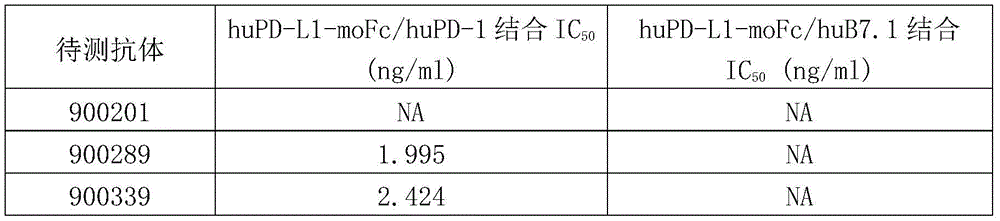
注:NA表示没有阻断活性Note: NA means no blocking activity
3.4鉴定嵌合抗体以及人源化抗体非特异性结合实验(SPR)3.4 Identification of chimeric antibody and humanized antibody non-specific binding experiment (SPR)
本试验使用SPR方法测定抗体与非靶标分子的非特异吸附效应。This test uses the SPR method to measure the non-specific adsorption effect of antibodies and non-target molecules.
将Series S Sensor Chip CM5(GE,#BR-1005-30)芯片置室温平衡20~30min,装入Biacore 8K(GE)仪器。采用氨基偶联试剂盒(GE,#BR-1000-50)将来自鸡蛋的溶菌酶溶液(Sigma,#L3790)和来自大豆的胰蛋白酶抑制剂1-S型(Sigma,#T-2327)分别固定到CM5芯片。进样缓冲液为HBS-EP(1X)(GE,#BR-1006-69),设置4个平衡循环。用平衡缓冲液将多克隆兔抗溶菌酶(ABcam,Ab391),Anti-trypsin inhibitor antibody(LifeSpanBiosciences,#LS-C76609),嵌合抗体和人源化抗体稀释至1000nM,设置流速5μL/min,进样通道1,2和3,Flow Cell 1和2。结合时间10min,解离时间15min。再生流速50μL/min,先0.85%磷酸溶液(ProteOn,176-2260)再生60s,再用50mM氢氧化钠溶液再生30s。The Series S Sensor Chip CM5 (GE, #BR-1005-30) chip was placed at room temperature for 20-30 minutes to equilibrate, and loaded into a Biacore 8K (GE) instrument. Lysozyme solution (Sigma, #L3790) from chicken eggs and trypsin inhibitor type 1-S (Sigma, #T-2327) from soybean were separated using Amino Coupling Kit (GE, #BR-1000-50). Fixed to CM5 chip. The injection buffer was HBS-EP (1X) (GE, #BR-1006-69), and 4 equilibration cycles were set. Dilute the polyclonal rabbit anti-lysozyme (ABcam, Ab391), Anti-trypsin inhibitor antibody (LifeSpanBiosciences, #LS-C76609), chimeric antibody and humanized antibody to 1000nM with equilibration buffer, set the flow rate to 5μL/min, and carry out
结果表明(见表7),嵌合抗体900289和人源化抗体900339均没有明显的非特异性的静电和疏水结合作用。The results showed (see Table 7) that both the
表7.抗体与非靶分子非特异吸附检测结果Table 7. Detection results of non-specific adsorption of antibodies and non-target molecules
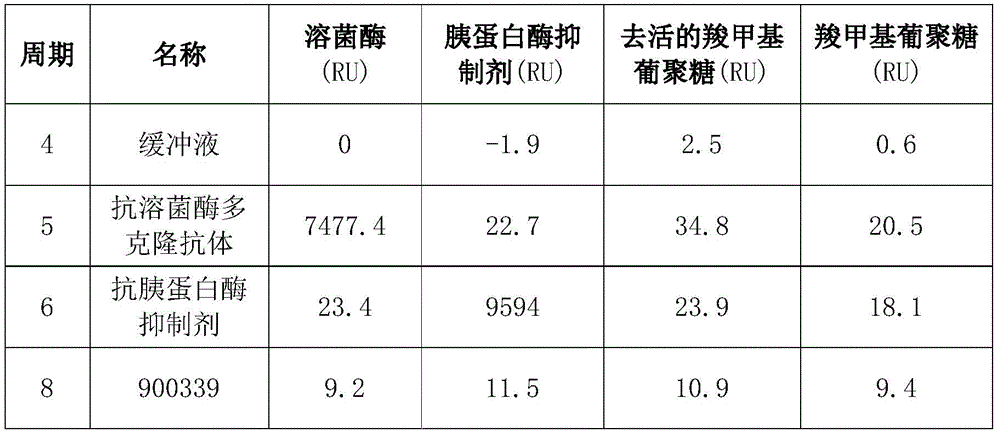

注:20RU以下相互作用较弱,可以忽略;超过20RU即认为有明显的相互作用;100RU以上则是很强的相互作用。Note: The interaction below 20RU is weak and can be ignored; more than 20RU is considered to have an obvious interaction; more than 100RU is a strong interaction.
3.5嵌合抗体以及人源化抗体在对PBMC的激活作用3.5 The activation effect of chimeric antibody and humanized antibody on PBMC
在无菌状态下,将1μg/ml待测试抗体与1μg/ml抗人CD3的抗体(BioLegend,#300314)联合包被在96孔细胞培养板中,200μL/孔,2-8℃包被过夜。次日,弃去包被液,用PBS洗涤2次后用移液器吸干孔内残余液体。用培养基将PBMC稀释至活细胞密度为5×105/mL,每孔200μL(1×105个细胞/孔),加入到预包被的96孔细胞培养板,37℃、5%CO2的条件下培养5天。培养结束后,离心96孔细胞培养板,300g×10min,用人IFN-γELISAMAXTMStandard试剂盒(BioLegend,#430101)检测上层细胞培养液中人IFN-γ的分泌量。Under sterile conditions, combine 1 μg/ml of the antibody to be tested with 1 μg/ml of anti-human CD3 antibody (BioLegend, #300314) in a 96-well cell culture plate, 200 μL/well, overnight at 2-8°C . The next day, the coating solution was discarded, washed twice with PBS, and the residual liquid in the well was blotted dry with a pipette. Dilute PBMC with culture medium to a viable cell density of 5×10 5 /mL, add 200 μL per well (1×10 5 cells/well), add to a pre-coated 96-well cell culture plate, 37°C, 5% CO 2 for 5 days. After the culture, the 96-well cell culture plate was centrifuged at 300g×10min, and the secretion of human IFN-γ in the upper cell culture medium was detected with a human IFN-γ ELISAMAX TM Standard kit (BioLegend, #430101).
结果如图1所示,相较于阴性对照900201,加入嵌合抗体900289或者人源抗体900339后,对细胞因子IFN-γ的分泌的刺激更有效。The results are shown in Figure 1. Compared with the
3.6在混合淋巴反应中测定嵌合抗体以及人源化抗体对T细胞的激活作用3.6 Determination of the activating effect of chimeric antibody and humanized antibody on T cells in mixed lymphoid reaction
用EasySepTMHuman Monocyte Enrichment Kit without CD16Depletion试剂盒(STEMCELLTM,#19058)从PBMC中分离单核细胞,按照ImmunoCultTMDendritic Cell CultureKit(STEMCELLTM,#10985)进行培养,收获成熟的树突细胞备用。用EasySepTMHuman CD4+TCell Enrichment Kit(STEMCELLTM,#19052)从另一个体来源的PBMC中分离CD4+T淋巴细胞备用。用培养基将成熟树突细胞重悬成活细胞密度为2×10⁵/mL的细胞悬液,每孔加50μL(1×104个细胞/孔)至96孔细胞培养板中;同时用培养基将CD4+T淋巴细胞重悬成活细胞密度为2×106/mL的细胞悬液,每孔加50μL(1×105个细胞/孔)至含有树突细胞的96孔细胞培养板中充分混合,得到MLR反应体系。在MLR体系中加入终浓度为1μg/ml抗PD-L1的抗体充分混合于37℃、5%CO2的条件下培养5天。培养结束后,离心96孔细胞培养板,300g×10min,用Human IFN-γELISA MAXTMStandard试剂盒(BioLegend,#430101)和Human IL-2ELISAMAXTMStandard试剂盒(BioLegend,#431801)分别检测上层细胞培养液中人IFN-γ和IL-2的分泌量。Monocytes were isolated from PBMCs with EasySep ™ Human Monocyte Enrichment Kit without CD16Depletion Kit (STEMCELL™, #19058), cultured according to ImmunoCult ™ Dendritic Cell Culture Kit (STEMCELL™, #10985), and mature dendritic cells were harvested for use. Use EasySep ™ Human CD4+TCell Enrichment Kit (STEMCELLTM, #19052) to separate CD4+T lymphocytes from PBMC derived from another individual for future use. Resuspend mature dendritic cells with culture medium to a cell suspension with a density of 2×10 5 /mL, add 50 μL (1×10 4 cells/well) to each well in a 96-well cell culture plate; Resuspend CD4+ T lymphocytes into a cell suspension with a viable cell density of 2×10 6 /mL, add 50 μL (1×10 5 cells/well) to each well of a 96-well cell culture plate containing dendritic cells Mix well to obtain the MLR reaction system. Add an anti-PD-L1 antibody with a final concentration of 1 μg/ml to the MLR system, mix well, and culture at 37°C and 5% CO2 for 5 days. After the culture, centrifuge the 96-well cell culture plate, 300g×10min, and use the Human IFN-γELISA MAX TM Standard kit (BioLegend, #430101) and the Human IL-2 ELISAMAX TM Standard kit (BioLegend, #431801) to detect the upper layer cells respectively Secretion of human IFN-γ and IL-2 in culture medium.
结果如图2和图3所示,图中900233是作为阳性对照的Roche人源化PD-L1抗体,根据专利US20160319022提供的人源化序列进行克隆,并瞬时转染进行表达。结果表明,相较于阴性对照900201,嵌合抗体900289和人源化抗体900339对人的IFN-γ和IL-2的分泌刺激更有效。The results are shown in Figure 2 and Figure 3, in which 900233 is the Roche humanized PD-L1 antibody used as a positive control, cloned according to the humanized sequence provided by the patent US20160319022, and expressed by transient transfection. The results showed that, compared with the
在本发明提及的所有文献都在本申请中引用作为参考,就如同每一篇文献被单独引用作为参考那样。此外应理解,在阅读了本发明的上述讲授内容之后,本领域技术人员可以对本发明作各种改动或修改,这些等价形式同样落于本申请所附权利要求书所限定的范围。All documents mentioned in this application are incorporated by reference in this application as if each were individually incorporated by reference. In addition, it should be understood that after reading the above teaching content of the present invention, those skilled in the art can make various changes or modifications to the present invention, and these equivalent forms also fall within the scope defined by the appended claims of the present application.
序列表sequence listing
<110> 华博生物医药技术(上海)有限公司<110> Huabo Biomedical Technology (Shanghai) Co., Ltd.
<120> 针对程序性死亡配体的结合物及其应用<120> Conjugates against programmed death ligands and applications thereof
<130> P2019-0295<130> P2019-0295
<160> 9<160> 9
<170> SIPOSequenceListing 1.0<170> SIPOSequenceListing 1.0
<210> 1<210> 1
<211> 120<211> 120
<212> PRT<212> PRT
<213> 小鼠(Mus musculus)<213> Mouse (Mus musculus)
<400> 1<400> 1
Gln Val Gln Leu Gln Gln Ser Gly Ala Glu Leu Val Lys Pro Gly AlaGln Val Gln Leu Gln Gln Ser Gly Ala Glu Leu Val Lys Pro Gly Ala
1 5 10 151 5 10 15
Ser Val Lys Leu Ser Cys Lys Ala Ser Gly Tyr Ala Phe Thr Gly TyrSer Val Lys Leu Ser Cys Lys Ala Ser Gly Tyr Ala Phe Thr Gly Tyr
20 25 30 20 25 30
Thr Ile His Trp Val Lys Gln Arg Ser Gly Leu Gly Leu Glu Trp LeuThr Ile His Trp Val Lys Gln Arg Ser Gly Leu Gly Leu Glu Trp Leu
35 40 45 35 40 45
Gly Trp Phe Tyr Pro Gly Ser Gly Thr Leu Lys Tyr Asn Glu Lys PheGly Trp Phe Tyr Pro Gly Ser Gly Thr Leu Lys Tyr Asn Glu Lys Phe
50 55 60 50 55 60
Lys Asp Lys Ala Thr Leu Thr Ala Asp Lys Ser Ser Ser Thr Val TyrLys Asp Lys Ala Thr Leu Thr Ala Asp Lys Ser Ser Ser Thr Val Tyr
65 70 75 8065 70 75 80
Leu Glu Leu Ser Arg Leu Thr Ser Glu Asp Ser Ala Val Tyr Phe CysLeu Glu Leu Ser Arg Leu Thr Ser Glu Asp Ser Ala Val Tyr Phe Cys
85 90 95 85 90 95
Ala Arg His Gly Thr Gly Thr Leu Met Ala Met Asp Tyr Trp Gly GlnAla Arg His Gly Thr Gly Thr Leu Met Ala Met Asp Tyr Trp Gly Gln
100 105 110 100 105 110
Gly Thr Ser Val Thr Val Ser SerGly Thr Ser Val Thr Val Ser Ser
115 120 115 120
<210> 2<210> 2
<211> 112<211> 112
<212> PRT<212> PRT
<213> 小鼠(Mus musculus)<213> Mouse (Mus musculus)
<400> 2<400> 2
Asp Val Val Val Thr Gln Thr Pro Leu Ser Leu Pro Val Ser Phe GlyAsp Val Val Val Thr Gln Thr Pro Leu Ser Leu Pro Val Ser Phe Gly
1 5 10 151 5 10 15
Asp Gln Val Ser Ile Ser Cys Arg Ser Ser Gln Ser Leu Ala Asn SerAsp Gln Val Ser Ile Ser Cys Arg Ser Ser Gln Ser Leu Ala Asn Ser
20 25 30 20 25 30
Tyr Gly Asn Thr Tyr Leu Ser Trp Tyr Leu His Lys Pro Gly Gln SerTyr Gly Asn Thr Tyr Leu Ser Trp Tyr Leu His Lys Pro Gly Gln Ser
35 40 45 35 40 45
Pro Gln Leu Leu Ile Tyr Gly Ile Ser Asn Arg Phe Ser Gly Val ProPro Gln Leu Leu Ile Tyr Gly Ile Ser Asn Arg Phe Ser Gly Val Pro
50 55 60 50 55 60
Asp Arg Phe Ser Gly Ser Gly Ser Gly Thr Asp Phe Thr Leu Lys IleAsp Arg Phe Ser Gly Ser Gly Ser Gly Thr Asp Phe Thr Leu Lys Ile
65 70 75 8065 70 75 80
Ser Thr Ile Lys Pro Glu Asp Leu Gly Met Tyr Tyr Cys Leu Gln GlySer Thr Ile Lys Pro Glu Asp Leu Gly Met Tyr Tyr Cys Leu Gln Gly
85 90 95 85 90 95
Thr His Gln Pro Pro Thr Phe Gly Gly Gly Thr Lys Leu Glu Ile LysThr His Gln Pro Pro Thr Phe Gly Gly Gly Thr Lys Leu Glu Ile Lys
100 105 110 100 105 110
<210> 3<210> 3
<211> 8<211> 8
<212> PRT<212> PRT
<213> 小鼠(Mus musculus)<213> Mouse (Mus musculus)
<400> 3<400> 3
Gly Tyr Ala Phe Thr Gly Tyr ThrGly Tyr Ala Phe Thr Gly Tyr Thr
1 51 5
<210> 4<210> 4
<211> 8<211> 8
<212> PRT<212> PRT
<213> 小鼠(Mus musculus)<213> Mouse (Mus musculus)
<400> 4<400> 4
Phe Tyr Pro Gly Ser Gly Thr LeuPhe Tyr Pro Gly Ser Gly Thr Leu
1 51 5
<210> 5<210> 5
<211> 13<211> 13
<212> PRT<212> PRT
<213> 小鼠(Mus musculus)<213> Mouse (Mus musculus)
<400> 5<400> 5
Ala Arg His Gly Thr Gly Thr Leu Met Ala Met Asp TyrAla Arg His Gly Thr Gly Thr Leu Met Ala Met Asp Tyr
1 5 101 5 10
<210> 6<210> 6
<211> 11<211> 11
<212> PRT<212> PRT
<213> 小鼠(Mus musculus)<213> Mouse (Mus musculus)
<400> 6<400> 6
Gln Ser Leu Ala Asn Ser Tyr Gly Asn Thr TyrGln Ser Leu Ala Asn Ser Tyr Gly Asn Thr Tyr
1 5 101 5 10
<210> 7<210> 7
<211> 9<211> 9
<212> PRT<212> PRT
<213> 小鼠(Mus musculus)<213> Mouse (Mus musculus)
<400> 7<400> 7
Leu Gln Gly Thr His Gln Pro Pro ThrLeu Gln Gly Thr His Gln Pro Pro Thr
1 51 5
<210> 8<210> 8
<211> 120<211> 120
<212> PRT<212> PRT
<213> 人工序列(artificial sequence)<213> Artificial sequence (artificial sequence)
<400> 8<400> 8
Gln Val Gln Leu Val Gln Ser Gly Ala Glu Val Lys Lys Pro Gly AlaGln Val Gln Leu Val Gln Ser Gly Ala Glu Val Lys Lys Pro Gly Ala
1 5 10 151 5 10 15
Ser Val Lys Val Ser Cys Lys Ala Ser Gly Tyr Ala Phe Thr Gly TyrSer Val Lys Val Ser Cys Lys Ala Ser Gly Tyr Ala Phe Thr Gly Tyr
20 25 30 20 25 30
Thr Ile His Trp Val Arg Gln Ala Pro Gly Gln Arg Leu Glu Trp MetThr Ile His Trp Val Arg Gln Ala Pro Gly Gln Arg Leu Glu Trp Met
35 40 45 35 40 45
Gly Trp Phe Tyr Pro Gly Ser Gly Thr Leu Lys Tyr Ser Glu Lys PheGly Trp Phe Tyr Pro Gly Ser Gly Thr Leu Lys Tyr Ser Glu Lys Phe
50 55 60 50 55 60
Gln Gly Arg Val Thr Ile Thr Arg Asp Lys Ser Leu Ser Thr Ala TyrGln Gly Arg Val Thr Ile Thr Arg Asp Lys Ser Leu Ser Thr Ala Tyr
65 70 75 8065 70 75 80
Met Glu Leu Ser Ser Leu Arg Ser Glu Asp Thr Ala Val Tyr Tyr CysMet Glu Leu Ser Ser Leu Arg Ser Glu Asp Thr Ala Val Tyr Tyr Cys
85 90 95 85 90 95
Ala Arg His Gly Thr Gly Thr Leu Met Ala Met Asp Tyr Trp Gly GlnAla Arg His Gly Thr Gly Thr Leu Met Ala Met Asp Tyr Trp Gly Gln
100 105 110 100 105 110
Gly Thr Leu Val Thr Val Ser SerGly Thr Leu Val Thr Val Ser Ser
115 120 115 120
<210> 9<210> 9
<211> 112<211> 112
<212> PRT<212> PRT
<213> 人工序列(artificial sequence)<213> Artificial sequence (artificial sequence)
<400> 9<400> 9
Asp Val Val Met Thr Gln Thr Pro Leu Ser Leu Ser Val Thr Pro GlyAsp Val Val Met Thr Gln Thr Pro Leu Ser Leu Ser Val Thr Pro Gly
1 5 10 151 5 10 15
Gln Pro Ala Ser Ile Ser Cys Lys Ser Ser Gln Ser Leu Ala Asn SerGln Pro Ala Ser Ile Ser Cys Lys Ser Ser Gln Ser Leu Ala Asn Ser
20 25 30 20 25 30
Tyr Gly Asn Thr Tyr Leu Ser Trp Tyr Leu His Lys Pro Gly Gln SerTyr Gly Asn Thr Tyr Leu Ser Trp Tyr Leu His Lys Pro Gly Gln Ser
35 40 45 35 40 45
Pro Gln Leu Leu Ile Tyr Gly Ile Ser Asn Arg Phe Ser Gly Val ProPro Gln Leu Leu Ile Tyr Gly Ile Ser Asn Arg Phe Ser Gly Val Pro
50 55 60 50 55 60
Asp Arg Phe Ser Gly Ser Gly Ser Gly Thr Asp Phe Thr Leu Lys IleAsp Arg Phe Ser Gly Ser Gly Ser Gly Thr Asp Phe Thr Leu Lys Ile
65 70 75 8065 70 75 80
Ser Arg Val Glu Ala Glu Asp Val Gly Val Tyr Tyr Cys Leu Gln GlySer Arg Val Glu Ala Glu Asp Val Gly Val Tyr Tyr Cys Leu Gln Gly
85 90 95 85 90 95
Thr His Gln Pro Pro Thr Phe Gly Gln Gly Thr Lys Leu Glu Ile LysThr His Gln Pro Pro Thr Phe Gly Gln Gly Thr Lys Leu Glu Ile Lys
100 105 110 100 105 110
Claims (13)
Priority Applications (5)
| Application Number | Priority Date | Filing Date | Title |
|---|---|---|---|
| CN201910258182.5A CN109929037B (en) | 2019-04-01 | 2019-04-01 | Conjugates to programmed death ligands and uses thereof |
| PCT/CN2020/078596 WO2020199860A1 (en) | 2019-04-01 | 2020-03-10 | Binder against programmed death-ligand and application thereof |
| US17/424,964 US12338284B2 (en) | 2019-04-01 | 2020-03-10 | Binder against programmed death-ligand and application thereof |
| EP20782195.0A EP3950714A4 (en) | 2019-04-01 | 2020-03-10 | BINDER AGAINST TIMED DEATH LIGAND AND ITS APPLICATION |
| JP2021538688A JP7182815B2 (en) | 2019-04-01 | 2020-03-10 | Conjugates to programmed cell death ligands and uses thereof |
Applications Claiming Priority (1)
| Application Number | Priority Date | Filing Date | Title |
|---|---|---|---|
| CN201910258182.5A CN109929037B (en) | 2019-04-01 | 2019-04-01 | Conjugates to programmed death ligands and uses thereof |
Publications (2)
| Publication Number | Publication Date |
|---|---|
| CN109929037A CN109929037A (en) | 2019-06-25 |
| CN109929037B true CN109929037B (en) | 2023-03-17 |
Family
ID=66988985
Family Applications (1)
| Application Number | Title | Priority Date | Filing Date |
|---|---|---|---|
| CN201910258182.5A Active CN109929037B (en) | 2019-04-01 | 2019-04-01 | Conjugates to programmed death ligands and uses thereof |
Country Status (5)
| Country | Link |
|---|---|
| US (1) | US12338284B2 (en) |
| EP (1) | EP3950714A4 (en) |
| JP (1) | JP7182815B2 (en) |
| CN (1) | CN109929037B (en) |
| WO (1) | WO2020199860A1 (en) |
Families Citing this family (4)
| Publication number | Priority date | Publication date | Assignee | Title |
|---|---|---|---|---|
| CN109929037B (en) * | 2019-04-01 | 2023-03-17 | 华博生物医药技术(上海)有限公司 | Conjugates to programmed death ligands and uses thereof |
| CN114539418A (en) * | 2020-11-26 | 2022-05-27 | 上海华奥泰生物药业股份有限公司 | Bispecific antibodies and uses thereof |
| CN114573701A (en) * | 2020-12-02 | 2022-06-03 | 上海华奥泰生物药业股份有限公司 | anti-PD-L1/TGF-beta bifunctional antibody and application thereof |
| EP4450520A4 (en) * | 2021-12-15 | 2025-11-05 | Shanghai Huaota Biopharmaceutical Co Ltd | PD-L1 antigen-binding protein and its application |
Citations (6)
| Publication number | Priority date | Publication date | Assignee | Title |
|---|---|---|---|---|
| CN101248089A (en) * | 2005-07-01 | 2008-08-20 | 米德列斯公司 | Human monoclonal antibodies to programmed death ligand 1 (PD-L1) |
| CN104749372A (en) * | 2013-12-30 | 2015-07-01 | 北京义翘神州生物技术有限公司 | ELISA kit for H9N2 influenza virus hemagglutinin protein |
| CN106519034A (en) * | 2016-12-22 | 2017-03-22 | 安源医药科技(上海)有限公司 | Anti-PD-1 (Programmed Death-1) antibody and application thereof |
| CN108341871A (en) * | 2017-01-24 | 2018-07-31 | 三生国健药业(上海)股份有限公司 | Anti- PD-1 monoclonal antibodies and its preparation method and application |
| CN108359011A (en) * | 2017-07-21 | 2018-08-03 | 华博生物医药技术(上海)有限公司 | Target the antibody, preparation method and application of interleukin-17 A |
| CN108752476A (en) * | 2016-03-04 | 2018-11-06 | 四川科伦博泰生物医药股份有限公司 | A kind of PDL-1 antibody, its medical composition and its use |
Family Cites Families (20)
| Publication number | Priority date | Publication date | Assignee | Title |
|---|---|---|---|---|
| US6410690B1 (en) | 1995-06-07 | 2002-06-25 | Medarex, Inc. | Therapeutic compounds comprised of anti-Fc receptor antibodies |
| US5922845A (en) | 1996-07-11 | 1999-07-13 | Medarex, Inc. | Therapeutic multispecific compounds comprised of anti-Fcα receptor antibodies |
| CN114507282B (en) * | 2012-10-04 | 2025-05-16 | 达纳-法伯癌症研究所公司 | Human monoclonal anti-PD-L1 antibodies and methods of use |
| SG11201602283UA (en) | 2013-09-27 | 2016-04-28 | Genentech Inc | Anti-pdl1 antibody formulations |
| TWI680138B (en) | 2014-01-23 | 2019-12-21 | 美商再生元醫藥公司 | Human antibodies to pd-l1 |
| US10696745B2 (en) * | 2015-06-11 | 2020-06-30 | Wuxi Biologics (Shanghai) Co. Ltd. | Anti-PD-L1 antibodies |
| CN106397592A (en) | 2015-07-31 | 2017-02-15 | 苏州康宁杰瑞生物科技有限公司 | Single-domain antibody directed at programmed death ligand (PD-L1) and derived protein thereof |
| CN105461808B (en) | 2015-12-24 | 2019-03-19 | 长春金赛药业股份有限公司 | Monoclonal antibody and its application |
| KR20180127971A (en) * | 2016-03-23 | 2018-11-30 | 맵스페이스 바이오사이언시즈 (쑤저우) 컴퍼니 리미티드 | New anti-PD-L1 antibodies |
| CN105968200B (en) | 2016-05-20 | 2019-03-15 | 瑞阳(苏州)生物科技有限公司 | Anti-human PD-L1 humanized monoclonal antibody and its application |
| US11104724B2 (en) * | 2016-05-23 | 2021-08-31 | New York University | Compositions and methods for antibodies targeting staphylococcal leukotoxins |
| SG11201810509PA (en) * | 2016-06-20 | 2018-12-28 | Kymab Ltd | Anti-pd-l1 antibodies |
| JP2018182444A (en) | 2017-04-07 | 2018-11-15 | 株式会社Jvcケンウッド | Image coding apparatus, image coding method, image coding program, image decoding apparatus, image decoding method, and image decoding program |
| RU2665790C1 (en) | 2017-04-17 | 2018-09-04 | Закрытое Акционерное Общество "Биокад" | Monoclonal pd-l1 antibody |
| MX2019012461A (en) | 2017-04-18 | 2019-12-11 | R Pharm Overseas Inc | Anti-pd-l1 antibody and use thereof. |
| CN116535508A (en) | 2017-06-25 | 2023-08-04 | 西雅图免疫公司 | anti-PD-L1 antibodies and methods of making and using the same |
| CN109942712B (en) * | 2019-04-01 | 2022-12-20 | 华博生物医药技术(上海)有限公司 | anti-PD-L1/VEGF bifunctional antibody and application thereof |
| CN109929037B (en) | 2019-04-01 | 2023-03-17 | 华博生物医药技术(上海)有限公司 | Conjugates to programmed death ligands and uses thereof |
| CN114539418A (en) * | 2020-11-26 | 2022-05-27 | 上海华奥泰生物药业股份有限公司 | Bispecific antibodies and uses thereof |
| CN114573701A (en) * | 2020-12-02 | 2022-06-03 | 上海华奥泰生物药业股份有限公司 | anti-PD-L1/TGF-beta bifunctional antibody and application thereof |
-
2019
- 2019-04-01 CN CN201910258182.5A patent/CN109929037B/en active Active
-
2020
- 2020-03-10 EP EP20782195.0A patent/EP3950714A4/en active Pending
- 2020-03-10 WO PCT/CN2020/078596 patent/WO2020199860A1/en not_active Ceased
- 2020-03-10 JP JP2021538688A patent/JP7182815B2/en active Active
- 2020-03-10 US US17/424,964 patent/US12338284B2/en active Active
Patent Citations (7)
| Publication number | Priority date | Publication date | Assignee | Title |
|---|---|---|---|---|
| CN101248089A (en) * | 2005-07-01 | 2008-08-20 | 米德列斯公司 | Human monoclonal antibodies to programmed death ligand 1 (PD-L1) |
| CN104356236A (en) * | 2005-07-01 | 2015-02-18 | 梅达雷克斯有限责任公司 | Human Monoclonal Antibodies To Programmed Death Ligand 1 (PD-L1) |
| CN104749372A (en) * | 2013-12-30 | 2015-07-01 | 北京义翘神州生物技术有限公司 | ELISA kit for H9N2 influenza virus hemagglutinin protein |
| CN108752476A (en) * | 2016-03-04 | 2018-11-06 | 四川科伦博泰生物医药股份有限公司 | A kind of PDL-1 antibody, its medical composition and its use |
| CN106519034A (en) * | 2016-12-22 | 2017-03-22 | 安源医药科技(上海)有限公司 | Anti-PD-1 (Programmed Death-1) antibody and application thereof |
| CN108341871A (en) * | 2017-01-24 | 2018-07-31 | 三生国健药业(上海)股份有限公司 | Anti- PD-1 monoclonal antibodies and its preparation method and application |
| CN108359011A (en) * | 2017-07-21 | 2018-08-03 | 华博生物医药技术(上海)有限公司 | Target the antibody, preparation method and application of interleukin-17 A |
Non-Patent Citations (1)
| Title |
|---|
| 针对PD-1和PD-L1通路的肿瘤免疫治疗;李鹰飞等;《江西医药》;20151231;第50卷(第12期);第1522-1524页 * |
Also Published As
| Publication number | Publication date |
|---|---|
| US12338284B2 (en) | 2025-06-24 |
| EP3950714A4 (en) | 2022-12-21 |
| EP3950714A1 (en) | 2022-02-09 |
| JP7182815B2 (en) | 2022-12-05 |
| CN109929037A (en) | 2019-06-25 |
| WO2020199860A1 (en) | 2020-10-08 |
| JP2022516627A (en) | 2022-03-01 |
| US20220089741A1 (en) | 2022-03-24 |
Similar Documents
| Publication | Publication Date | Title |
|---|---|---|
| US11912768B2 (en) | Single domain antibody and derivative proteins thereof against CTLA4 | |
| JP7578938B2 (en) | Monoclonal antibodies directed against B7-H3 and their use in cell therapy - Patents.com | |
| US11365255B2 (en) | PD-1 antibody, antigen-binding fragment thereof, and medical application thereof | |
| ES3001154T3 (en) | Anti-PD1 monoclonal antibody, its pharmaceutical composition and use | |
| JP7425604B2 (en) | Anti-CTLA4-anti-PD-1 bifunctional antibodies, pharmaceutical compositions and uses thereof | |
| KR102340832B1 (en) | Anti-PD-1 antibodies and uses thereof | |
| CN108348601B (en) | Antibody therapeutics that bind to LAG3 | |
| JP2023126951A (en) | Single domain antibody that binds to CD137 | |
| CN110396129B (en) | Humanized CD19 antigen-binding single-chain antibody and its chimeric antigen receptor, immune cells and applications | |
| JP2021529557A (en) | Anti-tumor immune checkpoint regulator antagonist | |
| WO2018233574A1 (en) | Anti-PD-L1 humanized nano-antibody and application thereof | |
| CN109929037B (en) | Conjugates to programmed death ligands and uses thereof | |
| WO2019192493A1 (en) | Anti-human lag-3 monoclonal antibody and use thereof | |
| KR20220145337A (en) | Multispecific antibodies for the treatment of diseases | |
| WO2022142272A1 (en) | Cldn18.2 antibody and application thereof | |
| JP2022512724A (en) | Anti-CD137 antibody and its use | |
| WO2024199458A1 (en) | Il-2 variants with improved stability and compositions thereof | |
| EP4458855A1 (en) | Development of novel pdl1 single-domain antibody | |
| AU2024257454A1 (en) | Anti-pd-l1 nanobody, preparation method therefor and use thereof | |
| EA042365B1 (en) | BIFUNCTIONAL ANTIBODY AGAINST CTLA4 AND AGAINST PD-1, ITS PHARMACEUTICAL COMPOSITION AND THEIR APPLICATION |
Legal Events
| Date | Code | Title | Description |
|---|---|---|---|
| PB01 | Publication | ||
| PB01 | Publication | ||
| SE01 | Entry into force of request for substantive examination | ||
| SE01 | Entry into force of request for substantive examination | ||
| GR01 | Patent grant | ||
| GR01 | Patent grant |