CN109843872B - Polycyclic compounds as IDO inhibitors and/or IDO-HDAC dual inhibitors - Google Patents
Polycyclic compounds as IDO inhibitors and/or IDO-HDAC dual inhibitors Download PDFInfo
- Publication number
- CN109843872B CN109843872B CN201880002070.7A CN201880002070A CN109843872B CN 109843872 B CN109843872 B CN 109843872B CN 201880002070 A CN201880002070 A CN 201880002070A CN 109843872 B CN109843872 B CN 109843872B
- Authority
- CN
- China
- Prior art keywords
- compound
- acid
- group
- mmol
- reaction
- Prior art date
- Legal status (The legal status is an assumption and is not a legal conclusion. Google has not performed a legal analysis and makes no representation as to the accuracy of the status listed.)
- Active
Links
Classifications
-
- C—CHEMISTRY; METALLURGY
- C07—ORGANIC CHEMISTRY
- C07D—HETEROCYCLIC COMPOUNDS
- C07D215/00—Heterocyclic compounds containing quinoline or hydrogenated quinoline ring systems
- C07D215/02—Heterocyclic compounds containing quinoline or hydrogenated quinoline ring systems having no bond between the ring nitrogen atom and a non-ring member or having only hydrogen atoms or carbon atoms directly attached to the ring nitrogen atom
- C07D215/16—Heterocyclic compounds containing quinoline or hydrogenated quinoline ring systems having no bond between the ring nitrogen atom and a non-ring member or having only hydrogen atoms or carbon atoms directly attached to the ring nitrogen atom with hetero atoms or with carbon atoms having three bonds to hetero atoms with at the most one bond to halogen, e.g. ester or nitrile radicals, directly attached to ring carbon atoms
- C07D215/18—Halogen atoms or nitro radicals
-
- A—HUMAN NECESSITIES
- A61—MEDICAL OR VETERINARY SCIENCE; HYGIENE
- A61K—PREPARATIONS FOR MEDICAL, DENTAL OR TOILETRY PURPOSES
- A61K31/00—Medicinal preparations containing organic active ingredients
- A61K31/33—Heterocyclic compounds
- A61K31/395—Heterocyclic compounds having nitrogen as a ring hetero atom, e.g. guanethidine or rifamycins
- A61K31/435—Heterocyclic compounds having nitrogen as a ring hetero atom, e.g. guanethidine or rifamycins having six-membered rings with one nitrogen as the only ring hetero atom
- A61K31/47—Quinolines; Isoquinolines
- A61K31/4709—Non-condensed quinolines and containing further heterocyclic rings
-
- A—HUMAN NECESSITIES
- A61—MEDICAL OR VETERINARY SCIENCE; HYGIENE
- A61K—PREPARATIONS FOR MEDICAL, DENTAL OR TOILETRY PURPOSES
- A61K31/00—Medicinal preparations containing organic active ingredients
- A61K31/33—Heterocyclic compounds
- A61K31/395—Heterocyclic compounds having nitrogen as a ring hetero atom, e.g. guanethidine or rifamycins
- A61K31/435—Heterocyclic compounds having nitrogen as a ring hetero atom, e.g. guanethidine or rifamycins having six-membered rings with one nitrogen as the only ring hetero atom
- A61K31/44—Non condensed pyridines; Hydrogenated derivatives thereof
-
- A—HUMAN NECESSITIES
- A61—MEDICAL OR VETERINARY SCIENCE; HYGIENE
- A61K—PREPARATIONS FOR MEDICAL, DENTAL OR TOILETRY PURPOSES
- A61K31/00—Medicinal preparations containing organic active ingredients
- A61K31/33—Heterocyclic compounds
- A61K31/395—Heterocyclic compounds having nitrogen as a ring hetero atom, e.g. guanethidine or rifamycins
- A61K31/435—Heterocyclic compounds having nitrogen as a ring hetero atom, e.g. guanethidine or rifamycins having six-membered rings with one nitrogen as the only ring hetero atom
- A61K31/47—Quinolines; Isoquinolines
-
- A—HUMAN NECESSITIES
- A61—MEDICAL OR VETERINARY SCIENCE; HYGIENE
- A61K—PREPARATIONS FOR MEDICAL, DENTAL OR TOILETRY PURPOSES
- A61K31/00—Medicinal preparations containing organic active ingredients
- A61K31/33—Heterocyclic compounds
- A61K31/395—Heterocyclic compounds having nitrogen as a ring hetero atom, e.g. guanethidine or rifamycins
- A61K31/495—Heterocyclic compounds having nitrogen as a ring hetero atom, e.g. guanethidine or rifamycins having six-membered rings with two or more nitrogen atoms as the only ring heteroatoms, e.g. piperazine or tetrazines
- A61K31/50—Pyridazines; Hydrogenated pyridazines
- A61K31/501—Pyridazines; Hydrogenated pyridazines not condensed and containing further heterocyclic rings
-
- A—HUMAN NECESSITIES
- A61—MEDICAL OR VETERINARY SCIENCE; HYGIENE
- A61K—PREPARATIONS FOR MEDICAL, DENTAL OR TOILETRY PURPOSES
- A61K31/00—Medicinal preparations containing organic active ingredients
- A61K31/33—Heterocyclic compounds
- A61K31/395—Heterocyclic compounds having nitrogen as a ring hetero atom, e.g. guanethidine or rifamycins
- A61K31/495—Heterocyclic compounds having nitrogen as a ring hetero atom, e.g. guanethidine or rifamycins having six-membered rings with two or more nitrogen atoms as the only ring heteroatoms, e.g. piperazine or tetrazines
- A61K31/505—Pyrimidines; Hydrogenated pyrimidines, e.g. trimethoprim
- A61K31/506—Pyrimidines; Hydrogenated pyrimidines, e.g. trimethoprim not condensed and containing further heterocyclic rings
-
- A—HUMAN NECESSITIES
- A61—MEDICAL OR VETERINARY SCIENCE; HYGIENE
- A61K—PREPARATIONS FOR MEDICAL, DENTAL OR TOILETRY PURPOSES
- A61K31/00—Medicinal preparations containing organic active ingredients
- A61K31/33—Heterocyclic compounds
- A61K31/395—Heterocyclic compounds having nitrogen as a ring hetero atom, e.g. guanethidine or rifamycins
- A61K31/535—Heterocyclic compounds having nitrogen as a ring hetero atom, e.g. guanethidine or rifamycins having six-membered rings with at least one nitrogen and one oxygen as the ring hetero atoms, e.g. 1,2-oxazines
- A61K31/5375—1,4-Oxazines, e.g. morpholine
- A61K31/5383—1,4-Oxazines, e.g. morpholine ortho- or peri-condensed with heterocyclic ring systems
-
- A—HUMAN NECESSITIES
- A61—MEDICAL OR VETERINARY SCIENCE; HYGIENE
- A61K—PREPARATIONS FOR MEDICAL, DENTAL OR TOILETRY PURPOSES
- A61K39/00—Medicinal preparations containing antigens or antibodies
- A61K39/395—Antibodies; Immunoglobulins; Immune serum, e.g. antilymphocytic serum
- A61K39/39533—Antibodies; Immunoglobulins; Immune serum, e.g. antilymphocytic serum against materials from animals
- A61K39/3955—Antibodies; Immunoglobulins; Immune serum, e.g. antilymphocytic serum against materials from animals against proteinaceous materials, e.g. enzymes, hormones, lymphokines
-
- C—CHEMISTRY; METALLURGY
- C07—ORGANIC CHEMISTRY
- C07D—HETEROCYCLIC COMPOUNDS
- C07D209/00—Heterocyclic compounds containing five-membered rings, condensed with other rings, with one nitrogen atom as the only ring hetero atom
-
- C—CHEMISTRY; METALLURGY
- C07—ORGANIC CHEMISTRY
- C07D—HETEROCYCLIC COMPOUNDS
- C07D209/00—Heterocyclic compounds containing five-membered rings, condensed with other rings, with one nitrogen atom as the only ring hetero atom
- C07D209/02—Heterocyclic compounds containing five-membered rings, condensed with other rings, with one nitrogen atom as the only ring hetero atom condensed with one carbocyclic ring
-
- C—CHEMISTRY; METALLURGY
- C07—ORGANIC CHEMISTRY
- C07D—HETEROCYCLIC COMPOUNDS
- C07D215/00—Heterocyclic compounds containing quinoline or hydrogenated quinoline ring systems
- C07D215/02—Heterocyclic compounds containing quinoline or hydrogenated quinoline ring systems having no bond between the ring nitrogen atom and a non-ring member or having only hydrogen atoms or carbon atoms directly attached to the ring nitrogen atom
-
- C—CHEMISTRY; METALLURGY
- C07—ORGANIC CHEMISTRY
- C07D—HETEROCYCLIC COMPOUNDS
- C07D215/00—Heterocyclic compounds containing quinoline or hydrogenated quinoline ring systems
- C07D215/02—Heterocyclic compounds containing quinoline or hydrogenated quinoline ring systems having no bond between the ring nitrogen atom and a non-ring member or having only hydrogen atoms or carbon atoms directly attached to the ring nitrogen atom
- C07D215/04—Heterocyclic compounds containing quinoline or hydrogenated quinoline ring systems having no bond between the ring nitrogen atom and a non-ring member or having only hydrogen atoms or carbon atoms directly attached to the ring nitrogen atom with only hydrogen atoms or radicals containing only hydrogen and carbon atoms, directly attached to the ring carbon atoms
-
- C—CHEMISTRY; METALLURGY
- C07—ORGANIC CHEMISTRY
- C07D—HETEROCYCLIC COMPOUNDS
- C07D215/00—Heterocyclic compounds containing quinoline or hydrogenated quinoline ring systems
- C07D215/02—Heterocyclic compounds containing quinoline or hydrogenated quinoline ring systems having no bond between the ring nitrogen atom and a non-ring member or having only hydrogen atoms or carbon atoms directly attached to the ring nitrogen atom
- C07D215/04—Heterocyclic compounds containing quinoline or hydrogenated quinoline ring systems having no bond between the ring nitrogen atom and a non-ring member or having only hydrogen atoms or carbon atoms directly attached to the ring nitrogen atom with only hydrogen atoms or radicals containing only hydrogen and carbon atoms, directly attached to the ring carbon atoms
- C07D215/06—Heterocyclic compounds containing quinoline or hydrogenated quinoline ring systems having no bond between the ring nitrogen atom and a non-ring member or having only hydrogen atoms or carbon atoms directly attached to the ring nitrogen atom with only hydrogen atoms or radicals containing only hydrogen and carbon atoms, directly attached to the ring carbon atoms having only hydrogen atoms, hydrocarbon or substituted hydrocarbon radicals, attached to the ring nitrogen atom
-
- C—CHEMISTRY; METALLURGY
- C07—ORGANIC CHEMISTRY
- C07D—HETEROCYCLIC COMPOUNDS
- C07D215/00—Heterocyclic compounds containing quinoline or hydrogenated quinoline ring systems
- C07D215/02—Heterocyclic compounds containing quinoline or hydrogenated quinoline ring systems having no bond between the ring nitrogen atom and a non-ring member or having only hydrogen atoms or carbon atoms directly attached to the ring nitrogen atom
- C07D215/12—Heterocyclic compounds containing quinoline or hydrogenated quinoline ring systems having no bond between the ring nitrogen atom and a non-ring member or having only hydrogen atoms or carbon atoms directly attached to the ring nitrogen atom with substituted hydrocarbon radicals attached to ring carbon atoms
- C07D215/14—Radicals substituted by oxygen atoms
-
- C—CHEMISTRY; METALLURGY
- C07—ORGANIC CHEMISTRY
- C07D—HETEROCYCLIC COMPOUNDS
- C07D401/00—Heterocyclic compounds containing two or more hetero rings, having nitrogen atoms as the only ring hetero atoms, at least one ring being a six-membered ring with only one nitrogen atom
-
- C—CHEMISTRY; METALLURGY
- C07—ORGANIC CHEMISTRY
- C07D—HETEROCYCLIC COMPOUNDS
- C07D401/00—Heterocyclic compounds containing two or more hetero rings, having nitrogen atoms as the only ring hetero atoms, at least one ring being a six-membered ring with only one nitrogen atom
- C07D401/02—Heterocyclic compounds containing two or more hetero rings, having nitrogen atoms as the only ring hetero atoms, at least one ring being a six-membered ring with only one nitrogen atom containing two hetero rings
-
- C—CHEMISTRY; METALLURGY
- C07—ORGANIC CHEMISTRY
- C07D—HETEROCYCLIC COMPOUNDS
- C07D401/00—Heterocyclic compounds containing two or more hetero rings, having nitrogen atoms as the only ring hetero atoms, at least one ring being a six-membered ring with only one nitrogen atom
- C07D401/02—Heterocyclic compounds containing two or more hetero rings, having nitrogen atoms as the only ring hetero atoms, at least one ring being a six-membered ring with only one nitrogen atom containing two hetero rings
- C07D401/12—Heterocyclic compounds containing two or more hetero rings, having nitrogen atoms as the only ring hetero atoms, at least one ring being a six-membered ring with only one nitrogen atom containing two hetero rings linked by a chain containing hetero atoms as chain links
-
- C—CHEMISTRY; METALLURGY
- C07—ORGANIC CHEMISTRY
- C07D—HETEROCYCLIC COMPOUNDS
- C07D401/00—Heterocyclic compounds containing two or more hetero rings, having nitrogen atoms as the only ring hetero atoms, at least one ring being a six-membered ring with only one nitrogen atom
- C07D401/14—Heterocyclic compounds containing two or more hetero rings, having nitrogen atoms as the only ring hetero atoms, at least one ring being a six-membered ring with only one nitrogen atom containing three or more hetero rings
-
- C—CHEMISTRY; METALLURGY
- C07—ORGANIC CHEMISTRY
- C07D—HETEROCYCLIC COMPOUNDS
- C07D403/00—Heterocyclic compounds containing two or more hetero rings, having nitrogen atoms as the only ring hetero atoms, not provided for by group C07D401/00
-
- C—CHEMISTRY; METALLURGY
- C07—ORGANIC CHEMISTRY
- C07D—HETEROCYCLIC COMPOUNDS
- C07D403/00—Heterocyclic compounds containing two or more hetero rings, having nitrogen atoms as the only ring hetero atoms, not provided for by group C07D401/00
- C07D403/02—Heterocyclic compounds containing two or more hetero rings, having nitrogen atoms as the only ring hetero atoms, not provided for by group C07D401/00 containing two hetero rings
-
- C—CHEMISTRY; METALLURGY
- C07—ORGANIC CHEMISTRY
- C07D—HETEROCYCLIC COMPOUNDS
- C07D405/00—Heterocyclic compounds containing both one or more hetero rings having oxygen atoms as the only ring hetero atoms, and one or more rings having nitrogen as the only ring hetero atom
- C07D405/02—Heterocyclic compounds containing both one or more hetero rings having oxygen atoms as the only ring hetero atoms, and one or more rings having nitrogen as the only ring hetero atom containing two hetero rings
- C07D405/12—Heterocyclic compounds containing both one or more hetero rings having oxygen atoms as the only ring hetero atoms, and one or more rings having nitrogen as the only ring hetero atom containing two hetero rings linked by a chain containing hetero atoms as chain links
-
- C—CHEMISTRY; METALLURGY
- C07—ORGANIC CHEMISTRY
- C07D—HETEROCYCLIC COMPOUNDS
- C07D417/00—Heterocyclic compounds containing two or more hetero rings, at least one ring having nitrogen and sulfur atoms as the only ring hetero atoms, not provided for by group C07D415/00
- C07D417/02—Heterocyclic compounds containing two or more hetero rings, at least one ring having nitrogen and sulfur atoms as the only ring hetero atoms, not provided for by group C07D415/00 containing two hetero rings
- C07D417/12—Heterocyclic compounds containing two or more hetero rings, at least one ring having nitrogen and sulfur atoms as the only ring hetero atoms, not provided for by group C07D415/00 containing two hetero rings linked by a chain containing hetero atoms as chain links
-
- C—CHEMISTRY; METALLURGY
- C07—ORGANIC CHEMISTRY
- C07D—HETEROCYCLIC COMPOUNDS
- C07D498/00—Heterocyclic compounds containing in the condensed system at least one hetero ring having nitrogen and oxygen atoms as the only ring hetero atoms
- C07D498/02—Heterocyclic compounds containing in the condensed system at least one hetero ring having nitrogen and oxygen atoms as the only ring hetero atoms in which the condensed system contains two hetero rings
- C07D498/04—Ortho-condensed systems
Landscapes
- Chemical & Material Sciences (AREA)
- Organic Chemistry (AREA)
- Health & Medical Sciences (AREA)
- Medicinal Chemistry (AREA)
- Life Sciences & Earth Sciences (AREA)
- Pharmacology & Pharmacy (AREA)
- Epidemiology (AREA)
- Animal Behavior & Ethology (AREA)
- General Health & Medical Sciences (AREA)
- Public Health (AREA)
- Veterinary Medicine (AREA)
- Engineering & Computer Science (AREA)
- Endocrinology (AREA)
- Bioinformatics & Cheminformatics (AREA)
- Immunology (AREA)
- Microbiology (AREA)
- Mycology (AREA)
- Pharmaceuticals Containing Other Organic And Inorganic Compounds (AREA)
- Pyridine Compounds (AREA)
- Plural Heterocyclic Compounds (AREA)
- Nitrogen And Oxygen Or Sulfur-Condensed Heterocyclic Ring Systems (AREA)
- Medicines Containing Antibodies Or Antigens For Use As Internal Diagnostic Agents (AREA)
- Low-Molecular Organic Synthesis Reactions Using Catalysts (AREA)
- Quinoline Compounds (AREA)
Abstract
本发明提供了一种作为IDO抑制剂和/或IDO‑HDAC双重抑制剂的多环化合物,具体地,本发明提供了一种如下式(I)所示的化合物,其中,各基团的定义如说明书中所述。所述的化合物具有IDO抑制活性或IDO‑HDAC双重抑制活性,可以用于预防或治疗与IDO和/或IDO‑HDAC活性或表达量相关的疾病。同时本发明专利所述化合物可以和免疫抗肿瘤的抗体如PD‑1和PD‑L1等进行联合用药,这样的联合用药能够大大提高抗体的抗肿瘤的应答率,拓宽所要治疗的肿瘤的种类。
Description
技术领域technical field
本发明涉及多环化合物,还涉及其制备方法和作为IDO抑制剂的用途。The present invention relates to polycyclic compounds, as well as to methods for their preparation and use as IDO inhibitors.
背景技术Background technique
吲哚胺2,3-双加氧酶(Indoleamine 2,3-dioxygenase,IDO)是催化色氨酸等吲哚胺类分子中吲哚环氧化裂解,使其按犬尿酸途径分解代谢的限速酶。Indoleamine 2,3-dioxygenase (IDO) catalyzes the epoxidative cleavage of indole in indoleamine molecules such as tryptophan, making it the limit of catabolism in the kynuric acid pathway. Fast enzymes.
IDO在肿瘤免疫豁免及肿瘤发生过程中起着重要作用。正常情况下,IDO在体内呈低水平表达,而大多数肿瘤细胞则会组成的高表达IDO,将L-色氨酸转化为N-甲酰犬尿氨酸,降低了细胞微环境中的色氨酸浓度,使得色氨酸依赖的T细胞合成停滞于 Gl期,T细胞增殖受到抑制,从而抑制了机体免疫系统对肿瘤组织的杀伤作用。同时, IDO作用下色氨酸的代谢产物存在细胞毒性,可对T细胞产生直接溶解作用。因此,抑制IDO的活性可以有效地阻止肿瘤细胞周围色氨酸的降解,促进T细胞的增殖,从而增强机体对肿瘤细胞的攻击能力。并且,IDO抑制剂还可以与化疗药物合用,降低肿瘤细胞的耐药性,从而增强常规细胞毒疗法的抗肿瘤活性。同时服用IDO抑制剂也可提高癌症病人的治疗性疫苗的疗效。除了在肿瘤细胞耐药性方面发挥着重要作用, IDO还与多种与细胞免疫激活相关的疾病的发病机制密切相关。IDO已被证实是与细胞免疫激活相关的感染、恶性肿瘤、自身免疫性疾病、艾滋病等重大疾病的靶标。同时,抑制IDO还是对于患有神经系统疾病如抑郁症,阿尔茨海默病的病人的重要治疗策略。因此,IDO抑制剂具有广阔的临床应用前景。IDO plays an important role in tumor immune immunity and tumorigenesis. Under normal circumstances, IDO is expressed at a low level in the body, but most tumor cells will form a high expression of IDO, which converts L-tryptophan to N-formylkynurenine, which reduces the color of the cell microenvironment. The concentration of amino acid makes tryptophan-dependent T cell synthesis stagnant in the G1 phase, and the proliferation of T cells is inhibited, thereby inhibiting the killing effect of the immune system on tumor tissue. At the same time, the metabolites of tryptophan under the action of IDO are cytotoxic and can directly dissolve T cells. Therefore, inhibiting the activity of IDO can effectively prevent the degradation of tryptophan around tumor cells and promote the proliferation of T cells, thereby enhancing the body's ability to attack tumor cells. In addition, IDO inhibitors can also be used in combination with chemotherapeutic drugs to reduce the drug resistance of tumor cells, thereby enhancing the anti-tumor activity of conventional cytotoxic therapy. Concomitant administration of IDO inhibitors may also improve the efficacy of therapeutic vaccines in cancer patients. In addition to playing an important role in tumor cell drug resistance, IDO is also closely related to the pathogenesis of a variety of diseases related to cellular immune activation. IDO has been proven to be the target of major diseases such as infection, malignancy, autoimmune disease, AIDS and other related cellular immune activation. At the same time, inhibition of IDO is also an important therapeutic strategy for patients with neurological diseases such as depression and Alzheimer's disease. Therefore, IDO inhibitors have broad clinical application prospects.
HDAC是一类蛋白酶,对染色体的结构修饰和基因表达调控发挥着重要的作用。HDAC使组蛋白氨基末端的赖氨酸侧链去乙酰化,组蛋白乙酰化与组蛋白去乙酰化过程处于动态平衡,由组蛋白乙酰化转移酶(HAT)和组蛋白去乙酰化酶共同调控。组蛋白的乙酰化,逆转HAT的赖氨酸残基乙酰化作用,恢复赖氨酸残基正电荷,有利于DNA与组蛋白八聚体的解离,核小体结构松弛,从而使各种转录因子和协同转录因子能与DNA结合位点特异性结合,激活基因的转录。由于HDAC在肿瘤细胞中的过度表达,使组蛋白的去乙酰化作用增强,通过恢复组蛋白正电荷增加DNA与组蛋白之间的引力,使松弛的核小体变得十分紧密,不利于特定基因的表达,包括一些肿瘤抑制基因。HDAC抑制剂可通过提高染色质特定区域组蛋白乙酰化,从而调控细胞凋亡及分化相关蛋白的表达和稳定性,可以诱导肿瘤细胞周期阻滞和凋亡,促进肿瘤细胞自我吞噬,还可以抑制肿瘤新生血管的生成,促进肿瘤细胞的免疫原性,HDAC 抑制剂不仅成为用于肿瘤的靶向治疗,而且可以在神经性疾病,炎症,促进自身免疫等方面发挥作用。临床前期和临床研究试验表明,HDAC抑制剂在和其他抗肿瘤化合物联用时也可以有效的发挥协同作用,抑制肿瘤生长,HDAC负责去除组蛋白上的乙酰基团,对基因的表达,癌蛋白的稳定性,细胞迁移,蛋白质的分解代谢,和细胞周期的调控都有明显的影响。HDACs are a class of proteases that play an important role in the structural modification of chromosomes and the regulation of gene expression. HDAC deacetylates the lysine side chain at the amino terminus of histones. Histone acetylation and histone deacetylation are in a dynamic equilibrium and are jointly regulated by histone acetyltransferase (HAT) and histone deacetylase. . The acetylation of histones reverses the acetylation of lysine residues of HAT, restores the positive charge of lysine residues, is conducive to the dissociation of DNA and histone octamers, and relaxes the nucleosome structure, thereby making various Transcription factors and co-transcription factors can specifically bind to DNA binding sites and activate gene transcription. Due to the overexpression of HDAC in tumor cells, the deacetylation of histones is enhanced. By restoring the positive charge of histones, the attraction between DNA and histones is increased, and the relaxed nucleosomes become very compact, which is not conducive to specific Expression of genes, including some tumor suppressor genes. HDAC inhibitors can regulate the expression and stability of apoptosis and differentiation-related proteins by increasing histone acetylation in specific regions of chromatin, induce tumor cell cycle arrest and apoptosis, promote tumor cell autophagy, and inhibit Tumor angiogenesis promotes the immunogenicity of tumor cells, and HDAC inhibitors not only become targeted therapy for tumors, but also play a role in neurological diseases, inflammation, and promotion of autoimmunity. Preclinical and clinical research trials have shown that HDAC inhibitors can also effectively synergize when used in combination with other anti-tumor compounds to inhibit tumor growth. HDAC is responsible for removing acetyl groups on histones, affecting gene expression, oncoprotein Stability, cell migration, protein catabolism, and cell cycle regulation all have significant effects.
利用同一个小分子同时抑制IDO和HDAC,尚未见有报道。我们认为,同时抑制这两个靶点,很可能会改善肿瘤细胞的微环境,从而提高免疫力,产生更有效的抗癌作用。Simultaneous inhibition of IDO and HDAC by the same small molecule has not been reported. We believe that simultaneous inhibition of these two targets is likely to improve the microenvironment of tumor cells, thereby enhancing immunity and resulting in more effective anticancer effects.
综上所述,本领域尚缺乏IDO和HDAC双重抑制剂。To sum up, there is still a lack of dual inhibitors of IDO and HDAC in the art.
发明内容SUMMARY OF THE INVENTION
本发明的目的是提供一类结构新颖的IDO抑制剂,和/或IDO-HDAC双重抑制剂,以及它们的制备方法和应用。The purpose of the present invention is to provide a class of IDO inhibitors with novel structures, and/or IDO-HDAC dual inhibitors, as well as their preparation methods and applications.
本发明的第一方面,提供了一种如式(I)所示的化合物,或其光学异构体,药学上可接受的盐、前药、氘代衍生物、水合物、或溶剂合物:The first aspect of the present invention provides a compound represented by formula (I), or an optical isomer thereof, a pharmaceutically acceptable salt, prodrug, deuterated derivative, hydrate, or solvate :

其中:in:

X为键、NH、N(C1-4烷基)、O、C(O)、C(S)、C(O)NH、C(O)O、或C(O)NCH3;X is a bond, NH, N(C 1-4 alkyl), O, C(O), C(S), C(O)NH, C(O)O, or C(O) NCH3 ;
Y为键、NH、N(C1-4烷基)、O、C(O)、C(S)、或C(O)NH;Y is a bond, NH, N(C 1-4 alkyl), O, C(O), C(S), or C(O)NH;
前提条件是X、Y、B和s的组合所形成的结构为稳定的化学结构;The premise is that the structure formed by the combination of X, Y, B and s is a stable chemical structure;
A为C6-10芳基、5-至15-元杂芳基、C1-8烷基、C2-8烯基、C2-8炔基、C3-10环烷基(包括单环、螺环、并环、桥环等)、或4-至20元杂环基(包括单环、螺环、并环、桥环等,优选为4至10元杂环基);A is C 6-10 aryl, 5- to 15-membered heteroaryl, C 1-8 alkyl, C 2-8 alkenyl, C 2-8 alkynyl, C 3-10 cycloalkyl (including mono ring, spirocyclic ring, paracyclic ring, bridged ring, etc.), or 4- to 20-membered heterocyclic group (including monocyclic, spirocyclic, paracyclic, bridged ring, etc., preferably 4- to 10-membered heterocyclic group);
B为C3-8单环烷基、含一个到多个任选自N、O、S的4-至8-元单环杂环基、C7-12多环烷基、或含一个到多个任选自N、O、S的5-至12-元多环杂环基;这里的多环烷基或多环杂环基是指多于一个环的饱和的或部分不饱和的环状结构,包括螺环、并环、桥环等;且当B为
D为键、氧、C(R6)2、C(O)、C≡C、C=C、CH2O、OCH2、S(O)2、或NR7,前提条件是D与B和E连接所形成的结构为稳定的化学结构,比如,当D为氧或NR7时,D 与B或E的连接位点不能为N原子;D is a bond, oxygen, C(R 6 ) 2 , C(O), C≡C, C=C, CH 2 O, OCH 2 , S(O) 2 , or NR 7 , provided that D and B and The structure formed by the connection of E is a stable chemical structure. For example, when D is oxygen or NR 7 , the connection site between D and B or E cannot be an N atom;
E为C6-10芳基、5-至10-元杂芳基、含1-3个任选自N、O、S的5-至10-元的杂环基、C4-8环烷基并芳基、或C4-8环烷基并杂芳基、或含1-3个任选自N、O、S的5-至10-元的杂环基并一个芳基或杂芳基;E is C 6-10 aryl, 5- to 10-membered heteroaryl, 5- to 10-membered heterocyclic group containing 1-3 optionally selected from N, O, S, C 4-8 cycloalkane aryl, or C 4-8 cycloalkyl and heteroaryl, or 1-3 5- to 10-membered heterocyclic groups optionally selected from N, O, S and an aryl or heteroaryl group base;
各个R1各自独立地选自下组:氢、氘、卤素、C1-4烷基、羟基、C1-4烷氧基、羟基 C1-4烷基、羟基C1-4烷氧基、C2-4烯基、C2-4炔基、C3-10环烷基(包括单环、螺环、并环、桥环等)、4-至10元杂环基(包括单环、螺环、并环、桥环等)、NR10R11、氰基、C(O)R12、 C(O)NR10R11、OC(O)NR10R11、NR10C(O)NR10R11、NR10SO2R12、NR10SO2NR10R11、 CO2R13、卤代C1-4烷基、C1-4烷氧基C1-4烷基、卤代C1-4烷氧基、C1-4烷氧基C1-4烷氧基、 C1-4烷氧基卤代C1-4烷氧基、C1-4烷氧基C2-4烯基、C1-4烷氧基C2-4炔基、S-C1-4烷基、双(C1-4烷基)氨基C1-4烷氧基、(CR8R9)n-C(O)-NHOH、O(CR8R9)n-C(O)-NHOH、 NR10(CR8R9)n-C(O)-NHOH、
或者两个R1与其相连的碳原子共同形成C=O、C3-8环烷基或含有1-2个选自N、O 或S的4-至8-元杂环基,其中所述的环烷基或杂环基任选地被1-2个R14取代;或者当两个R1连接点为毗邻的两个碳原子时,两个R1与其相连的碳原子共同形成C3-8环烷基或含有1-2个选自N、O或S的4-至8-元杂环基,其中所述的环烷基或杂环基任选地被1-2 个R14取代。这里,各个R14各自独立地选自氢、氘、卤素、C1-4烷基、羟基、C1-4烷氧基、CN、NR10R11、C3-6环烷基、含有1-2个选自N、O或S的4-至8-元的杂环基、C6-10芳基、5-至10-元杂芳基、或=O。前提条件是上述R1的定义应和A的定义联系起来,确保所形成的结构为稳定的化学结构;Or two R 1 and the carbon atoms to which they are attached together form a C=O, C 3-8 cycloalkyl or a 4- to 8-membered heterocyclic group containing 1-2 selected from N, O or S, wherein the The cycloalkyl or heterocyclyl group is optionally substituted with 1-2 R 14 ; or when the two R 1 points of attachment are adjacent two carbon atoms, the two R 1 and the carbon atoms to which they are attached together form C 3 -8 cycloalkyl or 4- to 8-membered heterocyclyl containing 1-2 selected from N, O or S, wherein said cycloalkyl or heterocyclyl is optionally surrounded by 1-2 R 14 replace. Here, each R 14 is each independently selected from hydrogen, deuterium, halogen, C 1-4 alkyl, hydroxy, C 1-4 alkoxy, CN, NR 10 R 11 , C 3-6 cycloalkyl, containing 1 -2 4- to 8-membered heterocyclyl selected from N, O or S, C6-10 aryl, 5- to 10-membered heteroaryl, or =O. The premise is that the above definition of R 1 should be linked with the definition of A to ensure that the resulting structure is a stable chemical structure;
R2和R3各自独立地选自氢、氘、C1-8烷基、C2-8烯基、C2-8炔基、卤代C1-8烷基、 C3-8环烷基、含有1-2个选自N、O或S的4-至8-元杂环基、C6-10芳基、5-至10-元杂芳基、 C3-6环烷基C1-4烷基、含有1-2个选自N、O或S的4-至8-元杂环基C1-4烷基、C6-10芳基C1-4烷基、5-至10-元杂芳基C1-4烷基、氟、OH、CN、CO2H、C(O)NH2、NR10R11、C1-4烷氧基、(CR8R9)p-OH、(CR8R9)p-Z-(CR8R9)r-CO2H、(CR8R9)p-Z-(CR8R9)r-C(O)NH2、 (CR8R9)p-Z-(CR8R9)r-C(O)NHR10、(CR8R9)p-Z-(CR8R9)r-C(O)NR10R11、 (CR8R9)p-Z-(CR8R9)r-C(O)NHOH;其中,Z为键、CH=CH、C≡C、O、S、NR7、C(O)、 C3-8环烷基、4-至-元杂环基、C6-10芳基、5-至10-元杂芳基;或R3为无;R 2 and R 3 are each independently selected from hydrogen, deuterium, C 1-8 alkyl, C 2-8 alkenyl, C 2-8 alkynyl, halogenated C 1-8 alkyl, C 3-8 cycloalkane base, 4- to 8-membered heterocyclic group containing 1-2 selected from N, O or S, C 6-10 aryl, 5- to 10-membered heteroaryl, C 3-6 cycloalkyl C 1-4 alkyl, 4- to 8-membered heterocyclyl C 1-4 alkyl containing 1-2 selected from N, O or S, C 6-10 aryl C 1-4 alkyl, 5- to 10-membered heteroaryl C 1-4 alkyl, fluoro, OH, CN, CO 2 H, C(O)NH 2 , NR 10 R 11 , C 1-4 alkoxy, (CR 8 R 9 ) p -OH, ( CR8R9 ) p - Z- ( CR8R9 ) r - CO2H , ( CR8R9 ) p - Z- ( CR8R9 )r - C (O) NH2 , (CR 8 R 9 ) p -Z-(CR 8 R 9 ) r -C(O)NHR 10 , (CR 8 R 9 ) p -Z-(CR 8 R 9 ) r -C(O)NR 10 R 11 , (CR 8 R 9 ) p -Z-(CR 8 R 9 ) r -C(O)NHOH; wherein, Z is a bond, CH=CH, C≡C, O, S, NR 7 , C( O), C3-8 cycloalkyl, 4- to-membered heterocyclyl, C6-10 aryl, 5- to 10 -membered heteroaryl; or R3 is none;
或R2和R3与其相连的碳原子共同形成C=O、C3-8环烷基或含有1-2个选自N、O或S 的4-至8-元杂环基;Or R 2 and R 3 together with the carbon atoms to which they are attached form C=O, C 3-8 cycloalkyl or a 4- to 8-membered heterocyclic group containing 1-2 selected from N, O or S;
或R2及与R2相连的碳原子与B上的一个或两个碳原子共同形成C3-6环烷基或含有1-2个选自N、O或S的3-至6-元杂环基,这样的环状结构为螺环或稠环;Or R 2 and the carbon atom attached to R 2 together with one or two carbon atoms on B form a C 3-6 cycloalkyl or contain 1-2 3- to 6-membered members selected from N, O or S Heterocyclyl, such a cyclic structure is a spiro or condensed ring;
上述R2和R3的定义必须保证与其它基团(包括X和Y,以及B和A)共同组成稳定的化学结构;The above definitions of R 2 and R 3 must ensure that they form a stable chemical structure together with other groups (including X and Y, and B and A);
各个R4各自独立地为氢、氘、卤素、C1-4烷基、羟基、CN、C1-4烷氧基,或当两个 R4连接在同一个碳原子上,这两个R4和被连接的碳一起组成羰基(C=O),或当两个R4连接在相邻的两个碳原子上,这两个R4和两个碳形成含氧的三元杂环结构(即环氧化合物);Each R 4 is each independently hydrogen, deuterium, halogen, C 1-4 alkyl, hydroxy, CN, C 1-4 alkoxy, or when two R 4 are attached to the same carbon atom, the two R 4 and the attached carbon together form a carbonyl group (C=O), or when two R 4 are attached to two adjacent carbon atoms, the two R 4 and the two carbons form an oxygen-containing three-membered heterocyclic structure (i.e. epoxy compounds);
各个R5各自独立地为氢、氘、卤素、C1-4烷基、C2-4烯基、C2-4炔基、C3-6环烷基、含有1-2个选自N、O或S的4-至6-元杂环基、C6芳基、5-至6-元杂芳基、卤代C1-4烷基、羟基、CN、卤代C1-4烷氧基、C(O)R12、CO2R13、CONR10R11、SO2NR10R11、 NR10SO2NR10R11、NR10C(O)R12、或=O;Each R 5 is independently hydrogen, deuterium, halogen, C 1-4 alkyl, C 2-4 alkenyl, C 2-4 alkynyl, C 3-6 cycloalkyl, containing 1-2 selected from N , O or S 4- to 6-membered heterocyclyl, C 6 -membered aryl, 5- to 6-membered heteroaryl, halogenated C 1-4 alkyl, hydroxy, CN, halogenated C 1-4 alkane oxy, C(O)R 12 , CO 2 R 13 , CONR 10 R 11 , SO 2 NR 10 R 11 , NR 10 SO 2 NR 10 R 11 , NR 10 C(O)R 12 , or =O;
各个R6各自独立地为氢、氘、卤素、C1-4烷基、羟基、CN、C1-4烷氧基;each R 6 is each independently hydrogen, deuterium, halogen, C 1-4 alkyl, hydroxy, CN, C 1-4 alkoxy;
R7为氢、C1-4烷基、C3-6环烷基、4-至8-元杂环基、C(O)C1-4烷基、C(O)C3-6环烷基;R 7 is hydrogen, C 1-4 alkyl, C 3-6 cycloalkyl, 4- to 8-membered heterocyclyl, C(O)C 1-4 alkyl, C(O)C 3-6 ring alkyl;
R8和R9各自独立地选自如下基团:氢、氘、卤素、C1-4烷基、羟基、CN、C1-4烷氧基;R 8 and R 9 are each independently selected from the following groups: hydrogen, deuterium, halogen, C 1-4 alkyl, hydroxy, CN, C 1-4 alkoxy;
R10和R11各自独立地选自如下基团:氢、C1-4烷基、C3-8环烷基、4-至8-元杂环基、 6-元芳基、5-至6-元杂芳基、C1-4烷氧基C1-4烷基、双(C1-4烷基)氨基C1-4烷基,其中环烷基、杂环基、芳基、或杂芳基任选地被1-3个R14取代,这里的R14定义如上所述;或者R10和R11一起与和它们连接的氮原子共同形成4-至8-元的环状结构,此环状结构可额外含有0-2个任选自N、O、S的杂原子,前提条件是所形成的环状结构为稳定的结构。此环状结构任选地被1-3个R14取代;R 10 and R 11 are each independently selected from the following groups: hydrogen, C 1-4 alkyl, C 3-8 cycloalkyl, 4- to 8-membered heterocyclyl, 6-membered aryl, 5- to 8-membered aryl 6-membered heteroaryl, C 1-4 alkoxy C 1-4 alkyl, bis(C 1-4 alkyl) amino C 1-4 alkyl, wherein cycloalkyl, heterocyclyl, aryl, or heteroaryl is optionally substituted with 1-3 R 14 , where R 14 is as defined above; or R 10 and R 11 taken together with the nitrogen atom to which they are attached form a 4- to 8-membered ring The cyclic structure may additionally contain 0-2 heteroatoms optionally selected from N, O, and S, provided that the formed cyclic structure is a stable structure. This ring structure is optionally substituted with 1-3 R 14 ;
R12为C1-4烷基、C2-4烯基、C2-4炔基、C3-8环烷基、4-至8-元杂环基、6-元芳基、 5-至6-元杂芳基;R 12 is C 1-4 alkyl, C 2-4 alkenyl, C 2-4 alkynyl, C 3-8 cycloalkyl, 4- to 8-membered heterocyclyl, 6-membered aryl, 5-membered aryl to 6-membered heteroaryl;
R13为氢、C1-4烷基、C3-6环烷基、含有1-2个选自N、O、S的4-至8-元的杂环基、 6-元芳基、5-至6-元杂芳基;这里的烷基、环烷基、杂环基、芳基和杂芳基可以任选地被卤素、CN、羟基取代,只要所形成的结构为稳定的结构;R 13 is hydrogen, C 1-4 alkyl, C 3-6 cycloalkyl, 4- to 8-membered heterocyclic group containing 1-2 selected from N, O, S, 6-membered aryl, 5- to 6-membered heteroaryl groups; the alkyl, cycloalkyl, heterocyclyl, aryl and heteroaryl groups herein can be optionally substituted with halogen, CN, hydroxy, as long as the resulting structure is a stable structure ;
R14为氢、C1-4烷基、C3-6环烷基、含有1-2个选自N、O、S的4-至8-元的杂环基、 6-元芳基、5-至6-元杂芳基;R 14 is hydrogen, C 1-4 alkyl, C 3-6 cycloalkyl, 4- to 8-membered heterocyclic group containing 1-2 selected from N, O, S, 6-membered aryl, 5- to 6-membered heteroaryl;
m为0、1、2或3;m is 0, 1, 2 or 3;
n为0、1、2或3;n is 0, 1, 2 or 3;
o为0、1、2或3;o is 0, 1, 2 or 3;
p为0、1、2、3或4;p is 0, 1, 2, 3, or 4;
q为0、1、2或3;q is 0, 1, 2 or 3;
r为0、1、2、3或4;r is 0, 1, 2, 3 or 4;
s为0或1;s is 0 or 1;
例外情况是:当B为C3-8单环烷基或含一个到多个任选自N、O、S的4-至8元单环杂环基,且R1、R2和R3均不包含C(O)-NH-OH基团时,A不是选自下组的基团:苯基、 5-至6-元的杂芳基、C5-7的环烷基;The exception is: when B is C 3-8 monocycloalkyl or contains one or more 4- to 8-membered monocyclic heterocyclyl groups optionally selected from N, O, S, and R 1 , R 2 and R 3 When neither contains a C(O)-NH-OH group, A is not a group selected from the group consisting of phenyl, 5- to 6-membered heteroaryl, C5-7 cycloalkyl;
(其中,所述的R1、R2和R3均不包含C(O)-NH-OH基团指R1、R2和R3均不为 C(O)-NH-OH基团,且R1、R2和R3基团中不包括C(O)-NH-OH结构片段)(wherein, said R 1 , R 2 and R 3 do not contain a C(O)-NH-OH group means that none of R 1 , R 2 and R 3 is a C(O)-NH-OH group, And R 1 , R 2 and R 3 groups do not include C(O)-NH-OH structural fragments)
其中,各个上述的烷基、烯基、炔基、环烷基、杂环基、芳基、和杂芳基任选地且各自独立地被1-3个各自独立地选自下组的取代基取代:氢、氘、卤素、C1-4烷基、 C2-4烯基、C2-4炔基、卤代C1-4烷基、C3-8环烷基、含有1-2个选自N、O或S的4-至8-元杂环基、C6-10芳基、5-至10-元杂芳基、OH、CN、NO2、OR13、SR13、N(R7)2、C(O)R12、 CO2R13、CONR10R11、SO2NR10R11;取代基中,各个基团的定义分别如上所述。wherein each of the above-mentioned alkyl, alkenyl, alkynyl, cycloalkyl, heterocyclyl, aryl, and heteroaryl groups is optionally and each independently substituted with 1-3 each independently selected from the group consisting of Base substitution: hydrogen, deuterium, halogen, C 1-4 alkyl, C 2-4 alkenyl, C 2-4 alkynyl, halogenated C 1-4 alkyl, C 3-8 cycloalkyl, containing 1- 2 4- to 8-membered heterocyclic groups selected from N, O or S, C 6-10 aryl, 5- to 10-membered heteroaryl, OH, CN, NO 2 , OR 13 , SR 13 , N(R 7 ) 2 , C(O)R 12 , CO 2 R 13 , CONR 10 R 11 , SO 2 NR 10 R 11 ; in the substituents, the definitions of the respective groups are as described above.
应该指出,本专利申请中的式(I)所要求的权利化合物里,不包含如下已经发表的专利申请书里的化合物:WO2015188085,WO2016073738,WO2016073770, WO2016073774,WO2017192840,WO2017192844,WO2017192845,WO20171928。It should be pointed out that the claimed compounds of formula (I) in this patent application do not include the compounds in the following published patent applications: WO2015188085, WO2016073738, WO2016073770, WO2016073774, WO2017192840, WO2017192844, WO2017192845, WO2017198.
在另一优选例中,X为NH、N(C1-4烷基)、O、C(O)、C(O)O、C(O)NH、或C(O)NCH3; Y为NH、N(C1-4烷基)、O、C(O)、或C(O)NH;In another preferred example, X is NH, N(C 1-4 alkyl), O, C(O), C(O)O, C(O)NH, or C(O)NCH 3 ; Y is NH, N(C 1-4 alkyl), O, C(O), or C(O)NH;
在另一优选例中,X为NH、C(O)NH、或C(O)。In another preferred example, X is NH, C(O)NH, or C(O).
在另一优选例中,Y为C(O)或NH。In another preferred example, Y is C(O) or NH.
前提条件是X和Y的组合所形成的结构为稳定的化学结构。The prerequisite is that the structure formed by the combination of X and Y is a stable chemical structure.
在另一优选例中,Y-X为如下组合:In another preferred embodiment, Y-X is the following combination:


在另一优选例中,Y-X为如下组合:In another preferred embodiment, Y-X is the following combination:


在另一优选例中,R2为氢、氘、或氟,R3为C1-4烷基、C2-4烯基、C2-4炔基、卤代 C1-4烷基、羟基、C1-4烷氧基、C3-6环烷基、(CR8R9)p-Z-(CR8R9)r-CO2H、 (CR8R9)p-Z-(CR8R9)r-C(O)NHOH。In another preferred example, R 2 is hydrogen, deuterium, or fluorine, and R 3 is C 1-4 alkyl, C 2-4 alkenyl, C 2-4 alkynyl, halogenated C 1-4 alkyl, Hydroxyl, C 1-4 alkoxy, C 3-6 cycloalkyl, (CR 8 R 9 ) p -Z-(CR 8 R 9 ) r -CO 2 H, (CR 8 R 9 ) p -Z- ( CR8R9 ) r -C(O) NHOH .
在另一优选例中,R2和R3各自独立地选自下组:氢、氘、氟、C1-4烷基,或R2和 R3与其相连的碳原子共同形成C3-6环烷基或C=O。In another preferred embodiment, R 2 and R 3 are each independently selected from the group consisting of hydrogen, deuterium, fluorine, C 1-4 alkyl, or R 2 and R 3 and the carbon atoms to which they are attached together form C 3-6 Cycloalkyl or C=O.
在另一优选例中,R2和R3各自独立地选自下组:甲基,或R2和R3与其相连的碳原子共同形成环丙基。In another preferred embodiment, R 2 and R 3 are each independently selected from the group consisting of methyl, or R 2 and R 3 and the carbon atoms to which they are attached together form a cyclopropyl group.
在另一优选例中,B为如下结构:In another preferred embodiment, B is the following structure:


在另一优选例中,A为C6-10芳基、5-至15-元杂芳基、C3-10环烷基、4-至15元杂环基、或A为如下结构:In another preferred example, A is a C 6-10 aryl group, a 5- to 15-membered heteroaryl group, a C 3-10 cycloalkyl group, a 4- to 15-membered heterocyclic group, or A is the following structure:

在另一优选例中,各个R1各自独立地为卤素、C1-4烷基、C1-4烷氧基、C2-4烯基、 C2-4炔基、氰基、C(O)R12、NR10SO2NR10R11、CO2R13、CONR10R11、卤代C1-4烷基、卤代C1-4烷氧基、(CR8R9)n-C(O)-NHOH、
在另一优选例中,E为C6-10芳基、5-至10-元杂芳基、含1-3个任选自N、O、S的 5-至10-元的杂环基,或E为如下结构:In another preferred example, E is C 6-10 aryl, 5- to 10-membered heteroaryl, 1-3 5- to 10-membered heterocyclic groups optionally selected from N, O, S , or E as the following structure:

在另一优选例中,E为如下结构:In another preferred embodiment, E is the following structure:

在另一优选例中,B选自下组:In another preferred embodiment, B is selected from the following group:
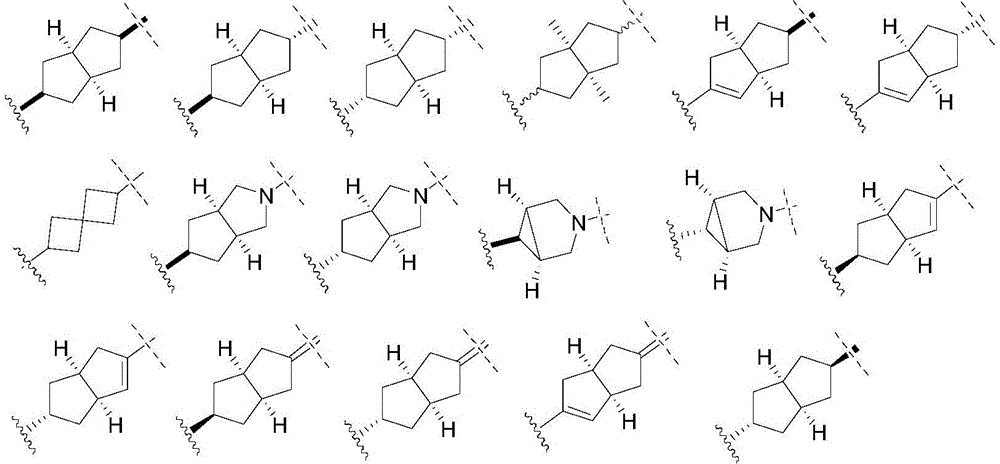
其中


在另一优选例中,所述的化合物具有以下结构:In another preferred embodiment, the compound has the following structure:

其中,T1和T2各自独立地选自CR15或N,其中R15为H、F、或OH;wherein, T 1 and T 2 are each independently selected from CR 15 or N, wherein R 15 is H, F, or OH;
Y-X选自如下组合:


其它各个基团的定义分别如上所述。The definitions of other individual groups are as described above, respectively.
在另一优选例中,所述的化合物具有以下结构:In another preferred embodiment, the compound has the following structure:

Y-X选自如下组合:


在另一优选例中,所述的化合物具有以下结构:In another preferred embodiment, the compound has the following structure:

其中,T1和T2各自独立地选自CR15或N,其中R15为H、F、或OH,wherein, T 1 and T 2 are each independently selected from CR 15 or N, wherein R 15 is H, F, or OH,
Y-X选自如下组合:


其它各个基团的定义分别如上所述。The definitions of other individual groups are as described above, respectively.
在另一优选例中,所述的化合物具有以下结构:In another preferred embodiment, the compound has the following structure:

Y-X选自如下组合:


在另一优选例中,所述的化合物具有以下结构:In another preferred embodiment, the compound has the following structure:

其中,所述的G1选自下组:Wherein, described G 1 is selected from the following group:


所述的G2选自下组:Described G2 is selected from the following group:

在另一优选例中,所述的G1选自下组:In another preferred embodiment, described G1 is selected from the following group:

所述的G2选自下组:Described G2 is selected from the following group:

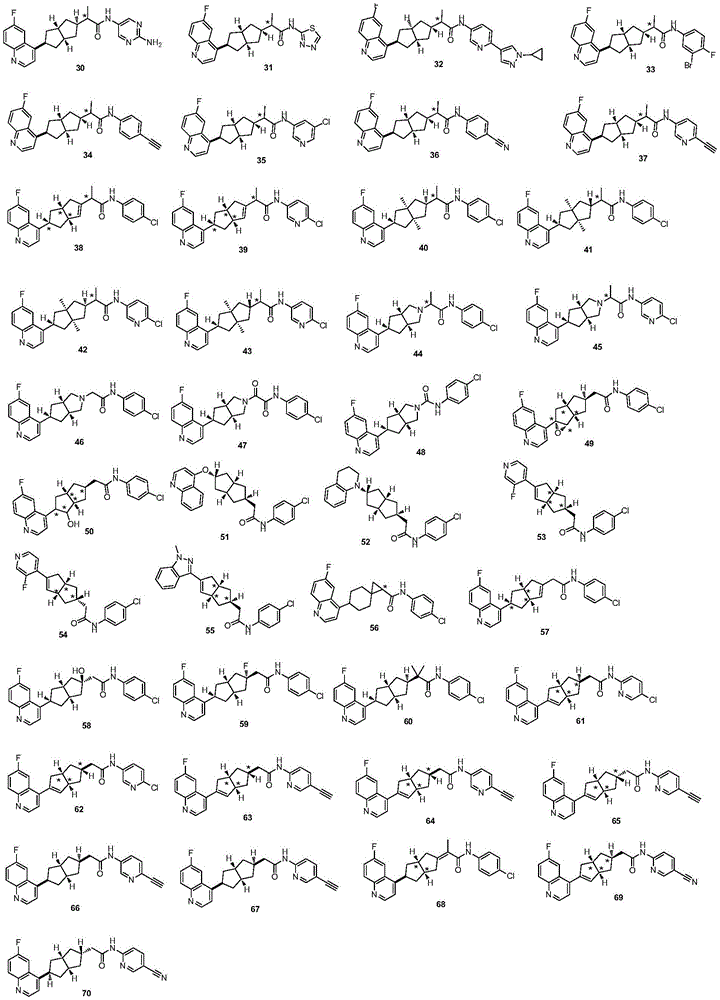
在另一优选例中,各个基团为实施例中具体化合物中的对应基团。In another preferred embodiment, each group is the corresponding group in the specific compound in the embodiment.
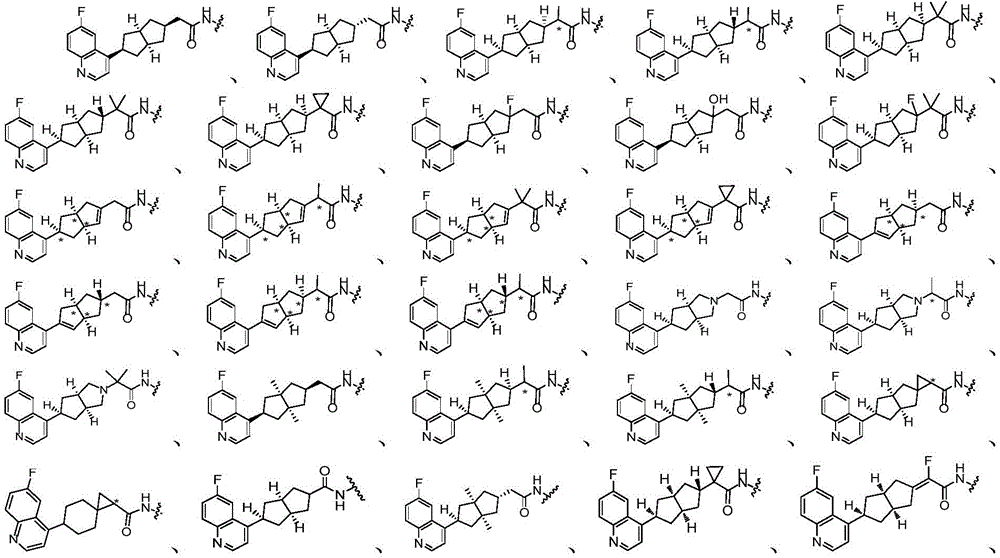
在另一优选例中,所述的式(I)所示的化合物具有选自下组的结构:In another preference, the compound shown in the formula (I) has a structure selected from the following group:



其中,“*”表示手性中心。Among them, "*" represents the chiral center.
上述各个化合物,如果涉及到一个或多个手性中心的,表明本发明专利所指的化合物是它们的对映异构体,非对映异构体,和/或它们的消旋物和混合物;Each of the above compounds, if related to one or more chiral centers, indicates that the compounds referred to by the patent of the present invention are their enantiomers, diastereomers, and/or their racemates and mixtures ;
除非特别标明,所有烯键的构型均包括顺式构型和反式构型。此外,当两个取代基同时在一个饱和环上(包括并环),可能产生顺式和反式构型,也在本发明包括的范围内。Unless otherwise specified, all configurations of olefinic bonds include cis and trans configurations. In addition, when two substituents are simultaneously on a saturated ring (including a ring), cis and trans configurations may result and are also encompassed by the present invention.
本发明的第二方面,提供了一种如本发明第一方面所述的式I化合物的用途,用于:The second aspect of the present invention provides a use of the compound of formula I as described in the first aspect of the present invention for:
(a)制备治疗与IDO活性或表达相关的疾病的药物;和/或(a) the manufacture of a medicament for the treatment of a disease associated with IDO activity or expression; and/or
(b)制备治疗与HDAC活性或表达相关的疾病的药物;和/或(b) the manufacture of a medicament for the treatment of a disease associated with HDAC activity or expression; and/or
(c)制备IDO免疫抑制剂;和/或(c) preparation of IDO immunosuppressants; and/or
(d)制备IDO-HDAC双重免疫/靶向抑制剂;和/或(e)体外非治疗性地抑制IDO的活性;和/或双重抑制IDO-HDAC的活性。(d) preparing a dual immune/targeting inhibitor of IDO-HDAC; and/or (e) non-therapeutic inhibition of IDO activity in vitro; and/or dual inhibition of IDO-HDAC activity.
在另一优选例中,所述肿瘤选自下组:肺癌、膀胱癌、乳腺癌、胃癌、肝癌、唾液腺肉瘤、卵巢癌、前列腺癌、宫颈癌、上皮细胞癌、多发性骨髓瘤、胰腺癌、淋巴瘤、慢性髓性白血病、淋巴细胞性白血病、皮肤T细胞淋巴瘤等。In another preferred embodiment, the tumor is selected from the group consisting of: lung cancer, bladder cancer, breast cancer, stomach cancer, liver cancer, salivary gland sarcoma, ovarian cancer, prostate cancer, cervical cancer, epithelial cell cancer, multiple myeloma, pancreatic cancer , lymphoma, chronic myeloid leukemia, lymphocytic leukemia, cutaneous T-cell lymphoma, etc.
本发明的第三方面,提供了一种药物组合物,所述的药物组合物包括:(i)治疗有效量的如本发明第一方面所述的化合物,或其药学上可接受的盐;和(ii)药学上可接受的载体。The third aspect of the present invention provides a pharmaceutical composition comprising: (i) a therapeutically effective amount of the compound described in the first aspect of the present invention, or a pharmaceutically acceptable salt thereof; and (ii) a pharmaceutically acceptable carrier.
在另一优选例中,所述的药物组合物还包括选自下组的有效组分:治疗有效量的PD-1和/或PD-L1。In another preferred embodiment, the pharmaceutical composition further comprises an effective component selected from the group consisting of: a therapeutically effective amount of PD-1 and/or PD-L1.
本发明的第四方面,提供了一种抑制IDO活性的方法,和/或双重抑制IDO-HDAC 的活性的方法,其特征在于,所述方法包括步骤:对抑制对象施用抑制有效量的如本发明第一方面所述的式I化合物,或其药学上可接受的盐,或对抑制对象施用抑制有效量的如本发明第三方面所述的药物组合物。The fourth aspect of the present invention provides a method for inhibiting the activity of IDO, and/or a method for double inhibiting the activity of IDO-HDAC, characterized in that, the method comprises the step of: administering an inhibitory effective amount of the The compound of formula I described in the first aspect of the present invention, or a pharmaceutically acceptable salt thereof, or an inhibitory effective amount of the pharmaceutical composition described in the third aspect of the present invention is administered to an inhibitory subject.
在另一优选例中,所述的抑制是IDO选择性抑制。In another preferred embodiment, the inhibition is IDO selective inhibition.
在另一优选例中,所述的抑制是IDO-HDAC选择性抑制。In another preferred embodiment, the inhibition is selective inhibition of IDO-HDAC.
在另一优选例中,所述的IDO活性抑制是体外非治疗性的抑制。In another preferred embodiment, the inhibition of IDO activity is non-therapeutic inhibition in vitro.
在另一优选例中,所述的IDO-HDAC活性抑制是体外非治疗性的抑制。In another preferred embodiment, the inhibition of IDO-HDAC activity is non-therapeutic in vitro inhibition.
本发明的第五方面,提供了一种药物组合物,其特征在于,所述的药物组合物包括:本发明第一方面所述的化合物I,或其药学上可接受的盐,和任选的抗体PD-1 或PD-L1或CTLA-4。The fifth aspect of the present invention provides a pharmaceutical composition, characterized in that the pharmaceutical composition comprises: the compound I described in the first aspect of the present invention, or a pharmaceutically acceptable salt thereof, and optionally Antibodies to PD-1 or PD-L1 or CTLA-4.
在另一优选例中,所述的药物组合物用于治疗癌症。In another preferred embodiment, the pharmaceutical composition is used to treat cancer.
在另一优选例中,所述的癌症选自下组:乳腺癌、淋巴癌、白血病、肺癌、卵巢癌、宫颈癌、睾丸癌、肝癌、黑素瘤、结肠癌、直肠癌、肾细胞癌、小肠癌和食道癌、头颈癌、膀胱癌、前列腺癌、胰腺癌、或咽癌。In another preferred embodiment, the cancer is selected from the group consisting of breast cancer, lymphoma, leukemia, lung cancer, ovarian cancer, cervical cancer, testicular cancer, liver cancer, melanoma, colon cancer, rectal cancer, renal cell carcinoma , small bowel and esophagus, head and neck, bladder, prostate, pancreatic, or pharyngeal cancers.
本发明的第六方面,提供了一种如本发明第一方面所述化合物的制备方法,所述方法包括步骤:The sixth aspect of the present invention provides a method for preparing the compound according to the first aspect of the present invention, the method comprising the steps of:


(viii)在惰性溶剂中,通过Wittig反应,然后经Pd-C催化氢化及脱保护基团,将化合物I-1转化为I-2;(viii) Converting compound 1-1 to 1-2 in an inert solvent by Wittig reaction followed by Pd-C catalyzed hydrogenation and deprotection group;
(ix)在惰性溶剂中,在碱(如2,6-双叔丁基吡啶或KHMDS或LiHMDS)和Tf2O(或PhNTf2)的作用下将化合物I-2转变为I-3,然后再与相应的芳基或杂芳基的硼化合物反应,得到含有烯键的偶联化合物,经催化氢化得到化合物I-4;(ix) converting compound 1-2 to 1-3 in the presence of a base (such as 2,6-bis-tert-butylpyridine or KHMDS or LiHMDS) and Tf 2 O (or PhNTf 2 ) in an inert solvent, followed by Then react with the corresponding aryl or heteroaryl boron compound to obtain a coupling compound containing an ethylenic bond, and obtain compound I-4 through catalytic hydrogenation;
(x)化合物I-4经酯水解,得到的酸与I-5反应,得到化合物I-6;(x) compound 1-4 is hydrolyzed by ester, and the obtained acid reacts with 1-5 to obtain compound 1-6;
(xi)在惰性溶剂中,在碱的作用下可在化合物I-6的酰胺基的α-位引入基团,得到化合物I;(xi) In an inert solvent, under the action of a base, a group can be introduced into the α-position of the amide group of compound I-6 to obtain compound I;

(xii)化合物I-4经酯水解,得到的酸与Evans的手性试剂(通常R”为苯基或苄基)反应得II-1,从而达到在酰胺基的α-位引入手性基团R3,得到化合物II-2;(xii) Compound I-4 is hydrolyzed by ester, and the obtained acid reacts with Evans' chiral reagent (usually R" is phenyl or benzyl) to obtain II-1, so as to introduce a chiral group at the α-position of the amide group group R 3 to obtain compound II-2;
(xiii)化合物II-2水解后得到酸II-3,然后与I-5反应得到化合物II。(xiii) Compound II-2 is hydrolyzed to obtain acid II-3, which is then reacted with I-5 to obtain compound II.
(xiv)当(v)中所用的Evans的手性试剂(通常R”为苯基或苄基)为另一个构型时,上述(v) 和(vi)步骤可制备得到化合物IIa。化合物IIa是化合物II的对映异构体。(xiv) When the Evans chiral reagent (usually R" is phenyl or benzyl) used in (v) is in another configuration, the above steps (v) and (vi) can prepare compound IIa. Compound IIa is the enantiomer of compound II.

(viii)从化合物I-1出发,经多步反应制备α-酮酸酯III-4,然后经Wittig反应制备α,β-不饱和酯III-5。化合物III-5的双键环丙化反应得到化合物III-6。最后酯水解和酰胺化反应得到化合物III。(viii) Starting from compound I-1, α-ketoester III-4 is prepared through multi-step reaction, and then α,β-unsaturated ester III-5 is prepared through Wittig reaction. Double bond cyclopropanation of compound III-5 yields compound III-6. Finally, ester hydrolysis and amidation reaction gave compound III.


应理解,在本发明的范围中,本发明的上述各技术特征和在下文(如实施例)中具体描述的各技术特征之间都可以互相组合,从而构成新的或优选的技术方案。限于篇幅,在此不再一一累述。It should be understood that, within the scope of the present invention, the above-mentioned technical features of the present invention and the technical features specifically described in the following (eg, embodiments) can be combined with each other to form new or preferred technical solutions. Due to space limitations, it is not repeated here.
具体实施方式Detailed ways
本发明人经过长期而深入的研究,意外地发现了一类具有IDO抑制活性和/或IDO-HDAC双重抑制活性的多环化合物,因此可以用于制备治疗与IDO和/或HDAC活性或表达量相关的疾病的药物组合物。基于上述发现,发明人完成了本发明。After long-term and in-depth research, the inventors have unexpectedly discovered a class of polycyclic compounds with IDO inhibitory activity and/or IDO-HDAC dual inhibitory activity, which can be used to prepare therapeutic and IDO and/or HDAC activity or expression levels A pharmaceutical composition for related diseases. Based on the above findings, the inventors have completed the present invention.
术语the term
除特别说明之处,本文中提到的“或”具有与“和/或”相同的意义(指“或”以及“和”)。Unless otherwise specified, "or" referred to herein has the same meaning as "and/or" (meaning "or" and "and").
除特别说明之处,本发明的所有化合物之中,各手性碳原子(手性中心)可以任选地为R构型或S构型,或R构型和S构型的混合物。Unless otherwise specified, in all compounds of the present invention, each chiral carbon atom (chiral center) may optionally be in the R configuration or the S configuration, or a mixture of the R configuration and the S configuration.
如本文所用,在单独或作为其他取代基一部分时,术语“烷基”指只含碳原子的直链(即,无支链)或支链饱和烃基,或直链和支链组合的基团。当烷基前具有碳原子数限定(如C1-10)时,指所述的烷基含有1-10个碳原子。例如,C1-8烷基指含有1-8个碳原子的烷基,包括甲基、乙基、丙基、异丙基、丁基、异丁基、仲丁基、叔丁基、或类似基团。As used herein, the term "alkyl", alone or as part of other substituents, refers to a straight chain (ie, unbranched) or branched saturated hydrocarbon group containing only carbon atoms, or a combination of straight and branched chain groups . When an alkyl group is preceded by a carbon number limitation (eg, C 1-10 ), it means that the alkyl group contains 1-10 carbon atoms. For example, C 1-8 alkyl refers to an alkyl group containing 1-8 carbon atoms, including methyl, ethyl, propyl, isopropyl, butyl, isobutyl, sec-butyl, tert-butyl, or similar groups.
如本文所用,在单独或作为其他取代基一部分时,术语“烯基”是指直链或支链,具有至少一个碳-碳双键的碳链基团。烯基可以是取代的或未取代的。当烯基前具有碳原子数限定(如C2-8)时,指所述的烯基含有2-8个碳原子。例如,C2-8烯基指含有2-8 个碳原子烯基,包括乙烯基、丙烯基、1,2-丁烯基、2,3-丁烯基、丁二烯基、或类似基团。As used herein, the term "alkenyl", alone or as part of other substituents, refers to a straight or branched, carbon chain group having at least one carbon-carbon double bond. Alkenyl groups can be substituted or unsubstituted. When an alkenyl group is preceded by a carbon number limitation (eg, C2-8 ), it means that the alkenyl group contains 2-8 carbon atoms. For example, C 2-8 alkenyl refers to an alkenyl group containing 2-8 carbon atoms, including vinyl, propenyl, 1,2-butenyl, 2,3-butenyl, butadienyl, or the like group.
如本文所用,在单独或作为其他取代基一部分时,术语“炔基”是指具有至少一个碳-碳三键的脂肪族碳氢基团。所述的炔基可以是直链或支链的,或其组合。当炔基前具有碳原子数限定(如C2-8炔基)时,指所述的炔基含有2-8个碳原子。例如,术语“C2-8炔基”指具有2-8个碳原子的直链或支链炔基,包括乙炔基、丙炔基、异丙炔基、丁炔基、异丁炔基、仲丁炔基、叔丁炔基、或类似基团。As used herein, the term "alkynyl", alone or as part of other substituents, refers to an aliphatic hydrocarbon group having at least one carbon-carbon triple bond. The alkynyl group can be straight or branched, or a combination thereof. When an alkynyl group is preceded by a carbon number limitation (eg, C 2-8 alkynyl), it means that the alkynyl group contains 2-8 carbon atoms. For example, the term "C 2-8 alkynyl" refers to straight or branched chain alkynyl groups having 2-8 carbon atoms, including ethynyl, propynyl, isopropynyl, butynyl, isobutynyl, sec-butynyl, tert-butynyl, or similar groups.
如本文所用,在单独或作为其他取代基一部分时,术语“环烷基”指具有饱和的或部分饱和的单元环,二环或多环(稠环、桥环或螺环)环系基团。当某个环烷基前具有碳原子数限定(如C3-10)时,指所述的环烷基含有3-10个碳原子。在一些优选实施例中,术语“C3-8环烷基”指具有3-8个碳原子的饱和或部分饱和的单环或二环烷基,包括环丙基、环丁基、环戊基、环庚基、或类似基团。“螺环烷基”指单环之间共用一个碳原子 (称螺原子)的二环或多环基团,这些可以含有一个或多个双键,但没有一个环具有完全共轭的π电子系统。“稠环烷基”指系统中的每个环与体系中的其他环共享毗邻的一对碳原子的全碳二环或多环基团,其中一个或多个环可以含有一个或多个双键,但没有一个环具有完全共轭的π电子系统。“桥环烷基”指任意两个环共用两个不直接连接的碳原子的全碳多环基团,这些可以含有一个或多个双键,但没有一个环具有完全共轭的π电子系统。所述环烷基所含原子全部为碳原子。如下是环烷基的一些例子,本发明并不仅局限下述的环烷基。As used herein, the term "cycloalkyl", alone or as part of other substituents, refers to a monocyclic, bicyclic or polycyclic (fused, bridged or spiro) ring system group having saturated or partially saturated . When a cycloalkyl group is preceded by a carbon number limitation (eg C 3-10 ), it means that the cycloalkyl group contains 3-10 carbon atoms. In some preferred embodiments, the term "C 3-8 cycloalkyl" refers to saturated or partially saturated monocyclic or bicycloalkyl groups having 3-8 carbon atoms, including cyclopropyl, cyclobutyl, cyclopentane , cycloheptyl, or similar groups. "Spirocycloalkyl" refers to a bicyclic or polycyclic group in which a single carbon atom (called a spiro atom) is shared between the monocyclic rings, these may contain one or more double bonds, but none of the rings have fully conjugated pi electrons system. "Fused cycloalkyl" refers to an all-carbobicyclic or polycyclic group in which each ring in the system shares an adjacent pair of carbon atoms with other rings in the system, wherein one or more rings may contain one or more bicyclic bonds, but none of the rings have a fully conjugated pi electron system. "Bridged cycloalkyl" refers to an all-carbon polycyclic group in which any two rings share two non-directly attached carbon atoms, these may contain one or more double bonds, but none of the rings have a fully conjugated pi-electron system . The atoms contained in the cycloalkyl group are all carbon atoms. The following are some examples of cycloalkyl groups, and the present invention is not limited to the following cycloalkyl groups.

除非有相反陈述,否则下列用在说明书和权利要求书中的术语具有下述含义。“芳基”指具有共轭的π电子体系的全碳单环或稠合多环(也就是共享毗邻碳原子对的环)基团,例如苯基和萘基。所述芳基环可以稠合于其它环状基团(包括饱和和不饱和环),但不能含有杂原子如氮,氧,或硫,同时连接母体的点必须在具有共轭的π电子体系的环上的碳原子上。芳基可以是取代的或未取代的。如下是芳基的一些例子,本发明并不仅局限下述的芳基。Unless stated to the contrary, the following terms used in the specification and claims have the following meanings. "Aryl" refers to an all-carbon monocyclic or fused polycyclic (ie, rings that share adjacent pairs of carbon atoms) groups having a conjugated pi-electron system, such as phenyl and naphthyl. The aryl ring can be fused to other cyclic groups (including saturated and unsaturated rings), but cannot contain heteroatoms such as nitrogen, oxygen, or sulfur, and the point of attachment to the parent must be in a conjugated pi-electron system on the carbon atom of the ring. Aryl groups can be substituted or unsubstituted. The following are some examples of aryl groups, and the present invention is not limited to the following aryl groups.

“杂芳基”指包含一个到多个杂原子的杂芳族基团。这里所指的杂原子包括氧、硫和氮。例如呋喃基、噻吩基、吡啶基、吡唑基、吡咯基、N-烷基吡咯基、嘧啶基、吡嗪基、咪唑基、四唑基等。所述杂芳基环可以稠合于芳基、杂环基或环烷基环上,其中与母体结构连接在一起的环为杂芳基环。杂芳基可以是任选取代的或未取代的。如下是杂芳基的一些例子,本发明并不仅局限下述的杂芳基。其中,最后三个杂芳基是三环杂芳基,是本发明的重点。"Heteroaryl" refers to a heteroaromatic group containing one to more heteroatoms. The heteroatoms referred to herein include oxygen, sulfur and nitrogen. For example, furyl, thienyl, pyridyl, pyrazolyl, pyrrolyl, N-alkylpyrrolyl, pyrimidinyl, pyrazinyl, imidazolyl, tetrazolyl and the like. The heteroaryl ring can be fused to an aryl, heterocyclyl or cycloalkyl ring, wherein the ring attached to the parent structure is a heteroaryl ring. Heteroaryl groups can be optionally substituted or unsubstituted. The following are some examples of heteroaryl groups, and the present invention is not limited to the following heteroaryl groups. Among them, the last three heteroaryl groups are tricyclic heteroaryl groups, which are the focus of the present invention.
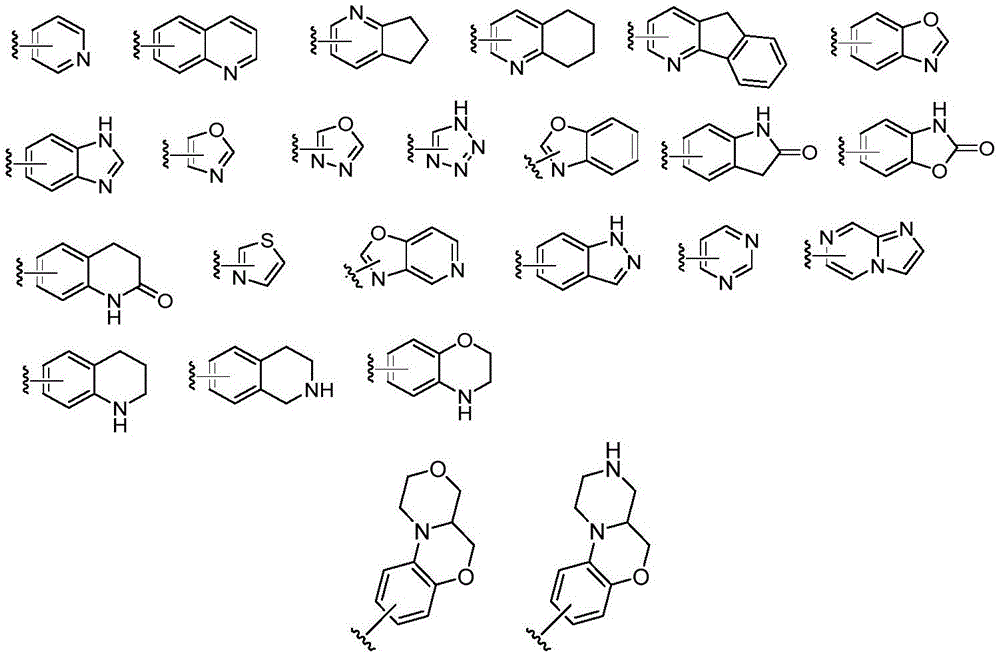
“杂环基”指饱和或部分不饱和单环或多环环状烃取代基,其中一个或多个环原子选自氮、氧或硫,其余环原子为碳。单环杂环基的非限制性实施例包含吡咯烷基、哌啶基、哌嗪基、吗啉基、硫代吗啉基、高哌嗪基。多环杂环基指包括螺环、稠环和桥环的杂环基。“螺环杂环基”指系统中的每个环与体系中的其他环之间共用一个原子 (称螺原子)的多环杂环基团,其中一个或多个环原子选自氮、氧或硫,其余环原子为碳。“稠环杂环基”指系统中的每个环与体系中的其他环共享毗邻的一对原子的多环杂环基团,一个或多个环可以含有一个或多个双键,但没有一个环具有完全共轭的π电子系统,而且其中一个或多个环原子选自氮、氧或硫,其余环原子为碳。“桥环杂环基”指任意两个环共用两个不直接连接的原子的多环杂环基团,这些可以含有一个或多个双键,但没有一个环具有完全共轭的π电子系统,而且其中一个或多个环原子选自氮、氧或硫,其余环原子为碳。如果杂环基里同时有饱和环和芳环存在(比如说饱和环和芳环稠合在一起),连接到母体的点一定是在饱和的环上。注:当连接到母体的点在芳环上时,称为杂芳基,不称为杂环基。如下是杂环基的一些例子,本发明并不仅局限下述的杂环基。"Heterocyclyl" refers to a saturated or partially unsaturated monocyclic or polycyclic cyclic hydrocarbon substituent wherein one or more ring atoms are selected from nitrogen, oxygen or sulfur and the remaining ring atoms are carbon. Non-limiting examples of monocyclic heterocyclyl groups include pyrrolidinyl, piperidinyl, piperazinyl, morpholinyl, thiomorpholinyl, homopiperazinyl. Polycyclic heterocyclyl refers to heterocyclyl including spiro, fused and bridged rings. "Spirocyclic heterocyclyl" refers to a polycyclic heterocyclic group in which each ring in the system shares one atom (called a spiro atom) with other rings in the system, wherein one or more ring atoms are selected from nitrogen, oxygen or sulfur, the remaining ring atoms are carbon. "Fused-ring heterocyclyl" refers to a polycyclic heterocyclic group in which each ring in the system shares an adjacent pair of atoms with other rings in the system, one or more rings may contain one or more double bonds, but no A ring has a fully conjugated pi electron system and one or more ring atoms are selected from nitrogen, oxygen or sulfur, and the remaining ring atoms are carbon. "Bridged heterocyclyl" refers to a polycyclic heterocyclic group in which any two rings share two atoms that are not directly connected, these may contain one or more double bonds, but none of the rings have a fully conjugated pi-electron system , and one or more ring atoms are selected from nitrogen, oxygen or sulfur, and the remaining ring atoms are carbon. If both saturated and aromatic rings are present in the heterocyclyl group (for example, the saturated and aromatic rings are fused together), the point of attachment to the parent must be on the saturated ring. Note: When the point of attachment to the parent is on an aromatic ring, it is called a heteroaryl group, not a heterocyclyl group. The following are some examples of heterocyclic groups, and the present invention is not limited to the following heterocyclic groups.

如本文所用,在单独或作为其他取代基一部分时,术语“卤素”指F、Cl、Br和I。As used herein, alone or as part of other substituents, the term "halogen" refers to F, Cl, Br, and I.
如本文所用,术语“取代”(在有或无“任意地”修饰时)指特定的基团上的一个或多个氢原子被特定的取代基所取代。特定的取代基为在前文中相应描述的取代基,或各实施例中所出现的取代基。除非特别说明,某个任意取代的基团可以在该基团的任何可取代的位点上具有一个选自特定组的取代基,所述的取代基在各个位置上可以是相同或不同的。环状取代基,例如杂环基,可以与另一个环相连,例如环烷基,从而形成螺二环系,即两个环具有一个共用碳原子。本领域技术人员应理解,本发明所预期的取代基的组合是那些稳定的或化学上可实现的组合。所述取代基例如(但并不限于):C1-8烷基、C2-8烯基、C2-8炔基、C3-8环烷基、3-至12-元杂环基,芳基、杂芳基、卤素、羟基、羧基(-COOH)、C1-8醛基、C2-10酰基、C2-10酯基、氨基。As used herein, the term "substituted" (with or without "optionally" modification) refers to the replacement of one or more hydrogen atoms on a specified group with a specified substituent. Particular substituents are those described correspondingly in the preceding paragraphs, or the substituents appearing in the various examples. Unless otherwise specified, an optionally substituted group may have at any substitutable position of the group a substituent selected from a specified group, which may be the same or different at each position. A cyclic substituent, such as a heterocyclyl, can be attached to another ring, such as a cycloalkyl, to form a spirobicyclic ring system, ie, the two rings have one carbon atom in common. It will be understood by those skilled in the art that combinations of substituents contemplated by the present invention are those that are stable or chemically achievable. The substituents are for example (but not limited to): C 1-8 alkyl, C 2-8 alkenyl, C 2-8 alkynyl, C 3-8 cycloalkyl, 3- to 12-membered heterocyclyl , aryl, heteroaryl, halogen, hydroxyl, carboxyl (-COOH), C 1-8 aldehyde group, C 2-10 acyl group, C 2-10 ester group, amino group.
为了方便以及符合常规理解,术语“任意取代”或“任选取代”只适用于能够被取代基所取代的位点,而不包括那些化学上不能实现的取代。For convenience and conventional understanding, the terms "optionally substituted" or "optionally substituted" apply only to sites that can be substituted by substituents, and do not include those chemically infeasible substitutions.
如本文所用,除非特别说明,术语“药学上可接受的盐”指适合与对象(例如,人)的组织接触,而不会产生不适度的副作用的盐。在一些实施例中,本发明的某一化合物的药学上可接受的盐包括具有酸性基团的本发明的化合物的盐(例如,钾盐,钠盐,镁盐,钙盐)或具有碱性基团的本发明的化合物的盐(例如,硫酸盐,盐酸盐,磷酸盐,硝酸盐,碳酸盐)。As used herein, unless otherwise specified, the term "pharmaceutically acceptable salt" refers to a salt suitable for contact with the tissue of a subject (eg, a human) without undue side effects. In some embodiments, a pharmaceutically acceptable salt of a compound of the present invention includes a salt of a compound of the present invention that has an acidic group (eg, potassium, sodium, magnesium, calcium) or has a basic salts of compounds of the invention (eg, sulfates, hydrochlorides, phosphates, nitrates, carbonates).
化合物的通用合成方法General Synthesis of Compounds
本本发明通式I所示化合物可通过如下的方法制得,然而该方法的条件,例如反应物、溶剂、碱、所用化合物的量、反应温度、反应所需时间等不限于下面的解释。本发明化合物还可以任选将在本说明书中描述的或本领域已知的各种合成方法组合起来而方便的制得,这样的组合可由本发明所属领域的技术人员容易地进行。The compound represented by the general formula I of the present invention can be prepared by the following method, but the conditions of the method, such as reactants, solvent, base, amount of the compound used, reaction temperature, time required for the reaction, etc., are not limited to the following explanations. The compounds of the present invention can also be conveniently prepared by optionally combining various synthetic methods described in this specification or known in the art, and such combinations can be easily performed by those skilled in the art to which the present invention pertains.
在本发明的制备方法中,各反应通常在惰性溶剂中,反应温度-78℃~150℃(优选20~120℃)下进行。各步反应时间通常为0.5~48h,较佳地为2~12h。In the preparation method of the present invention, each reaction is usually carried out in an inert solvent at a reaction temperature of -78°C to 150°C (preferably 20 to 120°C). The reaction time of each step is usually 0.5-48h, preferably 2-12h.
反应式A-1描述了化合物A11的通用合成方法:Reaction scheme A-1 describes the general synthesis method of compound A11:
反应式A-1Reaction formula A-1

反应式A-2描述了化合物A13的通用合成方法:Reaction scheme A-2 describes the general synthesis method of compound A13:
反应式A-2Reaction formula A-2

反应式A-3描述了中间体A9的另外一个通用合成方法:Reaction scheme A-3 describes another general synthetic method of intermediate A9:
反应式A-3Reaction formula A-3

中间体A9是一个关键中间体,它可以用来制备化合物A11和A13(见反应式A-1和A-2)。应该提到的是,上述方法得到得的化合物A13是消旋体。Intermediate A9 is a key intermediate, which can be used to prepare compounds A11 and A13 (see Reaction Schemes A-1 and A-2). It should be mentioned that the compound A13 obtained by the above method is a racemate.
反应式A-4描述了化合物A20的通用手性合成方法:Reaction scheme A-4 describes the general chiral synthesis method of compound A20:
反应式A-4Reaction formula A-4

这里的A20是A13的其中一个手性对映异构体。另一个对映异构体的制备可根据上面反应式,使用另一个手性诱导试剂(也称Evans chiral auxiliary)如
反应式B-1描述了化合物B7的通用合成方法:Reaction formula B-1 describes the general synthesis method of compound B7:
反应式B-1Reaction formula B-1

这里的化合物B7是消旋体。可以根据需要使用反应式A-4的方法来制备B7的两个旋光纯度高的单一的对映异构体。Compound B7 here is a racemate. The two single enantiomers of B7 with high optical purity can be prepared by using the method of reaction formula A-4 as required.
反应式B-2描述了化合物B14的通用合成方法:Reaction formula B-2 describes the general synthesis method of compound B14:
反应式B-2Reaction formula B-2

其中,L为离去基团。这里得到的化合物B14为消旋体。可以通过手性的制备HPLC分离得到B14的两个旋光纯度高的单一的对映异构体。Wherein, L is a leaving group. The compound B14 obtained here is a racemate. Two single enantiomers of B14 with high optical purity can be separated by chiral preparative HPLC.
另外,B14也可以通过中间体B12和B15直接进行取代反应得到。In addition, B14 can also be obtained by direct substitution reaction of intermediates B12 and B15.

反应式C-1描述了化合物C6的通用合成方法:Reaction formula C-1 describes the general synthesis method of compound C6:
反应式C-1Reaction formula C-1

其中,L为离去基团。Wherein, L is a leaving group.
反应式C-2描述了中间体C4另一个通用合成方法。中间体C4是制备化合物C6的关键原料:Scheme C-2 describes another general synthesis of intermediate C4. Intermediate C4 is the key raw material for the preparation of compound C6:
反应式C-2Reaction formula C-2

其中,L为离去基团。Wherein, L is a leaving group.
反应式D-1描述了化合物D2的通用合成方法:Reaction scheme D-1 describes the general synthesis method of compound D2:
反应式D-1:Reaction formula D-1:

反应式D-2描述了化合物D6的通用合成方法:Reaction scheme D-2 describes the general synthesis method of compound D6:
反应式D-2Reaction formula D-2

其中,L为离去基团。Wherein, L is a leaving group.
这里的化合物D2和D6为消旋体。可以通过手性的制备HPLC分离得到它们各自的两个旋光纯度高的单一的对映异构体。Compounds D2 and D6 here are racemates. The two individual enantiomers of each of them can be separated by chiral preparative HPLC in high optical purity.
如下化合物D7,D8,D9,和D10可根据上述所列出的反应式进行组合来制备得到:The following compounds D7, D8, D9, and D10 can be prepared by combining according to the reaction formulas listed above:

反应式E-1描述了化合物E10的通用合成方法:Reaction E-1 describes the general synthesis method of compound E10:
反应式E-1:Reaction formula E-1:

反应式F-1描述了化合物F7的通用合成方法:Reaction formula F-1 describes the general synthesis method of compound F7:
反应式F-1:Reaction formula F-1:
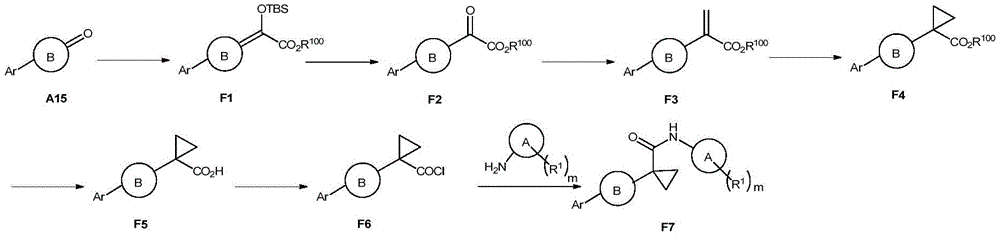
应该指出的是,上述各反应式旨在以化合物A11,A13,A20,B7,B14,C6,D2,D6, D7,D8,D9,D10,E10和F7为例子,列出它们的通式合成路线。我们的实际合成路线并不局限于上述路线。其他的相关的合成路线对于有专业知识的有机化学家和药物化学家来说,应该是显而易见的。在这里就不一一阐述。所述的化合物A11,A13,A20,B7, B14,C6,D2,D6,D7,D8,D9,D10,E10和F7都是式(I)的一部分。其它的没有列出的式(I)分子可以根据上面的反应式进行设计合成来得到。It should be noted that the above reaction formulas are intended to take compounds A11, A13, A20, B7, B14, C6, D2, D6, D7, D8, D9, D10, E10 and F7 as examples to list their general formula synthesis route. Our actual synthetic route is not limited to the above route. Other relevant synthetic routes should be apparent to skilled organic chemists and medicinal chemists. It will not be elaborated here. Said compounds A11, A13, A20, B7, B14, C6, D2, D6, D7, D8, D9, D10, E10 and F7 are all part of formula (I). Other molecules of formula (I) not listed can be designed and synthesized according to the above reaction formula.
药学上可接受的盐、溶剂合物、立体异构体、互变异构体Pharmaceutically acceptable salts, solvates, stereoisomers, tautomers
如本文所用,术语“药学上可接受的盐”指本发明化合物与药学上可接受的无机酸和有机酸所形成的盐,其中,优选的无机酸包括(但并不限于):盐酸、氢溴酸、磷酸、硝酸、硫酸;优选的有机酸包括(但并不限于):甲酸、乙酸、丙酸、丁二酸、萘二磺酸(1,5)、亚细亚酸、草酸、酒石酸、乳酸、水杨酸、苯甲酸、戊酸、二乙基乙酸、丙二酸、琥珀酸、富马酸、庚二酸、己二酸、马来酸、苹果酸、氨基磺酸、苯丙酸、葡糖酸、抗坏血酸、烟酸、异烟酸、甲磺酸、对甲苯磺酸、柠檬酸,以及氨基酸。As used herein, the term "pharmaceutically acceptable salts" refers to salts of compounds of the present invention with pharmaceutically acceptable inorganic and organic acids, wherein preferred inorganic acids include (but are not limited to): hydrochloric acid, hydrogen Bromic acid, phosphoric acid, nitric acid, sulfuric acid; preferred organic acids include (but are not limited to): formic acid, acetic acid, propionic acid, succinic acid, naphthalenedisulfonic acid (1,5), succinic acid, oxalic acid, tartaric acid, lactic acid , salicylic acid, benzoic acid, valeric acid, diethyl acetic acid, malonic acid, succinic acid, fumaric acid, pimelic acid, adipic acid, maleic acid, malic acid, sulfamic acid, phenylpropionic acid, Gluconic acid, ascorbic acid, niacin, isonicotinic acid, methanesulfonic acid, p-toluenesulfonic acid, citric acid, and amino acids.
如本文所用,术语“药学上可接受的溶剂合物”指本发明化合物与药学上可接受的溶剂形成溶剂合物,其中,所述药学上可接受的溶剂包括(但并不限于):水、乙醇、甲醇、异丙醇、四氢呋喃、二氯甲烷。As used herein, the term "pharmaceutically acceptable solvate" refers to the formation of a solvate of a compound of the present invention with a pharmaceutically acceptable solvent, wherein the pharmaceutically acceptable solvent includes (but is not limited to): water , ethanol, methanol, isopropanol, tetrahydrofuran, dichloromethane.
如本文所用,术语“药学上可接受的立体异构体”指本发明化合物所涉及手性碳原子可以为R构型,也可以为S构型,或其组合。As used herein, the term "pharmaceutically acceptable stereoisomer" means that the chiral carbon atoms involved in the compounds of the present invention may be in the R configuration, or the S configuration, or a combination thereof.
药物组合物和施用方法Pharmaceutical compositions and methods of administration
由于本发明化合物具有优异的对IDO的抑制活性,因此本发明化合物及其各种晶型,药学上可接受的无机或有机盐,水合物或溶剂合物,以及含有本发明化合物为主要活性成分的药物组合物可用于治疗、预防以及缓解由与IDO活性或表达量相关的疾病。根据现有技术,本发明化合物可用于治疗以下疾病(但并不限于):各种癌症,列如肺癌、膀胱癌、乳腺癌、胃癌、肝癌、唾液腺肉瘤、卵巢癌、前列腺癌、宫颈癌、上皮细胞癌、多发性骨髓瘤、胰腺癌、淋巴瘤、慢性髓性白血病、淋巴细胞性白血病、皮肤T细胞淋巴瘤等;与骨骼相关的疾病,例如骨发育不全、软骨发育不良、侏儒症、克鲁宗综合征等;T细胞调节的炎症和自身免疫疾病,例如:类风湿关节炎、胶原II 关节炎、多发性硬化症、系统性红斑狼疮、银屑病、青少年型糖尿病、干燥综合征、甲状腺疾病、结节病、炎性肠病、乳糜泻等等。本发明的药物组合物包含安全有效量范围内的本发明化合物或其药理上可接受的盐及药理上可以接受的赋形剂或载体。其中“安全有效量”指的是:化合物的量足以明显改善病情,而不至于产生严重的副作用。通常,药物组合物含有1-2000mg本发明化合物/剂,更佳地,含有5-200mg本发明化合物/剂。较佳地,所述的“一剂”为一个胶囊或药片。Since the compound of the present invention has excellent inhibitory activity against IDO, the compound of the present invention and its various crystal forms, pharmaceutically acceptable inorganic or organic salts, hydrates or solvates, and containing the compound of the present invention as the main active ingredient The pharmaceutical composition can be used for the treatment, prevention and alleviation of diseases related to the activity or expression of IDO. According to the prior art, the compounds of the present invention can be used to treat (but not limited to) the following diseases: various cancers, such as lung cancer, bladder cancer, breast cancer, stomach cancer, liver cancer, salivary adenosarcoma, ovarian cancer, prostate cancer, cervical cancer, Epithelial cell carcinoma, multiple myeloma, pancreatic cancer, lymphoma, chronic myeloid leukemia, lymphocytic leukemia, cutaneous T-cell lymphoma, etc.; skeletal-related diseases such as osteogenesis imperfecta, achondroplasia, dwarfism, Crouzon syndrome, etc.; T cell-mediated inflammatory and autoimmune diseases such as: rheumatoid arthritis, collagen II arthritis, multiple sclerosis, systemic lupus erythematosus, psoriasis, juvenile diabetes, Sjögren's syndrome , thyroid disease, sarcoidosis, inflammatory bowel disease, celiac disease, etc. The pharmaceutical composition of the present invention comprises the compound of the present invention or a pharmacologically acceptable salt thereof and a pharmacologically acceptable excipient or carrier within a safe and effective amount. The "safe and effective amount" refers to: the amount of the compound is sufficient to significantly improve the condition without causing serious side effects. Typically, the pharmaceutical composition contains 1-2000 mg of the compound of the present invention per dose, more preferably 5-200 mg of the compound of the present invention per dose. Preferably, the "one dose" is a capsule or tablet.
“药学上可以接受的载体”指的是:一种或多种相容性固体或液体填料或凝胶物质,它们适合于人使用,而且必须有足够的纯度和足够低的毒性。“相容性”在此指的是组合物中各组份能和本发明的化合物以及它们之间相互掺和,而不明显降低化合物的药效。药学上可以接受的载体部分例子有纤维素及其衍生物(如羧甲基纤维素钠、乙基纤维素钠、纤维素乙酸酯等)、明胶、滑石、固体润滑剂(如硬脂酸、硬脂酸镁)、硫酸钙、植物油(如豆油、芝麻油、花生油、橄榄油等)、多元醇(如丙二醇、甘油、甘露醇、山梨醇等)、乳化剂(如
本发明化合物或药物组合物的施用方式没有特别限制,代表性的施用方式包括(但并不限于):口服、瘤内、直肠、肠胃外(静脉内、肌肉内或皮下)、和局部给药。The mode of administration of the compounds or pharmaceutical compositions of the present invention is not particularly limited, and representative modes of administration include (but are not limited to): oral, intratumoral, rectal, parenteral (intravenous, intramuscular or subcutaneous), and topical administration .
用于口服给药的固体剂型包括胶囊剂、片剂、丸剂、散剂和颗粒剂。在这些固体剂型中,活性化合物与至少一种常规惰性赋形剂(或载体)混合,如柠檬酸钠或磷酸二钙,或与下述成分混合:(a)填料或增容剂,例如,淀粉、乳糖、蔗糖、葡萄糖、甘露醇和硅酸;(b)粘合剂,例如,羟甲基纤维素、藻酸盐、明胶、聚乙烯基吡咯烷酮、蔗糖和阿拉伯胶;(c)保湿剂,例如,甘油;(d)崩解剂,例如,琼脂、碳酸钙、马铃薯淀粉或木薯淀粉、藻酸、某些复合硅酸盐、和碳酸钠;(e)缓溶剂,例如石蜡; (f)吸收加速剂,例如,季胺化合物;(g)润湿剂,例如鲸蜡醇和单硬脂酸甘油酯;(h) 吸附剂,例如,高岭土;和(i)润滑剂,例如,滑石、硬脂酸钙、硬脂酸镁、固体聚乙二醇、十二烷基硫酸钠,或其混合物。胶囊剂、片剂和丸剂中,剂型也可包含缓冲剂。Solid dosage forms for oral administration include capsules, tablets, pills, powders and granules. In these solid dosage forms, the active compound is mixed with at least one conventional inert excipient (or carrier), such as sodium citrate or dicalcium phosphate, or with (a) fillers or compatibilizers, for example, starch, lactose, sucrose, glucose, mannitol and silicic acid; (b) binders such as hydroxymethylcellulose, alginates, gelatin, polyvinylpyrrolidone, sucrose and acacia; (c) humectants, For example, glycerol; (d) disintegrants, such as agar, calcium carbonate, potato or tapioca starch, alginic acid, certain complex silicates, and sodium carbonate; (e) slow solvents, such as paraffin; (f) Absorption accelerators such as quaternary amine compounds; (g) wetting agents such as cetyl alcohol and glyceryl monostearate; (h) adsorbents such as kaolin; and (i) lubricants such as talc, hard Calcium fatty acid, magnesium stearate, solid polyethylene glycol, sodium lauryl sulfate, or mixtures thereof. In capsules, tablets and pills, the dosage form may also contain buffering agents.
固体剂型如片剂、糖丸、胶囊剂、丸剂和颗粒剂可采用包衣和壳材制备,如肠衣和其它本领域公知的材料。它们可包含不透明剂,并且,这种组合物中活性化合物或化合物的释放可以延迟的方式在消化道内的某一部分中释放。可采用的包埋组分的实例是聚合物质和蜡类物质。必要时,活性化合物也可与上述赋形剂中的一种或多种形成微胶囊形式。Solid dosage forms such as tablets, dragees, capsules, pills and granules can be prepared using coatings and shell materials, such as enteric coatings and other materials well known in the art. They may contain opacifying agents, and the release of the active compound or compounds in such compositions may be in a certain part of the digestive tract in a delayed manner. Examples of embedding components that can be employed are polymeric substances and waxes. If desired, the active compound may also be in microencapsulated form with one or more of the above-mentioned excipients.
用于口服给药的液体剂型包括药学上可接受的乳液、溶液、悬浮液、糖浆或酊剂。除了活性化合物外,液体剂型可包含本领域中常规采用的惰性稀释剂,如水或其它溶剂,增溶剂和乳化剂,例知,乙醇、异丙醇、碳酸乙酯、乙酸乙酯、丙二醇、1,3- 丁二醇、二甲基甲酰胺以及油,特别是棉籽油、花生油、玉米胚油、橄榄油、蓖麻油和芝麻油或这些物质的混合物等。Liquid dosage forms for oral administration include pharmaceutically acceptable emulsions, solutions, suspensions, syrups or tinctures. In addition to the active compound, liquid dosage forms may contain inert diluents conventionally employed in the art, such as water or other solvents, solubilizers and emulsifiers, for example, ethanol, isopropanol, ethyl carbonate, ethyl acetate, propylene glycol, 1 , 3-butanediol, dimethylformamide and oils, especially cottonseed oil, peanut oil, corn germ oil, olive oil, castor oil and sesame oil or mixtures of these substances, and the like.
除了这些惰性稀释剂外,组合物也可包含助剂,如润湿剂、乳化剂和悬浮剂、甜味剂、矫味剂和香料。Besides these inert diluents, the compositions can also contain adjuvants such as wetting agents, emulsifying and suspending agents, sweetening, flavoring and perfuming agents.
除了活性化合物外,悬浮液可包含悬浮剂,例如,乙氧基化异十八烷醇、聚氧乙烯山梨醇和脱水山梨醇酯、微晶纤维素、甲醇铝和琼脂或这些物质的混合物等。Suspensions, in addition to the active compounds, may contain suspending agents such as ethoxylated isostearyl alcohols, polyoxyethylene sorbitol and sorbitan esters, microcrystalline cellulose, aluminum methoxide and agar, or mixtures of these substances and the like.
用于肠胃外注射的组合物可包含生理上可接受的无菌含水或无水溶液、分散液、悬浮液或乳液,和用于重新溶解成无菌的可注射溶液或分散液的无菌粉末。适宜的含水和非水载体、稀释剂、溶剂或赋形剂包括水、乙醇、多元醇及其适宜的混合物。Compositions for parenteral injection may comprise physiologically acceptable sterile aqueous or anhydrous solutions, dispersions, suspensions or emulsions, and sterile powders for reconstitution into sterile injectable solutions or dispersions. Suitable aqueous and non-aqueous carriers, diluents, solvents or excipients include water, ethanol, polyols and suitable mixtures thereof.
用于局部给药的本发明化合物的剂型包括软膏剂、散剂、贴剂、喷射剂和吸入剂。活性成分在无菌条件下与生理上可接受的载体及任何防腐剂、缓冲剂,或必要时可能需要的推进剂一起混合。Dosage forms for topical administration of the compounds of this invention include ointments, powders, patches, sprays and inhalants. The active ingredient is mixed under sterile conditions with a physiologically acceptable carrier and any preservatives, buffers, or propellants that may be required if necessary.
本发明化合物可以单独给药,或者与其他药学上可接受的化合物联合给药。The compounds of the present invention may be administered alone or in combination with other pharmaceutically acceptable compounds.
使用药物组合物时,是将安全有效量的本发明化合物适用于需要治疗的哺乳动物(如人),其中施用时剂量为药学上认为的有效给药剂量,对于60kg体重的人而言,日给药剂量通常为1~2000mg,优选5~500mg。当然,具体剂量还应考虑给药途径、病人健康状况等因素,这些都是熟练医师技能范围之内的。When using the pharmaceutical composition, a safe and effective amount of the compound of the present invention is suitable for mammals (such as human beings) in need of treatment, and the dose is the effective dose considered pharmaceutically, for a 60kg body weight, the daily dose is The administration dose is usually 1 to 2000 mg, preferably 5 to 500 mg. Of course, the specific dosage should also take into account the route of administration, the patient's health and other factors, which are all within the skill of the skilled physician.
本发明的主要优点包括:The main advantages of the present invention include:
1.提供了一种如式I所示的化合物。1. A compound of formula I is provided.
2.提供了一种结构新颖的IDO抑制剂和/或IDO-HDAC双重抑制剂及其制备和应用,所述的抑制剂在极低浓度下即可抑制IDO的活性。2. To provide a novel IDO inhibitor and/or IDO-HDAC dual inhibitor and preparation and application thereof, the inhibitor can inhibit the activity of IDO at a very low concentration.
3.提供了一类治疗与IDO和/或IDO-HDAC活性相关疾病的药物组合物。3. Provided are a class of pharmaceutical compositions for treating diseases associated with IDO and/or IDO-HDAC activity.
下面结合具体实施例,进一步阐述本发明。应理解,这些实施例仅用于说明本发明而不用于限制本发明的范围。下列实施例中未注明具体条件的实验方法,通常按照常规条件,或按照制造厂商所建议的条件。除非另外说明,否则百分比和份数按重量计算。The present invention will be further described below in conjunction with specific embodiments. It should be understood that these examples are only used to illustrate the present invention and not to limit the scope of the present invention. In the following examples, the experimental methods without specific conditions are usually in accordance with conventional conditions, or in accordance with the conditions suggested by the manufacturer. Percentages and parts are by weight unless otherwise indicated.
实施例1化合物1的制备Preparation of Example 1 Compound 1

将化合物1a(10g,72.4mmol),乙二醇(4.1mL)和对甲苯磺酸(1.4g,0.73mmol) 溶于二氯甲烷(200mL)中,在50℃下搅拌过夜。对反应液进行水洗(100mL)后,收集有机相,加入无水硫酸钠干燥,过滤,滤液减压浓缩后,经硅胶柱层析纯化(乙酸乙酯/石油醚=0-20%)得到无色油状液体1b(6.5g,收率49%)。1H NMR(500MHz, CDCl3)δ3.87(s,4H),2.83–2.81(m,2H),2.48–2.43(m,2H),2.22–2.12(m,4H),1.70 (dd,J=13.8,5.3Hz,2H)。Compound 1a (10 g, 72.4 mmol), ethylene glycol (4.1 mL) and p-toluenesulfonic acid (1.4 g, 0.73 mmol) were dissolved in dichloromethane (200 mL) and stirred at 50°C overnight. After the reaction solution was washed with water (100 mL), the organic phase was collected, dried over anhydrous sodium sulfate, filtered, the filtrate was concentrated under reduced pressure, and purified by silica gel column chromatography (ethyl acetate/petroleum ether=0-20%) to obtain no residue. Color oily liquid 1b (6.5 g, yield 49%). 1 H NMR (500MHz, CDCl 3 )δ3.87(s,4H), 2.83-2.81(m,2H), 2.48-2.43(m,2H), 2.22-2.12(m,4H), 1.70 (dd,J = 13.8, 5.3 Hz, 2H).
将化合物1b(6.5g,35.7mmol)溶于甲苯(50mL)中,随后加入甲氧甲酰基亚甲基三苯基膦(17.9g,53.5mmol)。该反应体系在135℃的封管中搅拌48小时。反应液用乙酸乙酯(50mL)稀释,并用饱和食盐水(15mL)洗涤。有机相经无水硫酸钠干燥,过滤。滤液减压浓缩后,粗品经硅胶柱层析纯化(乙酸乙酯/石油醚=0-10%)得到灰色固体化合物1c(6.8g,收率80%)。1H NMR(500MHz,CDCl3)δ5.77(s,1H),3.88(s, 4H),3.68(s,3H),3.00(dd,J=19.3,9.2Hz,1H),2.82–277(m,1H),2.872–2.67(m, 2H),2.62–2.57(m,1H),2.40(J=17.3,4.8Hz,1H),2.10–2.01(m,2H),1.67–1.59(m, 2H)。Compound 1b (6.5 g, 35.7 mmol) was dissolved in toluene (50 mL), followed by the addition of methoxyformylmethylene triphenylphosphine (17.9 g, 53.5 mmol). The reaction was stirred in a sealed tube at 135°C for 48 hours. The reaction solution was diluted with ethyl acetate (50 mL), and washed with saturated brine (15 mL). The organic phase was dried over anhydrous sodium sulfate and filtered. After the filtrate was concentrated under reduced pressure, the crude product was purified by silica gel column chromatography (ethyl acetate/petroleum ether=0-10%) to obtain compound 1c (6.8 g, yield 80%) as a gray solid. 1 H NMR (500 MHz, CDCl 3 ) δ 5.77 (s, 1H), 3.88 (s, 4H), 3.68 (s, 3H), 3.00 (dd, J=19.3, 9.2 Hz, 1H), 2.82-277 ( m, 1H), 2.872–2.67 (m, 2H), 2.62–2.57 (m, 1H), 2.40 (J=17.3, 4.8Hz, 1H), 2.10–2.01 (m, 2H), 1.67–1.59 (m, 2H).
将化合物1c(6.8g,28.5mmol)溶于乙酸乙酯(50mL)中,随后加入10%Pd/C(0.6g),在氢气氛围下室温搅拌过夜。将Pd/C用硅藻土过滤除去,减压浓缩后得到无色油状液体1d(6.2g,收率91%)。顺式和反式的比例大约为4.5:1。Compound 1c (6.8 g, 28.5 mmol) was dissolved in ethyl acetate (50 mL), followed by addition of 10% Pd/C (0.6 g), and stirred at room temperature under hydrogen atmosphere overnight. The Pd/C was filtered off with Celite, and concentrated under reduced pressure to obtain 1d (6.2 g, yield 91%) as a colorless oily liquid. The ratio of cis to trans is approximately 4.5:1.
将化合物1d(3.2g,13.3mmol)溶解在四氢呋喃(50mL)中,冰水浴下缓慢滴加HCl(1N,20mL),缓慢升到室温并搅拌过夜。乙酸乙酯萃取(3X 30mL),合并有机相,无水硫酸钠干燥,过滤,减压浓缩,通过硅胶柱纯化(乙酸乙酯/石油醚=0-20%) 分离得到无色油状液体1e(1.9g,收率73%)。Compound 1d (3.2 g, 13.3 mmol) was dissolved in tetrahydrofuran (50 mL), HCl (1 N, 20 mL) was slowly added dropwise under an ice-water bath, and the mixture was slowly warmed to room temperature and stirred overnight. Ethyl acetate extraction (3×30 mL), combined organic phases, dried over anhydrous sodium sulfate, filtered, concentrated under reduced pressure, purified by silica gel column (ethyl acetate/petroleum ether=0-20%), and isolated to obtain colorless oily liquid 1e ( 1.9 g, 73% yield).
将化合物1e(1.9g,9.7mmol)溶于二氯甲烷(40mL)中,0℃下缓慢滴加2,6-二叔丁基-4-甲基吡啶(2.98g,14.5mmol),搅拌1小时后,在0℃条件下缓慢滴加三氟甲磺酸酐(5.5g,19.5mmol),缓慢升到室温并搅拌过夜。在0℃将反应液加入到饱和碳酸钠溶液(30mL)中,随后将混合溶液进行分液,水相用二氯甲烷萃取(2X 40mL)。合并的有机相用饱和食盐水(20mL)涤,将有机相用无水硫酸钠干燥,过滤,减压浓缩。粗品经硅胶柱纯化(乙酸乙酯/石油醚=0-10%)分离得到无色油状液体化合物1f (2.1g,收率60%)。Compound 1e (1.9 g, 9.7 mmol) was dissolved in dichloromethane (40 mL), 2,6-di-tert-butyl-4-methylpyridine (2.98 g, 14.5 mmol) was slowly added dropwise at 0 °C, and stirred for 1 After 1 hour, trifluoromethanesulfonic anhydride (5.5 g, 19.5 mmol) was slowly added dropwise at 0°C, slowly warmed to room temperature and stirred overnight. The reaction solution was added to saturated sodium carbonate solution (30 mL) at 0° C., the mixed solution was then separated, and the aqueous phase was extracted with dichloromethane (2×40 mL). The combined organic phase was washed with saturated brine (20 mL), the organic phase was dried over anhydrous sodium sulfate, filtered, and concentrated under reduced pressure. The crude product was purified by silica gel column (ethyl acetate/petroleum ether=0-10%) and isolated as colorless oily liquid compound 1f (2.1 g, yield 60%).
将化合物1f(2.1g,6.4mmol),双联频哪醇基二硼烷(1.95g,7.68mmol),醋酸钾(1.59g,16.2mmol),Pd(dppf)2Cl2(145mg,19.8mmol),溶于1,4-二氧六环(40mL),以及氮气保护下80℃搅拌过夜。反应液减压浓缩,加入乙酸乙酯(40mL)稀释,水洗,乙酸乙酯萃取水层(2X 40mL),合并有机相,饱和食盐水洗涤(1X 15mL),用无水硫酸钠干燥,过滤,减压浓缩得到粗产物。经硅胶柱纯化(乙酸乙酯/石油醚=0-10%) 分离得到无色油状液体化合物1g(1.3g,收率66%)。Compound 1f (2.1 g, 6.4 mmol), bispinacolato diborane (1.95 g, 7.68 mmol), potassium acetate (1.59 g, 16.2 mmol), Pd(dppf) 2 Cl 2 (145 mg, 19.8 mmol) ), dissolved in 1,4-dioxane (40 mL), and stirred at 80°C overnight under nitrogen protection. The reaction solution was concentrated under reduced pressure, diluted with ethyl acetate (40 mL), washed with water, the aqueous layer was extracted with ethyl acetate (2×40 mL), the organic phases were combined, washed with saturated brine (1×15 mL), dried over anhydrous sodium sulfate, filtered, Concentration under reduced pressure gave crude product. Purified by silica gel column (ethyl acetate/petroleum ether=0-10%) to obtain colorless oily liquid compound 1 g (1.3 g, yield 66%).
将化合物1g(620mg,2mmol),4-溴-6-氟喹啉(570mg,2.4mmol),碳酸钾(840 mg,6.1mmol),Pd(PPh3)4(240mg,0.21mmol),溶于1,4-二氧六环(20mL)和水(5 mL),氮气保护下80℃搅拌4小时。减压浓缩,加入乙酸乙酯(20mL),水洗,乙酸乙酯萃取(2X 40mL),合并有机相,饱和食盐水洗,用无水硫酸钠干燥,过滤,减压浓缩。所得的粗品经过硅胶柱纯化(乙酸乙酯/石油醚=0-25%)分离得到无色油状液体化合物1h(510mg,收率77%)。化合物1h是两个立体异构体的混合物,比例大约为1: 0.7。Compound 1 g (620 mg, 2 mmol), 4-bromo-6-fluoroquinoline (570 mg, 2.4 mmol), potassium carbonate (840 mg, 6.1 mmol), Pd(PPh 3 ) 4 (240 mg, 0.21 mmol) were dissolved in 1,4-Dioxane (20 mL) and water (5 mL) were stirred at 80°C for 4 hours under nitrogen protection. Concentrate under reduced pressure, add ethyl acetate (20 mL), wash with water, extract with ethyl acetate (2×40 mL), combine the organic phases, wash with saturated brine, dry over anhydrous sodium sulfate, filter, and concentrate under reduced pressure. The obtained crude product was purified by silica gel column (ethyl acetate/petroleum ether=0-25%) to obtain a colorless oily liquid compound for 1 h (510 mg, yield 77%). Compound 1h is a mixture of two stereoisomers in a ratio of approximately 1:0.7.
将化合物1h(510mg,1.57mmol)溶于乙酸乙酯(20mL),随后加入10%Pd/C(50 mg),在氢气氛围下室温搅拌2小时,将Pd/C用硅藻土过滤除去,减压,浓缩得到粗产物。经硅胶柱纯化(乙酸乙酯/石油醚=0-20%)分离得到无色油状液体化合物1j (391.9mg,收率82%)和1k(87.1mg,收率18%)。Compound 1h (510 mg, 1.57 mmol) was dissolved in ethyl acetate (20 mL), then 10% Pd/C (50 mg) was added, and the mixture was stirred at room temperature for 2 hours under a hydrogen atmosphere, and the Pd/C was filtered off with celite. Under reduced pressure and concentrated to give crude product. Purified by silica gel column (ethyl acetate/petroleum ether=0-20%) to obtain colorless oily liquid compounds 1j (391.9 mg, 82% yield) and 1k (87.1 mg, 18% yield).
将化合物1j(84mg,0.255mmol)溶于甲醇(2mL)中,加入饱和氢氧化锂水溶液(1mL),薄层层析检测原料反应完全。向反应体系中滴加盐酸(1N),将pH调至6左右。用乙酸乙酯萃取(3X 5mL),合并有机相,用饱和氯化钠洗涤,用无水硫酸钠干燥,过滤。滤液减压浓缩后,得到白色固体化合物1m(72mg,收率91%)。Compound 1j (84 mg, 0.255 mmol) was dissolved in methanol (2 mL), saturated aqueous lithium hydroxide solution (1 mL) was added, and the reaction of the starting materials was detected by thin layer chromatography. Hydrochloric acid (1N) was added dropwise to the reaction system to adjust the pH to about 6. Extract with ethyl acetate (3×5 mL), combine the organic phases, wash with saturated sodium chloride, dry over anhydrous sodium sulfate, and filter. The filtrate was concentrated under reduced pressure to obtain a white solid compound 1m (72 mg, yield 91%).
将1m(72mg,0.228mmol),对氯苯胺(43.8mg,0.342mmol),HATU(105mg,0.276mmol),N,N-二异丙基乙胺(93mg,0.72mmol)溶于N,N-二甲基甲酰胺(5mL),氮气保护下搅拌0.5小时,加水淬灭,用乙酸乙酯萃取(3X 10mL),合并有机相,用饱和氯化钠洗涤,无水硫酸钠干燥,过滤。滤液减压浓缩,粗品经硅胶柱层析纯化 (0-25%乙酸乙酯:石油醚)得到白色固体化合物1n(50mg,收率53%)。1m (72 mg, 0.228 mmol), p-chloroaniline (43.8 mg, 0.342 mmol), HATU (105 mg, 0.276 mmol), N,N-diisopropylethylamine (93 mg, 0.72 mmol) were dissolved in N,N- Dimethylformamide (5 mL), stirred under nitrogen protection for 0.5 h, quenched with water, extracted with ethyl acetate (3×10 mL), combined organic phases, washed with saturated sodium chloride, dried over anhydrous sodium sulfate, and filtered. The filtrate was concentrated under reduced pressure, and the crude product was purified by silica gel column chromatography (0-25% ethyl acetate:petroleum ether) to obtain compound 1n (50 mg, yield 53%) as a white solid.
将化合物1n(50mg,0.12mmol),DMAP(38.7mg,0.18mmol)和BOC酸酐(21.67 mg,0.18mmol)溶于乙腈(1mL)中,加热到50℃搅拌5分钟。反应液减压浓缩,所得的粗品经制备薄板层析分离(30%,乙酸乙酯:石油醚)得白色固体化合物1o(35mg,收率57%)。Compound In (50 mg, 0.12 mmol), DMAP (38.7 mg, 0.18 mmol) and BOC anhydride (21.67 mg, 0.18 mmol) were dissolved in acetonitrile (1 mL), heated to 50°C and stirred for 5 minutes. The reaction solution was concentrated under reduced pressure, and the obtained crude product was separated by preparative thin plate chromatography (30%, ethyl acetate: petroleum ether) to obtain compound 1o (35 mg, yield 57%) as a white solid.
将化合物1o(32mg,0.061mmol)溶于四氢呋喃(0.5mL)中并在氮气保护下冷却至-20℃,慢慢加入LDA(0.085mL,0.18mmol),升温至0℃搅拌20分钟,然后冷却至-20℃,将MeI(26mg,0.18mmol)加入上述溶液,在0℃搅拌20分钟。向反应液中加入饱和NH4Cl水溶液(5mL),用乙酸乙酯萃取(3X 10mL),合并有机相,用饱和食盐水洗涤(3X 10mL),用无水硫酸钠干燥,过滤减压浓缩,所得的粗品经制备薄板层析分离(30%,乙酸乙酯:石油醚)得到淡黄色的固体化合物1p(6.0mg,收率 18%)。Compound 1o (32 mg, 0.061 mmol) was dissolved in tetrahydrofuran (0.5 mL) and cooled to -20 °C under nitrogen protection, slowly added LDA (0.085 mL, 0.18 mmol), warmed to 0 °C, stirred for 20 minutes, and then cooled To -20°C, MeI (26 mg, 0.18 mmol) was added to the above solution and stirred at 0°C for 20 minutes. Saturated NH 4 Cl aqueous solution (5 mL) was added to the reaction solution, extracted with ethyl acetate (3×10 mL), the organic phases were combined, washed with saturated brine (3×10 mL), dried over anhydrous sodium sulfate, filtered and concentrated under reduced pressure, The obtained crude product was separated by preparative thin plate chromatography (30%, ethyl acetate:petroleum ether) to give compound 1p (6.0 mg, yield 18%) as a pale yellow solid.
在0℃下向化合物1p(6mg,0.009mmol)的二氯甲烷(0.5mL)加入HCl(0.004 mL,4M)的二氧六环溶液,在0℃下继续搅拌20分钟。向反应液中加入碳酸氢钠的水溶液(5mL),用乙酸乙酯萃取(3X 4mL),合并有机相,用饱和食盐水洗涤(3X 4mL),用无水硫酸钠干燥,过滤减压浓缩,所得的粗品经制备薄板层析分离(50%,乙酸乙酯:石油醚)得到淡黄色的固体化合物1(3.0mg,收率61%)。1H NMR(500MHz, CDCl3)δ8.79(d,J=5.0Hz,1H),8.11–8.08(m,1H),7.69–7.67(m,1H),7.50–7.44 (m,3H),7.35–7.34(m,1H),7.29-7.27(m,2H),7.22(s,1H),3.73–3.71(m,1H),2.72 –2.69(m,2H),2.45–2.37(m,2H),2.32–2.21(m,2H),2.20–2.16(m,2H),1.50– 1.48(m,2H),1.27(d,J=5.0Hz,3H),1.14–1.05(m,2H)。LCMS m/z437.3[M+H]+。To compound 1p (6 mg, 0.009 mmol) in dichloromethane (0.5 mL) was added HCl (0.004 mL, 4M) in dioxane at 0 °C and stirring was continued at 0 °C for 20 min. An aqueous solution of sodium bicarbonate (5 mL) was added to the reaction solution, extracted with ethyl acetate (3×4 mL), the organic phases were combined, washed with saturated brine (3×4 mL), dried over anhydrous sodium sulfate, filtered and concentrated under reduced pressure, The obtained crude product was separated by preparative thin plate chromatography (50%, ethyl acetate:petroleum ether) to give compound 1 (3.0 mg, yield 61%) as a pale yellow solid. 1 H NMR(500MHz, CDCl 3 )δ8.79(d,J=5.0Hz,1H),8.11-8.08(m,1H),7.69-7.67(m,1H),7.50-7.44(m,3H), 7.35–7.34(m,1H), 7.29–7.27(m,2H), 7.22(s,1H), 3.73–3.71(m,1H), 2.72–2.69(m,2H), 2.45–2.37(m,2H) ), 2.32–2.21 (m, 2H), 2.20–2.16 (m, 2H), 1.50–1.48 (m, 2H), 1.27 (d, J=5.0Hz, 3H), 1.14–1.05 (m, 2H). LCMS m/z 437.3[M+H] + .
化合物1可以用另一种合成路线来制备,具体反应式如下:Compound 1 can be prepared by another synthetic route, and the specific reaction formula is as follows:
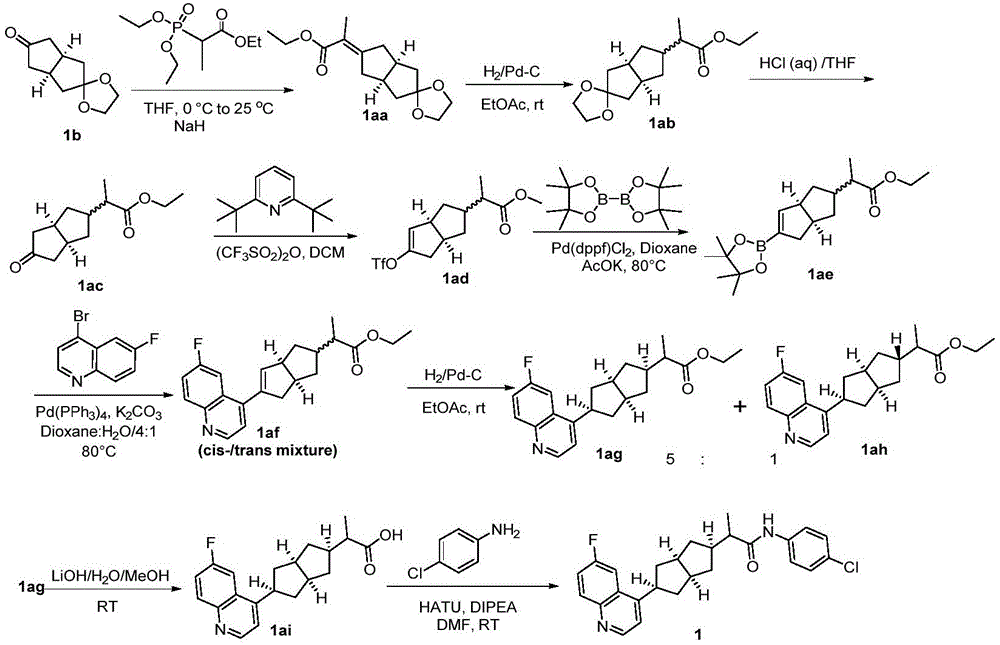
上述路线在开始的步骤中使用了三乙基-2-膦酰基丙酯,从而在羧酸的位引入甲基,经过类似的反应,得到了化合物1ag和化合物1ah的比例大约为5:1。顺式的酯 1ag经碱性水解,得酸1ai,然后与对氯苯胺缩合,得消旋的化合物1。The above route uses triethyl-2-phosphonopropyl ester in the initial step, thereby introducing a methyl group at the position of the carboxylic acid, and through a similar reaction, the ratio of compound 1ag to compound 1ah is about 5:1. The cis ester 1ag is subjected to alkaline hydrolysis to obtain the acid 1ai, which is then condensed with p-chloroaniline to obtain the racemic compound 1.
消旋的化合物1经SFC手性拆分得到化合物1A和1B。制备SFC条件:仪器:SFC-80(Thar,Waters);手性柱:CHIRALCEL OJ(30*250mm 5μm)(Daicel);柱温:35℃;流速:45mL/分钟;检测波长:215nm;流动相A:CO2;流动相B:甲醇。30%B恒定洗脱。峰1:8.8-10.2分钟;峰2:11.4-13.2分钟。e.e.值均大于99%。这里峰1和峰2 的绝对立体构型尚未确定。The racemic compound 1 was chiral resolved by SFC to give compounds 1A and 1B. Conditions for preparing SFC: Instrument: SFC-80 (Thar, Waters); Chiral column: CHIRALCEL OJ (30*250mm 5μm) (Daicel); Column temperature: 35°C; Flow rate: 45mL/min; Detection wavelength: 215nm; Mobile phase A: CO2 ; mobile phase B: methanol. 30% B constant elution. Peak 1: 8.8-10.2 minutes; Peak 2: 11.4-13.2 minutes. The ee values are all greater than 99%. The absolute stereoconfigurations of peaks 1 and 2 have not been determined here.

峰1化合物:1H NMR(500MHz,CDCl3)δ8.80(d,J=4.6Hz,1H),8.11(dd,J=9.2,5.7Hz,1H),7.69(dd,J=10.5,2.7Hz,1H),7.50(d,J=8.7Hz,2H),7.49–7.44(m,1H), 7.36(d,J=4.6Hz,1H),7.30(d,J=8.8Hz,2H),7.11(s,1H),3.77–3.71(m,1H),2.74 –2.70(m,2H),2.47–2.38(m,2H),2.36–2.25(m,2H),2.22–2.15(m,2H),1.54–1.48 (m,2H),1.28(d,J=6.8Hz,3H),1.16–1.02(m,2H)。LCMS m/z 437.3[M+H]+。e.e.值 99.0%。Peak 1 compound: 1 H NMR (500 MHz, CDCl 3 ) δ 8.80 (d, J=4.6 Hz, 1H), 8.11 (dd, J=9.2, 5.7 Hz, 1H), 7.69 (dd, J=10.5, 2.7 Hz,1H),7.50(d,J=8.7Hz,2H),7.49–7.44(m,1H), 7.36(d,J=4.6Hz,1H),7.30(d,J=8.8Hz,2H), 7.11(s,1H), 3.77–3.71(m,1H), 2.74–2.70(m,2H), 2.47–2.38(m,2H), 2.36–2.25(m,2H), 2.22–2.15(m,2H) ), 1.54–1.48 (m, 2H), 1.28 (d, J=6.8Hz, 3H), 1.16–1.02 (m, 2H). LCMS m/z 437.3 [M+H] + . ee value 99.0%.
峰2化合物:1H NMR(500MHz,CDCl3)δ8.80(d,J=4.6Hz,1H),8.11(dd,J=9.2,5.7Hz,1H),7.68(dd,J=10.5,2.7Hz,1H),7.50(d,J=8.8Hz,2H),7.50–7.45(m,1H), 7.36(d,J=4.6Hz,1H),7.29(d,J=8.8Hz,2H),7.19(s,1H),3.77–3.70(m,1H),2.73 –2.66(m,2H),2.49–2.37(m,2H),2.37–2.24(m,2H),2.21–2.18(m,2H),1.53–1.47 (m,2H),1.28(d,J=6.8Hz,3H),1.17–1.02(m,2H)。LCMS m/z 437.3[M+H]+。e.e.值 99.0%。Peak 2 compound: 1 H NMR (500 MHz, CDCl 3 ) δ 8.80 (d, J=4.6 Hz, 1H), 8.11 (dd, J=9.2, 5.7 Hz, 1H), 7.68 (dd, J=10.5, 2.7 Hz,1H),7.50(d,J=8.8Hz,2H),7.50–7.45(m,1H), 7.36(d,J=4.6Hz,1H),7.29(d,J=8.8Hz,2H), 7.19(s,1H), 3.77–3.70(m,1H), 2.73–2.66(m,2H), 2.49–2.37(m,2H), 2.37–2.24(m,2H), 2.21–2.18(m,2H) ), 1.53–1.47 (m, 2H), 1.28 (d, J=6.8Hz, 3H), 1.17–1.02 (m, 2H). LCMS m/z 437.3 [M+H] + . ee value 99.0%.
实施例2化合物1A的制备Example 2 Preparation of Compound 1A

化合物1m(35mg,0.11mmol)在二氯亚砜中回流1小时。减压蒸馏除去剩余的二氯亚砜。粗品酰氯直接用于下一步反应。在一个干燥的圆底瓶中将(R)-4-苯基-2-恶唑烷酮(34mg,0.11mmol)溶解在四氢呋喃(1mL)中,在氮气保护下冷却至-65℃,然后将LDA(0.1mL,0.21mmol)慢慢地加入,在此温度搅拌15分钟。将粗品酰氯的四氢呋喃(2mL)溶液加入到上述反应液中,在此温度继续搅拌1小时。加入饱和的氯化铵水溶液(6mL),用乙酸乙酯萃取(3X 5mL)。合并有机相,用饱和食盐水洗涤(3 X 5mL)。有机相干燥过滤,滤液减压浓缩所的粗品经制备薄板层析分离(50%,乙酸乙酯:石油醚)得到白色固体化合物1q(15mg,收率31%)。LCMS m/z 459.2[M+H]+。Compound 1m (35 mg, 0.11 mmol) was refluxed in thionyl chloride for 1 hour. The remaining thionyl chloride was distilled off under reduced pressure. The crude acid chloride was directly used in the next reaction. In a dry round-bottom flask, (R)-4-phenyl-2-oxazolidinone (34 mg, 0.11 mmol) was dissolved in tetrahydrofuran (1 mL), cooled to -65 °C under nitrogen, and then the LDA (0.1 mL, 0.21 mmol) was added slowly and stirred at this temperature for 15 minutes. A solution of the crude acid chloride in tetrahydrofuran (2 mL) was added to the above reaction solution, and stirring was continued at this temperature for 1 hour. Saturated aqueous ammonium chloride solution (6 mL) was added and extracted with ethyl acetate (3×5 mL). The organic phases were combined and washed with saturated brine (3×5 mL). The organic phase was dried and filtered, and the filtrate was concentrated under reduced pressure. The crude product was separated by preparative thin plate chromatography (50%, ethyl acetate: petroleum ether) to obtain compound 1q (15 mg, yield 31%) as a white solid. LCMS m/z 459.2 [M+H] + .
化合物1A是从化合物1q制备得到的,详细的步骤可参考专利WO2016073774和WO2016073770。Compound 1A is prepared from compound 1q. For detailed steps, please refer to patents WO2016073774 and WO2016073770.
实施例3化合物2的制备Preparation of Example 3 Compound 2
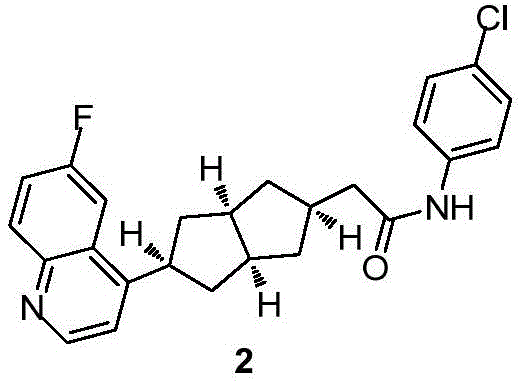
按照上述化合物1的制备方法制备,化合物2即是上述化合物1n。1H NMR(500MHz,CDCl3)δ8.80(d,J=4.2Hz,1H),8.10(dd,J=9.3,6.0Hz,1H),7.68(d,J=10.4Hz,1H),7.48(d,J=8.4Hz,2H),7.36(d,J=4.5Hz,1H),7.28(d,J=8.4Hz,3H),7.15(s,1H),3.74–3.73(m,1H),3.61–3.57(m,1H),2.75–2.73(m,2H),2.57–2.50(m,1H),2.45–2.38(m, 3H),2.28–2.26(m,2H),1.48–1.44(m,2H),11.13–1.12(m,2H)。LCMS m/z 423.1 [M+H]+。According to the above-mentioned preparation method of compound 1, compound 2 is the above-mentioned compound 1n. 1 H NMR (500 MHz, CDCl 3 ) δ 8.80 (d, J=4.2 Hz, 1H), 8.10 (dd, J=9.3, 6.0 Hz, 1H), 7.68 (d, J=10.4 Hz, 1H), 7.48 (d, J=8.4Hz, 2H), 7.36 (d, J=4.5Hz, 1H), 7.28 (d, J=8.4Hz, 3H), 7.15 (s, 1H), 3.74–3.73 (m, 1H) ,3.61–3.57(m,1H),2.75–2.73(m,2H),2.57–2.50(m,1H),2.45–2.38(m,3H),2.28–2.26(m,2H),1.48–1.44( m, 2H), 11.13–1.12 (m, 2H). LCMS m/z 423.1 [M+H] + .
实施例4化合物3的制备Preparation of Example 4 Compound 3

将四氢呋喃(0.5mL)和LDA的四氢呋喃溶液(2.0M,1.22mL,2.44mmol),放在一个干燥的圆底烧瓶中,氮气保护下冷却至-78℃,加入N,N-二甲基丙烯基脲(118 mg,0.92mmol)和1j(0.2g,0.61mmol)的四氢呋喃(0.5mL)溶液,在-20℃下搅拌1 小时。然后加入碘甲烷(0.35g,2.44mmol)。在此温度下继续搅拌1小时。向反应液中加入饱和氯化铵水溶液(5mL),用乙酸乙酯萃取(3X 5mL),合并有机相,用饱和食盐水洗涤(3X 4mL)。无水硫酸钠干燥,过滤,减压浓缩得粗品。经制备薄板层析分离(20%乙酸乙酯:石油醚)得到淡黄色固体化合物3a(120mg,收率58%)。Put tetrahydrofuran (0.5 mL) and LDA in tetrahydrofuran (2.0 M, 1.22 mL, 2.44 mmol) in a dry round-bottomed flask, cool to -78°C under nitrogen protection, add N,N-dimethylpropene A solution of urea (118 mg, 0.92 mmol) and 1j (0.2 g, 0.61 mmol) in tetrahydrofuran (0.5 mL) was stirred at -20°C for 1 hour. Then iodomethane (0.35 g, 2.44 mmol) was added. Stirring was continued for 1 hour at this temperature. Saturated aqueous ammonium chloride solution (5 mL) was added to the reaction solution, extracted with ethyl acetate (3×5 mL), and the organic phases were combined and washed with saturated brine (3×4 mL). Dry over anhydrous sodium sulfate, filter, and concentrate under reduced pressure to obtain crude product. Preparative thin plate chromatography (20% ethyl acetate:petroleum ether) afforded compound 3a as a pale yellow solid (120 mg, 58% yield).
将化合物3a(120mg,0.35mmol)溶在甲醇(2mL)和水(0.4mL)中,然后加入氢氧化钾(197mg,3.5mmol),在50℃下搅拌30分钟。薄板层析显示反应完成。冷却至0℃,用HCl水溶液(3N)调节至pH=6,然后用乙酸乙酯萃取(3X 10mL),合并有机相,饱和食盐水洗涤(3X5mL),无水硫酸钠干燥,过滤,减压浓缩得淡棕色的固体化合物3b(100mg,收率87%)。Compound 3a (120 mg, 0.35 mmol) was dissolved in methanol (2 mL) and water (0.4 mL), potassium hydroxide (197 mg, 3.5 mmol) was added, and the mixture was stirred at 50°C for 30 minutes. Thin plate chromatography showed that the reaction was complete. Cooled to 0°C, adjusted to pH=6 with aqueous HCl (3N), then extracted with ethyl acetate (3×10 mL), combined organic phases, washed with saturated brine (3×5 mL), dried over anhydrous sodium sulfate, filtered, and reduced in pressure Concentrated to give light brown solid compound 3b (100 mg, yield 87%).
将3b(14mg,0.043mmol),HOBT(8.67mg,0.064mmol),EDCI(12.3mg,0.064 mmol)和N,N-二异丙基乙胺(16.58mg,0.13mmol)溶在N,N-二甲基甲酰胺(0.5mL) 中,然后加入4-氨基四氢吡喃(6.5mg,0.064mmol),反应在50℃搅拌2小时。减压浓缩得粗品,经制备薄板层析分离(20%,乙酸乙酯:石油醚)得到白色固体化合物3(2 mg,收率5%)。1H NMR(500MHz,CDCl3)δ8.80(d,J=4.5Hz,1H),8.11(dd,J=9.0, 5.7Hz,1H),7.69(dd,J=10.4,2.4Hz,1H),7.51–7.43(m,1H),7.36(d,J=4.4Hz,1H), 5.30(d,J=8.0Hz,1H),4.08–3.91(m,3H),3.72(m,1H),3.49(t,J=11.5Hz,2H), 2.72(m,2H),2.41(m,2H),2.27–2.14(m,2H),2.08(m,1H),2.02–1.82(m,3H),1.55 –1.38(m,4H),1.17(d,J=8.4Hz,3H),1.03(m,2H)。LCMSm/z 411.2[M+H]+。3b (14 mg, 0.043 mmol), HOBT (8.67 mg, 0.064 mmol), EDCI (12.3 mg, 0.064 mmol) and N,N-diisopropylethylamine (16.58 mg, 0.13 mmol) were dissolved in N,N- To dimethylformamide (0.5 mL) was then added 4-aminotetrahydropyran (6.5 mg, 0.064 mmol) and the reaction was stirred at 50°C for 2 hours. The crude product was concentrated under reduced pressure, which was separated by preparative thin plate chromatography (20%, ethyl acetate: petroleum ether) to obtain compound 3 (2 mg, yield 5%) as a white solid. 1 H NMR (500MHz, CDCl 3 ) δ 8.80 (d, J=4.5Hz, 1H), 8.11 (dd, J=9.0, 5.7Hz, 1H), 7.69 (dd, J=10.4, 2.4Hz, 1H) ,7.51–7.43(m,1H),7.36(d,J=4.4Hz,1H), 5.30(d,J=8.0Hz,1H),4.08–3.91(m,3H),3.72(m,1H), 3.49(t,J=11.5Hz,2H), 2.72(m,2H), 2.41(m,2H), 2.27–2.14(m,2H), 2.08(m,1H), 2.02–1.82(m,3H) , 1.55-1.38(m, 4H), 1.17(d, J=8.4Hz, 3H), 1.03(m, 2H). LCMS m/z 411.2 [M+H] + .
实施例5化合物4的制备Example 5 Preparation of Compound 4

化合物4是从化合物3b和4-氯苯胺按照上述化合物3的制备方法制备得到的。1HNMR(500MHz,CDCl3)δ8.80(d,J=4.5Hz,1H),8.11(dd,J=9.1,5.7Hz,1H),7.68(d,J=10.5,1H),7.51(d,J=8.7Hz,2H),7.48(t,J=8.3Hz,1H),7.30(d,J=8.7Hz,2H),7.28(s,1H),7.21(s,1H),3.59–3.57(m,1H),3.14(t,J=12.0Hz,1H),2.19(t,J=7.2Hz,1H),2.16–2.08(m,1H),2.07–2.03(m,1H),1.84–1.60(m,6H),1.47–1.39(m,2H),1.30(d,J=6.7 Hz,3H)。LCMS m/z 437.1[M+H]+。Compound 4 was prepared from compound 3b and 4-chloroaniline according to the preparation method of compound 3 above. 1 H NMR (500 MHz, CDCl 3 ) δ 8.80 (d, J=4.5 Hz, 1H), 8.11 (dd, J=9.1, 5.7 Hz, 1H), 7.68 (d, J=10.5, 1H), 7.51 (d , J=8.7Hz, 2H), 7.48(t, J=8.3Hz, 1H), 7.30(d, J=8.7Hz, 2H), 7.28(s, 1H), 7.21(s, 1H), 3.59–3.57 (m, 1H), 3.14 (t, J=12.0Hz, 1H), 2.19 (t, J=7.2Hz, 1H), 2.16–2.08 (m, 1H), 2.07–2.03 (m, 1H), 1.84– 1.60 (m, 6H), 1.47–1.39 (m, 2H), 1.30 (d, J=6.7 Hz, 3H). LCMS m/z 437.1 [M+H] + .
实施例6化合物5的制备Example 6 Preparation of Compound 5

化合物5是从化合物1k和4-氯苯胺按照上述化合物2的制备方法制备得到的。1HNMR(500MHz,CDCl3)δ8.79(d,J=4.6Hz,1H),8.10(dd,J=9.2,5.7Hz,1H),7.68 (dd,J=10.5,2.8Hz,1H),7.48(d,J=8.8Hz,2H),7.47–7.44(m,1H),-7.34(m,J=4.6 Hz,1H),7.32(s,1H),7.28(d,J=8.8Hz,2H),3.48–3.40(m,1H),2.81–2.75(m,2H), 2.57–2.54(m,1H),2.41(d,J=7.1Hz,2H),2.40-2.35(m,2H),1.78(dd,J=12.8,5.7 Hz,2H),1.46–1.37(m,4H)。LCMS m/z 423.1[M+H]+。Compound 5 was prepared from compound 1k and 4-chloroaniline according to the preparation method of compound 2 above. 1 HNMR (500MHz, CDCl 3 ) δ 8.79 (d, J=4.6Hz, 1H), 8.10 (dd, J=9.2, 5.7Hz, 1H), 7.68 (dd, J=10.5, 2.8Hz, 1H), 7.48(d,J=8.8Hz,2H),7.47–7.44(m,1H),-7.34(m,J=4.6 Hz,1H),7.32(s,1H),7.28(d,J=8.8Hz, 2H), 3.48–3.40 (m, 1H), 2.81–2.75 (m, 2H), 2.57–2.54 (m, 1H), 2.41 (d, J=7.1Hz, 2H), 2.40–2.35 (m, 2H) , 1.78 (dd, J=12.8, 5.7 Hz, 2H), 1.46–1.37 (m, 4H). LCMS m/z 423.1 [M+H] + .
实施例7化合物6的制备The preparation of embodiment 7 compound 6

化合物6是从化合物3b和5-氨基-2-甲氧基吡啶按照上述化合物3的制备方法制备得到的。1H NMR(500MHz,CDCl3)δ8.79(d,J=4.5Hz,1H),8.15(d,J=2.7Hz,1H), 8.10(dd,J=9.1,5.7Hz,1H),7.96(dd,J=8.9,2.1Hz,1H),7.68(dd,J=10.4,2.6Hz, 1H),7.49–7.44(m,1H),7.35(d,J=4.5Hz,1H),7.28(s,1H),6.73(d,J=8.9Hz,1H), 3.91(s,3H),3.74–3.69(m,1H),2.73–2.69(m,2H),2.44–2.36(m,2H),2.33–2.17 (m,4H),1.49(dd,J=20.2,12.0Hz,2H),1.28(d,J=6.7Hz,3H),1.17–1.02(m,2H)。 LCMS m/z 434.2[M+H]+。Compound 6 was prepared from compound 3b and 5-amino-2-methoxypyridine according to the preparation method of compound 3 above. 1 H NMR (500MHz, CDCl 3 ) δ 8.79 (d, J=4.5Hz, 1H), 8.15 (d, J=2.7Hz, 1H), 8.10 (dd, J=9.1, 5.7Hz, 1H), 7.96 (dd, J=8.9, 2.1Hz, 1H), 7.68 (dd, J=10.4, 2.6Hz, 1H), 7.49–7.44 (m, 1H), 7.35 (d, J=4.5Hz, 1H), 7.28 ( s, 1H), 6.73 (d, J=8.9Hz, 1H), 3.91 (s, 3H), 3.74–3.69 (m, 1H), 2.73–2.69 (m, 2H), 2.44–2.36 (m, 2H) , 2.33–2.17 (m, 4H), 1.49 (dd, J=20.2, 12.0 Hz, 2H), 1.28 (d, J=6.7 Hz, 3H), 1.17–1.02 (m, 2H). LCMS m/z 434.2 [M+H] + .
实施例8化合物7的制备Preparation of Example 8 Compound 7

化合物7是从化合物3b和3-氯苯胺按照上述化合物3的制备方法制备得到的。1HNMR(500MHz,CDCl3)δ8.80(d,J=4.5Hz,1H),8.11(dd,J=9.2,5.7Hz,1H),7.54 (dd,J=5.8,3.3Hz,2H),7.50–7.44(m,1H),7.38(s,1H),7.36(d,J=4.7Hz,1H),7.24 (d,J=8.1Hz,1H),7.16(s,1H),7.09(d,J=8.0Hz,1H),3.80–3.68(m,1H),2.78– 2.66(m,2H),2.46–2.16(m,6H),1.54–1.41(m,2H),1.28(d,J=6.8Hz,3H),1.17– 1.04(m,2H)。LCMS m/z437.1[M+H]+。Compound 7 was prepared from compound 3b and 3-chloroaniline according to the preparation method of compound 3 above. 1 HNMR (500MHz, CDCl 3 ) δ 8.80 (d, J=4.5Hz, 1H), 8.11 (dd, J=9.2, 5.7Hz, 1H), 7.54 (dd, J=5.8, 3.3Hz, 2H), 7.50–7.44(m, 1H), 7.38(s, 1H), 7.36(d, J=4.7Hz, 1H), 7.24 (d, J=8.1Hz, 1H), 7.16(s, 1H), 7.09(d , J=8.0Hz, 1H), 3.80–3.68 (m, 1H), 2.78– 2.66 (m, 2H), 2.46–2.16 (m, 6H), 1.54–1.41 (m, 2H), 1.28 (d, J = 6.8 Hz, 3H), 1.17-1.04 (m, 2H). LCMS m/z437.1[M+H] + .
实施例9化合物8的制备Preparation of Example 9 Compound 8
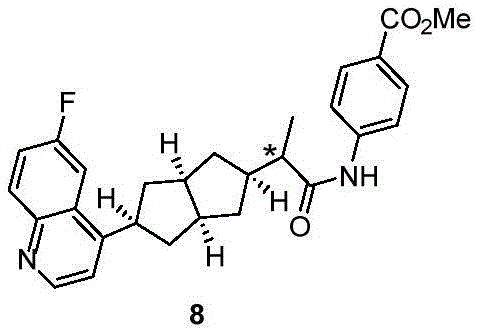
化合物8是从化合物3b和4-氨基苯甲酸甲酯按照上述化合物3的制备方法制备得到的。1H NMR(500MHz,CDCl3)δ8.79(d,J=4.6Hz,1H),8.10(dd,J=9.2,5.7Hz, 1H),8.01(d,J=8.7Hz,2H),7.68(dd,J=10.5,2.7Hz,1H),7.63(d,J=8.7Hz,2H), 7.49–7.44(m,1H),7.35(d,J=4.6Hz,1H),7.33(s,1H),3.90(s,3H),3.77–3.69(m, 1H),2.73–2.67(m,2H),2.45–2.20(m,7H),2.03–1.98(m,1H),1.29(d,J=6.7Hz, 3H),1.17–1.04(m,2H)。LCMSm/z 461.2[M+H]+。Compound 8 was prepared from compound 3b and methyl 4-aminobenzoate according to the preparation method of compound 3 above. 1 H NMR (500 MHz, CDCl 3 ) δ 8.79 (d, J=4.6 Hz, 1H), 8.10 (dd, J=9.2, 5.7 Hz, 1H), 8.01 (d, J=8.7 Hz, 2H), 7.68 (dd, J=10.5, 2.7Hz, 1H), 7.63(d, J=8.7Hz, 2H), 7.49–7.44(m, 1H), 7.35(d, J=4.6Hz, 1H), 7.33(s, 1H), 3.90 (s, 3H), 3.77–3.69 (m, 1H), 2.73–2.67 (m, 2H), 2.45–2.20 (m, 7H), 2.03–1.98 (m, 1H), 1.29 (d, J=6.7Hz, 3H), 1.17-1.04 (m, 2H). LCMS m/z 461.2 [M+H] + .
实施例10化合物9的制备Example 10 Preparation of Compound 9

将化合物9a(1.0g,4.44mmol)溶于甲苯(10mL)中,加入甲氧甲酰基亚甲基三苯基膦(2.23g,6.66mmol)。该反应体系在110℃的封管中搅拌18小时。反应液用乙酸乙酯(50mL)稀释,并用饱和食盐水洗涤(15mL)。有机相经无水硫酸钠干燥,过滤。滤液减压浓缩后,粗品经硅胶柱层析纯化(乙酸乙酯/石油醚=0-15%)得到灰色固体化合物9b(0.69g,收率55%)。Compound 9a (1.0 g, 4.44 mmol) was dissolved in toluene (10 mL), and methoxyformylmethylene triphenylphosphine (2.23 g, 6.66 mmol) was added. The reaction was stirred in a sealed tube at 110°C for 18 hours. The reaction solution was diluted with ethyl acetate (50 mL), and washed with saturated brine (15 mL). The organic phase was dried over anhydrous sodium sulfate and filtered. After the filtrate was concentrated under reduced pressure, the crude product was purified by silica gel column chromatography (ethyl acetate/petroleum ether=0-15%) to obtain compound 9b (0.69 g, yield 55%) as a gray solid.
将化合物9b(0.69g,2.45mmol)溶于乙醇(5mL),随后加入10%Pd/C(261mg),在一个大气压的氢气氛下室温搅拌过夜。将Pd/C用硅藻土过滤除去,减压浓缩后得到无色油状液体9c(0.65g,收率94%)。Compound 9b (0.69 g, 2.45 mmol) was dissolved in ethanol (5 mL), followed by the addition of 10% Pd/C (261 mg), and stirred at room temperature under one atmosphere of hydrogen atmosphere overnight. The Pd/C was filtered off with Celite, and concentrated under reduced pressure to obtain a colorless oily liquid 9c (0.65 g, yield 94%).
将三氟乙酸(1.46mL,23.10mmol)慢慢加入到化合物9c(0.65g,2.31mmol)的二氯甲烷(2mL)溶液中,在室温下搅拌30分钟。反应结束后,减压浓缩得到浅黄色的油状物9d(0.3g,收率71%)。粗品不进一步纯化直接用于下面反应。Trifluoroacetic acid (1.46 mL, 23.10 mmol) was slowly added to a solution of compound 9c (0.65 g, 2.31 mmol) in dichloromethane (2 mL) and stirred at room temperature for 30 minutes. After the reaction was completed, the mixture was concentrated under reduced pressure to obtain a pale yellow oily substance 9d (0.3 g, yield 71%). The crude product was used in the next reaction without further purification.
将化合物9d(0.3g,1.64mmol),4-氯-6-氟喹啉(357mg,1.96mmol),N,N-二异丙基乙胺(0.634g,4.91mmol)溶于二甲亚砜(3mL)。反应物在氮气保护下加热至90 ℃搅拌18小时。反应液减压浓缩后,粗品经硅胶柱层析纯化(乙酸乙酯/石油醚= 0-50%),得到淡黄色的油状化合物9e(0.44g,收率81%)。1H NMR显示顺式/反式的比例约为5:1。Compound 9d (0.3 g, 1.64 mmol), 4-chloro-6-fluoroquinoline (357 mg, 1.96 mmol), N,N-diisopropylethylamine (0.634 g, 4.91 mmol) were dissolved in dimethylsulfoxide (3 mL). The reaction was heated to 90°C under nitrogen and stirred for 18 hours. After the reaction solution was concentrated under reduced pressure, the crude product was purified by silica gel column chromatography (ethyl acetate/petroleum ether=0-50%) to obtain compound 9e (0.44 g, yield 81%) as a pale yellow oil. 1 H NMR showed a cis/trans ratio of approximately 5:1.
将氢氧化锂(36.46mg,1.5mmol)加入到化合物9e(50mg,0.15mmol)的甲醇(2 mL)和水(0.4mL)溶液中,反应液在室温下搅拌,薄板层析显示反应完全。将反应液用盐酸(3N)调节pH=6,然后用乙酸乙酯萃取(3X 5mL)。有机相用无水硫酸钠干燥,过滤,减压浓缩得到淡黄色得固体9f(45mg,收率94%)。粗品不进一步纯化直接用于下面反应。Lithium hydroxide (36.46 mg, 1.5 mmol) was added to a solution of compound 9e (50 mg, 0.15 mmol) in methanol (2 mL) and water (0.4 mL), the reaction solution was stirred at room temperature, and thin plate chromatography showed that the reaction was complete. The reaction solution was adjusted to pH=6 with hydrochloric acid (3N), then extracted with ethyl acetate (3×5 mL). The organic phase was dried over anhydrous sodium sulfate, filtered, and concentrated under reduced pressure to obtain a pale yellow solid 9f (45 mg, yield 94%). The crude product was used in the next reaction without further purification.
将化合物9f(45mg,0.14mmol),HOBT(29.4mg,0.21mmol),EDCI(41.2mg,0.24mmol)溶于N,N-二甲基甲酰胺(1mL)中,然后加入N,N-二异丙基乙胺(55.5mg,0.43mmol),反应物在50℃下搅拌2小时。减压浓缩后经薄板层析分离(50%,乙酸乙酯:CH2Cl2)得到化合物9g(25mg,收率41%)。Compound 9f (45 mg, 0.14 mmol), HOBT (29.4 mg, 0.21 mmol), EDCI (41.2 mg, 0.24 mmol) were dissolved in N,N-dimethylformamide (1 mL), and N,N-bismuth was added Isopropylethylamine (55.5 mg, 0.43 mmol), the reaction was stirred at 50°C for 2 hours. After concentrating under reduced pressure, it was separated by thin plate chromatography (50%, ethyl acetate: CH 2 Cl 2 ) to obtain compound 9g (25 mg, yield 41%).
将化合物9g(25mg,0.059mmol),4-二甲氨基吡啶(10.8mg,0.088mmol),二碳酸二叔丁酯(19.3mg,0.088mmol)溶于乙腈(1mL)中,在50℃搅拌5分钟。反应物减压蒸馏。粗品经薄板层析分离得到化合物9h。Compound 9g (25 mg, 0.059 mmol), 4-dimethylaminopyridine (10.8 mg, 0.088 mmol), and di-tert-butyl dicarbonate (19.3 mg, 0.088 mmol) were dissolved in acetonitrile (1 mL), and stirred at 50°C for 5 minute. The reactants were distilled under reduced pressure. The crude product was separated by thin plate chromatography to obtain compound 9h.
将化合物9h(15mg,0.028mmol)溶于四氢呋喃(0.5mL),在氮气保护下冷却至-20℃,慢慢加入LDA(0.085mL,0.086mmol)。在0℃下搅拌20分钟,然后冷却至-20℃,加入碘甲烷(12mg,0.085mmol),在此温度下继续搅拌20分钟。向反应体系加入饱和氯化铵水溶液(4mL),用乙酸乙酯萃取(3X 5mL)。合并有机相,用饱和食盐水洗涤(3X 5mL),然后干燥浓缩。粗品经制备薄板层析分离(50%,乙酸乙酯:二氯甲烷)得到淡黄色的固体9i(5mg,收率32%)。Compound 9h (15 mg, 0.028 mmol) was dissolved in tetrahydrofuran (0.5 mL), cooled to -20°C under nitrogen protection, and LDA (0.085 mL, 0.086 mmol) was added slowly. Stir at 0°C for 20 minutes, then cool to -20°C, add iodomethane (12 mg, 0.085 mmol) and continue stirring at this temperature for 20 minutes. Saturated aqueous ammonium chloride solution (4 mL) was added to the reaction system, followed by extraction with ethyl acetate (3×5 mL). The organic phases were combined, washed with saturated brine (3×5 mL), then dried and concentrated. The crude product was isolated by preparative thin plate chromatography (50%, ethyl acetate:dichloromethane) to give 9i as a pale yellow solid (5 mg, 32% yield).
将化合物9i(5mg,9.0mol)溶于二氯甲烷(0.5mL),然后在0℃下加入盐酸的二氧六环溶液(4L,4M HCl)。搅拌20分钟后薄板层析显示反应完全。向反应体系加入饱和碳酸氢钠水溶液,并用乙酸乙酯萃取(3X 3mL),有机相干燥过滤,滤液减压浓缩所的粗品经制备薄板层析分离(50%,乙酸乙酯:二氯甲烷)得到白色固体化合物9(0.74mg,收率18%)。1H NMR(500MHz,CD3OD)δ8.43(d,J=5.6Hz,1H),7.93 (dd,J=5.5,3.5Hz,1H),7.90(d,J=3.1Hz,1H),7.63–7.53(m,2H),7.51(dd,J=11.8, 5.4Hz,1H),7.32–7.21(m,2H),6.79(d,J=5.6Hz,1H),3.69–3.46(m,5H),2.93– 2.77(m,2H),2.45–2.10(m,4H),1.47–1.38(m,1H),1.25(d,J=6.8Hz,3H)。LCMS m/z 437.99[M+H]+。Compound 9i (5 mg, 9.0 mol) was dissolved in dichloromethane (0.5 mL), then hydrochloric acid in dioxane (4 L, 4M HCl) was added at 0 °C. After stirring for 20 minutes, thin plate chromatography showed the reaction to be complete. Saturated aqueous sodium bicarbonate solution was added to the reaction system, and extracted with ethyl acetate (3×3 mL), the organic phase was dried and filtered, the filtrate was concentrated under reduced pressure, and the crude product was separated by preparative thin plate chromatography (50%, ethyl acetate: dichloromethane) Compound 9 (0.74 mg, 18% yield) was obtained as a white solid. 1 H NMR (500MHz, CD 3 OD) δ 8.43 (d, J=5.6Hz, 1H), 7.93 (dd, J=5.5, 3.5Hz, 1H), 7.90 (d, J=3.1Hz, 1H), 7.63–7.53 (m, 2H), 7.51 (dd, J=11.8, 5.4Hz, 1H), 7.32–7.21 (m, 2H), 6.79 (d, J=5.6Hz, 1H), 3.69–3.46 (m, 5H), 2.93–2.77 (m, 2H), 2.45–2.10 (m, 4H), 1.47–1.38 (m, 1H), 1.25 (d, J=6.8Hz, 3H). LCMS m/z 437.99 [M+H] + .
实施例11化合物10的制备Example 11 Preparation of Compound 10

化合物10b是根据专利WO2016073774和WO2016073770的步骤从化合物10a制备得到的。化合物10c是从化合物10b制备得到的(详细步骤见1o的制备)。Compound 10b was prepared from compound 10a according to the procedures of patents WO2016073774 and WO2016073770. Compound 10c was prepared from compound 10b (see the preparation of 1o for detailed procedures).
将化合物10c(120mg,0.24mmol)溶在四氢呋喃(0.5mL)中,冷却至-20℃,慢慢加入LDA(0.42mL,0.85mmol),升温至0℃搅拌20分钟,然后冷却至-20℃,将 10d(205mg,0.85mmol)加入上述溶液,在0℃搅拌20分钟。向反应液中加入饱和氯化铵水溶液(5mL),用乙酸乙酯萃取(3X 10mL),合并有机相,用饱和食盐水洗涤 (3X 10mL),用硫酸钠干燥,过滤减压浓缩,所得的粗品经制备薄板层析分离(30%乙酸乙酯:石油醚)得到淡黄色的固体化合物10e(76mg,率收40%)。Compound 10c (120 mg, 0.24 mmol) was dissolved in tetrahydrofuran (0.5 mL), cooled to -20 °C, slowly added with LDA (0.42 mL, 0.85 mmol), warmed to 0 °C, stirred for 20 minutes, and then cooled to -20 °C , 10d (205 mg, 0.85 mmol) was added to the above solution and stirred at 0 °C for 20 minutes. Saturated aqueous ammonium chloride solution (5 mL) was added to the reaction solution, extracted with ethyl acetate (3×10 mL), the organic phases were combined, washed with saturated brine (3×10 mL), dried over sodium sulfate, filtered and concentrated under reduced pressure. The crude product was separated by preparative thin plate chromatography (30% ethyl acetate:petroleum ether) to give compound 10e (76 mg, yield 40%) as a pale yellow solid.
化合物10f是从化合物10e制备得到的(详细步骤见1的制备)。Compound 10f was prepared from compound 10e (see the preparation of 1 for detailed procedures).
化合物10g是从化合物10f制备得到的(详细步骤见1m的制备)。Compound 10g was prepared from compound 10f (see the preparation of 1m for detailed procedures).
将化合物10g(7.8mg,14.31mol),HOBt(2.90mg,21.47mol),EDCI(4.12mg,21.47mol)和N,N-二异丙基乙胺(5.55mg,42.39mol)溶于N,N-二甲基甲酰胺 (0.5mL),然后加入O-苄基羟胺(2.64mg,21.47mmol),在室温下搅拌2小时。反应液减压浓缩后,粗品经制备薄板层析分离(10%,甲醇:二氯甲烷)得到无色液体化合物10h(4.1mg,收率44%)。LCMSm/z 650.2[M+H]+。Compound 10g (7.8mg, 14.31mol), HOBt (2.90mg, 21.47mol), EDCI (4.12mg, 21.47mol) and N,N-diisopropylethylamine (5.55mg, 42.39mol) were dissolved in N, N-dimethylformamide (0.5 mL) was then added with O-benzylhydroxylamine (2.64 mg, 21.47 mmol), and the mixture was stirred at room temperature for 2 hours. After the reaction solution was concentrated under reduced pressure, the crude product was separated by preparative thin plate chromatography (10%, methanol: dichloromethane) to obtain a colorless liquid compound 10h (4.1 mg, yield 44%). LCMS m/z 650.2 [M+H] + .
将化合物10h(4.1mg,6.31mol)溶于甲醇(0.5mL)中,加入10%Pd/C(6.71mg,63.06mol),反应体系在一个大气压的氢气环境下搅拌10分钟。薄板层析显示反应完全。将Pd/C过滤,滤液减压浓缩,粗品经薄板层析分离(10%,甲醇:二氯甲烷) 得到化合物10(0.51mg,收率14%)。LCMS m/z 560.2[M+H]+。Compound 10h (4.1 mg, 6.31 mol) was dissolved in methanol (0.5 mL), 10% Pd/C (6.71 mg, 63.06 mol) was added, and the reaction system was stirred under an atmosphere of hydrogen for 10 minutes. Thin plate chromatography showed that the reaction was complete. The Pd/C was filtered, the filtrate was concentrated under reduced pressure, and the crude product was separated by thin plate chromatography (10%, methanol:dichloromethane) to give compound 10 (0.51 mg, yield 14%). LCMS m/z 560.2 [M+H] + .
实施例12化合物11的制备Example 12 Preparation of Compound 11

化合物11是从化合物1h经水解,所得的酸11a和4-氯苯胺缩合得到的主产物。1HNMR (500MHz,CD3OD)δ8.75(d,J=4.6Hz,1H),8.08(dd,J=9.3,5.5Hz,1H),7.85(dd,J =10.3,2.8Hz,1H),7.67–7.50(m,3H),7.42(d,J=4.6Hz,1H),7.35–7.23(m,2H), 6.08(d,J=1.6Hz,1H),3.56–3.49(m,1H),3.19–3.11(m,1H),2.96–2.87(m,1H), 2.59(d,J=16.7Hz,1H),2.47(d,J=6.5Hz,2H),2.36(dd,J=14.8,8.2Hz,2H),2.26 (dd,J=12.1,7.0Hz,1H),1.32–1.17(m,2H)。LCMS m/z 421.2[M+H]+。Compound 11 is the main product obtained from the condensation of acid 11a and 4-chloroaniline obtained by hydrolysis of compound 1h. 1 HNMR (500MHz, CD 3 OD) δ 8.75 (d, J=4.6Hz, 1H), 8.08 (dd, J=9.3, 5.5Hz, 1H), 7.85 (dd, J=10.3, 2.8Hz, 1H) ,7.67–7.50(m,3H),7.42(d,J=4.6Hz,1H),7.35–7.23(m,2H), 6.08(d,J=1.6Hz,1H),3.56–3.49(m,1H) ), 3.19–3.11 (m, 1H), 2.96–2.87 (m, 1H), 2.59 (d, J=16.7Hz, 1H), 2.47 (d, J=6.5Hz, 2H), 2.36 (dd, J= 14.8, 8.2Hz, 2H), 2.26 (dd, J=12.1, 7.0Hz, 1H), 1.32–1.17 (m, 2H). LCMS m/z 421.2 [M+H] + .
实施例13化合物12的制备Example 13 Preparation of Compound 12

化合物12是由中间体1m和4,4-二氟环己基胺经酰胺缩合反应得到的。1H NMR(500MHz,CDCl3)δ8.79(d,J=4.6Hz,1H),8.10(dd,J=9.2,5.7Hz,1H),7.68(dd,J= 10.4,2.7Hz,1H),7.54–7.44(m,1H),7.35(d,J=4.5Hz,1H),5.29(d,J=7.6Hz,1H), 3.92–3.89(m,1H),3.76–3.69(m,1H),2.73–2.68(m,2H),2.45–2.38(m,3H),2.24 (d,J=7.2Hz,2H),2.21–2.16(m,2H),2.10–2.08(m,2H),2.02–1.97(m,2H),1.93– 1.79(m,2H),1.54–1.46(m,4H),1.08–1.01(m,2H)。LCMS m/z 431.4[M+H]+。Compound 12 was obtained from the amide condensation reaction of intermediate 1m and 4,4-difluorocyclohexylamine. 1 H NMR (500MHz, CDCl 3 ) δ 8.79 (d, J=4.6Hz, 1H), 8.10 (dd, J=9.2, 5.7Hz, 1H), 7.68 (dd, J=10.4, 2.7Hz, 1H) ,7.54–7.44(m,1H),7.35(d,J=4.5Hz,1H),5.29(d,J=7.6Hz,1H), 3.92–3.89(m,1H),3.76–3.69(m,1H ), 2.73–2.68 (m, 2H), 2.45–2.38 (m, 3H), 2.24 (d, J=7.2Hz, 2H), 2.21–2.16 (m, 2H), 2.10–2.08 (m, 2H), 2.02–1.97 (m, 2H), 1.93– 1.79 (m, 2H), 1.54–1.46 (m, 4H), 1.08–1.01 (m, 2H). LCMS m/z 431.4 [M+H] + .
实施例14化合物13的制备Example 14 Preparation of Compound 13

化合物13是由中间体1m和化合物13a经酰胺缩合反应得到的。1H NMR(500MHz,CDCl3)δ8.78(d,J=4.5Hz,1H),8.11–8.08(m,1H),7.67(d,J=10.0Hz,1H),7.45– 7.44(m,1H),7.35(d,J=4.4Hz,1H),7.09(s,1H),7.02(d,J=8.4Hz,1H),6.96(s,1H), 6.70–6.67(m,1H),4.12(t,J=6.9Hz,1H),4.03–4.02(m,1H),3.95–3.91(m,1H), 3.85–3.84(m,1H),3.75–3.70(m,2H),3.49–3.44(m,1H),3.28–3.24(m,1H),3.18– 3.17(m,1H),2.84–2.80(m,1H),2.76–2.66(m,2H),2.54–2.48(m,1H),2.41–2.38 (m,4H),2.25–2.23(m,2H),1.52–1.46(m,2H),1.12–1.06(m,2H)。LCMS m/z 502.3 [M+H]+。Compound 13 is obtained by the amide condensation reaction of intermediate 1m and compound 13a. 1 H NMR (500 MHz, CDCl 3 ) δ 8.78 (d, J=4.5 Hz, 1H), 8.11-8.08 (m, 1H), 7.67 (d, J=10.0 Hz, 1H), 7.45-7.44 (m, 1H), 7.35(d, J=4.4Hz, 1H), 7.09(s, 1H), 7.02(d, J=8.4Hz, 1H), 6.96(s, 1H), 6.70–6.67(m, 1H), 4.12(t,J=6.9Hz,1H), 4.03-4.02(m,1H), 3.95-3.91(m,1H), 3.85-3.84(m,1H), 3.75-3.70(m,2H), 3.49- 3.44 (m, 1H), 3.28–3.24 (m, 1H), 3.18– 3.17 (m, 1H), 2.84–2.80 (m, 1H), 2.76–2.66 (m, 2H), 2.54–2.48 (m, 1H) ), 2.41–2.38 (m, 4H), 2.25–2.23 (m, 2H), 1.52–1.46 (m, 2H), 1.12–1.06 (m, 2H). LCMS m/z 502.3 [M+H] + .
实施例15化合物14的制备Example 15 Preparation of Compound 14

化合物14是由中间体1m和化合物14a经酰胺缩合反应得到的。1H NMR(500MHz,DMSO-d6)δ12.95(s,1H),9.85(s,1H),8.80(d,J=4.5Hz,1H),8.11(s,1H),8.07(dd,J =9.1,5.8Hz,1H),8.00–7.97(m,2H),7.67–7.64(m,1H),7.53(d,J=4.4Hz,1H), 7.47–7.41(m,2H),3.87–3.82(m,1H),2.72–2.64(m,3H),2.42(d,J=16.4Hz,2H), 2.33–2.32(m,2H),2.12–2.09(m,2H),1.51–1.45(m,2H),1.15–1.09(m,2H)。LCMS m/z 429.4[M+H]+。Compound 14 is obtained from the amide condensation reaction of intermediate 1m and compound 14a. 1 H NMR (500MHz, DMSO-d 6 ) δ 12.95(s, 1H), 9.85(s, 1H), 8.80(d, J=4.5Hz, 1H), 8.11(s, 1H), 8.07(dd, J=9.1, 5.8Hz, 1H), 8.00–7.97 (m, 2H), 7.67–7.64 (m, 1H), 7.53 (d, J=4.4Hz, 1H), 7.47–7.41 (m, 2H), 3.87 –3.82 (m, 1H), 2.72–2.64 (m, 3H), 2.42 (d, J=16.4Hz, 2H), 2.33–2.32 (m, 2H), 2.12–2.09 (m, 2H), 1.51–1.45 (m, 2H), 1.15–1.09 (m, 2H). LCMS m/z 429.4 [M+H] + .
实施例16化合物15的制备Example 16 Preparation of Compound 15

化合物15是由中间体1m和化合物15a经酰胺缩合反应得到的。1H NMR(500MHz,CDCl3)δ8.79(d,J=4.6Hz,1H),8.10(dd,J=9.2,5.7Hz,1H),7.99(d,J=1.3Hz,1H), 7.91(s,1H),7.68(dd,J=10.4,2.7Hz,1H),7.48–7.31(m,5H),4.05(s,3H),3.77– 3.69(m,1H),2.74–2.70(m,2H),2.58–2.55(m,1H),2.47(d,J=7.2Hz,2H),2.44– 2.39(m,2H)2.31–2.26(m,2H),1.54–1.48(m,2H),1.16–1.10(m,2H)。LCMS m/z 443.4[M+H]+。Compound 15 is obtained from the amide condensation reaction of intermediate 1m and compound 15a. 1 H NMR (500 MHz, CDCl 3 ) δ 8.79 (d, J=4.6 Hz, 1H), 8.10 (dd, J=9.2, 5.7 Hz, 1H), 7.99 (d, J=1.3 Hz, 1H), 7.91 (s, 1H), 7.68 (dd, J=10.4, 2.7Hz, 1H), 7.48–7.31 (m, 5H), 4.05 (s, 3H), 3.77– 3.69 (m, 1H), 2.74–2.70 (m , 2H), 2.58–2.55 (m, 1H), 2.47 (d, J=7.2Hz, 2H), 2.44– 2.39 (m, 2H), 2.31–2.26 (m, 2H), 1.54–1.48 (m, 2H) , 1.16–1.10 (m, 2H). LCMS m/z 443.4 [M+H] + .
实施例17化合物16的制备Example 17 Preparation of Compound 16

化合物16是由中间体1m和化合物16a经酰胺缩合反应得到的。1H NMR(500MHz,DMSO-d6)δ10.11(s,1H),8.80(d,J=4.5Hz,1H),8.07(dd,J=9.2,5.8Hz,1H),7.98 (dd,J=10.9,2.7Hz,1H),7.78(d,J=1.9Hz,1H),7.67–7.63(m,1H),7.53(d,J=4.5 Hz,1H),7.33–7.32(m,1H),7.24(dd,J=8.8,2.0Hz,1H),3.87–3.80(m,1H),2.66– 2.64(m,2H),2.39–2.31(m,5H),2.10–2.07(m,2H),1.50–1.44(m,2H),1.10–1.06 (m,2H)。LCMS m/z469.3[M+H]+。Compound 16 is obtained by the amide condensation reaction of intermediate 1m and compound 16a. 1 H NMR (500MHz, DMSO-d 6 ) δ 10.11 (s, 1H), 8.80 (d, J=4.5Hz, 1H), 8.07 (dd, J=9.2, 5.8Hz, 1H), 7.98 (dd, J=10.9, 2.7Hz, 1H), 7.78 (d, J=1.9Hz, 1H), 7.67–7.63 (m, 1H), 7.53 (d, J=4.5 Hz, 1H), 7.33–7.32 (m, 1H) ), 7.24 (dd, J=8.8, 2.0Hz, 1H), 3.87–3.80 (m, 1H), 2.66– 2.64 (m, 2H), 2.39–2.31 (m, 5H), 2.10–2.07 (m, 2H) ), 1.50–1.44 (m, 2H), 1.10–1.06 (m, 2H). LCMS m/z469.3[M+H] + .
实施例18化合物17的制备Example 18 Preparation of Compound 17

化合物17是由中间体1m和化合物17a经酰胺缩合反应得到的。1H NMR(500MHz,CDCl3)δ8.81(d,J=4.6Hz,1H),8.22–8.21(m,2H),8.12(dd,J=9.2,5.7Hz,1H), 7.89(s,1H),7.70–7.66(m,2H),7.49–7.45(m,1H),7.38(d,J=4.5Hz,1H),3.77– 3.70(m,1H),2.76–2.71(m,2H),2.57–2.51(m,1H),2.49(d,J=7.2Hz,2H),2.45– 2.40(m,2H),2.29–2.24(m,2H),1.59–1.49(m,2H),1.16–1.09(m,2H)。LCMS m/z 424.22[M+H]+。Compound 17 is obtained from the amide condensation reaction of intermediate 1m and compound 17a. 1 H NMR (500 MHz, CDCl 3 ) δ 8.81 (d, J=4.6 Hz, 1H), 8.22-8.21 (m, 2H), 8.12 (dd, J=9.2, 5.7 Hz, 1H), 7.89 (s, 1H), 7.70–7.66 (m, 2H), 7.49–7.45 (m, 1H), 7.38 (d, J=4.5Hz, 1H), 3.77– 3.70 (m, 1H), 2.76–2.71 (m, 2H) , 2.57–2.51 (m, 1H), 2.49 (d, J=7.2Hz, 2H), 2.45– 2.40 (m, 2H), 2.29–2.24 (m, 2H), 1.59–1.49 (m, 2H), 1.16 -1.09(m, 2H). LCMS m/z 424.22 [M+H] + .
实施例19化合物18的制备Example 19 Preparation of Compound 18

化合物18是由中间体1m和化合物18a经酰胺缩合反应得到的。1H NMR(500MHz,CDCl3)δ8.81(s,1H),8.36(d,J=2.2Hz,1H),8.22–8.18(m,2H),7.71(dd,J=10.1, 2.2Hz,1H),7.53–7.49(m,1H),7.43(s,1H),7.30(d,J=8.7Hz,1H),3.80–3.73(m, 1H),2.78–2.73(m,2H),2.55–2.50(m,1H),2.49(d,J=6.9Hz,2H),2.44(dt,J=12.4, 6.2Hz,2H),2.30–2.25(m,2H),1.53(dd,J=20.0,12.1Hz,2H),1.13(dd,J=19.3, 11.4Hz,2H)。LCMS m/z424.21[M+H]+。Compound 18 is obtained by the amide condensation reaction of intermediate 1m and compound 18a. 1 H NMR (500MHz, CDCl 3 ) δ 8.81 (s, 1H), 8.36 (d, J=2.2Hz, 1H), 8.22-8.18 (m, 2H), 7.71 (dd, J=10.1, 2.2Hz, 1H), 7.53–7.49 (m, 1H), 7.43 (s, 1H), 7.30 (d, J=8.7Hz, 1H), 3.80–3.73 (m, 1H), 2.78–2.73 (m, 2H), 2.55 –2.50(m,1H),2.49(d,J=6.9Hz,2H),2.44(dt,J=12.4,6.2Hz,2H),2.30–2.25(m,2H),1.53(dd,J=20.0 , 12.1Hz, 2H), 1.13 (dd, J=19.3, 11.4Hz, 2H). LCMS m/z 424.21[M+H] + .
实施例20化合物19的制备Example 20 Preparation of Compound 19

化合物19是由中间体1m和化合物19a经酰胺缩合反应得到的。1H NMR(500MHz,CDCl3)δ8.79(d,J=4.5Hz,1H),8.11(dd,J=9.2,5.7Hz,1H),7.68(dd,J=10.4,2.6 Hz,1H),7.51(d,J=8.4Hz,2H),7.49–7.44(m,3H),7.36(d,J=4.7Hz,2H),3.76– 3.49(m,1H),3.04(s,1H),2.77–2.67(m,2H),2.56–2.52(m,1H),2.45(d,J=7.1Hz, 2H),2.43–2.37(m,2H),2.28–2.23(m,2H),1.53–1.48(m,2H),1.13–1.07(m,2H)。 LCMS m/z 413.29[M+H]+。Compound 19 is obtained by the amide condensation reaction of intermediate 1m and compound 19a. 1 H NMR (500 MHz, CDCl 3 ) δ 8.79 (d, J=4.5 Hz, 1H), 8.11 (dd, J=9.2, 5.7 Hz, 1H), 7.68 (dd, J=10.4, 2.6 Hz, 1H) ,7.51(d,J=8.4Hz,2H),7.49–7.44(m,3H),7.36(d,J=4.7Hz,2H),3.76–3.49(m,1H),3.04(s,1H), 2.77–2.67 (m, 2H), 2.56–2.52 (m, 1H), 2.45 (d, J=7.1Hz, 2H), 2.43–2.37 (m, 2H), 2.28–2.23 (m, 2H), 1.53– 1.48 (m, 2H), 1.13–1.07 (m, 2H). LCMS m/z 413.29 [M+H] + .
实施例21化合物20的制备Example 21 Preparation of Compound 20

化合物20是由中间体1k经水解得到20a,再与化合物19a经酰胺缩合反应得到的。1H NMR(500MHz,CDCl3)δ8.79(d,J=4.5Hz,1H),8.11(dd,J=9.2,5.7Hz,1H), 7.69(dd,J=10.5,2.7Hz,1H),7.52(d,J=8.5Hz,2H),7.48–7.45(m,3H),7.35(d,J= 4.6Hz,1H),7.33(s,1H),3.48–3.41(m,1H),3.05(s,1H),2.82–2.74(m,2H),2.62– 2.52(m,1H),2.43(d,J=7.1Hz,2H),2.41–2.35(m,2H),1.79(dd,J=12.8,5.7Hz, 2H),1.47–1.37(m,4H)。LCMS m/z413.30[M+H]+。Compound 20 is obtained by hydrolysis of intermediate 1k to obtain 20a, and then amide condensation reaction with compound 19a. 1 H NMR (500MHz, CDCl 3 ) δ 8.79 (d, J=4.5Hz, 1H), 8.11 (dd, J=9.2, 5.7Hz, 1H), 7.69 (dd, J=10.5, 2.7Hz, 1H) ,7.52(d,J=8.5Hz,2H),7.48–7.45(m,3H),7.35(d,J=4.6Hz,1H),7.33(s,1H),3.48–3.41(m,1H), 3.05(s, 1H), 2.82-2.74(m, 2H), 2.62- 2.52(m, 1H), 2.43(d, J=7.1Hz, 2H), 2.41-2.35(m, 2H), 1.79(dd, J = 12.8, 5.7 Hz, 2H), 1.47-1.37 (m, 4H). LCMS m/z 413.30 [M+H] + .
实施例22化合物21的制备Example 22 Preparation of Compound 21

将化合物20a(150mg,0.479mmol)溶解在氯化亚砜(5mL)中,将反应加热到50 ℃搅拌30分钟。减压浓缩得到白色固体化合物21a(150mg,收率94.3%)。粗品不经纯化,直接用于下一步反应。Compound 20a (150 mg, 0.479 mmol) was dissolved in thionyl chloride (5 mL) and the reaction was heated to 50 °C and stirred for 30 min. Concentration under reduced pressure gave compound 21a as a white solid (150 mg, yield 94.3%). The crude product was used directly in the next reaction without purification.
将2-氨基-5-氯吡啶(17a,15mg,0.117mmol)溶解在四氢呋喃(1.0mL)中,冰水浴下缓慢加入60%的NaH(4.7mg,0.117mmol),缓慢升到室温并搅拌1小时,将化合物20b(38.71mg,0.117mmol)的四氢呋喃(1mL)溶液缓慢加入到反应液中,升温到60℃搅拌6小时。将反应液缓慢加入到饱和碳酸氢钠溶液中,用乙酸乙酯萃取(3X 2mL),合并有机相,用无水硫酸钠干燥,过滤,减压浓缩,通过柱层析纯化(乙酸乙酯/石油醚=0-5%)分离得到白色固体化合物21(9.87mg,收率20%)。1H NMR(500 MHz,CDCl3)δ8.81(d,J=4.6Hz,1H),8.24–8.19(m,3H),7.96(s,1H),7.72(dd,J= 10.3,1.7Hz,1H),7.68(dd,J=8.9,2.4Hz,1H),7.52–7.48(m,1H),7.41(s,1H),3.51– 3.44(m,1H),2.84–2.76(m,2H),2.61–2.52(m,1H),2.47(d,J=7.1Hz,2H),2.42– 2.36(m,2H),1.80(dd,J=12.8,5.7Hz,2H),1.44(dt,J=19.9,12.8Hz,4H)。LCMS m/z 424.20[M+H]+。2-Amino-5-chloropyridine (17a, 15 mg, 0.117 mmol) was dissolved in tetrahydrofuran (1.0 mL), 60% NaH (4.7 mg, 0.117 mmol) was slowly added under an ice-water bath, the temperature was slowly raised to room temperature and stirred for 1 After 1 hour, a solution of compound 20b (38.71 mg, 0.117 mmol) in tetrahydrofuran (1 mL) was slowly added to the reaction solution, and the temperature was raised to 60° C. and stirred for 6 hours. The reaction solution was slowly added to saturated sodium bicarbonate solution, extracted with ethyl acetate (3×2 mL), the organic phases were combined, dried over anhydrous sodium sulfate, filtered, concentrated under reduced pressure, and purified by column chromatography (ethyl acetate/2 mL). Petroleum ether=0-5%) was isolated to give white solid compound 21 (9.87 mg, yield 20%). 1 H NMR (500 MHz, CDCl 3 ) δ 8.81 (d, J=4.6 Hz, 1H), 8.24-8.19 (m, 3H), 7.96 (s, 1H), 7.72 (dd, J=10.3, 1.7 Hz ,1H),7.68(dd,J=8.9,2.4Hz,1H),7.52–7.48(m,1H),7.41(s,1H),3.51–3.44(m,1H),2.84–2.76(m,2H ), 2.61–2.52 (m, 1H), 2.47 (d, J=7.1Hz, 2H), 2.42– 2.36 (m, 2H), 1.80 (dd, J=12.8, 5.7Hz, 2H), 1.44 (dt, J=19.9, 12.8 Hz, 4H). LCMS m/z 424.20 [M+H] + .
实施例23化合物22的制备Example 23 Preparation of Compound 22

化合物22是由中间体20a和化合物18a经酰胺缩合反应得到的。1H NMR(500MHz,CDCl3)δ8.79(d,J=4.5Hz,1H),8.36(d,J=2.7Hz,1H),8.19(dd,J=8.6,2.5Hz,1H), 8.12(dd,J=9.1,5.7Hz,1H),7.69(dd,J=10.4,2.6Hz,1H),7.48(dd,J=8.6,2.0Hz, 1H),7.40(s,1H),7.36(d,J=4.5Hz,1H),7.30(d,J=8.7Hz,1H),3.49–3.42(m,1H), 2.84–2.73(m,2H),2.62–2.50(m,1H),2.46(d,J=7.0Hz,2H),2.42–2.38(m,2H), 1.79(dd,J=12.7,5.7Hz,2H),1.49–1.35(m,4H)。LCMS m/z 424.26[M+H]+。Compound 22 is obtained by the amide condensation reaction of intermediate 20a and compound 18a. 1 H NMR (500MHz, CDCl 3 ) δ 8.79 (d, J=4.5Hz, 1H), 8.36 (d, J=2.7Hz, 1H), 8.19 (dd, J=8.6, 2.5Hz, 1H), 8.12 (dd,J=9.1,5.7Hz,1H),7.69(dd,J=10.4,2.6Hz,1H),7.48(dd,J=8.6,2.0Hz,1H),7.40(s,1H),7.36( d, J=4.5Hz, 1H), 7.30 (d, J=8.7Hz, 1H), 3.49–3.42 (m, 1H), 2.84–2.73 (m, 2H), 2.62–2.50 (m, 1H), 2.46 (d, J=7.0 Hz, 2H), 2.42–2.38 (m, 2H), 1.79 (dd, J=12.7, 5.7 Hz, 2H), 1.49–1.35 (m, 4H). LCMS m/z 424.26 [M+H] + .
实施例24化合物23的制备Example 24 Preparation of Compound 23

化合物23是由中间体20a和化合物23a经酰胺缩合反应得到的。1H NMR(500MHz,CDCl3)δ8.78(d,J=4.3Hz,1H),8.14(s,1H),7.70–7.68(m,3H),7.63–7.57(m,2H), 7.51–7.43(m,1H),7.37(d,J=4.0Hz,1H),7.32(s,1H),3.50–3.41(m,1H),2.83– 2.74(m,2H),2.60–2.52(m,1H),2.45(d,J=7.1Hz,2H),2.42–2.35(m,2H),1.79(dd, J=12.8,5.7Hz,2H),1.46–1.38(m,4H)。LCMS m/z 414.24[M+H]+。Compound 23 is obtained by the amide condensation reaction of intermediate 20a and compound 23a. 1 H NMR (500 MHz, CDCl 3 ) δ 8.78 (d, J=4.3 Hz, 1H), 8.14 (s, 1H), 7.70–7.68 (m, 3H), 7.63–7.57 (m, 2H), 7.51– 7.43(m, 1H), 7.37(d, J=4.0Hz, 1H), 7.32(s, 1H), 3.50-3.41(m, 1H), 2.83- 2.74(m, 2H), 2.60-2.52(m, 1H), 2.45 (d, J=7.1Hz, 2H), 2.42–2.35 (m, 2H), 1.79 (dd, J=12.8, 5.7Hz, 2H), 1.46–1.38 (m, 4H). LCMS m/z 414.24 [M+H] + .
实施例25化合物24的制备Example 25 Preparation of Compound 24

化合物24是由中间体20a和化合物24a经酰胺缩合反应得到的。1H NMR(500MHz,CDCl3)δ8.78(d,J=4.6Hz,1H),8.49(d,J=2.4Hz,1H),8.24(dd,J=8.5,2.2Hz,1H), 8.16(s,1H),7.69(dd,J=10.4,2.7Hz,1H),7.50–7.44(m,2H),7.38(d,J=4.3Hz,1H), 7.30(s,1H),3.50–3.41(m,1H),3.11(s,1H),2.78(dd,J=12.9,7.2Hz,2H),2.60-2.52 (m,1H),2.46(d,J=7.0Hz,2H),2.42–2.35(m,2H),1.79(dd,J=12.8,5.7Hz,2H), 1.46–1.38(m,4H)。LCMS m/z 207.78[1/2M+H]+。Compound 24 is obtained by the amide condensation reaction of intermediate 20a and compound 24a. 1 H NMR (500MHz, CDCl 3 ) δ 8.78 (d, J=4.6Hz, 1H), 8.49 (d, J=2.4Hz, 1H), 8.24 (dd, J=8.5, 2.2Hz, 1H), 8.16 (s, 1H), 7.69 (dd, J=10.4, 2.7Hz, 1H), 7.50–7.44 (m, 2H), 7.38 (d, J=4.3Hz, 1H), 7.30 (s, 1H), 3.50– 3.41(m, 1H), 3.11(s, 1H), 2.78(dd, J=12.9, 7.2Hz, 2H), 2.60-2.52 (m, 1H), 2.46(d, J=7.0Hz, 2H), 2.42 -2.35(m, 2H), 1.79(dd, J=12.8, 5.7Hz, 2H), 1.46-1.38(m, 4H). LCMS m/z 207.78[1/2M+H] + .
实施例26化合物25的制备Example 26 Preparation of Compound 25

化合物25是由中间体20a和化合物25a经酰胺缩合反应得到的。1H NMR(500MHz,CDCl3)δ8.72(d,J=4.6Hz,1H),8.31(d,J=1.6Hz,1H),8.14(d,J=8.7Hz,1H),8.06 (dd,J=8.7,5.8Hz,1H),7.85(s,1H),7.72(dd,J=8.6,2.1Hz,1H),7.62(dd,J=10.4, 2.7Hz,1H),7.45–7.37(m,1H),7.30(d,J=4.5Hz,1H),3.42-3.35(m,1H),3.09(s,1H), 2.76–2.67(m,2H),2.53–2.46(m,1H),2.40(d,J=7.1Hz,2H),2.32(dd,J=11.8,6.5 Hz,2H),1.72(dd,J=12.8,5.7Hz,2H),1.41–1.29(m,4H)。LCMS m/z 414.28[M+H]+。Compound 25 is obtained by the amide condensation reaction of intermediate 20a and compound 25a. 1 H NMR (500 MHz, CDCl 3 ) δ 8.72 (d, J=4.6 Hz, 1H), 8.31 (d, J=1.6 Hz, 1H), 8.14 (d, J=8.7 Hz, 1H), 8.06 (dd , J=8.7, 5.8Hz, 1H), 7.85(s, 1H), 7.72(dd, J=8.6, 2.1Hz, 1H), 7.62(dd, J=10.4, 2.7Hz, 1H), 7.45–7.37( m, 1H), 7.30(d, J=4.5Hz, 1H), 3.42-3.35(m, 1H), 3.09(s, 1H), 2.76-2.67(m, 2H), 2.53-2.46(m, 1H) , 2.40 (d, J=7.1 Hz, 2H), 2.32 (dd, J=11.8, 6.5 Hz, 2H), 1.72 (dd, J=12.8, 5.7 Hz, 2H), 1.41–1.29 (m, 4H). LCMS m/z 414.28 [M+H] + .
实施例27化合物26的制备Example 27 Preparation of Compound 26

将化合物1ai(300mg,0.92mmol)溶解在氯化亚砜(10mL)中,将反应加热到50 ℃搅拌30分钟。减压浓缩得到白色固体化合物1aj(300mg,收率95%)。粗品不经纯化,直接用于下一步反应。Compound lai (300 mg, 0.92 mmol) was dissolved in thionyl chloride (10 mL) and the reaction was heated to 50 °C and stirred for 30 min. Concentration under reduced pressure gave compound 1aj (300 mg, yield 95%) as a white solid. The crude product was used directly in the next reaction without purification.
将2-氨基-5-氯吡啶(17a,45mg,0.35mmol)溶解在四氢呋喃(3mL)中,冰水浴下缓慢加入60%的NaH(14mg,0.35mmol),缓慢升到室温并搅拌1小时,将化合物 1aj(100mg,0.29mmol)的四氢呋喃(2mL)溶液缓慢加入到反应液中,升温到60℃搅拌6小时。将反应液缓慢加入到饱和碳酸氢钠溶液中,用乙酸乙酯萃取(3X 5mL),合并有机相,用无水硫酸钠干燥,过滤,减压浓缩,通过柱层析纯化(乙酸乙酯/石油醚=0-5%)分离得到白色固体化合物26(54mg,收率43%)。1H NMR(500MHz, CD3OD)δ8.72(d,J=4.7Hz,1H),8.26(d,J=2.6Hz,1H),8.13(d,J=8.9Hz,1H), 8.05(dd,J=9.2,5.6Hz,1H),7.88(dd,J=10.6,2.7Hz,1H),7.77(dd,J=8.9,2.5Hz, 1H),7.59–7.54(m,2H),3.94–3.83(m,1H),2.77–2.71(m,2H),2.49–2.37(m,3H), 2.31–2.24(m,2H),2.06–2.02(m,1H), 1.60–1.51(m,2H),1.22(d,J=6.8Hz,3H), 1.18–1.09(m,2H)。LCMS m/z 438.26[M+H]+。2-Amino-5-chloropyridine (17a, 45 mg, 0.35 mmol) was dissolved in tetrahydrofuran (3 mL), 60% NaH (14 mg, 0.35 mmol) was slowly added under an ice-water bath, the temperature was slowly raised to room temperature and stirred for 1 hour, A solution of compound 1aj (100 mg, 0.29 mmol) in tetrahydrofuran (2 mL) was slowly added to the reaction solution, and the temperature was raised to 60° C. and stirred for 6 hours. The reaction solution was slowly added to saturated sodium bicarbonate solution, extracted with ethyl acetate (3×5 mL), the organic phases were combined, dried over anhydrous sodium sulfate, filtered, concentrated under reduced pressure, and purified by column chromatography (ethyl acetate/ Petroleum ether = 0-5%) was isolated as a white solid compound 26 (54 mg, yield 43%). 1 H NMR (500 MHz, CD 3 OD) δ 8.72 (d, J=4.7 Hz, 1H), 8.26 (d, J=2.6 Hz, 1H), 8.13 (d, J=8.9 Hz, 1H), 8.05 ( dd, J=9.2, 5.6Hz, 1H), 7.88 (dd, J=10.6, 2.7Hz, 1H), 7.77 (dd, J=8.9, 2.5Hz, 1H), 7.59–7.54 (m, 2H), 3.94 –3.83(m,1H), 2.77–2.71(m,2H), 2.49–2.37(m,3H), 2.31–2.24(m,2H), 2.06–2.02(m,1H), 1.60–1.51(m, 2H), 1.22 (d, J=6.8 Hz, 3H), 1.18–1.09 (m, 2H). LCMS m/z 438.26 [M+H] + .

消旋化合物26经SFC手性拆分得到化合物26A和26B。制备SFC条件:仪器:SFC-80(Thar,Waters);手性柱:CHIRALPAK AS-3(30*250mm 5μm)(Daicel);柱温:35℃;流速:45mL/分钟;检测波长:215nm;流动相A:CO2;流动相B:甲醇。20%B恒定洗脱。峰1:15-17.5分钟;峰2:20-23分钟。这里峰1和峰2的绝对立体构型尚未确定。The racemic compound 26 was chiral resolved by SFC to give compounds 26A and 26B. Preparation of SFC conditions: instrument: SFC-80 (Thar, Waters); chiral column: CHIRALPAK AS-3 (30*250mm 5μm) (Daicel); column temperature: 35°C; flow rate: 45mL/min; detection wavelength: 215nm; Mobile phase A: CO2 ; mobile phase B: methanol. 20% B constant elution. Peak 1: 15-17.5 minutes; Peak 2: 20-23 minutes. The absolute stereoconfigurations of peaks 1 and 2 have not been determined here.
峰1化合物:1H NMR(500MHz,CD3OD)δ8.74(d,J=4.7Hz,1H),8.27(d,J=2.6Hz,1H),8.15(d,J=8.9Hz,1H),8.06(dd,J=9.2,5.6Hz,1H),7.89(dd,J=10.6,2.7Hz,1H),7.78(dd,J=8.9,2.6Hz,1H),7.61–7.57(m,1H),7.55(d,J=4.8Hz,1H),3.91–3.84(m,1H),2.82–2.64(m,2H),2.53–2.36(m,3H),2.33–2.20(m,2H),2.13–2.01(m,1H),1.62 –1.48(m,2H),1.23(d,J=6.8Hz,3H),1.17–1.08(m,1H)。LCMS m/z 438.1[M+H]+。e.e. 值99.8%。Peak 1 compound: 1 H NMR (500 MHz, CD 3 OD) δ 8.74 (d, J=4.7 Hz, 1H), 8.27 (d, J=2.6 Hz, 1H), 8.15 (d, J=8.9 Hz, 1H) ), 8.06 (dd, J=9.2, 5.6Hz, 1H), 7.89 (dd, J=10.6, 2.7Hz, 1H), 7.78 (dd, J=8.9, 2.6Hz, 1H), 7.61–7.57 (m, 1H), 7.55 (d, J=4.8Hz, 1H), 3.91–3.84 (m, 1H), 2.82–2.64 (m, 2H), 2.53–2.36 (m, 3H), 2.33–2.20 (m, 2H) , 2.13–2.01 (m, 1H), 1.62–1.48 (m, 2H), 1.23 (d, J=6.8Hz, 3H), 1.17–1.08 (m, 1H). LCMS m/z 438.1 [M+H] + . ee value 99.8%.
峰2化合物:1H NMR(500MHz,CD3OD)δ8.75(d,J=4.7Hz,1H),8.29(d,J=2.6Hz,1H),8.16(d,J=8.9Hz,1H),8.07(dd,J=9.2,5.6Hz,1H),7.91(dd,J=10.6,2.8Hz,1H),7.79(dd,J=8.9,2.6Hz,1H),7.62–7.58(m,1H),7.57(d,J=4.9Hz,1H),3.93–3.86(m,1H),2.83–2.70(m,2H),2.55–2.38(m,3H),2.33–2.21(m,2H),2.12–2.04(m,1H),1.62 –1.54(m,2H),1.25(d,J=6.8Hz,3H),1.16–1.09(m,1H)。LCMS m/z 438.1[M+H]+。e.e. 值99.0%。Peak 2 compound: 1 H NMR (500 MHz, CD 3 OD) δ 8.75 (d, J=4.7 Hz, 1H), 8.29 (d, J=2.6 Hz, 1H), 8.16 (d, J=8.9 Hz, 1H) ), 8.07 (dd, J=9.2, 5.6Hz, 1H), 7.91 (dd, J=10.6, 2.8Hz, 1H), 7.79 (dd, J=8.9, 2.6Hz, 1H), 7.62–7.58 (m, 1H), 7.57 (d, J=4.9Hz, 1H), 3.93–3.86 (m, 1H), 2.83–2.70 (m, 2H), 2.55–2.38 (m, 3H), 2.33–2.21 (m, 2H) , 2.12–2.04 (m, 1H), 1.62–1.54 (m, 2H), 1.25 (d, J=6.8Hz, 3H), 1.16–1.09 (m, 1H). LCMS m/z 438.1 [M+H] + . ee value 99.0%.
实施例28化合物27的制备Example 28 Preparation of Compound 27

化合物27是由中间体1aj和化合物18a经酰胺缩合反应得到的。1H NMR(500MHz,CDCl3)δ8.80(d,J=4.5Hz,1H),8.36(d,J=2.7Hz,1H),8.21(d,J=8.7Hz,1H),8.10 (dd,J=9.2,5.7Hz,1H),7.68(dd,J=10.4,2.6Hz,1H),7.49–7.45(m,1H),7.35–7.34 (m,1H),7.31–7.29(m,1H),7.22(s,1H),3.78–3.69(m,1H),2.76–2.67(m,2H),2.45 –2.40(m,2H),2.30–2.22(m,3H),2.17–2.15(m,1H),1.51–1.50(m,2H),1.28(d,J= 9.0Hz,3H),1.14–1.06(m,2H)。LCMS m/z 438.28[M+H]+。Compound 27 is obtained from the amide condensation reaction of intermediate 1aj and compound 18a. 1 H NMR (500MHz, CDCl 3 ) δ 8.80 (d, J=4.5Hz, 1H), 8.36 (d, J=2.7Hz, 1H), 8.21 (d, J=8.7Hz, 1H), 8.10 (dd , J=9.2, 5.7Hz, 1H), 7.68 (dd, J=10.4, 2.6Hz, 1H), 7.49–7.45 (m, 1H), 7.35–7.34 (m, 1H), 7.31–7.29 (m, 1H) ),7.22(s,1H),3.78–3.69(m,1H),2.76–2.67(m,2H),2.45–2.40(m,2H),2.30–2.22(m,3H),2.17–2.15(m , 1H), 1.51–1.50 (m, 2H), 1.28 (d, J=9.0Hz, 3H), 1.14–1.06 (m, 2H). LCMS m/z 438.28 [M+H] + .
实施例29化合物28的制备Example 29 Preparation of Compound 28

化合物28是由中间体1aj和化合物28a经酰胺缩合反应得到的。1H NMR(500MHz,CD3OD)δ8.76(d,J=4.7Hz,1H),8.08(dd,J=9.3,5.5Hz,1H),8.03–8.01(m,1H), 7.92(dd,J=10.6,2.7Hz,1H),7.62–7.27(m,3H),6.57(d,J=9.8Hz,1H),3.93–3.88 (m,1H),2.85–2.74(m,2H),2.47–2.43(m,2H),2.36–2.25(m,3H),2.11–2.07(m,1H), 1.62–1.55(m,2H),1.24(d,J=6.7Hz,3H),1.21–1.12(m,2H)。LCMS m/z 420.30 [M+H]+。Compound 28 is obtained from the amide condensation reaction of intermediate 1aj and compound 28a. 1 H NMR (500 MHz, CD 3 OD) δ 8.76 (d, J=4.7 Hz, 1H), 8.08 (dd, J=9.3, 5.5 Hz, 1H), 8.03-8.01 (m, 1H), 7.92 (dd , J=10.6, 2.7Hz, 1H), 7.62–7.27 (m, 3H), 6.57 (d, J=9.8Hz, 1H), 3.93–3.88 (m, 1H), 2.85–2.74 (m, 2H), 2.47–2.43 (m, 2H), 2.36–2.25 (m, 3H), 2.11–2.07 (m, 1H), 1.62–1.55 (m, 2H), 1.24 (d, J=6.7Hz, 3H), 1.21– 1.12 (m, 2H). LCMS m/z 420.30 [M+H] + .
实施例30化合物29的制备Example 30 Preparation of Compound 29

化合物29是由中间体1aj和化合物29a经酰胺缩合反应得到的。1H NMR(500MHz,CDCl3)δ8.80(d,J=4.6Hz,1H),8.65(s,1H),8.55(d,J=9.3Hz,1H),8.10(dd,J=9.2,5.7Hz,1H),7.67(dd,J=10.4,2.7Hz,1H),7.52(d,J=9.4Hz,1H),7.48–7.44(m,1H), 7.36(d,J=4.5Hz,1H),3.75–3.71(m,1H),2.72–2.70(m,2H),2.44–2.38(m,2H), 2.35–2.20(m,3H),2.16–2.13(m,1H),1.52–1.50(m,2H),1.30(d,J=8.9Hz,3H), 1.18–1.19(m,2H)。LCMSm/z 439.26[M+H]+。Compound 29 is obtained by the amide condensation reaction of intermediate 1aj and compound 29a. 1 H NMR (500 MHz, CDCl 3 ) δ 8.80 (d, J=4.6 Hz, 1H), 8.65 (s, 1H), 8.55 (d, J=9.3 Hz, 1H), 8.10 (dd, J=9.2, 5.7Hz, 1H), 7.67 (dd, J=10.4, 2.7Hz, 1H), 7.52 (d, J=9.4Hz, 1H), 7.48–7.44 (m, 1H), 7.36 (d, J=4.5Hz, 1H), 3.75–3.71 (m, 1H), 2.72–2.70 (m, 2H), 2.44–2.38 (m, 2H), 2.35–2.20 (m, 3H), 2.16–2.13 (m, 1H), 1.52– 1.50(m, 2H), 1.30(d, J=8.9Hz, 3H), 1.18–1.19(m, 2H). LCMS m/z 439.26 [M+H] + .
实施例31化合物30的制备Example 31 Preparation of Compound 30

将化合物30a(300mg,2.14mmol)和4-二甲氨基吡啶(314mg,2.57mmol)溶解在乙腈(2mL)中,室温下加入二碳酸二叔丁酯(561mg,2.57mmol)。将反应升到50℃并在此温度搅拌30分钟。将反应液减压浓缩,通过柱层析纯化(乙酸乙酯/石油醚= 0-20%)分离得到黄色固体化合物30b(120mg,收率24%)。Compound 30a (300 mg, 2.14 mmol) and 4-dimethylaminopyridine (314 mg, 2.57 mmol) were dissolved in acetonitrile (2 mL), and di-tert-butyl dicarbonate (561 mg, 2.57 mmol) was added at room temperature. The reaction was brought to 50°C and stirred at this temperature for 30 minutes. The reaction solution was concentrated under reduced pressure, purified by column chromatography (ethyl acetate/petroleum ether=0-20%) and isolated as a yellow solid compound 30b (120 mg, yield 24%).
将化合物30b(120mg,0.5mmol)溶解在甲醇(2mL)中,将10%Pd/C(10mg,0.1 mmol)加入到溶液中,并在氢气氛围下室温搅拌3小时。将反应液过滤,减压浓缩,通过薄层硅胶板纯化(20%,乙酸乙酯:石油醚)分离得到黄色色固体化合物30c(87 mg,收率83%)。Compound 30b (120 mg, 0.5 mmol) was dissolved in methanol (2 mL), 10% Pd/C (10 mg, 0.1 mmol) was added to the solution, and stirred at room temperature for 3 hours under a hydrogen atmosphere. The reaction solution was filtered, concentrated under reduced pressure, and purified by thin-layer silica gel plate (20%, ethyl acetate: petroleum ether) to obtain compound 30c (87 mg, yield 83%) as a yellow solid.
将化合物1aj(20mg,0.062mmol),化合物30c(16mg,0.073mmol),4-二甲氨基吡啶(8mg,0.0062mmol)溶解于吡啶(2mL)中,在100℃下搅拌18小时。减压浓缩后,粗品经制备薄板层析纯化(50%,乙酸乙酯:石油醚)得到白色固体化合物30d (2mg,收率6%)。Compound 1aj (20 mg, 0.062 mmol), compound 30c (16 mg, 0.073 mmol), and 4-dimethylaminopyridine (8 mg, 0.0062 mmol) were dissolved in pyridine (2 mL) and stirred at 100° C. for 18 hours. After concentration under reduced pressure, the crude product was purified by preparative thin plate chromatography (50%, ethyl acetate:petroleum ether) to give compound 30d (2 mg, 6% yield) as a white solid.
将化合物30d(4mg,0.0039mmol)溶解在二氯甲烷(0.5mL)中,冰水浴下缓慢滴加盐酸-二氧六环溶液(0.5mL,4N),缓慢升到室温并搅拌1小时。将反应液用饱和碳酸氢钠溶液调节pH=7,用乙酸乙酯萃取(3X 5mL),合并有机相,用无水硫酸钠干燥,过滤,减压浓缩,经制备薄板层析纯化(50%,乙酸乙酯:石油醚)分离得到白色固体化合物30(0.99mg,收率61%)。1H NMR(500MHz,CDCl3)δ8.81(s,1H), 8.79(d,J=4.6Hz,1H),8.10(dd,J=9.2,5.7Hz,1H),7.68(dd,J=10.4,2.7Hz,1H), 7.48–7.44(m,2H),7.35(d,J=4.6Hz,1H),7.25(s,2H),3.78–3.69(m,1H),2.74– 2.68(m,2H),2.46–2.14(m,6H),1.50–1.46(m,2H),1.28(d,J=7.1Hz,3H),1.16– 1.05(m,2H)。LCMS m/z 420.32[M+H]+。Compound 30d (4 mg, 0.0039 mmol) was dissolved in dichloromethane (0.5 mL), hydrochloric acid-dioxane solution (0.5 mL, 4N) was slowly added dropwise under an ice-water bath, and the mixture was slowly warmed to room temperature and stirred for 1 hour. The reaction solution was adjusted to pH=7 with saturated sodium bicarbonate solution, extracted with ethyl acetate (3×5 mL), the organic phases were combined, dried over anhydrous sodium sulfate, filtered, concentrated under reduced pressure, and purified by preparative thin plate chromatography (50% , ethyl acetate: petroleum ether) was isolated to obtain white solid compound 30 (0.99 mg, yield 61%). 1 H NMR (500 MHz, CDCl 3 ) δ 8.81 (s, 1H), 8.79 (d, J=4.6 Hz, 1H), 8.10 (dd, J=9.2, 5.7 Hz, 1H), 7.68 (dd, J= 10.4, 2.7Hz, 1H), 7.48–7.44 (m, 2H), 7.35 (d, J=4.6Hz, 1H), 7.25 (s, 2H), 3.78–3.69 (m, 1H), 2.74– 2.68 (m , 2H), 2.46–2.14 (m, 6H), 1.50–1.46 (m, 2H), 1.28 (d, J=7.1Hz, 3H), 1.16–1.05 (m, 2H). LCMS m/z 420.32 [M+H] + .
实施例32化合物31的制备Example 32 Preparation of Compound 31

中间体1aj和化合物31a反应得到化合物31b,经酸性条件去保护得化合物31。1HNMR(500MHz,CDCl3)δ13.12(s,1H),8.80(s,1H),8.77(d,J=4.5Hz,1H),8.09(dd, J=9.2,5.7Hz,1H),7.66(dd,J=10.4,2.5Hz,1H),7.47–7.43(m,1H),7.31(d,J=4.5 Hz,1H),3.73–3.68(m,1H),2.99–2.93(m,1H),2.73–2.63(m,2H),2.44–2.39(m, 2H),2.34–2.28(m,2H),2.10–2.05(m,1H),1.58–1.42(m,2H),1.35(d,J=6.8Hz, 3H),1.27–1.22(m,2H)。LCMSm/z 411.30[M+H]+。Intermediate 1aj reacts with compound 31a to obtain compound 31b, which is deprotected under acidic conditions to obtain compound 31. 1 HNMR (500MHz, CDCl 3 ) δ 13.12 (s, 1H), 8.80 (s, 1H), 8.77 (d, J=4.5Hz, 1H), 8.09 (dd, J=9.2, 5.7Hz, 1H), 7.66 (dd, J=10.4, 2.5Hz, 1H), 7.47–7.43 (m, 1H), 7.31 (d, J=4.5 Hz, 1H), 3.73–3.68 (m, 1H), 2.99–2.93 (m, 1H), 2.73–2.63 (m, 2H), 2.44–2.39 (m, 2H), 2.34–2.28 (m, 2H), 2.10–2.05 (m, 1H), 1.58–1.42 (m, 2H), 1.35 ( d, J = 6.8 Hz, 3H), 1.27-1.22 (m, 2H). LCMS m/z 411.30 [M+H] + .
实施例33化合物32的制备Example 33 Preparation of Compound 32

化合物32a是根据WO2017/024996A1制备的。将环丙基吡唑-4-硼酸频哪醇酯(100mg,0.42mmol),5-氨基-2-溴吡啶(62mg,0.36mmol),Pd(dppf)2Cl2(26mg,0.036 mmol)和碳酸钾(60mg,0.42mmol)溶于二氧六环(4mL)和水(1mL)中,将反应液在氮气保护下加热到100℃并在此温度搅拌2小时。反应液用乙酸乙酯萃取(3X 10 mL),合并有机相,用无水硫酸钠干燥,过滤,减压浓缩,通过柱层析纯化(乙酸乙酯 /石油醚=0-30%)分离得到黄色固体化合物32a(50mg,收率70%)。Compound 32a was prepared according to WO2017/024996A1. Cyclopropylpyrazole-4-boronic acid pinacol ester (100 mg, 0.42 mmol), 5-amino- 2 -bromopyridine (62 mg, 0.36 mmol), Pd(dppf)2Cl2 ( 26 mg, 0.036 mmol) and Potassium carbonate (60 mg, 0.42 mmol) was dissolved in dioxane (4 mL) and water (1 mL), and the reaction was heated to 100°C under nitrogen and stirred at this temperature for 2 hours. The reaction solution was extracted with ethyl acetate (3×10 mL), the organic phases were combined, dried over anhydrous sodium sulfate, filtered, concentrated under reduced pressure, and purified by column chromatography (ethyl acetate/petroleum ether=0-30%) to obtain Yellow solid compound 32a (50 mg, 70% yield).
中间体1aj和化合物32a反应得到化合物32。1H NMR(500MHz,CDCl3)δ8.80(d,J =4.4Hz,1H),8.54(s,1H),8.31(s,1H),8.14–8.11(m,1H),8.05(s,1H),7.92(s,1H), 7.68(dd,J=10.4,1.9Hz,1H),7.48–7.46(m,2H),7.37(d,J=4.6Hz,1H),3.75–3.71 (m,1H),3.65–3.64(m,1H),2.75–2.69(m,2H),2.44–2.40(m,2H),2.36–2.16(m, 4H),1.53–1.49(m,2H),1.30(d,J=6.1Hz,3H),1.22–1.17(m,3H),1.13–1.05(m, 3H)。LCMS m/z 510.31[M+H]+。Reaction of intermediate 1aj and compound 32a affords compound 32. 1 H NMR (500 MHz, CDCl 3 ) δ 8.80 (d, J = 4.4 Hz, 1H), 8.54 (s, 1H), 8.31 (s, 1H), 8.14-8.11 (m, 1H), 8.05 (s, 1H), 7.92(s, 1H), 7.68(dd, J=10.4, 1.9Hz, 1H), 7.48–7.46 (m, 2H), 7.37 (d, J=4.6Hz, 1H), 3.75–3.71 (m ,1H),3.65–3.64(m,1H),2.75–2.69(m,2H),2.44–2.40(m,2H),2.36–2.16(m,4H),1.53–1.49(m,2H),1.30 (d, J=6.1 Hz, 3H), 1.22–1.17 (m, 3H), 1.13–1.05 (m, 3H). LCMS m/z 510.31 [M+H] + .
实施例34化合物33的制备Example 34 Preparation of Compound 33

中间体1aj和化合物33a反应得到化合物33。1H NMR(500MHz,CDCl3)δ8.80(d,J =4.5Hz,1H),8.13(dd,J=9.1,5.7Hz,1H),7.89(dd,J=5.7,2.2Hz,1H),7.69(dd,J= 10.3,2.5Hz,1H),7.50–7.37(m,3H),7.17(s,1H),7.09–7.06(m,1H),3.78–3.71(m, 1H),2.74–2.71(m,2H),2.48–2.16(m,6H),1.54–1.48(m,2H),1.28(d,J=6.7Hz, 3H),1.17–1.04(m,2H)。LCMS m/z 501.15[M+H]+。Reaction of intermediate 1aj and compound 33a affords compound 33. 1 H NMR (500MHz, CDCl 3 ) δ 8.80 (d, J=4.5Hz, 1H), 8.13 (dd, J=9.1, 5.7Hz, 1H), 7.89 (dd, J=5.7, 2.2Hz, 1H) ,7.69(dd,J=10.3,2.5Hz,1H),7.50-7.37(m,3H),7.17(s,1H),7.09-7.06(m,1H),3.78-3.71(m,1H),2.74 – 2.71 (m, 2H), 2.48 – 2.16 (m, 6H), 1.54 – 1.48 (m, 2H), 1.28 (d, J=6.7Hz, 3H), 1.17 – 1.04 (m, 2H). LCMS m/z 501.15 [M+H] + .
实施例35化合物34的制备Example 35 Preparation of Compound 34

中间体1aj和化合物34a反应得到化合物34。1H NMR(500MHz,CD3OD)δ8.72(d, J=4.7Hz,1H),8.05(dd,J=9.2,5.6Hz,1H),7.89(dd,J=10.6,2.7Hz,1H),7.59– 7.53(m,4H),7.40–7.39(m,2H),3.90–3.83(m,1H),3.40(s,1H),2.77–2.69(m,2H), 2.45–2.34(m,3H),2.29–2.22(m,2H),2.09–2.06(m,1H),1.59–1.50(m,2H),1.21 (d,J=6.7Hz,3H),1.16–1.08(m,2H)。LCMS m/z 427.32[M+H]+。Reaction of intermediate 1aj and compound 34a affords compound 34. 1 H NMR (500MHz, CD 3 OD) δ 8.72 (d, J=4.7Hz, 1H), 8.05 (dd, J=9.2, 5.6Hz, 1H), 7.89 (dd, J=10.6, 2.7Hz, 1H) ),7.59–7.53(m,4H),7.40–7.39(m,2H),3.90–3.83(m,1H),3.40(s,1H),2.77–2.69(m,2H), 2.45–2.34(m ,3H),2.29-2.22(m,2H),2.09-2.06(m,1H),1.59-1.50(m,2H),1.21(d,J=6.7Hz,3H),1.16-1.08(m,2H) ). LCMS m/z 427.32 [M+H] + .
实施例36化合物35的制备Example 36 Preparation of Compound 35

中间体1aj和化合物35a反应得到化合物35。1H NMR(500MHz,CDCl3)δ11.0(s, 1H),8.83(s,1H),8.42–8.29(m,2H),8.21(dd,J=8.8,5.7Hz,1H),7.08(s,1H),7.71 (dd,J=10.3,2.6Hz,1H),7.53–7.43(m,2H),3.76–3.73(m,1H),3.68–3.64(m,1H), 3.11–3.08(m,1H),3.71(t,J=7.6Hz,3H),2.43–2.14(m,7H),1.27(d,J=6.5Hz, 3H)。LCMS m/z 438.25[M+H]+。Reaction of intermediate 1aj and compound 35a affords compound 35. 1 H NMR (500MHz, CDCl 3 ) δ 11.0 (s, 1H), 8.83 (s, 1H), 8.42-8.29 (m, 2H), 8.21 (dd, J=8.8, 5.7Hz, 1H), 7.08 ( s, 1H), 7.71 (dd, J=10.3, 2.6Hz, 1H), 7.53–7.43 (m, 2H), 3.76–3.73 (m, 1H), 3.68–3.64 (m, 1H), 3.11–3.08 ( m, 1H), 3.71 (t, J=7.6Hz, 3H), 2.43–2.14 (m, 7H), 1.27 (d, J=6.5Hz, 3H). LCMS m/z 438.25 [M+H] + .
实施例37化合物36的制备Example 37 Preparation of Compound 36

中间体1aj和化合物23a反应得到化合物36。1H NMR(500MHz,CD3OD)δ8.72(d, J=4.7Hz,1H),8.04(d,J=5.5Hz,1H),7.89(dd,J=10.6,2.7Hz,1H),7.79–7.78(m, 2H),7.67–7.65(m,2H),7.59–7.53(m,2H),3.91–3.84(m,1H),2.79–2.69(m,2H), 2.43–2.38(m,3H),2.31–2.22(m,2H),2.09–2.00(m,1H),1.59–1.50(m,2H),1.23 (d,J=6.8Hz,3H),1.19–1.06(m,2H)。LCMS m/z 428.3[M+H]+。Reaction of intermediate 1aj with compound 23a affords compound 36. 1 H NMR (500MHz, CD 3 OD) δ 8.72 (d, J=4.7Hz, 1H), 8.04 (d, J=5.5Hz, 1H), 7.89 (dd, J=10.6, 2.7Hz, 1H), 7.79–7.78 (m, 2H), 7.67–7.65 (m, 2H), 7.59–7.53 (m, 2H), 3.91–3.84 (m, 1H), 2.79–2.69 (m, 2H), 2.43–2.38 (m ,3H),2.31–2.22(m,2H),2.09–2.00(m,1H),1.59–1.50(m,2H),1.23(d,J=6.8Hz,3H),1.19–1.06(m,2H) ). LCMS m/z 428.3 [M+H] + .
实施例38化合物37的制备Example 38 Preparation of Compound 37

中间体1aj和化合物24a反应得到化合物37。1H NMR(500MHz,CD3OD)δ8.73(d, J=4.5Hz,1H),8.70(d,J=2.2Hz,1H),8.15(dd,J=8.6,2.5Hz,1H),8.05(dd,J=9.2, 5.6Hz,1H),7.89(dd,J=10.6,2.7Hz,1H),7.59–7.52(m,3H),3.91–3.84(m,1H), 3.68(s,1H),2.80–2.72(m,2H),2.45–2.39(m,3H),2.28–2.25(m,2H),2.09–2.06 (m,1H),1.60–1.51(m,2H),1.23(d,J=7.2Hz,3H),1.20–1.09(m,2H)。LCMS m/z 428.26[M+H]+。Reaction of intermediate 1aj with compound 24a affords compound 37. 1 H NMR (500MHz, CD 3 OD) δ 8.73 (d, J=4.5Hz, 1H), 8.70 (d, J=2.2Hz, 1H), 8.15 (dd, J=8.6, 2.5Hz, 1H), 8.05(dd, J=9.2, 5.6Hz, 1H), 7.89(dd, J=10.6, 2.7Hz, 1H), 7.59-7.52(m, 3H), 3.91-3.84(m, 1H), 3.68(s, 1H), 2.80–2.72 (m, 2H), 2.45–2.39 (m, 3H), 2.28–2.25 (m, 2H), 2.09–2.06 (m, 1H), 1.60–1.51 (m, 2H), 1.23 ( d, J=7.2Hz, 3H), 1.20-1.09 (m, 2H). LCMS m/z 428.26 [M+H] + .
实施例39化合物38的制备Example 39 Preparation of Compound 38

将化合物1b(200mg,1.1mmol)溶于无水四氢呋喃(3mL),在-78℃下向反应体系中滴加LDA(235mg,2.2mmol),在该温度下搅拌1小时后,加入N-苯基双(三氟甲烷磺酰)亚胺38a(588mg,1.65mmol),缓慢升至室温并搅拌1小时,加入饱和氯化铵溶液(2mL)淬灭,乙酸乙酯萃取(3X 10mL),合并有机相,加入无水硫酸钠干燥,过滤,滤液减压浓缩后,经硅胶柱层析纯化(乙酸乙酯/石油醚=0-20%)得到无色油状液体38b(200mg,收率57%)。Compound 1b (200 mg, 1.1 mmol) was dissolved in anhydrous tetrahydrofuran (3 mL), LDA (235 mg, 2.2 mmol) was added dropwise to the reaction system at -78°C, and after stirring at this temperature for 1 hour, N-benzene was added bis(trifluoromethanesulfonyl)imide 38a (588 mg, 1.65 mmol), slowly warmed to room temperature and stirred for 1 h, quenched by addition of saturated ammonium chloride solution (2 mL), extracted with ethyl acetate (3×10 mL), combined The organic phase was dried by adding anhydrous sodium sulfate, filtered, the filtrate was concentrated under reduced pressure, and purified by silica gel column chromatography (ethyl acetate/petroleum ether=0-20%) to obtain colorless oily liquid 38b (200 mg, yield 57%) ).
从化合物38b经多步合成反应制备化合物38,具体实验步骤参照化合物1的合成步骤。Compound 38 was prepared from compound 38b through a multi-step synthesis reaction, and the specific experimental steps were referred to the synthesis steps of compound 1.
化合物38d:1H NMR(500MHz,CD3OD)δ8.82(d,J=4.5Hz,1H),8.13(dd,J= 9.2,5.6Hz,1H),7.96(dd,J=10.5,2.8Hz,1H),7.51–7.50(m,1H),7.25(d,J=4.4Hz, 1H),5.93(dd,J=3.8,1.9Hz,1H),4.06–3.94(m,4H),3.61–3.54(m,1H),3.18–3.16 (m,1H),3.17–3.14(m,1H),3.11–3.02(m,1H),2.70–2.63(m,1H),2.25–2.14 (m,2H),1.95–1.88(m,1H),1.86–1.79(m,1H)。Compound 38d: 1 H NMR (500 MHz, CD 3 OD) δ 8.82 (d, J=4.5 Hz, 1H), 8.13 (dd, J=9.2, 5.6 Hz, 1H), 7.96 (dd, J=10.5, 2.8 Hz, 1H), 7.51–7.50 (m, 1H), 7.25 (d, J=4.4Hz, 1H), 5.93 (dd, J=3.8, 1.9Hz, 1H), 4.06–3.94 (m, 4H), 3.61 –3.54 (m, 1H), 3.18–3.16 (m, 1H), 3.17–3.14 (m, 1H), 3.11–3.02 (m, 1H), 2.70–2.63 (m, 1H), 2.25–2.14 (m, 2H), 1.95–1.88 (m, 1H), 1.86–1.79 (m, 1H).
化合物38e:1H NMR(500MHz,CD3OD)δ8.79(d,J=4.5Hz,1H),8.10(dd,J= 9.2,5.6Hz,1H),7.71(dd,J=10.5,2.7Hz,1H),7.47-7.45(m,1H),7.40(d,J=4.6Hz, 1H),4.00–3.87(m,4H),3.62–3.50(m,1H),2.83–2.72(m,2H),2.38–2.31(m, 2H),2.07(dd,J=13.5,9.0Hz,2H),1.80–1.68(m,4H)。化合物38e的立体构型是根据二维核磁共振实验(COSY和NOESY)确定的,喹啉和并环上两个桥头氢处于反式的位置。Compound 38e: 1 H NMR (500 MHz, CD 3 OD) δ 8.79 (d, J=4.5 Hz, 1H), 8.10 (dd, J=9.2, 5.6 Hz, 1H), 7.71 (dd, J=10.5, 2.7 Hz,1H),7.47-7.45(m,1H),7.40(d,J=4.6Hz,1H),4.00-3.87(m,4H),3.62-3.50(m,1H),2.83-2.72(m, 2H), 2.38–2.31 (m, 2H), 2.07 (dd, J=13.5, 9.0 Hz, 2H), 1.80–1.68 (m, 4H). The steric configuration of compound 38e was determined according to two-dimensional nuclear magnetic resonance experiments (COSY and NOESY), and the two bridgehead hydrogens on the quinoline and the paracyclic ring were in the trans position.
化合物38:1H NMR(500MHz,CD3OD)δ8.61–8.56(m,1H),7.97–7.93(m,1H), 7.82–7.79(m,1H),7.49–7.43(m,3H),7.41–7.32(m,1H),7.21–7.19(m,2H),3.61– 3.59(m,1H),3.31(s,1H),3.22–3.21(m,2H),2.87–2.83(m,1H),2.59–2.52(m,1H), 2.45–2.41(m,1H),2.25(d,J=4.6Hz,1H),2.15–2.11(m,1H),1.48–1.34(m,2H), 1.25(d,J=6.8Hz,3H)。LCMSm/z 435.26[M+H]+。Compound 38: 1 H NMR (500 MHz, CD 3 OD) δ 8.61-8.56 (m, 1H), 7.97-7.93 (m, 1H), 7.82-7.79 (m, 1H), 7.49-7.43 (m, 3H) ,7.41–7.32(m,1H),7.21–7.19(m,2H),3.61–3.59(m,1H),3.31(s,1H),3.22–3.21(m,2H),2.87–2.83(m, 1H), 2.59–2.52 (m, 1H), 2.45–2.41 (m, 1H), 2.25 (d, J=4.6Hz, 1H), 2.15–2.11 (m, 1H), 1.48–1.34 (m, 2H) , 1.25(d, J=6.8Hz, 3H). LCMS m/z 435.26 [M+H] + .
实施例40化合物39的制备Example 40 Preparation of Compound 39

化合物39是从化合物38h和化合物27a反应来制备的。1H NMR(500MHz,CD3OD) δ8.72(dd,J=13.5,4.7Hz,1H),8.60(t,J=2.7Hz,1H),8.13(dd,J=8.7,2.7Hz,1H), 8.09–8.06(m,1H),7.93(dd,J=10.6,2.6Hz,1H),7.62–7.58(m,1H),7.53(d,J=4.7 Hz,1H),7.45(dd,J=15.9,6.7Hz,1H),5.65(s,1H),3.77–3.70(m,1H),3.46–3.38(m, 3H),3.01–2.95(m,1H),2.67(dd,J=16.1,8.8Hz,1H),2.56(dt,J=20.7,7.5Hz,1H), 2.40–2.36(m,1H),2.28–2.23(m,1H),1.60–1.48(m,2H),1.39(d,J=6.7Hz,3H)。 LCMS m/z 436.2[M+H]+。Compound 39 was prepared from the reaction of compound 38h and compound 27a. 1 H NMR (500 MHz, CD 3 OD) δ 8.72 (dd, J=13.5, 4.7 Hz, 1H), 8.60 (t, J=2.7 Hz, 1H), 8.13 (dd, J=8.7, 2.7 Hz, 1H) ), 8.09–8.06(m, 1H), 7.93(dd, J=10.6, 2.6Hz, 1H), 7.62–7.58(m, 1H), 7.53(d, J=4.7 Hz, 1H), 7.45(dd, J=15.9, 6.7Hz, 1H), 5.65 (s, 1H), 3.77–3.70 (m, 1H), 3.46–3.38 (m, 3H), 3.01–2.95 (m, 1H), 2.67 (dd, J= 16.1, 8.8Hz, 1H), 2.56 (dt, J=20.7, 7.5Hz, 1H), 2.40–2.36 (m, 1H), 2.28–2.23 (m, 1H), 1.60–1.48 (m, 2H), 1.39 (d, J=6.7 Hz, 3H). LCMS m/z 436.2 [M+H] + .
实施例41和42化合物40和化合物41的制备Examples 41 and 42 Preparation of Compound 40 and Compound 41

从化合物40a出发,根据化合物1和化合物38的合成步骤,经多步反应,然后用制备薄板层析纯化得到化合物40和化合物41,比例为1.5:1。化合物40:1H NMR(500 MHz,CDCl3)δ8.79(d,J=4.5Hz,1H),8.12–8.09(m,1H),7.65(dd,J=10.4,2.7Hz, 1H),7.50(d,J=8.8Hz,2H),7.49–7.44(m,1H),7.33(d,J=4.5Hz,1H),7.30–7.27 (m,3H),3.61–3.53(m,1H),2.36–2.23(m,1H),2.10–2.06(m,1H),2.05–2.00(m, 1H),1.97–1.77(m,7H),1.26(d,J=6.7Hz,3H),1.19(s,3H),1.16(s,3H)。LCMS m/z 465.3[M+H]+。化合物41:1H NMR(500MHz,CDCl3)δ8.70(d,J=4.3Hz,1H),8.05–8.02(m,1H),7.58–7.56(m,1H),7.43–7.38(m,3H),7.31(s,1H),7.27(d,J=4.3Hz, 1H),7.20(d,J=8.5Hz,2H),3.90–3.82(m,1H),2.42–2.37(m,1H),2.12–1.99(m, 3H),1.92–1.78(m,4H),1.58–1.53(m,1H),1.50–1.45(m,1H),1.18–1.15(m,3H), 1.09(s,3H),1.07(s,3H)。LCMS m/z 465.25[M+H]+。Starting from compound 40a, according to the synthesis steps of compound 1 and compound 38, compound 40 and compound 41 were obtained by multi-step reaction and then purified by preparative thin-plate chromatography in a ratio of 1.5:1. Compound 40: 1 H NMR (500 MHz, CDCl 3 ) δ 8.79 (d, J=4.5 Hz, 1H), 8.12-8.09 (m, 1H), 7.65 (dd, J=10.4, 2.7 Hz, 1H), 7.50 (d, J=8.8Hz, 2H), 7.49–7.44 (m, 1H), 7.33 (d, J=4.5Hz, 1H), 7.30–7.27 (m, 3H), 3.61–3.53 (m, 1H) , 2.36–2.23 (m, 1H), 2.10–2.06 (m, 1H), 2.05–2.00 (m, 1H), 1.97–1.77 (m, 7H), 1.26 (d, J=6.7Hz, 3H), 1.19 (s, 3H), 1.16 (s, 3H). LCMS m/z 465.3 [M+H] + . Compound 41: 1 H NMR (500 MHz, CDCl 3 ) δ 8.70 (d, J=4.3 Hz, 1H), 8.05-8.02 (m, 1H), 7.58-7.56 (m, 1H), 7.43-7.38 (m, 3H), 7.31(s, 1H), 7.27(d, J=4.3Hz, 1H), 7.20(d, J=8.5Hz, 2H), 3.90-3.82(m, 1H), 2.42-2.37(m, 1H) ), 2.12–1.99(m, 3H), 1.92–1.78(m, 4H), 1.58–1.53(m, 1H), 1.50–1.45(m, 1H), 1.18–1.15(m, 3H), 1.09(s , 3H), 1.07(s, 3H). LCMS m/z 465.25 [M+H] + .
实施例43和44化合物42和化合物43的制备Examples 43 and 44 Preparation of Compound 42 and Compound 43

化合物42和43是根据化合物40和41的方法制备得到的。化合物42:1H NMR(500MHz,CD3OD)δ8.64(d,J=4.7Hz,1H),8.48(d,J=2.7Hz,1H),8.01(dd,J=8.7,2.8 Hz,1H),7.97(dd,J=9.2,5.6Hz,1H),7.72(dd,J=10.4,2.7Hz,1H),7.51–7.45(m, 2H),7.31(d,J=8.7Hz,1H),3.37–3.60(m,1H),2.23–2.18(m,2H),1.97–1.65(m, 8H),1.14(s,3H),1.12(d,J=6.8Hz,3H),1.11(s,3H)。LCMS m/z 466.2[M+H]+。Compounds 42 and 43 were prepared according to the methods of compounds 40 and 41. Compound 42: 1 H NMR (500 MHz, CD 3 OD) δ 8.64 (d, J=4.7 Hz, 1H), 8.48 (d, J=2.7 Hz, 1H), 8.01 (dd, J=8.7, 2.8 Hz, 1H), 7.97(dd, J=9.2, 5.6Hz, 1H), 7.72(dd, J=10.4, 2.7Hz, 1H), 7.51–7.45(m, 2H), 7.31(d, J=8.7Hz, 1H) ), 3.37–3.60 (m, 1H), 2.23–2.18 (m, 2H), 1.97–1.65 (m, 8H), 1.14 (s, 3H), 1.12 (d, J=6.8Hz, 3H), 1.11 ( s, 3H). LCMS m/z 466.2 [M+H] + .
化合物43:1H NMR(500MHz,CD3OD)δ8.73(d,J=4.7Hz,1H),8.58(d,J=2.7Hz,1H),8.11–8.07(m,2H),7.85(dd,J=10.5,2.8Hz,1H),7.63–7.57(m,2H),7.41(d,J=8.7Hz,1H),4.10–4.07(m,1H),2.52–2.36(m,2H),2.23–2.13(m,2H),2.07–2.05(m,1H),1.95–1.91(m,1H),1.80–1.64(m,4H),1.23(s,3H),1.22(d,J=6.8Hz,3H),1.20(s,3H)。LCMS m/z466.2[M+H]+。Compound 43: 1 H NMR (500 MHz, CD 3 OD) δ 8.73 (d, J=4.7 Hz, 1H), 8.58 (d, J=2.7 Hz, 1H), 8.11-8.07 (m, 2H), 7.85 ( dd, J=10.5, 2.8Hz, 1H), 7.63–7.57 (m, 2H), 7.41 (d, J=8.7Hz, 1H), 4.10–4.07 (m, 1H), 2.52–2.36 (m, 2H) , 2.23–2.13 (m, 2H), 2.07–2.05 (m, 1H), 1.95–1.91 (m, 1H), 1.80–1.64 (m, 4H), 1.23 (s, 3H), 1.22 (d, J= 6.8Hz, 3H), 1.20(s, 3H). LCMS m/z466.2[M+H] + .
实施例45化合物44的制备Example 45 Preparation of Compound 44

在氮气保护下将LDA(2.0M,16mL)在-65℃下缓慢滴加到化合物9a(3.6g,15.98mmol)的四氢呋喃(20mL)溶液中,该温度下搅拌1小时,然后将N-苯基双(三氟甲烷磺酰) 亚胺(8.56g,23.97mmol)溶于四氢呋喃(10mL)中缓慢滴加到上述反应液中,反应升至室温,薄板层析跟踪反应至原料9a转化完全。冰浴下加入饱和氯化铵溶液(15mL),然后加入水(15mL),乙酸乙酯萃取(3X 30mL)。合并有机相,用饱和食盐水洗涤,无水硫酸钠干燥,过滤后减压浓缩,粗品经硅胶柱层析纯化(0-10%,乙酸乙酯:石油醚)得淡黄色油状液体化合物44a(4.31g,收率75%)。1H NMR(500MHz,CDCl3)δ5.61–5.52(m,1H), 3.77–3.63(m,1H),3.55–3.48(m,1H),3.44–3.32(m,2H),3.23–3.08(m,1H),2.90(dd,J =25.7,9.5Hz,2H),2.39(d,J=15.7Hz,1H),1.45(s,9H)。LDA (2.0 M, 16 mL) was slowly added dropwise to a solution of compound 9a (3.6 g, 15.98 mmol) in tetrahydrofuran (20 mL) at -65°C under nitrogen protection, stirred at this temperature for 1 hour, and then N-benzene Bis(trifluoromethanesulfonyl)imide (8.56 g, 23.97 mmol) dissolved in tetrahydrofuran (10 mL) was slowly added dropwise to the above reaction solution, the reaction was warmed to room temperature, and the reaction was followed by thin plate chromatography until the conversion of starting material 9a was complete. Saturated ammonium chloride solution (15 mL) was added under ice bath, followed by water (15 mL) and extracted with ethyl acetate (3×30 mL). The organic phases were combined, washed with saturated brine, dried over anhydrous sodium sulfate, filtered and concentrated under reduced pressure. The crude product was purified by silica gel column chromatography (0-10%, ethyl acetate: petroleum ether) to obtain compound 44a as a light yellow oily liquid ( 4.31 g, 75% yield). 1 H NMR (500MHz, CDCl 3 )δ5.61-5.52(m,1H), 3.77-3.63(m,1H), 3.55-3.48(m,1H), 3.44-3.32(m,2H), 3.23-3.08 (m, 1H), 2.90 (dd, J=25.7, 9.5 Hz, 2H), 2.39 (d, J=15.7 Hz, 1H), 1.45 (s, 9H).
在氮气保护下将化合物44a(4.31g,12.06mmol),联硼酸频那醇酯(3.06g,12.6mmol),醋酸钾(3.55g,36.18mmol),Pd(pddf)2Cl2(984mg,1.21mmol)加入到二氧六环(25mL)中,加热至80℃反应过夜,薄板层析检测原料44a全部转化。反应液加水,乙酸乙酯萃取(3X 30mL)。合并有机相,用饱和食盐水洗涤,干燥过滤,减压浓缩。粗品经硅胶柱层析纯化(0-10%,乙酸乙酯:石油醚)得灰色油状液体化合物44b(3.13g,收率 77%)。1H NMR(500MHz,DMSO-d6)δ6.23–6.16(m,1H),3.43(d,J=10.8Hz,1H),2.80– 2.70(m,2H),2.16(d,J=16.5Hz,1H),1.31(s,9H),1.24(d,J=2.2Hz,1H),1.14(s,12H), 1.12–1.08(m,3H)。Compound 44a (4.31 g, 12.06 mmol), pinacol diboronate (3.06 g, 12.6 mmol), potassium acetate (3.55 g, 36.18 mmol), Pd(pddf) 2 Cl 2 (984 mg, 1.21 mmol) were mixed under nitrogen protection mmol) was added to dioxane (25 mL), heated to 80° C. to react overnight, and the complete conversion of raw material 44a was detected by thin plate chromatography. The reaction solution was added with water and extracted with ethyl acetate (3×30 mL). The organic phases were combined, washed with saturated brine, dried, filtered, and concentrated under reduced pressure. The crude product was purified by silica gel column chromatography (0-10%, ethyl acetate: petroleum ether) to give compound 44b (3.13 g, yield 77%) as a gray oily liquid. 1 H NMR (500MHz, DMSO-d 6 ) δ 6.23-6.16 (m, 1H), 3.43 (d, J=10.8Hz, 1H), 2.80- 2.70 (m, 2H), 2.16 (d, J=16.5 Hz, 1H), 1.31 (s, 9H), 1.24 (d, J=2.2 Hz, 1H), 1.14 (s, 12H), 1.12–1.08 (m, 3H).
在氮气保护下化合物44b(3.13g,9.34mmol),4-氯-6-氟喹啉(1.70g,9.34mmol),碳酸钾(3.87g,28.01mmol),Pd(PPh3)4(1.08g,0.93mmol)加入到二氧六环(36mL)和水(9mL)中,然后加热至80℃反应5小时,薄板层析检测原料44b全部转化。反应液冷却至室温后,加水,用乙酸乙酯萃取(3X 30mL)。合并有机相,用饱和氯化钠溶液洗涤,无水硫酸钠干燥,过滤后减压浓缩。粗品经硅胶柱层析纯化(0-20%,乙酸乙酯:石油醚) 得淡黄色油状液体化合物44c(2.12g,收率64%)。1H NMR(500MHz,DMSO-d6)δ8.81(dd, J=4.5,1.8Hz,1H),8.15–8.09(m,1H),7.71(d,J=10.3Hz,1H),7.49(m,1H),7.24(d,J= 4.5Hz,1H),6.01–5.96(m,1H),3.80–3.76(m,1H),3.66–3.64(m,4H),3.19–3.08(m, 2H),2.66–2.63(m,1H),1.49(s,9H)。Compound 44b (3.13 g, 9.34 mmol), 4-chloro-6-fluoroquinoline (1.70 g, 9.34 mmol), potassium carbonate (3.87 g, 28.01 mmol), Pd(PPh 3 ) 4 (1.08 g) under nitrogen protection , 0.93 mmol) was added to dioxane (36 mL) and water (9 mL), then heated to 80° C. for 5 hours, and the whole conversion of raw material 44b was detected by thin plate chromatography. After the reaction solution was cooled to room temperature, water was added and extracted with ethyl acetate (3×30 mL). The organic phases were combined, washed with saturated sodium chloride solution, dried over anhydrous sodium sulfate, filtered and concentrated under reduced pressure. The crude product was purified by silica gel column chromatography (0-20%, ethyl acetate:petroleum ether) to give compound 44c (2.12 g, yield 64%) as light yellow oily liquid. 1 H NMR (500 MHz, DMSO-d 6 ) δ 8.81 (dd, J=4.5, 1.8 Hz, 1H), 8.15-8.09 (m, 1H), 7.71 (d, J=10.3 Hz, 1H), 7.49 ( m, 1H), 7.24 (d, J = 4.5Hz, 1H), 6.01–5.96 (m, 1H), 3.80–3.76 (m, 1H), 3.66–3.64 (m, 4H), 3.19–3.08 (m, 2H), 2.66–2.63 (m, 1H), 1.49 (s, 9H).
化合物44c(1.90g,5.36mmol)溶于乙酸乙酯(25mL)中,加入10%Pd/C(200 mg),在氢气氛围中反应1小时,薄板层析检测原料44c转化完全。反应液冷却至室温,过滤,滤液减压浓缩。所得粗品经硅胶柱层析纯化(0-20%,乙酸乙酯:石油醚)得灰白色固体化合物44d(1.67g,收率87%)。Compound 44c (1.90 g, 5.36 mmol) was dissolved in ethyl acetate (25 mL), 10% Pd/C (200 mg) was added, and the reaction was carried out under a hydrogen atmosphere for 1 hour. Thin plate chromatography detected that the conversion of raw material 44c was complete. The reaction solution was cooled to room temperature, filtered, and the filtrate was concentrated under reduced pressure. The obtained crude product was purified by silica gel column chromatography (0-20%, ethyl acetate: petroleum ether) to give compound 44d (1.67 g, yield 87%) as an off-white solid.
将盐酸的二氧六环溶液(2M,10mL)缓慢滴加到化合物44d(1.67g,4.69mmol) 的二氯甲烷(10mL)溶液中,然后常温下搅拌反应1小时。薄板层析检测原料44d全部转化。反应液减压浓缩得白色固体化合物44e(1.71g,收率100%)。粗品不经纯化直接用于下一步。A solution of hydrochloric acid in dioxane (2M, 10 mL) was slowly added dropwise to a solution of compound 44d (1.67 g, 4.69 mmol) in dichloromethane (10 mL), and the reaction was stirred at room temperature for 1 hour. Thin-plate chromatography detected the complete conversion of raw material 44d. The reaction solution was concentrated under reduced pressure to obtain white solid compound 44e (1.71 g, yield 100%). The crude product was used directly in the next step without purification.
化合物44e(156mg,0.61mmol),2-溴丙酸乙酯(193mg,1.22mmol),碳酸钾(252 mg,1.83mmol)溶于乙腈(8mL)中,然后加热至80℃反应过夜,薄板层析检测原料44e 全部转化。反应液减压浓缩,加水,并用乙酸乙酯萃取(3X 10mL)。合并有机相,用饱和氯化钠溶液洗涤,无水硫酸钠干燥,过滤,减压浓缩。经硅胶柱层析纯化(0-20%,乙酸乙酯:石油醚)得无色油状液体化合物44f(142mg,收率78%)。1H NMR(500MHz, CDCl3)δ8.82(d,J=4.5Hz,1H),8.12(dd,J=9.2,5.7Hz,1H),7.72(dd,J=10.5,2.7Hz, 1H),7.50–7.40(m,2H),4.24–4.18(m,2H),3.58–3.50(m,1H),3.30-3.27(m,1H),2.83– 2.59(m,6H),2.41(m,2H),1.70(d,J=7.1Hz,2H),1.38(d,J=6.5Hz,3H),1.31(t,J=7.1 Hz,3H)。Compound 44e (156 mg, 0.61 mmol), ethyl 2-bromopropionate (193 mg, 1.22 mmol), potassium carbonate (252 mg, 1.83 mmol) were dissolved in acetonitrile (8 mL), then heated to 80 °C for overnight reaction, thin plate layer Analysis detected the complete conversion of raw material 44e. The reaction solution was concentrated under reduced pressure, water was added, and extracted with ethyl acetate (3×10 mL). The organic phases were combined, washed with saturated sodium chloride solution, dried over anhydrous sodium sulfate, filtered and concentrated under reduced pressure. Purification by silica gel column chromatography (0-20%, ethyl acetate:petroleum ether) gave compound 44f (142 mg, yield 78%) as colorless oily liquid. 1 H NMR (500MHz, CDCl 3 ) δ 8.82 (d, J=4.5Hz, 1H), 8.12 (dd, J=9.2, 5.7Hz, 1H), 7.72 (dd, J=10.5, 2.7Hz, 1H) ,7.50-7.40(m,2H),4.24-4.18(m,2H),3.58-3.50(m,1H),3.30-3.27(m,1H),2.83- 2.59(m,6H),2.41(m, 2H), 1.70 (d, J=7.1 Hz, 2H), 1.38 (d, J=6.5 Hz, 3H), 1.31 (t, J=7.1 Hz, 3H).
将化合物44f(142mg,0.40mmol)溶于甲醇(5mL)中,然后滴加氢氧化锂(10M,5 mL)溶液,常温下搅拌1小时,薄板层析检测原料44f全部转化。反应液浓缩,用稀盐酸(3 N)调节pH至5-6,乙酸乙酯萃取3次,合并有机相,无水硫酸钠干燥,过滤后减压浓缩得白色固体粗品44g(98mg,收率75%)。Compound 44f (142 mg, 0.40 mmol) was dissolved in methanol (5 mL), then lithium hydroxide (10 M, 5 mL) solution was added dropwise, stirred at room temperature for 1 hour, and the complete conversion of starting material 44f was detected by thin plate chromatography. The reaction solution was concentrated, adjusted to pH 5-6 with dilute hydrochloric acid (3 N), extracted three times with ethyl acetate, combined with the organic phases, dried over anhydrous sodium sulfate, filtered and concentrated under reduced pressure to obtain 44 g (98 mg, yield of a white solid crude product) 75%).
化合物44g(15mg,0.05mmol),HATU(28mg,0.08mmol),N,N-二异丙基乙基胺(20mg,0.15mmol),对氯苯胺(10mg,0.08mmol)溶于N,N-二甲基甲酰胺(1mL)中,常温搅拌过夜,LCMS检测反应完全。反应液浓缩除去溶剂,加水,乙酸乙酯萃取(3X 5mL),合并有机相,用饱和氯化钠溶液洗涤,无水硫酸钠干燥,减压浓缩。所得粗品经制备薄板层析纯化(50%,乙酸乙酯:石油醚)得白色固体化合物44(6.2mg,收率16%)。1H NMR (500MHz,CDCl3)δ9.13(s,1H),8.86(d,J=4.4Hz,1H),8.15(dd,J=9.0,5.8Hz,1H),7.72 (d,J=10.3Hz,1H),7.51(dd,J=11.6,5.5Hz,1H),7.48–7.39(m,3H),7.26(d,J=1.8Hz, 1H),3.64–3.53(m,1H),3.14(q,J=6.6Hz,1H),2.86(s,2H),2.79(d,J=9.2Hz,2H),2.62– 2.48(m,4H),1.60(d,J=8.6Hz,2H),1.40(d,J=6.9Hz,3H)。LCMS m/z 438.23[M+H]+。Compound 44g (15mg, 0.05mmol), HATU (28mg, 0.08mmol), N,N-diisopropylethylamine (20mg, 0.15mmol), p-chloroaniline (10mg, 0.08mmol) dissolved in N,N- In dimethylformamide (1 mL), the mixture was stirred at room temperature overnight, and the reaction was complete as detected by LCMS. The reaction solution was concentrated to remove the solvent, water was added, extracted with ethyl acetate (3×5 mL), the organic phases were combined, washed with saturated sodium chloride solution, dried over anhydrous sodium sulfate, and concentrated under reduced pressure. The resulting crude product was purified by preparative thin plate chromatography (50%, ethyl acetate:petroleum ether) to give compound 44 (6.2 mg, 16% yield) as a white solid. 1 H NMR (500MHz, CDCl 3 ) δ 9.13 (s, 1H), 8.86 (d, J=4.4 Hz, 1H), 8.15 (dd, J=9.0, 5.8 Hz, 1H), 7.72 (d, J= 10.3Hz, 1H), 7.51 (dd, J=11.6, 5.5Hz, 1H), 7.48–7.39 (m, 3H), 7.26 (d, J=1.8Hz, 1H), 3.64–3.53 (m, 1H), 3.14(q,J=6.6Hz,1H),2.86(s,2H),2.79(d,J=9.2Hz,2H),2.62- 2.48(m,4H),1.60(d,J=8.6Hz,2H ), 1.40 (d, J=6.9 Hz, 3H). LCMS m/z 438.23 [M+H] + .
实施例46化合物45的制备Example 46 Preparation of Compound 45

化合物45的合成参照化合物44的合成方法。LCMS m/z 220.2[1/2M+H]+。The synthesis of compound 45 refers to the synthesis method of compound 44. LCMS m/z 220.2[1/2M+H] + .
实施例47化合物46的制备Example 47 Preparation of Compound 46

化合物44e(60mg,0.21mmol),溴乙酸甲酯(38mg,0.25mmol),碳酸钾(85mg,0.63mmol)溶于乙腈(5mL)中,然后加热至50℃反应过夜,薄板层析检测原料44e全部转化。反应液减压浓缩,加水,乙酸乙酯萃取(3X 10mL),合并有机相,用饱和氯化钠溶液洗涤,无水硫酸钠干燥,浓缩得粗品,通过硅胶快速柱色谱法纯化(10-50%,乙酸乙酯:石油醚)得化合物淡黄色油状液体46a(43mg,收率64%)。Compound 44e (60 mg, 0.21 mmol), methyl bromoacetate (38 mg, 0.25 mmol), potassium carbonate (85 mg, 0.63 mmol) were dissolved in acetonitrile (5 mL), and then heated to 50 °C to react overnight, and the raw material 44e was detected by thin plate chromatography All converted. The reaction solution was concentrated under reduced pressure, water was added, extracted with ethyl acetate (3×10 mL), the organic phases were combined, washed with saturated sodium chloride solution, dried over anhydrous sodium sulfate, and concentrated to obtain crude product, which was purified by silica gel flash column chromatography (10-50 %, ethyl acetate: petroleum ether) to obtain the compound 46a as a light yellow oily liquid (43 mg, yield 64%).
化合物46a(43mg,0.13mmol)溶于甲醇(5mL)中,然后滴加氢氧化锂(10M,5mL) 溶液,常温下搅拌1小时,薄板层析检测原料46a全部转化。反应液浓缩,用稀盐酸(3N) 调节pH至5-6,然后用乙酸乙酯萃取(3X 10mL),无水硫酸钠干燥,浓缩得白色固体化合物46b(21mg,收率51%)。Compound 46a (43 mg, 0.13 mmol) was dissolved in methanol (5 mL), then lithium hydroxide (10 M, 5 mL) solution was added dropwise, stirred at room temperature for 1 hour, and the complete conversion of starting material 46a was detected by thin plate chromatography. The reaction solution was concentrated, adjusted to pH 5-6 with dilute hydrochloric acid (3N), then extracted with ethyl acetate (3×10 mL), dried over anhydrous sodium sulfate, and concentrated to give white solid compound 46b (21 mg, yield 51%).
化合物46b(21mg,0.07mmol),对氯苯胺(17mg,0.14mmol),HATU(32mg,0.08mmol),N,N-二异丙基乙基胺(27mg,0.21mmol)溶于N,N-二甲基甲酰胺(2mL)中,常温搅拌过夜,LCMS检测反应完全。反应液浓缩除去溶剂,加水,乙酸乙酯萃取(3X 5mL),合并有机相,饱和氯化钠溶液洗涤,无水硫酸钠干燥,浓缩。所得粗品经制备薄板层析纯化(50%,乙酸乙酯:石油醚)得白色固体化合物46(9.10mg,收率32%)。1H NMR(500MHz, CDCl3)δ9.14(s,1H),8.79(d,J=4.5Hz,1H),8.08(dd,J=9.2,5.7Hz,1H),7.63(dd,J= 10.4,2.8Hz,1H),7.46–7.41(m,3H),7.38–7.34(m,1H),7.20(d,J=8.8Hz,2H),3.52(m, 1H),3.27(s,2H),2.85–2.66(m,4H),2.62–2.43(m,4H),1.63–1.59(m,2H)。LCMS m/z 424.11[M+H]+。Compound 46b (21 mg, 0.07 mmol), p-chloroaniline (17 mg, 0.14 mmol), HATU (32 mg, 0.08 mmol), N,N-diisopropylethylamine (27 mg, 0.21 mmol) in N,N- In dimethylformamide (2 mL), the mixture was stirred at room temperature overnight, and the reaction was complete as detected by LCMS. The reaction solution was concentrated to remove the solvent, water was added, extracted with ethyl acetate (3×5 mL), the organic phases were combined, washed with saturated sodium chloride solution, dried over anhydrous sodium sulfate, and concentrated. The resulting crude product was purified by preparative thin plate chromatography (50%, ethyl acetate:petroleum ether) to give compound 46 as a white solid (9.10 mg, 32% yield). 1 H NMR (500 MHz, CDCl 3 ) δ 9.14 (s, 1H), 8.79 (d, J=4.5 Hz, 1H), 8.08 (dd, J=9.2, 5.7 Hz, 1H), 7.63 (dd, J= 10.4, 2.8Hz, 1H), 7.46–7.41 (m, 3H), 7.38–7.34 (m, 1H), 7.20 (d, J=8.8Hz, 2H), 3.52 (m, 1H), 3.27 (s, 2H) ), 2.85–2.66 (m, 4H), 2.62–2.43 (m, 4H), 1.63–1.59 (m, 2H). LCMS m/z 424.11 [M+H] + .
实施例48化合物47的制备Example 48 Preparation of Compound 47

草酰氯甲酯(576mg,4.70mmol)在冰浴下缓慢滴加到对氯苯胺(300mg,2.35mmol),N,N-二异丙基乙基胺(909mg,7.05mmol)的二氯甲烷中,升至室温反应过夜,TLC检测反应完全。反应液倒入饱和碳酸氢钠溶液中,乙酸乙酯萃取(3X 30mL),合并有机相,饱和氯化钠溶液洗涤,无水硫酸钠干燥,浓缩得粗品,通过硅胶快速柱色谱法纯化(0-10%,乙酸乙酯:石油醚)得淡黄色油状液体化合物47a(418mg,收率83%)。Methyl oxalyl chloride (576 mg, 4.70 mmol) was slowly added dropwise to p-chloroaniline (300 mg, 2.35 mmol), N,N-diisopropylethylamine (909 mg, 7.05 mmol) in dichloromethane under ice bath , warmed to room temperature and reacted overnight, and the reaction was complete by TLC detection. The reaction solution was poured into saturated sodium bicarbonate solution, extracted with ethyl acetate (3×30 mL), the organic phases were combined, washed with saturated sodium chloride solution, dried over anhydrous sodium sulfate, and concentrated to obtain the crude product, which was purified by silica gel flash column chromatography (0 -10%, ethyl acetate: petroleum ether) to give compound 47a (418 mg, yield 83%) as light yellow oily liquid.
化合物47a(418mg,1.96mmol)溶于甲醇(5mL)中,然后滴加氢氧化锂(10M,5mL) 水溶液,常温下搅拌1小时,薄板层析检测原料47a全部转化。反应液浓缩,用稀盐酸(3 N)调节pH至5-6,然后乙酸乙酯萃取(3X 10mL),无水硫酸钠干燥,浓缩得白色固体化合物47b(327mg,收率84%)。Compound 47a (418 mg, 1.96 mmol) was dissolved in methanol (5 mL), and an aqueous solution of lithium hydroxide (10 M, 5 mL) was added dropwise, stirred at room temperature for 1 hour, and the complete conversion of starting material 47a was detected by thin plate chromatography. The reaction solution was concentrated, adjusted to pH 5-6 with dilute hydrochloric acid (3 N), then extracted with ethyl acetate (3×10 mL), dried over anhydrous sodium sulfate, and concentrated to give white solid compound 47b (327 mg, yield 84%).
化合物44e(10mg,0.03mmol),47b(10mg,0.05mmol),HATU(14mg,0.04mmol), N,N-二异丙基乙基胺(12mg,0.09mmol)溶于N,N-二甲基甲酰胺(1mL)中,常温搅拌过夜,LCMS检测反应完全。反应液浓缩除去溶剂,加水,乙酸乙酯萃取(3X 5mL)。合并有机相,用饱和氯化钠溶液洗涤,无水硫酸钠干燥,过滤后减压浓缩。所得粗品经制备薄板层析纯化(50%,乙酸乙酯:石油醚)得白色固体化合物47(6.10mg,收率41)%。1H NMR(500MHz,CDCl3)δ9.46(s,1H),8.80(d,J=4.5Hz,1H),8.14(dd,J=9.2,5.6Hz,1H), 7.65(dd,J=10.3,2.7Hz,1H),7.60–7.54(m,2H),7.48(m,1H),7.35(d,J=4.6Hz,1H), 7.32(d,J=2.2Hz,1H),7.31(d,J=2.1Hz,1H),4.32–4.19(m,2H),3.84–3.75(m,2H), 3.07–3.05(m,1H),2.94–2.90(m,1H),2.55–2.52(m,2H),1.75–1.70(m,1H),1.70–1.64 (m,2H)。LCMS m/z 438.23[M+H]+。Compound 44e (10 mg, 0.03 mmol), 47b (10 mg, 0.05 mmol), HATU (14 mg, 0.04 mmol), N,N-diisopropylethylamine (12 mg, 0.09 mmol) in N,N-dimethyl formamide (1 mL), stirred at room temperature overnight, and the reaction was complete as detected by LCMS. The reaction solution was concentrated to remove the solvent, water was added, and extracted with ethyl acetate (3×5 mL). The organic phases were combined, washed with saturated sodium chloride solution, dried over anhydrous sodium sulfate, filtered and concentrated under reduced pressure. The obtained crude product was purified by preparative thin plate chromatography (50%, ethyl acetate:petroleum ether) to give compound 47 (6.10 mg, yield 41)% as a white solid. 1 H NMR (500 MHz, CDCl 3 ) δ 9.46 (s, 1H), 8.80 (d, J=4.5 Hz, 1H), 8.14 (dd, J=9.2, 5.6 Hz, 1H), 7.65 (dd, J= 10.3, 2.7Hz, 1H), 7.60–7.54(m, 2H), 7.48(m, 1H), 7.35(d, J=4.6Hz, 1H), 7.32(d, J=2.2Hz, 1H), 7.31( d, J=2.1Hz, 1H), 4.32–4.19 (m, 2H), 3.84–3.75 (m, 2H), 3.07–3.05 (m, 1H), 2.94–2.90 (m, 1H), 2.55–2.52 ( m, 2H), 1.75–1.70 (m, 1H), 1.70–1.64 (m, 2H). LCMS m/z 438.23 [M+H] + .
实施例49化合物48的制备Example 49 Preparation of Compound 48

化合物48a(24mg,0.15mmol)溶于二氯甲烷(1mL)中,在冰浴冷却下缓慢滴加到化合物44e(30mg,0.10mmol),N,N-二异丙基乙基胺(39mg,0.30mmol)的二氯甲烷 (2mL)溶液中。滴加完后在常温搅拌过夜,LCMS检测反应完全。反应液加水,用乙酸乙酯萃取(3X10mL),合并的有机相用饱和氯化钠溶液洗涤,无水硫酸钠干燥,过滤后减压浓缩。所得的粗品经制备薄板层析纯化(50%,乙酸乙酯:石油醚)得白色固体化合物48(16.5mg,收率39%)。1H NMR(500MHz,CDCl3)δ8.80(d,J=4.6Hz,1H),8.13(dd,J =9.3,5.7Hz,1H),7.65(dd,J=10.4,2.8Hz,1H),7.50-7.46(m,1H),7.39–7.34(m,3H), 7.24–7.21(m,2H),6.22(s,1H),3.76(m,1H),3.69(dd,J=10.3,7.5Hz,2H),3.51–3.46(m, 2H),3.04–2.94(m,2H),2.60–2.48(m,2H),1.73-1.70(m,2H)。LCMS m/z 410.25 [M+H]+。Compound 48a (24 mg, 0.15 mmol) was dissolved in dichloromethane (1 mL) and slowly added dropwise to compound 44e (30 mg, 0.10 mmol), N,N-diisopropylethylamine (39 mg, 0.30 mmol) in dichloromethane (2 mL). After the dropwise addition, the mixture was stirred at room temperature overnight, and LCMS detected the reaction was complete. The reaction solution was added with water, extracted with ethyl acetate (3×10 mL), the combined organic phases were washed with saturated sodium chloride solution, dried over anhydrous sodium sulfate, filtered and concentrated under reduced pressure. The resulting crude product was purified by preparative thin plate chromatography (50%, ethyl acetate:petroleum ether) to give compound 48 (16.5 mg, 39% yield) as a white solid. 1 H NMR (500MHz, CDCl 3 ) δ 8.80 (d, J=4.6Hz, 1H), 8.13 (dd, J=9.3, 5.7Hz, 1H), 7.65 (dd, J=10.4, 2.8Hz, 1H) ,7.50-7.46(m,1H),7.39-7.34(m,3H), 7.24-7.21(m,2H),6.22(s,1H),3.76(m,1H),3.69(dd,J=10.3, 7.5Hz, 2H), 3.51–3.46 (m, 2H), 3.04–2.94 (m, 2H), 2.60–2.48 (m, 2H), 1.73–1.70 (m, 2H). LCMS m/z 410.25 [M+H] + .
实施例50化合物49的制备Example 50 Preparation of Compound 49

将化合物11(180mg,0.427mmol)溶于氯仿(4mL)中,在0℃下,加入间氯过氧苯甲酸。反应液在0℃下搅拌0.5小时,缓慢升至室温,薄板层析跟踪至原料完全消失,加入饱和亚硫酸钠淬灭反应。用二氯甲烷(3×10mL)萃取,接着分别用饱和碳酸钠,饱和食盐水洗有机相,无水硫酸钠干燥,过滤,减压浓缩。粗品经硅胶柱层析纯化(乙酸乙酯/石油醚=0-100%)得到淡黄色固体化合物49(85mg,收率45%)。1H NMR(500 MHz,CD3OD)δ8.76(dd,J=9.5,5.3Hz,1H),8.57(d,J=6.3Hz,1H),7.98–7.96(m, 1H),7.76–7.72(m,1H),7.56(d,J=8.7Hz,2H),7.45(d,J=6.3Hz,1H),7.29(d,J= 8.7Hz,2H),6.15(s,1H),3.52(d,J=7.7Hz,1H),3.15(dd,J=16.2,8.7Hz,1H),2.95– 2.88(m,1H),2.60(d,J=16.2Hz,1H),2.47–2.45(m,2H),2.37–2.34(m,2H),2.27– 2.23(m,1H),1.34–1.33(m,2H)。LCMS m/z437.3[M+H]+。Compound 11 (180 mg, 0.427 mmol) was dissolved in chloroform (4 mL) and m-chloroperoxybenzoic acid was added at 0°C. The reaction solution was stirred at 0° C. for 0.5 hours, slowly raised to room temperature, followed by thin-plate chromatography until the raw material disappeared completely, and saturated sodium sulfite was added to quench the reaction. It was extracted with dichloromethane (3×10 mL), then the organic phase was washed with saturated sodium carbonate and saturated brine, dried over anhydrous sodium sulfate, filtered and concentrated under reduced pressure. The crude product was purified by silica gel column chromatography (ethyl acetate/petroleum ether=0-100%) to obtain compound 49 (85 mg, yield 45%) as a pale yellow solid. 1 H NMR (500 MHz, CD 3 OD) δ 8.76 (dd, J=9.5, 5.3 Hz, 1H), 8.57 (d, J=6.3 Hz, 1H), 7.98–7.96 (m, 1H), 7.76– 7.72(m,1H),7.56(d,J=8.7Hz,2H),7.45(d,J=6.3Hz,1H),7.29(d,J=8.7Hz,2H),6.15(s,1H), 3.52(d,J=7.7Hz,1H),3.15(dd,J=16.2,8.7Hz,1H),2.95- 2.88(m,1H),2.60(d,J=16.2Hz,1H),2.47-2.45 (m, 2H), 2.37–2.34 (m, 2H), 2.27– 2.23 (m, 1H), 1.34–1.33 (m, 2H). LCMS m/z 437.3[M+H] + .
实施例51化合物50的制备Example 51 Preparation of Compound 50

将化合物49(10mg,0.023mmol)溶于乙酸乙酯(3mL),加入10%Pd/C(3mg),氢气氛下0℃搅拌1小时,薄板层析跟踪至原料基本反应完全。将Pd/C用硅藻土过滤除去,减压浓缩。粗品经硅胶柱层析纯化(二氯甲烷/甲醇=0-10%)得到白色固体化合物50(3mg,收率30%)。1H NMR(500MHz,CDCl3)δ8.86–8.83(m,1H),8.43(d, J=6.3Hz,1H),7.69(dd,J=9.9,2.5Hz,1H),7.53–7.47(m,3H),7.34(s,1H),7.28(d, J=8.8Hz,2H),7.25(s,1H),3.67–3.60(m,1H),2.73–2.69(m,2H),2.54–2.50(m, 1H),2.43–2.39(m,3H),2.32–2.20(m,2H),1.49–1.43(m 2H),1.10–1.07(m,2H)。 LCMS m/z 439.23[M+H]+。Compound 49 (10 mg, 0.023 mmol) was dissolved in ethyl acetate (3 mL), 10% Pd/C (3 mg) was added, and the mixture was stirred at 0°C for 1 hour under a hydrogen atmosphere, followed by thin-plate chromatography until the reaction of the starting materials was almost complete. The Pd/C was removed by filtration through Celite and concentrated under reduced pressure. The crude product was purified by silica gel column chromatography (dichloromethane/methanol=0-10%) to obtain compound 50 as a white solid (3 mg, yield 30%). 1 H NMR (500MHz, CDCl 3 ) δ 8.86-8.83 (m, 1H), 8.43 (d, J=6.3Hz, 1H), 7.69 (dd, J=9.9, 2.5Hz, 1H), 7.53-7.47 ( m, 3H), 7.34(s, 1H), 7.28(d, J=8.8Hz, 2H), 7.25(s, 1H), 3.67–3.60(m, 1H), 2.73–2.69(m, 2H), 2.54 – 2.50 (m, 1H), 2.43–2.39 (m, 3H), 2.32–2.20 (m, 2H), 1.49–1.43 (m 2H), 1.10–1.07 (m, 2H). LCMS m/z 439.23 [M+H] + .
实施例52化合物51的制备Example 52 Preparation of Compound 51

将化合物1d(1.20g,5.0mmol)溶于甲醇(10mL)中,滴加氢氧化钠(0.80g,20.0mmol)水溶液(2mL),室温搅拌过夜,TLC检测反应完全。减压浓缩除去甲醇,加入水(10mL),冰浴条件下缓慢滴加盐酸(0.5N)调pH=5,再用乙酸乙酯萃取(3X 10 mL),合并有机相,干燥浓缩得到粗品51a(1.04g,92%)。Compound 1d (1.20 g, 5.0 mmol) was dissolved in methanol (10 mL), an aqueous solution of sodium hydroxide (0.80 g, 20.0 mmol) (2 mL) was added dropwise, and the mixture was stirred at room temperature overnight. TLC detected that the reaction was complete. Concentrate under reduced pressure to remove methanol, add water (10 mL), slowly add hydrochloric acid (0.5N) dropwise under ice bath conditions to adjust pH=5, then extract with ethyl acetate (3×10 mL), combine organic phases, dry and concentrate to obtain crude product 51a (1.04 g, 92%).
将化合物51a(600mg,2.65mmol)溶于N,N-二甲基甲酰胺(15mL)中,加入HATU(1.20g,3.18mmol),N,N-二异丙基乙基胺(1.03g,7.95mmol),再加入对氯苯胺 (0.51g,3.98mmol),氮气保护室温搅拌1小时。向反应体系中加水(10mL)淬灭,乙酸乙酯萃取(3X20mL),合并有机相,卤水洗涤,干燥浓缩得到粗品。柱层析分离(乙酸乙酯/石油醚=0–20%),得到混合物51b(1.02g,114%)。1H NMR(500MHz,CDCl3) δ7.46(d,J=7.6Hz,2H),7.31(s,1H),7.27–7.25(m,2H),3.91–3.87(m,4H),2.54(d, J=3.6Hz,2H),2.38(d,J=7.2Hz,2H),2.29–2.24(m,1H),2.15–2.11(m,2H),1.98– 1.96(m,2H),1.59(dd,J=13.3,2.8Hz,2H),1.13(dd,J=20.1,11.5Hz,2H)。Compound 51a (600 mg, 2.65 mmol) was dissolved in N,N-dimethylformamide (15 mL), HATU (1.20 g, 3.18 mmol), N,N-diisopropylethylamine (1.03 g, 7.95 mmol), then p-chloroaniline (0.51 g, 3.98 mmol) was added, and the mixture was stirred at room temperature under nitrogen protection for 1 hour. The reaction system was quenched by adding water (10 mL), extracted with ethyl acetate (3×20 mL), the organic phases were combined, washed with brine, dried and concentrated to obtain the crude product. Column chromatography (ethyl acetate/petroleum ether = 0-20%) gave the mixture 51b (1.02 g, 114%). 1 H NMR (500MHz, CDCl 3 ) δ 7.46(d, J=7.6Hz, 2H), 7.31(s, 1H), 7.27-7.25(m, 2H), 3.91-3.87(m, 4H), 2.54( d, J=3.6Hz, 2H), 2.38 (d, J=7.2Hz, 2H), 2.29–2.24 (m, 1H), 2.15–2.11 (m, 2H), 1.98– 1.96 (m, 2H), 1.59 (dd, J=13.3, 2.8 Hz, 2H), 1.13 (dd, J=20.1, 11.5 Hz, 2H).
将化合物51b(1.02g,3.04mmol)溶于四氢呋喃(20mL)中,冰浴条件下缓慢滴加盐酸(12.5mL,1N),室温下搅拌1.0小时。减压浓缩,用乙酸乙酯萃取水层(3X 20 mL),合并有机相,经饱和食盐水洗涤,干燥浓缩。粗品经硅胶柱层析分离(乙酸乙酯 /石油醚=0–33%),得到化合物51c(560mg)和化合物51d(120mg)。51c:1H NMR (500MHz,CDCl3)δ7.58(s,1H),7.47(d,J=8.6Hz,2H),7.27(d,J=7.8Hz,2H),2.74 –2.71(m,2H),2.54–2.50(m,2H),2.40(d,J=7.1Hz,2H),2.35–2.28(m,2H),2.05(d, J=7.2Hz,1H),2.01(d,J=6.8Hz,1H),1.08–1.02(m,1H)。51d:1H NMR(500MHz, CDCl3)δ7.46(d,J=8.8Hz,2H),7.28(d,J=8.9Hz,2H),7.15(s,1H),2.90–2.85(m, 1H),2.60–2.40(m,3H),2.39(d,J=7.3Hz,2H),2.09–2.06(m,2H),1.80–1.65(m, 4H),0.89–0.84(m,1H)。Compound 51b (1.02 g, 3.04 mmol) was dissolved in tetrahydrofuran (20 mL), hydrochloric acid (12.5 mL, 1N) was slowly added dropwise in an ice bath, and the mixture was stirred at room temperature for 1.0 hour. Concentrate under reduced pressure, extract the aqueous layer with ethyl acetate (3×20 mL), combine the organic phases, wash with saturated brine, dry and concentrate. The crude product was separated by silica gel column chromatography (ethyl acetate/petroleum ether=0-33%) to obtain compound 51c (560 mg) and compound 51d (120 mg). 51c: 1 H NMR (500 MHz, CDCl 3 ) δ 7.58 (s, 1H), 7.47 (d, J=8.6 Hz, 2H), 7.27 (d, J=7.8 Hz, 2H), 2.74-2.71 (m, 2H), 2.54–2.50(m, 2H), 2.40(d, J=7.1Hz, 2H), 2.35–2.28(m, 2H), 2.05(d, J=7.2Hz, 1H), 2.01(d, J = 6.8 Hz, 1H), 1.08–1.02 (m, 1H). 51d: 1 H NMR (500 MHz, CDCl 3 ) δ 7.46 (d, J=8.8 Hz, 2H), 7.28 (d, J=8.9 Hz, 2H), 7.15 (s, 1H), 2.90-2.85 (m, 1H), 2.60–2.40 (m, 3H), 2.39 (d, J=7.3Hz, 2H), 2.09–2.06 (m, 2H), 1.80–1.65 (m, 4H), 0.89–0.84 (m, 1H) .
将化合物51c(140mg,0.48mmol)溶于四氢呋喃(10mL)中,加入硼氢化钠(90 mg,2.40mmol)冰浴条件下搅拌2.0小时。用饱和氯化铵水溶液淬灭,乙酸乙酯萃取 (2X 10mL),合并有机相,用卤水洗涤,干燥浓缩得到化合物51e(100mg,71%)。Compound 51c (140 mg, 0.48 mmol) was dissolved in tetrahydrofuran (10 mL), sodium borohydride (90 mg, 2.40 mmol) was added, and the mixture was stirred in an ice bath for 2.0 hours. Quenched with saturated aqueous ammonium chloride solution, extracted with ethyl acetate (2×10 mL), combined organic phases, washed with brine, dried and concentrated to give compound 51e (100 mg, 71%).
化合物51e(90mg,0.31mmol)溶于二氯甲烷(5mL)中,加入三乙胺(78mg,0.78mmol),冰浴条件下缓慢滴加甲磺酰氯(53mg,0.46mmol)。室温反应2.0小时。反应液用饱和碳酸氢钠溶液洗涤,二氯甲烷萃取(2X 10mL),合并有机相用,饱和食盐水洗涤,干燥后减压浓缩。所得的粗品经硅胶柱层析纯化(乙酸乙酯/石油醚=0– 1/3),得化合物51f(103mg,产率88%)。Compound 51e (90 mg, 0.31 mmol) was dissolved in dichloromethane (5 mL), triethylamine (78 mg, 0.78 mmol) was added, and methanesulfonyl chloride (53 mg, 0.46 mmol) was slowly added dropwise in an ice bath. The reaction was carried out at room temperature for 2.0 hours. The reaction solution was washed with saturated sodium bicarbonate solution, extracted with dichloromethane (2×10 mL), the organic phases were combined, washed with saturated brine, dried and concentrated under reduced pressure. The obtained crude product was purified by silica gel column chromatography (ethyl acetate/petroleum ether=0-1/3) to obtain compound 51f (103 mg, yield 88%).
将4-羟基喹啉(20mg,0.068mmol)溶于无水四氢呋喃(5mL)中,在0℃条件下加入适量氢化钠(8.3mg,0.21mmol,60%),室温搅拌反应0.5小时,加入化合物51f (20mg,0.068mmol),升温至60℃反应1小时。将反应液倒入饱和氯化铵溶液(10mL) 中淬灭,用乙酸乙酯萃取(3X 10mL),合并有机相,用饱和食盐水洗涤,干燥过滤后,减压浓缩。所得粗品经制备薄板层析纯化(乙酸乙酯/石油醚=1/3)得到化合物51 (4.10mg,产率14%)。1H NMR(500MHz,CDCl3)δ8.71(d,J=5.2Hz,1H),8.17(d,J= 8.3Hz,1H),8.01(d,J=8.3Hz,1H),7.68(t,J=7.1Hz,1H),7.49(d,J=5.7Hz,4H), 7.28(s,1H),6.71(d,J=5.2Hz,1H),5.11–5.09(m,1H),2.81–2.73(m,2H),2.38– 2.34(m,1H),2.26–2.23(m,2H),2.22–2.18(m,2H),2.12–2.00(m,2H),1.89–1.82 (m,2H),1.02–0.96(m,2H),0.91–0.84(m,1H)。LCMS m/z421.11[M+H]+。4-Hydroxyquinoline (20 mg, 0.068 mmol) was dissolved in anhydrous tetrahydrofuran (5 mL), an appropriate amount of sodium hydride (8.3 mg, 0.21 mmol, 60%) was added at 0 °C, the reaction was stirred at room temperature for 0.5 hours, and the compound was added. 51f (20 mg, 0.068 mmol) was heated to 60 °C and reacted for 1 hour. The reaction solution was poured into saturated ammonium chloride solution (10 mL) to quench, extracted with ethyl acetate (3×10 mL), the organic phases were combined, washed with saturated brine, dried and filtered, and concentrated under reduced pressure. The obtained crude product was purified by preparative thin plate chromatography (ethyl acetate/petroleum ether=1/3) to obtain compound 51 (4.10 mg, yield 14%). 1 H NMR (500 MHz, CDCl 3 ) δ 8.71 (d, J=5.2 Hz, 1H), 8.17 (d, J= 8.3 Hz, 1H), 8.01 (d, J=8.3 Hz, 1H), 7.68 (t , J=7.1Hz, 1H), 7.49(d, J=5.7Hz, 4H), 7.28(s, 1H), 6.71(d, J=5.2Hz, 1H), 5.11–5.09(m, 1H), 2.81 –2.73(m,2H), 2.38–2.34(m,1H), 2.26–2.23(m,2H), 2.22–2.18(m,2H), 2.12–2.00(m,2H), 1.89–1.82 (m, 2H), 1.02–0.96 (m, 2H), 0.91–0.84 (m, 1H). LCMS m/z 421.11 [M+H] + .
实施例53化合物52的制备Example 53 Preparation of Compound 52

称取51f(5mg,0.013mmol),加入1,2,3,4-四氢喹啉(0.5mL),无溶剂条件下室温搅拌3.0小时。粗品经硅胶柱层析纯化(乙酸乙酯/石油醚=0–1/5)得到化合物 52(2.67mg,产率49%)。1H NMR(500MHz,CDCl3)δ7.47(d,J=8.7Hz,2H),7.28(d, J=8.7Hz,2H),7.09–7.05(m,2H),6.94(d,J=7.3Hz,1H),6.68(d,J=8.0Hz,1H), 6.55(t,J=7.3Hz,1H),4.17–4.13(m,1H),3.18(t,J=5.8Hz,2H),2.72(t,J=6.3Hz, 2H),2.54(d,J=6.2Hz,2H),2.42(d,J=6.5Hz,2H),2.31–2.20(m,3H),1.90–1.88 (m,2H),1.74–1.68(m,2H),1.62–1.59(m,2H),0.89–0.84(m,2H)。LCMS m/z 409.33 [M+H]+。51f (5 mg, 0.013 mmol) was weighed, 1,2,3,4-tetrahydroquinoline (0.5 mL) was added, and the mixture was stirred at room temperature for 3.0 hours without solvent. The crude product was purified by silica gel column chromatography (ethyl acetate/petroleum ether=0-1/5) to obtain compound 52 (2.67 mg, yield 49%). 1 H NMR (500 MHz, CDCl 3 ) δ 7.47 (d, J=8.7 Hz, 2H), 7.28 (d, J=8.7 Hz, 2H), 7.09-7.05 (m, 2H), 6.94 (d, J= 7.3Hz, 1H), 6.68 (d, J=8.0Hz, 1H), 6.55 (t, J=7.3Hz, 1H), 4.17–4.13 (m, 1H), 3.18 (t, J=5.8Hz, 2H) ,2.72(t,J=6.3Hz,2H),2.54(d,J=6.2Hz,2H),2.42(d,J=6.5Hz,2H),2.31–2.20(m,3H),1.90–1.88 ( m, 2H), 1.74–1.68 (m, 2H), 1.62–1.59 (m, 2H), 0.89–0.84 (m, 2H). LCMS m/z 409.33 [M+H] + .
实施例54化合物53的制备Example 54 Preparation of Compound 53

按照化合物44c的合成方法,由化合物51c经两步得到化合物53b,再与化合物 53c反应得到化合物53。1H NMR(500MHz,CDCl3)δ8.41(d,J=3.3Hz,1H),8.34(d,J =4.9Hz,1H),7.46(d,J=8.5Hz,2H),7.28(d,J=8.8Hz,2H),7.18–7.16(m,1H), 7.08(s,1H),6.52(s,1H),3.40(d,J=7.4Hz,1H),2.98–2.94(m,1H),2.81–2.78(m, 1H),2.52(d,J=17.5Hz,1H),2.35–2.33(m,2H),2.26–2.22(m,1H),1.14–1.12(m, 2H),1.04–1.02(m,1H),0.88–0.85(m,1H)。LCMS m/z 371.25[M+H]+。According to the synthesis method of compound 44c, compound 53b is obtained from compound 51c in two steps, and then compound 53 is obtained by reacting with compound 53c. 1 H NMR (500 MHz, CDCl 3 ) δ 8.41 (d, J=3.3 Hz, 1H), 8.34 (d, J=4.9 Hz, 1H), 7.46 (d, J=8.5 Hz, 2H), 7.28 (d , J=8.8Hz, 2H), 7.18–7.16(m, 1H), 7.08(s, 1H), 6.52(s, 1H), 3.40(d, J=7.4Hz, 1H), 2.98–2.94(m, 1H), 2.81–2.78 (m, 1H), 2.52 (d, J=17.5Hz, 1H), 2.35–2.33 (m, 2H), 2.26–2.22 (m, 1H), 1.14–1.12 (m, 2H) , 1.04–1.02 (m, 1H), 0.88–0.85 (m, 1H). LCMS m/z 371.25 [M+H] + .
实施例55化合物54的制备Example 55 Preparation of Compound 54

与制备化合物53的方法相同,以化合物51d经多步反应得到化合物54。1H NMR(500MHz,CDCl3)δ8.40(s,1H),8.33(d,J=5.0Hz,1H),7.45(d,J=8.1Hz,2H),7.28 (d,J=6.2Hz,2H),7.15–7.13(m,2H),6.40(s,1H),3.52–3.48(m,1H),3.13–3.08(m, 1H),2.67(d,J=14.3Hz,1H),2.50(d,J=16.5Hz,1H),2.34–2.31(m,2H),1.95–1.89 (m,2H),1.80–1.77(m,1H),1.51–1.47(m,2H),1.14–1.13(m,1H),0.89–0.87(m, 1H)。LCMS m/z 371.24[M+H]+。In the same way as the preparation of compound 53, compound 54 was obtained through multi-step reaction with compound 51d. 1 H NMR (500 MHz, CDCl 3 ) δ 8.40 (s, 1H), 8.33 (d, J=5.0 Hz, 1H), 7.45 (d, J=8.1 Hz, 2H), 7.28 (d, J=6.2 Hz ,2H),7.15–7.13(m,2H),6.40(s,1H),3.52–3.48(m,1H),3.13–3.08(m,1H),2.67(d,J=14.3Hz,1H), 2.50(d,J=16.5Hz,1H),2.34-2.31(m,2H),1.95-1.89(m,2H),1.80-1.77(m,1H),1.51-1.47(m,2H),1.14- 1.13(m, 1H), 0.89–0.87(m, 1H). LCMS m/z 371.24 [M+H] + .
实施例56化合物55的制备Example 56 Preparation of Compound 55

化合物55是从化合物53b和化合物55a制备的,详细的合成步骤参见化合物53的合成。1H NMR(500MHz,CDCl3)δ7.85(d,J=8.2Hz,1H),7.40(t,J=4.3Hz,2H),7.35 –7.29(m,2H),7.22(d,J=2.0Hz,2H),7.13–7.10(m,1H),7.02(s,1H),6.31(s,1H), 3.98(s,3H),3.41–3.36(m,1H),3.09(dd,J=16.2,8.8Hz,1H),2.78–2.71(m,1H), 2.36–2.24(m,5H),2.20–2.16(m,1H),2.00–1.96(m,1H)。LCMS m/z 406.3[M+H]+。Compound 55 was prepared from compound 53b and compound 55a. For the detailed synthesis steps, please refer to the synthesis of compound 53. 1 H NMR (500 MHz, CDCl 3 ) δ 7.85 (d, J=8.2 Hz, 1H), 7.40 (t, J=4.3 Hz, 2H), 7.35 -7.29 (m, 2H), 7.22 (d, J= 2.0Hz, 2H), 7.13–7.10 (m, 1H), 7.02 (s, 1H), 6.31 (s, 1H), 3.98 (s, 3H), 3.41–3.36 (m, 1H), 3.09 (dd, J = 16.2, 8.8 Hz, 1H), 2.78–2.71 (m, 1H), 2.36–2.24 (m, 5H), 2.20–2.16 (m, 1H), 2.00–1.96 (m, 1H). LCMS m/z 406.3 [M+H] + .
实施例57化合物56的制备Example 57 Preparation of Compound 56

参照化合物1和化合物10的制备,从化合物10a可以合成化合物56a。1H NMR(500MHz,CDCl3)δ8.73(d,J=4.6Hz,1H),8.06(dd,J=9.2,5.8Hz,1H),7.63(dd,J=10.4,2.6Hz,1H),7.45–7.38(m,1H),7.18(d,J=4.5Hz,1H),5.68(s,1H),4.03(dd,J=15.2,4.7Hz,1H),3.65(s,3H),3.39(t,J=12.0Hz,1H),2.47–2.38(m,2H),2.13(dd,J=9.3,6.0Hz,3H),1.74–1.59(m,2H)。Referring to the preparation of compound 1 and compound 10, compound 56a can be synthesized from compound 10a. 1 H NMR (500MHz, CDCl 3 ) δ 8.73 (d, J=4.6Hz, 1H), 8.06 (dd, J=9.2, 5.8Hz, 1H), 7.63 (dd, J=10.4, 2.6Hz, 1H) ,7.45–7.38(m,1H),7.18(d,J=4.5Hz,1H),5.68(s,1H),4.03(dd,J=15.2,4.7Hz,1H),3.65(s,3H), 3.39 (t, J=12.0 Hz, 1H), 2.47–2.38 (m, 2H), 2.13 (dd, J=9.3, 6.0 Hz, 3H), 1.74–1.59 (m, 2H).
三甲基碘化亚砜(18mg,0.08mmol)的二甲基亚砜溶液在0℃滴加到氢化钠(4 mg,0.9mmol)中,室温反应1小时,然后降至0℃滴加化合物56a(20mg,0.06mmol) 的二甲基亚砜溶液。滴加完毕升至室温,搅拌过夜。薄板层析检测反应完全。反应液加水,乙酸乙酯萃取(3X 10mL)。合并的有机相用饱和氯化钠溶液洗涤,无水硫酸钠干燥,过滤后减压浓缩。所得的粗品经制备薄板层析纯化(50%,乙酸乙酯:石油醚)得无色油状液体化合物56b(8mg,收率38%)。A solution of trimethyl sulfoxide (18 mg, 0.08 mmol) in dimethyl sulfoxide was added dropwise to sodium hydride (4 mg, 0.9 mmol) at 0°C, reacted at room temperature for 1 hour, and then dropped to 0°C and added dropwise to the compound 56a (20 mg, 0.06 mmol) in dimethyl sulfoxide. After the dropwise addition, the mixture was warmed to room temperature and stirred overnight. The reaction was complete by thin plate chromatography. The reaction solution was added with water and extracted with ethyl acetate (3×10 mL). The combined organic phases were washed with saturated sodium chloride solution, dried over anhydrous sodium sulfate, filtered and concentrated under reduced pressure. The obtained crude product was purified by preparative thin plate chromatography (50%, ethyl acetate:petroleum ether) to give compound 56b (8 mg, yield 38%) as a colorless oily liquid.
化合物56b(8mg,0.03mmol)溶于甲醇(3mL)中,然后滴加氢氧化锂(10M,5mL) 溶液,常温下搅拌1小时,薄板层析检测原料56b全部转化。反应液浓缩,用稀盐酸(3N) 调节pH至5-6,然后乙酸乙酯萃取(3X 10mL),无水硫酸钠干燥,过滤后浓缩,得白色固体粗品56c(7mg,收率92%)。Compound 56b (8 mg, 0.03 mmol) was dissolved in methanol (3 mL), then lithium hydroxide (10 M, 5 mL) solution was added dropwise, stirred at room temperature for 1 hour, and the complete conversion of starting material 56b was detected by thin plate chromatography. The reaction solution was concentrated, adjusted to pH 5-6 with dilute hydrochloric acid (3N), then extracted with ethyl acetate (3×10 mL), dried over anhydrous sodium sulfate, filtered and concentrated to obtain a white solid crude product 56c (7 mg, yield 92%) .
化合物56c(7mg,0.02mmol),对氯苯胺(5mg,0.04mmol),HOBT(5mg,0.04 mmol),EDCI(7mg,0.04mmol),N,N-二甲基乙基胺(10mg,0.08mmol)溶于N,N- 二甲基甲酰胺(1mL)中,常温搅拌过夜,LCMS检测反应完全。反应液浓缩除去溶剂,加水,乙酸乙酯萃取3次。合并的有机相用饱和氯化钠溶液洗涤,无水硫酸钠干燥,过滤后减压浓缩,所得的粗品经制备薄板层析纯化(50%,乙酸乙酯:石油醚)得白色固体化合物56(3.56mg,收率37%)。1H NMR(500MHz,CDCl3)δ8.71(d,J=4.1Hz,1H),8.06 (dd,J=8.7,5.8Hz,1H),7.60(dd,J=10.4,2.0Hz,1H),7.44(d,J=8.8Hz,2H),7.43–7.36 (m,2H),7.23(d,J=8.7Hz,2H),3.23–3.15(m,1H),2.15–2.07(m,2H),1.98(d,J=12.7 Hz,1H),1.93–1.82(m,2H),1.42(d,J=3.4Hz,1H),1.43–1.31(m,3H),1.05(d,J=13.5Hz, 1H),0.95(dd,J=7.5,4.4Hz,1H)。LCMS m/z409.2[M+H]+。Compound 56c (7 mg, 0.02 mmol), p-chloroaniline (5 mg, 0.04 mmol), HOBT (5 mg, 0.04 mmol), EDCI (7 mg, 0.04 mmol), N,N-dimethylethylamine (10 mg, 0.08 mmol) ) was dissolved in N,N-dimethylformamide (1 mL), stirred at room temperature overnight, and detected by LCMS that the reaction was complete. The reaction solution was concentrated to remove the solvent, water was added, and the mixture was extracted three times with ethyl acetate. The combined organic phases were washed with saturated sodium chloride solution, dried over anhydrous sodium sulfate, filtered and concentrated under reduced pressure, and the obtained crude product was purified by preparative thin plate chromatography (50%, ethyl acetate: petroleum ether) to give compound 56 as a white solid ( 3.56 mg, 37% yield). 1 H NMR (500MHz, CDCl 3 ) δ 8.71 (d, J=4.1 Hz, 1H), 8.06 (dd, J=8.7, 5.8 Hz, 1H), 7.60 (dd, J=10.4, 2.0 Hz, 1H) ,7.44(d,J=8.8Hz,2H),7.43-7.36(m,2H),7.23(d,J=8.7Hz,2H),3.23-3.15(m,1H),2.15-2.07(m,2H) ), 1.98(d, J=12.7 Hz, 1H), 1.93-1.82(m, 2H), 1.42(d, J=3.4Hz, 1H), 1.43-1.31(m, 3H), 1.05(d, J= 13.5Hz, 1H), 0.95 (dd, J=7.5, 4.4Hz, 1H). LCMS m/z 409.2[M+H] + .
实施例58化合物57的制备Example 58 Preparation of Compound 57

参照化合物1和化合物10的制备,从化合物38f可以合成化合物57b,然后合成消旋化合物57。1H NMR(500MHz,CDCl3)δ8.78(d,J=4.3Hz,1H),8.13(dd,J=9.1,5.7 Hz,1H),7.71(dd,J=10.4,2.6Hz,1H),7.49(dd,J=8.6,2.1Hz,1H),7.47–7.44(m, 2H),7.36–7.34(m,2H),7.28(d,J=8.7Hz,2H),5.72–5.65(m,1H),3.63–3.56(m, 1H),3.45(dd,J=15.9,7.9Hz,1H),3.21(q,J=15.6Hz,2H),3.00–2.94(m,1H),2.73 (dd,J=16.8,8.8Hz,1H),2.59–2.54(m,1H),2.42(dt,J=11.7,5.7Hz,1H),2.23(d,J =16.7Hz,1H),1.60–1.55(m,1H),1.53–1.46(m,1H)。LCMS m/z 421.3[M+H]+。Referring to the preparation of compound 1 and compound 10, compound 57b can be synthesized from compound 38f, and then racemic compound 57 can be synthesized. 1 H NMR (500MHz, CDCl 3 ) δ 8.78 (d, J=4.3Hz, 1H), 8.13 (dd, J=9.1, 5.7 Hz, 1H), 7.71 (dd, J=10.4, 2.6Hz, 1H) ,7.49(dd,J=8.6,2.1Hz,1H),7.47-7.44(m,2H),7.36-7.34(m,2H),7.28(d,J=8.7Hz,2H),5.72-5.65(m ,1H),3.63–3.56(m,1H),3.45(dd,J=15.9,7.9Hz,1H),3.21(q,J=15.6Hz,2H),3.00–2.94(m,1H),2.73 ( dd, J=16.8, 8.8Hz, 1H), 2.59–2.54 (m, 1H), 2.42 (dt, J=11.7, 5.7Hz, 1H), 2.23 (d, J=16.7Hz, 1H), 1.60–1.55 (m, 1H), 1.53–1.46 (m, 1H). LCMS m/z 421.3 [M+H] + .
实施例59化合物58的制备Example 59 Preparation of Compound 58

将乙酸乙酯(132mg,1.49mmol)溶于四氢呋喃(1mL)中,在-78℃,氮气保护下,缓慢滴加LDA(0.75mL,1.49mmol),反应液在-78℃C下搅拌1小时。在-78℃下将化合物38f(80mg,0.3mmol)的四氢呋喃(1mL)溶液滴加到上述反应液中,缓慢升温至室温后搅拌1小时,向反应液中加入饱和氯化铵水溶液(1mL),加入乙酸乙酯(5mL),分别用水以及饱和食盐水洗上述反应液,有机相用无水硫酸钠干燥,过滤,减压浓缩,得到淡黄色油状液体58a。Ethyl acetate (132 mg, 1.49 mmol) was dissolved in tetrahydrofuran (1 mL), LDA (0.75 mL, 1.49 mmol) was slowly added dropwise at -78 °C under nitrogen protection, and the reaction solution was stirred at -78 °C for 1 hour . A solution of compound 38f (80 mg, 0.3 mmol) in tetrahydrofuran (1 mL) was added dropwise to the above reaction solution at -78°C, the temperature was slowly raised to room temperature, and then stirred for 1 hour, and a saturated aqueous ammonium chloride solution (1 mL) was added to the reaction solution. , ethyl acetate (5 mL) was added, the above reaction solution was washed with water and saturated brine respectively, the organic phase was dried over anhydrous sodium sulfate, filtered, and concentrated under reduced pressure to obtain light yellow oily liquid 58a.
参照化合物1h的制备方法来制备化合物58。1H NMR(500MHz,CDCl3)δ8.77 (d,J=4.0Hz,1H),8.59(s,1H),8.10(dd,J=9.1,5.7Hz,1H),7.49(d,J=8.7Hz,2H), 7.47–7.44(m,1H),7.41(d,J=4.4Hz,1H),7.27(d,J=8.7Hz,2H),3.60–3.53(m, 1H),2.79–2.78(m,2H),2.65(s,2H),2.39(dd,J=11.5,5.9Hz,2H),1.99–1.91(m,4H), 1.87(d,J=11.6Hz,2H)。LCMS m/z 439.19[M+H]+。Compound 58 was prepared according to the preparation method of compound 1h. 1 H NMR (500 MHz, CDCl 3 ) δ 8.77 (d, J=4.0 Hz, 1H), 8.59 (s, 1H), 8.10 (dd, J=9.1, 5.7 Hz, 1H), 7.49 (d, J= 8.7Hz, 2H), 7.47–7.44 (m, 1H), 7.41 (d, J=4.4Hz, 1H), 7.27 (d, J=8.7Hz, 2H), 3.60–3.53 (m, 1H), 2.79– 2.78 (m, 2H), 2.65 (s, 2H), 2.39 (dd, J=11.5, 5.9 Hz, 2H), 1.99–1.91 (m, 4H), 1.87 (d, J=11.6 Hz, 2H). LCMS m/z 439.19 [M+H] + .
实施例60化合物59的制备Example 60 Preparation of Compound 59

将化合物58(13mg,0.03mmol)溶于二氯甲烷(1.5mL)中,在0℃和氮气保护下,加入二乙氨基三氟化硫(14mg,0.088mmol),逐渐升温到室温,薄板层析检测至反应完全。减压除去二氯甲烷。粗品经制备薄板层析纯化(50%,乙酸乙酯:石油醚)得白色固体化合物59。1HNMR(500MHz,CD3OD)δ8.74(d,J=4.7Hz,1H),8.06 (dd,J=9.2,5.6Hz,1H),7.92(dd,J=10.6,2.7Hz,1H),7.62–7.51(m,4H),7.33–7.26 (m,2H),3.96–3.88(m,1H),3.06–2.94(m,2H),2.85(d,J=19.9Hz,2H),2.53–2.44 (m,2H),2.41–2.31(m,2H),1.85(dd,J=14.1,7.8Hz,1H),1.77(dd,J=14.1,7.8Hz, 1H),1.63–1.57(m,2H)。LCMS m/z 441.22[M+H]+。Compound 58 (13 mg, 0.03 mmol) was dissolved in dichloromethane (1.5 mL), diethylaminosulfur trifluoride (14 mg, 0.088 mmol) was added at 0°C under nitrogen protection, the temperature was gradually warmed to room temperature, and the thin plate layer was Analytical detection until the reaction is complete. The dichloromethane was removed under reduced pressure. The crude product was purified by preparative thin plate chromatography (50%, ethyl acetate:petroleum ether) to give compound 59 as a white solid. 1 H NMR (500MHz, CD 3 OD) δ 8.74 (d, J=4.7Hz, 1H), 8.06 (dd, J=9.2, 5.6Hz, 1H), 7.92 (dd, J=10.6, 2.7Hz, 1H) , 7.62–7.51 (m, 4H), 7.33–7.26 (m, 2H), 3.96–3.88 (m, 1H), 3.06–2.94 (m, 2H), 2.85 (d, J=19.9Hz, 2H), 2.53 –2.44 (m, 2H), 2.41–2.31 (m, 2H), 1.85 (dd, J=14.1, 7.8Hz, 1H), 1.77 (dd, J=14.1, 7.8Hz, 1H), 1.63–1.57 (m , 2H). LCMS m/z 441.22 [M+H] + .
实施例61化合物60的制备Example 61 Preparation of Compound 60

化合物3a在低温LDA作用下与碘甲烷反应得到中间体60a,按照化合物3的合成方法制备化合物60。LCMS m/z 451.16[M+H]+。Compound 3a was reacted with methyl iodide under the action of low temperature LDA to obtain intermediate 60a, and compound 60 was prepared according to the synthesis method of compound 3. LCMS m/z 451.16 [M+H] + .
实施例62化合物61的制备Example 62 Preparation of Compound 61
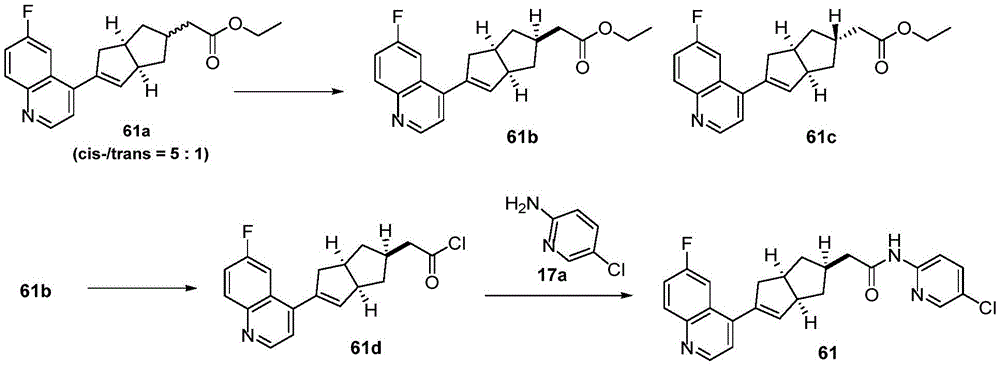
化合物61a是根据化合物11a的合成方法制备的,经过多次柱层析,得到纯的中间体61b和61c。化合物61b:1H NMR(500MHz,CDCl3)δ8.78(d,J=4.5Hz,1H),8.09(dd, J=9.2,5.6Hz,1H),7.74(dd,J=10.4,2.8Hz,1H),7.55–7.39(m,1H),7.22(d,J=4.5 Hz,1H),5.98(d,J=1.8Hz,1H),4.14(q,J=7.1Hz,2H),3.52–3.34(m,1H),3.09– 3.03(m,1H),2.89–2.81(m,1H),2.52(dd,J=16.5,1.7Hz,1H),2.43–2.36(m,2H), 2.34–2.25(m,2H),2.25–2.17(m,2H),1.26(t,J=7.1Hz,3H),1.19–1.06(m,2H)。化合物61c:1H NMR(500MHz,CDCl3)δ8.79(d,J=4.5Hz,1H),8.11(dd,J=9.2,5.6Hz, 1H),7.77–7.65(m,1H),7.53–7.38(m,1H),7.24(d,J=4.5Hz,1H),5.87(d,J=2.0 Hz,1H),4.15(q,J=7.1Hz,2H),3.56(t,J=8.4Hz,1H),3.25–3.10(m,1H),3.10– 2.94(m,1H),2.59–2.49(m,1H),2.48–2.40(m,1H),2.40–2.33(m,2H),1.90(dd,J= 12.6,5.8Hz,1H),1.79(dd,J=12.6,5.8Hz,1H),1.63–1.53(m,1H),1.52–1.43(m, 1H),1.27(t,J=7.1Hz,3H)。Compound 61a was prepared according to the synthetic method of compound 11a. After multiple column chromatography, pure intermediates 61b and 61c were obtained. Compound 61b: 1 H NMR (500 MHz, CDCl 3 ) δ 8.78 (d, J=4.5 Hz, 1H), 8.09 (dd, J=9.2, 5.6 Hz, 1H), 7.74 (dd, J=10.4, 2.8 Hz) ,1H),7.55–7.39(m,1H),7.22(d,J=4.5 Hz,1H),5.98(d,J=1.8Hz,1H),4.14(q,J=7.1Hz,2H),3.52 –3.34 (m, 1H), 3.09– 3.03 (m, 1H), 2.89–2.81 (m, 1H), 2.52 (dd, J=16.5, 1.7Hz, 1H), 2.43–2.36 (m, 2H), 2.34 -2.25 (m, 2H), 2.25 - 2.17 (m, 2H), 1.26 (t, J = 7.1 Hz, 3H), 1.19 - 1.06 (m, 2H). Compound 61c: 1 H NMR (500 MHz, CDCl 3 ) δ 8.79 (d, J=4.5 Hz, 1H), 8.11 (dd, J=9.2, 5.6 Hz, 1H), 7.77-7.65 (m, 1H), 7.53 –7.38(m, 1H), 7.24(d, J=4.5Hz, 1H), 5.87(d, J=2.0 Hz, 1H), 4.15(q, J=7.1Hz, 2H), 3.56(t, J= 8.4Hz, 1H), 3.25–3.10 (m, 1H), 3.10– 2.94 (m, 1H), 2.59–2.49 (m, 1H), 2.48–2.40 (m, 1H), 2.40–2.33 (m, 2H) ,1.90(dd,J=12.6,5.8Hz,1H),1.79(dd,J=12.6,5.8Hz,1H),1.63-1.53(m,1H),1.52-1.43(m,1H),1.27(t , J=7.1Hz, 3H).
化合物61b经酯水解得酸,然后进一步转化为酰氯61d。化合物61d和17a反应得化合物61。详见化合物26的制备方法。1H NMR(500MHz,CDCl3)δ8.80(d,J=4.5Hz, 1H),8.23(d,J=7.2Hz,1H),8.21(s,1H),8.12(dd,J=9.1,5.6Hz,1H),7.87(s,1H), 7.76(dd,J=10.3,2.8Hz,1H),7.67(dd,J=8.8,2.6Hz,1H),7.52–7.44(m,1H),6.01 (d,J=1.6Hz,1H),3.49(d,J=6.8Hz,1H),3.18–2.97(m,1H),2.89(t,J=9.2Hz,1H), 2.55(d,J=16.6Hz,1H),2.51(d,J=6.5Hz,2H),2.42–2.36(m,2H),2.32–2.28(m, 1H),1.28–1.13(m,2H)。LCMSm/z 424.14[M+H]+。Compound 61b undergoes ester hydrolysis to give acid, which is then further converted to acid chloride 61d. Compound 61d is reacted with 17a to give compound 61. See the preparation of compound 26 for details. 1 H NMR (500MHz, CDCl 3 ) δ 8.80 (d, J=4.5Hz, 1H), 8.23 (d, J=7.2Hz, 1H), 8.21 (s, 1H), 8.12 (dd, J=9.1, 5.6Hz, 1H), 7.87(s, 1H), 7.76(dd, J=10.3, 2.8Hz, 1H), 7.67(dd, J=8.8, 2.6Hz, 1H), 7.52–7.44(m, 1H), 6.01(d,J=1.6Hz,1H),3.49(d,J=6.8Hz,1H),3.18–2.97(m,1H),2.89(t,J=9.2Hz,1H), 2.55(d,J = 16.6 Hz, 1H), 2.51 (d, J = 6.5 Hz, 2H), 2.42–2.36 (m, 2H), 2.32–2.28 (m, 1H), 1.28–1.13 (m, 2H). LCMS m/z 424.14 [M+H] + .
实施例63化合物62的制备Example 63 Preparation of Compound 62

化合物61d和2-氯-5-氨基吡啶18a反应制备得到消旋化合物62。参考化合物11的制备方法。1H NMR(500MHz,CDCl3)δ8.80(d,J=4.5Hz,1H),8.36(d,J=2.8Hz,1H), 8.20(dd,J=8.6,2.7Hz,1H),8.11(dd,J=9.2,5.6Hz,1H),7.76(dd,J=10.4,2.8Hz, 1H),7.54–7.40(m,1H),7.31(d,J=8.7Hz,1H),7.24(d,J=4.5Hz,2H),6.01(d,J= 1.6Hz,1H),3.54–3.42(m,1H),3.16–3.03(m,1H),2.93–2.87(m,1H),2.55(d,J= 16.8Hz,1H),2.50(d,J=5.5Hz,2H),2.44–2.34(m,2H),2.33–2.27(m,1H),1.27– 1.12(m,2H)。LCMS m/z 424.12[M+H]+。Compound 61d was reacted with 2-chloro-5-aminopyridine 18a to prepare racemic compound 62. Refer to the preparation method of compound 11. 1 H NMR (500MHz, CDCl 3 ) δ 8.80 (d, J=4.5Hz, 1H), 8.36 (d, J=2.8Hz, 1H), 8.20 (dd, J=8.6, 2.7Hz, 1H), 8.11 (dd, J=9.2, 5.6Hz, 1H), 7.76 (dd, J=10.4, 2.8Hz, 1H), 7.54–7.40 (m, 1H), 7.31 (d, J=8.7Hz, 1H), 7.24 ( d, J=4.5Hz, 2H), 6.01 (d, J= 1.6Hz, 1H), 3.54–3.42 (m, 1H), 3.16–3.03 (m, 1H), 2.93–2.87 (m, 1H), 2.55 (d, J = 16.8 Hz, 1H), 2.50 (d, J = 5.5 Hz, 2H), 2.44 - 2.34 (m, 2H), 2.33 - 2.27 (m, 1H), 1.27 - 1.12 (m, 2H). LCMS m/z 424.12 [M+H] + .
实施例64化合物63的制备Example 64 Preparation of Compound 63

与化合物61制备方法相同,化合物61d和化合物25a反应制备得到化合物63。1HNMR(500MHz,CDCl3)δ8.80(d,J=4.5Hz,1H),8.38(d,J=2.0Hz,1H),8.22(d,J= 8.8Hz,1H),8.15–8.07(m,1H),7.89(s,1H),7.83–7.72(m,2H),7.51–7.48(m,1H), 6.08–5.97(m,1H),3.53–3.47(m,1H),3.17(s,1H),3.13–3.05(m,1H),2.93–2.85 (m,1H),2.56(d,J=17.7Hz,1H),2.51(d,J=6.6Hz,2H),2.44–2.36(m,2H),2.33– 2.28(m,1H),1.25–1.17(m,2H)。LCMS m/z 412.20[M+H]+。In the same way as compound 61 was prepared, compound 61d was reacted with compound 25a to obtain compound 63. 1 HNMR (500MHz, CDCl 3 ) δ 8.80 (d, J=4.5Hz, 1H), 8.38 (d, J=2.0Hz, 1H), 8.22 (d, J=8.8Hz, 1H), 8.15-8.07 ( m, 1H), 7.89 (s, 1H), 7.83–7.72 (m, 2H), 7.51–7.48 (m, 1H), 6.08–5.97 (m, 1H), 3.53–3.47 (m, 1H), 3.17 ( s, 1H), 3.13–3.05 (m, 1H), 2.93–2.85 (m, 1H), 2.56 (d, J=17.7Hz, 1H), 2.51 (d, J=6.6Hz, 2H), 2.44–2.36 (m, 2H), 2.33–2.28 (m, 1H), 1.25–1.17 (m, 2H). LCMS m/z 412.20 [M+H] + .
实施例65化合物64的制备Example 65 Preparation of Compound 64

化合物61d和化合物24a反应制备得到化合物64。1H NMR(500MHz,CDCl3)δ 8.80(d,J=4.5Hz,1H),8.50(d,J=2.5Hz,1H),8.25(d,J=8.5Hz,1H),8.11(dd,J= 9.2,5.6Hz,1H),7.76(dd,J=10.4,2.8Hz,1H),7.51–7.44(m,2H),7.24(d,J=4.5Hz, 1H),6.01(d,J=1.7Hz,1H),3.53–3.47(m,1H),3.12(s,1H),3.11–3.05(m,1H),2.94 –2.83(m,1H),2.55(d,J=16.5Hz,1H),2.51(d,J=6.0Hz,2H),2.47–2.36(m,2H), 2.35–2.26(m,1H),1.23–1.14(m,2H)。LCMS m/z 206.74[1/2M+H]+。Compound 64 was prepared by the reaction of compound 61d with compound 24a. 1 H NMR (500MHz, CDCl 3 ) δ 8.80 (d, J=4.5Hz, 1H), 8.50 (d, J=2.5Hz, 1H), 8.25 (d, J=8.5Hz, 1H), 8.11 (dd, J=9.2,5.6Hz,1H),7.76(dd,J=10.4,2.8Hz,1H),7.51–7.44(m,2H),7.24(d,J=4.5Hz,1H),6.01(d,J =1.7Hz,1H),3.53-3.47(m,1H),3.12(s,1H),3.11-3.05(m,1H),2.94-2.83(m,1H),2.55(d,J=16.5Hz, 1H), 2.51 (d, J=6.0 Hz, 2H), 2.47–2.36 (m, 2H), 2.35–2.26 (m, 1H), 1.23–1.14 (m, 2H). LCMS m/z 206.74[1/2M+H] + .
实施例66化合物65的制备Example 66 Preparation of Compound 65

化合物61c经酯水解得酸,然后进一步转化为酰氯65a。化合物65a和化合物25a 反应制备得到化合物65。参照化合物26的合成。1H NMR(500MHz,CDCl3)δ8.80(d,J =4.5Hz,1H),8.39(d,J=1.9Hz,1H),8.22(d,J=8.7Hz,1H),8.11(dd,J=9.2,5.6Hz, 1H),7.90(s,1H),7.80(dd,J=8.6,2.1Hz,1H),7.76(dd,J=10.4,2.8Hz,1H),7.51– 7.45(m,1H),7.24–7.23(m,1H),5.90(d,J=2.0Hz,1H),3.65–3.60(m,1H),3.24– 3.19(m,1H),3.17(s,1H),3.11–3.06(m,1H),2.61–2.55(m,2H),2.50–2.46(m,2H), 1.98(dd,J=12.5,5.7Hz,1H),1.88(dd,J=12.5,5.3Hz,1H),1.63(dd,J=22.0,9.3Hz, 2H)。LCMS m/z 412.22[M+H]+。Compound 61c undergoes ester hydrolysis to give the acid, which is then further converted to the acid chloride 65a. Compound 65 is prepared by the reaction of compound 65a with compound 25a. See the synthesis of compound 26. 1 H NMR (500 MHz, CDCl 3 ) δ 8.80 (d, J = 4.5 Hz, 1 H), 8.39 (d, J = 1.9 Hz, 1 H), 8.22 (d, J = 8.7 Hz, 1 H), 8.11 (dd , J=9.2, 5.6Hz, 1H), 7.90(s, 1H), 7.80(dd, J=8.6, 2.1Hz, 1H), 7.76(dd, J=10.4, 2.8Hz, 1H), 7.51– 7.45( m, 1H), 7.24–7.23 (m, 1H), 5.90 (d, J=2.0Hz, 1H), 3.65–3.60 (m, 1H), 3.24– 3.19 (m, 1H), 3.17 (s, 1H) , 3.11–3.06 (m, 1H), 2.61–2.55 (m, 2H), 2.50–2.46 (m, 2H), 1.98 (dd, J=12.5, 5.7Hz, 1H), 1.88 (dd, J=12.5, 5.3Hz, 1H), 1.63 (dd, J=22.0, 9.3Hz, 2H). LCMS m/z 412.22 [M+H] + .
实施例67化合物66的制备Example 67 Preparation of Compound 66

化合物61b经催化氢化,得两个异构体66a和66b,经多次柱层析分离可将这两个异构体分开,它们的比例为10:1。化合物66a:1H NMR(500MHz,CDCl3)δ8.78(d,J =4.6Hz,1H),8.09(dd,J=9.2,5.7Hz,1H),7.67(dd,J=10.5,2.8Hz,1H),7.47–7.43 (m,1H),7.35(d,J=4.6Hz,1H),4.13(q,J=7.1Hz,2H),3.74–3.67(m,1H),2.77– 2.60(m,2H),2.49–2.33(m,5H),2.21–2.16(m,2H),1.59–1.43(m,2H),1.26(t,J= 7.1Hz,3H),1.09–1.03(m,2H)。化合物66a的立体构型由NOESY确定。Compound 61b was subjected to catalytic hydrogenation to obtain two isomers 66a and 66b, which were separated by multiple column chromatography separations in a ratio of 10:1. Compound 66a: 1 H NMR (500 MHz, CDCl 3 ) δ 8.78 (d, J = 4.6 Hz, 1 H), 8.09 (dd, J = 9.2, 5.7 Hz, 1 H), 7.67 (dd, J = 10.5, 2.8 Hz , 1H), 7.47–7.43 (m, 1H), 7.35 (d, J=4.6Hz, 1H), 4.13 (q, J=7.1Hz, 2H), 3.74–3.67 (m, 1H), 2.77– 2.60 ( m, 2H), 2.49–2.33 (m, 5H), 2.21–2.16 (m, 2H), 1.59–1.43 (m, 2H), 1.26 (t, J=7.1Hz, 3H), 1.09–1.03 (m, 2H). The stereoconfiguration of compound 66a was determined by NOESY.
化合物66a经酯水解得酸,然后进一步转化为酰氯66c。化合物66c和24a反应制备得到化合物66。1H NMR(500MHz,CD3OD)δ8.74(d,J=4.7Hz,1H),8.69(d,J=2.2 Hz,1H),8.15(dd,J=8.6,2.5Hz,1H),8.06(dd,J=9.2,5.6Hz,1H),7.90(dd,J=10.6, 2.7Hz,1H),7.61–7.58(m,1H),7.57(d,J=4.5Hz,1H),7.54(d,J=8.6Hz,1H),3.92 –3.85(m,1H),3.69(s,1H),2.85–2.73(m,2H),2.58–2.46(m,3H),2.47–2.39(m, 2H),2.26–2.18(m,2H),1.61–1.54(m,2H),1.19(dd,J=19.3,11.5Hz,2H)。LCMS m/z 414.29[M+H]+。Compound 66a undergoes ester hydrolysis to give acid, which is then further converted to acid chloride 66c. Compound 66 was prepared by the reaction of compounds 66c and 24a. 1 H NMR (500MHz, CD 3 OD) δ 8.74 (d, J=4.7 Hz, 1H), 8.69 (d, J=2.2 Hz, 1H), 8.15 (dd, J=8.6, 2.5 Hz, 1H), 8.06 (dd, J=9.2, 5.6Hz, 1H), 7.90 (dd, J=10.6, 2.7Hz, 1H), 7.61–7.58 (m, 1H), 7.57 (d, J=4.5Hz, 1H), 7.54 (d, J=8.6Hz, 1H), 3.92 – 3.85 (m, 1H), 3.69 (s, 1H), 2.85 – 2.73 (m, 2H), 2.58 – 2.46 (m, 3H), 2.47 – 2.39 (m , 2H), 2.26–2.18 (m, 2H), 1.61–1.54 (m, 2H), 1.19 (dd, J=19.3, 11.5Hz, 2H). LCMS m/z 414.29 [M+H] + .
实施例68化合物67的制备Example 68 Preparation of Compound 67

化合物66c和化合物25a反应制备得到化合物67。1H NMR(500MHz,CD3OD)δ 8.76(d,J=4.7Hz,1H),8.38(s,1H),8.13(d,J=8.6Hz,1H),8.07(dd,J=9.2,5.5Hz, 1H),7.93(dd,J=10.5,2.7Hz,1H),7.82(dd,J=8.6,2.2Hz,1H),7.63–7.57(m,2H), 3.93–3.86(m,1H),3.64(s,1H),2.87–2.71(m,2H),2.57–2.48(m,3H),2.47–2.38 (m,2H),2.22(dd,J=12.2,6.4Hz,2H),1.61–1.55(m,2H),1.19(dd,J=19.5,11.7Hz, 1H)。LCMS m/z 414.19[M+H]+。Compound 67 was prepared by the reaction of compound 66c with compound 25a. 1 H NMR (500 MHz, CD 3 OD) δ 8.76 (d, J=4.7 Hz, 1H), 8.38 (s, 1H), 8.13 (d, J=8.6 Hz, 1H), 8.07 (dd, J=9.2, 5.5Hz, 1H), 7.93 (dd, J=10.5, 2.7Hz, 1H), 7.82 (dd, J=8.6, 2.2Hz, 1H), 7.63–7.57 (m, 2H), 3.93–3.86 (m, 1H) ), 3.64 (s, 1H), 2.87–2.71 (m, 2H), 2.57–2.48 (m, 3H), 2.47–2.38 (m, 2H), 2.22 (dd, J=12.2, 6.4Hz, 2H), 1.61–1.55 (m, 2H), 1.19 (dd, J=19.5, 11.7 Hz, 1H). LCMS m/z 414.19 [M+H] + .
实施例69化合物68的制备Example 69 Preparation of Compound 68

将化合物38g(30mg,0.085mmol)溶于甲苯(1mL)中,加入三氟乙酸(194mg,1.70mmol),在封管中升温至120℃,搅拌反应5小时。用饱和碳酸氢钠溶液调pH=7,乙酸乙酯萃取(3X 5mL),合并有机相,无水硫酸钠干燥,减压浓缩得到粗品化合物68a(25mg, 91%)。该中间体不纯化,直接用于下一步反应。Compound 38 g (30 mg, 0.085 mmol) was dissolved in toluene (1 mL), trifluoroacetic acid (194 mg, 1.70 mmol) was added, the temperature was raised to 120° C. in a sealed tube, and the reaction was stirred for 5 hours. Adjust pH=7 with saturated sodium bicarbonate solution, extract with ethyl acetate (3×5 mL), combine organic phases, dry over anhydrous sodium sulfate, and concentrate under reduced pressure to obtain crude compound 68a (25 mg, 91%). This intermediate was used directly in the next reaction without purification.
将化合物68a与4-氯苯胺反应,参考化合物38的制备方法,得到化合物68。1H NMR(500MHz,CD3OD)δ8.73(d,J=4.7Hz,1H),8.06(dd,J=9.3,5.5Hz,1H),7.89(dd,J =10.6,2.7Hz,1H),7.64–7.55(m,3H),7.54(d,J=4.6Hz,1H),7.33–7.28(m,2H), 3.87–3.74(m,1H),2.89–2.77(m,3H),2.66(dd,J=17.3,8.3Hz,1H),2.53–2.36(m, 4H),1.95(s,3H),1.57–1.46(m,2H)。LCMS m/z 435.26[M+H]+。Compound 68a was reacted with 4-chloroaniline, and compound 68 was obtained by referring to the preparation method of compound 38. 1 H NMR (500MHz, CD 3 OD) δ 8.73 (d, J=4.7Hz, 1H), 8.06 (dd, J=9.3, 5.5Hz, 1H), 7.89 (dd, J=10.6, 2.7Hz, 1H) ), 7.64–7.55 (m, 3H), 7.54 (d, J=4.6Hz, 1H), 7.33–7.28 (m, 2H), 3.87–3.74 (m, 1H), 2.89–2.77 (m, 3H), 2.66 (dd, J=17.3, 8.3 Hz, 1H), 2.53–2.36 (m, 4H), 1.95 (s, 3H), 1.57–1.46 (m, 2H). LCMS m/z 435.26 [M+H] + .
实施例70化合物69的制备Example 70 Preparation of Compound 69

与化合物61制备方法相同,化合物61d和化合物69a反应制备得到消旋化合物 69。LCMS m/z 413.4[M+H]+。In the same way as compound 61 was prepared, compound 61d was reacted with compound 69a to prepare racemic compound 69. LCMS m/z 413.4 [M+H] + .
实施例71化合物70的制备Example 71 Preparation of Compound 70

与化合物21制备方法相同,化合物21a和化合物69a反应制备得到化合物70。 LCMSm/z 415.4[M+H]+。In the same way as compound 21 was prepared, compound 21a and compound 69a were reacted to obtain compound 70. LCMS m/z 415.4 [M+H] + .
实施例72化合物71的制备Example 72 Preparation of Compound 71

与化合物26制备方法相同,化合物21a和化合物71a反应制备得到化合物71。1HNMR(500MHz,CDCl3)δ8.72(d,J=4.5Hz,1H),8.53(d,J=2.4Hz,1H),8.37(dd,J =8.6,2.5Hz,1H),8.03(dd,J=9.2,5.7Hz,1H),7.64–7.59(m,2H),7.46(s,1H),7.42 –7.37(m,1H),7.28(d,J=4.5Hz,1H),3.43–3.35(m,1H),2.72(dd,J=12.9,7.2Hz, 2H),2.56–2.47(m,1H),2.44(d,J=7.0Hz,2H),2.36–2.28(m,2H),1.72(dd,J=12.7, 5.6Hz,2H),1.41–1.30(m,4H)。LCMS m/z 415.2[M+H]+。Compound 71 is prepared by reacting compound 21a with compound 71a in the same manner as compound 26. 1 HNMR (500MHz, CDCl 3 ) δ 8.72 (d, J=4.5Hz, 1H), 8.53 (d, J=2.4Hz, 1H), 8.37 (dd, J=8.6, 2.5Hz, 1H), 8.03 ( dd, J=9.2, 5.7Hz, 1H), 7.64–7.59 (m, 2H), 7.46 (s, 1H), 7.42–7.37 (m, 1H), 7.28 (d, J=4.5Hz, 1H), 3.43 –3.35(m,1H),2.72(dd,J=12.9,7.2Hz,2H),2.56-2.47(m,1H),2.44(d,J=7.0Hz,2H),2.36-2.28(m,2H) ), 1.72 (dd, J=12.7, 5.6 Hz, 2H), 1.41–1.30 (m, 4H). LCMS m/z 415.2 [M+H] + .
实施例73化合物72的制备Example 73 Preparation of Compound 72

与化合物26制备方法相同,化合物1aj和化合物71a反应制备得到化合物72。1HNMR(500MHz,CDCl3)δ8.80(d,J=4.6Hz,1H),8.61(d,J=2.5Hz,1H),8.47(dd,J =8.6,2.6Hz,1H),8.10(dd,J=9.2,5.7Hz,1H),7.68(d,J=8.8Hz,1H),7.66(s,1H), 7.62(s,1H),7.49–7.46(m,1H),7.34(d,J=4.6Hz,1H),3.77–3.70(m,1H),2.72(d,J =3.5Hz,2H),2.46–2.39(m,2H),2.34–2.19(m,3H),2.17–2.13(m,1H),1.52–1.46 (m,2H),1.30(d,J=6.4Hz,3H),1.17–1.01(m,2H)。LCMS m/z 429.2[M+H]+。In the same way as compound 26 was prepared, compound 72 was prepared by reacting compound 1aj and compound 71a. 1 HNMR (500MHz, CDCl 3 ) δ 8.80 (d, J=4.6Hz, 1H), 8.61 (d, J=2.5Hz, 1H), 8.47 (dd, J=8.6, 2.6Hz, 1H), 8.10 ( dd, J=9.2, 5.7Hz, 1H), 7.68(d, J=8.8Hz, 1H), 7.66(s, 1H), 7.62(s, 1H), 7.49–7.46(m, 1H), 7.34(d , J=4.6Hz, 1H), 3.77–3.70 (m, 1H), 2.72 (d, J=3.5Hz, 2H), 2.46–2.39 (m, 2H), 2.34–2.19 (m, 3H), 2.17– 2.13 (m, 1H), 1.52–1.46 (m, 2H), 1.30 (d, J=6.4Hz, 3H), 1.17–1.01 (m, 2H). LCMS m/z 429.2 [M+H] + .
实施例74化合物73的制备Example 74 Preparation of Compound 73

与化合物26制备方法相同,化合物1aj和化合物69a反应制备得到化合物73。1HNMR(500MHz,CDCl3)δ8.80(d,J=4.5Hz,1H),8.55(d,J=2.1Hz,1H),8.39(d,J= 8.8Hz,1H),8.17–8.09(m,1H),8.00(s,1H),7.95(dd,J=8.8,2.2Hz,1H),7.68(dd,J =10.4,2.5Hz,1H),7.51–7.41(m,1H),7.37(d,J=4.3Hz,1H),3.77–3.70(m,1H), 2.83–2.55(m,2H),2.45–2.39(m,2H),2.35–2.22(m,3H),2.20–2.10(m,1H),1.51– 1.48(m,2H),1.30(d,J=6.1Hz,3H),1.21–1.00(m,2H)。LCMS m/z 429.23[M+H]+。In the same way as compound 26 was prepared, compound 73 was prepared by the reaction of compound 1aj and compound 69a. 1 H NMR (500 MHz, CDCl 3 ) δ 8.80 (d, J=4.5 Hz, 1H), 8.55 (d, J=2.1 Hz, 1H), 8.39 (d, J= 8.8 Hz, 1H), 8.17-8.09 ( m, 1H), 8.00 (s, 1H), 7.95 (dd, J=8.8, 2.2Hz, 1H), 7.68 (dd, J=10.4, 2.5Hz, 1H), 7.51–7.41 (m, 1H), 7.37 (d, J=4.3Hz, 1H), 3.77–3.70 (m, 1H), 2.83–2.55 (m, 2H), 2.45–2.39 (m, 2H), 2.35–2.22 (m, 3H), 2.20–2.10 (m, 1H), 1.51–1.48 (m, 2H), 1.30 (d, J=6.1 Hz, 3H), 1.21–1.00 (m, 2H). LCMS m/z 429.23 [M+H] + .
实施例75化合物74的制备Example 75 Preparation of Compound 74
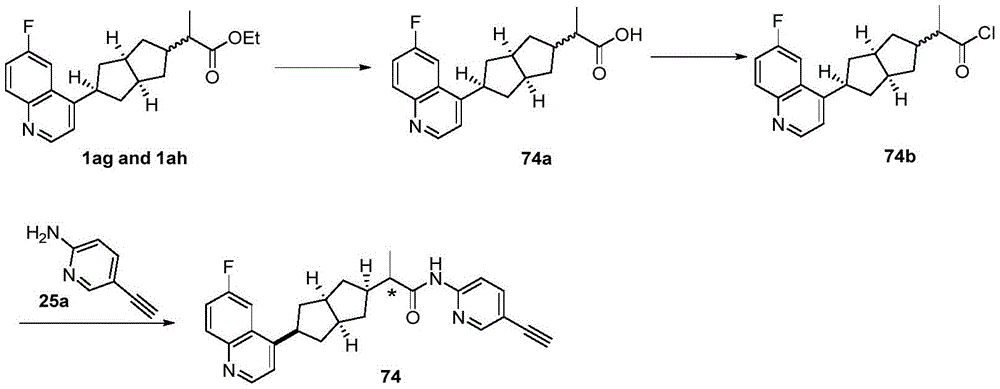
在实施例1中化合物1的合成过程中,中间体1af经Pd-C催化氢化反应得到混合物1ag和1ah。该混合物里的两个异构体很难分开,所以实际操作中通常将混合物水解得酸74a,经酰氯74b,再和化合物25a反应制备得到化合物74(合成方法同化合物26的合成)。主产物化合物74:1H NMR(500MHz,CDCl3)δ8.73(d,J=4.5Hz,1H),8.32(d, J=1.7Hz,1H),8.16(d,J=8.6Hz,1H),8.03(dd,J=9.2,5.7Hz,1H),7.80(s,1H),7.72 (dd,J=8.7,2.2Hz,1H),7.60(dd,J=10.4,2.7Hz,1H),7.42–7.36(m,1H),7.29(d,J= 4.5Hz,1H),3.69–3.62(m,1H),3.09(s,1H),2.68–2.60(m,2H),2.37–2.31(m,2H), 2.21–2.17(m,3H),2.13–2.06(m,1H),1.47–1.41(m,2H),1.22(d,J=6.5Hz,3H), 1.11–0.98(m,2H)。LCMS m/z428.2[M+H]+。During the synthesis of compound 1 in Example 1, the intermediate 1af was subjected to Pd-C catalytic hydrogenation to obtain mixtures 1ag and 1ah. The two isomers in the mixture are difficult to separate, so in practice, the mixture is usually hydrolyzed to obtain acid 74a, which is then reacted with acid chloride 74b to obtain compound 74 (the synthesis method is the same as that of compound 26). Main product compound 74: 1 H NMR (500 MHz, CDCl 3 ) δ 8.73 (d, J=4.5 Hz, 1H), 8.32 (d, J=1.7 Hz, 1H), 8.16 (d, J=8.6 Hz, 1H) ),8.03(dd,J=9.2,5.7Hz,1H),7.80(s,1H),7.72(dd,J=8.7,2.2Hz,1H),7.60(dd,J=10.4,2.7Hz,1H) ,7.42–7.36(m,1H),7.29(d,J=4.5Hz,1H),3.69–3.62(m,1H),3.09(s,1H),2.68–2.60(m,2H),2.37–2.31 (m, 2H), 2.21–2.17 (m, 3H), 2.13–2.06 (m, 1H), 1.47–1.41 (m, 2H), 1.22 (d, J=6.5Hz, 3H), 1.11–0.98 (m , 2H). LCMS m/z 428.2[M+H] + .
实施例76化合物75的制备Example 76 Preparation of Compound 75

化合物75是在实施例75中化合物74的制备过程中的少量的副产物。1H NMR(500MHz,CDCl3)δ8.72(d,J=4.5Hz,1H),8.32(d,J=2.1Hz,1H),8.17(d,J=8.6Hz, 1H),8.03(dd,J=9.4,5.7Hz,1H),7.84(s,1H),7.72(dd,J=8.6,2.1Hz,1H),7.61(dd, J=10.5,2.7Hz,1H),7.41–7.36(m,1H),7.29(d,J=4.6Hz,1H),3.41–3.32(m,1H), 3.09(s,1H),2.74–2.66(m,2H),2.37–2.30(m,1H),2.30–2.18(m,2H),2.15–2.01 (m,1H),1.70(dd,J=12.5,5.3Hz,1H),1.63(dd,J=12.7,5.7Hz,1H),1.41–1.35(m, 2H),1.17(d,J=6.9Hz,3H),1.12–1.01(m,2H)。LCMS m/z 428.3[M+H]+。Compound 75 was a minor by-product during the preparation of compound 74 in Example 75. 1 H NMR (500 MHz, CDCl 3 ) δ 8.72 (d, J=4.5 Hz, 1H), 8.32 (d, J=2.1 Hz, 1H), 8.17 (d, J=8.6 Hz, 1H), 8.03 (dd , J=9.4, 5.7Hz, 1H), 7.84(s, 1H), 7.72(dd, J=8.6, 2.1Hz, 1H), 7.61(dd, J=10.5, 2.7Hz, 1H), 7.41–7.36( m, 1H), 7.29 (d, J=4.6Hz, 1H), 3.41–3.32 (m, 1H), 3.09 (s, 1H), 2.74–2.66 (m, 2H), 2.37–2.30 (m, 1H) , 2.30–2.18 (m, 2H), 2.15–2.01 (m, 1H), 1.70 (dd, J=12.5, 5.3Hz, 1H), 1.63 (dd, J=12.7, 5.7Hz, 1H), 1.41–1.35 (m, 2H), 1.17 (d, J=6.9Hz, 3H), 1.12–1.01 (m, 2H). LCMS m/z 428.3 [M+H] + .
实施例77化合物76的制备Example 77 Preparation of Compound 76

化合物76是根据实施例75中化合物74的制备方法,用中间体74b和76a反应得到含有两个异构体的混合物。1H NMR(500MHz,CDCl3)δ8.73(d,J=4.6Hz,1H),8.39(d, J=2.1Hz,1H),8.03(d,J=8.7Hz,2H),7.89(dd,J=8.8,2.2Hz,1H),7.72(s,1H),7.60 (dd,J=10.5,2.7Hz,1H),7.42–7.37(m,1H),7.29(d,J=4.5Hz,1H),3.69–3.63(m, 1H),2.63(t,J=6.9Hz,2H),2.40–2.14(m,5H),2.13–2.04(m,1H),1.37–1.32(m, 2H),1.21(d,J=6.5Hz,3H),1.11–0.99(m,2H)。LCMS m/z 530.1[M+H]+。Compound 76 was prepared according to the preparation method of compound 74 in Example 75, and intermediates 74b and 76a were reacted to obtain a mixture containing two isomers. 1 H NMR (500 MHz, CDCl 3 ) δ 8.73 (d, J=4.6 Hz, 1H), 8.39 (d, J=2.1 Hz, 1H), 8.03 (d, J=8.7 Hz, 2H), 7.89 (dd , J=8.8, 2.2Hz, 1H), 7.72(s, 1H), 7.60 (dd, J=10.5, 2.7Hz, 1H), 7.42–7.37(m, 1H), 7.29(d, J=4.5Hz, 1H), 3.69–3.63 (m, 1H), 2.63 (t, J=6.9Hz, 2H), 2.40–2.14 (m, 5H), 2.13–2.04 (m, 1H), 1.37–1.32 (m, 2H) , 1.21 (d, J=6.5Hz, 3H), 1.11–0.99 (m, 2H). LCMS m/z 530.1 [M+H] + .
实施例78化合物77的制备Example 78 Preparation of Compound 77

将76(20mg,0.04mmol),77a(10mg,0.12mmol),(Ph3P)2PdCl2(5mg),Ph3P(2mg),Et3N(38mg,0.40mmol)和CuI(1mg)溶解在四氢呋喃(2mL)中,升到60℃并搅拌4小时。将反应液缓慢加入到水中,用乙酸乙酯萃取(3X 5mL),合并有机相,用无水硫酸钠干燥,过滤,减压浓缩。粗品经制备薄板层析纯化(甲醇/二氯甲烷=5%)分离得到白色固体化合物77。化合物77为主产物。1H NMR(500MHz,CDCl3)δ8.73(d,J=4.6 Hz,1H),8.24(d,J=1.5Hz,1H),8.14(d,J=8.7Hz,1H),8.03(dd,J=9.2,5.7Hz,1H), 7.85(s,1H),7.65(dd,J=8.6,2.1Hz,1H),7.43–7.35(m,2H),7.29(d,J=4.6Hz,1H), 3.69–3.62(m,1H),2.66–2.60(m,2H),2.40–2.27(m,2H),2.21–2.16(m,3H),2.13– 2.04(m,1H),1.56(s,6H),1.48–1.39(m,2H),1.20(d,J=7.3Hz,3H),1.12–1.05(m, 1H),1.01(dd,J=19.6,11.4Hz,1H)。LCMS m/z243.8[M/2+H]+。Combine 76 (20 mg, 0.04 mmol), 77a (10 mg, 0.12 mmol), (Ph3P) 2PdCl2 ( 5 mg), Ph3P ( 2 mg), Et3N ( 38 mg, 0.40 mmol) and CuI (1 mg) Dissolved in tetrahydrofuran (2 mL), warmed to 60°C and stirred for 4 hours. The reaction solution was slowly added to water, extracted with ethyl acetate (3×5 mL), the organic phases were combined, dried over anhydrous sodium sulfate, filtered, and concentrated under reduced pressure. The crude product was purified by preparative thin plate chromatography (methanol/dichloromethane=5%) to isolate compound 77 as a white solid. Compound 77 is the main product. 1 H NMR (500MHz, CDCl 3 ) δ 8.73 (d, J=4.6 Hz, 1H), 8.24 (d, J=1.5 Hz, 1H), 8.14 (d, J=8.7 Hz, 1H), 8.03 (dd , J=9.2, 5.7Hz, 1H), 7.85(s, 1H), 7.65(dd, J=8.6, 2.1Hz, 1H), 7.43–7.35(m, 2H), 7.29(d, J=4.6Hz, 1H), 3.69–3.62(m,1H), 2.66–2.60(m,2H), 2.40–2.27(m,2H), 2.21–2.16(m,3H), 2.13–2.04(m,1H), 1.56( s, 6H), 1.48–1.39 (m, 2H), 1.20 (d, J=7.3 Hz, 3H), 1.12–1.05 (m, 1H), 1.01 (dd, J=19.6, 11.4 Hz, 1H). LCMS m/z 243.8 [M/2+H] + .
实施例79化合物78的制备Example 79 Preparation of Compound 78
化合物78是在实施例78中化合物77的制备过程中分离得到的少量的副产物。LCMS m/z 486.2[M+H]+。Compound 78 is a minor by-product isolated during the preparation of compound 77 in Example 78. LCMS m/z 486.2 [M+H] + .
实施例80化合物79的制备Example 80 Preparation of Compound 79

参照化合物77的制备(实施例78),化合物76和79a反应,经分离纯化得主产物化合物79。LCMS m/z 468.3[M+H]+。Referring to the preparation of compound 77 (Example 78), compound 76 and 79a were reacted, and the main product compound 79 was obtained by separation and purification. LCMS m/z 468.3 [M+H] + .
实施例81化合物80的制备Example 81 Preparation of Compound 80

参照化合物76的制备(实施例77),化合物74b和80a反应,经分离纯化得主产物化合物80。1H NMR(500MHz,CDCl3)δ8.80(d,J=4.6Hz,1H),8.62(d,J=2.3Hz,1H), 8.49(d,J=8.6Hz,1H),8.10(dd,J=9.2,5.7Hz,1H),7.78–7.60(m,2H),7.50–7.45 (m,1H),7.44(s,1H),7.35(d,J=4.5Hz,1H),3.77–3.70(m,1H),2.75–2.69(m,2H), 2.45–2.40(m,2H),2.36–2.24(m,3H),2.20–2.12(m,1H),1.51–1.47(m,2H),1.31 (d,J=6.5Hz,3H),1.19–1.03(m,2H)。LCMS m/z 472.2[M+H]+。Referring to the preparation of compound 76 (Example 77), compound 74b and 80a were reacted, and the main product compound 80 was obtained by separation and purification. 1 H NMR (500 MHz, CDCl 3 ) δ 8.80 (d, J=4.6 Hz, 1H), 8.62 (d, J=2.3 Hz, 1H), 8.49 (d, J=8.6 Hz, 1H), 8.10 (dd , J=9.2, 5.7Hz, 1H), 7.78–7.60 (m, 2H), 7.50–7.45 (m, 1H), 7.44 (s, 1H), 7.35 (d, J=4.5Hz, 1H), 3.77– 3.70 (m, 1H), 2.75–2.69 (m, 2H), 2.45–2.40 (m, 2H), 2.36–2.24 (m, 3H), 2.20–2.12 (m, 1H), 1.51–1.47 (m, 2H) ), 1.31 (d, J=6.5Hz, 3H), 1.19–1.03 (m, 2H). LCMS m/z 472.2 [M+H] + .
实施例82化合物81的制备Example 82 Preparation of Compound 81

参照化合物76的制备(实施例77),化合物74b和81a反应,经分离纯化得主产物化合物81。1H NMR(500MHz,CDCl3)δ8.80(d,J=4.6Hz,1H),8.53(s,1H),8.39(d,J= 8.8Hz,1H),8.10(dd,J=9.1,5.7Hz,1H),8.01(s,1H),7.92(d,J=2.3Hz,1H),7.67 (dd,J=10.4,2.7Hz,1H),7.49–7.42(m,1H),7.36(d,J=4.6Hz,1H),3.76–3.69(m, 1H),2.74–2.68(m,2H),2.45–2.38(m,2H),2.32–2.20(m,3H),2.20–2.11(m,1H), 1.52–1.48(m,2H),1.30(d,J=6.3Hz,3H),1.20–1.02(m,2H)。LCMS m/z 472.2 [M+H]+。Referring to the preparation of compound 76 (Example 77), compound 74b and 81a were reacted, and the main product compound 81 was obtained by separation and purification. 1 H NMR (500MHz, CDCl 3 ) δ 8.80 (d, J=4.6Hz, 1H), 8.53 (s, 1H), 8.39 (d, J=8.8Hz, 1H), 8.10 (dd, J=9.1, 5.7Hz, 1H), 8.01(s, 1H), 7.92(d, J=2.3Hz, 1H), 7.67 (dd, J=10.4, 2.7Hz, 1H), 7.49–7.42(m, 1H), 7.36( d, J=4.6Hz, 1H), 3.76–3.69 (m, 1H), 2.74–2.68 (m, 2H), 2.45–2.38 (m, 2H), 2.32–2.20 (m, 3H), 2.20–2.11 ( m, 1H), 1.52–1.48 (m, 2H), 1.30 (d, J=6.3 Hz, 3H), 1.20–1.02 (m, 2H). LCMS m/z 472.2 [M+H] + .
实施例83化合物82的制备Example 83 Preparation of Compound 82

参照化合物77的制备(实施例78),化合物76和82a反应,经分离纯化得主产物化合物82。1H NMR(500MHz,CDCl3)δ8.73(d,J=4.5Hz,1H),8.21(d,J=1.8Hz,1H), 8.11(d,J=8.6Hz,1H),8.03(dd,J=9.2,5.7Hz,1H),7.83(s,1H),7.65–7.57(m,2H), 7.39(ddd,J=9.2,8.0,2.8Hz,1H),7.29(d,J=4.6Hz,1H),3.65(dq,J=18.0,5.9Hz, 1H),2.68–2.55(m,2H),2.33(ddd,J=18.7,12.2,5.8Hz,2H),2.24–2.13(m,3H),2.12 –2.05(m,1H),1.99(s,3H),1.43(dt,J=12.2,10.0Hz,2H),1.21(d,J=6.6Hz,3H), 1.10–1.04(m,1H),1.02–0.95(m,1H)。LCMS m/z 442.2[M+H]+。Referring to the preparation of compound 77 (Example 78), compound 76 and 82a were reacted, and the main product compound 82 was obtained by separation and purification. 1 H NMR (500 MHz, CDCl 3 ) δ 8.73 (d, J=4.5 Hz, 1H), 8.21 (d, J=1.8 Hz, 1H), 8.11 (d, J=8.6 Hz, 1H), 8.03 (dd , J=9.2, 5.7Hz, 1H), 7.83 (s, 1H), 7.65–7.57 (m, 2H), 7.39 (ddd, J=9.2, 8.0, 2.8Hz, 1H), 7.29 (d, J=4.6 Hz, 1H), 3.65 (dq, J=18.0, 5.9Hz, 1H), 2.68–2.55 (m, 2H), 2.33 (ddd, J=18.7, 12.2, 5.8Hz, 2H), 2.24–2.13 (m, 3H), 2.12 – 2.05(m, 1H), 1.99(s, 3H), 1.43(dt, J=12.2, 10.0Hz, 2H), 1.21(d, J=6.6Hz, 3H), 1.10–1.04(m , 1H), 1.02–0.95 (m, 1H). LCMS m/z 442.2 [M+H] + .
实施例84化合物83的制备Example 84 Preparation of Compound 83

中间体83b是由83a和82a反应得到的(参照实施例78中化合物77的制备方法)。化合物74b和83b反应,经纯化得到主产物化合物83(参照化合物76的制备)。1H NMR(500 MHz,CDCl3)δ8.73(d,J=4.5Hz,1H),8.40(d,J=2.4Hz,1H),8.13(dd,J=8.6,2.6 Hz,1H),8.03(dd,J=9.2,5.7Hz,1H),7.61(dd,J=10.4,2.7Hz,1H),7.43–7.35(m, 2H),7.30–7.25(m,2H),3.66(ddd,J=17.9,11.9,5.9Hz,1H),2.63(d,J=7.3Hz,2H), 2.38–2.31(m,2H),2.26–2.15(m,3H),2.12–2.07(m,1H),1.98(s,3H),1.42(dd,J= 19.2,12.0Hz,2H),1.20(d,J=7.1Hz,3H),1.07(dd,J=11.6,8.1Hz,1H),1.01–0.94 (m,1H)。LCMS m/z 442.2[M+H]+。Intermediate 83b is obtained by the reaction of 83a and 82a (refer to the preparation method of compound 77 in Example 78). Compounds 74b and 83b were reacted and purified to obtain the main product compound 83 (refer to the preparation of compound 76). 1 H NMR (500 MHz, CDCl 3 ) δ 8.73 (d, J=4.5 Hz, 1H), 8.40 (d, J=2.4 Hz, 1H), 8.13 (dd, J=8.6, 2.6 Hz, 1H), 8.03 (dd, J=9.2, 5.7Hz, 1H), 7.61 (dd, J=10.4, 2.7Hz, 1H), 7.43–7.35 (m, 2H), 7.30–7.25 (m, 2H), 3.66 (ddd, J=17.9, 11.9, 5.9Hz, 1H), 2.63 (d, J=7.3Hz, 2H), 2.38–2.31 (m, 2H), 2.26–2.15 (m, 3H), 2.12–2.07 (m, 1H) ,1.98(s,3H),1.42(dd,J=19.2,12.0Hz,2H),1.20(d,J=7.1Hz,3H),1.07(dd,J=11.6,8.1Hz,1H),1.01– 0.94 (m, 1H). LCMS m/z 442.2 [M+H] + .
实施例85化合物84的制备Example 85 Preparation of Compound 84

将化合物1ab(3.0g,11.18mmol)和TMEDA(2.6g,22.36mmol)溶于四氢呋喃 (20mL)中并在氮气保护下冷却至-78℃,缓慢滴加LDA(11.18mL,22.36mmol),于 -78℃下搅拌1小时后,将碘甲烷(3.17g,22.36mmol)缓慢滴加至上述溶液,在-78℃搅拌30分钟(析出大量白色固体)。向反应液中加入饱和NH4Cl水溶液(20mL),用乙酸乙酯萃取(3x 30mL)。合并的有机相用饱和食盐水洗涤(3x 20mL),用无水硫酸钠干燥,过滤减压浓缩,所得的粗品经硅胶柱纯化(乙酸乙酯/石油醚=0-10%)分离得到无色油状液体化合物84a(1.9g,收率60%)。Compound 1ab (3.0 g, 11.18 mmol) and TMEDA (2.6 g, 22.36 mmol) were dissolved in tetrahydrofuran (20 mL) and cooled to -78°C under nitrogen protection, and LDA (11.18 mL, 22.36 mmol) was slowly added dropwise. After stirring at -78°C for 1 hour, iodomethane (3.17 g, 22.36 mmol) was slowly added dropwise to the above solution and stirred at -78°C for 30 minutes (a large amount of white solid was precipitated). Saturated aqueous NH 4 Cl solution (20 mL) was added to the reaction solution, followed by extraction with ethyl acetate (3 x 30 mL). The combined organic phases were washed with saturated brine (3×20 mL), dried over anhydrous sodium sulfate, filtered and concentrated under reduced pressure, and the obtained crude product was purified by silica gel column (ethyl acetate/petroleum ether=0-10%) to obtain colorless Oily liquid compound 84a (1.9 g, 60% yield).
从化合物84a出发,参照化合物1的合成路线,经多步合成,制备了化合物84e。化合物84e经催化氢化反应,得到了主产物84f及其它三个异构体(少量),在这一步反应中,这些异构体和主产物靠得近,硅胶柱层析比较难分开,所以混合物继续用于下一步反应(酯水解和酰氯的制备),最后在酰胺的制备中,这三个少量的异构体可以用薄板层析分开。1H NMR(500MHz,CD3OD)δ8.72(d,J=4.7Hz,1H),8.29(d,J=2.6Hz, 1H),8.10(d,J=8.9Hz,1H),8.04(dd,J=9.2,5.6Hz,1H),7.88(dd,J=10.6,2.8Hz, 1H),7.79(dd,J=8.9,2.6Hz,1H),7.59–7.54(m,2H),3.90–3.83(m,1H),2.76–2.73 (m,2H),2.51–2.45(m,1H),2.44–2.38(m,2H),2.00–1.95(m,2H),1.58–1.50(m, 2H),1.28(s,6H),1.35–1.26(m,2H)。LCMS m/z452.2[M+H]+。Starting from compound 84a, referring to the synthetic route of compound 1, compound 84e was prepared through multi-step synthesis. Compound 84e is subjected to catalytic hydrogenation to obtain the main product 84f and three other isomers (a small amount). In this step of the reaction, these isomers are close to the main product, and it is difficult to separate them by silica gel column chromatography, so the mixture Continued for the next reaction (ester hydrolysis and acid chloride preparation), finally in the preparation of the amide, the three minor isomers can be separated by thin plate chromatography. 1 H NMR (500 MHz, CD 3 OD) δ 8.72 (d, J=4.7 Hz, 1H), 8.29 (d, J=2.6 Hz, 1H), 8.10 (d, J=8.9 Hz, 1H), 8.04 ( dd,J=9.2,5.6Hz,1H),7.88(dd,J=10.6,2.8Hz,1H),7.79(dd,J=8.9,2.6Hz,1H),7.59–7.54(m,2H),3.90 –3.83 (m, 1H), 2.76–2.73 (m, 2H), 2.51–2.45 (m, 1H), 2.44–2.38 (m, 2H), 2.00–1.95 (m, 2H), 1.58–1.50 (m, 2H), 1.28 (s, 6H), 1.35–1.26 (m, 2H). LCMS m/z452.2[M+H] + .
实施例86化合物85的制备Example 86 Preparation of Compound 85

与化合物26制备方法相同,化合物84j和化合物18a反应制备得到化合物85。1HNMR(500MHz,CD3OD)δ8.72(d,J=4.7Hz,1H),8.58(d,J=2.7Hz,1H),8.09–8.03 (m,2H),7.88(dd,J=10.6,2.7Hz,1H),7.59–7.54(m,2H),7.41(d,J=8.7Hz,1H), 3.31–3.29(m,1H),2.79–2.69(m,2H),2.50–2.45(m,1H),2.44–2.38(m,2H),2.03– 1.95(m,2H),1.58–1.51(m,2H),1.28(s,6H),1.32–1.23(m,2H)。LCMS m/z 452.2 [M+H]+。In the same way as compound 26 was prepared, compound 84j was reacted with compound 18a to obtain compound 85. 1 HNMR (500MHz, CD 3 OD) δ 8.72 (d, J=4.7Hz, 1H), 8.58 (d, J=2.7Hz, 1H), 8.09-8.03 (m, 2H), 7.88 (dd, J= 10.6, 2.7Hz, 1H), 7.59–7.54 (m, 2H), 7.41 (d, J=8.7Hz, 1H), 3.31–3.29 (m, 1H), 2.79–2.69 (m, 2H), 2.50–2.45 (m, 1H), 2.44–2.38 (m, 2H), 2.03– 1.95 (m, 2H), 1.58–1.51 (m, 2H), 1.28 (s, 6H), 1.32–1.23 (m, 2H). LCMS m/z 452.2 [M+H] + .
实施例87化合物86的制备Example 87 Preparation of Compound 86

与化合物26制备方法相同,化合物84j和化合物25a反应制备得到化合物86。1HNMR(500MHz,CD3OD)δ8.72(d,J=4.7Hz,1H),8.39(d,J=1.6Hz,1H),8.10(d,J =8.7Hz,1H),8.05(dd,J=9.2,5.6Hz,1H),7.88(dd,J=10.6,2.8Hz,1H),7.84(dd,J =8.7,2.3Hz,1H),7.61–7.52(m,2H),3.90–3.83(m,1H),3.65(s,1H),2.75–2.73(m, 2H),2.51–2.45(m,1H),2.44–2.38(m,2H),2.00–1.95(m,2H),1.58–1.51(m,2H), 1.28(s,6H),1.32–1.25(m,2H)。LCMS m/z 442.3[M+H]+。In the same way as compound 26 was prepared, compound 84j was reacted with compound 25a to obtain compound 86. 1 HNMR (500MHz, CD 3 OD) δ 8.72 (d, J=4.7Hz, 1H), 8.39 (d, J=1.6Hz, 1H), 8.10 (d, J=8.7Hz, 1H), 8.05 (dd , J=9.2, 5.6Hz, 1H), 7.88 (dd, J=10.6, 2.8Hz, 1H), 7.84 (dd, J=8.7, 2.3Hz, 1H), 7.61–7.52 (m, 2H), 3.90– 3.83 (m, 1H), 3.65 (s, 1H), 2.75–2.73 (m, 2H), 2.51–2.45 (m, 1H), 2.44–2.38 (m, 2H), 2.00–1.95 (m, 2H), 1.58–1.51 (m, 2H), 1.28 (s, 6H), 1.32–1.25 (m, 2H). LCMS m/z 442.3 [M+H] + .
实施例88化合物87的制备Example 88 Preparation of Compound 87

与化合物26制备方法相同,化合物84j和化合物24a反应制备得到化合物87。1HNMR(500MHz,CD3OD)δ8.73–8.72(m,2H),8.12(dd,J=8.6,2.5Hz,1H),8.05(dd, J=9.2,5.6Hz,1H),7.88(dd,J=10.6,2.8Hz,1H),7.59–7.53(m,3H),3.90–3.83(m, 1H),3.69(s,1H),2.74–2.73(m,2H),2.51–2.46(m,1H),2.44–2.38(m,2H),2.00– 1.95(m,2H),1.58–1.51(m,2H),1.28(s,6H),1.32–1.25(m,2H)。LCMS m/z 442.2 [M+H]+。In the same way as compound 26 was prepared, compound 84j was reacted with compound 24a to obtain compound 87. 1 H NMR (500MHz, CD 3 OD) δ 8.73-8.72 (m, 2H), 8.12 (dd, J=8.6, 2.5Hz, 1H), 8.05 (dd, J=9.2, 5.6Hz, 1H), 7.88 ( dd, J=10.6, 2.8Hz, 1H), 7.59–7.53 (m, 3H), 3.90–3.83 (m, 1H), 3.69 (s, 1H), 2.74–2.73 (m, 2H), 2.51–2.46 ( m, 1H), 2.44–2.38 (m, 2H), 2.00– 1.95 (m, 2H), 1.58–1.51 (m, 2H), 1.28 (s, 6H), 1.32–1.25 (m, 2H). LCMS m/z 442.2 [M+H] + .
实施例89化合物88的制备Example 89 Preparation of Compound 88

与化合物26制备方法相同,化合物84j和化合物69a反应制备得到化合物88。1HNMR(500MHz,CDCl3)δ8.81(d,J=4.6Hz,1H),8.62(d,J=2.5Hz,1H),8.45(dd,J =8.6,2.6Hz,1H),8.12(dd,J=9.2,5.7Hz,1H),7.70–7.67(m,2H),7.52(s,1H),7.50 –7.46(m,1H),7.37(d,J=4.6Hz,1H),3.77–3.70(m,1H),2.73–2.66(m,2H),2.45– 2.36(m,3H),2.04–2.01(m,2H),1.53–1.48(m,2H),1.35(s,6H),1.29–1.20(m,2H)。 LCMS m/z 443.2[M+H]+。In the same way as compound 26 was prepared, compound 84j was reacted with compound 69a to obtain compound 88. 1 HNMR (500MHz, CDCl 3 ) δ 8.81 (d, J=4.6Hz, 1H), 8.62 (d, J=2.5Hz, 1H), 8.45 (dd, J=8.6, 2.6Hz, 1H), 8.12 ( dd, J=9.2, 5.7Hz, 1H), 7.70–7.67 (m, 2H), 7.52 (s, 1H), 7.50–7.46 (m, 1H), 7.37 (d, J=4.6Hz, 1H), 3.77 –3.70 (m, 1H), 2.73–2.66 (m, 2H), 2.45– 2.36 (m, 3H), 2.04–2.01 (m, 2H), 1.53–1.48 (m, 2H), 1.35 (s, 6H) , 1.29–1.20 (m, 2H). LCMS m/z 443.2 [M+H] + .
实施例90化合物89的制备Example 90 Preparation of Compound 89

与化合物26制备方法相同,化合物84j和化合物71a反应制备得到化合物89。1HNMR(500MHz,CDCl3)δ8.73(d,J=4.6Hz,1H),8.49(d,J=1.5Hz,1H),8.33(d,J= 8.8Hz,1H),8.10(s,1H),8.06(s,1H),7.88(dd,J=8.8,2.2Hz,1H),7.61(dd,J=10.4, 2.5Hz,1H),7.43–7.40(m,1H),7.31(s,1H),3.69–3.64(m,1H),2.65–2.58(m,2H), 2.37–2.28(m,3H),1.97–1.91(m,2H),1.48–1.40(m,2H),1.26(s,6H),1.18–1.13(m, 2H)。LCMS m/z443.3[M+H]+。In the same way as compound 26 was prepared, compound 84j was reacted with compound 71a to obtain compound 89. 1 HNMR (500 MHz, CDCl 3 ) δ 8.73 (d, J=4.6 Hz, 1H), 8.49 (d, J=1.5 Hz, 1H), 8.33 (d, J= 8.8 Hz, 1H), 8.10 (s, 1H), 8.06(s, 1H), 7.88(dd, J=8.8, 2.2Hz, 1H), 7.61(dd, J=10.4, 2.5Hz, 1H), 7.43–7.40(m, 1H), 7.31(s ,1H),3.69–3.64(m,1H),2.65–2.58(m,2H), 2.37–2.28(m,3H),1.97–1.91(m,2H),1.48–1.40(m,2H),1.26 (s, 6H), 1.18–1.13 (m, 2H). LCMS m/z443.3[M+H] + .
实施例91化合物90的制备Example 91 Preparation of Compound 90

与化合物26制备方法相同,化合物84j和化合物90a反应制备得到化合物90。1HNMR(500MHz,CDCl3)δ8.80(d,J=4.5Hz,1H),8.30(d,J=1.8Hz,1H),8.20(d,J=8.7 Hz,1H),8.12(dd,J=9.1,5.7Hz,1H),8.00(s,1H),7.71–7.67(m,2H),7.49–7.45(m,1H), 7.37(d,J=4.5Hz,1H),3.76–3.69(m,1H),2.75–2.65(m,2H),2.43–2.35(m,3H),2.07(s, 3H),2.04–1.99(m,2H),1.54–1.47(m,2H),1.32(s,6H),1.26–1.20(m,2H)。LCMS m/z 456.2[M+H]+。In the same way as compound 26 was prepared, compound 84j and compound 90a were reacted to obtain compound 90. 1 HNMR (500MHz, CDCl 3 ) δ 8.80 (d, J=4.5 Hz, 1H), 8.30 (d, J=1.8 Hz, 1H), 8.20 (d, J=8.7 Hz, 1H), 8.12 (dd, J=9.1, 5.7Hz, 1H), 8.00 (s, 1H), 7.71–7.67 (m, 2H), 7.49–7.45 (m, 1H), 7.37 (d, J=4.5Hz, 1H), 3.76–3.69 (m, 1H), 2.75–2.65 (m, 2H), 2.43–2.35 (m, 3H), 2.07 (s, 3H), 2.04–1.99 (m, 2H), 1.54–1.47 (m, 2H), 1.32 (s, 6H), 1.26–1.20 (m, 2H). LCMS m/z 456.2 [M+H] + .
实施例92化合物91的制备Example 92 Preparation of Compound 91

与化合物26制备方法相同,化合物84j和化合物83b反应制备得到化合物91。1HNMR(500MHz,CDCl3)δ8.81(d,J=4.6Hz,1H),8.46(d,J=2.5Hz,1H),8.19(dd,J =8.6,2.6Hz,1H),8.14(s,1H),7.69(dd,J=10.4,2.7Hz,1H),7.50–7.47(m,1H),7.39 –7.35(m,3H),3.77–3.70(m,1H),2.75–2.65(m,2H),2.44–2.36(m,3H),2.08(s,3H), 2.05–2.00(m,2H),1.55–1.48(m,2H),1.33(s,6H),1.26–1.20(m,2H)。LCMS m/z 456.2[M+H]+。In the same way as compound 26 was prepared, compound 84j and compound 83b were reacted to obtain compound 91. 1 HNMR (500MHz, CDCl 3 ) δ 8.81 (d, J=4.6Hz, 1H), 8.46 (d, J=2.5Hz, 1H), 8.19 (dd, J=8.6, 2.6Hz, 1H), 8.14 ( s, 1H), 7.69 (dd, J=10.4, 2.7Hz, 1H), 7.50–7.47 (m, 1H), 7.39–7.35 (m, 3H), 3.77–3.70 (m, 1H), 2.75–2.65 ( m, 2H), 2.44–2.36 (m, 3H), 2.08 (s, 3H), 2.05–2.00 (m, 2H), 1.55–1.48 (m, 2H), 1.33 (s, 6H), 1.26–1.20 ( m, 2H). LCMS m/z 456.2 [M+H] + .
实施例93化合物92的制备Example 93 Preparation of Compound 92

化合物92a(2.37g,6.68mmol)溶于四氢呋喃(15mL)中,在氮气保护下冷却至-78℃。在搅拌下,向上述溶液中加入六甲基二硅基氨基锂(3.34mL,6.68mmol),反应30 分钟。然后向上述混合物中滴加化合物38f(1.5g,5.57mmol)的四氢呋喃(5mL)溶液,反应2小时后,加入饱和氯化铵水溶液(30mL)。水相用乙酸乙酯萃取(3x 10mL),合并的有机相用饱和食盐水洗涤,然后干燥(无水硫酸钠),过滤。滤液减压浓缩后,经硅胶柱层析纯化(乙酸乙酯/石油醚=0-10%)得到无色油状液体92b(1.9g,收率 73%)。Compound 92a (2.37 g, 6.68 mmol) was dissolved in tetrahydrofuran (15 mL) and cooled to -78°C under nitrogen protection. Under stirring, lithium hexamethyldisilazide (3.34 mL, 6.68 mmol) was added to the above solution, and the reaction was carried out for 30 minutes. Then, a solution of compound 38f (1.5 g, 5.57 mmol) in tetrahydrofuran (5 mL) was added dropwise to the above mixture, and after 2 hours of reaction, saturated aqueous ammonium chloride solution (30 mL) was added. The aqueous phase was extracted with ethyl acetate (3 x 10 mL), and the combined organic phases were washed with saturated brine, then dried (anhydrous sodium sulfate) and filtered. The filtrate was concentrated under reduced pressure, and purified by silica gel column chromatography (ethyl acetate/petroleum ether=0-10%) to obtain 92b (1.9 g, yield 73%) as a colorless oily liquid.
在0℃下,向化合物92b(1.9g,4.05mmol)的乙腈(10mL)溶液中依次加入CsF(3.07g,20.23mmol)和冰醋酸(2.43g,40.45mmol)。加毕,在0℃下搅拌30分钟。然后慢慢升至室温反应至原料消失。反应混合液用饱和碳酸氢钠水溶液调节至pH为7,分离出有机相,水相用乙酸乙酯萃取(3x 10mL)。合并的有机相用饱和食盐水洗涤,无水硫酸钠干燥。过滤后,滤液减压浓缩后,经硅胶柱层析纯化(乙酸乙酯/石油醚= 0-20%)得到白色固体92c(280mg)和无色油状液体92d(450mg)。To a solution of compound 92b (1.9 g, 4.05 mmol) in acetonitrile (10 mL) at 0 °C was added CsF (3.07 g, 20.23 mmol) and glacial acetic acid (2.43 g, 40.45 mmol) sequentially. After the addition was completed, the mixture was stirred at 0°C for 30 minutes. Then the reaction was slowly raised to room temperature until the starting material disappeared. The reaction mixture was adjusted to pH 7 with saturated aqueous sodium bicarbonate solution, the organic phase was separated and the aqueous phase was extracted with ethyl acetate (3 x 10 mL). The combined organic phases were washed with saturated brine and dried over anhydrous sodium sulfate. After filtration, the filtrate was concentrated under reduced pressure, and purified by silica gel column chromatography (ethyl acetate/petroleum ether=0-20%) to obtain white solid 92c (280 mg) and colorless oily liquid 92d (450 mg).
在-78℃和氮气保护下,向甲基三苯基溴化磷(503mg,1.41mmol)的四氢呋喃(3mL)溶液加入六甲基二硅基氨基钾(1N的四氢呋喃溶液,1.41mL,1.41mmol)。在-78 ℃下搅拌1小时后,向该反应体系加入化合物92d(250mg,0.7mmol)的四氢呋喃(2mL) 溶液,缓慢将反应体系的温度升高到室温并在室温下搅拌1小时。向反应体系中加入饱和氯化铵溶液(1mL)淬灭,接着加入乙酸乙酯(10mL)稀释。分出有机相,水相用乙酸乙酯萃取(3x 10mL),合并的有机相依次用水和饱和食盐水洗涤1次。有机相经干燥(无水硫酸钠),过滤,减压浓缩后得到粗品。粗品经硅胶柱层析纯化(乙酸乙酯/石油醚=0-100%)得到无色油状液体化合物92e(120mg,收率48%)。To a solution of methyltriphenylphosphonium bromide (503 mg, 1.41 mmol) in tetrahydrofuran (3 mL) was added potassium hexamethyldisilazide (1N solution in tetrahydrofuran, 1.41 mL, 1.41 mmol) at -78°C under nitrogen protection ). After stirring at -78°C for 1 hour, a solution of compound 92d (250 mg, 0.7 mmol) in tetrahydrofuran (2 mL) was added to the reaction system, and the temperature of the reaction system was slowly raised to room temperature and stirred at room temperature for 1 hour. The reaction system was quenched by adding saturated ammonium chloride solution (1 mL), followed by ethyl acetate (10 mL) to dilute. The organic phase was separated, the aqueous phase was extracted with ethyl acetate (3×10 mL), and the combined organic phases were washed with water and saturated brine successively once. The organic phase was dried (anhydrous sodium sulfate), filtered, and concentrated under reduced pressure to obtain the crude product. The crude product was purified by silica gel column chromatography (ethyl acetate/petroleum ether=0-100%) to obtain compound 92e (120 mg, yield 48%) as a colorless oily liquid.
将三甲基碘化亚砜(48mg,0.51mmol)和氢化钠(24mg,0.41mmol)置于反应瓶中,在0℃下加入DMF(1mL)并搅拌十分钟。然后升温至60℃下,向上述反应体系中加入化合物92e(120mg,0.34mmol)的DMF(1.5mL)溶液。加毕反应体系在此温度下搅拌过夜。加入饱和氯化铵(1mL)淬灭反应,并用乙酸乙酯(10mL)稀释。混合物用饱和氯化钠水溶液洗涤1次。有机相经干燥(无水硫酸钠),过滤,减压浓缩后得到粗品。粗品经硅胶柱层析纯化(乙酸乙酯)得到白色固体化合物92f(35mg,收率37%)。Trimethylsulfoxide iodide (48 mg, 0.51 mmol) and sodium hydride (24 mg, 0.41 mmol) were placed in a reaction flask, DMF (1 mL) was added at 0°C and stirred for ten minutes. Then the temperature was raised to 60°C, and a solution of compound 92e (120 mg, 0.34 mmol) in DMF (1.5 mL) was added to the above reaction system. After the addition was complete the reaction was stirred at this temperature overnight. The reaction was quenched by the addition of saturated ammonium chloride (1 mL) and diluted with ethyl acetate (10 mL). The mixture was washed once with saturated aqueous sodium chloride solution. The organic phase was dried (anhydrous sodium sulfate), filtered, and concentrated under reduced pressure to obtain the crude product. The crude product was purified by silica gel column chromatography (ethyl acetate) to give compound 92f (35 mg, yield 37%) as a white solid.
根据化合物26的合成步骤和方法,从化合物92f出发,经酰氯制备化合物92。1HNMR(500MHz,CD3OD)δ8.73(d,J=4.7Hz,1H),8.27(d,J=2.5Hz,1H),8.09(d,J =8.9Hz,1H),8.05(dd,J=9.2,5.6Hz,1H),7.89(dd,J=10.6,2.8Hz,1H),7.77(dd,J =8.9,2.6Hz,1H),7.61(d,J=4.7Hz,1H),7.59–7.55(m,1H),3.61–3.54(m,1H), 2.87–2.77(m,3H),2.41–2.36(m,2H),1.63(dd,J=12.8,5.8Hz,2H),1.53(dd,J= 21.3,12.2Hz,2H),1.42–1.36(m,2H),1.05(q,J=4.6Hz,2H),0.86(dd,J=6.7,4.8Hz, 2H)。LCMS m/z 450.1[M+H]+。According to the synthetic procedure and method of compound 26, starting from compound 92f, compound 92 was prepared via acid chloride. 1 HNMR (500MHz, CD 3 OD) δ 8.73 (d, J=4.7Hz, 1H), 8.27 (d, J=2.5Hz, 1H), 8.09 (d, J=8.9Hz, 1H), 8.05 (dd , J=9.2, 5.6Hz, 1H), 7.89 (dd, J=10.6, 2.8Hz, 1H), 7.77 (dd, J=8.9, 2.6Hz, 1H), 7.61 (d, J=4.7Hz, 1H) ,7.59–7.55(m,1H),3.61–3.54(m,1H), 2.87–2.77(m,3H),2.41–2.36(m,2H),1.63(dd,J=12.8,5.8Hz,2H) , 1.53 (dd, J=21.3, 12.2 Hz, 2H), 1.42–1.36 (m, 2H), 1.05 (q, J=4.6 Hz, 2H), 0.86 (dd, J=6.7, 4.8 Hz, 2H). LCMS m/z 450.1 [M+H] + .
实施例94化合物93的制备Example 94 Preparation of Compound 93

化合物93的制备方法和化合物92的制备方法类似。1H NMR(500MHz,CDCl3)δ 8.80(d,J=4.5Hz,1H),8.50(d,J=2.3Hz,1H),8.21(dd,J=8.6,2.6Hz,1H),8.15(dd, J=9.2,5.7Hz,1H),7.70(dd,J=10.4,2.7Hz,1H),7.59(s,1H),7.51–7.47(m,1H), 7.46(d,J=8.6Hz,1H),7.40(d,J=4.4Hz,1H),3.48–3.43(m,1H),3.12(s,1H),2.80 –2.74(m,2H),2.73–2.67(m,1H),2.46–2.41(m,2H),1.66(dd,J=12.9,5.8Hz,2H), 1.47–1.38(m,4H),1.12(q,J=4.8Hz,2H),0.87(q,J=4.9Hz,2H)。LCMS m/z 440.2 [M+H]+。The preparation method of compound 93 is similar to that of compound 92. 1 H NMR (500MHz, CDCl 3 ) δ 8.80 (d, J=4.5Hz, 1H), 8.50 (d, J=2.3Hz, 1H), 8.21 (dd, J=8.6, 2.6Hz, 1H), 8.15 ( dd, J=9.2, 5.7Hz, 1H), 7.70(dd, J=10.4, 2.7Hz, 1H), 7.59(s, 1H), 7.51–7.47(m, 1H), 7.46(d, J=8.6Hz ,1H),7.40(d,J=4.4Hz,1H),3.48-3.43(m,1H),3.12(s,1H),2.80-2.74(m,2H),2.73-2.67(m,1H), 2.46–2.41(m, 2H), 1.66(dd, J=12.9, 5.8Hz, 2H), 1.47–1.38(m, 4H), 1.12(q, J=4.8Hz, 2H), 0.87(q, J= 4.9Hz, 2H). LCMS m/z 440.2 [M+H] + .
实施例95化合物94的制备Example 95 Preparation of Compound 94

化合物94的制备方法和化合物92的制备方法类似。1H NMR(500MHz,CDCl3)δ 8.82(d,J=4.5Hz,1H),8.54(d,J=1.6Hz,1H),8.36(dd,J=8.8,0.5Hz,1H),8.21(s, 1H),8.14(dd,J=9.2,5.7Hz,1H),7.93(dd,J=8.8,2.2Hz,1H),7.70(dd,J=10.4,2.7 Hz,1H),7.52–7.46(m,1H),7.40(d,J=4.5Hz,1H),3.51–3.44(m,1H),2.83–2.70 (m,3H),2.48–2.43(m,2H),1.68(dd,J=12.9,5.9Hz,2H),1.49–1.36(m,4H),1.17(q, J=4.7Hz,2H),0.92(q,J=4.9Hz,2H)。LCMS m/z 441.2[M+H]+。The preparation method of compound 94 is similar to that of compound 92. 1 H NMR (500MHz, CDCl 3 ) δ 8.82 (d, J=4.5Hz, 1H), 8.54 (d, J=1.6Hz, 1H), 8.36 (dd, J=8.8, 0.5Hz, 1H), 8.21 ( s, 1H), 8.14 (dd, J=9.2, 5.7Hz, 1H), 7.93 (dd, J=8.8, 2.2Hz, 1H), 7.70 (dd, J=10.4, 2.7 Hz, 1H), 7.52–7.46 (m, 1H), 7.40 (d, J=4.5Hz, 1H), 3.51–3.44 (m, 1H), 2.83–2.70 (m, 3H), 2.48–2.43 (m, 2H), 1.68 (dd, J = 12.9, 5.9 Hz, 2H), 1.49–1.36 (m, 4H), 1.17 (q, J=4.7 Hz, 2H), 0.92 (q, J=4.9 Hz, 2H). LCMS m/z 441.2 [M+H] + .
实施例96化合物95的制备Example 96 Preparation of Compound 95

化合物95a是从化合物92c根据化合物92e的方法制备的。化合物95a的立体构型是由NOESY确定的。1H NMR(500MHz,CDCl3)δ8.65(d,J=4.4Hz,1H),7.96(dd, J=9.2,5.7Hz,1H),7.55(dd,J=10.5,2.7Hz,1H),7.36–7.28(m,1H),7.23(d,J=4.6 Hz,1H),6.00(s,1H),5.44(d,J=1.1Hz,1H),4.08(q,J=7.1Hz,2H),3.65–3.51(m, 1H),2.97–2.89(m,1H),2.70–2.53(m,2H),2.33–2.23(m,2H),2.19–2.07(m,2H), 1.45–1.36(m,2H),1.17(t,J=5.7Hz,3H),1.16–1.12(m,2H)。Compound 95a was prepared from compound 92c according to the method of compound 92e. The stereoconfiguration of compound 95a was determined by NOESY. 1 H NMR (500MHz, CDCl 3 ) δ 8.65 (d, J=4.4Hz, 1H), 7.96 (dd, J=9.2, 5.7Hz, 1H), 7.55 (dd, J=10.5, 2.7Hz, 1H) ,7.36–7.28(m,1H),7.23(d,J=4.6 Hz,1H),6.00(s,1H),5.44(d,J=1.1Hz,1H),4.08(q,J=7.1Hz, 2H), 3.65–3.51 (m, 1H), 2.97–2.89 (m, 1H), 2.70–2.53 (m, 2H), 2.33–2.23 (m, 2H), 2.19–2.07 (m, 2H), 1.45– 1.36(m, 2H), 1.17(t, J=5.7Hz, 3H), 1.16–1.12(m, 2H).
从化合物95a制备化合物95,可参照化合物92的制备方法。1H NMR(500MHz, CDCl3)δ8.73(d,J=4.5Hz,1H),8.15(dd,J=6.8,6.1Hz,2H),8.04(dd,J=9.1,5.6Hz, 2H),7.64–7.57(m,2H),7.44–7.37(m,1H),7.29(d,J=4.6Hz,1H),3.74–3.61(m, 1H),2.76–2.59(m,3H),2.41–2.30(m,2H),2.14–2.02(m,2H),1.49–1.37(m,2H), 1.10(q,J=4.5Hz,2H),1.03–0.96(m,2H),0.80(dd,J=6.7,4.6Hz,2H)。LCMS m/z 450.1[M+H]+。To prepare compound 95 from compound 95a, refer to the preparation method of compound 92. 1 H NMR (500 MHz, CDCl 3 ) δ 8.73 (d, J=4.5 Hz, 1H), 8.15 (dd, J=6.8, 6.1 Hz, 2H), 8.04 (dd, J=9.1, 5.6 Hz, 2H) ,7.64–7.57(m,2H),7.44–7.37(m,1H),7.29(d,J=4.6Hz,1H),3.74–3.61(m,1H),2.76–2.59(m,3H),2.41 –2.30(m, 2H), 2.14 – 2.02(m, 2H), 1.49 – 1.37(m, 2H), 1.10(q, J=4.5Hz, 2H), 1.03 – 0.96(m, 2H), 0.80(dd , J=6.7, 4.6 Hz, 2H). LCMS m/z 450.1 [M+H] + .
实施例97化合物96的制备Example 97 Preparation of Compound 96

化合物96的制备方法和化合物92的制备方法类似。1H NMR(500MHz,CDCl3)δ8.73(d,J=4.6Hz,1H),8.33(d,J=1.7Hz,1H),8.14(d,J=8.6Hz,1H),8.08(s,1H), 8.05(dd,J=8.5,6.1Hz,1H),7.72(dd,J=8.7,2.2Hz,1H),7.61(dd,J=10.4,2.7Hz, 1H),7.45–7.37(m,1H),7.30(d,J=4.4Hz,1H),3.71–3.64(m,1H),3.10(s,1H),2.76 –2.59(m,3H),2.40–2.30(m,2H),2.16–2.03(m,2H),1.43(dd,J=12.2,4.2Hz,2H), 1.11(q,J=4.5Hz,2H),1.01–0.96(m,2H),0.80(dd,J=6.8,4.6Hz,2H)。LCMS m/z 440.1[M+H]+。The preparation method of compound 96 is similar to that of compound 92. 1 H NMR (500 MHz, CDCl 3 ) δ 8.73 (d, J=4.6 Hz, 1H), 8.33 (d, J=1.7 Hz, 1H), 8.14 (d, J=8.6 Hz, 1H), 8.08 (s ,1H), 8.05(dd,J=8.5,6.1Hz,1H),7.72(dd,J=8.7,2.2Hz,1H),7.61(dd,J=10.4,2.7Hz,1H),7.45–7.37( m, 1H), 7.30 (d, J=4.4Hz, 1H), 3.71–3.64 (m, 1H), 3.10 (s, 1H), 2.76–2.59 (m, 3H), 2.40–2.30 (m, 2H) ,2.16–2.03(m,2H),1.43(dd,J=12.2,4.2Hz,2H), 1.11(q,J=4.5Hz,2H),1.01–0.96(m,2H),0.80(dd,J = 6.8, 4.6 Hz, 2H). LCMS m/z 440.1 [M+H] + .
实施例98化合物97的制备Example 98 Preparation of Compound 97

化合物97的制备方法和化合物92的制备方法类似。1H NMR(500MHz,CDCl3)δ 8.74(d,J=4.7Hz,1H),8.42(d,J=2.5Hz,1H),8.16(dd,J=8.5,2.7Hz,1H),8.05(d, J=6.2Hz,1H),7.62–7.60(m,2H),7.43–7.39(m,1H),7.30(d,J=5.7Hz,1H),3.71– 3.66(m,1H),3.06(s,1H),2.72–2.61(m,3H),2.38(dd,J=12.8,6.6Hz,2H),2.31– 2.22(m,2H),2.11–2.03(m,2H),1.09(dd,J=6.6,4.4Hz,2H),1.03–1.01(m,2H), 0.83–0.80(m,2H)。LCMS m/z 220.1[M/2+H]+。The preparation method of compound 97 is similar to that of compound 92. 1 H NMR (500MHz, CDCl 3 ) δ 8.74 (d, J=4.7Hz, 1H), 8.42 (d, J=2.5Hz, 1H), 8.16 (dd, J=8.5, 2.7Hz, 1H), 8.05 ( d, J=6.2Hz, 1H), 7.62–7.60 (m, 2H), 7.43–7.39 (m, 1H), 7.30 (d, J=5.7Hz, 1H), 3.71–3.66 (m, 1H), 3.06 (s, 1H), 2.72–2.61 (m, 3H), 2.38 (dd, J=12.8, 6.6Hz, 2H), 2.31– 2.22 (m, 2H), 2.11–2.03 (m, 2H), 1.09 (dd , J=6.6, 4.4 Hz, 2H), 1.03–1.01 (m, 2H), 0.83–0.80 (m, 2H). LCMS m/z 220.1 [M/2+H] + .
实施例99化合物98的制备Example 99 Preparation of Compound 98

化合物98的制备方法和化合物92的制备方法类似。1H NMR(500MHz,CDCl3)δ 8.73(d,J=4.5Hz,1H),8.51–8.46(m,1H),8.30(d,J=8.8Hz,1H),8.23(s,1H),8.04 (dd,J=9.2,5.7Hz,1H),7.87(dd,J=8.8,2.2Hz,1H),7.61(dd,J=10.4,2.7Hz,1H), 7.43–7.38(m,1H),7.29(d,J=4.6Hz,1H),3.71–3.64(m,1H),2.75–2.61(m,3H), 2.41–2.32(m,2H),2.13–2.03(m,2H),1.46–1.39(m,2H),1.13(dd,J=6.8,4.5Hz, 2H),1.04–0.96(m,2H),0.85(dd,J=6.9,4.6Hz,2H)。LCMS m/z 441.3[M+H]+。The preparation of compound 98 is similar to that of compound 92. 1 H NMR (500 MHz, CDCl 3 ) δ 8.73 (d, J=4.5 Hz, 1H), 8.51-8.46 (m, 1H), 8.30 (d, J=8.8 Hz, 1H), 8.23 (s, 1H), 8.04(dd,J=9.2,5.7Hz,1H),7.87(dd,J=8.8,2.2Hz,1H),7.61(dd,J=10.4,2.7Hz,1H), 7.43–7.38(m,1H) ,7.29(d,J=4.6Hz,1H),3.71-3.64(m,1H),2.75-2.61(m,3H),2.41-2.32(m,2H),2.13-2.03(m,2H),1.46 -1.39 (m, 2H), 1.13 (dd, J = 6.8, 4.5 Hz, 2H), 1.04 - 0.96 (m, 2H), 0.85 (dd, J = 6.9, 4.6 Hz, 2H). LCMS m/z 441.3 [M+H] + .
实施例100化合物99的制备Example 100 Preparation of Compound 99

将化合物99a(100mg,0.65mmol)溶解在氯化亚砜(5mL)中,将反应加热到50℃搅拌30分钟。减压浓缩得到无色油状物99b(112mg,收率100%)。粗品不经纯化,直接用于下一步反应。Compound 99a (100 mg, 0.65 mmol) was dissolved in thionyl chloride (5 mL) and the reaction was heated to 50°C and stirred for 30 minutes. Concentration under reduced pressure gave 99b as a colorless oil (112 mg, 100% yield). The crude product was used directly in the next reaction without purification.
将2-氨基-5-氯吡啶(101mg,0.78mmol)溶解在四氢呋喃(2mL)中,冰水浴下缓慢加入60%的NaH(52mg,1.31mmol),缓慢升到室温并搅拌1小时,将其缓慢加入到化合物99b(112mg,0.65mmol)的四氢呋喃(1mL)溶液中。加毕混合物升温到 60℃搅拌3小时。将反应液缓慢加入到饱和碳酸氢钠溶液中,用乙酸乙酯萃取(3X 10 mL)。合并的有机相经干燥(无水硫酸钠),过滤,减压浓缩。粗品经硅胶柱层析纯化(乙酸乙酯/石油醚=0-20%)得到淡黄色固体化合物99c(82mg,收率47.63%)。2-Amino-5-chloropyridine (101 mg, 0.78 mmol) was dissolved in tetrahydrofuran (2 mL), 60% NaH (52 mg, 1.31 mmol) was slowly added under an ice-water bath, and the mixture was slowly warmed to room temperature and stirred for 1 hour. To a solution of compound 99b (112 mg, 0.65 mmol) in tetrahydrofuran (1 mL) was added slowly. After the addition, the mixture was warmed to 60°C and stirred for 3 hours. The reaction solution was slowly added to saturated sodium bicarbonate solution and extracted with ethyl acetate (3×10 mL). The combined organic phases were dried (anhydrous sodium sulfate), filtered and concentrated under reduced pressure. The crude product was purified by silica gel column chromatography (ethyl acetate/petroleum ether=0-20%) to obtain compound 99c (82 mg, yield 47.63%) as a pale yellow solid.
44e(20mg,0.07mmol),99c(22mg,0.08mmol),碳酸钾(29mg,0.21mmol)溶于乙腈(3mL)中,然后加热至80℃反应过夜。反应液加水,用乙酸乙酯萃取(3x 10 mL),合并有机相,用无水硫酸钠干燥,过滤,减压浓缩,过制备薄板层析纯化(乙酸乙酯/石油醚=100%)分离得到白色固体化合物99(2mg)。1H NMR(500MHz, CDCl3)δ9.77(s,1H),8.82(d,J=4.6Hz,1H),8.19(d,J=2.3Hz,1H),8.15(d,J=8.8 Hz,1H),8.07(dd,J=9.1,5.7Hz,1H),7.65(dd,J=10.4,2.5Hz,1H),7.63–7.58(m, 2H),7.44–7.38(m,1H),3.50(ddd,J=17.9,12.1,5.7Hz,1H),3.14(q,J=7.0Hz,1H), 2.72(dd,J=19.8,10.4Hz,4H),2.49–2.39(m,4H),1.69(dd,J=20.6,12.2Hz,2H), 1.33(d,J=7.0Hz,3H)。LCMS m/z 439.2[M+H]+。44e (20 mg, 0.07 mmol), 99c (22 mg, 0.08 mmol), potassium carbonate (29 mg, 0.21 mmol) were dissolved in acetonitrile (3 mL) and heated to 80°C overnight. The reaction solution was added with water, extracted with ethyl acetate (3×10 mL), the organic phases were combined, dried over anhydrous sodium sulfate, filtered, concentrated under reduced pressure, purified by preparative thin plate chromatography (ethyl acetate/petroleum ether=100%) and separated Compound 99 (2 mg) was obtained as a white solid. 1 H NMR(500MHz, CDCl 3 )δ9.77(s,1H),8.82(d,J=4.6Hz,1H),8.19(d,J=2.3Hz,1H),8.15(d,J=8.8Hz ,1H),8.07(dd,J=9.1,5.7Hz,1H),7.65(dd,J=10.4,2.5Hz,1H),7.63-7.58(m,2H),7.44-7.38(m,1H), 3.50 (ddd, J=17.9, 12.1, 5.7Hz, 1H), 3.14 (q, J=7.0Hz, 1H), 2.72 (dd, J=19.8, 10.4Hz, 4H), 2.49–2.39 (m, 4H) , 1.69 (dd, J=20.6, 12.2 Hz, 2H), 1.33 (d, J=7.0 Hz, 3H). LCMS m/z 439.2 [M+H] + .
实施例101化合物100的制备Example 101 Preparation of Compound 100

化合物100的制备方法和化合物99的制备方法类似。1H NMR(500MHz,CDCl3)δ10.12(s,1H),8.83(d,J=4.6Hz,1H),8.17(dd,J=22.0,5.7Hz,2H),8.07(dd,J=9.7, 6.0Hz,1H),7.74(d,J=3.1Hz,1H),7.66(dd,J=10.6,2.5Hz,1H),7.60(dd,J=8.8, 2.4Hz,1H),7.43(dd,J=7.9,1.2Hz,1H),3.57–3.44(m,1H),2.72(dd,J=12.0,6.9Hz, 2H),2.60(d,J=9.1Hz,2H),2.50(dd,J=9.1,6.2Hz,2H),2.45–2.39(m,2H),1.75– 1.67(m,2H),1.28(s,6H)。LCMS m/z 453.2[M+H]+。The preparation method of compound 100 is similar to that of compound 99. 1 H NMR (500 MHz, CDCl 3 ) δ 10.12 (s, 1H), 8.83 (d, J=4.6 Hz, 1H), 8.17 (dd, J=22.0, 5.7 Hz, 2H), 8.07 (dd, J= 9.7, 6.0Hz, 1H), 7.74(d, J=3.1Hz, 1H), 7.66(dd, J=10.6, 2.5Hz, 1H), 7.60(dd, J=8.8, 2.4Hz, 1H), 7.43( dd, J=7.9, 1.2Hz, 1H), 3.57–3.44 (m, 1H), 2.72 (dd, J=12.0, 6.9Hz, 2H), 2.60 (d, J=9.1Hz, 2H), 2.50 (dd , J=9.1, 6.2Hz, 2H), 2.45–2.39 (m, 2H), 1.75–1.67 (m, 2H), 1.28 (s, 6H). LCMS m/z 453.2 [M+H] + .
实施例102化合物101的制备Example 102 Preparation of compound 101

化合物101的制备方法和化合物26的制备方法类似。1H NMR(500MHz,CDCl3)δ 8.73(d,J=4.5Hz,1H),8.53(d,J=2.4Hz,1H),8.37(dd,J=8.6,2.5Hz,1H),8.05(dd, J=9.2,5.7Hz,1H),7.68(dd,J=10.3,2.7Hz,1H),7.61(d,J=8.6Hz,1H),7.42(dd,J =8.6,2.3Hz,1H),7.40–7.37(m,1H),7.17(d,J=4.4Hz,1H),5.94(d,J=1.5Hz,1H), 3.44(d,J=7.0Hz,1H),3.03(dd,J=16.5,8.7Hz,1H),2.85(dd,J=17.0,8.2Hz,1H), 2.49(d,J=7.3Hz,3H),2.40–2.30(m,2H),2.24(dd,J=12.6,6.2Hz,1H),1.15–1.07 (m,2H)。LCMS m/z413.2[M+H]+。The preparation method of compound 101 is similar to that of compound 26. 1 H NMR (500MHz, CDCl 3 ) δ 8.73 (d, J=4.5Hz, 1H), 8.53 (d, J=2.4Hz, 1H), 8.37 (dd, J=8.6, 2.5Hz, 1H), 8.05 ( dd, J=9.2,5.7Hz,1H),7.68(dd,J=10.3,2.7Hz,1H),7.61(d,J=8.6Hz,1H),7.42(dd,J=8.6,2.3Hz,1H) ), 7.40–7.37(m, 1H), 7.17(d, J=4.4Hz, 1H), 5.94(d, J=1.5Hz, 1H), 3.44(d, J=7.0Hz, 1H), 3.03(dd , J=16.5, 8.7Hz, 1H), 2.85(dd, J=17.0, 8.2Hz, 1H), 2.49(d, J=7.3Hz, 3H), 2.40–2.30(m, 2H), 2.24(dd, J = 12.6, 6.2 Hz, 1H), 1.15–1.07 (m, 2H). LCMS m/z 413.2[M+H] + .
实施例103化合物102的制备Example 103 Preparation of compound 102
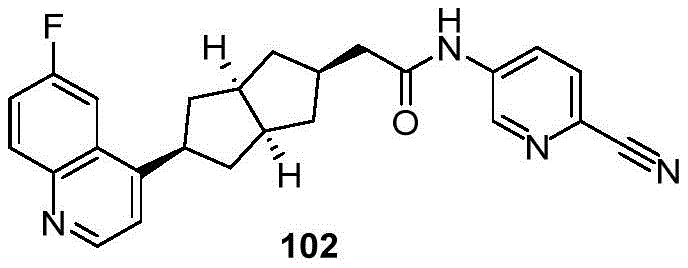
化合物102的制备方法和化合物26的制备方法类似。1H NMR(500MHz,CDCl3)δ 8.81(d,J=4.6Hz,1H),8.60(d,J=2.5Hz,1H),8.45(dd,J=8.6,2.6Hz,1H),8.11(dd, J=9.2,5.7Hz,1H),7.70–7.68(m,2H),7.50–7.48(m,1H),7.47–7.46(m,1H),7.37 (d,J=4.6Hz,1H),3.76(ddd,J=18.0,11.9,5.8Hz,1H),2.79–2.73(m,2H),2.54(d,J =1.6Hz,2H),2.48–2.42(m,2H),2.31–2.26(m,2H),1.54–1.49(m,3H),1.13(dd,J =18.7,11.2Hz,2H)。Ms m/z 415.20[M+H]+。The preparation method of compound 102 is similar to that of compound 26. 1 H NMR (500MHz, CDCl 3 ) δ 8.81 (d, J=4.6Hz, 1H), 8.60 (d, J=2.5Hz, 1H), 8.45 (dd, J=8.6, 2.6Hz, 1H), 8.11 ( dd, J=9.2, 5.7Hz, 1H), 7.70–7.68 (m, 2H), 7.50–7.48 (m, 1H), 7.47–7.46 (m, 1H), 7.37 (d, J=4.6Hz, 1H) , 3.76 (ddd, J=18.0, 11.9, 5.8Hz, 1H), 2.79–2.73 (m, 2H), 2.54 (d, J=1.6Hz, 2H), 2.48–2.42 (m, 2H), 2.31–2.26 (m, 2H), 1.54-1.49 (m, 3H), 1.13 (dd, J = 18.7, 11.2 Hz, 2H). Ms m/z 415.20[M+H] + .
实施例104化合物103的制备Example 104 Preparation of compound 103

化合物1k经酯水解,酰氯的形成,然后与化合物103a反应,制备得到化合物103。具体参照化合物26的制备方法。LCMS m/z 472.2[M+H]+。Compound 1k undergoes ester hydrolysis, acid chloride formation, and then reacts with compound 103a to prepare compound 103. Specific reference is made to the preparation method of compound 26. LCMS m/z 472.2 [M+H] + .
实施例105化合物104和化合物105的制备Example 105 Preparation of compound 104 and compound 105

在0℃和搅拌条件下向化合物92d(40mg,0.11mmol)的二氯甲烷(2mL)溶液加入二乙胺基三氟化硫(91mg,0.56mmol)。该反应体系缓慢升至室温并搅拌过夜。接着向反应液中加入饱和碳酸氢钠溶液,加入二氯甲烷(5mL),将反应液用水洗,收集有机相,加入无水硫酸钠干燥,过滤,滤液减压浓缩后得到粗品。粗品经硅胶柱层析纯化 (乙酸乙酯/石油醚=0-30%)得到无色油状液体104e(28mg,收率66%)。化合物104a经酯水解,酰氯的形成,然后与化合物17a反应,制备得到化合物104。化合物105是在合成化合物104时产生的副产物,由于和产物靠的很近,在最后一步反应中经多次制备性薄板层析分离才分开。其中的一个分离条件为(丙酮/石油醚=0-100%)。至于化合物105是在哪一步产生的,如何产生的,未进行仔细研究。化合物104:1H NMR(500 MHz,CDCl3)δ8.81(d,J=4.4Hz,1H),8.62(s,1H),8.31(d,J=2.4Hz,1H),8.23(d,J =8.9Hz,1H),8.15(dd,J=8.9,5.7Hz,1H),7.75(dd,J=8.8,2.5Hz,1H),7.69(dd,J= 10.3,2.4Hz,1H),7.51–7.47(m,1H),7.37(d,J=4.4Hz,1H),3.49(ddd,J=17.7,12.0, 5.4Hz,1H),3.02–2.92(m,1H),2.89–2.83(m,2H),2.50–2.37(m,2H),1.86(td,J= 12.5,8.0Hz,2H),1.76(dd,J=12.9,6.3Hz,2H),1.46–1.39(m,2H)。LCMS m/z460.07[M+H]+。化合物105:LCMS m/z 440.07[M+H]+。To a solution of compound 92d (40 mg, 0.11 mmol) in dichloromethane (2 mL) was added diethylaminosulfur trifluoride (91 mg, 0.56 mmol) at 0°C with stirring. The reaction was slowly warmed to room temperature and stirred overnight. Then, saturated sodium bicarbonate solution was added to the reaction solution, dichloromethane (5 mL) was added, the reaction solution was washed with water, the organic phase was collected, dried over anhydrous sodium sulfate, filtered, and the filtrate was concentrated under reduced pressure to obtain a crude product. The crude product was purified by silica gel column chromatography (ethyl acetate/petroleum ether=0-30%) to obtain colorless oily liquid 104e (28 mg, yield 66%). Compound 104a is prepared by ester hydrolysis, acid chloride formation, and then reacted with compound 17a to give compound 104. Compound 105 is a by-product generated during the synthesis of compound 104. Because it is very close to the product, it was separated after multiple preparative thin-plate chromatography separations in the last step of the reaction. One of the separation conditions is (acetone/petroleum ether=0-100%). As for which step and how compound 105 is produced, no careful study has been carried out. Compound 104: 1 H NMR (500 MHz, CDCl 3 ) δ 8.81 (d, J=4.4 Hz, 1H), 8.62 (s, 1H), 8.31 (d, J=2.4 Hz, 1H), 8.23 (d, J = 8.9Hz, 1H), 8.15 (dd, J = 8.9, 5.7Hz, 1H), 7.75 (dd, J = 8.8, 2.5Hz, 1H), 7.69 (dd, J = 10.3, 2.4Hz, 1H), 7.51–7.47 (m, 1H), 7.37 (d, J=4.4Hz, 1H), 3.49 (ddd, J=17.7, 12.0, 5.4Hz, 1H), 3.02–2.92 (m, 1H), 2.89–2.83 ( m, 2H), 2.50–2.37 (m, 2H), 1.86 (td, J=12.5, 8.0Hz, 2H), 1.76 (dd, J=12.9, 6.3Hz, 2H), 1.46–1.39 (m, 2H) . LCMS m/z 460.07[M+H] + . Compound 105: LCMS m/z 440.07 [M+H] + .
实施例106化合物106的制备Example 106 Preparation of compound 106

将化合物38f(50mg,0.185mmol)溶于THF/MeOH(1:1,2mL)中,室温下加入硼氢化钠(11mg,0.278mmol)并搅拌1小时。加入饱和氯化铵水溶液(0.5mL)淬灭,并用乙酸乙酯(5mL)稀释。反应液用水洗涤1次,分类的有机相,经干燥(无水硫酸钠),过滤,减压浓缩后得到粗品化合物106a和106b(核磁谱显示106a和106b的比例约为3:1)。粗品直接用于下一步反应。Compound 38f (50 mg, 0.185 mmol) was dissolved in THF/MeOH (1:1, 2 mL), and sodium borohydride (11 mg, 0.278 mmol) was added at room temperature and stirred for 1 hour. Quenched by addition of saturated aqueous ammonium chloride (0.5 mL) and diluted with ethyl acetate (5 mL). The reaction solution was washed once with water, and the separated organic phase was dried (anhydrous sodium sulfate), filtered, and concentrated under reduced pressure to obtain crude compounds 106a and 106b (NMR spectrum showed that the ratio of 106a and 106b was about 3:1). The crude product was directly used in the next reaction.
将化合物106a和106b的混合物(13mg,0.048mmol)溶于THF(2mL)中,接着在室温下加入二甲氨基吡啶(12mg,0.096mmol),搅拌几分钟后加入对氯苯基异氰酸酯(11mg,0.072mmol)。该反应体系在60℃下搅拌3小时,加入乙酸乙酯稀释(5mL),将反应液用水洗,收集有机相,加入无水硫酸钠干燥,过滤,滤液减压浓缩后得到粗品,粗品经制备薄板层析纯化(乙酸乙酯:石油醚=0-100%)得到白色固体化合物106(4 mg,收率20%)。1H NMR(500MHz,CD3OD)δ8.69(s,1H),8.05(dd,J=9.2,5.6Hz, 1H),7.90(dd,J=10.6,2.7Hz,1H),7.57(ddd,J=9.2,8.2,2.8Hz,2H),7.41(d,J=8.5 Hz,2H),7.26–7.23(m,2H),5.21–5.18(m,1H),3.77–3.70(m,1H),2.90–2.81(m, 2H),2.44–2.41(m,2H),2.22–2.17(m,2H),1.86(d,J=14.1Hz,2H),1.78(d,J=8.4 Hz,2H)。LCMS m/z 425.1[M+H]+。[注:在此条件下,少量的异构体106b并没有和对氯苯基异氰酸酯反应。另外,化合物106a,106b,和106c的立体构型是暂时指定的,并非最后确定。]A mixture of compounds 106a and 106b (13 mg, 0.048 mmol) was dissolved in THF (2 mL), followed by addition of dimethylaminopyridine (12 mg, 0.096 mmol) at room temperature, and after stirring for a few minutes, p-chlorophenyl isocyanate (11 mg, 0.096 mmol) was added. 0.072 mmol). The reaction system was stirred at 60°C for 3 hours, diluted with ethyl acetate (5 mL), the reaction solution was washed with water, the organic phase was collected, dried over anhydrous sodium sulfate, filtered, and the filtrate was concentrated under reduced pressure to obtain a crude product. The crude product was prepared by Purification by thin plate chromatography (ethyl acetate:petroleum ether=0-100%) gave compound 106 as a white solid (4 mg, yield 20%). 1 H NMR (500 MHz, CD 3 OD) δ 8.69 (s, 1H), 8.05 (dd, J=9.2, 5.6 Hz, 1H), 7.90 (dd, J=10.6, 2.7 Hz, 1H), 7.57 (ddd , J=9.2, 8.2, 2.8Hz, 2H), 7.41 (d, J=8.5 Hz, 2H), 7.26–7.23 (m, 2H), 5.21–5.18 (m, 1H), 3.77–3.70 (m, 1H) ), 2.90–2.81 (m, 2H), 2.44–2.41 (m, 2H), 2.22–2.17 (m, 2H), 1.86 (d, J=14.1 Hz, 2H), 1.78 (d, J=8.4 Hz, 2H). LCMS m/z 425.1 [M+H] + . [Note: A small amount of isomer 106b did not react with p-chlorophenyl isocyanate under these conditions. In addition, the stereoconfigurations of compounds 106a, 106b, and 106c are tentatively assigned and not final. ]
实施例107化合物107和化合物108的制备Example 107 Preparation of compound 107 and compound 108

化合物92d经酯水解,酰氯的形成,然后与化合物17a反应,制备得到化合物107(主产物)和化合物108(副产物)。具体参照化合物26的制备方法。[注:在这几步反应中,有脱碳基反应发生。另外,化合物107和108的立体构型是暂时指定的,并非最后确定。]Compound 92d undergoes ester hydrolysis, acid chloride formation, and then reacts with compound 17a to prepare compound 107 (main product) and compound 108 (by-product). Specific reference is made to the preparation method of compound 26. [Note: In these steps, decarboxylation reactions take place. In addition, the stereoconfigurations of compounds 107 and 108 are tentatively assigned and not finalized. ]
化合物107:1H NMR(500MHz,CDCl3)δ8.82(d,J=4.5Hz,1H),8.30(s,1H), 8.24(d,J=8.9Hz,1H),8.22(d,J=2.4Hz,1H),8.14(dd,J=9.2,5.7Hz,1H),7.68 (ddd,J=8.7,5.8,2.7Hz,2H),7.48(ddd,J=9.2,8.0,2.8Hz,1H),7.32(d,J=4.6Hz, 1H),3.53–3.45(m,1H),2.99–2.85(m,3H),2.51–2.42(m,2H),2.07(td,J=12.8,8.0 Hz,2H),1.88(dd,J=13.0,6.2Hz,2H),1.37(td,J=12.4,9.1Hz,2H)。LCMS m/z 410.2 [M+H]+。Compound 107: 1 H NMR (500 MHz, CDCl 3 ) δ 8.82 (d, J=4.5 Hz, 1H), 8.30 (s, 1H), 8.24 (d, J=8.9 Hz, 1H), 8.22 (d, J =2.4Hz,1H),8.14(dd,J=9.2,5.7Hz,1H),7.68(ddd,J=8.7,5.8,2.7Hz,2H),7.48(ddd,J=9.2,8.0,2.8Hz, 1H), 7.32 (d, J=4.6Hz, 1H), 3.53–3.45 (m, 1H), 2.99–2.85 (m, 3H), 2.51–2.42 (m, 2H), 2.07 (td, J=12.8, 8.0 Hz, 2H), 1.88 (dd, J=13.0, 6.2 Hz, 2H), 1.37 (td, J=12.4, 9.1 Hz, 2H). LCMS m/z 410.2 [M+H] + .
化合物108:1H NMR(500MHz,CD3OD)δ8.75(d,J=4.7Hz,1H),8.25(d,J=2.6 Hz,1H),8.15(d,J=8.9Hz,1H),8.06(dd,J=9.2,5.6Hz,1H),7.90(dd,J=10.6,2.8 Hz,1H),7.76(dd,J=8.9,2.6Hz,1H),7.59(t,J=3.8Hz,1H),7.58–7.55(m,1H),3.92 (dq,J=18.1,6.0Hz,1H),3.11(ddd,J=10.9,6.9,3.9Hz,1H),2.87–2.82(m,2H),2.45 –2.40(m,2H),2.27(dt,J=13.0,7.7Hz,2H),1.78(td,J=12.8,7.8Hz,2H),1.70(td,J =12.3,8.2Hz,2H).LCMS m/z 410.2[M+H]+。Compound 108: 1 H NMR (500 MHz, CD 3 OD) δ 8.75 (d, J=4.7 Hz, 1H), 8.25 (d, J=2.6 Hz, 1H), 8.15 (d, J=8.9 Hz, 1H) ,8.06(dd,J=9.2,5.6Hz,1H),7.90(dd,J=10.6,2.8 Hz,1H),7.76(dd,J=8.9,2.6Hz,1H),7.59(t,J=3.8 Hz, 1H), 7.58–7.55 (m, 1H), 3.92 (dq, J=18.1, 6.0Hz, 1H), 3.11 (ddd, J=10.9, 6.9, 3.9Hz, 1H), 2.87–2.82 (m, 2H),2.45 –2.40(m,2H),2.27(dt,J=13.0,7.7Hz,2H),1.78(td,J=12.8,7.8Hz,2H),1.70(td,J=12.3,8.2Hz , 2H).LCMS m/z 410.2 [M+H] + .
实施例108Example 108
1.基于HEK293T细胞的IDO抑制活性测试方法:1. Test method for IDO inhibitory activity based on HEK293T cells:
第一步:细胞转染及铺板。将5x10⁶的293T细胞分别种到2个T75的培养瓶里置于37℃,5%CO2的培养箱内孵育过夜。将0.6μL含有1.5μg hIDO1质粒与300μL的opti-MEM制成混和液A;18μL的脂质体fugene6与300μL的opti-MEM制成混和液B,并在室温下放置5分钟。混和液A与混液B混匀,在室温下放置20分钟后,加到种有293T的培养瓶里,另外一瓶作为对照,置于37℃,5%CO2的培养箱内孵育过夜。弃去培养基,用胰酶消化,消化完后,用含血清的培养基中和,吹打细胞,使细胞脱落。用移液管将细胞悬液移入离心管中,800-1000的转速离心1-3分钟。吸弃离心管中的细胞上清液。向离心管中加适当体积的培养基,轻柔吹打使细胞重悬均匀。使用Vi-Cell XR细胞计数仪计数。将细胞悬液调至合适浓度。将细胞悬液加入底透壁白的96孔板中,80微升/孔。第二步:化合物的准备和添加。用DMSO将化合物配制成600μM,以DMSO将化合物按照下列表格的倍数梯度稀释,得到6个浓度梯度的化合物。将DMSO配制的200×化合物按比例用对应的细胞培养液配成10×稀释液。每孔中加入10μL 10×相应化合物稀释液和10μL 10×TRP,Min除外。在37℃培养箱中孵育16小时。第三步:检测及分析。在倒置显微镜下观察细胞形态。取80μL上清加到3894板中,每孔加10μL 6.1Ntrichloroacetic acid,振荡2分钟,放入50度恒温箱中反应30分钟。离心,2500转10分钟。取上清70μL转到3635UV板中,加入70μL反应液,振荡2分钟,使其反应均匀。使用EnSpire(PE)检测OD值为480nm时的数据。将细胞培养板3903放置室温中平衡 30分钟。将细胞活性检测试剂100μL/孔加入培养板中。在振板机上混匀2分钟,诱导细胞溶解。将96孔板在室温中放置10分钟,使其发光信号稳定。粘贴白色的底膜于培养板底部,使用Flexstation3测板.(相关设置为:发光,整合时间500ms)。记录分析所得的实验结果。Step 1: Cell transfection and plating. 5x10⁶ 293T cells were seeded into two T75 culture flasks and incubated overnight in a 37°C, 5% CO 2 incubator. Mix 0.6 μL of 1.5 μg hIDO1 plasmid and 300 μL of opti-MEM to prepare mixture A; 18 μL of liposome fugene6 and 300 μL of opti-MEM to prepare mixture B, and place at room temperature for 5 minutes. Mixed solution A and mixed solution B were mixed well, placed at room temperature for 20 minutes, then added to a culture flask with 293T, and the other flask was used as a control, and incubated overnight in a 37°C, 5% CO2 incubator. The medium was discarded, digested with trypsin, neutralized with serum-containing medium after digestion, and the cells were detached by pipetting. Transfer the cell suspension into a centrifuge tube with a pipette and centrifuge at 800-1000 rpm for 1-3 minutes. Aspirate the cell supernatant from the centrifuge tube. Add an appropriate volume of culture medium to the centrifuge tube and resuspend the cells evenly by gentle pipetting. Counted using a Vi-Cell XR cell counter. Adjust the cell suspension to an appropriate concentration. The cell suspension was added to a 96-well plate with white bottom at 80 μl/well. Step 2: Preparation and addition of compounds. Compounds were formulated into 600 μM with DMSO, and the compounds were diluted with DMSO according to the fold gradient in the following table to obtain 6 concentration gradients of compounds. The 200× compound prepared in DMSO was made into a 10× dilution solution with the corresponding cell culture medium in proportion. Add 10 μL of 10× corresponding compound dilution and 10 μL of 10× TRP to each well, except Min. Incubate in a 37°C incubator for 16 hours. The third step: detection and analysis. Observe cell morphology under an inverted microscope. Take 80 μL of supernatant and add it to plate 3894, add 10 μL of 6.1Ntrichloroacetic acid to each well, shake for 2 minutes, and put it into a 50-degree incubator to react for 30 minutes. Centrifuge at 2500 rpm for 10 minutes. Transfer 70 μL of supernatant to 3635UV plate, add 70 μL of reaction solution, and shake for 2 minutes to make the reaction uniform. Data at OD of 480 nm were detected using EnSpire (PE). The cell culture plate 3903 was equilibrated at room temperature for 30 minutes. Add 100 μL/well of cell viability detection reagent to the culture plate. Induce cell lysis by mixing on a shaker for 2 minutes. The 96-well plate was left at room temperature for 10 minutes to stabilize the luminescence signal. Paste the white bottom film on the bottom of the culture plate, and use Flexstation3 to measure the plate. (The relevant settings are: luminescence, integration time 500ms). Record the experimental results obtained from the analysis.
代表性化合物的活性如表1所示。IC50值通过以下方式表示:A:IC50值≤10nM;B:10nM<IC50值≤50nM;C:50nM<IC50值≤100nM;D:IC50值>100nM。The activities of representative compounds are shown in Table 1. IC50 values are expressed in the following manner: A: IC50 value≤10 nM; B: 10 nM< IC50 value≤50 nM; C: 50 nM< IC50 value≤100 nM; D: IC50 value>100 nM.
表1 HEK293T细胞IDO抑制活性(IC50)Table 1 HEK293T cells IDO inhibitory activity (IC 50 )
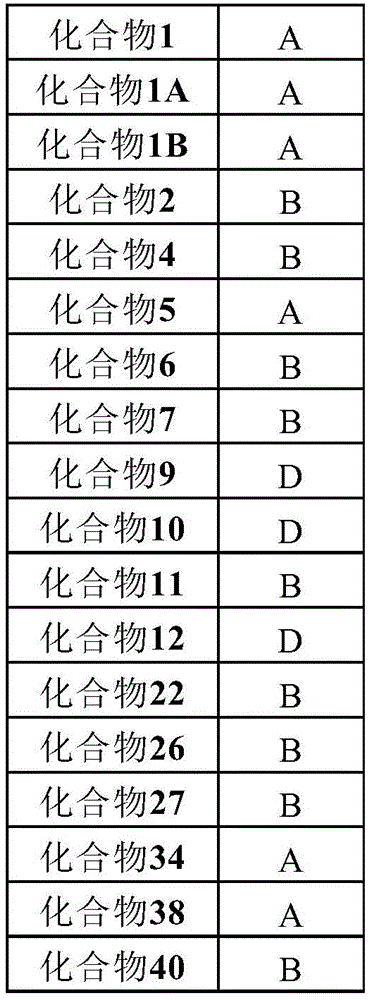

2.基于Hela细胞的IDO抑制活性测试方法2. Test method for IDO inhibitory activity based on Hela cells
第一步:细胞铺板。配制完全培养基,充分混匀。选择生长状态良好的细胞株。将细胞培养瓶从培养箱中取出,核对瓶上标记的细胞名称,培养基类型及细胞代数。弃去培养基,用胰酶消化,消化完后,用含血清的培养基中和,吹打细胞,使细胞脱落。用移液管将细胞悬液移入离心管中,800-1000的转速离心3-5分钟。吸弃离心管中的细胞上清液。向离心管中加适当体积的培养基,轻柔吹打使细胞重悬均匀。使用Vi-Cell XR细胞计数仪计数。将细胞悬液调至合适浓度。依照下面的示意图将细胞悬液加入底透壁白的96孔板中,80微升/孔。第二步:化合物的准备和添加。用DMSO将化合物配制成600μM,以DMSO将化合物按照下列表格的倍数梯度稀释,得到6个浓度梯度的化合物。将DMSO 配制的200×化合物按比例用对应的细胞培养液配成10×稀释液。细胞种板24小时后,每孔中加入10μL 10×相应化合物稀释液和10μL 10×IFNγ。在37℃培养箱中孵育48小时。第三步:检测及分析。在倒置显微镜下观察细胞形态。取80μL上清加到3894板中,每孔加10μL 6.1N三氯乙酸,振荡2分钟,放入50度恒温箱中反应30分钟。离心,2500 转10分钟。Step 1: Cell plating. Prepare complete medium and mix well. Select cell lines with good growth status. Remove the cell culture flask from the incubator and check the cell name, medium type and cell passage marked on the flask. The medium was discarded, digested with trypsin, neutralized with serum-containing medium after digestion, and the cells were detached by pipetting. Transfer the cell suspension into a centrifuge tube with a pipette and centrifuge at 800-1000 rpm for 3-5 minutes. Aspirate the cell supernatant from the centrifuge tube. Add an appropriate volume of culture medium to the centrifuge tube and resuspend the cells evenly by gentle pipetting. Counted using a Vi-Cell XR cell counter. Adjust the cell suspension to an appropriate concentration. The cell suspension was added to a 96-well plate with white bottom at 80 μl/well according to the schematic diagram below. Step 2: Preparation and addition of compounds. Compounds were formulated into 600 μM with DMSO, and the compounds were diluted with DMSO according to the fold gradient in the following table to obtain 6 concentration gradients of compounds. The 200× compound prepared in DMSO was made into a 10× dilution with the corresponding cell culture medium in proportion. After 24 hours of cell seeding, 10 μL of 10× corresponding compound dilution and 10 μL of 10× IFNγ were added to each well. Incubate for 48 hours in a 37°C incubator. The third step: detection and analysis. Observe cell morphology under an inverted microscope. Take 80 μL of supernatant and add it to plate 3894, add 10 μL of 6.1N trichloroacetic acid to each well, shake for 2 minutes, and put it into a 50-degree incubator to react for 30 minutes. Centrifuge at 2500 rpm for 10 minutes.
取上清70μL转到3635UV板中,加入70μL反应液,振荡2分钟,使其反应均匀。使用EnSpire(PE)检测OD值为480nm时的数据。将细胞培养板3903放置室温中平衡 30分钟。将细胞活性检测试剂100μL/孔加入培养板中。在振板机上混匀2分钟,诱导细胞溶解。将96孔板在室温中放置10分钟,使其发光信号稳定。粘贴白色的底膜于培养板底部,使用Flexstation3测板.(相关设置为:发光,整合时间500ms)。记录分析所得的实验结果。Transfer 70 μL of supernatant to 3635UV plate, add 70 μL of reaction solution, and shake for 2 minutes to make the reaction uniform. Data at OD of 480 nm were detected using EnSpire (PE). The cell culture plate 3903 was equilibrated at room temperature for 30 minutes. Add 100 μL/well of cell viability detection reagent to the culture plate. Induce cell lysis by mixing on a shaker for 2 minutes. The 96-well plate was left at room temperature for 10 minutes to stabilize the luminescence signal. Paste the white bottom film on the bottom of the culture plate, and use Flexstation3 to measure the plate. (The relevant settings are: luminescence, integration time 500ms). Record the experimental results obtained from the analysis.
代表性化合物的活性如表2所示。IC50值通过以下方式表示:The activities of representative compounds are shown in Table 2. The IC 50 value is expressed in the following way:
A:IC50值≤5nM;B:5nM<IC50值≤25nM;C:25nM<IC50值≤100nM;D:IC50值 >100nM。A: IC50 value≤5nM; B: 5nM< IC50 value≤25nM ; C: 25nM<IC50value≤100nM; D: IC50value >100nM.
表2 Hela细胞IDO抑制活性(IC50)Table 2 Hela cells IDO inhibitory activity (IC 50 )


在本发明提及的所有文献都在本申请中引用作为参考,就如同每一篇文献被单独引用作为参考那样。此外应理解,在阅读了本发明的上述讲授内容之后,本领域技术人员可以对本发明作各种改动或修改,这些等价形式同样落于本申请所附权利要求书所限定的范围。All documents mentioned herein are incorporated by reference in this application as if each document were individually incorporated by reference. In addition, it should be understood that after reading the above teaching content of the present invention, those skilled in the art can make various changes or modifications to the present invention, and these equivalent forms also fall within the scope defined by the appended claims of the present application.
Claims (23)


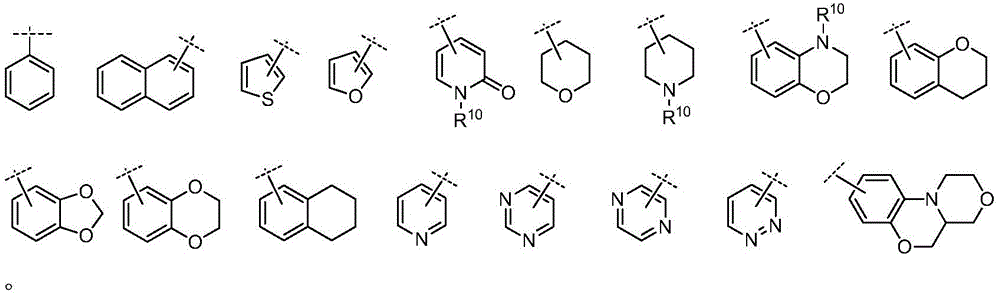
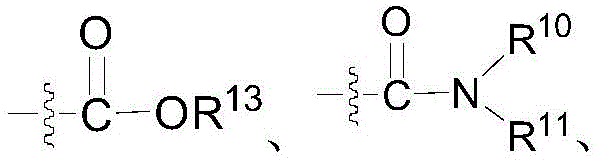


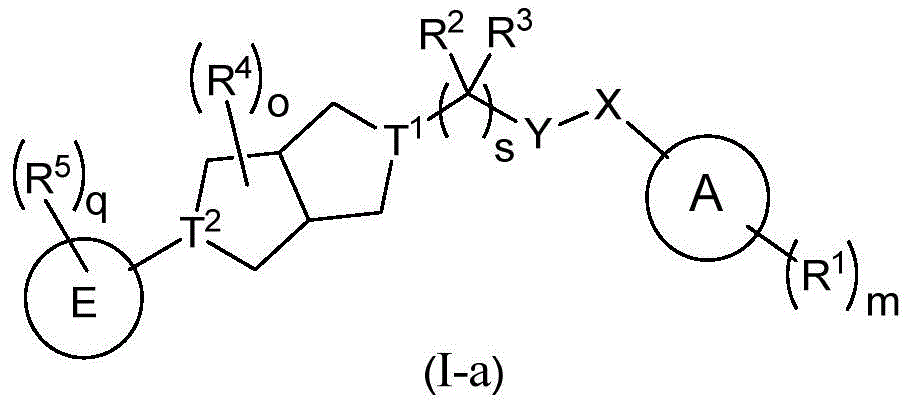

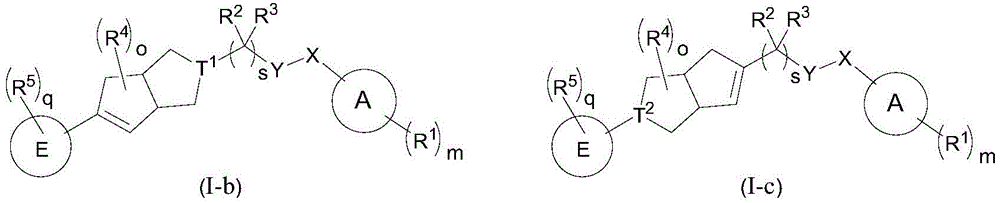


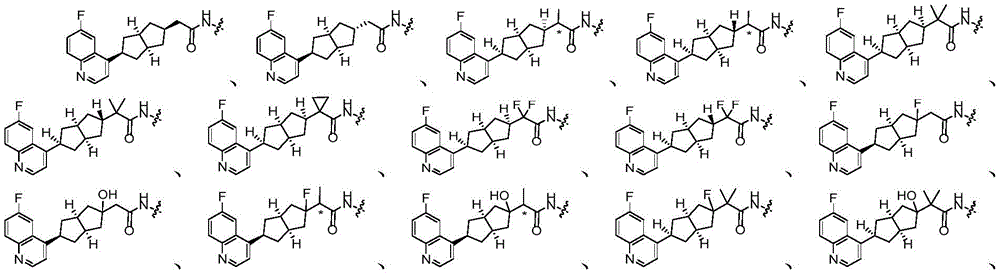


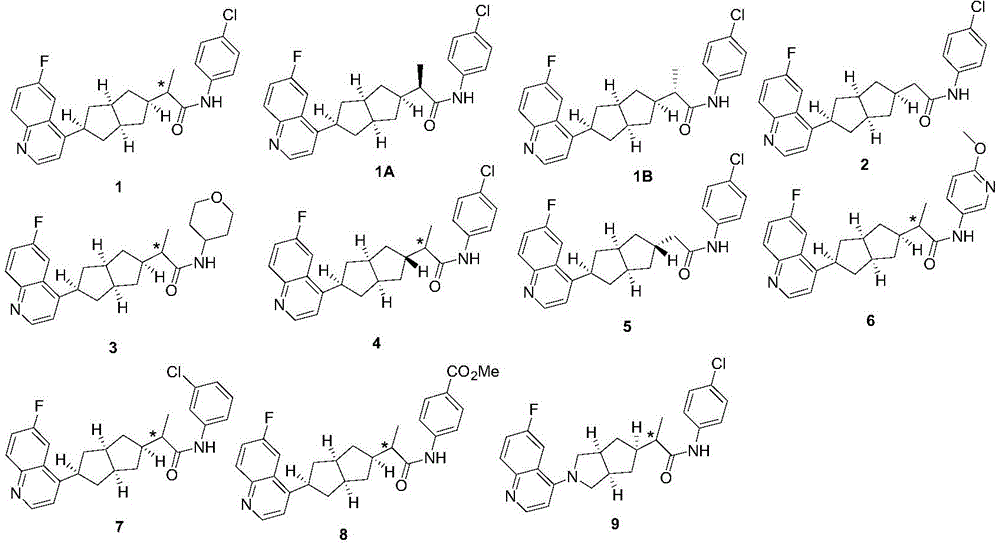


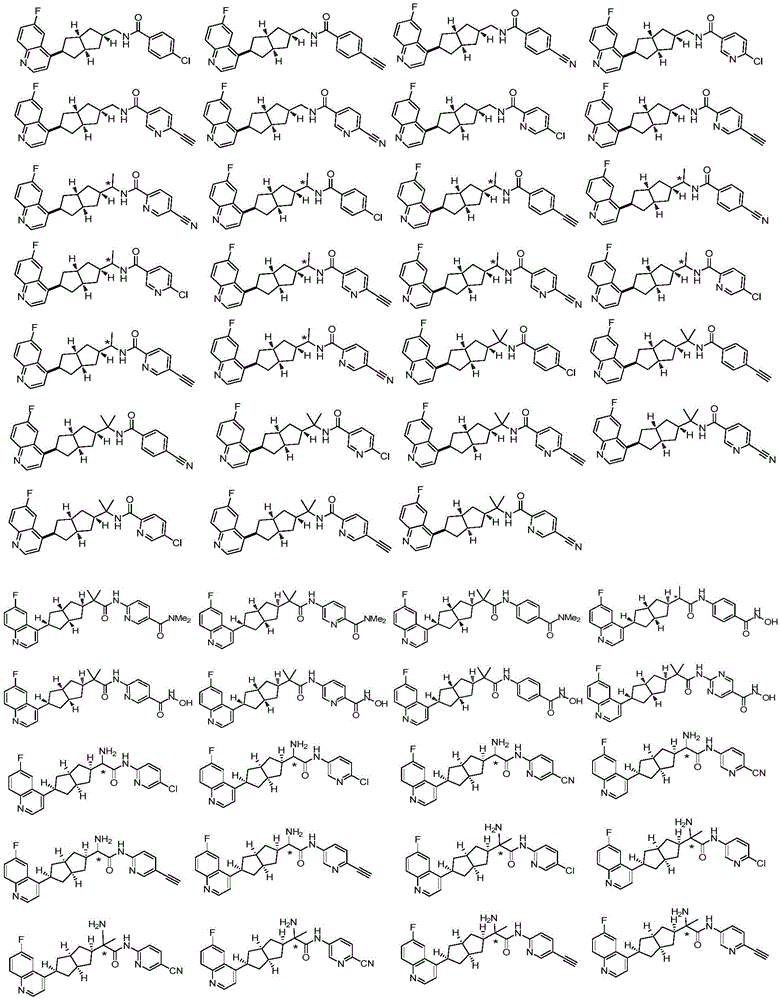
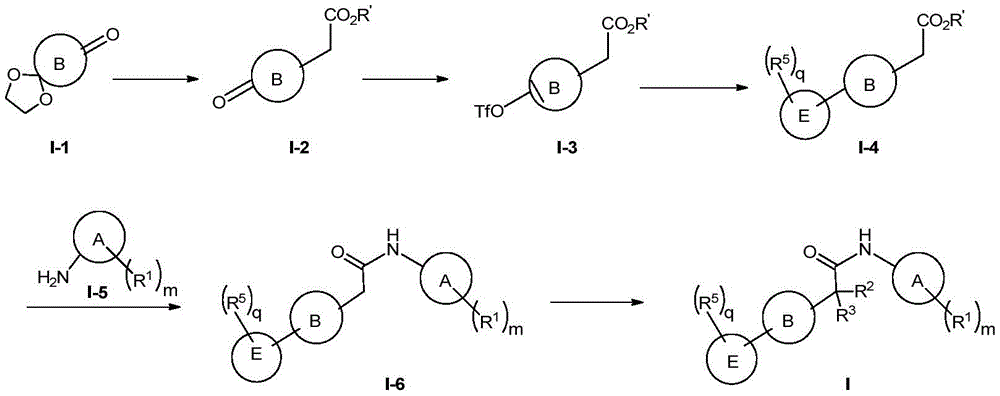


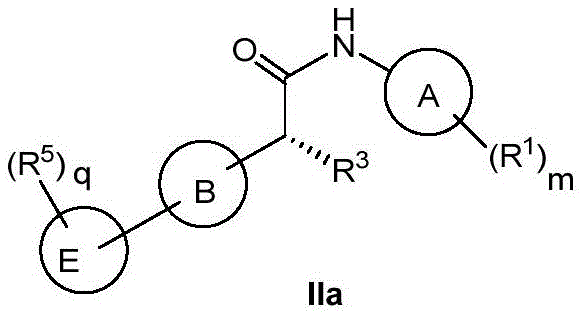

Applications Claiming Priority (7)
| Application Number | Priority Date | Filing Date | Title |
|---|---|---|---|
| CN201710854520 | 2017-09-20 | ||
| CN2017108545202 | 2017-09-20 | ||
| CN2017113978887 | 2017-12-21 | ||
| CN201711397888 | 2017-12-21 | ||
| CN201810119324 | 2018-02-06 | ||
| CN2018101193245 | 2018-02-06 | ||
| PCT/CN2018/106768 WO2019057123A1 (en) | 2017-09-20 | 2018-09-20 | Polycyclic compound acting as ido inhibitor and/or ido-hdac dual inhibitor |
Publications (2)
| Publication Number | Publication Date |
|---|---|
| CN109843872A CN109843872A (en) | 2019-06-04 |
| CN109843872B true CN109843872B (en) | 2022-08-30 |
Family
ID=65810056
Family Applications (1)
| Application Number | Title | Priority Date | Filing Date |
|---|---|---|---|
| CN201880002070.7A Active CN109843872B (en) | 2017-09-20 | 2018-09-20 | Polycyclic compounds as IDO inhibitors and/or IDO-HDAC dual inhibitors |
Country Status (5)
| Country | Link |
|---|---|
| US (1) | US11266640B2 (en) |
| EP (1) | EP3686196B1 (en) |
| JP (1) | JP7548814B2 (en) |
| CN (1) | CN109843872B (en) |
| WO (1) | WO2019057123A1 (en) |
Families Citing this family (12)
| Publication number | Priority date | Publication date | Assignee | Title |
|---|---|---|---|---|
| KR102636383B1 (en) | 2017-08-04 | 2024-02-14 | 스카이호크 테라퓨틱스, 인코포레이티드 | Methods and compositions for regulating splicing |
| US11180497B2 (en) * | 2017-10-18 | 2021-11-23 | Angex Pharmaceutical, Inc. | Cyclic compounds as immunomodulating agents |
| CN110156674A (en) * | 2018-02-13 | 2019-08-23 | 中国科学院上海有机化学研究所 | A kind of spiro-compound as indoles amine -2,3- dioxygenase inhibitor |
| CN110357813A (en) * | 2018-04-09 | 2019-10-22 | 信达生物制药(苏州)有限公司 | A kind of new indole amine 2,3- dioxygenase inhibitor and its preparation method and application |
| LT3784664T (en) | 2018-04-26 | 2025-03-25 | Pfizer Inc. | 2-AMINO-PYRIDINE OR 2-AMINO PYRIDINE DERIVATIVES AS CYCLIN-DEPENDENT KINASE INHIBITORS |
| CN110950842B (en) * | 2018-09-27 | 2023-06-20 | 深圳微芯生物科技股份有限公司 | Quinoline derivatives having indoleamine-2, 3-dioxygenase inhibitory activity |
| CN114126613A (en) | 2019-02-05 | 2022-03-01 | 斯基霍克疗法公司 | Methods and compositions for modulating splicing |
| JP7603592B2 (en) | 2019-02-05 | 2024-12-20 | スカイホーク・セラピューティクス・インコーポレーテッド | Methods and compositions for modulating splicing |
| EP3920928A4 (en) | 2019-02-06 | 2022-09-28 | Skyhawk Therapeutics, Inc. | METHODS AND COMPOSITIONS FOR MODULATING SPLICE |
| CN119638696A (en) | 2019-02-06 | 2025-03-18 | 斯基霍克疗法公司 | Methods and compositions for modulating splicing |
| CN111909107B (en) * | 2019-05-10 | 2023-02-03 | 药康众拓(江苏)医药科技有限公司 | IDO/HDAC dual inhibitor and pharmaceutical composition and application thereof |
| JP2023502182A (en) * | 2019-11-12 | 2023-01-20 | ナミ セラピューティクス, インコーポレイテッド | Formulated and/or co-formulated liposomal compositions containing IDO antagonist prodrugs useful in the treatment of cancer and methods thereof |
Citations (11)
| Publication number | Priority date | Publication date | Assignee | Title |
|---|---|---|---|---|
| WO2006023844A2 (en) * | 2004-08-20 | 2006-03-02 | Entremed, Inc. | Compositions and methods comprising proteinase activated receptor antagonists |
| CN1950082A (en) * | 2004-03-03 | 2007-04-18 | 凯莫森特里克斯股份有限公司 | Bicyclic and bridged nitrogen heterocycles |
| WO2009058347A1 (en) * | 2007-10-31 | 2009-05-07 | Janssen Pharmaceutica N.V. | Aryl-substituted bridged or fused diamines as modulators of leukotriene a4 hydrolase |
| CN102459189A (en) * | 2009-05-12 | 2012-05-16 | 赛诺菲 | 5-membered heterocyclic compound cyclopenta[c]pyrrolylalkylcarbamate derivatives, their preparation, and their therapeutic use |
| WO2013091539A1 (en) * | 2011-12-21 | 2013-06-27 | 江苏恒瑞医药股份有限公司 | Pyrrole six-membered heteroaryl ring derivative, preparation method therefor, and medicinal uses thereof |
| CN103687855A (en) * | 2011-06-02 | 2014-03-26 | 英特维特国际股份有限公司 | Imidazole derivatives |
| WO2014139328A1 (en) * | 2013-03-14 | 2014-09-18 | Abbvie Inc. | Pyrrolo[2,3-b]pyridine cdk9 kinase inhibitors |
| WO2016115463A1 (en) * | 2015-01-15 | 2016-07-21 | Whitehead Institute For Biomedical Research | Inhibitors of phosphoglycerate dehydrogenase (phgdh) and uses thereof |
| WO2017007756A1 (en) * | 2015-07-06 | 2017-01-12 | Rodin Therapeutics, Inc | Hetero-halo inhibitors of histone deacetylase |
| CN106478607A (en) * | 2015-08-28 | 2017-03-08 | 广东东阳光药业有限公司 | Heteroaryl compound replacing and combinations thereof and purposes |
| WO2017044434A1 (en) * | 2015-09-11 | 2017-03-16 | Sunshine Lake Pharma Co., Ltd. | Substituted heteroaryl compounds and methods of use |
Family Cites Families (23)
| Publication number | Priority date | Publication date | Assignee | Title |
|---|---|---|---|---|
| IL133960A0 (en) * | 1997-08-15 | 2001-04-30 | Pfizer Prod Inc | 2-(4-aryl or heteroaryl-piperazin-1-ylmethyl)-1h-indole derivatives |
| MY137020A (en) * | 2000-04-27 | 2008-12-31 | Abbott Lab | Diazabicyclic central nervous system active agents |
| EP1177792A3 (en) | 2000-07-27 | 2002-10-23 | Pfizer Products Inc. | Dopamine D4 Ligands for the treatment of novelty-seeking disorders |
| WO2003070244A1 (en) | 2002-02-22 | 2003-08-28 | Abbott Laboratories | Antagonist of melanin concentrating hormone and their uses |
| US8415354B2 (en) * | 2004-04-29 | 2013-04-09 | Abbott Laboratories | Methods of use of inhibitors of the 11-beta-hydroxysteroid dehydrogenase type 1 enzyme |
| GB0510204D0 (en) * | 2005-05-19 | 2005-06-22 | Chroma Therapeutics Ltd | Enzyme inhibitors |
| FR2924343A1 (en) * | 2007-12-04 | 2009-06-05 | Palumed Sa | NOVEL THERAPEUTIC USES OF DUAL MOLECULES CONTAINING A PEROXYDIC DERIVATIVE. |
| WO2014152018A1 (en) * | 2013-03-14 | 2014-09-25 | The Trustees Of Columbia University In The City Of New York | Octahydrocyclopentapyrroles, their preparation and use |
| MX2015012896A (en) | 2013-03-14 | 2016-06-02 | Abbvie Inc | Pyrrolo[2,3-b]pyridine cdk9 kinase inhibitors. |
| US9840509B2 (en) | 2014-02-03 | 2017-12-12 | Cadila Healthcare Limited | Heterocyclic compounds |
| RU2016149812A (en) | 2014-06-06 | 2018-07-17 | Флексус Байосайенсиз, Инк. | IMMUNO REGULATORY MEANS |
| AR102537A1 (en) * | 2014-11-05 | 2017-03-08 | Flexus Biosciences Inc | IMMUNOMODULATING AGENTS |
| CA2964276A1 (en) | 2014-11-05 | 2016-05-12 | Flexus Biosciences, Inc. | Immunoregulatory agents |
| UY36390A (en) * | 2014-11-05 | 2016-06-01 | Flexus Biosciences Inc | MODULATING COMPOUNDS OF INDOLAMINE ENZYME 2,3-DIOXYGENASE (IDO), ITS SYNTHESIS METHODS AND PHARMACEUTICAL COMPOSITIONS CONTAINING THEM |
| GB2554841A (en) | 2015-07-02 | 2018-04-11 | Buildpulse Inc | Advanced identification and classification of sensors and other points in a building automation system |
| WO2017024996A1 (en) | 2015-08-07 | 2017-02-16 | 江苏恒瑞医药股份有限公司 | Hydroxy amidine derivative, preparation method and use in medicine thereof |
| AU2016333855A1 (en) * | 2015-10-09 | 2018-04-26 | AbbVie S.à.r.l. | Substituted pyrazolo[3,4-b]pyridin-6-carboxylic acids and their use |
| WO2017097671A1 (en) * | 2015-12-10 | 2017-06-15 | Bayer Pharma Aktiengesellschaft | Substituted perhydropyrrolo[3,4-c]pyrrole derivatives and the use of same |
| EP3452042A1 (en) | 2016-05-04 | 2019-03-13 | Motif Biosciences, Inc. | Systems and methods for treating bacterial infection |
| JP2019516682A (en) | 2016-05-04 | 2019-06-20 | ブリストル−マイヤーズ スクイブ カンパニーBristol−Myers Squibb Company | Indoleamine 2,3-dioxygenase inhibitors and methods of use thereof |
| CN109414420A (en) | 2016-05-04 | 2019-03-01 | 百时美施贵宝公司 | The inhibitor and its application method of indole amine 2,3-dioxygenase |
| CN106916164A (en) * | 2017-03-06 | 2017-07-04 | 中国药科大学 | Thiazolopyrimidinone class IDO1 inhibitor and its medical usage |
| CN110540521A (en) * | 2018-05-28 | 2019-12-06 | 北京诺诚健华医药科技有限公司 | Octahydropentalene compound, its preparation method and its application in medicine |
-
2018
- 2018-09-20 CN CN201880002070.7A patent/CN109843872B/en active Active
- 2018-09-20 WO PCT/CN2018/106768 patent/WO2019057123A1/en not_active Ceased
- 2018-09-20 EP EP18857966.8A patent/EP3686196B1/en active Active
- 2018-09-20 US US16/649,455 patent/US11266640B2/en active Active
- 2018-09-20 JP JP2020516814A patent/JP7548814B2/en active Active
Patent Citations (11)
| Publication number | Priority date | Publication date | Assignee | Title |
|---|---|---|---|---|
| CN1950082A (en) * | 2004-03-03 | 2007-04-18 | 凯莫森特里克斯股份有限公司 | Bicyclic and bridged nitrogen heterocycles |
| WO2006023844A2 (en) * | 2004-08-20 | 2006-03-02 | Entremed, Inc. | Compositions and methods comprising proteinase activated receptor antagonists |
| WO2009058347A1 (en) * | 2007-10-31 | 2009-05-07 | Janssen Pharmaceutica N.V. | Aryl-substituted bridged or fused diamines as modulators of leukotriene a4 hydrolase |
| CN102459189A (en) * | 2009-05-12 | 2012-05-16 | 赛诺菲 | 5-membered heterocyclic compound cyclopenta[c]pyrrolylalkylcarbamate derivatives, their preparation, and their therapeutic use |
| CN103687855A (en) * | 2011-06-02 | 2014-03-26 | 英特维特国际股份有限公司 | Imidazole derivatives |
| WO2013091539A1 (en) * | 2011-12-21 | 2013-06-27 | 江苏恒瑞医药股份有限公司 | Pyrrole six-membered heteroaryl ring derivative, preparation method therefor, and medicinal uses thereof |
| WO2014139328A1 (en) * | 2013-03-14 | 2014-09-18 | Abbvie Inc. | Pyrrolo[2,3-b]pyridine cdk9 kinase inhibitors |
| WO2016115463A1 (en) * | 2015-01-15 | 2016-07-21 | Whitehead Institute For Biomedical Research | Inhibitors of phosphoglycerate dehydrogenase (phgdh) and uses thereof |
| WO2017007756A1 (en) * | 2015-07-06 | 2017-01-12 | Rodin Therapeutics, Inc | Hetero-halo inhibitors of histone deacetylase |
| CN106478607A (en) * | 2015-08-28 | 2017-03-08 | 广东东阳光药业有限公司 | Heteroaryl compound replacing and combinations thereof and purposes |
| WO2017044434A1 (en) * | 2015-09-11 | 2017-03-16 | Sunshine Lake Pharma Co., Ltd. | Substituted heteroaryl compounds and methods of use |
Non-Patent Citations (3)
| Title |
|---|
| Design,Synthesis,and Evaluation of Nonretinoid Retinol Binding Protein 4 Antagonists for the Potential Treatment of Atrophic Age-Related Macular Degeneration and Stargardt Disease;Christopher L. Cioffi等;《J. Med. Chem.》;20140901;第57卷;第7735-7737页 * |
| Palladium-Catalyzed Transannular C–H Functionalization of Alicyclic Amines;Joseph J. Topczewski等;《Nature》;20160310;第531卷(第7593期);page 6,figure 1;page8,figure 3,page 9,figure 4 * |
| RN:1385048-43-0;registry;《STN检索》;20120801;第1页 * |
Also Published As
| Publication number | Publication date |
|---|---|
| EP3686196A4 (en) | 2021-03-31 |
| WO2019057123A1 (en) | 2019-03-28 |
| JP7548814B2 (en) | 2024-09-10 |
| CN109843872A (en) | 2019-06-04 |
| EP3686196B1 (en) | 2024-06-12 |
| JP2020534336A (en) | 2020-11-26 |
| US11266640B2 (en) | 2022-03-08 |
| US20200276180A1 (en) | 2020-09-03 |
| EP3686196A1 (en) | 2020-07-29 |
Similar Documents
| Publication | Publication Date | Title |
|---|---|---|
| CN109843872B (en) | Polycyclic compounds as IDO inhibitors and/or IDO-HDAC dual inhibitors | |
| CN113614080B (en) | KRAS G12C inhibitor compounds and uses thereof | |
| CN113767103B (en) | Novel spirocyclic K-Ras G12C inhibitors | |
| JP6877407B2 (en) | Compounds and compositions useful for the treatment of NTRK-related disorders | |
| CN108623615B (en) | Macrocyclic derivatives of pyrazolo [3,4-d ] pyrimidin-3-one, pharmaceutical compositions and uses thereof | |
| WO2023174175A1 (en) | Kif18a inhibitor | |
| CN113286794A (en) | KRAS mutein inhibitors | |
| WO2020259432A1 (en) | Kras-g12c inhibitor | |
| CN107556244B (en) | Fused ring compound, pharmaceutical composition and application thereof | |
| CN112300153A (en) | Heterocyclic compound, pharmaceutical composition and application | |
| EP3853210A1 (en) | Antibacterial compounds | |
| WO2023141852A1 (en) | Cdk2 inhibitors, preparation method therefor and use thereof | |
| WO2022188889A1 (en) | Compound as parp7 inhibitor | |
| CN117069720A (en) | 5-HT 2A Receptor agonist, preparation method and application thereof | |
| WO2022199170A1 (en) | Tetracyclic derivative, and preparation method therefor and medical use thereof | |
| WO2023237085A1 (en) | Hpk1 inhibitor and medical use thereof | |
| CN110407854B (en) | new tetracyclic compounds | |
| WO2018001332A1 (en) | Compound having inhibitory activity against mutant isocitrate dehydrogenase, preparation method therefor and use thereof | |
| WO2022095909A1 (en) | Compound used as ntrk inhibitor and application thereof | |
| WO2022166983A1 (en) | Heteroarylopiperidine derivative, and pharmaceutical composition thereof and use thereof | |
| CN113149996A (en) | Polycyclic amide derivative serving as CDK9 inhibitor, and preparation method and application thereof | |
| WO2024235073A1 (en) | Aromatic amide derivative, preparation method therefor, and use thereof in medicine | |
| WO2022122044A1 (en) | Heterocyclic compound serving as gls1 inhibitor | |
| CN110563631B (en) | IDO inhibiting compound and application thereof | |
| HK40005661B (en) | Polycyclic compound acting as ido inhibitor and/or ido-hdac dual inhibitor |
Legal Events
| Date | Code | Title | Description |
|---|---|---|---|
| PB01 | Publication | ||
| PB01 | Publication | ||
| SE01 | Entry into force of request for substantive examination | ||
| SE01 | Entry into force of request for substantive examination | ||
| TA01 | Transfer of patent application right |
Effective date of registration: 20191226 Address after: 311121 18 stories south of No. 4 Building, 1500 Wenyi West Road, Cangqian Street, Yuhang District, Hangzhou City, Zhejiang Province Applicant after: HANGZHOU INNOGATE PHARMA Co.,Ltd. Applicant after: CSPC ZHONGQI PHARMACEUTICAL TECHNOLOGY (SHIJIAZHUANG) Co.,Ltd. Applicant after: CSPC PHARMACEUTICAL GROUP OUYI PHARMA Co.,Ltd. Address before: 311121 353, room 4, 20 Longtan Road, Cang Qian street, Yuhang District, Hangzhou, Zhejiang. Applicant before: HANGZHOU INNOGATE PHARMA Co.,Ltd. |
|
| TA01 | Transfer of patent application right | ||
| REG | Reference to a national code |
Ref country code: HK Ref legal event code: DE Ref document number: 40005661 Country of ref document: HK |
|
| GR01 | Patent grant | ||
| GR01 | Patent grant |