Disclosure of Invention
Aiming at the problems in the prior art, the invention provides a Paillier homomorphic encryption private intersection set-based method, which comprises a Paillier homomorphic encryption private intersection set-based protocol and a Paillier homomorphic encryption reverse private intersection set-based protocol, wherein two parties, namely a party 1 and a party 2, exist in the two protocols, private intersection and protocol are private input data sets containing user identifiers held by the two parties, the data set of one party additionally contains integer values related to each user identifier, the two parties are not allowed to know the actual user identifier of intersection or the additional information (except the size of intersection) of the data of the other party on the basis that the two parties want to know the sum of the cardinality of intersection and the intersection related integer values, namely the privacy information of users, and the result obtained by the private intersection and protocol is that the cardinality of the party 1 can only obtain the cardinality of intersection, while 2 parties can only get an aggregate; the reverse private intersection and the protocol ensure the minimum value of the number of intersection elements by a mode of terminating communication before obtaining the intersection set if the intersection set is too small, so that the privacy information of the user is protected, and the result obtained by the reverse private intersection and the protocol is that both sides can obtain the cardinality of the intersection set, and only 1 side can obtain the intersection set.
In order to achieve the purpose, the method for encrypting the private aggregation and the private aggregation based on the Paillier homomorphic comprises a protocol based on the Paillier homomorphic encryption private aggregation and a protocol based on the Paillier homomorphic encryption reverse private aggregation;
(1) the agreement based on the Paillier homomorphic encryption private aggregation comprises the following steps:
step 1: the two parties negotiate about the basic setting of the encryption private transaction set, and the specific steps are as follows:
step 1.1: the two parties negotiate to set a security parameter lambda, a group G epsilon G (lambda), a user identifier space U ═ U (lambda) and a random speaker RO: u → G, where the random oracle RO maps the user identifier into a random element of group G;
step 1.2: input set U with m user identifiers held by 1 party1={ui}i∈[m]Wherein, the ith user u of the 1 st partyi∈U;
Step 1.3: party 2 holds a set of n user identifiers and associated integer values with which to pair { (v)j,tj)}j∈[n]Wherein, the jth user v of the 2 partiesjE and associated integer value t of the expected pairing with Ui∈Z+,Z+For positive integers, sum of private sums ∑ tjA Paillier message space suitable for the security parameter lambda and defining U2={vj}j∈[n];
Step 1.4: each party a selects a random secret index k in the group Ga;
Step 1.5: generating a new key pair (pk, sk) by the 2 parties by using a Pai.Gen (lambda) function in the Pailler encryption scheme, and sharing the public key pk to the 1 party;
step 2: party 1 encrypts its own set of user identifiers U1Sending the data to the 2 parties in a disordered way, and specifically comprising the following steps:
step 2.1:
party 1 sets each user u in own user identifier
iApplied to a random oracle RO and then using the secret key k
1The first encryption is carried out to obtain a 1-party user ciphertext after the 1-party encryption
Step 2.2:
party 1 cipher text cipher after encryption
u1Set of constructs
Sending the data to the 2 parties out of order;
and step 3: party 2 encrypts user data sent by party 1 and own user identifier set U2And sending the data to the party 1 in a disordered way, and the specific steps are as follows:
step 3.1: party 2 uses key k
2Receiving 1 party user cipher text after 1 party encryption
The elements are encrypted for the second time to obtain the ciphertext of the
party 1 encrypted by the two parties
Step 3.2: ciphertext cipher obtained by encrypting 1-party user by both parties by 2 parties
u12Set of constructs
Sending the data to the
party 1 out of order;
step 3.3: party 2 uses key k
2For the input set element (v)
j,t
j) For each user identifier v in the pair
jEncrypting the elements after being applied to the RO mapping of the random oracle machine, and then using the Paillier public key pk to input the set elements (v)
j,t
j) With each user identifier v in the pair
jExpected paired related integer value t
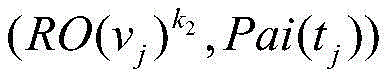
jEncrypting to obtain 2-party encrypted user ciphertext
Ciphertext cipher of integer value paired with 2-party encrypted 2-party user
t2=Pai(t
j) Carrying out pairing;
step 3.4: party 2 cipherer for encrypted user ciphertext
v2And integer value cipher text cipher paired with it
t2To a set of formations
Sending the data to the
party 1 out of order;
and 4, step 4: party 1 encrypts data sent from party 2 and obtains cipherv12With a nepheru12And then the ciphertext Pai of the integer value sum matched with the intersection is obtained according to the set H (S)H) And sending the data to the party 2, which comprises the following steps:
step 4.1:
party 1 uses key k
1Cipher text cipher for received 2-party encrypted user
v2And integer value cipher text cipher paired with it
t2To a set of formations
Each element in (1)
Carrying out secondary encryption to obtain ciphertext after the two parties jointly encrypt the 2-party user
v12And integer value cipher text cipher paired with it
t2To pair
Step 4.2: 1-square computing cirher
v12With a nepher
u12The intersection of (H):
step 4.3: for each element H in the set H, the 1 st party will pair with H the integer value ciphertext nephrt2=Pai(tj) Multiplication, homomorphically obtaining the sum S of integer values paired with the intersectionHCiphertext Pai (S)H):Pai(SH)=Pai(∑j∈Htj)=Pai.Sum({Pai(tj)}j∈H);
Step 4.4: sum S of integer values that the 1 party will pair with the intersectionHCiphertext Pai (S)H) Sending to the party 2;
and 5: party 2 decrypts the sum S of the received Paillier encrypted integer values paired with the intersection using Paillier private key skHCiphertext Pai (S)H) Obtaining the sum S of integer values paired with the intersectionH;
(2) The Paillier homomorphic encryption reverse private aggregation and based protocol comprises the following steps:
s1: the two parties negotiate about the basic setting of the encryption private transaction set, and the specific steps are as follows:
s1.1: the two parties negotiate to set a security parameter lambda, a group G epsilon G (lambda), a user identifier space U ═ U (lambda) and a random speaker RO: u → G, where the random oracle RO maps the user identifier into a random element of group G;
s1.2: input set U with m user identifiers held by 1 party1={ui}i∈[m]Wherein, the ith user u of the 1 st partyi∈U;
S1.3: party 2 holds a set of n user identifiers and associated integer values with which to pair { (v)j,tj)}j∈[n]Wherein, the jth user v of the 2 partiesjE and associated integer value t of the expected pairing with Uj∈Z+,Z+For positive integers, sum of private sums ∑ tjA Paillier message space adapted to the security parameter λ and defining an input set U of 2-party user identifiers2={vj}j∈[n];
S1.4: each party a selects a random secret index k in the group Ga;
S1.5: generating a new key pair (pk, sk) by the 2 parties by using a Pai.Gen (lambda) function in the Pailler encryption scheme, and sharing the public key pk to the 1 party;
s2: party 2 encrypts its own set of user identifiers U2And sending the data to the party 1 in sequence, and the specific steps are as follows:
s2.1: party 2 uses key k
2For the input set element (v)
j,t
j) For each user identifier v in the pair
jEncrypting the elements applied to the random prediction machine RO, and then using Paillier public key pk to input set elements (v)
j,t
j) With each user identifier v in the pair
jExpected paired related integer value t
jEncrypting to obtain 2-party encrypted user ciphertext
Ciphertext cipher of integer value paired with 2-party encrypted 2-party user
t2=Pai(t
j) Carrying out pairing;
s2.2: party 2 cipherer for encrypted user ciphertext
v2And integer value cipher text cipher paired with it
t2To a set of formations
Sending the data to the 1 party in sequence;
s3: party 1 encrypts user data sent from party 2 and its own user identifier set U1And send to 2 parties in sequenceThe method comprises the following specific steps:
s3.1:
party 1 uses key k
1Cipher text cipher for received 2-party encrypted user
v2And integer value cipher text cipher paired with it
t2To a set of formations
Each of which is
The elements are encrypted for the second time to obtain the ciphertext after the two parties encrypt the 2-party user together
And randomly choosing the mapping under Paillier modulus N (j → r)
j) Wherein r is
j∈Z
+Through Pai (t)
j+r
j)=Pai(t
j)×Pai(r
j) To each received in a homomorphic way
Element and user identifier v
jExpected paired related integer value t
jPerforming one-time filling encryption to finally obtain ciphertext after the two parties encrypt the 2-party user together
v12Padded cipher with its paired integer value
tr2To pair
S3.2:
side 1 save map (j → r)
j) And the two parties encrypt the ciphertext after the 2 parties of the users
v12Padded cipher with its paired integer value
tr2To a set of formations
Sending the data to the 2 parties in sequence;
s3.3:
party 1 uses key k
1For user u to be input into
set 1
iThe method is applied to encryption of elements subjected to RO mapping of the random oracle machine to obtain the encrypted 1-party usage of the 1-partyHousehold cipher text
S3.4:
party 1 cipher text cipher after encryption
u1Set of constructs
Sending the data to the 2 parties out of order;
s4: party 2 encrypts data sent by party 1 and obtains cipherv12With a nepheru12And filling and encrypting the subscript set J to obtain the sum S of integer values matched with the intersectionJrAnd sending the data to the party 1, which comprises the following steps:
s4.1: party 2 uses key k
2Receiving 1 party user cipher text after 1 party encryption
Performing secondary encryption to obtain a ciphertext obtained by encrypting the 1-party user by both parties
S4.2: 2-square computing cirher
v12With a nepher
u12Subscript set J of intersection:
s4.3: judging whether the intersection cardinality is smaller than a set threshold value, if so, terminating the protocol by the 2-party, and if not, continuing S4.4;
s4.4: the 2 nd party converts all elements Pai (t) corresponding to subscripts in the subscript set Jj+rj) Multiplying, and decrypting by using a private key sk to obtain a sum S of integer values matched with the intersection and provided with one-time filling encryptionJr=∑j∈Jtj+rj;
S4.5: 2-party sum S of encrypted integer values paired with intersectionJrAnd sending the subscript set J to the party 1;
s5: 1-way computation of the sum of integer values paired with an intersection
The invention has the beneficial effects that:
the invention provides a Paillier homomorphic encryption private aggregation and based method, which researches and adopts a Paillier homomorphic encryption based algorithm, utilizes the property of modular operation to provide a ciphertext segmentation scheme, segments and encrypts a plaintext, has higher efficiency, and can obtain the result of the encrypted plaintext without decryption. According to the agreement based on the Paillier homomorphic encryption private intersection set and the agreement based on the Paillier homomorphic encryption reverse private intersection set, both parties of the agreement can accurately calculate the base number and the intersection sum of the intersection set, information leakage possibly caused by two-by-two calculation of habitual thinking is avoided, if the base number of the set is found to be too small in the reverse private intersection set and the agreement, in order to prevent the intersection set from being acquired by a certain party, and therefore private information of certain users is deduced, and privacy of the users is leaked, the problem of privacy leakage is effectively prevented by adopting a protocol termination mode, in the process of adopting the Paillier homomorphic encryption, one party randomly selects mapping to carry out blind processing on the encrypted user id related integer values, before the intersection sum is obtained, blind factors are removed according to the mapping, and safety of the agreement is greatly improved.
Detailed Description
In order to make the objects, technical solutions and advantages of the present invention more clear, the present invention will be further described in detail with reference to the accompanying drawings and specific embodiments. The specific embodiments described herein are merely illustrative of the invention and are not intended to be limiting.
A method for encrypting private collections based on Paillier homomorphic encryption comprises a protocol based on the Paillier homomorphic encryption private collections and a protocol based on the Paillier homomorphic encryption reverse private collections;
(1) paillier homomorphic encryption private aggregation and based protocol
In this embodiment, an architecture based on Paillier homomorphic encryption private intersection and protocol is shown in fig. 1, in the private intersection and protocol, two parties input all user resource identifier sets of themselves, and when outputting, party 1 obtains the cardinality of the intersection, and party 2 obtains the intersection. Two parties of the private intersection and protocol implement the process of aggregation and aggregation through setup and three rounds of interaction, as shown in fig. 2.
As can be seen from fig. 2, in the setup step, both parties agree on a security parameter λ, a group G ∈ G (λ), and a user identifier space U ═ U (λ). Both parties can use a random oracle RO: u → G. First round, 1 square with k1Encrypts its own set of user identifiers and sends it to party 2. Second round, 2 squares with k2Encrypting the set sent by party 1 and using k2And pk encrypts its own set of user identifiers and sends it to party 1. Calculating to obtain the cirher by 1 squarev12With a nepheru12The intersection of (a). The third round, party 1 sends the encrypted set H to party 2, party 2 uses sk decryption to get the sum of integer values paired with the intersection, i.e. the intersection and SH。
In the present embodiment, for convenience of the following description, the representation and explanation shown in table 1 are given.
TABLE 1 symbolic description of communications between entities
The specific flow is shown in fig. 3, and includes the following steps:
step 1: the two parties negotiate about the basic setting of the encryption private transaction set, and the specific steps are as follows:
step 1.1: the two parties negotiate to set a security parameter lambda, a group G epsilon G (lambda), a user identifier space U ═ U (lambda) and a random speaker RO: u → G, where the random oracle RO maps the user identifier into a random element of group G;
step 1.2: input set U with m user identifiers held by 1 party1={ui}i∈[m]Wherein, the ith user u of the 1 st partyi∈U;
Step 1.3: party 2 holds a set of n user identifiers and associated integer values with which to pair { (v)j,tj)}j∈[n]Wherein, the jth user v of the 2 partiesjE and associated integer value t of the expected pairing with Uj∈Z+,Z+For positive integers, sum of private sums ∑ tjA Paillier message space suitable for the security parameter lambda and defining U2={vj}j∈[n];
Step 1.4: each party a selects a random secret index k in the group Ga;
Step 1.5: generating a new key pair (pk, sk) by the 2 parties by using a Pai.Gen (lambda) function in the Pailler encryption scheme, and sharing the public key pk to the 1 party;
step 2: party 1 encrypts its own set of user identifiers U1Sending the data to the 2 parties in a disordered way, and specifically comprising the following steps:
step 2.1:
party 1 sets each user u in own user identifier
iApplied to a random oracle RO and then using the secret key k
1The first encryption is carried out to obtain a 1-party user ciphertext after the 1-party encryption
Step 2.2:
party 1 will encryptLater user ciphertext
u1Set of constructs
Sending the data to the 2 parties out of order;
and step 3: party 2 encrypts user data sent by party 1 and own user identifier set U2And sending the data to the party 1 in a disordered way, and the specific steps are as follows:
step 3.1: party 2 uses key k
2Receiving 1 party user cipher text after 1 party encryption
The elements are encrypted for the second time to obtain the ciphertext of the
party 1 encrypted by the two parties
Step 3.2: ciphertext cipher obtained by encrypting 1-party user by both parties by 2 parties
u12Set of constructs
Sending the data to the
party 1 out of order;
step 3.3: party 2 uses key k
2For the input set element (v)
j,t
j) For each user identifier v in the pair
jEncrypting the elements after being applied to the RO mapping of the random oracle machine, and then using the Paillier public key pk to input the set elements (v)
j,t
j) With each user identifier v in the pair
jExpected paired related integer value t
jEncrypting to obtain 2-party encrypted user ciphertext
Ciphertext cipher of integer value paired with 2-party encrypted 2-party user
t2=Pai(t
j) Carrying out pairing;
step 3.4: party 2 cipherer for encrypted user ciphertext
v2And integer value cipher text cipher paired with it
t2To a set of formations
Sending the data to the
party 1 out of order;
and 4, step 4: party 1 encrypts data sent from party 2 and obtains cipherv12With a nepheru12And then the ciphertext Pai of the integer value sum matched with the intersection is obtained according to the set H (S)H) And sending the data to the party 2, which comprises the following steps:
step 4.1:
party 1 uses key k
1Cipher text cipher for received 2-party encrypted user
v2And integer value cipher text cipher paired with it
t2To a set of formations
Each element in (1)
Carrying out secondary encryption to obtain ciphertext after the two parties jointly encrypt the 2-party user
vl2And integer value cipher text cipher paired with it
t2To pair
Step 4.2: 1-square computing cirher
v12With a nepher
u12The intersection of (H):
step 4.3: for each element H in the set H, the 1 st party will pair with H the integer value ciphertext nephrt2=Pai(tj) Multiplication, homomorphically obtaining the sum S of integer values paired with the intersectionHCiphertext Pai (S)H):Pai(SH)=Pai(∑j∈Htj)=Pai.Sum({Pai(tj)}j∈H);
Step 4.4: sum S of integer values that the 1 party will pair with the intersectionHCiphertext Pai (S)H) Sending to the party 2;
and 5: party 2 decrypts the sum S of the received Paillier encrypted integer values paired with the intersection using Paillier private key skHCiphertext Pai (S)H) Obtaining the aggregate and SH;
(2) Paillier homomorphic encryption reverse private aggregation and based protocol
In this embodiment, the framework based on Paillier homomorphic encryption reverse private intersection and protocol is as shown in fig. 4, in the reverse private intersection and protocol, both parties also input all their own user resource identifier sets, and the protocol is terminated if the intersection cardinality is too small during output. Otherwise, the 1 party obtains the base number of the intersection and the intersection set, and the 2 party obtains the base number of the intersection set. Two parties of the reverse private intersection and protocol implement the intersection and set process through setup and three rounds of interaction, as shown in fig. 5.
As can be seen from fig. 5, in the setup step, both parties agree on a security parameter λ, a group G ∈ G (λ), and a user identifier space U ═ U (λ). Both parties can use a random oracle RO: u → G. First round, 2 squares with k2And pk encrypts its own set of user identifiers and sends it to party 1. Second round, 1 square with k1Encrypt its own set of user identifiers, k for each element in the set sent by 2 parties1After encrypting the user identifier, a scrambling factor is added and sent to party 2. Calculating by 2-square to obtain the nepherv12With a nepheru12A set J of intersecting indices, and a sum S of integer values paired with the intersection with a disturbing factor is decrypted using skJrIf the intersection cardinality is too small, the protocol is terminated. Third round, the 2 nd party will have the sum S of the integer values paired with the intersection of the perturbing factorJrAnd sending the subscript set J to the 1 side, and removing the disturbing factors by the 1 side to obtain the sum of integer values matched with the intersection, namely the intersection and the SJ。
The specific flow is shown in fig. 6, and includes the following steps:
s1: the two parties negotiate about the basic setting of the encryption private transaction set, and the specific steps are as follows:
s1.1: the two parties negotiate to set a security parameter lambda, a group G epsilon G (lambda), a user identifier space U ═ U (lambda) and a random speaker RO: u → G, where the random oracle RO maps the user identifier into a random element of group G;
s1.2: input set U with m user identifiers held by 1 party1={ui}i∈[m]Wherein, the ith user u of the 1 st partyi∈U;
S1.3: party 2 holds a set of n user identifiers and associated integer values with which to pair { (v)j,tj)}j∈[n]Wherein, the jth user v of the 2 partiesjE and associated integer value t of the expected pairing with Uj∈Z+,Z+For positive integers, sum of private sums ∑ tjA Paillier message space adapted to the security parameter λ and defining an input set U of 2-party user identifiers2={vj}j∈[n];
S1.4: each party a selects a random secret index k in the group Ga;
S1.5: generating a new key pair (pk, sk) by the 2 parties by using a Pai.Gen (lambda) function in the Pailler encryption scheme, and sharing the public key pk to the 1 party;
s2: party 2 encrypts its own set of user identifiers U2And sending the data to the party 1 in sequence, and the specific steps are as follows:
s2.1: party 2 uses key k
2For the input set element (v)
j,t
j) For each user identifier v in the pair
jEncrypting the elements applied to the random prediction machine RO, and then using Paillier public key pk to input set elements (v)
j,t
j) With each user identifier v in the pair
jExpected paired related integer value t
jEncrypting to obtain 2-party encrypted user ciphertext
Ciphertext cipher of integer value paired with 2-party encrypted 2-party user
t2=Pai(t
j) Carrying out pairing;
s2.2: party 2 cipherer for encrypted user ciphertext
v2And integer value cipher text cipher paired with it
t2To a set of formations
Sending the data to the 1 party in sequence;
s3: party 1 encrypts user data sent from party 2 and its own user identifier set U1And sending the data to the 2 parties in sequence, and the concrete steps are as follows:
s3.1:
party 1 uses key k
1Cipher text cipher for received 2-party encrypted user
v2And integer value cipher text cipher paired with it
t2To a set of formations
Each of which is
The elements are encrypted for the second time to obtain the ciphertext after the two parties encrypt the 2-party user together
And randomly choosing the mapping under Paillier modulus N (j → r)
j) Wherein r is
j∈Z
+Through Pai (t)
j+r
j)=Pai(t
j)×Pai(r
j) To each received in a homomorphic way
Element and user identifier v
jExpected paired related integer value t
jPerforming one-time filling encryption to finally obtain ciphertext after the two parties encrypt the 2-party user together
v12Padded cipher with its paired integer value
tr2To pair
S3.2:
side 1 save map (j → r)
i) And the two parties encrypt the ciphertext after the 2 parties of the users
v12Padded cipher with its paired integer value
tr2To a set of formations
Sending the data to the 2 parties in sequence;
S3.3:
party 1 uses key k
1For user u to be input into
set 1
iThe method is applied to encryption of elements after RO mapping of the random prediction machine to obtain 1-party user ciphertext after 1-party encryption
S3.4:
party 1 cipher text cipher after encryption
u1Set of constructs
Sending the data to the 2 parties out of order;
s4: the data sent by the party 1 is encrypted by the party 2, a subscript set J of the integer value sum matched with the intersection is obtained, and then the subscript set J is subjected to filling encryption to obtain the sum S of the integer value sum matched with the intersectionJrAnd sending the data to the party 1, which comprises the following steps:
s4.1: party 2 uses key k
2Receiving 1 party user cipher text after 1 party encryption
Performing secondary encryption to obtain a ciphertext obtained by encrypting the 1-party user by both parties
S4.2: 2-square computing cirher
v12With a nepher
u12Subscript set J of intersection:
s4.3: judging whether the intersection cardinality is smaller than a set threshold value, if so, terminating the protocol by the 2-party, and if not, continuing S4.4;
s4.4: the 2 nd party converts all elements Pai (t) corresponding to subscripts in the subscript set Jj+rj) Multiplying, and decrypting by using a private key sk to obtain a sum S of integer values matched with the intersection and provided with one-time filling encryptionJr=∑j∈Jtj+rj;
S4.5: 2 Party pairs encrypted with intersectionSum of integer values of SJrAnd sending the subscript set J to the party 1;
s5: 1-way computation of the sum of integer values paired with an intersection
Finally, it should be noted that: the above examples are only intended to illustrate the technical solution of the present invention, but not to limit it; although the present invention has been described in detail with reference to the foregoing embodiments, it will be understood by those skilled in the art; the technical solutions described in the foregoing embodiments may still be modified, or some or all of the technical features may be equivalently replaced; such modifications and substitutions do not depart from the spirit and scope of the corresponding technical solutions as defined in the appended claims.