CN109426858B - Neural network, training method, image processing method and image processing device - Google Patents
Neural network, training method, image processing method and image processing device Download PDFInfo
- Publication number
- CN109426858B CN109426858B CN201710757133.7A CN201710757133A CN109426858B CN 109426858 B CN109426858 B CN 109426858B CN 201710757133 A CN201710757133 A CN 201710757133A CN 109426858 B CN109426858 B CN 109426858B
- Authority
- CN
- China
- Prior art keywords
- image
- neural network
- convolutional
- network
- data information
- Prior art date
- Legal status (The legal status is an assumption and is not a legal conclusion. Google has not performed a legal analysis and makes no representation as to the accuracy of the status listed.)
- Active
Links
Images




Classifications
-
- G—PHYSICS
- G06—COMPUTING OR CALCULATING; COUNTING
- G06T—IMAGE DATA PROCESSING OR GENERATION, IN GENERAL
- G06T3/00—Geometric image transformations in the plane of the image
- G06T3/04—Context-preserving transformations, e.g. by using an importance map
-
- G—PHYSICS
- G06—COMPUTING OR CALCULATING; COUNTING
- G06F—ELECTRIC DIGITAL DATA PROCESSING
- G06F18/00—Pattern recognition
- G06F18/20—Analysing
- G06F18/24—Classification techniques
- G06F18/241—Classification techniques relating to the classification model, e.g. parametric or non-parametric approaches
- G06F18/2411—Classification techniques relating to the classification model, e.g. parametric or non-parametric approaches based on the proximity to a decision surface, e.g. support vector machines
-
- G—PHYSICS
- G06—COMPUTING OR CALCULATING; COUNTING
- G06N—COMPUTING ARRANGEMENTS BASED ON SPECIFIC COMPUTATIONAL MODELS
- G06N3/00—Computing arrangements based on biological models
- G06N3/02—Neural networks
- G06N3/04—Architecture, e.g. interconnection topology
-
- G—PHYSICS
- G06—COMPUTING OR CALCULATING; COUNTING
- G06N—COMPUTING ARRANGEMENTS BASED ON SPECIFIC COMPUTATIONAL MODELS
- G06N3/00—Computing arrangements based on biological models
- G06N3/02—Neural networks
- G06N3/04—Architecture, e.g. interconnection topology
- G06N3/045—Combinations of networks
-
- G—PHYSICS
- G06—COMPUTING OR CALCULATING; COUNTING
- G06N—COMPUTING ARRANGEMENTS BASED ON SPECIFIC COMPUTATIONAL MODELS
- G06N3/00—Computing arrangements based on biological models
- G06N3/02—Neural networks
- G06N3/04—Architecture, e.g. interconnection topology
- G06N3/0464—Convolutional networks [CNN, ConvNet]
-
- G—PHYSICS
- G06—COMPUTING OR CALCULATING; COUNTING
- G06N—COMPUTING ARRANGEMENTS BASED ON SPECIFIC COMPUTATIONAL MODELS
- G06N3/00—Computing arrangements based on biological models
- G06N3/02—Neural networks
- G06N3/04—Architecture, e.g. interconnection topology
- G06N3/047—Probabilistic or stochastic networks
-
- G—PHYSICS
- G06—COMPUTING OR CALCULATING; COUNTING
- G06N—COMPUTING ARRANGEMENTS BASED ON SPECIFIC COMPUTATIONAL MODELS
- G06N3/00—Computing arrangements based on biological models
- G06N3/02—Neural networks
- G06N3/08—Learning methods
-
- G—PHYSICS
- G06—COMPUTING OR CALCULATING; COUNTING
- G06N—COMPUTING ARRANGEMENTS BASED ON SPECIFIC COMPUTATIONAL MODELS
- G06N3/00—Computing arrangements based on biological models
- G06N3/02—Neural networks
- G06N3/08—Learning methods
- G06N3/084—Backpropagation, e.g. using gradient descent
-
- G—PHYSICS
- G06—COMPUTING OR CALCULATING; COUNTING
- G06N—COMPUTING ARRANGEMENTS BASED ON SPECIFIC COMPUTATIONAL MODELS
- G06N3/00—Computing arrangements based on biological models
- G06N3/02—Neural networks
- G06N3/08—Learning methods
- G06N3/09—Supervised learning
-
- G—PHYSICS
- G06—COMPUTING OR CALCULATING; COUNTING
- G06T—IMAGE DATA PROCESSING OR GENERATION, IN GENERAL
- G06T11/00—2D [Two Dimensional] image generation
-
- G—PHYSICS
- G06—COMPUTING OR CALCULATING; COUNTING
- G06V—IMAGE OR VIDEO RECOGNITION OR UNDERSTANDING
- G06V10/00—Arrangements for image or video recognition or understanding
- G06V10/40—Extraction of image or video features
- G06V10/44—Local feature extraction by analysis of parts of the pattern, e.g. by detecting edges, contours, loops, corners, strokes or intersections; Connectivity analysis, e.g. of connected components
- G06V10/443—Local feature extraction by analysis of parts of the pattern, e.g. by detecting edges, contours, loops, corners, strokes or intersections; Connectivity analysis, e.g. of connected components by matching or filtering
- G06V10/449—Biologically inspired filters, e.g. difference of Gaussians [DoG] or Gabor filters
- G06V10/451—Biologically inspired filters, e.g. difference of Gaussians [DoG] or Gabor filters with interaction between the filter responses, e.g. cortical complex cells
- G06V10/454—Integrating the filters into a hierarchical structure, e.g. convolutional neural networks [CNN]
-
- G—PHYSICS
- G06—COMPUTING OR CALCULATING; COUNTING
- G06V—IMAGE OR VIDEO RECOGNITION OR UNDERSTANDING
- G06V10/00—Arrangements for image or video recognition or understanding
- G06V10/70—Arrangements for image or video recognition or understanding using pattern recognition or machine learning
- G06V10/764—Arrangements for image or video recognition or understanding using pattern recognition or machine learning using classification, e.g. of video objects
-
- G—PHYSICS
- G06—COMPUTING OR CALCULATING; COUNTING
- G06V—IMAGE OR VIDEO RECOGNITION OR UNDERSTANDING
- G06V10/00—Arrangements for image or video recognition or understanding
- G06V10/70—Arrangements for image or video recognition or understanding using pattern recognition or machine learning
- G06V10/77—Processing image or video features in feature spaces; using data integration or data reduction, e.g. principal component analysis [PCA] or independent component analysis [ICA] or self-organising maps [SOM]; Blind source separation
- G06V10/776—Validation; Performance evaluation
-
- G—PHYSICS
- G06—COMPUTING OR CALCULATING; COUNTING
- G06V—IMAGE OR VIDEO RECOGNITION OR UNDERSTANDING
- G06V10/00—Arrangements for image or video recognition or understanding
- G06V10/70—Arrangements for image or video recognition or understanding using pattern recognition or machine learning
- G06V10/82—Arrangements for image or video recognition or understanding using pattern recognition or machine learning using neural networks
-
- G—PHYSICS
- G06—COMPUTING OR CALCULATING; COUNTING
- G06N—COMPUTING ARRANGEMENTS BASED ON SPECIFIC COMPUTATIONAL MODELS
- G06N3/00—Computing arrangements based on biological models
- G06N3/02—Neural networks
- G06N3/04—Architecture, e.g. interconnection topology
- G06N3/048—Activation functions
Landscapes
- Engineering & Computer Science (AREA)
- Theoretical Computer Science (AREA)
- Physics & Mathematics (AREA)
- General Physics & Mathematics (AREA)
- Evolutionary Computation (AREA)
- Artificial Intelligence (AREA)
- Health & Medical Sciences (AREA)
- General Health & Medical Sciences (AREA)
- Computing Systems (AREA)
- Software Systems (AREA)
- Life Sciences & Earth Sciences (AREA)
- Data Mining & Analysis (AREA)
- Molecular Biology (AREA)
- Biomedical Technology (AREA)
- General Engineering & Computer Science (AREA)
- Computational Linguistics (AREA)
- Mathematical Physics (AREA)
- Biophysics (AREA)
- Computer Vision & Pattern Recognition (AREA)
- Multimedia (AREA)
- Databases & Information Systems (AREA)
- Medical Informatics (AREA)
- Biodiversity & Conservation Biology (AREA)
- Bioinformatics & Cheminformatics (AREA)
- Bioinformatics & Computational Biology (AREA)
- Evolutionary Biology (AREA)
- Probability & Statistics with Applications (AREA)
- Image Analysis (AREA)
- Image Processing (AREA)
Abstract
一种神经网络、卷积神经网络的训练方法、图像处理方法和图像处理装置。该神经网络包括第一卷积神经网络和分析网络。第一卷积神经网络用于对输入的第一图像进行风格转移,以生成第二图像;分析网络用于通过损失函数计算第一卷积神经网络的参数的损失值,并根据损失值对第一卷积神经网络的参数进行修正。损失函数包括权重偏置比损失函数。该神经网络通过在分析网络中采用权重偏置比损失函数,从而可以更好地发挥第一卷积神经网络中的激活函数的作用,获取更优化的卷积参数,提高图像风格迁移和图像融合效果。

A neural network, a training method for a convolutional neural network, an image processing method and an image processing device. The neural network includes a first convolutional neural network and an analysis network. The first convolutional neural network is used to perform style transfer on the input first image to generate the second image; the analysis network is used to calculate the loss value of the parameters of the first convolutional neural network through the loss function, and according to the loss value, the The parameters of a convolutional neural network are modified. The loss function includes the weight bias ratio loss function. By using the weight-bias ratio loss function in the analysis network, the neural network can better play the role of the activation function in the first convolutional neural network, obtain more optimized convolution parameters, and improve image style transfer and image fusion. Effect.
Description
技术领域technical field
本公开的实施例涉及一种神经网络、卷积神经网络的训练方法、图像处理方法以及图像处理装置。Embodiments of the present disclosure relate to a neural network, a training method for a convolutional neural network, an image processing method, and an image processing apparatus.
背景技术Background technique
当前,基于人工神经网络的深度学习技术已经在诸如物体分类、文本处理、推荐引擎、图像搜索、面部识别、年龄和语音识别、人机对话以及情感计算等领域取得了巨大进展。随着人工神经网络结构的加深和算法的提升,深度学习技术在类人类数据感知领域取得了突破性的进展,深度学习技术可以用于描述图像内容、识别图像中的复杂环境下的物体以及在嘈杂环境中进行语音识别等。同时,深度学习技术还可以解决图像生成和融合的问题。Currently, deep learning techniques based on artificial neural networks have made great progress in fields such as object classification, text processing, recommendation engines, image search, facial recognition, age and speech recognition, human-computer dialogue, and affective computing. With the deepening of artificial neural network structure and the improvement of algorithms, deep learning technology has made breakthroughs in the field of human-like data perception. Deep learning technology can be used to describe image content, identify objects in complex environments in images, and Speech recognition in noisy environments, etc. At the same time, deep learning technology can also solve the problem of image generation and fusion.
发明内容SUMMARY OF THE INVENTION
本公开至少一实施例提供一种神经网络,其包括:第一卷积神经网络和分析网络。第一卷积神经网络用于对输入的第一图像进行风格转移,以生成第二图像;分析网络用于通过损失函数计算所述第一卷积神经网络的参数的损失值,并根据所述损失值对所述第一卷积神经网络的参数进行修正。其中,所述损失函数包括权重偏置比损失函数。At least one embodiment of the present disclosure provides a neural network, which includes: a first convolutional neural network and an analysis network. The first convolutional neural network is used to perform style transfer on the input first image to generate the second image; the analysis network is used to calculate the loss value of the parameters of the first convolutional neural network through the loss function, and according to the The loss value modifies the parameters of the first convolutional neural network. Wherein, the loss function includes a weight-bias ratio loss function.
例如,在本公开一示例提供的神经网络中,所述第一卷积神经网络包括第一子网络、第二子网络和第三子网络。所述第一子网络、第二子网络和第三子网络分别包括多个第一卷积层,所述第一卷积层包括多个第一卷积核和多个偏置,所述第一卷积神经网络的参数包括所述多个第一卷积核和所述多个偏置。For example, in the neural network provided by an example of the present disclosure, the first convolutional neural network includes a first sub-network, a second sub-network and a third sub-network. The first sub-network, the second sub-network and the third sub-network respectively include a plurality of first convolution layers, the first convolution layers include a plurality of first convolution kernels and a plurality of offsets, and the first The parameters of a convolutional neural network include the plurality of first convolution kernels and the plurality of biases.
例如,在本公开一示例提供的神经网络中,所述权重偏置比损失函数表示为:For example, in the neural network provided by an example of the present disclosure, the weight-bias ratio loss function is expressed as:

其中,LL1表示所述权重偏置比损失函数,W为所述第一卷积神经网络中的所有第一卷积核的绝对值的平均值,B为所述第一卷积神经网络中的所有偏置的绝对值的平均值,ε为正数。Wherein, L L1 represents the weight-bias ratio loss function, W is the average value of the absolute values of all the first convolution kernels in the first convolutional neural network, and B is the absolute value of the first convolutional neural network. The average of the absolute values of all biases, ε is a positive number.
例如,在本公开一示例提供的神经网络中,所述分析网络包括第二卷积神经网络。所述第二卷积神经网络用于接收所述第一图像、所述第二图像和第三图像,并分别提取所述第一图像的第一卷积特征、所述第二图像的第一卷积特征和第二卷积特征以及所述第三图像的第二卷积特征,所述损失函数还包括内容损失函数和风格损失函数。For example, in the neural network provided by an example of the present disclosure, the analysis network includes a second convolutional neural network. The second convolutional neural network is configured to receive the first image, the second image and the third image, and extract the first convolutional feature of the first image, the first convolutional feature of the second image, and the The convolution feature and the second convolution feature and the second convolution feature of the third image, the loss function further includes a content loss function and a style loss function.
例如,在本公开一示例提供的神经网络中,所述第一卷积特征是内容特征,所述第二卷积特征是风格特征。For example, in the neural network provided by an example of the present disclosure, the first convolutional feature is a content feature, and the second convolutional feature is a style feature.
例如,在本公开一示例提供的神经网络中,所述第二卷积神经网络包括依次连接的多个第二卷积层和间插于相邻第二卷积层之间的多个第二池化层,每个所述第二卷积层用于提取所述第一卷积特征和/或所述第二卷积特征。第l个第二卷积层具有Nl个第二卷积核,所述第l个第二卷积层用于生成并输出所述第一图像的Nl个第一特征图像、所述第二图像的Nl个第二特征图像和Nl个第三特征图像以及所述第三图像的Nl个第四特征图像,且所述Nl个卷积核分别与所述Nl个第一特征图像、所述Nl个第二特征图像、所述Nl个第三特征图像以及所述Nl个第四特征图像一一对应。所述Nl个第一特征图像、Nl个第二特征图像、Nl个第三特征图像和Nl个第四特征图像的尺寸相同。For example, in the neural network provided by an example of the present disclosure, the second convolutional neural network includes a plurality of second convolutional layers connected in sequence and a plurality of second convolutional layers interposed between adjacent second convolutional layers pooling layers, each of the second convolution layers is used for extracting the first convolution feature and/or the second convolution feature. The lth second convolutional layer has N1 second convolution kernels, and the lth second convolutional layer is used to generate and output N1 first feature images of the first image, the N1 second feature images and N1 third feature images of the second image and N1 fourth feature images of the third image, and the N1 convolution kernels are respectively associated with the N1th feature images . One feature image, the N1 second feature images, the N1 third feature images, and the N1 fourth feature images are in one-to-one correspondence. The N1 first feature images, the N1 second feature images, the N1 third feature images, and the N1 fourth feature images have the same size.
例如,在本公开一示例提供的神经网络中,所述内容损失函数用于根据所述第一图像的第一卷积特征和所述第二图像的第一卷积特征计算所述第一卷积神经网络的参数的内容损失值,所述风格损失函数用于根据所述第二图像的第二卷积特征和所述第三图像的第二卷积特征计算所述第一卷积神经网络的参数的风格损失值。所述第l个第二卷积层的所述内容损失函数表示为:For example, in the neural network provided by an example of the present disclosure, the content loss function is used to calculate the first volume according to the first convolution feature of the first image and the first convolution feature of the second image The content loss value of the parameters of the convolutional neural network, the style loss function is used to calculate the first convolutional neural network according to the second convolutional feature of the second image and the second convolutional feature of the third image The parameter's style loss value. The content loss function of the lth second convolutional layer is expressed as:
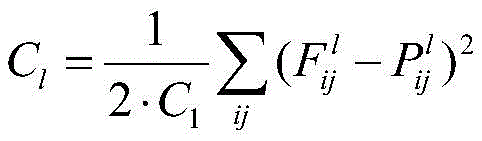
其中,Cl表示所述内容损失函数,

总内容损失函数表示为:The total content loss function is expressed as:
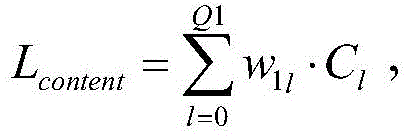
其中,Lcontent表示所述总内容损失函数,Q1为正整数,且表示产生并输出所述第一卷积特征的第二卷积层的数量,w1l表示Cl的权重;所述第l个第二卷积层的所述风格损失函数表示为:Wherein, L content represents the total content loss function,

其中,El表示所述风格损失函数,Ml表示所述第四特征图像的尺寸,

总风格损失函数表示为:The total style loss function is expressed as:
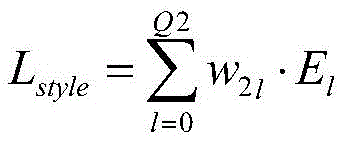
其中,Lstyle表示所述总风格损失函数,Q2为正整数,且表示产生并输出所述第二卷积特征的第二卷积层的数量,w2l表示El的权重。Wherein, L style represents the total style loss function, Q2 is a positive integer, and represents the number of second convolution layers that generate and output the second convolution feature, and w 21 represents the weight of E 1 .
例如,本公开一示例提供的神经网络还包括第一转换矩阵和第二转换矩阵。所述第一转换矩阵用于将所述第一图像的第一颜色通道、第二颜色通道和第三颜色通道的数据信息转换为第一中间图像的亮度信道、第一色差信道和第二色差信道的数据信息;所述第一子网络、所述第二子网络和所述第三子网络分别用于对所述第一中间图像的亮度信道的数据信息、第一色差信道的数据信息和第二色差信道的数据信息进行风格迁移处理,以生成第二中间图像的亮度信道的数据信息、第一色差信道的数据信息和第二色差信道的数据信息;所述第二转换矩阵用于将所述第二中间图像的亮度信道的数据信息、第一色差信道的数据信息和第二色差信道的数据信息转换为所述第二图像的第一颜色通道的数据信息、第二颜色通道的数据信息和第三颜色通道的数据信息。For example, the neural network provided by an example of the present disclosure further includes a first transformation matrix and a second transformation matrix. The first conversion matrix is used to convert the data information of the first color channel, the second color channel and the third color channel of the first image into the luminance channel, the first color difference channel and the second color difference of the first intermediate image channel data information; the first sub-network, the second sub-network and the third sub-network are respectively used for the data information of the luminance channel of the first intermediate image, the data information of the first color difference channel and the The data information of the second color difference channel is subjected to style transfer processing to generate the data information of the luminance channel of the second intermediate image, the data information of the first color difference channel and the data information of the second color difference channel; the second conversion matrix is used to convert The data information of the luminance channel, the data information of the first color difference channel and the data information of the second color difference channel of the second intermediate image are converted into the data information of the first color channel and the data of the second color channel of the second image information and data information for the third color channel.
例如,在本公开一示例提供的神经网络中,所述第二子网络包括第一标准上采样层和第一标准下采样层,所述第三子网络包括第二标准上采样层和第二标准下采样层。所述第一标准下采样层用于替代所述第二子网络中最初的第一卷积层,所述第一标准上采样层用于替代所述第二子网络中最后的第一卷积层;所述第二标准下采样层用于替代所述第三子网络中最初的第一卷积层,所述第二标准上采样层用于替代所述第三子网络中最后的第一卷积层。For example, in the neural network provided in an example of the present disclosure, the second sub-network includes a first standard upsampling layer and a first standard downsampling layer, and the third subnetwork includes a second standard upsampling layer and a second standard upsampling layer Standard downsampling layer. The first standard down-sampling layer is used to replace the initial first convolution layer in the second sub-network, and the first standard up-sampling layer is used to replace the last first convolution layer in the second sub-network layer; the second standard downsampling layer is used to replace the initial first convolutional layer in the third sub-network, and the second standard upsampling layer is used to replace the last first convolutional layer in the third sub-network convolutional layer.
本公开至少一实施例还提供一种卷积神经网络的训练方法,包括:初始化所述卷积神经网络;获取第一图像;利用所述第一图像对初始化后的所述卷积神经网络进行训练;通过损失函数计算所述卷积神经网络的参数的损失值;以及根据所述损失值对所述卷积神经网络的参数进行修正,以得到训练好的所述卷积神经网络,其中,所述损失函数包括权重偏置比损失函数。At least one embodiment of the present disclosure further provides a method for training a convolutional neural network, including: initializing the convolutional neural network; acquiring a first image; and using the first image to perform training on the initialized convolutional neural network training; calculating the loss value of the parameters of the convolutional neural network through a loss function; and revising the parameters of the convolutional neural network according to the loss value to obtain the trained convolutional neural network, wherein, The loss function includes a weight bias ratio loss function.
例如,在本公开一示例提供的训练方法中,所述卷积神经网络包括第一子网络、第二子网络和第三子网络,所述第一子网络、第二子网络和第三子网络分别包括多个卷积层,所述卷积层包括多个卷积核和多个偏置,所述卷积神经网络的参数包括所述多个卷积核和所述多个偏置。通过所述损失函数计算所述卷积神经网络的参数的损失值,包括:根据所述多个卷积核和所述多个偏置通过所述权重偏置比损失函数计算所述卷积神经网络的参数的权重偏置比损失值。所述损失值包括所述权重偏置比损失值。For example, in the training method provided by an example of the present disclosure, the convolutional neural network includes a first sub-network, a second sub-network and a third sub-network, the first sub-network, the second sub-network and the third sub-network The network respectively includes a plurality of convolution layers, the convolution layers include a plurality of convolution kernels and a plurality of biases, and the parameters of the convolutional neural network include the plurality of convolution kernels and the plurality of biases. Using the loss function to calculate the loss value of the parameters of the convolutional neural network includes: calculating the convolutional neural network through the weight-bias ratio loss function according to the multiple convolution kernels and the multiple biases The weight bias ratio of the parameters of the network to the loss value. The loss value includes the weight bias ratio loss value.
例如,在本公开一示例提供的训练方法中,所述第二子网络包括第一标准上采样层和第一标准下采样层,所述第三子网络包括第二标准上采样层和第二标准下采样层。所述第一标准下采样层用于替代所述第二子网络中最初的第一卷积层,所述第一标准上采样层用于替代所述第二子网络中最后的第一卷积层;所述第二标准下采样层用于替代所述第三子网络中最初的第一卷积层,所述第二标准上采样层用于替代所述第三子网络中最后的第一卷积层。For example, in the training method provided by an example of the present disclosure, the second sub-network includes a first standard upsampling layer and a first standard downsampling layer, and the third subnetwork includes a second standard upsampling layer and a second standard upsampling layer Standard downsampling layer. The first standard down-sampling layer is used to replace the initial first convolution layer in the second sub-network, and the first standard up-sampling layer is used to replace the last first convolution layer in the second sub-network layer; the second standard downsampling layer is used to replace the initial first convolutional layer in the third sub-network, and the second standard upsampling layer is used to replace the last first convolutional layer in the third sub-network convolutional layer.
例如,在本公开一示例提供的训练方法中,利用所述第一图像对所述卷积神经网络进行训练,包括:将所述第一图像的第一颜色通道的数据信息、第二颜色通道的数据信息和第三颜色通道的数据信息转换为第一中间图像的亮度信道的数据信息、第一色差信道的数据信息和第二色差信道的数据信息;通过所述第一子网络、第二子网络和第三子网络分别对所述第一中间图像的亮度信道的数据信息、第一色差信道的数据信息和第二色差信道的数据信息进行风格迁移处理,以生成第二中间图像的亮度信道的数据信息、第一色差信道的数据信息和第二色差信道的数据信息;以及将所述第二中间图像的亮度信道的数据信息、第一色差信道的数据信息和第二色差信道的数据信息转换为所述第二图像的第一颜色通道的数据信息、第二颜色通道的数据信息和第三颜色通道的数据信息。For example, in the training method provided in an example of the present disclosure, using the first image to train the convolutional neural network includes: combining the data information of the first color channel of the first image, the second color channel of the first image The data information and the data information of the third color channel are converted into the data information of the luminance channel of the first intermediate image, the data information of the first color difference channel and the data information of the second color difference channel; The sub-network and the third sub-network respectively perform style transfer processing on the data information of the luminance channel of the first intermediate image, the data information of the first color difference channel, and the data information of the second color difference channel, so as to generate the luminance of the second intermediate image. The data information of the channel, the data information of the first color difference channel and the data information of the second color difference channel; and the data information of the luminance channel of the second intermediate image, the data information of the first color difference channel and the data of the second color difference channel The information is converted into data information of the first color channel, data information of the second color channel and data information of the third color channel of the second image.
例如,在本公开一示例提供的训练方法中,所述损失函数还包括内容损失函数和风格损失函数。通过所述损失函数计算所述卷积神经网络的参数的所述损失值,包括:分别提取所述第一图像的第一卷积特征、所述第二图像的第一卷积特征和第二卷积特征以及第三图像的第二卷积特征;根据所述第一图像的第一卷积特征和所述第二图像的第一卷积特征通过所述内容损失函数计算所述卷积神经网络的参数的内容损失值;以及根据所述第二图像的第二卷积特征和所述第三图像的第二卷积特征通过所述风格损失函数计算所述卷积神经网络的参数的风格损失值,所述损失值包括所述内容损失值和所述风格损失值。For example, in the training method provided by an example of the present disclosure, the loss function further includes a content loss function and a style loss function. Calculating the loss value of the parameters of the convolutional neural network by using the loss function includes: extracting the first convolution feature of the first image, the first convolution feature and the second convolution feature of the second image, respectively. the convolution feature and the second convolution feature of the third image; the convolutional neural network is calculated by the content loss function according to the first convolution feature of the first image and the first convolution feature of the second image the content loss value of the parameters of the network; and calculating the style of the parameters of the convolutional neural network by the style loss function according to the second convolution feature of the second image and the second convolution feature of the third image A loss value, the loss value including the content loss value and the style loss value.
本公开至少一实施例还提供一种图像处理方法,包括:获取原始图像;将所述原始图像输入至生成神经网络;以及使用所述生成神经网络对所述原始图像进行风格迁移处理,以生成输出图像。其中,所述生成神经网络为根据上述任一项所述的卷积神经网络的训练方法训练得到的所述卷积神经网络。At least one embodiment of the present disclosure further provides an image processing method, including: acquiring an original image; inputting the original image into a generative neural network; and performing style transfer processing on the original image by using the generative neural network to generate output image. Wherein, the generative neural network is the convolutional neural network obtained by training according to any one of the above-mentioned training methods for a convolutional neural network.
例如,在本公开一示例提供的图像处理方法中,所述原始图像具有第一颜色通道、第二颜色通道和第三颜色通道,所述第一中间图像具有亮度信道、第一色差信道和第二色差信道。将所述原始图像输入至所述生成神经网络包括:对所述原始图像的第一颜色通道的数据信息、第二颜色通道的数据信息和第三颜色通道的数据信息进行转换,以生成第一中间图像的亮度信道的数据信息、第一色差信道的数据信息和第二色差信道的数据信息;以及将所述第一中间图像输入至所述生成神经网络。For example, in the image processing method provided by an example of the present disclosure, the original image has a first color channel, a second color channel and a third color channel, and the first intermediate image has a luminance channel, a first color difference channel and a third color channel. Dichromatic channel. Inputting the original image to the generating neural network includes converting the data information of the first color channel, the data information of the second color channel and the data information of the third color channel of the original image to generate a first color channel. data information of the luminance channel of the intermediate image, data information of the first color difference channel and data information of the second color difference channel; and inputting the first intermediate image to the generating neural network.
例如,在本公开一示例提供的图像处理方法中,所述卷积神经网络包括第一子网络、第二子网络和第三子网络。使用所述生成神经网络对所述原始图像进行风格迁移处理,以生成所述输出图像,包括:分别使用所述第一子网络、第二子网络和第三子网络处理所述第一中间图像的亮度信道的数据信息、第一色差信道的数据信息和第二色差信道的数据信息,以生成第二中间图像;将所述第二中间图像转换为所述输出图像,其中,所述输出图像为RGB格式的图像,所述第二中间图像为YUV格式的图像。For example, in the image processing method provided by an example of the present disclosure, the convolutional neural network includes a first sub-network, a second sub-network and a third sub-network. performing style transfer processing on the original image using the generative neural network to generate the output image, comprising: processing the first intermediate image using the first sub-network, the second sub-network and the third sub-network respectively The data information of the luminance channel, the data information of the first color-difference channel, and the data information of the second color-difference channel, to generate a second intermediate image; converting the second intermediate image into the output image, wherein the output image is an image in RGB format, and the second intermediate image is an image in YUV format.
本公开至少一实施例还提供一种图像处理装置,包括:生成神经网络模块,用于对原始图像进行风格迁移处理,以生成输出图像。其中,所述生成神经网络模块包括根据上述任一项所述的卷积神经网络的训练方法训练得到的所述卷积神经网络。At least one embodiment of the present disclosure further provides an image processing apparatus, including: a generating neural network module for performing style transfer processing on an original image to generate an output image. Wherein, the generating neural network module includes the convolutional neural network obtained by training according to any one of the above-mentioned training methods for a convolutional neural network.
例如,本公开一示例提供的图像处理装置还包括第一转换模块。所述原始图像具有第一颜色通道、第二颜色通道和第三颜色通道,所述第一中间图像具有亮度信道、第一色差信道和第二色差信道。所述第一转换模块用于将所述原始图像的第一颜色通道的数据信息、第二颜色通道的数据信息和第三颜色通道的数据信息转换为第一中间图像的亮度信道的数据信息、第一色差信道的数据信息和第二色差信道的数据信息。所述卷积神经网络包括第一子网络、第二子网络和第三子网络,所述第一子网络、第二子网络和第三子网络分别用于处理所述第一中间图像的亮度信道的数据信息、第一色差信道的数据信息和第二色差信道的数据信息,以生成第二中间图像的亮度信道的数据信息、第一色差信道的数据信息和第二色差信道的数据信息。For example, the image processing apparatus provided by an example of the present disclosure further includes a first conversion module. The original image has a first color channel, a second color channel, and a third color channel, and the first intermediate image has a luminance channel, a first color difference channel, and a second color difference channel. The first conversion module is configured to convert the data information of the first color channel, the data information of the second color channel and the data information of the third color channel of the original image into the data information of the luminance channel of the first intermediate image, The data information of the first color difference channel and the data information of the second color difference channel. The convolutional neural network includes a first sub-network, a second sub-network and a third sub-network, the first sub-network, the second sub-network and the third sub-network are respectively used for processing the brightness of the first intermediate image The data information of the channel, the data information of the first color difference channel and the data information of the second color difference channel are used to generate the data information of the luminance channel, the data information of the first color difference channel and the data information of the second color difference channel of the second intermediate image.
例如,本公开一示例提供的图像处理装置还包括第二转换模块。所述第二转换模块用于将所述第二中间图像的亮度信道的数据信息、第一色差信道的数据信息和第二色差信道的数据信息转换为所述输出图像的第一颜色通道的数据信息、第二颜色通道的数据信息和第三颜色通道的数据信息。For example, the image processing apparatus provided by an example of the present disclosure further includes a second conversion module. The second conversion module is configured to convert the data information of the luminance channel of the second intermediate image, the data information of the first color difference channel and the data information of the second color difference channel into the data of the first color channel of the output image information, data information for the second color channel, and data information for the third color channel.
本公开至少一实施例提供一种神经网络、卷积神经网络的训练方法、图像处理方法和图像处理装置,其通过在分析网络中采用权重偏置比损失函数,从而可以更好地发挥第一卷积神经网络中的激活函数的作用,获取更优化的卷积参数,提高图像风格迁移和图像融合效果,在处理效果和处理速度等方面得以兼顾,具有更好、更广泛的应用前景。At least one embodiment of the present disclosure provides a neural network, a training method for a convolutional neural network, an image processing method, and an image processing device, which can better play the first The role of the activation function in the convolutional neural network can obtain more optimized convolution parameters, improve the effect of image style transfer and image fusion, and take into account the processing effect and processing speed. It has better and wider application prospects.
附图说明Description of drawings
为了更清楚地说明本公开实施例的技术方案,下面将对实施例的附图作简单地介绍,显而易见地,下面描述中的附图仅仅涉及本公开的一些实施例,而非对本公开的限制。In order to explain the technical solutions of the embodiments of the present disclosure more clearly, the accompanying drawings of the embodiments will be briefly introduced below. Obviously, the drawings in the following description only relate to some embodiments of the present disclosure, rather than limit the present disclosure. .
图1为一种卷积神经网络的示意图;1 is a schematic diagram of a convolutional neural network;
图2A示出了一种卷积神经网络的示例性模型图;Figure 2A shows an exemplary model diagram of a convolutional neural network;
图2B示出了一种卷积神经网络的工作过程示意图;FIG. 2B shows a schematic diagram of the working process of a convolutional neural network;
图3为另一种卷积神经网络的结构示意图;FIG. 3 is a schematic structural diagram of another convolutional neural network;
图4为本公开一实施例提供的一种神经网络的示意性框图;FIG. 4 is a schematic block diagram of a neural network according to an embodiment of the present disclosure;
图5A为本公开一实施例提供的一种第一卷积神经网络的结构示意图;5A is a schematic structural diagram of a first convolutional neural network according to an embodiment of the present disclosure;
图5B为本公开一实施例提供的另一种第一卷积神经网络的结构示意图;5B is a schematic structural diagram of another first convolutional neural network provided by an embodiment of the present disclosure;
图6A为本公开一实施例提供的一种复合层的示意图;6A is a schematic diagram of a composite layer provided by an embodiment of the present disclosure;
图6B为本公开一实施例提供的另一种复合层的示意图;6B is a schematic diagram of another composite layer provided by an embodiment of the present disclosure;
图7为本公开一实施例提供的一种第二卷积神经网络的结构示意图;FIG. 7 is a schematic structural diagram of a second convolutional neural network according to an embodiment of the present disclosure;
图8为本公开一实施例提供的一种卷积神经网络的训练方法的示意性流程图;8 is a schematic flowchart of a method for training a convolutional neural network according to an embodiment of the present disclosure;
图9为本公开一实施例提供的一种图像处理方法的示意性流程图;FIG. 9 is a schematic flowchart of an image processing method according to an embodiment of the present disclosure;
图10A为一种原始图像的示意图;10A is a schematic diagram of an original image;
图10B为一种风格图像的示意图;10B is a schematic diagram of a style image;
图10C为根据本公开一实施例提供的一种图像处理方法处理得到的输出图像的示意图;10C is a schematic diagram of an output image obtained by processing an image processing method according to an embodiment of the present disclosure;
图11A为本公开一实施例提供的一种生成神经网络的结构示意图;11A is a schematic structural diagram of a generative neural network according to an embodiment of the present disclosure;
图11B为本公开一实施例提供的另一种生成神经网络的结构示意图;FIG. 11B is a schematic structural diagram of another generative neural network provided by an embodiment of the present disclosure;
图12为本公开一实施例提供的一种图像处理装置的示意性框图;以及FIG. 12 is a schematic block diagram of an image processing apparatus according to an embodiment of the present disclosure; and
图13为本公开一实施例提供的另一种图像处理装置的示意性框图。FIG. 13 is a schematic block diagram of another image processing apparatus according to an embodiment of the present disclosure.
具体实施方式Detailed ways
为了使得本公开实施例的目的、技术方案和优点更加清楚,下面将结合本公开实施例的附图,对本公开实施例的技术方案进行清楚、完整地描述。显然,所描述的实施例是本公开的一部分实施例,而不是全部的实施例。基于所描述的本公开的实施例,本领域普通技术人员在无需创造性劳动的前提下所获得的所有其他实施例,都属于本公开保护的范围。In order to make the purposes, technical solutions and advantages of the embodiments of the present disclosure more clear, the technical solutions of the embodiments of the present disclosure will be clearly and completely described below with reference to the accompanying drawings of the embodiments of the present disclosure. Obviously, the described embodiments are some, but not all, embodiments of the present disclosure. Based on the described embodiments of the present disclosure, all other embodiments obtained by those of ordinary skill in the art without creative efforts fall within the protection scope of the present disclosure.
除非另外定义,本公开使用的技术术语或者科学术语应当为本公开所属领域内具有一般技能的人士所理解的通常意义。本公开中使用的“第一”、“第二”以及类似的词语并不表示任何顺序、数量或者重要性,而只是用来区分不同的组成部分。“包括”或者“包含”等类似的词语意指出现该词前面的元件或者物件涵盖出现在该词后面列举的元件或者物件及其等同,而不排除其他元件或者物件。“连接”或者“相连”等类似的词语并非限定于物理的或者机械的连接,而是可以包括电性的连接,不管是直接的还是间接的。“上”、“下”、“左”、“右”等仅用于表示相对位置关系,当被描述对象的绝对位置改变后,则该相对位置关系也可能相应地改变。Unless otherwise defined, technical or scientific terms used in this disclosure shall have the ordinary meaning as understood by one of ordinary skill in the art to which this disclosure belongs. As used in this disclosure, "first," "second," and similar terms do not denote any order, quantity, or importance, but are merely used to distinguish the various components. "Comprises" or "comprising" and similar words mean that the elements or things appearing before the word encompass the elements or things recited after the word and their equivalents, but do not exclude other elements or things. Words like "connected" or "connected" are not limited to physical or mechanical connections, but may include electrical connections, whether direct or indirect. "Up", "Down", "Left", "Right", etc. are only used to represent the relative positional relationship, and when the absolute position of the described object changes, the relative positional relationship may also change accordingly.
为了保持本公开实施例的以下说明清楚且简明,本公开省略了已知功能和已知部件的详细说明。In order to keep the following description of the embodiments of the present disclosure clear and concise, the present disclosure omits detailed descriptions of well-known functions and well-known components.
当今,随着图像处理技术的发展,对图像进行风格化迁移处理的方法逐渐成为图像处理领域的研究热点。将一副图像转换成具备某种艺术风格的图片,可以用于基于云计算的图像处理、风格渲染以及数字画廊等产品和服务。Nowadays, with the development of image processing technology, the method of stylized transfer processing of images has gradually become a research hotspot in the field of image processing. Convert an image into a picture with a certain artistic style, which can be used in products and services such as cloud-based image processing, style rendering, and digital galleries.
利用深度神经网络进行图片的艺术风格转移是随着深度学习技术的发展而新兴起来的技术。例如,基于参考图像所给出的风格(style),对输入图像进行处理以获得至少部分体现出该风格的输出图像。例如,参考图像为某个艺术家的作品,输出图像则可以在保留原有内容的同时还呈现出该艺术家作画的某些风格特征,甚至使人将其误认为是该艺术家的作品。传统的图像处理效果(例如,instagram公司提供的各种滤镜等)无法获得这样的风格化迁移处理效果。The artistic style transfer of pictures using deep neural networks is an emerging technology with the development of deep learning technology. For example, based on a style given by the reference image, the input image is processed to obtain an output image that at least partially embodies the style. For example, if the reference image is the work of a certain artist, the output image can retain the original content while showing some stylistic features of the artist's painting, and even make people mistake it as the artist's work. Traditional image processing effects (for example, various filters provided by instagram companies, etc.) cannot obtain such stylized transfer processing effects.
目前,在商业市场和学术领域中,图像的艺术风格转移均有代表性的产品和技术。利用深度学习技术进行基于艺术风格的图像融合的代表产品有Prisma和Atisto两款应用。Prisma是一款能够将输入图像转换成某种特定艺术风格的输出图像的移动应用(APP)。Atisto是一款可以用来编辑视频的APP,使用者可以通过Atisto对输入视频进行处理以得到艺术作品或者其他源图像的风格的输出视频。Prisma和Atisto均是基于神经网络的算法对输入图像或输入视频进行处理的APP。尽管Prisma和Atisto处理速度较快,但是其处理效果并不明显。At present, the artistic style transfer of images has representative products and technologies in both the commercial market and the academic field. The representative products of image fusion based on artistic style using deep learning technology are Prisma and Atisto. Prisma is a mobile application (APP) that converts an input image into an output image of a certain artistic style. Atisto is an APP that can be used to edit video. Users can process the input video through Atisto to get the output video in the style of artwork or other source images. Prisma and Atisto are both APPs that process input images or input videos based on neural network algorithms. Although Prisma and Atisto process faster, their processing effect is not obvious.
例如,由Leon A.Gatys等人提出一种利用卷积神经网络实现图像风格迁移的方法,请参见文献,Leon A.Gatys,Alexander S.Echer,Matthias Bethge.A NeuralAlgorithm for Artistic Style.arXiv:1508.06576v2[cs.CV],2015年9月2日。在此将该文献全文引用结合于此,以作为本申请的一部分。该方法主要是基于经过训练的卷积神经网络(CNN),对输入的图片进行不同层次的分解,然后通过风格表达(StyleRepresentation)和内容重建(Content Reconstruction)两个方面构建映射关系,从而进行风格迁移。该方法能够实现较好的风格迁移效果,然而该方法需要对每一组输入图像(风格图像和内容图像)单独进行训练,需要的计算资源较多,处理速度较慢,处理时间较长,难以实现商用化。For example, a method for image style transfer using convolutional neural networks was proposed by Leon A. Gatys et al. Please refer to the literature, Leon A. Gatys, Alexander S. Echer, Matthias Bethge. A NeuralAlgorithm for Artistic Style. arXiv:1508.06576 v2[cs.CV], 2 September 2015. This document is hereby incorporated by reference in its entirety as a part of this application. This method is mainly based on the trained convolutional neural network (CNN), which decomposes the input image at different levels, and then constructs the mapping relationship through two aspects of style expression (StyleRepresentation) and content reconstruction (Content Reconstruction), so as to carry out style migrate. This method can achieve a better effect of style transfer. However, this method needs to train each group of input images (style images and content images) separately, which requires more computing resources, slow processing speed, and long processing time. commercialized.
又例如,由Justin Johnson等人提出一种图像风格迁移的方法,请参见文献,Justin Johnson,Alexandre Alanhi,LI Fei-Fei.Perceptual Losses for Real-TimeStyle Transfer and Super-Resolution.arXiv:1603:08155。在此将该文献全文引用结合于此,以作为本申请的一部分。该方法主要是基于卷积神经网络和实例归一化(InstanceNormalization)进行图片风格转换,其极大地降低了单张图片的处理时间。但是,该方法的神经网络模型仍然较复杂。For another example, a method for image style transfer was proposed by Justin Johnson et al., please refer to the literature, Justin Johnson, Alexandre Alanhi, LI Fei-Fei. Perceptual Losses for Real-Time Style Transfer and Super-Resolution. arXiv:1603:08155. This document is hereby incorporated by reference in its entirety as a part of this application. This method is mainly based on convolutional neural network and instance normalization (InstanceNormalization) for image style conversion, which greatly reduces the processing time of a single image. However, the neural network model of this method is still relatively complex.
本公开至少一实施例提供一种神经网络、卷积神经网络的训练方法、图像处理方法和图像处理装置,其通过在用于训练神经网络的分析网络使用的损失函数中采用或增加权重偏置比(L1)损失函数,从而可以更好地发挥第一卷积神经网络中的激活函数的作用,获取更优化的卷积参数,提高图像风格迁移和图像融合效果,从而在处理效果和处理速度等方面得以兼顾,具有更好、更广泛的应用前景。At least one embodiment of the present disclosure provides a neural network, a training method for a convolutional neural network, an image processing method, and an image processing apparatus, which employ or increase a weight bias in a loss function used by an analysis network for training a neural network Compared with the (L1) loss function, it can better play the role of the activation function in the first convolutional neural network, obtain more optimized convolution parameters, and improve the effect of image style transfer and image fusion, so as to improve the processing effect and processing speed. And other aspects can be taken into account, with better and wider application prospects.
最初卷积神经网络(Convolutional Neural Network,CNN)主要用于识别二维形状,其对图像的平移、比例缩放、倾斜或其他形式的变形具有高度不变性。CNN主要通过局部感知野和权值共享来简化神经网络模型的复杂性、减少权重的数量。随着深度学习技术的发展,CNN的应用范围已经不仅仅限于图像识别领域,其也可以应用在人脸识别、文字识别、动物分类、图像处理等领域。Originally, Convolutional Neural Network (CNN) was mainly used to recognize two-dimensional shapes, which are highly invariant to image translation, scaling, tilting, or other forms of deformation. CNN mainly simplifies the complexity of the neural network model and reduces the number of weights through local perception fields and weight sharing. With the development of deep learning technology, the application scope of CNN is not limited to the field of image recognition, it can also be used in face recognition, text recognition, animal classification, image processing and other fields.
图1为一种卷积神经网络的示意图。例如,该卷积神经网络可以用于图像处理,其使用图像作为输入和输出,并通过卷积核替代标量的权重。图1中仅示出了具有3层结构的卷积神经网络,本公开的实施例对此不作限制。如图1所示,卷积神经网络包括输入层101、隐藏层102和输出层103。输入层101具有4个输入,隐藏层102具有3个输出,输出层103具有2个输出,最终该卷积神经网络输出2幅图像。FIG. 1 is a schematic diagram of a convolutional neural network. For example, the convolutional neural network can be used for image processing, which uses images as input and output, and replaces scalar weights with convolution kernels. FIG. 1 only shows a convolutional neural network with a 3-layer structure, which is not limited by the embodiments of the present disclosure. As shown in FIG. 1 , the convolutional neural network includes an
例如,输入层101的4个输入可以为4幅图像,或者1幅图像的四种特征。隐藏层102的3个输出可以为经过输入层101输入的图像的特征图像。For example, the four inputs of the
例如,如图1所示,卷积层具有权重


例如,如图1所示,该卷积神经网络还包括第一激活层203和第二激活层204。第一激活层203位于第一卷积层201之后,第二激活层204位于第二卷积层202之后。激活层包括激活函数,激活函数用于给卷积神经网络引入非线性因素,以使卷积神经网络可以更好地解决较为复杂的问题。激活函数可以包括线性修正单元(ReLU)函数、S型函数(Sigmoid函数)或双曲正切函数(tanh函数)等。ReLU函数为非饱和非线性函数,Sigmoid函数和tanh函数为饱和非线性函数。例如,激活层可以单独作为卷积神经网络的一层,或者激活层也可以被包含在卷积层中。For example, as shown in FIG. 1 , the convolutional neural network further includes a
例如,在第一卷积层201中,首先,对每个输入应用第一组卷积核中的若干卷积核
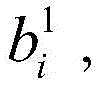

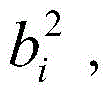


在利用卷积神经网络进行图像处理前,需要对卷积神经网络进行训练。经过训练之后,卷积神经网络的卷积核和偏置在图像处理期间保持不变。在训练过程中,各卷积核和偏置通过多组输入/输出示例图像以及优化算法进行调整,以获取优化后的卷积神经网络模型。Before using the convolutional neural network for image processing, the convolutional neural network needs to be trained. After training, the convolutional neural network's convolution kernels and biases remain unchanged during image processing. During the training process, each convolution kernel and bias are adjusted through multiple sets of input/output example images and optimization algorithms to obtain an optimized convolutional neural network model.
图2A示出了一种卷积神经网络的示例性模型图,图2B示出了的一种卷积神经网络的工作过程示意图。例如,如图2A和2B所示,输入图像通过输入层输入到卷积神经网络后,依次经过若干个处理过程(如图2A中的每个层级)后输出类别标识。卷积神经网络的组成部分可以包括多个卷积层、多个池化层和全连接层。例如,一个完整的卷积神经网络可以由这三种层叠加组成。例如,图2A仅示出了一种卷积神经网络的三个层级,即第一层级、第二层级和第三层级,每个层级包括一个卷积层和一个池化层,池化层为子采样层。由此,每个层级的处理过程可以包括:对输入图像进行卷积(convolution)以及子采样(sub-sampling)。根据实际需要,例如,每个层级的处理过程还可以包括归一化处理(LCN,local constantnormalization)等。FIG. 2A shows an exemplary model diagram of a convolutional neural network, and FIG. 2B shows a schematic diagram of a working process of a convolutional neural network. For example, as shown in Figures 2A and 2B, after the input image is input to the convolutional neural network through the input layer, it goes through several processing processes (each level in Figure 2A) in turn, and then outputs the category identifier. The components of a convolutional neural network can include multiple convolutional layers, multiple pooling layers, and fully connected layers. For example, a complete convolutional neural network can be composed of these three layers superimposed. For example, Figure 2A only shows three layers of a convolutional neural network, namely the first layer, the second layer and the third layer, each layer includes a convolution layer and a pooling layer, and the pooling layer is Subsampling layer. Thus, the processing at each level may include convolution and sub-sampling of the input image. According to actual needs, for example, the processing process of each level may further include normalization processing (LCN, local constant normalization) and the like.
卷积层是卷积神经网络的核心层。在卷积神经网络的卷积层中,一个神经元只与部分相邻层的神经元连接。卷积层可以对输入图像应用若干个卷积核,以提取输入图像的多种类型的特征。每个卷积核可以提取一种类型的特征。卷积核一般以随机小数矩阵的形式初始化,在卷积神经网络的训练过程中卷积核将通过学习以得到合理的权值。对输入图像应用一个卷积核之后得到的结果被称为特征图像(feature map),特征图像的数目与卷积核的数目相等。每个特征图像由一些矩形排列的神经元组成,同一特征图像的神经元共享权值,这里共享的权值就是卷积核。一个层级的卷积层输出的特征图像可以被输入到相邻的下一个层级的卷积层并再次处理以得到新的特征图像。例如,如图2A所示,第一层级的卷积层可以输出第一特征图像,该第一特征图像被输入到第二层级的卷积层再次处理以得到第二特征图像。The convolutional layer is the core layer of the convolutional neural network. In a convolutional layer of a convolutional neural network, a neuron is only connected to neurons in some adjacent layers. A convolutional layer can apply several convolution kernels to the input image to extract various types of features of the input image. Each convolution kernel can extract one type of feature. The convolution kernel is generally initialized in the form of a random decimal matrix. During the training process of the convolutional neural network, the convolution kernel will learn to obtain reasonable weights. The result obtained after applying a convolution kernel to the input image is called a feature map, and the number of feature images is equal to the number of convolution kernels. Each feature image consists of some neurons arranged in a rectangle, and the neurons of the same feature image share weights, and the shared weights here are convolution kernels. The feature image output by a convolutional layer of one level can be input to the adjacent convolutional layer of the next level and processed again to obtain a new feature image. For example, as shown in FIG. 2A, the convolutional layer of the first level may output a first feature image, which is input to the convolutional layer of the second level and processed again to obtain the second feature image.
例如,如图2B所示,卷积层可以使用不同的卷积核对输入图像的某一个局部感受域的数据进行卷积,卷积结果被输入激活层,该激活层根据相应的激活函数进行计算以得到输入图像的特征信息。For example, as shown in Figure 2B, the convolution layer can use different convolution kernels to convolve the data of a certain local receptive field of the input image, and the convolution result is input to the activation layer, which calculates according to the corresponding activation function to obtain the feature information of the input image.
例如,如图2A和2B所示,池化层设置在相邻的卷积层之间,池化层是下采样的一种形式。一方面,池化层可以用于缩减输入图像的规模,简化计算的复杂度,在一定程度上减小过拟合的现象;另一方面,池化层也可以进行特征压缩,提取输入图像的主要特征。池化层能够减少特征图像的尺寸,但不改变特征图像的数量。例如,一个尺寸为12×12的输入图像,通过6×6的滤波器对其进行采样,那么可以得到2×2的输出图像,这意味着输入图像上的36个像素合并为输出图像中的1个像素。最后一个池化层或卷积层可以连接到一个或多个全连接层,全连接层用于连接提取的所有特征。全连接层的输出为一个一维矩阵,也就是向量。For example, as shown in Figures 2A and 2B, pooling layers are placed between adjacent convolutional layers, and pooling layers are a form of downsampling. On the one hand, the pooling layer can be used to reduce the size of the input image, simplify the computational complexity, and reduce the phenomenon of overfitting to a certain extent; on the other hand, the pooling layer can also perform feature compression to extract the main features. Pooling layers can reduce the size of feature images without changing the number of feature images. For example, an input image of size 12×12, sampled by a 6×6 filter, then an output image of 2×2 can be obtained, which means that 36 pixels on the input image are merged into the
图3为另一种卷积神经网络的结构示意图。例如,参见图3所示的示例,最后一个卷积层(即第n0个卷积层)的输出被输入到平坦化层以进行平坦化操作(Flatten)。平坦化层可以将特征图像(2D图像)转换为向量(1D)。该平坦化操作可以按照如下的方式进行:FIG. 3 is a schematic structural diagram of another convolutional neural network. For example, referring to the example shown in Figure 3, the output of the last convolutional layer (ie, the n 0th convolutional layer) is input to the flattening layer for a flattening operation (Flatten). The flattening layer can convert feature images (2D images) into vectors (1D). This flattening operation can be performed as follows:
vk=fk/j,k%j v k =f k/j,k%j
其中,v是包含k个元素的向量,f是具有i行j列的矩阵。where v is a vector with k elements and f is a matrix with i rows and j columns.
然后,平坦化层的输出(即1D向量)被输入到一个全连接层(FCN)。全连接层可以具有与卷积神经网络相同的结构,但不同之处在于,全连接层使用不同的标量值以替代卷积核。Then, the output of the flattening layer (i.e. 1D vector) is input to a fully connected layer (FCN). The fully connected layer can have the same structure as the convolutional neural network, but the difference is that the fully connected layer uses different scalar values in place of the convolution kernel.
例如,最后一个卷积层的输出也可以被输入到均化层(AVG)。均化层用于对卷积层的输出进行平均操作,即利用特征图像的均值表示输出图像,因此,一个2D的特征图像转换成为一个标量。例如,如果卷积神经网络包括均化层,则其可以不包括平坦化层。For example, the output of the last convolutional layer can also be fed into an averaging layer (AVG). The averaging layer is used to average the output of the convolution layer, that is, the output image is represented by the mean value of the feature image. Therefore, a 2D feature image is converted into a scalar. For example, if a convolutional neural network includes a flattening layer, it may not include a flattening layer.
例如,根据实际需要,均化层或全连接层可以连接到分类器,分类器可以根据提取的特征进行分类,分类器的输出可以作为卷积神经网络的最终输出,即表征图像类别的类别标识(label)。For example, according to actual needs, the homogenization layer or the fully connected layer can be connected to the classifier, the classifier can be classified according to the extracted features, and the output of the classifier can be used as the final output of the convolutional neural network, that is, the class identifier that characterizes the image class (label).
例如,分类器可以为支持向量机(Support Vector Machine,SVM)分类器、softmax分类器以及最邻近规则(KNN)分类器等。如图3所示,在一个示例中,卷积神经网络包括softmax分类器,softmax分类器是一种逻辑函数的生成器,可以把一个包含任意实数的K维向量z压缩成K维向量σ(z)。softmax分类器的公式如下:For example, the classifier may be a Support Vector Machine (SVM) classifier, a softmax classifier, a nearest neighbor rule (KNN) classifier, and the like. As shown in Figure 3, in one example, the convolutional neural network includes a softmax classifier, which is a generator of a logistic function that compresses a K-dimensional vector z containing any real number into a K-dimensional vector σ ( z). The formula for the softmax classifier is as follows:

其中,Zj表示K维向量z中第j个元素,σ(z)表示每个类别标识(label)的预测概率,σ(z)为实数,且其范围为(0,1),K维向量σ(z)的和为1。根据以上公式,K维向量z中的每个类别标识均被赋予一定的预测概率,而具有最大预测概率的类别标识被选择作为输入图像的标识或类别。Among them, Z j represents the jth element in the K-dimensional vector z, σ(z) represents the predicted probability of each category label (label), σ(z) is a real number, and its range is (0, 1), K-dimensional The sum of the vectors σ(z) is 1. According to the above formula, each category identification in the K-dimensional vector z is assigned a certain prediction probability, and the category identification with the largest prediction probability is selected as the identification or category of the input image.
图4为本公开一实施例提供的一种神经网络的示意性框图。例如,如图4所示,本公开实施例提供的神经网络包括第一卷积神经网络10和分析网络40。例如,第一卷积神经网络10用于对输入的第一图像进行风格转移,以生成第二图像。分析网络40用于通过损失函数30计算第一卷积神经网络10的参数的损失值,并根据损失值对第一卷积神经网络10的参数进行修正。这里,损失函数30包括权重偏置比(L1)损失函数。FIG. 4 is a schematic block diagram of a neural network according to an embodiment of the present disclosure. For example, as shown in FIG. 4 , the neural network provided by the embodiment of the present disclosure includes a first convolutional
例如,第一卷积神经网络10的初始参数可以为随机数,例如随机数符合高斯分布。第一卷积神经网络10的初始参数也可以采用ImageNet等图像数据库的已训练好的参数。本公开的实施例对此不作限制。For example, the initial parameters of the first convolutional
例如,损失函数30可以根据第一卷积神经网络10的初始参数计算损失值。损失值可以从第一卷积神经网络10的输出层到输入层逐层反向传播,以使损失值分摊到第一卷积神经网络10的各层的所有单元,从而获取各单元的误差值。该误差值即为修正各单元的参数的依据。例如,误差值可以表示为损失值对各单元参数的偏导值。For example, the
例如,分析网络40可以根据损失值通过优化函数(未示出)计算第一卷积神经网络10的参数的误差值,并根据该误差值调整第一卷积神经网络10的参数。For example, the
例如,优化函数可以采用随机梯度下降(stochastic gradient descent,SGD)算法,批量梯度下降(batch gradient descent,BGD)算法等计算第一卷积神经网络10的参数的误差值。For example, the optimization function may use a stochastic gradient descent (SGD) algorithm, a batch gradient descent (BGD) algorithm, etc. to calculate the error value of the parameters of the first convolutional
例如,第一图像可以为各种类型的图像。例如,第一图像可以为通过数码相机或手机拍摄的图像,其可以为人物图像、动植物图像或风景图像等。For example, the first image may be various types of images. For example, the first image may be an image captured by a digital camera or a mobile phone, which may be an image of a person, an image of animals and plants, or a landscape image.
本公开实施例提供的神经网络通过在损失函数中增加权重偏置比损失函数(L1损失函数),从而可以充分发挥第一卷积神经网络中的激活函数的作用,获取更优化的第一卷积神经网络的参数,提高图像风格迁移和图像融合效果,在处理效果和处理速度等方面得以兼顾,具有更好、更广泛的应用前景。By adding a weight-bias ratio loss function (L1 loss function) to the loss function of the neural network provided by the embodiments of the present disclosure, the activation function in the first convolutional neural network can be fully utilized to obtain a more optimized first volume By integrating the parameters of neural network, it can improve the effect of image style transfer and image fusion.
图5A为本公开一实施例提供的一种第一卷积神经网络的结构示意图,图5B为本公开一实施例提供的另一种第一卷积神经网络的结构示意图。FIG. 5A is a schematic structural diagram of a first convolutional neural network according to an embodiment of the disclosure, and FIG. 5B is a schematic structural diagram of another first convolutional neural network according to an embodiment of the disclosure.
例如,如图5A所示,第一卷积神经网络10包括第一子网络101、第二子网络102和第三子网络103。第一子网络101、第二子网络102和第三子网络103分别包括多个第一卷积层。如图5A所示,例如,第一子网络101包括第一卷积层C11、第一卷积层C12和第一卷积层C1n1;第二子网络102包括第一卷积层C21、第一卷积层C22和第一卷积层C2n1;第三子网络103包括第一卷积层C31、第一卷积层C32和第一卷积层C3n1。For example, as shown in FIG. 5A , the first convolutional
例如,如图5A所示,第一子网络101、第二子网络102和第三子网络103还分别包括多个第一池化层和多个复合层。例如,第一子网络101包括第一池化层P11、第一池化层P12和第一池化层P1n1;第二子网络102包括第一池化层P21、第一池化层P22和第一池化层P2n1;第三子网络103包括第一池化层P31、第一池化层P32和第一池化层P3n1。第一子网络101包括复合层M11、复合层M12和复合层M1n1;第二子网络102包括复合层M21、复合层M22和复合层M2n1;第三子网络103包括复合层M31、复合层M32和复合层M3n1。For example, as shown in FIG. 5A , the
例如,第一子网络101、第二子网络102和第三子网络103的结构相同。下面以第一子网络101为例进行详细说明。For example, the structures of the
例如,如图5A所示,在第一子网络101中,多个第一卷积层依次连接,在一些相邻第一卷积层之间具有第一池化层,在另一些相邻的第一卷积层之间具有复合层。For example, as shown in FIG. 5A, in the
例如,如图5A所示,在一个示例中,第一子网络101包括n1个的第一卷积层,n1为正整数,且通常大于3,甚至可以上百。低层级的卷积层用于提取第一图像的低阶特征(例如,点、边等);随着层次的增加,高层级的卷积层可以提取第一图像的高阶特征(例如,直线、拐弯、三角形等)。高阶特征可以由低阶特征组合得到。For example, as shown in FIG. 5A , in one example, the
例如,在第一子网络101中,多个第一池化层的数量和多个复合层的数量相同,且多个第一池化层的下采样因子和多个复合层的上采样因子一一对应,以使第一图像和第二图像的尺寸相同。例如,在如图5A所示的示例中,第一子网络101可以包括n1/2个的第一池化层和n1/2个的复合层,其中,n1为正偶数。又例如,在一个示例中,第一子网络101可以包括2个的第一池化层和2个的复合层,且该2个的第一池化层的下采样因子分别为1/x1和1/x2,则2个的复合层的上采样因子分别为x1和x2。x1和x2为正整数。For example, in the
需要说明的是,多个第一池化层的数量和多个复合层的数量也可以不相同,只要能使经过第一卷积神经网络10处理后的第二图像与第一图像的尺寸相同即可。It should be noted that the number of multiple first pooling layers and the number of multiple composite layers can also be different, as long as the size of the second image processed by the first convolutional
例如,多个第一池化层位于第一子网络101的低层级,多个复合层位于第一子网络101的高层级。也就是说,首先,第一子网络101通过第一池化层对输入的第一图像进行下采样,然后,通过复合层对第一图像进行上采样。For example, a plurality of first pooling layers are located at a lower level of the
例如,每个第一卷积层包括多个第一卷积核和多个偏置,第一卷积神经网络10的参数包括该多个第一卷积核和多个偏置。由此,损失函数30用于调整第一卷积神经网络10中的第一卷积层的参数。需要说明的是,损失函数30可以调整第一卷积神经网络10中所有层的参数。For example, each first convolution layer includes a plurality of first convolution kernels and a plurality of biases, and the parameters of the first convolutional
需要说明的是,第一子网络101、第二子网络102和第三子网络103的结构也可以不相同。例如,在第二子网络102中,可以省略一些第一池化层或复合层等。It should be noted that the structures of the
例如,如图5B所示,在一个示例中,第二子网络102'可以包括第一标准上采样层SU1和第一标准下采样层SD1,第三子网络103可以包括第二标准上采样层SU2和第二标准下采样层SD2。第一标准下采样层SD1用于替代第二子网络102'中最初的第一卷积层,第一标准上采样层SU1用于替代第二子网络102'中最后的第一卷积层;第二标准下采样层SD2用于替代第三子网络103'中最初的第一卷积层,第二标准上采样层SU2用于替代第三子网络103'中最后的第一卷积层。For example, as shown in FIG. 5B, in one example, the second sub-network 102' may include a first standard upsampling layer SU1 and a first standard downsampling layer SD1, and the
例如,第一标准下采样层SD1和第二标准下采样层SD2用于减小输入的第一图像的分辨率,以提高图像处理的速度。例如,第一标准下采样层SD1和第二标准下采样层SD2用于减小特征图像的各个维度的值,从而减少特征图像的数据量。第一标准上采样层SU1和第二标准上采样层SU2用于增加特征图像的各个维度的值,从而增加特征图像的数据量。For example, the first standard downsampling layer SD1 and the second standard downsampling layer SD2 are used to reduce the resolution of the input first image, so as to improve the speed of image processing. For example, the first standard downsampling layer SD1 and the second standard downsampling layer SD2 are used to reduce the value of each dimension of the feature image, thereby reducing the data amount of the feature image. The first standard upsampling layer SU1 and the second standard upsampling layer SU2 are used to increase the value of each dimension of the feature image, thereby increasing the data amount of the feature image.
例如,第一标准下采样层SD1和第二标准下采样层SD2可以采用最大值合并(maxpooling)、平均值合并(average pooling)、跨度卷积(strided convolution)等下采样方法。第一标准上采样层SU1和第二标准上采样层SU2可以采用跨度转置卷积(stridedtransposed convolution)等上采样方法。For example, the first standard downsampling layer SD1 and the second standard downsampling layer SD2 may adopt downsampling methods such as max pooling, average pooling, strided convolution, and the like. The first standard upsampling layer SU1 and the second standard upsampling layer SU2 may adopt upsampling methods such as strided transposed convolution.
例如,第一标准下采样层SD1还可以用于替代第二子网络102'中最初的第一池化层或复合层,第一标准上采样层SU1还可以用于替代第二子网络102'中最后的第一池化层或复合层。第二标准下采样层SD2还可以用于替代第三子网络103'中最初的第一池化层或复合层,第二标准上采样层SU2还可以用于替代第三子网络103'中最后的第一池化层或复合层。For example, the first standard down-sampling layer SD1 can also be used to replace the original first pooling layer or composite layer in the second sub-network 102', and the first standard up-sampling layer SU1 can also be used to replace the second sub-network 102' The last first pooling layer or composite layer in . The second standard down-sampling layer SD2 can also be used to replace the initial first pooling layer or composite layer in the
例如,如图5B所示,在第二子网络102'中,第一标准下采样SD1层替代了最初的一个第一卷积层、一个第一池化层,第一标准上采样层SU1替代了最后的一个第一卷积层、一个复合层。由此,第二子网络102'的网络模型尺寸被减小。同理,第三子网络103'的网络模型尺寸也被减小。从而,第一卷积神经网络10的网络模型尺寸被减小。For example, as shown in FIG. 5B, in the second sub-network 102', the first standard downsampling SD1 layer replaces the original one first convolutional layer, one first pooling layer, and the first standard upsampling layer SU1 replaces The last first convolutional layer, a composite layer. Thereby, the network model size of the second sub-network 102' is reduced. Similarly, the network model size of the third sub-network 103' is also reduced. Thus, the network model size of the first convolutional
例如,第二子网络102'和第三子网络103'的构造可以相同。也就是说,第一标准下采样层SD1和第二标准下采样层SD2相同,第一标准上采样层SU1和第二标准上采样层SU2也相同。第二子网络102'和第三子网络103'的构造也可以不同。本公开的实施例对此不作限制。For example, the configuration of the second sub-network 102' and the third sub-network 103' may be the same. That is, the first standard downsampling layer SD1 and the second standard downsampling layer SD2 are the same, and the first standard upsampling layer SU1 and the second standard upsampling layer SU2 are also the same. The configurations of the second sub-network 102' and the third sub-network 103' may also be different. The embodiments of the present disclosure do not limit this.
例如,在卷积神经网络中,卷积核用于决定对输入图像进行怎样的处理,偏置用于决定该卷积核的输出是否输入到下一个层级。因此,在卷积神经网络的激活层中,偏置可形象第比喻为“开关”,用于决定“打开”或“关闭”卷积核。针对不同的输入图像,不同的卷积核可以被“打开”或“关闭”以实现多种效果。For example, in a convolutional neural network, the convolution kernel is used to decide what to do with the input image, and the bias is used to decide whether the output of the convolution kernel is input to the next level. Therefore, in the activation layer of a convolutional neural network, the bias can be likened to a "switch" that decides to "turn on" or "turn off" the convolution kernel. For different input images, different convolution kernels can be turned "on" or "off" to achieve various effects.
例如,在本公开的实施例中,与卷积核相比,偏置需要具有比较大的绝对值,从而更有效地发挥“开关”的作用。L1损失函数则用于调整第一卷积层的多个第一卷积核和多个偏置之间的比值,以增强第一卷积神经网络10中的激活函数的作用。For example, in the embodiment of the present disclosure, compared with the convolution kernel, the offset needs to have a relatively large absolute value, so as to play the role of a "switch" more effectively. The L1 loss function is used to adjust the ratio between the plurality of first convolution kernels and the plurality of biases in the first convolution layer, so as to enhance the effect of the activation function in the first convolutional
例如,L1损失函数可以表示为如下公式(1):For example, the L1 loss function can be expressed as the following formula (1):

其中,LL1表示L1损失函数,W表示第一卷积神经网络10中的所有第一卷积核的绝对值的平均值,B表示第一卷积神经网络10中的所有偏置的绝对值的平均值,ε为一个极小正数,用于保证分母不为0。Wherein, L L1 represents the L1 loss function, W represents the average value of the absolute values of all the first convolution kernels in the first convolutional
例如,LL1的值可以表示第一卷积神经网络10的参数的L1损失值。在对第一卷积神经网络10的参数进行修正的过程中,需要反复调整L1损失值,以使得W尽量小,而B尽量大。For example, the value of L L1 may represent the L1 loss value of the parameter of the first convolutional
例如,W可以表示为:For example, W can be expressed as:

其中,Cw为第一卷积层具有的第一卷积核的数量,w表示第一卷积层的各卷积核的值。例如,卷积核为2×2的矩阵,w表示矩阵各元素之和。Among them, C w is the number of the first convolution kernels of the first convolution layer, and w represents the value of each convolution kernel of the first convolution layer. For example, the convolution kernel is a 2×2 matrix, and w represents the sum of the elements of the matrix.
例如,B可以表示为:For example, B can be represented as:

其中,Cb为第一卷积层具有的偏置的数量,b表示第一卷积层的各偏置的值。Among them, C b is the number of biases of the first convolutional layer, and b represents the value of each bias of the first convolutional layer.
例如,在本公开实施例中,第一卷积神经网络10中的激活函数可以采用ReLU函数。但不限于此,第一卷积神经网络10中的激活函数还可以采用sigmoid函数、tanh函数等。For example, in the embodiment of the present disclosure, the activation function in the first convolutional
例如,ReLU函数可以表示为如下公式(2):For example, the ReLU function can be expressed as the following formula (2):

其中,out表示ReLU函数的输出,in1表示ReLU函数的输入。在卷积神经网络中,in1可以表示为如下公式(3):Among them, out represents the output of the ReLU function, and in 1 represents the input of the ReLU function. In a convolutional neural network, in 1 can be expressed as the following formula (3):
in1=w·in0+b (3)in 1 =w·in 0 +b (3)
例如,在公式(3)中,in0表示输入到例如第一卷积层C11中的第一图像的像素矩阵,in1表示in0经过第一卷积层C11变化后输出的特征图像的像素矩阵,w表示该卷积层中的卷积核的值,b表示该卷积层中的偏置的值。由上面的公式(2)和(3)可知,当b足够大,则激活函数更能有效发挥激活作用,即激活函数的输出可以更好地表示第一图像的特征信息。For example, in formula (3), in 0 represents the pixel matrix of the first image input to, for example, the first convolution layer C11, and in 1 represents the pixels of the feature image output by in 0 after being changed by the first convolution layer C11 matrix, w represents the value of the convolution kernel in this convolutional layer, and b represents the value of the bias in this convolutional layer. It can be seen from the above formulas (2) and (3) that when b is large enough, the activation function can play an active role more effectively, that is, the output of the activation function can better represent the feature information of the first image.
例如,第一池化层可以为第一卷积神经网络10的下采样层(down-samplinglayer),用于减小特征图像的各个维度的值,从而减少特征图像的数据量。复合层为第一卷积神经网络10的上采样层(up-sampling layer),用于增加特征图像的各个维度的值,从而增加特征图像的数据量。For example, the first pooling layer may be a down-sampling layer (down-sampling layer) of the first convolutional
例如,第一池化层可以采用各种下采样方法对特征图像进行采样。下采样方法包括但不限于:最大值合并、平均值合并、随机合并、欠采样(decimation,例如选择固定的像素)、解复用输出(demuxout,将输入图像拆分为多个更小的图像)等。For example, the first pooling layer can use various downsampling methods to sample the feature images. Downsampling methods include, but are not limited to: max binning, mean binning, random binning, undersampling (such as selecting a fixed pixel), demuxout, splitting the input image into multiple smaller images )Wait.
例如,复合层可采用插值算法等实现上采样。插值算法例如可以包括内插值、两次立方插值算法(Bicubic Interprolation)等。For example, the composite layer may implement upsampling using an interpolation algorithm or the like. The interpolation algorithm may include interpolation, bicubic interpolation, and the like, for example.
图6A为本公开一实施例提供的一种复合层的示意图,图6B为本公开一实施例提供的另一种复合层的示意图。FIG. 6A is a schematic diagram of a composite layer according to an embodiment of the disclosure, and FIG. 6B is a schematic diagram of another composite layer according to an embodiment of the disclosure.
例如,在图6A所示的示例中,复合层采用像素差值法实现上采样。复合层采用2×2的上采样因子,从而可以将4个输入特征图像结合得到1个具有固定像素顺序的输出特征图像。For example, in the example shown in FIG. 6A , the composite layer uses the pixel difference method to achieve upsampling. The composite layer adopts an upsampling factor of 2 × 2, so that 4 input feature images can be combined to obtain 1 output feature image with a fixed pixel order.
例如,对于二维的特征图像,第一子网络101中的复合层获取输入的第一数量的输入特征图像,将这些输入特征图像的像素值交织(interleave)重排以产生相同的第一数量的输出特征图像。相比于输入特征图像,输出特征图像的数量没有改变,但是每个输出特征图像的大小增加相应倍数。由此,该复合层通过不同的排列组合增加更多的数据信息,这些组合可给出所有可能的上采样组合。最后,可通过激活层从上采样组合进行选择。For example, for a two-dimensional feature image, the composite layer in the
例如,在图6B所示的示例中,复合层采用像素值交织重排方法实现上采样。复合层同样采用2×2的上采样因子,即以每4个输入特征图像为一组,将它们的像素值交织生成4个输出特征图像。输入特征图像的数量和经过复合层处理后的输出特征图像的数量相同,而各输出特征图像的大小增加为输入特征图像的4倍,即具有输入特征图像的4倍的像素数量。For example, in the example shown in FIG. 6B , the composite layer adopts the pixel value interleaving and rearranging method to realize upsampling. The composite layer also adopts an upsampling factor of 2×2, that is, taking every 4 input feature images as a group, and interleaving their pixel values to generate 4 output feature images. The number of input feature images is the same as the number of output feature images processed by the composite layer, and the size of each output feature image is increased by 4 times that of the input feature image, that is, it has 4 times the number of pixels of the input feature image.
例如,第一子网络101、第二子网络102和第三子网络103还分别包括多个实例归一化层(Instance Normalization Layer)。例如,图5A所示,第一子网络101包括实例归一化层N11、实例归一化层N12和实例归一化层N1n1;第二子网络102包括实例归一化层N21、实例归一化层N22和实例归一化层N2n1;第三子网络103包括实例归一化层N31、实例归一化层N32和实例归一化层N3n1。For example, the
例如,如图5A所示,第一子网络101可以包括n1个实例归一化层,即实例归一化层和第一卷积层一一对应。但不限于此,也可以多个第一卷积层(例如,两个或三个第一卷积层等)对应一个实例归一化层,从而实例归一化层的数量少于第一卷积层。本公开实施例对此不作具体限制。For example, as shown in FIG. 5A , the
例如,如图5B所示,在第二子网络102'中,第一标准下采样SD1层还可以替代最初的一个实例归一化层,第一标准上采样层SU1也可以替代最后的一个实例归一化层。同理,在第三子网络103'中,第二标准下采样SD2和第二标准上采样层SU2也可以替代实例归一化层。For example, as shown in FIG. 5B, in the second sub-network 102', the first standard downsampling SD1 layer can also replace the first one instance normalization layer, and the first standard upsampling layer SU1 can also replace the last one instance normalization layer. Similarly, in the third sub-network 103', the second standard down-sampling SD2 and the second standard up-sampling layer SU2 can also replace the instance normalization layer.
例如,实例归一化层用于将第一卷积层输出的特征图像进行标准化处理,以使特征图像的像素的灰度值在预定范围内变化,从而简化生成,改善风格迁移的质量。例如,预定范围可以为[-1,1]。实例归一化层根据每个特征图像自身的均值和方差,对该特征图像进行标准化处理。实例归一化层可用于对单幅图像进行标准化处理。For example, the instance normalization layer is used to normalize the feature image output by the first convolution layer, so that the gray value of the pixels of the feature image varies within a predetermined range, thereby simplifying generation and improving the quality of style transfer. For example, the predetermined range may be [-1, 1]. The instance normalization layer normalizes each feature image according to its own mean and variance. An instance normalization layer can be used to normalize a single image.
例如,假设小批梯度下降法(mini-batch gradient decent)的尺寸为T,第一卷积层(例如,图5A所示的第一卷积层C11或第一卷积层C12)输出的特征图像的数量为C,且每个特征图像均为H行W列的矩阵,则特征图像的模型表示为(T,C,W,H)。从而,实例归一化层的标准化公式可以表示如下:For example, assuming that the size of the mini-batch gradient decent method is T, the features output by the first convolutional layer (eg, the first convolutional layer C11 or the first convolutional layer C12 shown in FIG. 5A ) The number of images is C, and each feature image is a matrix with H rows and W columns, then the model of the feature images is expressed as (T, C, W, H). Thus, the normalization formula of the instance normalization layer can be expressed as follows:

其中,xtijk为该第一卷积层输出的特征图像集合中的第t个特征块(patch)、第i个特征图像、第j列、第k行的值。ytijk表示xtijk经过实例归一化层处理后得到的结果。ε为一个很小的整数,以避免分母为0。Wherein, x tijk is the value of the t-th feature block (patch), the i-th feature image, the j-th column, and the k-th row in the feature image set output by the first convolutional layer. y tijk represents the result obtained after x tijk is processed by the instance normalization layer. ε is a small integer to avoid a denominator of 0.
需要说明的是,本公开实施例对第一卷积神经网络10中各层的数量不作限制。It should be noted that, the embodiment of the present disclosure does not limit the number of layers in the first convolutional
例如,如图4所示,分析网络40可以包括第二卷积神经网络20。第二卷积神经网络20用于接收第一图像、第二图像和第三图像,且分别产生并输出第一图像的第一卷积特征、第二图像的第一卷积特征和第二卷积特征以及第三图像的第二卷积特征。For example, as shown in FIG. 4 , the
例如,第三图像为风格图像。第三图像例如可以为各种艺术大师(例如莫奈、梵高、毕加索等)的名画等,但不限于此,例如第三图像还可以为水墨画、素描画等。For example, the third image is a style image. For example, the third image may be famous paintings of various art masters (eg, Monet, Van Gogh, Picasso, etc.), but not limited thereto, for example, the third image may also be ink paintings, sketches, and the like.
例如,第二图像为第一图像经过第一卷积神经网络10进行风格转移后形成的图像。第二图像包括第一图像的内容特征和第三图像的风格特征。For example, the second image is an image formed by the style transfer of the first image through the first convolutional
例如,第一图像、第二图像和第三图像的尺寸均相同。For example, the first image, the second image, and the third image are all the same size.
例如,第一卷积特征是内容(content)特征,第二卷积特征是风格(style)特征。例如,内容特征表示图像中的物体在整幅图像的分布,风格特征则表示在卷积神经网络的不同层中不同特征图像之间的关系。例如,内容特征包括图像的内容信息,风格特征可以包括图像的纹理信息、颜色信息等。纹理信息例如表示特征图像之间的相关性,其与位置无关。卷积神经网络中的特征图像可以是一维矩阵,格拉姆矩阵(Gram matrix)可以用于衡量该一维矩阵中各向量的相关程度,因此,卷积神经网络可以引入Gram矩阵计算图像的风格特征。例如,Gram矩阵可以表示如下:For example, the first convolutional feature is a content feature, and the second convolutional feature is a style feature. For example, the content feature represents the distribution of objects in the image throughout the image, and the style feature represents the relationship between different feature images in different layers of the convolutional neural network. For example, the content feature includes content information of the image, and the style feature may include texture information, color information, and the like of the image. Texture information, for example, represents the correlation between feature images, which is independent of position. The feature image in the convolutional neural network can be a one-dimensional matrix, and the Gram matrix can be used to measure the correlation degree of each vector in the one-dimensional matrix. Therefore, the convolutional neural network can introduce the Gram matrix to calculate the style of the image. feature. For example, the Gram matrix can be represented as follows:
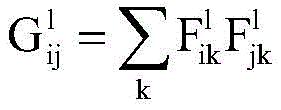
其中,
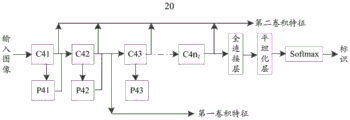
图7为本公开一实施例提供的一种第二卷积神经网络的结构示意图。例如,如图7所示,第二卷积神经网络20包括依次连接的多个第二卷积层(例如,第二卷积层C41、第二卷积层C42、第二卷积层C42和第二卷积层C4n2)和间插于相邻第二卷积层之间的多个第二池化层(例如,第二池化层P41、第二池化层P42和第二池化层P42)。每个第二卷积层用于产生并输出第一卷积特征和/或第二卷积特征。如图7所示,在一个示例中,第二卷积神经网络20可以包括n2个第二卷积层和n2个第二池化层,n2为正整数。FIG. 7 is a schematic structural diagram of a second convolutional neural network according to an embodiment of the present disclosure. For example, as shown in FIG. 7 , the second convolutional
例如,每个第二卷积层包括多个第二卷积核。第二卷积核可以用于提取输入图像的第一卷积特征和/或第二卷积特征。例如,图7所示的输入图像可以为第一图像、第二图像或第三图像。For example, each second convolutional layer includes multiple second convolution kernels. The second convolution kernel may be used to extract the first convolution feature and/or the second convolution feature of the input image. For example, the input image shown in FIG. 7 may be the first image, the second image or the third image.
例如,第二卷积神经网络20可以采用已经训练好的卷积神经网络模型。从而,在本公开实施例中,不需对第二卷积神经网络20的参数(例如,第二卷积核等)进行训练并修正。例如,第二卷积神经网络20可以采用AlexNet、GoogleNet、VGG、Deep Residual Learning等神经网络模型实现提取输入图像的内容特征和风格特征。VGG网络为深度卷积神经网络的一种,其是由牛津大学视觉几何组(Visual Geometry Group)开发,已经在视觉识别领域得到广泛应用。例如,VGG网络可以包括19层,并且可以对其中的一些层进行归一化处理。For example, the second convolutional
例如,第二卷积神经网络20可以采用可对图像进行分类的深度神经网络。如图7所示,输入图像经过若干个第二卷积层和第二池化层处理,以提取特征。每个第二卷积层的输出都是输入图像的特征图像。第二池化层可以降低特征图像的分辨率并传递给下一层级的第二卷积层。多个第二卷积层可以输出多个特征图像,该多个特征图像可以表征输入图像的不同级别的特征(例如,纹理、边缘、物体等)。经过若干个第二卷积层和第二池化层处理之后,特征图像被输入至平坦化层,平坦化层将特征图像转换成向量然后传递给全连接层以及softmax层。softmax层可以输出输入图像属于每一个类别标识的概率,其中概率最大的标识将作为第二卷积神经网络20最终的输出。由此,第二卷积神经网络20实现图像分类。For example, the second convolutional
例如,在第二卷积神经网络20中,第l个第二卷积层具有Nl个第二卷积核,第l个第二卷积层用于生成并输出第一图像的Nl个第一特征图像、第二图像的Nl个第二特征图像和Nl个第三特征图像以及第三图像的Nl个第四特征图像,且Nl个第二卷积核分别与Nl个第一特征图像、Nl个第二特征图像、Nl个第三特征图像以及Nl个第四特征图像一一对应。也就是说,一个第二卷积核用于生成并输出一个第一特征图像、一个第二特征图像、一个第三特征图像或一个第四特征图像。若Nl个第二卷积核各不相同,则Nl个第一特征图像各不相同,Nl个第二特征图像各不相同,Nl个第三特征图像各不相同,Nl个第四特征图像也各不相同。For example, in the second convolutional
例如,l为正整数。l表示第二卷积神经网络20中的第二卷积层的标号。例如,如图7所示,第二卷积神经网络20中具有n2个第二卷积层,则l的取值范围为[1,n2]。在如图7所示的示例中,在提取第一卷积特征时,l为2;在提取第二卷积特征时,l可以为1、2、3和n2。但不限于此,根据实际应用需求,l还可以为其他值。For example, l is a positive integer. l represents the label of the second convolutional layer in the second convolutional
例如,Nl个第一特征图像、Nl个第二特征图像、Nl个第三特征图像和Nl个第四特征图像的尺寸均相同。For example, N1 first feature images, N1 second feature images, N1 third feature images, and N1 fourth feature images all have the same size.
例如,第一特征图像和第三特征图像为内容特征图像,第二特征图像和第四特征图像为风格特征图像。也就是说,第二卷积神经网络20中某一些第二卷积层用于提取第一图像的内容特征以得到第一特征图像,第二卷积神经网络20中另一些第二卷积层用于提取第二图像的风格特征和内容特征以分别得到第二特征图像和第三特征图像,第二卷积神经网络20中又一些第二卷积层还用于提取第三图像的风格特征以得到第四特征图像。例如,提取第一图像的内容特征和第二图像的内容特征的第二卷积层可以相同,也可以不同;提取第二图像的风格特征和第三图像的风格特征的第二卷积层可以相同,也可以不同。又例如,提取内容特征和风格特征的第二卷积层可以相同,也可以不同。For example, the first feature image and the third feature image are content feature images, and the second feature image and the fourth feature image are style feature images. That is to say, some second convolutional layers in the second convolutional
例如,相应地,损失函数30还可以包括内容损失函数和风格损失函数。内容损失函数用于描述第一图像和第二图像的内容的差异,风格损失函数用于描述第二图像和第三图像的风格的差异。For example, correspondingly, the
例如,内容损失函数用于根据第一图像的第一卷积特征和第二图像的第一卷积特征计算第一卷积神经网络10的参数的内容损失值。风格损失函数用于根据第二图像的第二卷积特征和第三图像的第二卷积特征计算第一卷积神经网络10的参数的风格损失值。For example, the content loss function is used to calculate the content loss value of the parameters of the first convolutional
例如,第l个第二卷积层的内容损失函数表示为公式(4):For example, the content loss function of the l-th second convolutional layer is expressed as Equation (4):

其中,Cl表示内容损失函数,

例如,若通过Q1个第二卷积层提取输入图像的内容特征,则总内容损失函数表示为公式(5):For example, if the content features of the input image are extracted through Q1 second convolutional layers, the total content loss function is expressed as formula (5):
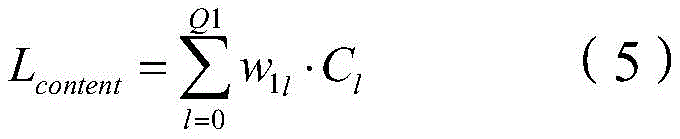
其中,Lcontent表示总内容损失函数,Q1为正整数,且表示产生并输出第一卷积特征的第二卷积层的数量,w1l表示Cl的权重。Among them, L content represents the total content loss function, Q1 is a positive integer, and represents the number of second convolution layers that generate and output the first convolution feature, and w 11 represents the weight of C 1 .
例如,第l个第二卷积层的风格损失函数表示为公式(6):For example, the style loss function of the l-th second convolutional layer is expressed as Equation (6):

其中,El表示风格损失函数,Ml表示第四特征图像的尺寸,

需要说明的是,第二特征图像的尺寸和第四特征图像的尺寸相同,因此,Ml也表示第二特征图像的尺寸。It should be noted that the size of the second feature image is the same as the size of the fourth feature image, therefore, M1 also represents the size of the second feature image.
例如,若通过Q2个第二卷积层提取输入图像的风格特征,则总风格损失函数表示为公式(7):For example, if the style features of the input image are extracted through Q2 second convolutional layers, the total style loss function is expressed as formula (7):

其中,Lstyle表示总风格损失函数,Q2为正整数,且表示产生并输出第二卷积特征的第二卷积层的数量,w2l表示El的权重。Among them, L style represents the total style loss function, Q2 is a positive integer, and represents the number of second convolution layers that generate and output the second convolution feature, and w 21 represents the weight of El.
例如,Q1和Q2可以相同,也可以不同。For example, Q1 and Q2 can be the same or different.
例如,风格特征可以通过多个第二卷积层(例如,两个或三个第二卷积层等)提取,而内容特征可以通过一个第二卷积层提取。但不限于此,风格特征特也可以通过一个第二卷积层提取。内容特征也可以通过多个第二卷积层提取。本公开的实施例对此不作具体限制。For example, style features can be extracted through multiple second convolutional layers (eg, two or three second convolutional layers, etc.), while content features can be extracted through one second convolutional layer. But not limited to this, style features can also be extracted by a second convolutional layer. Content features can also be extracted by multiple second convolutional layers. The embodiments of the present disclosure do not specifically limit this.
例如,根据公式(1)、公式(5)和公式(7),该神经网络的总损失函数Ltotal可以表示如下:For example, according to formula (1), formula (5) and formula (7), the total loss function L total of the neural network can be expressed as follows:
Ltotal=α·Lcontent+β·Lstyle+χ·LL1 L total =α·L content +β·L style +χ·L L1
其中,α、β和χ分别为总损失函数中内容损失函数、风格损失函数和L1损失函数的权重。Among them, α, β and χ are the weights of the content loss function, style loss function and L1 loss function in the total loss function, respectively.
例如,第一卷积神经网络10的参数的损失值包括L1损失值、内容损失值和风格损失值。也就是说,Ltotal的值即表示第一卷积神经网络10的参数的损失值。For example, the loss values of the parameters of the first convolutional
例如,如图4所示,神经网络可以包括第一转换矩阵50和第二转换矩阵51。第一转换矩阵50用于将第一图像的第一颜色通道、第二颜色通道和第三颜色通道的数据信息转换为第一中间图像的亮度信道、第一色差信道和第二色差信道的数据信息。For example, as shown in FIG. 4 , the neural network may include a
例如,在一个示例中,如图5A所示,第一子网络101、第二子网络102和第三子网络103分别用于对第一中间图像的亮度信道的数据信息、第一色差信道的数据信息和第二色差信道的数据信息进行风格迁移处理,以生成第二中间图像的亮度信道的数据信息、第一色差信道的数据信息和第二色差信道的数据信息。For example, in an example, as shown in FIG. 5A , the
例如,在一个示例中,如图5B所示,在第二子网络102'中,第一图像首先经过第一标准下采样层SD1进行下采样处理,以缩小第一中间图像的第一色差通道的数据信息量;然后,第一色差通道的数据信息经过多层第一卷积层处理;接着,第一标准上采样层SU1对第一色差通道的数据信息进行上采样处理,以增加第一色差通道的数据信息量;最后第一色差通道的数据信息被传输到第二转换矩阵51。同理,第三子网络103'用于对第一中间图像的第二色差通道的数据信息进行处理。For example, in one example, as shown in FIG. 5B , in the
例如,第二转换矩阵51用于接收并转换经过第一卷积神经网络10处理后的第二中间图像的亮度信道的数据信息、第一色差信道的数据信息和第二色差信道的数据信息,以得到第二图像的第一颜色通道的数据信息、第二颜色通道的数据信息和第三颜色通道的数据信息。For example, the
例如,第一图像为RGB格式的图像,第一中间图像为YUV格式的图像。第一颜色通道、第二颜色通道和第三颜色通道分别为红色(R)通道、绿色(G)通道和蓝色(B)通道。亮度信道、第一色差信道和第二色差信道分别为Y通道、U通道和V通道。在YUV颜色空间中,Y通道和U通道、V通道是分离的;Y代表亮度,UV代表色差,U和V是构成彩色的两个分量。For example, the first image is an image in RGB format, and the first intermediate image is an image in YUV format. The first color channel, the second color channel and the third color channel are a red (R) channel, a green (G) channel and a blue (B) channel, respectively. The luminance channel, the first color-difference channel, and the second color-difference channel are the Y channel, the U channel, and the V channel, respectively. In the YUV color space, the Y channel is separated from the U channel and V channel; Y represents brightness, UV represents color difference, and U and V are the two components that make up color.
图8为本公开一实施例提供的一种卷积神经网络的训练方法的示意性流程图。如图8所示,本公开实施例提供的卷积神经网络的训练方法可以包括以下操作:FIG. 8 is a schematic flowchart of a method for training a convolutional neural network according to an embodiment of the present disclosure. As shown in FIG. 8 , the training method of the convolutional neural network provided by the embodiment of the present disclosure may include the following operations:
操作S30:初始化卷积神经网络;Operation S30: initialize the convolutional neural network;
操作S31:获取第一图像;Operation S31: acquiring a first image;
操作S32:利用第一图像对初始化后的卷积神经网络进行训练;Operation S32: using the first image to train the initialized convolutional neural network;
操作S33:通过损失函数计算卷积神经网络的参数的损失值;Operation S33: Calculate the loss value of the parameters of the convolutional neural network through the loss function;
操作S34:根据损失值对卷积神经网络的参数进行修正,以得到训练好的卷积神经网络。Operation S34: Modify the parameters of the convolutional neural network according to the loss value to obtain a trained convolutional neural network.
例如,损失函数包括权重偏置比(L1)损失函数,还可以进一步包括内容损失函数和风格损失函数。For example, the loss function includes a weight-bias ratio (L1) loss function, and may further include a content loss function and a style loss function.
例如,卷积神经网络为上述神经网络实施例中的第一卷积神经网络。卷积神经网络可以包括第一子网络、第二子网络和第三子网络。第一子网络、第二子网络和第三子网络分别包括多个卷积层,卷积层包括多个卷积核和多个偏置,卷积神经网络的参数包括该多个卷积核和多个偏置。For example, the convolutional neural network is the first convolutional neural network in the above-mentioned neural network embodiment. The convolutional neural network may include a first sub-network, a second sub-network, and a third sub-network. The first sub-network, the second sub-network and the third sub-network respectively include a plurality of convolution layers, the convolution layers include a plurality of convolution kernels and a plurality of biases, and the parameters of the convolutional neural network include the plurality of convolution kernels and multiple offsets.
需要说明的是,上述示例仅是示意性说明卷积神经网络的训练过程。本领域技术人员应当知道,在训练阶段,需要利用大量样本图像对卷积神经网络进行训练;同时,在每一幅样本图像训练过程中,都可以包括多次反复迭代以对卷积神经网络的参数进行修正。又例如,训练阶段还包括对卷积神经网络的参数进行微调(fine-tune),以获取更优化的参数。It should be noted that the above example is only a schematic illustration of the training process of the convolutional neural network. Those skilled in the art should know that in the training stage, a large number of sample images need to be used to train the convolutional neural network; at the same time, in the training process of each sample image, multiple iterations may be included to train the convolutional neural network. parameters are corrected. For another example, the training stage further includes fine-tune the parameters of the convolutional neural network to obtain more optimized parameters.
例如,操作S33可以包括:根据多个卷积核和多个偏置通过L1损失函数计算卷积神经网络的参数的权重偏置比损失值。For example, operation S33 may include: calculating the weight-bias ratio loss value of the parameters of the convolutional neural network through the L1 loss function according to the plurality of convolution kernels and the plurality of biases.
例如,损失值包括权重偏置比损失值。For example, the loss value includes the weight bias ratio loss value.
例如,在一个示例中,第二子网络包括第一标准上采样层和第一标准下采样层,第三子网络包括第二标准上采样层和第二标准下采样层。第一标准下采样层用于替代第二子网络中最初的第一卷积层,第一标准上采样层用于替代第二子网络中最后的第一卷积层;第二标准下采样层用于替代第三子网络中最初的第一卷积层,第二标准上采样层用于替代第三子网络中最后的第一卷积层。For example, in one example, the second sub-network includes a first standard upsampling layer and a first standard downsampling layer, and the third subnetwork includes a second standard upsampling layer and a second standard downsampling layer. The first standard downsampling layer is used to replace the initial first convolutional layer in the second sub-network, and the first standard upsampling layer is used to replace the last first convolutional layer in the second sub-network; the second standard downsampling layer It is used to replace the initial first convolutional layer in the third sub-network, and the second standard upsampling layer is used to replace the last first convolutional layer in the third sub-network.
例如,操作S32可以包括如下的操作S321-S323:For example, operation S32 may include the following operations S321-S323:
操作S321:将第一图像的第一颜色通道的数据信息、第二颜色通道的数据信息和第三颜色通道的数据信息转换为第一中间图像的亮度信道的数据信息、第一色差信道的数据信息和第二色差信道的数据信息;Operation S321: Convert the data information of the first color channel, the data information of the second color channel and the data information of the third color channel of the first image into the data information of the luminance channel and the data of the first color difference channel of the first intermediate image information and data information of the second color difference channel;
操作S322:通过第一子网络、第二子网络和第三子网络分别对第一中间图像的亮度信道的数据信息、第一色差信道的数据信息和第二色差信道的数据信息进行风格迁移处理,以生成第二中间图像的亮度信道的数据信息、第一色差信道的数据信息和第二色差信道的数据信息;Operation S322: Perform style transfer processing on the data information of the luminance channel, the data information of the first color-difference channel, and the data information of the second color-difference channel of the first intermediate image through the first sub-network, the second sub-network, and the third sub-network, respectively , to generate the data information of the luminance channel of the second intermediate image, the data information of the first color difference channel and the data information of the second color difference channel;
操作S323:将第二中间图像的亮度信道的数据信息、第一色差信道的数据信息和第二色差信道的数据信息转换为第二图像的第一颜色通道的数据信息、第二颜色通道的数据信息和第三颜色通道的数据信息。Operation S323: Convert the data information of the luminance channel, the data information of the first color difference channel, and the data information of the second color difference channel of the second intermediate image into data information of the first color channel and data of the second color channel of the second image information and data information for the third color channel.
例如,操作S33可以包括操作S331~S333:For example, operation S33 may include operations S331-S333:
操作S331:分别提取第一图像的第一卷积特征、第二图像的第一卷积特征和第二卷积特征以及第三图像的第二卷积特征;Operation S331: extract the first convolution feature of the first image, the first convolution feature and the second convolution feature of the second image, and the second convolution feature of the third image respectively;
操作S332:根据第一图像的第一卷积特征和第二图像的第一卷积特征通过内容损失函数计算卷积神经网络的参数的内容损失值;Operation S332: Calculate the content loss value of the parameter of the convolutional neural network by the content loss function according to the first convolution feature of the first image and the first convolution feature of the second image;
操作S333:根据第二图像的第二卷积特征和第三图像的第二卷积特征通过风格损失函数计算卷积神经网络的参数的风格损失值。Operation S333: Calculate the style loss value of the parameters of the convolutional neural network according to the second convolution feature of the second image and the second convolution feature of the third image through the style loss function.
例如,损失值还包括内容损失值和风格损失值。For example, the loss value also includes a content loss value and a style loss value.
例如,操作S34可以包括:根据损失值分别对第一子网络的参数、第二子网络的参数和第三子网络的参数进行修正,以得到训练好的卷积神经网络。For example, operation S34 may include: modifying the parameters of the first sub-network, the parameters of the second sub-network and the parameters of the third sub-network respectively according to the loss value, so as to obtain a trained convolutional neural network.
需要说明的是,关于第一子网络、第二子网络、第三子网络、第一图像、第一中间图像、第二中间图像、第二图像、第三图像、损失值的计算公式等的详细说明可以参考神经网络的实施例中的相关描述,重复之处不再赘述。It should be noted that, about the first sub-network, the second sub-network, the third sub-network, the first image, the first intermediate image, the second intermediate image, the second image, the third image, the calculation formula of the loss value, etc. For a detailed description, reference may be made to the relevant descriptions in the embodiments of the neural network, and repeated descriptions will not be repeated.
图9为本公开一实施例提供的一种图像处理方法的示意性流程图。如图9所示,本公开实施例提供的图像处理方法可以包括以下操作:FIG. 9 is a schematic flowchart of an image processing method according to an embodiment of the present disclosure. As shown in FIG. 9 , the image processing method provided by the embodiment of the present disclosure may include the following operations:
操作S70:获取原始图像;Operation S70: obtaining an original image;
操作S72:将原始图像输入至生成神经网络;Operation S72: input the original image to the generative neural network;
操作S74:使用生成神经网络对原始图像进行风格迁移处理,以生成输出图像。Operation S74: Use a generative neural network to perform style transfer processing on the original image to generate an output image.
例如,生成神经网络包括根据上述任一所述的卷积神经网络的训练方法所训练得到的卷积神经网络。本公开实施例提供的图像处理方法可以通过生成神经网络对原始图像进行风格迁移处理,不但可以实现较佳的风格迁移效果,而且能够提高处理速度,具有更好、更广泛的应用前景。For example, the generative neural network includes a convolutional neural network trained according to any one of the above-mentioned training methods for a convolutional neural network. The image processing method provided by the embodiments of the present disclosure can perform style transfer processing on the original image through a generative neural network, which can not only achieve a better style transfer effect, but also improve the processing speed and have better and wider application prospects.
例如,原始图像可以为各种类型的图像。原始图像例如可以为人物图像、动植物图像或风景图像等。For example, the original image may be various types of images. The original image may be, for example, a person image, an animal or plant image, or a landscape image.
例如,原始图像可以通过图像采集设备获取。图像采集设备例如可以是智能手机的摄像头、平板电脑的摄像头、个人计算机的摄像头、数码照相机的镜头、或者甚至可以是网络摄像头。For example, raw images can be acquired by image acquisition equipment. The image capture device may be, for example, a camera of a smartphone, a camera of a tablet, a camera of a personal computer, a lens of a digital camera, or even a webcam.
例如,输出图像为经过生成网络处理之后的图像,其可以包括原始图像的内容特征和风格图像的风格特征。风格图像可以为各种艺术大师(例如莫奈、梵高、毕加索等)的名画等。需要说明的是,风格图像可以为神经网络实施例中的第三图像。For example, the output image is an image processed by the generation network, which may include the content feature of the original image and the style feature of the style image. The style images can be famous paintings of various art masters (eg, Monet, Van Gogh, Picasso, etc.). It should be noted that the style image may be the third image in the neural network embodiment.
图10A为一种原始图像的示意图,图10B为一种风格图像的示意图,图10C为根据本公开一实施例提供的一种图像处理方法处理得到的输出图像的示意图。例如,如图10A所示,原始图像可以为用户拍摄的照片。风格图像可以为一幅浮世绘版画,例如,图10B所示的图为神奈川冲浪里。图10C所示的图像为经过本公开实施例提供的图像处理方法处理后得到的输出图像,其具有原始图像的内容特征和风格图像的风格特征。10A is a schematic diagram of an original image, FIG. 10B is a schematic diagram of a style image, and FIG. 10C is a schematic diagram of an output image obtained by processing an image processing method according to an embodiment of the present disclosure. For example, as shown in FIG. 10A, the original image may be a photo taken by the user. The style image can be a Ukiyo-e print, for example, the picture shown in Figure 10B is in The Great Wave off Kanagawa. The image shown in FIG. 10C is an output image obtained after being processed by the image processing method provided by the embodiment of the present disclosure, and has the content feature of the original image and the style feature of the style image.
例如,输出图像与原始图像可以具有相同的分辨率,也可以具有不同的分辨率。For example, the output image can have the same resolution as the original image, or it can have a different resolution.
例如,在一个示例中,操作S72可以包括以下操作:For example, in one example, operation S72 may include the following operations:
操作S721:将原始图像转换为第一中间图像;Operation S721: converting the original image into a first intermediate image;
操作S722:将第一中间图像输入至生成神经网络。Operation S722: Input the first intermediate image to the generative neural network.
例如,原始图像具有第一颜色通道、第二颜色通道和第三颜色通道。第一中间图像具有亮度信道、第一色差信道和第二色差信道。操作S721可以包括:对原始图像的第一颜色通道、第二颜色通道和第三颜色通道的数据信息进行转换,以生成第一中间图像的亮度信道、第一色差信道和第二色差信道的数据信息。For example, the original image has a first color channel, a second color channel, and a third color channel. The first intermediate image has a luminance channel, a first color difference channel, and a second color difference channel. Operation S721 may include: converting the data information of the first color channel, the second color channel and the third color channel of the original image to generate data of the luminance channel, the first color difference channel and the second color difference channel of the first intermediate image information.
例如,原始图像为RGB格式的图像,第一中间图像为YUV格式的图像。第一颜色通道、第二颜色通道和第三颜色通道分别为红色(R)通道、绿色(G)通道和蓝色(B)通道。亮度信道、第一色差信道和第二色差信道分别为Y通道、U通道和V通道。在YUV颜色空间中,Y通道和U通道、V通道是分离的。Y代表亮度,UV代表色差,U和V是构成彩色的两个分量。For example, the original image is an image in RGB format, and the first intermediate image is an image in YUV format. The first color channel, the second color channel and the third color channel are a red (R) channel, a green (G) channel and a blue (B) channel, respectively. The luminance channel, the first color-difference channel, and the second color-difference channel are the Y channel, the U channel, and the V channel, respectively. In the YUV color space, the Y channel is separated from the U and V channels. Y stands for luminance, UV stands for chromatic aberration, and U and V are the two components that make up color.
例如,在操作S721中,通过第一转换矩阵将原始图像的R通道、G通道和B通道的数据转换为第一中间图像的Y通道、U通道和V通道的数据。第一转换矩阵的转换公式可以表示为:For example, in operation S721, the data of the R channel, the G channel and the B channel of the original image are converted into the data of the Y channel, the U channel and the V channel of the first intermediate image through the first conversion matrix. The conversion formula of the first conversion matrix can be expressed as:
Y1=0.30R1+0.59G1+0.11B1Y1=0.30R1+0.59G1+0.11B1
U1=0.493·(0.70R1-0.59G1-0.11B1)U1=0.493·(0.70R1-0.59G1-0.11B1)
V1=0.877·(-0.30R1-0.59G1-0.11B1)V1=0.877·(-0.30R1-0.59G1-0.11B1)
其中,Y1、U1和V1分别表示第一中间图像的亮度信息、第一色度信息和第二色度信息;R1、G1和B1分别表示原始图像的红色信息、绿色信息和蓝色信息。Wherein, Y1, U1 and V1 respectively represent the luminance information, the first chromaticity information and the second chromaticity information of the first intermediate image; R1, G1 and B1 respectively represent the red, green and blue information of the original image.
例如,生成神经网络可以包括第一子网络、第二子网络和第三子网络。第一子网络用于对Y通道的数据信息进行处理,第二子网络用于对U通道的数据信息进行处理,第三子网络用于对V通道的数据信息进行处理。也就是说,本公开实施例提供的图像处理方法可以对第一中间图像的不同通道分别单独处理,从而减小生成神经网络的模型,进一步提高处理速度,增加图像处理的灵活性。For example, the generative neural network may include a first sub-network, a second sub-network, and a third sub-network. The first sub-network is used to process the data information of the Y channel, the second sub-network is used to process the data information of the U channel, and the third sub-network is used to process the data information of the V channel. That is to say, the image processing method provided by the embodiment of the present disclosure can separately process different channels of the first intermediate image, thereby reducing the model for generating the neural network, further improving the processing speed, and increasing the flexibility of image processing.
例如,第一子网络、第二子网络或第三子网络可以分别包括多个第一卷积层、多个第一池化层、多个复合层和多个实例归一化层。第二子网络或第三子网络可以省略一些复合层或实例归一化层等。For example, the first sub-network, the second sub-network, or the third sub-network may include a plurality of first convolutional layers, a plurality of first pooling layers, a plurality of composite layers, and a plurality of instance normalization layers, respectively. The second sub-network or the third sub-network may omit some composite layers or instance normalization layers, etc.
需要说明的是,关于卷积神经网络的具体结构的详细说明可以参考神经网络的实施例中关于第一卷积神经网络的描述,重复之处在此不再赘述。It should be noted that, for a detailed description of the specific structure of the convolutional neural network, reference may be made to the description of the first convolutional neural network in the embodiment of the neural network, and repeated details are not repeated here.
例如,YUV格式可以包括YUV444、YUV420以及YUV422等格式。YUV444、YUV420以及YUV422等格式的主要区别在于U通道和V通道的数据的采样方式和存储方式。For example, the YUV format may include formats such as YUV444, YUV420, and YUV422. The main difference between YUV444, YUV420 and YUV422 formats is the sampling method and storage method of the data of U channel and V channel.
假设,图像中的4个像素点表示为:Suppose, the 4 pixels in the image are represented as:
[Y0U0V0][Y1U1V1][Y2U2V2][Y3U3V3][Y0U0V0][Y1U1V1][Y2U2V2][Y3U3V3]
在图像处理过程中,存放或处理该4个像素点的数据流为:In the process of image processing, the data flow for storing or processing the 4 pixels is:
Y0U0V0Y1U1V1Y2U2V2Y3U3V3。Y0U0V0Y1U1V1Y2U2V2Y3U3V3.
映射出的像素点表示为:The mapped pixels are represented as:
[Y0U0V0][Y1U1V1][Y2U2V2][Y3U3V3][Y0U0V0][Y1U1V1][Y2U2V2][Y3U3V3]
即映射出的像素点为原始的像素点。That is, the mapped pixels are the original pixels.
例如,YUV420格式表示每一行像素中,只有一种色度信息(第一色度信息U或第二色度信息V),且第一色度信息U或第二色度信息V以1/2的频率抽样存储。在图像处理过程中,相邻的行处理不同的色度信息。For example, the YUV420 format indicates that in each row of pixels, there is only one kind of chrominance information (the first chrominance information U or the second chrominance information V), and the first chrominance information U or the second chrominance information V is divided by 1/2 frequency sample storage. During image processing, adjacent rows process different chrominance information.
假设图像中的两行8个像素点表示为:Suppose two rows of 8 pixels in the image are represented as:
[Y0U0V0][Y1U1V1][Y2U2V2][Y3U3V3][Y0U0V0][Y1U1V1][Y2U2V2][Y3U3V3]
[Y4U4V4][Y5U5V5][Y6U6V6][Y7U7V7][Y4U4V4][Y5U5V5][Y6U6V6][Y7U7V7]
在图像处理过程中,存放或处理该8个像素点的数据流为:In the process of image processing, the data flow for storing or processing the 8 pixels is:
Y0U0 Y1 Y2U2 Y3Y0U0 Y1 Y2U2 Y3
Y4V4 Y5 Y6V6 Y7Y4V4 Y5 Y6V6 Y7
在第一行像素中,只有第一色度信息U;在第二行像素中,只有第二色度信息V。In the first row of pixels, only the first chrominance information U; in the second row of pixels, only the second chrominance information V.
映射出的像素点表示为:The mapped pixels are represented as:
[Y0 U0 V4][Y1 U0 V4][Y2 U2 V6][Y3 U2 V6][Y0 U0 V4][Y1 U0 V4][Y2 U2 V6][Y3 U2 V6]
[Y4 U0 V4][Y5 U0 V4][Y6U2 V6][Y7 U2 V6][Y4 U0 V4][Y5 U0 V4][Y6U2 V6][Y7 U2 V6]
综上,每一行中相邻的4个像素点在存放或处理时仅占用6个字节,相比YUV444(4个像素点需要12个字节)的采样格式,YUV420格式减小了处理和存储的像素点的数据量。尽管映射出的像素点与原始像素点略有不同,但这些不同在人眼的感觉中不会引起明显的变化。To sum up, the adjacent 4 pixels in each row only occupy 6 bytes when stored or processed. Compared with the sampling format of YUV444 (4 pixels need 12 bytes), the YUV420 format reduces the processing and processing time. The amount of data stored in pixels. Although the mapped pixels are slightly different from the original pixels, these differences do not cause noticeable changes in the perception of the human eye.
图11A为本公开一实施例提供的一种生成神经网络的结构示意图;图11B为本公开一实施例提供的另一种生成神经网络的结构示意图。FIG. 11A is a schematic structural diagram of a generative neural network according to an embodiment of the present disclosure; FIG. 11B is a schematic structural diagram of another generative neural network according to an embodiment of the present disclosure.
例如,生成神经网络包括第一子网络、第二子网络和第三子网络,且生成神经网络为神经网络实施例中的第一卷积神经网络。第一子网络、第二子网络和第三子网络的构造可以相同,也可以不相同。For example, the generative neural network includes a first sub-network, a second sub-network and a third sub-network, and the generative neural network is the first convolutional neural network in the neural network embodiment. The structures of the first sub-network, the second sub-network and the third sub-network may be the same or different.
例如,在第一示例中,第一中间图像采用YUV 444的图像格式。如图11A所示,第一子网络101、第二子网络102和第三子网络103的构造相同。下面以第一子网络101为例进行说明。例如,第一子网络101包括五个第一卷积层(第一卷积层C11、第一卷积层C12、第一卷积层C13、第一卷积层C14和第一卷积层C15)、两个第一池化层(第一池化层P11和第一池化层P12)、两个复合层(复合层M11和复合层M12)和四个实例归一化层(实例归一化层N11、实例归一化层N12、实例归一化层N13和实例归一化层N14)。For example, in the first example, the first intermediate image is in the image format of YUV 444. As shown in FIG. 11A , the configurations of the
例如,在第一示例中,如图11A所示,操作S74包括:分别使用第一子网络101、第二子网络102和第三子网络103处理第一中间图像的亮度信道的数据信息、第一色差信道的数据信息和第二色差信道的数据信息,以生成第二中间图像;以及将第二中间图像转换为输出图像。For example, in the first example, as shown in FIG. 11A , operation S74 includes: using the
例如,在第二示例中,第一中间图像采用YUV 420的图像格式。在操作S721中,可以将原始图像在YUV颜色空间上进行处理,以使得第一中间图像采用YUV420的图像格式,从而减小U通道和V通道的尺寸,进而减小生成神经网络中卷积核的数量。For example, in the second example, the first intermediate image is in the image format of YUV 420. In operation S721, the original image may be processed in the YUV color space, so that the first intermediate image adopts the image format of YUV420, thereby reducing the size of the U channel and the V channel, thereby reducing the convolution kernel in the generation neural network quantity.
例如,在第二示例中,第二子网络包括第一标准上采样层和第一标准下采样层,第一标准下采样层用于替代第一卷积神经网络中最初的第一卷积层、第一池化层和实例归一化层,第一标准上采样层用于替代第一卷积神经网络中最后的第一卷积层、复合层和实例归一化层;第三子网络包括第二标准上采样层和第二标准下采样层,第二标准下采样层用于替代第一卷积神经网络中最初的第一卷积层、第一池化层和实例归一化层,第二标准上采样层用于替代第一卷积神经网络中最后的第一卷积层、复合层和实例归一化层。For example, in the second example, the second sub-network includes a first standard upsampling layer and a first standard downsampling layer, and the first standard downsampling layer is used to replace the original first convolutional layer in the first convolutional neural network , the first pooling layer and instance normalization layer, the first standard upsampling layer is used to replace the last first convolutional layer, composite layer and instance normalization layer in the first convolutional neural network; the third sub-network Including a second standard upsampling layer and a second standard downsampling layer, the second standard downsampling layer is used to replace the original first convolutional layer, first pooling layer and instance normalization layer in the first convolutional neural network , the second standard upsampling layer is used to replace the last first convolutional layer, composite layer and instance normalization layer in the first convolutional neural network.
例如,如图11B所示,在第二示例中,第一子网络101'可以与第一示例中的第一子网络101的构造相同。For example, as shown in FIG. 11B , in the second example, the
例如,如图11B所示,第二子网络102'和第三子网络103'的构造相同。下面以第二子网络102'为例进行说明。例如,第二子网络102'包括一个第一标准下采样层SD1、一个第一标准上采样层SU1、三个第一卷积层(第一卷积层C22、第一卷积层C23和第一卷积层C24)、一个第一池化层(第一池化层P22)、一个复合层(复合层M21)以及两个实例归一化层(实例归一化层N22和实例归一化层N23)。For example, as shown in FIG. 11B, the second sub-network 102' and the third sub-network 103' have the same configuration. The following takes the second sub-network 102' as an example for description. For example, the second sub-network 102' includes one first standard downsampling layer SD1, one first standard upsampling layer SU1, three first convolutional layers (first convolutional layer C22, first convolutional layer C23 and One convolutional layer C24), one first pooling layer (first pooling layer P22), one composite layer (composite layer M21), and two instance normalization layers (instance normalization layer N22 and instance normalization layer N22) layer N23).
例如,与第一示例相比,在第二示例中,第一标准下采样层SD1替代了最初的一个第一卷积层、一个第一池化层和一个实例归一化层,第一标准上采样层SU1替代了最后的第一卷积层、第一池化层和实例归一化层。由此,生成神经网络的网络模型尺寸被减小。For example, compared to the first example, in the second example, the first standard downsampling layer SD1 replaces the original one first convolutional layer, one first pooling layer and one instance normalization layer, the first standard The upsampling layer SU1 replaces the last first convolutional layer, first pooling layer and instance normalization layer. Thereby, the size of the network model that generates the neural network is reduced.
例如,如图11A和11B所示,在第二子网络102'中,第一标准下采样层SD1替代了最初的第一卷积层C21、一个第一池化层P21和一个实例归一化层N21;第一标准上采样层SU1替代了最后的第一卷积层C25、复合层M22和实例归一化层N24。For example, as shown in Figures 11A and 11B, in the second sub-network 102', a first standard downsampling layer SD1 replaces the original first convolutional layer C21, a first pooling layer P21, and an instance normalization layer Layer N21; the first standard upsampling layer SU1 replaces the last first convolutional layer C25, composite layer M22 and instance normalization layer N24.
例如,第二子网络102'中省略了处理U通道最高分辨率的第一卷积层,第三子网络103'中省略了处理V通道最高分辨率的第一卷积层。从而,该图像处理方法可以进一步提高图像处理速度。For example, the first convolutional layer processing the highest resolution of the U channel is omitted from the second sub-network 102', and the first convolutional layer processing the highest resolution of the V channel is omitted from the third sub-network 103'. Thus, the image processing method can further improve the image processing speed.
例如,第一标准下采样层SD1和第一标准上采样层SU1分别用于对U通道的数据信息进行下采样和上采样。第二标准下采样层SD2和第二标准上采样层SU2分别用于对V通道的数据信息进行下采样和上采样。For example, the first standard down-sampling layer SD1 and the first standard up-sampling layer SU1 are used to down-sample and up-sample the data information of the U channel, respectively. The second standard down-sampling layer SD2 and the second standard up-sampling layer SU2 are respectively used for down-sampling and up-sampling the data information of the V channel.
例如,第一标准下采样层SD1和第二标准下采样层SD2的结构和采样因子可以相同,也可以不同。第一标准上采样层SU1和第二标准上采样层SU2的结构和采样因子可以相同,也可以不同。对此不作具体限制。For example, the structures and sampling factors of the first standard downsampling layer SD1 and the second standard downsampling layer SD2 may be the same or different. The structures and sampling factors of the first standard upsampling layer SU1 and the second standard upsampling layer SU2 may be the same or different. There is no specific restriction on this.
例如,若第一中间图像采用YUV 420的图像格式,第一标准下采样层SD1和第二标准下采样层SD2的结构和下采样因子相同,第一标准上采样层SU1和第二标准上采样层SU2的结构和上采样因子也相同。从而,第二子网络102'和第三子网络103'的构造相同。For example, if the first intermediate image adopts the image format of YUV 420, the first standard downsampling layer SD1 and the second standard downsampling layer SD2 have the same structure and downsampling factor, the first standard upsampling layer SU1 and the second standard upsampling layer SU1 The structure and upsampling factor of layer SU2 are also the same. Thus, the configurations of the second sub-network 102' and the third sub-network 103' are the same.
例如,在第二示例中,如图11B所示,操作S74包括:分别使用第一子网络101'、第二子网络102'和第三子网络103'处理第一中间图像的亮度信道的数据信息、第一色差信道的数据信息和第二色差信道的数据信息,以生成第二中间图像;以及将第二中间图像转换为输出图像。For example, in the second example, as shown in FIG. 11B , operation S74 includes: using the
例如,输出图像为RGB格式的图像,第二中间图像为YUV格式的图像。For example, the output image is an image in RGB format, and the second intermediate image is an image in YUV format.
例如,在将第二中间图像转换为输出图像的操作中,通过第二转换矩阵将第二中间图像转换为输出图像。第二转换矩阵的转换公式可以表示如下;For example, in the operation of converting the second intermediate image into the output image, the second intermediate image is converted into the output image by the second transformation matrix. The conversion formula of the second conversion matrix can be expressed as follows;

其中,Y2、U2和V2分别表示第二中间图像的亮度信息、第一色度信息和第二色度信息;R2、G2和B2分别表示输出图像的红色信息、绿色信息和蓝色信息。Wherein, Y2, U2 and V2 respectively represent the luminance information, first chromaticity information and second chromaticity information of the second intermediate image; R2, G2 and B2 respectively represent the red, green and blue information of the output image.
例如,第二中间图像为第一中间图像通过生成神经网络处理之后得到的图像。若生成神经网络包括实例归一化层,则第二中间图像的像素的灰度值的范围为[-1,1],在将第二中间图像转换为输出图像的操作时还包括:将第二中间图像的Y通道、U通道和V通道的数据信息转换为输出图像的R通道、G通道和B通道的数据信息;以及将输出图像的像素的灰度值转换到[0,255]范围内。For example, the second intermediate image is an image obtained after the first intermediate image is processed by the generative neural network. If the generative neural network includes an instance normalization layer, the range of the gray value of the pixels of the second intermediate image is [-1, 1], and the operation of converting the second intermediate image into an output image further includes: converting the second intermediate image into an output image. 2. Convert the data information of the Y channel, U channel and V channel of the intermediate image into the data information of the R channel, G channel and B channel of the output image; and convert the gray value of the pixel of the output image to the range of [0,255].
例如,如图11A和11B所示,生成神经网络可以不包括平坦化层、全连接层以及分类器。For example, as shown in Figures 11A and 11B, the generative neural network may not include a flattening layer, a fully connected layer, and a classifier.
图12为本公开一实施例提供的一种图像处理装置的示例性框图。例如,如图12所示,本公开实施例提供的图像处理装置包括生成神经网络模块80。生成神经网络模块80用于对原始图像进行风格迁移处理,以生成输出图像。FIG. 12 is an exemplary block diagram of an image processing apparatus according to an embodiment of the present disclosure. For example, as shown in FIG. 12 , the image processing apparatus provided by the embodiment of the present disclosure includes a generative neural network module 80 . The generative neural network module 80 is used to perform style transfer processing on the original image to generate an output image.
例如,生成神经网络模块80可以包括生成神经网络,且生成神经网络包括根据上述任一项所述的卷积神经网络的训练方法所训练得到的卷积神经网络。For example, the generative neural network module 80 may include a generative neural network, and the generative neural network includes a convolutional neural network trained according to any one of the above-mentioned training methods for a convolutional neural network.
本公开实施例提供的图像处理装置通过生成神经网络对原始图像进行风格转移处理,提高图像风格迁移和图像融合效果,在处理效果和处理速度等方面得以兼顾,具有更好、更广泛的应用前景。The image processing apparatus provided by the embodiments of the present disclosure performs style transfer processing on the original image by generating a neural network, improves the effect of image style transfer and image fusion, and has both processing effect and processing speed, and has better and wider application prospects. .
例如,如图12所示,图像处理装置还包括第一转换模块82。第一转换模块82包括上述神经网络中的第一转换矩阵。第一转换矩阵用于将原始图像转换为第一中间图像。For example, as shown in FIG. 12 , the image processing apparatus further includes a first conversion module 82 . The first transformation module 82 includes the first transformation matrix in the above-mentioned neural network. The first transformation matrix is used to transform the original image into the first intermediate image.
例如,原始图像具有第一颜色通道、第二颜色通道和第三颜色通道,第一中间图像具有亮度信道、第一色差信道和第二色差信道。第一转换矩阵可以用于将原始图像的第一颜色通道、第二颜色通道和第三颜色通道的数据信息转换为第一中间图像的亮度信道、第一色差信道和第二色差信道的数据信息。For example, the original image has a first color channel, a second color channel, and a third color channel, and the first intermediate image has a luminance channel, a first color difference channel, and a second color difference channel. The first conversion matrix can be used to convert the data information of the first color channel, the second color channel and the third color channel of the original image into the data information of the luminance channel, the first color difference channel and the second color difference channel of the first intermediate image .
例如,生成神经网络可以包括第一子网络、第二子网络和第三子网络。第一子网络、第二子网络和第三子网络分别用于处理第一中间图像的亮度信道的数据信息、第一色差信道的数据信息和第二色差信道的数据信息,以生成第二中间图像。For example, the generative neural network may include a first sub-network, a second sub-network, and a third sub-network. The first sub-network, the second sub-network and the third sub-network are respectively used to process the data information of the luminance channel of the first intermediate image, the data information of the first color difference channel and the data information of the second color difference channel to generate the second intermediate image image.
例如,如图12所示,图像处理装置还包括第二转换模块84。第二转换模块84包括上述神经网络中的第二转换矩阵。第二转换矩阵可以用于将第二中间图像转换为输出图像。For example, as shown in FIG. 12 , the image processing apparatus further includes a second conversion module 84 . The second transformation module 84 includes the second transformation matrix in the above-mentioned neural network. The second transformation matrix may be used to transform the second intermediate image into the output image.
例如,如图11A和图11B所示,第一转换矩阵用于接收原始图像,并将原始图像转换为第一中间图像。第一转换矩阵输出的第一中间图像被输入至生成神经网络模块80。生成神经网络模块80用于对第一中间图像进行风格迁移处理,以生成第二中间图像。第二转换矩阵用于接收生成神经网络模块80输出的第二中间图像,并将第二中间图像转换为输出图像然后输出。该输出图像即作为图像处理装置的最终输出。该输出图像具有原始图像的内容特征和另一图像(例如,艺术大师的油画等)的风格特征。For example, as shown in FIGS. 11A and 11B , a first transformation matrix is used to receive an original image and convert the original image into a first intermediate image. The first intermediate image output by the first transformation matrix is input to the generative neural network module 80 . The generating neural network module 80 is configured to perform style transfer processing on the first intermediate image to generate a second intermediate image. The second transformation matrix is used for receiving the second intermediate image output by the generating neural network module 80, and converting the second intermediate image into an output image and then outputting it. The output image is the final output of the image processing device. The output image has the content characteristics of the original image and the style characteristics of another image (eg, a painting by a maestro, etc.).
需要说明的是,关于原始图像、第一中间图像、第二中间图像、输出图像、生成神经网络、第一转换矩阵和第二转换矩阵的转换公式等的详细说明可以参考图像处理方法的实施例中的相关描述,重复之处不再赘述。It should be noted that, for the detailed description of the original image, the first intermediate image, the second intermediate image, the output image, the generating neural network, the conversion formulas of the first conversion matrix and the second conversion matrix, etc., reference may be made to the embodiment of the image processing method. Relevant descriptions in , the repetitions will not be repeated.
图13为本公开一实施例提供的另一种图像处理装置的示意性框图。本公开至少一实施例还提供一种图像处理装置,如图13所示,该图像处理装置包括处理器70和存储器75。应当注意,图13所示的图像处理装置的组件只是示例性的,而非限制性的,根据实际应用需要,该图像处理装置还可以具有其他组件。FIG. 13 is a schematic block diagram of another image processing apparatus according to an embodiment of the present disclosure. At least one embodiment of the present disclosure further provides an image processing apparatus. As shown in FIG. 13 , the image processing apparatus includes a processor 70 and a memory 75 . It should be noted that the components of the image processing apparatus shown in FIG. 13 are only exemplary and not restrictive, and the image processing apparatus may also have other components according to actual application requirements.
例如,处理器70和存储器75之间可以直接或间接地互相通信。For example, the processor 70 and the memory 75 may communicate with each other directly or indirectly.
例如,处理器70和存储器75等组件之间可以通过网络连接进行通信。网络可以包括无线网络、有线网络、和/或无线网络和有线网络的任意组合。网络可以包括局域网、互联网、电信网、基于互联网和/或电信网的物联网(Internet of Things)、和/或以上网络的任意组合等。有线网络例如可以采用双绞线、同轴电缆或光纤传输等方式进行通信,无线网络例如可以采用3G/4G/5G移动通信网络、蓝牙、Zigbee或者WiFi等通信方式。本公开对网络的类型和功能在此不作限制。For example, components such as processor 70 and memory 75 may communicate through a network connection. The network may include a wireless network, a wired network, and/or any combination of wireless and wired networks. The network may include a local area network, the Internet, a telecommunication network, an Internet of Things (Internet of Things) based on the Internet and/or a telecommunication network, and/or any combination of the above networks, and the like. For example, the wired network may use twisted pair, coaxial cable or optical fiber transmission for communication, and the wireless network may use, for example, 3G/4G/5G mobile communication network, Bluetooth, Zigbee or WiFi and other communication methods. The present disclosure does not limit the type and function of the network.
例如,处理器70可以控制图像处理装置中的其它组件以执行期望的功能。处理器70可以是中央处理单元(CPU)、张量处理器(TPU)或者图形处理器GPU等具有数据处理能力和/或程序执行能力的器件。中央处理器(CPU)可以为X86或ARM架构等。GPU可以单独地直接集成到主板上,或者内置于主板的北桥芯片中。GPU也可以内置于中央处理器(CPU)上。For example, the processor 70 may control other components in the image processing apparatus to perform desired functions. The processor 70 may be a device with data processing capability and/or program execution capability, such as a central processing unit (CPU), a tensor processing unit (TPU), or a graphics processing unit (GPU). The central processing unit (CPU) can be an X86 or an ARM architecture or the like. The GPU can be individually integrated directly onto the motherboard, or built into the motherboard's Northbridge chip. GPUs can also be built into central processing units (CPUs).
例如,存储器75可以包括一个或多个计算机程序产品的任意组合,计算机程序产品可以包括各种形式的计算机可读存储介质,例如易失性存储器和/或非易失性存储器。易失性存储器例如可以包括随机存取存储器(RAM)和/或高速缓冲存储器(cache)等。非易失性存储器例如可以包括只读存储器(ROM)、硬盘、可擦除可编程只读存储器(EPROM)、便携式紧致盘只读存储器(CD-ROM)、USB存储器、闪存等。For example, memory 75 may include any combination of one or more computer program products, which may include various forms of computer-readable storage media, such as volatile memory and/or nonvolatile memory. Volatile memory may include, for example, random access memory (RAM) and/or cache memory, among others. Non-volatile memory may include, for example, read only memory (ROM), hard disk, erasable programmable read only memory (EPROM), portable compact disk read only memory (CD-ROM), USB memory, flash memory, and the like.
例如,在存储器75上可以存储一个或多个第一计算机指令和一个或多个第二计算机指令,处理器70可以运行所述第一计算机指令和所述第二计算机指令,以实现各种功能。在计算机可读存储介质中还可以存储各种应用程序和各种数据,例如风格图像、以及应用程序使用和/或产生的各种数据等。For example, one or more first computer instructions and one or more second computer instructions may be stored on memory 75, which may be executed by processor 70 to implement various functions . Various applications and various data, such as style images, and various data used and/or generated by the application programs, may also be stored in the computer-readable storage medium.
例如,第一计算机指令被处理器70执行时可以执行根据上文所述的图像处理方法中的一个或多个步骤。For example, the first computer instructions, when executed by the processor 70, may perform one or more steps of the image processing method according to the above.
例如,第二计算机指令被处理器70执行时可以执行根据上文所述的卷积神经网络的训练方法中的一个或多个步骤。For example, the second computer instructions, when executed by the processor 70, may perform one or more steps in the method according to the training of the convolutional neural network described above.
例如,关于图像处理方法的处理过程的详细说明可以参考图像处理方法的实施例中的相关描述,关于卷积神经网络的训练方法的训练过程的详细说明可以参考卷积神经网络的训练方法的实施例中的相关描述,重复之处不再赘述。For example, for the detailed description of the processing process of the image processing method, reference may be made to the relevant description in the embodiments of the image processing method, and for the detailed description of the training process of the training method of the convolutional neural network, refer to the implementation of the training method of the convolutional neural network The relevant descriptions in the examples will not be repeated where repeated.
本公开至少一实施例还提供一种存储介质。例如,在存储介质上可以存储一个或多个第一计算机指令和一个或多个第二计算机指令,这些第一计算机指令可以是例如用于实现上述图像处理方法中的一个或多个步骤的指令,第二计算机指令可以是例如用于实现上述卷积神经网络的训练方法中的一个或多个步骤的指令。At least one embodiment of the present disclosure also provides a storage medium. For example, one or more first computer instructions and one or more second computer instructions may be stored on the storage medium, and the first computer instructions may be, for example, instructions for implementing one or more steps in the above-described image processing method , the second computer instructions may be, for example, instructions for implementing one or more steps in the above-described training method for a convolutional neural network.
例如,该存储介质可以应用于上述图像处理装置中,例如,其可以为图像处理装置中的存储器75。For example, the storage medium can be applied to the above-mentioned image processing apparatus, for example, it can be the memory 75 in the image processing apparatus.
例如,关于存储介质的说明可以参考图像处理装置的实施例中对于存储器75的描述,重复之处不再赘述。For example, for the description of the storage medium, reference may be made to the description of the memory 75 in the embodiment of the image processing apparatus, and repeated descriptions will not be repeated.
对于本公开,还有以下几点需要说明:For the present disclosure, the following points need to be noted:
(1)本公开实施例附图只涉及到与本公开实施例涉及到的结构,其他结构可参考通常设计。(1) The accompanying drawings of the embodiments of the present disclosure only relate to the structures involved in the embodiments of the present disclosure, and other structures may refer to general designs.
(2)在不冲突的情况下,本公开的实施例及实施例中的特征可以相互组合以得到新的实施例。(2) The embodiments of the present disclosure and features in the embodiments may be combined with each other to obtain new embodiments without conflict.
以上所述仅为本公开的具体实施方式,但本公开的保护范围并不局限于此,本公开的保护范围应以所述权利要求的保护范围为准。The above descriptions are only specific embodiments of the present disclosure, but the protection scope of the present disclosure is not limited thereto, and the protection scope of the present disclosure should be subject to the protection scope of the claims.
Claims (19)


Priority Applications (4)
| Application Number | Priority Date | Filing Date | Title |
|---|---|---|---|
| CN201710757133.7A CN109426858B (en) | 2017-08-29 | 2017-08-29 | Neural network, training method, image processing method and image processing device |
| EP18850585.3A EP3678059B1 (en) | 2017-08-29 | 2018-08-16 | Image processing method, image processing apparatus, and a neural network training method |
| US16/336,995 US11461639B2 (en) | 2017-08-29 | 2018-08-16 | Image processing method, image processing device, and training method of neural network |
| PCT/CN2018/100833 WO2019042139A1 (en) | 2017-08-29 | 2018-08-16 | Image processing method, image processing apparatus, and a neural network training method |
Applications Claiming Priority (1)
| Application Number | Priority Date | Filing Date | Title |
|---|---|---|---|
| CN201710757133.7A CN109426858B (en) | 2017-08-29 | 2017-08-29 | Neural network, training method, image processing method and image processing device |
Publications (2)
| Publication Number | Publication Date |
|---|---|
| CN109426858A CN109426858A (en) | 2019-03-05 |
| CN109426858B true CN109426858B (en) | 2021-04-06 |
Family
ID=65503575
Family Applications (1)
| Application Number | Title | Priority Date | Filing Date |
|---|---|---|---|
| CN201710757133.7A Active CN109426858B (en) | 2017-08-29 | 2017-08-29 | Neural network, training method, image processing method and image processing device |
Country Status (4)
| Country | Link |
|---|---|
| US (1) | US11461639B2 (en) |
| EP (1) | EP3678059B1 (en) |
| CN (1) | CN109426858B (en) |
| WO (1) | WO2019042139A1 (en) |
Families Citing this family (160)
| Publication number | Priority date | Publication date | Assignee | Title |
|---|---|---|---|---|
| US11132529B2 (en) | 2016-11-16 | 2021-09-28 | Ventana Medical Systems, Inc. | Convolutional neural networks for locating objects of interest in images of biological samples |
| CN109426858B (en) * | 2017-08-29 | 2021-04-06 | 京东方科技集团股份有限公司 | Neural network, training method, image processing method and image processing device |
| US10664963B1 (en) | 2017-09-11 | 2020-05-26 | Apple Inc. | Real-time selection of DNN style transfer networks from DNN sets |
| CN110809784B (en) * | 2017-09-27 | 2021-04-20 | 谷歌有限责任公司 | End-to-end network model for high-resolution image segmentation |
| CN109754357B (en) | 2018-01-26 | 2021-09-21 | 京东方科技集团股份有限公司 | Image processing method, processing device and processing equipment |
| US10991150B2 (en) * | 2018-05-09 | 2021-04-27 | Massachusetts Institute Of Technology | View generation from a single image using fully convolutional neural networks |
| KR102096388B1 (en) * | 2018-06-05 | 2020-04-06 | 네이버 주식회사 | Optimization for dnn conposition with real-time inference in mobile environment |
| US10963748B1 (en) | 2018-08-31 | 2021-03-30 | Snap Inc. | Generative neural network distillation |
| US12050461B2 (en) * | 2018-09-07 | 2024-07-30 | DoorDash, Inc. | Video system with frame synthesis |
| CN110956575B (en) | 2018-09-26 | 2022-04-12 | 京东方科技集团股份有限公司 | Method and device for converting image style and convolution neural network processor |
| KR102640234B1 (en) * | 2018-09-28 | 2024-02-23 | 삼성전자주식회사 | Method for controlling of a display apparatus and display apparatus thereof |
| CN109360261B (en) * | 2018-09-28 | 2019-12-31 | 北京达佳互联信息技术有限公司 | Image processing method, device, electronic device and storage medium |
| CN109191382B (en) | 2018-10-18 | 2023-12-05 | 京东方科技集团股份有限公司 | Image processing method, device, electronic equipment and computer-readable storage medium |
| CN111127304B (en) * | 2018-10-31 | 2024-02-20 | 微软技术许可有限责任公司 | Cross-domain image conversion |
| US10748324B2 (en) * | 2018-11-08 | 2020-08-18 | Adobe Inc. | Generating stylized-stroke images from source images utilizing style-transfer-neural networks with non-photorealistic-rendering |
| US11227075B2 (en) * | 2019-01-25 | 2022-01-18 | SWATCHBOOK, Inc. | Product design, configuration and decision system using machine learning |
| US10769764B2 (en) | 2019-02-08 | 2020-09-08 | Adobe Inc. | Hierarchical scale matching and patch estimation for image style transfer with arbitrary resolution |
| US11308598B2 (en) * | 2019-02-14 | 2022-04-19 | Sharif University Of Technology | Quality assessment of an image |
| CN109978840A (en) * | 2019-03-11 | 2019-07-05 | 太原理工大学 | A kind of method of discrimination of the quality containing texture image based on convolutional neural networks |
| CN109934300B (en) * | 2019-03-21 | 2023-08-25 | 腾讯科技(深圳)有限公司 | Model compression method, device, computer equipment and storage medium |
| CN109978788B (en) * | 2019-03-25 | 2020-11-27 | 厦门美图之家科技有限公司 | Convolutional neural network generation method, image demosaicing method and related device |
| US11494615B2 (en) * | 2019-03-28 | 2022-11-08 | Baidu Usa Llc | Systems and methods for deep skip-gram network based text classification |
| CN110060508B (en) * | 2019-04-08 | 2020-11-20 | 武汉理工大学 | A kind of ship automatic detection method for inland river bridge area |
| CN110009044B (en) * | 2019-04-09 | 2021-09-03 | 北京七鑫易维信息技术有限公司 | Model training method and device, and image processing method and device |
| CN109993140B (en) * | 2019-04-09 | 2023-07-25 | 上海市刑事科学技术研究院 | On-site tattoo evidence obtaining handheld device, system and control method |
| CN110188776B (en) | 2019-05-30 | 2025-09-23 | 京东方科技集团股份有限公司 | Image processing method and device, neural network training method, and storage medium |
| CN110335206B (en) * | 2019-05-31 | 2023-06-09 | 平安科技(深圳)有限公司 | Intelligent filter method, device and computer readable storage medium |
| US11367163B2 (en) | 2019-05-31 | 2022-06-21 | Apple Inc. | Enhanced image processing techniques for deep neural networks |
| CN112013962B (en) * | 2019-05-31 | 2022-11-04 | 南京理工大学 | MRTD parameter testing method based on CNN neural network |
| US11521011B2 (en) | 2019-06-06 | 2022-12-06 | Samsung Electronics Co., Ltd. | Method and apparatus for training neural network model for enhancing image detail |
| RU2706891C1 (en) * | 2019-06-06 | 2019-11-21 | Самсунг Электроникс Ко., Лтд. | Method of generating a common loss function for training a convolutional neural network for converting an image into an image with drawn parts and a system for converting an image into an image with drawn parts |
| CN112085041B (en) * | 2019-06-12 | 2024-07-12 | 北京地平线机器人技术研发有限公司 | Training method and training device of neural network and electronic equipment |
| CN112101372B (en) * | 2019-06-17 | 2024-06-28 | 北京地平线机器人技术研发有限公司 | Method and device for determining image characteristics |
| CN112115452A (en) * | 2019-06-20 | 2020-12-22 | 北京京东尚科信息技术有限公司 | Method and apparatus for generating a captcha image |
| US10977528B1 (en) * | 2019-06-25 | 2021-04-13 | Amazon Technologies, Inc. | Detecting similarity between images |
| CN110458906B (en) * | 2019-06-26 | 2024-03-15 | 广州大鱼创福科技有限公司 | A medical image coloring method based on deep color transfer |
| CN110276411B (en) * | 2019-06-28 | 2022-11-18 | 腾讯科技(深圳)有限公司 | Image classification method, device, equipment, storage medium and medical electronic equipment |
| CN110288090B (en) * | 2019-06-28 | 2023-11-07 | 广东中星微电子有限公司 | Method and device for training convolutional neural network, computer equipment and storage medium |
| CN110288607A (en) * | 2019-07-02 | 2019-09-27 | 数坤(北京)网络科技有限公司 | Optimized method, system, and computer-readable storage medium for segmenting networks |
| CN110309837B (en) * | 2019-07-05 | 2021-07-06 | 北京迈格威科技有限公司 | Data processing method and image processing method based on convolutional neural network feature map |
| CN110378092B (en) * | 2019-07-26 | 2020-12-04 | 北京积加科技有限公司 | Identification system and client, server and method |
| CN118781408A (en) * | 2019-07-30 | 2024-10-15 | 华为技术有限公司 | Image classification method and device |
| CN110473141B (en) * | 2019-08-02 | 2023-08-18 | Oppo广东移动通信有限公司 | Image processing method, device, storage medium and electronic equipment |
| US10956776B2 (en) * | 2019-08-06 | 2021-03-23 | Alibaba Group Holding Limited | 2D convolutional accelerator that generates 3D results |
| US11410000B2 (en) * | 2019-08-08 | 2022-08-09 | Beijing Boe Health Technology Co., Ltd. | Computer-implemented method, computer-implemented diagnosis method, apparatus for classifying image, and computer-program product |
| CN112348161B (en) * | 2019-08-09 | 2024-08-16 | 北京地平线机器人技术研发有限公司 | Neural network training method, neural network training device and electronic equipment |
| CN110580726B (en) * | 2019-08-21 | 2022-10-04 | 中山大学 | Dynamic convolution network-based face sketch generation model and method in natural scene |
| CN110675309A (en) * | 2019-08-28 | 2020-01-10 | 江苏大学 | An Image Style Transfer Method Based on Convolutional Neural Network and VGGNet16 Model |
| CN110544154B (en) * | 2019-08-30 | 2022-03-29 | 北京市商汤科技开发有限公司 | Clothing matching method and device, electronic equipment and storage medium |
| CN110427922A (en) * | 2019-09-03 | 2019-11-08 | 陈�峰 | One kind is based on machine vision and convolutional neural networks pest and disease damage identifying system and method |
| CN110555481B (en) * | 2019-09-06 | 2024-08-06 | 腾讯科技(深圳)有限公司 | Portrait style recognition method, device and computer readable storage medium |
| US10943353B1 (en) | 2019-09-11 | 2021-03-09 | International Business Machines Corporation | Handling untrainable conditions in a network architecture search |
| US11023783B2 (en) * | 2019-09-11 | 2021-06-01 | International Business Machines Corporation | Network architecture search with global optimization |
| CN110728354B (en) * | 2019-09-11 | 2024-04-09 | 东南大学 | Image processing method based on improved sliding type grouping convolution neural network |
| WO2021054572A1 (en) * | 2019-09-16 | 2021-03-25 | 삼성전자주식회사 | Display device and image processing method of same |
| CN111783779B (en) * | 2019-09-17 | 2023-12-05 | 北京沃东天骏信息技术有限公司 | Image processing method, device and computer-readable storage medium |
| CN110796162B (en) * | 2019-09-18 | 2023-08-29 | 平安科技(深圳)有限公司 | Image recognition method, image recognition training method, image recognition device, image recognition training method, image recognition training device and storage medium |
| CN110706220B (en) * | 2019-09-27 | 2023-04-18 | 贵州大学 | Capsule endoscope image processing and analyzing method |
| CN112580772B (en) * | 2019-09-30 | 2024-04-26 | 华为技术有限公司 | Convolutional neural network compression method and device |
| KR102623148B1 (en) * | 2019-10-15 | 2024-01-11 | 삼성전자주식회사 | Electronic apparatus and controlling method thereof |
| CN110837830B (en) * | 2019-10-24 | 2023-06-23 | 上海兑观信息科技技术有限公司 | Image character recognition method based on space-time convolutional neural network |
| CN112734864A (en) * | 2019-10-28 | 2021-04-30 | 天津大学青岛海洋技术研究院 | Three-way convolution neural network structure for coloring gray level image |
| CN110766681B (en) * | 2019-10-28 | 2023-04-14 | 福建帝视信息科技有限公司 | Bamboo strip surface defect detection method based on triple loss network |
| CN110826694B (en) * | 2019-10-30 | 2021-06-11 | 瀚博半导体(上海)有限公司 | Image processing method and device based on convolutional neural network |
| CN110969600A (en) * | 2019-11-12 | 2020-04-07 | 华北电力大学扬中智能电气研究中心 | A product defect detection method, device, electronic device and storage medium |
| CN110866866B (en) * | 2019-11-14 | 2023-10-17 | 腾讯科技(深圳)有限公司 | Image dither processing method, device, electronic equipment and storage medium |
| CN110874826B (en) * | 2019-11-18 | 2020-07-31 | 北京邮电大学 | Workpiece image defogging method and device applied to ion beam precise film coating |
| CN110909258B (en) * | 2019-11-22 | 2023-09-29 | 上海喜马拉雅科技有限公司 | An information recommendation method, device, equipment and storage medium |
| WO2021106174A1 (en) * | 2019-11-29 | 2021-06-03 | オリンパス株式会社 | Image processing method, learning device, and image processing device |
| CN111062329B (en) * | 2019-12-18 | 2023-05-30 | 中山大学 | Unsupervised person re-identification method based on augmented network |
| CN111191704B (en) * | 2019-12-24 | 2023-05-02 | 天津师范大学 | Foundation cloud classification method based on task graph convolutional network |
| CN111126494B (en) * | 2019-12-25 | 2023-09-26 | 中国科学院自动化研究所 | Image classification method and system based on anisotropic convolution |
| US11080834B2 (en) * | 2019-12-26 | 2021-08-03 | Ping An Technology (Shenzhen) Co., Ltd. | Image processing method and electronic device |
| CN113052756A (en) * | 2019-12-27 | 2021-06-29 | 武汉Tcl集团工业研究院有限公司 | Image processing method, intelligent terminal and storage medium |
| CN113128494B (en) * | 2019-12-30 | 2024-06-28 | 华为技术有限公司 | Method, device and system for recognizing text in image |
| KR102537207B1 (en) * | 2019-12-30 | 2023-05-25 | 포항공과대학교 산학협력단 | Method for processing image based on machine learning and apparatus therefof |
| CN113076966B (en) * | 2020-01-06 | 2023-06-13 | 字节跳动有限公司 | Image processing method and device, neural network training method, storage medium |
| CN113139893B (en) * | 2020-01-20 | 2023-10-03 | 北京达佳互联信息技术有限公司 | Image translation model construction method and device and image translation method and device |
| CN111291866B (en) * | 2020-01-22 | 2024-03-26 | 上海商汤临港智能科技有限公司 | Neural network generation, image processing and intelligent driving control method and device |
| CN113159081B (en) * | 2020-01-23 | 2024-06-21 | 华为技术有限公司 | Image processing method and related device |
| CN111275128B (en) * | 2020-02-13 | 2023-08-25 | 平安科技(深圳)有限公司 | Image recognition model training method and system and image recognition method |
| CN113269213B (en) * | 2020-02-17 | 2023-06-30 | 百度在线网络技术(北京)有限公司 | Training set acquisition method and device and electronic equipment |
| CN111340188B (en) * | 2020-02-21 | 2024-06-28 | 北京集创北方科技股份有限公司 | Image processing method and device, electronic equipment and readable storage medium |
| CN111415333B (en) * | 2020-03-05 | 2023-12-01 | 北京深睿博联科技有限责任公司 | Mammary gland X-ray image antisymmetric generation analysis model training method and device |
| WO2021179147A1 (en) * | 2020-03-09 | 2021-09-16 | 华为技术有限公司 | Image processing method and apparatus based on neural network |
| CN111401247B (en) * | 2020-03-17 | 2023-07-28 | 杭州小影创新科技股份有限公司 | Portrait segmentation method based on cascade convolution neural network |
| CN111523561A (en) * | 2020-03-19 | 2020-08-11 | 深圳市彬讯科技有限公司 | Image style recognition method and device, computer equipment and storage medium |
| CN111652262A (en) * | 2020-03-19 | 2020-09-11 | 深圳市彬讯科技有限公司 | Image object recognition method and device, computer equipment and storage medium |
| CN113496159B (en) * | 2020-03-20 | 2022-12-23 | 昆明理工大学 | A Multi-Scale Convolution and Dynamic Weight Cost Function for Segmentation of Smoke and Dust Objects |
| WO2021196050A1 (en) * | 2020-03-31 | 2021-10-07 | 华为技术有限公司 | Neural network-based image processing method and apparatus |
| CN111563263B (en) * | 2020-04-16 | 2023-04-25 | 绍兴聚量数据技术有限公司 | Carrier-free information hiding method for migration of arbitrary image style |
| US11501107B2 (en) * | 2020-05-07 | 2022-11-15 | Adobe Inc. | Key-value memory network for predicting time-series metrics of target entities |
| US20210352347A1 (en) * | 2020-05-08 | 2021-11-11 | Synaptics Incorporated | Adaptive video streaming systems and methods |
| US20210357730A1 (en) * | 2020-05-12 | 2021-11-18 | Alibaba Group Holding Limited | Multi-size convolutional layer background |
| CN111598858B (en) * | 2020-05-12 | 2023-05-16 | 上海大学 | A detection method and system for rubber gloves based on migration learning |
| CN111860585A (en) * | 2020-06-11 | 2020-10-30 | 南京简凡科技有限公司 | Automatic fatty liver detection method based on ultrasonic image artificial intelligence algorithm |
| CN111523521B (en) * | 2020-06-18 | 2023-04-07 | 西安电子科技大学 | Remote sensing image classification method for double-branch fusion multi-scale attention neural network |
| CN111652830A (en) * | 2020-06-28 | 2020-09-11 | Oppo广东移动通信有限公司 | Image processing method and apparatus, computer readable medium and terminal device |
| CN111968127B (en) * | 2020-07-06 | 2021-08-27 | 中国科学院计算技术研究所 | Cancer focus area identification method and system based on full-section pathological image |
| CN111814165B (en) * | 2020-07-07 | 2024-01-26 | 重庆大学 | An image privacy protection method based on the middle layer of deep neural network |
| CN111885280B (en) * | 2020-07-17 | 2021-04-13 | 电子科技大学 | A Hybrid Convolutional Neural Network Video Coding Loop Filtering Method |
| CN111862039A (en) * | 2020-07-20 | 2020-10-30 | 中山西尼视觉科技有限公司 | Rapid visual detection method for braid |
| CN111914854A (en) * | 2020-07-21 | 2020-11-10 | 同济大学 | A method, device and storage medium for spray feature extraction based on neural network |
| CN111986275B (en) * | 2020-07-31 | 2024-06-11 | 广州嘉尔日用制品有限公司 | Inverse halftoning method for multi-mode halftone image |
| CN111986075B (en) * | 2020-08-12 | 2022-08-09 | 兰州交通大学 | Style migration method for target edge clarification |
| CN111950643B (en) * | 2020-08-18 | 2022-06-28 | 创新奇智(上海)科技有限公司 | Image classification model training method, image classification method and corresponding device |
| CN112084948A (en) * | 2020-09-10 | 2020-12-15 | 深圳市迈航信息技术有限公司 | Method and system for improving security check safety by adopting human face data mode |
| US11477464B2 (en) | 2020-09-16 | 2022-10-18 | Qualcomm Incorporated | End-to-end neural network based video coding |
| CN112258592B (en) * | 2020-09-17 | 2024-11-01 | 深圳市捷顺科技实业股份有限公司 | A method for generating a visible light image of a human face and a related device |
| CN112258381B (en) * | 2020-09-29 | 2024-02-09 | 北京达佳互联信息技术有限公司 | Model training method, image processing method, device, equipment and storage medium |
| US12387132B1 (en) * | 2020-09-29 | 2025-08-12 | Amazon Technologies, Inc. | Orchestration for building and executing machine learning pipelines on graph data |
| CN112115920B (en) * | 2020-09-30 | 2024-07-26 | 广州市行动者科技有限责任公司 | Method and device for generating single-target detection neural network |
| DE102020212515A1 (en) * | 2020-10-02 | 2022-04-07 | Robert Bosch Gesellschaft mit beschränkter Haftung | Method and device for training a machine learning system |
| CN112241941B (en) * | 2020-10-20 | 2024-03-22 | 北京字跳网络技术有限公司 | Method, apparatus, device and computer readable medium for acquiring image |
| CN113240573B (en) * | 2020-10-26 | 2022-05-13 | 杭州火烧云科技有限公司 | High-resolution image style transformation method and system for local and global parallel learning |
| CN114444554B (en) * | 2020-10-30 | 2025-05-09 | 中移(上海)信息通信科技有限公司 | Handwritten digit recognition method, device, electronic device and computer storage medium |
| US12211185B2 (en) * | 2020-11-27 | 2025-01-28 | Boe Technology Group Co., Ltd. | Computer-implemented image-processing method, image-enhancing convolutional neural network, and computer product |
| US20220172064A1 (en) * | 2020-12-02 | 2022-06-02 | Htc Corporation | Machine learning method and machine learning device for eliminating spurious correlation |
| JP2023553369A (en) * | 2020-12-10 | 2023-12-21 | クゥアルコム・インコーポレイテッド | Front-end architecture for neural network-based video coding |
| CN112580623B (en) * | 2020-12-25 | 2023-07-25 | 北京百度网讯科技有限公司 | Image generation method, model training method, related device and electronic equipment |
| CN112464916B (en) * | 2020-12-31 | 2023-09-19 | 上海齐感电子信息科技有限公司 | Face recognition method and its model training method |
| US11785068B2 (en) * | 2020-12-31 | 2023-10-10 | Synaptics Incorporated | Artificial intelligence image frame processing systems and methods |
| CN112802160B (en) * | 2021-01-12 | 2023-10-17 | 西北大学 | U-GAT-IT-based improved method for migrating cartoon style of Qin cavity character |
| CN112767361B (en) * | 2021-01-22 | 2024-04-09 | 重庆邮电大学 | Reflected light ferrograph image segmentation method based on lightweight residual U-net |
| CN112802063A (en) * | 2021-02-03 | 2021-05-14 | 阳光电源股份有限公司 | Satellite cloud picture prediction method and device and computer readable storage medium |
| CN113033744B (en) * | 2021-03-16 | 2022-05-24 | 北京航空航天大学 | A method and system for generating an artistic style QR code |
| CN113139653B (en) * | 2021-03-18 | 2024-06-14 | 有米科技股份有限公司 | Neural network training method and device for image hash solving |
| KR20220132301A (en) * | 2021-03-23 | 2022-09-30 | 삼성전자주식회사 | An application processor including a neural network processing unit, and a method of operating the same |
| CN112950460A (en) * | 2021-03-26 | 2021-06-11 | 成都理工大学 | Technology for image style migration |
| CN113011567B (en) * | 2021-03-31 | 2023-01-31 | 深圳精智达技术股份有限公司 | Training method and device of convolutional neural network model |
| CN113191208B (en) * | 2021-04-09 | 2022-10-21 | 湖北工业大学 | Feature extraction method and computer equipment for remote sensing image instance segmentation |
| CN112990370B (en) * | 2021-04-26 | 2021-09-10 | 腾讯科技(深圳)有限公司 | Image data processing method and device, storage medium and electronic equipment |
| CN113191944B (en) * | 2021-05-31 | 2023-11-07 | 大连民族大学 | A multi-channel image content feature fusion style transfer method and system |
| CN113379635B (en) | 2021-06-18 | 2025-05-02 | 北京小米移动软件有限公司 | Image processing method and device, model training method, device and storage medium |
| CN113486752B (en) * | 2021-06-29 | 2023-06-16 | 吉林大学 | Emotion recognition method and system based on electrocardiosignal |
| CN113591756B (en) * | 2021-08-06 | 2024-06-28 | 南京空天宇航科技有限公司 | Lane line detection method based on heterogeneous information interaction convolution network |
| TWI779824B (en) * | 2021-09-10 | 2022-10-01 | 瑞昱半導體股份有限公司 | Digital image processing method and system therefor |
| CN115965840A (en) * | 2021-10-11 | 2023-04-14 | 北京字节跳动网络技术有限公司 | Image style migration and model training method, device, equipment and medium |
| GB2612775A (en) * | 2021-11-10 | 2023-05-17 | Sony Interactive Entertainment Inc | System and method for generating assets |
| CN116152871A (en) * | 2021-11-18 | 2023-05-23 | 北京眼神智能科技有限公司 | Convolutional neural network training and face detection method, device, medium and equipment |
| ES3023747T3 (en) * | 2022-01-28 | 2025-06-03 | Fujitsu Ltd | Kernel transfer |
| CN114550102A (en) * | 2022-03-01 | 2022-05-27 | 上海中通吉网络技术有限公司 | Cargo accumulation detection method, device, equipment and system |
| CN114612778A (en) * | 2022-03-14 | 2022-06-10 | 成都唐源电气股份有限公司 | Contact net bird nest identification method and model based on vector neural network |
| CN114693826A (en) * | 2022-03-31 | 2022-07-01 | 深圳万兴软件有限公司 | Image cartoonizing method and device based on edge loss and grid loss, computer equipment and storage medium |
| CN114778555B (en) * | 2022-04-24 | 2025-07-01 | 中国矿业大学 | A method for intelligent damage detection and life-cycle health monitoring of cable-membrane structures |
| CN115018154A (en) * | 2022-06-06 | 2022-09-06 | 邢台路桥建设总公司 | Loess collapsibility prediction method |
| US12437526B2 (en) | 2022-06-23 | 2025-10-07 | Honeywell International Inc. | Methods and systems for automated display verification |
| CN114820871B (en) * | 2022-06-29 | 2022-12-16 | 北京百度网讯科技有限公司 | Font generation method, model training method, device, equipment and medium |
| CN114915496B (en) * | 2022-07-11 | 2023-01-10 | 广州番禺职业技术学院 | Network intrusion detection method and device based on time weight and deep neural network |
| CN116208356B (en) * | 2022-10-27 | 2023-09-29 | 浙江大学 | A virtual currency mining traffic detection method based on deep learning |
| CN115620869A (en) * | 2022-11-09 | 2023-01-17 | 武汉市武昌医院 | An evaluation and training system based on hybrid vision and mirror image virtualization of affected limbs |
| CN115761339A (en) * | 2022-11-18 | 2023-03-07 | 北京字跳网络技术有限公司 | Image processing method, apparatus, device, medium, and program product |
| CN115641045A (en) * | 2022-12-23 | 2023-01-24 | 河南新飞电器集团有限公司 | A remote monitoring system for cold chain transportation |
| CN116524245B (en) * | 2023-04-11 | 2026-01-02 | 中国人民解放军国防科技大学 | Structured planar object recognition model training and recognition methods, electronic devices |
| CN116342578A (en) * | 2023-04-22 | 2023-06-27 | 武汉纺织大学 | Method and system for migration of Chu country textile and clothing elements based on convolutional neural network |
| CN116721306B (en) * | 2023-05-24 | 2024-02-02 | 北京思想天下教育科技有限公司 | Online learning content recommendation system based on big data cloud platform |
| CN116416628A (en) * | 2023-06-06 | 2023-07-11 | 广州宏途数字科技有限公司 | Method and Recognition System Based on Handwritten Font Recognition |
| CN117671395B (en) * | 2024-02-02 | 2024-04-26 | 南昌康德莱医疗科技有限公司 | Cancer cell type recognition device |
| TWI876866B (en) * | 2024-02-05 | 2025-03-11 | 大陸商上海柏愈科技有限公司 | Facial texture recognition model building method |
| CN118247283B (en) * | 2024-05-29 | 2024-09-27 | 江苏濠汉信息技术有限公司 | Power transmission line icing early warning method and system based on image gray level co-occurrence matrix |
Citations (5)
| Publication number | Priority date | Publication date | Assignee | Title |
|---|---|---|---|---|
| WO2017021322A1 (en) * | 2015-07-31 | 2017-02-09 | Eberhard Karls Universität Tübingen | Method and device for image synthesis |
| CN106709532A (en) * | 2017-01-25 | 2017-05-24 | 京东方科技集团股份有限公司 | Image processing method and device |
| CN106782602A (en) * | 2016-12-01 | 2017-05-31 | 南京邮电大学 | Speech-emotion recognition method based on length time memory network and convolutional neural networks |
| CN106847294A (en) * | 2017-01-17 | 2017-06-13 | 百度在线网络技术(北京)有限公司 | Audio-frequency processing method and device based on artificial intelligence |
| CN107038421A (en) * | 2017-04-17 | 2017-08-11 | 杭州电子科技大学 | Modulation Types recognition methods based on sparse storehouse own coding |
Family Cites Families (14)
| Publication number | Priority date | Publication date | Assignee | Title |
|---|---|---|---|---|
| US9826208B2 (en) * | 2013-06-26 | 2017-11-21 | Nvidia Corporation | Method and system for generating weights for use in white balancing an image |
| US9922432B1 (en) * | 2016-09-02 | 2018-03-20 | Artomatix Ltd. | Systems and methods for providing convolutional neural network based image synthesis using stable and controllable parametric models, a multiscale synthesis framework and novel network architectures |
| CN106651766A (en) * | 2016-12-30 | 2017-05-10 | 深圳市唯特视科技有限公司 | Image style migration method based on deep convolutional neural network |
| US10685057B1 (en) * | 2016-12-30 | 2020-06-16 | Shutterstock, Inc. | Style modification of images in search results |
| US10803378B2 (en) * | 2017-03-15 | 2020-10-13 | Samsung Electronics Co., Ltd | System and method for designing efficient super resolution deep convolutional neural networks by cascade network training, cascade network trimming, and dilated convolutions |
| CN106952224B (en) * | 2017-03-30 | 2019-08-13 | 电子科技大学 | An image style transfer method based on convolutional neural network |
| US10565757B2 (en) * | 2017-06-09 | 2020-02-18 | Adobe Inc. | Multimodal style-transfer network for applying style features from multi-resolution style exemplars to input images |
| US10318889B2 (en) * | 2017-06-26 | 2019-06-11 | Konica Minolta Laboratory U.S.A., Inc. | Targeted data augmentation using neural style transfer |
| JP2020530925A (en) * | 2017-08-01 | 2020-10-29 | スリーエム イノベイティブ プロパティズ カンパニー | Neural style transformation for image diversification and recognition |
| CN109426858B (en) * | 2017-08-29 | 2021-04-06 | 京东方科技集团股份有限公司 | Neural network, training method, image processing method and image processing device |
| US10984286B2 (en) * | 2018-02-02 | 2021-04-20 | Nvidia Corporation | Domain stylization using a neural network model |
| US10482565B1 (en) * | 2018-02-12 | 2019-11-19 | Snap Inc. | Multistage neural network processing using a graphics processor |
| US10825132B2 (en) * | 2018-02-20 | 2020-11-03 | Element Ai Inc. | Training method for convolutional neural networks for use in artistic style transfers for video |
| US10748324B2 (en) * | 2018-11-08 | 2020-08-18 | Adobe Inc. | Generating stylized-stroke images from source images utilizing style-transfer-neural networks with non-photorealistic-rendering |
-
2017
- 2017-08-29 CN CN201710757133.7A patent/CN109426858B/en active Active
-
2018
- 2018-08-16 WO PCT/CN2018/100833 patent/WO2019042139A1/en not_active Ceased
- 2018-08-16 US US16/336,995 patent/US11461639B2/en active Active
- 2018-08-16 EP EP18850585.3A patent/EP3678059B1/en active Active
Patent Citations (5)
| Publication number | Priority date | Publication date | Assignee | Title |
|---|---|---|---|---|
| WO2017021322A1 (en) * | 2015-07-31 | 2017-02-09 | Eberhard Karls Universität Tübingen | Method and device for image synthesis |
| CN106782602A (en) * | 2016-12-01 | 2017-05-31 | 南京邮电大学 | Speech-emotion recognition method based on length time memory network and convolutional neural networks |
| CN106847294A (en) * | 2017-01-17 | 2017-06-13 | 百度在线网络技术(北京)有限公司 | Audio-frequency processing method and device based on artificial intelligence |
| CN106709532A (en) * | 2017-01-25 | 2017-05-24 | 京东方科技集团股份有限公司 | Image processing method and device |
| CN107038421A (en) * | 2017-04-17 | 2017-08-11 | 杭州电子科技大学 | Modulation Types recognition methods based on sparse storehouse own coding |
Non-Patent Citations (2)
| Title |
|---|
| Image Style Transfer Using Convolutional Neural Networks;Leon A. Gatys 等;《IEEE》;20161212;第2414-2423页 * |
| 平行图像:图像生成的一个新型理论框架;王坤峰 等;《模式识别与人工智能》;20170731;第30卷(第7期);第577-587页 * |
Also Published As
| Publication number | Publication date |
|---|---|
| EP3678059B1 (en) | 2023-06-07 |
| US11461639B2 (en) | 2022-10-04 |
| EP3678059A4 (en) | 2021-05-26 |
| US20190220746A1 (en) | 2019-07-18 |
| CN109426858A (en) | 2019-03-05 |
| EP3678059A1 (en) | 2020-07-08 |
| WO2019042139A1 (en) | 2019-03-07 |
Similar Documents
| Publication | Publication Date | Title |
|---|---|---|
| CN109426858B (en) | Neural network, training method, image processing method and image processing device | |
| CN110188776B (en) | Image processing method and device, neural network training method, and storage medium | |
| CN111767979B (en) | Training method, image processing method and image processing device for neural network | |
| CN110717851B (en) | Image processing method and device, neural network training method, storage medium | |
| JP7438108B2 (en) | Image processing method, processing apparatus and processing device | |
| CN109472270B (en) | Image style conversion method, device and device | |
| CN110322416B (en) | Image data processing method, apparatus and computer readable storage medium | |
| CN110097609B (en) | Sample domain-based refined embroidery texture migration method | |
| CN113095470B (en) | Neural network training method, image processing method and device, and storage medium | |
| CN111724309B (en) | Image processing method and device, neural network training method, storage medium | |
| CN109191382A (en) | Image processing method, device, electronic equipment and computer readable storage medium | |
| WO2022021938A1 (en) | Image processing method and device, and neutral network training method and device | |
| CN110570377A (en) | A Fast Image Style Transfer Method Based on Group Normalization | |
| CN111292251B (en) | Image color cast correction method, device and computer storage medium | |
| CN113706407B (en) | Infrared and visible light image fusion method based on separation and characterization | |
| CN108765425A (en) | Image partition method, device, computer equipment and storage medium | |
| CN110956575B (en) | Method and device for converting image style and convolution neural network processor | |
| CN113076966B (en) | Image processing method and device, neural network training method, storage medium | |
| CN113096023A (en) | Neural network training method, image processing method and device, and storage medium | |
| CN113436094B (en) | Gray level image automatic coloring method based on multi-view attention mechanism | |
| CN117218031B (en) | Image reconstruction method, device and medium based on DeqNLNet algorithm | |
| CN116912268B (en) | Skin lesion image segmentation method, device, equipment and storage medium | |
| CN112233015A (en) | A kind of picture style conversion method and device | |
| CN117474819A (en) | A low-light image enhancement method based on semantic information guidance and lighting curve estimation | |
| CN115861041A (en) | Image style transfer method, device, computer equipment, storage medium and product |
Legal Events
| Date | Code | Title | Description |
|---|---|---|---|
| PB01 | Publication | ||
| PB01 | Publication | ||
| SE01 | Entry into force of request for substantive examination | ||
| SE01 | Entry into force of request for substantive examination | ||
| GR01 | Patent grant | ||
| GR01 | Patent grant |