Detailed Description
In order to make the objects, technical solutions and advantages of the present invention more apparent, the present invention is described in further detail below with reference to the accompanying drawings and embodiments. It should be understood that the specific embodiments described herein are merely illustrative of the invention and are not intended to limit the invention.
Fig. 1 is an application scenario diagram of a task data processing method in one embodiment. Referring to fig. 1, the application scenario includes a CPU (Central Processing Unit/Processor)110, a board interface 120, and a task data Processing device 130. The CPU110 communicates with the task data processing device 130 through the board interface 120. The board interface 120 and the CPU110 are integrated on a motherboard of the computer device, the board interface 120 may be a board slot on the motherboard, and the task data processing apparatus 130 may communicate with the CPU by being inserted into the board slot. At least one FPGA (Field-Programmable Gate Array) unit is integrated in the task data board card.
Fig. 2 is a schematic diagram of an internal structure of a computer device integrated with the CPU110 and the board interface 120 in fig. 1. Referring to fig. 2, the computer apparatus includes a processor, a memory, a network interface, and a board interface 120 connected through a system bus, the board interface 120 being connected to a task data processing device 130. Wherein the memory includes a non-volatile storage medium and an internal memory. The non-volatile storage medium of the computer device may store an operating system and a computer program. The computer program, when executed, may cause a processor to perform the above-described task data processing method. The task data processing device 130 and the processor of the computer apparatus are used to provide computing and control capabilities, supporting the operation of the entire computer apparatus and the task data processing device 130. The internal memory may store therein a computer program which, when executed by the processor, causes the processor to execute the task data processing method. The network interface of the computer device is used for network communication. The computer device may be a distributed server slave.
Those skilled in the art will appreciate that the configuration shown in fig. 2 is a block diagram of only a portion of the configuration associated with the present application and does not constitute a limitation on the computing device to which the present application may be applied, and that a particular computing device may include more or less components than those shown in fig. 2, or may combine certain components, or have a different arrangement of components.
As shown in fig. 3, in an embodiment, a task data processing apparatus 130 is provided, which specifically includes: a task data acquisition module 132, a task data processing module 134, and an execution result acquisition module 136.
The task data acquiring module 132 is configured to acquire a plurality of task data.
The task data processing module 134 is configured to, for each task data, sequentially execute the subtasks of the corresponding sub-structures through the processing units corresponding to the sub-structures in the order of the sub-structures in the machine learning model; at least part of the processing units comprise FPGA units; and when the processing unit is in an idle state, executing the subtask corresponding to the next task data.
And an execution result obtaining module 136, configured to obtain a corresponding task execution result after each task data completes execution of a sub-task of each sub-structure.
In one embodiment, the task data processing apparatus 130 provided in the present application may be implemented in a form of a computer program, and the computer program may be run on a computer device as shown in fig. 2. The memory of the computer device may store therein various program modules constituting the task data processing apparatus, such as the task data acquiring module 132, the task data processing module 134, and the execution result acquiring module 136 shown in fig. 3. The computer program constituted by the respective program modules causes the processor to execute the steps in the task data processing method of the respective embodiments of the present application described in the present specification.
For example, the computer device shown in fig. 2 may acquire a plurality of task data by the task data acquisition module 132 in the task data processing apparatus 130 shown in fig. 3. For each task data, the computer device may execute the subtasks of the corresponding sub-structures sequentially through the processing units corresponding to the sub-structures in the order of the sub-structures in the machine learning model by the task data processing module 134; at least part of the processing units comprise FPGA units; and in the processing process of each processing unit, when the processing unit is in an idle state, executing the subtask corresponding to the next task data. The computer device may obtain the corresponding task execution result after each task data is executed in the sub-task of each sub-structure through the execution result obtaining module 136.
In another embodiment, as shown in fig. 4, the task data processing device 130 includes a task scheduling unit and one or more FPGA units, and the task scheduling unit is connected to the FPGA units.
The task scheduling unit is used for acquiring a plurality of task data; for each task data, sequentially scheduling the processing units corresponding to the substructures in the machine learning model to execute the subtasks of the corresponding substructures according to the sequence of the substructures in the machine learning model; at least a portion of the processing units include the one or more FPGA units.
The FPGA unit is used for executing a subtask corresponding to next task data when the processing unit is in an idle state in the processing process of each processing unit; and after the execution of each task data in the subtasks of each substructure is finished, obtaining and outputting a corresponding task execution result.
In one embodiment, the task data processing device 130 further includes: a register and a memory; the memory is connected with the FPGA unit; the register is connected with the task scheduling unit.
And the task scheduling unit is also used for reading unit scheduling data from the register so as to sequentially schedule the processing units corresponding to the substructures in the machine learning model to execute the subtasks of the corresponding substructures according to the unit scheduling data and the sequence of the substructures in the machine learning model for each task data.
The FPGA unit is also used for reading task data written by the CPU from the memory, and executing a subtask corresponding to the next task data when the processing unit is in an idle state in the processing process of each processing unit; after the execution of each task data in the subtasks of each substructure is finished, obtaining a corresponding task execution result; and storing the task execution result to a memory.
In one embodiment, the task data processing device 130 further includes: a bus controller; the bus controller is respectively connected with the memory and the FPGA unit. And the FPGA unit stores the task execution result into a memory through a bus controller.
In one embodiment, the task data processing device 130 is connected to the CPU110 through the board interface 120; the processing unit further comprises said CPU.
As shown in FIG. 5, in one embodiment, a method of task data processing is provided. The task data processing method may be applied to the task data processing device 130 in fig. 1 described above. The present embodiment is mainly illustrated by applying the method to the task data processing device 130 in fig. 1. Referring to fig. 2, the task data processing method specifically includes the following steps:
s502, acquiring a plurality of task data.
The task data is data corresponding to the task to be processed.
Specifically, the CPU110 transmits the task data to the task data processing device 130, and the task data processing device 130 stores the received task data. The task data processing device 130 reads a plurality of task data from the stored task data.
In one embodiment, the CPU110 reads the task data from the memory of the computer device and transmits the read task data to the task data processing device 130. The task data processing device 130 receives the task data transmitted from the CPU and stores the task data in the memory. The task data processing device receives a task execution instruction sent by the CPU and reads a plurality of task data from the memory according to the task execution instruction.
Fig. 6 is a schematic diagram illustrating the encapsulation of task data in an embodiment, as described below with reference to fig. 6. And after the CPU acquires the task data, packaging the task data into an FPGA thread task. The FPGA thread task comprises task data and an FPGA execution instruction, and the processing unit execution instruction comprises a write instruction, a read instruction and a start instruction. The FPGA execution instruction is used for calling an instruction for processing the task data by the FPGA unit. The CPU puts the encapsulated thread tasks into a thread pool, and the task data processing device 130 obtains the thread tasks from the thread pool and reads the task data from the thread tasks.
S504, for each task data, sequentially executing the subtasks of the corresponding substructure through the processing units corresponding to the substructures according to the sequence of the substructure in the machine learning model; wherein at least part of the processing units comprise FPGA units; when the processing unit monitors that the processing unit is in an idle state, the next task data is extracted through the thread, and the subtask corresponding to the next task data is executed in the processing unit corresponding to the thread.
Note that the task data processing device 130 includes a plurality of the processing units. In this embodiment, the processing unit includes an FPGA unit and a CPU unit. The machine learning model is a data model of pre-trained task data processing. For each sub-structure in the machine learning model, there is a corresponding processing unit. The processing unit is used for executing the subtask corresponding to the substructure in the corresponding machine learning model.
Specifically, the task data processing device 130 inputs a plurality of task data to the processing units corresponding to the machine learning models, and processes the task data by the processing units of the machine learning models.
In one embodiment, for each task data, the task data processing device 130 executes the subtasks corresponding to the task data by the processing unit in the order of the substructures in the machine learning model; in the processing process of each processing unit, detecting whether the execution of the subtask of the previous task data in the current substructure is finished, and detecting whether the execution of the subtask of the current task data in the previous substructure is finished; and starting to execute the subtask of the current task data in the current substructure after detecting that the execution of the subtask of the previous task data in the current substructure is finished and simultaneously detecting that the execution of the subtask of the current task data in the previous substructure is finished, namely when the processing unit corresponding to the current substructure is in an idle state.
In one embodiment, for each task data, the task data processing device 130 inputs the task data into a processing unit corresponding to a first substructure in the machine learning model, passes through the processing unit corresponding to the first substructure, and executes a subtask corresponding to the first substructure according to the task data, so as to obtain first subtask data. The task data processing device 130 inputs the first subtask data into the processing unit corresponding to the second substructure in the machine learning model, and executes the subtask corresponding to the second substructure according to the first subtask data through the processing unit corresponding to the second substructure to obtain second subtask data. And the task data processing device inputs the second sub-task data into a third sub-structure in the machine learning model until a task execution result output by the last sub-structure in the machine learning model is obtained.
In one embodiment, during the processing of each processing unit, the task data processing device 130 inputs the previous task data into the processing unit corresponding to the first sub-structure in the machine learning model, passes through the processing unit corresponding to the first sub-structure, and executes the sub-task corresponding to the first sub-structure according to the previous task data, so as to obtain the first sub-task data corresponding to the previous task data.
After the processing unit corresponding to the first sub-structure executes the sub-task of the first sub-structure according to the previous task data, the task data processing device 130 inputs the current task data into the processing unit corresponding to the first sub-structure in the machine learning model, executes the sub-task corresponding to the first sub-structure according to the current task data through the processing unit corresponding to the first sub-structure, and simultaneously inputs the first sub-task data corresponding to the previous task data into the processing unit corresponding to the second sub-structure in the machine learning model, and executes the sub-task corresponding to the second sub-structure according to the first sub-task data corresponding to the previous task data through the processing unit corresponding to the second sub-structure, so as to obtain the second sub-task data corresponding to the previous task data.
After the word task of the first substructure is executed according to the current task data in the processing unit corresponding to the first substructure, the first sub-task data corresponding to the current task data is obtained, and after the second sub-task data corresponding to the previous task data is obtained, the task data processing device 130 inputs the first sub-task data corresponding to the current task data into the processing unit corresponding to the second substructure in the machine learning model, and executes the sub-task corresponding to the second substructure according to the first sub-task data corresponding to the current task data through the processing unit corresponding to the second substructure, so as to obtain the second sub-task data corresponding to the current task data, and meanwhile, the task data processing device 130 inputs the second sub-task data corresponding to the previous task data into the processing unit corresponding to the third substructure in the machine learning model until the last sub-mechanism in the machine learning model is obtained to output the task execution result corresponding to the previous task data and the task execution result corresponding to the previous task data And executing the task corresponding to the current task data.
In one embodiment, S504 specifically includes: for each task data, reading the call data of the processing unit from the register; the processing unit calls data to be written into a register by the CPU; and calling the processing units corresponding to the sub-structures in sequence according to the calling data of the processing units and the sequence of the sub-structures in the machine learning model to execute the sub-tasks of the corresponding sub-structures.
The processing unit calling data is data required by the task data processing device 130 to call the processing unit. The processing unit call data may include a processing unit identification and may also include instructions for calling the processing unit. The instructions for invoking the processing unit may include at least one of a unit write instruction, a unit read instruction, and a unit execute instruction.
Specifically, the processing unit call data corresponding to each task data is written into the register by the CPU. The task data processing device 130 reads the processing unit calling data corresponding to each task data from the register, extracts the processing unit identifier in the processing unit calling data, and sequentially calls the processing units corresponding to the substructures to execute the subtasks of the corresponding substructures according to the order of the substructures in the machine learning model according to the processing units corresponding to the extracted processing unit identifier.
In one embodiment, S504 specifically further includes: and when the processing units are not in the idle state, waiting for the processing unit corresponding to the subtask of the current substructure to be released. For example, in the processing process of each processing unit, when the previous task data is not completely executed in the subtask of the current sub-structure and the current task data is completely executed in the subtask of the previous sub-structure, the processing unit corresponding to the subtask of the current sub-structure is waited to be released. And after the processing unit corresponding to the subtask of the current substructure is released, calling the processing unit corresponding to the subtask of the current substructure, and executing the subtask of the current substructure of the current task data.
Referring to FIG. 7, FIG. 7 is a diagram illustrating parallel execution of multi-threaded tasks according to an embodiment. The task data processing device 130 reads thread task 1, thread task 2, and thread task 3 from the thread pool, and the thread task 1, thread task 2, and thread task 3 are connected in order. When the thread task 1, the thread task 2 and the thread task 3 are processed by the FPGA unit, the output of the FPGA unit 1 is used as the input of the FPGA unit 2, the output of the FPGA unit 2 is used as the input of the FPGA unit 3, namely the FPGA unit 1, the FPGA unit 2 and the FPGA unit 3 are processed in a pipeline mode, and subtasks executed by the FPGA units are different. And the thread tasks call each thread task, so that each FPGA unit can be called independently.
Fig. 8 and 9 are timing diagrams of parallel execution of multithreaded tasks in one embodiment. The thread task corresponding to the task data needs to sequentially execute corresponding subtasks through the FPGA unit 1, the FPGA unit 2 and the FPGA unit 3 to obtain a task execution result of the task data. Referring to fig. 8 and 9, when the FPGA unit 1, the FPGA unit 2, and the FPGA unit 3 are in an idle state, the thread task 1 acquires the task data 1, and calls the FPGA unit 1 to execute the subtask 1 of the task data 1. When the FPGA unit 1 finishes executing the subtask 1 of the thread task 1, the thread task 1 calls the FPGA unit 2 to execute the subtask 2, meanwhile, the thread task 2 acquires the task data 2, and calls the FPGA unit 1 to execute the subtask 1 of the thread task 2. When the FPGA unit 2 finishes the subtask 2 of the thread task 1 and the FPGA unit 1 finishes the subtask 1 of the thread task 2, the thread task 1 calls the FPGA unit 3 to execute the subtask 3, meanwhile, the thread task 2 calls the FPGA unit 2 to execute the subtask 2, meanwhile, the thread task 3 obtains the task data 3 and calls the FPGA unit 1 to execute the subtask 1. When the FPGA unit 3 finishes the subtask 3 of the thread task 1 and the FPGA unit 2 finishes the subtask 2 of the thread task 2, the thread task 2 calls the FPGA unit 3 to execute the subtask 3, meanwhile, when the FPGA unit 1 finishes the subtask 1 of the thread task 3, the thread task 3 calls the FPGA unit 2 to execute the subtask 2, the thread task 1 can obtain the task data 4, and the FPGA unit 1 is called to execute the thread subtask 1 until the task execution result corresponding to each task data obtained by the FPGA unit is called by the thread task. The number of the thread tasks can be set to be n, and n is a positive integer.
In one embodiment, the processing unit may include a CPU and an FPGA unit. FIG. 10 is a diagram illustrating parallel processing tasks by the CPU and FPGA unit, according to an embodiment. As shown in fig. 10, the order of calling the processing units by the thread task 1, the thread task 2 and the thread task 3 is the same, the thread task 1 calls the FPGA unit 1, after the thread task 1 releases the FPGA unit 1, the thread task 1 calls the CPU, and the thread task 2 calls the FPGA unit 1; after the thread task 1 releases the CPU, the thread task 1 calls an FPGA unit 2; when the thread task 1 releases the CPU and the thread task 2 releases the FPGA unit 1, the thread task 2 calls the CPU and the thread task 3 calls the FPGA unit 1; after the thread task 1 releases the FPGA unit 2, the thread task 1 calls the FPGA unit 3; when the thread task 1 releases the FPGA unit 2 and the thread task 2 releases the CPU, the thread task 2 calls the FPGA unit 2; when the thread task 2 releases the CPU and the thread task 3 releases the FPGA unit 1, the thread task 3 calls the CPU; after the thread task 1 releases the FPGA unit 3, waiting for the FPAG unit 1 to be released by the thread task 3, and after the FPGA unit 1 is released, calling the FPGA unit 1 again by the thread task 3, thereby ensuring the parallel processing of each thread task until each parallel processed thread task obtains a corresponding task execution result.
S506, after the execution of each task data in the subtasks of each substructure is finished, obtaining a corresponding task execution result.
Specifically, for each task data, after detecting that the execution of the subtask of each substructure in the machine learning model is completed, the task data processing device 130 obtains the task execution result output by the processing unit corresponding to the last substructure in the machine learning model, thereby obtaining the task execution result corresponding to each task data.
In this embodiment, after a plurality of task data are obtained, for each task data, the processing units corresponding to the respective substructures are sequentially executed according to the order of the substructures in the machine learning model, each processing unit corresponds to one substructure of the machine learning model, and the processing unit includes an FPGA unit. In the processing process of each processing unit, after the execution of the subtask of the previous task data in the current substructure is finished and the execution of the subtask of the current task data in the previous substructure is finished, the execution of the subtask of the current task data in the current substructure is started, and each processing unit processes the subtasks of a plurality of task data in parallel, so that the machine learning model can process the plurality of task data in parallel in a structure with low cost and low power consumption, and the processing efficiency of the task data is improved.
FIG. 11 is a diagram of an application environment of a task data processing method in one embodiment. Fig. 11 includes a terminal, a distributed server host and a distributed server slave, where the terminal is connected to the distributed server host through a network, the distributed server host is connected to the distributed server slave through a network, and the number of the distributed server slaves may be multiple. The distributed server slave is provided with a thread pool and a processing unit scheduling program, a board card interface of the distributed server slave is connected with a task data processing device, and the task data processing device is provided with an FPGA unit. The distributed server slave machine reads the task data from the thread tasks in the thread pool and executes the thread tasks according to the task data when executing the processing unit scheduler.
FIG. 12 is a diagram illustrating an internal environment of a distributed server slave in one embodiment. The distributed server slave machines are provided with thread pools and processing unit scheduling programs. The distributed server slave machine acquires task data from thread tasks of a thread pool when executing a processing unit scheduler, schedules an FPGA unit and a CPU (Central processing Unit) according to the task data and the sequence of the subtasks in the unit scheduler to execute corresponding subtasks according to the sequence of the subtasks in the unit scheduler, can process a plurality of thread tasks in parallel by the processing unit scheduler, obtains task execution results of the thread tasks through processing of the processing unit scheduler, returns the task execution results to the corresponding thread tasks, and returns the task execution results to the distributed server host machine through the distributed server slave machine. The processing unit scheduler comprises n subtasks, wherein n is a positive integer.
In one embodiment, a task data processing method is provided, which is applied to a distributed server host, and comprises the following steps:
a distributed server host receives task data sent by a terminal; determining the slave addresses of the distributed servers distributed for the task data; and sending the task data to the distributed server slave machines according to the distributed server slave machine addresses.
The distributed server slave machine puts the task data into a thread pool, and a plurality of task data are obtained from the thread pool; for each task data, sequentially executing the subtasks of the corresponding substructure through the processing unit corresponding to each substructure according to the sequence of the substructure in the machine learning model; at least part of the processing units comprise FPGA units; in the processing process of each processing unit, when the processing unit is in an idle state, executing a subtask corresponding to next task data; after the execution of each task data in the subtasks of each substructure is finished, obtaining a corresponding task execution result; returning the obtained task execution result to the distributed server host; and the distributed server host receives the task execution result returned by the distributed server slave and sends the returned task execution result to the terminal.
In yet another embodiment, the task data is image processing task data; the machine learning model is an image processing model; the task execution result is an image processing result; s504 specifically includes the following: and for each image processing task data, sequentially passing through the processing units corresponding to the substructures in sequence according to the sequence of the substructures in the image processing model, and executing the image processing subtasks of the corresponding substructures.
Specifically, the task data processing device 130 obtains a plurality of image processing task data, and for each image processing task data, the image processing subtask of the corresponding substructure is executed sequentially through the processing unit corresponding to each substructure according to the sequence of the substructure in the image processing model; in the processing process of each processing unit, after the image processing subtask of the previous image processing task data in the current substructure is completely executed and the image processing subtask of the current substructure is completely executed, the image processing subtask of the current substructure of the current image processing task data is started to be executed. In the processing process of each processing unit, each processing unit processes the image processing subtasks of the plurality of image processing task data in parallel, so that the plurality of image processing task data can be processed in parallel in a low-cost and low-power-consumption structure through the image processing model, thereby improving the processing efficiency of the image processing task data.
Specifically, as shown in fig. 13, in another embodiment, the task data is image processing task data; the machine learning model is an image processing model; and the task execution result is an image processing result. Wherein the image processing result may be an image recognition result. The system for processing the image data comprises an access layer connected with the terminal, a distributed server host, one or more distributed server slaves and an algorithm layer. The distributed server slave interfaces with the algorithm layer via an interface, such as an API interface. The thread pool is disposed in the distributed server slave. The algorithm layer is provided with the machine learning model. The processing unit comprises a CPU and an FPGA unit. The terminal accesses to the distributed server host through the access layer. And the distributed server host computer performs data interaction with the distributed server slave computers of the system layer. And the slave computer of the distributed server calls an algorithm in a buffer-FPGA (field programmable gate array) file of the algorithm layer through an API (application program interface), and calls an FPGA unit and CPU (central processing unit) configuration according to the algorithm in the buffer-FPGA. And each thread task calls the FPGA and the CPU to perform parallel processing on the thread tasks according to the tolerance-FPGA.
In the present embodiment, the machine learning model includes a convolutional layer, a candidate region generation network (RPN), a pooling layer, a fully connected layer, a classification layer, and the like. The RPN further includes an RPN convolution layer, a classification layer, a candidate region determination layer (Proposals), and a non-maximum suppression layer (NMS). Except that the candidate region determination layer and the final recognition result output part in the RPN are processed by the CPU, all other parts are realized based on the FPGA unit, so that the part with larger data processing amount can be processed in parallel by the FPGA unit, and the part with lower data processing amount still keeps the CPU processing, thereby improving the data processing efficiency and reducing the cost.
As shown in fig. 14, more specifically, in this embodiment, for each image processing task data, the step of executing the image processing sub-task of the corresponding sub-structure including the processing of the image processing task data by the sub-structures sequentially through the processing units corresponding to the sub-structures in the order of the sub-structures in the image processing model includes:
s1402, inputting the image processing task data into the FPGA unit corresponding to the convolution layer substructure in the image processing model, and obtaining a convolution result.
The image processing model is a data model which is trained in advance according to the image data and is used for processing the image processing task data. The image processing model includes a convolution layer substructure. The convolution layer sub-structure may be the first sub-structure in the image processing model in the order of the sub-structures in the image processing model. And the processing unit corresponding to the convolution layer substructure is an FPGA unit.
Specifically, the task data processing device 130 reads processing unit call data from the register, extracts a processing unit identifier in the processing unit call data, determines an FPGA unit corresponding to a convolutional layer substructure in the image processing model according to the processing unit identifier, and sends a task execution notification to the FPGA unit corresponding to the convolutional layer substructure. And after receiving the task execution notice, the FPGA unit corresponding to the convolution layer substructure reads the image processing task data from the memory, and performs convolution processing corresponding to the convolution layer substructure on the image processing task data to obtain a convolution result of the image processing task data.
In one embodiment, the FPGA unit corresponding to the convolution layer substructure reads the model parameters of the image processing model from the memory, and configures according to the read model parameters, so that the FPGA unit corresponding to the convolution layer substructure performs convolution processing on the image processing task data according to the model parameters to obtain a convolution result of the image processing task data.
In one embodiment, the FPGA cell corresponding to the convolutional layer substructure stores the convolution result in memory.
And S1404, sending the convolution result to a CPU, and executing a candidate area selection task corresponding to the candidate network substructure in the image processing model through the CPU to obtain an area selection result.
Wherein, the image processing model comprises a convolution layer substructure. The candidate network substructure may be the second substructure in the image processing model in the order of the substructures in the image processing model. And the processing unit corresponding to the candidate network substructure is a CPU unit. And the subtask corresponding to the candidate network substructure is a candidate region selection task, and the candidate region selection task is used for selecting a candidate region to be processed in the image corresponding to the image processing task data.
Specifically, after detecting that the FPGA unit corresponding to the convolution layer substructure stores the convolution result in the memory, the task data processing device sends a candidate region selection task execution notification to the CPU. And after receiving the candidate area selection task execution notification, the CPU reads the convolution result from the memory, executes the candidate area selection task corresponding to the candidate network substructure according to the convolution result to obtain an area selection result, and stores the area selection result into the memory.
In one embodiment, the CPU reads the model parameters of the image processing model from the memory, configures the candidate network substructure according to the model parameters, and executes the candidate region selection task according to the convolution result to obtain the region selection result through the configured candidate network substructure.
And S1406, classifying the region selection result through the FPGA unit corresponding to the classification substructure in the image processing model to obtain a classification result.
The image data processing model comprises a classification substructure, and the classification substructure can be a third substructure in the image data processing model according to the sequence of the substructures in the image data processing model.
Specifically, after detecting that the CPU stores the region selection result in the memory, the task data processing device sends a task execution notification to the FPGA unit corresponding to the classification substructure. And after receiving the task execution notification, the FPGA unit corresponding to the classification substructure reads the region selection result from the memory, performs classification processing on the read region selection result to obtain a classification result, and stores the classification result in the memory.
In one embodiment, the FPGA unit corresponding to the classification substructure reads the model parameters of the image processing model from the memory, configures the classification substructure according to the model parameters, and classifies the region selection structure through the classification substructure to obtain a classification result.
And S1408, determining a task execution result corresponding to the image processing task data through the CPU according to the classification result.
Specifically, the task data processing device sends a task result determination notification to the CPU after detecting that the FPGA unit corresponding to the classification substructure stores the classification result in the memory. And after receiving the task result determination notification, the CPU reads the classification result from the memory and extracts a task execution result corresponding to the image processing task data according to the classification result. For example, the task execution result corresponding to the image processing task data may be the image recognition result.
As shown in fig. 15, in an embodiment, S1406 further includes a step of obtaining a classification result, where the step includes the following steps:
and S1502, calling the FPGA unit corresponding to the non-maximum value suppression substructure in the image processing model, and performing non-maximum value suppression processing on the region selection result to obtain a non-maximum value suppression result.
Wherein the image processing model further comprises a non-maximum suppression substructure. And the processing units corresponding to the non-maximum value suppression substructures are FPGA units. The subtask corresponding to the non-maximum value suppression substructure is a non-maximum value suppression processing task, and the non-maximum value suppression result is a processing result corresponding to the non-maximum value suppression processing task.
Specifically, after detecting that the CPU stores the region selection result in the memory, the task data processing device sends a task execution notification to the FPGA unit corresponding to the non-maximum value suppression substructure. After receiving the task execution notification, the FPGA unit corresponding to the non-maximum value suppression substructure reads the area selection result from the memory, performs non-maximum value suppression processing on the read area selection result to obtain a non-maximum value suppression result, and stores the non-maximum value suppression result into the memory.
In one embodiment, the FPGA unit corresponding to the non-maximum value suppression substructure reads the model parameters of the image processing model from the memory, configures the non-maximum value suppression substructure according to the model parameters, and performs non-maximum value suppression processing on the region selection result through the non-maximum value suppression substructure to obtain a non-maximum value suppression result.
And S1504, performing pooling layer processing on the non-maximum value inhibition result through the FPGA unit corresponding to the pooling layer substructure in the image processing model to obtain a pooling result.
The image data processing model further comprises a pooling layer substructure, and the processing unit corresponding to the pooling layer substructure is an FPGA unit. The subtask corresponding to the pooling layer substructure is a pooling layer subtask, and the processing result corresponding to the pooling layer subtask is a pooling result.
Specifically, after detecting that the FPGA unit corresponding to the non-maximum value suppression substructure stores the non-maximum value suppression result in the memory, the task data processing device sends a task execution notification to the FPGA unit corresponding to the pooling layer substructure. And after receiving the task execution notice, the FPGA unit corresponding to the pooling layer substructure reads the non-maximum suppression result from the memory, executes the pooling layer sub-task according to the non-maximum suppression result, namely performs pooling processing on the non-maximum suppression result to obtain a pooling result, and stores the pooling result in the memory.
In one embodiment, the FPGA unit corresponding to the pooling layer substructure reads the model parameters of the image processing model from the memory, configures the pooling layer substructure according to the model parameters, and pools the non-maximum suppression result through the pooling layer substructure to obtain a pooling result.
And S1506, inputting the pooling result into an FPGA unit corresponding to the full connection layer substructure in the image processing model to obtain a classification result.
The image processing model further comprises a full connection layer substructure, and the processing unit corresponding to the full connection layer substructure is an FPGA unit. And the subtask corresponding to the full-connection layer substructure is a full-connection processing task, and the processing result corresponding to the full-connection processing task is a classification result.
Specifically, after detecting that the FPGA unit corresponding to the pooling layer substructure stores the pooling result in the memory, the task data processing device sends a task execution notification to the FPGA unit corresponding to the full connection layer substructure. And after receiving the task execution notice, the FPGA unit corresponding to the full-connection layer substructure reads the pooling result from the memory, executes the full-connection processing task according to the pooling result to obtain a classification result, and stores the classification result into the memory.
In one embodiment, the FPGA unit corresponding to the fully-connected layer substructure reads the model parameters of the image processing model from the memory, configures the fully-connected layer substructure according to the read model parameters, and performs fully-connected processing on the pooled results through the fully-connected layer substructure to obtain the classification results.
In one embodiment, the image processing result may be an image recognition result. The image Recognition result may be an OCR (Optical Character Recognition) Recognition result or an image object Recognition result.
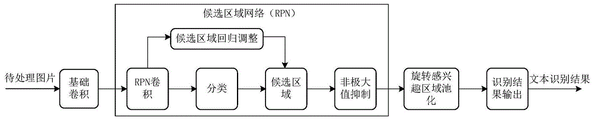
Referring to fig. 16, when text recognition is required, for example, OCR recognition, the distributed server slave machine obtains a to-be-processed picture, and encapsulates the to-be-processed picture into a thread task. And calling the corresponding FPGA unit of the basic convolution layer by the thread task, and performing convolution processing on the picture to be processed to obtain text characteristics. After the text features are obtained, the thread task inputs the text features into a candidate area generation network (RPN), in the candidate area generation network, the thread task calls FPGA units corresponding to RPN convolution, the text features are subjected to RPN convolution processing to obtain convolution results corresponding to the text features, the thread task calls the FPGA units corresponding to the classification, the convolution results corresponding to the text features are subjected to classification processing to obtain classification results, a thread task calls a CPU to determine candidate text boxes according to the classification results, the CPU is called to perform regression adjustment on the determined candidate text boxes to obtain candidate text boxes at any angles, the FPGA units corresponding to non-maximum suppression are called to process the candidate text boxes overlapped in the candidate text boxes to obtain non-overlapped candidate text boxes at any angles. And calling the FPGA unit corresponding to the pooling of the rotating region of interest by the thread task, performing pooling processing on the candidate text boxes of any angle output by the candidate region generation network, performing rotation adjustment on the candidate text boxes of any angle, and projecting the candidate text boxes after rotation adjustment to a feature map with a fixed size to obtain a text box feature map corresponding to each candidate text box. And calling the recognition result by the thread task to output a corresponding FPGA unit to recognize the text in the text box characteristic diagram and output a text recognition result.
In the present embodiment, all the parts except the Proposal (candidate region determination layer) in the RPN and the final recognition result output part are implemented based on the FPGA. Therefore, the part with larger data processing amount can be realized in parallel by the FPGA with lower cost, and the part with larger data processing amount is processed by the CPU, thereby reducing the cost while maintaining the processing efficiency.
More specifically, as shown in fig. 17, in one embodiment, a picture processing method is provided to implement the OCR recognition described above. The method specifically comprises the following steps:
and S1702, acquiring a picture to be processed.
The picture to be processed is a picture to be subjected to text recognition processing. The text Recognition may be Recognition of text in the picture by OCR (Optical Character Recognition) technology.
Specifically, the CPU receives a text recognition request and obtains a picture to be processed according to the text recognition request.
In one embodiment, the CPU receives a text recognition request, analyzes the text recognition request, extracts a picture identifier in the text recognition request through analysis, and reads a picture to be processed from the memory according to the picture identifier. The picture identification may be a storage address of the picture.
And S1704, extracting text features in the picture to be processed.
The text features are features representing texts in the pictures to be processed.
Specifically, after the CPU obtains the picture to be processed, the picture to be processed is subjected to convolution processing, and text features in the picture to be processed are extracted through the convolution processing.
In one embodiment, S1704 specifically includes the following: inputting the picture to be processed into the convolution layer; and carrying out convolution processing on the picture to be processed according to the convolution kernel of the convolution layer to obtain the text characteristic of the picture to be processed.
Specifically, the CPU inputs the picture to be processed into a convolution layer of the machine learning model, performs convolution processing on the picture to be processed through a convolution kernel of the convolution layer, and obtains text characteristics of the picture to be processed through the convolution processing. The machine learning model can be an image processing model used for performing text recognition processing on the image to be processed.
And S1706, determining candidate text boxes at any angle in the picture to be processed according to the text characteristics.
And the candidate text box is an area box which comprises a text in the picture to be processed.
Specifically, after extracting the text features of the picture to be processed, the CPU determines candidate text boxes including texts in the picture to be processed according to the text features. The candidate text box can be a candidate text box with any angle, and the candidate text box with any angle can be a candidate text box with any angle of a horizontal angle, a vertical angle and an inclination angle.
In one embodiment, after extracting text features from a picture to be processed, a CPU inputs the text features to a candidate Region generation Network (RPN) of a machine learning model, and determines candidate text boxes at any angle in the picture to be processed according to the text features through the candidate Region generation Network. The candidate region generating network may be a rotating candidate region generating network (RRPN, Rotation RPN)
And S1708, performing pooling treatment on each candidate text box, and projecting each candidate text box to a feature map with a fixed size to obtain a text box feature map corresponding to each candidate text box.
Specifically, the CPU performs pooling processing on the candidate text boxes at each arbitrary angle, and projects the candidate text boxes at each arbitrary angle to a feature map of a fixed size through the pooling processing, thereby obtaining text box feature maps of the same size corresponding to each candidate text box.
In one embodiment, the CPU inputs the candidate text boxes at any angle into a pooling layer of the machine learning model, and projects each candidate text box to the fixed-size feature map through the pooling layer to obtain the fixed-size text box feature map corresponding to each candidate text box. The pooling layer may be a rotational region of interest (RROI) pooling ROI layer.
In an embodiment, S1708 specifically further includes: inputting each candidate text box into the pooling layer; determining projection parameters of each candidate text box according to the fixed size of the preset feature map; and projecting each candidate text box into a feature map with a fixed size according to the projection parameters to obtain a text box feature map corresponding to each candidate text box.
And S1710, recognizing the text in the text box characteristic diagram to obtain a text recognition result.
Specifically, the CPU recognizes the text in each text box feature map, and obtains a text recognition result corresponding to each text box feature map through recognition.
In one embodiment, the CPU inputs each text box feature graph into an output layer of the machine learning model, and performs OCR recognition on the text box feature graphs through the output layer to obtain a text recognition result corresponding to each text box feature graph.
In this embodiment, the candidate text boxes at any angle in the picture to be processed are determined according to the text features of the picture to be processed, and the candidate text boxes at different angles can be identified. And performing pooling processing on each candidate text box, projecting each candidate text box to a feature map with a fixed size to obtain a text box feature map of each candidate text box, improving the adaptability of processing the candidate text boxes, processing the candidate text boxes with different sizes and different angles, obtaining a text recognition result of each candidate text box by recognizing the text in the text box feature map, and improving the accuracy and efficiency of text recognition in the picture to be processed.
In one embodiment, the picture processing method further includes the following: inputting the picture to be processed into the machine learning model through at least one thread, and sequentially executing the subtasks of the corresponding substructures through the processing units corresponding to the substructures according to the sequence of the substructures in the machine learning model; at least part of the processing units comprise FPGA units.
Wherein, when executing each subtask, one of the following steps is executed: extracting text features in the picture to be processed; determining a candidate text box with any angle in the picture to be processed according to the text characteristics; pooling each candidate text box, and projecting each candidate text box to a feature map with a fixed size to obtain a text box feature map corresponding to each candidate text box; and identifying the text in the text box characteristic diagram to obtain a text identification result.
In this embodiment, the subtasks of the picture processing method are implemented by each processing unit, so that the subtasks of the multiple pictures to be processed can be processed in parallel, and part of the subtasks are implemented by the FPGA unit in the processing unit, thereby improving the efficiency of text recognition in the pictures to be processed.
In one embodiment, S1706 specifically includes the following: inputting text features into the candidate area to generate a network; generating a candidate area convolution layer in the network through the candidate area, and performing convolution processing on the text features to obtain a text feature convolution result; determining the position information of each candidate text box in the picture to be processed according to the text feature convolution result; and carrying out non-maximum suppression processing on the position information of each candidate text box to obtain the candidate text box at each arbitrary angle.
Specifically, the CPU inputs text features into a candidate area generation network, convolution processing is carried out on the text features through a candidate area convolution layer in the candidate area generation network, a text feature convolution result is obtained through the convolution processing, each candidate text box is determined in a picture to be processed according to the text feature convolution result, position information of each determined candidate text box is obtained, and the CPU carries out non-maximum suppression processing on the position information of each candidate text box to obtain candidate text boxes of any angle.
In one embodiment, the performing non-maximum suppression processing on the position information of each candidate text box to obtain the candidate text box at each arbitrary angle includes: determining candidate text boxes of any angle in the picture to be processed according to the position information of the candidate text boxes; determining overlapped candidate text boxes; and carrying out non-maximum suppression processing on the overlapped candidate text boxes to obtain the non-overlapped candidate text boxes at any angles.
Specifically, the CPU determines candidate text boxes of any angle in the picture to be processed according to the position information of the candidate text boxes, screens overlapped candidate text boxes from the candidate text boxes, and performs non-maximum suppression processing on the overlapped candidate text boxes to obtain non-overlapped candidate text boxes of any angle.
In the embodiment, the candidate text boxes of any angle in the picture to be processed can be determined through the candidate area generation network, and the non-overlapping candidate text boxes of any angle are obtained by performing non-maximum suppression processing on the candidate text boxes of any angle, so that the accuracy of determining the candidate text boxes is improved.
In one embodiment, the machine learning model includes a fully connected layer connected to the pooling layer; s1610 specifically includes the following: inputting the text box feature graph into a full connection layer; determining a probability value corresponding to each text classification through the text feature map; and selecting the text classification corresponding to the maximum probability value as a text recognition result of the text characteristic graph.
Specifically, after obtaining the text box feature maps corresponding to the candidate text boxes, the CPU inputs the text box feature maps into the full-link layer of the machine learning model, processes the text box feature maps through the full-link layer to obtain probability values corresponding to the text classifications corresponding to the text feature maps, determines a maximum probability value among the probability values, and selects the text classification corresponding to the maximum probability value as a text recognition result of the text feature map.
In one embodiment, the processing unit includes an FPGA unit and a CPU; the pictures to be processed are a plurality of pictures to be processed; inputting the current picture to be processed into an FPGA unit corresponding to the convolution layer for processing to obtain the text characteristic of the picture to be processed; inputting the text features into a candidate area to generate a CPU corresponding to a network for processing, and determining a candidate text box at any angle; determining a text box characteristic diagram corresponding to each candidate text box according to the candidate text boxes at any angle through the FPGA unit corresponding to the pooling layer; recognizing the text in the text box characteristic diagram according to the FPGA unit corresponding to the recognition result layer to obtain a text recognition result; and in the processing process of each processing unit, when the processing unit is in an idle state, executing the corresponding subtask of the next picture to be processed in parallel.
In the embodiment, the partial FPGA units and the CPU execute the subtasks corresponding to the substructure in the machine learning model, and when a plurality of pictures to be processed are obtained, each FPGA unit and the CPU execute the subtasks corresponding to each picture to be processed in parallel, so that the subtasks corresponding to each picture to be processed can be processed in parallel, and the processing efficiency of the plurality of pictures to be processed is improved.
FIG. 18 is a flow diagram that illustrates text recognition in one embodiment. The method comprises the steps of obtaining text features of a picture to be processed 1802 of the picture to be processed through basic convolution processing, processing the text features of the picture to be processed 1802 through a candidate area generation network (RPN), obtaining candidate text boxes with any angle in the picture to be processed 1802, adjusting the candidate text boxes with any angle through a rotating region-of-interest pooling layer, obtaining text box feature maps with fixed sizes corresponding to the candidate text boxes, outputting recognition results to recognize the text box feature maps, and outputting text recognition results 1804. The recognized text is in the white box in the text recognition result 1804.
Fig. 19a to 19e are schematic diagrams of text recognition results corresponding to each application scenario. Fig. 19a shows a text recognition result obtained by recognizing the text in the advertisement picture, and the recognized text is in the black frame. Fig. 19b shows a text recognition result obtained by recognizing the text in the natural scene picture, where the recognized text is in the white frame. Fig. 19c and 19d show the result of text recognition by recognizing the text in the game picture, and the recognized text is shown in a black frame. Fig. 19e is a text recognition result obtained by recognizing the text in the bank card picture, and the number in the gray frame is the recognized text.
In this embodiment, partial FPGA units execute the subtasks corresponding to the substructure in the machine learning model, and when multiple task data are acquired, each FPGA unit executes the subtasks corresponding to each task data in parallel, so that the subtasks corresponding to each task data can be processed in parallel, thereby improving the processing efficiency of the multiple task data.
It will be understood by those skilled in the art that all or part of the processes of the methods of the embodiments described above can be implemented by a computer program, which can be stored in a non-volatile computer-readable storage medium, and can include the processes of the embodiments of the methods described above when the program is executed. Any reference to memory, storage, database, or other medium used in the embodiments provided herein may include non-volatile and/or volatile memory, among others. Non-volatile memory can include read-only memory (ROM), Programmable ROM (PROM), Electrically Programmable ROM (EPROM), Electrically Erasable Programmable ROM (EEPROM), or flash memory. Volatile memory can include Random Access Memory (RAM) or external cache memory. By way of illustration and not limitation, RAM is available in a variety of forms such as Static RAM (SRAM), Dynamic RAM (DRAM), Synchronous DRAM (SDRAM), Double Data Rate SDRAM (DDRSDRAM), Enhanced SDRAM (ESDRAM), Synchronous Link DRAM (SLDRAM), Rambus Direct RAM (RDRAM), direct bus dynamic RAM (DRDRAM), and memory bus dynamic RAM (RDRAM).
The technical features of the embodiments described above may be arbitrarily combined, and for the sake of brevity, all possible combinations of the technical features in the embodiments described above are not described, but should be considered as being within the scope of the present specification as long as there is no contradiction between the combinations of the technical features.
The above-mentioned embodiments only express several embodiments of the present invention, and the description thereof is more specific and detailed, but not construed as limiting the scope of the invention. It should be noted that, for a person skilled in the art, several variations and modifications can be made without departing from the inventive concept, which falls within the scope of the present invention. Therefore, the protection scope of the present patent shall be subject to the appended claims.