CN108880796B - Efficient outsourcing decryption method for server based on attribute encryption algorithm - Google Patents
Efficient outsourcing decryption method for server based on attribute encryption algorithm Download PDFInfo
- Publication number
- CN108880796B CN108880796B CN201810661493.1A CN201810661493A CN108880796B CN 108880796 B CN108880796 B CN 108880796B CN 201810661493 A CN201810661493 A CN 201810661493A CN 108880796 B CN108880796 B CN 108880796B
- Authority
- CN
- China
- Prior art keywords
- key
- ciphertext
- conversion
- user
- decryption
- Prior art date
- Legal status (The legal status is an assumption and is not a legal conclusion. Google has not performed a legal analysis and makes no representation as to the accuracy of the status listed.)
- Active
Links
- 238000006243 chemical reaction Methods 0.000 claims abstract description 45
- 238000012946 outsourcing Methods 0.000 claims abstract description 24
- 238000000034 method Methods 0.000 claims abstract description 21
- 238000004364 calculation method Methods 0.000 claims abstract description 10
- 239000002699 waste material Substances 0.000 claims abstract description 6
- 239000008186 active pharmaceutical agent Substances 0.000 claims description 5
- 238000011084 recovery Methods 0.000 claims description 5
- 238000013507 mapping Methods 0.000 claims description 4
- 239000011159 matrix material Substances 0.000 claims description 2
- 230000009466 transformation Effects 0.000 claims description 2
- 238000004891 communication Methods 0.000 abstract description 2
- 230000008520 organization Effects 0.000 abstract 1
- 208000031753 acute bilirubin encephalopathy Diseases 0.000 description 7
- 238000005516 engineering process Methods 0.000 description 3
- 230000005540 biological transmission Effects 0.000 description 2
- 238000011161 development Methods 0.000 description 2
- 238000012795 verification Methods 0.000 description 2
- 239000003643 water by type Substances 0.000 description 2
- 238000004458 analytical method Methods 0.000 description 1
- 230000009286 beneficial effect Effects 0.000 description 1
- 230000007812 deficiency Effects 0.000 description 1
- 238000012938 design process Methods 0.000 description 1
- 238000011160 research Methods 0.000 description 1
- 230000005477 standard model Effects 0.000 description 1
Images


Classifications
-
- H—ELECTRICITY
- H04—ELECTRIC COMMUNICATION TECHNIQUE
- H04L—TRANSMISSION OF DIGITAL INFORMATION, e.g. TELEGRAPHIC COMMUNICATION
- H04L9/00—Cryptographic mechanisms or cryptographic arrangements for secret or secure communications; Network security protocols
- H04L9/08—Key distribution or management, e.g. generation, sharing or updating, of cryptographic keys or passwords
- H04L9/0861—Generation of secret information including derivation or calculation of cryptographic keys or passwords
-
- H—ELECTRICITY
- H04—ELECTRIC COMMUNICATION TECHNIQUE
- H04L—TRANSMISSION OF DIGITAL INFORMATION, e.g. TELEGRAPHIC COMMUNICATION
- H04L67/00—Network arrangements or protocols for supporting network services or applications
- H04L67/01—Protocols
- H04L67/10—Protocols in which an application is distributed across nodes in the network
-
- H—ELECTRICITY
- H04—ELECTRIC COMMUNICATION TECHNIQUE
- H04L—TRANSMISSION OF DIGITAL INFORMATION, e.g. TELEGRAPHIC COMMUNICATION
- H04L9/00—Cryptographic mechanisms or cryptographic arrangements for secret or secure communications; Network security protocols
- H04L9/08—Key distribution or management, e.g. generation, sharing or updating, of cryptographic keys or passwords
- H04L9/0816—Key establishment, i.e. cryptographic processes or cryptographic protocols whereby a shared secret becomes available to two or more parties, for subsequent use
- H04L9/0819—Key transport or distribution, i.e. key establishment techniques where one party creates or otherwise obtains a secret value, and securely transfers it to the other(s)
- H04L9/0822—Key transport or distribution, i.e. key establishment techniques where one party creates or otherwise obtains a secret value, and securely transfers it to the other(s) using key encryption key
-
- H—ELECTRICITY
- H04—ELECTRIC COMMUNICATION TECHNIQUE
- H04L—TRANSMISSION OF DIGITAL INFORMATION, e.g. TELEGRAPHIC COMMUNICATION
- H04L9/00—Cryptographic mechanisms or cryptographic arrangements for secret or secure communications; Network security protocols
- H04L9/08—Key distribution or management, e.g. generation, sharing or updating, of cryptographic keys or passwords
- H04L9/0816—Key establishment, i.e. cryptographic processes or cryptographic protocols whereby a shared secret becomes available to two or more parties, for subsequent use
- H04L9/0819—Key transport or distribution, i.e. key establishment techniques where one party creates or otherwise obtains a secret value, and securely transfers it to the other(s)
- H04L9/0825—Key transport or distribution, i.e. key establishment techniques where one party creates or otherwise obtains a secret value, and securely transfers it to the other(s) using asymmetric-key encryption or public key infrastructure [PKI], e.g. key signature or public key certificates
-
- H—ELECTRICITY
- H04—ELECTRIC COMMUNICATION TECHNIQUE
- H04L—TRANSMISSION OF DIGITAL INFORMATION, e.g. TELEGRAPHIC COMMUNICATION
- H04L9/00—Cryptographic mechanisms or cryptographic arrangements for secret or secure communications; Network security protocols
- H04L9/08—Key distribution or management, e.g. generation, sharing or updating, of cryptographic keys or passwords
- H04L9/0816—Key establishment, i.e. cryptographic processes or cryptographic protocols whereby a shared secret becomes available to two or more parties, for subsequent use
- H04L9/085—Secret sharing or secret splitting, e.g. threshold schemes
Landscapes
- Engineering & Computer Science (AREA)
- Computer Networks & Wireless Communication (AREA)
- Signal Processing (AREA)
- Computer Security & Cryptography (AREA)
- Storage Device Security (AREA)
- Information Transfer Between Computers (AREA)
Abstract
本发明提出了一种针对服务器高效的基于属性加密算法的外包解密方法,属于通信安全领域。本发明包括:初始化系统参数,建立系统全体属性集合U,生成系统公钥PK以及主密钥msk。消息发送方使用系统公钥以及访问策略


The invention provides an efficient outsourcing decryption method based on an attribute encryption algorithm for a server, which belongs to the field of communication security. The present invention includes: initializing system parameters, establishing the whole system attribute set U, and generating system public key PK and master key msk. The sender of the message uses the system public key and access policy
Description
Technical Field
The invention relates to an attribute-based encryption algorithm, belongs to the field of communication security in cryptography, and particularly relates to an outsourcing decryption method based on the attribute encryption algorithm.
Background
The idea of the public key cryptosystem (also called asymmetric cryptosystem) is an important milestone in cryptography. In the encryption system, the secret key is divided into a public key (public) and a private key (secret), and in the process of sending the message, the sender only needs to use the public key of the receiver to encrypt the message, and the receiver can use the private key of the receiver to decrypt the message. PKI (public key infrastructure) is a universally applicable infrastructure that is established using the theoretical basis of public key cryptography. However, PKI technology gradually exposes the problem of difficulty in managing public keys during use. The IBE (identity-based encryption) scheme was proposed by Shamir in 1984, and the first complete IBE scheme was constructed by Boneh et al in 2001. The scheme uses the identity of the user as the public key, and the problem of difficulty in key management of the PKI technology is greatly relieved. With the continuous research on the IBE scheme, it is found that the IBE scheme is only suitable for a scenario of one-to-one encrypted message transmission, but in practical applications, it is also desirable to perform one-to-many encrypted message transmission. The ABE (attribute encryption based) scheme can just make up for the IBE scheme deficiencies in this respect. The public key used by the ABE scheme in the encryption process is no longer the identity of a single user, but a series of attributes, and the user can decrypt the encrypted public key as long as the user has a corresponding set of attributes, although one or more users may be used. The ABE scheme is mainly divided into CP-ABE (ciphertext policy ABE) in which generation of a ciphertext is associated with a policy and generation of a key is associated with an attribute, and each user obtains a key from a rights agency according to the attribute of the user, and then the encryptor makes access control to a message; in the KP-ABE scheme, ciphertext is generated in association with attributes and key generation is in association with policies, and when a user is allowed to obtain certain messages, an authority assigns a key with a particular access structure to the user.
The concept of Fuzzy IBE was proposed by Sahai and Waters in 2005 in Fuzzy Identity-Based Encryption, and later developed as the ABE protocol. The original purpose of the scheme is to increase the fault tolerance of the IBE scheme, during encryption, the message sender sets a threshold, and decryption is only performed when the number of attributes in the intersection of the attribute set of the message receiver and the attribute set in the ciphertext is equal to or exceeds the threshold. Because the scheme has weak expressiveness and few applicable scenes, Goyal et al propose a KP-ABE scheme in 2006, and then Bethenconort et al propose a CP-ABE scheme in 2007 on the basis of the KP-ABE scheme. In 2011, Waters proposed the first CP-ABE scheme which has full expression capability, is efficient, supports monotone LSSS access structure policy, and is proved to be safe under a standard model.
The huge decryption time overhead of the ABE scheme hinders further development of the ABE scheme. With the development of cloud computing technology, outsourcing the decryption operation of the ABE to a cloud server becomes a feasible method for solving the above problems. Green et al, 2011, first proposed a feasible scheme for Outsourcing Decryption ABEs (OD-ABEs) in the text of the Decryption of ABE Ciphertexts for ABE schemes, and many of the following OD-ABE schemes borrow ideas in the scheme. In the scheme, a decryption party firstly trusts a cloud server to convert an original ciphertext into a converted ciphertext by using a conversion key, and then the decryption party can decrypt the converted ciphertext by using a private key of the decryption party to obtain a plaintext by only needing to perform less calculation. However, this scheme has two problems, 1) since the cloud server is public and untrusted, the correctness of the converted ciphertext generated by the cloud server cannot be guaranteed. That is, the cloud server may return an incorrect conversion ciphertext to the user for malicious attack or to save the computing cost, and the scheme does not verify the correctness of the conversion ciphertext; 2) the authority needs to generate not only the private key of the user but also the conversion key used in the decryption process, which increases the burden of the authority.
In order to solve the above two problems, Lai et al in 2013 proposed a scheme capable of verifying the correctness of the converted ciphertext in the text "Attribute-Based Encryption With verified encrypted Decryption". For the purpose of verifiability, the scheme encrypts a random message in the same way as the plaintext message. Although the scheme realizes the verification of the converted ciphertext, the scheme doubles the encryption calculation overhead and the ciphertext length of the user. In addition, the conversion key and the recovery key are independently generated by each user, that is, if n users meeting the access control structure need to decrypt the same ciphertext, the cloud server receives n different conversion keys, converts the same ciphertext into different conversion ciphertexts and returns the different conversion ciphertexts to the users, and the users still obtain the same plaintext after decryption. Although the outsourced decryption scheme assumes that the cloud server has strong computing power in the design process, the above working mode will greatly waste the computing resources of the cloud server to repeatedly compute the converted ciphertext for the user.
In 2013, Li et al also proposed a secure and verifiable Outsourcing decryption scheme in Securely outlying Encryption with verification, which is applicable to a hybrid cloud environment, and a user's key and a conversion key are generated by cooperation of multiple parties, so that the bottleneck of generating keys by a single server is avoided, but the calculation amount of an authority is not really relieved. In 2015, Qin et al proposed an Efficient method for converting any ABE scheme for outsourcing Decryption into a Verifiable outsourcing Decryption scheme in the text Attribute-Based Encryption With Efficient legacy Outsourced Decryption. In the scheme, in a ciphertext generation stage, an encryption algorithm of any outsourcing decryption ABE scheme (such as an outsourcing decryption scheme of Green and the like) is used for encrypting a random number, then the random number is used as a key, a symmetric encryption algorithm is used for encrypting transmitted messages, and meanwhile, a hash value is added to a ciphertext to realize verifiability. In order to evaluate the computational efficiency of the scheme, the original text author successfully converts the scheme of Green et al into a verifiable outsourcing decryption scheme and simultaneously draws a conclusion that the scheme has high efficiency. In 2016, Wang et al also proposed a Verifiable OD-ABE scheme in Verifiable outer bound secure encryption in closed computing, and realized outsourcing of key generation, message decryption, and message encryption processes. However, the length of the conversion key used for outsource encryption and outsource decryption in this scheme increases as the number of attributes increases.
Through analysis of the existing OD-ABE scheme, no scheme is provided for solving the problems of high calculation overhead and storage overhead of a conversion key used in the outsourcing decryption process, and the problem of resource waste caused by repeated calculation of a cloud server cannot be solved.
Based on the above, a novel outsourcing decryption scheme is constructed for the ABE scheme to alleviate the computing and storage overhead of an authority and the waste of computing resources of a cloud computing server, which becomes a problem to be solved urgently.
Disclosure of Invention
The invention aims to: a new outsourcing decryption method based on the attribute encryption algorithm is provided. The method does not need an authority to generate the conversion key, does not need to spend extra calculation amount to calculate the conversion key and extra storage space to store the conversion key, and simultaneously reduces resource waste caused by repeated calculation of the cloud server.
The outsourcing decryption scheme based on attribute encryption disclosed by the invention mainly comprises the following parts:
initializing a system: and setting security parameters and the number of the whole attribute sets to generate a system public key PK and a master key msk.
And (3) key generation: an authority generates a user private key SK by using a master key msk, a system public key PK and a user attribute set S;
encryption: a sender encrypts a message plaintext M according to a system public key PK and an access strategy A constructed according to an attribute set S to generate a ciphertext CT;
and (3) outsourcing key generation: a user generates an outsourcing secret key TK and a recovery secret key RK by using a system public key PK and a private key SK of the user;
and (3) outsourcing decryption: after receiving a request for user ciphertext conversion, the cloud server firstly queries a historical record, determines whether a converted ciphertext is generated for the same ciphertext, if so, judges whether the conversion keys sent by the user are consistent, if so, directly returns the generated converted ciphertext, otherwise, the cloud server generates a converted ciphertext TCT by using the TK and the ciphertext CT and returns the TCT to the user; and after receiving the conversion ciphertext, the user decrypts by using the recovery key RK, the conversion ciphertext TCT and the ciphertext CT to recover the plaintext M.
The invention has the beneficial effects that:
(1) for the same ciphertext and the conversion key, the cloud server only needs to generate the conversion ciphertext once.
(2) The conversion key does not need to be generated by an authority, and the pressure of the authority is relieved.
(3) A part of the user private key is used as the conversion key, and thus, an additional amount of calculation is not required to generate the conversion key.
(4) No additional storage space is required for storing the conversion key.
Drawings
The invention will be described by way of specific examples and figures, in which:
FIG. 1 is a flowchart of a decryption process in accordance with an embodiment of the present invention;
FIG. 2 is a flow chart of a specific implementation of the present invention.
Detailed Description
In order to make the technical solution and applicability of the present invention clearer, the present invention will be described in more detail with reference to fig. 1 and 2.
(1) System parameter initialization
Let U ═ att1,att2,…,attrlDenotes attribute set, each element in U denotesAn attribute, G1,G2Representing multiplication loop groups of order p, p being a large prime number, G being the group G1E represents G1×G1→G2Bilinear mapping of (2); random selection: t is1,T2,…,Tl∈G1,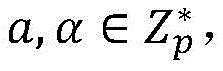 Calculating Y ═ e (g, g)α,y=gaFinally, the system public key PK ═ (G) is generated1,G2,g,y,Y,{Ti}i∈[l]) And a master key msk ═ α, where [ l]={1,…,l}。
(2) Key generation
Generating a user private key by an authority; randomly selecting according to the input attribute set S Calculating K ═ gαyt,K0=gt,
 The private key of the user is:
(3) encryption
A message sender encrypts a plaintext message M; is a linear secret sharing scheme constructed based on a set of attributes S, A being a matrix of dimensions l x n, where
 ρ (i) Each line A of AiMapping to AttiWhere i ∈ [ l ]](ii) a Random selection
 Form a vector
 For each row A of AiRandom selection
 And (3) calculating:
C0=gs,CM=MYs,

The final ciphertext is: CT ═ C0,CM,{Ci}i∈[l],{Di}i∈[l])。
(4) Decryption
If the user's attribute set Satisfy the requirement of
 The user can use the private key SKDSDecrypting the message ciphertext CT, calculating I as { I: rho (I) ∈ S }, and calculating
 So that
 Wherein
 And (3) calculating:

the plaintext can be computed as:

(5) conversion key generation
User publishing private key SKDSIs a part of As a transformation key TK, keeping K as a recovery key;
(6) outsourcing decryption
After receiving the TK and the CT, the cloud server firstly judges whether a conversion ciphertext of the ciphertext is generated, if so, further judges whether the current conversion key is the same as the conversion key used by the generated conversion ciphertext, if both the two conditions are met, the cloud server directly returns the generated conversion ciphertext to a user, otherwise, the cloud server calculates the conversion ciphertext:

and then returning the calculated conversion ciphertext TCT to the user. And after receiving the TCT returned by the cloud server, the user calculates:

and finally, calculating to obtain a plaintext message:
the foregoing is directed to embodiments of the present invention, and any feature disclosed in this specification (including any accompanying claims, abstract and drawings), may be replaced by alternative features serving the same, equivalent or similar purpose, unless expressly stated otherwise, i.e. each feature is simply an example of a generic series of equivalent or similar features unless expressly stated otherwise. The invention extends to any novel combination or novel feature disclosed in this specification, and to any novel method or process steps or any novel combination disclosed.
Claims (4)
1. An efficient outsourcing decryption method based on an attribute encryption algorithm for a server is characterized by comprising the following steps:
initializing system parameters: an authority generates a system public key PK and a master key msk; the system public key is generated and then is published, and the master key is stored in a secret way;
the specific generation method of each parameter is as follows: let U ═ att1,att2,…,attrlDenotes a set of attributes, each element in U denotes an attribute, G1,G2Representing multiplication loop groups of order p, p being a large prime number, G being the group G1E represents G1×G1→G2Bilinear mapping of (2); random selection: t is1,T2,…,Tl∈G1,a, Calculating Y ═ e (g, g)α,y=gaFinally, the system public key PK ═ (G) is generated1,G2,g,y,Y,{Ti}i∈[l]) And a master key msk ═ α, where [ l]={1,…,l};
And (3) key generation: authority generates user private key SK by using attribute set of userDS;
The specific process is as follows: random selection Calculating K ═ gαyt,K0=gt,
 The private key of the user is:
encryption: linear secret sharing scheme constructed by message sender according to overall attribute set U Encrypting the plaintext message M to obtain a message ciphertext CT; where a is a matrix of dimensions l x n, l,
 ρ (i) Each line A of AiMapping to AttiWhere i ∈ [ l ]](ii) a Random selection of s, v2,v3,…,
 Form a vector
 For each row A of AiRandom selection
 And (3) calculating:
C0=gs,CM=MYs,

The final ciphertext is: CT ═ C0,CM,{Ci}i∈[l],{Di}i∈[l]);
And (3) decryption: if the user's attribute set Satisfy the requirement of
 The user uses his own private key SKDSDecrypting the message ciphertext CT to make I ═ tonei: rho (i) belongs to S }, and calculation is carried out
 So that
 Wherein
 And (3) calculating:

then the plaintext is calculated as:

and (3) conversion key generation: user publishing private key SKDSIs a part of As a transformation key TK, keeping K as a recovery key;
and (3) outsourcing decryption: after receiving the TK and the CT, the cloud server judges whether a conversion ciphertext of the ciphertext is generated or not, if so, judges whether the current conversion key is the same as the conversion key used by the generated conversion ciphertext, if the conversion ciphertext is generated and the current conversion key is the same as the conversion key used by the generated conversion ciphertext, directly returns the generated conversion ciphertext to a user, otherwise, the conversion ciphertext is calculated:

and after receiving the TCT returned by the cloud server, the user calculates:

and finally, calculating to obtain a plaintext message:
2. the method of claim 1, wherein the cloud server only computes the translation ciphertext once for the same ciphertext and the translation key, thereby avoiding waste of computing resources caused by repeated generation of the same translation ciphertext.
3. The method of claim 1, wherein the conversion key is part of a private key of the user and does not require additional generation by an authority.
4. The method of claim 1, wherein the user selects whether outsourcing of decryption is required, and if not, directly uses its own private key for decryption.
Priority Applications (1)
| Application Number | Priority Date | Filing Date | Title |
|---|---|---|---|
| CN201810661493.1A CN108880796B (en) | 2018-06-25 | 2018-06-25 | Efficient outsourcing decryption method for server based on attribute encryption algorithm |
Applications Claiming Priority (1)
| Application Number | Priority Date | Filing Date | Title |
|---|---|---|---|
| CN201810661493.1A CN108880796B (en) | 2018-06-25 | 2018-06-25 | Efficient outsourcing decryption method for server based on attribute encryption algorithm |
Publications (2)
| Publication Number | Publication Date |
|---|---|
| CN108880796A CN108880796A (en) | 2018-11-23 |
| CN108880796B true CN108880796B (en) | 2021-04-27 |
Family
ID=64295584
Family Applications (1)
| Application Number | Title | Priority Date | Filing Date |
|---|---|---|---|
| CN201810661493.1A Active CN108880796B (en) | 2018-06-25 | 2018-06-25 | Efficient outsourcing decryption method for server based on attribute encryption algorithm |
Country Status (1)
| Country | Link |
|---|---|
| CN (1) | CN108880796B (en) |
Families Citing this family (10)
| Publication number | Priority date | Publication date | Assignee | Title |
|---|---|---|---|---|
| CN109740383B (en) * | 2019-01-10 | 2021-12-14 | 南京信息职业技术学院 | A privacy protection control method for fog computing medical system |
| WO2021092745A1 (en) * | 2019-11-12 | 2021-05-20 | 华为技术有限公司 | Device upgrade method and related device |
| CN111010273B (en) * | 2019-12-23 | 2022-04-15 | 山东师范大学 | Attribute-based encryption and decryption method and system based on position decryption |
| CN110995430B (en) * | 2019-12-24 | 2021-04-27 | 电子科技大学 | An Outsourced Decryption Method Supporting Invalid Ciphertext Detection Based on Attribute Encryption |
| CN112104454B (en) * | 2020-08-11 | 2023-04-07 | 东方红卫星移动通信有限公司 | Data secure transmission method and system |
| CN112995189B (en) * | 2021-03-08 | 2022-01-21 | 北京理工大学 | Method for publicly verifying matrix multiplication correctness based on privacy protection |
| CN114244567B (en) * | 2021-11-17 | 2023-09-05 | 西安邮电大学 | CP-ABE method for supporting circuit structure in cloud environment |
| CN115277171B (en) * | 2022-07-25 | 2023-09-29 | 北京邮电大学 | A data flow control method based on purifiable attribute encryption in cloud environment |
| CN119483920B (en) * | 2024-08-13 | 2025-06-06 | 长沙学院 | Flexible data sharing method and system based on public key and attribute-based encryption |
| CN119420471B (en) * | 2024-09-09 | 2025-09-26 | 杭州后量子密码科技有限公司 | Reliable and fair attribute encryption outsourcing decryption method based on intelligent contract |
Citations (5)
| Publication number | Priority date | Publication date | Assignee | Title |
|---|---|---|---|---|
| WO2014027263A3 (en) * | 2012-08-17 | 2014-04-10 | Koninklijke Philips N.V. | Attribute-based encryption |
| CN104486315A (en) * | 2014-12-08 | 2015-04-01 | 北京航空航天大学 | Revocable key external package decryption method based on content attributes |
| CN105933345A (en) * | 2016-06-28 | 2016-09-07 | 电子科技大学 | Verifiable outsourcing attribute-based encryption method based on linear secret sharing |
| CN106161428A (en) * | 2016-06-08 | 2016-11-23 | 电子科技大学 | A kind of ciphertext can the encryption attribute scheme of comparison of equalization |
| CN106230590A (en) * | 2016-07-22 | 2016-12-14 | 安徽大学 | Ciphertext strategy attribute-based encryption method for multiple authorization mechanisms |
Family Cites Families (3)
| Publication number | Priority date | Publication date | Assignee | Title |
|---|---|---|---|---|
| CN102769620B (en) * | 2012-07-19 | 2017-09-26 | 广州大学 | A kind of safely outsourced encryption method based on attribute |
| CN104022868A (en) * | 2014-02-18 | 2014-09-03 | 杭州师范大学 | Outsourcing decryption method of attribute-based encryption based on ciphertext policy |
| CN105897812B (en) * | 2015-04-10 | 2019-04-23 | 杭州远眺科技有限公司 | It is a kind of suitable for mixing the data safety sharing method under cloud environment |
-
2018
- 2018-06-25 CN CN201810661493.1A patent/CN108880796B/en active Active
Patent Citations (5)
| Publication number | Priority date | Publication date | Assignee | Title |
|---|---|---|---|---|
| WO2014027263A3 (en) * | 2012-08-17 | 2014-04-10 | Koninklijke Philips N.V. | Attribute-based encryption |
| CN104486315A (en) * | 2014-12-08 | 2015-04-01 | 北京航空航天大学 | Revocable key external package decryption method based on content attributes |
| CN106161428A (en) * | 2016-06-08 | 2016-11-23 | 电子科技大学 | A kind of ciphertext can the encryption attribute scheme of comparison of equalization |
| CN105933345A (en) * | 2016-06-28 | 2016-09-07 | 电子科技大学 | Verifiable outsourcing attribute-based encryption method based on linear secret sharing |
| CN106230590A (en) * | 2016-07-22 | 2016-12-14 | 安徽大学 | Ciphertext strategy attribute-based encryption method for multiple authorization mechanisms |
Non-Patent Citations (7)
| Title |
|---|
| 《Attribute-Based Encryption With Verifiable Outsourced Decryption》;Junzuo Lai等;《IEEE TRANSACTIONS ON INFORMATION FORENSICS AND SECURITY》;20150623;全文 * |
| 《Cost-Efficient Outsourced Decryption of Attribute-Based Encryption Schemes for Both Users and Cloud Server in Green Cloud Computing》;YONGJIAN LIAO, GANGLIN ZHANG,HONGJIE CHEN;《IEEE ACESS》;20200131;全文 * |
| 《Insecurity of A Key-Policy Attribute Based Encryption Scheme With Equality Test》;Yongjian liao,hongjie chen等;《IEEE ACESS》;20180223;全文 * |
| 《Outsourcing the Decryption of ABE Ciphertexts》;Matthew Green等;《SEC"11:PROceedings of the 20th USENIX conference on Security》;20110831;全文 * |
| 《Secure Outsourced Attribute-based Encryption》;Jin Li等;《IACR Cryptology ePrint Archive》;20121231;全文 * |
| 《Verifying Outsourced Decryption of CP-ABE with Signature》;Liu, Hongwei等;《2015 4th International Conference on Mechatronics, Materials, Chemistry and Computer Engineering. Atlantis Press》;20151231;全文 * |
| 《基于外包计算的属性基加密研究》;刘文扬;《中国优秀硕士学位论文全文数据库信息科技辑》;20180215;全文 * |
Also Published As
| Publication number | Publication date |
|---|---|
| CN108880796A (en) | 2018-11-23 |
Similar Documents
| Publication | Publication Date | Title |
|---|---|---|
| CN108880796B (en) | Efficient outsourcing decryption method for server based on attribute encryption algorithm | |
| CN108989053B (en) | Method for realizing certificateless public key cryptosystem based on elliptic curve | |
| CN109873699B (en) | Revocable identity public key encryption method | |
| CN104113408B (en) | It is a kind of realize the revocation of timely user property based on ciphertext policy ABE encryption method | |
| CN105743646B (en) | A kind of Identity based encryption method and system | |
| CN105376213B (en) | An Identity-Based Broadcast Encryption Method | |
| Guo et al. | Identity-based encryption: How to decrypt multiple ciphertexts using a single decryption key | |
| Lin et al. | A collaborative key management protocol in ciphertext policy attribute-based encryption for cloud data sharing | |
| CN103401839B (en) | A kind of many authorization center encryption method based on attribute protection | |
| CN105933345B (en) | A Verifiable Outsourcing Attribute-Based Encryption Method Based on Linear Secret Sharing | |
| CN106161428B (en) | A kind of ciphertext can comparison of equalization encryption attribute method | |
| CN103746811B (en) | Anonymous signcryption method from identity public key system to certificate public key system | |
| CN107154845B (en) | An Attribute-Based Outsourcing Scheme for BGN-Type Ciphertext Decryption | |
| Ming et al. | Efficient revocable multi-authority attribute-based encryption for cloud storage | |
| CN103647642A (en) | Certificate-based agent heavy encryption method and system | |
| WO2006034428A2 (en) | Apparatus and method for identity-based encryption within a conventional public-key infrastructure | |
| CN104168114A (en) | Distributed type (k, n) threshold certificate-based encrypting method and system | |
| CN101594228A (en) | Authentication encryption method between certificate public key system and identity public key system | |
| Meshram et al. | An identity-based cryptographic model for discrete logarithm and integer factoring based cryptosystem | |
| CN104796260B (en) | A kind of short ciphertext identity base encryption method for meeting forward secrecy | |
| CN104753947A (en) | Attribute-based verifiable outsourcing decryption system and method with fixed ciphertext length | |
| Liu et al. | Efficient sharing of secure cloud storage services | |
| CN106713349B (en) | Inter-group proxy re-encryption method capable of resisting attack of selecting cipher text | |
| CN106790259A (en) | A kind of asymmetric across cryptographic system re-encryption, decryption method and system | |
| Qin et al. | Strongly secure and cost-effective certificateless proxy re-encryption scheme for data sharing in cloud computing |
Legal Events
| Date | Code | Title | Description |
|---|---|---|---|
| PB01 | Publication | ||
| PB01 | Publication | ||
| SE01 | Entry into force of request for substantive examination | ||
| SE01 | Entry into force of request for substantive examination | ||
| GR01 | Patent grant | ||
| GR01 | Patent grant |