Disclosure of Invention
The invention aims to solve the first technical problem of providing a separated cold-region straw rotten fungus strain;
the second technical problem to be solved by the invention is to provide the application of the cold-region straw-decomposing fungus strain in fermenting rice straws and preparing a rice straw-decomposing agent.
In order to solve the technical problems, the technical scheme adopted by the invention is as follows:
the invention separates and purifies the cold-region rice straw decomposing fungus strains from decomposed substances of the winter EM bacteria glycolysis rice straws in the alpine region to obtain 23 strains in total. The invention carries out primary screening of low-temperature straw rotten bacteria on the separated strains, and as a result, 7 fungal strains which can normally grow at the low temperature of 15 ℃ are screened out.
The invention further uses whether the microorganism obtained by low-temperature screening has the capacity of decomposing cellulose as the basis to re-screen the straw rotten bacteria in the cold area, and the result shows that the liquid culture filter paper of the low-temperature fungus strain E3 has larger damage degree, and after the strain E3 is subjected to liquid culture for 10 days, the filter paper is decomposed into a half clear state, which shows that the strain has stronger capacity of decomposing cellulose. The invention cultures the re-screened E3 strain on a solid culture medium, and observes the growth condition of the strain and the damage degree of the filter paper, so that the strain grows well after 10 days of culture, the filter paper is decomposed as the nutrient substance for the growth of the strain, and the filter paper is decomposed and rotted uniformly. The results show that the fungus strain E3 has stronger cellulose decomposition capability.
The morphological observation result shows that the colony morphology of the straw rotten fungus E3 is large, the mycelium is white flocculent, the texture is dense, and the appearance is dry; the vegetative hyphae are transparent tubular hyphae without diaphragm, the conidia are spherical, and E3 is primarily judged to be mould. The molecular biological identification result shows that the ITS sequence fragment obtained by PCR amplification of the strain E3 has the length of 609 bp. The invention carries out BLAST comparison and phylogenetic tree construction on the sequence obtained by amplification, and determines that E3 is Mortierella (Mortierella sp) according to the result of the phylogenetic tree. The present invention designates this strain as Mortieella sp-E3.
The cold resistance identification result shows that the Mortiella sp-E3 strain can normally grow at 5 ℃, the diameter of the strain reaches 64 percent of the maximum diameter after the strain is cultured for 7 days at 15 ℃, the strain grows better in a low-temperature environment, and the cold resistance is strong. The decomposed strain obtained by screening is a cold-resistant microorganism and can normally grow in a low-temperature area.
The invention submits separated cold-region straw rotten fungus strain Mortierella sp-E3 to an approved patent organization for preservation, and the microorganism preservation numbers are as follows: CGMCC No. 15188; the classification is named as: mortierella Mortierella sp. The preservation unit: china general microbiological culture Collection center; the preservation time is 1 month and 11 days 2018; and (4) storage address: xilu No.1 Hospital No. 3, Beijing, Chaoyang, North.
The invention further discloses application of the cold-region straw rotten fungus strain Mortierella sp-E3 in glycolysis of rice straws.
The invention further discloses an application of the cold-region straw-decomposing fungus strain Mortierella sp-E3 in preparation of a straw decomposing agent.
The invention further discloses an application of the cold-region straw-decomposing fungus strain Mortierella sp-E3 in preparation of a rice straw decomposing agent.
The invention also discloses application of the cold-region straw-decomposing fungus strain Mortierella sp-E3 in preparation of a cold-region rice straw decomposing agent. The cold area is a low-temperature area, and the temperature range of the cold area is 0-35 ℃.
The invention also discloses a rice straw decomposing agent, which comprises: the invention relates to fermentation liquor of a cold-region straw rotten fungus strain Mortierella sp-E3.
The invention also discloses a rice straw decomposing agent, which comprises: the invention relates to fermentation liquor of a cold-region straw rotten fungus strain Mortierella sp-E3 and EM bacterial liquid. Wherein the volume ratio of the fermentation liquid of the cold-region straw rotten fungus strain Mortierella sp-E3 to the EM bacterial liquid is 1:1 and mixing.
The preparation method of the fermentation liquor of the cold-region straw rotten fungus strain comprises the following steps: inoculating the cold-region straw rotten fungus strain Mortierella sp-E3 into a liquid culture medium for culture, and collecting a bacterial liquid to obtain the strain.
The invention adopts a nitrogen-free Hedyson inorganic salt culture medium as a basic culture medium. Wherein the nitrogen source of the liquid culture medium is peptone or yeast extract, the addition amount of the nitrogen source is 0.2% (mass percent), and the initial pH value of the liquid culture medium is 3-9; according to the volume percentage, the inoculation amount of the inoculation is 1-9%; the culture temperature is 10-40 deg.C, and the culture time is 3-18 d. Preferably, the nitrogen source of the liquid culture medium is peptone, the addition amount of the nitrogen source is 0.2% (mass percent), and the initial pH value of the liquid culture medium is 7; the inoculation amount of the inoculation is 5 percent by volume percentage; the temperature of the culture is 25 ℃, and the time of the culture is 9 d.
The EM bacterial liquid is not particularly limited, and commercially available EM bacterial liquids are all suitable for the invention.
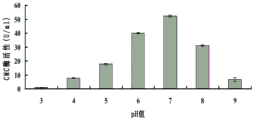
The invention optimizes the fermentation condition of the cold-region straw rotten fungus strain Mortierella sp-E3. The nitrogen source optimization result shows that the activity of the strain for producing the cellulase on a culture medium taking peptone and yeast extract as nitrogen sources is higher, while the activity of the strain for producing the cellulase on a culture medium adding ammonium sulfate or urea as nitrogen sources is lower, and the difference is obvious. The invention determines that the best nitrogen source suitable for fermentation culture of the straw rotten fungi in the cold area is peptone. The result of the inoculation amount optimization shows that the strain has higher cellulase activity within the range of 3-9%, the highest enzyme production activity is achieved when the inoculation amount is 5%, and the enzyme activity begins to decrease after the inoculation amount exceeds 5%. And comprehensively comparing, and determining that the optimal inoculation amount of the straw rotten fungi fermentation in the cold area is 5%. The culture temperature optimization result shows that the enzyme activity of the strain is gradually increased at the temperature of 10-30 ℃ and is highest at the temperature of 25 ℃; as the temperature continues to rise, the enzyme production activity decreases significantly, with the enzyme production activity of the strain decreasing to a minimum at 40 ℃. The invention determines that the optimal temperature for fermenting the straw rotten fungi in the cold area is 25 ℃. The initial pH value optimization result of the culture medium shows that the initial pH value has great influence on the activity of the cold-region straw rotten fungus Mortierella sp-E3 to produce CMC enzyme; the enzyme activity is lowest at a pH value of 3, and the cellulase activity can hardly be detected; the initial pH of the culture medium is in the range of 6-8, the CMC enzyme activity of the strain is shown to be a higher level, the cellulase activity is highest when the initial pH is 7, and the enzyme production activity of the strain is in a descending trend when the initial pH of the culture medium is increased to 8. Therefore, the optimal initial pH value of the fermentation of the cold-region straw-decomposing fungi is determined to be 7, and the neutral solution environment is favorable for enzyme production. The result of the optimization of the culture time shows that the enzyme production activity of the cold-region straw rotten fungus Mortierella sp-E3 strain shows a trend of firstly rapidly increasing and then slowly decreasing along with the extension of the culture time, the strain has the best enzyme production activity when being cultured for 9 days, and the CMC enzyme activity is gradually reduced after 12 days, but still has stronger enzyme activity. The invention determines that the optimal culture time for producing the cellulase by the cold region straw rotten fungi is 9 days.
The analysis result of the straw glycolysis effect of the cold-region straw-decomposing fungi shows that the Mortierella sp-E3 strain can effectively glycolyze the rice straws, and the straw decomposition rate reaches over 48 percent in 15 days. The results show that the straw rotting fungus Mortierella sp-E3 screened by the invention has better straw glycolysis effect.
According to the invention, the rice straw glycolysis test is carried out by matching (1: 1 mixing) the fungi Mortierella sp-E3 with EM (effective microorganisms) at low temperature, and as a result, the rice straw is glycolyzed at low temperature for 30d, and the straw glycolysis efficiency is improved by 47.5%.
Compared with the prior art, the technical scheme of the invention has the following beneficial effects:
according to the invention, the high-efficiency strain Mortierella sp-E3 capable of decomposing rice straws at low temperature is obtained by separating and screening the fungus strain decomposing rice straws in cold regions from decomposed substances of the rice straws fermented by EM bacteria in winter in the alpine regions. The strain is a psychrotrophic bacterium, and has a good rice straw glycolysis effect. The invention provides practical basis and theoretical basis for increasing the strain composition of the straw decomposition inoculant for the rice in the cold region and the application of the straw decomposition inoculant.
Detailed Description
The invention will be further described with reference to specific embodiments, and the advantages and features of the invention will become apparent as the description proceeds. It is to be understood that the described embodiments are exemplary only and are not limiting upon the scope of the invention. It will be understood by those skilled in the art that various changes in form and details may be made therein without departing from the spirit and scope of the invention, and that such changes and modifications may be within the scope of the invention.
Example 1 separation and identification of straw-decomposing bacteria in Cold region
1. Test materials and methods
1.1 test materials
The EM bacterial liquid used in the invention is provided by agricultural academy of Heilongjiang province. The rice straw is collected from the experimental field of northeast agriculture university.
2.2 test methods
2.2.1 Cold region stalk EM fungus rotten
In 2016, 12 months, in the experimental field of northeast agriculture university of Harbin, Heilongjiang province, the outdoor temperature is between-12 ℃ and 25 ℃, the mixture of the crushed rice straws and the EM bacterial liquid is buried in a deep groove, and is covered by untreated straws and plastic cloth and decomposed for 60 days. The taken-out straw rotten matter is in a rotten state, and strip-shaped or small flake-shaped straw fragments which are not completely rotten are occasionally seen.
2.2.2 separation of straw-decomposing fungi in Cold regions
2.2.2.1 isolation, Primary screening and preservation of strains from straw-decomposing Agents
(1) Separation of strains in the decomposed product: weighing 5g of straw rotten matter, adding 50mL of sterile water into a conical flask, and culturing for 24h on a shaking table at 37 ℃. And (3) dipping the suspension supernatant of the decomposed material by using a strain inoculating ring, streaking on a strain isolation culture medium, and inoculating the strain isolation culture medium after fungus single fungus is isolated on a PDA culture medium.
(2) Primary screening of strains in the decomposed material at low temperature: the cold-region straw decomposing bacteria can grow under the low-temperature condition, and the enriched and separated strains are primarily screened at different temperatures. Culturing the separated strain at 4 deg.C, 10 deg.C, 15 deg.C, 25 deg.C and 37 deg.C, observing the growth condition of the strain, and screening out the strain capable of normally growing at low temperature.
(3) And (3) preservation of the strain: culturing the separated fungus in potato glucose aqueous medium (PD) at 28 deg.C for 36-48 hr until mycelium grows out, and storing at 4 deg.C.
2.2.2.2 rescreening of straw rotten fungi in Cold region
And re-screening the straw rotting fungi in the cold area based on whether the microorganisms obtained by low-temperature screening have the capacity of decomposing cellulose. Inoculating the primarily screened fungi capable of growing under the low-temperature condition into a liquid filter paper culture medium, culturing for 7d at 15 ℃, observing the condition that the strain decomposes the filter paper, and recording the curling and expansion of the edge of the filter paper as (+); the filter paper amorphous state was scored as (++); the filter paper became a paste (+++); the ability of the fungus to break down cellulose was determined by the filter paper becoming a semi-clear liquid (++++).
2.2.3 identification of straw-decomposing bacteria in Cold region
2.2.3.1 morphological identification of straw rotten bacteria in cold region
Respectively inoculating the rescreened fungus strains in a PD culture medium and a PDA culture medium, culturing at 28 deg.C for 3-4 days, observing the shapes and appearances of bacterial colonies and bacterial plaques after hypha grows out, and observing the shapes of the hypha and conidia by using an optical microscope.
2.2.3.2 molecular identification of straw rotten bacteria in cold region
Inoculating purified single colony from PDA plate culture medium into 30mL potato glucose aqueous medium (PD), culturing at 28 deg.C for 3-4 days, collecting mycelium, and extracting DNA by CTAB method. The ITS sequence universal primer ITS1/ITS4 for fungus identification is used as the molecular identification primer of the cold region straw rotten fungus to carry out PCR amplification, and the PCR product is sequenced to Harbin Boshi biotechnology limited. Inputting the sequence obtained by sequencing into GenBank, utilizing BLAST comparison to make sequence homology analysis, adopting MEGA5.0 software to construct phylogenetic tree and making molecular identification of fungus species.
2.2.4 Cold resistance identification of straw-decomposing bacteria in Cold region
Respectively inoculating the straw rotten fungi obtained by early screening and identification to a PDA culture medium, recording the growth conditions of the strains under the culture conditions of 5 ℃, 10 ℃, 15 ℃, 20 ℃, 25 ℃, 30 ℃ and 35 ℃, and determining the cold resistance of the screened straw rotten fungi.
2.2.5 optimization of fermentation conditions of straw-decomposing bacteria in cold regions
2.2.5.1 influence of different nitrogen sources of culture medium on fermentation of decomposing bacteria
In order to study the influence of different nitrogen sources of the culture medium on the fermentation of the decomposing bacteria, the experiment adopts a nitrogen-free Hedyson inorganic salt culture medium as a basic culture medium, different nitrogen sources are added on the basis, the added nitrogen sources are peptone, yeast extract, ammonium sulfate and urea, the adding amount is 0.2 percent (mass percent), 4 bottles are treated, and 3 times of treatment are carried out. When the culture medium is cultured at 25 ℃ for 7 days, 0.2mL of the bacterial liquid is taken and used for measuring the activity of the cellulase, and the measuring method is a DNS method.
2.2.5.2 influence of strain inoculation amount on fermentation of decomposed bacteria
In order to study the influence of different strain inoculum sizes on fermentation of the decomposing bacteria, different strain inoculum sizes were designed in the experiment. Five inoculum (volume percent) treatments of 1%, 3%, 5%, 7% and 9% were set. Inoculating into liquid fermentation medium with peptone as nitrogen source, wherein the initial pH value of the medium is 7.0, culturing at 25 deg.C, treating 5 bottles each, and repeating for 3 times. When the cells were cultured for 7 days, 0.2mL of each cell suspension was used for cellulase activity measurement.
2.2.5.3 Effect of culture temperature on fermentation of decomposing bacteria
In order to study the influence of different culture temperatures on the cellulase activity of the decomposed bacteria, different strain culture temperatures were designed in the experiment. The culture temperature treatment is carried out at 10 deg.C, 15 deg.C, 20 deg.C, 25 deg.C, 30 deg.C, 35 deg.C and 40 deg.C for 7 times. Inoculating the culture medium with 5% inoculum size in liquid fermentation medium with peptone as nitrogen source, wherein the initial pH value of the culture medium is 7.0, and each 7 bottles are treated for 3 times. When the cells were cultured for 7 days, 0.2mL of each cell suspension was used for cellulase activity measurement.
2.2.5.4 influence of initial pH value of culture medium on fermentation of decomposing bacteria
In order to study the influence of the initial pH values of different culture media on the fermentation of the mature bacteria, different initial pH values of the culture media are designed in the experiment. 3, 4, 5, 6, 7, 8 and 9 different culture medium initial pH value treatments are set. Taking a liquid fermentation culture medium with peptone as a nitrogen source as a basic culture medium, adjusting the initial pH of the culture medium, inoculating with an inoculum size of 5%, culturing at 25 ℃, treating 7 bottles each, and setting 3 times of repetition. When the cells were cultured for 7 days, 0.2mL of each cell suspension was used for cellulase activity measurement.
2.2.5.5 Effect of cultivation time on fermentation of decomposing bacteria
In order to study the effect of different culture times on fermentation of the decomposing bacteria, different culture times were designed in this experiment. The treatment was carried out for 6 different incubation times, 3d, 6d, 9d, 12d, 15d, 18 d. The liquid fermentation medium using peptone as nitrogen source, the initial pH value of the medium is 7, the inoculation quantity of 5% is used for inoculation, 7 bottles are treated in each bacterial test, 6 bottles are treated in each fungal test, and 3 times of repetition are respectively set. After culturing according to the culture time designed by the experiment, respectively taking 0.2mL of bacterial liquid for determining the activity of the cellulase.
2.2.6 straw decomposition bacteria glycolysis test in Cold region
2.2.6.1 straw glycolysis test
The glycolysis effect of the straw decomposing bacteria on the straw is researched. Inoculating 5% of straw decomposing bacteria fermentation liquid into straw liquid culture medium (straw fermentation liquid culture medium: weighing KH2PO4 1.0g,MgSO4 0.3g,NaNO3 2.5g,NaCl 0.1g,CaCl2 0.1g,FeCl30.01g of the powder is added into 1000mL of distilled water in a conical flask, the pH value is adjusted to about 7.2, the treated rice straw powder is added, the powder is sterilized by high-temperature steam for later use), the powder is cultured at 15 ℃, and the straw weight loss rate is measured by sampling respectively at the 3 rd, the 6d, the 9d, the 12d and the 15 d. The method for measuring the weight loss rate of the straws is the same as the method for measuring the weight loss rate of the filter paper, the fermentation liquor filter paper is filtered, the residues are placed in an oven to be dried to constant weight at 80 ℃, and then the weight loss rate of the straws is measured.
2.2.6.2 composite glycolysis straw test of low-temperature efficient glycolysis straw fungus and EM bacteria
Mixing fermented low-temperature efficient glycolysis straw fungus fermentation liquor with EM (effective microorganisms) fungus fermentation liquor in a volume ratio of 1:1, and glycolysis rice straws at the temperature of 4 ℃. The rice straw treatment method comprises the following steps: soaking the rice straw sections in 2mol/L NaOH solution for 24 hours, washing with water until the pH value is 7, drying in a drying oven at 80 ℃, crushing the dried straw sections into 100 meshes, and sieving for later use. And (3) adding 5% of EM bacterial liquid, 5% of low-temperature high-efficiency glycolysis straw fungus fermentation liquid and 1% of brown sugar according to the amount of fermented rice straws, controlling the humidity between 35% and 65%, and fermenting for 30d by taking the EM bacterial liquid as a reference. And (3) after the fermentation is finished, determining the weight loss rate of the straw by the same method as the method for determining the weight loss rate of the filter paper.
3. Test results
3.1 separation of straw-decomposing fungi in Cold regions
3.1.1 Primary Screen of straw rotten fungus in Cold region
The microorganisms in the cold area straw decomposed substances are separated and purified for 6 times, and 23 bacterial strains are obtained in total. Culturing the separated strain under different temperature culture conditions, observing the growth condition of the strain, and primarily screening the low-temperature straw rotting fungi. The results showed that the screened fungal strains capable of growing normally at low temperature of 15 ℃ had a total of 7 strains, a1, E3, a12, B2, C4, F6 and E6, respectively.
3.1.2 rescreening of straw rotten fungi in Cold regions
Inoculating the primary screened low-temperature fungus on a filter paper liquid culture medium, and culturing at 28 ℃ for 10 days. The secondary screening of the cold-region straw-decomposing fungi is carried out by checking the damage degree of filter paper in the liquid culture medium, and the test results are shown in table 1. As can be seen from the fungus filter paper decomposition effect, the liquid culture filter paper of the low-temperature fungus strain E3 has a large damage degree, and after the strain E3 is subjected to liquid culture for 10 days, the filter paper is decomposed to be semi-clear, and the results show that the strain has strong decomposition capability on cellulose. The re-screened E3 strain is cultured on a solid culture medium at 28 ℃, and the growth condition of the strain and the damage degree of filter paper are observed, so that the result shows that after 10 days of culture, the strain grows well, the filter paper is decomposed as a nutrient substance for the growth of the strain, and the filter paper is decomposed and rotted uniformly. The results show that the screened fungus strain E3 has stronger cellulose decomposition capability.
TABLE 1 Filter paper decomposition Effect of the strains
Note: filter paper edge curl expansion is reported as (+); the filter paper amorphous state was scored as (++); the filter paper became a paste (+++); the filter paper became a semi-clear liquid (+++).
3.2 morphological Observation of straw decomposing bacteria in Cold region
Culturing the screened straw rotten fungi E3 on a solid culture medium, and observing bacterial colonies and thallus forms. The results showed that a single fungal colony was formed on the medium. The bacterial colony morphology of the strain E3 is large, the mycelium is white flocculent, compact in texture and dry in appearance, observation of the mycelium shows that the vegetative mycelium is a transparent tubular filament, is a non-diaphragm mycelium, the conidium is spherical (see figure 1), and the E3 is preliminarily judged to be mould.
3.3 molecular identification of straw-decomposing bacteria in Cold region
And (3) performing molecular biological identification on the screened mature bacteria through fungal ITS sequence analysis, wherein the length of an ITS sequence fragment obtained by amplification of the strain E3 is 609 bp. BLAST alignment and phylogenetic tree construction were performed on the obtained sequences, and the results are shown in FIG. 2. According to the phylogenetic tree result, E3 was Mortierella (Mortierella sp), which was consistent with the morphological identification described above and was designated Mortierella sp-E3.
The invention submits the separated Mortiella sp-E3 strain to the common microorganism center of China Committee for culture Collection of microorganisms for preservation, and the microorganism preservation numbers are as follows: CGMCC No. 15188.
3.4 Cold resistance identification of straw-decomposing bacteria in Cold region
And (5) carrying out cold resistance identification on the strains obtained by screening. The selected decomposed fungal strain E3 was inoculated on PDA medium, cultured at different temperatures, and its growth was observed as shown in FIG. 3. The result shows that the strain can normally grow at 5 ℃, the diameter of the strain reaches 64 percent of the maximum diameter after the strain is cultured for 7d at 15 ℃, the strain grows better in a low-temperature environment, and the cold resistance is strong. Morita states that cold-tolerant microorganisms have the characteristic of being able to grow and reproduce at temperatures between 0 and 5 ℃ with an optimum growth temperature above 15 ℃ and a maximum growth temperature above 20 ℃. The decomposed strain obtained by screening in the test is a cold-resistant microorganism and can normally grow in the low-temperature area in the north of China.
3.5 optimization of fermentation conditions of straw decomposing bacteria in cold regions
3.5.1 determination of optimal Nitrogen Source
And (3) screening the optimal nitrogen source for fermentation of the screened cold-region straw rotting fungi Mortierella sp-E3. As shown in FIG. 4, it can be seen from the results that the activity of cellulase production by the strain was high in the medium containing peptone and yeast extract as nitrogen sources, but low in the medium containing ammonium sulfate and urea as nitrogen sources, and the difference was significant. And (3) according to the comprehensive comparison result, the optimal nitrogen source suitable for fermentation culture of the straw rotten fungi in the cold region is peptone.
3.5.2 Effect of inoculum size on fermentation
The optimal inoculation amount of the screened cold-region straw rotten fungi Mortierella sp-E3 is screened, and the result is shown in FIG. 5. The results show that the activity of cellulase produced by fungi obtained by screening can be influenced by the difference of the inoculation amount, the activity of cellulase produced by straw rotten fungi is increased sharply with the increase of the inoculation amount and then is decreased slowly, the strain has high cellulase activity within the range of 3-9% of the inoculation amount, the highest enzyme production activity is achieved when the inoculation amount is 5%, and the enzyme activity begins to decrease after the inoculation amount exceeds 5%. According to the comprehensive comparison result, the optimal inoculation amount of the straw rotten fungi fermentation in the cold area is 5%.
3.5.3 Effect of temperature on fermentation
The influence of different culture temperatures on the fermentation of the screened cold-region straw-decomposing fungus Mortierella sp-E3 is researched, and the result is shown in FIG. 6. The results show that the enzyme activity of the strain is gradually increased at the temperature of 10-30 ℃ and is highest at the temperature of 25 ℃. The enzyme production activity decreased significantly with increasing temperature, with the enzyme production activity of the strain decreasing to a minimum at 40 ℃. And (4) comprehensively comparing results, and determining that the optimal temperature for fermenting the cold-region straw decomposing fungi is 25 ℃.
3.5.4 Effect of initial pH on fermentation
As can be seen from FIG. 7, the initial pH value of the culture medium in liquid culture has a great influence on the activity of the CMC enzyme produced by the cold-region straw-decomposing fungus Mortierella sp-E3. The CMC enzyme activity in the peracid or alkalescence environment is very low, and the enzyme activity is lowest at the pH value of 3, so that the cellulase activity can hardly be detected. The initial pH of the culture medium is within the range of 6-8, the CMC enzyme activity of the strain is shown in a higher level, the cellulase activity is highest when the initial pH is 7, and the enzyme production activity of the strain is in a descending trend when the initial pH of the culture medium is increased to 8. These results show that the optimum initial pH value of fermentation of the cold region straw rotten fungi screened by the test is 7, and the neutral solution environment is favorable for enzyme production.
3.5.5 Effect of incubation time on fermentation
As can be seen from FIG. 8, the enzyme production activity of the cold-region straw-decomposing fungus Mortierella sp-E3 shows a trend of rapid increase and slow decrease along with the increase of the culture time, the enzyme has the best enzyme production activity when cultured for 9 days, and the CMC enzyme activity is gradually reduced after 12 days, but still has stronger enzyme activity. And (4) determining the optimal culture time for producing the cellulase by the cold region straw rotten fungi to be 9 days by integrating the comparison result.
3.6 analysis of straw glycolysis effect of straw decomposing bacteria in cold area
3.6.1 decomposition Effect of decomposing fungi on straws
The decomposed fungi screened in the test are inoculated in a straw liquid culture medium, the straw glycolysis effect of the strain is determined, and the test result is shown in figure 9. The results show that the strain can effectively ferment the straws with the prolongation of the glycolysis time, and the straw decomposition rate reaches over 48 percent in 15 days. The results show that the straw decomposing bacteria screened by the test have better straw glycolysis effect.
3.6.2 Low-temperature efficient glycolysis straw fungus and EM bacteria combined glycolysis straw test
Under the condition of low temperature, the fungi Mortierella sp-E3 are matched with EM (effective microorganisms) to carry out a glycolysis test on rice straws, the straws have weight loss and blackening phenomena in two treatments in 30d, but the degree of weight loss and blackening of the straws is higher in the combination with the low-temperature high-efficiency glycolysis straw fungi, the weight loss rate of the rice straws is measured, the weight loss rate of the combination with the low-temperature high-efficiency glycolysis straw fungi is 59%, the weight loss rate of the straws is 40% only by the treatment with the EM bacteria liquid, the glycolysis effect of the straws is improved by 47.5%, the low-temperature high-efficiency glycolysis straw fungi is added in the straw rotting process, and the straws have better rotting degree and are easy to break when fermented for 30 d.