[go: up one dir, main page]

CN108673501B - Target following method and device for robot - Google Patents

Target following method and device for robot Download PDF

Info

Publication number
CN108673501B
CN108673501B CN201810471298.2A CN201810471298A CN108673501B CN 108673501 B CN108673501 B CN 108673501B CN 201810471298 A CN201810471298 A CN 201810471298A CN 108673501 B CN108673501 B CN 108673501B
Authority
CN
China
Prior art keywords
robot
target
information
following
following target
Prior art date
Legal status (The legal status is an assumption and is not a legal conclusion. Google has not performed a legal analysis and makes no representation as to the accuracy of the status listed.)
Active
Application number
CN201810471298.2A
Other languages
Chinese (zh)
Other versions
CN108673501A (en
Inventor
欧勇盛
张亚辉
江国来
尹磊
徐颖蕾
吴新宇
Current Assignee (The listed assignees may be inaccurate. Google has not performed a legal analysis and makes no representation or warranty as to the accuracy of the list.)
Shenzhen Institute of Advanced Technology of CAS
Original Assignee
Shenzhen Institute of Advanced Technology of CAS
Priority date (The priority date is an assumption and is not a legal conclusion. Google has not performed a legal analysis and makes no representation as to the accuracy of the date listed.)
Filing date
Publication date
Application filed by Shenzhen Institute of Advanced Technology of CAS filed Critical Shenzhen Institute of Advanced Technology of CAS
Priority to CN201810471298.2A priority Critical patent/CN108673501B/en
Publication of CN108673501A publication Critical patent/CN108673501A/en
Application granted granted Critical
Publication of CN108673501B publication Critical patent/CN108673501B/en
Active legal-status Critical Current
Anticipated expiration legal-status Critical

Links

Images

Classifications

    • BPERFORMING OPERATIONS; TRANSPORTING
    • B25HAND TOOLS; PORTABLE POWER-DRIVEN TOOLS; MANIPULATORS
    • B25JMANIPULATORS; CHAMBERS PROVIDED WITH MANIPULATION DEVICES
    • B25J9/00Programme-controlled manipulators
    • B25J9/16Programme controls
    • B25J9/1694Programme controls characterised by use of sensors other than normal servo-feedback from position, speed or acceleration sensors, perception control, multi-sensor controlled systems, sensor fusion
    • BPERFORMING OPERATIONS; TRANSPORTING
    • B25HAND TOOLS; PORTABLE POWER-DRIVEN TOOLS; MANIPULATORS
    • B25JMANIPULATORS; CHAMBERS PROVIDED WITH MANIPULATION DEVICES
    • B25J13/00Controls for manipulators
    • B25J13/08Controls for manipulators by means of sensing devices, e.g. viewing or touching devices
    • B25J13/088Controls for manipulators by means of sensing devices, e.g. viewing or touching devices with position, velocity or acceleration sensors
    • B25J13/089Determining the position of the robot with reference to its environment

Landscapes

  • Engineering & Computer Science (AREA)
  • Robotics (AREA)
  • Mechanical Engineering (AREA)
  • Human Computer Interaction (AREA)
  • Manipulator (AREA)
  • Control Of Position, Course, Altitude, Or Attitude Of Moving Bodies (AREA)

Abstract

本申请公开了一种机器人的目标跟随方法、装置及具有存储功能的装置。所述方法包括:利用深度传感器获取机器人周边的深度图像信息;对深度图像信息进行目标检测,以获取跟随目标的状态信息;利用跟随目标的状态信息生成控制指令,控制机器人运动以对跟随目标进行跟随。通过上述方式,本申请能够顺利平稳的跟随目标,提高系统的鲁棒性和可靠性。

Figure 201810471298

The present application discloses a target following method and device for a robot and a device with a storage function. The method includes: using a depth sensor to obtain depth image information around the robot; performing target detection on the depth image information to obtain state information of the following target; using the state information of the following target to generate a control instruction, and controlling the movement of the robot to perform a tracking operation on the following target. follow. In the above manner, the present application can follow the target smoothly and stably, and improve the robustness and reliability of the system.

Figure 201810471298

Description

Target following method and device for robot
Technical Field
The present disclosure relates to the field of robot technologies, and in particular, to a target following method and apparatus for a robot, and an apparatus having a storage function.
Background
With the continuous development of the robot technology and the continuous improvement of the living standard of people, the robot seems to permeate into the aspects of our lives more and more quickly. Such as various home monitoring robots, community monitoring robots, geriatric monitoring robots, mall shopping guide robots, reception front robots, soccer robots for competitive entertainment, and the like. However, many of these service robots need to interact with people in real time, and in sales promotion sites such as meeting places, hotels, and shopping malls, some autonomous greeting, action display, and man-machine conversation functions are implemented, so that these basic functions are implemented, and the service robots need to follow people in real time as a control target. The robot walking control is realized by a plurality of methods, such as a radio frequency following technology, a following system based on ultrasonic waves, a Bluetooth positioning automatic following method and the like.
A patent 201610233103.1 proposes a method for providing a bluetooth positioning automatic following robot, which relates to a following robot, in particular to a following robot with bluetooth positioning automatic following technology for making home intelligent and outdoor convenient, mainly comprising a main body, a power device, a control device and a positioning device, wherein the control device and the positioning device are installed in the main body and electrically connected with the power device, and the power device is installed on the main body to form a moving part of the robot; the main body is formed by jointing a semi-spherical head, a cylindrical body and a bottom cover, the power device mainly comprises a pair of joint arms, a bearing tray, a sliding wheel and a driving device, the top ends of the joint arms are sleeved on the two opposite sides of the body of the main body close to the top to form a suspension type rocker arm, the sliding wheel is arranged at the bottom of the bottom cover of the main body, and the driving device is a driving and regulating device of the joint arms and the sliding wheel; the robot of this patent also is comparatively nimble, bearing capacity is strong, and the bluetooth range finding and the bluetooth orientation module of adopting simultaneously can accurate detected environment, but accurate positioning again.
Patent 201410092270.X the invention relates to the field of automatic navigation, in particular to an automatic following method and a system thereof. The automatic following method comprises the following steps: receiving wireless signals, wherein the wireless signals are sent out by wireless transmitting beacons arranged on a followed object at intervals of a preset period of time; when the wireless signal is received every time, calculating the position relation of the follower and the followed object according to the strength of the received wireless signal; recording the receiving time of each time the wireless signal is received; forming a route to be followed according to the position relation between the following object and the followed object, the position information of the following object acquired in advance and the receiving time of the wireless signal when the wireless signal is received each time; and moving according to the route to be followed and a preset speed. The automatic following method and the automatic following device provided by the patent improve the signal receiving distance, and further increase the following distance.
Patent 201710455840.0 provides a robot automatic following method based on ROS robot operating system, which uses laser radar to collect data, preprocesses the data, uses hierarchical clustering algorithm to cluster the data, uses pedestrian double-leg model as pedestrian identification characteristic, uses the middle position of double-leg to represent the position of pedestrian, and uses resampling method to solve the defects of unobvious laser radar characteristic and low identification rate.
In a long-term research and development process, the inventor of the application finds that different technical methods have limitations, for example, a robot automatic following function is realized based on a laser navigation technology, the method requires that a high-reflection plate is installed in a sports field, the robot emits a positioning laser beam by means of a rotating laser sensor, and the current position of a following target is calculated according to the laser beam reflected by the pre-installed reflection plate. Although the laser navigation technology has high precision, the requirement on the working environment of the robot is high, and the laser navigation technology can only be used for indoor positioning generally. In addition, the cost of the laser positioning device is also high. The robot automatic following function is realized based on a visual navigation method. The method simulates the visual function of human beings, and completes the path navigation of the robot through the perception, identification and processing of the surrounding environment of the robot. However, the visual angle of the method is limited, generally not 360 degrees, and is easily affected by different ambient lights and can be shielded, and the algorithm of the visual controller has huge computation amount, and the real-time performance is still to be studied deeply. The robot automatic following function is realized based on methods such as ultrasonic waves, Bluetooth and infrared rays. The method is relatively limited by the environment, for example, infrared distance measurement cannot identify glass and black objects. Moreover, the method is high in cost, troublesome to implement and limited by environment. Therefore, it is necessary to develop a simple, low-cost target following method for a robot.
Disclosure of Invention
The technical problem mainly solved by the application is to provide a target following method and device of a robot and a device with a storage function, so that the target can be smoothly and stably followed, and the robustness and reliability of a system are improved.
In order to solve the technical problem, the application adopts a technical scheme that: there is provided a target following method of a robot, the method comprising: acquiring depth image information of the periphery of the robot by using a depth sensor; carrying out target detection on the depth image information to acquire state information of a following target; and generating a control instruction by using the state information of the following target, and controlling the robot to move so as to follow the following target.
In order to solve the above technical problem, another technical solution adopted by the present application is: there is provided a target following apparatus of a robot, the apparatus comprising: the processor is coupled with the depth sensor and the communication circuit, executes instructions during working, and is matched with the depth sensor and the communication circuit to realize the target following method.
In order to solve the above technical problem, another technical solution adopted by the present application is: there is provided an apparatus having a storage function, the apparatus storing a program that, when executed, realizes the above-described object following method.
The beneficial effect of this application is: different from the situation of the prior art, according to the scheme provided by the application, the depth sensor is used for acquiring the image around the robot, the image contains depth information, target information can be accurately acquired, meanwhile, the depth image is acquired by the infrared sensor, the influence of factors such as illumination on target identification can be reduced, and the robustness and the reliability of the system can be improved. The robot can smoothly and stably follow the target, and meanwhile, the method is simple to implement, low in cost and low in calculated amount.
Drawings
Fig. 1 is a schematic flowchart of a first embodiment of a target following method of a robot according to the present application.
Fig. 2 is a schematic flow chart of a second embodiment of the target following method of the robot according to the present application.
FIG. 3 is a schematic diagram of human bones extracted from a depth image by a robot according to the present application.
FIG. 4 is a schematic diagram of a robot tracking target mathematical model according to the present application.
Fig. 5 is a flowchart illustrating a third embodiment of a target following method of a robot according to the present invention.
Fig. 6 is a schematic diagram of the force of the robot in the artificial potential field.
Fig. 7 is a schematic structural diagram of a first embodiment of a target following device of a robot according to the present application.
Fig. 8 is a schematic structural diagram of a first embodiment of the device with a storage function according to the present application.
Detailed Description
In order to make the purpose, technical solution and effect of the present application clearer and clearer, the present application is further described in detail below with reference to the accompanying drawings and examples.
The application provides a target following method of a robot, namely a control method for enabling the robot to follow a person. The method is designed based on Kinect, coordinate information including depth information of a following target is obtained by using a depth sensor of the Kinect, data processing is carried out on a computer, the relative position of a robot body and the following target is calculated, a control instruction is sent, and the motion following of the body to the set target is realized through the mode. Judging whether an obstacle exists in the depth image while tracking, and planning a path by using an improved artificial potential field method so as to achieve the aim of smoothly tracking the target while the obstacle exists. The robot can be widely applied to mobile service robots with polite welcome functions, can complete navigation tasks and can realize voice interaction.
Referring to fig. 1, fig. 1 is a schematic flow chart illustrating a first embodiment of a target following method of a robot according to the present application. In this embodiment, a target following method of a robot includes:
s101: and acquiring depth image information of the periphery of the robot by using the depth sensor.
Specifically, the depth image information can be acquired by acquiring images of the surrounding environment of the robot through the somatosensory camera connected with the robot. The acquisition can be real-time acquisition, periodic acquisition or condition-triggered acquisition and the like.
The somatosensory camera comprises a color camera, an infrared camera (an infrared transmitter and an infrared receiver), a microphone array and the like. The method comprises the steps of emitting a single beam of infrared laser by an infrared emitter, generating diffraction through a grating to form laser speckles, uniformly projecting the laser speckles to a measurement space, reflecting the laser speckles by a rough object in the measurement space to form random speckles, recording each speckle in the space through an infrared camera, and obtaining a 3D depth image through wafer calculation, wherein the obtained 3D image has depth information. In one embodiment, microsoft's Kinect sensor may be utilized to acquire the depth image information.
S102: and carrying out target detection on the depth image information to acquire state information of the following target.
Specifically, the acquired depth image is processed to detect whether the current image includes a follow-up target. The following target can be a preset following target, and at the moment, the target needs to be confirmed through modes such as face recognition and skeleton information matching; the following target may also be random, i.e., the robot may select any person in the image as the following target. And if the current image does not contain the following target, the image is acquired again. And if the current image contains the following target, detecting the following target to acquire the state information of the following target. The state information includes position information, depth information, speed information, and the like of the following target.
S103: and generating a control instruction by using the state information of the following target, and controlling the robot to move so as to follow the following target.
And controlling the robot to shake the head, turn around, advance or retreat and the like according to the acquired state information of the following target so as to follow the following target.
In the embodiment, the depth sensor is used for acquiring the image around the robot, the image contains depth information, target information can be accurately acquired, meanwhile, the depth image is acquired by the infrared sensor, the influence of factors such as illumination on target identification can be reduced, and the robustness and reliability of the system can be improved. The robot can smoothly and stably follow the target, and meanwhile, the method is simple to implement, low in cost and low in calculated amount.
Referring to fig. 2, fig. 2 is a flowchart illustrating a second embodiment of a target following method of a robot according to the present application. In this embodiment, a target following method of a robot includes:
s201: and acquiring depth image information of the periphery of the robot by using a Kinect sensor.
Specifically, the Kinect completes the acquisition of the depth image together by the infrared emitter and the infrared CMOS camera. Firstly, the infrared emitter emits infrared light to cover an area to be shot, and the infrared camera receives reflected light to obtain a depth image, wherein the color of each pixel represents the distance from the point of an object to the camera.
S202: and carrying out target detection on the depth image information, and judging whether to lock the follow-up target.
Specifically, the depth image is analyzed, and a human body part is separated from the environment by utilizing a segmentation algorithm; the moving part is analyzed to establish a human skeleton map, specifically referring to fig. 3, and fig. 3 is a schematic diagram of human skeleton extracted from the depth image by the robot according to the present application. By extracting the human skeleton map, whether the human target exists in the image can be confirmed, and then the skeleton is analyzed to identify the skeleton information of the tracking target. The following target can be a preset following target, and relevant bone information samples of the following target are stored in advance; and matching the acquired bone information with pre-stored bone information of the following target, and judging whether the target is locked. After the target is locked, the Kinect only interacts with the locked target and simultaneously takes the environmental information. If the target is not locked, the following target will continue to be found.
In another embodiment, the face image information of the object may be stored in advance, and after the object is acquired, the object may be subjected to face recognition to determine whether or not to lock the object. In yet another embodiment, the following target may also be random, and in this case, the robot may select any one of the targets in the image as the following target according to a preset rule or randomly. And if the current image does not contain the following target, the image is acquired again, and the target is continuously searched.
S203: and after the following target is locked, acquiring the state information of the following target.
Specifically, based on the locked following target, the Kinect acquires real-time dynamic information (including skeleton information, coordinates and depth information) of the following target, extracts three-dimensional coordinate information and posture information of the following target, designs a controller for the robot based on the extracted information, and then sends a motion control command to the robot.
S204: and generating a control instruction by using the state information of the following target, and controlling the robot to move so as to follow the following target.
Specifically, a mathematical model of the robot following target is established, and the linear velocity and the angular velocity of the robot are designed based on a backstepping method by utilizing three-dimensional coordinate information and posture information of the following target. Among them, the back-stepping design method is a recursive design method. The method has the main idea that a feedback controller is obtained by recursively constructing a Lyapunov stability (Lyapunov) function of a closed-loop system, a control law is selected to enable the derivative of the Lyapunov function along the track of the closed-loop system to have certain performance, the boundedness and convergence of the track of the closed-loop system to a balance point are guaranteed, and the selected control law is a solution of a system stabilization problem, a tracking problem, an interference suppression problem or a combination of several problems. The back-stepping design method is suitable for both linear and nonlinear systems.
Referring to fig. 4, fig. 4 is a schematic diagram of a robot tracking target mathematical model according to the present application. The distance between the following target and the robot can be known as e from skeleton information extracted from the Kinect, the included angle between the linear speed direction of the robot and the e is alpha, the included angle between the linear speed direction of the robot and the x axis of the rectangular coordinate system is phi, theta is the included angle between the e and the x axis of the rectangular coordinate system, and psi is the rotation angle of the robot.
Establishing a motion model under a rectangular coordinate system:
Figure GDA0001670589840000071
converting the motion model into a motion model under a polar coordinate system:
Figure GDA0001670589840000072
selecting control input:
u=-k1ecosα,k1>0 (3)
when the formula (3) is substituted into the formula (2), only the control input omega is contained, and the following Lyapunov function is selected:
Figure GDA0001670589840000073
and (3) carrying out derivation on V:
Figure GDA0001670589840000074
using a Lyapunov design method to obtain:
Figure GDA0001670589840000075
wherein k is1,k2,k3Three variable parameters. The Lyapunov asymptotic stability theorem proves that the designed control laws (3), (6) are asymptotically stable, and the closed-loop system (2) is globally asymptotically stable. Therefore, the design of the controller can ensure that the robot can stably follow the target.
According to the designed controller, the robot is controlled to move at a preset angle and speed so as to follow the following target.
By the method, the controller is designed by a backstepping method, and the control V function and the design process of the controller are systematized and structured by reverse design; a nonlinear system with a relative order of n can be controlled, eliminating the limitation of a relative order of 1 in a classical passive design. The controller designed based on the method can ensure that the speed of the robot is stably converged.
In one embodiment, although the controller is designed to ensure that the robot has corresponding linear and angular velocities at each given time, in practice, there are limitations, such as saturation of the robot motor, that the designed velocity may not be achieved, and that the Kinect is not detectedWhen a human body is detected, the designed controller can know that the linear velocity of the robot is zero, which causes great jump of the speed of the robot, so that the speed of the robot needs to be smoothed. The method adopts a five-point three-time smoothing method to smooth the output speed of the robot, and takes the speeds v at the first two moments (equal time intervals) of the speed v at each momenti-1,vi-2And the last two moments (equal time intervals) vi+1,vi+2And carrying out speed smoothing processing. The principle of the method is as follows:
let the speed of the robot collected at n equal time intervals be u0<u1<...<un-1Then two adjacent points before and after each data point can be taken, using a cubic polynomial:
v=a0+a1u+a2u2+a3u3 (7)
and (6) performing approximation.
Determining coefficient a according to the principle of least square method0,a1,a2,a3Finally, a five-point cubic smoothing formula can be obtained as follows:
Figure GDA0001670589840000081
after the smoothing treatment by the least square principle, the smooth results are respectively used for replacing the previous speed, so that the robot can stably follow the target.
By adopting the method, the output speed of the robot is smoothed by adopting a five-point three-time method, so that the speed of the robot cannot jump too much and change stably, a motor of the robot can be protected, and the robot can stably follow a target.
The robot follows the target, obstacles can exist around the following target in a non-ideal environment, and when the obstacles appear, the following path needs to be planned to avoid the obstacles. Referring to fig. 5, fig. 5 is a flowchart illustrating a third embodiment of a target following method of a robot according to the present application. In this embodiment, a target following method of a robot includes:
s501: and acquiring depth image information of the periphery of the robot by using a Kinect sensor.
S502: and carrying out target detection on the depth image information and judging whether to lock the following target or not.
S503: and after the following target is locked, acquiring the state information of the following target.
S504: and carrying out obstacle analysis on the depth image information, and judging whether an obstacle exists or not.
And acquiring the coordinate information and the depth information of the obstacle after the obstacle exists.
S505: and carrying out obstacle avoidance planning by utilizing the coordinate information and the depth information of the obstacle, generating a control instruction, and controlling the robot to move so as to follow the following target.
The method comprises the steps of analyzing the obstacle of depth image information, judging whether the obstacle exists or not, if the obstacle exists, segmenting the obstacle in the image, obtaining coordinate information and depth information of the obstacle, and planning obstacle avoidance of a following path of the robot based on an artificial potential field method by utilizing the coordinate information and the depth information of the obstacle.
The artificial potential field is a virtual force method, the method regards the movement of the mobile robot as the movement in the artificial established virtual field, and the mobile robot moves in the artificial potential field under the combined action of the attraction of the target and the repulsion of the obstacle. The basic idea of an artificial potential field is: and constructing an artificial potential field in which the gravitational field of the target point and the repulsive field of the obstacle point act together. In the constructed artificial potential field, the target point generates attraction force on the robot, the obstacle generates repulsion force on the robot, and the movement of the robot body is controlled under the combined action of the attraction force and the repulsion force. The action of the gravitational field is increased along with the distance between the robot and the target point, and the action of the repulsive field is increased along with the approach between the robot and the obstacle, so that the robot can track the target point and avoid collision to the obstacle.
The traditional artificial potential field method assumes that the motion space of the robot is two-dimensional, and the robot is in the spaceIs X ═ X, y]TThe target gravitational potential field function is defined as follows:
Figure GDA0001670589840000091
wherein k is the position gain coefficient, (X-X)g) Is the relative distance between the robot and the target. Then the negative gradient of the attractive potential field function yields:
Fatt=-gradUatt(X)=-k(X-Xg) (10)
when the robot reaches the target, the relative distance is zero and the corresponding attraction is zero. Meanwhile, the repulsive potential field function is defined as:
Figure GDA0001670589840000101
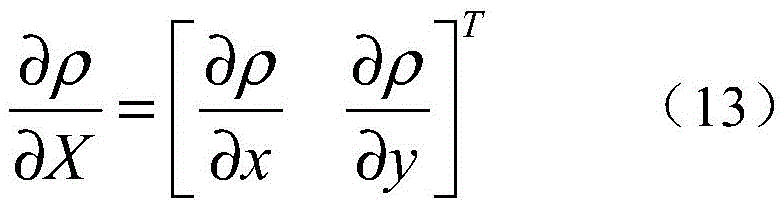
where ρ is the shortest distance from the robot to the obstacle, η is the position gain coefficient, ρ0Is a constant representing the distance affected by the obstacle. The corresponding repulsion function is:
Figure GDA0001670589840000102
wherein:
Figure GDA0001670589840000103
the mixed potential field of the attraction potential field and the repulsion potential field is as follows:
U(X)=Urep(X)+Uatt(X) (14)
the F force determines the moving direction of the robot.
The fact that path planning is done using conventional methods of artificial potential fields leads to the problem of local minima, i.e. the target is not a global minimum. When the target is within the influence range of the obstacle, the robot is gradually repelled when approaching the target, and gradually attracted when gradually decreasing, and the robot is repelled instead of attracted when losing the target.
To avoid the problem of the target not being the global minimum, the problem of the local minimum point is avoided using an improved algorithm which takes into account the relative distance between the robot and the target when defining the repulsive potential field function:
Figure GDA0001670589840000104
wherein (X-X)g) N is a real number larger than zero, and is the relative distance between the robot body and the target. Where repulsion is a negative gradient of the repulsive force potential field function. At this time, the attraction force and the repulsion force applied to the robot are shown in fig. 6, and fig. 6 is a force-receiving schematic diagram of the robot in the artificial potential field according to the present application:
from fig. 6, it is known that:
Figure GDA0001670589840000111
wherein Frep1And Frep2Is FrepAre:
Figure GDA0001670589840000112
the forces that the robot receives finally can be:
Figure GDA0001670589840000113
when the robot approaches the target, the repulsive force approaches zero or approaches a constant smaller than the attractive force, so that the robot can reach the target. When the automatic following robot adopts the path planning based on the improved artificial potential field method when avoiding obstacles, the robot does not completely reach the target, but the relative distance between the robot and the target is kept in a specific range, and the threshold is set according to the requirement.
And then, the robot follows the target according to the path after the obstacle avoidance processing. In the following process, after the pose of the robot is adjusted, the position feedback of the following target is obtained, and whether the target position changes or not is determined. If the position of the target is changed, target information is acquired again; otherwise, continuing to follow the target according to the current instruction.
By the method, the robot can still complete the task of following the target under the environment with the existence of the obstacles by utilizing the improved artificial potential field method to plan the path of the robot following the target, and the robot cannot easily get into local minimum points like the traditional artificial potential field method, so that the target following function is well completed.
Referring to fig. 7, fig. 7 is a schematic structural diagram of a first embodiment of a target following device of a robot according to the present application. The application also provides a target following device of the robot, which can execute the target following method of the robot, so that the following target can be followed. The device includes a processor 701, a depth sensor 702, and a communication circuit 703. The processor 701 is coupled to the depth sensor 702 and the communication circuit 703, and the processor 701 executes an instruction during operation to implement the target following method of the robot in cooperation with the depth sensor 702 and the communication circuit 703, where a specific operation process is consistent with the above method embodiment, and therefore, detailed description is not repeated here, and please refer to the description of the corresponding method steps. The processor 701 may also be divided into a plurality of module units to respectively execute different instructions during operation, such as a target detection module, a target tracking module, a robot control module, and the like. The target following device of the robot can be a device independent of the robot, for example, an adapter matched with the robot, and the single control can be more flexible in this way; the robot can also be a server, a control computer and the like, and in this way, a plurality of robots can be controlled to follow the same target in multiple directions simultaneously. The device independent of the robot is used, so that the occupancy rate of the processor of the robot can be reduced, and the robot is more flexible. The target following device of the robot may be provided on the robot body, or the above method may be implemented by directly using a processor or a memory communication circuit of the robot itself.
Referring to fig. 8, fig. 8 is a schematic structural diagram of a first embodiment of a device with a storage function according to the present application. The storage device 80 in this embodiment stores a program 801, and the program 801 realizes the target following method of the robot when executed. The specific working process is the same as the above method embodiment, and therefore, detailed description is not repeated here, and please refer to the description of the corresponding method steps above in detail. The device with the storage function may be a portable storage medium such as a usb disk, an optical disk, a portable hard disk, a Read-Only Memory (ROM), a Random Access Memory (RAM), a magnetic disk and other various media capable of storing program codes, and may also be a terminal, a server and other media.
According to the scheme, laser navigation or visual navigation is not adopted, the somatosensory interaction mode is more convenient based on a Kinect navigation method, and the target coordinate information obtained by the Kinect is combined with an artificial potential field method to well complete the following of the target and the avoidance of obstacles. The problems that the traditional laser navigation can only be used for indoor navigation and is high in cost, visual angle limitation cannot occur like the visual navigation, the influence of illumination is easily caused, the algorithm computation amount of a visual controller is large and the like are solved. The controller designed by the backstepping method and the five-point three-time method are added for smooth processing, so that the robot can stably complete the task of following the target, and the motor of the robot is protected. The robot can well avoid the obstacles and can not sink into local minimum points in the target following process based on the improved artificial potential field method. The target following method is efficient, low in cost, simple to operate and good in following effect.
In the several embodiments provided in the present application, it should be understood that the disclosed system, apparatus and method may be implemented in other ways. For example, the above-described apparatus embodiments are merely illustrative, and for example, the division of the modules or units is only one logical division, and other divisions may be realized in practice, for example, a plurality of units or components may be combined or integrated into another system, or some features may be omitted, or not executed. In addition, the shown or discussed mutual coupling or direct coupling or communication connection may be an indirect coupling or communication connection through some interfaces, devices or units, and may be in an electrical, mechanical or other form.
The units described as separate parts may or may not be physically separate, and parts displayed as units may or may not be physical units, may be located in one place, or may be distributed on a plurality of network units. Some or all of the units can be selected according to actual needs to achieve the purpose of the embodiment.
In addition, functional units in the embodiments of the present application may be integrated into one processing unit, or each unit may exist alone physically, or two or more units may be integrated into one unit. The integrated unit can be realized in a form of hardware, and can also be realized in a form of a software functional unit.
The integrated unit, if implemented in the form of a software functional unit and sold or used as a stand-alone product, may be stored in a computer readable storage medium. Based on such understanding, the technical solution of the present application may be substantially implemented or contributed by the prior art, or all or part of the technical solution may be embodied in a software product, which is stored in a storage medium and includes instructions for causing a computer device (which may be a personal computer, a server, a network device, or the like) or a processor (processor) to execute all or part of the steps of the method according to the embodiments of the present application.
The above description is only for the purpose of illustrating embodiments of the present application and is not intended to limit the scope of the present application, and all modifications of equivalent structures and equivalent processes, which are made by the contents of the specification and the drawings of the present application or are directly or indirectly applied to other related technical fields, are also included in the scope of the present application.

Claims (8)

1. A target following method of a robot, the method comprising:
acquiring a depth image of the periphery of the robot by using a depth sensor;
extracting a following target in the depth image by using a segmentation algorithm to obtain skeleton information of the following target, performing target detection on the depth image by using the skeleton information, and acquiring state information of the following target by using the skeleton information, coordinate information and depth information of the following target, wherein the state information comprises three-dimensional coordinate information and attitude information;
generating a control instruction by using the state information of the following target, and controlling the robot to move so as to follow the following target;
the generating of the control instruction using the state information of the following target includes:
and designing the linear velocity u-k of the robot based on a backstepping method by using the three-dimensional coordinate information and the posture information of the following target1ecosα,k1>0, angular velocity of
Figure FDA0003554285750000011
Wherein e is the distance between the robot and the following target, alpha is the included angle between the linear velocity of the robot and e, theta is the included angle between e and the x axis of a rectangular coordinate system, and k1,k2,k3Three variable parameters.
2. The method of claim 1, wherein the designing the linear velocity of the robot using a back-stepping approach comprises:
and smoothing the linear velocity of the robot by using a five-point three-time method, wherein the linear velocity after smoothing is as follows:
Figure FDA0003554285750000012
wherein v isiIs the linear velocity at a certain moment, vi-1,vi-2Linear velocity at the first two of said moments, vi+1,vi+2The linear velocities at the two latter moments of said moment.
3. The method of claim 1, wherein the performing target detection on the depth image by using the skeleton information, and the obtaining state information of a following target by using the skeleton information, coordinate information, and depth information of the following target comprises:
and planning the following path of the robot based on an artificial potential field method by utilizing the coordinate information and the depth information of the obstacle.
4. The method of claim 3, wherein planning the follow path of the robot based on an artificial potential field method using the coordinate information and the depth information of the obstacle comprises:
calculating a virtual force F received by the robot in the artificial potential field by using a gravitational function and a repulsive force function of the artificial potential field, and adjusting the trend of the robot according to the magnitude and the direction of the virtual force F, wherein the virtual force F is as follows:
Figure FDA0003554285750000021
wherein,
Figure FDA0003554285750000022
Fatt=-gradUatt(X)=-k(X-Xg)
wherein ρ is the shortest distance from the robot to the obstacle, η is a repulsive force position gain coefficient, ρ0Is a constant of the obstacle affecting the distance, (X-X)g) Is the relative distance between the robot and the following target, k is a gravity position gain coefficient, and n is largeReal numbers at zero.
5. The method of claim 1, wherein the robot, after pose adjustment under the control instructions, comprises:
the robot acquires the position information of the following target and judges whether the position of the following target changes or not;
if the position of the following target is not changed, the robot continues to execute the control command to move;
and if the position of the following target changes, the robot acquires the depth image of the following target and the surrounding environment thereof so as to acquire the state information of the following target.
6. The method of claim 1, wherein the utilizing the skeletal information to target detect the depth image comprises:
matching the acquired face image information and/or skeleton information with pre-stored face image information and/or skeleton information of a specific following target to lock the specific following target; or the like, or a combination thereof,
and selecting any target in the face image information and/or the skeleton information as a following target according to a preset rule.
7. An object following device of a robot, characterized in that the device comprises: a depth sensor, a processor and communication circuitry, the processor coupled to the depth sensor and communication circuitry, the processor in operation executing instructions to implement the object following method of any of claims 1 to 6 in cooperation with the depth sensor and communication circuitry.
8. An apparatus having a storage function, wherein the apparatus stores a program that when executed implements the object following method of any one of claims 1 to 6.
CN201810471298.2A 2018-05-17 2018-05-17 Target following method and device for robot Active CN108673501B (en)

Priority Applications (1)

Application Number Priority Date Filing Date Title
CN201810471298.2A CN108673501B (en) 2018-05-17 2018-05-17 Target following method and device for robot

Applications Claiming Priority (1)

Application Number Priority Date Filing Date Title
CN201810471298.2A CN108673501B (en) 2018-05-17 2018-05-17 Target following method and device for robot

Publications (2)

Publication Number Publication Date
CN108673501A CN108673501A (en) 2018-10-19
CN108673501B true CN108673501B (en) 2022-06-07

Family

ID=63806424

Family Applications (1)

Application Number Title Priority Date Filing Date
CN201810471298.2A Active CN108673501B (en) 2018-05-17 2018-05-17 Target following method and device for robot

Country Status (1)

Country Link
CN (1) CN108673501B (en)

Families Citing this family (20)

* Cited by examiner, † Cited by third party
Publication number Priority date Publication date Assignee Title
CN109634129B (en) * 2018-11-02 2022-07-01 深圳慧安康科技有限公司 Method, system and device for realizing active care
CN109740464B (en) * 2018-12-21 2021-01-26 北京智行者科技有限公司 Target identification following method
CN109828568B (en) * 2019-02-15 2022-04-15 武汉理工大学 NAO robot ball-searching gait optimization method for RoboCup game
CN110103241B (en) * 2019-06-13 2021-08-27 河北工业职业技术学院 Lighting robot, lighting robot control method and control device
CN110320523B (en) * 2019-07-05 2020-12-11 齐鲁工业大学 Target positioning device and method for following robot
CN111024082B (en) * 2019-12-02 2021-12-17 深圳优地科技有限公司 Method and device for planning local path of robot and robot
CN111401527B (en) * 2020-03-24 2022-05-13 金陵科技学院 GA-BP network-based robot behavior verification and identification method
CN112132864B (en) * 2020-09-21 2024-04-09 大连遨游智能科技有限公司 Robot following method and following robot based on vision
CN112383749A (en) * 2020-11-03 2021-02-19 浪潮云信息技术股份公司 Monitoring method based on automatic following motion chassis
CN112405540B (en) * 2020-11-11 2022-01-07 深圳优地科技有限公司 Robot control method, device, robot and readable storage medium
CN113065392A (en) * 2021-02-24 2021-07-02 苏州盈科电子有限公司 Robot tracking method and device
CN112959322A (en) * 2021-03-02 2021-06-15 中国科学院深圳先进技术研究院 Control method, control device and terminal equipment
CN115185260A (en) * 2021-04-01 2022-10-14 广州视睿电子科技有限公司 Robot control method, system and device
CN113485362B (en) * 2021-07-30 2024-12-03 美的集团(上海)有限公司 Robot motion method, device and electronic equipment
CN113910224B (en) * 2021-09-30 2023-07-21 达闼科技(北京)有限公司 Method, device and electronic equipment for robot following
CN114274147B (en) * 2022-02-10 2023-09-22 北京航空航天大学杭州创新研究院 Target tracking control method and device, robotic arm control equipment and storage medium
CN114815851B (en) * 2022-06-08 2025-08-15 北京哈崎机器人科技有限公司 Robot following method, apparatus, electronic device and storage medium
CN115469665B (en) * 2022-09-16 2023-07-04 广东工业大学 Intelligent wheelchair target tracking control method and system suitable for dynamic environment
CN119795200B (en) * 2025-03-17 2025-05-23 苏州大学 Adaptive predefined time control method for single-link robotic arm based on event triggering
CN119839883B (en) * 2025-03-18 2025-05-13 卧安科技(深圳)有限公司 Intelligent household robot, task execution method thereof and storage medium

Citations (6)

* Cited by examiner, † Cited by third party
Publication number Priority date Publication date Assignee Title
CN106155065A (en) * 2016-09-28 2016-11-23 上海仙知机器人科技有限公司 A kind of robot follower method and the equipment followed for robot
CN106881716A (en) * 2017-02-21 2017-06-23 深圳市锐曼智能装备有限公司 Human body follower method and system based on 3D cameras robot
CN107015563A (en) * 2016-12-29 2017-08-04 北京航空航天大学 Method for planning path for mobile robot and device
CN107139189A (en) * 2017-07-11 2017-09-08 吴世贵 A kind of children's joy religion monitoring robot and its human body target tracking algorithm
CN107309883A (en) * 2016-04-27 2017-11-03 王方明 Intelligent robot
CN107909603A (en) * 2017-12-01 2018-04-13 浙江工业大学 Following robot-oriented visual tracking method

Family Cites Families (2)

* Cited by examiner, † Cited by third party
Publication number Priority date Publication date Assignee Title
US9102055B1 (en) * 2013-03-15 2015-08-11 Industrial Perception, Inc. Detection and reconstruction of an environment to facilitate robotic interaction with the environment
CN106598052A (en) * 2016-12-14 2017-04-26 南京阿凡达机器人科技有限公司 Robot security inspection method based on environment map and robot thereof

Patent Citations (6)

* Cited by examiner, † Cited by third party
Publication number Priority date Publication date Assignee Title
CN107309883A (en) * 2016-04-27 2017-11-03 王方明 Intelligent robot
CN106155065A (en) * 2016-09-28 2016-11-23 上海仙知机器人科技有限公司 A kind of robot follower method and the equipment followed for robot
CN107015563A (en) * 2016-12-29 2017-08-04 北京航空航天大学 Method for planning path for mobile robot and device
CN106881716A (en) * 2017-02-21 2017-06-23 深圳市锐曼智能装备有限公司 Human body follower method and system based on 3D cameras robot
CN107139189A (en) * 2017-07-11 2017-09-08 吴世贵 A kind of children's joy religion monitoring robot and its human body target tracking algorithm
CN107909603A (en) * 2017-12-01 2018-04-13 浙江工业大学 Following robot-oriented visual tracking method

Also Published As

Publication number Publication date
CN108673501A (en) 2018-10-19

Similar Documents

Publication Publication Date Title
CN108673501B (en) Target following method and device for robot
US20250093163A1 (en) Mapping in autonomous and non-autonomous platforms
US12387502B2 (en) Visual-inertial positional awareness for autonomous and non-autonomous mapping
US12367670B2 (en) Object tracking by an unmanned aerial vehicle using visual sensors
US11501527B2 (en) Visual-inertial positional awareness for autonomous and non-autonomous tracking
US20240202938A1 (en) Fault-tolerance to provide robust tracking for autonomous and non-autonomous positional awareness
US10390003B1 (en) Visual-inertial positional awareness for autonomous and non-autonomous device
US10354396B1 (en) Visual-inertial positional awareness for autonomous and non-autonomous device
US10496104B1 (en) Positional awareness with quadocular sensor in autonomous platforms
US11187790B2 (en) Laser scanning system, laser scanning method, movable laser scanning system, and program
EP3428760B1 (en) Mapping optimization in autonomous and non-autonomous platforms
Chatterjee et al. Vision based autonomous robot navigation: algorithms and implementations
CN109352654A (en) A ROS-based intelligent robot following system and method
Ghani et al. Detecting negative obstacle using Kinect sensor
Chikhalikar et al. An object-oriented navigation strategy for service robots leveraging semantic information
Wang et al. What makes robots? Sensors, actuators, and algorithms
Kumar Rath et al. Real‐time moving object detection and removal from 3D pointcloud data for humanoid navigation in dense GPS‐denied environments
Varanasi et al. Robotic navigation unveiled: A comprehensive study of GMapping, hector slam, and cartographer
Mohamed et al. Autonomous navigation in dynamic environments: Deep learning-based approach
Chen et al. ARMSAINTS: an AR-based real-time mobile system for assistive indoor navigation with target segmentation
Schelle et al. Modelling visual communication with UAS
Girão et al. Real-time multi-view grid map-based spatial representation for mixed reality applications
Rodríguez-Quiñonez Intelligent automatic object tracking method by integration of laser scanner system and ins
Kulp Robotic person-following in cluttered environments
Luo et al. Kinematics-based collision-free motion planning for autonomous mobile robot in dynamic environment

Legal Events

Date Code Title Description
PB01 Publication
PB01 Publication
SE01 Entry into force of request for substantive examination
GR01 Patent grant
GR01 Patent grant
TR01 Transfer of patent right

Effective date of registration: 20251029

Address after: Room a-207, office building, Shenzhen Institute of advanced technology, Chinese Academy of Sciences, 1068 Xueyuan Avenue, Shenzhen University Town, Nanshan District, Shenzhen, Guangdong 518055

Patentee after: Shenzhen advanced science and technology Cci Capital Ltd.

Country or region after: China

Address before: 1068 No. 518055 Guangdong city of Shenzhen province Nanshan District Shenzhen University city academy Avenue

Patentee before: SHENZHEN INSTITUTES OF ADVANCED TECHNOLOGY CHINESE ACADEMY OF SCIENCES

Country or region before: China

TR01 Transfer of patent right

Effective date of registration: 20251113

Address after: 300450 Tianjin Binhai New Area Huayuan Industrial Zone (outside the ring) No. 3, Haitai Development Road 6, Xingqi No. 1 Innovation Workshop R&D Center 301

Patentee after: Tianjin Zhongke advanced technology industry Co.,Ltd.

Country or region after: China

Address before: Room a-207, office building, Shenzhen Institute of advanced technology, Chinese Academy of Sciences, 1068 Xueyuan Avenue, Shenzhen University Town, Nanshan District, Shenzhen, Guangdong 518055

Patentee before: Shenzhen advanced science and technology Cci Capital Ltd.

Country or region before: China

TR01 Transfer of patent right

Effective date of registration: 20260107

Address after: Room a-207, office building, Shenzhen Institute of advanced technology, Chinese Academy of Sciences, 1068 Xueyuan Avenue, Shenzhen University Town, Nanshan District, Shenzhen, Guangdong 518055

Patentee after: Shenzhen advanced science and technology Cci Capital Ltd.

Country or region after: China

Address before: 300450 Tianjin Binhai New Area Huayuan Industrial Zone (outside the ring) No. 3, Haitai Development Road 6, Xingqi No. 1 Innovation Workshop R&D Center 301

Patentee before: Tianjin Zhongke advanced technology industry Co.,Ltd.

Country or region before: China

TR01 Transfer of patent right

Effective date of registration: 20260119

Address after: 1068 No. 518055 Guangdong city of Shenzhen province Nanshan District Shenzhen University city academy Avenue

Patentee after: SHENZHEN INSTITUTES OF ADVANCED TECHNOLOGY CHINESE ACADEMY OF SCIENCES

Country or region after: China

Address before: Room a-207, office building, Shenzhen Institute of advanced technology, Chinese Academy of Sciences, 1068 Xueyuan Avenue, Shenzhen University Town, Nanshan District, Shenzhen, Guangdong 518055

Patentee before: Shenzhen advanced science and technology Cci Capital Ltd.

Country or region before: China