CN108096629B - Polymethyl methacrylate bone cement and preparation method thereof - Google Patents
Polymethyl methacrylate bone cement and preparation method thereof Download PDFInfo
- Publication number
- CN108096629B CN108096629B CN201810084359.XA CN201810084359A CN108096629B CN 108096629 B CN108096629 B CN 108096629B CN 201810084359 A CN201810084359 A CN 201810084359A CN 108096629 B CN108096629 B CN 108096629B
- Authority
- CN
- China
- Prior art keywords
- bone cement
- solid component
- polymethyl methacrylate
- calcium
- collagen
- Prior art date
- Legal status (The legal status is an assumption and is not a legal conclusion. Google has not performed a legal analysis and makes no representation as to the accuracy of the status listed.)
- Active
Links
- 239000002639 bone cement Substances 0.000 title claims abstract description 75
- 229920003229 poly(methyl methacrylate) Polymers 0.000 title claims abstract description 64
- 239000004926 polymethyl methacrylate Substances 0.000 title claims abstract description 64
- 238000002360 preparation method Methods 0.000 title claims abstract description 18
- 102000008186 Collagen Human genes 0.000 claims abstract description 57
- 108010035532 Collagen Proteins 0.000 claims abstract description 57
- 229920001436 collagen Polymers 0.000 claims abstract description 57
- 239000007787 solid Substances 0.000 claims abstract description 40
- 239000007788 liquid Substances 0.000 claims abstract description 23
- ADFPJHOAARPYLP-UHFFFAOYSA-N methyl 2-methylprop-2-enoate;styrene Chemical compound COC(=O)C(C)=C.C=CC1=CC=CC=C1 ADFPJHOAARPYLP-UHFFFAOYSA-N 0.000 claims abstract description 15
- 229920006132 styrene block copolymer Polymers 0.000 claims abstract description 14
- 239000002872 contrast media Substances 0.000 claims abstract description 9
- 239000003999 initiator Substances 0.000 claims abstract description 8
- 239000003381 stabilizer Substances 0.000 claims abstract description 7
- VVQNEPGJFQJSBK-UHFFFAOYSA-N Methyl methacrylate Chemical compound COC(=O)C(C)=C VVQNEPGJFQJSBK-UHFFFAOYSA-N 0.000 claims abstract description 6
- 239000000463 material Substances 0.000 claims description 44
- 239000002245 particle Substances 0.000 claims description 28
- 238000002156 mixing Methods 0.000 claims description 17
- 229920000747 poly(lactic acid) Polymers 0.000 claims description 17
- 239000004626 polylactic acid Substances 0.000 claims description 17
- 238000000034 method Methods 0.000 claims description 16
- 229920000728 polyester Polymers 0.000 claims description 9
- QORWJWZARLRLPR-UHFFFAOYSA-H tricalcium bis(phosphate) Chemical compound [Ca+2].[Ca+2].[Ca+2].[O-]P([O-])([O-])=O.[O-]P([O-])([O-])=O QORWJWZARLRLPR-UHFFFAOYSA-H 0.000 claims description 8
- QIGBRXMKCJKVMJ-UHFFFAOYSA-N Hydroquinone Chemical compound OC1=CC=C(O)C=C1 QIGBRXMKCJKVMJ-UHFFFAOYSA-N 0.000 claims description 7
- ZQBZAOZWBKABNC-UHFFFAOYSA-N [P].[Ca] Chemical compound [P].[Ca] ZQBZAOZWBKABNC-UHFFFAOYSA-N 0.000 claims description 7
- 239000000126 substance Substances 0.000 claims description 7
- OYPRJOBELJOOCE-UHFFFAOYSA-N Calcium Chemical compound [Ca] OYPRJOBELJOOCE-UHFFFAOYSA-N 0.000 claims description 6
- OAICVXFJPJFONN-UHFFFAOYSA-N Phosphorus Chemical compound [P] OAICVXFJPJFONN-UHFFFAOYSA-N 0.000 claims description 6
- 229910052791 calcium Inorganic materials 0.000 claims description 6
- 239000011575 calcium Substances 0.000 claims description 6
- 239000003623 enhancer Substances 0.000 claims description 6
- 239000011574 phosphorus Substances 0.000 claims description 6
- 229910052698 phosphorus Inorganic materials 0.000 claims description 6
- 239000002243 precursor Substances 0.000 claims description 6
- 102000012422 Collagen Type I Human genes 0.000 claims description 5
- 108010022452 Collagen Type I Proteins 0.000 claims description 5
- 229910052588 hydroxylapatite Inorganic materials 0.000 claims description 5
- 239000000203 mixture Substances 0.000 claims description 5
- XYJRXVWERLGGKC-UHFFFAOYSA-D pentacalcium;hydroxide;triphosphate Chemical compound [OH-].[Ca+2].[Ca+2].[Ca+2].[Ca+2].[Ca+2].[O-]P([O-])([O-])=O.[O-]P([O-])([O-])=O.[O-]P([O-])([O-])=O XYJRXVWERLGGKC-UHFFFAOYSA-D 0.000 claims description 5
- XESZUVZBAMCAEJ-UHFFFAOYSA-N 4-tert-butylcatechol Chemical compound CC(C)(C)C1=CC=C(O)C(O)=C1 XESZUVZBAMCAEJ-UHFFFAOYSA-N 0.000 claims description 4
- TZCXTZWJZNENPQ-UHFFFAOYSA-L barium sulfate Chemical compound [Ba+2].[O-]S([O-])(=O)=O TZCXTZWJZNENPQ-UHFFFAOYSA-L 0.000 claims description 4
- 229920001577 copolymer Polymers 0.000 claims description 4
- 239000002994 raw material Substances 0.000 claims description 4
- 239000001506 calcium phosphate Substances 0.000 claims description 3
- 229910000389 calcium phosphate Inorganic materials 0.000 claims description 3
- 235000011010 calcium phosphates Nutrition 0.000 claims description 3
- GYVGXEWAOAAJEU-UHFFFAOYSA-N n,n,4-trimethylaniline Chemical group CN(C)C1=CC=C(C)C=C1 GYVGXEWAOAAJEU-UHFFFAOYSA-N 0.000 claims description 3
- 239000004342 Benzoyl peroxide Substances 0.000 claims description 2
- OMPJBNCRMGITSC-UHFFFAOYSA-N Benzoylperoxide Chemical group C=1C=CC=CC=1C(=O)OOC(=O)C1=CC=CC=C1 OMPJBNCRMGITSC-UHFFFAOYSA-N 0.000 claims description 2
- 229920000954 Polyglycolide Polymers 0.000 claims description 2
- 235000019400 benzoyl peroxide Nutrition 0.000 claims description 2
- MWKXCSMICWVRGW-UHFFFAOYSA-N calcium;phosphane Chemical compound P.[Ca] MWKXCSMICWVRGW-UHFFFAOYSA-N 0.000 claims description 2
- 229910000392 octacalcium phosphate Inorganic materials 0.000 claims description 2
- RVTZCBVAJQQJTK-UHFFFAOYSA-N oxygen(2-);zirconium(4+) Chemical compound [O-2].[O-2].[Zr+4] RVTZCBVAJQQJTK-UHFFFAOYSA-N 0.000 claims description 2
- 239000004633 polyglycolic acid Substances 0.000 claims description 2
- YIGWVOWKHUSYER-UHFFFAOYSA-F tetracalcium;hydrogen phosphate;diphosphate Chemical compound [Ca+2].[Ca+2].[Ca+2].[Ca+2].OP([O-])([O-])=O.[O-]P([O-])([O-])=O.[O-]P([O-])([O-])=O YIGWVOWKHUSYER-UHFFFAOYSA-F 0.000 claims description 2
- 229910001928 zirconium oxide Inorganic materials 0.000 claims description 2
- 210000000988 bone and bone Anatomy 0.000 abstract description 22
- 238000010883 osseointegration Methods 0.000 abstract description 4
- 230000002188 osteogenic effect Effects 0.000 abstract description 4
- 239000000243 solution Substances 0.000 description 35
- 238000010438 heat treatment Methods 0.000 description 14
- 239000000843 powder Substances 0.000 description 13
- 238000006116 polymerization reaction Methods 0.000 description 11
- 238000003756 stirring Methods 0.000 description 10
- 238000000859 sublimation Methods 0.000 description 10
- 230000008022 sublimation Effects 0.000 description 10
- BHPQYMZQTOCNFJ-UHFFFAOYSA-N Calcium cation Chemical compound [Ca+2] BHPQYMZQTOCNFJ-UHFFFAOYSA-N 0.000 description 9
- 229910001424 calcium ion Inorganic materials 0.000 description 9
- 238000004108 freeze drying Methods 0.000 description 9
- 230000000052 comparative effect Effects 0.000 description 8
- 238000001816 cooling Methods 0.000 description 8
- 238000007873 sieving Methods 0.000 description 8
- XEKOWRVHYACXOJ-UHFFFAOYSA-N Ethyl acetate Chemical compound CCOC(C)=O XEKOWRVHYACXOJ-UHFFFAOYSA-N 0.000 description 6
- HEMHJVSKTPXQMS-UHFFFAOYSA-M Sodium hydroxide Chemical compound [OH-].[Na+] HEMHJVSKTPXQMS-UHFFFAOYSA-M 0.000 description 6
- 238000001035 drying Methods 0.000 description 6
- 238000002513 implantation Methods 0.000 description 6
- NBIIXXVUZAFLBC-UHFFFAOYSA-K phosphate Chemical compound [O-]P([O-])([O-])=O NBIIXXVUZAFLBC-UHFFFAOYSA-K 0.000 description 6
- 239000000047 product Substances 0.000 description 6
- IAZDPXIOMUYVGZ-UHFFFAOYSA-N Dimethylsulphoxide Chemical compound CS(C)=O IAZDPXIOMUYVGZ-UHFFFAOYSA-N 0.000 description 4
- VEXZGXHMUGYJMC-UHFFFAOYSA-N Hydrochloric acid Chemical compound Cl VEXZGXHMUGYJMC-UHFFFAOYSA-N 0.000 description 4
- 239000002253 acid Substances 0.000 description 4
- 230000000694 effects Effects 0.000 description 4
- 239000012744 reinforcing agent Substances 0.000 description 4
- XLYOFNOQVPJJNP-UHFFFAOYSA-N water Substances O XLYOFNOQVPJJNP-UHFFFAOYSA-N 0.000 description 4
- QTBSBXVTEAMEQO-UHFFFAOYSA-N Acetic acid Chemical compound CC(O)=O QTBSBXVTEAMEQO-UHFFFAOYSA-N 0.000 description 3
- 238000006243 chemical reaction Methods 0.000 description 3
- 230000006835 compression Effects 0.000 description 3
- 238000007906 compression Methods 0.000 description 3
- 238000007710 freezing Methods 0.000 description 3
- 230000008014 freezing Effects 0.000 description 3
- 230000010354 integration Effects 0.000 description 3
- 238000011068 loading method Methods 0.000 description 3
- 239000011259 mixed solution Substances 0.000 description 3
- 239000000178 monomer Substances 0.000 description 3
- 239000002244 precipitate Substances 0.000 description 3
- 238000003825 pressing Methods 0.000 description 3
- 230000000717 retained effect Effects 0.000 description 3
- 238000012216 screening Methods 0.000 description 3
- 239000002904 solvent Substances 0.000 description 3
- 238000009210 therapy by ultrasound Methods 0.000 description 3
- HEDRZPFGACZZDS-UHFFFAOYSA-N Chloroform Chemical compound ClC(Cl)Cl HEDRZPFGACZZDS-UHFFFAOYSA-N 0.000 description 2
- GRYLNZFGIOXLOG-UHFFFAOYSA-N Nitric acid Chemical compound O[N+]([O-])=O GRYLNZFGIOXLOG-UHFFFAOYSA-N 0.000 description 2
- 238000005273 aeration Methods 0.000 description 2
- 238000005054 agglomeration Methods 0.000 description 2
- 230000002776 aggregation Effects 0.000 description 2
- 238000007605 air drying Methods 0.000 description 2
- 238000005452 bending Methods 0.000 description 2
- 238000007664 blowing Methods 0.000 description 2
- 230000007547 defect Effects 0.000 description 2
- 238000001727 in vivo Methods 0.000 description 2
- 229910017604 nitric acid Inorganic materials 0.000 description 2
- 229920000642 polymer Polymers 0.000 description 2
- 238000011160 research Methods 0.000 description 2
- 238000002791 soaking Methods 0.000 description 2
- RYHBNJHYFVUHQT-UHFFFAOYSA-N 1,4-Dioxane Chemical compound C1COCCO1 RYHBNJHYFVUHQT-UHFFFAOYSA-N 0.000 description 1
- CVEPFOUZABPRMK-UHFFFAOYSA-N 2-methylprop-2-enoic acid;styrene Chemical compound CC(=C)C(O)=O.C=CC1=CC=CC=C1 CVEPFOUZABPRMK-UHFFFAOYSA-N 0.000 description 1
- 208000010392 Bone Fractures Diseases 0.000 description 1
- 229920002101 Chitin Polymers 0.000 description 1
- 206010017076 Fracture Diseases 0.000 description 1
- OYHQOLUKZRVURQ-HZJYTTRNSA-N Linoleic acid Chemical compound CCCCC\C=C/C\C=C/CCCCCCCC(O)=O OYHQOLUKZRVURQ-HZJYTTRNSA-N 0.000 description 1
- 206010028980 Neoplasm Diseases 0.000 description 1
- 238000005299 abrasion Methods 0.000 description 1
- 230000009286 beneficial effect Effects 0.000 description 1
- 125000002619 bicyclic group Chemical group 0.000 description 1
- 230000000975 bioactive effect Effects 0.000 description 1
- 239000003462 bioceramic Substances 0.000 description 1
- 210000002449 bone cell Anatomy 0.000 description 1
- 210000002805 bone matrix Anatomy 0.000 description 1
- 239000001913 cellulose Substances 0.000 description 1
- 238000004140 cleaning Methods 0.000 description 1
- 239000003086 colorant Substances 0.000 description 1
- 230000001054 cortical effect Effects 0.000 description 1
- 238000001514 detection method Methods 0.000 description 1
- 230000002349 favourable effect Effects 0.000 description 1
- 238000011049 filling Methods 0.000 description 1
- 238000000227 grinding Methods 0.000 description 1
- 239000003102 growth factor Substances 0.000 description 1
- 125000000687 hydroquinonyl group Chemical group C1(O)=C(C=C(O)C=C1)* 0.000 description 1
- 208000014674 injury Diseases 0.000 description 1
- OYHQOLUKZRVURQ-IXWMQOLASA-N linoleic acid Natural products CCCCC\C=C/C\C=C\CCCCCCCC(O)=O OYHQOLUKZRVURQ-IXWMQOLASA-N 0.000 description 1
- 235000020778 linoleic acid Nutrition 0.000 description 1
- 239000012567 medical material Substances 0.000 description 1
- 238000012986 modification Methods 0.000 description 1
- 230000004048 modification Effects 0.000 description 1
- 230000000399 orthopedic effect Effects 0.000 description 1
- 239000005014 poly(hydroxyalkanoate) Substances 0.000 description 1
- 229920000903 polyhydroxyalkanoate Polymers 0.000 description 1
- 239000011148 porous material Substances 0.000 description 1
- 230000008569 process Effects 0.000 description 1
- 238000010298 pulverizing process Methods 0.000 description 1
- 230000035484 reaction time Effects 0.000 description 1
- 230000008439 repair process Effects 0.000 description 1
- 238000001179 sorption measurement Methods 0.000 description 1
- 229910001220 stainless steel Inorganic materials 0.000 description 1
- 239000010935 stainless steel Substances 0.000 description 1
- 229910052712 strontium Inorganic materials 0.000 description 1
- CIOAGBVUUVVLOB-UHFFFAOYSA-N strontium atom Chemical compound [Sr] CIOAGBVUUVVLOB-UHFFFAOYSA-N 0.000 description 1
- 238000006467 substitution reaction Methods 0.000 description 1
- 230000017423 tissue regeneration Effects 0.000 description 1
- 230000008733 trauma Effects 0.000 description 1
- 238000001291 vacuum drying Methods 0.000 description 1
Classifications
-
- A—HUMAN NECESSITIES
- A61—MEDICAL OR VETERINARY SCIENCE; HYGIENE
- A61L—METHODS OR APPARATUS FOR STERILISING MATERIALS OR OBJECTS IN GENERAL; DISINFECTION, STERILISATION OR DEODORISATION OF AIR; CHEMICAL ASPECTS OF BANDAGES, DRESSINGS, ABSORBENT PADS OR SURGICAL ARTICLES; MATERIALS FOR BANDAGES, DRESSINGS, ABSORBENT PADS OR SURGICAL ARTICLES
- A61L27/00—Materials for grafts or prostheses or for coating grafts or prostheses
- A61L27/14—Macromolecular materials
- A61L27/16—Macromolecular materials obtained by reactions only involving carbon-to-carbon unsaturated bonds
-
- A—HUMAN NECESSITIES
- A61—MEDICAL OR VETERINARY SCIENCE; HYGIENE
- A61L—METHODS OR APPARATUS FOR STERILISING MATERIALS OR OBJECTS IN GENERAL; DISINFECTION, STERILISATION OR DEODORISATION OF AIR; CHEMICAL ASPECTS OF BANDAGES, DRESSINGS, ABSORBENT PADS OR SURGICAL ARTICLES; MATERIALS FOR BANDAGES, DRESSINGS, ABSORBENT PADS OR SURGICAL ARTICLES
- A61L27/00—Materials for grafts or prostheses or for coating grafts or prostheses
- A61L27/14—Macromolecular materials
- A61L27/22—Polypeptides or derivatives thereof, e.g. degradation products
- A61L27/24—Collagen
-
- A—HUMAN NECESSITIES
- A61—MEDICAL OR VETERINARY SCIENCE; HYGIENE
- A61L—METHODS OR APPARATUS FOR STERILISING MATERIALS OR OBJECTS IN GENERAL; DISINFECTION, STERILISATION OR DEODORISATION OF AIR; CHEMICAL ASPECTS OF BANDAGES, DRESSINGS, ABSORBENT PADS OR SURGICAL ARTICLES; MATERIALS FOR BANDAGES, DRESSINGS, ABSORBENT PADS OR SURGICAL ARTICLES
- A61L27/00—Materials for grafts or prostheses or for coating grafts or prostheses
- A61L27/50—Materials characterised by their function or physical properties, e.g. injectable or lubricating compositions, shape-memory materials, surface modified materials
-
- A—HUMAN NECESSITIES
- A61—MEDICAL OR VETERINARY SCIENCE; HYGIENE
- A61L—METHODS OR APPARATUS FOR STERILISING MATERIALS OR OBJECTS IN GENERAL; DISINFECTION, STERILISATION OR DEODORISATION OF AIR; CHEMICAL ASPECTS OF BANDAGES, DRESSINGS, ABSORBENT PADS OR SURGICAL ARTICLES; MATERIALS FOR BANDAGES, DRESSINGS, ABSORBENT PADS OR SURGICAL ARTICLES
- A61L27/00—Materials for grafts or prostheses or for coating grafts or prostheses
- A61L27/50—Materials characterised by their function or physical properties, e.g. injectable or lubricating compositions, shape-memory materials, surface modified materials
- A61L27/54—Biologically active materials, e.g. therapeutic substances
-
- A—HUMAN NECESSITIES
- A61—MEDICAL OR VETERINARY SCIENCE; HYGIENE
- A61L—METHODS OR APPARATUS FOR STERILISING MATERIALS OR OBJECTS IN GENERAL; DISINFECTION, STERILISATION OR DEODORISATION OF AIR; CHEMICAL ASPECTS OF BANDAGES, DRESSINGS, ABSORBENT PADS OR SURGICAL ARTICLES; MATERIALS FOR BANDAGES, DRESSINGS, ABSORBENT PADS OR SURGICAL ARTICLES
- A61L27/00—Materials for grafts or prostheses or for coating grafts or prostheses
- A61L27/50—Materials characterised by their function or physical properties, e.g. injectable or lubricating compositions, shape-memory materials, surface modified materials
- A61L27/58—Materials at least partially resorbable by the body
-
- A—HUMAN NECESSITIES
- A61—MEDICAL OR VETERINARY SCIENCE; HYGIENE
- A61L—METHODS OR APPARATUS FOR STERILISING MATERIALS OR OBJECTS IN GENERAL; DISINFECTION, STERILISATION OR DEODORISATION OF AIR; CHEMICAL ASPECTS OF BANDAGES, DRESSINGS, ABSORBENT PADS OR SURGICAL ARTICLES; MATERIALS FOR BANDAGES, DRESSINGS, ABSORBENT PADS OR SURGICAL ARTICLES
- A61L2300/00—Biologically active materials used in bandages, wound dressings, absorbent pads or medical devices
- A61L2300/20—Biologically active materials used in bandages, wound dressings, absorbent pads or medical devices containing or releasing organic materials
- A61L2300/252—Polypeptides, proteins, e.g. glycoproteins, lipoproteins, cytokines
-
- A—HUMAN NECESSITIES
- A61—MEDICAL OR VETERINARY SCIENCE; HYGIENE
- A61L—METHODS OR APPARATUS FOR STERILISING MATERIALS OR OBJECTS IN GENERAL; DISINFECTION, STERILISATION OR DEODORISATION OF AIR; CHEMICAL ASPECTS OF BANDAGES, DRESSINGS, ABSORBENT PADS OR SURGICAL ARTICLES; MATERIALS FOR BANDAGES, DRESSINGS, ABSORBENT PADS OR SURGICAL ARTICLES
- A61L2300/00—Biologically active materials used in bandages, wound dressings, absorbent pads or medical devices
- A61L2300/40—Biologically active materials used in bandages, wound dressings, absorbent pads or medical devices characterised by a specific therapeutic activity or mode of action
- A61L2300/412—Tissue-regenerating or healing or proliferative agents
-
- A—HUMAN NECESSITIES
- A61—MEDICAL OR VETERINARY SCIENCE; HYGIENE
- A61L—METHODS OR APPARATUS FOR STERILISING MATERIALS OR OBJECTS IN GENERAL; DISINFECTION, STERILISATION OR DEODORISATION OF AIR; CHEMICAL ASPECTS OF BANDAGES, DRESSINGS, ABSORBENT PADS OR SURGICAL ARTICLES; MATERIALS FOR BANDAGES, DRESSINGS, ABSORBENT PADS OR SURGICAL ARTICLES
- A61L2430/00—Materials or treatment for tissue regeneration
- A61L2430/02—Materials or treatment for tissue regeneration for reconstruction of bones; weight-bearing implants
Landscapes
- Health & Medical Sciences (AREA)
- Life Sciences & Earth Sciences (AREA)
- Chemical & Material Sciences (AREA)
- Medicinal Chemistry (AREA)
- General Health & Medical Sciences (AREA)
- Animal Behavior & Ethology (AREA)
- Veterinary Medicine (AREA)
- Dermatology (AREA)
- Oral & Maxillofacial Surgery (AREA)
- Transplantation (AREA)
- Epidemiology (AREA)
- Public Health (AREA)
- Engineering & Computer Science (AREA)
- Biomedical Technology (AREA)
- Molecular Biology (AREA)
- Biophysics (AREA)
- Chemical Kinetics & Catalysis (AREA)
- Materials For Medical Uses (AREA)
Abstract
The invention relates to a polymethyl methacrylate bone cement and a preparation method thereof, in particular to the bone cement which mainly comprises a solid component and a liquid component; the solid component comprises: a solid component A, which comprises polymethyl methacrylate, methyl methacrylate-styrene block copolymer, contrast agent and initiator; a solid component B comprising mineralized collagen; the liquid component comprises: methyl methacrylate, a stabilizer and an accelerator. By controlling the components, the molecular weight and the adding proportion, the PMMA bone cement does not emit a large amount of heat when in use, thereby not damaging the surrounding bone tissues, and has proper viscosity and random plasticity. Moreover, by adding the mineralized collagen component with good osteogenic activity, the mechanical property and biocompatibility of the bone cement are improved, so that the bone cement has good osseointegration capability and low elastic modulus.
Description
Technical Field
The invention relates to the technical field of medical materials, in particular to a polymethyl methacrylate bone cement and a preparation method thereof.
Background
Polymethylmethacrylate bone cements, also commonly referred to as PMMA bone cements, are widely used in various orthopedic procedures such as vertebroplasty, joint replacement, and repair of bone defects after tumors or trauma.
At present, various PMMA bone cement products are sold on the market at home and abroad and are used in clinic. However, the existing PMMA bone cement still has major defects, which are mainly reflected in two aspects: 1. the elastic modulus of the PMMA bone cement solidified body is too high; 2. the biological inertia of PMMA prevents the PMMA from forming osseointegration with bone tissues, so that the interface between the PMMA and the bone tissues is obvious, the bonding strength is poor, and the PMMA is easy to loosen.
At present, a great deal of research is carried out on the biological inertia and the mechanical property of PMMA bone cement, 1, the powder is modified, for example, partially degradable materials, polyhydroxyalkanoate, poly beta-carboxylic acid and the like are added into the powder, and completely degradable materials, such as NaF and nano Al, are added2O3Cellulose and tricalcium phosphate series; adding bioactive material, most commonly bioceramic, containing hydroxyapatite component, including HA, Sr-HA doped with strontium, HA + chitin, growth factor, etc.; 2. modifying the monomers of the bone cement, such as replacing part of MMA monomers by linoleic acid; 3. adding biodegradable material to prepare the pore in the bone cement.
Therefore, the current researches on PMMA bone cement mainly focus on improving the biological inertia and mechanical properties of the PMMA bone cement. However, in the actual use process, the bone cement often emits a large amount of heat in the polymerization reaction, which damages the surrounding bone tissue and affects the operation effect, and the viscosity of the bone cement is not ideal, so that the requirement of any plasticity cannot be met.
In view of the above, the present invention is particularly proposed.
Disclosure of Invention
Technical problem to be solved
The invention aims to solve the technical problems that the existing polymethyl methacrylate bone cement, namely PMMA bone cement, has overlarge heat emission and can not be arbitrarily plasticized when in use.
(II) technical scheme
In order to solve the technical problem, the invention provides a polymethyl methacrylate bone cement, which consists of a solid component and a liquid component, wherein the solid component comprises:
a solid component A, which comprises polymethyl methacrylate, methyl methacrylate-styrene block copolymer, contrast agent and initiator;
a solid component B comprising mineralized collagen;
the liquid component comprises: methyl methacrylate, a stabilizer and an accelerator.
The PMMA bone cement provided by the invention improves solid components and liquid components used in polymerization reaction, and specifically comprises the following components:
in the solid component A, polymethyl methacrylate and methyl methacrylate-styrene block copolymer are used in combination with contrast agent, etc., so that the heat release of polymerization reaction is reduced, thereby avoiding damage to surrounding bone tissues, and simultaneously, the viscosity of the bone cement can meet the requirement of any plasticity. Through detection, the heat quantity released by the bone cement provided by the invention during polymerization reaction is only 50-60 ℃, and is far lower than 80-90 ℃ of the traditional bone cement.
In the solid component B, the mineralized collagen has the chemical composition and the microstructure which are consistent with those of the natural bone matrix of the human body, so that a good microenvironment can be provided for the activity of bone cells, and the bone tissue regeneration can be guided. A large number of osteogenic active sites are formed on the surface of the bone cement solidified body, mineralized collagen on the surfaces can be degraded and absorbed in vivo, and simultaneously, new bone tissues are guided to grow into micropores formed on the surface of the degraded bone cement solidified body, so that the bone tissues form organic bone integration on the bone cement, and the bone cement is anchored at an implantation site. On the other hand, the mineralized collagen material has the compressive strength which is comparable to that of human cortical bone and the low elastic modulus which is equivalent to that of cancellous bone, has good adjusting effect on the mechanical property of the bone cement solidified body, and can lower the elastic modulus of the bone cement solidified body on the premise of ensuring the strength, thereby reducing the mechanical damage of the bone cement to the bone tissue of the implanted part in the body of a patient.
In addition, the molecular weight and the addition ratio of the components such as the polymethyl methacrylate and the methyl methacrylate-styrene block copolymer used also influence the polymerization reaction time, the viscosity of the polymer and the heat release, and the molecular weight of the polymethyl methacrylate is preferably 150,000 to 260,000, and/or the molecular weight of the polymethyl methacrylate-styrene block copolymer is preferably 100,000 to 300,000, and the block ratio PMMA/PS is 80:20 to 60: 40.
Preferably, the solid components comprise the following components in percentage by mass:
the total content of the polymethyl methacrylate and the methyl methacrylate-styrene segmented copolymer is 50-80%, the mineralized collagen is 5-30%, the contrast agent is 10-40%, and the initiator is 0.3-1%. The higher the proportion of the methyl methacrylate-styrene block copolymer is, the higher the viscosity of the polymer is, the poorer the injectability is, the shorter the polymerization time is, the corresponding operation time is too short, and the method is not suitable for clinical operation, and preferably, the mass ratio of the polymethyl methacrylate to the methyl methacrylate-styrene block copolymer is (1-19): (1-9), most preferably, the mass ratio of the polymethyl methacrylate to the methyl methacrylate-styrene block copolymer is 9:1, and the block ratio PMMA/PS is 70: 30.
Further, the solid component and the liquid component are respectively calculated in g and mL, and the dosage ratio of the solid component to the liquid component is (1.5-3): 1.
preferably, the raw material for preparing the mineralized collagen comprises type I collagen, calcium-containing substances and phosphorus-containing substances; the mass ratio of the type I collagen to the calcium in the calcium-containing substance to the phosphorus in the phosphorus-containing substance is 1: (0.4-6.4): (0.31-9.92).
Further preferably, the raw material for preparing the mineralized collagen further comprises an enhancer, and the enhancer comprises a calcium-phosphorus material and/or a polyester material.
Further preferably, the calcium-phosphorus material has a particle size of 100 nm-12 μm, and the composition comprises one or more of hydroxyapatite, alpha-tricalcium phosphate, beta-tricalcium phosphate, octacalcium phosphate and amorphous calcium phosphate, preferably hydroxyapatite; and/or
The molecular weight of the polyester material is 80,000-500,000, the particle size is 1-200 mu m, the component comprises one or more of polylactic acid, polyglycolic acid and polylactic acid-glycolic acid copolymer, and polylactic acid is preferred.
The preparation method of the mineralized collagen comprises the following steps:
s1, dissolving collagen in any one of hydrochloric acid, nitric acid or acetic acid to prepare an acid solution of the collagen, wherein the concentration of the collagen is 0.01-0.5 g/mL;
s2, continuously stirring the solution obtained in the step S1, and slowly dropwise adding a solution containing calcium ions, wherein the addition amount of the calcium ions is 0.1-2 mol per gram of collagen;
s3, continuously stirring the solution obtained in the step S2, and slowly dropwise adding a solution containing phosphate ions, wherein the molar ratio of the addition amount of the phosphate ions to the addition amount of the calcium ions in the step S2 is 1/1-2/1;
s4, continuously stirring the solution obtained in the step S3, and slowly dropwise adding a NaOH solution until the pH value of the mixed system is 6-8;
s5, standing the mixed system obtained in the step S4 for 4-12 hours, centrifuging at the speed of 3000-6000 r/min to obtain precipitates, then blowing and drying at the temperature of 50-70 ℃ for 24-72 hours, and crushing and screening to obtain mineralized collagen particles with the particle size of 100-500 microns.
In order to make the mineralized collagen have high strength, an enhancer can be added, and the enhancer is calcium-phosphorus material powder and/or polyester powder. At this time, the method for preparing mineralized collagen further includes S6.
(a) When the reinforcing agent is calcium-phosphorus material powder, S6 includes the following steps:
uniformly mixing the mineralized collagen particles obtained in the step S5 with calcium-phosphorus material powder, then loading the mixture into a mold, applying pressure to the mold, keeping the pressure applied to the material to be 600-1200 MPa, keeping the pressure for 30-300 seconds, heating the mold while keeping the pressure, keeping the temperature of the material in the mold to be 70-220 ℃, naturally cooling after keeping the pressure, demolding to obtain mineralized collagen blocks, grinding and sieving the mineralized collagen blocks, and sieving to obtain the mineralized collagen particles with the particle size of 100-500 mu m.
(b) When the reinforcing agent is polyester powder, taking levorotatory polylactic acid as an example, S6 comprises the following steps:
(1) preparing a levorotatory polylactic acid solution;
(2) adding mineralized collagen particles into the levorotatory polylactic acid solution and uniformly mixing;
(3) pouring the mixed solution into a mold;
(4) freeze-drying the mould;
(5) resolving the material obtained after the freeze-drying;
(6) crushing the resolved material; and
(7) and screening the particles obtained after crushing to obtain the mineralized collagen particles.
Preferably, in step (4), the lyophilization comprises the following steps:
putting the mould into a freeze dryer, and performing pre-freezing, first sublimation, second sublimation and cooling to complete freeze drying; vacuumizing the first sublimation stage and the second sublimation stage, wherein the vacuum degree is lower than-0.05 MPa, and the aeration is 50-120 Pa; and
the pre-freezing is carried out according to the following modes: the cooling rate is 2.0-5.0 ℃/min, the target temperature is-8 to-20 ℃, and the constant temperature time is 200-300 min;
the first sublimation includes four temperature gradients:
the heating rate is 0.1-0.5 ℃/min, the target temperature is-5 to-1 ℃, and the constant temperature time is 200-300 min;
the heating rate is 0.1-0.3 ℃/min, the target temperature is 0-3 ℃, and the constant temperature time is 200-300 min;
the heating rate is 0.2-0.5 ℃/min, the target temperature is 3-5 ℃, and the constant temperature time is 100-200 min;
the heating rate is 0.3-0.6 ℃/min, the target temperature is 5-10 ℃, and the constant temperature time is 100-200 min;
the second sublimation includes the following five temperature gradients:
the heating rate is 0.5-2 ℃/min, the target temperature is 10-20 ℃, and the constant temperature time is 60-150 min;
the heating rate is 0.5-2 ℃/min, the target temperature is 20-30 ℃, and the constant temperature time is 60-150 min;
the heating rate is 0.5-2 ℃/min, the target temperature is 30-40 ℃, and the constant temperature time is 60-150 min;
the heating rate is 0.5-2 ℃/min, the target temperature is 40-50 ℃, and the constant temperature time is 60-150 min;
the heating rate is 0.5-1 ℃/min, the target temperature is 50-60 ℃, and the end point judgment is carried out every 1h until the temperature is qualified; the end point is less than or equal to 0.5Pa/10 min;
the cooling is carried out according to the following modes: the cooling rate is 2-5 ℃/min until the front box temperature reaches 20-25 ℃.
Preferably, in step (5), the analysis is performed as follows:
soaking the material obtained after freeze-drying in ethyl acetate for at least 2 hours, and then sequentially carrying out ultrasonic treatment, centrifugal treatment and drying treatment;
preferably, the centrifugal treatment is carried out at the rotating speed of 3000-4000 r/min for 5-10 s;
preferably, the drying treatment is carried out at 50-60 ℃ for at least 8 hours.
Preferably, the screening is performed as follows:
sieving the particles obtained after the crushing treatment with a 32-mesh sieve, and then sieving the sieved particles with a 160-mesh sieve to obtain mineralized collagen particles retained by the 32-mesh sieve; and
the particles retained by the 32 mesh screen were returned to the comminution step.
Preferably, the step (1) is performed as follows:
mixing the levorotatory polylactic acid and a solvent;
putting the container filled with the mixed solution of the levorotatory polylactic acid and the solvent into a water bath device for heating and dissolving, and obtaining the levorotatory polylactic acid solution when the solution in the container becomes transparent, has no layering and no agglomeration;
preferably, the temperature of the water bath is set to be 40-70 ℃;
preferably, the concentration of the levorotatory polylactic acid solution is 0.02-0.15 g/mL;
preferably, the solvent is any one of 1, 4-dioxane, chloroform or dimethyl sulfoxide.
In the invention, the addition amount of the reinforcing agent accounts for 20-80% of the total mass of the mineralized collagen particles and the reinforcing agent.
Preferably, the contrast agent comprises barium sulfate or zirconium oxide;
the initiator is benzoyl peroxide.
Preferably, in the liquid component, the stabilizer comprises hydroquinone and/or p-tert-butyl catechol, and the content of the hydroquinone and/or the p-tert-butyl catechol is 10-100 ppm;
the accelerant is N, N-dimethyl-p-toluidine, and the content of the accelerant is 1-3%.
The invention also provides a preparation method of the polymethyl methacrylate bone cement, which comprises the following steps:
(1) firstly, uniformly mixing the solid component A and the liquid component to obtain a bone cement precursor;
(2) and adding the solid component B into the bone cement precursor and uniformly mixing to obtain the polymethyl methacrylate bone cement.
In the preparation method provided by the invention, the solid component A is firstly mixed with the liquid component for polymerization reaction, and then is mixed with the solid component B, so that the prepared PMMA bone cement has excellent mechanical properties.
It can be seen that the invention is prepared with different order of addition of the components. This is because the inventors have found that the order of addition of the components is critical in the preparation, and has a great influence on the mechanical properties of the finally cured bone cement. If the solid component A and the solid component B are mixed and then mixed with the liquid component, the prepared product has low compressive strength. The inventors speculate that this is due to the strong adsorption of mineralized collagen in solid component B, and if it is mixed with solid component A and then with liquid component, it will adsorb much MMA monomer, resulting in incomplete polymerization.
In addition, the inventor also finds that if the solid component A and the solid component B are mixed firstly and then mixed with the liquid component, the mixing difficulty is increased, the stirring is very difficult, firstly, the polymerization reaction is incomplete, the compressive strength of the product is low, secondly, the mineralized collagen is unevenly distributed, and thirdly, the service time of the product is shortened.
Specifically, after all the components are mixed, stirring is carried out for 2-8 minutes, and the PMMA bone cement used for an injector or used in a dough shape can be obtained. The typical working time of the PMMA bone cement material for the injector is 5-12 minutes, the curing time is 10-20 minutes, the typical working time of the PMMA bone cement material for the injector in a dough shape is 3-7 minutes, and the curing time is 3-20 minutes.
(III) advantageous effects
The technical scheme of the invention has the following advantages:
(1) the invention ensures that the PMMA bone cement obtained does not emit a large amount of heat when in use by controlling the components, the molecular weight and the adding proportion thereof, thereby not damaging the surrounding bone tissue, having proper viscosity and arbitrary plasticity.
(2) By adding mineralized collagen components with good osteogenic activity, the mechanical property and biocompatibility of the bone cement are improved at the same time: on one hand, the biomechanical property of the bone cement is obviously improved, on the other hand, the biocompatibility of the bone cement is obviously improved, and the bone integration capability of the bone cement is obviously enhanced, so that the bone cement has the capability of forming bone integration with autologous bones of an implantation part, and the bone cement is prevented from loosening and even shifting at the implantation part.
(3) And the compression strength of the product is ensured by limiting the adding sequence of the components during preparation.
Detailed Description
In order to make the objects, technical solutions and advantages of the present invention clearer, the technical solutions of the present invention will be clearly and completely described below with reference to the embodiments of the present invention. All other embodiments, which can be obtained by a person skilled in the art without any inventive step based on the embodiments of the present invention, are within the scope of the present invention.
Table 1 components of solid components and amounts thereof in each example
| PMMA | pb-b-mma | Contrast agents | Initiator | Mineralized collagen | |
| Example 1 | 450g | 50g | 400g | 3g | 97g |
| Example 2 | 500g | 300g | 100g | 10g | 90g |
| Example 3 | 570g | 30g | 150g | 5g | 245g |
| Example 4 | 440g | 50g | 200g | 10g | 300g |
Table 2 components of liquid components and their amounts in the examples


Example one
The polymethylmethacrylate bone cement provided in this example has the components and the amounts thereof shown in tables 1 and 2, wherein:
the molecular weight of the polymethylmethacrylate used (i.e. PMMA) was 150,000, the molecular weight of the methylmethacrylate-styrene block copolymer used (i.e. PS-b-mma) was 100,000, and the block ratio PMMA/PS was 80: 20;
in the liquid component, the stabilizer is hydroquinone and p-tert-butyl catechol, and the accelerator is N, N-dimethyl-p-toluidine.
The preparation method comprises the following steps:
mixing polymethyl methacrylate, methyl methacrylate-styrene block copolymer, contrast agent, initiator and coloring agent to obtain a solid component A;
the preparation method of the mineralized ossein comprises the following steps:
s1: dissolving the type I collagen in hydrochloric acid to prepare an acid solution of collagen, wherein the concentration of the collagen is 0.01 g/mL;
s2: continuously stirring the acid solution of the collagen obtained in the step S1, and slowly dropwise adding a calcium ion solution, wherein the addition amount of calcium ions is 0.1mol per gram of collagen;
s3: continuously stirring the solution obtained in the step S2, and slowly dropwise adding a solution containing phosphate ions, wherein the molar ratio of the addition amount of the phosphate ions to the addition amount of the calcium ions in the step S2 is 1/1;
s4: continuously stirring the solution obtained in the step S3, and slowly dropwise adding a NaOH solution until the pH value of the mixed system is 6-8;
s5: and standing the mixed system obtained in the step S4 for 4 hours, centrifuging at the speed of 3000r/min to obtain precipitates, and then blowing and drying at the temperature of 50 ℃ for 72 hours to obtain mineralized collagen with the particle size of 100-500 microns.
Uniformly mixing methyl methacrylate, a stabilizer and an accelerator to obtain a liquid component;
firstly, uniformly mixing a solid component A and a liquid component to obtain a bone cement precursor;
and adding the solid component B into the bone cement precursor and uniformly mixing to obtain the polymethyl methacrylate bone cement.
Example two
The preparation procedure of example two was substantially the same as that of example one except that:
the molecular weight of polymethyl methacrylate is 260,000, the molecular weight of methyl methacrylate-styrene block copolymer is 300,000, and the block ratio PMMA/PS is 60: 40; in the step of preparing mineralized collagen:
s1: dissolving collagen in nitric acid to prepare an acid solution of the collagen, wherein the concentration of the collagen is 0.5 g/mL;
s2: continuously stirring the solution obtained in the step S1, and slowly dropwise adding a solution containing calcium ions, wherein the addition amount of the calcium ions is 2mol per gram of collagen;
s3: continuously stirring the solution obtained in the step S2, and slowly dropwise adding a solution containing phosphate ions, wherein the molar ratio of the addition amount of the phosphate ions to the addition amount of the calcium ions in the step S2 is 2/1;
s4: the same as the first embodiment;
s5: standing the mixed system obtained in the step S4 for 12 hours, centrifuging at the speed of 6000r/min to obtain precipitates, and then performing forced air drying at 70 ℃ for 24 hours to obtain mineralized collagen particles with the particle size of 100-500 microns;
s6: uniformly mixing the mineralized collagen particles obtained in the step S5 and calcium-phosphorus material powder according to the mass ratio of 4:1, then loading the mixture into a mold, applying pressure to the mold, keeping the pressure on the material to be 1200MPa, keeping the pressure for 30 seconds, heating the mold while keeping the pressure, keeping the temperature of the material in the mold to be 70 ℃, naturally cooling after keeping the pressure, demolding to obtain mineralized collagen blocks, and then crushing the mineralized collagen blocks to obtain the mineralized collagen particles.
S7: the same as the first embodiment.
EXAMPLE III
The preparation procedure of example three was substantially the same as that of example two except that:
the molecular weight of polymethyl methacrylate is 200,000, the molecular weight of methyl methacrylate-styrene block copolymer is 200,000, and the block ratio PMMA/PS is 70: 30;
in the step of preparing mineralized collagen:
in S6, the mineralized collagen provided in S5 is mixed with the l-polylactic acid solution, and the preparation method comprises the following steps:
(1) preparing a levorotatory polylactic acid solution:
placing the levorotatory polylactic acid into a reaction kettle, and adding dimethyl sulfoxide to ensure that the concentration can reach 0.15 g/mL.
And (3) putting the reaction kettle into a water bath kettle for heating, wherein the water bath temperature is 40 ℃, and obtaining the solution of the levorotatory polylactic acid after the solution in the reaction kettle becomes transparent, has no layering and no agglomeration.
(2) Adding mineralized collagen into the levorotatory polylactic acid solution and uniformly mixing;
(3) pouring the mixed solution into a mold:
(4) freeze-drying the mould:
putting the mould into a freeze dryer, and performing pre-freezing, first sublimation, second sublimation and cooling to complete freeze drying; and vacuumizing the first sublimation stage and the second sublimation stage, wherein the vacuum degree is lower than-0.05 MPa, and the aeration is 50-120 Pa.
The parameter settings of the four phases are shown in table 3.
TABLE 3

(5) Resolving the material obtained after the freeze-drying:
and (2) soaking the material obtained after freeze-drying in ethyl acetate for at least 2 hours, performing ultrasonic treatment, pouring out the cleaning solution after 10min, repeating ultrasonic treatment for 1 time, centrifuging in a centrifuge for 5s at the rotating speed of 3000r/min, drying the centrifuged material in a vacuum drying oven or a forced air drying oven at the drying temperature of 50 ℃ for at least 8 hours.
Taking out at least 1g for detecting bicyclic residue; if not, the analysis procedure is repeated until the residual limit value is qualified.
(6) Crushing the resolved material; and
(7) sieving the particles obtained after crushing:
sieving the crushed material by using a vibrating screen or a stainless steel screen, firstly sieving the crushed material by using a 32-mesh sieve, and then sieving the sieved particles by using a 160-mesh sieve, wherein the particles intercepted by the 32-mesh sieve are mineralized collagen particles;
the particles retained by the 32 mesh were returned to the pulverization step.
Example four
The preparation procedure of example four was substantially the same as that of example two except that:
in the step of preparing mineralized collagen:
in S6, uniformly mixing the mineralized collagen powder obtained in S5, calcium phosphorus powder and polyester material (in this embodiment, levorotatory polylactic acid) powder in a mass ratio of 4:1:1, loading into a mold, applying pressure to the mold until the pressure applied to the material reaches 800MPa, maintaining the pressure for 200 seconds, heating the mold while maintaining the pressure until the temperature of the material in the mold reaches 200 ℃, naturally cooling after maintaining the pressure, demolding to obtain mineralized collagen blocks, and then crushing the mineralized collagen blocks to obtain mineralized collagen particles.
The invention also provides the following comparative examples, the components used and the amounts thereof being shown in Table 4.
TABLE 4 Components used in the respective proportions and the amounts thereof
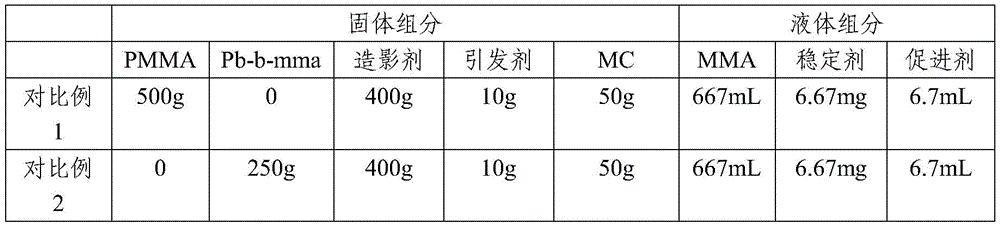

The preparation method comprises the following steps:
comparative examples 1 and 2 are the same as example one, and are not detailed one by one;
comparative example 3 differs from example one in that:
mixing the solid component A and the solid component B to obtain powder, and mixing the powder with the liquid component to obtain the product.
The properties of the PMMA bone cements prepared in the respective examples and comparative examples were measured, and the results thereof are shown in table 5.
TABLE 5 comparison of PMMA bone cement properties obtained in examples and comparative examples
| Temperature reached by heat release | Compressive strength | |
| Example 1 | 50℃ | 70MPa |
| Example 2 | 60℃ | 80MPa |
| Example 3 | 60℃ | 90MPa |
| Example 4 | 55℃ | 110MPa |
| Comparative example 1 | 92℃ | 30MPa |
| Comparative example 2 | 90℃ | 20MPa |
| Comparative example 3 | 50℃ | 50MPa |
As can be seen from the comparison in Table 5, the PMMA bone cement provided by the invention emits 50-60 ℃ of heat during polymerization reaction, and has excellent mechanical properties and higher compressive strength.
In addition, the PMMA bone cement provided by the invention has the compression modulus of 1.1-1.2 GPa, the bending strength of 50-60 MPa and the bending modulus of 1.6-2.5 GPa after being cured for 24 hours.
By implementing the invention, the PMMA bone cement which has high compressive strength and low elastic modulus and has biocompatibility obviously improved compared with that of the pure PMMA bone cement can be obtained. In the aspect of mechanical property, the novel material obviously reduces the compression elastic modulus of the novel material while maintaining the strength of a bone cement solidified body, is favorable for reducing the hardness of the bone cement for vertebroplasty, reduces the abrasion of the bone cement to bone tissues at an implanted part, and reduces the incidence rate of secondary fracture of adjacent vertebras. In the aspect of biocompatibility, mineralized collagen forms a large number of osteogenic active sites on the surface of the bone cement solidified body, so that new bone tissues are guided to grow into micropores formed on the surface of the degraded bone cement solidified body while being degraded and absorbed in vivo, and finally, the bone tissues form organic osseointegration on the bone cement, and the bone cement is anchored at an implantation part and is in osseointegration with autologous bone, thereby being beneficial to improving the stability of bone adhesion and filling materials at the implantation part, preventing the bone cement from loosening and even displacing at the implantation part, and further ensuring that the novel material is safer and more reliable to use.
Therefore, the PMMA bone cement provided by the invention has obvious advantages, can effectively reduce the generation of the complications of the existing PMMA bone cement, and has wide application prospect.
In addition, the preparation method provided by the invention also limits the adding sequence of each component, and the solid component A is firstly mixed with the liquid component for polymerization reaction and then mixed with the solid component B, so that the prepared PMMA bone cement has excellent mechanical properties.
Finally, it should be noted that: the above examples are only intended to illustrate the technical solution of the present invention, but not to limit it; although the present invention has been described in detail with reference to the foregoing embodiments, it will be understood by those of ordinary skill in the art that: the technical solutions described in the foregoing embodiments may still be modified, or some technical features may be equivalently replaced; and such modifications or substitutions do not depart from the spirit and scope of the corresponding technical solutions of the embodiments of the present invention.
Claims (9)
1. A preparation method of polymethyl methacrylate bone cement is characterized by comprising the following steps:
(1) firstly, uniformly mixing the solid component A and the liquid component to obtain a bone cement precursor;
(2) adding a solid component B into the bone cement precursor and uniformly mixing to obtain a polymethyl methacrylate bone cement;
the solid component comprises:
a solid component A, which comprises polymethyl methacrylate, methyl methacrylate-styrene block copolymer, contrast agent and initiator; the molecular weight of the polymethyl methacrylate is 150,000-260,000, and the molecular weight of the methyl methacrylate-styrene segmented copolymer is 100,000-300,000;
a solid component B comprising mineralized collagen;
the liquid component comprises: methyl methacrylate monomer, stabilizer and accelerator;
the solid components comprise the following components in percentage by mass:
the mass ratio of the polymethyl methacrylate to the methyl methacrylate-styrene block copolymer is 9:1, and PMMA/PS is 70: 30.
2. The method according to claim 1, wherein the solid component and the liquid component are respectively measured in g and mL, and the using ratio of the solid component to the liquid component is (1.5-3): 1.
3. the method according to claim 1, wherein the raw material for preparing mineralized collagen comprises type I collagen, calcium-containing material, and phosphorus-containing material; the mass ratio of the type I collagen to the calcium in the calcium-containing substance to the phosphorus in the phosphorus-containing substance is 1: (0.4-6.4): (0.31-9.92).
4. The method according to claim 3, wherein the raw material for preparing mineralized collagen further comprises an enhancer, and the enhancer is composed of calcium phosphorus material and/or polyester material.
5. The method of claim 4, wherein the calcium-phosphorus material has a particle size of 100nm to 12 μm, and the composition comprises one or more of hydroxyapatite, α -tricalcium phosphate, β -tricalcium phosphate, octacalcium phosphate, and amorphous calcium phosphate; and/or
The molecular weight of the polyester material is 80,000-500,000, the particle size is 1-200 mu m, and the polyester material comprises one or more of polylactic acid, polyglycolic acid and polylactic acid-glycolic acid copolymer.
6. The method according to claim 5, wherein the calcium phosphate material is hydroxyapatite.
7. The method according to claim 5, wherein the polyester-based material is polylactic acid.
8. The method of claim 1, wherein the contrast agent comprises barium sulfate or zirconium oxide;
the initiator is benzoyl peroxide.
9. The method according to claim 1, wherein the stabilizer comprises hydroquinone and/or p-tert-butylcatechol in an amount of 10 to 100 ppm;
the accelerant is N, N-dimethyl-p-toluidine, and the content of the accelerant is 1-3%.
Priority Applications (1)
| Application Number | Priority Date | Filing Date | Title |
|---|---|---|---|
| CN201810084359.XA CN108096629B (en) | 2018-01-29 | 2018-01-29 | Polymethyl methacrylate bone cement and preparation method thereof |
Applications Claiming Priority (1)
| Application Number | Priority Date | Filing Date | Title |
|---|---|---|---|
| CN201810084359.XA CN108096629B (en) | 2018-01-29 | 2018-01-29 | Polymethyl methacrylate bone cement and preparation method thereof |
Publications (2)
| Publication Number | Publication Date |
|---|---|
| CN108096629A CN108096629A (en) | 2018-06-01 |
| CN108096629B true CN108096629B (en) | 2021-08-06 |
Family
ID=62221372
Family Applications (1)
| Application Number | Title | Priority Date | Filing Date |
|---|---|---|---|
| CN201810084359.XA Active CN108096629B (en) | 2018-01-29 | 2018-01-29 | Polymethyl methacrylate bone cement and preparation method thereof |
Country Status (1)
| Country | Link |
|---|---|
| CN (1) | CN108096629B (en) |
Families Citing this family (3)
| Publication number | Priority date | Publication date | Assignee | Title |
|---|---|---|---|---|
| CN109316627A (en) * | 2018-10-26 | 2019-02-12 | 中国医学科学院北京协和医院 | A new type of artificial bone material and its preparation method and application |
| CN109331226A (en) * | 2018-10-26 | 2019-02-15 | 中国医学科学院北京协和医院 | A kind of modified mineralized collagen artificial bone material and its preparation method and application |
| CN112206347B (en) * | 2020-10-14 | 2022-06-03 | 中山大学 | A kind of composite bone cement with molecular weight matching enhanced performance and its preparation method and application |
Citations (9)
| Publication number | Priority date | Publication date | Assignee | Title |
|---|---|---|---|---|
| DE102007050768A1 (en) * | 2007-10-22 | 2009-04-23 | Heraeus Medical Gmbh | Polymethylmethacrylate bone cement |
| JP2009101159A (en) * | 2007-10-22 | 2009-05-14 | Heraeus Medical Gmbh | Paste-like polymethyl methacrylate bone cement |
| CN101934097A (en) * | 2010-08-19 | 2011-01-05 | 马文 | Injectable composite bone cement of hydroxyapatite-PMMA containing strontium, preparation method and application thereof |
| CN102333553A (en) * | 2009-02-25 | 2012-01-25 | 国立大学法人京都大学 | Bone cement composition, bone cement composition kit, and method for forming bone cement cured body |
| CN103800946A (en) * | 2014-01-28 | 2014-05-21 | 北京奥精医药科技有限公司 | Mineralized collagen composite bone adhering and filling material |
| CN106512104A (en) * | 2016-10-31 | 2017-03-22 | 北京奥精医药科技有限公司 | Mineralized collagen-based alveolar bone repair material and preparation method thereof |
| CN106620842A (en) * | 2015-09-10 | 2017-05-10 | 贺利氏医疗有限责任公司 | Polymethylmethacrylate bone cement with adjustable initial viscosity, and a method for producing a bone cement dough with variable initial viscosity |
| CN106729974A (en) * | 2016-12-22 | 2017-05-31 | 宁波华科润生物科技有限公司 | A kind of low temperature injectable acrylic resin bone cement and preparation method thereof |
| CN107050522A (en) * | 2016-10-20 | 2017-08-18 | 深圳先进技术研究院 | Composition and its application of nano combined bone cement can be formed |
-
2018
- 2018-01-29 CN CN201810084359.XA patent/CN108096629B/en active Active
Patent Citations (9)
| Publication number | Priority date | Publication date | Assignee | Title |
|---|---|---|---|---|
| DE102007050768A1 (en) * | 2007-10-22 | 2009-04-23 | Heraeus Medical Gmbh | Polymethylmethacrylate bone cement |
| JP2009101159A (en) * | 2007-10-22 | 2009-05-14 | Heraeus Medical Gmbh | Paste-like polymethyl methacrylate bone cement |
| CN102333553A (en) * | 2009-02-25 | 2012-01-25 | 国立大学法人京都大学 | Bone cement composition, bone cement composition kit, and method for forming bone cement cured body |
| CN101934097A (en) * | 2010-08-19 | 2011-01-05 | 马文 | Injectable composite bone cement of hydroxyapatite-PMMA containing strontium, preparation method and application thereof |
| CN103800946A (en) * | 2014-01-28 | 2014-05-21 | 北京奥精医药科技有限公司 | Mineralized collagen composite bone adhering and filling material |
| CN106620842A (en) * | 2015-09-10 | 2017-05-10 | 贺利氏医疗有限责任公司 | Polymethylmethacrylate bone cement with adjustable initial viscosity, and a method for producing a bone cement dough with variable initial viscosity |
| CN107050522A (en) * | 2016-10-20 | 2017-08-18 | 深圳先进技术研究院 | Composition and its application of nano combined bone cement can be formed |
| CN106512104A (en) * | 2016-10-31 | 2017-03-22 | 北京奥精医药科技有限公司 | Mineralized collagen-based alveolar bone repair material and preparation method thereof |
| CN106729974A (en) * | 2016-12-22 | 2017-05-31 | 宁波华科润生物科技有限公司 | A kind of low temperature injectable acrylic resin bone cement and preparation method thereof |
Non-Patent Citations (2)
| Title |
|---|
| Properties of novel PMMA-co-EHA bone cements filled with hydroxyapatite;Ferreira等;《Polymer Composites》;20131017;第35卷(第4期);759-767 * |
| 改性PMMA骨水泥的临床研究进展;梁佩清等;《功能材料》;20170414;第48卷(第2期);2048-2054 * |
Also Published As
| Publication number | Publication date |
|---|---|
| CN108096629A (en) | 2018-06-01 |
Similar Documents
| Publication | Publication Date | Title |
|---|---|---|
| Huang et al. | The long-term behaviors and differences in bone reconstruction of three polymer-based scaffolds with different degradability | |
| Zhang et al. | The development of collagen based composite scaffolds for bone regeneration | |
| CN102824657B (en) | Bone restoration material and preparation method thereof | |
| Bendtsen et al. | Synthesis and characterization of a novel injectable alginate–collagen–hydroxyapatite hydrogel for bone tissue regeneration | |
| Meng et al. | Effects of adding resorbable chitosan microspheres to calcium phosphate cements for bone regeneration | |
| Gyawali et al. | Citrate-based biodegradable injectable hydrogel composites for orthopedic applications | |
| Abd Razak et al. | Biodegradable polymers and their bone applications: a review | |
| JP5049119B2 (en) | Biocompatible bone implant composition and method for repairing bone defects | |
| US6165486A (en) | Biocompatible compositions and methods of using same | |
| CN103668940B (en) | A kind of surface modified fibre strengthens composite bone cement and its preparation method and application | |
| JPH0663118A (en) | Bone prosthetic material containing calcium carbonate particle dispersed in biologically absorbable polymer matrix | |
| WO2011137292A2 (en) | Injectable, load-bearing cell/microbead/calcium phosphate bone paste for bone tissue engineering | |
| Shi et al. | A bioactive magnesium phosphate cement incorporating chondroitin sulfate for bone regeneration | |
| WO2015113482A1 (en) | Mineralized collagen composite bone cementing and filling material | |
| CN106421928A (en) | Hydroxyapatite/polylactic acid composite material degradable in human bodies and method for preparing hydroxyapatite/polylactic acid composite material | |
| CN108096629B (en) | Polymethyl methacrylate bone cement and preparation method thereof | |
| CN112023120B (en) | An injectable prefilled bone repair granule and its preparation method and application | |
| Victor et al. | Bioactive, mechanically favorable, and biodegradable copolymer nanocomposites for orthopedic applications | |
| Ma et al. | Poly (propylene fumarate)/β-calcium phosphate composites for enhanced bone repair | |
| EP4178634B1 (en) | Integrated core-shell bioactive structure for the regeneration of bone and osteochondral tissues | |
| Chen et al. | Reconstruction of calvarial defect using a tricalcium phosphate-oligomeric proanthocyanidins cross-linked gelatin composite | |
| Dong et al. | Silk fibroin hydrogels induced and reinforced by acidic calcium phosphate–A simple way of producing bioactive and drug-loadable composites for biomedical applications | |
| KR101815367B1 (en) | Acrylic bone cement composite comprising calcium phosphate microsphere uniformly spreaded therein and a preparation method thereof | |
| EP1086711B1 (en) | Ceramic-polymer composites | |
| CN102989041A (en) | Chitin fiber reinforced collagen base bone tissue engineering scaffold with compounded human mesenchymal stem cells and preparation method |
Legal Events
| Date | Code | Title | Description |
|---|---|---|---|
| PB01 | Publication | ||
| PB01 | Publication | ||
| SE01 | Entry into force of request for substantive examination | ||
| SE01 | Entry into force of request for substantive examination | ||
| TA01 | Transfer of patent application right |
Effective date of registration: 20210616 Address after: 100085 a305, 3rd floor, No.5 Kaifa Road, Haidian District, Beijing Applicant after: Aojing Medical Technology Co.,Ltd. Address before: 100176 5th floor, building 1, aipuyi building, No.1 yard, Disheng East Road, Yizhuang Development Zone, Daxing District, Beijing Applicant before: Beijing Allgens Medical Science and Technology Co.,Ltd. |
|
| TA01 | Transfer of patent application right | ||
| GR01 | Patent grant | ||
| GR01 | Patent grant |