CN108026103B - Method for preparing cytotoxic benzodiazepine derivatives - Google Patents
Method for preparing cytotoxic benzodiazepine derivatives Download PDFInfo
- Publication number
- CN108026103B CN108026103B CN201680053093.1A CN201680053093A CN108026103B CN 108026103 B CN108026103 B CN 108026103B CN 201680053093 A CN201680053093 A CN 201680053093A CN 108026103 B CN108026103 B CN 108026103B
- Authority
- CN
- China
- Prior art keywords
- formula
- compound
- reacting
- salt
- protecting group
- Prior art date
- Legal status (The legal status is an assumption and is not a legal conclusion. Google has not performed a legal analysis and makes no representation as to the accuracy of the status listed.)
- Expired - Fee Related
Links
Images


Classifications
-
- C—CHEMISTRY; METALLURGY
- C07—ORGANIC CHEMISTRY
- C07K—PEPTIDES
- C07K5/00—Peptides containing up to four amino acids in a fully defined sequence; Derivatives thereof
- C07K5/04—Peptides containing up to four amino acids in a fully defined sequence; Derivatives thereof containing only normal peptide links
- C07K5/06—Dipeptides
- C07K5/06008—Dipeptides with the first amino acid being neutral
- C07K5/06017—Dipeptides with the first amino acid being neutral and aliphatic
-
- C—CHEMISTRY; METALLURGY
- C07—ORGANIC CHEMISTRY
- C07D—HETEROCYCLIC COMPOUNDS
- C07D519/00—Heterocyclic compounds containing more than one system of two or more relevant hetero rings condensed among themselves or condensed with a common carbocyclic ring system not provided for in groups C07D453/00 or C07D455/00
-
- A—HUMAN NECESSITIES
- A61—MEDICAL OR VETERINARY SCIENCE; HYGIENE
- A61K—PREPARATIONS FOR MEDICAL, DENTAL OR TOILETRY PURPOSES
- A61K31/00—Medicinal preparations containing organic active ingredients
- A61K31/33—Heterocyclic compounds
- A61K31/395—Heterocyclic compounds having nitrogen as a ring hetero atom, e.g. guanethidine or rifamycins
- A61K31/55—Heterocyclic compounds having nitrogen as a ring hetero atom, e.g. guanethidine or rifamycins having seven-membered rings, e.g. azelastine, pentylenetetrazole
- A61K31/551—Heterocyclic compounds having nitrogen as a ring hetero atom, e.g. guanethidine or rifamycins having seven-membered rings, e.g. azelastine, pentylenetetrazole having two nitrogen atoms, e.g. dilazep
- A61K31/5513—1,4-Benzodiazepines, e.g. diazepam or clozapine
- A61K31/5517—1,4-Benzodiazepines, e.g. diazepam or clozapine condensed with five-membered rings having nitrogen as a ring hetero atom, e.g. imidazobenzodiazepines, triazolam
-
- A—HUMAN NECESSITIES
- A61—MEDICAL OR VETERINARY SCIENCE; HYGIENE
- A61P—SPECIFIC THERAPEUTIC ACTIVITY OF CHEMICAL COMPOUNDS OR MEDICINAL PREPARATIONS
- A61P35/00—Antineoplastic agents
-
- C—CHEMISTRY; METALLURGY
- C07—ORGANIC CHEMISTRY
- C07C—ACYCLIC OR CARBOCYCLIC COMPOUNDS
- C07C303/00—Preparation of esters or amides of sulfuric acids; Preparation of sulfonic acids or of their esters, halides, anhydrides or amides
- C07C303/26—Preparation of esters or amides of sulfuric acids; Preparation of sulfonic acids or of their esters, halides, anhydrides or amides of esters of sulfonic acids
- C07C303/28—Preparation of esters or amides of sulfuric acids; Preparation of sulfonic acids or of their esters, halides, anhydrides or amides of esters of sulfonic acids by reaction of hydroxy compounds with sulfonic acids or derivatives thereof
-
- C—CHEMISTRY; METALLURGY
- C07—ORGANIC CHEMISTRY
- C07C—ACYCLIC OR CARBOCYCLIC COMPOUNDS
- C07C309/00—Sulfonic acids; Halides, esters, or anhydrides thereof
- C07C309/63—Esters of sulfonic acids
- C07C309/64—Esters of sulfonic acids having sulfur atoms of esterified sulfo groups bound to acyclic carbon atoms
- C07C309/65—Esters of sulfonic acids having sulfur atoms of esterified sulfo groups bound to acyclic carbon atoms of a saturated carbon skeleton
-
- C—CHEMISTRY; METALLURGY
- C07—ORGANIC CHEMISTRY
- C07D—HETEROCYCLIC COMPOUNDS
- C07D487/00—Heterocyclic compounds containing nitrogen atoms as the only ring hetero atoms in the condensed system, not provided for by groups C07D451/00 - C07D477/00
- C07D487/02—Heterocyclic compounds containing nitrogen atoms as the only ring hetero atoms in the condensed system, not provided for by groups C07D451/00 - C07D477/00 in which the condensed system contains two hetero rings
- C07D487/04—Ortho-condensed systems
-
- C—CHEMISTRY; METALLURGY
- C07—ORGANIC CHEMISTRY
- C07F—ACYCLIC, CARBOCYCLIC OR HETEROCYCLIC COMPOUNDS CONTAINING ELEMENTS OTHER THAN CARBON, HYDROGEN, HALOGEN, OXYGEN, NITROGEN, SULFUR, SELENIUM OR TELLURIUM
- C07F7/00—Compounds containing elements of Groups 4 or 14 of the Periodic Table
- C07F7/02—Silicon compounds
- C07F7/08—Compounds having one or more C—Si linkages
- C07F7/18—Compounds having one or more C—Si linkages as well as one or more C—O—Si linkages
- C07F7/1804—Compounds having Si-O-C linkages
- C07F7/1872—Preparation; Treatments not provided for in C07F7/20
- C07F7/188—Preparation; Treatments not provided for in C07F7/20 by reactions involving the formation of Si-O linkages
-
- C—CHEMISTRY; METALLURGY
- C07—ORGANIC CHEMISTRY
- C07K—PEPTIDES
- C07K5/00—Peptides containing up to four amino acids in a fully defined sequence; Derivatives thereof
- C07K5/04—Peptides containing up to four amino acids in a fully defined sequence; Derivatives thereof containing only normal peptide links
- C07K5/08—Tripeptides
- C07K5/0802—Tripeptides with the first amino acid being neutral
- C07K5/0804—Tripeptides with the first amino acid being neutral and aliphatic
-
- Y—GENERAL TAGGING OF NEW TECHNOLOGICAL DEVELOPMENTS; GENERAL TAGGING OF CROSS-SECTIONAL TECHNOLOGIES SPANNING OVER SEVERAL SECTIONS OF THE IPC; TECHNICAL SUBJECTS COVERED BY FORMER USPC CROSS-REFERENCE ART COLLECTIONS [XRACs] AND DIGESTS
- Y02—TECHNOLOGIES OR APPLICATIONS FOR MITIGATION OR ADAPTATION AGAINST CLIMATE CHANGE
- Y02P—CLIMATE CHANGE MITIGATION TECHNOLOGIES IN THE PRODUCTION OR PROCESSING OF GOODS
- Y02P20/00—Technologies relating to chemical industry
- Y02P20/50—Improvements relating to the production of bulk chemicals
- Y02P20/55—Design of synthesis routes, e.g. reducing the use of auxiliary or protecting groups
Landscapes
- Chemical & Material Sciences (AREA)
- Organic Chemistry (AREA)
- Health & Medical Sciences (AREA)
- Medicinal Chemistry (AREA)
- Life Sciences & Earth Sciences (AREA)
- General Health & Medical Sciences (AREA)
- Chemical Kinetics & Catalysis (AREA)
- Veterinary Medicine (AREA)
- Pharmacology & Pharmacy (AREA)
- Animal Behavior & Ethology (AREA)
- Public Health (AREA)
- Genetics & Genomics (AREA)
- Biophysics (AREA)
- Molecular Biology (AREA)
- Proteomics, Peptides & Aminoacids (AREA)
- Biochemistry (AREA)
- General Chemical & Material Sciences (AREA)
- Nuclear Medicine, Radiotherapy & Molecular Imaging (AREA)
- Epidemiology (AREA)
- Pharmaceuticals Containing Other Organic And Inorganic Compounds (AREA)
- Organic Low-Molecular-Weight Compounds And Preparation Thereof (AREA)
- Nitrogen Condensed Heterocyclic Rings (AREA)
- Plural Heterocyclic Compounds (AREA)
- Nitrogen And Oxygen Or Sulfur-Condensed Heterocyclic Ring Systems (AREA)
- Low-Molecular Organic Synthesis Reactions Using Catalysts (AREA)
- Medicines That Contain Protein Lipid Enzymes And Other Medicines (AREA)
- Medicines Containing Antibodies Or Antigens For Use As Internal Diagnostic Agents (AREA)
- Pyridine Compounds (AREA)
- Medicinal Preparation (AREA)
Abstract
The invention relates to the preparation of indolinobenzodiazepines
Description
Reference to related applications
The present application claims the benefit of filing dates of united states provisional application No. 62/327,973 filed 2016, 26, 4, and 62/195,023 filed 2015, 7, 21, in accordance with 35u.s.c. § 119 (e). The entire contents of each of the above-referenced applications are incorporated herein by reference.
Technical Field
The invention relates to a process for the preparation of cytotoxic indolinobenzodiazepines A novel process for the preparation of derivatives.
Background
It has been shown that benzodiazepines with two imine functions have been shown to be compatible with the previously disclosed benzodiazepines with two imine functions Derivatives of indolinobenzodiazepines having one imine function and one amine function
 Dimeric cell-binding agent conjugates show a much higher therapeutic index (ratio of maximum tolerated dose to minimum effective dose) in vivo. See, for example, WO 2012/128868. Preparation of indolinobenzodiazepines having one imine function and one amine function as previously disclosed
 The dimer method relates to indolinobenzodiazepines having two imine functions
 Partial reduction of the dimer. This partial reduction step generally results in the formation of fully reduced by-products and unreacted starting materials, which require cumbersome purification steps and result in low yields.
Thus, there is a need for improved preparations of indolinobenzodiazepines that are more efficient and suitable for large scale production processes A method of preparing a dimer.
Summary of The Invention
The present invention provides a process for the preparation of indolinobenzodiazepines Dimeric compounds and various methods for their synthesis precursors. The process of the present invention can produce the desired dimeric compound in higher yields without the need for cumbersome purification steps compared to previously disclosed processes. These methods are more suitable for large scale production processes.
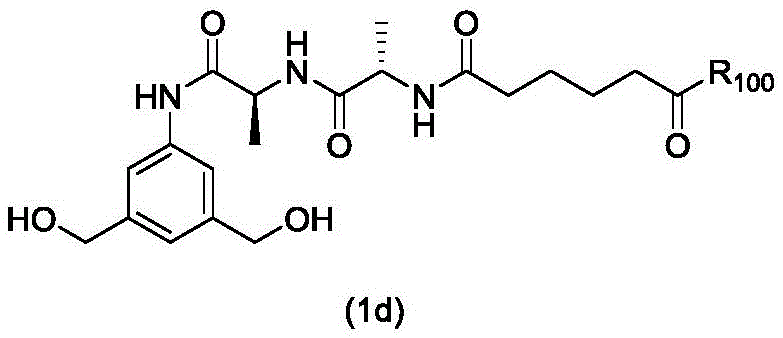
In a first embodiment, the present invention provides a process for preparing a compound of formula (2d),

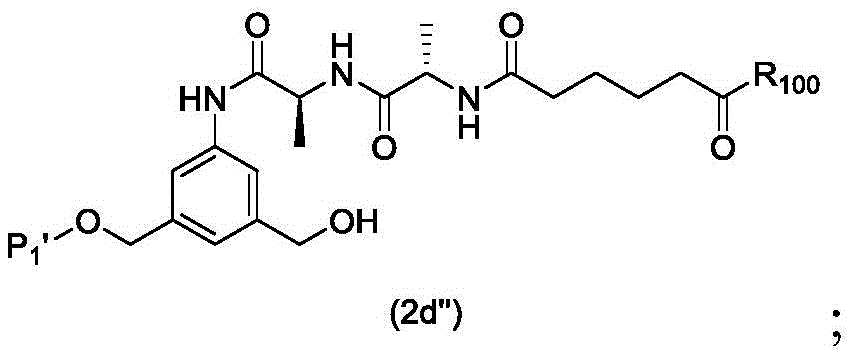
or a salt thereof, the method comprising introducing an alcohol protecting group onto one of the primary alcohols of the compound of formula (1d) by reacting the compound of formula (1d) with an alcohol protecting reagent,

wherein P is1Is an alcohol protecting group; and R is100Is (C)1-C3) An alkoxy group.
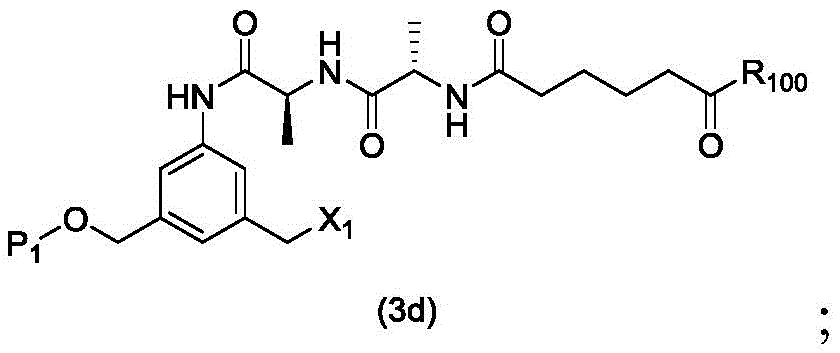
In a second embodiment, the present invention provides a process for preparing a compound of formula (3d)

Or a salt thereof, comprising reacting a halogenating agent, a sulfonating agent or an esterifying agent with a compound of formula (2d),
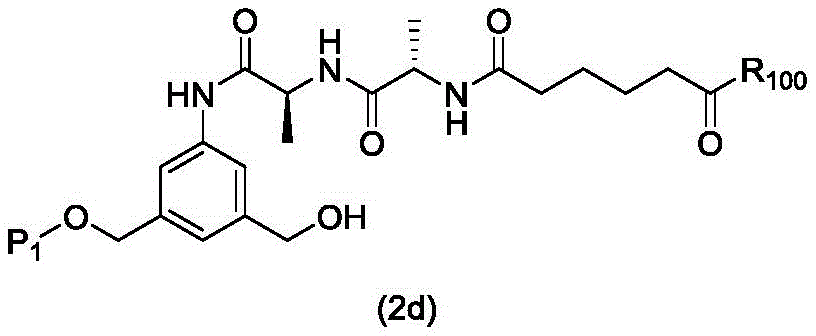
wherein P is1Is an alcohol protecting group; x1Is a leaving group selected from the group consisting of: -Br, -I, -Cl, sulfonate and activated ester (preferably, X)1is-Br, -I or sulfonate); and R is100Is (C)1-C3) An alkoxy group.
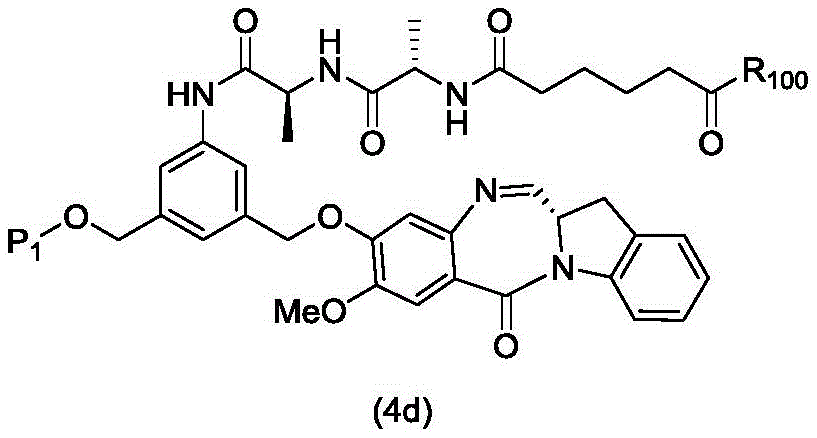
In a third embodiment, the present invention provides a process for preparing a compound of formula (4d),

or a salt thereof, comprising contacting a compound of formula (3d),

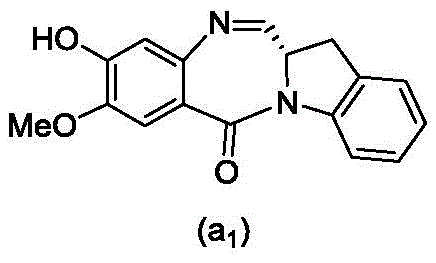
and formula (a)1) The monomer compound (b) of (a) is reacted,

wherein P is1Is an alcohol protecting group; x1Is a leaving group selected from the group consisting of: -Br, -I, -Cl, sulfonate and activated ester (preferably, X)1is-Br, -I or sulfonate); and R is100Is (C)1-C3) An alkoxy group.
In a fourth embodiment, the present invention provides a process for preparing a compound of formula (5d)

Or a salt thereof, comprising contacting a compound of formula (4d),
with an imine reducing agent, in which P1Is an alcohol protecting group; and R is100Is (C)1-C3) An alkoxy group.
In a fifth embodiment, the present invention provides a process for preparing a compound of formula (6d),

or a salt thereof, comprising contacting a compound of formula (5d),

with an alcohol deprotecting reagent in which P is1Is an alcohol protecting group; and R is100Is (C)1-C3) An alkoxy group.
In a sixth embodiment, the present invention provides a process for preparing a compound of formula (7d),
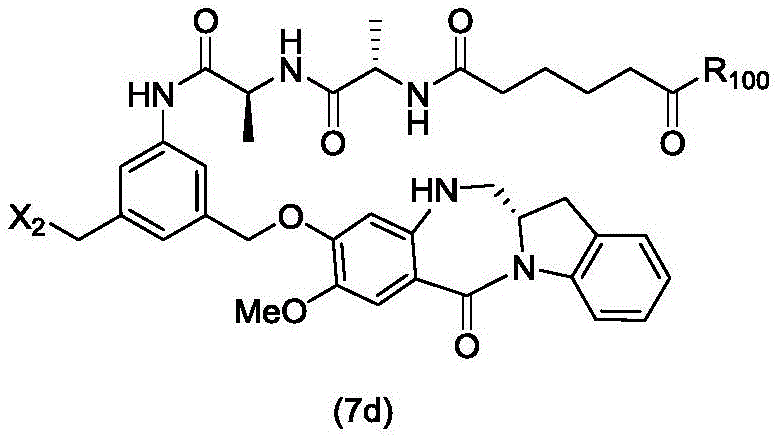
or a salt thereof, comprising reacting a halogenating reagent, a sulfonating reagent or an esterifying reagent with a primary alcohol compound of formula (6d),

wherein X2Is a leaving group selected from the group consisting of: -Br, -I, -Cl, sulfonate and activated ester (preferably, X)2is-Br, -I or sulfonate); and R is100Is (C)1-C3) An alkoxy group.
In a seventh embodiment, the present invention provides a process for preparing a compound of formula (7 d')

Or a salt thereof, comprising reacting a compound of formula (5 d')

With alcohol deprotecting reagents and halogenating reagents, in which P is1' is an acid labile alcohol protecting group; x2' is-Br or-I; and R is100Is (C)1-C3) An alkoxy group.
In an eighth embodiment, the present invention provides a process for preparing a compound of formula (Id')

Or a pharmaceutically acceptable salt thereof, comprising reacting a compound of formula (7d)

And formula (a)1) The monomer compound (b) of (a) is reacted,

wherein R is100Is (C)1-C3) An alkoxy group; and X2Is a leaving group selected from the group consisting of: -Br, -I, -Cl, sulfonate and activated ester (preferably, X)2is-Br, -I or sulfonate).
In a ninth embodiment, the present invention provides a compound of formula (Id'),

or a pharmaceutically acceptable salt thereof, comprising the steps of:
(1) introducing an alcohol protecting group onto one of the primary alcohols of the compound of formula (1d),

to form a compound of formula (2d),

(2) reacting the compound of formula (2d) with a halogenating reagent, a sulfonating reagent or an esterifying reagent to form a compound of formula (3d),
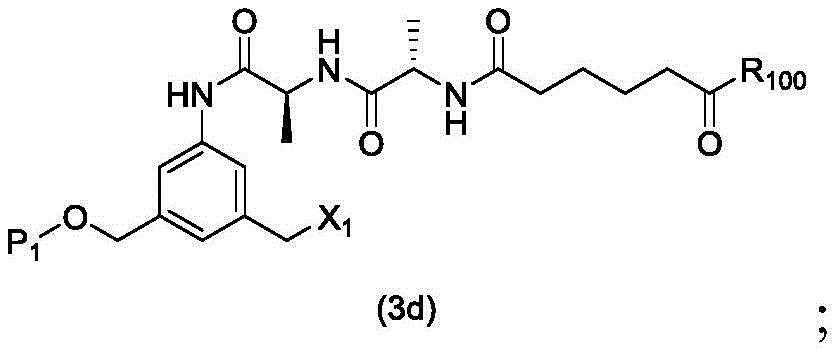
(3) Reacting a compound of formula (3d) with a compound of formula (a)1) The monomer compound (b) of (a) is reacted,

to form a compound of formula (4d),

(4) reacting a compound of formula (4d) with an imine reducing agent to form a compound of formula (5d),

(5) reacting a compound of formula (5d) with an alcohol deprotection reagent to form a compound of formula (6d),

(6) reacting the compound of formula (6d) with a second halogenating reagent, a second sulfonating reagent or a second esterifying reagent to form a compound of formula (7d),

(7) reacting a compound of formula (7d) with a compound of formula (a)1) The monomer compound (b) of (a) is reacted,

to form a compound of formula (Id'); wherein P is1Is an alcohol protecting group; x1And X2Each independently is a leaving group selected from the group consisting of: -Br, -I, -Cl, sulfonate and activated ester (preferably, X)1And X2Each independently-Br, -I, or a sulfonate ester); and R is100Is (C)1-C3) An alkoxy group.
In a tenth embodiment, the present invention provides a process for preparing a compound of formula (Id'),

or a pharmaceutically acceptable salt thereof, comprising the steps of:
(1) introducing an alcohol protecting group onto one of the primary alcohols of the compound of formula (1d),

to form a compound of formula (2 d'),
(2) reacting the compound of formula (2d ') with a halogenating reagent, a sulfonating reagent or an esterifying reagent to form a compound of formula (3 d'),

(3) reacting a compound of formula (3 d') with formula (a)1) The monomer compound (b) of (a) is reacted,

to form a compound of formula (4 d'),

(4) reacting the compound of formula (4d ') with an imine reducing agent to form a compound of formula (5 d'),

(5) reacting the compound of formula (5d ') with an alcohol deprotecting reagent and a halogenating reagent to form a compound of formula (7 d'),

(6) reacting a compound of formula (7 d') with formula (a)1) The monomer compound (b) of (a) is reacted,

to form a compound of formula (Id'), wherein X2' is-Br or-I; and the remaining variables are as described above in the ninth embodiment.
In an eleventh embodiment, the present invention provides a process for preparing a compound of formula (9d)

Or a salt thereof, comprising contacting a compound of formula (4d),

with an alcohol deprotecting reagent in which P is1Is an alcohol protecting group; and R is100Is (C)1-C3) An alkoxy group.
In a twelfth embodiment, the present invention provides a process for preparing a compound of formula (10d),
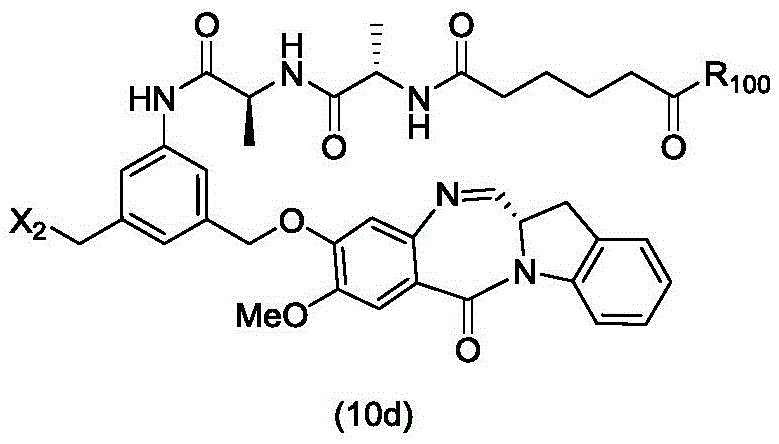
or a salt thereof, comprising reacting a compound of formula (9d) with a halogenating reagent, a sulfonating reagent or an esterifying reagent,

wherein X2is-Br, -I, -Cl, sulfonate ester and activated ester (preferably, X)2is-Br, -I or sulfonate); and R is100Is (C)1-C3) An alkoxy group.
In a thirteenth embodiment, the present invention provides a process for preparing a compound of formula (18d),

or a salt thereof, comprising reacting a compound of formula (10d)

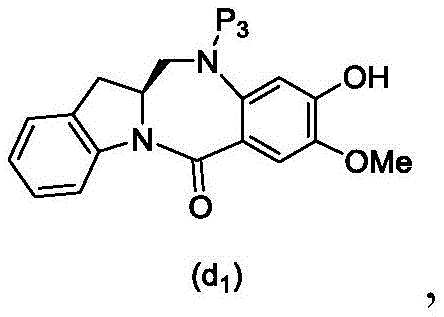
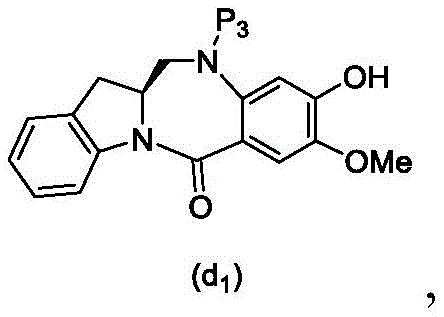
And formula (d)1) The monomer compound (b) of (a) is reacted,

wherein X2Is a leaving group selected from the group consisting of: -Br, -I, -Cl, sulfonate and activated ester (preferably, X)2is-Br, -I or sulfonate); p3Is H or P2;P2Is an amine protecting group; and R is100Is (C)1-C3) An alkoxy group.
In a fourteenth embodiment, the present invention provides a process for preparing a compound of formula (Id'),

or a pharmaceutically acceptable salt thereof, comprising contacting a compound of formula (11d),

with an amine deprotecting reagent, in which P is2Is an amine protecting group; and R is100Is (C)1-C3) An alkoxy group.
In a fifteenth embodiment, the present invention provides a process for preparing a compound of formula (Id'),

or a pharmaceutically acceptable salt thereof, comprising the steps of:
(1) introducing an alcohol protecting group onto one of the primary alcohols of the compound of formula (1d),
to form a compound of formula (2d),

(2) reacting the compound of formula (2d) with a halogenating reagent, a sulfonating reagent or an esterifying reagent to form a compound of formula (3d),
(3) reacting a compound of formula (3d) with a compound of formula (a)1) The monomer compound (b) of (a) is reacted,
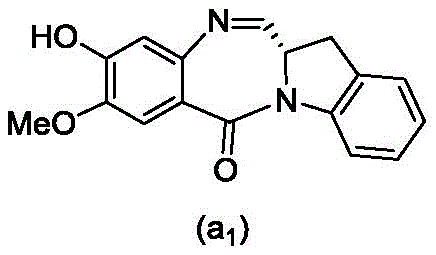
to form a compound of formula (4d),

(4) reacting a compound of formula (4d) with an alcohol deprotection reagent to form a compound of formula (9d),
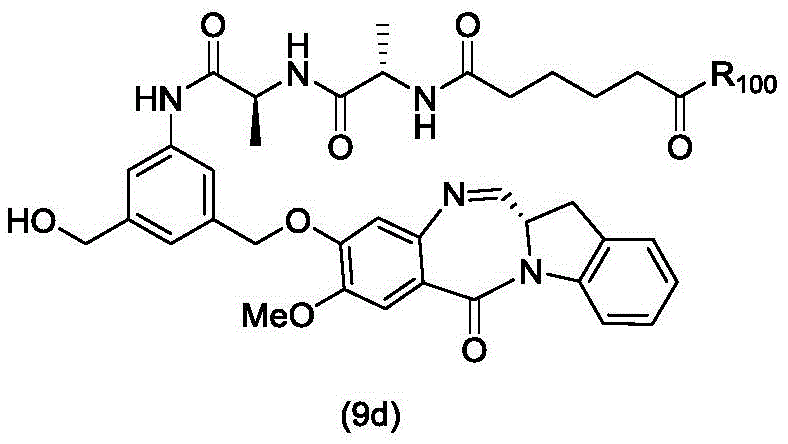
(5) reacting the compound of formula (9d) with a second halogenating reagent, a second sulfonating reagent or a second esterifying reagent to form a compound of formula (10d),

(6) reacting a compound of formula (10d) with a compound of formula (d)1) By reaction of a monomeric compound of

To form a compound of formula (18d),
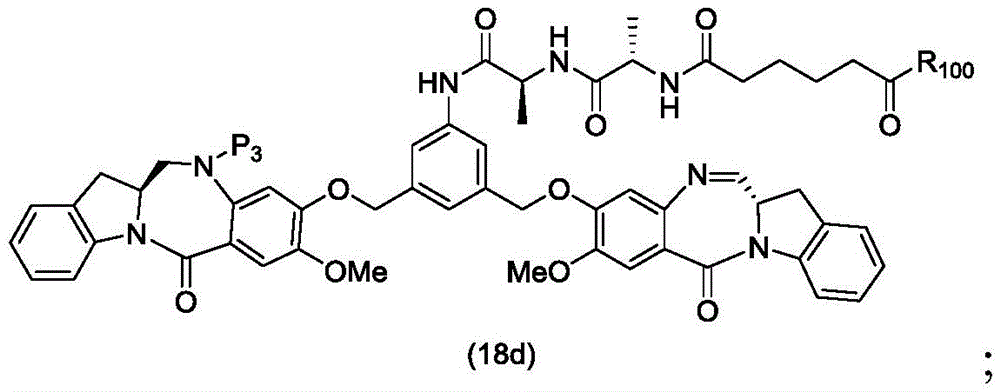
(7) when P is present3In the case of an amine protecting group, reacting a compound of formula (18d) with an amine deprotecting reagent to form a compound of formula (Id'), wherein P1Is an alcohol protecting group; x1And X2Each independently is a leaving group selected from the group consisting of: -Br, -I, -Cl, sulfonate and activated ester (preferably, X)1is-Br, -I or sulfonate); p3Is H or an amine protecting group; and R is100Is prepared from (a)C1-C3) An alkoxy group.
In a sixteenth embodiment, the present invention provides a process for preparing a compound of formula (12d),

or a salt thereof, comprising contacting a compound of formula (1d),

with halogenating, sulfonating or esterifying reagents, in which X1is-Br, -I, sulfonate or activated ester (preferably, X)1is-Br, -I or sulfonate); and R is100Is (C)1-C3) An alkoxy group.
In a seventeenth embodiment, the present invention provides a process for preparing a compound of formula (10 d'),

or a salt thereof, comprising contacting a compound of formula (12d),

and formula (a)1) The monomer compound (b) of (a) is reacted,

wherein X1is-Br, -I, -Cl, sulfonate ester and activated ester (preferably, X)1is-Br, -I or sulfonate); and R is100Is (C)1-C3) An alkoxy group.
In an eighteenth embodiment, the present invention provides a process for preparing a compound of formula (7 d'),
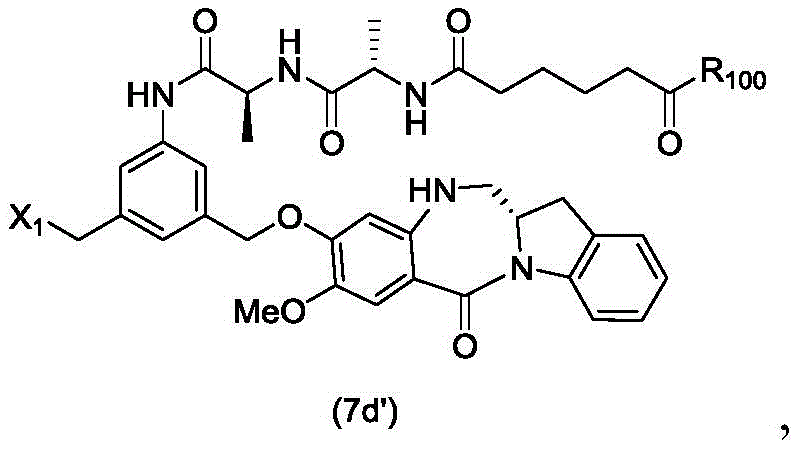
or a salt thereof, comprising reacting a compound of formula (10 d'),

or a salt thereof with an imine reducing agent, wherein X1is-Br, -I, -Cl, sulfonate ester and activated ester (preferably, X)1is-Br, -I or sulfonate); and R is100Is (C)1-C3) An alkoxy group.
In a nineteenth embodiment, the present invention provides a method of preparing a compound of formula (Id'),

or a pharmaceutically acceptable salt thereof, comprising the steps of:
(1) reacting a compound of formula (1d) with a halogenating reagent, a sulfonating reagent or an esterifying reagent,

to form a compound of formula (12d),

(2) reacting a compound of formula (12d) with a compound of formula (a)1) The monomer compound (b) of (a) is reacted,

to form a compound of formula (10 d'),

(3) reacting a compound of formula (10 d') with a compound of formula (d)1) The monomer compound (b) of (a) is reacted,

to form a compound of formula (18d),

(4) when P is present3In the case of an amine protecting group, reacting a compound of formula (18d) with an amine deprotecting reagent to form a compound of formula (Id'), wherein X1is-Br, -I, -Cl, sulfonate ester and activated ester (preferably, X)1is-Br, -I or sulfonate); p3Is H or an amine protecting group; and R is100Is (C)1-C3) An alkoxy group.
In a twentieth embodiment, the present invention provides a process for preparing a compound of formula (Id'),

or a pharmaceutically acceptable salt thereof, comprising the steps of:
(1) reacting a halogenating reagent, a sulfonating reagent or an esterifying reagent with a compound of formula (1d),

to form a compound of formula (12d),

(2) reacting a compound of formula (12d) with a compound of formula (a)1) The monomer compound (b) of (a) is reacted,
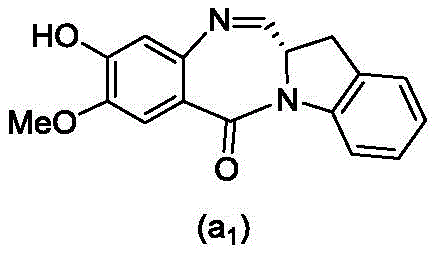
to form a compound of formula (10 d'),

(3) reacting compound (10d ') with an imine reducing reagent to form compound (7 d'),
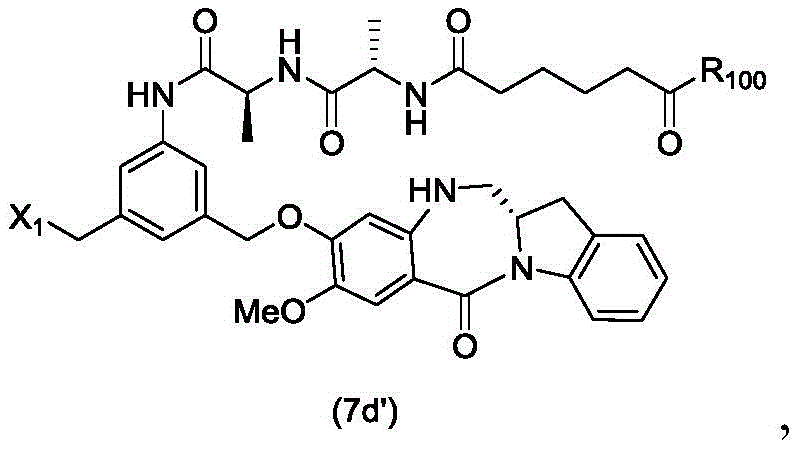
(4) reacting a compound of formula (7 d') with formula (a)1) The monomer compound (b) of (a) is reacted,

to form a compound of formula (Id') or a pharmaceutically acceptable salt thereof, wherein X1is-Br, -I, -Cl, sulfonate or activated ester (preferably, X)1is-Br, -I or sulfonate); and R is100Is (C)1-C3) An alkoxy group.
In a twenty-first embodiment, the present invention provides a process for preparing a compound of formula (Id'),
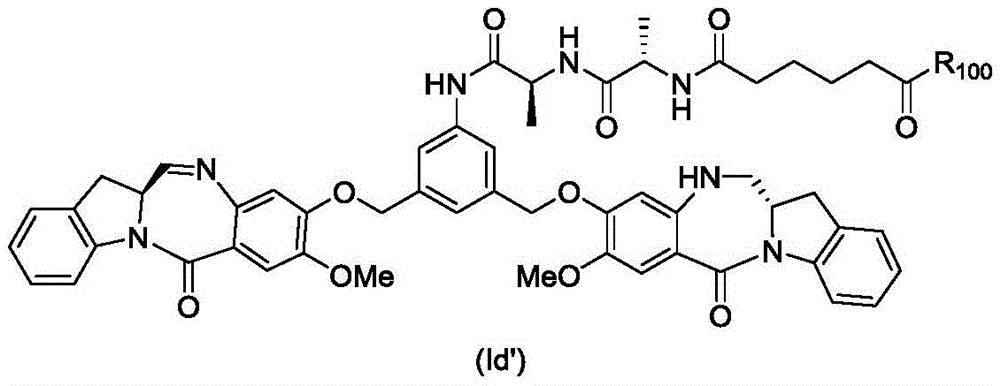
or a pharmaceutically acceptable salt thereof, comprising the steps of:
(1) reacting a halogenating reagent, a sulfonating reagent or an esterifying reagent with a compound of formula (1d),

to form a compound of formula (12d),
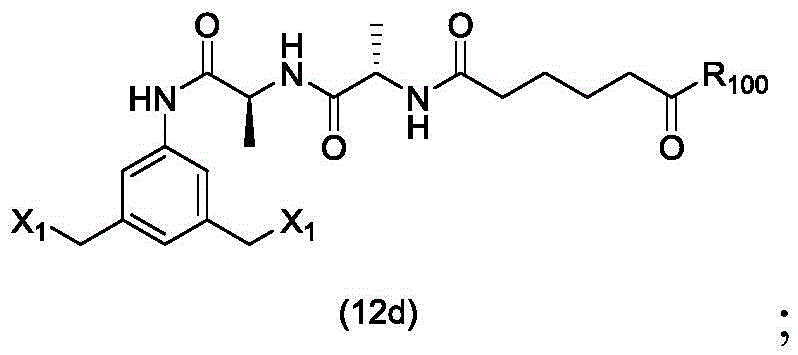
(2) reacting a compound of formula (12d) with a compound of formula (d)1) The monomer compound (b) of (a) is reacted,

to form a compound of formula (7d 1'),

(3) reacting a compound of formula (7d 1') with formula (a)1) The monomer compound (b) of (a) is reacted,
to form a compound of formula (18d),

(4) when P is present3(ii) in the case of an amine protecting group, reacting the compound of formula (18d) with an amine deprotecting reagent to form a compound of formula (Id'); wherein X1is-Br, -I, -Cl, sulfonate or activated ester (preferably, X)1is-Br, -I or sulfonate); p3Is H or an amine protecting group; and R is100Is (C)1-C3) An alkoxy group.
In a twenty-second embodiment, the present invention provides a process for preparing a compound of formula (13d),

or a salt thereof, comprising reacting a chlorinating agent with a compound of formula (2d),

wherein P is1Is an alcohol protecting group; x3is-Cl; and R is100Is (C)1-C3) An alkoxy group.
In a twenty-third embodiment, the present invention provides a process for preparing a compound of formula (14d),
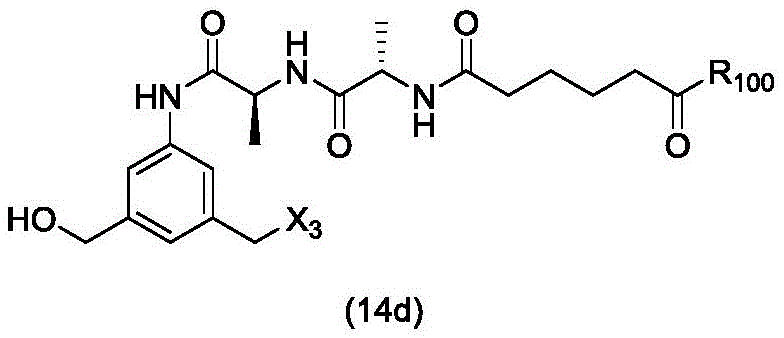
or a salt thereof, comprising reacting a compound of formula (13d)
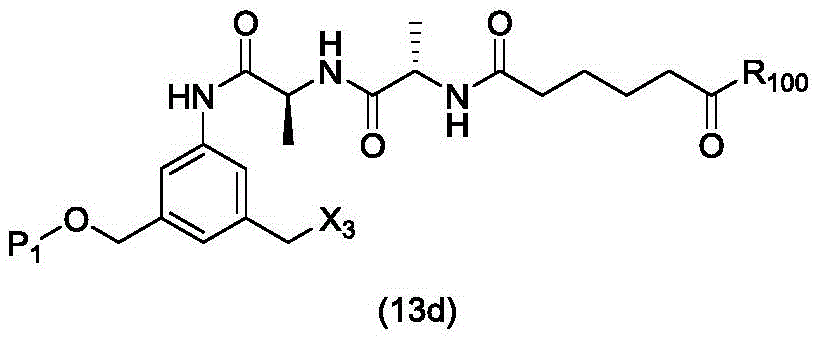
With an alcohol deprotecting reagent in which P is1Is an alcohol protecting group; x3is-Cl; and R is100Is (C)1-C3) An alkoxy group.
In a twenty-fourth embodiment, the present invention provides a method of preparing a compound of formula (15 d):
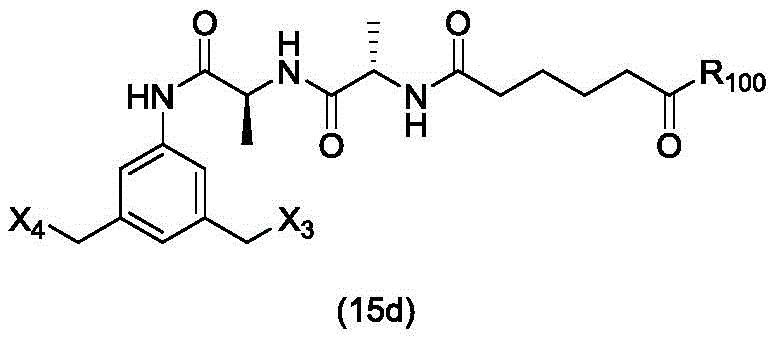
or a salt thereof, comprising reacting a sulfonating agent or an esterifying agent with a compound of formula (14d),

wherein X3is-Cl; x4Is a sulfonate ester or an activated ester (preferably, X)4Is a sulfonate ester); and R is100Is (C)1-C3) An alkoxy group.
In a twenty-fifth embodiment, the present invention provides a method of preparing a compound of formula (20 d):
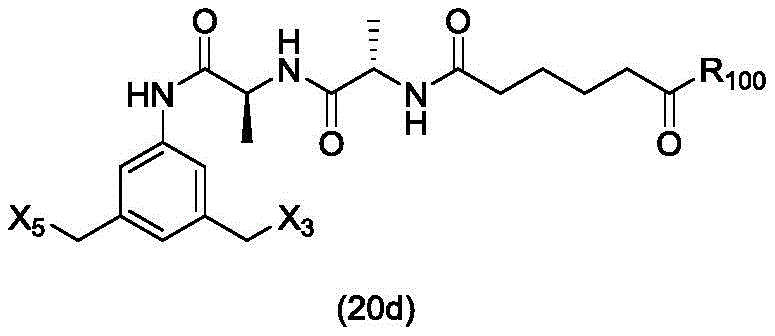
or a salt thereof, comprising reacting a brominating or iodinating agent with a compound of formula (14d),

wherein X3is-Cl; x5is-Br or-I; and R is100Is (C)1-C3) An alkoxy group.
In a twenty-sixth embodiment, the present invention provides a method of preparing a compound of formula (16 d):

or a salt thereof, comprising reacting a compound of formula (15d)

And formula (a)1) The monomer compound (b) of (a) is reacted,

wherein X3is-Cl; x4Is a sulfonate ester or an activated ester (preferably, X)4Is a sulfonate ester); and R is100Is (C)1-C3) An alkoxy group.
In a twenty-seventh embodiment, the present invention provides a process for preparing a compound of formula (16d),
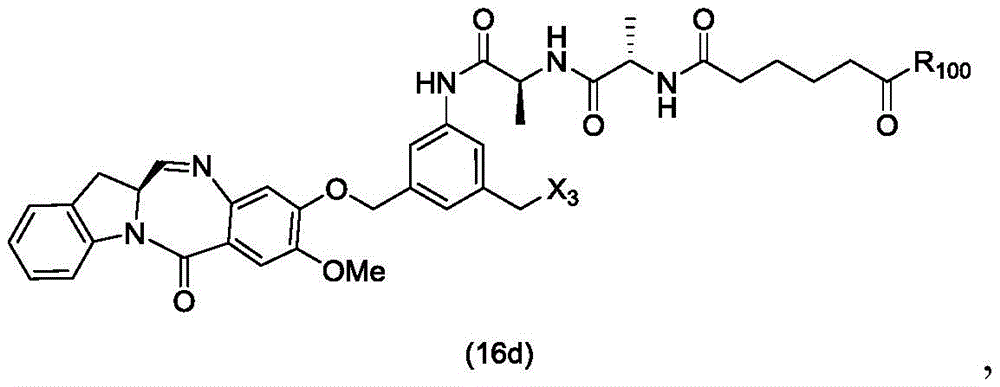
or a salt thereof, comprising reacting a compound of formula (20d)
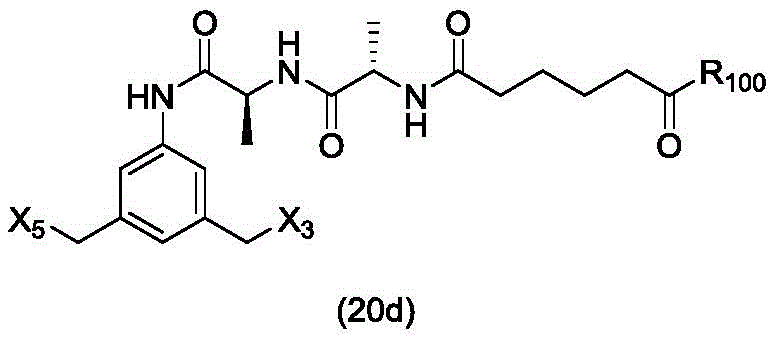
And formula (a)1) The monomer compound (b) of (a) is reacted,
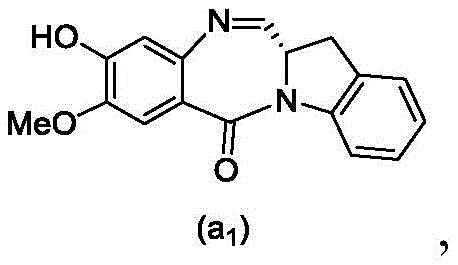
wherein X3is-Cl; x5is-Br or-I; and R is100Is (C)1-C3) An alkoxy group.
In a twenty-eighth embodiment, the present invention provides a process for preparing a compound of formula (16d),

or a salt thereof, comprising reacting a compound of formula (14d)

And formula (a)1) The monomer compound (b) of (a) is reacted,

wherein X3is-Cl; and R is100Is (C)1-C3) An alkoxy group.
In a twenty-ninth embodiment, the present invention provides a method of preparing a compound of formula (18 d):

a method of a pharmaceutically acceptable salt thereof, comprising reacting a compound of formula (16 d):
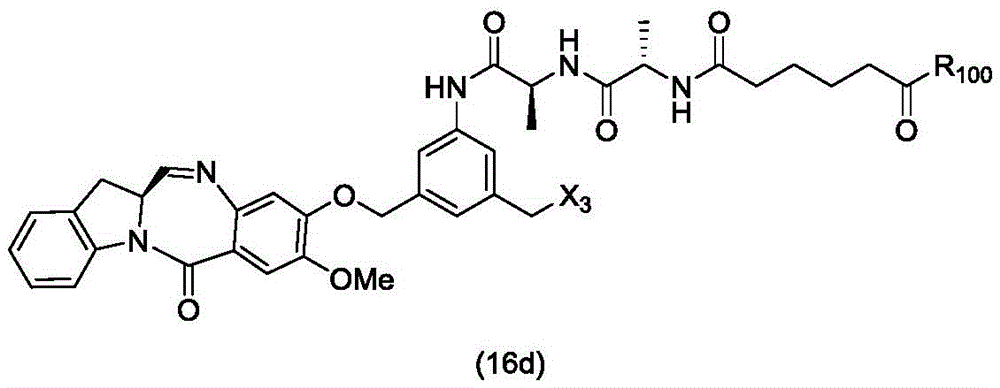
and formula (d)1) Reduced monomer reaction of (a):

wherein X3is-Cl; p3Is H or an amine protecting group; and R is100Is (C)1-C3) An alkoxy group.
In a thirtieth embodiment, the present invention provides a method of preparing a compound of formula (17 d):
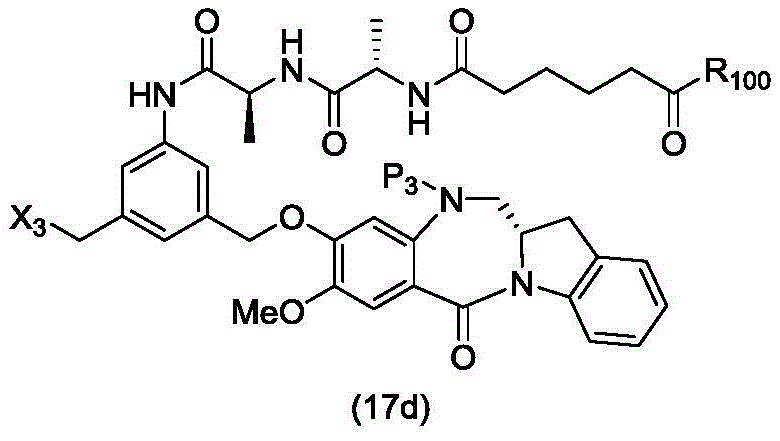
or a salt thereof, comprising reacting a compound of formula (15d)

And formula (d)1) The monomer compound (b) of (a) is reacted,

wherein X3is-Cl; x4Is a sulfonate ester or an activated ester (preferably, X)4Is a sulfonate ester); p3Is H or an amine protecting group; and R is100Is (C)1-C3) An alkoxy group.
In a thirty-first embodiment, the present invention provides a process for preparing a compound of formula (17d),

or a salt thereof, comprising reacting a compound of formula (14d)

And formula (d)1) The monomer compound (b) of (a) is reacted,

wherein X3is-Cl; p3Is H or an amine protecting group; and R is100Is (C)1-C3) An alkoxy group.
In a thirty-second embodiment, the present invention provides a method of preparing a compound of formula (17 d):

or a salt thereof, comprising reacting a compound of formula (20d)

And formula (d)1) The monomer compound (b) of (a) is reacted,

wherein X3is-Cl; x5is-Br or-I; p3Is H or an amine protecting group; and R is100Is (C)1-C3) An alkoxy group.
In a thirty-third embodiment, the present invention provides a method of preparing a compound of formula (17 d'):

or a salt thereof, comprising reacting a compound of formula (16d)

With an imine reducing agent, wherein X3is-Cl; and R is100Is (C)1-C3) An alkoxy group.
In a thirty-fourth embodiment, the present invention provides a process for preparing a compound of formula (18d),

or a pharmaceutically acceptable salt thereof, comprising reacting a compound of formula (17 d):

and formula (a)1) The monomer reaction of (2):

wherein X3is-Cl; p3Is H orAn amine protecting group; and R is100Is (C)1-C3) An alkoxy group.
In a thirty-fifth embodiment, the present invention provides
Preparing a compound of formula (18d),

or a pharmaceutically acceptable salt thereof, comprising the steps of:
(1) reacting a sulphonating or esterifying agent with a compound of formula (14 d):
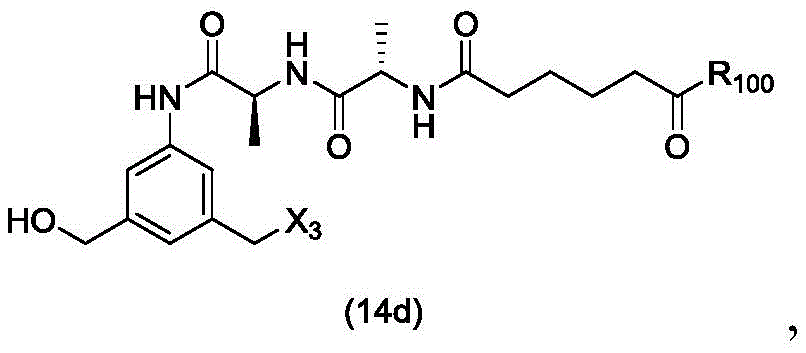
or a salt thereof, to form a compound of formula (15 d):

or a salt thereof;
(2) reacting a compound of formula (15a) with a compound of formula (a)1) The monomer compound (b) of (a) is reacted,

to form a compound of formula (16 d):

or a salt thereof; and
(3) reacting a compound of formula (16d) with a compound of formula (d)1) Reduced monomer reaction of (a):

to form a compound of formula (18d) or a pharmaceutically acceptable salt thereof, wherein X3is-Cl; x4Is a sulfonate or an activated ester (preferably, a sulfonate); p1Is an alcohol protecting group; p3Is H or an amine protecting group; and R is100Is (C)1-C3) An alkoxy group.
In a thirty-sixth embodiment, the present invention provides a process for preparing a compound of formula (18d),
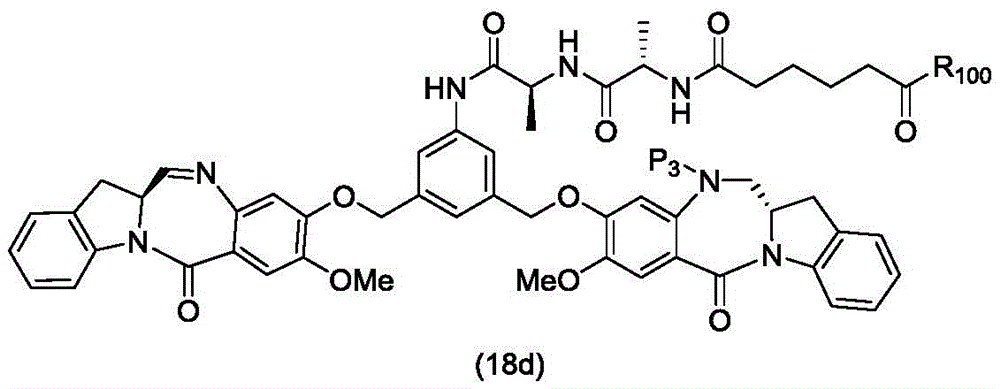
or a pharmaceutically acceptable salt thereof, comprising the steps of:
(1) reacting a compound of formula (14 d):
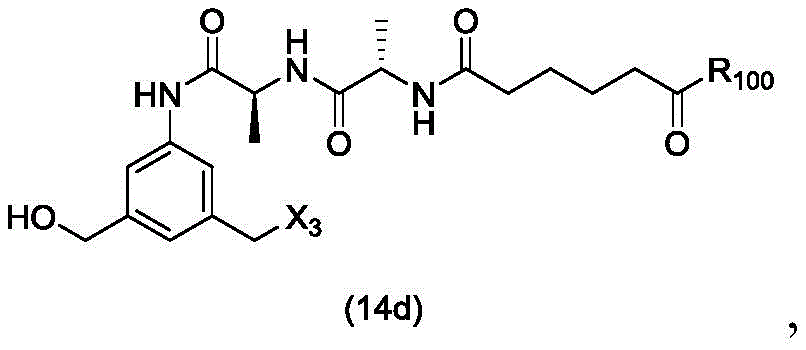
or a salt thereof with formula (a)1) The monomer compound (b) of (a) is reacted,
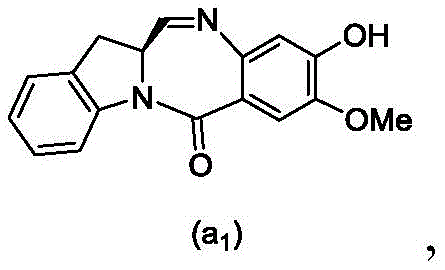
to form a compound of formula (16 d):

or a salt thereof; and
(2) reacting a compound of formula (16d) with a compound of formula (d)1) Reduced monomer reaction of (a):

to form a compound of formula (18d) or a pharmaceutically acceptable salt thereof, wherein X3is-Cl; p1For alcohol protectionA group; p3Is H or an amine protecting group; and R is100Is (C)1-C3) An alkoxy group.
In a thirty-seventh embodiment, the present invention provides a process for preparing a compound of formula (18d),

or a pharmaceutically acceptable salt thereof, comprising the steps of:
(1) reacting a halogenating agent with a compound of formula (14 d):

or a salt thereof, to form a compound of formula (20 d):

or a salt thereof;
(2) reacting a compound of formula (20d) or a salt thereof with formula (a)1) The monomer compound (b) of (a) is reacted,

to form a compound of formula (16 d):

or a salt thereof; and
(3) reacting a compound of formula (16d) with a compound of formula (d)1) Reduced monomer reaction of (a):

to form a compound of formula (18d) or a pharmaceutically acceptable salt thereof, wherein X3is-Cl; x5is-Br or-I; p3Is H or an amine protecting group; and R is100Is (C)1-C3) An alkoxy group.
In a thirty-eighth embodiment, the present invention provides a method of preparing a compound of formula (18d),

or a pharmaceutically acceptable salt thereof, comprising the steps of:
(1) reacting a sulphonating or esterifying agent with a compound of formula (14 d):

or a salt thereof, to form a compound of formula (15 d):

or a salt thereof;
(2) reacting a compound of formula (15d) with a compound of formula (d)1) The reduced monomer compound of (a) is reacted,
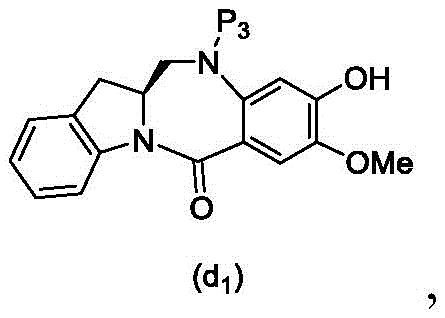
to form a compound of formula (17 d):

or a salt thereof; and
(3) reacting a compound of formula (17d) with a compound of formula (a)1) The monomer reaction of (2):

to form a compound of formula (18d) or a pharmaceutically acceptable salt thereof, wherein X3is-Cl; x4Is a sulfonate or an activated ester (preferably, a sulfonate); p1Is an alcohol protecting group; p3Is H or an amine protecting group; and R is100Is (C)1-C3) An alkoxy group.
In a thirty-ninth embodiment, the present invention provides a method of preparing a compound of formula (18d),

or a pharmaceutically acceptable salt thereof, comprising the steps of:
(1) reacting a compound of formula (14 d):
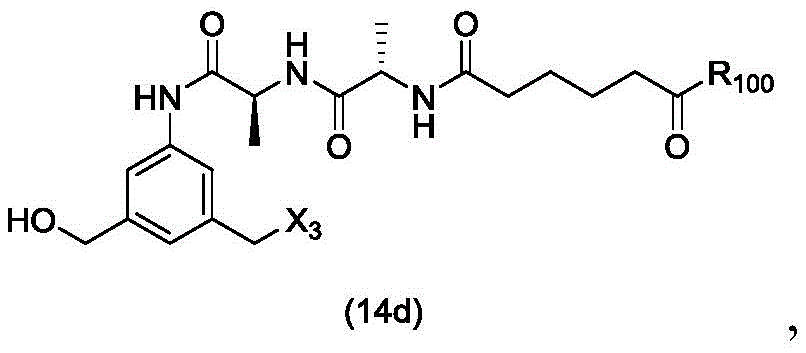
or a salt thereof with formula (d)1) The reduced monomer compound of (a) is reacted,
to form a compound of formula (17 d):

or a salt thereof; and
(2) reacting a compound of formula (17d) with a compound of formula (a)1) The monomer reaction of (2):

to form a compound of formula (18d) or a pharmaceutically acceptable salt thereof, wherein X3is-Cl; p1Is an alcohol protecting group; p3Is H or an amine protecting group; and R is100Is (C)1-C3) An alkoxy group.
In a fortieth embodiment, the present invention provides a process for preparing a compound of formula (18d),
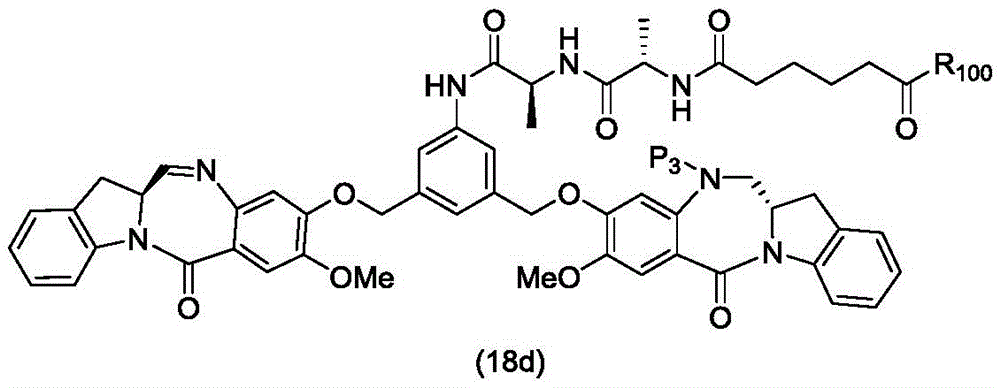
or a pharmaceutically acceptable salt thereof, comprising the steps of:
(1) reacting a brominating or iodinating agent with a compound of formula (14 d):

or a salt thereof, to form a compound of formula (20 d):
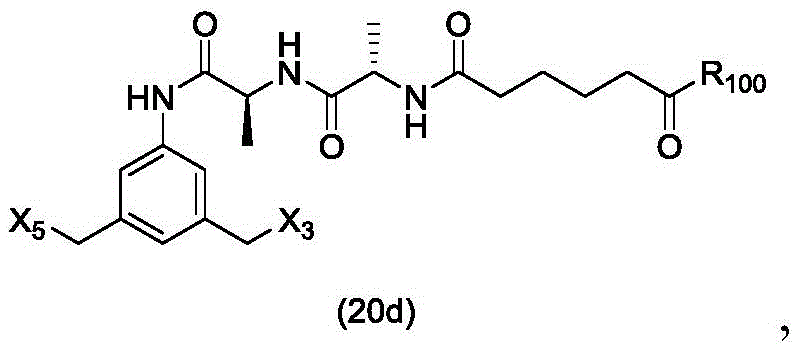
or a salt thereof;
(2) reacting a compound of formula (20d) with a compound of formula (d)1) The reduced monomer compound of (a) is reacted,
to form a compound of formula (17 d):

or a salt thereof; and
(3) reacting a compound of formula (17d) with a compound of formula (a)1) The monomer reaction of (2):

to form a compound of formula (18d) or a pharmaceutically acceptable salt thereof, wherein X3is-Cl; x5is-Br or-I; p1Is an alcohol protecting group; p3Is H or an amine protecting group; and R is100Is (C)1-C3) An alkoxy group.
In a forty-first embodiment, the present invention provides a process for preparing a compound of formula (Id'),

or a pharmaceutically acceptable salt thereof, comprising the steps of:
(1) reacting a sulphonating or esterifying agent with a compound of formula (14 d):

or a salt thereof, to form a compound of formula (15 d):

or a salt thereof;
(2) reacting a compound of formula (15d) with a compound of formula (a)1) The monomer compound (b) of (a) is reacted,
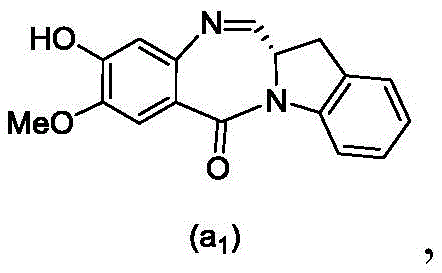
to form a compound of formula (16 d):

or a salt thereof;
(3) reacting a compound of formula (16d) with an imine reducing agent to form a compound of formula (17 d'):

or a salt thereof; and
(4) reacting a compound of formula (17 d') with formula (a)1) The monomer reaction of (2):
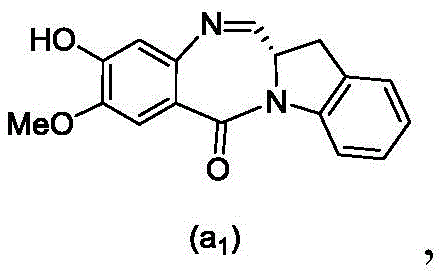
to form a compound of formula (Id'); wherein X3is-Cl; x4Is a sulfonate or an activated ester (preferably, a sulfonate); p1Is an alcohol protecting group; p2Is an amine protecting group; and R is100Is (C)1-C3) An alkoxy group.
In a forty-second embodiment, the present invention provides a process for preparing a compound of formula (Id'),

or a pharmaceutically acceptable salt thereof, comprising the steps of:
(1) reacting a compound of formula (14 d):

or a salt thereof with formula (a)1) The monomer compound (b) of (a) is reacted,

to form a compound of formula (16 d):

or a salt thereof;
(2) reacting a compound of formula (16d) with an imine reducing agent to form a compound of formula (17 d'):

or a salt thereof; and
(3) reacting a compound of formula (17 d') with formula (a)1) The monomer reaction of (2):

to form a compound of formula (Id'); wherein X3is-Cl; p1Is an alcohol protecting group; and R is100Is (C)1-C3) An alkoxy group.
In a forty-third embodiment, the present invention provides a process for preparing a compound of formula (Id'),

or a pharmaceutically acceptable salt thereof, comprising the steps of:
(1) reacting a brominating or iodinating agent with a compound of formula (14 d):

or a salt thereof, to form a compound of formula (20 d):

or a salt thereof;
(2) reacting a compound of formula (20d) or a salt thereof with formula (a)1) The monomer compound (b) of (a) is reacted,

to form a compound of formula (16 d):

(3) reacting a compound of formula (16d) with an imine reducing agent to form a compound of formula (17 d'):
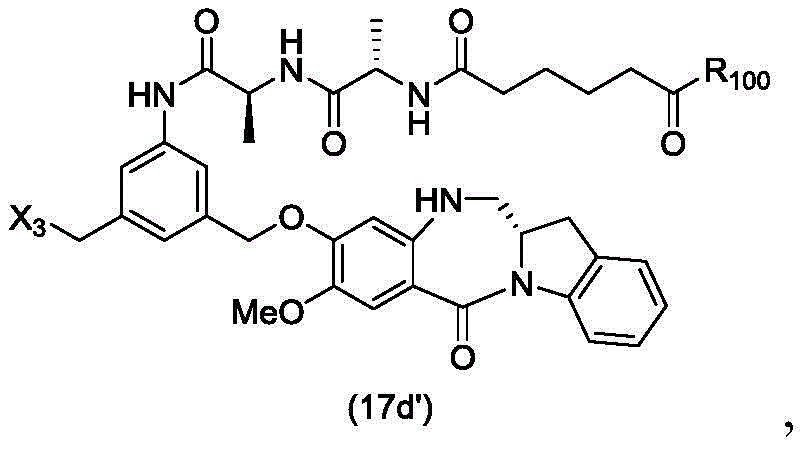
or a salt thereof; and
(4) reacting a compound of formula (17 d') with formula (a)1) The monomer reaction of (2):

to form a compound of formula (Id'); wherein X3is-Cl; p1Is an alcohol protecting group; and R is100Is (C)1-C3) An alkoxy group.
In a forty-fourth embodiment, the present invention provides a process for preparing a compound of formula (Id')

Or a pharmaceutically acceptable salt thereof, comprising the steps of:
(1) reacting a compound of formula (IA):

reacting with a reducing agent to form a compound of formula (IB):

(2) reacting a compound of formula (IB) with a compound of formula (L1):

to form a compound of formula (Id) wherein E is-OH, halide, or-C (═ O) E is an activated ester; and R is100Is (C)1-C3) An alkoxy group.
The invention also includes the compositions described in the methods of the invention.
Brief Description of Drawings
Fig. 1-13 show exemplary versions of the method of the present invention.
Detailed Description
Reference will now be made in detail to certain embodiments of the invention, examples of which are illustrated in the accompanying structures and formulas. While the invention will be described in conjunction with the enumerated embodiments, it will be understood that they are not intended to limit the invention to those embodiments. On the contrary, the invention is intended to cover all alternatives, modifications and equivalents, which may be included within the scope of the invention as defined by the appended claims. One skilled in the art will recognize many methods and materials similar or equivalent to those described herein that can be used in the practice of the present invention.
It should be understood that any embodiment described herein may be combined with one or more other embodiments of the invention unless explicitly disclaimed or otherwise inappropriate. Combinations of embodiments are not limited to those specific combinations claimed by the various dependent claims.
Definition of
As used herein, "alkyl" refers to a saturated straight or branched chain monovalent hydrocarbon group having 1 to 20 carbon atoms. Examples of alkyl groups include, but are not limited to, methyl, ethyl, 1-propyl, 2-propyl, 1-butyl, 2-methyl-1-propyl, -CH2CH(CH3)2) 2-butyl, 2-methyl-2-propyl, 1-pentyl, 2-pentyl, 3-pentyl, 2-methyl-2-butyl, 3-methyl-1-butyl, 2-methyl-1-butyl, 1-hexyl), 2-hexyl, 3-hexyl, 2-methyl-2-pentyl, 3-methyl-2-pentyl, 4-methyl-2-pentyl, 3-methyl-3-pentyl, 2, 3-dimethyl-2-butyl, 3-dimethyl-2-butyl, 1-heptyl, 2-pentyl, 3-pentyl, 2-hexyl, 2-methyl-2-pentyl, 3-methyl-2-pentyl, 2, 3-dimethyl-2-, 1-octyl, and the like. Preferably, the alkyl group has 1 to 10 carbon atoms. More preferably, the alkyl group has 1 to 4 carbon atoms.
"aryl" refers to a monovalent aromatic hydrocarbon radical of 6 to 18 carbon atoms derived by the removal of one hydrogen atom from a single carbon atom of a parent aromatic ring system. Some aryl groups are represented in the exemplary structures as "Ar". Aryl includes bicyclic groups comprising an aromatic ring fused to a saturated, partially unsaturated ring or an aromatic carbocyclic or heterocyclic ring. Typical aryl groups include, but are not limited to, groups derived from benzene (phenyl), substituted benzenes, naphthalenes, anthracenes, indenyls, indanyl, 1, 2-dihydronaphthalene, 1,2,3, 4-tetrahydronaphthyl, and the like. Preferably, aryl is a phenyl group.
The term "halo" or "halogen" refers to F, Cl, Br or I. In one embodiment, the halogen is Br or I.
The terms "compound" or "cytotoxic compound", "cytotoxic dimer" and "cytotoxic dimer compound" are used interchangeably. They are intended to include compounds whose structures or formulae or any derivatives thereof have been disclosed in the present invention or structures or formulae or any derivatives thereof which are incorporated by reference. The term also includes stereoisomers, geometric isomers, tautomers, solvates, metabolites, salts (e.g., pharmaceutically acceptable salts), and prodrugs, as well as prodrug salts, of the compounds of all formulae disclosed herein. The term also includes any solvates, hydrates and polymorphs of any of the foregoing. Specific recitation of "stereoisomers", "geometric isomers", "tautomers", "solvates", "metabolites", "salts", "prodrugs", "prodrug salts", "conjugates", "conjugate salts", "solvates", "hydrates" or "polymorphs" in certain aspects of the invention described in this application should not be interpreted as an intent to omit such forms from other aspects of the invention using the term "compound" without recitation of such other forms.
The term "precursor" of a given group refers to any group that can be subjected to any deprotection, chemical modification or coupling reaction to yield the group.
The term "chiral" refers to a molecule having the non-superimposable properties of mirror image partners, while the term "achiral" refers to a molecule that can be superimposed on its mirror image partner.
The term "stereoisomer" refers to a compound having the same chemical constitution and connectivity, but whose atoms are not in different orientations in space to be mutually converted by rotation about a single bond.
"diastereomer" refers to a stereoisomer having two or more chiral centers and whose molecules are not mirror images of each other. Diastereomers have different physical properties, such as melting points, boiling points, spectral properties, and reactivities. Mixtures of diastereomers can be separated according to high resolution analytical procedures such as crystallization, electrophoresis, and chromatography.
"enantiomer" refers to two stereoisomers of a compound that are mirror images of each other that are not superimposable.
The stereochemical definitions and conventions used herein generally follow the edition S.P. Parker, McGraw-Hill Dictionary of Chemical Terms (1984) McGraw-Hill Book Company, New York; and Eliel, E. and Wilen, S., "Stereochemistry of Organic Compounds," John Wiley & Sons, Inc., New York, 1994. The compounds of the invention may contain asymmetric or chiral centers and thus exist in different stereoisomeric forms. All stereoisomeric forms of the compounds of the present invention are contemplated to form part of the present invention, including but not limited to diastereomers, enantiomers, and atropisomers, as well as mixtures thereof, such as racemic mixtures. Many organic compounds exist in an optically active form, i.e., they have the ability to rotate the plane of plane polarized light. In describing optically active compounds, the prefixes D and L or R and S are used to denote the absolute configuration of a molecule with respect to one or more of its chiral centers. The prefixes d and l or (+) and (-) are used to indicate the sign of the rotation of a compound to plane polarized light, where (-) or 1 means that the compound is left-handed. Compounds with the prefix (+) or d are dextrorotatory. For a given chemical structure, these stereoisomers are identical except that they are mirror images of each other. Specific stereoisomers may also be referred to as enantiomers, and mixtures of such isomers are often referred to as enantiomeric mixtures. A 50:50 mixture of enantiomers is referred to as a racemic mixture or racemate, which may occur without stereoselectivity or stereospecificity in a chemical reaction or process. The terms "racemic mixture" and "racemate" refer to an equimolar mixture of two enantiomeric species, which are not optically active.
The term "tautomer" or "tautomeric form" refers to structural isomers of different energies that may be interconverted by a low energy barrier. For example, proton tautomers (also referred to as prototropic tautomers) include interconversions by proton migration, such as keto-enol and imine-enamine isomerizations. Valence tautomers include interconversions by reorganizing some of the bonded electrons.
As used herein, the term "imine reducing reagent" refers to a reagent capable of reducing an imine functional group to an amine functional group. In certain embodiments, the imine reducing reagent is a hydride reducing reagent. Examples of such imine reducing agents include, but are not limited to, borohydrides (e.g., sodium borohydride, sodium triacetoxyborohydride, sodium cyanoborohydride, lithium borohydride (LiBH)4) Potassium borohydride (KBH)4) Hydrogen and lithium aluminium hydride, ammonium formate, borane, 9-borabicyclo [3.3.1 ]]Nonane (9-BBN), diisobutylaluminum hydride (DIBAL) and sodium bis (2-methoxyethoxy) aluminum hydride (Red-Al). In certain embodiments, the imine reducing reagent is sodium triacetoxyborohydride.
The term "protecting group" or "protecting moiety" refers to a substituent that is typically used to block or protect a particular functional group when reacting other functional groups, derivatives thereof, or conjugates thereof on a compound. For example, an "amine protecting group" or "amino protecting moiety" is a substituent attached to an amino group that blocks or protects an amino functionality in a compound. Such Groups are well known in the art (see, e.g., p.wuts and t.greene,2007, Protective Groups in Organic Synthesis, chapter 7, j.wiley & Sons, NJ) and are, for example, carbamates such as methyl and ethyl carbamates, FMOC, substituted ethyl carbamates, carbamates cleaved by 1,6- β -elimination (also known as "self-degradation"), urea, amides, peptides, alkyl and aryl derivatives. Suitable amino protecting groups include, but are not limited to, acetyl, trifluoroacetyl, t-Butoxycarbonyl (BOC), benzyloxycarbonyl (CBZ) and 9-fluorenylmethyleneoxycarbonyl (Fmoc), 2-trimethylsilylethyl, (2-phenyl-2-trimethylsilyl) ethyl, triisopropylsiloxy, 2- (trimethylsilyl) ethoxymethyl, allyloxycarbonyl, 9-fluorenylmethoxycarbonyl, 2- (trimethylsilyl) ethoxycarbonyl or 2,2,2, 2-trichloroethoxycarbonyl. For a general description of protecting Groups and their use, see p.g.m.wuts & t.w.greene, Protective Groups in Organic Synthesis, John Wiley & Sons, New York, 2007.
An "alcohol protecting group" or "alcohol protecting moiety" is a substituent attached to an alcohol group that blocks or protects the alcohol functionality in a compound. Such Groups are well known in the art (see, e.g., p.wuts and t.greene,2007, Protective Groups in Organic Synthesis, chapter 2, j.wiley & Sons, NJ). Suitable alcohol protecting groups include, but are not limited to, pivaloyl, methoxymethyl, 2-methoxyethoxymethyl, p-methoxybenzyl, 3, 4-dimethoxybenzyl, 2, 6-dimethoxybenzyl, diphenylmethyl, benzyloxymethyl, 2,2, 2-trichloroethoxycarbonyl, tetrahydrofuranyl, tetrahydropyranyl, benzyl, benzoyl, p-phenylbenzoyl, 2,4, 6-trimethylbenzoyl, p-bromobenzoyl, p-nitrobenzoyl, picolinoyl, nicotinoyl, 5-dibenzosuberyl (5-dibenzosurbyl), trityl/triphenylmethyl or tris (4-tert-butylphenyl) methyl as well as various silyl protecting groups (e.g., dimethylisopropylsilyl, diethylisopropylsilyl, dimethylhexylsilyl, p-tert-butylphenyl), and the like, Trimethylsilyl, triisopropylsilyl, tribenzylsilyl, triphenylsilyl, 2-norbornyldimethylsilyl, tert-butyldimethylsilyl, tert-butyldiphenylsilyl, 2-Trimethylethylsilyl (TEOC) or [2- (trimethylsilyl) ethoxy ] methyl). In certain embodiments, the alcohol protecting group is sterically hindered. In certain embodiments, the alcohol protecting group is preferably methoxymethyl, tetrahydropyranyl, 2-methoxyethoxymethyl, p-methoxybenzyl, benzyloxymethyl, or 2,2, 2-trichloroethoxycarbonyl. More preferably, the alcohol protecting group is 2,2, 2-trichloroethoxycarbonyl. In certain embodiments, the alcohol protecting group is a silyl protecting group, preferably triethylsilyl, triisopropylsilyl, or tert-butyldimethylsilyl. More preferably, the alcohol protecting group is tert-butyldimethylsilyl.
As used herein, "alcohol protecting agent" refers to an agent that introduces an alcohol protecting group onto an alcohol group.
An "acid-labile alcohol protecting group" is an alcohol protecting group that is labile under acidic conditions and releases the alcohol protecting group to form a free alcohol. Examples of acid-labile alcohol protecting groups include, but are not limited to, acetate, allyl, methoxymethyl, tetrahydrofuryl, tetrahydropyranyl, 5-dibenzocycloheptyl, 1-ethoxyethyl, 1-methyl-1 methoxyethyl, 2- (phenylseleno) ethyl, trityl/triphenylmethyl, tris (4-tert-butylphenyl) methyl, and various silyl protecting groups (e.g., dimethylisopropylsilyl, diethylisopropylsilyl, dimethylhexylsilyl, trimethylsilyl, triethylsilyl, triisopropylsilyl, tribenzylsilyl, triphenylsilyl, 2-norbornyldimethylsilyl, tert-butyldimethylsilyl, tert-butyldiphenylsilyl, 2-Trimethylethylsilyl (TEOC), or [2- (trimethylsilyl) ethoxy ] methyl). In certain embodiments, the alcohol protecting group is a silyl protecting group, preferably triethylsilyl, triisopropylsilyl, or tert-butyldimethylsilyl. More preferably, the alcohol protecting group is tert-butyldimethylsilyl.
As used herein, the term "alcohol deprotection reagent" refers to a reagent that is capable of cleaving an alcohol protecting group to form a free alcohol. Such agents are well known in the art (see, e.g., p.wuts and t.greene,2007, Protective Groups in Organic Synthesis, chapter 2, j.wiley & Sons, NJ). Examples of such alcohol deprotecting agents include, but are not limited to, tetra-n-butylammonium fluoride, tris (dimethylamino) difluorotrimethylsulfonium silicate, hydrogen fluoride or solvates thereof, pyridinium hydrogen fluoride, silicon tetrafluoride, hexafluorosilicic acid, cesium fluoride, hydrochloric acid, acetic acid, trifluoroacetic acid, pyridinium p-toluenesulfonate, p-toluenesulfonic acid (p-TsOH), formic acid, periodic acid. In certain embodiments, the alcohol deprotecting reagent is hydrochloric acid or tetra-n-butylammonium fluoride (TBAF). In certain embodiments, the alcohol deprotecting agent is hydrogen fluoride-pyridine (HF-pyridine).
As used herein, the term "amine deprotecting group" refers to an agent capable of cleaving an amine protecting group to form a free amine. Such agents are well known in the art (see, e.g., p.wuts and t.greene,2007, Protective Groups in Organic Synthesis, chapter 7, j.wiley & Sons, NJ). Examples of such amine deprotection reagents include, but are not limited to, tetra-n-butylammonium fluoride, acetic acid, pyridinium hydrogen fluoride, cesium fluoride, piperidine, morpholine, or trifluoroacetic acid.
As used herein, "alcohol activator" refers to an agent that increases the reactivity of a hydroxyl group, thereby making the hydroxyl a better leaving group. Examples of such alcohol activators include p-toluenesulfonyl chloride, thionyl chloride, trifluoromethanesulfonic anhydride, methanesulfonyl chloride, methanesulfonic anhydride, triphenylphosphine, acid chloride, 4-dimethylaminopyridine, and the like. In certain embodiments, the alcohol activator is thionyl chloride. In certain embodiments, the alcohol activator is triphenylphosphine.
As used herein, the phrase "pharmaceutically acceptable salt" refers to pharmaceutically acceptable organic or inorganic salts of the compounds of the present invention. Exemplary salts include, but are not limited to, sulfate, citrate, acetate, oxalate, chloride, bromide, iodide, nitrate, bisulfate, phosphate, acid phosphate, isonicotinate, lactate, salicylate, acid citrate, tartrate, oleate, tannate, pantothenate, bitartrate, ascorbate, succinate, maleate, gentisate, fumarate, gluconate, glucuronate, gluconate, formate, benzoate, glutamate, mesylate ", ethanesulfonate, benzenesulfonate, p-toluenesulfonate, pamoate (i.e. 1,1' -methylene-bis- (2-hydroxy-3-naphthoate) salt), alkali metal (e.g. sodium and potassium) salts, alkaline earth metal (e.g. magnesium) salts and ammonium salts. Pharmaceutically acceptable salts may involve inclusion of another molecule, such as an acetate, succinate, or other counterion. The counterion may be any organic or inorganic moiety that stabilizes the charge on the parent compound. In addition, a pharmaceutically acceptable salt may have more than one charged atom in its structure. Examples where the plurality of charged atoms are part of a pharmaceutically acceptable salt can have a plurality of counterions. Thus, a pharmaceutically acceptable salt can have one or more charged atoms and/or one or more counterions.
If the compound of the invention is a base, the desired pharmaceutically acceptable salt may be prepared by any suitable method available in the art, for example by treating the free base with an inorganic acid such as hydrochloric acid, hydrobromic acid, sulfuric acid, nitric acid, methanesulfonic acid, phosphoric acid and the like, or an organic acid such as acetic acid, maleic acid, succinic acid, mandelic acid, fumaric acid, malonic acid, pyruvic acid, oxalic acid, glycolic acid, salicylic acid, pyranosidyl acid such as glucuronic or galacturonic acid, alpha-hydroxy acid such as citric or tartaric acid, amino acid such as aspartic or glutamic acid, aromatic acid such as benzoic or cinnamic acid, sulfonic acid such as p-toluenesulfonic or ethanesulfonic acid, and the like.
If the compound of the invention is an acid, the desired pharmaceutically acceptable salt may be prepared by any suitable method, for example by treating the free acid with an inorganic or organic base such as an amine (primary, secondary or tertiary), an alkali metal hydroxide or an alkaline earth metal hydroxide. Illustrative examples of suitable salts include, but are not limited to, organic salts derived from amino acids such as glycine and arginine, ammonia, primary, secondary and tertiary amines, and cyclic amines such as piperidine, morpholine, and piperazine, and inorganic salts derived from sodium, calcium, potassium, magnesium, manganese, iron, copper, zinc, aluminum, and lithium.
The phrase "pharmaceutically acceptable" indicates that the substance or composition must be chemically and/or toxicologically compatible with the other ingredients comprising the formulation and/or the mammal being treated therewith.
The term "leaving group" refers to a group of charged or uncharged moieties that are detached during nucleophilic substitution or displacement. Such leaving groups are well known in the art and include, but are not limited to, halogens, esters, alkoxy, hydroxy, tosylate, triflate, mesylate, nitrile, azide, carbamate, disulfide, thioester, thioether, and diazo compounds.
As used herein, the term "halogenating agent" refers to an agent that converts an alcohol group to a halide group. A "brominating reagent" is a reagent that converts an alcohol group to a bromide group. An "iodinating agent" is an agent that converts an alcohol group to an iodide group. A "chlorinating agent" is an agent that converts an alcohol group to a chloride group. Exemplary brominating agents include, but are not limited to, bromine, hydrobromic acid, carbon tetrabromide, phosphorus tribromide, and potassium bromide. Exemplary iodinating agents include, but are not limited to, hydriodic acid, iodine, carbon tetraiodide, phosphorus triiodide, sodium iodide, or potassium iodide. Exemplary chlorinating agents include, but are not limited to, carbon tetrachloride, methanesulfonyl chloride, sulfuryl chloride, thionyl chloride, cyanuric chloride, N-chlorosuccinimide, phosphorus (V) oxychloride, phosphorus pentachloride, and phosphorus trichloride. In a particular embodiment, the chlorinating agent is methanesulfonyl chloride.
As used herein, the term "sulfonation reagent" refers to a reagent that converts alcohol groups to sulfonate groups. Preferably, the sulfonation reagent is a sulfonic anhydride, such as methanesulfonic anhydride, or a sulfonyl chloride, such as methanesulfonyl chloride (MsCl).
As used herein, "activated ester" refers to an ester group that is easily substituted with a hydroxyl group or an amine group. Exemplary activated esters include, but are not limited to, nitrophenyl (e.g., 2 or 4-nitrophenyl) esters, dinitrophenyl (e.g., 2, 4-dinitrophenyl) esters, sulfo-tetrafluorophenyl (e.g., 4-sulfo-2, 3,5, 6-tetrafluorophenyl) esters, pentafluorophenyl esters, nitropyridinyl (e.g., 4-nitropyridinyl) esters, trifluoroacetate, and acetate esters.
As used herein, "esterification reagent" refers to a reagent that converts an alcohol group to an ester group. Exemplary esterification reagents include, but are not limited to, nitrobenzoic acids (e.g., 2 or 4-nitrobenzoic acid), dinitrobenzoic acids (e.g., 2, 4-dinitrobenzoic acid), sulfo-tetrafluorobenzoic acids (e.g., 4-sulfo-2, 3,5, 6-tetrafluorobenzoic acid), pentafluorobenzoic acid, nitropyridine carboxylic acids (e.g., 4-nitro-2-pyridine carboxylic acid), trifluoroacetic acid and acetic acid or acid chlorides, anhydrides, or other activated carboxylic acid derivatives thereof.
Method of the invention
The invention provides a process for the preparation of indolinobenzodiazepines having one imine function and one amine function A novel process for the preparation of dimeric compounds. The methods of the invention can produce the desired dimeric compounds in higher yields and without the use of HPLC purification compared to methods known in the art.
In a first embodiment, the present invention provides a process for preparing a compound of formula (2d),
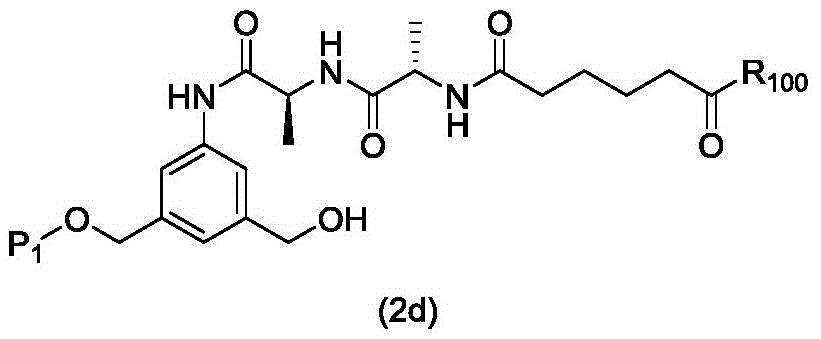
or a salt thereof, the method comprising introducing an alcohol protecting group onto one of the primary alcohols of the compound of formula (1d) by reacting the compound of formula (1d) with an alcohol protecting reagent,
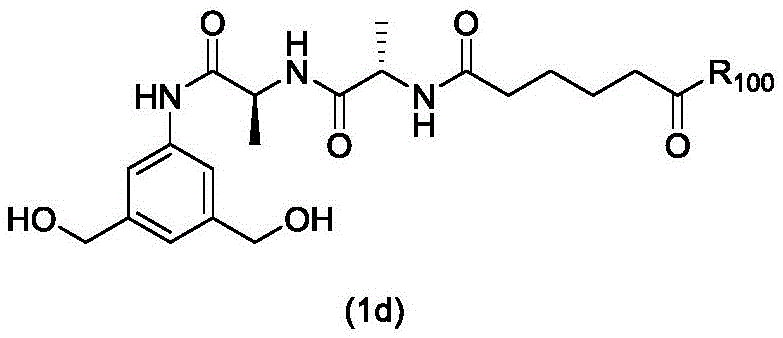
wherein P is1Is an alcohol protecting group; and R is100Is (C)1-C3) An alkoxy group.
The first embodiment also provides a process for preparing a compound of formula (2A),

or a salt thereof, comprising introducing an alcohol protecting group onto one of the primary alcohols of the compound of formula (1A) by reacting the compound of formula (1A) with an alcohol protecting reagent,

wherein P is1Is an alcohol protecting group.
In a particular embodiment, for the process of preparing the compounds of formula (2d) or (2A) above, the alcohol protecting group is sterically hindered.
In another specific embodiment, the alcohol protecting group is pivaloyl, methoxymethyl, 2-methoxyethoxymethyl, p-methoxybenzyl, 3, 4-dimethoxybenzyl, 2, 6-dimethoxybenzyl, diphenylmethyl, benzyloxymethyl, 2,2, 2-trichloroethoxycarbonyl, tetrahydrofuranyl, tetrahydropyranyl, benzyl, benzoyl, p-phenylbenzoyl, 2,4, 6-trimethylbenzoyl, p-bromobenzoyl, p-nitrobenzoyl, picolinoyl, nicotinoyl, 5-dibenzosuberyl, trityl/triphenylmethyl or tris (4-tert-butylphenyl) methyl. Preferably, the alcohol protecting group is methoxymethyl, tetrahydropyranyl, 2-methoxyethoxymethyl, p-methoxybenzyl, benzyloxymethyl or 2,2, 2-trichloroethoxycarbonyl. Even more preferably, the alcohol protecting group is 2,2, 2-trichloroethoxycarbonyl.
In another specific embodiment, the alcohol protecting group is a silyl protecting group. For example, the silyl protecting group is dimethylisopropylsilyl, diethylisopropylsilyl, dimethylhexylsilyl, trimethylsilyl, triisopropylsilyl, tribenzylsilyl, triphenylsilyl, 2-norbornyldimethylsilyl, tert-butyldimethylsilyl, tert-butyldiphenylsilyl, 2-Trimethylethylsilyl (TEOC) or [2- (trimethylsilyl) ethoxy ] methyl. Preferably, the silyl protecting group is triethylsilyl, triisopropylsilyl or tert-butyldimethylsilyl. More preferably, the silyl protecting group is tert-butyldimethylsilyl.
The silyl protecting group may be prepared by reacting a compound of formula (1d) or (1A) with R3-Cl、R3-Br、 R3-I or R3-OSO2CF3(collectively referred to as alcohol protecting agents) in the presence of a base, wherein R3Is dimethylisopropylsilyl, diethylisopropylsilyl, dimethylhexylsilyl, trimethylsilyl, triisopropylsilyl, tribenzylsilyl, triphenylsilyl, 2-norbornyldimethylsilyl, tert-butyldimethylsilyl, tert-butyldiphenylsilyl or [2- (trimethylsilyl) ethoxy ] silyl]A methyl group. In certain embodiments, the molar ratio of alcohol protecting agent to compound of formula (1d) or (1A) is between 0.8 and 1.2, between 1 and 5, between 1 and 2, between 1 and 1.5, between 1 and 1.4, between 1 and 1.3, between 1 and 1.2, or between 1 and 1.1. In certain embodiments, less than 2 molar equivalents of alcohol protecting reagent is used relative to the compound of formula (1d) or (1A). Preferably, 1.5, 1.4, 1.3, 1.2, 1.1 or 1.0 molar equivalents of alcohol protecting agent are used relative to the compound of formula (1d) or (1A).
In one embodiment, the base may be a non-nucleophilic base. Examples of non-nucleophilic bases include, but are not limited to, imidazole, triethylamine, diisopropylethylamine, pyridine, 2, 6-lutidine, 1, 8-diazabicycloundecen-7-ene, or tetramethylpiperidine. Preferably, the non-nucleophilic base is imidazole. A molar excess of base may be used. In certain embodiments, greater than 2 molar equivalents of base (e.g., non-nucleophilic base) is used relative to the compound of formula (1d) or (1A).
In another embodiment, the compounds of formula (1d) or (1A) are reacted with R3-Cl、R3-Br、R3-I or R3-OSO2CF3In the presence of a catalyst which favours the introduction of the silyl protecting group. Any suitable catalyst known in the art may be used in the reaction (see, e.g., p.wuts and t.greene,2007, Protective Groups in Organic Synthesis, chapter 2, j. Wiley&Sons, NJ). Exemplary catalysts include, but are not limited to, 4-Dimethylaminopyridine (DMAP), 1,3, 3-tetramethylguanidine, and 1, 8-diazabicyclo [5.4.0]]Undec-7-ene (DBU).
Any suitable organic solvent may be used in the process of the first embodiment. Exemplary solvents include, but are not limited to, DMF, CH2Cl2Dichloroethane, THF, dimethylacetamide, and the like. In certain embodiments, DMF is used as the solvent.
In another specific embodiment, a method of preparing a compound of formula (2d) or (2A) comprises reacting a compound of (1d) or (1A) with TBSCl in the presence of a non-nucleophilic base. In one embodiment, the base is imidazole or DIPEA. In a particular embodiment, the base is imidazole. In another specific embodiment, the base is DIPEA.
In a second embodiment, the present invention provides a process for preparing a compound of formula (3d),

or a salt thereof, comprising reacting a halogenating agent, a sulfonating agent or an esterifying agent with a compound of formula (2d),

wherein P is1Is an alcohol protecting group; x1Is a leaving group selected from the group consisting of: -Br, -I, -Cl, sulfonate and activated ester; and R is100Is (C)1-C3) An alkoxy group.
The second embodiment also provides a process for preparing a compound of formula (3A),

or a salt thereof, comprising reacting a compound of formula (2A) with a halogenating reagent, a sulfonating reagent or an esterifying reagent,

wherein P is1And R100As defined in the first embodiment, and X1Is a leaving group selected from the group consisting of: -Br, -I, -Cl, sulfonate and activated ester.
In a particular embodiment, for the process for preparing the compounds of formula (3d) or (3A) above, X1is-Br, -I or sulfonate.
In a particular embodiment, for the process for preparing the compounds of formula (3d) or (3A) above, X1Is mesylate, tosylate, brosylate or triflate. Preferably, X1Is mesylate.
In another specific embodiment, the method of the second embodiment comprises reacting a compound of formula (2d) or (2A) with a halogenating agent. Exemplary halogenating agents include, but are not limited to, bromine, hydrobromic acid, carbon tetrabromide, phosphorus tribromide, potassium bromide, hydroiodic acid, iodine, carbon tetraiodide, phosphorus triiodide, sodium iodide or potassium iodide.
In yet another specific embodiment, the method of the second embodiment comprises reacting a compound of formula (2d) or (2A) with a sulfonating agent. Preferably, the sulfonation reagent is a sulfonic anhydride, such as methanesulfonic anhydride, or a sulfonyl chloride, such as methanesulfonyl chloride (MsCl).
In certain embodiments, the reaction between the compound of formula (2d) or (2A) and the sulfonation reagent may be carried out in the presence of a base. In one embodiment, the base is a non-nucleophilic base. Exemplary non-nucleophilic bases include, but are not limited to, triethylamine, imidazole, triethylamine, diisopropylethylamine, pyridine, 2, 6-lutidine, dimethylformamide, 1, 8-diazabicyclo [5.4.0] undec-7-ene (DBU), or tetramethylpiperidine. Preferably, the base is triethylamine or diisopropylethylamine.
Any suitable organic solvent may be used in the process of the second embodiment. In one embodiment, the solvent is dichloromethane.
In a third embodiment, the present invention provides a process for preparing a compound of formula (4d),

or a salt thereof, comprising reacting a compound of formula (3d)

And formula (a)1) The monomer compound (b) of (a) is reacted,

wherein P is1Is an alcohol protecting group; x1Is a leaving group selected from the group consisting of: -Br, -I, -Cl, sulfonate and activated ester; and R is100Is (C)1-C3) An alkoxy group.
The third embodiment also provides a process for preparing a compound of formula (4A),

or a salt thereof, comprising reacting a compound of formula (3A)

And formula (a)1) The monomer compound (b) of (a) is reacted,

wherein P is1Is an alcohol protecting group; and X1Is a leaving group selected from the group consisting of: -Br, -I, -Cl, sulfonate and activated ester.
In a specific embodiment, for the method of the third embodiment, X1is-Br, -I or sulfonate.
In a particular embodiment, for the process of preparing a compound of formula (4d) or (4A), a compound of formula (3d) or (3A) is reacted with a compound of formula (a)1) In the presence of a base. Any suitable base may be used. Exemplary bases include, but are not limited to, sodium carbonate, potassium carbonate, cesium carbonate, sodium hydride, or potassium hydride. In one embodiment, the base is potassium carbonate.
Any suitable solvent may be used in the method of the third embodiment. In one embodiment, the solvent is Dimethylacetamide (DMA).
In a specific embodiment, the method for preparing the above compound of formula (4d) or (4A) comprises reacting a compound of formula (3d) or (3A) with a monomer compound (a)1) The reaction was carried out in DMA in the presence of potassium carbonate. In one embodiment, the reaction is carried out in the presence of potassium iodide.
In a fourth embodiment, the present invention provides a process for preparing a compound of formula (5d),

or a salt thereof, comprising contacting a compound of formula (4d),

with an imine reducing agent, in which P1Is an alcohol protecting group; and R is100Is (C)1-C3) An alkoxy group.
The fourth embodiment also provides a process for preparing a compound of formula (5A),

or a salt thereof, comprising contacting a compound of formula (4A),

with an imine reducing agent, wherein the variables are as described above in the third embodiment.
In a particular embodiment, for the method of preparing the compound of formula (5d) or (5A) above, the imine reducing reagent is a hydride reducing reagent.
In another specific embodiment, the imine reducing reagent is sodium borohydride, sodium triacetoxyborohydride, sodium cyanoborohydride, lithium aluminum hydride, hydrogen, ammonium formate, borane, 9-borabicyclo [3.3.1]Nonane (9-BBN), diisobutylaluminum hydride (DIBAL), lithium borohydride (LiBH)4) Potassium borohydride (KBH)4) Or sodium bis (2-methoxyethoxy) aluminum hydride (Red-Al). Preferably, the imine reducing reagent is sodium triacetoxyborohydride (NaBH (OAc)3)。
Any suitable solvent may be used in the process of the fourth embodiment. In one embodiment, the solvent is dichloroethane.
In a fifth embodiment, the present invention provides a process for preparing a compound of formula (6d),

or a salt thereof, comprising contacting a compound of formula (5d),

with an alcohol deprotecting reagent in which P is1Is an alcohol protecting group; and R is100Is (C)1-C3) An alkoxy group.
The fifth embodiment also provides a process for preparing a compound of formula (6A),

or a salt thereof, comprising contacting a compound of formula (5A),

with an alcohol deprotecting reagent, wherein the variables are as described above in the fourth embodiment.
In a specific embodiment, for the process of preparing the compound of formula (6d) or (6A) above, the alcohol deprotecting reagent is tetra-n-butylammonium fluoride, tris (dimethylamino) bistrimethylsulfonium silicate, hydrogen fluoride or a solvate thereof, pyridinium fluoride, silicon tetrafluoride, hexafluorosilicic acid, cesium fluoride, hydrochloric acid, acetic acid, trifluoroacetic acid, pyridinium p-toluenesulfonate, p-toluenesulfonic acid (p-TsOH), formic acid or periodic acid. Preferably, the alcohol deprotecting reagent is hydrochloric acid or tetra-n-butylammonium fluoride. In a more specific embodiment, the alcohol deprotecting reagent is aqueous hydrochloric acid.
Any suitable solvent may be used in the deprotection reaction described above. In one embodiment, the solvent is THF.
In a sixth embodiment, the present invention provides a process for preparing a compound of formula (7d),

or a salt thereof, comprising reacting a halogenating reagent, a sulfonating reagent or an esterifying reagent with a primary alcohol compound of formula (6d),

wherein X2Is a leaving group selected from the group consisting of: -Br, -I, -Cl, sulfonate and activated ester; and R is100Is (C)1-C3) An alkoxy group.
The sixth embodiment also provides a process for preparing a compound of formula (7A),
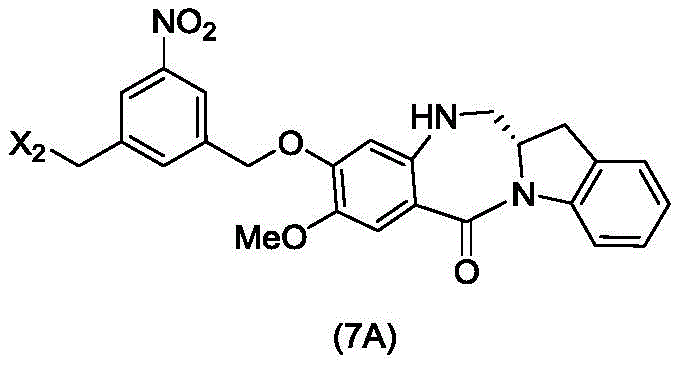
or a salt thereof, comprising reacting a halogenating agent, a sulfonating agent or an esterifying agent with a primary alcohol compound of formula (6A),

wherein X2is-Br, -I, -Cl, sulfonate or activated ester; and the remaining variables are as described above in the fifth embodiment.
In a particular embodiment, for the process for preparing the compounds of formula (7d) or (7A), X2is-Br, -I or sulfonate.
In a particular embodiment, for the process for preparing the compounds of formula (7d) or (7A), X2Is mesylate, tosylate, brosylate or triflateAnd (3) an ester. Preferably, X2Is mesylate.
In another specific embodiment, the method of the sixth embodiment comprises reacting a compound of formula (6d) or (6A) with a halogenating agent. Exemplary halogenating agents include, but are not limited to, bromine, hydrobromic acid, carbon tetrabromide, phosphorus tribromide, potassium bromide, hydroiodic acid, iodine, carbon tetraiodide, phosphorus triiodide, sodium iodide or potassium iodide.
In yet another specific embodiment, the method of the sixth embodiment comprises reacting a compound of formula (6d) or (6A) with a sulfonating agent. Preferably, the sulfonation reagent is a sulfonic anhydride, such as methanesulfonic anhydride, or a sulfonyl chloride, such as methanesulfonyl chloride (MsCl).
In one embodiment, the reaction between the compound of formula (6d) or (6A) and the sulfonation reagent is carried out in the presence of a base. Preferably, the base is a non-nucleophilic base. Exemplary non-nucleophilic bases include, but are not limited to, triethylamine, imidazole, triethylamine, diisopropylethylamine, pyridine, 2, 6-lutidine, dimethylformamide, 1, 8-diazabicyclo [5.4.0] undec-7-ene (DBU), or tetramethylpiperidine. Preferably, the base is triethylamine or diisopropylethylamine.
Any suitable solvent may be used in the reaction described above in the sixth embodiment. In one embodiment, the solvent is dichloromethane. In another embodiment, the solvent is DMF. In yet another embodiment, the solvent is a mixture of dichloromethane and DMF.
In a seventh embodiment, the present invention provides a process for preparing a compound of formula (7 d')

Or a salt thereof, comprising reacting a compound of formula (5 d')
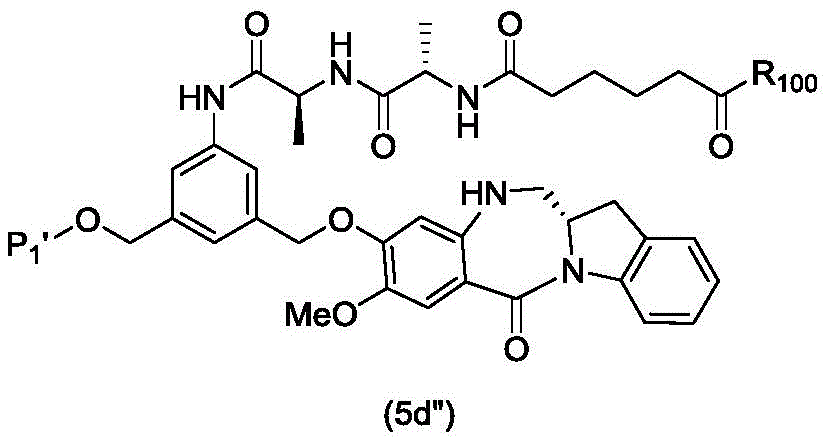
With alcohol deprotection reagents and halogenation reagentsReaction of agents in which P1' is an acid labile alcohol protecting group; x2' is-Br or-I; and R is100Is (C)1-C3) An alkoxy group.
The seventh embodiment also provides for the preparation of a compound of formula (7A "):
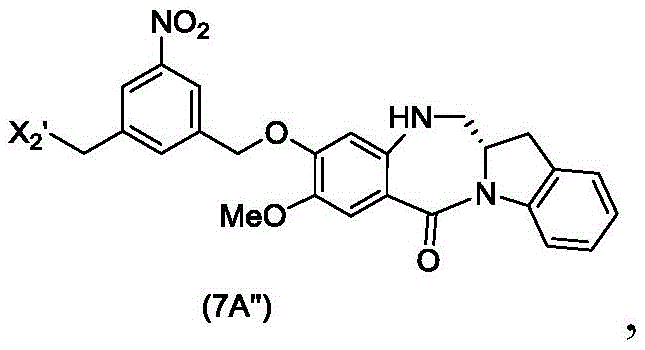
or a salt thereof, comprising reacting a compound of formula (5A ″)

With alcohol deprotecting reagents and halogenating reagents, in which P is1' is an acid labile alcohol protecting group; x2' is-Br or-I; and the remaining variables are as described above in the sixth embodiment.
The method of the seventh embodiment combines the alcohol deprotection step described in the fifth embodiment with the halogenation reaction of the resulting alcohol described in the sixth embodiment in one step.
In a specific embodiment, for the method of the seventh embodiment, the compound of formula (7d ") is represented by the formula:

and the process comprises reacting a compound of formula (5 d') with an alcohol deprotecting reagent and a brominating reagent.
In another specific embodiment, for the method of the seventh embodiment, the compound of formula (7A' ") is represented by the formula:
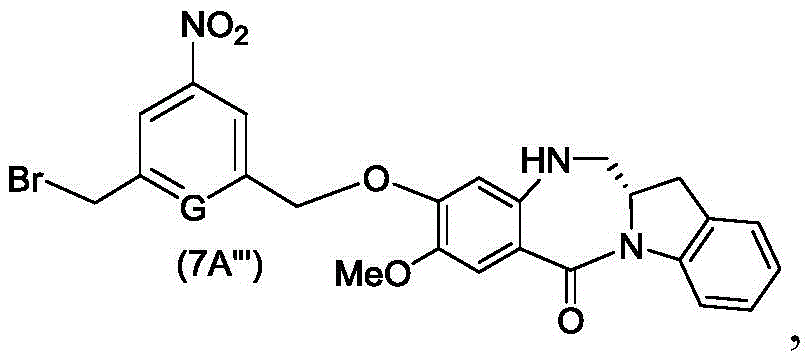
and the method comprises reacting a compound of formula (5A'),

with an alcohol deprotection reagent and a bromination reagent.
In one embodiment, for the method described in the seventh embodiment, the acid-labile alcohol protecting group is acetate, allyl, methoxymethyl, tetrahydrofuranyl, tetrahydropyranyl, 5-dibenzocycloheptyl, 1-ethoxyethyl, 1-methyl-1-methoxyethyl, 2- (phenylselenyl) ethyl, trityl/triphenylmethyl, or tris (4-tert-butylphenyl) methyl.
In another embodiment, the acid-labile alcohol protecting group is a silyl protecting group. Exemplary silyl protecting groups include, but are not limited to, dimethylisopropylsilyl, diethylisopropylsilyl, dimethylhexylsilyl, trimethylsilyl, triethylsilyl, triisopropylsilyl, tribenzylsilyl, triphenylsilyl, 2-norbornyldimethylsilyl, t-butyldimethylsilyl, t-butyldiphenylsilyl, 2-Trimethylethylsilyl (TEOC), or [2- (trimethylsilyl) ethoxy ] methyl. Preferably, the silyl protecting group is triethylsilyl, triisopropylsilyl or tert-butyldimethylsilyl. More preferably, the silyl protecting group is tert-butyldimethylsilyl.
In one embodiment, the alcohol deprotecting agent is tetra-n-butylammonium fluoride, tris (dimethylamino) difluorotrimethylsulfonium silicate, hydrogen fluoride or a solvate thereof, pyridinium hydrogen fluoride, silicon tetrafluoride, hexafluorosilicic acid, cesium fluoride, hydrochloric acid, acetic acid, pyridinium p-toluenesulfonate, formic acid, periodic acid, trifluoroacetic acid, or p-toluenesulfonic acid (p-TsOH). Preferably, the alcohol deprotection reagent is acetic acid.
In another embodiment, the brominating agent is HBr.
In a specific embodiment, the process of the seventh embodiment comprises reacting the compound of formula (5d ") with a mixture of acetic acid and HBr to give the compound of formula (7 d'").
In another specific embodiment, the process of the seventh embodiment comprises reacting the compound of formula (5A ") with a mixture of acetic acid and HBr to give the compound of formula (7A'").
In an eighth embodiment, the present invention provides a process for preparing a compound of formula (Id'),

or a pharmaceutically acceptable salt thereof, comprising reacting a compound of formula (7d)

And formula (a)1) The monomer compound (b) of (a) is reacted,

wherein R is100Is (C)1-C3) An alkoxy group; and X2Is a leaving group selected from the group consisting of: -Br, -I, -Cl, sulfonate and activated ester.
An eighth embodiment also provides a process for preparing a compound of formula (IA),

or a pharmaceutically acceptable salt thereof, comprising reacting a compound of formula (7A)

And formula (a)1) By reaction of a monomeric compound of,

Wherein R is100Is (C)1-C3) An alkoxy group; and X2Is a leaving group selected from the group consisting of: -Br, -I, -Cl, sulfonate and activated ester.
In one embodiment, for the method of the eighth embodiment, X2is-Br, -I or sulfonate.
In one embodiment, for the method of the eighth embodiment, a compound of formula (7d) or (7A) is reacted with formula (a)1) In the presence of a base. Examples of bases include, but are not limited to, sodium carbonate, potassium carbonate, cesium carbonate, sodium hydride, or potassium hydride. In one embodiment, the base is potassium carbonate.
Any suitable solvent may be used in the method of the eighth embodiment described above. In one embodiment, the solvent is DMF. In another embodiment, the solvent is DMA.
In a ninth embodiment, the present invention provides a process for preparing a compound of formula (Id'),

or a pharmaceutically acceptable salt thereof, comprising the steps of:
(1) introducing an alcohol protecting group onto one of the primary alcohols of the compound of formula (1d),

to form a compound of formula (2d),

(2) reacting the compound of formula (2d) with a halogenating reagent, a sulfonating reagent or an esterifying reagent to form a compound of formula (3d),

(3) reacting a compound of formula (3d) with a compound of formula (a)1) The monomer compound (b) of (a) is reacted,
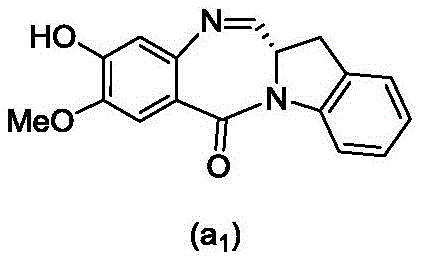
to form a compound of formula (4d),

(4) reacting a compound of formula (4d) with an imine reducing agent to form a compound of formula (5d),

(5) reacting a compound of formula (5d) with an alcohol deprotection reagent to form a compound of formula (6d),

(6) reacting a second halogenating agent, a second sulfonating agent or a second esterifying agent with a compound of formula (6d) to form a compound of formula (7d),

(7) reacting a compound of formula (7d) with a compound of formula (a)1) The monomer compound (b) of (a) is reacted,

to form a compound of formula (Id') wherein P1Is an alcohol protecting group; x1And X2Each independently is a leaving group selected from the group consisting of: -Br, -I, -Cl, sulfonate and activated ester; and R is100Is (C)1-C3) An alkoxy group.
The ninth embodiment also provides for the preparation of compounds of formula (IA):
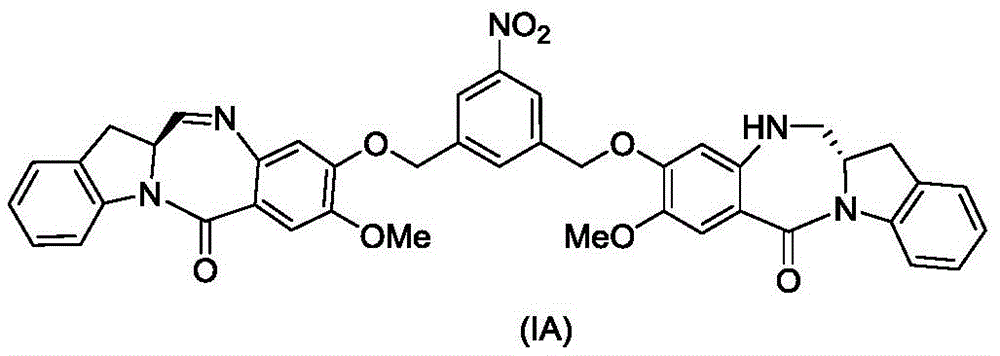
or a pharmaceutically acceptable salt thereof, comprising the steps of:
(1) introducing an alcohol protecting group onto one of the primary alcohols of the compound of formula (1A),

to form a compound of formula (2A),
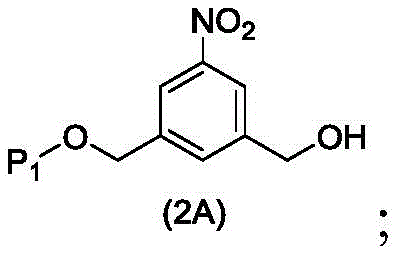
(2) reacting a compound of formula (2A) with a halogenating reagent, a sulfonating reagent or an esterifying reagent to form a compound of formula (3A),

(3) reacting a compound of formula (3A) with a compound of formula (a)1) The monomer compound (b) of (a) is reacted,

to form a compound of formula (4A),
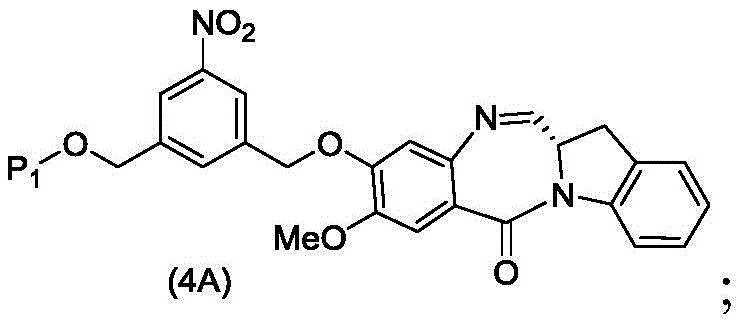
(4) reacting a compound of formula (4A) with an imine reducing agent to form a compound of formula (5A),

(5) reacting a compound of formula (5A) with an alcohol deprotection reagent to form a compound of formula (6A),

(6) reacting a second halogenating agent, a second sulfonating agent or an esterifying agent with a compound of formula (6A) to form a compound of formula (7A),
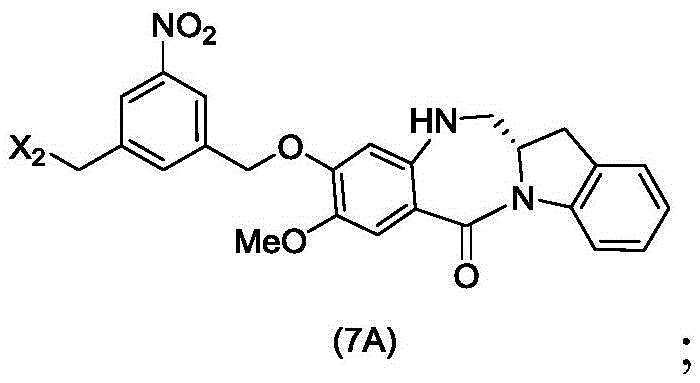
(7) reacting a compound of formula (7A) with a compound of formula (a)1) The monomer compound (b) of (a) is reacted,

to form a compound of formula (IA) wherein P1Is an alcohol protecting group; and X1And X2Each independently is a leaving group selected from the group consisting of: -Br, -I, -Cl, sulfonate and activated ester.
In one embodiment, for the method of the ninth embodiment, X1And X2Each independently is-Br, -Cl, or a sulfonate.
The reaction conditions and reagents for each step in the method of the ninth embodiment are as described in the first, second, third, fourth, fifth, sixth and/or eighth embodiments or any specific embodiment described therein.
In a tenth embodiment, the present invention provides a process for preparing a compound of formula (Id'),

or a pharmaceutically acceptable salt thereof, comprising the steps of:
(1) introducing an alcohol protecting group onto one of the primary alcohols of the compound of formula (1d),

to form a compound of formula (2 d'),
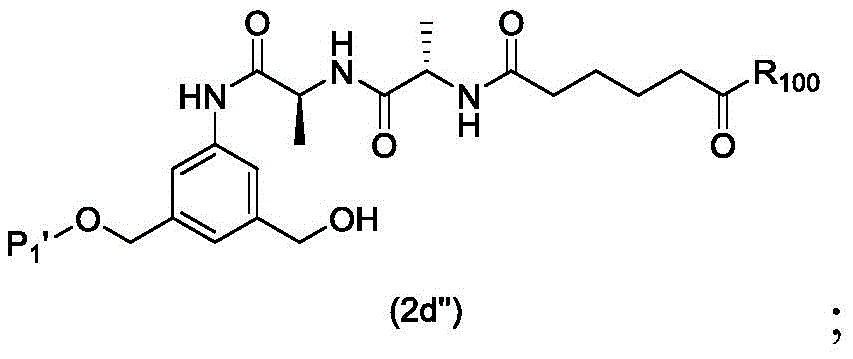
(2) reacting the compound of formula (2d ') with a halogenating reagent, a sulfonating reagent or an esterifying reagent to form a compound of formula (3 d'),

(3) reacting a compound of formula (3 d') with formula (a)1) The monomer compound (b) of (a) is reacted,
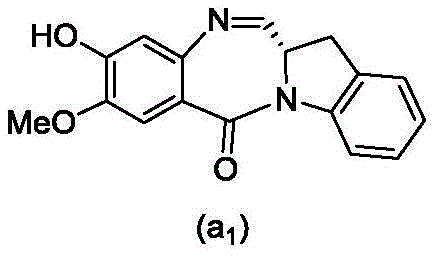
to form a compound of formula (4 d'),
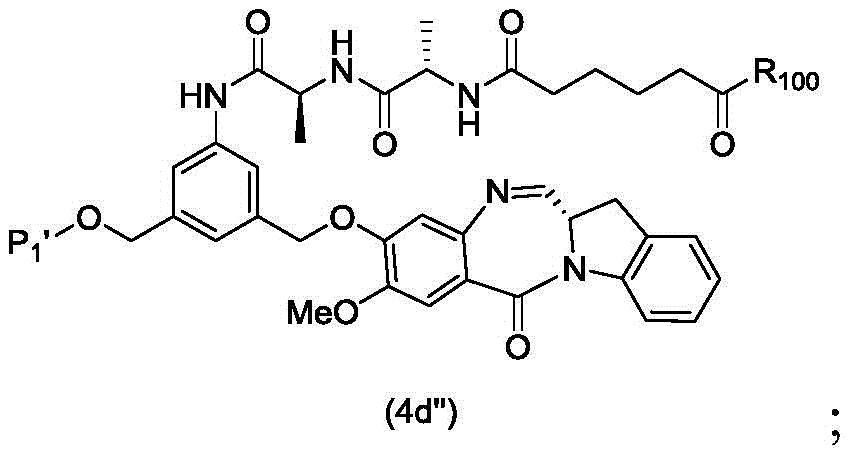
(4) reacting the compound of formula (4d ') with an imine reducing agent to form a compound of formula (5 d'),

(5) reacting the compound of formula (5d ') with an alcohol deprotecting reagent and a halogenating reagent to form a compound of formula (7 d'),

(6) reacting a compound of formula (7 d') with formula (a)1) The monomer compound (b) of (a) is reacted,

to form a compound of formula (Id'), wherein X2' is-Br or-I; and the remaining variables are as described above in the ninth embodiment.
The tenth embodiment also provides for the preparation of compounds of formula (IA):

or a pharmaceutically acceptable salt thereof, comprising the steps of:
(1) introducing an alcohol protecting group onto one of the primary alcohols of the compound of formula (1A),

to form a compound of formula (2A'),

(2) reacting a compound of formula (2A ') with a halogenating reagent, a sulfonating reagent or an esterifying reagent to form a compound of formula (3A'),
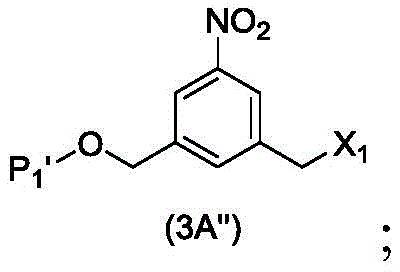
(3) reacting a compound of formula (3A') with formula (a)1) The monomer compound (b) of (a) is reacted,

to form a compound of formula (4A'),

(4) reacting a compound of formula (4A ') with an imine reducing agent to form a compound of formula (5A'),
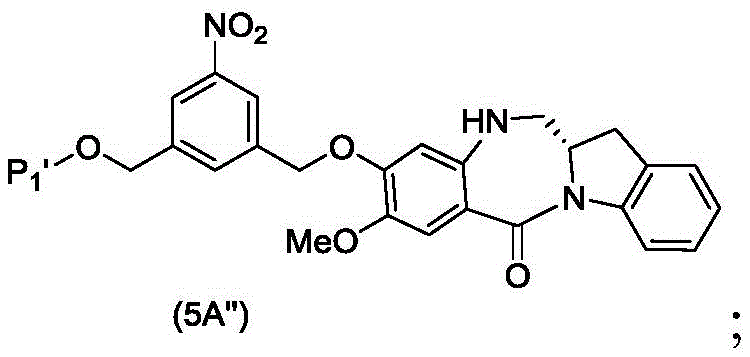
(5) reacting the compound of formula (5A ') with an alcohol deprotection reagent and a halogenation reagent to form the compound of formula (7A'),
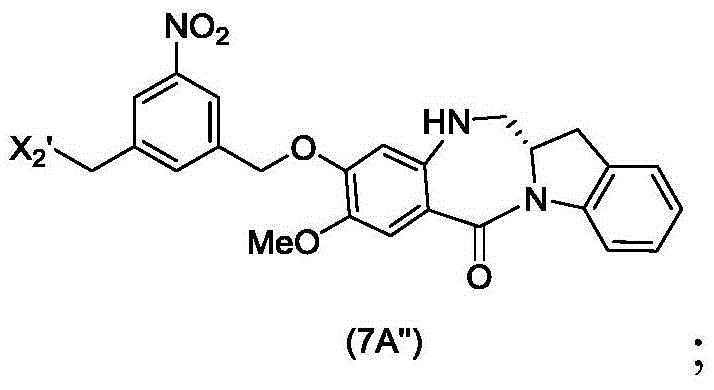
(6) reacting a compound of formula (7A') with formula (a)1) The monomer compound (b) of (a) is reacted,

to form a compound of formula (IA) wherein X2' is-Br or-I; and the remaining variables are as described above in the ninth embodiment.
The conditions and reagents for the method of the tenth embodiment are as described above in the first, second, third, fourth, seventh and/or eighth embodiments and any specific embodiment described therein.
In an eleventh embodiment, the present invention provides a process for preparing a compound of formula (9d),

or a salt thereof, comprising contacting a compound of formula (4d),

with an alcohol deprotecting reagent in which P is1Is an alcohol protecting group; and R is100Is (C)1-C3) An alkoxy group.
The eleventh embodiment also provides for preparing a compound of formula (9A):

or a salt thereof, comprising contacting a compound of formula (4A),

with an alcohol deprotecting reagent in which P is1Is an alcohol protecting group.
In a specific embodiment, for the method of the eleventh embodiment, the alcohol deprotecting agent is tetra-n-butylammonium fluoride, tris (dimethylamino) difluorotrimethylsulfonium silicate, hydrogen fluoride or a solvate thereof, pyridinium hydrogen fluoride, silicon tetrafluoride, hexafluorosilicic acid, cesium fluoride, hydrochloric acid, acetic acid, pyridinium p-toluenesulfonate, formic acid, periodic acid, trifluoroacetic acid, or p-toluenesulfonic acid (p-TsOH). More specifically, the alcohol deprotecting agent is hydrochloric acid or tetra-n-butylammonium fluoride.
In a twelfth embodiment, the present invention provides a process for preparing a compound of formula (10d),

or a salt thereof, comprising reacting a compound of formula (9d) with a halogenating reagent, a sulfonating reagent or an esterifying reagent,

wherein X2is-Br, -I, -Cl, sulfonate or activated ester; and R is100Is (C)1-C3) An alkoxy group.
The twelfth embodiment also provides for the preparation of a compound of formula (10A):

or a salt thereof, comprising reacting a compound of formula (9A) with a halogenating reagent, a sulfonating reagent or an esterifying reagent,

wherein X2is-Br, -I, -Cl, sulfonate or activated ester.
In a specific embodiment, for the method of the twelfth embodiment, X2is-Br, -I or sulfonate.
In a specific embodiment, for the method of the twelfth embodiment, X2Is mesylate, tosylate, brosylate or triflate. Preferably, X2Is mesylate.
In another specific embodiment, the method of the twelfth embodiment comprises reacting a compound of formula (9d) or (9A) with a halogenating agent. Exemplary halogenating agents include, but are not limited to, bromine, hydrobromic acid, carbon tetrabromide, phosphorus tribromide, potassium bromide, hydroiodic acid, iodine, carbon tetraiodide, phosphorus triiodide, sodium iodide or potassium iodide.
In yet another specific embodiment, the method of the twelfth embodiment comprises reacting a compound of formula (9d) or (9A) with a sulfonating agent. Preferably, the sulfonation reagent is a sulfonic anhydride, such as methanesulfonic anhydride, or a sulfonyl chloride, such as methanesulfonyl chloride (MsCl).
In one embodiment, the reaction between the compound of formula (9d) or (9A) and the sulfonation reagent is carried out in the presence of a base. Preferably, the base is a non-nucleophilic base. Exemplary non-nucleophilic bases include, but are not limited to, triethylamine, imidazole, triethylamine, diisopropylethylamine, pyridine, 2, 6-lutidine, dimethylformamide, 1, 8-diazabicyclo [5.4.0] undec-7-ene (DBU), or tetramethylpiperidine. Preferably, the base is triethylamine or diisopropylethylamine.
In a thirteenth embodiment, the present invention provides a process for preparing a compound of formula (18d),

or a salt thereof, comprising reacting a compound of formula (10d)

And formula (d)1) The monomer compound (b) of (a) is reacted,

wherein X2Is a leaving group selected from the group consisting of: -Br, -I, -Cl, sulfonate and activated ester; p3Is H or P2;P2Is an amine protecting group; and R is100Is (C)1-C3) An alkoxy group. In one embodiment, X2is-Br, -I or sulfonate.
The thirteenth embodiment also provides a method of preparing a compound of formula (18A):
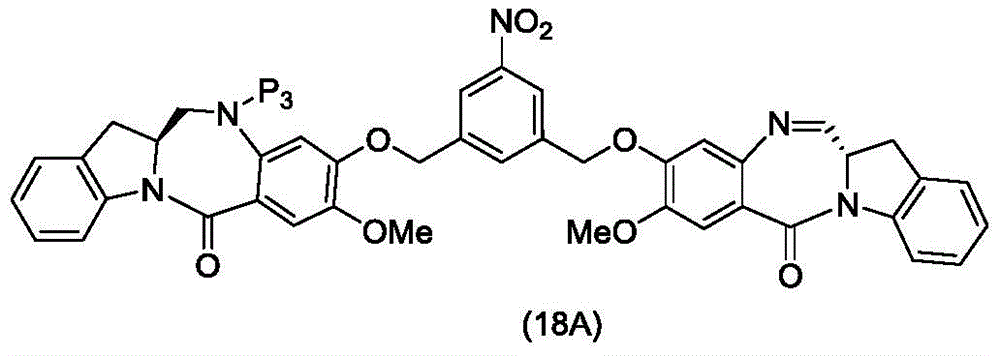
or a salt thereof, comprising reacting a compound of formula (10A)

And formula (d)1) The monomer compound (b) of (a) is reacted,
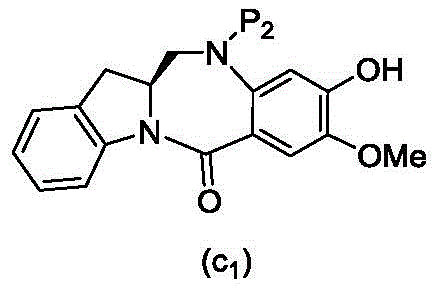
herein X2Is a leaving group selected from the group consisting of: -Br, -I, -Cl, sulfonate or activated ester; and P is3Is H or P2(ii) a And P is2Is an amine protecting group. In one embodiment, X2is-Br, -I or sulfonate.
In a specific embodiment, for the method of the thirteenth embodiment, P3A compound of (10d) or (10A) and (d) are each H1) To form a compound of (Id') or (IA):

in another specific embodiment, P3Is formed by P2An amine protecting group represented by; the monomer compound is represented by the formula (c)1) Represents:
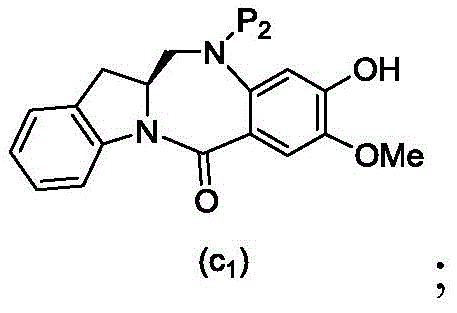
and the compound of formula (18d) or (18A) is represented by formula (11d) or (11A), respectively,

any suitable amine protecting group may be used in the method of the thirteenth embodiment described above. In one embodiment, the amine protecting group is 2-trimethylsilylethyl, (2-phenyl-2-trimethylsilyl) ethyl, triisopropylsiloxy, 2- (trimethylsilyl) ethoxymethyl, allyloxycarbonyl, 9-fluorenylmethoxycarbonyl, 2- (trimethylsilyl) ethoxycarbonyl, or 2,2,2, 2-trichloroethoxycarbonyl.
In a particular embodiment, a compound of formula (10d) or (10A) is reacted with a compound of formula (d)1) Or (c)1) In the presence of a base. Examples of bases include, but are not limited to, sodium carbonate, potassium carbonate, cesium carbonate, sodium hydride, or potassium hydride.
Any suitable solvent may be used in the above reaction. In one embodiment, the solvent is DMF.
In a fourteenth embodiment, the present invention provides a process for preparing a compound of formula (Id'),
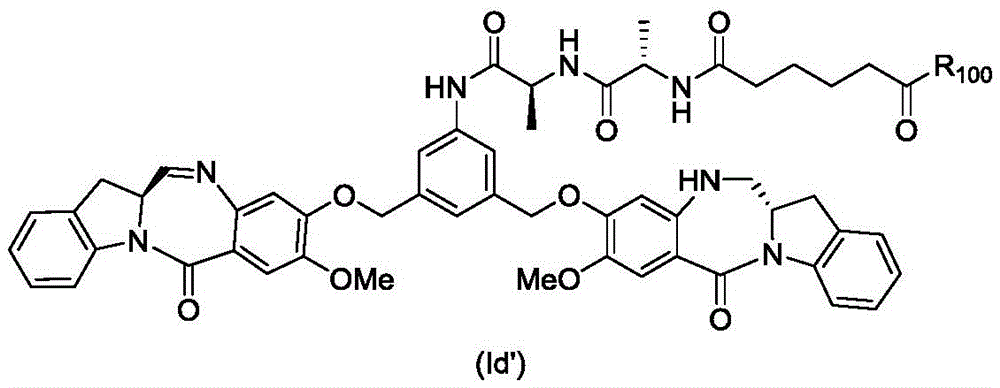
or a pharmaceutically acceptable salt thereof, comprising contacting a compound of formula (11d),

with an amine deprotecting reagent, in which P is2Is an amine protecting group; and R is100Is (C)1-C3) An alkoxy group.
A fourteenth embodiment also provides for the preparation of compounds of formula (IA):

or a pharmaceutically acceptable salt thereof, comprising contacting a compound of formula (11d),

with an amine deprotecting reagent, in which P is2Is an amine protecting group.
Any suitable amine deprotection reagent may be used in the above process. In one embodiment, the amine deprotection agent is tetra-n-butylammonium fluoride, acetic acid, pyridinium hydrogen fluoride, cesium fluoride, piperidine, morpholine, or trifluoroacetic acid.
In a fifteenth embodiment, the present invention provides a process for preparing a compound of formula (Id'),

or a pharmaceutically acceptable salt thereof, comprising the steps of:
(1) introducing an alcohol protecting group onto one of the primary alcohols of the compound of formula (1d),

to form a compound of formula (2d),

(2) reacting the compound of formula (2d) with a halogenating reagent, a sulfonating reagent or an esterifying reagent to form a compound of formula (3d),

(3) reacting a compound of formula (3d) with a compound of formula (a)1) The monomer compound (b) of (a) is reacted,

to form a compound of formula (4d),

(4) reacting a compound of formula (4d) with an alcohol deprotection reagent to form a compound of formula (9 d);

(5) reacting the compound of formula (9d) with a second halogenating reagent, a second sulfonating reagent or a second esterifying reagent to form a compound of formula (10d),

(6) reacting a compound of formula (10d) with a compound of formula (d)1) By reaction of a monomeric compound of

To form a compound of formula (18d),

(7) when P is present3In the case of an amine protecting group, reacting a compound of formula (18d) with an amine deprotecting reagent to form a compound of formula (Id'), wherein P1Is an alcohol protecting groupClustering; x1And X2Each independently is a leaving group selected from the group consisting of: -Br, -I, -Cl, sulfonate and activated ester; p3Is H or an amine protecting group; and R is100Is (C)1-C3) An alkoxy group.
A fifteenth embodiment also encompasses the preparation of compounds of formula (IA):

or a pharmaceutically acceptable salt thereof, comprising the steps of:
(1) introducing an alcohol protecting group onto one of the primary alcohols of the compound of formula (1A),

to form a compound of formula (2A),

(2) reacting a compound of formula (2A) with a halogenating reagent, a sulfonating reagent or an esterifying reagent to form a compound of formula (3A),

(3) reacting a compound of formula (3A) with a compound of formula (a)1) The monomer compound (b) of (a) is reacted,

to form a compound of formula (4A),
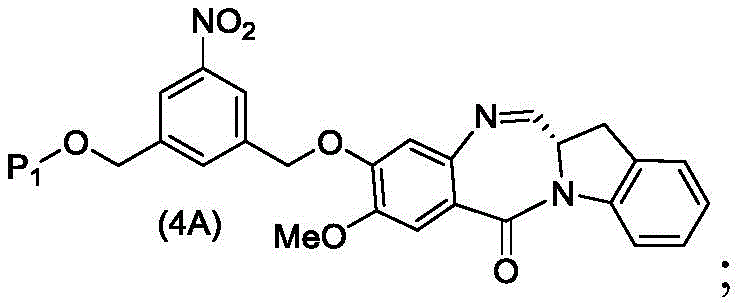
(4) reacting a compound of formula (4A) with an alcohol deprotection reagent to form a compound of formula (9A);
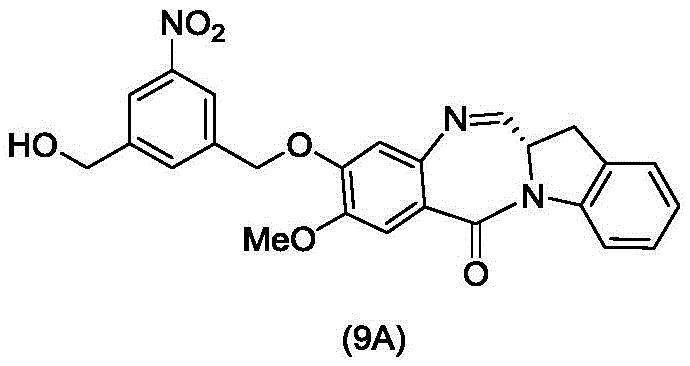
(5) reacting the compound of formula (9A) with a second halogenating agent, a second sulfonating agent or a second esterifying agent to form a compound of formula (10A),

(6) reacting a compound of formula (10A) with a compound of formula (d)1) By reaction of a monomeric compound of

To form a compound of formula (18A),
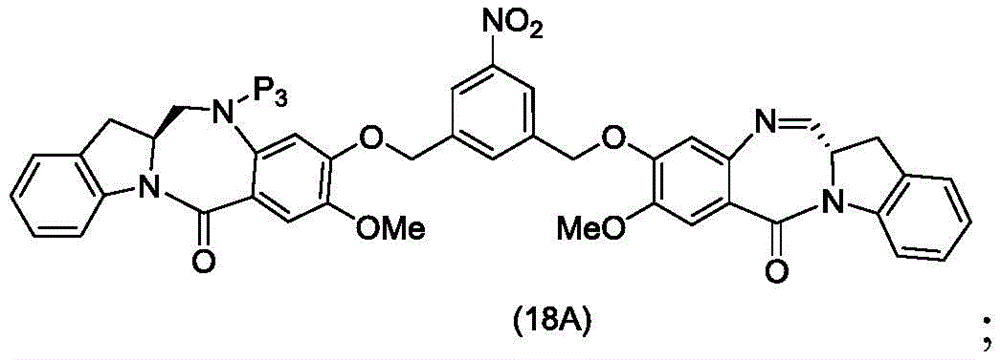
(7) reacting a compound of formula (18A) with an amine deprotection reagent to form a compound of formula (IA), wherein P1Is an alcohol protecting group; x1And X2Each independently is a leaving group selected from the group consisting of: -Br, -I, -Cl, sulfonate and activated ester; and P is3Is H or an amine protecting group.
In a specific embodiment, for the method of the ninth embodiment, X1And X2Each independently is-Br, -l, or a sulfonate ester.
In a specific embodiment, for the method of the fifteenth embodiment, P3A compound of (10d) or (10A) and (d) are each H1) To form the compound of (Id') or (IA).
In another specific embodiment, for the method of the fifteenth embodiment, P3Is P2(ii) a The monomer compound is represented by the formula (c)1) Represents:

and the compound of formula (18d) or (18A) is represented by formula (11d) or (11A), respectively:

wherein P is2Is an amine protecting group.
The conditions and reagents for the method of the fifteenth embodiment are as described above in the first, second, third, eleventh, twelfth, thirteenth and/or fourteenth embodiment and any specific embodiment described therein.
In a sixteenth embodiment, the present invention provides a process for preparing a compound of formula (12d),

or a salt thereof, comprising contacting a compound of formula (1d),
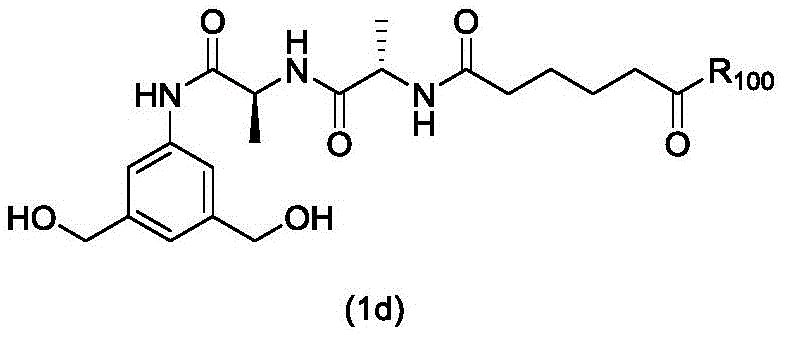
with halogenating or sulfonating agents, in which X1is-Br, -I, -Cl, sulfonate or activated ester; and R is100Is (C)1-C3) An alkoxy group.
The sixteenth embodiment also provides for preparing a compound of formula (12A):

or a salt thereof, comprising reacting a compound of formula (1A),

with halogenating or sulfonating agents, in which X1is-Br, -I, -Cl, sulfonate or activated ester.
In a specific embodiment, for the method of the sixteenth embodiment, X1is-Br, -I or sulfonate. In another specific embodiment, X1is-Br or-I. In yet another specific embodiment, X1Is a sulfonate, preferably a mesylate. In another specific embodiment, X1is-Cl.
In another specific embodiment, the halogenating agent is reacted with the primary alcohol of the compound of formula (1d) or (1A) in the presence of an alcohol activator. In one embodiment, the alcohol activating agent is thionyl chloride.
In another specific embodiment, the halogenating agent is lithium bromide, sodium bromide, potassium iodide or sodium iodide. In another specific embodiment, the halogenating agent is carbon tetrachloride/triphenylphosphine, methanesulfonyl chloride/lithium chloride or methanesulfonyl chloride/pyridine.
In yet another specific embodiment, the process of the sixteenth embodiment comprises reacting a compound of formula (1d) or (1A) with LiBr in the presence of thionyl chloride.
Any suitable solvent may be used in the method of the above-described sixteenth embodiment. Exemplary solvents include, but are not limited to, DMF, CH2Cl2THF, dichloroethane, and the like.
In a seventeenth embodiment, the present invention provides a process for preparing a compound of formula (10 d'),

or a salt thereof, comprising contacting a compound of formula (12d),

and formula (a)1) The monomer compound (b) of (a) is reacted,
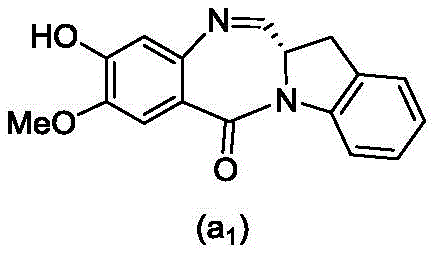
wherein X1is-Br, -I, -Cl, sulfonate or activated ester; and R is100Is (C)1-C3) An alkoxy group. A seventeenth embodiment also provides a process for preparing a compound of formula (10A')

Or a salt thereof, comprising reacting a compound of formula (12A),
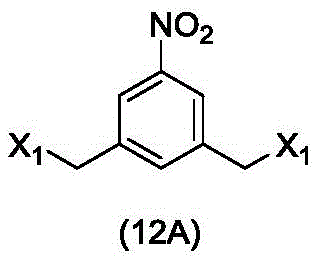
and formula (a)1) The monomer compound (b) of (a) is reacted,

wherein X1is-Br, -I, -Cl, sulfonate or activated ester.
The seventeenth embodiment also provides a process for preparing a compound of formula (7d 1'),

or a salt thereof, comprising reacting a compound of formula (12d) with formula (d)1) By monomer(s) ofReaction of compounds in which X1is-Br, -I, -Cl, sulfonate or activated ester; p3Is H or an amine protecting group; and R is100Is (C)1-C3) An alkoxy group.
The seventeenth embodiment also provides a process for preparing a compound of formula (7A 1'),

or a salt thereof, comprising reacting a compound of formula (12A) with a compound of formula (d)1) In which X is1is-Br, -I, -Cl, sulfonate or activated ester; and P is3Is H or an amine protecting group.
In a particular embodiment, for formula (7d1 ') or (7A 1'), P3Is H. In another specific embodiment, P3Are amine protecting groups as described herein.
In a specific embodiment, for the method of the seventeenth embodiment, X1is-Br, -I or sulfonate. In another specific embodiment, X1Is a sulfonic acid ester. In a more specific embodiment, X1Is mesylate.
In a particular embodiment, a compound of formula (12d) or (12A) is reacted with a compound of formula (a)1) In the presence of a base. Examples of suitable bases include, but are not limited to, sodium carbonate, potassium carbonate, cesium carbonate, sodium hydride, or potassium hydride. In one embodiment, the base is potassium carbonate.
In another specific embodiment, a compound of formula (12d) or (12A) is reacted with a compound of formula (d)1) In the presence of a base. Examples of suitable bases include, but are not limited to, sodium carbonate, potassium carbonate, cesium carbonate, sodium hydride, or potassium hydride. In one embodiment, the base is potassium carbonate.
For the method of the seventeenth embodiment, any suitable solvent may be used. In one embodiment, the solvent is DMF.
In another specific embodiment, the reaction is carried out using a catalyst corresponding to formula (a)1) Or (d)1) With respect to the monomer compound of (a), a molar equivalent excess of the compound of formula (12d) or (12A).
In an eighteenth embodiment, the present invention provides a process for preparing a compound of formula (7 d'),

or a salt thereof, comprising reacting a compound of formula (10 d'),

or a salt thereof with an imine reducing agent, wherein X1is-Br, -I, -Cl, sulfonate or activated ester; and R is100Is (C)1-C3) An alkoxy group.
The eighteenth embodiment also provides a process for preparing a compound of formula (7A'),
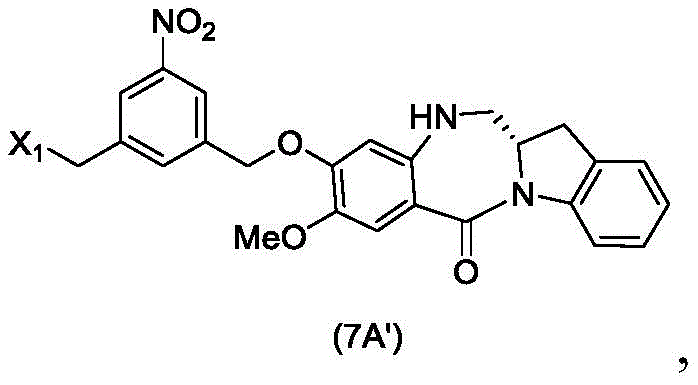
or a salt thereof, comprising reacting a compound of formula (10A'),

or a salt thereof with an imine reducing agent, wherein X1is-Br, -I, -Cl, sulfonate or activated ester.
In a specific embodiment, for the method of the eighteenth embodiment, X1is-Br, -I or sulfonate. In another specific embodiment, X1Is a sulfonic acid ester. Preferably, X1Is mesylate.
In another specific embodiment, for the tenthThe method of an eighth embodiment, the imine reducing reagent is a hydride reducing reagent. In a more specific embodiment, the imine reducing reagent is sodium borohydride, sodium triacetoxyborohydride, sodium cyanoborohydride, lithium aluminum hydride, hydrogen, ammonium formate, borane, 9-borabicyclo [3.3.1]Nonane (9-BBN), diisobutylaluminum hydride (DIBAL), lithium borohydride (LiBH)4) Potassium borohydride (KBH)4) Or sodium bis (2-methoxyethoxy) aluminum hydride (Red-Al). Even more specifically, the imine reducing reagent is sodium triacetoxyborohydride (nabh (oac) 3).
Any suitable solvent may be used in the method of the eighteenth embodiment. In one embodiment, the solvent is dichloroethane.
In a nineteenth embodiment, the present invention provides a method of preparing a compound of formula (Id'),

or a pharmaceutically acceptable salt thereof, comprising the steps of:
(1) reacting a compound of formula (1d) with a halogenating reagent, a sulfonating reagent or an esterifying reagent,

to form a compound of formula (12d),

(2) reacting a compound of formula (12d) with a compound of formula (a)1) The monomer compound (b) of (a) is reacted,
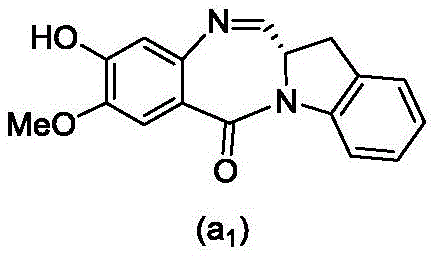
to form a compound of formula (10 d'),

(3) reacting a compound of formula (10 d') with a compound of formula (d)1) The monomer compound (b) of (a) is reacted,

to form a compound of formula (18d),
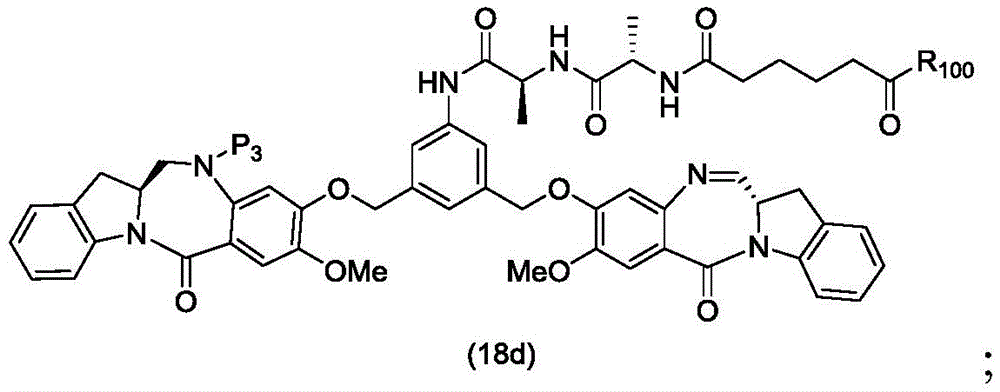
(4) when P is present3In the case of an amine protecting group, reacting a compound of formula (18d) with an amine deprotecting reagent to form a compound of formula (Id'), wherein X1is-Br, -I, -Cl, sulfonate or activated ester; p3Is H or an amine protecting group; and R is100Is (C)1-C3) An alkoxy group.
A nineteenth embodiment also provides a method of preparing a compound of formula (IA),
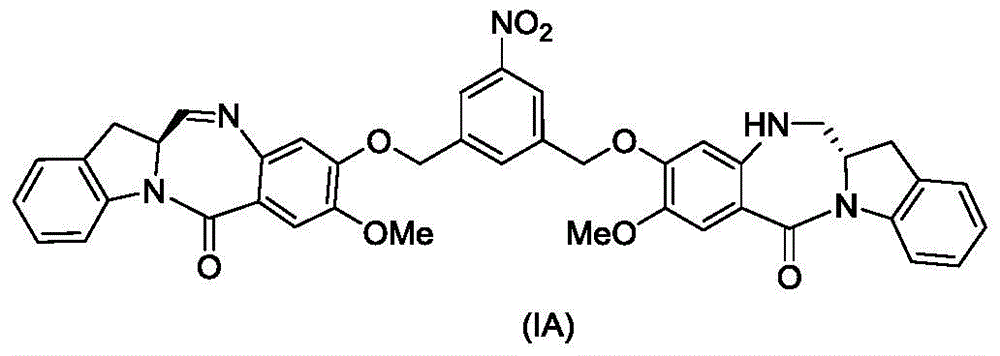
or a pharmaceutically acceptable salt thereof, comprising the steps of:
(1) reacting a compound of formula (1A) with a halogenating reagent, a sulfonating reagent or an esterifying reagent,

to form a compound of formula (12A),
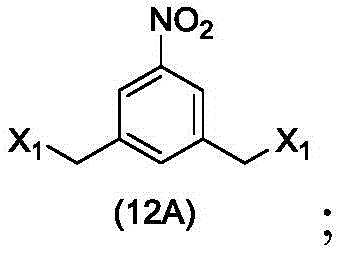
(2) make formula(12A) A compound of the formula (a)1) The monomer compound (b) of (a) is reacted,

to form a compound of formula (10A'),

(3) reacting a compound of formula (10A') with a compound of formula (d)1) The monomer compound (b) of (a) is reacted,

to form a compound of formula (18A),

(4) reacting a compound of formula (11A) with an amine deprotection reagent to form a compound of formula (IA), wherein X1is-Br, -I, -Cl, sulfonate or activated ester; p3Is H or an amine protecting group.
In a specific embodiment, for the method of the nineteenth embodiment, X1is-Br, -I or sulfonate.
In a specific embodiment, for the method of the nineteenth embodiment, P3A compound of (10 d') or (10A) and (d) are each H1) To form the compound of (Id') or (IA).
In another specific embodiment, for the method of the nineteenth embodiment, P is3Is P2(ii) a The monomer compound is represented by the formula (c)1) Represents:
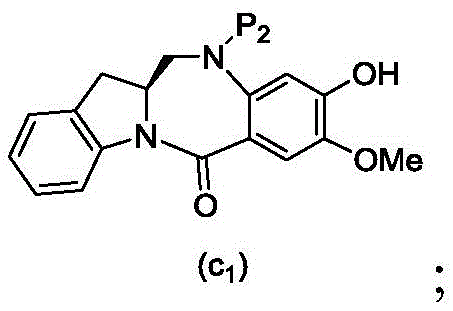
and the compound of formula (18d) or (18A) is represented by formula (11d) or (11A), respectively:

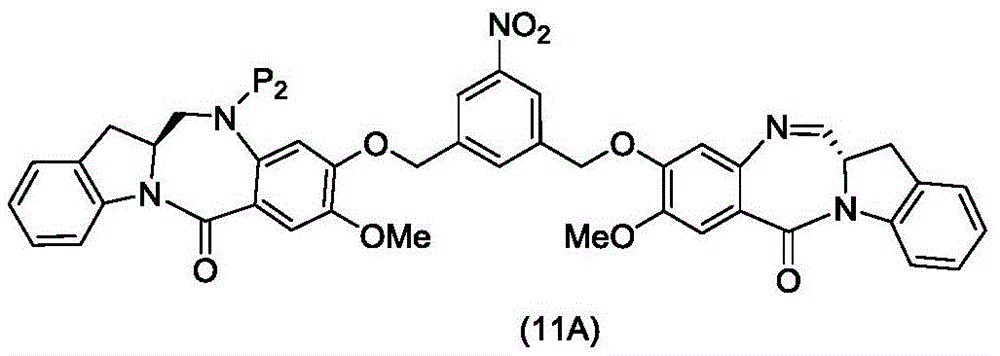
wherein P is2Is an amine protecting group.
The conditions and reagents for the method of the nineteenth embodiment are as described above in the sixteenth, seventeenth, thirteenth and/or fourteenth embodiment and any specific embodiment described therein.
In a twentieth embodiment, the present invention provides a process for preparing a compound of formula (Id'),

or a pharmaceutically acceptable salt thereof, comprising the steps of:
(1) reacting a halogenating reagent, a sulfonating reagent or an esterifying reagent with a compound of formula (1d),

to form a compound of formula (12d),

(2) reacting a compound of formula (12d) with a compound of formula (a)1) The monomer compound (b) of (a) is reacted,

to form a compound of formula (10 d'),

(3) reacting compound (10d ') with an imine reducing reagent to form compound (7 d'),

(4) reacting a compound of formula (7 d') with formula (a)1) The monomer compound (b) of (a) is reacted,
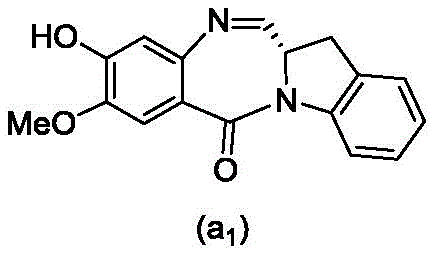
to form a compound of formula (Id') or a pharmaceutically acceptable salt thereof, wherein X1is-Br, -I, -Cl, sulfonate or activated ester; and R is100Is (C)1-C3) An alkoxy group.
A twentieth embodiment also provides a process for preparing a compound of formula (IA),

or a pharmaceutically acceptable salt thereof, comprising the steps of:
(1) reacting a halogenating agent, a sulfonating agent or a second esterifying agent with a compound of formula (1A),
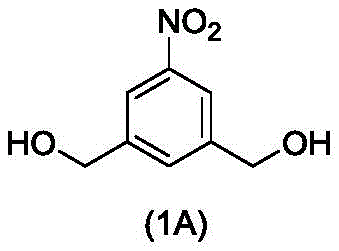
to form a compound of formula (12A),
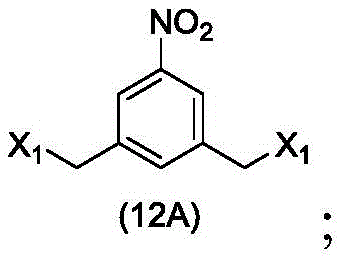
(2) reacting a compound of formula (12A) with a compound of formula (a)1) The monomer compound (b) of (a) is reacted,

to form a compound of formula (10A'),

(3) reacting compound (10A ') with an imine reducing reagent to form compound (7A'),
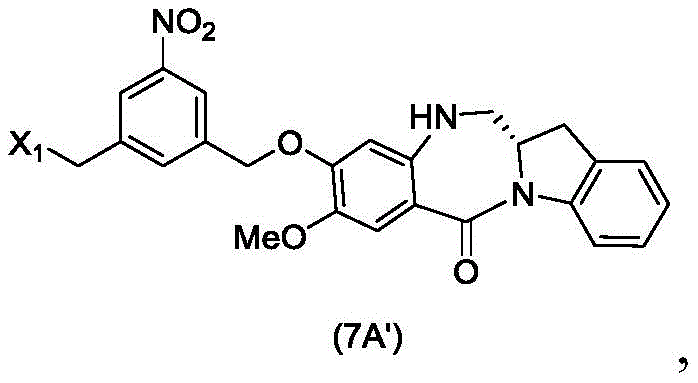
(4) reacting a compound of formula (7A') with formula (a)1) The monomer compound (b) of (a) is reacted,

to form a compound of formula (IA'), or a pharmaceutically acceptable salt thereof, wherein X1is-Br, -I, -Cl, sulfonate or activated ester.
In a specific embodiment, for the method of the twentieth embodiment, X1is-Br, -I or sulfonate.
The conditions and reagents for the method of the twentieth embodiment are as described above in the sixteenth, seventeenth, eighteenth and/or eighth embodiments and any specific embodiments described therein.
In a twenty-first embodiment, the present invention provides a process for preparing a compound of formula (Id'),

or a pharmaceutically acceptable salt thereof, comprising the steps of:
(1) reacting a halogenating reagent, a sulfonating reagent or an esterifying reagent with a compound of formula (1d),

to form a compound of formula (12d),
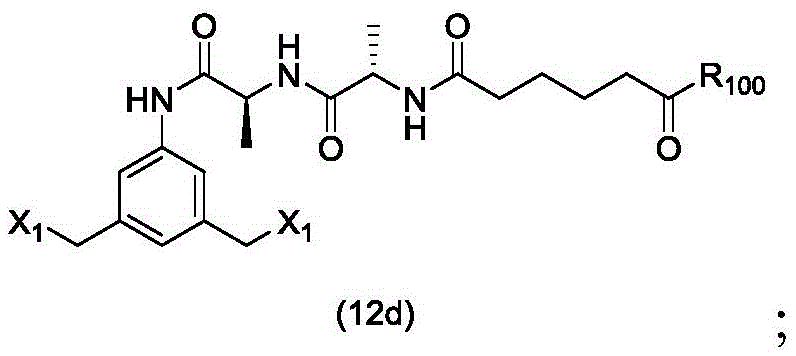
(2) reacting a compound of formula (12d) with a compound of formula (d)1) The monomer compound (b) of (a) is reacted,

to form a compound of formula (7d 1'),

(3) reacting a compound of formula (7d 1') with formula (a)1) The monomer compound (b) of (a) is reacted,

to form a compound of formula (18d),

(4) when P is present3(ii) in the case of an amine protecting group, reacting the compound of formula (18d) with an amine deprotecting reagent to form a compound of formula (Id'); wherein X1is-Br, -I, -Cl, sulfonate or activated ester; p3Is HOr an amine protecting group.
A twenty-first embodiment also provides a process for the preparation of a compound of formula (IA),

or a pharmaceutically acceptable salt thereof, comprising the steps of:
(1) reacting a halogenating agent, a sulfonating agent or an esterifying agent with a compound of formula (1A),

to form a compound of formula (12A),
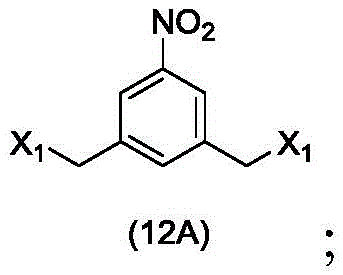
(2) reacting a compound of formula (12A) with a compound of formula (d)1) The monomer compound (b) of (a) is reacted,

to form a compound of formula (7A 1'),

(3) reacting a compound of formula (7A 1') with formula (a)1) The monomer compound (b) of (a) is reacted,
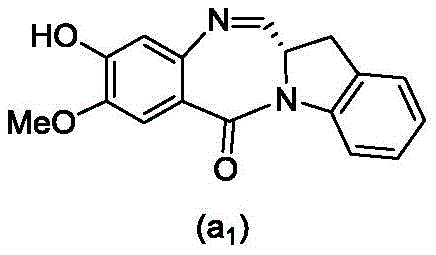
to form a compound of formula (18A),

(4) when P is present3(ii) when an amine protecting group, reacting the compound of formula (18A) with an amine deprotecting reagent to form a compound of formula (IA); wherein X1is-Br, -I, -Cl, sulfonate or activated ester; p3Is H or an amine protecting group.
In one embodiment, for the method of the twenty-first embodiment, P3Is H.
In another embodiment, for the method of the twenty-first embodiment, X1is-Br, -Cl or sulfonate.
The conditions and reagents for the method of the twenty-first embodiment are as described above in the sixteenth, seventeenth, eighteenth, eighth and/or fourteenth embodiment and any specific embodiment described therein.
In a twenty-second embodiment, the present invention provides a process for preparing a compound of formula (13d),
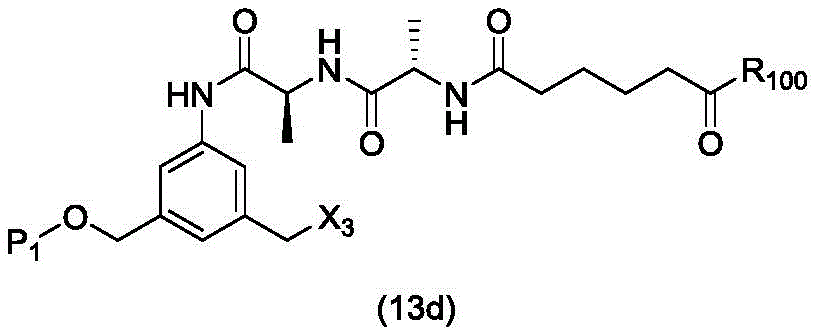
or a salt thereof, comprising reacting a chlorinating agent with a compound of formula (2d),

wherein P is1Is an alcohol protecting group; x3is-Cl; and R is100Is (C)1-C3) An alkoxy group.
A twenty-second embodiment also provides a process for preparing a compound of formula (13A),

or a salt thereof, comprising reacting a chlorinating agent with a compound of formula (2A),

wherein P is1Is an alcohol protecting group and X3is-Cl.
In another specific embodiment, for the method of the twenty-second embodiment, the alcohol protecting group is pivaloyl, methoxymethyl, 2-methoxyethoxymethyl, p-methoxybenzyl, 3, 4-dimethoxybenzyl, 2, 6-dimethoxybenzyl, diphenylmethyl, benzyloxymethyl, 2,2, 2-trichloroethoxycarbonyl, tetrahydrofuranyl, tetrahydropyranyl, benzyl, benzoyl, p-phenylbenzoyl, 2,4, 6-trimethylbenzoyl, p-bromobenzoyl, p-nitrobenzoyl, picolinoyl, nicotinyl, 5-dibenzosuberyl, trityl/triphenylmethyl, or tris (4-tert-butylphenyl) methyl. Preferably, the alcohol protecting group is methoxymethyl, tetrahydropyranyl, 2-methoxyethoxymethyl, p-methoxybenzyl, benzyloxymethyl or 2,2, 2-trichloroethoxycarbonyl. Even more preferably, the alcohol protecting group is 2,2, 2-trichloroethoxycarbonyl.
In another specific embodiment, the alcohol protecting group is a silyl protecting group. For example, the silyl protecting group is dimethylisopropylsilyl, diethylisopropylsilyl, dimethylhexylsilyl, trimethylsilyl, triisopropylsilyl, tribenzylsilyl, triphenylsilyl, 2-norbornyldimethylsilyl, tert-butyldimethylsilyl, tert-butyldiphenylsilyl, 2-Trimethylethylsilyl (TEOC) or [2- (trimethylsilyl) ethoxy ] methyl. Preferably, the silyl protecting group is triethylsilyl, triisopropylsilyl or tert-butyldimethylsilyl. More preferably, the silyl protecting group is tert-butyldimethylsilyl.
In one embodiment, a base is used. The base may be a non-nucleophilic base. Examples of non-nucleophilic bases include, but are not limited to, triethylamine, imidazole, Diisopropylethylamine (DIPEA), pyridine, 2, 6-dimethylpyridine, dimethylformamide, 1, 8-diazabicyclo [5.4.0] undec-7-ene (DBU), or tetramethylpiperidine. Preferably, the non-nucleophilic base is pyridine.
Any suitable organic solvent may be used in the method of the twenty-second embodiment. Exemplary solvents include, but are not limited to, DMF, CH2Cl2Dichloroethane, THF, dimethylacetamide, and the like. In certain embodiments, DMF is used as the solvent.
In a twenty-third embodiment, the present invention provides a process for preparing a compound of formula (14d),

or a salt thereof, comprising reacting a compound of formula (13d)
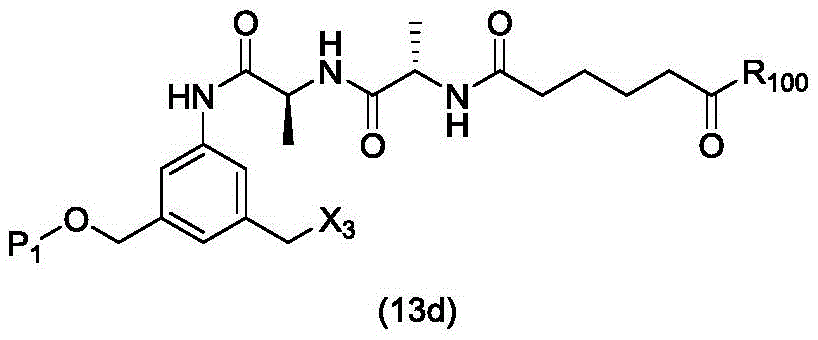
With an alcohol deprotecting reagent in which P is1Is an alcohol protecting group; x3is-Cl; and R is100Is (C)1-C3) An alkoxy group.
A twenty-third embodiment also provides a method of preparing a compound of formula (14A),
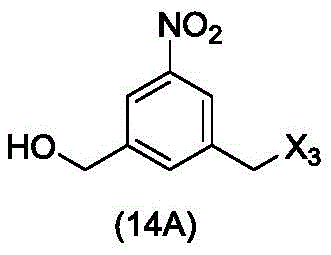
or a salt thereof, comprising reacting a compound of formula (13A)

With an alcohol deprotecting reagent in which P is1Is an alcohol protecting group; and X3is-Cl.
In another specific embodiment, for the method of the twenty-third embodiment, the alcohol deprotecting agent is tetra-n-butylammonium fluoride, tris (dimethylamino) difluorotrimethylsulfonium silicate, hydrogen fluoride or a solvate thereof, pyridinium hydrogen fluoride, silicon tetrafluoride, hexafluorosilicic acid, cesium fluoride, hydrochloric acid, acetic acid, trifluoroacetic acid, pyridinium p-toluenesulfonate, p-toluenesulfonic acid (p-TsOH), formic acid, or periodic acid. Preferably, the alcohol deprotection reagent is hydrogen fluoride pyridine.
In a twenty-fourth embodiment, the present invention provides a method of preparing a compound of formula (15 d):

or a salt thereof, comprising reacting a sulfonating agent or an esterifying agent with a compound of formula (14d),

wherein X3is-Cl; x4Is a sulfonate or an activated ester; and R is100Is (C)1-C3) An alkoxy group.
A twenty-fourth embodiment also provides a method of preparing a compound of formula (15A),

or a salt thereof, comprising reacting a sulfonating agent with a compound of formula (14A),
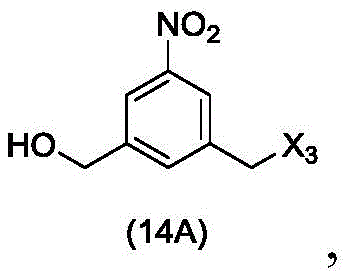
wherein X3is-Cl; and X4Is a sulfonate or an activated ester.
In a specific embodiment, for the method of the twenty-fourth embodiment, X4Is a sulfonic acid ester.
In another specific embodiment, for the method of the twenty-fourth embodiment, the sulfonating agent is methanesulfonic anhydride, methanesulfonyl chloride, p-toluenesulfonyl chloride, 4-bromobenzenesulfonyl chloride, or trifluoromethanesulfonic anhydride.
In another specific embodiment, for the method of the twenty-fourth embodiment, the sulfonate ester is a mesylate, tosylate, brosylate or triflate. Preferably, the sulfonate ester is a mesylate.
In another embodiment, for the method of the twenty-fourth embodiment, a base is used. The base may be a non-nucleophilic base. Examples of non-nucleophilic bases include, but are not limited to, triethylamine, imidazole, diisopropylethylamine, pyridine, 2, 6-lutidine, dimethylformamide, 1, 8-diazabicyclo [5.4.0] undec-7-ene (DBU), or tetramethylpiperidine. Preferably, the non-nucleophilic base is diisopropylethylamine.
In a twenty-fifth embodiment, the present invention provides a method of preparing a compound of formula (20 d):

or a salt thereof, comprising reacting a brominating or iodinating agent with a compound of formula (14d),

wherein X3is-Cl; x5is-Br or-I; and R is100Is (C)1-C3) An alkoxy group.
A twenty-fifth embodiment also provides a method of preparing a compound of formula (20A):
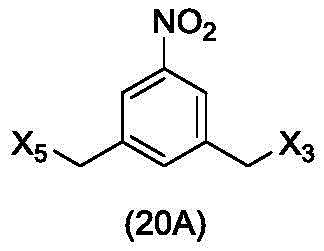
or a salt thereof, comprising reacting a brominating or iodinating agent with a compound of formula (14A),

wherein X3is-Cl; x5is-Br or-I; and R is100Is (C)1-C3) An alkoxy group.
In a specific embodiment, for the process of the twenty-fifth embodiment, the brominating or iodinating agent is bromine, hydrobromic acid, carbon tetrabromide, phosphorus tribromide, potassium bromide, hydroiodic acid, iodine, carbon tetraiodide, phosphorus triiodide, sodium iodide, or potassium iodide.
In a twenty-sixth embodiment, the present invention provides a method of preparing a compound of formula (16 d):
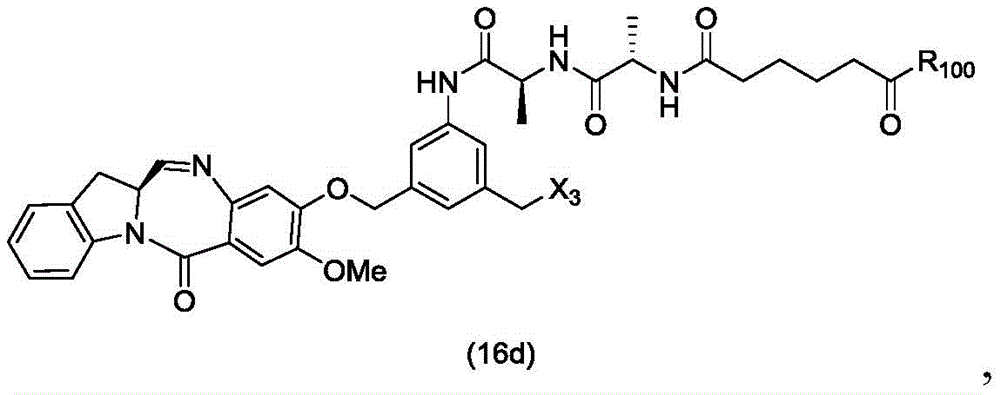
or a salt thereof, comprising reacting a compound of formula (15d)

And formula (a)1) The monomer compound (b) of (a) is reacted,
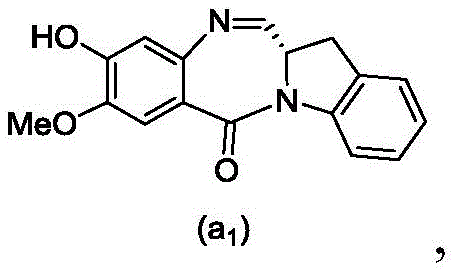
wherein X3is-Cl; x4Is a sulfonate or an activated ester; and R is100Is (C)1-C3) An alkoxy group.
A twenty-sixth embodiment also provides a method of preparing a compound of formula (16A),

or a salt thereof, comprising reacting a compound of formula (15A)

And formula (a)1) The monomer compound (b) of (a) is reacted,

wherein X3is-Cl; and X4Is a sulfonate or an activated ester.
In a specific embodiment, for the method of the twenty-sixth embodiment, X4Is a sulfonic acid ester.
In one embodiment, for the method of the twenty-sixth embodiment, a base is used. In particular embodiments, the base is sodium carbonate, potassium carbonate, cesium carbonate, sodium hydride, or potassium hydride. Preferably, the base is potassium carbonate.
Any suitable organic solvent may be used in the method of the twenty-sixth embodiment. Exemplary solvents include, but are not limited to, DMF, CH2Cl2Dichloroethane, THF, dimethylacetamide, and the like. In certain embodiments, dimethylacetamide is used as the solvent.
In a twenty-seventh embodiment, the present invention provides a process for preparing a compound of formula (16d),

or a salt thereof, comprising reacting a compound of formula (20d)

And formula (a)1) The monomer compound (b) of (a) is reacted,

wherein X3is-Cl; x5is-Br or-I; and R is100Is (C)1-C3) An alkoxy group.
A twenty-seventh embodiment also provides a method of preparing a compound of formula (16A),

or a salt thereof, comprising reacting a compound of formula (20A)

And formula (a)1) The monomer compound (b) of (a) is reacted,

wherein X3is-Cl and X5is-Br or-I.
In a specific embodiment, for the method of the twenty-seventh embodiment, a compound of formula (20d) or (20A) is reacted with a compound of formula (a)1) In the presence of a base. Any suitable base may be used. In one embodiment, the base is sodium carbonate, potassium carbonate, cesium carbonate, sodium hydride, or potassium hydride. More specifically, the base is potassium carbonate.
In one embodiment, for the method of the twenty-seventh embodiment, any suitable solvent may be used for the compound of formula (20d) or (20A) and the compound of formula (a)1) The reaction of the monomer compound (2). In a particular embodiment, the reaction is carried out in a polar aprotic solvent. More specifically, the aprotic solvent is dimethylacetamide.
In a twenty-eighth embodiment, the present invention provides a process for preparing a compound of formula (16d),

or a salt thereof, comprising reacting a compound of formula (14d)

And formula (a)1) The monomer compound (b) of (a) is reacted,

wherein X3is-Cl; and R is100Is (C)1-C3) An alkoxy group.
A twenty-eighth embodiment also includes the preparation of a compound of formula (16A),

or a salt thereof, comprising reacting a compound of formula (14A)
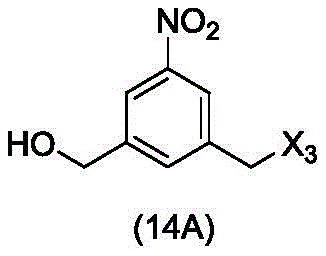
And formula (a)1) The monomer compound (b) of (a) is reacted,

wherein X3is-Cl.
In a specific embodiment, for the methods of the twenty-eighth embodiment, a compound of formula (14d) or (14A) is reacted with a compound of formula (a)1) In the presence of an alcohol activator. In one embodiment, the alcohol is activatedThe agent is a trialkyl phosphine, triaryl phosphine or triheteroaryl phosphine. In one embodiment, the alcohol activator is trimethylphosphine, tributylphosphine, tri (o-tolyl) phosphine, tri (m-tolyl) phosphine, tri (p-tolyl) phosphine, tri (2-pyridyl) phosphine, tri (3-pyridyl) phosphine, tri (4-pyridyl) phosphine, or [4- (3,3,4,4,5,5,6,6,7,7,8,8,9,9,10,10, 10-heptadecafluorodecyl) phenyl]Diphenylphosphine. In another embodiment, the alcohol activator may be a phosphine-like reagent, such as (tributylphosphoranylidene) acetonitrile, (cyanomethylene) tributylphosphorane (CMBP), or (cyanomethylene) trimethylphosphine (CMMP). In a more specific embodiment, the alcohol activator is triphenylphosphine. In one embodiment, the alcohol activator can be polymer-bound or polymer-supported, such as a polymer-bound or polymer-supported trialkyl phosphine, triaryl phosphine (e.g., triphenylphosphine), or triheteroaryl phosphine.
In another specific embodiment, for the methods of the twenty-eighth embodiment, a compound of formula (14d) or (14A) is reacted with a compound of formula (a)1) In the presence of an azodicarboxylate. In one embodiment, the azodicarboxylate is selected from the group consisting of: diethyl azodicarboxylate (DEAD), diisopropyl azodicarboxylate (DIAD), 1'- (azodicarbonyl) dipiperidine (ADDP), di-tert-butyl azodicarboxylate (DTAD), 1, 6-dimethyl-1, 5, 7-hexahydro-1, 4,6, 7-tetraazooctan-2, 5-dione (DHTD), bis (4-chlorobenzyl) azodicarboxylate (DCAD), dimorpholine azodicarboxylate, N, N, N', N '-Tetramethylazodicarboxamide (TMAD), N, N, N', N '-tetraisopropyl azodicarboxamide (TIPA), 4' -azopyridine, bis (2,2, 2-trichloroethyl) azodicarboxylate, o- (tert-butyldimethylsilyl) -N-toluenesulfonylhydroxylamine, Bis- (4-chlorobenzyl) azodicarboxylate, cyclic 1, 6-dimethyl-1, 5, 7-hexahydro-1, 4,6, 7-tetraazooctan-2, 5-dione (DHTD), dimethyl acetylenedicarboxylate (DMAD), bis-2-methoxyethyl azodicarboxylate, bis- (4-chlorobenzyl) azodicarboxylate, and bis- (4,4,5,5,6,6,7,7,8,8,9,9, 9-tridecafluorononyl) azodicarboxylate. More specifically, the azodicarboxylic acid ester is DIAD. In one embodiment, the azodicarboxylic acid ester is polymer-bound or polymer-supported, e.g., polyA compound-supported alkyl azodicarboxylate (e.g., polymer-bound DEAD, DIAD, DTAD, or ADDP).
In yet another specific embodiment, for the methods of the twenty-eighth embodiment, a compound of formula (14d) or (14A) is reacted with a compound of formula (a)1) In the presence of triphenylphosphine and azodicarboxylate. In one embodiment, the azodicarboxylate is selected from the group consisting of: diethyl azodicarboxylate (DEAD), diisopropyl azodicarboxylate (DIAD), 1' - (azodicarbonyl) dipiperidine (ADDP), and di-tert-butyl azodicarboxylate (DTAD). More specifically, the azodicarboxylic acid ester is DIAD.
In a twenty-ninth embodiment, the present invention provides a method of preparing a compound of formula (18 d):

a method of a pharmaceutically acceptable salt thereof, comprising reacting a compound of formula (16 d):

and formula (d)1) Reduced monomer reaction of (a):

wherein X3is-Cl; p3Is H or an amine protecting group; and R is100Is (C)1-C3) An alkoxy group.
A twenty-ninth embodiment also provides for preparing a compound of formula (18A),
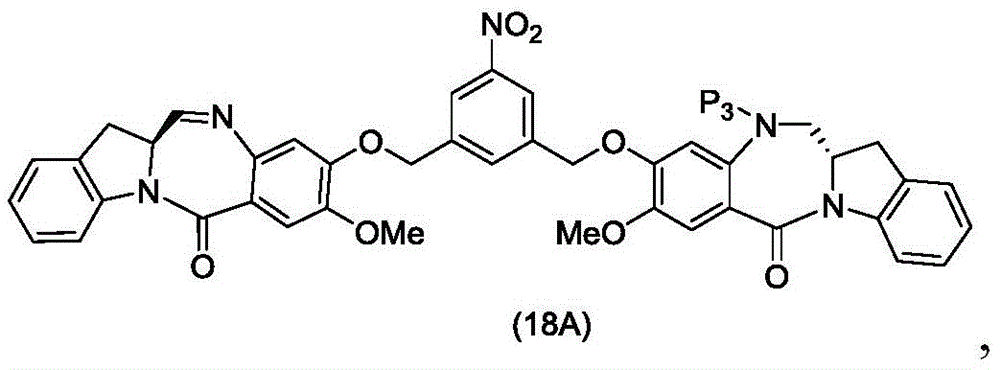
or a pharmaceutically acceptable salt thereof, comprising reacting a compound of formula (16A):

and formula (d)1) Reduced monomer reaction of (a):

wherein X3is-Cl; and P is3Is H or an amine protecting group.
In one embodiment, for the methods of the twenty-ninth embodiment, compounds of formula (16d) or (16A) are reacted with a compound of formula (d)1) The reaction between the reduced monomers of (a) is carried out in the presence of a base. In particular embodiments, the base is sodium carbonate, potassium carbonate, cesium carbonate, sodium hydride, or potassium hydride. Preferably, the base is potassium carbonate.
Any suitable organic solvent may be used in the method of the twenty-ninth embodiment. In one embodiment, the solvent is a polar aprotic solvent. Exemplary solvents include, but are not limited to, Dimethylformamide (DMF), CH2Cl2Dichloroethane, THF, dimethylacetamide, and the like. In certain embodiments, dimethylformamide or dimethylacetamide is used as a solvent.
In a specific embodiment of the twenty-ninth embodiment, the compound of formula (16d) or (16A) is the same as formula (d), respectively1) In which P is3Is H to form a compound of formula (Id') or (IA):

in another specific embodiment of the twenty-ninth embodiment, P3Is an amine protecting group. Any suitable amine protecting group may be used in the above process. In one embodiment, the amine protecting group is 2-trimethylsilylethyl,(2-phenyl-2-trimethylsilyl) ethyl, triisopropylsiloxy, 2- (trimethylsilyl) ethoxymethyl, allyloxycarbonyl, 9-fluorenylmethoxycarbonyl, 2- (trimethylsilyl) ethoxycarbonyl or 2,2,2, 2-trichloroethoxycarbonyl.
When P is present3In the case of an amine protecting group, the compound of formula (18d) or (18A) is further reacted with an amine deprotecting reagent to form a compound of formula (Id') or (IA), respectively.
Examples of suitable amine deprotection reagents include, but are not limited to, amine deprotection reagents selected from the group consisting of: tetra-n-butylammonium fluoride, acetic acid, pyridinium hydrogen fluoride, cesium fluoride, piperidine, morpholine, or trifluoroacetic acid.
In a thirtieth embodiment, the present invention provides a method of preparing a compound of formula (17 d):

or a salt thereof, comprising reacting a compound of formula (15d)

And formula (d)1) The monomer compound (b) of (a) is reacted,

wherein X3is-Cl; x4Is a sulfonate or an activated ester; p3Is H or an amine protecting group; and R is100Is (C)1-C3) An alkoxy group. In one embodiment, X4Is an activated ester.
A thirtieth embodiment also encompasses the preparation of a compound of formula (17A),

or a salt thereof, comprising reacting a compound of formula (15A)
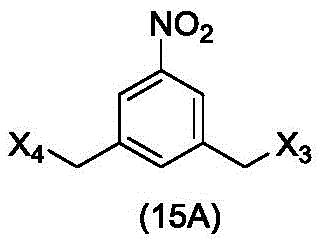
And formula (d)1) The monomer compound (b) of (a) is reacted,

wherein X3is-Cl; x4Is a sulfonate or an activated ester; p3Is H or an amine protecting group. In one embodiment, X4Is an activated ester.
In one embodiment, for the method of the thirtieth embodiment, a base is used. In particular embodiments, the base is sodium carbonate, potassium carbonate, cesium carbonate, sodium hydride, or potassium hydride. Preferably, the base is potassium carbonate.
Any suitable organic solvent may be used in the method of the thirtieth embodiment. Exemplary solvents include, but are not limited to, DMF, CH2Cl2Dichloroethane, THF, dimethylacetamide, and the like. In certain embodiments, dimethylacetamide is used as the solvent.
In a specific embodiment of the thirtieth embodiment, P3Is H and a compound of formula (15d) or (15A) is reacted with a compound of formula (d)1) To form a compound of formula (17d ') or (17A').
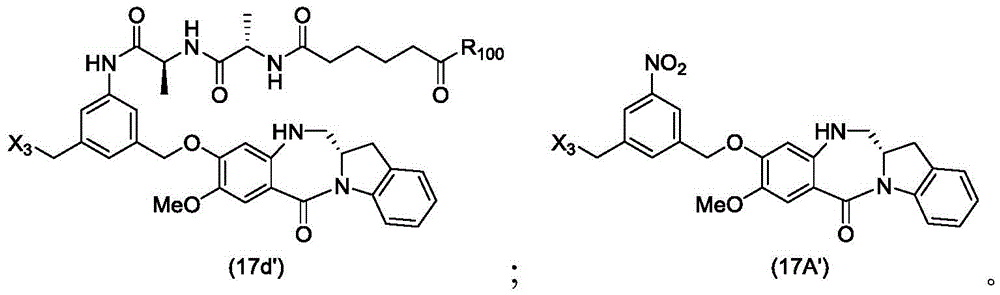
In another specific embodiment of the thirtieth embodiment, P3Is an amine protecting group, and the method further comprises the step of reacting the compound of formula (17d) or (17A) with an amine deprotecting reagent to form a compound of formula (17d ') or (17A'), respectively.
Examples of suitable amine deprotection reagents include, but are not limited to, amine deprotection reagents selected from the group consisting of: tetra-n-butylammonium fluoride, acetic acid, pyridinium hydrogen fluoride, cesium fluoride, piperidine, morpholine, or trifluoroacetic acid.
In a thirty-first embodiment, the present invention provides a process for preparing a compound of formula (17d),

or a salt thereof, comprising reacting a compound of formula (14d)

And formula (d)1) The monomer compound (b) of (a) is reacted,

wherein X3is-Cl; p3Is H or an amine protecting group; and R is100Is (C)1-C3) An alkoxy group.
The thirty-first embodiment also encompasses the preparation of a compound of formula (17A),

or a salt thereof, comprising reacting a compound of formula (14A)

And formula (d)1) The monomer compound (b) of (a) is reacted,

wherein X3is-Cl; and P is3Is H or an amine protecting group.
In a specific embodiment, for the methods of the thirty-first embodiment, a compound of formula (14d) or (14A) is reacted with a compound of formula (d)1) In the presence of an alcohol activator. In one embodiment, the alcohol activator is trimethylphosphine, tributylphosphine, tri (o-tolyl) phosphine, tri (m-tolyl) phosphine, tri (p-tolyl) phosphine, tri (2-pyridyl) phosphine, tri (3-pyridyl) phosphine, tri (4-pyridyl) phosphine, or [4- (3,3,4,4,5,5,6,6,7,7,8,8,9,9,10,10, 10-heptadecafluorodecyl) phenyl]Diphenylphosphine. In another embodiment, the alcohol activator may be a phosphine-like reagent, such as (tributylphosphoranylidene) acetonitrile, (cyanomethylene) tributylphosphorane (CMBP), or (cyanomethylene) trimethylphosphine (CMMP). In a more specific embodiment, the alcohol activator is triphenylphosphine. In one embodiment, the alcohol activator can be polymer-bound or polymer-supported, such as a polymer-bound or polymer-supported trialkyl phosphine, triaryl phosphine (e.g., triphenylphosphine), or triheteroaryl phosphine.
In another specific embodiment, for the methods of the thirty-first embodiment, a compound of formula (14d) or (14A) is reacted with a compound of formula (d)1) In the presence of an azodicarboxylate. In one embodiment, the azodicarboxylate is selected from the group consisting of: diethyl azodicarboxylate (DEAD), diisopropyl azodicarboxylate (DIAD), 1'- (azodicarbonyl) dipiperidine (ADDP), di-tert-butyl azodicarboxylate (DTAD), 1, 6-dimethyl-1, 5, 7-hexahydro-1, 4,6, 7-tetraazooctan-2, 5-dione (DHTD), bis (4-chlorobenzyl) azodicarboxylate (DCAD), dimorpholine azodicarboxylate, N, N, N', N '-Tetramethylazodicarboxamide (TMAD), N, N, N', N '-tetraisopropyl azodicarboxamide (TIPA), 4' -azopyridine, bis (2,2, 2-trichloroethyl) azodicarboxylate, o- (tert-butyldimethylsilyl) -N-toluenesulfonylhydroxylamine, Bis- (4-chlorobenzyl) azodicarboxylate, cyclic 1, 6-dimethyl-1, 5, 7-hexahydro-1, 4,6, 7-tetraazooctan-2, 5-dione (N-methyl-ethyl-phenyl)DHTD), dimethyl acetylenedicarboxylate (DMAD), di-2-methoxyethyl azodicarboxylate, di (4-chlorobenzyl) azodicarboxylate, and bis (4,4,5,5,6,6,7,7,8,8,9,9, 9-tridecafluorononyl) azodicarboxylate. More specifically, the azodicarboxylic acid ester is DIAD. In one embodiment, the azodicarboxylate is polymer-bound or polymer-supported, such as a polymer-supported alkyl azodicarboxylate (e.g., polymer-bound DEAD, DIAD, DTAD, or ADDP).
In yet another specific embodiment, for the methods of the thirty-first embodiment, a compound of formula (14d) or (14A) is reacted with a compound of formula (d)1) In the presence of triphenylphosphine and azodicarboxylate. In one embodiment, the azodicarboxylate is selected from the group consisting of: diethyl azodicarboxylate (DEAD), diisopropyl azodicarboxylate (DIAD), 1' - (azodicarbonyl) dipiperidine (ADDP), and di-tert-butyl azodicarboxylate (DTAD). More specifically, the azodicarboxylic acid ester is DIAD.
In a thirty-second embodiment, the present invention provides a method of preparing a compound of formula (17 d):

or a salt thereof, comprising reacting a compound of formula (20d)

And formula (d)1) The monomer compound (b) of (a) is reacted,
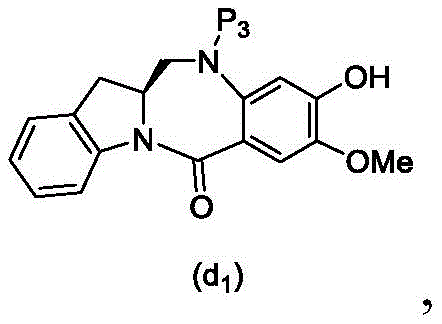
wherein X3is-Cl; x5is-Br or-I; p3Is H or an amine protecting group; and R is100Is (C)1-C3) An alkoxy group.
A thirty-second embodiment also provides a method of preparing a compound of formula (17A):
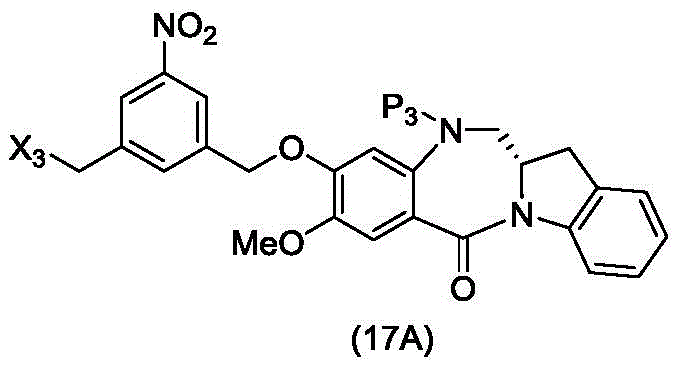
or a salt thereof, comprising reacting a compound of formula (20A)

And formula (d)1) The monomer compound (b) of (a) is reacted,

wherein X3is-Cl; x5is-Br or-I; and P is3Is H or an amine protecting group.
In one embodiment, for the method of the thirty-second embodiment, a compound of formula (20d) or (20A) is reacted with a compound of formula (d)1) In the presence of a base. Any suitable base may be used. In one embodiment, the base is sodium carbonate, potassium carbonate, cesium carbonate, sodium hydride, or potassium hydride. More specifically, the base is potassium carbonate.
In another embodiment, for the method of the thirty-second embodiment, any suitable solvent may be used for the compound of formula (20d) or (20A) and the compound of formula (d)1) The reaction of the monomer compound (2). In a particular embodiment, the reaction is carried out in a polar aprotic solvent. More specifically, the aprotic solvent is dimethylacetamide.
In a specific embodiment of the thirty-second embodiment, P3Is H and a compound of formula (20d) or (20A) is reacted with a compound of formula (d)1) To form a compound of formula (17d ') or (17A').

In another specific embodiment of the thirty-second embodiment, P3Is an amine protecting group, the method further comprises the step of reacting the compound of formula (17d) or (17A) with an amine deprotecting reagent to form a compound of formula (17d ') or (17A'), respectively.
Examples of suitable amine deprotection reagents include, but are not limited to, amine deprotection reagents selected from the group consisting of: tetra-n-butylammonium fluoride, acetic acid, pyridinium hydrogen fluoride, cesium fluoride, piperidine, morpholine, or trifluoroacetic acid.
In a thirty-third embodiment, the present invention provides a method of preparing a compound of formula (17 d'):
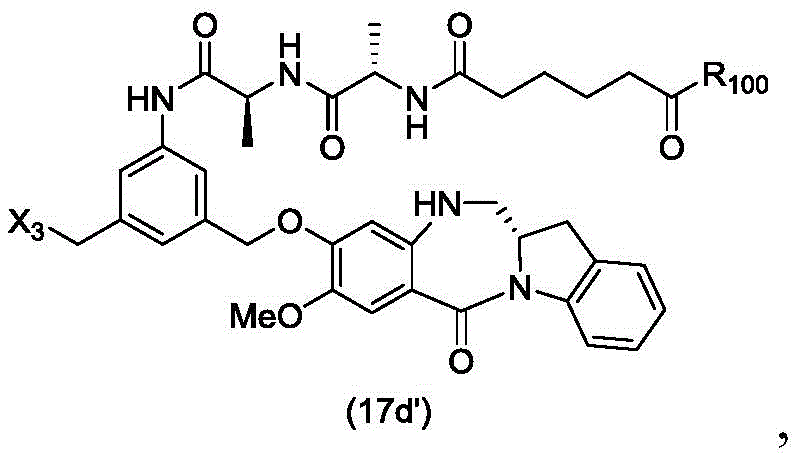
or a salt thereof, comprising reacting a compound of formula (16d)

With an imine reducing agent, wherein X3is-Cl; and R is100Is (C)1-C3) An alkoxy group.
A thirty-third embodiment also encompasses the preparation of compounds of formula (17A'):

or a salt thereof, comprising reacting a compound of formula (16A)

With an imine reducing agent, wherein X3is-Cl.
In a specific embodimentIn an embodiment of (a), for the method of the thirty-third embodiment, the imine reducing agent is a hydride reducing agent. Examples of suitable hydride reducing agents include, but are not limited to, sodium borohydride, sodium triacetoxyborohydride, sodium cyanoborohydride, lithium aluminum hydride, hydrogen, ammonium formate, borane, 9-borabicyclo [3.3.1]Nonane (9-BBN), diisobutylaluminum hydride (DIBAL), lithium borohydride (LiBH)4) Potassium borohydride (KBH)4) Or sodium bis (2-methoxyethoxy) aluminum hydride (Red-Al). In a particular embodiment, the hydride reducing agent is sodium triacetoxyborohydride (NaBH (OAc)3)。
In a thirty-fourth embodiment, the present invention provides a process for preparing a compound of formula (18d),
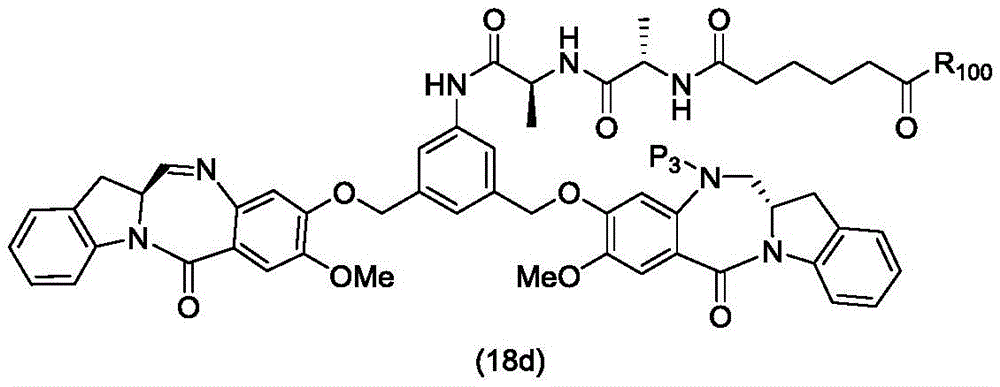
or a pharmaceutically acceptable salt thereof, comprising reacting a compound of formula (17 d):

and formula (a)1) The monomer reaction of (2):

wherein X3is-Cl; p3Is H or an amine protecting group; and R is100Is (C)1-C3) An alkoxy group.
A thirty-fourth embodiment also provides a method of preparing a compound of formula (18A),

or a pharmaceutically acceptable salt thereof, comprising reacting a compound of formula (17A):

and formula (a)1) The monomer reaction of (2):
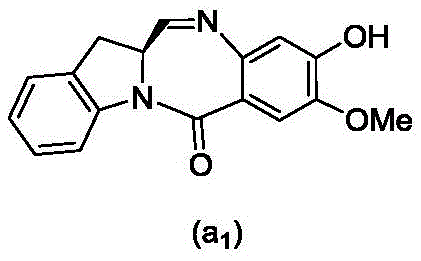
wherein X3is-Cl; and P is3Is H or an amine protecting group.
In one embodiment, for the methods of the thirty-fourth embodiment, compounds of formula (17d) or (17A) are reacted with formula (a)1) The reaction between the monomers of (a) is carried out in the presence of a base. In particular embodiments, the base is sodium carbonate, potassium carbonate, cesium carbonate, sodium hydride, or potassium hydride. Preferably, the base is potassium carbonate.
Any suitable organic solvent may be used in the method of the thirty-fourth embodiment. In one embodiment, the solvent is a polar aprotic solvent. Exemplary solvents include, but are not limited to, Dimethylformamide (DMF), CH2Cl2Dichloroethane, THF, dimethylacetamide, and the like. In certain embodiments, dimethylformamide or dimethylacetamide is used as a solvent.
In a specific embodiment of the thirty-fourth embodiment, the compound of formula (17d) or (17A) is reacted with formula (a), respectively1) In which P is3Is H to form a compound of formula (Id') or (IA):
in another specific embodiment of the thirty-fourth embodiment, P3Is an amine protecting group. Any suitable amine protecting group may be used in the above process. In one embodiment, the amine protecting group is 2-trimethylsilylethyl, (2-phenyl-2-trimethylsilyl) ethyl, triisopropylsiloxy, 2- (trimethylsilyl) ethoxymethyl, allyloxycarbonyl, 9-fluorenylmethoxycarbonyl, 2- (trimethylsilyl) ethoxycarbonyl, or 2,2,2, 2-trichloroethoxycarbonyl.
When P is present3In the case of an amine protecting group, the compound of formula (18d) or (18A) is further reacted with an amine deprotecting reagent to form a compound of formula (Id') or (IA), respectively.
Examples of suitable amine deprotection reagents include, but are not limited to, amine deprotection reagents selected from the group consisting of: tetra-n-butylammonium fluoride, acetic acid, pyridinium hydrogen fluoride, cesium fluoride, piperidine, morpholine, or trifluoroacetic acid.
In a thirty-fifth embodiment, the present invention provides a process for preparing a compound of formula (18d),

or a pharmaceutically acceptable salt thereof, comprising the steps of:
(1) reacting a sulphonating or esterifying agent with a compound of formula (14 d):

or a salt thereof, to form a compound of formula (15 d):

or a salt thereof;
(2) reacting a compound of formula (15a) with a compound of formula (a)1) The monomer compound (b) of (a) is reacted,

to form a compound of formula (16 d):

or a salt thereof; and
(3) reacting a compound of formula (16d) with a compound of formula (d)1) Reduced monomer reaction of (a):

to form a compound of formula (18d) or a pharmaceutically acceptable salt thereof, wherein X3is-Cl; x4Is a sulfonate or an activated ester; p1Is an alcohol protecting group; p3Is H or an amine protecting group; and R is100Is (C)1-C3) An alkoxy group. In one embodiment, X4Is a sulfonic acid ester.
A thirty-fifth embodiment further includes preparing a compound of formula (18A),

or a pharmaceutically acceptable salt thereof, comprising the steps of:
(1) reacting a sulphonating or esterifying agent with a compound of formula (14A):

or a salt thereof, to form a compound of formula (15A):
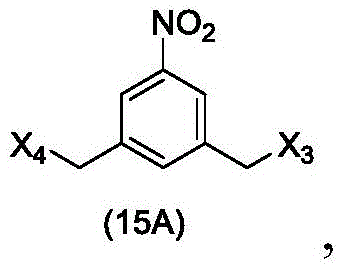
or a salt thereof;
(2) reacting a compound of formula (15A) with a compound of formula (a)1) The monomer compound (b) of (a) is reacted,

to form a compound of formula (16A):

or a salt thereof; and
(3) reacting a compound of formula (16A) with a compound of formula (d)1) Reduced monomer reaction of (a):

to form a compound of formula (18A) or a pharmaceutically acceptable salt thereof, wherein X3is-Cl; x4Is a sulfonate or an activated ester; p1Is an alcohol protecting group; and P is3Is H or an amine protecting group. In one embodiment, X4Is a sulfonic acid ester.
The conditions and reagents for the methods of the thirty-fifth embodiment are as described above in the twenty-fourth, twenty-sixth, and/or twenty-ninth embodiments and any specific embodiments described therein.
In a thirty-sixth embodiment, the present invention provides a process for preparing a compound of formula (18d),

or a pharmaceutically acceptable salt thereof, comprising the steps of:
(1) reacting a compound of formula (14 d):

or a salt thereof with formula (a)1) The monomer compound (b) of (a) is reacted,

to form a compound of formula (16 d):

or a salt thereof; and
(2) reacting a compound of formula (16d) with a compound of formula (d)1) Reduced monomer reaction of (a):

to form a compound of formula (18d) or a pharmaceutically acceptable salt thereof, wherein X3is-Cl; p1Is an alcohol protecting group; p3Is H or an amine protecting group; and R is100Is (C)1-C3) An alkoxy group.
A thirty-sixth embodiment also provides a method of preparing a compound of formula (18A),

or a pharmaceutically acceptable salt thereof, comprising the steps of:
(1) reacting a compound of formula (14A):

or a salt thereof with formula (a)1) The monomer compound (b) of (a) is reacted,

to form a compound of formula (16A):

or a salt thereof; and
(2) reacting a compound of formula (16A) with a compound of formula (d)1) Reduced monomer reaction of (a):

to form a compound of formula (18A) or a pharmaceutically acceptable salt thereof, wherein X3is-Cl; p1Is an alcohol protecting group; and P is3Is H or an amine protecting group.
The conditions and reagents for the method of the thirty-sixth embodiment are as described above in the twenty-eighth and/or twenty-ninth embodiments and any specific embodiment described therein.
In a thirty-seventh embodiment, the present invention provides a process for preparing a compound of formula (18d),

or a pharmaceutically acceptable salt thereof, comprising the steps of:
(1) reacting a halogenating agent with a compound of formula (14 d):

or a salt thereof, to form a compound of formula (20 d):

or a salt thereof;
(2) reacting a compound of formula (20d) or a salt thereof with formula (a)1) The monomer compound (b) of (a) is reacted,

to form a compound of formula (16 d):

or a salt thereof; and
(3) reacting a compound of formula (16d) with a compound of formula (d)1) Reduced monomer reaction of (a):

to form a compound of formula (18d) or a pharmaceutically acceptable salt thereof, wherein X3is-Cl; x5is-Br or-I; p3Is H or an amine protecting group; and R is100Is (C)1-C3) An alkoxy group.
A thirty-seventh embodiment also provides a method of preparing a compound of formula (18A),

or a pharmaceutically acceptable salt thereof, comprising the steps of:
(1) reacting a halogenating agent with a compound of formula (14A):
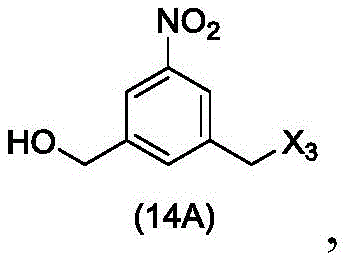
or a salt thereof, to form a compound of formula (20A):

or a salt thereof;
(2) reacting a compound of formula (20A) or a salt thereof with formula (a)1) The monomer compound (b) of (a) is reacted,

to form a compound of formula (16A):
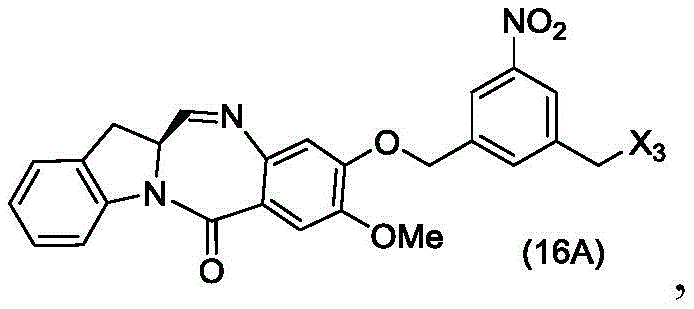
or a salt thereof; and
(3) reacting a compound of formula (16A) with a compound of formula (d)1) Reduced monomer reaction of (a):

to form a compound of formula (18A) or a pharmaceutically acceptable salt thereof, wherein X3is-Cl; x5is-Br or-I; and P is3Is H or an amine protecting group.
The conditions and reagents for the method of the thirty-seventh embodiment are as described above in the twenty-fifth, twenty-seventh and/or twenty-ninth embodiments and any specific embodiments described therein.
In a specific embodiment, for the methods of the thirty-fifth, thirty-sixth and thirty-seventh embodiments, P3Is H, reacting a compound of formula (16d) or (16A) with a compound of formula (d)1) To form a compound of formula (Id') or (IA):


in another specific embodiment, for the methods of the thirty-fifth, thirty-sixth and thirty-seventh embodiments, P3Is an amine protecting group, and the process further comprises reacting a compound of formula (18d) or (18A), respectively, with an amineThe deprotecting reagent reacts to form a compound of formula (Id') or (IA).
In a thirty-eighth embodiment, the present invention provides a method of preparing a compound of formula (18d),
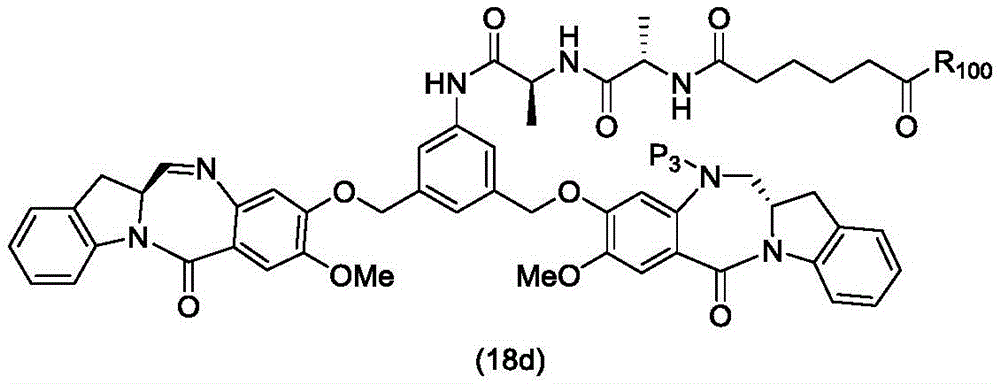
or a pharmaceutically acceptable salt thereof, comprising the steps of:
(1) reacting a sulphonating or esterifying agent with a compound of formula (14 d):
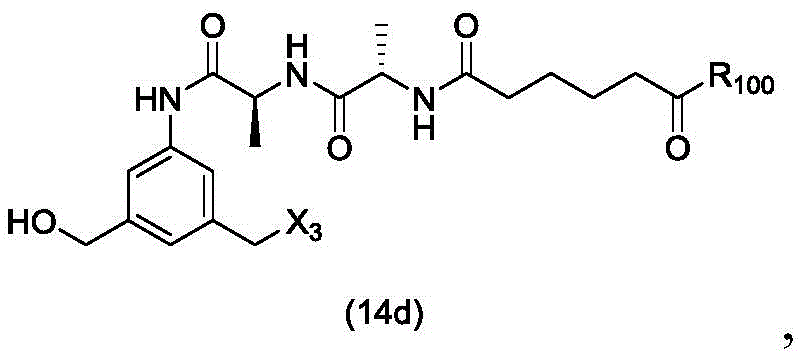
or a salt thereof, to form a compound of formula (15 d):

or a salt thereof;
(2) reacting a compound of formula (15d) with a compound of formula (d)1) The reduced monomer compound of (a) is reacted,
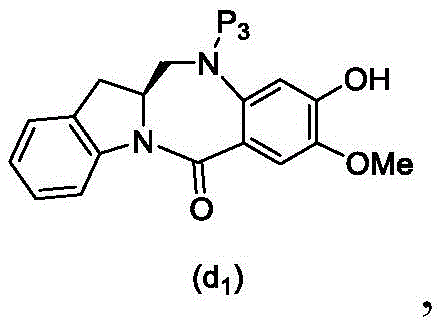
to form a compound of formula (17 d):

or a salt thereof; and
(3) reacting a compound of formula (17d) with a compound of formula (a)1) The monomer reaction of (2):

to form formula (18)d) Or a pharmaceutically acceptable salt thereof, wherein X3is-Cl; x4Is a sulfonate or an activated ester; p1Is an alcohol protecting group; p3Is H or an amine protecting group; and R is100Is (C)1-C3) An alkoxy group. In one embodiment, X4Is a sulfonic acid ester.
A thirty-eighth embodiment also provides a process for preparing a compound of formula (18A),
(1) reacting a sulphonating or esterifying agent with a compound of formula (14A):

or a salt thereof, to form a compound of formula (15A):

or a salt thereof;
(2) reacting a compound of formula (15A) with a compound of formula (d)1) The reduced monomer compound of (a) is reacted,

to form a compound of formula (17A):
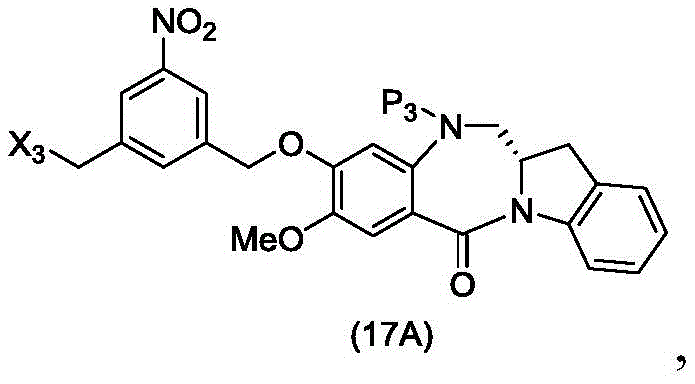
or a salt thereof; and
(3) reacting a compound of formula (17A) with a compound of formula (a)1) The monomer reaction of (2):
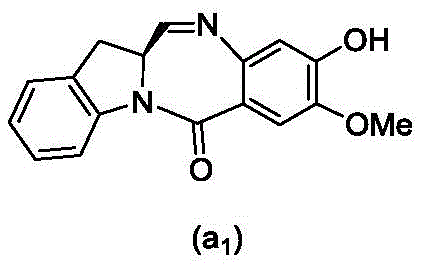
to form a compound of formula (18A) or a pharmaceutically acceptable salt thereof, wherein X3is-Cl; x4Is a sulfonate or an activated ester; p1Is an alcohol protecting group; and P is3Is H or an amine protecting group. In one embodiment, X4Is a sulfonic acid ester.
The conditions and reagents for the methods of the thirty-eighth embodiment are as described above in the twenty-fifth, thirty-fourth, and/or thirty-fourth embodiments and any specific embodiments described therein.
In a thirty-ninth embodiment, the present invention provides a method of preparing a compound of formula (18d),
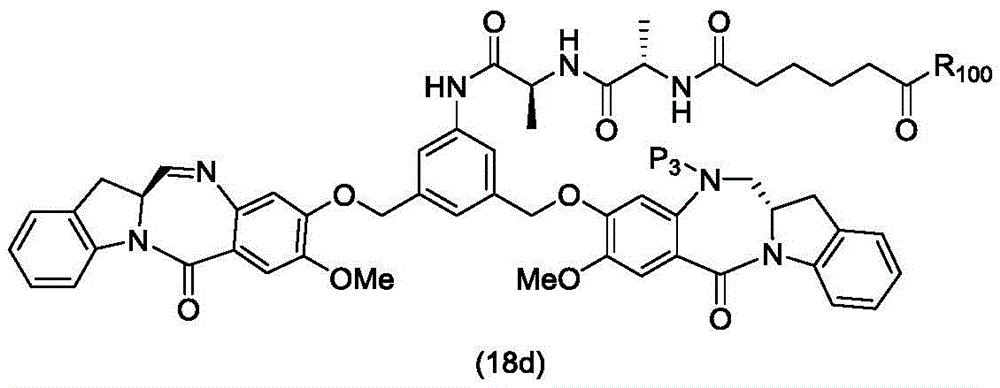
or a pharmaceutically acceptable salt thereof, comprising the steps of:
(1) reacting a compound of formula (14 d):

or a salt thereof with formula (d)1) The reduced monomer compound of (a) is reacted,

to form a compound of formula (17 d):
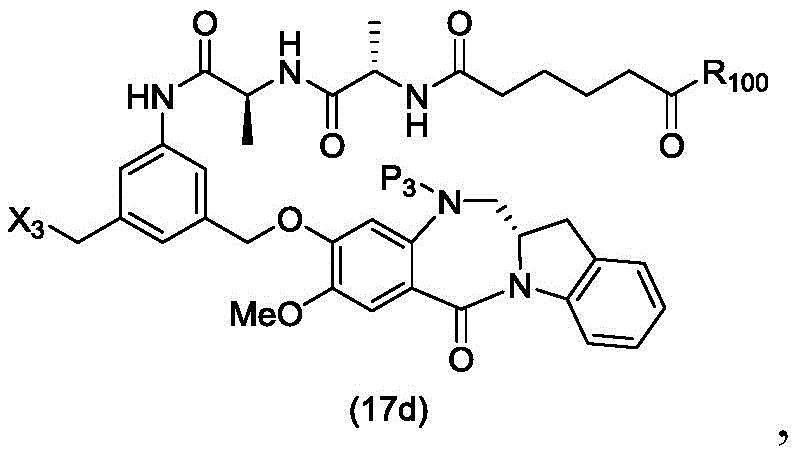
or a salt thereof; and
(2) reacting a compound of formula (17d) with a compound of formula (a)1) The monomer reaction of (2):

to form a compound of formula (18d) or a salt thereofA pharmaceutically acceptable salt, wherein X3is-Cl; p1Is an alcohol protecting group; p3Is H or an amine protecting group; and R is100Is (C)1-C3) An alkoxy group.
A thirty-ninth embodiment also provides for preparing a compound of formula (18A),
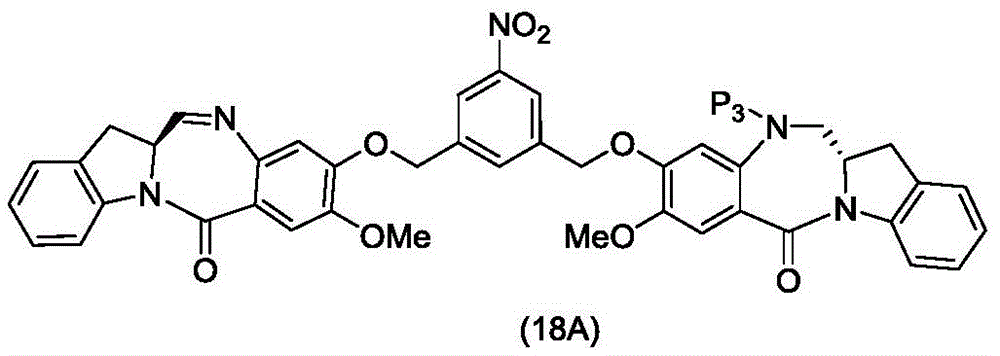
or a pharmaceutically acceptable salt thereof, comprising the steps of:
(1) reacting a compound of formula (14A):

or a salt thereof with formula (d)1) The reduced monomer compound of (a) is reacted,

to form a compound of formula (17A):

or a salt thereof; and
(2) reacting a compound of formula (17A) with a compound of formula (a)1) The monomer reaction of (2):

to form a compound of formula (18A) or a pharmaceutically acceptable salt thereof, wherein X3is-Cl; p1Is an alcohol protecting group; and P is3Is H or an amine protecting group.
The conditions and reagents for the method of the thirty-ninth embodiment are as described above in the thirty-first and/or thirty-fourth embodiments and any specific embodiment described therein.
In a fortieth embodiment, the present invention provides a process for preparing a compound of formula (18d),

or a pharmaceutically acceptable salt thereof, comprising the steps of:
(1) reacting a brominating or iodinating agent with a compound of formula (14 d):
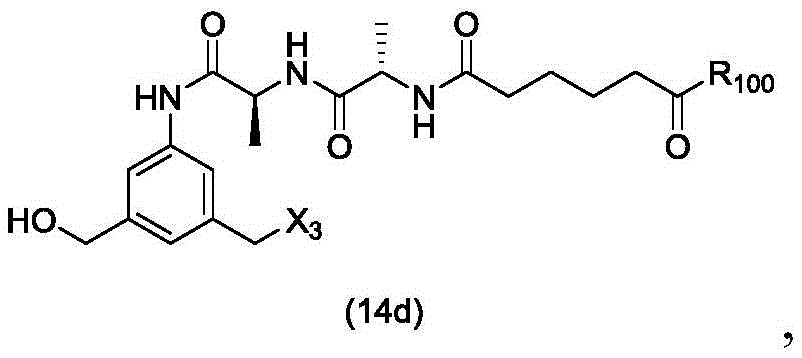
or a salt thereof, to form a compound of formula (20 d):

or a salt thereof;
(2) reacting a compound of formula (20d) with a compound of formula (d)1) The reduced monomer compound of (a) is reacted,

to form a compound of formula (17 d):

or a salt thereof; and
(3) reacting a compound of formula (17d) with a compound of formula (a)1) The monomer reaction of (2):

to form a compound of formula (18d) or a pharmaceutically acceptable salt thereof, wherein X3is-Cl; x5is-Br or-I; p1Is an alcohol protecting group; p3Is H or an amine protecting group; and R is100Is (C)1-C3) An alkoxy group.
A fortieth embodiment also provides for preparing a compound of formula (18A),

or a pharmaceutically acceptable salt thereof, comprising the steps of:
(1) reacting a brominating or iodinating agent with a compound of formula (14A):

or a salt thereof, to form a compound of formula (20A):

or a salt thereof;
(2) reacting a compound of formula (20A) with a compound of formula (d)1) The reduced monomer compound of (a) is reacted,

to form a compound of formula (17A):

or a salt thereof; and
(3) reacting a compound of formula (17A) with a compound of formula (a)1) The monomer reaction of (2):

to form a compound of formula (18A) or a pharmaceutically acceptable salt thereof, wherein X3is-Cl; x5is-Br or-I; p1Is an alcohol protecting group; and P is3Is H or an amine protecting group.
The conditions and reagents for the method of the fortieth embodiment are as described above in the twenty-fifth, thirty-second, and/or thirty-fourth embodiments and any specific embodiments described therein.
In a specific embodiment, for the methods of the thirty-eighth, thirty-ninth, and forty embodiments, P3Is H, reacting a compound of formula (17d) or (17A) with a compound of formula (a)1) To form a compound of formula (Id') or (IA).
In another specific embodiment, for the methods of the thirty-eighth, thirty-ninth, and forty embodiments, P3Is an amine protecting group, and the method further comprises reacting a compound of formula (18d) or (18A), respectively, with an amine deprotecting reagent to form a compound of formula (Id') or (IA).
In a forty-first embodiment, the present invention provides a process for preparing a compound of formula (Id'),

or a pharmaceutically acceptable salt thereof, comprising the steps of:
(1) reacting a sulphonating or esterifying agent with a compound of formula (14 d):

or a salt thereof, to form a compound of formula (15 d):

or a salt thereof;
(2) reacting a compound of formula (15d) with a compound of formula (a)1) The monomer compound (b) of (a) is reacted,

to form a compound of formula (16 d):

or a salt thereof;
(3) reacting a compound of formula (16d) with an imine reducing agent to form a compound of formula (17 d'):

or a salt thereof; and
(4) reacting a compound of formula (17 d') with formula (a)1) The monomer reaction of (2):

to form a compound of formula (Id'); wherein X3is-Cl; x4Is a sulfonate or an activated ester; p1Is an alcohol protecting group; p2Is an amine protecting group; and R is100Is (C)1-C3) An alkoxy group. In one embodiment, X4Is a sulfonic acid ester.
A forty-first embodiment also provides for the preparation of compounds of formula (IA),

or a pharmaceutically acceptable salt thereof, comprising the steps of:
(1) reacting a sulphonating or esterifying agent with a compound of formula (14A):

or a salt thereof, to form a compound of formula (15A):

or a salt thereof;
(2) reacting a compound of formula (15A) with a compound of formula (a)1) The monomer compound (b) of (a) is reacted,

to form a compound of formula (16 d):
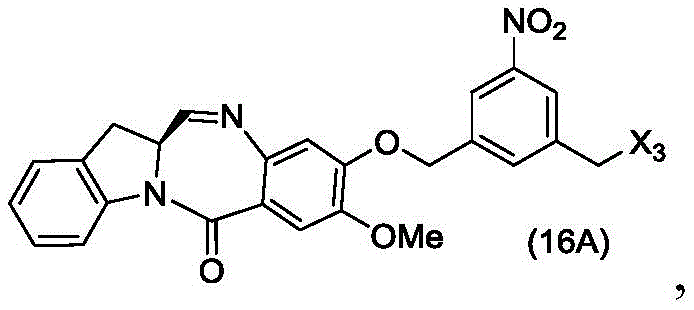
or a salt thereof;
(3) reacting a compound of formula (16A) with an imine reducing agent to form a compound of formula (17A'):

or a salt thereof; and
(4) reacting a compound of formula (17A') with formula (a)1) The monomer reaction of (2):
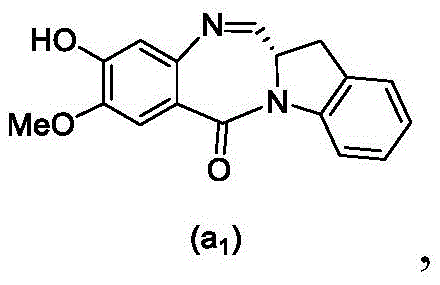
to form a compound of formula (IA); wherein X3is-Cl;X4Is a sulfonate or an activated ester; p1Is an alcohol protecting group; and P is2Is an amine protecting group. In one embodiment, X4Is a sulfonic acid ester.
The conditions and reagents for the method of the forty-first embodiment are as described above in the twenty-fourth, twenty-sixth, and/or thirty-fourth embodiments and any specific embodiments described therein.
In a forty-second embodiment, the present invention provides a process for preparing a compound of formula (Id'),

or a pharmaceutically acceptable salt thereof, comprising the steps of:
(1) reacting a compound of formula (14 d):

or a salt thereof with formula (a)1) The monomer compound (b) of (a) is reacted,

to form a compound of formula (16 d):

or a salt thereof;
(2) reacting a compound of formula (16d) with an imine reducing agent to form a compound of formula (17 d'):

or a salt thereof; and
(3) reacting a compound of formula (17 d') with formula (a)1) The monomer reaction of (2):

to form a compound of formula (Id'); wherein X3is-Cl; p1Is an alcohol protecting group; and R is100Is (C)1-C3) An alkoxy group.
A forty-second embodiment also provides for the preparation of compounds of formula (IA),

or a pharmaceutically acceptable salt thereof, comprising the steps of:
(1) reacting a compound of formula (14A):

or a salt thereof with formula (a)1) The monomer compound (b) of (a) is reacted,

to form a compound of formula (16A):
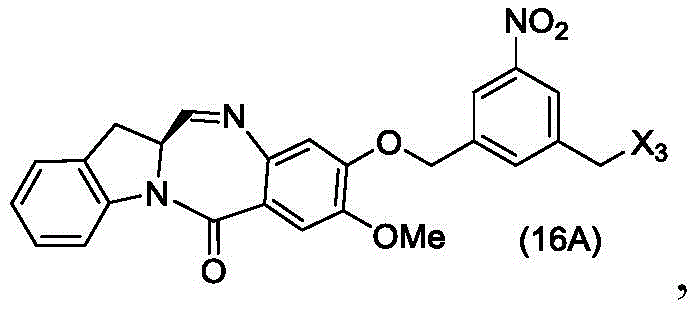
or a salt thereof;
(2) reacting a compound of formula (16A) with an imine reducing agent to form a compound of formula (17A'):
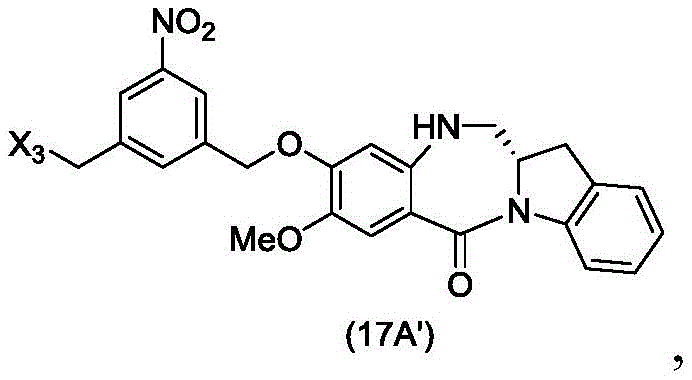
or a salt thereof; and
(3) reacting a compound of formula (17A') with formula (a)1) The monomer reaction of (2):

to form a compound of formula (IA); wherein X3is-Cl; and P is1Is an alcohol protecting group.
The conditions and reagents for the method of the forty-second embodiment are as described above in the twenty-eighth, thirty-third, and/or thirty-fourth embodiments and any specific embodiments described therein.
In a forty-third embodiment, the present invention provides a process for preparing a compound of formula (Id'),
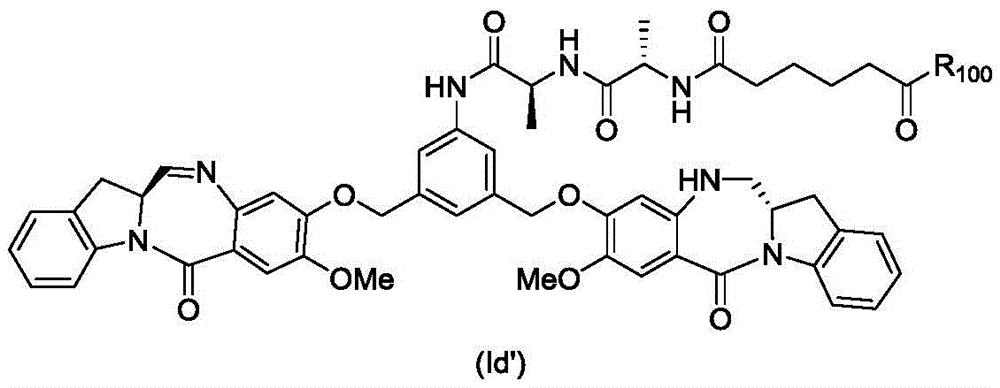
or a pharmaceutically acceptable salt thereof, comprising the steps of:
(1) reacting a halogenating agent with a compound of formula (14 d):
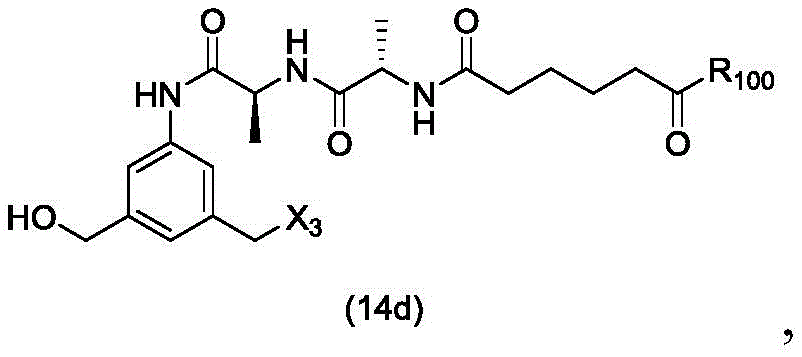
or a salt thereof, to form a compound of formula (20 d):

or a salt thereof;
(2) reacting a compound of formula (20d) or a salt thereof with formula (a)1) The monomer compound (b) of (a) is reacted,

to form a compound of formula (16 d):

(3) reacting a compound of formula (16d) with an imine reducing agent to form a compound of formula (17 d'):

or a salt thereof; and
(4) reacting a compound of formula (17 d') with formula (a)1) The monomer reaction of (2):

to form a compound of formula (Id'); wherein X3is-Cl; x5is-Br or-I; and R is100Is (C)1-C3) An alkoxy group.
A forty-third embodiment also provides for the preparation of a compound of formula (IA),

or a pharmaceutically acceptable salt thereof, comprising the steps of:
(1) reacting a halogenating agent with a compound of formula (14A):

or a salt thereof, to form a compound of formula (20 d):

or a salt thereof;
(2) reacting a compound of formula (20A) or a salt thereof with formula (a)1) The monomer compound (b) of (a) is reacted,
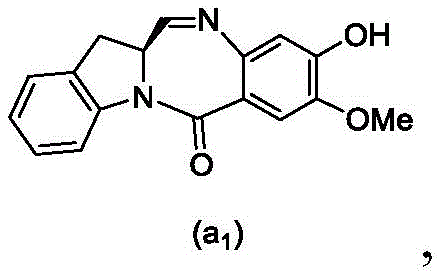
to form a compound of formula (16A):
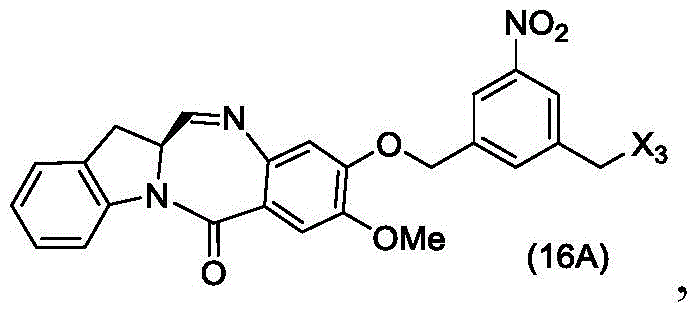
(3) reacting a compound of formula (16A) with an imine reducing agent to form a compound of formula (17A'):

or a salt thereof; and
(4) reacting a compound of formula (17A') with formula (a)1) The monomer reaction of (2):

to form a compound of formula (IA); wherein X3is-Cl.
The conditions and reagents for the method of the forty-third embodiment are as described above in the twenty-fifth, twenty-seventh, thirty-third, and/or thirty-fourth embodiment, and any specific embodiment described therein.
In one embodiment, for the methods of the thirty-fifth, thirty-sixth, thirty-seventh, thirty-eighth, thirty-ninth, forty-first, forty-second and forty-third embodiments described above, compound (14d) or a salt thereof is prepared by a method comprising the steps of:
(1) reacting a chlorinating agent with a compound of formula (2d),
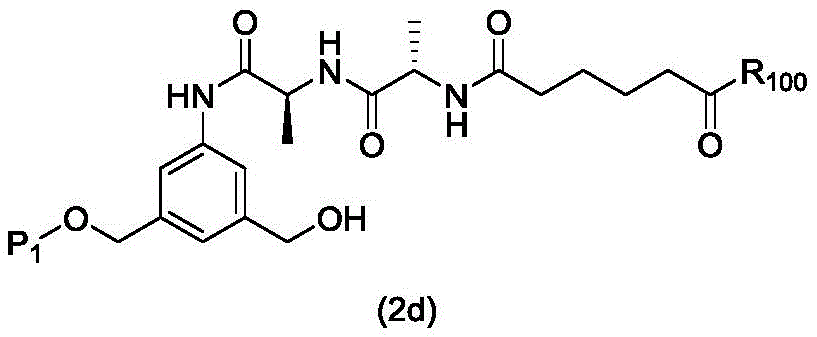
to form a compound of formula (13d),

or a salt thereof; and
(2) reacting a compound of formula (13d) with an alcohol deprotection reagent to form a compound of formula (14d) or a salt thereof, wherein X3is-Cl; and P is1Is an alcohol protecting group.
In another embodiment, for the methods of the thirty-fifth, thirty-sixth, thirty-seventh, thirty-eighth, thirty-ninth, forty-first, forty-second and forty-third embodiments described above, compound (14A) or a salt thereof is prepared by a method comprising the steps of:
(1) reacting a chlorinating agent with a compound of formula (2A),

to form a compound of formula (13A),

or a salt thereof; and
(2) reacting a compound of formula (13A) with an alcohol deprotection reagent to form a compound of formula (14A) or a salt thereof.
The conditions and reagents for the processes for preparing compounds of formula (14d) or (14A) above are as described above in the twenty-second and/or twenty-third embodiments and any specific embodiments described therein.
In another embodiment, for the above process, the compound of formula (2d) is prepared by reacting the compound of formula (1d) with an alcohol protecting reagent.
In another embodiment, for the above process, the compound of formula (2A) is prepared by reacting the compound of formula (1A) with an alcohol protecting reagent.
The conditions and reagents for the above process for preparing a compound of formula (2d) or (2A) are as described above in the first embodiment and any specific embodiment described therein.
In a forty-fourth embodiment, the present invention provides a process for preparing a compound of formula (Id')

Or a pharmaceutically acceptable salt thereof, comprising the steps of:
(1) reacting a compound of formula (IA):

reacting with a reducing agent to form a compound of formula (IB):

(2) reacting a compound of formula (IB) with a compound of formula (L1):

to form a compound of formula (Id) wherein E is-OH, halide, or-C (═ O) E is an activated ester; and R is100Is (C)1-C3) An alkoxy group.
Nitro (-NO)2) Conversion of groups to amines (-NH)2) Any reducing agent for the group may be used in step (1). In one embodiment, the reducing agent is selected from the group consisting of: hydrogen, sodium dithionite, sodium sulfide, tin chloride, titanium (II) chloride, zinc iodide, iron iodide and samarium iodide. In a particular embodiment, the reducing agent isFe/NH4Cl or Zn/NH4Cl。
In a specific embodiment, for the method of the forty-fourth embodiment, E is-OH and the reaction of the compound of formula (IB) with the compound of formula (L1) is carried out in the presence of an activator.
In one embodiment, the activator is a carbodiimide, a uronium, an active ester, a phosphonium, a 2-alkyl-1-alkylcarbonyl-1, 2-dihydroquinoline, a 2-alkoxy-1-alkoxycarbonyl-1, 2-dihydroquinoline, or an alkyl chloroformate. In a particular embodiment, the activating agent is a carbodiimide. In a more specific embodiment, the activating agent is Dicyclohexylcarbodiimide (DCC), 1-ethyl-3- (3-dimethylaminopropyl) carbodiimide (EDC) or Diisopropylcarbodiimide (DIC). In another specific embodiment, the activator is N-ethoxycarbonyl-2-ethoxy-1, 2-dihydroquinoline.
In one embodiment, for the above process, R100Is methoxy.
The method of the invention can also be any combination of the methods described above (e.g., methods in the first, second, third, fourth, fifth, sixth, seventh, eighth, ninth, tenth, eleventh, twelfth, thirteenth, fourteenth, fifteenth, sixteenth, seventeenth, eighteenth, nineteenth, twentieth, twenty-first, twenty-second, twenty-third, twenty-fourth, twenty-fifth, twenty-sixth, twenty-seventh, twenty-eighth, twenty-ninth, thirty-third, thirty-eleventh, thirty-twelfth, thirty-third, thirty-fourth, thirty-fifth, thirty-seventeenth, thirty-eighth, thirty-ninth, forty-fourth, forty-eleventh, forty-twelfth, forty-fourth and forty-fourth embodiments). For example, combinations of the methods of the first and second embodiments, combinations of the methods of the first, second and third embodiments, combinations of the methods of the fourth and fifth embodiments, combinations of the methods of the fourth, fifth and sixth embodiments, combinations of the methods of the sixth and eighth embodiments, combinations of the methods of the thirteenth and fourteenth embodiments, combinations of the methods of the thirteenth, fourteenth and fifteenth embodiments, and combinations of the methods of the seventeenth and eighteenth embodiments are also included in the invention. The definitions of the variables described in any of the specific embodiments below also apply to any combination of the above methods.
The reactions described herein in the methods of the invention may be carried out in any suitable solvent or solvents. In one embodiment, the solvent is an organic solvent. Exemplary organic solvents include, but are not limited to, dichloromethane, dichloroethane, DMF, DMA, acetone, acetonitrile, THF, DMSO, ethyl acetate, and the like, or combinations thereof.
The reactions described herein may be carried out at any suitable temperature in the process of the present invention. In one embodiment, the reaction may be carried out at room temperature. In another embodiment, the reaction may be carried out at a low temperature, such as 0 ℃. In another embodiment, the reaction may be carried out at an elevated temperature, such as about 40 ℃, about 50 ℃, or the like.
In one embodiment, the indolinobenzodiazepines of formula (Id') and (IA) The dimer compounds may be prepared according to schemes 1-10 shown below, where L 'is for formula (Id')
 and-
and-NO 2 for formula (IA). In one embodiment, R100is-OMe.


Scheme 5

Scheme 6

Scheme 7

Scheme 8

Scheme 9
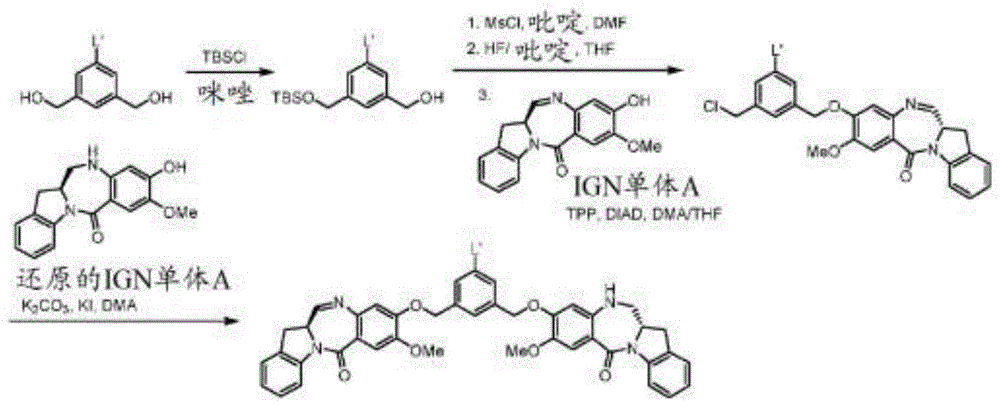
Scheme 10
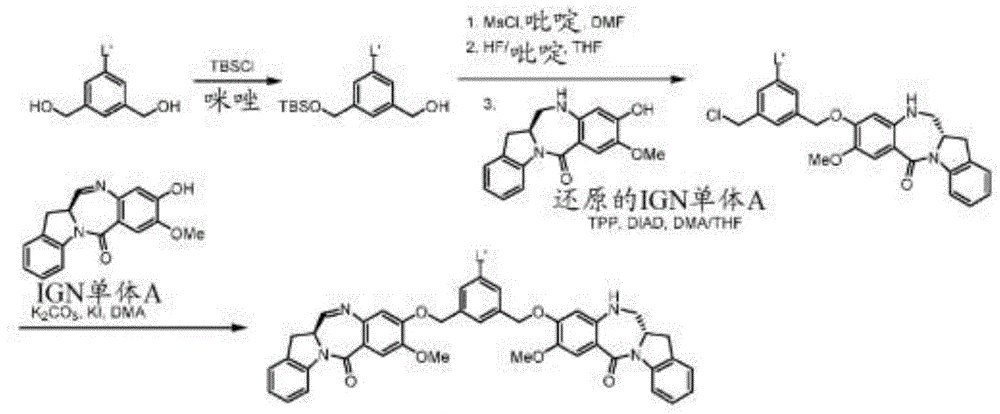
Scheme 11

Scheme 12
Compounds of the invention
The present invention also provides novel compounds as described herein. In certain embodiments, the compounds of the invention are of formula (1d), (1A), (2d), (2A), (2d "), (2A"), (3d), (3A), (3d "), (3A"), (4d), (4A), (4d "), (4A"), (5d), (5A), (5d "), (5A"), (6d), (6A), (7d), (7A), (7d '), (7A'), (7d1 '), (7A 1'), (7d "), (7A"), (7d '"), (7A'"), (9d), (9A), (10d), (10A), (10d '), (10A'), (11d), (11A), (12d), (12A), (13d), (13A), (14d), (14A ″), (15d) (15A), (16d), (16A), (17d), (17A), (17d '), (17A'), (18d), (18A), (20d), (20A), (c)1)、(d1) (Id'), (IA) and (IB), wherein the variables are as described above.
In a1 st particular embodiment, for compounds of formula (1d), (2d "), (3 d"), (4d "), (5 d"), (6d), (7d '), (7d 1'), (7d "), (7d '"), (9d), (10 d'), (11d), (12d), (13d), (14d), (15d), (16d), (17d '), (18d), (20d) or (Id'), R100is-OMe.
In a 2 nd particular embodiment, for compounds of formula (2d), (3d), (4d), (5d), (13d), (2A), (3A), (4A), (5A), (13A), P1Is a silyl protecting group; and the remaining variables are as described in the first through forty-fourth embodiments or the 1 st embodiment above. More specifically, the silyl protecting group is dimethylisopropylsilyl, diethylisopropylsilyl, dimethylhexylsilyl, trimethylsilyl, triisopropylsilyl, tribenzylsilyl, triphenylsilyl, 2-norbornyldimethylsilyl, tert-butyldimethylsilyl, tert-butyldiphenylsilyl, 2-Trimethylethylsilyl (TEOC) or [2- (trimethylsilyl) ethoxy ] silyl]A methyl group. Even more particularly, monosiliconThe alkyl protecting group is triethylsilyl, triisopropylsilyl or tert-butyldimethylsilyl. In another even more particular embodiment, the silyl protecting group is tert-butyldimethylsilyl.
In a particular embodiment of formula 3, for a compound of formula (3d), (3d "), (7d '), (7d 1'), (12d), (10d '), (3A"), (7A'), (7A1 '), (12A) or (10A'), (X) is1Is a sulfonic acid ester; and the remaining variables are as described above in the first through forty-fourth embodiments or in the 1 st or 2 nd specific embodiments. More specifically, the sulfonate is a mesylate, tosylate, brosylate or triflate. Even more particularly, the sulfonate ester is a mesylate.
In a 4 th particular embodiment, for compounds of formula (3d), (3d "), (7d '), (7d 1'), (12d), (10d '), (3A"), (7A'), (7A1 '), (12A) or (10A'), X1is-Br or-I; and the remaining variables are as described above in the first through forty-fourth embodiments or in the 1 st or 2 nd specific embodiments. More specifically, X1is-Br.
In a 5 th particular embodiment, for compounds of formula (7d), (10d), (7A) or (10A), X2Is a sulfonic acid ester; and the remaining variables are as described above in the first through forty-fourth embodiments or in the 1 st specific embodiment. More specifically, the sulfonate is a mesylate, tosylate, brosylate or triflate. Even more particularly, the sulfonate ester is a mesylate.
In a 6 th particular embodiment, for compounds of formula (7d ") or (7A"), X2' is-Br or-I; and the remaining variables are as described above in the first through forty-fourth embodiments or in the 1 st specific embodiment.
In a 7 th particular embodiment, for compounds of formula (2d "), (3 d"), (4d "), (5 d"), (2A "), (3A"), (4A ") or (5A"), P1' is acetate, allyl, methylOxymethyl, tetrahydrofuranyl, tetrahydropyranyl, 5-dibenzocycloheptyl, 1-ethoxyethyl, 1-methyl-1-methoxyethyl, 2- (phenylselenyl) ethyl, trityl/triphenylmethyl or tris (4-tert-butylphenyl) methyl; and the remaining variables are as described above in the first through forty-fourth embodiments or in the 1 st, 3 rd or 4 th specific embodiments. In another specific embodiment, P1' is a silyl protecting group; the remaining variables are as described above in the first through the forty-fourth embodiments or in the 1 st, 3 rd or 4 th specific embodiments. In a more specific embodiment, P1' is dimethylisopropylsilyl, diethylisopropylsilyl, dimethylhexylsilyl, trimethylsilyl, triethylsilyl, triisopropylsilyl, tribenzylsilyl, triphenylsilyl, 2-norbornyldimethylsilyl, tert-butyldimethylsilyl, tert-butyldiphenylsilyl, 2-Trimethylethylsilyl (TEOC) or [2- (trimethylsilyl) ethoxy ] silyl]A methyl group. Even more particularly, P1' is triethylsilyl, triisopropylsilyl or tert-butyldimethylsilyl. In another more specific embodiment, P1' is tert-butyldimethylsilyl.
In a specific embodiment of formula 8, for compounds of formula (13d), (14d), (15d), (16d), (17d '), (20d), (13A), (14A), (15A), (16A), (17A') or (20A), X3Is chlorine; and the remaining variables are as described above in the first through forty-fourth embodiments or in the 1 st or 2 nd specific embodiments.
In a 9 th particular embodiment, for compounds of formula (15d) or (15A), X4Is a sulfonic acid ester; and the remaining variables are as described above in the first through forty-fourth embodiments or in the 1 st or 8 th specific embodiments. More specifically, the sulfonate is a mesylate, tosylate, brosylate or triflate. Even more particularly, the sulfonate ester is a mesylate.
In a 10 th specific embodiment, for formula (c)1) The compound of (11d) or (11A), P2Is an amine protecting group selected from: 2-trimethylsilylethyl, (2-phenyl-2-trimethylsilyl) ethyl, triisopropylsiloxy, 2- (trimethylsilyl) ethoxymethyl, allyloxycarbonyl, 9-fluorenylmethoxycarbonyl, 2- (trimethylsilyl) ethoxycarbonyl and 2,2,2, 2-trichloroethoxycarbonyl; and the remaining variables are as described above in the first through forty-fourth embodiments or in the 1 st specific embodiment.
In a particular embodiment of formula (11), for1) (7d1 '), (17d), (18d), (7A 1'), (17A) or (18A), P3Is H or an amine protecting group selected from: 2-trimethylsilylethyl, (2-phenyl-2-trimethylsilyl) ethyl, triisopropylsiloxy, 2- (trimethylsilyl) ethoxymethyl, allyloxycarbonyl, 9-fluorenylmethoxycarbonyl, 2- (trimethylsilyl) ethoxycarbonyl or 2,2,2, 2-trichloroethoxycarbonyl; and the remaining variables are as described above in the first through forty-fourth embodiments or in the 1 st or 8 th specific embodiments.
In a 12 th specific embodiment, for the compounds of (20d) or (20A), X5is-Br; and the remaining variables are as described above in the first through forty-fourth embodiments or in the 1 st or 8 th specific embodiments.
All references cited herein and in the following examples are expressly incorporated by reference in their entirety.
Examples
The invention will now be illustrated by reference to non-limiting examples. All percentages, ratios, parts, etc. are by weight unless otherwise indicated. All reagents were purchased from Aldrich Chemical co, New Jersey or other commercial sources. Nuclear magnetic resonance (1H NMR) spectra were taken on a Bruker 400MHz instrument. Mass spectra were acquired on a Bruker Daltonics Esquire 3000 instrument and LCMS was performed on Agilent 1260Infinity LC with Agilent 6120 single quadrupole MS using electrospray ionizationAcquisition and UPLC in a single quadrupole MS ZsprayTMObtained on the Acquity system (column: Acquity BEH C18, 2.1X 50mm, 1.7 μm, method: 2.5 minutes, flow rate 0.8mL/min, solvent A: water, solvent B: MeCN, 5% to 95% MeCN over 2.0 minutes, and 95% MeCN, for 0.5 minutes).
The following solvents, reagents, protecting groups, moieties and other names may be indicated by abbreviations in parentheses:
me ═ methyl; et ═ ethyl; pr is propyl; i-Pr ═ isopropyl; bu-butyl; t-Bu ═ tert-butyl; ph ═ phenyl; and Ac ═ acetyl
AcOH or HOAc ═ acetic acid
ACN or CH3CN is acetonitrile
Ala ═ alanine
Ar is argon
aq ═ water-based
Bn ═ benzyl
Boc or BOC-tert-butyloxycarbonyl radical
CBr4Carbon tetrabromide
Cbz or Z ═ benzyloxycarbonyl
DCM or CH2Cl2Methylene chloride ═
DCE ═ 1, 2-dichloroethane
DMAP ═ 4-dimethylaminopyridine
DI water-deionized water
DIBAL ═ diisobutylaluminum hydride
DIEA or DIPEA ═ N, N-diisopropylethylamine
DMA ═ N, N-dimethylacetamide
DMF ═ N, N-dimethylformamide
DMSO ═ dimethyl sulfoxide
DTT (dithiothreitol)
EDC ═ 1-ethyl-3- (3-dimethylaminopropyl) carbodiimide
EEDQ ═ N-ethoxycarbonyl-2-ethoxy-1, 2-dihydroquinoline
ESI or ES electrospray ionization
EtOAc ═ ethyl acetate
Gly ═ glycine
g is g ═ g
h is hour
HATU ═ N, N' -tetramethyl-O- (7-azabenzotriazol-1-yl) uronium hexafluorophosphate
HPLC ═ high performance liquid chromatography
HOBt or HOBT ═ 1-hydroxybenzotriazole
LAH ═ lithium aluminum hydride
LC-liquid chromatography
LCMS (liquid chromatography-Mass Spectrometry)
min is minutes
mg ═ mg
mL to mL
mmol ═ mmol
Microgram of mug
μ L ═ microliter
Micromole to micromole
Me is methyl
MeOH ═ methanol
MeI ═ iodomethane
MS mass spectrum
MsCl ═ methanesulfonyl chloride (methanesulfonyl chloride)
Ms2O ═ methanesulfonic anhydride
MTBE ═ methyl tert-butyl ether
NaBH(OAc)3Sodium triacetoxyborohydride
NHS ═ N-hydroxysuccinimide
NMR spectroscopy
PPh3Triphenylphosphine
Preparative thin layer chromatography
rac is a racemic mixture
RfDelay factor
RPHPLC or RP-HPLC as reversed-phase high performance liquid chromatography
RT or RT ═ room temperature (ambient, about 25 ℃)
sat or sat'd ═ saturated
STAB sodium triacetoxyborohydride (NaBH (OAc))3)
TBSCl or TBDMSCl ═ tert-butyldimethylsilyl chloride
TBS ═ tert-butyldimethylsilyl
TCEP HCl tris (2-carboxyethyl) phosphine hydrochloride
TEA-triethylamine (Et)3N)
TFA ═ trifluoroacetic acid
THF ═ tetrahydrofuran
TLC ═ thin layer chromatography
Example 1.

(S) -2- (((benzyloxy) carbonyl) amino) propionic acid (5g, 22.40mmol) and (S) -2-aminopropionic acid tert-butyl ester hydrochloride (4.48g, 24.64mmol) were dissolved in anhydrous DMF (44.8 mL). EDC & HCl (4.72g, 24.64mmol), HOBt (3.43g, 22.40mmol) and DIPEA (9.75mL, 56.0mmol) were added. The reaction was stirred at room temperature under argon overnight. The reaction mixture was diluted with dichloromethane and then washed with saturated ammonium chloride, saturated sodium bicarbonate, water and brine. The organic layer was dried over sodium sulfate and concentrated. The crude oil was purified by silica gel chromatography (hexanes/ethyl acetate) to give compound 2a (6.7g, 85% yield).1H NMR(400MHz,CDCl3):δ7.38-7.31(m,5H),6.53-6.42 (m,1H),5.42-5.33(m,1H),5.14(s,2H),4.48-4.41(m,1H),4.32-4.20(m,1H), 1.49(s,9H),1.42(d,3H,J=6.8Hz),1.38(d,3H,J=7.2Hz)。

Compound 2a (6.7g, 19.12mmol) was dissolved in methanol (60.7mL) and water (3.03 mL). The solution was purged with argon for 5 minutes. Palladium on carbon (wet, 10%) (1.017g, 0.956mmol) was slowly added. The reaction was stirred under hydrogen atmosphere overnight. The solution was filtered through celite, rinsed with methanol and concentrated. It was azeotroped with methanol and acetonitrile and the resulting oil was placed directly under high vacuum to give compound 2b (4.02)g, 97% yield), which was used directly in the next step.1H NMR(400MHz,CDCl3):δ 7.78-7.63(m,1H),4.49-4.42(m,1H),3.55-3.50(m,1H),1.73(s,2H),1.48(s, 9H),1.39(d,3H,J=7.2Hz),1.36(d,3H,J=6.8Hz)。

Compound 2b (4.02g, 18.59mmol) and monomethyl adipate (3.03mL, 20.45mmol) were dissolved in anhydrous DMF (62.0 mL). EDC & HCl (3.92g, 20.45mmol), HOBt (2.85g, 18.59mmol) and DIPEA (6.49mL, 37.2mmol) were added. The mixture was stirred at room temperature overnight. The reaction was diluted with dichloromethane/methanol (150mL, 5:1) and washed with saturated ammonium chloride, saturated sodium bicarbonate and brine. It was dried over sodium sulfate, filtered and concentrated. This compound was azeotroped with acetonitrile (5x) and then pumped under high vacuum at 35 ℃ to give compound 2c (6.66g, 100% yield). The crude material was used in the next step without purification.1H NMR(400MHz,CDCl3):δ6.75(d,1H,J=6.8Hz),6.44 (d,1H,J=6.8Hz),4.52-4.44(m,1H),4.43-4.36(m,1H),3.65(s,3H),2.35-2.29 (m,2H),2.25-2.18(m,2H),1.71-1.60(m,4H),1.45(s,9H),1.36(t,6H,J=6.0 Hz)。

Compound 2c (5.91g, 16.5mmol) was stirred in TFA (28.6mL, 372mmol) and deionized water (1.5mL) at room temperature for 3 hours. The reaction mixture was concentrated with acetonitrile and placed under high vacuum to give crude compound 2d as a viscous solid (5.88g, 100% yield).1H NMR(400MHz, CDCl3):δ7.21(d,1H,J=6.8Hz),6.81(d,1H,J=7.6Hz),4.69-4.60(m,1H), 4.59-4.51(m,1H),3.69(s,3H),2.40-2.33(m,2H),2.31-2.24(m,2H),1.72-1.63 (m,4H),1.51-1.45(m,3H),1.42-1.37(m,3H)。

Compound 2d (5.6g, 18.52mmol) was dissolved in anhydrous dichloromethane (118mL) and anhydrous methanol (58.8 mL). (5-amino-1, 3-phenylene) dimethanol (2.70g, 17.64mmol) and EEDQ (8.72g, 35.3mmol) were added and the reaction was stirred at room temperature overnight. The solvent was concentrated and ethyl acetate was added. The resulting slurry was filtered, washed with ethyl acetate and concentrated under vacuum/N2Drying gave compound 2e (2.79g, 36% yield).1H NMR(400MHz,DMSO-d6):δ9.82(s,1H),8.05,(d, 1H,J=9.2Hz),8.01(d,1H,J=7.2Hz),7.46(s,2H),6.95(3,1H),5.21-5.12(m, 2H),4.47-4.42(m,4H),4.40-4.33(m,1H),4.33-4.24(m,1H),3.58(s,3H), 2.33-2.26(m,2H),2.16-2.09(m,2H),1.54-1.46(m,4H),1.30(d,3H,J=7.2Hz), 1.22(d,3H,J=4.4Hz)。


Mesylate 2g (390mg, 0.619mmol) and IGN monomer A (264mg, 0.897mmol) were dissolved in anhydrous DMA (7.47 mL). Potassium carbonate (207mg, 1.495mmol) and potassium iodide (51.4mg, 0.310mmol) were added, and the reaction was stirred at room temperature overnight. The reaction was precipitated with water, filtered, and the filter cake was washed with water. The solid was redissolved in DCM, washed with water, dried over magnesium sulfate and concentrated to give the crude compound 2h (568mg, 111% yield). The product was used without further purification. LCMS (8 min method, 5-98%) -6.23 min. Observation of Mass (ESI)+):827.8(M+H)+。


Compound 2i (514mg, 0.619mmol) was dissolved in THF (3.44 mL). 5M aqueous HCl (1.24mL, 6.19mmol) was added at room temperature and the reaction stirred for 1 hour. The reaction mixture was diluted with DCM/MeOH (20:1), and the organic layer was washed with saturated sodium bicarbonate, brine, and sulfuric acidMagnesium was dried, filtered and concentrated. The crude residue was purified by silica gel chromatography (DCM/MeOH) to give compound 2j (210mg, 47% yield). LCMS (8 min method, 5-98%) -4.56 min. Observation of Mass (ESI)+):715.8(M+H)+。


Compound 2k (233mg,0.293mmol) was dissolved in DMA (1.95 mL). IGN monomer A (103mg, 0.352mmol) and potassium carbonate (60.7mg, 0.440mmol) were added at room temperature and the reaction stirred overnight. DI water was added to the reaction mixture, and the resulting solid was filtered and washed with water. The solid was redissolved in DCM/MeOH (20:1), washed with water, dried over magnesium sulfate, filtered and concentrated. The crude residue was purified by RPHPLC (ACN/H)2O) to yield 2l (44mg, 15% yield). LCMS (8 min method, 5-98%) 5.4 min. Observation of Mass (ESI)+):991.7(M+H)+。
Example 2.

To a solution of IGN monomer A (1.0g, 3.4mmol) in DCE (10mL) and DMF (4mL) was added sodium triacetoxyborohydride (1.1g, 5.1mmol, 1.5 equiv.) and the reaction was stirred until the starting material was complete. After completion of the starting material after 2 hours at room temperature, the reaction was quenched with saturated ammonium chloride (10mL) and the layers were separated. The aqueous layer was extracted once with dichloromethane (10mL) and the combined organic layers were washed with water (2X 10mL) and brine (10 mL). The organic layer was dried over magnesium sulfate, filtered, and the solvent was removed in vacuo to give a white/brown powder. The powder was washed with EtOAc (2 × 10mL) and dried under vacuum to give reduced IGN monomer a as a white solid (0.87g, 2.9mmol, 87% yield), which was used in the next step without further purification. UPLCMS (2.5 min method) 1.34 min. Observation of Mass (ESI)+): 297.4(M+H)+。1H NMR(400MHz,DMSO-d6):δ9.44(s,1H),8.20(d,J=8.1Hz, 1H),7.30–7.23(m,2H),7.22–7.12(m,1H),7.01(td,J=7.4,1.1Hz,1H),6.21 (s,1H),6.17(d,J=6.6Hz,1H),4.37(tdd,J=10.1,4.4,1.9Hz,1H),3.70(s,3H), 3.58–3.39(m,2H),3.31–3.15(m,2H),2.88(dd,J=16.9,4.4Hz,1H)。

A solution of 2e (5.53g, 12.6mmol) in DCM (81mL) and DMF (64.9mL) was cooled to 0 deg.C, then DIPEA (6.13mL, 37.9mmol, 3.0 equiv.) was added, and then a solution of methanesulfonic anhydride (5.06g, 29.1mmol, 2.3 equiv.) in DCM (15mL)/DMF (1mL) was added dropwise. The reaction was stirred for 1 hour and then quenched with cold water. After washing with water and brine, the solution was dried over magnesium sulfate, filtered, and the solvent was removed in vacuo to give an orange oil which was triturated in diethyl ether to give the disulfonate ester 2m (6.4g, 10.8mmol, 85% yield). LCMS (8 min method) 4.019 min. Observation of Mass (ESI)+):594.8(M+H)+. The crude material was used in the next step without further purification.

To a solution of 2m (0.52g, 0.88mmol) and IGN monomer A (0.18g, 0.61mmol, 0.7 equiv.) in DMF (7mL) was added potassium carbonate (0.24g, 1.75mmol, 2.0 equiv.) and the reaction was stirred at room temperature for 12 h. The reaction was quenched with water (30mL) and extracted with DCM (3X 15 mL). The organic layers were combined and washed with water (3 × 60mL), brine (60mL), dried over magnesium sulfate, filtered, and the solvent was removed in vacuo to give a crude yellow oil. The material was purified by silica gel chromatography (DCM/(MeCN/MeOH (4/1), from 100/0 to 65/35) to give the desired product 2n (0.09g, 0.12mmol, 13% yield). UPLCMS (2.5 min method) ═ 1.46 min+): 792.6(M+H)+。

To a solution of 2n (0.05g, 0.06mmol) in DMF (0.48mL, 6.2mmol) was added potassium carbonate (0.02g, 0.12mmol, 2.0 equiv.), followed by reduced IGN monomer A (0.02g, 0.07mmol, 1.1 equiv.). The reaction was stirred at room temperature for 12 hours. The reaction was quenched with water, and the resulting solid was filtered and washed with water. The solid was redissolved in DCM/MeOH (20:1), washed with water, dried over magnesium sulfate, filtered and concentrated. The crude residue was purified by RPHPLC (ACN/H)2O) to yield 2l (0.03g, 0.04mmol, 55% yield). LCMS (8 min method, 5-98%) 5.4 min. Observation of Mass (ESI)+):991.7(M+H)+。1H NMR(400MHz,DMSO-d6δ 10.10(d, J ═ 3.7Hz,1H),8.27(d, J ═ 8.0Hz,1H), 8.21-8.10 (m,1H), 8.05(d, J ═ 7.4Hz,1H),7.78(dt, J ═ 8.5,1.8Hz,2H), 7.43-7.13 (m,7H), 7.16-6.98 (m,2H),6.49(s,1H),6.36(d, J ═ 13.1Hz,0.4H),6.16(d, J ═ 6.2Hz, 0.4H),5.80(s,0.4H),5.67(s,0.4H),5.57(d, J ═ 5.6, 0.4H), 5.35-5.5 (t, 2.4H), 5.7.7, 4H, 7.7, 4H), 5.7.7.7 (t, 4H), 5.7.7.4H), 7.7.7, 4H, 7.7.4H, 7(t, 4H), 5.7.7, 4H), 7.7.7H, 4H, 7H, 7.7H, 7H, 4H, 7H, 4H, 7H, 3.83-3.74 (m,5H),3.62(s,2H),3.75–3.44(m,2H),3.32(d,J= 11.6Hz,1H),3.19–3.07(m,1H),2.95(dd,J=17.1,4.3Hz,1H),2.38–2.29(m, 1H),2.18(m,1H),1.56(m,J=3.9Hz,4H),1.41–1.31(m,3H),1.30–1.14(m, 3H)。
Example 3.
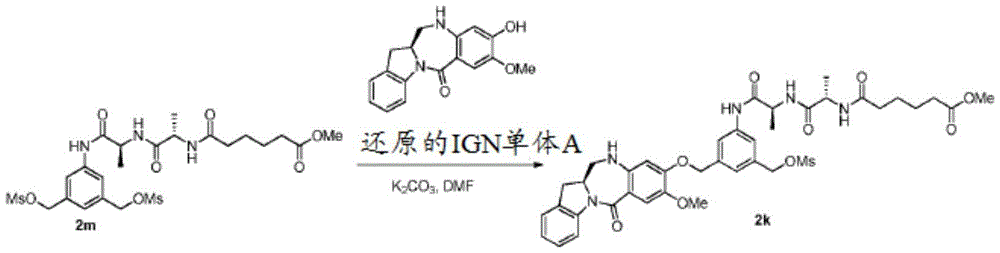
To a solution of 2m (0.88g, 1.47mmol) in DMF (11mL) was added reduced IGN monomer A (0.26g, 0.88mmol, 0.6 equiv.), followed by potassium carbonate (0.41mg, 2.95mmol, 2.0 equiv.). After stirring the reaction for 12 h, the reaction was diluted with water (50mL) and EtOAc (30 mL). The aqueous layer was extracted with EtOAc (3X 10 mL). The combined organic layers were washed with brine (20mL), dried over magnesium sulfate and filtered. The solvent was removed and the crude mixture was purified by silica gel chromatography (DCM/MeOH) to give the desired product 2k (0.11g, 0.14mmol, 10% yield). LCMS (8 min method) 5.013 min. Observation of Mass (ESI)+):794.3(M+H)+。

To a solution of 2k (0.11g, 0.14mmol) in DMF (2mL) was added potassium carbonate (0.04g, 0.29mmol, 2.0 equiv.). IGN monomer A (0.04g, 0.14mmol, 1.0 equiv.) was added and the reaction stirred at room temperature for 12 h. The reaction was quenched with water (10mL), and the resulting solid was filtered and washed with water. The solid was redissolved in DCM/MeOH (20:1), washed with water (10mL), dried over magnesium sulfate, filtered and concentrated. The crude residue was purified by RPHPLC (ACN/H)2O) to yield 2l (0.08g, 0.09mmol, 59% yield). LCMS (8 min method, 5-98%) 5.4 min. Observation of Mass (ESI)+):991.7(M+H)+。
Example 4.

To a solution of 2n (0.1g, 0.13mmol) in DCE (2mL) was added sodium triacetoxyborohydride (0.03g, 0.13mmol, 1.0 equiv.) and the reaction was stirred at room temperature for 2 h. The reaction was quenched with saturated ammonium chloride (2mL) and the layers separated. The aqueous layer was extracted with DCM (5mL) and the combined organic layers were washed with water, brine, dried over magnesium sulfate and filtered. The crude yellow solid was purified using silica gel chromatography (EtOAc/MeOH (95/5)) to afford the desired reduction product 2k (0.035g, 0.044mmol, 35% yield). LCMS (8 min method) 5.021 min. Observation of Mass (ESI)+):794.3(M+H)+。

To a solution of 2k (0.035g, 0.044mmol) in DMF (1.0mL) was added potassium carbonate (0.013g, 0.09mmol, 2.0 equiv). IGN monomer A (0.013g, 0.04mmol, 1.0 equiv.) was added and the reaction stirred at room temperature for 12 h. The reaction was quenched with water (10mL), and the resulting solid was filtered and washed with water. The solid was redissolved in DCM/MeOH (20:1, 20mL), washed with water (20mL), dried over magnesium sulfate, filtered and concentrated. The crude residue was purified by RPHPLC (ACN/H)2O) to yield 2l (0.017g, 0.01mmol, 38% yield). LCMS (8 min method, 5-98%) 5.4 min. Observation of Mass (ESI)+):991.7(M+H)+。
Example 5.

To a solution of 2f (8.8g, 16.0mmol) in DMF (100mL) was added pyridine (4.51mL, 55.8mmol, 3.5 equiv.). The reaction was cooled to 0 ℃, then methanesulfonyl chloride (2.5mL, 31.9mmol, 2.0 equiv.) was added dropwise and the reaction stirred for 2 hours. The mixture was quenched with saturated sodium bicarbonate (30mL), EtOAc was added and the layers were separated. The aqueous layer was extracted with EtOAc (3X 50mL) and the combined organic layers were washed with water, brine and dried over magnesium sulfateAnd filtered. The solvent was removed and the crude white solid 2o was used in the next step without purification (6.2g, 10.9mmol, 68%). UPLCMS (2.5 min method) 1.96 min. Observation of Mass (ESI)+):570.7(M+H)+。

To a solution of 2o (1.7g, 2.98mmol) in THF (36.6mL) was added DIPEA (2.1mL, 11.9mmol, 4.0 equiv.), followed by HF-pyridine (0.84mL, 6.0mmol, 2.0 equiv.). The reaction was stirred at room temperature for 3 hours. The reaction was quenched with saturated sodium bicarbonate (20mL) and the layers were separated. The aqueous layer was extracted with EtOAc (3X 10 mL). The combined organic layers were washed with brine (30mL), dried over magnesium sulfate, filtered, and the solvent was removed in vacuo to give a crude white oil which was purified by silica gel chromatography (DCM/MeOH) to give the desired product 2p as a white solid (0.75g, 1.6mmol, 55% yield). UPLCMS (2.5 min method) 1.23 min. Observation of Mass (ESI)+):456.4 (M+H)+。

To a solution of 2p (0.65g, 1.43mmol) in DCM (10mL) and DMF (2mL) was added DIPEA (0.51mL, 2.85mmol, 2.0 equiv.), and the reaction was cooled to 0 ℃. A solution of methanesulfonic anhydride (0.3g, 1.71mmol) in DCM (2mL) was added slowly. The reaction was complete after 30 min, quenched with water (20mL), the layers were extracted, and the aqueous layer was washed with DCM (2X 10 mL). The organic layers were combined, washed with water (20mL), brine (10mL), dried over magnesium sulfate and filtered. Removal of the solvent in vacuo afforded the desired product 2q (0.76g, 1.42mmol, 100% yield), which was used as crude in the next step without further purification. UPLCMS (2.5 min method) 1.37 min. Observation of Mass (ESI)+):534.4(M+H)+。

To a solution of 2q (0.76g, 1.42mmol) in DMA (13mL) was added potassium carbonate (0.59g, 4.27mmol) followed by a solution of IGN monomer A (0.5g, 1.71mmol) in DMA (1 mL). The reaction was stirred at room temperature for 12 hours. The reaction was quenched with water (30mL) and the mixture was stirred for 10 min. The solid was filtered, then dissolved in DCM/MeOH (9/1, 20mL) and washed with brine (10 mL). The organic layer was separated and dried over magnesium sulfate, filtered and concentrated in vacuo to give crude yellow solid 2r (0.76g, 1.04mmol, 73% yield) which was used as crude in the next step without further purification. UPLCMS (2.5 min method) 1.55 min. Observation of Mass (ESI)+):732.9(M+H)+。

To a solution of 2r (0.26g, 0.36mmol) in DMA (10mL) was added potassium iodide (0.06g, 0.355mmol, 1.0 equiv.), reduced IGN monomer A (0.1g, 0.37mmol, 1.05 equiv.), and potassium carbonate (0.15g, 1.06mmol, 3.0 equiv). The reaction was warmed to 40 ℃ and stirred for 4 hours. The reaction was quenched with water (20mL) and the mixture was stirred for 10 min. The resulting solid was filtered. The solid was redissolved in DCM/MeOH (20:1, 20mL), washed with water (20mL), dried over magnesium sulfate, filtered and concentrated. The crude residue was purified by RPHPLC (ACN/H)2O) to yield 2l (0.097g, 0.097mmol, 28% yield). LCMS (8 min method, 5-98%) 5.4 min. Observation of Mass (ESI)+): 991.7(M+H)+。
Example 6.

To a solution of 2r (0.76g, 1.04mmol) in DCE (10mL) at 0 deg.C was added DMF (3.0mL) followed by sodium triacetoxyborohydride (0.33g, 1.56 mmol). The reaction was stirred at room temperature for 4 hours. The reaction was quenched with saturated ammonium chloride (20mL) and partitionedThe layers were separated. The aqueous layer was extracted with DCM (3 × 10mL) and the combined organic layers were washed with water (10mL), brine (10mL), dried over magnesium sulfate, filtered, and the solvent was removed in vacuo to give the desired crude 2s as an oil (0.65g, 0.88mmol, 85% yield) which was used in the next step without further purification. UPLCMS (2.5 min method) 1.80 min. Observation of Mass (ESI)+):735.3(M+H)+。

To a solution of 2s (0.65g, 0.88mmol) in DMA (15mL) was added potassium carbonate (0.25g, 1.78mmol, 2.0 equiv.), followed by potassium iodide (0.073g, 0.44mmol, 0.5 equiv.) at room temperature, and to the reaction mixture was added a solution of IGN monomer A (0.29g, 0.974mmol, 1.1 equiv.) in DMA (2 mL). The reaction was heated at 40 ℃ for 5 hours. The reaction was quenched with water (30mL) and the solid was filtered off. The solid was redissolved in DCM/MeOH (20:1, 30mL), washed with water (20mL), dried over magnesium sulfate, filtered and concentrated. The crude residue (0.78g) was purified by RPHPLC (ACN/H)2O) to yield 2l (0.43g, 0.43mmol, 49% yield). LCMS (8 min method, 5-98%) 5.4 min. Observation of Mass (ESI)+):991.7(M+H)+。
Example 7.

To a solution of 2q (0.14g, 0.27mmol) in DMA (3mL) was added potassium carbonate (0.11g, 0.81mmol) followed by a solution of reduced IGN monomer A (0.084g, 0.28mmol) in DMA (1 mL). The reaction was stirred at room temperature for 12 hours. The reaction was quenched with water (20mL) and the mixture was stirred for 10 min. The solid was filtered, then dissolved in DCM/MeOH (9/1, 20mL) and washed with brine (10 mL). The organic layer was separated and dried over magnesium sulfate, filtered and the solvent removed in vacuo. The crude material was purified by silica gel chromatography using DCM (MeOH/EtOAc, 1/4) to afford the desired compound 2s (0.08g, 0.1 g)1mmol, 40% yield). UPLCMS (2.5 min method) 1.63 min. Observation of Mass (ESI)+):735.2(M+H)+。
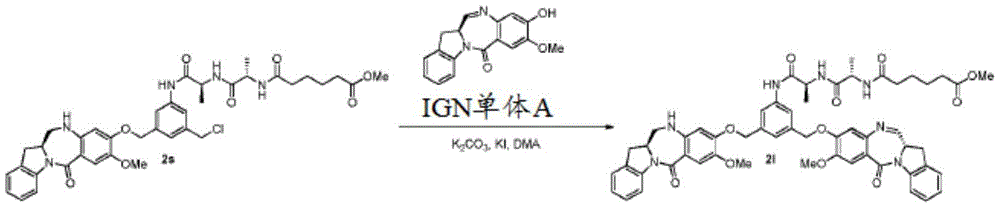
To a solution of 2s (0.06g, 0.09mmol) in DMA (2mL) was added potassium carbonate (0.025g, 0.18mmol) followed by potassium iodide (0.007g, 0.044 mmol). To the reaction mixture was added a solution of IGN monomer A (0.03g, 0.097mmol) in DMA (1mL) at room temperature. The reaction was heated at 40 ℃ for 5 hours. The reaction was cooled and quenched with water (20mL) and the solid filtered off. The solid was redissolved in DCM/MeOH (20:1, 20mL), washed with water (10mL), dried over magnesium sulfate, filtered and concentrated. The crude residue (0.07g) was purified by RPHPLC (ACN/H)2O) to yield 2l (0.035g, 0.035mmol, 51% yield). LCMS (8 min method, 5-98%) 5.4 min. Observation of Mass (ESI)+):991.7(M+H)+。
Example 8.

To a solution of 2h (0.85g, 1.027mmol) in THF (9mL) at room temperature was added DIPEA (0.54mL, 3.1mmol, 3.0 equiv) followed by HF-pyridine (0.3mL, 2.053mmol, 2.0 equiv). The reaction was stirred at room temperature for 3 hours. The reaction was quenched with saturated sodium bicarbonate (10mL), the layers were separated and the aqueous layer was extracted with DCM (3X 10 mL). The combined organic layers were washed with brine (10mL), dried over magnesium sulfate and filtered. Removal of the solvent in vacuo afforded the crude product as a solid, which was washed with EtOAc to afford the desired product 2t (0.64g, 0.89mmol, 87% yield). UPLCMS (2.5 min method) 1.36 min. Observation of Mass (ESI)+):714.6(M+H)+。

To a solution of 2t (0.23g, 0.322mmol) in dichloromethane (3mL) at 0 deg.C was added DIPEA (0.11mL, 0.644mmol, 2.0 equiv) followed by methanesulfonic anhydride (0.084g, 0.48mmol, 1.5 equiv) in DCM (1 mL). The reaction was stirred for 1 hour. The reaction was quenched with water (3mL) and diluted with DCM (3 mL). The layers were separated and the organic layer was washed with brine (3mL), dried over magnesium sulfate and filtered. The solvent was removed in vacuo and the crude 2n (0.25g, 0.31mmol, 98% yield) was used in the next step without further purification. UPLCMS (2.5 min method) 1.45 min. Observation of Mass (ESI)+):792.5(M+H)+。

To a solution of 2n (0.02g, 0.027mmol) in DMF (0.2ml) was added potassium carbonate (0.007g, 0.053mmol, 2.0 equiv) followed by reduced IGN monomer A (0.009g, 0.029mmol, 1.1 equiv) and the reaction stirred at room temperature for 18 h. Water (3mL) was added to the reaction mixture, and the resulting solid was filtered. The solid was redissolved in DCM/MeOH (20:1, 5mL), washed with water (5mL), dried over magnesium sulfate, filtered and concentrated. The crude residue was purified by RPHPLC (ACN/H)2O) to yield 2l (0.005g, 0.005mmol, 19% yield). LCMS (8 min method, 5-98%) 5.4 min. Observation of Mass (ESI)+):991.7(M+H)+。
Example 9.

To a solution of 2t (0.02g, 0.031mmol) in THF (2mL) was added DIPEA (0.016mL, 0.092mmol, 3.0 equiv.), followed by a solution of dibromotriphenylphosphorane (0.03g, 0.062mmol, 2.0 equiv.) in THF (0.5 mL). The reaction was stirred at room temperature for 12 hours. The reaction was stopped by evaporation of the solvent and the crude material was purified by silica gel chromatography to give 2u (0.006g, 0.007mmol, 25% yield). UPLCMS (2.5 min square)Farad) ═ 1.56 minutes. Observation of Mass (ESI)+):778.2(M+H)+。

To a solution of 2u (0.006g, 7.73. mu. mol) in DMA (1mL) was added reduced IGN monomer A (0.003g, 9.27. mu. mol) followed by potassium carbonate (0.002g, 0.015mmol) and the reaction stirred at room temperature for 18 h. Water (3mL) was added to the reaction mixture, and the resulting solid was filtered and washed with water. The solid was redissolved in DCM/MeOH (20:1, 5mL), washed with water (5mL), dried over magnesium sulfate, filtered and concentrated. The crude residue was purified by RPHPLC (ACN/H)2O) to yield 2l (0.001g, 0.001mmol, 13% yield). LCMS (8 min method, 5-98%) 5.4 min. Observation of Mass (ESI)+):991.7(M+H)+。
Example 10.

To a solution of (5-nitro-1, 3-phenylene) dimethanol 3a (4.0g, 21.84mmol) in DCM (40mL) and DMF (5mL) was added DIPEA (3.86mL, 21.84mmol, 1.0 equiv), followed by TBSCl (3.29g, 21.84mmol, 1.0 equiv) in DMF (5 mL). The reaction was stirred at 0 ℃ for 1 hour. The reaction was quenched with saturated ammonium chloride (20mL) and the layers separated. The aqueous layer was extracted with DCM (2 × 20mL) and the combined organic layers were washed with water (2 × 50mL), brine, dried over magnesium sulfate, filtered and the solvent removed in vacuo to give a crude yellow oil. The crude product was purified by silica gel chromatography (DCM/MeOH) to give the desired product 3b (3.69g, 12.41mmol, 57% yield). UPLCMS (2.5 min method) 1.96 min. Observation of Mass (ESI)+):298.5 (M+H)+。

To a solution of 3b (2.0g, 6.72mmol) in DMF (50mL) at 0 deg.C was added pyridine (1.6mL, 20.17mmol, 3.0 equiv) followed by methanesulfonyl chloride (1.1mL, 13.45mmol, 2.0 equiv). The reaction was warmed to room temperature and stirred for 3 hours. The reaction was quenched with saturated sodium bicarbonate (20mL) and the layers separated. The aqueous layer was extracted with EtOAc (3X 30 mL). The combined organic layers were washed with water (2 × 100mL), brine (100mL), dried over magnesium sulfate and filtered. The solvent was removed in vacuo and the crude 3c (2.0g, 6.7mmol, 94% yield) was used as crude in the next step. UPLCMS (2.5 min method) 2.22 min. Observation of Mass (ESI)+):316.7(M+H)+。

To a solution of 3c (2.0g, 6.33mmol) in THF (38.9mL) was added DIPEA (5.5mL, 31.6mmol, 5.0 equiv.), followed by HF-pyridine (2.7mL, 19.0mmol, 3.0 equiv.), and the reaction was stirred at room temperature for 2 h. The reaction was then quenched with saturated sodium bicarbonate (100 mL). The layers were separated and the aqueous layer was extracted with EtOAc (3X 20 mL). The combined organic layers were then washed with water (30mL), brine (30mL), dried over magnesium sulfate and filtered. Excess solvent was removed in vacuo to afford the desired product 3d (1.1g, 5.46mmol, 86% yield). UPLCMS (2.5 min method) 1.31 min. Observation of Mass (ESI)+):202.4(M+H)+。

To a solution of 3d (1.0g, 4.96mmol) in DCM (10mL) at 0 deg.C was added DIPEA (2.6mL, 14.9mmol, 3.0 equiv.), then to the reaction mixture was added a solution of methanesulfonic anhydride (1.1g, 6.45mmol, 1.3 equiv.) in DCM. The reaction was stirred for 1 hour. The reaction was quenched with water (10mL) and the layers were separated and the aqueous layer was extracted with DCM (2X 20 mL). The combined organic layers were washed with saturated sodium bicarbonate (10mL), brine (20mL), dried over magnesium sulfate and filtered. Vacuum removalSolvent and crude 3e (1.3g, 4.65mmol, 94% yield) was used in the next step without further purification. UPLCMS (2.5 min method) 1.51 min. Observation of Mass (ESI)+):280.6(M+H)+。

To a solution of 3e (0.4g, 1.43mmol) and potassium carbonate (0.6g, 4.29mmol, 3.0 equiv.) in DMA (13.4mL) at room temperature was added a solution of IGN monomer A (0.46g, 1.57mmol, 1.1 equiv.) in DMA (2mL) and the reaction was stirred for 5 hours. The reaction was quenched with water (30mL), the layers were separated, and the aqueous layer was extracted with EtOAc (3X 30 mL). The combined organic layers were washed with water (30mL), brine (30mL), dried over magnesium sulfate and the solvent removed in vacuo. The crude oil was purified by silica gel chromatography using DCM/MeOH to give compound 3f (0.37g, 0.77mmol, 54% yield). UPLCMS (2.5 min method) 1.69 min. Observation of Mass (ESI)+):478.3(M+H)+。

To a solution of 3f (0.11g, 0.23mmol) in DMA (3.0mL) was added potassium carbonate (0.095g, 0.69mmol, 3.0 equiv.), followed by potassium iodide (0.02g, 0.11mmol, 0.5 equiv.). A solution of reduced IGN monomer A (0.07g, 0.25mmol, 1.1 equiv.) in DMA (1mL) was added. The reaction was then gently heated at 35 ℃ for 5 hours. The reaction was quenched with water and the solid was filtered off. The solid was redissolved in DCM/MeOH (20:1), washed with water, dried over magnesium sulfate, filtered and concentrated. The crude residue (0.13g) was purified by RPHPLC (ACN/H)2O) to yield 3g (0.063g, 0.085mmol, 36% yield). UPLCMS (2.5 min method) 1.79 min. Observation of Mass (ESI)+):738.3 (M+H)+。1H NMR(400MHz,DMSO-d6Reported as a mixture of water adducts)1H NMR (400MHz,DMSO-d6):δ8.43–8.36(m,2H),8.27(d,J=8.1Hz,1H),8.13– 8.02(m,2H),7.44–7.14(m,6H),7.14–6.99(m,2H),6.79(s,0.5H),6.56(s, 0.5H),6.50(d,J=2.2Hz,1H),6.39(d,J=6.9Hz,1H),6.17(d,J=6.8Hz, 0.5H),5.69(s,0.5H),5.59(d,J=5.7Hz,0.5H),5.47–5.27(m,4H),5.03(t,J= 6.1Hz,0.5H),4.77(dd,J=9.1,6.8Hz,0.5H),4.61(dt,J=9.7,5.1Hz,0.15H), 4.50–4.39(m,0.5H),4.27(dd,J=10.9,4.2Hz,0.5H),4.16(td,J=9.6,2.9Hz, 0.5H),3.95(s,0.5H),3.89–3.76(m,6H),3.76–3.44(m,4H),3.20–3.08(m, 1H),2.96(dd,J=17.0,4.4Hz,1H)。
Example 11.

To a solution of 3e (0.45g, 1.61mmol) in DMA (15.1mL) was added potassium carbonate (0.67g, 4.83mmol, 3.0 equiv.), followed by a solution of reduced IGN monomer A (0.5g, 1.69mmol, 1.1 equiv.) in DMA (2 mL). The reaction was stirred at room temperature for 5 hours. The reaction was quenched with water (30mL) and the mixture was stirred for 10 min. The solid was filtered, then dissolved in DCM/MeOH (9/1, 30mL) and washed with brine (20 mL). The organic layer was separated and dried over magnesium sulfate, filtered and the solvent removed in vacuo. The crude material was purified by silica gel chromatography using hexanes/EtOAc to give compound as a colorless oil for 3h (0.28g, 0.58mmol, 36% yield). UPLCMS (2.5 min method) 1.82 min. Observation of Mass (ESI)+):480.3(M+H)+。

To a solution of 3h (0.27g, 0.56mmol) in DMA (10mL) was added potassium carbonate (0.16g, 1.12mmol, 2.0 equiv.), followed by potassium iodide (0.05g, 0.28mmol, 0.05 equiv.). To the reaction mixture was added a solution of IGN monomer A (0.18g, 0.62mmol, 1.1 eq.) in DMA (2mL) at room temperature. The reaction was then stirred at 40 ℃ for 3 hours. The reaction was quenched with water (20mL), and the solid was filtered off and washed with water. The crude yellow solid was dissolved in DCM/MeOH (9/1, 30mL) and washed with water (10mL)Washed, dried over magnesium sulfate and filtered. The solvent was removed in vacuo to give a crude yellow solid. The crude product was purified by silica gel chromatography using DCM/MeOH (0% to 5% MeOH/DCM) to give the product 3g (0.35g, 0.48mmol, 86% yield) as a yellow powder. UPLCMS (2.5 min method) 1.79 min (2.5 min method). Observation of Mass (ESI)+):738.4 (M+H)+。
Example 12.
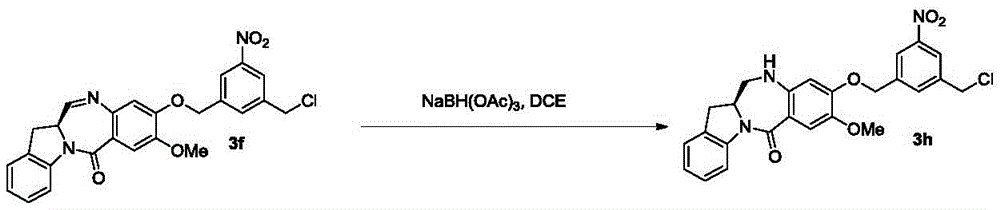
To a solution of 3f (0.15g, 0.31mmol) in DCE (2mL) was added sodium triacetoxyborohydride (0.067g, 0.31mmol, 1.0 equiv.) and the reaction was stirred at room temperature for 1 hour. The reaction was quenched with saturated ammonium chloride (1mL) and the layers were separated. The aqueous layer was extracted with DCM (3 × 10mL) and the combined organic layers were washed with brine (20mL), dried over magnesium sulfate, filtered and the solvent removed in vacuo. The crude brown oil was purified by silica gel chromatography to give the desired product for 3h (0.08g, 0.16mmol, 52% yield). UPLCMS (2.5 min method) 1.80 min. Observation of Mass (ESI)+):480.5(M+H)+。

To a solution of 3h (0.07g, 0.16mmol) in DMA (2mL) was added potassium carbonate (0.07g, 0.47mmol, 3.0 equiv.), then potassium iodide (0.013g, 0.08mmol, 0.05 equiv.), then IGN monomer A (0.05g, 0.17mmol, 1.1 equiv.) in DMA (0.5 mL). The reaction was stirred at room temperature for 12 hours. Water (20mL) was added to the mixture and the mixture was stirred for 10 minutes at which time the solid was filtered. The solid was dissolved in DCM (10mL) and washed with brine (10 mL). The organic layer was dried over magnesium sulfate and filtered. The solvent was removed to give a yellow oil (0.09g, 0.12mmol, 80% yield). UPLCMS (2.5 min method) 1.79 min (2.5 min method). Observation of Mass (ESI)+):738.5(M+H)+。
Example 13.

To a solution of 3b (1.00g, 3.4mmol) in DCM (33mL) was added DIPEA (1.781mL, 10.09mmol, 3.0 equiv.) followed by a solution of methanesulfonic anhydride (0.703g, 4.03mmol, 1.2 equiv.) at 0 deg.C. The reaction was stirred for 1 hour. Evaporation of the solvent gave crude product 3j (1.2g, 3.2mmol, 95% yield), which was used in the next step without further purification. UPLCMS (2.5 min method) 2.04 min. Observation of Mass (ESI)+):376.5(M+H)+。
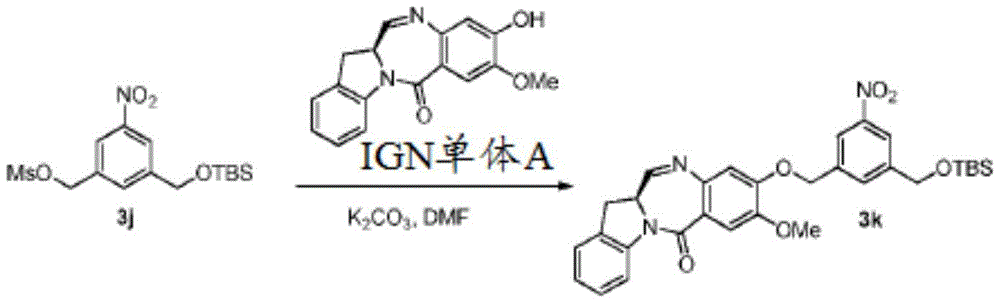
To a solution of 3j (1.24g, 3.30mmol) in DMF (26mL) was added potassium carbonate (0.91g, 6.60mmol, 2.0 equiv) followed by IGN monomer A (0.97g, 3.30mmol, 1.0 equiv) at room temperature over 12 hours. The reaction was quenched with water (60mL) and the solid was filtered off and then dissolved in DCM/MeOH (20/1, 20 mL). The organic layer was washed with brine, dried over magnesium sulfate and filtered. The solvent was removed in vacuo and the crude material was purified by silica gel chromatography to give the desired product 3k (1.3g, 2.27mmol, 69% yield). UPLCMS (2.5 min method) 2.12 min (2.5 min method). Observation of Mass (ESI)+):574.4(M+H)+。
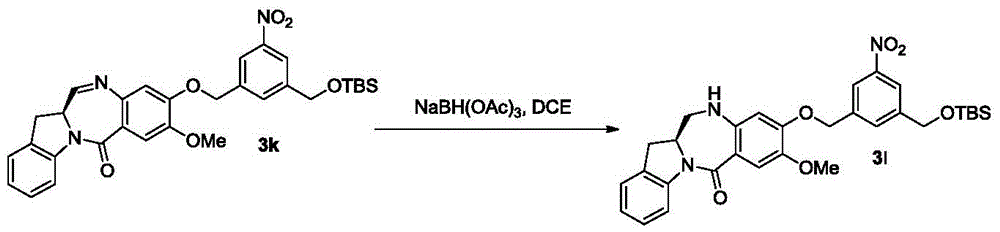
3k (0.63g, 1.1mmol) was dissolved in anhydrous DCE (11 mL). Sodium triacetoxyborohydride (0.70g, 3.3mmol, 3.0 equiv.) was added and the reaction mixture was stirred at room temperature for 1 hour. The mixture was quenched with saturated ammonium chloride (10 mL). The layers were separated and the aqueous layer was extracted with DCM (2X 20 mL). The combined organic layers were washed with brine (20mL), dried over anhydrous magnesium sulfate, filtered and concentrated to give 3l (0.58g,1.0mmol, 92% yield). UPLCMS (8.0 min method) 7.797 min (8.0 min method). Observation of Mass (ESI)+):576.3(M+H)+。

3l (0.58g, 1.0mmol) of the solution was dissolved in anhydrous THF (5mL) and 5M aqueous hydrochloric acid (2.01mL, 10.07mmol) was added. The mixture was stirred at room temperature for 2 hours. The reaction was quenched with saturated sodium bicarbonate (5mL), and the layers were separated and the aqueous layer was extracted with DCM (2X 10 mL). The combined organic layers were washed with brine (20mL), dried over magnesium sulfate and concentrated to give a bright orange solid. The resulting solid was purified by silica gel chromatography (DCM/MeOH) to give compound 3m (0.33g, 0.71mmol, 71% yield). UPLCMS (8.0 min method) 5.166 min. Observation of Mass (ESI)+):462.1(M+H)+。

3m (0.1g, 0.22mmol) was dissolved in anhydrous DCM (1.5mL) and anhydrous DMF (0.7 mL). The reaction was cooled to 0 ℃ and triethylamine (0.12mL, 0.88mmol) and methanesulfonic anhydride (0.08g, 0.44mmol) were added. The reaction was stirred at 0 ℃ for 1 hour. The reaction mixture was diluted with ethyl acetate (20mL), washed with water (2 × 20mL), dried over magnesium sulfate, filtered and concentrated. The compound was initially purified by silica gel chromatography (DCM/EtOAc) and then additionally purified by RPPHPLC (MeCN/water) to give the desired product 3n (0.041g, 0.076mmol, 34% yield). Observation of Mass (ESI)+):540.3 (M+H)+。

Compound 3n (0.041g, 0.076mmol) and IGN monomer A (0.027g, 0.091mmol) were dissolved in anhydrous DMA (0.5 mL). Potassium carbonate (0.012g, 0.091mmol) and potassium iodide (0.006g, 0.038) were addedmmol) and the mixture was stirred for 12 hours. Water (5mL) was added to the reaction mixture. The solid was filtered off, then redissolved in DCM (20mL) and washed with water (10 mL). After drying over magnesium sulfate, filtration and concentration, the solid was passed through RPHPLC (ACN/H)2O) to yield 3g (0.012g, 0.016mmol, 21% yield). UPLCMS (2.5 min method) 1.79 min. Observation of Mass (ESI)+): 738.5(M+H)+。

3g (0.017g, 0.023mmol) of compound was dissolved in anhydrous THF (1mL), anhydrous MeOH (0.5mL) and water (0.1 mL). Ammonium chloride (0.012g, 0.23mmol, 10.0 equiv.) and iron (0.006g, 0.115mmol, 5.0 equiv.) were added. The mixture was stirred at 60 ℃ for 2 hours. The reaction mixture was cooled to room temperature, filtered through celite, and washed with 20% MeOH/DCM (10 mL). The filtrate was concentrated and the crude product was purified by silica gel chromatography (DCM/MeOH) to give compound 3o as a white solid (0.012g, 0.018mmol, 76% yield). UPLCMS (2.5 min method) 1.84 min. Observation of Mass (ESI)+):708.5(M+H)+。1H NMR (400MHz, DMSO-d6, reported as a mixture of water adducts, T330K): δ 8.26(d, J7.9 Hz,1H),8.17(d, J7.8 Hz,1H), 8.03(d, J4.5 Hz,1H),7.49(s,1H), 7.42-7.33 (m,2H), 7.36-7.08 (m,4H), 7.09-6.95 (m,2H), 6.76-6.64 (m,3H),6.47(s,1H),6.15(d, J6.5 Hz,1H), 5.11(m,2H),4.98(m,2H),4.58(dt, J9.9, 4.7, 1H), 4.47-4.36H (m,1H), 3.9, 3H, 3.9, 3H, 3.9, 3H, 3.7, 3H, 7H, 4.47-4.36H, 3H, 3.87(m, 3H), 3H.
Example 14.

Compound 2p (0.03g, 0.066mmol, 1.0 equiv.) and IGN monomer A (0.021g, 0.072mmol, 1.1 equiv.) were dissolved in THF (0.65mL) and DMF (0.3 mL). Triphenylphosphine (0.021g, 0.079mmol, 1.2 equiv.) was added, followed by slow additionDIAD (0.015mL, 0.079mmol, 1.2 equiv.) was added. The reaction was stirred at room temperature under argon for 2 hours. The reaction mixture was concentrated and water (about 2mL) was added to triturate the product. The precipitate was filtered and the remaining solid was washed with water. The crude residue was purified by RPHPLC (C18 column, MeCN/water, gradient: 40% to 60%) to give compound 2r as a white fluffy solid (0.015g, 0.02mmol, 31% yield). UPLCMS (2.5 min method) 1.62 min. Observation of Mass (ESI)+)=732.9(M+H)+
Example 15.
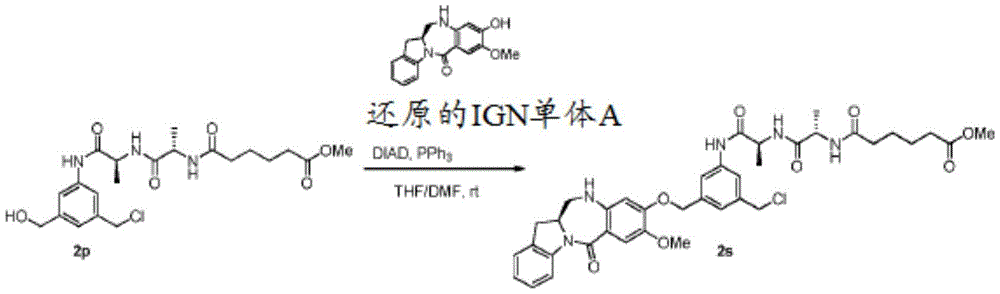
Compound 2p (0.03g, 0.066mmol, 1.0 equiv.) and reduced IGN monomer A (0.02g, 0.072mmol, 1.1 equiv.) were dissolved in THF (0.66mL) and DMF (0.1 mL). Triphenylphosphine (0.021g, 0.079mmol, 1.2 equiv.) was added followed by slow addition of DIAD (0.015mL, 0.079mmol, 1.2 equiv.). The reaction mixture was stirred at room temperature under argon for 2 hours. The reaction mixture was diluted with DCM and washed with water (2 ×). The organic layer was dried over magnesium sulfate, filtered and concentrated. The crude residue was purified by RPHPLC (C18 column, MeCN/water, gradient: 40% to 65%) to yield 2s as a white fluffy solid (0.017g, 0.02mmol, 35% yield). UPLCMS (2.5 min method) 1.71 min. Observation of Mass (ESI)+)=735.4(M+H)+。
Example 16.

Compound 3d (0.03g, 0.149mmol, 1.0 equiv.) and IGN monomer A (0.046g, 0.156mmol, 1.05 equiv.) were dissolved in THF (1.5mL) and DMF (0.3 mL). Triphenylphosphine (0.047g, 0.179mmol, 1.2 equiv.) was added followed by the slow addition of DIAD (0.032mL, 0.164mmol, 1.1 equiv.). The reaction was stirred at room temperature under argon for 12 hours. The reaction mixture was concentrated and water (about 2mL) was added to triturate the product. Filtering the precipitate and usingThe remaining solid was washed with water. The crude residue was purified by silica gel chromatography (hexanes/EtOAc) to give compound 3f as a white yellow solid (0.013g, 0.027mmol, 18% yield). UPLCMS (2.5 min method) 1.80 min. Observation of Mass (ESI)+)= 478.4(M+H)+。
Example 17.

Compound 3d (0.03g, 0.149mmol, 1.0 equiv.) and reduced IGN monomer A (0.046g, 0.156mmol, 1.05 equiv.) were dissolved in THF (1.5 mL). Triphenylphosphine (0.047g, 0.179mmol, 1.2 equiv.) was added followed by the slow addition of DIAD (0.032mL, 0.164mmol, 1.1 equiv.). The reaction was stirred at room temperature under argon for 2 hours. The reaction mixture was concentrated and co-evaporated with toluene (2 ×). The crude residue was purified by silica gel chromatography (hexanes/EtOAc) to give compound as an orange yellow solid for 3h (0.055g, 0.115mmol, 77% yield). UPLCMS (2.5 min method) 1.90 min. Observation of Mass (ESI)+)=480.5(M+H)+。
Example 18.

To a solution of 2d (0.024g, 0.078mmol, 1.1 eq) in DCM (1mL) was added EEDQ (0.019g, 0.078mmol, 1.1 eq). The reaction was stirred for 5 min and MeOH (0.1mL) was added, followed by a solution of 3o (0.05g, 0.071mmol) in DCM (1 mL). The reaction was stirred at room temperature for 2 hours or until the starting material was complete. The reaction was concentrated to form a white precipitate, MTBE (5mL) was added thereto, and the resulting reaction was stirred at room temperature for 30 minutes. The solid was filtered off to give 2l of compound which was then purified by RPHPLC (C18 column, MeCN/water) to give 2l (0.023g, 0.023mmol, 33% yield). UPLCMS (2.5 min method) 1.75 min. Observation of Mass (ESI)+)= 993.2(M+H)+。
Example 19.

To a solution of 2p (0.05g, 0.110mmol, 1.0 equiv.) in DMA (1mL) was added carbon tetrabromide (0.044g, 0.132mmol, 1.2 equiv.), followed by triphenylphosphine (0.043g, 0.164mmol, 1.5 equiv.), and the reaction was stirred at room temperature for 2 h. The solvent was removed to give a white solid, which was triturated with MTBE and the solid filtered off to give compound 2v (0.03g, 0.058mmol, 57% yield, 52% purity) which was used in the next step without further purification. UPLCMS (2.5 min method) 1.59 min. Observation of Mass (ESI)+)=518.2(M+H)+。

To a 2v solution (0.03g, 0.043mmol, 1.0 equiv.) in DMA (0.5mL) was added potassium carbonate (0.012g, 0.087mmol, 2.0 equiv.), followed by IGN monomer A (0.013g, 0.046mmol, 1.05 equiv.). The reaction mixture was stirred at room temperature for 4 hours. The reaction mixture was diluted with water (5mL) and the solid was filtered off. The solid was dissolved in DCM/MeOH (9/1, 2 mL). The organic layer was washed with water (10mL), brine (10mL) and dried over magnesium sulfate. After filtration and removal of solvent, the crude product was purified by RPHPLC (C18 column, MeCN/water) to give 2r (0.011g, 0.015mmol, 35% yield). UPLCMS (2.5 min method) 1.62 min. Observation of Mass (ESI)+)=733.2(M+H)+
Example 20

To a slurry of compound 2v (14.7g, 0.052mol, 1.0 equivalent, prepared as described in the literature, see: Beilstein J. org. chem.2014,10,535-543) in DCM and (100mL) DMF (1mL) was charged SOCl in one charge2(12.6g, 0.104mol, 2.0 equiv.). At 35 deg.CThe resulting solution was stirred overnight, yielding a dark brown slurry. The slurry was filtered and the solid dried to give 7.5g of an off-white solid. NMR showed cleavage of the Boc protecting group. The dark filtrate was charged with solid sodium carbonate (10.6g, 0.1mol) and then buffered to a pH of about 6-7 by further addition of sodium bicarbonate. Adding Boc to the resulting solution2O (12.7g, 0.058mol, 1.1 eq.) and stirred for 0.5 h. The filtered solid (7.5g) was added to the reaction mixture followed by Boc2O (6.5g, 0.030mol, 1.7 eq) (pH about 6) and stirring was continued overnight at room temperature. Saturated sodium bicarbonate (10mL) was then added to achieve a pH of 6 to 7. Adding Boc2O (9.3g, 42.6mmol) and DMAP (0.2g, 1.63mmol) and stirring was continued overnight. The dark reaction was filtered to remove some precipitate. The DCM layer was washed with 1N HCl to remove the un-Boc product, basified and extracted with DCM, and 3.0g of a colorless, crisp solid (un-Boc product) was recovered. The DCM layer was washed with brine and concentrated to a dark sludge. The crude product was purified by silica gel chromatography (EtOAc/hexanes) to give 2w as a light brown solid (9.5g, 0.031mmol, 62% yield).1H NMR(400MHz,CDCl3):δ7.84(m,2H),7.75(m,1H),6.60(s,1H,NH),4.58 (s,2H),3.91(s,3H),1.53(s,9H)。

A solution of LAH/THF (0.6M, 60mL, 1.15 equiv.) was stirred at room temperature for 30 minutes and then cooled to-65 ℃ with an acetone-dry ice bath. Slowly add compound 2w (9.3g, 0.031mol, 1.0 equiv) in portions (Ti about-60 ℃) to give a yellow-brown slurry, which is stirred for 4 hours. The reaction was quenched with water (1.3mL), 15% NaOH (1.3mL), and water (4mL) and stirred for 20 minutes (Ti ca. 5 deg.C). The reaction was filtered and washed with ethyl acetate (about 90 mL). The filtrate was washed with brine and concentrated to give 2x as a brown oil (8.0g, 0.029mol, 93% yield).1H NMR(400MHz,CDCl3):δ7.45(s,1H), 7.40(s,1H),7.10(s,1H),6.60(s,1H,NH),4.75(s,2H),4.50(s,2H),1.53(s, 9H)。

Compound 2x (8.0g, 0.029mol, 1.0 eq) was dissolved in DCM (20mL) and cooled in an ice-water bath. 4N HCl/dioxane (15mL, 1.5 equivalents) was added and the resulting mixture was heated at 50 ℃ for 1 hour and then cooled to room temperature. The slurry was concentrated and the solvent was switched to heptane. The slurry was filtered, washed with hexanes, and dried in an oven (60 ℃) to give 2y as a light brown solid (5.4g, 0.026mol, 88% yield).1H NMR(400MHz,DMSO-d6):δ7.45(s,1H),7.25(s, 2H),4.76(s,2H),4.52(s,2H)。

To a solution of 2d (0.969g, 3.20mmol, 1.1 equiv) in DCM (25mL) was added EEDQ (0.79g, 3.2mmol, 1.1 equiv) at room temperature. After 8 min, a solution of 2y (0.5g, 2.91mmol, 1.0 equiv), DIPEA (0.51mL, 2.91mmol, 1.0 equiv) in MeOH (5mL) was added dropwise over 1 min. The reaction was stirred for 2 hours. The reaction was quenched with water (30mL), the layers were separated, and the aqueous layer was extracted with DCM (2X 20 mL). The combined organic layers were washed with saturated sodium bicarbonate (20mL), brine (20mL), dried over magnesium sulfate, filtered and concentrated to leave a minimum amount of solvent. The resulting white solid was diluted in MBTE and filtered to give the desired product 2p as a white solid (0.64g, 1.40mmol, 48% yield). UPLCMS (2.5 min method) 1.30 min. Observation of Mass (ESI)+)=456.3(M+H)+。
Claims (30)


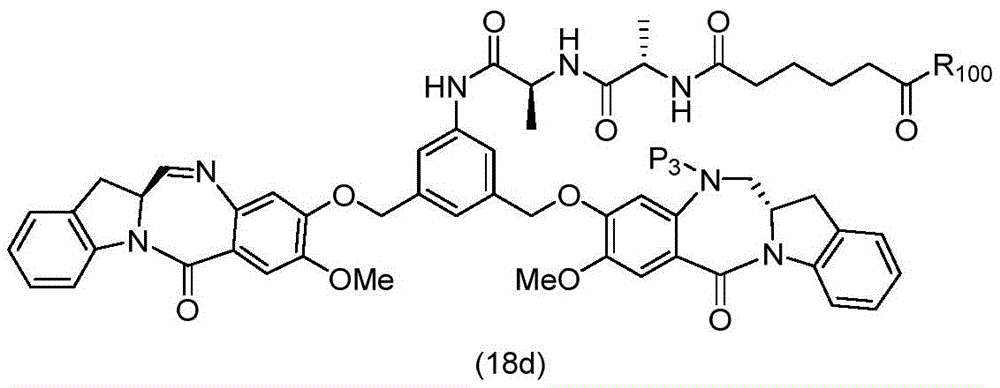


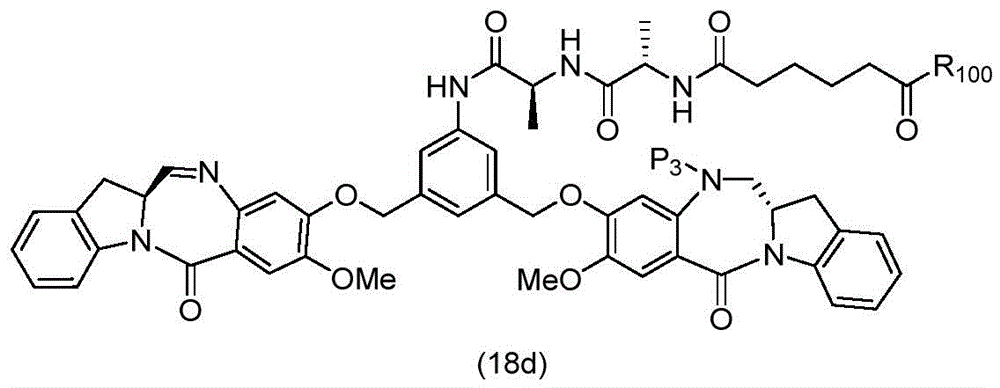


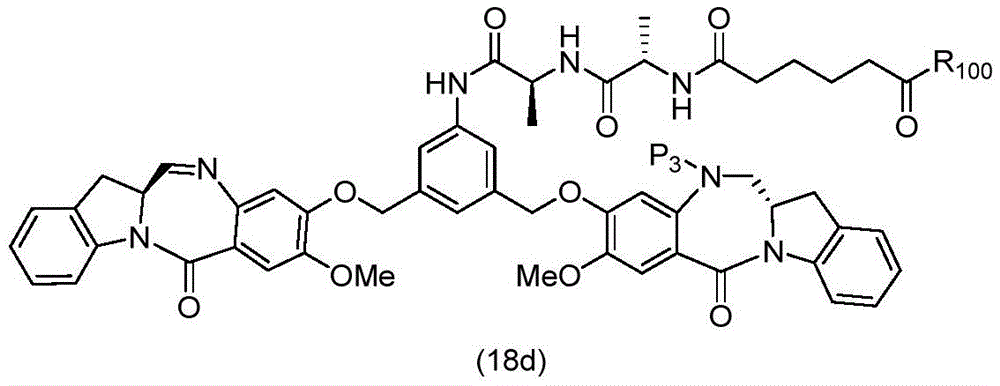


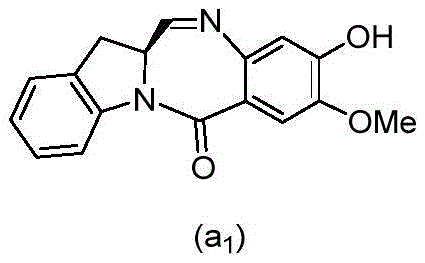


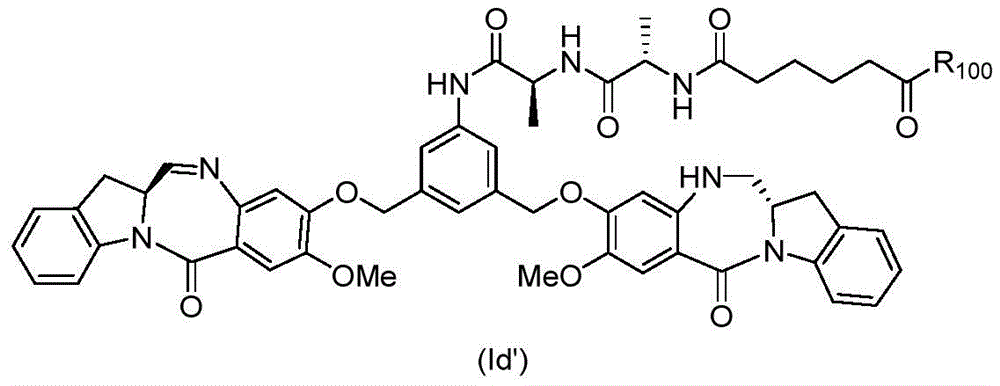


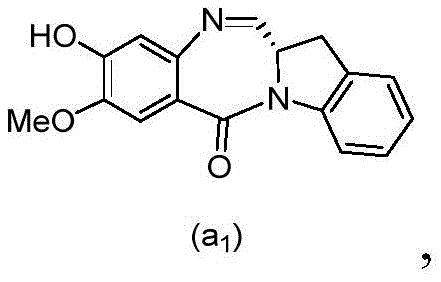


Priority Applications (1)
| Application Number | Priority Date | Filing Date | Title |
|---|---|---|---|
| CN202110366892.7A CN113087763A (en) | 2015-07-21 | 2016-07-21 | Method for preparing cytotoxic benzodiazepine derivatives |
Applications Claiming Priority (5)
| Application Number | Priority Date | Filing Date | Title |
|---|---|---|---|
| US201562195023P | 2015-07-21 | 2015-07-21 | |
| US62/195,023 | 2015-07-21 | ||
| US201662327973P | 2016-04-26 | 2016-04-26 | |
| US62/327,973 | 2016-04-26 | ||
| PCT/US2016/043406 WO2017015496A1 (en) | 2015-07-21 | 2016-07-21 | Methods of preparing cytotoxic benzodiazepine derivatives |
Related Child Applications (1)
| Application Number | Title | Priority Date | Filing Date |
|---|---|---|---|
| CN202110366892.7A Division CN113087763A (en) | 2015-07-21 | 2016-07-21 | Method for preparing cytotoxic benzodiazepine derivatives |
Publications (2)
| Publication Number | Publication Date |
|---|---|
| CN108026103A CN108026103A (en) | 2018-05-11 |
| CN108026103B true CN108026103B (en) | 2021-04-16 |
Family
ID=56557925
Family Applications (5)
| Application Number | Title | Priority Date | Filing Date |
|---|---|---|---|
| CN201680053093.1A Expired - Fee Related CN108026103B (en) | 2015-07-21 | 2016-07-21 | Method for preparing cytotoxic benzodiazepine derivatives |
| CN201680051138.1A Expired - Fee Related CN108290895B (en) | 2015-07-21 | 2016-07-21 | Method for preparing cytotoxic benzodiazepine* derivatives |
| CN201680053120.5A Pending CN108055844A (en) | 2015-07-21 | 2016-07-21 | Process for the preparation of cytotoxic benzodiazepine* derivatives |
| CN202110219412.4A Pending CN113004288A (en) | 2015-07-21 | 2016-07-21 | Method for preparing cytotoxic benzodiazepine derivatives |
| CN202110366892.7A Pending CN113087763A (en) | 2015-07-21 | 2016-07-21 | Method for preparing cytotoxic benzodiazepine derivatives |
Family Applications After (4)
| Application Number | Title | Priority Date | Filing Date |
|---|---|---|---|
| CN201680051138.1A Expired - Fee Related CN108290895B (en) | 2015-07-21 | 2016-07-21 | Method for preparing cytotoxic benzodiazepine* derivatives |
| CN201680053120.5A Pending CN108055844A (en) | 2015-07-21 | 2016-07-21 | Process for the preparation of cytotoxic benzodiazepine* derivatives |
| CN202110219412.4A Pending CN113004288A (en) | 2015-07-21 | 2016-07-21 | Method for preparing cytotoxic benzodiazepine derivatives |
| CN202110366892.7A Pending CN113087763A (en) | 2015-07-21 | 2016-07-21 | Method for preparing cytotoxic benzodiazepine derivatives |
Country Status (23)
| Country | Link |
|---|---|
| US (11) | US9873708B2 (en) |
| EP (7) | EP3653628B1 (en) |
| JP (8) | JP6787995B2 (en) |
| KR (5) | KR102660070B1 (en) |
| CN (5) | CN108026103B (en) |
| AU (7) | AU2016297087B2 (en) |
| CA (4) | CA2992082A1 (en) |
| CY (2) | CY1122553T1 (en) |
| DK (2) | DK3325483T3 (en) |
| ES (4) | ES2820358T3 (en) |
| HK (1) | HK1252322A1 (en) |
| HR (1) | HRP20201479T1 (en) |
| HU (1) | HUE051541T2 (en) |
| IL (10) | IL286788B2 (en) |
| LT (2) | LT3325483T (en) |
| PL (2) | PL3325483T3 (en) |
| PT (2) | PT3325483T (en) |
| RS (2) | RS59806B1 (en) |
| RU (3) | RU2727151C2 (en) |
| SG (2) | SG10202009354SA (en) |
| SI (2) | SI3325483T1 (en) |
| SM (2) | SMT202000004T1 (en) |
| WO (3) | WO2017015496A1 (en) |
Families Citing this family (10)
| Publication number | Priority date | Publication date | Assignee | Title |
|---|---|---|---|---|
| IL286788B2 (en) | 2015-07-21 | 2024-01-01 | Immunogen Inc | Methods for the preparation of cytotoxic benzodiazepine compounds |
| KR102609698B1 (en) | 2016-03-22 | 2023-12-04 | 에베 그룹 에. 탈너 게엠베하 | Device and method for bonding substrates |
| KR20240000650A (en) | 2016-10-19 | 2024-01-02 | 인벤라 인코포레이티드 | Antibody constructs |
| CA3045857A1 (en) | 2016-12-22 | 2018-06-28 | Universita Degli Studi Magna Graecia Catanzaro | A monoclonal antibody targeting a unique sialoglycosilated cancer-associated epitope of cd43 |
| IL293645A (en) | 2017-01-25 | 2022-08-01 | Immunogen Inc | Methods of preparing cytotoxic benzodiazepine derivatives |
| JP7653260B2 (en) | 2018-06-05 | 2025-03-28 | キングス・カレッジ・ロンドン | BTNL3/8-Targeted Constructs for Payload Delivery to the Gastrointestinal System |
| SG11202104360YA (en) | 2018-11-12 | 2021-05-28 | Immunogen Inc | Methods of preparing cytotoxic benzodiazepine derivatives |
| MA54225A (en) * | 2018-11-12 | 2021-09-22 | Immunogen Inc | METHODS FOR PREPARING CYTOTOXIC BENZODIAZEPINE DERIVATIVES |
| TW202102506A (en) * | 2019-03-29 | 2021-01-16 | 美商伊繆諾金公司 | Benzodiazepine derivatives |
| US20250367307A1 (en) | 2022-06-30 | 2025-12-04 | Toray Industries, Inc. | Pharmaceutical composition for cancer treatment and/or prevention |
Family Cites Families (63)
| Publication number | Priority date | Publication date | Assignee | Title |
|---|---|---|---|---|
| US3860600A (en) | 1972-07-10 | 1975-01-14 | Sterling Drug Inc | Octahydropyrrido{8 2,1-c{9 {8 1,4{9 benzodiazepines |
| US3763183A (en) | 1972-07-10 | 1973-10-02 | Sterling Drug Inc | 1,2,3,10,11,11a-hexahydro-5h-pyrrolo (2,1-c)(1,4)benzodiazepines |
| US4678784A (en) | 1984-04-11 | 1987-07-07 | Mcneilab, Inc. | Method for the treatment of LHRH diseases and conditions |
| US5208020A (en) | 1989-10-25 | 1993-05-04 | Immunogen Inc. | Cytotoxic agents comprising maytansinoids and their therapeutic use |
| GB9205051D0 (en) | 1992-03-09 | 1992-04-22 | Cancer Res Campaign Tech | Pyrrolobenzodiazepine derivatives,their preparation,and compositions containing them |
| ES2149768T3 (en) | 1992-03-25 | 2000-11-16 | Immunogen Inc | CONJUGATES OF BINDING AGENTS OF CELLS DERIVED FROM CC-1065. |
| DE69907977T2 (en) | 1998-08-27 | 2004-07-22 | Spirogen Ltd., Ryde | Pyrrolobenzodiazepine |
| GB9818731D0 (en) | 1998-08-27 | 1998-10-21 | Univ Portsmouth | Compounds |
| HK1049997B (en) | 1999-11-24 | 2007-02-23 | Immunogen, Inc. | Cytotoxic agents comprising taxanes and their therapeutic use |
| US6548042B2 (en) * | 2000-08-07 | 2003-04-15 | Arstad Erik | Bis-phosphonate compounds |
| UA75093C2 (en) * | 2000-10-06 | 2006-03-15 | Dimensional Pharm Inc | Aminopyridinyl-,aminoguanidinyl-, and alkoxyguanidinesubstituted phenylsubstituted phenylacetamides as protease inhibitors |
| US6441163B1 (en) | 2001-05-31 | 2002-08-27 | Immunogen, Inc. | Methods for preparation of cytotoxic conjugates of maytansinoids and cell binding agents |
| US6716821B2 (en) | 2001-12-21 | 2004-04-06 | Immunogen Inc. | Cytotoxic agents bearing a reactive polyethylene glycol moiety, cytotoxic conjugates comprising polyethylene glycol linking groups, and methods of making and using the same |
| US6756397B2 (en) | 2002-04-05 | 2004-06-29 | Immunogen, Inc. | Prodrugs of CC-1065 analogs |
| BR0313197A (en) | 2002-08-02 | 2005-08-09 | Immunogen Inc | Cytotoxic agents containing potent taxanes and their therapeutic use |
| ATE499116T1 (en) | 2002-08-16 | 2011-03-15 | Immunogen Inc | HIGH REACTIVITY AND SOLUBILITY CROSS-LINKERS AND THEIR USE IN THE PRODUCTION OF CONJUGATES FOR THE TARGETED DELIVERY OF SMALL MOLECULAR DRUGS |
| RU2314309C2 (en) | 2003-03-31 | 2008-01-10 | Каунсил Оф Сайентифик Энд Индастриал Рисерч | Pyrrolo[2.1-c][1.4]benzodiazepines, method for their preparing and pharmaceutical composition based on thereof |
| RU2338747C2 (en) | 2003-03-31 | 2008-11-20 | Каунсил Оф Сайентифик Энд Индастриал Рисерч | DIMERS OF PYRROL[2,1-c][1,4]BENZODIAZEPINE AS ANTITUMORAL AGENTS AND METHOD OF THEIR OBTAINING |
| EP1608663B1 (en) | 2003-03-31 | 2008-11-05 | Council of Scientific and Industrial Research | Pyrrolo (2,1-c)(1,4) benzodiazepines dimers as antitumour agents and process thereof |
| DE60326060D1 (en) | 2003-03-31 | 2009-03-19 | Council Scient Ind Res | Non-Crosslinking PYRROLOA2,1-CÜ1,4ÜBENZODIAZEPINE AS POTENTIAL ANTITUMOR AGENTS AND THEIR PREPARATION |
| US8088387B2 (en) | 2003-10-10 | 2012-01-03 | Immunogen Inc. | Method of targeting specific cell populations using cell-binding agent maytansinoid conjugates linked via a non-cleavable linker, said conjugates, and methods of making said conjugates |
| US7276497B2 (en) | 2003-05-20 | 2007-10-02 | Immunogen Inc. | Cytotoxic agents comprising new maytansinoids |
| ATE516288T1 (en) | 2003-10-22 | 2011-07-15 | Us Gov Health & Human Serv | PYRROLOBENZODIAZEPINE DERIVATIVES, COMPOSITIONS CONTAINING SAME AND RELATED METHODS |
| JP4520411B2 (en) | 2003-12-31 | 2010-08-04 | カウンシル オブ サイエンティフィク アンド インダストリアル リサーチ | Method for preparing pyrrolo [2,1-c] [1,4] benzodiazepine hybrid |
| GB0404578D0 (en) | 2004-03-01 | 2004-04-07 | Spirogen Ltd | Pyrrolobenzodiazepines |
| EP1720881B9 (en) * | 2004-03-01 | 2013-04-17 | Spirogen Sàrl | 11-hydroxy-5h-pyrrolo[2,1-c][1,4]benzodiazepin-5-one derivatives as key intermediates for the preparation of c2 substituted pyrrolobenzodiazepins |
| GB0410725D0 (en) | 2004-05-13 | 2004-06-16 | Spirogen Ltd | Pyrrolobenzodiazepine therapeutic agents |
| GB0412492D0 (en) * | 2004-06-04 | 2004-07-07 | Sterix Ltd | Compound |
| EP1879901B1 (en) | 2005-04-21 | 2009-12-23 | Spirogen Limited | Pyrrolobenzodiazepines |
| GB0508084D0 (en) * | 2005-04-21 | 2005-06-01 | Spirogen Ltd | Pyrrolobenzodiazepines |
| WO2007039752A1 (en) | 2005-10-05 | 2007-04-12 | Spirogen Limited | Alkyl 4- [4- (5-oxo-2, 3, 5, 11a-tetrahyd0-5h-pyrr0l0 [2, 1-c] [1, 4] benzodiazepine-8-yloxy) -butyrylamino]-1h-pyrrole-2-carboxylate derivatives and related compounds for the treatment of a proliferative disease |
| ATE475660T1 (en) * | 2005-12-21 | 2010-08-15 | Abbott Lab | ANTIVIRAL COMPOUNDS |
| EP1813614B1 (en) | 2006-01-25 | 2011-10-05 | Sanofi | Cytotoxic agents comprising new tomaymycin derivatives |
| DE112007000079B4 (en) | 2006-02-13 | 2015-08-13 | Council Of Scientific & Industrial Research | Novel bis-pyrrolo [2,1-c] [1,4] benzodiazepine-anthraquinone conjugates and a process for their preparation |
| RS54163B1 (en) | 2006-05-30 | 2015-12-31 | Genentech Inc. | ANTI-CD22 ANTIBODIES, THEIR IMMUNCONJUGATES AND THEIR USE |
| PT2019104E (en) | 2007-07-19 | 2013-12-03 | Sanofi Sa | Cytotoxic agents comprising new tomaymycin derivatives and their therapeutic use |
| WO2009016647A1 (en) | 2007-08-01 | 2009-02-05 | Council Of Scientific & Industrial Research | Pyrrolo [2,1-c][1, 4] benzodiazepine-glycoside prodrugs useful as a selective anti tumor agent |
| EP2276506A4 (en) | 2008-04-30 | 2014-05-07 | Immunogen Inc | Potent conjugates and hydrophilic linkers |
| CN104524590B (en) | 2008-04-30 | 2019-06-21 | 伊缪诺金公司 | The purposes of crosslinking agent and they |
| GB0819095D0 (en) | 2008-10-17 | 2008-11-26 | Spirogen Ltd | Pyrrolobenzodiazepines |
| GB0822260D0 (en) | 2008-12-05 | 2009-01-14 | Merten Christoph | Assay |
| US8637558B2 (en) * | 2008-12-30 | 2014-01-28 | Industry-Academic Cooperation Foundation, Chosun University | Thiazolidinedione derivative and use thereof |
| AU2010210646B2 (en) | 2009-02-05 | 2015-10-29 | Immunogen, Inc. | Novel benzodiazepine derivatives |
| EP2486023A4 (en) | 2009-10-06 | 2014-05-07 | Immunogen Inc | Potent conjugates and hydrophilic linkers |
| US8314250B2 (en) * | 2009-11-24 | 2012-11-20 | Hoffmann-La Roche Inc. | Sultam derivatives |
| US8633304B2 (en) * | 2009-12-08 | 2014-01-21 | Gifu University | Oligonucleotide derivative comprising an aromatic compound |
| US8962279B2 (en) | 2009-12-30 | 2015-02-24 | Intel Corporation | Solid-phase chelators and electronic biosensors |
| SG10202012179RA (en) * | 2010-02-11 | 2021-01-28 | Celgene Corp | Arylmethoxy isoindoline derivatives and compositions comprising and methods of using the same |
| CA3014767C (en) | 2010-02-24 | 2023-08-29 | Immunogen, Inc. | Folate receptor 1 antibodies and immunoconjugates and uses thereof |
| MA34277B1 (en) | 2010-04-15 | 2013-06-01 | Spirogen Developments Sarl | PYRROLOBENZODIAZEPINES AND CONJUGATES THEREOF |
| NZ602933A (en) | 2010-04-15 | 2014-09-26 | Seattle Genetics Inc | Pyrrolobenzodiazepines used to treat proliferative diseases |
| JP5870400B2 (en) | 2010-04-15 | 2016-03-01 | シアトル ジェネティクス,インコーポレーテッド | Targeted pyrrolobenzodiazepine conjugates |
| MY183977A (en) | 2011-02-15 | 2021-03-17 | Immunogen Inc | Cytotoxic benzodiazepine derivatives |
| CN102234253B (en) * | 2011-06-02 | 2013-07-03 | 重庆莱美药业股份有限公司 | Method for preparing febuxostat intermediate |
| HK1211208A1 (en) | 2012-08-22 | 2016-05-20 | Immunogen, Inc. | Cytotoxic benzodiazepine derivative |
| CN105683163B (en) | 2013-10-04 | 2018-11-09 | 诺华股份有限公司 | 3 ' end caps of the RNAi agent used in RNA interference |
| CN104628772A (en) * | 2013-11-07 | 2015-05-20 | 四川恒康发展有限责任公司 | Antitumor prodrug, activator, composition, and application thereof |
| CN103664896B (en) * | 2013-11-25 | 2016-03-02 | 济南精合医药科技有限公司 | A kind of synthetic process of crizotinib serving as antitumor molecular targeting medicament |
| AU2015312075A1 (en) * | 2014-09-03 | 2017-03-09 | Immunogen, Inc. | Conjugates comprising cell-binding agents and cytotoxic agents |
| SG11201701455SA (en) | 2014-09-03 | 2017-03-30 | Immunogen Inc | Cytotoxic benzodiazepine derivatives |
| TW201613930A (en) | 2014-09-03 | 2016-04-16 | Immunogen Inc | Cytotoxic benzodiazepine derivatives |
| IL286788B2 (en) | 2015-07-21 | 2024-01-01 | Immunogen Inc | Methods for the preparation of cytotoxic benzodiazepine compounds |
| ES2970186T3 (en) * | 2015-11-25 | 2024-05-27 | Immunogen Inc | Pharmaceutical formulations and methods of their use |
-
2016
- 2016-07-21 IL IL286788A patent/IL286788B2/en unknown
- 2016-07-21 SG SG10202009354SA patent/SG10202009354SA/en unknown
- 2016-07-21 KR KR1020187005041A patent/KR102660070B1/en active Active
- 2016-07-21 PT PT167459619T patent/PT3325483T/en unknown
- 2016-07-21 AU AU2016297087A patent/AU2016297087B2/en not_active Ceased
- 2016-07-21 US US15/216,512 patent/US9873708B2/en active Active
- 2016-07-21 SI SI201630578T patent/SI3325483T1/en unknown
- 2016-07-21 KR KR1020247012991A patent/KR20240055903A/en not_active Withdrawn
- 2016-07-21 KR KR1020247012816A patent/KR20240055894A/en not_active Withdrawn
- 2016-07-21 IL IL305989A patent/IL305989A/en unknown
- 2016-07-21 JP JP2018502791A patent/JP6787995B2/en not_active Expired - Fee Related
- 2016-07-21 CN CN201680053093.1A patent/CN108026103B/en not_active Expired - Fee Related
- 2016-07-21 ES ES16745598T patent/ES2820358T3/en active Active
- 2016-07-21 PL PL16745961T patent/PL3325483T3/en unknown
- 2016-07-21 CN CN201680051138.1A patent/CN108290895B/en not_active Expired - Fee Related
- 2016-07-21 EP EP19200626.0A patent/EP3653628B1/en active Active
- 2016-07-21 SM SM20200004T patent/SMT202000004T1/en unknown
- 2016-07-21 AU AU2016297607A patent/AU2016297607A1/en not_active Abandoned
- 2016-07-21 CN CN201680053120.5A patent/CN108055844A/en active Pending
- 2016-07-21 CA CA2992082A patent/CA2992082A1/en active Pending
- 2016-07-21 CA CA2991305A patent/CA2991305C/en active Active
- 2016-07-21 HU HUE16745598A patent/HUE051541T2/en unknown
- 2016-07-21 RU RU2018105756A patent/RU2727151C2/en active
- 2016-07-21 CA CA2991326A patent/CA2991326A1/en not_active Abandoned
- 2016-07-21 KR KR1020187003181A patent/KR102659706B1/en active Active
- 2016-07-21 SM SM20200506T patent/SMT202000506T1/en unknown
- 2016-07-21 PT PT167455989T patent/PT3325482T/en unknown
- 2016-07-21 CA CA3227588A patent/CA3227588A1/en active Pending
- 2016-07-21 ES ES16745961T patent/ES2764548T3/en active Active
- 2016-07-21 RU RU2018105609A patent/RU2746322C2/en active
- 2016-07-21 SI SI201630923T patent/SI3325482T1/en unknown
- 2016-07-21 RS RS20191647A patent/RS59806B1/en unknown
- 2016-07-21 US US15/216,548 patent/US10081640B2/en active Active
- 2016-07-21 US US15/216,517 patent/US9890179B2/en not_active Expired - Fee Related
- 2016-07-21 RU RU2018105752A patent/RU2018105752A/en not_active Application Discontinuation
- 2016-07-21 CN CN202110219412.4A patent/CN113004288A/en active Pending
- 2016-07-21 WO PCT/US2016/043406 patent/WO2017015496A1/en not_active Ceased
- 2016-07-21 ES ES20181645T patent/ES2959741T3/en active Active
- 2016-07-21 HK HK18111602.7A patent/HK1252322A1/en unknown
- 2016-07-21 EP EP23183947.3A patent/EP4286387A3/en not_active Withdrawn
- 2016-07-21 LT LTEP16745961.9T patent/LT3325483T/en unknown
- 2016-07-21 SG SG10202106529XA patent/SG10202106529XA/en unknown
- 2016-07-21 KR KR1020187005040A patent/KR20180038460A/en not_active Withdrawn
- 2016-07-21 AU AU2016297608A patent/AU2016297608B2/en not_active Ceased
- 2016-07-21 CN CN202110366892.7A patent/CN113087763A/en active Pending
- 2016-07-21 DK DK16745961.9T patent/DK3325483T3/en active
- 2016-07-21 DK DK16745598.9T patent/DK3325482T3/en active
- 2016-07-21 EP EP20181645.1A patent/EP3778602B1/en active Active
- 2016-07-21 JP JP2018502800A patent/JP2018522018A/en not_active Withdrawn
- 2016-07-21 EP EP22195446.4A patent/EP4163284A1/en not_active Withdrawn
- 2016-07-21 IL IL283355A patent/IL283355B/en unknown
- 2016-07-21 LT LTEP16745598.9T patent/LT3325482T/en unknown
- 2016-07-21 WO PCT/US2016/043402 patent/WO2017015495A1/en not_active Ceased
- 2016-07-21 IL IL294651A patent/IL294651B2/en unknown
- 2016-07-21 WO PCT/US2016/043414 patent/WO2017015502A1/en not_active Ceased
- 2016-07-21 PL PL16745598T patent/PL3325482T3/en unknown
- 2016-07-21 JP JP2018502785A patent/JP6858745B2/en not_active Expired - Fee Related
- 2016-07-21 HR HRP20201479TT patent/HRP20201479T1/en unknown
- 2016-07-21 RS RS20201132A patent/RS60840B1/en unknown
- 2016-07-21 EP EP16745961.9A patent/EP3325483B1/en active Active
- 2016-07-21 EP EP16748205.8A patent/EP3325485B1/en active Active
- 2016-07-21 EP EP16745598.9A patent/EP3325482B1/en active Active
- 2016-07-21 ES ES19200626T patent/ES2933376T3/en active Active
- 2016-07-21 IL IL305279A patent/IL305279A/en unknown
-
2017
- 2017-12-11 US US15/837,832 patent/US10370389B2/en active Active
-
2018
- 2018-01-03 US US15/860,864 patent/US10392407B2/en not_active Expired - Fee Related
- 2018-01-11 IL IL256854A patent/IL256854A/en unknown
- 2018-01-11 IL IL256860A patent/IL256860B/en active IP Right Grant
- 2018-01-11 IL IL256861A patent/IL256861B/en active IP Right Grant
- 2018-09-12 US US16/129,008 patent/US10899775B2/en active Active
-
2019
- 2019-06-06 US US16/433,117 patent/US10787463B2/en active Active
- 2019-06-21 US US16/448,261 patent/US20200017526A1/en not_active Abandoned
- 2019-12-30 CY CY20191101364T patent/CY1122553T1/en unknown
-
2020
- 2020-08-10 IL IL276630A patent/IL276630B/en active IP Right Grant
- 2020-08-10 IL IL276631A patent/IL276631B/en unknown
- 2020-08-12 US US16/991,700 patent/US11420982B2/en active Active
- 2020-09-23 CY CY20201100899T patent/CY1123390T1/en unknown
- 2020-10-28 JP JP2020180147A patent/JP6995178B2/en not_active Expired - Fee Related
- 2020-11-23 US US17/101,942 patent/US20210171547A1/en not_active Abandoned
-
2021
- 2021-03-24 JP JP2021049502A patent/JP7337114B2/en active Active
- 2021-04-20 AU AU2021202403A patent/AU2021202403B2/en not_active Ceased
- 2021-05-17 AU AU2021203148A patent/AU2021203148B2/en not_active Ceased
- 2021-12-14 JP JP2021202215A patent/JP7334228B2/en active Active
-
2022
- 2022-12-14 US US18/080,973 patent/US20230257400A1/en not_active Abandoned
-
2023
- 2023-03-03 AU AU2023201339A patent/AU2023201339A1/en not_active Abandoned
- 2023-04-11 AU AU2023202221A patent/AU2023202221A1/en not_active Abandoned
- 2023-08-16 JP JP2023132536A patent/JP2023162264A/en not_active Withdrawn
- 2023-08-22 JP JP2023134420A patent/JP2023166434A/en not_active Withdrawn
Also Published As
Similar Documents
| Publication | Publication Date | Title |
|---|---|---|
| CN108026103B (en) | Method for preparing cytotoxic benzodiazepine derivatives | |
| HK40088821A (en) | Methods of preparing cytotoxic benzodiazepine derivatives | |
| HK40029973A (en) | Methods of preparing cytotoxic benzodiazepine derivatives | |
| HK40029973B (en) | Methods of preparing cytotoxic benzodiazepine derivatives | |
| HK1252323B (en) | Methods of preparing cytotoxic benzodiazepine derivatives |
Legal Events
| Date | Code | Title | Description |
|---|---|---|---|
| PB01 | Publication | ||
| PB01 | Publication | ||
| SE01 | Entry into force of request for substantive examination | ||
| SE01 | Entry into force of request for substantive examination | ||
| GR01 | Patent grant | ||
| GR01 | Patent grant | ||
| CF01 | Termination of patent right due to non-payment of annual fee |
Granted publication date: 20210416 |
|
| CF01 | Termination of patent right due to non-payment of annual fee |