CN107645951B - Compositions and methods for delivering one or more biologically active agents - Google Patents
Compositions and methods for delivering one or more biologically active agents Download PDFInfo
- Publication number
- CN107645951B CN107645951B CN201580074504.0A CN201580074504A CN107645951B CN 107645951 B CN107645951 B CN 107645951B CN 201580074504 A CN201580074504 A CN 201580074504A CN 107645951 B CN107645951 B CN 107645951B
- Authority
- CN
- China
- Prior art keywords
- present
- active agent
- weight
- amount
- compositions
- Prior art date
- Legal status (The legal status is an assumption and is not a legal conclusion. Google has not performed a legal analysis and makes no representation as to the accuracy of the status listed.)
- Active
Links
Images


Classifications
-
- A—HUMAN NECESSITIES
- A61—MEDICAL OR VETERINARY SCIENCE; HYGIENE
- A61K—PREPARATIONS FOR MEDICAL, DENTAL OR TOILETRY PURPOSES
- A61K31/00—Medicinal preparations containing organic active ingredients
- A61K31/557—Eicosanoids, e.g. leukotrienes or prostaglandins
- A61K31/5575—Eicosanoids, e.g. leukotrienes or prostaglandins having a cyclopentane, e.g. prostaglandin E2, prostaglandin F2-alpha
-
- A—HUMAN NECESSITIES
- A61—MEDICAL OR VETERINARY SCIENCE; HYGIENE
- A61K—PREPARATIONS FOR MEDICAL, DENTAL OR TOILETRY PURPOSES
- A61K31/00—Medicinal preparations containing organic active ingredients
- A61K31/33—Heterocyclic compounds
- A61K31/395—Heterocyclic compounds having nitrogen as a ring hetero atom, e.g. guanethidine or rifamycins
- A61K31/535—Heterocyclic compounds having nitrogen as a ring hetero atom, e.g. guanethidine or rifamycins having six-membered rings with at least one nitrogen and one oxygen as the ring hetero atoms, e.g. 1,2-oxazines
- A61K31/5375—1,4-Oxazines, e.g. morpholine
- A61K31/5377—1,4-Oxazines, e.g. morpholine not condensed and containing further heterocyclic rings, e.g. timolol
-
- A—HUMAN NECESSITIES
- A61—MEDICAL OR VETERINARY SCIENCE; HYGIENE
- A61K—PREPARATIONS FOR MEDICAL, DENTAL OR TOILETRY PURPOSES
- A61K47/00—Medicinal preparations characterised by the non-active ingredients used, e.g. carriers or inert additives; Targeting or modifying agents chemically bound to the active ingredient
- A61K47/02—Inorganic compounds
-
- A—HUMAN NECESSITIES
- A61—MEDICAL OR VETERINARY SCIENCE; HYGIENE
- A61K—PREPARATIONS FOR MEDICAL, DENTAL OR TOILETRY PURPOSES
- A61K47/00—Medicinal preparations characterised by the non-active ingredients used, e.g. carriers or inert additives; Targeting or modifying agents chemically bound to the active ingredient
- A61K47/30—Macromolecular organic or inorganic compounds, e.g. inorganic polyphosphates
- A61K47/32—Macromolecular compounds obtained by reactions only involving carbon-to-carbon unsaturated bonds, e.g. carbomers, poly(meth)acrylates, or polyvinyl pyrrolidone
-
- A—HUMAN NECESSITIES
- A61—MEDICAL OR VETERINARY SCIENCE; HYGIENE
- A61K—PREPARATIONS FOR MEDICAL, DENTAL OR TOILETRY PURPOSES
- A61K47/00—Medicinal preparations characterised by the non-active ingredients used, e.g. carriers or inert additives; Targeting or modifying agents chemically bound to the active ingredient
- A61K47/30—Macromolecular organic or inorganic compounds, e.g. inorganic polyphosphates
- A61K47/34—Macromolecular compounds obtained otherwise than by reactions only involving carbon-to-carbon unsaturated bonds, e.g. polyesters, polyamino acids, polysiloxanes, polyphosphazines, copolymers of polyalkylene glycol or poloxamers
-
- A—HUMAN NECESSITIES
- A61—MEDICAL OR VETERINARY SCIENCE; HYGIENE
- A61K—PREPARATIONS FOR MEDICAL, DENTAL OR TOILETRY PURPOSES
- A61K9/00—Medicinal preparations characterised by special physical form
- A61K9/0012—Galenical forms characterised by the site of application
- A61K9/0048—Eye, e.g. artificial tears
- A61K9/0051—Ocular inserts, ocular implants
-
- A—HUMAN NECESSITIES
- A61—MEDICAL OR VETERINARY SCIENCE; HYGIENE
- A61P—SPECIFIC THERAPEUTIC ACTIVITY OF CHEMICAL COMPOUNDS OR MEDICINAL PREPARATIONS
- A61P27/00—Drugs for disorders of the senses
- A61P27/02—Ophthalmic agents
- A61P27/06—Antiglaucoma agents or miotics
-
- A—HUMAN NECESSITIES
- A61—MEDICAL OR VETERINARY SCIENCE; HYGIENE
- A61P—SPECIFIC THERAPEUTIC ACTIVITY OF CHEMICAL COMPOUNDS OR MEDICINAL PREPARATIONS
- A61P43/00—Drugs for specific purposes, not provided for in groups A61P1/00-A61P41/00
-
- A—HUMAN NECESSITIES
- A61—MEDICAL OR VETERINARY SCIENCE; HYGIENE
- A61K—PREPARATIONS FOR MEDICAL, DENTAL OR TOILETRY PURPOSES
- A61K2300/00—Mixtures or combinations of active ingredients, wherein at least one active ingredient is fully defined in groups A61K31/00 - A61K41/00
Landscapes
- Health & Medical Sciences (AREA)
- Chemical & Material Sciences (AREA)
- Life Sciences & Earth Sciences (AREA)
- Animal Behavior & Ethology (AREA)
- Veterinary Medicine (AREA)
- Public Health (AREA)
- General Health & Medical Sciences (AREA)
- Medicinal Chemistry (AREA)
- Pharmacology & Pharmacy (AREA)
- Epidemiology (AREA)
- Inorganic Chemistry (AREA)
- Ophthalmology & Optometry (AREA)
- Proteomics, Peptides & Aminoacids (AREA)
- Organic Chemistry (AREA)
- Nuclear Medicine, Radiotherapy & Molecular Imaging (AREA)
- General Chemical & Material Sciences (AREA)
- Engineering & Computer Science (AREA)
- Chemical Kinetics & Catalysis (AREA)
- Bioinformatics & Cheminformatics (AREA)
- Pharmaceuticals Containing Other Organic And Inorganic Compounds (AREA)
- Medicinal Preparation (AREA)
Abstract
在一些实施例中,本发明是一种组合物,包含:增量剂,其中所述增量剂是高岭土;吸收性材料,其中所述吸收性材料是热解法二氧化硅;粘合剂,其中所述粘合剂是环氧树脂;以及第一活性剂,其中所述第一活性剂是拉坦前列素。

In some embodiments, the present invention is a composition comprising: an extender, wherein the extender is kaolin; an absorbent material, wherein the absorbent material is fumed silica; a binder , wherein the binder is an epoxy resin; and a first active agent, wherein the first active agent is latanoprost.
Description
RELATED APPLICATIONS
The present application claims priority from U.S. patent application No.62/084,387 entitled "COMPOSITIONS AND METHODS FOR DELIVERING A BIO-ACTIVE AGENT OR BIO-ACTIVE AGENTS (COMPOSITIONS AND METHODS FOR delivering one OR more bioactive agents)" filed on 25/11/2014, which is incorporated herein by reference in its entirety.
Technical Field
In some embodiments, the present invention relates to compositions and methods for delivering one or more bioactive agents.
Background
Glaucoma is the most common cause of irreversible and unpredictable blindness in the world. Glaucoma occurs in approximately 2% of people over the age of 40. The most major risk factor for glaucoma and the only treatable factor is elevated intraocular pressure. Although glaucoma is incurable, treatment can delay or prevent progressive loss of vision.
Disclosure of Invention
In some embodiments, the composition of the present invention is a drug delivery device comprising: a) a composite material comprising the following elements: (i) particles of an inert material having a drug adsorbed on the surface of the particles (drug bound to the particles) or adsorbed within the pores (e.g., drug contained within the pores); (ii) an extender; (iii) a binder; or any combination thereof, and b) an optional coating on all or part of the exterior surface of the body/core; wherein the coating is complete/continuous or perforated, such as, but not limited to, wherein the coating may be polyvinyl butyral (butvar) and/or Parylene (Parylene).
In some embodiments, the invention is a composition comprising: bulking agents including kaolin and/or pectin; an absorbent material comprising fumed silica; an adhesive comprising an epoxy resin; and a first active agent comprising Latanoprost (Latanoprost). In some embodiments, the first active agent is present in an amount of 5-50 weight% (w/w). In some embodiments, the first active agent is present in an amount of 5-45 weight% (w/w). In some embodiments, the first active agent is present in an amount of 5-40 weight% (w/w). In some embodiments, the first active agent is present in an amount of 5-35 weight% (w/w). In some embodiments, the first active agent is present in an amount of 5-30 weight% (w/w). In some embodiments, the first active agent is present in an amount of 5-25 weight% (w/w). In some embodiments, the first active agent is present in an amount of 5-20 weight% (w/w). In some embodiments, the first active agent is present in an amount of 5-15 weight% (w/w). In some embodiments, the first active agent is present in an amount of 5-10 weight% (w/w). In some embodiments, the first active agent is present in an amount of 10-50 weight% (w/w). In some embodiments, the first active agent is present in an amount of 15-50 weight% (w/w). In some embodiments, the first active agent is present in an amount of 20-50 weight% (w/w). In some embodiments, the first active agent is present in an amount of 25-50 weight% (w/w). In some embodiments, the first active agent is present in an amount of 30-50 weight% (w/w). In some embodiments, the first active agent is present in an amount of 35-50 weight% (w/w). In some embodiments, the first active agent is present in an amount of 40-50 weight% (w/w). In some embodiments, the first active agent is present in an amount of 45-50 weight% (w/w). In some embodiments, the first active agent is present in an amount of 10-45 weight% (w/w). In some embodiments, the first active agent is present in an amount of 15-40 weight% (w/w). In some embodiments, the first active agent is present in an amount of 20-35 weight% (w/w). In some embodiments, the first active agent is present in an amount of 20-30 weight% (w/w). In some embodiments, the compound further comprises a second active agent. In some embodiments, the second active agent is Timolol (Timolol). In some embodiments, the second active agent is present in an amount of 5-40 weight% (w/w). In some embodiments, the second active agent is present in an amount of 5-35 weight% (w/w). In some embodiments, the second active agent is present in an amount of 5-30 weight% (w/w). In some embodiments, the second active agent is present in an amount of 5-25 weight% (w/w). In some embodiments, the second active agent is present in an amount of 5-20 weight% (w/w). In some embodiments, the second active agent is present in an amount of 5-15 weight% (w/w). In some embodiments, the second active agent is present in an amount of 5-10 weight% (w/w). In some embodiments, the second active agent is present in an amount of 10-40 weight% (w/w). In some embodiments, the second active agent is present in an amount of 15-40 weight% (w/w). In some embodiments, the second active agent is present in an amount of 20-40 weight% (w/w). In some embodiments, the second active agent is present in an amount of 25-40 weight% (w/w). In some embodiments, the second active agent is present in an amount of 30-40 weight% (w/w). In some embodiments, the second active agent is present in an amount of 35-40 weight% (w/w). In some embodiments, the second active agent is present in an amount of 10-35 weight% (w/w). In some embodiments, the second active agent is present in an amount of 15-30 weight% (w/w). In some embodiments, the second active agent is present in an amount of 20-25 weight% (w/w). In some embodiments, the composition further comprises a polyurethane. In some embodiments, the composition further comprises a parylene coating. In some embodiments, the parylene coating thickness is between 2-5 microns (such as, but not limited to, 2.1 microns, 2.2 microns, etc.). In some embodiments, the composition comprises a polyvinyl butyral coating. In some embodiments, the polyvinyl butyral coating thickness is between 2-5 microns (e.g., without limitation, 2.1 microns, 2.2 microns, etc.). In some embodiments, the composition is in the form of a punctal plug.
In some embodiments, the invention is a method comprising: administering a composition to the eye of a mammal in need thereof, wherein the composition releases 0.5-10 micrograms per day of a first active agent, and wherein the composition comprises: extenders including kaolin; an absorbent material comprising fumed silica; an adhesive comprising an epoxy resin, and a first active agent comprising latanoprost. In some embodiments, the first active agent is present in an amount of 5-50 weight% (w/w). In some embodiments, the first active agent is present in an amount of 5-45 weight% (w/w). In some embodiments, the first active agent is present in an amount of 5-40 weight% (w/w). In some embodiments, the first active agent is present in an amount of 5-35 weight% (w/w). In some embodiments, the first active agent is present in an amount of 5-30 weight% (w/w). In some embodiments, the first active agent is present in an amount of 5-25 weight% (w/w). In some embodiments, the first active agent is present in an amount of 5-20 weight% (w/w). In some embodiments, the first active agent is present in an amount of 5-15 weight% (w/w). In some embodiments, the first active agent is present in an amount of 5-10 weight% (w/w). In some embodiments, the first active agent is present in an amount of 10-50 weight% (w/w). In some embodiments, the first active agent is present in an amount of 15-50 weight% (w/w). In some embodiments, the first active agent is present in an amount of 20-50 weight% (w/w). In some embodiments, the first active agent is present in an amount of 25-50 weight% (w/w). In some embodiments, the first active agent is present in an amount of 30-50 weight% (w/w). In some embodiments, the first active agent is present in an amount of 35-50 weight% (w/w). In some embodiments, the first active agent is present in an amount of 40-50 weight% (w/w). In some embodiments, the first active agent is present in an amount of 45-50 weight% (w/w). In some embodiments, the first active agent is present in an amount of 10-35 weight% (w/w). In some embodiments, the first active agent is present in an amount of 10-45 weight% (w/w). In some embodiments, the first active agent is present in an amount of 15-40 weight% (w/w). In some embodiments, the first active agent is present in an amount of 20-35 weight% (w/w). In some embodiments, the first active agent is present in an amount of 25-30 weight% (w/w). In some embodiments, the method comprises a second active agent. In some embodiments, the second active agent is timolol. In some embodiments, the second active agent is present in an amount of 5-40 weight% (w/w). In some embodiments, the second active agent is present in an amount of 5-35 weight% (w/w). In some embodiments, the second active agent is present in an amount of 5-30 weight% (w/w). In some embodiments, the second active agent is present in an amount of 5-25 weight% (w/w). In some embodiments, the second active agent is present in an amount of 5-20 weight% (w/w). In some embodiments, the second active agent is present in an amount of 5-15 weight% (w/w). In some embodiments, the second active agent is present in an amount of 5-10 weight% (w/w). In some embodiments, the second active agent is present in an amount of 10-40 weight% (w/w). In some embodiments, the second active agent is present in an amount of 15-40 weight% (w/w). In some embodiments, the second active agent is present in an amount of 20-40 weight% (w/w). In some embodiments, the second active agent is present in an amount of 25-40 weight% (w/w). In some embodiments, the second active agent is present in an amount of 30-40 weight% (w/w). In some embodiments, the second active agent is present in an amount of 35-40 weight% (w/w). In some embodiments, the second active agent is present in an amount of 10-35 weight% (w/w). In some embodiments, the second active agent is present in an amount of 15-30 weight% (w/w). In some embodiments, the second active agent is present in an amount of 20-25 weight% (w/w). In some embodiments, the method comprises a parylene coating. In some embodiments, the parylene coating thickness is between 2-5 microns (such as, but not limited to, 2.1 microns, 2.2 microns, etc.). In some embodiments, the composition comprises a polyvinyl butyral coating. In some embodiments, the polyvinyl butyral coating thickness is between 2-5 microns (e.g., without limitation, 2.1 microns, 2.2 microns, etc.). In some embodiments, the composition is in the form of a punctal plug.
Drawings
The present invention will be further explained with reference to the appended figures, wherein like structure is referred to by like numerals throughout the several views. The drawings, which are not necessarily to scale, emphasis instead generally being placed upon illustrating the principles of the invention. In addition, certain features may be exaggerated to show details of particular components.
Figures 1A-C illustrate an embodiment of the composition of the present invention showing a variety of tampons (plugs).
Fig. 2A and 2B illustrate an example of a process for producing a composition of the present invention.
Fig. 3 illustrates an example of a composition of the present invention showing a release profile.
Fig. 4 and 5 illustrate examples of placement of the compositions of the present invention. Fig. 6 and 7 illustrate embodiments of applicators for placing compositions of the present invention into the eye.
Fig. 8 is a schematic representation of liquid on the surface of a non-porous particle (left) and liquid absorbed in the pores of fumed silica (right).
FIG. 9 illustrates a calibration curve for an embodiment of a composition of the present invention.
Fig. 10 illustrates a chromatogram of a standard solution.
Figure 11 illustrates a chromatogram of an embodiment of a composition of the invention.
Figure 12 illustrates a chromatogram of an embodiment of a composition of the invention.
Fig. 13 and 14A-14B illustrate typical chromatograms of standard solutions.
FIG. 15 is a graph showing the signal to noise ratio of an example of a composition of the invention.
FIG. 16 is a graph illustrating the signal-to-noise ratio of an embodiment of a composition of the invention.
Fig. 17, fig. 18, fig. 19A-B illustrate chromatograms of embodiments of the compositions of the present invention.
Fig. 20 illustrates an embodiment of the method of the present invention.
Fig. 21 and 22 illustrate release profiles of embodiments of the compositions of the present invention.
Fig. 23-27 illustrate release profiles of embodiments of the compositions of the present invention.
Fig. 28A and 28B are photographs of an embodiment of a composition of the invention.
FIG. 29 is a photograph of a composite sample of an embodiment of the composition of the present invention.
Figure 30 illustrates a desiccant used in creating an embodiment of the composition of the present invention.
Furthermore, any measurements, specifications, etc. shown in the figures are intended to be exemplary and not limiting. Therefore, specific structural and functional details disclosed herein are not to be interpreted as limiting, but merely as a representative basis for teaching one skilled in the art to variously employ the present invention.
DETAILED DESCRIPTION OF EMBODIMENT (S) OF INVENTION
The drawings constitute a part of this specification and include exemplary embodiments of the present invention and illustrate various aspects and features thereof. Furthermore, the figures are not necessarily to scale, some features may be exaggerated to show details of particular components. Additionally, any measurements, specifications, etc. shown in the figures are intended to be exemplary and not limiting. Therefore, specific structural and functional details disclosed herein are not to be interpreted as limiting, but merely as a representative basis for teaching one skilled in the art to variously employ the present invention.
Other objects and advantages of the present invention, in addition to those disclosed, will become apparent from the following description taken in conjunction with the accompanying drawings. Detailed embodiments of the present invention are disclosed herein; however, it is to be understood that the disclosed embodiments are merely exemplary of the invention, which can be embodied in various forms. Additionally, the examples given in connection with the various embodiments of the invention are each intended to be illustrative, and not restrictive.
Throughout the specification and claims, the following terms take the meanings explicitly associated herein, unless the context clearly dictates otherwise. The phrases "in one embodiment" and "in some embodiments" as used herein do not necessarily refer to the same embodiment, although they may. Moreover, the phrases "in another embodiment" and "in some additional embodiments" as used herein do not necessarily refer to a different embodiment, although this may be the case. Thus, as described below, various embodiments of the invention may be readily combined without departing from the scope or spirit of the invention.
In addition, as used herein, the term "or" is an inclusive "or" operator, and is equivalent to the term "and/or," unless the context clearly dictates otherwise. The term "based on" is not exclusive and allows for being based on additional factors not described, unless the context clearly dictates otherwise. Furthermore, throughout the specification, "a", "an" and "the" include plural referents. The meaning of "in.
The present invention relates generally to the field of medicine for combining drugs in a device for administering bioactive agents over an extended period of time. More particularly, it relates to implantable ocular devices for the sustained delivery of therapeutic compounds to the eye. Figures 4-6 illustrate lacrimal systems of a human eye and embodiments of compositions of the present invention disposed within the lacrimal system of the human eye. In one embodiment, the composition of the present invention is disposed in the eye by performing the following steps: (1) gripping the applicator (with the tube having a ridge thereon); (2) inserting the applicator (large tube) into the punctum; (3) pushing the bottom of the tubule completely into the large tube (which allows the tamponade to slide out of the applicator and into the punctum); and (4) gently removing the two application tubes together.
In one embodiment, fig. 7 illustrates a composition of the invention. In one embodiment, the composition of the present invention is disposed in the eye by performing the following steps: (1) gripping the applicator (with ridges on the stationary tube); (2) inserting a stopper inserter (metal piece) into the punctum; and (3) fully pushing the moving plunger with the bolus (the bolus and plunger moving on the stationary metal inserter), which slides the bolus out of the applicator into the punctum (the plunger remains outside the punctum); both the plunger and the holder were gently removed.
In some embodiments, the present invention is a composite device configured to receive and release an amount of a drug by volume. In some embodiments, the device is configured to allow loading of multiple drugs (e.g., without limitation, 2 drugs, 3 drugs, 4 drugs, 5 drugs, etc.). In some embodiments, the drug molecule is physically bound to the matrix. In some embodiments, the non-metallic coating provides zero order or near zero order kinetics of drug release. In some embodiments, the release profile provides zero order or near zero order drug release kinetics at two different rates; the rate was higher initially for the first few weeks, and then the rate was lower.
In some embodiments, the present compositions are drug delivery device composites that are formed into a desired body/shape; wherein the composite material consists of: (1) particles of inert material, having a porous structure, having a larger surface area and a lower bulk density. The fumed silica, silica gel, activated carbon, activated alumina or zeolite product provides a porous structure with an interconnected capillary network similar to an open-cell sponge. Fig. 8 is a schematic representation of liquid on the surface of a non-porous particle (left) and liquid absorbed in the pores of fumed silica (right).
The smaller pore diameter results in a greater capillary force that draws the liquid into the particle. The physical adsorption mechanism is independent of the chemical nature of the liquid; thus both polar and non-polar liquids can be absorbed. For example, the surface area in fumed silica is from 10 to 600m2In silica gel it is about 800m2(ii) in terms of/g. Thus, the final absorbent body may contain 50-75% liquid active agent with the drug on the surface of the particles or within the pores, such as, but not limited to: fumed silica loaded with (i.e., combined with) prostaglandin; (2) bulking agents such as, but not limited to, kaolin and/or pectin; (3) adhesives such as, but not limited to, ceramic adhesives such as, but not limited to, epoxy adhesives; (4) a hydrophobic flexible polymer such as, but not limited to, PU, or any combination thereof. In some embodiments, the physical mechanism of the adsorbed liquid active agent is passive adsorption.
In some embodiments, the compositions of the present invention are drug delivery devices comprising: a) a composite material comprising the following elements: (i) particles of inert material having a drug adsorbed on the surface of the particles (drug is bound to the particles) or adsorbed within the pores (e.g., drug is contained within the pores); (ii) an extender; (iii) a binder; (iv) a hydrophobic flexible polymer; or any combination thereof, and b) an optional coating on all or part of the exterior surface of the body/core; wherein the coating is complete/continuous or perforated, such as, but not limited to, wherein the coating can be polyvinyl butyral and/or parylene.
In some embodiments, the compositions of the present invention comprise an ophthalmic drug, wherein the ophthalmic drug is a prostaglandin analog, a beta blocker, an alpha agonist, a carbonic anhydrase inhibitor, an adenosine agonist, a Rho kinase inhibitor, or any combination thereof. In some embodiments, the prostaglandin is treprostinil, fluprostenol, latanoprost, travoprost, unoprostone, Latanoprostene bund, or any combination thereof. In some embodiments, more than one drug (e.g., 2,3, 4,5, etc.) is loaded into the matrix for independent and parallel release, wherein each drug is released according to the following factors: (a) its natural solubility in external media and (b) a barrier created by a hydrophobic polymer, an external impermeable barrier, or both. In some embodiments, the concentration of prostaglandin in the matrix is between about 1% to about 20% by weight. In some embodiments, the concentration of prostaglandin in the matrix is between about 10% to about 17% by weight.
In some embodiments of the compositions of the present invention, the concentration of prostaglandin in the base is between about 10% to about 15% by weight. In some embodiments, the concentration of prostaglandin in the matrix is between about 10% to about 13% by weight. In some embodiments, the concentration of prostaglandin in the matrix is between about 5% to about 20% by weight. In some embodiments, the concentration of prostaglandin in the matrix is between about 10% to about 20% by weight. In some embodiments, the concentration of prostaglandin in the matrix is between about 13% to about 20% by weight. In some embodiments, the concentration of prostaglandin in the matrix is between about 15% to about 20% by weight.
In some embodiments, the compositions of the present invention are drug delivery devices comprising: a) a composite material comprising the following elements: (i) particles of inert material having a drug adsorbed on the surface of the particles (drug is bound to the particles) or adsorbed within the pores (e.g., drug is contained within the pores); (ii) an extender; (iii) a binder; and b) an optional coating on all or part of the outer surface of the body/core; wherein the coating is complete/continuous or perforated, such as, but not limited to, wherein the coating can be polyvinyl butyral and/or parylene.
In some embodiments, the compositions of the present invention comprise an ophthalmic drug, wherein the ophthalmic drug is a prostaglandin analog, a beta blocker, an alpha agonist, a carbonic anhydrase inhibitor, an adenosine agonist, a Rho kinase inhibitor, or any combination thereof. In some embodiments, the prostaglandin is treprostinil, fluprostenol, latanoprost, travoprost, unoprostone, Latanoprostene bund, or any combination thereof. In some embodiments, more than one drug (e.g., 2,3, 4,5, etc.) is loaded into the matrix for independent and parallel release, wherein each drug is released according to the following factors: (a) its natural solubility in an external medium and (b) a barrier created by the composite, an external semipermeable barrier, or both. In some embodiments, the concentration of prostaglandin in the matrix is between about 1% to about 50% by weight. In some embodiments, the concentration of prostaglandin in the matrix is between about 30% to about 40% by weight.
In some embodiments of the compositions of the present invention, the concentration of prostaglandin in the base is between about 30% to about 40% by weight. In some embodiments, the concentration of prostaglandin in the matrix is between about 32% to about 38% by weight. In some embodiments, the concentration of prostaglandin in the matrix is between about 5% to about 40% by weight. In some embodiments, the concentration of prostaglandin in the matrix is between about 10% to about 40% by weight. In some embodiments, the concentration of prostaglandin in the matrix is between about 23% to about 40% by weight. In some embodiments, the concentration of prostaglandin in the matrix is between about 15% to about 40% by weight.
In some embodiments of the compositions of the present invention, the parylene coating has a thickness of between about 0.3 μm to about 20 μm. In some embodiments, the parylene coating thickness is between about 0.3 μm to about 10 μm. In some embodiments, the parylene coating thickness is between about 0.3 μm to about 5 μm. In some embodiments, the parylene coating thickness is between about 0.3 μm to about 3 μm. In some embodiments, the parylene coating thickness is between about 0.3 μm to about 1 μm. In some embodiments, the parylene coating thickness is between about 1 μm to about 20 μm. In some embodiments, the parylene coating has a thickness between about 3 μm to about 20 μm. In some embodiments, the parylene coating thickness is between about 5 μm to about 20 μm. In some embodiments, the parylene coating thickness is between about 10 μm to about 20 μm.
In some embodiments of the compositions of the present invention, the polyvinyl butyral coating has a thickness of between about 1 μm to about 20 μm. In some embodiments, the polyvinyl butyral coating has a thickness between about 5 μm and about 20 μm. In some embodiments, the polyvinyl butyral coating has a thickness between about 10 μm to about 20 μm. In some embodiments, the polyvinyl butyral coating has a thickness between about 15 μm and about 20 μm. In some embodiments, the polyvinyl butyral coating has a thickness between about 1 μm to about 15 μm. In some embodiments, the polyvinyl butyral coating has a thickness between about 1 μm to about 10 μm. In some embodiments, the polyvinyl butyral coating has a thickness between about 1 μm to about 5 μm. In some embodiments, the polyvinyl butyral coating has a thickness between about 5 μm and about 15 μm.
In some embodiments of the present compositions, the core/body further comprises a lacrimal extension attached to the distal tip of the core/body, wherein the lacrimal extension is configured for insertion through the punctal aperture and the punctum and positioning in the lacrimal canaliculus. In some embodiments, the canalicular extension has a length L1 and the body has a length L2, wherein a ratio of the length L1 to the length L2 is between about 2:1 to about 10: 1. In some embodiments, the ratio of length L1 to length L2 is between about 2:1 to about 8: 1. In some embodiments, the ratio of length L1 to length L2 is between about 2:1 to about 6: 1. In some embodiments, the ratio of length L1 to length L2 is between about 2:1 to about 4: 1. In some embodiments, the ratio of length L1 to length L2 is between about 4:1 to about 10: 1. In some embodiments, the ratio of length L1 to length L2 is between about 6:1 to about 10: 1. In some embodiments, the ratio of length L1 to length L2 is between about 8:1 to about 10: 1.
In some embodiments of the compositions of the present invention, the lacrimal canaliculus extension is configured for positioning in a lacrimal canaliculus and/or a nasolacrimal duct. In some embodiments, the core/body has an outer surface and is configured for insertion through a punctal aperture and positioning in a punctum or lacrimal canaliculus, wherein the body is in the form of a unitary capsule structure or a cylinder. In some embodiments, the composition comprises a parylene coating or a polyvinyl butyral coating covering the outer surface of the body, the parylene coating or polyvinyl butyral coating being substantially impermeable to the drug (e.g., prostaglandin) (the surface of which is impermeable above 1.4 nanometers thick); and there is at least one hole in the parylene coating or the polyvinyl butyral coating, wherein the amount and/or size of the hole is configured to release a therapeutically effective amount of a prostaglandin (such as, but not limited to, latanoprost) for 1 to 360 days (e.g., 1, 2,3, 4,5, etc. days). In some embodiments, the period of time is between 1 and 180 days. In some embodiments, the period of time is between 1 and 120 days. In some embodiments, the period of time is between 1 and 60 days. In some embodiments, the period of time is between 1 and 30 days. In some embodiments, the period of time is between 30 and 180 days. In some embodiments, the period of time is between 60 and 180 days. In some embodiments, the period of time is between 90 and 180 days. In some embodiments, the period of time is between 120 and 180 days. In some embodiments, the period of time is between 30 and 120 days. In some embodiments, the period of time is between 60 and 90 days.
In some embodiments of the compositions of the present invention, the beta adrenergic receptor antagonist can be timolol, levobunolol (Betagan), betaxolol, or any combination thereof.
In some embodiments, timolol is a non-selective beta adrenergic receptor antagonist for the treatment of glaucoma, heart attack, hypertension, and migraine. The chemical structure of timolol is:
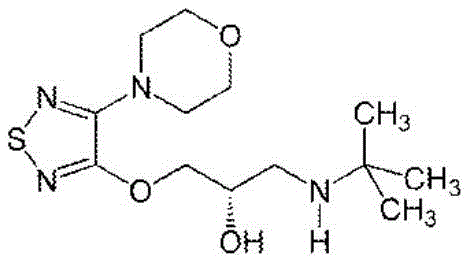
in some embodiments, latanoprost is a drug administered into the eye of a mammal to control the progression of glaucoma or ocular hypertension by reducing intraocular pressure. Which are prostaglandin analogs. The chemical structure of latanoprost is:

in some embodiments of the compositions of the present invention, the carbonic anhydrase inhibitor may be dorzolamide (Trusopt), brinzolamide (prazine (Azopt)), acetazolamide (Diamox), or any combination thereof. Examples of agents for glaucoma include beta blockers (e.g., timolol, betaxolol, levobetaxolol, carteolol, levobunolol, propranolol), carbonic anhydrase inhibitors (e.g., brinzolamide and dorzolamide), alpha 1 antagonists (e.g., nipradilol), alpha 2 antagonists (e.g., iopidine and brimonidine), miotics (e.g., pilocarpine and epinephrine), prostaglandin analogs (e.g., latanoprost, travoprostone, unoprostone, and the compounds listed in U.S. Pat. Nos. 5,889,052, 5,296,504, 5,422,368 and 5,151,444), "hypotensive lipids" (e.g., bimatoprost and the compounds listed in U.S. Pat. No.5,352,708), and neuroprotective agents (e.g., the compounds from U.S. Pat. No.4,690,931, particularly eliprodil and R-eliprodil, as listed in pending U.S. patent application No. 60/203,350, and compounds from WO94/13275, including memantine, wherein all patents and patent application publications are incorporated by reference herein in their entirety for all purposes. In some embodiments, the compositions of the present invention may include an adenosine agonist, a Rho kinase inhibitor, and a molecule having a combined activity, such as Latanopanostene bund, where "combined activity" refers to two molecules capable of providing two mechanisms of action that reduce intraocular pressure.
In some embodiments of the compositions of the present invention, the concentration of prostaglandin in the composite material is from 50% to 60% by weight, wherein the concentration of prostaglandin in the final suppository is between 10% and 20%.
The invention provides a pharmaceutical composition and a method for treating glaucoma. The present invention is a composition in the form of an implant, wherein the implant is configured to provide an extended release time of one or more therapeutic agents. In some embodiments, the implant is in the shape of a nucleus. In some embodiments, the implant is in the shape of a tampon. In some embodiments, the therapeutic agent is a prostaglandin. In some embodiments, the prostaglandin is latanoprost.
In some embodiments of the compositions of the present invention, the implant is configured to release the drug over a period of time, such as at least one week or such as between about two months to about six months, after administration of the latanoprost-containing implant. In some embodiments, the composition further comprises timolol. In some embodiments, the period is between 1 month and 1 year. In some embodiments, the period is between 1 month and 9 months. In some embodiments, the period of time is between 1 month and 6 months. In some embodiments, the period of time is between 1 month and 3 months. In some embodiments, the period is between 3 months and 1 year. In some embodiments, the period is between 6 months and 1 year. In some embodiments, the period is between 9 months and 1 year. In some embodiments, the period is between 3 months and 9 months. In some embodiments, the period of time is between 3 months and 6 months. In some embodiments, the period is between 6 months and 9 months.
In one embodiment of the composition of the present invention, the composition is a pharmaceutical composition plug configured to provide intraocular use, for example, to treat an ocular disorder. In some embodiments, the pharmaceutical composition is a suppository comprising a solid composite powder, wherein the solid composite powder is dispersed in at least one soft polymer. In some embodiments, the solid composite powder comprises organic microparticles comprising a bioactive agent, an inert carrier, a binder, or any combination thereof. In some embodiments of the compositions of the present inventionThe organic microparticles are configured to absorb the drug, i.e., are configured to carry the drug (i.e., a drug carrier; such as, but not limited to, fumed silica). The organic microparticles may have a particle size of between 5 and 1000m2Surface area between/g (fumed silica surface area from 10 to 600 m)2(ii)/g; the surface area of the silica gel is about 800m2(ii)/g; the surface area of the carbonic anhydride is 5-24m2/g)。
In some embodiments of the compositions of the present invention, the bioactive agent may be dissolved, dispersed, emulsified, bound, adsorbed, impregnated, mixed or otherwise disposed into the solid organic matrix. In some embodiments, the bioactive agent can be mixed directly with the organic matrix. In some embodiments, the bioactive agent may be adsorbed with another material, such as a particulate and/or fibrous material, which may be mixed with the organic matrix.
In some embodiments of the compositions of the present invention, the bioactive agent is first dissolved, dispersed, or emulsified into the organic compound (or e.g., precursor thereof) melt, solution, emulsion, or dispersion. In some embodiments, the solid organic matrix may be composed of polymers, oligomers, monomers, waxes, oils, plasticizers, and any combination thereof.
In some embodiments of the compositions of the present invention, organic microparticles comprising a drug (e.g., a prostaglandin such as latanoprost) may be mixed with at least one inert pharmaceutically acceptable excipient or carrier such as, but not limited to: sodium citrate or dibasic calcium phosphate and/or (a) fillers or extenders such as starches, lactose, sucrose, glucose, mannitol and silicic acid; (b) binders such as carboxymethylcellulose, alginates, gelatin, polyvinylpyrrolidone, sucrose and gum arabic; (c) moisture retention agents such as glycerin; (d) disintegrating agents such as agar-agar, calcium carbonate, potato or tapioca starch, alginic acid, certain silicates, and sodium carbonate; (e) dissolution retarders such as paraffin; (f) absorption promoters such as quaternary ammonium compounds; (g) wetting agents such as cetyl alcohol and glycerol monostearate; (h) absorbents such as kaolin and bentonite and pectin; (i) lubricants such as talc, calcium stearate, magnesium stearate, solid polyethylene glycol, sodium lauryl sulfate, or any combination thereof.
In some embodiments of the compositions of the present invention, the organic microparticles and the inert carrier are combined together with a binder to create a composite matrix. In some embodiments, exemplary polymers include, but are not limited to, poly (dimethylsiloxane), polyurethane, epoxy resins, methyl methacrylate polymers, acrylic copolymers, polyesters, polyamides, polyethylene, polypropylene, ethylene copolymers and terpolymers, propylene copolymers and terpolymers, fluoropolymers, vinyl resins, styrene resins, polycarbonates, amino resins, and phenolic resins. Other exemplary polymers include crosslinked acrylic or methacrylic networks, including networks formed by Ultraviolet (UV) curing. In some embodiments, the core (with the drug absorbed therein or present therein) comprises a thermoset polymer. In some embodiments, exemplary waxes include, but are not limited to, paraffin waxes, amides, esters, fatty acid derivatives, fatty alcohol derivatives, silicones, and phospholipids.
In some embodiments of the compositions of the present invention, the composite matrix containing the bioactive agent (e.g., without limitation, a prostaglandin, such as, without limitation, latanoprost) may be in a solid form, such as a powder, flakes, fibers, or any combination thereof. In some embodiments, the composite material can be ground and/or micronized to a fine powder size of <100 μm or to a size of <30 μm using a grinding apparatus such as a mortar and pestle, electronic grinder, and the like. In some embodiments, the fine composite powder may be dispersed and/or mixed with a flexible polymer. In some embodiments, the flexible polymer may be a medical-grade polymer, including, for example, a polymer having hydrophilic and/or hydrophobic properties. In some embodiments, exemplary polymers include, but are not limited to: silicone, polyacrylate, polyurethane or a combination of two or more of said polymers.
In some embodiments of the compositions of the present invention, the polyurethane can be shaped as desired, or its permeability can be tailored as desired, to achieve release of the bioactive agent from the device to the patient at a predetermined release rate. In some embodiments, the polymer comprises one or more polymers made from homopolymers or heteropolymers.
In some embodiments of the inventive composition, the mixture comprises (1) a polymer and (2) a powder, which is formed into a solid, self-supporting shape. In some embodiments, the self-supporting shape may be the desired shape of the composition (i.e., solid core) that is further processed into the desired shape, such as by trimming or cutting. In some embodiments, the shape may be, but is not limited to, a cylinder, a plug, a coin, a disc, a plate, a square, a sphere, a fiber, a box, a diamond, a ring, an "S" shape, an "L" shape, a "T" shape, a mesh, a network, a mesh, "U" shape, or a "V" shape.
In some embodiments of the present compositions, a shell coating may be added to the exterior of the solid core. In some embodiments, the coating comprises a second non-biodegradable polymer that is substantially impermeable to the therapeutic agent (e.g., without limitation, a prostaglandin such as latanoprost). In some embodiments, the coating has at least a lower permeability to the therapeutic compound (e.g., 1% lower permeability, 5% lower permeability, 10% lower permeability, 20% lower permeability, 30% lower permeability, 40% lower permeability, 50% lower permeability, 60% lower permeability, 70% lower permeability, etc.) than the first non-biodegradable polymer has. In some embodiments, the housing coating may be polyvinyl butyral and/or parylene.
FIGS. 1A-C illustrate an embodiment of the invention showing a schematic view of an apparatus in which a composite powder is dispersed in a polymer.
Fig. 2A and 2B illustrate an embodiment of the invention showing a schematic view of the process.
Figure 3 illustrates an embodiment of the invention showing a graph of the cumulative in vitro release percentage of latanoprost from the suppository sample over a 7 day test period.
Figures 4-7 illustrate examples of placement of the compositions of the present invention into the human eye.
Fig. 8 is a schematic representation of liquid on the surface of a non-porous particle (left) and liquid absorbed in the pores of fumed silica (right).
The present invention describes a drug delivery device comprising: 1) particles of an inert material having a drug adsorbed on the surface or within the pores of the particles; 2) an inert polymer matrix in which the drug-inert particles are dispersed, wherein the polymer has no chemical interaction with the drug and provides mechanical packaging, and wherein the concentration of the drug on the particles, and the loading of the particles in the polymer matrix, are configured to control the drug reservoir capacity;
3) a hydrophobic flexible polymer that links the polymer matrix into a shape and creates a barrier to drug release; 4) in the event that the hydrophobic polymer is insufficient to control release, a perforated outer barrier is applied to the solid core. In some embodiments, the permeability of the barrier and/or the size and number of pores in the barrier are configured to control the release rate of a drug (such as, but not limited to, prostaglandins, such as, but not limited to, latanoprost).
In some embodiments, the compositions of the present invention comprise (i) a first agent, an extender, at least one inert material configured to have a larger surface area and between 1-3g/cm3(e.g., but not limited to, 1 g/cm)3、1.1g/cm3、1.2g/cm3Etc.) in the bulk density. In some embodiments, the first agent is a prostaglandin or a prostaglandin analog. In some embodiments, the prostaglandin is selected from the group consisting of: clrostenol, fluprostenol, latanoprost, travoprost, unoprostone, and any combination thereof. In some embodiments, the composition further comprises a second agent, wherein the second agent is an alpha agonist selected from the group comprising: iopidine and/or brimonidine. In some embodiments, the second agent is a beta blocker, wherein the beta blocker is selected from the group consisting of: timolol, betaxolol, levobetaxolol, carteolol, levobunolol, propranolol, and any combination thereof. In some embodiments, the composition further comprises a third agent, wherein the third agent is an alpha agonist selected from the group comprising: iopidine and/or brimonidine.
In some embodiments, the compositions of the present invention comprise: chlorprostenol, kaolin, and fumed silica. In some embodiments, the compositions of the present invention comprise: chlorprostinol, iopidine, kaolin and fumed silica. In some embodiments, the compositions of the present invention comprise: chlorprostenol, brimonidine, kaolin, and fumed silica. In some embodiments, the compositions of the present invention comprise: chlorprostenol, timolol, kaolin, and fumed silica. In some embodiments, the compositions of the present invention comprise: chlorprostenol, timolol, iopidine, kaolin, and fumed silica. In some embodiments, the compositions of the present invention comprise: chlorprostenol, timolol, brimonidine, kaolin, and fumed silica.
In some embodiments, the compositions of the present invention comprise: chlorprostenol, betaxolol, kaolin, and fumed silica. In some embodiments, the compositions of the present invention comprise: chlorprostenol, betaxolol, iopidine, kaolin, and fumed silica. In some embodiments, the compositions of the present invention comprise: chlorprostenol, betaxolol, brimonidine, kaolin, and fumed silica.
In some embodiments, the compositions of the present invention comprise: chlorprostenol, levobetaxolol, kaolin, and fumed silica. In some embodiments, the compositions of the present invention comprise: chlorprostenol, levobetaxolol, iopidine, kaolin and fumed silica. In some embodiments, the compositions of the present invention comprise: chlorprostenol, levobetaxolol, brimonidine, kaolin, and fumed silica.
In some embodiments, the compositions of the present invention comprise: chlorprostenol, carteolol, kaolin, and fumed silica. In some embodiments, the compositions of the present invention comprise: chlorprostenol, carteolol, iopidine, kaolin, and fumed silica. In some embodiments, the compositions of the present invention comprise: chlorprostenol, carteolol, brimonidine, kaolin, and fumed silica.
In some embodiments, the compositions of the present invention comprise: chlorprostenol, levobunolol, kaolin, and fumed silica. In some embodiments, the compositions of the present invention comprise: chlorprostenol, levobunolol, iopidine, kaolin and fumed silica. In some embodiments, the compositions of the present invention comprise: chlorprostenol, levobunolol, brimonidine, kaolin, and fumed silica.
In some embodiments, the compositions of the present invention comprise: chlorprostenol, propranolol, kaolin, and fumed silica. In some embodiments, the compositions of the present invention comprise: chlorprostenol, propranolol, iopidine, kaolin and fumed silica. In some embodiments, the compositions of the present invention comprise: chlorprostenol, propranolol, brimonidine, kaolin, and fumed silica.
In some embodiments, the compositions of the present invention comprise: fluprostenol, kaolin, and fumed silica. In some embodiments, the compositions of the present invention comprise: fluprostenol, iopidine, kaolin, and fumed silica. In some embodiments, the compositions of the present invention comprise: fluprostenol, brimonidine, kaolin, and fumed silica. In some embodiments, the compositions of the present invention comprise: fluprostenol, timolol, kaolin, and fumed silica. In some embodiments, the compositions of the present invention comprise: fluprostenol, timolol, iopidine, kaolin, and fumed silica. In some embodiments, the compositions of the present invention comprise: fluprostenol, timolol, brimonidine, kaolin, and fumed silica.
In some embodiments, the compositions of the present invention comprise: fluprostenol, betaxolol, kaolin, and fumed silica. In some embodiments, the compositions of the present invention comprise: fluprostenol, betaxolol, iopidine, kaolin, and fumed silica. In some embodiments, the compositions of the present invention comprise: fluprostenol, betaxolol, brimonidine, kaolin, and fumed silica.
In some embodiments, the compositions of the present invention comprise: fluprostenol, levobetaxolol, kaolin, and fumed silica. In some embodiments, the compositions of the present invention comprise: fluprostenol, levobetaxolol, iopidine, kaolin, and fumed silica. In some embodiments, the compositions of the present invention comprise: fluprostenol, levobetaxolol, brimonidine, kaolin, and fumed silica.
In some embodiments, the compositions of the present invention comprise: fluprostenol, carteolol, kaolin, and fumed silica. In some embodiments, the compositions of the present invention comprise: fluprostenol, carteolol, iopidine, kaolin, and fumed silica. In some embodiments, the compositions of the present invention comprise: fluprostenol, carteolol, brimonidine, kaolin, and fumed silica.
In some embodiments, the compositions of the present invention comprise: fluprostenol, levobunolol, kaolin, and fumed silica. In some embodiments, the compositions of the present invention comprise: fluprostenol, levobunolol, iopidine, kaolin and fumed silica. In some embodiments, the compositions of the present invention comprise: fluprostenol, levobunolol, brimonidine, kaolin, and fumed silica.
In some embodiments, the compositions of the present invention comprise: fluprostenol, propranolol, kaolin, and fumed silica. In some embodiments, the compositions of the present invention comprise: fluprostenol, propranolol, iopidine, kaolin, and fumed silica. In some embodiments, the compositions of the present invention comprise: fluprostenol, propranolol, brimonidine, kaolin, and fumed silica.
In some embodiments, the compositions of the present invention comprise: latanoprost, kaolin, and fumed silica. In some embodiments, the compositions of the present invention comprise: latanoprost, iopidine, kaolin, and fumed silica. In some embodiments, the compositions of the present invention comprise: latanoprost, brimonidine, kaolin, and fumed silica. In some embodiments, the compositions of the present invention comprise: latanoprost, timolol, kaolin, and fumed silica. In some embodiments, the compositions of the present invention comprise: latanoprost, timolol, iopidine, kaolin, and fumed silica. In some embodiments, the compositions of the present invention comprise: latanoprost, timolol, brimonidine, kaolin, and fumed silica.
In some embodiments, the compositions of the present invention comprise: latanoprost, betaxolol, kaolin, and fumed silica. In some embodiments, the compositions of the present invention comprise: latanoprost, betaxolol, iopidine, kaolin, and fumed silica. In some embodiments, the compositions of the present invention comprise: latanoprost, betaxolol, brimonidine, kaolin, and fumed silica.
In some embodiments, the compositions of the present invention comprise: latanoprost, levobetaxolol, kaolin, and fumed silica. In some embodiments, the compositions of the present invention comprise: latanoprost, levobetaxolol, iopidine, kaolin, and fumed silica. In some embodiments, the compositions of the present invention comprise: latanoprost, levobetaxolol, brimonidine, kaolin, and fumed silica.
In some embodiments, the compositions of the present invention comprise: latanoprost, carteolol, kaolin, and fumed silica. In some embodiments, the compositions of the present invention comprise: latanoprost, carteolol, iopidine, kaolin, and fumed silica. In some embodiments, the compositions of the present invention comprise: latanoprost, carteolol, brimonidine, kaolin, and fumed silica.
In some embodiments, the compositions of the present invention comprise: latanoprost, levobunolol, kaolin, and fumed silica. In some embodiments, the compositions of the present invention comprise: latanoprost, levobunolol, iopidine, kaolin, and fumed silica. In some embodiments, the compositions of the present invention comprise: latanoprost, levobunolol, brimonidine, kaolin, and fumed silica.
In some embodiments, the compositions of the present invention comprise: latanoprost, propranolol, kaolin, and fumed silica. In some embodiments, the compositions of the present invention comprise: latanoprost, propranolol, iopidine, kaolin, and fumed silica. In some embodiments, the compositions of the present invention comprise: latanoprost, propranolol, brimonidine, kaolin, and fumed silica.
In some embodiments, the compositions of the present invention comprise: travoprost, kaolin, and fumed silica. In some embodiments, the compositions of the present invention comprise: travoprost, iopidine, kaolin, and fumed silica. In some embodiments, the compositions of the present invention comprise: travoprost, brimonidine, kaolin, and fumed silica. In some embodiments, the compositions of the present invention comprise: travoprost, timolol, kaolin, and fumed silica. In some embodiments, the compositions of the present invention comprise: travoprost, timolol, iopidine, kaolin, and fumed silica. In some embodiments, the compositions of the present invention comprise: travoprost, timolol, brimonidine, kaolin, and fumed silica.
In some embodiments, the compositions of the present invention comprise: travoprost, betaxolol, kaolin, and fumed silica. In some embodiments, the compositions of the present invention comprise: travoprost, betaxolol, iopidine, kaolin, and fumed silica. In some embodiments, the compositions of the present invention comprise: travoprost, betaxolol, brimonidine, kaolin, and fumed silica.
In some embodiments, the compositions of the present invention comprise: travoprost, levobetaxolol, kaolin, and fumed silica. In some embodiments, the compositions of the present invention comprise: travoprost, levobetaxolol, iopidine, kaolin, and fumed silica. In some embodiments, the compositions of the present invention comprise: travoprost, levobetaxolol, brimonidine, kaolin, and fumed silica.
In some embodiments, the compositions of the present invention comprise: travoprost, carteolol, kaolin, and fumed silica. In some embodiments, the compositions of the present invention comprise: travoprost, carteolol, iopidine, kaolin, and fumed silica. In some embodiments, the compositions of the present invention comprise: travoprost, carteolol, brimonidine, kaolin, and fumed silica.
In some embodiments, the compositions of the present invention comprise: travoprost, levobunolol, kaolin, and fumed silica. In some embodiments, the compositions of the present invention comprise: travoprost, levobunolol, iopidine, kaolin, and fumed silica. In some embodiments, the compositions of the present invention comprise: travoprost, levobunolol, brimonidine, kaolin, and fumed silica.
In some embodiments, the compositions of the present invention comprise: travoprost, propranolol, kaolin, and fumed silica. In some embodiments, the compositions of the present invention comprise: travoprost, propranolol, iopidine, kaolin, and fumed silica. In some embodiments, the compositions of the present invention comprise: travoprost, propranolol, brimonidine, kaolin, and fumed silica.
In some embodiments, the compositions of the present invention comprise: unoprostone, kaolin, and fumed silica. In some embodiments, the compositions of the present invention comprise: unoprostone, iopidine, kaolin, and fumed silica. In some embodiments, the compositions of the present invention comprise: unoprostone, brimonidine, kaolin, and fumed silica. In some embodiments, the compositions of the present invention comprise: unoprostone, timolol, kaolin, and fumed silica. In some embodiments, the compositions of the present invention comprise: unoprostone, timolol, iopidine, kaolin, and fumed silica. In some embodiments, the compositions of the present invention comprise: unoprostone, timolol, brimonidine, kaolin, and fumed silica.
In some embodiments, the compositions of the present invention comprise: unoprostone, betaxolol, kaolin, and fumed silica. In some embodiments, the compositions of the present invention comprise: unoprostone, betaxolol, iopidine, kaolin, and fumed silica. In some embodiments, the compositions of the present invention comprise: unoprostone, betaxolol, brimonidine, kaolin, and fumed silica.
In some embodiments, the compositions of the present invention comprise: unoprostone, levobetaxolol, kaolin, and fumed silica. In some embodiments, the compositions of the present invention comprise: unoprostone, levobetaxolol, iopidine, kaolin, and fumed silica. In some embodiments, the compositions of the present invention comprise: unoprostone, levobetaxolol, brimonidine, kaolin, and fumed silica.
In some embodiments, the compositions of the present invention comprise: unoprostone, carteolol, kaolin, and fumed silica. In some embodiments, the compositions of the present invention comprise: unoprostone, carteolol, iopidine, kaolin, and fumed silica. In some embodiments, the compositions of the present invention comprise: unoprostone, carteolol, brimonidine, kaolin, and fumed silica.
In some embodiments, the compositions of the present invention comprise: unoprostone, levobunolol, kaolin, and fumed silica. In some embodiments, the compositions of the present invention comprise: unoprostone, levobunolol, iopidine, kaolin, and fumed silica. In some embodiments, the compositions of the present invention comprise: unoprostone, levobunolol, brimonidine, kaolin, and fumed silica.
In some embodiments, the compositions of the present invention comprise: unoprostone, propranolol, kaolin, and fumed silica. In some embodiments, the compositions of the present invention comprise: unoprostone, propranolol, iopidine, kaolin, and fumed silica. In some embodiments, the compositions of the present invention comprise: unoprostone, propranolol, brimonidine, kaolin, and fumed silica.
In some embodiments, where the compositions of the present invention comprise at least one active agent (such as, but not limited to, latanoprost, unoprostone, propranolol, timolol, etc.), the same amounts of extender and inert materials (such as, but not limited to, fumed silica, epoxy, and kaolin) will be used to generate the compositions shown in the examples below.
Example (c): preparation of tampons/solid cores
In one example of an embodiment of the composition of the present invention, a sample of a suppository containing latanoprost is prepared. The samples were incubated at 37 degrees celsius for various periods of time to determine the time dependence of the release profile of latanoprost from the sample into polar solution (PBS).
Preparation of microparticles
Initially, the bioactive agent is adsorbed or loaded onto Fumed Silica (FS). The bioactive agent is Latanoprost (LP). 0.16g FS was mixed together with 0.25g LP dissolved in 2g solvent (1THF:1 ethanol (w/w)). Further examples of polar solvents are: methanol, isopropanol, acetone and/or ethyl acetate. The LP/FS mixture was dried at ambient temperature for 24 hours.
Composite matrix preparation
0.13g of kaolin powder and 0.4g of FS particles were mixed together, as well as 0.13g of medical grade epoxy resin (EPO-TEK301, manufactured by Epo-Tek company, USA). Mixing the mixture until a paste is formed, wherein the paste has a viscosity of about 250,000 CP. The paste was cured at ambient temperature for 24 hours. The resulting composition has the properties of a solid composite.
Composite grinding and molding
The solid composite was ground with a pestle and mortar. The composite fines were mixed with polyurethane at a ratio of 40% to 60%. The mixture was molded in a polyacetal resin (delrin) mold at ambient room temperature for 12 hours and removed from the mold. This forms the shape of the stopper.
Solution preparation-Release Medium buffer
The solution includes the following: 0.01M PBS, 0.005% BAK and 0.1% TRITON X-100.
Plugging agent coating process
The outer coating of the plugging agent may be: (1) polyvinyl butyral (5% (W/V)) in Tetrahydrofuran (THF) solvent or (2) parylene coating-polyurethane stoppers are coated with 2-5 μm of parylene using a vapor deposition process. To coat the stopper, the stopper was placed in a vacuum deposition chamber (Simtal Coating Ltd., Inc.) and a vacuum was pulled to about 0.1 Torr inside the deposition chamber. At about 150 ℃, parylene dimer (di-p-xylene) evaporates. Monomer (p-xylene) pyrolysis (such as, but not limited to, cleavage of the aryl-chloro bond in dichloro [2.2] para-cyclophane at 680 ℃ (standard pyrolysis temperature)) is then achieved at about 680 ℃ and 0.5 torr. The monomer then enters the deposition chamber at approximately room temperature (approximately 25 c) and adsorbs and polymerizes on the polyurethane stopper.
Properties of the final stopper sample
The composite weighed 14.1 grams and contained 18% latanoprost. For details see table 1:
table 1:
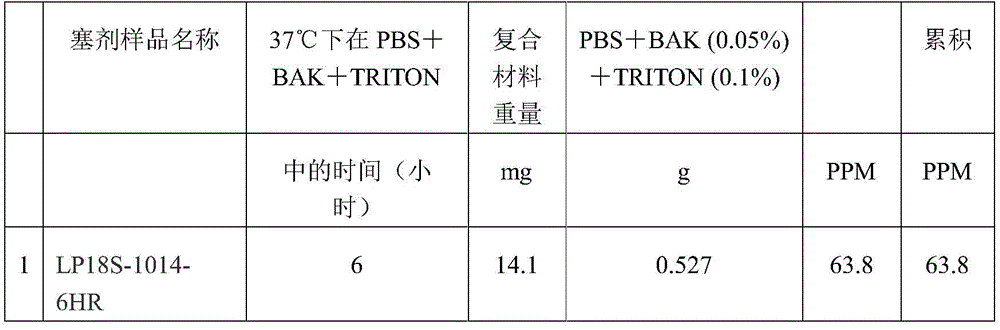
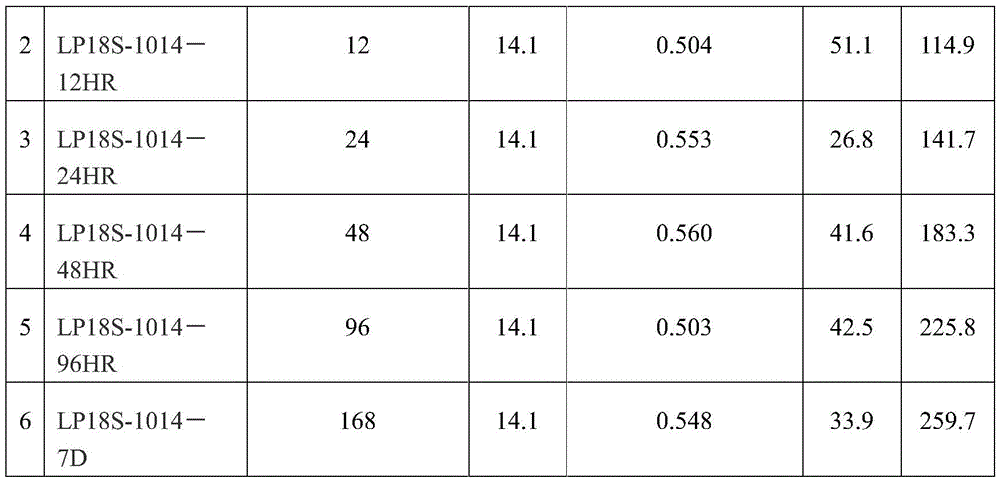
the housing may be parylene or polyvinyl butyral. The organic matrix may be kaolin and/or an epoxy resin. The drug absorbing material is fumed silica. The drug is not encapsulated.
In one embodiment, the active agent is latanoprost, the organic matrix is kaolin, and the absorbent material is fumed silica. The solvents for the drug are ethanol and HFE. Dried at room temperature for 24 hours. The binder (i.e. for mixing with the drug powder) is an epoxy resin. The molding process is carried out at room temperature. Additional components may include 0.1% Triton and 0.005% BAK.
Example (c): quantitation of solutions by HPLC-UV in the presence of benzalkonium chloride (BAK) and triton X-100
A method of latanoprost API.
Samples of 51 latanoprost in PBS buffer with BAK and Triton X-100 were analyzed according to the following conditions:
column: synergy, MAX-RP 250mm 4.6mm, 4 μm
Flow rate: 1mL/min
A detector: UV of 210nm
Sample introduction volume: 5 microliter
Sample temperature: 10 +/-5 DEG C
Column temperature: 25 +/-5 DEG C
Mobile phase A: 0.05M phosphate buffer pH 3 acetonitrile ("ACN") (40:60, v/v)
Mobile phase B: ACN
Gradient elution procedure:
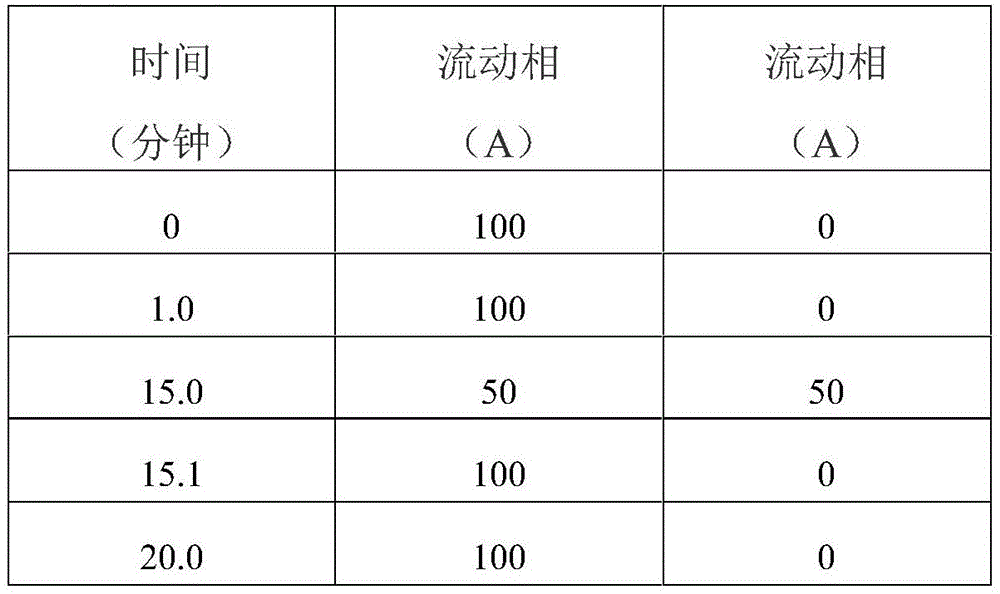
operating time: 20 minutes
As a result:


the composite weight is not considered in the above table.
And (3) calculating: samples were loaded as received and quantified against latanoprost RM from the company of the ne Pharma Group col.ltd. using a 6-point calibration curve generated from concentrations of 0.5-50 μ g/mL.
Example (c): quantitation of latanoprost API from solution using HPLC-UV in the presence of BAK and triton X-100
The chromatographic method of (1).
32 samples of latanoprost in PBS buffer containing BAK and Triton X-100 were analyzed using the following conditions:
column: synergy, MAX-RP 2504.6 mm, 4 μm
Flow rate: 1mL/min
A detector: uV of 210nm
Sample introduction volume: 5 microliter
Sample temperature: 10 +/-5 DEG C
Column temperature: 25 +/-5 DEG C
Mobile phase A: 0.05M phosphate buffer pH 3(40:60, v/v)
Mobile phase B: ACN
Gradient elution procedure:
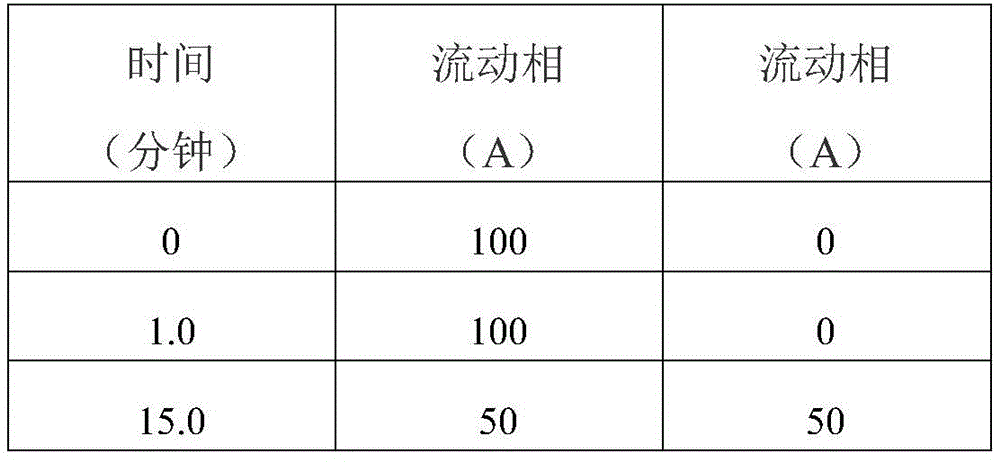

operating time: 20min
Results

And (3) calculating: samples were injected and quantified for latanoprost RM using a 6-point weighted calibration curve generated from concentrations of 0.5-50 μ g/mL.
Example (c): by HPLC-UVChromatographic methods of the line which will be suitable for use in BAK and triton X-100
Latanoprost API was quantified from the solution in the presence.
A 34 sample of latanoprost in PBS buffer containing BAK and Triton X-100 was tested using the following method:
column: synergy, MAX-RP 2504.6 mm, 4 μm
Flow rate: 1mL/min
A detector: uV of 210nm
Sample introduction volume: 100 microliter
Sample temperature: 10 +/-5 DEG C
Column temperature: 25 +/-5 DEG C
Mobile phase A: 0.05M phosphate buffer pH 3(40:60, v/v)
Mobile phase B: ACN
Gradient elution procedure:


operating time: 20min
Results (using 5 microliter injection volume):


note that:
not considering the weight of the composite material
And (3) calculating: samples were injected and the latanoprost RM was quantified using a 6-point calibration curve generated from concentrations of 0.04-50 μ g/mL.
Example (c): using a C-18 column and UV detector (285nm for TM, 210nm for latanoprost) in a column containing latanoprost
Determination of Timolol Maleate (TM) in solutions of prostate, PBS, benzalkonium chloride (BAE) and triton x-100
HPLC method.
48 samples were analyzed by Waters Alliance HPLC equipped with a UV detector, a microanalysis balance (Mettler Toledo, MX (QC-601)), and a magnetic stirrer.
TM was shown to be linear with a square correlation coefficient of 1.0 over a range of 1-265. mu.g/mL. The limit of quantitation was evaluated on a standard solution at a concentration of 1. mu.g/mL and the signal-to-noise ratio was found to be 88.
Latanoprost is proved to be in a linear relation in the range of 0.48-240 mug/mL, and the square correlation coefficient is 0.9999. The limit of quantitation was evaluated on a standard solution at a concentration of 0.48. mu.g/mL and the signal-to-noise ratio was found to be 14.8.
Establishment and conditions of an analysis method are as follows: an HPLC method was established to detect and quantify timolol maleate and latanoprost in aqueous solutions containing PBS, BAK and Triton X-100. The chromatographic conditions were as follows:
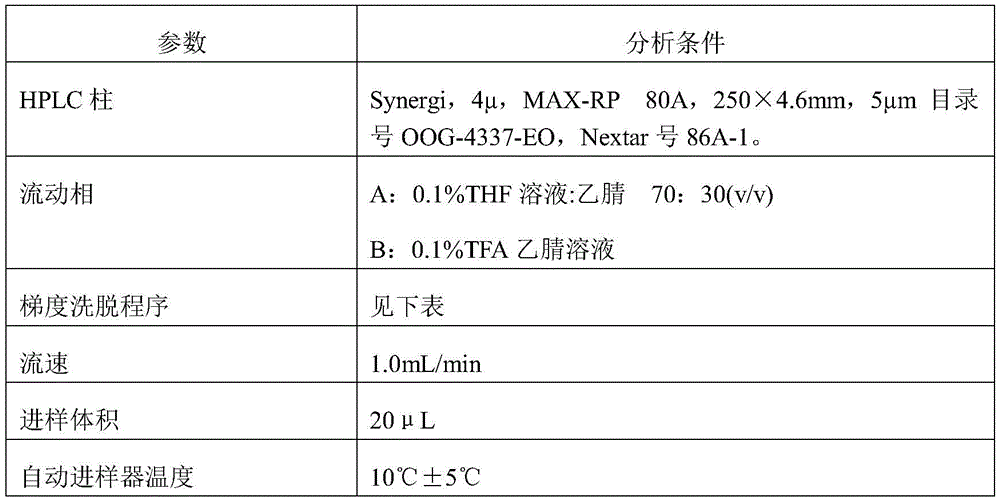

gradient elution procedure

The sample diluent was 85% water and 15% methanol.
As a result: the following parameters were evaluated during the process set-up: specificity, linearity and range, detection limit, and quantitation limit.
Specificity: sample diluent (85% water: 15% methanol) was loaded for specific analysis. No interference was detected at the retention times of TM and latanoprost.
And (3) linear testing:
TM: the linear relationship of Tm was evaluated at a concentration of 0.53 to 265. mu.g/mL. 7 standard solutions were prepared separately to test the linearity of the HPLC method: 0.53. mu.g/mL, 2.65. mu.g/mL, 13.3. mu.g/mL, 26.5. mu.g/mL, 53.0. mu.g/mL, 132.6. mu.g/mL, and 265.3. mu.g/mL. The correlation between the instrument response and concentration was demonstrated with a squared correlation coefficient of 1.0. FIG. 12 shows the chromatographic results for a TM standard solution at a concentration of 53. mu.g/mL, with an injection volume of 20. mu.l and a run time of 22 minutes.
Latanoprost: the linearity of latanoprost was evaluated at concentrations from 0.48 to 241. mu.g/mL. 7 standard solutions were prepared separately to test the linearity of the HPLC method: 0.48. mu.g/mL, 2.41. mu.g/mL, 12.0. mu.g/mL, 24.1. mu.g/mL, 48.1. mu.g/mL, 120.3. mu.g/mL, and 240.6. mu.g/mL. The correlation between the instrument response and concentration was demonstrated with a squared correlation coefficient of 1.0. FIGS. 13 and 14A-B illustrate typical chromatograms and calibration curve results, respectively, for a standard solution at a concentration of 48 μ g/mL.
Quantification limit and detection limit:
quantitative limit of TM: the limit of detection (LOD) and limit of quantitation (LOQ) values were determined by testing a standard solution at a concentration of 0.53. mu.g/mL. As used herein, LOD refers to the lowest amount of analyte that can be detected above the baseline noise, but that amount is not necessarily quantified as an exact value. As used herein, LOQ refers to the lowest amount of analyte that can be reproducibly quantified above a baseline noise. The signal-to-noise ratio (S/N) of the LOD should be about 3 and the signal-to-noise ratio of the LOQ should be about 10. A signal to noise ratio of 89 was found in a standard solution containing 0.53. mu.g/mL. FIG. 15 shows that the signal-to-noise ratio of the TM at 285nm is 88.589.
Limit of quantitation of latanoprost: LOD and LOQ values were determined. The signal-to-noise ratio (S/N) of the LOD should be about 3 and the signal-to-noise ratio of the LOQ should be about 10. The signal to noise ratio was found to be 14.8 in a standard solution containing 0.48. mu.g/mL and is shown in FIG. 16.
System applicability parameter: system suitability testing was performed to prove that the system was suitable for analysis, and the following parameters were tested: percentage RSD, tailing factor (T), resolution (R) and number of theoretical plates (N) for 5 replicates of standard solution. The following table shows the results for the samples:

resolution of API to nearest peaks
And (3) system precision: system accuracy was demonstrated on a control standard with a nominal concentration of 50. mu.g/mL. The Relative Standard Deviation (RSD) percentage is calculated from the beginning of the sequence log (sequence log) until the end of the sequence log. RSD was found to be less than 2% for both APIs in all standards injections. The results are shown in the table below.


Sample preparation: the sample solution was shaken using a vortex shaker and transferred to an HPLC sample vial. The sample solution was injected as is into the HPLC without further dilution. The results are shown in the following table:
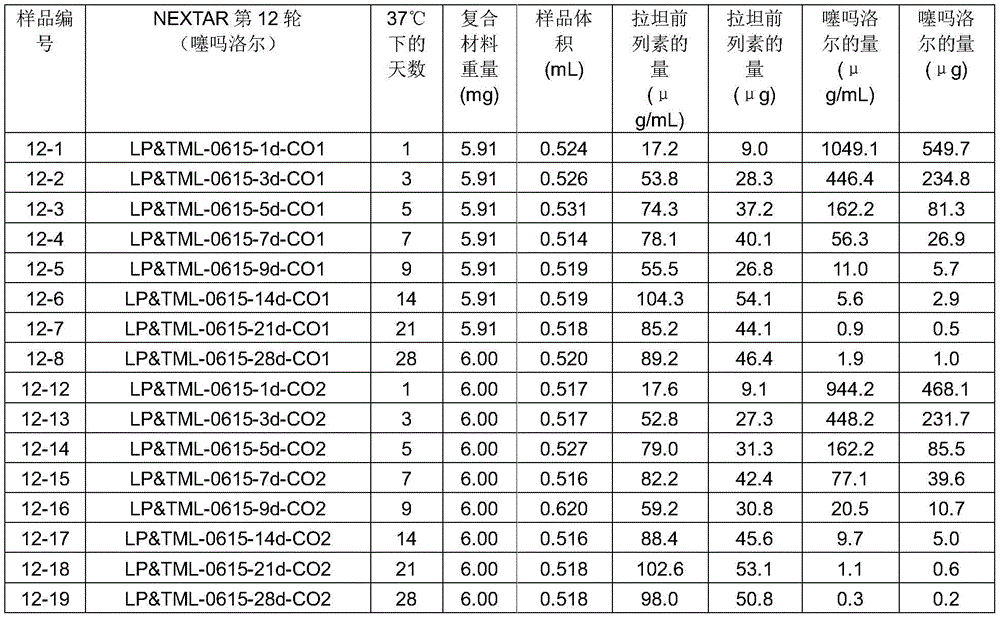
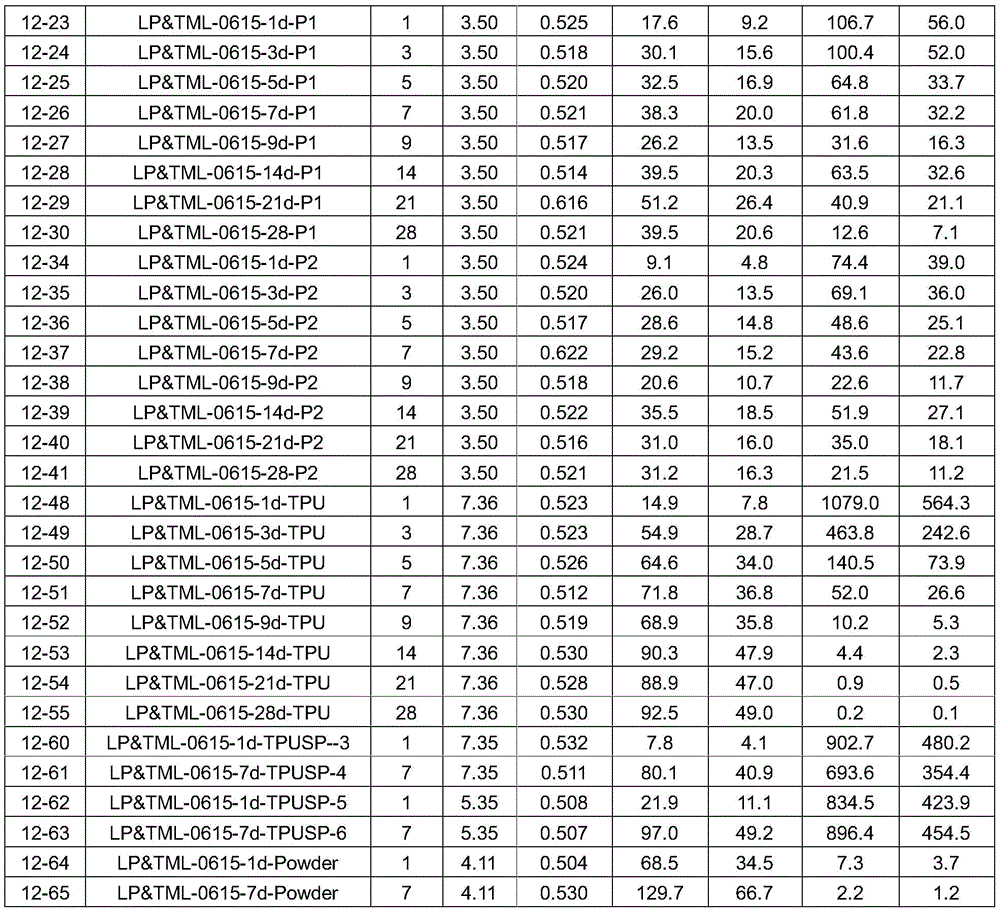
the composite weight is not included in the calculations of the table above.
For both APIs, the square correlation coefficient of the linear calibration curve is 1.0. The samples were quantified for latanoprost from the Neore Pharmaceutical Group and TM (Cat. No. T6394) from Sigma Aldrich (Signam-Aldrich).
FIGS. 17, 18 and 19A-B illustrate chromatograms: FIG. 17 is a chromatogram of a diluent of timolol maleate at 285 nm; FIG. 18 is a chromatogram of a diluent of latanoprost at 210 nm; FIG. 19A is a typical sample chromatogram of timolol maleate at 285 nm; FIG. 19B is a typical sample chromatogram of latanoprost at 210 nm.
Examples of Release profiles
Two latanoprost tamponades were loaded with 280 micrograms or 1000 micrograms of latanoprost, wherein the size of the tamponades were: the diameter is 0.9mm, and the length is 3 mm. For a plug loaded with 280 micrograms of latanoprost, about 150-. For a suppository loaded with 1000 micrograms of latanoprost, about 300 and 350 micrograms of latanoprost were released at a rate of 10 to 2 micrograms per day within 110. For a 1000 microgram loading of the suppository, the suppository may be coated to release 70-80 micrograms at a rate of 2-0.5 micrograms/day over a 110 day period. Figure 1B is a schematic representation of a latanoprost or timolol suppository. The tamponade may contain 0-35 wt% latanoprost (e.g., 0.1, 1, 2,3, 4,5, 6, 7, 8, 9, 10, etc.). The suppository can contain 0-35% by weight timolol (e.g., 0.1, 1, 2,3, 4,5, 6, 7, 8, 9, 10, etc.).
A suppository loaded with 400 micrograms of timolol and 250 micrograms of latanoprost, wherein the size of the suppository is 0.9mm in diameter, 3mm in length, and the release profile is such that about 300 micrograms of timolol and about 160 micrograms of latanoprost are released within 30 days at a rate of 50-5 micrograms/day (for TM) and 10 to 5 micrograms/day (for latanoprost).
Example (c): preparation of microparticles
A solvent mixture was prepared comprising THF to ethanol in a ratio of 1:1 (w/w). First, latanoprost was mixed with these solvents and then added to fumed silica (sigma aldrich, average particle size of 0.2-0.3 microns, CAS 112945-52-5). For example: FS60 (60% drug, such as latanoprost): 0.3g FS + (0.2g Latanoprost +5g solvent), where FS is fumed silica. The mixture was then dried at room temperature for about 2 days. The percentage of moisture (relative humidity, "RH") may be between 30-70%.
Example (c): composite matrix
To prepare the epoxy resin solution, 1g of component A (bisphenol A) was added to 0.25g of component B (reaction diluent; Epo-tek 301). Kaolin, FS60, and epoxy were mixed and then molded (e.g., punctal plug shape). The mixture was then cured at room temperature for 2 days. In one example, the composite (36% drug, such as latanoprost): 0.2g of kaolin clay +0.2g of epoxy resin +0.6g of FS60 were mixed, molded, and cured.
Example (c): composite matrix dispersed in polyurethane
To prepare the epoxy resin solution, 1g of component A was added to 0.25g of component B. Kaolin (Sigma, CAS 1332-58-7), FS60 and epoxy were mixed and the mixture was cured at room temperature for 2 days. The composite was ground and vacuum dried for 24 hours. A polyurethane solution was prepared with 4g of component A and 1g of component B (polyurethane stereoloy 2781, Hapco Inc.). The polyurethane is mixed with the composite powder and then molded into shape (e.g., punctal plugs). For example, a suppository with 14% drug (e.g., latanoprost) can be produced by adding the composite powder to polyurethane to give 0.5g (composite powder) and 0.75g polyurethane.
Example (c): two active agents dispersed in polyurethane
Component 1: preparation of microparticles
Microparticles were prepared by: mixed solvents, such as Tetrahydrofuran (THF): ethanol in a ratio of 1:1 (w/w). Then, latanoprost is mixed with the solvent and added to the fumed silica. Timolol (TML) is then mixed with the solvent and added to the fumed silica. For example, FS60TML (60% timolol drug): 0.3g FS + (0.2g TML +5g solvent), then FS60LTP (60% latanoprost drug): 0.3g FS + (0.2g Latanoprost drug +5g solvent) and then the mixture was dried at room temperature for two days (relative humidity 30-70%).
And (2) component: composite matrix
1g of component A and 0.25g of component B were used to prepare an epoxy resin solution. Kaolin, FS60LTP, FS60TML and epoxy were mixed and then cured at room temperature for 2 days at a relative humidity of 30-70%. The composite is then milled to produce <10 micron sized particles (such as, but not limited to, 0.001, 0.01, 0.1, 1, 2,3 microns, etc.) and vacuum dried. A polyurethane solution is then prepared with 4g of component a and 1g of component B, and the polyurethane preparation is mixed with a composite powder and subsequently molded into shapes such as punctal plugs.
In another example of forming a composite matrix, an epoxy resin solution is prepared with 1g of component A and 0.25g of component B. The kaolin, FS60LTP, FA60TML and epoxy were then mixed and the mixture was cured at room temperature for two days. The composite is ground to a powder, resulting in particles (such as, but not limited to, 0.001, 0.01, 0.1, 1, 2,3 microns, etc.) of size <10 microns, and then vacuum dried. For example, a composite matrix formulation was created with 0.6g FS60TML, 0.4g FS60LTP, 0.33g kaolin and 0.4g epoxy resin, resulting in a final dose of 20% timolol and 13.5% latanoprost in the composition.
And (3) component: composite powder dispersed in polyurethane
A polyurethane solution was prepared using 4g of component A and 1g of component B. The preparation is then mixed with a composite powder and molded. For example, 0.35g (timolol and latanoprost) of the composite powder and polyurethane are used to produce a plug containing 8.1% timolol and 5.4% latanoprost, which is then molded into a shape such as a punctal plug. For example, a tampon containing 8.1% timolol and 5.4% latanoprost was formed from 0.35g (20.3% timolol and 13.5% latanoprost composite powder) and 0.53g polyurethane.
Example (c): in vitro study
The general protocol for analytical study design is as follows: (1) the following solutions were prepared: phosphate buffered saline (10X PBS) + benzalkonium chloride (BAK) (0.005%) + Triton-X (0.1%) and 0.5mL of the solution was added into a 1.5mL vial. The stoppers (about 5 mg/stopper) were weighed out and each stopper was then placed into a vial containing the solution (i.e., one stopper per vial). The vials containing the stopper were then stirred in a heater at 37 ℃ at 30 rpm. Samples were taken at time intervals by removing stopper samples from the vials and placing the vials in a 4 degree celsius refrigerator. The drawings depicting these steps are shown in fig. 20. Fig. 21 is a graph showing 6-month release of latanoprost. Fig. 22 is a graph showing daily release of latanoprost.
Figure 23 illustrates cumulative latanoprost release from punctal plugs with a parylene coating (e.g., without limitation, wherein micropores are between 0.5-5.0 microns (e.g., without limitation, 0.5 microns, 0.6 microns, 0.7 microns, etc.), wherein the parylene coating thickness is 0.2-5.0 microns (e.g., without limitation, 0.2 microns, 0.3 microns, 0.4 microns, 0.5 microns, 0.6 microns, etc.).
Fig. 24 illustrates a three month release curve comparing EXP-LP02 ═ composite only (without polyurethane), EXP-LP01 ═ composite powder in polyurethane, and EXP-LP01C ═ coated composite powder in polyurethane.
Each EXP plot was generated from duplicate, LP-02 and LP01C experiments. Fig. 25 illustrates a three month release profile showing the amount of latanoprost released per day.
Fig. 26 illustrates cumulative release drugs, such as Timolol (TML) and Latanoprost (LP), released from punctal plugs.
Fig. 27 graphically illustrates the amount of LP (5%) and TML (8%) released from a 5mg punctal plug per day.
Example (c): latanoprost composite stopper, latanoprost-polyurethane stopper and parylene coated stopper
Comparison of agents
Three types of punctal plugs were prepared for HPLC analytical testing: (1) polyurethane/fused silica with drug-containing composite powder (PU: FS60) in a ratio of 60:40, with a final drug content of 14%; (2) polyurethane/fused silica (PU: FS60), wherein the composite powder contains a drug and has a parylene coating, with a final drug content of 14%; and (3) composite material only (FS60+ kaolin + epoxy), with a final drug content of 14.62%.
Reagent:
kaolin USP Sigma C.N k1512-500G, batch number
Hexane, Anhydrous, 95%, Sigma C.N 296090-1L, batch number
Fumed silica, average particle size 0.2-0.3Sigma C.N S55O5-5O0G, batch number
Epoxy EPO-TEX component A, batch PB116550 expiration date 03.2015
Epoxy EPO-TEX component B, batch PB116544 failure date 03.2015
THF, tetrahydrofuran CAS number 109-99-9
Ethanol 96% CAS 64-17-5
Latanoprost, CAS 1302-9-82-4, catalog number PG01-20140101, date of manufacture 05/01/2014, manufacturer code-R-0673.14,584-03
Polyurethane HAPCO-SteralloyTMFDG-Elastomeric,No.2781(4A:B)
·TritonTMX-100, Sigma Aldrich 5ml-CAS number 9002-93-1
The device comprises the following steps:
kern ABJ 80-4NM analytical balance 0.1mg
Refrigerator EL2280 electrora.
Mini Dry thermostat-Miniib-100, Miula instruments, Lumitron ltd
Mortar and pestle
Orbital oscillator-SSM 1, Stuart-England
Desiccants (predried in an oven for 2 hours, 20 ℃), 334278 sigma aldrich, molecular sieves, particle, 3.2 mm.
Additional materials used:
moulding blocks-pressing and moulding of PU-containing composites into cylindrical shapes
Aluminum foil
Plastic cup
The sample preparation method comprises the following steps:
composite material sample only (type 3):
1.microparticle preparation for composite Material sample only (FS60)
6ml of solvent mixture (THF: ethanol 1:1(w/w))
First mixing latanoprost with solvent and then adding FS
FS 60: 0.29g FS + (0.44g LP +5g solvent) - > drying at room temperature for 2 days
2.Preparation of the substrate (for amounts see Table 4.1 below)
Preparation of epoxy resin solution- >1g of component A and 0.25g of component B
Kaolin + FS60+ epoxy- > dried at room temperature for 2 days
LP 14.5% composite stopper to 5mg sample (cylinder shape)
TABLE 4.1
| Substrate | FS60(g) | Kaolin (g) | Epoxy resin (C)g) | Final LP |
| LP 14.5% composite | 0.054 | 0.0824 | 0.0863 | 14.62% |
PU + composite powder (type 1 and type 2)
1.Preparation of microparticles for PU + composite powders (FS60)
10ml of solvent mixture (THF: ethanol 1:1(w/w))
First mixing latanoprost with solvent and then adding FS
FS 60: 0.6648g FS + (1g LP +10g solvent) - > drying at room temperature for 2 days
2.Preparation of the substrate (for amounts see Table 4.2 below)
Preparation of epoxy resin solution- >1g of component A and 0.25g of component B
Kaolin + FS60+ epoxy- > dried for 2 days at room temperature-the dried LP-FS6 was ground with a mortar.
The milled LP-FS was dried with desiccant for 603 days.
TABLE 4.2 composite materials

3.PU sample preparation:preparation of polyurethane HAPCO2781 solution>4g of component A and 1g of component B.
Sample preparation:
| stopper sample (PU) | LP 35.5% -composite-15-03-2015 (g) | PU(g) | Final LP% |
| LP14% | 0.509 | 0.78 | 14.0% |
Solution preparation for tamponade incubation (PBS + BAK + Triton)
Weighing BAK and TRITON (see Table for dosage)
Addition of PBS
| TRITION% | TRITION(g) | BAK% | BAK(g) | PBS ml |
| 0.1006 | 0.0403 | 0.0056 | 0.0023 | 40.00 |
Sample preparation:
preparing a control sample from the table
Add 0.5ml of solution to 1.5 vials
Put the sample into a vial
Place the vial in a 37 ℃ heater
Placing the heater on a 30 rpm stirrer
Removing the sample according to the "sink condition method
Sample preparation:

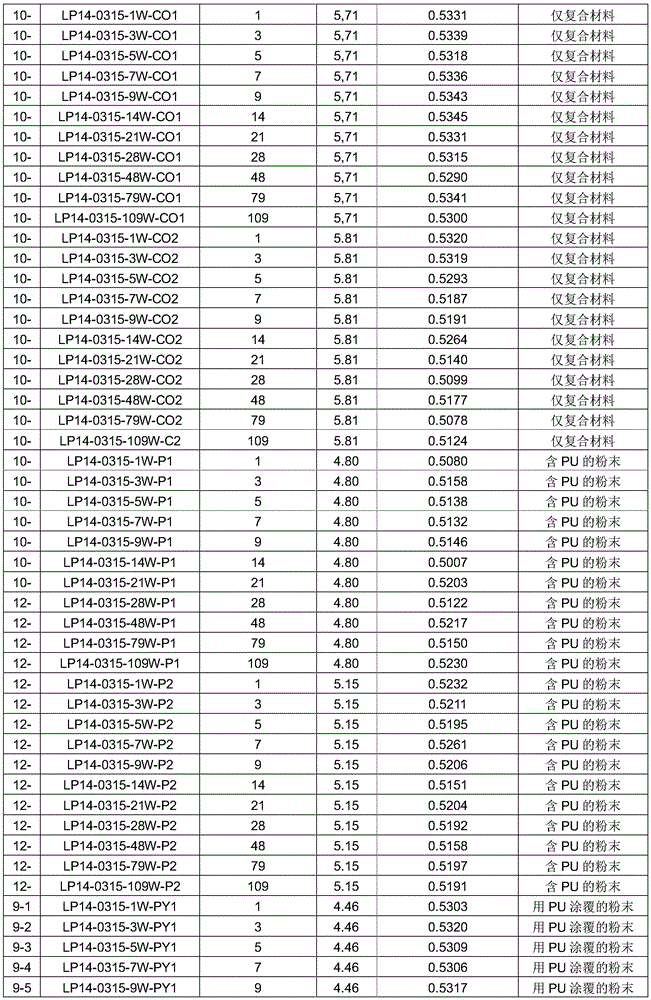
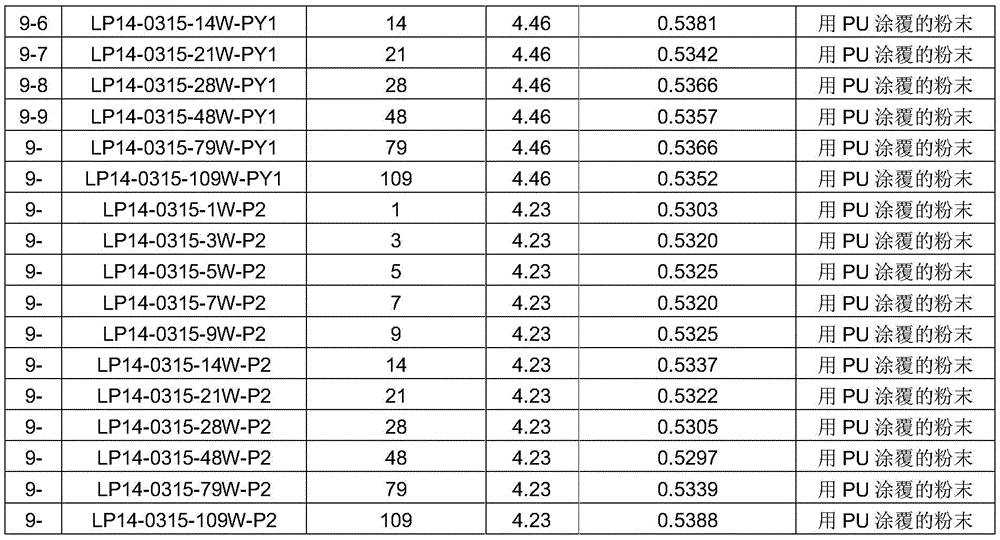
example (c): sample testing of polyurethane coated tampons
Plug tested: polyurethane FS60 (60% fused silica: 40% latanoprost); the final drug content was 14.4%. The samples were incubated at 37 degrees celsius for various periods of time to determine the effect of the release profile of latanoprost from the samples into the PBS solution.
Reagents and apparatus:
reagent
Kaolin USP Sigma C.N kl512-500G,
hexane, anhydrous, 95%, Sigma C.N 296090-1L,
fumed silica, average particle size 0.2-0.3Sigma C.N S5505-500G,
EPOXY EPO-TEK fraction A batch PB046370
EPOXY EPO-TEK component batch B PB046149
Toluene Sigma CAS 108-88-3
THF, tetrahydrofuran CAS number 109-99-9
Ethanol 96% CAS 64-17-5
Latanoprost CAS 1302-9-82-4 batch PG01-20140101 manufacturer code-R-0673.14,584-03
·TritonTMX-100, Sigma Aldrich 5ml-CAS number 9002-93-1
Polyurethane PMC780 DRY Shore hardness 802A: 1B (not medical PU) device
Kern ABJ 80-4NM analytical balance 0,1mg
Refrigerator EL2280 electrora.
Mini Dry thermostat-Miniib-100, Miula instruments, Lumitron ltd
Mortar and pestle
Orbital oscillator-SSM 1, Stuart-England
334278 Sigma Aldrich, a desiccant (predried in an oven for 2 hours, 200 ℃ C.), molecular sieves, particle, 3.2 mm. Other materials
Moulding blocks-pressing and moulding of PU-containing composites into cylindrical shapes
Aluminum foil
Plastic cup
The sample preparation method comprises the following steps:
microparticle preparation (FS60)LP-FS60
6ml of solvent mixture (THF: ethanol 1:1(w/w))
First mixing latanoprost with solvent and then adding FS
FS 60: 0.2g FS + (0.3g LP +5g solvent) - > drying at room temperature for 2 days
5% TRITON in FS (1g FS +0.053g TRITON +10g ethanol)
Preparation of the substrate (see Table 4.2 for amounts)
Preparation of epoxy resin solution- > lg of component A and 0.25g of component B
Kaolin + FS60+ epoxy- > drying at room temperature for 2 days
The dried LP-FS60 was ground with a mortar and pestle.
The milled LP-FS was dried with desiccant for 603 days.
Composite material
| Substrate | FS600(g) | Kaolin (g) | Epoxy resin (g) | Final LP |
| LP 36% -composite material | 0.34 | 0.11 | 0.11 | 36.0% |
·Sample preparation (see Table for dosage)
Preparation of polyurethane PMC780 solution- >2g of component A and 1g of component B
Sample (I)


Final sample
| Stopper sample | LP 36% -composite-09-2014 (g) | PU(g) | Final LP% |
| LP14% | 0.055 | 0.085 | 14% |
·Preparation of solutions
·0.01M PBS+0.005%BAK+0.1%TRITON X-100
TABLE 4.5 samples
2. Sample preparation: FS60 (preparation of microparticles)
3g HFE +3g ethanol ═ 6ml of the solvent mixture was weighed out
Weigh 0.3g LP
Gently mix LP with 2g solvent mixture using a magnetic stirrer
Weigh 0.2g FS
Add LP to 0.2g FS together with solvent
Gently mix these substances using a spatula to avoid air
Hold at room temperature for 2 days
Figure 28A shows the sample at the beginning of the 2 day incubation. Fig. 28B shows the sample after 2 days at room temperature.
Preparing a composite material:
weighing FS60 and kaolin (see Table for amounts)
Gently mix these materials using a spatula
Addition of epoxy resin (Final solution A + B) (see Table for amounts)
Mixing the substances using a spatula
Cutting 2 PE sheets
Put small composite particles (millet (Cuscus) shape)
Refrigerated (4 ℃ C.) for 2 days
A composite sample is shown in fig. 29.
Final formulation
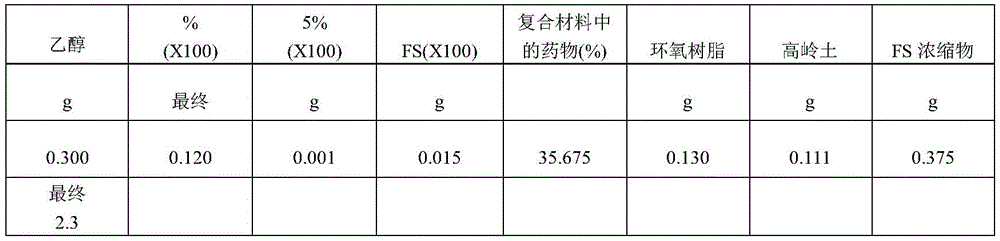
Composite grinding
Put the particles into a mortar and grind the particles to a fine powder with a pestle.
Add the dried desiccant into the plastic cup and add the powder to the cuvette.
Figure 30 shows the dry desiccant placed in a plastic cup and the powder added to the 10mL cup.
PU + composite material:
weighing 0.055 composite Material
Weighing component A and component B of PU
Weigh 0.085PU
Mixing PU with the composite into a smooth paste (e.g., no particles are observed in the mixture)
Placing the paste in a mould block.
Curing at ambient temperature for 48 hours
| Stopper sample | LP 36% -composite-09-2014 (g) | PU(g) | Final LP% |
| LP14% | 0.056 | 0.086 | 14.0% |
Solution preparation (PBS + BAK + Triton)
Weighing BAK and TRITON (see Table for dosage)
Addition of PBS
| TRITON% | TRITON(g) | BAK% | BAK(g) | PBS mL |
| 0.095 | 0.0285 | 0.0060 | 0.0018 | 30.026 |
Sample (I)
Preparation of controls from the Table
Add 0.5ml of solution to 1.5 vials
5mg of sample (0.005g) was weighed
Put the sample into a vial
Place the vial in a 37 ℃ heater
Placing the heater on a 30 rpm stirrer
Removal of the sample according to the sink condition method, for example: sample Nos. 3, 11, 19, 27. After 3 days the composite material is removed from the vial and the vial is placed in a refrigerator, and then the composite material is placed into a new vial 1, 3, 5, 7, 9, etc. (see e.g. fig. 20)
·


Example (c): timolol and latanoprost
The examples focus on samples containing:
PU (Hapco2781): FS60- (60% latanoprost: 40% timolol), with a final timolol content% of 8.1% and a final latanoprost content% of 5.4%.
Reagents and apparatus:
reagent
Kaolin USP Sigma C.N kl512-500G,
hexane, Anhydrous, 95%, Sigma C.N 296090-1L
Fumed silica, average particle size 0.2-0.3Sigma C.N S5505-500G,
EPOXY EPO-TEK fraction A batch PB116550
EPOXY EPO-TEK fraction B batch PB116544
THF, tetrahydrofuran CAS number 109-99-9
Ethanol 96% CAS 64-17-5
Latanoprost CAS 1302-9-82-4 catalog number PG01-20140101
Manufacturer code-R-0673.14,584-03 (NEORE PHARMA)
Timolol CAS 26921-17-5 catalog number 140303 production date 03/2014(NEORE PHARMA)
Polyurethane HAPCO-SteralloyTMFDG-Elastomeric,No.2781(4A:B)
·TritonTMX-100, Sigma Aldrich 5ml-CAS number 9002-93-1 device
Kern ABJ 80-4NM analytical balance 0,1mg
Refrigerator EL2280 electrora.
Mini Dry thermostat-Miniib-100, Miula instruments, Lumitron ltd
Mortar and pestle
Orbital oscillator-SSM 1, Stuart-England
Drying agent (predried in an oven for 2 hours at 200 ℃ C.) 334278
Sigma aldrich, molecular sieves, particle, 3.2 mm.
Other materials
Moulding blocks-pressing and moulding of PU-containing composites into cylindrical shapes
Aluminum foil
Plastic cup
The sample preparation method comprises the following steps:
microparticle preparation (FS60LTP)LP-FS60
6ml of solvent mixture (THF: ethanol ═ 1:1(w/w))
Mixing latanoprost with solvent and then adding FS
FS 60: 0.2g FS + (0.33g LP +5g solvent) - > drying at room temperature for 2 days
Microparticle preparation (FS60TML)TML-FS60
6ml of solvent mixture (THF: ethanol ═ 1:1(w/w))
Mix timolol with solvent and then add FS
FS 60: 0.2g FS + (0.33g TML +5g solvent) - > drying at room temperature for 1 day
Preparation of the composite matrix (for amounts see Table below)
Preparation of epoxy resin solution- >1g of component A and 0.25g of component B
Kaolin + FS60+ epoxy- > dried at room temperature for 2 days (see table below)
Dry FS60 (for PU) was ground with a mortar.
The milled FS60 (for PU) was dried with a desiccant for 3 days.
Composite material
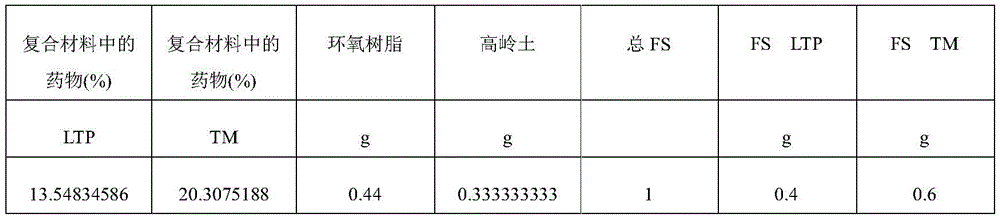
Sample preparation (for amounts see Table 4.3)
Preparation of a polyurethane FJAPCO 2781 solution- > 4g of component a and 1g of component B were mixed together and 0.53g of the mixture was used in the formulation.
Sample (I)
| Stopper sample | Composite powder (A)g) | PU(g) | Final TML% | Final LP% |
| LP&TML-0615 | 0.35 | 0.53 | 8.1% | 5.4% |
Preparation of solutions
·0.01M PBS+0.005%BAK+0.1%TRITON X-100
TABLE 4.5 samples

Sample preparation
LP-FS60 (microparticle preparation)
3g HFE +3g ethanol ═ 6ml of the solvent mixture was weighed out
Weigh 0.2g LP
Gently mix LP with 5g solvent mixture using a magnetic stirrer
Weigh 0.3g FS
Add LP with solvent to 0.3g FS
Gently mix these substances using a spatula to avoid air
Left at room temperature for 1 day
TML-FS60 (microparticle preparation)
3g HFE +3g ethanol ═ 6ml of the solvent mixture was weighed out
Weigh 0.2g of TML
Gently mix TML with 5g of solvent mixture using a magnetic stirrer
Weigh 0.3g FS
Add LP with solvent to 0.3g FS
Gently mix these substances using a spatula to avoid air
Left at room temperature for 1 day
Composite material
Weigh FS60 and Kaolin (as shown in the above table)
Gently mix these materials using a spatula
Addition of epoxy resin (final solution A + B) (as shown in the above table)
Mixing the substances using a spatula
Cutting 2 PE sheets
Put small composite particles (millet shape)
Leave at room temperature for two days
Composite grinding and PU
Put the particles into a mortar and grind the particles with a pestle to a fine powder (e.g., without limitation, <100 microns; e.g., without limitation, 0.01 microns, 0.1 microns, 1 micron, etc.).
Weigh 0.350 composite powder
Weighing component A and component B of PU
Weigh 0.53PU
Mixing PU with the composite to form a fine paste
Placing the paste in a mould block.
Cure for 48 hours (to 30/06)
Solution preparation (PBS + BAK + Triton)
Weighing BAK and TRITON (see Table for dosage)
Addition of PBS
| TRITON% | TRITON(g) | BAK% | BAK(g) | PBS ml |
| 0.1116 | 0.0447 | 0.0058 | 0.0023 | 40.00 |
·
Sample (I)
Preparation of controls
Add 0.5ml of solution to 1.5 vials
Put the sample into a vial
Place the vial in a 37 ℃ heater
Placing the heater on a 30 rpm stirrer
Removing the sample according to the "sink condition method
In some embodiments, the invention is a composition comprising: extenders including kaolin; an absorbent material comprising fumed silica; an adhesive comprising an epoxy resin; and a first active agent comprising latanoprost. In some embodiments, the first active agent is present in an amount of 5-40 weight% (w/w). In some embodiments, the first active agent is present in an amount of 5-35 weight% (w/w). In some embodiments, the first active agent is present in an amount of 5-30 weight% (w/w). In some embodiments, the first active agent is present in an amount of 5-25 weight% (w/w). In some embodiments, the first active agent is present in an amount of 5-20 weight% (w/w). In some embodiments, the first active agent is present in an amount of 5-15 weight% (w/w). In some embodiments, the first active agent is present in an amount of 5-10 weight% (w/w). In some embodiments, the first active agent is present in an amount of 10-40 weight% (w/w). In some embodiments, the first active agent is present in an amount of 15-40 weight% (w/w). In some embodiments, the first active agent is present in an amount of 20-40 weight% (w/w). In some embodiments, the first active agent is present in an amount of 25-40 weight% (w/w). In some embodiments, the first active agent is present in an amount of 30-40 weight% (w/w). In some embodiments, the first active agent is present in an amount of 35-40 weight% (w/w). In some embodiments, the first active agent is present in an amount of 10-35 weight% (w/w). In some embodiments, the first active agent is present in an amount of 15-30 weight% (w/w). In some embodiments, the first active agent is present in an amount of 20-25 weight% (w/w). In some embodiments, the compound further comprises a second active agent. In some embodiments, the second active agent is timolol. In some embodiments, the second active agent is present in an amount of 5-40 weight% (w/w). In some embodiments, the second active agent is present in an amount of 5-35 weight% (w/w). In some embodiments, the second active agent is present in an amount of 5-30 weight% (w/w). In some embodiments, the second active agent is present in an amount of 5-25 weight% (w/w). In some embodiments, the second active agent is present in an amount of 5-20 weight% (w/w). In some embodiments, the second active agent is present in an amount of 5-15 weight% (w/w). In some embodiments, the second active agent is present in an amount of 5-10 weight% (w/w). In some embodiments, the second active agent is present in an amount of 10-40 weight% (w/w). In some embodiments, the second active agent is present in an amount of 15-40 weight% (w/w). In some embodiments, the second active agent is present in an amount of 20-40 weight% (w/w). In some embodiments, the second active agent is present in an amount of 25-40 weight% (w/w). In some embodiments, the second active agent is present in an amount of 30-40 weight% (w/w). In some embodiments, the second active agent is present in an amount of 35-40 weight% (w/w). In some embodiments, the second active agent is present in an amount of 10-35 weight% (w/w). In some embodiments, the second active agent is present in an amount of 15-30 weight% (w/w). In some embodiments, the second active agent is present in an amount of 20-25 weight% (w/w). In some embodiments, the composition further comprises a polyurethane. In some embodiments, the composition further comprises a parylene coating. In some embodiments, the parylene coating thickness is between 2-5 microns (such as, but not limited to, 2.1 microns, 2.2 microns, etc.). In some embodiments, the composition comprises a polyvinyl butyral coating. In some embodiments, the polyvinyl butyral coating thickness is between 2-5 microns (e.g., without limitation, 2.1 microns, 2.2 microns, etc.). In some embodiments, the composition is in the form of a punctal plug.
In some embodiments, the invention is a method comprising: administering a composition to the eye of a mammal in need thereof, wherein the composition releases 0.5-10 micrograms per day of a first active agent, and wherein the composition comprises: extenders including kaolin; an absorbent material comprising fumed silica; an adhesive comprising an epoxy resin, and a first active agent comprising latanoprost. In some embodiments, the first active agent is present in an amount of 5-40 weight% (w/w). In some embodiments, the first active agent is present in an amount of 5-35 weight% (w/w). In some embodiments, the first active agent is present in an amount of 5-30 weight% (w/w). In some embodiments, the first active agent is present in an amount of 5-25 weight% (w/w). In some embodiments, the first active agent is present in an amount of 5-20 weight% (w/w). In some embodiments, the first active agent is present in an amount of 5-15 weight% (w/w). In some embodiments, the first active agent is present in an amount of 5-10 weight% (w/w). In some embodiments, the first active agent is present in an amount of 10-40 weight% (w/w). In some embodiments, the first active agent is present in an amount of 15-40 weight% (w/w). In some embodiments, the first active agent is present in an amount of 20-40 weight% (w/w). In some embodiments, the first active agent is present in an amount of 25-40 weight% (w/w). In some embodiments, the first active agent is present in an amount of 30-40 weight% (w/w). In some embodiments, the first active agent is present in an amount of 35-40 weight% (w/w). In some embodiments, the first active agent is present in an amount of 10-35 weight% (w/w). In some embodiments, the first active agent is present in an amount of 15-30 weight% (w/w). In some embodiments, the first active agent is present in an amount of 20-25 weight% (w/w). In some embodiments, the method comprises a second active agent. In some embodiments, the second active agent is timolol. In some embodiments, the second active agent is present in an amount of 5-40 weight% (w/w). In some embodiments, the second active agent is present in an amount of 5-35 weight% (w/w). In some embodiments, the second active agent is present in an amount of 5-30 weight% (w/w). In some embodiments, the second active agent is present in an amount of 5-25 weight% (w/w). In some embodiments, the second active agent is present in an amount of 5-20 weight% (w/w). In some embodiments, the second active agent is present in an amount of 5-15 weight% (w/w). In some embodiments, the second active agent is present in an amount of 5-10 weight% (w/w). In some embodiments, the second active agent is present in an amount of 10-40 weight% (w/w). In some embodiments, the second active agent is present in an amount of 15-40 weight% (w/w). In some embodiments, the second active agent is present in an amount of 20-40 weight% (w/w). In some embodiments, the second active agent is present in an amount of 25-40 weight% (w/w). In some embodiments, the second active agent is present in an amount of 30-40 weight% (w/w). In some embodiments, the second active agent is present in an amount of 35-40 weight% (w/w). In some embodiments, the second active agent is present in an amount of 10-35 weight% (w/w). In some embodiments, the second active agent is present in an amount of 15-30 weight% (w/w). In some embodiments, the second active agent is present in an amount of 20-25 weight% (w/w). In some embodiments, the method comprises a parylene coating. In some embodiments, the parylene coating thickness is between 2-5 microns (such as, but not limited to, 2.1 microns, 2.2 microns, etc.). In some embodiments, the composition comprises a polyvinyl butyral coating. In some embodiments, the polyvinyl butyral coating thickness is between 2-5 microns (e.g., without limitation, 2.1 microns, 2.2 microns, etc.). In some embodiments, the composition is in the form of a punctal plug.
In some embodiments, the compositions of the present invention are drug delivery devices comprising: a) a composite material comprising the following elements: (i) particles of inert material having a drug adsorbed on the surface of the particles (drug is bound to the particles) or adsorbed within the pores (e.g., drug is contained within the pores); (ii) an extender; (iii) a binder; or any combination thereof, and b) an optional coating on all or part of the exterior surface of the body/core; wherein the coating is complete/continuous or perforated, such as, but not limited to, wherein the coating can be polyvinyl butyral and/or parylene.
In some embodiments, the invention is a composition comprising: bulking agents including kaolin and/or pectin; an absorbent material comprising fumed silica; an adhesive comprising an epoxy resin; and a first active agent comprising latanoprost. In some embodiments, the first active agent is present in an amount of 5-50 weight% (w/w). In some embodiments, the first active agent is present in an amount of 5-45 weight% (w/w). In some embodiments, the first active agent is present in an amount of 5-40 weight% (w/w). In some embodiments, the first active agent is present in an amount of 5-35 weight% (w/w). In some embodiments, the first active agent is present in an amount of 5-30 weight% (w/w). In some embodiments, the first active agent is present in an amount of 5-25 weight% (w/w). In some embodiments, the first active agent is present in an amount of 5-20 weight% (w/w). In some embodiments, the first active agent is present in an amount of 5-15 weight% (w/w). In some embodiments, the first active agent is present in an amount of 5-10 weight% (w/w). In some embodiments, the first active agent is present in an amount of 10-50 weight% (w/w). In some embodiments, the first active agent is present in an amount of 15-50 weight% (w/w). In some embodiments, the first active agent is present in an amount of 20-50 weight% (w/w). In some embodiments, the first active agent is present in an amount of 25-50 weight% (w/w). In some embodiments, the first active agent is present in an amount of 30-50 weight% (w/w). In some embodiments, the first active agent is present in an amount of 35-50 weight% (w/w). In some embodiments, the first active agent is present in an amount of 40-50 weight% (w/w). In some embodiments, the first active agent is present in an amount of 45-50 weight% (w/w). In some embodiments, the first active agent is present in an amount of 10-45 weight% (w/w). In some embodiments, the first active agent is present in an amount of 15-40 weight% (w/w). In some embodiments, the first active agent is present in an amount of 20-35 weight% (w/w). In some embodiments, the first active agent is present in an amount of 20-30 weight% (w/w). In some embodiments, the compound further comprises a second active agent. In some embodiments, the second active agent is timolol. In some embodiments, the second active agent is present in an amount of 5-40 weight% (w/w). In some embodiments, the second active agent is present in an amount of 5-35 weight% (w/w). In some embodiments, the second active agent is present in an amount of 5-30 weight% (w/w). In some embodiments, the second active agent is present in an amount of 5-25 weight% (w/w). In some embodiments, the second active agent is present in an amount of 5-20 weight% (w/w). In some embodiments, the second active agent is present in an amount of 5-15 weight% (w/w). In some embodiments, the second active agent is present in an amount of 5-10 weight% (w/w). In some embodiments, the second active agent is present in an amount of 10-40 weight% (w/w). In some embodiments, the second active agent is present in an amount of 15-40 weight% (w/w). In some embodiments, the second active agent is present in an amount of 20-40 weight% (w/w). In some embodiments, the second active agent is present in an amount of 25-40 weight% (w/w). In some embodiments, the second active agent is present in an amount of 30-40 weight% (w/w). In some embodiments, the second active agent is present in an amount of 35-40 weight% (w/w). In some embodiments, the second active agent is present in an amount of 10-35 weight% (w/w). In some embodiments, the second active agent is present in an amount of 15-30 weight% (w/w). In some embodiments, the second active agent is present in an amount of 20-25 weight% (w/w). In some embodiments, the composition further comprises a polyurethane. In some embodiments, the composition further comprises a parylene coating. In some embodiments, the parylene coating thickness is between 2-5 microns (such as, but not limited to, 2.1 microns, 2.2 microns, etc.). In some embodiments, the composition comprises a polyvinyl butyral coating. In some embodiments, the polyvinyl butyral coating thickness is between 2-5 microns (e.g., without limitation, 2.1 microns, 2.2 microns, etc.). In some embodiments, the composition is in the form of a punctal plug.
In some embodiments, the invention is a method comprising: administering a composition to the eye of a mammal in need thereof, wherein the composition releases 0.5-10 micrograms per day of a first active agent, and wherein the composition comprises: extenders including kaolin; an absorbent material comprising fumed silica; an adhesive comprising an epoxy resin, and a first active agent comprising latanoprost. In some embodiments, the first active agent is present in an amount of 5-50 weight% (w/w). In some embodiments, the first active agent is present in an amount of 5-45 weight% (w/w). In some embodiments, the first active agent is present in an amount of 5-40 weight% (w/w). In some embodiments, the first active agent is present in an amount of 5-35 weight% (w/w). In some embodiments, the first active agent is present in an amount of 5-30 weight% (w/w). In some embodiments, the first active agent is present in an amount of 5-25 weight% (w/w). In some embodiments, the first active agent is present in an amount of 5-20 weight% (w/w). In some embodiments, the first active agent is present in an amount of 5-15 weight% (w/w). In some embodiments, the first active agent is present in an amount of 5-10 weight% (w/w). In some embodiments, the first active agent is present in an amount of 10-50 weight% (w/w). In some embodiments, the first active agent is present in an amount of 15-50 weight% (w/w). In some embodiments, the first active agent is present in an amount of 20-50 weight% (w/w). In some embodiments, the first active agent is present in an amount of 25-50 weight% (w/w). In some embodiments, the first active agent is present in an amount of 30-50 weight% (w/w). In some embodiments, the first active agent is present in an amount of 35-50 weight% (w/w). In some embodiments, the first active agent is present in an amount of 40-50 weight% (w/w). In some embodiments, the first active agent is present in an amount of 45-50 weight% (w/w). In some embodiments, the first active agent is present in an amount of 10-35 weight% (w/w). In some embodiments, the first active agent is present in an amount of 10-45 weight% (w/w). In some embodiments, the first active agent is present in an amount of 15-40 weight% (w/w). In some embodiments, the first active agent is present in an amount of 20-35 weight% (w/w). In some embodiments, the first active agent is present in an amount of 25-30 weight% (w/w). In some embodiments, the method comprises a second active agent. In some embodiments, the second active agent is timolol. In some embodiments, the second active agent is present in an amount of 5-40 weight% (w/w). In some embodiments, the second active agent is present in an amount of 5-35 weight% (w/w). In some embodiments, the second active agent is present in an amount of 5-30 weight% (w/w). In some embodiments, the second active agent is present in an amount of 5-25 weight% (w/w). In some embodiments, the second active agent is present in an amount of 5-20 weight% (w/w). In some embodiments, the second active agent is present in an amount of 5-15 weight% (w/w). In some embodiments, the second active agent is present in an amount of 5-10 weight% (w/w). In some embodiments, the second active agent is present in an amount of 10-40 weight% (w/w). In some embodiments, the second active agent is present in an amount of 15-40 weight% (w/w). In some embodiments, the second active agent is present in an amount of 20-40 weight% (w/w). In some embodiments, the second active agent is present in an amount of 25-40 weight% (w/w). In some embodiments, the second active agent is present in an amount of 30-40 weight% (w/w). In some embodiments, the second active agent is present in an amount of 35-40 weight% (w/w). In some embodiments, the second active agent is present in an amount of 10-35 weight% (w/w). In some embodiments, the second active agent is present in an amount of 15-30 weight% (w/w). In some embodiments, the second active agent is present in an amount of 20-25 weight% (w/w). In some embodiments, the method comprises a parylene coating. In some embodiments, the parylene coating thickness is between 2-5 microns (such as, but not limited to, 2.1 microns, 2.2 microns, etc.). In some embodiments, the composition comprises a polyvinyl butyral coating. In some embodiments, the polyvinyl butyral coating thickness is between 2 and 5 microns (e.g., without limitation, 2.1 microns, 2.2 microns, etc.). In some embodiments, the composition is in the form of a punctal plug.
While a number of embodiments of the present invention have been described, it is to be understood that these embodiments are by way of example only, and not by way of limitation, and that many modifications will be apparent to those of skill in the art. Further, the various steps may be performed in any desired order (and any desired steps may be added and/or any desired steps may be omitted).
Claims (10)
Applications Claiming Priority (3)
| Application Number | Priority Date | Filing Date | Title |
|---|---|---|---|
| US201462084387P | 2014-11-25 | 2014-11-25 | |
| US62/084,387 | 2014-11-25 | ||
| PCT/IB2015/002345 WO2016083891A1 (en) | 2014-11-25 | 2015-11-25 | Compositions and methods for delivering a bio-active agent or bio-active agents |
Publications (2)
| Publication Number | Publication Date |
|---|---|
| CN107645951A CN107645951A (en) | 2018-01-30 |
| CN107645951B true CN107645951B (en) | 2021-05-04 |
Family
ID=56073684
Family Applications (1)
| Application Number | Title | Priority Date | Filing Date |
|---|---|---|---|
| CN201580074504.0A Active CN107645951B (en) | 2014-11-25 | 2015-11-25 | Compositions and methods for delivering one or more biologically active agents |
Country Status (7)
| Country | Link |
|---|---|
| US (3) | US10471070B2 (en) |
| EP (1) | EP3223793B1 (en) |
| JP (1) | JP6686023B2 (en) |
| KR (1) | KR102511830B1 (en) |
| CN (1) | CN107645951B (en) |
| CA (1) | CA2968926C (en) |
| WO (1) | WO2016083891A1 (en) |
Families Citing this family (6)
| Publication number | Priority date | Publication date | Assignee | Title |
|---|---|---|---|---|
| KR20200069261A (en) * | 2017-05-30 | 2020-06-16 | 엑시모어 엘티디. | Compositions and methods for treating dry eye syndrome delivering antibiotic macrolides |
| CN111110636B (en) * | 2018-11-01 | 2022-09-27 | 复旦大学附属眼耳鼻喉科医院 | High-efficiency loading and sustained-release anti-glaucoma drug by using nano mesoporous silica |
| US11207267B2 (en) | 2019-10-02 | 2021-12-28 | Segal Innovations LLC | Bio-adhesive dissolving compounds and device |
| US12447045B2 (en) | 2019-10-02 | 2025-10-21 | Segal Innovations LLC | Bio-adhesive dissolving compounds and device |
| MX2022006803A (en) * | 2019-12-04 | 2022-09-19 | Restore Vision Llc | Ophthalmic formulations for the treatment of presbyopia. |
| WO2022096931A2 (en) * | 2020-11-09 | 2022-05-12 | Eximore Ltd. | Punctal plugs containing micelle-encapsulated ophthalmic pharmaceuticals and methods for making thereof |
Citations (5)
| Publication number | Priority date | Publication date | Assignee | Title |
|---|---|---|---|---|
| CN101505695A (en) * | 2006-06-21 | 2009-08-12 | 庄臣及庄臣视力保护公司 | Punctal plugs for the delivery of active agents |
| CN101600476A (en) * | 2007-01-31 | 2009-12-09 | 爱尔康研究有限公司 | Punctal plugs and methods of delivering therapeutic agents |
| CN101984745A (en) * | 2007-09-07 | 2011-03-09 | Qlt栓塞输送公司 | Drug Cores for Sustained Release of Therapeutics |
| WO2011146483A1 (en) * | 2010-05-17 | 2011-11-24 | Aerie Pharmaceuticals, Inc. | Drug delivery devices for delivery of ocular therapeutic agents |
| CN103889401A (en) * | 2011-08-29 | 2014-06-25 | Qlt公司 | Sustained release delivery of active agents to treat glaucoma and ocular hypertension |
Family Cites Families (18)
| Publication number | Priority date | Publication date | Assignee | Title |
|---|---|---|---|---|
| FR2534580A1 (en) | 1982-10-13 | 1984-04-20 | Synthelabo | PHENYL-1 PIPERIDINO-2 PROPANOL DERIVATIVES, THEIR PREPARATION, AND MEDICINES THAT CONTAIN THEM |
| US5151444B1 (en) | 1987-09-18 | 1999-07-06 | R Tech Ueno Ltd | Ocular hypotensive agents |
| US5296504A (en) | 1988-09-06 | 1994-03-22 | Kabi Pharmacia | Prostaglandin derivatives for the treatment of glaucoma or ocular hypertension |
| ATE101342T1 (en) | 1988-09-06 | 1994-02-15 | Kabi Pharmacia Ab | PROSTAGLAND INDIVIDUALS FOR THE TREATMENT OF GREEN STAR OR OCULAR HYPERTENSION. |
| US5352708A (en) | 1992-09-21 | 1994-10-04 | Allergan, Inc. | Non-acidic cyclopentane heptanoic acid, 2-cycloalkyl or arylalkyl derivatives as therapeutic agents |
| US5922773A (en) | 1992-12-04 | 1999-07-13 | The Children's Medical Center Corp. | Glaucoma treatment |
| US5510383A (en) | 1993-08-03 | 1996-04-23 | Alcon Laboratories, Inc. | Use of cloprostenol, fluprostenol and their salts and esters to treat glaucoma and ocular hypertension |
| JP4000505B2 (en) * | 1999-12-01 | 2007-10-31 | 第一三共株式会社 | Concomitant medications for treating glaucoma |
| US20020172693A1 (en) * | 2000-03-31 | 2002-11-21 | Delong Michell Anthony | Compositions and methods for treating hair loss using non-naturally occurring prostaglandins |
| BRPI0709663A2 (en) * | 2006-03-31 | 2011-07-26 | Qlt Plug Delivery Inc | Drug release methods, structures and compositions for a nasolacrimal system |
| WO2009137777A2 (en) * | 2008-05-08 | 2009-11-12 | Replenish Pumps, Llc | Implantable drug-delivery devices, and apparatus and methods for filling the devices |
| US9095404B2 (en) | 2008-05-12 | 2015-08-04 | University Of Utah Research Foundation | Intraocular drug delivery device and associated methods |
| CN102105118A (en) * | 2008-06-24 | 2011-06-22 | Qlt栓塞输送公司 | Combination treatment of glaucoma |
| US20100158980A1 (en) | 2008-12-18 | 2010-06-24 | Casey Kopczynski | Drug delivery devices for delivery of therapeutic agents |
| WO2012088306A2 (en) | 2010-12-22 | 2012-06-28 | Psivida Us, Inc. | Two-piece injectable drug delivery device with heat-cured seal |
| EP2701682A1 (en) | 2011-04-29 | 2014-03-05 | Allergan, Inc. | Solvent cast film sustained release latanoprost implant |
| HK1208382A1 (en) | 2012-05-03 | 2016-03-04 | 卡拉制药公司 | Pharmaceutical nanoparticles showing improved mucosal transport |
| JP2016515583A (en) * | 2013-03-27 | 2016-05-30 | フォーサイト ヴィジョンファイブ、インク.ForSight VISION5, Inc. | Ocular inserts and how to use them |
-
2015
- 2015-11-25 CN CN201580074504.0A patent/CN107645951B/en active Active
- 2015-11-25 US US15/529,474 patent/US10471070B2/en active Active
- 2015-11-25 JP JP2017528854A patent/JP6686023B2/en not_active Expired - Fee Related
- 2015-11-25 KR KR1020177017184A patent/KR102511830B1/en active Active
- 2015-11-25 WO PCT/IB2015/002345 patent/WO2016083891A1/en not_active Ceased
- 2015-11-25 EP EP15862306.6A patent/EP3223793B1/en active Active
- 2015-11-25 CA CA2968926A patent/CA2968926C/en active Active
-
2019
- 2019-08-05 US US16/531,665 patent/US20200093834A1/en not_active Abandoned
-
2020
- 2020-10-23 US US17/078,534 patent/US12318394B2/en active Active
Patent Citations (5)
| Publication number | Priority date | Publication date | Assignee | Title |
|---|---|---|---|---|
| CN101505695A (en) * | 2006-06-21 | 2009-08-12 | 庄臣及庄臣视力保护公司 | Punctal plugs for the delivery of active agents |
| CN101600476A (en) * | 2007-01-31 | 2009-12-09 | 爱尔康研究有限公司 | Punctal plugs and methods of delivering therapeutic agents |
| CN101984745A (en) * | 2007-09-07 | 2011-03-09 | Qlt栓塞输送公司 | Drug Cores for Sustained Release of Therapeutics |
| WO2011146483A1 (en) * | 2010-05-17 | 2011-11-24 | Aerie Pharmaceuticals, Inc. | Drug delivery devices for delivery of ocular therapeutic agents |
| CN103889401A (en) * | 2011-08-29 | 2014-06-25 | Qlt公司 | Sustained release delivery of active agents to treat glaucoma and ocular hypertension |
Also Published As
| Publication number | Publication date |
|---|---|
| KR20170103776A (en) | 2017-09-13 |
| US10471070B2 (en) | 2019-11-12 |
| CA2968926C (en) | 2023-01-17 |
| JP6686023B2 (en) | 2020-04-22 |
| US20170266200A1 (en) | 2017-09-21 |
| EP3223793B1 (en) | 2023-06-28 |
| EP3223793A1 (en) | 2017-10-04 |
| KR102511830B1 (en) | 2023-03-17 |
| US20210137942A1 (en) | 2021-05-13 |
| US20200093834A1 (en) | 2020-03-26 |
| WO2016083891A1 (en) | 2016-06-02 |
| CA2968926A1 (en) | 2016-06-02 |
| JP2017535592A (en) | 2017-11-30 |
| CN107645951A (en) | 2018-01-30 |
| EP3223793A4 (en) | 2018-08-01 |
| US12318394B2 (en) | 2025-06-03 |
Similar Documents
| Publication | Publication Date | Title |
|---|---|---|
| CN107645951B (en) | Compositions and methods for delivering one or more biologically active agents | |
| US20190216825A1 (en) | Extended-release drug delivery compositions | |
| AU2013213514B2 (en) | A drug delivery system | |
| JP7682226B2 (en) | Compositions and methods for delivering antibiotic macrolides to treat dry eye syndrome - Patents.com | |
| CN117017897A (en) | A test method for implantation agent and drug release amount | |
| EP1928424A2 (en) | Controlled release pharmaceutical composition of venlafaxine hydrochloride, and process for preparation thereof | |
| CN108721247B (en) | Preparation process of ropivacaine mesoporous bioactive glass composite microspheres | |
| EP3582760A1 (en) | Pharmaceutical composition comprising an antiemetic agent and method for the preparation thereof |
Legal Events
| Date | Code | Title | Description |
|---|---|---|---|
| PB01 | Publication | ||
| PB01 | Publication | ||
| SE01 | Entry into force of request for substantive examination | ||
| SE01 | Entry into force of request for substantive examination | ||
| GR01 | Patent grant | ||
| GR01 | Patent grant |