CN107135054B - Method and apparatus for transmitting control information in wireless communication system - Google Patents
Method and apparatus for transmitting control information in wireless communication system Download PDFInfo
- Publication number
- CN107135054B CN107135054B CN201710165882.0A CN201710165882A CN107135054B CN 107135054 B CN107135054 B CN 107135054B CN 201710165882 A CN201710165882 A CN 201710165882A CN 107135054 B CN107135054 B CN 107135054B
- Authority
- CN
- China
- Prior art keywords
- pdcch
- transmission
- antenna ports
- dmrs
- antenna port
- Prior art date
- Legal status (The legal status is an assumption and is not a legal conclusion. Google has not performed a legal analysis and makes no representation as to the accuracy of the status listed.)
- Expired - Fee Related
Links
Images


Classifications
-
- H—ELECTRICITY
- H04—ELECTRIC COMMUNICATION TECHNIQUE
- H04J—MULTIPLEX COMMUNICATION
- H04J11/00—Orthogonal multiplex systems, e.g. using WALSH codes
- H04J11/0069—Cell search, i.e. determining cell identity [cell-ID]
- H04J11/0079—Acquisition of downlink reference signals, e.g. detection of cell-ID
-
- H—ELECTRICITY
- H04—ELECTRIC COMMUNICATION TECHNIQUE
- H04L—TRANSMISSION OF DIGITAL INFORMATION, e.g. TELEGRAPHIC COMMUNICATION
- H04L5/00—Arrangements affording multiple use of the transmission path
- H04L5/003—Arrangements for allocating sub-channels of the transmission path
- H04L5/0048—Allocation of pilot signals, i.e. of signals known to the receiver
-
- H—ELECTRICITY
- H04—ELECTRIC COMMUNICATION TECHNIQUE
- H04L—TRANSMISSION OF DIGITAL INFORMATION, e.g. TELEGRAPHIC COMMUNICATION
- H04L5/00—Arrangements affording multiple use of the transmission path
- H04L5/003—Arrangements for allocating sub-channels of the transmission path
- H04L5/0053—Allocation of signalling, i.e. of overhead other than pilot signals
-
- H—ELECTRICITY
- H04—ELECTRIC COMMUNICATION TECHNIQUE
- H04W—WIRELESS COMMUNICATION NETWORKS
- H04W72/00—Local resource management
- H04W72/20—Control channels or signalling for resource management
- H04W72/23—Control channels or signalling for resource management in the downlink direction of a wireless link, i.e. towards a terminal
-
- H—ELECTRICITY
- H04—ELECTRIC COMMUNICATION TECHNIQUE
- H04B—TRANSMISSION
- H04B7/00—Radio transmission systems, i.e. using radiation field
- H04B7/24—Radio transmission systems, i.e. using radiation field for communication between two or more posts
- H04B7/26—Radio transmission systems, i.e. using radiation field for communication between two or more posts at least one of which is mobile
- H04B7/2603—Arrangements for wireless physical layer control
-
- H—ELECTRICITY
- H04—ELECTRIC COMMUNICATION TECHNIQUE
- H04L—TRANSMISSION OF DIGITAL INFORMATION, e.g. TELEGRAPHIC COMMUNICATION
- H04L5/00—Arrangements affording multiple use of the transmission path
- H04L5/003—Arrangements for allocating sub-channels of the transmission path
- H04L5/0048—Allocation of pilot signals, i.e. of signals known to the receiver
- H04L5/0051—Allocation of pilot signals, i.e. of signals known to the receiver of dedicated pilots, i.e. pilots destined for a single user or terminal
-
- H—ELECTRICITY
- H04—ELECTRIC COMMUNICATION TECHNIQUE
- H04J—MULTIPLEX COMMUNICATION
- H04J2211/00—Orthogonal indexing scheme relating to orthogonal multiplex systems
- H04J2211/003—Orthogonal indexing scheme relating to orthogonal multiplex systems within particular systems or standards
- H04J2211/005—Long term evolution [LTE]
-
- H—ELECTRICITY
- H04—ELECTRIC COMMUNICATION TECHNIQUE
- H04W—WIRELESS COMMUNICATION NETWORKS
- H04W72/00—Local resource management
- H04W72/20—Control channels or signalling for resource management
Landscapes
- Engineering & Computer Science (AREA)
- Signal Processing (AREA)
- Computer Networks & Wireless Communication (AREA)
- Databases & Information Systems (AREA)
- Mobile Radio Communication Systems (AREA)
- Radio Transmission System (AREA)
Abstract
本发明涉及在无线通信系统中传送控制信息的方法和设备。根据本发明的一个实施例的用于在无线通信系统中使基站能够传送控制信息的方法包括使用用于传送E‑PDCCH的多个物理资源块当中的至少一个物理资源块为终端传送增强的物理下行链路信道(E‑PDCCH)的步骤,其中多个物理资源块对包括一个或者多个物理资源块对集合,并且相对于每个物理资源块对集合设置与用于E‑PDCCH的解调参考信号有关的参数。

The present invention relates to a method and apparatus for transmitting control information in a wireless communication system. A method for enabling a base station to transmit control information in a wireless communication system according to an embodiment of the present invention includes transmitting an enhanced physical resource block for a terminal using at least one physical resource block among a plurality of physical resource blocks for transmitting E-PDCCH The steps of downlink channel (E-PDCCH), wherein the plurality of physical resource block pairs include one or more physical resource block pair sets, and with respect to each physical resource block pair set is set and used for demodulation of E-PDCCH Parameters related to the reference signal.
Description
本申请是2014年7月4日提交的国际申请日为2012年11月13日的申请号为201280066121.5(PCT/KR2012/009544)的,发明名称为“在无线通信系统中传送控制信息的方法和设备”专利申请的分案申请。This application is filed on July 4, 2014 and the international application date is November 13, 2012. The application number is 201280066121.5 (PCT/KR2012/009544), and the title of the invention is "Method for transmitting control information in a wireless communication system and Divisional application of the patent application for "Device".
技术领域technical field
本发明涉及一种无线通信系统并且,更加具体地,涉及一种用于传送增强的物理下行链路信道(E-PDCCH)和用于E-PDCCH的解调参考信号(DMRS)的方法和设备。The present invention relates to a wireless communication system and, more particularly, to a method and apparatus for transmitting an enhanced physical downlink channel (E-PDCCH) and a demodulation reference signal (DMRS) for the E-PDCCH .
背景技术Background technique
无线通信系统已经被广泛地部署以便于提供诸如语音或数据服务的各种类型的通信服务。通常,无线通信系统是能够通过共享可用的系统资源(带宽、传送功率等等)支持与多个用户的通信的多址系统。多址系统包括,例如,码分多址(CDMA)系统、频分多址(FDMA)系统、时分多址(TDMA)系统、正交频分多址(OFDMA)系统、单载波频分多址(SC-FDMA)系统、以及多载波频分多址(MC-FDMA)系统。Wireless communication systems have been widely deployed in order to provide various types of communication services such as voice or data services. Generally, a wireless communication system is a multiple-access system capable of supporting communication with multiple users by sharing the available system resources (bandwidth, transmit power, etc.). Multiple-access systems include, for example, code division multiple access (CDMA) systems, frequency division multiple access (FDMA) systems, time division multiple access (TDMA) systems, orthogonal frequency division multiple access (OFDMA) systems, single carrier frequency division multiple access (SC-FDMA) system, and Multi-Carrier Frequency Division Multiple Access (MC-FDMA) system.
发明内容SUMMARY OF THE INVENTION
技术问题technical problem
本发明公开与在传送控制信息中,在E-PDCCH传输和用于E-PDCCH的DMRS传输期间,DMRS参数和资源之间的关系相关联的实施例。The present invention discloses embodiments associated with the relationship between DMRS parameters and resources during E-PDCCH transmission and DMRS transmission for E-PDCCH in transmitting control information.
通过本发明能够实现的技术目的不限于在上文中已经特别地描述的那些,并且从下面的详细描述中本领域的技术人员将会更加清楚地理解在此没有描述的其它技术目的。The technical objects that can be achieved by the present invention are not limited to those that have been specifically described above, and other technical objects not described herein will be more clearly understood by those skilled in the art from the following detailed description.
技术解决方案technical solutions
在本发明的第一技术方面中,在此提供一种用于在无线通信系统中由基站传送控制信息的方法,该方法包括:使用用于E-PDCCH传输的多个PRB对当中的至少一个或者多个物理资源块(PRB)对,将增强的物理下行链路信道(E-PDCCH)传送到用户设备,其中所述多个PRB对包括一个或者多个PRB对集合,并且其中相对于一个或者多个PRB对集合中的每个配置与用于E-PDCCH的解调参考信号相关联的参数。In a first technical aspect of the present invention, there is provided a method for transmitting control information by a base station in a wireless communication system, the method comprising: using at least one of a plurality of PRB pairs for E-PDCCH transmission or a plurality of physical resource block (PRB) pairs to transmit an enhanced physical downlink channel (E-PDCCH) to the user equipment, wherein the plurality of PRB pairs comprise one or more sets of PRB pairs, and wherein relative to a Or each of the multiple sets of PRB pairs configures parameters associated with the demodulation reference signal for the E-PDCCH.
在本发明的第二方面中,在此提供一种无线通信系统中的基站,该基站包括传输模块和处理器,其中,该处理器使用用于E-PDCCH传输的多个PRB对当中的至少一个或者多个物理资源块(PRB)对,将增强的物理下行链路信道(E-PDCCH)传送到用户设备,其中所述多个PRB对包括一个或者多个PRB对集合,并且其中相对于一个或者多个PRB对集合中的每个配置与用于E-PDCCH的解调参考信号相关联的参数。In a second aspect of the present invention, there is provided a base station in a wireless communication system, the base station comprising a transmission module and a processor, wherein the processor uses at least one of a plurality of PRB pairs for E-PDCCH transmission One or more physical resource block (PRB) pairs to transmit an enhanced physical downlink channel (E-PDCCH) to the user equipment, wherein the plurality of PRB pairs includes one or more sets of PRB pairs, and wherein relative to Each of the set of one or more PRB pairs configures parameters associated with the demodulation reference signal for the E-PDCCH.
本发明的第一和第二技术方面可以包括下述内容。The first and second technical aspects of the present invention may include the following.
一个或者多个PRB对集合可以包括在用于集中式传输的一个或者多个PRB对集合和用于分布式传输的一个或者多个PRB对集合当中的一个或者多个集合。参数可以是用于确定对于生成解调参考信号所需要的加扰序列的初始值的参数。可以通过较高层信令将关于加扰序列的初始值的信息传送到用户设备。The one or more sets of PRB pairs may include one or more sets among one or more sets of PRB pairs for localized transmission and one or more sets of PRB pairs for distributed transmission. The parameter may be a parameter for determining an initial value of a scrambling sequence required for generating the demodulation reference signal. The information on the initial value of the scrambling sequence may be transmitted to the user equipment through higher layer signaling.
参数可以是多个天线端口。通过较高层信令将关于多个天线端口的信息传送到用户设备。The parameter can be multiple antenna ports. Information on multiple antenna ports is conveyed to the user equipment through higher layer signaling.
多个PRB对可以包括用于E-PDCCH传输的四个最小的资源单元。天线端口可以分别与用于E-PDCCH传输的最小的资源单元相关联。Multiple PRB pairs may include four minimum resource elements for E-PDCCH transmission. The antenna ports may be respectively associated with the smallest resource element used for E-PDCCH transmission.
当在物理资源对中可用于E-PDCCH的资源减少时,仅可以使用用于PRB对的预设天线端口当中的部分天线端口。When the resources available for the E-PDCCH in the physical resource pair are reduced, only part of the antenna ports among the preset antenna ports for the PRB pair can be used.
有益效果beneficial effect
根据本发明,能够通过定义DMRS参数和资源之间的关系有效地支持控制信息的传输。According to the present invention, the transmission of control information can be efficiently supported by defining the relationship between DMRS parameters and resources.
根据本发明的效果不限于以上具体描述的内容,并且从下面的详细描述本领域的技术人员将会更清楚地理解在此没有描述的其他优点。The effects according to the present invention are not limited to those specifically described above, and other advantages not described herein will be more clearly understood by those skilled in the art from the following detailed description.
附图说明Description of drawings
附图被包括以提供本发明的进一步理解,附图图示本发明的实施例并且连同描述一起用作解释本发明的原理。The accompanying drawings, which are included to provide a further understanding of the invention, illustrate embodiments of the invention and together with the description serve to explain the principles of the invention.
图1是图示无线电帧的结构的视图。FIG. 1 is a view illustrating the structure of a radio frame.
图2是图示下行链路时隙中的资源网格的视图。FIG. 2 is a view illustrating a resource grid in a downlink slot.
图3是图示下行链路子帧的结构的视图。FIG. 3 is a view illustrating a structure of a downlink subframe.
图4是图示上行链路子帧的结构的视图。FIG. 4 is a view illustrating a structure of an uplink subframe.
图5是解释搜索空间的视图。FIG. 5 is a view explaining the search space.
图6是解释参考信号的视图。FIG. 6 is a view explaining a reference signal.
图7和图8是解释解调参考信号的视图。7 and 8 are views explaining demodulation reference signals.
图9至图14是解释根据本发明的实施例的在解调参考信号参数和资源之间的关系的视图。9 to 14 are views explaining the relationship between demodulation reference signal parameters and resources according to an embodiment of the present invention.
图15是图示传送和接收装置的视图。FIG. 15 is a view illustrating a transmission and reception apparatus.
具体实施方式Detailed ways
以下描述的本发明的实施例是本发明的要素和特征的组合。要素或特征可以被看作选择性的,除非另外说明。每个要素或特征可以不与其他要素或特征组合地被实施。此外,可以通过组合要素和/或特征的部分来构造本发明的实施例。可以重新排列在本发明的实施例中描述的操作顺序。任何一个实施例的一些构造或者特征可以被包括在另一个实施例中,并且可以被替换为另一个实施例的对应的构造或者特征。The embodiments of the invention described below are combinations of elements and features of the invention. Elements or features may be considered optional unless stated otherwise. Each element or feature may be implemented without being combined with other elements or features. Furthermore, embodiments of the present invention may be constructed by combining parts of the elements and/or features. The order of operations described in the embodiments of the present invention may be rearranged. Some constructions or features of any one embodiment may be included in another embodiment and may be substituted for corresponding constructions or features of another embodiment.
在本公开中,基于在基站(BS)和终端之间的数据传输和接收关系描述本发明的实施例。BS是网络的终端节点,其与终端直接通信。被描述为由BS执行的特定操作可以被BS的上节点执行。In the present disclosure, embodiments of the present invention are described based on a data transmission and reception relationship between a base station (BS) and a terminal. The BS is the terminal node of the network, which communicates directly with the terminal. Certain operations described as being performed by the BS may be performed by an upper node of the BS.
换句话说,显然的是,在由包括BS的多个网络节点构成的网络中,被执行用于与终端进行通信的各种操作可以由BS、或除了BS之外的网络节点执行。术语BS可以被替换为固定站、节点B、演进的节点B(e节点B或者eNB)、接入点(AP)、传输点等的术语。术语中继与中继节点(RN)、中继站(RS)等的术语互换地使用。术语终端可以被替换为用户设备(UE)、移动站(MS)、移动订户站(MSS)、订户站(SS)等的术语。In other words, it is apparent that in a network composed of a plurality of network nodes including a BS, various operations performed for communication with a terminal may be performed by the BS, or a network node other than the BS. The term BS may be replaced with terms of fixed station, Node B, evolved Node B (eNodeB or eNB), access point (AP), transmission point, and the like. The term relay is used interchangeably with the terms relay node (RN), relay station (RS), and the like. The term terminal may be replaced with terms for User Equipment (UE), Mobile Station (MS), Mobile Subscriber Station (MSS), Subscriber Station (SS), and the like.
在以下说明中使用的特定术语被提出以帮助理解本发明。这些特定术语被替换成在本发明的范围和精神内的其它术语。Specific terms used in the following description are presented to assist understanding of the present invention. These specific terms are replaced with other terms within the scope and spirit of the present invention.
在一些情况下,为了防止本发明的概念被混淆,将会省略公知的结构和装置,或者基于每个结构和设备的主要功能以框图的形式将会示出。另外,如有可能,将贯穿附图和说明书使用相同的附图标记以指示相同或相似的部分。In some cases, in order to prevent the concepts of the present invention from being obfuscated, well-known structures and devices will be omitted, or will be shown in block diagram form based on the main function of each structure and device. Additionally, where possible, the same reference numbers will be used throughout the drawings and the specification to refer to the same or like parts.
通过为诸如电气与电子工程师协会(IEEE)802、第三代合作伙伴计划(3GPP)、3GPP长期演进(3GPP LTE)、高级LTE(LTE-A)和3GPP2系统的无线接入系统中的至少一个公开的标准文献能够支持本发明的实施例。对于要阐明本发明的技术特征的其描述被省略的步骤或者部分,可以对这些文献进行参考。此外,通过标准文献能够解释如在此所提出的所有术语。by at least one of wireless access systems such as Institute of Electrical and Electronics Engineers (IEEE) 802, 3rd Generation Partnership Project (3GPP), 3GPP Long Term Evolution (3GPP LTE), LTE-Advanced (LTE-A) and 3GPP2 systems Published standard documents can support embodiments of the present invention. For steps or parts whose descriptions are omitted to clarify the technical features of the present invention, reference may be made to these documents. Furthermore, all terms as presented herein can be explained by standard literature.
能够在多种无线电接入系统,诸如码分多址(CDMA)、频分多址(FDMA)、时分多址(TDMA)、正交频分多址(OFDMA)和单载波频分多址(SC-FDMA)等中使用下面的技术。可以通过诸如通用陆地无线电接入(UTRA)或CDMA2000的无线电技术来体现CDMA。可以通过诸如全球移动通信系统(GSM)/通用分组无线电服务(GPRS)/增强型数据速率GSM演进(EDGE)的无线电技术来实现TDMA。可以通过诸如IEEE 802.11(Wi-Fi)、IEEE 802.16(WiMAX)、IEEE802-20、演进UTRA(E-UTRA)等的无线电技术来实现OFDMA。UTRA是通用移动电信系统(UMTS)的一部分。3GPP LTE是使用E-UTRA的演进UMTS(E-UMTS)的一部分。3GPP LTE在下行链路中采用OFDMA,并且在上行链路中采用SC-FDMA。LTE-A是3GPP LTE的演进。能够通过IEEE802.16e规范(无线城域网(无线MAN)-OFDMA参考系统)和IEEE 802.16m规范(无线MAN-OFDMA高级系统)来解释WiMAX。为了清楚起见,本公开集中于3GPP LTE和LTE-A系统。然而,本发明的技术特征不限于此。It can be used in a variety of radio access systems such as Code Division Multiple Access (CDMA), Frequency Division Multiple Access (FDMA), Time Division Multiple Access (TDMA), Orthogonal Frequency Division Multiple Access (OFDMA) and Single Carrier Frequency Division Multiple Access ( SC-FDMA) etc. use the following techniques. CDMA may be embodied by a radio technology such as Universal Terrestrial Radio Access (UTRA) or CDMA2000. TDMA may be implemented by radio technologies such as Global System for Mobile Communications (GSM)/General Packet Radio Service (GPRS)/Enhanced Data Rates for GSM Evolution (EDGE). OFDMA may be implemented by radio technologies such as IEEE 802.11 (Wi-Fi), IEEE 802.16 (WiMAX), IEEE 802-20, Evolved UTRA (E-UTRA), and the like. UTRA is part of the Universal Mobile Telecommunications System (UMTS). 3GPP LTE is part of Evolved UMTS (E-UMTS) using E-UTRA. 3GPP LTE employs OFDMA in the downlink and SC-FDMA in the uplink. LTE-A is an evolution of 3GPP LTE. WiMAX can be explained by the IEEE 802.16e specification (Wireless Metropolitan Area Network (WirelessMAN)-OFDMA Reference System) and the IEEE 802.16m specification (WirelessMAN-OFDMA Advanced System). For clarity, this disclosure focuses on 3GPP LTE and LTE-A systems. However, the technical features of the present invention are not limited to this.
现在将会参考图1描述无线电帧的结构。The structure of a radio frame will now be described with reference to FIG. 1 .
在蜂窝正交频分复用(OFDM)无线分组通信系统中,以子帧为单位来传送上行链路(UL)/下行链路(DL)数据分组。一个子帧被定义为包括多个OFDM符号的预定时间间隔。3GPPLTE支持适用于频分双工(FDD)的类型1无线电帧结构和适用于时分双工(TDD)的类型2无线电帧结构。In a cellular Orthogonal Frequency Division Multiplexing (OFDM) wireless packet communication system, uplink (UL)/downlink (DL) data packets are transmitted in units of subframes. A subframe is defined as a predetermined time interval including a plurality of OFDM symbols. 3GPP LTE supports a
图1(a)是图示类型1无线电帧的结构的图。DL无线电帧被划分为10个子帧,在时域中均包括两个时隙。传送一个子帧期间的时间被定义为传输时间间隔(TTI)。例如,一个子帧可以是1ms长,并且一个时隙可以是0.5ms长。一个时隙在时域中包括多个OFDM符号并且在频域中包括多个资源块(RB)。因为3GPP LTE系统在DL上使用OFDMA,所以OFDM符号是一个符号时段。OFDM符号可以称为SC-FDMA符号或者符号时期。RB是在一个时隙包括多个连续子载波的资源分配单元。FIG. 1( a ) is a diagram illustrating the structure of a
可以根据循环前缀(CP)的配置来改变在一个时隙中包括的OFDM符号的数目。存在两种类型的CP,扩展CP和正常CP。例如,如果每个OFDM符合被配置成包括正常CP,则一个时隙可以包括7个OFDM符号。如果每个OFDM符号被配置成包括扩展CP,则OFDM符号的长度被增加并且从而被包括在一个时隙中的OFDM符号的数目小于在正常CP的情况下的数目。在扩展CP的情况下,例如,一个时隙可以包括6个OFDM符号。如果UE移动快速的情况一样信道状态是不稳定的,则扩展CP可以被使用以便于进一步减少符号间干扰。The number of OFDM symbols included in one slot may be changed according to the configuration of a Cyclic Prefix (CP). There are two types of CP, extended CP and normal CP. For example, if each OFDM coincidence is configured to include a normal CP, one slot may include 7 OFDM symbols. If each OFDM symbol is configured to include the extended CP, the length of the OFDM symbol is increased and thus the number of OFDM symbols included in one slot is smaller than in the case of the normal CP. In the case of extended CP, for example, one slot may include 6 OFDM symbols. If the channel state is unstable as in the case where the UE is moving fast, the extended CP can be used in order to further reduce the inter-symbol interference.
在正常CP的情况下,因为一个时隙包括7个OFDM符号,所以一个子帧包括14个OFDM符号。每个子帧的前面的两个或者三个OFDM符号可以被分配给物理下行链路控制信道(PDCCH),并且剩余的OFDM符号可以被分配给物理下行链路共享信道(PDSCH)。In the case of normal CP, since one slot includes 7 OFDM symbols, one subframe includes 14 OFDM symbols. The first two or three OFDM symbols of each subframe may be allocated to the Physical Downlink Control Channel (PDCCH), and the remaining OFDM symbols may be allocated to the Physical Downlink Shared Channel (PDSCH).
图1(b)图示类型2无线电帧的结构。类型2无线电帧包括2个半帧,每半个帧包括5个子帧、DL导频时间时隙(DwPTS)、保护时间(GP)、UL导频时隙(UpPTS)。一个子帧被划分为两个时隙。DwPTS被用于UE处的初始小区搜索、同步、或者信道估计,并且UpPTS被用于在eNB处的与UE的信道估计和UL传输同步。GP被用于取消由DL信号的多路径延迟引起的UL和DL之间的UL干扰。一个子帧包括两个时隙,不论无线电帧的类型如何。FIG. 1(b) illustrates the structure of a
无线电帧的结构仅是示例性的。因此,在无线电帧中的子帧的数目、子帧中的时隙的数目、以及时隙中的符号的数目可以以各种方式被改变。The structure of the radio frame is only exemplary. Therefore, the number of subframes in a radio frame, the number of slots in a subframe, and the number of symbols in a slot may be changed in various ways.
图2图示在DL时隙中的资源网格。DL时隙在时域中具有7个OFDM符号并且RB在频域中包括12个子载波,其没有限制本发明。例如,DL时隙在具有正常的CP的子帧中包括7个OFDM符号,而DL时隙在具有扩展CP的子帧中包括6个OFDM符号。每个资源网格的要素被称为资源要素(RE)。RB包括12×7个RE。DL时隙中的RB的数目,NDL,取决于DL传输带宽。UL时隙可以具有与DL时隙相同的结构。Figure 2 illustrates a resource grid in a DL slot. The DL slot has 7 OFDM symbols in the time domain and the RB includes 12 subcarriers in the frequency domain, which do not limit the present invention. For example, a DL slot includes 7 OFDM symbols in a subframe with normal CP, and a DL slot includes 6 OFDM symbols in a subframe with extended CP. The elements of each resource grid are called resource elements (REs). RB includes 12×7 REs. The number of RBs in a DL slot, N DL , depends on the DL transmission bandwidth. The UL slot may have the same structure as the DL slot.
图3是图示DL子帧的结构的视图。在DL子帧的第一时隙的开始处的最多三个OFDM符号被用作控制信道被分配到的控制区域,DL子帧的其它的OFDM符号被用作PDSCH被分配到的数据区域。在3GPP LTE系统中使用的DL控制信道包括物理控制格式指示符信道(PCFICH)、物理下行链路控制信道(PDCCH)、以及物理混合自动重发请求(HARQ)指示符信道(PHICH)。PCFICH位于子帧的第一OFDM符号中,承载关于用于在子帧中的控制信道的传输的OFDM符号的数目的信息。PHICH递送作为对UL传输的响应的HARQ肯定应答/否定应答(ACK/NACK)信号。在PDCCH上承载的控制信息被称为下行链路控制信息(DCI)。DCI包括用于UE组的UL调度信息、DL调度信息、或者UL发射功率控制命令。PDCCH递送关于下行链路共享信道(DL-SCH)的资源分配和传送格式的信息、关于上行链路共享信道(UL-SCH)的资源分配信息、寻呼信道(PCH)的寻呼信息、关于DL-SCH的系统信息、诸如在PDSCH上传送的随机接入响应的较高层控制消息的资源分配的信息、用于UE组中的每个UE的一组传送功率控制命令、传送功率控制信息、网络电话(VoIP)激活信息等。可以在控制区域中传送多个PDCCH。UE可以监视多个PDCCH。通过聚合一个或多个连续控制信道元素(CCE)形成PDCCH。CCE是被用于基于无线电信道的状态以编译速率提供PDCCH的逻辑分配单元。CCE包括多个资源元素组。根据在CCE的数目和由CCE提供的编译速率之间的关系来确定PDCCH的格式和PDCCH的可用比特的数目。eNB根据要向UE传送的DCI来确定PDCCH格式,并且向控制信息添加循环冗余校验(CRC)。根据PDCCH的拥有者或使用来通过被认为是无线电网络暂时标识符(RNTI)的标识符来掩蔽CRC。如果PDCCH针对特定UE,则可以通过UE的小区-RNTI(C-RNTI)来掩蔽CRC。如果PDCCH承载寻呼消息,则可以通过寻呼指示符标识符(P-RNTI)掩蔽其CRC。如果PDCCH承载系统信息(更具体地,系统信息块(SIB)),则可以通过系统信息ID和系统信息RNTI(SI-RNTI)掩蔽其CRC。为了指示PDCCH承载对于UE传送的随机接入前导的响应的随机接入响应,则可以通过随机接入-RNTI(RA-RNTI)掩蔽其CRC。FIG. 3 is a view illustrating a structure of a DL subframe. Up to three OFDM symbols at the beginning of the first slot of the DL subframe are used as a control region to which the control channel is allocated, and other OFDM symbols of the DL subframe are used as a data region to which the PDSCH is allocated. DL control channels used in the 3GPP LTE system include Physical Control Format Indicator Channel (PCFICH), Physical Downlink Control Channel (PDCCH), and Physical Hybrid Automatic Repeat Request (HARQ) Indicator Channel (PHICH). The PCFICH is located in the first OFDM symbol of the subframe and carries information on the number of OFDM symbols used for transmission of control channels in the subframe. The PHICH delivers HARQ acknowledgment/negative acknowledgment (ACK/NACK) signals as responses to UL transmissions. The control information carried on the PDCCH is called downlink control information (DCI). The DCI includes UL scheduling information, DL scheduling information, or UL transmit power control commands for the UE group. The PDCCH delivers information on resource allocation and transport format of the downlink shared channel (DL-SCH), resource allocation information on the uplink shared channel (UL-SCH), paging information on the paging channel (PCH), System information for DL-SCH, information on resource allocation of higher layer control messages such as random access responses transmitted on PDSCH, a set of transmit power control commands for each UE in the UE group, transmit power control information, Voice over Internet Protocol (VoIP) activation information, etc. Multiple PDCCHs may be transmitted in the control region. The UE may monitor multiple PDCCHs. The PDCCH is formed by aggregating one or more consecutive control channel elements (CCEs). A CCE is a logical allocation unit used to provide a PDCCH at a coding rate based on the state of the radio channel. A CCE includes multiple resource element groups. The format of the PDCCH and the number of available bits of the PDCCH are determined according to the relationship between the number of CCEs and the coding rate provided by the CCEs. The eNB determines the PDCCH format according to the DCI to be transmitted to the UE, and adds a Cyclic Redundancy Check (CRC) to the control information. The CRC is masked by an identifier known as a Radio Network Temporary Identifier (RNTI) according to the owner or use of the PDCCH. If the PDCCH is for a specific UE, the CRC may be masked by the UE's Cell-RNTI (C-RNTI). If the PDCCH carries a paging message, its CRC can be masked by a paging indicator identifier (P-RNTI). If the PDCCH carries system information (more specifically, a system information block (SIB)), its CRC can be masked by a system information ID and a system information RNTI (SI-RNTI). In order to indicate that the PDCCH carries the random access response in response to the random access preamble transmitted by the UE, its CRC may be masked by a random access-RNTI (RA-RNTI).
图4是图示UL子帧的结构的图。UL子帧在频域中被划分为控制区域和数据区域。包括上行链路控制信息(UCI)的物理上行链路控制信道(PUCCH)被分配到控制区域,并且包括用户数据的物理上行链路共享信道(PUSCH)被分配到数据区域。为了保持单载波属性,UE没有同时传送PUSCH和PUCCH。用于一个UE的PUCCH被分配到子帧中的RB对。属于该RB对的RB在两个时隙中占用不同的子载波。因此可以说在时隙边界上被分配给PUCCH的RB对被跳频。FIG. 4 is a diagram illustrating a structure of a UL subframe. The UL subframe is divided into a control region and a data region in the frequency domain. A physical uplink control channel (PUCCH) including uplink control information (UCI) is allocated to the control region, and a physical uplink shared channel (PUSCH) including user data is allocated to the data region. In order to maintain the single carrier property, the UE does not transmit PUSCH and PUCCH at the same time. PUCCH for one UE is allocated to RB pairs in a subframe. RBs belonging to the RB pair occupy different subcarriers in the two slots. Therefore, it can be said that the RB pair allocated to the PUCCH on the slot boundary is frequency hopped.
DCI格式DCI format
当前的LTE-A(版本10)定义DCI格式0、1、1A、1B、1C、1D、2、2A、2B、2C、3、3A、以及4。DCI格式0、1A、3和3A具有相同的消息大小以减少如稍后描述的盲解码过程的数目。根据以这些DCI格式传送的控制信息的用途,DCI格式被分类成i)被用于UL许可的DCI格式0和4,ii)被用于DL调度指配的DCI格式1、1A、1B、1C、1D、2、2A、2B、以及2C;以及iii)被用于传送功率控制(TPC)命令的DCI格式3和3A。The current LTE-A (Release 10) defines DCI formats 0, 1, 1A, 1B, 1C, 1D, 2, 2A, 2B, 2C, 3, 3A, and 4. DCI formats 0, 1A, 3 and 3A have the same message size to reduce the number of blind decoding processes as described later. According to the purpose of the control information transmitted in these DCI formats, the DCI formats are classified into i) DCI formats 0 and 4 used for UL grants, ii) DCI formats 1, 1A, 1B, 1C used for DL scheduling assignments , 1D, 2, 2A, 2B, and 2C; and iii) DCI formats 3 and 3A used to transmit power control (TPC) commands.
被用于UL许可的传输的DCI格式0可以包括对于后面描述的载波聚合所要求的载波指示符、区分DCI格式0和DCI格式1A的偏移(用于格式0/格式1A区分的标志)、指示跳频是否应用于UL PUSCH传输的跳频标志、关于将RB分配给UE的PUSCH传输的资源块指配信息、调制和编译方案(MCS)、被用于清空用于与HARQ过程有关的初始传输的缓冲器的新数据指示符、用于被调度的PUSCH的TPC命令、用于DMRS和正交代码覆盖的循环移位、对于时分双工(TDD)操作所要求的UL索引、以及信道质量指示符(CQI)请求(或者信道状态信息(CSI)请求)信息。与关于DL调度指配的DCI格式相比较,因为DCI格式0使用同步的HARQ,所以DCI格式0不包括冗余版本。如果没有使用跨载波调度,则载波指示符不包括在DCI格式中。
DCI格式4已经被重新添加到LTE-A版本10中,其旨在支持用于UL传输的空间复用。与DCI格式0相比较,DCI格式4进一步包括空间复用信息,从而具有相对大的消息大小。除了被包括在DCI格式0中的控制信息之外,DCI格式4进一步包括其它的控制信息。即,DCI格式4进一步包括用于第二传送块的MCS、用于多输入多输出(MIMO)传输的预编码信息、以及探测参考信号(SRS)请求信息。因为DCI格式4在大小上大于DCI格式0,所以DCI格式4不包括用于格式0/格式1A区分的标志。
在与DL调度指配有关的DCI格式1、1A、1B、1C、1D、2、2A、2B、以及2C当中,DCI格式1、1A、1B、1C、以及1D不支持空间复用,然而DCI格式2、2A、2B、以及2C支持空间复用。Among DCI formats 1, 1A, 1B, 1C, 1D, 2, 2A, 2B, and 2C related to DL scheduling assignments, DCI formats 1, 1A, 1B, 1C, and 1D do not support spatial multiplexing, while DCI Formats 2, 2A, 2B, and 2C support spatial multiplexing.
DCI格式1A仅支持作为紧凑DL指配的连续的频率分配。与其它的DCI格式相比较,DCI格式1C不包括载波偏移和冗余版本。DCI format 1A supports only contiguous frequency allocations as compact DL assignments. Compared with other DCI formats, DCI format 1C does not include carrier offset and redundancy version.
DCI格式1A被用于DL调度和随机接入程序。DCI格式1A可以包括载波指示符、指示是否使用分布式DL传输的指示符、PDSCH资源分配信息、MCS、冗余版本、指示被用于软组合的处理器的HARQ过程数目、被用于清空用于与HARQ过程有关的初始传输的缓冲器的新数据指示符、用于PUCCH的TPC命令、对于TDD操作所要求的UL索引等等。DCI format 1A is used for DL scheduling and random access procedures. DCI format 1A may include a carrier indicator, an indicator indicating whether distributed DL transmission is used, PDSCH resource allocation information, MCS, redundancy version, number of HARQ processes indicating the processor used for soft combining, used for emptying New data indicator for buffers for initial transmission related to HARQ process, TPC commands for PUCCH, UL index required for TDD operation, etc.
DCI格式1的控制信息与DCI格式1A的控制信息大部分相似,不同之处在于DCI格式1A与连续的资源分配有关并且DCI格式1支持非连续的资源分配。因此,DCI格式1进一步包括资源分配报头,从而增加控制信令开销作为在资源分配灵活性的增加的平衡。The control information of
与DCI格式1相比较,DCI格式1B和1D是公共的,因为它们进一步包括预编码信息。DCI格式1B包括预编码矩阵索引(PMI)确认并且DCI格式1D承载DL功率偏移信息。被包括在DCI格式1B和1D中的其它控制信息与DCI格式1A的控制信息大部分相同。Compared with
DCI格式2、2A、2B、以及2C基本上包括被包括在DCI格式1A中的大部分控制信息并且进一步包括空间复用信息。空间复用信息包括用于第二传送块的MCS、新数据指示符、以及冗余版本。DCI formats 2, 2A, 2B, and 2C basically include most of the control information included in DCI format 1A and further include spatial multiplexing information. The spatial multiplexing information includes the MCS for the second transport block, the new data indicator, and the redundancy version.
DCI格式2支持闭环空间复用并且DCI格式2A支持开环空间复用。DCI格式2和2A包括预编码信息。DCI格式2B支持与波束形成相组合的双层空间复用并且进一步包括用于DMRS的寻呼移位信息。DCI格式2C是DCI格式2B的扩展,支持高达8个层的空间复用。
DCI格式3和3A可以被用于支持被包括在被用于UL许可和DL调度指配的传输的DCI格式中的TPC信息,即,支持半持久调度。每个UE以DCI格式3使用1比特命令,并且每个UE以DCI格式3A使用2比特命令。DCI formats 3 and 3A may be used to support TPC information included in DCI formats used for transmission of UL grants and DL scheduling assignments, ie, to support semi-persistent scheduling. Each UE uses a 1-bit command in
可以在一个PDCCH上传送上述DCI格式中的一个,并且可以在控制区域中传送多个PDCCH。UE可以监控多个PDCCH。One of the above-mentioned DCI formats may be transmitted on one PDCCH, and multiple PDCCHs may be transmitted in the control region. The UE may monitor multiple PDCCHs.
PDCCH处理PDCCH processing
作为连续的逻辑分配单元的CCE被用于将PDCCH映射到RE。一个CCE包括多个(例如,9个)资源要素组(REG),每个REG具有除了RS RE之外的四个相邻的RE。CCEs, which are consecutive logical allocation units, are used to map PDCCHs to REs. One CCE includes multiple (eg, 9) resource element groups (REGs), each REG having four adjacent REs in addition to RS REs.
对于特定的PDCCH所要求的CCE的数目取决于指示控制信息大小的DCI有效载荷和小区带宽、信道编译速率等等。具体地,根据PDCCH格式可以定义用于特定的PDCCH的CCE的数目,如在表1中所图示。The number of CCEs required for a particular PDCCH depends on the DCI payload indicating the size of the control information and the cell bandwidth, channel coding rate, and so on. Specifically, the number of CCEs for a specific PDCCH may be defined according to the PDCCH format, as illustrated in Table 1.
[表1][Table 1]
如上所述,上述四种格式中的一个被用于对于UE来说未知的PDCCH。因此,在不知道PDCCH格式的情况下UE应解码PDCCH。这被称为盲解码。然而,因为用于每个PDCCH格式的所有可能的DLCCE的解码可能对UE强加大的约束,所以考虑到调度器限制和解码尝试的数目来定义搜索空间。As described above, one of the above four formats is used for PDCCH unknown to the UE. Therefore, the UE should decode the PDCCH without knowing the PDCCH format. This is called blind decoding. However, since the decoding of all possible DL CEs for each PDCCH format may impose large constraints on the UE, the search space is defined taking into account scheduler constraints and the number of decoding attempts.
即,搜索空间是通过CCE形成的候选PDCCH的集合,UE被假定尝试在给定的聚合等级解码。聚合等级和PDCCH候选的数目可以被定义如下。That is, the search space is the set of candidate PDCCHs formed by CCEs, and the UE is assumed to attempt decoding at a given aggregation level. The aggregation level and the number of PDCCH candidates may be defined as follows.
[表2][Table 2]
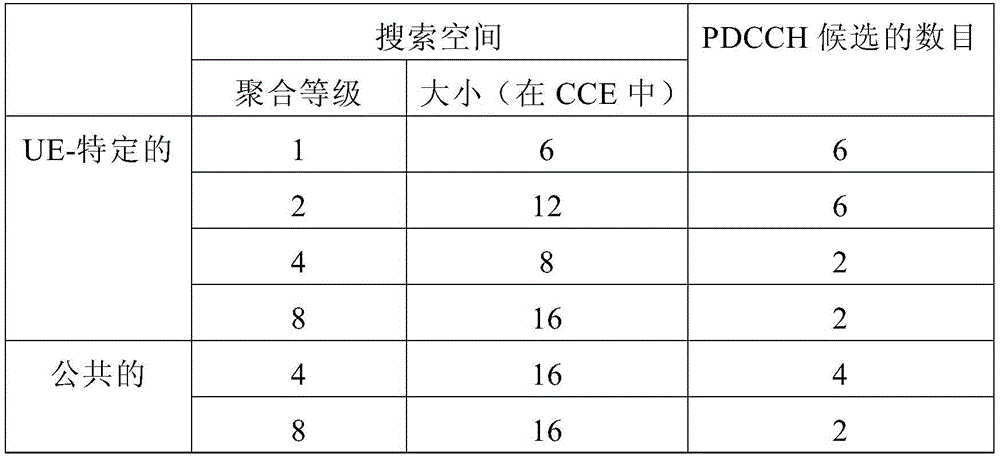
如从表2中注明的,存在四个聚合等级并且从而UE在每个聚合等级处具有多个搜索空间。搜索空间可以被分类成UE特定的搜索空间和公共的搜索空间。为特定的UE配置USS。UE中的每个可以监控UE特定的搜索空间(可以尝试根据可能的DCI格式解码PDCCH候选的集合)并且验证被掩蔽有PDCCH的RNTI和PDCCH的CRC。如果RNTI和CRC是有效的,则UE可以获取控制信息。As noted from Table 2, there are four aggregation levels and thus the UE has multiple search spaces at each aggregation level. The search spaces can be classified into UE-specific search spaces and common search spaces. Configure USS for a specific UE. Each of the UEs may monitor a UE-specific search space (may attempt to decode a set of PDCCH candidates according to possible DCI formats) and verify the RNTI of the PDCCH and the CRC of the PDCCH masked. If the RNTI and CRC are valid, the UE can acquire control information.
为其中多个UE或者所有的UE需要接收用于系统信息的动态调度的PDCCH或者寻呼消息的情况设计公共搜索空间。然而,公共搜索空间可以被用于取决于资源指配的特定UE。公共搜索空间可以重叠UE特定的搜索空间。A common search space is designed for situations where multiple UEs or all UEs need to receive a dynamically scheduled PDCCH or paging message for system information. However, a common search space can be used for specific UEs depending on resource assignment. The common search space may overlap the UE-specific search space.
通过等式1可以确定搜索空间。The search space can be determined by
[等式1][Equation 1]

其中L是聚合等级,Yk是通过RNTI和子帧数目k确定的变量,并且m′是PDCCH候选的数目。如果载波聚合被使用,则m′=m+M(L)·nCI并且否则,m′=m。在此,m=0,…,M(L)-1,其中M(L)是PDCCH候选的数目。NCCE,k是第k个子帧的控制区域中的CCE的总数目,并且i指示PDCCH候选(i=0,…,L-1)中的个别的CCE。在公共搜索空间中,Yk始终是0。where L is the aggregation level, Yk is a variable determined by the RNTI and the number of subframes k, and m' is the number of PDCCH candidates. If carrier aggregation is used, then m'=m+M (L) · nCI and otherwise, m'=m. Here, m=0, ..., M (L) -1, where M (L) is the number of PDCCH candidates. NCCE,k is the total number of CCEs in the control region of the kth subframe, and i indicates the individual CCEs in the PDCCH candidates (i=0, . . . , L-1). In the common search space, Y k is always 0.
图5图示在每个聚合等级处的UE特定搜索空间(阴影),如通过等式1所定义。在此,为了便于描述,聚合等级没有被采用并且NCCE,k被设置为32。5 illustrates the UE-specific search space (shaded) at each aggregation level, as defined by
图5(a)、图5(b)、图5(c)以及图5(d)分别图示在聚合等级1、2、4以及8处的UE特定的搜索空间。在图5中,数目指示CCE数目。如前面所描述的,通过RNTI和子帧数目k确定在每个聚合等级处的搜索空间的开始的CCE。对于UE,由于模函数和L根据聚合等级在相同的子帧中搜索空间的开始的CCE可以是不同的。另外,由于L搜索空间的开始的CCE始终是聚合等级的倍数。通过示例,Yk是CCE 18。UE尝试以通过聚合等级确定的CCE为单位顺序地解码CCE,从开始的CCE开始。例如,图5的(b),UE尝试根据聚合等级以两个CCE为单位解码CCE,从作为开始的CCE的CCE 4开始。5(a), 5(b), 5(c), and 5(d) illustrate UE-specific search spaces at
如上所述,UE尝试在搜索空间中执行解码。通过由无线电资源控制(RRC)信令指示的传输模式和DCI格式确定解码过程的数目。考虑到用于六个PDCCH候选中的每个的两个DCI大小(DCI格式0/1A/3/3A和DCI格式1C),如果载波聚合没有被使用,则UE需要在公共搜索空间中尝试最多12个解码过程。在UE特定的搜索空间中,考虑到用于16个PDCCH候选(6+6+2+2=16)中的每个的两个DCI大小,UE需要尝试最多32个解码过程。As described above, the UE attempts to perform decoding in the search space. The number of decoding processes is determined by the transmission mode and DCI format indicated by Radio Resource Control (RRC) signaling. Considering the two DCI sizes for each of the six PDCCH candidates (DCI formats 0/1A/3/3A and DCI format 1C), if carrier aggregation is not used, the UE needs to try the most in the
同时,如果载波聚合被使用,则进一步增加解码过程的最大数目,因为为了UE特定的搜索空间和DCI格式4添加与DL资源(分量载波)的数目一样多的解码过程。Meanwhile, if carrier aggregation is used, the maximum number of decoding processes is further increased because as many decoding processes as the number of DL resources (component carriers) are added for UE-specific search space and
参考信号(RS)Reference Signal (RS)
在无线通信系统中,通过无线电信道来传送分组并且因此信号可能在传输期间被失真。为了成功地接收该信号,接收器应当使用信道信息来补偿所接收的信号的失真。为了获得信道信息,发射器传送对发射器和接收器两者已知的信号,并且基于通过无线电信道接收到的信号的失真来获取信道信息。此信号被称为导频信号或RS。In wireless communication systems, packets are transmitted over radio channels and thus signals may be distorted during transmission. To successfully receive this signal, the receiver should use the channel information to compensate for the distortion of the received signal. To obtain the channel information, the transmitter transmits a signal known to both the transmitter and the receiver, and obtains the channel information based on the distortion of the signal received over the radio channel. This signal is called a pilot signal or RS.
在使用多个天线进行数据传输和接收的情况下,应当辨别在发射天线和接收天线之间的信道状态,以便正确地接收信号。因此,应通过每个发射天线,更加具体地,每个天线端口,发射RS。In the case of data transmission and reception using multiple antennas, the channel state between the transmit antenna and the receive antenna should be discriminated in order to receive signals correctly. Therefore, the RS should be transmitted through each transmit antenna, more specifically, each antenna port.
RS可以被划分为UL RS和DL RS。在当前的LTE系统中,UL RS包括:RSs can be divided into UL RSs and DL RSs. In the current LTE system, UL RS includes:
i)被用于对于通过PUSCH和PUCCH传送的信息的相干解调的信道评估的解调参考信号(DMRS);和i) a demodulation reference signal (DMRS) used for channel estimation for coherent demodulation of information transmitted over PUSCH and PUCCH; and
ii)被用于eNB或者网络以不同的频率测量UL信道的质量的探测参考信号(SRS)。ii) Sounding Reference Signals (SRS) used by the eNB or the network to measure the quality of the UL channel at different frequencies.
DL RS包括:DL RS includes:
i)在小区的所有UE当中共享的小区特定的参考信号(CRS);i) a cell-specific reference signal (CRS) shared among all UEs of the cell;
ii)专用于特定UE的UE特定RS;ii) UE-specific RS dedicated to a specific UE;
iii)当PDSCH被传送时,被用于相干解调的DM-RS;iii) DM-RS used for coherent demodulation when PDSCH is transmitted;
iv)当下行链路DM-RS被传送时,被用于传送CSI的信道状态信息参考信号(CSI-RS);iv) a channel state information reference signal (CSI-RS) used to transmit CSI when the downlink DM-RS is transmitted;
v)被用于在MBSFN模式中传送的信号的相干解调的多媒体广播单频网络(MBSFN)RS;以及v) Multimedia Broadcast Single Frequency Network (MBSFN) RS used for coherent demodulation of signals transmitted in MBSFN mode; and
vi)被用于评估UE的地理位置信息的定位的RS。vi) An RS used for positioning to evaluate the UE's geographic location information.
根据其用途RS可以被划分为两种类型:用于信道信息获取的RS和用于数据解调的RS。因为前者的用途是使UE获取DCI,所以应在宽带中传送用于信道信息获取的RS,并且在特定子帧中没有接收DL数据的UE应接收RS。也在诸如移交的情形中使用用于信道信息获取的RS。用于数据解调的RS是通过eNB传送对应的资源和DL数据的RS。UE能够通过使用用于数据解调的RS测量信道来解调数据。应在数据传输区域中传送用于数据解调的RS。RSs can be classified into two types according to their uses: RSs for channel information acquisition and RSs for data demodulation. Since the purpose of the former is for the UE to acquire DCI, the RS for channel information acquisition should be transmitted in a wideband, and the UE that does not receive DL data in a specific subframe should receive the RS. The RS for channel information acquisition is also used in situations such as handover. The RS used for data demodulation is the RS that transmits the corresponding resources and DL data through the eNB. The UE can demodulate data by using the RS measurement channel for data demodulation. The RS for data demodulation should be transmitted in the data transmission area.
CRS被用于两个目的,即,信道信息获取和数据解调。UE特定的RS仅用于数据解调。CRS在宽带中在每个子帧中被传送,并且用于多达四个天线端口的CRS根据eNB的发射天线的数目而被传送。CRS is used for two purposes, namely, channel information acquisition and data demodulation. UE-specific RSs are only used for data demodulation. The CRS is transmitted in each subframe in wideband, and the CRS for up to four antenna ports is transmitted according to the number of transmit antennas of the eNB.
例如,如果eNB的发射天线的数目是2,则用于天线端口0和1的CRS被传送。在四个发射天线的情况下,用于天线端口0至3的CRS分别被传送。For example, if the number of transmit antennas of the eNB is 2, CRS for
图6图示其中CRS和DRS被映射到DL RB对的模式,如在传统3GPP LTE系统(例如,版本8系统)中所定义。作为RS映射单元的DL RB对可以被表达为时间中的一个子帧乘以频率中的12个子载波。即,在正常的CP的情况下RB对在时域中包括14个OFDM符号(参见图5(a))并且在扩展CP的情况下在时域中包括12个OFDM符号(图6(b))。6 illustrates a pattern in which CRS and DRS are mapped to DL RB pairs, as defined in legacy 3GPP LTE systems (eg,
图6图示在eNB支持四个发射天线的系统中的RB对中的RS的位置。在图5中,通过附图标记“0”、“1”、“2”、以及“3”表达的RE分别图示用于天线端口0、1、2、以及3的CRS的位置,并且通过“D”表达的RE表示DRS的位置。6 illustrates the locations of RSs in an RB pair in a system where the eNB supports four transmit antennas. In FIG. 5 , REs expressed by reference numerals "0", "1", "2", and "3" illustrate the positions of CRSs for
解调参考信号(DMRS)Demodulation Reference Signal (DMRS)
DMRS是为了使UE执行用于PDSCH的信道估计的目的而定义的RS。在传输端口7、8、以及9中可以使用DMRS。最初,为了天线端口5的单层已经定义了DMRS并且,其后,为了最多八个层的空间复用已经扩展DMRS的使用。如从其它的名称UE特定的RS能够理解的,仅为一个特定的UE传送DMRS。其后,仅在用于特定的UE的PDSCH被传送的RB中可以传送DMRS。The DMRS is an RS defined for the purpose of causing the UE to perform channel estimation for PDSCH. DMRS can be used in
用于高达8个层的DMRS被如下地生成。通过根据等式6将通过等式5生成的参考信号序列r(m)映射到复值的调制符号
[等式5][Equation 5]


其中r(m)表示RS序列,c(i)表示伪随机序列,并且
[等式6][Equation 6]


m′=0,1,2m'=0, 1, 2
如从等式6中能够看到,在到复合调制符号的映射期间根据天线端口如在表5中图示的正交序列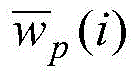
[表5][table 5]

UE可以根据扩展因子(2或者4)通过不同的方法使用DMRS执行信道估计。参考表5,因为在天线端口7至10中以[a b a b]的形式重复正交序列,扩展因子是2并且,在天线端口11至14的情况下,扩展因子是4。如果扩展因子是2,则在将第一时隙的DMRS和第二时隙的DMRS解扩到扩展因子2之后,UE可以通过时间内插执行信道估计。当扩展因子是4时,UE可以通过将整个子帧中的DMRS解扩到扩展因子4执行信道估计。The UE may perform channel estimation using the DMRS through different methods according to the spreading factor (2 or 4). Referring to Table 5, since the orthogonal sequence is repeated in the form of [a b a b] in the antenna ports 7 to 10, the spreading factor is 2 and, in the case of the antenna ports 11 to 14, the spreading factor is 4. If the spreading factor is 2, after despreading the DMRS of the first slot and the DMRS of the second slot to a spreading factor of 2, the UE may perform channel estimation through time interpolation. When the spreading factor is 4, the UE can perform channel estimation by despreading the DMRS in the whole subframe to the spreading
当扩展因子是2时,根据扩展因子的上述信道估计能够获得通过在高移动性中时间内插的应用引起的增益并且在通过将DMRS解扩到第一时隙的DMRS的可能性引起的解码时间中获得增益。另外,当扩展因子是4时,更多的UE或者秩能够被支持。When the spreading factor is 2, the above-mentioned channel estimation according to the spreading factor can obtain the gain caused by the application of temporal interpolation in high mobility and the decoding caused by the possibility of despreading the DMRS to the DMRS of the first slot gain over time. Also, when the spreading factor is 4, more UEs or ranks can be supported.
现在将会在DMRS开销方面描述图8。图8图示在用于天线端口7至14的DMRS的子帧中的映射。如在图8中所图示的,在资源网格中根据DMRS映射位置存在码分复用(CDM)组1(或者第一天线端口集合)和CDM组2(或者第二天线端口集合)。在与CDM组1相对应的RE上,通过天线端口7、8、11、以及13传送DMRS并且,在与CDM组2相对应的RE上,通过天线端口9、10、12、以及14传送DMRS。即,通过被包括在一个CDM组中的天线端口在相同的RE上传送DMRS。如果仅使用与CDM组1相对应的天线端口传送DMRS,则对于DMRS所必需的资源是12个RE,即,DMRS开销是12个RE。类似地,当使用与CDM组2相对应的天线端口时,DMRS开销是24个RE。Figure 8 will now be described in terms of DMRS overhead. 8 illustrates mapping in subframes for DMRS for antenna ports 7 to 14. As illustrated in FIG. 8 , there are Code Division Multiplexing (CDM) group 1 (or first set of antenna ports) and CDM group 2 (or second set of antenna ports) in the resource grid according to DMRS mapping positions. On REs corresponding to
在版本11之后的LTE系统中,增强的PDCCH(E-PDCCH)被视为是对通过协作的多点(CoMP)传输和多用户(MU)-MIMO引起的PDCCH容量短缺并且对通过小区间干扰引起的PDCCH性能劣化的解决方案。在E-PDCCH中,能够执行基于DMRS的信道估计以获取如与基于传统的CRS的PDCCH不同的预编码增益等等。In LTE systems after Release 11, Enhanced PDCCH (E-PDCCH) is considered to be effective against PDCCH capacity shortage caused by coordinated multi-point (CoMP) transmission and multi-user (MU)-MIMO and by inter-cell interference A solution to the PDCCH performance degradation caused. In E-PDCCH, DMRS-based channel estimation can be performed to obtain precoding gains and the like as different from conventional CRS-based PDCCH.
关于此E-PDCCH的传输,本发明提出当eNB将E-PDCCH传送到特定的UE时使用的DMRS的天线端口和/或加扰序列(或者加扰序列的初始值)根据与E-PDCCH传输相关联的资源(例如,PRB对、子帧、候选位置的开始的增强的CCE(eCCE)、PRB对中的子集的索引)而改变。Regarding the transmission of this E-PDCCH, the present invention proposes that the antenna port and/or scrambling sequence (or the initial value of the scrambling sequence) of the DMRS used when the eNB transmits the E-PDCCH to a specific UE is based on the transmission of the E-PDCCH The associated resources (eg, PRB pair, subframe, enhanced CCE (eCCE) at the beginning of a candidate position, index of a subset in a PRB pair) vary.
即,当eNB将E-PDCCH传送到特定的UE时,可以相对于每个E-PDCCH有关资源配置与用于E-PDCCH的DMRS相关联的参数。虽然DMRS参数可以是,例如,先前描述的天线端口和加扰序列(或者加扰序列的初始值),但是本发明不限于此,并且可以使用与DMRS相关联的其它参数。候选的位置的开始的eCCE指的是在通过聚合L个CCE形成的聚合等级L的特定候选位置处的组成对应的位置的L个CCE当中的具有最低的索引的CCE。(在局部的E-PDCCH的情况下)通过相同的DMRS天线端口或者加扰序列可以传送组成单个E-PDCCH的L个eCCE。在PRB对中的子集指的是通过将属于一个PRB对的RE分割成两个或者多个子集形成的RE的子集。使用不同的子集在单个PRB对中可以复用多个E-PDCCH。(例如,一个PRB对可以包括4个eCCE,每个具有4个被增强的REG(eREG)。以eCCE为单位可以传送集中式的E-PDCCH并且通过形成具有属于不同的PRB对的eREG的一个eCCE可以传送分布式的E-PDCCH。根据聚合等级,多个eCCE可以被用于一个E-PDCCH(或者DCI)传送。另外,加扰序列(或者加扰序列的初始值)可以被生成为小区ID、服务小区ID(SCID)字段、或者小区ID、SCID、以及其它各种参数的组合。通过变化这些参数中的全部或者一些可以改变加扰序列。That is, when the eNB transmits the E-PDCCH to a specific UE, the parameters associated with the DMRS for the E-PDCCH may be configured with respect to each E-PDCCH related resource. Although the DMRS parameters may be, for example, the previously described antenna ports and scrambling sequences (or initial values of the scrambling sequences), the present invention is not so limited and other parameters associated with the DMRS may be used. The eCCE of the beginning of the candidate position refers to the CCE with the lowest index among the L CCEs constituting the corresponding position at a specific candidate position of an aggregation level L formed by aggregating the L CCEs. The L eCCEs that make up a single E-PDCCH may be transmitted over the same DMRS antenna port or scrambling sequence (in the case of a localized E-PDCCH). A subset in a PRB pair refers to a subset of REs formed by dividing REs belonging to one PRB pair into two or more subsets. Multiple E-PDCCHs can be multiplexed in a single PRB pair using different subsets. (For example, one PRB pair may include 4 eCCEs, each with 4 enhanced REGs (eREGs). The localized E-PDCCH may be transmitted in units of eCCEs and by forming one with eREGs belonging to different PRB pairs The eCCE can transmit distributed E-PDCCH. According to the aggregation level, a plurality of eCCEs can be used for one E-PDCCH (or DCI) transmission. In addition, the scrambling sequence (or the initial value of the scrambling sequence) can be generated as a cell ID, Serving Cell ID (SCID) field, or a combination of Cell ID, SCID, and various other parameters. The scrambling sequence can be changed by changing all or some of these parameters.
现在将会描述与在与E-PDCCH传输相关联的在上面提及的资源当中的PRB对有关的一个实施例。根据本发明,当使用多个PRB对当中的至少一个PRB对传送E-PDCH时,用于为了多个PRB对中的每个配置E-PDCCH的DMRS参数(多个PRB对可以被称为E-PDCCH集合,并且UE可以从E-PDCCH集合通过盲解码检测候选并且确定是否通过盲解码经由候选实际地传送E-PDCCH)。多个PRB对可以包括用于集中式E-PDCCH传输的一个或者多个PRB对和/或用于分布式E-PDCCH传输的一个或者多个PRB对,如在图11中所图示。An embodiment related to PRB pairs among the above-mentioned resources associated with E-PDCCH transmission will now be described. According to the present invention, when the E-PDCH is transmitted using at least one PRB pair among the plurality of PRB pairs, DMRS parameters for configuring the E-PDCCH for each of the plurality of PRB pairs (the plurality of PRB pairs may be referred to as E-PDCH) - PDCCH set, and the UE can detect candidates from the E-PDCCH set through blind decoding and determine whether to actually transmit the E-PDCCH through the candidates through blind decoding). The multiple PRB pairs may include one or more PRB pairs for localized E-PDCCH transmission and/or one or more PRB pairs for distributed E-PDCCH transmission, as illustrated in FIG. 11 .
考虑到上面的描述,根据本发明的提议,可以相对于为了E-PDCCH传输发信号的每个E-PDCCH集合(或者E-PDCCH集合)配置DMRS参数(例如,DMRS端口和/或加扰序列参数),并且E-PDCCH集合用于集中式E-PDCCH或者用于分布式E-PDCCH。Considering the above description, according to the present proposal, DMRS parameters (eg, DMRS ports and/or scrambling sequences) may be configured with respect to each E-PDCCH set (or E-PDCCH set) signaled for E-PDCCH transmission parameter), and the E-PDCCH set is used for localized E-PDCCH or for distributed E-PDCCH.
即,当DMRS参数是加扰序列(或者加扰序列的初始值)时,相对于每个PRB对集合配置加扰序列(或者加扰序列的初始值)。相对于每个PRB对集合配置的的加扰序列(或者加扰序列的初始值)可以通过较高层信令(RRC信令)被传送到UE。如果DMRS参数是天线端口,则可以相对于用于集中式/分布式E-PDCCH传输的每个PRB对集合配置天线端口。例如,如在后面描述的图11中所示,对于用于集中式E-PDCCH传输的一个或者多个PRB对,天线端口{7,8,9,10}可以被配置并且,对于用于分布式E-PDCCH传输的PRB对集合,天线端口{7,9,7,9}可以被配置。就像加扰序列的情况一样,通过较高层信令关于与PRB对相关联的天线端口的信息可以被传送到UE。That is, when the DMRS parameter is the scrambling sequence (or the initial value of the scrambling sequence), the scrambling sequence (or the initial value of the scrambling sequence) is configured for each PRB pair set. The scrambling sequence (or the initial value of the scrambling sequence) configured with respect to each PRB pair set may be transmitted to the UE through higher layer signaling (RRC signaling). If the DMRS parameter is the antenna port, the antenna port may be configured with respect to each set of PRB pairs used for localized/distributed E-PDCCH transmission. For example, as shown in FIG. 11 described later, for one or more PRB pairs for localized E-PDCCH transmission, antenna ports {7, 8, 9, 10} may be configured and, for distribution For the PRB pair set for E-PDCCH transmission, the antenna ports {7, 9, 7, 9} can be configured. As in the case of the scrambling sequence, information about the antenna port associated with the PRB pair may be conveyed to the UE through higher layer signaling.
图9图示在其中为一个或者多个PRB对配置DMRS参数(特别地,天线端口)的情况下将不同的天线端口指配给用于集中式的E-PDCCH传输的PRB对集合和用于分布式的E-PDCCH传输的PRB对集合。9 illustrates the assignment of different antenna ports to a set of PRB pairs for localized E-PDCCH transmission and for distribution in a case where DMRS parameters (in particular, antenna ports) are configured for one or more PRB pairs A set of PRB pairs for E-PDCCH transmission of the formula.
如上所述,根据传输方案E-PDCCH传输可以被划分为集中式传输和分布式传输。根据是否在多个PRB对上分别地传送一个eCCE可以区分E-PDCCH传输。即,在多个PRB对上的一个eCCE的划分传输可以是分布式传输并且从一个eCCE分别定义的资源集合可以是eREG。在每个资源集合中使用的天线端口可以被不同地配置。当应用与传输方案相关联的天线端口配置时,天线端口配置可以根据传输方案而不同。As described above, E-PDCCH transmission can be divided into localized transmission and distributed transmission according to the transmission scheme. E-PDCCH transmission can be distinguished according to whether one eCCE is transmitted separately on multiple PRB pairs. That is, split transmission of one eCCE over multiple PRB pairs may be distributed transmission and resource sets defined separately from one eCCE may be eREGs. The antenna ports used in each resource set may be configured differently. When the antenna port configuration associated with the transmission scheme is applied, the antenna port configuration may differ according to the transmission scheme.
具体地,参考图9,假定一个PRB对包括8个eREG并且具有连续的索引的两个eREG在集中式传输中组成一个eCCE。通过频分双工(FDM)、时分双工(TDM)、或者FDM和TDM可以定义一个PRB对中的eREG,或者可以通过用于干扰随机化的交织方案定义。在本发明的范围中也包含在集中式/分布式传输中的非连续的两个eREG。Specifically, referring to FIG. 9 , it is assumed that one PRB pair includes 8 eREGs and two eREGs with consecutive indices form one eCCE in localized transmission. The eREGs in one PRB pair can be defined by Frequency Division Duplex (FDM), Time Division Duplex (TDM), or FDM and TDM, or can be defined by an interleaving scheme for interference randomization. Non-consecutive two eREGs in the localized/distributed transmission are also included within the scope of the present invention.
参考图9(a),通过从低索引的eCCE开始的天线端口{7,8,9,10}配置集中式传输,并且通过天线端口{7,7,7,7}配置分布式传输。考虑到以eREG为单位的天线端口的指配,为集中式传输分配天线端口{7,7,8,8,9,9,10,10,11,11},并且为分布式传输分配天线端口{7,7,7,7,7,7,7,7}。Referring to FIG. 9( a ), localized transmission is configured by antenna ports {7, 8, 9, 10} starting from low-indexed eCCEs, and distributed transmission is configured by antenna ports {7, 7, 7, 7}. Considering the assignment of antenna ports in units of eREG, antenna ports {7, 7, 8, 8, 9, 9, 10, 10, 11, 11} are allocated for localized transmission and antenna ports are allocated for distributed transmission {7,7,7,7,7,7,7,7}.
在图9(b)中,图示以eREG为单位分配的天线端口。假定对于集中式传输,天线端口{7,7,9,9,8,8,10,10}被分配并且,对于分布式传输,天线端口{7,9,7,9,7,9,7,9}被分配。假定对于集中式传输以eCCE为单位确定天线端口分配,天线端口{7,9,8,10}的分配可以被发信号或者预先配置。如果期待甚至对于分布式传输使用以eCCE为单位的映射,则可以考虑用于配置作为{7,7,9,9,7,7,9,9}的图9(b)的天线端口{7,9,7,9,7,9,7,9}的方法并且以eCCE为单位映射天线端口{7,9,7,9}。In FIG. 9(b), antenna ports allocated in units of eREGs are illustrated. Assume that for localized transmission, antenna ports {7,7,9,9,8,8,10,10} are allocated and, for distributed transmission, antenna ports {7,9,7,9,7,9,7 ,9} is assigned. Assuming that antenna port assignments are determined in units of eCCEs for centralized transmission, the assignments of antenna ports {7, 9, 8, 10} may be signaled or preconfigured. If it is desired to use the mapping in eCCE units even for distributed transmission, then the antenna port {7 of FIG. 9(b) can be considered for configuration as {7,7,9,9,7,7,9,9} , 9, 7, 9, 7, 9, 7, 9} and map the antenna ports {7, 9, 7, 9} in units of eCCE.
按照传输方案可以预先配置在PRB对中的eCCE(或者eREG)与天线端口之间的关系,并且可以向UE发送应用每个方案的PRB对集合的信号。The relationship between the eCCE (or eREG) in the PRB pair and the antenna port may be pre-configured according to the transmission scheme, and a signal of the PRB pair set to which each scheme is applied may be transmitted to the UE.
图10示例性地图示在以PRB(或者PRB对)为单位配置DMRS参数的情况下的将DMRS参数的模式变成特定模式。即,eNB可以通过较高层信令向UE通知天线端口的变化模式和/或DMRS的加扰序列。作为一种方法,eNB可以向UE通知要在特定的位置处使用的天线端口和/或加扰序列并且UE可以操作以从已知的天线端口和/或加扰序列通过预先确定的规则导出要在其它位置处使用的天线端口和/或加扰序列。可以理解,eNB指配UE用于在其处在其中要在每个位置处使用的天线端口和/或DRMS的加扰序列被确定为预定的模式的情形下启动模式的位置的偏移值。FIG. 10 exemplarily illustrates changing the pattern of the DMRS parameter to a specific pattern in a case where the DMRS parameter is configured in units of PRBs (or PRB pairs). That is, the eNB may notify the UE of the change pattern of the antenna port and/or the scrambling sequence of the DMRS to the UE through higher layer signaling. As one approach, the eNB may inform the UE of the antenna port and/or scrambling sequence to be used at a particular location and the UE may operate to derive the desired antenna port and/or scrambling sequence from the known antenna port and/or scrambling sequence by predetermined rules Antenna ports and/or scrambling sequences used at other locations. It will be appreciated that the eNB assigns the UE an offset value for the position at which it is to activate the mode in case the scrambling sequence of the antenna port and/or DRMS to be used at each position is determined to be a predetermined mode.
将会参考图10对此详细地描述。在图10(a)中,当SCID被固定为0时,每个RB(RB对)交替地使用天线端口7、8、9、以及10,并且这可以表示RB nx使用天线端口7(7+(x mod 4))。在这样的情况下,假定偏移值被设置为0,则这可以表示RB nx使用天线端口(7+((x+偏移)mod 4)))。因为在上面的示例中使用天线端口7、8、9、以及10,所以要接收E-PDCCH的对应的UE使用的DMRS天线端口的总数目,Mport是4。Mport根据UE可以不同并且也可以通过较高层信号配置。在这样的情况下,如等式7可以概括RB nx的天线端口。This will be described in detail with reference to FIG. 10 . In Fig. 10(a), when SCID is fixed to 0, each RB (RB pair) uses
[等式7][Equation 7]
(7+((x+偏移)mod Mport))(7+((x+offset)mod M port ))
图10(b)解释其中偏移被设置为0的RB nx使用SCID(floor(x/4)+偏移)mod 2)。Fig. 10(b) explains that RB nx in which the offset is set to 0 uses SCID(floor(x/4)+offset) mod 2).
可替选地,在每个RB中使用的天线端口数目可以被表达为天线端口改变时段Periodport和首先使用的天线端口数目Startport的组合。即,可以表达天线端口数目使得在第一Periodport RB中使用天线端口(7+Startport)并且在下一个Periodport RB中使用天线端口(7+Startport+1)。因此,可以通过等式8表达在RB nx中使用的天线端口。Alternatively, the number of antenna ports used in each RB may be expressed as a combination of the antenna port change period Period port and the first used antenna port number Start port . That is, the number of antenna ports can be expressed such that the antenna port (7+Start port ) is used in the first Period port RB and the antenna port (7+Start port + 1) is used in the next Period port RB. Therefore, the antenna ports used in RB nx can be expressed by
[等式8][Equation 8]
(7+((Startport+floor(x/Periodport))mod Mport)(7+((Start port +floor(x/Period port ))mod M port )
当应用等式8时,图10(a)对应于其中Startport=0、Periodport=1、并且Mport=4的情况,并且图10(c)对应于其中Startport=0、Periodport=2、并且Mport=4的情况。When
虽然已经在每个RB中改变DMRS天线端口数目和加扰序列的前提下给出上面的描述,但是这是示例性的并且DMRS天线端口数目和加扰序列可以根据PRB对集合、候选位置的开始的eCCE、以及/或者PRB对中的子集不同。Although the above description has been given on the premise that the number of DMRS antenna ports and the scrambling sequence are changed in each RB, this is exemplary and the number of DMRS antenna ports and the scrambling sequence may be based on the PRB pair set, the start of the candidate position eCCEs, and/or subsets of PRB pairs are different.
图11示例性地图示基于等式8用于每个UE的天线端口配置。具体地,在图11中,当Startport=0、0、和1并且Periodport=1、2、和4时用于UE1、UE2以及UE3的天线端口被配置。结果,在特定的RB中具有相同的天线端口的UE的组合变成不同的,如在图11中所图示。因此,eNB可以不同地选择在每个RB中的可能的MU-MIMO配对。例如,在RB n0和RB n7中,具有相同的天线端口的UE1和UE2中的一个被选择以执行与UE3的MU-MIMO,然而在RB n1和RB n6中,具有相同的天线端口的UE3和UE1中的一个被选择以执行与UE2的MU-MIMO。即,能够执行与其中在所有的RB上一致地配置DMRS天线端口的情况有关的各种MU-MIMO配对。FIG. 11 exemplarily illustrates the antenna port configuration for each UE based on
要在每个RB中使用的DMRS天线端口和/或加扰序列(或者PRB对集合、候选位置的开始的CCE、以及/或者RB中的子集)被改变的模式可以根据被分配给UE的C-RNTI、小区ID、以及CSI-RS的加扰参数而不同,并且因此确保每个UE具有不同的模式。另外,通过参数之间的优先级可以确定天线端口模式。例如,可以按照CSI-RS加扰参数、小区ID、以及C-RNTI的顺序确定优先级,并且可以在重新配置消息接收时间处使用可用的参数重新配置天线端口指配。如果与优先级相对应的参数不是可用的,则具有下一个优先级的参数可以被用于确定模式。根据传输形式可以不同地应用上述参数。例如,在集中式传输中,C-RNTI可以被用于确定天线端口模式并且,当共享的RS被使用时,可以基于小区ID、在DMRS中使用的虚拟的小区ID或者CSI-RS、或者加扰参数确定天线端口模式,因为多个E-PDCCH共享相同的天线端口。The pattern in which the DMRS antenna ports and/or scrambling sequences to be used in each RB (or set of PRB pairs, CCEs at the beginning of candidate positions, and/or subsets in RBs) are changed according to the The scrambling parameters of C-RNTI, cell ID, and CSI-RS are different, and thus ensure that each UE has a different pattern. In addition, the antenna port mode can be determined by the priority among the parameters. For example, priority may be determined in the order of CSI-RS scrambling parameters, cell ID, and C-RNTI, and the antenna port assignment may be reconfigured at the time of reconfiguration message reception using the available parameters. If the parameter corresponding to the priority is not available, the parameter with the next priority can be used to determine the mode. The above parameters may be applied differently depending on the transmission form. For example, in localized transmission, C-RNTI may be used to determine the antenna port pattern and, when shared RS is used, may be based on cell ID, virtual cell ID or CSI-RS used in DMRS, or plus The scrambling parameter determines the antenna port pattern, since multiple E-PDCCHs share the same antenna port.
已经在可用于一个PRB对中的E-PDCCH的RE的数目是充分的前提下给出上面的描述。然而,在FDD/TDD的扩展CP、传送PBCH/SCH的子帧(或者PRB对集合)、TDD的特殊子帧、或者具有诸如CSI/CSI-RS/DMRS开销的重要的RS开销的子帧(或者PRB对集合)中可以减少可用于一个PRB对中的E-PDCCH的RE的数目。The above description has been given on the premise that the number of REs available for E-PDCCH in one PRB pair is sufficient. However, in the extended CP of FDD/TDD, the subframe (or PRB pair set) in which PBCH/SCH is transmitted, the special subframe of TDD, or the subframe with important RS overhead such as CSI/CSI-RS/DMRS overhead ( Or the number of REs available for E-PDCCH in one PRB pair can be reduced in the PRB pair set).
以这样的方式,如果可用于E-PDCCH的资源的数量是不充分的并且仅通过可用的资源配置eCCE(或者eREG)(即,如果仅通过被用于E-PDCCH传输的RE配置eCCE(或者eREG),则组成PRB对中的eCCE(或者eREG)的RE的位置可以根据子帧(或者PRB对)而不同。因此,在PRB对中的eCCE(或者eREG)的索引与天线端口之间的链路可以被预先确定(这可以通过较高层信令传送)。如果eCCE(或者eREG)的数目小于每个PRB对配置天线端口的数目,则提出从被确定的索引(例如,从低索引或者从高索引)开始使用仅可用数目的天线端口。In this way, if the number of resources available for E-PDCCH is insufficient and the eCCE (or eREG) is configured only by the available resources (ie, if the eCCE is configured only by REs used for E-PDCCH transmission (or eREG), then the position of the REs that make up the eCCE (or eREG) in the PRB pair can be different according to the subframe (or PRB pair). Therefore, the index of the eCCE (or eREG) in the PRB pair and the antenna port The link may be predetermined (this may be conveyed by higher layer signaling). If the number of eCCEs (or eREGs) is less than the number of configured antenna ports per PRB pair, then the index from the determined index (eg, from the low index or Start with a high index) using only the available number of antenna ports.
图12图示上述示例。在图12中,假定可用于阴影的PRB对中的每个的E-PDCCH的资源的数目被减少到正常的PRB对中的可用资源的数目的一半,因为阴影的PRB对包括PBCH/SCH。因此,如果正常PRB对中的每个PRB对的eCCE的数目是4,则阴影的PRB对中的eCCE的数目从4减少到2。假定按照从在PRB对中具有低索引的天线端口{7,8,9,10}开始的天线端口的顺序确定到用于对应的UE的天线端口的eCCE的发信号或者预先确定的映射。如在图9中,也假定两个连续的eREG组成一个eCCE。考虑到以eREG为单位的映射,在图12的左侧的正常PRB对中,{7,7,8,8,9,9,10,10}的eREG至天线端口映射被执行并且,在其中eCCE的数目被从4减少到2的图12的右侧的PRB对中,可以执行{7,7,8,8}的eREG至天线端口映射。FIG. 12 illustrates the above example. In FIG. 12, it is assumed that the number of resources available for the E-PDCCH of each of the shaded PRB pairs is reduced to half the number of available resources in the normal PRB pair, since the shaded PRB pair includes PBCH/SCH. Therefore, if the number of eCCEs per PRB pair in the normal PRB pair is 4, the number of eCCEs in the shaded PRB pair is reduced from 4 to 2. It is assumed that the signaling or predetermined mapping to eCCEs for the antenna ports of the corresponding UE is determined in order of antenna ports starting from the antenna ports {7, 8, 9, 10} with low indices in the PRB pair. As in Fig. 9, it is also assumed that two consecutive eREGs constitute one eCCE. Considering the mapping in units of eREGs, in the normal PRB pair on the left side of Fig. 12, eREG-to-antenna port mapping of {7, 7, 8, 8, 9, 9, 10, 10} is performed and, in In the PRB pair on the right side of FIG. 12 where the number of eCCEs is reduced from 4 to 2, eREG-to-antenna port mapping of {7, 7, 8, 8} can be performed.
类似地,在TDD中,在用于E-PDCCH的正常的子帧(或者具有充分地可用的资源的子帧)中的eCCE(或者eREG)至天线端口映射可以被发信号或者预先配置并且仅被用于eCCE(或者eREG)至天线端口映射的天线端口的一部分可以在其中减少可用资源的数目的特殊子帧中使用。此外,当进一步产生开销(例如,由于RS)时,可以仅使用一个天线端口(例如,天线端口{7})。Similarly, in TDD, eCCE (or eREG) to antenna port mapping in normal subframes (or subframes with sufficiently available resources) for E-PDCCH may be signaled or preconfigured and only A portion of the antenna ports used for eCCE (or eREG) to antenna port mapping may be used in special subframes in which the number of available resources is reduced. Furthermore, when further overhead is incurred (eg, due to RS), only one antenna port (eg, antenna port {7}) may be used.
可以在逻辑域中如下地解释上面的描述。如果用于E-PDCCH的所有的eCCE(或者eREG)被编入索引,则可以相对于两个PRB对和PRB对中的eCCE(或者eREG)至天线端口映射导出eREG索引0至11(eCCE索引0至5),即,可以解释从在PRB对中具有最低的索引的资源集合开始的{7,7,8,8,9,9,10,10}。例如,在图12中,其中PBCH/SCH被传送的PRB对中的资源集合索引可以是8、9、10、以及11并且这可以意指通过应用天线端口{7,7,8,8,9,9,10,10}的映射将天线端口{7,7,8,8}映射到eREG 8至11。The above description can be interpreted in the logical domain as follows. If all eCCEs (or eREGs) for E-PDCCH are indexed,
作为不同于参考图12描述的方法,当用于E-PDCCH的资源充分时,映射的天线端口当中的特定的天线端口的使用可以被发信号。对于干扰协调、RS冲突避免等等可以特别地使用此方法。As different from the method described with reference to FIG. 12 , use of a specific antenna port among the mapped antenna ports may be signaled when resources for the E-PDCCH are sufficient. This method may be used in particular for interference coordination, RS collision avoidance, and so on.
例如,当用于E-PDCCH的资源是充分的时,并且然后如果天线端口的数目被减少,则网络可以确定用于天线端口映射的优先级,网络可以基于优先级确定天线端口。在这样的情况下,多个优先级可以被预先确定,并且基于小区ID、UE ID(C-RNTI)、虚拟小区ID等等可以被选择特定优先级。将会通过较高层信令传送优先级。For example, when resources for E-PDCCH are sufficient, and then if the number of antenna ports is reduced, the network may determine priorities for antenna port mapping, and the network may determine antenna ports based on the priorities. In such a case, multiple priorities may be predetermined, and a specific priority may be selected based on cell ID, UE ID (C-RNTI), virtual cell ID, and the like. The priority will be conveyed through higher layer signaling.
可替选地,可以使用用于根据天线端口的数目配置用于天线端口指配的子集并且基于小区ID、UEID(C-RNTI)、虚拟小区ID等等确定在与被减少的天线端口的数目相对应的子集当中的要使用的天线端口映射的方法。Alternatively, it may be used to configure subsets for antenna port assignments according to the number of antenna ports and determine the number of antenna ports associated with the reduced antenna ports based on cell ID, UEID (C-RNTI), virtual cell ID, etc. The method of antenna port mapping to be used among the subsets corresponding to the number.
如上所述,在共享的RS和高聚合等级的使用的情况下,在一个PRB对中可以使用更少数目的天线端口,与当由于在PRB对中的资源的数量的短缺减少天线端口的数目时的情况一样。当通过一个天线端口执行多个E-PDCCH的解码时,并且当CSI反馈不正确或者公共的控制信号被传送时,共享的RS可以是有用的。在高聚合等级中,多个eCCE(或者eREG)可以被用于一个DCI传输。如果多个天线端口被使用,则因为信道估计的复杂性增加,所以单个天线端口传输是适合的。如果在PRB对中的资源的数量是不充分的,例如,在特殊子帧中,因为将多个天线端口指配给对应的PRB对产生不必要的资源消耗,所以不期待分配适合于资源的数量的大量的天线端口。As described above, in the case of the use of shared RS and high aggregation level, a smaller number of antenna ports can be used in one PRB pair, and when the number of antenna ports is reduced due to the shortage of the number of resources in the PRB pair the same situation. Shared RS may be useful when decoding of multiple E-PDCCHs is performed through one antenna port, and when CSI feedback is incorrect or a common control signal is transmitted. In a high aggregation level, multiple eCCEs (or eREGs) can be used for one DCI transmission. If multiple antenna ports are used, a single antenna port transmission is suitable because the complexity of the channel estimation increases. If the number of resources in a PRB pair is insufficient, e.g. in a special subframe, it is not expected to allocate an appropriate number of resources because assigning multiple antenna ports to the corresponding PRB pair creates unnecessary resource consumption of the large number of antenna ports.
在E-PDCCH传输中,应考虑与相邻区域的RS冲突并且,当RS冲突出现时,特别地位于小区边缘处的UE可能在E-PDCCH性能上下降。例如,当来自于服务小区的用于E-PDCCH的DMRS天线端口等于由用于PDSCH的相邻的小区使用的DMRS端口时产生这样的情况。作为用于解决此问题的方法之一,不同的天线端口可以被分配给相邻的小区(或者传输点)。然而,此方法产生通过UE特定的信令引起的信令开销。作为另一种方法,当更少数目的RE被用于E-PDCCH传输时,特定的天线端口(例如,天线端口9和10)可以被配置成被最先使用以便于避免RS冲突。例如,当每个PRB对分配一个端口时,天线端口9或者10可以被使用或者可以以资源集合(例如,eREG或者eCCE)为单位重复天线端口9和10。换言之,通常最先使用在相邻的小区中的用于PDSCH的DRMS传输期间不同于频繁地使用的天线端口7和8的天线端口。在该背景下,通过在其中用于共享的RS/E-PDCCH的使用的资源不是充分的情况和其中使用高聚合等级的情况之间进行区分,下面将会给出更加详细地描述。In E-PDCCH transmission, RS collisions with neighboring regions should be considered and when RS collisions occur, especially UEs located at the cell edge may degrade in E-PDCCH performance. Such a situation arises, for example, when the DMRS antenna port for E-PDCCH from the serving cell is equal to the DMRS port used by the neighboring cell for PDSCH. As one of the methods for solving this problem, different antenna ports can be allocated to adjacent cells (or transmission points). However, this approach incurs signaling overhead caused by UE-specific signaling. As another approach, when a smaller number of REs are used for E-PDCCH transmission, specific antenna ports (eg, antenna ports 9 and 10) may be configured to be used first in order to avoid RS collisions. For example, when one port is allocated per PRB pair,
首先,当用于共享的RS/E-PDCCH的使用的资源不是充分的时,可以最先使用特定的天线端口。例如,可以利用天线端口10、9、8、以及7的优先级来分配与必要的RS天线端口的数目一样多的天线端口。作为示例,当一个天线端口被分配时,可以使用天线端口10,并且当两个天线端口被分配时,可以使用天线端口9和10,并且当三个天线端口被分配时,可以使用天线端口9、10以及8。可替选地,如果MU-MIMO没有被应用于相邻的小区的PDSCH传输,则可以首先通过排除主要使用的天线端口7选择天线端口。此外,当四个天线端口中的唯一的两个被使用时,因为通过属于用于功率放大增益的不同的CDM组(例如,天线端口7和9或者天线端口8和10)的天线端口的组合可以配置天线端口,所以相邻的小区具有使用这些天线端口7和9的高可能性并且从而可以使用特定的天线端口8和10。First, when resources for use of the shared RS/E-PDCCH are not sufficient, a specific antenna port may be used first. For example, as many antenna ports as the number of necessary RS antenna ports may be allocated using the priorities of
接下来,当使用高聚合等级时,可以使用代表性的天线端口。被分配给对应的PRB对的eCCE的最小索引的eCCE的天线端口可以被确定为具有代表性的天线端口。即,天线端口可以被分配使得在最低的索引上排列天线端口9和10。如果包括使用最低的索引的情况的特定的eCCE的天线端口被选择作为代表性的天线端口,则使用相同的方法天线端口9或者10可以被确定为代表性的天线端口。当一个PRB被划分为四个eCCE时,被分配给对应的PRB对的天线端口可以是{9,10,7,8}、{10,9,7,8}、{9,10,8,7}、或者{10,9,8,7}。可替选地,不同于上面的描述,如果高聚合等级被配置,则使用天线端口9或者10,不论eCCE如何。因为在聚合等级2的情况下通过调度冲突避免是可能的,所以高聚合等级可以是4或者更高。Next, when a high aggregation level is used, representative antenna ports can be used. The antenna port of the eCCE with the smallest index assigned to the eCCE of the corresponding PRB pair may be determined as the representative antenna port. That is, the antenna ports may be allocated such that
上面的描述已经提出通过RRC信令确定用于E-PDCCH传输的单位资源集合(例如,PRB对(集合)、每个PRB对(eCCE)的子集等等)的DMRS配置。这样的描述(例如,UE可以使用用于E-PDCCH检测的每个E-PDCCH传输单元的DMRS配置,并且使用RRC信令可以指示每个传输单元的DMRS配置)可以被解释为下面描述的两种方法。在下文中,为了描述,将会使用术语物理域和逻辑域。物理域指的是OFDM符号映射中的资源布置并且逻辑域指的是用于对于物理域中的E-PDCCH检测发信号的部分资源的资源布置。图13图示在物理域和逻辑域之间的关系,其中逻辑域可以是其中与E-PDCCH的搜索空间相对应的资源被布置的域。虽然已经给出集中于单个域的上面的描述,但是本发明可应用于使用如在图13中所示的多个层的传输。The above description has proposed determining the DMRS configuration of a unit resource set (eg, PRB pair (set), a subset of each PRB pair (eCCE), etc.) for E-PDCCH transmission through RRC signaling. Such a description (eg, the UE may use the DMRS configuration of each E-PDCCH transmission unit for E-PDCCH detection, and the DMRS configuration of each transmission unit may be indicated using RRC signaling) can be interpreted as the two described below. a method. In the following, for the description, the terms physical domain and logical domain will be used. The physical domain refers to the resource arrangement in the OFDM symbol mapping and the logical domain refers to the resource arrangement for part of the resources signaled for E-PDCCH detection in the physical domain. FIG. 13 illustrates a relationship between a physical domain and a logical domain, where the logical domain may be a domain in which resources corresponding to the search space of the E-PDCCH are arranged. Although the above description has been given focusing on a single domain, the present invention is applicable to transmission using multiple layers as shown in FIG. 13 .
作为第一解释,eNB可以确定在物理域中每个单位资源的DMRS配置并且指配用于每个UE的E-PDCCH检测的搜索空间。在这样的情况下,eNB可以向每个UE发送物理域中每个资源单元的DMRS配置的信号。前面提出的模式信令方案可以被应用以发送每个对应的资源的DMRS配置的信号,从而减少信令开销。图14(a)图示其中在物理域中一个层上配置多个天线端口的情况。显然地,层的数目可以增加并且诸如加扰序列参数的多个DMRS参数可以被配置。As a first explanation, the eNB may determine the DMRS configuration per unit resource in the physical domain and assign a search space for E-PDCCH detection for each UE. In such a case, the eNB may signal the DMRS configuration of each resource element in the physical domain to each UE. The previously proposed pattern signaling scheme can be applied to signal the DMRS configuration of each corresponding resource, thereby reducing signaling overhead. Fig. 14(a) illustrates a case in which a plurality of antenna ports are configured on one layer in the physical domain. Obviously, the number of layers can be increased and multiple DMRS parameters such as scrambling sequence parameters can be configured.
虽然在图14(a)中假定一个PRB对被划分为四个子集并且一个子集被用作E-PDCCH传输的基本单元,但是当用于E-PDCCH传输的资源单元是PRB对或者多个PRB对时,可以应用本发明。在图14中,eNB可以通过RRC信令指示用于被用于物理域中的每个子集的天线端口的模式,并且通过用于搜索空间的信令可以最终确定用于E-PDCCH检测的DMRS配置。用于天线端口的模式可以被配置使得如在图14(a)的左边的模式信令A中重复天线端口7、8、9以及10或者如在图14(a)的右边的模式信令B中重复天线端口9、10、7以及8。总之,在物理域中可以发送用于eCCE的DMRS配置的信号并且然后发送搜索空间配置的信号。Although it is assumed in FIG. 14(a) that one PRB pair is divided into four subsets and one subset is used as the basic unit of E-PDCCH transmission, when the resource element used for E-PDCCH transmission is a PRB pair or a plurality of PRB timing, the present invention can be applied. In FIG. 14 , the eNB may indicate the mode used for the antenna ports used for each subset in the physical domain through RRC signaling, and the DMRS for E-PDCCH detection may be finally determined through signaling for the search space configuration. The pattern for the antenna ports may be configured such that
作为第二解释,在逻辑域中发送用于每个资源单元的模式的信号。即,如在图14(b)中所图示,如在传统LTE/LTE-A中在物理域中发送关于搜索空间的信息的信号并且然后可以在逻辑域中发送要在对应的搜索空间中使用的模式。虽然已经示例性地给出集中于用于天线端口的配置信令的上面的描述,但是本发明甚至可以被应用于诸如加扰序列参数的可用于DRMS配置的多个参数。As a second explanation, the mode for each resource element is signaled in the logical domain. That is, as illustrated in FIG. 14( b ), a signal of information on the search space is transmitted in the physical domain as in conventional LTE/LTE-A and can then be transmitted in the logical domain to be in the corresponding search space mode to use. Although the above description focusing on configuration signaling for antenna ports has been exemplarily given, the present invention can even be applied to a number of parameters available for DRMS configuration, such as scrambling sequence parameters.
图15是根据本发明的实施例的传输点和UE的框图。15 is a block diagram of a transmission point and a UE according to an embodiment of the present invention.
参考图15,根据本发明的传输点1510可以包括接收模块1511、传输模块1512、处理器1513、存储器1514、以及多个天线1515。传输点1510通过多个天线1515支持MIMO传输和接收。接收模块1511可以从UE接收关于UL的信号、数据、以及信息。传输模块1512可以将关于UL的信号、数据、以及信息传送到UE。处理器1513可以控制传输点1510的整体操作。Referring to FIG. 15 , the
根据本发明的实施例的传输点1510的处理器1513可以处理对于上述测量报告、切换、随机接入等等所必需的操作。The
传输点1510的处理器1513可以处理由传输点1510接收到的信息或者要从传输点1510传送的信息。存储器1514可以在预定的时间内存储被处理的信息并且可以被替换成诸如缓冲器(未示出)的组件。The
参考图15,UE 1520可以包括接收模块1521、传输模块1522、处理器1523、存储器1524、以及多个天线1525。UE 1520通过多个天线1525支持MIMO传输和接收。接收模块1521可以从传输点接收关于DL的信号、数据、以及信息。传输模块1522可以将关于UL的信号、数据、以及信息传送到传输点。处理器1523可以控制UE 1520的整体操作。Referring to FIG. 15 , the
根据本发明的实施例的UE 1520的处理器1523可以处理对于上述测量报告、切换、随机接入等等所必需的操作。The
UE 1520的处理器1523可以处理由UE 1520接收到的信息或者要从UE 1520传送的信息。存储器1524可以在预定的时间内存储被处理的信息并且可以被替换成诸如缓冲器(未示出)的组件。The
上面的传输点和UE可以被配置成独立地实现前述的实施例或者同时实现两个或者多个实施例。为了清楚起见,在此将会省略重复的描述。The above transmission point and UE may be configured to implement the aforementioned embodiments independently or to implement two or more embodiments simultaneously. For the sake of clarity, repeated descriptions will be omitted here.
图15中的传输点1510的描述可以应用于作为DL传输实体或者UL接收实体的中继节点,并且图15中的UE 1520的描述可以应用于作为DL接收实体或者UL传输实体的中继节点。The description of the
可以通过例如硬件、固件、软件或其组合的多种手段来实现本发明的上述实施例。The above-described embodiments of the present invention can be implemented by various means such as hardware, firmware, software, or a combination thereof.
在硬件配置中,可以通过一个或者多个专用集成电路(ASIC)、数字信号处理器(DSP)、数字信号处理装置(DSPD)、可编程逻辑器件(PLD)、现场可编程门阵列(FPGA)、处理器、控制器、微控制器、微处理器等来实现根据本发明的实施例的方法。In a hardware configuration, one or more Application Specific Integrated Circuits (ASICs), Digital Signal Processors (DSPs), Digital Signal Processing Devices (DSPDs), Programmable Logic Devices (PLDs), Field Programmable Gate Arrays (FPGAs) , processors, controllers, microcontrollers, microprocessors, etc. to implement methods according to embodiments of the invention.
在固件或者软件配置中,可以以模块、过程、函数等的各种格式的形式来实现根据本发明的实施例的方法。可以在存储器单元中存储软件代码,并且通过处理器来执行。存储器单元位于处理器内部或外部,并且可以经由各种公知部件将数据传送到处理器并且从处理器接收数据。Methods according to embodiments of the present invention may be implemented in various formats of modules, procedures, functions, etc., in a firmware or software configuration. Software codes may be stored in a memory unit and executed by a processor. The memory unit is located inside or outside the processor, and can transmit and receive data to and from the processor via various well-known components.
给出本发明的示例性实施例的详细描述以使本领域的技术人员能够实现和实施本发明。虽然已经参考本发明的示例性实施例描述了本发明,但是本领域的技术人员将会理解,在没有脱离本发明的范围的情况下能够对本发明进行许多修改。例如,可以组合使用本发明的上述实施例的构造。因此,本发明旨在没有限制在此公开的实施例,而是给出匹配在此公开的原理和新特征的最广的范围。The detailed description of the exemplary embodiments of the present invention is given to enable those skilled in the art to implement and practice the present invention. While the invention has been described with reference to exemplary embodiments thereof, those skilled in the art will appreciate that many modifications are possible in the invention without departing from the scope of the invention. For example, the configurations of the above-described embodiments of the present invention may be used in combination. Accordingly, the present invention is not intended to be limited to the embodiments disclosed herein, but to give the widest scope matching the principles and novel features disclosed herein.
在不偏离本发明的精神和必要特征的情况下,可以以其他特定方式来执行本发明的实施例。因此,上面的详细说明要在各个方面被解释为说明性的而不是限制性的。应当通过所附的权利要求的合理解释确定本发明的范围,并且在本发明的等同范围内的所有改变意欲要在本发明的范围内。本发明没有旨在限制在此公开的实施例,而是给出匹配在此公开的原理和新特征的最广的范围。另外,在所附权利要求中未明确相互引用的权利要求可以组合地呈现作为本发明的示例性实施例,或者通过在提交申请后的后续修改,作为新的权利要求而被包括。Embodiments of the present invention may be carried out in other specific ways without departing from the spirit and essential characteristics of the present invention. Therefore, the above detailed description is to be interpreted in all respects as illustrative rather than restrictive. The scope of the invention should be determined by reasonable interpretation of the appended claims and all changes that come within the equivalent scope of the invention are intended to be within the scope of the invention. The present invention is not intended to be limited to the embodiments disclosed herein, but is to give the widest scope matching the principles and novel features disclosed herein. Additionally, claims that are not expressly recited in each other in the appended claims may be presented in combination as exemplary embodiments of the present invention, or be included as new claims through subsequent amendment after filing the application.
【工业适用性】【Industrial Applicability】
本发明的上述实施例可应用于各种移动通信系统。The above-described embodiments of the present invention are applicable to various mobile communication systems.
Claims (4)
Applications Claiming Priority (9)
| Application Number | Priority Date | Filing Date | Title |
|---|---|---|---|
| US201161559139P | 2011-11-13 | 2011-11-13 | |
| US61/559,139 | 2011-11-13 | ||
| US201261598302P | 2012-02-13 | 2012-02-13 | |
| US61/598,302 | 2012-02-13 | ||
| US201261650480P | 2012-05-23 | 2012-05-23 | |
| US61/650,480 | 2012-05-23 | ||
| US201261661331P | 2012-06-18 | 2012-06-18 | |
| US61/661,331 | 2012-06-18 | ||
| CN201280066121.5A CN104040919B (en) | 2011-11-13 | 2012-11-13 | Method and apparatus for transmitting control information in wireless communication system |
Related Parent Applications (1)
| Application Number | Title | Priority Date | Filing Date |
|---|---|---|---|
| CN201280066121.5A Division CN104040919B (en) | 2011-11-13 | 2012-11-13 | Method and apparatus for transmitting control information in wireless communication system |
Publications (2)
| Publication Number | Publication Date |
|---|---|
| CN107135054A CN107135054A (en) | 2017-09-05 |
| CN107135054B true CN107135054B (en) | 2020-06-12 |
Family
ID=48290339
Family Applications (2)
| Application Number | Title | Priority Date | Filing Date |
|---|---|---|---|
| CN201710165882.0A Expired - Fee Related CN107135054B (en) | 2011-11-13 | 2012-11-13 | Method and apparatus for transmitting control information in wireless communication system |
| CN201280066121.5A Active CN104040919B (en) | 2011-11-13 | 2012-11-13 | Method and apparatus for transmitting control information in wireless communication system |
Family Applications After (1)
| Application Number | Title | Priority Date | Filing Date |
|---|---|---|---|
| CN201280066121.5A Active CN104040919B (en) | 2011-11-13 | 2012-11-13 | Method and apparatus for transmitting control information in wireless communication system |
Country Status (6)
| Country | Link |
|---|---|
| US (2) | US10244517B2 (en) |
| EP (1) | EP2779495B1 (en) |
| JP (2) | JP5905972B2 (en) |
| KR (1) | KR102131832B1 (en) |
| CN (2) | CN107135054B (en) |
| WO (1) | WO2013070050A1 (en) |
Families Citing this family (29)
| Publication number | Priority date | Publication date | Assignee | Title |
|---|---|---|---|---|
| JP5905972B2 (en) | 2011-11-13 | 2016-04-20 | エルジー エレクトロニクス インコーポレイティド | Method and apparatus for transmitting control information in a wireless communication system |
| US9609638B2 (en) | 2011-12-12 | 2017-03-28 | Sharp Kabushiki Kaisha | Mobile station apparatus, base station apparatus, and communication method |
| JP5957732B2 (en) * | 2011-12-12 | 2016-07-27 | シャープ株式会社 | COMMUNICATION SYSTEM, MOBILE STATION DEVICE, BASE STATION DEVICE, COMMUNICATION METHOD, AND INTEGRATED CIRCUIT |
| CN106788929B (en) * | 2012-01-09 | 2020-01-17 | 华为技术有限公司 | A control channel resource mapping method, base station and user equipment |
| CN109274476B (en) * | 2012-01-09 | 2023-09-26 | 华为技术有限公司 | A control channel transmission and reception method, base station, and user equipment |
| WO2013104425A1 (en) * | 2012-01-13 | 2013-07-18 | Huawei Technologies Co., Ltd. | Method for generating and transmitting demodulation reference signals |
| US9271288B2 (en) * | 2012-02-07 | 2016-02-23 | Qualcomm Incorporated | Resource allocation for enhanced physical downlink control channel (EPDCCH) |
| AU2012373944B2 (en) * | 2012-03-19 | 2015-09-10 | Huawei Technologies Co., Ltd. | Method, base station, and user equipment for transmitting control channel |
| CN103327521B (en) * | 2012-03-20 | 2016-12-14 | 上海贝尔股份有限公司 | For distributing and detect method and the equipment of downlink control channel resource |
| US10448379B2 (en) * | 2012-05-04 | 2019-10-15 | Texas Instruments Incorporated | Enhanced downlink control channel configuration for LTE |
| WO2013169160A1 (en) * | 2012-05-11 | 2013-11-14 | Telefonaktiebolaget L M Ericsson (Publ) | Reference signal design for special subframe configurations |
| US9386583B2 (en) * | 2012-08-10 | 2016-07-05 | Alcatel Lucent | Methods and systems for determining uplink resources |
| KR102130353B1 (en) * | 2012-09-18 | 2020-07-06 | 삼성전자주식회사 | Method and apparatus for generating control channel element in communication system |
| WO2016068072A1 (en) * | 2014-10-31 | 2016-05-06 | 三菱電機株式会社 | Communication system |
| WO2016152315A1 (en) | 2015-03-24 | 2016-09-29 | ソニー株式会社 | Device |
| US10149255B2 (en) | 2015-05-01 | 2018-12-04 | Qualcomm Incorporated | Low latency uplink power control |
| KR102596103B1 (en) | 2015-07-22 | 2023-10-31 | 삼성전자 주식회사 | Method and apparatus for operating machine Type communications in wireless communication system |
| WO2017020201A1 (en) * | 2015-07-31 | 2017-02-09 | Nec Corporation | Methods and apparatuses for transmitting and receiving dmrs indication |
| WO2017160048A2 (en) | 2016-03-14 | 2017-09-21 | Samsung Electronics Co., Ltd. | Method and apparatus for synchronization operation in cellular internet of things networks |
| EP3471485A4 (en) * | 2016-11-01 | 2020-02-26 | LG Electronics Inc. -1- | METHOD FOR TRANSMITTING DOWNLINK CONTROL INFORMATION OF DYNAMIC VARIABLE SIZE IN A WIRELESS COMMUNICATION SYSTEM AND DEVICE THEREFOR |
| CN110249558B (en) * | 2016-12-13 | 2022-03-29 | 诺基亚技术有限公司 | Polarization code for downlink control channel of wireless network |
| EP3565295A4 (en) * | 2016-12-27 | 2020-07-29 | NTT DoCoMo, Inc. | USER TERMINAL AND WIRELESS COMMUNICATION METHOD |
| CN108633012B (en) * | 2017-03-22 | 2021-10-26 | 展讯通信(上海)有限公司 | Time slot aggregation method, device and base station |
| CN109391431B (en) | 2017-08-11 | 2021-10-26 | 华为技术有限公司 | Method, device and computer readable storage medium for acquiring reference signal |
| WO2019142051A1 (en) * | 2018-01-16 | 2019-07-25 | Lenovo (Singapore) Pte. Ltd. | Rate-matching a data transmission around resources |
| CN111757432B (en) * | 2019-03-29 | 2024-04-26 | 华为技术有限公司 | A wake-up method and related device |
| WO2021026912A1 (en) * | 2019-08-15 | 2021-02-18 | Nec Corporation | Transmission and reception of downlink control information |
| US11818705B1 (en) | 2019-09-05 | 2023-11-14 | Sprint Spectrum Lp | Dynamically allocating control channel resources |
| CN115883040B (en) * | 2021-09-28 | 2025-07-01 | 广州慧睿思通科技股份有限公司 | Resource element group bundling information determination method, device, equipment and storage medium |
Citations (5)
| Publication number | Priority date | Publication date | Assignee | Title |
|---|---|---|---|---|
| CN101686070A (en) * | 2008-09-28 | 2010-03-31 | 华为技术有限公司 | Method and network equipment for reconfiguring logical antenna |
| CN101895496A (en) * | 2009-05-21 | 2010-11-24 | 中兴通讯股份有限公司 | Control information transmission processing method and system from base station to relay node |
| WO2010133043A1 (en) * | 2009-05-22 | 2010-11-25 | 华为技术有限公司 | Method for dispatching multi sub-frames and the system, the terminal and the base station thereof |
| WO2011114743A1 (en) * | 2010-03-19 | 2011-09-22 | パナソニック株式会社 | Base station and transmission method |
| EP2378703A1 (en) * | 2010-04-13 | 2011-10-19 | Panasonic Corporation | Mapping of control information to control channel elements |
Family Cites Families (27)
| Publication number | Priority date | Publication date | Assignee | Title |
|---|---|---|---|---|
| US8169956B2 (en) * | 2007-01-26 | 2012-05-01 | Qualcomm Incorporated | Mapping uplink acknowledgement transmission based on downlink virtual resource blocks |
| CN104936298B (en) | 2008-11-04 | 2018-07-10 | 苹果公司 | Downlink control structure is provided in first carrier |
| KR101711864B1 (en) * | 2008-12-23 | 2017-03-03 | 엘지전자 주식회사 | Uplink ack/nack signalling in carrier aggregation environment |
| KR100991957B1 (en) * | 2009-01-20 | 2010-11-04 | 주식회사 팬택 | An apparatus and method for generating scrambling code in broadband wireless communication system |
| US8385281B2 (en) * | 2009-01-30 | 2013-02-26 | Interdigital Patent Holdings, Inc. | Method and apparatus for component carrier aggregation in wireless communications |
| JP5131227B2 (en) * | 2009-03-03 | 2013-01-30 | 富士通モバイルコミュニケーションズ株式会社 | Wireless transmission device, wireless reception device, and transmission method |
| KR20110009025A (en) | 2009-07-20 | 2011-01-27 | 엘지전자 주식회사 | Method and apparatus for transmitting uplink control information |
| US8300587B2 (en) * | 2009-08-17 | 2012-10-30 | Nokia Corporation | Initialization of reference signal scrambling |
| KR101711866B1 (en) | 2009-11-27 | 2017-03-03 | 엘지전자 주식회사 | A method and a base station for transmitting downlink control information, and a method and a user equipment for receiving downlink control information |
| US8804586B2 (en) * | 2010-01-11 | 2014-08-12 | Blackberry Limited | Control channel interference management and extended PDCCH for heterogeneous network |
| KR101753586B1 (en) | 2010-02-03 | 2017-07-04 | 엘지전자 주식회사 | Apparatus and method of transmitting control information in wireless communication system |
| CN102149082B (en) * | 2010-02-05 | 2014-11-26 | 中国移动通信集团公司 | Method, device and system for indicating terminal dedicated demodulation reference signal |
| KR101915271B1 (en) | 2010-03-26 | 2018-11-06 | 삼성전자 주식회사 | Method and apparatus of downlink control indication of resource allocation in wireless communication systems |
| KR101684867B1 (en) * | 2010-04-07 | 2016-12-09 | 삼성전자주식회사 | Transmission and reception method of control information to exploit the spatial multiplexing gain |
| US8627171B2 (en) * | 2010-05-03 | 2014-01-07 | Samsung Electronics Co., Ltd. | Techniques for cyclic redundancy check encoding in communication system |
| KR101829831B1 (en) | 2010-05-06 | 2018-02-19 | 엘지전자 주식회사 | Apparatus and method of transmitting control information in wireless communication system |
| US20120054258A1 (en) * | 2010-08-27 | 2012-03-01 | Futurewei Technologies, Inc. | System and Method for Transmitting a Control Channel |
| US10638464B2 (en) * | 2011-04-01 | 2020-04-28 | Futurewei Technologies, Inc. | System and method for transmission and reception of control channels in a communications system |
| CN102170703A (en) * | 2011-05-11 | 2011-08-31 | 电信科学技术研究院 | Method for receiving and transmitting information on physical downlink control channel and equipment thereof |
| CN102231913B (en) | 2011-06-17 | 2015-08-19 | 电信科学技术研究院 | Method, system and equipment for allocating and determining PDCCH |
| US8537862B2 (en) * | 2011-06-30 | 2013-09-17 | Blackberry Limited | Transmit downlink control information with higher order modulation |
| CN102256358B (en) | 2011-07-08 | 2013-11-20 | 电信科学技术研究院 | Data transmission and receiving method, device and system |
| US8995385B2 (en) * | 2011-08-05 | 2015-03-31 | Samsung Electronics Co., Ltd. | Apparatus and method for UE-specific demodulation reference signal scrambling |
| US9084238B2 (en) * | 2011-09-12 | 2015-07-14 | Blackberry Limited | Searching space and operation for enhanced PDCCH in LTE systems |
| US20130083746A1 (en) * | 2011-09-30 | 2013-04-04 | Interdigital Patent Holdings, Inc. | Method and apparatus for allocating resources for an enhanced physical hybrid automatic repeat request indicator channel |
| WO2013058624A1 (en) * | 2011-10-20 | 2013-04-25 | Samsung Electronics Co., Ltd. | Method and apparatus for transmitting and receiving control information in a wireless communication system |
| JP5905972B2 (en) | 2011-11-13 | 2016-04-20 | エルジー エレクトロニクス インコーポレイティド | Method and apparatus for transmitting control information in a wireless communication system |
-
2012
- 2012-11-13 JP JP2014540961A patent/JP5905972B2/en active Active
- 2012-11-13 CN CN201710165882.0A patent/CN107135054B/en not_active Expired - Fee Related
- 2012-11-13 CN CN201280066121.5A patent/CN104040919B/en active Active
- 2012-11-13 KR KR1020147012810A patent/KR102131832B1/en active Active
- 2012-11-13 US US14/358,007 patent/US10244517B2/en active Active
- 2012-11-13 EP EP12847335.2A patent/EP2779495B1/en active Active
- 2012-11-13 WO PCT/KR2012/009544 patent/WO2013070050A1/en not_active Ceased
-
2016
- 2016-03-17 JP JP2016053641A patent/JP6321707B2/en active Active
-
2019
- 2019-01-25 US US16/258,093 patent/US10694513B2/en active Active
Patent Citations (5)
| Publication number | Priority date | Publication date | Assignee | Title |
|---|---|---|---|---|
| CN101686070A (en) * | 2008-09-28 | 2010-03-31 | 华为技术有限公司 | Method and network equipment for reconfiguring logical antenna |
| CN101895496A (en) * | 2009-05-21 | 2010-11-24 | 中兴通讯股份有限公司 | Control information transmission processing method and system from base station to relay node |
| WO2010133043A1 (en) * | 2009-05-22 | 2010-11-25 | 华为技术有限公司 | Method for dispatching multi sub-frames and the system, the terminal and the base station thereof |
| WO2011114743A1 (en) * | 2010-03-19 | 2011-09-22 | パナソニック株式会社 | Base station and transmission method |
| EP2378703A1 (en) * | 2010-04-13 | 2011-10-19 | Panasonic Corporation | Mapping of control information to control channel elements |
Non-Patent Citations (2)
| Title |
|---|
| DL Reference Signal Design for CSI generation in LTE-Advanced;ZTE;《3GPP TSG-RAN Working Group 1 Meeting #56bis R1-091436》;20090327;全文 * |
| Remaining Details in Non-interleaving R-PDCCH Transmission;LG Electronics;《3GPP TSG RAN WG1 Meeting #63 R1-106135》;20101109;全文 * |
Also Published As
| Publication number | Publication date |
|---|---|
| CN107135054A (en) | 2017-09-05 |
| JP2016131392A (en) | 2016-07-21 |
| US20140307700A1 (en) | 2014-10-16 |
| JP6321707B2 (en) | 2018-05-09 |
| KR20140099237A (en) | 2014-08-11 |
| EP2779495A4 (en) | 2015-08-19 |
| CN104040919B (en) | 2017-04-19 |
| US10694513B2 (en) | 2020-06-23 |
| WO2013070050A1 (en) | 2013-05-16 |
| US20190159185A1 (en) | 2019-05-23 |
| JP2015502695A (en) | 2015-01-22 |
| JP5905972B2 (en) | 2016-04-20 |
| CN104040919A (en) | 2014-09-10 |
| EP2779495B1 (en) | 2021-03-24 |
| US10244517B2 (en) | 2019-03-26 |
| EP2779495A1 (en) | 2014-09-17 |
| KR102131832B1 (en) | 2020-08-05 |
Similar Documents
| Publication | Publication Date | Title |
|---|---|---|
| US10694513B2 (en) | Method and apparatus for transmitting control information in wireless communication system | |
| KR102078366B1 (en) | The method of receiving control information in wireless communication system and apparatus thereof | |
| US9769815B2 (en) | Method and apparatus for receiving downlink signal in wireless communication system | |
| CN103947144A (en) | Method and device for transmitting/obtaining control information in wireless communication system | |
| EP2884677B1 (en) | Method and apparatus for receiving control information in wireless communication system | |
| CN104641708B (en) | The method and apparatus of down link signal is received in a wireless communication system | |
| KR20140121401A (en) | Method and device for receiving data in wireless communication system | |
| US20140314038A1 (en) | Method and apparatus for transmitting control information in a wireless communication system | |
| US9730243B2 (en) | Method and device for transmitting uplink signal in wireless communication system | |
| WO2013147566A1 (en) | Method and device for receiving control information in wireless communication system | |
| US9848441B2 (en) | Method and apparatus for receiving downlink control information through an enhanced physical downlink control channel in wireless communication |
Legal Events
| Date | Code | Title | Description |
|---|---|---|---|
| PB01 | Publication | ||
| PB01 | Publication | ||
| SE01 | Entry into force of request for substantive examination | ||
| SE01 | Entry into force of request for substantive examination | ||
| GR01 | Patent grant | ||
| GR01 | Patent grant | ||
| CF01 | Termination of patent right due to non-payment of annual fee |
Granted publication date: 20200612 |
|
| CF01 | Termination of patent right due to non-payment of annual fee |