CN105786052B - Online control and reaction method for pH adjustment - Google Patents
Online control and reaction method for pH adjustment Download PDFInfo
- Publication number
- CN105786052B CN105786052B CN201410784829.5A CN201410784829A CN105786052B CN 105786052 B CN105786052 B CN 105786052B CN 201410784829 A CN201410784829 A CN 201410784829A CN 105786052 B CN105786052 B CN 105786052B
- Authority
- CN
- China
- Prior art keywords
- enhancer
- value
- acrylamide polymer
- reinforcing agent
- average
- Prior art date
- Legal status (The legal status is an assumption and is not a legal conclusion. Google has not performed a legal analysis and makes no representation as to the accuracy of the status listed.)
- Active
Links
- 238000000034 method Methods 0.000 title claims abstract description 45
- 238000006243 chemical reaction Methods 0.000 title claims abstract description 23
- 238000010979 pH adjustment Methods 0.000 title claims abstract description 11
- 239000003002 pH adjusting agent Substances 0.000 claims abstract description 49
- 239000003795 chemical substances by application Substances 0.000 claims abstract description 15
- 239000000203 mixture Substances 0.000 claims abstract description 10
- 238000002156 mixing Methods 0.000 claims abstract description 9
- XLYOFNOQVPJJNP-UHFFFAOYSA-N water Substances O XLYOFNOQVPJJNP-UHFFFAOYSA-N 0.000 claims abstract description 9
- 230000002708 enhancing effect Effects 0.000 claims abstract description 8
- 229920002401 polyacrylamide Polymers 0.000 claims description 105
- 239000003623 enhancer Substances 0.000 claims description 101
- 239000012744 reinforcing agent Substances 0.000 claims description 62
- 239000007787 solid Substances 0.000 claims description 51
- 150000003926 acrylamides Chemical class 0.000 claims description 42
- HEMHJVSKTPXQMS-UHFFFAOYSA-M Sodium hydroxide Chemical group [OH-].[Na+] HEMHJVSKTPXQMS-UHFFFAOYSA-M 0.000 claims description 15
- 230000008569 process Effects 0.000 claims description 14
- 230000000694 effects Effects 0.000 claims description 11
- KWYUFKZDYYNOTN-UHFFFAOYSA-M Potassium hydroxide Chemical compound [OH-].[K+] KWYUFKZDYYNOTN-UHFFFAOYSA-M 0.000 claims description 6
- QGZKDVFQNNGYKY-UHFFFAOYSA-N Ammonia Chemical compound N QGZKDVFQNNGYKY-UHFFFAOYSA-N 0.000 claims description 4
- 238000005065 mining Methods 0.000 claims description 3
- 239000003208 petroleum Substances 0.000 claims description 3
- 230000004044 response Effects 0.000 claims description 3
- 239000000126 substance Substances 0.000 claims description 3
- 229910021529 ammonia Inorganic materials 0.000 claims description 2
- BVKZGUZCCUSVTD-UHFFFAOYSA-L Carbonate Chemical compound [O-]C([O-])=O BVKZGUZCCUSVTD-UHFFFAOYSA-L 0.000 claims 1
- 229910052783 alkali metal Inorganic materials 0.000 claims 1
- 150000001340 alkali metals Chemical class 0.000 claims 1
- 238000007865 diluting Methods 0.000 abstract description 2
- 239000000047 product Substances 0.000 description 42
- 239000000178 monomer Substances 0.000 description 23
- 125000002091 cationic group Chemical group 0.000 description 14
- 102100024008 Glycerol-3-phosphate acyltransferase 1, mitochondrial Human genes 0.000 description 13
- 101000904268 Homo sapiens Glycerol-3-phosphate acyltransferase 1, mitochondrial Proteins 0.000 description 13
- 125000000129 anionic group Chemical group 0.000 description 12
- HRPVXLWXLXDGHG-UHFFFAOYSA-N Acrylamide Chemical compound NC(=O)C=C HRPVXLWXLXDGHG-UHFFFAOYSA-N 0.000 description 9
- 238000004519 manufacturing process Methods 0.000 description 6
- 239000000123 paper Substances 0.000 description 6
- 239000000243 solution Substances 0.000 description 6
- NJSSICCENMLTKO-HRCBOCMUSA-N [(1r,2s,4r,5r)-3-hydroxy-4-(4-methylphenyl)sulfonyloxy-6,8-dioxabicyclo[3.2.1]octan-2-yl] 4-methylbenzenesulfonate Chemical class C1=CC(C)=CC=C1S(=O)(=O)O[C@H]1C(O)[C@@H](OS(=O)(=O)C=2C=CC(C)=CC=2)[C@@H]2OC[C@H]1O2 NJSSICCENMLTKO-HRCBOCMUSA-N 0.000 description 5
- 229920006322 acrylamide copolymer Polymers 0.000 description 5
- 125000003118 aryl group Chemical group 0.000 description 5
- 239000003153 chemical reaction reagent Substances 0.000 description 5
- 239000012895 dilution Substances 0.000 description 5
- 238000010790 dilution Methods 0.000 description 5
- 229920001577 copolymer Polymers 0.000 description 4
- 238000010586 diagram Methods 0.000 description 4
- 239000000835 fiber Substances 0.000 description 4
- LEQAOMBKQFMDFZ-UHFFFAOYSA-N glyoxal Chemical compound O=CC=O LEQAOMBKQFMDFZ-UHFFFAOYSA-N 0.000 description 4
- ZNZYKNKBJPZETN-WELNAUFTSA-N Dialdehyde 11678 Chemical compound N1C2=CC=CC=C2C2=C1[C@H](C[C@H](/C(=C/O)C(=O)OC)[C@@H](C=C)C=O)NCC2 ZNZYKNKBJPZETN-WELNAUFTSA-N 0.000 description 3
- 239000004480 active ingredient Substances 0.000 description 3
- 125000002947 alkylene group Chemical group 0.000 description 3
- 125000003710 aryl alkyl group Chemical group 0.000 description 3
- 238000005259 measurement Methods 0.000 description 3
- 239000005022 packaging material Substances 0.000 description 3
- 229920000642 polymer Polymers 0.000 description 3
- 230000003068 static effect Effects 0.000 description 3
- SMZOUWXMTYCWNB-UHFFFAOYSA-N 2-(2-methoxy-5-methylphenyl)ethanamine Chemical compound COC1=CC=C(C)C=C1CCN SMZOUWXMTYCWNB-UHFFFAOYSA-N 0.000 description 2
- NIXOWILDQLNWCW-UHFFFAOYSA-N 2-Propenoic acid Natural products OC(=O)C=C NIXOWILDQLNWCW-UHFFFAOYSA-N 0.000 description 2
- 125000000217 alkyl group Chemical group 0.000 description 2
- 239000002585 base Substances 0.000 description 2
- 125000001797 benzyl group Chemical group [H]C1=C([H])C([H])=C(C([H])=C1[H])C([H])([H])* 0.000 description 2
- ZGCZDEVLEULNLJ-UHFFFAOYSA-M benzyl-dimethyl-(2-prop-2-enoyloxyethyl)azanium;chloride Chemical compound [Cl-].C=CC(=O)OCC[N+](C)(C)CC1=CC=CC=C1 ZGCZDEVLEULNLJ-UHFFFAOYSA-M 0.000 description 2
- 230000008859 change Effects 0.000 description 2
- 239000012467 final product Substances 0.000 description 2
- 238000009472 formulation Methods 0.000 description 2
- 229940015043 glyoxal Drugs 0.000 description 2
- 125000004435 hydrogen atom Chemical group [H]* 0.000 description 2
- 125000001624 naphthyl group Chemical group 0.000 description 2
- 125000001997 phenyl group Chemical group [H]C1=C([H])C([H])=C(*)C([H])=C1[H] 0.000 description 2
- 229930195734 saturated hydrocarbon Natural products 0.000 description 2
- -1 1-naphthylmethyl Chemical group 0.000 description 1
- JAHNSTQSQJOJLO-UHFFFAOYSA-N 2-(3-fluorophenyl)-1h-imidazole Chemical compound FC1=CC=CC(C=2NC=CN=2)=C1 JAHNSTQSQJOJLO-UHFFFAOYSA-N 0.000 description 1
- DPBJAVGHACCNRL-UHFFFAOYSA-N 2-(dimethylamino)ethyl prop-2-enoate Chemical compound CN(C)CCOC(=O)C=C DPBJAVGHACCNRL-UHFFFAOYSA-N 0.000 description 1
- 125000000094 2-phenylethyl group Chemical group [H]C1=C([H])C([H])=C(C([H])=C1[H])C([H])([H])C([H])([H])* 0.000 description 1
- KGIGUEBEKRSTEW-UHFFFAOYSA-N 2-vinylpyridine Chemical compound C=CC1=CC=CC=N1 KGIGUEBEKRSTEW-UHFFFAOYSA-N 0.000 description 1
- WIYVVIUBKNTNKG-UHFFFAOYSA-N 6,7-dimethoxy-3,4-dihydronaphthalene-2-carboxylic acid Chemical compound C1CC(C(O)=O)=CC2=C1C=C(OC)C(OC)=C2 WIYVVIUBKNTNKG-UHFFFAOYSA-N 0.000 description 1
- GDFCSMCGLZFNFY-UHFFFAOYSA-N Dimethylaminopropyl Methacrylamide Chemical compound CN(C)CCCNC(=O)C(C)=C GDFCSMCGLZFNFY-UHFFFAOYSA-N 0.000 description 1
- SXRSQZLOMIGNAQ-UHFFFAOYSA-N Glutaraldehyde Chemical compound O=CCCCC=O SXRSQZLOMIGNAQ-UHFFFAOYSA-N 0.000 description 1
- WSMYVTOQOOLQHP-UHFFFAOYSA-N Malondialdehyde Chemical compound O=CCC=O WSMYVTOQOOLQHP-UHFFFAOYSA-N 0.000 description 1
- CERQOIWHTDAKMF-UHFFFAOYSA-N Methacrylic acid Chemical compound CC(=C)C(O)=O CERQOIWHTDAKMF-UHFFFAOYSA-N 0.000 description 1
- PCSMJKASWLYICJ-UHFFFAOYSA-N Succinic aldehyde Chemical compound O=CCCC=O PCSMJKASWLYICJ-UHFFFAOYSA-N 0.000 description 1
- 229910000288 alkali metal carbonate Inorganic materials 0.000 description 1
- 150000008041 alkali metal carbonates Chemical class 0.000 description 1
- 125000003545 alkoxy group Chemical group 0.000 description 1
- IYABWNGZIDDRAK-UHFFFAOYSA-N allene Chemical group C=C=C IYABWNGZIDDRAK-UHFFFAOYSA-N 0.000 description 1
- 239000007864 aqueous solution Substances 0.000 description 1
- 238000010009 beating Methods 0.000 description 1
- 230000009286 beneficial effect Effects 0.000 description 1
- 230000005540 biological transmission Effects 0.000 description 1
- 125000004432 carbon atom Chemical group C* 0.000 description 1
- 239000012986 chain transfer agent Substances 0.000 description 1
- 238000012937 correction Methods 0.000 description 1
- 238000004132 cross linking Methods 0.000 description 1
- 238000003113 dilution method Methods 0.000 description 1
- 239000006185 dispersion Substances 0.000 description 1
- 125000001495 ethyl group Chemical group [H]C([H])([H])C([H])([H])* 0.000 description 1
- 238000002474 experimental method Methods 0.000 description 1
- 125000001188 haloalkyl group Chemical group 0.000 description 1
- 238000011065 in-situ storage Methods 0.000 description 1
- 125000001449 isopropyl group Chemical group [H]C([H])([H])C([H])(*)C([H])([H])[H] 0.000 description 1
- 239000007788 liquid Substances 0.000 description 1
- 230000014759 maintenance of location Effects 0.000 description 1
- FPYJFEHAWHCUMM-UHFFFAOYSA-N maleic anhydride Chemical compound O=C1OC(=O)C=C1 FPYJFEHAWHCUMM-UHFFFAOYSA-N 0.000 description 1
- 229940118019 malondialdehyde Drugs 0.000 description 1
- 239000000463 material Substances 0.000 description 1
- FQPSGWSUVKBHSU-UHFFFAOYSA-N methacrylamide Chemical compound CC(=C)C(N)=O FQPSGWSUVKBHSU-UHFFFAOYSA-N 0.000 description 1
- 125000002496 methyl group Chemical group [H]C([H])([H])* 0.000 description 1
- LVHBHZANLOWSRM-UHFFFAOYSA-N methylenebutanedioic acid Natural products OC(=O)CC(=C)C(O)=O LVHBHZANLOWSRM-UHFFFAOYSA-N 0.000 description 1
- ADTJPOBHAXXXFS-UHFFFAOYSA-N n-[3-(dimethylamino)propyl]prop-2-enamide Chemical compound CN(C)CCCNC(=O)C=C ADTJPOBHAXXXFS-UHFFFAOYSA-N 0.000 description 1
- 125000004123 n-propyl group Chemical group [H]C([H])([H])C([H])([H])C([H])([H])* 0.000 description 1
- 125000000913 palmityl group Chemical group [H]C([*])([H])C([H])([H])C([H])([H])C([H])([H])C([H])([H])C([H])([H])C([H])([H])C([H])([H])C([H])([H])C([H])([H])C([H])([H])C([H])([H])C([H])([H])C([H])([H])C([H])([H])C([H])([H])[H] 0.000 description 1
- 239000011087 paperboard Substances 0.000 description 1
- 125000004344 phenylpropyl group Chemical group 0.000 description 1
- 238000002360 preparation method Methods 0.000 description 1
- QQONPFPTGQHPMA-UHFFFAOYSA-N propylene Natural products CC=C QQONPFPTGQHPMA-UHFFFAOYSA-N 0.000 description 1
- 125000004805 propylene group Chemical group [H]C([H])([H])C([H])([*:1])C([H])([H])[*:2] 0.000 description 1
- 150000003839 salts Chemical class 0.000 description 1
- 238000004513 sizing Methods 0.000 description 1
- 238000006467 substitution reaction Methods 0.000 description 1
- 238000004448 titration Methods 0.000 description 1
- FZGFBJMPSHGTRQ-UHFFFAOYSA-M trimethyl(2-prop-2-enoyloxyethyl)azanium;chloride Chemical compound [Cl-].C[N+](C)(C)CCOC(=O)C=C FZGFBJMPSHGTRQ-UHFFFAOYSA-M 0.000 description 1
- RRHXZLALVWBDKH-UHFFFAOYSA-M trimethyl-[2-(2-methylprop-2-enoyloxy)ethyl]azanium;chloride Chemical compound [Cl-].CC(=C)C(=O)OCC[N+](C)(C)C RRHXZLALVWBDKH-UHFFFAOYSA-M 0.000 description 1
- UZNHKBFIBYXPDV-UHFFFAOYSA-N trimethyl-[3-(2-methylprop-2-enoylamino)propyl]azanium;chloride Chemical compound [Cl-].CC(=C)C(=O)NCCC[N+](C)(C)C UZNHKBFIBYXPDV-UHFFFAOYSA-N 0.000 description 1
- OEIXGLMQZVLOQX-UHFFFAOYSA-N trimethyl-[3-(prop-2-enoylamino)propyl]azanium;chloride Chemical compound [Cl-].C[N+](C)(C)CCCNC(=O)C=C OEIXGLMQZVLOQX-UHFFFAOYSA-N 0.000 description 1
- GHVWODLSARFZKM-UHFFFAOYSA-N trimethyl-[3-methyl-3-(prop-2-enoylamino)butyl]azanium;chloride Chemical compound [Cl-].C[N+](C)(C)CCC(C)(C)NC(=O)C=C GHVWODLSARFZKM-UHFFFAOYSA-N 0.000 description 1
Images


Classifications
-
- D—TEXTILES; PAPER
- D21—PAPER-MAKING; PRODUCTION OF CELLULOSE
- D21H—PULP COMPOSITIONS; PREPARATION THEREOF NOT COVERED BY SUBCLASSES D21C OR D21D; IMPREGNATING OR COATING OF PAPER; TREATMENT OF FINISHED PAPER NOT COVERED BY CLASS B31 OR SUBCLASS D21G; PAPER NOT OTHERWISE PROVIDED FOR
- D21H23/00—Processes or apparatus for adding material to the pulp or to the paper
- D21H23/02—Processes or apparatus for adding material to the pulp or to the paper characterised by the manner in which substances are added
- D21H23/04—Addition to the pulp; After-treatment of added substances in the pulp
- D21H23/06—Controlling the addition
- D21H23/08—Controlling the addition by measuring pulp properties, e.g. zeta potential, pH
- D21H23/10—Controlling the addition by measuring pulp properties, e.g. zeta potential, pH at least two kinds of compounds being added
-
- C—CHEMISTRY; METALLURGY
- C08—ORGANIC MACROMOLECULAR COMPOUNDS; THEIR PREPARATION OR CHEMICAL WORKING-UP; COMPOSITIONS BASED THEREON
- C08J—WORKING-UP; GENERAL PROCESSES OF COMPOUNDING; AFTER-TREATMENT NOT COVERED BY SUBCLASSES C08B, C08C, C08F, C08G or C08H
- C08J3/00—Processes of treating or compounding macromolecular substances
- C08J3/005—Processes for mixing polymers
-
- C—CHEMISTRY; METALLURGY
- C08—ORGANIC MACROMOLECULAR COMPOUNDS; THEIR PREPARATION OR CHEMICAL WORKING-UP; COMPOSITIONS BASED THEREON
- C08J—WORKING-UP; GENERAL PROCESSES OF COMPOUNDING; AFTER-TREATMENT NOT COVERED BY SUBCLASSES C08B, C08C, C08F, C08G or C08H
- C08J3/00—Processes of treating or compounding macromolecular substances
- C08J3/20—Compounding polymers with additives, e.g. colouring
- C08J3/205—Compounding polymers with additives, e.g. colouring in the presence of a continuous liquid phase
- C08J3/21—Compounding polymers with additives, e.g. colouring in the presence of a continuous liquid phase the polymer being premixed with a liquid phase
-
- D—TEXTILES; PAPER
- D21—PAPER-MAKING; PRODUCTION OF CELLULOSE
- D21H—PULP COMPOSITIONS; PREPARATION THEREOF NOT COVERED BY SUBCLASSES D21C OR D21D; IMPREGNATING OR COATING OF PAPER; TREATMENT OF FINISHED PAPER NOT COVERED BY CLASS B31 OR SUBCLASS D21G; PAPER NOT OTHERWISE PROVIDED FOR
- D21H17/00—Non-fibrous material added to the pulp, characterised by its constitution; Paper-impregnating material characterised by its constitution
- D21H17/20—Macromolecular organic compounds
- D21H17/33—Synthetic macromolecular compounds
- D21H17/34—Synthetic macromolecular compounds obtained by reactions only involving carbon-to-carbon unsaturated bonds
- D21H17/37—Polymers of unsaturated acids or derivatives thereof, e.g. polyacrylates
- D21H17/375—Poly(meth)acrylamide
-
- D—TEXTILES; PAPER
- D21—PAPER-MAKING; PRODUCTION OF CELLULOSE
- D21H—PULP COMPOSITIONS; PREPARATION THEREOF NOT COVERED BY SUBCLASSES D21C OR D21D; IMPREGNATING OR COATING OF PAPER; TREATMENT OF FINISHED PAPER NOT COVERED BY CLASS B31 OR SUBCLASS D21G; PAPER NOT OTHERWISE PROVIDED FOR
- D21H21/00—Non-fibrous material added to the pulp, characterised by its function, form or properties; Paper-impregnating or coating material, characterised by its function, form or properties
- D21H21/14—Non-fibrous material added to the pulp, characterised by its function, form or properties; Paper-impregnating or coating material, characterised by its function, form or properties characterised by function or properties in or on the paper
- D21H21/18—Reinforcing agents
-
- D—TEXTILES; PAPER
- D21—PAPER-MAKING; PRODUCTION OF CELLULOSE
- D21H—PULP COMPOSITIONS; PREPARATION THEREOF NOT COVERED BY SUBCLASSES D21C OR D21D; IMPREGNATING OR COATING OF PAPER; TREATMENT OF FINISHED PAPER NOT COVERED BY CLASS B31 OR SUBCLASS D21G; PAPER NOT OTHERWISE PROVIDED FOR
- D21H21/00—Non-fibrous material added to the pulp, characterised by its function, form or properties; Paper-impregnating or coating material, characterised by its function, form or properties
- D21H21/14—Non-fibrous material added to the pulp, characterised by its function, form or properties; Paper-impregnating or coating material, characterised by its function, form or properties characterised by function or properties in or on the paper
- D21H21/18—Reinforcing agents
- D21H21/20—Wet strength agents
-
- D—TEXTILES; PAPER
- D21—PAPER-MAKING; PRODUCTION OF CELLULOSE
- D21H—PULP COMPOSITIONS; PREPARATION THEREOF NOT COVERED BY SUBCLASSES D21C OR D21D; IMPREGNATING OR COATING OF PAPER; TREATMENT OF FINISHED PAPER NOT COVERED BY CLASS B31 OR SUBCLASS D21G; PAPER NOT OTHERWISE PROVIDED FOR
- D21H23/00—Processes or apparatus for adding material to the pulp or to the paper
- D21H23/02—Processes or apparatus for adding material to the pulp or to the paper characterised by the manner in which substances are added
- D21H23/04—Addition to the pulp; After-treatment of added substances in the pulp
- D21H23/06—Controlling the addition
-
- D—TEXTILES; PAPER
- D21—PAPER-MAKING; PRODUCTION OF CELLULOSE
- D21H—PULP COMPOSITIONS; PREPARATION THEREOF NOT COVERED BY SUBCLASSES D21C OR D21D; IMPREGNATING OR COATING OF PAPER; TREATMENT OF FINISHED PAPER NOT COVERED BY CLASS B31 OR SUBCLASS D21G; PAPER NOT OTHERWISE PROVIDED FOR
- D21H23/00—Processes or apparatus for adding material to the pulp or to the paper
- D21H23/02—Processes or apparatus for adding material to the pulp or to the paper characterised by the manner in which substances are added
- D21H23/04—Addition to the pulp; After-treatment of added substances in the pulp
- D21H23/06—Controlling the addition
- D21H23/08—Controlling the addition by measuring pulp properties, e.g. zeta potential, pH
-
- G—PHYSICS
- G05—CONTROLLING; REGULATING
- G05B—CONTROL OR REGULATING SYSTEMS IN GENERAL; FUNCTIONAL ELEMENTS OF SUCH SYSTEMS; MONITORING OR TESTING ARRANGEMENTS FOR SUCH SYSTEMS OR ELEMENTS
- G05B13/00—Adaptive control systems, i.e. systems automatically adjusting themselves to have a performance which is optimum according to some preassigned criterion
-
- G—PHYSICS
- G05—CONTROLLING; REGULATING
- G05D—SYSTEMS FOR CONTROLLING OR REGULATING NON-ELECTRIC VARIABLES
- G05D21/00—Control of chemical or physico-chemical variables, e.g. pH value
- G05D21/02—Control of chemical or physico-chemical variables, e.g. pH value characterised by the use of electric means
-
- B—PERFORMING OPERATIONS; TRANSPORTING
- B01—PHYSICAL OR CHEMICAL PROCESSES OR APPARATUS IN GENERAL
- B01F—MIXING, e.g. DISSOLVING, EMULSIFYING OR DISPERSING
- B01F33/00—Other mixers; Mixing plants; Combinations of mixers
- B01F33/80—Mixing plants; Combinations of mixers
- B01F33/836—Mixing plants; Combinations of mixers combining mixing with other treatments
- B01F33/8362—Mixing plants; Combinations of mixers combining mixing with other treatments with chemical reactions
-
- C—CHEMISTRY; METALLURGY
- C08—ORGANIC MACROMOLECULAR COMPOUNDS; THEIR PREPARATION OR CHEMICAL WORKING-UP; COMPOSITIONS BASED THEREON
- C08J—WORKING-UP; GENERAL PROCESSES OF COMPOUNDING; AFTER-TREATMENT NOT COVERED BY SUBCLASSES C08B, C08C, C08F, C08G or C08H
- C08J2333/00—Characterised by the use of homopolymers or copolymers of compounds having one or more unsaturated aliphatic radicals, each having only one carbon-to-carbon double bond, and only one being terminated by only one carboxyl radical, or of salts, anhydrides, esters, amides, imides, or nitriles thereof; Derivatives of such polymers
- C08J2333/24—Homopolymers or copolymers of amides or imides
- C08J2333/26—Homopolymers or copolymers of acrylamide or methacrylamide
-
- C—CHEMISTRY; METALLURGY
- C08—ORGANIC MACROMOLECULAR COMPOUNDS; THEIR PREPARATION OR CHEMICAL WORKING-UP; COMPOSITIONS BASED THEREON
- C08J—WORKING-UP; GENERAL PROCESSES OF COMPOUNDING; AFTER-TREATMENT NOT COVERED BY SUBCLASSES C08B, C08C, C08F, C08G or C08H
- C08J2433/00—Characterised by the use of homopolymers or copolymers of compounds having one or more unsaturated aliphatic radicals, each having only one carbon-to-carbon double bond, and only one being terminated by only one carboxyl radical, or of salts, anhydrides, esters, amides, imides, or nitriles thereof; Derivatives of such polymers
- C08J2433/24—Homopolymers or copolymers of amides or imides
- C08J2433/26—Homopolymers or copolymers of acrylamide or methacrylamide
Landscapes
- Chemical & Material Sciences (AREA)
- Chemical Kinetics & Catalysis (AREA)
- Engineering & Computer Science (AREA)
- Health & Medical Sciences (AREA)
- Physics & Mathematics (AREA)
- Automation & Control Theory (AREA)
- General Physics & Mathematics (AREA)
- Polymers & Plastics (AREA)
- Organic Chemistry (AREA)
- Medicinal Chemistry (AREA)
- Computer Vision & Pattern Recognition (AREA)
- Evolutionary Computation (AREA)
- Medical Informatics (AREA)
- Software Systems (AREA)
- Artificial Intelligence (AREA)
- Paper (AREA)
Abstract
The invention relates to a method for online control and reaction of pH adjustment and an online automatic control device for pH adjustment. The method comprises the following steps: 1) providing a first and a second enhancing agent and a pH adjusting agent to a reaction system, 2) mixing the first and second enhancing agents after optionally diluting them with water, respectively, 3) setting a reference pH (1) and setting a target pH, i.e., a target reaction index (2), 4) adding a pH adjusting agent to the mixture through a pH control unit and mixing to obtain a final output product having the target pH.
Description
Technical Field
The invention relates to a method for online control and reaction of pH adjustment and an online automatic control device for pH adjustment.
Background
Strength is a structural property of paper (including dry strength, wet strength, and temporary wet strength) and is largely determined by the bonding between fibers in the sheet and the nature of the fibers themselves. In addition to improving the strength properties of paper by adjusting the fiber proportioning and fibrillating the fibers by beating and by improving the film forming properties of the surface sizing agent in production, the strength properties of paper can be improved by adding a reinforcing agent to the stock. Reinforcing agents are generally divided into dry and wet strength agents.
Dialdehyde-modified cationic, anionic and amphoteric acrylamide-containing polymers, in particular glyoxal-modified DADMAC/acrylamide copolymers (GPAMs), can be used as temporary wet strength agents in addition to dry strength agents in the manufacture of paper and board. Such polymeric strength aids are of high interest to paper and paperboard manufacturers because (1) they provide good temporary wet strength as well as good dry strength, and (2) they help improve the dewatering and runnability of the papermaking equipment. Amphoteric polyacrylamides can provide good dry strength to paper. At the same time, such enhancers have a higher active ingredient and do not have any shelf life issues. At present, glyoxal-modified acrylamide copolymers and amphoteric polyacrylamides are widely used reinforcing agents.
The use of a combination of these two types of polymers, such as a combination of dialdehyde-modified cationic acrylamide polymer and an amphoteric acrylamide polymer, as a binary enhancer capable of combining various advantages of each component, such as dry strength, wet strength, and dewatering ability, etc., shows better performance than the use of dialdehyde-modified acrylamide polymer alone, such as a dialdehyde-modified cationic acrylamide polymer (GPAM) such as DADMAC-acrylamide copolymer, and an unmodified acrylamide Polymer (PAM) such as an amphoteric acrylamide polymer.
The pH is very important for the performance of the final enhancer product. The binary strength agent system, in addition to providing beneficial improvements in dry strength, wet strength and dewatering ability, particularly results in a significant increase in ash retention of the paper if the pH of the binary strength agent system is precisely adjusted to the desired value prior to use.
Therefore, there is a need for an on-line control and reaction method for pH adjustment, particularly for binary enhancer solutions, that is flexible to achieve accurate pH adjustment and control within a desired range of values.
Disclosure of Invention
The invention relates to an on-line control and reaction method for pH value adjustment. The method is particularly applicable to a binary enhancer comprising a first enhancer and a second enhancer each comprising a dialdehyde-modified acrylamide polymer (GPAM) or acrylamide Polymer (PAM) as an active ingredient.
In the present invention, if the acrylamide polymer is set as the first reinforcing agent, the second reinforcing agent is a dialdehyde-modified acrylamide polymer, and vice versa.
Those skilled in the art know that the pH of the final output product can be controlled to fall within a desired range by adding a pH adjuster to the binary enhancer mixture, but due to the complexity and constant variation of field operating conditions, such as variations in production and demand for enhancer usage, and different sources of enhancer itself, it is very difficult to obtain the desired pH by precisely controlling the flow rate of the pH adjuster.
However, the inventors of the present application have found that, although there are many different factors affecting the process, the desired amount of the pH adjuster to be added is influenced by, in particular, the solids content and pH of the two components themselves in the binary enhancer, the content of the components (e.g., the proportion of acrylamide polymer in the final output product), the target pH, and the flow rate of the final output product, and that by obtaining and correcting these parameters it is possible to obtain a suitable flow rate of the pH adjuster, and thus simply and directly adjust the desired amount of the pH adjuster to be added.
In manufacturing practice, the pH and solids content of different batches of enhancer and pH adjuster products themselves typically do not remain uniform and even nominal pH and solids content typically vary over a range. Since inaccuracies in pH and solids content make it very difficult to accurately control the desired pH modifier loading, i.e. the pH of the final product, it is also necessary to provide a method to correct these parameters to eliminate the effects of such inaccuracies.
Thus, the on-line control and reaction method according to the present invention comprises the steps of:
1) providing a first reinforcing agent, a second reinforcing agent and a pH regulator into a reaction system,
2) the first enhancer and the second enhancer are mixed after optionally diluting the two enhancers separately with water,
3) setting a reference pH value (1) and setting a target pH value, namely a target reaction index (2),
4) adding a pH regulator into the mixture through a pH control unit and mixing to obtain a final output product, so that the final output product has a target pH value;
wherein the pH control unit adjusts the dosage of the pH regulator by measuring or inputting the following parameters:
a. a proportion (r) of the first reinforcing agent to the mixed product on a solid content basis, the mixed product consisting of the first reinforcing agent and the second reinforcing agent,
b. the solids content (alpha) of the first enhancer and the solids content (beta) of the second enhancer are provided,
c. the pH (a) of the first enhancer and the pH (b) of the second enhancer are provided,
d. the reference pH value (1) and the target pH value (2) set in the step 3),
e. a flow rate (X) of a final output product consisting of a pH adjusting agent, a first enhancing agent and a second enhancing agent.
In a specific embodiment, the pH control unit achieves precise control of the flow rate of the pH adjustor by obtaining at least the parameters K1, K2, K3 and K4 described below and adjusting the flow rate of the pH adjustor according to at least the following formula (1):
flow rate of pH adjuster X (K1-K2+ K3+ K4) (1)
In the formula
X is the flow rate (X) of the final output product, and the final output product consists of a first reinforcing agent, a second reinforcing agent and a pH regulator;
k1 denotes the amount of the pH regulator in the ratio (r) of the different first enhancers to the mixed product in terms of solids content in the case of an increase from the initial pH to the reference pH (1), and K1K1× r + t, where k1Is the slope value obtained by linear fitting and t is the intercept.
K2 represents the amount of pH regulator consumed for different ratios (r) of first enhancer to mixed product, for different pH values (a) of first enhancer and (b) of second enhancer, and K2 ═ 2 × r × K2×ΔpH1+2×(1-r)×k2’×ΔpH2Wherein k is2And k2’Respectively, a slope or an average value of the slopes obtained by linear fitting plotted against the amount of the pH adjusting agent at increasing pH values stepwise starting from the ultimate low pH, the ultimate high pH and the average pH of each of the two enhancing agents, and apH1And deltapH2Respectively, the pH value of the first and second enhancers themselves ((a) or (b)) and the average pH value of the enhancers ((a)Average) Or (b)Average) A difference of (a-a) respectivelyAverage) Or (b-b)Average)。
Wherein the extreme low pH and the extreme high pH are the nominal lowest and highest pH, respectively, of the enhancer sample, and the average pH ((a)Average) Or (b)Average) Is the average pH value measured for n samples of two enhancers, respectively, where n is equal to or greater than 50, preferably equal to or greater than 70;
k3 represents setting on the basis of K2The difference between the target reaction index (2) and the base pH (1) has an influence on the amount of the pH adjuster, and K3 ═ 2 × r × K2+2 × (1-r) × K2’)×(2-1);
K4 represents the effect of different solids contents (α) and (β) on the amount of pH regulator used in the case of the reference pH (1), and K4 ═ K4×(r×α/(1-r)×β)-C1) Wherein k is4The slope of a linearly fitted curve, C, is obtained by plotting different ratios of the first reinforcing agent and the second reinforcing agent in terms of solid content against the amount of the pH adjustor consumed for each adjustment to the reference pH value (1)1Then at the theoretical solids content of the first enhancer (α)Theory of the invention) Theoretical solids content with second enhancer (β)Theory of the invention) Lower meridian r0*αTheory of the invention/((1-r0)*βTheory of the invention) Calculated value of where r0The standard value for the ratio of the first enhancer to the blended product was set at 1/2.
In the method of the invention and in the relation as shown above,
α, β and r are expressed in mass percent (%) of the substance, and
x is the flow rate of the blended product, i.e. the amount of the desired binary strength agent determined from the on-site pulp throughput per unit time, which can be expressed in units of, for example, l/min.
In the above formula (1), K1 to K4 do not take the dimension into consideration when substituting the formula to perform the final operation.
The first reinforcing agent is one of an acrylamide polymer reinforcing agent and a dialdehyde-modified acrylamide polymer reinforcing agent, and the second reinforcing agent is the other.
In the process of the invention and the above formula, the solids content (. alpha.,. beta.) of the acrylamide polymer reinforcer is from 5 to 100%, preferably from 10 to 30%, and the solids content (. alpha.,. beta.) of the dialdehyde-modified acrylamide polymer reinforcer is from 5 to 100%, preferably from 6 to 20%; the acrylamide polymer reinforcing agent has a pH (a, b) of 2 to 8, preferably 3 to 5, and the dialdehyde-modified acrylamide polymer reinforcing agent has a pH (a, b) of 2 to 7, preferably 2 to 4; furthermore, 2 is from 7.5 to 11 and preferably from 8.5 to 9.5. The reference pH (1) is set between the initial pH and the target pH (2) of the mixture obtained in step 3), and is preferably >7, e.g. about 8. Generally, the initial pH of the acrylamide polymer and dialdehyde-modified acrylamide polymer enhancer is no greater than 7.
Two enhancers selected from dialdehyde-modified acrylamide polymer enhancers (GPAM) and acrylamide polymer enhancers (PAM) and pH adjusting agents are provided in step 1) of the method of the invention. Here, the three reagents may be separately provided, and the dialdehyde-modified acrylamide polymer enhancer (GPAM) and the acrylamide polymer enhancer (PAM) may be directly introduced into the reaction system, while the pH adjustor may be introduced into the reaction system through the pH control unit. The flow rate is generally 0.5 to 15ml/min for dialdehyde-modified acrylamide polymer enhancers (GPAM) and 0.5 to 15ml/min for acrylamide polymer enhancers (PAM). The flow rate of the pH regulator can vary between 10 and 250 ml/min.
In step 2) of the process of the present invention, two kinds of reinforcing agents selected from dialdehyde-modified acrylamide polymer reinforcing agents and acrylamide polymer reinforcing agents may be diluted with water, respectively, as necessary. When dilution with water is desired (e.g., when the product itself is too viscous to handle), the acrylamide polymer enhancer may be diluted, for example, at least 9-fold, preferably 15-to 20-fold. Further, the pH adjuster may be diluted as necessary, and the dilution ratio may be 50 to 500 times, preferably 50 to 300 times. The dilution process can be carried out in any suitable mixing apparatus, such as a static mixer.
In addition, it is also necessary to mix the dialdehyde-modified acrylamide polymer reinforcing agent and the acrylamide polymer reinforcing agent in step 2) and in step 4), and to mix both with a controlled amount of a pH adjuster. The mixing can be carried out here using any known suitable mixing apparatus, for example a static mixer. And in order to ensure sufficient mixing, equipment such as a centrifugal pump can be used in an auxiliary way.
Description of the parameters
In the process of the present invention, K1 reflects the effect of the ratio (r) of different acrylamide polymer reinforcing agents or dialdehyde-modified acrylamide polymer reinforcing agents to the mixed product on the amount of the pH adjuster in terms of solid content at the time of increasing from the initial pH to the reference pH (1).
Here, K1 is linear with r, i.e., K1 ═ K1× r + t. although different binary enhancers will result in k1Unlike the t value, but after the binary enhancer is determined in production practice, one skilled in the art can quickly determine the fixed slope k in the above formula by means of a linear fit through a plurality of discrete points measured1And the intercept t value.
In this regard, it is obvious to one skilled in the art how to perform a linear fit to K1 (and also K2-K4, mentioned below). A linear fit can be made therefrom, for example by obtaining at least 3 measurements at a suitable spacing, although more measurements, such as 5 or 8, are of course not excluded here.
K2 reflects the effect of different pH values (a) of the first enhancer and (b) of the second enhancer on the amount of pH modifier consumed at different ratios (r) of acrylamide polymer enhancer or dialdehyde-modified acrylamide polymer enhancer to the blended product. It takes into account the effect of the difference between the actual pH (a, b) of the acrylamide polymer enhancer and the dialdehyde-modified acrylamide polymer enhancer and the measured average pH of the same batch of reagents on the amount of pH adjuster consumed.
In one embodiment, r is, for example, the proportion of acrylamide polymer reinforcing agent (first reinforcing agent) in the blended product, when K2 is 2 × r × K2×(a-aAverage)+2×(1-r)×k2’×(b-bAverage) Wherein k is2And k2’Respectively, is a slope or average of slopes obtained by linear fitting plotted against the amount of pH modifier at increasing pH values in steps starting from the extreme low pH, extreme high pH and average pH values of the acrylamide polymer reinforcing agent and the dialdehyde-modified acrylamide polymer reinforcing agent, respectively.
The extreme low and high pH values are the nominal lowest and highest pH values, respectively, of the enhancer sample, which may be, for example, the lower and upper pH values of the pH range noted by the manufacturer of the enhancer reagent for the same batch. These two values are essentially fixed for the same manufacturer and same batch, for example, the extreme low pH and the extreme high pH of the acrylamide polymer enhancer may be 2.5 and 3.49, respectively, and the extreme low pH and the extreme high pH of the dialdehyde-modified acrylamide polymer enhancer may be 2.91 and 3.46, respectively.
The average pH can be obtained by measuring the actual pH of n enhancer samples of the same batch. This value can also be fixed by simple measurement and calculation for the same manufacturer and the same batch of products. Here, n is ≥ 50, preferably ≥ 70, for example 80.
K3 reflects the effect of the difference between the target reaction index (2) (i.e., the final target pH) and the base pH (1) on the amount of pH adjuster used when setting the target reaction index (2), and K3 ═ 2 × r × K2+2×(1-r)×k2’) × (2-1), wherein 2 is 7.5 to 11 and preferably 8.5 to 9.5, and further, the reference pH 1 can be set in the calculation of K1 and K3>Preferably, 7 is set to about 8.
K4 reflects the effect on the amount of pH regulator used which is expressed in the ratio of different acrylamide polymer reinforcing agents or dialdehyde-modified acrylamide polymer reinforcing agents to the final product in the case where the solids content (. alpha.) of the first reinforcing agent and the solids content (. beta.) of the second reinforcing agent differ from the standard values at the reference pH (1).
Specifically, K4 ═ K4×(r×α/(1-r)×β)-C1) Wherein k is4The slope of a linearly fitted curve, C, is obtained by plotting different ratios of acrylamide polymer reinforcing agent and dialdehyde-modified acrylamide polymer reinforcing agent against the amount of pH adjuster consumed for each adjustment to a reference pH value (1)1Then at the theoretical solids content of the first enhancer (α)Theory of the invention) Theoretical solids content with second enhancer (β)Theory of the invention) Lower meridian r0*αTheory of the invention/((1-r0)*βTheory of the invention) Calculated correction value, where r0The ratio of the first reinforcing agent to the mixed productThe standard value of example can be defined as 1/2.
In general, for a constant quality product from a certain manufacturer, the enhancer formulation is relatively fixed, thus making αTheory of the inventionAnd βTheory of the inventionNot only can be easily calculated, but also the parameter C1Becomes a constant.
In addition, in a preferred embodiment, in order to more accurately adjust the flow rate of the pH adjustor, the actual flow rate of the pH adjustor may be corrected in consideration of the factor K5, that is, the concentration deviation of the pH adjustor itself, in addition to the above-described factors K1 to K4.
The pH adjusting agent, such as NaOH, can be prepared in situ or can be used as a commercially available product, either as a solid or a liquid or as a dispersion or solution. For example, where commercial products are used, the nominal concentration will typically deviate from the reagent concentration, and K5 may be set to correct for the actual concentration of the pH adjuster, e.g., K5 ═ CNominal scale/C2In which C isNominal scaleIs the nominal concentration and C of the product2Is the actual measured concentration. In this case, the above formula is:
the flow rate of the pH adjuster is X × (K1-K2+ K3+ K4) × K5.
It will be apparent to those skilled in the art that the value of K5 can theoretically be greater than 0 to 100%.
In a specific embodiment, the ratio of the acrylamide polymer reinforcing agent in the mixed product may be set to r (first reinforcing agent), for example, and accordingly, those skilled in the art will understand that α is the solid content of the acrylamide polymer reinforcing agent, β is the solid content of the dialdehyde-modified acrylamide polymer reinforcing agent, a is the pH of the acrylamide polymer reinforcing agent, b is the pH of the dialdehyde-modified acrylamide polymer reinforcing agent, and the like, to be substituted into the above formula (1) for calculation.
Binary enhancer
In the present specification, the binary enhancer comprises a dialdehyde-modified acrylamide polymer enhancer and an acrylamide polymer enhancer as active ingredients. Dialdehyde-modified acrylamide polymers are themselves a commonly used functional papermaking aid, and are obtained by modifying acrylamide polymers with a dialdehyde.
In the context of the present application, the abbreviation "GPAM" is used to denote dialdehyde-modified acrylamide polymers, in particular glyoxal-modified acrylamide polymers; the abbreviation "PAM" is used to denote the acrylamide polymer.
The acrylamide polymer may be cationic or anionic or amphoteric. Accordingly, the dialdehyde-modified acrylamide polymer may also be cationic or anionic or amphoteric. Cationic acrylamide polymers are copolymers of one or more acrylamide-based monomers with one or more cationic monomers (see, e.g., US7641766B2, US7901543B 2); anionic acrylamide polymers are copolymers of one or more acrylamide-based monomers with one or more anionic monomers (see, e.g., WO0011046a 1); amphoteric acrylamide polymers are copolymers of one or more acrylamide-type monomers, one or more cationic monomers and one or more anionic monomers (see, for example, WO0011046a 1). The three documents US7641766B2, US7901543B2, WO0011046a1 are hereby incorporated by reference in their entirety.
"acrylamide-based monomer" refers to a monomer of the formula:
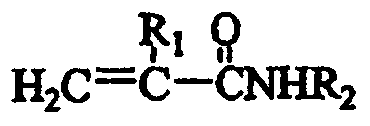
wherein R is1Is H or C1-C4Alkyl radical, R2Is H, C1-C4Alkyl, aryl or aralkyl. The acrylamide-based monomer may include acrylamide or methacrylamide, and may be, for example, acrylamide.
"alkyl" refers to a monovalent group derived from a straight or branched chain saturated hydrocarbon by the removal of a single hydrogen atom. Representative alkyl groups include methyl, ethyl, n-propyl, isopropyl, cetyl, and the like.
"alkylene" refers to a divalent group derived from a straight or branched chain saturated hydrocarbon by the removal of two hydrogen atoms. Representative alkylene groups include methylene, ethylene, and propylene, and the like.
"aryl" refers to an aromatic monocyclic or polycyclic ring system having about 6 to about 10 carbon atoms. The aryl group may optionally be substituted by one or more C1-C20Alkyl, alkoxy or haloalkyl. Representative aryl groups include phenyl or naphthyl, or substituted phenyl or substituted naphthyl.
"aralkyl" refers to an aryl-alkylene group, wherein aryl and alkylene are as defined herein. Representative aralkyl groups include benzyl, phenethyl, phenylpropyl, and 1-naphthylmethyl, and the like, e.g., benzyl.
Without limitation, the dialdehyde may be selected from glyoxal, malondialdehyde, succindialdehyde, and glutaraldehyde, and may be, for example, glyoxal.
Without limitation, the cationic monomer may be one or more selected from diallyldimethylammonium chloride, N- (3-dimethylaminopropyl) methacrylamide, N- (3-dimethylaminopropyl) acrylamide, methacryloyloxyethyltrimethylammonium chloride, acryloyloxyethyltrimethylammonium chloride, methacryloyloxyethyldimethylbenzylammonium chloride, acryloyloxyethyldimethylbenzylammonium chloride, (3-acrylamidopropyl) trimethylammonium chloride, methacrylamidopropyltrimethylammonium chloride, 3-acrylamido-3-methylbutyltrimethylammonium chloride, 2-vinylpyridine, 2- (dimethylamino) ethyl methacrylate, and 2- (dimethylamino) ethyl acrylate. For example, the cationic monomer may be diallyldimethylammonium chloride (DADMAC).
Without limitation, the anionic monomer may be one or more selected from acrylic acid, methacrylic acid, itaconic acid, maleic anhydride, and salts thereof. For example, the anionic monomer may be acrylic acid.
The total amount of the cationic monomer and/or the anionic monomer is not particularly limited as long as a stable polymer can be obtained. For example, the sum of the cationic and/or anionic monomers may be from 0.1 to 50 mol%, for example from 1 to 20 mol%, based on the application requirements.
The ratio of dialdehyde to acrylamide-based monomer (G/A ratio) in the dialdehyde-modified acrylamide polymer is not particularly limited and may be 0.01:1 to 1:1 (molar ratio), for example, 0.1:1 to 0.8:1 (molar ratio).
The ratio of the cationic monomer to the anionic monomer in the amphoteric dialdehyde-modified acrylamide polymer is not particularly limited, and for example, the ratio of the cationic monomer to the anionic monomer may be 1: 100-100: 1, for example, 1: 10-10: 1, in terms of molar ratio, depending on the application requirements, but is not limited thereto.
To achieve the effect of the present invention, the weight average molecular weight of the dialdehyde-modified acrylamide polymer is critical, and can be 100,000-2,000,000 daltons, such as 120,000-1,500,000 daltons, further such as 200,000-1,200,000 daltons, further such as 150,000-1,100,000 daltons, further such as 200,000-1,000,000 daltons. The weight average molecular weight of the dialdehyde-modified acrylamide polymer can also be 100,000-300,000 daltons, such as 150,000-300,000 daltons, and further such as 200,000-300,000 daltons.
Preferably, the acrylamide polymer has a weight average molecular weight of 500000-5000000 g/mol. Preferably, the weight average molecular weight of the dialdehyde-modified acrylamide polymer is 200000-2000000 g/mol.
The solid content of the dialdehyde-modified acrylamide polymer in the reinforcing agent solution is not particularly limited, and may be, in view of ease of preparation and handling, 0.1 to 50% by weight, for example, 1 to 20% by weight, and further for example, 5 to 15% by weight.
The dialdehyde-modified acrylamide polymer can be prepared according to known techniques, reference being made, for example, to patent US7641766B2 owned by Nalco Company, which is incorporated by reference in its entirety into the specification. In the process of preparing the dialdehyde-modified polyacrylamide reinforcing agent, a copolymer may be provided with a branched cross-linked structure by using a cross-linking monomer and/or a chain transfer agent. Commercially available dialdehyde-modified polyacrylamide-based reinforcing agents include Nalco 64280, Nalco 64170, Nalco 64180 and the like.
pH regulator
In the present invention, the pH regulator is known to those skilled in the art, and may be an organic or inorganic basic substance having a pH value ranging from 9 to 14, such as sodium hydroxide, potassium hydroxide or ammonia, an alkali metal carbonate, or the like.
Drawings
FIG. 1 shows schematically an on-line control and reaction apparatus for pH adjustment according to the process of the invention. According to fig. 1, a binary enhancer is first provided, which contains a dialdehyde-modified acrylamide polymer GPAM 1 and an acrylamide polymer PAM 2, the solids contents α and β of both being measured simultaneously and the respective intrinsic pH values, for example 3 to 4, being measured as parameters a and b, respectively. Here, GPAM 1 and PAM 2 are optionally diluted by introducing them separately through lines into a dilution unit 3 comprising a mixer, such as a static mixer, mixed with water, the dilution step being carried out as required, depending on the source of both the GPAM 1 and PAM 2 enhancers and their viscosities. Subsequently, after mixing the two enhancers, a reference pH 14 (e.g., pH 8) is set and compared to a target pH 2, i.e., a target reaction index of 6 (e.g., pH 9), and then a desired indication of the amount (or flow) of pH modifier is obtained by the pH control unit 5, such that an appropriate amount of pH modifier 7 (e.g., aqueous NaOH solution) is added to the mixture of GPAM 1 and PAM 2 and mixed in the mixer 8 for a sufficient time to obtain a final output product PM that ultimately meets the target pH. In this pH control unit, the parameter X, i.e. the flow of the final output product PM, is determined according to the production on site.
The pH control unit 5 can be implemented manually or automatically, preferably automatically. In one embodiment of the invention (as shown in fig. 7, which is only schematic and only depicts the structure necessary for understanding the invention), the pH control unit 5 is an automatic control device comprising at least an input port a for receiving and transmitting to an operation center C signals corresponding to the following parameters:
the proportion (r) of the first reinforcing agent in the mixed product in terms of solid content,
the solids content (alpha) of the first enhancer and the solids content (beta) of the second enhancer are provided,
the pH (a) of the first enhancer and the pH (b) of the second enhancer are provided,
the set reference pH value (1),
a target pH, i.e., a target response index (2), and
flow rate (X) of the final output product and
optionally the actual measured concentration of a pH adjusting agent (C)2);
The calculation center C transmits the pH adjuster flow value calculated according to the method described above, in particular, the above formula (1), to the output port B, which adjusts the pH adjuster flow corresponding to the calculated pH adjuster flow value through a pipe and a flow control device.
In the calculation center C (e.g., calculator), the above equation 1 and the parameter K concerning K1-K4 and optionally K5 are set and fixed in advance1、t、k2、k2’、aAverage、bAverage、k4、C1And optionally CNominal scaleAnd the like. The computing center C can transmit the calculated pH regulator flow value to the output port B, for example, by an electrical signal and control the latter to perform the pH regulator flow value adjustment.
The method and the on-line automatic control device for pH value adjustment according to the invention are used in particular in the paper-making field, in the water treatment field, in the mining industry and in the petroleum industry.
FIG. 2 is a diagram illustrating K1 calculation in the example.
Fig. 3 to 5 are schematic diagrams of K2 calculation in the example.
FIG. 6 is a diagram illustrating K4 calculation in the example.
Fig. 7 is a schematic diagram of an automatic control device for a pH adjusting unit.
List of reference numerals
1 dialdehyde-modified acrylamide polymer GPAM
2 acrylamide polymers PAM
3 dilution unit
4 setting the reference pH value
5 pH control unit
6 setting target pH value, target reaction index
7 pH regulator, NaOH aqueous solution
8 mixer
PM final output product
The arrows indicate the direction of flow of the material flow (FIG. 1) or the direction of data transmission (FIG. 7)
Examples
The invention is further illustrated by the following examples, which should not be construed as limiting the invention.
1. pH modifier flow calculation example
(1) Reagents used
TX15241 glyoxal-modified DADMAC/acrylamide copolymer (GPAM), available from Enoka, with a solids content of generally 9-12%; the pH is 2.36-3.46; viscosity of 16-28 cps at 25 deg.C
TX15951 acrylamide copolymer (PAM) from Yikang, with a typical solids content of 19.5-22%; the pH value is 2.5-3.49; and a viscosity of 4000-.
(2) Calculation of K1-K5
It will be apparent to those skilled in the art that the following examples are merely illustrative and may be fully automated through the programming of a computer or other ancillary device.
Calculation of K1
Setting the reference pH value 1 to 8, the amount of pH regulator required to increase from the initial pH of the product to the reference pH 8 at different proportions (r) of the different acrylamide polymers TX15951 in terms of solids content in the final output product was measured.
In the process, other parameters are fixed, the r value is changed, in the experimental process, TX15951 and TX15241 are prepared into 1kg of mixed products according to different proportions, the pH regulator TX16389 solution is adopted to titrate the compositions of TX15951 and TX15241 with different proportions one by one, and the consumption of TX16389 required to be consumed when the initial pH value is adjusted to the reference pH value of 8 is recorded in table 1. The corresponding curve was plotted according to the values in table 1, and the following figure 2 was obtained by linear fitting and the expression for K1 was obtained: k1 ═ (4.9754 × r + 3.5422).
TABLE 1 Effect of different r on TX16389 dose
| r | TX16389 dosage, ml |
| 0.33 | 5.2317 |
| 0.497 | 5.8678 |
| 0.53 | 6.2444 |
| 0.5515 | 6.3424 |
Calculation of K2
In this batch, TX15951 had a nominal ultimate low pH of 2.5 and an ultimate high pH of 3.49, an average pH of 3.38 measured from 80 samples, while TX15241 had a nominal ultimate low pH of 2.36 and an ultimate high pH of 3.46, an average pH of 2.91 measured from 80 samples. Then, TX15951 and TX15241 are formulated into a mixed product according to the ratio r of TX15951 in the mixed product being 0.5.
The amount of TX16389 consumed starting from the extreme low pH, the average pH and the extreme high pH of TX15241 and TX15951 respectively, by titration with TX16389 to different pH values was considered during the experiment and is reported in table 2 and table 3. From the data measured in tables 2 and 3, fig. 3, 4 and 5 were plotted, and the average value k of the slopes of the TX15241 and TX15951 linear curves was calculated2And k2’。
TABLE 2

TABLE 3

As shown in FIGS. 3-5, the relationship between the pH change and the amount of TX16389 used under the conditions of TX15951 extreme low pH, average pH and extreme high pH calculated by linear fitting is as follows, wherein Y is1,Y1’,Y1”And X1,X1’,X1”Respectively corresponding to ordinate and abscissa:
Y1=2.1391X1-12.032 (fig. 3)
Y1’=2.0506X1’-12.082 (fig. 4)
Y1”=2.1847X1”-14.064 (fig. 5)
Slope k2Has an average value of 2.1248.
The relationship between the pH value change and the TX16389 dosage under the conditions of TX15241 extreme low pH, average pH and extreme high pH is respectively obtained by linear fitting calculation, wherein Y is2,Y2’,Y2”And X2,X2’,X2”Respectively corresponding to ordinate and abscissa:
Y2=0.2492X2+0.213 (FIG. 3)
Y2’=0.4637X2’-2.2195 (fig. 4)
Y2”=0.4823X2”-2.719 (fig. 5)
Slope k2’Has an average value of 0.3984.
Meanwhile, the influence when the ratio r deviates from the reference 0.5 is taken into consideration, and multiplied by a coefficient (r/0.5), that is, 2 × r.
This gave K2 ═ 2 × r × 2.1248 × (a-3.38) +2 × (1-r) × (b-2.91).
Calculation of K3
After K2 is obtained by calculation as described above, the following formula can be easily obtained:
K3=(2×r×2.1248+2×(1-r)×0.3984)×(2-8)
calculation of K4
TX15951 and TX15241 were prepared in advance in different proportions according to the solid content ratios described in the left column of table 4, the mixed products were each adjusted to a reference pH of 8 using a pH adjuster TX16389, and the amount of consumed TX16389, i.e., the data shown in the right column of table 4, was recorded. Fig. 6 is plotted against all data in table 4.
In addition, the theoretical solids content α of TX15951 is obtained according to the formulationTheory of the inventionAt 20%, theoretical solids content β of TX15241Theory of the inventionThe content was 10%. Considering the deviation of the actual solid content of the product and the standard value, setting the standard value r of the proportion of TX15951 in the mixed product 01/2 according to r0*αTheory of the invention/((1-r0)*βTheory of the inventionTo obtain C1The value of (2). Combining with the slope 1.5408 obtained in FIG. 6, K4 is obtained:
K4=1.5408×(r×α/((1-r)×β)-2)。
TABLE 4
| TX 15951: |
TX16389 dosage, ml |
| 1.23 | 5.2317 |
| 1.13 | 5.8678 |
| 0.99 | 6.2444 |
| 0.55 | 6.3424 |
Calculation of K5
Since the nominal concentration of the pH adjuster TX16389 is 48%, the parameter K5, which is used to correct the amount of the pH adjuster TX16389, is obtained as 48%/C2。
From the substitution of K1-K5 into formula (1) as calculated above, it can be obtained that the amount of the pH adjustor has the following relationship (2):
the amount of the pH adjuster used was ═ X × ((4.9754 × r +3.5422) - (2 × 0r × 12.1248 × 2 (a-3.38) +2 × 3(1-r) × 60.3984 × (b-2.91) + (2 × r × 2.1248+2 × (1-r) × 0.3984) × (2-8) +1.5408 × (r × 4/((1-r) × 5) -2)) × (48%/C)2)
2. Application examples
In the automatic control apparatus including at least the input port a, the output port B, and the operation center C as shown in fig. 7, the relational expression (2) as described above is incorporated and fixed in the calculator of the operation center C.
Then, the binary enhancers TX15241 and TX15951 and TX16389 at a concentration of 48% were input to the pH-adjusted on-line control and reaction apparatus as shown in fig. 1, and the solid content (α, β), the pH (a, b), the ratio (r) of acrylamide polymer to the mixed product in terms of solid content, the flow rate (X) of the final output product, and the target pH (2) were measured in advance. Then after inputting these parameters into the input port A, the appropriate amount of the pH regulator is obtained through the calculation of the calculator of the calculation center C and the adjustment by controlling the valve of the output port B. The input parameters and the amount of the pH adjuster are shown in table 5 below.
TABLE 5 binary enhancer input parameters and pH modifier flow
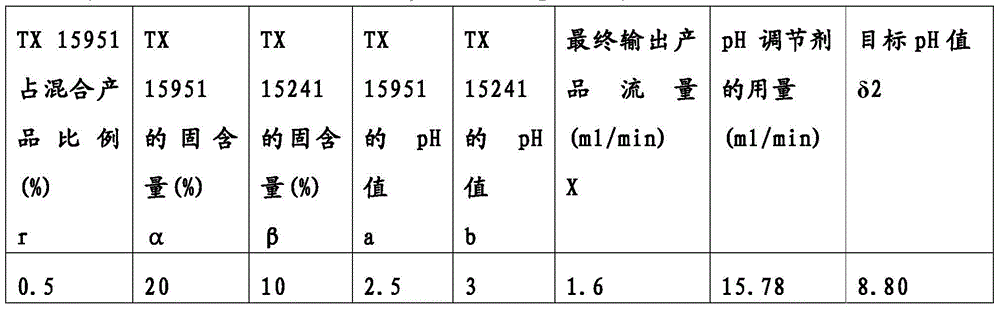
After such adjustment, the final output product solution was obtained with a target pH of 8.80, which was actually measured to be 8.85.
Claims (23)
1. An in-line control and reaction method for pH adjustment of a binary enhancer composition comprising a first enhancer selected from one of an acrylamide polymer enhancer and a dialdehyde-modified acrylamide polymer enhancer, and a second enhancer which is the other of the two;
the method comprises the following steps:
1) providing a first reinforcing agent, a second reinforcing agent and a pH regulator into a reaction system, wherein the pH regulator is an organic or inorganic alkaline substance with the pH value ranging from 9 to 14,
2) the first enhancer and the second enhancer are mixed,
3) a reference pH value of 1 is set and a target pH value, i.e., a target reaction index of 2,
4) adding a pH regulator into the mixture through a pH control unit and mixing to obtain a final output product, so that the final output product has a target pH value;
wherein the pH control unit measures or inputs the following parameters:
a. the proportion r of the first reinforcing agent to the mixed product on a solid content basis, the mixed product consisting of the first reinforcing agent and the second reinforcing agent,
b. the first enhancer is provided with a solid content alpha and the second enhancer with a solid content beta,
c. the pH value a of the first enhancer and the pH value b of the second enhancer are provided,
d. the reference pH value 1 and the target pH value 2 set in the step 3),
e. a flow rate X of a final output product consisting of a pH adjusting agent, a first enhancing agent and a second enhancing agent; and is
The pH control unit adjusts the flow rate of the pH regulator by obtaining at least the parameters K1, K2, K3 and K4 described below and at least according to the following formula (1):
flow rate of pH adjuster X (K1-K2+ K3+ K4) (1)
In the formula
X is the flow of the final output product, and the final output product consists of a first reinforcing agent, a second reinforcing agent and a pH regulator;
k1 represents the amount of the pH regulator at a ratio r of the first or second reinforcing agent to the mixed product, which is different in terms of solids content, when the initial pH is raised to the reference pH 1, and K1K1× r + t, where k1Is the slope value obtained by linear fitting, and t is the intercept;
k2 represents the amount of pH regulator consumed for different ratios r of first enhancer or second enhancer to the mixed product for different pH values a and b of the first enhancer and K2-2 × r × K2×ΔpH1+2×(1-r)×k2’×ΔpH2Wherein k is2And k2' is the average of the slopes obtained by linear fitting plotted against the amount of pH adjusting agent at increasing pH values in steps starting from the extreme low pH, the extreme high pH and the average pH of each of the two enhancers, and ΔpH1And deltapH2Denotes the pH of the first and second enhancers themselves, i.e. a or b, respectively, and the average pH of the enhancers, i.e. aAverageOr bAverageThe difference between the difference of the two phases,
wherein the extreme low pH and the extreme high pH are the nominal lowest and highest pH, respectively, of the enhancer sample, and the average pH aAverageOr bAverageIs the average pH value measured on n samples of two reinforcing agents respectively, wherein n is more than or equal to 50;
k3 shows the effect of the difference between the target response index 2 set on the basis of K2 and the reference pH 1 on the amount of pH adjuster used, and K3 ═ 2 × r × K2+2×(1-r)×k2’)×(2-1);
K4 represents the effect of different solids contents α and β on the amount of pH regulator used in the case of a reference pH value of 1, and K4 ═ K4×(r×α/(1-r)×β)-C1) Wherein k is4The slope of a linearly fitted curve, C, is obtained by plotting different ratios of the first enhancer and the second enhancer in terms of solid content against the amount of the pH adjustor consumed for each self-adjustment to the reference pH value of 11Then α is the theoretical solids content of the first enhancerTheory of the inventionTheoretical solids content with second enhancer βTheory of the inventionLower meridian r0*αTheory of the invention/((1-r0)*βTheory of the invention) Calculated value of where r0The standard value for the ratio of the first enhancer to the blended product was set at 1/2.
2. The method according to claim 1, characterized in that the first and second enhancing agents are mixed after having been diluted with water, respectively.
3. The process according to claim 1, wherein n.gtoreq.70.
4. The process of claim 1, wherein the acrylamide polymer enhancer has a solids content α or β of 5 to 100%.
5. The process of claim 1, wherein the acrylamide polymer enhancer has a solids content α or β of 10 to 30%.
6. The process as claimed in claim 1, wherein the solids content α or β of the dialdehyde-modified acrylamide polymer reinforcer is from 5 to 100%.
7. The process as claimed in claim 1, wherein the solids content α or β of the dialdehyde-modified acrylamide polymer reinforcer is from 6 to 20%.
8. The method of any one of claims 1 to 7, wherein the acrylamide polymer enhancer has a pH a or b of 2 to 8.
9. The method of any one of claims 1 to 7, wherein the acrylamide polymer enhancer has a pH a or b of 3 to 5.
10. The method according to any one of claims 1 to 7, characterized in that the dialdehyde-modified acrylamide polymer enhancer has a pH value a or b of 2 to 7.
11. The method according to any one of claims 1 to 7, characterized in that the dialdehyde-modified acrylamide polymer enhancer has a pH value a or b of 2-4.
12. The method of any one of claims 1 to 7, wherein 2 is from 7.5 to 11.
13. The method of any one of claims 1 to 7, wherein 2 is 8.5-9.5.
14. The method of any one of claims 1 to 7, wherein the first reinforcing agent is an acrylamide polymer reinforcing agent.
15. The method as claimed in any one of claims 1 to 7, wherein the acrylamide polymer reinforcing agent has a weight average molecular weight of 500000-5000000 g/mol.
16. The process as claimed in any one of claims 1 to 7, wherein the weight average molecular weight of the dialdehyde-modified acrylamide polymer reinforcing agent is 200000-2000000 g/mol.
17. The method according to any one of claims 1 to 7, wherein the parameter K5 is further set to correct for the actual concentration of the pH adjusting agent,
K5=Cnominal scale/C2,
Wherein C isNominal scaleIs the nominal concentration and C of the product2Is the actual measured concentration.
18. The method of claim 17, wherein the pH adjusting agent has a flow rate of X (K1-K2+ K3+ K4) X K5.
19. The method according to claim 1, wherein the pH adjusting agent is sodium hydroxide, potassium hydroxide or ammonia, and a carbonate of an alkali metal.
20. An automatic control device for pH adjustment comprising at least an input port a, an output port B and an operation center C, wherein the input port a is adapted to receive signals corresponding to the following parameters and to transmit them to the operation center C:
the proportion r of the first reinforcing agent to the mixed product in terms of solid content,
the first enhancer is provided with a solid content alpha and the second enhancer with a solid content beta,
the pH value a of the first enhancer and the pH value b of the second enhancer are provided,
the set reference pH value is 1, and the pH value is,
a target pH value, i.e. a target response index of 2, and
the flow X of the final output product;
the calculation center C transmits the pH adjuster flow value calculated according to the method of any one of claims 1 to 19 to the output port B, which adjusts the pH adjuster flow corresponding to the calculated pH adjuster flow value by a pipeline and a flow control device.
21. The automatic control device according to claim 20, wherein input port a is further to receive an actual measured concentration C corresponding to the pH adjuster2And transmits it to the operation center C.
22. Use of the method according to any one of claims 1 to 19 in the paper industry, water treatment industry, mining industry and petroleum industry.
23. Use of an automatic control device according to claim 20 in the paper industry, water treatment industry, mining industry and petroleum industry.
Priority Applications (4)
| Application Number | Priority Date | Filing Date | Title |
|---|---|---|---|
| CN201410784829.5A CN105786052B (en) | 2014-12-16 | 2014-12-16 | Online control and reaction method for pH adjustment |
| EP15870712.5A EP3234725B9 (en) | 2014-12-16 | 2015-12-09 | An on-line control and reaction process for ph adjustment |
| US15/537,018 US10316469B2 (en) | 2014-12-16 | 2015-12-09 | On-line control and reaction process for pH adjustment |
| PCT/US2015/064600 WO2016100020A1 (en) | 2014-12-16 | 2015-12-09 | An on-line control and reaction process for ph adjustment |
Applications Claiming Priority (1)
| Application Number | Priority Date | Filing Date | Title |
|---|---|---|---|
| CN201410784829.5A CN105786052B (en) | 2014-12-16 | 2014-12-16 | Online control and reaction method for pH adjustment |
Publications (2)
| Publication Number | Publication Date |
|---|---|
| CN105786052A CN105786052A (en) | 2016-07-20 |
| CN105786052B true CN105786052B (en) | 2020-09-08 |
Family
ID=56127369
Family Applications (1)
| Application Number | Title | Priority Date | Filing Date |
|---|---|---|---|
| CN201410784829.5A Active CN105786052B (en) | 2014-12-16 | 2014-12-16 | Online control and reaction method for pH adjustment |
Country Status (4)
| Country | Link |
|---|---|
| US (1) | US10316469B2 (en) |
| EP (1) | EP3234725B9 (en) |
| CN (1) | CN105786052B (en) |
| WO (1) | WO2016100020A1 (en) |
Families Citing this family (2)
| Publication number | Priority date | Publication date | Assignee | Title |
|---|---|---|---|---|
| CN107447582B (en) | 2016-06-01 | 2022-04-12 | 艺康美国股份有限公司 | Efficient strength scheme for papermaking in high charge demand systems |
| WO2021186109A1 (en) * | 2020-03-18 | 2021-09-23 | Kemira Oyj | Method for on-site glyoxylation of polyacrylamide |
Citations (4)
| Publication number | Priority date | Publication date | Assignee | Title |
|---|---|---|---|---|
| US5505819A (en) * | 1994-03-31 | 1996-04-09 | Macmillan Bloedel Limited | Neutral papermaking |
| CN1942630A (en) * | 2004-04-14 | 2007-04-04 | M-真实公司 | Paper manufacturing process |
| CN102627730A (en) * | 2012-03-29 | 2012-08-08 | 上海东升新材料有限公司 | Amphoteric dry strength agent and preparation method thereof |
| CN102776802A (en) * | 2011-05-10 | 2012-11-14 | 永港伟方(北京)科技股份有限公司 | Reinforcing agent for papermaking and preparation method thereof |
Family Cites Families (93)
| Publication number | Priority date | Publication date | Assignee | Title |
|---|---|---|---|---|
| US4181567A (en) * | 1975-07-17 | 1980-01-01 | Martin Clark Riddell | Paper manufacture employing filler and acrylamide polymer conglomerates |
| JPS6018768B2 (en) | 1978-11-08 | 1985-05-13 | 基礎地盤コンサルタンツ株式会社 | Method and device for measuring frozen ground information in original ground |
| JPS58150619A (en) | 1982-03-03 | 1983-09-07 | Takenaka Komuten Co Ltd | Solidifying treatment work on slime in on-site concrete pile |
| JPS58210211A (en) | 1982-05-31 | 1983-12-07 | Hasegawa Komuten Co Ltd | Treatment of extra-banking concrete in head of on-site concrete pile |
| JPS5988511A (en) | 1982-11-12 | 1984-05-22 | Takenaka Komuten Co Ltd | On-site placement work of breakwater |
| JPS59161515A (en) | 1983-03-04 | 1984-09-12 | Fujita Corp | Construction of hollow on-site concrete pile |
| JPS59173420A (en) | 1983-03-19 | 1984-10-01 | Tobishima Kensetsu Kk | On-site driving reinforced concrete pile and its construction |
| JPS59206518A (en) | 1983-05-11 | 1984-11-22 | Japanese National Railways<Jnr> | Strengthening method of on-site concrete pile |
| JPS60190329A (en) | 1984-03-10 | 1985-09-27 | Kubota Ltd | Manufacture of pipe on construction site |
| JPS61261241A (en) | 1985-05-16 | 1986-11-19 | Asahi Glass Co Ltd | Method for strengthening solder adhesion to conductive materials on glass surfaces |
| JPS6387396A (en) | 1986-09-29 | 1988-04-18 | Maki Bunka Kenkyusho:Kk | Floating structure on the sea and manufacture thereof |
| JPH0676956B2 (en) | 1986-10-07 | 1994-09-28 | 小野田セメント株式会社 | In-situ measurement method for strength and fracture toughness of concrete structural members |
| IT1203342B (en) | 1987-02-23 | 1989-02-15 | A W A X Srl | PROCEDURE AND APPARATUS FOR AUTOMATIC PACKAGING OF DIFFERENT ITEMS IN CUSTOM-MADE PLASTIC BAGS MANUFACTURED ON SITE IN A SUPERMARKET BOX |
| US4940739A (en) | 1988-01-07 | 1990-07-10 | The Standard Register Company | Process for making a high solids CB printing ink |
| GB2219132A (en) | 1988-05-27 | 1989-11-29 | Philips Electronic Associated | Manufacture of electronic devices comprising cadmium mercury telluride |
| JPH02276927A (en) | 1988-08-30 | 1990-11-13 | Shimadzu Corp | Integrated spectrometer and online spectrometer measurement device |
| US5252361A (en) | 1990-01-19 | 1993-10-12 | The Carborundum Company | Protective coating for non-oxide sintered fibers generated by in situ chemical reaction |
| JP2518113B2 (en) | 1991-05-28 | 1996-07-24 | 豊田合成株式会社 | Manufacturing method of molded product with clip |
| US5124368A (en) | 1991-07-29 | 1992-06-23 | Arco Chemical Technology, L.P. | Pour-in-place flexible polyurethane foam articles |
| US5422723A (en) | 1992-09-21 | 1995-06-06 | Texas Instruments Incorporated | Diffraction gratings for submicron linewidth measurement |
| US5362573A (en) | 1993-01-28 | 1994-11-08 | Pandian Vernon E | Use of zirconium salts to improve the surface sizing efficiency in paper making |
| JP2894917B2 (en) | 1993-04-15 | 1999-05-24 | 日本電気株式会社 | Semiconductor manufacturing method on fluorine compound |
| JPH07100877A (en) | 1993-10-01 | 1995-04-18 | Tohoku Munekata Kk | Method and apparatus for manufacturing injection-molded plastic products that do not cause sink marks on the visible surface |
| DE4403682C2 (en) * | 1994-02-07 | 1997-05-22 | Abb Patent Gmbh | Procedure for adjusting the pH value of the drinking water in a drinking water treatment plant |
| JP2968170B2 (en) | 1994-06-07 | 1999-10-25 | 株式会社トクヤマ | Sheet-shaped plastering finishing material, its manufacturing method and its on-site construction method |
| JP2002515179A (en) | 1995-06-05 | 2002-05-21 | スターテック・ベンチャーズ・インコーポレーテッド | On-site ammonia purification for semiconductor process |
| KR19990022226A (en) | 1995-06-05 | 1999-03-25 | 제프리 엘. 웬트 | Ultra-pure buffered HF on-site generation system for semiconductor process |
| WO1996039264A1 (en) | 1995-06-05 | 1996-12-12 | Startec Ventures, Inc. | On-site manufacture of ultra-high-purity hydrochloric acid for semiconductor processing |
| JPH11506411A (en) | 1995-06-05 | 1999-06-08 | スターテック・ベンチャーズ・インコーポレーテッド | On-site ammonia purification for electronic component manufacturing. |
| JPH0953126A (en) | 1995-08-16 | 1997-02-25 | Toshiba Corp | Heat treatment furnace for on-site welded structure and method for manufacturing runner of hydraulic machine using the same |
| JPH09245944A (en) | 1996-03-01 | 1997-09-19 | Shinwa Sokutei Kk | Sheet heating element attached to a member to be heated and method of manufacturing the same |
| JP2864457B2 (en) | 1996-03-05 | 1999-03-03 | 小沢コンクリート工業株式会社 | On-site construction method of permeable concrete |
| JPH09248455A (en) | 1996-03-15 | 1997-09-22 | Toyo Tire & Rubber Co Ltd | Polyurethane oil adsorbent for in-situ foaming and method for producing the same |
| JPH09309758A (en) | 1996-05-21 | 1997-12-02 | Onoda Kemiko Kk | Highly fluid and ultra-quick setting concrete material and on-site production of the same |
| JPH102020A (en) | 1996-06-12 | 1998-01-06 | Alpha Techno Co Ltd | How to fix anchor bolt |
| WO1998006898A1 (en) * | 1996-08-15 | 1998-02-19 | Hercules Incorporated | Amphoteric polyacrylamides as dry strength additives for paper |
| FR2753463B1 (en) | 1996-09-13 | 1998-11-13 | Screg | CIRCULABLE BINDER LAYERS AND THEIR PREPARATION METHOD |
| JPH10141878A (en) | 1996-11-11 | 1998-05-29 | Kitashiba Electric Co Ltd | Heat pipe on-site manufacturing method |
| JP3738101B2 (en) | 1996-11-28 | 2006-01-25 | シバタ工業株式会社 | Water bottom laying sheet |
| JPH10237895A (en) | 1997-02-27 | 1998-09-08 | Nitto Seiko Co Ltd | In-vehicle excavated soil backfill equipment |
| US6395338B1 (en) | 1999-03-19 | 2002-05-28 | Rhodia Chimie | Process and device for coating a support using a crosslinkable silicone composition |
| US6805912B2 (en) | 1997-03-21 | 2004-10-19 | Jean-Paul Benayoun | Process and device for coating a support using a crosslinkable silicone composition |
| JP3606002B2 (en) | 1997-06-13 | 2005-01-05 | 株式会社明電舎 | Manufacturing, disassembling transportation and on-site assembly method for dismantling and transporting transformers |
| US6294645B1 (en) * | 1997-07-25 | 2001-09-25 | Hercules Incorporated | Dry-strength system |
| JPH11117221A (en) | 1997-10-09 | 1999-04-27 | Katsumi Fukuoka | On-site reproducing/repairing method for paved surface |
| JPH11115990A (en) | 1997-10-17 | 1999-04-27 | Hitachi Chem Co Ltd | Cylindrical body for on-site waste water purifying tank and on-site waste water purifying tank |
| AU5489999A (en) | 1998-08-19 | 2000-03-14 | Hercules Incorporated | Dialdehyde-modified anionic and amphoteric polyacrylamides for improving strength of paper |
| JP3044028B1 (en) | 1999-01-07 | 2000-05-22 | 東洋エクステリア株式会社 | Method for producing building material having brick on substrate surface and block with surface brick |
| JP2000252287A (en) | 1999-03-02 | 2000-09-14 | Hitoshi Soyama | Semiconductor water having cavitation guttering site on the rear, manufacture thereof, and gettering method therewith |
| JP4217337B2 (en) | 1999-03-19 | 2009-01-28 | Tdk株式会社 | Manufacturing method of semiconductor porcelain |
| JP2000264726A (en) | 1999-03-19 | 2000-09-26 | Tdk Corp | Semiconductor porcelain |
| JP4883433B2 (en) | 1999-05-16 | 2012-02-22 | 株式会社ワイエス・メディカル | Balloon catheter, method for manufacturing the same, and method for attaching balloon to catheter tube |
| WO2001037193A1 (en) | 1999-11-12 | 2001-05-25 | Net Perceptions, Inc. | System, method, and article of manufacture for recommending items to users based on user preferences |
| JP3721914B2 (en) | 2000-01-17 | 2005-11-30 | 住友金属工業株式会社 | Steel pipe with excellent weldability |
| JP2001261903A (en) | 2000-03-14 | 2001-09-26 | Mitsubishi Chemicals Corp | Adhesive resin composition and laminate based on modified ethylene / 1-octene copolymer |
| WO2001073543A2 (en) | 2000-03-30 | 2001-10-04 | Si Automation | Method and system for fast on site deployment of computer equipment in a network computer environment |
| JP2001350807A (en) | 2000-06-07 | 2001-12-21 | Mitani Sangyo Co Ltd | Manufacturing and delivery method and system for building members based on CAD data |
| JP3603957B2 (en) | 2001-09-06 | 2004-12-22 | 株式会社沖創建設 | On-site manufacturing method for PC members |
| GB0130853D0 (en) | 2001-12-22 | 2002-02-06 | Bae Systems Plc | Method of forming a bond on or in an aircraft component |
| JP4317965B2 (en) | 2002-04-27 | 2009-08-19 | 株式会社酒井鉄工所 | A method for evaluating the residual strength of a circular steel pipe member with a defect in its cross section. |
| US7079916B2 (en) | 2002-06-21 | 2006-07-18 | Ultrashield, Llc. | On demand mobile manufacture of vehicle protection application kits |
| EP1519669A1 (en) | 2002-07-01 | 2005-04-06 | Ben E. Boatwright | Stitchless on-site binding method and manufacture |
| KR100436667B1 (en) | 2003-02-20 | 2004-06-22 | 브이알 포토 주식회사 | The method and equipment of ASP service for multi-resolution image on the environment of multi-server. |
| US7392420B2 (en) | 2003-09-29 | 2008-06-24 | International Business Machines Corporation | Automated error recovery of a licensed internal code update on a storage controller |
| CA2545367A1 (en) | 2003-11-21 | 2005-06-09 | Bercen Incorporated | Paper making process and starch compositions comprising a crosslinking agent for use in same |
| CA2545476A1 (en) | 2004-01-09 | 2005-08-04 | Bercen Incorporated | Paper making process and crosslinking compositions for use in same |
| US7641766B2 (en) | 2004-01-26 | 2010-01-05 | Nalco Company | Method of using aldehyde-functionalized polymers to enhance paper machine dewatering |
| US7488403B2 (en) * | 2004-08-17 | 2009-02-10 | Cornel Hagiopol | Blends of glyoxalated polyacrylamides and paper strengthening agents |
| CN101048548A (en) | 2004-07-08 | 2007-10-03 | 朗盛公司 | High-performance strength resins in papermaking industries |
| KR100614806B1 (en) | 2004-10-27 | 2006-08-22 | 삼성전자주식회사 | High breakdown voltage transistor and manufacturing method thereof |
| US7627816B2 (en) | 2005-04-12 | 2009-12-01 | International Business Machines Corporation | Method for providing a transient dictionary that travels with an original electronic document |
| KR100738093B1 (en) | 2006-01-05 | 2007-07-12 | 삼성전자주식회사 | JH control device and JH control method using the same |
| JP4765681B2 (en) | 2006-03-07 | 2011-09-07 | 株式会社Ihi | Field production method of tank end plate, tank end plate assembly used for the method, and temporary mount for end plate assembly |
| US7509299B2 (en) | 2006-03-13 | 2009-03-24 | Microsoft Corporation | Calculating web page importance based on a conditional Markov random walk |
| WO2007130851A2 (en) | 2006-04-29 | 2007-11-15 | Electrolytic Technologies Corporation | Process for the on-site production of chlorine and high strength hypochlorite |
| KR20090051734A (en) | 2006-07-21 | 2009-05-22 | 베르센 인코퍼레이티드 | Papermaking process using cationic polyacrylamide and crosslinking composition for use therein |
| JP2008121327A (en) | 2006-11-14 | 2008-05-29 | Shinwa Wood Works Ltd | On-site manufacture type furniture which is stored on wall surface and manufacturing method therefor |
| KR100829988B1 (en) | 2007-05-31 | 2008-05-16 | 김상양 | Epoxy resin mortar composition and concrete surface construction method using the same |
| US7673492B2 (en) | 2008-07-30 | 2010-03-09 | Curtis Robert Hough | Tool to aide in the bending of rebar (reinforced steel bars) on construction site |
| US20100241864A1 (en) | 2008-11-21 | 2010-09-23 | Dafca, Inc. | Authenticating an integrated circuit based on stored information |
| DE202009001625U1 (en) | 2009-02-09 | 2009-07-16 | Rennsteig Werkzeuge Gmbh | Separating device for shearing of strung on a supply tape workpieces |
| JP5199166B2 (en) | 2009-03-31 | 2013-05-15 | 三谷セキサン株式会社 | Foundation pile structure by site construction and construction method of foundation pile |
| JP5609404B2 (en) | 2009-08-17 | 2014-10-22 | 新日鐵住金株式会社 | Manufacturing method of spiral steel pipe with internal protrusion |
| US20120222771A1 (en) | 2011-03-04 | 2012-09-06 | Pipestream B.V. | On-site manufacturing of composite pipeline |
| DE102011079894A1 (en) | 2011-07-27 | 2013-01-31 | Voith Patent Gmbh | Press cover for a shoe press or conveyor belt based on cross-linked polyurethane formed from MDI polycarbonate prepolymer |
| FI20116326L (en) * | 2011-12-28 | 2013-06-29 | Nordkalk Oy Ab | Use of precipitated carbonate in the manufacture of a fiber product |
| JP5927927B2 (en) | 2012-01-18 | 2016-06-01 | 新日鐵住金株式会社 | High-strength hot-rolled steel sheet for line pipes with excellent on-site weldability and manufacturing method thereof |
| JP5741483B2 (en) | 2012-02-27 | 2015-07-01 | 新日鐵住金株式会社 | High-strength hot-rolled steel sheet for line pipes with excellent on-site weldability and manufacturing method thereof |
| US10198486B2 (en) | 2012-06-30 | 2019-02-05 | Ebay Inc. | Recommendation filtering based on common interests |
| US20140051614A1 (en) | 2012-08-20 | 2014-02-20 | Universal Sanitizers and Supplies, Inc. | On-site dry silicone lubricant production |
| CN104348924A (en) | 2013-07-30 | 2015-02-11 | 深圳市腾讯计算机系统有限公司 | Method, system and device for domain name resolution |
| CN104452463B (en) | 2013-09-12 | 2017-01-04 | 艺康美国股份有限公司 | Papermaking process and compositions |
| CN104452455B (en) | 2013-09-12 | 2019-04-05 | 艺康美国股份有限公司 | The method that paper making auxiliary agent composition and increase are stayed at paper ash code insurance |
-
2014
- 2014-12-16 CN CN201410784829.5A patent/CN105786052B/en active Active
-
2015
- 2015-12-09 US US15/537,018 patent/US10316469B2/en active Active
- 2015-12-09 WO PCT/US2015/064600 patent/WO2016100020A1/en not_active Ceased
- 2015-12-09 EP EP15870712.5A patent/EP3234725B9/en active Active
Patent Citations (4)
| Publication number | Priority date | Publication date | Assignee | Title |
|---|---|---|---|---|
| US5505819A (en) * | 1994-03-31 | 1996-04-09 | Macmillan Bloedel Limited | Neutral papermaking |
| CN1942630A (en) * | 2004-04-14 | 2007-04-04 | M-真实公司 | Paper manufacturing process |
| CN102776802A (en) * | 2011-05-10 | 2012-11-14 | 永港伟方(北京)科技股份有限公司 | Reinforcing agent for papermaking and preparation method thereof |
| CN102627730A (en) * | 2012-03-29 | 2012-08-08 | 上海东升新材料有限公司 | Amphoteric dry strength agent and preparation method thereof |
Also Published As
| Publication number | Publication date |
|---|---|
| EP3234725A1 (en) | 2017-10-25 |
| US10316469B2 (en) | 2019-06-11 |
| US20170342663A1 (en) | 2017-11-30 |
| EP3234725B9 (en) | 2020-07-15 |
| EP3234725B1 (en) | 2020-02-12 |
| CN105786052A (en) | 2016-07-20 |
| WO2016100020A1 (en) | 2016-06-23 |
| EP3234725A4 (en) | 2018-05-23 |
Similar Documents
| Publication | Publication Date | Title |
|---|---|---|
| USRE45383E1 (en) | Method of using aldehyde-functionalized polymers to enhance paper machine dewatering | |
| US5942573A (en) | Acrylamide polymers and use thereof | |
| JP2011525572A (en) | Paper manufacturing | |
| KR20120096930A (en) | Aldehyde-functionalized polymers with enhanced stability | |
| KR20140100979A (en) | Preparation of polyvinylamide cellulose reactive adducts | |
| CN107109799A (en) | Paper making auxiliary agent composition and the method for improving paper tensile strength | |
| KR20160055239A (en) | Process and compositions for paper-making | |
| CN105786052B (en) | Online control and reaction method for pH adjustment | |
| CN104032621A (en) | Paper Strengthening Agent, Manufacturing Method For The Same, And Paper | |
| CN107366182A (en) | High grey separation paper power reinforcing agent, the manufacture method of high grey separation and high grey separation | |
| TW202340576A (en) | Additive compositions for papermaking | |
| CN102050915A (en) | Method for preparing polymer for improving paper strength | |
| CN103772603B (en) | The preparation method of high molecular narrow ditribution crosslinked polyacrylamide and application thereof | |
| CN111041889B (en) | Glue solution for paper surface treatment, paper treatment method, obtained paper and application thereof | |
| TWI883292B (en) | Paper Strengthening Agent and Paper | |
| KR20240060645A (en) | Method for in situ glyoxylation of polyacrylamide | |
| TWI702238B (en) | Paper manufacturing method, paper manufacturing additive manufacturing device, and paper manufacturing device | |
| TWI884526B (en) | Paper Strengthener, Paper | |
| EP3169427B1 (en) | Super-activation of emulsion polymers | |
| JP2019015018A (en) | Paper manufacturing method, paper manufacturing additive manufacturing apparatus, and paper manufacturing apparatus | |
| CN115279969B (en) | Polyacrylamide composition and use thereof | |
| TW202523936A (en) | Surface paper strength enhancer, coating liquid and paper manufacturing method | |
| CN108425273B (en) | Emulsifying method of sizing agent | |
| CN100543047C (en) | Preparation method of polydialkyl diallyl ammonium halide | |
| JP2007126770A (en) | Paper manufacturing method |
Legal Events
| Date | Code | Title | Description |
|---|---|---|---|
| C06 | Publication | ||
| PB01 | Publication | ||
| SE01 | Entry into force of request for substantive examination | ||
| SE01 | Entry into force of request for substantive examination | ||
| GR01 | Patent grant | ||
| GR01 | Patent grant |