CN104628921B - Low density polyolefin resins having low and high molecular weight components and films made therefrom - Google Patents
Low density polyolefin resins having low and high molecular weight components and films made therefrom Download PDFInfo
- Publication number
- CN104628921B CN104628921B CN201410616085.6A CN201410616085A CN104628921B CN 104628921 B CN104628921 B CN 104628921B CN 201410616085 A CN201410616085 A CN 201410616085A CN 104628921 B CN104628921 B CN 104628921B
- Authority
- CN
- China
- Prior art keywords
- polymer
- group
- molecular weight
- alternatively
- range
- Prior art date
- Legal status (The legal status is an assumption and is not a legal conclusion. Google has not performed a legal analysis and makes no representation as to the accuracy of the status listed.)
- Active
Links
- 229920005672 polyolefin resin Polymers 0.000 title description 2
- 229920000642 polymer Polymers 0.000 claims abstract description 140
- VGGSQFUCUMXWEO-UHFFFAOYSA-N Ethene Chemical compound C=C VGGSQFUCUMXWEO-UHFFFAOYSA-N 0.000 claims abstract description 54
- 239000005977 Ethylene Substances 0.000 claims abstract description 54
- 238000009826 distribution Methods 0.000 claims abstract description 36
- 125000004432 carbon atom Chemical group C* 0.000 claims description 61
- LIKMAJRDDDTEIG-UHFFFAOYSA-N n-hexene Natural products CCCCC=C LIKMAJRDDDTEIG-UHFFFAOYSA-N 0.000 claims description 40
- 229920001577 copolymer Polymers 0.000 claims description 33
- 229920000573 polyethylene Polymers 0.000 claims description 26
- VXNZUUAINFGPBY-UHFFFAOYSA-N ethyl ethylene Natural products CCC=C VXNZUUAINFGPBY-UHFFFAOYSA-N 0.000 claims description 18
- 239000000155 melt Substances 0.000 claims description 9
- 230000009977 dual effect Effects 0.000 abstract description 5
- 239000012968 metallocene catalyst Substances 0.000 abstract description 4
- 239000003054 catalyst Substances 0.000 description 239
- 150000001875 compounds Chemical class 0.000 description 174
- 239000000203 mixture Substances 0.000 description 173
- -1 tetrahydroindenyl Chemical group 0.000 description 134
- 238000006116 polymerization reaction Methods 0.000 description 130
- 229920000098 polyolefin Polymers 0.000 description 105
- PNEYBMLMFCGWSK-UHFFFAOYSA-N aluminium oxide Inorganic materials [O-2].[O-2].[O-2].[Al+3].[Al+3] PNEYBMLMFCGWSK-UHFFFAOYSA-N 0.000 description 101
- 150000001336 alkenes Chemical class 0.000 description 89
- 239000010408 film Substances 0.000 description 79
- VYPSYNLAJGMNEJ-UHFFFAOYSA-N silicon dioxide Inorganic materials O=[Si]=O VYPSYNLAJGMNEJ-UHFFFAOYSA-N 0.000 description 75
- JRZJOMJEPLMPRA-UHFFFAOYSA-N olefin Natural products CCCCCCCC=C JRZJOMJEPLMPRA-UHFFFAOYSA-N 0.000 description 74
- 238000000034 method Methods 0.000 description 71
- 125000001424 substituent group Chemical group 0.000 description 69
- NFHFRUOZVGFOOS-UHFFFAOYSA-N palladium;triphenylphosphane Chemical compound [Pd].C1=CC=CC=C1P(C=1C=CC=CC=1)C1=CC=CC=C1.C1=CC=CC=C1P(C=1C=CC=CC=1)C1=CC=CC=C1.C1=CC=CC=C1P(C=1C=CC=CC=1)C1=CC=CC=C1.C1=CC=CC=C1P(C=1C=CC=CC=1)C1=CC=CC=C1 NFHFRUOZVGFOOS-UHFFFAOYSA-N 0.000 description 62
- 150000003254 radicals Chemical class 0.000 description 61
- 239000000178 monomer Substances 0.000 description 56
- 125000001183 hydrocarbyl group Chemical group 0.000 description 55
- 239000012190 activator Substances 0.000 description 53
- 125000001997 phenyl group Chemical group [H]C1=C([H])C([H])=C(*)C([H])=C1[H] 0.000 description 51
- 101000623895 Bos taurus Mucin-15 Proteins 0.000 description 46
- 239000007787 solid Substances 0.000 description 45
- 125000000058 cyclopentadienyl group Chemical group C1(=CC=CC1)* 0.000 description 37
- 125000003454 indenyl group Chemical group C1(C=CC2=CC=CC=C12)* 0.000 description 36
- MCMNRKCIXSYSNV-UHFFFAOYSA-N ZrO2 Inorganic materials O=[Zr]=O MCMNRKCIXSYSNV-UHFFFAOYSA-N 0.000 description 33
- 239000000377 silicon dioxide Substances 0.000 description 33
- 239000003426 co-catalyst Substances 0.000 description 32
- 229910052739 hydrogen Inorganic materials 0.000 description 29
- NNPPMTNAJDCUHE-UHFFFAOYSA-N isobutane Chemical compound CC(C)C NNPPMTNAJDCUHE-UHFFFAOYSA-N 0.000 description 28
- 125000002496 methyl group Chemical group [H]C([H])([H])* 0.000 description 28
- 229910052799 carbon Inorganic materials 0.000 description 27
- 239000001257 hydrogen Substances 0.000 description 26
- 229910052726 zirconium Inorganic materials 0.000 description 26
- UFHFLCQGNIYNRP-UHFFFAOYSA-N Hydrogen Chemical compound [H][H] UFHFLCQGNIYNRP-UHFFFAOYSA-N 0.000 description 25
- 150000001450 anions Chemical class 0.000 description 23
- 229910052744 lithium Inorganic materials 0.000 description 22
- WHXSMMKQMYFTQS-UHFFFAOYSA-N Lithium Chemical compound [Li] WHXSMMKQMYFTQS-UHFFFAOYSA-N 0.000 description 21
- 150000004645 aluminates Chemical class 0.000 description 21
- 125000001797 benzyl group Chemical group [H]C1=C([H])C([H])=C(C([H])=C1[H])C([H])([H])* 0.000 description 21
- 125000005843 halogen group Chemical group 0.000 description 21
- 150000008040 ionic compounds Chemical class 0.000 description 21
- 125000000217 alkyl group Chemical group 0.000 description 20
- 230000008569 process Effects 0.000 description 20
- QCWXUUIWCKQGHC-UHFFFAOYSA-N Zirconium Chemical compound [Zr] QCWXUUIWCKQGHC-UHFFFAOYSA-N 0.000 description 19
- 239000000463 material Substances 0.000 description 19
- 125000001495 ethyl group Chemical group [H]C([H])([H])C([H])([H])* 0.000 description 18
- 239000003446 ligand Substances 0.000 description 18
- 239000000047 product Substances 0.000 description 18
- GWEVSGVZZGPLCZ-UHFFFAOYSA-N titanium dioxide Inorganic materials O=[Ti]=O GWEVSGVZZGPLCZ-UHFFFAOYSA-N 0.000 description 17
- KWKAKUADMBZCLK-UHFFFAOYSA-N 1-octene Chemical compound CCCCCCC=C KWKAKUADMBZCLK-UHFFFAOYSA-N 0.000 description 16
- 125000003342 alkenyl group Chemical group 0.000 description 16
- 239000003085 diluting agent Substances 0.000 description 16
- 229910052751 metal Inorganic materials 0.000 description 16
- 239000002184 metal Substances 0.000 description 16
- 125000001624 naphthyl group Chemical group 0.000 description 16
- 125000001436 propyl group Chemical group [H]C([*])([H])C([H])([H])C([H])([H])[H] 0.000 description 16
- DGAQECJNVWCQMB-PUAWFVPOSA-M Ilexoside XXIX Chemical compound C[C@@H]1CC[C@@]2(CC[C@@]3(C(=CC[C@H]4[C@]3(CC[C@@H]5[C@@]4(CC[C@@H](C5(C)C)OS(=O)(=O)[O-])C)C)[C@@H]2[C@]1(C)O)C)C(=O)O[C@H]6[C@@H]([C@H]([C@@H]([C@H](O6)CO)O)O)O.[Na+] DGAQECJNVWCQMB-PUAWFVPOSA-M 0.000 description 15
- ZLMJMSJWJFRBEC-UHFFFAOYSA-N Potassium Chemical compound [K] ZLMJMSJWJFRBEC-UHFFFAOYSA-N 0.000 description 15
- 125000003710 aryl alkyl group Chemical group 0.000 description 15
- 239000012071 phase Substances 0.000 description 15
- 229910052700 potassium Inorganic materials 0.000 description 15
- 239000011591 potassium Substances 0.000 description 15
- 125000004368 propenyl group Chemical group C(=CC)* 0.000 description 15
- 229910052708 sodium Inorganic materials 0.000 description 15
- 239000011734 sodium Substances 0.000 description 15
- OKTJSMMVPCPJKN-UHFFFAOYSA-N Carbon Chemical compound [C] OKTJSMMVPCPJKN-UHFFFAOYSA-N 0.000 description 14
- 125000004369 butenyl group Chemical group C(=CCC)* 0.000 description 14
- 125000000484 butyl group Chemical group [H]C([*])([H])C([H])([H])C([H])([H])C([H])([H])[H] 0.000 description 14
- 239000007789 gas Substances 0.000 description 14
- 125000006038 hexenyl group Chemical group 0.000 description 14
- 239000001282 iso-butane Substances 0.000 description 14
- 125000002255 pentenyl group Chemical group C(=CCCC)* 0.000 description 14
- 125000001147 pentyl group Chemical group C(CCCC)* 0.000 description 14
- 239000002002 slurry Substances 0.000 description 14
- 125000000391 vinyl group Chemical group [H]C([*])=C([H])[H] 0.000 description 14
- 125000003983 fluorenyl group Chemical group C1(=CC=CC=2C3=CC=CC=C3CC12)* 0.000 description 13
- 125000004051 hexyl group Chemical group [H]C([H])([H])C([H])([H])C([H])([H])C([H])([H])C([H])([H])C([H])([H])* 0.000 description 13
- 239000004700 high-density polyethylene Substances 0.000 description 13
- 239000000243 solution Substances 0.000 description 13
- IJGRMHOSHXDMSA-UHFFFAOYSA-N Atomic nitrogen Chemical compound N#N IJGRMHOSHXDMSA-UHFFFAOYSA-N 0.000 description 12
- 125000003118 aryl group Chemical group 0.000 description 12
- 125000004429 atom Chemical group 0.000 description 12
- 125000002704 decyl group Chemical group [H]C([H])([H])C([H])([H])C([H])([H])C([H])([H])C([H])([H])C([H])([H])C([H])([H])C([H])([H])C([H])([H])C([H])([H])* 0.000 description 12
- ZSWFCLXCOIISFI-UHFFFAOYSA-N endo-cyclopentadiene Natural products C1C=CC=C1 ZSWFCLXCOIISFI-UHFFFAOYSA-N 0.000 description 12
- 229920001903 high density polyethylene Polymers 0.000 description 12
- 125000001400 nonyl group Chemical group [H]C([*])([H])C([H])([H])C([H])([H])C([H])([H])C([H])([H])C([H])([H])C([H])([H])C([H])([H])C([H])([H])[H] 0.000 description 12
- 125000002347 octyl group Chemical group [H]C([*])([H])C([H])([H])C([H])([H])C([H])([H])C([H])([H])C([H])([H])C([H])([H])C([H])([H])[H] 0.000 description 12
- 229910052710 silicon Inorganic materials 0.000 description 12
- MCULRUJILOGHCJ-UHFFFAOYSA-N triisobutylaluminium Chemical compound CC(C)C[Al](CC(C)C)CC(C)C MCULRUJILOGHCJ-UHFFFAOYSA-N 0.000 description 12
- YBYIRNPNPLQARY-UHFFFAOYSA-N 1H-indene Natural products C1=CC=C2CC=CC2=C1 YBYIRNPNPLQARY-UHFFFAOYSA-N 0.000 description 11
- 239000000654 additive Substances 0.000 description 11
- 125000003493 decenyl group Chemical group [H]C([*])=C([H])C([H])([H])C([H])([H])C([H])([H])C([H])([H])C([H])([H])C([H])([H])C([H])([H])C([H])([H])[H] 0.000 description 11
- 229910052736 halogen Inorganic materials 0.000 description 11
- 125000003187 heptyl group Chemical group [H]C([*])([H])C([H])([H])C([H])([H])C([H])([H])C([H])([H])C([H])([H])C([H])([H])[H] 0.000 description 11
- 229920001519 homopolymer Polymers 0.000 description 11
- 125000005187 nonenyl group Chemical group C(=CCCCCCCC)* 0.000 description 11
- 125000004365 octenyl group Chemical group C(=CCCCCCC)* 0.000 description 11
- 150000002900 organolithium compounds Chemical class 0.000 description 11
- 150000002901 organomagnesium compounds Chemical class 0.000 description 11
- QQONPFPTGQHPMA-UHFFFAOYSA-N propylene Natural products CC=C QQONPFPTGQHPMA-UHFFFAOYSA-N 0.000 description 11
- 239000000126 substance Substances 0.000 description 11
- 229920001897 terpolymer Polymers 0.000 description 11
- 125000000999 tert-butyl group Chemical group [H]C([H])([H])C(*)(C([H])([H])[H])C([H])([H])[H] 0.000 description 11
- 125000003944 tolyl group Chemical group 0.000 description 11
- 239000004711 α-olefin Substances 0.000 description 11
- 229920001038 ethylene copolymer Polymers 0.000 description 10
- 229920000092 linear low density polyethylene Polymers 0.000 description 10
- 239000004707 linear low-density polyethylene Substances 0.000 description 10
- 125000004805 propylene group Chemical group [H]C([H])([H])C([H])([*:1])C([H])([H])[*:2] 0.000 description 10
- LWNGJAHMBMVCJR-UHFFFAOYSA-N (2,3,4,5,6-pentafluorophenoxy)boronic acid Chemical compound OB(O)OC1=C(F)C(F)=C(F)C(F)=C1F LWNGJAHMBMVCJR-UHFFFAOYSA-N 0.000 description 9
- 125000003282 alkyl amino group Chemical group 0.000 description 9
- 125000004663 dialkyl amino group Chemical group 0.000 description 9
- 230000000694 effects Effects 0.000 description 9
- 238000013416 safety cell bank Methods 0.000 description 9
- LCKLYZIOVDCDIS-UHFFFAOYSA-N (3,5-dimethylphenoxy)boronic acid Chemical compound CC1=CC(C)=CC(OB(O)O)=C1 LCKLYZIOVDCDIS-UHFFFAOYSA-N 0.000 description 8
- CPLXHLVBOLITMK-UHFFFAOYSA-N Magnesium oxide Chemical compound [Mg]=O CPLXHLVBOLITMK-UHFFFAOYSA-N 0.000 description 8
- XLOMVQKBTHCTTD-UHFFFAOYSA-N Zinc monoxide Chemical compound [Zn]=O XLOMVQKBTHCTTD-UHFFFAOYSA-N 0.000 description 8
- 125000004104 aryloxy group Chemical group 0.000 description 8
- 125000000113 cyclohexyl group Chemical group [H]C1([H])C([H])([H])C([H])([H])C([H])(*)C([H])([H])C1([H])[H] 0.000 description 8
- 125000001511 cyclopentyl group Chemical group [H]C1([H])C([H])([H])C([H])([H])C([H])(*)C1([H])[H] 0.000 description 8
- 238000001125 extrusion Methods 0.000 description 8
- 229910052735 hafnium Inorganic materials 0.000 description 8
- TVMXDCGIABBOFY-UHFFFAOYSA-N n-Octanol Natural products CCCCCCCC TVMXDCGIABBOFY-UHFFFAOYSA-N 0.000 description 8
- 229910052757 nitrogen Inorganic materials 0.000 description 8
- XSXHWVKGUXMUQE-UHFFFAOYSA-N osmium dioxide Inorganic materials O=[Os]=O XSXHWVKGUXMUQE-UHFFFAOYSA-N 0.000 description 8
- KBQNNOCVJFDHSC-UHFFFAOYSA-N (3-methylphenoxy)boronic acid Chemical compound CC1=CC=CC(OB(O)O)=C1 KBQNNOCVJFDHSC-UHFFFAOYSA-N 0.000 description 7
- DQVXWCCLFKMJTQ-UHFFFAOYSA-N (4-methylphenoxy)boronic acid Chemical compound CC1=CC=C(OB(O)O)C=C1 DQVXWCCLFKMJTQ-UHFFFAOYSA-N 0.000 description 7
- 230000000379 polymerizing effect Effects 0.000 description 7
- 229910052725 zinc Inorganic materials 0.000 description 7
- 239000011701 zinc Substances 0.000 description 7
- RKFCXHVVSUTGSG-UHFFFAOYSA-N (2,4-dimethylphenoxy)boronic acid Chemical compound CC1=CC=C(OB(O)O)C(C)=C1 RKFCXHVVSUTGSG-UHFFFAOYSA-N 0.000 description 6
- RYPKRALMXUUNKS-UHFFFAOYSA-N 2-Hexene Natural products CCCC=CC RYPKRALMXUUNKS-UHFFFAOYSA-N 0.000 description 6
- VEXZGXHMUGYJMC-UHFFFAOYSA-M Chloride anion Chemical compound [Cl-] VEXZGXHMUGYJMC-UHFFFAOYSA-M 0.000 description 6
- JLTDJTHDQAWBAV-UHFFFAOYSA-N N,N-dimethylaniline Chemical compound CN(C)C1=CC=CC=C1 JLTDJTHDQAWBAV-UHFFFAOYSA-N 0.000 description 6
- 239000006057 Non-nutritive feed additive Substances 0.000 description 6
- OFBQJSOFQDEBGM-UHFFFAOYSA-N Pentane Chemical compound CCCCC OFBQJSOFQDEBGM-UHFFFAOYSA-N 0.000 description 6
- XUIMIQQOPSSXEZ-UHFFFAOYSA-N Silicon Chemical group [Si] XUIMIQQOPSSXEZ-UHFFFAOYSA-N 0.000 description 6
- PPBRXRYQALVLMV-UHFFFAOYSA-N Styrene Chemical compound C=CC1=CC=CC=C1 PPBRXRYQALVLMV-UHFFFAOYSA-N 0.000 description 6
- HCHKCACWOHOZIP-UHFFFAOYSA-N Zinc Chemical compound [Zn] HCHKCACWOHOZIP-UHFFFAOYSA-N 0.000 description 6
- HFKJQIJFRMRSKM-UHFFFAOYSA-N [3,5-bis(trifluoromethyl)phenoxy]boronic acid Chemical compound OB(O)OC1=CC(C(F)(F)F)=CC(C(F)(F)F)=C1 HFKJQIJFRMRSKM-UHFFFAOYSA-N 0.000 description 6
- 125000003545 alkoxy group Chemical group 0.000 description 6
- HQABUPZFAYXKJW-UHFFFAOYSA-N butan-1-amine Chemical compound CCCCN HQABUPZFAYXKJW-UHFFFAOYSA-N 0.000 description 6
- 238000011088 calibration curve Methods 0.000 description 6
- 235000013305 food Nutrition 0.000 description 6
- 229930195733 hydrocarbon Natural products 0.000 description 6
- 150000002430 hydrocarbons Chemical class 0.000 description 6
- YWAKXRMUMFPDSH-UHFFFAOYSA-N pentene Chemical compound CCCC=C YWAKXRMUMFPDSH-UHFFFAOYSA-N 0.000 description 6
- 239000000376 reactant Substances 0.000 description 6
- VOITXYVAKOUIBA-UHFFFAOYSA-N triethylaluminium Chemical compound CC[Al](CC)CC VOITXYVAKOUIBA-UHFFFAOYSA-N 0.000 description 6
- 125000000025 triisopropylsilyl group Chemical group C(C)(C)[Si](C(C)C)(C(C)C)* 0.000 description 6
- 125000000026 trimethylsilyl group Chemical group [H]C([H])([H])[Si]([*])(C([H])([H])[H])C([H])([H])[H] 0.000 description 6
- OLFPYUPGPBITMH-UHFFFAOYSA-N tritylium Chemical compound C1=CC=CC=C1[C+](C=1C=CC=CC=1)C1=CC=CC=C1 OLFPYUPGPBITMH-UHFFFAOYSA-N 0.000 description 6
- CPELXLSAUQHCOX-UHFFFAOYSA-M Bromide Chemical compound [Br-] CPELXLSAUQHCOX-UHFFFAOYSA-M 0.000 description 5
- KRHYYFGTRYWZRS-UHFFFAOYSA-M Fluoride anion Chemical compound [F-] KRHYYFGTRYWZRS-UHFFFAOYSA-M 0.000 description 5
- ATJFFYVFTNAWJD-UHFFFAOYSA-N Tin Chemical compound [Sn] ATJFFYVFTNAWJD-UHFFFAOYSA-N 0.000 description 5
- 229910052782 aluminium Inorganic materials 0.000 description 5
- 229910052801 chlorine Inorganic materials 0.000 description 5
- 239000000499 gel Substances 0.000 description 5
- 238000005227 gel permeation chromatography Methods 0.000 description 5
- 125000004435 hydrogen atom Chemical group [H]* 0.000 description 5
- 125000001449 isopropyl group Chemical group [H]C([H])([H])C([H])(*)C([H])([H])[H] 0.000 description 5
- 239000007788 liquid Substances 0.000 description 5
- 229910052749 magnesium Inorganic materials 0.000 description 5
- 239000011777 magnesium Substances 0.000 description 5
- 125000000538 pentafluorophenyl group Chemical group FC1=C(F)C(F)=C(*)C(F)=C1F 0.000 description 5
- 239000002952 polymeric resin Substances 0.000 description 5
- 229920003002 synthetic resin Polymers 0.000 description 5
- 229910052718 tin Inorganic materials 0.000 description 5
- JLTRXTDYQLMHGR-UHFFFAOYSA-N trimethylaluminium Chemical compound C[Al](C)C JLTRXTDYQLMHGR-UHFFFAOYSA-N 0.000 description 5
- ZGEGCLOFRBLKSE-UHFFFAOYSA-N 1-Heptene Chemical compound CCCCCC=C ZGEGCLOFRBLKSE-UHFFFAOYSA-N 0.000 description 4
- AFFLGGQVNFXPEV-UHFFFAOYSA-N 1-decene Chemical compound CCCCCCCCC=C AFFLGGQVNFXPEV-UHFFFAOYSA-N 0.000 description 4
- WSSSPWUEQFSQQG-UHFFFAOYSA-N 4-methyl-1-pentene Chemical compound CC(C)CC=C WSSSPWUEQFSQQG-UHFFFAOYSA-N 0.000 description 4
- OYPRJOBELJOOCE-UHFFFAOYSA-N Calcium Chemical compound [Ca] OYPRJOBELJOOCE-UHFFFAOYSA-N 0.000 description 4
- 239000004215 Carbon black (E152) Substances 0.000 description 4
- 229920000089 Cyclic olefin copolymer Polymers 0.000 description 4
- FYYHWMGAXLPEAU-UHFFFAOYSA-N Magnesium Chemical compound [Mg] FYYHWMGAXLPEAU-UHFFFAOYSA-N 0.000 description 4
- PXHVJJICTQNCMI-UHFFFAOYSA-N Nickel Chemical compound [Ni] PXHVJJICTQNCMI-UHFFFAOYSA-N 0.000 description 4
- 229910019142 PO4 Inorganic materials 0.000 description 4
- 230000002378 acidificating effect Effects 0.000 description 4
- 229910052796 boron Inorganic materials 0.000 description 4
- IAQRGUVFOMOMEM-UHFFFAOYSA-N but-2-ene Chemical compound CC=CC IAQRGUVFOMOMEM-UHFFFAOYSA-N 0.000 description 4
- 229910052791 calcium Inorganic materials 0.000 description 4
- 239000011575 calcium Substances 0.000 description 4
- 238000007334 copolymerization reaction Methods 0.000 description 4
- 125000001995 cyclobutyl group Chemical group [H]C1([H])C([H])([H])C([H])(*)C1([H])[H] 0.000 description 4
- 125000000582 cycloheptyl group Chemical group [H]C1([H])C([H])([H])C([H])([H])C([H])([H])C([H])(*)C([H])([H])C1([H])[H] 0.000 description 4
- 125000000640 cyclooctyl group Chemical group [H]C1([H])C([H])([H])C([H])([H])C([H])([H])C([H])(*)C([H])([H])C([H])([H])C1([H])[H] 0.000 description 4
- 150000008282 halocarbons Chemical class 0.000 description 4
- 125000001072 heteroaryl group Chemical group 0.000 description 4
- XMBWDFGMSWQBCA-UHFFFAOYSA-N hydrogen iodide Chemical compound I XMBWDFGMSWQBCA-UHFFFAOYSA-N 0.000 description 4
- QAOWNCQODCNURD-UHFFFAOYSA-M hydrogensulfate Chemical compound OS([O-])(=O)=O QAOWNCQODCNURD-UHFFFAOYSA-M 0.000 description 4
- QWTDNUCVQCZILF-UHFFFAOYSA-N isopentane Chemical compound CCC(C)C QWTDNUCVQCZILF-UHFFFAOYSA-N 0.000 description 4
- 125000000040 m-tolyl group Chemical group [H]C1=C([H])C(*)=C([H])C(=C1[H])C([H])([H])[H] 0.000 description 4
- 239000000395 magnesium oxide Substances 0.000 description 4
- 238000004519 manufacturing process Methods 0.000 description 4
- 238000010128 melt processing Methods 0.000 description 4
- 238000002156 mixing Methods 0.000 description 4
- CRSOQBOWXPBRES-UHFFFAOYSA-N neopentane Chemical compound CC(C)(C)C CRSOQBOWXPBRES-UHFFFAOYSA-N 0.000 description 4
- 125000001971 neopentyl group Chemical group [H]C([*])([H])C(C([H])([H])[H])(C([H])([H])[H])C([H])([H])[H] 0.000 description 4
- 125000001037 p-tolyl group Chemical group [H]C1=C([H])C(=C([H])C([H])=C1*)C([H])([H])[H] 0.000 description 4
- 239000002245 particle Substances 0.000 description 4
- QMMOXUPEWRXHJS-UHFFFAOYSA-N pentene-2 Natural products CCC=CC QMMOXUPEWRXHJS-UHFFFAOYSA-N 0.000 description 4
- NBIIXXVUZAFLBC-UHFFFAOYSA-K phosphate Chemical compound [O-]P([O-])([O-])=O NBIIXXVUZAFLBC-UHFFFAOYSA-K 0.000 description 4
- 239000010452 phosphate Substances 0.000 description 4
- 229920005989 resin Polymers 0.000 description 4
- 239000011347 resin Substances 0.000 description 4
- 239000010703 silicon Substances 0.000 description 4
- 125000005346 substituted cycloalkyl group Chemical group 0.000 description 4
- 238000012360 testing method Methods 0.000 description 4
- 238000012546 transfer Methods 0.000 description 4
- SQBBHCOIQXKPHL-UHFFFAOYSA-N tributylalumane Chemical compound CCCC[Al](CCCC)CCCC SQBBHCOIQXKPHL-UHFFFAOYSA-N 0.000 description 4
- ITMCEJHCFYSIIV-UHFFFAOYSA-M triflate Chemical compound [O-]S(=O)(=O)C(F)(F)F ITMCEJHCFYSIIV-UHFFFAOYSA-M 0.000 description 4
- 239000011787 zinc oxide Substances 0.000 description 4
- PBKONEOXTCPAFI-UHFFFAOYSA-N 1,2,4-trichlorobenzene Chemical compound ClC1=CC=C(Cl)C(Cl)=C1 PBKONEOXTCPAFI-UHFFFAOYSA-N 0.000 description 3
- ZOXJGFHDIHLPTG-UHFFFAOYSA-N Boron Chemical compound [B] ZOXJGFHDIHLPTG-UHFFFAOYSA-N 0.000 description 3
- IDQMGIBUGVEVPW-UHFFFAOYSA-N C(C(C)(C)C)[Mg]C(CO)=O Chemical compound C(C(C)(C)C)[Mg]C(CO)=O IDQMGIBUGVEVPW-UHFFFAOYSA-N 0.000 description 3
- QAOWNCQODCNURD-UHFFFAOYSA-L Sulfate Chemical compound [O-]S([O-])(=O)=O QAOWNCQODCNURD-UHFFFAOYSA-L 0.000 description 3
- DTQVDTLACAAQTR-UHFFFAOYSA-M Trifluoroacetate Chemical compound [O-]C(=O)C(F)(F)F DTQVDTLACAAQTR-UHFFFAOYSA-M 0.000 description 3
- 239000002253 acid Substances 0.000 description 3
- 238000013019 agitation Methods 0.000 description 3
- XAGFODPZIPBFFR-UHFFFAOYSA-N aluminium Chemical compound [Al] XAGFODPZIPBFFR-UHFFFAOYSA-N 0.000 description 3
- ILRRQNADMUWWFW-UHFFFAOYSA-K aluminium phosphate Chemical compound O1[Al]2OP1(=O)O2 ILRRQNADMUWWFW-UHFFFAOYSA-K 0.000 description 3
- WPYMKLBDIGXBTP-UHFFFAOYSA-N benzoic acid Chemical compound OC(=O)C1=CC=CC=C1 WPYMKLBDIGXBTP-UHFFFAOYSA-N 0.000 description 3
- 230000015572 biosynthetic process Effects 0.000 description 3
- SIPUZPBQZHNSDW-UHFFFAOYSA-N bis(2-methylpropyl)aluminum Chemical compound CC(C)C[Al]CC(C)C SIPUZPBQZHNSDW-UHFFFAOYSA-N 0.000 description 3
- 150000001721 carbon Chemical group 0.000 description 3
- 230000003197 catalytic effect Effects 0.000 description 3
- 238000006243 chemical reaction Methods 0.000 description 3
- 239000007795 chemical reaction product Substances 0.000 description 3
- 230000006835 compression Effects 0.000 description 3
- 238000007906 compression Methods 0.000 description 3
- 238000010924 continuous production Methods 0.000 description 3
- 238000001816 cooling Methods 0.000 description 3
- 125000004122 cyclic group Chemical group 0.000 description 3
- YNLAOSYQHBDIKW-UHFFFAOYSA-M diethylaluminium chloride Chemical compound CC[Al](Cl)CC YNLAOSYQHBDIKW-UHFFFAOYSA-M 0.000 description 3
- 238000010828 elution Methods 0.000 description 3
- GCPCLEKQVMKXJM-UHFFFAOYSA-N ethoxy(diethyl)alumane Chemical compound CCO[Al](CC)CC GCPCLEKQVMKXJM-UHFFFAOYSA-N 0.000 description 3
- 239000004744 fabric Substances 0.000 description 3
- 239000000835 fiber Substances 0.000 description 3
- DWYMPOCYEZONEA-UHFFFAOYSA-L fluoridophosphate Chemical compound [O-]P([O-])(F)=O DWYMPOCYEZONEA-UHFFFAOYSA-L 0.000 description 3
- 229910052731 fluorine Inorganic materials 0.000 description 3
- UQSQSQZYBQSBJZ-UHFFFAOYSA-M fluorosulfonate Chemical compound [O-]S(F)(=O)=O UQSQSQZYBQSBJZ-UHFFFAOYSA-M 0.000 description 3
- 239000002828 fuel tank Substances 0.000 description 3
- 230000006870 function Effects 0.000 description 3
- 238000012685 gas phase polymerization Methods 0.000 description 3
- VBJZVLUMGGDVMO-UHFFFAOYSA-N hafnium atom Chemical compound [Hf] VBJZVLUMGGDVMO-UHFFFAOYSA-N 0.000 description 3
- 238000002347 injection Methods 0.000 description 3
- 239000007924 injection Substances 0.000 description 3
- INQOMBQAUSQDDS-UHFFFAOYSA-N iodomethane Chemical compound IC INQOMBQAUSQDDS-UHFFFAOYSA-N 0.000 description 3
- 125000000959 isobutyl group Chemical group [H]C([H])([H])C([H])(C([H])([H])[H])C([H])([H])* 0.000 description 3
- 238000005259 measurement Methods 0.000 description 3
- 229910021645 metal ion Inorganic materials 0.000 description 3
- 238000012986 modification Methods 0.000 description 3
- 230000004048 modification Effects 0.000 description 3
- 125000004108 n-butyl group Chemical group [H]C([H])([H])C([H])([H])C([H])([H])C([H])([H])* 0.000 description 3
- QIQXTHQIDYTFRH-UHFFFAOYSA-N octadecanoic acid Chemical compound CCCCCCCCCCCCCCCCCC(O)=O QIQXTHQIDYTFRH-UHFFFAOYSA-N 0.000 description 3
- 239000012785 packaging film Substances 0.000 description 3
- 229920006280 packaging film Polymers 0.000 description 3
- 238000010094 polymer processing Methods 0.000 description 3
- 125000002914 sec-butyl group Chemical group [H]C([H])([H])C([H])([H])C([H])(*)C([H])([H])[H] 0.000 description 3
- 238000000926 separation method Methods 0.000 description 3
- 125000003107 substituted aryl group Chemical group 0.000 description 3
- 229910052723 transition metal Inorganic materials 0.000 description 3
- ORYGRKHDLWYTKX-UHFFFAOYSA-N trihexylalumane Chemical compound CCCCCC[Al](CCCCCC)CCCCCC ORYGRKHDLWYTKX-UHFFFAOYSA-N 0.000 description 3
- LFXVBWRMVZPLFK-UHFFFAOYSA-N trioctylalumane Chemical compound CCCCCCCC[Al](CCCCCCCC)CCCCCCCC LFXVBWRMVZPLFK-UHFFFAOYSA-N 0.000 description 3
- CNWZYDSEVLFSMS-UHFFFAOYSA-N tripropylalumane Chemical compound CCC[Al](CCC)CCC CNWZYDSEVLFSMS-UHFFFAOYSA-N 0.000 description 3
- 229920002554 vinyl polymer Polymers 0.000 description 3
- POILWHVDKZOXJZ-ARJAWSKDSA-M (z)-4-oxopent-2-en-2-olate Chemical compound C\C([O-])=C\C(C)=O POILWHVDKZOXJZ-ARJAWSKDSA-M 0.000 description 2
- OTTZHAVKAVGASB-HYXAFXHYSA-N 2-Heptene Chemical compound CCCC\C=C/C OTTZHAVKAVGASB-HYXAFXHYSA-N 0.000 description 2
- OTTZHAVKAVGASB-UHFFFAOYSA-N 2-heptene Natural products CCCCC=CC OTTZHAVKAVGASB-UHFFFAOYSA-N 0.000 description 2
- OLGHJTHQWQKJQQ-UHFFFAOYSA-N 3-ethylhex-1-ene Chemical compound CCCC(CC)C=C OLGHJTHQWQKJQQ-UHFFFAOYSA-N 0.000 description 2
- YHQXBTXEYZIYOV-UHFFFAOYSA-N 3-methylbut-1-ene Chemical compound CC(C)C=C YHQXBTXEYZIYOV-UHFFFAOYSA-N 0.000 description 2
- LDTAOIUHUHHCMU-UHFFFAOYSA-N 3-methylpent-1-ene Chemical compound CCC(C)C=C LDTAOIUHUHHCMU-UHFFFAOYSA-N 0.000 description 2
- QTBSBXVTEAMEQO-UHFFFAOYSA-M Acetate Chemical compound CC([O-])=O QTBSBXVTEAMEQO-UHFFFAOYSA-M 0.000 description 2
- PAYRUJLWNCNPSJ-UHFFFAOYSA-N Aniline Chemical compound NC1=CC=CC=C1 PAYRUJLWNCNPSJ-UHFFFAOYSA-N 0.000 description 2
- KAKZBPTYRLMSJV-UHFFFAOYSA-N Butadiene Chemical compound C=CC=C KAKZBPTYRLMSJV-UHFFFAOYSA-N 0.000 description 2
- NLZUEZXRPGMBCV-UHFFFAOYSA-N Butylhydroxytoluene Chemical compound CC1=CC(C(C)(C)C)=C(O)C(C(C)(C)C)=C1 NLZUEZXRPGMBCV-UHFFFAOYSA-N 0.000 description 2
- MQLMUBFDONPIHG-UHFFFAOYSA-N CC[O-].CC(C)(C)C[Mg+] Chemical compound CC[O-].CC(C)(C)C[Mg+] MQLMUBFDONPIHG-UHFFFAOYSA-N 0.000 description 2
- RYGMFSIKBFXOCR-UHFFFAOYSA-N Copper Chemical compound [Cu] RYGMFSIKBFXOCR-UHFFFAOYSA-N 0.000 description 2
- BDAGIHXWWSANSR-UHFFFAOYSA-M Formate Chemical compound [O-]C=O BDAGIHXWWSANSR-UHFFFAOYSA-M 0.000 description 2
- GYHNNYVSQQEPJS-UHFFFAOYSA-N Gallium Chemical compound [Ga] GYHNNYVSQQEPJS-UHFFFAOYSA-N 0.000 description 2
- VQTUBCCKSQIDNK-UHFFFAOYSA-N Isobutene Chemical group CC(C)=C VQTUBCCKSQIDNK-UHFFFAOYSA-N 0.000 description 2
- RRHGJUQNOFWUDK-UHFFFAOYSA-N Isoprene Chemical compound CC(=C)C=C RRHGJUQNOFWUDK-UHFFFAOYSA-N 0.000 description 2
- KFZMGEQAYNKOFK-UHFFFAOYSA-N Isopropanol Chemical compound CC(C)O KFZMGEQAYNKOFK-UHFFFAOYSA-N 0.000 description 2
- ZOKXTWBITQBERF-UHFFFAOYSA-N Molybdenum Chemical compound [Mo] ZOKXTWBITQBERF-UHFFFAOYSA-N 0.000 description 2
- MZRVEZGGRBJDDB-UHFFFAOYSA-N N-Butyllithium Chemical compound [Li]CCCC MZRVEZGGRBJDDB-UHFFFAOYSA-N 0.000 description 2
- IMNFDUFMRHMDMM-UHFFFAOYSA-N N-Heptane Chemical compound CCCCCCC IMNFDUFMRHMDMM-UHFFFAOYSA-N 0.000 description 2
- ATUOYWHBWRKTHZ-UHFFFAOYSA-N Propane Chemical compound CCC ATUOYWHBWRKTHZ-UHFFFAOYSA-N 0.000 description 2
- BQCADISMDOOEFD-UHFFFAOYSA-N Silver Chemical compound [Ag] BQCADISMDOOEFD-UHFFFAOYSA-N 0.000 description 2
- RTAQQCXQSZGOHL-UHFFFAOYSA-N Titanium Chemical compound [Ti] RTAQQCXQSZGOHL-UHFFFAOYSA-N 0.000 description 2
- 125000005595 acetylacetonate group Chemical group 0.000 description 2
- 229910052784 alkaline earth metal Inorganic materials 0.000 description 2
- 238000004458 analytical method Methods 0.000 description 2
- 125000002490 anilino group Chemical group [H]N(*)C1=C([H])C([H])=C([H])C([H])=C1[H] 0.000 description 2
- 239000003963 antioxidant agent Substances 0.000 description 2
- 230000009286 beneficial effect Effects 0.000 description 2
- 230000008901 benefit Effects 0.000 description 2
- 230000002902 bimodal effect Effects 0.000 description 2
- 229910052794 bromium Inorganic materials 0.000 description 2
- 235000010354 butylated hydroxytoluene Nutrition 0.000 description 2
- 238000001354 calcination Methods 0.000 description 2
- 239000011203 carbon fibre reinforced carbon Substances 0.000 description 2
- 239000003086 colorant Substances 0.000 description 2
- 239000002131 composite material Substances 0.000 description 2
- 229910052802 copper Inorganic materials 0.000 description 2
- 239000010949 copper Substances 0.000 description 2
- 125000000753 cycloalkyl group Chemical group 0.000 description 2
- HGCIXCUEYOPUTN-UHFFFAOYSA-N cyclohexene Chemical compound C1CCC=CC1 HGCIXCUEYOPUTN-UHFFFAOYSA-N 0.000 description 2
- LPIQUOYDBNQMRZ-UHFFFAOYSA-N cyclopentene Chemical compound C1CC=CC1 LPIQUOYDBNQMRZ-UHFFFAOYSA-N 0.000 description 2
- 238000001514 detection method Methods 0.000 description 2
- XNMQEEKYCVKGBD-UHFFFAOYSA-N dimethylacetylene Natural products CC#CC XNMQEEKYCVKGBD-UHFFFAOYSA-N 0.000 description 2
- 125000002147 dimethylamino group Chemical group [H]C([H])([H])N(*)C([H])([H])[H] 0.000 description 2
- 125000000031 ethylamino group Chemical group [H]C([H])([H])C([H])([H])N([H])[*] 0.000 description 2
- 238000002474 experimental method Methods 0.000 description 2
- 239000000945 filler Substances 0.000 description 2
- 238000005194 fractionation Methods 0.000 description 2
- 229910052733 gallium Inorganic materials 0.000 description 2
- 150000002367 halogens Chemical class 0.000 description 2
- 238000010438 heat treatment Methods 0.000 description 2
- WZHKDGJSXCTSCK-UHFFFAOYSA-N hept-3-ene Chemical compound CCCC=CCC WZHKDGJSXCTSCK-UHFFFAOYSA-N 0.000 description 2
- 238000010348 incorporation Methods 0.000 description 2
- 239000003112 inhibitor Substances 0.000 description 2
- 239000003999 initiator Substances 0.000 description 2
- 125000001972 isopentyl group Chemical group [H]C([H])([H])C([H])(C([H])([H])[H])C([H])([H])C([H])([H])* 0.000 description 2
- 230000007246 mechanism Effects 0.000 description 2
- 238000002844 melting Methods 0.000 description 2
- 230000008018 melting Effects 0.000 description 2
- CPOFMOWDMVWCLF-UHFFFAOYSA-N methyl(oxo)alumane Chemical compound C[Al]=O CPOFMOWDMVWCLF-UHFFFAOYSA-N 0.000 description 2
- 125000000250 methylamino group Chemical group [H]N(*)C([H])([H])[H] 0.000 description 2
- DVSDBMFJEQPWNO-UHFFFAOYSA-N methyllithium Chemical compound C[Li] DVSDBMFJEQPWNO-UHFFFAOYSA-N 0.000 description 2
- 229910052750 molybdenum Inorganic materials 0.000 description 2
- 239000011733 molybdenum Substances 0.000 description 2
- 238000000569 multi-angle light scattering Methods 0.000 description 2
- VLKZOEOYAKHREP-UHFFFAOYSA-N n-Hexane Chemical compound CCCCCC VLKZOEOYAKHREP-UHFFFAOYSA-N 0.000 description 2
- 125000000740 n-pentyl group Chemical group [H]C([H])([H])C([H])([H])C([H])([H])C([H])([H])C([H])([H])* 0.000 description 2
- 125000004123 n-propyl group Chemical group [H]C([H])([H])C([H])([H])C([H])([H])* 0.000 description 2
- 229910052759 nickel Inorganic materials 0.000 description 2
- 230000003287 optical effect Effects 0.000 description 2
- 230000000704 physical effect Effects 0.000 description 2
- 229920013716 polyethylene resin Polymers 0.000 description 2
- 238000002360 preparation method Methods 0.000 description 2
- 238000011084 recovery Methods 0.000 description 2
- 238000000518 rheometry Methods 0.000 description 2
- 229920006395 saturated elastomer Polymers 0.000 description 2
- 229910052709 silver Inorganic materials 0.000 description 2
- 239000004332 silver Substances 0.000 description 2
- 238000003860 storage Methods 0.000 description 2
- 238000003856 thermoforming Methods 0.000 description 2
- 239000011135 tin Substances 0.000 description 2
- 229910052719 titanium Inorganic materials 0.000 description 2
- 239000010936 titanium Substances 0.000 description 2
- 150000003624 transition metals Chemical class 0.000 description 2
- 125000002023 trifluoromethyl group Chemical group FC(F)(F)* 0.000 description 2
- 238000005829 trimerization reaction Methods 0.000 description 2
- OHSJPLSEQNCRLW-UHFFFAOYSA-N triphenylmethyl radical Chemical compound C1=CC=CC=C1[C](C=1C=CC=CC=1)C1=CC=CC=C1 OHSJPLSEQNCRLW-UHFFFAOYSA-N 0.000 description 2
- WFKWXMTUELFFGS-UHFFFAOYSA-N tungsten Chemical compound [W] WFKWXMTUELFFGS-UHFFFAOYSA-N 0.000 description 2
- 229910052721 tungsten Inorganic materials 0.000 description 2
- 239000010937 tungsten Substances 0.000 description 2
- 229910052720 vanadium Inorganic materials 0.000 description 2
- GPPXJZIENCGNKB-UHFFFAOYSA-N vanadium Chemical compound [V]#[V] GPPXJZIENCGNKB-UHFFFAOYSA-N 0.000 description 2
- 239000003643 water by type Substances 0.000 description 2
- WCFQIFDACWBNJT-UHFFFAOYSA-N $l^{1}-alumanyloxy(2-methylpropyl)aluminum Chemical compound CC(C)C[Al]O[Al] WCFQIFDACWBNJT-UHFFFAOYSA-N 0.000 description 1
- GGQQNYXPYWCUHG-RMTFUQJTSA-N (3e,6e)-deca-3,6-diene Chemical compound CCC\C=C\C\C=C\CC GGQQNYXPYWCUHG-RMTFUQJTSA-N 0.000 description 1
- 125000006657 (C1-C10) hydrocarbyl group Chemical group 0.000 description 1
- PRBHEGAFLDMLAL-UHFFFAOYSA-N 1,5-Hexadiene Natural products CC=CCC=C PRBHEGAFLDMLAL-UHFFFAOYSA-N 0.000 description 1
- YVSMQHYREUQGRX-UHFFFAOYSA-N 2-ethyloxaluminane Chemical compound CC[Al]1CCCCO1 YVSMQHYREUQGRX-UHFFFAOYSA-N 0.000 description 1
- 125000004493 2-methylbut-1-yl group Chemical group CC(C*)CC 0.000 description 1
- 125000003903 2-propenyl group Chemical group [H]C([*])([H])C([H])=C([H])[H] 0.000 description 1
- UWZODPYTQSSIEQ-UHFFFAOYSA-N 2-tert-butyloxaluminane Chemical compound CC(C)(C)[Al]1CCCCO1 UWZODPYTQSSIEQ-UHFFFAOYSA-N 0.000 description 1
- ZQDPJFUHLCOCRG-UHFFFAOYSA-N 3-hexene Chemical compound CCC=CCC ZQDPJFUHLCOCRG-UHFFFAOYSA-N 0.000 description 1
- 125000004917 3-methyl-2-butyl group Chemical group CC(C(C)*)C 0.000 description 1
- MIMUSZHMZBJBPO-UHFFFAOYSA-N 6-methoxy-8-nitroquinoline Chemical compound N1=CC=CC2=CC(OC)=CC([N+]([O-])=O)=C21 MIMUSZHMZBJBPO-UHFFFAOYSA-N 0.000 description 1
- HBAQYPYDRFILMT-UHFFFAOYSA-N 8-[3-(1-cyclopropylpyrazol-4-yl)-1H-pyrazolo[4,3-d]pyrimidin-5-yl]-3-methyl-3,8-diazabicyclo[3.2.1]octan-2-one Chemical class C1(CC1)N1N=CC(=C1)C1=NNC2=C1N=C(N=C2)N1C2C(N(CC1CC2)C)=O HBAQYPYDRFILMT-UHFFFAOYSA-N 0.000 description 1
- BTBUEUYNUDRHOZ-UHFFFAOYSA-N Borate Chemical compound [O-]B([O-])[O-] BTBUEUYNUDRHOZ-UHFFFAOYSA-N 0.000 description 1
- SVGUBJFFZPWFJW-UHFFFAOYSA-N C=1C=CC=CC=1[Si](C=1C=CC=CC=1)(C=1C=CC=CC=1)[Zn][Si](C=1C=CC=CC=1)(C=1C=CC=CC=1)C1=CC=CC=C1 Chemical compound C=1C=CC=CC=1[Si](C=1C=CC=CC=1)(C=1C=CC=CC=1)[Zn][Si](C=1C=CC=CC=1)(C=1C=CC=CC=1)C1=CC=CC=C1 SVGUBJFFZPWFJW-UHFFFAOYSA-N 0.000 description 1
- BHQWHKVQCQABQO-UHFFFAOYSA-M CC(C)(C)C[Mg+].[O-]C1=CC=CC=C1 Chemical compound CC(C)(C)C[Mg+].[O-]C1=CC=CC=C1 BHQWHKVQCQABQO-UHFFFAOYSA-M 0.000 description 1
- KKDGTKOIUZRRRB-UHFFFAOYSA-N CC(C)(C)C[Mg]CC(C)(C)C Chemical compound CC(C)(C)C[Mg]CC(C)(C)C KKDGTKOIUZRRRB-UHFFFAOYSA-N 0.000 description 1
- ZJOWKHSVSBIBJZ-UHFFFAOYSA-N CC(C)(C)C[Zn]CC(C)(C)C Chemical compound CC(C)(C)C[Zn]CC(C)(C)C ZJOWKHSVSBIBJZ-UHFFFAOYSA-N 0.000 description 1
- ZZHGRBKATDUHJV-UHFFFAOYSA-N CC(C)[Si]([Zn][Si](C(C)C)(C(C)C)C(C)C)(C(C)C)C(C)C Chemical compound CC(C)[Si]([Zn][Si](C(C)C)(C(C)C)C(C)C)(C(C)C)C(C)C ZZHGRBKATDUHJV-UHFFFAOYSA-N 0.000 description 1
- KVQHGSASPRTPDV-UHFFFAOYSA-M CCCC[Mg+].[O-]C1=CC=CC=C1 Chemical compound CCCC[Mg+].[O-]C1=CC=CC=C1 KVQHGSASPRTPDV-UHFFFAOYSA-M 0.000 description 1
- RYWDKWWDJJOYEA-UHFFFAOYSA-N CCCC[Mg]OCC Chemical compound CCCC[Mg]OCC RYWDKWWDJJOYEA-UHFFFAOYSA-N 0.000 description 1
- WUZHQHFMDYLLBX-UHFFFAOYSA-N CCCC[Mg]OCCC Chemical compound CCCC[Mg]OCCC WUZHQHFMDYLLBX-UHFFFAOYSA-N 0.000 description 1
- ATDMXKDJYQRWFC-UHFFFAOYSA-M CCC[Mg+].[O-]C1=CC=CC=C1 Chemical compound CCC[Mg+].[O-]C1=CC=CC=C1 ATDMXKDJYQRWFC-UHFFFAOYSA-M 0.000 description 1
- XDAAKMSODCULKA-UHFFFAOYSA-N CCC[Mg]C.O Chemical compound CCC[Mg]C.O XDAAKMSODCULKA-UHFFFAOYSA-N 0.000 description 1
- ABXKXVWOKXSBNR-UHFFFAOYSA-N CCC[Mg]CCC Chemical compound CCC[Mg]CCC ABXKXVWOKXSBNR-UHFFFAOYSA-N 0.000 description 1
- FKGUSJIGIRCRLV-UHFFFAOYSA-N CCC[Mg]OCC Chemical compound CCC[Mg]OCC FKGUSJIGIRCRLV-UHFFFAOYSA-N 0.000 description 1
- AINBNUVQYREYOL-UHFFFAOYSA-N CCC[O-].CC(C)(C)C[Mg+] Chemical compound CCC[O-].CC(C)(C)C[Mg+] AINBNUVQYREYOL-UHFFFAOYSA-N 0.000 description 1
- BGRKXUABDGOMBG-UHFFFAOYSA-N CCC[O-].CCC[Mg+] Chemical compound CCC[O-].CCC[Mg+] BGRKXUABDGOMBG-UHFFFAOYSA-N 0.000 description 1
- QQTGJVBUIOTPGZ-UHFFFAOYSA-N CCC[Zn]CCC Chemical compound CCC[Zn]CCC QQTGJVBUIOTPGZ-UHFFFAOYSA-N 0.000 description 1
- MXRNYNIJHVXZAN-UHFFFAOYSA-N CCO[Mg]CC Chemical compound CCO[Mg]CC MXRNYNIJHVXZAN-UHFFFAOYSA-N 0.000 description 1
- PRGODONYKGPBHC-UHFFFAOYSA-M CC[Mg+].[O-]C1=CC=CC=C1 Chemical compound CC[Mg+].[O-]C1=CC=CC=C1 PRGODONYKGPBHC-UHFFFAOYSA-M 0.000 description 1
- NMJKOLWGWGASGU-UHFFFAOYSA-N CC[Si](CC)(CC)[Zn][Si](CC)(CC)CC Chemical compound CC[Si](CC)(CC)[Zn][Si](CC)(CC)CC NMJKOLWGWGASGU-UHFFFAOYSA-N 0.000 description 1
- LUEWUYXEOGZHTH-UHFFFAOYSA-N C[Mg+].CC[O-] Chemical compound C[Mg+].CC[O-] LUEWUYXEOGZHTH-UHFFFAOYSA-N 0.000 description 1
- VPMMAMSELVGMDY-UHFFFAOYSA-N C[Si](C)(C)C[Mg]C[Si](C)(C)C Chemical compound C[Si](C)(C)C[Mg]C[Si](C)(C)C VPMMAMSELVGMDY-UHFFFAOYSA-N 0.000 description 1
- AHQMHEHOLXXTEQ-UHFFFAOYSA-N C[Si](C)(C)C[Zn]C[Si](C)(C)C Chemical compound C[Si](C)(C)C[Zn]C[Si](C)(C)C AHQMHEHOLXXTEQ-UHFFFAOYSA-N 0.000 description 1
- DYSUQLAQNXWVGM-UHFFFAOYSA-N C[Si](C)(C)[Zn][Si](C)(C)C Chemical compound C[Si](C)(C)[Zn][Si](C)(C)C DYSUQLAQNXWVGM-UHFFFAOYSA-N 0.000 description 1
- 208000034628 Celiac artery compression syndrome Diseases 0.000 description 1
- XDTMQSROBMDMFD-UHFFFAOYSA-N Cyclohexane Chemical compound C1CCCCC1 XDTMQSROBMDMFD-UHFFFAOYSA-N 0.000 description 1
- SNRUBQQJIBEYMU-UHFFFAOYSA-N Dodecane Natural products CCCCCCCCCCCC SNRUBQQJIBEYMU-UHFFFAOYSA-N 0.000 description 1
- BDAGIHXWWSANSR-UHFFFAOYSA-N Formic acid Chemical group OC=O BDAGIHXWWSANSR-UHFFFAOYSA-N 0.000 description 1
- 229920010126 Linear Low Density Polyethylene (LLDPE) Polymers 0.000 description 1
- 229920000339 Marlex Polymers 0.000 description 1
- BOTDANWDWHJENH-UHFFFAOYSA-N Tetraethyl orthosilicate Chemical compound CCO[Si](OCC)(OCC)OCC BOTDANWDWHJENH-UHFFFAOYSA-N 0.000 description 1
- KWEWNAXCUWXEHQ-UHFFFAOYSA-M [I-].CCC[Mg+] Chemical compound [I-].CCC[Mg+] KWEWNAXCUWXEHQ-UHFFFAOYSA-M 0.000 description 1
- CDKFWIMBZAUBRS-UHFFFAOYSA-M [I-].CC[Mg+] Chemical compound [I-].CC[Mg+] CDKFWIMBZAUBRS-UHFFFAOYSA-M 0.000 description 1
- WDJKXCGPGUEPMP-UHFFFAOYSA-M [I-].C[Si](C)(C)C[Mg+] Chemical compound [I-].C[Si](C)(C)C[Mg+] WDJKXCGPGUEPMP-UHFFFAOYSA-M 0.000 description 1
- XFJNAOUAGWZUHZ-UHFFFAOYSA-M [Mg+]C.[O-]C1=CC=CC=C1 Chemical compound [Mg+]C.[O-]C1=CC=CC=C1 XFJNAOUAGWZUHZ-UHFFFAOYSA-M 0.000 description 1
- CUJRVFIICFDLGR-UHFFFAOYSA-N acetylacetonate Chemical compound CC(=O)[CH-]C(C)=O CUJRVFIICFDLGR-UHFFFAOYSA-N 0.000 description 1
- 125000003668 acetyloxy group Chemical group [H]C([H])([H])C(=O)O[*] 0.000 description 1
- 230000009471 action Effects 0.000 description 1
- 230000004913 activation Effects 0.000 description 1
- 125000002015 acyclic group Chemical group 0.000 description 1
- 229910052783 alkali metal Inorganic materials 0.000 description 1
- 150000001340 alkali metals Chemical class 0.000 description 1
- 150000001342 alkaline earth metals Chemical class 0.000 description 1
- 125000001691 aryl alkyl amino group Chemical group 0.000 description 1
- 125000001769 aryl amino group Chemical group 0.000 description 1
- 239000012298 atmosphere Substances 0.000 description 1
- QVGXLLKOCUKJST-UHFFFAOYSA-N atomic oxygen Chemical compound [O] QVGXLLKOCUKJST-UHFFFAOYSA-N 0.000 description 1
- 229910052788 barium Inorganic materials 0.000 description 1
- DSAJWYNOEDNPEQ-UHFFFAOYSA-N barium atom Chemical compound [Ba] DSAJWYNOEDNPEQ-UHFFFAOYSA-N 0.000 description 1
- 230000004888 barrier function Effects 0.000 description 1
- 238000010923 batch production Methods 0.000 description 1
- 125000001231 benzoyloxy group Chemical group C(C1=CC=CC=C1)(=O)O* 0.000 description 1
- 229910052790 beryllium Inorganic materials 0.000 description 1
- ATBAMAFKBVZNFJ-UHFFFAOYSA-N beryllium atom Chemical compound [Be] ATBAMAFKBVZNFJ-UHFFFAOYSA-N 0.000 description 1
- 238000000071 blow moulding Methods 0.000 description 1
- 125000004106 butoxy group Chemical group [*]OC([H])([H])C([H])([H])C(C([H])([H])[H])([H])[H] 0.000 description 1
- 229910052793 cadmium Inorganic materials 0.000 description 1
- BDOSMKKIYDKNTQ-UHFFFAOYSA-N cadmium atom Chemical compound [Cd] BDOSMKKIYDKNTQ-UHFFFAOYSA-N 0.000 description 1
- 229910052792 caesium Inorganic materials 0.000 description 1
- TVFDJXOCXUVLDH-UHFFFAOYSA-N caesium atom Chemical compound [Cs] TVFDJXOCXUVLDH-UHFFFAOYSA-N 0.000 description 1
- 238000006555 catalytic reaction Methods 0.000 description 1
- 238000012512 characterization method Methods 0.000 description 1
- 238000011208 chromatographic data Methods 0.000 description 1
- 238000000576 coating method Methods 0.000 description 1
- 229910052681 coesite Inorganic materials 0.000 description 1
- 229910052906 cristobalite Inorganic materials 0.000 description 1
- 230000007423 decrease Effects 0.000 description 1
- 238000010586 diagram Methods 0.000 description 1
- 125000004986 diarylamino group Chemical group 0.000 description 1
- 125000001664 diethylamino group Chemical group [H]C([H])([H])C([H])([H])N(*)C([H])([H])C([H])([H])[H] 0.000 description 1
- HQWPLXHWEZZGKY-UHFFFAOYSA-N diethylzinc Chemical compound CC[Zn]CC HQWPLXHWEZZGKY-UHFFFAOYSA-N 0.000 description 1
- AFABGHUZZDYHJO-UHFFFAOYSA-N dimethyl butane Natural products CCCC(C)C AFABGHUZZDYHJO-UHFFFAOYSA-N 0.000 description 1
- KZLUHGRPVSRSHI-UHFFFAOYSA-N dimethylmagnesium Chemical compound C[Mg]C KZLUHGRPVSRSHI-UHFFFAOYSA-N 0.000 description 1
- AXAZMDOAUQTMOW-UHFFFAOYSA-N dimethylzinc Chemical compound C[Zn]C AXAZMDOAUQTMOW-UHFFFAOYSA-N 0.000 description 1
- 238000007599 discharging Methods 0.000 description 1
- 238000004821 distillation Methods 0.000 description 1
- 125000005066 dodecenyl group Chemical group C(=CCCCCCCCCCC)* 0.000 description 1
- 125000003438 dodecyl group Chemical group [H]C([H])([H])C([H])([H])C([H])([H])C([H])([H])C([H])([H])C([H])([H])C([H])([H])C([H])([H])C([H])([H])C([H])([H])C([H])([H])C([H])([H])* 0.000 description 1
- 238000001035 drying Methods 0.000 description 1
- 238000005516 engineering process Methods 0.000 description 1
- HEAMQYHBJQWOSS-UHFFFAOYSA-N ethene;oct-1-ene Chemical compound C=C.CCCCCCC=C HEAMQYHBJQWOSS-UHFFFAOYSA-N 0.000 description 1
- HHFAWKCIHAUFRX-UHFFFAOYSA-N ethoxide Chemical compound CC[O-] HHFAWKCIHAUFRX-UHFFFAOYSA-N 0.000 description 1
- 125000001301 ethoxy group Chemical group [H]C([H])([H])C([H])([H])O* 0.000 description 1
- BLHLJVCOVBYQQS-UHFFFAOYSA-N ethyllithium Chemical compound [Li]CC BLHLJVCOVBYQQS-UHFFFAOYSA-N 0.000 description 1
- 238000010096 film blowing Methods 0.000 description 1
- 239000012530 fluid Substances 0.000 description 1
- 238000010528 free radical solution polymerization reaction Methods 0.000 description 1
- 238000007429 general method Methods 0.000 description 1
- 230000009477 glass transition Effects 0.000 description 1
- 229910021482 group 13 metal Inorganic materials 0.000 description 1
- 150000004820 halides Chemical class 0.000 description 1
- 239000002638 heterogeneous catalyst Substances 0.000 description 1
- PYGSKMBEVAICCR-UHFFFAOYSA-N hexa-1,5-diene Chemical compound C=CCCC=C PYGSKMBEVAICCR-UHFFFAOYSA-N 0.000 description 1
- 239000002815 homogeneous catalyst Substances 0.000 description 1
- 150000004678 hydrides Chemical class 0.000 description 1
- 238000005470 impregnation Methods 0.000 description 1
- 238000011065 in-situ storage Methods 0.000 description 1
- 239000011261 inert gas Substances 0.000 description 1
- 238000001746 injection moulding Methods 0.000 description 1
- 229910052809 inorganic oxide Inorganic materials 0.000 description 1
- 229910052740 iodine Inorganic materials 0.000 description 1
- 125000002510 isobutoxy group Chemical group [H]C([H])([H])C([H])(C([H])([H])[H])C([H])([H])O* 0.000 description 1
- 238000002955 isolation Methods 0.000 description 1
- 239000011344 liquid material Substances 0.000 description 1
- 239000007791 liquid phase Substances 0.000 description 1
- 229910001496 lithium tetrafluoroborate Inorganic materials 0.000 description 1
- UBJFKNSINUCEAL-UHFFFAOYSA-N lithium;2-methylpropane Chemical compound [Li+].C[C-](C)C UBJFKNSINUCEAL-UHFFFAOYSA-N 0.000 description 1
- KVWLUDFGXDFFON-UHFFFAOYSA-N lithium;methanidyl(trimethyl)silane Chemical compound [Li+].C[Si](C)(C)[CH2-] KVWLUDFGXDFFON-UHFFFAOYSA-N 0.000 description 1
- YNXURHRFIMQACJ-UHFFFAOYSA-N lithium;methanidylbenzene Chemical compound [Li+].[CH2-]C1=CC=CC=C1 YNXURHRFIMQACJ-UHFFFAOYSA-N 0.000 description 1
- VCPPTNDHEILJHD-UHFFFAOYSA-N lithium;prop-1-ene Chemical compound [Li+].[CH2-]C=C VCPPTNDHEILJHD-UHFFFAOYSA-N 0.000 description 1
- XBEREOHJDYAKDA-UHFFFAOYSA-N lithium;propane Chemical compound [Li+].CC[CH2-] XBEREOHJDYAKDA-UHFFFAOYSA-N 0.000 description 1
- 238000011068 loading method Methods 0.000 description 1
- KJJBSBKRXUVBMX-UHFFFAOYSA-N magnesium;butane Chemical compound [Mg+2].CCC[CH2-].CCC[CH2-] KJJBSBKRXUVBMX-UHFFFAOYSA-N 0.000 description 1
- LWLPYZUDBNFNAH-UHFFFAOYSA-M magnesium;butane;bromide Chemical compound [Mg+2].[Br-].CCC[CH2-] LWLPYZUDBNFNAH-UHFFFAOYSA-M 0.000 description 1
- QUXHCILOWRXCEO-UHFFFAOYSA-M magnesium;butane;chloride Chemical compound [Mg+2].[Cl-].CCC[CH2-] QUXHCILOWRXCEO-UHFFFAOYSA-M 0.000 description 1
- HJMSAAPFKZYBSQ-UHFFFAOYSA-M magnesium;butane;iodide Chemical compound [Mg+2].[I-].CCC[CH2-] HJMSAAPFKZYBSQ-UHFFFAOYSA-M 0.000 description 1
- NXPHGHWWQRMDIA-UHFFFAOYSA-M magnesium;carbanide;bromide Chemical compound [CH3-].[Mg+2].[Br-] NXPHGHWWQRMDIA-UHFFFAOYSA-M 0.000 description 1
- CCERQOYLJJULMD-UHFFFAOYSA-M magnesium;carbanide;chloride Chemical compound [CH3-].[Mg+2].[Cl-] CCERQOYLJJULMD-UHFFFAOYSA-M 0.000 description 1
- VXWPONVCMVLXBW-UHFFFAOYSA-M magnesium;carbanide;iodide Chemical compound [CH3-].[Mg+2].[I-] VXWPONVCMVLXBW-UHFFFAOYSA-M 0.000 description 1
- DLPASUVGCQPFFO-UHFFFAOYSA-N magnesium;ethane Chemical compound [Mg+2].[CH2-]C.[CH2-]C DLPASUVGCQPFFO-UHFFFAOYSA-N 0.000 description 1
- FRIJBUGBVQZNTB-UHFFFAOYSA-M magnesium;ethane;bromide Chemical compound [Mg+2].[Br-].[CH2-]C FRIJBUGBVQZNTB-UHFFFAOYSA-M 0.000 description 1
- YCCXQARVHOPWFJ-UHFFFAOYSA-M magnesium;ethane;chloride Chemical compound [Mg+2].[Cl-].[CH2-]C YCCXQARVHOPWFJ-UHFFFAOYSA-M 0.000 description 1
- FXFXBGVSPSAHDI-UHFFFAOYSA-M magnesium;methanidyl(trimethyl)silane;bromide Chemical compound [Mg+2].[Br-].C[Si](C)(C)[CH2-] FXFXBGVSPSAHDI-UHFFFAOYSA-M 0.000 description 1
- BXBLTKZWYAHPKM-UHFFFAOYSA-M magnesium;methanidyl(trimethyl)silane;chloride Chemical compound [Mg+2].[Cl-].C[Si](C)(C)[CH2-] BXBLTKZWYAHPKM-UHFFFAOYSA-M 0.000 description 1
- UGVPKMAWLOMPRS-UHFFFAOYSA-M magnesium;propane;bromide Chemical compound [Mg+2].[Br-].CC[CH2-] UGVPKMAWLOMPRS-UHFFFAOYSA-M 0.000 description 1
- RYEXTBOQKFUPOE-UHFFFAOYSA-M magnesium;propane;chloride Chemical compound [Mg+2].[Cl-].CC[CH2-] RYEXTBOQKFUPOE-UHFFFAOYSA-M 0.000 description 1
- 125000002960 margaryl group Chemical group [H]C([*])([H])C([H])([H])C([H])([H])C([H])([H])C([H])([H])C([H])([H])C([H])([H])C([H])([H])C([H])([H])C([H])([H])C([H])([H])C([H])([H])C([H])([H])C([H])([H])C([H])([H])C([H])([H])C([H])([H])[H] 0.000 description 1
- 238000007620 mathematical function Methods 0.000 description 1
- 239000012528 membrane Substances 0.000 description 1
- 150000002739 metals Chemical class 0.000 description 1
- 125000000956 methoxy group Chemical group [H]C([H])([H])O* 0.000 description 1
- 239000003607 modifier Substances 0.000 description 1
- 239000002808 molecular sieve Substances 0.000 description 1
- MEFBJEMVZONFCJ-UHFFFAOYSA-N molybdate Chemical compound [O-][Mo]([O-])(=O)=O MEFBJEMVZONFCJ-UHFFFAOYSA-N 0.000 description 1
- 238000000465 moulding Methods 0.000 description 1
- 125000001421 myristyl group Chemical group [H]C([*])([H])C([H])([H])C([H])([H])C([H])([H])C([H])([H])C([H])([H])C([H])([H])C([H])([H])C([H])([H])C([H])([H])C([H])([H])C([H])([H])C([H])([H])C([H])([H])[H] 0.000 description 1
- IJDNQMDRQITEOD-UHFFFAOYSA-N n-butane Chemical compound CCCC IJDNQMDRQITEOD-UHFFFAOYSA-N 0.000 description 1
- 125000006606 n-butoxy group Chemical group 0.000 description 1
- 125000003935 n-pentoxy group Chemical group [H]C([H])([H])C([H])([H])C([H])([H])C([H])([H])C([H])([H])O* 0.000 description 1
- 125000003506 n-propoxy group Chemical group [H]C([H])([H])C([H])([H])C([H])([H])O* 0.000 description 1
- 125000005484 neopentoxy group Chemical group 0.000 description 1
- UWLFCNHEPBTLHT-UHFFFAOYSA-N neopentyllithium Chemical compound [Li]CC(C)(C)C UWLFCNHEPBTLHT-UHFFFAOYSA-N 0.000 description 1
- 125000004433 nitrogen atom Chemical group N* 0.000 description 1
- SJYNFBVQFBRSIB-UHFFFAOYSA-N norbornadiene Chemical compound C1=CC2C=CC1C2 SJYNFBVQFBRSIB-UHFFFAOYSA-N 0.000 description 1
- JFNLZVQOOSMTJK-KNVOCYPGSA-N norbornene Chemical compound C1[C@@H]2CC[C@H]1C=C2 JFNLZVQOOSMTJK-KNVOCYPGSA-N 0.000 description 1
- 125000005064 octadecenyl group Chemical group C(=CCCCCCCCCCCCCCCCC)* 0.000 description 1
- 239000003921 oil Substances 0.000 description 1
- ZQPPMHVWECSIRJ-KTKRTIGZSA-M oleate Chemical compound CCCCCCCC\C=C/CCCCCCCC([O-])=O ZQPPMHVWECSIRJ-KTKRTIGZSA-M 0.000 description 1
- 229940049964 oleate Drugs 0.000 description 1
- ZQPPMHVWECSIRJ-KTKRTIGZSA-N oleic acid group Chemical group C(CCCCCCC\C=C/CCCCCCCC)(=O)O ZQPPMHVWECSIRJ-KTKRTIGZSA-N 0.000 description 1
- 125000001181 organosilyl group Chemical group [SiH3]* 0.000 description 1
- 230000003534 oscillatory effect Effects 0.000 description 1
- 239000001301 oxygen Substances 0.000 description 1
- 229910052760 oxygen Inorganic materials 0.000 description 1
- 125000000913 palmityl group Chemical group [H]C([*])([H])C([H])([H])C([H])([H])C([H])([H])C([H])([H])C([H])([H])C([H])([H])C([H])([H])C([H])([H])C([H])([H])C([H])([H])C([H])([H])C([H])([H])C([H])([H])C([H])([H])C([H])([H])[H] 0.000 description 1
- QYZLKGVUSQXAMU-UHFFFAOYSA-N penta-1,4-diene Chemical compound C=CCC=C QYZLKGVUSQXAMU-UHFFFAOYSA-N 0.000 description 1
- 125000002958 pentadecyl group Chemical group [H]C([*])([H])C([H])([H])C([H])([H])C([H])([H])C([H])([H])C([H])([H])C([H])([H])C([H])([H])C([H])([H])C([H])([H])C([H])([H])C([H])([H])C([H])([H])C([H])([H])C([H])([H])[H] 0.000 description 1
- RGSFGYAAUTVSQA-UHFFFAOYSA-N pentamethylene Natural products C1CCCC1 RGSFGYAAUTVSQA-UHFFFAOYSA-N 0.000 description 1
- 125000003538 pentan-3-yl group Chemical group [H]C([H])([H])C([H])([H])C([H])(*)C([H])([H])C([H])([H])[H] 0.000 description 1
- 125000002262 penten-4-yl group Chemical group C=CCC(C)* 0.000 description 1
- 125000004115 pentoxy group Chemical group [*]OC([H])([H])C([H])([H])C([H])([H])C(C([H])([H])[H])([H])[H] 0.000 description 1
- 230000000737 periodic effect Effects 0.000 description 1
- 125000000951 phenoxy group Chemical group [H]C1=C([H])C([H])=C(O*)C([H])=C1[H] 0.000 description 1
- PAYRUJLWNCNPSJ-UHFFFAOYSA-O phenylazanium Chemical compound [NH3+]C1=CC=CC=C1 PAYRUJLWNCNPSJ-UHFFFAOYSA-O 0.000 description 1
- NHKJPPKXDNZFBJ-UHFFFAOYSA-N phenyllithium Chemical compound [Li]C1=CC=CC=C1 NHKJPPKXDNZFBJ-UHFFFAOYSA-N 0.000 description 1
- XMGMFRIEKMMMSU-UHFFFAOYSA-N phenylmethylbenzene Chemical group C=1C=CC=CC=1[C]C1=CC=CC=C1 XMGMFRIEKMMMSU-UHFFFAOYSA-N 0.000 description 1
- IYDGMDWEHDFVQI-UHFFFAOYSA-N phosphoric acid;trioxotungsten Chemical compound O=[W](=O)=O.O=[W](=O)=O.O=[W](=O)=O.O=[W](=O)=O.O=[W](=O)=O.O=[W](=O)=O.O=[W](=O)=O.O=[W](=O)=O.O=[W](=O)=O.O=[W](=O)=O.O=[W](=O)=O.O=[W](=O)=O.OP(O)(O)=O IYDGMDWEHDFVQI-UHFFFAOYSA-N 0.000 description 1
- 229920003023 plastic Polymers 0.000 description 1
- 239000004033 plastic Substances 0.000 description 1
- 229920005638 polyethylene monopolymer Polymers 0.000 description 1
- 229920005629 polypropylene homopolymer Polymers 0.000 description 1
- 239000011148 porous material Substances 0.000 description 1
- SKFYTVYMYJCRET-UHFFFAOYSA-J potassium;tetrafluoroalumanuide Chemical compound [F-].[F-].[F-].[F-].[Al+3].[K+] SKFYTVYMYJCRET-UHFFFAOYSA-J 0.000 description 1
- 239000002243 precursor Substances 0.000 description 1
- 125000002924 primary amino group Chemical group [H]N([H])* 0.000 description 1
- 238000004886 process control Methods 0.000 description 1
- 238000012545 processing Methods 0.000 description 1
- 239000001294 propane Substances 0.000 description 1
- 125000006308 propyl amino group Chemical group 0.000 description 1
- 229920001384 propylene homopolymer Polymers 0.000 description 1
- 238000010926 purge Methods 0.000 description 1
- 238000000746 purification Methods 0.000 description 1
- 239000002994 raw material Substances 0.000 description 1
- 239000012429 reaction media Substances 0.000 description 1
- 238000004064 recycling Methods 0.000 description 1
- 230000009467 reduction Effects 0.000 description 1
- 238000001175 rotational moulding Methods 0.000 description 1
- 229910052701 rubidium Inorganic materials 0.000 description 1
- IGLNJRXAVVLDKE-UHFFFAOYSA-N rubidium atom Chemical compound [Rb] IGLNJRXAVVLDKE-UHFFFAOYSA-N 0.000 description 1
- 150000003839 salts Chemical class 0.000 description 1
- 235000012239 silicon dioxide Nutrition 0.000 description 1
- OLRJXMHANKMLTD-UHFFFAOYSA-N silyl Chemical compound [SiH3] OLRJXMHANKMLTD-UHFFFAOYSA-N 0.000 description 1
- 125000003808 silyl group Chemical group [H][Si]([H])([H])[*] 0.000 description 1
- URGAHOPLAPQHLN-UHFFFAOYSA-N sodium aluminosilicate Chemical compound [Na+].[Al+3].[O-][Si]([O-])=O.[O-][Si]([O-])=O URGAHOPLAPQHLN-UHFFFAOYSA-N 0.000 description 1
- 229910001495 sodium tetrafluoroborate Inorganic materials 0.000 description 1
- 239000002904 solvent Substances 0.000 description 1
- 229910001220 stainless steel Inorganic materials 0.000 description 1
- 239000010935 stainless steel Substances 0.000 description 1
- 125000004079 stearyl group Chemical group [H]C([*])([H])C([H])([H])C([H])([H])C([H])([H])C([H])([H])C([H])([H])C([H])([H])C([H])([H])C([H])([H])C([H])([H])C([H])([H])C([H])([H])C([H])([H])C([H])([H])C([H])([H])C([H])([H])C([H])([H])C([H])([H])[H] 0.000 description 1
- 229910052682 stishovite Inorganic materials 0.000 description 1
- 229910052712 strontium Inorganic materials 0.000 description 1
- CIOAGBVUUVVLOB-UHFFFAOYSA-N strontium atom Chemical compound [Sr] CIOAGBVUUVVLOB-UHFFFAOYSA-N 0.000 description 1
- 239000000758 substrate Substances 0.000 description 1
- 239000000725 suspension Substances 0.000 description 1
- 125000004213 tert-butoxy group Chemical group [H]C([H])([H])C(O*)(C([H])([H])[H])C([H])([H])[H] 0.000 description 1
- 125000001973 tert-pentyl group Chemical group [H]C([H])([H])C([H])([H])C(*)(C([H])([H])[H])C([H])([H])[H] 0.000 description 1
- 125000005063 tetradecenyl group Chemical group C(=CCCCCCCCCCCCC)* 0.000 description 1
- 239000010409 thin film Substances 0.000 description 1
- 125000004665 trialkylsilyl group Chemical group 0.000 description 1
- 125000002306 tributylsilyl group Chemical group C(CCC)[Si](CCCC)(CCCC)* 0.000 description 1
- 125000005040 tridecenyl group Chemical group C(=CCCCCCCCCCCC)* 0.000 description 1
- 125000002889 tridecyl group Chemical group [H]C([*])([H])C([H])([H])C([H])([H])C([H])([H])C([H])([H])C([H])([H])C([H])([H])C([H])([H])C([H])([H])C([H])([H])C([H])([H])C([H])([H])C([H])([H])[H] 0.000 description 1
- 229910052905 tridymite Inorganic materials 0.000 description 1
- OBAJXDYVZBHCGT-UHFFFAOYSA-N tris(pentafluorophenyl)borane Chemical compound FC1=C(F)C(F)=C(F)C(F)=C1B(C=1C(=C(F)C(F)=C(F)C=1F)F)C1=C(F)C(F)=C(F)C(F)=C1F OBAJXDYVZBHCGT-UHFFFAOYSA-N 0.000 description 1
- BPKXQSLAVGBZEM-UHFFFAOYSA-N tris[3,5-bis(trifluoromethyl)phenyl]borane Chemical compound FC(F)(F)C1=CC(C(F)(F)F)=CC(B(C=2C=C(C=C(C=2)C(F)(F)F)C(F)(F)F)C=2C=C(C=C(C=2)C(F)(F)F)C(F)(F)F)=C1 BPKXQSLAVGBZEM-UHFFFAOYSA-N 0.000 description 1
- PBYZMCDFOULPGH-UHFFFAOYSA-N tungstate Chemical compound [O-][W]([O-])(=O)=O PBYZMCDFOULPGH-UHFFFAOYSA-N 0.000 description 1
- 125000005065 undecenyl group Chemical group C(=CCCCCCCCCC)* 0.000 description 1
- 125000002948 undecyl group Chemical group [H]C([*])([H])C([H])([H])C([H])([H])C([H])([H])C([H])([H])C([H])([H])C([H])([H])C([H])([H])C([H])([H])C([H])([H])C([H])([H])[H] 0.000 description 1
- 238000011144 upstream manufacturing Methods 0.000 description 1
- 239000012808 vapor phase Substances 0.000 description 1
- 239000012855 volatile organic compound Substances 0.000 description 1
- 125000005023 xylyl group Chemical group 0.000 description 1
- HEPBQSXQJMTVFI-UHFFFAOYSA-N zinc;butane Chemical compound [Zn+2].CCC[CH2-].CCC[CH2-] HEPBQSXQJMTVFI-UHFFFAOYSA-N 0.000 description 1
- VPGLGRNSAYHXPY-UHFFFAOYSA-L zirconium(2+);dichloride Chemical compound Cl[Zr]Cl VPGLGRNSAYHXPY-UHFFFAOYSA-L 0.000 description 1
Images


Classifications
-
- C—CHEMISTRY; METALLURGY
- C08—ORGANIC MACROMOLECULAR COMPOUNDS; THEIR PREPARATION OR CHEMICAL WORKING-UP; COMPOSITIONS BASED THEREON
- C08F—MACROMOLECULAR COMPOUNDS OBTAINED BY REACTIONS ONLY INVOLVING CARBON-TO-CARBON UNSATURATED BONDS
- C08F10/00—Homopolymers and copolymers of unsaturated aliphatic hydrocarbons having only one carbon-to-carbon double bond
- C08F10/02—Ethene
-
- C—CHEMISTRY; METALLURGY
- C08—ORGANIC MACROMOLECULAR COMPOUNDS; THEIR PREPARATION OR CHEMICAL WORKING-UP; COMPOSITIONS BASED THEREON
- C08F—MACROMOLECULAR COMPOUNDS OBTAINED BY REACTIONS ONLY INVOLVING CARBON-TO-CARBON UNSATURATED BONDS
- C08F210/00—Copolymers of unsaturated aliphatic hydrocarbons having only one carbon-to-carbon double bond
- C08F210/16—Copolymers of ethene with alpha-alkenes, e.g. EP rubbers
-
- C—CHEMISTRY; METALLURGY
- C08—ORGANIC MACROMOLECULAR COMPOUNDS; THEIR PREPARATION OR CHEMICAL WORKING-UP; COMPOSITIONS BASED THEREON
- C08F—MACROMOLECULAR COMPOUNDS OBTAINED BY REACTIONS ONLY INVOLVING CARBON-TO-CARBON UNSATURATED BONDS
- C08F210/00—Copolymers of unsaturated aliphatic hydrocarbons having only one carbon-to-carbon double bond
- C08F210/02—Ethene
-
- C—CHEMISTRY; METALLURGY
- C08—ORGANIC MACROMOLECULAR COMPOUNDS; THEIR PREPARATION OR CHEMICAL WORKING-UP; COMPOSITIONS BASED THEREON
- C08F—MACROMOLECULAR COMPOUNDS OBTAINED BY REACTIONS ONLY INVOLVING CARBON-TO-CARBON UNSATURATED BONDS
- C08F210/00—Copolymers of unsaturated aliphatic hydrocarbons having only one carbon-to-carbon double bond
- C08F210/04—Monomers containing three or four carbon atoms
- C08F210/08—Butenes
-
- C—CHEMISTRY; METALLURGY
- C08—ORGANIC MACROMOLECULAR COMPOUNDS; THEIR PREPARATION OR CHEMICAL WORKING-UP; COMPOSITIONS BASED THEREON
- C08F—MACROMOLECULAR COMPOUNDS OBTAINED BY REACTIONS ONLY INVOLVING CARBON-TO-CARBON UNSATURATED BONDS
- C08F210/00—Copolymers of unsaturated aliphatic hydrocarbons having only one carbon-to-carbon double bond
- C08F210/14—Monomers containing five or more carbon atoms
-
- C—CHEMISTRY; METALLURGY
- C08—ORGANIC MACROMOLECULAR COMPOUNDS; THEIR PREPARATION OR CHEMICAL WORKING-UP; COMPOSITIONS BASED THEREON
- C08F—MACROMOLECULAR COMPOUNDS OBTAINED BY REACTIONS ONLY INVOLVING CARBON-TO-CARBON UNSATURATED BONDS
- C08F4/00—Polymerisation catalysts
- C08F4/42—Metals; Metal hydrides; Metallo-organic compounds; Use thereof as catalyst precursors
- C08F4/44—Metals; Metal hydrides; Metallo-organic compounds; Use thereof as catalyst precursors selected from light metals, zinc, cadmium, mercury, copper, silver, gold, boron, gallium, indium, thallium, rare earths or actinides
- C08F4/60—Metals; Metal hydrides; Metallo-organic compounds; Use thereof as catalyst precursors selected from light metals, zinc, cadmium, mercury, copper, silver, gold, boron, gallium, indium, thallium, rare earths or actinides together with refractory metals, iron group metals, platinum group metals, manganese, rhenium technetium or compounds thereof
- C08F4/62—Refractory metals or compounds thereof
- C08F4/64—Titanium, zirconium, hafnium or compounds thereof
- C08F4/659—Component covered by group C08F4/64 containing a transition metal-carbon bond
- C08F4/65904—Component covered by group C08F4/64 containing a transition metal-carbon bond in combination with another component of C08F4/64
-
- C—CHEMISTRY; METALLURGY
- C08—ORGANIC MACROMOLECULAR COMPOUNDS; THEIR PREPARATION OR CHEMICAL WORKING-UP; COMPOSITIONS BASED THEREON
- C08J—WORKING-UP; GENERAL PROCESSES OF COMPOUNDING; AFTER-TREATMENT NOT COVERED BY SUBCLASSES C08B, C08C, C08F, C08G or C08H
- C08J5/00—Manufacture of articles or shaped materials containing macromolecular substances
- C08J5/18—Manufacture of films or sheets
-
- C—CHEMISTRY; METALLURGY
- C08—ORGANIC MACROMOLECULAR COMPOUNDS; THEIR PREPARATION OR CHEMICAL WORKING-UP; COMPOSITIONS BASED THEREON
- C08L—COMPOSITIONS OF MACROMOLECULAR COMPOUNDS
- C08L23/00—Compositions of homopolymers or copolymers of unsaturated aliphatic hydrocarbons having only one carbon-to-carbon double bond; Compositions of derivatives of such polymers
- C08L23/02—Compositions of homopolymers or copolymers of unsaturated aliphatic hydrocarbons having only one carbon-to-carbon double bond; Compositions of derivatives of such polymers not modified by chemical after-treatment
- C08L23/04—Homopolymers or copolymers of ethene
- C08L23/08—Copolymers of ethene
- C08L23/0807—Copolymers of ethene with unsaturated hydrocarbons only containing four or more carbon atoms
- C08L23/0815—Copolymers of ethene with unsaturated hydrocarbons only containing four or more carbon atoms with aliphatic 1-olefins containing one carbon-to-carbon double bond
-
- C—CHEMISTRY; METALLURGY
- C08—ORGANIC MACROMOLECULAR COMPOUNDS; THEIR PREPARATION OR CHEMICAL WORKING-UP; COMPOSITIONS BASED THEREON
- C08F—MACROMOLECULAR COMPOUNDS OBTAINED BY REACTIONS ONLY INVOLVING CARBON-TO-CARBON UNSATURATED BONDS
- C08F2410/00—Features related to the catalyst preparation, the catalyst use or to the deactivation of the catalyst
- C08F2410/02—Anti-static agent incorporated into the catalyst
-
- C—CHEMISTRY; METALLURGY
- C08—ORGANIC MACROMOLECULAR COMPOUNDS; THEIR PREPARATION OR CHEMICAL WORKING-UP; COMPOSITIONS BASED THEREON
- C08F—MACROMOLECULAR COMPOUNDS OBTAINED BY REACTIONS ONLY INVOLVING CARBON-TO-CARBON UNSATURATED BONDS
- C08F2420/00—Metallocene catalysts
- C08F2420/01—Cp or analog bridged to a non-Cp X neutral donor
-
- C—CHEMISTRY; METALLURGY
- C08—ORGANIC MACROMOLECULAR COMPOUNDS; THEIR PREPARATION OR CHEMICAL WORKING-UP; COMPOSITIONS BASED THEREON
- C08F—MACROMOLECULAR COMPOUNDS OBTAINED BY REACTIONS ONLY INVOLVING CARBON-TO-CARBON UNSATURATED BONDS
- C08F4/00—Polymerisation catalysts
- C08F4/42—Metals; Metal hydrides; Metallo-organic compounds; Use thereof as catalyst precursors
- C08F4/44—Metals; Metal hydrides; Metallo-organic compounds; Use thereof as catalyst precursors selected from light metals, zinc, cadmium, mercury, copper, silver, gold, boron, gallium, indium, thallium, rare earths or actinides
- C08F4/60—Metals; Metal hydrides; Metallo-organic compounds; Use thereof as catalyst precursors selected from light metals, zinc, cadmium, mercury, copper, silver, gold, boron, gallium, indium, thallium, rare earths or actinides together with refractory metals, iron group metals, platinum group metals, manganese, rhenium technetium or compounds thereof
- C08F4/62—Refractory metals or compounds thereof
- C08F4/64—Titanium, zirconium, hafnium or compounds thereof
- C08F4/659—Component covered by group C08F4/64 containing a transition metal-carbon bond
- C08F4/65912—Component covered by group C08F4/64 containing a transition metal-carbon bond in combination with an organoaluminium compound
-
- C—CHEMISTRY; METALLURGY
- C08—ORGANIC MACROMOLECULAR COMPOUNDS; THEIR PREPARATION OR CHEMICAL WORKING-UP; COMPOSITIONS BASED THEREON
- C08F—MACROMOLECULAR COMPOUNDS OBTAINED BY REACTIONS ONLY INVOLVING CARBON-TO-CARBON UNSATURATED BONDS
- C08F4/00—Polymerisation catalysts
- C08F4/42—Metals; Metal hydrides; Metallo-organic compounds; Use thereof as catalyst precursors
- C08F4/44—Metals; Metal hydrides; Metallo-organic compounds; Use thereof as catalyst precursors selected from light metals, zinc, cadmium, mercury, copper, silver, gold, boron, gallium, indium, thallium, rare earths or actinides
- C08F4/60—Metals; Metal hydrides; Metallo-organic compounds; Use thereof as catalyst precursors selected from light metals, zinc, cadmium, mercury, copper, silver, gold, boron, gallium, indium, thallium, rare earths or actinides together with refractory metals, iron group metals, platinum group metals, manganese, rhenium technetium or compounds thereof
- C08F4/62—Refractory metals or compounds thereof
- C08F4/64—Titanium, zirconium, hafnium or compounds thereof
- C08F4/659—Component covered by group C08F4/64 containing a transition metal-carbon bond
- C08F4/65916—Component covered by group C08F4/64 containing a transition metal-carbon bond supported on a carrier, e.g. silica, MgCl2, polymer
-
- C—CHEMISTRY; METALLURGY
- C08—ORGANIC MACROMOLECULAR COMPOUNDS; THEIR PREPARATION OR CHEMICAL WORKING-UP; COMPOSITIONS BASED THEREON
- C08F—MACROMOLECULAR COMPOUNDS OBTAINED BY REACTIONS ONLY INVOLVING CARBON-TO-CARBON UNSATURATED BONDS
- C08F4/00—Polymerisation catalysts
- C08F4/42—Metals; Metal hydrides; Metallo-organic compounds; Use thereof as catalyst precursors
- C08F4/44—Metals; Metal hydrides; Metallo-organic compounds; Use thereof as catalyst precursors selected from light metals, zinc, cadmium, mercury, copper, silver, gold, boron, gallium, indium, thallium, rare earths or actinides
- C08F4/60—Metals; Metal hydrides; Metallo-organic compounds; Use thereof as catalyst precursors selected from light metals, zinc, cadmium, mercury, copper, silver, gold, boron, gallium, indium, thallium, rare earths or actinides together with refractory metals, iron group metals, platinum group metals, manganese, rhenium technetium or compounds thereof
- C08F4/62—Refractory metals or compounds thereof
- C08F4/64—Titanium, zirconium, hafnium or compounds thereof
- C08F4/659—Component covered by group C08F4/64 containing a transition metal-carbon bond
- C08F4/6592—Component covered by group C08F4/64 containing a transition metal-carbon bond containing at least one cyclopentadienyl ring, condensed or not, e.g. an indenyl or a fluorenyl ring
- C08F4/65922—Component covered by group C08F4/64 containing a transition metal-carbon bond containing at least one cyclopentadienyl ring, condensed or not, e.g. an indenyl or a fluorenyl ring containing at least two cyclopentadienyl rings, fused or not
- C08F4/65927—Component covered by group C08F4/64 containing a transition metal-carbon bond containing at least one cyclopentadienyl ring, condensed or not, e.g. an indenyl or a fluorenyl ring containing at least two cyclopentadienyl rings, fused or not two cyclopentadienyl rings being mutually bridged
-
- C—CHEMISTRY; METALLURGY
- C08—ORGANIC MACROMOLECULAR COMPOUNDS; THEIR PREPARATION OR CHEMICAL WORKING-UP; COMPOSITIONS BASED THEREON
- C08J—WORKING-UP; GENERAL PROCESSES OF COMPOUNDING; AFTER-TREATMENT NOT COVERED BY SUBCLASSES C08B, C08C, C08F, C08G or C08H
- C08J2323/00—Characterised by the use of homopolymers or copolymers of unsaturated aliphatic hydrocarbons having only one carbon-to-carbon double bond; Derivatives of such polymers
- C08J2323/02—Characterised by the use of homopolymers or copolymers of unsaturated aliphatic hydrocarbons having only one carbon-to-carbon double bond; Derivatives of such polymers not modified by chemical after treatment
- C08J2323/04—Homopolymers or copolymers of ethene
- C08J2323/08—Copolymers of ethene
Landscapes
- Chemical & Material Sciences (AREA)
- Health & Medical Sciences (AREA)
- Chemical Kinetics & Catalysis (AREA)
- Medicinal Chemistry (AREA)
- Polymers & Plastics (AREA)
- Organic Chemistry (AREA)
- Engineering & Computer Science (AREA)
- Manufacturing & Machinery (AREA)
- Materials Engineering (AREA)
- Crystallography & Structural Chemistry (AREA)
- Transition And Organic Metals Composition Catalysts For Addition Polymerization (AREA)
- Addition Polymer Or Copolymer, Post-Treatments, Or Chemical Modifications (AREA)
Abstract
Disclosed herein are ethylene-based polymers produced using a dual metallocene catalyst system. These polymers have low density, high molecular weight, and broad molecular weight distribution, and wherein a majority of the long chain branches are in the lower molecular weight component of the polymer and a majority of the short chain branches are in the higher molecular weight component of the polymer. Films formed from these polymers have improved impact and puncture resistance.
Description
Background
Polyolefins such as High Density Polyethylene (HDPE) homopolymers and Linear Low Density Polyethylene (LLDPE) copolymers can be produced using a combination of different catalyst systems and polymerization processes. Medium or high density polymers with high molecular weight and broad molecular weight distribution typically have a relatively easy to handle, superior melt strength and a well balanced combination of stiffness and physical properties. However, in some end-use applications, it may be beneficial to have not only this combination of properties, but also improved puncture, impact and tear resistance. Accordingly, the present invention is directed to these objects.
Summary of The Invention
This summary is provided to introduce a selection of concepts in a simplified form that are further described below in the detailed description. This summary is not intended to identify required or essential features of the claimed subject matter. This summary is also not intended to be used to limit the scope of the claimed subject matter.
The present invention generally relates to novel catalyst compositions, methods of making the catalyst compositions, methods of polymerizing olefins using the catalyst compositions, polymer resins produced using such catalyst compositions, and articles produced using the polymer resins. In particular, embodiments of the present invention relate to catalyst compositions employing two metallocene catalyst components. The first catalyst component can generally produce a lower molecular weight component having a large number of long chain branches (e.g., a two-carbon bridged metallocene compound comprising two cyclopentadienyl groups, two indenyl groups, or a cyclopentadienyl group and an indenyl group), while the second catalyst component can generally produce a higher molecular weight component having few long chain branches (e.g., a single atom bridged metallocene compound comprising a fluorenyl group). Generally, the weight percent of the first catalyst component may be in the range of about 25 to about 98 percent based on the total weight of the first and second catalyst components. Such catalyst compositions are useful for the production of, for example, ethylene-based copolymers: wherein a majority of the long chain branches are at a lower molecular weight and a majority of the short chain branches are at a higher molecular weight.
The present invention also contemplates and includes olefin polymerization processes. Such a process can include contacting the catalyst composition with an olefin monomer and optionally an olefin comonomer under polymerization conditions to produce an olefin polymer. In general, the catalyst composition used may comprise any of the catalyst component I metallocene compounds disclosed herein, any of the catalyst component II metallocene compounds, and any activator and optional co-catalyst. For example, organoaluminum compounds can be used in the catalyst composition and/or polymerization process.
Polymers produced by the polymerization of olefins to form homopolymers, copolymers, terpolymers, etc. are useful in the production of a variety of articles. Representative and non-limiting examples of olefin polymers (e.g., ethylene copolymers) according to embodiments of the present invention can include a higher molecular weight component and a lower molecular weight component, and can be characterized by the following properties: the ratio of Mp of the higher molecular weight component to Mp of the lower molecular weight component is in the range of about 5:1 to about 100:1, the number of LCBs of the lower molecular weight component is in the range of about 5 to about 50 LCBs per million total carbon atoms, and the number of LCBs of the higher molecular weight component is less than or equal to about 5 LCBs per million total carbon atoms. Another representative and non-limiting ethylene-based polymer described herein can have such a lower molecular weight component: having an Mp in the range of about 15 to about 80kg/mol and a total of about 5 to about 50LCB per million carbon atoms; and such higher molecular weight components: having an Mp in the range of about 150 to about 800kg/mol and less than or equal to about 5LCB per million carbon atoms total. Still another representative and non-limiting ethylene-based polymer described herein can have a ratio of Mp of the higher molecular weight component to Mp of the lower molecular weight component in a range from about 5:1 to about 100:1, and a ratio of LCB per million of the total carbon atoms polymer to LCB of the higher molecular weight component in a range from about 2:1 to about 100:1, and yet another representative and non-limiting ethylene-based polymer described herein can have a ratio of Mp of the higher molecular weight component to Mp of the lower molecular weight component in a range from about 5:1 to about 100:1, an LCB number of the higher molecular weight component that is less than or equal to about 5LCB per million of the total carbon atoms, and an olefin polymer LCB number in a range from about 2 to about 30LCB per million of the total carbon atoms. In addition, blown films comprising the olefin polymers disclosed herein, e.g., having a melt index of less than or equal to about 0.4g/10min, can have very high puncture/impact resistance, such as dart drop impact strength of greater than or equal to about 300 g/mil.
Both the foregoing summary and the following detailed description provide examples and are exemplary only. Accordingly, the foregoing summary and the following detailed description should not be considered to be restrictive. Further, features or variations other than those described herein may be provided. For example, certain aspects and embodiments may be directed to various feature combinations and subcombinations described in the detailed description.
Brief Description of Drawings
FIG. 1 shows a plot of the molecular weight distribution and short chain branch distribution of the polymer of example 2.
FIG. 2 shows a plot of the molecular weight distribution and short chain branch distribution of the polymer of example 3.
FIG. 3 shows a plot of the molecular weight distribution and short chain branch distribution of the polymer of example 4.
FIG. 4 shows a plot of the molecular weight distribution and short chain branch distribution of the polymer of example 5.
FIG. 5 shows a plot of the molecular weight distribution and short chain branch distribution of the polymer of example 6.
FIG. 6 shows a plot of the molecular weight distribution and short chain branch distribution of the polymer of example 7.
FIG. 7 shows a plot of the molecular weight distribution and short chain branch distribution of the polymer of example 8.
FIG. 8 shows a plot of the molecular weight distribution and short chain branch distribution of the polymer of example 9.
Definition of
In order to more clearly define the terms used herein, the following definitions are provided. The following definitions apply to the present disclosure unless otherwise indicated. However, if a term used in this disclosure is not specifically defined herein, a definition from IUPAC Complex of Chemical technology, 2nd Ed (1997) may apply, provided that the definition does not conflict with any other disclosure or definition applied herein, or render any claim to which the definition applies unclear or infeasible. To the extent that any definition or use provided by any document incorporated by reference conflicts with the definition or use provided herein, the definition or use provided herein controls.
Where compositions and methods are described herein in the form of "comprising" a plurality of components or steps, the compositions and methods may also consist essentially of, or consist of, the plurality of components or steps, unless stated otherwise. For example, a catalyst composition according to an embodiment of the invention may include the following; alternatively, it may consist essentially of; or alternatively, may consist of; (i) catalyst component I, (II) catalyst component II, (iii) an activator, and (iv) optionally, a cocatalyst.
The terms "a", "an", "the", and the like are intended to include a plurality of choices, e.g., at least one, unless otherwise specified. For example, the disclosure of "activator support" or "metallocene compound" is meant to include one activator support or metallocene compound or a mixture or combination of more than one activator support or metallocene compound, respectively, unless otherwise specified.
In general, the element groups are shown using the numbering scheme shown in the periodic table versions of the elements disclosed in Chemical and Engineering News, 63(5), 27, 1985. In some instances, the group of elements may be displayed with a common name specified by the group; for example, alkali metals are group 1 elements, alkaline earth metals are group 2 elements, transition metals are group 3-12 elements, and halogens or halides are group 17 elements.
With respect to any particular compound disclosed herein, unless otherwise indicated, a common structure or name shown is also intended to include all structural isomers, conformational isomers, and stereoisomers that may be produced by a particular set of substituents. Thus, unless explicitly stated otherwise, a general reference to a compound includes all structural isomers; for example, general references to pentane include n-pentane, 2-methyl-butane, and 2, 2-dimethylpropane, while general references to butyl include n-butyl, sec-butyl, isobutyl, and tert-butyl. In addition, references to common structures or names include all enantiomers, diastereomers and other optical isomers-whether in enantiomeric or racemic forms, and stereoisomeric mixtures-as the context permits or requires. With respect to any particular formula or name shown, any formula or name shown also includes all conformational isomers, regioisomers, and stereoisomers that may be generated by a particular set of substituents.
The term "substituted," when used to describe a group, e.g., when referring to a substituted analog of a particular group, is intended to describe any non-hydrogen moiety that formally replaces a hydrogen in the group, and is not intended to be limiting. One or more groups may also be referred to herein as "unsubstituted" or an equivalent term such as "unsubstituted," which refers to the original group in which no non-hydrogen moiety replaced a hydrogen in the group. Unless otherwise specified, "substituted" is intended to be non-limiting and includes inorganic or organic substituents, as understood by those skilled in the art.
The term "hydrocarbon", whenever used in the specification and claims, refers to a compound that contains only carbon and hydrogen. Other identifiers may be used to indicate the presence of a particular group in a hydrocarbon (e.g., halogenated hydrocarbon means the presence of one or more halogen atoms replacing an equivalent number of hydrogen atoms in the hydrocarbon). The term "hydrocarbyl" is used herein according to the definition specified by IUPAC: a monovalent group formed by removing one hydrogen atom from a hydrocarbon (i.e., a group containing only carbon and hydrogen). Non-limiting examples of hydrocarbyl groups include alkyl, alkenyl, aryl, and aralkyl groups, among others.
The term "polymer" is used generically herein to include olefin homopolymers, copolymers, terpolymers, etc. The copolymer is derived from an olefin monomer and one olefin comonomer, while the terpolymer is derived from an olefin monomer and two olefin comonomers. Thus, "polymer" includes copolymers, terpolymers, etc. derived from any of the olefin monomer and comonomer(s) disclosed herein. Similarly, ethylene polymers include ethylene homopolymers, ethylene copolymers, ethylene terpolymers, and the like. By way of example, olefin copolymers, such as ethylene copolymers, may be derived from ethylene and comonomers such as 1-butene, 1-hexene or 1-octene. If the monomer and comonomer are ethylene and 1-hexene respectively, the resulting polymer can be classified as an ethylene/1-hexene copolymer.
In the same way, the scope of the term "polymerization" includes homopolymerization, copolymerization, trimerization, and the like. Thus, the copolymerization process may comprise contacting one olefin monomer (e.g., ethylene) and one olefin comonomer (e.g., 1-hexene) to produce a copolymer.
The term "co-catalyst" is used generally herein to refer to compounds that, when used, can constitute one component of the catalyst composition, e.g., in addition to the activator support, such as aluminoxane compounds, organoboron or organoborate compounds, ionizing ionic compounds, organoaluminum compounds, organozinc compounds, organomagnesium compounds, organolithium compounds, and the like. The term "co-catalyst" is used regardless of the actual function of the compound or any chemical mechanism by which the compound may operate.
The terms "chemically-treated solid oxide", "treated solid oxide compound" and similar terms are used herein to refer to a solid inorganic oxide having a relatively high porosity, which may exhibit a lewis acidic or bronsted acidic behavior, and which has been treated with an electron-withdrawing component, typically an anion, and which is calcined. The electron-withdrawing component is typically an electron-withdrawing anion source compound. Thus, the chemically-treated solid oxide can comprise the contact product of at least one solid oxide and at least one electron-withdrawing anion source compound after calcination. Typically, the chemically-treated solid oxide comprises at least one acidic solid oxide compound. The "activator-support" of the present invention may be a chemically treated solid oxide. The terms "support" and "activator-support" are not used to imply that these components are inert, and such components should not be construed as inert components of the catalyst composition. The term "activator", as used herein, generally refers to a substance that: a catalyst capable of converting the metallocene component to a polymerizable olefin; or a catalyst that converts the contact product of a metallocene component and a component that provides an activatable ligand (e.g., alkyl, hydride) to the metallocene, when the metallocene compound does not already include such a ligand, to a polymerizable olefin. The term is used independently of the actual activation mechanism. Exemplary activators include activator supports, alumoxanes, organoboron or organoborate compounds, ionizing ionic compounds, and the like. The aluminoxane, organoboron or organoborate compound, and ionizing ionic compound are generally referred to as an activator if used in a catalyst composition in which no activator support is present. If the catalyst composition comprises an activator support, the aluminoxane, organoboron or organoborate, and ionizing ionic material are generally referred to as co-catalysts.
The term "metallocene", as used herein, describes a compound comprising at least one η3To eta5Compounds of cycloalkadienyl-type moiety, in which eta3To eta5Cycloalkadienyl moieties include cyclopentadienyl ligands, indenyl ligands, fluorenyl ligands, and the like, including partially saturated or substituted derivatives or the like of any of these ligands. Possible substituents on these ligands may include H, and thus the present invention includes ligands such as tetrahydroindenyl, tetrahydrofluorenyl, octahydrofluorenyl, partially saturated indenyl, partially saturated fluoreneA substituted partially saturated indenyl group, a substituted partially saturated fluorenyl group, and the like. In some cases, the metallocene is simply referred to as a "catalyst," and in much the same way, the term "co-catalyst" is used herein to refer to, for example, an organoaluminum compound.
The terms "catalyst composition," "catalyst mixture," "catalyst system," and the like do not depend on the actual product or composition resulting from the contacting or reacting of the initial components of the disclosed or claimed catalyst composition/mixture/system, the nature of the active catalytic sites, or the fate of the co-catalyst, metallocene compound(s), or activator (e.g., activator support) after combining these components. Thus, the terms "catalyst composition," "catalyst mixture," "catalyst system," and similar terms include the initial starting components of the composition as well as any product(s) that may be produced by contacting these initial starting components, and it includes heterogeneous and homogeneous catalyst systems or compositions. The terms "catalyst composition," "catalyst mixture," "catalyst system," and similar terms are used interchangeably in this disclosure.
The term "contact product" is used herein to describe such a composition: wherein the components are contacted together in any order, in any manner, and for any length of time. For example, the components may be contacted by blending or mixing. Further, contacting of any component may be performed in the presence or absence of any other component of the compositions described herein. Combining the additional materials or components can be accomplished by any suitable method. Further, the term "contact product" includes mixtures, blends, solutions, slurries, reaction products, and the like or combinations thereof. Although the "contact product" may include the reaction product, it is not necessary that the individual components react with each other. Similarly, the term "contacting" is used herein to refer to materials that may be blended, mixed, slurried, dissolved, reacted, processed, or otherwise contacted.
Although any methods, devices, and materials similar or equivalent to those described herein can be used in the practice or testing of the present invention, the general methods, devices, and materials are described herein.
All publications and patents mentioned herein are incorporated herein by reference for the purpose of description and disclosure, e.g., the structures and methods described in the publications that can be used in connection with the presently described invention. The publications mentioned herein are provided solely for their disclosure prior to the filing date of the present application. Nothing herein is to be construed as an admission that the inventors are not entitled to antedate such disclosure by virtue of prior invention.
Applicants disclose several types of ranges in the present invention. When applicants disclose or claim any type of range, it is the intention of applicants to disclose or claim, respectively, each possible number that such a range can reasonably encompass, including the end points of the range and any subranges and combinations of subranges subsumed therein. For example, when applicants disclose or claim a chemical moiety having a particular number of carbon atoms, it is the intention of applicants to disclose or claim individually each and every possible number that such a range may include consistent with the disclosure herein. For example, one moiety is C1To C18The disclosure of hydrocarbyl, or in other words, hydrocarbyl having 1 to 18 carbon atoms, as used herein, refers to the moiety: can have 1,2, 3,4, 5,6, 7,8, 9, 10, 11, 12, 13, 14, 15, 16, 17, or 18 carbon atoms, and any range between these two values (e.g., C)1To C8Hydrocarbyl), and also includes any combination of ranges between these two values (e.g., C)2To C4And C12To C16A hydrocarbyl group).
Similarly, another representative example follows the number average molecular weight (Mn) of the olefin polymer produced in an embodiment of the present invention. By disclosing that Mn can be in the range of about 10 to about 50kg/mol, applicants intend to state that Mn can be any molecular weight within this range, for example, can be equal to about 10, about 15, about 20, about 25, about 30, about 35, about 40, about 45, or about 50 kg/mol. Additionally, Mn can be in any range of about 10 to about 50 (e.g., about 10 to about 25), and this also includes any combination of ranges between about 10 and about 50 (e.g., Mn can be in the range of about 10 to about 20, or about 25 to about 45 kg/mol). Likewise, all other ranges disclosed herein should be construed in a manner similar to the two examples.
Applicants reserve the right to limit or exclude any individual member of any such group that may be claimed by scope or in any similar manner, including any sub-ranges or combination of sub-ranges in a group, if for any reason applicants choose to claim less than the full degree of disclosure, e.g., considering a reference that applicants may not be known at the time of filing this application. Further, applicants reserve the right to limit or exclude any individual substituent, analog, compound, ligand, structure, or group thereof or any member of a claimed group if applicants choose to claim less than the full degree of disclosure for any reason, e.g., in view of a reference that applicants may not be aware of at the time of filing this application.
Detailed Description
The present invention generally relates to novel catalyst compositions, methods of making the catalyst compositions, methods of polymerizing olefins using the catalyst compositions, polymer resins produced using such catalyst compositions, and articles produced using the polymer resins. In particular, the present invention relates to a catalyst composition comprising two metallocene components, a polymerization process utilizing such a catalyst composition, and an olefin polymer produced by the polymerization process.
Catalyst component I
Catalyst component I can generally produce a lower molecular weight component having more long chain branches and less short chain branches relative to the higher molecular weight component. Suitable catalyst component I metallocene compounds can generally form the lower molecular weight component of the polymer such that the ratio of the LCB number of the lower molecular weight component to the LCB number of the higher molecular weight component per million carbon atoms total can generally be in the following range: about 4:1 to about 100:1 or about 5:1 to about 50:1, e.g., about 8:1, about 10:1, about 15:1, about 20:1, etc.
Catalyst component I may comprise a two carbon bridged metallocene compound comprising two cyclopentadienyl groups, two indenyl groups or a cyclopentadienyl and an indenyl group. In one embodiment, for example, the catalyst component I may comprise two carbon-bridged zirconium-based metallocene compounds comprising two cyclopentadienyl groups, two indenyl groups or a cyclopentadienyl group and an indenyl group. In another embodiment, the catalyst component I may comprise two carbon bridged zirconium based metallocene compounds comprising two indenyl groups.
In a particular embodiment of the present invention, the catalyst component I may comprise a two-carbon bridged metallocene compound having the formula (A):

in the formula (A), M1、Cp1、Cp2、E1And each X is an independent element of the two-carbon bridged metallocene compound. Thus, metallocene compounds having formula (A) can employ M as disclosed herein1、Cp1、Cp2、E1And X in any combination.
Unless otherwise indicated, formula (a) above, any other structural formulae disclosed herein, and any metallocene complexes, compounds, or species disclosed herein are not designed to exhibit stereochemistry or isomeric positioning of the different moieties (e.g., these formulae are not intended to exhibit cis or trans isomers or R or S diastereoisomers), although such compounds are contemplated and encompassed by these formulae and/or structures.
According to an embodiment of the invention, the metal in formula (A), M1May be Zr or Hf. In one embodiment, for example, M1May be Zr, and in another embodiment, M1May be Hf.
Each X in formula (a) independently can be a monoanionic ligand. In some embodiments, suitable monoanionic ligands can include, but are not limited to, H (hydrogen), BH4Halogen radical, C1To C36Hydrocarbyl radical, C1To C36Hydrocarbyloxy (hydrocarboxy group), C1To C36Alkylamino radical, C1To C36Hydrocarbylsilyl group, C1To C36Hydrocarbylaminosilyl, -OBR1 2or-OSO2R1Wherein R is1Is C1To C36A hydrocarbyl group. It is contemplated that each X may be the same or different monoanionic ligand.
In one embodiment, each X independently can be H, BH4Halo (e.g., F, Cl, Br, etc.), C1To C18Hydrocarbyl radical, C1To C18Hydrocarbyloxy, C1To C18Alkylamino radical, C1To C18Hydrocarbyl silyl radical or C1To C18A hydrocarbylaminosilyl group. Alternatively, each X independently can be H, BH4Halogen, OBR1 2Or OSO2R1Wherein R is1Is C1To C18A hydrocarbyl group. In another embodiment, each X independently can be H, BH4Halogen radical, C1To C12Hydrocarbyl radical, C1To C12Hydrocarbyloxy, C1To C12Alkylamino radical, C1To C12Hydrocarbylsilyl group, C1To C12Hydrocarbylaminosilyl, OBR1 2Or OSO2R1Wherein R is1Is C1To C12A hydrocarbyl group. In another embodiment, each X independently can be H, BH4Halogen radical, C1To C10Hydrocarbyl radical, C1To C10Hydrocarbyloxy, C1To C10Alkylamino radical, C1To C10Hydrocarbylsilyl group, C1To C10Hydrocarbylaminosilyl, OBR1 2Or OSO2R1Wherein R is1Is C1To C10A hydrocarbyl group. In yet another embodiment, each X independently can be H, BH4Halogen radical, C1To C8Hydrocarbyl radical, C1To C8Hydrocarbyloxy, C1To C8Alkylamino radical, C1To C8Hydrocarbylsilyl group, C1To C8Hydrocarbylaminosilyl, OBR1 2Or OSO2R1Wherein R is1Is C1To C8A hydrocarbyl group. In yet another embodimentWherein each X independently may be halo or C1To C18A hydrocarbyl group. For example, each X may be Cl.
The hydrocarbon group which may be X (one or both) in the formula (A) may be C1To C36Hydrocarbyl radicals including, but not limited to, C1To C36Alkyl radical, C2To C36Alkenyl radical, C4To C36Cycloalkyl radical, C6To C36Aryl or C7To C36An aralkyl group. For example, each X independently can be C1To C18Alkyl radical, C2To C18Alkenyl radical, C4To C18Cycloalkyl radical, C6To C18Aryl or C7To C18Aralkyl group; alternatively, each X independently may be C1To C12Alkyl radical, C2To C12Alkenyl radical, C4To C12Cycloalkyl radical, C6To C12Aryl or C7To C12Aralkyl group; alternatively, each X independently may be C1To C10Alkyl radical, C2To C10Alkenyl radical, C4To C10Cycloalkyl radical, C6To C10Aryl or C7To C10Aralkyl group; or alternatively, each X independently may be C1To C5Alkyl radical, C2To C5Alkenyl radical, C5To C8Cycloalkyl radical, C6To C8Aryl or C7To C8An aralkyl group.
Thus, in some embodiments, the alkyl group, which may be X in formula (a), may be methyl, ethyl, propyl, butyl, pentyl, hexyl, heptyl, octyl, nonyl, decyl, undecyl, dodecyl, tridecyl, tetradecyl, pentadecyl, hexadecyl, heptadecyl, or octadecyl; or alternatively, methyl, ethyl, propyl, butyl, pentyl, hexyl, heptyl, octyl, nonyl, or decyl. In some embodiments, the alkyl group, which may be X in formula (a), may be methyl, ethyl, n-propyl, isopropyl, n-butyl, isobutyl, sec-butyl, tert-butyl, n-pentyl, isopentyl, primary pentyl, or neopentyl; alternatively, methyl, ethyl, isopropyl, tert-butyl, or neopentyl; alternatively, a methyl group; alternatively, an ethyl group; alternatively, a methyl group; alternatively, an isopropyl group; alternatively, a tert-butyl group; or alternatively, a neopentyl group.
Suitable alkenyl groups that may be X in formula (a) may include, but are not limited to, ethenyl, propenyl, butenyl, pentenyl, hexenyl, heptenyl, octenyl, nonenyl, decenyl, undecenyl, dodecenyl, tridecenyl, tetradecenyl, pentadecenyl, hexadecenyl, heptadecenyl, or octadecenyl. Such alkenyl groups may be straight or branched chain and the double bond may be located anywhere in the chain. In one embodiment, each X in formula (a) independently can be ethenyl, propenyl, butenyl, pentenyl, hexenyl, heptenyl, octenyl, nonenyl, or decenyl, while in another embodiment, each X in formula (a) independently can be ethenyl, propenyl, butenyl, pentenyl, or hexenyl. For example, X may be vinyl; alternatively, a propenyl group; alternatively, a butenyl group; alternatively, a pentenyl group; or alternatively, a hexenyl group. In yet another embodiment, X may be a terminal alkenyl group, such as C3To C18Terminal alkenyl radical, C3To C12Terminal alkenyl or C3To C8A terminal alkenyl group. Exemplary terminal alkenyl groups can include, but are not limited to, prop-2-en-1-yl, but-3-en-1-yl, pent-4-en-1-yl, hex-5-en-1-yl, hept-6-en-1-yl, oct-7-en-1-yl, non-8-en-1-yl, dec-9-en-1-yl, and the like.
Each X in formula (a) may be a cycloalkyl group including, but not limited to, cyclobutyl, substituted cyclobutyl, cyclopentyl, substituted cyclopentyl, cyclohexyl, substituted cyclohexyl, cycloheptyl, substituted cycloheptyl, cyclooctyl, or substituted cyclooctyl. For example, X in formula (A) may be cyclopentyl, substituted cyclopentyl, cyclohexyl, or substituted cyclohexyl. Further, each X in formula (a) independently can be cyclobutyl or substituted cyclobutyl; alternatively, a cyclopentyl group or a substituted cyclopentyl group; alternatively, a cyclohexyl or substituted cyclohexyl group; alternatively, a cycloheptyl or substituted cycloheptyl group; alternatively, a cyclooctyl group or a substituted cyclooctyl group; alternatively, a cyclopentyl group; alternatively, a substituted cyclopentyl group; alternatively, a cyclohexyl group; or alternatively, a substituted cyclohexyl group. Substituents useful for substituted cycloalkyl groups are independently disclosed herein and can be used without limitation to further describe substituted cycloalkyl groups that can be X in formula (a).
In some embodiments, the aryl group, which may be X in formula (a), may be phenyl, substituted phenyl, naphthyl or substituted naphthyl. In embodiments, aryl may be phenyl or substituted phenyl; alternatively, a naphthyl or substituted naphthyl group; alternatively, phenyl or naphthyl; alternatively, a substituted phenyl or substituted naphthyl; alternatively, a phenyl group; or alternatively, a naphthyl group. Substituents that can be used for substituted phenyl or substituted naphthyl are independently disclosed herein and can be used without limitation to further describe substituted phenyl or substituted naphthyl that can be X in formula (a).
In an embodiment, the substituted phenyl group, which may be X in formula (a), may be a 2-substituted phenyl group, a 3-substituted phenyl group, a 4-substituted phenyl group, a2, 4-disubstituted phenyl group, a2, 6-disubstituted phenyl group, a 3, 5-disubstituted phenyl group, or a2, 4, 6-trisubstituted phenyl group. In other embodiments, the substituted phenyl group can be a 2-substituted phenyl group, a 4-substituted phenyl group, a2, 4-disubstituted phenyl group, or a2, 6-disubstituted phenyl group; alternatively, a 3-substituted phenyl or a 3, 5-disubstituted phenyl; alternatively, a 2-substituted phenyl group or a 4-substituted phenyl group; alternatively, a2, 4-disubstituted phenyl group or a2, 6-disubstituted phenyl group; alternatively, a 2-substituted phenyl group; alternatively, a 3-substituted phenyl group; alternatively, a 4-substituted phenyl group; alternatively, a2, 4-disubstituted phenyl group; alternatively, a2, 6-disubstituted phenyl group; alternatively, a 3, 5-disubstituted phenyl group; or alternatively, a2, 4, 6-trisubstituted phenyl group. Substituents useful for these particular substituted phenyl groups are independently disclosed herein and can be used without limitation to further describe these substituted phenyl groups that can be the X group(s) in formula (a).
In some embodiments, the aralkyl group, which may be a group X in formula (a), may be a benzyl or substituted benzyl group. In an embodiment, the aralkyl group may be a benzyl group, or alternatively, a substituted benzyl group. Substituents for substituted aralkyl groups may be independently disclosed herein and may be used without limitation to further describe substituted aralkyl groups that may be the X group(s) in formula (a).
In embodiments, each non-hydrogen substituent(s), which may be a substituted cycloalkyl, substituted aryl or substituted aralkyl group for X in formula (A), independently may be C1To C18A hydrocarbyl group; alternatively, C1To C8A hydrocarbyl group; or alternatively, C1To C5A hydrocarbyl group. Specific hydrocarbyl groups are independently disclosed herein and may be used without limitation to further describe substituents that may be substituted cycloalkyl, substituted aryl, or substituted aralkyl groups for X in formula (a). For example, the hydrocarbyl substituent may be an alkyl group such as methyl, ethyl, n-propyl, isopropyl, n-butyl, sec-butyl, isobutyl, tert-butyl, n-pentyl, 2-pentyl, 3-pentyl, 2-methyl-1-butyl, tert-pentyl, 3-methyl-1-butyl, 3-methyl-2-butyl or neopentyl, and the like. Further, the hydrocarbyl substituent may be benzyl, phenyl, tolyl, or xylyl, and the like.
Hydrocarbyloxy is generally used herein to include, for example, alkoxy, aryloxy, aralkoxy, - (alkyl, aryl, or aralkyl) -O- (alkyl, aryl, or aralkyl) groups, and-O (CO) - (hydrogen or hydrocarbyl) groups, and such groups may include up to about 36 carbon atoms (e.g., C1To C36、C1To C18、C1To C10Or C1To C8Hydrocarbyloxy). Illustrative and non-limiting examples of the hydrocarbyloxy group that may be X in formula (A) may include, but are not limited to, methoxy, ethoxy, n-propoxy, isopropoxy, n-butoxy, primary butoxy, isobutoxy, t-butoxy, n-pentoxy, 2-pentoxy, 3-pentoxy, 2-methyl-1-butoxy, t-pentoxy, 3-methyl-1-butoxy, 3-methyl-2-butoxy, neopentoxy, phenoxy, tolyloxy, xyloxy, 2,4, 6-trimethylphenoxy, benzoyloxy, acetylacetonato (acac), formate, acetate, stearate, oil, benzoate, and the like. In embodiments, the hydrocarbyloxy group, which may be X in formula (A), may be a methoxy group; alternatively, an ethoxy group;alternatively, a n-propoxy group; alternatively, an isopropyl group; alternatively, n-butoxy; alternatively, a primary butoxy group; alternatively, an isobutoxy group; alternatively, a tert-butoxy group; alternatively, n-pentyloxy; alternatively, 2-pentyloxy; alternatively, 3-pentyloxy; alternatively, 2-methyl-1-butoxy; alternatively, a tertiary pentyloxy group; alternatively, 3-methyl-1-butoxy, alternatively, 3-methyl-2-butoxy; alternatively, a neopentyloxy group; alternatively, a phenoxy group; alternatively, a tolyloxy group; alternatively, a xylyloxy group; alternatively, a2, 4, 6-trimethylphenoxy group; alternatively, a benzoyloxy group; alternatively, an acetyl acetonyl group; alternatively, a formate group; alternatively, an acetoxy group; alternatively, a stearic acid group; alternatively, a oleic acid group; or alternatively, a benzoate group.
The term hydrocarbylamino is used herein generally to refer to, for example, alkylamino, arylamino, aralkylamino, dialkylamino, diarylamino, diaralkylamino, and- (alkyl, aryl, or aralkyl) -N- (alkyl, aryl, or aralkyl) groups, and unless otherwise specified, hydrocarbylamino groups, which can be X in formula (a), can include up to about 36 carbon atoms (e.g., C1To C36、C1To C18,C1To C10Or C1To C8Hydrocarbyl amino). Thus, hydrocarbylamino is intended to include (mono) hydrocarbylamino and dihydrocarbylamino. In some embodiments, the hydrocarbylamino group, which may be X in formula (A), may be, for example, methylamino (-NHCH)3) Ethyl amino (-NHCH)2CH3) N-propylamino (-NHCH)2CH2CH3) And isopropylamino (-NHCH (CH)3)2) N-butylamino (-NHCH)2CH2CH2CH3) T-butylamino (-NHC) (CH)3)3) N-pentylamino (-NHCH)2CH2CH2CH2CH3) N, neopentyl amino (-NHCH)2C(CH3)3) Phenyl amino (-NHC)6H5) Tolylamino (-NHC)6H4CH3) Or xylylamino (-NHC)6H3(CH3)2) (ii) a Alternatively, a methyl amino group; alternatively, an ethyl amino group; alternatively, a propylamino group; or alternatively, a phenylamino group. In other embodiments, the hydrocarbylamino group, which may be X in formula (A), may be, for example, dimethylamino (-N (CH)3)2) Diethylamino (-N (CH)2CH3)2) di-N-propylamino (-N (CH)2CH2CH3)2) Di-isopropylamino (-N (CH)3)2)2) di-N-butylamino (-N (CH))2CH2CH2CH3)2) Di-tert-butylamino (-N (C (CH)3)3)2) di-N-pentylamino (-N (CH)2CH2CH2CH2CH3)2) Di-neopentyl amino (-N (CH)2C(CH3)3)2) Di-phenylamino (-N (C)6H5)2) Di-tolylamino (-N (C)6H4CH3)2) Or di-xylylamino (-N (C)6H3(CH3)2)2) (ii) a Alternatively, a dimethylamino group; alternatively, a di-ethylamino group; alternatively, di-n-propylamino; or alternatively, a di-phenylamino group.
According to some embodiments disclosed herein, each X independently can be C1To C36A hydrocarbylsilyl group; alternatively, C1To C24A hydrocarbylsilyl group; alternatively, C1To C18A hydrocarbylsilyl group; or alternatively, C1To C8A hydrocarbylsilyl group. In embodiments, each hydrocarbyl group(s) of the hydrocarbylsilyl group can be any hydrocarbyl group (e.g., C) disclosed herein1To C5Alkyl radical, C2To C5Alkenyl radical, C5To C8Cycloalkyl radical, C6To C8Aryl radical, C7To C8Aralkyl, etc.). As used herein, hydrocarbylsilyl is intended to include (mono) hydrocarbylsilyl (-SiH)2R), dihydrocarbylsilyl (-SiHR)2) And trihydrocarbylSilyl (-SiR)3) Wherein R is a hydrocarbyl group. In one embodiment, the hydrocarbylsilyl group may be C3To C36Or C3To C18Trihydrocarbylsilyl groups such as, for example, trialkylsilyl or triphenylsilyl groups. Illustrative and non-limiting examples of hydrocarbylsilyl groups that may be the group(s) X in formula (A) may include, but are not limited to, trimethylsilyl, triethylsilyl, tripropylsilyl (e.g., triisopropylsilyl), tributylsilyl, tripentylsilyl, triphenylsilyl, allyldimethylsilyl, and the like.
Hydrocarbylaminosilyl is used herein to refer to a group comprising at least one hydrocarbon moiety, at least one N atom, and at least one Si atom. Illustrative and non-limiting examples of hydrocarbylaminosilyl groups that may be X may include, but are not limited to, -N (SiMe)3)2、–N(SiEt3)2And the like. Unless otherwise specified, hydrocarbylaminosilyl groups, which may be X, may include up to about 36 carbon atoms (e.g., C1To C36、C1To C18、C1To C12Or C1To C8Hydrocarbylaminosilyl). In embodiments, each hydrocarbyl group(s) of the hydrocarbylaminosilyl group may be any hydrocarbyl group (e.g., C) disclosed herein1To C5Alkyl radical, C2To C5Alkenyl radical, C5To C8Cycloalkyl radical, C6To C8Aryl radical, C7To C8Aralkyl, etc.). Further, hydrocarbylaminosilyl is intended to include-NH (SiH)2R)、–NH(SiHR2)、–NH(SiR3)、–N(SiH2R)2、–N(SiHR2)2and-N (SiR)3)2Groups, etc., wherein R is a hydrocarbyl group.
In an embodiment, each X independently may be-OBR1 2or-OSO2R1Wherein R is1Is C1To C36Hydrocarbyl, or alternatively, C1To C18A hydrocarbyl group. OBR1 2And/or OSO2R1The hydrocarbyl group in (a) may independently be any of the hydrocarbyl groups disclosed herein, such as, for example, C1To C18Alkyl radical, C2To C18Alkenyl radical, C4To C18Cycloalkyl radical, C6To C18Aryl or C7To C18Aralkyl group; alternatively, C1To C12Alkyl radical, C2To C12Alkenyl radical, C4To C12Cycloalkyl radical, C6To C12Aryl or C7To C12Aralkyl group; or alternatively, C1To C8Alkyl radical, C2To C8Alkenyl radical, C5To C8Cycloalkyl radical, C6To C8Aryl or C7To C8An aralkyl group.
In one embodiment, each X independently can be H, BH4Halogen radical or C1To C36Hydrocarbyl, hydrocarbyloxy, hydrocarbylamino, hydrocarbylsilyl, or hydrocarbylaminosilyl groups, and in another embodiment, each X independently can be H, BH4Or C1To C18Hydrocarbyloxy, hydrocarbylamino, hydrocarbylsilyl, or hydrocarbylaminosilyl groups. In yet another embodiment, each X independently can be halo; alternatively, C1To C18A hydrocarbyl group; alternatively, C1To C18A hydrocarbyloxy group; alternatively, C1To C18A hydrocarbylamino group; alternatively, C1To C18A hydrocarbylsilyl group; or alternatively, C1To C18A hydrocarbylaminosilyl group. In yet another embodiment, each X may be H; alternatively, F; alternatively, Cl; alternatively, Br; alternatively, I; alternatively, BH4(ii) a Alternatively, C1To C18A hydrocarbyl group; alternatively, C1To C18A hydrocarbyloxy group; alternatively, C1To C18A hydrocarbylamino group; alternatively, C1To C18A hydrocarbylsilyl group; or alternatively, C1To C18A hydrocarbylaminosilyl group.
In some embodiments of the present invention, the substrate is,each X independently can be H, halo, methyl, phenyl, benzyl, alkoxy, aryloxy, acetylacetonate, formate, acetate, stearate, oleate, benzoate, alkylamino, dialkylamino, trihydrocarbylsilyl or hydrocarbylaminosilyl; alternatively, H, halo, methyl, phenyl, or benzyl; alternatively, an alkoxy, aryloxy, or acetylacetonate group; alternatively, an alkylamino or dialkylamino group; alternatively, a trihydrocarbylsilyl or hydrocarbylaminosilyl group; alternatively, H or halo; alternatively, methyl, phenyl, benzyl, alkoxy, aryloxy, acetylacetonate, alkylamino, or dialkylamino; alternatively, H; alternatively, a halo group; alternatively, a methyl group; alternatively, a phenyl group; alternatively, a benzyl group; alternatively, an alkoxy group; alternatively, an aryl group; alternatively, an acetyl acetonyl group; alternatively, an alkyl amino group; alternatively, a dialkylamino group; alternatively, a trihydrocarbylsilyl group; or alternatively, a hydrocarbylaminosilyl group. In these and other embodiments, the alkoxy, aryloxy, alkylamino, dialkylamino, trihydrocarbylsilyl and hydrocarbylaminosilyl groups may be C1To C36、C1To C18、C1To C12Or C1To C8Alkoxy, aryloxy, alkylamino, dialkylamino, trihydrocarbylsilyl, and hydrocarbylaminosilyl groups.
Further, in certain embodiments, each X independently can be halo or C1To C18A hydrocarbyl group; alternatively, halo or C1To C8A hydrocarbyl group; alternatively, F, Cl, Br, I, methyl, benzyl, or phenyl; alternatively, Cl, methyl, benzyl, or phenyl; alternatively, C1To C18Alkoxy, aryloxy, alkylamino, dialkylamino, trihydrocarbylsilyl or hydrocarbylaminosilyl groups; alternatively, C1To C8Alkoxy, aryloxy, alkylamino, dialkylamino, trihydrocarbylsilyl or hydrocarbylaminosilyl groups; or alternatively, methyl, ethyl, propyl, butyl, pentyl, hexyl, heptyl, octyl, nonyl, decyl, ethenyl, propenyl, butenylPentenyl, hexenyl, heptenyl, octenyl, nonenyl, decenyl, phenyl, tolyl, benzyl, naphthyl, trimethylsilyl, triisopropylsilyl, triphenylsilyl, or allyldimethylsilyl.
In the formula (A), Cp1And Cp2Independently may be a cyclopentadienyl or indenyl group. In one embodiment, Cp1And Cp2No additional substituents are included-e.g., other than bridging groups (discussed below). For example, Cp1And Cp2May be indenyl groups which contain no further substituents-for example, with the exception of a bridging group. Alternatively, Cp1And Cp2Independently can be a substituted indenyl or cyclopentadienyl group, for example, having 1 substituent, having 2 substituents, having 3 substituents, having 4 substituents, having 5 substituents, and the like.
If present, Cp1And Cp2Each substituent on (A) may be independently H, halo, C1To C36Hydrocarbyl radical, C1To C36Halogenated hydrocarbon groups, C1To C36Hydrocarbyloxy or C1To C36A hydrocarbylsilyl group. Importantly, Cp1And/or Cp2Each substituent on (a) may be the same or different substituent. Furthermore, each substituent may be at any position on the respective cyclopentadienyl or indenyl ring structure that complies with the valency rules. In an embodiment, Cp1And/or Cp2Number of substituents and/or Cp1And/or Cp2Each substituent position on (a) is independent of the other. For example, Cp1Two or more substituents on (A) may be different, or alternatively, Cp1Each substituent on (a) may be the same. Additionally or alternatively, Cp2Two or more substituents on (A) may be different, or alternatively, Cp2All substituents above may be the same. In another embodiment, Cp1One or more of the substituents on (A) may be different from Cp2One or more of the substituents above, or alternatively, Cp1And/or Cp2All substituents on (A) may be the sameIn (1). In these and other embodiments, each substituent may be at any position on each cyclopentadienyl or indenyl ring structure. If substituted, Cp1And/or Cp2Independently may have 1 substituent, 2 substituents, 3 substituents, 4 substituents, etc.
In the formula (A), Cp1And/or Cp2Each substituent on (A) may be independently H, halo, C1To C36Hydrocarbyl radical, C1To C36Halogenated hydrocarbon groups, C1To C36Hydrocarbyloxy or C1To C36A hydrocarbylsilyl group. In some embodiments, each substituent independently may be H; alternatively, a halo group; alternatively, C1To C18A hydrocarbyl group; alternatively, C1To C18A halogenated hydrocarbon group; alternatively, C1To C18A hydrocarbyloxy group; alternatively, C1To C18A hydrocarbylsilyl group; alternatively, C1To C12Hydrocarbyl or C1To C12A hydrocarbylsilyl group; or alternatively, C1To C8Alkyl or C3To C8An alkenyl group. May be Cp in the formula (A)1And/or Cp2Halogen radical of the substituent, C1To C36Hydrocarbyl radical, C1To C36Hydrocarbyloxy, and C1To C36The hydrocarbylsilyl group can be any halo, C, described herein1To C36Hydrocarbyl radical, C1To C36Hydrocarbyloxy, and C1To C36Hydrocarbylsilyl groups (e.g., as for X in formula (A)). In certain embodiments, Cp in formula (A)1And/or Cp2The substituent on may be C1To C36Halogenated hydrocarbyl groups, wherein halogenated hydrocarbyl means that there are one or more halogen atoms-an equivalent number of hydrogen atoms in the substituted hydrocarbyl group. The halogenated hydrocarbon group may be generally a halogenated alkyl group, a halogenated alkenyl group, a halogenated cycloalkyl group, a halogenated aryl group or a halogenated aralkyl group. Representative and non-limiting halogenated hydrocarbon groups include pentafluorophenyl, trifluoromethyl (CF)3) And the like.
By way of non-limiting example, Cp, if present1And/or Cp2Each substituent on (A) may be independently H, Cl, CF3Methyl, ethyl, propyl, butyl (e.g., t-Bu), pentyl, hexyl, heptyl, octyl, nonyl, decyl, vinyl, propenyl, butenyl, pentenyl, hexenyl, heptenyl, octenyl, nonenyl, decenyl, phenyl, tolyl (or other substituted aryl), benzyl, naphthyl, trimethylsilyl, triisopropylsilyl, triphenylsilyl, or allyldimethylsilyl; alternatively, H or C1To C18A hydrocarbyl group; alternatively, H; alternatively, Cl; alternatively, CF3(ii) a Alternatively, a methyl group; alternatively, an ethyl group; alternatively, a propyl group; alternatively, a butyl group; alternatively, a pentyl group; alternatively, a hexyl group; alternatively, a heteroaryl group; alternatively, octyl, nonyl; alternatively, a decyl group; alternatively, a vinyl group; alternatively, a propenyl group; alternatively, a butenyl group; alternatively, a pentenyl group; alternatively, a phenyl group; alternatively, a heteroaryl group; alternatively, an aryl group; alternatively, a heteroaryl group; alternatively, a heteroaryl group; alternatively, a phenyl group; alternatively, a tolyl group; alternatively, a benzyl group; alternatively, a naphthyl group; alternatively, a trimethylsilyl group; alternatively, a triisopropylsilyl group; alternatively, a phenyl silyl group; or alternatively, an allyldimethylsilyl group.
The bridging group E in the formula (A)1Can have the formula-CR1AR1B—CR2AR2BWherein R is1A、R1B、R2AAnd R2BIndependently is H or C1-C10Hydrocarbyl (any C disclosed herein)1-C10A hydrocarbyl group). For example, R1A、R1B、R2AAnd R2BIndependently can be H or C1To C8A hydrocarbyl group; alternatively, H, phenyl, C1To C8Alkyl or C3To C8An alkenyl group; alternatively, H, methyl, ethyl, propyl, butyl, pentyl, hexyl, heptyl, octyl, nonyl, decyl, ethenyl, propenyl, butenyl, pentenyl, hexenyl, heptenyl, octenyl, nonenyl, decenyl, phenyl, tolyl, or benzylA group; alternatively, H or methyl; or alternatively, H (i.e., E)1Is of the formula-CH2—CH2-a bridging group).
Illustrative and non-limiting examples of two-carbon bridged metallocene compounds having formula (a) and/or suitable for use as catalyst component I can include compounds having the formula:

M1may be Zr or Hf (e.g., M)1May be Zr); e1May be of the formula-CR1AR1B—CR2AR2BBridging group of (e.g. E)1Can be-CH2—CH2-); and each X independently can be a monoanionic ligand (e.g., each X can be Cl).
In embodiments, catalyst component I may comprise an unbridged zirconium-based metallocene compound having two cyclopentadienyl groups. In another embodiment, catalyst component I may comprise a monoatomic bridged (C or Si) zirconium-based metallocene compound having two cyclopentadienyl groups (e.g., with an alkyl substituent such as propyl). In yet another embodiment, catalyst component I may comprise a single atom bridged (C or Si) zirconium based metallocene compound with two indenyl groups (e.g., meso-bridged). In yet another embodiment, catalyst component I may comprise a 3-5 carbon atom bridged zirconium-based metallocene compound having two indenyl groups (e.g., rac-bridged).
In a particular embodiment of the present invention, catalyst component I may comprise an unbridged metallocene compound having the formula (A2):

in formula (A2), M1、CpA、CpBAnd each X is an independent element of the unbridged metallocene compound. Thus, unbridged metallocenes of the formula (A2)The compounds can utilize M disclosed herein1、CpA、CpBAnd X in any combination. Monoanionic ligand selection of X in formula (A2) and M1The transition metal choices of (a) are the same as those described above with respect to formula (a).
In the formula (A2), CpAAnd CpBIndependently may be a substituted or unsubstituted cyclopentadienyl or indenyl group. In one embodiment, CpAAnd CpBIndependently may be unsubstituted cyclopentadienyl or indenyl. Alternatively, CpAAnd CpBIndependently can be a substituted indenyl or cyclopentadienyl group, e.g., having up to 5 substituents (e.g., any of the substituents disclosed herein). In a specific embodiment, CpAAnd CpBIndependently may be unsubstituted cyclopentadienyl or alkyl substituted cyclopentadienyl-for example, substituted with one methyl, ethyl, propyl or butyl substituent.
Illustrative and non-limiting examples of metallocene compounds having the formula (A2) and/or suitable for use as catalyst component I may include the following compounds:
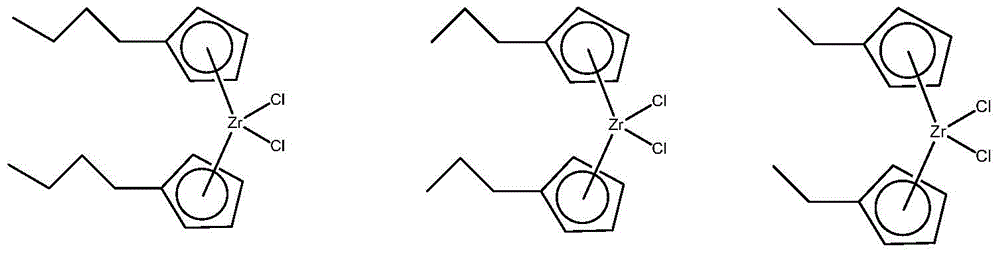
catalyst component II
Catalyst component II can generally produce a higher molecular weight component having more short chain branches and less long chain branches than a lower molecular weight component. Catalyst component II may comprise a monoatomic bridged metallocene compound comprising a fluorenyl group. In certain embodiments disclosed herein, for example, catalyst component II can comprise a monoatomic bridged cyclopentadienyl and fluorenyl-containing zirconium or hafnium-based metallocene compound. Typically, the single bridging atom may be a carbon atom or a silicon atom. In some embodiments, the bridging group (bridging atom and any substituents) may comprise an aryl substituent (e.g., phenyl); additionally or alternatively, the bridging group can comprise an alkenyl substituent (e.g., C)3-C8Terminal alkenyl).
In a particular embodiment of the present invention, catalyst component II may comprise a bridged metallocene compound having the formula (B):

in the formula (B), M2、Cp、E2、RA、RB、RX、RYAnd each X is an independent element bridging the metallocene compound. Thus, bridged metallocene compounds having formula (B) can utilize M disclosed herein2、Cp、E2、RA、RB、RX、RYAnd X in any combination.
M in the formula (B)2And each X is selected as described above for M in formula (A)1(Zr or Hf) and X (monoanionic ligand, e.g., Cl). In formula (B), Cp may be a cyclopentadienyl group. In some embodiments, Cp may not comprise additional substituents — e.g., bridging group E discussed below2And (c) other than. In other embodiments, Cp may be further substituted with 1 substituent, 2 substituents, 3 substituents, and the like. When present, each substituent on Cp may independently be H, halo, C1To C36Hydrocarbyl radical, C1To C36Halogenated hydrocarbon groups, C1To C36Hydrocarbyloxy or C1To C36A hydrocarbylsilyl group. Importantly, each substituent on Cp may be the same or different substituent. Furthermore, each substituent may be in any position on the cyclopentadienyl ring structure that complies with the valence rules. In general, the substituents on any of Cp independently may be H or any halo, C described herein1To C36Hydrocarbyl radical, C1To C36Halogenated hydrocarbon groups, C1To C36Hydrocarbyloxy or C1To C36Hydrocarbylsilyl groups (e.g. as for Cp in formula (A))1And Cp2The substituent(s) above).
In one embodiment, for example, each substituent on Cp independently may be H or C1To C18Hydrocarbyl or C1To C18A hydrocarbylsilyl group. In another embodiment, each substituent on Cp may independently be C1To C8Alkyl or C3To C8An alkenyl group. In yet another embodiment, CpCEach substituent on (A) may be independently H, Cl, CF3Methyl, ethyl, propyl, butyl, pentyl, hexyl, heptyl, octyl, nonyl, decyl, ethenyl, propenyl, butenyl, pentenyl, hexenyl, heptenyl, octenyl, nonenyl, decenyl, phenyl, tolyl, benzyl, naphthyl, trimethylsilyl, triisopropylsilyl, triphenylsilyl, or allyldimethylsilyl.
Similarly, R in the formula (B)XAnd RYIndependently can be H or any halo, C disclosed herein1To C36Hydrocarbyl radical, C1To C36Halogenated hydrocarbon groups, C1To C36Hydrocarbyloxy or C1To C36Hydrocarbylsilyl groups (e.g. as for Cp in formula (A))1And Cp2The substituent(s) above). In one embodiment, for example, RXAnd RYIndependently can be H or C1To C12A hydrocarbyl group. In another embodiment, RXAnd RYIndependently can be C1To C10A hydrocarbyl group. In yet another embodiment, RXAnd RYIndependently can be H, Cl, CF3Methyl, ethyl, propyl, butyl (e.g., t-Bu), pentyl, hexyl, heptyl, octyl, nonyl, decyl, vinyl, propenyl, butenyl, pentenyl, hexenyl, heptenyl, octenyl, nonenyl, decenyl, phenyl, tolyl, benzyl, naphthyl, trimethylsilyl, triisopropylsilyl, triphenylsilyl, or allyldimethylsilyl, and the like. In yet another embodiment, RXAnd RYIndependently can be methyl, ethyl, propyl, butyl, pentyl, hexyl, heptyl, octyl, nonyl, decyl, ethenyl, propenyl, butenyl, pentenyl, hexenyl, heptenyl, octenyl, nonenyl, decenyl, phenyl, tolyl, or benzyl; or alternatively, H or C1To C6Straight or branched chain alkyl groups (e.g., methyl, t-butyl, etc.).
With respect to the bridging group in formula (B), E2May be C or Si, and RAAnd RBIndependently can be H or any C disclosed herein1To C18A hydrocarbyl group. RAAnd RBMay be the same or different. In some embodiments of the invention, E2May be C. In these and other embodiments, RAAnd RBIndependently can be C1To C12A hydrocarbyl group; alternatively, RAAnd RBIndependently can be C1To C8A hydrocarbyl group; alternatively, RAAnd RBIndependently can be phenyl, C1To C8Alkyl or C3To C8An alkenyl group; alternatively, RAAnd RBIndependently can be methyl, ethyl, propyl, butyl, pentyl, hexyl, heptyl, octyl, nonyl, decyl, ethenyl, propenyl, butenyl, pentenyl, hexenyl, heptenyl, octenyl, nonenyl, decenyl, phenyl, cyclohexylphenyl, naphthyl, tolyl, or benzyl; or alternatively, RAAnd RBIndependently can be methyl, ethyl, propyl, butyl, pentyl, hexyl, propenyl, butenyl, pentenyl, hexenyl, phenyl or benzyl. In a particular embodiment of the invention, RAAnd RBAt least one of which may be phenyl; additionally or alternatively, RAAnd RBAt least one of may be C3To C8A terminal alkenyl group.
Illustrative and non-limiting examples of bridged metallocene compounds having formula (B) and/or suitable for use as catalyst component II may include the following compounds (Me ═ methyl, Ph ═ phenyl; t-Bu ═ tert-butyl):

and the like, and combinations thereof.
Catalyst component II is not limited to the bridged metallocene compounds described above. Other suitable single atom bridged metallocene compounds are disclosed in U.S. patent nos. 7,026,494, 7,041,617, 7,226,886, 7,312,283, 7,517,939, and 7,619,047, the entire contents of which are incorporated herein by reference.
Activator support
The present invention includes different catalyst compositions comprising an activator-support. In one embodiment, the activator-support may comprise an electron-withdrawing anion-treated solid oxide. Alternatively, in another embodiment, the activator-support may comprise an electron-withdrawing anion-treated solid oxide comprising lewis acidic metal ions. Non-limiting examples of suitable activator-supports are disclosed, for example, in U.S. Pat. nos. 7,294,599, 7,601,665, 7,884,163, and 8,309,485, the entire contents of which are incorporated herein by reference.
The solid oxide may include oxide materials such as alumina, their "mixed oxides" such as silica-alumina, coatings of oxides onto each other, and combinations and mixtures thereof. Mixed oxides such as silica-alumina can be single or multiple chemical phases in which more than one metal combines with oxygen to form a solid oxide. Examples of mixed oxides that may be used alone or in combination to form the activator-support may include, but are not limited to, silica-alumina, silica-titania, silica-zirconia, alumina-titania, alumina-zirconia, zinc-aluminate, alumina-boria, silica-boria, aluminophosphate-silica, titania-zirconia, and the like. The solid oxides used herein may also include oxide materials such as silica-coated alumina, as described in U.S. Pat. No. 7,884,163.
Thus, in one embodiment, the solid oxide may comprise silica, alumina, silica-coated alumina, aluminum phosphate, aluminophosphates, heteropolytungstates, titania, silica-titania, zirconia, silica-zirconia, magnesia, boria, zinc oxide, any mixed oxide thereof, or any combination thereof. In another embodiment, the solid oxide may comprise alumina, silica-coated alumina, aluminum phosphate, aluminophosphates, heteropolytungstates, titania, silica-titania, zirconia, silica-zirconia, magnesia, boria, or zinc oxide, as well as any mixed oxide thereof or any mixture thereof. In another embodiment, the solid oxide may comprise silica, alumina, titania, zirconia, magnesia, boria, zinc oxide, any mixed oxide thereof, or any combination thereof. In yet another embodiment, the solid oxide may comprise silica-alumina, silica-coated alumina, silica-titania, silica-zirconia, alumina-boria, or any combination thereof. In yet another embodiment, the solid oxide may comprise alumina, silica-coated alumina, or any mixture thereof; alternatively, alumina; alternatively, silica-alumina; or alternatively, silica coated alumina.
Useful silica-alumina or silica-coated alumina solid oxide materials can have a silicon content of about 5 to about 95% by weight. In one embodiment, the silicon content of these solid oxides may be from about 10 to about 80% or from about 20% to about 70% silicon dioxide by weight. In another embodiment, such materials may have a silicon content in the following ranges: from about 15% to about 60%, or from about 25% to about 50% by weight of silica. The solid oxides contemplated herein can have any suitable surface area, pore volume, and particle size, as will be understood by those skilled in the art.
The electron-withdrawing component used to treat the solid oxide can be any component that increases the lewis or bronsted acidity of the solid oxide after treatment (as compared to a solid oxide that has not been treated with at least one electron-withdrawing anion). According to one embodiment, the electron-withdrawing component may be an electron-withdrawing anion derived from a salt, acid, or other compound that acts as a source or precursor of an anion, such as a volatile organic compound. Examples of electron-withdrawing anions can include, but are not limited to, sulfate, hydrogen sulfate, fluoride, chloride, bromide, iodide, fluorosulfate, fluoroborate, phosphate, fluorophosphate, trifluoroacetate, triflate, fluorozirconate, fluorotitanate, phosphotungstate, tungstate, molybdate, and the like, including mixtures and combinations thereof. In addition, other ionic or non-ionic compounds that serve as a source of these electron-withdrawing anions can also be used. In some embodiments provided herein, it is contemplated that the electron-withdrawing anion can be or include fluoride, chloride, bromide, phosphate, triflate, bisulfate or sulfate, and the like, or any combination thereof. In other embodiments, the electron-withdrawing anion can include sulfate, hydrogen sulfate, fluoride, chloride, bromide, iodide, fluorosulfate, fluoroborate, phosphate, fluorophosphate, trifluoroacetate, triflate, fluorozirconate, fluorotitanate, and the like or combinations thereof. In further embodiments, the electron-withdrawing anion can include fluoride and/or sulfate.
The activator-support can generally comprise about 1 to about 25 wt.% of the electron-withdrawing anion, based on the weight of the activator-support. In embodiments provided herein, the activator-support may comprise about 1 to about 20 wt.%, about 2 to about 20 wt.%, about 3 to about 20 wt.%, about 2 to about 15 wt.%, about 3 to about 12 wt.%, or about 4 to about 10 wt.% electron-withdrawing anion, based on the total weight of the activator-support.
In embodiments, the activator-support may comprise fluorided alumina, chlorided alumina, brominated alumina, sulfated alumina, fluorided silica-alumina, chlorided silica-alumina, bromided silica-alumina, sulfated silica-alumina, fluorided silica-zirconia, chlorided silica-zirconia, bromided silica-zirconia, sulfated silica-zirconia, fluorided silica-titania, fluorided silica-coated alumina, sulfated silica-coated alumina, phosphated silica-coated alumina, and the like, as well as any mixtures or combinations thereof. In another embodiment, the activator-support employed in the catalyst systems described herein may be or include a fluorinated solid oxide and/or a sulfated solid oxide, non-limiting examples of which may include fluorided alumina, sulfated alumina, fluorided silica-alumina, sulfated silica-alumina, fluorided silica-zirconia, fluorided silica-coated alumina, sulfated silica-coated alumina, and the like, and combinations thereof. In yet another embodiment, the activator-support can comprise fluorided alumina; alternatively, a chlorinated alumina; alternatively, sulfated alumina; alternatively, a fluorided silica-alumina; alternatively, a sulfated silica-alumina; alternatively, a fluorinated silica-zirconia; alternatively, a silica-zirconia chloride; alternatively, a sulfated silica coated alumina; or alternatively, a fluorinated silica coated alumina.
Different methods can be used to form the activator-supports useful in the present invention. Methods of contacting the solid oxide with electron-withdrawing components, suitable electron-withdrawing components and amounts added, impregnation of metals or metal ions (e.g., zinc, nickel, vanadium, titanium, silver, copper, gallium, tin, tungsten, molybdenum, zirconium, and the like or combinations thereof), and various calcination procedures and conditions are disclosed in, for example, U.S. Pat. nos. 6,107,230, 6,165,929, 6,294,494, 6,300,271, 6,316,553, 6,355,594, 6,376,415, 6,388,017, 6,391,816, 6,395,666, 6,524,987, 6,548,441, 6,548,442, 6,576,583, 6,613,712, 6,632,894, 6,667,274, 6,750,302, 7,294,599, 7,601,665, 7,884,163, and 8,309,485, the entire contents of which are incorporated herein by reference. Other methods and procedures suitable for preparing activator supports (e.g., fluorinated solid oxides, sulfated solid oxides, etc.) are well known to those skilled in the art.
Co-catalyst
In certain embodiments involving catalyst compositions comprising co-catalysts, the co-catalyst may comprise a hydrocarbyl metal compound, examples of which include non-halide hydrocarbyl metal compounds, metal hydrocarbyl halide compounds, non-halide alkyl metal compounds, metal alkyl halide compounds, and the like. The hydrocarbyl (or alkyl) group can be any of the hydrocarbyl (or alkyl) groups disclosed herein. Further, in some embodiments, the metal of the metal hydrocarbyl may be a group 1,2, 11, 12, 13, or 14 metal; alternatively, a group 13 or 14 metal; or alternatively, a group 13 metal. Thus, in some embodiments, the metal of the hydrocarbyl metal (non-halide hydrocarbyl metal or metal hydrocarbyl halide) may be lithium, sodium, potassium, rubidium, cesium, beryllium, magnesium, calcium, strontium, barium, zinc, cadmium, boron, aluminum, or tin; alternatively, lithium, sodium, potassium, magnesium, calcium, zinc, boron, aluminum, or tin; alternatively, lithium, sodium or potassium; alternatively, magnesium or calcium; alternatively, lithium; alternatively, sodium; alternatively, potassium; alternatively, magnesium; alternatively, calcium; alternatively, zinc; alternatively, boron; alternatively, aluminum; or alternatively, tin. In some embodiments, the metal hydrocarbyl or metal alkyl with or without a halo group may include a lithium hydrocarbyl or alkyl, a magnesium hydrocarbyl or alkyl, a boron hydrocarbyl or alkyl, a zinc hydrocarbyl or alkyl, or an aluminum hydrocarbyl.
In embodiments involving catalyst compositions comprising co-catalysts (e.g., the activator may comprise an electron-withdrawing anion-treated solid oxide), the co-catalyst may comprise an aluminoxane compound, an organoboron or organoborate compound, an ionizing ionic compound, an organoaluminum compound, an organozinc compound, an organomagnesium compound, or an organolithium compound, and this includes any combination of these materials. In one embodiment, the cocatalyst may comprise an organoaluminum compound. In another embodiment, the cocatalyst can include an aluminoxane compound, an organoboron or organoborate compound, an ionizing ionic compound, an organozinc compound, an organomagnesium compound, an organolithium compound, or any combination thereof. In yet another embodiment, the cocatalyst may comprise an aluminoxane compound; alternatively, an organoboron or organoborate compound; optionally, ionizing an ionic compound; alternatively, an organozinc compound; alternatively, an organomagnesium compound; or alternatively, an organolithium compound.
Specific non-limiting examples of suitable organoaluminum compounds can include Trimethylaluminum (TMA), Triethylaluminum (TEA), tri-n-propylaluminum (TNPA), tri-n-butylaluminum (TNBA), Triisobutylaluminum (TIBA), tri-n-hexylaluminum, tri-n-octylaluminum, diisobutylaluminum hydride, diethylaluminum ethoxide, diethylaluminum chloride, and the like or combinations thereof. Representative and non-limiting examples of aluminoxanes include methylaluminoxane, modified methylaluminoxane, ethylaluminoxane, n-propylaluminoxane, isopropylaluminoxane, n-butylaluminoxane, t-butylaluminoxane, sec-butylaluminoxane, isobutylaluminoxane, 1-pentylaluminoxane, 2-pentylaluminoxane, 3-pentylaluminoxane, isopentylaluminoxane, neopentylaluminoxane, and the like, or any combination thereof. Representative and non-limiting examples of organoboron/organoborate compounds include aniline N, N-dimethyl tetrakis (pentafluorophenyl) borate, triphenylcarbon tetrakis (pentafluorophenyl) borate, lithium tetrakis (pentafluorophenyl) borate, N-dimethylaniline tetrakis [3, 5-bis (trifluoromethyl) phenyl ] borate, triphenylcarbon tetrakis [3, 5-bis (trifluoromethyl) phenyl ] borate, tris (pentafluorophenyl) boron, tris [3, 5-bis (trifluoromethyl) phenyl ] boron, and the like or mixtures thereof.
Examples of ionizing ionic compounds may include, but are not limited to, the following compounds: tri (N-butyl) ammonium tetrakis (p-tolyl) borate, tri (N-butyl) ammonium tetrakis (m-tolyl) borate, tri (N-butyl) ammonium tetrakis (2, 4-dimethylphenyl) borate, tri (N-butyl) ammonium tetrakis (3, 5-dimethylphenyl) borate, tri (N-butyl) ammonium tetrakis [3, 5-bis (trifluoromethyl) phenyl ] borate, tri (N-butyl) ammonium tetrakis (pentafluorophenyl) borate, N-dimethylaniline tetrakis (p-tolyl) borate, N-dimethylaniline tetrakis (m-tolyl) borate, N-dimethylaniline tetrakis (2, 4-dimethylphenyl) borate, N-dimethylaniline tetrakis (3, 5-dimethylphenyl) borate, N-dimethylaniline tetrakis [3, 5-bis (trifluoromethyl) phenyl ] borate, Anilinium N, N-dimethyltetrakis (pentafluorophenyl) borate, triphenylcarbenium tetrakis (p-tolyl) borate, triphenylcarbenium tetrakis (m-tolyl) borate, triphenylcarbenium tetrakis (2, 4-dimethylphenyl) borate, triphenylcarbenium tetrakis (3, 5-dimethylphenyl) borate, triphenylcarbenium tetrakis [3, 5-bis (trifluoromethyl) phenyl ] borate, triphenylcarbenium tetrakis (pentafluorophenyl) borate, tetrakis (p-tolyl) borate, tetrakis (m-tolyl) borate, tetrakis (2, 4-dimethylphenyl) borate, tetrakis (3, 5-dimethylphenyl) borate, tetrakis [3, 5-bis (trifluoromethyl) phenyl ] borate, tetrakis (pentafluorophenyl) borate, lithium tetraphenylborate, lithium tetrakis (p-tolyl) borate, lithium tetrakis (m-tolyl) borate, tetrakis (2, lithium 4-dimethylphenyl) borate, lithium tetrakis (3, 5-dimethylphenyl) borate, lithium tetrafluoroborate, sodium tetrakis (pentafluorophenyl) borate, sodium tetraphenylborate, sodium tetrakis (p-tolyl) borate, sodium tetrakis (m-tolyl) borate, sodium tetrakis (2, 4-dimethylphenyl) borate, sodium tetrakis (3, 5-dimethylphenyl) borate, sodium tetrafluoroborate, potassium tetrakis (pentafluorophenyl) borate, potassium tetraphenylborate, potassium tetrakis (p-tolyl) borate, potassium tetrakis (m-tolyl) borate, potassium tetrakis (2, 4-dimethylphenyl) borate, potassium tetrakis (3, 5-dimethylphenyl) borate, potassium tetrafluoroborate, lithium tetrakis (pentafluorophenyl) aluminate, lithium tetraphenylaluminate, lithium tetrakis (p-tolyl) aluminate, lithium tetrakis (m-tolyl) aluminate, lithium tetrakis (2, 4-dimethylphenyl) aluminate, lithium tetrakis (3, 5-dimethylphenyl) borate, potassium tetrafluoroborate, lithium tetrakis (pentafluorophenyl) aluminate, lithium tetraphenylaluminate, lithium tetrakis (p-tolyl) aluminate, lithium tetrakis (m-tolyl) aluminate, lithium tetrakis (2, 4-dimethylphenyl) aluminate, Lithium tetrakis (3, 5-dimethylphenyl) aluminate, lithium tetrafluoroaluminate, sodium tetrakis (pentafluorophenyl) aluminate, sodium tetraphenyl aluminate, sodium tetrakis (p-tolyl) aluminate, sodium tetrakis (m-tolyl) aluminate, sodium tetrakis (2, 4-dimethylphenyl) aluminate, sodium tetrakis (3, 5-dimethylphenyl) aluminate, sodium tetrafluoroaluminate, potassium tetrakis (pentafluorophenyl) aluminate, potassium tetraphenyl aluminate, potassium tetrakis (p-tolyl) aluminate, potassium tetrakis (m-tolyl) aluminate, potassium tetrakis (2, 4-dimethylphenyl) aluminate, potassium tetrakis (3, 5-dimethylphenyl) aluminate, potassium tetrafluoroaluminate, and the like, or combinations thereof.
Exemplary organozinc compounds that can be used as co-catalysts can include, but are not limited to, dimethylzinc, diethylzinc, dipropylzinc, dibutylzinc, dineopentylzinc, bis (trimethylsilyl) zinc, bis (triethylsilyl) zinc, bis (triisopropylsilyl) zinc, bis (triphenylsilyl) zinc, bis (allyldimethylsilyl) zinc, bis (trimethylsilylmethyl) zinc, and the like or combinations thereof.
Similarly, exemplary organomagnesium compounds can include, but are not limited to, dimethylmagnesium, diethylmagnesium, dipropylmagnesium, dibutylmagnesium, dineopentylmagnesium, bis (trimethylsilylmethyl) magnesium, methylmagnesium chloride, ethylmagnesium chloride, propylmagnesium chloride, butylmagnesium chloride, neopentylglycolylmagnesium chloride, trimethylsilylmethylmagnesium chloride, methylmagnesium bromide, ethylmagnesium bromide, propylmagnesium bromide, butylmagnesium bromide, neopentylglycolylmagnesium bromide, trimethylsilylmethylmagnesium bromide, methylmagnesium iodide, ethylmagnesium iodide, propylmagnesium iodide, butylmagnesium iodide, neopentylglycolylmagnesium iodide, trimethylsilylmethylmagnesium iodide, methylmagnesium ethoxide, ethylmagnesium ethoxide, propylmagnesium ethoxide, butylmagnesium ethoxide, neopentylethoxymagnesium, trimethylsilylmethethylmagnesium ethoxide, methylpropylmagnesium oxide, ethylpropylmagnesium oxide, and neopentylethoxymagnesium, Propylpropoxymagnesium, butylpropoxymagnesium, neopentylpropoxymagnesium, trimethylsilylmethpropoxymagnesium, methylphenoxymagnesium, ethylphenoxymagnesium, propylphenoxymagnesium, butylphenoxymagnesium, neopentylphenoxymagnesium, trimethylsilylmethphenoxymagnesium, and the like or any combination thereof.
Likewise, exemplary organolithium compounds can include, but are not limited to, methyllithium, ethyllithium, propyllithium, butyllithium (e.g., t-butyllithium), neopentyllithium, trimethylsilylmethyllithium, phenyllithium, tolyllithium, xylyllithium, benzyllithium, (dimethylphenyl) methyllithium, allyllithium, and the like, or combinations thereof.
The co-catalyst that can be used in the catalyst composition of the present invention is not limited to the above co-catalyst. Other suitable cocatalysts are known to those skilled in the art and include, for example, those disclosed in the following references: U.S. Pat. nos. 3,242,099, 4,794,096, 4,808,561, 5,576,259, 5,807,938, 5,919,983, 7,294,599, 7,601,665, 7,884,163, 8,114,946, and 8,309,485, the entire contents of which are incorporated herein by reference.
Olefin monomer
The unsaturated reactants that can be used with the catalyst composition and polymerization process of the present invention can generally include an olefin compound having from 2 to 30 carbon atoms per molecule and having at least one olefinic double bond. The present invention includes homopolymerization using a single olefin such as ethylene or propylene, as well as copolymerization, trimerization, etc., using an olefin monomer and at least one different olefin compound. For example, the resulting ethylene copolymers, terpolymers, etc. may generally comprise a relatively large amount of ethylene (>50 mol%) and a relatively small amount of comonomer (<50 mol%), although this is not a requirement. The comonomer copolymerizable with ethylene may generally have 3 to 20 carbon atoms, or 3 to 10 carbon atoms in its molecular chain.
Acyclic olefins, cyclic olefins, polycyclic olefins, terminal (alpha), internal olefins, linear olefins, branched olefins, substituted olefins, unsubstituted olefins, functionalized olefins, and non-functionalized olefins may be used in the present invention. For example, typical unsaturated compounds that can be polymerized using the catalyst composition of the present invention can include, but are not limited to, ethylene, propylene, 1-butene, 2-butene, 3-methyl-1-butene, isobutylene, 1-pentene, 2-pentene, 3-methyl-1-pentene, 4-methyl-1-pentene, 1-hexene, 2-hexene, 3-ethyl-1-hexene, 1-heptene, 2-heptene, 3-heptene, four common octenes (e.g., 1-octene), four common nonenes, five common decenes, and the like or mixtures of two or more of these compounds. Cyclic and bicyclic olefins, including but not limited to cyclopentene, cyclohexene, norbornene, norbornadiene, and the like, may also be polymerized as described herein. Styrene may also be used as a monomer in the present invention. In embodiments, the olefin monomer may include C2-C20An olefin; alternatively, C2-C20An alpha-olefin; alternatively, C2-C10An olefin; alternatively, C2-C10An alpha-olefin; alternatively, the olefin monomer may comprise ethylene; or alternatively, the olefin monomer may comprise propylene.
When a copolymer (or alternatively, terpolymer) is desired, the olefin monomer and olefin comonomer independently can comprise, for example, C2-C20An alpha-olefin. In some embodiments, the olefin monomer may include ethylene or propylene, with at least one comonomer (e.g., C)2-C20Alpha-olefins, C3-C20Alpha-olefins, etc.). According to one embodiment of the present invention, the olefin monomer used in the polymerization process may include ethylene. In this embodiment, examples of suitable olefin comonomers may include, but are not limited to, propylene, 1-butene, 2-butene, 3-methyl-1-butene, isobutylene, 1-pentene, 2-pentene, 3-methyl-1-pentene, 4-methyl-1-pentene, 1-hexene, 2-hexene, 3-ethyl-1-hexene, 1-heptene, 2-heptene, 3-heptene, 1-octene, 1-hexene, 2-hexene, 3-hexene, 1-octene, and mixtures thereof,1-decene, styrene, and the like or combinations thereof. According to another embodiment of the present invention, the olefin monomer may comprise ethylene and the comonomer may comprise C3-C10An alpha-olefin; alternatively, the comonomer may comprise 1-butene, 1-pentene, 1-hexene, 1-octene, 1-decene, styrene, or any combination thereof; alternatively, the comonomer may comprise 1-butene, 1-hexene, 1-octene, or any combination thereof; alternatively, the comonomer may comprise 1-butene; alternatively, the comonomer may comprise 1-hexene; or alternatively, the comonomer may comprise 1-octene.
In general, the amount of comonomer introduced into the polymerization reactor system to produce the copolymer can be from about 0.01 to about 50 weight percent comonomer based on the total weight of monomer and comonomer. According to another embodiment of the present invention, the amount of comonomer introduced into the polymerization reactor system may be from about 0.01 to about 40 weight percent comonomer based on the total weight of monomer and comonomer. In yet another embodiment, the amount of comonomer introduced into the polymerization reactor system can be from about 0.1 to about 35 weight percent comonomer based on the total weight of monomer and comonomer. Additionally, in another embodiment, the amount of comonomer introduced into the polymerization reactor system can be from about 0.5 to about 20 weight percent comonomer based on the total weight of monomer and comonomer.
While not intending to be bound by this theory, in the case where a branched olefin, a substituted olefin, or a functionalized olefin is used as a reactant, it is believed that steric hindrance may hinder and/or slow the polymerization process. Thus, it is expected that the branched and/or cyclic portion(s) of the olefin that are slightly distal from the carbon-carbon double bond will not hinder the reaction in a manner that might hinder the reaction if the same olefin substituent were located closer to the carbon-carbon double bond.
According to one embodiment of the invention, at least one monomer/reactant may be ethylene (or propylene) and thus the polymerization reaction may be a homopolymerization involving only ethylene (or propylene) or a copolymerization with different acyclic, cyclic, terminal, internal, linear, branched, substituted, or unsubstituted olefins. In addition, the catalyst composition of the present invention can be used in the polymerization of diolefin compounds including, but not limited to, 1, 3-butadiene, isoprene, 1, 4-pentadiene, and 1, 5-hexadiene.
Catalyst composition
In some embodiments, the present invention may employ a catalyst composition that: comprising catalyst component I, catalyst component II, an activator(s), and optionally a co-catalyst. These catalyst compositions are useful for producing polyolefins, homopolymers, copolymers, and the like, for a variety of end-use applications. Catalyst components I and II are described above. In embodiments of the present invention, it is contemplated that the catalyst composition may comprise more than one catalyst component I metallocene compound, and/or more than one catalyst component II metallocene compound. Further, additional catalytic compounds, other than those referred to as catalyst components I or II, may be used in the catalyst composition and/or polymerization process, so long as the additional catalytic compound(s) do not detract from the advantages disclosed herein. In addition, more than one activator may be used.
The metallocene compounds of catalyst component I are described above. For example, in some embodiments, catalyst component I can comprise (or consist essentially of, or consist of): two cyclopentadienyl, two indenyl, or a cyclopentadienyl and an indenyl metallocene compound bridged by two carbons (e.g., a metallocene compound having the formula (a)). The metallocene compounds of catalyst component II are also described above. For example, in some embodiments, catalyst component II can comprise (or consist essentially of, or consist of): a single atom bridged metallocene compound comprising a fluorenyl group (e.g., a metallocene compound having the formula (B)).
In general, the catalyst composition of the present invention can include catalyst component I, catalyst component II, and an activator. In embodiments of the invention, the activator may comprise an activator-support (e.g., an activator-support comprising an electron-withdrawing anion-treated solid oxide). Activator supports useful in the present invention are disclosed above. Optionally, such catalyst compositions may further comprise one or more co-catalyst compounds (suitable co-catalysts, such as organoaluminum compounds, also described hereinabove). Thus, the catalyst composition of the present invention can comprise catalyst component I, catalyst component II, an activator-support, and an organoaluminum compound. For example, the activator-support can comprise (or consist essentially of, or consist of): fluorided alumina, chlorided alumina, brominated alumina, sulfated alumina, fluorided silica-alumina, chlorided silica-alumina, brominated silica-alumina, sulfated silica-alumina, fluorided silica-zirconia, chlorided silica-zirconia, brominated silica-zirconia, sulfated silica-zirconia, fluorided silica-titania, fluorided silica-coated alumina, sulfated silica-coated alumina, phosphated silica-coated alumina, and the like or combinations thereof; alternatively, the activator-support can comprise (or consist essentially of, or consist of): fluorinated solid oxides and/or sulfated solid oxides. Additionally, the organoaluminum compound can comprise (or consist essentially of, or consist of): trimethylaluminum, triethylaluminum, tri-n-propylaluminum, tri-n-butylaluminum, triisobutylaluminum, tri-n-hexylaluminum, tri-n-octylaluminum, diisobutylaluminum hydride, diethylaluminum ethoxide, diethylaluminum chloride, and the like or combinations thereof. Thus, a catalyst composition according to an embodiment of the invention may comprise (or consist essentially of, or consist of): two carbon-bridged zirconium-based metallocene compounds; a monoatomic bridged zirconium-or hafnium-based metallocene compound having a cyclopentadienyl group and a fluorenyl group; sulfated alumina (or fluorided silica-alumina, or fluorided silica-coated alumina); and triethylaluminum (or triisobutylaluminum).
In another embodiment of the present invention, there is provided a catalyst composition comprising: comprising catalyst component I, catalyst component II, an activator-support, and an organoaluminum compound, wherein the catalyst composition is substantially free of aluminoxane, organoboron or organoborate compounds, ionizing ionic compounds, and/or other similar materials; alternatively, substantially free of alumoxane; optionally, substantially free of organoboron or organoborate compound; or alternatively, substantially free of ionizing ionic compounds. In these embodiments, the catalyst composition has catalyst activity in the absence of these additional materials, as described below. For example, the catalyst composition of the present invention can consist essentially of catalyst component I, catalyst component II, an activator-support, and an organoaluminum compound, wherein no other material is present in the catalyst composition that increases/decreases the activity of the catalyst composition by greater than about 10% relative to the activity of the catalyst composition in the absence of said material.
However, in other embodiments of the invention, these activator/cocatalysts may be used. For example, a catalyst composition comprising catalyst component I, catalyst component II, and an activator-support can further comprise a cocatalyst. Suitable co-catalysts in this embodiment may include, but are not limited to, aluminoxane compounds, organoboron or organoborate compounds, ionizing ionic compounds, organoaluminum compounds, organozinc compounds, organomagnesium compounds, organolithium compounds, and the like, or any combination thereof; or alternatively, an organoaluminum compound, an organozinc compound, an organomagnesium compound, an organolithium compound, or any combination thereof. More than one co-catalyst may be present in the catalyst composition.
In various embodiments, a catalyst composition is provided that does not require an activator-support. Such catalyst compositions can include catalyst component I, catalyst component II, and an activator, wherein the activator comprises an aluminoxane compound, an organoboron or organoborate compound, an ionizing ionic compound, or a combination thereof; alternatively, an aluminoxane compound; alternatively, an organoboron or organoborate compound; or alternatively, ionizing the ionic compound.
In the embodiments contemplated herein, the catalyst composition is a catalyst composition that: comprising an activator (one or more), only one catalyst component I metallocene compound, and only one catalyst component II metallocene compound. In these and other embodiments, the catalyst composition can include an activator (e.g., an activator-support comprising an electron-withdrawing anion-treated solid oxide); only one two-carbon bridged metallocene compound comprising two cyclopentadienyl groups, two indenyl groups, or a cyclopentadienyl group and an indenyl group; only one monoatomic bridged metallocene compound comprising a fluorenyl group; and optionally, a co-catalyst.
The invention further includes methods of preparing these catalyst compositions, such as, for example, contacting the individual catalyst components in any order or sequence.
According to embodiments of the present invention, the weight percent of catalyst component I based on the total weight of catalyst component I and catalyst component II in the catalyst composition may generally fall within the following ranges: about 25 to about 98%, about 40 to about 95%, about 55 to about 98%, or about 60 to about 95%.
Generally, the weight ratio of organoaluminum compound to activator-support can be in the range of from about 10:1 to about 1: 1000. If more than one organoaluminum compound and/or more than one activator-support is used, the ratio is based on the total weight of the individual components. In another embodiment, the weight ratio of organoaluminum compound to activator-support can be in the following range: about 3: 1 to about 1: 100 or about 1: 1 to about 1: 50.
in some embodiments of the invention, the weight ratio of metallocene compound (total catalyst components I and II) to activator-support may be in the range of from about 1: 1 to about 1: in the range of 1,000,000. If more than one activator-support is used, the ratio is based on the total weight of the activator-support. In another embodiment, the weight ratio may be between about 1: 5 to about 1: 100,000 or about 1: 10 to about 1: within a range of 10,000. Additionally, in another embodiment, the weight ratio of metallocene compound to activator-support can be in the range of from about 1: 20 to about 1: within 1000 a.
The catalyst compositions of the present invention generally have a catalyst activity of greater than about 100 grams (abbreviated as g/g/hr) of polyethylene (homopolymer, copolymer, etc., as the case requires) per gram of activator-support per hour. In another embodiment, the catalyst activity may be greater than about 150, greater than about 250, or greater than about 500 g/g/hr. In yet another embodiment, the catalyst composition of the present invention may be characterized as having a catalyst activity greater than about 550, greater than about 650, or greater than about 750 g/g/hr. Additionally, in another embodiment, the catalyst activity may be greater than about 1000 g/g/hr. These activities were measured under slurry polymerization conditions using a triisobutylaluminum co-catalyst using isobutane as diluent, a polymerization temperature of about 90 ℃ and a reactor pressure of about 390 psig. Additionally, in some embodiments, the activator-support may comprise sulfated alumina, fluorided silica-alumina, or fluorided silica-coated alumina, although not limited thereto.
Polymerization process
The catalyst compositions of the present invention are useful for polymerizing olefins to form homopolymers, copolymers, terpolymers, and the like. One such process for polymerizing olefins in the presence of the catalyst composition of the present invention can comprise contacting the catalyst composition with an olefin monomer and optionally an olefin comonomer(s) in a polymerization reactor system under polymerization conditions to produce an olefin polymer, wherein the catalyst composition can comprise catalyst component I, catalyst component II, an activator, and optionally a co-catalyst. Catalyst components I and II are described herein. For example, catalyst component I can include a bridged metallocene compound having formula (a), and catalyst component II can include a bridged metallocene compound having formula (B).
According to one embodiment of the present invention, the polymerization process may employ a catalyst composition comprising: comprises a catalyst component I, a catalyst component II and an activator, wherein the activator comprises an activator support. Activator supports useful in the polymerization process of the present invention are disclosed herein. The catalyst composition optionally may further comprise one or more organoaluminum compounds (or other suitable co-catalysts). Thus, a process for polymerizing olefins in the presence of a catalyst composition can employ a catalyst composition that: comprises a catalyst component I, a catalyst component II, an activator support and an organic aluminum compound. In some embodiments, the activator-support can comprise (or consist essentially of, or consist of): fluorided alumina, chlorided alumina, brominated alumina, sulfated alumina, fluorided silica-alumina, chlorided silica-alumina, brominated silica-alumina, sulfated silica-alumina, fluorided silica-zirconia, chlorided silica-zirconia, brominated silica-zirconia, sulfated silica-zirconia, fluorided silica-titania, fluorided silica-coated alumina, sulfated silica-coated alumina, phosphated silica-coated alumina, and the like or combinations thereof; or alternatively a fluorinated solid oxide and/or a sulfated solid oxide. In some embodiments, the organoaluminum compound can comprise (or consist essentially of, or consist of): trimethylaluminum, triethylaluminum, tri-n-propylaluminum, tri-n-butylaluminum, triisobutylaluminum, tri-n-hexylaluminum, tri-n-octylaluminum, diisobutylaluminum hydride, diethylaluminum ethoxide, diethylaluminum chloride, and the like or combinations thereof.
According to another embodiment of the present invention, the polymerization process may employ a catalyst composition comprising: comprising catalyst component I, catalyst component II, an activator-support, and optionally a co-catalyst, wherein the co-catalyst can comprise an aluminoxane compound, an organoboron or organoborate compound, an ionizing ionic compound, an organoaluminum compound, an organozinc compound, an organomagnesium compound, or an organolithium compound, or any combination thereof. Accordingly, embodiments of the present invention relate to a process for polymerizing olefins in the presence of a catalyst composition, the process comprising contacting the catalyst composition with an olefin monomer and optionally olefin comonomer(s) in a polymerization reactor system under polymerization conditions to produce an olefin polymer, and the catalyst composition can include catalyst component I, catalyst component II, an activator support, and an aluminoxane compound; optionally, catalyst component I, catalyst component II, an activator-support, and an organoboron or organoborate compound; optionally, catalyst component I, catalyst component II, an activator-support, and an ionizing ionic compound; optionally, catalyst component I, catalyst component II, an activator-support, and an organoaluminum compound; optionally, catalyst component I, catalyst component II, an activator-support, and an organozinc compound; optionally, catalyst component I, catalyst component II, an activator-support, and an organomagnesium compound; or alternatively, catalyst component I, catalyst component II, an activator-support, and an organolithium compound. In addition, more than one co-catalyst may be used, for example, organoaluminum compounds and aluminoxane compounds, organoaluminum compounds and ionizing ionic compounds, and the like.
According to another embodiment of the present invention, the polymerization process may employ a catalyst composition comprising: comprising only one catalyst component I metallocene compound, only one catalyst component II metallocene compound, an activator-support and an organoaluminum compound.
According to yet another embodiment of the present invention, the polymerization process may employ a catalyst composition comprising: comprising catalyst component I, catalyst component II, and an activator, wherein the activator comprises an aluminoxane compound, an organoboron or organoborate compound, an ionizing ionic compound, or a combination thereof.
The catalyst composition of the present invention is intended for use in any olefin polymerization process utilizing different types of polymerization reactor systems and reactors. The polymerization reactor system can include any polymerization reactor capable of polymerizing olefin monomer and comonomer(s) (one or more comonomers) to produce homopolymers, copolymers, terpolymers, and the like. Different types of reactors include those as follows: may be referred to as batch reactors, slurry reactors, gas phase reactors, solution reactors, high pressure reactors, tubular reactors, autoclave reactors, and the like or combinations thereof. Appropriate polymerization conditions are used for different reactor types. The gas phase reactor may comprise a fluidized bed reactor or a staged horizontal reactor. The slurry reactor may comprise a vertical or horizontal loop. The high pressure reactor may comprise an autoclave or a tubular reactor. Reactor types may include batch or continuous processes. Continuous processes may employ either batch or continuous product discharge. The process may also include direct recycling of some or all of the unreacted monomer, unreacted comonomer, and/or diluent.
The polymerization reactor system of the present invention can include one type of reactor or multiple reactors of the same or different types in the system (e.g., single reactor, dual reactor, more than two reactors). The production of polymer in multiple reactors may comprise several stages-in at least two separate polymerization reactors interconnected by a transfer device capable of transferring polymer from a first polymerization reactor to a second reactor. The desired polymerization conditions in one of the reactors may be different from the operating conditions of the other reactor(s). Alternatively, polymerization in multiple reactors may include manual transfer of polymer from one reactor to a subsequent reactor to continue polymerization. The multiple reactor system may include any combination including, but not limited to, multiple loop reactors, multiple gas phase reactors, a combination of loop and gas phase reactors, multiple high pressure reactors, or a combination of high pressure and loop and/or gas phase reactors. The multiple reactors may be operated sequentially, in parallel, or both. Accordingly, the present invention includes a polymerization reactor system comprising: including a single reactor, including two reactors, and including more than two reactors. Polymerization reactor systems may include slurry reactors, gas phase reactors, solution reactors, and combinations thereof in certain embodiments of the invention.
According to one embodiment of the invention, the polymerization reactor system may comprise at least one loop slurry reactor, comprising a vertical or horizontal loop. The monomer, diluent, catalyst and comonomer can be continuously supplied to the loop reactor where polymerization occurs. In general, a continuous process can include continuously introducing monomer/comonomer, catalyst, and diluent into a polymerization reactor and continuously removing a suspension including polymer particles and diluent from the reactor. The reactor effluent may be flashed to remove solid polymer from the liquid comprising diluent, monomer and/or comonomer. Different techniques may be used for this separation step, including, but not limited to, flashing, which may include any combination of heating and pressure reduction, separation by cyclonic action in a cyclone or hydrocyclone, or by centrifugal separation.
General slurry polymerization processes (also referred to as particle formation processes) are disclosed, for example, in U.S. Pat. nos. 3,248,179, 4,501,885, 5,565,175, 5,575,979, 6,239,235, 6,262,191, and 6,833,415, the entire contents of which are incorporated herein by reference.
Suitable diluents for slurry polymerization include, but are not limited to, the monomers being polymerized and hydrocarbons that are liquid under the polymerization conditions. Examples of suitable diluents include, but are not limited to, hydrocarbons such as propane, cyclohexane, isobutane, n-butane, n-pentane, isopentane, neopentane, and n-hexane. Some loop polymerization reactions can occur under bulk conditions without the use of a diluent. One example is the polymerization of propylene monomers, as disclosed in U.S. Pat. No. 5,455,314, the entire contents of which are incorporated herein by reference.
According to yet another embodiment of the present invention, the polymerization reactor system may comprise at least one gas phase reactor. Such systems may employ a continuous recycle stream comprising one or more monomers continuously circulated through a fluidized bed under polymerization conditions in the presence of a catalyst. The recycle stream may be vented from the fluidized bed and recycled back to the reactor. At the same time, polymer product may be withdrawn from the reactor and new or fresh monomer may be added in place of polymerized monomer. Such a gas phase reactor may comprise a multi-stage gas phase polymerization process of olefins, wherein olefins are polymerized in the gas phase in at least two separate gas phase polymerization zones, while a catalyst-containing polymer formed in a first polymerization zone is supplied to a second polymerization zone. One type of gas phase reactor is disclosed in U.S. Pat. Nos. 5,352,749, 4,588,790 and 5,436,304, the entire contents of which are incorporated herein by reference.
According to yet another embodiment of the present invention, the high pressure polymerization reactor may comprise a tubular reactor or an autoclave reactor. The tubular reactor may have several zones where fresh monomer, initiator or catalyst is added. The monomer may be entrained in an inert gas stream and introduced in one region of the reactor. The initiator, catalyst and/or catalyst components may be entrained in a gas stream and introduced in another region of the reactor. The gas streams may be mixed with each other for polymerization. Heat and pressure can be suitably utilized to obtain optimum polymerization conditions.
According to yet another embodiment of the present invention, the polymerization reactor system may comprise a solution polymerization reactor wherein the monomer (and comonomer, if used) is contacted with the catalyst composition by suitable agitation or other means. A carrier comprising an inert organic diluent or excess monomer may be used. If desired, the monomer/comonomer may be contacted with the catalytic reaction product in the vapor phase, with or without the presence of a liquid material. The polymerization zone is maintained at a temperature and pressure that will result in the formation of a polymer solution in the reaction medium. Agitation can be used to obtain better temperature control and to maintain a homogeneous polymerization mixture throughout the polymerization zone. The exothermic heat of polymerization is dissipated by suitable means.
The polymerization reactor system suitable for the present invention may further comprise any combination of at least one raw material supply system, at least one catalyst or catalyst component supply system, and/or at least one polymer recovery system. Reactor systems suitable for the present invention may further include systems for feed purification, catalyst storage and preparation, extrusion, reactor cooling, polymer recovery, fractionation, recycle, storage, loading, laboratory analysis, and process control.
Polymerization conditions that are controlled for the purpose of efficiency and providing desired polymer properties may include temperature, pressure, and concentrations of various reactants. Polymerization temperature can affect catalyst productivity, polymer molecular weight, and molecular weight distribution. Suitable polymerization temperatures may be any temperature below the depolymerization temperature according to the gibbs free energy equation. Generally, it comprises from about 60 ℃ to about 280 ℃, e.g., or from about 60 ℃ to about 120 ℃, depending on the type of polymerization reactor(s). In some reactor systems, the polymerization temperature may generally fall within the following ranges: from about 70 ℃ to about 100 ℃ or from about 75 ℃ to about 95 ℃. The different polymerization conditions may be kept substantially constant, for example, in order to produce a specific grade of olefin polymer.
The appropriate pressure will also vary depending on the reactor and type of polymerization. The pressure of the liquid phase polymerization in the loop reactor is generally less than 1000psig (6.9 MPa). The pressure of the gas phase polymerization is typically at about 200 to 500psig (1.4MPa to 3.4 MPa). High pressure polymerization in tubular or autoclave reactors is generally conducted at about 20,000 to 75,000psig (138 to 517 MPa). The polymerization reactor may also be operated in a supercritical region, which typically exists at higher temperatures and pressures. Operation above the critical point of the pressure/temperature diagram (supercritical phase) may provide advantages.
Embodiments of the present invention relate to olefin polymerization processes comprising contacting a catalyst composition with an olefin monomer and optionally an olefin comonomer in a polymerization reactor system under polymerization conditions to produce an olefin polymer. The olefin polymer (e.g., ethylene copolymer) produced by this process can have any of the polymer properties disclosed herein.
Embodiments of the present invention also relate to olefin polymerization processes conducted in the absence of added hydrogen. The olefin polymerization process of the invention can comprise contacting a catalyst composition with an olefin monomer and optionally an olefin comonomer in a polymerization reactor system under polymerization conditions to produce an olefin polymer, wherein the catalyst composition can comprise catalyst component I, catalyst component II, an activator, and optionally a co-catalyst, and wherein the polymerization process is conducted in the absence of added hydrogen (without adding hydrogen to the polymerization reactor system). One skilled in the art will appreciate that hydrogen may be generated in situ by the metallocene catalyst composition in a variety of olefin polymerization processes, and the amount generated may vary depending on the particular catalyst composition and metallocene compound(s) used, the type of polymerization process employed, the polymerization reaction conditions employed, and the like.
In other embodiments, it may be desirable to conduct the polymerization process in the presence of an amount of added hydrogen. Thus, the olefin polymerization process of the invention can comprise contacting a catalyst composition with an olefin monomer and optionally an olefin comonomer in a polymerization reactor system under polymerization conditions to produce an olefin polymer, wherein the catalyst composition comprises catalyst component I, catalyst component II, an activator, and optionally a co-catalyst, and wherein the polymerization process is conducted in the presence of added hydrogen (hydrogen is added to the polymerization reactor system). For example, the ratio of hydrogen to olefin monomer in the polymerization process can be controlled, typically by the supply ratio of hydrogen to olefin monomer to the reactor. The ratio of hydrogen added to olefin monomer in the process may be controlled in weight ratios falling within the following ranges: about 25ppm to about 1500ppm, about 50 to about 1000ppm, or about 100ppm to about 750 ppm.
In some embodiments of the invention, the supply ratio or reactant ratio of hydrogen to olefin monomer may remain substantially constant during polymerization for a particular polymer grade. That is, hydrogen: the olefin monomer ratio can be selected to be a specific ratio in the range of from about 5ppm up to about 1000ppm or so and is maintained within about +/-25% of the ratio as the polymerization proceeds. For example, if the target ratio is 100ppm, the hydrogen: a substantially constant olefin monomer ratio will result in maintaining a feed ratio between about 75ppm and about 125 ppm. Further, the addition of comonomer (or comonomers) can be, and typically is, substantially constant during the polymerization for a particular polymer grade.
However, in other embodiments, it is contemplated that the monomer, comonomer (or comonomer), and/or hydrogen may be periodically pulsed into the reactor, for example, in a manner similar to that employed in U.S. patent No. 5,739,220 and U.S. patent publication No. 2004/0059070, the disclosures of which are incorporated herein by reference in their entirety.
The concentration of reactants entering the polymerization reactor system can be controlled to produce resins having specific physical and mechanical properties. The proposed end use products to be formed by the polymer resins and methods of ultimately forming the products can replace the desired polymer properties and characteristics. Mechanical properties include tensile, flexural, impact, creep, stress relaxation, and hardness tests. Physical properties include density, molecular weight distribution, melting temperature, glass transition temperature, crystalline melting temperature, density, stereoregularity, crack growth, long chain branching, and rheological measurements.
The present invention also relates to and includes polymers produced by any of the polymerization processes disclosed herein. The article may be formed from, and/or may include, a polymer produced according to the present invention.
Polymers and articles
The olefin polymers included herein may include any polymer formed from any olefin monomer and comonomer(s) described herein. For example, the olefin polymer may include ethylene homopolymers, propylene homopolymers, ethylene copolymers (e.g., ethylene/a-olefins, ethylene/1-butene, ethylene/1-hexene, ethylene/1-octene, etc.), propylene copolymers, ethylene terpolymers, propylene terpolymers, and the like, including combinations thereof. In one embodiment, the olefin polymer may be an ethylene/1-butene copolymer, an ethylene/1-hexene copolymer, or an ethylene/1-octene copolymer, while in another embodiment, the olefin polymer may be an ethylene/1-hexene copolymer.
If the resulting polymer produced according to the invention is, for example, an ethylene polymer, its properties can be characterized by different analytical techniques known and used in the polyolefin industry. Articles may be formed from, and/or may include, the ethylene polymers of the present invention, the general properties of which are provided below.
In particular embodiments and unexpectedly, the polymers disclosed herein can generally have: the majority of the LCB is in the lower molecular weight component of the polymer (the ratio of the number of LCB's of the lower molecular weight component to the number of LCB's of the higher molecular weight component per million total carbon atoms can generally be in the range of from about 4:1 to about 100:1 or from about 5:1 to about 50:1, e.g., about 8:1, about 10:1, about 15:1, about 20:1, etc.), the majority of the SCB is in the higher molecular weight component of the polymer, and the ratio of Mp of the higher molecular weight component to Mp of the lower molecular weight component is within a particular range. Illustrative and non-limiting examples of olefin polymers (e.g., ethylene copolymers) according to embodiments of the present invention may include a higher molecular weight component and a lower molecular weight component, and may be characterized as having the following properties: the ratio of the Mp of the higher molecular weight component to the Mp of the lower molecular weight component is in the range of about 5:1 to about 100:1, the lower molecular weight component has an LCB in the range of about 5 to about 50LCB per million carbon atoms, and the higher molecular weight component has an LCB of less than or equal to about 5LCB per million carbon atoms. Another exemplary and non-limiting ethylene-based polymer described herein can have such a lower molecular weight component: having an Mp in the range of about 15 to about 80kg/mol, and a total of about 5 to about 50LCB per million carbon atoms; and such higher molecular weight components: has an Mp in the range of about 150 to about 800kg/mol, and less than or equal to about 5LCB per million carbon atoms total. Still another exemplary and non-limiting ethylene-based polymer described herein can have a molecular weight of between about 5:1 to about 100:1, and a ratio of Mp of the higher molecular weight component to Mp of the lower molecular weight component in the range of about 2:1 to about 100: the ratio of the number of polymeric LCBs per million total carbon atoms to the number of LCBs of the higher molecular weight component in the range of 1. Still another exemplary and non-limiting ethylene-based polymer described herein can have a molecular weight of between about 5:1 to about 100: a ratio of Mp of the higher molecular weight component to Mp of the lower molecular weight component in the range of 1, a number of LCBs of the higher molecular weight component less than or equal to about 5 LCBs per million total carbon atoms, and a number of LCBs of the olefin polymer in the range of about 2 to about 30 LCBs per million total carbon atoms. These illustrative and non-limiting examples of olefin polymers (e.g., ethylene alpha-olefin copolymers) consistent with the present invention may also have any of the polymer properties listed below and in any combination.
Ethylene polymers (homopolymers, copolymers, etc.) produced according to some embodiments of the present invention may generally have a Melt Index (MI) of less than or equal to about 2g/10 min. In other embodiments of the invention, the melt index is considered to be within the following ranges: 0 to about 1g/10min, 0 to about 0.4g/10min, or 0 to about 0.3g/10 min. For example, the polymers of the present invention can have a melt index in the range of 0 to about 0.25, or 0 to about 0.2g/10 min. In embodiments, the ethylene polymers described herein may have a High Load Melt Index (HLMI) within the following range: from about 3 to about 60, from about 4 to about 30, or from about 4 to about 25g/10 min. In another embodiment, the ethylene polymers described herein may have a HLMI within the following range: about 3 to about 25, about 3 to about 20, about 4 to about 20, about 5 to about 18, or about 5 to about 15g/10 min. In particular embodiments, the ethylene polymers described herein may have a HLMI/MI ratio within the following ranges: about 50 to about 300, about 100 to about 350, about 150 to about 300, about 180 to about 350, about 60 to about 250, about 60 to about 200, or about 70 to about 225.
By usingThe density of the ethylene-based polymers produced by the catalyst systems and methods disclosed herein is generally less than or equal to about 0.94g/cm3. In one embodiment of the invention, the ethylene polymer may have a density of from about 0.91 to about 0.94g/cm3Within the range. Additionally, in another embodiment, the density may be from about 0.915 to about 0.935, from about 0.913 to about 0.93, from about 0.917 to about 0.928, or from about 0.92 to about 0.928g/cm3Within the range.
In embodiments, the ethylene polymers described herein may have an Mw/Mn ratio or polydispersity index within the following ranges: from about 6 to about 50, such as, for example, from about 8 to about 35, from about 10 to about 35, or from about 12 to about 50. In another embodiment, the ethylene polymers described herein may have a Mw/Mn in the range of from about 14 to about 35, from about 6 to about 20, or from about 8 to about 16.
In embodiments, the ethylene polymers described herein may have an Mz/Mw ratio ranging from about 3 to about 12. For example, Mz/Mw may range from about 3 to about 6, about 3.5 to about 9, or about 3.5 to about 6.
In embodiments, the ethylene polymers described herein may have a weight average molecular weight (Mw) in the range of from about 100 to about 600, from about 175 to about 600, or from about 120 to about 500 kg/mol. Other suitable ranges for Mw may include, but are not limited to, about 190 to about 500, about 120 to about 300, about 150 to about 350kg/mol, and the like.
In embodiments, the ethylene polymers described herein may have a number average molecular weight (Mn) in the range of from about 8 to about 60 or from about 10 to about 50 kg/mol. Other suitable ranges for Mn can include, but are not limited to, about 10 to about 25, about 12 to about 45kg/mol, about 13 to about 23kg/mol, and the like.
In embodiments, the ethylene polymers described herein may have a CY-a parameter in the range of from about 0.2 to about 0.45, from about 0.25 to about 0.4, from about 0.25 to about 0.38, or from about 0.25 to about 0.35 at 190 ℃. Additionally or alternatively, the ethylene polymers described herein can have a zero shear viscosity at 190 ℃ in the range of from about 10,000 to about 500,000, from about 60,000 to about 500,000, from about 20,000 to about 400,000, from about 70,000 to about 400,000, or from about 30,000 to about 300,000 Pa-sec. Additionally or alternatively, the ethylene polymers described herein can have a Tau (η) in the range of from about 0.1 to about 3, from about 0.6 to about 3, from about 1 to about 3, from about 0.2 to about 2, or from about 0.4 to about 2sec at 190 ℃.
Ethylene copolymers, e.g., produced using the polymerization processes and catalyst systems described above, have in some embodiments a reverse comonomer distribution, and overall, the higher molecular weight component of the polymer has higher comonomer incorporation than the lower molecular weight component. Generally, comonomer incorporation increases with increasing molecular weight. In one embodiment, the number of Short Chain Branches (SCB) per 1000 total carbon atoms of the polymer may be greater in Mw than in Mn. In another embodiment, the number of SCBs per total number of 1000 carbon atoms of the polymer may be greater in Mz than in Mw. In yet another embodiment, the number of SCBs per total number of 1000 carbon atoms of the polymer may be greater in Mz than in Mn. In yet another embodiment, the ratio of the number of SCBs per total number of 1000 carbon atoms of the polymer in Mz to the number of SCBs per total number of 1000 carbon atoms of the polymer in Mn can be in the following range: from about 1.1 to about 5, such as, for example, from about 1.2 to about 4 or from about 1.2 to about 2.5.
As described herein, an olefin polymer (e.g., an ethylene copolymer) can have a lower molecular weight component and a higher molecular weight component. The peak molecular weight (Mp) of the lower molecular weight component and the Mp of the higher molecular weight component were determined by deconvoluting the composite (bulk polymer) molecular weight distribution (determined using gel permeation chromatography). As described herein, the number of Long Chain Branches (LCBs) in the lower molecular weight component and the number of LCBs in the higher molecular weight component is determined by: polymerization experiments were conducted separately for each catalyst component (e.g., bridged metallocene compound with two carbons of formula (A) or single atom bridged metallocene compound with formula (B)) to produce polymers with Mw in the range of 100-.
The amount of the higher molecular weight component based on the total amount of polymer is not limited to any particular range. Overall, however, the higher molecular weight component amounts may be in the following ranges: from about 10 to about 60 area%, from about 15 to about 50 area%, from about 20 to about 55 area%, from about 20 to about 45 area%, or from about 20 to about 40 area%, based on the total polymer, as determined by deconvoluting the polymer MWD to determine the lower molecular weight component weight and the higher molecular weight component weight.
Ethylene polymers, such as homopolymers, copolymers, and the like, consistent with various embodiments of the present invention may generally have a ratio of Mp of the higher molecular weight component to Mp of the lower molecular weight component in the following ranges: about 2:1 to about 100:1 or about 5:1 to about 100: 1. for example, the ratio may be between about 5:1 to about 30: 1. about 7: 1 to about 50: 1. about 8:1 to about 25: 1 or about 7: 1 to about 20:1, in the range of.
In embodiments, the ethylene polymers described herein may have a lower molecular weight component in the range of from about 10 to about 100, from about 15 to about 80, or from about 20 to about 70 kg/mol. Other suitable ranges for the Mp of the lower molecular weight component can include, but are not limited to, about 30 to about 60, about 18 to about 50, about 18 to about 35kg/mol, and the like.
In embodiments, the ethylene polymers described herein may have a higher molecular weight component in the range of from about 200 to about 1,000, from about 150 to about 800, or from about 200 to about 700 kg/mol. Other suitable ranges for the Mp of the higher molecular weight component can include, but are not limited to, about 150 to about 500kg/mol, about 200 to about 500kg/mol, about 175 to about 300kg/mol, and the like.
Ethylene polymers in accordance with various embodiments of the present invention may generally have a ratio of the number of olefin polymer LCBs per million total carbon atoms to the number of higher molecular weight component LCBs in the following range: about 2:1 to about 100: 1. about 3: 1 to about 50:1 or about 2:1 to about 25: 1. for example, the ratio may be between about 2:1 to about 10: 1. about 3: 1 to about 15: 1. about 5:1 to about 10:1 or about 7: 1 to about 10:1, in the range of.
In embodiments, the ethylene polymers described herein may have LCB numbers of the lower molecular weight component within the following ranges: a total of about 5 to about 100, about 5 to about 50, about 8 to about 30, about 5 to about 15, or about 5 to about 10LCB per million carbon atoms. Additionally or alternatively, the higher molecular weight component of the polymer may have a total number of LCBs per million carbon atoms of less than or equal to about 10 LCBs, less than or equal to about 5 LCBs, less than or equal to about 3 LCBs, less than or equal to about 2 LCBs, or less than or equal to about 1 LCBs. Additionally or alternatively, the olefin polymer may have LCBs per million total carbon atoms in the following ranges: about 1 to about 50, about 1 to about 30, about 2 to about 20, about 1 to about 10, or about 3 to about 12 LCB.
Articles may be formed from, and/or may include, the olefin polymers (e.g., ethylene copolymers) of the present invention, and are therefore included herein. For example, articles that may include the polymers of the present invention may include, but are not limited to, agricultural films, automotive parts, bottles, drums, fibers or fabrics, food packaging films or containers, food service articles, fuel tanks, geomembranes, household containers, liners, molded products, medical devices or materials, pipes, sheets or tapes, toys, and the like. These articles can be formed using different methods. Non-limiting examples of such methods include injection molding, blow molding, rotational molding, film extrusion, sheet extrusion, profile extrusion, thermoforming, and the like. In addition, additives and modifiers are often added to these polymers to provide beneficial polymer processing or end use product characteristics. Such methods and materials are described in Modern Plastics Encyclopedia, Mid-November 1995Issue, Vol.72, No. 12; and Film Extrusion Manual-Process, Materials, Properties, TAPPI Press, 1992; the entire disclosure of which is incorporated herein by reference.
In some embodiments, the article produced from and/or comprising the polymer of the present invention is a film product. For example, the film can be a blown film or a cast film produced from and/or including any of the olefin polymers disclosed herein. Such films may also include one or more additives, non-limiting examples of which may include antioxidants, acid scavengers, anti-blocking additives, anti-slip additives, colorants, fillers, processing aids, UV inhibitors, and the like, and combinations thereof.
Applicants also contemplate a method of forming or making an article comprising a polymer produced by any of the polymerization methods disclosed herein. For example, the process can comprise (I) contacting a catalyst composition with an olefin monomer and an optional olefin comonomer in a polymerization reactor system under polymerization conditions to produce an olefin polymer, wherein the catalyst composition can comprise catalyst component I, catalyst component II, an activator (e.g., an activator-support comprising an electron-withdrawing anion-treated solid oxide), and an optional cocatalyst (e.g., an organoaluminum compound); and (ii) forming an article comprising the olefin polymer. The forming step may include blending, melt processing, extrusion, molding or thermoforming, and the like, including combinations thereof.
Applicants also contemplate methods of making films (e.g., blown films, cast films, etc.) comprising any of the olefin polymers disclosed herein. For example, the method can include melt processing an olefin polymer through a mold to form a film. Suitably, the mould may be configured based on the film to be produced, e.g. a ring blown film mould producing a blown film, a trough or cast film mould producing a cast film, etc. Further, any suitable melt processing means may be employed, although extrusion may generally be employed. As above, additives can be combined with the polymer in the melt processing step (extrusion step), such as antioxidants, acid scavengers, anti-blocking additives, anti-slip additives, colorants, fillers, processing aids, UV inhibitors, and the like, and combinations thereof.
The films disclosed herein, whether cast or blown, can be any thickness suitable for a particular end use application, and typically the film thickness can range from about 0.25 to about 250mils or from about 0.4 to about 100 mils. For thin film applications, typical thicknesses may range from about 0.25 to about 10mils, from about 0.4 to about 5mils, from about 0.5 to about 2mils, or from about 0.5 to about 1.5 mils.
In embodiments and unexpectedly, the films (e.g., blown films) disclosed herein can have a certain high dart drop impact strength (at a low melt index). Further, such films may also have relatively high haze and shrinkage and low COF properties compared to conventional blown films having generally the same nominal density. For example, blown films according to embodiments of the invention can include olefin polymers having melt indices of less than or equal to about 0.4g/10min, and blown films (produced under LLDPE and/or HDPE conditions) can have dart drop impact strengths of greater than or equal to about 300 g/mil. In some embodiments, the film (produced under LLDPE and/or HDPE conditions) may have a dart impact strength in the range of about 300 to about 2000, about 400 to about 2000, about 500 to about 2000, about 600 to about 2000, or about 700 to about 2000 g/mil.
The olefin polymer used to produce such films, for example, an ethylene alpha-olefin copolymer, may be further characterized by any of the polymer properties listed above and in any combination. By way of non-limiting example, the olefin polymer may have a MI of less than or equal to about 0.4, less than or equal to about 0.3, less than or equal to about 0.25, or less than or equal to about 0.2g/10 min. Additionally or alternatively, the olefin polymer may have from about 0.91 to about 0.94, from about 0.915 to about 0.935, from about 0.913 to about 0.93, from about 0.917 to about 0.928, or from about 0.92 to about 0.928g/cm3The density of (c). Additionally or alternatively, the olefin polymer may be characterized by an HLMI in the range of from about 3 to about 60, from about 4 to about 30, from about 4 to about 25, from about 4 to about 20, from about 5 to about 18, or from about 5 to about 15g/10 min; and/or Mw/Mn is in the range of from about 6 to about 50, from about 8 to about 35, from about 10 to about 35, from about 12 to about 50, from about 14 to about 35, from about 6 to about 20, or from about 8 to about 16.
In embodiments, the film products of the present invention may also be characterized by relatively high haze and relatively low coefficient of friction (COF) characteristics, i.e., in the absence of any additives that may affect such measurements, e.g., anti-slip and anti-blocking additives. Representative blown films (produced under LLDPE and/or HDPE conditions) described herein can have a film haze of greater than or equal to about 55, greater than or equal to about 65, greater than or equal to about 75, greater than or equal to about 80, or greater than or equal to about 85%, and typically the film haze can range from up to 95-98%. Likewise, representative blown films (produced under LLDPE and/or HDPE conditions) described herein can have a dynamic COF in the range of from about 0.3 to about 0.5, from about 0.3 to about 0.48, from about 0.32 to about 0.47, or from about 0.3 to about 0.42.
In embodiments, the 1-mil blown films (produced under LLDPE and/or HDPE conditions) described herein may have an MD shrink at 250 ° F in the range of from about 20 to about 70, from about 35 to about 70, or from about 25 to about 65%. Other suitable ranges for the MD shrinkage of a 1-mil film at 250F may include, but are not limited to, about 27 to about 65%, about 30 to about 60%, and the like. F
In another embodiment, the blown film described herein (produced under LLDPE and/or HDPE conditions) can be characterized by MD elmendorf tear strength. Suitable ranges may include, but are not limited to, about 10 to about 150, about 25 to about 150, about 50 to about 150, or about 75 to about 150 g/mil.
Examples
The present invention is further illustrated by the following examples, which are not to be construed in any way as imposing limitations upon the scope thereof. Various other aspects, embodiments, modifications, and equivalents thereof which, upon reading the description herein, may suggest themselves to those skilled in the art without departing from the spirit of the invention or the scope of the appended claims.
Melt index (MI, g/10min) was determined according to ASTM D1238 at 190 ℃ with a weight of 2,160 grams. High load melt index (HLMI, g/10min) was determined according to ASTM D1238 at 190 ℃ with a weight of 21,600 grams.
Polymer Density in grams per cubic centimeter (g/cm) on compression molded samples according to ASTM D1505 and ASTM D47033) For unit determination, the compression molded sample was cooled at about 15 ℃ for one hour and set at room temperature for about 40 hours.
The molecular weight and molecular weight distribution were obtained using: PL-GPC 220(Polymer Labs, Agilent Company) system, equipped with an IR4 detector (Polymer Char, Spain) and three Styragel HMW-6E GPC columns (Waters, MA), run at 145 ℃. The flow rate of mobile phase 1,2, 4-Trichlorobenzene (TCB) containing 0.5g/L of 2, 6-di-tert-butyl-4-methylphenol (BHT) was set at 1mL/min and the concentration of the polymer solution was in the range of 1.0-1.5mg/mL depending on the molecular weight. Sample preparation was performed at 150 ℃ for a nominal 4hr with occasional gentle agitation, and then the solution was transferred to a sample vial for injection. An injection volume of about 200 μ L was used. Molecular weight and molecular weight distribution were inferred using a bulk calibration method-using the Chevron Phillips Chemicals Company's HDPE polyethylene resin, BHB5003, as a broad standard. A complete table of broad criteria was predetermined in a single experiment using SEC-MALS. Mn is the number average molecular weight, Mw is the weight average molecular weight, Mz is the Z average molecular weight, and Mp is the peak molecular weight.
Melt rheology characterization was performed as follows. Small strain (10%) oscillatory shear measurements were performed on a Rheometrics Scientific, inc. All rheological tests were carried out at 190 ℃. Then, curve fitting is carried out on the composite viscosity | eta | vs-frequency (omega) data by using a modified three-parameter Carreau-Yasuda (CY) empirical model to obtain zero-shear viscosity-eta |0Characteristic viscous relaxation time-tauηAnd an extent parameter-a. A simplified empirical model of Carreau-Yasuda (CY) is as follows.
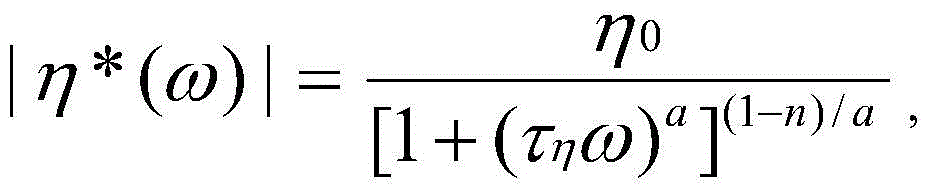
Wherein: i η (ω) i complex shear viscosity magnitude;
η0zero shear viscosity;
τηviscous relaxation time (Tau (η));
a ═ breadth "parameter (CY-a parameter);
determining the final power-law slope, determined at 2/11; and
ω -the angular frequency of the oscillating shear deformation.
Details of the significance and description of the CY model and derived parameters can be found in: c.a. hieber and h.h. chiang, rheol.acta,28,321 (1989); c.a. hieber and h.h.chiang, polym.eng.sci.,32,931 (1992); and r.b. bird, r.c. armstrong and o.hasseger, Dynamics of Polymeric Liquids, Volume 1, Fluid Mechanics,2nd Edition, John Wiley & Sons (1987); the entire contents of which are incorporated herein by reference.
From the zero shear viscosity value η by the method of Janzen and Colby (J.mol. struct., 485/486, 569-584(1999))o(determined by the Carreau-Yasuda model, described above) and utilizationMw measurements obtained by a Dawn EOS multi-angle light scattering detector (Wyatt) calculated Long Chain Branches (LCB) each totaling 1,000,000 carbon atoms. See also U.S. patent nos. 8,114,946; j.phys.chem.1980, 84, 649; and y.yu, d.c.rohlfing, g.r Hawley, and p.j.des lauriers, Polymer Preprints, 44, 49-50 (2003). The entire contents of these documents are incorporated herein by reference.
The Short Chain Branch (SCB) content and the distribution of short chain branches across the molecular weight distribution (SCBD) were determined by IR5 detection of a GPC system (IR5-GPC) which was a PL220GPC/SEC system (Polymer Labs, Agilent company) equipped with three Styragel HMW-6E columns (Waters, MA) for Polymer isolation. A thermo-electrically cooled IR5MCT detector (IR5) (Polymer Char, spain) was connected to the GPC column by a heat transfer line. Chromatographic data was obtained from two output ports of the IR5 detector. First, the analog signal goes from the analog output port to the digitizer, and then to computer "a" for molecular weight determination by: cirrus software (Polymer Labs, now Agilent Company) and Marlex with broad MWD HDPETMBHB5003 resin (Chevron Phillips Chemical) was used as a global calibration method for broad molecular weight standards. On the other hand, the digital signal goes directly through the USB cable to computer "B" where it is collected by LabView data collection software provided by Polymer Char. The chromatographic conditions were set as follows: the temperature of the column oven is 145 ℃; the flow rate is 1 mL/min; the injection volume is 0.4 mL; and a polymer concentration of about 2mg/mL, depending on the sample molecular weight. The temperature of the heat transfer line and the sample chamber of the IR5 detector were both set at 150 deg.C, while the temperature of the IR5 detector electrons was set at 60 deg.C. Short chain branching content by internal method, using CH3(ICH3) To CH2(ICH2) The intensity ratio is determined in conjunction with a calibration curve. The calibration curve is SCB content (x)SCB) As ICH3/ICH2Plotting of the intensity ratio as a function. To obtain a calibration curve, a set of polyethylene resins (not less than 5) with SCB levels ranging from 0 to ca.32scb/1,000 total carbons (SCB standard) was applied. These SCB standards all had known SCB levels and flat SCBD characteristic curves (profiles) -previously determined individually by NMR and solvent gradient fractionation in combination with NMR (SGF-NMR) methodsAnd (4) determining. Using the SCB calibration curve thus established, a short chain branch distribution profile across the molecular weight distribution of the resin fractionated by IR5-GPC system under exactly the same chromatographic conditions as these SCB standards was obtained. Utilizing a predetermined SCB calibration curve (i.e., I)CH3/ICH2Intensity ratio vs. SCB content) and MW calibration curve (i.e., molecular weight vs. elution time), the relationship between intensity ratio and elution volume is converted to SCB distribution as a function of MWD, thereby converting ICH3/ICH2The intensity ratio and elution time were converted to SCB content and molecular weight, respectively.
Pilot plant polymerization was conducted in a 23 gallon slurry loop reactor at a production rate of about 25 pounds of polymer per hour. The polymerization process is carried out under continuous particle formation process conditions in a loop reactor (also known as a slurry process) by contacting a solution of the dual metallocene in isobutane, an organoaluminum solution, and an activator support in a 1-L stirred autoclave and continuously outputting to the loop reactor. The organoaluminum and metallocene solutions are supplied as separate streams to T upstream of the autoclave where they are contacted with each other. The activator support is flushed with isobutane into the space T between T and the autoclave and contacted with the organoaluminum/metallocene mixture just before entering the autoclave. The flush of isobutane used to deliver the activator support to the autoclave was set at a rate that would result in a residence time in the autoclave of about 25 minutes. The total flow from the autoclave then entered the loop reactor.
The ethylene used was polymer grade ethylene purified by means of a column of alumina (activated at 250 ℃ under nitrogen). 1-hexene is polymerization grade 1-hexene (obtained from Chevron Phillips Chemical Company) purified by nitrogen purge and stored at 250 ℃ (482 ° F) on a 13-X molecular sieve activated in nitrogen. The loop reactor was a liquid full, 15.2cm diameter loop reactor having a volume of 23 gallons (87 liters). Liquid isobutane was used as diluent. Hydrogen is added to adjust the molecular weight and/or HLMI of the polymer product. Isobutane was a polymer grade isobutane (from Chevron Phillips Chemical Company) further purified by distillation and then passed through a column of alumina (activated at 250 ℃ under nitrogen).
The reactor conditions included: the pressure was about 580psi (4MPa) and the temperature varied from about 70 ℃ (158 ° F) to about 100 ℃ (212 ° F), as shown in the examples. Also, the reactor was operated with a residence time of about 1.25 hr. The metallocene concentration in the reactor is in the following range: about 1 to 2 parts per million (ppm) of diluent in the polymerization reactor. The polymer was removed from the reactor at a rate of about 25lb/hr and recovered in a flash chamber. The polymer was dried under nitrogen using a Vulcan dryer at about 60-80 ℃.
Co-catalyst triisobutylaluminum (TIBA, available from Akzo Corporation) was also used. The cocatalyst was obtained as a 1 molar solution in heptane, but further diluted to 1 wt.%. The co-catalyst is added at a concentration in the range of about 50 to 60 parts per million parts of diluent in the polymerization reactor. To prevent electrostatic build-up in the reactor, a small amount (less than 5ppm by weight of diluent) of a commercial antistatic agent-sold as "Stadis 450" is added as needed.
Metallocene A is rac-ethylene-bis (indenyl) zirconium dichloride and metallocene B is diphenylmethylene { eta.5- [3- (penten-4-yl) cyclopentadien-1-yl]}[η5- (2, 7-di-tert-butylfluoren-9-yl)]Zirconium dichloride.
The fluorided silica coated alumina was prepared as follows. Alumina a from w.r.grace Company impregnated to initial wettability was first calcined at about 600 ℃ for about 6 hours in dry air, cooled to ambient temperature, and then contacted with tetraethylorthosilicate in isopropanol to equal 25 wt.% SiO2. After drying, the silica-coated alumina was calcined at 600 ℃ for 3 hours. A fluorinated silica coated alumina (7 wt.% F) was prepared by: the calcined silica-coated alumina was impregnated with a methanolic solution of ammonium bifluoride, dried, and then calcined at 600 ℃ in dry air for 3 hours (unless otherwise noted). The fluorided silica coated alumina was then collected and stored in dry nitrogen and used without exposure to the atmosphere.
Some of the blown film samples were prepared in a laboratory scale blown film line-which utilized the following general linear low density polyethylene conditions (LLDPE): 100mm (4 inch) die diameter, 1.5mm (0.060 inch) die gap, 37.5mm (1.5 inch) diameter single screw extruder equipped with a barrier screw with Maddock mixing section at the end (L/D ═ 24, 2.2: 1 compression ratio), about 27kg/hr (60lb/hr) output rate, 2.5: 1 inflation ratio (BUR), the "in bag" bubble had a "frost line height" (FLH) of about 28cm (11 inches), a barrel and die set temperature of 190 ℃ (375 ° F), and a 1mil (25 micron) film and a 3mil (75 micron) film. Cooling was accomplished by a double-flanged air ring (double-flanged air ring) using ambient (laboratory) air at about 25 ℃ (75-80 ° F). These specific processing conditions are chosen because the film properties so obtained are a general representation of those obtained by larger industrial scale film blowing conditions.
Other blown film samples were prepared on the same film line but under high density polyethylene conditions (HDPE). In general, the copolymer was blown into a 1mil film on a2 inch mold with a 35-mil mold gap under the following conditions: barrel/die set temperature of 205 ℃/220 ℃, rate of 28-30lb/hr, 4: a blow-up ratio of 1, and a frost line height of 14 inches.
Dart impact strength was measured according to ASTM D-1709 (method A). Machine direction (machine direction, MD) and Transverse Direction (TD) Elmendorf tear strengths were measured according to ASTM D-1922 on a tear tester (model 83-11-00) by Testing Machines Inc. Film haze was determined according to ASTM D1003, film-to-film coefficient of friction (COF) according to ASTM D1894, film shrinkage properties according to ASTM D2732, and Spencer Impact (Spencer Impact) according to ASTM D3420.
Examples 1 to 9
Example 1 is a broad unimodal (unimodal) LLDPE film resin having a nominal melt index of 0.2 and a density of 0.924 available from Chevron-Phillips Chemical Company LP. Examples 2-9 each utilized a dual catalyst system comprising two carbon bridged zirconium based metallocene compounds comprising two indenyl groups (metallocene a) and a single atom bridged zirconium based metallocene compound comprising a cyclopentadienyl group and a fluorenyl group (metallocene B).
In example 2, a reactor comprising a: the weight ratio of B is 8:1 produces bimodal (bimodal) polymers. The total concentration of metallocene in the reactor was 0.8ppm by weight and the activator support (the above-described fluorided silica coated alumina) was supplied to the reactor at a rate of about 0.25lb per hour to achieve a yield of about 2000lb of polymer per lb of fluorided silica coated alumina. Triisobutylaluminum was supplied to the reactor to maintain a concentration of 50ppm by weight in isobutane. 1-hexene was added to the reactor to maintain a concentration of about 2.5 mol% and ethylene was added to maintain a concentration of about 12 mol% (based on isobutane diluent). Hydrogen was added to the reactor at about 4.5mlb per hour. The reactor temperature was set at 79-80 ℃, the reactor residence time was about 1.2hr, and the reactor solids% was 29.4-30.3%. Examples 3-9 were produced in the same manner as example 2, typically at 11.4-12.4 mol% ethylene and 2.5-2.9 mol% 1-hexene, and with the following different amounts of metallocene catalyst: example 3(1.12ppm metallocene at 12: 1A: B weight ratio), example 4(0.92ppm metallocene at 8: 1A: B weight ratio), example 5(1.02ppm metallocene at 20: 1A: B weight ratio), example 6(1.6ppm metallocene at 20: 1A: B weight ratio), example 7(0.83ppm metallocene at 20: 1A: B weight ratio), example 8(0.79ppm metallocene at 20: 1A: B weight ratio), and example 9(0.66ppm metallocene at 30: 1A: B weight ratio)
Table I summarizes the polymer properties of examples 1-9. For example, the polymers of examples 2-7 exhibit a unique combination of density, Mw/Mn, HLMI, LCB content, and SCB distribution. With respect to the polymers of examples 2-9, the broad molecular weight distribution and reverse comonomer distribution of the polymers produced using the dual metallocene-based catalyst systems disclosed herein are illustrated in FIGS. 1-8, respectively (e.g., relatively more Short Chain Branches (SCB) at higher molecular weights; assuming 2 methyl Chain Ends (CE)). In FIGS. 1-8, the SCB number per 1000 Total Carbon (TC) atoms of the polymer is greater in Mz (or Mw) than in Mn.
Table II summarizes the properties of the Lower Molecular Weight (LMW) and Higher Molecular Weight (HMW) components of the polymers of examples 2-8. Individual LMW and HMW component Properties the molecular weight distribution of each polymer was deconvoluted (seeSee fig. 1-8). The relative amounts of LMW and HMW components (area percent) in the polymer, as well as the Mp of the LMW component and the Mp of the HMW component, were determined using a commercial Software program (Systat Software, Inc., Peak FitTMv.4.05). Other molecular weight parameters of the LMW and HMW components (e.g., Mn, Mw, Mz, etc. of each component) are determined by: using Fit from PeakTMDeconvolution of the program data, and application of Schulz-Flory distribution mathematical functions and Gaussian curve fitting (Gaussian Peak Fit), as generally described in U.S. patent No. 7,300,983, the entire contents of which are incorporated herein by reference. The ratio of Mp of the HMW component to the Mp of the LMW component of the polymers of examples 2-8 is in the range of 7: 1 to 15:1, in the range of.
LCB of the polymers of examples 2-9 were determined using the Janzen-Colby method, as described herein. The LCB of the HMW component is determined by: the polymer was first produced using only metallocene B under conditions suitable to produce a polymer having a molecular weight (Mw) in the range of 100-125kg/mol, and then the LCB content was determined using the Janzen-Colby method. The LCB of the LMW component is likewise determined by: the polymer was first produced using only metallocene A under conditions suitable for producing a polymer having an Mw in the range of 100-125kg/mol, and then the LCB content was determined using the Janzen-Colby method. The polymerization process for producing these polymers was carried out in a 1 gallon stainless steel reactor with 1.8L of isobutane. About 1mmol of triisobutylaluminum, 100mg of fluorinated silica-coated alumina and 3mg of each metallocene compound were added in this order through the feed opening while slowly discharging isobutane vapor. The feed port was closed and isobutane was added. The contents of the reactor were stirred and heated to a polymerization temperature of 80 ℃ before ethylene and 40mL of 1-hexene were introduced into the reactor. Ethylene was supplied on demand to maintain the target pressure of 400psig for a polymerization process of 30 min. Hydrogen was added with ethylene supply as needed to produce a polymer having an Mw in the range of 100-125 kg/mol. The reactor was maintained at the desired temperature throughout the process by an auto-heating cooling system. Using metallocene A, polymers with Mw of 110kg/mol and Mw of 112kg/mol were produced and these polymers had 12.4 and 12.3LCB per million carbon atoms, respectively. Using metallocene B, polymers with Mw of 107kg/mol and 122kg/mol were produced, and both polymers had 1.1LCB per million carbon atoms. Thus, the ratio of the number of LCBs of the LMW component to the number of LCBs of the HMW component per million total carbon atoms is about 11: 1.
blown films were produced at an output rate of 28-30lb/hr and a melt temperature of 191-192 ℃ under the HDPE conditions provided above. In Table III, blown films labeled "A" were prepared without the polymeric processing aid (e.g., example 3A), while those labeled "B" were prepared with 400-800ppm of the polymeric processing aid (e.g., example 3B). The gels were measured using an automatic camera type gel counter model FS-5 made by an Optical Control System (OCS). The system consists of a light source and a detector. The film passed through the system, between the light source and detector, with a detection width of 150mm (6 inches). A total of 10 square meters of membrane area is tested and gels of sizes less than or greater than 200 microns are analyzed. The values in the table represent the number of gel sizes counted per square foot for each type. Films made from the polymers of examples 2-6, as shown in table III, exhibit a unique combination of dart impact strength, MD tear strength, haze, COF, and shrinkage properties. Specifically, films made from the polymers of examples 2-6 had dart impact strengths 3-7 times greater than films made from the polymer of example 1, and a better balance of MD and TD tear strengths.
Blown films were produced under the LLDPE conditions provided above at an output rate of about 27kg/hr (60lb/hr) and a melt temperature of 179-184 deg.C, except for example 2, which was produced at an output rate of 45-48lb/hr due to pressure limitations. In tables IV-V, blown films labeled "A" were prepared without the polymer processing aid (e.g., example 3A), while those labeled "B" were prepared with 400-800ppm of the polymer processing aid (e.g., example 3B). Films made from the polymers of examples 2-8, as shown in table IV, exhibit a unique combination of dart impact strength, MD tear strength, haze, COF, and shrinkage properties. Specifically, films made from the polymers of examples 2-8 have lower gel and higher dart drop impact strength, and a better balance of MD and TD tear strength relative to films made from the polymer of example 1.


The invention has been described above with reference to various aspects and embodiments and specific examples. Many modifications will suggest themselves to those skilled in the art based on the foregoing detailed description. All such obvious modifications are within the full intended scope of the appended claims. Other embodiments of the invention may include, but are not limited to, the following (embodiments are described as "comprising," but may alternatively be "consisting essentially of or" consisting of "):
embodiment 1. an olefin polymer comprising a higher molecular weight component and a lower molecular weight component, wherein the olefin polymer has:
the ratio of the Mp of the higher molecular weight component to the Mp of the lower molecular weight component is in the range of about 5:1 to about 100:1 in the range of;
the lower molecular weight component has an LCB number in the range of about 5 to about 50LCB per million total carbon atoms; and
the higher molecular weight component has an LCB number less than or equal to about 5LCB per million total carbon atoms.
the lower molecular weight component has an Mp in the range of about 15 to about 80kg/mol, and a total number of about 5 to about 50LCB per million carbon atoms; and
the higher molecular weight component has an Mp in the range of about 150 to about 800kg/mol and less than or equal to about 5LCB per million total carbon atoms.
the ratio of the Mp of the higher molecular weight component to the Mp of the lower molecular weight component is in the range of about 5:1 to about 100:1 in the range of; and
the ratio of the number of LCBs of the olefin polymer per million total carbon atoms to the number of LCBs of the higher molecular weight component is in the range of about 2:1 to about 100:1, in the range of.
the ratio of the Mp of the higher molecular weight component to the Mp of the lower molecular weight component is in the range of about 5:1 to about 100:1 in the range of;
the higher molecular weight component has an LCB number less than or equal to about 5LCB per million total carbon atoms; and
the olefin polymer has an LCB number in the range of from about 2 to about 30LCB per million total carbon atoms.
Embodiment 8 the olefin polymer defined in any one of embodiments 1-7, wherein the higher molecular weight component has an Mp in any range disclosed herein, for example, from about 200 to about 1,000, from about 150 to about 800, from about 200 to about 700, from about 150 to about 500, from about 250 to about 500, from about 175 to about 300kg/mol, and the like.
Embodiment 9 the olefin polymer defined in any one of embodiments 1-8, wherein the ratio of the number of olefin polymer LCBs per million total carbon atoms to the number of higher molecular weight component LCBs is in any range disclosed herein, for example, about 2:1 to about 100: 1. about 3: 1 to about 50: 1. about 2:1 to about 25: 1. about 2:1 to about 10: 1. about 3: 1 to about 15: 1. about 5:1 to about 10: 1. about 7: 1 to about 10:1, etc.
Embodiment 11 the olefin polymer as defined in any of embodiments 1 to 10, wherein the LCB number of the higher molecular weight component is any range disclosed herein, and the total number of carbon atoms per million is less than or equal to about 10LCB, less than or equal to about 5LCB, less than or equal to about 3LCB, less than or equal to about 2LCB, less than or equal to about 1LCB, or the like.
Embodiment 12 the olefin polymer as defined in any of embodiments 1 to 11, wherein the olefin polymer has an LCB number within any range disclosed herein, e.g., from about 1 to about 50, from about 1 to about 30, from about 2 to about 20, from about 1 to about 10, from about 3 to about 12LCB, etc., total number of carbon atoms per million.
Embodiment 13 the olefin polymer as defined in any of embodiments 1 to 12, wherein the olefin polymer has a density in any range disclosed herein, e.g., from about 0.91 to about 0.94, from about 0.915 toAbout 0.935, about 0.913 to about 0.93, about 0.917 to about 0.928, about 0.92 to about 0.928g/cm3And so on.
Embodiment 14 the olefin polymer as defined in any of embodiments 1 to 13, wherein the olefin polymer has a melt index within any range disclosed herein, e.g., less than or equal to about 1, less than or equal to about 0.4, less than or equal to about 0.3, less than or equal to about 0.25, less than or equal to about 0.2g/10min, etc.
Embodiment 16 the olefin polymer as defined in any of embodiments 1 to 15, wherein the olefin polymer has a HLMI/MI ratio within any range disclosed herein, e.g., from about 50 to about 300, from about 100 to about 350, from about 150 to about 300, from about 180 to about 350, from about 60 to about 250, from about 60 to about 200, from about 70 to about 225, etc.
Embodiment 17 the olefin polymer as defined in any of embodiments 1 to 16, wherein the olefin polymer has a Mw/Mn ratio within any range disclosed herein, e.g., from about 6 to about 50, from about 8 to about 35, from about 10 to about 35, from about 12 to about 50, from about 14 to about 35, from about 6 to about 20, from about 8 to about 16, etc.
Embodiment 18 the olefin polymer defined in any one of embodiments 1-17, wherein the olefin polymer has an Mz/Mw ratio within any range disclosed herein, for example, from about 3 to about 12, from about 3 to about 6, from about 3.5 to about 9, from about 3.5 to about 6, and the like.
Embodiment 19. the olefin polymer as defined in any of embodiments 1 to 18, wherein the olefin polymer has a Mw in any range disclosed herein, e.g., from about 100 to about 600, from about 175 to about 600, from about 120 to about 500, from about 190 to about 500, from about 120 to about 300, from about 150 to about 350kg/mol, and the like.
Embodiment 21 the olefin polymer defined in any one of embodiments 1-20, wherein the olefin polymer has a CY-a parameter in any range disclosed herein, for example, from about 0.2 to about 0.45, from about 0.25 to about 0.4, from about 0.25 to about 0.38, from about 0.25 to about 0.35, and the like.
Embodiment 22 the olefin polymer as defined in any of embodiments 1 to 21, wherein the olefin polymer has a zero shear viscosity in any range disclosed herein, e.g., from about 10,000 to about 500,000, from about 60,000 to about 500,000, from about 20,000 to about 400,000, from about 70,000 to about 400,000, from about 30,000 to about 300,000Pa-sec, etc.
Embodiment 23. the polymer defined in any one of embodiments 1-22, wherein the olefin polymer has a Tau (η) in any range disclosed herein, e.g., from about 0.1 to about 3, from about 0.6 to about 3, from about 1 to about 3, from about 0.2 to about 2, from about 0.4 to about 2sec, etc.
Embodiment 24. the olefin polymer as defined in any of embodiments 1 to 23, wherein the olefin polymer has a reverse comonomer distribution, e.g., the number of SCBs per total number of 1000 carbon atoms of the polymer is greater in Mw than in Mn, and/or the number of SCBs per total number of 1000 carbon atoms of the polymer is greater in Mz than in Mw, and/or the number of SCBs per total number of 1000 carbon atoms of the polymer is greater in Mz than in Mn.
Embodiment 26 the olefin polymer as defined in any of embodiments 1 to 25, wherein the olefin polymer is an ethylene/alpha-olefin copolymer.
Embodiment 27 the olefin polymer defined in any one of embodiments 1-26, wherein the olefin polymer is an ethylene/1-butene copolymer, an ethylene/1-hexene copolymer, or an ethylene/1-octene copolymer.
Embodiment 28 the olefin polymer defined in any one of embodiments 1-27, wherein the olefin polymer is an ethylene/1-hexene copolymer.
Embodiment 29, an article comprising the olefin polymer defined in any one of embodiments 1-28.
Embodiment 31. a film comprising the olefin polymer 1-28 as defined in any one of embodiments.
Embodiment 32. a blown film comprising an olefin polymer having a melt index of less than or equal to about 0.4g/10min, wherein the film has a dart impact strength of greater than or equal to about 300 g/mil.
Embodiment 33 the film defined in embodiment 32, wherein the film has a dart impact strength in any range disclosed herein, for example, in the range of from about 300 to about 2000, from about 400 to about 2000, from about 500 to about 2000, from about 600 to about 2000, from about 700 to about 2000g/mil, and the like.
Embodiment 34, the film defined in embodiments 32 or 33, wherein the film has a haze (without additives) within any range disclosed herein, e.g., greater than or equal to about 55, greater than or equal to about 65, greater than or equal to about 75, greater than or equal to about 80%, greater than or equal to about 85%, etc.
Embodiment 35 the film defined in any one of embodiments 32-34, wherein the film has a degree of MD shrinkage at 250 ° F in any range disclosed herein, for example, in the range of from about 20 to about 70, from about 35 to about 70, from about 25 to about 65, from about 27 to about 65, from about 30 to about 60%, and the like.
Embodiment 36. the film defined in any one of embodiments 32-35, wherein the film has an MD elmendorf tear strength in any range disclosed herein, for example, in the range of from about 10 to about 150, from about 25 to about 150, from about 50 to about 150, from about 75 to about 150g/mil, and the like.
Embodiment 37. the film defined in any one of embodiments 32-36, wherein the film has a dynamic COF (without additives) in any range disclosed herein, for example, in the range of from about 0.3 to about 0.5, from about 0.3 to about 0.48, from about 0.32 to about 0.47, and the like.
Embodiment 38. the film defined in any one of embodiments 32-37, wherein the film comprises the olefin polymer defined in any one of embodiments 1-28, e.g., an olefin polymer characterized by one or more of the ranges disclosed herein: MI (e.g., less than or equal to about 0.4, about 0.3, about 0.25, about 0.2g/10min, etc.), HLMI (e.g., about 3 to about 60, about 4 to about 30, about 4 to about 25, about 4 to about 20, about 5 to about 18, about 5 to about 15g/10min, etc.), density (e.g., about 0.91 to about 0.94, about 0.915 to about 0.935, about 0.913 to about 0.93, about 0.917 to about 0.928, about 0.92 to about 0.928g/cm3Etc.), Mw/Mn (e.g., from about 6 to about 50, from about 8 to about 35, from about 10 to about 35, from about 12 to about 50, from about 14 to about 35, from about 6 to about 20, from about 8 to about 16, etc.), etc.
Embodiment 39 a catalyst composition comprising catalyst component I, catalyst component II, an activator, and an optional co-catalyst, wherein catalyst component I produces a lower molecular weight component having more long chain branches and less short chain branches (e.g., two carbon bridged metallocene compounds comprising two indenyl groups, an unbridged zirconium-based metallocene compound having two cyclopentadienyl groups, etc.) relative to the higher molecular weight component, and catalyst component II produces a higher molecular weight component having more short chain branches and less long chain branches (e.g., a monoatomic bridged metallocene compound comprising fluorenyl groups) relative to the lower molecular weight component.
Embodiment 40 the composition defined in embodiment 39, wherein the catalyst composition comprises only two metallocene compounds: a metallocene compound which is two carbon bridged comprising two cyclopentadienyl groups, two indenyl groups or a cyclopentadienyl group and an indenyl group; and the other is a monoatomic bridged metallocene compound containing a fluorenyl group.
Embodiment 41. the composition defined in embodiments 39 or 40, wherein the weight percent of catalyst component I to catalyst component II is in any range of the weight percentages disclosed herein, for example, the weight percent of catalyst component I is in the range of from about 25 to about 98%, from about 40 to about 95%, from about 55 to about 98%, from about 60 to about 95%, and the like, wherein the weight percent is based on the total weight of catalyst components I and II.
Embodiment 42 the composition defined in any one of embodiments 39-41, wherein the activator comprises any activator disclosed herein.
Embodiment 43 the composition defined in any one of embodiments 39 to 42, wherein the activator comprises an aluminoxane compound, an organoboron or organoborate compound, an ionizing ionic compound, or any combination thereof.
Embodiment 44. the composition defined in any one of embodiments 39-43, wherein the activator comprises an alumoxane compound.
Embodiment 45 the composition defined in any one of embodiments 39 to 43, wherein the activator comprises an organoboron or organoborate compound.
Embodiment 46. the composition defined in any one of embodiments 39-43, wherein the activator comprises an ionizing ionic compound.
Embodiment 47. the composition defined in any one of embodiments 39-42, wherein the activator comprises an activator-support comprising any of the electron-withdrawing anion treated solid oxides disclosed herein.
Embodiment 48 the composition defined in embodiment 47, wherein the solid oxide comprises any solid oxide disclosed herein, for example, silica, alumina, silica-coated alumina, aluminum phosphate, aluminophosphate, heteropolytungstate, titania, zirconia, magnesia, boria, zinc oxide, the like, mixed oxides thereof, or any mixture thereof; and the electron-withdrawing anion comprises any electron-withdrawing anion disclosed herein, for example, sulfate, bisulfate, fluoride, chloride, bromide, iodide, fluorosulfate, fluoroborate, phosphate, fluorophosphate, trifluoroacetate, triflate, fluorozirconate, fluorotitanate, phosphotungstic acid, and the like, or any combination thereof.
Embodiment 49 the composition defined in embodiment 47, wherein the activator-support comprises fluorided alumina, chlorided alumina, bromided alumina, sulfated alumina, fluorided silica-alumina, chlorided silica-alumina, bromided silica-alumina, sulfated silica-alumina, fluorided silica-zirconia, chlorided silica-zirconia, bromided silica-zirconia, sulfated silica-zirconia, fluorided silica-titania, fluorided silica-coated alumina, sulfated silica-coated alumina, phosphated silica-coated alumina, or any combination thereof.
Embodiment 50 the composition defined in embodiment 47, wherein the activator-support comprises fluorided alumina, sulfated alumina, fluorided silica-alumina, sulfated silica-alumina, fluorided silica-coated alumina, sulfated silica-coated alumina, or any combination thereof.
Embodiment 51 the composition defined in embodiment 47, wherein the activator-support comprises a fluorinated solid oxide, a sulfated solid oxide, or any combination thereof.
Embodiment 52 the composition defined in embodiment 47, wherein the activator-support further comprises any metal or metal ion disclosed herein, for example, zinc, nickel, vanadium, titanium, silver, copper, gallium, tin, tungsten, molybdenum, zirconium, or any combination thereof.
Embodiment 53 the composition defined in any one of embodiments 39 to 52, wherein the catalyst composition comprises a cocatalyst, e.g., any cocatalyst disclosed herein.
Embodiment 54 the composition defined in any one of embodiments 39-53, wherein the cocatalyst comprises an organoaluminum compound, an organozinc compound, an organomagnesium compound, an organolithium compound, or any combination thereof.
Embodiment 55 the composition defined in any one of embodiments 39-54, wherein the cocatalyst comprises an organoaluminum compound.
Embodiment 56 the composition defined in embodiment 55, wherein the organoaluminum compound comprises any organoaluminum compound disclosed herein, for example, trimethylaluminum, triethylaluminum, triisobutylaluminum, or the like, or a combination thereof.
Embodiment 57 the composition defined in any one of embodiments 39-42, wherein the catalyst composition comprises catalyst component I, catalyst component II, the electron-withdrawing anion treated solid oxide, and an organoaluminum compound.
Embodiment 58 the composition defined in any one of embodiments 47 to 57, wherein the catalyst composition is substantially free of an aluminoxane compound, an organoboron or organoborate compound, an ionizing ionic compound, or a combination thereof.
Embodiment 59 the composition defined in any one of embodiments 47-57, wherein the cocatalyst comprises an aluminoxane compound, an organoboron or organoborate compound, an ionizing ionic compound, an organoaluminum compound, an organozinc compound, an organomagnesium compound, an organolithium compound, or any combination thereof.
Embodiment 60 the composition defined in any one of embodiments 39-59, wherein catalyst component I comprises any catalyst component I metallocene compound disclosed herein, for example, a two carbon bridged zirconium-based metallocene compound comprising two cyclopentadienyl groups, two indenyl groups, or a cyclopentadienyl group and an indenyl group; an unbridged zirconium-based metallocene compound having two cyclopentadienyl groups; a monoatomic bridged (C or Si) zirconium-based metallocene compound having two cyclopentadienyl groups (e.g., having an alkyl substituent such as propyl); a single atom bridged (C or Si) zirconium based metallocene compound having two indenyl groups (e.g., meso bridged); 3-5 carbon atom bridged zirconium-based metallocene compounds having two indenyl groups (e.g., racemic bridged), and the like.
Embodiment 61 the composition defined in any one of embodiments 39-59, wherein catalyst component I comprises two carbon bridged, two indenyl-containing, zirconium-based metallocene compounds.
Embodiment 62. the composition defined in any one of embodiments 39 to 59, wherein catalyst component I comprises any two carbon bridged metallocene compound disclosed herein, e.g., having the formula (A):

M1is Zr or Hf; cp1And Cp2Independently is a cyclopentadienyl or indenyl group; e1Is a bridging group having the formula-CR1AR1B—CR2AR2BWherein R is1A、R1B、R2AAnd R2BIndependently H or a hydrocarbyl group having up to 10 carbon atoms (e.g., any C disclosed herein)1-C10A hydrocarbyl group); and each X is independently a monoanionic ligand.
Embodiment 63 the composition defined in embodiment 62, wherein M1Is Zr.
Embodiment 64 the composition defined in any one of embodiments 62 to 63, wherein Cp1And Cp2Independently an indenyl or cyclopentadienyl group substituted with a substituent of any number disclosed herein, e.g., one substituent, two substituents, etc.
Embodiment 65 the composition defined in embodiment 64, wherein Cp1And Cp2Each substituent on (a) is independently any substituent disclosed herein, e.g., H, halo, C1To C36Hydrocarbyl radical, C1To C36Halogenated hydrocarbon groups, C1To C36Hydrocarbyloxy or C1To C36A hydrocarbylsilyl group; h or a hydrocarbon group having up to 18 carbon atoms, and the like.
Embodiment 66 the composition defined in embodiments 62 or 63, wherein Cp1And Cp2No further substituents are included, for example, in addition to the bridging group.
Embodiment 67 the composition defined in embodiments 62 or 63, wherein Cp1And Cp2Is indenyl that does not contain further substituents, for example other than bridging groups.
Embodiment 68. The composition defined in any one of embodiments 62-67, wherein E1Is of the formula-CH2—CH2-a bridging group.
Embodiment 69 the composition defined in any one of embodiments 39-68, wherein catalyst component II comprises a monoatomic bridged cyclopentadienyl-and fluorenyl-containing zirconium-or hafnium-based metallocene compound.
Embodiment 70 the composition defined in embodiment 69, wherein the single atom is a carbon or silicon atom.
Embodiment 71 the composition defined in any one of embodiments 69 to 70, wherein the bridging group comprises an aryl substituent (e.g., phenyl).
Embodiment 72 the composition defined in any one of embodiments 69-71, wherein the bridging group comprises an alkenyl substituent (e.g., a terminal alkenyl group).
Embodiment 73. the composition defined in any one of embodiments 39 to 68, wherein catalyst component II comprises any of the monatomic bridged metallocene compounds having a fluorenyl group disclosed herein, e.g., having the formula (B):
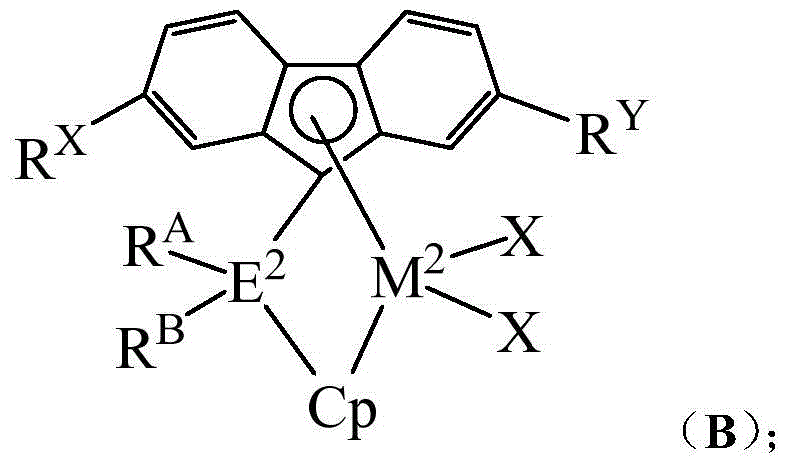
M2is Zr or Hf; cp is a cyclopentadienyl group; e2Is carbon or silicon; rAAnd RBIndependently is H or C1To C18A hydrocarbyl group; rXAnd RYIndependently of each other H, halo, C1To C36Hydrocarbyl radical, C1To C36Halogenated hydrocarbon groups, C1To C36Hydrocarbyloxy or C1To C36A hydrocarbylsilyl group; and each X is independently a monoanionic ligand.
Embodiment 74 the composition defined in embodiment 73, wherein M2Is Zr.
Embodiment 75. the composition defined in embodiments 73 or 74, wherein Cp is a substituted cyclopentadienyl group substituted with any number of substituents disclosed herein, e.g., one substituent, two substituents, etc., except for a bridging group.
Embodiment 76 the composition defined in embodiment 75, wherein each substituent on Cp is independently any substituent disclosed herein, e.g., H, halo, C1To C36Hydrocarbyl radical, C1To C36Halogenated hydrocarbon groups, C1To C36Hydrocarbyloxy or C1To C36A hydrocarbylsilyl group; h or a hydrocarbon group having up to 18 carbon atoms, and the like.
Embodiment 77, the composition defined in embodiments 73 or 74, wherein Cp does not comprise additional substituents, e.g., other than bridging groups.
Embodiment 78. the composition defined in any one of embodiments 73 to 77, wherein E2Is carbon.
Embodiment 79 the composition defined in any one of embodiments 73-78, wherein RAAnd RBIndependently is C1To C8Alkyl radical, C3To C8Alkenyl or phenyl.
Embodiment 80 the composition defined in any one of embodiments 73-79, wherein RAAnd RBAt least one of which is phenyl.
Embodiment 81 the composition defined in any one of embodiments 73 to 80, wherein RAAnd RBAt least one of (A) is C3To C8A terminal alkenyl group.
Embodiment 82 the composition defined in any one of embodiments 73 to 78, wherein RAAnd RBIndependently methyl, ethyl, propyl, butyl, pentyl, hexyl, heptyl, octyl, nonyl, decyl, ethenyl, propenyl, butenyl, pentenyl, hexenyl, heptenyl, octenyl, nonenyl, decenyl, phenyl, cyclohexylphenyl, naphthyl, tolyl, or benzyl.
Embodiment 83. the composition defined in any one of embodiments 73-82, wherein RXAnd RYIndependently is H or any C disclosed herein1To C12A hydrocarbyl group.
Embodiment 84. the composition defined in any one of embodiments 73 to 82, wherein RXAnd RYIndependently H, methyl, ethyl, propyl, butyl, pentyl, hexyl, heptyl, octyl, nonyl, decyl, ethenyl, propenyl, butenyl, pentenyl, hexenyl, heptenyl, octenyl, nonenyl, decenyl, phenyl, tolyl, or benzyl.
Embodiment 85 the composition defined in any one of embodiments 73 to 82, wherein RXAnd RYIndependently is H or C1To C6Straight or branched chain alkyl (e.g., t-butyl).
Embodiment 86, the composition defined in any one of embodiments 62 to 68 and 73 to 85, wherein each X is independently any monoanionic ligand disclosed herein.
Embodiment 87, the composition defined in any one of embodiments 62 to 68 and 73 to 85, wherein each X is independently H, BH4Halogen radical, C1To C36Hydrocarbyl radical, C1To C36Hydrocarbyloxy, C1To C36Alkylamino radical, C1To C36Hydrocarbylsilyl group, C1To C36Hydrocarbylaminosilyl, OBR1 2Or OSO2R1Wherein R is1Is C1To C36A hydrocarbyl group.
Embodiment 88, the composition defined in any one of embodiments 62 to 68 and 73 to 85, wherein each X is independently any halo or C disclosed herein1To C18A hydrocarbyl group.
Embodiment 89 the composition defined in any one of embodiments 62 to 68 and 73 to 85, wherein each X is Cl.
Embodiment 90 the composition defined in any one of embodiments 39-89, wherein the catalyst composition is formed by: comprising contacting catalyst component I, catalyst component II and an activator in any order.
Embodiment 91 the composition defined in any one of embodiments 39 to 89, wherein the catalyst composition is formed by: comprising contacting catalyst component I, catalyst component II, activator, and cocatalyst in any order.
Embodiment 92. the composition defined in any one of embodiments 39-91, wherein the catalyst activity of the catalyst composition is in any range disclosed herein, for example, in the range of from about 150 to about 10,000, from about 500 to about 7,500, from about 1,000 to about 5,000 grams of the like ethylene polymer per gram of activator-support per hour under slurry polymerization conditions with triisobutylaluminum co-catalyst using isobutane as the diluent and with a polymerization temperature of 90 ℃ and a reactor pressure of 390 psig.
Embodiment 93. an olefin polymerization process comprising contacting a catalyst composition as defined in any of embodiments 39-92 with an olefin monomer and optionally an olefin comonomer in a polymerization reactor system under polymerization conditions to produce an olefin polymer.
Embodiment 94 the method as defined in embodiment 93, wherein the olefin monomer comprises any olefin monomer disclosed herein, e.g., any C2-C20An olefin.
Embodiment 95 the process as defined in embodiments 93 or 94, wherein the olefin monomer and optional olefin comonomer independently comprise C2-C20An alpha-olefin.
Embodiment 96 the method as defined in any one of embodiments 93 to 95, wherein the olefin monomer comprises ethylene.
Embodiment 97 the method defined in any one of embodiments 93-96, wherein the catalyst composition is contacted with ethylene and an olefin comonomer comprising C3-C10An alpha-olefin.
Embodiment 98. the process defined in any one of embodiments 93 to 97, wherein the catalyst composition is contacted with ethylene and an olefin comonomer comprising 1-butene, 1-hexene, 1-octene, or a mixture thereof.
Embodiment 99 the method as defined in any one of embodiments 93 to 95, wherein the olefin monomer comprises propylene.
Embodiment 100 the method defined in any one of embodiments 93-99, wherein the polymerization reactor system comprises a batch reactor, a slurry reactor, a gas phase reactor, a solution reactor, a high pressure reactor, a tubular reactor, an autoclave reactor, or a combination thereof.
Embodiment 101 the method defined in any one of embodiments 93-100, wherein the polymerization reactor system comprises a slurry reactor, a gas phase reactor, a solution reactor, or a combination thereof.
Embodiment 102 the method defined in any one of embodiments 93-101, wherein the polymerization reactor system comprises a loop slurry reactor.
Embodiment 103 the method defined in any one of embodiments 93-102, wherein the polymerization reactor system comprises a single reactor.
Embodiment 104 the method defined in any one of embodiments 93-102, wherein the polymerization reactor system comprises 2 reactors.
Embodiment 105 the method defined in any one of embodiments 93-102, wherein the polymerization reactor system comprises more than 2 reactors.
Embodiment 106 the method as defined in any one of embodiments 93 to 105, wherein the olefin polymer comprises any olefin polymer disclosed herein.
Embodiment 107. the process as defined in any one of embodiments 93-98 and 100-106, wherein the olefin polymer is an ethylene homopolymer, an ethylene/1-butene copolymer, an ethylene/1-hexene copolymer or an ethylene/1-octene copolymer.
Embodiment 108 the process as defined in any one of embodiments 93-98 and 100-107, wherein the olefin polymer is an ethylene/1-hexene copolymer.
Embodiment 109, the method defined in any one of embodiments 93-95 and 99-106, wherein the olefin polymer is a polypropylene homopolymer or a propylene-based copolymer.
Embodiment 110 the process as defined in any one of embodiments 93 to 109, wherein the polymerization conditions comprise a polymerization temperature in the range of from about 60 ℃ to about 120 ℃ and a reaction pressure in the range of from about 200 to about 1000psig (about 1.4 to about 6.9 MPa).
Embodiment 111 the method defined in any one of embodiments 93-110, wherein the polymerization conditions are substantially constant, for example, for a particular polymer grade.
Embodiment 112 the method defined in any one of embodiments 93-111, wherein no hydrogen is added to the polymerization reactor system.
Embodiment 113 the method defined in any one of embodiments 93-111, wherein hydrogen is added to the polymerization reactor system.
Embodiment 114 an olefin polymer produced by the olefin polymerization process defined in any one of embodiments 93-113.
Embodiment 115 the olefin polymer as defined in any one of embodiments 1 to 28, produced by the olefin polymerization process as defined in any one of embodiments 93 to 113.
Embodiment 116. an article comprising the olefin polymer as defined in any one of embodiments 114 and 115.
Embodiment 117. a method of forming or making an article comprising an olefin polymer, the method comprising (i) performing the olefin polymerization process defined in any one of embodiments 93-113 to produce an olefin polymer (e.g., the olefin polymer of any one of embodiments 1-28), and (ii) forming an article comprising an olefin polymer, e.g., by any of the techniques disclosed herein.
Embodiment 118 the article as defined in any one of embodiments 116 and 117, wherein the article is an agricultural film, an automotive part, a bottle, a drum, a fiber or fabric, a food packaging film or container, a food service article, a fuel tank, a geomembrane, a household container, a liner, a molded product, a medical device or material, a tube, a sheet or tape, or a toy.
Embodiment 119 the article of any one of embodiments 116 and 117, wherein the article is a film (e.g., a blown film) of any one of embodiments 32-38.
Claims (10)
1. An ethylene polymer comprising a higher molecular weight component and a lower molecular weight component, wherein the polymer has:
the ratio of Mp of the higher molecular weight component to Mp of the lower molecular weight component is in the range of 5:1 to 100:1 in the range of;
the lower molecular weight component has an LCB number in the range of 5 to 50LCB per million total carbon atoms;
the higher molecular weight component has an LCB number less than or equal to 5LCB per million total carbon atoms;
a melt index of less than or equal to 0.4g/10 min; and
in the range of 0.91 to 0.94g/cm3Density within the range.
2. The polymer of claim 1, wherein:
the lower molecular weight component has an Mp in the range of 15 to 80 kg/mol;
the higher molecular weight component has an Mp in the range of 150 to 800 kg/mol;
the ratio of the number of LCBs of the ethylene polymer to the number of LCBs of the higher molecular weight component per million carbon atoms is in the range of 2:1 to 100:1 range; and
the ethylene polymer has an LCB number in the range of 2 to 30LCB per million total carbon atoms.
3. The polymer of claim 1 wherein the higher molecular weight component is in the range of 10 to 60 area percent based on the weight of the ethylene polymer as determined by deconvoluting the polymer MWD to determine the amount of the lower molecular weight component and the higher molecular weight component.
4. The polymer of claim 1, wherein the polymer has:
a high load melt index in the range of 4 to 30g/10 min; and
in the range of 0.915 to 0.935g/cm3Density within the range.
5. The polymer of claim 4, wherein the polymer has:
an Mw/Mn ratio in the range of 8 to 35;
a Mz/Mw ratio in the range of 3 to 6;
an Mw in the range of from 120 to 500 kg/mol;
mn in the range of 10 to 50 kg/mol; or
Any combination thereof.
6. The polymer of claim 1, wherein the polymer has:
a zero shear viscosity in the range of 10,000 to 500,000 Pa-sec at 190 ℃;
a CY-a parameter in the range of 0.20 to 0.45 at 190 ℃; and
tau (. eta.) parameter at 190 ℃ in the range of 0.2 to 2 sec.
7. The polymer of claim 1, wherein the polymer is an ethylene/1-butene copolymer, an ethylene/1-hexene copolymer, or an ethylene/1-octene copolymer.
8. The polymer of claim 7, wherein the polymer has a reverse comonomer distribution.
9. An article comprising the polymer of claim 8.
10. A film comprising the polymer of claim 8.
Applications Claiming Priority (2)
| Application Number | Priority Date | Filing Date | Title |
|---|---|---|---|
| US14/072,819 | 2013-11-06 | ||
| US14/072,819 US9181370B2 (en) | 2013-11-06 | 2013-11-06 | Low density polyolefin resins with low molecular weight and high molecular weight components, and films made therefrom |
Publications (2)
| Publication Number | Publication Date |
|---|---|
| CN104628921A CN104628921A (en) | 2015-05-20 |
| CN104628921B true CN104628921B (en) | 2021-12-14 |
Family
ID=51901022
Family Applications (1)
| Application Number | Title | Priority Date | Filing Date |
|---|---|---|---|
| CN201410616085.6A Active CN104628921B (en) | 2013-11-06 | 2014-11-05 | Low density polyolefin resins having low and high molecular weight components and films made therefrom |
Country Status (9)
| Country | Link |
|---|---|
| US (4) | US9181370B2 (en) |
| EP (1) | EP3066137B1 (en) |
| CN (1) | CN104628921B (en) |
| BR (1) | BR112016009743B1 (en) |
| CA (1) | CA2929164C (en) |
| ES (1) | ES2974097T3 (en) |
| MX (1) | MX388270B (en) |
| SG (1) | SG11201603364YA (en) |
| WO (1) | WO2015069637A2 (en) |
Cited By (2)
| Publication number | Priority date | Publication date | Assignee | Title |
|---|---|---|---|---|
| US12122857B2 (en) | 2021-12-16 | 2024-10-22 | Chevron Phillips Chemical Company Lp | Controlling long-chain branch content with dual activator-supports |
| US12240964B2 (en) | 2020-04-01 | 2025-03-04 | Chevron Phillips Chemical Company Lp | Dual catalyst system for producing LLDPE and MDPE copolymers with long chain branching for film applications |
Families Citing this family (69)
| Publication number | Priority date | Publication date | Assignee | Title |
|---|---|---|---|---|
| CN104781319B (en) | 2012-11-07 | 2018-04-10 | 切弗朗菲利浦化学公司 | Low density polyolefin resin and film made therefrom |
| US8912285B2 (en) | 2012-12-06 | 2014-12-16 | Chevron Phillips Chemical Company Lp | Catalyst system with three metallocenes for producing broad molecular weight distribution polymers |
| US9156970B2 (en) | 2013-09-05 | 2015-10-13 | Chevron Phillips Chemical Company Lp | Higher density polyolefins with improved stress crack resistance |
| US9181370B2 (en) | 2013-11-06 | 2015-11-10 | Chevron Phillips Chemical Company Lp | Low density polyolefin resins with low molecular weight and high molecular weight components, and films made therefrom |
| US20160362510A1 (en) * | 2014-02-11 | 2016-12-15 | Univation Technologies, Llc | Method to prepare ethylene copolymers |
| US9169337B2 (en) | 2014-03-12 | 2015-10-27 | Chevron Phillips Chemical Company Lp | Polymers with improved ESCR for blow molding applications |
| US20170152377A1 (en) * | 2014-06-26 | 2017-06-01 | Dow Global Technologies Llc | Breathable films and articles incorporating same |
| KR101617870B1 (en) * | 2014-09-05 | 2016-05-03 | 주식회사 엘지화학 | Olefin based polymer having excellent processibility |
| ES2928549T3 (en) * | 2015-04-23 | 2022-11-21 | Univation Tech Llc | Polyethylene copolymers having a particular comonomer distribution |
| US9493589B1 (en) | 2015-09-09 | 2016-11-15 | Chevron Phillips Chemical Company Lp | Polymers with improved ESCR for blow molding applications |
| US9650459B2 (en) | 2015-09-09 | 2017-05-16 | Chevron Phillips Chemical Company Lp | Methods for controlling die swell in dual catalyst olefin polymerization systems |
| CN106632782B (en) * | 2015-10-30 | 2018-12-25 | 中国石油天然气股份有限公司 | Metallocene transparent film resin and its preparation method and film |
| CN106632778B (en) * | 2015-10-30 | 2018-12-25 | 中国石油天然气股份有限公司 | Preparation method of metallocene transparent film resin |
| JP6997713B2 (en) * | 2016-02-23 | 2022-02-04 | ダウ グローバル テクノロジーズ エルエルシー | Ethylene-based polymer and method for producing it |
| KR101711788B1 (en) | 2016-03-09 | 2017-03-14 | 한화케미칼 주식회사 | Hybride catalyst compositon, preparation method thereof, and manufactured polyolefin using the same |
| KR101725004B1 (en) * | 2016-04-27 | 2017-04-18 | 한화케미칼 주식회사 | Supported hybrid metallocene catalyst and good processability polyolefin using the same |
| US10759928B2 (en) * | 2016-05-18 | 2020-09-01 | Dow Global Technologies Llc | Ethylene-based polymers and processes to make the same |
| CA3038258C (en) * | 2016-09-28 | 2024-05-21 | Dow Global Technologies Llc | Blown films with improved properties |
| KR102454616B1 (en) | 2016-11-08 | 2022-10-18 | 유니베이션 테크놀로지즈, 엘엘씨 | polyethylene composition |
| US10000594B2 (en) * | 2016-11-08 | 2018-06-19 | Chevron Phillips Chemical Company Lp | Dual catalyst system for producing LLDPE copolymers with a narrow molecular weight distribution and improved processability |
| WO2018089193A1 (en) | 2016-11-08 | 2018-05-17 | Univation Technologies, Llc | Polyethylene composition |
| KR102072697B1 (en) | 2016-12-09 | 2020-02-03 | 주식회사 엘지화학 | Ethylene/1-hexene copolymer having excellent processibility and physical property |
| KR102139364B1 (en) * | 2016-12-20 | 2020-07-29 | 주식회사 엘지화학 | Olefin polymer and preparation method thereof |
| KR102140260B1 (en) * | 2016-12-22 | 2020-07-31 | 주식회사 엘지화학 | Olefin polymer and preparation method thereof |
| US10723819B2 (en) | 2017-02-20 | 2020-07-28 | Exxonmobil Chemical Patents, Inc. | Supported catalyst systems and processes for use thereof |
| KR102271789B1 (en) | 2017-02-20 | 2021-06-30 | 엑손모빌 케미칼 패턴츠 인코포레이티드 | Supported catalyst systems and methods of use thereof |
| EP3594275A4 (en) * | 2017-03-10 | 2021-01-20 | Sumitomo Chemical Company Limited | MOVIE |
| US10442920B2 (en) * | 2017-04-19 | 2019-10-15 | Nova Chemicals (International) S.A. | Means for increasing the molecular weight and decreasing the density of ethylene interpolymers employing homogeneous and heterogeneous catalyst formulations |
| US10442921B2 (en) * | 2017-04-19 | 2019-10-15 | Nova Chemicals (International) S.A. | Means for increasing the molecular weight and decreasing the density employing mixed homogeneous catalyst formulations |
| EP3661982B1 (en) * | 2017-08-02 | 2021-12-01 | Total Research & Technology Feluy | Dual catalyst composition |
| US10844150B2 (en) | 2017-08-04 | 2020-11-24 | Exxonmobil Chemical Patents Inc. | Mixed catalysts with 2,6-bis(imino)pyridyl iron complexes and bridged hafnocenes |
| EP3697822B1 (en) | 2017-08-04 | 2025-07-30 | ExxonMobil Chemical Patents Inc. | Mixed catalysts with unbridged hafnocenes with -ch2-sime3 moieties |
| CA3074827A1 (en) | 2017-09-11 | 2019-03-14 | Univation Technologies, Llc | Carbon black-containing bimodal polyethylene composition |
| US10358506B2 (en) * | 2017-10-03 | 2019-07-23 | Chevron Phillips Chemical Company Lp | Dual catalyst system for producing LLDPE copolymers with improved processability |
| CN111183160B (en) | 2017-10-06 | 2022-06-10 | 埃克森美孚化学专利公司 | Polyethylene extrudates and process for making same |
| CN111587256B (en) | 2017-10-23 | 2023-05-19 | 埃克森美孚化学专利公司 | Catalyst system and polymerization process using the same |
| US10703838B2 (en) | 2017-10-31 | 2020-07-07 | Exxonmobil Chemical Patents Inc. | Mixed catalyst systems with four metallocenes on a single support |
| WO2019094131A1 (en) | 2017-11-13 | 2019-05-16 | Exxonmobil Chemical Patents Inc. | Polyethylene compositions and articles made therefrom |
| WO2019094132A1 (en) | 2017-11-13 | 2019-05-16 | Exxonmobil Chemical Patents Inc. | Polyethylene compositions and articles made therefrom |
| US11130827B2 (en) | 2017-11-14 | 2021-09-28 | Exxonmobil Chemical Patents Inc. | Polyethylene compositions and articles made therefrom |
| WO2019108315A1 (en) | 2017-11-28 | 2019-06-06 | Exxonmobil Chemical Patents Inc. | Catalyst systems and polymerization processes for using the same |
| US10934376B2 (en) | 2017-11-28 | 2021-03-02 | Exxonmobil Chemical Patents Inc. | Polyethylene compositions and films made therefrom |
| KR102405495B1 (en) | 2017-12-01 | 2022-06-08 | 엑손모빌 케미칼 패턴츠 인코포레이티드 | Catalyst system and polymerization method for using same |
| US10926250B2 (en) | 2017-12-01 | 2021-02-23 | Exxonmobil Chemical Patents Inc. | Catalyst systems and polymerization processes for using the same |
| US10865258B2 (en) | 2018-01-31 | 2020-12-15 | Exxonmobil Chemical Patents Inc. | Mixed catalyst systems containing bridged metallocenes with a pendant group 13 element, processes for making a polymer product using same, and products made from same |
| US10851187B2 (en) | 2018-01-31 | 2020-12-01 | Exxonmobil Chemical Patents Inc. | Bridged metallocene catalysts with a pendant group 13 element, catalyst systems containing same, processes for making a polymer product using same, and products made from same |
| US10259893B1 (en) * | 2018-02-20 | 2019-04-16 | Chevron Phillips Chemical Company Lp | Reinforcement of a chromium/silica catalyst with silicate oligomers |
| BR112020018814B1 (en) | 2018-03-28 | 2023-12-12 | Univation Technologies, Llc | BIMODAL POLYETHYLENE COMPOSITION, METHOD FOR PRODUCING A BIMODAL POLYETHYLENE COMPOSITION, MANUFACTURED ARTICLE AND BOTTLE CAP OR CLOSURE |
| BR112021001038B1 (en) * | 2018-07-31 | 2024-01-30 | Dow Global Technologies Llc | POLYETHYLENE FORMULATION, E, ARTICLE |
| US10927205B2 (en) | 2018-08-30 | 2021-02-23 | Exxonmobil Chemical Patents Inc. | Polymerization processes and polymers made therefrom |
| WO2020046406A1 (en) | 2018-08-30 | 2020-03-05 | Exxonmobil Chemical Patents Inc. | Polymerization processes and polymers made therefrom |
| US10899860B2 (en) | 2018-08-30 | 2021-01-26 | Exxonmobil Chemical Patents Inc. | Polymerization processes and polymers made therefrom |
| US11376575B2 (en) * | 2018-09-17 | 2022-07-05 | Chevron Phillips Chemical Company Lp | Modified supported chromium catalysts and ethylene-based polymers produced therefrom |
| US11014997B2 (en) | 2019-05-16 | 2021-05-25 | Chevron Phillips Chemical Company Lp | Dual catalyst system for producing high density polyethylenes with long chain branching |
| US11667777B2 (en) * | 2019-10-04 | 2023-06-06 | Chevron Phillips Chemical Company Lp | Bimodal polyethylene copolymers |
| EP4077423A1 (en) | 2019-12-17 | 2022-10-26 | ExxonMobil Chemical Patents Inc. | Broad orthogonal distribution polyethylenes for films |
| EP4126997A1 (en) | 2020-04-01 | 2023-02-08 | Dow Global Technologies LLC | Bimodal linear low density polyethylene copolymer |
| US11267919B2 (en) | 2020-06-11 | 2022-03-08 | Chevron Phillips Chemical Company Lp | Dual catalyst system for producing polyethylene with long chain branching for blow molding applications |
| US11186662B1 (en) * | 2020-07-14 | 2021-11-30 | Chevron Phillips Chemical Company Lp | Metallocene catalyst systems with chemically-treated solid oxides for producing ethylene-based plastomers and elastomers |
| US11578156B2 (en) * | 2020-10-20 | 2023-02-14 | Chevron Phillips Chemical Company Lp | Dual metallocene polyethylene with improved processability for lightweight blow molded products |
| US11124586B1 (en) | 2020-11-09 | 2021-09-21 | Chevron Phillips Chemical Company Lp | Particle size control of metallocene catalyst systems in loop slurry polymerization reactors |
| WO2022120321A1 (en) | 2020-12-02 | 2022-06-09 | Exxonmobil Chemical Patents Inc. | Medium density polyethylene compositions with broad orthogonal composition distribution |
| EP4259670A2 (en) | 2020-12-08 | 2023-10-18 | Chevron Phillips Chemical Company Lp | Particle size control of supported chromium catalysts in loop slurry polymerization reactors |
| CN117980344A (en) | 2021-09-13 | 2024-05-03 | 切弗朗菲利浦化学公司 | Modification of catalyst system components for olefin polymerization by hydrocyclone |
| EP4423152A1 (en) | 2021-10-26 | 2024-09-04 | ExxonMobil Chemical Patents Inc. | Highly oriented linear low density polyethylene films with outstanding processability and mechanical properties |
| KR20230077063A (en) * | 2021-11-25 | 2023-06-01 | 롯데케미칼 주식회사 | Ethylene alpha-olefin copolymer and preparing method thereof |
| WO2023114773A1 (en) * | 2021-12-16 | 2023-06-22 | Chevron Phillips Chemical Company Lp | Modifications of sulfated bentonites and uses thereof in metallocene catalyst systems for olefin polymerization |
| US20250043034A1 (en) * | 2021-12-17 | 2025-02-06 | ExxonMobil Technology and Engineering Company | Processes for Making Polyolefins with Composition Control |
| WO2025202139A1 (en) * | 2024-03-26 | 2025-10-02 | Sabic Global Technologies B.V. | Olefin-based copolymers and process for production thereof |
Citations (3)
| Publication number | Priority date | Publication date | Assignee | Title |
|---|---|---|---|---|
| CN1827652A (en) * | 2001-03-16 | 2006-09-06 | 陶氏环球技术公司 | Method of making interpolymers and products made therefrom |
| CN1930196A (en) * | 2004-01-21 | 2007-03-14 | 切弗朗菲利浦化学公司 | Dual metallocene catalysts for the production of film resins with excellent machine direction (MD) Elmendorf tear strength |
| CN101935366A (en) * | 2009-06-29 | 2011-01-05 | 切弗朗菲利浦化学公司 | The dicyclopentadiene metal catalyst system that is used to reduce melt index and increases polymer-through-out rate |
Family Cites Families (68)
| Publication number | Priority date | Publication date | Assignee | Title |
|---|---|---|---|---|
| US3248179A (en) | 1962-02-26 | 1966-04-26 | Phillips Petroleum Co | Method and apparatus for the production of solid polymers of olefins |
| US3242099A (en) | 1964-03-27 | 1966-03-22 | Union Carbide Corp | Olefin polymerization catalysts |
| US4060480A (en) | 1971-09-03 | 1977-11-29 | Chevron Research Company | Hydrocarbon hydroconversion process employing hydroxy-aluminum stabilized catalysts supports |
| US4501885A (en) | 1981-10-14 | 1985-02-26 | Phillips Petroleum Company | Diluent and inert gas recovery from a polymerization process |
| US4588790A (en) | 1982-03-24 | 1986-05-13 | Union Carbide Corporation | Method for fluidized bed polymerization |
| US4452910A (en) | 1982-06-15 | 1984-06-05 | Standard Oil Company (Indiana) | Chromium expanded smectite clay |
| US4808561A (en) | 1985-06-21 | 1989-02-28 | Exxon Chemical Patents Inc. | Supported polymerization catalyst |
| US4794096A (en) | 1987-04-03 | 1988-12-27 | Fina Technology, Inc. | Hafnium metallocene catalyst for the polymerization of olefins |
| US5565175A (en) | 1990-10-01 | 1996-10-15 | Phillips Petroleum Company | Apparatus and method for producing ethylene polymer |
| US5575979A (en) | 1991-03-04 | 1996-11-19 | Phillips Petroleum Company | Process and apparatus for separating diluents from solid polymers utilizing a two-stage flash and a cyclone separator |
| AU650787B2 (en) | 1991-12-09 | 1994-06-30 | Phillips Petroleum Company | Process for preparing a pillared chain silicate clay |
| US5436304A (en) | 1992-03-19 | 1995-07-25 | Exxon Chemical Patents Inc. | Process for polymerizing monomers in fluidized beds |
| US5352749A (en) | 1992-03-19 | 1994-10-04 | Exxon Chemical Patents, Inc. | Process for polymerizing monomers in fluidized beds |
| US5576259A (en) | 1993-10-14 | 1996-11-19 | Tosoh Corporation | Process for producing α-olefin polymer |
| US5455314A (en) | 1994-07-27 | 1995-10-03 | Phillips Petroleum Company | Method for controlling removal of polymerization reaction effluent |
| DE69611554T2 (en) | 1995-02-20 | 2001-07-05 | Tosoh Corp., Shinnanyo | Catalyst for the polymerization of olefins and process for the preparation of olefin polymers |
| EP0889912B1 (en) | 1996-03-27 | 2000-07-12 | The Dow Chemical Company | Highly soluble olefin polymerization catalyst activator |
| US5739220A (en) | 1997-02-06 | 1998-04-14 | Fina Technology, Inc. | Method of olefin polymerization utilizing hydrogen pulsing, products made therefrom, and method of hydrogenation |
| US6239235B1 (en) | 1997-07-15 | 2001-05-29 | Phillips Petroleum Company | High solids slurry polymerization |
| KR100531628B1 (en) | 1998-03-20 | 2005-11-29 | 엑손모빌 케미칼 패턴츠 인코포레이티드 | Continuous slurry polymerization volatile removal |
| US6165929A (en) | 1998-05-18 | 2000-12-26 | Phillips Petroleum Company | Compositions that can produce polymers |
| US6300271B1 (en) | 1998-05-18 | 2001-10-09 | Phillips Petroleum Company | Compositions that can produce polymers |
| US6107230A (en) | 1998-05-18 | 2000-08-22 | Phillips Petroleum Company | Compositions that can produce polymers |
| US6294494B1 (en) | 1998-12-18 | 2001-09-25 | Phillips Petroleum Company | Olefin polymerization processes and products thereof |
| US6262191B1 (en) | 1999-03-09 | 2001-07-17 | Phillips Petroleum Company | Diluent slip stream to give catalyst wetting agent |
| US6355594B1 (en) | 1999-09-27 | 2002-03-12 | Phillips Petroleum Company | Organometal catalyst compositions |
| US6376415B1 (en) | 1999-09-28 | 2002-04-23 | Phillips Petroleum Company | Organometal catalyst compositions |
| US6395666B1 (en) | 1999-09-29 | 2002-05-28 | Phillips Petroleum Company | Organometal catalyst compositions |
| US6548441B1 (en) | 1999-10-27 | 2003-04-15 | Phillips Petroleum Company | Organometal catalyst compositions |
| US6391816B1 (en) | 1999-10-27 | 2002-05-21 | Phillips Petroleum | Organometal compound catalyst |
| US6613712B1 (en) | 1999-11-24 | 2003-09-02 | Phillips Petroleum Company | Organometal catalyst compositions with solid oxide supports treated with fluorine and boron |
| US6548442B1 (en) | 1999-12-03 | 2003-04-15 | Phillips Petroleum Company | Organometal compound catalyst |
| US6750302B1 (en) | 1999-12-16 | 2004-06-15 | Phillips Petroleum Company | Organometal catalyst compositions |
| US6524987B1 (en) | 1999-12-22 | 2003-02-25 | Phillips Petroleum Company | Organometal catalyst compositions |
| US6667274B1 (en) | 1999-12-30 | 2003-12-23 | Phillips Petroleum Company | Polymerization catalysts |
| US7041617B2 (en) | 2004-01-09 | 2006-05-09 | Chevron Phillips Chemical Company, L.P. | Catalyst compositions and polyolefins for extrusion coating applications |
| US6632894B1 (en) | 1999-12-30 | 2003-10-14 | Phillips Petroleum Company | Organometal catalyst compositions |
| US6576583B1 (en) | 2000-02-11 | 2003-06-10 | Phillips Petroleum Company | Organometal catalyst composition |
| US6388017B1 (en) | 2000-05-24 | 2002-05-14 | Phillips Petroleum Company | Process for producing a polymer composition |
| US7829646B2 (en) | 2000-08-18 | 2010-11-09 | Chevron Phillips Chemical Company Lp | Olefin polymers, method of making, and use thereof |
| US20040059070A1 (en) | 2002-09-19 | 2004-03-25 | Whitte William M. | Process and apparatus for controlling molecular weight distribution and short chain branching for olefin polymers |
| US7696280B2 (en) | 2004-04-30 | 2010-04-13 | Chevron Phillips Chemical Company, Lp | HDPE resins for use in pressure pipe and related applications |
| US7294599B2 (en) | 2004-06-25 | 2007-11-13 | Chevron Phillips Chemical Co. | Acidic activator-supports and catalysts for olefin polymerization |
| US7026494B1 (en) | 2005-01-10 | 2006-04-11 | Chevron Phillips Chemical Company, Lp | Polymerization catalysts for producing high melt index polymers without the use of hydrogen |
| US7226886B2 (en) | 2005-09-15 | 2007-06-05 | Chevron Phillips Chemical Company, L.P. | Polymerization catalysts and process for producing bimodal polymers in a single reactor |
| US7312283B2 (en) | 2005-08-22 | 2007-12-25 | Chevron Phillips Chemical Company Lp | Polymerization catalysts and process for producing bimodal polymers in a single reactor |
| US7625982B2 (en) | 2005-08-22 | 2009-12-01 | Chevron Phillips Chemical Company Lp | Multimodal polyethylene compositions and pipe made from same |
| EP1964860B1 (en) | 2005-12-19 | 2017-07-05 | Tosoh Corporation | Ethylene polymer, catalyst for production of ethylene polymer, and process for production of ethylene polymer |
| US7517939B2 (en) | 2006-02-02 | 2009-04-14 | Chevron Phillips Chemical Company, Lp | Polymerization catalysts for producing high molecular weight polymers with low levels of long chain branching |
| US7619047B2 (en) | 2006-02-22 | 2009-11-17 | Chevron Phillips Chemical Company, Lp | Dual metallocene catalysts for polymerization of bimodal polymers |
| US7632907B2 (en) | 2006-06-28 | 2009-12-15 | Chevron Phillips Chemical Company Lp | Polyethylene film having improved mechanical and barrier properties and method of making same |
| EP2058337A1 (en) | 2007-11-06 | 2009-05-13 | Total Petrochemicals Research Feluy | Process for preparing a polyethylene resin in a double loop reactor with a mixture of bis-indenyl and bis-tetrahydroindenyl catalyst components |
| US7884163B2 (en) * | 2008-03-20 | 2011-02-08 | Chevron Phillips Chemical Company Lp | Silica-coated alumina activator-supports for metallocene catalyst compositions |
| US7884165B2 (en) | 2008-07-14 | 2011-02-08 | Chevron Phillips Chemical Company Lp | Half-metallocene catalyst compositions and their polymer products |
| US20100075167A1 (en) | 2008-09-24 | 2010-03-25 | Georgia-Pacific Gypsum Llc | Compositions for the manufacture of gypsum boards, methods of manufacture thereof, and gypsum boards formed therefrom |
| US8114946B2 (en) | 2008-12-18 | 2012-02-14 | Chevron Phillips Chemical Company Lp | Process for producing broader molecular weight distribution polymers with a reverse comonomer distribution and low levels of long chain branches |
| US8309485B2 (en) | 2009-03-09 | 2012-11-13 | Chevron Phillips Chemical Company Lp | Methods for producing metal-containing sulfated activator-supports |
| WO2011002498A1 (en) * | 2009-06-29 | 2011-01-06 | Chevron Phillips Chemical Company Lp | The use of hydrogen scavenging catalysts to control polymer molecular weight and hydrogen levels in a polymerization reactor |
| GB0918736D0 (en) | 2009-10-26 | 2009-12-09 | Isis Innovation | Catalysts |
| US8288487B2 (en) | 2010-07-06 | 2012-10-16 | Chevron Phillips Chemical Company Lp | Catalysts for producing broad molecular weight distribution polyolefins in the absence of added hydrogen |
| US8476394B2 (en) | 2010-09-03 | 2013-07-02 | Chevron Philips Chemical Company Lp | Polymer resins having improved barrier properties and methods of making same |
| US8309748B2 (en) | 2011-01-25 | 2012-11-13 | Chevron Phillips Chemical Company Lp | Half-metallocene compounds and catalyst compositions |
| CA2798855C (en) | 2012-06-21 | 2021-01-26 | Nova Chemicals Corporation | Ethylene copolymers having reverse comonomer incorporation |
| US8865846B2 (en) | 2012-09-25 | 2014-10-21 | Chevron Phillips Chemical Company Lp | Metallocene and half sandwich dual catalyst systems for producing broad molecular weight distribution polymers |
| CN104781319B (en) | 2012-11-07 | 2018-04-10 | 切弗朗菲利浦化学公司 | Low density polyolefin resin and film made therefrom |
| US8912285B2 (en) | 2012-12-06 | 2014-12-16 | Chevron Phillips Chemical Company Lp | Catalyst system with three metallocenes for producing broad molecular weight distribution polymers |
| US9156970B2 (en) | 2013-09-05 | 2015-10-13 | Chevron Phillips Chemical Company Lp | Higher density polyolefins with improved stress crack resistance |
| US9181370B2 (en) | 2013-11-06 | 2015-11-10 | Chevron Phillips Chemical Company Lp | Low density polyolefin resins with low molecular weight and high molecular weight components, and films made therefrom |
-
2013
- 2013-11-06 US US14/072,819 patent/US9181370B2/en active Active
-
2014
- 2014-11-04 BR BR112016009743-2A patent/BR112016009743B1/en active IP Right Grant
- 2014-11-04 EP EP14799309.1A patent/EP3066137B1/en active Active
- 2014-11-04 SG SG11201603364YA patent/SG11201603364YA/en unknown
- 2014-11-04 CA CA2929164A patent/CA2929164C/en active Active
- 2014-11-04 WO PCT/US2014/063857 patent/WO2015069637A2/en not_active Ceased
- 2014-11-04 ES ES14799309T patent/ES2974097T3/en active Active
- 2014-11-04 MX MX2016005922A patent/MX388270B/en unknown
- 2014-11-05 CN CN201410616085.6A patent/CN104628921B/en active Active
-
2015
- 2015-10-07 US US14/876,890 patent/US9605097B2/en active Active
-
2017
- 2017-02-09 US US15/428,183 patent/US10113016B2/en active Active
-
2018
- 2018-10-22 US US16/166,224 patent/US10899855B2/en active Active
Patent Citations (3)
| Publication number | Priority date | Publication date | Assignee | Title |
|---|---|---|---|---|
| CN1827652A (en) * | 2001-03-16 | 2006-09-06 | 陶氏环球技术公司 | Method of making interpolymers and products made therefrom |
| CN1930196A (en) * | 2004-01-21 | 2007-03-14 | 切弗朗菲利浦化学公司 | Dual metallocene catalysts for the production of film resins with excellent machine direction (MD) Elmendorf tear strength |
| CN101935366A (en) * | 2009-06-29 | 2011-01-05 | 切弗朗菲利浦化学公司 | The dicyclopentadiene metal catalyst system that is used to reduce melt index and increases polymer-through-out rate |
Cited By (3)
| Publication number | Priority date | Publication date | Assignee | Title |
|---|---|---|---|---|
| US12240964B2 (en) | 2020-04-01 | 2025-03-04 | Chevron Phillips Chemical Company Lp | Dual catalyst system for producing LLDPE and MDPE copolymers with long chain branching for film applications |
| US12122857B2 (en) | 2021-12-16 | 2024-10-22 | Chevron Phillips Chemical Company Lp | Controlling long-chain branch content with dual activator-supports |
| US12351657B2 (en) | 2021-12-16 | 2025-07-08 | Chevron Phillips Chemical Company Lp | Controlling long-chain branch content with dual activator-supports |
Also Published As
| Publication number | Publication date |
|---|---|
| EP3066137A2 (en) | 2016-09-14 |
| CA2929164A1 (en) | 2015-05-14 |
| US20150126692A1 (en) | 2015-05-07 |
| EP3066137B1 (en) | 2023-12-27 |
| WO2015069637A3 (en) | 2015-08-20 |
| US9181370B2 (en) | 2015-11-10 |
| CA2929164C (en) | 2021-06-15 |
| BR112016009743B1 (en) | 2021-11-16 |
| US20160024236A1 (en) | 2016-01-28 |
| BR112016009743A2 (en) | 2017-08-01 |
| MX388270B (en) | 2025-03-18 |
| MX2016005922A (en) | 2016-08-17 |
| WO2015069637A2 (en) | 2015-05-14 |
| US9605097B2 (en) | 2017-03-28 |
| US10899855B2 (en) | 2021-01-26 |
| SG11201603364YA (en) | 2016-05-30 |
| CN104628921A (en) | 2015-05-20 |
| US20190055329A1 (en) | 2019-02-21 |
| US10113016B2 (en) | 2018-10-30 |
| ES2974097T3 (en) | 2024-06-25 |
| US20170145123A1 (en) | 2017-05-25 |
Similar Documents
| Publication | Publication Date | Title |
|---|---|---|
| CN104628921B (en) | Low density polyolefin resins having low and high molecular weight components and films made therefrom | |
| US9006367B2 (en) | Low density polyolefin resins and films made therefrom | |
| US10927201B2 (en) | Ziegler-Natta—metallocene dual catalyst systems with activator-supports | |
| US10184018B2 (en) | Polymers with improved toughness and ESCR for large-part blow molding applications | |
| US20160159943A1 (en) | Catalyst Systems Containing Boron-Bridged Cyclopentadienyl-Fluorenyl Metallocene Compounds With An Alkenyl Substituent | |
| US9988470B2 (en) | Boron-Bridged metallocene catalyst systems and polymers produced therefrom | |
| EP3145967B1 (en) | Dual catalyst systems for producing polymers with a broad molecular weight distribution and a uniform short chain branch distribution | |
| EP3131933B1 (en) | Boron-bridged metallocene catalyst systems and polymers produced therefrom |
Legal Events
| Date | Code | Title | Description |
|---|---|---|---|
| C06 | Publication | ||
| PB01 | Publication | ||
| C10 | Entry into substantive examination | ||
| SE01 | Entry into force of request for substantive examination | ||
| GR01 | Patent grant | ||
| GR01 | Patent grant |