CN103725642A - Method and apparatus for creating networks of perfusable microvessels in vitro and method for creating endothelium parent vessels in vitro - Google Patents
Method and apparatus for creating networks of perfusable microvessels in vitro and method for creating endothelium parent vessels in vitro Download PDFInfo
- Publication number
- CN103725642A CN103725642A CN201310682666.5A CN201310682666A CN103725642A CN 103725642 A CN103725642 A CN 103725642A CN 201310682666 A CN201310682666 A CN 201310682666A CN 103725642 A CN103725642 A CN 103725642A
- Authority
- CN
- China
- Prior art keywords
- cell
- blood vessel
- matrix
- perfusion
- parental generation
- Prior art date
- Legal status (The legal status is an assumption and is not a legal conclusion. Google has not performed a legal analysis and makes no representation as to the accuracy of the status listed.)
- Pending
Links
- 238000000034 method Methods 0.000 title claims abstract description 92
- 238000000338 in vitro Methods 0.000 title claims abstract description 18
- 210000004088 microvessel Anatomy 0.000 title claims abstract description 14
- 210000003038 endothelium Anatomy 0.000 title claims abstract description 10
- 230000010412 perfusion Effects 0.000 claims abstract description 64
- 239000011159 matrix material Substances 0.000 claims abstract description 60
- 210000001519 tissue Anatomy 0.000 claims abstract description 31
- 210000004027 cell Anatomy 0.000 claims description 155
- 210000004204 blood vessel Anatomy 0.000 claims description 106
- 210000003725 endotheliocyte Anatomy 0.000 claims description 49
- 108010035532 Collagen Proteins 0.000 claims description 43
- 102000008186 Collagen Human genes 0.000 claims description 43
- 229920001436 collagen Polymers 0.000 claims description 43
- 230000003511 endothelial effect Effects 0.000 claims description 31
- 239000007788 liquid Substances 0.000 claims description 31
- 230000004862 vasculogenesis Effects 0.000 claims description 30
- 239000000499 gel Substances 0.000 claims description 22
- 210000000329 smooth muscle myocyte Anatomy 0.000 claims description 22
- 230000002792 vascular Effects 0.000 claims description 20
- 239000001963 growth medium Substances 0.000 claims description 14
- 150000001875 compounds Chemical class 0.000 claims description 13
- 239000012530 fluid Substances 0.000 claims description 13
- 239000012634 fragment Substances 0.000 claims description 13
- 239000000463 material Substances 0.000 claims description 13
- QVGXLLKOCUKJST-UHFFFAOYSA-N atomic oxygen Chemical compound [O] QVGXLLKOCUKJST-UHFFFAOYSA-N 0.000 claims description 11
- 238000012239 gene modification Methods 0.000 claims description 11
- 230000005017 genetic modification Effects 0.000 claims description 11
- 235000013617 genetically modified food Nutrition 0.000 claims description 11
- 239000001301 oxygen Substances 0.000 claims description 11
- 229910052760 oxygen Inorganic materials 0.000 claims description 11
- 239000008280 blood Substances 0.000 claims description 10
- 210000004369 blood Anatomy 0.000 claims description 10
- 239000002356 single layer Substances 0.000 claims description 9
- 239000000725 suspension Substances 0.000 claims description 8
- 210000002469 basement membrane Anatomy 0.000 claims description 6
- 230000010261 cell growth Effects 0.000 claims description 6
- 108010052285 Membrane Proteins Proteins 0.000 claims description 5
- 230000002093 peripheral effect Effects 0.000 claims description 5
- 210000000130 stem cell Anatomy 0.000 claims description 5
- VEEGZPWAAPPXRB-BJMVGYQFSA-N (3e)-3-(1h-imidazol-5-ylmethylidene)-1h-indol-2-one Chemical compound O=C1NC2=CC=CC=C2\C1=C/C1=CN=CN1 VEEGZPWAAPPXRB-BJMVGYQFSA-N 0.000 claims description 4
- 210000002821 alveolar epithelial cell Anatomy 0.000 claims description 4
- 229940121369 angiogenesis inhibitor Drugs 0.000 claims description 4
- 239000004037 angiogenesis inhibitor Substances 0.000 claims description 4
- 230000001772 anti-angiogenic effect Effects 0.000 claims description 4
- 210000002919 epithelial cell Anatomy 0.000 claims description 4
- 230000001939 inductive effect Effects 0.000 claims description 4
- 238000005304 joining Methods 0.000 claims description 4
- 210000005229 liver cell Anatomy 0.000 claims description 4
- 210000000107 myocyte Anatomy 0.000 claims description 4
- 210000003360 nephrocyte Anatomy 0.000 claims description 4
- 210000002966 serum Anatomy 0.000 claims description 4
- 210000004927 skin cell Anatomy 0.000 claims description 4
- 235000013311 vegetables Nutrition 0.000 claims description 4
- 229920001817 Agar Polymers 0.000 claims description 3
- 229920000936 Agarose Polymers 0.000 claims description 3
- 108010010803 Gelatin Proteins 0.000 claims description 3
- VYPSYNLAJGMNEJ-UHFFFAOYSA-N Silicium dioxide Chemical compound O=[Si]=O VYPSYNLAJGMNEJ-UHFFFAOYSA-N 0.000 claims description 3
- 239000008272 agar Substances 0.000 claims description 3
- 238000009792 diffusion process Methods 0.000 claims description 3
- 239000008273 gelatin Substances 0.000 claims description 3
- 229920000159 gelatin Polymers 0.000 claims description 3
- 235000019322 gelatine Nutrition 0.000 claims description 3
- 235000011852 gelatine desserts Nutrition 0.000 claims description 3
- FHVDTGUDJYJELY-UHFFFAOYSA-N 6-{[2-carboxy-4,5-dihydroxy-6-(phosphanyloxy)oxan-3-yl]oxy}-4,5-dihydroxy-3-phosphanyloxane-2-carboxylic acid Chemical compound O1C(C(O)=O)C(P)C(O)C(O)C1OC1C(C(O)=O)OC(OP)C(O)C1O FHVDTGUDJYJELY-UHFFFAOYSA-N 0.000 claims description 2
- 229940072056 alginate Drugs 0.000 claims description 2
- 235000010443 alginic acid Nutrition 0.000 claims description 2
- 229920000615 alginic acid Polymers 0.000 claims description 2
- 210000000721 basilar membrane Anatomy 0.000 claims description 2
- 239000003633 blood substitute Substances 0.000 claims description 2
- 230000036541 health Effects 0.000 claims description 2
- 238000006213 oxygenation reaction Methods 0.000 claims description 2
- 239000000741 silica gel Substances 0.000 claims description 2
- 229910002027 silica gel Inorganic materials 0.000 claims description 2
- 239000003488 releasing hormone Substances 0.000 claims 2
- FAPWRFPIFSIZLT-UHFFFAOYSA-M Sodium chloride Chemical compound [Na+].[Cl-] FAPWRFPIFSIZLT-UHFFFAOYSA-M 0.000 claims 1
- 238000000605 extraction Methods 0.000 claims 1
- 239000004615 ingredient Substances 0.000 claims 1
- 230000012010 growth Effects 0.000 description 36
- 238000000254 composite pulse decoupling sequence Methods 0.000 description 34
- 230000033115 angiogenesis Effects 0.000 description 26
- 239000010410 layer Substances 0.000 description 25
- 238000011160 research Methods 0.000 description 17
- 230000015572 biosynthetic process Effects 0.000 description 15
- 102000010834 Extracellular Matrix Proteins Human genes 0.000 description 14
- 108010037362 Extracellular Matrix Proteins Proteins 0.000 description 14
- 206010028980 Neoplasm Diseases 0.000 description 14
- 230000002491 angiogenic effect Effects 0.000 description 14
- 210000002744 extracellular matrix Anatomy 0.000 description 13
- 238000011049 filling Methods 0.000 description 13
- 229920001296 polysiloxane Polymers 0.000 description 13
- 239000002473 artificial blood Substances 0.000 description 11
- 230000001413 cellular effect Effects 0.000 description 11
- 230000008569 process Effects 0.000 description 11
- 210000000056 organ Anatomy 0.000 description 10
- 210000004351 coronary vessel Anatomy 0.000 description 9
- 238000004519 manufacturing process Methods 0.000 description 9
- 239000000243 solution Substances 0.000 description 9
- 230000008859 change Effects 0.000 description 8
- 230000005012 migration Effects 0.000 description 7
- 238000013508 migration Methods 0.000 description 7
- 108090000623 proteins and genes Proteins 0.000 description 7
- 235000002020 sage Nutrition 0.000 description 7
- 210000003462 vein Anatomy 0.000 description 7
- 241001465754 Metazoa Species 0.000 description 6
- 238000013459 approach Methods 0.000 description 6
- 210000001367 artery Anatomy 0.000 description 6
- 201000011510 cancer Diseases 0.000 description 6
- 239000000512 collagen gel Substances 0.000 description 6
- 238000013461 design Methods 0.000 description 6
- 238000011081 inoculation Methods 0.000 description 6
- 230000029663 wound healing Effects 0.000 description 6
- 239000004593 Epoxy Substances 0.000 description 5
- HTTJABKRGRZYRN-UHFFFAOYSA-N Heparin Chemical compound OC1C(NC(=O)C)C(O)OC(COS(O)(=O)=O)C1OC1C(OS(O)(=O)=O)C(O)C(OC2C(C(OS(O)(=O)=O)C(OC3C(C(O)C(O)C(O3)C(O)=O)OS(O)(=O)=O)C(CO)O2)NS(O)(=O)=O)C(C(O)=O)O1 HTTJABKRGRZYRN-UHFFFAOYSA-N 0.000 description 5
- 208000027418 Wounds and injury Diseases 0.000 description 5
- 210000000709 aorta Anatomy 0.000 description 5
- 229960002897 heparin Drugs 0.000 description 5
- 229920000669 heparin Polymers 0.000 description 5
- 102000004169 proteins and genes Human genes 0.000 description 5
- 230000004044 response Effects 0.000 description 5
- 239000002699 waste material Substances 0.000 description 5
- 238000006243 chemical reaction Methods 0.000 description 4
- 230000008602 contraction Effects 0.000 description 4
- 230000004069 differentiation Effects 0.000 description 4
- 210000004379 membrane Anatomy 0.000 description 4
- 239000012528 membrane Substances 0.000 description 4
- 210000003205 muscle Anatomy 0.000 description 4
- 238000002360 preparation method Methods 0.000 description 4
- 210000003491 skin Anatomy 0.000 description 4
- 230000001954 sterilising effect Effects 0.000 description 4
- 238000003860 storage Methods 0.000 description 4
- 239000000126 substance Substances 0.000 description 4
- 235000002566 Capsicum Nutrition 0.000 description 3
- 102000016942 Elastin Human genes 0.000 description 3
- 108010014258 Elastin Proteins 0.000 description 3
- 102000009123 Fibrin Human genes 0.000 description 3
- 108010073385 Fibrin Proteins 0.000 description 3
- BWGVNKXGVNDBDI-UHFFFAOYSA-N Fibrin monomer Chemical compound CNC(=O)CNC(=O)CN BWGVNKXGVNDBDI-UHFFFAOYSA-N 0.000 description 3
- 108090000723 Insulin-Like Growth Factor I Proteins 0.000 description 3
- 241000699670 Mus sp. Species 0.000 description 3
- 241000283973 Oryctolagus cuniculus Species 0.000 description 3
- 239000006002 Pepper Substances 0.000 description 3
- 241000722363 Piper Species 0.000 description 3
- 235000016761 Piper aduncum Nutrition 0.000 description 3
- 235000017804 Piper guineense Nutrition 0.000 description 3
- 235000008184 Piper nigrum Nutrition 0.000 description 3
- 208000034189 Sclerosis Diseases 0.000 description 3
- 102000013275 Somatomedins Human genes 0.000 description 3
- 206010052428 Wound Diseases 0.000 description 3
- 230000032683 aging Effects 0.000 description 3
- 239000002870 angiogenesis inducing agent Substances 0.000 description 3
- 238000003556 assay Methods 0.000 description 3
- 238000000429 assembly Methods 0.000 description 3
- 230000000712 assembly Effects 0.000 description 3
- 201000010099 disease Diseases 0.000 description 3
- 208000037265 diseases, disorders, signs and symptoms Diseases 0.000 description 3
- 229920002549 elastin Polymers 0.000 description 3
- 238000005516 engineering process Methods 0.000 description 3
- 229950003499 fibrin Drugs 0.000 description 3
- 210000002950 fibroblast Anatomy 0.000 description 3
- 239000007789 gas Substances 0.000 description 3
- 230000014509 gene expression Effects 0.000 description 3
- 230000006698 induction Effects 0.000 description 3
- 208000014674 injury Diseases 0.000 description 3
- 238000003698 laser cutting Methods 0.000 description 3
- 210000004072 lung Anatomy 0.000 description 3
- 239000000203 mixture Substances 0.000 description 3
- 235000015097 nutrients Nutrition 0.000 description 3
- 230000008520 organization Effects 0.000 description 3
- 230000001131 transforming effect Effects 0.000 description 3
- NWXMGUDVXFXRIG-WESIUVDSSA-N (4s,4as,5as,6s,12ar)-4-(dimethylamino)-1,6,10,11,12a-pentahydroxy-6-methyl-3,12-dioxo-4,4a,5,5a-tetrahydrotetracene-2-carboxamide Chemical compound C1=CC=C2[C@](O)(C)[C@H]3C[C@H]4[C@H](N(C)C)C(=O)C(C(N)=O)=C(O)[C@@]4(O)C(=O)C3=C(O)C2=C1O NWXMGUDVXFXRIG-WESIUVDSSA-N 0.000 description 2
- 201000001320 Atherosclerosis Diseases 0.000 description 2
- 241000699800 Cricetinae Species 0.000 description 2
- 108090000379 Fibroblast growth factor 2 Proteins 0.000 description 2
- 108010067306 Fibronectins Proteins 0.000 description 2
- 102000016359 Fibronectins Human genes 0.000 description 2
- 241000699666 Mus <mouse, genus> Species 0.000 description 2
- 235000014676 Phragmites communis Nutrition 0.000 description 2
- 201000004681 Psoriasis Diseases 0.000 description 2
- 206010039361 Sacroiliitis Diseases 0.000 description 2
- 208000025865 Ulcer Diseases 0.000 description 2
- 108010073929 Vascular Endothelial Growth Factor A Proteins 0.000 description 2
- 102000005789 Vascular Endothelial Growth Factors Human genes 0.000 description 2
- 108010019530 Vascular Endothelial Growth Factors Proteins 0.000 description 2
- 238000004458 analytical method Methods 0.000 description 2
- 230000019552 anatomical structure morphogenesis Effects 0.000 description 2
- 230000003527 anti-angiogenesis Effects 0.000 description 2
- 230000033228 biological regulation Effects 0.000 description 2
- 230000017531 blood circulation Effects 0.000 description 2
- 210000001043 capillary endothelial cell Anatomy 0.000 description 2
- 238000004113 cell culture Methods 0.000 description 2
- 229940030156 cell vaccine Drugs 0.000 description 2
- 239000003795 chemical substances by application Substances 0.000 description 2
- 210000003711 chorioallantoic membrane Anatomy 0.000 description 2
- 239000011248 coating agent Substances 0.000 description 2
- 238000000576 coating method Methods 0.000 description 2
- 238000004891 communication Methods 0.000 description 2
- 239000000306 component Substances 0.000 description 2
- 238000010276 construction Methods 0.000 description 2
- 230000001276 controlling effect Effects 0.000 description 2
- 230000006378 damage Effects 0.000 description 2
- 230000001419 dependent effect Effects 0.000 description 2
- 238000011161 development Methods 0.000 description 2
- 230000018109 developmental process Effects 0.000 description 2
- 238000009826 distribution Methods 0.000 description 2
- 239000003814 drug Substances 0.000 description 2
- 230000000694 effects Effects 0.000 description 2
- 229920006335 epoxy glue Polymers 0.000 description 2
- 238000002474 experimental method Methods 0.000 description 2
- 239000000284 extract Substances 0.000 description 2
- 238000007710 freezing Methods 0.000 description 2
- 230000008014 freezing Effects 0.000 description 2
- 239000011521 glass Substances 0.000 description 2
- 239000003365 glass fiber Substances 0.000 description 2
- 238000011534 incubation Methods 0.000 description 2
- 230000003993 interaction Effects 0.000 description 2
- 230000002262 irrigation Effects 0.000 description 2
- 238000003973 irrigation Methods 0.000 description 2
- 230000007774 longterm Effects 0.000 description 2
- 210000001365 lymphatic vessel Anatomy 0.000 description 2
- 238000010297 mechanical methods and process Methods 0.000 description 2
- 230000005226 mechanical processes and functions Effects 0.000 description 2
- 230000007246 mechanism Effects 0.000 description 2
- 239000002609 medium Substances 0.000 description 2
- 230000001002 morphogenetic effect Effects 0.000 description 2
- 230000000877 morphologic effect Effects 0.000 description 2
- 235000016709 nutrition Nutrition 0.000 description 2
- 230000000050 nutritive effect Effects 0.000 description 2
- 239000012188 paraffin wax Substances 0.000 description 2
- 230000001575 pathological effect Effects 0.000 description 2
- 230000007170 pathology Effects 0.000 description 2
- 229920006267 polyester film Polymers 0.000 description 2
- 229920005594 polymer fiber Polymers 0.000 description 2
- 239000002243 precursor Substances 0.000 description 2
- 238000004321 preservation Methods 0.000 description 2
- 230000009257 reactivity Effects 0.000 description 2
- 230000001105 regulatory effect Effects 0.000 description 2
- 230000000717 retained effect Effects 0.000 description 2
- 230000000250 revascularization Effects 0.000 description 2
- 230000002441 reversible effect Effects 0.000 description 2
- 239000007787 solid Substances 0.000 description 2
- 241000894007 species Species 0.000 description 2
- 238000012360 testing method Methods 0.000 description 2
- 231100000397 ulcer Toxicity 0.000 description 2
- 238000011144 upstream manufacturing Methods 0.000 description 2
- 229960005486 vaccine Drugs 0.000 description 2
- 210000003556 vascular endothelial cell Anatomy 0.000 description 2
- QGVLYPPODPLXMB-UBTYZVCOSA-N (1aR,1bS,4aR,7aS,7bS,8R,9R,9aS)-4a,7b,9,9a-tetrahydroxy-3-(hydroxymethyl)-1,1,6,8-tetramethyl-1,1a,1b,4,4a,7a,7b,8,9,9a-decahydro-5H-cyclopropa[3,4]benzo[1,2-e]azulen-5-one Chemical compound C1=C(CO)C[C@]2(O)C(=O)C(C)=C[C@H]2[C@@]2(O)[C@H](C)[C@@H](O)[C@@]3(O)C(C)(C)[C@H]3[C@@H]21 QGVLYPPODPLXMB-UBTYZVCOSA-N 0.000 description 1
- 102000007469 Actins Human genes 0.000 description 1
- 108010085238 Actins Proteins 0.000 description 1
- 229920002799 BoPET Polymers 0.000 description 1
- 241000724256 Brome mosaic virus Species 0.000 description 1
- 102000002734 Collagen Type VI Human genes 0.000 description 1
- 108010043741 Collagen Type VI Proteins 0.000 description 1
- 108090000695 Cytokines Proteins 0.000 description 1
- 102000004127 Cytokines Human genes 0.000 description 1
- 229920002307 Dextran Polymers 0.000 description 1
- 206010012689 Diabetic retinopathy Diseases 0.000 description 1
- 208000005189 Embolism Diseases 0.000 description 1
- 108090000790 Enzymes Proteins 0.000 description 1
- 102000004190 Enzymes Human genes 0.000 description 1
- 241001379910 Ephemera danica Species 0.000 description 1
- 102000003974 Fibroblast growth factor 2 Human genes 0.000 description 1
- 102100024785 Fibroblast growth factor 2 Human genes 0.000 description 1
- 241000230533 Gulo gulo Species 0.000 description 1
- 206010061218 Inflammation Diseases 0.000 description 1
- 108010017642 Integrin alpha2beta1 Proteins 0.000 description 1
- 108010085895 Laminin Proteins 0.000 description 1
- 108090001090 Lectins Proteins 0.000 description 1
- 102000004856 Lectins Human genes 0.000 description 1
- 241000124008 Mammalia Species 0.000 description 1
- 239000005041 Mylar™ Substances 0.000 description 1
- 206010029113 Neovascularisation Diseases 0.000 description 1
- GQPLMRYTRLFLPF-UHFFFAOYSA-N Nitrous Oxide Chemical compound [O-][N+]#N GQPLMRYTRLFLPF-UHFFFAOYSA-N 0.000 description 1
- 239000004677 Nylon Substances 0.000 description 1
- 102000003992 Peroxidases Human genes 0.000 description 1
- 102100024616 Platelet endothelial cell adhesion molecule Human genes 0.000 description 1
- 239000004642 Polyimide Substances 0.000 description 1
- 108010064129 Thrombogen Proteins 0.000 description 1
- 108060008245 Thrombospondin Proteins 0.000 description 1
- 102000002938 Thrombospondin Human genes 0.000 description 1
- 102000005354 Tissue Inhibitor of Metalloproteinase-2 Human genes 0.000 description 1
- 108010031372 Tissue Inhibitor of Metalloproteinase-2 Proteins 0.000 description 1
- 241000700605 Viruses Species 0.000 description 1
- 239000008186 active pharmaceutical agent Substances 0.000 description 1
- 230000003698 anagen phase Effects 0.000 description 1
- 238000003491 array Methods 0.000 description 1
- 230000027746 artery morphogenesis Effects 0.000 description 1
- 239000002585 base Substances 0.000 description 1
- 239000011324 bead Substances 0.000 description 1
- 210000000013 bile duct Anatomy 0.000 description 1
- 230000000975 bioactive effect Effects 0.000 description 1
- 230000033558 biomineral tissue development Effects 0.000 description 1
- 244000309466 calf Species 0.000 description 1
- 210000001233 cdp Anatomy 0.000 description 1
- 230000004663 cell proliferation Effects 0.000 description 1
- 230000007248 cellular mechanism Effects 0.000 description 1
- 239000001913 cellulose Substances 0.000 description 1
- 229920002678 cellulose Polymers 0.000 description 1
- 230000035605 chemotaxis Effects 0.000 description 1
- 210000001612 chondrocyte Anatomy 0.000 description 1
- 230000001684 chronic effect Effects 0.000 description 1
- 230000004087 circulation Effects 0.000 description 1
- 238000004581 coalescence Methods 0.000 description 1
- 230000000052 comparative effect Effects 0.000 description 1
- 239000002131 composite material Substances 0.000 description 1
- 238000004637 computerized dynamic posturography Methods 0.000 description 1
- 230000003750 conditioning effect Effects 0.000 description 1
- 239000000470 constituent Substances 0.000 description 1
- 239000008358 core component Substances 0.000 description 1
- 210000004087 cornea Anatomy 0.000 description 1
- 238000012258 culturing Methods 0.000 description 1
- 238000005520 cutting process Methods 0.000 description 1
- 230000001086 cytosolic effect Effects 0.000 description 1
- 230000000593 degrading effect Effects 0.000 description 1
- 206010012601 diabetes mellitus Diseases 0.000 description 1
- 238000012377 drug delivery Methods 0.000 description 1
- 238000003255 drug test Methods 0.000 description 1
- 238000004070 electrodeposition Methods 0.000 description 1
- 210000002889 endothelial cell Anatomy 0.000 description 1
- 210000000981 epithelium Anatomy 0.000 description 1
- 150000002148 esters Chemical class 0.000 description 1
- 125000004494 ethyl ester group Chemical group 0.000 description 1
- 210000002388 eustachian tube Anatomy 0.000 description 1
- 238000011156 evaluation Methods 0.000 description 1
- 239000000835 fiber Substances 0.000 description 1
- MHMNJMPURVTYEJ-UHFFFAOYSA-N fluorescein-5-isothiocyanate Chemical compound O1C(=O)C2=CC(N=C=S)=CC=C2C21C1=CC=C(O)C=C1OC1=CC(O)=CC=C21 MHMNJMPURVTYEJ-UHFFFAOYSA-N 0.000 description 1
- 239000005350 fused silica glass Substances 0.000 description 1
- 238000001476 gene delivery Methods 0.000 description 1
- 238000001415 gene therapy Methods 0.000 description 1
- 230000002068 genetic effect Effects 0.000 description 1
- 239000003292 glue Substances 0.000 description 1
- 230000005484 gravity Effects 0.000 description 1
- 239000003102 growth factor Substances 0.000 description 1
- 230000035876 healing Effects 0.000 description 1
- 230000023597 hemostasis Effects 0.000 description 1
- 239000005556 hormone Substances 0.000 description 1
- 229940088597 hormone Drugs 0.000 description 1
- 239000000017 hydrogel Substances 0.000 description 1
- 206010020718 hyperplasia Diseases 0.000 description 1
- 230000003463 hyperproliferative effect Effects 0.000 description 1
- 230000001900 immune effect Effects 0.000 description 1
- 230000001771 impaired effect Effects 0.000 description 1
- 238000002513 implantation Methods 0.000 description 1
- 238000001727 in vivo Methods 0.000 description 1
- 230000004054 inflammatory process Effects 0.000 description 1
- 230000004941 influx Effects 0.000 description 1
- 230000005764 inhibitory process Effects 0.000 description 1
- 238000003780 insertion Methods 0.000 description 1
- 230000037431 insertion Effects 0.000 description 1
- 238000009434 installation Methods 0.000 description 1
- 230000002608 insulinlike Effects 0.000 description 1
- 239000011229 interlayer Substances 0.000 description 1
- 230000003834 intracellular effect Effects 0.000 description 1
- 230000009545 invasion Effects 0.000 description 1
- 230000007794 irritation Effects 0.000 description 1
- 230000000302 ischemic effect Effects 0.000 description 1
- 210000003734 kidney Anatomy 0.000 description 1
- 238000002372 labelling Methods 0.000 description 1
- 239000002523 lectin Substances 0.000 description 1
- 210000004185 liver Anatomy 0.000 description 1
- 230000033001 locomotion Effects 0.000 description 1
- 230000003211 malignant effect Effects 0.000 description 1
- 239000003550 marker Substances 0.000 description 1
- 108010082117 matrigel Proteins 0.000 description 1
- 230000002503 metabolic effect Effects 0.000 description 1
- 238000000324 molecular mechanic Methods 0.000 description 1
- 238000004264 monolayer culture Methods 0.000 description 1
- NKAAEMMYHLFEFN-UHFFFAOYSA-M monosodium tartrate Chemical compound [Na+].OC(=O)C(O)C(O)C([O-])=O NKAAEMMYHLFEFN-UHFFFAOYSA-M 0.000 description 1
- 230000001613 neoplastic effect Effects 0.000 description 1
- 210000005036 nerve Anatomy 0.000 description 1
- 230000007514 neuronal growth Effects 0.000 description 1
- 230000035764 nutrition Effects 0.000 description 1
- 229920001778 nylon Polymers 0.000 description 1
- 230000002018 overexpression Effects 0.000 description 1
- 210000003101 oviduct Anatomy 0.000 description 1
- 230000027758 ovulation cycle Effects 0.000 description 1
- 230000003076 paracrine Effects 0.000 description 1
- 230000008506 pathogenesis Effects 0.000 description 1
- 210000003668 pericyte Anatomy 0.000 description 1
- 230000002572 peristaltic effect Effects 0.000 description 1
- 108040007629 peroxidase activity proteins Proteins 0.000 description 1
- 230000000144 pharmacologic effect Effects 0.000 description 1
- QGVLYPPODPLXMB-QXYKVGAMSA-N phorbol Natural products C[C@@H]1[C@@H](O)[C@]2(O)[C@H]([C@H]3C=C(CO)C[C@@]4(O)[C@H](C=C(C)C4=O)[C@@]13O)C2(C)C QGVLYPPODPLXMB-QXYKVGAMSA-N 0.000 description 1
- 230000035479 physiological effects, processes and functions Effects 0.000 description 1
- 230000003114 pinocytic effect Effects 0.000 description 1
- 230000028742 placenta development Effects 0.000 description 1
- 229920000515 polycarbonate Polymers 0.000 description 1
- 239000004417 polycarbonate Substances 0.000 description 1
- 229920001721 polyimide Polymers 0.000 description 1
- 229920000642 polymer Polymers 0.000 description 1
- 238000006116 polymerization reaction Methods 0.000 description 1
- 239000000047 product Substances 0.000 description 1
- 239000012460 protein solution Substances 0.000 description 1
- 238000011002 quantification Methods 0.000 description 1
- 108020003175 receptors Proteins 0.000 description 1
- 230000009467 reduction Effects 0.000 description 1
- 238000010992 reflux Methods 0.000 description 1
- 230000008929 regeneration Effects 0.000 description 1
- 238000011069 regeneration method Methods 0.000 description 1
- 230000008521 reorganization Effects 0.000 description 1
- 230000008439 repair process Effects 0.000 description 1
- YVSWPCCVTYEEHG-UHFFFAOYSA-N rhodamine B 5-isothiocyanate Chemical compound [Cl-].C=12C=CC(=[N+](CC)CC)C=C2OC2=CC(N(CC)CC)=CC=C2C=1C1=CC=C(N=C=S)C=C1C(O)=O YVSWPCCVTYEEHG-UHFFFAOYSA-N 0.000 description 1
- 239000012266 salt solution Substances 0.000 description 1
- 238000000926 separation method Methods 0.000 description 1
- 238000007493 shaping process Methods 0.000 description 1
- 238000004088 simulation Methods 0.000 description 1
- 125000006850 spacer group Chemical group 0.000 description 1
- 230000002269 spontaneous effect Effects 0.000 description 1
- 238000004659 sterilization and disinfection Methods 0.000 description 1
- 238000005728 strengthening Methods 0.000 description 1
- 238000007920 subcutaneous administration Methods 0.000 description 1
- 239000013589 supplement Substances 0.000 description 1
- 238000001356 surgical procedure Methods 0.000 description 1
- 230000004083 survival effect Effects 0.000 description 1
- 238000003786 synthesis reaction Methods 0.000 description 1
- 239000013076 target substance Substances 0.000 description 1
- 210000003684 theca cell Anatomy 0.000 description 1
- 230000008719 thickening Effects 0.000 description 1
- 230000008467 tissue growth Effects 0.000 description 1
- 210000003437 trachea Anatomy 0.000 description 1
- 238000001890 transfection Methods 0.000 description 1
- 238000002054 transplantation Methods 0.000 description 1
- 230000008733 trauma Effects 0.000 description 1
- 210000003606 umbilical vein Anatomy 0.000 description 1
- 210000000626 ureter Anatomy 0.000 description 1
- 210000003708 urethra Anatomy 0.000 description 1
- 210000003934 vacuole Anatomy 0.000 description 1
- 210000001177 vas deferen Anatomy 0.000 description 1
- 210000005167 vascular cell Anatomy 0.000 description 1
- 230000006459 vascular development Effects 0.000 description 1
- 230000009790 vascular invasion Effects 0.000 description 1
- 230000008320 venous blood flow Effects 0.000 description 1
- 238000012795 verification Methods 0.000 description 1
- 230000000007 visual effect Effects 0.000 description 1
- XLYOFNOQVPJJNP-UHFFFAOYSA-N water Substances O XLYOFNOQVPJJNP-UHFFFAOYSA-N 0.000 description 1
- 230000003313 weakening effect Effects 0.000 description 1
Images


Classifications
-
- A—HUMAN NECESSITIES
- A61—MEDICAL OR VETERINARY SCIENCE; HYGIENE
- A61L—METHODS OR APPARATUS FOR STERILISING MATERIALS OR OBJECTS IN GENERAL; DISINFECTION, STERILISATION OR DEODORISATION OF AIR; CHEMICAL ASPECTS OF BANDAGES, DRESSINGS, ABSORBENT PADS OR SURGICAL ARTICLES; MATERIALS FOR BANDAGES, DRESSINGS, ABSORBENT PADS OR SURGICAL ARTICLES
- A61L27/00—Materials for grafts or prostheses or for coating grafts or prostheses
- A61L27/36—Materials for grafts or prostheses or for coating grafts or prostheses containing ingredients of undetermined constitution or reaction products thereof, e.g. transplant tissue, natural bone, extracellular matrix
- A61L27/38—Materials for grafts or prostheses or for coating grafts or prostheses containing ingredients of undetermined constitution or reaction products thereof, e.g. transplant tissue, natural bone, extracellular matrix containing added animal cells
- A61L27/3804—Materials for grafts or prostheses or for coating grafts or prostheses containing ingredients of undetermined constitution or reaction products thereof, e.g. transplant tissue, natural bone, extracellular matrix containing added animal cells characterised by specific cells or progenitors thereof, e.g. fibroblasts, connective tissue cells, kidney cells
- A61L27/3808—Endothelial cells
-
- C—CHEMISTRY; METALLURGY
- C12—BIOCHEMISTRY; BEER; SPIRITS; WINE; VINEGAR; MICROBIOLOGY; ENZYMOLOGY; MUTATION OR GENETIC ENGINEERING
- C12M—APPARATUS FOR ENZYMOLOGY OR MICROBIOLOGY; APPARATUS FOR CULTURING MICROORGANISMS FOR PRODUCING BIOMASS, FOR GROWING CELLS OR FOR OBTAINING FERMENTATION OR METABOLIC PRODUCTS, i.e. BIOREACTORS OR FERMENTERS
- C12M21/00—Bioreactors or fermenters specially adapted for specific uses
- C12M21/08—Bioreactors or fermenters specially adapted for specific uses for producing artificial tissue or for ex-vivo cultivation of tissue
-
- C—CHEMISTRY; METALLURGY
- C12—BIOCHEMISTRY; BEER; SPIRITS; WINE; VINEGAR; MICROBIOLOGY; ENZYMOLOGY; MUTATION OR GENETIC ENGINEERING
- C12M—APPARATUS FOR ENZYMOLOGY OR MICROBIOLOGY; APPARATUS FOR CULTURING MICROORGANISMS FOR PRODUCING BIOMASS, FOR GROWING CELLS OR FOR OBTAINING FERMENTATION OR METABOLIC PRODUCTS, i.e. BIOREACTORS OR FERMENTERS
- C12M23/00—Constructional details, e.g. recesses, hinges
- C12M23/02—Form or structure of the vessel
- C12M23/06—Tubular
-
- C—CHEMISTRY; METALLURGY
- C12—BIOCHEMISTRY; BEER; SPIRITS; WINE; VINEGAR; MICROBIOLOGY; ENZYMOLOGY; MUTATION OR GENETIC ENGINEERING
- C12M—APPARATUS FOR ENZYMOLOGY OR MICROBIOLOGY; APPARATUS FOR CULTURING MICROORGANISMS FOR PRODUCING BIOMASS, FOR GROWING CELLS OR FOR OBTAINING FERMENTATION OR METABOLIC PRODUCTS, i.e. BIOREACTORS OR FERMENTERS
- C12M23/00—Constructional details, e.g. recesses, hinges
- C12M23/20—Material Coatings
-
- C—CHEMISTRY; METALLURGY
- C12—BIOCHEMISTRY; BEER; SPIRITS; WINE; VINEGAR; MICROBIOLOGY; ENZYMOLOGY; MUTATION OR GENETIC ENGINEERING
- C12M—APPARATUS FOR ENZYMOLOGY OR MICROBIOLOGY; APPARATUS FOR CULTURING MICROORGANISMS FOR PRODUCING BIOMASS, FOR GROWING CELLS OR FOR OBTAINING FERMENTATION OR METABOLIC PRODUCTS, i.e. BIOREACTORS OR FERMENTERS
- C12M29/00—Means for introduction, extraction or recirculation of materials, e.g. pumps
- C12M29/10—Perfusion
-
- C—CHEMISTRY; METALLURGY
- C12—BIOCHEMISTRY; BEER; SPIRITS; WINE; VINEGAR; MICROBIOLOGY; ENZYMOLOGY; MUTATION OR GENETIC ENGINEERING
- C12N—MICROORGANISMS OR ENZYMES; COMPOSITIONS THEREOF; PROPAGATING, PRESERVING, OR MAINTAINING MICROORGANISMS; MUTATION OR GENETIC ENGINEERING; CULTURE MEDIA
- C12N5/00—Undifferentiated human, animal or plant cells, e.g. cell lines; Tissues; Cultivation or maintenance thereof; Culture media therefor
- C12N5/0068—General culture methods using substrates
-
- C—CHEMISTRY; METALLURGY
- C12—BIOCHEMISTRY; BEER; SPIRITS; WINE; VINEGAR; MICROBIOLOGY; ENZYMOLOGY; MUTATION OR GENETIC ENGINEERING
- C12N—MICROORGANISMS OR ENZYMES; COMPOSITIONS THEREOF; PROPAGATING, PRESERVING, OR MAINTAINING MICROORGANISMS; MUTATION OR GENETIC ENGINEERING; CULTURE MEDIA
- C12N5/00—Undifferentiated human, animal or plant cells, e.g. cell lines; Tissues; Cultivation or maintenance thereof; Culture media therefor
- C12N5/06—Animal cells or tissues; Human cells or tissues
- C12N5/0602—Vertebrate cells
- C12N5/069—Vascular Endothelial cells
- C12N5/0691—Vascular smooth muscle cells; 3D culture thereof, e.g. models of blood vessels
-
- C—CHEMISTRY; METALLURGY
- C12—BIOCHEMISTRY; BEER; SPIRITS; WINE; VINEGAR; MICROBIOLOGY; ENZYMOLOGY; MUTATION OR GENETIC ENGINEERING
- C12M—APPARATUS FOR ENZYMOLOGY OR MICROBIOLOGY; APPARATUS FOR CULTURING MICROORGANISMS FOR PRODUCING BIOMASS, FOR GROWING CELLS OR FOR OBTAINING FERMENTATION OR METABOLIC PRODUCTS, i.e. BIOREACTORS OR FERMENTERS
- C12M25/00—Means for supporting, enclosing or fixing the microorganisms, e.g. immunocoatings
- C12M25/14—Scaffolds; Matrices
-
- C—CHEMISTRY; METALLURGY
- C12—BIOCHEMISTRY; BEER; SPIRITS; WINE; VINEGAR; MICROBIOLOGY; ENZYMOLOGY; MUTATION OR GENETIC ENGINEERING
- C12N—MICROORGANISMS OR ENZYMES; COMPOSITIONS THEREOF; PROPAGATING, PRESERVING, OR MAINTAINING MICROORGANISMS; MUTATION OR GENETIC ENGINEERING; CULTURE MEDIA
- C12N2533/00—Supports or coatings for cell culture, characterised by material
- C12N2533/50—Proteins
Landscapes
- Health & Medical Sciences (AREA)
- Life Sciences & Earth Sciences (AREA)
- Engineering & Computer Science (AREA)
- Chemical & Material Sciences (AREA)
- Biomedical Technology (AREA)
- Zoology (AREA)
- Wood Science & Technology (AREA)
- Bioinformatics & Cheminformatics (AREA)
- Organic Chemistry (AREA)
- Genetics & Genomics (AREA)
- Biotechnology (AREA)
- General Health & Medical Sciences (AREA)
- Microbiology (AREA)
- Biochemistry (AREA)
- General Engineering & Computer Science (AREA)
- Cell Biology (AREA)
- Sustainable Development (AREA)
- Clinical Laboratory Science (AREA)
- Botany (AREA)
- Veterinary Medicine (AREA)
- Dermatology (AREA)
- Medicinal Chemistry (AREA)
- Oral & Maxillofacial Surgery (AREA)
- Transplantation (AREA)
- Epidemiology (AREA)
- Animal Behavior & Ethology (AREA)
- Public Health (AREA)
- Chemical Kinetics & Catalysis (AREA)
- Immunology (AREA)
- Urology & Nephrology (AREA)
- Vascular Medicine (AREA)
- Molecular Biology (AREA)
- Micro-Organisms Or Cultivation Processes Thereof (AREA)
- Apparatus Associated With Microorganisms And Enzymes (AREA)
- Medicines Containing Material From Animals Or Micro-Organisms (AREA)
- Materials For Medical Uses (AREA)
- Investigating Or Analysing Biological Materials (AREA)
- Measuring Or Testing Involving Enzymes Or Micro-Organisms (AREA)
Abstract
A method and an apparatus for creating networks of perfusable microvessels in vitro. The method comprises that: a mandrel is drawn through a matrix to form a channel through the matrix. Cells are injected into the channel. The matrix is incubated to allow the cells to attach inside the channel. The channel is perfused to remove unattached cells to create a parent vessel, where the parent vessel includes a perfusable hollow channel lined with cells in the matrix. The parent vessel is induced to create sprouts into the surrounding matrix gel so as to form a microvessel network. The microvessel network is subjected to luminal perfusion through the parent vessel. A method for creating endothelium parent vessels in vitro is also provided. The model provided in the invention is suitable for providing a vessel system which has complete functions and can be integrated into bioengineering artificial tissue.
Description
The application is that application number is 200880108504.8, the applying date is the divisional application that on 09 11st, 2008, denomination of invention are the Chinese invention patent application of " generating the method for perfusable microvessel systems ".
About the statement of federal government's sponsored research
The present invention is subject to the support of government, is to complete under the support of the fund authorized at NIH country heart, lung and the Blood Research Institute number fund that is 1R21HL081152-01.United States Government has certain right in the present invention.
Related application
The application is that the title that Neumann submitted on 03 24th, 2006 is the part series application of the common pending application U.S.11388920 of " method that generates perfusable microvessel systems ", and has required on this basis right of priority.The application U.S.11388920 of Neumann is introduced into herein as a reference.
Technical field
The present invention relates to the method for angiogenic growth studying physiological and angiogenic growth pathology and response angiogenic factors or anti-angiogenesis.
Background technology
In the process of normal angiogenic growth (for example, menstrual cycle, placentation, get fat, wound healing, inflammation), that the generation of neovascularity is regulated and controled and finally stop.It is worth noting, it is key factors on pathology that angiogenic growth loses regulation and control.For example, the growth of tumour, diabetic retinopathy, sacroiliitis and psoriasis relate to the blood vessel hyper-proliferative of directly facilitating pathological state.On the contrary, as the feature of older individuals, the weakening of angiogenic growth has endangered wound healing and by damaging or the revascularization (revascularization) of the ischemic tissue that disease causes.Therefore, to instructing the mechanism of assembling neovascularity and starting and stop the understanding of the process of angiogenic growth, be, the core of controlling the angiopoietic strategy development in disease.
In the process of growth of neovascularity (vasculogenesis (angiogenesis)), rudiment (sprout) is derived from vascular endothelial cell, and this vascular endothelial cell is arranged in the minimum branch of inner chamber (the lument)-vascular system of capillary vessel and rear capillary vessel (postcapillary).Vasculogenesis is the process of complicated a, multi-step.Although disclose thousands of research about vasculogenesis,, to growth and the morphogenetic cell mechanism of mediation and modulating vascular generation, understand very few.
Due to the opacity of most tissues, be difficult to observe in real time in vivo the particular case of vasculogenesis rudiment state.Be difficult to rebuild tissue slice at three-dimensional space, and cannot be associated with the dynamic property of angiogenic growth.In addition, be difficult to find to approach the most advanced and sophisticated region (control blood vessel and invade (vascular invasion) and morphogenetic critical area) of vasculogenesis rudiment in tissue slice.In order to overcome traditional histological limitation, in multiple body and external vasculogenesis " model " have been developed.
angiogenesis model in body:in order to overcome the opacity of biological tissue, investigator observes vasculogenesis by " window " in living animal body or special observation chamber, " window " in described animal body comprises the natural transparent tail (Clark and Clark1939) of batrachians larva, described special observation chamber can be implanted to the ear (Clark and Clark1939) of rabbit, skin (the Algire of mouse, Chalkley et al, 1945) and in the cheek pouch of hamster (cheek pouches) (Greenblatt and Shubi1968), or by rabbit corneal pouch (Gimbrone, Cotran et al.1974) or chick chorioallantoic membrane (Ausprunk, Knighton et al.1974) develop.Early stage from these, a large amount of descriptive research, drawn the checking of the center example of the blood vessel chemotaxis to tumor inducing, and can promote the relevant discovery of diffusible tumour derived molecules of angiogenic growth.In body, the new experiment of vasculogenesis, has detected blood vessel to polymerization cavernous body or subcutaneous inside growth (the Passaniti Taylor et al.1992 being implanted in rodentine gel basement membrane proteins embolism; Andrade, Machado et al.1997; Akhtar, Dickerson et al.2002; Koike, Vernon et al.2003).Due to following reason, the method in body is difficult to carry out: variation in the kind of vasculogenesis reaction between (1) animal; (2) lack and translate to the result of another species from species; (3) cost of purchase and feeding animals is high; (4) public's disapprove is used animal take research as object; And (5) animal surgery and visual aspect and the complicacy that runs in the assessment of result.
two dimension (2D) model that extracorporeal blood vessel generates:in the process of molecular mechanics of making great efforts understanding vasculogenesis, isolated endotheliocyte from larger blood vessel is placed in to dull and stereotyped culture dish to be cultivated, until they form (confluent), the monolayer of tiling shape (pavement-like) that converge, this monolayer has been simulated blood vessel inner layer (lining) endothelial layer (Jaffe, Nachman et al.1973; Gimbrone1976).Although can be as model (Gimbrone, the Cotran et al.1974 of the hyperplasia response of Endothelial Injury in great vessels; Fishman, Ryan et al.1975; Madri and Stenn1982; Madri and Pratt1986; Jozaki, Marucha et al.1990; Rosen, Meromsky et al.1990), still, in the process generating at simulated blood vessel, on rigid matrix, the monolayer culture thing of endotheliocyte is not typically organized into the tubulose of capillary vessel sample.But; in 1980; (Folkman after long-term cultivation capillary endothelial cells successfully; Haudenschild et al1979); it is reported, cultivate ox or mankind's capillary endothelial cell after 20-40 days, on the top of the monolayer cell converging, form two-dimentional cellular network; this process is called as " extracorporeal blood vessel generation " (Folkman, Haudenschild et al1980).Endotheliocyte network is rendered as " pipe " and " inner chamber " that be filled with fibrous/amorphous substance, described fibrous/amorphous substance is considered to endogenous synthetic " axle core " network, cell is organized on axle core.The formation of similar two-dimensional network has been reported in follow-up research, and this two-dimensional network is by the endotheliocyte that is derived from great vessels (Maciag, Kadish et al.1982; Madri1982; Feder, Marasa et al.1983) and be seeded in basement membrane proteins ductility hydrogel (for example:
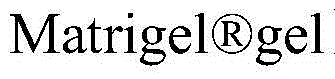 ) top endotheliocyte form (Kubota, Kleiman et al.1988).
Although the two-dimensional model of vascular development still use till today (based on
 test (Kubota, Kleinman et al.1988) be commercially available), this model does not possess following 5 features of real vasculogenesis:
The endotheliocyte of 1, invading in (invasion)-two-dimensional model forms network and demonstrates the very little tendency that enters extracellular matrix downwards (Vernon, Angeilo et al.1992, Vernon, Lara et al.1995) at the top of extracellular matrix.
2, directivity-in two-dimensional model, the endotheliocyte network forming in vitro more or less can spread all over the region of preset cell simultaneously, and in body, vasculogenesis comprises by multistage branch and makes fibrous rudiment bifurcated and invade to the orientation (vectorial) of extracellular matrix.
Although 3, correct polarity-two-dimensional model makes unicellular pipe and capillary vessel very similar (Maciag, Kadish et al.1982; Feder, Marasa et al.1983; Sage and Vernon1994), but their polarity is " from inside to outside ", they by basilar membrane electrodeposition substance the surface of internal cavity at them, and make their thrombogen surface peripherad substratum (Maciag, Kadish et al.1982 to the outside; Feder, Marasa et al.1983), this is contrary with the situation in body.
4, inner chamber formation-two-dimensional model generates the lack of evidence of endotheliocyte (EC) pipe with exclusive inner chamber.Conventionally, endotheliocyte pipe has " inner chamber " space, and this intracavity space is filled with extracellular matrix (external source or synthesized by cell) (Maciag, Kadish et al.1982; Madri1982; Feder, Marasa et al.1983; Sage and Vernon1994; Vernon, Lara et al.1995).While there is exclusive inner chamber, exclusive inner chamber conventionally with the form of the slot-shaped or narrow cylindrical space separated by the cytoplasmic heavy wall of endotheliocyte occur-with body in typical expansion capillaceous, thin-walled endotheliocyte pipe makes a marked difference.
5, the cellular network in cell characteristics-two-dimensional model generates by mechanical process, and this mechanical process can be realized by non-endothelial cell type (Verrton, Angello et al.1992; Vernon, Lara et al.1995).Certainly, mathematical modeling demonstrates, any two-dimentional extracellular matrix that can make to be ductile (endogenous synthetic or provide (for example
 gel)) there is the attached cell type of tension force, all can be at generating network under top condition (Manoussaki, Lubkin et al.1996).
three-dimensional (3D) model that extracorporeal blood vessel generates:understanding to vasculogenesis in the body occurring in three-dimensional cell epimatrix has drawn multiple model, wherein, in three-dimensional cell epimatrix gel in vitro, induces rudiment.In three-dimensional model in early days, endotheliocyte is scattered in (Montesano, Orci et al.1983) in the collagen gel being formed by the network of core and pipe (Elsdale and Bard1972).Although endotheliocyte pipe demonstrates correct polarity, lack the characteristic (endotheliocyte is implanted in advance and is evenly dispersed in extracellular matrix) of intrusion and directivity.Even so, verified this method is useful (Madri, Pratt et al1988 in research inner chamber formation (Davis and Camarillo1998) and endotheliocyte aspect the response of somatomedin; Merwin.Anderson et al.1990; Kuzuya and Kinsella1994; Marx, Perlmutter et al.1994; Davis and Camarillo1996).
In an optional method, 1 millimeter of rat aorta section (ring-type) is implanted in three-dimensional plasma clot and can be generated paniculate (anastomosing) pipe (Nicosia, Tchao et al.1982) that coincide.The rudiment of source automatic circulus venosus demonstrates and is similar to the intrusion of vasculogenesis and the directivity except polarity.Utilization is derived from the aortic annulus of rat or is derived from the transplantation model of the microvessel fragment of mouse, be used to study tumour, somatomedin, various kinds of cell epimatrix carrier and old and feeble situation impact (Nicosia, the Tchao et al.1983 on vasculogenesis; Mori, Sadahira et al.1988; Nicosia and Ottinetti1990; Nicosia, Bonanno et al.1992; Villaschi and Nicosia1993; Nicosia, Bonanno et al.1994; Nicosia, Nicosia et al, 1994; Nicosia and Tuszynski1994; Hoying.Boswell et al.1996; Arthur, Vernon et al.1998).
The endotheliocyte (monolayer or aggregate) of multiple existing model induction purifying is sprouted and is invaded to three-dimensional cell epimatrix gel or (Montesano and Orci1985 around; Pepper, Montesano et al.1991; Montesano, Pepper et al.1993; Nehls and Drenckhahn1995; Nehls and Herrmann1996; Vernon and Sage1999; Vernon and Gooden2002).Each model all has special limitation, comprises the requirement of be difficult to detect by an unaided eye rudiment formation, restricted rudiment, section method (sectioning) or lacks the effect of the endotheliocyte of particular type.
Wolverine and Gulec disclose a kind of three-dimensional vasculogenesis system (US2002/0150879A1), comprise tumor tissues fragment is implanted in matrix.Can symbolize microvascular to outgrowth to analyze the vasculogenesis potential of this tissue.But this method can not provide microvascular inner chamber perfusion.
The Neumann(inventor) etc., to generate pourable capillary blood vessel in being included in artificial organ be in vitro possible within 2003, disclosing.The people such as Neumann, instruction in 2003, use the nylon fishing line of 127 microns as for the manufacture of microvascular axle core, and this axle core is retracted tubing (shrink tubing) and clamps.By the rat aorta smooth muscle cell being implanted in agar, manufacture blood vessel.These capillary blood vesseies have tentative character, and are not suitable for producing mankind's blood vessel graft.
The two-dimensional model of extracorporeal blood vessel growth can not form the definitional feature of the aforementioned vasculogenesis of listing, but, existing reconstructing three-dimensional model some of them or most features.Importantly, in three-dimensional model now, neither one model can be rebuild and includes pressure, parental generation blood vessel that flow, circulating fluid.So neither one model can carry out the research about chamber pressure and the contribution aspect to angiogenic growth and form generation that flows in existing external three-dimensional model.
Summary of the invention
The invention discloses a kind of method that generates in vitro perfusable microvessel.Axle core is withdrawn from from matrix, thereby formed by the passage of described matrix.Cell is injected in the described passage with inwall.Cultivate described matrix so that described cell attachment to inwall.Pour into described passage to remove the cell not adhering to, thereby generate parental generation blood vessel, wherein this parental generation blood vessel comprises (lined) the pourable empty passage by the cell lining in described matrix.Described parental generation blood vessel is induced to generate and enters the rudiment of matrix gel around to form capillary blood vessel network.By described parental generation blood vessel, described capillary blood vessel network is carried out to inner chamber perfusion.
The present invention has overcome the limitation of existing angiogenesis model, provide by by be used for three-dimensional cell epimatrix (ECM) generate verification method that invade, the capillary blood vessel rudiment of tubulose with for building the method and system that the novel method of engineered parental generation blood vessel that becomes the mobile source of inner chamber is combined.By perfusion liquid, can will regulate the compound administration of vasculogenesis in the surface of internal cavity of the known endotheliocyte that has particular target acceptor.The existence of nutritional medium cavity fluid will increase the survival time of external capillary vessel fully.Vasculogenesis system of the present invention can be used for assessing multiple experiment parameters, comprise test, the genetic modification (genetically modified) of anoxic/oxygen excess, specific soluble bioactive compound cell use and through the gene delivery of virus transfection.This system can also be used for studying the vasculogenesis relevant to trauma repair, aging, cancer and atherosclerosis.Importantly, according to the present invention, the model of instruction goes for providing the multiple functional vascular system that can be incorporated in Bioengineered artificial organ.
The present invention also provides novel method, comprises for generating capillary blood vessel, generating capillary blood vessel and generate for example, manifold design compared with great vessels (, having the blood vessel of coronary artery size) from endotheliocyte.These and other important new instruction comprises, for example, a kind of method that generates capillary blood vessel network, the method is the following foundation that is described as of stating specification sheets and claims.
Accompanying drawing explanation
Figure 1A, Figure 1B and Fig. 1 C have schematically described the example of parental generation vasculogenesis.
Fig. 2 A, Fig. 2 B, Fig. 2 C and Fig. 2 D have schematically described the example of known thermal contraction process.
Fig. 3 A has schematically described the schema of known installation (mounting) cultivation/perfusion equipment.
Fig. 3 B has schematically described preparation method's schema used that cultivation/perfusion equipment is installed.
Fig. 4 A and Fig. 4 B have schematically described the manufacture of the manifold of cultivation/perfusion equipment.
Fig. 5 A, Fig. 5 B and Fig. 5 C have schematically described the optional schema of the cultivation/perfusion equipment of micro-assembling (microfabricated).
Fig. 6 has schematically described cell vaccine program.
Fig. 7 has schematically described the network of capillary tube between two bio-artificial parental generation blood vessels.
Fig. 8 a has described the legend of inoculating in vitro the multiple axle cores after smooth muscle cell.
Fig. 8 b has described the example of the flesh plate (muscle plate) of perfusion.
Fig. 9 has schematically described the optional embodiment of CPD.
Figure 10 has described single parental generation angiogenic growth sprouting and has entered matrix around.
Figure 11 has described a parental generation blood vessel and has joined by rudiment network and the second parental generation blood vessel.
Figure 12 has described the optional method that generates parental cell in the passage by cell being seeded to collagen stroma.
Embodiment
The object of listing embodiment is herein in order further to understand the present invention.These embodiment are exemplary, and the present invention is not limited in the embodiment of these exemplary.Method of the present invention can be learned and pathological angiogenic growth and the angiogenic growth that responds angiogenic factors or anti-angiogenesis for studying physiological.Other useful application be assessment cancerous tissue vasculogenesis may with the method for the response to anti-angiogenic medicaments.In addition, method of the present invention can be used for building various wounds healing equipment and the vascularization for engineered structure.
In one embodiment, disclose a kind of for generating the method and apparatus of pourable three-dimensional capillary blood vessel network." EC " used herein refers to endotheliocyte, and " SME " refers to smooth muscle cell, and " CAS " refers to coronary artery surrogate.
In general, for the equipment of cultivating and pour into capillary blood vessel network, by the chamber that can have in center one or more axle cores, form (preferably as shown in Figure 1).This chamber can, by using many technology to be made by the material of any biocompatibility, for example, form interlayer by the framework that makes laser cutting.In recoverable (retractable) mode, axle core is contained in chamber.This can be by being fixed on the end of axle core in pipe and realizing, for example, and by thermal contraction (as shown in Figure 2).The diameter of described axle core depends on the blood vessels caliber of expectation.Can change and arrange to adapt to single blood vessel, two blood vessels or until the overall blood vessel array (arrays) in two dimension or three-dimensional.Axle core can be multiple material, for example, and polymer fiber, glass fibre, wire rod etc.
By cell being seeded on axle core, irritation cell is bred around described axle core, after cell forms tube wall, takes out described axle core, thereby generates capillary blood vessel.Subsequently blood vessel is implanted in matrix.Depend on exist (for example, somatomedin) that the composition of condition, matrix of cultivation and vasculogenesis stimulate, parental generation blood vessel will form rudiment and enter in matrix around.Described rudiment will interconnect and form capillary vessel network.Removing after described axle core, connect devices on filling system, in blood vessel, inject inner chamber liquid stream.
With reference now to Figure 1A, Figure 1B and Fig. 1 C,, the illustrative example that generates parental generation blood vessel has been described in figure.Figure 1A has shown the endotheliocyte 1 in growth medium 100, is seeded on axle core 2, and axle core 2 is supported by the collapsible tube 4 in equipment body 3.Figure 1B has shown that described cell 1 breeds and form the circular layer of cell sleeve (sleeve) 102 forms.Fig. 1 C shown in extracellular matrix (ECM) gel 110 and taken out after axle core 2, and described cell sleeve is poured growth medium 100.
Method disclosed by the invention comprises carries out through engineering approaches to the poured into biological artificial blood vessel structure for engineered application and research model.The ultimate principle of disclosed method comprise culturing cell and around the axle the removed core being fastened on thin-walled tube or other fixture encircling cell layer.Once cellular layer reaches the wall thickness of expectation, take out axle core, and under the help of filling system to perfusion culture base, blood, blood surrogate or other fluid in the biological artificial blood vessel (BAVs) generating thus.Disclosed method can be for the production of the blood vessel generating a large amount of manufactures or conventional, angiogenesis model, wound healing equipment, structural constituent, whole tissue and organ and the research model of external counterpulsation.
The manufacture of cultivation/perfusion equipment
With reference now to Fig. 2 A, Fig. 2 B, Fig. 2 C and Fig. 2 D,, the illustrative example of known thermal contraction process has been described in figure.Especially as shown in Figure 2 A, each cultivation/perfusion equipment (CPD) can comprise one or more axle cores 2 that are contained in support frame 12.The diameter of axle core 2 is the external caliber of expecting, the end of axle core 2 and pharmaceutical grade collapsible tube fragment 4 closely cooperate.Axle core 2 can comprise biocompatible fibres (for example, polymer fiber, glass fibre, wire rod or equivalent), and according to blood vessel size to be simulated, the diameter of axle core 2 can be several microns to several millimeters.In one embodiment, adopt and contain fibre-optic microscopic capillary as axle core.
Describe in more detail as shown in Figure 2 B the thermal contraction around an axle core 2 of the middle part 14 of each collapsible tube fragment 4.Subsequently, especially as shown in Figure 2 C, axle core 2 is retracted (retracted), and will manage cut-out.Fig. 2 D shows replacement axle core so that by the situation after the closed at both ends of this axle core is in the collapsible tube fragment 4 of just cutting off and separating.Can use multiple material and technique construction framework 12.Can change and arrange to adapt to independent biological artificial blood vessel or biological artificial blood vessel array.Similarly, by the layering of axle core array is placed, by blood vessel network, can generate thick, pourable tissue.
The manufacture of perfusion chamber
With reference now to Fig. 3 A,, described known to pouring into the setting of multiple axle core/collapsible tube assemblies (assemblies) 11.Framework 20 can be rolled and be made by polycarbonate or equivalent material easily.Dispensed chambers 30 can be included in design, can allow like this to pour into multiple biological artificial blood vessels simultaneously.The end of a set of thread (thread) that comprises axle core 2 is collected (gathered) in silicone tube 23.
The laser cutting of polyester film framework
With reference now to Fig. 3 B,, the new design of the manufacture method for cultivation/perfusion equipment is installed has schematically been described.Single blood vessel design (CPD70) can be expediently by axle core 2 being clipped in to two laser cutting
 between framework 22 and generate, described
 axle core 2 is supported by heat-shrinkable tube 4.The epoxy manifold 21 of a ring-type can be advantageously used in back shaft core/collapsible tube assembly 11, and the formation of this manifold will illustrate below.
Axle core/collapsible tube assembly (is for example clipped in to two polyester films etc.
 ) framework between, and the side of adhesion is forced together, each like this axle core is suspended in
 frame window 76 by two collapsible tube fragments 4 ' in end.By comprise at least one thin firm wire rod 26 at framework 22, and by being encapsulated in columniform epoxy manifold, stablize and strengthen two collapsible tubes 4 ', described epoxy manifold is the mould by using silicone (silicone) pipe, around collapsible tube and at least one thin firm wire rod 26, casts.Described two collapsible tube fragments 4 ' finally will become influx and the spout of CPD70.
With reference now to Fig. 4 A and Fig. 4 B,, a kind of generation has schematically been described for cultivating the method for manifold of propagation (profusion) equipment in figure.Fig. 4 A has described the multiple collapsible tube/axle core components 11 that are drawn out by for example sleeve pipe of silicone tubing 50 especially.Inject epoxy glue 40 to fill silicone tubing 50 and to make its sclerosis (harden).
Fig. 4 B has described epoxy glue 40 sclerosis afterwards especially and silicone tubing 50 is cut open and is removed situation afterwards.Remaining is the epoxy rods 44 of sclerosis.After axle core is retracted to point of contact, cut off epoxy rods 44, leave the passage 42 being formed by collapsible tube.The end 46 of multiple collapsible tubes can be integrated, to form manifold 21.Superpose single CPDs or CPD frame assembly can be used for generating three-dimensional blood vessel array.
Selectable method
With reference now to Fig. 5 A, Fig. 5 B and Fig. 5 C,, the optional schema for the cultivation/perfusion equipment of micro-assembling has schematically been described.Fig. 5 A has described especially by aperture (perforations) 54 a sleeve core 2 has been introduced to framework, and described aperture has sleeve 56, and they are for substituting collapsible tube.Fig. 5 B has described the CPD before cell inoculation especially, comprises the sleeve core 2 being arranged in frame wall 52.
Fig. 5 C has described an optional example especially, and this example is the cultivation/perfusion equipment with blood vessel 62, and wherein micro-assembling manifold 64 can be connected on sleeve pipe 56 in framework 52 outsides.As shown here, blood vessel 62 is grown on axle core, and under being retained after axle core is removed.Can use the method (for example micro shaping) of micro-assembling to produce in a large number such CPD frame assembly.
Vasculogenesis and perfusion
With reference now to Fig. 6,, cell vaccine program has schematically been described here.For the CPDs70 for the preparation of cell inoculation, first they are cleaned and are used ultraviolet disinfection.Under aseptic condition, CPDs is fixed on to (for example bottom of (Petri) dish 72 in Peter) on a surface.Subsequently at the inner window 76(of CPD frame assembly 70 as shown in Figure 3 B), fill the solution that contains attachment protein (for example EHS-laminin).As required, can use one or more liners (spacer) 77.After the incubation period, the solution that contains attachment protein is removed, then the suspension that contains desired type cell (for example smooth muscle cell or endotheliocyte) in substratum is transferred in the window 76 of described CPD70.
By the cell suspending liquid of certain volume being filled in window, carry out cell inoculation, upset CPD frame assembly 70 makes its top downward, has therefore produced hanging drop (hanging droplet) 80.Within the incubation period that is approximately 45 minutes, a large amount of cells will be attached on the axle core/collapsible tube assembly that is arranged in CPD frame assembly.Excessive cell will sink to the end of hanging drop, and can be collected easily and remove.Then by comprising that in the Peter of one or more CPD frame assemblies, (Petri) dish returns to position upward, fill substratum until CPD frame assembly is submerged, and cultivate.Culture condition in one embodiment comprises: CO in environment
2content is 5%, and temperature is 37 ℃.Be attached to the cell on axle core/collapsible tube assembly, will stretch out and breed, form coaxial monolayer (for example endotheliocyte) or 150 microns or thicker cell rich zone (for example smooth muscle cell).
While reaching the wall shape of expectation or thickness, thereby take out axle core, make hollow cell pipe.Thinner wall need to be by for example, protecting taking out before axle core coating gel (agarose, collagen, basement membrane proteins gel etc.) around cell sleeve pipe, breaks preventing.Then the manifold of CPD frame assembly is connected on filling system to the fluid that perfusion is selected, for example growth medium.
In another embodiment, a kind of method that generates endothelium " parental generation " blood vessel by human vascular endothelial (HUVEC) comprises the steps, wherein:
First clean culture device, and with ultraviolet ray from each side-irradiation sterilizing 30 minutes.Under aseptic condition, equipment is fixed on to the bottom of (Petri) dish in there is aseptic the Peter of (sterile strip).
Then, with EHS-laminin attachment protein solution fill described equipment inner window (available other attachment protein replace, for example fibronectin (fibronectin) or gelatin).
After cultivation is spent the night, remove the solution that contains attachment protein, and the suspension of the human vascular endothelial in substratum is transferred in the window of described equipment.
In upset Peter, dish makes top downward, has produced the hanging drop of cell-substratum suspension in the window of described equipment.(CO in cell culture incubator
2content is 5%, and temperature is 37 ℃) to cultivate after 45 minutes, a large amount of cells are by the axle core/collapsible tube assembly being attached in described equipment.
Then dish in Peter is turned back to position upward, fills therein the growth medium for human vascular endothelial, until equipment is submerged.
The cell not being attached on axle core will fall and be sucked out and remove.
Then dish in described Peter is placed on to incubator (CO
2content is 5%, and temperature is 37 ℃) in.The cell being attached on described axle core will, to external diffusion propagation, form the monolayer of coaxial human vascular endothelial.
Remove the substratum in dish in described Peter.In the window of culture device, pack collagen solution into and make it solidify (solidify), and surround the axle core with cellular layer.
Human vascular endothelial enters formation rudiment in collagen gel.Then axle core is taken out at leisure, leave " parental generation " capillary blood vessel of pourable human vascular endothelial.
Then, the manifold of described equipment is connected to filling system, and pours into the growth medium of human vascular endothelial.
Filling system
CPDs can be connected on filling system with linear model or circulation pattern.Linearity setting can be formed by gravity flow system, or the syringe pump of or conventional structure obtainable by business forms.In syringe, fill perfusion culture base and be arranged on syringe pump, by airtight tubing, being connected with the upstream extremity of CPDs.CPDs can be stored in the incubator of aseptic condition, or sets up aseptic cell culture environment in CDPs inside.The downstream manifold of CPDs is connected to the end of the water reservoir of collecting perfusion liquid.Can be by using peristaltic pump to build the recycle system.Described linear system and the recycle system all can be fixed on gas exchange equipment.The concentration of the concentration of gas, the pressure of perfusion, flow process, temperature and nutrition and metabolic by-prods can be measured by sensor.Collected data enter feedback loop, strictly to control required parameter.
Application-specific
Be used for the model with vasculogenesis correlative study
With reference now to Fig. 7,, Fig. 7 has schematically described the capillary vessel network between two bio-artificial parental generation blood vessels 200,202.By reducing fluid (f), flow into " vein " parental generation blood vessel 202, and be increased in the resistance R on " artery " parental generation blood vessel 200, mobile perfusion liquid 204 is changed its course by kapillary 206.Thereby, drive perfusion liquid 204 to enter the blood vessel with lower pressure from thering is the blood vessel of elevated pressures, to simulate the natural blood flow from the arterial end of capillary bed to vein end.
Axle core method also can be for the exploitation of vasculogenesis research model, as in drug test and needed in the research of the diseases such as wound healing, aging and cancer, diabetes, sacroiliitis and psoriasis.Only adopt endotheliocyte, or the combination of endotheliocyte, smooth muscle cell and peripheral cells (pericytes), can cultivate parental generation bio-artificial capillary blood vessel (BMVs) around the axle core of micron diameter, and be implanted in the carrier gel of extracellular matrix.Then described axle core is taken out, parental generation endotheliocyte pipe is stayed in extracellular matrix gel 210.The taking-up of axle core can manually complete, or by means of automatic equipment, can use from carrying out to the friction-motion speed being exceedingly fast extremely slowly.Other variation can be included under freezing state and from bio-artificial capillary blood vessel, take out axle core, and with heat reactivity polymer-coated axle core, or arbitrary end of tractive axle core attenuates it until rupture.
Compound can be induced parental generation vascularization rudiment and be entered in gel 210, for example Prostatropin of described compound (bFGF), vascular endothelial growth factor (VEGF) and 12-tetradecanoic acid-13-Buddhist ripple ethyl ester (PMA), they are for example added into, in gel and/or perfusion liquid (growth medium).
Can generate complicated capillary vessel network 222 by mineralization pressure between two adjacent parental generation bio-artificial capillary blood vesseies is poor, thus simulation artery and venous blood flow.Liquid stream will alter course, and from " artery " biological artificial blood vessel, by interconnective rudiment, enter " vein " bio-artificial capillary blood vessel.
Advantageously, described perfusion liquid can contain containing oxygen cell growth medium, does not contain the material of serum and Angiogensis or angiogenesis inhibitor.In another embodiment, described perfusion liquid can be supplemented serum and/or affect vasculogenesis compound containing oxygen cell growth medium.And in another embodiment, described perfusion liquid can be oxygen containing physiological salt solution.In another embodiment, described perfusion liquid can comprise oxygenated blood fluid, blood constitutent or blood substitute.In another embodiment, described perfusion liquid can be oxygen-free, and by matrix, spreads the oxygenation of the system that realizes.And in another embodiment, can in perfusion liquid, add the compound of Angiogensis or angiogenesis inhibitor.
In one embodiment, in described matrix, add the compound etc. of Angiogensis or angiogenesis inhibitor.And in another embodiment, described cell comprises the cell of genetic modification, this cell can be in perfusion liquid or in matrix releasing product.And in another embodiment, described matrix can preferably contain scleroproein, collagen, basement membrane proteins matrix and gelatin.A kind of available matrix is
 gel.In another embodiment, described matrix can comprise agar, agarose, alginate or silica gel.
In one embodiment, described cell can select in the group that the cell of free endotheliocyte, smooth muscle cell, peripheral cells, people's cell, zooblast, vegetable cell, stem cell, myocyte, liver cell, nephrocyte, pneumonocyte, skin cells, epithelial cell and genetic modification forms.Similarly, cell can be arranged in described matrix, described cell can select in the group that the cell of free endotheliocyte, smooth muscle cell, peripheral cells, people's cell, zooblast, vegetable cell, stem cell, myocyte, liver cell, nephrocyte, pneumonocyte, skin cells, epithelial cell and genetic modification forms, described cell can be dispersed in whole matrix, or concentration of local.In some cases, the fragment of health or diseased tissue (for example cancerous tissue) is implanted in matrix.
The rudiment that is derived from parental generation blood vessel can be carried out microscopic study with the form of sliced materials or total preparation (whole-mount) in vitro.With fluorescence solution (for example fluorescence dextran) perfusion bio-artificial capillary blood vessel can assistant analysis rudiment diameter, the opening (patency) of rudiment inner chamber and the degree of coincide (anastomization).The three-dimensional reconstruction of rudiment form can be by by overlapping realization of z axle of the fluoroscopic image being obtained by Laser Scanning Confocal Microscope.Can be by using the immune labeled of anti-ln and the first antibody of IV Collagen Type VI and the second antibody of fluorescence or peroxidase labelling at total preparation and tissue (paraffin) section, the synthetic of pericellular basement membrane matrix by rudiment 220 to be monitored.
In compound EC/SMC rudiment, can be by end user CD31(clone P2B1-Chemicon company) FITC monoclonal antibody (MAb) or FITC-UEA1 lectin (a kind of specific marker thing for mankind's endotheliocyte) mark endotheliocyte, the spatial relation between two kinds of cellular types is detected.The monoclonal antibody of α-SM Actin muscle that can employment is also carried out mark by the anti-mouse second antibody of RITC to smooth muscle cell subsequently.Interaction between the details of inner-cavity structure and endotheliocyte and smooth muscle cell can obtain from the paraffin section with aforementioned agents mark.
Described construction process has high duplication, can be used as the basis of commercial a large amount of production vasculogenesis equipment.For example, through suitable preservation (freezing preservation), researchist can obtain in the mode of stock parental generation blood vessel or the whole network of capillary tube of pregrown.
Substitute coronarius
In order to generate substitute coronarius, select the axle core with certain external diameter, prepare coronary artery substitute, this coronary artery substitute has the intravascular space that internal diameter is about 4-5.5 millimeter.Alternatively, described axle core can be open tube, and it can be poured and its perviousness is enough to meet the nutritive substance of growing period and the exchange of gas in substitute coronarius.Substitute coronarius can only be obtained by smooth muscle cell growth, therefore, and the middle rete of the similar of generation in blood vessel, or can form composite structure by two or three cellular type.
Smooth muscle cells inoculation, on axle core, and is grown to the annular layer of 300-400 micron.In order to accelerate the generation of coronary artery surrogate, can handle SMC phenotype by following manner: at initial growth phase, make the phenotype of cell entry altitude propagation; Then after reaching the thickness of expectation, vessel wall converts differentiation state to.Phenotypic change (switch) slows down the growth velocity that causes smooth muscle cell significantly, and the generation of inducing cell extracellular matrix protein (for example collagen and elastin), and these albumen affect the mechanical property of blood vessel.Can realize by controlling the expression of specific gene the conversion of phenotype.For example, under the help of the reactive promotor of tsiklomitsin, genetic expression (for example elastin) is suppressed until tube wall reaches the thickness (Clontech Laboratories Inc.) of expectation.From growth medium, remove tsiklomitsin, can activate the gene of insertion.For example, the overexpression of elastin, will further suppress the propagation of cell and carry out structure function and the semiotic function of tube wall.Mechanical adjustment (for example pulsating flow) can be for strengthening coronary artery substitute, and the physiology of inducing cell is arranged (physiological alignment).Also can use other outside or inner " Phenotypic change ".
After the adjustment (conditioning) and reconstruction of taking out after axle core or at smooth muscle cell, can directly endotheliocyte be seeded on SMC sleeve pipe.The inoculation of endotheliocyte can be by being filled into endotheliocyte suspension in SMC sleeve pipe and completing.Then stop for some time of flowing, to realize suitably adhering to of endotheliocyte.If needed, in order to promote endotheliocyte to be evenly distributed, can rotate or repeatedly reverse up and down blood vessel.
Alternatively, can first endotheliocyte be seeded on axle core.In this case, smooth muscle cell is seeded on the endothelial layer converging.Use this method, need to prevent that endotheliocyte from moving to the periphery of the coronary artery substitute that is rich in oxygen and nutrient.
If expected, SMC cover tube outside inoculation inoblast, can form theca externa.
For the cell that generates coronary artery substitute, can be derived from autologous (autologous), material allos or xenogenesis.Described cell can be stem cell, precursor cell (precursor cells) or noble cells.Described cell can carry out genetic modification, to obtain the immunne response of specific phenotype or reduction host organisms.
CPD method disclosed by the invention provides the blood vessel substitute that can be purchased off the shelf for a large amount of production or has been the selection of the blood vessel substitute of acceptor custom design.CPD method disclosed by the invention is also applicable to the exploitation of engineered coronary artery substitute model, the research of atherosclerosis, arteriogenesis, different vascular cell types each other and and extracellular matrix components between interactional research, the research of nitrogen protoxide effect, and the research of multi-medicament.
Blood vessel and the lymphatic vessel of different sizes or type
CPD method disclosed by the invention can also be used for being created on and in diameter and type, is different from blood vessel coronarius.The change of axle core diameter will change the diameter of blood vessel.Can change by the time point of the phenotype of cell and/or inhibition cell proliferation the type (for example artery, vein, lymphatic vessel) of blood vessel.For example vein only contains little layer of smooth muscle cells.
Other tubular tissue
CPD method disclosed by the invention can be used to the through engineering approaches of other tubular tissue, such as bile duct, tear stains, pharyngotympanic tube (pharyngotympany tube), uterine tube, vas deferens, ureter, urethra, lung qi pipe etc.CPD method disclosed by the invention also proves to can be used for the dissimilar Hemapoiesis nerve trachea by including spongiocyte, and guides neural growth and reparation.
For the BAV system of engineering tissue
CPD method disclosed by the invention can be for the through engineering approaches as tissue and the organ of skeleton by the removable axle core array of use.The cell of the tissue/organ (muscle, liver, kidney, lung, skin etc.) of expecting is inoculated on the axle core that is coated with attachment protein.These axle cores can be made by solid fiber or wire rod, or by pourable, infiltrative pipe, are made alternatively for example Mierocrystalline cellulose.Described axle core is separated from each other in conjunction with the accurate spacing of unicellular sleeve pipe with permission.Use this method can form sheet or block tissue.Then take out axle core (or removing with different methods), by the help of filling system, to bio-artificial tissue, carry out inside perfusion.
Wound healing equipment
Prefabricated biological artificial blood vessel system can for example, for helping wound healing, diabetics chronic ulcer (ulcers).Bio-artificial network of capillary tube can the solid support material of implanted sheet in (for example, from the extracellular matrix gel that is rich in angiogenesis growth factor), and be placed on site of injury.Carry out automatic filling with oxygen containing nutritive medium, described biological artificial blood vessel will promote the sprouting of donor blood vessel and skin.Alternatively, such biological artificial blood vessel is repaired fragment and can be clipped between wound and skin graft, and promotes the inside growth of graft.
Gene therapy equipment
Biological artificial blood vessel can be for implantable drug delivery equipment.From the cell of obtaining in patient body, can carry out in vitro genetic modification to generate specific albumen (hormone, enzyme etc.).Use aforesaid method, can make these Growth of Cells become biological artificial blood vessel or blood vessel network.Again be implanted in host, described cell can continue to produce target substance and it is discharged into part or whole body.
Artificial organ and organ
As mentioned above, engineered blood vessel network can be for generating tissue or and even whole organ.A method is to generate one or more external pourable parental generation blood vessels.Essence (parenchymal) cell that obtains from the tissue expected or organ is seeded in to described parental generation blood vessel around, for example, in gel.By described parental generation blood vessel, to parenchyma, supply nutrient and oxygen.Along with the propagation of parenchyma, the demand of nutrient and oxygen will increase.Described cell discharges angiogenesis factor, and stimulates blood vessel to sprout.Vascular system is sprouted with the speed identical with tissue growth, and it is very similar to self-sow.Therefore, this system also will be a good model for developmental biology research.
The axle core array that another method utilization is arranged in parallel is as the skeleton of stroma cell.Along with the propagation of stroma cell, threaded shaft core forms cellular layer.Finally, the space between all axle cores is full of by parenchyma, has generated lamellar structure.Taking out after axle core, this tissue can pour into by the passage staying at axle core place.By inner chamber, inoculate, these passages can become endothelium shape.The method is not limited at two-dimensional space.Can pile up multiple lamellar structures, or use three-dimensional framework.The present inventor has used for the two-dimensional array of the through engineering approaches of muscle tissue and cubical array.
And in another method, can generate independently organized layer and blood vessel network layer, then pile up off and on.These all methods can generate the naive model with one or both cellular types, or can generate the compound configuration that contains multiple cellular types.
After implantation, with tissue or the organ of these methods engineerings, can directly contact with blood flow, or by filling system Continuous Perfusion until host vessel system grow in graft.
The embodiment of perfused tissue through engineering approaches myoarchitecture
With reference now to Fig. 8 a,, the picture of inoculating in vitro the multiple axle cores after smooth muscle cell has been described.Multiple axle cores and collapsible tube unit M are sandwiched in
 in framework.Distance between axle core M can be adjusted to approximately 100 microns.The end of all collapsible tube fragments is combined in (not shown) in a upstream manifold and a downstream manifold.Described Mylar framework is through sterilizing, and inner chamber is capped and uses every milliliter 5 × 10
6individual rat artery smooth muscle cell SM(RASMCs) suspension inoculate.Described SM cell attachment is also bred on each independent axle core M, thereby has formed circular layer.After 10 days, independently layer combines and has finally formed sheet or the thick dish of smooth muscle cell.In growth medium, place again after 7 days, in substratum, supplement the heparin (heparin) of 50U/ milliliter, and cultivate again 7 days.Then, take out all axle cores, and with the speed of 10 milliliters of/day, tissue is poured into heparin substratum.The chamber of perfusion is fixed on the bottom of 100 millimeters of Petri dishes that are filled with heparin substratum.To
in framework.Distance between axle core M can be adjusted to approximately 100 microns.The end of all collapsible tube fragments is combined in (not shown) in a upstream manifold and a downstream manifold.Described Mylar framework is through sterilizing, and inner chamber is capped and uses every milliliter 5 × 10
6individual rat artery smooth muscle cell SM(RASMCs) suspension inoculate.Described SM cell attachment is also bred on each independent axle core M, thereby has formed circular layer.After 10 days, independently layer combines and has finally formed sheet or the thick dish of smooth muscle cell.In growth medium, place again after 7 days, in substratum, supplement the heparin (heparin) of 50U/ milliliter, and cultivate again 7 days.Then, take out all axle cores, and with the speed of 10 milliliters of/day, tissue is poured into heparin substratum.The chamber of perfusion is fixed on the bottom of 100 millimeters of Petri dishes that are filled with heparin substratum.To SMC dish perfusion 11 days.After perfusion finishes, the function of channel C H is still retained, and high-visible (as shown in Figure 8 b) in vitro.
With reference now to Fig. 8 b,, the example of perfusion flesh plate MP has been described.Shown perfusion of fluid enters in the passage (CH) being stayed by the axle core of removing by pipe end (T).
With reference now to Fig. 9,, schematically describe the optional embodiment of CPD.In one embodiment, CPD900 comprises the one deck 902 being placed on side by side between the first slide glass 904 and the second slide glass 920.The thickness of this layer 902 is suitable for implanting multiple communication port of joining with passage 922.Described multiple communication port comprises cell suspending liquid mouth 914, multiple entrance 912 and multiple outlet 918.The mouth joining with passage 922 can circulate and share similarly fluid function.Multiple mouthfuls (for example mouths 912) have been arranged so that multiple discrepancy points to be provided.Preferably, other application can adopt the microfluid design of the mouth forming with fluid cavity with microfluid material.Similarly, described layer can contain silicone or be suitable for microscope or other material of microfluidic applications.Collagen chamber 906 is preferably located for coming in and going out by a pair of sky, pliable and tough kapillary 916.Quantity capillaceous used is from one to much larger than two, and this size by CPD and the quantity that generates blood vessel are regulated.Can be by one or more syringe pumps by layer each mouthful and the chamber of coming in and going out by tube inlet 940A, 940B, wherein said syringe pump is attached on the syringe with pin.Though only show two syringe pump tube inlet 940A, 940B in order to simplify accompanying drawing, be understandable that syringe pump, syringe or the equivalent that according to circumstances can adopt separation inject or extract material to each chamber and/or mouth.In one embodiment, described syringe pump is connected with gastight syringe.
Describe the feature of optional embodiment CPD900, can help to understand the method for the structure CPD that the present invention will describe now.In one embodiment, layer 902 adopts layer of silicone, and in layer of silicone, boring obtains the model of hole and passage, and covers layer of silicone with bonding top layer 943 and bonding bottom 945.Then, with hollow needle, pierce through described silicone, afterwards by it for guiding the fused quartz kapillary 916 of polyimide coating to enter collagen chamber 906 and entering an entrance 912.With small-bore pipe 910, support two kapillaries, guiding enters outlet 908 from main chamber.Then under the help of bonding coat, described layer of silicone 902 is clipped between two slide glasss.Then by CPD900 autoclaving and save backup.For obtaining the chamber 906 of preparing to generate blood vessel, prepare collagen solution, by entry needle, directly this solution is injected to collagen chamber 906, and the formation gel that spends the night in incubator.By entry needle is inserted to two entrances, CPD900 and syringe pump are joined again.
Successively entry needle and GT tube are joined, form two gastight syringes, be filled with the growth medium that regulates pH, and syringe pump is installed.In a similar manner two outlet 908A, 908B and waste liquid storage pond are joined.Then by operation filling pump, equally open syringe pump, be charged into thus entrance filling access, kapillary and outlet then.When all air are discharged from system, with the each kapillary of tweezers gripping, by back stretching to capillary end arrival matrix chamber by collagen gel the end of stretching into collagen chamber.By this program, in collagen gel, having formed two can perfusion channel.For cell being seeded in collagen passage, highly concentrated endotheliocyte suspension is injected in cell suspending liquid mouth.Then turn off syringe pump, other capillary end is drawn back in the little Chu pond 914R that contains cell, and this causes a large amount of cells to reflux immediately entering described collagen passage.By waste liquid, store up the height in pond, flow rate that can strict control cell.Then CPD is placed in incubator 45 minutes, make cell attachment to the wall of collagen passage.Can make cell be optimum distribution several times or with other operation CPD reversing.Finally, kapillary is drawn out cell storage pond and enters the storage pond as a part for entrance, opens syringe pump and sets the irrigation rate of expecting.Excessive cell is washed out.This vaccine program can obtain two parental generation blood vessels with homology monolayer after growth for some time, wherein injects more highly concentrated cell count and can make required time shorter.It should be noted according to axle core type used, can be by extracting and/or degrading and remove axle core from matrix.
With reference now to Figure 10,, described 1050 growths of single parental generation blood vessel and sprouted 1052 and enter around in matrix 1054.When human umbilical vein's cell (HUVECs) is seeded in collagen passage, the parental generation blood vessel of generation starts to form rudiment and enters in collagen.Branch is extended and starts in these rudiments.Final these branches with from the branch of another parental generation blood vessel, match, thereby form blood vessel network.
With reference now to Figure 11,, described first parental generation blood vessel 1102 and joined by rudiment 1106 networks and the second parental generation blood vessel 1104.Described rudiment 1106 has inner chamber and is pourable.
generate the scheme of parental generation blood vessel
With reference now to Figure 12,, described by inoculate the optional method of getting married next life for blood vessel in the passage of collagen stroma.Describe the optional CPD that adopts layer of silicone, used description to the specific embodiment of the application that generates Microvasculature to promote that those skilled in the art understand the present invention.
By CPD sterilizing in high-pressure sterilizing pot, and be kept in gnotobasis standby.Prepare collagen solution and preserving on ice.Collagen is filled with in little syringe.In syringe, fix the entry needle of 30G, and by entry needle, collagen solution is injected to collagen chamber until chamber has been full of collagen 1002 completely.From the opposite in this chamber, insert the second entry needle and make air vout.
Then by entry needle is inserted to two entrances, CPD is connected to 1004 with syringe pump.Successively entry needle and GT tube are joined, form two gastight syringes, be filled with the growth medium that regulates pH, and syringe pump is installed.(be about to entry needle and insert outlet, this entry needle is with the pipe that guides to waste fluid container) 1006 in a similar manner joins two outlets and waste fluid container.
By operation, as the syringe pump of filling pump, pour into CPD, be charged into thus entrance filling access, kapillary and outlet 1008 then.When being discharged from system, all air (for example with small-bore entry needle, serve as removable air vout), then with the each kapillary of tweezers gripping, by back stretching to capillary end arrival matrix chamber by collagen gel the end of stretching into collagen chamber.By this program, in collagen gel, having formed two can perfusion channel 1010.
For cell being seeded in collagen passage, highly concentrated endotheliocyte suspension is injected in cell suspending liquid mouth to 1012.Then turn off syringe pump, other capillary end is drawn back in the little Chu pond of containing cell, and this causes a large amount of cells by kapillary, to be refluxed and entered collagen path 10 14 immediately.Flow rate that can strict control cell by the back pressure height of pond (waste liquid storage).Then described kapillary is further retracted and enters the Chu Chizhong joining with entrance.
CPD is placed in incubator 45 minutes again, make cell attachment on the wall of collagen passage 1016.Can make cell be optimum distribution several times or with other operation CPD reversing.
Finally, open syringe pump and set the irrigation rate 1020 of expecting.Excessive cell is washed out.This vaccine program can obtain two parental generation blood vessels 1022 with homology monolayer.By pouring into parental generation blood vessel as above, can generate one or more capillary blood vessel networks.
Alternatively, for generating the program of parental generation blood vessel, also can comprise axle core is implanted to collagen stroma, extract axle core, cell is injected in the passage that axle core stays, also can with reference to Figure 1A-1C and other, cell be seeded on axle core as mentioned above.The combination of two kinds of methods can realize different cell type form layers.
The present invention here described considerable details is in order to observe patent law, and to provide information for those skilled in the art implement new principle of the present invention, and builds and use needed these exemplary and special components.But, it should be understood that the present invention can and build rule by different specific equipments and device and implement, in the situation that not departing from connotation of the present invention and scope, multiple change that can be including concrete equipment and schedule of operation.
The full text of all reference of quoting in specification sheets is incorporated herein by reference in the lump at this.If there is the implacable conflict of other side, be as the criterion with this specification sheets.
Reference:
Akhtar?N,Dickerson?EB,Auerbach?R.2002.The?sponge/Matrigel?angiogenesis?assay,Angiogenesis5:75-80.
Algire?GI-I.Chalkley?HW,Legallais?FY.Park?HD,1945,Vascular?reactions?of?normal?and?malignant?tissues?in?vivo.I.Vascular?reactions?of?mice?to?wounds?and?to?normal?and?neoplastic?trausplants.J?Natl?Cancer?Inst6:73-85,
Andrade?SP,Machado?RD,Teixeira?AS,Belo?AV,Tarso?AM,Beraldo?WT.l997.Sponge-induced?angiogenesis?in?mice?and?the?pharmacological?reactivity?of?the?neovasculature?quantitated?by?a?fluorimetric?method,Microvasc?Res54:253-261.
Arthur?WT,Vernon?RB,Sage?EH,Reed?MJ,1998.Growth?factors?reverse?the?impaired?sprouting?of?microvessels?from?aged?mice.Microvasc?Res55:260-270.
Ausprunk?DH,Knighton?DR.Folkman?J.1974.Differentiation?of?vascular?endothelium?in?the?chick?chorioallantois:a?structural?and?autoradiographic?study,Der?Biol38:237-248,
Clark?ER,Clark?EL.1939.Microscopic?observations?on?the?growth?of?blood?capillaries?in?the?living?mammal.Am?J?Anat64:251-301.
Davis?GE,Camarillo?CW.1996.An?alpha2beta1integrin-dependent?pinocytic?mechanism?involving?intracellular?vacuole?formation?and?coalescence?regulates?capillary?lumen?and?tube?formation?in?three-dimensional?collagen?matrix.Exp?Cell?Res?224:30-51.
Elsdale?T,Bard?J.1972.Collagen?substrata?for?studies?on?cell?behavior.I?Cell?Biol54:626-637.
Feder?J,Marasa?JC,Olander?JV.1983.The?formation?of?capillary-like?tubes?by?calf?aortic?endothelial?cells?grown?in?vitro.J?Cell?Physiol116:1-6,
Fishman?JA,Ryan?GB,Kamovsky?MJ.1975.Endothelial?regeneration?in?the?rat?carotid?artery?and?the?significance?of?endothelial?denudation?in?the?pathogenesis?of?rnyointimal?thickening.Lab?Invest32:339-351.
Folkman?J,Haudenschild?C.1980.Angiogenesis?in?vitro.Nature288:551-556.
Folkman?J,Haudenschild?CC,Zetter?BR.1979.Long-term?culture?of?capillary?endothelial?cells.Proc?Natl?Acad?Sci?U?S?A76:5217-5221.
Gimbrone?MA,Jr.1976.Culture?of?vascular?endothelium.In:Prog?Hemost?Thromb.p?I-28.
Gimbrone?MA,Jr.,Cotran?RS,Folkman?J.1974a.Human?vascular?endothelial?cells?in?culture.Growth?and?DNA?synthesis.J?Cell?Biol60:673-684.
Gimbrone?MA,Jr.,Cotran?RS.Leapman?SB.Folkman?J.1974b.Turnor?growth?and?neovascularization:an?experimental?model?using?the?rabbit?cornea.J?Natl?Cancer?Inst52:413-427.
Greenblatt?M,Shubi?P.1968.Tumor?angiogenesis:transfilter?diffusion?studies?in?the?hamster?by?the?transparent?chamber?technique.J?Natl?Cancer?Inst41:111-124.
Hoying?JB,Boswell?CA.Williams?SK.1996.Angiogenic?potential?of?microvessel?fragments?established?in?three-dimensional?collagen?gels.In?Vitro?Cell?Dev?Biol?Anita32:409-419.
Jaffe?EA,Nachman?RI..,Becket?CG,Minick?CR.1973.C.uliure?of?human?endothelial?cells?derived?from?umbilical?veins.Identification?by?morphologic?and?immunologic?criteria.J?Clin?Invest52:2745-2756.
Jozaki?K,Marucha?PT,Despins?AW,Kreutzer?DL.1990.An?in?vitro?model?of?cell?migration:evaluation?of?vascular?endothelial?cell?migration.Anal?Biochem190:39-47.
Koike?T,Vernon?RB,Gooden?MD,Sadoun?E,Reed?MJ.2003.Inhibited?angiogenesis?in?aging:a?role?for?TIMP-2.J?Gerontol?A?Biol?Sci?Med?Sci58:13798-805.
Kubota?Y,Kleinman?HK,Martin?GR,Lawley?TJ,1988.Role?of?laminin?and?basement?membrane?in?the?morphological?differentiation?of?human?endothelial?cells?into?capillary-like?structures.J?Cell?Biol107:1589-1598.
Kuzuya?M,Kinsella?JL.1994,Induction?of?endothelial?cell?differentiation?in?vitro?by?fibroblast-derived?soluble?factors.Exp?Cell?Res?215:310-318.
Maciag?T,Kadish?J,Wilkins?L.,Stemerman?MB,Weinstein?R.1982.Organizational?behavior?of?human?umbilical?vein?endothelial?cells,J?Cell?Biol94:511-520.
Madri?JA.1982,Endothelial?cell-matrix?interactions?in?hemostasis.Prog?Hemost?Thromb6:1-24.
Madri?JA,Pratt?BM,1986.Endothelial?cell-matrix?inmractions:in?vitro?models?of?angiogenesis.J?HistochemCytochem34:85-91,
Madri?JA,Pratt?BM.Tucker?AM.1988.Phenotypic?modulation?of?endothelial?cells?by?transforming?growth?factor-hera?depends?upon?the?composition?and?organization?of?the?extracellular?mairix.J?Cell?Biol106:1375-1384.
Madri?JA.Stenn?KS.1982.Aortic?endothelial?cell?migration.I.Matrix?requiremenis?and?composition.Am?J?Pathol106:180-186.
Manoussaki?D,Lubkin?SR,Vernon?RB,Murray?JD.1996.A?mechanical?model?for?the?formation?of?vascular?networks?in?vitro.Acia?Biotheor44:271-282.
Marx?M,Perlmutier?RA,Madri.JA,1994.Modulation?of?platelet-derived?growth?factor?receptor?expression?in?microvascular?endothelial?cells?during?in?vitro?angiogenesis.J?Clin?Invest93:131-139.
Merwin?JR,Anderson?JM,Kocher?O,Van?Itallie?CM,Madri?JA.1990.Transforming?growth?factor?beta?l?modulates?extracellular?matrix?organization?and?cell-cell?junctional?complex?formation?during?in?vitro?angiogenesis,J?Cell?PhysioI142:117-128.
Montesano?R,Orci?L.1985.Tumor-promoting?phorbol?esters?induce?angiogenesis?in?vitro.Cell42:469-477.
Montesano?R.Orci?L.Vassalli?P.1983.In?vitro?rapid?organization?of?endothelial?cells?into?capillary-like?networks?is?promoted?by?collagen?matrices.J?Cell?Biol97:1648-1652.
Montesano?R,Pepper?MS,Orci?L.1993.Paracrine?induction?of?angiogenesis?in?vitro?by?Swiss3T3fibroblasts,J?Cell?Sci105(Pi4):1013-1024,
Mori?M,Sadahira?Y,Kawasaki?S.Hayashi?T,Notohara?K,Awai?M.1988.Capillarygrowth?from?reversed?rat?aortic?segments?cultured?in?collagen?gel.Acta?Pathol?Jpn38:1503-15l2.
Nehls?V,Drenckhahn?D.1995.A?novel,microcarrier-based?in?vitro?assay?for?rapid?and?reliable?quantification?of?three-dimensional?cell?migration?and?angiogenesis.Microvasc?Res50:311-322.
Nehfs?V,Herrmann?R.1996.The?configuration?of?fibrin?clots?determines?capillary?morphogenesis?and?endothelial?cell?migration.Microvasc?Res51:347-364.
Neumann?T,Nicholson?BS,Sanders?JE.2003.Tissue?engineering?of?perfused?microvessels.Microvasc?Res66:59-67,
Nicosia?RF.Bonanno?E,Smith?M.Yurchenco?P.1994a.Modulation?of?angiogenesis?in?vitro?by?laminin-entactin,complex.Dev?Biol164:197-206.
Nicosia?RF.Bonanno?E.Villascht?S.1992.Large-vessel?endothelium?switches?to?amicrovascular?phenotype?during?angiogenesis?in?collagen?gel?culture?of?rat?aorta.Atherosclerosis95:191-199.
Nicosia?RF,Nicosia?SV.Smith?M.1994b,Vascular?endothelial?growth?factor,platelet-derived?growth?factor,and?insulin-like?growth?factor-l?promote?rat?aortic?angiogenesis?in?vitro.Am?J?Pathol145:1023-1.029.
Nicosia?RF,Ottinetti?A.1990.Modulation?of?microvascular?growth?and?morphogenesis?by?reconstituted?basement?membrane?gel?in?three-dimensional?cultures?of?rat?aorta:a?comparative?study?of?angiogenesis?in?mairigel,collagen,fibrin,and?plasma?clot,In?Vitro?Cell?Dev?Biol26:119..128.
Nicosia?RF.Tchao?R,Leighion?J.1982.Histotypic?angiogenesis?in?vitro:light?microscopic,ultrastructural,and?radioautographic?studies.In?Vitro18:538-549.
Nicosia?RF,Tchao?R,Leighton?J.1983.Angiogenesis-dependent?tumor?spread?in?reinforced?fibrin?clot?culture.Cancer?Res,13:2159-2166.
Nicosia?RF.Tuszynski?GP.1994.Matrix-bound?thrombospondin?promotes?angiogenesis?in?vitroJ?Cell?Biol124:183-193.
Passaniti?A,Taylor?RM,Pili?R,Guo?Y.Long?PV,Haney?JA,Pauly?RR,Grant?DS,Matin?GR.1992.A?simple,quantitative?method?for?assessing?angiogenesis?and?antiangiogenic?agents?using?reconstitnted?basement?membrane,heparin,and?fibroblast?growth?factot.Lab?Invest67:519-528.
Pepper?MS,Montesano?R,Vassalli?JD,Orci?L.1991.Chondrocytes?inhibit?endofthelial?sprout?formation?in?vitro:evidence?for?involvement?of?a?transforming?growth?factor-beta.J?Cell?Physiol146:170-179.
Rosen?EM,Meromsky?L,Setter?E.Vinter?DW.Goldberg?ID.1990.Quantitation?of?cytokine-stimulated?migration?of?endothelium?and?epithelium?by?a?new?assay?using?microcarrier?beads.Exp?Cell?Res186:22-31.
Sage?EH,Vernon?RB.1994.Regulation?of?angiogenesis?by?extracellular?matrix:the?growth?and?the?glue.J?Hypertens?Suppl12:S145-152.
Vernon?RB.Angello?JC,Iruela-Arispe?ML,Lane?TF,Sage?EH.1992.Reorganization?of?basement?membrane?matrices?by?cellular?traction?promotes?the?formation?of?cellular?networks?in?vitro.Lab?Invest66:536-547.
Vernon?RB,Gooden?MD.2002.New?technologies?in?vitro?for?analysis?of?cell?movement?on?or?within?collagen?gels.Matrix?Biol?21:661-669.
Vernon?RB.Lara?SI.,,Drake?CJ,Iruela-Arispe?ML,Angello?JC,Little?CD,Wight?TN,Sage?EH.1995.Organized?type?I?collagen?influences?endothelial?patterns?during"spontaneous?angiogenesis?in?vitro":planar?culmres?as?models?of?vascular?development.In?Vitro?Cell?Der?Biol?Anita31:120-131,
Vernon?RB,Sage?EH.1999.A?novel,quantitative?model?for?study?of?endothelial?cell?migration?and?sprout?formation?within?three-dimensional?collagen?matrices,Microvasc?Res57:118-133.
Villaschi?S,Nicosia?RF.1993.Angiogenic?role?of?endogenous?basic?fibroblast?growth?factor?released?by?rat?aorta?after?inhury.Am.J?Pathol?143:181-190.
Claims (18)
1. a method that generates in vitro perfusable microvessel network, described method comprises:
From matrix (1054), withdraw from axle core (2) to form the passage (1010) by described matrix;
Cell (1) is injected into (1014) in described passage;
Cultivate described matrix, so that cell (1) is attached to the inside (1016) of described passage;
Perfusion (1020) described passage, to remove the cell (1) not adhering to and generate parental generation blood vessel (1022) in described passage, wherein, described parental generation blood vessel (1102) comprises the pourable empty passage by cell (1) lining in described matrix (1054);
Induce described parental generation blood vessel (1102), to generate, enter the rudiment (1106) of matrix (1054) around, to form capillary blood vessel network (222); And
By described parental generation blood vessel (1102), described capillary blood vessel network (222) is carried out to inner chamber perfusion.
2. method according to claim 1, wherein, by multiple axle cores (2), form more than one passage, described axle core (2) contains kapillary (916) and at least two parental generation blood vessels (1102) are induced to generate the identical rudiment (1106) that forms capillary blood vessel network (222).
3. method according to claim 2, wherein, described at least two parental generation blood vessels (1102) contain multi-dimension array that can Perfused vessel (222).
4. method according to claim 1, wherein, perfusion (1020) described passage adopts at least one perfusion liquid (204), this perfusion liquid (204) contains: containing serum and Angiogensis or angiogenesis inhibitor material containing oxygen cell growth medium; Supplemented serum containing oxygen cell growth medium; At least one affects the compound of vasculogenesis; Containing oxygen normal saline solution; Oxygenated blood fluid, blood ingredient, blood substitute; Oxygen-free and by realize the perfusion liquid of system oxygenation from the diffusion of described matrix; Be added at least one in Angiogensis compound and the anti-angiogenic compounds in perfusion liquid; And at least one in the Angiogensis compound and the anti-angiogenic compounds that contain in matrix (1054).
5. method according to claim 1, wherein, described cell (1) comprises to the cell (1) of the genetic modification of perfusion liquid (204) or the middle releasing product of described matrix (1054).
6. method according to claim 1, wherein, described matrix (1054) comprises the material selecting in the group that basilar membrane, agar, agarose, alginate, basement membrane proteins, silica gel, cell and their combination of free scleroproein, collagen, gelatin, gel form.
7. method according to claim 1, wherein, by at least one method that can be pre-attached to described axle core (2) of selecting, by injecting afterwards (1012) to passage of described matrix withdrawing from (1010) described axle cores (2), and by being pre-attached to described axle core (2) and being injected into the method combining in described matrix, cell (1) is deposited in the passage of described matrix.
8. method according to claim 1 wherein, by being selected from least one method in extraction (1010) and degraded, is removed described axle core (2) from described matrix (1054).
9. method according to claim 1, wherein, described cell (1) selects in the group that the cell of free endotheliocyte, smooth muscle cell, peripheral cells, people's cell, zooblast, vegetable cell, stem cell, myocyte, liver cell, nephrocyte, pneumonocyte, skin cells, epithelial cell and genetic modification forms.
10. method according to claim 1, wherein, described cell (1) is arranged in described matrix (1054), and described cell (1) selects in the group that the cell of free endotheliocyte, smooth muscle cell, peripheral cells, people's cell, zooblast, vegetable cell, stem cell, myocyte, liver cell, nephrocyte, pneumonocyte, skin cells, epithelial cell and genetic modification forms.
11. methods according to claim 1, wherein, the fragment of health or diseased tissue is implanted in described matrix (1054).
12. methods according to claim 1, wherein, the fragment of cancerous tissue is implanted in described matrix (1054).
13. methods according to claim 1, wherein, by reducing the inflow of fluid to a parental generation blood vessel (202), and be increased in the resistance on the second parental generation blood vessel (200) joining by one or more rudiments (220) and first parental generation blood vessel, mobile perfusion liquid (204) is changed its course by described kapillary (206), thereby drive described perfusion liquid (204) to enter into the blood vessel with lower pressure from thering is the blood vessel of elevated pressures.
14. methods according to claim 1, wherein, described capillary blood vessel network (222) comprises the one being selected from bio-artificial capillary blood vessel (200), exclusive endotheliocyte pipe (1102) and smooth muscle cell pipe.
15. methods according to claim 1, wherein, described capillary blood vessel network (222) contains can be to cell (1) genetic modification of releasing hormone in described perfusion liquid (204) or normal.
16. methods according to claim 1, wherein, perfusion (1020) described passage comprises that use can be to cell (1) genetic modification of releasing hormone in perfusion liquid (204) or normal.
17. 1 kinds for being generated in vitro the method for endothelium parental generation blood vessel (1102) by human vascular endothelial (1) at cultivation perfusion equipment (CPD), described cultivation perfusion equipment comprises collagen chamber (906), multiple entrance (912), at least one kapillary (916) and at least one outlet (918), and the method comprises:
By entry needle, collagen solution is injected in described collagen chamber (906), until be full of collagen (1002) in described collagen chamber (906);
By being charged into, to described entrance, then pouring into described multiple entrance and exit and pour into described CPD(1008);
In described collagen chamber, forming at least one can perfusion channel (1010);
The concentrated suspension liquid of endotheliocyte (1) is injected into (1012) in described entrance;
By described endotheliocyte (1) be injected into described at least one can perfusion channel in (1014);
Cultivate described CPD so that described endotheliocyte (1) be attached to described at least one can the wall of perfusion channel on (1016);
Cell (1) distributes in described CPD;
Perfusion (1020) described at least one can perfusion channel, the parental generation blood vessel (1102) that there is homology monolayer to form at least one.
18. 1 kinds for generating in vitro the cultivation perfusion equipment of perfusable microvessel network, and wherein, this equipment comprises:
For withdrawing from axle core (916) to form the device of the passage (1010) by described matrix from matrix (1054);
For cell (1) being injected into the device of the described passage (1014) with inwall;
Be used for cultivating described matrix (1054) so that described cell (1) is attached to the device of described inwall (1016);
For perfusion (1020) described passage, to remove the cell not adhering to the device that generates parental generation blood vessel (1022), wherein, described parental generation blood vessel (1102) comprises the pourable empty passage by cell (1) lining in described matrix (1054);
Be used for inducing described parental generation blood vessel (1102) to generate entering the rudiment (1106) of matrix (1054) around to form the device of capillary blood vessel network (222); And
For described capillary blood vessel network (222) being carried out by described parental generation blood vessel (1102) device of inner chamber perfusion (1020).
Applications Claiming Priority (2)
| Application Number | Priority Date | Filing Date | Title |
|---|---|---|---|
| US11/860,471 US8003388B2 (en) | 2006-03-24 | 2007-09-24 | Method for creating perfusable microvessel systems |
| US11/860,471 | 2007-09-24 |
Related Parent Applications (1)
| Application Number | Title | Priority Date | Filing Date |
|---|---|---|---|
| CN200880108504A Division CN101835888A (en) | 2007-09-24 | 2008-09-11 | Method of generating perfusable microvasculature |
Publications (1)
| Publication Number | Publication Date |
|---|---|
| CN103725642A true CN103725642A (en) | 2014-04-16 |
Family
ID=40511798
Family Applications (4)
| Application Number | Title | Priority Date | Filing Date |
|---|---|---|---|
| CN200880108504A Pending CN101835888A (en) | 2007-09-24 | 2008-09-11 | Method of generating perfusable microvasculature |
| CN201310682666.5A Pending CN103725642A (en) | 2007-09-24 | 2008-09-11 | Method and apparatus for creating networks of perfusable microvessels in vitro and method for creating endothelium parent vessels in vitro |
| CN201310660178.4A Pending CN103789255A (en) | 2007-09-24 | 2008-09-24 | Method for creating networks of perfusable microvessels in vitro, and culture perfusion device for creating networks of perfusable microvessels in vitro |
| CN200880108494A Pending CN101855341A (en) | 2007-09-24 | 2008-09-24 | Method for generating perfusable microvasculature |
Family Applications Before (1)
| Application Number | Title | Priority Date | Filing Date |
|---|---|---|---|
| CN200880108504A Pending CN101835888A (en) | 2007-09-24 | 2008-09-11 | Method of generating perfusable microvasculature |
Family Applications After (2)
| Application Number | Title | Priority Date | Filing Date |
|---|---|---|---|
| CN201310660178.4A Pending CN103789255A (en) | 2007-09-24 | 2008-09-24 | Method for creating networks of perfusable microvessels in vitro, and culture perfusion device for creating networks of perfusable microvessels in vitro |
| CN200880108494A Pending CN101855341A (en) | 2007-09-24 | 2008-09-24 | Method for generating perfusable microvasculature |
Country Status (8)
| Country | Link |
|---|---|
| US (2) | US8003388B2 (en) |
| EP (2) | EP2203553B1 (en) |
| JP (2) | JP5725858B2 (en) |
| CN (4) | CN101835888A (en) |
| AU (2) | AU2008305364B2 (en) |
| CA (2) | CA2700364C (en) |
| ES (2) | ES2614417T3 (en) |
| WO (2) | WO2009042418A1 (en) |
Families Citing this family (33)
| Publication number | Priority date | Publication date | Assignee | Title |
|---|---|---|---|---|
| KR100714988B1 (en) * | 2005-08-09 | 2007-05-09 | 삼성전자주식회사 | DNA refining method and refining apparatus using the surface of silicon structure with oxide film formed on the surface |
| US8003388B2 (en) * | 2006-03-24 | 2011-08-23 | Nortis, Inc. | Method for creating perfusable microvessel systems |
| US20110244567A1 (en) | 2006-08-31 | 2011-10-06 | Snu R&Db Foundation | Device and Method of 3-Dimensionally Generating IN VITRO Blood Vessels |
| US8790874B2 (en) | 2008-06-17 | 2014-07-29 | Axel Guenther | Device for investigation of a flow conduit |
| AU2011258295B2 (en) * | 2010-05-25 | 2015-01-29 | Cook Biotech Incorporated | Methods, substrates, and systems useful for cell seeding of medical grafts |
| CN102899249B (en) * | 2011-04-18 | 2015-07-29 | 首尔大学校产学协力团 | Produce the apparatus and method of extracorporeal blood vessel |
| JP6188075B2 (en) * | 2012-02-08 | 2017-08-30 | 国立大学法人旭川医科大学 | Immortalized cell lines of peripheral tissue capillaries |
| AU2013230025A1 (en) * | 2012-03-06 | 2014-09-25 | Southern Research Institute | Three-dimesional, prevascularized, engineered tissue constructs, methods of making and methods of using the tissue constructs |
| JP6241890B2 (en) * | 2012-08-18 | 2017-12-06 | 国立大学法人 千葉大学 | Vascular tissue and method for producing the same |
| HK1221402A1 (en) * | 2013-04-02 | 2017-06-02 | University Of Florida Research Foundation, Inc. | Compositions and methods for induction and modulation of angiogenesis and methods and assays for identifying angiogenesis modulators |
| JP6619345B2 (en) * | 2014-09-23 | 2019-12-11 | 国立大学法人 東京大学 | Artificial three-dimensional tissue manufacturing method, artificial three-dimensional tissue perfusion device, and drug evaluation method using artificial three-dimensional tissue |
| ES2922905T3 (en) * | 2015-07-06 | 2022-09-21 | Advanced Solutions Life Sciences Llc | Vascularized in vitro perfusion devices, manufacturing methods and applications thereof |
| AU2016307768B2 (en) * | 2015-08-14 | 2022-11-17 | The General Hospital Corporation | Systems for and methods for using biomimetic structures providing communication in living tissue |
| ITUB20153348A1 (en) | 2015-09-02 | 2017-03-02 | Tensive S R L | Biodegradable medical device for reconstruction and / or breast augmentation |
| US20190017999A1 (en) * | 2015-09-04 | 2019-01-17 | Seoul National University R&DB Foudation | In vitro skin immune system simulation system |
| EP3393368B1 (en) | 2015-12-24 | 2020-11-18 | Koninklijke Philips N.V. | Device for processing of 3d biopsy tissue |
| JP6933855B2 (en) * | 2016-01-20 | 2021-09-08 | 国立大学法人 東京大学 | Artificial skin tissue manufacturing method, artificial skin tissue perfusion device, drug evaluation method using artificial skin tissue |
| WO2017141691A1 (en) * | 2016-02-16 | 2017-08-24 | 国立大学法人大阪大学 | Method for producing three-dimensional tissue having vascular system structure, and three-dimensional tissue comprising gel having vascular system structure |
| WO2018041745A1 (en) | 2016-08-31 | 2018-03-08 | Koninklijke Philips N.V. | Apparatus for tubulus detection from a tissue biopsy |
| JP7308525B2 (en) * | 2017-12-11 | 2023-07-14 | 学校法人東京女子医科大学 | Tubular tissue preparation device, tubular tissue preparation kit, and tubular tissue preparation method |
| JP6991572B2 (en) * | 2018-01-18 | 2022-01-12 | 国立大学法人 東京大学 | Barrier function measurement system for artificial 3D tissue, barrier function measurement method for artificial 3D tissue, and drug evaluation method using artificial 3D tissue |
| WO2019200411A1 (en) * | 2018-04-13 | 2019-10-17 | The Administrators Of The Tulaneeducational Fund | Biomimetic tissue systems and methods of using the same |
| US11273447B2 (en) * | 2019-01-11 | 2022-03-15 | Purdue Research Foundation | Collapsible basket arrays, collapsible cellular arrays therefor, and methods of use |
| WO2021007168A1 (en) * | 2019-07-09 | 2021-01-14 | Board Of Regents Of The University Of Nebraska | Dissolvable and degradable artificial circulation systems for large volume tissues |
| JP2023533686A (en) * | 2020-06-25 | 2023-08-04 | アーカン マラエブ,ワッダ | tube organoid-on-a-chip |
| CN112143642B (en) * | 2020-08-28 | 2022-06-14 | 上海交通大学 | Vascularized tumor micro-fluidic organ chip for in vitro culture and preparation method thereof |
| WO2022059498A1 (en) * | 2020-09-15 | 2022-03-24 | 日清食品ホールディングス株式会社 | Device for forming three-dimensional muscle tissue and method of producing three-dimensional muscle tissue |
| CN112587730B (en) * | 2020-12-29 | 2024-04-09 | 深圳华源再生医学有限公司 | Composite cell scaffold and preparation method thereof |
| CN114540278B (en) * | 2022-03-25 | 2023-11-21 | 青岛大学 | Microvascular in-vitro culture method and culture solution |
| WO2024124231A1 (en) * | 2022-12-09 | 2024-06-13 | University Of Central Florida Research Foundation, Inc. | Biologic interfacial tissue-engineered systems useful as arthropod bite model |
| CN115895895A (en) * | 2023-01-29 | 2023-04-04 | 中国科学院上海微系统与信息技术研究所 | Blood vessel series-connected multi-organ chip model and application method thereof |
| CN119657241B (en) * | 2024-11-26 | 2025-10-03 | 河南曙光汇知康生物科技股份有限公司 | Drug screening device and drug screening method for inhibiting vascular permeability of cancer cells |
| CN119859580A (en) * | 2025-01-14 | 2025-04-22 | 中国人民解放军总医院第四医学中心 | Multi-system microvascular co-culture microfluidic chip and preparation method thereof |
Family Cites Families (20)
| Publication number | Priority date | Publication date | Assignee | Title |
|---|---|---|---|---|
| GB1527592A (en) * | 1974-08-05 | 1978-10-04 | Ici Ltd | Wound dressing |
| US5106743A (en) * | 1981-01-26 | 1992-04-21 | Trustees Of Boston University | Hydrogels capable of supporting cell growth |
| US5298022A (en) * | 1989-05-29 | 1994-03-29 | Amplifon Spa | Wearable artificial pancreas |
| US5804366A (en) * | 1995-02-09 | 1998-09-08 | Baxter International Inc. | Method and apparatus for sodding microvessel cells onto a synthetic vascular graft |
| US6592623B1 (en) * | 1999-08-31 | 2003-07-15 | Virginia Commonwealth University Intellectual Property Foundation | Engineered muscle |
| US6503273B1 (en) * | 1999-11-22 | 2003-01-07 | Cyograft Tissue Engineering, Inc. | Tissue engineered blood vessels and methods and apparatus for their manufacture |
| US7947069B2 (en) * | 1999-11-24 | 2011-05-24 | University Of Washington | Medical devices comprising small fiber biomaterials, and methods of use |
| US6893812B2 (en) * | 2000-05-30 | 2005-05-17 | Board Of Supervisors Of Louisiana State University And Agricultural And Mechanical College | Three-dimensional ex vivo angiogenesis system |
| US6642019B1 (en) * | 2000-11-22 | 2003-11-04 | Synthecan, Inc. | Vessel, preferably spherical or oblate spherical for growing or culturing cells, cellular aggregates, tissues and organoids and methods for using same |
| US6752829B2 (en) | 2001-01-30 | 2004-06-22 | Scimed Life Systems, Inc. | Stent with channel(s) for containing and delivering a biologically active material and method for manufacturing the same |
| GB0121986D0 (en) * | 2001-09-11 | 2001-10-31 | Isis Innovation | Method and structure for growing living organic tissue |
| US20040044403A1 (en) * | 2001-10-30 | 2004-03-04 | Joyce Bischoff | Tissue-engineered vascular structures |
| EP1451299A4 (en) * | 2001-12-11 | 2008-03-05 | Cytograft Tissue Engineering I | Tissue engineered cellular sheets, methods of making and use thereof |
| WO2003087303A2 (en) * | 2002-04-04 | 2003-10-23 | W.R. Grace & Company | Tissue composites and uses thereof |
| AU2004226561A1 (en) | 2003-03-31 | 2004-10-14 | Teijin Limited | Composite of support substrate and collagen, and process for producing support substrate and composite |
| FR2859381B1 (en) | 2003-09-05 | 2008-07-25 | Centre Nat Rech Scient | USE OF CELLS FROM ADIPOSE TISSUES TO INDUCE THE FORMATION OF A FUNCTIONAL VASCULAR NETWORK |
| US20070110962A1 (en) * | 2003-09-23 | 2007-05-17 | Joe Tien | Three-dimensional gels that have microscale features |
| US7832429B2 (en) * | 2004-10-13 | 2010-11-16 | Rheonix, Inc. | Microfluidic pump and valve structures and fabrication methods |
| US7622298B2 (en) * | 2006-03-24 | 2009-11-24 | Norits, Inc. | Method for creating perfusable microvessel systems |
| US8003388B2 (en) * | 2006-03-24 | 2011-08-23 | Nortis, Inc. | Method for creating perfusable microvessel systems |
-
2007
- 2007-09-24 US US11/860,471 patent/US8003388B2/en active Active
-
2008
- 2008-09-11 ES ES08833699.5T patent/ES2614417T3/en active Active
- 2008-09-11 AU AU2008305364A patent/AU2008305364B2/en active Active
- 2008-09-11 CN CN200880108504A patent/CN101835888A/en active Pending
- 2008-09-11 JP JP2010527014A patent/JP5725858B2/en not_active Expired - Fee Related
- 2008-09-11 CA CA2700364A patent/CA2700364C/en active Active
- 2008-09-11 WO PCT/US2008/076042 patent/WO2009042418A1/en not_active Ceased
- 2008-09-11 CN CN201310682666.5A patent/CN103725642A/en active Pending
- 2008-09-11 EP EP08833699.5A patent/EP2203553B1/en active Active
- 2008-09-24 CA CA2700371A patent/CA2700371C/en active Active
- 2008-09-24 EP EP08833430.5A patent/EP2203554B1/en active Active
- 2008-09-24 AU AU2008304532A patent/AU2008304532B2/en active Active
- 2008-09-24 ES ES08833430.5T patent/ES2622170T3/en active Active
- 2008-09-24 CN CN201310660178.4A patent/CN103789255A/en active Pending
- 2008-09-24 JP JP2010527098A patent/JP5725859B2/en not_active Expired - Fee Related
- 2008-09-24 WO PCT/US2008/077447 patent/WO2009042639A2/en not_active Ceased
- 2008-09-24 CN CN200880108494A patent/CN101855341A/en active Pending
-
2011
- 2011-08-17 US US13/212,107 patent/US9446169B2/en active Active
Non-Patent Citations (3)
| Title |
|---|
| NICOLAS L’HEUREUX 等: ""A completely biological tissue-engineered human blood vessel"", 《FASEB J》 * |
| TAKAYUKI TAKEI DENG: ""Fabrication of Artificial Endothelialized Tubes with Predetermined Three-Dimensional Configuration from Flexible Cell-Enclosing Alginate Fibers"", 《BIOTECHNOL. PROG.》 * |
| THOMAS NEUMANN 等: ""Tissue engineering of perfused microvessels"", 《MICROVASCULAR RESEARCH》 * |
Also Published As
| Publication number | Publication date |
|---|---|
| JP5725858B2 (en) | 2015-05-27 |
| WO2009042639A2 (en) | 2009-04-02 |
| CA2700364C (en) | 2021-02-02 |
| US20080261306A1 (en) | 2008-10-23 |
| EP2203553A4 (en) | 2012-03-21 |
| EP2203554B1 (en) | 2017-01-11 |
| EP2203553B1 (en) | 2016-12-07 |
| US20110300616A1 (en) | 2011-12-08 |
| ES2614417T3 (en) | 2017-05-31 |
| CA2700371C (en) | 2017-04-04 |
| CN103789255A (en) | 2014-05-14 |
| WO2009042418A1 (en) | 2009-04-02 |
| US9446169B2 (en) | 2016-09-20 |
| EP2203554A4 (en) | 2012-03-21 |
| WO2009042639A4 (en) | 2009-09-03 |
| AU2008304532A1 (en) | 2009-04-02 |
| JP2010539935A (en) | 2010-12-24 |
| AU2008305364B2 (en) | 2014-03-20 |
| US8003388B2 (en) | 2011-08-23 |
| CA2700371A1 (en) | 2009-04-02 |
| ES2622170T3 (en) | 2017-07-05 |
| CN101855341A (en) | 2010-10-06 |
| CN101835888A (en) | 2010-09-15 |
| WO2009042639A3 (en) | 2009-07-02 |
| JP5725859B2 (en) | 2015-05-27 |
| CA2700364A1 (en) | 2009-04-02 |
| AU2008304532B2 (en) | 2013-09-12 |
| EP2203553A1 (en) | 2010-07-07 |
| AU2008305364A1 (en) | 2009-04-02 |
| JP2010539938A (en) | 2010-12-24 |
| EP2203554A2 (en) | 2010-07-07 |
Similar Documents
| Publication | Publication Date | Title |
|---|---|---|
| CN103725642A (en) | Method and apparatus for creating networks of perfusable microvessels in vitro and method for creating endothelium parent vessels in vitro | |
| EP2004810B1 (en) | Method for creating perfusable microvessel systems | |
| US8445280B2 (en) | Method for creating perfusable microvessel systems | |
| HK1145034B (en) | Method for creating perfusable microvessel systems | |
| HK1145034A (en) | Method for creating perfusable microvessel systems | |
| HK1128160B (en) | Method for creating perfusable microvessel systems | |
| HK1145035A (en) | Method for creating perfusable microvessel systems | |
| HK1145035B (en) | Method for creating perfusable microvessel systems |
Legal Events
| Date | Code | Title | Description |
|---|---|---|---|
| C06 | Publication | ||
| PB01 | Publication | ||
| C10 | Entry into substantive examination | ||
| SE01 | Entry into force of request for substantive examination | ||
| RJ01 | Rejection of invention patent application after publication |
Application publication date: 20140416 |
|
| RJ01 | Rejection of invention patent application after publication |