CN103529398A - On-line SOC Estimation Method of Li-ion Battery Based on Extended Kalman Filter - Google Patents
On-line SOC Estimation Method of Li-ion Battery Based on Extended Kalman Filter Download PDFInfo
- Publication number
- CN103529398A CN103529398A CN201310515760.1A CN201310515760A CN103529398A CN 103529398 A CN103529398 A CN 103529398A CN 201310515760 A CN201310515760 A CN 201310515760A CN 103529398 A CN103529398 A CN 103529398A
- Authority
- CN
- China
- Prior art keywords
- soc
- ion battery
- order
- lithium
- equivalent circuit
- Prior art date
- Legal status (The legal status is an assumption and is not a legal conclusion. Google has not performed a legal analysis and makes no representation as to the accuracy of the status listed.)
- Pending
Links
Images


Landscapes
- Tests Of Electric Status Of Batteries (AREA)
- Secondary Cells (AREA)
Abstract
Description
技术领域technical field
本发明涉及基于扩展卡尔曼滤波的锂离子电池SOC在线估计方法,属于锂离子电池荷电状态预测技术领域。The invention relates to an online SOC estimation method of a lithium-ion battery based on an extended Kalman filter, and belongs to the technical field of state-of-charge prediction of a lithium-ion battery.
背景技术Background technique
在电池管理系统的诸多部分中,电池荷电状态SOC(State of Charge)的预测是最基本和最首要的任务,其预测的准确性,会影响到电池管理系统的控制策略,从而影响电池性能的发挥。同时,SOC也是指导电池充电或放电过程的重要参数,可以防止电池的过充和过放造成的不可恢复的损坏,能够更好地保护电池。对于应用于电动汽车的动力电池而言,通过正确地估算电池的SOC,充分利用电池的电能,可以使电动车的续航距离更长,同时能够延长电池的使用寿命,从而降低电池的使用成本。因此,准确预测锂离子电池SOC是极其重要的。Among many parts of the battery management system, the prediction of the battery state of charge SOC (State of Charge) is the most basic and most important task. The accuracy of the prediction will affect the control strategy of the battery management system, thereby affecting the battery performance play. At the same time, SOC is also an important parameter to guide the charging or discharging process of the battery, which can prevent irreversible damage caused by overcharging and overdischarging of the battery, and can better protect the battery. For the power battery used in electric vehicles, by correctly estimating the SOC of the battery and making full use of the electric energy of the battery, the cruising distance of the electric vehicle can be made longer, and the service life of the battery can be extended at the same time, thereby reducing the cost of using the battery. Therefore, it is extremely important to accurately predict the SOC of lithium-ion batteries.
扩展卡尔曼滤波法(EKF,Extended Kalman Filter)作为一种高效的线性滤波和预测方法,近年来广泛应用于电池的SOC估计。EKF实际上是一种递推线性最小方差估计,通过实时观测值和上一时刻的估计值来进行实时估计。该方法适用于电池的各种场合,相比于其他方法,EKF能够动态跟踪SOC的真实值,更适用于电流波动剧烈的电动汽车应用环境。然而,扩展卡尔曼滤波虽然在理论上能够不受SOC初值选取的影响,但是当SOC初值远离SOC的真实值时,EKF的收敛效果和估计精度都无法让人满意,尤其是在基于一阶和二阶RC电池等效电路的扩展卡尔曼SOC估计算法中。通过一阶和二阶RC等效电路的前期实验,可以发现:当卡尔曼滤波的SOC初值越接近实际SOC初值时,估计曲线的收敛速度越快,估计的准确度越高,绝对误差的整体分布越理想。而当SOC初值足够接近SOC的真实初值时,初始误差协方差的取值越小,估计曲线的收敛速度通常越快,估计的准确度越高,绝对误差的分布越集中。可见,无论是一阶RC模型还是二阶RC模型,SOC初值和初始误差协方差的设定都会影响扩展卡尔曼滤波SOC估计算法的收敛性和精度。Extended Kalman Filter (EKF, Extended Kalman Filter), as an efficient linear filtering and prediction method, has been widely used in battery SOC estimation in recent years. EKF is actually a recursive linear minimum variance estimation, which is estimated in real time through real-time observations and estimated values at the previous moment. This method is suitable for various occasions of batteries. Compared with other methods, EKF can dynamically track the true value of SOC, and is more suitable for electric vehicle application environments with severe current fluctuations. However, although the Extended Kalman Filter can theoretically not be affected by the selection of the initial value of the SOC, when the initial value of the SOC is far away from the true value of the SOC, the convergence effect and estimation accuracy of the EKF are unsatisfactory. In the extended Kalman SOC estimation algorithm for first-order and second-order RC battery equivalent circuits. Through the preliminary experiments of the first-order and second-order RC equivalent circuits, it can be found that: when the initial value of SOC of the Kalman filter is closer to the actual initial value of SOC, the convergence speed of the estimated curve is faster, the accuracy of the estimation is higher, and the absolute error The overall distribution of the more ideal. When the initial value of SOC is close enough to the real initial value of SOC, the smaller the value of the initial error covariance, the faster the convergence speed of the estimation curve, the higher the accuracy of the estimation, and the more concentrated the distribution of absolute errors. It can be seen that whether it is a first-order RC model or a second-order RC model, the setting of the initial value of SOC and the initial error covariance will affect the convergence and accuracy of the extended Kalman filter SOC estimation algorithm.
现有的扩展卡尔曼滤波方法,在估计锂离子电池SOC时,只根据常规经验初步设定一个SOC初值及其初始误差协方差,这导致扩展卡尔曼滤波的收敛性和准确性受到较大影响,进而造成锂离子电池SOC的在线估计值可靠性低。In the existing extended Kalman filter method, when estimating the SOC of lithium-ion batteries, only an initial value of SOC and its initial error covariance are initially set according to conventional experience, which leads to a greater impact on the convergence and accuracy of the extended Kalman filter. Therefore, the online estimation value of lithium-ion battery SOC has low reliability.
发明内容Contents of the invention
本发明目的是为了解决现有锂离子电池SOC的在线估计由于受到初值选取的影响,可靠性低的问题,提供了一种基于扩展卡尔曼滤波的锂离子电池SOC在线估计方法。The purpose of the present invention is to solve the problem of low reliability of the existing online estimation of lithium-ion battery SOC due to the influence of initial value selection, and provides an online estimation method of lithium-ion battery SOC based on extended Kalman filter.
本发明所述基于扩展卡尔曼滤波的锂离子电池SOC在线估计方法,它包括以下步骤:The lithium-ion battery SOC online estimation method based on extended Kalman filter of the present invention, it comprises the following steps:
步骤一:采集被测锂离子电池的电池端电压Uo(t)和极化电压,建立被测锂离子电池一阶RC等效电路的电压电流关系式和二阶RC等效电路的电压电流关系式;Step 1: Collect the battery terminal voltage U o (t) and polarization voltage of the lithium-ion battery under test, and establish the voltage-current relationship of the first-order RC equivalent circuit of the tested lithium-ion battery and the voltage-current relationship of the second-order RC equivalent circuit relational formula;
步骤二:对被测锂离子电池进行充放电实验,记录每次对应的电池SOC初值和电池开路电压初值Uocv(0),并建立被测锂离子电池的卡尔曼滤波初值SOC0的多项式拟合函数;Step 2: Carry out charge and discharge experiments on the tested lithium-ion battery, record each corresponding initial battery SOC value and battery open-circuit voltage initial value U ocv (0), and establish the Kalman filter initial value SOC 0 of the tested lithium-ion battery The polynomial fitting function of ;
步骤三:求解所述多项式拟合函数,获得被测锂离子电池的卡尔曼滤波初值SOC0,再通过梯度仿真实验,确定卡尔曼滤波的初始误差协方差P(0);Step 3: Solve the polynomial fitting function to obtain the initial value SOC 0 of the Kalman filter of the lithium-ion battery under test, and then determine the initial error covariance P(0) of the Kalman filter through gradient simulation experiments;
步骤四:根据步骤三中获得的卡尔曼滤波初值SOC0和初始误差协方差P(0),进行基于扩展卡尔曼滤波的电池SOC估计,实现锂离子电池的SOC在线估计。Step 4: According to the Kalman filter initial value SOC 0 and the initial error covariance P(0) obtained in
步骤一中,被测锂离子电池一阶RC等效电路的电压电流关系式为:In
Uo(t)=Uocv(t)-Up(t)-i1(t)Rd1(t);U o (t)=U ocv (t)-U p (t)-i 1 (t)R d1 (t);
式中t为时间,Uocv(t)为被测锂离子电池的开路电压,Up(t)为一阶RC等效电路中RC环节的极化电压,i1(t)为一阶RC等效电路的回路电流,Rd1(t)为一阶RC等效电路中被测锂离子电池电阻;where t is time, U ocv (t) is the open circuit voltage of the lithium-ion battery under test, U p (t) is the polarization voltage of the RC link in the first-order RC equivalent circuit, and i 1 (t) is the first-order RC The loop current of the equivalent circuit, R d1 (t) is the lithium-ion battery resistance measured in the first-order RC equivalent circuit;
将上述一阶RC等效电路的电压电流关系式离散化后为:After the discretization of the voltage-current relationship of the above-mentioned first-order RC equivalent circuit is:
Uo,k=Uocv,k-Up,k-i1,kRd1,k,U o,k =U ocv,k -U p,k -i 1,k R d1,k ,
其中,Uo,k为k时刻被测锂离子电池的端电压Uocv(t)采样值,Uocv,k为k时刻被测锂离子电池的开路电压Uocv(t)采样值,Up,k为k时刻一阶RC等效电路中RC环节的极化电压Up(t)的采样值,i1,k为k时刻一阶RC等效电路的回路电流i1(t)的采样值,Rd1,k为k时刻一阶RC等效电路的被测锂离子电池内阻Rd1(t)的采样值;Among them, U o,k is the sampled value of the terminal voltage U ocv (t) of the lithium-ion battery under test at time k, U ocv,k is the sampled value of the open circuit voltage U ocv (t) of the lithium-ion battery under test at time k, U p ,k is the sampling value of the polarization voltage U p (t) of the RC link in the first-order RC equivalent circuit at time k, i 1,k is the sampling value of the loop current i 1 (t) of the first-order RC equivalent circuit at time k value, R d1,k is the sampled value of the measured lithium-ion battery internal resistance R d1 (t) of the first-order RC equivalent circuit at time k;
被测锂离子电池二阶RC等效电路的电压电流关系式为:The voltage-current relationship of the second-order RC equivalent circuit of the tested lithium-ion battery is:
Uo(t)=Uocv(t)-Up1(t)-Up2(t)-i2(t)Rd2(t);U o (t)=U ocv (t)-U p1 (t)-U p2 (t)-i 2 (t)R d2 (t);
式中Up1(t)为二阶RC等效电路中第一个RC环节的极化电压,Up2(t)为二阶RC等效电路中第二个RC环节的极化电压,i2(t)为二阶RC等效电路的回路电流,Rd2(t)为二阶RC等效电路中被测锂离子电池内阻;where U p1 (t) is the polarization voltage of the first RC link in the second-order RC equivalent circuit, U p2 (t) is the polarization voltage of the second RC link in the second-order RC equivalent circuit, i 2 (t) is the loop current of the second-order RC equivalent circuit, and R d2 (t) is the internal resistance of the lithium-ion battery measured in the second-order RC equivalent circuit;
将上述二阶RC等效电路的电压电流关系式离散化后为:After discretizing the voltage-current relationship of the above-mentioned second-order RC equivalent circuit, it is:
Uo,k=Uocv,k-Up1,k-Up2,k-i2,kRd2,k,U o,k =U ocv,k -U p1,k -U p2,k -i 2,k R d2,k ,
式中Up1,k为k时刻二阶RC等效电路中第一个RC环节的极化电压Up1(t)的采样值,Up2,k为k时刻二阶RC等效电路第二个RC环节的极化电压Up2(t)的采样值,i2,k为k时刻二阶RC等效电路的回路电流i2(t)采样值,Rd2,k为k时刻二阶RC等效电路的被测锂离子电池内阻采样值。where U p1,k is the sampling value of the polarization voltage U p1 (t) of the first RC link in the second-order RC equivalent circuit at time k, and U p2,k is the second The sampling value of the polarization voltage U p2 (t) of the RC link, i 2,k is the sampling value of the loop current i 2 (t) of the second-order RC equivalent circuit at time k, R d2,k is the second-order RC at time k, etc. The sampling value of the internal resistance of the tested lithium-ion battery of the effective circuit.
被测锂离子电池的卡尔曼滤波初值SOC0的多项式拟合函数为:The polynomial fitting function of the Kalman filter initial value SOC 0 of the tested lithium-ion battery is:
SOC0=H(Uocv(0));SOC 0 = H( Uocv (0));
式中H为根据卡尔曼滤波初值SOC0建立的最小二乘拟合函数。In the formula, H is the least square fitting function established according to the initial value of Kalman filter SOC 0 .
步骤四中进行基于扩展卡尔曼滤波的电池SOC估计的具体方法为:The specific method of performing battery SOC estimation based on extended Kalman filter in
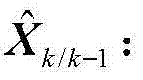
步骤四一:确定卡尔曼滤波状态向量估计值

则被测锂离子电池一阶RC等效电路的卡尔曼滤波状态向量Xk/k为:Then the Kalman filter state vector X k/k of the first-order RC equivalent circuit of the lithium-ion battery under test is:
式中SOCk为k时刻被测锂离子电池荷电状态SOC的估计值;In the formula, SOC k is the estimated value of the SOC of the lithium-ion battery state of charge at time k;
被测锂离子电池二阶RC等效电路的卡尔曼滤波状态向量Xk/k为:The Kalman filter state vector X k/k of the second-order RC equivalent circuit of the lithium-ion battery under test is:
k时刻被测锂离子电池荷电状态SOC的估计值SOCk的多项式拟合函数为:The polynomial fitting function of the estimated value SOC k of the state of charge of the lithium-ion battery measured at time k is:
H1,H2和H3均为根据充放电实验数据建立的最小二乘拟合函数;H 1 , H 2 and H 3 are all least square fitting functions established based on charge and discharge experimental data;
步骤四二:计算卡尔曼滤波状态向量一步预测值
由:

获得被测锂离子电池一阶RC等效电路的状态转移函数f为:Obtain the state transfer function f of the first-order RC equivalent circuit of the lithium-ion battery under test as follows:
式中Δt为采样周期,τ为一阶RC等效电路中RC环节的时间常数,η为被测锂离子电池的充放电效率,CN为被测锂离子电池的额定容量,Cp为一阶RC等效电路中RC环节的极化电容的容值,i1,k作为k时刻的系统输入向量;In the formula, Δt is the sampling period, τ is the time constant of the RC link in the first-order RC equivalent circuit, η is the charging and discharging efficiency of the tested lithium-ion battery, CN is the rated capacity of the tested lithium-ion battery, and C p is a The capacitance value of the polarized capacitance of the RC link in the RC equivalent circuit of the first order, i 1,k is used as the system input vector at time k;
被测锂离子电池二阶RC等效电路的状态转移函数f为:The state transfer function f of the second-order RC equivalent circuit of the tested lithium-ion battery is:
式中τ1为二阶RC等效电路中第一个RC环节的时间常数,τ2为二阶RC等效电路中第二个RC环节的时间常数,Cp1为二阶RC等效电路中第一个RC环节的极化电容的容值,Cp2为二阶RC等效电路中第二个RC环节的极化电容的容值,i2,k作为k时刻的系统输入向量;where τ1 is the time constant of the first RC link in the second-order RC equivalent circuit, τ2 is the time constant of the second RC link in the second-order RC equivalent circuit, C p1 is the time constant of the second-order RC equivalent circuit The capacitance value of the polarization capacitance of the first RC link, C p2 is the capacitance value of the polarization capacitance of the second RC link in the second-order RC equivalent circuit, and i 2,k is used as the system input vector at time k;
步骤四三:确定一步预测误差协方差矩阵Pk/k-1:Step 43: Determine the one-step forecast error covariance matrix P k/k-1 :
式中Ak-1为k-1时刻的系数矩阵,为系数矩阵Ak-1的转置,Qk-1为k-1时刻的系统噪声的方差,where A k-1 is the coefficient matrix at time k-1, is the transpose of the coefficient matrix A k-1 , Q k-1 is the variance of the system noise at time k-1,
对于被测锂离子电池一阶RC等效电路,Ak-1为:For the first-order RC equivalent circuit of the tested lithium-ion battery, A k-1 is:
对于被测锂离子电池二阶RC等效电路,Ak-1为:For the second-order RC equivalent circuit of the tested lithium-ion battery, A k-1 is:
k-1时刻的系统噪声的方差Qk为:The variance Q k of the system noise at time k-1 is:
式中wk为均值为零的系统噪声,为wk的转置,E为数学期望表示符;where w k is the system noise with zero mean, is the transposition of w k , and E is the mathematical expectation indicator;
步骤四四:建立卡尔曼增益矩阵Kk:Step 4: Establish the Kalman gain matrix K k :
式中Ck为观测矩阵,Rk为观测噪声的方差;where C k is the observation matrix, R k is the variance of the observation noise;
则获得被测锂离子电池一阶RC等效电路的为观测矩阵Ck为:Then the observation matrix C k of the first-order RC equivalent circuit of the tested lithium-ion battery is obtained as:
式中SOC(t)为被测锂离子电池荷电状态对时间t的连续函数;In the formula, SOC(t) is a continuous function of the state of charge of the measured lithium-ion battery to time t;
被测锂离子电池二阶RC等效电路的为观测矩阵Ck为:The observation matrix C k of the second-order RC equivalent circuit of the lithium-ion battery under test is:
方差Rk为:The variance R k is:
式中vk为均值为零的观测噪声;where v k is the observation noise with zero mean;
步骤四五:计算获得卡尔曼滤波状态向量估计值
式中,yk为系统观测向量,g为测量函数,In the formula, y k is the system observation vector, g is the measurement function,
则对于被测锂离子电池一阶RC等效电路,g为:Then for the first-order RC equivalent circuit of the tested lithium-ion battery, g is:
对于被测锂离子电池二阶RC等效电路,g为:For the second-order RC equivalent circuit of the tested lithium-ion battery, g is:
步骤四六:确定卡尔曼滤波误差协方差矩阵Pk/k:Step 46: Determine the Kalman filter error covariance matrix P k/k :
Pk/k=(I-KkCk)Pk/k-1,P k/k =(IK k C k )P k/k-1 ,
其中,I为单位矩阵;Among them, I is the identity matrix;
步骤四七:返回步骤四一,循环执行步骤四一至步骤四七,以实时更新卡尔曼滤波状态向量估计值
本发明的优点:本发明方法在运行扩展卡尔曼SOC估计之前,先将被测锂离子电池的电池端电压Uo(t)和极化电压建立关系,再通过被测锂离子电池的充放电实验,确定被测锂离子电池的卡尔曼滤波初值SOC0和初始误差协方差P(0),这样优选后的初值作为EKF的初始条件,从而保证了锂离子电池SOC在线估计的可靠收敛,进而确保了SOC的估计结果准确可靠。Advantages of the present invention: before the method of the present invention operates the extended Kalman SOC estimation, the battery terminal voltage U o (t) of the lithium-ion battery under test and the polarization voltage are established to be related first, and then the charging and discharging of the lithium-ion battery under test Experiment to determine the initial value of the Kalman filter SOC 0 and the initial error covariance P(0) of the lithium-ion battery under test, so that the optimized initial value is used as the initial condition of the EKF, thus ensuring the reliable convergence of the online estimation of the lithium-ion battery SOC , thus ensuring that the estimation result of SOC is accurate and reliable.
本发明方法基于锂离子电池一阶和二阶模型进行扩展卡尔曼滤波SOC估计,利用实时获得的电池端电压、极化电压等数据,进行初值的选取,它使扩展卡尔曼滤波的初始状态尽可能接近电池的当前状态,从而保证了收敛速度和估计精度,增进了方法的适用性。The method of the present invention is based on the first-order and second-order models of the lithium-ion battery to estimate the SOC of the extended Kalman filter, and uses the data such as the battery terminal voltage and polarization voltage obtained in real time to select the initial value, which makes the initial state of the extended Kalman filter It is as close as possible to the current state of the battery, thereby ensuring the convergence speed and estimation accuracy, and improving the applicability of the method.
附图说明Description of drawings
图1是锂离子电池一阶RC等效电路的修正模型;Figure 1 is a modified model of the first-order RC equivalent circuit of a lithium-ion battery;
图2是锂离子电池二阶RC等效电路的修正模型;Figure 2 is a modified model of the second-order RC equivalent circuit of a lithium-ion battery;
图3是在UDDS3工况下对单体锂离子电池进行实验,获得的工况电流和工况电压图;Figure 3 is a diagram of the working condition current and working condition voltage obtained by experimenting on a single lithium-ion battery under the UDDS3 working condition;
图4是一阶RC模型,在初始误差协方差为0.01和SOC初值为10%、30%、50%、70%、90%时的SOC估计曲线图;Figure 4 is a first-order RC model, the SOC estimation curve when the initial error covariance is 0.01 and the initial SOC value is 10%, 30%, 50%, 70%, and 90%;
图5是一阶RC模型,在初始误差协方差为0.01和SOC初值为10%、30%、50%、70%、90%时的SOC的绝对误差分布图;Figure 5 is a first-order RC model, the absolute error distribution diagram of SOC when the initial error covariance is 0.01 and the initial value of SOC is 10%, 30%, 50%, 70%, and 90%;
图6是一阶RC模型,在初始误差协方差为0.05和SOC初值为10%、30%、50%、70%、90%时的SOC估计曲线图;Figure 6 is a first-order RC model, the SOC estimation curve when the initial error covariance is 0.05 and the initial SOC value is 10%, 30%, 50%, 70%, and 90%;
图7是一阶RC模型,在初始误差协方差为0.05和SOC初值为10%、30%、50%、70%、90%时的SOC的绝对误差分布图;Figure 7 is a first-order RC model, the absolute error distribution diagram of SOC when the initial error covariance is 0.05 and the initial value of SOC is 10%, 30%, 50%, 70%, and 90%;
图8是一阶RC模型,在初始误差协方差为0.5和SOC初值为10%、30%、50%、70%、90%时的SOC估计曲线图;Figure 8 is a first-order RC model, the SOC estimation curve when the initial error covariance is 0.5 and the SOC initial value is 10%, 30%, 50%, 70%, and 90%;
图9是一阶RC模型,在初始误差协方差为0.5和SOC初值为10%、30%、50%、70%、90%时的SOC的绝对误差分布图;Figure 9 is a first-order RC model, the absolute error distribution diagram of SOC when the initial error covariance is 0.5 and the initial value of SOC is 10%, 30%, 50%, 70%, and 90%;
图10是一阶RC模型,在初始误差协方差为5和SOC初值为10%、30%、50%、70%、90%时的SOC估计曲线图;Figure 10 is a first-order RC model, the SOC estimation curve when the initial error covariance is 5 and the SOC initial value is 10%, 30%, 50%, 70%, and 90%;
图11是一阶RC模型,在初始误差协方差为5和SOC初值为10%、30%、50%、70%、90%时的SOC的绝对误差分布图;Figure 11 is a first-order RC model, the absolute error distribution diagram of SOC when the initial error covariance is 5 and the initial value of SOC is 10%, 30%, 50%, 70%, and 90%;
图12是二阶RC模型,在初始误差协方差为0.01和SOC初值为10%、30%、50%、70%、90%时的SOC估计曲线图;Figure 12 is a second-order RC model, the SOC estimation curve when the initial error covariance is 0.01 and the initial SOC value is 10%, 30%, 50%, 70%, and 90%;
图13是二阶RC模型,在初始误差协方差为0.01和SOC初值为10%、30%、50%、70%、90%时的SOC的绝对误差分布图;Figure 13 is a second-order RC model, the absolute error distribution diagram of SOC when the initial error covariance is 0.01 and the initial value of SOC is 10%, 30%, 50%, 70%, and 90%;
图14是二阶RC模型,在初始误差协方差为0.05和SOC初值为10%、30%、50%、70%、90%时的SOC估计曲线图;Fig. 14 is a second-order RC model, the SOC estimation curve when the initial error covariance is 0.05 and the SOC initial value is 10%, 30%, 50%, 70%, and 90%;
图15是二阶RC模型,在初始误差协方差为0.05和SOC初值为10%、30%、50%、70%、90%时的SOC的绝对误差分布图;Figure 15 is a second-order RC model, the absolute error distribution diagram of SOC when the initial error covariance is 0.05 and the initial value of SOC is 10%, 30%, 50%, 70%, and 90%;
图16是二阶RC模型,在初始误差协方差为0.5和SOC初值为10%、30%、50%、70%、90%时的SOC估计曲线图;Fig. 16 is a second-order RC model, the SOC estimation curve when the initial error covariance is 0.5 and the SOC initial value is 10%, 30%, 50%, 70%, and 90%;
图17是二阶RC模型,在初始误差协方差为0.5和SOC初值为10%、30%、50%、70%、90%时的SOC的绝对误差分布图;Figure 17 is a second-order RC model, the absolute error distribution diagram of SOC when the initial error covariance is 0.5 and the initial value of SOC is 10%, 30%, 50%, 70%, and 90%;
图18是二阶RC模型,在初始误差协方差为5和SOC初值为10%、30%、50%、70%、90%时的SOC估计曲线图;Fig. 18 is a second-order RC model, the SOC estimation curve when the initial error covariance is 5 and the SOC initial value is 10%, 30%, 50%, 70%, and 90%;
图19是二阶RC模型,在初始误差协方差为5和SOC初值为10%、30%、50%、70%、90%时的SOC的绝对误差分布图;Figure 19 is a second-order RC model, the absolute error distribution diagram of SOC when the initial error covariance is 5 and the initial value of SOC is 10%, 30%, 50%, 70%, and 90%;
图20是初值优选后的一阶卡尔曼SOC在不同P(0)时的估计结果曲线图;Fig. 20 is the estimated result curve diagram of the first-order Kalman SOC after the initial value is optimized at different P (0);
图21是初值优选后的一阶卡尔曼SOC在不同P(0)时的绝对误差曲线图;Fig. 21 is the absolute error curve diagram of the first-order Kalman SOC after initial value optimization at different P (0);
图22是初值优选后的二阶卡尔曼SOC在不同P(0)时的估计结果曲线图;Fig. 22 is the estimated result curve diagram of the second-order Kalman SOC after initial value optimization at different P (0);
图23是初值优选后的二阶卡尔曼SOC在不同P(0)时的绝对误差曲线图;Fig. 23 is the absolute error curve diagram of the second-order Kalman SOC after initial value optimization at different P (0);
图24是本发明方法的实现流程框图。Fig. 24 is a block diagram of the implementation flow of the method of the present invention.
具体实施方式Detailed ways
具体实施方式一:下面结合图1、图2和图24说明本实施方式,本实施方式基于扩展卡尔曼滤波的锂离子电池SOC在线估计方法,它包括以下步骤:Specific Embodiment 1: The present embodiment is described below in conjunction with FIG. 1, FIG. 2 and FIG. 24. The present embodiment is based on the extended Kalman filter lithium-ion battery SOC online estimation method, which includes the following steps:
步骤一:采集被测锂离子电池的电池端电压Uo(t)和极化电压,建立被测锂离子电池一阶RC等效电路的电压电流关系式和二阶RC等效电路的电压电流关系式;Step 1: Collect the battery terminal voltage U o (t) and polarization voltage of the lithium-ion battery under test, and establish the voltage-current relationship of the first-order RC equivalent circuit of the tested lithium-ion battery and the voltage-current relationship of the second-order RC equivalent circuit relational formula;
步骤二:对被测锂离子电池进行充放电实验,记录每次对应的电池SOC初值和电池开路电压初值Uocv(0),并建立被测锂离子电池的卡尔曼滤波初值SOC0的多项式拟合函数;Step 2: Carry out charge and discharge experiments on the tested lithium-ion battery, record each corresponding initial battery SOC value and battery open-circuit voltage initial value U ocv (0), and establish the Kalman filter initial value SOC 0 of the tested lithium-ion battery The polynomial fitting function of ;
步骤三:求解所述多项式拟合函数,获得被测锂离子电池的卡尔曼滤波初值SOC0,再通过梯度仿真实验,确定卡尔曼滤波的初始误差协方差P(0);Step 3: Solve the polynomial fitting function to obtain the initial value SOC 0 of the Kalman filter of the lithium-ion battery under test, and then determine the initial error covariance P(0) of the Kalman filter through gradient simulation experiments;
步骤四:根据步骤三中获得的卡尔曼滤波初值SOC0和初始误差协方差P(0),进行基于扩展卡尔曼滤波的电池SOC估计,实现锂离子电池的SOC在线估计。Step 4: According to the Kalman filter initial value SOC 0 and the initial error covariance P(0) obtained in
具体实施方式二:下面结合图1和图2说明本实施方式,本实施方式对实施方式一作进一步说明,本实施方式所述步骤一中,被测锂离子电池一阶RC等效电路的电压电流关系式为:Specific embodiment two: the present embodiment will be described below in conjunction with Fig. 1 and Fig. 2. This embodiment will further describe the first embodiment. The relationship is:
Uo(t)=Uocv(t)-Up(t)-i1(t)Rd1(t);U o (t)=U ocv (t)-U p (t)-i 1 (t)R d1 (t);
式中t为时间,Uocv(t)为被测锂离子电池的开路电压,Up(t)为一阶RC等效电路中RC环节的极化电压,i1(t)为一阶RC等效电路的回路电流,Rd1(t)为一阶RC等效电路中被测锂离子电池电阻;where t is time, U ocv (t) is the open circuit voltage of the lithium-ion battery under test, U p (t) is the polarization voltage of the RC link in the first-order RC equivalent circuit, and i 1 (t) is the first-order RC The loop current of the equivalent circuit, R d1 (t) is the lithium-ion battery resistance measured in the first-order RC equivalent circuit;
将上述一阶RC等效电路的电压电流关系式离散化后为:After the discretization of the voltage-current relationship of the above-mentioned first-order RC equivalent circuit is:
Uo,k=Uocv,k-Up,k-i1,kRd1,k,U o,k =U ocv,k -U p,k -i 1,k R d1,k ,
其中,Uo,k为k时刻被测锂离子电池的端电压Uocv(t)采样值,Uocv,k为k时刻被测锂离子电池的开路电压Uocv(t)采样值,Up,k为k时刻一阶RC等效电路中RC环节的极化电压Up(t)的采样值,i1,k为k时刻一阶RC等效电路的回路电流i1(t)的采样值,Rd1,k为k时刻一阶RC等效电路的被测锂离子电池内阻Rd1(t)的采样值;Among them, U o,k is the sampled value of the terminal voltage U ocv (t) of the lithium-ion battery under test at time k, U ocv,k is the sampled value of the open circuit voltage U ocv (t) of the lithium-ion battery under test at time k, U p ,k is the sampling value of the polarization voltage U p (t) of the RC link in the first-order RC equivalent circuit at time k, i 1,k is the sampling value of the loop current i 1 (t) of the first-order RC equivalent circuit at time k value, R d1,k is the sampled value of the measured lithium-ion battery internal resistance R d1 (t) of the first-order RC equivalent circuit at time k;
被测锂离子电池二阶RC等效电路的电压电流关系式为:The voltage-current relationship of the second-order RC equivalent circuit of the tested lithium-ion battery is:
Uo(t)=Uocv(t)-Up1(t)-Up2(t)-i2(t)Rd2(t);U o (t)=U ocv (t)-U p1 (t)-U p2 (t)-i 2 (t)R d2 (t);
式中Up1(t)为二阶RC等效电路中第一个RC环节的极化电压,Up2(t)为二阶RC等效电路中第二个RC环节的极化电压,i2(t)为二阶RC等效电路的回路电流,Rd2(t)为二阶RC等效电路中被测锂离子电池内阻;where U p1 (t) is the polarization voltage of the first RC link in the second-order RC equivalent circuit, U p2 (t) is the polarization voltage of the second RC link in the second-order RC equivalent circuit, i 2 (t) is the loop current of the second-order RC equivalent circuit, and R d2 (t) is the internal resistance of the lithium-ion battery measured in the second-order RC equivalent circuit;
将上述二阶RC等效电路的电压电流关系式离散化后为:After discretizing the voltage-current relationship of the above-mentioned second-order RC equivalent circuit, it is:
Uo,k=Uocv,k-Up1,k-Up2,k-i2,kRd2,k,U o,k =U ocv,k -U p1,k -U p2,k -i 2,k R d2,k ,
式中Up1,k为k时刻二阶RC等效电路中第一个RC环节的极化电压Up1(t)的采样值,Up2,k为k时刻二阶RC等效电路第二个RC环节的极化电压Up2(t)的采样值,i2,k为k时刻二阶RC等效电路的回路电流i2(t)采样值,Rd2,k为k时刻二阶RC等效电路的被测锂离子电池内阻采样值。where U p1,k is the sampling value of the polarization voltage U p1 (t) of the first RC link in the second-order RC equivalent circuit at time k, and U p2,k is the second The sampling value of the polarization voltage U p2 (t) of the RC link, i 2,k is the sampling value of the loop current i 2 (t) of the second-order RC equivalent circuit at time k, R d2,k is the second-order RC at time k, etc. The sampling value of the internal resistance of the tested lithium-ion battery of the effective circuit.
本实施方式中,对电压电流关系式离散化即对其进行等间隔采样,即离散化后的关系式是原关系式在k△t处的值,△t为采样间隔,也称采样周期。In this embodiment, discretization of the voltage-current relational expression means sampling at equal intervals, that is, the discretized relational expression is the value of the original relational expression at kΔt, and Δt is the sampling interval, also called the sampling period.
具体实施方式三:本实施方式对实施方式二作进一步说明,本实施方式所述步骤二中,被测锂离子电池的卡尔曼滤波初值SOC0的多项式拟合函数为:Specific embodiment three: this embodiment further explains embodiment two. In step two of this embodiment, the polynomial fitting function of the Kalman filter initial value SOC 0 of the lithium-ion battery under test is:
SOC0=H(Uocv(0));SOC 0 = H( Uocv (0));
式中H为根据卡尔曼滤波初值SOC0建立的最小二乘拟合函数。In the formula, H is the least square fitting function established according to the initial value of Kalman filter SOC 0 .
具体实施方式四:下面结合图1至图24说明本实施方式,本实施方式对实施方式三作进一步说明,本实施方式所述步骤四中进行基于扩展卡尔曼滤波的电池SOC估计的具体方法为:Specific Embodiment 4: The present embodiment will be described below in conjunction with FIG. 1 to FIG. 24 . This embodiment will further explain
步骤四一:确定卡尔曼滤波状态向量估计值的估计初值和误差协方差矩阵Pk/k的初值P0/0:Step 41: Determine the estimated value of the Kalman filter state vector estimated initial value of and the initial value P 0/0 of the error covariance matrix P k/k :
则被测锂离子电池一阶RC等效电路的卡尔曼滤波状态向量Xk/k为:Then the Kalman filter state vector X k/k of the first-order RC equivalent circuit of the lithium-ion battery under test is:
式中SOCk为k时刻被测锂离子电池荷电状态SOC的估计值;In the formula, SOC k is the estimated value of the SOC of the lithium-ion battery state of charge at time k;
被测锂离子电池二阶RC等效电路的卡尔曼滤波状态向量Xk/k为:The Kalman filter state vector X k/k of the second-order RC equivalent circuit of the lithium-ion battery under test is:
k时刻被测锂离子电池荷电状态SOC的估计值SOCk的多项式拟合函数为:The polynomial fitting function of the estimated value SOC k of the state of charge of the lithium-ion battery measured at time k is:
H1,H2和H3均为根据充放电实验数据建立的最小二乘拟合函数;H 1 , H 2 and H 3 are all least square fitting functions established based on charge and discharge experimental data;
步骤四二:计算卡尔曼滤波状态向量一步预测值
由:

获得被测锂离子电池一阶RC等效电路的状态转移函数f为:Obtain the state transfer function f of the first-order RC equivalent circuit of the lithium-ion battery under test as follows:
式中Δt为采样周期,τ为一阶RC等效电路中RC环节的时间常数,η为被测锂离子电池的充放电效率,CN为被测锂离子电池的额定容量,Cp为一阶RC等效电路中RC环节的极化电容的容值,i1,k作为k时刻的系统输入向量;In the formula, Δt is the sampling period, τ is the time constant of the RC link in the first-order RC equivalent circuit, η is the charging and discharging efficiency of the tested lithium-ion battery, CN is the rated capacity of the tested lithium-ion battery, and C p is a The capacitance value of the polarized capacitance of the RC link in the RC equivalent circuit of the first order, i 1,k is used as the system input vector at time k;
被测锂离子电池二阶RC等效电路的状态转移函数f为:The state transfer function f of the second-order RC equivalent circuit of the tested lithium-ion battery is:
式中τ1为二阶RC等效电路中第一个RC环节的时间常数,τ2为二阶RC等效电路中第二个RC环节的时间常数,Cp1为二阶RC等效电路中第一个RC环节的极化电容的容值,Cp2为二阶RC等效电路中第二个RC环节的极化电容的容值,i2,k作为k时刻的系统输入向量;where τ1 is the time constant of the first RC link in the second-order RC equivalent circuit, τ2 is the time constant of the second RC link in the second-order RC equivalent circuit, C p1 is the time constant of the second-order RC equivalent circuit The capacitance value of the polarization capacitance of the first RC link, C p2 is the capacitance value of the polarization capacitance of the second RC link in the second-order RC equivalent circuit, and i 2,k is used as the system input vector at time k;
步骤四三:确定一步预测误差协方差矩阵Pk/k-1:Step 43: Determine the one-step forecast error covariance matrix P k/k-1 :
式中Ak-1为k-1时刻的系数矩阵,
对于被测锂离子电池一阶RC等效电路,Ak-1为:For the first-order RC equivalent circuit of the tested lithium-ion battery, A k-1 is:
对于被测锂离子电池二阶RC等效电路,Ak-1为:For the second-order RC equivalent circuit of the tested lithium-ion battery, A k-1 is:
k-1时刻的系统噪声的方差Qk为:The variance Q k of the system noise at time k-1 is:
式中wk为均值为零的系统噪声,
步骤四四:建立卡尔曼增益矩阵Kk:Step 4: Establish the Kalman gain matrix K k :
式中Ck为观测矩阵,Rk为观测噪声的方差;where C k is the observation matrix, R k is the variance of the observation noise;
则获得被测锂离子电池一阶RC等效电路的为观测矩阵Ck为:Then the observation matrix C k of the first-order RC equivalent circuit of the tested lithium-ion battery is obtained as:
式中SOC(t)为被测锂离子电池荷电状态对时间t的连续函数;In the formula, SOC(t) is a continuous function of the state of charge of the measured lithium-ion battery to time t;
被测锂离子电池二阶RC等效电路的为观测矩阵Ck为:The observation matrix C k of the second-order RC equivalent circuit of the lithium-ion battery under test is:
方差Rk为:The variance R k is:
式中vk为均值为零的观测噪声;where v k is the observation noise with zero mean;
步骤四五:计算获得卡尔曼滤波状态向量估计值
式中,yk为系统观测向量,g为测量函数,In the formula, y k is the system observation vector, g is the measurement function,
则对于被测锂离子电池一阶RC等效电路,g为:Then for the first-order RC equivalent circuit of the tested lithium-ion battery, g is:
对于被测锂离子电池二阶RC等效电路,g为:For the second-order RC equivalent circuit of the tested lithium-ion battery, g is:
步骤四六:确定卡尔曼滤波误差协方差矩阵Pk/k:Step 46: Determine the Kalman filter error covariance matrix P k/k :
Pk/k=(I-KkCk)Pk/k-1,P k/k =(IK k C k )P k/k-1 ,
其中,I为单位矩阵;Among them, I is the identity matrix;
步骤四七:返回步骤四一,循环执行步骤四一至步骤四七,以实时更新卡尔曼滤波状态向量估计值
本发明方法的理论基础:本发明方法为基于扩展卡尔曼滤波的电池SOC估计方法,它把电池模型中的非线性函数通过泰勒公式展开成线性模型,再结合卡尔曼的基本滤波方程来进行SOC的估算。卡尔曼滤波不要求保存过去的测量数据,当新的数据到来时,根据新的数据和前一时刻的状态估值,再借助于系统本身的状态转移方程,按照卡尔曼滤波基本的递推公式,便可以计算出当前时刻新的状态值。锂离子电池模型为非线性系统,由状态空间模型描述非线性离散系统的卡尔曼滤波算法过程如下。Theoretical basis of the method of the present invention: the method of the present invention is a battery SOC estimation method based on the extended Kalman filter, which expands the nonlinear function in the battery model into a linear model through Taylor's formula, and then combines the basic filter equation of Kalman to perform SOC estimate. Kalman filtering does not require saving past measurement data. When new data arrives, based on the new data and the state estimation at the previous moment, with the help of the state transition equation of the system itself, according to the basic recursive formula of Kalman filtering , the new state value at the current moment can be calculated. The lithium-ion battery model is a nonlinear system, and the Kalman filter algorithm process of the nonlinear discrete system described by the state space model is as follows.
假设非线性系统离散状态空间方程如下:Assume that the discrete state space equation of the nonlinear system is as follows:
其中,xk为系统状态向量,yk为系统观测向量,uk为k时刻的系统输入向量,f(xk,uk)是非线性的状态转移函数,g(xk,uk)是非线性的测量函数,wk和vk分别为均值为零的不相关的系统噪声和观测噪声,其方差分别为Qw和Rv。扩展卡尔曼滤波算法的递推步骤如下:Among them, x k is the system state vector, y k is the system observation vector, u k is the system input vector at time k, f(x k ,u k ) is a nonlinear state transition function, g(x k ,u k ) is a nonlinear Linear measurement function, w k and v k are respectively uncorrelated system noise and observation noise with zero mean, and their variances are Q w and R v respectively. The recursive steps of the extended Kalman filter algorithm are as follows:
首先滤波初始值条件和P0/0分别为:First filter the initial value condition and P 0/0 are:
其中x(0)表示状态向量的初值。Where x(0) represents the initial value of the state vector.
状态一步预测矩阵为:The state one-step prediction matrix is:
一步预测误差协方差矩阵为:The one-step forecast error covariance matrix is:
卡尔曼增益矩阵为:The Kalman gain matrix is:
状态估计值为:The state estimates are:
状态估计误差协方差矩阵:State estimation error covariance matrix:
Pk/k=(I-KkCk)Pk/k-1;P k/k =(IK k C k )P k/k-1 ;
重复执行上述步骤,进行递推滤波计算。Repeat the above steps to perform recursive filtering calculations.
从上面的递推关系可以知道,只要给定初始条件

针对图1所示的锂离子电池一阶RC模型,可以得到连续形式的状态空间方程:For the first-order RC model of lithium-ion battery shown in Figure 1, the state-space equation in continuous form can be obtained:
式中的SOC以微分的形式表达,并把SOC和电容上的电压作为状态变量,电池的回路方程作为观测方程。The SOC in the formula is expressed in a differential form, and the SOC and the voltage on the capacitor are used as state variables, and the loop equation of the battery is used as an observation equation.
经离散化和线性化处理得到离散状态空间方程:After discretization and linearization, the discrete state space equation is obtained:
其中,k为采样序数。Among them, k is the sampling sequence number.
对比扩展卡尔曼滤波算法中的系数,得到系统状态向量Xk、系统矩阵Ak、系统输入向量uk和观测矩阵Ck。By comparing the coefficients in the extended Kalman filter algorithm, the system state vector X k , system matrix A k , system input vector u k and observation matrix C k are obtained.
由于在每一采样时刻都要进行一次卡尔曼滤波运算,因此需要提前确定式中的各项参数。根据参数辨识结果,已获得SOC=10%、20%、30%、40%、50%、60%、70%、80%、90%、100%点处的各参数值,因此可以使用多项式拟合方法,建立各参数与SOC的函数关系,从而利用插值法获得任意SOC阶段,即任意时刻的各参数估计值。Since a Kalman filter operation is performed at each sampling moment, it is necessary to determine the parameters in the formula in advance. According to the parameter identification results, the parameter values at SOC=10%, 20%, 30%, 40%, 50%, 60%, 70%, 80%, 90%, and 100% points have been obtained, so polynomials can be used to simulate The combined method is used to establish the functional relationship between each parameter and SOC, so that the estimated value of each parameter at any SOC stage, that is, at any time, can be obtained by interpolation.
上式需要对观测矩阵求偏导计算,其中

Uo(t)=Uocv-Up(t)-i1(t)Rd1,U o (t)=U ocv -U p (t)-i 1 (t)R d1 ,
因此可以得到
同一阶RC模型的状态空间方程分析一样,把图2所示二阶RC模型中两个电容的电压以及SOC作为状态变量,把模型的回路程作为测量方程,可以建立离散状态方程:The same as the state space equation analysis of the same order RC model, the voltage of the two capacitors and SOC in the second order RC model shown in Figure 2 are used as state variables, and the return path of the model is used as the measurement equation, a discrete state equation can be established:
从二阶RC模型的离散状态方程中,可得出系统状态向量Xk、系统矩阵Ak、系统输入向量uk和观测矩阵Ck:From the discrete state equation of the second-order RC model, the system state vector X k , system matrix A k , system input vector u k and observation matrix C k can be obtained:
对于
利用扩展卡尔曼滤波SOC估算方法在UDDS3工况下对单体锂离子电池进行实验,UDDS3工况即是对UDDS工况(Urban Dynamometer Driving Schedule,城市道路循环工况)的3次循环,累计用时4110s,工况电流和工况电压如图3所示。The extended Kalman filter SOC estimation method is used to test the single lithium-ion battery under the UDDS3 working condition. 4110s, working condition current and working condition voltage are shown in Figure 3.
卡尔曼滤波递推方程中,需要确定初始值的量有SOC的初值SOC0、极化电压值Up1(0)和Up2(0)、初始误差协方差P(0)、初始系统噪声方差阵Q0、初始测量噪声方差阵R0。其中,作为状态变量的极化电压,起始阶段极化效应并不明显,通常设为0,Q0主要是由于模型的系统噪声和模型建立中的误差造成,可假定系统噪声误差为0。R0是电压传感器在获取电池端电压时,引入误差的均方根值。预测估计误差协方差P(0),由系统状态初值X(0)的方差决定。In the Kalman filter recursive equation, the quantities that need to determine the initial value are the initial value of SOC SOC 0 , the polarization voltage values U p1 (0) and U p2 (0), the initial error covariance P (0), the initial system noise Variance matrix Q 0 , initial measurement noise variance matrix R 0 . Among them, the polarization voltage as a state variable has no obvious polarization effect at the initial stage, and is usually set to 0. Q 0 is mainly caused by the system noise of the model and the error in model establishment, and the system noise error can be assumed to be 0. R 0 is the root mean square value of the error introduced by the voltage sensor when obtaining the battery terminal voltage. The prediction estimation error covariance P(0) is determined by the variance of the initial value X(0) of the system state.
为了准确的估算电池的荷电状态,选择合适的初始值对提高滤波的效果、估算精度和收敛速度都有着重要的影响,其中,影响最大的两个参数为初始SOC0和P(0),如图4至图19所示。由实验曲线图可以获各,无论初始误差协方差P(0)的取值,还是卡尔曼滤波的SOC初值,都是越接近实际SOC初值,估计曲线的收敛速度越快,估计的准确度越高,绝对误差的整体分布越理想。初始误差协方差P(0)的取值越大,估计曲线的收敛速度通常越快,但会局部出现过拟合的现象。从结果可知,初始误差协方差P(0)和SOC初值对估计结果的影响显而易见,因此,为了获得理想的收敛速度和估计精度,需要在运行卡尔曼滤波算法前,进行这两个参数的优选处理。对SOC初值的优选,需要利用一阶模型的电压电流关系:In order to accurately estimate the state of charge of the battery, choosing an appropriate initial value has an important impact on improving the filtering effect, estimation accuracy and convergence speed. Among them, the two most influential parameters are the initial SOC 0 and P(0), As shown in Figure 4 to Figure 19. It can be obtained from the experimental graph that regardless of the value of the initial error covariance P(0) or the initial value of the SOC of the Kalman filter, the closer to the actual initial value of the SOC, the faster the convergence speed of the estimated curve and the accuracy of the estimate The higher the degree, the better the overall distribution of absolute errors. The larger the value of the initial error covariance P(0), the faster the convergence speed of the estimated curve is usually, but the phenomenon of over-fitting will appear locally. It can be seen from the results that the influence of the initial error covariance P(0) and the initial value of SOC on the estimation results is obvious. Therefore, in order to obtain the ideal convergence speed and estimation accuracy, it is necessary to carry out these two parameters before running the Kalman filter algorithm. Preferred treatment. To optimize the initial value of SOC, it is necessary to use the voltage-current relationship of the first-order model:
Uo(t)=Uocv(t)-Up(t)-i1(t)Rd1(t),U o (t)=U ocv (t)-U p (t)-i 1 (t)R d1 (t),
和二阶模型的电压电流关系:The voltage-current relationship with the second-order model:
Uo(t)=Uocv(t)-Up1(t)-Up2(t)-i2(t)Rd2(t),U o (t)=U ocv (t)-U p1 (t)-U p2 (t)-i 2 (t)R d2 (t),
其中。由于极化电压Up(t)、Up1(t)和Up2(t)在电池充放电初期时,接近于0,因此其数值可忽略不计。另外,电池开始充放电的瞬间,回路电流通常很小,故而电压电流关系式中的项i1(t)Rd1(t)和i2(t)Rd2(t)亦非常小。因此,无论是一阶模型,还是二阶模型,电池在开始工作的一瞬间,可以近似认为开路电压Uocv(t)等于输出电压Uo(t),而开路电压与SOC初值具有明显的对应关系,可以通过多项式拟合,建立两者的拟合函数。这样,将电池开始工作时的输出电压Uo(t)代入拟合函数,就可求得SOC初值的估计值。使用该方法确定SOC初值虽然存在一定误差,但由于卡尔曼滤波具有收敛特性,因此,这一误差可在短时间的迭代过程中,逐渐消除。在SOC初值优选的基础上,再对初始误差协方差进行参数寻优,可以通过梯度实验结果进行比对、优选,以获得更准确的估计结果。in. Since the polarization voltages U p (t), U p1 (t) and U p2 (t) are close to 0 at the initial stage of charging and discharging of the battery, their values are negligible. In addition, when the battery starts charging and discharging, the loop current is usually very small, so the terms i 1 (t)R d1 (t) and i 2 (t)R d2 (t) in the voltage-current relationship are also very small. Therefore, whether it is a first-order model or a second-order model, the open circuit voltage U ocv (t) can be approximately considered to be equal to the output voltage U o (t) at the moment when the battery starts to work, and the open circuit voltage and the initial value of SOC have obvious differences Corresponding relationship, the fitting function of the two can be established through polynomial fitting. In this way, the estimated value of the SOC initial value can be obtained by substituting the output voltage U o (t) when the battery starts to work into the fitting function. Although there is a certain error in determining the initial value of SOC using this method, due to the convergence characteristics of Kalman filtering, this error can be gradually eliminated in a short iteration process. On the basis of optimizing the initial value of SOC, the parameters of the initial error covariance can be optimized, and the results of gradient experiments can be compared and optimized to obtain more accurate estimation results.
本发明的效果如图20至图23所示,其中,图20和21为初值优选后的一阶卡尔曼SOC估计结果,图22和23为初值优选后的二阶卡尔曼SOC估计结果。通过本发明所提出的初值优选方法,可以求得SOC的初值SOC(0)=0.97,基于这一先验结果,对P(0)进行参数优化,分别在P(0)=0.01、0.05、0.08、0.5、5时,运行一阶和二阶卡尔曼滤波程序,得到的SOC估计结果如图20和图22所示,其满量程误差如图21和图23所示。对一阶和二阶模型而言,最优结果均出现在P(0)=0.01处。可见P(0)取值越小,SOC估计的误差越小。并且从模型的阶数来看,电池一阶模型的精度略高于二阶模型的精度。主要原因是由于在二阶模型中有两个阻容串联组成的电路,且两个电容都有一定的初始值,在卡尔曼滤波算法的过程中,需要有更长的时间来对SOC值进行修正。但整体而言,一阶模型以及P(0)<1时的二阶模型,均能保持较高的估计精度,在初始阶段,其估计结果都能在真实值附近进行调节,具有一定的自适应能力。这说明了通过本发明所提出的初值优选方法,能够让扩展卡尔曼滤波SOC估计算法精确地跟踪电池的荷电状态,并且具有很好的动态性能,可以满足实际应用的要求。The effects of the present invention are shown in Figures 20 to 23, wherein Figures 20 and 21 are the first-order Kalman SOC estimation results after the initial value is optimized, and Figures 22 and 23 are the second-order Kalman SOC estimation results after the initial value is optimized . By the initial value optimization method proposed by the present invention, the initial value SOC(0)=0.97 of SOC can be obtained, based on this priori result, the parameter optimization is carried out to P(0), respectively at P(0)=0.01, When 0.05, 0.08, 0.5, and 5, run the first-order and second-order Kalman filter procedures, and the obtained SOC estimation results are shown in Figure 20 and Figure 22, and the full-scale error is shown in Figure 21 and Figure 23. For both first-order and second-order models, the optimal results appear at P(0)=0.01. It can be seen that the smaller the value of P(0), the smaller the error of SOC estimation. And from the point of view of the order of the model, the accuracy of the first-order battery model is slightly higher than that of the second-order model. The main reason is that in the second-order model, there are two circuits composed of resistors and capacitors connected in series, and both capacitors have a certain initial value. In the process of the Kalman filter algorithm, it takes a longer time to adjust the SOC value. fix. But on the whole, the first-order model and the second-order model when P(0)<1 can maintain a high estimation accuracy. adaptability. This shows that the initial value optimization method proposed by the present invention can enable the extended Kalman filter SOC estimation algorithm to accurately track the state of charge of the battery, and has good dynamic performance, which can meet the requirements of practical applications.
Claims (4)




Priority Applications (1)
| Application Number | Priority Date | Filing Date | Title |
|---|---|---|---|
| CN201310515760.1A CN103529398A (en) | 2013-10-28 | 2013-10-28 | On-line SOC Estimation Method of Li-ion Battery Based on Extended Kalman Filter |
Applications Claiming Priority (1)
| Application Number | Priority Date | Filing Date | Title |
|---|---|---|---|
| CN201310515760.1A CN103529398A (en) | 2013-10-28 | 2013-10-28 | On-line SOC Estimation Method of Li-ion Battery Based on Extended Kalman Filter |
Publications (1)
| Publication Number | Publication Date |
|---|---|
| CN103529398A true CN103529398A (en) | 2014-01-22 |
Family
ID=49931558
Family Applications (1)
| Application Number | Title | Priority Date | Filing Date |
|---|---|---|---|
| CN201310515760.1A Pending CN103529398A (en) | 2013-10-28 | 2013-10-28 | On-line SOC Estimation Method of Li-ion Battery Based on Extended Kalman Filter |
Country Status (1)
| Country | Link |
|---|---|
| CN (1) | CN103529398A (en) |
Cited By (38)
| Publication number | Priority date | Publication date | Assignee | Title |
|---|---|---|---|---|
| CN103941195A (en) * | 2014-05-05 | 2014-07-23 | 山东大学 | Method for battery SOC estimation based on small model error criterion expanding Kalman filter |
| CN104360282A (en) * | 2014-11-19 | 2015-02-18 | 奇瑞汽车股份有限公司 | State of charge (SOC) estimation method of variable length sliding window by identifying battery parameters |
| CN104502849A (en) * | 2014-12-12 | 2015-04-08 | 国家电网公司 | Online and real-time measuring method for surplus capacity of transformer substation valve control type sealed lead-acid storage battery |
| CN104502853A (en) * | 2014-12-12 | 2015-04-08 | 广西科技大学 | Lithium battery SOC (Stress Optical Coefficient) estimation method based on EKF (Extended Kalman Filter) |
| CN104535932A (en) * | 2014-12-20 | 2015-04-22 | 吉林大学 | Lithium ion battery charge state estimating method |
| CN104714188A (en) * | 2015-03-31 | 2015-06-17 | 桂林电子科技大学 | Method and system for estimating measured noise variance matrix matched battery state of charge (SOC) |
| CN104833921A (en) * | 2014-12-01 | 2015-08-12 | 北汽福田汽车股份有限公司 | Battery pack charge state calculating method and calculating device |
| CN105334462A (en) * | 2014-08-07 | 2016-02-17 | 华为技术有限公司 | Online estimation method for battery capacity loss |
| CN105548896A (en) * | 2015-12-25 | 2016-05-04 | 南京航空航天大学 | Power-cell SOC online closed-loop estimation method based on N-2RC model |
| CN105842633A (en) * | 2016-05-30 | 2016-08-10 | 广西大学 | Method for estimating SOC (State of Charge) of lithium ion battery based on gray extended Kalman filtering algorithm |
| WO2016134496A1 (en) * | 2015-02-28 | 2016-09-01 | 北京交通大学 | Method and apparatus for estimating state of charge of lithium ion battery |
| CN105974320A (en) * | 2016-04-27 | 2016-09-28 | 华中科技大学 | Liquid or semi-liquid metal-cell state-of-charge estimation method |
| CN106354964A (en) * | 2016-09-08 | 2017-01-25 | 厦门理工学院 | Charge state estimation method of lithium-ion capacitor for electric automobile |
| CN106405433A (en) * | 2016-11-04 | 2017-02-15 | 首都师范大学 | Extended Kalman particle filtering based SOC (State Of Charge) estimation method and system |
| WO2017000912A3 (en) * | 2015-07-02 | 2017-02-16 | 华为技术有限公司 | Battery state of health detection device and method |
| CN106443496A (en) * | 2016-12-08 | 2017-02-22 | 盐城工学院 | Battery charge state estimation method with improved noise estimator |
| CN106483468A (en) * | 2016-09-29 | 2017-03-08 | 中国科学院广州能源研究所 | The multifactor evaluation method of the initial state-of-charge of lithium battery |
| CN107167743A (en) * | 2017-06-29 | 2017-09-15 | 北京新能源汽车股份有限公司 | Electric vehicle-based state of charge estimation method and device |
| CN107368619A (en) * | 2017-06-02 | 2017-11-21 | 华南理工大学 | EKF SOC estimation method based on battery hysteresis voltage characteristic and resilience voltage characteristic |
| CN107748336A (en) * | 2017-11-06 | 2018-03-02 | 清华大学 | The state-of-charge On-line Estimation method and system of lithium ion battery |
| CN107843847A (en) * | 2017-10-31 | 2018-03-27 | 武汉科技大学 | A kind of battery SOC estimation online methods based on EKF algorithms |
| CN107894570A (en) * | 2017-10-23 | 2018-04-10 | 北京新能源汽车股份有限公司 | Method and device for estimating SOC (state of charge) of battery pack based on Thevenin model |
| CN108072847A (en) * | 2018-01-29 | 2018-05-25 | 西南交通大学 | A kind of method of estimation of dynamic lithium battery identification of Model Parameters and remaining capacity |
| CN108169687A (en) * | 2017-12-27 | 2018-06-15 | 国网河北省电力有限公司电力科学研究院 | A kind of accumulator SOC estimation method based on cloud platform |
| CN108287316A (en) * | 2018-01-15 | 2018-07-17 | 厦门大学 | Accumulator method for estimating remaining capacity based on threshold spread Kalman Algorithm |
| CN108369258A (en) * | 2016-01-06 | 2018-08-03 | 株式会社杰士汤浅国际 | State estimation device, state estimation method |
| CN108809272A (en) * | 2018-03-20 | 2018-11-13 | 北京理工大学 | Polynomial Kalman Filtering Method and Filter |
| CN109061496A (en) * | 2018-08-10 | 2018-12-21 | 安徽力高新能源技术有限公司 | A method of lithium battery SOC is estimated using expanded Kalman filtration algorithm |
| CN109061520A (en) * | 2018-10-25 | 2018-12-21 | 杭州神驹科技有限公司 | A kind of power battery health and power rating estimation on line method and system |
| CN109839599A (en) * | 2018-11-29 | 2019-06-04 | 西安科技大学 | Lithium ion battery SOC estimation method based on second order EKF algorithm |
| CN110275113A (en) * | 2019-06-25 | 2019-09-24 | 内蒙古工业大学 | A method for estimating the state of charge of a lithium battery |
| CN110361642A (en) * | 2019-07-11 | 2019-10-22 | 中国科学院电工研究所 | A kind of prediction technique, device and the electronic equipment of capacitor state-of-charge |
| CN110441702A (en) * | 2019-07-31 | 2019-11-12 | 湘潭大学 | A method of lithium ion battery charge capacity is estimated with Extended Kalman filter |
| CN110569410A (en) * | 2019-08-30 | 2019-12-13 | 广西师范大学 | A distance measurement data processing method, device and computer-readable storage medium |
| CN110780204A (en) * | 2019-11-11 | 2020-02-11 | 北京理工大学 | A method for estimating SOC of electric vehicle battery pack |
| CN112649746A (en) * | 2019-10-10 | 2021-04-13 | 西南科技大学 | Charge state estimation method combining circuit equivalence and recursion iteration |
| CN112673320A (en) * | 2018-09-17 | 2021-04-16 | 沃尔沃卡车集团 | Method for estimating operating parameters of battery cells in a vehicle |
| CN113777500A (en) * | 2021-09-29 | 2021-12-10 | 东方电气集团科学技术研究院有限公司 | A method for battery parameter identification and accuracy optimization using simulated annealing method |
Citations (3)
| Publication number | Priority date | Publication date | Assignee | Title |
|---|---|---|---|---|
| JP2001289924A (en) * | 2000-04-03 | 2001-10-19 | Nippon Telegr & Teleph Corp <Ntt> | Lithium ion battery capacity estimation method, deterioration determination method, deterioration determination device, and lithium ion battery pack |
| CN102981125A (en) * | 2012-11-30 | 2013-03-20 | 山东省科学院自动化研究所 | A Power Battery SOC Estimation Method Based on RC Equivalent Model |
| CN103116136A (en) * | 2013-01-21 | 2013-05-22 | 天津大学 | Lithium battery charge state assessment method based on finite difference expansion Kalman algorithm |
-
2013
- 2013-10-28 CN CN201310515760.1A patent/CN103529398A/en active Pending
Patent Citations (3)
| Publication number | Priority date | Publication date | Assignee | Title |
|---|---|---|---|---|
| JP2001289924A (en) * | 2000-04-03 | 2001-10-19 | Nippon Telegr & Teleph Corp <Ntt> | Lithium ion battery capacity estimation method, deterioration determination method, deterioration determination device, and lithium ion battery pack |
| CN102981125A (en) * | 2012-11-30 | 2013-03-20 | 山东省科学院自动化研究所 | A Power Battery SOC Estimation Method Based on RC Equivalent Model |
| CN103116136A (en) * | 2013-01-21 | 2013-05-22 | 天津大学 | Lithium battery charge state assessment method based on finite difference expansion Kalman algorithm |
Non-Patent Citations (4)
| Title |
|---|
| LIU DAN等: "Moving least squares-based multi-functional sensing technique for estimating viscosity and density of ternary solution", 《JOURNAL OF HARBIN INSTITUTE OF TECHNOLOGY》 * |
| 袁闪闪等: "基于扩展卡尔曼滤波的LiFePO4电池荷电状态估计", 《电源技术》 * |
| 邓佳: "基于DSP的磷酸铁锂电池SOC预测方法的实现", 《中国学位论文全文数据库》 * |
| 马彦等: "基于扩展卡尔曼滤波算法的锉离子电池SOC估计", 《PROCEEDINGS OF THE 31ST CHINESE CONTROL CONFERENCE》 * |
Cited By (54)
| Publication number | Priority date | Publication date | Assignee | Title |
|---|---|---|---|---|
| CN103941195A (en) * | 2014-05-05 | 2014-07-23 | 山东大学 | Method for battery SOC estimation based on small model error criterion expanding Kalman filter |
| CN105334462A (en) * | 2014-08-07 | 2016-02-17 | 华为技术有限公司 | Online estimation method for battery capacity loss |
| CN105334462B (en) * | 2014-08-07 | 2018-09-07 | 华为技术有限公司 | Battery capacity loses estimation on line method |
| CN104360282A (en) * | 2014-11-19 | 2015-02-18 | 奇瑞汽车股份有限公司 | State of charge (SOC) estimation method of variable length sliding window by identifying battery parameters |
| CN104360282B (en) * | 2014-11-19 | 2017-07-21 | 奇瑞新能源汽车技术有限公司 | A kind of variable length sliding window recognizes the battery charge state method of estimation of battery parameter |
| CN104833921A (en) * | 2014-12-01 | 2015-08-12 | 北汽福田汽车股份有限公司 | Battery pack charge state calculating method and calculating device |
| CN104833921B (en) * | 2014-12-01 | 2017-11-03 | 北京车和家信息技术有限公司 | The computational methods and computing device of battery bag state-of-charge |
| CN104502849A (en) * | 2014-12-12 | 2015-04-08 | 国家电网公司 | Online and real-time measuring method for surplus capacity of transformer substation valve control type sealed lead-acid storage battery |
| CN104502853A (en) * | 2014-12-12 | 2015-04-08 | 广西科技大学 | Lithium battery SOC (Stress Optical Coefficient) estimation method based on EKF (Extended Kalman Filter) |
| CN104535932B (en) * | 2014-12-20 | 2017-04-19 | 吉林大学 | Lithium ion battery charge state estimating method |
| CN104535932A (en) * | 2014-12-20 | 2015-04-22 | 吉林大学 | Lithium ion battery charge state estimating method |
| WO2016134496A1 (en) * | 2015-02-28 | 2016-09-01 | 北京交通大学 | Method and apparatus for estimating state of charge of lithium ion battery |
| CN104714188A (en) * | 2015-03-31 | 2015-06-17 | 桂林电子科技大学 | Method and system for estimating measured noise variance matrix matched battery state of charge (SOC) |
| CN104714188B (en) * | 2015-03-31 | 2017-05-24 | 桂林电子科技大学 | Method and system for estimating measured noise variance matrix matched battery state of charge (SOC) |
| US10712395B2 (en) | 2015-07-02 | 2020-07-14 | Huawei Technologies Co., Ltd. | Apparatus and method for detecting battery state of health |
| WO2017000912A3 (en) * | 2015-07-02 | 2017-02-16 | 华为技术有限公司 | Battery state of health detection device and method |
| CN105548896B (en) * | 2015-12-25 | 2019-04-09 | 南京航空航天大学 | Online closed-loop estimation method of power battery SOC based on N-2RC model |
| CN105548896A (en) * | 2015-12-25 | 2016-05-04 | 南京航空航天大学 | Power-cell SOC online closed-loop estimation method based on N-2RC model |
| CN108369258A (en) * | 2016-01-06 | 2018-08-03 | 株式会社杰士汤浅国际 | State estimation device, state estimation method |
| CN105974320B (en) * | 2016-04-27 | 2018-09-21 | 华中科技大学 | A kind of liquid or semi-liquid metal battery charge state method of estimation |
| CN105974320A (en) * | 2016-04-27 | 2016-09-28 | 华中科技大学 | Liquid or semi-liquid metal-cell state-of-charge estimation method |
| CN105842633A (en) * | 2016-05-30 | 2016-08-10 | 广西大学 | Method for estimating SOC (State of Charge) of lithium ion battery based on gray extended Kalman filtering algorithm |
| CN106354964A (en) * | 2016-09-08 | 2017-01-25 | 厦门理工学院 | Charge state estimation method of lithium-ion capacitor for electric automobile |
| CN106483468A (en) * | 2016-09-29 | 2017-03-08 | 中国科学院广州能源研究所 | The multifactor evaluation method of the initial state-of-charge of lithium battery |
| CN106405433A (en) * | 2016-11-04 | 2017-02-15 | 首都师范大学 | Extended Kalman particle filtering based SOC (State Of Charge) estimation method and system |
| CN106443496A (en) * | 2016-12-08 | 2017-02-22 | 盐城工学院 | Battery charge state estimation method with improved noise estimator |
| CN107368619A (en) * | 2017-06-02 | 2017-11-21 | 华南理工大学 | EKF SOC estimation method based on battery hysteresis voltage characteristic and resilience voltage characteristic |
| CN107167743A (en) * | 2017-06-29 | 2017-09-15 | 北京新能源汽车股份有限公司 | Electric vehicle-based state of charge estimation method and device |
| CN107894570A (en) * | 2017-10-23 | 2018-04-10 | 北京新能源汽车股份有限公司 | Method and device for estimating SOC (state of charge) of battery pack based on Thevenin model |
| CN107894570B (en) * | 2017-10-23 | 2020-07-24 | 北京新能源汽车股份有限公司 | Method and device for estimating SOC (state of charge) of battery pack based on Thevenin model |
| CN107843847A (en) * | 2017-10-31 | 2018-03-27 | 武汉科技大学 | A kind of battery SOC estimation online methods based on EKF algorithms |
| CN107748336B (en) * | 2017-11-06 | 2024-01-26 | 清华大学 | Online state-of-charge estimation method and system for lithium-ion batteries |
| CN107748336A (en) * | 2017-11-06 | 2018-03-02 | 清华大学 | The state-of-charge On-line Estimation method and system of lithium ion battery |
| CN108169687A (en) * | 2017-12-27 | 2018-06-15 | 国网河北省电力有限公司电力科学研究院 | A kind of accumulator SOC estimation method based on cloud platform |
| CN108287316A (en) * | 2018-01-15 | 2018-07-17 | 厦门大学 | Accumulator method for estimating remaining capacity based on threshold spread Kalman Algorithm |
| CN108072847B (en) * | 2018-01-29 | 2019-03-29 | 西南交通大学 | A kind of estimation method of dynamic lithium battery identification of Model Parameters and remaining capacity |
| CN108072847A (en) * | 2018-01-29 | 2018-05-25 | 西南交通大学 | A kind of method of estimation of dynamic lithium battery identification of Model Parameters and remaining capacity |
| CN108809272B (en) * | 2018-03-20 | 2020-08-04 | 北京理工大学 | Polynomial Kalman Filter Method and Filter |
| CN108809272A (en) * | 2018-03-20 | 2018-11-13 | 北京理工大学 | Polynomial Kalman Filtering Method and Filter |
| CN109061496A (en) * | 2018-08-10 | 2018-12-21 | 安徽力高新能源技术有限公司 | A method of lithium battery SOC is estimated using expanded Kalman filtration algorithm |
| US11904724B2 (en) | 2018-09-17 | 2024-02-20 | Volvo Truck Corporation | Method for estimating an operating parameter of a battery cell in a vehicle |
| CN112673320A (en) * | 2018-09-17 | 2021-04-16 | 沃尔沃卡车集团 | Method for estimating operating parameters of battery cells in a vehicle |
| CN109061520A (en) * | 2018-10-25 | 2018-12-21 | 杭州神驹科技有限公司 | A kind of power battery health and power rating estimation on line method and system |
| CN109061520B (en) * | 2018-10-25 | 2021-04-23 | 杭州神驹科技有限公司 | Power battery health and power state online estimation method and system |
| CN109839599B (en) * | 2018-11-29 | 2021-06-25 | 西安科技大学 | Lithium-ion battery SOC estimation method based on second-order EKF algorithm |
| CN109839599A (en) * | 2018-11-29 | 2019-06-04 | 西安科技大学 | Lithium ion battery SOC estimation method based on second order EKF algorithm |
| CN110275113A (en) * | 2019-06-25 | 2019-09-24 | 内蒙古工业大学 | A method for estimating the state of charge of a lithium battery |
| CN110361642A (en) * | 2019-07-11 | 2019-10-22 | 中国科学院电工研究所 | A kind of prediction technique, device and the electronic equipment of capacitor state-of-charge |
| CN110441702A (en) * | 2019-07-31 | 2019-11-12 | 湘潭大学 | A method of lithium ion battery charge capacity is estimated with Extended Kalman filter |
| CN110441702B (en) * | 2019-07-31 | 2021-09-21 | 湘潭大学 | Method for estimating charging capacity of lithium ion battery by using extended Kalman filtering |
| CN110569410A (en) * | 2019-08-30 | 2019-12-13 | 广西师范大学 | A distance measurement data processing method, device and computer-readable storage medium |
| CN112649746A (en) * | 2019-10-10 | 2021-04-13 | 西南科技大学 | Charge state estimation method combining circuit equivalence and recursion iteration |
| CN110780204A (en) * | 2019-11-11 | 2020-02-11 | 北京理工大学 | A method for estimating SOC of electric vehicle battery pack |
| CN113777500A (en) * | 2021-09-29 | 2021-12-10 | 东方电气集团科学技术研究院有限公司 | A method for battery parameter identification and accuracy optimization using simulated annealing method |
Similar Documents
| Publication | Publication Date | Title |
|---|---|---|
| CN103529398A (en) | On-line SOC Estimation Method of Li-ion Battery Based on Extended Kalman Filter | |
| CN111537894B (en) | A method for estimating lithium battery SOC and SOP | |
| CN102680795B (en) | Real-time on-line estimation method for internal resistance of secondary battery | |
| Duong et al. | Online state of charge and model parameters estimation of the LiFePO4 battery in electric vehicles using multiple adaptive forgetting factors recursive least-squares | |
| Xiong et al. | A data-driven adaptive state of charge and power capability joint estimator of lithium-ion polymer battery used in electric vehicles | |
| CN102981125B (en) | A Power Battery SOC Estimation Method Based on RC Equivalent Model | |
| CN103941195B (en) | Method for battery SOC estimation based on small model error criterion expanding Kalman filter | |
| Chen et al. | Battery state of charge estimation based on a combined model of Extended Kalman Filter and neural networks | |
| CN103323781B (en) | Power battery pack on-line parameter detection system and SOC method of estimation | |
| CN107576919A (en) | Power battery charged state estimating system and method based on ARMAX models | |
| CN113777510A (en) | Lithium battery state of charge estimation method and device | |
| CN107741569A (en) | A method for estimating state of charge of lithium battery based on segmented extended Kalman filter | |
| CN105548896A (en) | Power-cell SOC online closed-loop estimation method based on N-2RC model | |
| CN111781503B (en) | An online SOC estimation method for lithium-ion energy storage batteries | |
| CN103472403A (en) | Composite estimating method of power battery SOC based on PNGV equivalent circuit model | |
| CN104181470A (en) | Battery state-of-charge (SOC) estimation method based on nonlinear prediction extended Kalman filtering | |
| CN103472398A (en) | Power battery SOC (state of charge) estimation method based on expansion Kalman particle filter algorithm | |
| CN106443474A (en) | Method for rapidly recognizing life decline characteristic of power battery system | |
| CN106026260A (en) | SOC estimation method for series-wound battery pack having equalization circuit | |
| CN103116136B (en) | Lithium battery charge state assessment method based on finite difference expansion Kalman algorithm | |
| CN104965179A (en) | Lithium ion storage battery temperature combinational circuit model and parameter identification method thereof | |
| CN115480166A (en) | Lithium battery state-of-charge estimation method based on adaptive unscented Kalman filtering | |
| CN106126783A (en) | A kind of lithium ion battery becomes time scale model parameter estimation method | |
| CN105699910A (en) | Method for on-line estimating residual electric quantity of lithium battery | |
| CN111426956A (en) | Fractional order power battery SOC estimation method considering temperature and hysteresis effect |
Legal Events
| Date | Code | Title | Description |
|---|---|---|---|
| C06 | Publication | ||
| PB01 | Publication | ||
| C10 | Entry into substantive examination | ||
| SE01 | Entry into force of request for substantive examination | ||
| C02 | Deemed withdrawal of patent application after publication (patent law 2001) | ||
| WD01 | Invention patent application deemed withdrawn after publication |
Application publication date: 20140122 |