CN103476433A - Improved immunotherapy - Google Patents
Improved immunotherapy Download PDFInfo
- Publication number
- CN103476433A CN103476433A CN2012800176972A CN201280017697A CN103476433A CN 103476433 A CN103476433 A CN 103476433A CN 2012800176972 A CN2012800176972 A CN 2012800176972A CN 201280017697 A CN201280017697 A CN 201280017697A CN 103476433 A CN103476433 A CN 103476433A
- Authority
- CN
- China
- Prior art keywords
- antibody
- effector
- seq
- antigen binding
- combination
- Prior art date
- Legal status (The legal status is an assumption and is not a legal conclusion. Google has not performed a legal analysis and makes no representation as to the accuracy of the status listed.)
- Pending
Links
Images


Classifications
-
- A—HUMAN NECESSITIES
- A61—MEDICAL OR VETERINARY SCIENCE; HYGIENE
- A61K—PREPARATIONS FOR MEDICAL, DENTAL OR TOILETRY PURPOSES
- A61K45/00—Medicinal preparations containing active ingredients not provided for in groups A61K31/00 - A61K41/00
- A61K45/06—Mixtures of active ingredients without chemical characterisation, e.g. antiphlogistics and cardiaca
-
- C—CHEMISTRY; METALLURGY
- C07—ORGANIC CHEMISTRY
- C07K—PEPTIDES
- C07K16/00—Immunoglobulins [IGs], e.g. monoclonal or polyclonal antibodies
- C07K16/18—Immunoglobulins [IGs], e.g. monoclonal or polyclonal antibodies against material from animals or humans
- C07K16/32—Immunoglobulins [IGs], e.g. monoclonal or polyclonal antibodies against material from animals or humans against translation products of oncogenes
-
- A—HUMAN NECESSITIES
- A61—MEDICAL OR VETERINARY SCIENCE; HYGIENE
- A61K—PREPARATIONS FOR MEDICAL, DENTAL OR TOILETRY PURPOSES
- A61K39/00—Medicinal preparations containing antigens or antibodies
- A61K39/395—Antibodies; Immunoglobulins; Immune serum, e.g. antilymphocytic serum
-
- A—HUMAN NECESSITIES
- A61—MEDICAL OR VETERINARY SCIENCE; HYGIENE
- A61K—PREPARATIONS FOR MEDICAL, DENTAL OR TOILETRY PURPOSES
- A61K38/00—Medicinal preparations containing peptides
- A61K38/16—Peptides having more than 20 amino acids; Gastrins; Somatostatins; Melanotropins; Derivatives thereof
- A61K38/17—Peptides having more than 20 amino acids; Gastrins; Somatostatins; Melanotropins; Derivatives thereof from animals; from humans
- A61K38/19—Cytokines; Lymphokines; Interferons
- A61K38/20—Interleukins [IL]
-
- A—HUMAN NECESSITIES
- A61—MEDICAL OR VETERINARY SCIENCE; HYGIENE
- A61K—PREPARATIONS FOR MEDICAL, DENTAL OR TOILETRY PURPOSES
- A61K38/00—Medicinal preparations containing peptides
- A61K38/16—Peptides having more than 20 amino acids; Gastrins; Somatostatins; Melanotropins; Derivatives thereof
- A61K38/17—Peptides having more than 20 amino acids; Gastrins; Somatostatins; Melanotropins; Derivatives thereof from animals; from humans
- A61K38/19—Cytokines; Lymphokines; Interferons
- A61K38/20—Interleukins [IL]
- A61K38/2013—IL-2
-
- A—HUMAN NECESSITIES
- A61—MEDICAL OR VETERINARY SCIENCE; HYGIENE
- A61K—PREPARATIONS FOR MEDICAL, DENTAL OR TOILETRY PURPOSES
- A61K47/00—Medicinal preparations characterised by the non-active ingredients used, e.g. carriers or inert additives; Targeting or modifying agents chemically bound to the active ingredient
- A61K47/50—Medicinal preparations characterised by the non-active ingredients used, e.g. carriers or inert additives; Targeting or modifying agents chemically bound to the active ingredient the non-active ingredient being chemically bound to the active ingredient, e.g. polymer-drug conjugates
- A61K47/51—Medicinal preparations characterised by the non-active ingredients used, e.g. carriers or inert additives; Targeting or modifying agents chemically bound to the active ingredient the non-active ingredient being chemically bound to the active ingredient, e.g. polymer-drug conjugates the non-active ingredient being a modifying agent
- A61K47/68—Medicinal preparations characterised by the non-active ingredients used, e.g. carriers or inert additives; Targeting or modifying agents chemically bound to the active ingredient the non-active ingredient being chemically bound to the active ingredient, e.g. polymer-drug conjugates the non-active ingredient being a modifying agent the modifying agent being an antibody, an immunoglobulin or a fragment thereof, e.g. an Fc-fragment
-
- A—HUMAN NECESSITIES
- A61—MEDICAL OR VETERINARY SCIENCE; HYGIENE
- A61K—PREPARATIONS FOR MEDICAL, DENTAL OR TOILETRY PURPOSES
- A61K47/00—Medicinal preparations characterised by the non-active ingredients used, e.g. carriers or inert additives; Targeting or modifying agents chemically bound to the active ingredient
- A61K47/50—Medicinal preparations characterised by the non-active ingredients used, e.g. carriers or inert additives; Targeting or modifying agents chemically bound to the active ingredient the non-active ingredient being chemically bound to the active ingredient, e.g. polymer-drug conjugates
- A61K47/51—Medicinal preparations characterised by the non-active ingredients used, e.g. carriers or inert additives; Targeting or modifying agents chemically bound to the active ingredient the non-active ingredient being chemically bound to the active ingredient, e.g. polymer-drug conjugates the non-active ingredient being a modifying agent
- A61K47/68—Medicinal preparations characterised by the non-active ingredients used, e.g. carriers or inert additives; Targeting or modifying agents chemically bound to the active ingredient the non-active ingredient being chemically bound to the active ingredient, e.g. polymer-drug conjugates the non-active ingredient being a modifying agent the modifying agent being an antibody, an immunoglobulin or a fragment thereof, e.g. an Fc-fragment
- A61K47/6801—Drug-antibody or immunoglobulin conjugates defined by the pharmacologically or therapeutically active agent
- A61K47/6803—Drugs conjugated to an antibody or immunoglobulin, e.g. cisplatin-antibody conjugates
- A61K47/6811—Drugs conjugated to an antibody or immunoglobulin, e.g. cisplatin-antibody conjugates the drug being a protein or peptide, e.g. transferrin or bleomycin
- A61K47/6813—Drugs conjugated to an antibody or immunoglobulin, e.g. cisplatin-antibody conjugates the drug being a protein or peptide, e.g. transferrin or bleomycin the drug being a peptidic cytokine, e.g. an interleukin or interferon
-
- A—HUMAN NECESSITIES
- A61—MEDICAL OR VETERINARY SCIENCE; HYGIENE
- A61P—SPECIFIC THERAPEUTIC ACTIVITY OF CHEMICAL COMPOUNDS OR MEDICINAL PREPARATIONS
- A61P35/00—Antineoplastic agents
-
- A—HUMAN NECESSITIES
- A61—MEDICAL OR VETERINARY SCIENCE; HYGIENE
- A61P—SPECIFIC THERAPEUTIC ACTIVITY OF CHEMICAL COMPOUNDS OR MEDICINAL PREPARATIONS
- A61P37/00—Drugs for immunological or allergic disorders
-
- A—HUMAN NECESSITIES
- A61—MEDICAL OR VETERINARY SCIENCE; HYGIENE
- A61P—SPECIFIC THERAPEUTIC ACTIVITY OF CHEMICAL COMPOUNDS OR MEDICINAL PREPARATIONS
- A61P37/00—Drugs for immunological or allergic disorders
- A61P37/02—Immunomodulators
- A61P37/04—Immunostimulants
-
- C—CHEMISTRY; METALLURGY
- C07—ORGANIC CHEMISTRY
- C07K—PEPTIDES
- C07K14/00—Peptides having more than 20 amino acids; Gastrins; Somatostatins; Melanotropins; Derivatives thereof
- C07K14/435—Peptides having more than 20 amino acids; Gastrins; Somatostatins; Melanotropins; Derivatives thereof from animals; from humans
- C07K14/52—Cytokines; Lymphokines; Interferons
-
- C—CHEMISTRY; METALLURGY
- C07—ORGANIC CHEMISTRY
- C07K—PEPTIDES
- C07K19/00—Hybrid peptides, i.e. peptides covalently bound to nucleic acids, or non-covalently bound protein-protein complexes
-
- A—HUMAN NECESSITIES
- A61—MEDICAL OR VETERINARY SCIENCE; HYGIENE
- A61K—PREPARATIONS FOR MEDICAL, DENTAL OR TOILETRY PURPOSES
- A61K38/00—Medicinal preparations containing peptides
-
- C—CHEMISTRY; METALLURGY
- C07—ORGANIC CHEMISTRY
- C07K—PEPTIDES
- C07K2319/00—Fusion polypeptide
- C07K2319/33—Fusion polypeptide fusions for targeting to specific cell types, e.g. tissue specific targeting, targeting of a bacterial subspecies
Landscapes
- Health & Medical Sciences (AREA)
- Life Sciences & Earth Sciences (AREA)
- Chemical & Material Sciences (AREA)
- Medicinal Chemistry (AREA)
- General Health & Medical Sciences (AREA)
- Bioinformatics & Cheminformatics (AREA)
- Engineering & Computer Science (AREA)
- Immunology (AREA)
- Veterinary Medicine (AREA)
- Public Health (AREA)
- Animal Behavior & Ethology (AREA)
- Pharmacology & Pharmacy (AREA)
- Organic Chemistry (AREA)
- Epidemiology (AREA)
- Proteomics, Peptides & Aminoacids (AREA)
- Biochemistry (AREA)
- Molecular Biology (AREA)
- Gastroenterology & Hepatology (AREA)
- Zoology (AREA)
- Biophysics (AREA)
- Genetics & Genomics (AREA)
- General Chemical & Material Sciences (AREA)
- Chemical Kinetics & Catalysis (AREA)
- Nuclear Medicine, Radiotherapy & Molecular Imaging (AREA)
- Toxicology (AREA)
- Oncology (AREA)
- Mycology (AREA)
- Microbiology (AREA)
- Medicines Containing Antibodies Or Antigens For Use As Internal Diagnostic Agents (AREA)
- Peptides Or Proteins (AREA)
- Medicines That Contain Protein Lipid Enzymes And Other Medicines (AREA)
Abstract
Description
发明领域field of invention
本发明一般涉及免疫治疗。更具体地,本发明关注将抗原靶向性免疫缀合物和Fc工程化的抗体组合用作免疫治疗剂。另外,本发明涉及包含所述免疫缀合物和抗体的组合的药物组合物以及在疾病治疗中使用其的方法。The present invention generally relates to immunotherapy. More specifically, the present invention concerns the combination of antigen-targeting immunoconjugates and Fc-engineered antibodies as immunotherapeutic agents. In addition, the present invention relates to pharmaceutical compositions comprising said combination of immunoconjugates and antibodies and methods of using them in the treatment of diseases.
发明背景Background of the invention
在多种临床背景中经常期望选择性破坏个体细胞或特定细胞类型。例如,特定地破坏肿瘤细胞而留下完整和未受损的健康细胞和组织是癌症治疗的首要目的。Selective destruction of individual cells or specific cell types is often desired in a variety of clinical settings. For example, the specific destruction of tumor cells while leaving intact and undamaged healthy cells and tissues is a primary goal of cancer therapy.
实现此目的的一种有吸引力的方式是通过诱导针对肿瘤的免疫应答,使得免疫效应器细胞如天然杀伤(NK)细胞或细胞毒性T淋巴细胞(CTL)攻击并破坏肿瘤细胞。效应器细胞可由各种刺激物激活,包括许多经由结合其在免疫细胞表面上的受体来诱导信号传导事件的细胞因子。例如,刺激细胞毒性T细胞和NK细胞的增殖和激活的白介素-2(IL-2)等已被批准用于治疗转移性肾细胞癌和恶性黑色素瘤。然而,快速的血液清除以及肿瘤特异性的缺乏需要系统性施用高剂量的细胞因子以实现肿瘤位点处浓度足够高的细胞因子来激活免疫应答或发挥抗肿瘤效果。这些高系统性水平的细胞因子能引起严重毒性和不良反应,如对于IL-2也是这样的情况。因此,为了在癌症治疗中使用,期望将细胞因子特定地投递到肿瘤或肿瘤微环境。这可以通过将细胞因子缀合至特异于肿瘤抗原的靶向模块(例如抗体或抗体片段)来实现。此类免疫缀合物的另一个优点是它们相比于未经缀合的细胞因子的延长的血清半衰期。它们在较低剂量时能使肿瘤位点处的免疫刺激活性最大化并同时保持系统性副作用最小的能力使得细胞因子免疫缀合物成为最佳的免疫治疗剂。An attractive way to achieve this is by inducing an immune response against the tumor such that immune effector cells such as natural killer (NK) cells or cytotoxic T lymphocytes (CTL) attack and destroy tumor cells. Effector cells can be activated by various stimuli, including many cytokines that induce signaling events through binding to their receptors on the surface of immune cells. For example, interleukin-2 (IL-2), which stimulates the proliferation and activation of cytotoxic T cells and NK cells, has been approved for the treatment of metastatic renal cell carcinoma and malignant melanoma. However, rapid blood clearance and lack of tumor specificity require systemic administration of high doses of cytokines to achieve a sufficiently high concentration of cytokines at the tumor site to activate an immune response or exert an antitumor effect. These high systemic levels of cytokines can cause severe toxicity and adverse effects, as is also the case for IL-2. Therefore, for use in cancer therapy, it is desirable to specifically deliver cytokines to the tumor or tumor microenvironment. This can be achieved by conjugating the cytokine to a targeting moiety (such as an antibody or antibody fragment) specific for a tumor antigen. Another advantage of such immunoconjugates is their extended serum half-life compared to unconjugated cytokines. Their ability to maximize immunostimulatory activity at the tumor site at lower doses while keeping systemic side effects to a minimum makes cytokine immunoconjugates optimal immunotherapeutic agents.
激活效应器细胞的另一种方式是经由免疫球蛋白的Fc部分或包含Fc区的重组融合蛋白对其表面上激活Fc受体的衔接。抗体的所谓的效应器功能(由其Fc区介导)在基于抗体的癌症免疫治疗中是一种重要的作用机制。当结合于细胞表面的抗体与NK细胞上的Fc受体相互作用时,触发抗体依赖性细胞介导的细胞毒性,其为通过NK细胞对抗体包被的靶细胞(例如肿瘤细胞)的破坏。NK细胞表达FcγRIIIa(CD16a),其识别IgG1或IgG3亚类的免疫球蛋白。其它效应器功能包括抗体依赖性细胞介导的吞噬作用(ADCP)和补体依赖性细胞毒性(CDC),而且其随着抗体的类和亚类而变化,因为不同的免疫细胞类型拥有识别不同型和亚型的免疫球蛋白重链恒定域(例如α、δ、γ、ε或μ重链恒定域,其分别对应于IgA、IgD、IgE、IgG或IgM类抗体)的不同的Fc受体组。已采用各种策略来提高抗体的效应器功能。例如,Shields等(J BiolChem9(2),6591-6604(2001))显示,在Fc区位置298、333和/或334处的氨基酸(残基的EU编号)取代改进抗体对FcγIIIa受体的结合和ADCC。具有Fc区中的氨基酸修饰并展现出改进的Fc受体结合和效应器功能的另外的抗体变体记载于例如美国专利No.6,737,056、WO2004/063351和WO2004/099249。或者,可以通过改变抗体的糖基化来获得增加的Fc受体结合和效应器功能。IgGl型抗体(在癌症免疫治疗中最普遍使用的抗体)在Fc区的每个CH2域中具有Asn297处保守的N-连接的糖基化位点。附接于Asn297的两个复杂的双触角(biantennary)寡糖埋在CH2域之间,从而形成与多肽主链的广泛接触,并且它们的存在对于抗体介导包括抗体依赖性细胞介导的细胞毒性(ADCC)在内的效应器功能是必要的(Lifely等,Glycobiology5,813-822(1995);Jefferis等,Immunol Rev163,59-76(1998);Wright和Morrison,Trends Biotechnol15,26-32(1997))。蛋白质工程研究显示,FcγR与IgG CH2域的较低铰链区相互作用(Lund等,J Immunol157,4963-69(1996))。然而,FcγR结合还需要CH2区中存在寡糖(Lund等,J Immunol157,4963-69(1996);Wright和Morrison,Trends Biotech15,26-31(1997)),这表明寡糖和多肽两者直接促成相互作用位点或者需要寡糖来维持有活性的CH2多肽构象。因此,作为一种手段可以探索对寡糖结构的修饰以增加IgG1和FcγR之间相互作用的亲和力,以及提高IgG1抗体的ADCC活性。等(Nat Biotechnol17,176-180(1999)和美国专利No.6,602,684(WO99/54342)(其内容通过提述完整据此并入)显示,在中国仓鼠卵巢(CHO)细胞中过表达β(1,4)-N-乙酰葡糖胺基转移酶III(GnTIII),一种催化等分的寡糖的形成的糖基转移酶,显著提高在那些细胞中生成的抗体的体外ADCC活性。生产细胞系中GnTIII的过表达产生富含等分的寡糖的抗体,该寡糖一般还是非岩藻糖基化的并且是杂合类型。如果除了GnTIII以外,甘露糖苷酶II(ManII)也在生产细胞系中过表达,那么获得富含等分、非岩藻糖基化的复合类型的寡糖的抗体(Ferrara等,Biotechn Bioeng93,851-861(2006))。如相比于具有未经修饰多糖的抗体的,两种类型的抗体均显示强烈增加的ADCC,但仅其中大多数N-多糖为复杂类型的抗体能诱导显著的补体依赖性细胞毒性(Ferrara等,Biotechn Bioeng93,851-861(2006))。提高活性的关键因素似乎是从寡糖核心最内部的N-乙酰葡糖胺残基消除岩藻糖,这改进IgG Fc域对FcγRIIIa的结合(Shinkawa等,J Biol Chem278,3466-3473(2003))。用于生成具有降低的岩藻糖基化的抗体的另外的方法包括,例如在α(1,6)-岩藻糖基转移酶缺陷型宿主细胞中表达(Yamane-Ohnuki等,Biotech Bioeng87,614-622(2004);Niwa等,J Immunol Methods306,151-160(2006))。Another way of activating effector cells is via the engagement of activating Fc receptors on the surface of an immunoglobulin by the Fc portion or a recombinant fusion protein comprising an Fc region. The so-called effector functions of antibodies (mediated by their Fc regions) are an important mechanism of action in antibody-based cancer immunotherapy. Antibody-dependent cell-mediated cytotoxicity, which is the destruction of antibody-coated target cells (eg, tumor cells) by NK cells, is triggered when antibodies bound to the cell surface interact with Fc receptors on NK cells. NK cells express FcyRIIIa (CD16a), which recognizes immunoglobulins of the IgGl or IgG3 subclasses. Other effector functions include antibody-dependent cell-mediated phagocytosis (ADCP) and complement-dependent cytotoxicity (CDC), and this varies with antibody class and subclass because different immune cell types possess and subtypes of immunoglobulin heavy chain constant domains (eg, α, δ, γ, ε, or μ heavy chain constant domains, which correspond to antibodies of the IgA, IgD, IgE, IgG, or IgM class of antibodies, respectively) . Various strategies have been employed to enhance the effector functions of antibodies. For example, Shields et al. (J BiolChem 9(2), 6591-6604 (2001)) showed that amino acid (EU numbering of residues) substitutions at positions 298, 333 and/or 334 of the Fc region improved antibody binding to the FcγIIIa receptor and ADCC. Additional antibody variants having amino acid modifications in the Fc region and exhibiting improved Fc receptor binding and effector function are described, for example, in US Patent No. 6,737,056, WO2004/063351 and WO2004/099249. Alternatively, increased Fc receptor binding and effector function can be achieved by altering the glycosylation of the antibody. IgG1 type antibodies (the most commonly used antibodies in cancer immunotherapy) have a conserved N-linked glycosylation site at Asn297 in each CH2 domain of the Fc region. Two complex biantennary oligosaccharides attached to Asn297 are buried between the CH2 domains, forming extensive contacts with the polypeptide backbone, and their presence is essential for antibody-mediated, including antibody-dependent, cell-mediated cellular Effector functions including toxicity (ADCC) are necessary (Lifely et al., Glycobiology 5, 813-822 (1995); Jefferis et al., Immunol Rev 163, 59-76 (1998); Wright and Morrison, Trends Biotechnol 15, 26-32 ( 1997)). Protein engineering studies have shown that FcyRs interact with the lower hinge region of the IgG CH2 domain (Lund et al., J Immunol 157, 4963-69 (1996)). However, FcγR binding also requires the presence of oligosaccharides in the CH2 region (Lund et al., J Immunol 157, 4963-69 (1996); Wright and Morrison, Trends Biotech 15, 26-31 (1997)), suggesting that both oligosaccharides and polypeptides are directly Facilitating the interaction site or requiring oligosaccharides to maintain the active CH2 polypeptide conformation. Therefore, modification of the oligosaccharide structure can be explored as a means to increase the affinity of the interaction between IgG1 and FcγR, as well as to improve the ADCC activity of IgG1 antibody. (Nat Biotechnol 17,176-180 (1999) and U.S. Patent No. 6,602,684 (WO99/54342), the contents of which are hereby incorporated by reference in their entirety) showed that overexpression of β(1 ,4)-N-acetylglucosaminyltransferase III (GnTIII), a glycosyltransferase that catalyzes the formation of bisected oligosaccharides, significantly enhanced the in vitro ADCC activity of antibodies produced in those producing cells Overexpression of GnTIII in the line produces antibodies enriched in bisected oligosaccharides that are generally also non-fucosylated and of the heterozygous type. If in addition to GnTIII, Mannosidase II (ManII) is also produced If overexpressed in a cell line, antibodies rich in bisected, non-fucosylated, complex-type oligosaccharides are obtained (Ferrara et al., Biotechn Bioeng 93, 851-861 (2006)). As compared with unmodified For antibodies to polysaccharides, both types of antibodies showed strongly increased ADCC, but only antibodies in which most of the N-glycans were of the complex type induced significant complement-dependent cytotoxicity (Ferrara et al., Biotechn Bioeng 93, 851-861( 2006)). The key factor for increased activity appears to be the elimination of fucose from the innermost N-acetylglucosamine residues of the oligosaccharide core, which improves binding of the IgG Fc domain to FcγRIIIa (Shinkawa et al., J Biol Chem 278, 3466- 3473 (2003)). Additional methods for producing antibodies with reduced fucosylation include, for example, expression in α(1,6)-fucosyltransferase-deficient host cells (Yamane-Ohnuki et al., Biotech Bioeng 87, 614-622 (2004); Niwa et al., J Immunol Methods 306, 151-160 (2006)).
尽管通过使用游离的细胞因子、免疫缀合物或工程化的抗体在抗癌免疫治疗中有所成就,但在癌症疗法中继续需要新的有效且安全的治疗选择。Despite the achievements in anticancer immunotherapy through the use of free cytokines, immunoconjugates or engineered antibodies, new effective and safe treatment options continue to be needed in cancer therapy.
发明概述Summary of the invention
本发明人已发现,将这两种策略组合用于局部免疫细胞激活,即通过细胞因子免疫缀合物并通过工程化为具有增加的效应器功能的抗体同时刺激效应器细胞,极大地改进抗癌免疫疗法的功效。The present inventors have found that combining these two strategies for local immune cell activation, i.e. simultaneous stimulation of effector cells by cytokine immunoconjugates and by antibodies engineered to have increased effector function, greatly improves immunity. Efficacy of cancer immunotherapy.
因此,本发明提供(a)包含至少一个抗原结合模块和效应器模块的免疫缀合物,与(b)工程化为具有增加的效应器功能的抗体的组合用于治疗有此需要的个体中的疾病。在一个实施方案中,所述效应器模块是细胞因子。在一个实施方案中,所述细胞因子选自下组:IL-2、GM-CSF、IFN-α和IL-12。在一个具体的实施方案中,所述效应器模块是IL-2。在另一个实施方案中,所述效应器模块是IL-12。在另一个具体的实施方案中,所述IL-2效应器模块是突变的IL-2效应器模块,其包含至少一个氨基酸突变(特别是氨基酸取代),相比于未突变的IL-2效应器模块,该突变消除或降低突变的IL-2效应器模块对IL-2受体α亚基的亲和力但保留该突变的IL-2效应器模块对中亲和力IL-2受体的亲和力。在一个特定的实施方案中,所述突变的IL-2效应器模块包含在选自对应于人IL-2残基42、45和72的位置的一个、两个或三个位置处的一个、两个或三个氨基酸取代。在一个更特定的实施方案中,所述突变的IL-2效应器模块包含在对应于人IL-2残基42、45和72的位置处的三个氨基酸取代。在一个甚至更特定的实施方案中,所述突变的IL-2效应器模块是包含氨基酸取代F42A、Y45A和L72G的人IL-2。在某些实施方案中,所述突变的IL-2效应器模块另外包含在对应于人IL-2的位置3的位置处的氨基酸突变,其消除IL-2的O-糖基化位点。在一个特定的实施方案中,所述突变的IL-2效应器模块包含SEQ ID NO:2的氨基酸序列。在一个实施方案中,所述效应器模块是单链效应器模块。Accordingly, the present invention provides (a) an immunoconjugate comprising at least one antigen binding moiety and an effector moiety in combination with (b) an antibody engineered to have increased effector function for use in the treatment of an individual in need thereof disease. In one embodiment, the effector moiety is a cytokine. In one embodiment, the cytokine is selected from the group consisting of IL-2, GM-CSF, IFN-α and IL-12. In a specific embodiment, said effector moiety is IL-2. In another embodiment, the effector moiety is IL-12. In another specific embodiment, said IL-2 effector moiety is a mutated IL-2 effector moiety comprising at least one amino acid mutation (particularly an amino acid substitution) which, compared to an unmutated IL-2 effector moiety The mutation abolishes or reduces the affinity of the mutated IL-2 effector moiety for the IL-2 receptor alpha subunit but retains the affinity of the mutated IL-2 effector moiety for the medium affinity IL-2 receptor. In a specific embodiment, said mutated IL-2 effector moiety comprises at one, two or three positions selected from the positions corresponding to residues 42, 45 and 72 of human IL-2, Two or three amino acid substitutions. In a more specific embodiment, said mutated IL-2 effector moiety comprises three amino acid substitutions at positions corresponding to residues 42, 45 and 72 of human IL-2. In an even more specific embodiment, said mutated IL-2 effector moiety is human IL-2 comprising the amino acid substitutions F42A, Y45A and L72G. In certain embodiments, the mutated IL-2 effector moiety further comprises an amino acid mutation at a position corresponding to position 3 of human IL-2, which abolishes the O-glycosylation site of IL-2. In a specific embodiment, said mutated IL-2 effector moiety comprises the amino acid sequence of SEQ ID NO:2. In one embodiment, the effector moiety is a single-chain effector moiety.
在一个实施方案中,所述抗原结合模块是抗体或抗体片段。在一个实施方案中,效应器模块与抗原结合模块共有氨基或羧基末端肽键。在一个实施方案中,抗原结合模块选自Fab分子和scFv分子。在一个实施方案中,抗原结合模块是Fab分子。在另一个实施方案中,抗原结合模块是scFv分子。在一个实施方案中,所述免疫缀合物包含第一和第二抗原结合模块。在一个实施方案中,第一和第二抗原结合模块独立地选自Fab分子和scFv分子。在一个实施方案中,第一和第二抗原抗原结合模块的每一个均为Fab分子。在另一个实施方案中,第一和第二抗原抗原结合模块的每一个均为scFv分子。在一个实施方案中,效应器模块与第一抗原结合模块共有氨基或羧基末端肽键,而第二抗原结合模块与效应器模块或第一抗原结合模块共有氨基或羧基末端肽键。在一个实施方案中,效应器模块与第一抗原结合模块共有氨基末端肽键,并与第二抗原结合模块共有羧基末端肽键。在一个实施方案中,免疫缀合物基本由通过一种或多种接头序列连接的效应器模块以及第一和第二抗原结合模块组成。在一个特定的实施方案中,免疫缀合物包含效应器模块(特别是单链效应器模块)以及第一和第二Fab分子,其中所述效应器模块在其氨基末端氨基酸处连接至第一Fab分子的重链或轻链的羧基末端,并且其中所述效应器模块在其羧基末端氨基酸处连接至第二Fab分子的重链或轻链的氨基末端。In one embodiment, the antigen binding moiety is an antibody or antibody fragment. In one embodiment, the effector moiety shares an amino- or carboxy-terminal peptide bond with the antigen-binding moiety. In one embodiment, the antigen binding moiety is selected from Fab molecules and scFv molecules. In one embodiment, the antigen binding moiety is a Fab molecule. In another embodiment, the antigen binding moiety is a scFv molecule. In one embodiment, the immunoconjugate comprises first and second antigen binding moieties. In one embodiment, the first and second antigen binding moieties are independently selected from Fab molecules and scFv molecules. In one embodiment, each of the first and second antigen binding moieties is a Fab molecule. In another embodiment, each of the first and second antigen binding moieties is a scFv molecule. In one embodiment, the effector moiety shares an amino or carboxy terminal peptide bond with the first antigen binding moiety and the second antigen binding moiety shares an amino or carboxy terminal peptide bond with either the effector moiety or the first antigen binding moiety. In one embodiment, the effector moiety shares an amino-terminal peptide bond with the first antigen binding moiety and a carboxy-terminal peptide bond with the second antigen binding moiety. In one embodiment, the immunoconjugate consists essentially of an effector moiety and a first and a second antigen binding moiety linked by one or more linker sequences. In a specific embodiment, the immunoconjugate comprises an effector moiety, in particular a single chain effector moiety, and a first and a second Fab molecule, wherein said effector moiety is linked at its amino terminal amino acid to the first the carboxy-terminus of the heavy or light chain of a Fab molecule, and wherein the effector module is linked at its carboxy-terminal amino acid to the amino-terminus of the heavy or light chain of a second Fab molecule.
在某些实施方案中,所述抗原结合模块针对肿瘤细胞上呈现的或肿瘤细胞环境中的抗原。在一个特定的实施方案中,抗原结合模块针对选自下组的抗原:成纤维细胞活化蛋白(FAP)、生腱蛋白C的A1域(TNC A1)、生腱蛋白C的A2域(TNC A2)、纤连蛋白的外域B(Extra Domain B)(EDB)、癌胚抗原(CEA)和黑色素瘤有关的硫酸软骨素蛋白聚糖(MCSP)。In certain embodiments, the antigen binding moiety is directed against an antigen presented on the tumor cell or in the environment of the tumor cell. In a particular embodiment, the antigen binding moiety is directed against an antigen selected from the group consisting of fibroblast activation protein (FAP), A1 domain of tenascin C (TNC A1 ), A2 domain of tenascin C (TNC A2 ), extra domain B (Extra Domain B) (EDB) of fibronectin, carcinoembryonic antigen (CEA) and melanoma-associated chondroitin sulfate proteoglycan (MCSP).
在一个实施方案中,提高的效应器功能选自下组:升高的对激活Fc受体的结合、提高的ADCC、提高的ADCP、提高的CDC和增加的细胞因子分泌。在一个实施方案中,提高的效应器功能是升高的对激活Fc受体的结合。在一个特定的实施方案中,激活Fc受体选自下组:FcγRIIIa、FcγRI和FcRγIIa。在一个实施方案中,激活Fc受体是FcγRIIIa。在一个实施方案中,提高的效应器功能是提高的ADCC。在一个实施方案中,提高的效应器功能是升高的对激活Fc受体的结合和提高的ADCC。In one embodiment, the increased effector function is selected from the group consisting of increased binding to activating Fc receptors, increased ADCC, increased ADCP, increased CDC and increased cytokine secretion. In one embodiment, the increased effector function is increased binding to activating Fc receptors. In a specific embodiment, the activating Fc receptor is selected from the group consisting of FcγRIIIa, FcγRI and FcRγIIa. In one embodiment, the activating Fc receptor is FcyRIIIa. In one embodiment, the increased effector function is increased ADCC. In one embodiment, increased effector function is increased binding to activating Fc receptors and increased ADCC.
在一个实施方案中,通过在Fc区中引入一个或多个氨基酸突变来工程化抗体。在一个特定的实施方案中,所述氨基酸突变是氨基酸取代。在一个实施方案中,通过对Fc区中糖基化的修饰来工程化抗体。在一个特定的实施方案中,对Fc区中糖基化的修饰是Fc区中增加的无岩藻糖基化寡糖比例,如与未经工程化的抗体相比的。在一个甚至更特定的实施方案中,Fc区中增加的无岩藻糖基化寡糖比例至少为20%,优选至少为50%,最优选至少为70%的Fc区中无岩藻糖基化的寡糖。在另一个特定的实施方案中,对Fc区中糖基化的修饰是Fc区中增加的等分寡糖比例,如与未经工程化的抗体相比的。在一个甚至更特定的实施方案中,Fc区中增加的等分寡糖比例为至少20%,优选至少50%,且最优选Fc区中至少70%的等分寡糖。在又一个特定的实施方案中,对Fc区中糖基化的修饰是Fc区中增加的等分、无岩藻糖基化寡糖比例,如与未经工程化的抗体相比的。优选地,抗体在Fc区中具有至少约25%、至少约35%或至少约50%的等分的、无岩藻糖基化寡糖。在一个具体的实施方案中,将抗体工程化为具有Fc区中增加的无岩藻糖基化寡糖比例,如与未经工程化的抗体相比的。Fc区中增加的无岩藻糖基化寡糖比例使得抗体具有提高的效应器功能,特别是提高的ADCC。在一个具体的实施方案中,无岩藻糖基化寡糖是等分、无岩藻糖基化的寡糖。In one embodiment, antibodies are engineered by introducing one or more amino acid mutations in the Fc region. In a specific embodiment, said amino acid mutation is an amino acid substitution. In one embodiment, antibodies are engineered by modification of glycosylation in the Fc region. In a specific embodiment, the modification to glycosylation in the Fc region is an increased proportion of afucosylated oligosaccharides in the Fc region, as compared to a non-engineered antibody. In an even more specific embodiment, the increased proportion of afucosylated oligosaccharides in the Fc region is at least 20%, preferably at least 50%, most preferably at least 70% of the afucosylated oligosaccharides in the Fc region oligosaccharides. In another specific embodiment, the modification to glycosylation in the Fc region is an increased proportion of bisecting oligosaccharides in the Fc region, as compared to a non-engineered antibody. In an even more specific embodiment, the increased proportion of bisected oligosaccharides in the Fc region is at least 20%, preferably at least 50%, and most preferably at least 70% of the bisected oligosaccharides in the Fc region. In yet another specific embodiment, the modification to glycosylation in the Fc region is an increased proportion of bisected, afucosylated oligosaccharides in the Fc region, as compared to a non-engineered antibody. Preferably, the antibody has at least about 25%, at least about 35%, or at least about 50% bisected, afucosylated oligosaccharides in the Fc region. In a specific embodiment, the antibody is engineered to have an increased proportion of afucosylated oligosaccharides in the Fc region, as compared to a non-engineered antibody. An increased proportion of afucosylated oligosaccharides in the Fc region confers on antibodies with enhanced effector functions, in particular increased ADCC. In a specific embodiment, the afucosylated oligosaccharide is a bisected, afucosylated oligosaccharide.
在一个实施方案中,所述抗体是全长IgG类抗体,特别是IgG1亚类抗体。在某些实施方案中,抗体针对肿瘤细胞上呈现的抗原。在一个特定的实施方案中,抗体针对选自下组的抗原:CD20、表皮生长因子受体(EGFR)、HER2、HER3、胰岛素样生长因子1受体(IGF-1R)、c-Met、含CUB域的蛋白1(CDCP1)、癌胚抗原(CEA)和黑色素瘤有关的硫酸软骨素蛋白聚糖(MCSP)。In one embodiment, the antibody is a full-length IgG class antibody, particularly an IgG1 subclass antibody. In certain embodiments, the antibodies are directed against antigens presented on tumor cells. In a specific embodiment, the antibody is directed against an antigen selected from the group consisting of CD20, epidermal growth factor receptor (EGFR), HER2, HER3, insulin-
在一个具体的实施方案中,抗体是工程化为相比于未经工程化的抗体具有Fc区中增加的无岩藻糖基化寡糖比例的抗CD20抗体。合适的抗CD20抗体记载于WO2005/044859,其通过提述完整并入本文。在另一个具体的实施方案中,所述抗体是工程化为相比于未经工程化的抗体具有Fc区中增加的无岩藻糖基化寡糖比例的抗EGFR抗体。合适的抗EGFR抗体记载于WO2006/082515和WO2008/017963,其各自通过提述完整并入本文。在一个别的具体的实施方案中,所述抗体是工程化为相比于未经工程化的抗体具有Fc区中增加的无岩藻糖基化寡糖比例的抗IGF-1R抗体。合适的抗IGF-1R抗体记载于WO2008/077546,其通过提述完整并入本文。在又一个具体的实施方案中,所述抗体是工程化为相比于未经工程化的抗体具有Fc区中增加的无岩藻糖基化寡糖比例的抗CEA抗体。合适的抗CEA抗体记载于PCT公开号WO2011/023787,其通过提述完整并入本文。在再一个具体的实施方案中,所述抗体是工程化为相比于未经工程化的抗体具有Fc区中增加的无岩藻糖基化寡糖比例的抗HER3抗体。合适的抗HER3抗体记载于PCT公开号WO WO2011/076683,其通过提述完整并入本文。在再一个具体的实施方案中,所述抗体是工程化为相比于未经工程化的抗体具有Fc区中增加的无岩藻糖基化寡糖比例的抗CDCP1抗体。合适的抗CDCP1抗体记载于PCT公开号WO WO2011/023389,其通过提述完整并入本文。在一个实施方案中,将抗体工程化为相比于未经工程化的抗体在Fc区中具有修饰的糖基化,其通过在具有改变的一种或多种糖基转移酶活性的宿主细胞中生成该抗体。In a specific embodiment, the antibody is an anti-CD20 antibody engineered to have an increased proportion of afucosylated oligosaccharides in the Fc region compared to a non-engineered antibody. Suitable anti-CD20 antibodies are described in WO2005/044859, which is hereby incorporated by reference in its entirety. In another specific embodiment, said antibody is an anti-EGFR antibody engineered to have an increased proportion of afucosylated oligosaccharides in the Fc region compared to a non-engineered antibody. Suitable anti-EGFR antibodies are described in WO2006/082515 and WO2008/017963, each of which is incorporated herein by reference in its entirety. In a further specific embodiment, said antibody is an anti-IGF-1R antibody engineered to have an increased proportion of afucosylated oligosaccharides in the Fc region compared to a non-engineered antibody. Suitable anti-IGF-1R antibodies are described in WO2008/077546, which is hereby incorporated by reference in its entirety. In yet another specific embodiment, said antibody is an anti-CEA antibody engineered to have an increased proportion of afucosylated oligosaccharides in the Fc region compared to a non-engineered antibody. Suitable anti-CEA antibodies are described in PCT Publication No. WO2011/023787, which is hereby incorporated by reference in its entirety. In yet another specific embodiment, said antibody is an anti-HER3 antibody engineered to have an increased proportion of afucosylated oligosaccharides in the Fc region compared to a non-engineered antibody. Suitable anti-HER3 antibodies are described in PCT Publication No. WO WO2011/076683, which is hereby incorporated by reference in its entirety. In yet another specific embodiment, said antibody is an anti-CDCP1 antibody engineered to have an increased proportion of afucosylated oligosaccharides in the Fc region compared to a non-engineered antibody. Suitable anti-CDCP1 antibodies are described in PCT Publication No. WO WO2011/023389, which is hereby incorporated by reference in its entirety. In one embodiment, the antibody is engineered to have modified glycosylation in the Fc region as compared to a non-engineered antibody by inducing glycosylation in a host cell with altered activity of one or more glycosyltransferases. generate the antibody.
在一个实施方案中,将抗体工程化为相比于未经工程化的抗体在Fc区中具有增加的无岩藻糖基化寡糖比例,其通过在具有升高的β(1,4)-N-乙酰葡糖胺转移酶III(GnTIII)活性的宿主细胞中生成该抗体。在一个具体的实施方案中,宿主细胞另外具有升高的α-甘露糖苷酶II(ManII)活性。在另一个实施方案中,将抗体工程化为相比于未经工程化的抗体在Fc区中具有增加的无岩藻糖基化寡糖比例,其通过在具有降低的α(1,6)-岩藻糖基转移酶活性的宿主细胞中生成该抗体。In one embodiment, the antibody is engineered to have an increased proportion of afucosylated oligosaccharides in the Fc region compared to an unengineered antibody by having an increased β(1,4) - The antibody is produced in host cells with N-acetylglucosamine transferase III (GnTIII) activity. In a specific embodiment, the host cell additionally has elevated alpha-mannosidase II (Manll) activity. In another embodiment, the antibody is engineered to have an increased proportion of afucosylated oligosaccharides in the Fc region compared to an unengineered antibody by having a reduced α(1,6) - The antibody is produced in a host cell with fucosyltransferase activity.
在一个实施方案中,所述疾病是可通过刺激效应器细胞功能治疗的病症。在一个实施方案中,所述疾病是细胞增殖病症。在一个具体的实施方案中,所述疾病是癌症。在一个特定的实施方案中,癌症选自下组:肺癌、结肠直肠癌、肾癌、前列腺癌、乳腺癌、头和颈癌、卵巢癌、脑癌、淋巴瘤、白血病和皮肤癌。在一个实施方案中,所述个体是哺乳动物。在一个具体的实施方案中,所述个体是人。In one embodiment, the disease is a condition treatable by stimulating effector cell function. In one embodiment, the disease is a cell proliferative disorder. In a specific embodiment, said disease is cancer. In a particular embodiment, the cancer is selected from the group consisting of lung cancer, colorectal cancer, renal cancer, prostate cancer, breast cancer, head and neck cancer, ovarian cancer, brain cancer, lymphoma, leukemia and skin cancer. In one embodiment, the individual is a mammal. In a specific embodiment, said individual is a human.
在另一个方面,本发明提供药物组合物,其在药学可接受的载体中包含(a)包含至少一个抗原结合模块和效应器模块的免疫缀合物,和(b)工程化为具有增加的效应器功能的抗体。In another aspect, the invention provides a pharmaceutical composition comprising (a) an immunoconjugate comprising at least one antigen binding moiety and an effector moiety, and (b) engineered to have an increased Antibodies to effector function.
本发明还涵盖(a)包含至少一个抗原结合模块和效应器模块的免疫缀合物,和(b)工程化为具有增加的效应器功能的抗体在制备用于治疗个体中疾病的药物中的用途。The invention also encompasses the use of (a) immunoconjugates comprising at least one antigen binding moiety and an effector moiety, and (b) antibodies engineered to have increased effector function in the preparation of a medicament for treating a disease in an individual use.
本发明还提供治疗个体中疾病的方法,包括对所述个体以治疗有效量施用以下的组合:(a)包含至少一个抗原结合模块和效应器模块的免疫缀合物,和(b)工程化为具有增加的效应器功能的抗体。The invention also provides a method of treating a disease in an individual comprising administering to said individual in a therapeutically effective amount a combination of (a) an immunoconjugate comprising at least one antigen binding moiety and an effector moiety, and (b) an engineered is an antibody with increased effector function.
本发明还提供刺激个体中效应器细胞功能的方法,包括对所述个体以能有效刺激效应器细胞功能的量施用以下的组合:(a)包含至少一个抗原结合模块和效应器模块的免疫缀合物,和(b)工程化为具有增加的效应器功能的抗体。The invention also provides a method of stimulating effector cell function in an individual comprising administering to said individual an amount effective to stimulate effector cell function in combination with: (a) an immunoconjugate comprising at least one antigen binding moiety and an effector moiety compounds, and (b) antibodies engineered to have increased effector function.
在一个进一步的方面,本发明提供意图用于治疗疾病的试剂盒,其在相同或分开的容器中包含(a)包含至少一个抗原结合模块和效应器模块的免疫缀合物,(b)工程化为具有增加的效应器功能的抗体,和(c)任选地,包含印刷说明书的包装插页,其指导将所述组合治疗用作治疗疾病的方法。In a further aspect, the invention provides a kit intended for use in the treatment of a disease comprising (a) an immunoconjugate comprising at least one antigen binding moiety and an effector moiety, (b) an engineered into an antibody with increased effector function, and (c) optionally, a package insert comprising printed instructions directing use of the combination therapy as a method of treating a disease.
理解依照本发明的药物组合物中使用的免疫缀合物和抗体、用途、方法和试剂盒可以单独地或组合地纳入在前述段落中关于可用于本发明的抗体和免疫缀合物所描述的任意特征。It is understood that the immunoconjugates and antibodies, uses, methods and kits used in the pharmaceutical compositions according to the present invention may be incorporated individually or in combination as described in the preceding paragraphs with respect to the antibodies and immunoconjugates useful in the present invention. arbitrary features.
附图简述Brief description of the drawings
图1。在人非小细胞肺癌(NSCLC)细胞系A549中测试TNC A2靶向性的2B10Fab-IL-2-Fab免疫缀合物和抗EGFR GlycoMab,将其i.v.注射到SCID-人FcγRIII转基因小鼠中。通过在新鲜冷冻组织上的IHC显示此肿瘤模型对于生腱蛋白C的A2域是阳性的。数据显示,2B10Fab-IL-2-Fab免疫缀合物和抗EGFR GlycoMab的组合相比于单独的2B10Fab-IL-2-Fab免疫缀合物或抗EGFR GlycoMab就增强的中值存活而言介导更好的功效(见实施例1)。figure 1. The TNC A2-targeted 2B10Fab-IL-2-Fab immunoconjugate and anti-EGFR GlycoMab were tested in the human non-small cell lung cancer (NSCLC) cell line A549, which was injected i.v. into SCID-human FcγRIII transgenic mice. This tumor model was shown to be positive for the A2 domain of tenascin C by IHC on fresh frozen tissue. Data show that the combination of 2B10Fab-IL-2-Fab immunoconjugate and anti-EGFR GlycoMab mediates enhanced median survival compared to 2B10Fab-IL-2-Fab immunoconjugate or anti-EGFR GlycoMab alone Better efficacy (see Example 1).
图2。在人结直肠LS174T细胞系中测试TNC A2靶向性的2B10Fab-IL-2-Fab免疫缀合物和抗EGFR GlycoMab,将其脾内注射到SCID小鼠中。通过在新鲜冷冻组织上的IHC显示此肿瘤模型对于生腱蛋白C的A2域是阳性的。数据显示,2B10Fab-IL-2-Fab免疫缀合物和抗EGFR GlycoMab的组合相比于单独的2B10Fab-IL-2-Fab免疫缀合物或抗EGFR GlycoMab就增强的中值和总体存活而言介导更好的功效(见实施例2)。figure 2. The TNC A2-targeted 2B10Fab-IL-2-Fab immunoconjugate and anti-EGFR GlycoMab were tested in the human colorectal LS174T cell line and injected intrasplenicly into SCID mice. This tumor model was shown to be positive for the A2 domain of tenascin C by IHC on fresh frozen tissue. Data show that the combination of 2B10Fab-IL-2-Fab immunoconjugate and anti-EGFR GlycoMab compared to 2B10Fab-IL-2-Fab immunoconjugate or anti-EGFR GlycoMab alone in terms of enhanced median and overall survival Mediates better efficacy (see Example 2).
图3。在人肾细胞系ACHN中测试FAP靶向性3F2Fab-IL-2-Fab免疫缀合物和抗EGFR GlycoMab,将其肾内注射到SCID小鼠中。通过在新鲜冷冻组织上的IHC显示此肿瘤模型对于FAP是阳性的。数据显示,3F2Fab-IL-2-Fab免疫缀合物与抗EGFR GlycoMab的组合相比于单独的3F2Fab-IL-2-Fab免疫缀合物或抗EGFR GlycoMab在SCID小鼠中产生协作性增强的中值和总体存活(见实施例3)。image 3. The FAP-targeting 3F2Fab-IL-2-Fab immunoconjugate and anti-EGFR GlycoMab were tested in the human kidney cell line ACHN, which was injected intrarenally into SCID mice. This tumor model was shown to be positive for FAP by IHC on fresh frozen tissue. The data show that the combination of 3F2Fab-IL-2-Fab immunoconjugate and anti-EGFR GlycoMab produces synergistically enhanced Median and overall survival (see Example 3).
图4。在人肾细胞系ACHN中测试FAP靶向性3F2Fab-IL-2-Fab免疫缀合物和抗EGFR GlycoMab,将其肾内注射到SCID-人FcγRIII转基因小鼠中。通过在新鲜冷冻组织上的IHC显示此肿瘤模型对于FAP是阳性的。数据显示,3F2Fab-IL-2-Fab免疫缀合物与抗EGFR GlycoMab的组合相比于单独的3F2Fab-IL-2-Fab免疫缀合物或抗EGFR GlycoMab就总体存活而言介导更好的功效(见实施例4)。Figure 4. The FAP-targeting 3F2Fab-IL-2-Fab immunoconjugate and anti-EGFR GlycoMab were tested in the human kidney cell line ACHN and injected intrarenally into SCID-human FcγRIII transgenic mice. This tumor model was shown to be positive for FAP by IHC on fresh frozen tissue. The data show that the combination of 3F2Fab-IL-2-Fab immunoconjugate and anti-EGFR GlycoMab mediates better overall survival than either 3F2Fab-IL-2-Fab immunoconjugate or anti-EGFR GlycoMab alone Efficacy (see Example 4).
图5。在人套细胞淋巴瘤细胞系Z13中测试TNC A2靶向性的2B10Fab-IL-2-Fab免疫缀合物和抗CD20GlycoMab,将其i.v.注射到SCID-人FcγRIII转基因小鼠中。通过在新鲜冷冻组织上的IHC显示此肿瘤模型对于TNC A2是阳性的。数据显示,2B10Fab-IL-2-Fab免疫缀合物与抗CD20-GlycoMab的组合相比于单独的2B10Fab-IL-2-Fab免疫缀合物或抗CD20-GlycoMab协作性增强中值和总体存活(见实施例5)。Figure 5. The TNC A2-targeted 2B10Fab-IL-2-Fab immunoconjugate and anti-CD20 GlycoMab were tested in the human mantle cell lymphoma cell line Z13 and injected i.v. into SCID-human FcγRIII transgenic mice. This tumor model was shown to be positive for TNC A2 by IHC on fresh frozen tissue. Data show that the combination of 2B10Fab-IL-2-Fab immunoconjugate and anti-CD20-GlycoMab synergistically enhances median and overall survival compared to 2B10Fab-IL-2-Fab immunoconjugate or anti-CD20-GlycoMab alone (See Example 5).
图6。在人肾细胞系ACHN中测试FAP靶向性28H1Fab-IL-2-Fab免疫缀合物(包含缺乏对CD25的结合的IL-2四重突变体(qm))以及抗EGFR GlycoMab,将其肾内注射到SCID-人FcγRIII转基因小鼠中。通过在新鲜冷冻组织上的IHC显示此肿瘤模型对于FAP是阳性的。数据显示,28H1Fab-IL-2qm-Fab免疫缀合物与抗EGFR GlycoMab的组合相比于单独的28H1Fab-IL-2qm-Fab免疫缀合物或抗EGFR GlycoMab就增强的中值存活而言介导更好的功效(见实施例6)。Figure 6. The FAP-targeted 28H1Fab-IL-2-Fab immunoconjugate (comprising an IL-2 quadruple mutant (qm) lacking binding to CD25) was tested in the human kidney cell line ACHN, along with the anti-EGFR GlycoMab, and its kidney Injected into SCID-human FcγRIII transgenic mice. This tumor model was shown to be positive for FAP by IHC on fresh frozen tissue. The data show that the combination of 28H1Fab-IL-2qm-Fab immunoconjugate and anti-EGFR GlycoMab mediates enhanced median survival compared to 28H1Fab-IL-2qm-Fab immunoconjugate or anti-EGFR GlycoMab alone Better efficacy (see Example 6).
图7。用存在于溶液(A)或包被于细胞皿(B)的IL-2(阿地白介素(Proleukin))、28H1Fab-IL2-Fab或28H1Fab-IL2qm-Fab预处理48小时的PBMC对肿瘤细胞杀伤的增加(E:T=10:1,4小时)。值代表相比于未经处理的PBMC在杀伤中增加的百分比(见实施例8)。Figure 7. Killing of tumor cells by PBMC pretreated with IL-2 (Proleukin), 28H1Fab-IL2-Fab or 28H1Fab-IL2qm-Fab in solution (A) or coated in cell dish (B) for 48 hours The increase (E:T=10:1, 4 hours). Values represent percent increase in killing compared to untreated PBMC (see Example 8).
图8。在不同浓度的抗EGFR GlycoMab的存在下,用57nM FAP靶向性28H1Fab-IL2-Fab或28H1Fab-IL2qm-Fab预处理45小时或未经预处理的PBMC的总体A549肿瘤细胞杀伤(E:T=10:1,4小时)(见实施例8)。Figure 8. Overall A549 tumor cell killing of PBMCs pretreated with 57 nM FAP-targeted 28H1Fab-IL2-Fab or 28H1Fab-IL2qm-Fab for 45 h or without pretreatment in the presence of different concentrations of anti-EGFR GlycoMab (E:T= 10:1, 4 hours) (see Example 8).
图9。在与单独的抗EGFR GlycoMab(A)或Erbitux(B)(5或500ng/ml)、或与不同浓度的IL-2(阿地白介素)、28H1Fab-IL2-Fab或28H1Fab-IL2qm-Fab组合温育后,ADCC期间通过PBMC的IFN-γ释放。将A549细胞用作靶细胞(E:T=5:1,21小时;见实施例8)。Figure 9. In combination with anti-EGFR GlycoMab (A) or Erbitux (B) (5 or 500 ng/ml) alone, or with different concentrations of IL-2 (aldesleukin), 28H1Fab-IL2-Fab or 28H1Fab-IL2qm-Fab After incubation, IFN-γ release by PBMC during ADCC. A549 cells were used as target cells (E:T=5:1, 21 hours; see Example 8).
图10。在与不同浓度的IL-2(阿地白介素)、28H1Fab-IL2-Fab或28H1Fab-IL2qm-Fab温育后,对A549肿瘤细胞的不依赖于抗体的杀伤期间通过PBMC的IFN-γ释放(E:T=5:1,21小时;见实施例8)。Figure 10. IFN-γ release by PBMCs during antibody-independent killing of A549 tumor cells after incubation with different concentrations of IL-2 (aldesleukin), 28H1Fab-IL2-Fab, or 28H1Fab-IL2qm-Fab (E :T=5:1, 21 hours; see Example 8).
发明详述Detailed description of the invention
在第一个方面,本发明提供(a)包含至少一个抗原结合模块和效应器模块的免疫缀合物,与(b)工程化为具有增加的效应器功能的抗体的组合用于治疗有此需要的个体中的疾病。In a first aspect, the invention provides (a) an immunoconjugate comprising at least one antigen binding moiety and an effector moiety in combination with (b) an antibody engineered to have increased effector function for use in the treatment of Disease in an individual in need.
本发明还提供治疗个体中疾病的方法,包括对所述个体以治疗有效量施用(a)包含至少一个抗原结合模块和效应器模块的免疫缀合物,与(b)工程化为具有增加的效应器功能的抗体的组合。The invention also provides a method of treating a disease in an individual comprising administering to said individual in a therapeutically effective amount (a) an immunoconjugate comprising at least one antigen binding moiety and an effector moiety, and (b) an immunoconjugate engineered to have an increased Combinations of Antibodies for Effector Function.
本发明还提供刺激个体中效应器细胞功能的方法,其包括对所述个体以能有效刺激效应器细胞功能的量施用(a)包含至少一个抗原结合模块和效应器模块的免疫缀合物,与(b)工程化为具有增加的效应器功能的抗体的组合。The invention also provides a method of stimulating effector cell function in an individual comprising administering to said individual (a) an immunoconjugate comprising at least one antigen binding moiety and an effector moiety in an amount effective to stimulate effector cell function, Combination with (b) an antibody engineered to have increased effector function.
定义definition
除非在下文另外定义,术语在本文中的使用如本领域中一般使用的。Unless otherwise defined below, terms are used herein as they are commonly used in the art.
如本文中使用的,术语“免疫缀合物”指包含至少一个效应器模块和至少一个抗原结合模块的多肽分子。在某些实施方案中,所述免疫缀合物包含至少一个效应器模块和至少两个抗原结合模块。依照本发明的具体的免疫缀合物基本由通过一种或多种接头序列连接的一个效应器模块和两个抗原结合模块组成。可以通过如本文中描述的多种相互作用并以多种配置将抗原结合模块连接至效应器模块。As used herein, the term "immunoconjugate" refers to a polypeptide molecule comprising at least one effector moiety and at least one antigen binding moiety. In certain embodiments, the immunoconjugate comprises at least one effector moiety and at least two antigen binding moieties. Particular immunoconjugates according to the invention consist essentially of one effector moiety and two antigen binding moieties linked by one or more linker sequences. The antigen binding moiety can be linked to the effector moiety through a variety of interactions as described herein and in a variety of configurations.
如本文中使用的,术语“抗原结合模块”指特异性结合抗原决定簇的多肽分子。在一个实施方案中,抗原结合模块能指导其附接的实体(例如效应器模块或第二抗原结合模块)到达靶位点,例如到达特定类型的肿瘤细胞或携有抗原决定簇的肿瘤间质。抗原结合模块包括如本文中另外定义的抗体及其片段。特定的抗原结合模块包括抗体的抗原结合域,其包含抗体重链可变区和抗体轻链可变区。在某些实施方案中,抗原结合模块可以包含抗体恒定区,如本文中另外定义和本领域中已知的。可用的重链恒定区包括以下5种同种型中的任意一种:α、δ、ε、γ或μ。可用的轻链恒定区包括任意以下2种同种型中的任意一种:κ和λ。As used herein, the term "antigen binding moiety" refers to a polypeptide molecule that specifically binds an antigenic determinant. In one embodiment, the antigen-binding moiety is capable of directing the entity to which it is attached (e.g., an effector moiety or a second antigen-binding moiety) to a target site, e.g., to a specific type of tumor cell or tumor stroma bearing an antigenic determinant . Antigen binding moieties include antibodies and fragments thereof as otherwise defined herein. Particular antigen binding moieties include the antigen binding domain of an antibody comprising an antibody heavy chain variable region and an antibody light chain variable region. In certain embodiments, an antigen binding moiety may comprise an antibody constant region, as otherwise defined herein and known in the art. Useful heavy chain constant regions include any of the following five isotypes: alpha, delta, epsilon, gamma or mu. Useful light chain constant regions include any of the following two isotypes: kappa and lambda.
如本文中使用的,术语“对照抗原结合模块”指如无其他抗原结合模块和效应器模块而存在的一种抗原结合模块。例如,当将本发明的Fab-IL2-Fab免疫缀合物与对照抗原结合模块比较时,对照抗原结合模块是游离的Fab,其中该Fab-IL2-Fab免疫缀合物和游离的Fab分子均能特异性结合相同的抗原决定簇。As used herein, the term "control antigen binding moiety" refers to an antigen binding moiety as present in the absence of other antigen binding moieties and effector moieties. For example, when comparing a Fab-IL2-Fab immunoconjugate of the invention to a control antigen binding moiety, the control antigen binding moiety is free Fab, wherein both the Fab-IL2-Fab immunoconjugate and the free Fab molecule are Can specifically bind to the same antigenic determinant.
如本文中使用的,术语“抗原决定簇”与“抗原”和“表位”同义,并且指抗原结合模块与之结合从而形成抗原结合模块-抗原复合物的多肽大分子上的位点(例如氨基酸的连续区段或由不同的非连续氨基酸区构成的构象配置)。可用的抗原决定簇可见于例如,肿瘤细胞表面上、病毒感染的细胞的表面上、其它患病细胞的表面上、游离在血液血清中和/或在胞外基质(ECM)中。As used herein, the term "antigenic determinant" is synonymous with "antigen" and "epitope" and refers to a site on a polypeptide macromolecule to which an antigen-binding moiety binds to form an antigen-binding moiety-antigen complex ( For example, a contiguous stretch of amino acids or a conformational configuration composed of different non-contiguous regions of amino acids). Available antigenic determinants can be found, for example, on the surface of tumor cells, on the surface of virus-infected cells, on the surface of other diseased cells, free in blood serum and/or in the extracellular matrix (ECM).
“特异性结合”意指此结合对于抗原是选择性的,并且能与不想要的或非特异性的相互作用区别开来。抗原结合模块结合特异性抗原决定簇的能力能经由酶联免疫吸附测定法(ELISA)或本领域技术人员熟知的其它技术,例如表面等离振子共振技术(在BIAcore仪器上分析)(Liljeblad等,Glyco J17,323-329(2000)),以及传统的结合测定法来测量(Heeley,Endocr Res28,217-229(2002))。"Specifically binds" means that the binding is selective for the antigen and can be distinguished from unwanted or non-specific interactions. The ability of an antigen-binding moiety to bind a specific epitope can be determined by enzyme-linked immunosorbent assay (ELISA) or other techniques well known to those skilled in the art, such as surface plasmon resonance (analyzed on a BIAcore instrument) (Liljeblad et al., Glyco J17,323-329(2000)), and traditional binding assays to measure (Heeley, Endocr Res28,217-229(2002)).
术语“抗[抗原]抗体”和“结合[抗原]的抗体”指能够以充足的亲和力结合相应抗原的抗体,从而可以将该抗体在靶向抗原中用作诊断剂和/或治疗剂。在一个实施方案中,抗[抗原]抗体对不相关蛋白质的结合程度低于该抗体对抗原的结合的约10%,如例如通过放射免疫测定法(RIA)测量的。在某些实施方案中,结合[抗原]的抗体具有≤1μM、≤100nM、≤10nM、≤1nM、≤0.1nM、≤0.01nM或≤0.001nM(例如10-8M或更低,例如10-8M至10-13M,例如10-9M至10-13M)的解离常数(KD)。理解上文定义还适用于结合抗原的抗原结合模块。The terms "anti-[antigen] antibody" and "antibody that binds [antigen]" refer to an antibody that is capable of binding the corresponding antigen with sufficient affinity such that the antibody can be used as a diagnostic and/or therapeutic agent in targeting the antigen. In one embodiment, the degree of binding of the anti-[antigen] antibody to an unrelated protein is less than about 10% of the binding of the antibody to the antigen, as measured, eg, by radioimmunoassay (RIA). In certain embodiments, the antibody that binds [antigen] has a concentration of ≤1 μM, ≤100 nM, ≤10 nM, ≤1 nM, ≤0.1 nM, ≤0.01 nM, or ≤0.001 nM (e.g., 10 −8 M or less, such as 10 − 8 M to 10 −13 M, such as 10 −9 M to 10 −13 M), a dissociation constant (K D ). It is understood that the above definition also applies to an antigen binding moiety that binds an antigen.
如本文中使用的,使用关于抗原结合模块等的术语“第一”和“第二”以便于区分有超过一个的每种模块类型的情况。除非明确地如此陈述,这些术语的使用不意图赋予免疫缀合物的特定次序或取向。As used herein, the terms "first" and "second" are used with respect to antigen binding moieties etc. in order to distinguish where there is more than one of each moiety type. The use of these terms is not intended to confer a particular order or orientation of the immunoconjugates unless expressly so stated.
如本文中使用的,术语“效应器模块”指例如经由信号转导或其它细胞途径影响细胞活性的多肽,例如蛋白质或糖蛋白。因此,本发明的效应器模块可以与从细胞膜外传递信号的受体介导的信号传导联合,从而调控具有一种或多种针对该效应器模块的受体的细胞中的应答。在一个实施方案中,效应器模块能引发具有一种或多种针对该效应器模块的受体的细胞中的细胞毒性应答。在另一个实施方案中,效应器模块能引发具有一种或多种针对该效应器模块的受体的细胞中的增殖性应答。在另一个实施方案中,效应器模块能引发具有针对该效应器模块的受体的细胞中的分化。在另一个实施方案中,效应器模块能改变具有针对该效应器模块的受体的细胞中内源性细胞蛋白质的表达(即上调或下调)。效应器模块的非限制性例子包括细胞因子、生长因子、激素、酶、底物和辅因子。效应器模块可与抗原结合模块以多种配置联合从而形成免疫缀合物。As used herein, the term "effector module" refers to a polypeptide, such as a protein or glycoprotein, that affects the activity of a cell, eg, via signal transduction or other cellular pathways. Thus, the effector moieties of the invention can be associated with receptor-mediated signaling that transmits signals from outside the cell membrane, thereby modulating the response in cells bearing one or more receptors for the effector moiety. In one embodiment, the effector moiety is capable of eliciting a cytotoxic response in cells having one or more receptors for the effector moiety. In another embodiment, the effector moiety is capable of eliciting a proliferative response in cells having one or more receptors for the effector moiety. In another embodiment, the effector moiety is capable of inducing differentiation in cells having receptors for the effector moiety. In another embodiment, the effector moiety is capable of altering the expression (ie, upregulating or downregulating) of an endogenous cellular protein in a cell having a receptor for the effector moiety. Non-limiting examples of effector modules include cytokines, growth factors, hormones, enzymes, substrates and cofactors. Effector moieties can be associated with antigen binding moieties in a variety of configurations to form immunoconjugates.
如本文中使用的,术语“细胞因子”指介导和/或调节生物学或细胞功能或过程(例如免疫、炎症和造血作用(hematopoiesis))的分子。术语“细胞因子”用于本文包括“淋巴因子”、“趋化因子”、“单核因子”和“白介素”。有用的细胞因子的例子包括但不限于GM-CSF、IL-1α、IL-1β、IL-2、IL-3、IL-4、IL-5、IL-6、IL-7、IL-8、IL-10、IL-12、IFN-α、IFN-β、IFN-γ、MIP-1α、MIP-1β、TGF-β、TNF-α和TNF-β。特定的细胞因子是IL-2和IL-12。术语“细胞因子”用于本文还意为包括细胞因子类似物,其在相应的野生型细胞因子的氨基酸序列中包含一处或多处氨基酸突变,如例如记载于Sauvé等,ProcNatl Acad Sci USA88,4636-40(1991);Hu等,Blood101,4853-4861(2003)和美国专利公开No.2003/0124678;Shanafelt等,Nature Biotechnol18,1197-1202(2000);Heaton等,Cancer Res53,2597-602(1993)和美国专利No.5,229,109;美国专利公开No.2007/0036752;WO2008/0034473;WO2009/061853;或本文上下文的IL-2类似物。As used herein, the term "cytokine" refers to molecules that mediate and/or regulate biological or cellular functions or processes such as immunity, inflammation, and hematopoiesis. The term "cytokine" as used herein includes "lymphokines", "chemokines", "monokines" and "interleukins". Examples of useful cytokines include, but are not limited to, GM-CSF, IL-1α, IL-1β, IL-2, IL-3, IL-4, IL-5, IL-6, IL-7, IL-8, IL-10, IL-12, IFN-α, IFN-β, IFN-γ, MIP-1α, MIP-1β, TGF-β, TNF-α, and TNF-β. Particular cytokines are IL-2 and IL-12. The term "cytokine" as used herein is also meant to include cytokine analogs comprising one or more amino acid mutations in the amino acid sequence of the corresponding wild-type cytokine, as described, for example, in Sauvé et al., ProcNatl Acad Sci USA88, 4636-40 (1991); Hu et al,
如本文中使用的,术语“单链”指包含通过肽键线性连接的氨基酸单体的分子。在一个实施方案中,效应器模块是单链效应器模块。单链效应器模块的非限制性例子包括细胞因子、生长因子、激素、酶、底物和辅因子。当效应器模块是细胞因子且感兴趣的细胞因子通常天然发现为多聚体时,此多聚体细胞因子的每个亚基由效应器模块的单链连续编码。因此,可用的单链效应器模块的非限制性例子包括GM-CSF、IL-1α、IL-1β、IL-2、IL-3、IL-4、IL-5、IL-6、IL-7、IL-8、IL-10、IL-12、IFN-α、IFN-β、IFN-γ、MIP-1α、MIP-1β、TGF-β、TNF-α和TNF-β。As used herein, the term "single-chain" refers to a molecule comprising amino acid monomers linearly linked by peptide bonds. In one embodiment, the effector moiety is a single-chain effector moiety. Non-limiting examples of single-chain effector moieties include cytokines, growth factors, hormones, enzymes, substrates, and cofactors. When the effector moiety is a cytokine and the cytokine of interest is usually found naturally as a multimer, each subunit of this multimeric cytokine is encoded contiguously by a single strand of the effector moiety. Thus, non-limiting examples of useful single-chain effector moieties include GM-CSF, IL-1α, IL-1β, IL-2, IL-3, IL-4, IL-5, IL-6, IL-7 , IL-8, IL-10, IL-12, IFN-α, IFN-β, IFN-γ, MIP-1α, MIP-1β, TGF-β, TNF-α, and TNF-β.
如本文中使用的,术语“对照效应器模块”指未缀合的效应器模块。例如,当将如本文中描述的IL-2免疫缀合物与对照效应器模块比较时,该对照效应器模块是游离的、未缀合的IL-2。类似地,例如当将IL-12免疫缀合物与对照效应器模块比较时,该对照效应器模块是游离的、未缀合的IL-12(例如作为异型二聚体蛋白质存在,其中p40和p35亚基仅共有二硫键)。As used herein, the term "control effector moiety" refers to an unconjugated effector moiety. For example, when comparing an IL-2 immunoconjugate as described herein to a control effector moiety, the control effector moiety is free, unconjugated IL-2. Similarly, e.g. when comparing an IL-12 immunoconjugate to a control effector moiety, which is free, unconjugated IL-12 (e.g. present as a heterodimeric protein in which p40 and p35 subunits share only disulfide bonds).
如本文中使用的,术语“效应器模块受体”指能特异性结合效应器模块的多肽分子。例如,当IL-2是效应器模块时,结合IL-2分子(例如包含IL-2的免疫缀合物)的效应器模块是IL-2受体。类似地,例如当IL-12是免疫缀合物的效应器模块时,效应器模块受体是IL-12受体。当一种效应器模块特异性结合超过一种受体时,所有特异性结合该效应器模块的受体均为该效应器模块的“效应器模块受体”。As used herein, the term "effector moiety receptor" refers to a polypeptide molecule capable of specifically binding an effector moiety. For example, when IL-2 is the effector moiety, the effector moiety that binds the IL-2 molecule (eg, an immunoconjugate comprising IL-2) is the IL-2 receptor. Similarly, for example when IL-12 is the effector moiety of the immunoconjugate, the effector moiety receptor is the IL-12 receptor. When an effector moiety specifically binds more than one receptor, all receptors that specifically bind that effector moiety are "effector moiety receptors" for that effector moiety.
术语“抗体”在本文中以最广义使用,并且涵盖各种抗体结构,只要它们展现出期望的抗原结合活性且包含免疫球蛋白的Fc区或等同于Fc区的区域,所述抗体包括但不限于单克隆抗体、多克隆抗体、多特异性抗体(例如双特异性抗体)和抗体片段。The term "antibody" is used herein in the broadest sense and encompasses various antibody structures as long as they exhibit the desired antigen-binding activity and comprise the Fc region of an immunoglobulin or a region equivalent to the Fc region, including but not Limited to monoclonal antibodies, polyclonal antibodies, multispecific antibodies (eg bispecific antibodies) and antibody fragments.
术语“全长抗体”和“完整抗体”在本文中可互换使用,指具有基本上类似于天然抗体结构的结构或具有含有如本文中定义的Fc区的重链的抗体。The terms "full-length antibody" and "intact antibody" are used interchangeably herein to refer to an antibody having a structure substantially similar to that of a native antibody or having a heavy chain comprising an Fc region as defined herein.
“天然抗体”指天然存在的具有各种结构的免疫球蛋白分子。例如,天然IgG抗体是约150,000道尔顿的异型四聚体糖蛋白,其由二硫键连接的两条等同的轻链和两条等同的重链构成。从N末端至C末端,每条重链具有可变区(VH,也称为可变重域或重链可变域),接着是3个恒定域(CH1、CH2和CH3,也称为重链恒定区)。类似地,从N末端至C末端,每条轻链具有可变区(VL,也称为可变轻域或轻链可变域),接着是恒定轻(CL)域(也称为轻链恒定区)。基于其恒定域的氨基酸序列,抗体的轻链可以分成称为kappa(κ)和lambda(λ)的两型之一。"Native antibody" refers to naturally occurring immunoglobulin molecules of various structures. For example, native IgG antibodies are heterotetrameric glycoproteins of approximately 150,000 Daltons composed of two identical light chains and two identical heavy chains linked by disulfide bonds. From N-terminus to C-terminus, each heavy chain has a variable region (VH, also called variable heavy domain or heavy chain variable domain), followed by 3 constant domains (CH1, CH2 and CH3, also called heavy chain constant region). Similarly, from N-terminus to C-terminus, each light chain has a variable region (VL, also called variable light domain or light chain variable domain), followed by a constant light (CL) domain (also called light chain constant region). Based on the amino acid sequence of their constant domains, the light chains of antibodies can be classified into one of two types called kappa (κ) and lambda (λ).
“抗体片段”指完整抗体以外的分子,其包含完整抗体的一部分,其中所述部分结合完整抗体所结合的抗原。抗体片段的例子包括但不限于Fv、Fab、Fab’、Fab’-SH、F(ab’)2、双抗体、线性抗体、单链抗体分子(例如scFv)、单域抗体和由抗体片段形成的多特异性抗体。对于某些抗体片段的综述,参见Hudson等,Nat Med9,129-134(2003)。对于scFv片段的综述,参见例如Plückthun,于The Pharmacology of Monoclonal Antibodies,vol.113,Rosenburg和Moore eds.,Springer-Verlag,New York,pp.269-315(1994);亦参见WO93/16185;和美国专利No.5,571,894和5,587,458。对包含抢救(salvage)受体结合表位残基且具有增加的体内半衰期的Fab和F(ab’)2片段的论述,参见美国专利No.5,869,046。双抗体是具有两个抗原结合位点的抗体片段,其可以是二价或双特异性的。参见,例如EP404,097;WO1993/01161;Hudson等,NatMed9,129-134(2003);和Hollinger等,Proc Natl Acad Sci USA90,6444-6448(1993)。三抗体和四抗体也记载于Hudson等,Nat Med9,129-134(2003)。单域抗体是包含抗体的重链可变域的所有或部分,或者抗体的轻链可变域的所有或部分的抗体片段。在某些实施方案中,单域抗体是人单域抗体(Domantis,Inc.,Waltham,MA;参见例如美国专利No.6,248,516B1)。可以通过各种技术来制备抗体片段,包括但不限于对完整抗体的蛋白水解消化以及通过重组宿主细胞(例如大肠杆菌或噬菌体)产生,如本文中描述的。"Antibody fragment" refers to a molecule other than an intact antibody that comprises a portion of an intact antibody, wherein said portion binds the same antigen to which the intact antibody binds. Examples of antibody fragments include, but are not limited to, Fv, Fab, Fab', Fab'-SH, F(ab')2, diabodies, linear antibodies, single chain antibody molecules (e.g. scFv), single domain antibodies, and antibodies formed from antibody fragments. multispecific antibodies. For a review of certain antibody fragments, see Hudson et al., Nat Med 9, 129-134 (2003). For a review of scFv fragments, see e.g. Plückthun, in The Pharmacology of Monoclonal Antibodies, vol. 113, Rosenburg and Moore eds., Springer-Verlag, New York, pp. 269-315 (1994); see also WO93/16185; and US Patent Nos. 5,571,894 and 5,587,458. See US Patent No. 5,869,046 for a discussion of Fab and F(ab') 2 fragments comprising salvage receptor binding epitope residues with increased in vivo half-life. Diabodies are antibody fragments that have two antigen-binding sites, which can be bivalent or bispecific. See, eg, EP404,097; WO1993/01161; Hudson et al., Nat Med 9, 129-134 (2003); and Hollinger et al., Proc Natl
术语“抗原结合域”指包含特异性结合抗原的部分或全部并与其互补的区域的抗体部分。抗原结合域可由例如一个或多个抗体可变域(也称为抗体可变区)提供。特定地,抗原结合域包含抗体轻链可变区(VL)和抗体重链可变区(VH)。The term "antigen-binding domain" refers to a portion of an antibody comprising a region that specifically binds part or all of an antigen and is complementary thereto. An antigen binding domain may be provided, for example, by one or more antibody variable domains (also known as antibody variable regions). Specifically, the antigen binding domain comprises an antibody light chain variable region (VL) and an antibody heavy chain variable region (VH).
术语“可变区”或“可变域”指牵涉将抗体结合至抗原的抗体重链或轻链的域。天然抗体的重链和轻链的可变域(分别为VH和VL)一般具有类似的结构,每个域包含4个保守的框架区(FR)和3个高变区(HVR)。参见,例如Kindt等,Kuby Immunology,6th ed.,W.H.Freeman and Co.,第91页(2007)。单个VH或VL域可能足以赋予抗原结合特异性。The term "variable region" or "variable domain" refers to the domain of an antibody heavy or light chain that is involved in binding the antibody to antigen. The variable domains (VH and VL, respectively) of the heavy and light chains of native antibodies generally have a similar structure, with each domain comprising 4 conserved framework regions (FR) and 3 hypervariable regions (HVR). See, eg, Kindt et al., Kuby Immunology, 6 th ed., WH Freeman and Co., p. 91 (2007). A single VH or VL domain may be sufficient to confer antigen binding specificity.
如本文中使用的,术语“高变区”、“HVR”指抗体可变域中序列上高度可变和/或形成结构上定义的环(“高变环”)的每个区域。通常,天然的四链抗体包含六个HVR;三个在VH中(H1、H2、H3),三个在VL中(L1、L2、L3)。HVR一般包含来自高变环和/或来自互补性决定区(CDR)的氨基酸残基,后者具有最高序列变异性和/或涉及抗原识别。除了VH中CDR1为例外以外,CDR一般包含形成高变环的氨基酸残基。高变区(HVR)也称为“互补性决定区”(CDR),并且在述及形成抗原结合区的可变区部分时这些术语在本文中可交换使用。此特定区域已由Kabat等,U.S.Dept.of Health and Human Services,Sequences of Proteins of Immunological Interest(1983)且由Chothia等,J MolBiol196:901-917(1987)描述,其中定义包括在彼此比较时的重叠的氨基酸残基或其子集。然而,应用任一种定义来指抗体或其变体的CDR意图在如本文中定义和使用的术语的范围内。涵盖如由上文引用的各参考文献定义的CDR的适宜的氨基酸残基在下表1中列出作为比较。涵盖特定CDR的确切残基数将随着CDR的序列和大小而变化。在给定抗体的可变区氨基酸序列情况下,本领域技术人员能常规确定哪些残基包含特定CDR。As used herein, the terms "hypervariable region", "HVR" refer to each region of an antibody variable domain that is hypervariable in sequence and/or forms structurally defined loops ("hypervariable loops"). Typically, native four-chain antibodies contain six HVRs; three in the VH (H1, H2, H3) and three in the VL (L1, L2, L3). HVRs typically comprise amino acid residues from hypervariable loops and/or from complementarity determining regions (CDRs), the latter of which have the highest sequence variability and/or are involved in antigen recognition. With the exception of CDR1 in VH, CDRs generally contain amino acid residues that form hypervariable loops. Hypervariable regions (HVRs) are also known as "complementarity determining regions" (CDRs), and these terms are used interchangeably herein when referring to the portion of the variable region that forms the antigen binding region. This particular region has been described by Kabat et al., U.S. Dept. of Health and Human Services, Sequences of Proteins of Immunological Interest (1983) and by Chothia et al., J Mol Biol 196:901-917 (1987), where definitions include when compared to each other Overlapping amino acid residues or a subset thereof. However, application of either definition to refer to the CDRs of an antibody or variant thereof is intended to be within the scope of the term as defined and used herein. Suitable amino acid residues encompassing the CDRs as defined by the various references cited above are listed in Table 1 below for comparison. The exact number of residues encompassing a particular CDR will vary with the sequence and size of the CDR. Given the variable region amino acid sequence of an antibody, one of skill in the art can routinely determine which residues comprise a particular CDR.
表1。CDR定义1 Table 1. CDR Definition 1
1表1中所有CDR定义的编号均依照由Kabat等提出的编号惯例(见下文)。 1 Numbering of all CDR definitions in Table 1 follows the numbering convention proposed by Kabat et al. (see below).
2如表1中使用的具有小写字母“b”的“AbM”指由Oxford Molecular的“AbM”抗体建模软件定义的CDR。 2 "AbM" with a lowercase "b" as used in Table 1 refers to the CDRs defined by Oxford Molecular's "AbM" antibody modeling software.
Kabat等还定义针对可变区序列的编号系统,其可应用于任何抗体。本领域的普通技术人员能够明确地将此“Kabat编号”系统分配到任何可变区序列,而无需依赖于序列本身以外的任何实验数据。如本文中使用的,“Kabat编号”指由Kabat等,U.S.Dept.of Health and Human Services,"Sequence ofProteins of Immunological Interest"(1983)提出的编号系统。除非另外说明,对抗体可变区中特定氨基酸残基位置的编号均依照Kabat编号系统。Kabat et al. also define a numbering system for variable region sequences, which can be applied to any antibody. One of ordinary skill in the art will be able to unambiguously assign this "Kabat numbering" system to any variable region sequence without reliance on any experimental data other than the sequence itself. As used herein, "Kabat numbering" refers to the numbering system proposed by Kabat et al., U.S. Dept. of Health and Human Services, "Sequence of Proteins of Immunological Interest" (1983). Unless otherwise stated, the numbering of specific amino acid residue positions in antibody variable regions is according to the Kabat numbering system.
序列表的多肽序列(即SEQ ID NO:3、4、5、6、7、8、9等)并不依照Kabat编号系统编号。然而,本领域中普通技术人员完全能将序列表的序列编号转变成Kabat编号。The polypeptide sequences (ie, SEQ ID NO: 3, 4, 5, 6, 7, 8, 9, etc.) of the sequence listing are not numbered according to the Kabat numbering system. However, those of ordinary skill in the art can completely convert the sequence numbers of the sequence listing into Kabat numbers.
“框架”或“FR”指可变域残基中除高变区(HVR)残基以外的残基。可变域的FR一般由4个FR域组成:FR1、FR2、FR3和FR4。因此,HVR和FR序列一般以下列顺序出现在VH(或VL)中:FR1-H1(L1)-FR2-H2(L2)-FR3-H3(L3)-FR4。"Framework" or "FR" refers to variable domain residues other than hypervariable region (HVR) residues. The FR of a variable domain generally consists of four FR domains: FR1, FR2, FR3 and FR4. Thus, HVR and FR sequences typically appear in a VH (or VL) in the following order: FR1-H1(L1)-FR2-H2(L2)-FR3-H3(L3)-FR4.
抗体的“类”指其重链具有的恒定域或恒定区的类型。抗体有5种主要的类:IgA、IgD、IgE、IgG和IgM,并且其中数种可以进一步分成亚类(同种型)例如IgG1、IgG2、IgG3、IgG4、IgA1和IgA2。对应于不同免疫球蛋白类的重链恒定域分别称为α、δ、ε、γ和μ。The "class" of an antibody refers to the type of constant domain or region that its heavy chain possesses. There are 5 main classes of antibodies: IgA, IgD, IgE, IgG, and IgM, and several of these can be further divided into subclasses (isotypes) such as IgG 1 , IgG 2 , IgG 3 , IgG 4 , IgA 1 , and IgA 2 . The heavy-chain constant domains that correspond to the different classes of immunoglobulins are called alpha, delta, epsilon, gamma, and mu, respectively.
术语“Fc区”用于本文定义免疫球蛋白重链的C末端区域,其至少含有恒定区的一部分。该术语包括天然序列Fc区和变体Fc区。虽然IgG重链的Fc区的边界可以稍微变化,但是人IgG重链Fc区通常定义为自重链的Cys226或Pro230延伸至羧基末端。然而,可以存在或不存在Fc区的C末端赖氨酸(Lys447)。除非另外在本文中指出,Fc区或恒定区中氨基酸残基的编号依照EU编号系统(也称为EU指数),如记载于Kabat等,Sequences of Proteins ofImmunological Interest,5th Ed.Public Health Service,National Institutes ofHealth,Bethesda,MD,1991的。The term "Fc region" is used herein to define the C-terminal region of an immunoglobulin heavy chain, which contains at least a portion of the constant region. The term includes native sequence Fc regions and variant Fc regions. Although the boundaries of the Fc region of an IgG heavy chain can vary slightly, the human IgG heavy chain Fc region is generally defined as extending from Cys226 or Pro230 of the heavy chain to the carboxyl terminus. However, the C-terminal lysine (Lys447) of the Fc region may or may not be present. Unless otherwise indicated herein, the numbering of amino acid residues in the Fc region or constant region is according to the EU numbering system (also known as the EU index), as described in Kabat et al., Sequences of Proteins of Immunological Interest, 5th Ed. Public Health Service, National Institutes of Health, Bethesda, MD, 1991.
“等同于免疫球蛋白Fc区的区域”意图包括免疫球蛋白Fc区的天然存在的等位变体,以及具有产生取代、添加或缺失但基本不降低该免疫球蛋白介导效应器功能(如抗体依赖性细胞介导的细胞毒性)的能力的变更的变体。例如,可以从免疫球蛋白Fc区的N末端或C末端缺失一个或多个氨基酸,而没有生物学功能的实质性损失。可以依照本领域中已知的一般原则来选择这类变体以对活性具有最小的影响(参见,例如Bowie等,Science247,1306-10(1990))。"A region equivalent to the Fc region of an immunoglobulin" is intended to include naturally occurring allelic variants of the Fc region of an immunoglobulin, as well as those having substitutions, additions, or deletions that do not substantially reduce the effector function of the immunoglobulin (such as variants with altered capacity for antibody-dependent cell-mediated cytotoxicity). For example, one or more amino acids may be deleted from the N- or C-terminus of the Fc region of an immunoglobulin without substantial loss of biological function. Such variants can be selected according to general principles known in the art so as to have minimal effect on activity (see, eg, Bowie et al., Science 247, 1306-10 (1990)).
术语“效应器功能”在述及抗体时指那些可归于抗体Fc区且随抗体同种型而变化的生物学活性。抗体效应器功能的例子包括:C1q结合和补体依赖性细胞毒性(CDC)、Fc受体结合、抗体依赖性细胞介导的细胞毒性(ADCC)、抗体依赖性细胞吞噬作用(ADCP)、细胞因子分泌、免疫复合物介导的由抗原呈现细胞的抗原摄取、细胞表面受体(例如B细胞受体)下调和B细胞激活。The term "effector functions" in reference to antibodies refers to those biological activities attributable to the Fc region of an antibody that vary with the antibody isotype. Examples of antibody effector functions include: C1q binding and complement-dependent cytotoxicity (CDC), Fc receptor binding, antibody-dependent cell-mediated cytotoxicity (ADCC), antibody-dependent cellular phagocytosis (ADCP), cytokine Secretion, immune complex-mediated antigen uptake by antigen-presenting cells, downregulation of cell surface receptors (eg, B cell receptors), and B cell activation.
如本文中使用的,术语“效应器细胞”指在其表面展现效应器模块受体例如细胞因子受体和/或Fc受体的淋巴细胞群体,经由该受体它们结合效应器模块例如细胞因子和/或抗体的Fc区,并有助于破坏靶细胞例如肿瘤细胞。效应器细胞可以例如介导细胞毒性或噬菌细胞性效应。效应器细胞包括但不限于,效应器T细胞如CD8+细胞毒性T细胞、CD4+辅助T细胞、γδT细胞、NK细胞、淋巴因子激活的杀伤(LAK)细胞和巨噬细胞/单核细胞。根据它们的受体表达模式,可以有不同的效应器细胞子集,即(a)表达针对特定效应器模块的受体但无Fc受体,且由本发明的免疫缀合物而非抗体刺激的细胞(例如表达IL-2受体的T细胞);(b)表达Fc受体但无针对特定效应器模块的受体,且由本发明的抗体而非免疫缀合物刺激的细胞;和(c)表达Fc受体和针对特定效应器模块的受体,并同时由本发明的抗体和免疫缀合物刺激的细胞(例如表达FcγIII受体和IL-2受体的NK细胞)。As used herein, the term "effector cells" refers to a population of lymphocytes displaying on their surface effector moiety receptors, such as cytokine receptors and/or Fc receptors, via which they bind effector moieties, such as cytokines and/or the Fc region of an antibody, and contribute to the destruction of target cells such as tumor cells. Effector cells may, for example, mediate cytotoxic or phagocytic effects. Effector cells include, but are not limited to, effector T cells such as CD8 + cytotoxic T cells, CD4 + helper T cells, γδ T cells, NK cells, lymphokine-activated killer (LAK) cells, and macrophages/monocytes. Depending on their receptor expression pattern, there can be distinct subsets of effector cells, i.e. (a) expressing receptors for a particular effector moiety but no Fc receptors, and stimulated by immunoconjugates of the invention rather than antibodies cells (eg, T cells expressing the IL-2 receptor); (b) cells expressing Fc receptors but no receptors for specific effector moieties, and stimulated by antibodies of the invention rather than immunoconjugates; and (c ) cells expressing Fc receptors and receptors directed against specific effector moieties and simultaneously stimulated by antibodies and immunoconjugates of the invention (eg NK cells expressing FcγIII receptors and IL-2 receptors).
如本文中使用的,术语“工程化、经工程化的”视为包括对肽主链的任意操作或对天然存在或重组的多肽或其片段的翻译后修饰。工程化包括对氨基酸序列、糖基化模式或各氨基酸侧链基团的修饰,以及这些办法的组合。特定地具有前缀“糖-”的“工程化”以及术语“糖基化工程化”包括对细胞糖基化体系的代谢工程化,包括对寡糖合成途径的遗传操作以实现细胞中表达的糖蛋白的改变的糖基化。此外,糖基化工程化包括突变和细胞环境对糖基化的作用。在一个实施方案中,糖基化工程化是糖基转移酶活性中的变更。在一个具体的实施方案中,工程化导致变更的葡糖胺基转移酶活性和/或岩藻糖基转移酶活性。糖基化工程化可以用于获得“具有提高的GnTIII活性的宿主细胞”(例如经过操作以表达升高水平的一种或多种具有β(1,4)-N-乙酰葡糖胺转移酶III(GnTIII)活性的多肽的宿主细胞),“具有提高的ManII活性的宿主细胞”(例如经过操作以表达升高水平的一种或多种具有α-甘露糖苷酶II(ManII)活性的多肽的宿主细胞),或“具有降低的α(1,6)岩藻糖基转移酶活性的宿主细胞”(例如经过操作以表达降低水平的α(1,6)岩藻糖基转移酶的宿主细胞)。As used herein, the term "engineered" is considered to include any manipulation of the peptide backbone or post-translational modification of a naturally occurring or recombinant polypeptide or fragment thereof. Engineering includes the modification of amino acid sequence, glycosylation pattern or each amino acid side chain group, and the combination of these methods. "Engineering" specifically with the prefix "sugar-" and the term "glycosylation engineering" includes metabolic engineering of a cell's glycosylation system, including genetic manipulation of oligosaccharide synthesis pathways to achieve sugars expressed in cells Altered glycosylation of proteins. In addition, glycosylation engineering includes mutations and the effect of the cellular environment on glycosylation. In one embodiment, glycosylation engineering is an alteration in the activity of a glycosyltransferase. In a specific embodiment, the engineering results in altered glucosyltransferase activity and/or fucosyltransferase activity. Glycosylation engineering can be used to obtain "host cells with enhanced GnTIII activity" (e.g., manipulated to express elevated levels of III (GnTIII) active polypeptide), "host cell with increased ManII activity" (e.g., manipulated to express elevated levels of one or more polypeptides having α-mannosidase II (ManII) activity host cells), or "host cells with reduced α(1,6)-fucosyltransferase activity" (e.g. hosts manipulated to express reduced levels of α(1,6)-fucosyltransferase cell).
如本文中使用的,术语“氨基酸突变”意为涵盖氨基酸取代、缺失、插入和修饰。可以进行取代、缺失、插入和修饰的任意组合来实现最终构建体,只要最终构建体拥有期望的属性,例如对Fc受体的降低的结合。氨基酸序列缺失和插入包括氨基和/或羧基末端缺失和氨基酸插入。特定的氨基酸突变是氨基酸取代。为了改变例如Fc区的结合属性,特别优选非保守性的氨基酸取代,即将一个氨基酸用具有不同结构和/或化学特性的另一种氨基酸替换。氨基酸取代包括由非天然存在的氨基酸或由20种标准氨基酸的天然存在的氨基酸衍生物(例如4-羟脯氨酸、3-甲基组氨酸、鸟氨酸、高丝氨酸、5-羟赖氨酸)替换。可以使用本领域中公知的遗传或化学方法生成氨基酸突变。遗传方法可以包括定点诱变、PCR、基因合成等。通过遗传工程化以外的方法如化学修饰来改变氨基酸侧链基团的方法也是可用的。As used herein, the term "amino acid mutation" is meant to encompass amino acid substitutions, deletions, insertions and modifications. Any combination of substitutions, deletions, insertions and modifications can be made to achieve the final construct so long as the final construct possesses the desired properties, such as reduced binding to Fc receptors. Amino acid sequence deletions and insertions include amino and/or carboxyl terminal deletions and amino acid insertions. Specific amino acid mutations are amino acid substitutions. In order to change, for example, the binding properties of the Fc region, non-conservative amino acid substitutions are particularly preferred, that is, replacing one amino acid with another amino acid having different structural and/or chemical properties. Amino acid substitutions include those made from non-naturally occurring amino acids or from naturally occurring amino acid derivatives of the 20 standard amino acids (e.g., 4-hydroxyproline, 3-methylhistidine, ornithine, homoserine, 5-hydroxylysine, Amino acid) replacement. Amino acid mutations can be generated using genetic or chemical methods well known in the art. Genetic methods can include site-directed mutagenesis, PCR, gene synthesis, and the like. A method of changing amino acid side chain groups by methods other than genetic engineering such as chemical modification is also available.
关于参照多肽序列的“百分比(%)氨基酸序列同一性”定义为在比对序列并在必要时引入缺口以获取最大百分比序列同一性后,且不将任何保守替代视为序列同一性的一部分时,候选序列中与参照多肽序列中的氨基酸残基相同的氨基酸残基的百分率。为测定百分比氨基酸序列同一性目的比对可以本领域技术范围内的多种方式进行,例如使用公众可得到的计算机软件,如BLAST、BLAST-2、ALIGN或Megalign(DNASTAR)软件。本领域技术人员可决定用于比对序列的适宜参数,包括对所比较序列全长获得最大比对所需的任何算法。然而,就本文中目的而言,使用序列比较计算机程序ALIGN-2来生成%氨基酸序列同一性值。ALIGN-2序列比较计算机程序由Genentech,Inc.创建,并且源代码已与用户文档提交到美国版权局(U.S.CopyrightOffice),Washington D.C.,20559,其在美国版权注册No.TXU510087下注册。ALIGN-2程序可从Genentech,Inc.,South San Francisco,California公开获得,或可从源代码汇编。ALIGN-2程序应当汇编用于UNIX操作系统,包括digitalUNIX V4.0D。所有序列比较参数均由ALIGN-2程序设定且不改变。在采用ALIGN-2进行氨基酸序列比较的情况下,给定的氨基酸序列A对/与/相对给定的氨基酸序列B的%氨基酸序列同一性(或可称为给定的氨基酸序列A具有或包含对/与/相对给定的氨基酸序列B的特定%氨基酸序列同一性)如下计算:"Percent (%) amino acid sequence identity" with respect to a reference polypeptide sequence is defined as after aligning the sequences and introducing gaps, if necessary, to obtain the maximum percent sequence identity, and when any conservative substitutions are not considered part of the sequence identity , the percentage of amino acid residues in the candidate sequence that are identical to those in the reference polypeptide sequence. Alignment for purposes of determining percent amino acid sequence identity can be performed in various ways that are within the skill in the art, for example, using publicly available computer software such as BLAST, BLAST-2, ALIGN or Megalign (DNASTAR) software. Those skilled in the art can determine appropriate parameters for aligning sequences, including any algorithms needed to achieve maximal alignment over the full length of the sequences being compared. However, for purposes herein, % amino acid sequence identity values are generated using the sequence comparison computer program ALIGN-2. The ALIGN-2 sequence comparison computer program was created by Genentech, Inc., and the source code and user documentation have been filed with the U.S. Copyright Office (U.S. Copyright Office), Washington D.C., 20559, where it is registered under U.S. Copyright Registration No. TXU510087. The ALIGN-2 program is publicly available from Genentech, Inc., South San Francisco, California, or can be assembled from source code. The ALIGN-2 program should be compiled for UNIX operating systems, including digitalUNIX V4.0D. All sequence comparison parameters are set by the ALIGN-2 program and do not vary. In the case of using ALIGN-2 for amino acid sequence comparison, the % amino acid sequence identity of a given amino acid sequence A to/with/relative to a given amino acid sequence B (or it may be called that a given amino acid sequence A has or contains A specific % amino acid sequence identity to/with/relative to a given amino acid sequence B) is calculated as follows:
100倍的分数X/Y100x Fraction X/Y
其中X是由序列比对程序ALIGN-2在对A和B的程序比对中评为相同匹配的氨基酸残基数,而其中Y是B中氨基酸残基的总数。会领会的是,当氨基酸序列A的长度不等于氨基酸序列B的长度时,A对B的%氨基酸序列同一性将不等于B对A的%氨基酸序列同一性。除非另外特定说明的,本文中使用的所有%氨基酸序列同一性值如在上一段中描述的使用ALIGN-2计算机程序获得。where X is the number of amino acid residues scored as identical matches in the program alignment of A and B by the sequence alignment program ALIGN-2, and where Y is the total number of amino acid residues in B. It will be appreciated that when the length of amino acid sequence A is not equal to the length of amino acid sequence B, the % amino acid sequence identity of A to B will not be equal to the % amino acid sequence identity of B to A. Unless specifically stated otherwise, all % amino acid sequence identity values used herein were obtained using the ALIGN-2 computer program as described in the preceding paragraph.
术语“宿主细胞”、“宿主细胞系”和“宿主细胞培养物”可交换使用并指已引入外源核酸的细胞,包括这类细胞的后代。宿主细胞包括“转化体”和“经转化的细胞”,其包括初始转化的细胞和自其衍生的后代(不考虑传代数)。后代在核酸内容物上可能与亲本细胞不完全相同,但可以含有突变。本文中包括具有与原始转化细胞中所筛选或选择的功能或生物学活性相同的功能或生物学活性的突变后代。宿主细胞是可用于生成用于本发明的抗体和免疫缀合物的任意类型的细胞系统。在一个实施方案中,将宿主细胞工程化为允许生成具有经修饰的寡糖的抗体。在某些实施方案中,已将宿主细胞操作为表达升高水平的一种或多种具有β(1,4)-N-乙酰葡糖胺转移酶III(GnTIII)活性的多肽。在某些实施方案中,还将宿主细胞操作为表达升高水平的一种或多种具有α-甘露糖苷酶II(ManII)活性的多肽。宿主细胞包括培养的细胞,例如哺乳动物的培养细胞如CHO细胞、BHK细胞、NS0细胞、SP2/0细胞、YO骨髓瘤细胞、P3X63小鼠骨髓瘤细胞、PER细胞、PER.C6细胞,或杂交瘤细胞、酵母细胞、昆虫细胞和植物细胞等,而且还包括在转基因动物、转基因植物或培养的植物或动物组织中包含的细胞。The terms "host cell", "host cell line" and "host cell culture" are used interchangeably and refer to a cell into which exogenous nucleic acid has been introduced, including the progeny of such cells. Host cells include "transformants" and "transformed cells," which include the initially transformed cell and progeny derived therefrom (regardless of passage number). Progeny may not be identical to the parental cell in nucleic acid content, but may contain mutations. Included herein are mutant progeny that have the same function or biological activity as screened or selected for in the original transformed cell. A host cell is any type of cellular system that can be used to generate the antibodies and immunoconjugates used in the invention. In one embodiment, host cells are engineered to allow the production of antibodies with modified oligosaccharides. In certain embodiments, the host cell has been manipulated to express elevated levels of one or more polypeptides having β(1,4)-N-acetylglucosaminyltransferase III (GnTIII) activity. In certain embodiments, the host cell is also manipulated to express elevated levels of one or more polypeptides having alpha-mannosidase II (Manll) activity. Host cells include cultured cells, such as mammalian cultured cells such as CHO cells, BHK cells, NSO cells, SP2/0 cells, YO myeloma cells, P3X63 mouse myeloma cells, PER cells, PER.C6 cells, or hybrid Tumor cells, yeast cells, insect cells, plant cells, etc., but also cells contained in transgenic animals, transgenic plants, or cultured plant or animal tissues.
如本文中使用的,术语“具有GnTIII活性的多肽”指能够催化将N-乙酰葡糖胺(GlcNAc)残基以β-1,4连接添加到N-连接的寡糖的三甘露糖基核心的β-连接的甘露糖苷的多肽。这包括展现出的酶活性类似于但不需要等同于β(1,4)-N-乙酰葡糖胺转移酶III的活性的融合多肽,依照国际生物化学与分子生物学联盟命名委员会(NC-IUBMB),β(1,4)-N-乙酰葡糖胺转移酶III也称为β-1,4-甘露糖基-糖蛋白4-β-N-乙酰葡糖胺基转移酶(EC2.4.1.144),如在特定的生物学测定法中测定的,有或无剂量依赖性。在确实存在剂量依赖性的情况中,其不需要与GnTIII的等同,而是相比于GnTIII基本类似于在给定活性中的剂量依赖性(即,候选多肽将展现出相对于GnTIII更高的活性或不低于超过约25倍,而且优选地不低于超过约10倍的活性,且最优选地,不低于超过约3倍的活性)。在某些实施方案中,具有GnTIII活性的多肽是融合多肽,其包含GnTIII的催化域和异源高尔基(Golgi)居住多肽的高尔基定位域。特定地,高尔基定位域是甘露糖苷酶II或GnTI的定位域,最特定地是甘露糖苷酶II的定位域。或者,高尔基定位域选自下组:甘露糖苷酶I的定位域、GnTII的定位域和α1,6核心岩藻糖基转移酶的定位域。用于生成这类融合多肽并使用它们来生成具有提高的效应器功能的抗体的方法在WO2004/065540、美国临时专利申请No.60/495,142和美国专利申请公开No.2004/0241817中披露,其完整内容通过提述明确并入本文。As used herein, the term "polypeptide having GnTIII activity" refers to a trimannosyl core capable of catalyzing the addition of N-acetylglucosamine (GlcNAc) residues to N-linked oligosaccharides in a β-1,4 linkage β-linked mannoside polypeptides. This includes fusion polypeptides exhibiting enzymatic activity similar to, but not necessarily equivalent to, that of β(1,4)-N-acetylglucosamine transferase III, according to the Nomenclature Committee of the International Union of Biochemistry and Molecular Biology (NC- IUBMB), β(1,4)-N-acetylglucosaminyltransferase III also known as β-1,4-mannosyl-glycoprotein 4-β-N-acetylglucosaminyltransferase (EC2. 4.1.144), as determined in specific biological assays, with or without dose dependence. Where a dose dependence does exist, it need not be equivalent to GnTIII, but rather substantially similar to the dose dependence in a given activity compared to GnTIII (i.e., the candidate polypeptide will exhibit a higher activity relative to GnTIII). or no less than more than about 25-fold activity, and preferably no less than more than about 10-fold activity, and most preferably no less than more than about 3-fold activity). In certain embodiments, the polypeptide having GnTIII activity is a fusion polypeptide comprising the catalytic domain of GnTIII and the Golgi localization domain of a heterologous Golgi-resident polypeptide. Specifically, the Golgi localization domain is that of mannosidase II or GnTI, most particularly that of mannosidase II. Alternatively, the Golgi localization domain is selected from the group consisting of the localization domain of mannosidase I, the localization domain of GnTII and the localization domain of α1,6 core fucosyltransferase. Methods for generating such fusion polypeptides and using them to generate antibodies with enhanced effector function are disclosed in WO2004/065540, U.S. Provisional Patent Application No. 60/495,142, and U.S. Patent Application Publication No. 2004/0241817, which The entire content is expressly incorporated herein by reference.
如本文中使用的,术语“高尔基定位域”指高尔基居住多肽的氨基酸序列,其负责将多肽锚定到高尔基体内的位置。一般地,定位域包含酶的氨基末端“尾部”。As used herein, the term "Golgi localization domain" refers to the amino acid sequence of a Golgi resident polypeptide that is responsible for anchoring the polypeptide to a location within the Golgi. Typically, the localization domain comprises the amino-terminal "tail" of the enzyme.
如本文中使用的,术语“具有ManII活性的多肽”指能够催化N-连接的寡糖的分支GlcNAcMan5GlcNAc2甘露糖中间物中末端1,3-和1,6-连接的α-D-甘露糖残基的水解的多肽。这包括展现出的酶活性类似于但不需要等同于高尔基体α-甘露糖苷酶II的活性的多肽,依照国际生物化学与分子生物学联盟命名委员会(NC-IUBMB),α-甘露糖苷酶II也称为甘露糖基寡糖1,3-1,6-α-甘露糖苷酶II(EC3.2.1.114)。As used herein, the term "polypeptide having ManII activity" refers to the
“激活Fc受体”是一种Fc受体,其在衔接抗体的Fc区之后,引发刺激携带该受体的细胞实施效应器功能的信号传导事件。激活Fc受体包括FcγRIIIa(CD16a)、FcγRI(CD64)、FcγRIIa(CD32)和FcαRI(CD89)。An "activating Fc receptor" is an Fc receptor that, upon engagement of the Fc region of an antibody, initiates signaling events that stimulate cells bearing the receptor to perform effector functions. Activating Fc receptors include FcyRIIIa (CD16a), FcyRI (CD64), FcyRIIa (CD32) and FcaRI (CD89).
抗体依赖性细胞介导的细胞毒性(ADCC)是一种通过免疫效应器细胞导致抗体包被的靶细胞裂解的免疫机制。靶细胞是包含Fc区的抗体或其片段特异性结合的细胞,该结合一般经由Fc区N末端的蛋白质部分。如本文中使用的,术语“提高/增加的ADCC”定义为通过上文定义的ADCC机制,以靶细胞周围介质中给定浓度的抗体,在给定的时间内裂解的靶细胞数目的增加,和/或通过ADCC机制,实现给定时间内给定数目的靶细胞裂解所需要的靶细胞周围介质中抗体浓度中的降低。ADCC中的增加相对于由同一类型的宿主细胞生成的相同抗体所介导的ADCC,所述抗体使用相同的标准生产、纯化、配制和储存方法(其为本领域技术人员已知的),但未经过工程化。例如,由通过本文中描述的方法工程化为具有改变的糖基化模式(例如表达糖基转移酶GnTIII或其它糖基转移酶)的宿主细胞生成的抗体所介导的ADCC的提高,是相对于由同一类型的未工程化宿主细胞生成的相同抗体所介导的ADCC。Antibody-dependent cell-mediated cytotoxicity (ADCC) is an immune mechanism by which immune effector cells lead to the lysis of antibody-coated target cells. A target cell is a cell to which an Fc region-containing antibody or fragment thereof specifically binds, typically via the protein portion N-terminal to the Fc region. As used herein, the term "enhanced/increased ADCC" is defined as an increase in the number of target cells lysed within a given time period with a given concentration of antibody in the medium surrounding the target cells by the ADCC mechanism defined above, And/or through the ADCC mechanism, the reduction in antibody concentration in the medium surrounding the target cells required to achieve lysis of a given number of target cells in a given time. The increase in ADCC is relative to ADCC mediated by the same antibody produced by the same type of host cell using the same standard production, purification, formulation and storage methods (which are known to those skilled in the art), but Not engineered. For example, the increase in ADCC mediated by antibodies produced by host cells engineered by the methods described herein to have altered glycosylation patterns (e.g., to express the glycosyltransferase GnTIII or other glycosyltransferases) is relatively ADCC mediated by the same antibody produced by the same type of unengineered host cell.
“具有提高的抗体依赖性细胞介导的细胞毒性(ADCC)的抗体”意指一种具有提高的ADCC的抗体,如通过本领域普通技术人员已知的任何合适的方法测定的。一种接受的体外ADCC测定法如下:"An antibody having increased antibody-dependent cell-mediated cytotoxicity (ADCC)" means an antibody having increased ADCC, as determined by any suitable method known to those of ordinary skill in the art. One accepted in vitro ADCC assay is as follows:
1)该测定法使用已知表达由抗体的抗原结合区识别的靶抗原的靶细胞;1) the assay uses target cells known to express the target antigen recognized by the antigen binding region of the antibody;
2)该测定法使用人外周血单核细胞(PBMC)作为效应器细胞,其从随机选择的健康供体的血液分离;2) The assay uses human peripheral blood mononuclear cells (PBMC) as effector cells, which are isolated from the blood of randomly selected healthy donors;
3)该测定法依照以下方案实施:3) The assay is implemented according to the following scheme:
i)使用标准的密度离心规程分离PBMC,并以5x10⁶个细胞/ml重悬于RPMI细胞培养基中;i) PBMCs were isolated using standard density centrifugation procedures and resuspended in RPMI cell culture medium at 5x10 cells/ml;
ii)通过标准的组织培养方法生长靶细胞,从存活大于90%的指数生长阶段收获,在RPMI细胞培养基中清洗,用100微居里51Cr标记,并用细胞培养基清洗2次,并以105个细胞/ml的密度重悬于细胞培养基中;ii) Grow the target cells by standard tissue culture methods, harvest from the exponential growth stage where the survival is greater than 90%, wash in RPMI cell culture medium, label with 100 microcuries 51 Cr, wash twice with cell culture medium, and replace with Resuspend in cell culture medium at a density of 10 5 cells/ml;
iii)将100微升的上文的最终靶细胞悬液转移至96孔微滴定板的每个孔中;iii)
iv)在细胞培养基中将抗体从4000ng/ml系列稀释至0.04ng/ml,并将50微升的所得抗体溶液添加至96孔微滴定板中的靶细胞,以一式三份测试覆盖上文整个浓度范围的各种抗体浓度;iv) Serially dilute the antibody from 4000ng/ml to 0.04ng/ml in cell culture medium and add 50 microliters of the resulting antibody solution to the target cells in a 96-well microtiter plate, covering the above in triplicate assays Various antibody concentrations across the concentration range;
v)对于最大释放(MR)对照,在含有经标记靶细胞的板中3个另外的孔接受50微升非离子型去污剂(Nonidet,Sigma,St.Louis)的2%(V/V)水性溶液,而非抗体溶液(上文第iv点);v) For maximal release (MR) controls, 3 additional wells in plates containing labeled target cells received 50 microliters of 2% (V/V) of non-ionic detergent (Nonidet, Sigma, St. Louis) ) an aqueous solution, not an antibody solution (point iv above);
vi)对于自发性释放(SR)对照,在含有经标记靶细胞的板中3个另外的孔接受50微升RPMI细胞培养基而非抗体溶液(上文第iv点);vi) For the spontaneous release (SR) control, 3 additional wells in the plate containing labeled target cells received 50 microliters of RPMI cell culture medium instead of antibody solution (point iv above);
vii)然后将96孔微滴定板以50xg离心1分钟并在4℃温育1小时;vii) The 96-well microtiter plate was then centrifuged at 50xg for 1 minute and incubated at 4°C for 1 hour;
viii)将50微升PBMC悬液(上文第i点)添加至各孔以得到25:1的效应器:靶细胞比率,并将板在5%CO2空气下置于培养箱中于37℃达4小时;viii) Add 50 microliters of PBMC suspension (point i above) to each well to obtain a 25:1 effector:target cell ratio and place the plate in an incubator under 5 % CO atmosphere at 37 ℃ up to 4 hours;
ix)收获来自各孔的无细胞上清液,并使用γ计数器量化实验释放的放射性(ER);ix) Harvest the cell-free supernatant from each well and quantify experimentally released radioactivity (ER) using a gamma counter;
x)依照公式(ER-MR)/(MR-SR)x100对每一抗体浓度计算特定裂解的百分比,其中ER是对该抗体浓度量化的平均放射性(见上文第ix点),MR是对MR对照(见上文第v点)量化的平均放射性(见上文第ix点),而SR是对SR对照(见上文第vi点)量化的平均放射性(见上文第ix点);x) Calculate the percentage of specific lysis for each antibody concentration according to the formula (ER-MR)/(MR-SR) x 100, where ER is the mean radioactivity quantified for that antibody concentration (see point ix above) and MR is the The mean radioactivity (see point ix above) quantified for the MR control (see point v above) and the SR is the mean radioactivity (see point ix above) quantified for the SR control (see point vi above);
4)“提高/增加的ADCC”定义为在上文测试的抗体浓度范围内观察到的特定裂解的最大百分比中的增加,和/或实现上文测试的抗体浓度范围内观察到的特定裂解最大百分比的一半所需要的抗体浓度中的降低。ADCC中的增加相对于用上文测定法测量的、由相同抗体介导的ADCC,所述抗体由相同类型的宿主细胞生成,使用本领域技术人员已知的相同的标准生产、纯化、配制和储存方法,但未经过工程化。4) "Improved/increased ADCC" is defined as an increase in the percentage of maximum specific lysis observed over the antibody concentration range tested above, and/or achieving the maximum specific lysis observed over the antibody concentration range tested above Half the percent reduction in antibody concentration is required. The increase in ADCC is relative to the ADCC mediated by the same antibody produced by the same type of host cell, produced, purified, formulated and Storage method, but not engineered.
如本文中使用的,“组合(combination)”(及其语法变体如“组合(combine或combining)”涵盖依照本发明的免疫缀合物和抗体的组合,其中免疫缀合物和抗体在相同或不同的容器中、在相同或不同的药学配制剂中,是一起或分开、同时或顺序以任何次序施用的,并由相同或不同的路径施用,只要该免疫缀合物和抗体能同时在体内施加其生物学影响,即同时刺激效应器细胞。例如,组合”依照本发明的免疫缀合物和抗体可以意指首先施用在特定药学配制剂中的免疫缀合物,接着施用在另一药学配制剂中的抗体,或者也可以反过来进行。As used herein, "combination" (and its grammatical variants such as "combine or combining" encompass combinations of immunoconjugates and antibodies according to the invention, wherein the immunoconjugate and antibody are in the same or in different containers, in the same or different pharmaceutical formulations, administered together or separately, simultaneously or sequentially in any order, and administered by the same or different routes, as long as the immunoconjugate and the antibody can be administered simultaneously exert its biological influence in vivo, i.e. simultaneously stimulate effector cells. For example, combining "an immunoconjugate and an antibody according to the invention may mean first administering the immunoconjugate in a particular pharmaceutical formulation, followed by administration in another Antibodies in pharmaceutical formulations, or vice versa.
一种药剂的“有效量”指引起其所施用的细胞或组织中的生理学变化所必需的量。An "effective amount" of an agent refers to the amount necessary to cause a physiological change in the cell or tissue to which it is administered.
一种药剂例如药物组合物的“治疗有效量”指在必需的剂量和时间段上有效实现期望的治疗或预防结果的量。治疗有效量的一种药剂例如消除、降低、延迟、最小化或预防疾病的不良影响。治疗有效量的数种活性成分的组合可以是治疗有效量的每一种活性成分。或者,为了降低由治疗导致的副作用,治疗有效量的数种活性成分的组合可以是有效产生加性、超加性(superadditive)或协作效应的各活性成分的量,并且其组合是治疗有效的,但当单独使用它们时可以低于一种或数种活性成分的治疗量。A "therapeutically effective amount" of an agent, such as a pharmaceutical composition, refers to an amount effective, at dosages and for periods of time necessary, to achieve the desired therapeutic or prophylactic result. A therapeutically effective amount of an agent eg eliminates, reduces, delays, minimizes or prevents the adverse effects of a disease. A combination of therapeutically effective amounts of several active ingredients may be a therapeutically effective amount of each active ingredient. Alternatively, to reduce side effects resulting from treatment, a combination of several active ingredients in a therapeutically effective amount may be an amount of each active ingredient effective to produce an additive, superadditive or synergistic effect, and the combination is therapeutically effective , but may be lower than the therapeutic amount of one or several active ingredients when they are used alone.
“个体”或“受试者”是哺乳动物。哺乳动物包括但不限于,驯养的动物(例如母牛、羊、猫、犬和马)、灵长类(例如人和非人灵长类如猴)、家兔和啮齿动物(例如小鼠和大鼠)。特定地,所述个体或受试者是人。An "individual" or "subject" is a mammal. Mammals include, but are not limited to, domesticated animals (e.g., cows, sheep, cats, dogs, and horses), primates (e.g., humans and non-human primates such as monkeys), rabbits, and rodents (e.g., mice and rats). In particular, said individual or subject is a human.
术语“药物组合物”指其形式容许其中含有的活性成分的生物学活性是有效的,且不含对会施用该配制物的受试者产生不可接受的毒性的别的成分的制备物。The term "pharmaceutical composition" refers to a preparation in such a form that the biological activity of the active ingredients contained therein is effective and free of additional ingredients that would be unacceptably toxic to a subject to which the formulation is administered.
“药学可接受的载体”指指药物配制物中活性成分以外的成分,其对受试者是无毒的。药学可接受的载体包括但不限于,缓冲剂、赋形剂、稳定剂或防腐剂。"Pharmaceutically acceptable carrier" refers to an ingredient other than the active ingredient in a pharmaceutical formulation, which is non-toxic to the subject. Pharmaceutically acceptable carriers include, but are not limited to, buffers, excipients, stabilizers or preservatives.
如本文中使用的,“治疗/处理(treatment)”(及其语法变体如“治疗/处理(“treat”或“treating”))指试图改变所治疗个体中疾病的自然进程的临床干预,其可以是为了预防或在临床病理学的进程中进行。治疗的期望效果包括但不限于,预防疾病的发生或复发、缓解症状、削弱疾病的任何直接或间接病理学后果、预防转移、减缓疾病进展的速率、改善或减轻疾病状态、及免除或改善预后。在一些实施方案中,本发明的组合用于延迟疾病的发生或延缓病症的发展。As used herein, "treatment" (and its grammatical variants such as "treat" or "treating") refers to a clinical intervention that attempts to alter the natural course of a disease in the individual being treated, It may be for prophylaxis or during the course of clinical pathology. Desired effects of treatment include, but are not limited to, prevention of onset or recurrence of disease, alleviation of symptoms, attenuation of any direct or indirect pathological consequences of disease, prevention of metastasis, slowing of disease Rate of progression, amelioration or alleviation of disease state, and remission or improvement of prognosis. In some embodiments, the combinations of the invention are used to delay the onset of disease or delay the progression of a disorder.
术语“包装插页”用于指治疗产品的商业化包装中通常含有的说明书,其含有关于适应证、使用、剂量、施用、组合疗法、禁忌症的信息和/或关于使用这类治疗产品的警告。The term "package insert" is used to refer to instructions commonly contained in commercial packages of therapeutic products that contain information regarding the indications, use, dosage, administration, combination therapy, contraindications, and/or warnings regarding the use of such therapeutic products .
免疫缀合物Immunoconjugate
可用于本发明的免疫缀合物是包含至少一个效应器模块和至少一个抗原结合模块的多肽分子。Immunoconjugates useful in the present invention are polypeptide molecules comprising at least one effector moiety and at least one antigen binding moiety.
可以通过将效应器模块化学缀合至抗原结合模块,或通过将效应器模块和抗原结合模块表达为融合蛋白来制备免疫缀合物(参见,例如Nakamura和Kubo,Cancer80,2650-2655(1997);和Becker等,Proc Natl Acad Sci USA93,7826-7831(1996))。对于本发明中的使用,一般优选表达为融合蛋白的免疫缀合物。因此,在某些实施方案中,效应器模块与抗原结合模块共有氨基或羧基末端肽键(即免疫缀合物是融合蛋白)。在这类免疫缀合物中,效应器模块可以例如融合至免疫球蛋白重链或轻链。特别可用于本发明的是包含抗体片段如Fab或scFv分子作为抗原结合模块的免疫缀合物。例示性抗体片段/细胞因子免疫缀合物记载于例如Savage等,Br J Cancer67,304-310(1993);Yang等,Mol.Immunol.32,873-881(1995);PCT公开WO2001/062298A2;美国专利No.5,650,150;PCT公开WO2006/119897A2;和PCT公开WO99/29732A2。Immunoconjugates can be prepared by chemically conjugating the effector moiety to the antigen-binding moiety, or by expressing the effector moiety and the antigen-binding moiety as a fusion protein (see, e.g., Nakamura and Kubo,
在一个实施方案中,效应器模块是单链效应器模块。在一个实施方案中,效应器模块是细胞因子。在一个实施方案中,免疫缀合物包含至少两个抗原结合模块。免疫缀合物的抗原结合模块和效应器模块包括那些在本文中上文和下文详细描述的。免疫缀合物的抗原结合模块可以针对多种靶分子(例如在肿瘤细胞或肿瘤间质上表达的蛋白质分子上的抗原决定簇)。本文中描述了抗原结合模块的非限制性例子。特别有用的如本文中描述的免疫缀合物展现出一种或多种以下特性:高作用特异性、降低的毒性和/或改进的稳定性,特别是相比于靶向相同的抗原决定簇且携带相同效应器模块的具有不同配置的免疫缀合物的。用于本发明的特定免疫缀合物还记载于PCT公开号WO2011/020783,其完整内容通过提述并入本文。In one embodiment, the effector moiety is a single-chain effector moiety. In one embodiment, the effector moiety is a cytokine. In one embodiment, the immunoconjugate comprises at least two antigen binding moieties. The antigen binding and effector moieties of the immunoconjugates include those described in detail herein above and below. The antigen binding moiety of the immunoconjugate can be directed against a variety of target molecules (eg, antigenic determinants on protein molecules expressed on tumor cells or tumor stroma). Non-limiting examples of antigen binding moieties are described herein. Particularly useful immunoconjugates as described herein exhibit one or more of the following properties: high specificity of action, reduced toxicity and/or improved stability, especially compared to those targeting the same antigenic determinant and of immunoconjugates with different configurations carrying the same effector moiety. Specific immunoconjugates useful in the present invention are also described in PCT Publication No. WO2011/020783, the entire contents of which are incorporated herein by reference.
免疫缀合物形式Immunoconjugate form
记载于PCT公开号WO2011/020783的免疫缀合物包含至少两个抗原结合域。如此,在一个实施方案中,免疫缀合物包含至少第一效应器模块以及至少第一和第二抗原结合模块。在一个实施方案中,第一效应器模块是单链效应器模块。在一个实施方案中,第一和第二抗原结合模块独立地选自下组:scFv分子和Fab分子。在一个具体的实施方案中,第一和第二抗原结合模块的每一个是Fab分子。在另一个实施方案中,第一和第二抗原结合模块的每一个是scFv分子。在一个特定的实施方案中,第一效应器模块与第一抗原结合模块共有氨基或羧基末端肽键,而第二抗原结合模块与以下任一种共有氨基或羧基末端肽键:i)第一效应器模块或ii)第一抗原结合模块。在一个具体的实施方案中,免疫缀合物基本由第一单链效应器模块以及第一和第二抗原结合模块组成。在一个甚至更具体的实施方案中,第一和第二抗原结合模块中的每一个是Fab分子。The immunoconjugates described in PCT Publication No. WO2011/020783 comprise at least two antigen binding domains. Thus, in one embodiment, the immunoconjugate comprises at least a first effector moiety and at least first and second antigen binding moieties. In one embodiment, the first effector module is a single-chain effector module. In one embodiment, the first and second antigen binding moieties are independently selected from the group consisting of scFv molecules and Fab molecules. In a specific embodiment, each of the first and second antigen binding moieties is a Fab molecule. In another embodiment, each of the first and second antigen binding moieties is a scFv molecule. In a specific embodiment, the first effector moiety shares an amino- or carboxy-terminal peptide bond with the first antigen-binding moiety and the second antigen-binding moiety shares an amino- or carboxy-terminal peptide bond with either: i) the first An effector module or ii) a first antigen binding module. In a specific embodiment, the immunoconjugate consists essentially of a first single chain effector moiety and a first and a second antigen binding moiety. In an even more specific embodiment, each of the first and second antigen binding moieties is a Fab molecule.
在一个实施方案中,第一效应器模块与第一抗原结合模块共有羧基末端肽键,并且还与第二抗原结合模块共有氨基末端肽键。在另一个实施方案中,第一抗原结合模块与第一效应器模块(特别是单链效应器模块)共有羧基末端肽键,并且还与第二抗原结合模块共有氨基末端肽键。在另一个实施方案中,第一抗原结合模块与第一效应器模块(特别是单链效应器模块)共有氨基末端肽键,并且还与第二抗原结合模块共有羧基末端肽键。In one embodiment, the first effector moiety shares a carboxy-terminal peptide bond with the first antigen-binding moiety and also shares an amino-terminal peptide bond with the second antigen-binding moiety. In another embodiment, the first antigen binding moiety shares a carboxy-terminal peptide bond with the first effector moiety, particularly a single-chain effector moiety, and also shares an amino-terminal peptide bond with the second antigen binding moiety. In another embodiment, the first antigen binding moiety shares an amino-terminal peptide bond with the first effector moiety, particularly a single-chain effector moiety, and also shares a carboxy-terminal peptide bond with the second antigen binding moiety.
在一个实施方案中,效应器模块(特别是单链效应器模块)与第一重链可变区共有羧基末端肽键,并且还与第二重链可变区共有氨基末端肽键。在另一个实施方案中,效应器模块(特别是单链效应器模块)与第一轻链可变区共有羧基末端肽键,并且还与第二轻链可变区共有氨基末端肽键。在另一个实施方案中,第一重链或轻链可变区通过羧基末端肽键连接第一效应器模块(特别是单链效应器模块),并且还通过氨基末端肽键连接第二重链或轻链可变区。在另一个实施方案中,第一重链或轻链可变区通过氨基末端肽键连接第一效应器模块(特别是单链效应器模块),并且还通过羧基末端肽键连接第二重链或轻链可变区。In one embodiment, the effector moiety, particularly a single chain effector moiety, shares a carboxy-terminal peptide bond with the first heavy chain variable region and also shares an amino-terminal peptide bond with the second heavy chain variable region. In another embodiment, the effector moiety, particularly a single chain effector moiety, shares a carboxy-terminal peptide bond with the first light chain variable region and also shares an amino-terminal peptide bond with the second light chain variable region. In another embodiment, the first heavy or light chain variable region is linked to a first effector moiety (particularly a single chain effector moiety) via a carboxy-terminal peptide bond and is also linked to a second heavy chain via an amino-terminal peptide bond or light chain variable region. In another embodiment, a first heavy or light chain variable region is linked to a first effector moiety (particularly a single chain effector moiety) via an amino-terminal peptide bond and is also linked to a second heavy chain via a carboxy-terminal peptide bond or light chain variable region.
在一个具体的实施方案中,效应器模块(特别是单链效应器模块)与第一Fab重链或轻链共有羧基末端肽键,并且还与第二Fab重链或轻链共有氨基末端肽键。在另一个实施方案中,第一Fab重链或轻链与第一单链效应器模块共有羧基末端肽键,并且还与第二Fab重链或轻链共有氨基末端肽键。在其它实施方案中,第一Fab重链或轻链与第一单链效应器模块共有氨基末端肽键,并且还与第二Fab重链或轻链共有羧基末端肽键。In a specific embodiment, the effector moiety, particularly a single-chain effector moiety, shares a carboxy-terminal peptide bond with a first Fab heavy or light chain and also shares an amino-terminal peptide with a second Fab heavy or light chain key. In another embodiment, the first Fab heavy or light chain shares a carboxy-terminal peptide bond with the first single chain effector moiety and also shares an amino-terminal peptide bond with the second Fab heavy or light chain. In other embodiments, the first Fab heavy or light chain shares an amino-terminal peptide bond with the first single chain effector moiety and also shares a carboxy-terminal peptide bond with the second Fab heavy or light chain.
在一个实施方案中,免疫缀合物至少包含与一个或多个scFv分子共有氨基末端的第一效应器模块,而且其中第一效应器模块还与一个或多个scFv分子共有羧基末端肽键。在一个具体的实施方案中,效应器模块是单链效应器模块。In one embodiment, the immunoconjugate comprises at least a first effector moiety that shares an amino-terminus with one or more scFv molecules, and wherein the first effector moiety also shares a carboxy-terminal peptide bond with one or more scFv molecules. In a specific embodiment, the effector moiety is a single-chain effector moiety.
在另一个实施方案中,免疫缀合物包含至少第一效应器模块(特别是单链效应器模块)以及第一和第二抗原结合模块,其中每一个抗原结合模块包含在其羧基末端氨基酸处连接至包含免疫球蛋白恒定域的恒定区的scFv分子,而且其中第一抗原结合模块在其恒定区羧基末端氨基酸处连接至第一效应器模块的氨基末端氨基酸,并且其中第一和第二抗原结合模块经由至少一个二硫键共价连接。在一个具体的实施方案中,恒定区独立地选自下组:IgGCH1、IgG CH2、IgG CH3、IgG Cκ、IgG Cλ和IgE CH4域。在一个实施方案中,第一抗原结合模块的免疫球蛋白域经由二硫键共价连接至第二抗原结合模块的免疫球蛋白域。在一个实施方案中,至少一个二硫键位于第一和第二抗原结合模块的免疫球蛋白域的羧基末端。在另一个实施方案中,至少一个二硫键位于第一和第二抗原结合模块的免疫球蛋白域的氨基末端。在另一个实施方案中,至少两个二硫键位于第一和第二抗原结合模块的免疫球蛋白域的氨基末端。In another embodiment, the immunoconjugate comprises at least a first effector moiety, in particular a single chain effector moiety, and a first and a second antigen binding moiety, wherein each antigen binding moiety is comprised at its carboxy-terminal amino acid linked to a scFv molecule comprising a constant region of an immunoglobulin constant domain, and wherein the first antigen binding moiety is linked at the carboxy-terminal amino acid of its constant region to the amino-terminal amino acid of the first effector moiety, and wherein the first and second antigen The binding modules are covalently linked via at least one disulfide bond. In a specific embodiment, the constant regions are independently selected from the group consisting of IgG CH1, IgG CH2, IgG CH3, IgG Cκ , IgG Cλ and IgE CH4 domains. In one embodiment, the immunoglobulin domain of the first antigen binding moiety is covalently linked to the immunoglobulin domain of the second antigen binding moiety via a disulfide bond. In one embodiment, at least one disulfide bond is located carboxy-terminal to the immunoglobulin domains of the first and second antigen binding moieties. In another embodiment, at least one disulfide bond is located amino-terminal to the immunoglobulin domains of the first and second antigen binding moieties. In another embodiment, at least two disulfide bonds are located amino-terminal to the immunoglobulin domains of the first and second antigen binding moieties.
在一个特定的实施方案中,免疫缀合物包含第一和第二抗原结合模块,其各自包含在其羧基末端氨基酸处连接包含IgG CH1域的恒定区的scFv分子,其中第一抗原结合模块在其恒定区羧基末端氨基酸处连接至第一效应器模块(特别是单链效应器模块)的氨基末端氨基酸,而且其中第一和第二抗原结合模块经由至少一个二硫键共价连接。免疫缀合物的第二抗原结合模块还可以在其羧基末端氨基酸处连接至第二效应器模块的氨基末端氨基酸。在一个实施方案中,第二效应器模块是单链效应器模块。In a specific embodiment, the immunoconjugate comprises a first and a second antigen binding moiety each comprising a scFv molecule linked at its carboxy-terminal amino acid to a constant region comprising an IgG CH1 domain, wherein the first antigen binding moiety is in The carboxy-terminal amino acid of its constant region is linked to the amino-terminal amino acid of a first effector moiety, particularly a single-chain effector moiety, and wherein the first and second antigen binding moieties are covalently linked via at least one disulfide bond. The second antigen binding moiety of the immunoconjugate can also be linked at its carboxy-terminal amino acid to the amino-terminal amino acid of the second effector moiety. In one embodiment, the second effector module is a single-chain effector module.
在一个特定的实施方案中,免疫缀合物包含第一和第二抗原结合模块,其各自包含在其羧基末端氨基酸处连接包含IgG Cκ域的恒定区的scFv分子,其中第一抗原结合模块在其恒定区羧基末端氨基酸处连接至第一效应器模块(特别是单链效应器模块)的氨基末端氨基酸,而且其中第一和第二抗原结合模块经由至少一个二硫键共价连接。免疫缀合物的第二抗原结合模块还可以在其羧基末端氨基酸处连接至第二效应器模块的氨基末端氨基酸。在一个实施方案中,第二效应器模块是单链效应器模块。In a specific embodiment, the immunoconjugate comprises first and second antigen binding moieties each comprising a scFv molecule linked at its carboxy-terminal amino acid to a constant region comprising an IgG κ domain, wherein the first antigen binding moiety linked at the carboxy-terminal amino acid of its constant region to the amino-terminal amino acid of a first effector moiety, particularly a single-chain effector moiety, and wherein the first and second antigen binding moieties are covalently linked via at least one disulfide bond. The second antigen binding moiety of the immunoconjugate can also be linked at its carboxy-terminal amino acid to the amino-terminal amino acid of the second effector moiety. In one embodiment, the second effector module is a single-chain effector module.
在另一个特定的实施方案中,免疫缀合物包含第一和第二抗原结合模块,其各自包含在其羧基末端氨基酸处连接包含IgE CH4域的恒定区的scFv分子,其中第一抗原结合模块在其恒定区羧基末端氨基酸处连接至第一效应器模块(特别是单链效应器模块)的氨基末端氨基酸,而且其中第一和第二抗原结合模块经由至少一个二硫键共价连接。免疫缀合物的第二抗原结合模块还可以在其羧基末端氨基酸处连接至第二效应器模块的氨基末端氨基酸。在一个实施方案中,第二效应器模块是单链效应器模块。In another specific embodiment, the immunoconjugate comprises first and second antigen binding moieties each comprising a scFv molecule linked at its carboxy-terminal amino acid to a constant region comprising an IgE CH4 domain, wherein the first antigen binding moiety linked at the carboxy-terminal amino acid of its constant region to the amino-terminal amino acid of a first effector moiety, particularly a single-chain effector moiety, and wherein the first and second antigen binding moieties are covalently linked via at least one disulfide bond. The second antigen binding moiety of the immunoconjugate can also be linked at its carboxy-terminal amino acid to the amino-terminal amino acid of the second effector moiety. In one embodiment, the second effector module is a single-chain effector module.
在另一个特定的实施方案中,免疫缀合物包含第一和第二抗原结合模块,其各自包含在其羧基末端氨基酸处连接IgE CH3域的scFv分子,其中第一抗原结合模块在其羧基末端氨基酸处连接至第一效应器模块(特别是单链效应器模块)的氨基末端氨基酸,而且其中第一和第二抗原结合模块经由至少一个二硫键共价连接。免疫缀合物的第二抗原结合模块还可以在其羧基末端氨基酸处连接至第二效应器模块的氨基末端氨基酸。在一个实施方案中,第二效应器模块是单链效应器模块。In another specific embodiment, the immunoconjugate comprises first and second antigen-binding moieties each comprising a scFv molecule linked at its carboxy-terminal amino acid to an IgE CH3 domain, wherein the first antigen-binding moiety is at its carboxy-terminus The amino acid is linked to the amino-terminal amino acid of a first effector moiety, particularly a single-chain effector moiety, and wherein the first and second antigen binding moieties are covalently linked via at least one disulfide bond. The second antigen binding moiety of the immunoconjugate can also be linked at its carboxy-terminal amino acid to the amino-terminal amino acid of the second effector moiety. In one embodiment, the second effector module is a single-chain effector module.
在另一个实施方案中,免疫缀合物包含第一和第二效应器模块以及第一和第二抗原结合模块,其中每个抗原结合模块包含在其重链或轻链羧基末端氨基酸处连接至IgG1CH3域的Fab分子,而且其中每个IgG1CH3域在其相应的羧基末端氨基酸处连接至效应器模块之一的氨基末端氨基酸,并且其中第一和第二抗原结合模块经由至少一个二硫键共价连接。在一个具体的实施方案中,第一和/或第二效应器模块是单链效应器模块。在一个别的实施方案中,抗原结合模块的IgG1CH3域可以由二硫键连接。在另一个实施方案中,至少一个二硫键位于第一和第二抗原结合模块的IgG1CH3域的羧基末端。在另一个实施方案中,至少一个二硫键位于第一和第二抗原结合模块的IgG1CH3域的氨基末端。在另一个实施方案中,至少两个二硫键位于第一和第二抗原结合模块的IgG1CH3域的氨基末端。In another embodiment, the immunoconjugate comprises first and second effector moieties and first and second antigen binding moieties, wherein each antigen binding moiety comprises at its heavy or light chain carboxyl terminal amino acid linked to Fab molecules of IgG1 CH3 domains, and wherein each IgG1 CH3 domain is linked at its corresponding carboxy-terminal amino acid to the amino-terminal amino acid of one of the effector moieties, and wherein the first and second antigen binding moieties are covalently via at least one disulfide bond connect. In a specific embodiment, the first and/or second effector moiety is a single-chain effector moiety. In a further embodiment, the IgG1 CH3 domains of the antigen binding moieties may be linked by disulfide bonds. In another embodiment, at least one disulfide bond is located carboxy-terminal to the IgG1 CH3 domains of the first and second antigen binding moieties. In another embodiment, at least one disulfide bond is located amino-terminal to the IgG1 CH3 domains of the first and second antigen binding moieties. In another embodiment, at least two disulfide bonds are located amino-terminal to the IgG1 CH3 domains of the first and second antigen binding moieties.
在一些实施方案中,免疫缀合物包含一个或多个位于效应器模块和抗原结合模块之间的蛋白水解切割位点。可以直接或经由本文中描述的或本领域中已知的各种接头来连接免疫缀合物的组分(例如抗原结合模块和/或效应器模块),所述接头尤其是包含一个或多个氨基酸(通常约2-20个氨基酸)的肽接头。合适的、非免疫原性的接头肽包括,例如(G4S)n、(SG4)n或G4(SG4)n接头肽,其中n一般是介于1和10之间的数字,通常介于2和4之间。In some embodiments, the immunoconjugate comprises one or more proteolytic cleavage sites located between the effector moiety and the antigen binding moiety. The components of the immunoconjugate (e.g., the antigen binding moiety and/or the effector moiety) can be linked directly or via various linkers described herein or known in the art, particularly comprising one or more A peptide linker of amino acids (usually about 2-20 amino acids). Suitable, non-immunogenic linker peptides include, for example (G4S)n, (SG4)n or G4(SG4)n linker peptides, wherein n is generally a number between 1 and 10, usually between 2 and between 4.
抗原结合模块antigen binding module
本发明的免疫缀合物的抗原结合模块一般是结合特异性抗原决定簇并能指导其所附接的实体(例如效应器模块或第二抗原结合模块)到达靶位点,例如到达特定类型的肿瘤细胞或具有该抗原决定簇的肿瘤间质的多肽分子。免疫缀合物能结合例如在肿瘤细胞表面上、病毒感染的细胞表面上、其它患病细胞的表面上、游离于血液血清中和/或胞外基质(ECM)中的抗原决定簇。肿瘤抗原的非限制性例子包括MAGE、MART-1/Melan-A、gp100、二肽基肽酶IV(DPPIV)、腺苷脱氨酶结合蛋白(ADAbp)、亲环素(cyclophilin)b、结肠直肠有关的抗原(CRC)-C017-1A/GA733、癌胚抗原(CEA)及其免疫原性表位CAP-1和CAP-2、etv6、aml1、前列腺特异性抗原(PSA)及其免疫原性表位PSA-1、PSA-2和PSA-3、前列腺特异性膜抗原(PSMA)、T细胞受体/CD3-zeta链、肿瘤抗原的MAGE家族(例如MAGE-A1,MAGE-A2,MAGE-A3,MAGE-A4,MAGE-A5,MAGE-A6,MAGE-A7,MAGE-A8,MAGE-A9,MAGE-A10,MAGE-A11,MAGE-A12,MAGE-Xp2(MAGE-B2),MAGE-Xp3(MAGE-B3),MAGE-Xp4(MAGE-B4),MAGE-C1,MAGE-C2,MAGE-C3,MAGE-C4,MAGE-C5)、肿瘤抗原的GAGE家族(例如GAGE-1,GAGE-2,GAGE-3,GAGE-4,GAGE-5,GAGE-6,GAGE-7,GAGE-8,GAGE-9)、BAGE、RAGE、LAGE-1、NAG、GnT-V、MUM-1、CDK4、酪氨酸酶、p53、MUC家族、HER2/neu、p21ras、RCAS1、α-胎蛋白、E-钙粘蛋白、α-连环蛋白(catenin)、β-连环蛋白和γ-连环蛋白、p120ctn、gp100Pmel117、PRAME、NY-ESO-1、cdc27、腺瘤样结肠息肉蛋白(adenomatous polyposis coli protein,APC)、胞衬蛋白(fodrin)、连接蛋白(Connexin)37、Ig独特型、p15、gp75、GM2和GD2神经节苷脂、病毒产物如人乳头状瘤病毒蛋白、肿瘤抗原的Smad家族、lmp-1、P1A、EBV编码的核抗原(EBNA)-1、脑糖原磷酸化酶、SSX-1、SSX-2(HOM-MEL-40)、SSX-1、SSX-4、SSX-5、SCP-1和CT-7、以及c-erbB-2。病毒抗原的非限制性例子包括流感病毒血凝素、Epstein-Barr病毒LMP-1、丙肝病毒E2糖蛋白、HIV gp160和HIV gp120。ECM抗原的非限制性例子包括多配体聚糖(syndecan)、类肝素酶(heparanase)、整联蛋白、骨桥蛋白(osteopontin)、link、钙粘蛋白、层粘连蛋白、EGF型层粘连蛋白、凝集素、纤连蛋白、notch、生腱蛋白和matrixin。本发明的免疫缀合物能结合细胞表面抗原的下列特定的非限制性例子:FAP、Her2、EGFR、IGF-1R、CD2(T细胞表面抗原)、CD3(与TCR有关的异型多聚体)、CD22(B细胞受体)、CD23(低亲和力IgE受体)、CD25(IL-2受体α链)、CD30(细胞因子受体)、CD33(骨髓细胞表面抗原)、CD40(肿瘤坏死因子受体)、IL-6R(IL6受体)、CD20、MCSP、c-Met、含CUB域的蛋白1(CDCP1)和PDGFβR(β血小板衍生的生长因子受体)。The antigen binding moiety of the immunoconjugate of the invention typically binds to a specific antigenic determinant and is capable of directing the entity to which it is attached (e.g. an effector moiety or a second antigen binding moiety) to a target site, e.g. to a specific type of Polypeptide molecules of tumor cells or tumor stroma with the antigenic determinant. Immunoconjugates can bind, for example, antigenic determinants on the surface of tumor cells, on the surface of virus-infected cells, on the surface of other diseased cells, free in blood serum and/or in the extracellular matrix (ECM). Non-limiting examples of tumor antigens include MAGE, MART-1/Melan-A, gp100, dipeptidyl peptidase IV (DPPIV), adenosine deaminase binding protein (ADAbp), cyclophilin b, colon Rectal-related antigen (CRC)-C017-1A/GA733, carcinoembryonic antigen (CEA) and its immunogenic epitopes CAP-1 and CAP-2, etv6, aml1, prostate-specific antigen (PSA) and its immunogen Sexual epitopes PSA-1, PSA-2 and PSA-3, prostate-specific membrane antigen (PSMA), T cell receptor/CD3-zeta chain, MAGE family of tumor antigens (e.g. MAGE-A1, MAGE-A2, MAGE -A3,MAGE-A4,MAGE-A5,MAGE-A6,MAGE-A7,MAGE-A8,MAGE-A9,MAGE-A10,MAGE-A11,MAGE-A12,MAGE-Xp2(MAGE-B2),MAGE- Xp3 (MAGE-B3), MAGE-Xp4 (MAGE-B4), MAGE-C1, MAGE-C2, MAGE-C3, MAGE-C4, MAGE-C5), the GAGE family of tumor antigens (such as GAGE-1, GAGE- 2, GAGE-3, GAGE-4, GAGE-5, GAGE-6, GAGE-7, GAGE-8, GAGE-9), BAGE, RAGE, LAGE-1, NAG, GnT-V, MUM-1, CDK4 , tyrosinase, p53, MUC family, HER2/neu, p21ras, RCAS1, α-fetoprotein, E-cadherin, α-catenin, β-catenin and γ-catenin, p120ctn, gp100Pmel117, PRAME, NY-ESO-1, cdc27, adenomatous polyposis coli protein (APC), fodrin, connexin 37, Ig idiotype, p15, gp75, GM2 and GD2 gangliosides, viral products such as human papillomavirus proteins, Smad family of tumor antigens, lmp-1, P1A, EBV-encoded nuclear antigen (EBNA)-1, brain glycogen phosphorylase, SSX-1 , SSX-2 (HOM-MEL-40), SSX-1, SSX-4, SSX-5, SCP-1 and CT-7, and c-erbB-2. Non-limiting examples of viral antigens include influenza virus hemagglutinin, Epstein-Barr virus LMP-1, hepatitis C virus E2 glycoprotein, HIV gp160 and HIV gp120. Non-limiting examples of ECM antigens include syndecan, heparanase, integrin, osteopontin, link, cadherin, laminin, EGF-type laminin protein, lectin, fibronectin, notch, tenascin and matrixin. The following specific non-limiting examples of immunoconjugates of the invention are capable of binding cell surface antigens: FAP, Her2, EGFR, IGF-1R, CD2 (T cell surface antigen), CD3 (heteromultimer associated with TCR) , CD22 (B cell receptor), CD23 (low affinity IgE receptor), CD25 (IL-2 receptor alpha chain), CD30 (cytokine receptor), CD33 (myeloid cell surface antigen), CD40 (tumor necrosis factor receptor), IL-6R (IL6 receptor), CD20, MCSP, c-Met, CUB domain-containing protein 1 (CDCP1), and PDGFβR (beta platelet-derived growth factor receptor).
在某些实施方案中,抗原结合模块针对肿瘤细胞上呈现的或肿瘤细胞环境中的抗原。在一个特定的实施方案中,抗原结合模块针对选自下组的抗原:成纤维细胞活化蛋白(FAP)、生腱蛋白C的A1域(TNC A1)、生腱蛋白C的A2域(TNC A2)、纤连蛋白的外域B(EDB)、癌胚抗原(CEA)和黑色素瘤有关的硫酸软骨素蛋白聚糖(MCSP)。In certain embodiments, the antigen binding moiety is directed against an antigen presented on a tumor cell or in the environment of the tumor cell. In a particular embodiment, the antigen binding moiety is directed against an antigen selected from the group consisting of fibroblast activation protein (FAP), A1 domain of tenascin C (TNC A1 ), A2 domain of tenascin C (TNC A2 ), ectodomain B (EDB) of fibronectin, carcinoembryonic antigen (CEA) and melanoma-associated chondroitin sulfate proteoglycan (MCSP).
在一个实施方案中,本发明的免疫缀合物包含两个或更多个抗原结合模块,其中这些抗原结合模块的每一个特异性结合相同的抗原决定簇。在另一个实施方案中,本发明的免疫缀合物包含两个或更多个抗原结合模块,其中这些抗原结合模块的每一个特异性结合不同的抗原决定簇。In one embodiment, the immunoconjugate of the invention comprises two or more antigen binding moieties, wherein each of these antigen binding moieties specifically binds the same antigenic determinant. In another embodiment, the immunoconjugate of the invention comprises two or more antigen binding moieties, wherein each of these antigen binding moieties specifically binds a different antigenic determinant.
所述抗原结合模块可以是保留对抗原决定簇的特异性结合的任何类型的抗体或其片段。在一个实施方案中,抗原结合模块是抗体或抗体片段。抗体片段包括但不限于,VH片段、VL片段、Fab片段、F(ab’)2片段、scFv片段、Fv片段、微型抗体、双抗体、三抗体和四抗体(参见例如Hudson和Souriau,Nature Med9,129-134(2003))。特别可用的抗体片段是Fab片段和scFv片段。因此,在一个实施方案中,抗原结合模块选自Fab分子和scFv分子。在一个实施方案中,抗原结合模块是Fab分子。在另一个实施方案中,抗原结合模块是scFv分子。The antigen binding moiety may be any type of antibody or fragment thereof that retains specific binding to an antigenic determinant. In one embodiment, the antigen binding moiety is an antibody or antibody fragment. Antibody fragments include, but are not limited to, VH fragments, VL fragments, Fab fragments, F(ab') 2 fragments, scFv fragments, Fv fragments, minibodies, diabodies, triabodies, and tetrabodies (see, e.g., Hudson and Souriau, Nature Med 9, 129-134 (2003)). Particularly useful antibody fragments are Fab fragments and scFv fragments. Thus, in one embodiment the antigen binding moiety is selected from Fab molecules and scFv molecules. In one embodiment, the antigen binding moiety is a Fab molecule. In another embodiment, the antigen binding moiety is a scFv molecule.
在一个实施方案中,免疫缀合物包含至少一个,通常两个或更多个特异于纤连蛋白的外域B(EDB)的抗原结合模块。在另一个实施方案中,免疫缀合物包含至少一个,通常两个或更多个能与单克隆抗体L19竞争对EDB表位的结合的抗原结合模块。参见,例如PCT公开WO2007/128563A1(通过提述完整并入本文)。在又一个实施方案中,免疫缀合物包含一种多肽序列,其中自L19单克隆抗体衍生的第一Fab重链与IL-2分子共有羧基末端肽键,而后者相应地与自L19单克隆抗体衍生的第二Fab重链共有羧基末端肽键。在再一个实施方案中,免疫缀合物包含一种多肽序列,其中自L19单克隆抗体衍生的第一Fab重链与IL-12分子共有羧基末端肽键,而后者相应地与自L19单克隆抗体衍生的第二Fab重链共有羧基末端肽键。在另一个实施方案中,免疫缀合物包含一种多肽序列,其中自L19单克隆抗体衍生的第一Fab重链与IFNα分子共有羧基末端肽键,而后者相应地与自L19单克隆抗体衍生的第二Fab重链共有羧基末端肽键。在再一个实施方案中,免疫缀合物包含一种多肽序列,其中自L19单克隆抗体衍生的第一Fab重链与GM-CSF分子共有羧基末端肽键,而后者相应地与自L19单克隆抗体衍生的第二Fab重链共有羧基末端肽键。在一个别的实施方案中,免疫缀合物包含一种多肽序列,其中自L19单克隆抗体衍生的第一scFv与IL-2分子共有羧基末端肽键,而后者相应地与自L19单克隆抗体衍生的第二scFv共有羧基末端肽键。在一个更特定的实施方案中,免疫缀合物包含SEQ ID NO:91的多肽序列或其保留有功能性的变体。在另一个实施方案中,免疫缀合物包含自L19单克隆抗体衍生的Fab轻链。在一个更特定的实施方案中,免疫缀合物包含与SEQ ID NO:92至少约80%、85%、90%、95%、96%、97%、98%、99%或100%相同的多肽序列或其保留有功能性的变体。在又一个实施方案中,免疫缀合物包含与SEQ ID NO:91和SEQ ID NO:92至少约80%、85%、90%、95%、96%、97%、98%、99%或100%相同的两种多肽序列或其保留有功能性的变体。在一个更特定的实施方案中,免疫缀合物包含与SEQ ID NO:98至少约80%、85%、90%、95%、96%、97%、98%、99%或100%相同的多肽序列或其保留有功能性的变体。在再一个实施方案中,免疫缀合物包含与SEQ ID NO:98和SEQ ID NO:92至少约80%、85%、90%、95%、96%、97%、98%、99%或100%相同的两种多肽序列或其保留有功能性的变体。在一个更特定的实施方案中,免疫缀合物包含与SEQ ID NO:99至少约80%、85%、90%、95%、96%、97%、98%、99%或100%相同的多肽序列或其保留有功能性的变体。在再一个实施方案中,免疫缀合物包含与SEQ ID NO:99和SEQ ID NO:92至少约80%、85%、90%、95%、96%、97%、98%、99%或100%相同的两种多肽序列或其保留有功能性的变体。在一个更特定的实施方案中,免疫缀合物包含与SEQ ID NO:100至少约80%、85%、90%、95%、96%、97%、98%、99%或100%相同的多肽序列或其保留有功能性的变体。在再一个实施方案中,免疫缀合物包含与SEQ ID NO:100和SEQ ID NO:92至少约80%、85%、90%、95%、96%、97%、98%、99%或100%相同的两种多肽序列或其保留有功能性的变体。在一个更特定的实施方案中,免疫缀合物包含与SEQ ID NO:101至少约80%、85%、90%、95%、96%、97%、98%、99%或100%相同的多肽序列或其保留有功能性的变体。在再一个实施方案中,免疫缀合物包含与SEQ ID NO:101和SEQ ID NO:92至少约80%、85%、90%、95%、96%、97%、98%、99%或100%相同的两种多肽序列或其保留有功能性的变体。在另一个特定的实施方案中,多肽例如通过二硫键共价连接。In one embodiment, the immunoconjugate comprises at least one, usually two or more, antigen binding moieties specific for the ectodomain B (EDB) of fibronectin. In another embodiment, the immunoconjugate comprises at least one, usually two or more, antigen binding moieties that compete with monoclonal antibody L19 for binding to the EDB epitope. See, eg, PCT Publication WO 2007/128563A1 (hereby incorporated by reference in its entirety). In yet another embodiment, the immunoconjugate comprises a polypeptide sequence wherein the first Fab heavy chain derived from the L19 monoclonal antibody shares a carboxy-terminal peptide bond with the IL-2 molecule, which in turn shares The antibody-derived second Fab heavy chain shares a carboxy-terminal peptide bond. In yet another embodiment, the immunoconjugate comprises a polypeptide sequence in which the first Fab heavy chain derived from the L19 monoclonal antibody shares a carboxy-terminal peptide bond with the IL-12 molecule, which in turn shares a peptide bond with the IL-12 monoclonal The antibody-derived second Fab heavy chain shares a carboxy-terminal peptide bond. In another embodiment, the immunoconjugate comprises a polypeptide sequence wherein the first Fab heavy chain derived from the L19 monoclonal antibody shares a carboxy-terminal peptide bond with the IFNα molecule, which in turn shares the same carboxy-terminal peptide bond derived from the L19 monoclonal antibody. The second Fab heavy chain shares a carboxy-terminal peptide bond. In yet another embodiment, the immunoconjugate comprises a polypeptide sequence wherein the first Fab heavy chain derived from the L19 monoclonal antibody shares a carboxy-terminal peptide bond with the GM-CSF molecule, which in turn shares The antibody-derived second Fab heavy chain shares a carboxy-terminal peptide bond. In a further embodiment, the immunoconjugate comprises a polypeptide sequence wherein the first scFv derived from the L19 monoclonal antibody shares a carboxy-terminal peptide bond with the IL-2 molecule, which in turn shares the The derivatized second scFv shares a carboxy-terminal peptide bond. In a more specific embodiment, the immunoconjugate comprises the polypeptide sequence of SEQ ID NO: 91 or a variant thereof retaining functionality. In another embodiment, the immunoconjugate comprises a Fab light chain derived from the L19 monoclonal antibody. In a more specific embodiment, the immunoconjugate comprises at least about 80%, 85%, 90%, 95%, 96%, 97%, 98%, 99%, or 100% identical to SEQ ID NO: 92 Polypeptide sequences or variants thereof that retain functionality. In yet another embodiment, the immunoconjugate comprises at least about 80%, 85%, 90%, 95%, 96%, 97%, 98%, 99%, or Two polypeptide sequences that are 100% identical or variants that retain functionality. In a more specific embodiment, the immunoconjugate comprises at least about 80%, 85%, 90%, 95%, 96%, 97%, 98%, 99%, or 100% identical to SEQ ID NO: 98 Polypeptide sequences or variants thereof that retain functionality. In yet another embodiment, the immunoconjugate comprises at least about 80%, 85%, 90%, 95%, 96%, 97%, 98%, 99%, or Two polypeptide sequences that are 100% identical or variants that retain functionality. In a more specific embodiment, the immunoconjugate comprises at least about 80%, 85%, 90%, 95%, 96%, 97%, 98%, 99%, or 100% identical to SEQ ID NO: 99 Polypeptide sequences or variants thereof that retain functionality. In yet another embodiment, the immunoconjugate comprises at least about 80%, 85%, 90%, 95%, 96%, 97%, 98%, 99%, or Two polypeptide sequences that are 100% identical or variants that retain functionality. In a more specific embodiment, the immunoconjugate comprises at least about 80%, 85%, 90%, 95%, 96%, 97%, 98%, 99%, or 100% identical to SEQ ID NO: 100 Polypeptide sequences or variants thereof that retain functionality. In yet another embodiment, the immunoconjugate comprises at least about 80%, 85%, 90%, 95%, 96%, 97%, 98%, 99%, or Two polypeptide sequences that are 100% identical or variants that retain functionality. In a more specific embodiment, the immunoconjugate comprises at least about 80%, 85%, 90%, 95%, 96%, 97%, 98%, 99%, or 100% identical to SEQ ID NO: 101 Polypeptide sequences or variants thereof that retain functionality. In yet another embodiment, the immunoconjugate comprises at least about 80%, 85%, 90%, 95%, 96%, 97%, 98%, 99%, or Two polypeptide sequences that are 100% identical or variants that retain functionality. In another specific embodiment, the polypeptides are covalently linked, eg, by disulfide bonds.
在一个实施方案中,本发明的免疫缀合物包含至少一个,通常两个或更多个特异于生腱蛋白的A1域(TNC-A1)的抗原结合模块。在另一个实施方案中,免疫缀合物包含至少一个,通常两个或更多个能与单克隆抗体F16竞争对TNC-A1表位的结合的抗原结合模块。参见,例如PCT公开WO2007/128563A1(通过提述完整并入本文)。在一个实施方案中,免疫缀合物包含至少一个,通常两个或更多个特异于生腱蛋白的A1和/或A4域(TNC-A1或TNC-A4或TNC-A1/A4)的抗原结合模块。在另一个实施方案中,免疫缀合物包含一种多肽序列,其中特异于生腱蛋白的A1域的第一Fab重链与IL-2分子、IL-12分子、IFNα分子或GM-CSF分子共有羧基末端肽键,而后者相应地与特异于生腱蛋白的A1域的第二Fab重链共有羧基末端肽键。在又一个实施方案中,免疫缀合物包含一种多肽序列,其中特异于生腱蛋白的A1域的第一Fab重链与IL-2分子共有羧基末端肽键,而后者相应地与特异于生腱蛋白的A1域的第二Fab重链共有羧基末端肽键。在一个别的实施方案中,免疫缀合物包含一种多肽序列,其中特异于生腱蛋白的A1域的第一scFv与IL-2分子共有羧基末端肽键,而后者相应地与特异于生腱蛋白的A1域的第二scFv共有羧基末端肽键。在一个特定的实施方案中,免疫缀合物的抗原结合模块包含与SEQ IDNO:8或SEQ ID NO:9至少约80%、85%、90%、95%、96%、97%、98%、99%或100%相同的重链可变区序列或其保留有功能性的变体。在另一个特定的实施方案中,免疫缀合物的抗原结合模块包含与SEQ ID NO:6或SEQ ID NO:7至少约80%、85%、90%、95%、96%、97%、98%、99%或100%相同的轻链可变区序列或其保留有功能性的变体。在一个更特定的实施方案中,免疫缀合物的抗原结合模块包含与SEQ ID NO:8或SEQ ID NO:9至少约80%、85%、90%、95%、96%、97%、98%、99%或100%相同的重链可变区序列或其保留有功能性的变体,以及与SEQ ID NO:6或SEQ ID NO:7至少约80%、85%、90%、95%、96%、97%、98%、99%或100%相同的轻链可变区序列或其保留有功能性的变体。在另一个特定的实施方案中,免疫缀合物包含与SEQ ID NO:95至少约80%、85%、90%、95%、96%、97%、98%、99%或100%相同的多肽序列或其保留有功能性的变体。在另一个特定的实施方案中,本发明的免疫缀合物包含与SEQ ID NO:96或SEQ ID NO:105至少约80%、85%、90%、95%、96%、97%、98%、99%或100%相同的多肽序列或其保留有功能性的变体。在又一个特定的实施方案中,本发明的免疫缀合物包含与SEQ ID NO:97或SEQ ID NO:115至少约80%、85%、90%、95%、96%、97%、98%、99%或100%相同的多肽序列或其保留有功能性的变体。在一个更特定的实施方案中,本发明的免疫缀合物包含与SEQ ID NO:96和SEQ ID NO:97至少约80%、85%、90%、95%、96%、97%、98%、99%或100%相同的两条多肽序列或其保留有功能性的变体。在另一个特定的实施方案中,本发明的免疫缀合物包含与SEQ ID NO:105和SEQ ID NO:115至少约80%、85%、90%、95%、96%、97%、98%、99%或100%相同的两条多肽序列或其保留有功能性的变体。In one embodiment, the immunoconjugate of the invention comprises at least one, usually two or more, antigen binding moieties specific for the A1 domain of tenascin (TNC-A1). In another embodiment, the immunoconjugate comprises at least one, usually two or more, antigen binding moieties that compete with monoclonal antibody F16 for binding to the TNC-A1 epitope. See, eg, PCT Publication WO 2007/128563A1 (hereby incorporated by reference in its entirety). In one embodiment, the immunoconjugate comprises at least one, usually two or more antigens specific for the A1 and/or A4 domains of tenascin (TNC-A1 or TNC-A4 or TNC-A1/A4) Combine modules. In another embodiment, the immunoconjugate comprises a polypeptide sequence in which the first Fab heavy chain specific for the A1 domain of tenascin is associated with an IL-2 molecule, an IL-12 molecule, an IFNα molecule or a GM-CSF molecule share a carboxy-terminal peptide bond, which in turn shares a carboxy-terminal peptide bond with the second Fab heavy chain specific for the A1 domain of tenascin. In yet another embodiment, the immunoconjugate comprises a polypeptide sequence in which the first Fab heavy chain specific to the A1 domain of tenascin shares a carboxy-terminal peptide bond with the IL-2 molecule, which in turn shares a peptide bond specific to The second Fab heavy chain of the Al domain of tenascin shares a carboxy-terminal peptide bond. In a further embodiment, the immunoconjugate comprises a polypeptide sequence in which the first scFv specific for the A1 domain of tenascin shares a carboxy-terminal peptide bond with the IL-2 molecule, which in turn shares a peptide bond specific for tenascin. The second scFv of the Al domain of tenascin shares a carboxy-terminal peptide bond. In a specific embodiment, the antigen binding moiety of the immunoconjugate comprises at least about 80%, 85%, 90%, 95%, 96%, 97%, 98% , 99% or 100% identical heavy chain variable region sequences or variants thereof that retain functionality. In another specific embodiment, the antigen binding moiety of the immunoconjugate comprises at least about 80%, 85%, 90%, 95%, 96%, 97%, 98%, 99% or 100% identical light chain variable region sequences or variants thereof that retain functionality. In a more specific embodiment, the antigen binding moiety of the immunoconjugate comprises at least about 80%, 85%, 90%, 95%, 96%, 97%, A heavy chain variable region sequence that is 98%, 99% or 100% identical, or a variant thereof that retains functionality, and at least about 80%, 85%, 90%, 90% identical to SEQ ID NO: 6 or SEQ ID NO: 7 95%, 96%, 97%, 98%, 99% or 100% identical light chain variable region sequences or variants thereof that retain functionality. In another specific embodiment, the immunoconjugate comprises at least about 80%, 85%, 90%, 95%, 96%, 97%, 98%, 99%, or 100% identical to SEQ ID NO: 95. Polypeptide sequences or variants thereof that retain functionality. In another specific embodiment, the immunoconjugate of the invention comprises at least about 80%, 85%, 90%, 95%, 96%, 97%, 98% of SEQ ID NO: 96 or SEQ ID NO: 105 %, 99% or 100% identical polypeptide sequences or variants thereof that retain functionality. In yet another specific embodiment, the immunoconjugate of the invention comprises at least about 80%, 85%, 90%, 95%, 96%, 97%, 98% of SEQ ID NO: 97 or SEQ ID NO: 115 %, 99% or 100% identical polypeptide sequences or variants thereof that retain functionality. In a more specific embodiment, the immunoconjugate of the invention comprises at least about 80%, 85%, 90%, 95%, 96%, 97%, 98% of SEQ ID NO:96 and SEQ ID NO:97 %, 99% or 100% identical two polypeptide sequences or variants that retain functionality. In another specific embodiment, the immunoconjugate of the invention comprises at least about 80%, 85%, 90%, 95%, 96%, 97%, 98% of SEQ ID NO: 105 and SEQ ID NO: 115 %, 99% or 100% identical two polypeptide sequences or variants that retain functionality.
在一个实施方案中,免疫缀合物包含至少一个,通常两个或更多个特异于生腱蛋白的A2域(TNC-A2)的抗原结合模块。在另一个实施方案中,所述免疫缀合物包含一种多肽序列,其中特异于生腱蛋白的A2域的第一Fab重链与IL-2分子、IL-12分子、IFNα分子或GM-CSF分子共有羧基末端肽键,而后者相应地与特异于生腱蛋白的A2域的第二Fab重链共有羧基末端肽键。在又一个实施方案中,所述免疫缀合物包含一种多肽序列,其中特异于生腱蛋白的A2域的第一Fab重链与IL-2分子共有羧基末端肽键,而后者相应地与特异于生腱蛋白的A2域的第二Fab重链共有羧基末端肽键。在一个特定的实施方案中,免疫缀合物的抗原结合模块包含与选自下组的序列至少约80%、85%、90%、95%、96%、97%、98%、99%或100%相同的重链可变区序列或其保留有功能性的变体:SEQ ID NO:5,SEQ ID NO:71,SEQ ID NO:73,SEQ IDNO:75,SEQ ID NO:77,SEQ ID NO:79,SEQ ID NO:81,SEQ ID NO:83和SEQ ID NO:85。在另一个特定的实施方案中,免疫缀合物的抗原结合模块包含与选自下组的序列至少约80%、85%、90%、95%、96%、97%、98%、99%或100%相同的轻链可变区序列或其保留有功能性的变体:SEQ ID NO:3,SEQ ID NO:4;SEQ ID NO:70,SEQ ID NO:72,SEQ ID NO:74,SEQ IDNO:76,SEQ ID NO:78,SEQ ID NO:80,SEQ ID NO:82和SEQ ID NO:84。在一个更特定的实施方案中,免疫缀合物的抗原结合模块包含与选自下组的序列至少约80%、85%、90%、95%、96%、97%、98%、99%或100%相同的重链可变区序列或其保留有功能性的变体:SEQ ID NO:5,SEQ ID NO:71,SEQ ID NO:73,SEQ ID NO:75,SEQ ID NO:77,SEQ ID NO:79,SEQ IDNO:81,SEQ ID NO:83和SEQ ID NO:85,并且包含与选自下组的序列至少约80%、85%、90%、95%、96%、97%、98%、99%或100%相同的轻链可变区序列或其保留有功能性的变体:SEQ ID NO:3,SEQ ID NO:4;SEQ ID NO:70,SEQ ID NO:72,SEQ ID NO:74,SEQ ID NO:76,SEQ ID NO:78,SEQID NO:80,SEQ ID NO:82和SEQ ID NO:84。在另一个特定的实施方案中,本发明的免疫缀合物包含与选自下组的序列至少约80%、85%、90%、95%、96%、97%、98%、99%或100%相同的多肽序列或其保留有功能性的变体:SEQ ID NO:117,SEQ ID NO:118和SEQ ID NO:119。在另一个特定的实施方案中,本发明的免疫缀合物包含与选自下组的序列至少约80%、85%、90%、95%、96%、97%、98%、99%或100%相同的多肽序列或其保留有功能性的变体:SEQ ID NO:120,SEQ ID NO:121和SEQ ID NO:122。在一个更特定的实施方案中,本发明的免疫缀合物包含与选自下组的序列至少约80%、85%、90%、95%、96%、97%、98%、99%或100%相同的多肽序列或其保留有功能性的变体:SEQ ID NO:117、SEQ ID NO:118和SEQ ID NO:119,并且包含与选自下组的序列至少约80%、85%、90%、95%、96%、97%、98%、99%或100%相同的多肽序列或其保留有功能性的变体:SEQ ID NO:120,SEQ ID NO:121和SEQ ID NO:122。在另一个特定的实施方案中,本发明的免疫缀合物包含与SEQ ID NO:117以及SEQ ID NO:121或SEQ ID NO:122至少约80%、85%、90%、95%、96%、97%、98%、99%或100%相同的两种多肽序列,或其保留有功能性的变体。在又一个特定的实施方案中,本发明的免疫缀合物包含与SEQ ID NO:118以及SEQ ID NO:120或SEQ ID NO:121至少约80%、85%、90%、95%、96%、97%、98%、99%或100%相同的2种多肽序列,或其保留有功能性的变体。在另一个特定的实施方案中,本发明的免疫缀合物包含与SEQ ID NO:119和SEQ ID NO:120至少约80%、85%、90%、95%、96%、97%、98%、99%或100%相同的2种多肽序列,或其保留有功能性的变体。In one embodiment, the immunoconjugate comprises at least one, usually two or more, antigen binding moieties specific for the A2 domain of tenascin (TNC-A2). In another embodiment, the immunoconjugate comprises a polypeptide sequence in which the first Fab heavy chain specific for the A2 domain of tenascin is associated with an IL-2 molecule, an IL-12 molecule, an IFNα molecule or a GM- The CSF molecule shares a carboxy-terminal peptide bond which in turn shares a carboxy-terminal peptide bond with the second Fab heavy chain specific for the A2 domain of tenascin. In yet another embodiment, the immunoconjugate comprises a polypeptide sequence in which the first Fab heavy chain specific for the A2 domain of tenascin shares a carboxy-terminal peptide bond with the IL-2 molecule, which in turn shares The second Fab heavy chain specific for the A2 domain of tenascin shares a carboxy-terminal peptide bond. In a specific embodiment, the antigen binding moiety of the immunoconjugate comprises at least about 80%, 85%, 90%, 95%, 96%, 97%, 98%, 99% or 100% identical heavy chain variable region sequences or variants thereof that retain functionality: SEQ ID NO:5, SEQ ID NO:71, SEQ ID NO:73, SEQ ID NO:75, SEQ ID NO:77, SEQ ID NO:77, SEQ ID NO: ID NO:79, SEQ ID NO:81, SEQ ID NO:83 and SEQ ID NO:85. In another specific embodiment, the antigen binding moiety of the immunoconjugate comprises at least about 80%, 85%, 90%, 95%, 96%, 97%, 98%, 99% of a sequence selected from the group consisting of or 100% identical light chain variable region sequences or variants thereof that retain functionality: SEQ ID NO:3, SEQ ID NO:4; SEQ ID NO:70, SEQ ID NO:72, SEQ ID NO:74 , SEQ ID NO:76, SEQ ID NO:78, SEQ ID NO:80, SEQ ID NO:82 and SEQ ID NO:84. In a more specific embodiment, the antigen binding moiety of the immunoconjugate comprises at least about 80%, 85%, 90%, 95%, 96%, 97%, 98%, 99% of a sequence selected from the group consisting of or 100% identical heavy chain variable region sequences or variants thereof that retain functionality: SEQ ID NO:5, SEQ ID NO:71, SEQ ID NO:73, SEQ ID NO:75, SEQ ID NO:77 , SEQ ID NO:79, SEQ ID NO:81, SEQ ID NO:83 and SEQ ID NO:85, and comprising at least about 80%, 85%, 90%, 95%, 96% of a sequence selected from the group consisting of 97%, 98%, 99% or 100% identical light chain variable region sequences or variants thereof that retain functionality: SEQ ID NO:3, SEQ ID NO:4; SEQ ID NO:70, SEQ ID NO :72, SEQ ID NO:74, SEQ ID NO:76, SEQ ID NO:78, SEQ ID NO:80, SEQ ID NO:82 and SEQ ID NO:84. In another specific embodiment, the immunoconjugate of the invention comprises at least about 80%, 85%, 90%, 95%, 96%, 97%, 98%, 99% or 100% identical polypeptide sequences or variants thereof retaining functionality: SEQ ID NO:117, SEQ ID NO:118 and SEQ ID NO:119. In another specific embodiment, the immunoconjugate of the invention comprises at least about 80%, 85%, 90%, 95%, 96%, 97%, 98%, 99% or 100% identical polypeptide sequences or variants thereof retaining functionality: SEQ ID NO:120, SEQ ID NO:121 and SEQ ID NO:122. In a more specific embodiment, the immunoconjugate of the invention comprises at least about 80%, 85%, 90%, 95%, 96%, 97%, 98%, 99% or 100% identical polypeptide sequences or variants thereof that retain functionality: SEQ ID NO: 117, SEQ ID NO: 118 and SEQ ID NO: 119, and comprise at least about 80%, 85% of a sequence selected from the group consisting of , 90%, 95%, 96%, 97%, 98%, 99% or 100% identical polypeptide sequences or variants thereof that retain functionality: SEQ ID NO: 120, SEQ ID NO: 121 and SEQ ID NO :122. In another specific embodiment, the immunoconjugate of the invention comprises at least about 80%, 85%, 90%, 95%, 96% of SEQ ID NO: 117 and SEQ ID NO: 121 or SEQ ID NO: 122 %, 97%, 98%, 99% or 100% identical two polypeptide sequences, or variants thereof that retain functionality. In yet another specific embodiment, the immunoconjugate of the invention comprises at least about 80%, 85%, 90%, 95%, 96% of SEQ ID NO: 118 and SEQ ID NO: 120 or SEQ ID NO: 121 %, 97%, 98%, 99% or 100% identical two polypeptide sequences, or variants thereof that retain functionality. In another specific embodiment, the immunoconjugate of the invention comprises at least about 80%, 85%, 90%, 95%, 96%, 97%, 98% of SEQ ID NO: 119 and SEQ ID NO: 120 %, 99% or 100% identical two polypeptide sequences, or variants thereof that retain functionality.
在一个实施方案中,免疫缀合物包含至少一个,通常两个或更多个特异于成纤维细胞激活的蛋白质(FAP)的抗原结合模块。在另一个实施方案中,所述免疫缀合物包含一种多肽序列,其中特异于FAP的第一Fab重链与IL-2分子、IL-12分子、IFNα分子或GM-CSF分子共有羧基末端肽键,而后者相应地与特异于FAP的第二Fab重链共有羧基末端肽键。在又一个实施方案中,免疫缀合物包含一种多肽序列,其中特异于FAP的第一Fab重链与IL-2分子共有羧基末端肽键,而后者相应地与特异于FAP的第二Fab重链共有羧基末端肽键。在另一个实施方案中,免疫缀合物包含一种多肽序列,其中特异于FAP的第一Fab重链与IL-12分子共有羧基末端肽键,而后者相应地与特异于FAP的第二Fab重链共有羧基末端肽键。在一个特定的实施方案中,免疫缀合物的抗原结合模块包含与选自下组的序列至少约80%、85%、90%、95%、96%、97%、98%、99%或100%相同的重链可变区序列或其保留有功能性的变体:SEQ ID NO:12,SEQ ID NO:14,SEQ ID NO:15,SEQ ID NO:17,SEQ IDNO:19,SEQ ID NO:21,SEQ ID NO:23,SEQ ID NO:25,SEQ ID NO:27,SEQ ID NO:29,SEQ ID NO:31,SEQ ID NO:33,SEQ ID NO:35,SEQ IDNO:37,SEQ ID NO:39,SEQ ID NO:41,SEQ ID NO:43,SEQ ID NO:45,SEQ ID NO:47,SEQ ID NO:49,SEQ ID NO:51,SEQ ID NO:53,SEQ IDNO:55,SEQ ID NO:57,SEQ ID NO:59,SEQ ID NO:61,SEQ ID NO:63,SEQ ID NO:65,SEQ ID NO:67和SEQ ID NO:69。在另一个特定的实施方案中,免疫缀合物的抗原结合模块包含与选自下组的序列至少约80%、85%、90%、95%、96%、97%、98%、99%或100%相同的轻链可变区序列或其保留有功能性的变体:SEQ ID NO:10,SEQ ID NO:11,SEQ ID NO:13,SEQID NO:16,SEQ ID NO:18,SEQ ID NO:20,SEQ ID NO:22,SEQ ID NO:24,SEQ ID NO:26,SEQ ID NO:28,SEQ ID NO:30,SEQ ID NO:32,SEQ IDNO:34,SEQ ID NO:36,SEQ ID NO:38,SEQ ID NO:40,SEQ ID NO:42,SEQ ID NO:44,SEQ ID NO:46,SEQ ID NO:48,SEQ ID NO:50,SEQ IDNO:52,SEQ ID NO:54,SEQ ID NO:56,SEQ ID NO:58,SEQ ID NO:60,SEQ ID NO:62,SEQ ID NO:64,SEQ ID NO:66和SEQ ID NO:68。在一个更特定的实施方案中,免疫缀合物的抗原结合模块包含与选自下组的序列至少约80%、85%、90%、95%、96%、97%、98%、99%或100%相同的重链可变区序列或其保留有功能性的变体:SEQ ID NO:12,SEQ ID NO:14,SEQ IDNO:15,SEQ ID NO:17,SEQ ID NO:19,SEQ ID NO:21,SEQ ID NO:23,SEQ ID NO:25,SEQ ID NO:27,SEQ ID NO:29,SEQ ID NO:31,SEQ IDNO:33,SEQ ID NO:35,SEQ ID NO:37,SEQ ID NO:39,SEQ ID NO:41,SEQ ID NO:43,SEQ ID NO:45,SEQ ID NO:47,SEQ ID NO:49,SEQ IDNO:51,SEQ ID NO:53,SEQ ID NO:55,SEQ ID NO:57,SEQ ID NO:59,SEQ ID NO:61,SEQ ID NO:63,SEQ ID NO:65,SEQ ID NO:67和SEQ IDNO:69,而且包含与选自下组的序列至少约80%、85%、90%、95%、96%、97%、98%、99%或100%相同的轻链可变区序列或其保留有功能性的变体:SEQ ID NO:10,SEQ ID NO:11,SEQ ID NO:13,SEQ ID NO:16,SEQ IDNO:18,SEQ ID NO:20,SEQ ID NO:22,SEQ ID NO:24,SEQ ID NO:26,SEQ ID NO:28,SEQ ID NO:30,SEQ ID NO:32,SEQ ID NO:34,SEQ IDNO:36,SEQ ID NO:38,SEQ ID NO:40,SEQ ID NO:42,SEQ ID NO:44,SEQ ID NO:46,SEQ ID NO:48,SEQ ID NO:50,SEQ ID NO:52,SEQ IDNO:54,SEQ ID NO:56,SEQ ID NO:58,SEQ ID NO:60,SEQ ID NO:62,SEQ ID NO:64,SEQ ID NO:66和SEQ ID NO:68。在另一个特定的实施方案中,本发明的免疫缀合物包含与选自下组的序列至少约80%、85%、90%、95%、96%、97%、98%、99%或100%相同的多肽序列或其保留有功能性的变体:SEQ ID NO:102,SEQ ID NO:103,SEQ ID NO:104,SEQ ID NO:106,SEQ ID NO:107,SEQ ID NO:108,SEQ ID NO:109,SEQ ID NO:110和SEQID NO:111。在又一个特定的实施方案中,本发明的免疫缀合物包含与选自下组的序列至少约80%、85%、90%、95%、96%、97%、98%、99%或100%相同的多肽序列或其保留有功能性的变体:SEQ ID NO:112,SEQ ID NO:113,SEQ ID NO:114和SEQ ID NO:116。在一个更特定的实施方案中,本发明的免疫缀合物包含与选自下组的序列至少约80%、85%、90%、95%、96%、97%、98%、99%或100%相同的多肽序列或其保留有功能性的变体:SEQ IDNO:103,SEQ ID NO:107和SEQ ID NO:108,而且包含与SEQ ID NO:113至少约80%、85%、90%、95%、96%、97%、98%、99%或100%相同的多肽序列或其保留有功能性的变体。在另一个特定的实施方案中,本发明的免疫缀合物包含与选自下组的序列至少约80%、85%、90%、95%、96%、97%、98%、99%或100%相同的多肽序列或其保留有功能性的变体:SEQ ID NO:102,SEQ ID NO:109,SEQ ID NO:110和SEQ ID NO:111,而且包含与SEQID NO:112至少约80%、85%、90%、95%、96%、97%、98%、99%或100%相同的多肽序列或其保留有功能性的变体。在一个别的特定的实施方案中,本发明的免疫缀合物包含与SEQ ID NO:104和SEQ ID NO:114至少约80%、85%、90%、95%、96%、97%、98%、99%或100%相同的两种多肽序列或其保留有功能性的变体。在又一个特定的实施方案中,本发明的免疫缀合物包含与SEQ ID NO:106和SEQ ID NO:116至少约80%、85%、90%、95%、96%、97%、98%、99%或100%相同的两种多肽序列或其保留有功能性的变体。在再一个特定的实施方案中,本发明的免疫缀合物包含与SEQ ID NO:108和SEQ ID NO:113至少约80%、85%、90%、95%、96%、97%、98%、99%或100%相同的两种多肽序列或其保留有功能性的变体。在又一个特定的实施方案中,本发明的免疫缀合物包含与SEQ ID NO:109和SEQ ID NO:112至少约80%、85%、90%、95%、96%、97%、98%、99%或100%相同的两种多肽序列或其保留有功能性的变体。在再一个特定的实施方案中,本发明的免疫缀合物包含与SEQ ID NO:110和SEQ ID NO:112至少约80%、85%、90%、95%、96%、97%、98%、99%或100%相同的两种多肽序列或其保留有功能性的变体。在又一个特定的实施方案中,本发明的免疫缀合物包含与SEQ IDNO:111和SEQ ID NO:112至少约80%、85%、90%、95%、96%、97%、98%、99%或100%相同的两种多肽序列或其保留有功能性的变体。In one embodiment, the immunoconjugate comprises at least one, usually two or more, antigen binding moieties specific for fibroblast activation protein (FAP). In another embodiment, the immunoconjugate comprises a polypeptide sequence in which the first Fab heavy chain specific for FAP shares the carboxyl terminus with the IL-2 molecule, IL-12 molecule, IFNα molecule or GM-CSF molecule peptide bond, which in turn shares a carboxy-terminal peptide bond with the second Fab heavy chain specific for FAP. In yet another embodiment, the immunoconjugate comprises a polypeptide sequence in which the heavy chain of a first Fab specific for FAP shares a carboxy-terminal peptide bond with the IL-2 molecule which in turn shares a second Fab specific for FAP The heavy chains share a carboxy-terminal peptide bond. In another embodiment, the immunoconjugate comprises a polypeptide sequence in which the heavy chain of a first Fab specific for FAP shares a carboxy-terminal peptide bond with the IL-12 molecule, which in turn shares a second Fab specific for FAP. The heavy chains share a carboxy-terminal peptide bond. In a specific embodiment, the antigen binding moiety of the immunoconjugate comprises at least about 80%, 85%, 90%, 95%, 96%, 97%, 98%, 99% or 100% identical heavy chain variable region sequences or variants thereof retaining functionality: SEQ ID NO: 12, SEQ ID NO: 14, SEQ ID NO: 15, SEQ ID NO: 17, SEQ ID NO: 19, SEQ ID NO: 19, SEQ ID NO: ID NO:21, SEQ ID NO:23, SEQ ID NO:25, SEQ ID NO:27, SEQ ID NO:29, SEQ ID NO:31, SEQ ID NO:33, SEQ ID NO:35, SEQ ID NO: 37, SEQ ID NO:39, SEQ ID NO:41, SEQ ID NO:43, SEQ ID NO:45, SEQ ID NO:47, SEQ ID NO:49, SEQ ID NO:51, SEQ ID NO:53, SEQ ID NO:55, SEQ ID NO:57, SEQ ID NO:59, SEQ ID NO:61, SEQ ID NO:63, SEQ ID NO:65, SEQ ID NO:67 and SEQ ID NO:69. In another specific embodiment, the antigen binding moiety of the immunoconjugate comprises at least about 80%, 85%, 90%, 95%, 96%, 97%, 98%, 99% of a sequence selected from the group consisting of or 100% identical light chain variable region sequences or variants thereof that retain functionality: SEQ ID NO: 10, SEQ ID NO: 11, SEQ ID NO: 13, SEQ ID NO: 16, SEQ ID NO: 18, SEQ ID NO:20, SEQ ID NO:22, SEQ ID NO:24, SEQ ID NO:26, SEQ ID NO:28, SEQ ID NO:30, SEQ ID NO:32, SEQ ID NO:34, SEQ ID NO :36, SEQ ID NO:38, SEQ ID NO:40, SEQ ID NO:42, SEQ ID NO:44, SEQ ID NO:46, SEQ ID NO:48, SEQ ID NO:50, SEQ ID NO:52, SEQ ID NO:54, SEQ ID NO:56, SEQ ID NO:58, SEQ ID NO:60, SEQ ID NO:62, SEQ ID NO:64, SEQ ID NO:66 and SEQ ID NO:68. In a more specific embodiment, the antigen binding moiety of the immunoconjugate comprises at least about 80%, 85%, 90%, 95%, 96%, 97%, 98%, 99% of a sequence selected from the group consisting of or 100% identical heavy chain variable region sequences or variants thereof that retain functionality: SEQ ID NO: 12, SEQ ID NO: 14, SEQ ID NO: 15, SEQ ID NO: 17, SEQ ID NO: 19, SEQ ID NO:21, SEQ ID NO:23, SEQ ID NO:25, SEQ ID NO:27, SEQ ID NO:29, SEQ ID NO:31, SEQ ID NO:33, SEQ ID NO:35, SEQ ID NO :37, SEQ ID NO:39, SEQ ID NO:41, SEQ ID NO:43, SEQ ID NO:45, SEQ ID NO:47, SEQ ID NO:49, SEQ ID NO:51, SEQ ID NO:53, SEQ ID NO:55, SEQ ID NO:57, SEQ ID NO:59, SEQ ID NO:61, SEQ ID NO:63, SEQ ID NO:65, SEQ ID NO:67 and SEQ ID NO:69, and contains the same Sequences selected from the group consisting of at least about 80%, 85%, 90%, 95%, 96%, 97%, 98%, 99% or 100% identical light chain variable region sequences or variations that retain functionality Body: SEQ ID NO: 10, SEQ ID NO: 11, SEQ ID NO: 13, SEQ ID NO: 16, SEQ ID NO: 18, SEQ ID NO: 20, SEQ ID NO: 22, SEQ ID NO: 24, SEQ ID NO:26, SEQ ID NO:28, SEQ ID NO:30, SEQ ID NO:32, SEQ ID NO:34, SEQ ID NO:36, SEQ ID NO:38, SEQ ID NO:40, SEQ ID NO: 42, SEQ ID NO: 44, SEQ ID NO: 46, SEQ ID NO: 48, SEQ ID NO: 50, SEQ ID NO: 52, SEQ ID NO: 54, SEQ ID NO: 56, SEQ ID NO: 58, SEQ ID NO:60, SEQ ID NO:62, SEQ ID NO:64, SEQ ID NO:66 and SEQ ID NO:68. In another specific embodiment, the immunoconjugate of the invention comprises at least about 80%, 85%, 90%, 95%, 96%, 97%, 98%, 99% or 100% identical polypeptide sequences or variants thereof retaining functionality: SEQ ID NO: 102, SEQ ID NO: 103, SEQ ID NO: 104, SEQ ID NO: 106, SEQ ID NO: 107, SEQ ID NO: 108, SEQ ID NO: 109, SEQ ID NO: 110 and SEQ ID NO: 111. In yet another specific embodiment, the immunoconjugate of the invention comprises at least about 80%, 85%, 90%, 95%, 96%, 97%, 98%, 99% or 100% identical polypeptide sequences or variants thereof retaining functionality: SEQ ID NO:112, SEQ ID NO:113, SEQ ID NO:114 and SEQ ID NO:116. In a more specific embodiment, the immunoconjugate of the invention comprises at least about 80%, 85%, 90%, 95%, 96%, 97%, 98%, 99% or 100% identical polypeptide sequences or variants thereof that retain functionality: SEQ ID NO: 103, SEQ ID NO: 107 and SEQ ID NO: 108, and contain at least about 80%, 85%, 90% of SEQ ID NO: 113 %, 95%, 96%, 97%, 98%, 99% or 100% identical polypeptide sequences or variants thereof that retain functionality. In another specific embodiment, the immunoconjugate of the invention comprises at least about 80%, 85%, 90%, 95%, 96%, 97%, 98%, 99% or 100% identical polypeptide sequences or variants thereof that retain functionality: SEQ ID NO: 102, SEQ ID NO: 109, SEQ ID NO: 110 and SEQ ID NO: 111, and contain at least about 80% of the sequence of SEQ ID NO: 112 %, 85%, 90%, 95%, 96%, 97%, 98%, 99% or 100% identical polypeptide sequences or variants thereof that retain functionality. In a further specific embodiment, the immunoconjugate of the invention comprises at least about 80%, 85%, 90%, 95%, 96%, 97%, Two polypeptide sequences that are 98%, 99% or 100% identical or variants thereof that retain functionality. In yet another specific embodiment, the immunoconjugate of the invention comprises at least about 80%, 85%, 90%, 95%, 96%, 97%, 98% of SEQ ID NO: 106 and SEQ ID NO: 116 %, 99% or 100% identical two polypeptide sequences or variants thereof that retain functionality. In yet another specific embodiment, the immunoconjugate of the invention comprises at least about 80%, 85%, 90%, 95%, 96%, 97%, 98% of SEQ ID NO: 108 and SEQ ID NO: 113 %, 99% or 100% identical two polypeptide sequences or variants thereof that retain functionality. In yet another specific embodiment, the immunoconjugate of the invention comprises at least about 80%, 85%, 90%, 95%, 96%, 97%, 98% of SEQ ID NO: 109 and SEQ ID NO: 112 %, 99% or 100% identical two polypeptide sequences or variants thereof that retain functionality. In yet another specific embodiment, the immunoconjugate of the invention comprises at least about 80%, 85%, 90%, 95%, 96%, 97%, 98% of SEQ ID NO: 110 and SEQ ID NO: 112 %, 99% or 100% identical two polypeptide sequences or variants thereof that retain functionality. In yet another specific embodiment, the immunoconjugate of the invention comprises at least about 80%, 85%, 90%, 95%, 96%, 97%, 98% of SEQ ID NO: 111 and SEQ ID NO: 112 , two polypeptide sequences that are 99% or 100% identical or variants that retain functionality.
在一个实施方案中,免疫缀合物包含至少一个,通常两个或更多个特异于黑色素瘤硫酸软骨素蛋白聚糖(MCSP)的抗原结合模块。在另一个实施方案中,所述免疫缀合物包含一种多肽序列,其中特异于MCSP的第一Fab重链与IL-2分子、IL-12分子、IFNα分子或GM-CSF分子共有羧基末端肽键,而后者相应地与特异于MCSP的第二Fab重链共有羧基末端肽键。在又一个实施方案中,免疫缀合物包含一种多肽序列,其中特异于MCSP的第一Fab重链与IL-2分子共有羧基末端肽键,而后者相应地与特异于MCSP的第二Fab重链共有羧基末端肽键。在一个特定的实施方案中,免疫缀合物的抗原结合模块包含与SEQ ID NO:86或SEQ ID NO:88的序列至少约80%、85%、90%、95%、96%、97%、98%、99%或100%相同的重链可变区序列或其保留有功能性的变体。在另一个特定的实施方案中,免疫缀合物的抗原结合模块包含与SEQID NO:87或SEQ ID NO:90的序列至少约80%、85%、90%、95%、96%、97%、98%、99%或100%相同的轻链可变区序列或其保留有功能性的变体。在一个更特定的实施方案中,免疫缀合物的抗原结合模块包含与SEQ ID NO:86或SEQ ID NO:88的序列至少约80%、85%、90%、95%、96%、97%、98%、99%或100%相同的重链可变区序列或其保留有功能性的变体,而且包含与SEQID NO:87或SEQ ID NO:90的序列至少约80%、85%、90%、95%、96%、97%、98%、99%或100%相同的轻链可变区序列或其保留有功能性的变体。在一个更特定的实施方案中,免疫缀合物的抗原结合模块包含与SEQ ID NO:86的序列至少约80%、85%、90%、95%、96%、97%、98%、99%或100%相同的重链可变区序列,而且包含与SEQ ID NO:87的序列至少约80%、85%、90%、95%、96%、97%、98%、99%或100%相同的轻链可变区序列。在另一个特定的实施方案中,免疫缀合物的抗原结合模块包含与SEQ ID NO:88的序列至少约80%、85%、90%、95%、96%、97%、98%、99%或100%相同的重链可变区序列,而且包含与SEQ ID NO:87的序列至少约80%、85%、90%、95%、96%、97%、98%、99%或100%相同的轻链可变区序列。在另一个特定的实施方案中,本发明的免疫缀合物包含与SEQ ID NO:123或SEQ ID NO:125至少约80%、85%、90%、95%、96%、97%、98%、99%或100%相同的多肽序列,或其保留有功能性的变体。在另一个特定的实施方案中,本发明的免疫缀合物包含与SEQ ID NO:124或SEQ ID NO:127至少约80%、85%、90%、95%、96%、97%、98%、99%或100%相同的多肽序列,或其保留有功能性的变体。在一个更特定的实施方案中,本发明的免疫缀合物包含与SEQ IDNO:123或SEQ ID NO:125至少约80%、85%、90%、95%、96%、97%、98%、99%或100%相同的多肽序列或其保留有功能性的变体,而且包含与SEQ IDNO:124或SEQ ID NO:127至少约80%、85%、90%、95%、96%、97%、98%、99%或100%相同的多肽序列或其保留有功能性的变体。在另一个特定的实施方案中,本发明的免疫缀合物包含与SEQ ID NO:123至少约80%、85%、90%、95%、96%、97%、98%、99%或100%相同的多肽序列或其保留有功能性的变体,而且包含与SEQ ID NO:124至少约80%、85%、90%、95%、96%、97%、98%、99%或100%相同的多肽序列或其保留有功能性的变体。在另一个特定的实施方案中,本发明的免疫缀合物包含与SEQ ID NO:125至少约80%、85%、90%、95%、96%、97%、98%、99%或100%相同的多肽序列或其保留有功能性的变体,而且包含与SEQ ID NO:124至少约80%、85%、90%、95%、96%、97%、98%、99%或100%相同的多肽序列或其保留有功能性的变体。In one embodiment, the immunoconjugate comprises at least one, usually two or more, antigen binding moieties specific for melanoma chondroitin sulfate proteoglycan (MCSP). In another embodiment, the immunoconjugate comprises a polypeptide sequence in which the first Fab heavy chain specific for MCSP shares the carboxyl terminus with the IL-2 molecule, IL-12 molecule, IFNα molecule or GM-CSF molecule peptide bond, which in turn shares a carboxy-terminal peptide bond with the second Fab heavy chain specific for MCSP. In yet another embodiment, the immunoconjugate comprises a polypeptide sequence in which the heavy chain of a first Fab specific for MCSP shares a carboxy-terminal peptide bond with the IL-2 molecule which in turn shares a second Fab specific for MCSP The heavy chains share a carboxy-terminal peptide bond. In a specific embodiment, the antigen binding moiety of the immunoconjugate comprises at least about 80%, 85%, 90%, 95%, 96%, 97% of the sequence of SEQ ID NO:86 or SEQ ID NO:88 , 98%, 99% or 100% identical heavy chain variable region sequences or variants thereof that retain functionality. In another specific embodiment, the antigen binding moiety of the immunoconjugate comprises at least about 80%, 85%, 90%, 95%, 96%, 97% of the sequence of SEQ ID NO: 87 or SEQ ID NO: 90 , 98%, 99% or 100% identical light chain variable region sequences or variants thereof that retain functionality. In a more specific embodiment, the antigen binding moiety of the immunoconjugate comprises at least about 80%, 85%, 90%, 95%, 96%, 97% of the sequence of SEQ ID NO:86 or SEQ ID NO:88 %, 98%, 99% or 100% identical heavy chain variable region sequences or variants thereof that retain functionality and comprise at least about 80%, 85% of the sequence of SEQ ID NO:87 or SEQ ID NO:90 , 90%, 95%, 96%, 97%, 98%, 99% or 100% identical light chain variable region sequences or variants thereof that retain functionality. In a more specific embodiment, the antigen binding moiety of the immunoconjugate comprises at least about 80%, 85%, 90%, 95%, 96%, 97%, 98%, 99% of the sequence of SEQ ID NO: 86 A heavy chain variable region sequence that is % or 100% identical and comprises at least about 80%, 85%, 90%, 95%, 96%, 97%, 98%, 99%, or 100% of the sequence of SEQ ID NO: 87 % identical light chain variable region sequences. In another specific embodiment, the antigen binding moiety of the immunoconjugate comprises at least about 80%, 85%, 90%, 95%, 96%, 97%, 98%, 99% of the sequence of SEQ ID NO: 88 A heavy chain variable region sequence that is % or 100% identical and comprises at least about 80%, 85%, 90%, 95%, 96%, 97%, 98%, 99%, or 100% of the sequence of SEQ ID NO: 87 % identical light chain variable region sequences. In another specific embodiment, the immunoconjugate of the invention comprises at least about 80%, 85%, 90%, 95%, 96%, 97%, 98% of SEQ ID NO: 123 or SEQ ID NO: 125 %, 99% or 100% identical polypeptide sequences, or variants thereof that retain functionality. In another specific embodiment, the immunoconjugate of the invention comprises at least about 80%, 85%, 90%, 95%, 96%, 97%, 98% of SEQ ID NO: 124 or SEQ ID NO: 127 %, 99% or 100% identical polypeptide sequences, or variants thereof that retain functionality. In a more specific embodiment, the immunoconjugate of the invention comprises at least about 80%, 85%, 90%, 95%, 96%, 97%, 98% of SEQ ID NO: 123 or SEQ ID NO: 125 , 99% or 100% identical polypeptide sequences or variants thereof that retain functionality and comprise at least about 80%, 85%, 90%, 95%, 96%, 97%, 98%, 99% or 100% identical polypeptide sequences or variants thereof that retain functionality. In another specific embodiment, the immunoconjugate of the invention comprises at least about 80%, 85%, 90%, 95%, 96%, 97%, 98%, 99% or 100% of SEQ ID NO: 123 % identical polypeptide sequence or variants thereof that retain functionality and comprise at least about 80%, 85%, 90%, 95%, 96%, 97%, 98%, 99% or 100% of SEQ ID NO: 124 % identical polypeptide sequences or variants that retain functionality. In another specific embodiment, the immunoconjugate of the invention comprises at least about 80%, 85%, 90%, 95%, 96%, 97%, 98%, 99% or 100% of SEQ ID NO: 125 % identical polypeptide sequence or variants thereof that retain functionality and comprise at least about 80%, 85%, 90%, 95%, 96%, 97%, 98%, 99% or 100% of SEQ ID NO: 124 % identical polypeptide sequences or variants that retain functionality.
在一个实施方案中,免疫缀合物包含至少一个,通常两个或更多个特异于癌胚抗原(CEA)的抗原结合模块。在另一个实施方案中,所述免疫缀合物包含一种多肽序列,其中特异于CEA的第一Fab重链与IL-2分子、IL-12分子、IFNα分子或GM-CSF分子共有羧基末端肽键,而后者相应地与特异于CEA的第二Fab重链共有羧基末端肽键。在又一个实施方案中,免疫缀合物包含一种多肽序列,其中特异于CEA的第一Fab重链与IL-2分子共有羧基末端肽键,而后者相应地与特异于CEA的第二Fab重链共有羧基末端肽键。在一个特定的实施方案中,免疫缀合物的抗原结合模块包含与SEQ ID NO:154的序列至少约80%、85%、90%、95%、96%、97%、98%、99%或100%相同的重链可变区序列或其保留有功能性的变体。在另一个特定的实施方案中,免疫缀合物的抗原结合模块包含与SEQ ID NO:155的序列至少约80%、85%、90%、95%、96%、97%、98%、99%或100%相同的重链可变区序列或其保留有功能性的变体。在一个更特定的实施方案中,免疫缀合物的抗原结合模块包含与SEQ ID NO:154的序列至少约80%、85%、90%、95%、96%、97%、98%、99%或100%相同的重链可变区序列或其保留有功能性的变体,而且包含与SEQ ID NO:155的序列至少约80%、85%、90%、95%、96%、97%、98%、99%或100%相同的重链可变区序列或其保留有功能性的变体。In one embodiment, the immunoconjugate comprises at least one, usually two or more, antigen binding moieties specific for carcinoembryonic antigen (CEA). In another embodiment, the immunoconjugate comprises a polypeptide sequence in which the first Fab heavy chain specific for CEA shares the carboxyl terminus with the IL-2 molecule, IL-12 molecule, IFNα molecule or GM-CSF molecule peptide bond, which in turn shares a carboxy-terminal peptide bond with the second Fab heavy chain specific for CEA. In yet another embodiment, the immunoconjugate comprises a polypeptide sequence in which the heavy chain of a first Fab specific for CEA shares a carboxy-terminal peptide bond with the IL-2 molecule, which in turn shares a peptide bond with the second Fab specific for CEA. The heavy chains share a carboxy-terminal peptide bond. In a specific embodiment, the antigen binding moiety of the immunoconjugate comprises at least about 80%, 85%, 90%, 95%, 96%, 97%, 98%, 99% of the sequence of SEQ ID NO: 154 Or 100% identical heavy chain variable region sequences or variants thereof that retain functionality. In another specific embodiment, the antigen binding moiety of the immunoconjugate comprises at least about 80%, 85%, 90%, 95%, 96%, 97%, 98%, 99% of the sequence of SEQ ID NO: 155 % or 100% identical heavy chain variable region sequences or variants thereof that retain functionality. In a more specific embodiment, the antigen binding moiety of the immunoconjugate comprises at least about 80%, 85%, 90%, 95%, 96%, 97%, 98%, 99% of the sequence of SEQ ID NO: 154 A heavy chain variable region sequence that is % or 100% identical or a variant thereof that retains functionality and comprises at least about 80%, 85%, 90%, 95%, 96%, 97% of the sequence of SEQ ID NO: 155 %, 98%, 99% or 100% identical heavy chain variable region sequences or variants thereof that retain functionality.
本发明的抗原结合模块包括那些包含与SEQ ID NO3-127中列出的序列至少约80%、85%、90%、95%、96%、97%、98%、99%或100%相同的序列(包括其功能片段或其变体)的抗原结合模块。本发明还涵盖包含具有保守性氨基酸取代的SEQ ID NO3-127的序列的抗原结合模块。理解在SEQ ID NO91、93、94、95、96、102、103、104、105、106、108、109、110、111、117、118、119、123和125的序列中,人IL-2的序列(见SEQ ID NO:1)可由IL-2类似物(analogon),特别是本文中描述的突变体IL-2的序列(见SEQ ID NO:2)替换。Antigen binding moieties of the invention include those comprising a sequence at least about 80%, 85%, 90%, 95%, 96%, 97%, 98%, 99%, or 100% identical to the sequence set forth in SEQ ID NO 3-127. Antigen binding moieties of sequences (including functional fragments or variants thereof). The invention also encompasses antigen binding moieties comprising the sequence of SEQ ID NO 3-127 with conservative amino acid substitutions. Understand that in the sequences of SEQ ID NO91, 93, 94, 95, 96, 102, 103, 104, 105, 106, 108, 109, 110, 111, 117, 118, 119, 123 and 125, the human IL-2 The sequence (see SEQ ID NO: 1) may be replaced by the sequence of an IL-2 analog (see SEQ ID NO: 2), in particular the sequence of the mutant IL-2 described herein.
免疫缀合物的效应器模块Effector modules of immunoconjugates
用于本发明的效应器模块一般是例如经由信号转导途径影响细胞活性的多肽。因此,可用于本发明的免疫缀合物效应器模块可以与从细胞膜外传递信号的受体介导的信号传导联合,从而调控细胞中的应答。例如,免疫缀合物的效应器模块可以是细胞因子。在一个具体的实施方案中,效应器模块是如本文中定义的单链效应器模块。在一个实施方案中,本发明免疫缀合物的一种或多种效应器模块(通常为单链效应器模块)是选自下组的细胞因子:IL-2、GM-CSF、IFN-α和IL-12。在一个实施方案中,效应器模块是IL-2。在另一个实施方案中,免疫缀合物的一种或多种单链效应器模块是选自下组的细胞因子:IL-8、MIP-1α、MIP-1β和TGF-β。Effector moieties useful in the present invention are typically polypeptides that affect cellular activity, eg, via signal transduction pathways. Thus, immunoconjugate effector moieties useful in the present invention can be associated with receptor-mediated signaling that transmits signals from outside the cell membrane, thereby modulating the response in the cell. For example, the effector moiety of the immunoconjugate can be a cytokine. In a specific embodiment, the effector moiety is a single-chain effector moiety as defined herein. In one embodiment, the one or more effector moieties (typically single-chain effector moieties) of the immunoconjugates of the invention are cytokines selected from the group consisting of: IL-2, GM-CSF, IFN-α and IL-12. In one embodiment, the effector moiety is IL-2. In another embodiment, the one or more single chain effector moieties of the immunoconjugate are cytokines selected from the group consisting of IL-8, MIP-1α, MIP-1β, and TGF-β.
在一个实施方案中,免疫缀合物的效应器模块,特别是单链效应器模块,是IL-2。在一个特定的实施方案中,IL-2效应器模块能引发一种或多种选自下组的细胞应答:激活的T淋巴细胞中的增殖、激活的T淋巴细胞中的分化、细胞毒性T细胞(CTL)活性、激活的B细胞中的增殖、激活的B细胞中的分化、天然杀伤(NK)细胞中的增殖、NK细胞中的分化、通过激活的T细胞或NK细胞的细胞因子分泌、和NK/淋巴细胞激活的杀伤细胞(LAK)抗肿瘤细胞毒性。在某些实施方案中,IL-2效应器模块是包含至少一个氨基酸突变的突变体IL-2效应器模块,相比于未突变的IL-2效应器模块,该氨基酸突变降低或消除突变体IL-2效应器模块对IL-2受体α亚基(也称为CD25)的亲和力但保留该突变体IL-2效应器模块对中亲和力IL-2受体(由IL-2受体的β和γ亚基组成)的亲和力。在一个实施方案中,氨基酸突变是氨基酸取代。在一个特定的实施方案中,突变体IL-2效应器模块包含在选自对应于人IL-2残基42、45和72的位置的一个、两个或三个位置处的一个、两个或三个氨基酸取代。在一个更特定的实施方案中,突变体IL-2效应器模块包含在选自对应于人IL-2残基42、45和72的位置处的三个氨基酸取代。在一个甚至更特定的实施方案中,突变体IL-2效应器模块是包含氨基酸取代F42A、Y45A和L72G的人IL-2。在一个实施方案中,突变体IL-2效应器模块另外在对应于人IL-2残基3的位置处包含氨基酸突变,其消除IL-2的O-糖基化位点。具体地,所述另外的氨基酸突变是由丙氨酸残基替换苏氨酸残基的氨基酸取代。包含氨基酸取代T3A、F42A、Y45A和L72G的四重突变体(QM)IL-2的序列显示于SEQ ID NO:2。合适的突变体IL-2分子更详细地记载于欧洲专利申请号EP11153964.9。In one embodiment, the effector moiety of the immunoconjugate, particularly a single chain effector moiety, is IL-2. In a specific embodiment, the IL-2 effector moiety is capable of eliciting one or more cellular responses selected from the group consisting of proliferation in activated T lymphocytes, differentiation in activated T lymphocytes, cytotoxic T lymphocytes Cellular (CTL) activity, proliferation in activated B cells, differentiation in activated B cells, proliferation in natural killer (NK) cells, differentiation in NK cells, cytokine secretion by activated T cells or NK cells , and NK/lymphocyte-activated killer cells (LAK) against tumor cytotoxicity. In certain embodiments, the IL-2 effector moiety is a mutant IL-2 effector moiety comprising at least one amino acid mutation that reduces or eliminates the mutant IL-2 effector moiety as compared to an unmutated IL-2 effector moiety. The affinity of the IL-2 effector moiety for the IL-2 receptor alpha subunit (also known as CD25) but retains the affinity of the mutant IL-2 effector moiety for the IL-2 receptor (generated by the IL-2 receptor β and γ subunits) affinity. In one embodiment, the amino acid mutation is an amino acid substitution. In a specific embodiment, the mutant IL-2 effector moiety comprises one, two or three positions selected from one, two or three positions corresponding to residues 42, 45 and 72 of human IL-2. or three amino acid substitutions. In a more specific embodiment, the mutant IL-2 effector moiety comprises three amino acid substitutions at positions selected from those corresponding to residues 42, 45 and 72 of human IL-2. In an even more specific embodiment, the mutant IL-2 effector moiety is human IL-2 comprising the amino acid substitutions F42A, Y45A and L72G. In one embodiment, the mutant IL-2 effector moiety additionally comprises an amino acid mutation at a position corresponding to residue 3 of human IL-2, which abolishes the O-glycosylation site of IL-2. In particular, said additional amino acid mutation is an amino acid substitution in which an alanine residue replaces a threonine residue. The sequence of the quadruple mutant (QM) IL-2 comprising the amino acid substitutions T3A, F42A, Y45A and L72G is shown in SEQ ID NO:2. Suitable mutant IL-2 molecules are described in more detail in European Patent Application No. EP11153964.9.
可用作免疫化合物中的效应器模块的突变体IL-2分子可以使用本领域中公知的遗传或化学方法通过缺失、取代、插入或修饰制备。遗传方法可以包括对编码DNA序列的位点专一性诱变、PCR、基因合成等。正确的核苷酸变化能通过例如测序来验证。在此方面,天然IL-2的核苷酸序列已由Taniguchi等(Nature302,305-10(1983))描述,并且编码人IL-2的核酸可从公共保藏处如美国典型培养物保藏中心(Rockville MD)获得。人IL-2的例示性序列显示于SEQ ID NO:1。取代或插入可以涉及天然以及非天然的氨基酸残基。氨基酸修饰包括公知的化学修饰方法如添加或除去糖基化位点或碳水化合物附接等。Mutant IL-2 molecules useful as effector moieties in immunizing compounds can be prepared by deletion, substitution, insertion or modification using genetic or chemical methods well known in the art. Genetic methods may include site-specific mutagenesis of the coding DNA sequence, PCR, gene synthesis, and the like. Correct nucleotide changes can be verified, for example, by sequencing. In this regard, the nucleotide sequence of native IL-2 has been described by Taniguchi et al. (Nature 302, 305-10 (1983)), and nucleic acids encoding human IL-2 are available from public depositories such as the American Type Culture Collection ( Rockville MD). An exemplary sequence of human IL-2 is shown in SEQ ID NO: 1. Substitutions or insertions may involve natural as well as unnatural amino acid residues. Amino acid modifications include well-known chemical modification methods such as adding or removing glycosylation sites or carbohydrate attachments and the like.
在一个实施方案中,免疫缀合物的效应器模块,特别是单链效应器模块,是GM-CSF。在一个特定的实施方案中,GM-CSF效应器模块能引发粒细胞、单核细胞或树突细胞中的增殖和/或分化。在一个实施方案中,免疫缀合物的效应器模块,特别是单链效应器模块,是IFN-α。在一个特定的实施方案中,IFN-α效应器模块能引发一种或多种选自下组的细胞应答:抑制受病毒感染的细胞中的病毒复制和上调主要组织相容性复合物I(MHC I)的表达。在另一个特定的实施方案中,IFN-α效应器模块能抑制肿瘤细胞中的增殖。在一个实施方案中,免疫缀合物的效应器模块,特别是单链效应器模块,是IL-12。在一个特定的实施方案中,IL-12效应器模块能引发一种或多种选自下组的细胞应答:NK细胞中的增殖、NK细胞中的分化、T细胞中的增殖和T细胞中的分化。在一个实施方案中,免疫缀合物的效应器模块,特别是单链效应器模块,是IL-8。在一个特定的实施方案中,IL-8效应器模块能引发嗜中性粒细胞中的趋化性。在一个实施方案中,免疫缀合物的效应器模块,特别是单链效应器模块,是MIP-1α。在一个特定的实施方案中,MIP-1α效应器模块能引发单核细胞和T淋巴细胞中的趋化性。在一个实施方案中,免疫缀合物的效应器模块,特别是单链效应器模块,是MIP-1β。在一个特定的实施方案中,MIP-1β效应器模块能引发单核细胞和T淋巴细胞中的趋化性。在一个实施方案中,免疫缀合物的效应器模块,特别是单链效应器模块,是TGF-β。在一个特定的实施方案中,TGF-β效应器模块能引发一种或多种选自下组的细胞应答:单核细胞中的趋化性、巨噬细胞中的趋化性、激活的巨噬细胞中IL-1表达的上调以及激活的B细胞中IgA表达的上调。In one embodiment, the effector moiety of the immunoconjugate, particularly a single chain effector moiety, is GM-CSF. In a specific embodiment, the GM-CSF effector moiety is capable of inducing proliferation and/or differentiation in granulocytes, monocytes or dendritic cells. In one embodiment, the effector moiety of the immunoconjugate, particularly a single chain effector moiety, is IFN-α. In a specific embodiment, the IFN-alpha effector moiety is capable of eliciting one or more cellular responses selected from the group consisting of inhibition of viral replication and upregulation of major histocompatibility complex I ( Expression of MHC I). In another specific embodiment, the IFN-[alpha] effector moiety inhibits proliferation in tumor cells. In one embodiment, the effector moiety of the immunoconjugate, particularly a single chain effector moiety, is IL-12. In a specific embodiment, the IL-12 effector moiety is capable of eliciting one or more cellular responses selected from the group consisting of proliferation in NK cells, differentiation in NK cells, proliferation in T cells, and proliferation in T cells. differentiation. In one embodiment, the effector moiety of the immunoconjugate, particularly a single chain effector moiety, is IL-8. In a specific embodiment, the IL-8 effector moiety is capable of inducing chemotaxis in neutrophils. In one embodiment, the effector moiety of the immunoconjugate, particularly a single chain effector moiety, is MIP-la. In a specific embodiment, the MIP-la effector moiety is capable of inducing chemotaxis in monocytes and T lymphocytes. In one embodiment, the effector moiety of the immunoconjugate, particularly a single-chain effector moiety, is MIP-1β. In a specific embodiment, the MIP-1β effector moiety is capable of inducing chemotaxis in monocytes and T lymphocytes. In one embodiment, the effector moiety of the immunoconjugate, particularly a single chain effector moiety, is TGF-β. In a specific embodiment, the TGF-beta effector moiety is capable of eliciting one or more cellular responses selected from the group consisting of: chemotaxis in monocytes, chemotaxis in macrophages, activated macrophages Upregulation of IL-1 expression in phagocytes and upregulation of IgA expression in activated B cells.
抗体Antibody
可用于本发明的抗体包括结合特定抗原决定簇例如特定肿瘤细胞抗原,且包含Fc区的抗体或抗体片段。在某些实施方案中,所述抗体针对肿瘤细胞上呈现的抗原。可用于本发明的抗体的特定靶抗原包括在肿瘤细胞表面表达的抗原,包括但不限于细胞表面受体如表皮生长因子受体(EGFR)、胰岛素样生长因子受体(IGFR)和血小板衍生的生长因子受体(PDGFR)、前列腺特异性膜抗原(PSMA)、癌胚抗原(CEA)、二肽基肽酶IV(CD26、DPPIV)、FAP、HER2/neu、HER-3、E-钙粘蛋白、CD20、黑色素瘤有关的硫酸软骨素蛋白聚糖(MCSP)、c-Met、含CUB域的蛋白-1(CDCP1)和鳞状细胞癌抗原(SCCA)。Antibodies useful in the present invention include antibodies or antibody fragments that bind to a specific antigenic determinant, such as a specific tumor cell antigen, and include an Fc region. In certain embodiments, the antibody is directed against an antigen presented on tumor cells. Specific target antigens for the antibodies of the invention include antigens expressed on the surface of tumor cells, including but not limited to cell surface receptors such as epidermal growth factor receptor (EGFR), insulin-like growth factor receptor (IGFR), and platelet-derived Growth factor receptor (PDGFR), prostate-specific membrane antigen (PSMA), carcinoembryonic antigen (CEA), dipeptidyl peptidase IV (CD26, DPPIV), FAP, HER2/neu, HER-3, E-cadherin protein, CD20, melanoma-associated chondroitin sulfate proteoglycan (MCSP), c-Met, CUB domain-containing protein-1 (CDCP1), and squamous cell carcinoma antigen (SCCA).
在一个特定的实施方案中,所述抗体针对选自下组的抗原:CD20、表皮生长因子受体(EGFR)、HER2、HER3、胰岛素样生长因子1受体(IGF-1R)、癌胚抗原(CEA)、c-Mett、含CUB域的蛋白-1(CDCP1)和黑色素瘤有关的硫酸软骨素蛋白聚糖(MCSP)。在一个实施方案中,所述抗体是针对选自下组的两种或更多种抗原的多特异性抗体:CD20、表皮生长因子受体(EGFR)、HER2、HER3、胰岛素样生长因子1受体(IGF-1R)、癌胚抗原(CEA)、c-Met、含CUB域的蛋白-1(CDCP1)和黑色素瘤有关的硫酸软骨素蛋白聚糖(MCSP)。In a specific embodiment, said antibody is directed against an antigen selected from the group consisting of CD20, epidermal growth factor receptor (EGFR), HER2, HER3, insulin-
可用于本发明的特定抗CD20抗体是人源化的、IgG类II型抗CD20抗体,其具有鼠B-Ly1抗体的结合特异性(Poppema和Visser,Biotest Bulletin3,131-139(1987))。特别可用的是人源化的、IgG类II型抗CD20抗体,其包含:A specific anti-CD20 antibody useful in the present invention is a humanized, IgG class II anti-CD20 antibody that has the binding specificity of the murine B-Ly1 antibody (Poppema and Visser, Biotest Bulletin 3, 131-139 (1987)). Particularly useful are humanized, IgG class II anti-CD20 antibodies comprising:
a)在重链可变域中,SEQ ID NO:128的CDR1、SEQ ID NO:129的CDR2和SEQ ID NO:130的CDR3,以及a) in the heavy chain variable domain, CDR1 of SEQ ID NO:128, CDR2 of SEQ ID NO:129 and CDR3 of SEQ ID NO:130, and
b)在轻链可变域中,SEQ ID NO:131的CDR1、SEQ ID NO:132的CDR2和SEQ ID NO:133的CDR3。b) In the light chain variable domain, CDR1 of SEQ ID NO:131, CDR2 of SEQ ID NO:132 and CDR3 of SEQ ID NO:133.
具体地,所述抗体的重链可变区框架(FR)FR1、FR2和FR3是由VH1_10人种系序列编码的人FR序列,所述抗体的重链可变区FR4是由JH4人种系序列编码的人FR序列,所述抗体的轻链可变区FR FR1、FR2和FR3是由VK_2_40人种系序列编码的人FR序列,而且所述抗体的轻链可变区FR4是由JK4人种系序列编码的人FR序列。Specifically, the heavy chain variable region framework (FR) FR1, FR2 and FR3 of the antibody are human FR sequences encoded by the VH1_10 human germline sequence, and the heavy chain variable region FR4 of the antibody is a human FR sequence encoded by the JH4 human germline sequence. The human FR sequence encoded by the sequence, the light chain variable region FR FR1, FR2 and FR3 of the antibody is a human FR sequence encoded by the VK_2_40 human germline sequence, and the light chain variable region FR4 of the antibody is a human FR sequence encoded by the JK4 human Human FR sequences encoded by germline sequences.
可用于本发明的一种更具体的抗CD20抗体包含SEQ ID NO:134的重链可变域和SEQ ID NO:135的轻链可变域。A more specific anti-CD20 antibody useful in the present invention comprises the heavy chain variable domain of SEQ ID NO: 134 and the light chain variable domain of SEQ ID NO: 135.
这类抗CD20抗体记载于WO2005/044859,其通过提述完整并入本文。Such anti-CD20 antibodies are described in WO2005/044859, which is hereby incorporated by reference in its entirety.
可用于本发明的特定抗EGFR抗体是人源化的、IgG类抗体,其具有大鼠ICR62抗体的结合特异性(Modjtahedi等,Br J Cancer67,247-253(1993))。特别可用的是人源化的、IgG类抗EGFR抗体,其包含:A particular anti-EGFR antibody useful in the present invention is a humanized, IgG-like antibody that has the binding specificity of the rat ICR62 antibody (Modjtahedi et al., Br J Cancer 67, 247-253 (1993)). Particularly useful are humanized, IgG class anti-EGFR antibodies comprising:
a)在重链可变域中,SEQ ID NO:136的CDR1、SEQ ID NO:137的CDR2和SEQ ID NO:138的CDR3,以及a) in the heavy chain variable domain, CDR1 of SEQ ID NO:136, CDR2 of SEQ ID NO:137 and CDR3 of SEQ ID NO:138, and
b)在轻链可变域中,SEQ ID NO:139的CDR1、SEQ ID NO:140的CDR2和SEQ ID NO:141的CDR3。b) In the light chain variable domain, CDR1 of SEQ ID NO:139, CDR2 of SEQ ID NO:140 and CDR3 of SEQ ID NO:141.
可用于本发明的一种更具体的抗EGFR抗体包含SEQ ID NO:142的重链可变域和SEQ ID NO:143的轻链可变域。A more specific anti-EGFR antibody useful in the invention comprises the heavy chain variable domain of SEQ ID NO: 142 and the light chain variable domain of SEQ ID NO: 143.
这类抗EGFR抗体记载于WO2006/082515和WO2008/017963,其各自通过提述完整并入本文。Such anti-EGFR antibodies are described in WO2006/082515 and WO2008/017963, each of which is hereby incorporated by reference in its entirety.
其它可用于本发明的合适的人源化IgG类抗EGFR抗体包括cetuximab/IMC-C225(记载于Goldstein等,Clin Cancer Res1,1311-1318(1995))、panitumumab/ABX-EGF(
可用于本发明的特定的抗IGF-1R抗体记载于WO2005/005635和WO2008/077546(其各自的完整内容通过提述完整并入本文),并且抑制胰岛素样生长因子-1(IGF-1)和胰岛素样生长因子-2(IGF-2)对胰岛素样生长因子-1受体(IGF-1R)的结合。Specific anti-IGF-1R antibodies useful in the present invention are described in WO2005/005635 and WO2008/077546 (the entire contents of each of which are hereby incorporated by reference in their entirety), and inhibit insulin-like growth factor-1 (IGF-1 ) and Binding of insulin-like growth factor-2 (IGF-2) to insulin-like growth factor-1 receptor (IGF-1R).
可用于本发明的抗IGF-1R抗体优选为单克隆抗体还有嵌合抗体(人恒定域)、人源化抗体,特别优选全人抗体。可用于本发明的特定的抗IGF-1R抗体与抗体18竞争结合人IGF-1R,即它们于抗体18结合相同的IGF-1R表位,其记载于WO2005/005635。具体的抗IGF-1R抗体的特征还在于对IGF-1R的亲和力为10-8M(KD)或更低,特别是约10-9至10-13M,而且优选地,显示出没有对胰岛素结合胰岛素受体的可检出的浓度依赖性抑制。The anti-IGF-1R antibodies that can be used in the present invention are preferably monoclonal antibodies, chimeric antibodies (human constant domains), humanized antibodies, and particularly preferably fully human antibodies. Certain anti-IGF-1R antibodies useful in the present invention compete with antibody 18 for binding to human IGF-1R, ie they bind to the same epitope of IGF-1R as antibody 18, which are described in WO2005/005635. Particular anti-IGF-1R antibodies are also characterized by an affinity for IGF-1R of 10 −8 M (K D ) or less, especially about 10 −9 to 10 −13 M, and preferably, exhibit no affinity for Detectable concentration-dependent inhibition of insulin binding to the insulin receptor.
可用于本发明的特定抗IGF-1R抗体包含具有以下序列的互补性决定区(CDR):Certain anti-IGF-1R antibodies useful in the invention comprise complementarity determining regions (CDRs) having the following sequences:
a)包含SEQ ID NO:144或146的CDR1、CDR2和CDR3作为CDR的抗体重链;a) an antibody heavy chain comprising CDR1, CDR2 and CDR3 of SEQ ID NO: 144 or 146 as CDRs;
b)包含SEQ ID NO:145或147的CDR1、CDR2和CDR3作为CDR的抗体轻链。b) an antibody light chain comprising CDR1, CDR2 and CDR3 of SEQ ID NO: 145 or 147 as CDRs.
具体地,可用于本发明的抗IGF-1R抗体包含SEQ ID NO:41的抗体重链可变域氨基酸序列和SEQ ID NO:42的抗体轻链可变域氨基酸序列,或者SEQ ID NO:43的抗体重链可变域氨基酸序列和SEQ ID NO:44的抗体轻链可变域氨基酸序列。Specifically, the anti-IGF-1R antibody that can be used in the present invention comprises the antibody heavy chain variable domain amino acid sequence of SEQ ID NO:41 and the antibody light chain variable domain amino acid sequence of SEQ ID NO:42, or SEQ ID NO:43 The antibody heavy chain variable domain amino acid sequence and the antibody light chain variable domain amino acid sequence of SEQ ID NO:44.
可用于本发明的具体的抗IGF-1R抗体可从杂交瘤细胞系<IGF-1R>HUMAB-克隆18和<IGF-1R>HUMAB-克隆22获得,其保藏在德国微生物菌种保藏中心(Deutsche Sammlung von Mikroorganismen und Zellkulturen GmbH(DSMZ),Germany),分别的保藏号DSM ACC2587和DSM ACC2594下。Specific anti-IGF-1R antibodies useful in the present invention can be obtained from the hybridoma cell lines <IGF-1R>HUMAB-clone 18 and <IGF-1R>HUMAB-clone 22 deposited at the German Culture Collection of Microorganisms (Deutsche Sammlung von Mikroorganismen und Zellkulturen GmbH (DSMZ), Germany), under deposit numbers DSM ACC2587 and DSM ACC2594, respectively.
其它可用于本发明的合适的抗IGF-1R抗体为例如全人IgG1单抗cixutumumab/IMC-A12(记载于Burtrum等,Cancer Res63,8912-21(2003);Rowinsky等,Clin Cancer Res13,5549s-5555s(2007)、全人IgG1单抗AMG-479(记载于Beltran等,Mol Cancer Ther8,1095-1105(2009);Tolcher等,J ClinOncol27,5800-7(2009))、人源化IgG1单抗MK-0646/h7C10(记载于Goetsch等,Int J Cancer113,316-28(2005);Broussas等,Int J Cancer124,2281-93(2009);Hidalgo等,J Clin Oncol26,abstract3520(2008);Atzori等,J Clin Oncol26,abstract3519(2008))、人源化IgG1单抗AVE1642(记载于Descamps等,Br JCancer100,366-9(2009);Tolcher等,J Clin Oncol26,abstract3582(2008);Moreau等,Blood110,abstract1166(2007);Maloney等,Cancer Res63,5073-83(2003))、全人IgG2单抗figitumumab/CP-751,871(Cohen等,Clin Cancer Res11,2063-73(2005);Haluska等,Clin Cancer Res13,5834-40(2007);Lacy等,J ClinOncol26,3196-203(2008);Gualberto&Karp,Clin Lung Cancer10,273-80(2009)、全人IgG1单抗SCH-717454(记载于WO2008/076257或Kolb等,PediatrBlood Cancer50,1190-7(2008))、2.13.2.单抗(记载于US7,037,498(WO2002/053596))或全人IgG4单抗BIIB022。Other suitable anti-IGF-1R antibodies that can be used in the present invention are, for example, fully human IgG1 monoclonal antibody cixutumumab/IMC-A12 (described in Burtrum et al., Cancer Res 63, 8912-21 (2003); Rowinsky et al., Clin Cancer Res 13, 5549s- 5555s (2007), fully human IgG1 monoclonal antibody AMG-479 (recorded in Beltran et al., Mol Cancer Ther8, 1095-1105 (2009); Tolcher et al., J ClinOncol27, 5800-7 (2009)), humanized IgG1 monoclonal antibody MK-0646/h7C10 (recorded in Goetsch et al, Int J Cancer 113, 316-28 (2005); Broussas et al, Int J Cancer 124, 2281-93 (2009); Hidalgo et al, J Clin Oncol 26, abstract 3520 (2008); Atzori et al , J Clin Oncol26, abstract3519 (2008)), humanized IgG1 monoclonal antibody AVE1642 (recorded in Descamps et al., Br J Cancer100,366-9 (2009); Tolcher et al., J Clin Oncol26, abstract3582 (2008); Moreau et al., Blood110 , abstract1166 (2007); Maloney et al., Cancer Res63, 5073-83 (2003)), fully human IgG2 monoclonal antibody figitumumab/CP-751, 871 (Cohen et al., Clin Cancer Res11, 2063-73 (2005); Haluska et al., Clin Cancer Res13, 5834-40 (2007); Lacy et al., J ClinOncol26, 3196-203 (2008); Gualberto & Karp, Clin Lung Cancer10, 273-80 (2009), fully human IgG1 monoclonal antibody SCH-717454 (recorded in WO2008/076257 or Kolb et al., Pediatr Blood Cancer 50, 1190-7 (2008)), 2.13.2. Monoclonal antibody (recorded in US7,037,498 (WO2002/053596)) or fully human IgG4 monoclonal antibody BIIB022.
可用于本发明的特定的抗CEA抗体是人源化的、IgG类抗体,其具有鼠PR1A3抗体的结合特异性(Richman和Bodmer,Int J Cancer39,317-328(1987))。特别可用的是人源化的、IgG类抗CEA抗体,包含:A specific anti-CEA antibody useful in the present invention is a humanized, IgG-like antibody that has the binding specificity of the murine PR1A3 antibody (Richman and Bodmer, Int J Cancer 39, 317-328 (1987)). Particularly useful are humanized, IgG class anti-CEA antibodies comprising:
a)在重链可变域中,SEQ ID NO:148的CDR1、SEQ ID NO:149的CDR2和SEQ ID NO:150的CDR3,以及a) in the heavy chain variable domain, CDR1 of SEQ ID NO:148, CDR2 of SEQ ID NO:149 and CDR3 of SEQ ID NO:150, and
b)在轻链可变域中,SEQ ID NO:151的CDR1、SEQ ID NO:152的CDR2和SEQ ID NO:153的CDR3。b) In the light chain variable domain, CDR1 of SEQ ID NO:151, CDR2 of SEQ ID NO:152 and CDR3 of SEQ ID NO:153.
可用于本发明的一种更具体的抗CEA抗体包含SEQ ID NO:154的重链可变域和SEQ ID NO:155的轻链可变域。A more specific anti-CEA antibody useful in the present invention comprises the heavy chain variable domain of SEQ ID NO: 154 and the light chain variable domain of SEQ ID NO: 155.
这类抗CEA抗体记载于PCT公开号WO2011/023787,其通过提述完整并入本文。Such anti-CEA antibodies are described in PCT Publication No. WO2011/023787, which is hereby incorporated by reference in its entirety.
可用于本发明的特定的抗HER3抗体是人源化的、IgG类抗体,如Mab205.10.1、Mab205.10.2和Mab205.10.3,特别是Mab205.10.2,其记载于PCT公开号WO2011/076683。Specific anti-HER3 antibodies that can be used in the present invention are humanized, IgG class antibodies, such as Mab205.10.1, Mab205.10.2 and Mab205.10.3, especially Mab205.10.2, which are described in PCT Publication No. WO2011/076683.
可用于本发明的特定的抗CDCP1抗体是自CUB4抗体(保藏号DSM ACC2551(DSMZ)衍生的人源化的、IgG类抗体,如记载于PCT公开号WO2011/023389的。A specific anti-CDCP1 antibody useful in the present invention is a humanized, IgG class antibody derived from the CUB4 antibody (Accession No. DSM ACC2551 (DSMZ), as described in PCT Publication No. WO2011/023389.
可用于本发明的例示性抗MCSP抗体记载于例如WO2006/100582。Exemplary anti-MCSP antibodies useful in the present invention are described, eg, in WO2006/100582.
在一个实施方案中,所述抗体是IgG类全长抗体。在一个具体的实施方案中,所述抗体是IgG1抗体。在一个实施方案中,所述抗体包含人Fc区,更特定地人IgG Fc区,最特定地人IgG1Fc区。可用于本发明的抗体如上文描述的抗IGF-1R、抗EGFR和抗CD20抗体可以包含人Igγ-1重链恒定区,如在SEQID NO:156中列出的(即人IgG1亚类的抗体)。In one embodiment, the antibody is a full length antibody of the IgG class. In a specific embodiment, said antibody is an IgG1 antibody. In one embodiment, the antibody comprises a human Fc region, more specifically a human IgG Fc region, most specifically a human IgG1 Fc region. Antibodies useful in the present invention, such as the anti-IGF-1R, anti-EGFR and anti-CD20 antibodies described above, may comprise a human Igγ-1 heavy chain constant region, as set forth in SEQ ID NO: 156 (i.e., an antibody of the human IgG1 subclass ).
将可用于本发明的抗体工程化为相比于未经工程化的抗体具有提高的效应器功能。在一个实施方案中,工程化为具有提高的效应器功能的抗体相比于相应的未经工程化的抗体具有提高至少2倍、至少10倍或甚至至少100倍的效应器功能。提高的效应器功能可以包括但不限于以下一种或多种:增加的Fc受体结合、增加的C1q结合和补体依赖性细胞毒性(CDC)、增加的抗体依赖性细胞介导的细胞毒性(ADCC)、增加的抗体依赖性细胞吞噬作用(ADCP)、增加的细胞因子分泌、增加的免疫复合物介导的通过抗原呈现细胞的抗原摄取、增加的对NK细胞的结合、增加的对巨噬细胞的结合、增加的对单核细胞的结合、增加的对多形核细胞的结合、增加的诱导细胞凋亡的直接信号传导、增加的靶物结合的抗体的交联、增加的树突细胞成熟或增加的T细胞启动。Antibodies useful in the invention are engineered to have increased effector function compared to non-engineered antibodies. In one embodiment, an antibody engineered to have increased effector function has at least 2-fold, at least 10-fold, or even at least 100-fold increased effector function compared to a corresponding non-engineered antibody. Increased effector function may include, but is not limited to, one or more of the following: increased Fc receptor binding, increased C1q binding and complement-dependent cytotoxicity (CDC), increased antibody-dependent cell-mediated cytotoxicity ( ADCC), increased antibody-dependent cellular phagocytosis (ADCP), increased cytokine secretion, increased immune complex-mediated antigen uptake by antigen-presenting cells, increased binding to NK cells, increased response to macrophages Cell binding, increased binding to monocytes, increased binding to polymorphonuclear cells, increased direct signaling to induce apoptosis, increased cross-linking of target-binding antibodies, increased dendritic cells Mature or increased T cells are primed.
在一个实施方案中,提高的效应器功能选自下组一种或多种:增加的Fc受体结合、提高的CDC、提高的ADCC、提高的ADCP和增加的细胞因子分泌。在一个实施方案中,提高的效应器功能是对激活Fc受体的增加的结合。在一个这类实施方案中,对激活Fc受体的结合亲和力相比于相应的未经工程化的抗体提高至少2倍,特定地至少10倍。在一个特定的实施方案中,激活Fc受体选自下组FcγRIIIa、FcγRI和FcγRIIa。在一个实施方案中,激活Fc受体是FcγRIIIa。在另一个实施方案中,提高的效应器功能是提高的ADCC。在一个这类实施方案中,ADCC相比于相应的未经工程化的抗体提高至少10倍,特定地至少100倍。在另一个实施方案中,提高的效应器功能是对激活Fc受体的增加的结合和提高的ADCC。In one embodiment, the increased effector function is selected from one or more of the group consisting of increased Fc receptor binding, increased CDC, increased ADCC, increased ADCP, and increased cytokine secretion. In one embodiment, the increased effector function is increased binding to activating Fc receptors. In one such embodiment, the binding affinity for an activated Fc receptor is increased by at least 2-fold, specifically at least 10-fold, compared to a corresponding non-engineered antibody. In a particular embodiment, the activating Fc receptor is selected from the group consisting of FcyRIIIa, FcyRI and FcyRIIa. In one embodiment, the activating Fc receptor is FcyRIIIa. In another embodiment, the increased effector function is increased ADCC. In one such embodiment, ADCC is increased by at least 10-fold, specifically at least 100-fold, compared to a corresponding non-engineered antibody. In another embodiment, the increased effector function is increased binding to activating Fc receptors and increased ADCC.
可以通过本领域中已知的方法来测量增加的效应器功能。本文中描述了适合用于测量ADCC的测定法。评估感兴趣分子的ADCC活性的体外测定法的其它例子记载于美国专利No.5,500,362;Hellstrom等,Proc Natl Acad SciUSA83,7059-7063(1986)和Hellstrom等,Proc Natl Acad Sci USA82,1499-1502(1985);美国专利No.5,821,337;Bruggemann等,J Exp Med166,1351-1361(1987)。或者,可以采用非放射性的测定方法(参见,例如用于流式细胞术的ACTITM非放射性细胞毒性测定(CellTechnology,Inc.MountainView,CA);和CytoTox

增加的效应器功能可能来自例如抗体Fc的糖工程化或在抗体Fc区中引入氨基酸突变。在一个实施方案中,通过在Fc区中引入一个或多个氨基酸突变将抗体工程化。在一个特定的实施方案中,氨基酸突变是氨基酸取代。在一个甚至更特定的实施方案中,氨基酸取代在Fc区的位置298、333和/或334处(对残基的EU编号)。别的合适的氨基酸突变记载于例如Shields等,J BiolChem9(2),6591-6604(2001);美国专利No.6,737,056;WO2004/063351和WO2004/099249。还可以使用本领域中公知的遗传或化学方法通过氨基酸缺失、取代、插入或修饰来制备突变的Fc区。遗传方法可以包括对编码DNA序列的位点专一性诱变、PCR、基因合成等。正确的核苷酸变化能通过例如测序来验证。Increased effector function may result from, for example, glycoengineering of the antibody Fc or introduction of amino acid mutations in the antibody Fc region. In one embodiment, the antibody is engineered by introducing one or more amino acid mutations in the Fc region. In a specific embodiment, the amino acid mutation is an amino acid substitution. In an even more specific embodiment, the amino acid substitutions are at positions 298, 333 and/or 334 of the Fc region (EU numbering for residues). Further suitable amino acid mutations are described, for example, in Shields et al., J Biol Chem 9(2), 6591-6604 (2001); US Patent No. 6,737,056; WO2004/063351 and WO2004/099249. Mutant Fc regions can also be prepared by amino acid deletion, substitution, insertion or modification using genetic or chemical methods well known in the art. Genetic methods may include site-specific mutagenesis of the coding DNA sequence, PCR, gene synthesis, and the like. Correct nucleotide changes can be verified, for example, by sequencing.
在另一个实施方案中,通过在Fc区中的糖基化修饰将抗体工程化。在一个特定的实施方案中,将抗体工程化为相比于未经工程化的抗体在Fc区中具有增加的无岩藻糖基化寡糖比例。抗体Fc区中增加的无岩藻糖基化寡糖比例导致该抗体具有增加的效应器功能,具体为提高的ADCC。In another embodiment, the antibody is engineered by glycosylation modification in the Fc region. In a specific embodiment, the antibody is engineered to have an increased proportion of afucosylated oligosaccharides in the Fc region compared to a non-engineered antibody. An increased proportion of afucosylated oligosaccharides in the Fc region of an antibody results in the antibody having increased effector functions, in particular increased ADCC.
在一个更特定的实施方案中,抗体Fc区中至少约20%、约25%、约30%、约35%、约40%、约45%、约50%、约55%、约60%、约65%、约70%、约75%、约80%、约85%、约90%、约95%或约100%,优选至少约50%,更优选至少约70%的N-连接的寡糖是无岩藻糖基化的。无岩藻糖基化的寡糖可以是杂合或复合类型。In a more specific embodiment, at least about 20%, about 25%, about 30%, about 35%, about 40%, about 45%, about 50%, about 55%, about 60%, About 65%, about 70%, about 75%, about 80%, about 85%, about 90%, about 95%, or about 100%, preferably at least about 50%, more preferably at least about 70% of the N-linked oligo Sugars are afucosylated. Afucosylated oligosaccharides can be of the hybrid or complex type.
在另一个特定的实施方案中,将抗体工程化为相比于未经工程化的抗体在Fc区中具有增加的等分寡糖比例。在一个更特定的实施方案中,抗体Fc区中至少约10%、约15%、约20%、约25%、约30%、约35%、约40%、约45%、约50%、约55%、约60%、约65%、约70%、约75%、约80%、约85%、约90%、约95%或约100%,优选至少约50%,更优选至少约70%的N-连接的寡糖是等分的。等分的寡糖可以是杂合或复合类型。In another specific embodiment, the antibody is engineered to have an increased ratio of bisecting oligosaccharides in the Fc region compared to a non-engineered antibody. In a more specific embodiment, at least about 10%, about 15%, about 20%, about 25%, about 30%, about 35%, about 40%, about 45%, about 50%, About 55%, about 60%, about 65%, about 70%, about 75%, about 80%, about 85%, about 90%, about 95% or about 100%, preferably at least about 50%, more preferably at least about 70% of N-linked oligosaccharides are bisected. Bisected oligosaccharides can be of the hybrid or complex type.
在再一个特定的实施方案中,将抗体工程化为相比于未经工程化的抗体在Fc区中具有增加的等分的、无岩藻糖基化的寡糖比例。在一个更特定的实施方案中,抗体Fc区中至少约10%、约15%、约20%、约25%、约30%、约35%、约40%、约45%、约50%、约55%、约60%、约65%、约70%、约75%、约80%、约85%、约90%、约95%或约100%,优选至少约15%,更优选至少约25%、至少约35%或至少约50%的N-连接的寡糖是等分、无岩藻糖基化的。等分、无岩藻糖基化的寡糖可以是杂合或复合类型。In yet another specific embodiment, the antibody is engineered to have an increased proportion of bisected, afucosylated oligosaccharides in the Fc region compared to a non-engineered antibody. In a more specific embodiment, at least about 10%, about 15%, about 20%, about 25%, about 30%, about 35%, about 40%, about 45%, about 50%, About 55%, about 60%, about 65%, about 70%, about 75%, about 80%, about 85%, about 90%, about 95% or about 100%, preferably at least about 15%, more preferably at least about 25%, at least about 35%, or at least about 50% of the N-linked oligosaccharides are bisected, afucosylated. Bisected, afucosylated oligosaccharides can be of the hybrid or complex type.
可以通过本领域中公知的方法来分析抗体Fc区中的寡糖结构,例如通过MALDI TOF质谱,如记载于Umana等,Nat Biotechnol17,176-180(1999)或Ferrara等,Biotechn Bioeng93,851-861(2006)的。无岩藻糖基化的寡糖百分比是缺少岩藻糖残基的寡糖相对于附接Asn297所有寡糖的量(例如复合、杂合和高甘露糖型结构),并通过MALDI TOF MS在N-糖苷酶F处理的样品中鉴定。Asn297指位于Fc区中约297位(对Fc区残基的EU编号)的天冬酰胺残基;然而,由于抗体中的微小序列变化,Asn297也可以位于297位上下游约±3个氨基酸,即介于294和300之间。类似地测定等分的,或等分无岩藻糖基化的寡糖的百分比。The oligosaccharide structure in the Fc region of an antibody can be analyzed by methods well known in the art, for example by MALDI TOF mass spectrometry, as described in Umana et al., Nat Biotechnol 17, 176-180 (1999) or Ferrara et al., Biotechn Bioeng 93, 851-861 (2006). The percent afucosylated oligosaccharides is the amount of oligosaccharides lacking fucose residues relative to all oligosaccharides attached to Asn297 (e.g. complex, hybrid and high mannose-type structures) and was determined by MALDI TOF MS in identified in N-glycosidase F-treated samples. Asn297 refers to the asparagine residue located at approximately position 297 in the Fc region (EU numbering for Fc region residues); however, due to minor sequence variations in antibodies, Asn297 can also be located approximately ±3 amino acids upstream and downstream of position 297, That is between 294 and 300. The percentage of aliquots, or aliquots of afucosylated oligosaccharides, was determined similarly.
在一个实施方案中,将抗体工程化为如相比于未经工程化的抗体的在Fc区中具有经修饰的糖基化,其通过在具有改变的一种或多种糖基转移酶活性的宿主细胞中生成该抗体。糖基转移酶包括β(1,4)-N-乙酰葡糖胺转移酶III(GnTIII)、β(1,4)-半乳糖基转移酶(GalT)、β(1,2)-N-乙酰葡糖胺转移酶I(GnTI)、β(1,2)-N-乙酰葡糖胺转移酶II(GnTII)和α(1,6)-岩藻糖基转移酶。在一个特定的实施方案中,将抗体工程化为如相比于未经工程化的抗体的在Fc区中具有增加的无岩藻糖基化的寡糖比例,其通过在具有增加的β(1,4)-N-乙酰葡糖胺转移酶III(GnTIII)活性的宿主细胞中生成该抗体。在一个甚至更特定的实施方案中,宿主细胞另外具有增加的α-甘露糖苷酶II(ManII)活性。可用于工程化在本发明中有用的抗体的糖工程化方法学已详细记载于Umana等,NatBiotechnol17,176-180(1999);Ferrara等,Biotechn Bioeng93,851-861(2006);WO99/54342(美国专利No.6,602,684;EP1071700);WO2004/065540(美国专利申请公开No.2004/0241817;EP1587921),WO03/011878(美国专利申请公开No.2003/0175884),其各自完整内容通过提述完整并入本文。使用此方法学糖工程化的抗体在本文中称为GlycoMab。In one embodiment, the antibody is engineered to have modified glycosylation in the Fc region as compared to an unengineered antibody by having altered glycosyltransferase activity(s) The antibody is produced in the host cell. Glycosyltransferases include β(1,4)-N-acetylglucosamine transferase III (GnTIII), β(1,4)-galactosyltransferase (GalT), β(1,2)-N- Acetylglucosaminyltransferase I (GnTI), β(1,2)-N-acetylglucosaminyltransferase II (GnTII), and α(1,6)-fucosyltransferase. In a specific embodiment, the antibody is engineered to have an increased proportion of afucosylated oligosaccharides in the Fc region as compared to an unengineered antibody by having an increased β( 1,4)-N-acetylglucosaminyltransferase III (GnTIII) active host cells produce this antibody. In an even more specific embodiment, the host cell additionally has increased alpha-mannosidase II (Manll) activity. Glycoengineering methodologies that can be used to engineer antibodies useful in the present invention have been described in detail in Umana et al., Nat Biotechnol 17, 176-180 (1999); Ferrara et al., Biotechn Bioeng 93, 851-861 (2006); WO99/54342 ( U.S. Patent No. 6,602,684; EP1071700); WO2004/065540 (U.S. Patent Application Publication No. 2004/0241817; EP1587921), WO03/011878 (U.S. Patent Application Publication No. 2003/0175884), the entire contents of each of which are incorporated by reference into this article. Antibodies glycoengineered using this methodology are referred to herein as GlycoMabs.
一般地,可以使用任意类型的培养的细胞系(包括在本文中论述的细胞系)来生成用于生产具有改变的糖基化模式的抗TNC A2抗体的细胞系。具体的细胞系包括CHO细胞、BHK细胞、NS0细胞、SP2/0细胞、YO骨髓瘤细胞、P3X63小鼠骨髓瘤细胞、PER细胞、PER.C6细胞、或杂交瘤细胞或其它哺乳动物细胞。在某些实施方案中,宿主细胞已操作为表达升高水平的一种或多种具有β(1,4)-N-乙酰葡糖胺转移酶III(GnTIII)活性的多肽。在某些实施方案中,宿主细胞还已操作为表达升高水平的一种或多种具有α-甘露糖苷酶II(ManII)活性的多肽。在一个特定的实施方案中,具有GnTIII活性的多肽是融合多肽,其包含GnTIII的催化域和异源高尔基居住多肽的高尔基定位域。具体地,所述高尔基定位域是甘露糖苷酶II的高尔基定位域。用于生成这类融合多肽以及使用它们来生成具有增加的效应器功能的抗体的方法公开在Ferrara等,Biotechn Bioeng93,851-861(2006)和WO2004/065540中,其完整内容通过提述明确并入本文。In general, any type of cultured cell line, including the cell lines discussed herein, can be used to generate cell lines for the production of anti-TNC A2 antibodies with altered glycosylation patterns. Specific cell lines include CHO cells, BHK cells, NSO cells, SP2/0 cells, YO myeloma cells, P3X63 mouse myeloma cells, PER cells, PER.C6 cells, or hybridoma cells or other mammalian cells. In certain embodiments, the host cell has been manipulated to express elevated levels of one or more polypeptides having β(1,4)-N-acetylglucosaminyltransferase III (GnTIII) activity. In certain embodiments, the host cell has also been manipulated to express elevated levels of one or more polypeptides having alpha-mannosidase II (Manll) activity. In a specific embodiment, the polypeptide having GnTIII activity is a fusion polypeptide comprising the catalytic domain of GnTIII and the Golgi localization domain of a heterologous Golgi-resident polypeptide. Specifically, the Golgi localization domain is the Golgi localization domain of mannosidase II. Methods for generating such fusion polypeptides and using them to generate antibodies with increased effector functions are disclosed in Ferrara et al., Biotechn Bioeng 93, 851-861 (2006) and WO2004/065540, the entire contents of which are expressly and expressly incorporated by reference into this article.
可以鉴定含有可用于本发明的抗体的编码序列和/或具有糖基转移酶活性多肽的编码序列,并且表达生物学活性基因产物的宿主细胞,例如通过DNA-DNA或DNA-RNA杂交;存在或缺乏“标志”基因功能;评估转录水平,如通过宿主细胞中相应mRNA转录本的表达测量的;或检测基因产物,如通过免疫测定法或通过其生物学活性测量的,所述方法是本领域中公知的。能例如通过采用分别结合GnTIII或ManII的生物合成产物的凝集素来检测GnTIII或Man II活性。这类凝集素的一个例子是E4-PHA凝集素,其优先结合含有等分GlcNAc的寡糖。还能检测具有GnTIII或ManII活性的多肽的生物合成产物(即特定的寡糖结构),其通过对从糖蛋白释放的寡糖的质谱分析,所述糖蛋白是由表达所述多肽的细胞生成的。或者,可以使用测量由抗体介导的增加的效应器功能(例如增加的Fc受体结合)的功能测定法,所述抗体是由工程化为具有有GnTIII或ManII活性的多肽所生成的。A host cell that contains the coding sequence of the antibody that can be used in the present invention and/or the coding sequence of the polypeptide with glycosyltransferase activity, and expresses a biologically active gene product, such as by DNA-DNA or DNA-RNA hybridization; exists or Lack of "marker" gene function; assessment of transcription levels, as measured by expression of corresponding mRNA transcripts in host cells; or detection of gene products, as measured by immunoassays or by their biological activity, are methods in the art well known in China. GnTIII or Man II activity can be detected, for example, by employing lectins that bind biosynthetic products of GnTIII or Man II, respectively. An example of such a lectin is the E4 -PHA lectin, which preferentially binds oligosaccharides containing bisected GlcNAc. It is also possible to detect biosynthetic products (i.e., specific oligosaccharide structures) of polypeptides with GnTIII or ManII activity by mass spectrometric analysis of oligosaccharides released from glycoproteins produced by cells expressing the polypeptides of. Alternatively, functional assays that measure increased effector function (eg, increased Fc receptor binding) mediated by antibodies generated from polypeptides engineered to have GnTIII or ManII activity can be used.
在另一个实施方案中,将抗体工程化为如相比于未经工程化的抗体的在Fc区中具有增加的无岩藻糖基化的寡糖比例,其通过在具有降低的α(1,6)-岩藻糖基转移酶活性的宿主细胞中生成该抗体。具有降低的α(1,6)-岩藻糖基转移酶活性的宿主细胞可以是其中α(1,6)-岩藻糖基转移酶基因已被破坏或失活(例如敲除)的细胞(参见Yamane-Ohnuki等,Biotech Bioeng87,614(2004);Kanda等,Biotechnol Bioeng,94(4),680-688(2006);Niwa等,J ImmunolMethods306,151-160(2006))。In another embodiment, the antibody is engineered to have an increased proportion of afucosylated oligosaccharides in the Fc region as compared to a non-engineered antibody by having a reduced α(1 ,6)-Fucosyltransferase activity of the host cell produced the antibody. The host cell having reduced α(1,6)-fucosyltransferase activity may be a cell in which the α(1,6)-fucosyltransferase gene has been disrupted or inactivated (e.g., knocked out) (See Yamane-Ohnuki et al., Biotech Bioeng 87, 614 (2004); Kanda et al., Biotechnol Bioeng, 94(4), 680-688 (2006); Niwa et al., J Immunol Methods 306, 151-160 (2006)).
能够生成去岩藻糖基化抗体的细胞系的其它例子包括在蛋白质岩藻糖基化种缺陷性的Lec13CHO细胞(Ripka等,Arch Biochem Biophys249,533-545(1986);美国专利申请No.US2003/0157108;和WO2004/056312,尤其在实施例11)。或者,可以将可用于本发明的抗体糖工程化为在Fc区中有减少的岩藻糖残基,其依照在EP1176195A1、WO03/084570、WO03/085119和美国专利申请公开No.2003/0115614、2004/093621、2004/110282、2004/110704、2004/132140、美国专利No.6,946,292(Kyowa)中公开的技术,例如通过减小或消除用于抗体生成的宿主细胞中GDP-岩藻糖运输蛋白的活性。Other examples of cell lines capable of producing afucosylated antibodies include Lec13 CHO cells deficient in protein fucosylation (Ripka et al., Arch Biochem Biophys 249, 533-545 (1986); U.S. Patent Application No. US2003 /0157108; and WO2004/056312, especially in Example 11). Alternatively, antibodies useful in the present invention can be glycoengineered to have reduced fucose residues in the Fc region as described in EP1176195A1, WO03/084570, WO03/085119 and US Patent Application Publication Nos. 2003/0115614, Techniques disclosed in 2004/093621, 2004/110282, 2004/110704, 2004/132140, U.S. Patent No. 6,946,292 (Kyowa), for example by reducing or eliminating GDP-fucose transporters in host cells for antibody production activity.
可用于本发明的糖工程化的抗体还可以在生成经修饰的糖蛋白的表达系统中生成,如在WO03/056914(GlycoFi,Inc.)或WO2004/057002和WO2004/024927(Greenovation)中教导的那些。Glycoengineered antibodies useful in the invention can also be produced in expression systems that produce modified glycoproteins, as taught in WO03/056914 (GlycoFi, Inc.) or WO2004/057002 and WO2004/024927 (Grenovation) Those ones.
重组方法Recombination method
生成可用于本发明的抗体和免疫缀合物的方法是本领域中公知的,并且记载于例如WO2011/020783,WO2005/044859,WO2006/082515,WO2008/017963,WO2005/005635,WO2008/077546,WO2011/023787,WO2011/076683,WO2011/023389和WO2006/100582。生成多克隆抗体和单克隆抗体的确立方法还记载于,例如Harlow和Lane,"Antibodies,a laboratorymanual",Cold Spring Harbor Laboratory,1988。Methods of generating antibodies and immunoconjugates useful in the present invention are well known in the art and described in, for example, WO2011/020783, WO2005/044859, WO2006/082515, WO2008/017963, WO2005/005635, WO2008/077546, WO2011 /023787, WO2011/076683, WO2011/023389 and WO2006/100582. Established methods for the production of polyclonal and monoclonal antibodies are also described, for example, in Harlow and Lane, "Antibodies, a laboratory manual", Cold Spring Harbor Laboratory, 1988.
非天然存在的抗体或其片段可以使用固相肽合成构建、可以重组生成(例如如记载于美国专利No.4,186,567的)或可通过例如筛选包含可变重链和可变轻链的组合库获得(参见例如McCafferty的美国专利No.5,969,108)。免疫缀合物、抗原结合模块以及生成它们的方法还详细记载于PCT公开no.WO2011/020783,其完整内容通过提述并入本文。对于可用于本发明的免疫缀合物和抗体的重组生成,分离一种或多种编码所述免疫缀合物或抗体的多核苷酸,并将其插入到一种或多种载体中用于在宿主细胞中进一步克隆和/或表达。可以容易地分离这类多核苷酸并使用常规规程测序。可以使用本领域技术人员公知的方法来构建含有抗体或免疫缀合物的编码序列连同适宜的转录/反应控制信号的表达载体。这些方法包括体外重组DNA技术、合成技术和体内重组/遗传重组。参见,例如记载于Maniatis等,MOLECULAR CLONING:ALABORATORY MANUAL,Cold Spring Harbor Laboratory,N.Y.(1989);和Ausubel等,CURRENT PROTOCOLS IN MOLECULAR BIOLOGY,Greene Publishing Associatesand Wiley Interscience,N.Y(1989)的技术。Non-naturally occurring antibodies or fragments thereof can be constructed using solid phase peptide synthesis, can be produced recombinantly (for example as described in U.S. Patent No. 4,186,567) or can be obtained by, for example, screening combinatorial libraries comprising variable heavy and variable light chains (See, eg, US Patent No. 5,969,108 to McCafferty). Immunoconjugates, antigen binding moieties, and methods of generating them are also described in detail in PCT Publication no. WO2011/020783, the entire contents of which are incorporated herein by reference. For recombinant production of immunoconjugates and antibodies useful in the invention, one or more polynucleotides encoding the immunoconjugates or antibodies are isolated and inserted into one or more vectors for use in Further cloning and/or expression in host cells. Such polynucleotides can be readily isolated and sequenced using routine procedures. Expression vectors containing the coding sequence for the antibody or immunoconjugate together with appropriate transcriptional/reaction control signals can be constructed using methods well known to those skilled in the art. These methods include in vitro recombinant DNA techniques, synthetic techniques and in vivo recombination/genetic recombination. See, for example, described in Maniatis et al., M OLECULAR C LONING : AL ABORATORY M ANUAL , Cold Spring Harbor Laboratory, NY (1989); and Ausubel et al., C URRENT P ROTOCOLS IN M OLECULAR B IOLOGY , Greene Publishing Associates and Wiley Interscience, NY ( 1989) technology.
可用于本发明的免疫缀合物可以从编码完整免疫缀合物的单一多核苷酸表达,或从多个(例如两个或更多个)共表达的多核苷酸表达。由共表达的多核苷酸编码的多肽可以经由例如二硫键或其它手段联合以形成功能性免疫缀合物。例如,抗原结合模块的重链部分可由与包含抗原结合模块轻链部分和效应器模块的免疫缀合物部分分开的多核苷酸编码。当共表达时,重链多肽将与轻链多肽联合以形成抗原结合模块。或者,在另一个例子中,抗原结合模块的轻链部分可由与包含抗原结合模块重链部分和效应器模块的免疫缀合物部分分开的多核苷酸编码。Immunoconjugates useful in the invention can be expressed from a single polynucleotide encoding the entire immunoconjugate, or from multiple (eg, two or more) co-expressed polynucleotides. Polypeptides encoded by coexpressed polynucleotides can associate via, for example, disulfide bonds or other means to form functional immunoconjugates. For example, the heavy chain portion of the antigen binding moiety can be encoded by a separate polynucleotide from the portion of the immunoconjugate comprising the light chain portion of the antigen binding moiety and the effector moiety. When co-expressed, the heavy chain polypeptide will associate with the light chain polypeptide to form an antigen binding moiety. Alternatively, in another example, the light chain portion of the antigen binding moiety can be encoded by a separate polynucleotide from the portion of the immunoconjugate comprising the heavy chain portion of the antigen binding moiety and the effector moiety.
适用于复制并支持重组蛋白质表达的宿主细胞是本领域中公知的。如适当地,可用特定的表达载体转染或转导这类细胞,并且可以生长大量的含载体细胞以用于接种大规模发酵罐,从而获得充足量的蛋白质例如用于临床应用。合适的宿主细胞包括原核微生物如大肠杆菌,或各种真核生物细胞,如中国仓鼠卵巢细胞(CHO)、昆虫细胞等。例如,可以在细菌中生成重组蛋白质,尤其在不需要糖基化时。在表达后,可以在可溶性级分中将蛋白质从细菌细胞糊分离并可以进一步纯化。除了原核生物外,真核微生物如丝状真菌或酵母也是适合编码蛋白质的载体的克隆或表达宿主,其中包括糖基化途径已被“人源化”的真菌和酵母菌株,这导致生成具有部分或完全的人糖基化模式的多肽。参见Gerngross,Nat Biotech22,1409-1414(2004),和Li等,NatBiotech24,210-215(2006)。适用于表达(糖基化)蛋白质的宿主细胞还自多细胞生物体(无脊椎动物和脊椎动物)衍生。无脊椎动物的例子包括植物和昆虫细胞。已鉴定出可与昆虫细胞连同使用的大量杆状病毒株,特别是用于转染草地贪夜蛾(Spodoptera frugiperda)细胞。也可以将植物细胞培养物用作宿主。参见例如美国专利No.5,959,177;6,040,498;6,420,548;7,125,978和6,417,429(描述用于在转基因植物中生成抗体的PLANTIBODIESTM技术)。脊椎动物细胞也可以用作宿主。例如,适应于在悬液中生长的哺乳动物细胞系可以是有用的。可用的哺乳动物宿主细胞系的其它例子是由SV40转化的猴肾CV1系(COS-7);人胚胎肾系(293或293T细胞,如例如记载于Graham等,J Gen Virol36,59(1977))、幼仑鼠肾细胞(BHK)、小鼠sertoli细胞(TM4细胞,如例如记载于Mather,Biol Reprod23,243-251(1980))、猴肾细胞(CV1)、非洲绿猴肾细胞(VERO-76)、人宫颈癌细胞(HELA)、犬肾细胞(MDCK),buffalo大鼠肝细胞(BRL3A)、人肺细胞(W138)、人肝细胞(Hep G2)、小鼠乳房肿瘤细胞(MMT060562)、TRI细胞(如例如记载于Mather等,Annals N.Y.Acad Sci383,44-68(1982))、MRC5细胞和FS4细胞。其它可用的哺乳动物宿主细胞系包括中国仓鼠卵巢(CHO)细胞,包括dhfr- CHO细胞(Urlaub等,Proc Natl Acad Sci USA77,4216(1980));和骨髓瘤细胞系如YO、NS0、P3X63和Sp2/0。对于某些适用于蛋白质生产的哺乳动物宿主细胞系的综述,参见例如Yazaki和Wu,Methods in Molecular Biology,Vol.248(B.K.C.Lo,ed.,Humana Press,Totowa,NJ),pp.255-268(2003)。宿主细胞包括培养的细胞,例如哺乳动物的培养细胞、酵母细胞、昆虫细胞、细菌细胞和植物细胞等,但还包括在转基因动物、转基因植物或培养的植物或动物组织中包含的细胞。在一个实施方案中,宿主细胞是真核生物细胞,优选为哺乳动物细胞如中国仓鼠卵巢(CHO)细胞、人胚胎肾(HEK)细胞或淋巴细胞(例如Y0、NS0、Sp20细胞)。Host cells suitable for replicating and supporting expression of recombinant proteins are well known in the art. Such cells can be transfected or transduced with a particular expression vector, as appropriate, and large numbers of vector-containing cells can be grown for seeding large-scale fermenters to obtain sufficient quantities of the protein, eg, for clinical applications. Suitable host cells include prokaryotic microorganisms such as Escherichia coli, or various eukaryotic cells such as Chinese hamster ovary cells (CHO), insect cells and the like. For example, recombinant proteins can be produced in bacteria, especially if glycosylation is not desired. After expression, the protein can be isolated from the bacterial cell paste in a soluble fraction and can be further purified. In addition to prokaryotes, eukaryotic microbes such as filamentous fungi or yeast are suitable cloning or expression hosts for protein-encoding vectors, including fungal and yeast strains in which the glycosylation pathway has been "humanized", which results in the generation of or fully human glycosylation patterns of peptides. See Gerngross, Nat Biotech 22, 1409-1414 (2004), and Li et al., Nat Biotech 24, 210-215 (2006). Suitable host cells for expressing (glycosylated) proteins are also derived from multicellular organisms (invertebrates and vertebrates). Examples of invertebrates include plant and insect cells. A number of baculovirus strains have been identified for use with insect cells, in particular for transfecting Spodoptera frugiperda cells. Plant cell cultures can also be used as hosts. See, eg, US Patent Nos. 5,959,177; 6,040,498; 6,420,548; 7,125,978 and 6,417,429 (describing PLANTIBODIES ™ technology for producing antibodies in transgenic plants). Vertebrate cells can also be used as hosts. For example, mammalian cell lines adapted for growth in suspension may be useful. Other examples of useful mammalian host cell lines are monkey kidney CV1 line (COS-7) transformed with SV40; ), baby rat kidney cells (BHK), mouse sertoli cells (TM4 cells, as described, for example, in Mather, Biol Reprod 23, 243-251 (1980)), monkey kidney cells (CV1 ), vero cells (VERO -76), human cervical cancer cells (HELA), canine kidney cells (MDCK), buffalo rat liver cells (BRL3A), human lung cells (W138), human liver cells (Hep G2), mouse mammary tumor cells (MMT060562 ), TRI cells (as described eg in Mather et al., Annals NY Acad Sci 383, 44-68 (1982)), MRC5 cells and FS4 cells. Other useful mammalian host cell lines include Chinese hamster ovary (CHO) cells, including dhfr - CHO cells (Urlaub et al., Proc Natl Acad Sci USA 77, 4216 (1980)); and myeloma cell lines such as YO, NSO, P3X63 and Sp2/0. For a review of some mammalian host cell lines suitable for protein production, see, e.g., Yazaki and Wu, Methods in Molecular Biology, Vol. 248 (BKCLo, ed., Humana Press, Totowa, NJ), pp. 255-268 ( 2003). Host cells include cultured cells such as cultured mammalian cells, yeast cells, insect cells, bacterial cells, and plant cells, etc., but also include cells contained in transgenic animals, transgenic plants, or cultured plant or animal tissues. In one embodiment, the host cells are eukaryotic cells, preferably mammalian cells such as Chinese Hamster Ovary (CHO) cells, Human Embryonic Kidney (HEK) cells or lymphocytes (eg YO, NSO, Sp20 cells).
如果所述抗体和免疫缀合物意图用于人,那么可以使用嵌合形式的抗体或抗原结合模块,其中抗体的恒定区来自人。也可以依照本领域中公知的方法制备人源化或全人形式的抗体或抗原结合模块(参见例如Winter的美国专利No.5,565,332)。人源化可以通过各种方法实现,包括但不限于(a)将非人(例如供体抗体)CDR嫁接到人(例如受体抗体)框架和恒定区上,保留或不保留关键的框架残基(例如那些对于保留较好的抗原结合亲和力或抗体功能重要的残基),(b)仅将非人特异性决定区(SDR或a-CDR;对于抗体-抗原相互作用关键的残基)嫁接到人框架和恒定区上,或(c)移植完整的非人可变域,但通过替换表面残基用类人区段来“掩饰(cloak)”它们。人源化的抗体及其制备方法综述于例如Almagro和Fransson,Front Biosci13,1619-1633(2008),并且还记载于例如Riechmann等,Nature332,323-329(1988);Queen等,ProcNatl Acad Sci USA86,10029-10033(1989);美国专利No.5,821,337,7,527,791,6,982,321,和7,087,409;Jones等,Nature321,522-525(1986);Morrison等,Proc Natl Acad Sci81,6851-6855(1984);Morrison和Oi,AdvImmunol44,65-92(1988);Verhoeyen等,Science239,1534-1536(1988);Padlan,Molec Immun31(3),169-217(1994);Kashmiri等,Methods36,25-34(2005)(描述SDR(a-CDR)嫁接);Padlan,Mol Immunol28,489-498(1991)(描述“表面重建”);Dall’Acqua等,Methods36,43-60(2005)(描述“FR改组”);和Osbourn等,Methods36,61-68(2005)以及Klimka等,Br J Cancer83,252-260(2000)(描述对FR改组的“指导选择”办法)。可以使用本领域中已知的各种技术来生成人抗体和人可变区。人抗体一般记载于van Dijk和van de Winkel,Curr Opin Pharmacol5,368-74(2001)和Lonberg,Curr Opin Immunol20,450-459(2008)。人可变区能形成通过杂交瘤方法制备的人单克隆抗体的一部分且自其衍生(参见例如Monoclonal Antibody Production Techniques andApplications,pp.51-63(Marcel Dekker,Inc.,New York,1987))。还可以通过对转基因动物施用免疫原来制备人抗体和人可变区,所述转基因动物已经过修饰以应答抗原激发而生成完整的人抗体或具有人可变区的完整抗体(参见例如Lonberg,Nat Biotech23,1117-1125(2005)。还可以通过分离选自人衍生的噬菌体展示库的Fv克隆可变区序列来生成人抗体和人可变区(参见例如Hoogenboom等,于Methods in Molecular Biology178,1-37(O’Brien等,ed.,人Press,Totowa,NJ,2001);和McCafferty等,Nature348,552-554;Clackson等,Nature352,624-628(1991))。噬菌体通常展示抗体片段,作为单链Fv(scFv)片段或作为Fab片段。If the antibodies and immunoconjugates are intended for use in humans, chimeric forms of the antibodies or antigen binding moieties can be used, wherein the constant regions of the antibodies are derived from humans. Humanized or fully human forms of antibodies or antigen-binding moieties can also be prepared according to methods well known in the art (see, eg, US Patent No. 5,565,332 to Winter). Humanization can be achieved by various methods, including but not limited to (a) grafting of non-human (e.g. donor antibody) CDRs onto human (e.g. recipient antibody) framework and constant regions, with or without key framework residues (such as those important for the retention of better antigen-binding affinity or antibody function), (b) only the non-human specificity determining regions (SDR or a-CDR; residues critical for antibody-antigen interaction) Grafting onto human framework and constant regions, or (c) grafting complete non-human variable domains but "cloaking" them with human-like segments by replacing surface residues. Humanized antibodies and methods for their preparation are reviewed, for example, in Almagro and Fransson, Front Biosci 13, 1619-1633 (2008), and are also described, for example, in Riechmann et al., Nature 332, 323-329 (1988); Queen et al., ProcNatl Acad Sci USA86 , 10029-10033 (1989); U.S. Patent Nos. 5,821,337,7,527,791,6,982,321, and 7,087,409; Jones et al., Nature 321,522-525 (1986); Morrison et al., Proc Natl Acad Sci 81, 6851-6855 (1984); Oi, AdvImmunol44, 65-92 (1988); Verhoeyen et al, Science239, 1534-1536 (1988); Padlan, Molec Immunol31 (3), 169-217 (1994); Kashmiri et al, Methods36, 25-34 (2005) ( describing SDR (a-CDR) grafting); Padlan, Mol Immunol 28, 489-498 (1991) (describing "surface reconstruction"); Dall'Acqua et al, Methods 36, 43-60 (2005) (describing "FR shuffling"); and Osbourn et al., Methods 36, 61-68 (2005) and Klimka et al., Br J Cancer 83, 252-260 (2000) (describing a "guided selection" approach to FR shuffling). Human antibodies and human variable regions can be produced using various techniques known in the art. Human antibodies are generally described in van Dijk and van de Winkel,
在某些实施方案中,将可用于本发明的抗体或抗原结合模块工程化为具有增强的结合亲和力,其依照例如公开于美国专利申请公开No.2004/0132066的方法,其完整内容通过提述据此并入。能经由酶联免疫吸附测定法(ELISA)或本领域技术人员熟知的其它技术来测量可用于本发明的抗体或抗原结合模块结合特异性抗原决定簇的能力,所述其它技术例如表面等离振子共振技术(在BIACORE T100系统上分析)(Liljeblad等,Glyco J17,323-329(2000))和传统的结合测定法(Heeley,Endocr Res28,217-229(2002))。In certain embodiments, antibodies or antigen binding moieties useful in the invention are engineered to have enhanced binding affinity according to methods disclosed, for example, in U.S. Patent Application Publication No. 2004/0132066, the entire contents of which are incorporated by reference incorporated accordingly. The ability of an antibody or antigen binding moiety useful in the invention to bind a specific antigenic determinant can be measured via enzyme-linked immunosorbent assay (ELISA) or other techniques well known to those skilled in the art, such as surface plasmon Resonance techniques (analyzed on a BIACORE T100 system) (Liljeblad et al., Glyco J17, 323-329 (2000)) and traditional binding assays (Heeley, Endocr Res 28, 217-229 (2002)).
可以通过本领域已知的技术来纯化如本文中描述的制备的抗体和免疫缀合物,所述技术如高效液相层析、离子交换层析、凝胶电泳、亲和层析、大小排阻层析等。用于纯化具体蛋白质的实际条件将部分取决于因素如净电荷、疏水性、亲水性等,而且对于本领域中的技术人员将是明显的。Antibodies and immunoconjugates prepared as described herein can be purified by techniques known in the art, such as high performance liquid chromatography, ion exchange chromatography, gel electrophoresis, affinity chromatography, size exclusion Resistance chromatography, etc. The actual conditions used to purify a particular protein will depend in part on factors such as net charge, hydrophobicity, hydrophilicity, etc., and will be apparent to those skilled in the art.
药物组合物pharmaceutical composition
在另一个方面,本发明提供在药学可接受的载体中包含(a)包含至少一个抗原结合模块和效应器模块的免疫缀合物,和(b)工程化为具有增加的效应器功能的抗体的药物组合物。这些药物组合物可用于例如下文描述的任一种治疗方法。In another aspect, the invention provides in a pharmaceutically acceptable carrier comprising (a) an immunoconjugate comprising at least one antigen binding moiety and an effector moiety, and (b) an antibody engineered to have increased effector function pharmaceutical composition. These pharmaceutical compositions are useful, for example, in any of the methods of treatment described below.
具有如本文中描述的提高的效应器功能的免疫缀合物和抗体的药物组合物通过将这类免疫缀合物和具有期望纯化程度的抗体与一种或多种任选的药学可接受载体混合以冻干制剂或水性溶液的形式制备(Remington’sPharmaceutical Sciences18th edition,Mack Printing Company(1990))。药学可接受的载体在采用的剂量和浓度对于接受者一般是无毒性的,并且包括但不限于:缓冲物如磷酸、柠檬酸和其它有机酸;抗氧化剂,包括抗坏血酸和甲硫氨酸;防腐剂(如十八烷基二甲基苄基氯化铵;氯化六甲双铵(hexamethonium chloride);氯化苯甲烃铵(benzalkonium chloride);氯化苄乙铵(benzethonium chloride);酚、丁醇或苯甲醇;烷基对羟基苯甲酸酯如对羟基苯甲酸甲酯或对羟基苯甲酸丙酯;儿茶酚;间苯二酚;环己醇;3-戊醇;和间甲酚);低分子量(低于约10个残基)多肽;蛋白质,如血清清蛋白、明胶、或免疫球蛋白;亲水性聚合物如聚乙烯吡咯烷酮;氨基酸如甘氨酸、谷氨酰胺、天冬酰胺、组氨酸、精氨酸或赖氨酸;单糖、二糖和其它碳水化合物包括葡萄糖、甘露糖或糊精;螯合剂如EDTA;糖如蔗糖、甘露醇、海藻糖或山梨糖醇;形成盐的反荷离子如钠;金属复合物(例如Zn-蛋白复合物);和/或非离子型表面活性剂如聚乙二醇(PEG)。本文中的例示性的药学可接受载体还包括间质(insterstitial)药物分散剂如可溶的中性活性的(neutral-active)透明质酸酶糖蛋白(sHASEGP),例如人可溶性PH-20透明质酸酶糖蛋白,如rHuPH20(
例示性的冻干配制剂记载于美国专利No.6,267,958。水性配制剂包括那些记载于美国专利No.6,171,586和WO2006/044908的,后一配制剂包含组氨酸-醋酸盐缓冲液。Exemplary lyophilized formulations are described in US Patent No. 6,267,958. Aqueous formulations include those described in US Patent No. 6,171,586 and WO2006/044908, the latter formulations comprising a histidine-acetate buffer.
本文中的药物组合物还可以含有如对于所治疗的特定适应证需要的另外的活性成分,,尤其是那些具有彼此没有不利影响的互补活性的那些活性成分。例如,如果要治疗的疾病是癌症,那么可能期望进一步提供一种或多种抗癌剂,例如化疗剂、肿瘤细胞增殖的抑制剂或肿瘤细胞凋亡的激活剂。这类活性成分以对所意图目的有效的量适宜地以组合存在。The pharmaceutical compositions herein may also contain additional active ingredients as required for the particular indication being treated, especially those active ingredients with complementary activities that do not adversely affect each other. For example, if the disease to be treated is cancer, it may be desirable to further provide one or more anticancer agents, such as chemotherapeutic agents, inhibitors of tumor cell proliferation, or activators of tumor cell apoptosis. Such active ingredients are suitably present in combination in amounts effective for the intended purpose.
可以例如通过凝聚技术或通过界面聚合作用将活性成分俘获在制备的微胶囊中,例如在胶质投递系统(例如脂质体、清蛋白微球、微乳液、纳米颗粒和纳米胶囊)或粗乳液中分别的羟甲基纤维素或明胶微胶囊和聚-(甲基丙烯酸酯)微胶囊。这类技术披露于Remington’s Pharmaceutical Sciences(18thEd.Mack Printing Company,1990)。Active ingredients can be entrapped in prepared microcapsules, e.g. by coacervation techniques or by interfacial polymerization, e.g. in colloidal delivery systems (e.g. liposomes, albumin microspheres, microemulsions, nanoparticles and nanocapsules) or macroemulsions Hydroxymethylcellulose or gelatin microcapsules and poly-(methacrylate) microcapsules, respectively. Such techniques are disclosed in Remington's Pharmaceutical Sciences (18th Ed. Mack Printing Company, 1990).
可以制备持续释放的制备物。合适的持续释放的制备物的例子包括含抗体的固体疏水性聚合物的半透性基质,该基质以成形制品例如膜或微胶囊的形式。Sustained release preparations can be prepared. Examples of suitable sustained release preparations include semipermeable matrices of antibody-containing solid hydrophobic polymers in the form of shaped articles such as films or microcapsules.
要用于体内施用的组合物一般是无菌的。可以容易地实现无菌性,例如通过经由过滤膜过滤。Compositions intended for in vivo administration are generally sterile. Sterility can readily be achieved, for example, by filtration through a filter membrane.
治疗方法treatment method
可以将本文中提供的(a)包含至少一个抗原结合模块和效应器模块的免疫缀合物,与(b)工程化为具有增加的效应器功能的抗体的组合用于治疗方法。Combinations of (a) immunoconjugates comprising at least one antigen binding moiety and an effector moiety provided herein, with (b) antibodies engineered to have increased effector function can be used in methods of treatment.
在一个方面,提供(a)包含至少一个抗原结合模块和效应器模块的免疫缀合物,与(b)工程化为具有增加的效应器功能的抗体的组合用作药物。在别的方面,提供(a)包含至少一个抗原结合模块和效应器模块的免疫缀合物,与(b)工程化为具有增加的效应器功能的抗体的组合用于治疗疾病。在某些实施方案中,提供(a)包含至少一个抗原结合模块和效应器模块的免疫缀合物,与(b)工程化为具有增加的效应器功能的抗体的组合用于治疗方法。在某些实施方案中,本发明提供(a)包含至少一个抗原结合模块和效应器模块的免疫缀合物,与(b)工程化为具有增加的效应器功能的抗体的组合用于治疗患病个体的方法,包括对个体施用治疗有效量的该组合。在一个这类实施方案中,所述方法进一步包括对个体施用治疗有效量的至少一种另外的治疗剂,例如如下文描述的。在别的实施方案中,本发明提供(a)包含至少一个抗原结合模块和效应器模块的免疫缀合物,与(b)工程化为具有增加的效应器功能的抗体的组合用于刺激效应器细胞功能。在某些实施方案中,本发明提供(a)包含至少一个抗原结合模块和效应器模块的免疫缀合物,与(b)工程化为具有增加的效应器功能的抗体用于刺激个体中的效应器细胞功能,包括对个体施用有效量的组合以刺激效应器细胞功能。依照上文任一实施方案的“个体”是哺乳动物,特别是人。依照上文任一实施方案的“疾病”是可通过刺激效应器细胞功能治疗的疾病。在某些实施方案中,所述疾病是细胞增殖病症,特别是癌症。In one aspect, there is provided a combination of (a) an immunoconjugate comprising at least one antigen binding moiety and an effector moiety, and (b) an antibody engineered to have increased effector function for use as a medicament. In a further aspect, there is provided a combination of (a) an immunoconjugate comprising at least one antigen binding moiety and an effector moiety, and (b) an antibody engineered to have increased effector function for use in the treatment of a disease. In certain embodiments, a combination of (a) an immunoconjugate comprising at least one antigen binding moiety and an effector moiety, and (b) an antibody engineered to have increased effector function is provided for use in a method of treatment. In certain embodiments, the invention provides (a) an immunoconjugate comprising at least one antigen binding moiety and an effector moiety in combination with (b) an antibody engineered to have increased effector function for use in the treatment of a patient. A method for a subject comprising administering to the subject a therapeutically effective amount of the combination. In one such embodiment, the method further comprises administering to the individual a therapeutically effective amount of at least one additional therapeutic agent, eg, as described below. In a further embodiment, the invention provides (a) an immunoconjugate comprising at least one antigen binding moiety and an effector moiety in combination with (b) an antibody engineered to have increased effector function for stimulating effector organ cell function. In certain embodiments, the invention provides (a) an immunoconjugate comprising at least one antigen binding moiety and an effector moiety, and (b) an antibody engineered to have increased effector function for use in stimulating Effector cell function, comprising administering to an individual an effective amount of the combination to stimulate effector cell function. An "individual" according to any of the above embodiments is a mammal, especially a human. A "disease" according to any of the above embodiments is a disease treatable by stimulating effector cell function. In certain embodiments, the disease is a cell proliferative disorder, particularly cancer.
在一个别的方面,本发明提供(a)包含至少一个抗原结合模块和效应器模块的免疫缀合物,与(b)工程化为具有增加的效应器功能的抗体的组合用于制造或制备药物的用途。在一个实施方案中,所述药物用于治疗疾病。在一个别的实施方案中,所述药物用于治疗疾病的方法,其包括对患病个体施用治疗有效量的该药物。在一个这类实施方案中,所述方法进一步包括对个体施用治疗有效量的至少一种另外的治疗剂,例如如下文描述的。在一个别的实施方案中,所述药物用于刺激效应器细胞功能。在一个别的实施方案中,所述药物用于刺激个体中的效应器细胞功能的方法,其包括对个体施用有效刺激效应器细胞功能的量的该药物。依照上文任一实施方案的“个体”是哺乳动物,特别是人。依照上文任一实施方案的“疾病”是可通过刺激效应器细胞功能治疗的疾病。在某些实施方案中,所述疾病是细胞增殖病症,特别是癌症。In a further aspect, the invention provides (a) an immunoconjugate comprising at least one antigen binding moiety and an effector moiety in combination with (b) an antibody engineered to have increased effector function for manufacture or preparation Drug use. In one embodiment, the medicament is used to treat a disease. In a further embodiment, the medicament is for use in a method of treating a disease comprising administering to a diseased individual a therapeutically effective amount of the medicament. In one such embodiment, the method further comprises administering to the individual a therapeutically effective amount of at least one additional therapeutic agent, eg, as described below. In a further embodiment, the drug is used to stimulate effector cell function. In a further embodiment, the medicament is for use in a method of stimulating effector cell function in an individual comprising administering to the individual an amount of the medicament effective to stimulate effector cell function. An "individual" according to any of the above embodiments is a mammal, especially a human. A "disease" according to any of the above embodiments is a disease treatable by stimulating effector cell function. In certain embodiments, the disease is a cell proliferative disorder, particularly cancer.
在一个别的方面,本发明提供用于治疗疾病的方法。在一个实施方案中,所述方法包括对患有这类疾病的个体施用治疗有效量的(a)包含至少一个抗原结合模块和效应器模块的免疫缀合物,与(b)工程化为具有增加的效应器功能的抗体的组合。在一个这类实施方案中,所述方法进一步包括对个体施用治疗有效量的至少一种两外的治疗剂,如下文描述的。依照上文任一实施方案的“个体”是哺乳动物,特别是人。依照上文任一实施方案的“疾病”是可通过刺激效应器细胞功能治疗的疾病。在某些实施方案中,所述疾病是细胞增殖病症,特别是癌症。In a further aspect, the invention provides methods for treating a disease. In one embodiment, the method comprises administering to an individual having such a disease a therapeutically effective amount of (a) an immunoconjugate comprising at least one antigen binding moiety and an effector moiety, in combination with (b) an immunoconjugate engineered to have Combinations of antibodies that increase effector function. In one such embodiment, the method further comprises administering to the individual a therapeutically effective amount of at least one additional therapeutic agent, as described below. An "individual" according to any of the above embodiments is a mammal, especially a human. A "disease" according to any of the above embodiments is a disease treatable by stimulating effector cell function. In certain embodiments, the disease is a cell proliferative disorder, particularly cancer.
在一个别的方面,本发明提供用于刺激个体中的效应器细胞功能的方法。在一个实施方案中,所述方法包括对个体施用有效量的(a)包含至少一个抗原结合模块和效应器模块的免疫缀合物,与(b)工程化为具有增加的效应器功能的抗体的组合以刺激效应器功能。在一个实施方案中,个体是哺乳动物,特别是人。In a further aspect, the invention provides methods for stimulating effector cell function in an individual. In one embodiment, the method comprises administering to the individual an effective amount of (a) an immunoconjugate comprising at least one antigen binding moiety and an effector moiety, and (b) an antibody engineered to have increased effector function combination to stimulate effector function. In one embodiment, the individual is a mammal, especially a human.
在一个别的方面,本发明提供提供药物组合物用于任一种上文的治疗方法,所述药物组合物包含任一种本文中提供的(a)包含至少一个抗原结合模块和效应器模块的免疫缀合物,与(b)工程化为具有增加的效应器功能的抗体的组合。在一个实施方案中,药物组合物包含本文中提供的(a)包含至少一个抗原结合模块和效应器模块的免疫缀合物与(b)工程化为具有增加的效应器功能的抗体的组合以及药学可接受的载体。在另一个实施方案中,药物组合物包含任一种本文中提供的组合和至少一种另外的治疗剂,例如如下文描述的。In a further aspect, the present invention provides a pharmaceutical composition for any of the above methods of treatment, said pharmaceutical composition comprising any of (a) comprising at least one antigen binding moiety and an effector moiety provided herein An immunoconjugate of , in combination with (b) an antibody engineered to have increased effector function. In one embodiment, the pharmaceutical composition comprises a combination of (a) an immunoconjugate comprising at least one antigen binding moiety and an effector moiety provided herein and (b) an antibody engineered to have increased effector function and pharmaceutically acceptable carrier. In another embodiment, a pharmaceutical composition comprises any one of the combinations provided herein and at least one additional therapeutic agent, eg, as described below.
依照任一个上文实施方案,所述疾病是可通过刺激效应器细胞功能治疗的病症。本发明的组合可用于治疗其中刺激宿主的免疫系统有益的疾病情形,特别是其中期望增强的细胞免疫应答的状况。这些可以包括其中宿主免疫应答不足或缺陷性的疾病情形。可以施用本发明的组合的疾病情形包括,例如其中细胞免疫应答将是特异性免疫的关键机制的肿瘤或感染。可以采用本发明的组合的特定疾病情形包括癌症,特定地是肾细胞癌或黑色素瘤;免疫缺陷,特定地在HIV阳性患者、免疫受抑制的患者中,慢性感染等。在某些实施方案中,所述疾病是细胞增殖病症。在一个具体的实施方案中,所述疾病是癌症,特定地是选自下组的癌症:肺癌、结直肠癌、肾癌、前列腺癌、乳腺癌、头和颈癌、卵巢癌、脑癌、淋巴瘤、白血病、皮肤癌。According to any one of the above embodiments, the disease is a condition treatable by stimulating effector cell function. The combinations of the present invention are useful in the treatment of disease situations in which stimulation of the host's immune system is beneficial, in particular conditions in which an enhanced cellular immune response is desired. These may include disease situations in which the host immune response is insufficient or defective. Disease situations in which the combinations of the invention may be administered include, for example, tumors or infections where the cellular immune response will be a key mechanism of specific immunity. Specific disease situations in which the combinations of the invention may be employed include cancer, particularly renal cell carcinoma or melanoma; immunodeficiency, particularly in HIV positive patients, immunosuppressed patients, chronic infection, and the like. In certain embodiments, the disease is a cell proliferative disorder. In a particular embodiment, said disease is cancer, in particular a cancer selected from the group consisting of lung cancer, colorectal cancer, kidney cancer, prostate cancer, breast cancer, head and neck cancer, ovarian cancer, brain cancer, Lymphoma, leukemia, skin cancer.
本发明的组合在疗法中可以单独施用或与其它药剂一起施用。例如,本发明的组合可以与至少一种另外的治疗剂共施用。在某些实施方案中,另外的治疗剂是抗癌剂,例如化疗剂、肿瘤细胞增殖的抑制剂或肿瘤细胞凋亡的激活剂。The combinations of the invention may be administered alone or with other agents in therapy. For example, a combination of the invention may be co-administered with at least one additional therapeutic agent. In certain embodiments, the additional therapeutic agent is an anticancer agent, such as a chemotherapeutic agent, an inhibitor of tumor cell proliferation, or an activator of tumor cell apoptosis.
如本文中提供的组合疗法涵盖一起(其中两种或更多种治疗剂包含在相同或分开的配制剂中)和分开地施用抗体和免疫缀合物,在分开的情况中,抗体的施用可以在免疫缀合物、另外的治疗剂和/或佐剂的施用之前、同时和/或之后发生。本发明的组合还可以与放射疗法组合。Combination therapies as provided herein encompass the administration of the antibody and the immunoconjugate together (where two or more therapeutic agents are contained in the same or separate formulations) and separately, in which case the administration of the antibody can be Occurs before, concurrently and/or after administration of the immunoconjugate, additional therapeutic agent and/or adjuvant. The combinations of the invention may also be combined with radiation therapy.
本发明的组合(和任何另外的治疗剂)可以通过任何合适的路径施用,包括胃肠外、肺内和鼻内,以及损伤内施用(若期望局部治疗的话)。胃肠外输注包括肌内、静脉内、动脉内、腹膜内或皮下施用。可以通过相同或不同的路径施用抗体和免疫缀合物。可以通过任何合适的路径给药,例如通过注射如静脉内或皮下注射,其部分取决于施用是简短的还是长期的。各种给药时间安排包括但不限于在各时间点的单次或多次施用、推注施用和脉冲输注。The combinations of the invention (and any additional therapeutic agents) may be administered by any suitable route, including parenteral, intrapulmonary and intranasal, and intralesional administration if local treatment is desired. Parenteral infusions include intramuscular, intravenous, intraarterial, intraperitoneal or subcutaneous administration. Antibodies and immunoconjugates can be administered by the same or different routes. Administration may be by any suitable route, for example by injection such as intravenous or subcutaneous injection, depending in part on whether the administration is brief or chronic. Various dosing schedules include, but are not limited to, single or multiple administrations at various time points, bolus administration, and pulse infusion.
将以与优良医学实践一致的方式配制、给药和施用本发明的组合。在此背景中考虑的因素包括待治疗的特定病症、待治疗的特定哺乳动物、个体患者的临床状况、病症的起因、药剂的投递位点、施用方法、施用时间安排以及医学从业人员已知的其它因素。不需要但任选地将所述组合与一种或多种目前用于预防或治疗所论述病症的药剂一起配制。有效量的这类其它药剂取决于配制剂中存在的抗体和免疫缀合物的量、病症或治疗类型、以及上文论述的其他因素。这些一般以与本文中描述的相同的剂量和施用路径使用,或以约1至99%的本文中描述的剂量,或以经验/临床上确定为合适的任何剂量和任何路径使用。The combinations of the invention will be formulated, dosed and administered in a manner consistent with good medical practice. Factors to be considered in this context include the particular condition to be treated, the particular mammal to be treated, the clinical condition of the individual patient, the cause of the condition, the site of delivery of the agent, the method of administration, the timing of administration, and what is known to the medical practitioner. other factors. The combination need not, but is optionally, formulated with one or more agents currently used to prevent or treat the condition in question. Effective amounts of such other agents depend on the amount of antibody and immunoconjugate present in the formulation, the type of disorder or treatment, and other factors discussed above. These are generally used at the same dosages and routes of administration as described herein, or at about 1 to 99% of the dosages described herein, or at any dosage and any route as empirically/clinically determined to be suitable.
为了预防或治疗疾病,抗体和免疫缀合物的合适剂量(当用在本发明的组合中时,任选地与一种或多种其它另外的治疗剂一起)将取决于待治疗疾病的类型、抗体和免疫缀合物的类型、疾病的严重程度和进程、施用组合是为了预防还是治疗目的、先前的疗法、患者的临床史和对抗体和/或免疫缀合物的响应、以及主治医师的判断。一次性或在一系列治疗中将抗体和免疫缀合物适宜地施用给患者。For the prophylaxis or treatment of disease, suitable dosages of antibodies and immunoconjugates (when used in the combinations of the invention, optionally together with one or more other additional therapeutic agents) will depend on the type of disease to be treated , the type of antibody and immunoconjugate, the severity and course of the disease, whether the combination is being administered for prophylactic or therapeutic purposes, previous therapy, the patient's clinical history and response to the antibody and/or immunoconjugate, and the attending physician judgment. The antibodies and immunoconjugates are suitably administered to the patient at one time or over a series of treatments.
根据疾病的类型和严重程度,约1μg/kg至15mg/kg(例如0.1mg/kg-10mg/kg)的抗体可以是用于对患者施用的起始候选剂量,不管是例如通过一次或多次分开的施用还是通过连续输注。根据上文提到的因素,一种典型的每日剂量可能从约1μg/kg至100mg/kg或更高。对于在数天或更长时间的重复施用,根据状况,一般将持续治疗直至发生对疾病症状的期望的抑制。抗体的一种例示性剂量将在约0.05mg/kg至约10mg/kg的范围内。如此,可以对患者施用一剂或多剂的约0.5mg/kg、2.0mg/kg、4.0mg/kg或10mg/kg(或其任意组合)。可以间歇地施用这类剂量,例如每周或每3周(例如使得患者接受约2至约20、或例如约6剂的抗体)。可以施用起始较高的加载剂量继之以一剂或多剂较低剂量。例示性给药方案包括施用约4mg/kg的起始加载剂量,接着是约2mg/kg抗体的每周维持剂量。关于剂量的相同考虑也适用于要在依照本发明的组合中使用的免疫缀合物。然而,其它剂量方案可以是有用的。通过常规技术和测定法容易地监测此疗法的进展。Depending on the type and severity of the disease, about 1 μg/kg to 15 mg/kg (e.g., 0.1 mg/kg-10 mg/kg) of the antibody may be a starting candidate dose for administration to a patient, whether e.g. by one or more Separate administration or by continuous infusion. A typical daily dosage might range from about 1 μg/kg to 100 mg/kg or more, depending on the factors mentioned above. For repeated administration over several days or longer, depending on the situation, treatment will generally be continued until the desired suppression of disease symptoms occurs. An exemplary dosage of antibody will be in the range of about 0.05 mg/kg to about 10 mg/kg. Thus, one or more doses of about 0.5 mg/kg, 2.0 mg/kg, 4.0 mg/kg, or 10 mg/kg (or any combination thereof) may be administered to the patient. Such doses may be administered intermittently, eg, every week or every 3 weeks (eg, such that the patient receives from about 2 to about 20, or eg, about 6 doses of the antibody). An initial higher loading dose followed by one or more lower doses may be administered. An exemplary dosing regimen includes administering an initial loading dose of about 4 mg/kg, followed by a weekly maintenance dose of about 2 mg/kg of antibody. The same considerations regarding dosage also apply to the immunoconjugates to be used in combinations according to the invention. However, other dosage regimens may be useful. The progress of this therapy is readily monitored by conventional techniques and assays.
制品products
在本发明的另一个方面,提供含有可用于治疗、预防和/或诊断上文描述的病症的材料的制品。所述制品包含一个或多个容器和容器上或与容器联合的标签或包装插页。合适的容器包括,例如瓶、管形瓶、注射器、IV溶液袋等。所述容器可从多种材料如玻璃或塑料形成。所述容器容纳组合物,其自身或与其它组合物组合对于治疗、预防和/或诊断状况是有效的,并且可以具有无菌的存取口(例如,容器可以是具有由皮下注射针可穿过的塞子的静脉内溶液袋或管形瓶)。组合物中至少一种活性成分是要用在本发明的组合中的抗体。另一种活性药剂是要用在本发明的组合中的免疫缀合物,其可以和抗体在同一种组合物和容器中,或可以以不同的组合物和容器提供。标签或包装插页指示该组合物用于治疗选定的状况。In another aspect of the invention, there is provided an article of manufacture comprising materials useful for the treatment, prevention and/or diagnosis of the disorders described above. The article of manufacture comprises one or more containers and a label or package insert on or associated with the containers. Suitable containers include, for example, bottles, vials, syringes, IV solution bags, and the like. The container can be formed from a variety of materials such as glass or plastic. The container contains a composition, which is effective by itself or in combination with other compositions for the treatment, prophylaxis, and/or diagnosis of a condition, and can have a sterile access opening (e.g., the container can be a stoppered IV solution bag or vial). At least one active ingredient in the composition is an antibody to be used in the combination of the invention. The other active agent is the immunoconjugate to be used in the combination of the invention, which may be in the same composition and container as the antibody, or may be provided in a different composition and container. The label or package insert indicates that the composition is used to treat the condition of choice.
在一个方面,本发明提供意图用于治疗疾病的试剂盒,其在相同或分开的容器中包含(a)包含至少一个抗原结合模块和效应器模块的免疫缀合物,和(b)工程化为具有增加的效应器功能的抗体,以及任选地还包含(c)包含印刷说明书的包装插页,其指导将所述组合治疗用作治疗疾病的方法。此外,该试剂盒可以包含(a)其中含有组合物的第一容器,其中所述组合物包含工程化为具有增加的效应器功能的抗体;(b)其中含有组合物的第二容器,其中所述组合物包括包含至少一个抗原结合模块和效应器模块的免疫缀合物;以及任选地(c)其中含有组合物的第三容器,其中所述组合物包括另外的细胞毒性剂或其它治疗剂。本发明的该实施方案中的试剂盒还可以包含包装插页,其指示该组合物可用于治疗特定状况。或者/另外地,所述试剂盒还可以包含第三(或第四)容器,其包含药学可接受的缓冲液,如抑菌性注射用水(BWFI)、磷酸盐缓冲盐水、Ringer氏溶液和右旋糖溶液。它可以进一步包含从商业和用户观点看期望的其它材料,包括其它缓冲液、稀释剂、滤器、针、和注射器。In one aspect, the invention provides a kit intended for use in the treatment of a disease comprising, in the same or separate containers (a) an immunoconjugate comprising at least one antigen binding moiety and an effector moiety, and (b) an engineered is an antibody with increased effector function, and optionally further comprising (c) a package insert comprising printed instructions directing the combination therapy as a method of treating a disease. In addition, the kit can comprise (a) a first container containing therein a composition, wherein the composition comprises an antibody engineered to have increased effector function; (b) a second container containing therein a composition, wherein The composition comprises an immunoconjugate comprising at least one antigen binding moiety and an effector moiety; and optionally (c) a third container having a composition therein, wherein the composition comprises an additional cytotoxic agent or other therapeutic agent. The kit in this embodiment of the invention may also comprise a package insert indicating that the composition is useful for treating a particular condition. Alternatively or additionally, the kit may further comprise a third (or fourth) container comprising a pharmaceutically acceptable buffer, such as bacteriostatic water for injection (BWFI), phosphate-buffered saline, Ringer's solution, and right Glucose solution. It may further contain other materials desired from a commercial and user standpoint, including other buffers, diluents, filters, needles, and syringes.
实施例Example
以下是本发明的方法和组合物的实施例。应理解给定上文提供的一般性描述,可以实践各种其他实施方案。The following are examples of methods and compositions of the invention. It is understood that various other embodiments may be practiced, given the general description provided above.
通用方法general method
对抗体Fc区的糖工程化产生对人FcγRIII受体的增加的结合亲和力,其相应地转化成增强的ADCC诱导和抗肿瘤功效。人FcγRIII受体在巨噬细胞、嗜中性粒细胞和天然杀伤细胞(NK)、树突细胞和γδT细胞上表达。在小鼠(最广泛用于临床前功效测试的物种)中,鼠FcγRIV(人FcγRIIIa的鼠同源物)存在于巨噬细胞和嗜中性粒细胞上但不存在于NK细胞上。因此,在那些模型中未反映出使用糖工程化抗体的全部程度的任何预期改进功效。我们已生成针对人FcγRIIIa(CD16a)转基因的小鼠,其在血液、淋巴组织和肿瘤中的鼠NK细胞上展现出稳定的人CD16a表达。此外,在这些转基因小鼠血液中的未受刺激的NK细胞上的人CD16a表达水平反映在人中发现的表达水平。我们还显示,抗体治疗后肿瘤有关的NK细胞上人FcγRIIIa的下调与抗肿瘤活性相关。最后,我们显示在使用此新的小鼠株系的肿瘤模型中糖工程化抗体治疗的显著改进的功效,如相比于使用它们的人CD16阴性的同窝出生者的。Glycoengineering of antibody Fc regions resulted in increased binding affinity for human FcγRIII receptors, which in turn translated into enhanced ADCC induction and antitumor efficacy. Human FcγRIII receptors are expressed on macrophages, neutrophils and natural killer (NK), dendritic cells and γδ T cells. In mice (the species most widely used in preclinical efficacy testing), murine FcyRIV (the murine homologue of human FcyRIIIa) is present on macrophages and neutrophils but not on NK cells. Thus, any expected improved efficacy of using glycoengineered antibodies to the full extent is not reflected in those models. We have generated mice transgenic for human FcyRIIIa (CD16a) that exhibit stable expression of human CD16a on murine NK cells in blood, lymphoid tissues and tumors. Furthermore, the expression levels of human CD16a on unstimulated NK cells in the blood of these transgenic mice mirrored those found in humans. We also show that downregulation of human FcγRIIIa on tumor-associated NK cells after antibody treatment correlates with antitumor activity. Finally, we show significantly improved efficacy of glycoengineered antibody treatment in tumor models using this new mouse strain, as compared to their human CD16-negative littermates using them.
实施例1Example 1
A549肺异种移植模型A549 lung xenograft model
在人非小细胞肺癌(NSCLC)细胞系A549中测试TNC A2靶向性2B10Fab-IL-2-Fab免疫缀合物(SEQ ID NO117和120)和抗EGFR GlycoMab(SEQID NOs142和143),将其i.v.注射到SCID-人FcγRIII(hCD16)转基因小鼠中。通过在新鲜冷冻组织上的IHC显示此肿瘤模型对于生腱蛋白C的A2域是阳性的。A549NSCLC细胞最初从ATCC(CCL-185)获得,并在扩大后保藏于Glycart内部细胞库。在含有10%FCS(Gibco)的DMEM中,于37℃水饱和的空气中以5%CO2常规培养该肿瘤细胞系。将第8代用于移植,其存活为98%。将200μl Aim V细胞培养基(Gibco)中的每动物5x10⁶个细胞i.v.注射到尾静脉中。将实验开始时8-9周龄的雌性SCID-FcγRIII小鼠(产于RCC,Switzerland)在无特定病原体的条件下以12小时光照/12小时黑暗的每日周期依照承诺的原则(GV-Solas;Felasa;TierschG)维持。实验用研究方案得到地方政府审查并批准(P2008016)。在到达后,将动物维持1周以适应新环境并进行观察。定期实施连续的健康监测。在研究日0,用5x106个A549细胞i.v.注射小鼠,随机化并称重。在肿瘤细胞注射后1周,用2B10Fab-IL-2-Fab免疫缀合物每周两次i.v.注射小鼠达3周、用抗EGFR GlycoMab每周一次达3周、或用2B10Fab-IL-2-Fab免疫缀合物每周两次达3周和用抗EGFR GlycoMab每周一次达3周的组合。所有小鼠均用200μl适当溶液i.v.注射。剂量在表2中指定。用PBS注射媒介物组中的小鼠,并用2B10Fab-IL-2-Fab免疫缀合物或抗EGFRGlycoMab或2B10Fab-IL-2-Fab免疫缀合物与抗EGFR GlycoMab的组合注射治疗组。为了获得每200μl适当量的免疫缀合物,在必要时将储液用PBS稀释。图1显示,2B10Fab-IL-2-Fab免疫缀合物与抗EGFR GlycoMab的组合在hCD16转基因SCID小鼠中介导更好的功效,其产生相比于单独的2B10Fab-IL-2-Fab免疫缀合物或抗EGFR GlycoMab协作性增强的中值和总体存活。TNC A2-targeted 2B10Fab-IL-2-Fab immunoconjugates (SEQ ID NOs 117 and 120) and anti-EGFR GlycoMabs (SEQ ID NOs 142 and 143) were tested in the human non-small cell lung cancer (NSCLC) cell line A549, which Injected iv into SCID-human FcyRIII (hCD16) transgenic mice. This tumor model was shown to be positive for the A2 domain of tenascin C by IHC on fresh frozen tissue. A549 NSCLC cells were originally obtained from ATCC (CCL-185) and deposited in Glycart internal cell bank after expansion. The tumor cell line was routinely cultured in DMEM containing 10% FCS (Gibco) at 37°C in water-saturated air with 5% CO 2 . Passage 8 was used for transplantation and its survival was 98%. 5×10 6 cells per animal in 200 μl of Aim V cell culture medium (Gibco) were injected iv into the tail vein. Female SCID-FcγRIII mice (produced in RCC, Switzerland) at the beginning of the experiment at the age of 8-9 weeks were subjected to a daily cycle of 12 hours of light/12 hours of darkness under specific pathogen-free conditions according to the principle of commitment (GV-Solas ; Felasa; TierschG) maintained. The research protocol for the experiment was reviewed and approved by the local government (P2008016). After arrival, animals were maintained for 1 week to acclimate to the new environment and observed. Continuous health monitoring is implemented on a regular basis. On
表2Table 2
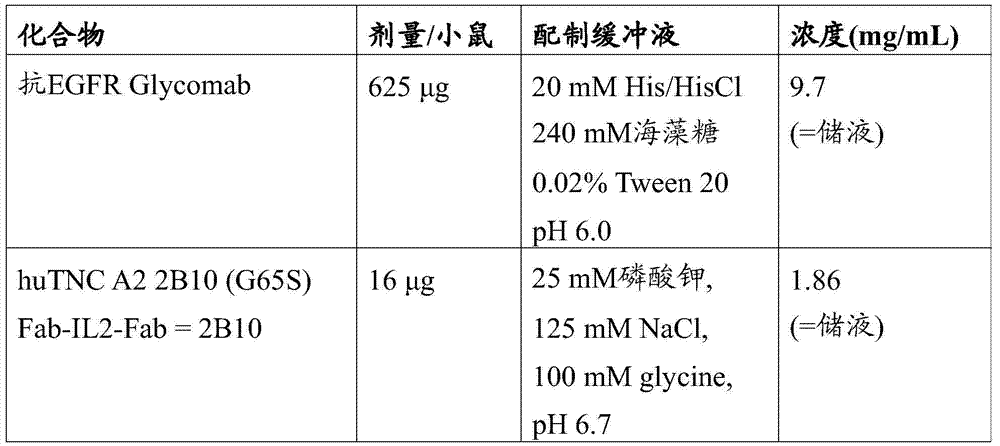
实施例2Example 2
LS174T结直肠异种移植模型LS174T colorectal xenograft model
在人结直肠LS174T细胞系中测试TNC A2靶向性2B10Fab-IL-2-Fab免疫缀合物和抗EGFR GlycoMab,将其脾内注射到SCID小鼠中。通过在新鲜冷冻组织上的IHC显示此肿瘤模型对于生腱蛋白C的A2域是阳性的。LS174T细胞(人结肠癌细胞)最初从ECACC(欧洲细胞培养物保藏中心,EuropeanCollection of Cell Culture)获得,并在扩大后保藏于Glycart内部细胞库。在含有10%FCS(PAA Laboratories,Austria)、1%Glutamax和1%MEM非必需氨基酸(Sigma)的MEM Eagle培养基中培养LS174T。细胞在37℃水饱和的空气中以5%CO2培养。将体外第8代用于脾内注射,其存活为97%。在麻醉的SCID小鼠的左侧腹部部位产生一个小切口。将50μl的细胞悬液(3x10⁶个AimV培养基中的LS174T细胞)经由正好在脾被膜下的腹部壁注射。使用钳闭合皮肤伤口。将实验开始时8-9周龄的雌性SCID小鼠(购自Taconics,Denmark)在无特定病原体的条件下以12小时光照/12小时黑暗的每日周期依照承诺的原则(GV-Solas;Felasa;TierschG)维持。实验用研究方案得到地方政府审查并批准(P2008016)。在到达后,将动物维持1周以适应新环境并进行观察。定期实施连续的健康监测。在研究日0,用3x106个LS174T细胞脾内注射小鼠,随机化并称重。在肿瘤细胞注射后1周,用2B10Fab-IL-2-Fab免疫缀合物每周两次i.v.注射小鼠达3周、用抗EGFR GlycoMab每周一次达3周、或用2B10Fab-IL-2-Fab免疫缀合物每周两次达3周和用抗EGFR GlycoMab每周一次达3周的组合。所有小鼠均用200μl适当溶液i.v.注射。剂量在表3中指定。用PBS注射媒介物组中的小鼠,并用2B10Fab-IL-2-Fab免疫缀合物或抗EGFRGlycoMab或2B10Fab-IL-2-Fab免疫缀合物与抗EGFR GlycoMab的组合注射治疗组。为了获得每200μl适当量的免疫缀合物,在必要时将储液用PBS稀释。图2显示,2B10Fab-IL-2-Fab免疫缀合物与抗EGFR GlycoMab的组合就增强的中值和总体存活而言相比于单独的2B10Fab-IL-2-Fab免疫缀合物或抗EGFR GlycoMab介导更好的功效。The TNC A2-targeted 2B10 Fab-IL-2-Fab immunoconjugate and anti-EGFR GlycoMab were tested in the human colorectal LS174T cell line, which was injected intrasplenicly into SCID mice. This tumor model was shown to be positive for the A2 domain of tenascin C by IHC on fresh frozen tissue. LS174T cells (human colon cancer cells) were originally obtained from ECACC (European Collection of Cell Culture) and deposited in Glycart internal cell bank after expansion. LS174T was cultured in MEM Eagle medium containing 10% FCS (PAA Laboratories, Austria), 1% Glutamax and 1% MEM non-essential amino acids (Sigma). Cells were incubated at 37°C in water-saturated air with 5% CO2 . Passage 8 in vitro was used for intrasplenic injection, and its survival was 97%. A small incision was made in the left abdominal site of anesthetized SCID mice. 50 μΐ of cell suspension (3x10 6 LS174T cells in AimV medium) were injected via the abdominal wall just under the spleen capsule. Close the skin wound using forceps. Female SCID mice (purchased from Taconics, Denmark) at the age of 8-9 weeks at the beginning of the experiment were subjected to a daily cycle of 12 hours of light/12 hours of darkness under specific pathogen-free conditions according to the principle of commitment (GV-Solas; Felasa ; TierschG) maintained. The research protocol for the experiment was reviewed and approved by the local government (P2008016). After arrival, animals were maintained for 1 week to acclimate to the new environment and observed. Continuous health monitoring is implemented on a regular basis. On
表3table 3
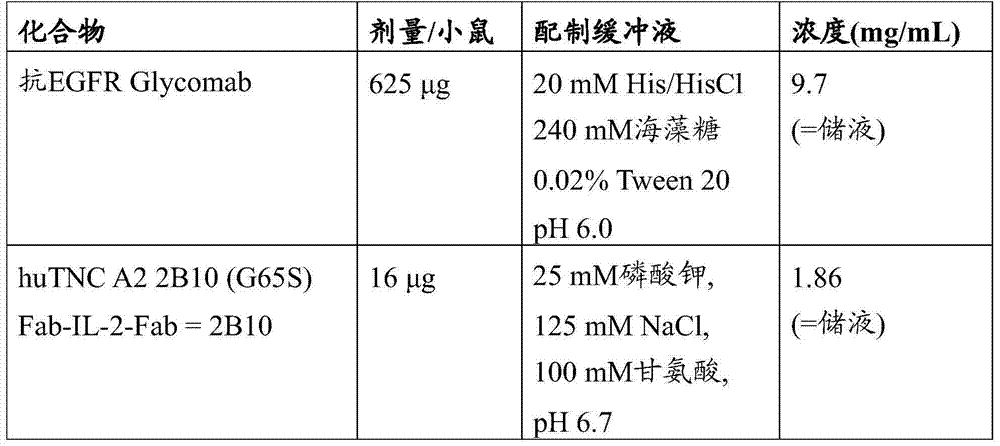
实施例3Example 3
ACHN肾癌异种移植模型ACHN Renal Cancer Xenograft Model
在人肾细胞系ACHN中测试FAP靶向性3F2Fab-IL-2-Fab免疫缀合物(SEQ ID NO102和112)和抗EGFR GlycoMab,将其肾内注射到SCID小鼠中。通过在新鲜冷冻组织上的IHC显示此肿瘤模型对于FAP是阳性的。ACHN细胞(人肾腺癌细胞)最初从ATCC(美国典型培养物保藏中心)获得,并在扩大后保藏于Glycart内部细胞库。在含有10%FCS的DMEM中,于37℃水饱和的空气中以5%CO2常规培养ACHN细胞。将体外第9代用于肾内注射,其存活为97.7%。在麻醉的SCID小鼠的右侧腹和腹膜壁产生一个小切口(2cm)。将50μl的细胞悬液(1x10⁶个AimV培养基中的ACHN细胞)囊下(subcapsularly)2mm注射到肾中。使用钳闭合皮肤伤口和腹膜壁。将200μl Aim V细胞培养基(Gibco)中的每动物5x10⁶个细胞i.v.注射到尾静脉中。将实验开始时8-9周龄的雌性SCID小鼠(购自Charles River,Sulzfeld,Germany)在无特定病原体的条件下以12小时光照/12小时黑暗的每日周期依照承诺的原则(GV-Solas;Felasa;TierschG)维持。实验用研究方案得到地方政府审查并批准(P2008016)。在到达后,将动物维持1周以适应新环境并进行观察。定期实施连续的健康监测。在研究日0,用1x106个ACHN细胞肾内注射小鼠,随机化并称重。在肿瘤细胞注射后1周,用3F2Fab-IL-2-Fab免疫缀合物每周两次i.v.注射小鼠达3周、用抗EGFR GlycoMab每周一次达3周、或用3F2Fab-IL-2-Fab免疫缀合物每周两次达3周和用抗EGFR GlycoMab每周一次达3周的组合。所有小鼠均用200μl适当溶液i.v.注射。剂量在表4中指定。用PBS注射媒介物组中的小鼠,并用3F2Fab-IL-2-Fab免疫缀合物、抗EGFR GlycoMab或3F2Fab-IL-2-Fab免疫缀合物与抗EGFR GlycoMab的组合注射治疗组。为了获得每200μl适当量的免疫缀合物,在必要时将储液用PBS稀释。图3显示,3F2Fab-IL-2-Fab免疫缀合物与抗EGFR GlycoMab的组合在SCID小鼠中产生相比于单独的2B10Fab-IL-2-Fab免疫缀合物或抗EGFR GlycoMab协作性增强的中值和总体存活。FAP-targeted 3F2Fab-IL-2-Fab immunoconjugates (SEQ ID NOs 102 and 112) and anti-EGFR GlycoMab were tested in the human kidney cell line ACHN, which were injected intrarenally into SCID mice. This tumor model was shown to be positive for FAP by IHC on fresh frozen tissue. ACHN cells (human renal adenocarcinoma cells) were originally obtained from ATCC (American Type Culture Collection) and deposited at Glycart internal cell bank after expansion. ACHN cells were routinely cultured in DMEM containing 10% FCS at 37°C in water-saturated air with 5% CO 2 . The 9th passage in vitro was used for intrarenal injection, and its survival was 97.7%. A small incision (2 cm) was made in the right flank and peritoneal wall of anesthetized SCID mice. 50 μl of cell suspension (1×10 6 ACHN cells in AimV medium) were injected subcapsularly 2 mm into the kidney. Close the skin wound and peritoneal wall using forceps. 5×10 6 cells per animal in 200 μl of Aim V cell culture medium (Gibco) were injected iv into the tail vein. Female SCID mice (purchased from Charles River, Sulzfeld, Germany) at the age of 8-9 weeks at the beginning of the experiment were subjected to the principle of commitment (GV- Solas; Felasa; TierschG) maintained. The research protocol for the experiment was reviewed and approved by the local government (P2008016). After arrival, animals were maintained for 1 week to acclimate to the new environment and observed. Continuous health monitoring is implemented on a regular basis. On
表4Table 4


实施例4Example 4
ACHN肾癌异种移植模型ACHN Renal Cancer Xenograft Model
在人肾细胞系ACHN中测试FAP靶向性3F2Fab-IL-2-Fab免疫缀合物和抗EGFR GlycoMab,将其肾内注射到SCID-人FcγRIII转基因小鼠中。通过在新鲜冷冻组织上的IHC显示此肿瘤模型对于FAP是阳性的。ACHN细胞(人肾腺癌细胞)最初从ATCC(美国典型培养物保藏中心)获得,并在扩大后保藏于Glycart内部细胞库。在含有10%FCS的DMEM中,于37℃水饱和的空气中以5%CO2常规培养ACHN细胞。将体外第11代用于肾内注射,其存活为96.7%。在麻醉的SCID小鼠的右侧腹和腹膜壁产生一个小切口(2cm)。将50μl的细胞悬液(1x10⁶个AimV培养基中的ACHN细胞)囊下(subcapsularly)2mm注射到肾中。使用钳闭合皮肤伤口和腹膜壁。将实验开始时8-9周龄的雌性SCID-FcγRIII小鼠(GLYCART-RCC)(产于RCC,Switzerland)在无特定病原体的条件下以12小时光照/12小时黑暗的每日周期依照承诺的原则(GV-Solas;Felasa;TierschG)维持。实验用研究方案得到地方政府审查并批准(P2008016)。在到达后,将动物维持1周以适应新环境并进行观察。定期实施连续的健康监测。在研究日0,用1x106个ACHN细胞肾内注射小鼠,随机化并称重。在肿瘤细胞注射后1周,用3F2Fab-IL-2-Fab免疫缀合物每周两次i.v.注射小鼠达3周、用抗EGFR GlycoMab每周一次达3周、或用3F2Fab-IL-2-Fab免疫缀合物每周两次达3周和用抗EGFR GlycoMab每周一次达3周的组合。所有小鼠均用200μl适当溶液i.v.注射。剂量在表5中指定。用PBS注射媒介物组中的小鼠,并用3F2Fab-IL-2-Fab免疫缀合物、抗EGFR GlycoMab或3F2Fab-IL-2-Fab免疫缀合物与抗EGFR GlycoMab的组合注射治疗组。为了获得每200μl适当量的免疫缀合物,在必要时将储液用PBS稀释。图4显示,3F2Fab-IL-2-Fab免疫缀合物与抗EGFR GlycoMab的组合就总体存活而言相比于单独的3F2Fab-IL-2-Fab免疫缀合物或抗EGFR GlycoMab介导更好的功效。The FAP-targeting 3F2Fab-IL-2-Fab immunoconjugate and anti-EGFR GlycoMab were tested in the human kidney cell line ACHN, which was injected intrarenally into SCID-human FcγRIII transgenic mice. This tumor model was shown to be positive for FAP by IHC on fresh frozen tissue. ACHN cells (human renal adenocarcinoma cells) were originally obtained from ATCC (American Type Culture Collection) and deposited at Glycart internal cell bank after expansion. ACHN cells were routinely cultured in DMEM containing 10% FCS at 37°C in water-saturated air with 5% CO 2 . The 11th passage in vitro was used for intrarenal injection, and its survival was 96.7%. A small incision (2 cm) was made in the right flank and peritoneal wall of anesthetized SCID mice. 50 μl of cell suspension (1×10 6 ACHN cells in AimV medium) were injected subcapsularly 2 mm into the kidney. Close the skin wound and peritoneal wall using forceps. Female SCID-FcγRIII mice (GLYCART-RCC) (born in RCC, Switzerland) at the age of 8-9 weeks at the beginning of the experiment were placed under specific pathogen-free conditions with a daily cycle of 12 hours of light/12 hours of darkness as promised. Principles (GV-Solas; Felasa; TierschG) maintained. The research protocol for the experiment was reviewed and approved by the local government (P2008016). After arrival, animals were maintained for 1 week to acclimate to the new environment and observed. Continuous health monitoring is implemented on a regular basis. On
表5table 5

实施例5Example 5
Z138套细胞淋巴瘤异种移植模型Z138 Mantle Cell Lymphoma Xenograft Model
在人套细胞淋巴瘤细胞系Z138中测试TNC A2靶向性2B10Fab-IL-2-Fab免疫缀合物和抗CD20GlycoMab(SEQ ID NO134和135),将其i.v.注射到SCID-人FcγRIII转基因小鼠中。通过在新鲜冷冻组织上的IHC显示此肿瘤模型对于TNC A2是阳性的。Z138人套细胞淋巴瘤细胞最初从Martin Dyer教授(MRC Toxicology Unit,Leicester,UK)获得,并在扩大后保藏于Glycart内部细胞库。在含有10%FCS(Gibco)的DMEM中,于37℃水饱和的空气中以5%CO2常规培养该肿瘤细胞系。将第18代用于移植,其存活为98%。将200μl Aim V细胞培养基(Gibco)中的每动物10x106个细胞i.v.注射到尾静脉中。将实验开始时8-9周龄的雌性SCID-FcγRIII小鼠(GLYCART-RCC)(产于RCC,Switzerland)在无特定病原体的条件下以12小时光照/12小时黑暗的每日周期依照承诺的原则(GV-Solas;Felasa;TierschG)维持。实验用研究方案得到地方政府审查并批准(P2008016)。在到达后,将动物维持1周以适应新环境并进行观察。定期实施连续的健康监测。在研究日0,用10x106个Z138细胞i.v.注射小鼠,随机化并称重。在肿瘤细胞注射后1周,用2B10Fab-IL-2-Fab免疫缀合物每周两次i.v.注射小鼠达3周、用抗CD20GlycoMab每周一次达3周、或用2B10Fab-IL-2-Fab免疫缀合物每周两次达3周和用抗CD20GlycoMab每周一次达3周的组合。所有小鼠均用200μl适当溶液i.v.注射。剂量在表6中指定。用PBS注射媒介物组中的小鼠,并用2B10Fab-IL-2-Fab免疫缀合物、抗CD20GlycoMab或2B10Fab-IL-2-Fab免疫缀合物与抗CD20GlycoMab的组合注射治疗组。为了获得每200μl适当量的免疫缀合物,在必要时将储液用PBS稀释。图5显示,2B10Fab-IL-2-Fab免疫缀合物与抗CD20GlycoMab的组合就中值和总体存活而言相比于单独的2B10Fab-IL-2-Fab免疫缀合物或抗CD20GlycoMab产生协作性增强的更好的功效。TNC A2-targeted 2B10Fab-IL-2-Fab immunoconjugate and anti-CD20 GlycoMab (SEQ ID NOs 134 and 135) were tested in the human mantle cell lymphoma cell line Z138 and injected iv into SCID-human FcγRIII transgenic mice middle. This tumor model was shown to be positive for TNC A2 by IHC on fresh frozen tissue. Z138 human mantle cell lymphoma cells were originally obtained from Prof. Martin Dyer (MRC Toxicology Unit, Leicester, UK) and deposited in Glycart internal cell bank after expansion. The tumor cell line was routinely cultured in DMEM containing 10% FCS (Gibco) at 37°C in water-saturated air with 5% CO 2 . Passage 18 was used for transplantation and its survival was 98%. 10×10 6 cells per animal in 200 μl of Aim V cell culture medium (Gibco) were injected iv into the tail vein. Female SCID-FcγRIII mice (GLYCART-RCC) (born in RCC, Switzerland) at the age of 8-9 weeks at the beginning of the experiment were placed under specific pathogen-free conditions with a daily cycle of 12 hours of light/12 hours of darkness as promised. Principles (GV-Solas; Felasa; TierschG) maintained. The research protocol for the experiment was reviewed and approved by the local government (P2008016). After arrival, animals were maintained for 1 week to acclimate to the new environment and observed. Continuous health monitoring is implemented on a regular basis. On
表6Table 6
实施例6Example 6
ACHN肾癌异种移植模型ACHN Renal Cancer Xenograft Model
在人肾细胞系ACHN中测试FAP靶向性28H1Fab-IL2-Fab免疫缀合物和抗EGFR GlycoMab,将其肾内注射到SCID-人FcγRIII转基因小鼠中,所述FAP靶向性28H1Fab-IL2-Fab免疫缀合物包含缺乏对CD25的结合的IL-2四重突变体(qm)(SEQ ID NO:108,其中IL-2序列(SEQ ID NO:1)已被SEQ ID NO:2;和SEQ ID NO:113替换)。通过在新鲜冷冻组织上的IHC显示此肿瘤模型对于FAP是阳性的。ACHN细胞(人肾腺癌细胞)最初从ATCC(美国典型培养物保藏中心)获得,并在扩大后保藏于Glycart内部细胞库。在含有10%FCS的DMEM中,于37℃水饱和的空气中以5%CO2常规培养ACHN。将体外第18代用于肾内注射,其存活为97%。在麻醉的SCID小鼠的右侧腹和腹膜壁产生一个小切口(2cm)。将50μl的细胞悬液(1x10⁶个AimV培养基中的ACHN细胞)囊下2mm注射到肾中。使用钳闭合皮肤伤口和腹膜壁。将实验开始时8-9周龄的雌性SCID-FcγRIII小鼠(GLYCART-RCC)(产于RCC,Switzerland)在无特定病原体的条件下以12小时光照/12小时黑暗的每日周期依照承诺的原则(GV-Solas;Felasa;TierschG)维持。实验用研究方案得到地方政府审查并批准(P2008016)。在到达后,将动物维持1周以适应新环境并进行观察。定期实施连续的健康监测。在研究日0,用1x106个ACHN细胞肾内注射小鼠,随机化并称重。在肿瘤细胞注射后1周,用28H1Fab-IL-2qm-Fab免疫缀合物每周三次i.v.注射小鼠达3周、用抗EGFR GlycoMab每周一次达3周、或用28H1Fab-IL-2qm-Fab免疫缀合物每周三次达3周和用抗EGFR GlycoMab每周一次达3周的组合。所有小鼠均用200μl适当溶液i.v.注射。剂量在表7中指定。用PBS注射媒介物组中的小鼠,并用28H1Fab-IL-2qm-Fab免疫缀合物、抗EGFRGlycoMab或28H1Fab-IL-2qm-Fab免疫缀合物与抗EGFR GlycoMab的组合注射治疗组。为了获得每200μl适当量的免疫缀合物,在必要时将储液用PBS稀释。图6显示,28H1Fab-IL-2qm-Fab免疫缀合物与抗EGFR GlycoMab的组合就相比于单独的28H1Fab-IL-2qm-Fab免疫缀合物或抗EGFR GlycoMab增强的中值存活而言介导更好的功效。The FAP-targeting 28H1Fab-IL2-Fab immunoconjugate and anti-EGFR GlycoMab were tested in the human kidney cell line ACHN and injected intrarenally into SCID-human FcγRIII transgenic mice. - the Fab immunoconjugate comprises an IL-2 quadruple mutant (qm) (SEQ ID NO: 108) lacking binding to CD25, wherein the IL-2 sequence (SEQ ID NO: 1) has been replaced by SEQ ID NO: 2; and SEQ ID NO: 113 replacement). This tumor model was shown to be positive for FAP by IHC on fresh frozen tissue. ACHN cells (human renal adenocarcinoma cells) were originally obtained from ATCC (American Type Culture Collection) and deposited at Glycart internal cell bank after expansion. ACHNs were routinely cultured at 37 °C in water-saturated air with 5% CO in DMEM containing 10% FCS. Passage 18 in vitro was used for intrarenal injection and its survival was 97%. A small incision (2 cm) was made in the right flank and peritoneal wall of anesthetized SCID mice. 50 μl of cell suspension ( 1 ×10 ACHN cells in AimV medium) was injected 2 mm subcapsularly into the kidney. Close the skin wound and peritoneal wall using forceps. Female SCID-FcγRIII mice (GLYCART-RCC) (born in RCC, Switzerland) at the age of 8-9 weeks at the beginning of the experiment were placed under specific pathogen-free conditions with a daily cycle of 12 hours of light/12 hours of darkness as promised. Principles (GV-Solas; Felasa; TierschG) maintained. The research protocol for the experiment was reviewed and approved by the local government (P2008016). After arrival, animals were maintained for 1 week to acclimate to the new environment and observed. Continuous health monitoring is implemented on a regular basis. On
表7Table 7
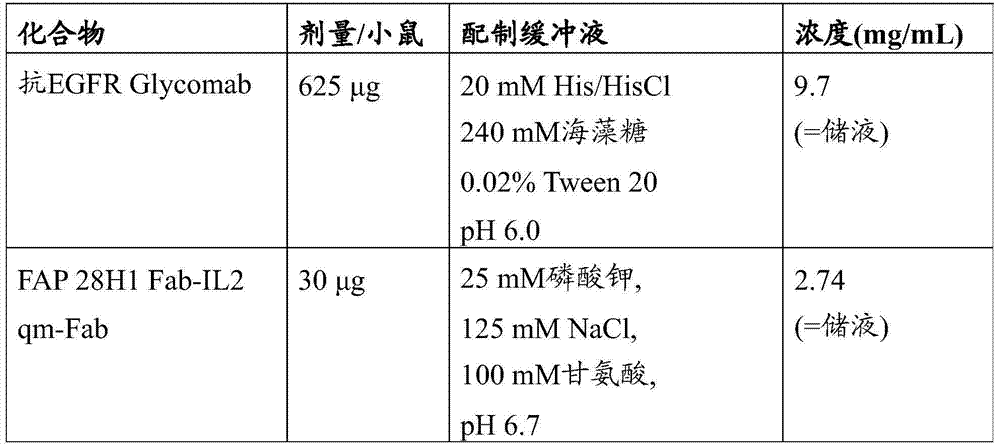
实施例7Example 7
通过IL-2免疫缀合物体外加强NK细胞杀伤能力和NK细胞IFN-γ释放Enhancement of NK cell killing ability and NK cell IFN-γ release by IL-2 immunoconjugate in vitro
为了测定免疫缀合物对NK细胞的影响,我们评估了在用免疫缀合物,特别是包含IL-2作为效应器模块的免疫缀合物处理时,NK细胞对肿瘤细胞的杀伤和IFN-γ释放。出于此目的,依照标准规程使用Histopaque-1077(SigmaDiagnostics Inc.,St.Louis,MO,USA)分离外周血单核细胞(PBMC)。简言之,用肝素化注射器采集来自健康志愿者的静脉血。将血液用不含钙或镁的PBS以2:1稀释,并在Histopaque-1077上分层。将梯度以450xg在室温(RT)无间断离心30分钟。收集含有PBMC的中间相并用PBS总共清洗3次(350xg接着是300xg,在RT10分钟)。To determine the effect of immunoconjugates on NK cells, we assessed tumor cell killing by NK cells and IFN- gamma release. For this purpose, peripheral blood mononuclear cells (PBMCs) were isolated using Histopaque-1077 (Sigma Diagnostics Inc., St. Louis, MO, USA) according to standard protocols. Briefly, venous blood was collected from healthy volunteers using heparinized syringes. Blood was diluted 2:1 with PBS without calcium or magnesium and layered on Histopaque-1077. The gradient was centrifuged at 450 xg for 30 minutes at room temperature (RT) without interruption. The interphase containing PBMCs was collected and washed a total of 3 times with PBS (350xg followed by 300xg for 10 min at RT).
在第一项实验中,将分离的PBMC与不同浓度的IL-2(阿地白介素(阿地白介素))或IL-2免疫缀合物(FAP靶向性28H1Fab-IL2-Fab,包含野生型或四重突变体(qm)IL-2)温育。测试两种实验背景,“在溶液中”是其中将含有IL-2的构建体添加到细胞上清液,而“包被”是其中使含有IL-2的构建体结合先前包被在96-F-孔板上的FAP(500ng/孔在PBS中于4℃20h)。在加入PBMC之前,洗掉未结合的免疫缀合物。在两种情况中,将PBMC用含IL-2的构建体预处理48h,然后恢复并用于杀伤K562靶细胞,其以10:1的效应器对靶细胞比率(E:T)达4h。通过测量LDH到细胞上清液中的释放(Roche细胞毒性检测试剂盒LDH)来检测靶细胞杀伤。图7显示在用溶液中(A)或包被到细胞皿(B)的IL-2构建体预处理效应器细胞(PBMC)时,相比于未经处理的PBMC,K562肿瘤细胞杀伤中的提高。IL-2以及Fab-IL2-Fab免疫缀合物加强了PBMC杀伤靶细胞的能力。In the first experiment, isolated PBMC were treated with different concentrations of IL-2 (aldesleukin (aldesleukin)) or IL-2 immunoconjugate (FAP-targeting 28H1Fab-IL2-Fab, containing wild-type or quadruple mutant (qm) IL-2) incubation. Two experimental settings were tested, "in solution" where the IL-2-containing construct was added to the cell supernatant, and "coated" where the IL-2-containing construct was bound to a previously coated 96- FAP on F-well plates (500 ng/well in PBS at 4° C. for 20 h). Before adding PBMCs, unbound immunoconjugates were washed away. In both cases, PBMC were pretreated with IL-2-containing constructs for 48 h, then recovered and used to kill K562 target cells at an effector-to-target cell ratio (E:T) of 10:1 for 4 h. Target cell killing was detected by measuring the release of LDH into the cell supernatant (Roche Cytotoxicity Assay Kit LDH). Figure 7 shows that when effector cells (PBMCs) were pretreated with IL-2 constructs in solution (A) or coated to cell dishes (B), compared to untreated PBMCs, K562 tumor cell killing improve. IL-2 and Fab-IL2-Fab immunoconjugates enhanced the ability of PBMCs to kill target cells.
在第二项实验中,将分离的PBMC与IL-2(阿地白介素)或IL-2免疫缀合物温育,加入细胞上清液达45h。然后,恢复PBMC并用于A549细胞的抗EGFRGlycoMab介导的ADCC,其以10:1的E:T达4h。通过测量LDH到细胞上清液中的释放(Roche细胞毒性检测试剂盒LDH)来检测靶细胞杀伤。图8显示用包含野生型(wt)或四重突变体(qm)IL-2的57nM FAP靶向性28H1Fab-IL2-Fab预处理或未经预处理的PBMC,在存在不同浓度的抗EGFR GlycoMab的情况下,对A549肿瘤细胞的总体杀伤。结果显示,能够使用免疫缀合物与GlycoMab的组合获得近乎100%的靶细胞杀伤,这是单独的任一种药剂在当前实验条件下无法实现的。包含野生型或四重突变体IL-2的两种免疫缀合物效力等同。In a second experiment, isolated PBMC were incubated with IL-2 (aldesleukin) or IL-2 immunoconjugate, and cell supernatant was added for 45 h. Then, PBMCs were recovered and used for anti-EGFR GlycoMab-mediated ADCC of A549 cells at an E:T of 10:1 for 4 h. Target cell killing was detected by measuring the release of LDH into the cell supernatant (Roche Cytotoxicity Assay Kit LDH). Figure 8 shows PBMCs pretreated or not pretreated with 57nM FAP-targeted 28H1Fab-IL2-Fab containing wild-type (wt) or quadruple mutant (qm) IL-2, in the presence of different concentrations of anti-EGFR GlycoMab In the case of A549 tumor cells, the overall killing. The results show that it is possible to obtain nearly 100% target cell killing using the combination of immunoconjugates and GlycoMabs, which cannot be achieved by either agent alone under the current experimental conditions. Both immunoconjugates containing wild type or quadruple mutant IL-2 were equally potent.
在另一项实验中,将分离的PBMC与两种不同浓度(5和500ng/ml)的抗EGFR GlycoMab和未经糖工程化的抗EGFR抗体(Erbitux)用在A549细胞上的ADCC测定法中,其以5:1的E:T达21h。在温育时间结束时,使用IFN-γELISA试剂盒(BD#550612)检测IFN-γ从PBMC到细胞上清液中的释放。图9显示,尽管在与单独的抗体温育后未检测到显著的IFN-γ释放,但在温育时间期间IL-2(阿地白介素)、28H1Fab-IL2-Fab或28H1Fab-IL2qm-Fab的存在强烈增强了(A)抗EGFR GlycoMab以及(B)Erbitux介导的ADCC中的IFN-γ释放。总体而言,并且特别是在较低抗体浓度(5ng/ml)和最高IL-2(免疫缀合物)浓度(1140nM)时,抗EGFR GlycoMab的IFN-γ释放高于Erbitux的。In another experiment, isolated PBMC were used in an ADCC assay on A549 cells with two different concentrations (5 and 500 ng/ml) of anti-EGFR GlycoMab and non-glycoengineered anti-EGFR antibody (Erbitux) , which was 5:1 E:T for 21h. At the end of the incubation time, the release of IFN-γ from PBMCs into the cell supernatant was detected using the IFN-γ ELISA kit (BD #550612). Figure 9 shows that, although no significant release of IFN-γ was detected after incubation with antibodies alone, the levels of IL-2 (aldesleukin), 28H1Fab-IL2-Fab or 28H1Fab-IL2qm-Fab during the incubation time The presence of (A) anti-EGFR GlycoMab and (B) Erbitux-mediated IFN-γ release in ADCC strongly enhanced. Overall, and especially at lower antibody concentrations (5 ng/ml) and the highest IL-2 (immunoconjugate) concentration (1140 nM), IFN-γ release was higher for anti-EGFR GlycoMab than for Erbitux.
最后,测定与IL-2(阿地白介素)、28H1Fab-IL2-Fab或28H1Fab-IL2qm-Fab但无任何抗体温育后,从PBMC的IFN-γ释放。实验条件如上文描述的。如图10中显示的,在不存在诱导ADCC的抗体的情况下,IL-2(免疫缀合物)也增强了从PBMC的IFN-γ释放。IFN-γ水平与在存在5ng/ml Erbitux情况下测量的水平是可比的(见图9B),但低于存在抗EGFR GlycoMab的情况(见图9A)。Finally, IFN-γ release from PBMCs after incubation with IL-2 (aldesleukin), 28H1Fab-IL2-Fab or 28H1Fab-IL2qm-Fab without any antibody was determined. Experimental conditions were as described above. As shown in Figure 10, IL-2 (immunoconjugate) also enhanced IFN-γ release from PBMCs in the absence of ADCC-inducing antibodies. IFN-γ levels were comparable to those measured in the presence of 5 ng/ml Erbitux (see Figure 9B), but lower than in the presence of anti-EGFR GlycoMab (see Figure 9A).
******
尽管已通过例示和实施例在一定程度上详细描述了前述发明从而澄清理解,但描述和实施例不应理解为限制本发明的范围。本文中引用的所有专利和科学文献的公开内容均通过提述完整明确地纳入。Although the foregoing invention has been described in some detail by way of illustration and example for clarity of understanding, the description and examples should not be construed as limiting the scope of the invention. The disclosures of all patent and scientific literature cited herein are expressly incorporated by reference in their entirety.


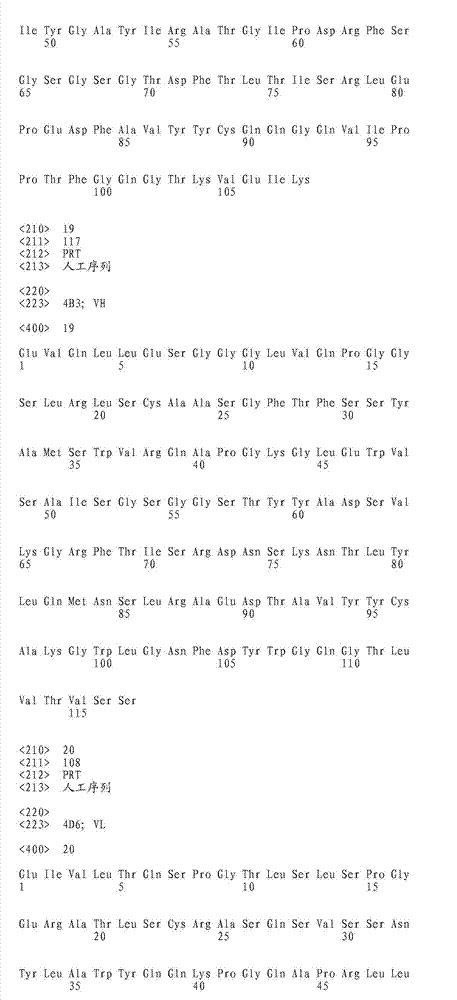
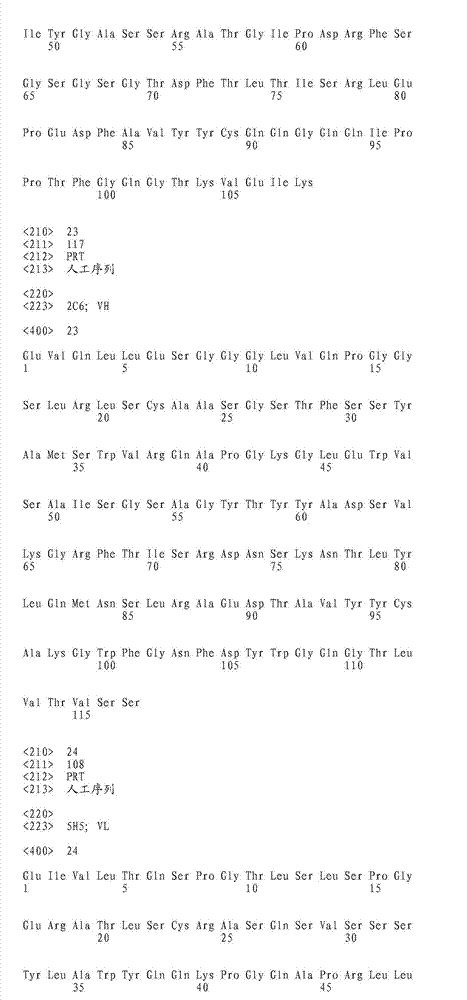
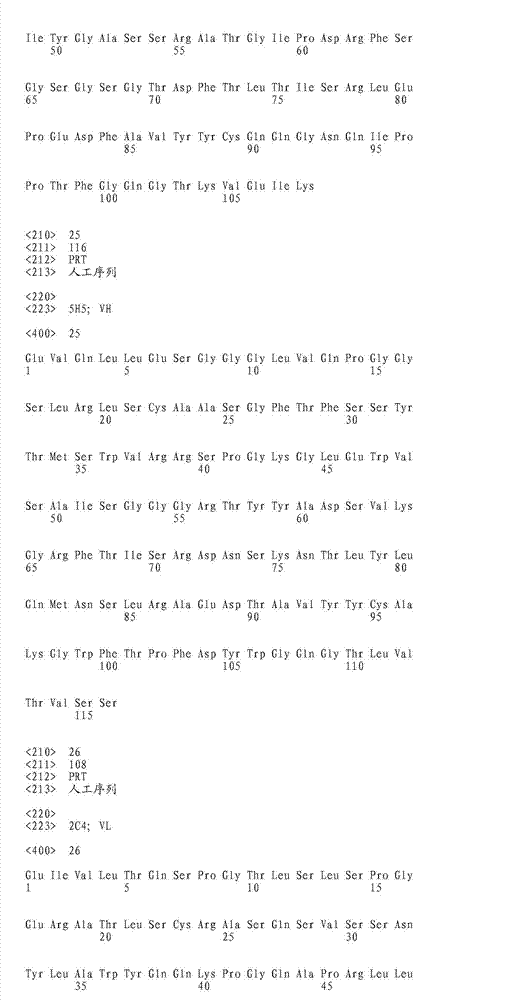

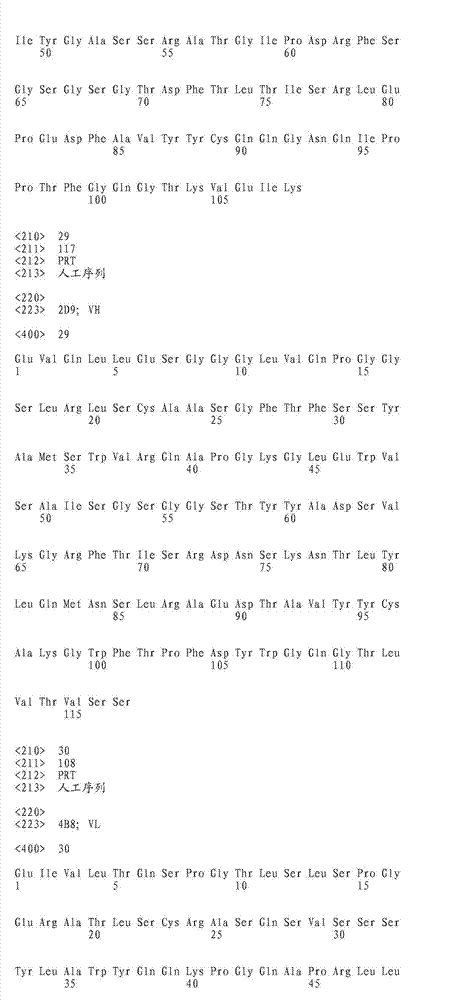


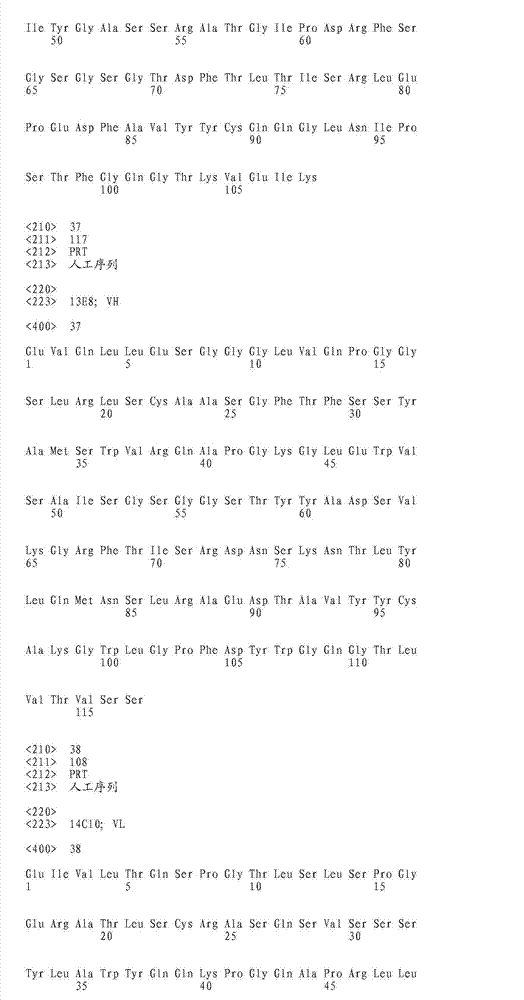
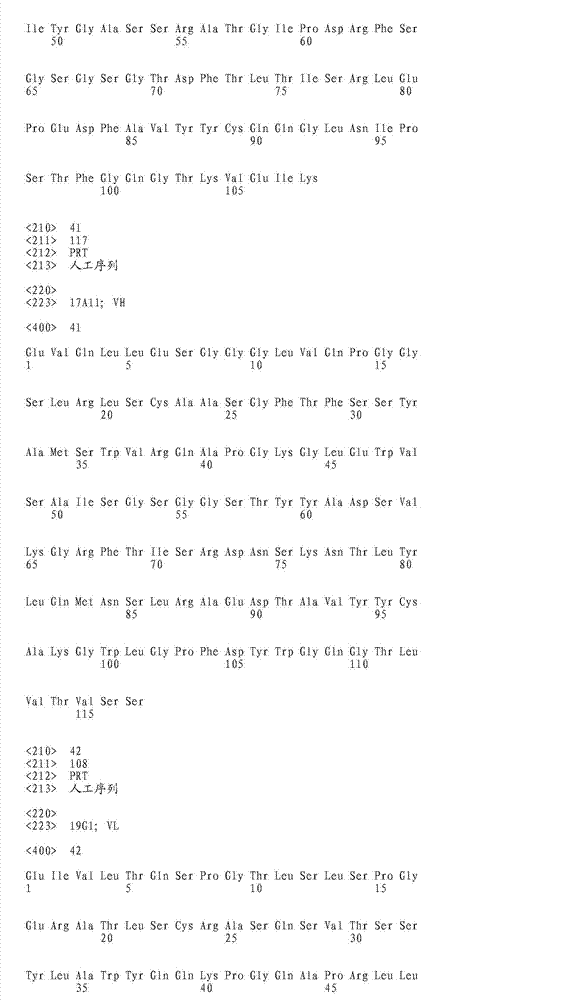
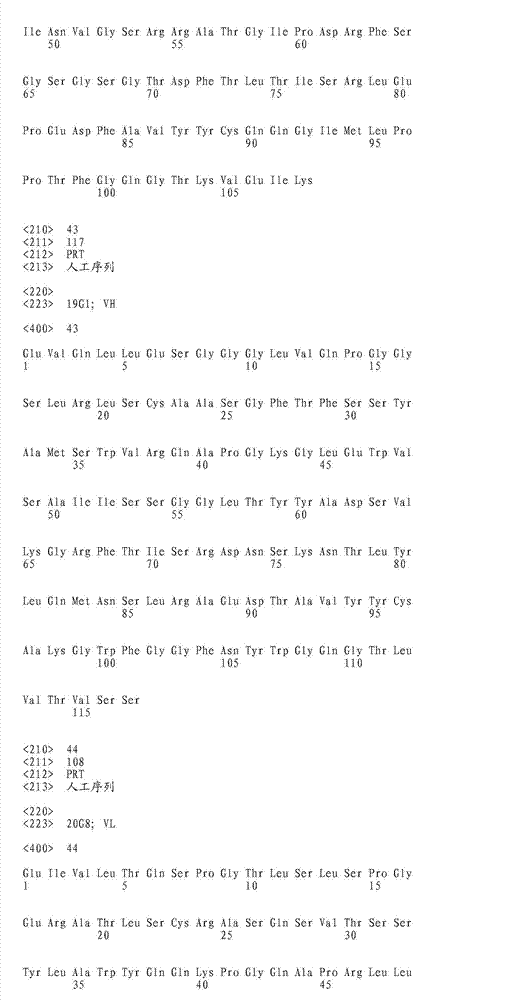

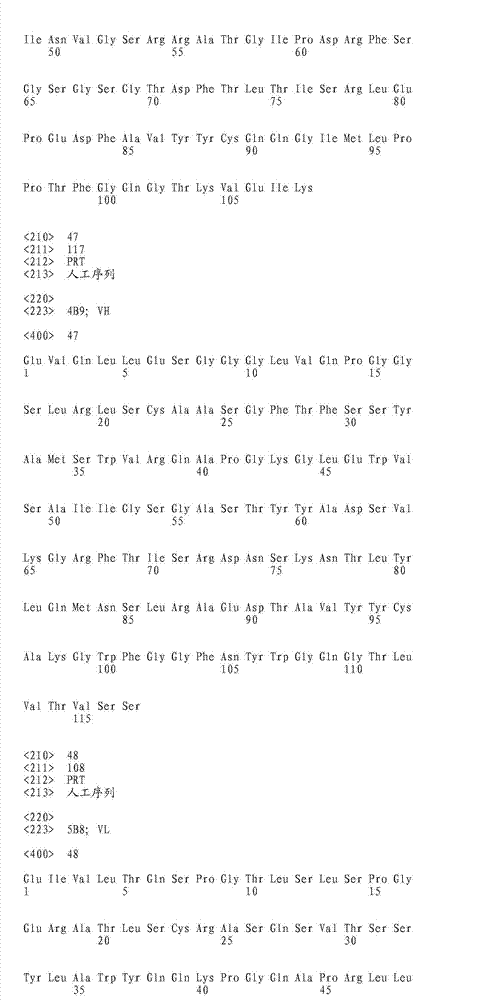


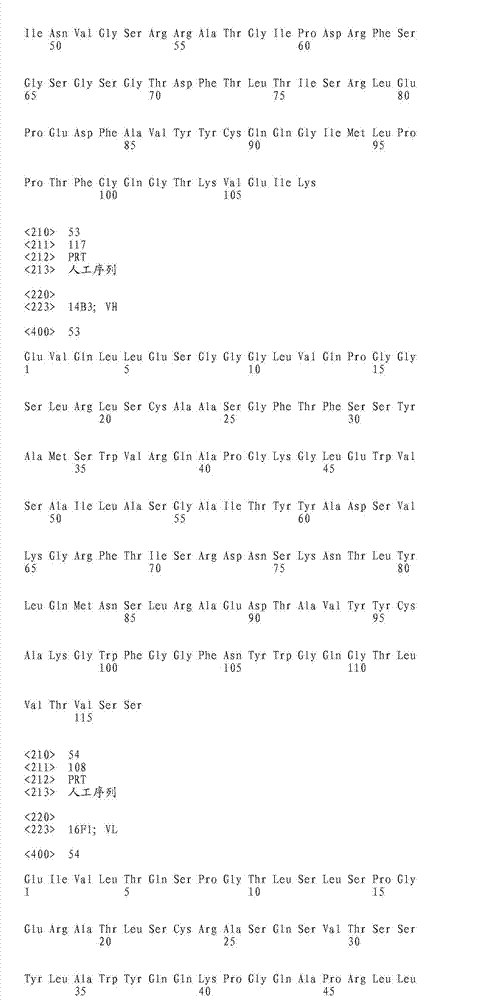
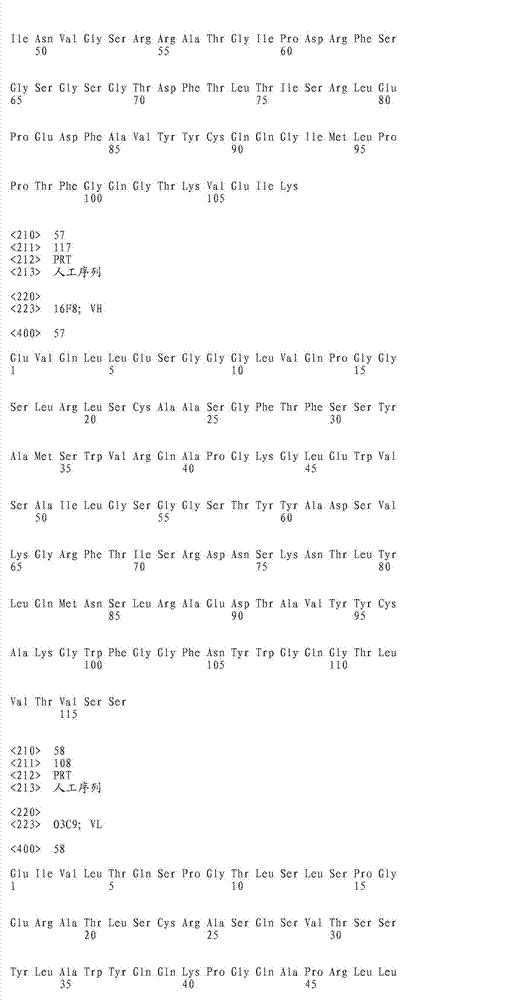
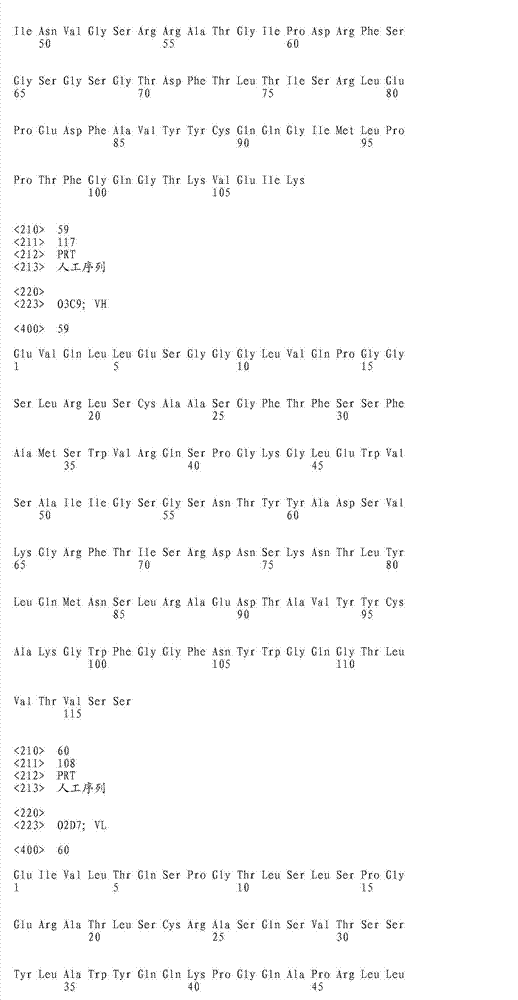
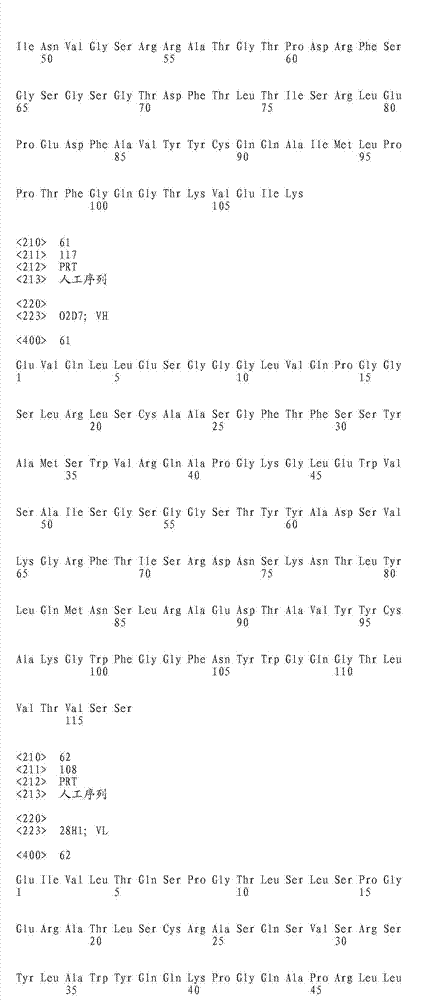
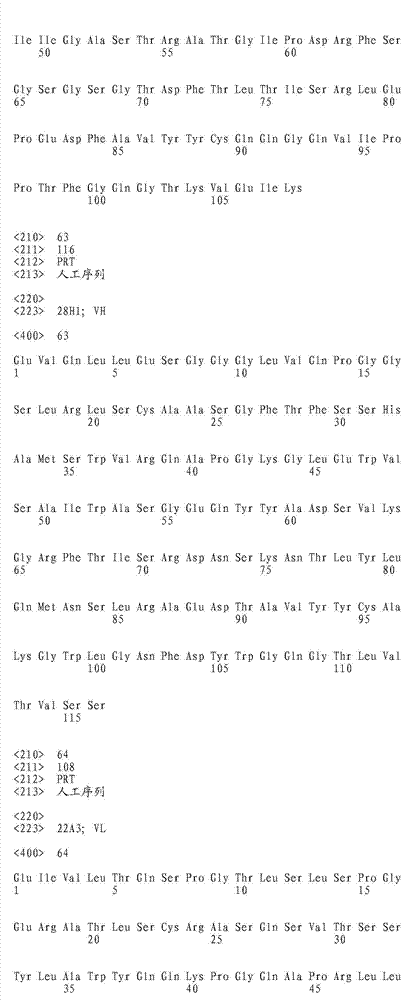
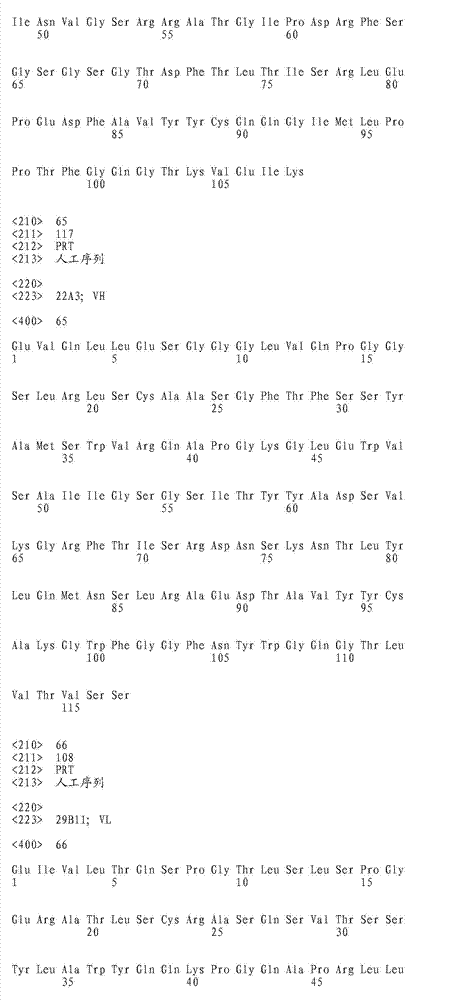


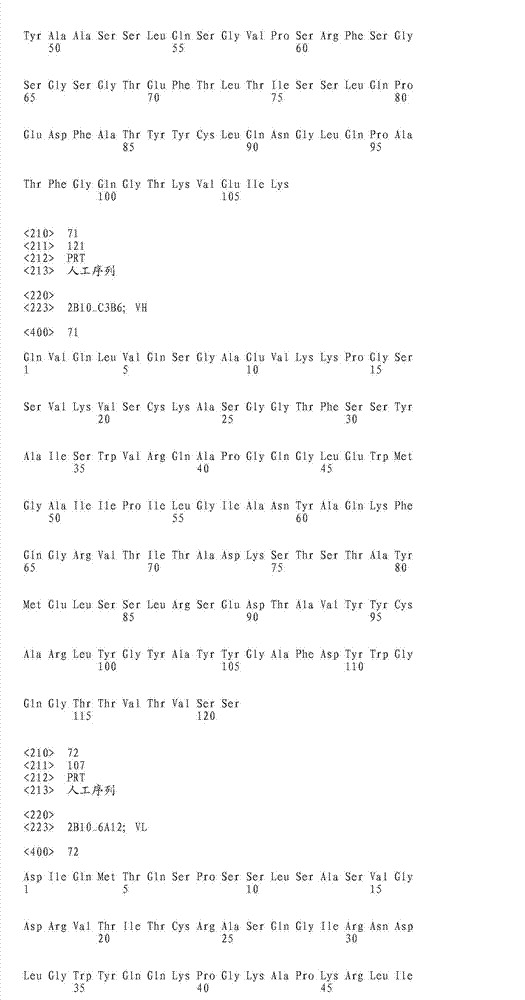

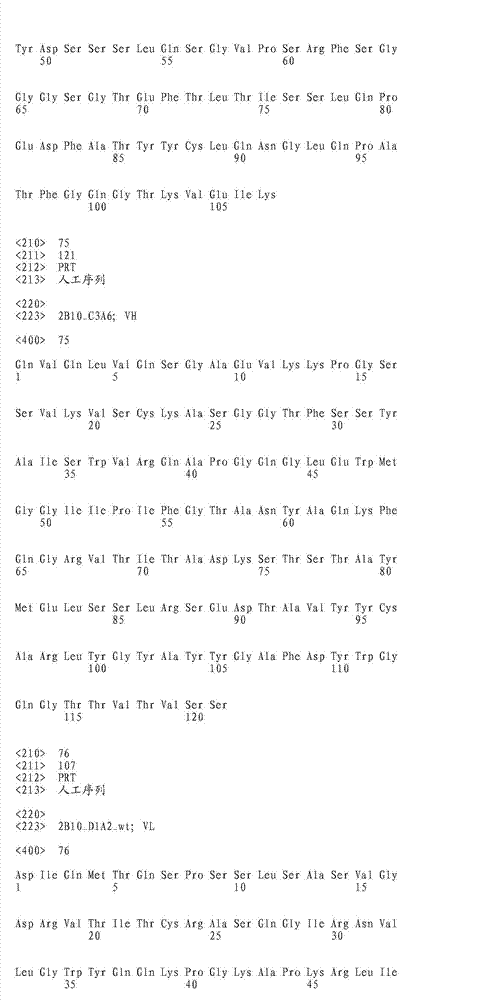


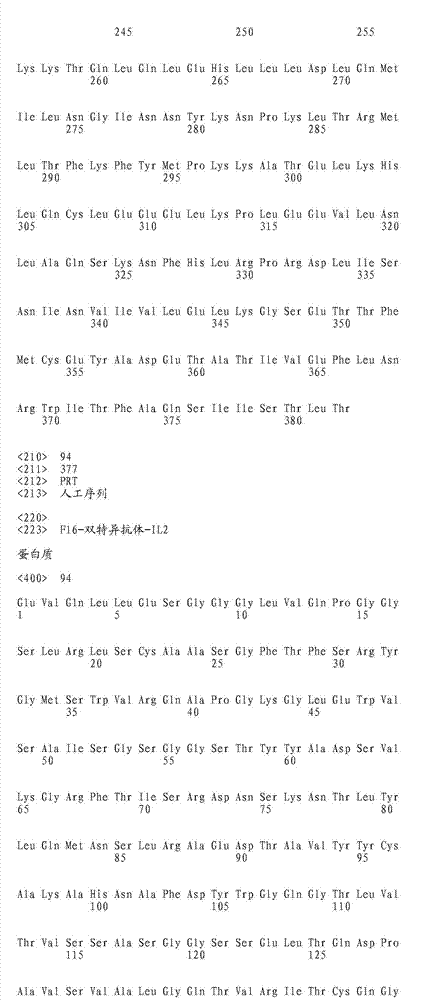
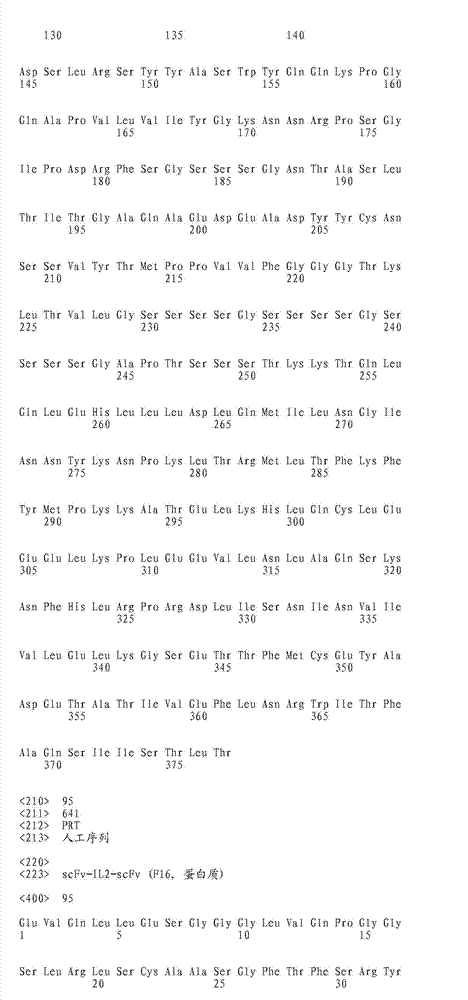
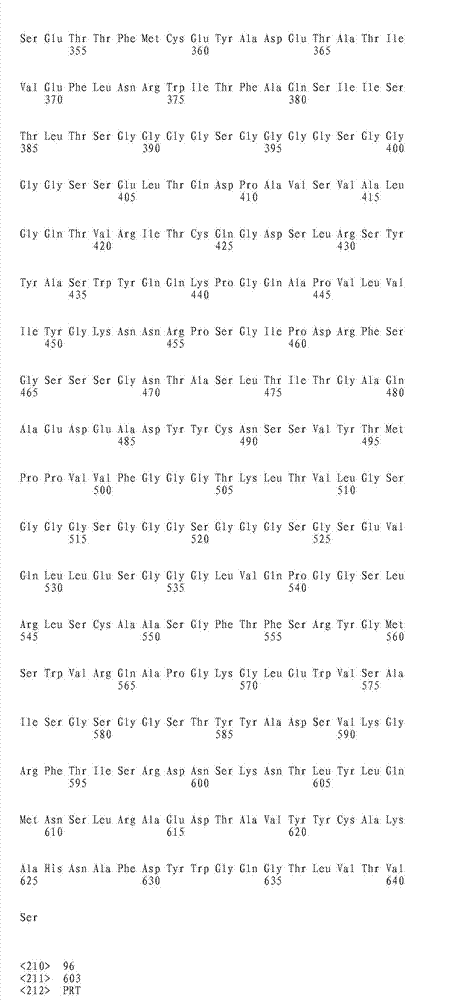
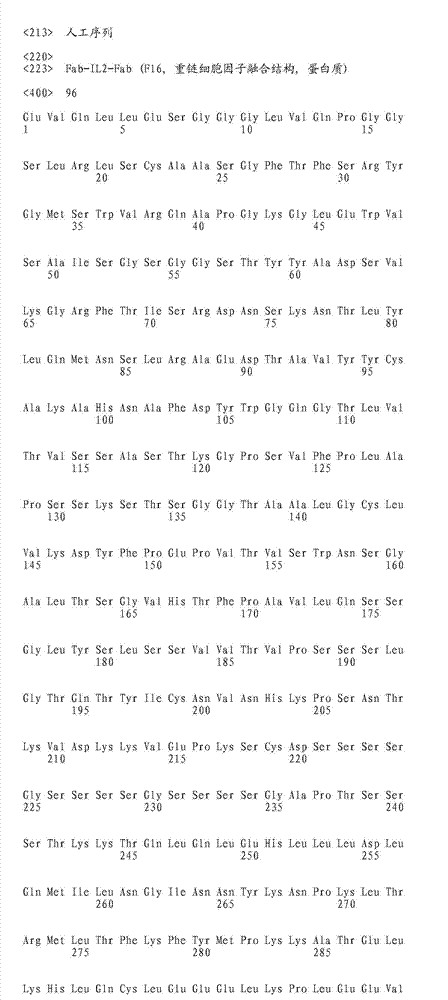

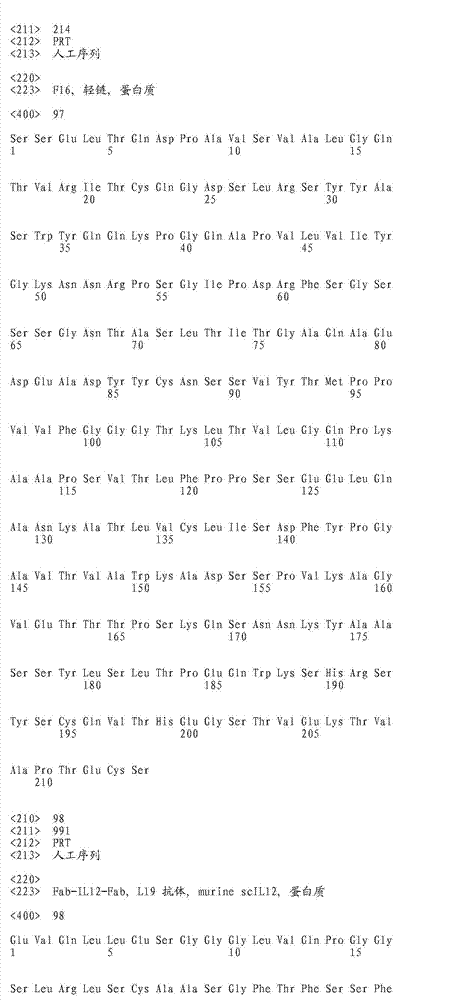
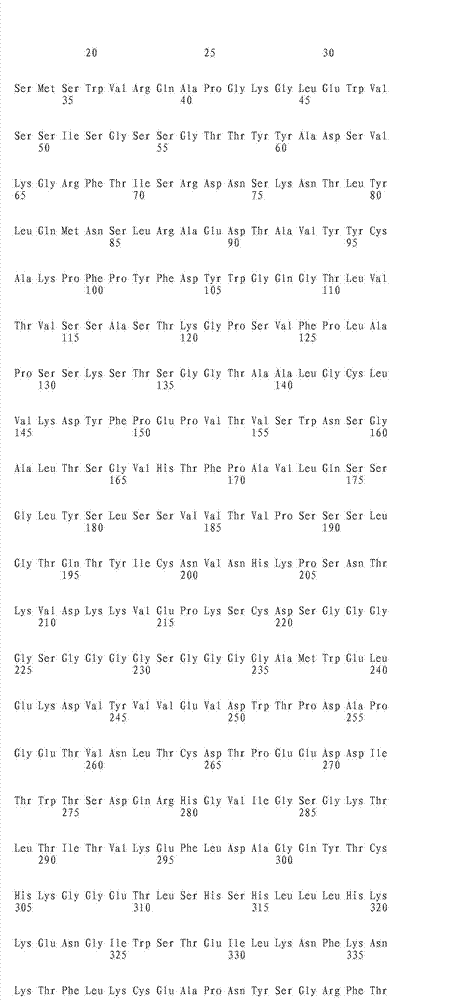
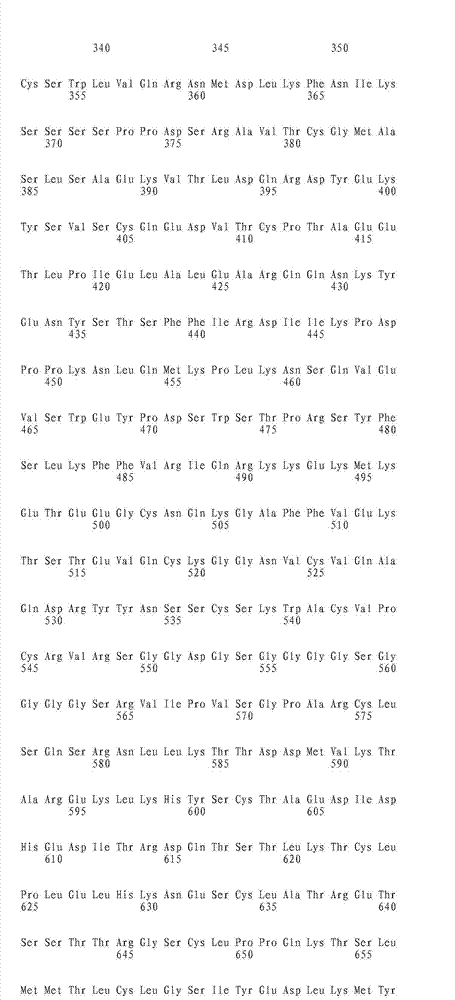

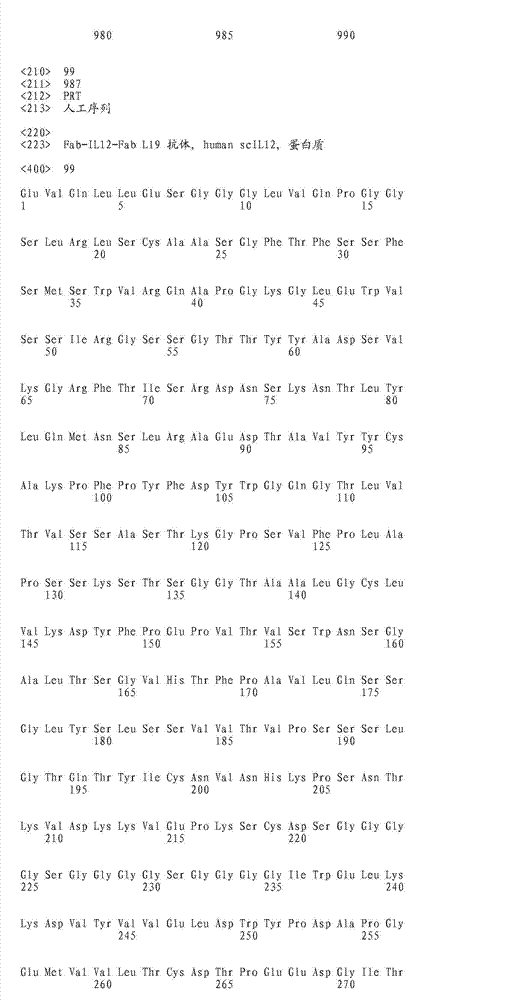

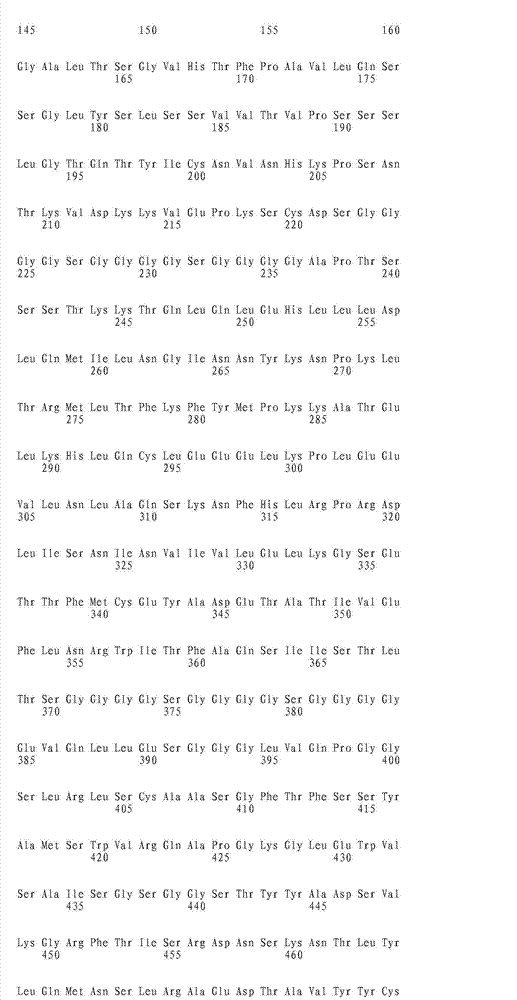


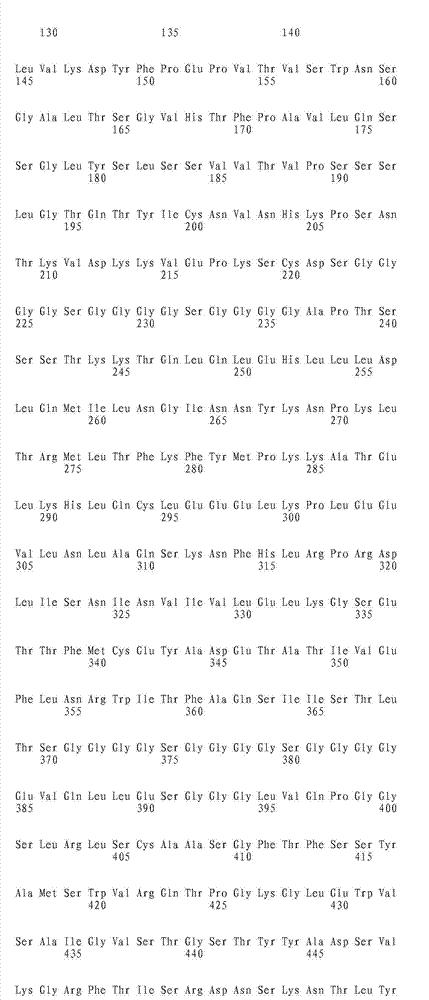


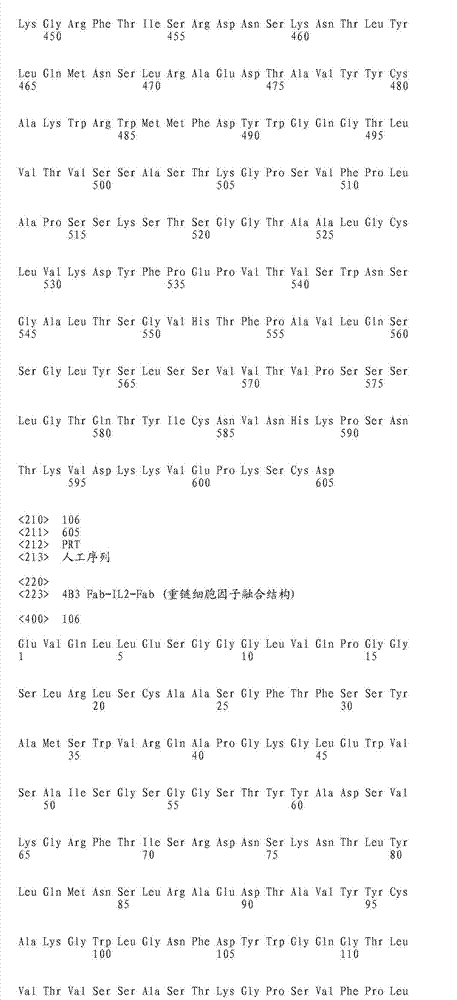

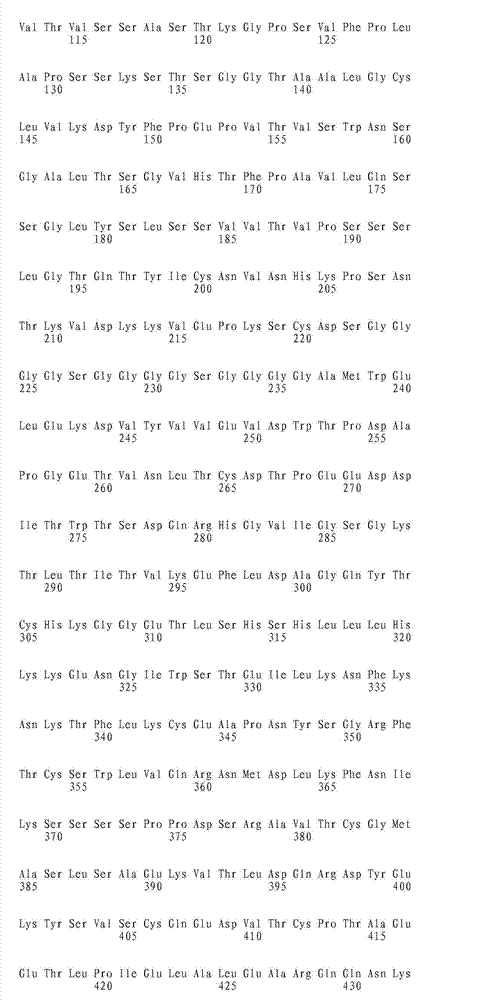


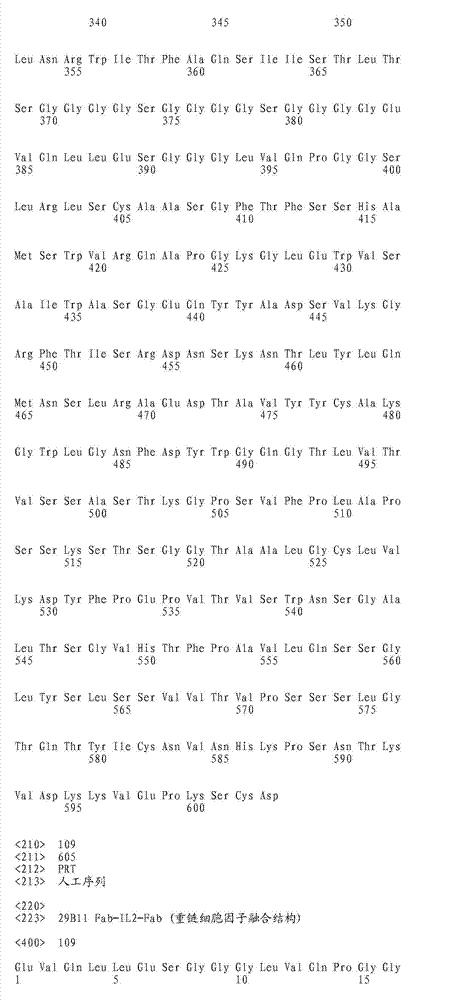
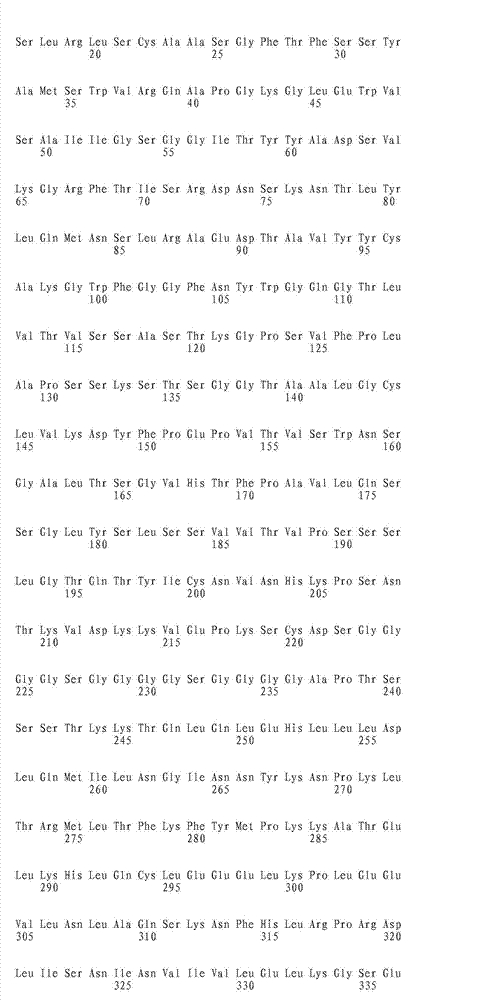


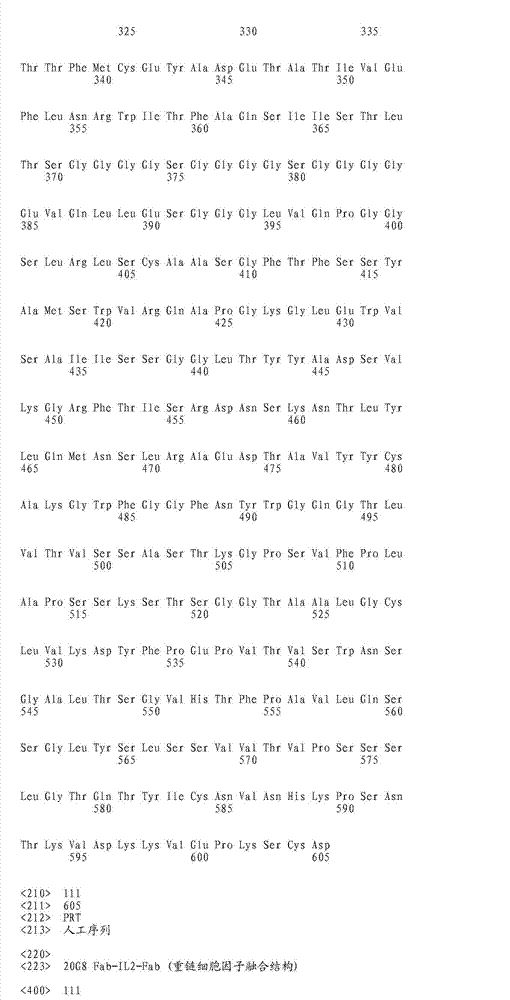


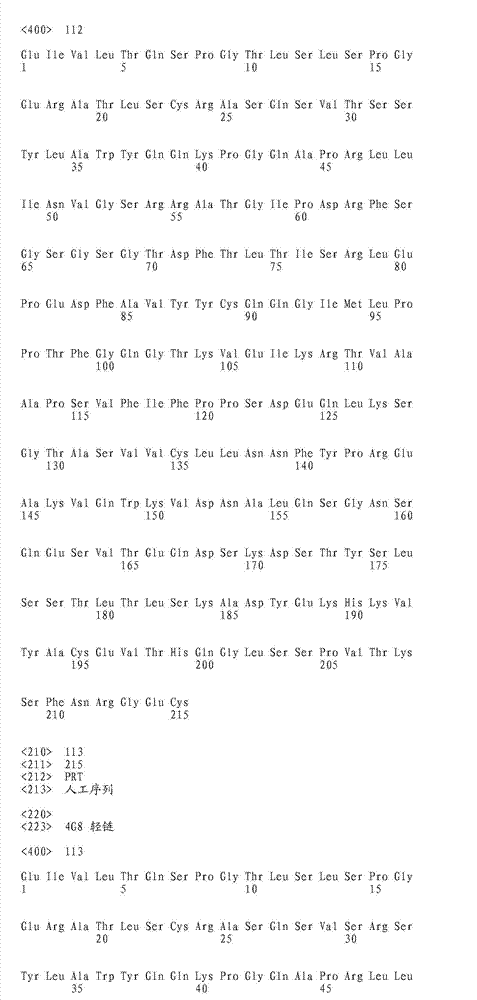
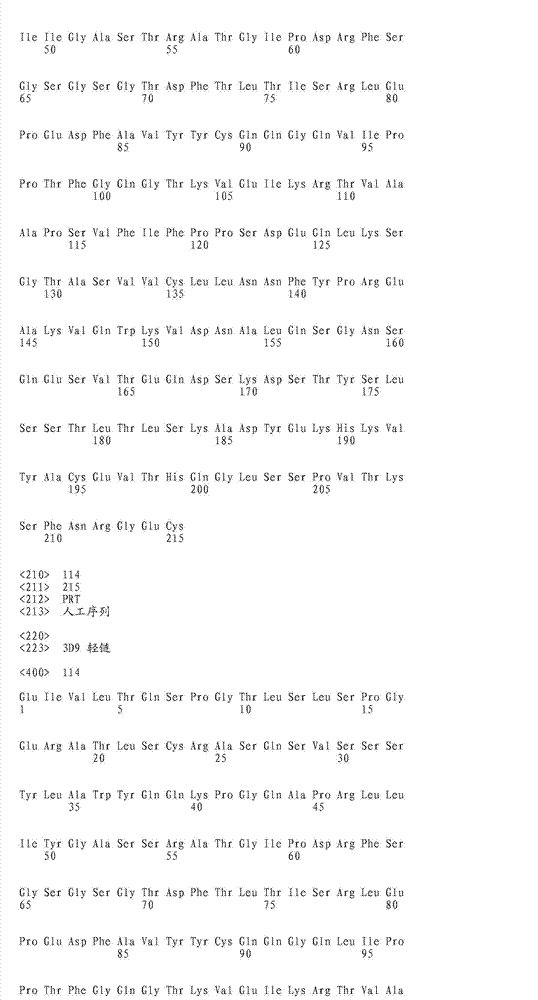
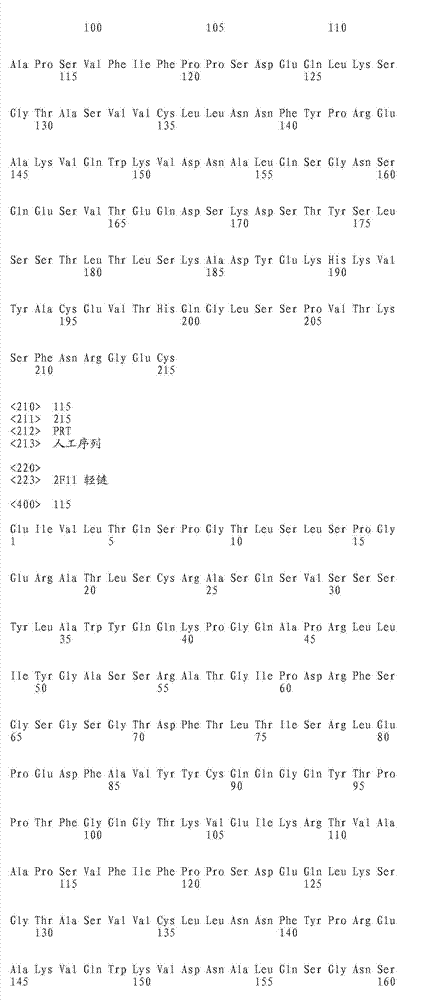

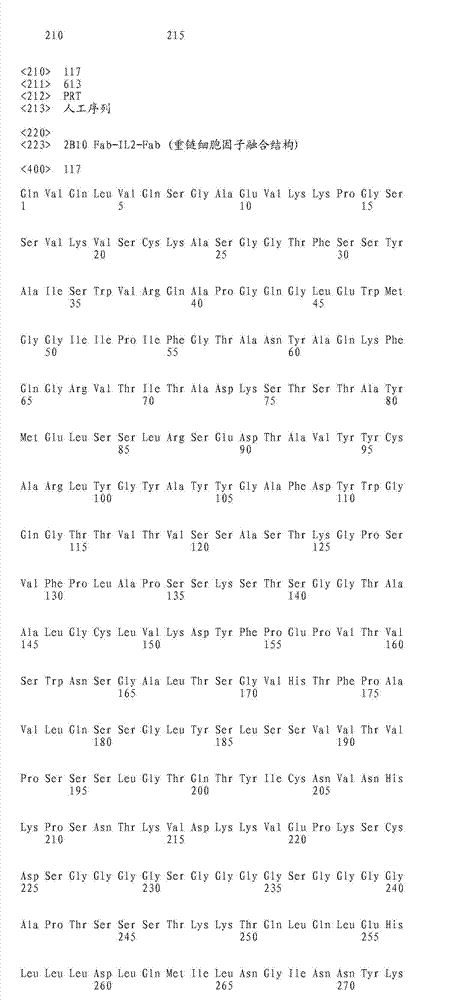


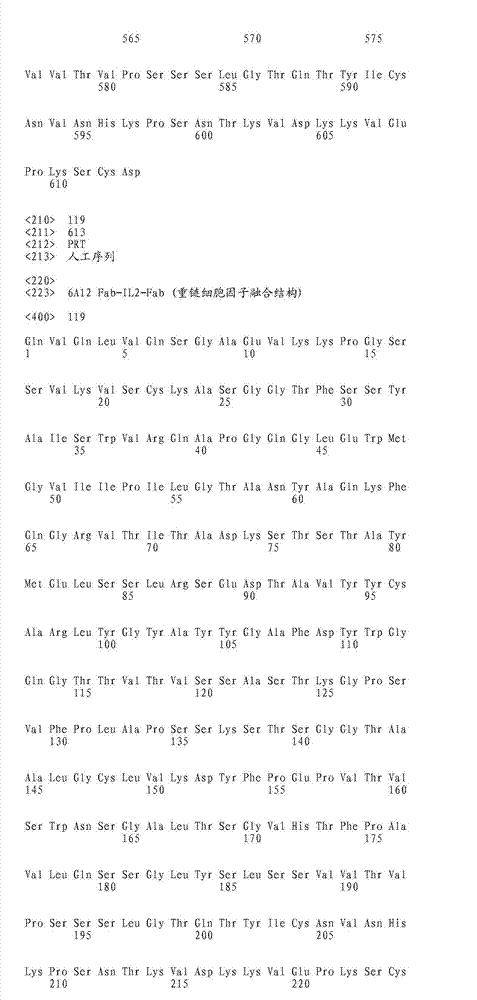


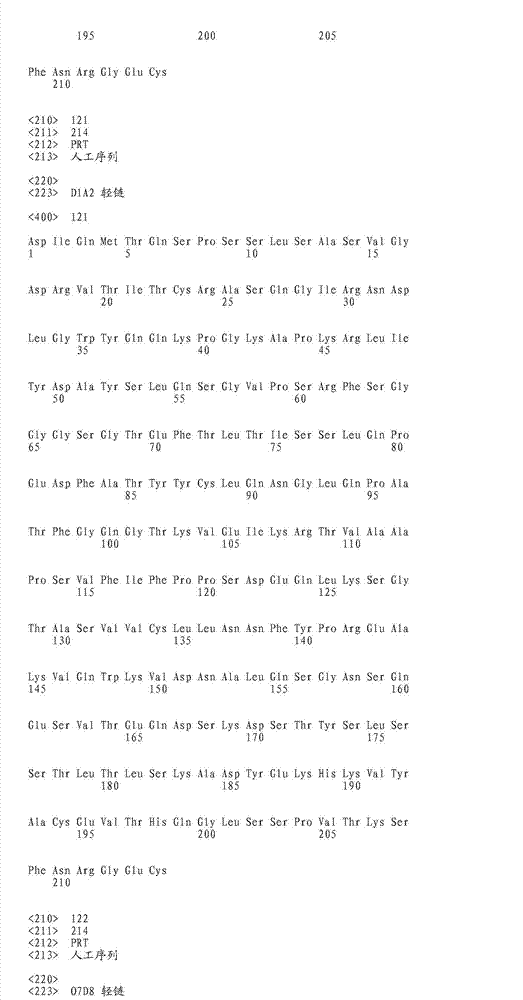
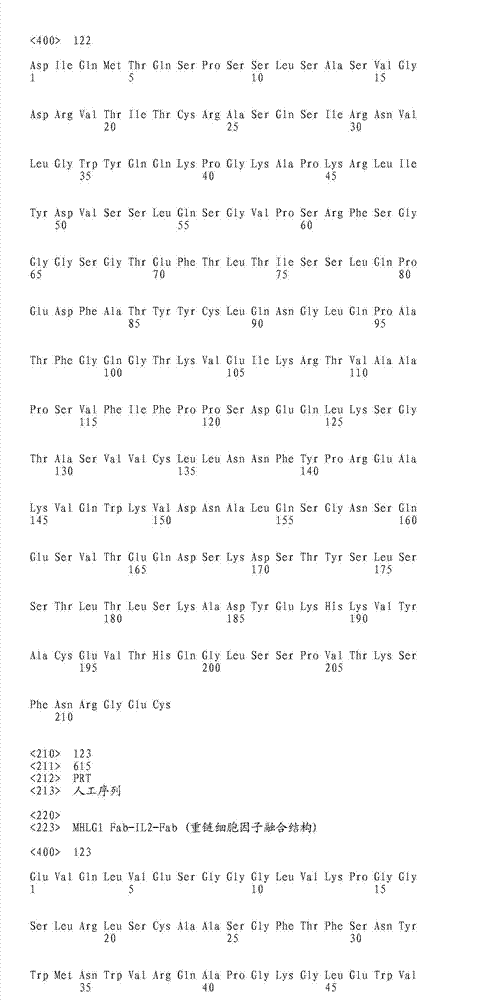
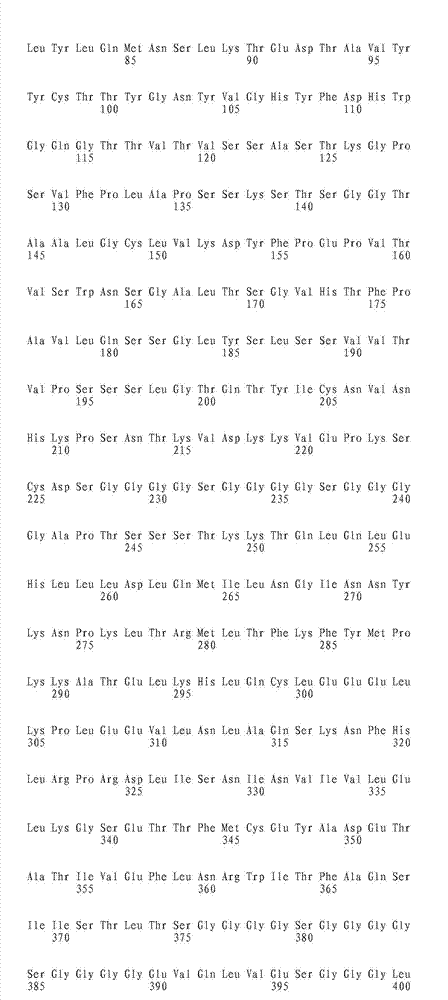
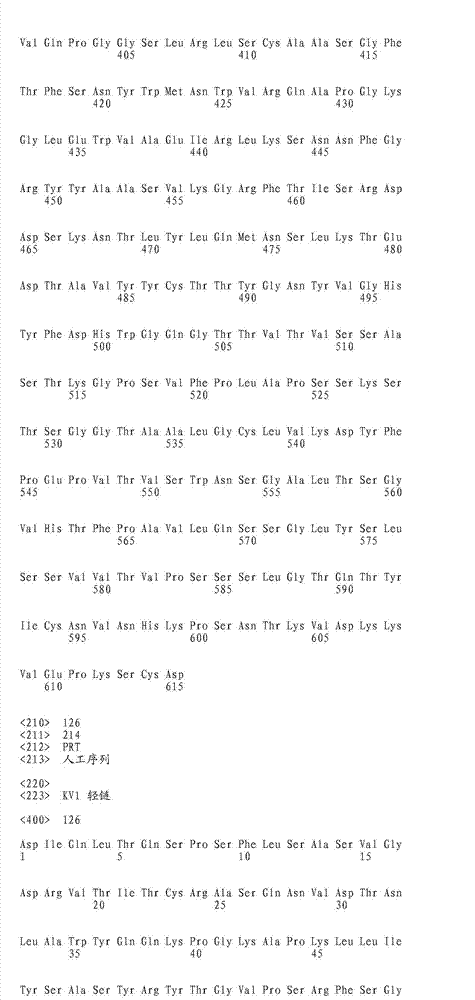
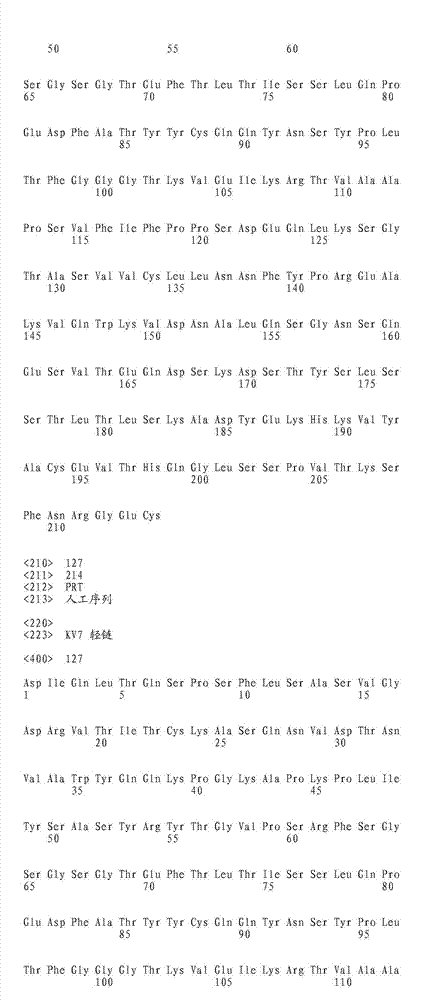
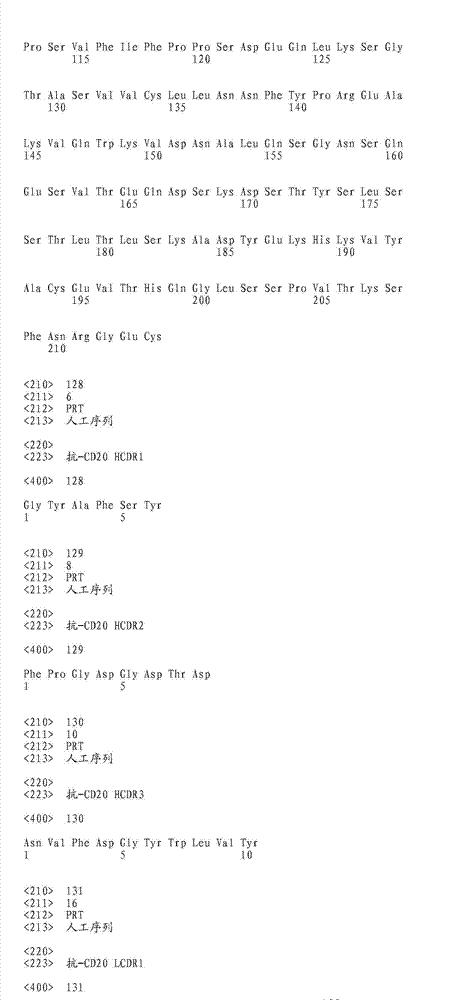

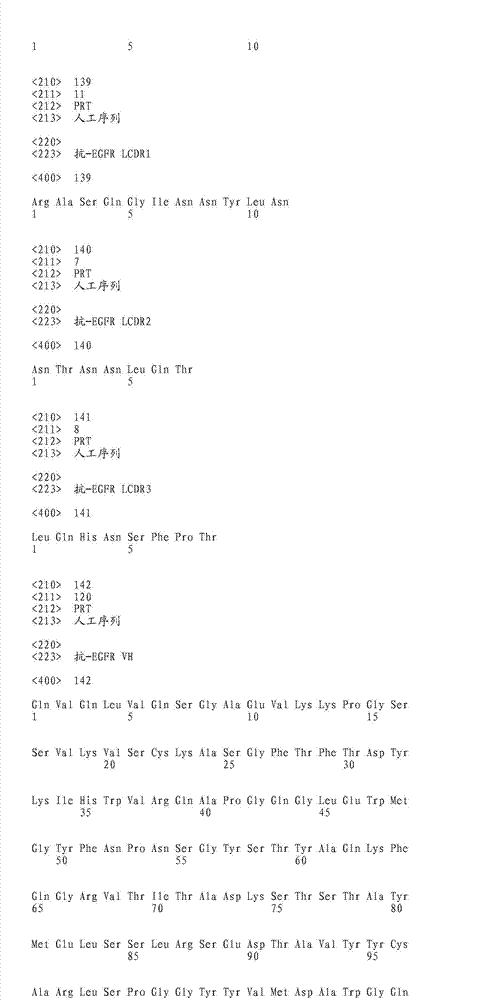
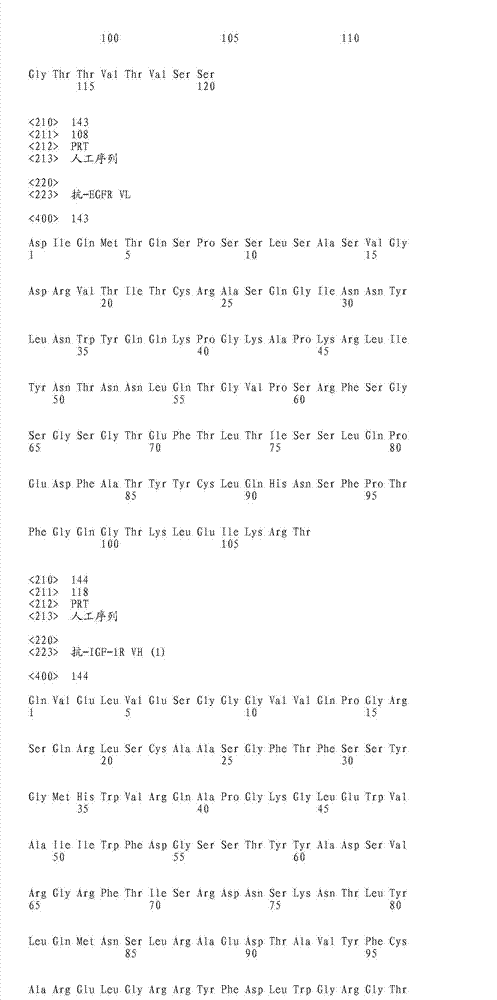

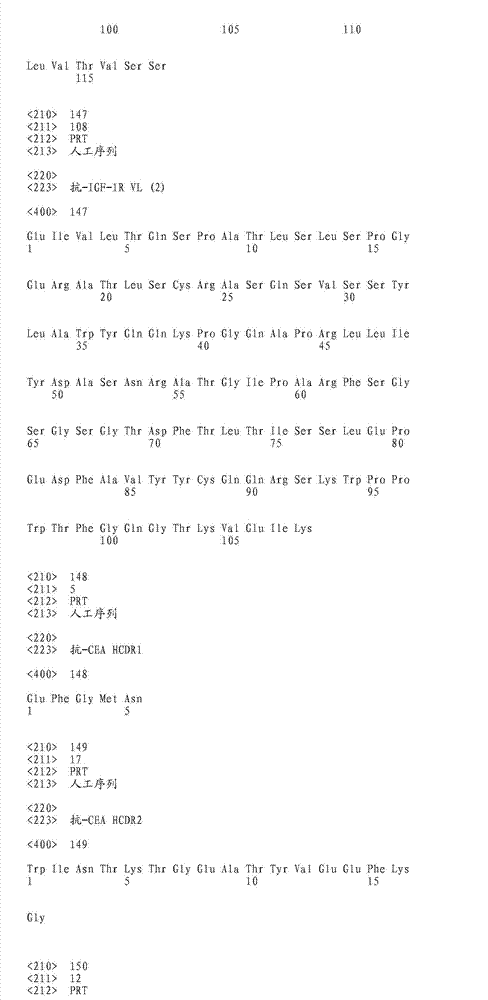
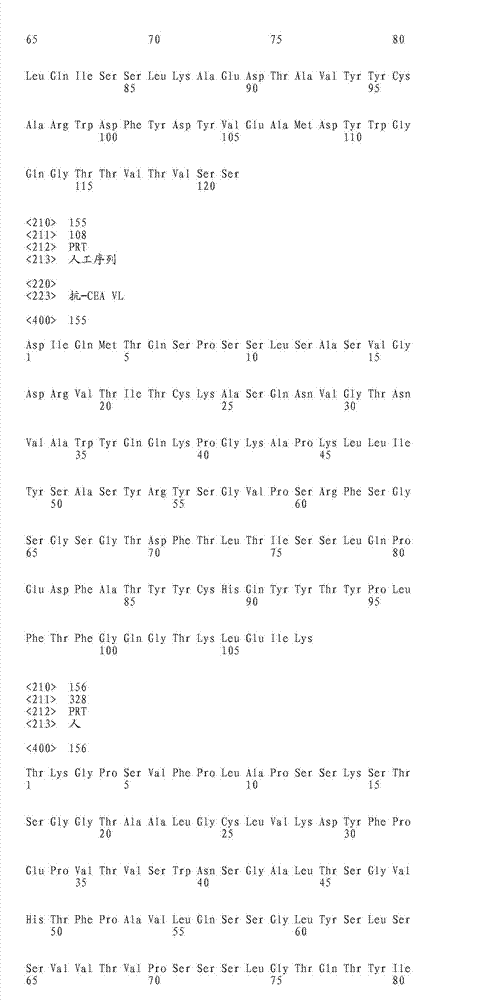

Claims (26)
Applications Claiming Priority (3)
| Application Number | Priority Date | Filing Date | Title |
|---|---|---|---|
| EP11153976 | 2011-02-10 | ||
| EP11153976.3 | 2011-02-10 | ||
| PCT/EP2012/051990 WO2012107416A2 (en) | 2011-02-10 | 2012-02-07 | Improved immunotherapy |
Publications (1)
| Publication Number | Publication Date |
|---|---|
| CN103476433A true CN103476433A (en) | 2013-12-25 |
Family
ID=45607732
Family Applications (1)
| Application Number | Title | Priority Date | Filing Date |
|---|---|---|---|
| CN2012800176972A Pending CN103476433A (en) | 2011-02-10 | 2012-02-07 | Improved immunotherapy |
Country Status (12)
| Country | Link |
|---|---|
| US (2) | US20120258073A1 (en) |
| EP (1) | EP2672999A2 (en) |
| JP (1) | JP2014511147A (en) |
| KR (1) | KR20130118941A (en) |
| CN (1) | CN103476433A (en) |
| AR (1) | AR085334A1 (en) |
| AU (1) | AU2012215572A1 (en) |
| BR (1) | BR112013019083A2 (en) |
| CA (1) | CA2824252A1 (en) |
| MX (1) | MX2013009151A (en) |
| RU (1) | RU2013139267A (en) |
| WO (1) | WO2012107416A2 (en) |
Cited By (2)
| Publication number | Priority date | Publication date | Assignee | Title |
|---|---|---|---|---|
| CN109563141A (en) * | 2016-05-13 | 2019-04-02 | 奥里尼斯生物科学公司 | To the therapeutic targeting of cellular structures |
| WO2022262496A1 (en) * | 2021-06-17 | 2022-12-22 | Suzhou Fuse Biosciences Limited | Immunoconjugate molecules and related methods and compositions thereof |
Families Citing this family (24)
| Publication number | Priority date | Publication date | Assignee | Title |
|---|---|---|---|---|
| EP2853267B1 (en) | 2007-09-21 | 2016-12-07 | The Regents of the University of California | Targeted interferon demonstrates potent apoptotic and anti-tumor activities |
| PL3434695T3 (en) | 2012-08-07 | 2021-05-17 | Roche Glycart Ag | Improved immunotherapy |
| US9803021B2 (en) | 2012-12-07 | 2017-10-31 | The Regents Of The University Of California | CD138-targeted interferon demonstrates potent apoptotic and anti-tumor activities |
| CN104968682A (en) | 2013-02-05 | 2015-10-07 | 英格玛布股份公司 | Bispecific antibodies against CD3[epsilon] and BCMA |
| EP2961772A1 (en) * | 2013-02-26 | 2016-01-06 | Roche Glycart AG | Anti-mcsp antibodies |
| WO2014194100A1 (en) | 2013-05-29 | 2014-12-04 | The Regents Of The University Of California | Anti-cspg4 fusions with interferon for the treatment of malignancy |
| GB201403775D0 (en) | 2014-03-04 | 2014-04-16 | Kymab Ltd | Antibodies, uses & methods |
| TWI824372B (en) | 2015-10-12 | 2023-12-01 | 美商再生元醫藥公司 | Antigen-binding proteins that activate the leptin receptor |
| MA43372A (en) | 2015-12-04 | 2018-10-10 | Novartis Ag | CYTOKINE ANTIBODY TRANSPLANT COMPOSITIONS AND METHODS OF USE FOR IMMUNOREGULATION |
| US9567399B1 (en) | 2016-06-20 | 2017-02-14 | Kymab Limited | Antibodies and immunocytokines |
| SG11201810509PA (en) | 2016-06-20 | 2018-12-28 | Kymab Ltd | Anti-pd-l1 antibodies |
| US11779604B2 (en) | 2016-11-03 | 2023-10-10 | Kymab Limited | Antibodies, combinations comprising antibodies, biomarkers, uses and methods |
| FI3538554T3 (en) | 2016-11-08 | 2025-09-24 | Regeneron Pharma | Antigen-binding proteins that antagonize the leptin receptor |
| WO2018146074A1 (en) * | 2017-02-07 | 2018-08-16 | Vib Vzw | Immune-cell targeted bispecific chimeric proteins and uses thereof |
| JOP20190271A1 (en) | 2017-05-24 | 2019-11-21 | Novartis Ag | Cytokine-Encapsulated Proteins - Antibody and Methods for Use for Immune-Related Disorders |
| MX2019014023A (en) | 2017-05-24 | 2020-02-17 | Novartis Ag | Antibody-cytokine engrafted proteins and methods of use in the treatment of cancer. |
| SI3661954T1 (en) | 2017-08-03 | 2022-05-31 | Amgen Inc. | Interleukin-21 muteins and treatment procedures |
| MX2020006508A (en) | 2017-12-18 | 2020-09-17 | Regeneron Pharma | Bispecific antigen binding molecules that bind leptin receptor and/or gp130, and methods of use thereof. |
| UY38049A (en) | 2018-01-12 | 2019-07-31 | Amgen Inc | ANTI-PD-1 ANTIBODIES AND TREATMENT METHODS |
| DK3773713T3 (en) | 2018-04-06 | 2025-08-18 | Regeneron Pharma | Leptin receptor agonist antibody for use in increasing bone mass in an individual suffering from metabolic dysfunction or hypoleptinemia |
| GB2621482B (en) | 2020-05-13 | 2024-09-04 | Bonum Therapeutics Inc | Compositions of protein complexes and methods of use thereof |
| CN118598976A (en) * | 2020-10-18 | 2024-09-06 | 北京志道生物科技有限公司 | Modified IL-2 molecules and their uses |
| WO2022087458A1 (en) | 2020-10-23 | 2022-04-28 | Asher Biotherapeutics, Inc. | Fusions with cd8 antigen binding molecules for modulating immune cell function |
| MX2023013723A (en) | 2021-05-19 | 2024-02-13 | Asher Biotherapeutics Inc | Il-21 polypeptides and targeted constructs. |
Citations (4)
| Publication number | Priority date | Publication date | Assignee | Title |
|---|---|---|---|---|
| WO2000047228A1 (en) * | 1999-02-12 | 2000-08-17 | The Scripps Research Institute | Methods for treatment of tumors and metastases using a combination of anti-angiogenic and immuno therapies |
| EP2085095A1 (en) * | 2008-01-17 | 2009-08-05 | Bayer Schering Pharma Aktiengesellschaft | Combination of an anti-EDb fibronectin antibody-IL-2 fusion protein, and a molecule binding to B cells, B cell progenitors and/or their cancerous counterpart |
| WO2010117448A2 (en) * | 2009-04-05 | 2010-10-14 | Provenance Biopharmaceuticals Corp. | Chimeric immunocytokines and methods of use thereof |
| WO2011001276A1 (en) * | 2009-06-30 | 2011-01-06 | Philogen S.P.A. | Immunocytokines in combination with anti-erbb antibodies for the treatment of cancer |
Family Cites Families (71)
| Publication number | Priority date | Publication date | Assignee | Title |
|---|---|---|---|---|
| US4816567A (en) | 1983-04-08 | 1989-03-28 | Genentech, Inc. | Recombinant immunoglobin preparations |
| US6548640B1 (en) | 1986-03-27 | 2003-04-15 | Btg International Limited | Altered antibodies |
| IL85035A0 (en) | 1987-01-08 | 1988-06-30 | Int Genetic Eng | Polynucleotide molecule,a chimeric antibody with specificity for human b cell surface antigen,a process for the preparation and methods utilizing the same |
| WO1990005144A1 (en) | 1988-11-11 | 1990-05-17 | Medical Research Council | Single domain ligands, receptors comprising said ligands, methods for their production, and use of said ligands and receptors |
| DE3920358A1 (en) | 1989-06-22 | 1991-01-17 | Behringwerke Ag | BISPECIFIC AND OLIGO-SPECIFIC, MONO- AND OLIGOVALENT ANTI-BODY CONSTRUCTS, THEIR PRODUCTION AND USE |
| US5959177A (en) | 1989-10-27 | 1999-09-28 | The Scripps Research Institute | Transgenic plants expressing assembled secretory antibodies |
| GB9015198D0 (en) | 1990-07-10 | 1990-08-29 | Brien Caroline J O | Binding substance |
| US5650150A (en) | 1990-11-09 | 1997-07-22 | Gillies; Stephen D. | Recombinant antibody cytokine fusion proteins |
| US5571894A (en) | 1991-02-05 | 1996-11-05 | Ciba-Geigy Corporation | Recombinant antibodies specific for a growth factor receptor |
| JP4124480B2 (en) | 1991-06-14 | 2008-07-23 | ジェネンテック・インコーポレーテッド | Immunoglobulin variants |
| GB9114948D0 (en) | 1991-07-11 | 1991-08-28 | Pfizer Ltd | Process for preparing sertraline intermediates |
| ES2136092T3 (en) | 1991-09-23 | 1999-11-16 | Medical Res Council | PROCEDURES FOR THE PRODUCTION OF HUMANIZED ANTIBODIES. |
| FI941572L (en) | 1991-10-07 | 1994-05-27 | Oncologix Inc | Combination and method of use of anti-erbB-2 monoclonal antibodies |
| ATE503496T1 (en) | 1992-02-06 | 2011-04-15 | Novartis Vaccines & Diagnostic | BIOSYNTHETIC BINDING PROTEIN FOR TUMOR MARKERS |
| US5229109A (en) | 1992-04-14 | 1993-07-20 | Board Of Regents, The University Of Texas System | Low toxicity interleukin-2 analogues for use in immunotherapy |
| US5869046A (en) | 1995-04-14 | 1999-02-09 | Genentech, Inc. | Altered polypeptides with increased half-life |
| US6267958B1 (en) | 1995-07-27 | 2001-07-31 | Genentech, Inc. | Protein formulation |
| US6171586B1 (en) | 1997-06-13 | 2001-01-09 | Genentech, Inc. | Antibody formulation |
| US6040498A (en) | 1998-08-11 | 2000-03-21 | North Caroline State University | Genetically engineered duckweed |
| WO1999029888A1 (en) | 1997-12-05 | 1999-06-17 | The Scripps Research Institute | Humanization of murine antibody |
| DK1037927T3 (en) | 1997-12-08 | 2004-09-06 | Emd Lexigen Res Ct Corp | Heterodimeric fusion proteins useful for targeted immunotherapy and general immune stimulation |
| PT1071700E (en) | 1998-04-20 | 2010-04-23 | Glycart Biotechnology Ag | Glycosylation engineering of antibodies for improving antibody-dependent cellular cytotoxicity |
| US6737056B1 (en) | 1999-01-15 | 2004-05-18 | Genentech, Inc. | Polypeptide variants with altered effector function |
| ES2601882T5 (en) | 1999-04-09 | 2021-06-07 | Kyowa Kirin Co Ltd | Procedure to monitor the activity of an immunofunctional molecule |
| KR100797667B1 (en) | 1999-10-04 | 2008-01-23 | 메디카고 인코포레이티드 | How to regulate transcription of foreign genes |
| US7125978B1 (en) | 1999-10-04 | 2006-10-24 | Medicago Inc. | Promoter for regulating expression of foreign genes |
| DK1719528T3 (en) | 2000-02-24 | 2012-01-09 | Philogen Spa | Compositions and Methods for Treating Angiogenesis in Pathological Lesions |
| US6946292B2 (en) | 2000-10-06 | 2005-09-20 | Kyowa Hakko Kogyo Co., Ltd. | Cells producing antibody compositions with increased antibody dependent cytotoxic activity |
| SV2007000775A (en) | 2001-01-05 | 2007-03-15 | Pfizer | ANTIBODIES AGAINST THE RECEIVER OF THE SIMILAR TO INSULIN GROWTH FACTOR |
| EP1423510A4 (en) | 2001-08-03 | 2005-06-01 | Glycart Biotechnology Ag | ANTIBODY GLYCOSYLATION VARIANTS WITH INCREASED CELL CYTOTOXICITY DEPENDENT OF ANTIBODIES |
| CA2456470A1 (en) | 2001-08-13 | 2003-02-27 | University Of Southern California | Interleukin-2 mutants with reduced toxicity |
| HUP0600342A3 (en) | 2001-10-25 | 2011-03-28 | Genentech Inc | Glycoprotein compositions |
| PL206975B1 (en) | 2001-12-04 | 2010-10-29 | Merck Patent Gmbh | Immunocytokines with modulated selectivity |
| US20040093621A1 (en) | 2001-12-25 | 2004-05-13 | Kyowa Hakko Kogyo Co., Ltd | Antibody composition which specifically binds to CD20 |
| NZ569490A (en) | 2001-12-27 | 2008-11-28 | Glycofi Inc | Methods to engineer mammalian-type carbohydrate structures |
| US7432063B2 (en) | 2002-02-14 | 2008-10-07 | Kalobios Pharmaceuticals, Inc. | Methods for affinity maturation |
| US20040132101A1 (en) | 2002-09-27 | 2004-07-08 | Xencor | Optimized Fc variants and methods for their generation |
| US20050031613A1 (en) | 2002-04-09 | 2005-02-10 | Kazuyasu Nakamura | Therapeutic agent for patients having human FcgammaRIIIa |
| CA2481837A1 (en) | 2002-04-09 | 2003-10-16 | Kyowa Hakko Kogyo Co., Ltd. | Production process for antibody composition |
| CA2481656A1 (en) | 2002-04-09 | 2003-10-16 | Kyowa Hakko Kogyo Co., Ltd. | Cells in which activity of the protein involved in transportation of gdp-fucose is reduced or lost |
| CN102911987B (en) | 2002-04-09 | 2015-09-30 | 协和发酵麒麟株式会社 | The adorned cell of genome |
| WO2003085119A1 (en) | 2002-04-09 | 2003-10-16 | Kyowa Hakko Kogyo Co., Ltd. | METHOD OF ENHANCING ACTIVITY OF ANTIBODY COMPOSITION OF BINDING TO FcϜ RECEPTOR IIIa |
| ATE472604T1 (en) | 2002-09-12 | 2010-07-15 | Greenovation Biotech Gmbh | METHOD FOR PRODUCING PROTEINS |
| DK2289936T3 (en) | 2002-12-16 | 2017-07-31 | Genentech Inc | IMMUNGLOBULIN VARIATIONS AND APPLICATIONS THEREOF |
| WO2004057002A2 (en) | 2002-12-20 | 2004-07-08 | Greenovation Biotech Gmbh | Production of heterologous glycosylated proteins in bryophyte cells |
| AU2004204494B2 (en) | 2003-01-09 | 2011-09-29 | Macrogenics, Inc. | Identification and engineering of antibodies with variant Fc regions and methods of using same |
| NZ582315A (en) | 2003-01-22 | 2011-01-28 | Glycart Biotechnology Ag | Fusion constructs and use of same to produce antibodies with increased Fc receptor binding affinity and effector function |
| US20060104968A1 (en) | 2003-03-05 | 2006-05-18 | Halozyme, Inc. | Soluble glycosaminoglycanases and methods of preparing and using soluble glycosaminogly ycanases |
| US7871607B2 (en) | 2003-03-05 | 2011-01-18 | Halozyme, Inc. | Soluble glycosaminoglycanases and methods of preparing and using soluble glycosaminoglycanases |
| US7579157B2 (en) | 2003-07-10 | 2009-08-25 | Hoffmann-La Roche Inc. | Antibody selection method against IGF-IR |
| DK2380910T3 (en) | 2003-11-05 | 2015-10-19 | Roche Glycart Ag | Antigen binding molecules with increased Fc receptor binding affinity and effector function |
| JP2007527242A (en) * | 2004-03-05 | 2007-09-27 | カイロン コーポレーション | In vitro test system for predicting patient tolerance of therapeutic agents |
| MXPA06011199A (en) | 2004-03-31 | 2007-04-16 | Genentech Inc | Humanized anti-tgf-beta antibodies. |
| PL1737891T3 (en) | 2004-04-13 | 2013-08-30 | Hoffmann La Roche | Anti-p-selectin antibodies |
| TWI380996B (en) | 2004-09-17 | 2013-01-01 | Hoffmann La Roche | Anti-ox40l antibodies |
| JO3000B1 (en) | 2004-10-20 | 2016-09-05 | Genentech Inc | Antibody Formulations. |
| RU2488597C2 (en) | 2005-02-07 | 2013-07-27 | Гликарт Биотехнологи Аг | Antigen-binding molecules, which bind egfr, their coding vectors and their usage |
| AU2006226060A1 (en) | 2005-03-25 | 2006-09-28 | Glycart Biotechnology Ag | Antigen binding molecules directed to MCSP and having increased Fc receptor binding affinity and effector function |
| ATE459648T1 (en) * | 2005-05-11 | 2010-03-15 | Philogen Spa | FUSION PROTEIN OF ANTIBODIES L19 AGAINST FIBRONECTIN ED-B AND INTERLEUKIN 12 |
| MX2007015107A (en) * | 2005-06-03 | 2008-02-15 | Genentech Inc | Method of producing antibodies with modified fucosylation level. |
| ES2606490T3 (en) | 2006-05-08 | 2017-03-24 | Philogen S.P.A. | Antibody-directed cytokines for therapy |
| AU2007271398B2 (en) * | 2006-07-06 | 2013-06-20 | Merck Patent Gmbh | Compositions and methods for enhancing the efficacy of IL-2 mediated immune responses |
| AR062223A1 (en) * | 2006-08-09 | 2008-10-22 | Glycart Biotechnology Ag | MOLECULES OF ADHESION TO THE ANTIGEN THAT ADHER TO EGFR, VECTORS THAT CODE THEM, AND THEIR USES OF THESE |
| DK2066796T3 (en) | 2006-09-20 | 2011-10-03 | Mt Biomethan Gmbh | Process and apparatus for separating methane and carbon dioxide from biogas |
| US20100143340A1 (en) | 2006-12-13 | 2010-06-10 | Schering Corporation | Methods and compositions for treating cancer |
| US20080226635A1 (en) | 2006-12-22 | 2008-09-18 | Hans Koll | Antibodies against insulin-like growth factor I receptor and uses thereof |
| WO2009061853A2 (en) | 2007-11-05 | 2009-05-14 | Massachusetts Institute Of Technology | Mutant interleukin-2 (il-2) polypeptides |
| JP5764127B2 (en) | 2009-08-17 | 2015-08-12 | ロシュ グリクアート アーゲー | Targeted immunoconjugate |
| TWI412375B (en) | 2009-08-28 | 2013-10-21 | Roche Glycart Ag | Humanized anti-cdcp1 antibodies |
| CA2770174A1 (en) | 2009-08-31 | 2011-03-03 | Roche Glycart Ag | Affinity-matured humanized anti cea monoclonal antibodies |
| UA107821C2 (en) | 2009-12-22 | 2015-02-25 | Roche Glycart Ag | Antibody her3 and its application |
-
2012
- 2012-02-07 CN CN2012800176972A patent/CN103476433A/en active Pending
- 2012-02-07 WO PCT/EP2012/051990 patent/WO2012107416A2/en not_active Ceased
- 2012-02-07 JP JP2013552929A patent/JP2014511147A/en active Pending
- 2012-02-07 EP EP12704250.5A patent/EP2672999A2/en not_active Withdrawn
- 2012-02-07 AU AU2012215572A patent/AU2012215572A1/en not_active Abandoned
- 2012-02-07 BR BR112013019083A patent/BR112013019083A2/en not_active IP Right Cessation
- 2012-02-07 CA CA2824252A patent/CA2824252A1/en not_active Abandoned
- 2012-02-07 RU RU2013139267/10A patent/RU2013139267A/en not_active Application Discontinuation
- 2012-02-07 KR KR1020137020753A patent/KR20130118941A/en not_active Ceased
- 2012-02-07 US US13/367,881 patent/US20120258073A1/en not_active Abandoned
- 2012-02-07 MX MX2013009151A patent/MX2013009151A/en not_active Application Discontinuation
- 2012-02-08 AR ARP120100411A patent/AR085334A1/en unknown
-
2013
- 2013-08-20 US US13/971,757 patent/US20140065097A1/en not_active Abandoned
Patent Citations (4)
| Publication number | Priority date | Publication date | Assignee | Title |
|---|---|---|---|---|
| WO2000047228A1 (en) * | 1999-02-12 | 2000-08-17 | The Scripps Research Institute | Methods for treatment of tumors and metastases using a combination of anti-angiogenic and immuno therapies |
| EP2085095A1 (en) * | 2008-01-17 | 2009-08-05 | Bayer Schering Pharma Aktiengesellschaft | Combination of an anti-EDb fibronectin antibody-IL-2 fusion protein, and a molecule binding to B cells, B cell progenitors and/or their cancerous counterpart |
| WO2010117448A2 (en) * | 2009-04-05 | 2010-10-14 | Provenance Biopharmaceuticals Corp. | Chimeric immunocytokines and methods of use thereof |
| WO2011001276A1 (en) * | 2009-06-30 | 2011-01-06 | Philogen S.P.A. | Immunocytokines in combination with anti-erbb antibodies for the treatment of cancer |
Cited By (2)
| Publication number | Priority date | Publication date | Assignee | Title |
|---|---|---|---|---|
| CN109563141A (en) * | 2016-05-13 | 2019-04-02 | 奥里尼斯生物科学公司 | To the therapeutic targeting of cellular structures |
| WO2022262496A1 (en) * | 2021-06-17 | 2022-12-22 | Suzhou Fuse Biosciences Limited | Immunoconjugate molecules and related methods and compositions thereof |
Also Published As
| Publication number | Publication date |
|---|---|
| KR20130118941A (en) | 2013-10-30 |
| AU2012215572A1 (en) | 2013-05-02 |
| WO2012107416A2 (en) | 2012-08-16 |
| WO2012107416A3 (en) | 2012-10-04 |
| MX2013009151A (en) | 2013-08-29 |
| EP2672999A2 (en) | 2013-12-18 |
| US20140065097A1 (en) | 2014-03-06 |
| AR085334A1 (en) | 2013-09-25 |
| CA2824252A1 (en) | 2012-08-16 |
| RU2013139267A (en) | 2015-03-20 |
| JP2014511147A (en) | 2014-05-12 |
| US20120258073A1 (en) | 2012-10-11 |
| BR112013019083A2 (en) | 2017-04-04 |
Similar Documents
| Publication | Publication Date | Title |
|---|---|---|
| AU2018274836B2 (en) | Composition comprising two antibodies engineered to have reduced and increased effector function | |
| CN103476433A (en) | Improved immunotherapy | |
| CN103649114B (en) | new immunoconjugates | |
| RU2650775C2 (en) | Biospecific antigen-binding molecules | |
| HK1189491A (en) | Improved immunotherapy | |
| HK1210789B (en) | Improved immunotherapy using composition comprising two antibodies engineered to have reduced and increased effector function | |
| TW201247221A (en) | Improved immunotherapy | |
| HK40099163A (en) | Ph-dependent mutant interleukin-2 polypeptides | |
| HK1192262A (en) | Novel immunoconjugates | |
| NZ614955B2 (en) | Novel immunoconjugates |
Legal Events
| Date | Code | Title | Description |
|---|---|---|---|
| C06 | Publication | ||
| PB01 | Publication | ||
| SE01 | Entry into force of request for substantive examination | ||
| SE01 | Entry into force of request for substantive examination | ||
| REG | Reference to a national code |
Ref country code: HK Ref legal event code: DE Ref document number: 1189491 Country of ref document: HK |
|
| C02 | Deemed withdrawal of patent application after publication (patent law 2001) | ||
| WD01 | Invention patent application deemed withdrawn after publication |
Application publication date: 20131225 |
|
| REG | Reference to a national code |
Ref country code: HK Ref legal event code: WD Ref document number: 1189491 Country of ref document: HK |