CN103339564A - Photochromic compounds and compositions - Google Patents
Photochromic compounds and compositions Download PDFInfo
- Publication number
- CN103339564A CN103339564A CN2011800657291A CN201180065729A CN103339564A CN 103339564 A CN103339564 A CN 103339564A CN 2011800657291 A CN2011800657291 A CN 2011800657291A CN 201180065729 A CN201180065729 A CN 201180065729A CN 103339564 A CN103339564 A CN 103339564A
- Authority
- CN
- China
- Prior art keywords
- phenyl
- alkyl
- replaces
- optional
- base
- Prior art date
- Legal status (The legal status is an assumption and is not a legal conclusion. Google has not performed a legal analysis and makes no representation as to the accuracy of the status listed.)
- Pending
Links
- 0 BC1(B)OC(C=CC=C/C=C/C=CC(C2=C3)=C4CC2=C=*C=C3I)=C4C#C1 Chemical compound BC1(B)OC(C=CC=C/C=C/C=CC(C2=C3)=C4CC2=C=*C=C3I)=C4C#C1 0.000 description 6
- DYDDMEJSURZGND-UHFFFAOYSA-N CCCCCC(CC1)CCC1C(CC1)CCC1OC(c(cc1)ccc1-c1cc(-c(c2c3cc(C(F)(F)F)cc2)c(C2(C)C)c(C=C4)c3OC4(c(cc3)ccc3OCCCC)c(cc3)ccc3F)c2cc1)=O Chemical compound CCCCCC(CC1)CCC1C(CC1)CCC1OC(c(cc1)ccc1-c1cc(-c(c2c3cc(C(F)(F)F)cc2)c(C2(C)C)c(C=C4)c3OC4(c(cc3)ccc3OCCCC)c(cc3)ccc3F)c2cc1)=O DYDDMEJSURZGND-UHFFFAOYSA-N 0.000 description 1
- QYFPSQLRGLFMTB-UHFFFAOYSA-N CCCCCC(CC1)CCC1c(cc1)ccc1-c(cc1)ccc1C(Nc(cc1)ccc1-c(cc(c(C1(C)C)c2)-c(c3c4c(Cl)cc(Cl)c3)c1c(C=C1)c4OC1(c(cc1)ccc1O)c(cc1)ccc1O)c2OC)=O Chemical compound CCCCCC(CC1)CCC1c(cc1)ccc1-c(cc1)ccc1C(Nc(cc1)ccc1-c(cc(c(C1(C)C)c2)-c(c3c4c(Cl)cc(Cl)c3)c1c(C=C1)c4OC1(c(cc1)ccc1O)c(cc1)ccc1O)c2OC)=O QYFPSQLRGLFMTB-UHFFFAOYSA-N 0.000 description 1
- XPZQLXPNNVJQAP-UHFFFAOYSA-N CCCCCC(CC1)CCC1c(cc1)ccc1-c(cc1)ccc1C(Nc(cc1)ccc1-c1ccc(C(C)(C)c2c(C=CC(c(cc3)ccc3OC)(c(cc3)ccc3OC(F)(F)F)O3)c3c(cc(C(F)(F)F)cc3)c3c2-2)c-2c1)=O Chemical compound CCCCCC(CC1)CCC1c(cc1)ccc1-c(cc1)ccc1C(Nc(cc1)ccc1-c1ccc(C(C)(C)c2c(C=CC(c(cc3)ccc3OC)(c(cc3)ccc3OC(F)(F)F)O3)c3c(cc(C(F)(F)F)cc3)c3c2-2)c-2c1)=O XPZQLXPNNVJQAP-UHFFFAOYSA-N 0.000 description 1
- DNTNKGJJDUITGR-UHFFFAOYSA-N CCCCCC(CC1)CCC1c(cc1)ccc1-c(cc1)ccc1C(Nc(cc1)ccc1-c1ccc(CC)c(-c(c2c3cc(C(F)(F)F)cc2)c(CC)c(C=C2)c3OC2(c2ccccc2)c(cc2)ccc2N(CC2)CCN2c(cc2)ccc2O)c1)=O Chemical compound CCCCCC(CC1)CCC1c(cc1)ccc1-c(cc1)ccc1C(Nc(cc1)ccc1-c1ccc(CC)c(-c(c2c3cc(C(F)(F)F)cc2)c(CC)c(C=C2)c3OC2(c2ccccc2)c(cc2)ccc2N(CC2)CCN2c(cc2)ccc2O)c1)=O DNTNKGJJDUITGR-UHFFFAOYSA-N 0.000 description 1
- PXJYLNDQCJSKJO-UHFFFAOYSA-N CCCCCC(CC1)CCC1c(cc1)ccc1-c1ccc(C=O)cc1 Chemical compound CCCCCC(CC1)CCC1c(cc1)ccc1-c1ccc(C=O)cc1 PXJYLNDQCJSKJO-UHFFFAOYSA-N 0.000 description 1
Images

Classifications
-
- C—CHEMISTRY; METALLURGY
- C07—ORGANIC CHEMISTRY
- C07D—HETEROCYCLIC COMPOUNDS
- C07D311/00—Heterocyclic compounds containing six-membered rings having one oxygen atom as the only hetero atom, condensed with other rings
- C07D311/02—Heterocyclic compounds containing six-membered rings having one oxygen atom as the only hetero atom, condensed with other rings ortho- or peri-condensed with carbocyclic rings or ring systems
- C07D311/94—Heterocyclic compounds containing six-membered rings having one oxygen atom as the only hetero atom, condensed with other rings ortho- or peri-condensed with carbocyclic rings or ring systems condensed with rings other than six-membered or with ring systems containing such rings
-
- C—CHEMISTRY; METALLURGY
- C07—ORGANIC CHEMISTRY
- C07D—HETEROCYCLIC COMPOUNDS
- C07D311/00—Heterocyclic compounds containing six-membered rings having one oxygen atom as the only hetero atom, condensed with other rings
- C07D311/02—Heterocyclic compounds containing six-membered rings having one oxygen atom as the only hetero atom, condensed with other rings ortho- or peri-condensed with carbocyclic rings or ring systems
- C07D311/78—Ring systems having three or more relevant rings
- C07D311/92—Naphthopyrans; Hydrogenated naphthopyrans
-
- C—CHEMISTRY; METALLURGY
- C09—DYES; PAINTS; POLISHES; NATURAL RESINS; ADHESIVES; COMPOSITIONS NOT OTHERWISE PROVIDED FOR; APPLICATIONS OF MATERIALS NOT OTHERWISE PROVIDED FOR
- C09K—MATERIALS FOR MISCELLANEOUS APPLICATIONS, NOT PROVIDED FOR ELSEWHERE
- C09K9/00—Tenebrescent materials, i.e. materials for which the range of wavelengths for energy absorption is changed as a result of excitation by some form of energy
- C09K9/02—Organic tenebrescent materials
-
- G—PHYSICS
- G02—OPTICS
- G02B—OPTICAL ELEMENTS, SYSTEMS OR APPARATUS
- G02B5/00—Optical elements other than lenses
- G02B5/20—Filters
- G02B5/22—Absorbing filters
- G02B5/23—Photochromic filters
-
- G—PHYSICS
- G03—PHOTOGRAPHY; CINEMATOGRAPHY; ANALOGOUS TECHNIQUES USING WAVES OTHER THAN OPTICAL WAVES; ELECTROGRAPHY; HOLOGRAPHY
- G03C—PHOTOSENSITIVE MATERIALS FOR PHOTOGRAPHIC PURPOSES; PHOTOGRAPHIC PROCESSES, e.g. CINE, X-RAY, COLOUR, STEREO-PHOTOGRAPHIC PROCESSES; AUXILIARY PROCESSES IN PHOTOGRAPHY
- G03C1/00—Photosensitive materials
- G03C1/72—Photosensitive compositions not covered by the groups G03C1/005 - G03C1/705
- G03C1/73—Photosensitive compositions not covered by the groups G03C1/005 - G03C1/705 containing organic compounds
-
- C—CHEMISTRY; METALLURGY
- C09—DYES; PAINTS; POLISHES; NATURAL RESINS; ADHESIVES; COMPOSITIONS NOT OTHERWISE PROVIDED FOR; APPLICATIONS OF MATERIALS NOT OTHERWISE PROVIDED FOR
- C09K—MATERIALS FOR MISCELLANEOUS APPLICATIONS, NOT PROVIDED FOR ELSEWHERE
- C09K2211/00—Chemical nature of organic luminescent or tenebrescent compounds
- C09K2211/10—Non-macromolecular compounds
- C09K2211/1003—Carbocyclic compounds
- C09K2211/1011—Condensed systems
-
- C—CHEMISTRY; METALLURGY
- C09—DYES; PAINTS; POLISHES; NATURAL RESINS; ADHESIVES; COMPOSITIONS NOT OTHERWISE PROVIDED FOR; APPLICATIONS OF MATERIALS NOT OTHERWISE PROVIDED FOR
- C09K—MATERIALS FOR MISCELLANEOUS APPLICATIONS, NOT PROVIDED FOR ELSEWHERE
- C09K2211/00—Chemical nature of organic luminescent or tenebrescent compounds
- C09K2211/10—Non-macromolecular compounds
- C09K2211/1018—Heterocyclic compounds
- C09K2211/1025—Heterocyclic compounds characterised by ligands
- C09K2211/1029—Heterocyclic compounds characterised by ligands containing one nitrogen atom as the heteroatom
-
- C—CHEMISTRY; METALLURGY
- C09—DYES; PAINTS; POLISHES; NATURAL RESINS; ADHESIVES; COMPOSITIONS NOT OTHERWISE PROVIDED FOR; APPLICATIONS OF MATERIALS NOT OTHERWISE PROVIDED FOR
- C09K—MATERIALS FOR MISCELLANEOUS APPLICATIONS, NOT PROVIDED FOR ELSEWHERE
- C09K2211/00—Chemical nature of organic luminescent or tenebrescent compounds
- C09K2211/10—Non-macromolecular compounds
- C09K2211/1018—Heterocyclic compounds
- C09K2211/1025—Heterocyclic compounds characterised by ligands
- C09K2211/1029—Heterocyclic compounds characterised by ligands containing one nitrogen atom as the heteroatom
- C09K2211/1033—Heterocyclic compounds characterised by ligands containing one nitrogen atom as the heteroatom with oxygen
-
- C—CHEMISTRY; METALLURGY
- C09—DYES; PAINTS; POLISHES; NATURAL RESINS; ADHESIVES; COMPOSITIONS NOT OTHERWISE PROVIDED FOR; APPLICATIONS OF MATERIALS NOT OTHERWISE PROVIDED FOR
- C09K—MATERIALS FOR MISCELLANEOUS APPLICATIONS, NOT PROVIDED FOR ELSEWHERE
- C09K2211/00—Chemical nature of organic luminescent or tenebrescent compounds
- C09K2211/10—Non-macromolecular compounds
- C09K2211/1018—Heterocyclic compounds
- C09K2211/1025—Heterocyclic compounds characterised by ligands
- C09K2211/1088—Heterocyclic compounds characterised by ligands containing oxygen as the only heteroatom
-
- G—PHYSICS
- G02—OPTICS
- G02B—OPTICAL ELEMENTS, SYSTEMS OR APPARATUS
- G02B5/00—Optical elements other than lenses
- G02B5/30—Polarising elements
- G02B5/3016—Polarising elements involving passive liquid crystal elements
-
- Y—GENERAL TAGGING OF NEW TECHNOLOGICAL DEVELOPMENTS; GENERAL TAGGING OF CROSS-SECTIONAL TECHNOLOGIES SPANNING OVER SEVERAL SECTIONS OF THE IPC; TECHNICAL SUBJECTS COVERED BY FORMER USPC CROSS-REFERENCE ART COLLECTIONS [XRACs] AND DIGESTS
- Y10—TECHNICAL SUBJECTS COVERED BY FORMER USPC
- Y10T—TECHNICAL SUBJECTS COVERED BY FORMER US CLASSIFICATION
- Y10T428/00—Stock material or miscellaneous articles
- Y10T428/31504—Composite [nonstructural laminate]
- Y10T428/31551—Of polyamidoester [polyurethane, polyisocyanate, polycarbamate, etc.]
-
- Y—GENERAL TAGGING OF NEW TECHNOLOGICAL DEVELOPMENTS; GENERAL TAGGING OF CROSS-SECTIONAL TECHNOLOGIES SPANNING OVER SEVERAL SECTIONS OF THE IPC; TECHNICAL SUBJECTS COVERED BY FORMER USPC CROSS-REFERENCE ART COLLECTIONS [XRACs] AND DIGESTS
- Y10—TECHNICAL SUBJECTS COVERED BY FORMER USPC
- Y10T—TECHNICAL SUBJECTS COVERED BY FORMER US CLASSIFICATION
- Y10T428/00—Stock material or miscellaneous articles
- Y10T428/31504—Composite [nonstructural laminate]
- Y10T428/31652—Of asbestos
- Y10T428/31663—As siloxane, silicone or silane
-
- Y—GENERAL TAGGING OF NEW TECHNOLOGICAL DEVELOPMENTS; GENERAL TAGGING OF CROSS-SECTIONAL TECHNOLOGIES SPANNING OVER SEVERAL SECTIONS OF THE IPC; TECHNICAL SUBJECTS COVERED BY FORMER USPC CROSS-REFERENCE ART COLLECTIONS [XRACs] AND DIGESTS
- Y10—TECHNICAL SUBJECTS COVERED BY FORMER USPC
- Y10T—TECHNICAL SUBJECTS COVERED BY FORMER US CLASSIFICATION
- Y10T428/00—Stock material or miscellaneous articles
- Y10T428/31504—Composite [nonstructural laminate]
- Y10T428/31855—Of addition polymer from unsaturated monomers
- Y10T428/31935—Ester, halide or nitrile of addition polymer
Landscapes
- Chemical & Material Sciences (AREA)
- Organic Chemistry (AREA)
- Physics & Mathematics (AREA)
- Engineering & Computer Science (AREA)
- Materials Engineering (AREA)
- General Physics & Mathematics (AREA)
- Optics & Photonics (AREA)
- Pharmaceuticals Containing Other Organic And Inorganic Compounds (AREA)
- Plural Heterocyclic Compounds (AREA)
- Heterocyclic Carbon Compounds Containing A Hetero Ring Having Oxygen Or Sulfur (AREA)
- Pyrane Compounds (AREA)
- Organic Low-Molecular-Weight Compounds And Preparation Thereof (AREA)
- Non-Silver Salt Photosensitive Materials And Non-Silver Salt Photography (AREA)
- Nitrogen Condensed Heterocyclic Rings (AREA)
- Nitrogen And Oxygen Or Sulfur-Condensed Heterocyclic Ring Systems (AREA)
- Steroid Compounds (AREA)
Abstract
Description
交叉引用的相关申请Cross-Referenced Related Applications
本申请是2008年12月5日提交的美国专利申请系列号No.12/329092的部分继续申请,其是2004年5月17日提交的美国专利申请系列号No.10/846629的部分继续申请,美国专利申请系列号No.10/846629现在为美国专利7342112并且又要求2003年7月1日提交的美国临时申请系列号No.60/484100的权益,全部的文献以它们全部在此明确引入作为参考。This application is a continuation-in-part of U.S. Patent Application Serial No. 12/329092, filed December 5, 2008, which is a continuation-in-part of U.S. Patent Application Serial No. 10/846629, filed May 17, 2004 , U.S. Patent Application Serial No. 10/846629 is now U.S. Patent 7,342,112 and in turn claims the benefit of U.S. Provisional Application Serial No. 60/484,100 filed July 1, 2003, all documents expressly incorporated herein in their entirety Reference.
关于联邦资助研究或者开发的声明Statement Regarding Federally Sponsored Research or Development
不适用。not applicable.
参考文献列举顺序Reference Listing Order
不适用。not applicable.
发明背景Background of the invention
本发明通常涉及光致变色化合物和涉及使用此处公开的光致变色化合物制造的元件。The present invention relates generally to photochromic compounds and to components fabricated using the photochromic compounds disclosed herein.
常规的光致变色化合物具有至少两种状态,第一状态具有第一吸收光谱和第二状态具有不同于该第一吸收光谱的第二吸收光谱,并且能够响应至少光化学辐射来在两种状态之间切换。此外,常规的光致变色化合物可以是热可逆的。即,常规的光致变色化合物能够响应至少光化学辐射而在第一状态和第二状态之间切换,并且在响应热能时恢复回第一状态。作为此处使用的,“光化学辐射”表示这样的电磁辐射,例如但不限于紫外和可见光辐射,其能够引起响应。更具体的,常规的光致变色化合物可以经历在响应光化学辐射时从一种异构体转换成另一种,并且每个异构体具有特有的吸收光谱,和在响应热能时可以进一步恢复回第一异构体(即,是热可逆的)。例如常规的热可逆的光致变色化合物通常能够在响应光化学辐射时从第一状态如“透明态”切换到第二状态如“着色态”和在响应热能时恢复回“透明”态。Conventional photochromic compounds have at least two states, a first state having a first absorption spectrum and a second state having a second absorption spectrum different from the first absorption spectrum, and are capable of switching between the two states in response to at least actinic radiation switch between. Furthermore, conventional photochromic compounds can be thermally reversible. That is, conventional photochromic compounds are capable of switching between a first state and a second state in response to at least actinic radiation, and reverting back to the first state in response to thermal energy. As used herein, "actinic radiation" means electromagnetic radiation, such as but not limited to ultraviolet and visible radiation, which is capable of eliciting a response. More specifically, conventional photochromic compounds can undergo conversion from one isomer to another in response to actinic radiation, and each isomer has a characteristic absorption spectrum, and can further revert back to The first isomer (ie, is thermoreversible). For example, conventional thermally reversible photochromic compounds are generally capable of switching from a first state, such as a "clear state," to a second state, such as a "colored state," in response to actinic radiation and returning to a "transparent" state in response to thermal energy.
二向色化合物是这样的化合物,其能够对透射光的两个正交平面偏振分量之一的吸收比另一分量更强。因此,二向色化合物能够线性偏振透射光。作为此处使用的,“线性偏振”表示将光波的电矢量的振动限制到一个方向或平面。但是,虽然二向色材料能够优先吸收透射光的两个正交平面偏振分量之一,但是如果二向色化合物的分子不适于定位或者排列,则也将不能实现透射光的净线性偏振。即,归因于二向色化合物分子的无规定向,单个分子的选择性吸收将彼此抵消,这样不能实现净或者整体的线性偏振效果。因此,通常必需将二向色化合物分子在另一材料内适当定位或排列来形成常规的线性偏振元件,例如用于太阳镜的线性偏振滤波器或者透镜。A dichroic compound is a compound capable of absorbing more strongly one of two orthogonal plane polarization components of transmitted light than the other. Thus, dichroic compounds are capable of linearly polarizing transmitted light. As used herein, "linearly polarized" means confining the vibration of the electric vector of a light wave to one direction or plane. However, while dichroic materials are capable of preferentially absorbing one of two orthogonal plane polarization components of transmitted light, net linear polarization of transmitted light will not be achieved if the molecules of the dichroic compound are not properly positioned or aligned. That is, due to the random orientation of the dichroic compound molecules, the selective absorptions of the individual molecules will cancel each other out so that no net or overall linear polarization effect can be achieved. Therefore, it is often necessary to properly position or align the dichroic compound molecules within another material to form conventional linearly polarizing elements, such as linearly polarizing filters or lenses for sunglasses.
与二向色化合物相反,通常不必定位或者排列常规的光致变色化合物分子来形成常规的光致变色元件。因此例如常规的光致变色元件例如用于光致变色眼镜的透镜可以例如通过将含有常规的光致变色化合物和“主”材的溶液旋涂到透镜表面上,并且适当固化所形成的涂料或者层,而无需以任何具体的定向来排列该光致变色化合物而形成。此外,即使常规的光致变色化合物的分子适于如上面所讨论的二向色化合物那样定向或者排列,但是因为常规的光致变色化合物不能表现出强的二向色性,因此由其所制成的元件通常不是强线性偏振的。In contrast to dichroic compounds, conventional photochromic compound molecules generally do not have to be positioned or aligned to form conventional photochromic elements. Thus for example a conventional photochromic element such as a lens for photochromic eyeglasses can be applied, for example, by spin-coating a solution containing a conventional photochromic compound and a "master" material onto the lens surface, and curing the resulting coating appropriately or layer without arranging the photochromic compounds in any particular orientation. Furthermore, even though the molecules of conventional photochromic compounds are adapted to be oriented or aligned as the dichroic compounds discussed above, since conventional photochromic compounds cannot exhibit strong dichroism, The resulting element is usually not strongly linearly polarized.
有利的是提供光致变色化合物,例如但不限于热可逆的光致变色化合物,其可以表现出有用的光致变色和/或处于至少一种状态的二向色性能,和其可以用于多种应用来赋予光致变色和/或二向色性能。It would be advantageous to provide photochromic compounds, such as but not limited to thermally reversible photochromic compounds, which can exhibit useful photochromic and/or dichroic properties in at least one state, and which can be used in multiple applications to impart photochromic and/or dichroic properties.
发明内容Contents of the invention
此处所述是下面的图式I和IA所示的化合物:Described here are the compounds shown in Schemes I and IA below:
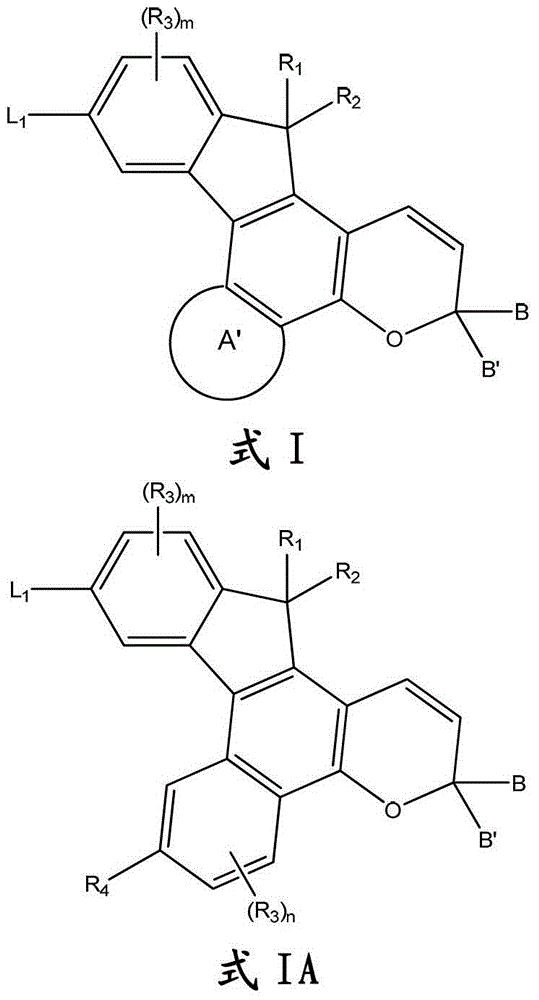
其中:in:
A’选自任选取代的芳基和任选取代的杂芳基;其中A’是用L2任选取代的;A' is selected from optionally substituted aryl and optionally substituted heteroaryl; wherein A' is optionally substituted with L;
R1和R2各自独立地选自氢,羟基和手性或者非手性基团,该手性或者非手性基团选自任选取代的杂烷基,任选取代的烷基,任选取代的链烯基,任选取代的炔基,任选取代的芳基,任选取代的杂芳基,任选取代的环烷基,任选取代的杂环烷基,卤素,任选取代的氨基,羧基,烷基羰基,烷氧基羰基,任选取代的烷氧基和氨基羰基,或者R1和R2可以与任何间隔原子一起形成选自氧代的任选取代的环烷基和任选取代的杂环烷基的基团;和R and R are each independently selected from hydrogen, hydroxyl and a chiral or achiral group selected from optionally substituted heteroalkyl , optionally substituted alkyl, any Optionally substituted alkenyl, optionally substituted alkynyl, optionally substituted aryl, optionally substituted heteroaryl, optionally substituted cycloalkyl, optionally substituted heterocycloalkyl, halogen, optionally Substituted amino, carboxyl, alkylcarbonyl, alkoxycarbonyl, optionally substituted alkoxy and aminocarbonyl, or R and R may be taken together with any spacer atom to form an optionally substituted cycloalkane selected from oxo and optionally substituted heterocycloalkyl groups; and
R3在每个出现处独立地选自手性或者非手性基团,该手性或者非手性基团选自甲酰基,烷基羰基,烷氧基羰基,氨基羰基,芳基羰基,芳氧基羰基,氨基羰氧基,烷氧基羰基氨基,芳氧基羰基氨基,硼酸,硼酸酯,环烷氧基羰基氨基,杂环烷氧基羰基氨基,杂芳氧基羰基氨基,任选取代的烷基,任选取代的链烯基,任选取代的炔基,卤素,任选取代的环烷基,任选取代的芳基,任选取代的杂芳基,任选取代的烷氧基,任选取代的杂烷基,任选取代的杂环烷基和任选取代的氨基; R at each occurrence is independently selected from chiral or achiral groups selected from formyl, alkylcarbonyl, alkoxycarbonyl, aminocarbonyl, arylcarbonyl, Aryloxycarbonyl, Aminocarbonyloxy, Alkoxycarbonylamino, Aryloxycarbonylamino, Boronic Acid, Boronic Ester, Cycloalkoxycarbonylamino, Heterocycloalkoxycarbonylamino, Heteroaryloxycarbonylamino, Optionally substituted alkyl, optionally substituted alkenyl, optionally substituted alkynyl, halogen, optionally substituted cycloalkyl, optionally substituted aryl, optionally substituted heteroaryl, optionally substituted Alkoxy, optionally substituted heteroalkyl, optionally substituted heterocycloalkyl and optionally substituted amino;
R4选自氢、R3和L2;R 4 is selected from hydrogen, R 3 and L 2 ;
m和n各自独立地选自0-3的整数;m and n are each independently selected from an integer of 0-3;
B和B’各自独立地选自L3,氢,卤素,和手性或者非手性基团,该手性或者非手性基团选自金属茂基,任选取代的烷基,任选取代的链烯基,任选取代的炔基,任选取代的杂烷基,任选取代的烷氧基,任选取代的芳基,任选取代的杂芳基,任选取代的杂环烷基,和任选取代的环烷基,或者其中B和B’与任何间隔原子一起形成选自任选取代的环烷基和任选取代的杂环烷基的基团;和B and B' are each independently selected from L 3 , hydrogen, halogen, and chiral or achiral groups selected from metallocene, optionally substituted alkyl, optionally substituted Alkenyl, optionally substituted alkynyl, optionally substituted heteroalkyl, optionally substituted alkoxy, optionally substituted aryl, optionally substituted heteroaryl, optionally substituted heterocycloalkane and optionally substituted cycloalkyl, or wherein B and B' together with any spacer atoms form a group selected from optionally substituted cycloalkyl and optionally substituted heterocycloalkyl; and
L1,L2和L3在每个出现处独立地选自下式所示的手性或者非手性加长基团:L 1 , L 2 and L 3 are independently selected from chiral or achiral elongating groups represented by the following formula at each occurrence:
-[S1]c-[Q1-[S2]d]d’-[Q2-[S3]e]e’-[Q3-[S4]f]f’-S5-P其中:(a)Q1,Q2和Q3在每个出现处独立地选自二价基团,其选自任选取代的芳基,任选取代的杂芳基,任选取代的环烷基和任选取代的杂环烷基;-[S 1 ] c -[Q 1 -[S 2 ] d ] d '-[Q 2 -[S 3 ] e ] e '-[Q 3 -[S 4 ] f ] f '-S 5 -P wherein: (a) Q 1 , Q 2 and Q 3 are at each occurrence independently selected from divalent groups selected from optionally substituted aryl, optionally substituted heteroaryl, optionally substituted ring Alkyl and optionally substituted heterocycloalkyl;
其中取代基独立地选自P,液晶介晶,卤素,聚(C1-C18烷氧基),C1-C18烷氧基羰基,C1-C18烷基羰基,C1-C18烷氧基羰氧基,芳氧基羰氧基,全氟(C1-C18)烷氧基,全氟(C1-C18)烷氧基羰基,全氟(C1-C18)烷基羰基,全氟(C1-C18)烷基氨基,二(全氟(C1-C18)烷基)氨基,全氟(C1-C18)烷基硫,C1-C18烷基硫,C1-C18乙酰基,C3-C10环烷基,C3-C10环烷氧基,直链C1-C18烷基,和支化的C1-C18烷基;wherein the substituents are independently selected from P, liquid crystal mesogen, halogen, poly(C 1 -C 18 alkoxy), C 1 -C 18 alkoxycarbonyl, C 1 -C 18 alkylcarbonyl, C 1 -C 18 Alkoxycarbonyloxy, aryloxycarbonyloxy, perfluoro(C 1 -C 18 )alkoxy, perfluoro(C 1 -C 18 )alkoxycarbonyl, perfluoro(C 1 -C 18 )alkylcarbonyl, perfluoro(C 1 -C 18 )alkylamino, di(perfluoro(C 1 -C 18 )alkyl)amino, perfluoro(C 1 -C 18 )alkylthio, C 1 - C 18 alkylthio, C 1 -C 18 acetyl, C 3 -C 10 cycloalkyl, C 3 -C 10 cycloalkoxy, straight chain C 1 -C 18 alkyl, and branched C 1 - C 18 alkyl;
其中所述直链C1-C18烷基和支化的C1-C18烷基是用选自氰基,卤素和C1-C18烷氧基的基团单取代的;或者wherein said straight chain C 1 -C 18 alkyl and branched C 1 -C 18 alkyl are monosubstituted with a group selected from cyano, halogen and C 1 -C 18 alkoxy; or
其中所述直链C1-C18烷基和支化的C1-C18烷基是用独立地选自卤素,-M(T)(t-1)和-M(OT)(t-1)的至少两个基团多取代的,其中M选自铝,锑,钽,钛,锆和硅,T选自有机官能化基团,有机官能化烃基,脂肪族烃基和芳族烃基,和t是M的价态;Wherein said linear C 1 -C 18 alkyl and branched C 1 -C 18 alkyl are independently selected from halogen, -M (T) (t-1) and -M (OT) (t- 1) at least two groups are polysubstituted, wherein M is selected from aluminum, antimony, tantalum, titanium, zirconium and silicon, T is selected from organofunctional groups, organofunctional hydrocarbon groups, aliphatic hydrocarbon groups and aromatic hydrocarbon groups, and t is the valence state of M;
(b)c,d,e和f各自独立地选自1-20的整数;和每个S1,S2,S3,S4和S5在每个出现处独立地选自间隔单元,该间隔单元选自:(b) c, d, e and f are each independently selected from integers from 1 to 20; and each S 1 , S 2 , S 3 , S 4 and S 5 are independently selected from spacer units at each occurrence, The spacer unit is selected from:
(i)任选取代的亚烷基,任选取代的卤代亚烷基,-Si(CH2)g-和-(Si[(CH3)2]O)h-,其中g在每个出现处独立地选自1-20的整数;h在每个出现处独立地选自1-16的整数;和用于亚烷基和卤代亚烷基的所述取代基独立地选自C1-C18烷基,C3-C10环烷基和芳基;(i) optionally substituted alkylene, optionally substituted haloalkylene, -Si(CH 2 ) g - and -(Si[(CH 3 ) 2 ]O) h -, wherein g is in each H is independently selected from an integer from 1 to 20 at each occurrence; h is independently selected from an integer from 1 to 16 at each occurrence; and the substituents for alkylene and haloalkylene are independently selected from C 1 -C 18 alkyl, C 3 -C 10 cycloalkyl and aryl;
(ii)-N(Z)-,-C(Z)=C(Z)-,-C(Z)=N-,-C(Z’)2-C(Z’)2-和单键,其中Z在每个出现处独立地选自氢,C1-C18烷基,C3-C10环烷基和芳基,和Z’在每个出现处独立地选自C1-C18烷基,C3-C10环烷基和芳基;和(ii) -N(Z)-, -C(Z)=C(Z)-, -C(Z)=N-, -C(Z') 2 -C(Z') 2 - and single bonds, wherein Z at each occurrence is independently selected from hydrogen, C 1 -C 18 alkyl, C 3 -C 10 cycloalkyl and aryl, and Z' at each occurrence is independently selected from C 1 -C 18 Alkyl, C 3 -C 10 cycloalkyl and aryl; and
(iii)-O-,-C(=O)-,-C≡C-,-N=N-,-S-,-S(=O)-,-(O=)S(=O)-,-(O=)S(=O)O-,-O(O=)S(=O)O-和直链或者支化的C1-C24亚烷基残基,所述C1-C24亚烷基残基是未取代的,用氰基或者卤素单取代的,或者用卤素多取代的,(iii) -O-, -C(=O)-, -C≡C-, -N=N-, -S-, -S(=O)-, -(O=)S(=O)- , -(O=)S(=O)O-, -O(O=)S(=O)O- and straight-chain or branched C 1 -C 24 alkylene residues, the C 1 - The C 24 alkylene residue is unsubstituted, monosubstituted with cyano or halogen, or polysubstituted with halogen,
条件是当包含杂原子的两个间隔单元连接在一起时,该间隔单元的连接使得杂原子不彼此直接相连,S1和图式I和/或IA所示的化合物之间的每个键没有连接在一起的两个杂原子,和S5和P之间的键没有彼此连接在一起的两个杂原子;Provided that when two spacer units comprising heteroatoms are linked together, the spacer units are linked such that the heteroatoms are not directly linked to each other, and each bond between S1 and the compounds shown in Scheme I and/or IA has no two heteroatoms linked together, and the bond between S5 and P does not have two heteroatoms linked together;
(c)P在每个出现处独立地选自羟基,氨基,C2-C18链烯基,C2-C18炔基,叠氮基,甲硅烷基,甲硅烷氧基,甲硅烷基氢化物,(四氢-2H-吡喃-2-基)氧基,硫代,异氰酸酯基,硫代异氰酸酯基,丙烯酰氧基,甲基丙烯酰氧基,2-(丙烯酰氧基)乙基氨基甲酰基,2-(甲基丙烯酰氧基)乙基氨基甲酰基,吖丙啶基,烯丙氧基羰氧基,环氧基,羧酸,羧酸酯,丙烯酰氨基,甲基丙烯酰氨基,氨基羰基,C1-C18烷基氨基羰基,氨基羰基(C1-C18)烷基,C1-C18烷氧基羰氧基,卤羰基,氢,芳基,羟基(C1-C18)烷基,C1-C18烷基,C1-C18烷氧基,氨基(C1-C18)烷基,C1-C18烷基氨基,二(C1-C18)烷基氨基,C1-C18烷基(C1-C18)烷氧基,C1-C18烷氧基(C1-C18)烷氧基,硝基,聚(C1-C18)烷基醚,(C1-C18)烷基(C1-C18)烷氧基(C1-C18)烷基,聚亚乙基氧基,聚亚丙基氧基,乙烯,丙烯酰基,丙烯酰氧基(C1-C18)烷基,甲基丙烯酰基,甲基丙烯酰氧基(C1-C18)烷基,2-氯丙烯酰基,2-苯基丙烯酰基,丙烯酰氧基苯基,2-氯丙烯酰氨基,2-苯基丙烯酰氨基羰基,氧杂环丁烷基,缩水甘油基,氰基,异氰酸酯基(C1-C18)烷基,衣康酸酯,乙烯基醚,乙烯基酯,苯乙烯衍生物,主链和侧链液晶聚合物,硅氧烷衍生物,乙烯亚胺衍生物,马来酸衍生物,马来酰亚胺衍生物,富马酸衍生物,未取代的肉桂酸衍生物,用至少一种的甲基,甲氧基,氰基和卤素取代的肉桂酸衍生物,和取代的或者未取代的手性或者非手性单价或者二价基团,该手性或者非手性单价或者二价基团选自类固醇基团,类萜基团,生物碱基团及其混合物,其中该取代基独立地选自C1-C18烷基,C1-C18烷氧基,氨基,C3-C10环烷基,C1-C18烷基(C1-C18)烷氧基,氟(C1-C18)烷基,氰基,氰基(C1-C18)烷基,氰基(C1-C18)烷氧基或者其混合物,或者P是具有2-4个反应性基团的结构或者P是未取代的或者取代的开环易位聚合前体或者P是取代的或者未取代的光致变色化合物;和(c) P at each occurrence is independently selected from hydroxyl, amino, C 2 -C 18 alkenyl, C 2 -C 18 alkynyl, azido, silyl, siloxy, silyl Hydride, (tetrahydro-2H-pyran-2-yl)oxy, thio, isocyanate, thioisocyanate, acryloyloxy, methacryloyloxy, 2-(acryloyloxy) Ethylcarbamoyl, 2-(methacryloyloxy)ethylcarbamoyl, aziridinyl, allyloxycarbonyloxy, epoxy, carboxylic acid, carboxylate, acrylamido, Methacrylamino, aminocarbonyl, C 1 -C 18 alkylaminocarbonyl, aminocarbonyl(C 1 -C 18 )alkyl, C 1 -C 18 alkoxycarbonyloxy, halocarbonyl, hydrogen, aryl , hydroxy(C 1 -C 18 )alkyl, C 1 -C 18 alkyl, C 1 -C 18 alkoxy, amino(C 1 -C 18 )alkyl, C 1 -C 18 alkylamino, di (C 1 -C 18 )alkylamino, C 1 -C 18 alkyl(C 1 -C 18 )alkoxy, C 1 -C 18 alkoxy(C 1 -C 18 )alkoxy, nitro , poly(C 1 -C 18 )alkyl ether, (C 1 -C 18 )alkyl(C 1 -C 18 )alkoxy(C 1 -C 18 )alkyl, polyethyleneoxy, poly Propyleneoxy, ethylene, acryloyl, acryloyloxy(C 1 -C 18 )alkyl, methacryloyl, methacryloyloxy(C 1 -C 18 )alkyl, 2-chloropropene Acyl, 2-phenylacryloyl, acryloyloxyphenyl, 2-chloroacryloylamino, 2-phenylacryloylaminocarbonyl, oxetanyl, glycidyl, cyano, isocyanate (C 1 -C 18 ) alkyl, itaconate, vinyl ether, vinyl ester, styrene derivatives, main chain and side chain liquid crystal polymers, siloxane derivatives, ethyleneimine derivatives, maleic acid derivatives, maleimide derivatives, fumaric acid derivatives, unsubstituted cinnamic acid derivatives, cinnamic acid derivatives substituted with at least one of methyl, methoxy, cyano and halogen, and substituted or unsubstituted chiral or achiral monovalent or divalent groups, the chiral or achiral monovalent or divalent groups selected from steroid groups, terpenoid groups, alkaloid groups and mixtures thereof, Wherein the substituent is independently selected from C 1 -C 18 alkyl, C 1 -C 18 alkoxy, amino, C 3 -C 10 cycloalkyl, C 1 -C 18 alkyl (C 1 -C 18 ) Alkoxy, fluoro(C 1 -C 18 )alkyl, cyano, cyano(C 1 -C 18 )alkyl, cyano(C 1 -C 18 )alkoxy or mixtures thereof, or P is A structure of 2-4 reactive groups or P is an unsubstituted or substituted ring-opening metathesis polymer precursor or P is a substituted or unsubstituted photochromic compound; and
(d)d’,e’和f’各自独立地选自0、1、2、3和4,条件是d’+e’+f’之和是至少2。(d) d', e' and f' are each independently selected from 0, 1, 2, 3 and 4, with the proviso that the sum of d'+e'+f' is at least 2.
这里同样提供了包含至少一种式I和IA化合物的光致变色组合物和光致变色制品。Also provided herein are photochromic compositions and photochromic articles comprising at least one compound of formulas I and IA.
附图说明Description of drawings
本发明不同的非限定性实施方案当结合附图阅读时能够更好的理解,其中:The various non-limiting embodiments of the present invention can be better understood when read in conjunction with the accompanying drawings, in which:
图1表示了根据这里公开的不同的非限定性实施方案,使用CELL方法所获得的光致变色化合物的两个平均差值吸收光谱。Figure 1 represents two averaged difference absorption spectra of photochromic compounds obtained using the CELL method according to various non-limiting embodiments disclosed herein.
具体实施方式Detailed ways
作为本说明书中所用的,下面的措词、短语和符号通常目的是具有下述的含义,除非它们用于其中的上下文中另有指示。下面的缩写和术语在全文中具有所示的含义:As used in this specification, the following words, phrases and symbols are generally intended to have the following meanings unless the context in which they are used indicates otherwise. The following abbreviations and terms have the indicated meanings throughout:
破折号(“-”)(其不处于两个字母或符号之间)被用于表示取代基的一个连接点。例如-CONH2是通过碳原子连接的。A dash ("-"), which is not between two letters or symbols, is used to indicate a point of attachment of a substituent. For example -CONH 2 is attached through a carbon atom.
“烷基”本身或者作为另一取代基的一部分,指的是饱和的或者不饱和的,支化的或者直链单价烃基,其衍生自从母体烷烃,烯烃或炔烃的单个碳原子上除去一个氢原子。烷基的例子包括但不限于甲基;乙基例如乙烷基,乙烯基和乙炔基;丙基例如丙-1-基,丙-2-基,丙-1-烯-1-基,丙-1-烯-2-基,丙-2-烯-1-基(烯丙基),丙-1-炔-1-基,丙-2-炔-1-基等;丁基例如丁-1-基,丁-2-基,2-甲基-丙-1-基,2-甲基-丙-2-基,丁-1-烯-1-基,丁-1-烯-2-基,2-甲基-丙-1-烯-1-基,丁-2-烯-1-基,丁-2-烯-2-基,丁-1,3-二烯-1-基,丁-1,3-二烯-2-基,丁-1-炔-1-基,丁-1-炔-3-基,丁-3-炔-1-基等;等。"Alkyl" by itself or as part of another substituent means a saturated or unsaturated, branched or straight-chain monovalent hydrocarbon radical derived from a single carbon atom of a parent alkane, alkene or alkyne by removing one A hydrogen atom. Examples of alkyl include, but are not limited to, methyl; ethyl such as ethyl, vinyl and ethynyl; propyl such as prop-1-yl, prop-2-yl, prop-1-en-1-yl, prop-1-en-1-yl, -1-en-2-yl, prop-2-en-1-yl (allyl), prop-1-yn-1-yl, prop-2-yn-1-yl, etc.; butyl such as but- 1-yl, but-2-yl, 2-methyl-prop-1-yl, 2-methyl-prop-2-yl, but-1-en-1-yl, but-1-en-2- Base, 2-methyl-prop-1-en-1-yl, but-2-en-1-yl, but-2-en-2-yl, but-1,3-dien-1-yl, But-1,3-dien-2-yl, but-1-yn-1-yl, but-1-yn-3-yl, but-3-yn-1-yl, etc.; etc.
术语“烷基”具体打算包括具有任何饱和度或者水平的基团,即,仅仅具有单个碳-碳键的基团,具有一个或多个碳-碳双键的基团,具有一个或多个碳-碳叁键的基团,和具有单、双和叁碳-碳键的混合的基团。在打算的具体的饱和水平之处,使用术语“烷基”、“链烯基”和“炔基”。在某些实施方案中是包含1-20个碳原子的烷基,在某些实施方案中是1-10个碳原子,在某些实施方案中是1-8或者1-6个碳原子和在某些实施方案中是1-3个碳原子。The term "alkyl" is specifically intended to include groups having any degree or level of saturation, i.e., groups having only a single carbon-carbon bond, groups having one or more carbon-carbon double bonds, groups having one or more Groups with carbon-carbon triple bonds, and groups with mixed single, double and triple carbon-carbon bonds. Where specific levels of saturation are intended, the terms "alkyl", "alkenyl" and "alkynyl" are used. In certain embodiments is an alkyl group comprising 1-20 carbon atoms, in certain embodiments 1-10 carbon atoms, in certain embodiments 1-8 or 1-6 carbon atoms and In certain embodiments, 1-3 carbon atoms.
“酰基”本身或者作为另一取代基的一部分指的是基团-C(O)R30,这里R30是氢,烷基,杂烷基,环烷基,杂环烷基,环烷基烷基,杂环烷基烷基,芳基,杂芳基,芳基烷基或杂芳基烷基,其可以是取代的,如这里定义的。酰基的例子包括但不限于甲酰基,乙酰基,环己基羰基,环己基甲基羰基,苯甲酰,苄基羰基等。"Acyl" by itself or as part of another substituent refers to the group -C(O)R 30 , where R 30 is hydrogen, alkyl, heteroalkyl, cycloalkyl, heterocycloalkyl, cycloalkyl Alkyl, heterocycloalkylalkyl, aryl, heteroaryl, arylalkyl or heteroarylalkyl, which may be substituted, as defined herein. Examples of acyl groups include, but are not limited to, formyl, acetyl, cyclohexylcarbonyl, cyclohexylmethylcarbonyl, benzoyl, benzylcarbonyl, and the like.
“烷氧基”本身或者作为另一取代基的一部分指的是基团-OR31,这里R31是烷基,环烷基,环烷基烷基,芳基或者芳烷基,其可以是取代的,如这里定义的。在一些实施方案中,烷氧基具有1-18个碳原子。烷氧基的例子包括但不限于甲氧基,乙氧基,丙氧基,丁氧基,环己氧基等。"Alkoxy" by itself or as part of another substituent refers to the group -OR 31 , where R 31 is alkyl, cycloalkyl, cycloalkylalkyl, aryl or aralkyl, which may be instead, as defined here. In some embodiments, alkoxy groups have 1-18 carbon atoms. Examples of alkoxy include, but are not limited to, methoxy, ethoxy, propoxy, butoxy, cyclohexyloxy, and the like.
“烷氧基羰基”本身或者作为另一取代基的一部分指的是基团-C(O)OR31,这里R31是烷基,环烷基,环烷基烷基,芳基或者芳烷基,其可以是取代的,如这里定义的。"Alkoxycarbonyl" by itself or as part of another substituent refers to the group -C(O)OR 31 , where R 31 is alkyl, cycloalkyl, cycloalkylalkyl, aryl or aralkyl group, which may be substituted, as defined herein.
“氨基”指的是基团-NH2。"Amino" refers to the group -NH2 .
“氨基羰基”本身或者作为另一取代基的一部分指的是基团式-N(R60)C(O)R60,这里每个R60独立地选自氢,烷基,取代的烷基,烷氧基,取代的烷氧基,环烷基,取代的环烷基,杂环烷基,取代的杂环烷基,芳基,取代的芳基,杂芳基,取代的杂芳基,芳基烷基,取代的芳基烷基,杂芳基烷基。"Aminocarbonyl" by itself or as part of another substituent refers to the group formula -N(R 60 )C(O)R 60 , where each R 60 is independently selected from hydrogen, alkyl, substituted alkyl , alkoxy, substituted alkoxy, cycloalkyl, substituted cycloalkyl, heterocycloalkyl, substituted heterocycloalkyl, aryl, substituted aryl, heteroaryl, substituted heteroaryl , arylalkyl, substituted arylalkyl, heteroarylalkyl.
“芳基”本身或者作为另一取代基的一部分指的是单价芳族烃基,衍生自从母体芳族环体系中的单个碳原子上除去一个氢原子。芳基包含5-和6-元碳环芳族环,例如苯;双环环体系,其中至少一个环是碳环和芳族例如萘,二氢化茚和四氢化萘;和三环环体系,其中至少一个环是碳环和芳族例如芴。芳基包含多环体系,其具有稠合到至少一个碳环芳族环,环烷基环或者杂环烷基环上的至少一种碳环芳族环。例如芳基包括5-和6-元碳环芳族环,其稠合到含有选自N,O和S的一种或多种杂原子的5-到7-元杂环烷基环。对于这样的稠合来说,双环环体系,其中仅仅一个环是碳环芳族环,连接点可以处于碳环芳族环或杂环烷基环。芳基的例子包括但不限于衍生自下面的基团:簇蒽烯,苊,醋菲烯,蒽,甘菊环,苯,屈,晕苯,荧蒽,芴,并六苯,己芬,己烯,不对称引达省,对称引达省,二氢化茚,茚,萘,并八苯,八苯烯,辛烯,间二蒽嵌四并苯(ovalene),戊-2,4-二烯,并五苯,并环戊二烯,戊芬,苝,非那烯,菲,二萘品苯,七曜烯(pleiadene),比,皮蒽,玉红省,苯并菲,联三萘等。在某些实施方案中,芳基可以包含5-20个碳原子,和在某些实施方案中5-12个碳原子。但是,芳基不包括或者以任何方式与杂芳基交叠,在此分别定义。因此,多环体系(其中一种或多种碳环芳族环稠合到杂环烷基芳族环上)是杂芳基,不是芳基,如这里定义的。"Aryl" by itself or as part of another substituent refers to a monovalent aromatic hydrocarbon radical derived from a single carbon atom in a parent aromatic ring system by removing one hydrogen atom. Aryl comprises 5- and 6-membered carbocyclic aromatic rings, such as benzene; bicyclic ring systems, wherein at least one ring is carbocyclic and aromatic such as naphthalene, indane and tetralin; and tricyclic ring systems, wherein At least one ring is carbocyclic and aromatic such as fluorene. Aryl includes polycyclic ring systems having at least one carbocyclic aromatic ring fused to at least one carbocyclic aromatic ring, cycloalkyl ring or heterocycloalkyl ring. For example aryl includes 5- and 6-membered carbocyclic aromatic rings fused to 5- to 7-membered heterocycloalkyl rings containing one or more heteroatoms selected from N, O and S. For such fused, bicyclic ring systems, where only one ring is a carbocyclic aromatic ring, the point of attachment can be at the carbocyclic aromatic ring or the heterocycloalkyl ring. Examples of aryl groups include, but are not limited to, groups derived from the following: carboxanthracene, acenaphthene, acephenanthrene, anthracene, azulene, benzene, chrysene, coronene, fluoranthene, fluorene, hexacene, hexene, hexene , asymmetric indacene, symmetrical indacene, indane, indene, naphthalene, octacene, octacene, octene, meta-diathracene tetracene (ovalene), penta-2,4-diene , pentacene, pentacyclopentadiene, pentofen, perylene, phenanthene, phenanthrene, perylene, heptadene (pleiadene), than, picanthracene, ruby red province, triphenylene, biternaphthalene, etc. . In certain embodiments, aryl groups may contain 5-20 carbon atoms, and in certain embodiments 5-12 carbon atoms. Aryl, however, does not include or overlaps in any way with heteroaryl, as defined herein respectively. Thus, a polycyclic ring system (in which one or more carbocyclic aromatic rings are fused to a heterocycloalkyl aromatic ring) is heteroaryl, not aryl, as defined herein.
“芳烷基”本身或者作为另一取代基的一部分指的是非环烷基,其中键合到碳原子上,典型的键合到端或sp3碳原子上的一个氢原子被芳基取代。芳基烷基的例子包括但不限于苄基,2-苯基乙烷-1-基,2-苯基乙烯-1-基,萘基甲基,2-萘基乙烷-1-基,2-萘基乙烯-1-基,萘并苄基,2-萘并苯基乙烷-1-基等。在目标是具体的烷基部分之处,使用命名芳基烷基,芳基链烯基或芳基炔基。在某些实施方案中,芳基烷基是C7-30芳基烷基,例如该芳基烷基的烷基,链烯基或者炔基部分是C1-10和芳基部分是C6-20,和在某些实施方案中,芳基烷基是C7-20芳基烷基,例如该芳基烷基的烷基,链烯基或者炔基部分是C1-8和芳基部分是C6-12。"Aralkyl" by itself or as part of another substituent refers to an acyclic alkyl group in which, bonded to a carbon atom, typically one hydrogen atom bonded to a terminal or sp 3 carbon atom is replaced by an aryl group. Examples of arylalkyl include, but are not limited to, benzyl, 2-phenylethan-1-yl, 2-phenylethen-1-yl, naphthylmethyl, 2-naphthylethan-1-yl, 2-naphthylethen-1-yl, naphthobenzyl, 2-naphthophenylethan-1-yl, etc. Where specific alkyl moieties are targeted, the nomenclature arylalkyl, arylalkenyl or arylalkynyl is used. In certain embodiments, the arylalkyl is C 7-30 arylalkyl, for example the alkyl, alkenyl or alkynyl portion of the arylalkyl is C 1-10 and the aryl portion is C 6 -20 , and in certain embodiments, arylalkyl is C 7-20 arylalkyl, for example the alkyl, alkenyl or alkynyl portion of the arylalkyl is C 1-8 and aryl Part is C 6-12 .
“甲酰胺基”本身或者作为另一取代基的一部分指的是基团式-C(O)NR60R61,这里每个R60和R61独立地是氢,烷基,取代的烷基,烷氧基,取代的烷氧基,环烷基,取代的环烷基,杂环烷基,取代的杂环烷基,芳基,取代的芳基,杂芳基,取代的杂芳基,芳基烷基,取代的芳基烷基,杂芳基烷基或者取代的杂芳基烷基,或者R60和R61与它们键合到其上的氮原子一起形成杂环烷基,取代的杂环烷基,杂芳基或者取代的杂芳基环。"Carboxamido" by itself or as part of another substituent refers to the group of formula -C(O)NR 60 R 61 , where each R 60 and R 61 is independently hydrogen, alkyl, substituted alkyl , alkoxy, substituted alkoxy, cycloalkyl, substituted cycloalkyl, heterocycloalkyl, substituted heterocycloalkyl, aryl, substituted aryl, heteroaryl, substituted heteroaryl , arylalkyl, substituted arylalkyl, heteroarylalkyl or substituted heteroarylalkyl, or R and R together with the nitrogen atom to which they are bonded form a heterocycloalkyl, Substituted heterocycloalkyl, heteroaryl or substituted heteroaryl ring.
“化合物”指的是这里结构式I和IA中所包含的化合物,并且包括处于这些式中的任何具体的化合物,它的结构在此公开。化合物可以通过它们的化学结构和/或化学名称来鉴别。当该化学结构和化学名称矛盾时,化学结构是确定化合物的决定因素。此处所述化合物可以包含一种或多种手性中心和/或双键,和所以可以作为立体异构体例如双键异构体(即,几何异构体),对映体或者非对映异构体而存在。因此,在所述说明书的范围内,任何完全或者部分的具有相对构造的化学结构包括了所示化合物全部可能的对映体和立体异构体,包括立体异构的纯净形式(例如几何纯,对映体纯或者非对映异构体纯)和对映体和立体异构体混合物。对映体和立体异构体混合物可以使用本领域技术人员公知的分离技术或者手性合成技术分解成它们的组分对映体或者立体异构体。"Compound" refers to a compound contained within Structural Formulas I and IA herein, and includes any specific compound within these formulas, the structure of which is disclosed herein. Compounds can be identified by their chemical structure and/or chemical name. When the chemical structure and chemical name conflict, the chemical structure is the determining factor in identifying the compound. The compounds described herein may contain one or more chiral centers and/or double bonds, and thus may exist as stereoisomers such as double bond isomers (i.e., geometric isomers), enantiomers or diastereoisomers. Enantiomers exist. Therefore, within the scope of the described description, any complete or partial chemical structure with relative configuration encompasses all possible enantiomers and stereoisomers of the compounds shown, including stereoisomerically pure forms (e.g., geometrically pure, Enantiomerically pure or diastereomerically pure) and mixtures of enantiomers and stereoisomers. Enantiomeric and stereoisomeric mixtures can be resolved into their component enantiomers or stereoisomers using separation techniques or chiral synthesis techniques well known to those skilled in the art.
在本发明中,“手性化合物”是具有至少一种手性中心(即,至少一种非对称原子,特别是至少一种非对称C原子),具有手性轴,手性平面或者螺旋结构的化合物。“非手性化合物”是不是手性的化合物。In the present invention, "chiral compound" has at least one chiral center (that is, at least one asymmetric atom, especially at least one asymmetric C atom), has a chiral axis, a chiral plane or a helical structure compound of. "Achiral compound" is a compound that is not chiral.
式I和IA的化合物包括但不限于式I和IA化合物的光学异构体,其外消旋物和其他其混合物。在这样的实施方案中,单个对映体或者非对映异构体,即,光学活性形式,可以通过非对称合成或者通过外消旋物的解析来获得。外消旋物的解析可以例如通过常规方法来完成,例如在解析剂存在下结晶,或者色谱法,使用例如手性高压液相色谱(HPLC)柱。但是除非另有指示,否则应当假定式I和IA包括了此处所述化合物的全部非对称变体,包括异构体,外消旋物,对映体,非对映异构体和其他其混合物。另外,式I和IA的化合物包括带有双键的化合物的Z-和E-形式(例如顺式-和反式-形式)。在其中式I和IA的化合物以不同的互变异构体形式存在的实施方案,本发明所提供的化合物包括所述化合物的全部的互变异构体形式。Compounds of formula I and IA include, but are not limited to, optical isomers of compounds of formula I and IA, racemates thereof and other mixtures thereof. In such embodiments, individual enantiomers or diastereomers, ie, optically active forms, may be obtained by asymmetric synthesis or by resolution of racemates. Resolution of the racemate can be accomplished, for example, by conventional methods, such as crystallization in the presence of a resolving agent, or chromatography, using, for example, a chiral high pressure liquid chromatography (HPLC) column. However, unless otherwise indicated, it should be assumed that formulas I and IA include all asymmetric modifications of the compounds described herein, including isomers, racemates, enantiomers, diastereoisomers and other mixture. In addition, compounds of formulas I and IA include Z- and E-forms (eg, cis- and trans-forms) of compounds bearing double bonds. In embodiments wherein the compounds of Formula I and IA exist in different tautomeric forms, the compounds provided herein include all tautomeric forms of said compounds.
式I和IA的化合物也可以以几种互变异构体形式存在,包括烯醇形,酮形及其混合物。因此,此处所述化学结构包括所示化合物全部可能的互变异构体形式。化合物可以以非溶剂化的形式以及溶剂化的形式而存在,包括水合的形式和作为N氧化物。通常,化合物可以是水合的,溶剂化的或者N氧化物。某些化合物可以以单或者多晶体或者无定形形式存在。通常,全部物理形式在此处所预期的用途中是等价的,并且目的是处于本发明的范围内。此外,当表示化合物的部分结构时,星号(*)表示该部分结构到分子其余部分的连接点。Compounds of formulas I and IA may also exist in several tautomeric forms, including enol forms, keto forms and mixtures thereof. Accordingly, chemical structures depicted herein include all possible tautomeric forms of the compounds shown. The compounds can exist in unsolvated forms as well as solvated forms, including hydrated forms and as N-oxides. In general, compounds may be hydrated, solvated or N-oxides. Certain compounds may exist in single or polycrystalline or amorphous forms. In general, all physical forms are equivalent for the uses contemplated herein and are intended to be within the scope of the present invention. Furthermore, when indicating a partial structure of a compound, an asterisk (*) indicates the point of attachment of that partial structure to the rest of the molecule.
“环烷基”本身或者作为另一取代基的一部分指的是饱和的或者不饱和的环烷基。在打算具体的饱和水平之处,使用命名“环烷基”或”环链烯基”。环烷基的例子包括但不限于衍生自环丙烷,环丁烷,环戊烷,环己烷等的基团。在某些实施方案中,环烷基是C3-15环烷基,和在某些实施方案中是C3-12环烷基或C5-12环烷基。"Cycloalkyl" by itself or as part of another substituent refers to a saturated or unsaturated cycloalkyl group. Where a specific level of saturation is intended, the nomenclature "cycloalkyl" or "cycloalkenyl" is used. Examples of cycloalkyl groups include, but are not limited to, groups derived from cyclopropane, cyclobutane, cyclopentane, cyclohexane, and the like. In certain embodiments, cycloalkyl is C 3-15 cycloalkyl, and in certain embodiments is C 3-12 cycloalkyl or C 5-12 cycloalkyl.
“环烷基烷基”本身或者作为另一取代基的一部分指的是非环烷基,其中键合到碳原子,典型的键合到端或sp3碳原子上的一个氢原子被环烷基取代。在打算具体的烷基部分之处,使用命名环烷基烷基,环烷基链烯基或者环烷基炔基。在某些实施方案中,环烷基烷基是C7-30环烷基烷基,例如该环烷基烷基的烷基,链烯基或者炔基部分是C1-10和环烷基部分是C6-20,和在某些实施方案中,环烷基烷基是C7-20环烷基烷基,例如该环烷基烷基的烷基,链烯基或者炔基部分是C1-8和环烷基部分是C4-20或者C6-12。"Cycloalkylalkyl" by itself or as part of another substituent refers to an acyclic alkyl group in which, bonded to a carbon atom, typically one hydrogen atom bonded to a terminal or sp 3 carbon atom is replaced by a cycloalkyl group replace. Where a specific alkyl moiety is intended, the nomenclature cycloalkylalkyl, cycloalkylalkenyl or cycloalkylalkynyl is used. In certain embodiments, cycloalkylalkyl is C 7-30 cycloalkylalkyl, for example the alkyl, alkenyl or alkynyl portion of the cycloalkylalkyl is C 1-10 and cycloalkyl The moiety is C 6-20 , and in certain embodiments, the cycloalkylalkyl is C 7-20 cycloalkylalkyl, for example the alkyl, alkenyl or alkynyl moiety of the cycloalkylalkyl is C 1-8 and cycloalkyl moieties are C 4-20 or C 6-12 .
“卤素”指的是氟,氯,溴或碘基团。"Halogen" means a fluoro, chloro, bromo or iodo group.
“杂烷基”本身或者作为另一取代基的一部分指的是烷基,其中一个或多个碳原子(和任何相连的氢原子)独立地用相同或不同的杂原子基团取代。在一些实施方案中,杂烷基具有1-8个碳原子。杂原子基团的例子包括但不限于-O-,-S-,-S-S-,-NR38-,=N-N=,-N=N-,-N=N-NR39R40,-PR41-,-P(O)2-,-POR42-,-O-P(O)2-,-SO-,-SO2-,-SnR43R44-等,这里R38,R39,R40,R41,R42,R43和R44独立地是氢,烷基,取代的烷基,芳基,取代的芳基,芳基烷基,取代的芳基烷基,环烷基,取代的环烷基,杂环烷基,取代的杂环烷基,杂烷基,取代的杂烷基,杂芳基,取代的杂芳基,杂芳基烷基或者取代的杂芳基烷基。在打算具体的饱和水平之处,使用命名“杂烷基”、“杂链烯基”或“杂炔基”。在某些实施方案中,R38,R39,R40,R41,R42,R43和R44独立地选自氢和C1-3烷基。"Heteroalkyl" by itself or as part of another substituent refers to an alkyl group in which one or more carbon atoms (and any attached hydrogen atoms) are independently substituted with the same or a different heteroatom group. In some embodiments, heteroalkyl groups have 1-8 carbon atoms. Examples of heteroatom groups include, but are not limited to, -O-, -S-, -SS-, -NR 38 -, =NN=, -N=N-, -N=N-NR 39 R 40 , -PR 41 -, -P(O) 2 -, -POR 42 -, -OP(O) 2 -, -SO-, -SO 2 -, -SnR 43 R 44 -, etc., where R 38 , R 39 , R 40 , R 41 , R 42 , R 43 and R 44 are independently hydrogen, alkyl, substituted alkyl, aryl, substituted aryl, arylalkyl, substituted arylalkyl, cycloalkyl, substituted Cycloalkyl, heterocycloalkyl, substituted heterocycloalkyl, heteroalkyl, substituted heteroalkyl, heteroaryl, substituted heteroaryl, heteroarylalkyl or substituted heteroarylalkyl. Where a specific level of saturation is intended, the nomenclature "heteroalkyl,""heteroalkenyl," or "heteroalkynyl" is used. In certain embodiments, R 38 , R 39 , R 40 , R 41 , R 42 , R 43 and R 44 are independently selected from hydrogen and C 1-3 alkyl.
“杂芳基”本身或者作为另一取代基的一部分指的是单价杂芳族基团,其通过从母体杂芳族环体系单个原子上除去一个氢原子来衍生。杂芳基包含多环体系,其具有稠合到至少一种其他环上的至少一种芳族环,其可以是芳族或者非芳族,其中至少一种环原子是杂原子。杂芳基包含5-到12-元芳族,例如5-到7-元的单环环,其含有一种或多种例如1-4或者在某些实施方案中1-3个选自N,O和S的杂原子,并且其余环原子是碳;和双环杂环烷基环,其含有一种或多种例如1-4或者在某些实施方案中1-3个选自N,O和S的杂原子,并且其余环原子是碳和其中至少一个杂原子存在于芳族环中。例如杂芳基包括5-到7-元杂环烷基,稠合到5-到7-元环烷基环上的芳族环。对于这种稠合,双环杂芳基环体系,其中仅仅一个环包含一个或多个杂原子,连接点可以处于杂芳族环或者环烷基环上。在某些实施方案中,当杂芳基中的N,S和O原子总数超过1时,该杂原子彼此不相邻。在某些实施方案中,杂芳基中的N,S和O原子的总数不大于2。在某些实施方案中芳族杂环中的N,S和O原子总数不大于1。杂芳基不包括或者不与如这里定义的芳基交叠。"Heteroaryl" by itself or as part of another substituent refers to a monovalent heteroaromatic group derived by the removal of one hydrogen atom from a single atom of a parent heteroaromatic ring system. Heteroaryl includes polycyclic ring systems having at least one aromatic ring, which may be aromatic or non-aromatic, fused to at least one other ring, wherein at least one ring atom is a heteroatom. Heteroaryl comprises 5- to 12-membered aromatic, e.g., 5- to 7-membered monocyclic rings containing one or more, e.g. 1-4, or in certain embodiments 1-3, selected from N , heteroatoms of O and S, and the remaining ring atoms are carbon; and a bicyclic heterocycloalkyl ring containing one or more such as 1-4 or in certain embodiments 1-3 selected from N, O and S heteroatoms, and the remaining ring atoms are carbon and wherein at least one heteroatom is present in an aromatic ring. For example, heteroaryl includes 5- to 7-membered heterocycloalkyl, an aromatic ring fused to a 5- to 7-membered cycloalkyl ring. For such fused, bicyclic heteroaryl ring systems, where only one ring contains one or more heteroatoms, the point of attachment can be on the heteroaromatic or cycloalkyl ring. In certain embodiments, when the total number of N, S and O atoms in a heteroaryl group exceeds one, the heteroatoms are not adjacent to each other. In certain embodiments, the total number of N, S and O atoms in a heteroaryl group is no greater than two. In certain embodiments the total number of N, S and O atoms in the aromatic heterocycle is no greater than one. Heteroaryl does not include or overlap with aryl as defined herein.
杂芳基的例子包括但不限于基团衍生自吖啶,砷吲哚,咔唑,β-咔啉,色满,苯并吡喃,邻二氮萘,呋喃,咪唑,吲唑,吲哚,吲哚啉,吲哚嗪,异苯并呋喃,异苯并吡喃,异吲哚,异吲哚啉,异喹啉,异噻唑,异噁唑,二氮杂萘,噁二唑,噁唑,萘嵌间二氮杂苯(perimidine),菲啶,邻二氮杂菲,吩嗪,酞嗪,喋啶,嘌呤,吡喃,吡嗪,吡唑,哒嗪,吡啶,嘧啶,吡咯,吡咯烷,喹唑啉,喹啉,喹嗪,喹喔啉,四唑,噻重氮,噻唑,噻吩,三唑,氧杂蒽等。在某些实施方案中,杂芳基是5-到20-元杂芳基,和在某些实施方案中是5-到12-元杂芳基或者5-到10-元杂芳基。在某些实施方案中杂芳基是衍生自噻吩,吡咯,苯并噻吩,苯并呋喃,吲哚,吡啶,喹啉,咪唑,噁唑和吡嗪的那些。Examples of heteroaryl groups include, but are not limited to, groups derived from acridine, arsindole, carbazole, β-carboline, chroman, benzopyran, phthalazine, furan, imidazole, indazole, indole , indoline, indoxazine, isobenzofuran, isobenzopyran, isoindole, isoindoline, isoquinoline, isothiazole, isoxazole, naphthalene, oxadiazole, oxa Azole, perimidine, phenanthridine, phenanthrene, phenazine, phthalazine, pteridine, purine, pyran, pyrazine, pyrazole, pyridazine, pyridine, pyrimidine, pyrrole , pyrrolidine, quinazoline, quinoline, quinozine, quinoxaline, tetrazole, thiadiazo, thiazole, thiophene, triazole, xanthene, etc. In certain embodiments, heteroaryl is 5- to 20-membered heteroaryl, and in certain embodiments is 5- to 12-membered heteroaryl or 5- to 10-membered heteroaryl. In certain embodiments heteroaryl groups are those derived from thiophene, pyrrole, benzothiophene, benzofuran, indole, pyridine, quinoline, imidazole, oxazole and pyrazine.
“杂芳基烷基”本身或者作为另一取代基的一部分指的是非环烷基,其中键合到碳原子,典型的键合到端或sp3碳原子上的一个氢原子被杂芳基取代。在打算具体的烷基部分之处,使用命名杂芳基烷基,杂芳基链烯基或者杂芳基炔基。在某些实施方案中,杂芳基烷基是6-到30-元杂芳基烷基,例如该杂芳基烷基的烷基,链烯基或者炔基部分是1-到10-元和该杂芳基部分是5-到20-元杂芳基,和在某些实施方案中是6-到20-元杂芳基烷基,例如该杂芳基烷基的烷基,链烯基或者炔基部分是1-到8-元和该杂芳基部分是5-到12-元杂芳基。"Heteroarylalkyl" by itself or as part of another substituent refers to an acyclic alkyl group in which, bonded to a carbon atom, typically one hydrogen atom bonded to a terminal or sp 3 carbon atom is replaced by a heteroaryl replace. Where a specific alkyl moiety is intended, the nomenclature heteroarylalkyl, heteroarylalkenyl or heteroarylalkynyl is used. In certain embodiments, the heteroarylalkyl is a 6- to 30-membered heteroarylalkyl, for example the alkyl, alkenyl or alkynyl portion of the heteroarylalkyl is 1- to 10-membered and the heteroaryl moiety is a 5- to 20-membered heteroaryl group, and in certain embodiments a 6- to 20-membered heteroarylalkyl group, such as an alkyl group of the heteroarylalkyl group, an alkenyl The radical or alkynyl moiety is 1- to 8-membered and the heteroaryl moiety is 5- to 12-membered heteroaryl.
“杂环烷基”本身或者作为另一取代基的一部分指的是部分饱和的或者不饱和的环烷基,其中一种或多种个碳原子(和任何相连的氢原子)独立地用相同或不同的杂原子取代。代替碳原子的杂原子的例子包括但不限于N,P,O,S,Si等,在打算具体的饱和水平之处,使用命名“杂环烷基”或“杂环链烯基”。杂环烷基的例子包括但不限于基团衍生自环氧化物,氮丙啶,环硫乙烷,咪唑烷,吗啉,哌嗪,哌啶,吡唑烷,吡咯烷,奎宁环等。"Heterocycloalkyl" by itself or as part of another substituent refers to a partially saturated or unsaturated cycloalkyl group in which one or more carbon atoms (and any attached hydrogen atoms) are independently replaced by the same or a different heteroatom substitution. Examples of heteroatoms in place of carbon atoms include, but are not limited to, N, P, O, S, Si, etc., where the nomenclature "heterocycloalkyl" or "heterocycloalkenyl" is used where a specific level of saturation is intended. Examples of heterocycloalkyl groups include, but are not limited to, groups derived from epoxides, aziridines, thiothiones, imidazolidines, morpholines, piperazines, piperidines, pyrazolidines, pyrrolidines, quinuclidines, etc. .
“杂环烷基烷基”本身或者作为另一取代基的一部分指的是非环烷基,其中键合到碳原子,典型的键合到端或sp3碳原子上的一个氢原子被杂环烷基取代。在打算具体的烷基部分之处,使用命名杂环烷基烷基,杂环烷基链烯基或者杂环烷基炔基。在某些实施方案中,杂环烷基烷基是6-到30-元杂环烷基烷基,例如该杂环烷基烷基的烷基,链烯基或炔基部分是1-到10-元和该杂环烷基部分是5-到20-元杂环烷基,和在某些实施方案中是6-到20-元杂环烷基烷基,例如该杂环烷基烷基的烷基,链烯基或炔基部分是1-到8-元和该杂环烷基部分是5-到12-元杂环烷基。"Heterocycloalkylalkyl" by itself or as part of another substituent refers to an acyclic alkyl group in which, bonded to a carbon atom, typically one hydrogen atom bonded to a terminal or sp 3 carbon atom is replaced by a heterocycle Alkyl substitution. Where a specific alkyl moiety is intended, the nomenclature heterocycloalkylalkyl, heterocycloalkylalkenyl or heterocycloalkylalkynyl is used. In certain embodiments, the heterocycloalkylalkyl is a 6- to 30-membered heterocycloalkylalkyl, for example the alkyl, alkenyl or alkynyl moiety of the heterocycloalkylalkyl is 1- to 30-membered 10-membered and the heterocycloalkyl moiety is a 5- to 20-membered heterocycloalkyl, and in certain embodiments a 6- to 20-membered heterocycloalkylalkyl, such as the heterocycloalkylalkane The alkyl, alkenyl or alkynyl portion of the group is 1- to 8-membered and the heterocycloalkyl portion is 5- to 12-membered heterocycloalkyl.
“离去基团”指的是能够被亲核试剂取代的原子或基团,并且包括卤素如氯,溴,氟和碘,烷氧基羰基(例如乙酰氧基),芳氧基羰基,甲磺酰氧基,甲苯磺酰氧基,三氟甲烷磺酰氧基,芳氧基(例如2,4-二硝基苯氧基),甲氧基,N,O-二甲基羟基氨基等。"Leaving group" means an atom or group capable of being displaced by a nucleophile, and includes halogens such as chlorine, bromine, fluorine and iodine, alkoxycarbonyl (eg, acetoxy), aryloxycarbonyl, methyl Sulfonyloxy, toluenesulfonyloxy, trifluoromethanesulfonyloxy, aryloxy (such as 2,4-dinitrophenoxy), methoxy, N,O-dimethylhydroxylamino, etc. .
“母体芳族环体系”指的是不饱和的环或者多环环体系,其具有共轭的π(pi)电子体系。包括在“母体芳族环体系”定义中的是稠环体系,其中一种或多种的环是芳族的和一种或多种的环是饱和的或不饱和的,例如诸如芴,二氢化茚,茚,非那烯等。母体芳族环体系的例子包括但不限于簇蒽烯,苊,醋菲烯,蒽,甘菊环,苯,屈,晕苯,荧蒽,芴,并六苯,己芬,己烯,非对称引达省,对称引达省,二氢化茚,茚,萘,并八苯,八苯烯,辛烯,间二蒽嵌四并苯,戊-2,4-二烯,并五苯,并环戊二烯,戊芬,苝,非那烯,菲,二萘品苯,七曜烯,比,皮蒽,玉红省,苯并菲,联三萘等。"Parent aromatic ring system" refers to an unsaturated ring or polycyclic ring system having a conjugated π (pi) electron system. Included within the definition of "parent aromatic ring system" are fused ring systems in which one or more rings are aromatic and one or more rings are saturated or unsaturated, such as, for example, fluorene, di Hydrogenated indene, indene, phenarene, etc. Examples of parent aromatic ring systems include, but are not limited to, carboxanthracene, acenaphthene, acephenanthrene, anthracene, azulene, benzene, chrysene, coronene, fluoranthene, fluorene, hexacene, hexene, hexene, asymmetric primer Dacene, symmetrical indacene, indane, indene, naphthalene, octacene, octacene, octene, m-diathracene tetracene, penta-2,4-diene, pentacene, pentacene Pentadiene, Penfen, Perylene, Phenalenene, Phenanthrene, Perylene, Hepsidene, Bi, Pythracene, Yuhong Province, Triphenanthrene, Biternaphthyl, etc.
“母体杂芳族环体系”指的是母体芳族环体系,其中一种或多种个碳原子(和任何相连的氢原子)独立地被相同或不同的杂原子取代。代替碳原子的杂原子的例子包括但不限于N,P,O,S,Si等。具体包括在“母体杂芳族环体系”定义中的是稠环体系,其中一种或多种的环是芳族的和一种或多种的环是饱和的或者不饱和的,例如诸如砷吲哚,苯并二噁烷,苯并呋喃,色满,苯并吡喃,吲哚,吲哚啉,氧杂蒽等。母体杂芳族环体系的例子包括但不限于砷吲哚,咔唑,β-咔啉,色满,苯并吡喃,邻二氮萘,呋喃,咪唑,吲唑,吲哚,吲哚啉,吲哚嗪,异苯并呋喃,异苯并吡喃,异吲哚,异吲哚啉,异喹啉,异噻唑,异噁唑,二氮杂萘,噁二唑,噁唑,萘嵌间二氮杂苯,菲啶,邻二氮杂菲,吩嗪,酞嗪,喋啶,嘌呤,吡喃,吡嗪,吡唑,哒嗪,吡啶,嘧啶,吡咯,吡咯烷,喹唑啉,喹啉,喹嗪,喹喔啉,四唑,噻重氮,噻唑,噻吩,三唑,氧杂蒽等。"Parent heteroaromatic ring system" refers to a parent aromatic ring system in which one or more carbon atoms (and any attached hydrogen atoms) are independently substituted with the same or different heteroatoms. Examples of heteroatoms replacing carbon atoms include, but are not limited to, N, P, O, S, Si, and the like. Specifically included within the definition of "parent heteroaromatic ring system" are fused ring systems in which one or more rings are aromatic and one or more rings are saturated or unsaturated, such as, for example, arsenic Indole, benzodioxane, benzofuran, chroman, benzopyran, indole, indoline, xanthene, etc. Examples of parent heteroaromatic ring systems include, but are not limited to, arsenindole, carbazole, β-carboline, chroman, benzopyran, phthalazine, furan, imidazole, indazole, indole, indoline , indoxazine, isobenzofuran, isobenzopyran, isoindole, isoindoline, isoquinoline, isothiazole, isoxazole, naphthyridine, oxadiazole, oxazole, perylene Meta-diazepine, phenanthridine, o-phenanthrazine, phenazine, phthalazine, pteridine, purine, pyran, pyrazine, pyrazole, pyridazine, pyridine, pyrimidine, pyrrole, pyrrolidine, quinazoline , quinoline, quinozine, quinoxaline, tetrazole, thiadiazo, thiazole, thiophene, triazole, xanthene, etc.
“全卤烷基”是取代的烷基的子组,其中每个氢原子被相同或不同的卤素原子取代。全卤烷基的例子包括但不限于-CF3,-CF2CF3和-C(CF3)3。"Perhaloalkyl" is a subgroup of substituted alkyl groups in which each hydrogen atom is replaced by the same or a different halogen atom. Examples of perhaloalkyl include, but are not limited to, -CF 3 , -CF 2 CF 3 , and -C(CF 3 ) 3 .
“全卤烷氧基”是取代的烷氧基的子组,其中R31的每个氢原子被相同或不同的卤素原子取代。全卤烷氧基的例子包括但不限于-OCF3,-OCF2CF3和-OC(CF3)3。"Perhaloalkoxy" is a subgroup of substituted alkoxy groups in which each hydrogen atom of R is replaced by the same or different halogen atom. Examples of perhaloalkoxy include, but are not limited to, -OCF 3 , -OCF 2 CF 3 , and -OC(CF 3 ) 3 .
“保护性基团”指的是原子的组,其当连接到分子掩模的反应性基团上时,降低或者防止了反应性。保护性基团的例子可以在Wuts和Greene,“Protective Groups in Organic Synthesis”,John Wiley&Sons,第4版,2006;Harrison等人,“Compendium of OrganicSynthetic Methods,”第1-11卷,John Wiley&Sons1971-2003;Larock“Comprehensive Organic Transformations,”John Wiley&Sons,第2版,2000;和Paquette,“Encyclopedia of Reagents forOrganic Synthesis,”John Wiley&Sons,第11版,2003中找到。氨基保护性基团包括但不限于甲酰基,乙酰基,三氟乙酰基,苄基,苄氧基羰基(CBZ),叔丁氧基羰基(Boc),三甲基甲硅烷基(TMS),2-三甲基甲硅烷基-乙烷磺酰基(SES),三苯甲游基和取代的三苯甲游基,烯丙氧基羰基,9-芴基甲氧基羰基(FMOC),硝基-藜芦氧基羰基(NVOC)等。羟基保护性基团的例子包括但不限于那些,其中该羟基是酰基化的或者烷基化的例如苄基,和三苯甲游基醚以及烷基醚,四氢吡喃基醚,三烷基甲硅烷基醚,和烯丙基醚。"Protecting group" refers to a group of atoms that, when attached to a reactive group of a molecular mask, reduces or prevents reactivity. Examples of protective groups can be found in Wuts and Greene, "Protective Groups in Organic Synthesis", John Wiley & Sons, 4th ed., 2006; Harrison et al., "Compendium of Organic Synthetic Methods," vols 1-11, John Wiley & Sons 1971-2003 found in Larock, "Comprehensive Organic Transformations," John Wiley & Sons, 2nd ed., 2000; and Paquette, "Encyclopedia of Reagents for Organic Synthesis," John Wiley & Sons, 11th ed., 2003. Amino-protecting groups include, but are not limited to, formyl, acetyl, trifluoroacetyl, benzyl, benzyloxycarbonyl (CBZ), tert-butoxycarbonyl (Boc), trimethylsilyl (TMS), 2-trimethylsilyl-ethanesulfonyl (SES), trityl and substituted trityl, allyloxycarbonyl, 9-fluorenylmethoxycarbonyl (FMOC), nitrate Base-veratroxycarbonyl (NVOC) and so on. Examples of hydroxy protecting groups include, but are not limited to, those in which the hydroxy is acylated or alkylated such as benzyl, and trityl ethers and alkyl ethers, tetrahydropyranyl ethers, trialkyl ethers, silyl ethers, and allyl ethers.
“甲硅烷基”本身或者作为另一取代基的一部分指的是基团式-SiR30R31R31,这里每个R30,R31和R31独立地选自烷基,烷氧基和苯基,其可以每个是取代的,如这里定义的。"Silyl" by itself or as part of another substituent refers to the group formula -SiR 30 R 31 R 31 , where each R 30 , R 31 and R 31 is independently selected from the group consisting of alkyl, alkoxy and Phenyl, which may each be substituted, as defined herein.
“甲硅烷氧基”本身或者作为另一取代基的一部分指的是基团式-OSiR30R31R31,这里每个R30,R31和R31独立地选自烷基,烷氧基和苯基,其可以每个是取代的,如这里定义的。"Siloxy" by itself or as part of another substituent refers to the group formula -OSiR 30 R 31 R 31 , where each R 30 , R 31 and R 31 are independently selected from the group consisting of alkyl, alkoxy and phenyl, which may each be substituted, as defined herein.
“取代的”指的是基团,其中一个或多个氢原子独立地用相同或不同的取代基取代。取代基的例子包括但不限于-R64,-R60,-O-,(-OH),=O,-OR60,-SR60,-S-,=S,-NR60R61,=NR60,-CX3,-CN,-CF3,-OCN,-SCN,-NO,-NO2,=N2,-N3,-S(O)2O-,-S(O)2OH,-S(O)2R60,-OS(O2)O-,-OS(O)2R60,-P(O)(O-)2,-P(O)(OR60)(O-),-OP(O)(OR60)(OR61),-C(O)R60,-C(S)R60,-C(O)OR60,-C(O)NR60R61,-C(O)O-,-C(S)OR60,-NR62C(O)NR60R61,-NR62C(S)NR60R61,-NR62C(NR63)NR60R61,-C(NR62)NR60R61,-S(O)2,NR60R61,-NR63S(O)2R60,-NR63C(O)R60,和-S(O)R60,这里每个-R64独立地是卤素;每个R60和R61独立地是氢,烷基,取代的烷基,烷氧基,取代的烷氧基,环烷基,取代的环烷基,杂环烷基,取代的杂环烷基,芳基,取代的芳基,杂芳基,取代的杂芳基,芳基烷基,取代的芳基烷基,杂芳基烷基或取代的杂芳基烷基,或者R60和R61与它们键合到其上的氮原子一起形成杂环烷基,取代的杂环烷基,杂芳基或取代的杂芳基环,和R62和R63独立地是氢,烷基,取代的烷基,芳基,取代的芳基,芳基烷基,取代的芳基烷基,环烷基,取代的环烷基,杂环烷基,取代的杂环烷基,杂芳基,取代的杂芳基,杂芳基烷基或取代的杂芳基烷基,或者R62和R63与它们键合到其上的原子一起形成一种或多种杂环烷基,取代的杂环烷基,杂芳基或取代的杂芳基环。在某些实施方案中,叔胺或者芳族氮可以用一个或多个氧原子取代来形成相应的氮氧化物。"Substituted" refers to groups wherein one or more hydrogen atoms are independently replaced with the same or different substituents. Examples of substituents include, but are not limited to, -R 64 , -R 60 , -O - , (-OH), =O, -OR 60 , -SR 60 , -S - , =S, -NR 60 R 61 , = NR 60 , -CX 3 , -CN, -CF 3 , -OCN, -SCN, -NO, -NO 2 , =N 2 , -N 3 , -S(O) 2 O - , -S(O) 2 OH, -S(O) 2 R 60 , -OS(O 2 )O - , -OS(O) 2 R 60 , -P(O)(O - ) 2 , -P(O)(OR 60 )( O - ), -OP(O)(OR 60 )(OR 61 ), -C(O)R 60 , -C(S)R 60 , -C(O)OR 60 , -C(O)NR 60 R 61 , -C(O)O - , -C(S)OR 60 , -NR 62 C(O)NR 60 R 61 , -NR 62 C(S)NR 60 R 61 , -NR 62 C(NR 63 ) NR 60 R 61 , -C(NR 62 )NR 60 R 61 , -S(O) 2 , NR 60 R 61 , -NR 63 S(O) 2 R 60 , -NR 63 C(O)R 60 , and -S(O)R 60 , where each -R 64 is independently halogen; each R 60 and R 61 is independently hydrogen, alkyl, substituted alkyl, alkoxy, substituted alkoxy, ring Alkyl, substituted cycloalkyl, heterocycloalkyl, substituted heterocycloalkyl, aryl, substituted aryl, heteroaryl, substituted heteroaryl, arylalkyl, substituted arylalkyl , heteroarylalkyl or substituted heteroarylalkyl, or R and R together with the nitrogen atom to which they are bonded form a heterocycloalkyl, substituted heterocycloalkyl, heteroaryl or substituted A heteroaryl ring, and R 62 and R 63 are independently hydrogen, alkyl, substituted alkyl, aryl, substituted aryl, arylalkyl, substituted arylalkyl, cycloalkyl, substituted cycloalkyl, heterocycloalkyl, substituted heterocycloalkyl, heteroaryl, substituted heteroaryl, heteroarylalkyl or substituted heteroarylalkyl, or R62 and R63 are bonded to them The atoms joined together form one or more heterocycloalkyl, substituted heterocycloalkyl, heteroaryl or substituted heteroaryl rings. In certain embodiments, tertiary amines or aromatic nitrogens can be substituted with one or more oxygen atoms to form the corresponding nitrogen oxides.
“磺酸酯”本身或者作为另一取代基的一部分指的是式-S(O)2O-的硫基团。"Sulfonate" by itself or as part of another substituent refers to a sulfur group of formula -S(O ) 2O- .
“磺酰基”本身或者作为另一取代基的一部分指的是式-S(O)2R60的硫基团,这里R60可以选自氢,烷基,取代的烷基,烷氧基,取代的烷氧基,环烷基,取代的环烷基,杂环烷基,取代的杂环烷基,芳基,取代的芳基,杂芳基,取代的杂芳基,芳基烷基,取代的芳基烷基,杂芳基烷基和取代的杂芳基烷基。"Sulfonyl" by itself or as part of another substituent refers to a sulfur group of formula -S(O) 2 R 60 , where R 60 may be selected from hydrogen, alkyl, substituted alkyl, alkoxy, Substituted alkoxy, cycloalkyl, substituted cycloalkyl, heterocycloalkyl, substituted heterocycloalkyl, aryl, substituted aryl, heteroaryl, substituted heteroaryl, arylalkyl , substituted arylalkyl, heteroarylalkyl, and substituted heteroarylalkyl.
在某些实施方案中,取代的芳基和取代的杂芳基包括一种或多种的下面的取代基:F,Cl,Br,I,C1-3烷基,取代的烷基,C1-3烷氧基,-S(O)2NR50R51,-NR50R51,-CF3,-OCF3,-CN,-NR50S(O)2R51,-NR50C(O)R51,C5-10芳基,取代的C5-10芳基,C5-10杂芳基,取代的C5-10杂芳基,-C(O)OR50,-NO2,-C(O)R50,-C(O)NR50R51,-OCHF2,C1-3酰基,-SR50,-S(O)2OH,-S(O)2R50,-S(O)R50,-C(S)R50,-C(O)O-,-C(S)OR50,-NR50C(O)NR51R52,-NR50C(S)NR51R52,和-C(NR50)NR51R52,C3-8环烷基和取代的C3-8环烷基,其中R50,R51和R52各自独立地选自氢和C1-C4烷基。In certain embodiments, substituted aryl and substituted heteroaryl groups include one or more of the following substituents: F, Cl, Br, I, C 1-3 alkyl, substituted alkyl, C 1-3 alkoxy, -S(O) 2 NR 50 R 51 , -NR 50 R 51 , -CF 3 , -OCF 3 , -CN, -NR 50 S(O) 2 R 51 , -NR 50 C (O)R 51 , C 5-10 aryl, substituted C 5-10 aryl, C 5-10 heteroaryl, substituted C 5-10 heteroaryl, -C(O)OR 50 , -NO 2 , -C(O)R 50 , -C(O)NR 50 R 51 , -OCHF 2 , C 1-3 acyl, -SR 50 , -S(O) 2 OH, -S(O) 2 R 50 , -S(O)R 50 , -C(S)R 50 , -C(O)O - , -C(S)OR 50 , -NR 50 C(O)NR 51 R 52 , -NR 50 C( S) NR 51 R 52 , and -C(NR 50 )NR 51 R 52 , C 3-8 cycloalkyl and substituted C 3-8 cycloalkyl, wherein R 50 , R 51 and R 52 are each independently selected from From hydrogen and C 1 -C 4 alkyl.
作为本说明书和附加的权利要求中所用的,冠词“一个”、“一种”和“该”包括复数指代,除非明确的和不含糊的限制到一个指代物。As used in this specification and the appended claims, the articles "a," "an," and "the" include plural referents unless expressly and unambiguously limited to a single referent.
除非另有指示,表示说明书中所用的成分、反应条件和其他性能或者参数的量的全部数字被理解为在全部的情况中是用术语“大约”修正的。因此,除非另有指示,否则应当理解下面的说明书和附加的权利要求书中阐明的数字参数是近似的。最起码,和并非打算使用等价原则来限制权利要求的范围,数字参数应当按照所报告的有效数字的数值和通过使用通常的四舍五入技术来解读。Unless otherwise indicated, all figures expressing quantities of ingredients, reaction conditions and other properties or parameters used in the specification are to be understood as being corrected in all cases by the term "about". Accordingly, unless otherwise indicated, it should be understood that the numerical parameters set forth in the following specification and appended claims are approximations. At the very least, and not as an attempt to limit the scope of the claims under the doctrine of equivalents, numerical parameters should be construed in light of the number of reported significant digits and by applying ordinary rounding techniques.
此处全部的数字范围包括处于所述数值范围内的全部数值和全部数值的范围。此外,虽然如上所述,阐明本发明宽的范围的数字范围和参数是近似的,但是在实施例部分中所述数值是尽可能精确来报告的。但是应当理解这样的数值本质上包含了由测量装置和/或测量技术所形成的某些误差。All numerical ranges herein include all numbers and all ranges of numbers within said numerical range. Furthermore, notwithstanding that, as stated above, the numerical ranges and parameters setting forth the broad scope of the invention are approximations, the numerical values set forth in the Examples section are reported as precisely as possible. It should be understood, however, that such values inherently contain certain errors resulting from the measurement device and/or measurement technique.
作为此处使用的,术语“液晶盒”指的是含有能够定向的液晶材料的结构。主动液晶盒是这样的盒,其中通过施加外力如电场或磁场,液晶材料能够在有序和无序状态之间切换或者在两个有序状态之间切换。被动液晶盒是这样的盒,其中液晶材料保持有序状态。主动液晶晶元元件或者装置一个非限定性的例子是液晶显示器。As used herein, the term "liquid crystal cell" refers to a structure containing liquid crystal material capable of orientation. Active liquid crystal cells are cells in which the liquid crystal material is capable of being switched between an ordered and disordered state or between two ordered states by applying an external force such as an electric or magnetic field. Passive liquid crystal cells are cells in which the liquid crystal material remains in an ordered state. A non-limiting example of an active liquid crystal cell or device is a liquid crystal display.
短语“至少部分涂层”表示覆盖了从基材一部分到完全的表面的量的涂层。短语“至少部分固化的涂层”指的是这样的涂层,其中可固化或可交联组分是至少部分的固化、交联和/或反应的。在可选择的非限定性实施方案中,反应的组分的程度可以广泛变化,例如是5%-100%的全部可能的可固化,可交联和/或可反应的组分。The phrase "at least partially coating" means coating that covers from a portion to completely the surface of a substrate. The phrase "at least partially cured coating" refers to a coating wherein the curable or crosslinkable components are at least partially cured, crosslinked and/or reacted. In alternative non-limiting embodiments, the extent of reacted components can vary widely, for example from 5% to 100% of all possible curable, crosslinkable and/or reactive components.
短语“至少部分的耐磨涂层或膜”指的是这样的涂层或膜,其在使用振荡砂方法的、用于透明的塑料和涂层的耐磨性的ASTM F-735标准测试方法中具有至少1.3-10.0的Bayer耐磨指数。短语“至少部分的抗反射涂层”是这样的涂层,其通过提高相对于未涂覆的表面的透射百分率,来至少部分的改进了它施涂到其上的表面的抗反射性。透射百分率的改进可以比未处理的表面高1-9%。进行另一方式,处理的表面的透射百分率可以大于未处理的表面高到99.9%。The phrase "at least a portion of an abrasion-resistant coating or film" refers to a coating or film that is tested in the ASTM F-735 Standard Test Method for Abrasion Resistance of Transparent Plastics and Coatings using the Oscillating Sand Method have a Bayer Abrasion Index of at least 1.3-10.0. The phrase "at least a partial antireflective coating" is a coating that at least partially improves the antireflective properties of a surface to which it is applied by increasing the percent transmission relative to an uncoated surface. The improvement in percent transmission can be 1-9% higher than the untreated surface. Going another way, the percent transmission of the treated surface can be as high as 99.9% greater than the untreated surface.
现在描述本发明的不同的非限定性实施方案。一种非限定性实施方案提供了一种热可逆的光致变色化合物,其包含下文所述加长基团L。另外一种非限定性实施方案提供一种光致变色化合物,其适于具有至少第一状态和第二状态,其中该热可逆的光致变色化合物在至少一种状态中根据下面详细描述的盒方法(CELL METHOD)所测量的平均吸收率大于1.5。此外,根据不同的非限定性实施方案,该热可逆的光致变色化合物在活化状态时根据盒方法(CELL METHOD)所测量的平均吸收率大于1.5。作为此处关于光致变色化合物所使用的,术语“活化状态”指的是该光致变色化合物当曝露于足够的光化学辐射时引起至少一部分的该光致变色化合物处于切换状态。Various non-limiting embodiments of the invention are now described. A non-limiting embodiment provides a thermally reversible photochromic compound comprising a lengthening group L as described below. Another non-limiting embodiment provides a photochromic compound adapted to have at least a first state and a second state, wherein the thermally reversible photochromic compound in at least one state according to the box described in detail below The average absorption rate measured by the method (CELL METHOD) is greater than 1.5. Furthermore, according to various non-limiting embodiments, the thermally reversible photochromic compound has an average absorbance, measured according to the CELL METHOD, of greater than 1.5 in the activated state. As used herein with reference to a photochromic compound, the term "activated state" means that the photochromic compound causes at least a portion of the photochromic compound to be in a switched state when exposed to sufficient actinic radiation.
通常来说,测量光致变色化合物的平均吸收率的盒方法(CELLMETHOD)包括获得该光致变色化合物的吸收光谱,其处于活化或者非活化状态,处于两个正交偏振方向的每个上,同时该光致变色化合物至少部分的在包含于盒组件的排列的液晶介质中进行排列。更具体的,该盒组件包含两个相对的玻璃基材,其间隔20微米+/-1微米。将该基材沿着两个对边密封来形成盒。每个玻璃基材的内表面上涂覆有聚酰亚胺涂层,其的表面已经通过擦拭而至少部分定向。该光致变色化合物的定向是通过将光致变色化合物和液晶介质引入到盒组件中,并且使得该液晶介质在摩擦的聚酰亚胺表面上排列来实现的。因为该光致变色化合物包含在液晶介质内,因此液晶介质的定向引起了该光致变色化合物的排列。本领域技术人员将理解在测试中所用的液晶介质和温度的选择会影响所测量的吸收率。因此,如实施例中更详细阐述的,在盒方法(CELL METHOD)中,吸收率测量是在室温(73°F+/-0.5°F或者更好)进行的,并且液晶介质是E7(其据报道是氰基联苯和氰基三苯基液晶化合物的混合物)。In general, the cell method (CELLMETHOD) for measuring the average absorbance of a photochromic compound involves obtaining the absorption spectrum of the photochromic compound, either in the activated or inactive state, in each of two orthogonal polarization directions, At the same time the photochromic compound is at least partially aligned in the aligned liquid crystal medium contained in the cell assembly. More specifically, the cell assembly comprises two opposing glass substrates separated by 20 microns +/- 1 micron. The substrate is sealed along two opposite sides to form a box. The inner surface of each glass substrate was coated with a polyimide coating, the surface of which had been at least partially oriented by wiping. Orientation of the photochromic compound is achieved by introducing the photochromic compound and the liquid crystal medium into the cell assembly and aligning the liquid crystal medium on the rubbed polyimide surface. Since the photochromic compound is contained within the liquid crystal medium, the orientation of the liquid crystal medium brings about an alignment of the photochromic compound. Those skilled in the art will understand that the choice of liquid crystal medium and temperature used in the test can affect the measured absorbance. Thus, as set forth in more detail in the Examples, in the CELL METHOD, absorbance measurements are made at room temperature (73°F +/- 0.5°F or better), and the liquid crystal medium is E7 (which is reported to be a mixture of cyanobiphenyl and cyanotriphenyl liquid crystal compounds).
一旦液晶介质和光致变色化合物排列,则将该盒组件放在光具座(其在实施例中更详细的描述)。为了获得活化状态的平均吸收率,该光致变色化合物的活化是如下来实现:将该光致变色化合物曝露于UV辐射足够的时间,来达到饱和或者接近饱和的状态(即,这样的状态,其中该光致变色化合物的吸收性在测量进行的时间间隔内基本没有变化)。对于在垂直于光具座的平面(称作0°偏振平面或者方向)内线性偏振的光和在平行于光具座的平面(称作90°偏振平面或者方向)内线性偏振的光来说,吸收测量是以下面的次序,以3秒间隔在一定的时间内(典型的10-300s)进行的:0°,90°,90°,0°等。对于全部的测试波长,通过盒的线性偏振光的吸收率是在每个时间间隔测量的,并且减去在相同范围的波长上的未活化的吸收率(即,具有液晶材料和未活化的光致变色化合物的盒子的吸收率)来获得该光致变色化合物在每个0°和90°偏振平面内的吸收光谱,来获得处于饱和或者接近饱和状态的该光致变色化合物在每个偏振平面内的平均差值吸收光谱。Once the liquid crystal medium and photochromic compound are aligned, the cell assembly is placed on an optical bench (which is described in more detail in the Examples). Activation of the photochromic compound is accomplished by exposing the photochromic compound to UV radiation for a sufficient time to achieve a saturated or near-saturated state (i.e., a state such that wherein the absorbance of the photochromic compound does not substantially change over the time interval in which the measurement is performed). For light linearly polarized in a plane perpendicular to the optical bench (called the 0° polarization plane or direction) and for light linearly polarized in a plane parallel to the optical bench (called the 90° polarization plane or direction) , the absorption measurements are made at 3 second intervals for a certain period of time (typically 10-300 s) in the following order: 0°, 90°, 90°, 0°, etc. The absorbance of linearly polarized light passing through the cell is measured at each time interval for all test wavelengths, and the unactivated absorbance over the same range of wavelengths (i.e., with liquid crystal material and unactivated light) is subtracted. The absorption rate of the box of the photochromic compound) to obtain the absorption spectrum of the photochromic compound in each 0° and 90° polarization plane, to obtain the photochromic compound in a saturated or near saturated state in each polarization plane The mean difference absorbance spectrum within .
例如参见图1,这里表示了在一个偏振平面内的平均差值吸收光谱(通常表示为10),其获自根据此处所公开的一种非限定性实施方案的光致变色化合物。平均吸收光谱(通常表示为11)是平均差值吸收光谱,获自在正交偏振平面内相同的光致变色化合物。See, for example, Figure 1, which shows the average difference absorption spectrum (generally denoted 10) in one polarization plane obtained from a photochromic compound according to one non-limiting embodiment disclosed herein. The average absorption spectrum (commonly denoted 11) is the average difference absorption spectrum obtained for the same photochromic compound in orthogonal polarization planes.
基于获自该光致变色化合物的平均差值吸收光谱,该光致变色化合物的平均吸收率是如下来获得的。该光致变色化合物在预定范围的波长的每个波长的吸收率对应于λmax-vis+/-5nm(在图1中通常表示为14),其中λmax-vis是该光致变色化合物在任何平面内具有最高的平均吸收率时所处的波长,其是根据下面的等式计算的:Based on the average difference absorption spectrum obtained from the photochromic compound, the average absorbance of the photochromic compound is obtained as follows. The absorptivity of the photochromic compound at each wavelength of the predetermined range of wavelengths corresponds to λ max-vis +/- 5 nm (generally denoted as 14 in FIG. 1 ), where λ max-vis is the photochromic compound at The wavelength at which the average absorbance in any plane is the highest, calculated according to the following equation:
ARλi=Ab1 λi/Ab2 λi 等式1AR λi = Ab 1 λi /Ab 2 λi Equation 1
其中ARλi是在波长λi的吸收率,Ab1 λi是在偏振方向上(即,0°或90°)具有较高吸收率的波长λi的平均吸收率,和Ab2 λi是在其余偏振方向上的波长λi的平均吸收率。如前所述,“吸收比”指的是在第一平面内线性偏振的辐射的吸收率与在正交于第一平面的平面内线性偏振的相同波长的辐射的吸收率之比,其中取该第一平面作为具有最高吸收率的平面。where AR λi is the absorptivity at wavelength λi, Ab 1 λi is the average absorptance at wavelength λi with higher absorptivity in the polarization direction (i.e., 0° or 90°), and Ab 2 λi is the absorptivity in the remaining polarization directions The average absorbance at wavelength λi. As previously stated, "absorption ratio" means the ratio of the absorptivity of radiation linearly polarized in a first plane to the absorptivity of radiation of the same wavelength linearly polarized in a plane orthogonal to the first plane, where This first plane serves as the plane with the highest absorption rate.
然后根据下面的等式,通过平均所获得的在预定范围的波长(即,λmax-vis+/-5nm)内的波长的单个吸收率,来计算该光致变色化合物的平均吸收率(“AR”):The average absorptivity of the photochromic compound is then calculated by averaging the obtained individual absorptivity for wavelengths within a predetermined range of wavelengths (i.e., λ max-vis +/- 5 nm) according to the following equation ("AR"):
AR=(λARλi)/ni 等式2AR=(λAR λi )/n i Equation 2
其中AR是该光致变色化合物的平均吸收率,ARλi是在预定范围的波长(即,λmax-vis+/-5nm)内的每个波长的单个吸收率(如上面的等式1中所确定的),和ni是平均的单个吸收率的数。where AR is the average absorbance of the photochromic compound and AR λi is the individual absorbance at each wavelength within a predetermined range of wavelengths (i.e., λ max-vis +/- 5 nm) (as in Equation 1 above determined), and ni is the number of averaged individual absorbances.
如前所述,常规的热可逆的光致变色化合物适于响应光化学辐射来从第一状态切换到第二状态,和响应热能恢复回第一状态。更具体的,常规的热可逆的光致变色化合物能够响应光化学辐射而从一种异构体形式(例如和不限于封闭形式)转换成另一异构体形式(例如和不限于开放形式),和当曝露于热能恢复回封闭形式。但是,如前所述,通常常规的热可逆的光致变色化合物不强烈的表现出二向色性。As previously mentioned, conventional thermally reversible photochromic compounds are adapted to switch from a first state to a second state in response to actinic radiation, and to revert back to the first state in response to thermal energy. More specifically, conventional thermally reversible photochromic compounds are capable of switching from one isomeric form (such as and not limited to a closed form) to another isomeric form (such as and not limited to an open form) in response to actinic radiation, and can revert back to its closed form when exposed to heat. However, as mentioned earlier, conventional thermoreversible photochromic compounds generally do not strongly exhibit dichroism.
如上所述,此处公开的非限定性实施方案提供了一种热可逆的光致变色化合物,其在至少一种状态中根据盒方法(CELL METHOD)所测量的平均吸收率大于1.5,和/或一种热可逆的光致变色化合物,其可以用作制备吸收率大于1.5的光致变色化合物的中间体。因此根据这种非限定性实施方案的热可逆的光致变色化合物可以显示有用的光致变色性能和/或有用的光致变色和二向色性能。即,该热可逆的光致变色化合物可以是热可逆的光致变色和/或光致变色-二向色化合物。作为此处关于此处所述该光致变色化合物所使用的,术语“光致变色-二向色”表示在某些条件下显示出光致变色和二向色性能二者,该性能至少通过仪器可测出。As noted above, non-limiting embodiments disclosed herein provide a thermally reversible photochromic compound having an average absorbance in at least one state greater than 1.5 as measured by the CELL METHOD, and/ Or a thermally reversible photochromic compound, which can be used as an intermediate for preparing a photochromic compound with an absorptance greater than 1.5. Thermally reversible photochromic compounds according to this non-limiting embodiment may thus exhibit useful photochromic properties and/or useful photochromic and dichroic properties. That is, the thermally reversible photochromic compound may be a thermally reversible photochromic and/or photochromic-dichroic compound. As used herein with respect to the photochromic compounds described herein, the term "photochromic-dichroic" means exhibiting both photochromic and dichroic properties under certain conditions, the properties being measured at least by an instrument can be detected.
根据其他非限定性实施方案,该热可逆的光致变色化合物可以是热可逆的光致变色-二向色化合物,其在至少一种状态中根据盒方法(CELL METHOD)所测量的平均吸收率是4-20,3-30或者2.0-50。本领域技术人员将理解该光致变色化合物的平均吸收率越高,该光致变色化合物的线性偏振越大。所以,根据不同的非限定性实施方案,该热可逆的光致变色化合物可以具有所需的任何平均吸收率,来实现期望的线性偏振水平。According to other non-limiting embodiments, the thermally reversible photochromic compound may be a thermally reversible photochromic-dichroic compound having an average absorbance measured according to the CELL METHOD in at least one state It's 4-20, 3-30 or 2.0-50. Those skilled in the art will appreciate that the higher the average absorbance of the photochromic compound, the greater the linear polarization of the photochromic compound. Therefore, according to various non-limiting embodiments, the thermally reversible photochromic compound can have any average absorbance required to achieve the desired level of linear polarization.
在一些实施方案中,此处所述化合物可以是光致变色和/或二向色化合物,和可以用下面的图式I表示,其中取代基的定义具有与此处所述相同的含义,除非另有指示:In some embodiments, the compounds described herein may be photochromic and/or dichroic compounds, and may be represented by the following Scheme I, wherein the definitions of the substituents have the same meanings as described herein, except Otherwise instructed:

其中A’代表任选取代的芳基或者任选取代的杂芳基。参见式I,A’可以包含任何的前面所定义的“芳基”或“杂芳基”基团,包括单环和多环基团。此外,A’可以是未取代的、单取代的或多取代的,其中每个取代基独立地选自前面定义的术语“取代的”。同样,该任选的取代基可以独立地选自式IA中定义的R3和R4。此外,A’可以是用0-10个基团取代的,例如A’可以是用0-8个基团取代的,或者A’可以是用0-6个基团取代的,或者A’可以是用0-4个基团取代的或A’可以是用0-3个基团取代的。wherein A' represents optionally substituted aryl or optionally substituted heteroaryl. Referring to formula I, A' may comprise any of the "aryl" or "heteroaryl" groups defined above, including monocyclic and polycyclic groups. Furthermore, A' may be unsubstituted, monosubstituted or polysubstituted, wherein each substituent is independently selected from the term "substituted" as previously defined. Likewise, the optional substituents may be independently selected from R3 and R4 as defined in Formula IA. In addition, A' may be substituted with 0-10 groups, for example A' may be substituted with 0-8 groups, or A' may be substituted with 0-6 groups, or A' may is substituted with 0-4 groups or A' may be substituted with 0-3 groups.
此处所述化合物可以用下面的图式表示,其中数字代表了萘并吡喃中的环原子的数目,并且在取代基的定义中具有此处所述相同的含义,除非另有指示:The compounds described herein can be represented by the following scheme, where the numbers represent the number of ring atoms in the naphthopyran, and in the definitions of the substituents have the same meanings as stated here, unless otherwise indicated:

更具体的,此处所述化合物是用下面的图式IA表示的:More specifically, the compounds described herein are represented by the following Scheme IA:
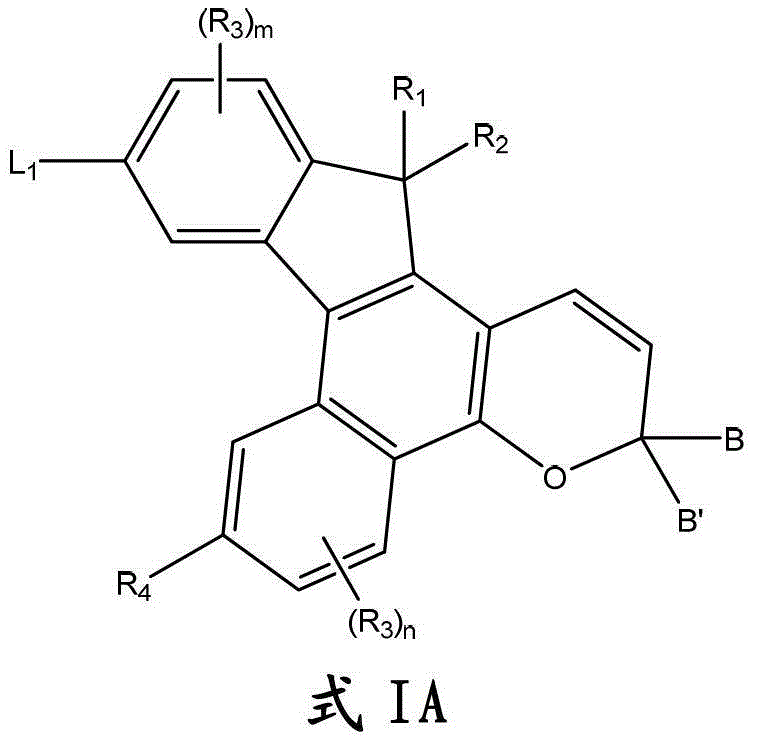
其中:in:
R1和R2各自独立地选自氢,羟基和手性或者非手性基团,该手性或者非手性基团选自任选取代的杂烷基,任选取代的烷基,任选取代的链烯基,任选取代的炔基,任选取代的芳基,任选取代的杂芳基,任选取代的环烷基,任选取代的杂环烷基,卤素,任选取代的氨基,羧基,烷基羰基,烷氧基羰基,任选取代的烷氧基和氨基羰基,或者R1和R2可以与任何间断原子一起形成选自氧代的任选取代的环烷基和任选取代的杂环烷基的基团;R and R are each independently selected from hydrogen, hydroxyl and a chiral or achiral group selected from optionally substituted heteroalkyl, optionally substituted alkyl, any Optionally substituted alkenyl, optionally substituted alkynyl, optionally substituted aryl, optionally substituted heteroaryl, optionally substituted cycloalkyl, optionally substituted heterocycloalkyl, halogen, optionally Substituted amino, carboxyl, alkylcarbonyl, alkoxycarbonyl, optionally substituted alkoxy and aminocarbonyl, or R and R can be taken together with any interrupting atom to form an optionally substituted cycloalkane selected from oxo and optionally substituted heterocycloalkyl groups;
R3在每个出现处独立地选自手性或者非手性基团,该手性或者非手性基团选自甲酰基,烷基羰基,烷氧基羰基,氨基羰基,芳基羰基,芳氧基羰基,氨基羰氧基,烷氧基羰基氨基,芳氧基羰基氨基,硼酸,硼酸酯,环烷氧基羰基氨基,杂环烷氧基羰基氨基,杂芳氧基羰基氨基,任选取代的烷基,任选取代的链烯基,任选取代的炔基,卤素,任选取代的环烷基,任选取代的芳基,任选取代的杂芳基,任选取代的烷氧基,任选取代的杂烷基,任选取代的杂环烷基和任选取代的氨基; R at each occurrence is independently selected from chiral or achiral groups selected from formyl, alkylcarbonyl, alkoxycarbonyl, aminocarbonyl, arylcarbonyl, Aryloxycarbonyl, Aminocarbonyloxy, Alkoxycarbonylamino, Aryloxycarbonylamino, Boronic Acid, Boronic Ester, Cycloalkoxycarbonylamino, Heterocycloalkoxycarbonylamino, Heteroaryloxycarbonylamino, Optionally substituted alkyl, optionally substituted alkenyl, optionally substituted alkynyl, halogen, optionally substituted cycloalkyl, optionally substituted aryl, optionally substituted heteroaryl, optionally substituted Alkoxy, optionally substituted heteroalkyl, optionally substituted heterocycloalkyl and optionally substituted amino;
R4选自氢、R3和L2;R 4 is selected from hydrogen, R 3 and L 2 ;
m和n各自独立地选自0-3的整数;m and n are each independently selected from an integer of 0-3;
B和B’各自独立地选自L3,氢,卤素,和手性或者非手性基团,该手性或者非手性基团选自金属茂基,任选取代的烷基,任选取代的链烯基,任选取代的炔基,任选取代的杂烷基,任选取代的烷氧基,任选取代的芳基,任选取代的杂芳基,任选取代的杂环烷基和任选取代的环烷基,或者其中B和B’与任何间隔原子一起形成选自任选取代的环烷基和任选取代的杂环烷基的基团;和B and B' are each independently selected from L 3 , hydrogen, halogen, and chiral or achiral groups selected from metallocene, optionally substituted alkyl, optionally substituted Alkenyl, optionally substituted alkynyl, optionally substituted heteroalkyl, optionally substituted alkoxy, optionally substituted aryl, optionally substituted heteroaryl, optionally substituted heterocycloalkane and optionally substituted cycloalkyl, or wherein B and B' together with any spacer atoms form a group selected from optionally substituted cycloalkyl and optionally substituted heterocycloalkyl; and
L1,L2和L3在每个出现处独立地选自下式所示的手性或者非手性加长基团:L 1 , L 2 and L 3 are independently selected from chiral or achiral elongating groups represented by the following formula at each occurrence:
-[S1]c-[Q1-[S2]d]d’-[Q2-[S3]e]e’-[Q3-[4]f]f’-S5-P其中:-[S 1 ] c -[Q 1 -[S 2 ] d ] d '-[Q 2 -[S 3 ] e ] e '-[Q 3 -[ 4 ] f ] f '-S 5 -P where :
(a)Q1,Q2和Q3在每个出现处独立地选自二价基团,该基团选自任选取代的芳基,任选取代的杂芳基,任选取代的环烷基和任选取代的杂环烷基;(a) Q 1 , Q 2 and Q 3 are independently selected at each occurrence from a divalent group selected from optionally substituted aryl, optionally substituted heteroaryl, optionally substituted ring Alkyl and optionally substituted heterocycloalkyl;
其中取代基独立地选自P,液晶介晶,卤素,聚(C1-C18烷氧基),C1-C18烷氧基羰基,C1-C18烷基羰基,C1-C18烷氧基羰氧基,芳氧基羰氧基,全氟(C1-C18)烷氧基,全氟(C1-C18)烷氧基羰基,全氟(C1-C18)烷基羰基,全氟(C1-C18)烷基氨基,二(全氟(C1-C18)烷基)氨基,全氟(C1-C18)烷基硫,C1-C18烷基硫,C1-C18乙酰基,C3-C10环烷基,C3-C10环烷氧基,直链C1-C18烷基和支化的C1-C18烷基;wherein the substituents are independently selected from P, liquid crystal mesogen, halogen, poly(C 1 -C 18 alkoxy), C 1 -C 18 alkoxycarbonyl, C 1 -C 18 alkylcarbonyl, C 1 -C 18 Alkoxycarbonyloxy, aryloxycarbonyloxy, perfluoro(C 1 -C 18 )alkoxy, perfluoro(C 1 -C 18 )alkoxycarbonyl, perfluoro(C 1 -C 18 )alkylcarbonyl, perfluoro(C 1 -C 18 )alkylamino, di(perfluoro(C 1 -C 18 )alkyl)amino, perfluoro(C 1 -C 18 )alkylthio, C 1 - C 18 alkylthio, C 1 -C 18 acetyl, C 3 -C 10 cycloalkyl, C 3 -C 10 cycloalkoxy, straight chain C 1 -C 18 alkyl and branched C 1 -C 18 alkyl;
其中所述直链C1-C18烷基和支化的C1-C18烷基是用选自氰基,卤素和C1-C18烷氧基的基团单取代的;或者wherein said straight chain C 1 -C 18 alkyl and branched C 1 -C 18 alkyl are monosubstituted with a group selected from cyano, halogen and C 1 -C 18 alkoxy; or
其中所述直链C1-C18烷基和支化的C1-C18烷基是独立地选自卤素,-M(T)(t-1)和-M(OT)(t-1)的至少两个基团多取代的,其中M选自铝,锑,钽,钛,锆和硅,T选自有机官能化基团,有机官能化烃基,脂肪族烃基和芳族烃基,和t是M的价态;Wherein said linear C 1 -C 18 alkyl and branched C 1 -C 18 alkyl are independently selected from halogen, -M (T) (t-1) and -M (OT) (t-1 ) is polysubstituted by at least two groups, wherein M is selected from aluminum, antimony, tantalum, titanium, zirconium and silicon, T is selected from organofunctional groups, organofunctional hydrocarbyl groups, aliphatic hydrocarbyl groups and aromatic hydrocarbyl groups, and t is the valence of M;
(b)c,d,e和f各自独立地选自1-20的整数;和每个S1,S2,S3,S4和S5在每个出现处独立地选自间隔单元,该间隔单元选自:(b) c, d, e and f are each independently selected from integers from 1 to 20; and each S 1 , S 2 , S 3 , S 4 and S 5 are independently selected from spacer units at each occurrence, The spacer unit is selected from:
(i)任选取代的亚烷基,任选取代的卤代亚烷基,-Si(CH2)g-和-(Si[(CH3)2]O)h-,其中g在每个出现处独立地选自1-20的整数;h在每个出现处独立地选自1-16的整数;和用于亚烷基和卤代亚烷基的所述取代基独立地选自C1-C18烷基,C3-C10环烷基和芳基;(i) optionally substituted alkylene, optionally substituted haloalkylene, -Si(CH 2 ) g - and -(Si[(CH 3 ) 2 ]O) h -, wherein g is in each H is independently selected from an integer from 1 to 20 at each occurrence; h is independently selected from an integer from 1 to 16 at each occurrence; and the substituents for alkylene and haloalkylene are independently selected from C 1 -C 18 alkyl, C 3 -C 10 cycloalkyl and aryl;
(ii)-N(Z)-,-C(Z)=C(Z)-,-C(Z)=N-,-C(Z’)2-C(Z’)2-和单键,其中Z在每个出现处独立地选自氢,C1-C18烷基,C3-C10环烷基和芳基,和Z’在每个出现处独立地选自C1-C18烷基,C3-C10环烷基和芳基;和(ii) -N(Z)-, -C(Z)=C(Z)-, -C(Z)=N-, -C(Z') 2 -C(Z') 2 - and single bonds, wherein Z at each occurrence is independently selected from hydrogen, C 1 -C 18 alkyl, C 3 -C 10 cycloalkyl and aryl, and Z' at each occurrence is independently selected from C 1 -C 18 Alkyl, C 3 -C 10 cycloalkyl and aryl; and
(iii)-O-,-C(=O)-,-C≡C-,-N=N-,-S-,-S(=O)-,-(O=)S(=O)-,-(O=)S(=O)O-,-O(O=)S(=O)O-和直链或者支化的C1-C24亚烷基残基,所述C1-C24亚烷基残基是未取代的,用氰基或者卤素单取代的,或者用卤素多取代的,(iii) -O-, -C(=O)-, -C≡C-, -N=N-, -S-, -S(=O)-, -(O=)S(=O)- , -(O=)S(=O)O-, -O(O=)S(=O)O- and straight-chain or branched C 1 -C 24 alkylene residues, the C 1 - The C 24 alkylene residue is unsubstituted, monosubstituted with cyano or halogen, or polysubstituted with halogen,
条件是当包含杂原子的两个间隔单元连接在一起时,该间隔单元的连接使得第一间隔单元的杂原子不直接连接到第二间隔单元的杂原子上,和provided that when two spacer units comprising heteroatoms are linked together, the spacer units are linked such that the heteroatom of the first spacer unit is not directly attached to the heteroatom of the second spacer unit, and
条件是当S1和S5分别连接到式I和P上,它们的连接使得两个杂原子不彼此直接连接;The proviso is that when S and S are attached to formulas I and P respectively, they are attached such that the two heteroatoms are not directly attached to each other;
(c)P在每个出现处独立地选自羟基,氨基,C2-C18链烯基,C2-C18炔基,叠氮基,甲硅烷基,甲硅烷氧基,甲硅烷基氢化物,(四氢-2H-吡喃-2-基)氧基,硫代,异氰酸酯基,硫代异氰酸酯基,丙烯酰氧基,甲基丙烯酰氧基,2-(丙烯酰氧基)乙基氨基甲酰基,2-(甲基丙烯酰氧基)乙基氨基甲酰基,吖丙啶基,烯丙氧基羰氧基,环氧基,羧酸,羧酸酯,丙烯酰氨基,甲基丙烯酰氨基,氨基羰基,C1-C18烷基氨基羰基,氨基羰基(C1-C18)烷基,C1-C18烷氧基羰氧基,卤羰基,氢,芳基,羟基(C1-C18)烷基,C1-C18烷基,C1-C18烷氧基,氨基(C1-C18)烷基,C1-C18烷基氨基,二(C1-C18)烷基氨基,C1-C18烷基(C1-C18)烷氧基,C1-C18烷氧基(C1-C18)烷氧基,硝基,聚(C1-C18)烷基醚,(C1-C18)烷基(C1-C18)烷氧基(C1-C18)烷基,聚亚乙基氧基,聚亚丙基氧基,乙烯,丙烯酰基,丙烯酰氧基(C1-C18)烷基,甲基丙烯酰基,甲基丙烯酰氧基(C1-C18)烷基,2-氯丙烯酰基,2-苯基丙烯酰基,丙烯酰氧基苯基,2-氯丙烯酰氨基,2-苯基丙烯酰氨基羰基,氧杂环丁烷基,缩水甘油基,氰基,异氰酸酯基(C1-C18)烷基,衣康酸酯,乙烯基醚,乙烯基酯,苯乙烯衍生物,主链和侧链液晶聚合物,硅氧烷衍生物,乙烯亚胺衍生物,马来酸衍生物,马来酰亚胺衍生物,富马酸衍生物,未取代的肉桂酸衍生物,用至少一种的甲基,甲氧基,氰基和卤素取代的肉桂酸衍生物,和取代的或者未取代的手性或者非手性单价或者二价基团,其选自类固醇基团,类萜基团,生物碱基团及其混合物,其中该取代基独立地选自C1-C18烷基,C1-C18烷氧基,氨基,C3-C10环烷基,C1-C18烷基(C1-C18)烷氧基,氟(C1-C18)烷基,氰基,氰基(C1-C18)烷基,氰基(C1-C18)烷氧基或者其混合物,或者P是具有2-4个反应性基团的结构或者P是未取代的或者取代的开环易位聚合前体或者P是取代的或者未取代的光致变色化合物;和(c) P at each occurrence is independently selected from hydroxyl, amino, C 2 -C 18 alkenyl, C 2 -C 18 alkynyl, azido, silyl, siloxy, silyl Hydride, (tetrahydro-2H-pyran-2-yl)oxy, thio, isocyanate, thioisocyanate, acryloyloxy, methacryloyloxy, 2-(acryloyloxy) Ethylcarbamoyl, 2-(methacryloyloxy)ethylcarbamoyl, aziridinyl, allyloxycarbonyloxy, epoxy, carboxylic acid, carboxylate, acrylamido, Methacrylamino, aminocarbonyl, C 1 -C 18 alkylaminocarbonyl, aminocarbonyl(C 1 -C 18 )alkyl, C 1 -C 18 alkoxycarbonyloxy, halocarbonyl, hydrogen, aryl , hydroxy(C 1 -C 18 )alkyl, C 1 -C 18 alkyl, C 1 -C 18 alkoxy, amino(C 1 -C 18 )alkyl, C 1 -C 18 alkylamino, di (C 1 -C 18 )alkylamino, C 1 -C 18 alkyl(C 1 -C 18 )alkoxy, C 1 -C 18 alkoxy(C 1 -C 18 )alkoxy, nitro , poly(C 1 -C 18 )alkyl ether, (C 1 -C 18 )alkyl(C 1 -C 18 )alkoxy(C 1 -C 18 )alkyl, polyethyleneoxy, poly Propyleneoxy, ethylene, acryloyl, acryloyloxy(C 1 -C 18 )alkyl, methacryloyl, methacryloyloxy(C 1 -C 18 )alkyl, 2-chloropropene Acyl, 2-phenylacryloyl, acryloyloxyphenyl, 2-chloroacryloylamino, 2-phenylacryloylaminocarbonyl, oxetanyl, glycidyl, cyano, isocyanate (C 1 -C 18 ) alkyl, itaconate, vinyl ether, vinyl ester, styrene derivatives, main chain and side chain liquid crystal polymers, siloxane derivatives, ethyleneimine derivatives, maleic acid derivatives, maleimide derivatives, fumaric acid derivatives, unsubstituted cinnamic acid derivatives, cinnamic acid derivatives substituted with at least one of methyl, methoxy, cyano and halogen, and substituted or unsubstituted chiral or achiral monovalent or divalent groups selected from steroid groups, terpenoid groups, alkaloid groups and mixtures thereof, wherein the substituents are independently selected from C 1 -C 18 alkyl, C 1 -C 18 alkoxy, amino, C 3 -C 10 cycloalkyl, C 1 -C 18 alkyl (C 1 -C 18 )alkoxy, fluorine (C 1 -C 18 ) Alkyl, cyano, cyano(C 1 -C 18 )alkyl, cyano(C 1 -C 18 )alkoxy or mixtures thereof, or P is a structure with 2-4 reactive groups or P is an unsubstituted or substituted ring-opening metathesis polymer precursor or P is a substituted or unsubstituted photochromic compound; and
(d)d’,e’和f’各自独立地选自0、1、2、3和4,条件是d’+e’+f’之和是至少2。(d) d', e' and f' are each independently selected from 0, 1, 2, 3 and 4, with the proviso that the sum of d'+e'+f' is at least 2.
关于式IA,R1和R2各自独立地可以选自氢,羟基,和手性和非手性基团,该手性和非手性基团选自任选取代的杂烷基,任选取代的烷基,任选取代的芳基,任选取代的杂芳基,任选取代的环烷基卤素,任选取代的氨基,羧基,烷基羰基,烷氧基羰基,任选取代的烷氧基和氨基羰基或者R1和R2可以与任何间断原子一起形成选自氧代的任选取代的环烷基和任选取代的杂环烷基的基团;With respect to formula IA, R and R may each independently be selected from hydrogen, hydroxyl, and chiral and achiral groups selected from optionally substituted heteroalkyl, optionally Substituted alkyl, optionally substituted aryl, optionally substituted heteroaryl, optionally substituted cycloalkylhalogen, optionally substituted amino, carboxy, alkylcarbonyl, alkoxycarbonyl, optionally substituted Alkoxy and aminocarbonyl or R and R may be taken together with any intervening atoms to form a group selected from oxo optionally substituted cycloalkyl and optionally substituted heterocycloalkyl;
R3在每个出现处独立地可以选自甲酰基,烷基羰基,烷氧基羰基,氨基羰基,芳基羰基,芳氧基羰基,任选取代的烷基,硼酸酯,卤素,任选取代的环烷基,任选取代的芳基,任选取代的烷氧基,任选取代的杂烷基,任选取代的杂环烷基和任选取代的氨基; R independently at each occurrence may be selected from formyl, alkylcarbonyl, alkoxycarbonyl, aminocarbonyl, arylcarbonyl, aryloxycarbonyl, optionally substituted alkyl, borate, halogen, any Optionally substituted cycloalkyl, optionally substituted aryl, optionally substituted alkoxy, optionally substituted heteroalkyl, optionally substituted heterocycloalkyl and optionally substituted amino;
m和n各自独立地可以选自0-2的整数;m and n each independently may be selected from an integer of 0-2;
B和B’各自独立地可以选自L3,氢,卤素,手性或者非手性基团,该手性或者非手性基团选自任选取代的烷基,任选取代的链烯基,任选取代的杂烷基,任选取代的烷氧基,任选取代的芳基,任选取代的杂芳基,和任选取代的环烷基,或者其中B和B’与任何间隔原子一起形成选自任选取代的环烷基和任选取代的杂环烷基的基团;B and B' can each independently be selected from L 3 , hydrogen, halogen, chiral or achiral groups selected from optionally substituted alkyl, optionally substituted alkenes radical, optionally substituted heteroalkyl, optionally substituted alkoxy, optionally substituted aryl, optionally substituted heteroaryl, and optionally substituted cycloalkyl, or wherein B and B' are associated with any The spacer atoms together form a group selected from optionally substituted cycloalkyl and optionally substituted heterocycloalkyl;
L1,L2和L3在每个出现处独立地可以选自下式所示的手性或者非手性加长基团:L 1 , L 2 and L 3 can be independently selected from chiral or achiral elongating groups represented by the following formula at each occurrence:
-[S1]c-[Q1-[S2]d]d’-[Q2-[S3]e]e’-[Q3-[S4]f]f’-S5-P其中:(a)Q1,Q2,和Q3在每个出现处独立地选自二价基团,其选自任选取代的芳基和任选取代的杂芳基,任选取代的环烷基和任选的任选取代的杂环烷基;-[S 1 ] c -[Q 1 -[S 2 ] d ] d '-[Q 2 -[S 3 ] e ] e '-[Q 3 -[S 4 ] f ] f '-S 5 -P wherein: (a) Q 1 , Q 2 , and Q 3 at each occurrence are independently selected from divalent groups selected from optionally substituted aryl and optionally substituted heteroaryl, optionally substituted Cycloalkyl and optionally optionally substituted heterocycloalkyl;
其中取代基独立地选自P,液晶介晶,卤素,聚(C1-C12烷氧基),C1-C12烷氧基羰基,C1-C12烷基羰基,全氟(C1-C12)烷氧基,全氟(C1-C12)烷氧基羰基,全氟(C1-C12)烷基羰基,C1-C18乙酰基,C3-C7环烷基,C3-C7环烷氧基,直链C1-C12烷基和支化的C1-C12烷基,wherein the substituents are independently selected from P, liquid crystal mesogen, halogen, poly(C 1 -C 12 alkoxy), C 1 -C 12 alkoxycarbonyl, C 1 -C 12 alkylcarbonyl, perfluoro(C 1 -C 12 )alkoxy, perfluoro(C 1 -C 12 )alkoxycarbonyl, perfluoro(C 1 -C 12 )alkylcarbonyl, C 1 -C 18 acetyl, C 3 -C 7 ring Alkyl, C 3 -C 7 cycloalkoxy, straight chain C 1 -C 12 alkyl and branched C 1 -C 12 alkyl,
其中所述直链C1-C12烷基和支化的C1-C12烷基是用选自卤素,C1-C12烷氧基的基团单取代的,或者wherein said straight chain C 1 -C 12 alkyl and branched C 1 -C 12 alkyl are monosubstituted with a group selected from halogen, C 1 -C 12 alkoxy, or
其中所述直链C1-C12烷基和支化的C1-C12烷基是用独立地选自卤素的至少两个基团多取代的;Wherein said straight chain C 1 -C 12 alkyl and branched C 1 -C 12 alkyl are multi-substituted with at least two groups independently selected from halogen;
(b)c,d,e和f各自独立地选自1-10的整数;和每个S1,S2,S3,S4和S5在每个出现处独立地选自间隔单元,该间隔单元选自:(b) c, d, e and f are each independently selected from integers from 1 to 10; and each S 1 , S 2 , S 3 , S 4 and S 5 is independently selected at each occurrence from a spacer unit, The spacer unit is selected from:
(i)取代的或者未取代的亚烷基,取代的或者未取代的卤代亚烷基,-Si(CH2)g-和-(Si[(CH3)2]O)h-,其中g在每个出现处独立地选自1-10的整数;h在每个出现处独立地选自1-8的整数;和用于亚烷基和卤代亚烷基的所述取代基独立地选自C1-C12烷基,C3-C7环烷基和苯基;(i) substituted or unsubstituted alkylene, substituted or unsubstituted haloalkylene, -Si(CH 2 ) g - and -(Si[(CH 3 ) 2 ]O) h -, where g at each occurrence is independently selected from an integer from 1 to 10; h at each occurrence is independently selected from an integer from 1 to 8; and the substituents for alkylene and haloalkylene are independently is selected from C 1 -C 12 alkyl, C 3 -C 7 cycloalkyl and phenyl;
(ii)-N(Z)-,-C(Z)=C(Z)-和单键,其中Z在每个出现处独立地选自氢,C1-C12烷基,C3-C7环烷基和苯基;和(ii) -N(Z)-, -C(Z)=C(Z)- and single bonds, wherein Z at each occurrence is independently selected from hydrogen, C 1 -C 12 alkyl, C 3 -C 7 cycloalkyl and phenyl; and
(iii)-O-,-C(=O)-,-C≡C-,-N=N-,-S-和-S(=O)-,(iii) -O-, -C(=O)-, -C≡C-, -N=N-, -S- and -S(=O)-,
条件是当包含杂原子的两个间隔单元连接在一起时,该间隔单元的连接使得第一间隔单元的杂原子不直接连接到第二间隔单元的杂原子上,和provided that when two spacer units comprising heteroatoms are linked together, the spacer units are linked such that the heteroatom of the first spacer unit is not directly attached to the heteroatom of the second spacer unit, and
条件是当S1和S5分别连接到式I和P上,它们的连接使得两个杂原子不彼此直接连接;The proviso is that when S and S are attached to formulas I and P respectively, they are attached such that the two heteroatoms are not directly attached to each other;
(c)P在每个出现处独立地选自羟基,氨基,C2-C12链烯基,C2-C12链烯基,甲硅烷基,甲硅烷氧基,(四氢-2H-吡喃-2-基)氧基,异氰酸酯基,丙烯酰氧基,甲基丙烯酰氧基,环氧基,羧酸,羧酸酯,C1-C12烷氧基羰氧基,卤羰基,氢,芳基,羟基(C1-C12)烷基,C1-C12烷基,C1-C12烷氧基,乙烯,丙烯酰基,丙烯酰氧基(C1-C12)烷基,甲基丙烯酰基,甲基丙烯酰氧基(C1-C12)烷基,氧杂环丁烷基,缩水甘油基,乙烯基醚,硅氧烷衍生物,未取代的肉桂酸衍生物,用至少一种的甲基,甲氧基,氰基和卤素取代的肉桂酸衍生物,和取代的或者未取代的手性或者非手性单价或者二价基团,其选自类固醇基团,其中每个取代基独立地选自C1-C12烷基,C1-C12烷氧基,氨基,C3-C7环烷基,C1-C12烷基(C1-C12)烷氧基或氟(C1-C12)烷基,或者P是具有2-4个反应性基团的结构;和(c) P at each occurrence is independently selected from hydroxyl, amino, C 2 -C 12 alkenyl, C 2 -C 12 alkenyl, silyl, siloxy, (tetrahydro-2H- Pyran-2-yl)oxy, isocyanate, acryloxy, methacryloxy, epoxy, carboxylic acid, carboxylate, C 1 -C 12 alkoxycarbonyloxy, halocarbonyl , hydrogen, aryl, hydroxy(C 1 -C 12 )alkyl, C 1 -C 12 alkyl, C 1 -C 12 alkoxy, ethylene, acryloyl, acryloyloxy(C 1 -C 12 ) Alkyl, Methacryl, Methacryloxy(C 1 -C 12 ) Alkyl, Oxetanyl, Glycidyl, Vinyl Ether, Silicone Derivatives, Unsubstituted Cinnamic Acid Derivatives, cinnamic acid derivatives substituted with at least one of methyl, methoxy, cyano and halogen, and substituted or unsubstituted chiral or achiral monovalent or divalent groups selected from steroids Group, wherein each substituent is independently selected from C 1 -C 12 alkyl, C 1 -C 12 alkoxy, amino, C 3 -C 7 cycloalkyl, C 1 -C 12 alkyl (C 1 -C 12 )alkoxy or fluoro(C 1 -C 12 )alkyl, or P is a structure with 2-4 reactive groups; and
(d)d’,e’和f’各自独立地选自0、1、2、3和4,条件是d’+e’+f’之和是至少2。(d) d', e' and f' are each independently selected from 0, 1, 2, 3 and 4, with the proviso that the sum of d'+e'+f' is at least 2.
此外,R1和R2各自独立地可以选自氢,羟基,和手性基团,其选自任选取代的杂烷基,任选取代的烷基,任选取代的芳基,任选取代的环烷基,卤素,羧基,烷基羰基,烷氧基羰基,任选取代的烷氧基和氨基羰基,或者R1和R2可以与任何间断原子一起形成选自氧杂和任选取代的环烷基的基团;In addition, each of R and R may independently be selected from hydrogen, hydroxyl, and a chiral group selected from optionally substituted heteroalkyl, optionally substituted alkyl, optionally substituted aryl, optionally Substituted cycloalkyl, halogen, carboxyl, alkylcarbonyl, alkoxycarbonyl, optionally substituted alkoxy and aminocarbonyl, or R and R can be taken together with any intervening atom to form a group selected from oxa and optionally a substituted cycloalkyl group;
R3在每个出现处独立地可以选自烷基羰基,烷氧基羰基,氨基羰基,任选取代的烷基,硼酸酯,卤素,任选取代的环烷基,任选取代的芳基,任选取代的烷氧基,任选取代的杂环烷基和任选取代的氨基; R independently at each occurrence may be selected from alkylcarbonyl, alkoxycarbonyl, aminocarbonyl, optionally substituted alkyl, boronate, halogen, optionally substituted cycloalkyl, optionally substituted aryl radical, optionally substituted alkoxy, optionally substituted heterocycloalkyl and optionally substituted amino;
这里m和n各自独立地选自0-2的整数;Here m and n are each independently selected from an integer of 0-2;
B和B’各自独立地选自L3、氢、手性基团选自任选取代的烷基,任选取代的链烯基,任选取代的芳基,任选取代的杂芳基,和任选取代的环烷基,或者其中B和B’与任何间隔原子一起形成基团选自任选取代的环烷基;B and B' are each independently selected from L 3 , hydrogen, a chiral group selected from optionally substituted alkyl, optionally substituted alkenyl, optionally substituted aryl, optionally substituted heteroaryl, and optionally substituted cycloalkyl, or wherein B and B' together with any spacer atoms form a group selected from optionally substituted cycloalkyl;
L1,L2和L3在每个出现处独立地选自下式所示的手性或非手性加长基团:L 1 , L 2 and L 3 are independently selected at each occurrence from chiral or achiral elongating groups represented by the formula:
-[S1]c-[Q1-[S2]d]d’-[Q2-[S3]e]e’-[Q3-[S4]f]f’-S5-P其中:-[S 1 ] c -[Q 1 -[S 2 ] d ] d '-[Q 2 -[S 3 ] e ] e '-[Q 3 -[S 4 ] f ] f '-S 5 -P in:
(a)Q1,Q2和Q3在每个出现处独立地选自二价基团,其选自任选取代的芳基和任选取代的杂芳基,任选取代的环烷基和任选的任选取代的杂环烷基;(a) Q 1 , Q 2 and Q 3 are independently selected at each occurrence from divalent groups selected from optionally substituted aryl and optionally substituted heteroaryl, optionally substituted cycloalkyl and optionally optionally substituted heterocycloalkyl;
其中取代基独立地选自P,C1-C6烷氧基羰基,全氟(C1-C6)烷氧基,C3-C7环烷基,C3-C7环烷氧基,直链C1-C6烷基和支化的C1-C6烷基,Wherein the substituents are independently selected from P, C 1 -C 6 alkoxycarbonyl, perfluoro(C 1 -C 6 ) alkoxy, C 3 -C 7 cycloalkyl, C 3 -C 7 cycloalkoxy , straight chain C 1 -C 6 alkyl and branched C 1 -C 6 alkyl,
其中所述直链C1-C6烷基和支化的C1-C6烷基是用选自卤素和C1-C12烷氧基的基团单取代的,或者wherein said straight chain C 1 -C 6 alkyl and branched C 1 -C 6 alkyl are monosubstituted with a group selected from halogen and C 1 -C 12 alkoxy, or
其中所述直链C1-C6烷基和支化的C1-C6烷基是用独立地选自卤素的至少两个基团多取代的;wherein said straight chain C 1 -C 6 alkyl and branched C 1 -C 6 alkyl are multi-substituted with at least two groups independently selected from halogen;
(b)c,d,e和f各自独立地选自1-10的整数;和每个S1,S2,S3,S4和S5在每个出现处独立地选自间隔单元,该间隔单元选自:(b) c, d, e and f are each independently selected from integers from 1 to 10; and each S 1 , S 2 , S 3 , S 4 and S 5 is independently selected at each occurrence from a spacer unit, The spacer unit is selected from:
(i)取代的或者未取代的亚烷基;(i) substituted or unsubstituted alkylene;
(ii)-N(Z)-,-C(Z)=C(Z)-和单键,其中Z在每个出现处独立地选自氢和C1-C6烷基;和(ii) -N(Z)-, -C(Z)=C(Z)- and a single bond, wherein Z at each occurrence is independently selected from hydrogen and C 1 -C 6 alkyl; and
(iii)-O-,-C(=O)-,-C≡C-和-N=N-,-S-;(iii) -O-, -C(=O)-, -C≡C- and -N=N-, -S-;
条件是当包含杂原子的两个间隔单元连接在一起时,该间隔单元的连接使得第一间隔单元的杂原子不直接连接到第二间隔单元的杂原子上,和provided that when two spacer units comprising heteroatoms are linked together, the spacer units are linked such that the heteroatom of the first spacer unit is not directly attached to the heteroatom of the second spacer unit, and
条件是当S1和S5分别连接到式I和P上,它们的连接使得两个杂原子不彼此直接连接;The proviso is that when S and S are attached to formulas I and P respectively, they are attached such that the two heteroatoms are not directly attached to each other;
(c)P在每个出现处独立地选自羟基,氨基,C2-C6链烯基,C2-C6链烯基,甲硅烷氧基,(四氢-2H-吡喃-2-基)氧基,异氰酸酯基,丙烯酰氧基,甲基丙烯酰氧基,环氧基,羧酸,羧酸酯,C1-C6烷氧基羰氧基,氢,芳基,羟基(C1-C6)烷基,C1-C6烷基,乙烯,丙烯酰基,丙烯酰氧基(C1-C12)烷基,氧杂环丁烷基,缩水甘油基,乙烯基醚,硅氧烷衍生物,和取代的或者未取代的手性或者非手性单价或者二价基团选自类固醇基团,其中每个取代基独立地选自C1-C6烷基,C1-C6烷氧基,氨基,C3-C7环烷基。(c) P at each occurrence is independently selected from hydroxyl, amino, C 2 -C 6 alkenyl, C 2 -C 6 alkenyl, silyloxy, (tetrahydro-2H-pyran-2 -yl)oxy, isocyanate, acryloxy, methacryloxy, epoxy, carboxylic acid, carboxylate, C 1 -C 6 alkoxycarbonyloxy, hydrogen, aryl, hydroxyl (C 1 -C 6 )alkyl, C 1 -C 6 alkyl, ethylene, acryloyl, acryloyloxy(C 1 -C 12 )alkyl, oxetanyl, glycidyl, vinyl ethers, siloxane derivatives, and substituted or unsubstituted chiral or achiral monovalent or divalent groups selected from steroid groups, wherein each substituent is independently selected from C 1 -C 6 alkyl, C 1 -C 6 alkoxy, amino, C 3 -C 7 cycloalkyl.
更具体的,R1和R2各自独立地可以选自甲基,乙基,丙基和丁基;R3和R4在每个出现处独立地可以选自甲基,乙基,溴,氯,氟,碘,甲氧基,乙氧基和CF3;B和B’各自独立地选自用独立地选自下面的一种或多种基团取代的苯基:芳基,杂芳基,杂环烷基,烷基,链烯基,炔基,烷氧基,卤素,氨基,烷基羰基,羧基和烷氧基羰基;和对于L1:Q1是未取代的芳基;e’是1或2;e在每个出现处是1;S3在每个出现处是单键;Q2在每个出现处独立地选自任选取代的芳基;f’是1;f是1;S4是单键;和Q3是任选取代的环烷基;S5是-(CH2)g-,其中g是1-20的整数;和P是氢。More specifically, R 1 and R 2 can each independently be selected from methyl, ethyl, propyl and butyl; R 3 and R 4 can be independently selected from methyl, ethyl, bromine, Chlorine, fluorine, iodine, methoxy, ethoxy and CF 3 ; B and B' are each independently selected from phenyl substituted with one or more groups independently selected from the following groups: aryl, heteroaryl radical, heterocycloalkyl, alkyl, alkenyl, alkynyl, alkoxy, halogen, amino, alkylcarbonyl, carboxyl and alkoxycarbonyl; and for L 1 : Q 1 is unsubstituted aryl; e' is 1 or 2; e is 1 at each occurrence; S3 is a single bond at each occurrence; Q2 is independently selected from optionally substituted aryl at each occurrence; f' is 1; f is 1; S4 is a single bond; and Q3 is optionally substituted cycloalkyl; S5 is -( CH2 ) g- , wherein g is an integer from 1 to 20; and P is hydrogen.
典型的R1和R2是甲基;R3和R4在每个出现处独立地选自甲基,溴,氯,氟,甲氧基和CF3;B和B’各自独立地选自用选自下面的一种基团取代的苯基:C1-C4烷氧基,氟,CF3,哌啶基和吗啉并;和对于L1:Q1是未取代的苯基;Q2在每个出现处是未取代的苯基;Q3是未取代的环己基;和g是5。Typically R1 and R2 are methyl; R3 and R4 are independently selected from methyl, bromo, chloro, fluoro, methoxy and CF3 at each occurrence; B and B' are each independently selected from Phenyl substituted with a group selected from: C 1 -C 4 alkoxy, fluorine, CF 3 , piperidinyl and morpholino; and for L 1 : Q 1 is unsubstituted phenyl; Q is unsubstituted phenyl at each occurrence; Q is unsubstituted cyclohexyl; and g is 5.
在本发明的化合物中,L1可以选自:In the compound of the present invention, L can be selected from:
4-[4-(4-丁基-环己基)-苯基]-环己氧基;4-[4-(4-Butyl-cyclohexyl)-phenyl]-cyclohexyloxy;
4”-丁基-[1,1’,4’,1”]三环己-4-基氧基;4”-Butyl-[1,1’,4’,1”]tricyclohex-4-yloxy;
4-[4-(4-丁基-苯基)-环己氧基羰基]-苯氧基;4-[4-(4-Butyl-phenyl)-cyclohexyloxycarbonyl]-phenoxy;
4'-(4-丁基-苯甲酰氧基)-联苯基-4-羰氧基;4'-(4-Butyl-benzoyloxy)-biphenyl-4-carbonyloxy;
4-(4-戊基-苯基偶氮)-苯基氨基甲酰基;4-(4-Pentyl-phenylazo)-phenylcarbamoyl;
4-(4-二甲基氨基-苯基偶氮)-苯基氨基甲酰基;4-(4-Dimethylamino-phenylazo)-phenylcarbamoyl;
4-[5-(4-丙基-苯甲酰氧基)-嘧啶-2-基]-苯基4-[5-(4-Propyl-benzoyloxy)-pyrimidin-2-yl]-phenyl
4-[2-(4'-甲基-联苯基-4-羰氧基)-1,2-二苯基-乙氧基羰基]-苯基;4-[2-(4'-Methyl-biphenyl-4-carbonyloxy)-1,2-diphenyl-ethoxycarbonyl]-phenyl;
4-(1,2-二苯基-2-{3-[4-(4-丙基-苯甲酰氧基)-苯基]-丙烯酰氧基}-乙氧基羰基)-苯基;4-(1,2-Diphenyl-2-{3-[4-(4-Propyl-benzoyloxy)-phenyl]-acryloyloxy}-ethoxycarbonyl)-phenyl ;
4-[4-(4-{4-[3-(6-{4-[4-(4-壬基-苯甲酰氧基)-苯氧基羰基]-苯氧基}-己氧基羰基)丙酰氧基]-苯甲酰氧基}-苯甲酰氧基)-苯基]-哌嗪-1-基;4-[4-(4-{4-[3-(6-{4-[4-(4-nonyl-benzoyloxy)-phenoxycarbonyl]-phenoxy}-hexyloxy Carbonyl)propionyloxy]-benzoyloxy}-benzoyloxy)-phenyl]-piperazin-1-yl;
4-[4-(4-{4-[4-(4-壬基-苯甲酰氧基)-苯甲酰氧基]-苯甲酰氧基}-苯甲酰氧基)-苯基]-哌嗪-1-基;4-[4-(4-{4-[4-(4-Nonyl-benzoyloxy)-benzoyloxy]-benzoyloxy}-benzoyloxy)-phenyl ]-piperazin-1-yl;
4-(4'-丙基-联苯基-4-基乙炔基)-苯基;4-(4'-Propyl-biphenyl-4-ylethynyl)-phenyl;
4-(4-氟-苯氧基羰氧基)-哌啶-1-基;4-(4-fluoro-phenoxycarbonyloxy)-piperidin-1-yl;
2-[17-(1,5-二甲基-己基)-10,13-二甲基-2,3,4,7,8,9,10,11,12,13,14,15,16,17-十四氢-1H-环五[a]菲-3-基氧基]-二氢化茚-5-基;2-[17-(1,5-Dimethyl-hexyl)-10,13-dimethyl-2,3,4,7,8,9,10,11,12,13,14,15,16 ,17-Tetradecylhydro-1H-cyclopenta[a]phenanthrene-3-yloxy]-indan-5-yl;
4-[17-(1,5-二甲基-己基)-10,13-二甲基-2,3,4,7,8,9,10,11,12,13,14,15,16,17-十四氢-1H-环五[a]菲-3-基氧基羰氧基]-哌啶-1-基;4-[17-(1,5-Dimethyl-hexyl)-10,13-dimethyl-2,3,4,7,8,9,10,11,12,13,14,15,16 ,17-Tetradecylhydro-1H-cyclopenta[a]phenanthrene-3-yloxycarbonyloxy]-piperidin-1-yl;
4-(联苯基-4-羰氧基)-哌啶-1-基;4-(biphenyl-4-carbonyloxy)-piperidin-1-yl;
4-(萘-2-羰氧基)-哌啶-1-基;4-(Naphthalene-2-carbonyloxy)-piperidin-1-yl;
4-(4-苯基氨基甲酰基-苯基氨基甲酰基)-哌啶-1-基;4-(4-Phenylcarbamoyl-phenylcarbamoyl)-piperidin-1-yl;
4-(4-(4-苯基哌啶-1-基)-苯甲酰氧基)-哌啶-1-基;4-(4-(4-phenylpiperidin-1-yl)-benzoyloxy)-piperidin-1-yl;
4-丁基-[1,1';4’,1”]三苯基-4-基;4-Butyl-[1,1'; 4',1"]triphenyl-4-yl;
4-(4-十五氟庚氧基-苯基氨基甲酰基)-苄氧基;4-(4-pentadecafluoroheptyloxy-phenylcarbamoyl)-benzyloxy;
4-(3-哌啶-4-基-丙基)-哌啶-1-基;4-(3-piperidin-4-yl-propyl)-piperidin-1-yl;
4-(4-{4-[17-(1,5-二甲基-己基)-10,13-二甲基-2,3,4,7,8,9,10,11,12,13,14,15,16,17-十四氢-1H-环五[a]菲-3-基氧基羰氧基]-苯甲酰氧基}-苯氧基羰基)苯氧基甲基;4-(4-{4-[17-(1,5-Dimethyl-hexyl)-10,13-dimethyl-2,3,4,7,8,9,10,11,12,13 ,14,15,16,17-Tetradetrahydro-1H-cyclopenta[a]phenanthrene-3-yloxycarbonyloxy]-benzoyloxy}-phenoxycarbonyl)phenoxymethyl;
4-[4-(4-环己基-苯基氨基甲酰基)-苄氧基]-哌啶-1-基;4-[4-(4-cyclohexyl-phenylcarbamoyl)-benzyloxy]-piperidin-1-yl;
4-[4-(4-环己基-苯基氨基甲酰基)-苯甲酰氧基]-哌啶-1-基;4-[4-(4-Cyclohexyl-phenylcarbamoyl)-benzoyloxy]-piperidin-1-yl;
N-{4-[(4-戊基-亚苄基)-氨基]-苯基}-乙酰氨基;N-{4-[(4-Pentyl-benzylidene)-amino]-phenyl}-acetylamino;
4-(3-哌啶-4-基-丙基)-哌啶-1-基;4-(3-piperidin-4-yl-propyl)-piperidin-1-yl;
4-(4-己氧基-苯甲酰氧基)-哌啶-1-基;4-(4-hexyloxy-benzoyloxy)-piperidin-1-yl;
4-(4'-己氧基-联苯基-4-羰氧基)-哌啶-1-基;4-(4'-hexyloxy-biphenyl-4-carbonyloxy)-piperidin-1-yl;
4-(4-丁基-苯基氨基甲酰基)-哌啶-1-基;4-(4-Butyl-phenylcarbamoyl)-piperidin-1-yl;
4-[4-[4-[4-哌啶基-4-氧]-苯基]苯氧基]哌啶-4-基;4-[4-[4-[4-piperidinyl-4-oxo]-phenyl]phenoxy]piperidin-4-yl;
4-(4-(9-(4-丁基苯基)-2,4,8,10-四氧杂螺[5.5]十一烷-3-基)苯基)哌嗪-1-基;4-(4-(9-(4-butylphenyl)-2,4,8,10-tetraoxaspiro[5.5]undec-3-yl)phenyl)piperazin-1-yl;
4-(6-(4-丁基苯基)羰氧基-(4,8-二氧杂双环[3.3.0]辛-2-基))氧羰基)苯基;4-(6-(4-butylphenyl)carbonyloxy-(4,8-dioxabicyclo[3.3.0]oct-2-yl))oxycarbonyl)phenyl;
1-{4-[5-(4-丁基-苯基)-[1,3]二噁烷-2-基]-苯基}-4-甲基-哌嗪-1-基;1-{4-[5-(4-butyl-phenyl)-[1,3]dioxan-2-yl]-phenyl}-4-methyl-piperazin-1-yl;
4-(7-(4-丙基苯基羰氧基)双环[3.3.0]辛-2-基)氧羰基)苯基;4-(7-(4-Propylphenylcarbonyloxy)bicyclo[3.3.0]oct-2-yl)oxycarbonyl)phenyl;
4-[17-(1,5-二甲基-己基)-10,13-二甲基-2,3,4,7,8,9,10,11,12,13,14,15,16,17-十四氢-1H-环五[a]菲-3-基氧基羰氧基;4-[17-(1,5-Dimethyl-hexyl)-10,13-dimethyl-2,3,4,7,8,9,10,11,12,13,14,15,16 ,17-Tetradecylhydro-1H-cyclopenta[a]phenanthrene-3-yloxycarbonyloxy;
(4-反式-(4-戊基环己基)苯甲酰氨基)苯基;(4-trans-(4-pentylcyclohexyl)benzamido)phenyl;
(4-(4-反式-(4-戊基环己基)苯氧基)羰基)苯基;(4-(4-trans-(4-pentylcyclohexyl)phenoxy)carbonyl)phenyl;
4-(4-(4-反式-(4-戊基环己基)苯基)苯甲酰氨基)苯基;4-(4-(4-trans-(4-pentylcyclohexyl)phenyl)benzamido)phenyl;
4-((反式-(4'-戊基-[1,1'-双(环己)]-4-基)氧基)羰基)苯基;4-((trans-(4'-pentyl-[1,1'-bis(cyclohexyl)]-4-yl)oxy)carbonyl)phenyl;
4-(4'-(4-戊基环己基)-[1,1'-联苯基]-4-基甲酰胺基)苯基;4-(4'-(4-pentylcyclohexyl)-[1,1'-biphenyl]-4-ylcarboxamido)phenyl;
4-((4'-(4-戊基环己基)-[1,1'-联苯基]-4-羰基)氧基)苯甲酰氨基;4-((4'-(4-pentylcyclohexyl)-[1,1'-biphenyl]-4-carbonyl)oxy)benzamido;
4-(4'-(4-戊基环己基)-[1,1'-联苯基]-4-羰基)哌嗪-1-基;4-(4'-(4-pentylcyclohexyl)-[1,1'-biphenyl]-4-carbonyl)piperazin-1-yl;
4-(4-(4-反式-(4-戊基环己基)苯基)苯甲酰氨基)-2-(三氟甲基)苯基;4-(4-(4-trans-(4-pentylcyclohexyl)phenyl)benzamido)-2-(trifluoromethyl)phenyl;
2-甲基-4-反式-(4-((4'-反式-(4-戊基环己基)联苯基-4-氧基)羰基)环己烷甲酰胺基)苯基;2-Methyl-4-trans-(4-((4'-trans-(4-pentylcyclohexyl)biphenyl-4-oxyl)carbonyl)cyclohexanecarboxamido)phenyl;
4'-(4'-戊基双(环己烷-4-)羰氧基)联苯基羰氧基;4'-(4'-pentylbis(cyclohexane-4-)carbonyloxy)biphenylcarbonyloxy;
4-(((3S,8S,9S,10R,13R,14S,17R)-10,13-二甲基-17-((R)-6-甲基庚-2-基)-2,3,4,7,8,9,10,11,12,13,14,15,16,17-十四氢-1H-环五[a]菲-3-基氧基)羰基)哌嗪-1-基;和4-(((3S,8S,9S,10R,13R,14S,17R)-10,13-dimethyl-17-((R)-6-methylhept-2-yl)-2,3, 4,7,8,9,10,11,12,13,14,15,16,17-tetrahydro-1H-cyclopenta[a]phenanthrene-3-yloxy)carbonyl)piperazine-1- base; and
4-((S)-2-甲基丁氧基)苯基)-10-(4-(((3R,3aS,6S,6aS)-6-(4'-反式-(4-戊基环己基)联苯基羰氧基)六氢呋喃并[3,2-b]呋喃-3-基氧基)羰基)苯基。4-((S)-2-methylbutoxy)phenyl)-10-(4-(((3R,3aS,6S,6aS)-6-(4'-trans-(4-pentyl cyclohexyl)biphenylcarbonyloxy)hexahydrofuro[3,2-b]furan-3-yloxy)carbonyl)phenyl.
更具体的,此处所述化合物可以选自:More specifically, the compounds described herein can be selected from:
3,3-双(4-甲氧基苯基)-10-[4-(4-(反式-4-戊基环己基)苯甲酰氨基)苯基]-13,13-二甲基-12-溴-3,13-二氢-茚并[2′,3′:3,4]萘并[1,2-b]吡喃;3,3-bis(4-methoxyphenyl)-10-[4-(4-(trans-4-pentylcyclohexyl)benzamido)phenyl]-13,13-dimethyl -12-bromo-3,13-dihydro-indeno[2′,3′:3,4]naphtho[1,2-b]pyran;
3,3-双(4-甲氧基苯基)-10-[4-((4-(反式-4-戊基环己基)苯氧基)羰基)苯基]-6,13,13-三甲基-3,13-二氢-茚并[2′,3′:3,4]萘并[1,2-b]吡喃;3,3-bis(4-methoxyphenyl)-10-[4-((4-(trans-4-pentylcyclohexyl)phenoxy)carbonyl)phenyl]-6,13,13 - Trimethyl-3,13-dihydro-indeno[2′,3′:3,4]naphtho[1,2-b]pyran;
3-(4-氟苯基)-3-(4-哌啶并苯基)-10-[4-(4-(4-(反式-4-戊基环己基)苯基)苯甲酰氨基)苯基]-6-三氟甲基-11,13,13-三甲基-3,13-二氢-茚并[2′,3′:3,4]萘并[1,2-b]吡喃;3-(4-fluorophenyl)-3-(4-piperidophenyl)-10-[4-(4-(4-(trans-4-pentylcyclohexyl)phenyl)benzoyl Amino)phenyl]-6-trifluoromethyl-11,13,13-trimethyl-3,13-dihydro-indeno[2′,3′:3,4]naphtho[1,2- b] pyran;
3,3-双(4-甲氧基苯基)-10-[4-(4-(反式-4-戊基环己基)苯甲酰氨基)苯基]-5,7-二氟-13,13-二甲基-3,13-二氢-茚并[2′,3′:3,4]萘并[1,2-b]吡喃;3,3-bis(4-methoxyphenyl)-10-[4-(4-(trans-4-pentylcyclohexyl)benzamido)phenyl]-5,7-difluoro- 13,13-Dimethyl-3,13-dihydro-indeno[2′,3′:3,4]naphtho[1,2-b]pyran;
3-(4-甲氧基苯基)-3-(4-哌啶并苯基)-10-[4-(4-(4-(反式-4-戊基环己基)苯基)苯甲酰氨基)苯基]-5,7-二氟-13,13-二甲基-3,13-二氢-茚并[2′,3′:3,4]萘并[1,2-b]吡喃;3-(4-methoxyphenyl)-3-(4-piperidophenyl)-10-[4-(4-(4-(trans-4-pentylcyclohexyl)phenyl)benzene Formamido)phenyl]-5,7-difluoro-13,13-dimethyl-3,13-dihydro-indeno[2′,3′:3,4]naphtho[1,2- b] pyran;
3-(4-甲氧基苯基)-3-(4-吗啉代苯基)-10-[4-(4-(4-(反式-4-戊基环己基)苯基)苯甲酰氨基)苯基]-5,7-二氟-13,13-二甲基-3,13-二氢-茚并[2′,3′:3,4]萘并[1,2-b]吡喃;3-(4-methoxyphenyl)-3-(4-morpholinophenyl)-10-[4-(4-(4-(trans-4-pentylcyclohexyl)phenyl)benzene Formamido)phenyl]-5,7-difluoro-13,13-dimethyl-3,13-dihydro-indeno[2′,3′:3,4]naphtho[1,2- b] pyran;
3-(4-氟苯基)-3-(4-哌啶并苯基)-10-[4-((4-(反式-4-戊基环己基)苯氧基)羰基)苯基]-12-溴-5,7-二氟-13,13-二甲基-3,13-二氢-茚并[2′,3′:3,4]萘并[1,2-b]吡喃;3-(4-fluorophenyl)-3-(4-piperidophenyl)-10-[4-((4-(trans-4-pentylcyclohexyl)phenoxy)carbonyl)phenyl ]-12-bromo-5,7-difluoro-13,13-dimethyl-3,13-dihydro-indeno[2′,3′:3,4]naphtho[1,2-b] pyran;
3-苯基-3-(4-哌啶并苯基)-10-[4-(4-(4-(反式-4-戊基环己基)苯基)苯甲酰氨基)苯基]-12-溴-5,7-二氟-13,13-二甲基-3,13-二氢-茚并[2′,3′:3,4]萘并[1,2-b]吡喃;3-Phenyl-3-(4-piperidophenyl)-10-[4-(4-(4-(trans-4-pentylcyclohexyl)phenyl)benzamido)phenyl] -12-Bromo-5,7-difluoro-13,13-dimethyl-3,13-dihydro-indeno[2′,3′:3,4]naphtho[1,2-b]pyridine mutter;
3-苯基-3-(4-哌啶并苯基)-10-[4-((4-(反式-4-戊基环己基)苯氧基)羰基)苯基]-12-溴-5,7-二氟-13,13-二甲基-3,13-二氢-茚并[2′,3′:3,4]萘并[1,2-b]吡喃;3-Phenyl-3-(4-piperidophenyl)-10-[4-((4-(trans-4-pentylcyclohexyl)phenoxy)carbonyl)phenyl]-12-bromo -5,7-difluoro-13,13-dimethyl-3,13-dihydro-indeno[2′,3′:3,4]naphtho[1,2-b]pyran;
3-(4-氟苯基)-3-(4-哌啶并苯基)-10-[4-(4-(4-(反式-4-戊基环己基)苯基)苯甲酰氨基)苯基]-12-溴-13,13-二甲基-3,13-二氢-茚并[2′,3′:3,4]萘并[1,2-b]吡喃;3-(4-fluorophenyl)-3-(4-piperidophenyl)-10-[4-(4-(4-(trans-4-pentylcyclohexyl)phenyl)benzoyl Amino)phenyl]-12-bromo-13,13-dimethyl-3,13-dihydro-indeno[2′,3′:3,4]naphtho[1,2-b]pyran;
3,3-双(4-甲氧基苯基)-10-[4-(4-(4-(反式-4-戊基环己基)苯基)苯甲酰氨基)苯基]-12-溴-6,7-二甲氧基-11,13,13-三甲基-3,13-二氢-茚并[2′,3′:3,4]萘并[1,2-b]吡喃;3,3-bis(4-methoxyphenyl)-10-[4-(4-(4-(trans-4-pentylcyclohexyl)phenyl)benzamido)phenyl]-12 -Bromo-6,7-dimethoxy-11,13,13-trimethyl-3,13-dihydro-indeno[2′,3′:3,4]naphtho[1,2-b ]pyran;
3,3-双(4-甲氧基苯基)-10-[4-(4-(4-(反式-4-戊基环己基)苯基)苯甲酰氨基)苯基]-6-三氟甲基-12-溴-13,13-二甲基-3,13-二氢-茚并[2′,3′:3,4]萘并[1,2-b]吡喃;3,3-bis(4-methoxyphenyl)-10-[4-(4-(4-(trans-4-pentylcyclohexyl)phenyl)benzamido)phenyl]-6 - Trifluoromethyl-12-bromo-13,13-dimethyl-3,13-dihydro-indeno[2′,3′:3,4]naphtho[1,2-b]pyran;
3,3-双(4-甲氧基苯基)-10,12-双[4-(4-(4-(反式-4-戊基环己基)苯基)苯甲酰氨基)苯基]-6-三氟甲基-13,13-二甲基-3,13-二氢-茚并[2′,3′:3,4]萘并[1,2-b]吡喃;3,3-bis(4-methoxyphenyl)-10,12-bis[4-(4-(4-(trans-4-pentylcyclohexyl)phenyl)benzamido)phenyl ]-6-trifluoromethyl-13,13-dimethyl-3,13-dihydro-indeno[2′,3′:3,4]naphtho[1,2-b]pyran;
3,3-双(4-甲氧基苯基)-10-[4-(4-(4-(反式-4-戊基环己基)苯基)苯甲酰氨基)苯基]-5,7-二氟-13,13-二甲基-3,13-二氢-茚并[2′,3′:3,4]萘并[1,2-b]吡喃;3,3-bis(4-methoxyphenyl)-10-[4-(4-(4-(trans-4-pentylcyclohexyl)phenyl)benzamido)phenyl]-5 ,7-difluoro-13,13-dimethyl-3,13-dihydro-indeno[2′,3′:3,4]naphtho[1,2-b]pyran;
3,3-双(4-甲氧基苯基)-10-[4-(4-(4-(反式-4-戊基环己基)苯基)苯甲酰氨基)苯基]-6-三氟甲基-13,13-二甲基-3,13-二氢-茚并[2′,3′:3,4]萘并[1,2-b]吡喃;3,3-bis(4-methoxyphenyl)-10-[4-(4-(4-(trans-4-pentylcyclohexyl)phenyl)benzamido)phenyl]-6 - Trifluoromethyl-13,13-dimethyl-3,13-dihydro-indeno[2′,3′:3,4]naphtho[1,2-b]pyran;
3,3-双(4-甲氧基苯基)-10-[4-(4-(4-(反式-4-戊基环己基)苯基)苯甲酰氨基)苯基]-5,7-二氟-12-溴-13,13-二甲基-3,13-二氢-茚并[2′,3′:3,4]萘并[1,2-b]吡喃;3,3-bis(4-methoxyphenyl)-10-[4-(4-(4-(trans-4-pentylcyclohexyl)phenyl)benzamido)phenyl]-5 ,7-difluoro-12-bromo-13,13-dimethyl-3,13-dihydro-indeno[2′,3′:3,4]naphtho[1,2-b]pyran;
3-(4-氟苯基)-3-(4-吗啉代苯基)-10-[4-(4-(4-(反式-4-戊基环己基)苯基)苯甲酰氨基)苯基]-6-三氟甲基-13-甲基-13-丁基-3,13-二氢-茚并[2′,3′:3,4]萘并[1,2-b]吡喃;3-(4-fluorophenyl)-3-(4-morpholinophenyl)-10-[4-(4-(4-(trans-4-pentylcyclohexyl)phenyl)benzoyl Amino)phenyl]-6-trifluoromethyl-13-methyl-13-butyl-3,13-dihydro-indeno[2′,3′:3,4]naphtho[1,2- b] pyran;
3-(4-氟苯基)-3-(4-吗啉代苯基)-10-[4-(4-(4-(反式-4-戊基环己基)苯基)苯甲酰氨基)苯基]-5,7-二氟-12-溴-13,13-二甲基-3,13-二氢-茚并[2′,3′:3,4]萘并[1,2-b]吡喃;3-(4-fluorophenyl)-3-(4-morpholinophenyl)-10-[4-(4-(4-(trans-4-pentylcyclohexyl)phenyl)benzoyl Amino)phenyl]-5,7-difluoro-12-bromo-13,13-dimethyl-3,13-dihydro-indeno[2′,3′:3,4]naphtho[1, 2-b]pyran;
3-苯基-3-(4-甲氧基苯基)-10-[4-(4-(4-(反式-4-戊基环己基)苯基)苯甲酰氨基)苯基]-6-三氟甲基-13,13-二甲基-3,13-二氢-茚并[2′,3′:3,4]萘并[1,2-b]吡喃;3-Phenyl-3-(4-methoxyphenyl)-10-[4-(4-(4-(trans-4-pentylcyclohexyl)phenyl)benzamido)phenyl] -6-trifluoromethyl-13,13-dimethyl-3,13-dihydro-indeno[2′,3′:3,4]naphtho[1,2-b]pyran;
3-苯基-3-(4-吗啉代苯基)-10-[4-(4-(4-(反式-4-戊基环己基)苯基)苯甲酰氨基)苯基]-6-三氟甲基-13,13-二甲基-3,13-二氢-茚并[2′,3′:3,4]萘并[1,2-b]吡喃;3-Phenyl-3-(4-morpholinophenyl)-10-[4-(4-(4-(trans-4-pentylcyclohexyl)phenyl)benzamido)phenyl] -6-trifluoromethyl-13,13-dimethyl-3,13-dihydro-indeno[2′,3′:3,4]naphtho[1,2-b]pyran;
3,3-双(4-氟苯基)-10-[4-(4-(4-(反式-4-戊基环己基)苯基)苯甲酰氨基)苯基]-6-三氟甲基-12-溴-13,13-二甲基-3,13-二氢-茚并[2′,3′:3,4]萘并[1,2-b]吡喃;3,3-bis(4-fluorophenyl)-10-[4-(4-(4-(trans-4-pentylcyclohexyl)phenyl)benzamido)phenyl]-6-tri Fluoromethyl-12-bromo-13,13-dimethyl-3,13-dihydro-indeno[2′,3′:3,4]naphtho[1,2-b]pyran;
3,3-双(4-氟苯基)-10-[4-(4-(4-(反式-4-戊基环己基)苯基)苯甲酰氨基)苯基]-6-三氟甲基-13,13-二甲基-3,13-二氢-茚并[2′,3′:3,4]萘并[1,2-b]吡喃;3,3-bis(4-fluorophenyl)-10-[4-(4-(4-(trans-4-pentylcyclohexyl)phenyl)benzamido)phenyl]-6-tri Fluoromethyl-13,13-dimethyl-3,13-dihydro-indeno[2′,3′:3,4]naphtho[1,2-b]pyran;
3-(4-甲氧基苯基)-3-(4-丁氧基苯基)-10-[4-(4-(4-(反式-4-戊基环己基)苯基)苯甲酰氨基)苯基]-6-三氟甲基-13,13-二甲基-3,13-二氢-茚并[2′,3′:3,4]萘并[1,2-b]吡喃;3-(4-methoxyphenyl)-3-(4-butoxyphenyl)-10-[4-(4-(4-(trans-4-pentylcyclohexyl)phenyl)benzene Formamido)phenyl]-6-trifluoromethyl-13,13-dimethyl-3,13-dihydro-indeno[2′,3′:3,4]naphtho[1,2- b] pyran;
3-(4-氟苯基)-13,13-二甲基-3-(4-吗啉代苯基)-10-(4-(4'-(反式-4-戊基环己基)-[1,1'-联苯基]-4-基甲酰胺基)苯基)-6-(三氟甲基)-3,13-二氢-茚并[2′,3′:3,4]萘并[1,2-b]吡喃;3-(4-fluorophenyl)-13,13-dimethyl-3-(4-morpholinophenyl)-10-(4-(4'-(trans-4-pentylcyclohexyl) -[1,1'-biphenyl]-4-ylcarboxamido)phenyl)-6-(trifluoromethyl)-3,13-dihydro-indeno[2′,3′:3, 4] Naphtho[1,2-b]pyran;
3-(4-丁氧基苯基)-3-(4-氟苯基)-13,13-二甲基-10-(4-(4'-(反式-4-戊基环己基)-[1,1'-联苯基]-4-基甲酰胺基)苯基)-6-(三氟甲基)-3,13-二氢-茚并[2′,3′:3,4]萘并[1,2-b]吡喃;3-(4-butoxyphenyl)-3-(4-fluorophenyl)-13,13-dimethyl-10-(4-(4'-(trans-4-pentylcyclohexyl) -[1,1'-biphenyl]-4-ylcarboxamido)phenyl)-6-(trifluoromethyl)-3,13-dihydro-indeno[2′,3′:3, 4] Naphtho[1,2-b]pyran;
3-(4-(4-(4-甲氧基苯基)哌嗪-1-基)苯基)-13,13-二甲基-10-(4-(4'-(反式-4-戊基环己基)-[1,1'-联苯基]-4-基甲酰胺基)苯基)-3-苯基-6-(三氟甲基)-3,13-二氢-茚并[2′,3′:3,4]萘并[1,2-b]吡喃;3-(4-(4-(4-methoxyphenyl)piperazin-1-yl)phenyl)-13,13-dimethyl-10-(4-(4'-(trans-4 -Pentylcyclohexyl)-[1,1'-biphenyl]-4-ylcarboxamido)phenyl)-3-phenyl-6-(trifluoromethyl)-3,13-dihydro- Indeno[2′,3′:3,4]naphtho[1,2-b]pyran;
3-(4-丁氧基苯基)-3-(4-氟苯基)-13,13-二甲基-10-(4-(((反式,反式-4'-戊基-[1,1'-双(环己)]-4-基)氧基)羰基)苯基)-6-(三氟甲基)-3,13-二氢-茚并[2′,3′:3,4]萘并[1,2-b]吡喃;3-(4-butoxyphenyl)-3-(4-fluorophenyl)-13,13-dimethyl-10-(4-(((trans,trans-4'-pentyl- [1,1'-bis(cyclohexyl)]-4-yl)oxy)carbonyl)phenyl)-6-(trifluoromethyl)-3,13-dihydro-indeno[2',3' : 3,4]naphtho[1,2-b]pyran;
3-(4-氟苯基)-13,13-二甲基-10-(4-(4'-(反式-4-戊基环己基)-[1,1'-联苯基]-4-基甲酰胺基)苯基)-3-(4-丁氧基苯基)-6-(三氟甲基)-3,13-二氢茚并[2′,3′:3,4]萘并[1,2-b]吡喃;3-(4-fluorophenyl)-13,13-dimethyl-10-(4-(4'-(trans-4-pentylcyclohexyl)-[1,1'-biphenyl]- 4-ylcarboxamido)phenyl)-3-(4-butoxyphenyl)-6-(trifluoromethyl)-3,13-dihydroindeno[2′,3′:3,4 ]naphtho[1,2-b]pyran;
3-(4-甲氧基苯基)-13,13-二甲基-10-(4-(4'-(反式-4-戊基环己基)-[1,1'-联苯基]-4-基甲酰胺基)苯基)-3-(4-(三氟甲氧基)苯基)-6-(三氟甲基)-3,13-二氢-茚并[2′,3′:3,4]萘并[1,2-b]吡喃;3-(4-methoxyphenyl)-13,13-dimethyl-10-(4-(4'-(trans-4-pentylcyclohexyl)-[1,1'-biphenyl ]-4-ylcarboxamido)phenyl)-3-(4-(trifluoromethoxy)phenyl)-6-(trifluoromethyl)-3,13-dihydro-indeno[2′ ,3′:3,4]naphtho[1,2-b]pyran;
3,3-双(4-羟基苯基)-10-[4-(4-(4-(反式-4-戊基环己基)苯基)苯甲酰氨基)苯基]-6-三氟甲基-13,13-二甲基-3,13-二氢-茚并[2′,3′:3,4]萘并[1,2-b]吡喃;3,3-bis(4-hydroxyphenyl)-10-[4-(4-(4-(trans-4-pentylcyclohexyl)phenyl)benzamido)phenyl]-6-tri Fluoromethyl-13,13-dimethyl-3,13-dihydro-indeno[2′,3′:3,4]naphtho[1,2-b]pyran;
12-溴-3-(4-丁氧基苯基)-3-(4-氟苯基)-13,13-二甲基-10-(4-((4'-(反式-4-戊基环己基)-[1,1'-联苯基]-4-羰基)氧基)苯甲酰氨基)-6-(三氟甲基)-3,13-二氢-茚并[2′,3′:3,4]萘并[1,2-b]吡喃;12-bromo-3-(4-butoxyphenyl)-3-(4-fluorophenyl)-13,13-dimethyl-10-(4-((4'-(trans-4- Pentylcyclohexyl)-[1,1'-biphenyl]-4-carbonyl)oxy)benzamido)-6-(trifluoromethyl)-3,13-dihydro-indeno[2 ',3': 3,4]naphtho[1,2-b]pyran;
3-(4-丁氧基苯基)-5,7-二氯-11-甲氧基-3-(4-甲氧基苯基)-13,13-二甲基-10-(4-(4'-(反式-4-戊基环己基)-[1,1'-联苯基]-4-基甲酰胺基)苯基)-3,13-二氢-茚并[2′,3′:3,4]萘并[1,2-b]吡喃;3-(4-butoxyphenyl)-5,7-dichloro-11-methoxy-3-(4-methoxyphenyl)-13,13-dimethyl-10-(4- (4'-(trans-4-pentylcyclohexyl)-[1,1'-biphenyl]-4-ylcarboxamido)phenyl)-3,13-dihydro-indeno[2' ,3′:3,4]naphtho[1,2-b]pyran;
3-(4-丁氧基苯基)-3-(4-氟苯基)-13,13-二甲基-10-(4-((4'-(反式-4-戊基环己基)-[1,1'-联苯基]-4-羰基)氧基)苯甲酰氨基)-6-(三氟甲基)-3,13-二氢-茚并[2′,3′:3,4]萘并[1,2-b]吡喃;3-(4-butoxyphenyl)-3-(4-fluorophenyl)-13,13-dimethyl-10-(4-((4'-(trans-4-pentylcyclohexyl )-[1,1'-biphenyl]-4-carbonyl)oxy)benzamido)-6-(trifluoromethyl)-3,13-dihydro-indeno[2',3' : 3,4]naphtho[1,2-b]pyran;
5,7-二氯-3,3-双(4-羟基苯基)-11-甲氧基-13,13-二甲基-10-(4-(4'-(反式-4-戊基环己基)-[1,1'-联苯基]-4-基甲酰胺基)苯基)-3,13-二氢-茚并[2′,3′:3,4]萘并[1,2-b]吡喃;5,7-Dichloro-3,3-bis(4-hydroxyphenyl)-11-methoxy-13,13-dimethyl-10-(4-(4'-(trans-4-penta Cyclohexyl)-[1,1'-biphenyl]-4-ylcarboxamido)phenyl)-3,13-dihydro-indeno[2′,3′:3,4]naphtho[ 1,2-b]pyran;
6,8-二氯-3,3-双(4-羟基苯基)-11-甲氧基-13,13-二甲基-10-(4-(4'-(反式-4-戊基环己基)-[1,1'-联苯基]-4-基甲酰胺基)苯基)-3,13-二氢-茚并[2′,3′:3,4]萘并[1,2-b]吡喃;6,8-Dichloro-3,3-bis(4-hydroxyphenyl)-11-methoxy-13,13-dimethyl-10-(4-(4'-(trans-4-penta Cyclohexyl)-[1,1'-biphenyl]-4-ylcarboxamido)phenyl)-3,13-dihydro-indeno[2′,3′:3,4]naphtho[ 1,2-b]pyran;
3-(4-丁氧基苯基)-5,8-二氟-3-(4-氟苯基)-13,13-二甲基-10-(4-(4'-(反式-4-戊基环己基)-[1,1'-联苯基]-4-基甲酰胺基)苯基)-3,13-二氢-茚并[2′,3′:3,4]萘并[1,2-b]吡喃;3-(4-butoxyphenyl)-5,8-difluoro-3-(4-fluorophenyl)-13,13-dimethyl-10-(4-(4'-(trans- 4-pentylcyclohexyl)-[1,1'-biphenyl]-4-ylcarboxamido)phenyl)-3,13-dihydro-indeno[2′,3′:3,4] Naphtho[1,2-b]pyran;
3-(4-丁氧基苯基)-3-(4-氟苯基)-13,13-二甲基-10-(4-(4'-(反式-4-戊基环己基)-[1,1'-联苯基]-4-羰基)哌嗪-1-基)-6-(三氟甲基)-3,13-二氢-茚并[2′,3′:3,4]萘并[1,2-b]吡喃;3-(4-butoxyphenyl)-3-(4-fluorophenyl)-13,13-dimethyl-10-(4-(4'-(trans-4-pentylcyclohexyl) -[1,1'-biphenyl]-4-carbonyl)piperazin-1-yl)-6-(trifluoromethyl)-3,13-dihydro-indeno[2',3':3 ,4]naphtho[1,2-b]pyran;
3-(4-吗啉代苯基)-3-(4-甲氧基苯基)-10,7-双[4-(4-(4-(反式-4-戊基环己基)苯基)苯甲酰氨基)苯基]-5-氟-13,13-二甲基-3,13-二氢-茚并[2′,3′:3,4]萘并[1,2-b]吡喃;3-(4-morpholinophenyl)-3-(4-methoxyphenyl)-10,7-bis[4-(4-(4-(trans-4-pentylcyclohexyl)benzene Base) benzamido) phenyl] -5-fluoro-13,13-dimethyl-3,13-dihydro-indeno[2′,3′:3,4]naphtho[1,2- b] pyran;
3-(4-吗啉代苯基)-3-(4-甲氧基苯基)-10-[4-(4-(4-(反式-4-戊基环己基)苯基)苯甲酰氨基)-2-(三氟甲基)苯基]-13,13-二甲基-3,13-二氢-茚并[2′,3′:3,4]萘并[1,2-b]吡喃;3-(4-morpholinophenyl)-3-(4-methoxyphenyl)-10-[4-(4-(4-(trans-4-pentylcyclohexyl)phenyl)benzene Formylamino)-2-(trifluoromethyl)phenyl]-13,13-dimethyl-3,13-dihydro-indeno[2′,3′:3,4]naphtho[1, 2-b]pyran;
3,3-双(4-甲氧基苯基)-10-[4-(4-(4-(反式-4-戊基环己基)苯基)苯甲酰氨基)-2-(三氟甲基)苯基]-13,13-二甲基-3,13-二氢-茚并[2′,3′:3,4]萘并[1,2-b]吡喃;3,3-bis(4-methoxyphenyl)-10-[4-(4-(4-(trans-4-pentylcyclohexyl)phenyl)benzamido)-2-(tri Fluoromethyl)phenyl]-13,13-dimethyl-3,13-dihydro-indeno[2′,3′:3,4]naphtho[1,2-b]pyran;
3-(4-吗啉代苯基)-3-(4-甲氧基苯基)-10-[4-(4-(4-(反式-4-戊基环己基)苯基)苯甲酰氨基)-2-(三氟甲基)苯基]-13,13-二甲基-3,13-二氢-茚并[2′,3′:3,4]萘并[1,2-b]吡喃;3-(4-morpholinophenyl)-3-(4-methoxyphenyl)-10-[4-(4-(4-(trans-4-pentylcyclohexyl)phenyl)benzene Formylamino)-2-(trifluoromethyl)phenyl]-13,13-dimethyl-3,13-dihydro-indeno[2′,3′:3,4]naphtho[1, 2-b]pyran;
3,3-双(4-甲氧基苯基)-13,13-二甲基-10-(2-甲基-4-(反式-4-((4'-((反式-4-戊基环己基)联苯基-4-氧基)羰基)环己烷甲酰胺基)苯基)-3,13-二氢-茚并[2′,3′:3,4]萘并[1,2-b]吡喃;3,3-bis(4-methoxyphenyl)-13,13-dimethyl-10-(2-methyl-4-(trans-4-((4'-((trans-4 -pentylcyclohexyl)biphenyl-4-oxy)carbonyl)cyclohexanecarboxamido)phenyl)-3,13-dihydro-indeno[2′,3′:3,4]naphtho [1,2-b]pyran;
3-(4-(4-(4-丁基苯基)哌嗪-1-基)苯基)-3-(4-甲氧基苯基)-13,13-二甲基-10-(4-(4'-(反式-4-戊基环己基)联苯基-4-基甲酰胺基)-2-(三氟甲基)苯基)-3,13-二氢-茚并[2′,3′:3,4]萘并[1,2-b]吡喃;3-(4-(4-(4-butylphenyl)piperazin-1-yl)phenyl)-3-(4-methoxyphenyl)-13,13-dimethyl-10-( 4-(4'-(trans-4-pentylcyclohexyl)biphenyl-4-ylcarboxamido)-2-(trifluoromethyl)phenyl)-3,13-dihydro-indeno [2′,3′:3,4]naphtho[1,2-b]pyran;
3-(4-(4-(4-丁基苯基)哌嗪-1-基)苯基)-3-(4-甲氧基苯基)-13,13-二甲基-10-(2-甲基-4-(4'-(反式-4-戊基环己基)联苯基-4-基甲酰胺基)苯基)-7-(4-(4-(反式-4-戊基环己基)苯甲酰氨基)苯基)-3,13-二氢-茚并[2′,3′:3,4]萘并[1,2-b]吡喃;3-(4-(4-(4-butylphenyl)piperazin-1-yl)phenyl)-3-(4-methoxyphenyl)-13,13-dimethyl-10-( 2-Methyl-4-(4'-(trans-4-pentylcyclohexyl)biphenyl-4-ylcarboxamido)phenyl)-7-(4-(4-(trans-4 -pentylcyclohexyl)benzamido)phenyl)-3,13-dihydro-indeno[2′,3′:3,4]naphtho[1,2-b]pyran;
3-(4-甲氧基苯基)-13,13-二甲基-7,10-双(4-(4'-(反式-4-戊基环己基)联苯基-4-基甲酰胺基)苯基)-3-苯基-3,13-二氢-茚并[2′,3′:3,4]萘并[1,2-b]吡喃;3-(4-methoxyphenyl)-13,13-dimethyl-7,10-bis(4-(4'-(trans-4-pentylcyclohexyl)biphenyl-4-yl Formamido)phenyl)-3-phenyl-3,13-dihydro-indeno[2′,3′:3,4]naphtho[1,2-b]pyran;
3-对甲苯基-3-(4-甲氧基苯基)-6-甲氧基-13,13-二甲基-7-(4'-(反式,反式-4'-戊基双(环己烷-4-)羰氧基)联苯基羰氧基)-10-(4-(4'-(反式-4-戊基环己基)联苯基-4-基甲酰胺基)苯基)-3,13-二氢-茚并[2′,3′:3,4]萘并[1,2-b]吡喃;3-p-tolyl-3-(4-methoxyphenyl)-6-methoxy-13,13-dimethyl-7-(4'-(trans,trans-4'-pentyl Bis(cyclohexane-4-)carbonyloxy)biphenylcarbonyloxy)-10-(4-(4'-(trans-4-pentylcyclohexyl)biphenyl-4-ylcarboxamide yl)phenyl)-3,13-dihydro-indeno[2′,3′:3,4]naphtho[1,2-b]pyran;
10-(4-(((3S,8S,9S,10R,13R,14S,17R)-10,13-二甲基-17-((R)-6-甲基庚-2-基)-2,3,4,7,8,9,10,11,12,13,14,15,16,17-十四氢-1H-环五[a]菲-3-基氧基)羰基)哌嗪-1-基)-3-(4-甲氧基苯基)-13,13-二甲基-3-(4-吗啉代苯基)-3,13-二氢-茚并[2′,3′:3,4]萘并[1,2-b]吡喃;10-(4-(((3S,8S,9S,10R,13R,14S,17R)-10,13-dimethyl-17-((R)-6-methylhept-2-yl)-2 ,3,4,7,8,9,10,11,12,13,14,15,16,17-tetrahydro-1H-cyclopenta[a]phenanthrene-3-yloxy)carbonyl)piperazine -1-yl)-3-(4-methoxyphenyl)-13,13-dimethyl-3-(4-morpholinophenyl)-3,13-dihydro-indeno[2′ ,3′:3,4]naphtho[1,2-b]pyran;
6-甲氧基-3-(4-甲氧基苯基)-13,13-二甲基-3-(4-((S)-2-甲基丁氧基)苯基)-10-(4-(4'-(反式-4-戊基环己基)联苯基-4-基甲酰胺基)苯基)-3,13-二氢-茚并[2′,3′:3,4]萘并[1,2-b]吡喃;6-methoxy-3-(4-methoxyphenyl)-13,13-dimethyl-3-(4-((S)-2-methylbutoxy)phenyl)-10- (4-(4'-(trans-4-pentylcyclohexyl)biphenyl-4-ylcarboxamido)phenyl)-3,13-dihydro-indeno[2',3':3 ,4]naphtho[1,2-b]pyran;
6-甲氧基-3-(4-甲氧基苯基)-13,13-二甲基-3-(4-((S)-2-甲基丁氧基)苯基)-7-(4'-(反式,反式-4'-戊基双(环己烷-4-)羰氧基)联苯基羰氧基)-10-(4-(4'-(反式-4-戊基环己基)联苯基-4-基甲酰胺基)苯基)-3,13-二氢-茚并[2′,3′:3,4]萘并[1,2-b]吡喃;和6-methoxy-3-(4-methoxyphenyl)-13,13-dimethyl-3-(4-((S)-2-methylbutoxy)phenyl)-7- (4'-(trans,trans-4'-pentylbis(cyclohexane-4-)carbonyloxy)biphenylcarbonyloxy)-10-(4-(4'-(trans- 4-pentylcyclohexyl)biphenyl-4-ylcarboxamido)phenyl)-3,13-dihydro-indeno[2′,3′:3,4]naphtho[1,2-b ] pyran; and
6-甲氧基-3-(4-甲氧基苯基)-13,13-二甲基-3-(4-((S)-2-甲基丁氧基)苯基)-10-(4-(((3R,3aS,6S,6aS)-6-(4'-(反式-4-戊基环己基)联苯基羰氧基)六氢呋喃并[3,2-b]呋喃-3-基氧基)羰基)苯基)-3,13-二氢-茚并[2′,3′:3,4]萘并[1,2-b]吡喃。6-methoxy-3-(4-methoxyphenyl)-13,13-dimethyl-3-(4-((S)-2-methylbutoxy)phenyl)-10- (4-(((3R,3aS,6S,6aS)-6-(4'-(trans-4-pentylcyclohexyl)biphenylcarbonyloxy)hexahydrofuro[3,2-b] furan-3-yloxy)carbonyl)phenyl)-3,13-dihydro-indeno[2',3':3,4]naphtho[1,2-b]pyran.
在全部前述的例子中,所述化合物可以单独使用,作为混合物或者与其他化合物,组合物和/或材料组合来使用。In all of the foregoing examples, the compounds may be used alone, as a mixture or in combination with other compounds, compositions and/or materials.
获得此处所述新化合物的方法对于本领域技术人员来说将是显而易见的,合适的程序描述例如在下面的反应方案和实施例中,在此处引用的参考文献中。Methods for obtaining the novel compounds described herein will be apparent to those skilled in the art, suitable procedures are described, for example, in the reaction schemes and examples below, in the references cited therein.
在下面的方案和实施例中,下面的缩写具有下面的含义。如果一个缩写没有定义,则它具有它通常认可的含义。In the following schemes and examples, the following abbreviations have the following meanings. If an abbreviation is not defined, it has its generally accepted meaning.
BINAP=2,2'-双(二苯基膦)-1,1'-联萘BINAP=2,2'-bis(diphenylphosphine)-1,1'-binaphthyl
双(OTf)3=三氟甲烷磺酸铋Bis(OTf) 3 = bismuth trifluoromethanesulfonate
CuI=碘化铜CuI=copper iodide
DHP=3,4-二氢-2H-吡喃DHP=3,4-dihydro-2H-pyran
DCC=二环己基碳二亚胺DCC=Dicyclohexylcarbodiimide
DCM=二氯甲烷DCM=dichloromethane
DBSA=十二烷基苯磺酸DBSA=dodecylbenzenesulfonic acid
DIBAL=二异丁基氢化铝DIBAL = diisobutyl aluminum hydride
DMAP=4-二甲基氨基吡啶DMAP=4-Dimethylaminopyridine
DME=二甲基醚DME = dimethyl ether
DMF=N,N-二甲基甲酰胺DMF=N,N-Dimethylformamide
DMSO=二甲基亚砜DMSO=dimethyl sulfoxide
Dppf=1,1'-双(二苯基膦)二茂铁Dppf=1,1'-bis(diphenylphosphino)ferrocene
EtMgBr=乙基溴化镁EtMgBr = ethylmagnesium bromide
Et2O=二乙基醚Et 2 O = diethyl ether
g=克g=gram
h=小时h=hour
HPLC=高性能液相色谱法HPLC = high performance liquid chromatography
(iPr)2NH=二异丙基胺(iPr) 2 NH=diisopropylamine
HOAc=乙酸HOAc=acetic acid
LDA=二异丙基酰胺锂LDA=lithium diisopropylamide
KMnO4=高锰酸钾 KMnO4 = potassium permanganate
M=毫克分子(摩尔浓度)M = millimolecule (molar concentration)
mCPBA=间氯过氧化苯甲酸mCPBA= m-chloroperbenzoic acid
MeLi=甲基锂MeLi = methyl lithium
mg=毫克mg=mg
min=分钟min=minute
mL=毫升mL=milliliter
mmol=毫摩尔mmol=mmol
mM=毫克分子mM=milligram molecule
NatOBu=叔丁醇钠NatOBu=sodium tert-butoxide
N=当量(当量浓度)N=equivalent (equivalent concentration)
ng=纳克ng=ng
nm=纳米nm = nanometer
nM=纳克分子量nM=Nanomolar molecular weight
NMP=N-甲基吡咯烷酮NMP=N-Methylpyrrolidone
NMR=核磁共振NMR = nuclear magnetic resonance
Pd(OAc)2=乙酸钯Pd(OAc) 2 = palladium acetate
Pd2(dba)3=三(二亚苄基丙酮)二钯(0)Pd 2 (dba) 3 = Tris(dibenzylideneacetone)dipalladium(0)
PPh3=三苯基膦 PPh3 = Triphenylphosphine
PPTS=吡啶对甲苯磺酸酯PPTS=pyridine p-toluenesulfonate
pTSA=对甲苯磺酸pTSA=p-toluenesulfonic acid
PdCl2(PPh3)2=双(三苯基膦)氯化钯(II)PdCl 2 (PPh 3 ) 2 = Bis(triphenylphosphine)palladium(II) chloride
PBS=磷酸盐缓冲盐水PBS = Phosphate Buffered Saline
TBAF=四正丁基氟化铵TBAF=tetra-n-butylammonium fluoride
THF=四氢呋喃THF=tetrahydrofuran
TLC=薄层色谱法TLC = Thin Layer Chromatography
t-BuOH=叔丁醇t-BuOH=tert-butanol
(Tf)2O=三氟甲烷磺酸酐(Tf) 2 O=trifluoromethanesulfonic anhydride
μL=微升μL=microliter
μM=微克分子μM=micromole
Zn(OAc)2=醋酸锌Zn(OAc) 2 = Zinc acetate
Zn(CN)2=氰化锌Zn(CN) 2 = zinc cyanide
如此下所述方案中所讨论的,化合物105代表一种中间体,其可以充当制备此处所述光致变色二向色染料的基础。例如它可以如方案1、2、3、4和5所示来制备。一旦制备,则化合物105的羟基官能度可以用于吡喃形成,如方案6中所观察的。105的卤素可以经由Suzuki反应转化成加长基团或者转化成其他官能团Q,如方案6所示。能够用于官能团转化的化学可以在方案7,8和9中观察到。新的官能团Q可以是加长基团或者转化成加长基团。As discussed in the schemes described below, compound 105 represents an intermediate that can serve as the basis for the preparation of the photochromic dichroic dyes described herein. For example it can be prepared as shown in Schemes 1, 2, 3, 4 and 5. Once prepared, the hydroxyl functionality of compound 105 can be used for pyran formation as observed in Scheme 6. The halogen of 105 can be converted into a lengthening group or into other functional groups Q via Suzuki reaction, as shown in Scheme 6. The chemistry that can be used for functional group transformations can be observed in Schemes 7, 8 and 9. The new functional group Q can be a lengthening group or converted into a lengthening group.
在全部方案中,X可以选自卤素如F、Br、Cl和I。每个m和n是选自0到可利用的位置的总数的整数。从方案1到方案9,R3在每个出现处可以独立地选自氢,卤素和任选取代的手性或者非手性基团,该手性或者非手性基团选自烷基,全氟烷基,链烯基,炔基,环烷基,芳基,杂芳基,烷氧基,全氟烷氧基,杂烷基,杂环烷基,烷基硫醇,芳基硫醇,氨基氨基羰基,芳氧基羰基,烷氧基羰基,氨基羰氧基,烷氧基羰基氨基,芳氧基羰基氨基,环烷氧基羰基氨基,杂环烷氧基羰基氨基和杂芳氧基羰基氨基。R4选自R3。In all schemes, X may be selected from halogens such as F, Br, Cl and I. Each m and n is an integer selected from 0 to the total number of available positions. From Scheme 1 to Scheme 9, R at each occurrence can be independently selected from hydrogen, halogen and optionally substituted chiral or achiral groups selected from alkyl, Perfluoroalkyl, alkenyl, alkynyl, cycloalkyl, aryl, heteroaryl, alkoxy, perfluoroalkoxy, heteroalkyl, heterocycloalkyl, alkylthiol, arylthio Alcohol, aminoaminocarbonyl, aryloxycarbonyl, alkoxycarbonyl, aminocarbonyloxy, alkoxycarbonylamino, aryloxycarbonylamino, cycloalkoxycarbonylamino, heterocycloalkoxycarbonylamino and heteroaryl Oxycarbonylamino. R 4 is selected from R 3 .
方案1plan 1

方案1表示了制备化合物105的一种方式。R1和R2可以选自任选取代的手性或者非手性基团例如杂烷基,烷基,全氟烷基,链烯基,炔基,芳基,杂芳基,环烷基和杂环烷基。Scheme 1 shows one way to prepare compound 105. R and R can be selected from optionally substituted chiral or achiral groups such as heteroalkyl, alkyl, perfluoroalkyl, alkenyl, alkynyl, aryl, heteroaryl, cycloalkyl and heterocycloalkyl.
芳基酮101可以是购买的或者通过本领域已知的Friedel-Crafts方法或Grignard或Cuperate方法来制备的。例如参见公开文献Friedel-Crafts and Related Reactions,George A.Olah,Interscience Publishers,1964,第3卷,第XXXI章(芳族酮合成);“Regioselective Friedel-Crafts Acylation of1,2,3,4-Tetrahydroquinoline and Related Nitrogen Heterocycles:Effecton NH Protective Groups and Ring Size”,Ishihara,Yugi等人,J.Chem.Soc.,Perkin Trans.1,第3401-3406页,1992;“Additionof Grignard Reagents to Aryl Acid Chlorides:An efficientsynthesis of aryl ketones”,Wang,Xiao-jun等人,Organic Letters,第7卷第25期,5593-5595,2005以及其中的参考文献,这些涉及前述合成方法的公开文献在此以它们全部引入作为参考。芳基酮101与琥珀酸二甲酯在叔丁醇钾存在下的Stobbe反应提供了化合物102的缩合产物,其经历在乙酸酐中的闭环反应,随后是甲醇分解来形成化合物103的产物。Aryl ketones 101 can be purchased or prepared by the Friedel-Crafts method or the Grignard or Cuperate methods known in the art. See, for example, the publication Friedel-Crafts and Related Reactions , George A. Olah, Interscience Publishers, 1964, Volume 3, Chapter XXXI (Synthesis of Aromatic Ketones); "Regioselective Friedel-Crafts Acylation of 1,2,3,4-Tetrahydroquinoline and Related Nitrogen Heterocycles: Effecton NH Protective Groups and Ring Size", Ishihara, Yugi et al., J.Chem.Soc., Perkin Trans.1, pp. 3401-3406, 1992; "Addition of Grignard Reagents to Aryl Acid Chlorides: An efficient synthesis of aryl ketones", Wang, Xiao-jun et al., Organic Letters, Volume 7, No. 25, 5593-5595, 2005 and references therein, these publications relating to the aforementioned synthetic methods are hereby incorporated in their entirety as refer to. The Stobbe reaction of aryl ketone 101 with dimethyl succinate in the presence of potassium tert-butoxide provided the condensation product of compound 102, which underwent ring closure in acetic anhydride followed by methanolysis to form the product of compound 103.
化合物103也可以由酯调节的亲核芳族取代反应,由化合物106开始通过本领域技术人员已知的方法来制备,例如进一步描述在Synthesis,1995年1月,第41-43页;The Journal of ChemistrySociety Perkin Transaction1,1995,第235-241页和美国专利No.7557208B2中的方法,这些涉及这样的合成方法的公开文献在此以它们全部引入作为参考。Compound 103 can also be prepared by ester-mediated nucleophilic aromatic substitution reactions starting from compound 106 by methods known to those skilled in the art, e.g. as further described in Synthesis, January 1995, pp. 41-43; The Journal of Chemistry Society Perkin Transaction 1, 1995, pp. 235-241 and the methods in U.S. Patent No. 7,557,208 B2, the disclosures of which relate to such synthetic methods are hereby incorporated by reference in their entireties.
一旦制备,则化合物103可以经由不同的多步反应进一步转化成化合物105的在桥连碳上具有不同的取代的茚并稠合产物,其可以在美国专利No.5645767;5869658;5698141;5723072;5961892;6113814;5955520;6555028;6296785;6555028;6683709;6660727;6736998;7008568;7166357;7262295;7320826和7557208中找到,该涉及到在桥连碳上的取代基的公开文献在此以它们全部引入作为参考。方案1中所示的内容表示了化合物103与Grignard试剂反应,随后通过闭环反应来提供化合物105。Once prepared, compound 103 can be further converted into indeno-fused products of compound 105 with different substitutions on the bridging carbon via different multi-step reactions, which can be found in US Patent Nos. 5,645,767; 5,869,658; 5,698,141; 5,723,072; 5961892; 6113814; 5955520; 6555028; 6296785; 6555028; 6683709; 6660727; 6736998; 7008568; 7166357; 7262295; Reference. What is shown in Scheme 1 represents the reaction of compound 103 with a Grignard reagent followed by ring closure to provide compound 105.
方案2Scenario 2
方案2表示了将化合物103转化成化合物105的第二种方式。在化合物103水解,随后闭环反应后,获得了化合物202。化合物202的羰基可以与亲核试剂如Grignard试剂,有机锂试剂或者全氟烷基三甲基硅烷反应来形成化合物203。R1可以选自任选取代的手性或者非手性基团如杂烷基,烷基,全氟烷基,链烯基,炔基,芳基,杂芳基,环烷基和杂环烷基。化合物203的羟基可以容易的转化成R2,其可以选自卤素和任选取代的手性或者非手性基团如烷氧基,硅氧烷基,杂芳氧基和芳氧基。Scheme 2 shows a second way of converting compound 103 to compound 105. Compound 202 was obtained after hydrolysis of compound 103 followed by ring closure. The carbonyl group of compound 202 can be reacted with a nucleophile such as Grignard reagent, organolithium reagent or perfluoroalkyltrimethylsilane to form compound 203. R can be selected from optionally substituted chiral or achiral groups such as heteroalkyl, alkyl, perfluoroalkyl, alkenyl, alkynyl, aryl, heteroaryl, cycloalkyl and heterocycle alkyl. The hydroxyl group of compound 203 can be easily converted into R 2 , which can be selected from halogen and optionally substituted chiral or achiral groups such as alkoxy, siloxane, heteroaryloxy and aryloxy.
方案3Option 3
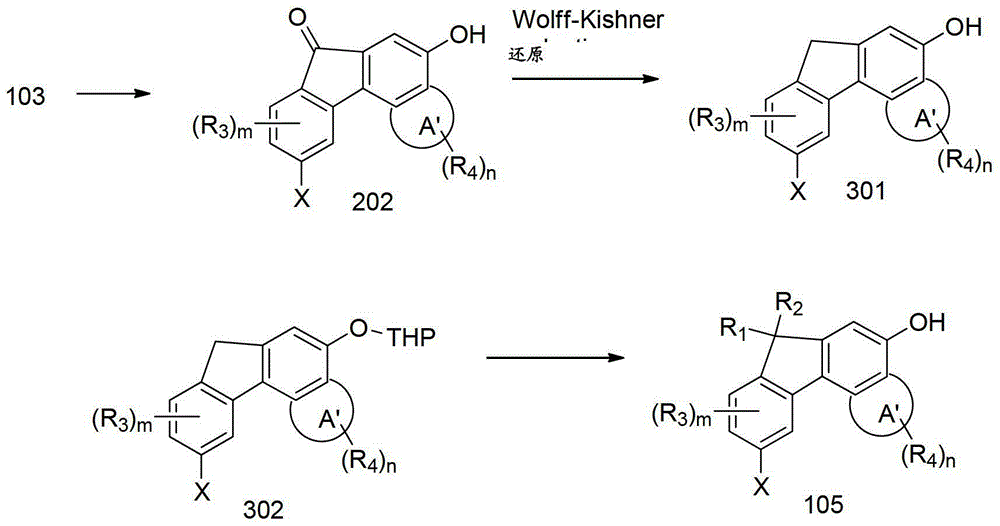
方案3表示了将化合物103转化成化合物105的第三种方式。来自方案2的化合物202可以使用Wolff-Kishner还原或它的改进形式来还原成301。例子可以在“Practical procedures for thepreparation of N-tert-butyldimethylsilylhydrozones and theiruse in modified Wolff-Kishner reductions and in the synthesisof vinyl halides and gem-dihalides”,Furrow,M.E.等人,J Am ChemSoc:126(17):5436-45,2004年5月5日及其中的参考文献中找到,该涉及Wolff-Kishner还原的这些文献在此引入作为参考。在羟基保护后,化合物302一旦用碱如LDA或甲基Grignard试剂脱质子后,具有非常亲核性的碳。对本领域技术人员来说,该脱质子的化合物302可以通过将它与亲电子试剂例如烷基卤化物,二氧化碳,酸氯化物,肼和氯甲酸盐衍生物反应而转化成R1和R2。结果,化合物105可以用选自下面的R1和R2来制备:氢,任选取代的手性或者非手性基团,该手性或者非手性基团选自杂烷基,烷基,环烷基,羧基,烷基羰基,烷氧基羰基,烷基羰基,烷氧基羰基,氨基羰基,芳基羰基,芳氧基羰基,或者R1和R2可以与任何间隔原子一起形成选自氧代的任选取代的环烷基和任选取代的杂环烷基的基团。Scheme 3 shows a third way to convert compound 103 to compound 105. Compound 202 from Scheme 2 can be reduced to 301 using Wolff-Kishner reduction or a modification thereof. Examples can be found in "Practical procedures for the preparation of N-tert-butyldimethylsilylhydrozones and their use in modified Wolff-Kishner reductions and in the synthesis of vinyl halides and gem-dihalides", Furrow, ME et al., J Am ChemSoc: 126(17): 5436 -45, May 5, 2004 and references therein, which are hereby incorporated by reference concerning the Wolff-Kishner reduction. After hydroxyl protection, compound 302 has a very nucleophilic carbon once deprotonated with a base such as LDA or methyl Grignard reagent. To those skilled in the art, the deprotonated compound 302 can be converted to R and R by reacting it with electrophiles such as alkyl halides, carbon dioxide, acid chlorides, hydrazine and chloroformate derivatives . As a result, compound 105 can be prepared with R and R selected from hydrogen, an optionally substituted chiral or achiral group selected from heteroalkyl, alkyl , cycloalkyl, carboxyl, alkylcarbonyl, alkoxycarbonyl, alkylcarbonyl, alkoxycarbonyl, aminocarbonyl, arylcarbonyl, aryloxycarbonyl, or R1 and R2 can be formed with any spacer atom A group selected from oxo optionally substituted cycloalkyl and optionally substituted heterocycloalkyl.
方案4和5汇总了制备化合物105的两种新方法,其据信以前没有描述过。Schemes 4 and 5 summarize two novel methods for the preparation of compound 105, which are not believed to have been described before.
方案4Option 4
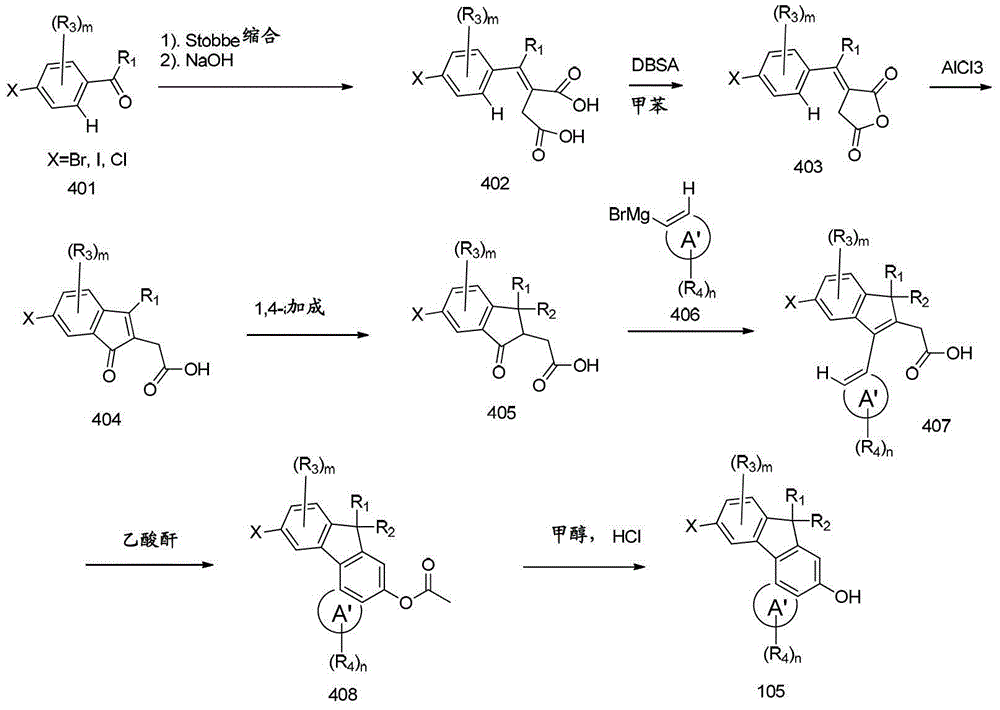
方案4是从芳基酮401开始的。R1可以选自氢,任选取代的手性或者非手性基团如杂烷基,烷基,全氟烷基,链烯基,炔基,芳基,杂芳基,环烷基和杂环烷基。Scheme 4 starts with aryl ketone 401. R can be selected from hydrogen, optionally substituted chiral or achiral groups such as heteroalkyl, alkyl, perfluoroalkyl, alkenyl, alkynyl, aryl, heteroaryl, cycloalkyl and Heterocycloalkyl.
在与琥珀酸二甲酯的Stobbe反应后,将化合物402转化成酸酐403。这个酸酐可以通过使用氯化铝来转化成茚酮酸404。1,4-加成反应可以使用亲核试剂如有机金属试剂,胺,醇和硫醇来进行。该反应提供了二氢化茚酮酸405。R2可以选自氢,任选取代的手性或者非手性基团如杂烷基,烷基,链烯基,炔基,芳基,杂芳基,环烷基,杂环烷基,氨基,烷氧基和硫醇。在酸性整理之后,化合物405可以与Grignard试剂406反应来形成化合物407。化合物407经历了在乙酸酐中的闭环反应,随后通过甲醇分解来形成产物408,其可以直接用于方案6或者通过水解转化成化合物105。Compound 402 was converted to anhydride 403 after a Stobbe reaction with dimethyl succinate. This anhydride can be converted to indanone acid 404 by using aluminum chloride. The 1,4-addition reaction can be performed using nucleophiles such as organometallic reagents, amines, alcohols and thiols. This reaction provides indanone acid 405. R can be selected from hydrogen, optionally substituted chiral or achiral groups such as heteroalkyl, alkyl, alkenyl, alkynyl, aryl, heteroaryl, cycloalkyl, heterocycloalkyl, Amino, Alkoxy and Thiol. After acid work-up, compound 405 can be reacted with Grignard reagent 406 to form compound 407. Compound 407 undergoes ring closure in acetic anhydride followed by methanolysis to form product 408, which can be used directly in Scheme 6 or converted to compound 105 by hydrolysis.
方案5Option 5

方案5从Stobbe产物102开始,其与Grignard试剂反应来提供化合物501。R1和R2可以选自任选取代的手性或者非手性基团如杂烷基,烷基,全氟烷基,链烯基,炔基,芳基,杂芳基,环烷基和杂环烷基。在用三氟甲烷磺酸铋在甲苯和随后在乙酸酐中处理后,在同一釜内依次发生了两个闭环反应。该有效的反应产生了化合物408,其可以转化成化合物105。Scheme 5 starts with Stobbe product 102, which reacts with Grignard reagent to provide compound 501. R and R can be selected from optionally substituted chiral or achiral groups such as heteroalkyl, alkyl, perfluoroalkyl, alkenyl, alkynyl, aryl, heteroaryl, cycloalkyl and heterocycloalkyl. After treatment with bismuth trifluoromethanesulfonate in toluene and subsequently in acetic anhydride, two ring closure reactions occurred sequentially in the same pot. This efficient reaction produces compound 408, which can be converted to compound 105.
方案6Option 6

方案6表示了将化合物105和408转化成光致变色二向色染料的方法。当使用Suzuki反应时,使用硼衍生物601来加入加长基团,其的合成可以在“Palladium(0)-Catalyzed Cross-Coupling Reactionof Alkoxydiboron with Haloarenes:A Direct Procedure forArylboronic Esters,J.Org.Chem.60,第7508-7519页,1995”,Miyaura,Norio等人及其中的参考文献中找到,该涉及这样的合成方法的公开文献在此引入作为参考。化合物603的吡喃环是通过与炔丙醇602偶联来形成的。化合物603也可以在改变两个反应的次序时获得。如此处所述,G可以是-OH或-O-烷基;A’’可以选自芳基,链烯基,炔基和杂芳基;A’’和L’一起形成L1,L2或L3基团;和B和B’可以各自独立地选自L3,氢,卤素,和任选取代的手性或者非手性基团如金属茂基,烷基或全氟烷基,链烯基,炔基,杂烷基,烷氧基,全氟烷氧基,芳基,杂芳基,杂环烷基和环烷基,或者其中B和B’与任何间隔原子一起形成基团例如任选取代的环烷基和任选取代的杂环烷基。Scheme 6 shows the conversion of compounds 105 and 408 into photochromic dichroic dyes. When using Suzuki reaction, use boron derivative 601 to add lengthening group, its synthesis can be found in "Palladium(0)-Catalyzed Cross-Coupling Reactionof Alkoxydiboron with Haloarenes: A Direct Procedure forArylboronic Esters, J.Org.Chem.60 , pp. 7508-7519, 1995", Miyaura, Norio et al. and references therein, this publication relating to such synthetic methods is hereby incorporated by reference. The pyran ring of compound 603 was formed by coupling with propargyl alcohol 602. Compound 603 can also be obtained when changing the order of the two reactions. As described herein, G may be -OH or -O-alkyl; A'' may be selected from aryl, alkenyl, alkynyl, and heteroaryl; A'' and L' together form L1 , L2 or L 3 group; and B and B' can each independently be selected from L 3 , hydrogen, halogen, and optionally substituted chiral or achiral groups such as metallocene, alkyl or perfluoroalkyl, chain alkenyl, alkynyl, heteroalkyl, alkoxy, perfluoroalkoxy, aryl, heteroaryl, heterocycloalkyl and cycloalkyl, or in which B and B' together with any spacer atoms form a group Examples include optionally substituted cycloalkyl and optionally substituted heterocycloalkyl.
如方案6所示,作为混入加长基团的可选择的方式,卤素X可以转化成其他官能团Q,形成化合物604。化合物604可以与炔丙醇反应来形成吡喃染料605,其可以是光致变色二向色染料本身或者可以转化成光致变色二向色染料式I。这些新官能团Q可以包括:-N3,-CN,-COOR’,-CCR’,-CHCHR’,-OCOR’,-OCOOR’,-SR’,-OSO2R’,-OR’,-OTf,-CHO,-OCHO,-OCONR’,-NR’R’,-NR’CONR’R’,-NR’COR’,-NR’COOR’,-CHNR’和-CONR’R’,其中R’可以独立地选自氢,L,未取代的或者取代的具有1-18个碳原子的烷基,未取代的或者取代的芳基,未取代的或者取代的具有2-18个碳原子的烯烃或者炔烃基团,-CF3和具有2-18个碳原子的全氟化的烷基或者两个R’可以与-N一起和形成杂环烷基例如哌嗪基。As shown in Scheme 6, as an alternative to incorporating a lengthening group, the halogen X can be transformed into another functional group Q to form compound 604. Compound 604 can be reacted with propargyl alcohol to form pyran dye 605, which can be the photochromic dichroic dye itself or can be converted to the photochromic dichroic dye Formula I. These new functional groups Q can include: -N 3 , -CN, -COOR', -CCR', -CHCHR', -OCOR', -OCOOR', -SR', -OSO 2 R', -OR', -OTf , -CHO, -OCHO, -OCONR', -NR'R', -NR'CONR'R', -NR'COR', -NR'COOR', -CHNR' and -CONR'R', where R' Can be independently selected from hydrogen, L, unsubstituted or substituted alkyl having 1-18 carbon atoms, unsubstituted or substituted aryl, unsubstituted or substituted alkene having 2-18 carbon atoms Alternatively an alkyne group, -CF3 and a perfluorinated alkyl group having 2-18 carbon atoms or two R' can be combined with -N to form a heterocycloalkyl group such as piperazinyl.
方案7,8和9表示了将卤素转化成其他官能团的细节,其可以进一步转化成加长基团或者是加长基团本身。该化学是在羟基阶段从化合物105开始的,其在方案7和8中简化为化合物701。化合物702,706,708,709,710,802,803,807,809,810,811,812,901,903,904和906的每个羟基产物可以使用方案6所示的炔丙醇化学转化成吡喃光致变色化合物。Schemes 7, 8 and 9 show the details of the transformation of the halogen into other functional groups, which can be further transformed into the elongating group or the elongating group itself. The chemistry starts with compound 105 at the hydroxyl stage, which is simplified to compound 701 in Schemes 7 and 8. Each of the hydroxyl products of compounds 702, 706, 708, 709, 710, 802, 803, 807, 809, 810, 811, 812, 901, 903, 904 and 906 can be chemically converted to Pyran photochromic compound.
方案7Option 7

方案8Option 8
方案9Option 9
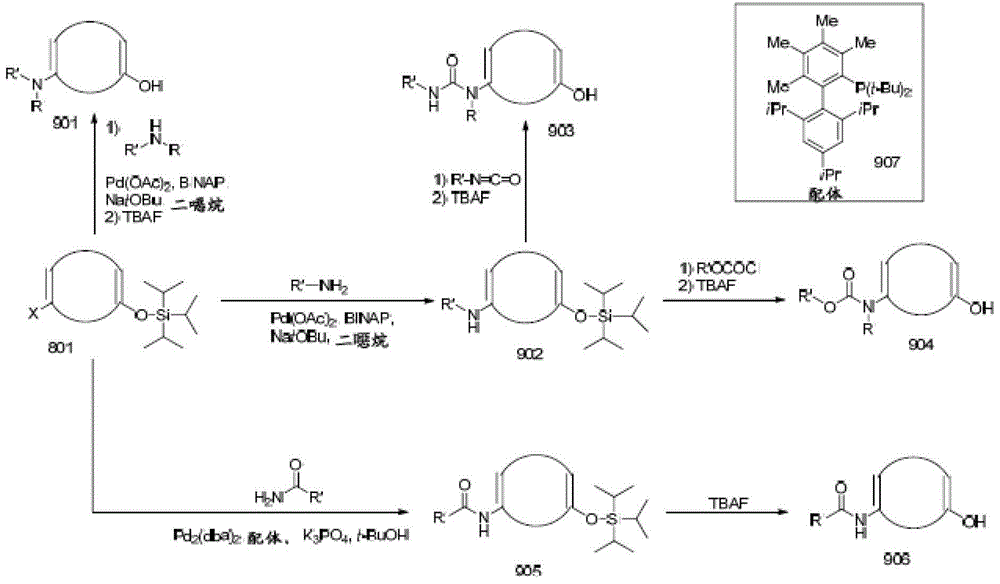
方案10表示了能够在该光致变色二向色染料上进行的化学。A’’’是式I的简化形式,并且R3或R4之一选自卤素X。X位于R3和R4将位于这里的位置之一上。这种方案示意了从方案1到9可以对R3和R4进行什么和安置基团如氰基,醛,羧酸和任选取代的手性或者非手性基团选自亚胺,烷氧基羰基,氨基羰基和芳氧基羰基作为R3和R4。该氰化和氧化方法已经描述在美国专利公开No.2009/0309076A1中,其中这些氰化和氧化方法在此引入作为参考。
方案10

此处所述化合物可以用作此处公开的不同的非限定性实施方案中的热可逆的光致变色化合物和/或组合物。这样的化合物可以用于多种应用中来提供光致变色和/或光致变色-二向色性能。The compounds described herein can be used as thermally reversible photochromic compounds and/or compositions in various non-limiting embodiments disclosed herein. Such compounds can be used in a variety of applications to provide photochromic and/or photochromic-dichroic properties.
本发明的光致变色组合物可以包含至少一种此处所述化合物,和任选的至少一种其他光致变色化合物。该光致变色组合物可以选自多种材料。这样的材料的例子可以选自:The photochromic compositions of the present invention may comprise at least one compound described herein, and optionally at least one other photochromic compound. The photochromic composition can be selected from a variety of materials. Examples of such materials may be selected from:
(a)单一光致变色化合物;(a) a single photochromic compound;
(b)光致变色化合物的混合物;(b) mixtures of photochromic compounds;
(c)包含至少一种光致变色化合物的材料;(c) materials comprising at least one photochromic compound;
(d)化学接合有至少一种光致变色化合物的材料;(d) materials chemically bonded with at least one photochromic compound;
(e)进一步包含基本上防止所述至少一种光致变色化合物与外部材料接触的涂层的材料(c)或(d);(e) a material (c) or (d) further comprising a coating that substantially prevents said at least one photochromic compound from contacting an external material;
(f)光致变色聚合物;或(f) photochromic polymers; or
(g)它们的混合物。(g) mixtures thereof.
本发明进一步提供了一种光致变色制品,其包含有机材料和连接到至少一部分的该有机主材上的本发明的光致变色化合物/组合物。作为此处使用的,术语“连接到”表示与物体直接接触或者通过一种或多种其他结构或材料与物体间接接触,其的至少一种是与物体直接接触的。此外,该光致变色化合物可以通过混入主材中或者通过施用到(例如作为涂层或层的一部分施用到)主材上而连接到至少一部分的主材上。除了该光致变色化合物之外,该光致变色组合物可以进一步包含至少一种添加剂,其选自染料,定向促进剂,抗氧化剂,动力学增强添加剂,光引发剂,热引发剂,阻聚剂,溶剂,光稳定剂如紫外光吸收剂和受阻胺稳定剂,热稳定剂,脱模剂,流变控制剂,流平剂,自由基猝灭剂,凝胶化剂和附着力促进剂。The invention further provides a photochromic article comprising an organic material and a photochromic compound/composition of the invention attached to at least a portion of the organic host material. As used herein, the term "connected to" means in direct contact with the object or in indirect contact with the object through one or more other structures or materials, at least one of which is in direct contact with the object. In addition, the photochromic compound may be attached to at least a portion of the host material by being incorporated into the host material or by being applied (eg, as part of a coating or layer) to the host material. In addition to the photochromic compound, the photochromic composition may further comprise at least one additive selected from dyes, alignment accelerators, antioxidants, kinetic enhancement additives, photoinitiators, thermal initiators, polymerization inhibitors Agents, solvents, light stabilizers such as UV absorbers and hindered amine stabilizers, heat stabilizers, release agents, rheology control agents, leveling agents, free radical quenchers, gelling agents and adhesion promoters .
能够存在于此处公开的不同的实施方案中的至少部分涂层中的染料的例子包括有机染料,其能够为该至少部分涂层赋予期望的颜色或者其他光学性能。Examples of dyes that can be present in the at least partial coating in the various embodiments disclosed herein include organic dyes that can impart a desired color or other optical property to the at least partial coating.
作为此处使用的,术语“定向促进剂”表示这样的添加剂,其能够促进它加入其中的材料的定向率和定向均匀性中的至少一种。能够存在于此处公开的不同的实施方案中的至少部分涂层中的定向促进剂的例子包括美国专利6338808和美国专利公开No.2002/0039627中所述那些。As used herein, the term "orientation promoter" means an additive capable of promoting at least one of the rate of orientation and the uniformity of orientation of a material to which it is added. Examples of alignment promoters that can be present in at least a portion of the coating in the various embodiments disclosed herein include those described in US Patent 6,338,808 and US Patent Publication No. 2002/0039627.
抗氧化剂例如多酚抗氧化剂是用于延迟氧化的有机化合物。抗氧化剂的例子描述在美国专利No.4720356,5391327和5770115中,其公开内容在此引入作为参考。Antioxidants such as polyphenol antioxidants are organic compounds used to retard oxidation. Examples of antioxidants are described in US Patent Nos. 4,720,356, 5,391,327 and 5,770,115, the disclosures of which are incorporated herein by reference.
能够存在于此处公开的不同的实施方案中的至少部分涂层中的动力学增强添加剂的例子包括含环氧的化合物,有机多元醇和/或增塑剂。这样的动力学增强添加剂更具体的例子公开在美国专利6433043和美国专利公开No.2003/0045612中。Examples of kinetic enhancing additives that can be present in at least a portion of the coating in the various embodiments disclosed herein include epoxy-containing compounds, organic polyols and/or plasticizers. More specific examples of such kinetic enhancing additives are disclosed in US Patent 6,433,043 and US Patent Publication No. 2003/0045612.
能够存在于此处公开的不同的实施方案中的至少部分涂层中的光引发剂的例子包括分裂类型的光引发剂和抽提类型的光引发剂。分裂类型光引发剂的例子包括苯乙酮,α-氨基烷基苯某酮,苯偶姻醚,苯甲酰肟,酰基氧化膦和双酰基氧化膦或这样的引发剂的混合物。这样的光引发剂市售的例子是
能够存在于此处公开的不同的实施方案中的光引发剂的另一例子是可见光光引发剂。合适的可见光光光引发剂的例子在美国专利6602603的第12栏第11行到第13栏第21行中阐明。Another example of a photoinitiator that can be present in the various embodiments disclosed herein is a visible light photoinitiator. Examples of suitable visible light photoinitiators are set forth in US Patent 6,602,603 at column 12,
热引发剂的例子包括有机过氧化化合物和偶氮双(有机腈)化合物。用作热引发剂的有机过氧化化合物具体的例子包括过氧化单碳酸酯,例如叔丁基过氧化异丙基碳酸酯;过氧化碳酸氢酯,例如二(2-乙基己基)过氧化碳酸氢酯,二(仲丁基)过氧化碳酸氢酯和二异丙基过氧化碳酸氢酯;二酰基过氧化物,例如过氧化2,4-二氯苯甲酰,过氧化异丁酰,过氧化癸酰,过氧化月桂酰,过氧化丙酰,过氧化乙酰,过氧化苯甲酰和过氧化对氯苯甲酰;过氧化酯例如叔丁基过氧化三甲基乙酸酯,叔丁基过氧化辛酯和叔丁基过氧化异丁酸酯,甲乙酮过氧化物和乙酰基环己烷磺酰基过氧化物。在一种实施方案中,所用的热引发剂是不导致所形成的聚合变色的那些。能够用作热引发剂的偶氮双(有机腈)化合物的例子包括偶氮二(异丁腈),偶氮二(2,4-二甲基戊腈)或者其混合物。Examples of thermal initiators include organic peroxy compounds and azobis(organonitrile) compounds. Specific examples of organic peroxy compounds useful as thermal initiators include peroxymonocarbonates such as tert-butylperoxyisopropylcarbonate; peroxyhydrogencarbonates such as bis(2-ethylhexyl)peroxycarbonate; hydrogen esters, di(sec-butyl)peroxybicarbonate and diisopropylperoxybicarbonate; diacyl peroxides such as 2,4-dichlorobenzoyl peroxide, isobutyryl peroxide, Decanoyl peroxide, lauroyl peroxide, propionyl peroxide, acetyl peroxide, benzoyl peroxide, and p-chlorobenzoyl peroxide; peroxyesters such as t-butylperoxytrimethylacetate, t- Butyl octyl peroxide and tert-butyl peroxy isobutyrate, methyl ethyl ketone peroxide and acetylcyclohexanesulfonyl peroxide. In one embodiment, the thermal initiators used are those that do not cause discoloration of the polymer formed. Examples of azobis(organonitrile) compounds that can be used as thermal initiators include azobis(isobutyronitrile), azobis(2,4-dimethylvaleronitrile), or mixtures thereof.
阻聚剂的例子包括:硝基苯,1,3,5-三硝基苯,对苯醌,氯醌,DPPH,FeCl3,CuCl2,氧,硫,苯胺,酚,对-二羟基苯、1、2、3-三羟基苯,和2,4,6-三甲基酚。Examples of polymerization inhibitors include: nitrobenzene, 1,3,5-trinitrobenzene, p-benzoquinone, chloranil, DPPH, FeCl 3 , CuCl 2 , oxygen, sulfur, aniline, phenol, p-dihydroxybenzene , 1,2,3-trihydroxybenzene, and 2,4,6-trimethylphenol.
能够存在于此处公开的不同的实施方案的LC组合物中的溶剂的例子包括将溶解LC组合物的固体组分的那些,其与该LC组合物和元件和基材是相容的,和/或可以确保LC组合物施用到其上的表面的均匀覆盖。潜在的溶剂包括下面的:丙二醇单甲基醚乙酸酯和它们的衍生物(作为
热稳定剂的例子可以包括碱性含氮化合物例如缩二脲,尿囊素或其金属盐,羧酸酰肼,例如脂肪族或芳族羧酸酰肼,有机羧酸的金属盐,碱金属或碱土金属化合物,水滑石,沸石和酸性化合物(例如硼酸化合物,具有羟基的含氮的环化合物,含羧基的化合物,(多)酚,丁基化的羟基甲苯和氨基羧酸)或者其混合物。Examples of heat stabilizers may include basic nitrogen-containing compounds such as biuret, allantoin or its metal salts, carboxylic acid hydrazides such as aliphatic or aromatic carboxylic acid hydrazides, metal salts of organic carboxylic acids, alkali metal Or alkaline earth metal compounds, hydrotalcites, zeolites and acidic compounds (such as boric acid compounds, nitrogen-containing ring compounds with hydroxyl groups, carboxyl-containing compounds, (poly)phenols, butylated hydroxytoluene and aminocarboxylic acids) or mixtures thereof .
脱模剂的例子包括长链脂肪酸和醇例如季戊四醇,guerbet醇的酯,长链酮,硅氧烷,α-烯烃聚合物,长链烷烃和具有15-600个碳原子的烃。Examples of the release agent include long-chain fatty acids and alcohols such as pentaerythritol, esters of guerbet alcohols, long-chain ketones, siloxanes, α-olefin polymers, long-chain alkanes and hydrocarbons having 15 to 600 carbon atoms.
流变控制剂是增稠剂,其典型的是粉末,该粉末可以是无机的如二氧化硅,有机的如微晶纤维素或微粒聚合物材料。凝胶化剂或凝胶化试剂经常是有机材料,其也会影响它们加入其中的材料的流变性。合适的凝胶化剂或凝胶化试剂的例子包括天然树胶,淀粉,胶质,琼脂和凝胶。凝胶化剂或凝胶化试剂经常会基于多糖或蛋白质。Rheology control agents are thickening agents which are typically powders which may be inorganic such as silica, organic such as microcrystalline cellulose or particulate polymeric material. Gelling agents or gelling agents are often organic materials which also affect the rheology of the material into which they are added. Examples of suitable gelling agents or gelling agents include natural gums, starches, pectin, agar and gelatin. Gelling agents or gelling agents will often be based on polysaccharides or proteins.
在某些实施方案中可以使用了一种或多种表面活性剂。表面活性剂包括这样的材料,其也称作润湿剂、消泡剂、乳化剂、分散剂、流平剂等。表面活性剂可以是阴离子的、阳离子的和非离子的,并且每个类型的许多表面活性剂是市售的。能够使用的非离子表面活性剂的例子包括乙氧基化的烷基酚,例如




自由基猝灭剂包括耐水解的合成假肽如Carcinine氢氯化物;脂肪氨基酸如L-赖氨酸月桂酰蛋氨酸;含有多酶的植物提取物;天然生育酚和相关的化合物以及含有活性氢如-OH、-SH或-NRH基团的化合物。自由基猝灭剂另外的例子选自立体受阻胺(HALS=受阻胺光稳定剂),其不同于通常的光保护剂,不是基于照射光的吸收或者基于所吸收的光的猝灭,而是基本上基于猝灭或者代替在聚合物材料和抗氧化剂的光降解过程中所形成的自由基和氢过氧化物的能力。Free radical quenchers include hydrolysis-resistant synthetic pseudopeptides such as Carcinine hydrochloride; aliphatic amino acids such as L-lysine lauroyl methionine; multienzyme-containing plant extracts; natural tocopherols and related compounds and compounds containing active hydrogen such as Compounds with -OH, -SH or -NRH groups. Further examples of free radical quenchers are selected from sterically hindered amines (HALS = hindered amine light stabilizers), which, unlike usual photoprotectants, are not based on absorption of irradiated light or on quenching of absorbed light, but on Essentially based on the ability to quench or replace free radicals and hydroperoxides formed during photodegradation of polymeric materials and antioxidants.
附着力促进剂包括附着力促进性有机硅烷材料,例如氨基有机硅烷材料,硅烷偶联剂,有机钛酸酯偶联剂和有机锆酸酯偶联剂,其描述在美国专利申请公开2004/0207809的第[0033]-[0042]段中。附着力促进剂另外的例子包括锆石-铝酸盐附着力促进性化合物,其市售自Rhone-Poulenc。铝-锆络合物的制备描述在美国专利No.4539048和4539049中。这些专利描述了对应于下面的经验式的锆-铝酸盐络合物反应产物:(Al2(OR1O)aAbBc)X(OC(R2)O)Y(ZrAdBe)Z,其中X,Y和Z至少是1,R2是烷基,链烯基,氨基烷基,羧基烷基,巯基烷基或环氧烷基,具有2-17个碳原子,并且X:Z之比是大约2:1-大约5:1。另外的锆-铝酸盐络合物描述在美国专利No.4650526中。Adhesion promoters include adhesion promoting organosilane materials, such as aminoorganosilane materials, silane coupling agents, organotitanate coupling agents, and organozirconate coupling agents, which are described in U.S. Patent Application Publication 2004/0207809 In paragraphs [0033]-[0042] of . Additional examples of adhesion promoters include zircon-aluminate adhesion promoting compounds, commercially available from Rhone-Poulenc. The preparation of aluminum-zirconium complexes is described in US Patent Nos. 4,539,048 and 4,539,049. These patents describe zirconium-aluminate complex reaction products corresponding to the following empirical formula: (Al 2 (OR 1 O) a A b B c ) X (OC(R 2 )O) Y (ZrA d B e ) Z , wherein X, Y and Z are at least 1, R is alkyl, alkenyl , aminoalkyl, carboxyalkyl, mercaptoalkyl or epoxyalkyl, having 2-17 carbon atoms, and The X:Z ratio is about 2:1 - about 5:1. Additional zirconium-aluminate complexes are described in US Patent No. 4,650,526.
能够与此处公开的不同的非限定性实施方案协同使用的有机主材的非限定性的例子包括液晶材料和聚合物材料。液晶材料可以选自液晶聚合物,液晶预聚物和液晶单体。作为此处使用的,术语“预聚物”表示部分聚合的材料。液晶聚合物(“LCP”)是这样的聚合物,其能够形成高度有序结构的区域,同时仍处于液相。作为此处使用的,术语“液晶单体”表示这样的单体化合物,其在单体态和/或聚合物态时能够显示液晶性能。即,该液晶单体可以显示液晶性能本身和/或在它结合到聚合物或者共聚物之后来形成液晶聚合物(LCP)。LCP可以显示至少一种的向列相,近晶相,手性向列相(即,胆固醇相),盘状相(包括手性盘状),不连续的立方体相,六角形相,双连续立方体相,层状相,倒转的六角形柱状相或者倒转的立方体相。另外,在本发明的某些LCP中,LC单体或其残留物可以例如在响应热能或者光化学辐射时从一个相过渡成另一相。Non-limiting examples of organic host materials that can be used in conjunction with the various non-limiting embodiments disclosed herein include liquid crystal materials and polymeric materials. The liquid crystal material may be selected from liquid crystal polymers, liquid crystal prepolymers and liquid crystal monomers. As used herein, the term "prepolymer" means a partially polymerized material. Liquid crystal polymers ("LCPs") are polymers that are capable of forming domains of highly ordered structures while still in the liquid phase. As used herein, the term "liquid crystal monomer" means a monomeric compound capable of exhibiting liquid crystal properties in a monomeric state and/or in a polymeric state. That is, the liquid crystal monomer may exhibit liquid crystal properties itself and/or form a liquid crystal polymer (LCP) after it is incorporated into a polymer or copolymer. LCPs can exhibit at least one of nematic, smectic, chiral nematic (i.e., cholesteric), discotic (including chiral discotic), discontinuous cubic, hexagonal, bicontinuous cubic , layered phase, inverted hexagonal columnar phase or inverted cubic phase. Additionally, in certain LCPs of the invention, the LC monomer or residues thereof may transition from one phase to another, eg, in response to thermal energy or actinic radiation.
聚合物材料的例子包括均聚物和共聚物,其是由美国专利5962617和美国专利5658501第15栏第28行-第16栏第17行所公开的单体和单体混合物制备的,其中在这些美国专利中公开的这样的聚合物材料在此明确引入作为参考,低聚物材料,单体材料或者其混合物或组合物。聚合物材料可以是热塑性或热固性聚合物材料,可以是透明的或者光学透明的,和可以具有所需的任何折射率。这样所公开的单体和聚合物非限定性的例子包括:多元醇(烯丙基碳酸酯)单体,例如烯丙基二甘醇碳酸酯如二甘醇双(烯丙基碳酸酯),该单体是在商标CR-39下由PPG Industries,Inc.销售的;聚脲-聚氨酯(聚脲-氨基甲酸酯)聚合物,其例如是通过聚氨酯预聚物和二胺固化剂反应来制备的,用于一种这样的聚合物的组合物是在商标TRIVEX下由PPGIndustries,Inc.销售的;多元醇(甲基)丙烯酰端接的碳酸酯单体;二甘醇二甲基丙烯酸酯单体;乙氧基化的酚甲基丙烯酸酯单体;二异丙烯基苯单体;乙氧基化的三羟甲基丙烷三丙烯酸酯单体;乙二醇二甲基丙烯酸酯单体;聚(乙二醇)二甲基丙烯酸酯单体;氨基甲酸酯丙烯酸酯单体;聚(乙氧基化的双酚A二甲基丙烯酸酯);聚(乙酸乙烯酯);聚(乙烯醇);聚(氯乙烯);聚(偏氯乙烯);聚乙烯;聚丙烯;聚氨酯;聚硫氨基甲酸酯;热塑性聚碳酸酯,例如衍生自双酚A和光气的碳酸酯连接的树脂,一种这样的材料是在商标LEXAN下销售的;聚酯,例如在商标MYLAR下销售的材料;聚(对苯二甲酸乙二醇酯);聚乙烯基丁缩醛;聚(甲基丙烯酸甲酯),例如在商标PLEXIGLAS下销售的材料,和通过多官能化异氰酸酯与聚硫醇或聚环硫单体反应所制备的聚合物,其是与聚硫醇,多异氰酸酯,多异硫氰酸酯和任选的烯属不饱和单体或者卤代的含芳族的乙烯基单体均聚的或者共聚的和/或三元共聚的。还可以预期的是这样的单体的共聚物和所述聚合物和共聚物与其他聚合物的共混物,例如来形成嵌段共聚物或者互插网络产物。聚合物材料也可以是自组装材料。Examples of polymeric materials include homopolymers and copolymers prepared from the monomers and monomer mixtures disclosed in US Pat. No. 5,962,617 and US Pat. Such polymeric materials, oligomeric materials, monomeric materials or mixtures or combinations thereof disclosed in these US patents are expressly incorporated herein by reference. The polymeric material may be a thermoplastic or thermoset polymeric material, may be transparent or optically transparent, and may have any desired refractive index. Non-limiting examples of such disclosed monomers and polymers include: polyol (allyl carbonate) monomers such as allyl diglycol carbonate such as diethylene glycol bis(allyl carbonate), This monomer is sold under the trademark CR-39 by PPG Industries, Inc.; polyurea-polyurethane (polyurea-urethane) polymers, for example by reacting a polyurethane prepolymer with a diamine curing agent. Compositions prepared for one such polymer are sold under the trademark TRIVEX by PPG Industries, Inc.; polyol (meth)acryloyl terminated carbonate monomer; diethylene glycol dimethacrylate ester monomer; ethoxylated phenol methacrylate monomer; diisopropenylbenzene monomer; ethoxylated trimethylolpropane triacrylate monomer; ethylene glycol dimethacrylate monomer poly(ethylene glycol) dimethacrylate monomer; urethane acrylate monomer; poly(ethoxylated bisphenol A dimethacrylate); poly(vinyl acetate); poly (vinyl alcohol); poly(vinyl chloride); poly(vinylidene chloride); polyethylene; polypropylene; polyurethane; resins, one such material is sold under the trade mark LEXAN; polyesters such as those sold under the trade mark MYLAR; poly(ethylene terephthalate); polyvinyl butyral; poly(formyl methacrylate), such as those sold under the trademark PLEXIGLAS, and polymers prepared by reacting polyfunctional isocyanates with polythiol or polyepithiol monomers, which are combined with polythiols, polyisocyanates, polyisocyanates Thiocyanate and optionally ethylenically unsaturated monomers or halogenated aromatic-containing vinyl monomers are homopolymerized or copolymerized and/or terpolymerized. Also contemplated are copolymers of such monomers and blends of such polymers and copolymers with other polymers, for example to form block copolymers or intercalation network products. Polymeric materials can also be self-assembling materials.
在具体的实施方案中,该聚合物可以是嵌段或非嵌段共聚物。在某些实施方案中,该嵌段共聚物可以包含硬嵌段和软嵌段。在其他实施方案中,该聚合物可以是非嵌段共聚物(即,这样的共聚物,其不具有具体单体残基的大嵌段),例如无规共聚物,交替共聚物,周期共聚物和统计共聚物。本发明还打算包括大于两者不同类型的共聚单体残基的共聚物。In specific embodiments, the polymer may be a block or non-block copolymer. In certain embodiments, the block copolymer may comprise hard blocks and soft blocks. In other embodiments, the polymer may be a non-block copolymer (i.e., a copolymer that does not have large blocks of specific monomer residues), such as random copolymers, alternating copolymers, periodic copolymers and statistical copolymers. The invention is also intended to include copolymers of more than two different types of comonomer residues.
根据一种具体的非限定性实施方案,该有机主材选自聚丙烯酸酯,聚甲基丙烯酸酯,聚(C1-C12)烷基甲基丙烯酸酯,聚氧(亚烷基甲基丙烯酸酯),聚(烷氧基化的酚甲基丙烯酸酯),醋酸纤维素,三醋酸纤维素,醋酸丙酸纤维素,醋酸丁酸纤维素,聚(乙酸乙烯酯),聚(乙烯醇),聚(氯乙烯),聚(偏氯乙烯),聚(乙烯基吡咯烷酮),聚((甲基)丙烯酰胺),聚(二甲基丙烯酰胺),聚(羟基乙基甲基丙烯酸酯),聚((甲基)丙烯酸),热塑性聚碳酸酯,聚酯,聚氨酯,聚硫氨基甲酸酯,聚(对苯二甲酸乙二醇酯),聚苯乙烯,聚(α甲基苯乙烯),共聚(苯乙烯-甲基丙烯酸甲酯),共聚(苯乙烯-丙烯腈),聚乙烯基丁缩醛和下面的组分的聚合物:多元醇(烯丙基碳酸酯)单体,单官能化丙烯酸酯单体,单官能化甲基丙烯酸酯单体,多官能化丙烯酸酯单体,多官能化甲基丙烯酸酯单体,二甘醇二甲基丙烯酸酯单体,二异丙烯基苯单体,烷氧基化的多羟基醇单体和二烯丙亚基季戊四醇单体。According to a specific non-limiting embodiment, the organic host material is selected from polyacrylate, polymethacrylate, poly(C 1 -C 12 ) alkyl methacrylate, polyoxy(alkylene methyl Acrylates), poly(alkoxylated phenol methacrylate), cellulose acetate, cellulose triacetate, cellulose acetate propionate, cellulose acetate butyrate, poly(vinyl acetate), poly(vinyl alcohol ), poly(vinyl chloride), poly(vinylidene chloride), poly(vinylpyrrolidone), poly((meth)acrylamide), poly(dimethylacrylamide), poly(hydroxyethyl methacrylate ), poly((meth)acrylic acid), thermoplastic polycarbonate, polyester, polyurethane, polythiourethane, poly(ethylene terephthalate), polystyrene, poly(alphamethylbenzene Polymers of ethylene), copoly(styrene-methyl methacrylate), copoly(styrene-acrylonitrile), polyvinyl butyral and the following components: polyol (allyl carbonate) monomer , monofunctional acrylate monomer, monofunctional methacrylate monomer, multifunctional acrylate monomer, multifunctional methacrylate monomer, diethylene glycol dimethacrylate monomer, diiso Propylene benzene monomer, alkoxylated polyhydric alcohol monomer and diallylidene pentaerythritol monomer.
根据另外一种具体的非限定性实施方案,该有机主材是选自下面的单体的均聚物或者共聚物:丙烯酸酯,甲基丙烯酸酯,甲基丙烯酸甲酯,乙二醇二甲基丙烯酸酯,乙氧基化的双酚A二甲基丙烯酸酯,乙酸乙烯酯,乙烯基丁缩醛,氨基甲酸酯,硫氨基甲酸酯,二甘醇双(烯丙基碳酸酯),二甘醇二甲基丙烯酸酯,二异丙烯基苯和乙氧基化的三羟甲基丙烷三丙烯酸酯。该聚合物材料大部分经常包含液晶材料,自组装材料,聚碳酸酯,聚酰胺,聚酰亚胺,聚(甲基)丙烯酸酯,多环烯烃,聚氨酯,聚(脲)氨基甲酸酯,聚硫氨基甲酸酯,聚硫(脲)氨基甲酸酯,多元醇(烯丙基碳酸酯),醋酸纤维素,二醋酸纤维素,三醋酸纤维素,醋酸丙酸纤维素,醋酸丁酸纤维素,聚烯烃,聚亚烷基-乙酸乙烯酯,聚(乙酸乙烯酯),聚(乙烯醇),聚(氯乙烯),聚(乙烯基甲缩醛),聚(乙烯基乙缩醛),聚(偏氯乙烯),聚(对苯二甲酸乙二醇酯),聚酯,聚砜,聚烯烃,其共聚物和/或其混合物。According to another specific non-limiting embodiment, the organic main material is a homopolymer or a copolymer of monomers selected from the group consisting of: acrylate, methacrylate, methyl methacrylate, ethylene glycol dimethyl Acrylates, Ethoxylated Bisphenol A Dimethacrylate, Vinyl Acetate, Vinyl Butyral, Urethane, Thiocarbamate, Diethylene Glycol Bis(allyl carbonate) , diethylene glycol dimethacrylate, diisopropenylbenzene and ethoxylated trimethylolpropane triacrylate. The polymeric material mostly often comprises liquid crystal materials, self-assembled materials, polycarbonates, polyamides, polyimides, poly(meth)acrylates, polycyclic olefins, polyurethanes, poly(urea)urethanes, Polythiourethane, Polythio(urea)urethane, Polyol (allyl carbonate), Cellulose acetate, Cellulose diacetate, Cellulose triacetate, Cellulose acetate propionate, Butyrate acetate Cellulose, Polyolefin, Polyalkylene-vinyl acetate, Poly(vinyl acetate), Poly(vinyl alcohol), Poly(vinyl chloride), Poly(vinyl formal), Poly(vinyl acetal ), poly(vinylidene chloride), poly(ethylene terephthalate), polyesters, polysulfones, polyolefins, copolymers thereof and/or mixtures thereof.
此外根据此处公开的不同的非限定性实施方案,该有机主材可以形成光学元件或者其部分。光学元件非限定性的例子包括眼科元件,显示元件,窗户和镜子。作为此处使用的,术语“光学”表示属于或者与光和/或视力有关。例如虽然此处不限定,但是根据不同的非限定性实施方案,该光学元件或装置可以选自眼科元件和装置,显示元件和装置,窗户,镜子,包装材料例如皱纹包装,和主动和被动液晶晶元元件和装置。Furthermore, according to various non-limiting embodiments disclosed herein, the organic host material may form an optical element or part thereof. Non-limiting examples of optical elements include ophthalmic elements, display elements, windows and mirrors. As used herein, the term "optical" means pertaining to or relating to light and/or vision. For example, although not limited herein, according to various non-limiting embodiments, the optical element or device may be selected from ophthalmic elements and devices, display elements and devices, windows, mirrors, packaging materials such as corrugated packaging, and active and passive liquid crystals Wafer components and devices.
作为此处使用的,术语“眼科”表示属于或者与眼睛和视力有关。眼科元件非限定性的例子包括矫正和非矫正透镜,包括单视力或多视力透镜,其可以是分段的或非分段的多视力透镜(例如但不限于双焦透镜,三焦透镜和渐进式透镜),以及其他用于校正、保护或增强(化妆的或者其他)视力元件,包括但不限于接触透镜,眼内透镜,放大透镜和保护透镜或护目镜。作为此处使用的,术语“显示”表示可见的或者机器可读取的文字、数字、符号、设计或者绘图的信息表达。显示元件和装置非限定性的例子包括屏幕、监视器和安全元件,包括但不限于安全标记和身份验证标记。作为此处使用的,术语“窗户”表示用于允许光透射过其中的孔。窗户非限定性的例子包括汽车和飞机透明玻璃,滤波器,百叶窗和光学转换器。作为此处使用的,术语“镜子”表示镜面反射大部分的入射光的表面。As used herein, the term "ophthalmic" means of or pertaining to the eye and vision. Non-limiting examples of ophthalmic elements include corrective and non-corrective lenses, including single vision or multivision lenses, which may be segmented or non-segmented multivision lenses (such as but not limited to bifocal lenses, trifocal lenses, and progressive lenses), and other elements used to correct, protect, or enhance vision (cosmetic or otherwise), including but not limited to contact lenses, intraocular lenses, magnifying lenses, and protective lenses or goggles. As used herein, the term "display" means a visible or machine-readable representation of information in words, numbers, symbols, designs or drawings. Non-limiting examples of display elements and devices include screens, monitors, and security elements, including but not limited to security and authentication indicia. As used herein, the term "window" means an aperture for allowing light to pass therethrough. Non-limiting examples of windows include automotive and aircraft clear glass, filters, shutters and optical switches. As used herein, the term "mirror" means a surface that specularly reflects a substantial portion of incident light.
例如,该有机主材可以是眼科元件,和更具体的是眼科透镜。For example, the organic host material can be an ophthalmic element, and more particularly an ophthalmic lens.
此外,预期的是此处公开的该光致变色化合物可以单独使用或者与至少一种在300nm-1000nm的范围具有至少一种活化的吸收最大值的其他补充的有机光致变色化合物协同来使用,包括(或者含有其的物质)。例如此处公开的该光致变色化合物可以与至少一种其他常规的有机光致变色化合物相组合,以使得该组合的光致变色化合物当活化时表现出期望的色调。合适的常规的有机光致变色化合物非限定性的例子包括此后所述吡喃,噁嗪,俘精酸酐和俘精酰亚胺。Furthermore, it is contemplated that the photochromic compounds disclosed herein may be used alone or in synergy with at least one other complementary organic photochromic compound having at least one activated absorption maximum in the range of 300 nm to 1000 nm, Include (or matter containing it). For example, the photochromic compound disclosed herein can be combined with at least one other conventional organic photochromic compound such that the combined photochromic compound exhibits a desired hue when activated. Non-limiting examples of suitable conventional organic photochromic compounds include pyrans, oxazines, fulgid anhydride and fulgimide as described hereinafter.
热可逆的补充光致变色吡喃非限定性的例子包括苯并吡喃,萘并吡喃例如萘并[1,2-b]吡喃,萘并[2,1-b]吡喃,茚并稠合萘并吡喃,例如公开在美国专利5645767中的那些,和杂环稠合萘并吡喃,例如公开在美国专利No.5723072,5698141,6153126和6022497中的那些,其在此引入作为用于这样的萘并吡喃公开的参考;螺-9-芴并[1,2-b]吡喃;菲并吡喃;喹啉并吡喃;荧蒽并吡喃;螺吡喃,例如,螺(苯并吲哚啉)萘并吡喃,螺(吲哚啉)苯并吡喃,螺(吲哚啉)萘并吡喃,螺(吲哚啉)喹啉并吡喃和螺(吲哚啉)吡喃。萘并吡喃和补充有机光致变色物质更具体的例子描述在美国专利5658501中,其公开内容在此引入作为参考。螺(吲哚啉)吡喃也描述在文章,Techniques in Chemistry,第III卷,“Photochromism”,第3章,Glenn H.Brown,编辑,JohnWiley and Sons,Inc.,纽约,1971中,其公开内容在此引入作为参考。Non-limiting examples of thermally reversible complementary photochromic pyrans include benzopyrans, naphthopyrans such as naphtho[1,2-b]pyran, naphtho[2,1-b]pyran, indene and fused naphthopyrans, such as those disclosed in U.S. Patent No. 5,645,767, and heterocyclic fused naphthopyrans, such as those disclosed in U.S. Patent Nos. As references disclosed for such naphthopyrans; spiro-9-fluorenopyran[1,2-b]pyran; phenanthrene; quinopyran; For example, spiro(benzindoline)naphthopyran, spiro(indoline)benzopyran, spiro(indoline)naphthopyran, spiro(indoline)quinolinopyran and spiro (indoline)pyran. More specific examples of naphthopyrans and complementary organic photochromic materials are described in US Patent No. 5,658,501, the disclosure of which is incorporated herein by reference. Spiro(indoline)pyrans are also described in the article, Techniques in Chemistry , Vol. III, "Photochromism", Chapter 3, Glenn H. Brown, ed., John Wiley and Sons, Inc., New York, 1971, which discloses The contents are incorporated herein by reference.
热可逆的补充光致变色噁嗪非限定性的例子包括苯并噁嗪,萘并噁嗪和螺噁嗪,例如螺(吲哚啉)萘并噁嗪,螺(吲哚啉)吡啶并苯并噁嗪,螺(苯并吲哚啉)吡啶并苯并噁嗪,螺(苯并吲哚啉)萘并噁嗪,螺(吲哚啉)苯并噁嗪,螺(吲哚啉)荧蒽并噁嗪,和螺(吲哚啉)喹啉并噁嗪。Non-limiting examples of thermally reversible complementary photochromic oxazines include benzoxazines, naphthooxazines and spirooxazines such as spiro(indoline)naphthooxazines, spiro(indoline)pyridobenzoxazines oxazine, spiro(benzindoline)pyridobenzoxazine, spiro(benzindoline)naphthoxazine, spiro(indoline)benzoxazine, spiro(indoline)fluorine anthracenoxazines, and spiro(indoline)quinolinoxazines.
热可逆的补充光致变色俘精酸酐更非限定性的例子包括:俘精酰亚胺和3-呋喃基和3-噻吩基俘精酸酐和俘精酰亚胺,其公开在美国专利4931220中(其中这样的俘精酰亚胺的公开内容在此明确引入作为参考)和任何前述的光致变色材料/化合物的混合物。More non-limiting examples of thermally reversible complementary photochromic fulgides include: fulgimides and 3-furyl and 3-thienyl fulgides and fulgimides, which are disclosed in U.S. Patent 4,931,220 (where the disclosure of such spermimides is expressly incorporated herein by reference) and mixtures of any of the foregoing photochromic materials/compounds.
例如可以预期的是此处公开的该光致变色化合物可以单独使用或者与另外一种常规的有机光致变色化合物(如上所述)以这样的量或比率来协同使用,即,该光致变色化合物混入其中的有机主材,或者在其上施加的有机主材,在活化态或者“漂白”态可以表现出期望的颜色。因此该光致变色化合物的用量不是关键的,条件是存在着足够的量来产生期望的光致变色效果就行。作为此处使用的,术语“光致变色量”指的是产生期望的光致变色效果所必需的光致变色化合物的量。For example, it is contemplated that the photochromic compounds disclosed herein may be used alone or in conjunction with another conventional organic photochromic compound (as described above) in such amounts or ratios that the photochromic The organic host material into which the compound is mixed, or applied thereon, can exhibit a desired color in the activated or "bleached" state. The amount of the photochromic compound used is therefore not critical, provided that sufficient amount is present to produce the desired photochromic effect. As used herein, the term "photochromic amount" refers to the amount of photochromic compound necessary to produce the desired photochromic effect.
本发明还提供一种光致变色制品,其包含基材,和具有光致变色量的本发明的光致变色化合物的涂料组合物连接到该基材其的至少一部分的至少一个表面上的至少部分涂层。此外,虽然这里没有限定,但是至少一部分的该至少部分涂层可以是至少部分固定的。作为此处使用的,术语“固定”表示以期望的方向来固定。The present invention also provides a photochromic article comprising a substrate, and a coating composition having a photochromic amount of a photochromic compound of the present invention attached to at least one surface of at least a portion of the substrate. Partially coated. Additionally, although not limited herein, at least a portion of the at least partial coating may be at least partially fixed. As used herein, the term "fixed" means fixed in a desired orientation.
例如根据上述非限定性实施方案,该涂料组合物可以选自而不限于聚合物涂料组合物,油漆和油墨。此外,除了此处公开的该光致变色化合物之外,根据不同的非限定性实施方案的涂料组合物可以进一步包含至少一种其他常规的有机光致变色化合物,其具有在300nm-1000nm(包含其内的)至少一种活化的吸收最大值。For example, according to the above non-limiting embodiments, the coating composition may be selected from, without limitation, polymeric coating compositions, paints and inks. Furthermore, in addition to the photochromic compound disclosed herein, the coating composition according to various non-limiting embodiments may further comprise at least one other conventional organic photochromic compound having within) at least one activated absorption maxima.
包含光致变色量的光致变色化合物的涂料组合物可以施涂到其上的合适的基材非限定性的例子包括玻璃,石工,纺织品,陶瓷,金属,木材,纸张和聚合物有机材料。合适的聚合物有机材料非限定性的例子在上面进行了阐述。Non-limiting examples of suitable substrates to which coating compositions comprising photochromic amounts of photochromic compounds may be applied include glass, masonry, textiles, ceramics, metals, wood, paper and polymeric organic materials. Non-limiting examples of suitable polymeric organic materials are set forth above.
另外提供的是光学元件,其包含基材和连接到至少一部分的该基材上的至少部分涂层,该涂层包含本发明的至少一种光致变色化合物。该光学元件非限定性的例子包括眼科元件,显示元件,窗户和镜子。例如该光学元件可以是眼科元件,和该基材可以是眼科基材,其选自矫正和非矫正透镜,部分成形的透镜和空白透镜。Additionally provided is an optical element comprising a substrate and an at least partial coating attached to at least a portion of the substrate, the coating comprising at least one photochromic compound of the present invention. Non-limiting examples of such optical elements include ophthalmic elements, display elements, windows and mirrors. For example the optical element may be an ophthalmic element, and the substrate may be an ophthalmic substrate selected from corrective and non-corrective lenses, partially formed lenses and blank lenses.
虽然这里没有限定,但是该光学元件可以包含实现期望的光学性能所必需的任何量的光致变色化合物,例如但不限于光致变色性能和二向色性能。Although not limited herein, the optical element may contain any amount of photochromic compound necessary to achieve the desired optical properties, such as but not limited to photochromic and dichroic properties.
适于与前述非限定性实施方案协同使用的其他非限定性的基材例子包括未着色的基材,着色基材,光致变色基材,着色的光致变色基材,线性偏振基材,圆形偏振基材,椭圆形偏振基材,反射基材和波纹板或阻滞基材,例如四分之一波纹板和半波板。作为此处提及基材时所使用的,术语“未着色的”表示这样的基材,其基本上没有添加着色剂(例如但不限于常规染料)和具有对于可见光辐射的吸收光谱,该光谱在响应光化学辐射时不明显变化。此外,提及基材时,术语“着色的”表示这样的基材,其添加有着色剂(例如但不限于常规染料)和对于可见光辐射的吸收光谱在响应光化学辐射时不明显变化。Other non-limiting examples of substrates suitable for use in conjunction with the foregoing non-limiting embodiments include unpigmented substrates, colored substrates, photochromic substrates, colored photochromic substrates, linearly polarizing substrates, Circular polarizing substrates, elliptically polarizing substrates, reflective substrates and corrugated or retarding substrates such as quarter corrugated and half wave plates. As used herein in reference to a substrate, the term "unpigmented" means a substrate that is substantially free of added colorants (such as, but not limited to, conventional dyes) and that has an absorption spectrum for visible radiation that is Does not change appreciably in response to actinic radiation. In addition, the term "pigmented" when referring to a substrate means a substrate to which a colorant (such as but not limited to conventional dyes) has been added and whose absorption spectrum for visible radiation does not change appreciably in response to actinic radiation.
作为此处使用的,提及基材时的术语“线性偏振”指的是适于线性偏振辐射(即,将光波电矢量的振动限制到一个方向)的基材。作为此处使用的,提及基材时的术语“圆形偏振”指的是适于圆形偏振辐射的基材。作为此处使用的,提及基材时的术语“椭圆形偏振”指的是适于椭圆形偏振辐射的基材。作为此处使用的,提及基材时的术语“光致变色”指的是这样的基材,其对于可见光辐射的吸收光谱在响应至少光化学辐射时是变化的,并且是热可逆的。此外,作为此处提及基材时所使用的,术语“着色的光致变色”表示这样的基材,其含有添加的着色剂以及光致变色化合物,并且对于可见光辐射的吸收光谱在响应至少光化学辐射时是变化的,和是热可逆的。因此例如当曝露于光化学辐射,该着色的光致变色基材可以具有着色剂的第一颜色特性和着色剂和光致变色化合物组合的第二颜色特性。As used herein, the term "linearly polarizing" in reference to a substrate refers to a substrate suitable for linearly polarizing radiation (ie, confining the vibration of the electric vector of an optical wave to one direction). As used herein, the term "circularly polarized" in reference to a substrate means a substrate suitable for circularly polarized radiation. As used herein, the term "elliptically polarized" in reference to a substrate means a substrate suitable for elliptically polarized radiation. As used herein, the term "photochromic" in reference to a substrate refers to a substrate whose absorption spectrum for visible radiation changes in response to at least actinic radiation and is thermally reversible. Furthermore, as used herein in reference to a substrate, the term "pigmented photochromic" means a substrate that contains added colorants as well as photochromic compounds and that is responsive to an absorption spectrum of visible radiation at least It is altered upon actinic radiation and is thermally reversible. Thus, for example, when exposed to actinic radiation, the pigmented photochromic substrate may have a first color characteristic of the colorant and a second color characteristic of the combination of the colorant and photochromic compound.
本发明还涉及一种光学元件,包含基材和连接到至少一部分的该基材上的至少部分涂层,该涂层包含本发明的至少一种光致变色化合物。此外,该至少一种热可逆的光致变色化合物可以是光致变色-二向色化合物,其处于活化状态时根据盒方法(CELL METHOD)所测量的平均吸收率大于1.5。The invention also relates to an optical element comprising a substrate and an at least partial coating attached to at least a part of the substrate, the coating comprising at least one photochromic compound according to the invention. Furthermore, the at least one thermally reversible photochromic compound may be a photochromic-dichroic compound having an average absorbance in the activated state greater than 1.5 as measured according to the CELL METHOD.
如上所述,本发明的光学元件可以是显示元件,例如但不限于屏幕,监视器和安全元件。例如该光学元件可以是显示元件,其包含具有第一表面的第一基材,具有第二表面的第二基材,其中第二基材的第二表面与第一基材的第一表面是相对的和间隔开的,来限定一个间隙;和流体材料,其包含本发明的至少一种光致变色化合物,其定向于第一基材的第一表面和第二基材第二表面所限定的间隙内。此外,该至少一种光致变色化合物可以是光致变色-二向色化合物,其处于活化状态时根据盒方法(CELL METHOD)所测量的平均吸收率大于1.5。As mentioned above, the optical elements of the present invention may be display elements such as but not limited to screens, monitors and security elements. For example, the optical element may be a display element comprising a first substrate with a first surface and a second substrate with a second surface, wherein the second surface of the second substrate is the same as the first surface of the first substrate. opposed and spaced apart to define a gap; and a fluid material comprising at least one photochromic compound of the present invention oriented to the first surface of the first substrate and defined by the second surface of the second substrate within the gap. Furthermore, the at least one photochromic compound may be a photochromic-dichroic compound having an average absorbance in an activated state greater than 1.5 as measured according to the CELL METHOD.
此外,根据这种非限定性实施方案,该第一和第二基材可以独立地选自未着色的基材,着色的基材,光致变色基材,着色的光致变色基材,线性偏振基材,圆形偏振基材,椭圆形偏振基材和反射基材和阻滞基材。Furthermore, according to this non-limiting embodiment, the first and second substrates may be independently selected from unpigmented substrates, pigmented substrates, photochromic substrates, pigmented photochromic substrates, linear Polarizing substrates, circular polarizing substrates, elliptical polarizing substrates and reflective and retarding substrates.
本发明还提供安全元件,其包含基材和连接到至少一部分的该基材上的本发明的至少一种光致变色化合物。安全元件非限定性的例子包括安全标记和身份验证标记,其连接到至少一部分的基材上,例如和而不限于:赊购卡和券,例如门票,证件,身份卡或会员卡,借记卡等;可流通票据和不可流通票据例如汇票,支票,密钥,票据,储蓄证明,股票等;政府文件例如通货,许可证,身份证,收益卡,签证,护照,公务证,契约等;生活消费品例如软件,光盘(“CD”),数字视频光盘(“DVD”),器具,消费电子,体育用品,轿车等;信用卡;和商品标签,标识和包装。The invention also provides a security element comprising a substrate and at least one photochromic compound according to the invention attached to at least a part of the substrate. Non-limiting examples of security elements include security and authentication marks attached to at least a portion of a substrate, such as and without limitation: credit cards and coupons, such as tickets, certificates, identification or membership cards, debit cards etc.; negotiable instruments and non-negotiable instruments such as money orders, checks, keys, bills, savings certificates, stocks, etc.; government documents such as currency, licenses, ID cards, income cards, visas, passports, official certificates, contracts, etc.; life Consumer goods such as software, compact discs ("CDs"), digital video discs ("DVDs"), appliances, consumer electronics, sporting goods, automobiles, etc.; credit cards; and merchandise labels, labels, and packaging.
虽然此处没有限制,但是该安全元件可以连接到至少一部分的选自透明基材和反射基材的基材上。可选择的,其中如果该基材对于打算的应用来说不反射或者不足够反射,则需要反射基材,在安全标记施用到其上之前,反射材料可以首先施用到至少一部分的基材上。例如在其上形成安全元件之前,反射铝涂层可以施用到至少一部分的该基材上。仍然的此外,安全元件可以连接到至少一部分的选自未着色的基材,着色的基材,光致变色基材,着色的光致变色基材,线性偏振,圆形偏振基材和椭圆形偏振基材的基材上。Although not limited herein, the security element may be attached to at least a portion of a substrate selected from a transparent substrate and a reflective substrate. Alternatively, where a reflective substrate is desired if the substrate is not or not sufficiently reflective for the intended application, the reflective material may first be applied to at least a portion of the substrate before the security marking is applied thereto. For example, a reflective aluminum coating may be applied to at least a portion of the substrate before forming the security element thereon. Still further, the security element may be attached to at least a portion of a substrate selected from the group consisting of unpigmented substrates, pigmented substrates, photochromic substrates, pigmented photochromic substrates, linearly polarizing, circularly polarizing substrates and elliptical polarizing substrate on the substrate.
此外,该至少一种光致变色化合物可以是热可逆的光致变色-二向色化合物,其处于活化状态时根据盒方法(CELL METHOD)所测量的平均吸收率大于1.5。Furthermore, the at least one photochromic compound may be a thermally reversible photochromic-dichroic compound having an average absorbance measured according to the CELL METHOD of greater than 1.5 in the activated state.
此外,前述的安全元件可以进一步包含一种或多种其他涂层或者片来形成具有依赖于视角的特性的多层反射安全元件,如美国专利No.6641874所述,其涉及多反射膜的公开内容在此明确引入作为参考。In addition, the aforementioned security elements may further comprise one or more other coatings or flakes to form a multilayer reflective security element with viewing angle-dependent properties, as described in US Patent No. 6,641,874, which relates to the disclosure of multi-reflective films The contents are hereby expressly incorporated by reference.
上述的光致变色制品和光学元件可以通过本领域已知的方法来形成。虽然此处没有限制,但是可以预期的是此处公开的该光致变色化合物可以通过结合到主材中或者施用到主材或者基材上而连接到基材上或者主材上,例如处于涂层的形式。The photochromic articles and optical elements described above can be formed by methods known in the art. Although not limited herein, it is contemplated that the photochromic compounds disclosed herein may be attached to a substrate or substrate by incorporation into or application to the substrate or substrate, such as in a coated layer form.
例如,该光致变色-二向色化合物可以如下来结合到有机主材中:通过将该光致变色化合物溶解或者分散到主材中,例如在聚合之前将将该光致变色化合物加入到单体主材中而它流延在适当的地方,通过将主材浸入该光致变色化合物的热溶液中或者通过热转移将该光致变色化合物吸入主材中。作为此处使用的,术语“吸入”包括该光致变色化合物单独渗透到主材中,溶剂辅助来将该光致变色化合物转移到多孔聚合物中,蒸气相转移和其他这样的转移方法。For example, the photochromic-dichroic compound can be incorporated into an organic host material by dissolving or dispersing the photochromic compound in the host material, e.g. The photochromic compound is absorbed into the host material by dipping the host material into a hot solution of the photochromic compound or by thermal transfer while it is cast in place. As used herein, the term "imbibition" includes penetration of the photochromic compound into the substrate alone, solvent assisted transfer of the photochromic compound into the porous polymer, vapor phase transfer and other such transfer methods.
此外,此处公开的该光致变色化合物可以作为涂料组合物(如上所述)或者包含该光致变色化合物的片的一部分,而施用到有机主材或其他基材上。作为此处使用的,术语“涂层”表示衍生自可流动组合物的支撑膜,其可以或者可以不具有均匀的厚度。作为此处使用的,术语“片”表示预成形的膜,具有通常均匀的厚度和能够自持。在这样的情况中,在它们加入到涂层或者片之前,紫外光吸收剂可以与该光致变色材料混合,或者这样的吸收剂可以作为光致变色制品和入射光之间的涂层或者膜而叠置例如成层。Additionally, the photochromic compounds disclosed herein may be applied to organic hosts or other substrates as part of a coating composition (as described above) or a sheet comprising the photochromic compounds. As used herein, the term "coating" means a supported film derived from a flowable composition, which may or may not be of uniform thickness. As used herein, the term "sheet" means a preformed film, of generally uniform thickness and capable of self-support. In such cases, UV absorbers may be mixed with the photochromic material before they are added to the coating or sheet, or such absorbers may act as a coating or film between the photochromic article and the incident light Instead, stacking is, for example, layering.
施涂包含此处公开的光致变色化合物的涂料组合物的非限定性方法包括本领域已知的那些用于施涂涂料的方法,例如旋涂,喷涂,喷涂和旋涂,帘涂,流涂,浸涂,注塑,流延,辊涂,线涂和二次成型。包含该光致变色化合物的涂料可以施用到模具上,并且该基材可以在涂层顶上形成(即,二次成型)。此外或者可选择的,没有光致变色化合物的涂料组合物可以首先使用任何前述的技术施涂到基材或者有机主材上,其后如上所述用该光致变色化合物吸入。Non-limiting methods of applying coating compositions comprising the photochromic compounds disclosed herein include those known in the art for applying coatings such as spin coating, spray coating, spray and spin coating, curtain coating, flow coating, etc. Coating, Dip Coating, Injection Molding, Casting, Roller Coating, Line Coating and Overmolding. A coating comprising the photochromic compound can be applied to a mold, and the substrate can be formed on top of the coating (ie, overmolding). Additionally or alternatively, a coating composition without a photochromic compound may first be applied to a substrate or organic host material using any of the aforementioned techniques and thereafter imbibed with the photochromic compound as described above.
成膜聚合物的涂料组合物(其可以包括光致变色材料)非限定性的例子如下:光致变色/二向色液晶涂层,例如描述在美国专利No.7256921第2栏第60行-第94栏第23行的那些;光致变色聚氨酯涂层,例如描述在美国专利No.6187444第3栏第4行-第12栏第15行的那些;光致变色氨基塑料树脂涂层,例如描述在美国专利No.6432544第2栏第52行-第14栏第5行和6506488第2栏第43行-第12栏第23行的那些;光致变色聚硅氧烷涂层,例如描述在美国专利No.4556605第2栏第15-第7栏第27行的那些;光致变色聚(甲基)丙烯酸酯涂层,例如描述在美国专利No.6602603第3栏第15行-第栏7第50行,6150430第8栏第15-38含,和6025026第8栏第66行-第10栏第32行的那些;聚酸酐光致变色涂层,例如描述在美国专利No.6436525第2栏第52行-第11栏第60行的那些;光致变色聚丙烯酰胺涂层例如描述在美国专利No.6060001第2栏第6行-第5栏第40行的那些;光致变色环氧树脂涂层,例如描述在美国专利No.6268055第2栏第63行-第15栏第12行的那些;和光致变色聚(脲-氨基甲酸酯)涂层,例如描述在美国专利No.6531076第2栏第行60-第10栏第49行的那些。前述的美国专利涉及成膜聚合物的公开内容在此引入作为参考。Non-limiting examples of coating compositions of film-forming polymers (which may include photochromic materials) are as follows: Photochromic/dichroic liquid crystal coatings, such as described in U.S. Patent No. 7,256,921 column 2, line 60— Those of column 94, line 23; photochromic polyurethane coatings, such as those described in U.S. Patent No. 6,187,444, column 3, line 4 - column 12, line 15; photochromic aminoplast resin coatings, such as Those described in U.S. Pat. Those in U.S. Patent No. 4,556,605, column 2, line 15-column 7, line 27; photochromic poly(meth)acrylate coatings, such as described in U.S. Patent No. 6,602,603, column 3, line 15-line Column 7, line 50, 6150430, column 8, lines 15-38 inclusive, and 6025026, column 8, line 66-
将包含此处公开的光致变色化合物的片施用到基材上的非限定性方法包括例如下面的至少一种:将该聚合物片层合、熔合、模内流延和粘接结合到至少一部分的基材上。作为此处使用的,模内流延包括多种流延技术,例如但不限于:二次成型,其中将所述片置于模具中,并且在至少一部分的基材上(例如通过流延)形成基材;和注塑,其中该基材是在片周围形成的。此外,可以预期的是该光致变色化合物可以作为涂层施用到该片上,通过吸入或者通过其他合适的方法结合到该片中,这是在将所述片施用到基材之前或之后进行的。Non-limiting methods of applying a sheet comprising a photochromic compound disclosed herein to a substrate include, for example, at least one of laminating, fusing, in-mold casting, and adhesively bonding the polymer sheet to at least part of the substrate. As used herein, in-mold casting includes various casting techniques, such as but not limited to: overmolding, wherein the sheet is forming the substrate; and injection molding, wherein the substrate is formed around the sheet. In addition, it is contemplated that the photochromic compound may be applied to the tablet as a coating, incorporated into the tablet by inhalation or by other suitable means, either before or after applying the tablet to a substrate .
该聚合物片可以包含任何的广泛的多种聚合物的聚合物组合物,包括热固性聚合物和热塑性聚合物二者。作为此处使用的,术语“聚合物”目的是包括聚合物和低聚物二者,以及均聚物和共聚物二者。这样的聚合物可以包括例如丙烯酸聚合物,聚酯聚合物,聚氨酯聚合物,聚(脲)氨基甲酸酯聚合物,聚胺聚合物,聚环氧化物聚合物,聚酰胺聚合物,聚醚聚合物,聚硅氧烷聚合物,聚硫聚合物,其共聚物,及其混合物。通常这些聚合物可以是通过本领域技术人员已知的任何方法制造的任何这些类型的聚合物。The polymer sheet may comprise any polymer composition of a wide variety of polymers, including both thermoset polymers and thermoplastic polymers. As used herein, the term "polymer" is intended to include both polymers and oligomers, and both homopolymers and copolymers. Such polymers may include, for example, acrylic polymers, polyester polymers, polyurethane polymers, poly(urea)urethane polymers, polyamine polymers, polyepoxide polymers, polyamide polymers, polyether polymers, polysiloxane polymers, polysulfide polymers, copolymers thereof, and mixtures thereof. Generally these polymers can be any of these types of polymers produced by any method known to those skilled in the art.
用于形成该聚合物片的聚合物也可以包含官能团,其包括但不限于羧酸基团,胺基团,环氧化物基团,羟基,硫醇基团,氨基甲酸酯基团,酰胺基团,脲基团,异氰酸酯基团(包括封闭的异氰酸酯基团)硫醇基团,具有烯属不饱和度的基团例如丙烯酸酯基团),乙烯基及其组合。适当的成膜树脂混合物也可以用于制备该涂料组合物。如果形成聚合物片的聚合物组合物包含了含官能团的聚合物(例如任何前述的含官能团的聚合物),则该聚合物组合物可以进一步包含这样的材料,其具有与所述聚合物的那些反应性的官能团。反应可以例如通过热、光引发、氧化和/或辐射固化技术来促进。还可以预期的是任何前述聚合物的混合物。The polymers used to form the polymer sheet may also contain functional groups including, but not limited to, carboxylic acid groups, amine groups, epoxy groups, hydroxyl groups, thiol groups, carbamate groups, amide groups groups, urea groups, isocyanate groups (including blocked isocyanate groups) thiol groups, groups with ethylenic unsaturation such as acrylate groups), vinyl groups, and combinations thereof. A mixture of suitable film-forming resins may also be used to prepare the coating composition. If the polymer composition forming the polymer sheet comprises a functional group-containing polymer (such as any of the aforementioned functional group-containing polymers), the polymer composition may further comprise a material having a those reactive functional groups. The reaction can be facilitated, for example, by thermal, photoinitiated, oxidative and/or radiation curing techniques. Also contemplated are mixtures of any of the foregoing polymers.
适用于形成本发明的聚合物片的聚合物另外的非限定性的例子是聚烷基(甲基)丙烯酸酯和聚酰胺的热塑性嵌段共聚物,其描述在公开的美国专利申请2004/0068071A1的第[0020]-[0042]段,其所述部分在此引入作为参考;和美国专利No.6096375第18栏第8行-第19栏第5行,其所述部分在此引入作为参考。Additional non-limiting examples of polymers suitable for use in forming the polymer sheets of the present invention are thermoplastic block copolymers of polyalkyl(meth)acrylates and polyamides, which are described in published U.S. patent application 2004/0068071A1 Paragraphs [0020]-[0042] of US Pat. No. 6,096,375, column 18, line 8-column 19, line 5, said parts of which are incorporated herein by reference .
在本发明一种具体的实施方案中,该聚合物片包含弹性体聚合物,例如热塑性弹性体聚合物。作为此处使用的,“弹性体聚合物”表示这样的聚合物,其具有高的回弹度和弹性,这样它能够至少部分可逆的变形或伸长。在一些情况中,当拉伸时,弹性体的分子进行排列,并且可以呈现结晶排列的形式;和通过释放,该弹性体会在一定程度上返回它的自然无序状态。在本发明中,弹性体聚合物可以包括热塑体,热塑性弹性体聚合物和热固性聚合物,条件是这样的聚合物落入上面提供的“弹性体聚合物”的描述中。In a particular embodiment of the invention, the polymer sheet comprises an elastomeric polymer, such as a thermoplastic elastomeric polymer. As used herein, "elastomeric polymer" means a polymer having a high degree of resiliency and elasticity such that it is capable of at least partially reversible deformation or elongation. In some cases, when stretched, the molecules of the elastomer align and may assume a crystalline arrangement; and upon release, the elastomer returns to some extent to its natural disordered state. In the present invention, elastomeric polymers may include thermoplastics, thermoplastic elastomeric polymers and thermosetting polymers, provided that such polymers fall within the description of "elastomeric polymer" provided above.
该弹性体聚合物可以包含任何的广泛多种的本领域公知的弹性体,包括但不限于任何前述聚合物的共聚物。在本发明的一种实施方案中,该弹性体聚合物可以包含嵌段共聚物,在该聚合物主链中具有醚和/或酯连接。合适的嵌段共聚物的例子可以包括但不限于聚(酰胺-醚)嵌段共聚物,聚(酯-醚)嵌段共聚物,聚(醚-氨基甲酸酯)嵌段共聚物,聚(酯-氨基甲酸酯)嵌段共聚物和/或聚(醚-脲)嵌段共聚物。这样的弹性体聚合物合适的具体的例子可以包括但不限于在商标名
此外如上所述,此处公开的光致变色化合物可以单独混入或者施用,或者与至少一种其他常规的有机光致变色化合物组合混入或者施用,其也可以如上所述施用或结合到主材和基材中。另外的涂层可以施用到该光致变色制品中,包括其他光致变色涂层,抗反射涂层,线性偏振涂层,过渡涂层,底漆涂层,粘接剂涂层,镜面化涂层和保护涂层,包括防雾涂层,阻氧涂层和紫外光吸收涂层。Also as mentioned above, the photochromic compounds disclosed herein may be mixed or applied alone or in combination with at least one other conventional organic photochromic compound which may also be applied or incorporated into the substrate and in the substrate. Additional coatings may be applied to the photochromic article, including other photochromic coatings, antireflective coatings, linear polarizing coatings, transition coatings, primer coatings, adhesive coatings, mirror finishes Layers and protective coatings, including anti-fog coatings, oxygen barrier coatings and UV absorbing coatings.
此处所述实施方案通过下面的非限定性实施例来进一步说明。The embodiments described herein are further illustrated by the following non-limiting examples.
实施例Example
部分1描述了实施例1-34的制备。部分2描述了实施例的光致变色性能的测试。部分3描述了实施例的二向色性能的测试。Section 1 describes the preparation of Examples 1-34. Section 2 describes the testing of the photochromic properties of the examples. Section 3 describes the testing of the dichroic properties of the examples.
部分1-实施例1-34的制备Part 1 - Preparation of Examples 1-34
实施例1Example 1
步骤1step 1
将3-溴-4’-甲基二苯甲酮(50g),琥珀酸二甲酯(34.5g)和甲苯(1升(L))加入到装备有机械搅拌器,固体加料漏斗和氮气氛的反应烧瓶中。将该混合物在室温搅拌,直到固体溶解。将固体叔丁醇钾(22.4g)通过固体加料漏斗加入,并且将该混合物在室温搅拌4小时。将所形成的反应混合物倾倒入1L的水中,并且收集含有产物的含水层。将甲苯层用200mL水萃取。将合并的水溶液用甲苯清洗。将HCl(2N,20mL)加入该水溶液中。沉淀了一种黄色油。将所形成的混合物用醋酸乙酯萃取,在硫酸镁上干燥,真空浓缩和干燥。获得了一种黄色玻璃状油(55g)作为产物。将它直接用于下一步。3-Bromo-4'-methylbenzophenone (50 g), dimethyl succinate (34.5 g) and toluene (1 liter (L)) were added to a mixture equipped with a mechanical stirrer, a solid addition funnel and a nitrogen atmosphere. in the reaction flask. The mixture was stirred at room temperature until the solid dissolved. Solid potassium tert-butoxide (22.4 g) was added via the solid addition funnel, and the mixture was stirred at room temperature for 4 hours. The resulting reaction mixture was poured into 1 L of water, and the aqueous layer containing the product was collected. The toluene layer was extracted with 200 mL of water. The combined aqueous solutions were washed with toluene. HCl (2N, 20 mL) was added to the aqueous solution. A yellow oil precipitated. The resulting mixture was extracted with ethyl acetate, dried over magnesium sulfate, concentrated and dried in vacuo. A yellow glassy oil (55 g) was obtained as product. Use it directly for the next step.
步骤2step 2
将来自步骤1的Stobbe酸产物混合物(55g)和乙酸酐(300mL)混合,并且在装备有冷凝器的反应烧瓶中回流。1小时后,通过真空蒸发除去乙酸酐,获得了作为产物的55g的油。将它直接用于下一步。The Stobbe acid product mixture from Step 1 (55 g) and acetic anhydride (300 mL) were combined and refluxed in a reaction flask equipped with a condenser. After 1 hour, the acetic anhydride was removed by vacuum evaporation to give 55 g of an oil as product. Use it directly for the next step.
步骤3step 3
向含有获自步骤2的55g的油的反应烧瓶中加入甲醇(300mL)和HCl(12N,1ml)。将该混合物回流4小时。通过真空蒸发除去甲醇。将回收的油溶解在二氯甲烷,用碳酸氢钠饱和水溶液清洗,在硫酸镁上干燥,真空浓缩和干燥。将所形成的油(51g)直接用于下一步。To a reaction flask containing 55 g of the oil from step 2 was added methanol (300 mL) and HCl (12N, 1 ml). The mixture was refluxed for 4 hours. Methanol was removed by evaporation in vacuo. The recovered oil was dissolved in dichloromethane, washed with saturated aqueous sodium bicarbonate, dried over magnesium sulfate, concentrated and dried in vacuo. The resulting oil (51 g) was used directly in the next step.
步骤4step 4
将步骤3的产物(51g)溶解在装备有滴液漏斗和磁搅拌棒的烘箱干燥烧瓶中的500ml的无水THF中。将该混合物在室温混合搅拌,并且逐滴加入1.6M的甲基溴化镁的甲苯/THF(1:1)溶液。在加入后,将该混合物在室温搅拌大约16小时。然后将该反应混合物倾倒入2L的冰水中。使用HCl(12N)将该混合物的pH值调整到约2。加入醋酸乙酯(500mL)。将所形成的有机层分离,在硫酸镁上干燥,真空浓缩和干燥。将回收的产物(50g的油)直接用于下一步。The product from step 3 (51 g) was dissolved in 500 ml of anhydrous THF in an oven-dried flask equipped with a dropping funnel and a magnetic stir bar. The mixture was mixed and stirred at room temperature, and a 1.6M solution of methylmagnesium bromide in toluene/THF (1:1) was added dropwise. After the addition, the mixture was stirred at room temperature for about 16 hours. The reaction mixture was then poured into 2 L of ice water. The pH of the mixture was adjusted to about 2 using HCl (12N). Ethyl acetate (500 mL) was added. The resulting organic layer was separated, dried over magnesium sulfate, concentrated and dried in vacuo. The recovered product (50 g of oil) was used directly in the next step.
步骤5step 5
将来自步骤4的产物(50g)和二甲苯(300mL)加入到装备有磁搅拌棒的反应烧瓶中。加入对甲苯磺酸(1g),将所形成的混合物回流8小时。通过真空蒸发除去二甲苯,将所形成的油状产物溶解在醋酸乙酯中,水洗,在硫酸镁上干燥和浓缩。一小部分的产物(50g油)包含了四个萘酚异构体。将该产物(1.8g)使用来自Teledyne ISCO的
步骤6step 6
将来自步骤5的萘酚混合物:(0.36g)的10-溴-3,7,7-三甲基-7H-苯并[c]芴-5-醇和2-溴-7,7,9-三甲基-7H-苯并[c]芴-5-醇置于反应烧瓶中。向该烧瓶中加入0.27g的1,1-双(4-甲氧基苯基)丙-2-炔-1-醇,对甲苯磺酸和二氯甲烷的少数晶体(10ml)。将该混合物室温搅拌18小时。从TLC观察到形成了蓝色染料和紫色染料。将该产物使用净化。获得了具有两种异构体的产物(0.5g)。将它直接用于下一步。The naphthol mixture from step 5: (0.36 g) of 10-bromo-3,7,7-trimethyl-7H-benzo[c]fluoren-5-ol and 2-bromo-7,7,9- Trimethyl-7H-benzo[c]fluoren-5-ol was placed in the reaction flask. To the flask were added 0.27 g of 1,1-bis(4-methoxyphenyl)prop-2-yn-1-ol, a few crystals of p-toluenesulfonic acid and dichloromethane (10 ml). The mixture was stirred at room temperature for 18 hours. Formation of blue and violet dyes was observed from TLC. use this product purify. The product (0.5 g) was obtained with two isomers. Use it directly for the next step.
步骤7step 7
将来自步骤6的染料混合物(0.5g)置于反应烧瓶中,并且加入下面的成分:4-(4-反式-戊基环己基)苯基4-(4,4,5,5-四甲基-1,3,2-二氧环戊硼烷-2-基)苯甲酸酯(0.39g,按照实施例3的步骤2的程序制备,除了使用4-(反式-4-戊基环己基)酚和4-(4,4,5,5-四甲基-1,3,2-二氧环戊硼烷-2-基)苯甲酸代替4-(4,4,5,5-四甲基-1,3,2-二氧环戊硼烷-2-基)苯胺和4-(反式-4-戊基环己基)苯甲酸之外);氟化钾(0.19g);二氯双(三苯基膦)钯(II)(0.012g);THF(20mL)和水(20mL)。将该混合物脱气,用氮气保护和加热到回流。18小时后,TLC显示形成了灰色染料和紫色染料。将该混合物使用二氯甲烷和水萃取。回收有机层,分离,在硫酸镁上干燥和浓缩。将所形成的产物使用净化。获得了作为绿色固体(0.25g,较低极性的)的灰色染料。获得了作为浅白色固体(0.18g,较大极性)的紫色染料。NMR分析显示较大极性的紫色染料具有与3,3-双(4-甲氧基苯基)-10-[4-((4-(反式-4-戊基环己基)苯氧基)羰基)苯基]-6,13,13-三甲基-3,13-二氢-茚并[2′,3′:3,4]萘并[1,2-b]吡喃一致的结构。The dye mixture (0.5 g) from step 6 was placed in a reaction flask and the following ingredients added: 4-(4-trans-pentylcyclohexyl)phenyl 4-(4,4,5,5-tetra Methyl-1,3,2-dioxaborolan-2-yl)benzoate (0.39 g, prepared according to the procedure in Step 2 of Example 3 except using 4-(trans-4-penta Cyclohexyl)phenol and 4-(4,4,5,5-tetramethyl-1,3,2-dioxaborolan-2-yl)benzoic acid instead of 4-(4,4,5, Except for 5-tetramethyl-1,3,2-dioxaborolan-2-yl)aniline and 4-(trans-4-pentylcyclohexyl)benzoic acid); potassium fluoride (0.19g ); dichlorobis(triphenylphosphine)palladium(II) (0.012 g); THF (20 mL) and water (20 mL). The mixture was degassed, blanketed with nitrogen and heated to reflux. After 18 hours, TLC showed the formation of gray and purple dyes. The mixture was extracted with dichloromethane and water. The organic layer was recovered, separated, dried over magnesium sulfate and concentrated. The resulting product is used purify. The gray dye was obtained as a green solid (0.25 g, less polar). The violet dye was obtained as an off-white solid (0.18 g, more polar). NMR analysis shows that the more polar purple dye has a phenoxy )carbonyl)phenyl]-6,13,13-trimethyl-3,13-dihydro-indeno[2′,3′:3,4]naphtho[1,2-b]pyran consistent structure.
实施例2Example 2
步骤1step 1
将镁(3.2g)和THF(50ml)置于装备有滴液漏斗的干燥烧瓶中,该烧瓶包含1-溴-4-(三氟甲基)苯(30g)和THF(200ml)的混合物。将20ml的该溶液通过滴液漏斗加入烧瓶中。还加入了几滴二溴乙烷到该烧瓶中来帮助引发该反应。几分钟后,该反应烧瓶中的溶剂开始沸腾。将滴液漏斗中的其余溶液逐滴加入。偶尔使用冰水来冷却该反应混合物。加入后,将该混合物在室温搅拌2小时。然后将3-溴-4-甲基氰苯(26g)加入该反应混合物中。将混合物在室温搅拌一整夜。加入3N的HCl(200ml)。将该混合物搅拌4小时。通过分液漏斗收集有机层和然后浓缩。使用硅胶插塞柱分离,用混合物溶剂90/10己烷/醋酸乙酯来净化该产物。这个步骤和其他步骤所用的硅胶的类型是Grade60,230-400目。获得了作为产物的白色晶体(19g)。NMR显示该产物的结构与3-溴-4-甲基-4’-三氟甲基二苯甲酮。Magnesium (3.2 g) and THF (50 ml) were placed in a dry flask equipped with a dropping funnel containing a mixture of 1-bromo-4-(trifluoromethyl)benzene (30 g) and THF (200 ml). 20 ml of this solution were added to the flask through the dropping funnel. A few drops of dibromoethane were also added to the flask to help initiate the reaction. After a few minutes, the solvent in the reaction flask began to boil. The remaining solution in the dropping funnel was added dropwise. Ice water was used occasionally to cool the reaction mixture. After the addition, the mixture was stirred at room temperature for 2 hours. 3-Bromo-4-methylcyanobenzene (26 g) was then added to the reaction mixture. The mixture was stirred overnight at room temperature. 3N HCl (200ml) was added. The mixture was stirred for 4 hours. The organic layer was collected by separatory funnel and then concentrated. The product was purified using a silica gel plug column separation with a mixture solvent 90/10 hexane/ethyl acetate. The type of silica gel used in this and other steps was Grade 60, 230-400 mesh. White crystals (19 g) were obtained as the product. NMR showed the structure of the product to be the same as 3-bromo-4-methyl-4'-trifluoromethylbenzophenone.
步骤2step 2
将1-溴-4-(反式-4-戊基环己基)苯(96g),4-(甲氧基羰基)苯基硼酸(56g),K2CO3(17g),Pd(Pph3)4(1.5g),1,4-二噁烷(400mL)和水(12mL)的悬浮液置于反应烧瓶中和在105℃搅拌10小时。在该反应后将混合物在搅拌下倾倒入水(1L)中。过滤后获得了灰色固体。将该固体用水清洗,溶解在CH2Cl2(400mL)中,在MgSO4上干燥和通过寅式盐过滤。将滤出液浓缩和在搅拌下倾倒入甲醇(600mL)中。将沉淀物通过过滤收集,用甲醇清洗和干燥。获得了作为产物的白色固体(80.4g)。NMR显示该产物的结构与4'-(4-戊基环己基)联苯基-4-羧酸甲酯相同。1-Bromo-4-(trans-4-pentylcyclohexyl)benzene (96g), 4-(methoxycarbonyl)phenylboronic acid (56g), K 2 CO 3 (17g), Pd(Pph 3 ) 4 (1.5 g), a suspension of 1,4-dioxane (400 mL) and water (12 mL) was placed in a reaction flask and stirred at 105°C for 10 hours. After the reaction the mixture was poured into water (1 L) with stirring. A gray solid was obtained after filtration. The solid was washed with water, dissolved in CH2Cl2 (400 mL), dried over MgSO4 and filtered through celite. The filtrate was concentrated and poured into methanol (600 mL) with stirring. The precipitate was collected by filtration, washed with methanol and dried. A white solid (80.4 g) was obtained as the product. NMR showed that the product had the same structure as methyl 4'-(4-pentylcyclohexyl)biphenyl-4-carboxylate.
步骤3step 3
将来自步骤2的产物(20g)与氢氧化钠(6.57g)和乙醇(500mL)在反应烧瓶中混合。将该混合物加热到回流4小时,冷却到室温和使用浓HCl酸化。将该沉淀物通过过滤收集,水洗和干燥。获得了作为产物的白色固体(18.2g)。NMR显示该产物的结构与4'-(4-戊基环己基)联苯基-4-羧酸相同。The product from step 2 (20 g) was mixed with sodium hydroxide (6.57 g) and ethanol (500 mL) in a reaction flask. The mixture was heated to reflux for 4 hours, cooled to room temperature and acidified using concentrated HCl. The precipitate was collected by filtration, washed with water and dried. A white solid (18.2 g) was obtained as the product. NMR showed that the product had the same structure as 4'-(4-pentylcyclohexyl)biphenyl-4-carboxylic acid.
步骤4step 4
将来自步骤3的产物(18.2g)与SOCl2(300mL)和DMF(三滴)在反应烧瓶中混合和加热到回流8小时。将该溶液在大气压下浓缩和将所形成的残留物在搅拌下倾倒入200mL己烷中。将沉淀的白色固体通过过滤收集,用己烷清洗和干燥。获得了作为产物的白色固体(17.53g)。NMR显示该产物的结构与4'-(4-戊基环己基)联苯基-4-羰基氯相同。The product from step 3 (18.2 g) was mixed with SOCl2 (300 mL) and DMF (three drops) in a reaction flask and heated to reflux for 8 hours. The solution was concentrated at atmospheric pressure and the resulting residue was poured into 200 mL of hexane with stirring. The precipitated white solid was collected by filtration, washed with hexane and dried. A white solid (17.53 g) was obtained as the product. NMR showed that the product had the same structure as 4'-(4-pentylcyclohexyl)biphenyl-4-carbonyl chloride.
步骤5step 5
在搅拌下将来自步骤4的产物(10g)在二氯甲烷(30ml)中的溶液滴入4-(4,4,5,5-四甲基-1,3,2-二氧环戊硼烷-2-基)苯胺(5.94g)和TEA(4.13g)在CH2Cl2(60ml)中的溶液中。加入后,将该溶液保持搅拌24小时。然后将该溶液用水(50mL)清洗三次,在MgSO4上干燥,减压下浓缩和然后在搅拌下倾倒入甲醇(200ml)中。过滤该沉淀物,用甲醇清洗和干燥。获得了作为产物的白色固体(12.24g)。NMR显示该产物的结构与4'-(4-戊基环己基)-N-(4-(4,4,5,5-四甲基-1,3,2-二氧环戊硼烷-2-基)苯基)联苯基-4-甲酰胺相同。A solution of the product from step 4 (10 g) in dichloromethane (30 ml) was added dropwise to 4-(4,4,5,5-tetramethyl-1,3,2-dioxaborol with stirring A solution of alk-2-yl)aniline (5.94g) and TEA (4.13g) in CH2Cl2 ( 60ml ). After the addition, the solution was kept stirring for 24 hours. The solution was then washed three times with water (50 mL), dried over MgSO 4 , concentrated under reduced pressure and then poured into methanol (200 mL) with stirring. The precipitate was filtered, washed with methanol and dried. A white solid (12.24 g) was obtained as the product. NMR showed that the structure of the product was similar to that of 4'-(4-pentylcyclohexyl)-N-(4-(4,4,5,5-tetramethyl-1,3,2-dioxaborolane- 2-yl)phenyl)biphenyl-4-carboxamide is the same.
步骤6step 6
按照实施例1的步骤1-步骤7的程序,除了使用这个实施例的步骤1的3-溴-4-甲基-4’-三氟甲基二苯甲酮代替实施例1的步骤1的3-溴-4’-甲基二苯甲酮,使用1-(4-氟苯基)-1-(4-(哌啶-1-基)苯基)丙-2-炔-1-醇代替实施例1的步骤6的1,1-双(4-甲氧基苯基)丙-2-炔-1-醇和使用这个实施例的步骤5的4’-(4-反式-戊基环己基)-N-(4-(4,4,5,5-四甲基-1,3,2-二氧环戊硼烷-2-基)苯基)-[1,1’-联苯基]-4-甲酰胺代替实施例1的步骤7的4-(4-反式-戊基环己基)苯基4-(4,4,5,5-四甲基-1,3,2-二氧环戊硼烷-2-基)苯甲酸酯。获得了作为产物的蓝色固体。NMR显示该产物的结构与3-(4-氟苯基)-3-(4-哌啶并苯基)-10-[4-(4-(4-(4-反式-戊基环己基)苯基)苯甲酰氨基)苯基]-6-三氟甲基-11,13,13-三甲基-3,13-二氢-茚并[2′,3′:3,4]萘并[1,2-b]吡喃相同。Follow the procedure of Step 1-Step 7 of Example 1, except that 3-bromo-4-methyl-4'-trifluoromethylbenzophenone of Step 1 of this Example is used instead of Step 1 of Example 1. 3-Bromo-4'-methylbenzophenone using 1-(4-fluorophenyl)-1-(4-(piperidin-1-yl)phenyl)prop-2-yn-1-ol Instead of 1,1-bis(4-methoxyphenyl)prop-2-yn-1-ol from step 6 of Example 1 and 4'-(4-trans-pentyl from step 5 of this example Cyclohexyl)-N-(4-(4,4,5,5-tetramethyl-1,3,2-dioxaborolan-2-yl)phenyl)-[1,1'-bi Phenyl]-4-carboxamide instead of 4-(4-trans-pentylcyclohexyl)phenyl 4-(4,4,5,5-tetramethyl-1,3, 2-dioxaborolan-2-yl)benzoate. A blue solid was obtained as product. NMR showed that the product had the same structure as 3-(4-fluorophenyl)-3-(4-piperidophenyl)-10-[4-(4-(4-(4-trans-pentylcyclohexyl) )phenyl)benzamido)phenyl]-6-trifluoromethyl-11,13,13-trimethyl-3,13-dihydro-indeno[2′,3′:3,4] Naphtho[1,2-b]pyran is the same.
实施例3Example 3

步骤1step 1
将镁(5.26g)和THF(50ml)置于装备有滴液漏斗的干燥烧瓶中,其包含1-溴-3,5-二氟苯(44g)的THF(400ml)溶液。将滴液漏斗中十分之一的溶液加入该烧瓶中。还将几滴的二溴乙烷加入该烧瓶中来帮助引发该反应。几分钟后,该反应烧瓶中的溶剂开始沸腾。使用冰浴。将滴液漏斗中的其余溶液在0℃在半小时内逐滴加入。加入后半小时,大部分Mg消失。将混合物室温放置搅拌2小时以上。全部的Mg进入溶液。在0℃加入双[2-(N,N-二甲基氨基)乙基]醚(35g)。搅拌15分钟。然后一次性加入3-溴苯甲酰氯(50g)。将混合物在0℃搅拌2小时。将水(500mL)加入该混合物。使用12N的HCl来将pH调整为约2。将DCM加入该混合物(500ml)中。收集有机层,水洗一次,用碳酸氢钠清洗一次,在硫酸镁上干燥和浓缩。获得了一种粘性油(57g)。将该油直接用于下一步。NMR显示3-溴-3’,5’-二氟二苯甲酮是所述油的主要组分。Magnesium (5.26g) and THF (50ml) were placed in a dry flask equipped with a dropping funnel containing a solution of 1-bromo-3,5-difluorobenzene (44g) in THF (400ml). One tenth of the solution in the dropping funnel was added to the flask. A few drops of dibromoethane were also added to the flask to help initiate the reaction. After a few minutes, the solvent in the reaction flask began to boil. Use an ice bath. The remaining solution in the dropping funnel was added dropwise over half an hour at 0°C. Half an hour after the addition, most of the Mg disappeared. The mixture was left to stir at room temperature for more than 2 hours. All the Mg goes into solution. Bis[2-(N,N-dimethylamino)ethyl]ether (35 g) was added at 0°C. Stir for 15 minutes. 3-Bromobenzoyl chloride (50 g) was then added in one portion. The mixture was stirred at 0°C for 2 hours. Water (500 mL) was added to the mixture. The pH was adjusted to about 2 using 12N HCl. DCM was added to the mixture (500ml). The organic layer was collected, washed once with water, once with sodium bicarbonate, dried over magnesium sulfate and concentrated. A viscous oil (57g) was obtained. This oil was used directly in the next step. NMR showed 3-bromo-3',5'-difluorobenzophenone as the major component of the oil.
步骤2step 2
将4-(4,4,5,5-四甲基-1,3,2-二氧环戊硼烷-2-基)苯胺(52g),4-(反式-4-戊基环己基)苯甲酸(65g),DCC(64.4g),DMAP(3g)和二氯甲烷(500ml)的混合物置于反应烧瓶中和搅拌24小时。滤出固体。将滤出液浓缩。加入甲醇(1L)。将所形成的晶体通过过滤收集和干燥。获得了作为产物的白色晶体(91g)。NMR显示该产物的结构与4-(4-反式-戊基环己基)-N-(4-(4,4,5,5-四甲基-1,3,2-二氧环戊硼烷-2-基)苯基)苯甲酰胺相同。4-(4,4,5,5-Tetramethyl-1,3,2-dioxaborolan-2-yl)aniline (52g), 4-(trans-4-pentylcyclohexyl ) A mixture of benzoic acid (65g), DCC (64.4g), DMAP (3g) and dichloromethane (500ml) was placed in a reaction flask and stirred for 24 hours. The solid was filtered off. The filtrate was concentrated. Methanol (1 L) was added. The crystals formed were collected by filtration and dried. White crystals (91 g) were obtained as the product. NMR showed that the product had the same structure as 4-(4-trans-pentylcyclohexyl)-N-(4-(4,4,5,5-tetramethyl-1,3,2-dioxaborol Alk-2-yl)phenyl)benzamides are the same.
步骤3step 3
按照实施例1的步骤1-步骤7的程序,除了使用这个实施例的步骤1的3-溴-3’,5’-二氟二苯甲酮代替实施例1的步骤1的3-溴-4’-甲基二苯甲酮,和使用这个实施例的步骤2的4-(4-反式-戊基环己基)-N-(4-(4,4,5,5-四甲基-1,3,2-二氧环戊硼烷-2-基)苯基)苯甲酰胺代替实施例1的步骤7的4-(4-反式-戊基环己基)苯基4-(4,4,5,5-四甲基-1,3,2-二氧环戊硼烷-2-基)苯甲酸酯。获得了作为产物的灰色固体。NMR显示该产物的结构与3,3-双(4-甲氧基苯基)-10-[4-(4-(4-反式-戊基环己基)苯甲酰氨基)苯基]-5,7-二氟-13,13-二甲基-3,13-二氢-茚并[2′,3′:3,4]萘并[1,2-b]吡喃相同。Follow the procedure of Step 1-Step 7 of Example 1, except that the 3-bromo-3',5'-difluorobenzophenone of Step 1 of this Example is used instead of the 3-Bromo- 4'-methylbenzophenone, and 4-(4-trans-pentylcyclohexyl)-N-(4-(4,4,5,5-tetramethyl -1,3,2-dioxaborolan-2-yl)phenyl)benzamide instead of 4-(4-trans-pentylcyclohexyl)phenyl 4-( 4,4,5,5-Tetramethyl-1,3,2-dioxaborolan-2-yl)benzoate. A gray solid was obtained as product. NMR showed that the product had the same structure as 3,3-bis(4-methoxyphenyl)-10-[4-(4-(4-trans-pentylcyclohexyl)benzamido)phenyl]- 5,7-Difluoro-13,13-dimethyl-3,13-dihydro-indeno[2′,3′:3,4]naphtho[1,2-b]pyran is the same.
实施例4Example 4
按照实施例3的程序,除了在步骤1中使用三溴苯代替1-溴-3,5-二氟苯和使用苯甲酰氯代替3-溴苯甲酰氯。获得了作为产物的黑色固体。NMR分析显示该产物的结构与3,3-双(4-甲氧基苯基)-10-[4-(4-(4-反式-戊基环己基)苯甲酰氨基)苯基]-13,13-二甲基-12-溴-3,13-二氢-茚并[2′,3′:3,4]萘并[1,2-b]吡喃相同。The procedure of Example 3 was followed except that in step 1 tribromobenzene was used instead of 1-bromo-3,5-difluorobenzene and benzoyl chloride was used instead of 3-bromobenzoyl chloride. A black solid was obtained as product. NMR analysis showed that the product had the same structure as 3,3-bis(4-methoxyphenyl)-10-[4-(4-(4-trans-pentylcyclohexyl)benzamido)phenyl] -13,13-Dimethyl-12-bromo-3,13-dihydro-indeno[2′,3′:3,4]naphtho[1,2-b]pyran is the same.
实施例5Example 5

按照实施例1的程序,除了使用实施例3的步骤1的3-溴-3’,5’-二氟二苯甲酮代替步骤1的3-溴-4’-甲基二苯甲酮,使用1-(4-甲氧基苯基)-1-(4-(N-哌啶并)苯基)丙-2-炔-1-醇代替步骤6的1,1-双(4-甲氧基苯基)丙-2-炔-1-醇和使用4'-(4-反式-戊基环己基)-N-(4-(4,4,5,5-四甲基-1,3,2-二氧环戊硼烷-2-基)苯基)-[1,1'-联苯基]-4-甲酰胺代替步骤7的4-(4-反式-戊基环己基)-N-(4-(4,4,5,5-四甲基-1,3,2-二氧环戊硼烷-2-基)苯基)苯甲酰胺。NMR分析显示该产物的结构与3-(4-甲氧基苯基)-3-(4-(N-哌啶并)苯基)-10-[4-(4-(4-(4-反式-戊基环己基)苯基)苯甲酰氨基)苯基]-5,7-二氟-13,13-二甲基-3,13-二氢-茚并[2′,3′:3,4]萘并[1,2-b]吡喃相同。Following the procedure of Example 1, except that 3-bromo-3',5'-difluorobenzophenone of Step 1 of Example 3 was used instead of 3-Bromo-4'-methylbenzophenone of Step 1, Use 1-(4-methoxyphenyl)-1-(4-(N-piperido)phenyl)prop-2-yn-1-ol instead of 1,1-bis(4-methyl Oxyphenyl)prop-2-yn-1-ol and using 4'-(4-trans-pentylcyclohexyl)-N-(4-(4,4,5,5-tetramethyl-1, 3,2-dioxaborolan-2-yl)phenyl)-[1,1'-biphenyl]-4-carboxamide instead of 4-(4-trans-pentylcyclohexyl in step 7 )-N-(4-(4,4,5,5-tetramethyl-1,3,2-dioxaborolan-2-yl)phenyl)benzamide. NMR analysis showed that the structure of the product was similar to that of 3-(4-methoxyphenyl)-3-(4-(N-piperido)phenyl)-10-[4-(4-(4-(4- trans-pentylcyclohexyl)phenyl)benzamido)phenyl]-5,7-difluoro-13,13-dimethyl-3,13-dihydro-indeno[2′,3′ : 3,4]Naphtho[1,2-b]pyran is the same.
实施例6Example 6
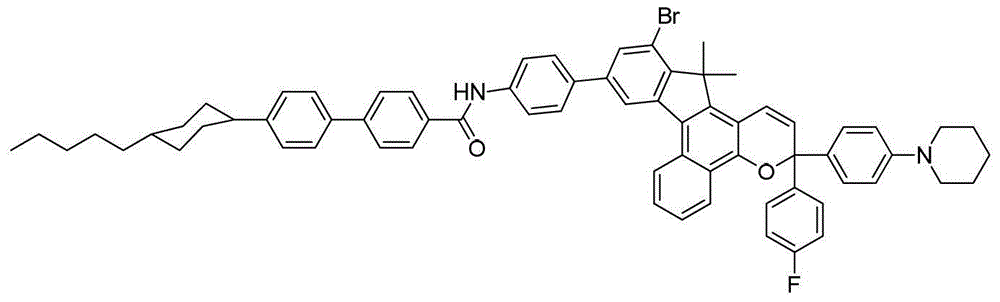
按照实施例3的步骤1和步骤3的程序,除了:在步骤1中使用三溴苯代替1-溴-3,5-二氟苯和使用苯甲酰氯代替3-溴苯甲酰氯;在步骤3中使用1-(4-氟苯基)-1-(4-(N-哌啶并)苯基)丙-2-炔-1-醇代替1,1-双(4-甲氧基苯基)丙-2-炔-1-醇;使用4'-(4-反式-戊基环己基)-N-(4-(4,4,5,5-四甲基-1,3,2-二氧环戊硼烷-2-基)苯基)-[1,1'-联苯基]-4-甲酰胺代替4-(4-反式-戊基环己基)-N-(4-(4,4,5,5-四甲基-1,3,2-二氧环戊硼烷-2-基)苯基)苯甲酰胺。NMR分析显示该产物的结构与3-(4-氟苯基)-3-(4-(N-哌啶并)苯基)-10-[4-(4-(4-(4-反式-戊基环己基)苯基)苯甲酰氨基)苯基]-12-溴-13,13-二甲基-3,13-二氢-茚并[2′,3′:3,4]萘并[1,2-b]吡喃相同。Follow the procedure of step 1 and step 3 of Example 3, except: in step 1, tribromobenzene is used instead of 1-bromo-3,5-difluorobenzene and benzoyl chloride is used instead of 3-bromobenzoyl chloride; 3 using 1-(4-fluorophenyl)-1-(4-(N-piperido)phenyl)prop-2-yn-1-ol instead of 1,1-bis(4-methoxybenzene base) prop-2-yn-1-ol; using 4'-(4-trans-pentylcyclohexyl)-N-(4-(4,4,5,5-tetramethyl-1,3, 2-dioxaborolan-2-yl)phenyl)-[1,1'-biphenyl]-4-carboxamide instead of 4-(4-trans-pentylcyclohexyl)-N-( 4-(4,4,5,5-Tetramethyl-1,3,2-dioxaborolan-2-yl)phenyl)benzamide. NMR analysis showed that the product had the same structure as 3-(4-fluorophenyl)-3-(4-(N-piperido)phenyl)-10-[4-(4-(4-(4-trans -pentylcyclohexyl)phenyl)benzamido)phenyl]-12-bromo-13,13-dimethyl-3,13-dihydro-indeno[2′,3′:3,4] Naphtho[1,2-b]pyran is the same.
实施例7Example 7
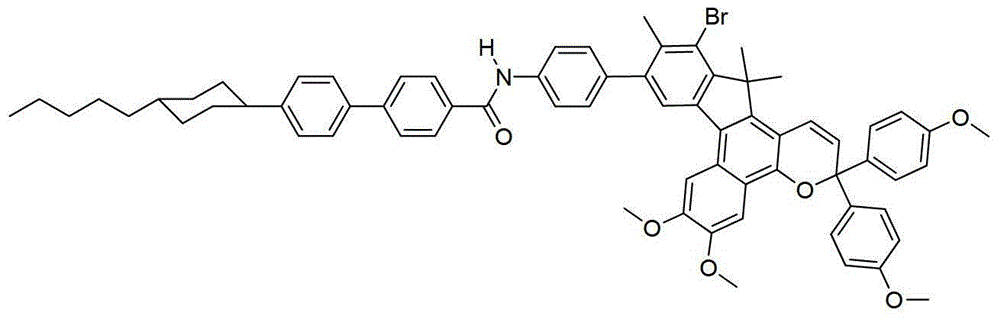
按照实施例3的步骤1和步骤3的程序,除了:在步骤1中使用2,4,6-三溴甲苯代替1-溴-3,5-二氟苯和使用3,4-二甲氧基苯甲酰氯代替3-溴苯甲酰氯;在步骤3中使用4'-(4-反式-戊基环己基)-N-(4-(4,4,5,5-四甲基-1,3,2-二氧环戊硼烷-2-基)苯基)-[1,1'-联苯基]-4-甲酰胺代替4-(4-反式-戊基环己基)-N-(4-(4,4,5,5-四甲基-1,3,2-二氧环戊硼烷-2-基)苯基)苯甲酰胺。NMR分析显示该产物的结构与3,3-双(4-甲氧基苯基)-10-[4-(4-(4-(4-反式-戊基环己基)苯基)苯甲酰氨基)苯基]-12-溴-6,7-二甲氧基-11,13,13-三甲基-3,13-二氢-茚并[2′,3′:3,4]萘并[1,2-b]吡喃相同。Follow the procedure of Step 1 and Step 3 of Example 3, except that in Step 1 2,4,6-tribromotoluene is used instead of 1-bromo-3,5-difluorobenzene and 3,4-dimethoxy phenylbenzoyl chloride instead of 3-bromobenzoyl chloride; 4'-(4-trans-pentylcyclohexyl)-N-(4-(4,4,5,5-tetramethyl- 1,3,2-dioxaborolan-2-yl)phenyl)-[1,1'-biphenyl]-4-carboxamide instead of 4-(4-trans-pentylcyclohexyl) -N-(4-(4,4,5,5-tetramethyl-1,3,2-dioxaborolan-2-yl)phenyl)benzamide. NMR analysis showed that the product had the same structure as 3,3-bis(4-methoxyphenyl)-10-[4-(4-(4-(4-trans-pentylcyclohexyl)phenyl)benzyl Acylamino)phenyl]-12-bromo-6,7-dimethoxy-11,13,13-trimethyl-3,13-dihydro-indeno[2′,3′:3,4] Naphtho[1,2-b]pyran is the same.
实施例8Example 8

步骤1step 1
将4-溴苯乙酮(148g),琥珀酸二甲酯(130g)和甲苯(2.5L)的混合物在反应烧瓶中机械搅拌。一次性加入叔丁醇钾(100g)。观察到黄色颜色。形成了大量的沉淀物。1小时后加入水(1L)。收集水层和用甲苯清洗两次。然后将它用12N的HCl中和。将该产物用醋酸乙酯萃取出来,然后从乙醚/己烷中重结晶。获得了170g白色晶体。NMR分析显示该产物的结构与(E)-4-(4-溴苯基)-3-(甲氧基羰基)戊-3-烯酸相同。A mixture of 4-bromoacetophenone (148 g), dimethyl succinate (130 g) and toluene (2.5 L) was stirred mechanically in the reaction flask. Potassium tert-butoxide (100 g) was added in one portion. A yellow color was observed. A large amount of precipitate formed. After 1 hour water (1 L) was added. The aqueous layer was collected and washed twice with toluene. It was then neutralized with 12N HCl. The product was extracted with ethyl acetate and recrystallized from ether/hexane. 170 g of white crystals are obtained. NMR analysis showed that the product had the same structure as (E)-4-(4-bromophenyl)-3-(methoxycarbonyl)pent-3-enoic acid.
步骤2step 2
将来自步骤1的(E)-4-(4-溴苯基)-3-(甲氧基羰基)戊-3-烯酸(160g)与50%氢氧化钠水溶液(200g)和水(4升)在四升烧杯中混合。将该混合物加热到沸腾。1小时后,TLC显示反应完成。将该溶液的pH使用12N的HCl调整到2。将沉淀物通过过滤收集。获得了浅白色晶体(152g)。NMR分析显示该产物的结构与(E)-2-(1-(4-溴苯基)亚乙基)琥珀酸相同。(E)-4-(4-bromophenyl)-3-(methoxycarbonyl)pent-3-enoic acid (160 g) from step 1 was mixed with 50% aqueous sodium hydroxide (200 g) and water (4 liters) were mixed in a four-liter beaker. Heat the mixture to a boil. After 1 hour, TLC showed the reaction was complete. The pH of the solution was adjusted to 2 using 12N HCl. The precipitate was collected by filtration. Off-white crystals (152 g) were obtained. NMR analysis showed that the product had the same structure as (E)-2-(1-(4-bromophenyl)ethylidene)succinic acid.
步骤3step 3
将来自步骤2的(E)-2-(1-(4-溴苯基)亚乙基)琥珀酸(152g),DBSA(5g)和甲苯(1L)的混合物加热到回流,并且通过Dean-Stark阱除水。固体启示材料最后在1小时内消失。2小时后,TLC显示该反应完成。将混合物送过硅胶插塞柱。产物用插塞柱,用1/4醋酸乙酯/己烷清洗。浓缩后获得油。向该油中加入己烷(1L)。产物结晶出来。将它通过过滤收集和真空干燥。获得了浅白色晶体(130g)。NMR分析显示该产物的结构与(E)-3-(1-(4-溴苯基)亚乙基)二氢呋喃-2,5-二酮相同。A mixture of (E)-2-(1-(4-bromophenyl)ethylidene)succinic acid (152 g), DBSA (5 g) and toluene (1 L) from Step 2 was heated to reflux and passed through Dean- Stark trap to remove water. Solid revelation material finally disappears within 1 hour. After 2 hours, TLC showed the reaction was complete. The mixture was passed through a plug of silica gel. The product was plugged and rinsed with 1/4 ethyl acetate/hexane. An oil is obtained after concentration. To this oil was added hexane (1 L). The product crystallized out. It was collected by filtration and dried under vacuum. Off-white crystals (130 g) were obtained. NMR analysis showed that the product had the same structure as (E)-3-(1-(4-bromophenyl)ethylidene)dihydrofuran-2,5-dione.
步骤4step 4
向搅拌的氯化铝(130g)和二氯甲烷(1L)混合物中在5分钟内分三部分加入来自步骤3的(E)-3-(1-(4-溴苯基)亚乙基)二氢呋喃-2,5-二酮(125g)。混合物变暗。在室温搅拌2小时后,将该反应混合物缓慢倾倒入水(2L)中。观察到产生烟雾。形成了大量的黄色固体。将THF(1L)加入该混合物中来溶解该黄色固体。水层是用固体NaCl饱和的,然后通过分液漏斗除去。将该有机溶液在硫酸镁上干燥和浓缩成粘性物。加入醋酸乙酯(200ml)和将该混合物放置于室温。将黄色晶体压碎和收集并且干燥(50g)。NMR分析显示该产物的结构与2-(6-溴-3-甲基-1-氧杂-1H-茚-2-基)乙酸。To a stirred mixture of aluminum chloride (130 g) and dichloromethane (1 L) was added (E)-3-(1-(4-bromophenyl)ethylene) from step 3 in three portions over 5 minutes Dihydrofuran-2,5-dione (125 g). The mixture darkens. After stirring at room temperature for 2 hours, the reaction mixture was poured slowly into water (2 L). Smoke generation was observed. A large amount of yellow solid formed. THF (1 L) was added to the mixture to dissolve the yellow solid. The aqueous layer was saturated with solid NaCl and removed via a separatory funnel. The organic solution was dried over magnesium sulfate and concentrated to a sticky mass. Ethyl acetate (200ml) was added and the mixture was allowed to stand at room temperature. The yellow crystals were crushed and collected and dried (50 g). NMR analysis showed the structure of the product to be the same as 2-(6-bromo-3-methyl-1-oxa-1H-inden-2-yl)acetic acid.
步骤5step 5
将氯化锰(7.46g)和氯化锂(5g)的混合物在200℃的真空烘箱中干燥1小时。在氮气保护下加入THF(200ml)。这个溶解进行了大约30分钟。向该溶液中加入氯化铜(I)(0.59g)和来自步骤4的2-(6-溴-3-甲基-1-氧杂-1H-茚-2-基)乙酸(19.4g)。将该混合物搅拌成透明的,然后冷却到0℃。向该混合物中逐滴加入丁基溴化镁的2M的THF溶液(99ml)。该反应混合物最终加入更多的BuMgBr而变黑。该添加2小时内结束。加入后,将该混合物在0℃搅拌2小时以上,然后使用水(200ml)猝灭。将该混合物的pH使用12N的HCl调整为约2。加入醋酸乙酯(200ml)。将有机部分通过分液漏斗收集,干燥和浓缩。将该产物通过
步骤6step 6
将固体镁(1.5g)置于装备有滴液漏斗的反应烧瓶中和在烘箱中干燥。加入THF(60ml)和1-溴-4-三氟甲基苯(15.3g)。用一滴的1,2-二溴乙烷开始,开始来形成Grignard。偶尔使用冰浴来控制反应速率。2小时后,全部镁消失。在滴液漏斗中将来自步骤5的2-(5-溴-1-丁基-1-甲基-3-氧杂-2,3-二氢-1H-茚-2-基)乙酸(4.2g)与无水THF(20ml)混合和滴入该Grignard溶液中。该添加在10分钟内完成。加入后,将该混合物室温搅拌2小时。该反应通过加水(100ml)停止。使用12N的HCl将pH调整到2。加入醋酸乙酯(100ml)。将有机相通过分液漏斗收集,用NaCl/水清洗,在硫酸镁上干燥和浓缩。将所获得的油重新溶解到反应烧瓶中的甲苯(100ml)中。加入乙酸酐(10g)和三氟甲烷磺酸铋(0.5g)。将该混合物回流1小时和冷却到室温。加入甲醇(100ml)和12N的HCl(1ml)。将该混合物回流12小时。除去全部溶剂。将硅胶插塞柱分离用于该产物。获得了作为产物的油(3g)。NMR分析支持该产物的结构与10-溴-7-丁基-7-甲基-3-(三氟甲基)-7H-苯并[c]芴-5-醇相同。Solid magnesium (1.5 g) was placed in a reaction flask equipped with a dropping funnel and dried in an oven. THF (60ml) and 1-bromo-4-trifluoromethylbenzene (15.3g) were added. Start with a drop of 1,2-dibromoethane to start forming the Grignard. Occasionally an ice bath was used to control the reaction rate. After 2 hours, all magnesium was gone. 2-(5-Bromo-1-butyl-1-methyl-3-oxa-2,3-dihydro-1H-inden-2-yl)acetic acid (4.2 g) Mixed with anhydrous THF (20ml) and dropped into the Grignard solution. The addition was complete within 10 minutes. After the addition, the mixture was stirred at room temperature for 2 hours. The reaction was quenched by adding water (100ml). The pH was adjusted to 2 using 12N HCl. Ethyl acetate (100ml) was added. The organic phase was collected by separatory funnel, washed with NaCl/water, dried over magnesium sulfate and concentrated. The oil obtained was redissolved in toluene (100ml) in the reaction flask. Acetic anhydride (10 g) and bismuth triflate (0.5 g) were added. The mixture was refluxed for 1 hour and cooled to room temperature. Methanol (100ml) and 12N HCl (1ml) were added. The mixture was refluxed for 12 hours. All solvent was removed. A silica gel plug column separation was used for this product. An oil (3 g) was obtained as product. NMR analysis supported the structure of this product to be identical to 10-bromo-7-butyl-7-methyl-3-(trifluoromethyl)-7H-benzo[c]fluoren-5-ol.
步骤7step 7
将来自步骤6的10-溴-7-丁基-7-甲基-3-(三氟甲基)-7H-苯并[c]芴-5-醇(3g)置于反应烧瓶中。向该烧瓶中加入1-(4-氟苯基)-1-(4-(N-吗啉并)苯基)丙-2-炔-1-醇(2.1g),1,2-二氯乙烷(30ml)和对甲苯磺酸(70mg)。将该混合物回流4小时。除去全部溶剂。使用硅胶插塞柱来净化该产物。获得了作为产物的褐色油(2g)。NMR分析显示该产物的结构与3-(4-氟苯基)-3-(4-(N-吗啉并)苯基)-10-溴-6-三氟甲基-13-甲基-13-丁基-3,13-二氢-茚并[2′,3′:3,4]萘并[1,2-b]吡喃相同。10-Bromo-7-butyl-7-methyl-3-(trifluoromethyl)-7H-benzo[c]fluoren-5-ol (3 g) from step 6 was placed in a reaction flask. To the flask was added 1-(4-fluorophenyl)-1-(4-(N-morpholino)phenyl)prop-2-yn-1-ol (2.1 g), 1,2-dichloro Ethane (30ml) and p-toluenesulfonic acid (70mg). The mixture was refluxed for 4 hours. All solvent was removed. The product was purified using a silica gel plug column. A brown oil (2 g) was obtained as the product. NMR analysis showed that the structure of the product was similar to that of 3-(4-fluorophenyl)-3-(4-(N-morpholino)phenyl)-10-bromo-6-trifluoromethyl-13-methyl- 13-Butyl-3,13-dihydro-indeno[2',3':3,4]naphtho[1,2-b]pyran is the same.
步骤8Step 8
将来自步骤7的3-(4-氟苯基)-3-(4-(N-吗啉并)苯基)-10-溴-6-三氟甲基-13-甲基-13-丁基-茚并[2′,3′:3,4]萘并[1,2-b]吡喃(1.4g),4'-(4-反式-戊基环己基)-N-(4-(4,4,5,5-四甲基-1,3,2-二氧环戊硼烷-2-基)苯基)-[1,1'-联苯基]-4-甲酰胺(1.5g),乙酸钯(24mg),三苯基膦(112mg),碳酸钠(0.8g),THF(20ml)和水(10ml)的混合物脱气和回流4小时。该反应混合物送过寅式

实施例9Example 9
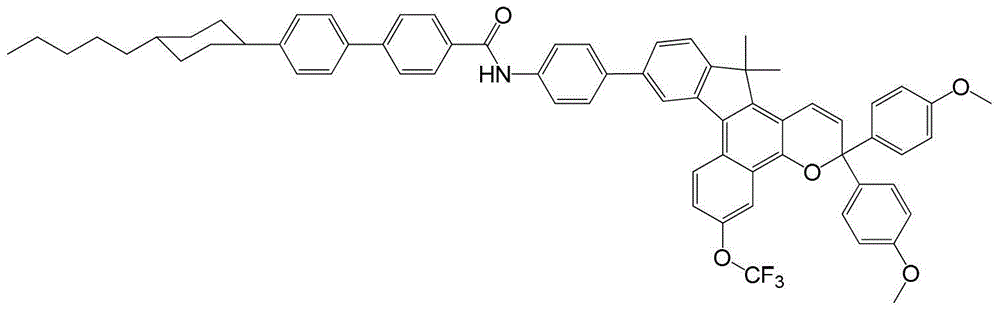
按照实施例8的程序,除了:在步骤5中使用甲基溴化镁的1.4M的THF溶液代替丁基溴化镁;在步骤6中使用1-溴-4-三氟甲氧基苯代替1-溴-4-三氟甲基苯;在步骤7中使用1,1-双(4-甲氧基苯基)丙-2-炔-1-醇代替1-(4-氟苯基)-1-(4-(N-吗啉并)苯基)丙-2-炔-1-醇。NMR分析显示该产物的结构与3,3-双(4-甲氧基苯基)-10-[4-(4-(4-(4-反式-戊基环己基)苯基)苯甲酰氨基)苯基]-6-三氟甲氧基-13-甲基-13-丁基-3,13-二氢-茚并[2′,3′:3,4]萘并[1,2-b]吡喃相同。Follow the procedure of Example 8, except: in step 5, methylmagnesium bromide in 1.4M THF is used instead of butylmagnesium bromide; in step 6, 1-bromo-4-trifluoromethoxybenzene is used instead 1-Bromo-4-trifluoromethylbenzene; use 1,1-bis(4-methoxyphenyl)prop-2-yn-1-ol instead of 1-(4-fluorophenyl) in step 7 -1-(4-(N-morpholino)phenyl)prop-2-yn-1-ol. NMR analysis showed that the product had the same structure as 3,3-bis(4-methoxyphenyl)-10-[4-(4-(4-(4-trans-pentylcyclohexyl)phenyl)benzyl Acylamino)phenyl]-6-trifluoromethoxy-13-methyl-13-butyl-3,13-dihydro-indeno[2′,3′:3,4]naphtho[1, 2-b] Pyran is the same.
实施例10Example 10
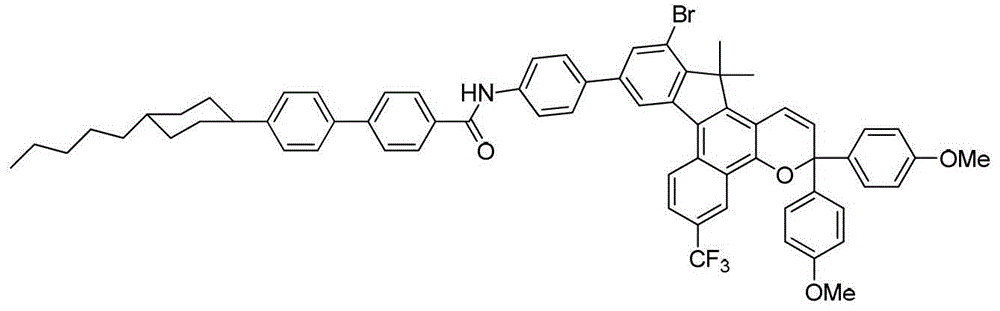
步骤1step 1
将具有三溴苯(100g)和磁搅拌棒的2L烧瓶在真空烘箱在80℃干燥4小时。加入无水THF(500ml)。将所形成的混合物置于NaCl饱和的冰浴中。将3M异丙基氯化镁(160ml)以一定的速度逐滴加入该溶液中,来将内部温度控制到-20到0℃。该添加在大约30分钟-1小时内完成。将该混合物在同样的温度搅拌半小时,并且在5分钟间隔内缓慢加入双[2-(N,N-二甲基氨基)乙基]醚(61g),形成了大量的沉淀物。将所形成的混合物搅拌20多分钟,并且在5分钟间隔内加入4-三氟甲基苯甲酰氯(73g)和THF(100ml)的混合物。将所形成的混合物搅拌一整夜。缓慢加水(100ml),并且用3N的HCl将pH调整到2。将有机层通过分液漏斗收集,用5%NaOH/水和NaCl/水清洗,干燥和浓缩。向回收的油中加入甲醇(300ml),并且将该产物结晶。将该产物通过过滤收集。NMR显示所获得的白色晶体(87g)的结构与3,5-二溴-4’-三氟甲基二苯甲酮相同。A 2 L flask with tribromobenzene (100 g) and a magnetic stir bar was dried in a vacuum oven at 80° C. for 4 hours. Anhydrous THF (500ml) was added. The resulting mixture was placed in a NaCl saturated ice bath. 3M isopropylmagnesium chloride (160 ml) was added dropwise to the solution at a rate to control the internal temperature to -20 to 0°C. This addition is complete in about 30 minutes to 1 hour. The mixture was stirred at the same temperature for half an hour, and bis[2-(N,N-dimethylamino)ethyl]ether (61 g) was added slowly at intervals of 5 minutes, forming a large amount of precipitate. The resulting mixture was stirred for 20 more minutes and a mixture of 4-trifluoromethylbenzoyl chloride (73 g) and THF (100 ml) was added at 5 minute intervals. The resulting mixture was stirred overnight. Water (100ml) was added slowly and the pH was adjusted to 2 with 3N HCl. The organic layer was collected by a separatory funnel, washed with 5% NaOH/water and NaCl/water, dried and concentrated. Methanol (300ml) was added to the recovered oil, and the product was crystallized. The product was collected by filtration. NMR showed that the obtained white crystals (87 g) had the same structure as 3,5-dibromo-4'-trifluoromethylbenzophenone.
步骤2step 2
将来自步骤1的3,5-二溴-4’-三氟甲基二苯甲酮(75g),琥珀酸二甲酯(32.2g)和甲苯(800ml)的混合物置于装备有机械搅拌的三颈5L烧瓶中。在30分钟间隔内分批加入叔丁醇钾固体(22.6g)。观察到一个放热反应,同时形成了大量的沉淀物。2小时后加入水(500ml),并且获得了牛奶状混合物。使用3N的HCl将该混合物的pH调整到约2。在室温搅拌10分钟后,收集有机层,用NaCl/HCl清洗,在MgSO4上干燥。浓缩后,加入己烷并形成白色晶体。将该晶体通过过滤收集。NMR显示所获得的产物(62g)的结构与(E)-4-(3,5-二溴苯基)-3-(甲氧基羰基)-4-(4-(三氟甲基)苯基)丁-3-烯酸相同。A mixture of 3,5-dibromo-4'-trifluoromethylbenzophenone (75 g), dimethyl succinate (32.2 g) and toluene (800 ml) from step 1 was placed in a mechanically stirred Three-neck 5L flask. Solid potassium tert-butoxide (22.6 g) was added in portions over 30 minute intervals. An exothermic reaction was observed with the formation of a large amount of precipitate. After 2 hours water (500ml) was added and a milky mixture was obtained. The pH of the mixture was adjusted to about 2 using 3N HCl. After stirring at room temperature for 10 minutes, the organic layer was collected, washed with NaCl/HCl, and dried over MgSO4. After concentration, hexane was added and white crystals formed. The crystals were collected by filtration. NMR showed that the structure of the obtained product (62 g) was similar to that of (E)-4-(3,5-dibromophenyl)-3-(methoxycarbonyl)-4-(4-(trifluoromethyl)benzene base) but-3-enoic acid is the same.
步骤3step 3
将固体无水氯化镧(III)(100g)研磨成非常细的粉末,然后与氯化锂(52g)和无水THF(1升)在装备有机械搅拌和滴液漏斗的5升三颈烧瓶中混合。将该混合物回流几小时直到它溶解。将来自步骤2的固体(E)-4-(3,5-二溴苯基)-3-(甲氧基羰基)-4-(4-(三氟甲基)苯基)丁-3-烯酸(106g)溶解在该混合物中。然后将该混合物冷却到-15℃。将3M甲基氯化镁溶液(238ml)置于滴液漏斗中。将第一30%的Grignard缓慢加入该混合物中。观察到气泡的产生。在温度返回-15℃后,将剩余的Grignard在2分钟内加入该混合物中。30分钟后,将水(1L)缓慢加入到该混合物中,并且使用乙酸将pH调整到酸性。该混合物变成透明,形成了两个层。将水层排掉。将有机层用NaCl/水清洗四次,然后浓缩来干燥。将一种亮黄色固体回收和溶解在甲苯中。将该溶液使用硅胶插塞柱过滤,并且将回收的透明溶液浓缩来干燥。获得了白色固体产物,并且无需进一步净化而用于下一步中。将一部分的该产物从甲醇中重结晶,并且NMR分析显示该净化的晶体的结构与(E)-4-((3,5-二溴苯基)(4-(三氟甲基)苯基)亚甲基)-5,5-二甲基二氢呋喃-2(3H)-酮相同。Solid anhydrous lanthanum(III) chloride (100 g) was ground to a very fine powder and then mixed with lithium chloride (52 g) and anhydrous THF (1 L) in a 5 L three-neck equipped with mechanical stirring and dropping funnel. Mix in the flask. The mixture was refluxed for several hours until it dissolved. The solid from step 2 (E)-4-(3,5-dibromophenyl)-3-(methoxycarbonyl)-4-(4-(trifluoromethyl)phenyl)butan-3- Enenoic acid (106 g) was dissolved in the mixture. The mixture was then cooled to -15°C. A 3M methylmagnesium chloride solution (238ml) was placed in the dropping funnel. The first 30% of Grignard was slowly added to the mixture. The generation of bubbles was observed. After the temperature had returned to -15°C, the remaining Grignard was added to the mixture within 2 minutes. After 30 minutes, water (1 L) was slowly added to the mixture, and the pH was adjusted to acidic using acetic acid. The mixture became clear and two layers formed. The aqueous layer was drained off. The organic layer was washed four times with NaCl/water, then concentrated to dryness. A bright yellow solid was recovered and dissolved in toluene. The solution was filtered using a plug of silica gel, and the recovered clear solution was concentrated to dryness. The product was obtained as a white solid and used in the next step without further purification. A portion of this product was recrystallized from methanol, and NMR analysis showed that the purified crystals had the same structure as (E)-4-((3,5-dibromophenyl)(4-(trifluoromethyl)phenyl )methylene)-5,5-dimethyldihydrofuran-2(3H)-one is the same.
步骤4step 4
向反应烧瓶中加入来自步骤3的产物,甲苯(500ml),三氟甲烷磺酸铋(20g)和乙酸(0.24g)。将所形成的混合物在回流下搅拌1小时。在它冷却到室温后,加入乙酸酐(100ml)。将该混合物重新加热到回流和1小时后,将该混合物冷却到室温和通过硅胶插塞柱过滤。将回收的透明溶液浓缩来干燥。加入丙酮(50ml)到所获得固体中来形成浆体,随后加入甲醇(250ml)。将所形成的混合物冷却来形成晶体。将回收的白色晶体(58g)用NMR分析,其显示该产物的结构与8,10-二溴-7,7-二甲基-3-(三氟甲基)-7H-苯并[c]芴-5-基乙酸酯相同。To the reaction flask was charged the product from step 3, toluene (500ml), bismuth trifluoromethanesulfonate (20g) and acetic acid (0.24g). The resulting mixture was stirred at reflux for 1 hour. After it cooled to room temperature, acetic anhydride (100ml) was added. The mixture was reheated to reflux and after 1 hour the mixture was cooled to room temperature and filtered through a plug of silica gel. The recovered clear solution was concentrated to dryness. Acetone (50ml) was added to the obtained solid to form a slurry, followed by methanol (250ml). The resulting mixture was cooled to form crystals. The recovered white crystals (58 g) were analyzed by NMR, which showed that the product had a structure similar to that of 8,10-dibromo-7,7-dimethyl-3-(trifluoromethyl)-7H-benzo[c] Fluoren-5-yl acetate is the same.
步骤5step 5
向含有来自步骤4的8,10-二溴-7,7-二甲基-3-(三氟甲基)-7H-苯并[c]芴-5-基乙酸酯(2.42g)的烧瓶中加入甲醇(20mL)和四氢呋喃(10mL)。加入浓盐酸(1mL),并且将该溶液加热到回流4h。真空下除去溶剂,将残留物如下来净化:通过硅胶插塞,使用4:1己烷/醋酸乙酯混合物作为洗提剂进行过滤。将含有期望材料的部分组合和浓缩来提供奶油色固体(1.63g)。NMR分析该奶油色固体显示其结构与8,10-二溴-7,7-二甲基-3-(三氟甲基)-7H-苯并[c]芴-5-醇相同。To the solution containing 8,10-dibromo-7,7-dimethyl-3-(trifluoromethyl)-7H-benzo[c]fluoren-5-ylacetate (2.42 g) from step 4 Methanol (20 mL) and tetrahydrofuran (10 mL) were added to the flask. Concentrated hydrochloric acid (1 mL) was added, and the solution was heated to reflux for 4 h. The solvent was removed under vacuum and the residue was purified by filtration through a plug of silica gel using a 4:1 hexane/ethyl acetate mixture as eluent. Fractions containing the desired material were combined and concentrated to afford a cream solid (1.63g). NMR analysis of the cream colored solid showed the same structure as 8,10-dibromo-7,7-dimethyl-3-(trifluoromethyl)-7H-benzo[c]fluoren-5-ol.
步骤6step 6
向含有来自步骤6的产物8,10-二溴-7,7-二甲基-3-(三氟甲基)-7H-苯并[c]芴-5-醇(1.63g)的氯仿溶液(50mL)的反应烧瓶中加入1,1-双(4-甲氧基苯基)丙-2-炔-1-醇(1.08g),正甲酸三异丙酯(0.90mL)和吡啶鎓对甲苯磺酸酯(0.10g)。将该溶液加热到回流2h。将该反应混合物在减压下浓缩来提供油状残留物。将二乙基醚加入该残留物来提供奶油色沉淀物。该奶油色沉淀物通过真空过滤收集(2.30g)和直接用于下一步。NMR分析该奶油色沉淀物显示其结构与3,3-双(4-甲氧基苯基)-10,12-二溴-6-三氟甲基-13,13-二甲基-3,13-二氢-茚并[2′,3′:3,4]萘并[1,2-b]吡喃相同。To a chloroform solution containing the product 8,10-dibromo-7,7-dimethyl-3-(trifluoromethyl)-7H-benzo[c]fluoren-5-ol (1.63 g) from step 6 (50mL) reaction flask was added 1,1-bis(4-methoxyphenyl)prop-2-yn-1-ol (1.08g), triisopropyl n-formate (0.90mL) and pyridinium para Tosylate (0.10 g). The solution was heated to reflux for 2h. The reaction mixture was concentrated under reduced pressure to afford an oily residue. Diethyl ether was added to the residue to provide a cream colored precipitate. The cream colored precipitate was collected by vacuum filtration (2.30 g) and used directly in the next step. NMR analysis of the cream-colored precipitate revealed that its structure was similar to that of 3,3-bis(4-methoxyphenyl)-10,12-dibromo-6-trifluoromethyl-13,13-dimethyl-3, 13-Dihydro-indeno[2',3':3,4]naphtho[1,2-b]pyran is the same.
步骤7step 7
向含有来自步骤6的产物(2.30g)和4'-(4-反式-戊基环己基)-N-(4-(4,4,5,5-四甲基-1,3,2-二氧环戊硼烷-2-基)苯基)-[1,1'-联苯基]-4-甲酰胺(1.72g)在1:1的THF(40mL)和水(40mL)混合物溶液的反应烧瓶加入氟化钾(1.81g,30.68mmol)。将该溶液用氮气鼓泡10min来脱泡。向所形成的溶液中加入双(三苯基膦)氯化钯(II)(0.22g,0.31mmol)。将该溶液加热到回流16h。将该反应混合物冷却到室温和用醋酸乙酯稀释。将该混合物通过寅式床助滤器过滤,并且将滤出液用醋酸乙酯和水分配。收集醋酸乙酯萃取物,用无水硫酸钠干燥和浓缩来提供油状残留物。将该残留物通过柱状色谱法使用4:1己烷和醋酸乙酯混合物作为洗提剂净化。将包含期望产物的部分组合和真空浓缩来提供油状残留物。将该油溶解在最小量的二氯甲烷中,并且逐滴加入到强力搅拌的甲醇溶液中。将所形成的沉淀物通过真空过滤收集和干燥来产生紫色固体(0.90g)。NMR分析该紫色固体显示其结构与3,3-双(4-甲氧基苯基)-10-[4-(4-(4-(4-反式-戊基环己基)苯基)苯甲酰氨基)苯基]-6-三氟甲基-12-溴-13,13-二甲基-3,13-二氢-茚并[2′,3′:3,4]萘并[1,2-b]吡喃相同。To a solution containing the product from step 6 (2.30 g) and 4'-(4-trans-pentylcyclohexyl)-N-(4-(4,4,5,5-tetramethyl-1,3,2 -dioxaborolan-2-yl)phenyl)-[1,1'-biphenyl]-4-carboxamide (1.72g) in a 1:1 mixture of THF (40mL) and water (40mL) The reaction flask of the solution was charged with potassium fluoride (1.81 g, 30.68 mmol). The solution was degassed by bubbling nitrogen gas for 10 min. To the resulting solution was added bis(triphenylphosphine)palladium(II) chloride (0.22 g, 0.31 mmol). The solution was heated to reflux for 16h. The reaction mixture was cooled to room temperature and diluted with ethyl acetate. pass the mixture through bed filter aid, and the filtrate was partitioned with ethyl acetate and water. The ethyl acetate extracts were collected, dried over anhydrous sodium sulfate and concentrated to afford an oily residue. The residue was purified by column chromatography using a 4:1 mixture of hexane and ethyl acetate as eluent. Fractions containing the desired product were combined and concentrated in vacuo to afford an oily residue. The oil was dissolved in a minimal amount of dichloromethane and added dropwise to the vigorously stirred methanol solution. The resulting precipitate was collected by vacuum filtration and dried to give a purple solid (0.90 g). NMR analysis of the purple solid showed a structure similar to that of 3,3-bis(4-methoxyphenyl)-10-[4-(4-(4-(4-trans-pentylcyclohexyl)phenyl)benzene Formamido)phenyl]-6-trifluoromethyl-12-bromo-13,13-dimethyl-3,13-dihydro-indeno[2′,3′:3,4]naphtho[ 1,2-b]pyran is the same.
实施例11Example 11

使用柱状色谱法通过提高己烷和醋酸乙酯(1:1)洗提剂的极性,来分馏实施例10的产物来提供极性部分。将该部分组合和真空浓缩来产生油状残留物。将该油溶解在最小量的二氯甲烷中,并且逐滴加入到强力搅拌的甲醇溶液中。将所形成的沉淀物通过真空过滤收集和干燥来提供蓝色-紫色固体(0.30g)。NMR分析该紫色固体显示其结构与3,3-双(4-甲氧基苯基)-10,12-双[4-(4-(4-(4-反式-戊基环己基)苯基)苯甲酰氨基)苯基]-6-三氟甲基-13,13-二甲基-3,13-二氢-茚并[2′,3′:3,4]萘并[1,2-b]吡喃相同。The product of Example 10 was fractionated using column chromatography by increasing the polarity of the eluent of hexane and ethyl acetate (1:1) to provide the polar fraction. The fractions were combined and concentrated in vacuo to yield an oily residue. The oil was dissolved in a minimal amount of dichloromethane and added dropwise to the vigorously stirred methanol solution. The formed precipitate was collected by vacuum filtration and dried to afford a blue-purple solid (0.30 g). NMR analysis of the purple solid showed that its structure was similar to that of 3,3-bis(4-methoxyphenyl)-10,12-bis[4-(4-(4-(4-trans-pentylcyclohexyl)benzene Base) benzamido) phenyl] -6-trifluoromethyl-13,13-dimethyl-3,13-dihydro-indeno[2′,3′:3,4]naphtho[1 ,2-b]pyran is the same.
实施例12Example 12
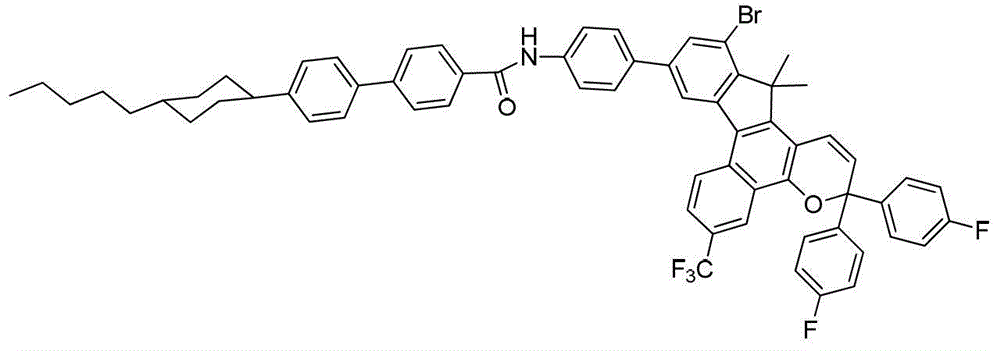
按照实施例10的程序,除了使用1,1-双(4-氟苯基)丙-2-炔-1-醇代替步骤6中的1,1-双(4-甲氧基苯基)丙-2-炔-1-醇。NMR分析显示最终产物的结构与3,3-双(4-氟苯基)-10-[4-(4-(4-(4-反式-戊基环己基)苯基)苯甲酰氨基)苯基]-6-三氟甲基-12-溴-13,13-二甲基-3,13-二氢-茚并[2′,3′:3,4]萘并[1,2-b]吡喃相同。Following the procedure of Example 10, except using 1,1-bis(4-fluorophenyl)prop-2-yn-1-ol in place of 1,1-bis(4-methoxyphenyl)propane in step 6 -2-yn-1-ol. NMR analysis showed that the structure of the final product was similar to that of 3,3-bis(4-fluorophenyl)-10-[4-(4-(4-(4-trans-pentylcyclohexyl)phenyl)benzamido )phenyl]-6-trifluoromethyl-12-bromo-13,13-dimethyl-3,13-dihydro-indeno[2′,3′:3,4]naphtho[1,2 -b] pyran is the same.
实施例13Example 13

按照实施例10的程序,除了下面的:在步骤1中使用3,5-二氟苯甲酰氯代替4-三氟甲基苯甲酰氯;在步骤4中该产物无需净化的用于下一步;在步骤5中使用醋酸乙酯作为溶剂来重结晶期望的8,10-二溴-2,4-二氟-7,7-二甲基-7H-苯并[c]芴-5-醇;在步骤6使用1-(4-氟苯基)-1-(4-(N-吗啉并)苯基)丙-2-炔-1-醇代替1,1-双(4-甲氧基苯基)丙-2-炔-1-醇;在步骤7使用不同的催化体系乙酸钯/三苯基膦/碳酸钠/二甲氧基甲烷/乙醇代替双(三苯基膦)氯化钯(II)/氟化钾/THF/水。NMR分析显示最终产物的结构与3-(4-氟苯基)-3-(4-吗啉代苯基)-10-[4-(4-(4-(4-反式-戊基环己基)苯基)苯甲酰氨基)苯基]-5,7-二氟-12-溴-13,13-二甲基-3,13-二氢-茚并[2′,3′:3,4]萘并[1,2-b]吡喃相同。The procedure of Example 10 was followed except the following: 3,5-difluorobenzoyl chloride was used instead of 4-trifluoromethylbenzoyl chloride in step 1; the product was used in the next step without purification in step 4; Recrystallization of the desired 8,10-dibromo-2,4-difluoro-7,7-dimethyl-7H-benzo[c]fluoren-5-ol in step 5 using ethyl acetate as solvent; Use 1-(4-fluorophenyl)-1-(4-(N-morpholino)phenyl)prop-2-yn-1-ol in step 6 instead of 1,1-bis(4-methoxy Phenyl)prop-2-yn-1-ol; use a different catalytic system palladium acetate/triphenylphosphine/sodium carbonate/dimethoxymethane/ethanol instead of bis(triphenylphosphine)palladium chloride in step 7 (II)/potassium fluoride/THF/water. NMR analysis showed that the structure of the final product was similar to that of 3-(4-fluorophenyl)-3-(4-morpholinophenyl)-10-[4-(4-(4-(4-trans-pentyl ring Hexyl)phenyl)benzamido)phenyl]-5,7-difluoro-12-bromo-13,13-dimethyl-3,13-dihydro-indeno[2′,3′:3 ,4]Naphtho[1,2-b]pyran is the same.
实施例14Example 14
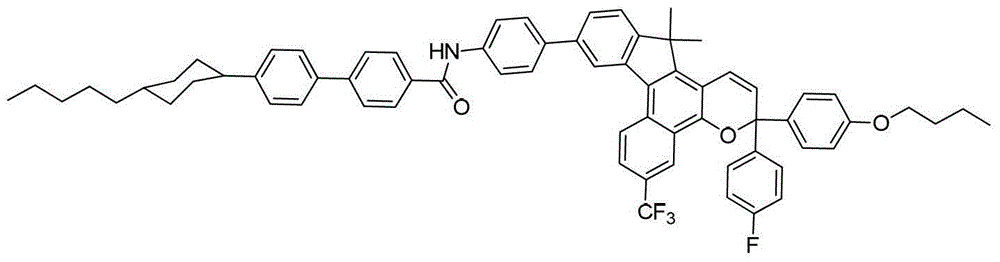
步骤1-步骤4Step 1 - Step 4
按照实施例10的步骤1-步骤4的程序。Follow the procedure of Step 1-Step 4 of Example 10.
步骤5step 5
将来自步骤4的8,10-二溴-7,7-二甲基-3-(三氟甲基)-7H-苯并[c]芴-5-基乙酸酯(53.88g)和4’-(4-反式-戊基环己基)-N-(4-(4,4,5,5-四甲基-1,3,2-二氧环戊硼烷-2-基)苯基)-[1,1’-联苯基]-4-甲酰胺(56.27g)加入到反应烧瓶中,并且溶解在甲苯(1000mL)和乙醇(1000mL)的1:1混合物中。将碳酸钾(42.26g)和三苯膦(8.02g)加入该溶液中,将其通过氮气鼓泡20min来脱气。向所形成的溶液中加入乙酸钯(2.29g),并且将该混合物加热到回流3h。将该反应混合物冷却到室温,并且加入双(三苯基膦)氯化钯(II)(7.15g)在甲苯(100mL)和乙醇(100mL)中的脱气的悬浮液中。将该反应混合物加热到回流16h。将该反应混合物冷却到室温和用醋酸乙酯(500mL)稀释。将该混合物通过寅式
步骤6step 6
将来自步骤5的7,7-二甲基-3-三氟甲基-10-[4-(4-(4-(4-反式-戊基环己基)苯基)苯甲酰氨基)苯基]-7H-苯并[c]芴-5-基(18.00g)加入到反应烧瓶中,并且溶解在四氢呋喃(200mL)中。将4-十二烷基苯磺酸(0.54g)作为在甲苯(20mL)中的溶液加入。将1-(4-丁氧基苯基)-1-(4-氟苯基)丙-2-炔-1-醇(14.52g)以5部分作为在甲苯(20mL)中的溶液加入,并且将该混合物加热到回流6h。将该反应混合物冷却到室温和真空除去溶剂来提供残留物。将该残留物通过柱状色谱法,使用1:1己烷和甲苯混合物作为洗提剂来净化。将含有期望产物的部分组合和真空浓缩来提供油状残留物。将该油溶解在最小量的二氯甲烷中,并且逐滴加入到甲醇的强力搅拌的溶液中。将所形成的沉淀物通过真空过滤收集和干燥来提供紫色固体(9.97g)。NMR分析该紫色固体显示其结构与3-(4-氟苯基)-3-(4-丁氧基苯基)-10-[4-(4-(4-(4-反式-戊基环己基)苯基)苯甲酰氨基)苯基]-6-三氟甲基-13,13-二甲基-3,13-二氢-茚并[2′,3′:3,4]萘并[1,2-b]吡喃相同。7,7-Dimethyl-3-trifluoromethyl-10-[4-(4-(4-(4-trans-pentylcyclohexyl)phenyl)benzamido) from step 5 Phenyl]-7H-benzo[c]fluoren-5-yl (18.00 g) was added to the reaction flask and dissolved in tetrahydrofuran (200 mL). 4-Dodecylbenzenesulfonic acid (0.54 g) was added as a solution in toluene (20 mL). 1-(4-Butoxyphenyl)-1-(4-fluorophenyl)prop-2-yn-1-ol (14.52 g) was added in 5 portions as a solution in toluene (20 mL), and The mixture was heated to reflux for 6h. The reaction mixture was cooled to room temperature and the solvent was removed in vacuo to provide a residue. The residue was purified by column chromatography using a 1:1 mixture of hexane and toluene as eluent. Fractions containing the desired product were combined and concentrated in vacuo to afford an oily residue. The oil was dissolved in a minimal amount of dichloromethane and added dropwise to a vigorously stirred solution of methanol. The precipitate formed was collected by vacuum filtration and dried to afford a purple solid (9.97g). NMR analysis of the purple solid showed a structure similar to that of 3-(4-fluorophenyl)-3-(4-butoxyphenyl)-10-[4-(4-(4-(4-trans-pentyl) Cyclohexyl)phenyl)benzamido)phenyl]-6-trifluoromethyl-13,13-dimethyl-3,13-dihydro-indeno[2′,3′:3,4] Naphtho[1,2-b]pyran is the same.
实施例15Example 15
按照实施例14的程序,除了在步骤6中使用1-(4-氟苯基)-1-(4-(N-吗啉并)苯基)丙-2-炔-1-醇代替1-(4-丁氧基苯基)-1-(4-氟苯基)丙-2-炔-1-醇。NMR分析显示该结构与3-(4-氟苯基)-3-(4-(N-吗啉并)苯基)-10-[4-(4-(4-(4-反式-戊基环己基)苯基)苯甲酰氨基)苯基]-6-三氟甲基-13,13-二甲基-3,13-二氢-茚并[2′,3′:3,4]萘并[1,2-b]吡喃相同。The procedure of Example 14 was followed except that in step 6 1-(4-fluorophenyl)-1-(4-(N-morpholino)phenyl)prop-2-yn-1-ol was used instead of 1- (4-butoxyphenyl)-1-(4-fluorophenyl)prop-2-yn-1-ol. NMR analysis showed that the structure was similar to that of 3-(4-fluorophenyl)-3-(4-(N-morpholino)phenyl)-10-[4-(4-(4-(4-trans-pentyl) Cyclohexyl)phenyl)benzamido)phenyl]-6-trifluoromethyl-13,13-dimethyl-3,13-dihydro-indeno[2′,3′:3,4 ]Naphtho[1,2-b]pyran is the same.
实施例16Example 16
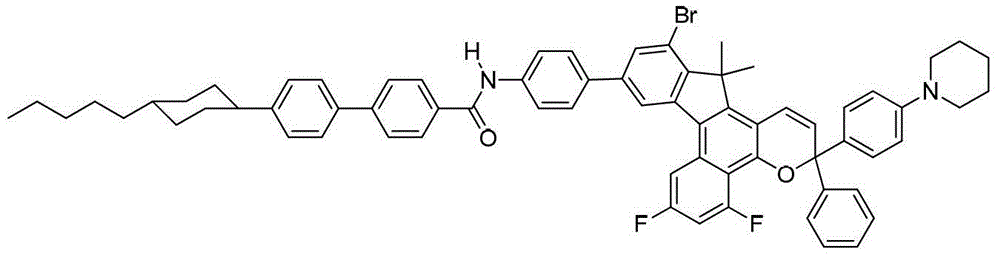
按照实施例13的程序,除了使用1-苯基-1-(4-哌啶并苯基)丙-2-炔-1-醇代替1-(4-N-吗啉代苯基)-1-(4-氟苯基)丙-2-炔-1-醇。NMR分析显示该结构与3-苯基-3-(4-哌啶并苯基)-10-[4-(4-(4-(4-反式-戊基环己基)苯基)苯甲酰氨基)苯基]-5,7-二氟-12-溴-13,13-二甲基-3,13-二氢-茚并[2′,3′:3,4]萘并[1,2-b]吡喃相同。The procedure of Example 13 was followed except that 1-phenyl-1-(4-piperidophenyl)prop-2-yn-1-ol was used instead of 1-(4-N-morpholinophenyl)-1 -(4-fluorophenyl)prop-2-yn-1-ol. NMR analysis showed that the structure was compatible with 3-phenyl-3-(4-piperidophenyl)-10-[4-(4-(4-(4-trans-pentylcyclohexyl)phenyl)benzyl Acylamino)phenyl]-5,7-difluoro-12-bromo-13,13-dimethyl-3,13-dihydro-indeno[2′,3′:3,4]naphtho[1 ,2-b]pyran is the same.
实施例17Example 17
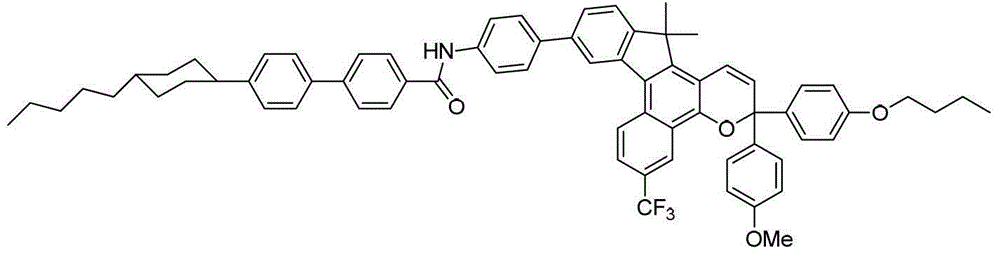
按照实施例14的程序,除了使用1-(4-丁氧基苯基)-1-(4-甲氧基苯基)丙-2-炔-1-醇代替1-(4-丁氧基苯基)-1-(4-氟苯基)丙-2-炔-1-醇。NMR分析显示该产物的结构与3-(4-甲氧基苯基)-3-(4-丁氧基苯基)-10-[4-(4-(4-(4-反式-戊基环己基)苯基)苯甲酰氨基)苯基]-6-三氟甲基-13,13-二甲基-3,13-二氢-茚并[2′,3′:3,4]萘并[1,2-b]吡喃相同。The procedure of Example 14 was followed except that 1-(4-butoxyphenyl)-1-(4-methoxyphenyl)prop-2-yn-1-ol was used instead of 1-(4-butoxy phenyl)-1-(4-fluorophenyl)prop-2-yn-1-ol. NMR analysis showed that the product had the same structure as 3-(4-methoxyphenyl)-3-(4-butoxyphenyl)-10-[4-(4-(4-(4-trans-pentyl) Cyclohexyl)phenyl)benzamido)phenyl]-6-trifluoromethyl-13,13-dimethyl-3,13-dihydro-indeno[2′,3′:3,4 ]Naphtho[1,2-b]pyran is the same.
实施例18Example 18

按照实施例14的程序,除了使用1-(4-(4-(4-甲氧基苯基)哌嗪-1-基)苯基)-1-苯基丙-2-炔-1-醇代替1-(4-丁氧基苯基)-1-(4-氟苯基)丙-2-炔-1-醇。NMR分析显示该产物的结构与3-(4-(4-(4-甲氧基苯基)哌嗪-1-基)苯基)-3-苯基-10-[4-(4-(4-(4-反式-戊基环己基)苯基)苯甲酰氨基)苯基]-6-三氟甲基-13,13-二甲基-3,13-二氢-茚并[2′,3′:3,4]萘并[1,2-b]吡喃相同。The procedure of Example 14 was followed except that 1-(4-(4-(4-methoxyphenyl)piperazin-1-yl)phenyl)-1-phenylprop-2-yn-1-ol was used Instead of 1-(4-butoxyphenyl)-1-(4-fluorophenyl)prop-2-yn-1-ol. NMR analysis showed that the structure of the product was similar to that of 3-(4-(4-(4-methoxyphenyl)piperazin-1-yl)phenyl)-3-phenyl-10-[4-(4-( 4-(4-trans-pentylcyclohexyl)phenyl)benzamido)phenyl]-6-trifluoromethyl-13,13-dimethyl-3,13-dihydro-indeno[ 2',3': 3,4]Naphtho[1,2-b]pyran is the same.
实施例19Example 19
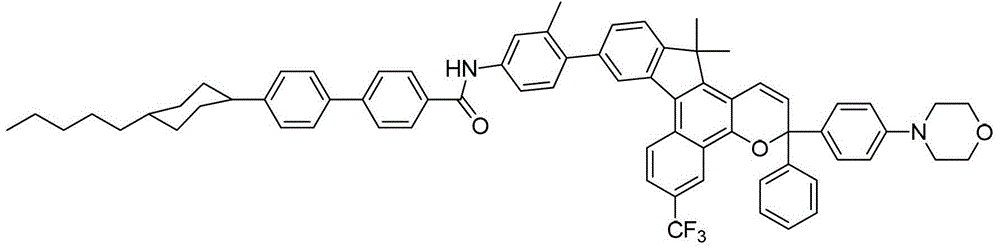
按照实施例14的程序,除了使用1-苯基-1-(4-(N-吗啉并)苯基)丙-2-炔-1-醇代替1-(4-丁氧基苯基)-1-(4-氟苯基)丙-2-炔-1-醇和使用N-(3-甲基-4-(4,4,5,5-四甲基-1,3,2-二氧环戊硼烷-2-基)苯基)-4'-(4-戊基环己基)-[1,1'-联苯基]-4-甲酰胺代替4’-(4-反式-戊基环己基)-N-(4-(4,4,5,5-四甲基-1,3,2-二氧环戊硼烷-2-基)苯基)-[1,1’-联苯基]-4-甲酰胺。NMR显示该结构与3-苯基-3-(4-(N-吗啉并)苯基)-10-[4-(4-(4-(4-反式-戊基环己基)苯基)苯甲酰氨基)-2-甲基苯基]-6-三氟甲基-13,13-二甲基-3,13-二氢-茚并[2′,3′:3,4]萘并[1,2-b]吡喃相同。The procedure of Example 14 was followed except that 1-phenyl-1-(4-(N-morpholino)phenyl)prop-2-yn-1-ol was used instead of 1-(4-butoxyphenyl) -1-(4-fluorophenyl)prop-2-yn-1-ol and using N-(3-methyl-4-(4,4,5,5-tetramethyl-1,3,2-di Oxaborolan-2-yl)phenyl)-4'-(4-pentylcyclohexyl)-[1,1'-biphenyl]-4-carboxamide instead of 4'-(4-trans -Pentylcyclohexyl)-N-(4-(4,4,5,5-tetramethyl-1,3,2-dioxaborolan-2-yl)phenyl)-[1,1 '-biphenyl]-4-carboxamide. NMR showed that this structure was similar to that of 3-phenyl-3-(4-(N-morpholino)phenyl)-10-[4-(4-(4-(4-trans-pentylcyclohexyl)phenyl )benzamido)-2-methylphenyl]-6-trifluoromethyl-13,13-dimethyl-3,13-dihydro-indeno[2′,3′:3,4] Naphtho[1,2-b]pyran is the same.
实施例20Example 20
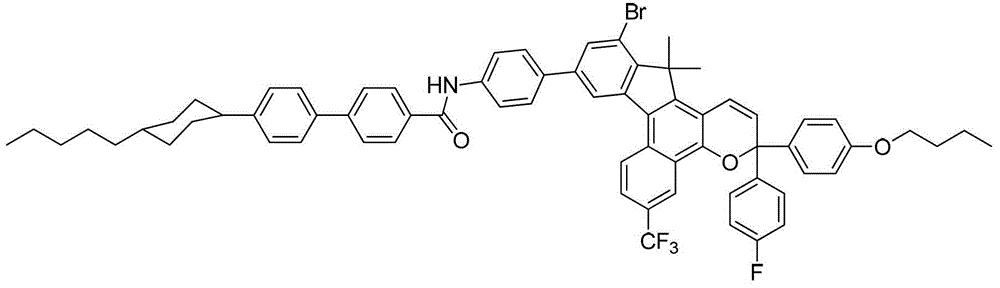
按照实施例10的程序,除了在步骤6中使用1-(4-氟苯基)-1-(4-丁氧基苯基)丙-2-炔-1-醇代替1,1-双(4-甲氧基苯基)丙-2-炔-1-醇。NMR分析显示最终产物的结构与3-(4-氟苯基)-3-(4-丁氧基苯基)-10-[4-(4-(4-(4-反式-戊基环己基)苯基)苯甲酰氨基)苯基]-6-三氟甲基-12-溴-13,13-二甲基-3,13-二氢-茚并[2′,3′:3,4]萘并[1,2-b]吡喃相同。The procedure of Example 10 was followed except that 1-(4-fluorophenyl)-1-(4-butoxyphenyl)prop-2-yn-1-ol was used instead of 1,1-bis( 4-methoxyphenyl)prop-2-yn-1-ol. NMR analysis showed that the structure of the final product was similar to that of 3-(4-fluorophenyl)-3-(4-butoxyphenyl)-10-[4-(4-(4-(4-trans-pentyl ring Hexyl)phenyl)benzamido)phenyl]-6-trifluoromethyl-12-bromo-13,13-dimethyl-3,13-dihydro-indeno[2′,3′:3 ,4]Naphtho[1,2-b]pyran is the same.
实施例21Example 21

将实施例20的产物3-(4-氟苯基)-3-(4-丁氧基苯基)-10-[4-(4-(4-(4-反式-戊基环己基)苯基)苯甲酰氨基)苯基]-6-三氟甲基-12-溴-13,13-二甲基-茚并[2′,3′:3,4]萘并[1,2-b]吡喃(3.77g)加入到反应烧瓶中和溶解在四氢呋喃(10mL)中,并且冷却到-78℃。加入正丁基锂(6mL,2.5M的己烷溶液)并且搅拌30min。将盐水加入该反应混合物中,并且将它升温到室温。将含水层用醋酸乙酯萃取。将回收的有机层用无水硫酸钠干燥,过滤和浓缩来提供一种油状残留物。两种光致变色化合物存在于该油状残留物中。将它们通过柱状色谱法使用9:1己烷和醋酸乙酯混合物作为洗提剂进行分离。将含有更大极性化合物的部分组合和浓缩来提供油。将该油溶解在最小量的二氯甲烷中,并且逐滴加入到强力搅拌的甲醇中。将所形成的沉淀物通过真空过滤收集和干燥成紫色固体(0.3g)。NMR分析该紫色固体显示其结构与3-(4-丁氧基苯基)-3-(4-氟苯基)-12-羟基-10-[4-(4-(4-(4-反式-戊基环己基)苯基)苯甲酰氨基)苯基]-6-三氟甲基-13,13-二甲基-3,13-二氢-茚并[2′,3′:3,4]萘并[1,2-b]吡喃相同。The product 3-(4-fluorophenyl)-3-(4-butoxyphenyl)-10-[4-(4-(4-(4-trans-pentylcyclohexyl) Phenyl)benzamido)phenyl]-6-trifluoromethyl-12-bromo-13,13-dimethyl-indeno[2′,3′:3,4]naphtho[1,2 -b] Pyran (3.77 g) was added to the reaction flask and dissolved in tetrahydrofuran (10 mL), and cooled to -78°C. Add n-butyllithium (6 mL, 2.5M in hexane) and stir for 30 min. Brine was added to the reaction mixture, and it was allowed to warm to room temperature. The aqueous layer was extracted with ethyl acetate. The recovered organic layer was dried over anhydrous sodium sulfate, filtered and concentrated to provide an oily residue. Two photochromic compounds were present in the oily residue. They were separated by column chromatography using a 9:1 mixture of hexane and ethyl acetate as eluent. Fractions containing more polar compounds are combined and concentrated to provide an oil. The oil was dissolved in a minimal amount of dichloromethane and added dropwise to vigorously stirred methanol. The precipitate formed was collected by vacuum filtration and dried to a purple solid (0.3 g). NMR analysis of the purple solid showed that its structure was similar to that of 3-(4-butoxyphenyl)-3-(4-fluorophenyl)-12-hydroxyl-10-[4-(4-(4-(4-trans Formula-pentylcyclohexyl)phenyl)benzamido)phenyl]-6-trifluoromethyl-13,13-dimethyl-3,13-dihydro-indeno[2′,3′: 3,4]Naphtho[1,2-b]pyran is the same.
实施例22Example 22
步骤1step 1
按照实施例3的步骤2的程序,除了使用4'-戊基-[(反式,反式)-1,1'-双(环己)]-4-醇代替4-(反式-4-戊基环己基)苯甲酸。NMR显示该产物的结构与(反式,反式)-4'-戊基-[1,1'-双(环己)]-4-基4-(4,4,5,5-四甲基-1,3,2-二氧环戊硼烷-2-基)苯甲酸酯相同。Follow the procedure of step 2 of Example 3, except that 4'-pentyl-[(trans,trans)-1,1'-bis(cyclohexyl)]-4-ol is used instead of 4-(trans-4 -pentylcyclohexyl)benzoic acid. NMR showed that the product had the same structure as (trans,trans)-4'-pentyl-[1,1'-bis(cyclohexyl)]-4-yl 4-(4,4,5,5-tetramethyl 1,3,2-dioxaborolan-2-yl) benzoate is the same.
步骤2step 2
按照实施例14的程序,除了在步骤5中使用(反式,反式)-4'-戊基-[1,1'-双(环己)]-4-基4-(4,4,5,5-四甲基-1,3,2-二氧环戊硼烷-2-基)苯甲酸酯代替4’-(4-反式-戊基环己基)-N-(4-(4,4,5,5-四甲基-1,3,2-二氧环戊硼烷-2-基)苯基)-[1,1’-联苯基]-4-甲酰胺。NMR分析显示该产物的结构与3-(4-丁氧基苯基)-3-(4-氟苯基)-10-[4-((反式,反式)-4'-戊基-[1,1'-双(环己)]-4-氧羰基)苯基]-6-三氟甲基-13,13-二甲基-3,13-二氢-茚并[2′,3′:3,4]萘并[1,2-b]吡喃相同。The procedure of Example 14 was followed except that (trans,trans)-4'-pentyl-[1,1'-bis(cyclohexyl)]-4-yl 4-(4,4, 5,5-Tetramethyl-1,3,2-dioxaborolan-2-yl)benzoate instead of 4'-(4-trans-pentylcyclohexyl)-N-(4- (4,4,5,5-Tetramethyl-1,3,2-dioxaborolan-2-yl)phenyl)-[1,1'-biphenyl]-4-carboxamide. NMR analysis showed that the product had the same structure as 3-(4-butoxyphenyl)-3-(4-fluorophenyl)-10-[4-((trans,trans)-4'-pentyl- [1,1'-bis(cyclohexyl)]-4-oxycarbonyl)phenyl]-6-trifluoromethyl-13,13-dimethyl-3,13-dihydro-indeno[2', 3': Same for 3,4]naphtho[1,2-b]pyran.
实施例23Example 23
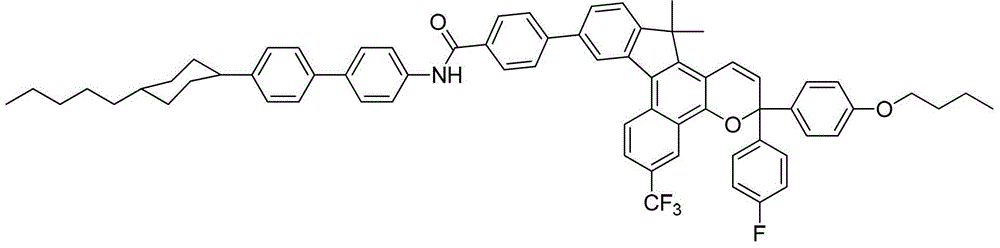
步骤1step 1
向反应烧瓶中的1-溴-4-(4-戊基环己基)苯(300g)在1,4-二噁烷(2L)的脱气溶液中加入Pd(PPh3)4(10.7g)。室温搅拌10min后,加入1MK2CO3(485mL,4.85mmol)和4-(4,4,5,5-四甲基-1,3,2-二氧环戊硼烷-2-基)苯胺(274.5g,0.97mol)的水溶液。将该反应混合物回流36h。蒸发溶剂和将残留物使用CH2Cl2-MeOH(400mL-1500mL)重结晶。获得了作为产物的白色晶体(256g)。NMR显示该产物的结构与4'-(反式-4-戊基环己基)-[1,1'-联苯基]-4-胺相同。To a degassed solution of 1-bromo-4-(4-pentylcyclohexyl)benzene (300 g) in 1,4-dioxane (2 L) in a reaction flask was added Pd(PPh 3 ) 4 (10.7 g) . After stirring at room temperature for 10 min, 1M K 2 CO 3 (485 mL, 4.85 mmol) and 4-(4,4,5,5-tetramethyl-1,3,2-dioxaborolan-2-yl)aniline were added (274.5 g, 0.97 mol) in water. The reaction mixture was refluxed for 36h. The solvent was evaporated and the residue was recrystallized using CH2Cl2 - MeOH (400 mL-1500 mL). White crystals (256 g) were obtained as the product. NMR showed that the product had the same structure as 4'-(trans-4-pentylcyclohexyl)-[1,1'-biphenyl]-4-amine.
步骤2step 2
将4-(4,4,5,5-四甲基-1,3,2-二氧环戊硼烷-2-基)苯甲酸(82.6g0.35mol),1,1'-羰基二咪唑(56.6g,0.35mol)和500mL的THF(500ml)的混合物在室温在反应烧瓶中搅拌5h。向该反应混合物中加入步骤1的产物4'-(反式-4-戊基环己基)-[1,1'-联苯基]-4-胺(102g)。将该混合物室温搅拌24小时。蒸发溶剂和将残留物用CH2Cl2-MeOH(150mL-400mL)重结晶。获得了作为产物的白色晶体(156g)。NMR显示该产物的结构与N-(4'-(反式-4-戊基环己基)-[1,1'-联苯基]-4-基)-4-(4,4,5,5-四甲基-1,3,2-二氧环戊硼烷-2-基)苯甲酰胺相同。4-(4,4,5,5-tetramethyl-1,3,2-dioxaborolan-2-yl)benzoic acid (82.6g0.35mol), 1,1'-carbonyldiimidazole (56.6 g, 0.35 mol) and 500 mL of THF (500 ml) were stirred in a reaction flask at room temperature for 5 h. To this reaction mixture was added the product of Step 1, 4'-(trans-4-pentylcyclohexyl)-[1,1'-biphenyl]-4-amine (102 g). The mixture was stirred at room temperature for 24 hours. The solvent was evaporated and the residue was recrystallized from CH2Cl2 -MeOH ( 150mL -400mL). White crystals (156 g) were obtained as the product. NMR showed that the structure of the product was similar to that of N-(4'-(trans-4-pentylcyclohexyl)-[1,1'-biphenyl]-4-yl)-4-(4,4,5, 5-Tetramethyl-1,3,2-dioxaborolan-2-yl)benzamide is the same.
步骤3step 3
按照实施例14的程序,除了在步骤5中使用N-(4'-(反式-4-戊基环己基)-[1,1'-联苯基]-4-基)-4-(4,4,5,5-四甲基-1,3,2-二氧环戊硼烷-2-基)苯甲酰胺代替4’-(4-反式-戊基环己基)-N-(4-(4,4,5,5-四甲基-1,3,2-二氧环戊硼烷-2-基)苯基)-[1,1’-联苯基]-4-甲酰胺。NMR分析显示该产物的结构与3-(4-甲氧基苯基)-3-(4-丁氧基苯基)-10-[4-((4'-(反式-4-戊基环己基)-[1,1'-联苯基]-4-基)氨基甲酰基)苯基]-6-三氟甲基-13,13-二甲基-3,13-二氢-茚并[2′,3′:3,4]萘并[1,2-b]吡喃相同。The procedure of Example 14 was followed except that N-(4'-(trans-4-pentylcyclohexyl)-[1,1'-biphenyl]-4-yl)-4-( 4,4,5,5-Tetramethyl-1,3,2-dioxaborolan-2-yl)benzamide instead of 4'-(4-trans-pentylcyclohexyl)-N- (4-(4,4,5,5-tetramethyl-1,3,2-dioxaborolan-2-yl)phenyl)-[1,1'-biphenyl]-4- Formamide. NMR analysis showed that the structure of the product was similar to that of 3-(4-methoxyphenyl)-3-(4-butoxyphenyl)-10-[4-((4'-(trans-4-pentyl) Cyclohexyl)-[1,1'-biphenyl]-4-yl)carbamoyl)phenyl]-6-trifluoromethyl-13,13-dimethyl-3,13-dihydro-indene And[2',3':3,4]naphtho[1,2-b]pyran is the same.
实施例24Example 24
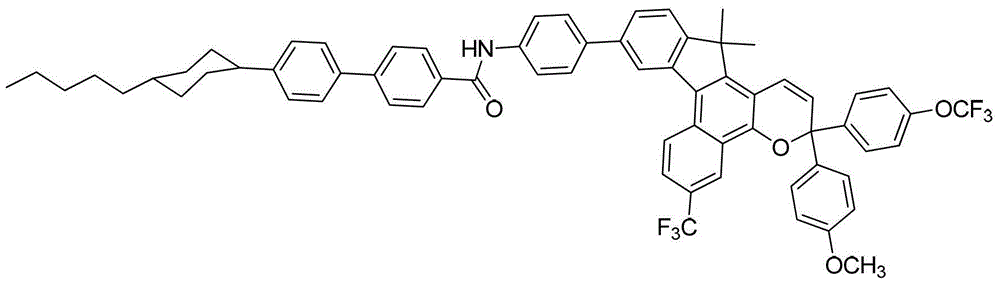
步骤1step 1
在反应烧瓶中将4-三氟甲氧基苯甲酰氯(1.00g)和苯甲醚(0.60g)溶解在氯仿(20mL)中,并且通过冰浴冷却到0-5℃。加入氯化铝(0.90g)和在0-5℃搅拌15min。除去该冰浴和将该反应升温到室温,并且搅拌48h和倾倒入水(100mL)中,并且搅拌15min。将含水层用醋酸乙酯(300mL)萃取。回收有机层,用饱和碳酸氢钠、盐水清洗,用无水硫酸钠干燥和真空浓缩来提供残留物。将该残留物通过柱状色谱法使用9:1己烷和醋酸乙酯混合物作为洗提剂进行净化。将含有期望材料的部分组合和浓缩来提供固体。加入己烷,并且将固体通过真空过滤收集(0.55g)。该固体的NMR显示其结构与(4-甲氧基苯基)(4-(三氟甲氧基)苯基)甲酮相同。4-Trifluoromethoxybenzoyl chloride (1.00 g) and anisole (0.60 g) were dissolved in chloroform (20 mL) in a reaction flask and cooled to 0-5°C by an ice bath. Aluminum chloride (0.90 g) was added and stirred at 0-5°C for 15 min. The ice bath was removed and the reaction was allowed to warm to room temperature and stirred for 48 h and poured into water (100 mL) and stirred for 15 min. The aqueous layer was extracted with ethyl acetate (300 mL). The organic layer was recovered, washed with saturated sodium bicarbonate, brine, dried over anhydrous sodium sulfate and concentrated in vacuo to afford a residue. The residue was purified by column chromatography using a 9:1 mixture of hexane and ethyl acetate as eluent. Fractions containing the desired materials were combined and concentrated to provide solids. Hexanes were added and the solid was collected by vacuum filtration (0.55 g). NMR of this solid showed the same structure as (4-methoxyphenyl)(4-(trifluoromethoxy)phenyl)methanone.
步骤2step 2
将(4-甲氧基苯基)(4-(三氟甲氧基)苯基)甲酮(0.55g)加入反应烧瓶中和溶解在用乙炔饱和的二甲基甲酰胺(10mL)中。加入乙炔化钠(0.1g)和将该反应混合物室温搅拌30min。将该反应混合物仔细倾倒入冰-冷水(100mL)中并且搅拌15min。将含水层用醋酸乙酯萃取。将有机层回收和合并。将所形成的产物用无水硫酸钠干燥和浓缩来提供油(0.55g)。NMR分析该油显示其结构与1-(4-甲氧基苯基)-1-(4-(三氟甲氧基)苯基)丙-2-炔-1-醇相同。(4-Methoxyphenyl)(4-(trifluoromethoxy)phenyl)methanone (0.55 g) was added to the reaction flask and dissolved in dimethylformamide (10 mL) saturated with acetylene. Sodium acetylide (0.1 g) was added and the reaction mixture was stirred at room temperature for 30 min. The reaction mixture was carefully poured into ice-cold water (100 mL) and stirred for 15 min. The aqueous layer was extracted with ethyl acetate. The organic layers were recovered and combined. The resulting product was dried over anhydrous sodium sulfate and concentrated to afford an oil (0.55 g). NMR analysis of the oil showed the same structure as 1-(4-methoxyphenyl)-1-(4-(trifluoromethoxy)phenyl)prop-2-yn-1-ol.
步骤3step 3
按照实施例14的程序,除了使用上面步骤2的1-(4-甲氧基苯基)-1-(4-(三氟甲氧基)苯基)丙-2-炔-1-醇代替实施例14的步骤6中的1-(4-丁氧基苯基)-1-(4-氟苯基)丙-2-炔-1-醇。NMR分析显示该产物的结构与3-(4-甲氧基苯基)-3-(4-三氟甲氧基苯基)-10-[4-(4-(4-(4-反式-戊基环己基)苯基)苯甲酰氨基)苯基]-6-三氟甲基-13,13-二甲基-3,13-二氢-茚并[2′,3′:3,4]萘并[1,2-b]吡喃相同。The procedure of Example 14 was followed except that 1-(4-methoxyphenyl)-1-(4-(trifluoromethoxy)phenyl)prop-2-yn-1-ol from Step 2 above was used instead 1-(4-Butoxyphenyl)-1-(4-fluorophenyl)prop-2-yn-1-ol in step 6 of Example 14. NMR analysis showed that the structure of the product was similar to that of 3-(4-methoxyphenyl)-3-(4-trifluoromethoxyphenyl)-10-[4-(4-(4-(4-trans -pentylcyclohexyl)phenyl)benzamido)phenyl]-6-trifluoromethyl-13,13-dimethyl-3,13-dihydro-indeno[2′,3′:3 ,4]Naphtho[1,2-b]pyran is the same.
实施例25Example 25
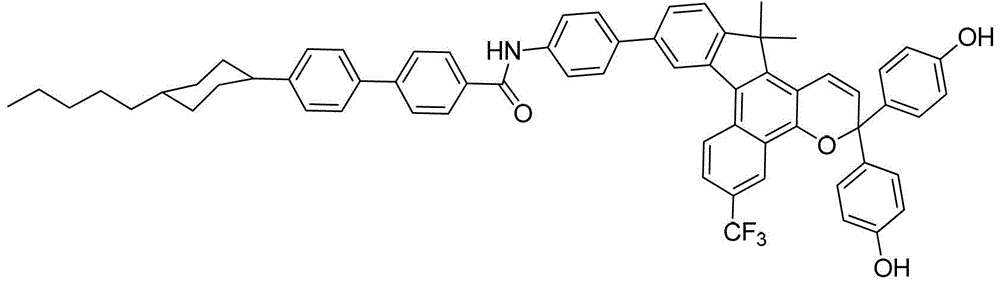
按照实施例14的程序,除了在步骤6中使用1,1-双(4-((四氢-2H-吡喃-2-基)氧基)苯基)丙-2-炔-1-醇代替1-(4-丁氧基苯基)-1-(4-氟苯基)丙-2-炔-1-醇。同样在步骤6中,在反应之后和色谱柱分离之前,将残留物置于四氢呋喃和甲醇中,并且加入对甲苯磺酸,回流1h和浓缩。NMR分析所获得的固体显示其结构与3-双(4-羟基苯基)-10-[4-(4-(4-(4-反式-戊基环己基)苯基)苯甲酰氨基)苯基]-6-三氟甲基-13,13-二甲基-3,13-二氢-茚并[2′,3′:3,4]萘并[1,2-b]吡喃相同。The procedure of Example 14 was followed except that 1,1-bis(4-((tetrahydro-2H-pyran-2-yl)oxy)phenyl)prop-2-yn-1-ol was used in step 6 Instead of 1-(4-butoxyphenyl)-1-(4-fluorophenyl)prop-2-yn-1-ol. Also in step 6, after the reaction and before column separation, the residue was placed in THF and methanol, and p-toluenesulfonic acid was added, refluxed for 1 h and concentrated. NMR analysis of the obtained solid showed a structure similar to that of 3-bis(4-hydroxyphenyl)-10-[4-(4-(4-(4-trans-pentylcyclohexyl)phenyl)benzamido )phenyl]-6-trifluoromethyl-13,13-dimethyl-3,13-dihydro-indeno[2′,3′:3,4]naphtho[1,2-b]pyridine Nam the same.
实施例26Example 26

步骤1step 1
向三颈圆底烧瓶(100mL)中加入双(二亚苄基丙酮)钯(0)(0.55g),2-二-叔丁基膦-3,4,5,6-四甲基-2’,4’,6’-三异丙基-1,1’-联苯(1.14g),压碎的磷酸钾(8.72g),来自实施例10的步骤4的8,10-二溴-7,7-二甲基-3-(三氟甲基)-7H-苯并[c]芴-5-基乙酸酯(5.00g)和4-羟基苯甲酰胺(2.15g)。将烧瓶排空和用氮气填充。加入脱气的叔丁醇(30mL)和将该混合物加热到回流6h。将该反应混合物冷却到室温和用EtOAc稀释。将该溶液通过寅式盐过滤和收集滤出液,浓缩和将残留物通过柱状色谱法使用4:1醋酸乙酯和己烷混合物作为洗提剂来净化。将含有期望材料的部分组合和浓缩来提供油。将该油溶解在最小量的醋酸乙酯中并且加入己烷到结晶的产物中。将该晶体通过真空过滤收集和干燥来提供白色着色固体(4.27g)。NMR分析该白色着色固体显示其结构与N-(8-溴-5-羟基-7,7-二甲基-3-(三氟甲基)-7H-苯并[c]芴-10-基)-4-羟基苯甲酰胺相同。Into a three-neck round bottom flask (100 mL) was added bis(dibenzylideneacetone)palladium(0) (0.55 g), 2-di-tert-butylphosphine-3,4,5,6-tetramethyl-2 ',4',6'-triisopropyl-1,1'-biphenyl (1.14 g), crushed potassium phosphate (8.72 g), 8,10-dibromo- 7,7-Dimethyl-3-(trifluoromethyl)-7H-benzo[c]fluoren-5-ylacetate (5.00 g) and 4-hydroxybenzamide (2.15 g). The flask was evacuated and filled with nitrogen. Degassed tert-butanol (30 mL) was added and the mixture was heated to reflux for 6 h. The reaction mixture was cooled to room temperature and diluted with EtOAc. The solution was filtered through celite and the filtrate was collected, concentrated and the residue was purified by column chromatography using a 4:1 mixture of ethyl acetate and hexanes as eluent. Fractions containing the desired materials are combined and concentrated to provide an oil. The oil was dissolved in a minimum amount of ethyl acetate and hexane was added to the crystallized product. The crystals were collected by vacuum filtration and dried to afford a white colored solid (4.27g). NMR analysis of the white colored solid showed a structure similar to that of N-(8-bromo-5-hydroxy-7,7-dimethyl-3-(trifluoromethyl)-7H-benzo[c]fluoren-10-yl )-4-hydroxybenzamide is the same.
步骤2step 2
向反应烧瓶中的步骤5的产物(1.69g)的氯仿溶液(20mL)中加入1-(4-丁氧基苯基)-1-(4-氟苯基)丙-2-炔-1-醇(1.12g)和4-十二烷基苯磺酸(0.10g)。将该反应混合物室温搅拌18h。将该反应混合物在减压下浓缩来提供油状残留物。将该残留物通过柱状色谱法使用1:1己烷和甲苯混合物作为洗提剂来净化。将含有期望产物的部分组合和真空浓缩来提供油状残留物。将该油状残留物从甲醇中重结晶。将所形成的固体通过真空过滤收集和干燥来提供奶油色固体(0.88g)。NMR分析该奶油色固体显示其结构与12-溴-3-(4-丁氧基苯基)-3-(4-氟苯基)-10-[4-羟基苯酰胺]-6-三氟甲基-13,13-二甲基-3,13-二氢-茚并[2′,3′:3,4]萘并[1,2-b]吡喃相同。To a solution of the product from Step 5 (1.69 g) in chloroform (20 mL) in a reaction flask was added 1-(4-butoxyphenyl)-1-(4-fluorophenyl)prop-2-yne-1- Alcohol (1.12g) and 4-dodecylbenzenesulfonic acid (0.10g). The reaction mixture was stirred at room temperature for 18 h. The reaction mixture was concentrated under reduced pressure to afford an oily residue. The residue was purified by column chromatography using a 1:1 mixture of hexane and toluene as eluent. Fractions containing the desired product were combined and concentrated in vacuo to afford an oily residue. The oily residue was recrystallized from methanol. The resulting solid was collected by vacuum filtration and dried to afford a cream solid (0.88g). NMR analysis of the cream-colored solid showed a structure similar to that of 12-bromo-3-(4-butoxyphenyl)-3-(4-fluorophenyl)-10-[4-hydroxybenzamide]-6-trifluoro Methyl-13,13-dimethyl-3,13-dihydro-indeno[2',3':3,4]naphtho[1,2-b]pyran is the same.
步骤3step 3
将来自步骤2(1.15g)的产物溶解在反应烧瓶的氯仿(20mL)中。加入三乙胺(0.6mL),随后加入来自实施例2的步骤4的4'-(4-戊基环己基)联苯基-4-羰基氯(0.80g)。将该反应混合物室温搅拌30min。真空除去溶剂和将残留物通过柱状色谱法使用9:1己烷和醋酸乙酯混合物作为洗提剂进行净化。将含有期望材料的部分组合和浓缩。将残留物溶解在最小量的二氯甲烷中,并且逐滴加入到强力搅拌的甲醇溶液中。将所形成的沉淀物通过真空过滤收集和干燥成紫色固体(1.30g)。NMR分析该紫色固体显示其结构与12-溴-3-(4-丁氧基苯基)-3-(4-氟苯基)-10-[4-(4'-(4-反式-戊基环己基)-[1,1'-联苯基]-4-羰氧基)苯酰胺]-6-三氟甲基-13,13-二甲基-3,13-二氢-茚并[2′,3′:3,4]萘并[1,2-b]吡喃相同。The product from step 2 (1.15 g) was dissolved in chloroform (20 mL) in a reaction flask. Triethylamine (0.6 mL) was added followed by 4'-(4-pentylcyclohexyl)biphenyl-4-carbonyl chloride (0.80 g) from step 4 of Example 2. The reaction mixture was stirred at room temperature for 30 min. The solvent was removed in vacuo and the residue was purified by column chromatography using a 9:1 mixture of hexane and ethyl acetate as eluent. Fractions containing desired materials were combined and concentrated. The residue was dissolved in a minimal amount of dichloromethane and added dropwise to a vigorously stirred methanol solution. The precipitate formed was collected by vacuum filtration and dried to a purple solid (1.30 g). NMR analysis of the purple solid showed a structure similar to that of 12-bromo-3-(4-butoxyphenyl)-3-(4-fluorophenyl)-10-[4-(4'-(4-trans- Pentylcyclohexyl)-[1,1'-biphenyl]-4-carbonyloxy)benzamide]-6-trifluoromethyl-13,13-dimethyl-3,13-dihydro-indene And[2',3':3,4]naphtho[1,2-b]pyran is the same.
实施例27Example 27
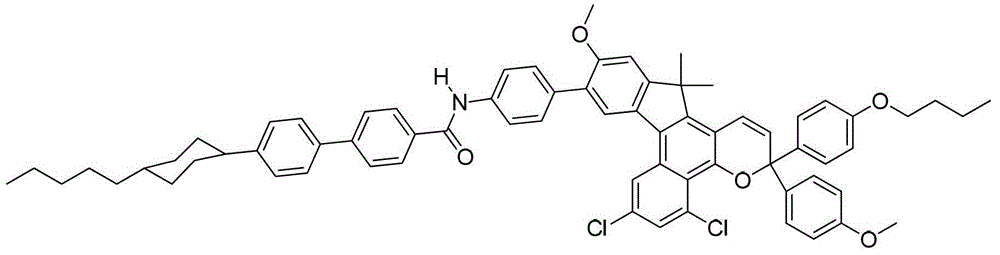
步骤1-步骤4Step 1 - Step 4
按照实施例10的步骤1-步骤4的程序,除了在步骤1中使用3,5-二氯溴苯和4-甲氧基苯甲酰氯代替三溴苯和4-三氟甲基苯甲酰氯。获得了作为产物的一种浅白色固体。NMR显示该产物的结构与2,4-二氯-9-甲氧基-7,7-二甲基-7H-苯并[c]芴-5-基乙酸酯相同。Follow the procedure of Step 1-Step 4 of Example 10, except that 3,5-dichlorobromobenzene and 4-methoxybenzoyl chloride are used instead of tribromobenzene and 4-trifluoromethylbenzoyl chloride in Step 1 . An off-white solid was obtained as product. NMR showed that the product had the same structure as 2,4-dichloro-9-methoxy-7,7-dimethyl-7H-benzo[c]fluoren-5-ylacetate.
步骤5step 5
将来自步骤4的2,4-二氯-9-甲氧基-7,7-二甲基-7H-苯并[c]芴-5-基乙酸酯(5g),NBS(2.7g)和DMF(100ml)的混合物在反应烧瓶中搅拌,并且加热到90℃。2小时后,将所形成的反应混合物倾倒入水(400ml)中和用1/1醋酸乙酯/THF(200ml)萃取。收集有机层,用亚硫酸氢钠水溶液清洗三次,干燥和浓缩。向该回收的产物中加入甲醇(100ml)。过滤后,获得了作为产物的浅色固体(4.4g)。NMR显示该产物的结构与10-溴-2,4-二氯-9-甲氧基-7,7-二甲基-7H-苯并[c]芴-5-基乙酸酯相同。2,4-Dichloro-9-methoxy-7,7-dimethyl-7H-benzo[c]fluoren-5-yl acetate (5 g) from step 4, NBS (2.7 g) A mixture with DMF (100 ml) was stirred in the reaction flask and heated to 90°C. After 2 hours, the resulting reaction mixture was poured into water (400ml) and extracted with 1/1 ethyl acetate/THF (200ml). The organic layer was collected, washed three times with aqueous sodium bisulfite, dried and concentrated. Methanol (100 ml) was added to the recovered product. After filtration, the product was obtained as a pale solid (4.4 g). NMR showed that the product had the same structure as 10-bromo-2,4-dichloro-9-methoxy-7,7-dimethyl-7H-benzo[c]fluoren-5-ylacetate.
步骤6step 6
将来自步骤5的10-溴-2,4-二氯-9-甲氧基-7,7-二甲基-7H-苯并[c]芴-5-基乙酸酯(4.3g),4’-(4-反式-戊基环己基)-N-(4-(4,4,5,5-四甲基-1,3,2-二氧环戊硼烷-2-基)苯基)-[1,1’-联苯基]-4-甲酰胺(4.94g),碳酸钠(4g),THF(200ml),水(20ml)和四(三苯基膦)钯(0)(1g)的混合物置于反应烧瓶中,并且通过氮气鼓泡该混合物10分钟来脱气。将该混合物加热到回流17小时,并且加入碳酸钾(5g)和乙醇(50ml)。回流另外8小时后,使用THF和氯化钠饱和水溶液进行萃取。收集所形成的有机层,用100ml的1N的HCl清洗三次,用100ml的1N的亚硫酸钠水溶液清洗一次,用氯化钠饱和水溶液清洗一次,在硫酸镁上干燥和浓缩。将获得的残留物溶解在10/1甲苯/THF(200ml)中,然后送过硅胶插塞柱。将所回收的透明溶液浓缩加入到甲醇中,并且搅拌半小时。收集所形成的固体并且干燥。获得了作为产物的浅白色固体(7.5g)。NMR显示该产物的结构与N-(4-(2,4-二氯-5-羟基-9-甲氧基-7,7-二甲基-7H-苯并[c]芴-10-基)苯基)-4'-(4-反式-戊基环己基)-[1,1'-联苯基]-4-甲酰胺相同。10-Bromo-2,4-dichloro-9-methoxy-7,7-dimethyl-7H-benzo[c]fluoren-5-yl acetate (4.3 g) from step 5, 4'-(4-trans-pentylcyclohexyl)-N-(4-(4,4,5,5-tetramethyl-1,3,2-dioxaborolan-2-yl) Phenyl)-[1,1'-biphenyl]-4-carboxamide (4.94g), sodium carbonate (4g), THF (200ml), water (20ml) and tetrakis(triphenylphosphine)palladium (0 ) (1 g) was placed in a reaction flask and degassed by bubbling nitrogen through the mixture for 10 minutes. The mixture was heated to reflux for 17 hours and potassium carbonate (5 g) and ethanol (50 ml) were added. After refluxing for a further 8 hours, extraction was performed with THF and saturated aqueous sodium chloride. The resulting organic layer was collected, washed three times with 100 ml of 1N HCl, once with 100 ml of 1N aqueous sodium sulfite, once with saturated aqueous sodium chloride, dried over magnesium sulfate and concentrated. The obtained residue was dissolved in 10/1 toluene/THF (200ml) and passed through a silica gel plug column. The recovered clear solution was concentrated and added to methanol, and stirred for half an hour. The solid formed was collected and dried. An off-white solid (7.5 g) was obtained as the product. NMR showed that the product had the same structure as N-(4-(2,4-dichloro-5-hydroxy-9-methoxy-7,7-dimethyl-7H-benzo[c]fluoren-10-yl )phenyl)-4'-(4-trans-pentylcyclohexyl)-[1,1'-biphenyl]-4-carboxamide is the same.
步骤7step 7
将来自步骤6的N-(4-(2,4-二氯-5-羟基-9-甲氧基-7,7-二甲基-7H-苯并[c]芴-10-基)苯基)-4'-(4-戊基环己基)-[1,1'-联苯基]-4-甲酰胺(3g),1-(4-丁氧基苯基)-1-(4-甲氧基苯基)丙-2-炔-1-醇(1.8g),对甲苯磺酸(73mg)和1,2-二氯乙烷(50ml)加入反应烧瓶中。搅拌该混合物并回流4小时。除去溶剂后,将该产物通过CombiFlash净化。获得了作为产物的黑色固体(2g)。NMR显示其结构与3-(4-丁氧基苯基)-3-(4-甲氧基苯基)-10-[4-(4-(4-(4-反式-戊基环己基)苯基)苯甲酰氨基)苯基]-5,7-二氯-11-甲氧基-13,13-二甲基-3,13-二氢-茚并[2′,3′:3,4]萘并[1,2-b]吡喃相同。N-(4-(2,4-Dichloro-5-hydroxy-9-methoxy-7,7-dimethyl-7H-benzo[c]fluoren-10-yl)benzene from step 6 Base)-4'-(4-pentylcyclohexyl)-[1,1'-biphenyl]-4-carboxamide (3g), 1-(4-butoxyphenyl)-1-(4 -Methoxyphenyl)prop-2-yn-1-ol (1.8 g), p-toluenesulfonic acid (73 mg) and 1,2-dichloroethane (50 ml) were added to the reaction flask. The mixture was stirred and refluxed for 4 hours. After removal of solvent, the product was cleaned up by CombiFlash. A black solid (2 g) was obtained as product. NMR showed that its structure was similar to that of 3-(4-butoxyphenyl)-3-(4-methoxyphenyl)-10-[4-(4-(4-(4-trans-pentylcyclohexyl) )phenyl)benzamido)phenyl]-5,7-dichloro-11-methoxy-13,13-dimethyl-3,13-dihydro-indeno[2′,3′: 3,4]Naphtho[1,2-b]pyran is the same.
实施例28Example 28
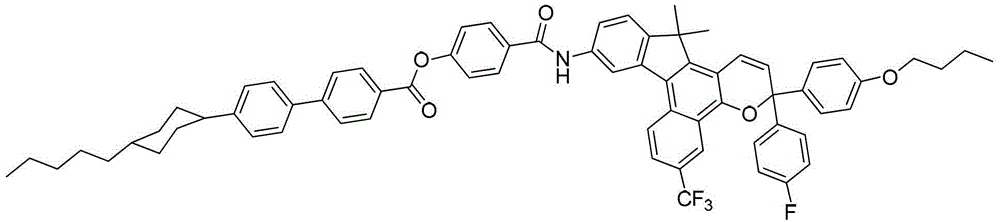
步骤1step 1
将来自实施例26的步骤1的N-(8-溴-5-羟基-7,7-二甲基-3-(三氟甲基)-7H-苯并[c]芴-10-基)-4-羟基苯甲酰胺(5.00g),碳酸钾(5.10g),2-丁醇(50mL)和甲醇(50mL)加入圆底烧瓶中和脱气10min。加入四三苯基膦钯(0)(0.55g)和在氮气下加热到回流2h。将该反应混合物冷却到室温,并且通过寅式
步骤2step 2
按照实施例26的步骤2和3的程序,除了在步骤2中,使用上面步骤1的产物代替N-(8-溴-5-羟基-7,7-二甲基-3-(三氟甲基)-7H-苯并[c]芴-10-基)-4-羟基苯甲酰胺。NMR显示其结构与3-(4-丁氧基苯基)-3-(4-氟苯基)-10-[4-(4-(4-反式-戊基环己基)-[1,1'-联苯基]-4-羰氧基)苯酰胺]-6-三氟甲基-13,13-二甲基-3,13-二氢-茚并[2′,3′:3,4]萘并[1,2-b]吡喃相同。The procedure of steps 2 and 3 of Example 26 was followed, except that in step 2, the product from step 1 above was used instead of N-(8-bromo-5-hydroxy-7,7-dimethyl-3-(trifluoroform yl)-7H-benzo[c]fluoren-10-yl)-4-hydroxybenzamide. NMR showed that its structure was similar to that of 3-(4-butoxyphenyl)-3-(4-fluorophenyl)-10-[4-(4-(4-trans-pentylcyclohexyl)-[1, 1'-biphenyl]-4-carbonyloxy)benzamide]-6-trifluoromethyl-13,13-dimethyl-3,13-dihydro-indeno[2',3':3 ,4]Naphtho[1,2-b]pyran is the same.
实施例29Example 29

按照实施例27的程序,除了下面的:在步骤7中:使用1,1-双(4-((四氢-2H-吡喃-2-基)氧基)苯基)丙-2-炔-1-醇代替1-(4-丁氧基苯基)-1-(4-甲氧基苯基)丙-2-炔-1-醇,并且在进行CombiFlash之前,将该产物溶解在THF和甲醇与pTSA(1g)的溶剂混合物中,回流1小时和浓缩。NMR显示该产物的结构与3-双(4-羟基苯基)-10-[4-(4-(4-(4-反式-戊基环己基)苯基)苯甲酰氨基)苯基]-5,7-二氯-11-甲氧基-13,13-二甲基-3,13-二氢-茚并[2′,3′:3,4]萘并[1,2-b]吡喃相同。Follow the procedure of Example 27, except the following: In step 7: use 1,1-bis(4-((tetrahydro-2H-pyran-2-yl)oxy)phenyl)prop-2-yne -1-ol instead of 1-(4-butoxyphenyl)-1-(4-methoxyphenyl)prop-2-yn-1-ol, and prior to CombiFlash, this product was dissolved in THF and a solvent mixture of methanol and pTSA (1 g), refluxed for 1 hour and concentrated. NMR showed that the product had the same structure as 3-bis(4-hydroxyphenyl)-10-[4-(4-(4-(4-trans-pentylcyclohexyl)phenyl)benzamido)phenyl ]-5,7-dichloro-11-methoxy-13,13-dimethyl-3,13-dihydro-indeno[2′,3′:3,4]naphtho[1,2- b] Same for pyran.
实施例30Example 30
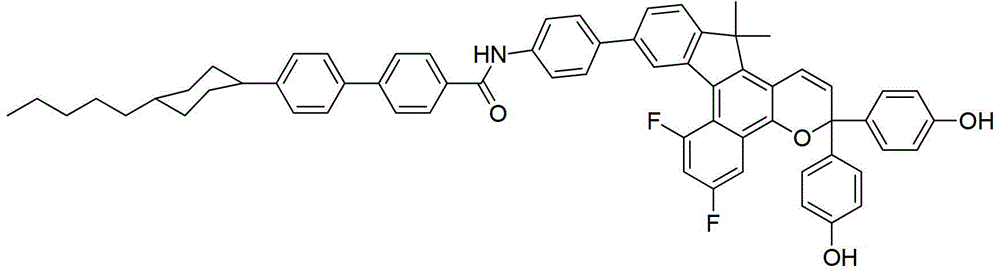
按照实施例14的程序,除了在步骤1中使用2,4-二氟苯甲酰氯代替4-三氟甲基苯甲酰氯和在步骤6中使用1,1-双(4-((四氢-2H-吡喃-2-基)氧基)苯基)丙-2-炔-1-醇代替1-(4-丁氧基苯基)-1-(4-氟苯基)丙-2-炔-1-醇,并且在该反应之后和柱色谱法分离之前,将残留物溶解在四氢呋喃和甲醇中,并且加入对甲苯磺酸,回流1h和浓缩。NMR分析所获得的亮蓝色固体显示其结构与3-双(4-羟基苯基)-10-[4-(4-(4-(4-反式-戊基环己基)苯基)苯甲酰氨基)苯基]-6,8-二氟-13,13-二甲基-3,13-二氢-茚并[2′,3′:3,4]萘并[1,2-b]吡喃相同。The procedure of Example 14 was followed except that 2,4-difluorobenzoyl chloride was used instead of 4-trifluoromethylbenzoyl chloride in step 1 and 1,1-bis(4-((tetrahydro -2H-pyran-2-yl)oxy)phenyl)prop-2-yn-1-ol instead of 1-(4-butoxyphenyl)-1-(4-fluorophenyl)prop-2 -Alkyn-1-ol, and after the reaction and before column chromatography, the residue was dissolved in tetrahydrofuran and methanol and p-toluenesulfonic acid was added, refluxed for 1 h and concentrated. NMR analysis of the obtained bright blue solid showed a structure similar to that of 3-bis(4-hydroxyphenyl)-10-[4-(4-(4-(4-trans-pentylcyclohexyl)phenyl)benzene Formamido)phenyl]-6,8-difluoro-13,13-dimethyl-3,13-dihydro-indeno[2′,3′:3,4]naphtho[1,2- b] Same for pyran.
实施例31Example 31
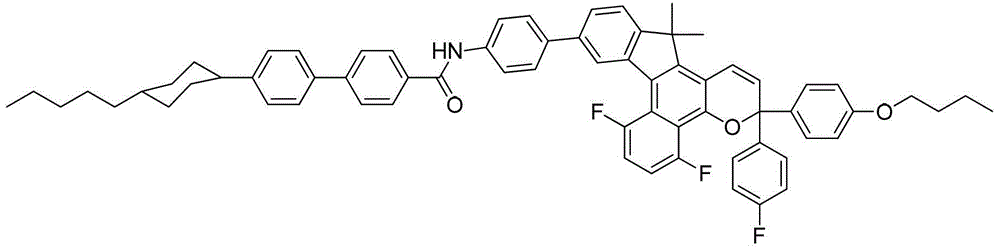
按照实施例14的程序,除了在步骤1中使用2,5-二氟苯甲酰氯代替4-三氟甲基苯甲酰氯。NMR分析所获得的固体显示其结构与3-(4-氟苯基)-3-(4-丁氧基苯基)-10-[4-(4-(4-(4-反式-戊基环己基)苯基)苯甲酰氨基)苯基]-5,8-二氟-13,13-二甲基-3,13-二氢-茚并[2′,3′:3,4]萘并[1,2-b]吡喃相同。The procedure of Example 14 was followed except that in Step 1 2,5-difluorobenzoyl chloride was used instead of 4-trifluoromethylbenzoyl chloride. NMR analysis of the obtained solid showed a structure similar to that of 3-(4-fluorophenyl)-3-(4-butoxyphenyl)-10-[4-(4-(4-(4-trans-pentane Cyclohexyl)phenyl)benzamido)phenyl]-5,8-difluoro-13,13-dimethyl-3,13-dihydro-indeno[2′,3′:3,4 ]Naphtho[1,2-b]pyran is the same.
实施例32Example 32
步骤1step 1
按照实施例10的步骤1-步骤5的程序。Follow the procedure of Step 1-Step 5 of Example 10.
步骤2step 2
在氮气流下向反应烧瓶中脱气的二噁烷(100mL)和甲苯(100mL)中加入2,2’-双(二苯基膦)-1,1’-联萘(1.20g),乙酸钯(II)(0.30g)和来自实施例10的步骤5的8,10-二溴-7,7-二甲基-3-(三氟甲基)-7H-苯并[c]芴-5-基乙酸酯(5.10g),随后加入1-甲酰基哌嗪(2.80g)。加入叔丁醇钠(2.80g),并且将该溶液加热到回流22h。将该反应混合物冷却到室温和用四氢呋喃稀释。将该溶液通过寅式盐
步骤3step 3
将来自步骤2的4-(8-溴-5-羟基-7,7-二甲基-3-(三氟甲基)-7H-苯并[c]芴-10-基)哌嗪-1-甲醛(0.69g)和1-(4-丁氧基苯基)-1-(4-氟苯基)丙-2-炔-1-醇(0.60g)溶解在反应烧瓶的1,2-二氯乙烷(20mL)中。加入对甲苯磺酸(0.1g),并且将该溶液加热到回流18h。将该反应混合物冷却到室温和真空除去溶剂。将残留物通过柱状色谱法使用1:1己烷和二氯甲烷混合物作为洗提剂进行净化。将含有期望材料的部分组合和浓缩。将该残留物(0.75g)直接用于下一步。4-(8-Bromo-5-hydroxy-7,7-dimethyl-3-(trifluoromethyl)-7H-benzo[c]fluoren-10-yl)piperazine-1 from step 2 -Formaldehyde (0.69g) and 1-(4-butoxyphenyl)-1-(4-fluorophenyl)prop-2-yn-1-ol (0.60g) were dissolved in 1,2- in dichloroethane (20 mL). p-Toluenesulfonic acid (0.1 g) was added and the solution was heated to reflux for 18h. The reaction mixture was cooled to room temperature and the solvent was removed in vacuo. The residue was purified by column chromatography using a 1:1 mixture of hexane and dichloromethane as eluent. Fractions containing desired materials were combined and concentrated. This residue (0.75 g) was used directly in the next step.
步骤4step 4
将步骤3的产物,4-(12-溴-3-(4-丁氧基苯基)-3-(4-氟苯基)-13,13-二甲基-6-(三氟甲基)-3,13-二氢苯并[h]茚并[2,1-f]苯并吡喃-10-基)哌嗪-1-甲醛(2.00g)溶解在反应烧瓶的二噁烷(30mL)中。加入10%HCl水溶液(5mL),并且将该溶液加热到回流2h。将该反应混合物冷却到室温和仔细倾倒入饱和的碳酸氢钠水溶液(300mL)中。将所形成的含水层用醋酸乙酯(300mL)萃取。将该醋酸乙酯溶液用无水硫酸钠干燥,过滤和浓缩来提供残留物。将该残留物通过柱状色谱法使用1:1醋酸乙酯和甲醇混合物作为洗提剂来净化。将含有期望材料的部分组合和浓缩。将该残留物(1.00g)直接用于下一步。The product of step 3, 4-(12-bromo-3-(4-butoxyphenyl)-3-(4-fluorophenyl)-13,13-dimethyl-6-(trifluoromethyl )-3,13-dihydrobenzo[h]indeno[2,1-f]benzopyran-10-yl)piperazine-1-carbaldehyde (2.00 g) was dissolved in dioxane ( 30mL). Aqueous 10% HCl (5 mL) was added, and the solution was heated to reflux for 2 h. The reaction mixture was cooled to room temperature and poured carefully into saturated aqueous sodium bicarbonate (300 mL). The resulting aqueous layer was extracted with ethyl acetate (300 mL). The ethyl acetate solution was dried over anhydrous sodium sulfate, filtered and concentrated to provide a residue. The residue was purified by column chromatography using a 1:1 mixture of ethyl acetate and methanol as eluent. Fractions containing desired materials were combined and concentrated. This residue (1.00 g) was used directly in the next step.
步骤5step 5
按照实施例26的步骤3的程序,使用上面的步骤4的残留物代替12-溴-3-(4-丁氧基苯基)-3-(4-氟苯基)-10-[4-羟基苯酰胺]-6-三氟甲基-13,13-二甲基-3,13-二氢-茚并[2′,3′:3,4]萘并[1,2-b]吡喃。NMR显示其结构与3-(4-氟苯基)-3-(4-丁氧基苯基)-10-[(4-(4'-(4-反式-戊基环己基)-[1,1'-联苯基]-4-基)羰基)哌嗪-1-基]-6-三氟甲基-13,13-二甲基-3,13-二氢-茚并[2′,3′:3,4]萘并[1,2-b]吡喃相同。Following the procedure of step 3 of Example 26, using the residue from step 4 above in place of 12-bromo-3-(4-butoxyphenyl)-3-(4-fluorophenyl)-10-[4- Hydroxybenzamide]-6-trifluoromethyl-13,13-dimethyl-3,13-dihydro-indeno[2′,3′:3,4]naphtho[1,2-b]pyridine murmur. NMR showed that its structure was similar to that of 3-(4-fluorophenyl)-3-(4-butoxyphenyl)-10-[(4-(4'-(4-trans-pentylcyclohexyl)-[ 1,1'-biphenyl]-4-yl)carbonyl)piperazin-1-yl]-6-trifluoromethyl-13,13-dimethyl-3,13-dihydro-indeno[2 ',3': 3,4]Naphtho[1,2-b]pyran is the same.
实施例33Example 33
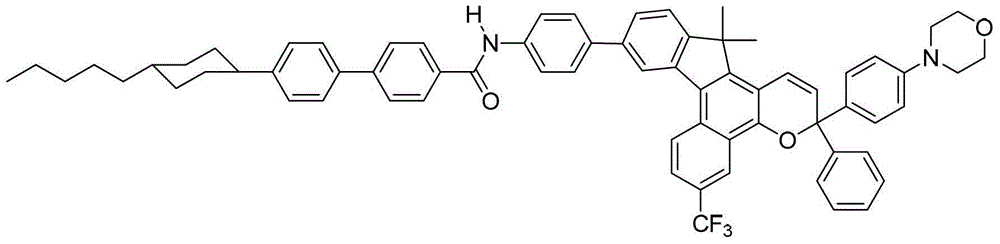
按照实施例14的程序,除了在步骤6中使用1-(4-N-吗啉代苯基)-1-(4-苯基)丙-2-炔-1-醇代替1-(4-丁氧基苯基)-1-(4-氟苯基)丙-2-炔-1-醇。NMR分析显示该产物的结构与3-(4-(N-吗啉并)苯基)-3-苯基-10-[4-(4-(4-(4-反式-戊基环己基)苯基)苯甲酰氨基)苯基]-6-三氟甲基-13,13-二甲基-3,13-二氢-茚并[2′,3′:3,4]萘并[1,2-b]吡喃相同。The procedure of Example 14 was followed except that 1-(4-N-morpholinophenyl)-1-(4-phenyl)prop-2-yn-1-ol was used instead of 1-(4- butoxyphenyl)-1-(4-fluorophenyl)prop-2-yn-1-ol. NMR analysis showed that the product had the same structure as 3-(4-(N-morpholino)phenyl)-3-phenyl-10-[4-(4-(4-(4-trans-pentylcyclohexyl )phenyl)benzamido)phenyl]-6-trifluoromethyl-13,13-dimethyl-3,13-dihydro-indeno[2′,3′:3,4]naphtho [1,2-b]pyran is the same.
实施例34Example 34

步骤1step 1
按照实施例10的程序,除了在步骤6中使用1-(4-丁氧基苯基)-1-(4-氟苯基)丙-2-炔-1-醇代替1,1-双(4-甲氧基苯基)丙-2-炔-1-醇和在步骤7中使用4-(4,4,5,5-四甲基-1,3,2-二氧环戊硼烷-2-基)酚代替4'-(4-反式-戊基环己基)-N-(4-(4,4,5,5-四甲基-1,3,2-二氧环戊硼烷-2-基)苯基)-[1,1'-联苯基]-4-甲酰胺。NMR分析显示该产物的结构与3-(4-丁氧基苯基)-3-(4-氟苯基)-10-(4-羟基苯基)-6-三氟甲基-12-溴-13,13-二甲基-茚并[2′,3′:3,4]萘并[1,2-b]吡喃相同。The procedure of Example 10 was followed except that 1-(4-butoxyphenyl)-1-(4-fluorophenyl)prop-2-yn-1-ol was used instead of 1,1-bis( 4-methoxyphenyl)prop-2-yn-1-ol and 4-(4,4,5,5-tetramethyl-1,3,2-dioxaborolane- 2-yl)phenol instead of 4'-(4-trans-pentylcyclohexyl)-N-(4-(4,4,5,5-tetramethyl-1,3,2-dioxaborol alk-2-yl)phenyl)-[1,1'-biphenyl]-4-carboxamide. NMR analysis showed that the product had the same structure as 3-(4-butoxyphenyl)-3-(4-fluorophenyl)-10-(4-hydroxyphenyl)-6-trifluoromethyl-12-bromo -13,13-Dimethyl-indeno[2′,3′:3,4]naphtho[1,2-b]pyran is the same.
步骤2step 2
将步骤1的产物3-(4-丁氧基苯基)-3-(4-氟苯基)-10-(4-羟基苯基)-6-三氟甲基-12-溴-13,13-二甲基-茚并[2′,3′:3,4]萘并[1,2-b]吡喃(1.00g)加入到反应烧瓶中,并且溶解在二氯甲烷(20mL)中。加入三乙胺(0.2mL),随后加入胆甾醇氯甲酸酯(0.90g),并且将该反应混合物搅拌30min。真空除去溶剂,并且将该残留物通过柱状色谱法使用19:1己烷和醋酸乙酯混合物作为洗提剂进行净化。将含有期望材料的部分组合和浓缩。将该残留物溶解在最小量的二氯甲烷中,并且逐滴加入到强力搅拌的甲醇中。将沉淀物通过真空过滤收集和干燥来提供紫色固体。NMR分析该紫色固体显示其结构与3-(4-丁氧基苯基)-3-(4-氟苯基)-10-{4-[17-(1,5-二甲基-己基)-10,13-二甲基-2,3,4,7,8,9,10,11,12,13,14,15,16,17-十四氢-1H-环五[a]菲-3-基氧基羰氧基]苯基}-6-三氟甲基-12-溴-13,13-二甲基-3,13-二氢-茚并[2′,3′:3,4]萘并[1,2-b]吡喃相同。The product 3-(4-butoxyphenyl)-3-(4-fluorophenyl)-10-(4-hydroxyphenyl)-6-trifluoromethyl-12-bromo-13 of step 1, 13-Dimethyl-indeno[2′,3′:3,4]naphtho[1,2-b]pyran (1.00 g) was added to the reaction flask and dissolved in dichloromethane (20 mL) . Triethylamine (0.2 mL) was added followed by cholesteryl chloroformate (0.90 g) and the reaction mixture was stirred for 30 min. The solvent was removed in vacuo, and the residue was purified by column chromatography using a 19:1 mixture of hexane and ethyl acetate as eluent. Fractions containing desired materials were combined and concentrated. The residue was dissolved in a minimal amount of dichloromethane and added dropwise to vigorously stirred methanol. The precipitate was collected by vacuum filtration and dried to afford a purple solid. NMR analysis of the purple solid showed a structure similar to that of 3-(4-butoxyphenyl)-3-(4-fluorophenyl)-10-{4-[17-(1,5-dimethyl-hexyl) -10,13-Dimethyl-2,3,4,7,8,9,10,11,12,13,14,15,16,17-Tetradetrahydro-1H-cyclopenta[a]phenanthrene- 3-yloxycarbonyloxy]phenyl}-6-trifluoromethyl-12-bromo-13,13-dimethyl-3,13-dihydro-indeno[2′,3′:3, 4]Naphtho[1,2-b]pyran is the same.
部分2-光致变色性能测试Part 2 - Photochromic performance test
部分2A-测试方块制备Part 2A - Test Square Preparation
测试是用实施例1-3、5、7和10-34所述化合物以下面的方式来进行的。将计算来产生1.5×10⁻³克分子量溶液的一定量的化合物加入到烧瓶中,该烧瓶含有50g的单体混合物:4份的乙氧基化的双酚A二甲基丙烯酸酯(BPA2EO DMA),1份的聚(乙二醇)600二甲基丙烯酸酯,和0.033重量%的2,2′-偶氮二(2-甲基丙腈)(AIBN)。将每个化合物通过搅拌和需要时轻微加热来溶解到该单体混合物中。在获得透明溶液后,将该样品在真空烘箱中在25托脱气5-10分钟。使用注射器,将样品倾倒入内部尺寸为2.2mm+/-0.3mm×6英寸(15.24cm)×6英寸(15.24cm)的平板模具中。将该模具密封和置于水平空气流可编程烘箱中,在5小时的时间间隔内从40℃升温到95℃,在95℃的温度保持3小时,在2小时的时间间隔内降温到60℃,然后在60℃保持16小时。在固化后,开模,将该聚合物片使用金刚石片锯切割成2英寸(5.1cm)的测试方块。The tests were carried out in the following manner using the compounds described in Examples 1-3, 5, 7 and 10-34. An amount of compound calculated to yield a 1.5 x 10 -3 gram molecular weight solution was added to a flask containing 50 g of a monomer mixture: 4 parts of ethoxylated bisphenol A dimethacrylate (BPA2EO DMA ), 1 part of poly(ethylene glycol) 600 dimethacrylate, and 0.033% by weight of 2,2'-azobis(2-methylpropionitrile) (AIBN). Each compound was dissolved into the monomer mixture by stirring and, if necessary, slight heating. After obtaining a clear solution, the sample was degassed in a vacuum oven at 25 Torr for 5-10 minutes. Using a syringe, pour the sample into a flat mold with internal dimensions of 2.2 mm +/- 0.3 mm x 6 inches (15.24 cm) x 6 inches (15.24 cm). The mold was sealed and placed in a horizontal air flow programmable oven, ramped from 40°C to 95°C in 5 hour intervals, held at 95°C for 3 hours, and cooled to 60°C in 2 hour intervals , and then kept at 60°C for 16 hours. After curing, the mold was opened and the polymer sheet was cut into 2 inch (5.1 cm) test squares using a diamond blade saw.
部分2B-响应测试Part 2B - Response Test
在光具座上的响应测试之前,将来自部分2A的测试方块如下来调节:以距光源大约14cm的距离,将它们曝露到365nm紫外光10分钟,来预活化样品中的光致变色化合物。样品表面上的UVA辐照是用Licor Model Li-1800分光辐射度计测量的,并且发现是22.2W/m2。然后将该样品以距灯大约36cm的距离置于卤素灯(500W,120V)下大约10分钟,来漂白或者失活样品中的光致变色化合物。样品处的照明度是用Licor分光辐射度计测量的,并且发现是21.9Klux。然后在测试之前将该样品在黑暗环境中保持至少1小时来冷却和持续褪色回到背景状态。Prior to response testing on the optical bench, the test squares from part 2A were conditioned by exposing them to 365 nm UV light for 10 minutes at a distance of approximately 14 cm from the light source to preactivate the photochromic compound in the sample. The UVA radiation on the sample surface was measured with a Licor Model Li-1800 spectroradiometer and found to be 22.2 W/ m2 . The sample was then placed under a halogen lamp (500W, 120V) for about 10 minutes at a distance of about 36 cm from the lamp to bleach or inactivate the photochromic compound in the sample. The illuminance at the sample was measured with a Licor spectroradiometer and found to be 21.9 Klux. The samples were then kept in a dark environment for at least 1 hour prior to testing to cool and continue to fade back to the background state.
该光具座安装有Newport型号#67005的300瓦氙弧灯和69911型号电源,Vincent Associates(VS25S2ZM0R3型号,具有VMM-D4控制器)高速计算机控制的挡板,Schott3mm KG-2带通滤波器,其除去了短波辐射,中密度滤波器衰减来自氙弧灯的光,气相二氧化硅聚光透镜用于光束瞄准,和气相二氧化硅水盒/样品保持器,用于保持样品温度,将待测试的样品插入其中。水盒中的温度是用泵送的水循环系统来控制的,其中将水送过置于冷却单元存储器中的铜绕线。用于保持测试样品的水盒在前后面上包含气相二氧化硅片来消除活化或监控光束的光谱变化。用于光致变色响应测试的送过水盒的过滤的水保持在72°F±2°。使用Newport689456型号数字曝光计时器来控制样品活化过程中氙弧灯的亮度。The optical bench is equipped with a Newport model #67005 300 watt xenon arc lamp and a model 69911 power supply, a Vincent Associates (model VS25S2ZM0R3 with VMM-D4 controller) high speed computer controlled baffle, a Schott 3mm KG-2 bandpass filter, It removes shortwave radiation, a neutral density filter attenuates the light from the xenon arc lamp, a fumed silica condenser lens is used for beam aiming, and a fumed silica water box/sample holder is used to maintain the temperature of the sample, which will be The sample to be tested is inserted into it. The temperature in the water box is controlled with a pumped water circulation system in which water is sent through copper windings placed in the reservoir of the cooling unit. The water box used to hold the test sample contains fumed silica sheets on the front and back to eliminate spectral changes in the activation or monitoring beam. The filtered water sent through the water box for the photochromic response test was maintained at 72°F ± 2°. A Newport model 689456 digital exposure timer was used to control the brightness of the xenon arc lamp during sample activation.
将用于监控响应测量的宽带光源以垂直于盒组件表面的方式布置。较短可见光波长提高的信号是如下来获得的:用分端的两部分光纤电缆收集和组合来自100瓦钨卤素灯(通过Lambda UP60-14恒压电源控制)的分别过滤的光。将来自钨卤素灯一侧的光用Schott KG1滤波器过滤来吸收热和Hoya B-440滤波器过滤来使得较短的波长通过。另一侧的光是用Schott KG1滤波器过滤的或者是未过滤的。所述光是如下来收集的:将来自所述灯每一侧的光聚焦到分端的两部分光纤电缆的分别的端部,和随后合并成从电缆的单个端出来的一个光源。将4″光管连接到电缆的单个端部来确保正确混合。在送过样品后,光重新聚集成2英寸累计球和通过光纤电缆供给到Ocean Optics S2000分光光度计上。使用Ocean Optics SpectraSuite和PPG私有的软件来测量响应和控制光具座的运行。A broadband light source for monitoring response measurements was placed perpendicular to the surface of the cartridge assembly. The enhanced signal at shorter visible wavelengths was obtained by collecting and combining separately filtered light from a 100 W tungsten-halogen lamp (controlled by a Lambda UP60-14 constant voltage power supply) using a split-ended two-part fiber optic cable. Light from the tungsten-halogen lamp side was filtered with a Schott KG1 filter to absorb heat and a Hoya B-440 filter to pass shorter wavelengths. The light on the other side is either filtered with a Schott KG1 filter or unfiltered. The light is collected by focusing the light from each side of the lamp onto separate ends of the two-part fiber optic cable that is split, and then combining into one light source that emerges from a single end of the cable. A 4″ light pipe is attached to a single end of the cable to ensure proper mixing. After passing through the sample, the light is refocused into a 2" integrating sphere and fed to the Ocean Optics S2000 Spectrophotometer via a fiber optic cable. Use the Ocean Optics SpectraSuite and PPG proprietary software is used to measure the response and control the operation of the optical bench.
用于样品在光具座上的响应测试的辐照是在样品表面上使用International Light Research辐射计,IL-1700型号来建立的,其具有包含SED033型检测器、B滤波器和扩散器的检测系统。该辐射计的输出显示器是相对于Licor1800-02Optical CalibrationCalibrator来校正的(因子值设定),来使得显示器值表示瓦/平方米UVA。将初始响应测试的样品点的辐照度设定为3.0瓦/平方米UVA和大约8.6Klux照明度。在样品响应测试过程中,如果变暗的样品超过了可接受的检测能力限度时,将辐照度降低到1.0瓦/平方米UVA或者在样品在共聚物中处于一半浓度时再造。滤光的氙弧灯的输出的调整是如下来完成的:提高或降低通过控制器到灯的电流和/或增加或者除去光路中的中密度滤波器。将测试样品曝露于与它的表面法向31°,同时垂直于监控光的活化光。The irradiance for the response test of the sample on the optical bench was established on the sample surface using an International Light Research radiometer, model IL-1700, with a detector comprising a SED033 type detector, B filter and diffuser. system. The output display of the radiometer is calibrated (factor value setting) relative to the Licor 1800-02 Optical CalibrationCalibrator so that the display value represents watts/square meter UVA. The irradiance of the sample point for the initial response test was set at 3.0 W/m2 UVA and approximately 8.6 Klux illuminance. During sample response testing, if the darkened sample exceeds the acceptable limit of detectability, reduce the irradiance to 1.0 W/m² UVA or reconstitute the sample at half the concentration in the copolymer. Adjustment of the output of the filtered xenon arc lamp is accomplished by increasing or decreasing the current through the controller to the lamp and/or adding or removing a neutral density filter in the light path. The test sample was exposed to activating light at 31° to its surface normal while perpendicular to the monitor light.
将样品在73°F(22.8℃)受控的水盒中活化30分钟,然后使其在房间光条件下褪色,直到活化样品的光学密度的变化褪色到它的最高黑度(饱和的)状态的1/4或者褪色最大30分钟。The sample was activated in a controlled water box at 73°F (22.8°C) for 30 minutes and then allowed to fade under room light conditions until the change in optical density of the activated sample faded to its highest blackness (saturated) state 1/4 or 30 minutes maximum fade.
光学密度(ΔOD)从漂白状态向变暗状态的变化是通过建立初始透射率,打开来自氙弧灯的挡板来提供紫外辐射以将测试透镜从漂白状态变成活化的(即,变暗的)状态来确定的。数据是在所选择的时间间隔收集的,测量活化状态中的透射率,和根据式:ΔOD=log(%Tb/%Ta)计算光学密度的变化,这里%Tb是漂白状态的透射百分率,%Ta是活化状态的透射百分率,并且该对数的底数是10。The change in optical density (ΔOD) from the bleached state to the darkened state was achieved by establishing the initial transmission, opening the shutter from the xenon arc lamp to provide ultraviolet radiation to change the test lens from the bleached state to the activated (i.e., darkened ) state to determine. Data are collected at selected time intervals, the transmittance in the activated state is measured, and the change in optical density is calculated according to the formula: ΔOD=log(%Tb/%Ta), where %Tb is the percent transmittance in the bleached state, % Ta is the percent transmission in the activated state, and the base of this logarithm is 10.
在可见光范围内的λmax-vis是可见光谱中这样的波长,在该波长时,发生了活化形式的光致变色化合物的最大吸收。λmax-vis是通过在VarianCary4000UV-可见光分光光度计或者相当的装置中,测试光致变色测试方块来测量的。λ max-vis in the visible range is the wavelength in the visible spectrum at which the absorption maximum of the photochromic compound in activated form occurs. Lambda max-vis is measured by testing the photochromic test square in a VarianCary 4000 UV-Vis spectrophotometer or equivalent.
ΔOD/Min,其代表了光致变色化合物响应UV光的灵敏度,是在第一个五(5)秒的UV曝光上测量的,然后基于每分钟来表达。饱和光学密度(饱和时的ΔOD)是在相同条件下进行的,除了UV曝光持续了总共30分钟之外。褪色半衰期是在测试方块中活化形式的光致变色化合物达到30分钟后,或者在实现饱和或者近饱和后,在室温在除去活化光源(例如通过关闭挡板)后测量的ΔOD的一半的时间间隔(秒)。结果列于表1中。ΔOD/Min, which represents the sensitivity of the photochromic compound in response to UV light, is measured over the first five (5) seconds of UV exposure and then expressed on a per minute basis. Saturation optical density ([Delta]OD at saturation) was performed under the same conditions, except that the UV exposure lasted a total of 30 minutes. The fade half-life is the time interval for half of the ΔOD measured at room temperature after removal of the activating light source (e.g. by closing the baffle) after 30 minutes of the photochromic compound in activated form in the test square, or after saturation or near saturation is achieved (Second). The results are listed in Table 1.
表1-光致变色性能测试结果Table 1 - Photochromic performance test results

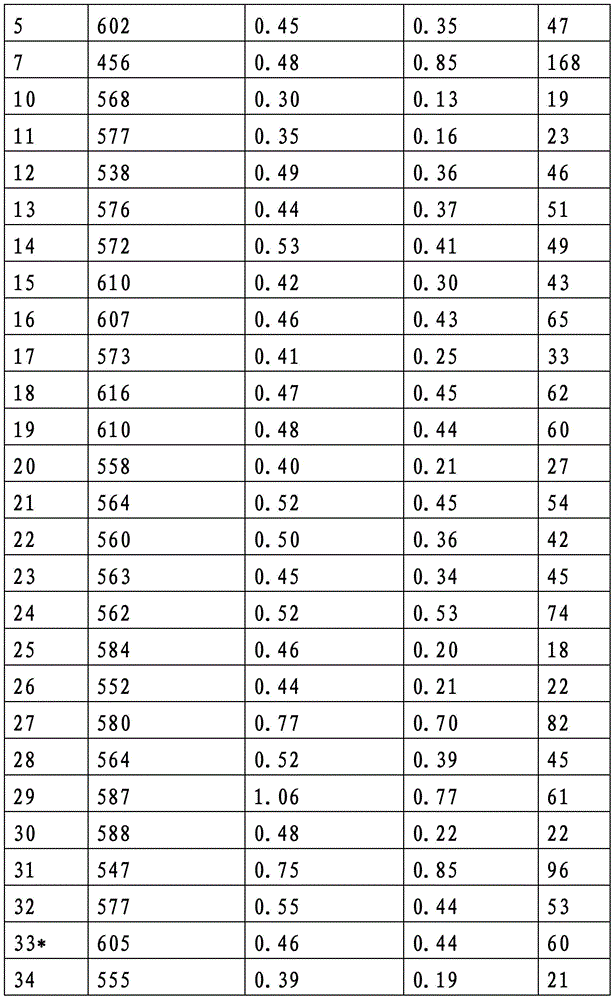
(*)表示实施例33是在曝光水平2.0而非6.7W/m2测试的,来获得可测量的读数。(*) indicates that Example 33 was tested at an exposure level of 2.0 instead of 6.7 W/ m2 to obtain measurable readings.
部分3-二向色性能测试Part 3 - Dichroic Performance Test
部分3A-液晶盒制备Part 3A - Liquid Crystal Cell Preparation
实施例1-8、10-30和33的每个化合物的平均吸收率是根据下述的盒方法(CELL METHOD)来确定的。The average absorbance of each compound of Examples 1-8, 10-30 and 33 was determined according to the CELL METHOD described below.
具有下面的构造的盒组件获自Design Concepts,Inc。每个盒组件是由两个相对的玻璃基材形成的,其是用直径为20微米+/-1微米的玻璃珠间隔器来隔开的。每个玻璃基材的内表面上面具有定向的聚酰亚胺涂层,来提供如下所述液晶材料的定向。玻璃基材的两个相对边是用环氧密封剂密封的,留下其余边缘开放用于填充。A cartridge assembly having the following construction was obtained from Design Concepts, Inc. Each cell assembly was formed from two opposing glass substrates separated by glass bead spacers 20 microns +/- 1 micron in diameter. The inner surface of each glass substrate had an aligned polyimide coating on it to provide alignment of the liquid crystal material as described below. The two opposing edges of the glass substrate are sealed with epoxy sealant, leaving the remaining edge open for filling.
盒组件的两个玻璃基材之间的间隙填充有含有实施例1-33之一的化合物的液晶溶液。该液晶溶液是将下面的组分以下面所列的重量百分比混合,并且在需要时加热来溶解该测试材料而形成的。The gap between the two glass substrates of the cell assembly is filled with a liquid crystal solution containing the compound of one of Examples 1-33. The liquid crystal solution was formed by mixing the following components in the weight percentages listed below and heating as necessary to dissolve the test material.
部分3B-液晶盒测试Part 3B - Liquid Crystal Cell Testing
使用光具座来测量所述盒的光学性能和导出每个测试材料的吸收率。将填充的盒组件置于光具座上,其具有活化光源(Oriel66011型300瓦氙弧灯,安装有Vincent Associates(VS25S2ZM0R3型,具有VMM-D4控制器)高速计算机控制的挡板,其在数据收集过程中即刻关闭,以使得杂散光不干涉数据收集过程,Schott3mm KG-1带通滤波器,其除去了短波辐射,中密度滤波器,用于亮度衰减,和聚光透镜,用于光束瞄准),在盒组件表面的30°-35°入射角定向。Use an optical bench to measure the optical properties of the cell and derive the absorbance for each test material. The filled cell assembly was placed on an optical bench with an activated light source (Oriel model 66011 300 watt xenon arc lamp fitted with a Vincent Associates (model VS25S2ZM0R3 with VMM-D4 controller) high-speed computer-controlled baffle mounted in the data Momentarily switched off during collection so that stray light does not interfere with the data collection process, Schott 3mm KG-1 bandpass filter, which removes shortwave radiation, neutral density filter, for brightness attenuation, and condenser lens, for beam aiming ), oriented at an incident angle of 30°-35° on the surface of the cartridge assembly.
将用于监控响应测量的宽带光源以垂直于盒组件表面的方式布置。较短可见光波长提高的信号是如下来获得的:用分端的两部分光纤电缆收集和组合来自100瓦钨卤素灯(通过Lambda UP60-14恒压电源控制)的分别过滤的光。将来自钨卤素灯一侧的光用Schott KG1滤波器过滤来吸收热和Hoya B-440滤波器过滤来使得较短的波长通过。另一侧的光是用Schott KG1滤波器过滤的或者是未过滤的。所述光是如下来收集的:将来自所述灯每一侧的光聚焦到分端的两部分光纤电缆的分别的端部,和随后合并成从电缆的单个端出来的一个光源。将4″光管连接到电缆的单个端部来确保正确混合。A broadband light source for monitoring response measurements was placed perpendicular to the surface of the cartridge assembly. The enhanced signal at shorter visible wavelengths was obtained by collecting and combining separately filtered light from a 100 W tungsten-halogen lamp (controlled by a Lambda UP60-14 constant voltage power supply) using a split-ended two-part fiber optic cable. Light from the tungsten-halogen lamp side was filtered with a Schott KG1 filter to absorb heat and a Hoya B-440 filter to pass shorter wavelengths. The light on the other side is either filtered with a Schott KG1 filter or unfiltered. The light is collected by focusing the light from each side of the lamp onto separate ends of the two-part fiber optic cable that is split, and then combining into one light source that emerges from a single end of the cable. Connect a 4" light pipe to a single end of the cable to ensure proper mixing.
光源的偏振是如下来实现的:将来自电缆的单个端的光送过保持在计算机驱动的、机动旋转阶段的Moxtek,Proflux偏振器(型号M-061-PD,来自Polytech,PI)。设定监控光束,以使得一个偏振平面(0°)垂直于光具座台的平面,和第二偏振平面(90°)平行于光具座台的平面。将样品送入空气中,其通过实验室空调系统或者温控空气盒保持在室温(73°F±0.3°F或更好(22.8℃±0.1°))。Polarization of the light source was accomplished by passing light from a single end of the cable through a Moxtek, Proflux polarizer (model M-061-PD from Polytech, PI) held in a computer-driven, motorized rotating stage. Set the monitor beam so that one polarization plane (0°) is perpendicular to the plane of the optical bench, and the second polarization plane (90°) is parallel to the plane of the optical bench. The samples are sent to air, which is maintained at room temperature (73°F ± 0.3°F or better (22.8°C ± 0.1°)) by the laboratory air conditioning system or a temperature-controlled air box.
为了进行该测量,将该盒组件和涂层堆叠体曝露于来自活化光源的6.7W/m2UVA5-15分钟来活化该测试材料。对除了实施例33之外的全部实施例进行这种曝光,当在涂层堆叠体中测试时,将它曝露于2.0W/m2的UVA。需要较低的曝光水平来获得可测量的结果。使用International Light Research辐射计(IL-1700型)来在每个测试之前确认曝光,其带有检测器系统(SED033型检测器,B滤波器和扩散器)。然后将来自监控光源的光(其偏振于0°偏振平面)送过涂覆的样品和聚焦在1″累计球上,将其使用单功能光纤电缆连接到OceanOptics S2000分光光度计上。在送过样品之后的光谱信息是使用OceanOptics SpectraSuite和PPG私有的软件来收集的。虽然该光致变色-二向色材料是活化的,但是偏振器的位置是前后旋转的,来将来自偏振光源的光偏振到90°偏振平面和返回。在活化过程中,数据是以5秒的时间间隔收集了大约10-300秒。对于每个测试来说,将偏振器的旋转调整来收集下面次序的偏振平面的数据:0°、90°、90°、0°等。For this measurement, the cell assembly and coating stack were exposed to 6.7 W/ m2 UVA from an activating light source for 5-15 minutes to activate the test material. This exposure was done for all examples except Example 33, which was exposed to 2.0 W/ m2 of UVA when tested in a coating stack. Lower exposure levels are required for measurable results. Exposure was confirmed prior to each test using an International Light Research radiometer (model IL-1700) with a detector system (detector model SED033, B filter and diffuser). Light from the monitor light source (which was polarized at the 0° polarization plane) was then sent through the coated sample and focused on a 1" integrating sphere, which was connected to an OceanOptics S2000 spectrophotometer using a single function fiber optic cable. After sending Spectral information after the sample is collected using OceanOptics SpectraSuite and PPG proprietary software. Although the photochromic-dichroic material is activated, the position of the polarizer is rotated back and forth to polarize the light from the polarized light source to the 90° polarization plane and back. During activation, data was collected at 5 second intervals for approximately 10-300 seconds. For each test, the rotation of the polarizer was adjusted to collect the following order of polarization planes Data: 0°, 90°, 90°, 0°, etc.
获得了吸收光谱,并且使用Igor Pro软件(获自WaveMetrics)分析了每个盒组件。每个盒组件在每个偏振方向上的吸收率的变化是通过减去在每个测试波长时盒组件的0时间(即,未活化的)吸收测量来计算的。对于每个盒组件,平均吸收率值是通过在这个区域中,对每个时间间隔的吸收率进行平均而在活化曲线的区域中获得的,这里实施例1-33的响应是饱和的或接近饱和的(即,这样的区域,这里所测量的吸收率随着时间变化不明显升高或者不明显降低)。提取了0°和90°偏振在预定范围的相应的λmax-vis+/-5nm波长的平均吸收率值,并且在这个范围内每个波长的吸收率是用较大的平均吸收率除以小的平均吸收率来计算的。对于每个提取的波长,平均了5-100个数据点。然后通过平均这些单个吸收率,来计算测试材料的平均吸收率。Absorption spectra were obtained and each cartridge assembly was analyzed using Igor Pro software (obtained from WaveMetrics). The change in absorbance of each cell assembly in each polarization direction was calculated by subtracting the zero time (ie, non-activated) absorption measurement of the cell assembly at each test wavelength. For each cartridge assembly, mean absorbance values were obtained in the region of the activation curve by averaging the absorbance for each time interval in the region where the responses of Examples 1-33 were saturated or close to Saturated (ie, the region where the measured absorbance does not increase or decrease significantly over time). The average absorptance values for the corresponding λ max-vis +/- 5nm wavelengths for 0° and 90° polarizations in a predetermined range were extracted, and the absorptivity for each wavelength within this range was divided by the larger average absorptivity The small average absorption rate is calculated. For each extracted wavelength, 5-100 data points were averaged. By averaging these individual absorbances, the average absorbance of the test material is then calculated.
对于表2所列出的实施例,将上述程序进行至少两次。用于平均吸收率的制表值代表了在所示波长测量的运行的平均结果。这些测试的结果存在于下表2中。For the examples listed in Table 2, the above procedure was performed at least twice. Tabulated values for mean absorbance represent the average result of runs measured at the indicated wavelengths. The results of these tests are presented in Table 2 below.
表2-吸收率(AR)测试数据Table 2 - Absorption Rate (AR) Test Data

(*)表示实施例33(表2的)是在曝光水平2.0而非6.7W/m2后测试的,来获得可测量的读数。(*) indicates that Example 33 (of Table 2) was tested after an exposure level of 2.0 instead of 6.7 W/ m2 to obtain measurable readings.
部分3C-制备用于排列的液晶涂覆的基材的涂层Part 3C - Preparation of Coatings for Aligned Liquid Crystal Coated Substrates
部分3C-1-制备底漆Section 3C-1 - Preparation of Primer
向250mL的装备有磁搅拌棒的琥珀色玻璃瓶中以所示的次序和量加入下面的材料:To a 250 mL amber glass bottle equipped with a magnetic stir bar was added the following materials in the order and amounts indicated:
聚丙烯酸酯多元醇(15.2334g)(美国专利6187444的实施例1的组合物D,该多元醇公开内容在此引入作为参考);Polyacrylate polyol (15.2334 g) (composition D of Example 1 of US Pat. No. 6,187,444, the disclosure of which polyol is incorporated herein by reference);
聚亚烷基碳酸酯二醇(40.0000g)T-5652,来自Asahi KaseiChemicals;Polyalkylene carbonate diol (40.0000 g) T-5652 from Asahi Kasei Chemicals;
聚醚改性的聚二甲基硅氧烷(0.0658g),来自BYK-Chemie GmbH);Polyether modified polydimethylsiloxane (0.0658g) , from BYK-Chemie GmbH);
氨基甲酸酯催化剂(0.8777g),来自King Industries;Urethane catalyst (0.8777g) , from King Industries;
γ-缩水甘油丙基三甲氧基硅烷(3.5109g)A-187,来自MomentivePerformance Material;Gamma-glycidylpropyltrimethoxysilane (3.5109g) A-187 from MomentivePerformance Material;
光稳定剂(7.8994g)
1-甲基-2-吡咯烷酮(74.8250g),来自Sigma-Aldrich)。1-Methyl-2-pyrrolidone (74.8250 g) from Sigma-Aldrich).
将该混合物在室温搅拌2h,来产生50重量%最终固体的溶液,基于该溶液的总重量。The mixture was stirred at room temperature for 2 h to yield a solution of 50 wt% final solids, based on the total weight of the solution.
部分3C-2-制备光学排列的涂层组分Section 3C-2 - Preparation of Coating Components for Optical Alignment
将购自Ventico的Staralign2200CP10用环戊酮溶剂稀释到2%溶液。Staralign 2200CP10 purchased from Ventico was diluted to a 2% solution with cyclopentanone solvent.
部分3C-3-液晶涂料组分和配方Part 3C-3- Liquid Crystal Coating Components and Formulations
用于单体溶液的液晶单体(LCM)包括下面的:Liquid crystal monomers (LCMs) for monomer solutions include the following:
LCM-1是1-(6-(6-(6-(6-(6-(6-(6-(6-(8-(4-(4-(4-(8-丙烯酰氧基己氧基)苯甲酰氧基)苯氧基羰基)苯氧基)辛氧基)-6-氧杂己氧基)-6-氧杂己氧基)-6-氧杂己氧基)-6-氧杂己氧基)-6-氧杂己氧基)-6-氧杂己氧基)-6-氧杂己氧基)-6-氧杂己-1-醇,其是根据美国专利公开2009/0323011的实施例17所述程序来制备的,该液晶单体的公开内容在此引入作为参考。LCM-1 is 1-(6-(6-(6-(6-(6-(6-(6-(6-(8-(4-(4-(4-(8-acryloxyhexyl Oxygen)benzoyloxy)phenoxycarbonyl)phenoxy)octyloxy)-6-oxahexyloxy)-6-oxahexyloxy)-6-oxahexyloxy)- 6-oxahexyloxy)-6-oxahexyloxy)-6-oxahexyloxy)-6-oxahexyloxy)-6-oxahexyl-1-ol, which is according to the United States The procedure described in Example 17 of Patent Publication 2009/0323011 was prepared, and the disclosure content of the liquid crystal monomer is hereby incorporated by reference.
LCM-2是市售RM257,据报道是4-(3-丙烯酰氧基丙氧基)-苯甲酸2-甲基-1,4-亚苯基酯,获自EMD Chemicals,Inc.,分子式是C33H32O10。LCM-2 is commercially available RM257, reported as 2-methyl-1,4-phenylene 4-(3-acryloyloxypropoxy)-benzoate, obtained from EMD Chemicals, Inc., with the formula is C 33 H 32 O 10 .
LCM-3是市售RM105,据报道是4-甲氧基-3-甲基苯基4-(6-(丙烯酰氧基)己氧基)苯甲酸酯,获自EMD Chemicals,Inc.,分子式是C23H26O6。LCM-3 is commercially available RM105, reported as 4-methoxy-3-methylphenyl 4-(6-(acryloyloxy)hexyloxy)benzoate, obtained from EMD Chemicals, Inc. , the molecular formula is C 23 H 26 O 6 .
LCM-4是市售RM82,据报道是2-甲基-1,4-亚苯基双(4-(6-(丙烯酰氧基)己氧基)苯甲酸酯),获自EMD Chemicals,Inc.,分子式是C39H44O10。LCM-4 is commercially available as RM82, reported as 2-methyl-1,4-phenylene bis(4-(6-(acryloyloxy)hexyloxy)benzoate), obtained from EMD Chemicals , Inc., the molecular formula is C 39 H 44 O 10 .
液晶涂层配方(LCCF)如下来制备:向含有苯甲醚(3.4667g)和

部分3C-4:过渡层涂料配方(TLCF)SECTION 3C-4: TIE COATING FORMULATION (TLCF)
TLCF是如下来制备的:TLCF was prepared as follows:
向50mL的装备有磁搅拌棒的琥珀色玻璃瓶中加入下面的材料:Into a 50 mL amber glass bottle equipped with a magnetic stir bar was added the following materials:
羟甲基丙烯酸酯(1.242g),来自Sigma-Aldrich;Hydroxymethacrylate (1.242 g) from Sigma-Aldrich;
新戊二醇二丙烯酸酯(13.7175g)SR247,来自Sartomer;Neopentyl glycol diacrylate (13.7175 g) SR247 from Sartomer;
三羟甲基丙烷三甲基丙烯酸酯(2.5825g)SR350,来自Sartomer;Trimethylolpropane trimethacrylate (2.5825 g) SR350 from Sartomer;


(0.0628g;来自Ciba Speciality Chemicals, (0.0628g; from Ciba Specialty Chemicals,
聚丙烯酸丁酯(0.125g),Polybutylacrylate (0.125g),
3-氨丙基丙基三甲氧基硅烷(1.4570g)A-1100,来自MomentivePerformance Material;和3-Aminopropylpropyltrimethoxysilane (1.4570 g) A-1100 from MomentivePerformance Material; and
200标准酒精度绝对无水乙醇(1.4570g),来自Pharmaco-Aaper。200 proof absolute ethanol (1.4570 g) from Pharmaco-Aaper.
将该混合物室温搅拌2h。The mixture was stirred at room temperature for 2 h.
部分3C-5:保护涂层配方(PCF)Part 3C-5: Protective Coating Formulation (PCF)
PCF(硬涂层)是如下来制备的:将装料1加入到洁净的干燥烧杯中,并且搅拌下置于5℃的冰浴中。加入装料2,并且放热将该反应混合物的温度升高到50℃。将所形成的反应混合物的温度冷却到20-25℃,在搅拌下加入装料3。加入装料4来将pH从大约3调整为大约5.5。加入装料5,并且将该溶液混合半小时。将所形成的溶液通过名义0.45微米的胶囊过滤器进行过滤,并且在4℃存储直到使用。PCF (hard coat) was prepared as follows: Charge 1 was added to a clean dry beaker and placed in an ice bath at 5°C with stirring. Charge 2 was added and an exotherm raised the temperature of the reaction mixture to 50°C. The temperature of the resulting reaction mixture was cooled to 20-25°C and Charge 3 was added with stirring. Charge 4 was added to adjust the pH from about 3 to about 5.5. Charge 5 was added and the solution was mixed for half an hour. The resulting solution was filtered through a nominal 0.45 micron capsule filter and stored at 4°C until use.
装料1Charge 1
缩水甘油氧基丙基三甲氧基硅烷 32.4gGlycidyloxypropyltrimethoxysilane 32.4g
甲基三甲氧基硅烷 345.5gMethyltrimethoxysilane 345.5g
装料2Charge 2
硝酸的去离子水(DI)溶液(硝酸1g/7000g) 292gNitric acid in deionized water (DI) solution (nitric acid 1g/7000g) 292g
装料3Charge 3
溶剂 228g Solvent 228g
装料4Charge 4
TMAOH(25%四甲基氢氧化铵的甲醇溶液) 0.45gTMAOH (25% methanol solution of tetramethylammonium hydroxide) 0.45g
装料5charge 5
部分3C-6-用于制备表3所报道的涂层堆叠体的程序SECTION 3C-6 - PROCEDURES FOR PREPARING COATING STACKS REPORTED IN TABLE 3
部分3C-6A-基材制备Part 3C-6A - Substrate Preparation
由单体制备的尺寸为5.08cm×5.08cm×0.318cm(2英寸×2英寸×0.125英寸)的方块基材获自Homalite,Inc。将每个由
将每个前述的基材在传送带上在Tantec EST系统系列No.020270Power Generator HV2000系列电晕处理装置(具有高压变压器)中传输,来进行电晕处理。将该基材曝露于53.99KV,500瓦所产生的电晕,同时以3ft/min的传送带速度在传送带上传输。Each of the aforementioned substrates was transported on a conveyor belt in a Tantec EST system series No. 020270 Power Generator HV2000 series corona treatment unit (with high voltage transformer) for corona treatment. The substrate was exposed to a 53.99 KV, 500 Watt generated corona while traveling on a conveyor belt at a conveyor speed of 3 ft/min.
部分3C-6B-底漆的涂覆方法SECTION 3C-6B - APPLICATION METHODS OF PRIMER
将该底漆溶液旋涂到测试基材的一部分表面上而施涂到测试基材上,该旋涂是分配大约1.5mL的溶液,并且将该基材以500转/分钟(rpm)旋转3秒,随后以1500rpm旋转7秒,随后以2500rpm旋转4秒。使用来自Laurell Technologies Corp.的旋转加工机(WS-400B-6NPP/LITE)来旋涂。然后,将该涂覆的基材置于保持在125℃的烘箱60分钟。将该涂覆的基材冷却到大约26℃。将该基材在传送带上在Tantec EST系统系列No.020270Power Generator HV2000系列电晕处理装置(具有高压变压器)中传输,来进行电晕处理。将该干燥底漆层曝露于曝露于53.00KV,500瓦所产生的电晕,同时以3ft/min的传送带速度在传送带上传输。The primer solution was applied to the test substrate by spinning onto a portion of the surface of the test substrate by dispensing approximately 1.5 mL of the solution and spinning the substrate at 500 revolutions per minute (rpm) for 3 seconds, followed by 7 seconds at 1500 rpm, followed by 4 seconds at 2500 rpm. Spin coating was performed using a rotary processor from Laurell Technologies Corp. (WS-400B-6NPP/LITE). The coated substrate was then placed in an oven maintained at 125°C for 60 minutes. The coated substrate was cooled to about 26°C. The substrate was corona treated by transporting it on a conveyor belt in a Tantec EST system series No. 020270 Power Generator HV2000 series corona treatment unit (with high voltage transformer). The dried primer layer was exposed to a corona generated by exposure to 53.00 KV, 500 watts, while being conveyed on a conveyor belt at a conveyor speed of 3 ft/min.
部分3C-6C-用于光排列材料的涂覆程序Sections 3C-6C - Coating Procedures for Optical Alignment Materials
将在部分3C-2中制备的2wt%的Staralign2200溶液旋涂到测试基材的一部分表面上而施涂到测试基材上,该旋涂是分配大约1.0mL的溶液,并且将该基材以800转/分钟(rpm)旋转3秒,随后以1000rpm旋转7秒,随后以4000rpm旋转4秒。使用来自Laurell TechnologiesCorp.的旋转加工机(WS-400B-6NPP/LITE)来旋涂。然后,将该涂覆的基材置于保持在120℃的烘箱30分钟。将该涂覆的基材冷却到大约26℃。The 2 wt % solution of Staralign 2200 prepared in Section 3C-2 was applied to the test substrate by spin coating onto a portion of the surface of the test substrate by dispensing approximately 1.0 mL of the solution and the substrate as Spin at 800 revolutions per minute (rpm) for 3 seconds, then at 1000 rpm for 7 seconds, then at 4000 rpm for 4 seconds. Spin coating was performed using a rotary processor (WS-400B-6NPP/LITE) from Laurell Technologies Corp. The coated substrate was then placed in an oven maintained at 120°C for 30 minutes. The coated substrate was cooled to about 26°C.
在每个基材上的干燥的光定向层是使用

部分3C-6D-用于液晶涂层配方的涂覆程序Sections 3C-6D - Coating Procedures for Liquid Crystal Coating Formulations
将描述在部分3C-3中的液晶涂层配方(“LCCF”)每个以300转/分钟(rpm)的速率旋涂6秒,随后以800rpm进行6秒旋涂到测试基材的部分6C的至少部分的有序光排列的材料上。将每个涂覆的方块基材置于50℃的烘箱20分钟和将每个涂覆的透镜置于50℃的烘箱30分钟。其后将基材在紫外灯下,在来自Dr.
部分3C-6E-用于过渡层的涂覆程序Parts 3C-6E - Coating Procedures for Transition Coats
将部分3C-4中制备的过渡层溶液以1400转/分钟(rpm)的速率旋涂7秒到固化的LCCF涂覆的基材上。其后将透镜在紫外灯下,在来自Dr.Dr.
部分3C-6F-用于保护涂层(硬涂层)的涂覆程序Part 3C-6F - Application Procedures for Protective Coatings (Hard Coatings)
将部分3C-5中所制备的硬涂层溶液以2000转/分钟(rpm)的速率和10秒的时间旋涂到固化的连结层涂覆基材上。该涂覆基材的后固化在105℃进行3小时完成。The hardcoat solution prepared in Section 3C-5 was spin-coated onto the cured tie-coated substrate at a rate of 2000 revolutions per minute (rpm) for 10 seconds. Post curing of the coated substrate was accomplished at 105°C for 3 hours.
表3-不同涂层的堆叠体的吸收率结果Table 3 - Absorption results for stacks of different coatings
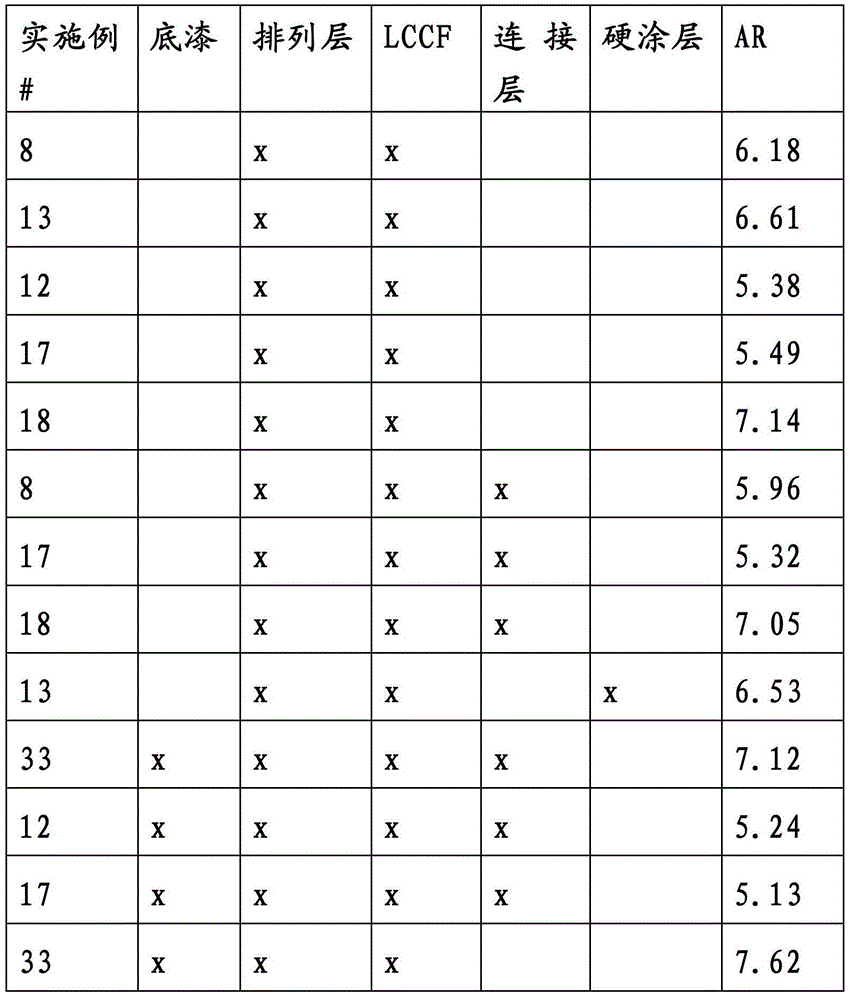

本发明已经参考其具体实施方案的具体细节进行了描述。这样的细节并非打算被认为是对本发明范围的限制,除了它们包括在附加的权利要求中这样的程度。The invention has been described with reference to specific details of specific embodiments thereof. Such details are not intended to be considered limitations of the scope of the invention, except to the extent they are included in the appended claims.
Claims (30)
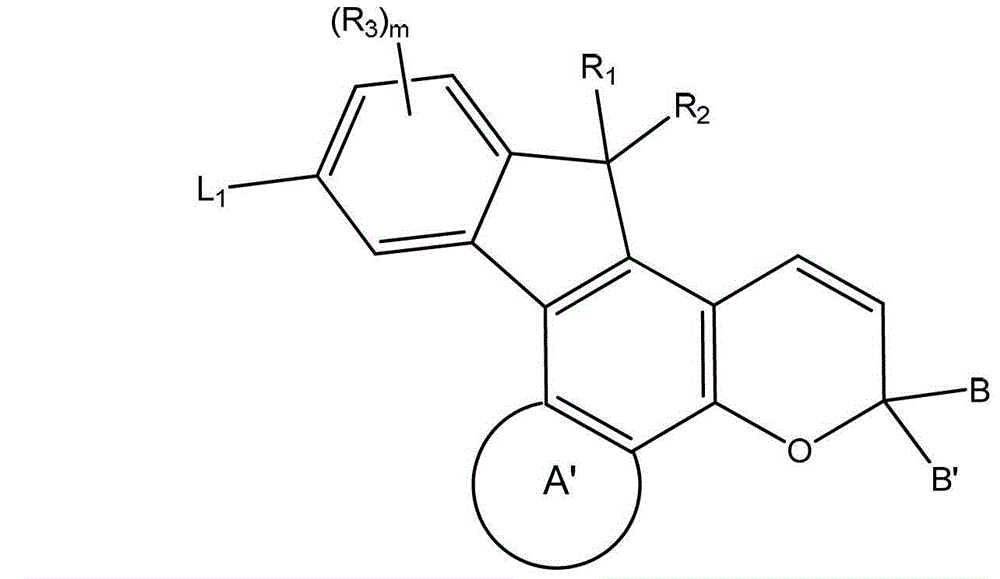
Applications Claiming Priority (3)
| Application Number | Priority Date | Filing Date | Title |
|---|---|---|---|
| US12/928,687 | 2010-12-16 | ||
| US12/928,687 US8545984B2 (en) | 2003-07-01 | 2010-12-16 | Photochromic compounds and compositions |
| PCT/US2011/061149 WO2012082299A1 (en) | 2010-12-16 | 2011-11-17 | Photochromic compounds and compositions |
Publications (1)
| Publication Number | Publication Date |
|---|---|
| CN103339564A true CN103339564A (en) | 2013-10-02 |
Family
ID=45044751
Family Applications (1)
| Application Number | Title | Priority Date | Filing Date |
|---|---|---|---|
| CN2011800657291A Pending CN103339564A (en) | 2010-12-16 | 2011-11-17 | Photochromic compounds and compositions |
Country Status (12)
| Country | Link |
|---|---|
| US (1) | US8545984B2 (en) |
| EP (1) | EP2652552B9 (en) |
| JP (3) | JP5891239B2 (en) |
| KR (1) | KR101514589B1 (en) |
| CN (1) | CN103339564A (en) |
| AU (1) | AU2011341557B2 (en) |
| BR (1) | BR112013014816B1 (en) |
| CA (1) | CA2821232C (en) |
| ES (1) | ES2551725T3 (en) |
| MX (1) | MX338919B (en) |
| PH (1) | PH12013501357B1 (en) |
| WO (1) | WO2012082299A1 (en) |
Cited By (8)
| Publication number | Priority date | Publication date | Assignee | Title |
|---|---|---|---|---|
| CN105446018A (en) * | 2016-01-13 | 2016-03-30 | 京东方科技集团股份有限公司 | Alignment film and preparation method thereof, display panel and display device |
| CN109535952A (en) * | 2018-11-22 | 2019-03-29 | 中国石油大学(北京) | A kind of ability of reverse photochromism coating and preparation method thereof |
| CN109529952A (en) * | 2018-11-30 | 2019-03-29 | 宁波米瑞科技有限公司 | Optic catalytic composite material and preparation method thereof |
| CN110730778A (en) * | 2017-05-10 | 2020-01-24 | 光学转变有限公司 | Photochromic indeno-fused phenanthropyrans |
| CN113122269A (en) * | 2014-09-30 | 2021-07-16 | 光学转变公司 | Ultraviolet light absorber |
| CN113150007A (en) * | 2013-11-20 | 2021-07-23 | 光学转变公司 | Photochromic indeno-fused ring pyran compounds |
| CN116745275A (en) * | 2021-03-26 | 2023-09-12 | 豪雅镜片泰国有限公司 | Particles of indeno-fused naphthopyran compounds, methods for producing polymerizable compositions, and methods for producing photochromic articles |
| CN118461355A (en) * | 2024-03-26 | 2024-08-09 | 武汉纺织大学 | Membrane material containing porous polymer nanofibers and preparation method thereof |
Families Citing this family (29)
| Publication number | Priority date | Publication date | Assignee | Title |
|---|---|---|---|---|
| US20110140056A1 (en) * | 2003-07-01 | 2011-06-16 | Transitions Optical, Inc. | Indeno-fused ring compounds |
| US8211338B2 (en) | 2003-07-01 | 2012-07-03 | Transitions Optical, Inc | Photochromic compounds |
| US8545015B2 (en) | 2003-07-01 | 2013-10-01 | Transitions Optical, Inc. | Polarizing photochromic articles |
| US8545984B2 (en) * | 2003-07-01 | 2013-10-01 | Transitions Optical, Inc. | Photochromic compounds and compositions |
| US8698117B2 (en) * | 2003-07-01 | 2014-04-15 | Transitions Optical, Inc. | Indeno-fused ring compounds |
| US8582192B2 (en) | 2003-07-01 | 2013-11-12 | Transitions Optical, Inc. | Polarizing photochromic articles |
| US8613868B2 (en) | 2008-06-27 | 2013-12-24 | Transitions Optical, Inc | Mesogenic stabilizers |
| US8349210B2 (en) | 2008-06-27 | 2013-01-08 | Transitions Optical, Inc. | Mesogenic stabilizers |
| US8623238B2 (en) | 2008-06-27 | 2014-01-07 | Transitions Optical, Inc. | Mesogenic stabilizers |
| US8431039B2 (en) | 2008-06-27 | 2013-04-30 | Transitions Optical, Inc. | Mesogenic stabilizers |
| US8920928B2 (en) * | 2010-12-16 | 2014-12-30 | Transitions Optical, Inc. | Photochromic compounds and compositions |
| US9034219B2 (en) * | 2010-12-16 | 2015-05-19 | Transitions Optical, Inc. | Photochromic compounds and compositions |
| WO2012170066A1 (en) | 2011-06-06 | 2012-12-13 | Transitions Optical, Inc. | Polarizing photochromic articles |
| ES2984173T3 (en) * | 2011-06-06 | 2024-10-29 | Transitions Optical Inc | Photochromic polarizing articles |
| US9030740B2 (en) * | 2012-09-14 | 2015-05-12 | Transitions Optical, Inc. | Photochromic article having at least partially crossed polarized photochromic-dichroic and fixed-polarized layers |
| US9334439B2 (en) * | 2013-03-15 | 2016-05-10 | Transitions Optical, Inc. | Photochromic articles that include photochromic-dichroic materials |
| US9915757B1 (en) | 2013-06-24 | 2018-03-13 | The Research Foundation For The State University Of New York | Increased thermal stabilization of optical absorbers |
| WO2016188936A1 (en) * | 2015-05-26 | 2016-12-01 | Rolic Ag | Multiple hidden image security device |
| AU2015413366B2 (en) | 2015-10-30 | 2021-07-15 | Transitions Optical, Inc. | Optical article with gradient light influencing properties and method of making the same |
| AU2018227845B9 (en) * | 2017-03-01 | 2022-11-17 | Younger Mfg. Co. Dba Younger Optics | Optical articles comprising photochromic poly(urea-urethane) |
| EP3645540B1 (en) | 2017-06-30 | 2021-11-03 | Transitions Optical, Ltd. | Silole and germole fused ring photochromic compounds |
| CN108192462A (en) * | 2017-12-28 | 2018-06-22 | 深圳市华星光电半导体显示技术有限公司 | Photochromic mixture, the production method of photochromic device and application |
| CN115697249A (en) | 2020-06-01 | 2023-02-03 | 应用奈米医材科技股份有限公司 | Bifacial aspheric diffractive multifocal lenses and their manufacture and use |
| CA3195726A1 (en) | 2020-11-10 | 2022-05-19 | Henry Nguyen | Photochromic-dichroic articles |
| TWI737540B (en) * | 2020-11-11 | 2021-08-21 | 國立中山大學 | Smart window and method for switching the same |
| EP4270067B1 (en) * | 2020-12-24 | 2025-12-03 | Hoya Lens Thailand Ltd. | Photochromic composition, photochromic article, and glasses |
| CN113355945A (en) * | 2021-06-11 | 2021-09-07 | 华南理工大学 | Photochromic super-hydrophobic functional paper and preparation method and application thereof |
| CN114773586B (en) * | 2022-05-12 | 2024-06-14 | 西安交通大学 | A polyfluorophenyl ester polymer material and synthesis method thereof |
| WO2025041624A1 (en) * | 2023-08-18 | 2025-02-27 | 株式会社トクヤマ | Photochromic compound, curable composition, optical article, lens, and eyeglasses |
Citations (4)
| Publication number | Priority date | Publication date | Assignee | Title |
|---|---|---|---|---|
| CN1842580A (en) * | 2003-07-01 | 2006-10-04 | 光学转变公司 | Photochromic compounds |
| CN101176037A (en) * | 2005-04-08 | 2008-05-07 | 光学转变公司 | Photochromic materials with extended π-conjugated systems and compositions and articles comprising them |
| CN101341141A (en) * | 2005-12-21 | 2009-01-07 | 光学转变公司 | Photochromic indeno-fused naphthopyrans |
| US20090309076A1 (en) * | 2003-07-01 | 2009-12-17 | Transitions Optical, Inc. | Photochromic compounds |
Family Cites Families (217)
| Publication number | Priority date | Publication date | Assignee | Title |
|---|---|---|---|---|
| US2475921A (en) * | 1940-06-26 | 1949-07-12 | Polaroid Corp | Glare reduction filter comprising light polarizing area merging gradually with transparent nonpolarizing area |
| GB583842A (en) | 1941-01-21 | 1947-01-01 | Polaroid Corp | Improvements in or relating to combined light-filtering and light-polarizing means |
| US2319826A (en) * | 1941-10-10 | 1943-05-25 | Gen Electric | Adhesive composition |
| US2334446A (en) * | 1941-12-26 | 1943-11-16 | Polaroid Corp | Polarizing goggles |
| US2544659A (en) * | 1946-05-14 | 1951-03-13 | John F Dreyer | Dichroic light-polarizing sheet materials and the like and the formation and use thereof |
| US2481830A (en) * | 1946-05-14 | 1949-09-13 | Gen Polarizing Company | Optically polarizing dichroic film and method of preparing the same |
| US3276316A (en) * | 1961-08-02 | 1966-10-04 | Polaroid Corp | Process for polarizing ultraviolet light utilizing oriented polymer sheet with incorporated dichroic fluorescent dye |
| US3361706A (en) * | 1964-03-06 | 1968-01-02 | American Cyanamid Co | Control of the photochromic return rate of (arylazo) thioformic arylhydrazidates |
| US3653863A (en) * | 1968-07-03 | 1972-04-04 | Corning Glass Works | Method of forming photochromic polarizing glasses |
| US4043637A (en) * | 1973-06-15 | 1977-08-23 | American Optical Corporation | Photochromic light valve |
| US4049338A (en) * | 1974-11-19 | 1977-09-20 | Texas Instruments Incorporated | Light polarizing material method and apparatus |
| US4166043A (en) * | 1974-12-23 | 1979-08-28 | American Optical Corporation | Stabilized photochromic materials |
| US4367170A (en) * | 1975-01-24 | 1983-01-04 | American Optical Corporation | Stabilized photochromic materials |
| US4039254A (en) * | 1976-05-27 | 1977-08-02 | Mack Gordon | Electro-optic welding lens assembly using multiple liquid crystal light shutters and polarizers |
| US4190330A (en) * | 1977-12-27 | 1980-02-26 | Bell Telephone Laboratories, Incorporated | Variable focus liquid crystal lens system |
| US4279474A (en) * | 1980-03-25 | 1981-07-21 | Belgorod Barry M | Spectacle lens having continuously variable controlled density and fast response time |
| US4720356A (en) * | 1982-03-22 | 1988-01-19 | American Optical Corporation | Photochromic composition resistant to fatigue |
| FR2531235B1 (en) * | 1982-07-27 | 1985-11-15 | Corning Glass Works | POLARIZING TRANSPARENT LAMINATE GLASSES AND PROCESS FOR OBTAINING SAME |
| US4556605A (en) * | 1982-09-09 | 1985-12-03 | Kabushiki Kaisha Suwa Seikosha | Photochromic coating composition and photochromic synthetic resin ophthalmic lens |
| US4637896A (en) * | 1982-12-15 | 1987-01-20 | Armstrong World Industries, Inc. | Polymeric liquid crystals |
| US4539049A (en) * | 1983-02-09 | 1985-09-03 | Jos. Cavedon Co., Inc. | Aluminum zirconium metallo-organic complex useful as coupling and hydrophobic agents |
| US4539048A (en) * | 1983-02-09 | 1985-09-03 | Jos. Cavedon Company Inc. | Aluminum zirconium metallo-organic complexes useful as coupling agents |
| US4685783A (en) * | 1983-09-07 | 1987-08-11 | The Plessey Company P.L.C. | Polychromic tetracyclo-spiro-adamatylidene derivatives, and polychromic lens incorporating said compounds |
| SE464264B (en) * | 1984-02-24 | 1991-03-25 | Esab Ab | OPTICAL FILTER FOR WELDING GLASS |
| US4549894A (en) * | 1984-06-06 | 1985-10-29 | Corning Glass Works | Ultraviolet absorbing photochromic glass of low silver content |
| FR2568568A1 (en) * | 1984-08-01 | 1986-02-07 | Corning Glass Works | IMPROVEMENT IN THE MANUFACTURE OF POLARIZING TRANSPARENT LAMINATE LENSES AND LENSES THUS OBTAINED |
| GB2169417A (en) | 1984-12-28 | 1986-07-09 | Olympus Optical Co | Liquid crystal lens having a variable focal length |
| US4756605A (en) * | 1985-02-01 | 1988-07-12 | Olympus Optical Co., Ltd. | Liquid crystal spectacles |
| AU564689B2 (en) * | 1985-07-09 | 1987-08-20 | Kureha Kagaku Kogyo K.K. | Photochromic lens |
| FR2590889B1 (en) * | 1985-08-13 | 1988-01-22 | Corning Glass Works | IMPROVEMENTS IN THE MANUFACTURE OF POLARIZING TRANSPARENT LAMINATED GLASSES AND GLASSES OBTAINED THEREBY |
| DE3531923A1 (en) * | 1985-09-07 | 1987-03-12 | Bayer Ag | METHOD FOR PRODUCING 1-AMINONAPHTHALINE-2,4,7-TRISULFONIC ACID AND 1-AMINONAPHTHALINE-7-SULPHONIC ACID |
| US4810433A (en) * | 1985-09-25 | 1989-03-07 | Fuji Photo Film Co., Ltd. | Process for producing oriented film |
| US4650526A (en) * | 1986-03-18 | 1987-03-17 | Man-Gill Chemical Company | Post treatment of phosphated metal surfaces by aluminum zirconium metallo-organic complexes |
| IT1190508B (en) * | 1986-03-24 | 1988-02-16 | Daniele Senatore | ADJUSTABLE TRANSPARENCY GLASSES |
| GB2189417B (en) | 1986-04-18 | 1990-03-21 | Nii Tekh Avtomobil Promy | Automated line for production of castings |
| WO1988000196A1 (en) | 1986-07-08 | 1988-01-14 | Nissan Motor Co., Ltd. | Spirooxazine compounds, photosensitive materials using them, and process for forming them |
| US4785097A (en) * | 1986-09-26 | 1988-11-15 | Ppg Industries, Inc. | Method for synthesizing spiro-oxazines |
| CA1340939C (en) * | 1987-02-02 | 2000-03-28 | Ryojiro Akashi | Photochromic compound |
| US4838673A (en) * | 1987-04-27 | 1989-06-13 | J. R. Richards, Inc. | Polarized lens and method of making the same |
| JP2578442B2 (en) * | 1987-07-13 | 1997-02-05 | 三菱化学株式会社 | Molecularly oriented thin film |
| EP0301751B1 (en) * | 1987-07-31 | 1993-03-10 | Takeda Chemical Industries, Ltd. | Pyridinium derivatives, their production and use |
| JPH0794657B2 (en) | 1987-10-16 | 1995-10-11 | 日産自動車株式会社 | Photochromic photosensitive material |
| US4873029A (en) * | 1987-10-30 | 1989-10-10 | Blum Ronald D | Method for manufacturing lenses |
| US5180524A (en) * | 1987-11-05 | 1993-01-19 | Enichem Synthesis S.P.A. | Photochromatic composition and photochromatic articles which contain it |
| IT1223348B (en) | 1987-11-05 | 1990-09-19 | Enichem Sintesi | DOLL OR OTHER GAME FOR CHILDREN WITH PHOTOCROMATIC FEATURES AND RELATED PREPARATION PROCEDURE |
| US4931220A (en) | 1987-11-24 | 1990-06-05 | Ppg Industries, Inc. | Organic photochromic pigment particulates |
| NL8802832A (en) | 1988-02-29 | 1989-09-18 | Philips Nv | METHOD OF MANUFACTURING A LAYERED ELEMENT AND THE ELEMENT OBTAINED THEREFORE. |
| DE3887497D1 (en) | 1988-03-04 | 1994-03-10 | Gao Ges Automation Org | Security element in the form of a thread or tape for embedding in security documents and method for producing the same. |
| IT1218208B (en) | 1988-04-08 | 1990-04-12 | Enichem Sintesi | NAIL POLISH OR VARNISH WITH PHOTOCROMATIC CHARACTERISTICS AND RELATED PREPARATION PROCEDURE |
| DE3814631A1 (en) * | 1988-04-29 | 1989-11-09 | Rodenstock Optik G | PHOTOCHROME SUBSTANCES (IV) |
| GB2219098A (en) | 1988-05-25 | 1989-11-29 | Plessey Co Plc | Optically anisotropic materials and applications |
| US5130058A (en) * | 1988-07-01 | 1992-07-14 | Tokuyama Soda Kabushiki Kaisha | Photochromic compound, process for production thereof, use thereof and composition containing said photochromic compound |
| DE3825066A1 (en) * | 1988-07-23 | 1990-01-25 | Roehm Gmbh | METHOD FOR PRODUCING THICKNESS, ANISOTROPIC LAYERS ON SURFACE-STRUCTURED CARRIERS |
| US4931221A (en) * | 1988-12-30 | 1990-06-05 | Ppg Industries, Inc. | Photochromic spiropyran compounds |
| US4974941A (en) * | 1989-03-08 | 1990-12-04 | Hercules Incorporated | Process of aligning and realigning liquid crystal media |
| NL8901167A (en) | 1989-05-10 | 1990-12-03 | Philips Nv | METHOD FOR MANUFACTURING A POLARIZATION FILTER, A POLARIZATION FILTER SO OBTAINED AND A DISPLAY EQUIPPED WITH THE POLARIZATION FILTER. |
| FR2647789B1 (en) * | 1989-06-05 | 1994-07-22 | Essilor Int | INDOLINO-SPIRO-OXAZINE PHOTOCHROMIC COMPOUNDS, PROCESS FOR THEIR PREPARATION, PHOTOCHROMIC COMPOSITIONS AND ARTICLES CONTAINING SUCH COMPOUNDS |
| US5180470A (en) * | 1989-06-05 | 1993-01-19 | The Regents Of The University Of California | Deposition of highly-oriented PTFE films and uses therefor |
| DE69023865T2 (en) * | 1989-07-28 | 1996-10-17 | Wako Pure Chem Ind Ltd | Fulgimide derivatives. |
| JP2692290B2 (en) * | 1989-08-31 | 1997-12-17 | ソニー株式会社 | Disc recording and / or playback device |
| US5186867A (en) * | 1989-12-12 | 1993-02-16 | Enichem Synthesis, S.P.A. | Spiro-indoline oxazine compounds with photochromatic and photosensitizing characteristics and the process for their preparation |
| IT1238694B (en) | 1990-02-16 | 1993-09-01 | Enichem Sintesi | LUXMETERS CONTAINING PHOTOCROMATIC SUBSTANCES |
| US5073294A (en) * | 1990-03-07 | 1991-12-17 | Hercules Incorporated | Process of preparing compositions having multiple oriented mesogens |
| US5066818A (en) * | 1990-03-07 | 1991-11-19 | Ppg Industries, Inc. | Photochromic naphthopyran compounds |
| US5130353A (en) * | 1990-03-07 | 1992-07-14 | Ppg Industries, Inc. | Method for preparing photochromic plastic article |
| US5185390A (en) * | 1990-03-07 | 1993-02-09 | Ppg Industries, Inc. | Water strippable photochromic resin composition |
| DE4007636A1 (en) | 1990-03-10 | 1991-09-12 | Basf Ag | PHOTOCHROME MONOMERS AND PHOTOCHROME POLYMERISATES MADE THEREOF |
| JPH063528B2 (en) * | 1990-03-16 | 1994-01-12 | 富士ゼロックス株式会社 | Light modulation display element and display method |
| US5200116A (en) * | 1990-07-23 | 1993-04-06 | Ppg Industries, Inc. | Photochromic chromene compounds |
| JPH04199024A (en) * | 1990-11-29 | 1992-07-20 | Hitachi Ltd | Liquid crystal display element and display device using the same |
| US5202053A (en) * | 1991-02-22 | 1993-04-13 | Hercules Incorporated | Polymerizable nematic monomer compositions |
| EP0525477B1 (en) * | 1991-07-26 | 1998-09-16 | Rolic AG | Oriented photopolymers and process of preparing same |
| US5189448A (en) * | 1991-08-08 | 1993-02-23 | Katsumi Yaguchi | Unit for searching for a lost contact lens |
| US5608567A (en) * | 1991-11-05 | 1997-03-04 | Asulab S.A. | Variable transparency electro-optical device |
| US5359443A (en) * | 1991-11-22 | 1994-10-25 | Nippon Oil Company, Limited | Process for producing heat-resistant optical element by heating liquid crystal polymer at polymerization temperature during or after orientation treatment |
| US5644416A (en) * | 1991-11-26 | 1997-07-01 | Fuji Xerox Co., Ltd. | Light modulation device and method of light modulation using the same |
| US5289547A (en) * | 1991-12-06 | 1994-02-22 | Ppg Industries, Inc. | Authenticating method |
| US5238981A (en) | 1992-02-24 | 1993-08-24 | Transitions Optical, Inc. | Photochromic naphthopyrans |
| JP3016533B2 (en) * | 1992-03-03 | 2000-03-06 | 株式会社トクヤマ | Photochromic composition |
| EP0587280B1 (en) * | 1992-07-14 | 1997-02-26 | Mitsui Petrochemical Industries, Ltd. | Antiferroelectric liquid crystal composite material, process for preparing the same, and liquid crystal element using the same |
| JPH08502130A (en) * | 1992-09-25 | 1996-03-05 | ピーピージー・インダストリーズ・インコーポレイテッド | Photochromic composition having excellent fatigue resistance |
| US5274132A (en) * | 1992-09-30 | 1993-12-28 | Transitions Optical, Inc. | Photochromic naphthopyran compounds |
| US6160597A (en) | 1993-02-17 | 2000-12-12 | Rolic Ag | Optical component and method of manufacture |
| EP0611981B1 (en) * | 1993-02-17 | 1997-06-11 | F. Hoffmann-La Roche Ag | Optical device |
| EP0622789B1 (en) * | 1993-03-30 | 2002-08-07 | Bayer Ag | Sheet-like structures containing side chain polymers |
| IT1264563B1 (en) * | 1993-06-09 | 1996-10-04 | Enichem Sintesi | PHOTOCROMATIC COMPOUNDS AND METHOD FOR THEIR PREPARATION |
| KR970000356B1 (en) * | 1993-09-18 | 1997-01-08 | 엘지전자 주식회사 | Light polymer alignment film forming method of liquid crystal display element |
| US6096375A (en) | 1993-12-21 | 2000-08-01 | 3M Innovative Properties Company | Optical polarizer |
| DE4420378C1 (en) | 1994-06-10 | 1995-11-30 | Rodenstock Optik G | Photochromic dyes |
| ATE184905T1 (en) * | 1994-07-11 | 1999-10-15 | Rodenstock Optik G | DIARYL-2H-NAPHTHOPYRANE |
| AU7346694A (en) * | 1994-07-22 | 1996-02-22 | Essilor International Compagnie Generale D'optique | Method for preparing photochromic compounds of the spiro{indolin-{2,3'}-benzoxazine} ringed type |
| US6337409B1 (en) | 1994-07-28 | 2002-01-08 | Vision-Ease Lens, Inc. | Photochromic naphthopyran compounds |
| DE4434966A1 (en) * | 1994-09-30 | 1996-04-04 | Bayer Ag | New side group polymers and their use for optical components |
| US5645767A (en) * | 1994-11-03 | 1997-07-08 | Transitions Optical, Inc. | Photochromic indeno-fused naphthopyrans |
| US6049428A (en) | 1994-11-18 | 2000-04-11 | Optiva, Inc. | Dichroic light polarizers |
| US5962617A (en) * | 1995-02-02 | 1999-10-05 | Simula Inc. | Impact resistant polyurethane and method of manufacture thereof |
| US5846452A (en) * | 1995-04-06 | 1998-12-08 | Alliant Techsystems Inc. | Liquid crystal optical storage medium with gray scale |
| US5658501A (en) * | 1995-06-14 | 1997-08-19 | Transitions Optical, Inc. | Substituted naphthopyrans |
| AUPN443695A0 (en) | 1995-07-28 | 1995-08-17 | Sola International Holdings Ltd | Photochromic polymer |
| WO1997006455A1 (en) | 1995-08-08 | 1997-02-20 | Bmc Industries, Inc. | Photochromic naphthopyran compounds |
| DE69625245D1 (en) | 1995-09-11 | 2003-01-16 | Corning Inc | PHOTOCHROME SPIROXAZINE WITH AN ASYMMETRIC MONOCYCLIC SUBSTITUENT, COMPOSITIONS AND PRODUCTS CONTAINING THEM |
| US6004486A (en) * | 1995-09-11 | 1999-12-21 | Corning Incorporated | Photochromic spiroxazines with asymmetric monocyclic substituent, compositions and articles containing them |
| US5903330A (en) * | 1995-10-31 | 1999-05-11 | Rolic Ag | Optical component with plural orientation layers on the same substrate wherein the surfaces of the orientation layers have different patterns and direction |
| US5746949A (en) * | 1995-11-21 | 1998-05-05 | Hoechst Celanese Corp. | Polarizer films comprising aromatic liquid crystalline polymers comprising dichroic dyes in their main chains |
| AU710875B2 (en) * | 1995-12-06 | 1999-09-30 | Tokuyama Corporation | Chromene compounds and photochromic materials |
| AUPN718195A0 (en) | 1995-12-18 | 1996-01-18 | Sola International Holdings Ltd | Laminate wafers |
| US5744070A (en) * | 1995-12-20 | 1998-04-28 | Transitions Optical, Inc. | Photochromic substituted naphthopyran compounds |
| DE19651286A1 (en) * | 1995-12-20 | 1997-06-26 | Rodenstock Optik G | Photochromic 3=pyrenyl-naphtho:pyran with good rates of colour change and good lifetime |
| US5770115A (en) * | 1996-04-19 | 1998-06-23 | Ppg Industries, Inc. | Photochromic naphthopyran compositions of improved fatigue resistance |
| US5955520A (en) * | 1996-06-17 | 1999-09-21 | Ppg Industries, Inc. | Photochromic indeno-fused naphthopyrans |
| US5698141A (en) * | 1996-06-17 | 1997-12-16 | Ppg Industries, Inc. | Photochromic heterocyclic fused indenonaphthopyrans |
| US5723072A (en) * | 1996-06-17 | 1998-03-03 | Ppg Industries, Inc. | Photochromic heterocyclic fused indenonaphthopyrans |
| FR2751971B1 (en) | 1996-07-31 | 1998-11-20 | Essilor Int | NOVEL HOMOAZAADAMANTANE SPIROOXAZINES AND THEIR USE IN THE FIELD OF OPHTHALMIC OPTICS |
| DE19644726A1 (en) | 1996-10-28 | 1998-04-30 | Zeiss Carl Fa | See-through body |
| BR9807733A (en) | 1997-02-21 | 2001-09-11 | Ppg Ind Ohio Inc | Photochromic coated article |
| US5943104A (en) * | 1997-03-25 | 1999-08-24 | University Technology Corporation | Liquid crystal eyewear with two identical guest host subcells and tilted homeotropic alignment |
| GB9706939D0 (en) | 1997-04-04 | 1997-05-21 | James Robinson Ltd | Red colouring hyperchromic 3H-naptho[2,1-6]pyrans |
| AUPO625797A0 (en) | 1997-04-17 | 1997-05-15 | Sola International Holdings Ltd | Spectacles bearing sunglass lenses |
| US6025026A (en) * | 1997-06-30 | 2000-02-15 | Transitions Optical, Inc. | Process for producing an adherent polymeric layer on polymeric substrates and articles produced thereby |
| US6146554A (en) | 1997-09-22 | 2000-11-14 | Optische Werke G. Rodenstock | Photochromic naphtopyrane colorants, method for the production and use thereof, photochromic object |
| GB9722127D0 (en) | 1997-10-20 | 1997-12-17 | James Robinson Ltd | Photochromic compounds |
| US6106744A (en) | 1997-12-03 | 2000-08-22 | Ppg Industries Ohio, Inc. | Photochromic pyrano-fused naphthopyrans |
| US6268055B1 (en) | 1997-12-08 | 2001-07-31 | Ppg Industries Ohio, Inc. | Photochromic epoxy resin coating composition and articles having such a coating |
| US5879592A (en) | 1997-12-10 | 1999-03-09 | Ppg Industries, Inc. | Water soluble photochromic compounds, compositions and optical elements comprising the compounds |
| US6630597B1 (en) | 1997-12-15 | 2003-10-07 | Transitions Optical, Inc. | Photochromic 6-aryl substituted 3H-naphtho(2,1-b)pyrans |
| US5869658A (en) * | 1997-12-15 | 1999-02-09 | Ppg Industries, Inc. | Photochromic indeno-fused naptho 2,1-b!pyrans |
| IT1298452B1 (en) | 1998-02-26 | 2000-01-10 | Great Lakes Chemical Italia | PHOTOCROMATIC COMPOSITIONS EQUIPPED WITH FATIGUE RESISTANCE TO LIGHT AND PHOTOCROMATIC ARTICLES THAT CONTAIN THEM |
| JP2000008031A (en) | 1998-06-18 | 2000-01-11 | Tokuyama Corp | Photochromic composition |
| US6239778B1 (en) | 1998-06-24 | 2001-05-29 | Alphamicron, Inc. | Variable light attentuating dichroic dye guest-host device |
| EP1097155B1 (en) | 1998-07-10 | 2002-09-18 | Transitions Optical, Inc. | Photochromic six-membered heterocyclic-fused naphthopyrans |
| US6022497A (en) * | 1998-07-10 | 2000-02-08 | Ppg Industries Ohio, Inc. | Photochromic six-membered heterocyclic-fused naphthopyrans |
| US6177032B1 (en) | 1998-09-08 | 2001-01-23 | Alcat, Incorporated | Polarized ophthalmic lenses and methods for making same |
| US6555028B2 (en) | 1998-09-11 | 2003-04-29 | Transitions Optical, Inc. | Polymeric matrix compatibilized naphthopyrans |
| ES2244213T3 (en) | 1998-09-11 | 2005-12-01 | Transitions Optical, Inc. | POLYMERIZABLE POLYCOXYLATED NAFTOPIRANS. |
| US5961892A (en) | 1998-09-11 | 1999-10-05 | Ppg Industries Ohio, Inc. | Polyalkoxylated naphthopyrans |
| US6276632B1 (en) | 1998-09-16 | 2001-08-21 | Bobby W. Sanders | Axi-symmetric mixed compression inlet with variable geometry centerbody |
| US6208393B1 (en) | 1998-09-30 | 2001-03-27 | Intel Corporation | Liquid crystal color filter with integrated infrared blocking |
| US6245399B1 (en) | 1998-10-14 | 2001-06-12 | 3M Innovative Properties Company | Guest-host polarizers |
| AU1722700A (en) | 1998-11-16 | 2000-06-05 | Cambridge Scientific, Inc. | Biopolymer-based holographic optical element |
| US6436525B1 (en) | 1998-12-11 | 2002-08-20 | Ppg Industries Ohio, Inc. | Polyanhydride photochromic coating composition and photochromic articles |
| US6060001A (en) | 1998-12-14 | 2000-05-09 | Ppg Industries Ohio, Inc. | Alkoxyacrylamide photochromic coatings compositions and photochromic articles |
| GB9827596D0 (en) | 1998-12-15 | 1999-02-10 | James Robinson Ltd | Photochromic 2H-naphtho[1,2-b]pyrans |
| AU1291700A (en) | 1998-12-15 | 2000-07-03 | Rolic Ag | Orientation layer for a liquid crystal material |
| US6506488B1 (en) | 1998-12-18 | 2003-01-14 | Ppg Industries Ohio, Inc. | Aminoplast resin photochromic coating composition and photochromic articles |
| US6432544B1 (en) | 1998-12-18 | 2002-08-13 | Ppg Industries Ohio, Inc. | Aminoplast resin photochromic coating composition and photochromic articles |
| EP1044979A3 (en) | 1999-03-24 | 2001-05-09 | Corning S.A. | 1-[(N-(un)substituted)amidoalkyl]spiroindolinonaphthoxazines, their preparation, compositions and (co)polymer matrices containing them |
| US6338808B1 (en) | 1999-03-31 | 2002-01-15 | Fuji Photo Film Co., Ltd. | Liquid crystal composition comprising liquid crystal molecules and alignment promoter |
| JP4157227B2 (en) * | 1999-06-01 | 2008-10-01 | 株式会社トクヤマ | Chromene compounds |
| AU766183B2 (en) | 1999-06-11 | 2003-10-09 | Ppg Industries Ohio, Inc. | Electro-optical device and variable transparent article with such device |
| DE60020122T2 (en) | 1999-07-02 | 2006-02-23 | PPG Industries Ohio, Inc., Cleveland | Photochromic coating composition containing poly (meth) acrylates |
| US6150430A (en) | 1999-07-06 | 2000-11-21 | Transitions Optical, Inc. | Process for adhering a photochromic coating to a polymeric substrate |
| US6579422B1 (en) | 1999-07-07 | 2003-06-17 | Sony Corporation | Method and apparatus for manufacturing flexible organic EL display |
| FR2796077B1 (en) | 1999-07-08 | 2001-10-05 | Essilor Int | NAPHTO (2,1-B) PYRANIC PHOTOCHROMIC COMPOUNDS WITH BI OR TERTHIENYL SUBSTITUTIONS, PROCESS FOR PRODUCING SAME, MATERIALS AND PHOTOCHROMIC ARTICLES OBTAINED |
| US6348604B1 (en) | 1999-09-17 | 2002-02-19 | Ppg Industries Ohio, Inc. | Photochromic naphthopyrans |
| US6296785B1 (en) | 1999-09-17 | 2001-10-02 | Ppg Industries Ohio, Inc. | Indeno-fused photochromic naphthopyrans |
| JP4157239B2 (en) | 1999-10-19 | 2008-10-01 | 株式会社トクヤマ | Chromene compounds |
| EP1144416B1 (en) | 1999-11-10 | 2005-03-02 | Rodenstock GmbH | Heterocyclically anellated indenochromene derivatives |
| US6353102B1 (en) | 1999-12-17 | 2002-03-05 | Ppg Industries Ohio, Inc. | Photochromic naphthopyrans |
| US6759090B2 (en) | 1999-12-29 | 2004-07-06 | Younger Mfg. Co. | Method for improved adhesion of an optical coating to a polarizing film |
| US6340766B1 (en) | 2000-01-12 | 2002-01-22 | Transition Optical, Inc. | Substituted napthopyrans |
| EP1120737A1 (en) | 2000-01-27 | 2001-08-01 | Rolic AG | Optical security device |
| US6531076B2 (en) | 2000-02-04 | 2003-03-11 | Ppg Industries Ohio, Inc. | Photochromic organic resin composition |
| JP4157245B2 (en) * | 2000-02-21 | 2008-10-01 | 株式会社トクヤマ | Chromene compounds |
| US6281366B1 (en) | 2000-02-29 | 2001-08-28 | Essilor International Compagnie Generale D'optique | Photochromic [3H]naphtho[2,1-b]pyran compounds containing an acetylenic substituent, process for their manufacture, and photochromic materials and articles obtained |
| DE60106311T2 (en) | 2000-03-02 | 2006-02-09 | Merck Patent Gmbh | Multilayer reflective film or pigment with viewing angle dependent reflection properties |
| WO2001070719A2 (en) | 2000-03-22 | 2001-09-27 | Transitions Optical, Inc. | Hydroxylated/carboxylated naphthopyrans |
| DE60111368T2 (en) | 2000-04-06 | 2006-05-04 | Yeda Research And Development Co., Ltd. | Photochromic spiro (indoline) naphtoxazine |
| WO2001077740A1 (en) | 2000-04-10 | 2001-10-18 | Mitsubishi Gas Chemical Company, Inc. | Transparent synthetic resin laminate having photochromic property |
| DE60111940T2 (en) | 2000-05-31 | 2006-04-20 | Tokuyama Corp., Shunan | HARDENING COMPOSITION AND PHOTOCHROME HARDENED OBJECTS |
| WO2001094336A1 (en) | 2000-06-07 | 2001-12-13 | Optische Werke G. Rodenstock | Photochromic pyran derivatives |
| TW534869B (en) | 2000-06-09 | 2003-06-01 | Mitsubishi Gas Chemical Co | Synthetic resin laminate having both polarization characteristic and photochromism characteristic, and molded article obtained therefrom |
| US6555029B1 (en) | 2000-06-27 | 2003-04-29 | Bausch & Lomb Incorporated | Arbor for lathing a lens |
| DE60114518T2 (en) | 2000-07-06 | 2006-08-10 | Fuji Photo Film Co. Ltd., Minamiashigara | Liquid crystal composition containing liquid crystal molecules and alignment agents |
| JP4455743B2 (en) | 2000-09-12 | 2010-04-21 | 山本光学株式会社 | Manufacturing method of polarizing lens |
| US6690495B1 (en) | 2000-10-03 | 2004-02-10 | Alphamicron, Inc. | Device exhibiting photo-induced dichroism for adaptive anti-glare vision protection |
| EP1203967A1 (en) | 2000-11-03 | 2002-05-08 | Rolic AG | Polarizing film |
| US6433043B1 (en) | 2000-11-28 | 2002-08-13 | Transitions Optical, Inc. | Removable imbibition composition of photochromic compound and kinetic enhancing additive |
| US6736998B2 (en) | 2000-12-29 | 2004-05-18 | Transitions Optical, Inc. | Indeno-fused photochromic naphthopyrans |
| US7282551B2 (en) | 2001-02-23 | 2007-10-16 | Ems-Chemie Ag | Thermoplastic block copolymers consisting of polyalkyl(meth)acrylate and polyamide segments and the use thereof |
| GB2374081B (en) | 2001-04-06 | 2004-06-09 | Central Research Lab Ltd | A method of forming a liquid crystal polymer layer |
| DE10122188B4 (en) | 2001-05-08 | 2007-04-12 | Ems-Chemie Ag | Polyamide molding compounds for the production of optical lenses |
| EP1394595B1 (en) | 2001-06-01 | 2013-05-01 | Mitsubishi Gas Chemical Company, Inc. | Plastic molded product having photochromic characteristics and/or polarizing characteristics |
| DE60216469T2 (en) | 2001-07-27 | 2007-10-04 | Insight Equity A.P.X, LP, Southlake | LIGHT-POLARIZING FILM WITH MELANIN |
| KR100399250B1 (en) | 2001-08-30 | 2003-09-26 | 김수진 | Photochromic power of sunglasses lens for light-polarizing and method of making same |
| WO2003032066A1 (en) | 2001-10-05 | 2003-04-17 | E-Vision, Llc | Hybrid electro-active lens |
| US7008568B2 (en) | 2001-11-20 | 2006-03-07 | Vision-Ease Lens, Inc. | Photochromic naphthopyran compounds: compositions and articles containing those naphthopyran compounds |
| US7410691B2 (en) | 2001-12-27 | 2008-08-12 | Ppg Industries Ohio, Inc. | Photochromic optical article |
| DE60332784D1 (en) | 2002-02-13 | 2010-07-15 | Merck Patent Gmbh | A method of making an anisotropic polymer film on a substrate having a structured surface |
| GB0214989D0 (en) | 2002-06-28 | 2002-08-07 | Qinetiq Ltd | Photochromic liquid crystals |
| US20050202267A1 (en) | 2002-07-30 | 2005-09-15 | Yujin Tech21 Co., Ltd. | Plastic photochromic lens and method for preparation thereof |
| AU2002356463A1 (en) | 2002-07-30 | 2004-02-16 | Jin-Wook Ha | Photochromic contact lens and method for preparation thereof |
| US20040046927A1 (en) | 2002-08-27 | 2004-03-11 | Montgomery Mark E. | Polarized and non-polarized bifocal spectacles |
| US7036932B2 (en) | 2002-10-04 | 2006-05-02 | Vision-Ease Lens | Laminated functional wafer for plastic optical elements |
| US20040228818A1 (en) | 2002-10-18 | 2004-11-18 | L'oreal | Cosmetic composition combining at least two dyes including at least one photochromic dye |
| US20040228817A1 (en) | 2002-10-18 | 2004-11-18 | L'oreal | Makeup combining at least one photochromic dye and at least one goniochromatic agent |
| US20050276767A1 (en) | 2002-10-18 | 2005-12-15 | L'oreal | Composition containing an oily phase and a naphthopyran dye, cosmetic treatment processes |
| JP4476930B2 (en) | 2002-11-04 | 2010-06-09 | アドバンスト・ポリメリック・プロプライエタリー・リミテッド | Photochromic composition and light transmissive article |
| AU2003297496A1 (en) | 2002-12-20 | 2004-07-22 | Vision-Ease Lens, Inc. | Polarizing plate and eyewear plastic article containing the same |
| US7262295B2 (en) | 2003-03-20 | 2007-08-28 | Transitions Optical, Inc. | Indeno-fused photochromic naphthopyrans, naphthols and photochromic articles |
| US20040186241A1 (en) | 2003-03-20 | 2004-09-23 | Gemert Barry Van | Photochromic ocular devices |
| US7320826B2 (en) | 2003-03-20 | 2008-01-22 | Ppg Industries Ohio, Inc. | Photochromic articles with reduced temperature dependency and methods for preparation |
| US7166357B2 (en) | 2003-03-20 | 2007-01-23 | Transitions Optical, Inc. | Photochromic articles that activate behind ultraviolet radiation blocking transparencies and methods for preparation |
| US6874888B1 (en) | 2003-04-21 | 2005-04-05 | Wendy Dudai | Polarized contact lenses with a clear peripheral portion |
| US8545984B2 (en) * | 2003-07-01 | 2013-10-01 | Transitions Optical, Inc. | Photochromic compounds and compositions |
| US7256921B2 (en) | 2003-07-01 | 2007-08-14 | Transitions Optical, Inc. | Polarizing, photochromic devices and methods of making the same |
| US7632540B2 (en) | 2003-07-01 | 2009-12-15 | Transitions Optical, Inc. | Alignment facilities for optical dyes |
| US6844686B1 (en) | 2003-07-28 | 2005-01-18 | Michael M. Schneck | Jewelry gift box with illuminated display |
| WO2005028465A1 (en) | 2003-09-18 | 2005-03-31 | Tokuyama Corporation | Chromene compound |
| JP4424962B2 (en) | 2003-10-07 | 2010-03-03 | 株式会社トクヤマ | Chromene compounds |
| US7128414B2 (en) | 2003-12-24 | 2006-10-31 | Essilor International Compagnie Cenerale D'optique | Methods for coating lenses |
| JP4424981B2 (en) | 2003-12-26 | 2010-03-03 | 株式会社トクヤマ | Chromene compounds |
| US7097303B2 (en) | 2004-01-14 | 2006-08-29 | Ppg Industries Ohio, Inc. | Polarizing devices and methods of making the same |
| EP1723447B1 (en) | 2004-03-02 | 2015-08-26 | ESSILOR INTERNATIONAL (Compagnie Générale d'Optique) | Ophthalmic lens with an optically transparent composite film exhibiting both impact-resistance property and polarizing property, and a process for its manufacture |
| US8916233B2 (en) | 2004-03-02 | 2014-12-23 | Essilor International (Compagnie Generale D'optique) | Methods for coating lenses curved surfaces with a polarizing liquid |
| EP1722899B1 (en) | 2004-03-02 | 2009-05-27 | ESSILOR INTERNATIONAL Compagnie Générale d'Optique | Method for coating curved surfaces with a polarizing liquid and apparatus |
| US7465415B2 (en) | 2004-07-30 | 2008-12-16 | Ppg Industries Ohio, Inc. | Photochromic materials derived from ring-opening monomers and photochromic initiators |
| US7910019B2 (en) | 2008-06-27 | 2011-03-22 | Transitions Optical, Inc. | Mesogen containing compounds |
-
2010
- 2010-12-16 US US12/928,687 patent/US8545984B2/en not_active Expired - Fee Related
-
2011
- 2011-11-17 MX MX2013006924A patent/MX338919B/en active IP Right Grant
- 2011-11-17 AU AU2011341557A patent/AU2011341557B2/en active Active
- 2011-11-17 WO PCT/US2011/061149 patent/WO2012082299A1/en not_active Ceased
- 2011-11-17 EP EP11788309.0A patent/EP2652552B9/en active Active
- 2011-11-17 ES ES11788309.0T patent/ES2551725T3/en active Active
- 2011-11-17 PH PH1/2013/501357A patent/PH12013501357B1/en unknown
- 2011-11-17 KR KR1020137018264A patent/KR101514589B1/en active Active
- 2011-11-17 CN CN2011800657291A patent/CN103339564A/en active Pending
- 2011-11-17 JP JP2013544497A patent/JP5891239B2/en active Active
- 2011-11-17 CA CA2821232A patent/CA2821232C/en active Active
- 2011-11-17 BR BR112013014816-0A patent/BR112013014816B1/en active IP Right Grant
-
2015
- 2015-02-13 JP JP2015026401A patent/JP6180452B2/en not_active Expired - Fee Related
-
2016
- 2016-03-16 JP JP2016052374A patent/JP2016155834A/en active Pending
Patent Citations (6)
| Publication number | Priority date | Publication date | Assignee | Title |
|---|---|---|---|---|
| CN1842580A (en) * | 2003-07-01 | 2006-10-04 | 光学转变公司 | Photochromic compounds |
| CN101276015A (en) * | 2003-07-01 | 2008-10-01 | 光学转变公司 | Orientation mechanism of optical dyes and method for manufacturing the same |
| US20090309076A1 (en) * | 2003-07-01 | 2009-12-17 | Transitions Optical, Inc. | Photochromic compounds |
| CN101176037A (en) * | 2005-04-08 | 2008-05-07 | 光学转变公司 | Photochromic materials with extended π-conjugated systems and compositions and articles comprising them |
| CN101341141A (en) * | 2005-12-21 | 2009-01-07 | 光学转变公司 | Photochromic indeno-fused naphthopyrans |
| WO2010065393A1 (en) * | 2008-12-05 | 2010-06-10 | Transitions Optical, Inc. | Photochromic compounds |
Cited By (14)
| Publication number | Priority date | Publication date | Assignee | Title |
|---|---|---|---|---|
| CN113150007A (en) * | 2013-11-20 | 2021-07-23 | 光学转变公司 | Photochromic indeno-fused ring pyran compounds |
| CN113150007B (en) * | 2013-11-20 | 2024-03-08 | 光学转变公司 | Photochromic indeno-fused ring pyran compounds |
| CN113122269B (en) * | 2014-09-30 | 2024-05-28 | 光学转变公司 | Ultraviolet light absorber |
| CN113122269A (en) * | 2014-09-30 | 2021-07-16 | 光学转变公司 | Ultraviolet light absorber |
| CN105446018B (en) * | 2016-01-13 | 2018-09-04 | 京东方科技集团股份有限公司 | A kind of alignment film and preparation method thereof, display panel and display device |
| CN105446018A (en) * | 2016-01-13 | 2016-03-30 | 京东方科技集团股份有限公司 | Alignment film and preparation method thereof, display panel and display device |
| CN110730778A (en) * | 2017-05-10 | 2020-01-24 | 光学转变有限公司 | Photochromic indeno-fused phenanthropyrans |
| CN110730778B (en) * | 2017-05-10 | 2023-09-12 | 光学转变有限公司 | Photochromic indeno-fused phenanthropyran compounds |
| CN109535952B (en) * | 2018-11-22 | 2020-06-16 | 中国石油大学(北京) | A kind of reversible photochromic paint and preparation method thereof |
| CN109535952A (en) * | 2018-11-22 | 2019-03-29 | 中国石油大学(北京) | A kind of ability of reverse photochromism coating and preparation method thereof |
| CN109529952B (en) * | 2018-11-30 | 2020-03-31 | 宁波航天米瑞科技有限公司 | Photocatalytic composite material and preparation method thereof |
| CN109529952A (en) * | 2018-11-30 | 2019-03-29 | 宁波米瑞科技有限公司 | Optic catalytic composite material and preparation method thereof |
| CN116745275A (en) * | 2021-03-26 | 2023-09-12 | 豪雅镜片泰国有限公司 | Particles of indeno-fused naphthopyran compounds, methods for producing polymerizable compositions, and methods for producing photochromic articles |
| CN118461355A (en) * | 2024-03-26 | 2024-08-09 | 武汉纺织大学 | Membrane material containing porous polymer nanofibers and preparation method thereof |
Also Published As
| Publication number | Publication date |
|---|---|
| MX338919B (en) | 2016-05-05 |
| JP2014502604A (en) | 2014-02-03 |
| AU2011341557A1 (en) | 2013-07-04 |
| BR112013014816A2 (en) | 2016-09-27 |
| JP2016155834A (en) | 2016-09-01 |
| KR101514589B1 (en) | 2015-04-22 |
| ES2551725T3 (en) | 2015-11-23 |
| US20110129678A1 (en) | 2011-06-02 |
| CA2821232A1 (en) | 2012-06-21 |
| MX2013006924A (en) | 2013-07-22 |
| PH12013501357A1 (en) | 2013-09-09 |
| JP5891239B2 (en) | 2016-03-22 |
| EP2652552B9 (en) | 2016-02-17 |
| WO2012082299A1 (en) | 2012-06-21 |
| JP6180452B2 (en) | 2017-08-16 |
| KR20130100795A (en) | 2013-09-11 |
| JP2015091896A (en) | 2015-05-14 |
| EP2652552B1 (en) | 2015-09-02 |
| CA2821232C (en) | 2015-09-01 |
| BR112013014816B1 (en) | 2021-01-12 |
| EP2652552A1 (en) | 2013-10-23 |
| US8545984B2 (en) | 2013-10-01 |
| AU2011341557B2 (en) | 2015-11-12 |
| PH12013501357B1 (en) | 2019-03-13 |
Similar Documents
| Publication | Publication Date | Title |
|---|---|---|
| JP6180452B2 (en) | Photochromic compounds and compositions | |
| CN103339565B (en) | Photochromic compound and composition | |
| CN107253943B (en) | Photochromic compounds and compositions | |
| CN103339122B (en) | photochromic compounds and compositions | |
| HK1188833A (en) | Photochromic compounds and compositions | |
| HK1189060B (en) | Photochromic compounds and compositions | |
| HK1189060A (en) | Photochromic compounds and compositions | |
| HK1242317B (en) | Photochromic compounds and compositions | |
| HK1242317A1 (en) | Photochromic compounds and compositions | |
| HK1188787B (en) | Photochromic compounds and compositions | |
| HK1188786A (en) | Photochromic compounds and compositions | |
| HK1188787A (en) | Photochromic compounds and compositions |
Legal Events
| Date | Code | Title | Description |
|---|---|---|---|
| C06 | Publication | ||
| PB01 | Publication | ||
| C10 | Entry into substantive examination | ||
| SE01 | Entry into force of request for substantive examination | ||
| REG | Reference to a national code |
Ref country code: HK Ref legal event code: DE Ref document number: 1188833 Country of ref document: HK |
|
| RJ01 | Rejection of invention patent application after publication |
Application publication date: 20131002 |
|
| RJ01 | Rejection of invention patent application after publication | ||
| REG | Reference to a national code |
Ref country code: HK Ref legal event code: WD Ref document number: 1188833 Country of ref document: HK |