CN103339260A - Process for producing biogas from pectin and lignocellulose containing materials - Google Patents
Process for producing biogas from pectin and lignocellulose containing materials Download PDFInfo
- Publication number
- CN103339260A CN103339260A CN2011800642008A CN201180064200A CN103339260A CN 103339260 A CN103339260 A CN 103339260A CN 2011800642008 A CN2011800642008 A CN 2011800642008A CN 201180064200 A CN201180064200 A CN 201180064200A CN 103339260 A CN103339260 A CN 103339260A
- Authority
- CN
- China
- Prior art keywords
- enzymes
- pectin
- enzyme
- pulp
- slurry
- Prior art date
- Legal status (The legal status is an assumption and is not a legal conclusion. Google has not performed a legal analysis and makes no representation as to the accuracy of the status listed.)
- Pending
Links
Images


Classifications
-
- C—CHEMISTRY; METALLURGY
- C12—BIOCHEMISTRY; BEER; SPIRITS; WINE; VINEGAR; MICROBIOLOGY; ENZYMOLOGY; MUTATION OR GENETIC ENGINEERING
- C12P—FERMENTATION OR ENZYME-USING PROCESSES TO SYNTHESISE A DESIRED CHEMICAL COMPOUND OR COMPOSITION OR TO SEPARATE OPTICAL ISOMERS FROM A RACEMIC MIXTURE
- C12P5/00—Preparation of hydrocarbons or halogenated hydrocarbons
- C12P5/02—Preparation of hydrocarbons or halogenated hydrocarbons acyclic
- C12P5/023—Methane
-
- C—CHEMISTRY; METALLURGY
- C12—BIOCHEMISTRY; BEER; SPIRITS; WINE; VINEGAR; MICROBIOLOGY; ENZYMOLOGY; MUTATION OR GENETIC ENGINEERING
- C12P—FERMENTATION OR ENZYME-USING PROCESSES TO SYNTHESISE A DESIRED CHEMICAL COMPOUND OR COMPOSITION OR TO SEPARATE OPTICAL ISOMERS FROM A RACEMIC MIXTURE
- C12P19/00—Preparation of compounds containing saccharide radicals
- C12P19/02—Monosaccharides
-
- Y—GENERAL TAGGING OF NEW TECHNOLOGICAL DEVELOPMENTS; GENERAL TAGGING OF CROSS-SECTIONAL TECHNOLOGIES SPANNING OVER SEVERAL SECTIONS OF THE IPC; TECHNICAL SUBJECTS COVERED BY FORMER USPC CROSS-REFERENCE ART COLLECTIONS [XRACs] AND DIGESTS
- Y02—TECHNOLOGIES OR APPLICATIONS FOR MITIGATION OR ADAPTATION AGAINST CLIMATE CHANGE
- Y02E—REDUCTION OF GREENHOUSE GAS [GHG] EMISSIONS, RELATED TO ENERGY GENERATION, TRANSMISSION OR DISTRIBUTION
- Y02E50/00—Technologies for the production of fuel of non-fossil origin
- Y02E50/30—Fuel from waste, e.g. synthetic alcohol or diesel
Landscapes
- Organic Chemistry (AREA)
- Chemical & Material Sciences (AREA)
- Engineering & Computer Science (AREA)
- Zoology (AREA)
- Life Sciences & Earth Sciences (AREA)
- Wood Science & Technology (AREA)
- Chemical Kinetics & Catalysis (AREA)
- Microbiology (AREA)
- General Chemical & Material Sciences (AREA)
- Biotechnology (AREA)
- Health & Medical Sciences (AREA)
- Biochemistry (AREA)
- Bioinformatics & Cheminformatics (AREA)
- General Engineering & Computer Science (AREA)
- General Health & Medical Sciences (AREA)
- Genetics & Genomics (AREA)
- Preparation Of Compounds By Using Micro-Organisms (AREA)
- Micro-Organisms Or Cultivation Processes Thereof (AREA)
Abstract
Description
技术领域technical field
本发明涉及用酶预处理的生物气产生工艺/方法,所述工艺/方法包括下述步骤:提供包含含木素纤维素和果胶材料的浆料,水,和两种或更多种酶处理;允许所述两种或更多种酶处理步骤降解含木素纤维素和果胶材料,并将降解的材料以合适的速率和比例添加至生物气蒸煮罐(digester tank)以有效地将所述材料在蒸煮器中转化为生物气。The present invention relates to a biogas production process/method with enzymatic pretreatment, said process/method comprising the steps of: providing a slurry comprising lignocellulose and pectin-containing material, water, and two or more enzymes treatment; the two or more enzymatic treatment steps are allowed to degrade lignocellulose- and pectin-containing material, and the degraded material is added to a digester tank at an appropriate rate and ratio to effectively digest The material is converted to biogas in the digester.
背景技术Background technique
多数基于天然植物的材料包含显著量的木素纤维素和果胶纤维,其在许多生物系统中均无法消化或仅可缓慢地消化。这具有下述后果:显著部分的材料不会被消化,或仅以低程度消化。Most natural plant-based materials contain significant amounts of lignocellulose and pectic fibers, which are either indigestible or only slowly digestible in many biological systems. This has the consequence that a significant portion of the material is not digested, or is only digested to a low degree.
例如,在通常的生物气产生中,植物生物质在厌氧条件下发酵以形成生物气,和很大程度上由木素纤维素纤维和果胶纤维组成的废物材料,其非常难以消化。For example, in typical biogas production, plant biomass is fermented under anaerobic conditions to form biogas, and a waste material largely composed of lignocellulosic and pectin fibers, which is very difficult to digest.
从木素纤维素产生发酵产物如乙醇在本领域中是已知的,并通常包括预处理,水解和发酵所述材料。可水解含木素纤维素原料以释放可发酵的糖(WO2010/000858)。Production of fermentation products such as ethanol from lignocellulose is known in the art and generally involves pretreatment, hydrolysis and fermentation of the material. Lignocellulose-containing feedstocks can be hydrolyzed to release fermentable sugars (WO2010/000858).
木素纤维素的结构并不直接易受(accessible)酶水解。因此,预处理所述含木素纤维素材料以打断木质素封闭(seal)并扰乱纤维素的晶体结构,这可导致半纤维素级分的溶解和糖化。然后可通过酶法例如通过纤维素分解酶来水解纤维素级分,其中纤维素分解酶将糖聚合物转化为可发酵的糖。The structure of lignocellulose is not directly accessible to enzymatic hydrolysis. Thus, pretreatment of the lignocellulose-containing material breaks the lignin seal and disturbs the crystalline structure of cellulose, which can lead to dissolution and saccharification of the hemicellulose fraction. The cellulosic fraction can then be hydrolyzed enzymatically, for example by cellulolytic enzymes, which convert the sugar polymers into fermentable sugars.
现有的用于从生物质产生生物气的工艺尚未优化至达到对生物气的完全理论转化,剩余纤维性木素纤维素和果胶废物材料,其根本未转化。Existing processes for producing biogas from biomass have not been optimized to achieve full theoretical conversion of biogas, leaving fibrous lignocellulosic and pectin waste materials, which are not converted at all.
发明内容Contents of the invention
本发明涉及生物气产生工艺,其包括至少两个单独的酶预处理步骤,其中对含木素纤维素和果胶的生物质原材料进行液化和随后的糖化步骤。The present invention relates to a biogas production process comprising at least two separate enzymatic pretreatment steps in which a lignocellulose- and pectin-containing biomass raw material is subjected to a liquefaction and subsequent saccharification step.
当材料中存在丰富的果胶时,果胶的去甲基化自发进行,长期这样可导致pH下降至酸性条件,低至约pH6。然而许多适于预处理木素纤维素生物质材料的酶活性在中性至碱性pH值更加有效。因此,在液化步骤之后和在糖化步骤之前可能需要调整pH。When pectin is present in abundance in the material, demethylation of pectin proceeds spontaneously, which over time can lead to a drop in pH to acidic conditions, down to about pH6. However, many enzyme activities suitable for pretreating lignocellulosic biomass materials are more effective at neutral to alkaline pH values. Therefore, pH adjustment may be required after the liquefaction step and before the saccharification step.
因此,在由于底物中的果胶的降解而使pH值下降至酸性条件之后,在添加主要在高于pH7具活性的细胞壁降解酶之前,将pH调整至中性或碱性条件。Therefore, after dropping the pH to acidic conditions due to the degradation of pectin in the substrate, the pH is adjusted to neutral or alkaline conditions before adding cell wall degrading enzymes that are mainly active above pH7.
对于含果胶的底物合适的酶为,例如果胶酸裂合酶(EC4.2.2.2),其为通过β-消除降解果胶,并因此亦降低粘性的酶,或果胶甲基酯酶(EC3.1.1.11),其水解果胶。Suitable enzymes for pectin-containing substrates are, for example, pectate lyase (EC 4.2.2.2), which is an enzyme that degrades pectin by β-elimination and thus also reduces viscosity, or pectin methyl Esterase (EC 3.1.1.11), which hydrolyzes pectin.
在酶降解步骤过程中,多糖像淀粉、果胶、半纤维素、甘露聚糖和纤维素被溶解,并主要转化为寡糖。蛋白主要水解为肽。纤维素转化为纤维糊精。During the enzymatic degradation step, polysaccharides like starch, pectin, hemicellulose, mannan and cellulose are dissolved and mainly converted into oligosaccharides. Proteins are mainly hydrolyzed into peptides. Cellulose is converted to cellodextrins.
将经酶处理的材料从预处理罐以配合对气体的转化率的速率和比例给料至生物气蒸煮罐(biogas digester)。Enzyme-treated material is fed from the pretreatment tank to the biogas digester at a rate and ratio matched to the conversion to gas.
在预处理之前或之中,可进行生物质的磨制,优选湿磨(wet milling)和/或湿研磨(wet grinding),任选地通过添加根据本发明的酶来协助。调整对于第一酶反应的温度和起始pH以允许酶起作用,并可在酶反应步骤过程中加以调整。Before or during the pretreatment, a milling of the biomass, preferably wet milling and/or wet grinding, may be performed, optionally assisted by the addition of an enzyme according to the invention. The temperature and initial pH for the first enzymatic reaction are adjusted to allow the enzyme to function, and can be adjusted during the enzymatic reaction steps.
所述生物质材料可用碱如苛性碱、石灰或苏打预洗涤。The biomass material may be pre-washed with an alkali such as caustic, lime or soda.
本发明的工艺提供了数种优点,包括但不限于:The process of the present invention provides several advantages, including but not limited to:
·在生物气蒸煮罐中更高的转化率。• Higher conversions in biogas digesters.
·在蒸煮罐中每单位体积更高的生产力。• Higher productivity per unit volume in the digester.
·在罐容量中更低的投资。• Lower investment in tank capacity.
·每罐体积更高的气体产生。• Higher gas production per tank volume.
·在更高的干物质浓度下木素纤维素果胶材料更有效的转化。• More efficient conversion of lignocellulosic pectin material at higher dry matter concentrations.
·在清除(purge)中减少量的未转化材料。- Reduced amount of unconverted material in purge.
·在未转化的固体中更高的干物质含量。• Higher dry matter content in unconverted solids.
·无需后转化器(post converter)或储藏罐。· No need for post converters or storage tanks.
·未转化材料更容易的脱水。• Easier dehydration of unconverted material.
·更容易清理(clean)气相。· Easier to clean the gas phase.
因此,在第一个方面,本发明涉及具有两个酶预处理的生物气产生方法/工艺,所述方法/工艺包括下述步骤:Thus, in a first aspect, the present invention relates to a biogas production method/process with two enzymatic pretreatments, said method/process comprising the steps of:
(a)提供包含含木素纤维素和果胶材料、水和一种或多种酶(图1;酶1)的浆料,所述酶包括至少一种果胶酸裂合酶、果胶裂合酶和/或果胶甲基酯酶;(a) providing a slurry comprising lignocellulose and pectin-containing material, water and one or more enzymes (Figure 1; Enzyme 1) comprising at least one pectate lyase, pectin Lyase and/or pectin methylesterase;
(b)允许所述一种或多种酶在合适的温度和起始pH催化材料的降解,其中pH经时(over time)下降至低于7;和(b) allowing the one or more enzymes to catalyze degradation of the material at a suitable temperature and initial pH, wherein the pH drops below 7 over time; and
(c)添加一种或多种其它酶(图1;酶2),并允许所述一种或多种其它酶在合适的温度和pH催化材料的进一步降解;和(c) adding one or more other enzymes (Figure 1; Enzyme 2), and allowing said one or more other enzymes to catalyze further degradation of the material at a suitable temperature and pH; and
(d)将经酶降解的材料以合适的速率和比例添加至生物气蒸煮罐以有效地在蒸煮器中将所述材料转化为生物气。(d) Adding the enzymatically degraded material to the biogas digester at a suitable rate and ratio to effectively convert the material to biogas in the digester.
附图说明Description of drawings
图1显示本发明的生物气产生工艺原理的示意图;两个酶预处理步骤在本文中表示为分别的罐,任选地在每个步骤中再循环,如下文所概述,但是其当然可在单个罐中顺序进行。Figure 1 shows a schematic diagram of the principle of the biogas production process of the present invention; the two enzymatic pretreatment steps are represented here as separate tanks, optionally recirculated in each step, as outlined below, but they can of course be in Sequentially in a single tank.
图2显示在实施例5中每个循环过程中累积的生物气产生。Figure 2 shows the cumulative biogas production during each cycle in Example 5.
图3显示在实施例5中第三个循环过程中40小时的生物气产生。Figure 3 shows the biogas production during the third cycle in Example 5 for 40 hours.
图4显示来自实施例6的结果,其将仅使用酸性酶的1步工艺与根据本发明的2步工艺的结果相比较;Δ° Brix对酶总剂量,湿磨的糖甜菜浆(sugarbeet pulp)在pH=4.5(起始)-pH=3.5(终止);T=45℃;t=24小时,使用Viscozyme和Cellic CTec2水解。Figure 4 shows the results from Example 6 comparing a 1-step process using only acid enzymes with the results of a 2-step process according to the invention; Δ° Brix versus total enzyme dosage, wet-milled sugarbeet pulp ) was hydrolyzed using Viscozyme and Cellic CTec2 at pH=4.5 (start)-pH=3.5 (stop); T=45°C; t=24 hours.
发明详述Detailed description of the invention
在第一个方面,本发明涉及生物气方法/工艺,其包括两个或更多个酶预处理步骤,其中含木素纤维素和果胶材料分别经水解和/或液化/溶解以及糖化。In a first aspect, the present invention relates to a biogas method/process comprising two or more enzymatic pretreatment steps, wherein lignocellulose- and pectin-containing material is hydrolyzed and/or liquefied/dissolved and saccharified, respectively.
含木素纤维素和果胶材料Materials containing lignocellulose and pectin
术语“含木素纤维素和果胶材料”意指主要由纤维素、半纤维素、木质素和果胶组成的材料。含木素纤维素和果胶材料通常称作“生物质”。木质生物质为约45-50%纤维素,20-25%半纤维素和20-25%木质素。草本材料具有较低的纤维素,较低的木质素,和较高的半纤维素成分。The term "lignocellulose- and pectin-containing material" means a material mainly composed of cellulose, hemicellulose, lignin and pectin. Lignocellulose- and pectin-containing material is commonly referred to as "biomass". Woody biomass is about 45-50% cellulose, 20-25% hemicellulose and 20-25% lignin. Herbaceous materials have lower cellulose, lower lignin, and higher hemicellulose content.
纤维素是葡萄糖的线性β-1->4连接的聚合物。其为所有高等植物细胞壁的主要组分。在自然界,纤维素以晶体和无定形状态存在。β-1->4连接的热力学稳定性和纤维素形成内部氢键的能力给予其高结构强度。纤维素通过糖苷键的水解切割降解为葡萄糖。Cellulose is a linear β-1->4 linked polymer of glucose. It is a major component of the cell walls of all higher plants. In nature, cellulose exists in crystalline and amorphous states. The thermodynamic stability of the β-1->4 linkage and the ability of cellulose to form internal hydrogen bonds give it high structural strength. Cellulose is degraded to glucose by hydrolytic cleavage of glycosidic bonds.
半纤维素是用于指代发现在木质和草本植物物种中与纤维素和木质素结合的广泛种类的杂多糖的术语。糖组成随着植物物种变动,但在被子植物中,主要的半纤维素糖是木糖。像纤维素,木糖出现在聚合物的β-1->4连接的骨架中。在裸子植物中,主要的组分糖是甘露糖。阿拉伯糖作为侧链见于一些半纤维素中。Hemicellulose is the term used to refer to a broad class of heteropolysaccharides found in woody and herbaceous plant species in combination with cellulose and lignin. The sugar composition varies by plant species, but in angiosperms the predominant hemicellulose sugar is xylose. Like cellulose, xylose occurs in the β-1->4 linked backbone of the polymer. In gymnosperms, the major constituent sugar is mannose. Arabinose is found as a side chain in some hemicelluloses.
木质素是苯基丙烷聚合物。不像纤维素和半纤维素,木质素不能通过水解而解聚。木质素中主要键的裂解需要氧化。Lignin is a phenylpropane polymer. Unlike cellulose and hemicellulose, lignin cannot be depolymerized by hydrolysis. Cleavage of major bonds in lignin requires oxidation.
果胶是一族复杂的多糖,其含有1,4-连接的α-D-半乳糖苷醛酸(galactosyluronic acid)残基。已从植物初级细胞壁分离了三种果胶多糖,并对其进行了结构表征。其为:Pectins are a family of complex polysaccharides containing 1,4-linked α-D-galactosyluronic acid residues. Three pectic polysaccharides have been isolated from plant primary cell walls and structurally characterized. which is:
·同型聚半乳糖醛酸(Homogalacturonans)·Homogalacturonans
·取代的聚半乳糖醛酸(Substituted galacturonans)Substituted galacturonans
·鼠李糖聚半乳糖醛酸(Rhamnogalacturonans)· Rhamnogalacturonans
同型聚半乳糖醛酸是α-(1-4)-连接的D-半乳糖醛酸的直链。取代的聚半乳糖醛酸表征为从D半乳糖醛酸残基骨架支化的糖附加物(appendant)残基(如在木糖聚半乳糖醛酸(xylogalacturonan)和芹菜糖聚半乳糖醛酸(apiogalacturonan)相应的情况下的D-木糖或D-芹菜糖(D-apiose))的存在。鼠李糖聚半乳糖醛酸I果胶(RG-I)含有重复二糖的骨架:4)-α-D-半乳糖醛酸-(1,2)-α-L-鼠李糖-(1。对于许多鼠李糖残基,多种中性糖的侧链支化分出(branch off)。所述中性糖主要是D-半乳糖、L-阿拉伯糖和D-木糖。中性糖的类型和比例随着果胶的来源而变化。Homogalacturonic acid is a linear chain of α-(1-4)-linked D-galacturonic acid. Substituted galacturonans are characterized as sugar appendant residues branching from the D-galacturonic acid residue backbone (as in xylogalacturonan and apilogalacturonan (apiogalacturonan) D-xylose or D-apiose (D-apiose) in the corresponding case). Rhamnogalacturonate I pectin (RG-I) contains a backbone of repeating disaccharides: 4)-α-D-galacturonan-(1,2)-α-L-rhamnose-( 1. For many rhamnose residues, the side chain branching of various neutral sugars is separated (branch off). The neutral sugars are mainly D-galactose, L-arabinose and D-xylose. In The type and ratio of sexual sugars vary with the source of the pectin.
另一种结构类型的果胶是鼠李糖聚半乳糖醛酸II(RG-II),其为通常较不复杂(less frequent complex),高度支化的多糖。有一些研究者将鼠李糖聚半乳糖醛酸II归类于取代的聚半乳糖醛酸的组,因为鼠李糖聚半乳糖醛酸II的骨架排他地由D-半乳糖醛酸单元组成。Another structural type of pectin is rhamnogalacturonan II (RG-II), which is a generally less frequent complex, highly branched polysaccharide. There are some researchers who classify rhamnogalacturonan II into the group of substituted galacturonans because the backbone of rhamnogalacturonan II consists exclusively of D-galacturonan units .
在自然界,半乳糖醛酸的大约80%的羧基基团经甲醇酯化。该比例在果胶提取过程中多少有所减少。酯化对非酯化的半乳糖醛酸的比例决定果胶在食物应用中的表现。这是为什么果胶归类为高酯果胶对低酯果胶,或简言之,HM对LM果胶,其分别具有多于或少于一半的所有半乳糖醛酸经酯化。未酯化的半乳糖醛酸单元可为游离酸(羧基基团)或与钠、钾或钙的盐。部分酯化的果胶的盐称为果胶盐(pectinate),若酯化的程度低于5%,该盐称为果胶酸盐(pectate),不溶性酸形式称为果胶酸。In nature, about 80% of the carboxyl groups of galacturonic acid are esterified with methanol. This ratio is somewhat reduced during pectin extraction. The ratio of esterified to non-esterified galacturonic acid determines the performance of pectin in food applications. This is why pectins are classified as high versus low ester pectins, or in short, HM versus LM pectins, which have more or less than half of all galacturonic acids esterified, respectively. Unesterified galacturonic acid units may be the free acid (carboxyl group) or a salt with sodium, potassium or calcium. The salt of partially esterified pectin is called pectinate, if the degree of esterification is less than 5%, the salt is called pectate, and the insoluble acid form is called pectinic acid.
一些植物像糖甜菜、马铃薯和梨含有除了甲基酯外还具有乙酰化的半乳糖醛酸的果胶。乙酰化防止凝胶形成,但增加果胶的稳定化和乳化作用。Some plants like sugar beet, potato and pear contain pectin with acetylated galacturonic acid in addition to the methyl ester. Acetylation prevents gel formation but increases the stabilization and emulsification of pectin.
苹果、番石榴、榅桲(quince)、梅、醋栗(gooseberry)、橙和其它柑橘类果实含有大量果胶,而软果(soft fruit)像樱桃、葡萄和草莓含有少量果胶。植物中果胶通常的水平为(鲜重):Apples, guavas, quinces, plums, gooseberries, oranges, and other citrus fruits contain large amounts of pectin, while soft fruits like cherries, grapes, and strawberries contain small amounts of pectin. Usual levels of pectin in plants are (fresh weight):
-苹果,1-1.5%-Apple, 1-1.5%
-杏,1%- Apricot, 1%
-樱桃,0.4%- Cherries, 0.4%
-橙,0.5-3.5%-Orange, 0.5-3.5%
-胡萝卜,大约1.4%- Carrots, about 1.4%
-柑橘皮,30%- Citrus peel, 30%
含木素纤维素和果胶材料可为任何含有木素纤维素和果胶的材料。在一个实施方案中,所述含木素纤维素和果胶材料含有至少30wt-%,优选至少50wt-%,更优选至少70wt-%,甚至更优选至少90wt-%木素纤维素。在一个优选实施方案中所述材料含有至少5wt-%,优选至少10wt-%,20wt-%,30wt-%,40wt-%,或优选至少50wt-%,60wt-%,更优选至少70wt-%,甚至更优选至少80wt-%,或90wt-%果胶。应理解的是,所述材料亦可包含其它组分如蛋白质材料、淀粉材料和糖,如可发酵的糖和/或不可发酵的糖。The lignocellulose and pectin containing material can be any lignocellulose and pectin containing material. In one embodiment, the lignocellulose and pectin-containing material contains at least 30 wt-%, preferably at least 50 wt-%, more preferably at least 70 wt-%, even more preferably at least 90 wt-% lignocellulose. In a preferred embodiment said material contains at least 5wt-%, preferably at least 10wt-%, 20wt-%, 30wt-%, 40wt-%, or preferably at least 50wt-%, 60wt-%, more preferably at least 70wt-% , and even more preferably at least 80wt-%, or 90wt-% pectin. It is understood that the material may also comprise other components such as proteinaceous material, starchy material and sugars, such as fermentable and/or non-fermentable sugars.
含木素纤维素和果胶材料通常例如见于植物的茎、叶、壳/皮/荚(hull)、壳/皮/荚(husk)和穗轴或树的叶、枝和木材。含木素纤维素和果胶材料亦可为,但不限于草本材料、农业残余物、林业残余物、城市固体废物、废纸、以及纸浆和造纸厂残余物。应理解的是含木素纤维素和果胶材料可以以植物细胞壁材料的形式出现,其在混合基质中包含木质素、纤维素和半纤维素。Lignocellulose- and pectin-containing material is commonly found, for example, in stems, leaves, hulls/hulls, husks and cobs of plants or leaves, branches and wood of trees. Lignocellulose- and pectin-containing materials may also be, but are not limited to, herbaceous materials, agricultural residues, forestry residues, municipal solid waste, waste paper, and pulp and paper mill residues. It is understood that lignocellulose- and pectin-containing material may be in the form of plant cell wall material comprising lignin, cellulose and hemicellulose in a mixed matrix.
在一个优选实施方案中所述含木素纤维素和果胶材料包含或来源于马铃薯浆、甘薯浆、木薯浆、糖甜菜浆、苹果浆、梨浆、香蕉浆、橙渣、葡萄渣、柠檬渣、菠萝渣,以及来自胡萝卜的废渣、谷类秆、麦秆、棕榈叶、棕榈果实、空的棕榈果实簇、棕榈残余物、柳枝稷、芒属、稻壳、城市固体废物、工业有机废物、办公室用纸、甘蔗的蔗渣或其混合物。In a preferred embodiment said lignocellulose and pectin containing material comprises or is derived from potato pulp, sweet potato pulp, tapioca pulp, sugar beet pulp, apple pulp, pear pulp, banana pulp, orange pomace, grape pomace, lemon pulp, pomace, pineapple pomace, and waste from carrots, cereal straw, wheat straw, palm fronds, palm fruit, empty palm fruit clusters, palm residues, switchgrass, miscanthus, rice hulls, municipal solid waste, industrial organic waste, office Paper, bagasse from sugar cane or mixtures thereof.
在本发明的第一个方面的一个优选实施方案中,浆料中的含木素纤维素和果胶材料的含量通过在步骤(b)和/或步骤(c)过程中连续或逐步将该材料添加至浆料来调整。In a preferred embodiment of the first aspect of the present invention, the content of lignocellulose- and pectin-containing material in the slurry is increased continuously or stepwise during step (b) and/or step (c) Materials are added to the slurry to adjust.
预处理preprocessing
所述含木素纤维素和果胶材料可用任何合适的方式进行预处理。预处理在酶水解之前或与酶水解同时进行。预处理的目标是降低粒度,分离和/或释放纤维素、半纤维素和/或木质素,并以此来增加水解速率。预处理方法(如湿法氧化和碱性预处理)靶向木质素,而稀酸和自水解(auto-hydrolysis)靶向半纤维素。蒸汽爆炸是靶向木质素的预处理的实例。The lignocellulose and pectin-containing material may be pretreated in any suitable manner. Pretreatment is performed before or simultaneously with enzymatic hydrolysis. The goal of pretreatment is to reduce particle size, separate and/or release cellulose, hemicellulose and/or lignin, and thereby increase the rate of hydrolysis. Pretreatment methods such as wet oxidation and alkaline pretreatment target lignin, while dilute acid and auto-hydrolysis target hemicellulose. Steam explosion is an example of a pretreatment that targets lignin.
预处理步骤可为常规的预处理步骤,使用本领域公知的技术。在一个优选实施方案中,预处理在含木素纤维素和果胶材料和水的浆料中进行。所述材料可在预处理过程中以10-80wt.-%,优选20-70wt.-%,特别是30-60wt.-%,如约50wt.-%的量存在。The pretreatment step can be a conventional pretreatment step, using techniques well known in the art. In a preferred embodiment, pretreatment is carried out in a slurry comprising lignocellulose and pectin material and water. Said material may be present during pretreatment in an amount of 10-80 wt.-%, preferably 20-70 wt.-%, especially 30-60 wt.-%, such as about 50 wt.-%.
优选本发明的第一个方面的步骤(b)和/或(c)在20-70℃,优选30-60℃,和更优选40-50℃范围的温度进行。Preferably steps (b) and/or (c) of the first aspect of the invention are carried out at a temperature in the range 20-70°C, preferably 30-60°C, and more preferably 40-50°C.
在本发明的第一个方面的一个优选实施方案中,在步骤(b)之后但在步骤(c)之前进行固体分离步骤以清除未溶解的固体(图1),并任选地将其重新进料于工艺的步骤(a)。In a preferred embodiment of the first aspect of the invention, a solids separation step is carried out after step (b) but before step (c) to remove undissolved solids (Figure 1), and optionally re- Feed to step (a) of the process.
在第一个方面的另一个优选实施方案中,在步骤(c)之后但在步骤(d)之前进行固体分离步骤以清除未溶解的固体(图1),并任选地将其重新进料于工艺的步骤(a)或(c)。In another preferred embodiment of the first aspect, a solids separation step is performed after step (c) but before step (d) to purge undissolved solids (Figure 1), and optionally re-feed them in step (a) or (c) of the process.
化学、机械和/或生物预处理Chemical, mechanical and/or biological pretreatment
可根据本发明将所述含木素纤维素和果胶材料在依据本发明的工艺进行第一水解前经化学、机械和/或生物预处理。机械预处理(常常称作“物理”预处理)可单独进行或可与其它预处理方法组合。The lignocellulose- and pectin-comprising material may be chemically, mechanically and/or biologically pretreated according to the invention prior to the first hydrolysis in the process according to the invention. Mechanical pretreatment (often referred to as "physical" pretreatment) can be performed alone or in combination with other pretreatment methods.
优选的,所述化学、机械和/或生物预处理在第一水解处理步骤之前进行。或者,所述化学、机械和/或生物预处理可与第一水解处理步骤同时进行,如与添加一种或多种酶和/或其它酶活性同时进行。Preferably, said chemical, mechanical and/or biological pretreatment is carried out before the first hydrolysis treatment step. Alternatively, the chemical, mechanical and/or biological pretreatment may be performed simultaneously with the first hydrolysis treatment step, such as with the addition of one or more enzymes and/or other enzymatic activities.
化学预处理chemical pretreatment
术语“化学预处理”指促进纤维素、半纤维素、果胶和/或木质素的分离和/或释放的任何化学预处理。合适的化学预处理的实例包括用,例如稀酸、石灰、碱、有机溶剂、氨、二氧化硫、二氧化碳进行处理。此外,湿法氧化和控制pH的水热解(hydrothermolysis)亦认为是化学预处理。The term "chemical pretreatment" refers to any chemical pretreatment that promotes the separation and/or release of cellulose, hemicellulose, pectin and/or lignin. Examples of suitable chemical pretreatments include treatment with, for example, dilute acids, lime, alkalis, organic solvents, ammonia, sulfur dioxide, carbon dioxide. In addition, wet oxidation and hydrothermolysis with pH control are also considered chemical pretreatments.
根据本发明亦涵盖其它预处理技术。已经显示纤维素溶剂处理将约90%的纤维素转化为葡萄糖。也显示了当木素纤维素结构被破坏时,极大增强了酶水解。碱、H2O2、臭氧、有机溶剂(使用含水醇中的路易斯酸,FeCl3,Al2(SO4)3)、甘油、二烷,苯酚或乙二醇属于已知破坏纤维素结构并促进水解的溶剂(Mosier等,Bioresource Technology96(2005):p.673-686)。Other preprocessing techniques are also contemplated in accordance with the present invention. Solvent treatment of cellulose has been shown to convert approximately 90% of the cellulose to glucose. It was also shown that enzymatic hydrolysis is greatly enhanced when the lignocellulose structure is disrupted. Alkali, H 2 O 2 , ozone, organic solvents (use Lewis acid in aqueous alcohol, FeCl 3 , Al 2 (SO 4 ) 3 ), glycerol, di Alkanes, phenols or glycols are among the solvents known to disrupt the structure of cellulose and promote hydrolysis (Mosier et al., Bioresource Technology 96 (2005): p.673-686).
使用碱,例如NaOH,Na2CO3,NaHCO3,Ca(OH)2,消石灰、氨和/或KOH等的碱性化学预处理也在本发明的范围内。使用氨的预处理方法描述于例如WO2006/110891、WO2006/110899、WO2006/110900、WO2006/110901,其通过提述并入本文。此外也可使用如例如在Sven A.Rydholm的“Pulp Processes”583-648页,ISBN0-89874-856-9(1985)中所述的Kraft制浆工艺(Kraft pulpingprocess)。在酶处理之前,收集并洗涤固体浆(基于干刨花重量为约50%)。Alkaline chemical pretreatments using bases such as NaOH, Na2CO3 , NaHCO3 , Ca(OH) 2 , slaked lime, ammonia and/or KOH , etc. are also within the scope of the present invention. Pretreatment methods using ammonia are described eg in WO2006/110891 , WO2006/110899 , WO2006/110900 , WO2006/110901 , which are incorporated herein by reference. Furthermore it is also possible to use the Kraft pulping process as described, for example, in Sven A. Rydholm, "Pulp Processes", pages 583-648, ISBN 0-89874-856-9 (1985). The solid slurry (approximately 50% based on dry wood shavings weight) was collected and washed prior to enzyme treatment.
湿氧化技术涉及使用氧化剂,如,基于亚硫酸盐的氧化剂等。溶剂预处理的实例包括用DMSO(二甲亚砜)等的处理。化学预处理通常进行1到60分钟,如5到30分钟,但依赖于待进行预处理的材料可进行较短或较长的时间。Wet oxidation techniques involve the use of oxidizing agents, such as sulfite-based oxidizing agents and the like. Examples of solvent pretreatment include treatment with DMSO (dimethyl sulfoxide) and the like. Chemical pretreatment is typically carried out for 1 to 60 minutes, such as 5 to 30 minutes, but may be carried out for shorter or longer times depending on the material to be pretreated.
其它合适的预处理方法的实例描述于Schell等,2003,Appl.Biochem andBiotechn.Vol.105-108:p.69-85和Mosier等Bioresource Technology96(2005)673-686,以及美国公开号2002/0164730,这些文件均通过提述并入本文。Examples of other suitable pretreatment methods are described in Schell et al., 2003, Appl. Biochem and Biotechn. Vol. 105-108: p.69-85 and Mosier et al. , which documents are incorporated herein by reference.
机械预处理mechanical pretreatment
术语“机械预处理”指任何机械的(或物理的)预处理,其促进自含木素纤维素材料分离和/或释放纤维素、半纤维素、果胶和/或木质素。举例而言,机械预处理包括多种类型的磨制、辐射、汽蒸/蒸汽爆炸(steam explosion),以及水热解。The term "mechanical pretreatment" refers to any mechanical (or physical) pretreatment which promotes the separation and/or release of cellulose, hemicellulose, pectin and/or lignin from lignocellulose-containing material. Mechanical pretreatments include, for example, various types of milling, radiation, steaming/steam explosion, and hydrothermolysis.
机械预处理包括粉碎(机械减小尺度)。粉碎包括干磨、湿磨和振动球磨(vibratory ball milling)。机械预处理可涉及高压和/或高温(蒸汽爆炸)。在本发明的一个实施方案中,高压意指压力在300到600psi,优选400到500psi,例如约450psi的范围内。在本发明的一个实施方案中,高温意指温度在约100到300℃,优选约140到235℃的范围内。在一个优选实施方案中,机械预处理作为分批工艺在蒸汽枪水解器系统中进行,其使用如上定义的高压和高温。也可为此使用Sunds Hydrolyzer(可由Sunds Defibrator AB(Sweden)得到)。Mechanical pretreatment includes comminution (mechanical size reduction). Pulverization includes dry milling, wet milling and vibratory ball milling. Mechanical pretreatment may involve high pressure and/or high temperature (steam explosion). In one embodiment of the invention, high pressure means a pressure in the range of 300 to 600 psi, preferably 400 to 500 psi, such as about 450 psi. In one embodiment of the present invention, high temperature means a temperature in the range of about 100 to 300°C, preferably about 140 to 235°C. In a preferred embodiment, the mechanical pretreatment is carried out as a batch process in a steam gun hydrolyzer system using high pressure and high temperature as defined above. A Sunds Hydrolyzer (available from Sunds Defibrator AB (Sweden)) can also be used for this purpose.
对于湿磨,已发现来自FrymaKoruma,GmbH,Neuenburg,Germany的胶体磨类型MZ是有用的。此外,发现对于制备少于300微米的粒径,来自hoelschertechnic-
在一个优选实施方案中,对含木素纤维素和果胶材料进行辐射预处理(irradiation pre-treatment)。术语“辐射预处理”指任何通过微波的预处理,例如,如Zhu等“Production of ethanol from microwave-assisted alkali pre-treatedwheat straw”在Process Biochemistry41(2006)869-873中所述,或超声预处理,例如,如Li等“A kinetic study on enzymatic hydrolysis of a variety of pulpsfor its enhancement with continuous ultrasonic irradiation”,在BiochemicalEngineering Journal19(2004)155-164中所述。In a preferred embodiment, the lignocellulose and pectin-containing material is subjected to irradiation pre-treatment. The term "irradiation pretreatment" refers to any pretreatment by microwaves, e.g. as described in Zhu et al. "Production of ethanol from microwave-assisted alkali pre-treated wheat straw" in Process Biochemistry 41 (2006) 869-873, or ultrasonic pretreatment , as described, for example, in "A kinetic study on enzymatic hydrolysis of a variety of pulps for its enhancement with continuous ultrasonic irradiation" by Li et al., in Biochemical Engineering Journal 19 (2004) 155-164.
在另一个优选实施方案中,所述含木素纤维素和果胶材料或浆料,在第一个方面的步骤(b)和/或步骤(c)之前或之中通过磨制、湿磨、研磨或湿研磨来均质化。In another preferred embodiment, said lignocellulose- and pectin-containing material or slurry is milled, wet-milled before or during step (b) and/or step (c) of the first aspect , grinding or wet grinding for homogenization.
组合的化学和机械预处理Combined chemical and mechanical pretreatment
在一个优选实施方案中,对含木素纤维素和果胶材料进行了化学和机械预处理。例如,所述预处理步骤可涉及稀酸或弱酸处理以及高温和/或高压处理。所述化学和机械预处理可根据需要顺序或同时进行。In a preferred embodiment, the lignocellulose- and pectin-containing material is chemically and mechanically pretreated. For example, the pretreatment step may involve dilute or mild acid treatment and high temperature and/or high pressure treatment. The chemical and mechanical pretreatments can be performed sequentially or simultaneously as desired.
在一个优选实施方案中,所述预处理作为稀酸和/或弱酸蒸汽爆炸步骤进行。在另一个优选实施方案中,预处理作为氨纤维爆炸(fiber explosion)步骤(或AFEX预处理步骤)进行。In a preferred embodiment, said pretreatment is performed as a dilute acid and/or weak acid steam explosion step. In another preferred embodiment, the pretreatment is performed as an ammonia fiber explosion step (or AFEX pretreatment step).
还在另一个优选实施方案,在所述含木素纤维素和果胶材料或浆料均质化时或之前,将碱添加至所述含木素纤维素和果胶材料或浆料,优选所述碱为NaOH、Na2CO3、NaHCO3、Ca(OH)2、消石灰、氨和/或KOH。Still another preferred embodiment, alkali is added to said lignocellulose and pectin containing material or slurry at or before homogenization of said lignocellulose and pectin containing material or slurry, preferably The base is NaOH, Na 2 CO 3 , NaHCO 3 , Ca(OH) 2 , slaked lime, ammonia and/or KOH.
生物预处理biological pretreatment
术语“生物预处理”指促进自含木素纤维素和果胶材料分离和/或释放纤维素、半纤维素和/或木质素的任何生物预处理。已知生物预处理技术涉及应用溶化木质素的微生物(参见,例如,Hsu,T.-A.,1996,Pretreatment of biomass,于Handbook on Bioethanol:Production and Utilization,Wyman,C.E.编,Taylor &Francis,Washington,DC,179-212;Ghosh,P.和Singh,A.,1993,Physicochemicaland biological treatments for enzymatic/microbial conversion of lignocellulosicbiomass,Adv.Appl.Microbiol.39:295-333;McMillan,J.D.,1994,Pretreatinglignocellulosic biomass:a review,于Enzymatic Conversion of Biomass for FuelsProduction,Himmel,M.E.,Baker,J.O.和Overend,R.P.编,ACS SymposiumSeries566,American Chemical Society,Washington,DC,第15章;Gong,C.S.,Cao,N.J.,Du,J.和Tsao,G.T.,1999,Ethanol production from renewable resources,于Advances in Biochemical Engineering/Biotechnology,Scheper,T.编,Springer-Verlag Berlin Heidelberg,Germany,65:207-241;Olsson,L.和Hahn-Hagerdal,B.,1996,Fermentation of lignocellulosic hydrolysates for ethanolproduction,Enz.Microb.Tech.18:312-331;以及Vallander,L.和Eriksson,K.-E.L.,1990,Production of ethanol from lignocellulosic materials:State of the art,Adv.Biochem.Eng./Biotechnol.42:63-95)。The term "biological pretreatment" refers to any biological pretreatment that promotes the separation and/or release of cellulose, hemicellulose and/or lignin from lignocellulose and pectin-containing material. Known biological pretreatment techniques involve the application of microorganisms that dissolve lignin (see, e.g., Hsu, T.-A., 1996, Pretreatment of biomass, in Handbook on Bioethanol: Production and Utilization, Wyman, C.E. eds., Taylor & Francis, Washington , DC, 179-212; Ghosh, P. and Singh, A., 1993, Physicochemical and biological treatments for enzymatic/microbial conversion of lignocellular biomass, Adv.Appl.Microbiol.39:295-333; McMillan, J.D., 1994, Pretreating lignocellulosic : a review, in Enzymatic Conversion of Biomass for Fuels Production, Himmel, M.E., Baker, J.O. and Overend, R.P. eds., ACS Symposium Series 566, American Chemical Society, Washington, DC, Chapter 15; Gong, C.S., Cao, N.J., Du, J. and Tsao, G.T., 1999, Ethanol production from renewable resources, in Advances in Biochemical Engineering/Biotechnology, Scheper, T. eds., Springer-Verlag Berlin Heidelberg, Germany, 65:207-241; Olsson, L. and Hahn- Hagerdal, B., 1996, Fermentation of lignocellular hydrolysates for ethanol production, Enz. Microb. Tech. 18:312-331; and Vallander, L. and Eriksson, K.-E.L., 1990, Production of ethanol from lignocellular materials: State of the art, Adv. Biochem. Eng./Biote chnol. 42:63-95).
酶水解enzymatic hydrolysis
在发酵经预处理的含木素纤维素和果胶材料之前,将其用酶水解以将特别是半纤维素和/或纤维素降解为可发酵的糖。Before fermenting the pretreated lignocellulose- and pectin-containing material, it is hydrolyzed with enzymes to degrade especially hemicellulose and/or cellulose into fermentable sugars.
根据本发明,所述酶水解以多步进行。待水解的含木素纤维素和果胶材料构成2.5%wt-%DM以上,优选5%wt-%DM以上,优选10%wt-%DM以上,优选15%wt-%DM以上,优选20%wt-%DM以上,更优选25%wt-%DMDS以上的步骤a)的浆料。According to the invention, the enzymatic hydrolysis is carried out in several steps. The lignocellulose- and pectin-containing material to be hydrolyzed constitutes more than 2.5% wt-% DM, preferably more than 5% wt-% DM, preferably more than 10% wt-% DM, preferably more than 15% wt-% DM, preferably more than 20% wt-% DM %wt-%DM above, more preferably 25%wt-%DMDS above the slurry of step a).
在本发明的步骤b)中,对含木素纤维素和果胶材料进行选自下组中一种、几种或所有酶活性的作用:淀粉分解酶、脂肪分解酶、蛋白水解酶、纤维素分解酶、氧还酶和植物细胞壁降解酶。In step b) of the present invention, lignocellulose and pectin-containing materials are subjected to one, several or all enzyme activities selected from the following group: amylolytic enzymes, lipolytic enzymes, proteolytic enzymes, fiber Nucleolytic enzymes, redox enzymes and plant cell wall degrading enzymes.
在一个优选实施方案中,所述一种或多种酶或其它酶选自下组:淀粉分解酶、脂肪分解酶、蛋白水解酶、纤维素分解酶、氧还酶和植物细胞壁降解酶。优选所述一种或多种酶或其它酶选自下组:氨肽酶、α-淀粉酶、淀粉葡糖苷酶、阿拉伯呋喃糖苷酶、阿拉伯木聚糖酶、β-葡聚糖酶、糖酶、羧肽酶、过氧化氢酶、纤维二糖水解酶、纤维素酶、几丁质酶(chitinase)、角质酶(cutinase)、环糊精糖基转移酶、阿魏酸酯酶、脱氧核糖核酸酶、内切纤维素酶、内切葡聚糖酶、内切木聚糖酶、酯酶、半乳糖苷酶、β-半乳糖苷酶、葡糖淀粉酶、葡糖氧化酶、葡糖苷酶、卤素过氧化物酶、半纤维素酶、转化酶、异构酶、漆酶、连接酶、脂肪酶、裂合酶、甘露聚糖酶、甘露糖苷酶、氧化酶、果胶酸裂合酶、果胶裂合酶、果胶反式消去酶(pectin trans-eliminase)、果胶乙基酯酶、果胶甲基酯酶、果胶分解酶、过氧化物酶、蛋白酶、肌醇六磷酸酶、酚氧化酶、聚半乳糖醛酸酶、多酚氧化酶、蛋白水解酶、鼠李糖聚半乳糖醛酸裂合酶、鼠李葡聚糖酶、鼠李半乳糖醛酸酶、核糖核酸酶、SPS酶、转移酶、转谷氨酰胺酶、木聚糖酶和木葡聚糖酶。In a preferred embodiment, said one or more enzymes or other enzymes are selected from the group consisting of amylolytic enzymes, lipolytic enzymes, proteolytic enzymes, cellulolytic enzymes, redox enzymes and plant cell wall degrading enzymes. Preferably said one or more enzymes or other enzymes are selected from the group consisting of aminopeptidase, alpha-amylase, amyloglucosidase, arabinofuranosidase, arabinoxylanase, beta-glucanase, sugar Enzyme, carboxypeptidase, catalase, cellobiohydrolase, cellulase, chitinase, cutinase, cyclodextrin glycosyltransferase, ferulic acid esterase, deoxyribose Nuclease, endocellulase, endoglucanase, endoxylanase, esterase, galactosidase, β-galactosidase, glucoamylase, glucose oxidase, glucoside Enzyme, haloperoxidase, hemicellulase, invertase, isomerase, laccase, ligase, lipase, lyase, mannanase, mannosidase, oxidase, pectate cleavage Enzyme, pectin lyase, pectin trans-eliminase, pectin ethyl esterase, pectin methyl esterase, pectin decomposing enzyme, peroxidase, protease, inositol six Phosphatase, phenol oxidase, polygalacturonase, polyphenol oxidase, proteolytic enzyme, rhamnogalacturonate lyase, rhamnoglucanase, rhamnogalacturonase, Ribonuclease, SPS enzyme, transferase, transglutaminase, xylanase and xyloglucanase.
在另一个优选实施方案中,所述一种或多种酶是蛋白酶、果胶酸裂合酶、阿魏酸酯酶和/或甘露聚糖酶。In another preferred embodiment, said one or more enzymes are proteases, pectate lyases, ferulic esterases and/or mannanases.
优选在第一个优选实施方案中,步骤(b)中的起始pH为7至12,如7.6至10;优选8至10,或8至9,优选pH8.5左右。如已提及的,当在材料中存在丰富的果胶,果胶的去甲基化天然存在,这经时(over time)可导致在步骤(c)开始之前,pH下降至低至约pH6的酸性条件。Preferably in a first preferred embodiment the initial pH in step (b) is 7 to 12, such as 7.6 to 10; preferably 8 to 10, or 8 to 9, preferably around pH 8.5. As already mentioned, demethylation of pectin occurs naturally when pectin is present in abundance in the material, which over time can result in a drop in pH down to as low as about pH 6 before step (c) begins acidic conditions.
还在另一个优选实施方案中,第一个方面的步骤(c)在3至7;优选4至6的范围的pH;最优选在5左右的pH值进行。In yet another preferred embodiment, step (c) of the first aspect is carried out at a pH in the range of 3 to 7; preferably 4 to 6; most preferably at a pH value around 5.
值得注意的是,当添加至生物气蒸煮器时,所述经预处理的生物质材料应优选具有中性至碱性pH;已指出酸性生物质的添加由于常见的产甲烷微生物可能的(proposed)抑制而使生物气转化工艺中断。It is worth noting that the pretreated biomass material should preferably have a neutral to alkaline pH when added to a biogas digester; it has been pointed out that the addition of acidic biomass is due to the proposed ) inhibition to interrupt the biogas conversion process.
酶enzyme
在本发明的方法或工艺的上下文中,即使未特别提及,也可理解的是酶(以及其它化合物)是以有效量使用的。In the context of the methods or processes of the present invention, it is understood that enzymes (and other compounds) are used in effective amounts, even if not specifically mentioned.
蛋白酶protease
可使用适于在碱性条件下使用的任何蛋白酶。合适的蛋白酶包括那些动物、植物或微生物来源的蛋白酶。优选微生物来源。包括化学或遗传修饰的突变体。蛋白酶可以是丝氨酸蛋白酶,优选碱性微生物蛋白酶或胰蛋白酶-样蛋白酶。碱性蛋白酶的实例是枯草杆菌蛋白酶(substilisin),特别是源自芽孢杆菌属的那些,例如,枯草杆菌蛋白酶Novo,枯草杆菌蛋白酶Carlsberg,枯草杆菌蛋白酶309,枯草杆菌蛋白酶147和枯草杆菌蛋白酶168(在WO89/06279中描述)。胰蛋白酶样蛋白酶的实例是胰蛋白酶(例如猪或牛来源的)和WO89/06270中所述的镰孢属蛋白酶。Any protease suitable for use under alkaline conditions can be used. Suitable proteases include those of animal, vegetable or microbial origin. Microbial origin is preferred. Chemically or genetically modified mutants are included. The protease may be a serine protease, preferably an alkaline microbial protease or a trypsin-like protease. Examples of alkaline proteases are subtilisins, especially those derived from Bacillus, for example, subtilisin Novo, subtilisin Carlsberg, subtilisin 309, subtilisin 147 and subtilisin 168 ( described in WO89/06279). Examples of trypsin-like proteases are trypsin (eg of porcine or bovine origin) and the Fusarium protease described in WO89/06270.
优选的商业上可得到的蛋白酶包括Novozymes A/S(Denmark)的以商品名EverlaseTM、KannaseTM、AlcalaseTM、SavinaseTM、PrimaseTM、DurazymTM和EsperaseTM销售的那些,Genencor International的以商品名Maxatase、Maxacal、Maxapem、Properase、Purafect和Purafect OXP销售的那些,和Solvay Enzymes的以商品名Opticlean和Optimase销售的那些。Preferred commercially available proteases include those sold under the tradenames Everlase ™ , Kannase ™ , Alcalase ™ , Savinase ™ , Primase ™ , Durazym ™ and Esperase ™ from Novozymes A/S (Denmark), and from Genencor International under the tradenames Those sold by Maxatase, Maxacal, Maxapem, Properase, Purafect and Purafect OXP, and those sold under the trade names Opticlean and Optimase by Solvay Enzymes.
半纤维素分解酶hemicellulolytic enzyme
可使用适用于水解半纤维素的任何半纤维素酶。优选的半纤维素酶包括果胶酸裂合酶、木聚糖酶、阿拉伯呋喃糖苷酶、乙酰木聚糖酯酶、阿魏酸酯酶、葡糖醛酸糖苷酶、内切半乳聚糖酶、甘露聚糖酶、内切或外切阿拉伯糖酶、外切半乳聚糖酶,和它们两种或更多种的组合。优选地,用于本发明的半纤维素酶是内作用的半纤维素酶,且更优选地,所述半纤维素酶是内作用的半纤维素酶。Any hemicellulase suitable for hydrolyzing hemicellulose can be used. Preferred hemicellulases include pectate lyase, xylanase, arabinofuranosidase, acetylxylan esterase, ferulic esterase, glucuronidase, endogalactan Enzymes, mannanases, endo- or exoarabinases, exogalactanases, and combinations of two or more thereof. Preferably, the hemicellulase used in the present invention is an endo-acting hemicellulase, and more preferably, the hemicellulase is an endo-acting hemicellulase.
在一个实施方案中,所述半纤维素酶是木聚糖酶。在一个实施方案中,所述木聚糖酶可为微生物来源的,如真菌来源的(例如,木霉属(Trichoderma),多孔菌属(Meripilus),腐质霉属(Humicola),曲霉属(Aspergillus),镰孢属(Fusarium))或来自细菌(例如,芽孢杆菌属(Bacillus))。在一个优选实施方案中,所述木聚糖酶源自丝状真菌,优选源自曲霉属的菌株,如棘孢曲霉(Aspergillus aculeatus)的菌株;或腐质霉属的菌株,优选疏棉状腐质霉(Humicola lanuginosa)的菌株。所述木聚糖酶可优选为内切-1,4-β-木聚糖酶,更优选GH10或GH11的内切-1,4-β-木聚糖酶。商业木聚糖酶的实例包括

所述半纤维素酶可以以有效水解半纤维素的量添加,如以约0.001-0.5wt.-%总干物质(DM),更优选以约0.05-0.5wt.-%的DM的量添加。The hemicellulase may be added in an amount effective to hydrolyze hemicellulose, such as about 0.001-0.5 wt.-% of total dry matter (DM), more preferably about 0.05-0.5 wt.-% of DM .
木聚糖酶可以以1.0-1000 FXU/kg DM,优选5-500 FXU/kg DM,优选5-100 FXU/kg DM且最优选10-100 FXU/kg DM的量添加。Xylanase may be added in an amount of 1.0-1000 FXU/kg DM, preferably 5-500 FXU/kg DM, preferably 5-100 FXU/kg DM and most preferably 10-100 FXU/kg DM.
或者,木聚糖酶可以以0.001-1.0g/kg DM底物,优选以0.005-0.5g/kg DM底物,且最优选以0.05-0.10g/kg DM底物的量添加。Alternatively, the xylanase may be added in an amount of 0.001-1.0 g/kg DM substrate, preferably 0.005-0.5 g/kg DM substrate, and most preferably 0.05-0.10 g/kg DM substrate.
果胶分解酶(或果胶酶)Pectinase (or pectinase)
可降解植物细胞壁果胶组合物的任何果胶分解酶可用于实施本发明。合适的果胶酶包括但不仅限于真菌或细菌来源的那些。还涵盖了经化学或遗传修饰的果胶酶。优选地,用于本发明的果胶酶是重组产生的,且为单组分酶。Any pectinolytic enzyme that can degrade plant cell wall pectin compositions can be used in the practice of the present invention. Suitable pectinases include, but are not limited to, those of fungal or bacterial origin. Chemically or genetically modified pectinases are also contemplated. Preferably, the pectinase used in the present invention is recombinantly produced and is a monocomponent enzyme.
果胶酶可根据其优选的底物(高度甲基酯化的果胶或低甲基酯化的果胶以及聚半乳糖醛酸(果胶酸)),及其反应机理(β-消去或水解)来分类。果胶酶可为主要是内作用的,在链内随机位置切割聚合物以得到寡聚物混合物,或其可为外作用的,从聚合物的一端进攻并产生单体或二聚体。几种作用于果胶平滑区域的果胶酶活性包括在Enzyme Nomenclature(1992)提供的酶分类中,例如,果胶酸裂合酶(EC4.2.2.2),果胶裂合酶(EC4.2.2.10),聚半乳糖醛酸酶(EC3.2.1.15),外切聚半乳糖醛酸酶(EC3.2.1.67),外切聚半乳糖醛酸裂合酶(EC4.2.2.9)和外切聚α-半乳糖醛酸糖苷酶(EC3.2.1.82)。Pectinases can be classified according to their preferred substrates (highly methylated pectin or low methylated pectin and polygalacturonic acid (pectic acid)), and their reaction mechanism (β-elimination or hydrolysis) to classify. Pectinases can be primarily endo-acting, cleaving the polymer at random positions within the chain to give a mixture of oligomers, or they can be exo-acting, attacking from one end of the polymer and producing monomers or dimers. Several pectinase activities acting on the smooth region of pectin are included in the enzyme classification provided by Enzyme Nomenclature (1992), e.g., pectate lyase (EC4.2.2.2), pectin lyase (EC4. 2.2.10), polygalacturonase (EC3.2.1.15), exopolygalacturonase (EC3.2.1.67), exopolygalacturonate lyase (EC4.2.2. 9) and exopoly-α-galacturosidase (EC 3.2.1.82).
在实施方案中,果胶酶是果胶酸裂合酶。本文中使用的果胶酸裂合酶酶活性指在果胶酸(亦称为聚半乳糖醛酸)中通过反式消去(transelimination)催化随机剪切α-1,4-糖苷键。果胶酸裂合酶亦称为聚半乳糖醛酸裂合酶和聚(1,4-α-D-半乳糖醛酸)裂合酶。In an embodiment, the pectinase is pectate lyase. Pectate lyase enzymatic activity as used herein refers to the catalysis of random cleavage of alpha-1,4-glycosidic linkages in pectate (also known as polygalacturonic acid) by transelimination. Pectate lyase is also known as polygalacturonate lyase and poly(1,4-α-D-galacturonate) lyase.
果胶酸裂合酶(EC4.2.2.2)是在果胶酸(亦称为聚半乳糖醛酸)中通过反式消去催化随机剪切α-1,4-糖苷键的酶。果胶酸裂合酶亦包括聚半乳糖醛酸裂合酶和聚(1,4-α-D-半乳糖醛酸)裂合酶。Pectate lyase (EC 4.2.2.2) is an enzyme that catalyzes the random cleavage of α-1,4-glycosidic linkages in pectate (also known as polygalacturonic acid) by trans-elimination. Pectate lyases also include polygalacturonate lyases and poly(1,4-α-D-galacturonate) lyases.
优选的果胶酸裂合酶的实例为那些从不同的细菌菌属,如欧文氏菌属(Erwinia)、假单胞菌属(Pseudomonas)、克雷伯氏菌属(Klebsiella)、黄单胞菌属(Xanthomonas)和芽孢杆菌属克隆的那些,特别是从地衣芽孢杆菌(Bacilluslicheniformis)(美国专利申请6,124,127)以及从枯草芽孢杆菌(Bacillus subtilis)(Nasser等,(1993)FEBS Letts.335:319-326)和芽孢杆菌属菌种YA-14(Kim等,(1994)Biosci.Biotech.Biochem.58:947-949)克隆的那些。还描述了由短小芽孢杆菌(Bacillus pumilus)(Dave和Vaughn(1971)J.Bacteriol.108:166-174)、多粘芽孢杆菌(B.polymyxa)(Nagel和Vaughn(1961)Arch.Biochem.Biophys.93:344-352)、嗜热脂肪芽孢杆菌(B.stearothermophilus)(Karbassi和Vaughn(1980)Can.J.Microbiol.26:377-384)、芽孢杆菌属菌种(Hasegawa和Nagel(1966)J.Food Sci.31:838-845)和芽孢杆菌属菌种RK9(Kelly和Fogarty(1978)Can.J.Microbiol.24:1164-1172)产生的在pH范围8-10具有最大活性的果胶酸裂合酶的纯化。Examples of preferred pectate lyases are those from different bacterial genera, such as Erwinia, Pseudomonas, Klebsiella, Xanthomonas Those cloned from the genera Xanthomonas and Bacillus, especially from Bacillus licheniformis (US Patent Application 6,124,127) and from Bacillus subtilis (Nasser et al., (1993) FEBS Letts.335:319 -326) and those cloned from Bacillus sp. YA-14 (Kim et al. (1994) Biosci. Biotech. Biochem. 58:947-949). Also described by Bacillus pumilus (Bacillus pumilus) (Dave and Vaughn (1971) J.Bacteriol.108:166-174), polymyxa bacillus (B.polymyxa) (Nagel and Vaughn (1961) Arch.Biochem.Biophys .93:344-352), Bacillus stearothermophilus (B.stearothermophilus) (Karbassi and Vaughn (1980) Can.J.Microbiol.26:377-384), Bacillus species (Hasegawa and Nagel (1966) J.Food Sci.31:838-845) and Bacillus sp. RK9 (Kelly and Fogarty (1978) Can.J.Microbiol.24:1164-1172) produced fruit with maximum activity in the pH range 8-10 Purification of Glycate Lyase.
优选的果胶酸裂合酶可从地衣芽孢杆菌获得,如美国专利申请6,124,127所述。A preferred pectate lyase is obtainable from Bacillus licheniformis as described in US Patent Application No. 6,124,127.
其它的果胶酸裂合酶可为包含Heffron等,(1995)Mol.Plant-MicrobeInteract.8:331-334和Henrissat等,(1995)Plant Physiol.107:963-976中所述的果胶酸裂合酶的氨基酸序列的那些。Other pectate lyases may comprise pectate as described in Heffron et al., (1995) Mol. Plant-Microbe Interact. 8:331-334 and Henrissat et al., (1995) Plant Physiol. Those of the amino acid sequence of the lyase.
可使用单一的酶或果胶酸裂合酶的组合。适于本发明的优选的商业果胶酸裂合酶制备物是3000L,可自Novozymes A/S获得。A single enzyme or a combination of pectate lyases can be used. A preferred commercial pectate lyase preparation suitable for the present invention is 3000L, available from Novozymes A/S.
甘露聚糖酶Mannanase
在本发明的上下文中,甘露聚糖酶是β-甘露聚糖酶,且定义为属于EC3.2.1.78的酶。In the context of the present invention, a mannanase is a beta-mannanase and is defined as an enzyme belonging to EC 3.2.1.78.
在几种芽孢杆菌属生物中鉴定了甘露聚糖酶。举例而言,Talbot等,Appl.Environ.Microbiol.,Vol.56,No.11,pp.3505-3510(1990)描述了源自嗜热脂肪芽孢杆菌、具有5.5-7.5的最适pH的β-甘露聚糖酶。Mendoza等,World J.Microbiol.Biotech.,Vol.10,No.5,pp.551-555(1994)描述了源自枯草芽孢杆菌、在pH5.0和55℃具有最佳活性的β-甘露聚糖酶。JP-03047076公开了一种源自芽孢杆菌属菌种、具有8-10的最适pH的β-甘露聚糖酶。JP-63056289描述了一种碱性、热稳定的β-甘露聚糖酶的产生。JP-08051975公开了来自嗜碱的芽孢杆菌属菌种AM-001的碱性β-甘露聚糖酶。WO97/11164中公开了一种来自解淀粉芽孢杆菌(Bacillus amyloliquefaciens)的纯化的甘露聚糖酶。WO94/25576公开了来自棘孢曲霉CBS101.43的酶,其显示甘露聚糖酶活性,而WO93/24622公开了自里氏木霉分离的甘露聚糖酶。Mannanases have been identified in several Bacillus organisms. For example, Talbot et al., Appl. Environ. Microbiol., Vol.56, No. 11, pp. 3505-3510 (1990) describe beta - Mannanase. Mendoza et al., World J. Microbiol. Biotech., Vol. 10, No. 5, pp. 551-555 (1994) describe β-mannose derived from Bacillus subtilis with optimal activity at pH 5.0 and 55°C Glycanase. JP-03047076 discloses a β-mannanase derived from a Bacillus species having an optimum pH of 8-10. JP-63056289 describes the production of an alkaline, thermostable β-mannanase. JP-08051975 discloses an alkaline beta-mannanase from the alkaliphilic Bacillus sp. AM-001. A purified mannanase from Bacillus amyloliquefaciens is disclosed in WO97/11164. WO94/25576 discloses an enzyme from Aspergillus aculeatus CBS101.43 which exhibits mannanase activity, while WO93/24622 discloses a mannanase isolated from Trichoderma reesei.
所述甘露聚糖酶可来源于芽孢杆菌属的菌株,如具有以GENESEQP登录号AAY54122保藏的序列,或与该氨基酸序列同源的氨基酸序列。合适的商业甘露聚糖酶制备物是由Novozymes A/S产生的
阿魏酸酯酶ferulic acid esterase
在本发明的上下文中阿魏酸酯酶定义为属于EC3.1.1.73的酶。Ferulic acid esterases are defined in the context of the present invention as enzymes belonging to EC 3.1.1.73.
合适的阿魏酸酯酶制备物可从Malabrancea,例如,从P.cinnamomea获得,例如,包含具有欧洲专利申请号07121322.7中SEQ ID NO:2所示的氨基酸序列,或与该氨基酸序列同源的氨基酸序列的阿魏酸酯酶的制备物。A suitable ferulic acid esterase preparation may be obtained from Malabrancea, e.g., from P. cinnamomea, e.g., comprising an amino acid sequence shown in SEQ ID NO: 2 in European Patent Application No. 07121322.7, or homologous thereto. Amino acid sequence of ferulic acid esterase preparations.
另一种合适的阿魏酸酯酶制备物可自青霉属(Penicillium),例如,从桔灰青霉(Penicillium aurantiogriseum)获得,例如,包含具有欧洲专利申请号0815469.7中SEQ ID NO:2所示的氨基酸序列,或与该氨基酸序列同源的氨基酸序列的阿魏酸酯酶的制备物。合适的商业性阿魏酸酯酶制备物是由Novozymes A/S生产的
碱性内切葡聚糖酶alkaline endoglucanase
术语“内切葡聚糖酶”意为内-1,4-(1,3;1,4)-β-D-葡聚糖4-葡聚糖水解酶(E.C.No.3.2.1.4),其催化纤维素、纤维素衍生物(如羧甲基纤维素和羟乙基纤维素)、地衣淀粉中的1,4-β-D-糖苷键,混合型β-1,3-葡聚糖如谷物β-D-葡聚糖或木葡聚糖,以及其它含有纤维素组分的植物材料中β-1,4-键的内水解。碱性内切葡聚糖酶是在碱性条件下具有活性的内切葡聚糖酶。The term "endoglucanase" means endo-1,4-(1,3; 1,4)-β-D-glucan 4-glucan hydrolase (E.C.No.3.2.1.4), It catalyzes 1,4-β-D-glycosidic bonds in cellulose, cellulose derivatives (such as carboxymethylcellulose and hydroxyethylcellulose), lichen starch, mixed β-1,3-glucan Such as the internal hydrolysis of β-1,4-linkages in cereal β-D-glucan or xyloglucan, and other plant materials containing cellulosic components. Alkaline endoglucanase is an endoglucanase active under alkaline conditions.
在一个优选实施方案中,内切葡聚糖酶可源自木霉属的菌株,优选里氏木霉的菌株;腐质霉属的菌株,如特异腐质霉的菌株;或金孢子菌属的菌株,优选Chrysosporium lucknowense的菌株。In a preferred embodiment, the endoglucanase may be derived from a strain of Trichoderma, preferably a strain of Trichoderma reesei; a strain of Humicola, such as a strain of Humicola insolens; or Chrysosporium The bacterial strain of, preferably the bacterial strain of Chrysosporium lucknowense.
在一个优选实施方案中,内切葡聚糖酶可源自秋叶氏芽孢杆菌(Bacillusakibai)的菌株。In a preferred embodiment, the endoglucanase may be derived from a strain of Bacillus akibai.
在一个实施方案中,碱性内切葡聚糖酶组合物是商业上可得到的产品

酸性纤维素分解活性Acid cellulolytic activity
本文中使用的术语“酸性纤维素分解酶活性”应理解为包括具有纤维二糖水解酶活性(EC3.2.1.91),例如,纤维二糖水解酶I和/或纤维二糖水解酶II以及内切葡聚糖酶活性(EC3.2.1.4)和/或β-葡糖苷酶活性(EC3.2.1.21),在pH6以下时具有活性的酶。The term "acid cellulolytic enzyme activity" as used herein should be understood to include cells having cellobiohydrolase activity (EC 3.2.1.91), for example, cellobiohydrolase I and/or cellobiohydrolase II and Endoglucanase activity (EC 3.2.1.4) and/or beta-glucosidase activity (EC 3.2.1.21), enzymes active below pH 6.
在一个优选实施方案中,纤维素分解活性可为真菌来源的酶的制备物的形式,如来自木霉属的菌株,优选里氏木霉的菌株;或腐质霉属的菌株,如特异腐质霉的菌株;或金孢子菌属的菌株,优选Chrysosporium lucknowense的菌株。In a preferred embodiment, the cellulolytic activity may be in the form of a preparation of an enzyme of fungal origin, such as from a strain of Trichoderma, preferably a strain of Trichoderma reesei; or a strain of Humicola, such as Humicola insolens. A bacterial strain of Plasmodium; or a bacterial strain of Chrysosporium, preferably a bacterial strain of Chrysosporium lucknowense.
在一个优选实施方案中,所述纤维素分解酶制备物包含一种或多种下述活性:内切葡聚糖酶、纤维二糖水解酶I和II和β-葡糖苷酶活性。In a preferred embodiment, the cellulolytic enzyme preparation comprises one or more of the following activities: endoglucanase, cellobiohydrolase I and II and beta-glucosidase activity.
在一个优选实施方案中,所述纤维素分解酶制备物是WO2008/151079中公开的组合物,其通过提述并入本文。在一个优选实施方案中,所述纤维素分解酶制备物包含具有纤维素分解增强活性的多肽,优选为家族GH61A多肽,优选WO2005/074656(Novozymes)中公开的那些。所述纤维素分解酶制备物还可包含β-葡糖苷酶,如源自木霉属、曲霉属或青霉属的菌株的β-葡糖苷酶,包括公开于共同未决申请US60/832,511(Novozymes)中的具有β-葡糖苷酶活性的融合蛋白。在一个优选实施方案中,所述纤维素分解酶制备物还可包含CBH II酶,优选土生梭孢霉(Thielavia terrestris)纤维二糖水解酶II(CEL6A)。在另一个优选实施方案中,所述纤维素分解酶制备物还可包含纤维素酶制备物,优选源自里氏木霉或特异腐质霉的那些。In a preferred embodiment, the cellulolytic enzyme preparation is a composition disclosed in WO2008/151079, which is incorporated herein by reference. In a preferred embodiment, the cellulolytic enzyme preparation comprises a polypeptide having cellulolytic enhancing activity, preferably a family GH61A polypeptide, preferably those disclosed in WO2005/074656 (Novozymes). The cellulolytic enzyme preparation may also comprise a beta-glucosidase, such as a beta-glucosidase derived from a strain of Trichoderma, Aspergillus or Penicillium, including those disclosed in co-pending application US 60/832,511 ( A fusion protein with β-glucosidase activity in Novozymes). In a preferred embodiment, the cellulolytic enzyme preparation may further comprise a CBH II enzyme, preferably Thielavia terrestris cellobiohydrolase II (CEL6A). In another preferred embodiment, the cellulolytic enzyme preparation may also comprise cellulase preparations, preferably those derived from Trichoderma reesei or Humicola insolens.
所述纤维素分解组合物还可包含WO2005/074656中公开的具有纤维素分解增强活性的多肽(GH61A);β-葡糖苷酶(例如,US60/832,511和PCT/US2007/074038中公开的融合蛋白),和源自里氏木霉的纤维素分解酶。The cellulolytic composition may also comprise a polypeptide having cellulolytic enhancing activity (GH61A) disclosed in WO2005/074656; ), and a cellulolytic enzyme derived from Trichoderma reesei.
在另一个优选实施方案中,所述纤维素分解组合物包含WO2005/074656中公开的具有纤维素分解增强活性的多肽(GH61A);β-葡糖苷酶(例如,US60/832,511和PCT/US2007/074038中公开的融合蛋白),土生梭孢霉纤维二糖水解酶II(CEL6A),和来源于里氏木霉的纤维素分解酶。In another preferred embodiment, the cellulolytic composition comprises a polypeptide having cellulolytic enhancing activity (GH61A) disclosed in WO2005/074656; 074038), Thielavia terrestris cellobiohydrolase II (CEL6A), and a cellulolytic enzyme from Trichoderma reesei.
在一个实施方案中,所述纤维素分解酶组合物是商业上可得到的产品
纤维素分解活性可在0.1-100FPU每克DM,优选0.5-50FPU每克DM,特别是1-20FPU每克DM的范围内剂量添加(dose)。Cellulolytic activity may be dosed in the range of 0.1-100 FPU per gram of DM, preferably 0.5-50 FPU per gram of DM, especially 1-20 FPU per gram of DM.
纤维素分解增强活性Cellulolytic enhancing activity
术语“纤维素分解增强活性”在本文中定义为使具有纤维素分解活性的蛋白质对木素纤维素衍生材料的水解增强的生物活性。就本发明而言,通过测量与具有相等总蛋白加载量但没有纤维素分解增强活性(1-50mg纤维素分解蛋白/g PCS(经预处理的玉米秸)中的纤维素)的对照水解相比,在如下条件下由于纤维素分解蛋白对木素纤维素衍生材料(例如经预处理的含木素纤维素和果胶材料)的水解而发生的还原糖的增加或纤维二糖和葡萄糖总量的增加来测定纤维素分解增强活性:1-50mg总蛋白质/g PCS中的纤维素,其中总蛋白质的组成为(comprised of)80-99.5%w/w纤维素分解蛋白/g PCS中的纤维素和0.5-20%w/w纤维素分解增强活性蛋白,在50℃进行1-7天。The term "cellulolytic enhancing activity" is defined herein as a biological activity that enhances the hydrolysis of lignocellulosic derived material by a protein having cellulolytic activity. For the purposes of the present invention, this was measured by comparing the hydrolyzed phase with a control hydrolyzed phase with equal total protein loading but no cellulolytic enhancing activity (1-50 mg cellulolytic protein/g cellulose in PCS (pretreated corn stover)). ratio, the increase in reducing sugars or total cellobiose and glucose that occurs due to the hydrolysis of lignocellulose-derived materials (e.g., pretreated lignocellulose- and pectin-containing materials) by cellulolytic proteins under the following conditions Cellulolytic enhancing activity is determined by increasing the amount of cellulolytic protein: 1-50mg total protein/g cellulose in PCS, wherein the composition of total protein is (comprised of) 80-99.5%w/w cellulolytic protein/g PCS Cellulose and 0.5-20% w/w cellulolytic enhancing active protein at 50°C for 1-7 days.
具有纤维素分解增强活性的多肽通过降低达到相同程度水解所要求的纤维素分解酶量来增强具有纤维素分解活性的蛋白质所催化的对木素纤维素衍生材料的水解,所述纤维素分解酶量的降低优选至少0.1倍、更优选至少0.2倍、更优选至少0.3倍、更优选至少0.4倍、更优选至少0.5倍、更优选至少1倍、更优选至少3倍、更优选至少4倍、更优选至少5倍、更优选至少10倍、更优选至少20倍、更优选至少30倍、最优选至少50倍、且甚至最优选至少100倍。Polypeptides having cellulolytic enhancing activity enhance the hydrolysis of lignocellulosic derived material catalyzed by proteins having cellulolytic activity by reducing the amount of cellulolytic enzymes required to achieve the same degree of hydrolysis The reduction in amount is preferably at least 0.1-fold, more preferably at least 0.2-fold, more preferably at least 0.3-fold, more preferably at least 0.4-fold, more preferably at least 0.5-fold, more preferably at least 1-fold, more preferably at least 3-fold, more preferably at least 4-fold, More preferably at least 5 times, more preferably at least 10 times, more preferably at least 20 times, more preferably at least 30 times, most preferably at least 50 times, and even most preferably at least 100 times.
在一个优选的实施方案中,水解和/或发酵是在存在与具有增强活性的多肽组合的纤维素分解酶的情况中进行的。在一个优选的实施方案中,具有增强活性的多肽是家族GH61A多肽。WO2005/074647披露了来自土生梭孢霉的具有纤维素分解增强活性的分离的多肽及其多核苷酸。WO2005/074656披露了来自桔橙嗜热霉(Thermoascus aurantiacus)的具有纤维素分解增强活性的分离的多肽及其多核苷酸。美国公开申请系列号2007/0077630披露了来自里氏木霉的具有纤维素分解增强活性的分离的多肽及其多核苷酸。In a preferred embodiment, hydrolysis and/or fermentation is carried out in the presence of a cellulolytic enzyme in combination with a polypeptide having enhanced activity. In a preferred embodiment, the polypeptide having enhancing activity is a family GH61A polypeptide. WO2005/074647 discloses isolated polypeptides from Thielavia terrestris having cellulolytic enhancing activity and polynucleotides thereof. WO2005/074656 discloses isolated polypeptides from Thermoascus aurantiacus having cellulolytic enhancing activity and polynucleotides thereof. US Published Application Serial No. 2007/0077630 discloses isolated polypeptides from Trichoderma reesei having cellulolytic enhancing activity and polynucleotides thereof.
α-淀粉酶α-amylase
根据本发明可使用任何α-淀粉酶,如真菌、细菌和植物来源的。在一个优选实施方案中,所述α-淀粉酶为酸性α-淀粉酶,例如,酸性真菌α-淀粉酶或酸性细菌α-淀粉酶。术语“酸性α-淀粉酶”意指α-淀粉酶(E.C.3.2.1.1),其以有效量添加时,在3到7,优选3.5到6,或更优选4-5的范围内的pH具有最佳活性。Any alpha-amylase, such as of fungal, bacterial and plant origin, may be used according to the invention. In a preferred embodiment, the alpha-amylase is an acid alpha-amylase, eg, acid fungal alpha-amylase or acid bacterial alpha-amylase. The term "acid alpha-amylase" means an alpha-amylase (E.C.3.2.1.1) which, when added in an effective amount, has optimal activity.
细菌α-淀粉酶bacterial alpha-amylase
根据本发明,所述细菌α-淀粉酶优选源自芽孢杆菌属。According to the invention, said bacterial alpha-amylase is preferably derived from the genus Bacillus.
在一个优选实施方案中,所述芽孢杆菌属α-淀粉酶源自地衣芽孢杆菌,解淀粉芽孢杆菌,枯草芽孢杆菌或嗜热脂肪芽孢杆菌(Bacillusstearothermophilus)的菌株,但也可源自其它芽孢杆菌属菌种。涵盖的α-淀粉酶的具体实例包括WO99/19467中SEQ ID NO:4所示的地衣芽孢杆菌α-淀粉酶,WO99/19467中SEQ ID NO:5所示的解淀粉芽孢杆菌α-淀粉酶,和WO99/19467中SEQ ID NO:3所示的嗜热脂肪芽孢杆菌α-淀粉酶(所有序列通过提述并入本文)。在一个实施方案中,所述α-淀粉酶可为WO99/19467中分别示于SEQ ID NOS:1、2或3中的任何序列具有至少60%,优选至少70%,更优选至少80%,甚至更优选至少90%,例如至少95%,至少96%,至少97%,至少98%或至少99%的同一性程度的酶。In a preferred embodiment, the Bacillus α-amylase is derived from a strain of Bacillus licheniformis, Bacillus amyloliquefaciens, Bacillus subtilis or Bacillus stearothermophilus, but may also be derived from other bacillus Bacteria. Specific examples of contemplated alpha-amylases include the Bacillus licheniformis alpha-amylase shown in SEQ ID NO:4 in WO99/19467, the Bacillus amyloliquefaciens alpha-amylase shown in SEQ ID NO:5 in WO99/19467 , and the Bacillus stearothermophilus alpha-amylase shown in SEQ ID NO:3 in WO99/19467 (all sequences are incorporated herein by reference). In one embodiment, the α-amylase may have at least 60%, preferably at least 70%, more preferably at least 80%, of any sequence shown in SEQ ID NOS: 1, 2 or 3, respectively, in WO99/19467, Even more preferred are enzymes to a degree of identity of at least 90%, such as at least 95%, at least 96%, at least 97%, at least 98% or at least 99%.
所述芽孢杆菌属α-淀粉酶也可为变体和/或杂合体,特别是WO96/23873、WO96/23874、WO97/41213、WO99/19467、WO00/60059和WO02/10355(所有文件通过提述并入本文)任一中描述的变体和/或杂合体。特别涵盖的α-淀粉酶变体公开于美国专利号6,093,562、6,297,038或美国专利号6,187,576(通过提述并入本文),并包括在位置R179到G182具有一个或两个氨基酸缺失的嗜热脂肪芽孢杆菌α-淀粉酶(BSG α-淀粉酶)变体,优选WO1996/023873中公开的双缺失-参见,例如,第20页第1-10行(通过提述并入本文),优选与WO99/19467中公开的SEQ ID NO:3所列的野生型BSG α-淀粉酶氨基酸序列相比对应于Δ(181-182),或使用WO99/19467中的SEQ ID NO:3的编号方式缺失氨基酸R179和G180(所述文献通过提述并入本文)。甚至更优选的是芽孢杆菌属α-淀粉酶,特别是嗜热脂肪芽孢杆菌α-淀粉酶,其与WO 99/19467中公开的SEQ IDNO:3所列的野生型BSGα-淀粉酶氨基酸序列相比具有对应于Δ(181-182)的双缺失,且还包括N193F取代(也表示为I181*+G182*+N193F)。The Bacillus α-amylases may also be variants and/or hybrids, in particular WO96/23873, WO96/23874, WO97/41213, WO99/19467, WO00/60059 and WO02/10355 (all documents by reference variants and/or hybrids described in any of the above incorporated herein). Particularly contemplated α-amylase variants are disclosed in U.S. Patent Nos. 6,093,562, 6,297,038, or U.S. Patent No. 6,187,576 (incorporated herein by reference), and include S. stearothermophilus having one or two amino acid deletions at positions R179 to G182 Bacillus alpha-amylase (BSG alpha-amylase) variant, preferably a double deletion as disclosed in WO 1996/023873 - see, e.g.,
在一个实施方案中,所述细菌α-淀粉酶以0.0005-5KNU每g DM,优选0.001-1KNU每g DM,如约0.050KNU每g DM的量剂量添加。In one embodiment, the bacterial alpha-amylase is dosed in an amount of 0.0005-5 KNU per g DM, preferably 0.001-1 KNU per g DM, such as about 0.050 KNU per g DM.
真菌α-淀粉酶fungal alpha-amylase
真菌α-淀粉酶包括源自曲霉属菌株的α-淀粉酶,如米曲霉(Aspergillusoryzae),黑曲霉(Aspergillus niger)和川地曲霉(Aspergillis kawachii)α-淀粉酶。Fungal alpha-amylases include alpha-amylases derived from strains of the genus Aspergillus, such as Aspergillus oryzae, Aspergillus niger and Aspergillis kawachii alpha-amylases.
优选的酸性真菌α-淀粉酶为Fungamyl样α-淀粉酶,其源自米曲霉的菌株。根据本发明,术语“Fungamyl样α-淀粉酶”指下述的α-淀粉酶,其与WO96/23874的SEQ ID NO:10中所示氨基酸序列的成熟部分显示高同一性,即,至少70%,至少75%,至少80%,至少85%,至少90%,至少95%,至少96%,至少97%,至少98%,至少99%或甚至100%的同一性。A preferred acid fungal alpha-amylase is a Fungamyl-like alpha-amylase derived from a strain of Aspergillus oryzae. According to the present invention, the term "Fungamyl-like α-amylase" refers to an α-amylase showing a high identity, i.e. at least 70, to the mature part of the amino acid sequence shown in SEQ ID NO: 10 of WO96/23874 %, at least 75%, at least 80%, at least 85%, at least 90%, at least 95%, at least 96%, at least 97%, at least 98%, at least 99% or even 100% identity.
另一个优选的酸性α-淀粉酶源自黑曲霉的菌株。在一个优选实施方案中,所述酸性真菌α-淀粉酶来自黑曲霉,作为“AMYA_ASPNG”以原始登录号P56271公开于Swiss-prot/TeEMBL数据库中,并描述于WO89/01969(实施例3,通过提述并入本文)。源自黑曲霉的商业上可得到的酸性真菌α-淀粉酶是SP288(可由Novozymes A/S,Denmark得到)。Another preferred acid alpha-amylase is derived from a strain of Aspergillus niger. In a preferred embodiment, the acid fungal alpha-amylase is from Aspergillus niger, disclosed in the Swiss-prot/TeEMBL database as "AMYA_ASPNG" with original accession number P56271, and described in WO89/01969 (Example 3, via incorporated herein by reference). A commercially available acid fungal alpha-amylase derived from Aspergillus niger is SP288 (available from Novozymes A/S, Denmark).
其它涵盖的野生型α-淀粉酶包括源自根毛霉属(Rhizomucor)和多孔菌属(Meripilus)的菌株,优选微小根毛霉(Rhizomucor pusillus)(WO2004/055178通过提述并入本文)或巨多孔菌(Meripilus giganteus)菌株的那些α-淀粉酶。Other contemplated wild-type alpha-amylases include strains derived from Rhizomucor and Meripilus, preferably Rhizomucor pusillus (WO2004/055178 incorporated herein by reference) or Megaporus α-amylases from strains of Meripilus giganteus.
在一个优选实施方案中,所述α-淀粉酶源自川地曲霉,并由Kaneko等,J.Ferment.Bioeng.81:292-298(1996)“Molecular-cloning and determination ofthe nucleotide-sequence of a gene encoding an acid-stable α-amylase fromAspergillus kawachii”公开,并进一步作为EMBL:#AB008370公开。In a preferred embodiment, the α-amylase is derived from Aspergillus kawachii and described by Kaneko et al., J.Ferment.Bioeng.81:292-298 (1996) "Molecular-cloning and determination of the nucleotide-sequence of a gene encoding an acid-stable α-amylase from Aspergillus kawachii" and further published as EMBL: #AB008370.
所述真菌α-淀粉酶也可为包括淀粉结合域(SBD)和α-淀粉酶催化域的野生型酶(即,非杂合体),或其变体。在一个实施方案中,所述野生型α-淀粉酶源自川地曲霉的菌株。The fungal alpha-amylase may also be a wild-type enzyme (ie, non-hybrid) comprising a starch binding domain (SBD) and an alpha-amylase catalytic domain, or a variant thereof. In one embodiment, the wild-type alpha-amylase is derived from a strain of Aspergillus kawachii.
酸性α-淀粉酶可根据本发明以0.001到10AFAU/g DM,优选0.01到5AFAU/g DM,特别为0.3到2AFAU/g DM或0.001到1FAU-F/g DM,优选0.01到1FAU-F/g DM的量添加。Acid alpha-amylase can be according to the present invention with 0.001 to 10AFAU/g DM, preferably 0.01 to 5AFAU/g DM, especially 0.3 to 2AFAU/g DM or 0.001 to 1FAU-F/g DM, preferably 0.01 to 1FAU-F/g DM The amount of g DM was added.
商业α-淀粉酶产品Commercial Alpha-Amylase Products
优选的包含α-淀粉酶的商业组合物包括来自DSM(Gist Brocades)的MYCOLASETM,BANTM、TERMAMYLTMSC、FUNGAMYLTM、LIQUOZYMETMX、LIQUOZYMETMSC和SANTMSUPER、SANTMEXTRA L(Novozymes A/S)和CLARASETML-40,000、DEX-LOTM、SPEZYMETMFRED、SPEZYMETMAA和SPEZYMETMDELTA AA(Genencor Int.),以及以商品名SP288出售的酸性真菌α-淀粉酶(可由Novozymes A/S,Denmark得到)。Preferred commercial compositions comprising alpha-amylases include MYCOLASE ™ , BAN ™ , TERMAMYL ™ SC, FUNGAMYL ™ , LIQUOZYME ™ X, LIQUOZYME ™ SC and SAN ™ SUPER, SAN ™ EXTRA L (Novozymes A/S) and CLARASE ™ L-40,000, DEX-LO ™ , SPEZYME ™ FRED, SPEZYME ™ AA and SPEZYME ™ DELTA AA (Genencor Int.), and acid fungal alpha-amylase sold under the trade name SP288 (available from Novozymes A/S, Denmark available).
糖源生成酶Glycogenase
术语“糖源生成酶”包括葡糖淀粉酶(其为葡萄糖生成者),β-淀粉酶和产麦芽糖淀粉酶(其为麦芽糖生成者)以及支链淀粉酶和α-葡糖苷酶。糖源生成酶能够产生碳水化合物,其可由所述发酵生物用作能量源,例如,当用于本发明的方法以供产生发酵产物,例如乙醇时。所产生的碳水化合物可直接或间接转化为期望的发酵产物,优选乙醇。根据本发明,可使用糖源生成酶的混合物。特别涵盖的混合物为至少葡糖淀粉酶和α-淀粉酶,特别是酸性淀粉酶,甚至更优选酸性真菌α-淀粉酶的混合物。酸性真菌α-淀粉酶活性(FAU-F)和葡糖淀粉酶活性(AGU)间的比例(即,FAU-F每AGU)在本发明的一个实施方案中可为0.1-100,特别是2-50,如10-40的范围内。The term "sugar source generating enzyme" includes glucoamylases (which are glucose generators), beta-amylases and maltogenic amylases (which are maltose generators) as well as pullulanases and alpha-glucosidases. Sugar-source generating enzymes are capable of producing carbohydrates, which can be used as an energy source by the fermenting organism, for example, when used in the methods of the invention for the production of fermentation products, such as ethanol. The carbohydrates produced can be converted directly or indirectly to the desired fermentation product, preferably ethanol. According to the invention, mixtures of carbohydrate-generating enzymes may be used. Particularly contemplated mixtures are mixtures of at least glucoamylase and alpha-amylase, especially acid amylase, even more preferably acid fungal alpha-amylase. The ratio between acid fungal alpha-amylase activity (FAU-F) and glucoamylase activity (AGU) (i.e. FAU-F per AGU) may in one embodiment of the invention be 0.1-100, especially 2 -50, as in the range of 10-40.
葡糖淀粉酶Glucoamylase
根据本发明使用的葡糖淀粉酶可源自任何合适的来源,例如源自微生物或植物。优选的葡糖淀粉酶是真菌或细菌来源的,选自下组:曲霉属葡糖淀粉酶,特别是黑曲霉G1或G2葡糖淀粉酶(Boel等,1984,EMBO J.3(5):1097-1102),或其变体,如WO92/00381,WO00/04136和WO01/04273(来自Novozymes,Denmark)中公开的那些;WO84/02921中公开的泡盛曲霉(A.awamori)葡糖淀粉酶,米曲霉葡糖淀粉酶(Agric.Biol.Chem.,1991,55(4):941-949),或它们的变体或片段。其它曲霉属葡糖淀粉酶变体包括具有增强的热稳定性的变体:G137A和G139A(Chen等,1996,Prot.Eng.9:499-505);D257E和D293E/Q(Chen等,1995,Prot.Eng.8,575-582);N182(Chen等,1994,Biochem.J.301:275-281);二硫键、A246C(Fierobe等,1996,Biochemistry,35:8698-8704);以及在A435和S436位置导入Pro残基(Li等,1997,Protein Eng.10:1199-1204)。The glucoamylase used according to the invention may be derived from any suitable source, eg from microorganisms or plants. Preferred glucoamylases are of fungal or bacterial origin, selected from the group consisting of Aspergillus glucoamylases, especially Aspergillus niger G1 or G2 glucoamylases (Boel et al., 1984, EMBO J.3(5): 1097-1102), or variants thereof, such as those disclosed in WO92/00381, WO00/04136 and WO01/04273 (from Novozymes, Denmark); the Aspergillus awamori (A.awamori) glucoamylase disclosed in WO84/02921 , Aspergillus oryzae glucoamylase (Agric. Biol. Chem., 1991, 55(4):941-949), or variants or fragments thereof. Other Aspergillus glucoamylase variants include variants with enhanced thermostability: G137A and G139A (Chen et al., 1996, Prot. Eng. 9:499-505); D257E and D293E/Q (Chen et al., 1995 , Prot.Eng.8,575-582); N182 (Chen et al., 1994, Biochem.J.301:275-281); Disulfide bond, A246C (Fierobe et al., 1996, Biochemistry, 35:8698-8704); and in Pro residues were introduced at positions A435 and S436 (Li et al., 1997, Protein Eng. 10:1199-1204).
其它的葡糖淀粉酶包括罗耳阿太菌(之前表示为罗耳伏革菌(Corticiumrolfsii))葡糖淀粉酶(参见美国专利号4,727,026和(Nagasaka Y.等,1998,“Purification and properties of the raw-starch-degrading glucoamylases fromCorticium rolfsii,Appl Microbiol Biotechnol.50:323-330)),踝节菌属(Talaromyces)葡糖淀粉酶,特别是源自埃莫森踝节菌(Talaromyces emersonii)(WO99/28448)、Talaromyces leycettanus(美国专利号Re.32,153)、杜邦踝节菌(Talaromycesduponti)、嗜热踝节菌(Talaromyces thermophilus)(美国专利号4,587,215)。Other glucoamylases include Athena roerii (formerly denoted as Corticium rolfsii) glucoamylase (see U.S. Pat. No. 4,727,026 and (Nagasaka Y. et al., 1998, "Purification and properties of the raw-starch-degrading glucoamylases from Corticium rolfsii, Appl Microbiol Biotechnol.50:323-330)), Talaromyces glucoamylases, especially from Emerson Talaromyces emersonii (WO99/ 28448), Talaromyces leycettanus (US Patent No. Re. 32,153), Talaromyces duponti, Talaromyces thermophilus (US Patent No. 4,587,215).
涵盖的细菌葡糖淀粉酶包括来自梭菌属,特别是热解淀粉梭菌(C.thermoamylolyticum)(EP135,138)和热硫化氢梭菌(C.thermohydrosulfuricum)(WO86/01831)以及瓣环栓菌(Trametes cingulata)、纸质大纹饰孢菌(Pachykytospora papyracea),以及大白桩菇(Leucopaxillus giganteus)的葡糖淀粉酶,其均公开于WO2006/069289;或PCT/US2007/066618中公开的红边隔孢伏革菌(Peniophora rufomarginata),或其混合物。根据本发明涵盖的还有杂合体葡糖淀粉酶。所述杂合体葡糖淀粉酶的实例公开于WO2005/045018。具体的实例包括实施例1的表1和4中公开的杂合葡糖淀粉酶(该杂合体通过提述并入本文)。Bacterial glucoamylases contemplated include those from Clostridium, especially C. thermoamylolyticum (EP135, 138) and C. thermohydrosulfuricum (WO86/01831) and valve ring plugs. Trametes cingulata, Pachykytospora papyracea, and Leucopaxillus giganteus glucoamylases, which are all disclosed in WO2006/069289; or the red border disclosed in PCT/US2007/066618 Peniophora rufomarginata, or mixtures thereof. Also contemplated according to the invention are hybrid glucoamylases. Examples of such hybrid glucoamylases are disclosed in WO2005/045018. Specific examples include the hybrid glucoamylases disclosed in Tables 1 and 4 of Example 1 (which hybrids are incorporated herein by reference).
涵盖的还有与任何上面提及的葡糖淀粉酶显示高同一性,即,与上面提及的成熟酶序列显示至少70%,至少75%,至少80%,至少85%,至少90%,至少95%,至少96%,至少97%,至少98%,至少99%或甚至100%同一性的葡糖淀粉酶。Also contemplated are exhibiting high identity with any of the above mentioned glucoamylases, i.e. exhibiting at least 70%, at least 75%, at least 80%, at least 85%, at least 90%, with the above mentioned mature enzyme sequence, A glucoamylase of at least 95%, at least 96%, at least 97%, at least 98%, at least 99% or even 100% identity.
商业上可得到的包含葡糖淀粉酶的组合物包括AMG200L、AMG300L、SANTMSUPER、SANTMEXTRA L、SPIRIZYMETMPLUS、SPIRIZYMETMFUEL、SPIRIZYMETMB4U和AMGTME(来自Novozymes A/S);OPTIDEXTM300(来自Genencor Int.);AMIGASETM和AMIGASETMPLUS(来自DSM);G-ZYMETM G900、G-ZYMETM和G990ZR(来自Genencor Int.)。Commercially available compositions comprising glucoamylases include AMG200L, AMG300L, SAN ™ SUPER, SAN ™ EXTRA L, SPIRIZYME ™ PLUS, SPIRIZYME ™ FUEL, SPIRIZYME ™ B4U and AMG ™ E (from Novozymes A/S); OPTIDEX ™ 300 (from Genencor Int.); AMIGASE ™ and AMIGASE ™ PLUS (from DSM); G-ZYME ™ G900, G-ZYME ™ and G990ZR (from Genencor Int.).
在一个实施方案中,葡糖淀粉酶可以0.0001-20AGU/g DM,优选0.001-10AGU/g DM,特别是0.01-5AGU/g DM,如0.1-2AGU/g DM的量添加。In one embodiment, the glucoamylase may be added in an amount of 0.0001-20 AGU/g DM, preferably 0.001-10 AGU/g DM, especially 0.01-5 AGU/g DM, such as 0.1-2 AGU/g DM.
生物气Biogas
术语“生物气”根据本发明旨在意指在常规厌氧发酵器,初级蒸煮器中获得的气体。生物气的主要组分是甲烷,且术语“生物气”和“甲烷”在本申请和权利要求书中可互换使用。The term "biogas" is intended according to the invention to mean the gas obtained in conventional anaerobic fermenters, primary digesters. The main component of biogas is methane, and the terms "biogas" and "methane" are used interchangeably in this application and claims.
初级蒸煮器primary digester
术语“初级蒸煮器”在本申请和权利要求书旨在意指其中进行厌氧发酵并产生生物气的容器。The term "primary digester" is intended in this application and claims to mean a vessel in which anaerobic fermentation takes place and biogas is produced.
本文描述和要求保护的本发明并不局限于本文公开的具体实施方案的范围内,因为这些实施方案旨在作为对于本发明几个方面的说明。旨在将任何等同的实施方案包含于本发明的范围内。实际上,从前面的说明中,除本文所显示和描述的之外,本发明的多种修改对于本领域的技术人员来说是显而易见的。这些修改也旨在落入所附的权利要求的范围内。在冲突的情况下,将以包括定义部分的本公开为准。The invention described and claimed herein is not to be limited in scope by the particular embodiments disclosed herein, as these embodiments are intended as illustrations of several aspects of the invention. Any equivalent embodiments are intended to be within the scope of this invention. Indeed, various modifications of the invention in addition to those shown and described herein will become apparent to those skilled in the art from the foregoing description. Such modifications are also intended to fall within the scope of the appended claims. In case of conflict, the present disclosure including definitions will control.
在本文中引用了多个文献,其公开通过全文提述并入本文。本发明通过下述实施例进一步描述,其不应视为对本发明范围的限制。Various documents are cited herein, the disclosures of which are hereby incorporated by reference in their entirety. The present invention is further described by the following examples, which should not be construed as limiting the scope of the present invention.
实施例Example
材料和方法Materials and methods
使用滤纸分析法(FPU分析法)测定纤维素酶活性 Determination of Cellulase Activity Using Filter Paper Assay (FPU Assay)
1.方法来源1. Method source
1.1本方法公开于Adney,B.和Baker,J.1996.Laboratory AnalyticalProcedure,LAP-006,National Renewable Energy Laboratory(NREL)的题为“Measurement of Cellulase Activities”的文件。其基于供测定纤维素酶活性的IUPAC方法(Ghose,T.K.,Measurement of Cellulse Activities,Pure & Appl.Chem.59,pp.257-268,1987)。1.1 This method is disclosed in the document entitled "Measurement of Cellulase Activities" of Adney, B. and Baker, J.1996. Laboratory Analytical Procedure, LAP-006, National Renewable Energy Laboratory (NREL). It is based on the IUPAC method for the determination of cellulase activity (Ghose, T.K., Measurement of Cellulse Activities, Pure & Appl. Chem. 59, pp. 257-268, 1987).
2.步骤2. Steps
2.1该方法如Adney和Baker,1996,见上文所述进行,只是使用96孔板来读取显色后的吸光度值,如下文所述。2.1 The method is carried out as described above in Adney and Baker, 1996, except that a 96-well plate is used to read the absorbance value after color development, as described below.
2.2酶测定管:2.2 Enzyme assay tube:
2.2.1将成卷的(rolled)滤纸条(#1Whatman;1X6cm;50mg)添加至试管(13X100mm)的底部。2.2.1 A rolled strip of filter paper (#1 Whatman; 1X6cm; 50mg) was added to the bottom of the test tube (13X100mm).
2.2.2向管中添加1.0mL0.05M柠檬酸钠缓冲液(pH4.80)。2.2.2 Add 1.0 mL of 0.05M sodium citrate buffer (pH 4.80) to the tube.
2.2.3将含有滤纸和缓冲液的管在循环水浴中在50℃(±0.1℃)温育5分钟。2.2.3 Incubate the tube containing the filter paper and buffer in a circulating water bath at 50°C (±0.1°C) for 5 minutes.
2.2.4温育后,向管中添加0.5mL柠檬酸盐缓冲液中的酶稀释液。酶稀释液设计成产生略高于和略低于目标值2.0mg葡萄糖的值。2.2.4 After incubation, add 0.5 mL of the enzyme dilution in citrate buffer to the tube. Enzyme dilutions were designed to yield values slightly above and slightly below the target value of 2.0 mg glucose.
2.2.5通过温和涡旋震荡3秒将管内容物混合。2.2.5 Mix tube contents by gentle vortexing for 3 seconds.
2.2.6涡旋震荡后,将管在循环水浴中在50℃(±0.1℃)温育60分钟。2.2.6 After vortexing, the tube was incubated in a circulating water bath at 50°C (±0.1°C) for 60 minutes.
2.2.7在60分钟温育后立即将管从水浴中取出,并向每个管中添加3.0mLDNS试剂以终止反应。将管涡旋震荡3秒钟以混合。2.2.7 Remove the tubes from the water bath immediately after the 60 minute incubation and add 3.0 mL of DNS reagent to each tube to stop the reaction. Vortex the tube for 3 seconds to mix.
2.3空白和对照2.3 Blank and control
2.3.1通过向试管中添加1.5mL柠檬酸盐缓冲液来制备试剂空白。2.3.1 Prepare a reagent blank by adding 1.5 mL of citrate buffer to the tube.
2.3.2通过将成卷的滤纸条置于试管的底部并添加1.5mL柠檬酸盐缓冲液来制备底物对照。2.3.2 Prepare a substrate control by placing a rolled filter paper strip at the bottom of the test tube and adding 1.5 mL of citrate buffer.
2.3.3通过将1.0mL柠檬酸盐缓冲液与0.5mL适宜的酶稀释液混合来制备每种酶稀释液的酶对照。2.3.3 Prepare an enzyme control for each enzyme dilution by mixing 1.0 mL of citrate buffer with 0.5 mL of the appropriate enzyme dilution.
2.3.4以与酶测定管相同的方式测定试剂空白、底物对照和酶对照,而且与酶测定管一起进行。2.3.4 Measure the reagent blank, substrate control and enzyme control in the same manner as the enzyme assay tube, and proceed together with the enzyme assay tube.
2.4葡萄糖标准品2.4 Glucose standard
2.4.1制备100mL葡萄糖储液(10.0mg/mL),并冷冻5mL等分试样。在使用前,将等分试样解冻并涡旋震荡以混合。2.4.1 Prepare 100 mL of glucose stock solution (10.0 mg/mL) and freeze 5 mL aliquots. Aliquots were thawed and vortexed to mix prior to use.
2.4.2如下在柠檬酸盐缓冲液中制备储液的稀释液:2.4.2 Prepare dilutions of the stock solution in citrate buffer as follows:
G1=1.0mL储液+0.5mL缓冲液=6.7mg/mL=3.3mg/0.5mLG1=1.0mL stock solution+0.5mL buffer solution=6.7mg/mL=3.3mg/0.5mL
G2=0.75mL储液+0.75mL缓冲液=5.0mg/mL=2.5mg/0.5mLG2=0.75mL stock solution+0.75mL buffer solution=5.0mg/mL=2.5mg/0.5mL
G3=0.5mL储液+1.0mL缓冲液=3.3mg/mL=1.7mg/0.5mLG3=0.5mL stock solution+1.0mL buffer=3.3mg/mL=1.7mg/0.5mL
G4=0.2mL储液+0.8mL缓冲液=2.0mg/mL=1.0mg/0.5mLG4=0.2mL stock solution+0.8mL buffer solution=2.0mg/mL=1.0mg/0.5mL
2.4.3通过向1.0mL柠檬酸盐缓冲液中添加0.5mL每种稀释液来制备葡萄糖标准品管。2.4.3 Prepare glucose standard tubes by adding 0.5 mL of each dilution to 1.0 mL of citrate buffer.
2.4.4以与酶测定管相同的方式测定葡萄糖标准品管,而且与酶测定管一起进行。2.4.4 Measure the glucose standard tube in the same manner as the enzyme assay tube, and proceed together with the enzyme assay tube.
2.5显色2.5 color rendering
2.5.1在60分钟温育和添加DNS后,将所有管一起在水浴中煮沸5分钟。2.5.1 After 60 minutes incubation and addition of DNS, boil all tubes together in a water bath for 5 minutes.
2.5.2煮沸后,立即将它们在冰/水浴中冷却。2.5.2 Immediately after boiling, cool them in an ice/water bath.
2.5.3冷却时,将管短暂地涡旋震荡,并让纸浆沉降。然后通过将来自每个管的50微升添加至96孔板中的200微升ddH2O来稀释每个管。将每个孔混合,并在540nm读取吸光度。2.5.3 While cooling, vortex the tube briefly and allow the pulp to settle. Each tube was then diluted by adding 50 microliters from each tube to 200 microliters of ddH2O in a 96-well plate. Each well was mixed and the absorbance was read at 540nm.
2.6计算(例子在NREL文件中给出)2.6 Calculations (examples are given in NREL documents)
2.6.1通过将四种标准品(G1-G4)的葡萄糖浓度(mg/0.5mL)对A540绘图来绘制葡萄糖标准曲线。这是使用线性回归(Prism Software)来拟合的,并使用该线的方程来确定每个酶测定管所生成的葡萄糖。2.6.1 Draw a glucose standard curve by plotting the glucose concentration (mg/0.5mL) of the four standards (G1-G4) versus A540 . This was fitted using linear regression (Prism Software) and the equation of the line was used to determine the glucose produced by each enzyme assay tube.
2.6.2绘制所生成的葡萄糖(mg/0.5mL)对总酶稀释度的曲线,其中Y轴(酶稀释度)为对数刻度。2.6.2 Plot the generated glucose (mg/0.5 mL) versus total enzyme dilution, where the Y-axis (enzyme dilution) is on a logarithmic scale.
2.6.3在生成刚刚高于2.0mg葡萄糖的酶稀释度与生成刚刚低于该值的稀释度之间画一条线。根据此线确定会精确生成2.0mg葡萄糖的酶稀释度。2.6.3 Draw a line between the enzyme dilution that produces just above 2.0 mg glucose and the dilution that produces just below that value. From this line, determine the dilution of enzyme that will produce exactly 2.0 mg of glucose.
2.6.4如下计算滤纸单位/mL(FPU/mL):2.6.4 Calculate the filter paper unit/mL (FPU/mL) as follows:
FPU/mL=0.37/生成2.0mg葡萄糖的酶稀释度FPU/mL=0.37/enzyme dilution to generate 2.0 mg glucose
木糖/葡萄糖异构酶测定法(IGIU)Xylose/Glucose Isomerase Assay (IGIU)
1IGIU是在标准分析条件下以每分钟1微摩尔的初始速率将葡萄糖转化为果糖的酶量。1 IGIU is the amount of enzyme that converts glucose to fructose at an initial rate of 1 micromole per minute under standard assay conditions.
标准条件:Standard conditions:

纤维素分解活性(EGU)Cellulolytic activity (EGU)
纤维素分解活性可以以内切葡聚糖酶单位(EGU)测量,在pH6.0用羧甲基纤维素(CMC)作为底物来测定。Cellulolytic activity can be measured in endoglucanase units (EGU) at pH 6.0 using carboxymethylcellulose (CMC) as substrate.
准备了底物溶液,其在pH6.0的0.1M磷酸盐缓冲液中包含34.0g/l CMC(Hercules7LFD)。待分析的酶样品溶于相同的缓冲液。将5ml底物溶液和0.15ml酶溶液混合,并转移至振动粘度计(例如,来自Sofraser,France的MIVI3000),并在40℃恒温30分钟。A substrate solution was prepared containing 34.0 g/l CMC (Hercules 7LFD) in 0.1 M phosphate buffer, pH 6.0. The enzyme samples to be analyzed were dissolved in the same buffer. 5 ml of substrate solution and 0.15 ml of enzyme solution were mixed and transferred to a vibratory viscometer (eg MIVI3000 from Sofraser, France) and incubated at 40°C for 30 minutes.
一个EGU定义为在这些条件下将粘度降低至一半的酶量。调整酶样品的量以在所述反应混合物中得到0.01-0.02EGU/ml。One EGU is defined as the amount of enzyme that reduces the viscosity by half under these conditions. The amount of enzyme sample was adjusted to obtain 0.01-0.02 EGU/ml in the reaction mixture.
果胶酸裂合酶活性(APSU)Pectate Lyase Activity (APSU)
果胶酸裂合酶催化聚半乳糖醛酸中双键的形成。形成的双键数通过在235nm的分光光度测定来确定。一个APSU(Alcalophile Pectate Lyase Unit)定义为在标准条件下每分钟产生等同于1μmol不饱和的二半乳糖醛酸的C=C双键的酶量:Pectate lyase catalyzes the formation of double bonds in polygalacturonic acid. The number of double bonds formed was determined spectrophotometrically at 235 nm. An APSU (Alcalophile Pectate Lyase Unit) is defined as the amount of enzyme that produces a C=C double bond equivalent to 1 μmol of unsaturated digalacturonic acid per minute under standard conditions:
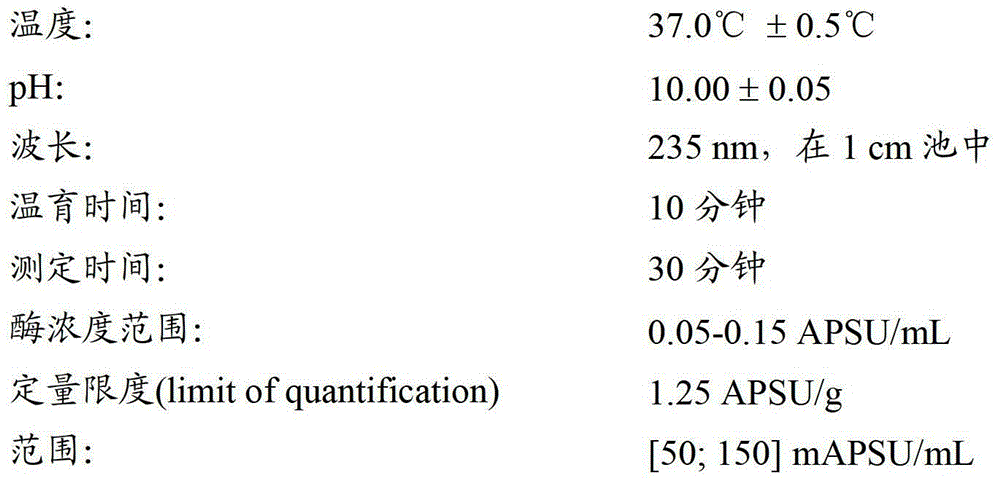
其它方法other methods
干物质:Mettler Toledo HR73Halogen Moisture干燥器Dry matter: Mettler Toledo HR73Halogen Moisture dryer
BRIX:来自Bilingham & Stanley Ltd.的RFM830数字折射计BRIX: RFM830 Digital Refractometer from Bilingham & Stanley Ltd.
pH:WTW pH计pH: WTW pH meter
磨制:Bosch型KM13(E nr:MKM6003FD9512)“咖啡”研磨器研磨2分钟Grinding: Bosch type KM13 (E nr: MKM6003FD9512) "coffee" grinder for 2 minutes
HPLC:Waters717自动进样器、Waters515泵和Waters2414折射率检测器。使用柱类型Bio-rad(Animex HPX-87H300-7.8mm),Catno.125140,对葡萄糖、麦芽糖、麦芽三糖、木糖和麦芽四糖使用标准物。HPLC: Waters717 autosampler, Waters515 pump and Waters2414 refractive index detector. Standards were used for glucose, maltose, maltotriose, xylose and maltotetraose using column type Bio-rad (Animex HPX-87H300-7.8mm), Cat no. 125140.
用于实施例中的酶Enzymes used in the examples
来源于芽孢杆菌属菌种(Bacillus sp.)的果胶酸裂合酶(EC4.2.2.2)制备物,可作为
来源于Bacillus agaradhaerens的内切木聚糖酶(EC3.2.1.8)组合物可作为
纤维素酶组合物A,其包含源自里氏木霉(Trichoderma reesei)的酸性纤维素分解酶,WO2005/074656中公开的GH61A多肽,和米曲霉β-葡糖苷酶(以WO2008/057637中公开的融合蛋白的形式)。纤维素酶组合物A公开于WO2008/151079。纤维素酶组合物A为具有180FPU/g组合物的活性。Cellulase composition A comprising an acid cellulolytic enzyme derived from Trichoderma reesei, the GH61A polypeptide disclosed in WO2005/074656, and Aspergillus oryzae β-glucosidase (disclosed in WO2008/057637 in the form of a fusion protein). Cellulase composition A is disclosed in WO2008/151079. Cellulase composition A had an activity of 180 FPU/g composition.
纤维素酶组合物B,其包含源自芽孢杆菌属菌种的碱性内切纤维素酶,并可作为5.0L(Novozymes)商业上获得,其具有320000ECU/g组合物的活性。Cellulase composition B, which comprises alkaline endocellulase derived from Bacillus species, and can be used as 5.0 L (Novozymes) is commercially available with an activity of 320000 ECU/g composition.
阿魏酸酯酶组合物,其也包含碱性纤维素酶。所述组合物源自特异腐质霉(Humicola insolens),并可作为
甘露聚糖酶(EC3.2.1.25)组合物,其包含具有40MIUM/g组合物的活性的甘露聚糖酶。A mannanase (EC 3.2.1.25) composition comprising a mannanase having an activity of 40 MIUM/g composition.
实施例1:Example 1:
由


1.将10g糖甜菜浆材料在50℃悬于20g水。1. Suspend 10 g of sugar beet pulp material in 20 g of water at 50°C.
2.将pH使用4N NaOH调整至8。2. Adjust the pH to 8 using 4N NaOH.
3.在时点t=0,将0.05g(50μL)每种E1酶产品
4.反应在锥形烧瓶中进行,将烧瓶在50℃保持在摇床中搅拌。4. The reaction was carried out in an Erlenmeyer flask, and the flask was kept stirring in a shaker at 50°C.
5.在10分钟之后,取零样品(Zero-sample),并冻结以供将来测定。该样品为2mL。同样在t=30分钟、60分钟、120分钟和240分钟取样。5. After 10 minutes, take a zero-sample and freeze for future assays. The sample is 2 mL. Also samples were taken at t=30 minutes, 60 minutes, 120 minutes and 240 minutes.
6.测定如下所述;结果示于下表1:6. Assays were performed as follows; the results are shown in Table 1 below:
a.在14,000rpm离心10分钟a. Centrifuge at 14,000rpm for 10 minutes
b.测量°Brix度。b. Measure °Brix degrees.
c.在夸脱小杯(quarts cuvette)中在235nm测量吸光度。c. Measure absorbance at 235 nm in quarts cuvettes.
表1:磨制的糖甜菜材料的水解反应过程中的反应结果。Table 1 : Reaction results during the hydrolysis reaction of ground sugar beet material.
在由Nordic Sugar和University of Hohenheim开发的测试系统中,当与未经预处理的糖甜菜浆(未显示)相比较时,发现了显著改善的生物气产生。In a test system developed by Nordic Sugar and the University of Hohenheim, significantly improved biogas production was found when compared to unpretreated sugar beet pulp (not shown).
实施例2Example 2
基于由Nordic Sugar,Nakskov,Denmark提供的预磨制的糖甜菜浆的两步骤水解物的酶产生如下所述:Enzymatic production based on a two-step hydrolyzate of preground sugar beet pulp supplied by Nordic Sugar, Nakskov, Denmark is as follows:
1.甜菜浆的干物质含量使用HR73Halogen水分分析仪测量为15.0%w/w。1. The dry matter content of the beet pulp was measured to be 15.0% w/w using a HR73 Halogen moisture analyzer.
2.将150g的甜菜浆手动混入两个烧瓶中每一个的300mL市政水中。2. Manually mix 150 g of beet pulp into 300 mL of municipal water in each of two flasks.
3.测量pH,并将其调整至大约pH=8.5。将大约1.5mL4N NaOH添加至每个烧瓶。使用强力搅拌器在150rpm进行搅拌。未将酶添加至1号烧瓶。3. Measure the pH and adjust it to approximately pH=8.5. Approximately 1.5 mL of 4N NaOH was added to each flask. Stirring was performed using a vigorous stirrer at 150 rpm. No enzyme was added to flask #1.
4.将酶(E1)添加至2号烧瓶。从实施例1中上述提及的4个酶产品中的每一个中使用干物质中0.25%酶产品的剂量。反应混合物的干物质含量基于质量来估计,所述浆的干物质含量的测量测量为5.0%。4. Add enzyme (E1) to flask #2. A dose of 0.25% enzyme product in dry matter was used from each of the 4 enzyme products mentioned above in Example 1. The dry matter content of the reaction mixture was estimated on a mass basis and the dry matter content of the pulp was measured to be 5.0%.
干物质的质量:150×5.01/100=22.5(g用于剂量的干物质)。这对应于56.3mg~56.3/1.10~50μL,以此添加。Mass of dry matter: 150 x 5.01/100 = 22.5 (g dry matter for dosage). This corresponds to 56.3 mg ~ 56.3/1.10 ~ 50 μL, added accordingly.
5.测量pH和°Brix,并继续反应过夜。测量示于下表2:5. Measure pH and °Brix and continue to react overnight. The measurements are shown in Table 2 below:
表2:pH和Brix数据,由于去甲基化,在两个烧瓶中均检测出pH下降。Table 2: pH and Brix data, a drop in pH was detected in both flasks due to demethylation.
6.在下表3中的HPLC结果所示的酶反应(2号烧瓶)之后在反应混合物中检测出甲醇:6. Methanol was detected in the reaction mixture after the enzyme reaction (flask no. 2) shown in the HPLC results in Table 3 below:

表3:在碱性酶处理之后的HPLC结果Table 3: HPLC results after alkaline enzyme treatment
7.利用表2中所示的pH下降作为减少原位pH以供对于果胶和半纤维素两者的酸性糖化酶系统(E2)的方式。添加基于原材料干物质的0.5%VISCOZYME(R)L(Novozymes A/S,Denmark)的剂量,其对应于100微升VISCOZYME(R)。7. Utilize the pH drop shown in Table 2 as a means of reducing in situ pH for the acid glucoamylase system (E2) on both pectin and hemicellulose. A dose of 0.5% VISCOZYME (R) L (Novozymes A/S, Denmark) based on the dry matter of the starting material corresponding to 100 microliters of VISCOZYME (R) was added.
8.pH和°Brix的测量示于表4:8. pH and °Brix measurements are shown in Table 4:
表4:在用Viscozyme L处理过程中的pH和Brix数据Table 4: pH and Brix data during treatment with Viscozyme L
9.测量了离心指数(对溶解材料的%收率的估计);结果示于下表5:9. The Centrifuge Index (estimate of the % yield of dissolved material) was measured; the results are shown in Table 5 below:
表5:离心指数Table 5: Centrifugal Index
10.对上清进行HPLC分析,结果示于下表6:10. The supernatant was analyzed by HPLC, and the results are shown in Table 6 below:

表6:在用L处理之后的HPLC结果(nd*:未确定)。Table 6: In use HPLC results after L treatment (nd*: not determined).
实施例3Example 3
1.甜菜浆的干物质含量使用HR 73 Halogen水分分析仪测量为26.7%w/w。1. The dry matter content of the sugar beet pulp was measured using a HR 73 Halogen moisture analyzer to be 26.7% w/w.
2.将94g的甜菜浆手动混入406mL市政水中。2. Manually mix 94g of beet pulp into 406mL of municipal water.
3.测量pH,并使用NaOH使用4 N NaOH将其调整至pH=9。使用强力搅拌器进行搅拌(150 rpm)。在反应过程中温度为50.0℃。3. Measure the pH and adjust it to pH=9 using 4 N NaOH using NaOH. Stir with a powerful stirrer (150 rpm). The temperature was 50.0°C during the reaction.
4.将酶(E1)添加至2号烧瓶。从实施例1中提及的4个酶产品中的每一个中使用干物质中0.25%酶产品的剂量。4. Add enzyme (E1) to flask #2. A dose of 0.25% enzyme product in dry matter was used from each of the 4 enzyme products mentioned in Example 1.
5.水解进行23小时。5. The hydrolysis was carried out for 23 hours.
6.当pH为5.12时将VISCOZYME(R)L(E2)以0.5%干物质添加。再运行水解78小时。6. Add VISCOZYME(R)L(E2) at 0.5% dry matter at pH 5.12. The hydrolysis was run for an additional 78 hours.
7.在完整试验之后测量°Brix和pH;结果示于表7(见下)。7. Measure °Brix and pH after the complete test; results are shown in Table 7 (see below).
8.取样进行HPLC,且结果示于表8(见下)。8. A sample was taken for HPLC and the results are shown in Table 8 (see below).
9.生物气试验根据VDI-RICHTLINIEN,VDI4630(2006)(标题为Fermentation of organic materials.Characterisation of the substrate,samplingcollection of material data,fermentation tests)来进行。测试结果示于下表9。9. The biogas test is carried out according to VDI-RICHTLINIEN, VDI4630 (2006) (titled Fermentation of organic materials.Characterization of the substrate, sampling collection of material data, fermentation tests). The test results are shown in Table 9 below.
表7:对于所述反应测量的数据Table 7: Data measured for the reactions

表8:HPLC结果Table 8: HPLC results
表9:根据VDI4630(2006)的生物气收率Table 9: Biogas yield according to VDI4630 (2006)
实施例4Example 4
在该实施例中描述了如何在中试工厂中进行预处理。完整生物气工艺的总体工艺布置(layout)示于图1。In this example it is described how the pretreatment was carried out in a pilot plant. The overall process layout of a complete biogas process is shown in Figure 1 .
1.将44.5kg浆在200kg水中湿磨,所述水在45℃保持在液化罐中的再循环下。将小份的新鲜浆如图1中所示添加至磨的漏斗。该磨为有齿的(toothed)胶体磨(Romaco,FrymaKoruma Type MZ80)。1. Wet mill 44.5 kg slurry in 200 kg water kept at 45°C under recirculation in the liquefaction tank. A small portion of fresh pulp was added to the funnel of the mill as shown in Figure 1 . The mill was a toothed colloid mill (Romaco, Fryma Koruma Type MZ80).
2.将前10kg浆与约60g苏打粉一同添加,其亦在湿磨工艺中以小份添加。2. The first 10 kg of slurry was added with about 60 g of soda ash, which was also added in small portions during the wet milling process.
3.将pH维持在约8.5,并当添加浆的时间定期检查pH(约15分钟)。3. Maintain the pH at about 8.5 and check the pH periodically (about 15 minutes) when the slurry is added.
4.将129g的酶1(BIOPREP(R)3000L,PULPZYME(R)HC和NOVOZYM(R)342L)添加至罐中循环的浆料。4. Add 129 g of Enzyme 1 (BIOPREP(R) 3000L, PULPZYME(R)HC and NOVOZYM(R) 342L) to the slurry circulating in the tank.
5.将剩余的浆,约40kg,通过Fryma道(Fryma tract)添加,并通过添加约200g苏打粉将pH维持在8-8.5。该步骤持续1.5个小时。将反应温度重新调整至45℃。5. The remaining slurry, about 40 kg, was added through the Fryma tract and the pH was maintained at 8-8.5 by adding about 200 g of soda ash. This step lasts 1.5 hours. The reaction temperature was readjusted to 45 °C.
6.当将所有浆混合入罐时,反应继续进行,其中1小时反应之间间隔进行搅拌,和Fryma湿磨30分钟。6. When all the slurry was mixed into the tank, the reaction continued with agitation between 1 hour reactions and 30 minutes of Fryma wet milling.
7.在液化反应之后进行°Brix,pH的测量,HPLC分析;结果示于下表10和11。7. Measurements of °Brix, pH, HPLC analysis were carried out after the liquefaction reaction; the results are shown in Tables 10 and 11 below.
8.反应于101/4小时终止,此时pH平稳在5.5-6.0。8. The reaction was terminated in 101/4 hours, when the pH was stable at 5.5-6.0.
9.第二水解通过添加64.5g酶2(VISCOZYME(R)L)起始。9. The second hydrolysis was initiated by adding 64.5 g Enzyme 2 (VISCOZYME(R)L).
10.在最初30分钟使用Fryma磨,并进行°Brix,pH,和HPLC的测量(表10和表11)。10. Use a Fryma mill for the first 30 minutes and perform °Brix, pH, and HPLC measurements (Table 10 and Table 11).
11.该水解过程中的总反应时间为数小时。对于“糖化191/4小时的甜菜浆”,上述所示的值的总和占Brix值的70%左右。11. The total reaction time during this hydrolysis is several hours. For "beet pulp saccharified for 191/4 hours", the sum of the values indicated above accounts for about 70% of the Brix value.
表10:在反应中测量的数据Table 10: Data measured in the reactions

表11A:HPLC结果Table 11A: HPLC results
表11B:HPLC结果Table 11B: HPLC results
实施例5Example 5
预处理用Fryma磨制来自Nordic Sugar的青贮的糖甜菜浆来进行。生物气试验在实验室中进行以说明生物气收率的改善和较短的发酵,其为酶预处理工艺的结果。对于两次预处理试验的反应参数示于表12。Pretreatment was performed with Fryma milled sugar beet pulp from silage from Nordic Sugar. Biogas trials were performed in the laboratory to demonstrate improved biogas yield and shorter fermentations as a result of the enzymatic pretreatment process. The reaction parameters for the two pretreatment trials are shown in Table 12.

表12:对于两次中试工厂试验的反应参数Table 12: Reaction parameters for two pilot plant trials
表13:对于两次中试工厂试验的最终测量Table 13: Final measurements for two pilot plant trials

表14A:对于两次中试工厂试验最终的HPLC结果Table 14A: Final HPLC results for two pilot plant trials
表14B:对于两次中试工厂试验最终的HPLC结果(续)Table 14B: Final HPLC results for two pilot plant trials (continued)
在中试工厂中的湿磨、液化和水解(试验A):Wet milling, liquefaction and hydrolysis in a pilot plant (Test A):
该中试工厂试验对青贮的糖甜菜浆进行。在磨制工艺过程中添加苏打和酶系统E-1。对液化和糖化的浆进行实验室规模的生物气产生。This pilot plant trial was carried out on ensiled sugar beet pulp. Soda and enzyme system E-1 were added during the milling process. Laboratory-scale biogas generation from liquefied and saccharified slurries.
1.将200kg水和50kg青贮的浆在循环水中在约45℃通过将小份的浆添加至漏斗,如对于图1中的液化步骤所示,来进行湿磨。将最初10kg与约60g苏打粉(Na2CO3)一同添加,所述苏打粉亦在湿磨工艺过程中以小份添加。将pH维持在8.5,并在混合期间中定期检查pH(10分钟)。1. Wet milling of 200 kg water and 50 kg silage slurry in circulating water at about 45°C by adding aliquots of slurry to the funnel as indicated for the liquefaction step in Figure 1 . The initial 10 kg was added along with about 60 g of soda ash (Na 2 CO 3 ), which was also added in small portions during the wet milling process. The pH was maintained at 8.5 and the pH was checked periodically (10 minutes) during the mixing period.
2.在此时点,将125g的E混合物添加至罐中的再循环浆料。2. At this point, 125 g of E mix was added to the recycle slurry in the tank.
3.将剩余浆,约40kg,直接添加至Fryma道中,并通过添加约600g苏打粉将pH维持在8-8.5。该完整过程持续60分钟。使用在罐外壳上冷却将反应温度重新调整至45℃。3. The remaining slurry, about 40kg, was added directly to the Fryma channel and the pH was maintained at 8-8.5 by adding about 600g of soda ash. This complete procedure lasts 60 minutes. The reaction temperature was readjusted to 45°C using cooling on the jar shell.
4.当将所有浆混合入反应罐时,反应继续进行,其中1小时反应之间间隔进行搅拌,和湿磨30分钟。在液化反应之后进行°Brix,pH和HPLC的测量。4. When all the slurry was mixed into the reaction tank, the reaction was continued with stirring between 1 hour reactions, and 30 minutes of wet milling. °Brix, pH and HPLC measurements were performed after the liquefaction reaction.
5.反应在24.3小时后终止,此时pH平稳在6.13。5. The reaction was terminated after 24.3 hours, when the pH stabilized at 6.13.
6.第二水解通过添加62.5g
7.再次进行湿磨30分钟,并取样以供测量°Brix,pH,和HPLC。7. Perform wet milling again for 30 minutes and take samples for °Brix, pH, and HPLC measurements.
8.反应在翌日上午在总共46.3小时处理之后终止。8. The reaction was terminated the next morning after a total of 46.3 hours of treatment.
在中试工厂中的湿磨、液化和水解(试验B):Wet milling, liquefaction and hydrolysis in a pilot plant (Test B):
1.将总共50kg来自Nordic Sugar的青贮的浆在193升水中湿磨。所述水在整个试验中在约45℃保持在再循环下。1. A total of 50 kg of slurry from Nordic Sugar silage was wet milled in 193 liters of water. The water was kept under recirculation at about 45°C throughout the test.
2.将小份的浆如图1中对于液化步骤所示添加至磨的漏斗。将最初10kg与约0.3L的27%NaOH一同添加,所述NaOH亦在持续10分钟的湿磨工艺过程中以小份添加。2. Add an aliquot of slurry to the mill funnel as shown in Figure 1 for the liquefaction step. The initial 10 kg was added along with approximately 0.3 L of 27% NaOH also added in small portions during the wet milling process which lasted 10 minutes.
3.从开始起将pH维持在8.5,并持续下去。3. Maintain the pH at 8.5 from the start and continue.
4.在此之后,将188g的E混合物添加至罐中的再循环浆料。4. After this, 188g of E mix was added to the recycle slurry in the tank.
5.将剩余浆,约40kg,直接添加至磨的道中,并仍然将pH维持在8.5。在40分钟内添加0.9L的27%NaOH。使用在罐外壳上冷却将温度重新调整至45℃。5. The remaining slurry, about 40 kg, was added directly to the mill path, still maintaining the pH at 8.5. 0.9 L of 27% NaOH was added over 40 minutes. The temperature was readjusted to 45°C using cooling on the jar shell.
6.反应继续进行,其中1小时反应之间间隔进行搅拌,和Fryma湿磨30分钟。6. The reaction was continued with agitation between 1 hour reactions and 30 minutes of Fryma milling.
7.在液化反应之后进行°Brix,pH和HPLC的测量。7. Perform °Brix, pH and HPLC measurements after the liquefaction reaction.
8.反应在19小时终止,此时pH平稳在5.8。8. The reaction was terminated at 19 hours, when the pH stabilized at 5.8.
9.第二水解通过添加62.5g
10.再次进行湿磨30分钟,并取样以供测量°Brix,pH,和HPLC。10. Perform wet milling again for 30 minutes and take samples for °Brix, pH, and HPLC measurements.
11.反应在翌日上午在总共46.9小时处理之后终止。11. The reaction was terminated the next morning after a total of 46.9 hours of treatment.
用于生物气试验的方法: Methods used for biogas testing :
对中温发酵测试的描述:Description of the mesophilic fermentation test:
为了评估不同预处理对厌氧生物可降解性的作用,在实验室规模生物气反应器上进行了一系列的中温(37℃±2℃)短期分批测试。反应器设置由置于37℃的恒温水浴中并连接于生物气柱的1.0L Erlenmeyer烧瓶组成。在每个测试系列起始时,将反应器(每个测试系列4至6个反应器)用相同量的新鲜嗜热厌氧淤渣来接种。在此情况下,接种淤渣来源于马铃薯加工工厂的全面规模的UASB反应器。To evaluate the effect of different pretreatments on anaerobic biodegradability, a series of mesophilic (37°C ± 2°C) short-term batch tests were performed on a laboratory-scale biogas reactor. The reactor setup consisted of a 1.0 L Erlenmeyer flask placed in a constant temperature water bath at 37°C and connected to a biogas column. At the start of each test series, the reactors (4 to 6 reactors per test series) were inoculated with the same amount of fresh thermophilic anaerobic sludge. In this case, the inoculum sludge originated from a full-scale UASB reactor of a potato processing plant.
具有一定量的不同甜菜浆底物的接种淤渣的给料手动进行。在给料和测量混合液剂的pH之后,将每个反应器连接至柱以每日追踪生物气产生。The feeding of the inoculation sludge with a certain amount of different sugar beet pulp substrates was done manually. After dosing and measuring the pH of the mixed liquor, each reactor was connected to a column for daily tracking of biogas production.
在蒸煮循环终止时(约1、2或3周每给料循环),取样分析剩余挥发性脂肪酸和可溶性COD浓度。亦确定产生的生物气的甲烷浓度。At the end of the cooking cycle (approximately 1, 2 or 3 weeks per feed cycle), samples were taken for analysis of remaining volatile fatty acids and soluble COD concentrations. The methane concentration of the biogas produced was also determined.
对于每次处理,进行使用相同甜菜浆底物的三至四次给料循环。再一次试验中,将蔗糖作为阳性对照进行测试。对产物的标准分析如本领域中所述进行。简言之,总固体含量(TS%)通过在105℃干燥直至不发生进一步重量变化为止来确定。灰量(Ash)在马弗炉中通过将样品在坩埚中加热至600℃直至不发生进一步重量变化为止来确定。挥发性固体(VS%)通过用总固体减去灰含量来计算。For each treatment, three to four feeding cycles using the same beet pulp substrate were performed. In another experiment, sucrose was tested as a positive control. Standard analyzes of products were performed as described in the art. Briefly, the total solids content (TS%) was determined by drying at 105°C until no further weight change occurred. Ash content (Ash) was determined in a muffle furnace by heating the sample in a crucible to 600°C until no further weight change occurred. Volatile solids (VS%) is calculated by subtracting the ash content from the total solids.
化学需氧量(COD)通过如Greenberg等,in Standard Methods for theexamination of water and wastewater.18th Edition,1992,p.5-7所述的二铬酸钾方法来测量。就生物气的收率测试具有表15中所示的分析特征的产物。Chemical oxygen demand (COD) is measured by the potassium dichromate method as described by Greenberg et al., in Standard Methods for the examination of water and wastewater. 18th Edition, 1992, p.5-7. Products with the analytical characteristics shown in Table 15 were tested for yield of biogas.
表15:在发酵试验中对于生物气产生测试的产物Table 15: Products tested for biogas production in fermentation trials
为了分析甲烷形成,用Hamilltion其它注射器取去瓶顶空体积的样品,并对其在具有PoraPLOT Q(10μm)25m x0.32mm融合的硅胶分离柱的Varian3900气体层析柱(Varian,Agilent Technologies,USA)上进行GC分析。For the analysis of methane formation, samples of the bottle headspace volume were taken with Hamilltion other syringes and analyzed on a Varian 3900 gas chromatography column (Varian, Agilent Technologies, USA) with a PoraPLOT Q (10 μm) 25m x 0.32mm fused silica gel separation column. ) for GC analysis.
发酵试验:Fermentation test:
两次或三次重复发酵试验的分批测试以2个干物质每给料循环的加载来进行。每个反应器的接种用150g湿的来自马铃薯加工工厂的粒状中温淤渣进行。接种淤渣的TS%是17.2%w/w。接种淤渣的灰含量为7.4%w/w;因此在每个反应器中添加14.7g挥发性固体(DM-灰)。Batch testing of two or three replicate fermentation trials was performed with a loading of 2 dry matter per feeding cycle. Inoculation of each reactor was carried out with 150 g of wet granular mesophilic sludge from a potato processing plant. The TS% of the inoculum sludge was 17.2% w/w. The ash content of the seed sludge was 7.4% w/w; therefore 14.7 g of volatile solids (DM-ash) were added to each reactor.
在每次循环之后,将100mL流出物移除,筛选,并将固体返回至每个反应器。添加C源+自来水至100mL的总给料体积。在表16中,显示了对于每个循环的底物的剂量和品质。标准参数像累积的生物气产生的升数,CH4-产生,COD减少,在每次循环之前和之后的可溶性COD。检查对pH,NH4 +和总N的控制。After each cycle, 100 mL of effluent was removed, screened, and the solids returned to each reactor. Add source C + tap water to a total feed volume of 100 mL. In Table 16, the dose and quality of substrate for each cycle are shown. Standard parameters like liters of accumulated biogas production, CH 4 -production, COD reduction, soluble COD before and after each cycle. Check controls for pH, NH4 + and total N.
表16:对于每个循环的底物的剂量和品质Table 16: Dosage and quality of substrate for each cycle
在图2中,说明了在每个循环过程中累积生物气产生的演化。在循环2和3,生物气产生速率对于酶水解的浆而言较高。In Fig. 2, the evolution of cumulative biogas production during each cycle is illustrated. In cycles 2 and 3, the biogas production rate was higher for the enzymatically hydrolyzed pulp.
图3显示可使用酶水解的浆以较高产生速率获得显著更多的生物气。在试验B中如上所述的浆遵循对蔗糖的发酵速率。认为两种水解物的性能的差异主要是因为表4中所示的木糖和半乳糖的含量,这是使用较高酶剂量的结果(表12)。Figure 3 shows that significantly more biogas can be obtained at higher production rates using enzymatically hydrolyzed pulp. In Trial B the slurry as described above followed the rate of fermentation to sucrose. The difference in performance of the two hydrolysates is believed to be mainly due to the content of xylose and galactose shown in Table 4, which is a result of using higher enzyme dosages (Table 12).
在所有发酵循环之后的pH为pH=6.9–7.3之间。每次给料的COD在发酵中减少87%(所有试验的平均值)。The pH after all fermentation cycles was between pH=6.9-7.3. COD per feed was reduced by 87% in the fermentation (average of all trials).
表17显示来自427个小时中运行的三个循环的收集的生物气中的平均生物气和甲烷产生和含量(图2)。Table 17 shows the average biogas and methane production and content in collected biogas from three cycles run over 427 hours (Figure 2).

表17:生物气和甲烷的平均产生,和在三个循环过程中收集的生物气中的含量。Table 17: Average production of biogas and methane, and content in biogas collected during the three cycles.
实施例6:Embodiment 6:
在下述试验中说明了使用如图1说明的两步工艺的优点,以显示其相对于使用多组分细胞壁降解酶的单步工艺的优势。The advantage of using a two-step process as illustrated in Figure 1 is illustrated in the following experiments to show its advantages over a single-step process using multicomponent cell wall degrading enzymes.
在权利要求1中的一个优选实施方案中,液化用1%甜菜浆总固体的剂量的酶1从起始时以50℃使用pH=8.5来协助。在约12小时之后,pH下降至5-6,而添加0.5%浆总固体的酶2以供糖化18/20个小时。In a preferred embodiment in claim 1 , the liquefaction is assisted with a dose of enzyme 1 of 1% sugar beet pulp total solids from the start at 50°C using pH=8.5. After about 12 hours, the pH dropped to 5-6 and Enzyme 2 at 0.5% total slurry solids was added for saccharification for 18/20 hours.
酶1包含果胶酸裂合酶/果胶甲基酯酶和半纤维素酶。酶2包含内切果胶酶,果胶甲基酯酶和聚半乳糖醛酸酶。该系统对于新鲜浆以及青贮的浆均效果良好,并产生在约48小时之内可完全蒸煮为生物气的液体水解物。Enzyme 1 comprises pectate lyase/pectin methylesterase and hemicellulase. Enzyme 2 contains endopectinase, pectin methylesterase and polygalacturonase. The system works well with both fresh pulp as well as silage pulp and produces a liquid hydrolyzate that is fully digestible to biogas in about 48 hours.
为了仅使用酸性酶刺激甜菜浆的性能,通过碱性酶系统(酶1)在无在先液化下以起始pH4.5测试酶2+
简短的结论(所有实施例):Short conclusion (all examples):
实验室生物气试验说明了本发明的2步骤酶工艺的优点。与单步骤工艺相比,表现了生物气收率的改善和较短的生物气发酵。Laboratory biogas tests illustrate the advantages of the 2-step enzymatic process of the present invention. Improved biogas yields and shorter biogas fermentations are shown compared to the single-step process.
Claims (15)
Applications Claiming Priority (3)
| Application Number | Priority Date | Filing Date | Title |
|---|---|---|---|
| EP11150093 | 2011-01-04 | ||
| EP11150093.0 | 2011-01-04 | ||
| PCT/EP2011/073840 WO2012093041A1 (en) | 2011-01-04 | 2011-12-22 | Process for producing biogas from pectin and lignocellulose containing material |
Publications (1)
| Publication Number | Publication Date |
|---|---|
| CN103339260A true CN103339260A (en) | 2013-10-02 |
Family
ID=44351791
Family Applications (1)
| Application Number | Title | Priority Date | Filing Date |
|---|---|---|---|
| CN2011800642008A Pending CN103339260A (en) | 2011-01-04 | 2011-12-22 | Process for producing biogas from pectin and lignocellulose containing materials |
Country Status (5)
| Country | Link |
|---|---|
| US (1) | US20130330797A1 (en) |
| EP (1) | EP2661499A1 (en) |
| CN (1) | CN103339260A (en) |
| BR (1) | BR112013013136A2 (en) |
| WO (1) | WO2012093041A1 (en) |
Cited By (1)
| Publication number | Priority date | Publication date | Assignee | Title |
|---|---|---|---|---|
| CN105670010A (en) * | 2016-01-11 | 2016-06-15 | 广西大学 | Preparation method of rice protein/ferulic acid compound or cross-linked product |
Families Citing this family (23)
| Publication number | Priority date | Publication date | Assignee | Title |
|---|---|---|---|---|
| MX2013014236A (en) * | 2011-06-28 | 2014-01-23 | Novozymes As | Biogas from enzyme-treated bagasse. |
| US8658026B2 (en) | 2011-12-22 | 2014-02-25 | Iogen Corporation | Method for producing fuel with renewable content having reduced lifecycle greenhouse gas emissions |
| US20130164806A1 (en) | 2011-12-22 | 2013-06-27 | Iogen Bio-Products Corporation | Method for producing renewable fuels |
| CN102618602B (en) * | 2012-03-30 | 2013-05-15 | 吴允山 | Process for preparing sugar by performing enzymatic hydrolysis on sweet potato residues |
| CN103421864A (en) * | 2013-07-26 | 2013-12-04 | 东北林业大学 | Method for producing low polymer soluble cellulose by utilizing residues (caesalpinia spiosa waste residues) formed during production of gallic acid from caesalpinia spiosa and by means of microwave-assisted pretreatment and enzymolysis |
| EP2910640B1 (en) | 2014-02-25 | 2018-12-05 | Biopract GmbH | A method for improving substrate degradation in agricultural biogas plants |
| US9476066B2 (en) | 2014-03-06 | 2016-10-25 | Iogen Corporation | Production of products with favourable GHG emission reductions from cellulosic feedstocks |
| GB201409047D0 (en) * | 2014-05-21 | 2014-07-02 | Cellucomp Ltd | Cellulose microfibrils |
| WO2015192247A1 (en) * | 2014-06-21 | 2015-12-23 | The Royal Institution For The Advancement Of Learning/Mcgill University | Enzymatic production of prebiotic oligosaccharides from potato pulp |
| EP3186372B1 (en) * | 2014-08-28 | 2020-10-21 | Novozymes A/S | Solubilization of msw with blend enzymes |
| KR20190142332A (en) * | 2017-05-11 | 2019-12-26 | 아마눌라 아사둘라에비치 술탄호드자에브 | Feed Production Method Using Rice Processing By-Products |
| CN107254493A (en) * | 2017-07-31 | 2017-10-17 | 海宁文硕科技咨询有限公司 | A kind of biogas preparation process |
| CN109126594A (en) * | 2018-08-28 | 2019-01-04 | 安徽大大食品有限公司 | A kind of potato deep processing slurry separator |
| CN109938232A (en) * | 2019-04-24 | 2019-06-28 | 雄晋生物科技(上海)有限公司 | A kind of enzymatic-process preparation method of the full fruit beverage of mangosteen |
| WO2021072684A1 (en) * | 2019-10-16 | 2021-04-22 | 天津大学 | Method for preparing biochar and hydrogen by utilizing anaerobic fermentation byproduct |
| JP2023547177A (en) * | 2020-11-04 | 2023-11-09 | レネサイエンス エー/エス | Method for enzymatic and/or microbial treatment of waste including process water recirculation |
| CN116457115A (en) * | 2020-11-04 | 2023-07-18 | 瑞诺森股份有限公司 | Method for sterilizing waste |
| EP4240542A1 (en) * | 2020-11-04 | 2023-09-13 | Renescience A/S | Method for sanitizing waste |
| EP4323308A4 (en) | 2021-04-15 | 2025-04-23 | Iogen Corporation | LOW CARBON INTENSITY RENEWABLE HYDROGEN PRODUCTION PROCESS AND SYSTEM |
| CA3214954A1 (en) | 2021-04-22 | 2022-10-27 | Patrick J. Foody | Process and system for producing fuel |
| US11807530B2 (en) | 2022-04-11 | 2023-11-07 | Iogen Corporation | Method for making low carbon intensity hydrogen |
| US12264068B2 (en) | 2023-04-04 | 2025-04-01 | Iogen Corporation | Method for making low carbon intensity hydrogen |
| WO2025147185A1 (en) * | 2024-01-02 | 2025-07-10 | Snow Recycle, Sia | A biodegradable composite, a method for manufacture thereof, and articles made of said composite |
Citations (2)
| Publication number | Priority date | Publication date | Assignee | Title |
|---|---|---|---|---|
| CN1997736A (en) * | 2004-03-25 | 2007-07-11 | 诺维信股份有限公司 | Method for degrading or transforming plant cell wall polysaccharides |
| WO2009046370A2 (en) * | 2007-10-04 | 2009-04-09 | Bio Architecture Lab, Inc. | Biofuel production |
Family Cites Families (43)
| Publication number | Priority date | Publication date | Assignee | Title |
|---|---|---|---|---|
| JPS5534046A (en) | 1978-09-01 | 1980-03-10 | Cpc International Inc | Novel glucoamyrase having excellent heat resistance and production |
| JPS5672123A (en) | 1979-11-15 | 1981-06-16 | Sumitomo Electric Ind Ltd | High-strength low-expansion alloy wire |
| NO840200L (en) | 1983-01-28 | 1984-07-30 | Cefus Corp | GLUCOAMYLASE CDNA. |
| JPS59209086A (en) | 1983-05-09 | 1984-11-27 | Shinko Electric Co Ltd | Drive controller of synchronous motor |
| US4536477A (en) | 1983-08-17 | 1985-08-20 | Cpc International Inc. | Thermostable glucoamylase and method for its production |
| US4587215A (en) | 1984-06-25 | 1986-05-06 | Uop Inc. | Highly thermostable amyloglucosidase |
| US4628031A (en) | 1984-09-18 | 1986-12-09 | Michigan Biotechnology Institute | Thermostable starch converting enzymes |
| JPS62126989A (en) | 1985-11-26 | 1987-06-09 | Godo Shiyusei Kk | Method for saccharifying starch by using enzyme produced by basidiomycetes belonging to genus corticium without steaming or boiling |
| JP2703598B2 (en) | 1987-09-04 | 1998-01-26 | ノボ―ノルディスク アクティーゼルスカブ | Method for producing a protein product in Aspergillus and a promoter for use in Aspergillus |
| DK6488D0 (en) | 1988-01-07 | 1988-01-07 | Novo Industri As | ENZYMES |
| WO1989006270A1 (en) | 1988-01-07 | 1989-07-13 | Novo-Nordisk A/S | Enzymatic detergent |
| US5162210A (en) | 1990-06-29 | 1992-11-10 | Iowa State University Research Foundation | Process for enzymatic hydrolysis of starch to glucose |
| JP2626662B2 (en) | 1991-10-09 | 1997-07-02 | 科学技術振興事業団 | Novel β-mannanase and method for producing the same |
| FI931193A0 (en) | 1992-05-22 | 1993-03-17 | Valtion Teknillinen | MANNANASENZYMER, GENER SOM KODAR FOER DEM OCH FOERFARANDEN FOER ISOLERINGAV GENERNA SAMT FOERFARANDE FOER BLEKNING AV LIGNOCELLULOSAHALTIG MASSA |
| DK48693D0 (en) | 1993-04-30 | 1993-04-30 | Novo Nordisk As | ENZYME |
| AR000862A1 (en) | 1995-02-03 | 1997-08-06 | Novozymes As | VARIANTS OF A MOTHER-AMYLASE, A METHOD TO PRODUCE THE SAME, A DNA STRUCTURE AND A VECTOR OF EXPRESSION, A CELL TRANSFORMED BY SUCH A DNA STRUCTURE AND VECTOR, A DETERGENT ADDITIVE, DETERGENT COMPOSITION, A COMPOSITION FOR AND A COMPOSITION FOR THE ELIMINATION OF |
| AU4483496A (en) | 1995-02-03 | 1996-08-21 | Novo Nordisk A/S | A method of designing alpha-amylase mutants with predetermined properties |
| US6093562A (en) | 1996-02-05 | 2000-07-25 | Novo Nordisk A/S | Amylase variants |
| CA2230510A1 (en) | 1995-09-20 | 1997-03-27 | Elizabeth A. Bodie | Purified mannanase from bacillus amyloliquefaciens and method of preparation |
| CN1246455C (en) | 1996-04-30 | 2006-03-22 | 诺沃奇梅兹有限公司 | Alpha amylase mutants |
| EP2206768B1 (en) | 1997-10-13 | 2015-04-01 | Novozymes A/S | Alpha-amylase mutants |
| US6124127A (en) | 1997-11-24 | 2000-09-26 | Novo Nordisk A/S | Pectate lyase |
| ES2321043T3 (en) | 1997-11-26 | 2009-06-01 | Novozymes A/S | THERMOSTABLE GLUCOAMYLASE. |
| KR100764528B1 (en) | 1998-07-15 | 2007-10-09 | 노보자임스 에이/에스 | Glucoamylase Variants |
| DK1165762T3 (en) | 1999-03-30 | 2007-09-03 | Novozymes As | Alpha-amylase variants |
| JP2003504046A (en) | 1999-07-09 | 2003-02-04 | ノボザイムス アクティーゼルスカブ | Glucoamylase mutant |
| ES2166316B1 (en) | 2000-02-24 | 2003-02-16 | Ct Investig Energeticas Ciemat | PROCEDURE FOR THE PRODUCTION OF ETHANOL FROM LIGNOCELLULOSIC BIOMASS USING A NEW THERMOTOLERING YEAST. |
| JP4855632B2 (en) | 2000-08-01 | 2012-01-18 | ノボザイムス アクティーゼルスカブ | Α-Amylase mutants with altered properties |
| ATE347591T1 (en) | 2002-12-17 | 2006-12-15 | Novozymes As | THERMOSTABLE ALPHA-AMYLASE |
| US7129069B2 (en) | 2003-10-28 | 2006-10-31 | Novo Zymes Als | Hybrid enzymes |
| WO2006011899A1 (en) | 2003-11-25 | 2006-02-02 | L-3 Communications Security and Detection Systems Corporation | Security system for detecting nuclear masses |
| WO2005074647A2 (en) | 2004-01-30 | 2005-08-18 | Novozymes Inc. | Polypeptides having cellulolytic enhancing activity and polynucleotides encoding same |
| CN1965078B (en) | 2004-02-06 | 2013-09-18 | 诺维信股份有限公司 | Polypeptides having cellulolytic enhancing activity and polynucleotides encoding same |
| US20060004699A1 (en) | 2004-06-30 | 2006-01-05 | Nokia Corporation | Method and system for managing metadata |
| ES2621921T3 (en) | 2004-12-22 | 2017-07-05 | Novozymes A/S | Enzymes for starch treatment |
| CN101160405B (en) | 2005-04-12 | 2014-01-01 | 纳幕尔杜邦公司 | Process for biomass treatment to obtain target chemical substance |
| JP5129142B2 (en) | 2005-09-30 | 2013-01-23 | ノボザイムス,インコーポレイティド | Method for enhancing degradation or conversion of cellulosic materials |
| CA2658610A1 (en) | 2006-07-21 | 2008-05-15 | Novozymes, Inc. | Methods of increasing secretion of polypeptides having biological activity |
| MX2009012845A (en) | 2007-05-31 | 2009-12-15 | Novozymes Inc | Methods of increasing the cellulolytic enhancing activity of a polypeptide. |
| EP2306964A1 (en) | 2008-07-03 | 2011-04-13 | Novozymes A/S | A personal wash bar |
| US20100281765A1 (en) * | 2009-05-05 | 2010-11-11 | Schwartz Anne M | Efficient biomass fractionating system for an energy pulse crop |
| CN102884197A (en) * | 2010-01-29 | 2013-01-16 | 诺维信公司 | Biogas production process with enzymatic pre-treatment |
| WO2013063251A1 (en) * | 2011-10-26 | 2013-05-02 | Frito-Lay North America, Inc. | Sustainable conversion of citrus peel waste |
-
2011
- 2011-12-22 CN CN2011800642008A patent/CN103339260A/en active Pending
- 2011-12-22 EP EP11801746.6A patent/EP2661499A1/en not_active Withdrawn
- 2011-12-22 BR BR112013013136A patent/BR112013013136A2/en not_active Application Discontinuation
- 2011-12-22 WO PCT/EP2011/073840 patent/WO2012093041A1/en not_active Ceased
- 2011-12-22 US US13/993,916 patent/US20130330797A1/en not_active Abandoned
Patent Citations (2)
| Publication number | Priority date | Publication date | Assignee | Title |
|---|---|---|---|---|
| CN1997736A (en) * | 2004-03-25 | 2007-07-11 | 诺维信股份有限公司 | Method for degrading or transforming plant cell wall polysaccharides |
| WO2009046370A2 (en) * | 2007-10-04 | 2009-04-09 | Bio Architecture Lab, Inc. | Biofuel production |
Non-Patent Citations (2)
| Title |
|---|
| T. AKAO ET AL.: "The Methane Fermentation of Citrus unshu Peel Pretreated with Fungus Enzymes", 《BIORESOURCE TECHNOLOGY》 * |
| 甘明哲等: "适合鲜甘薯原料乙醇发酵的低粘度快速糖化预处理", 《应用与环境生物学报》 * |
Cited By (2)
| Publication number | Priority date | Publication date | Assignee | Title |
|---|---|---|---|---|
| CN105670010A (en) * | 2016-01-11 | 2016-06-15 | 广西大学 | Preparation method of rice protein/ferulic acid compound or cross-linked product |
| CN105670010B (en) * | 2016-01-11 | 2017-12-12 | 广西大学 | A kind of preparation method of rice protein/forulic acid compound or cross-linking agent |
Also Published As
| Publication number | Publication date |
|---|---|
| US20130330797A1 (en) | 2013-12-12 |
| WO2012093041A1 (en) | 2012-07-12 |
| EP2661499A1 (en) | 2013-11-13 |
| BR112013013136A2 (en) | 2016-07-12 |
Similar Documents
| Publication | Publication Date | Title |
|---|---|---|
| CN103339260A (en) | Process for producing biogas from pectin and lignocellulose containing materials | |
| US20130040354A1 (en) | Biogas Production Process With Enzymatic Pre-Treatment | |
| US20110091941A1 (en) | Process For Producing Fermentation Products | |
| CN105063099A (en) | Methods for producing fermentation products | |
| US20120115199A1 (en) | Enzymatic Hydrolysis Of Pretreated Lignocellulose-Containing Material With Basidiomycota Mycelia And Yeast Cells | |
| US20110008864A1 (en) | Processes for Producing Fermentation Products | |
| WO2021048164A1 (en) | Enzyme composition | |
| US20240271110A1 (en) | Enzyme composition | |
| CN103620043A (en) | Biogas from enzyme-treated bagasse | |
| ES2944736T3 (en) | Process for producing sugars from carbohydrate materials | |
| EP3695001B1 (en) | Process for enzymatic hydrolysis of lignocellulosic material and fermentation of sugars | |
| WO2013083801A2 (en) | Biogas from substrates comprising animal manure and enzymes | |
| US20250188496A1 (en) | Process for producing fermentation products and biogas from starch-containing materials | |
| RU2851491C2 (en) | Method for producing sugar product and fermentation product | |
| EP4320252A1 (en) | Enzyme composition | |
| EP4320259A1 (en) | Process for the preparation of a sugar product and a fermentation product | |
| BR112019009796B1 (en) | ENZYME COMPOSITION |
Legal Events
| Date | Code | Title | Description |
|---|---|---|---|
| C06 | Publication | ||
| PB01 | Publication | ||
| C10 | Entry into substantive examination | ||
| SE01 | Entry into force of request for substantive examination | ||
| C05 | Deemed withdrawal (patent law before 1993) | ||
| WD01 | Invention patent application deemed withdrawn after publication |
Application publication date: 20131002 |