[go: up one dir, main page]

CN103180751A - Arrival angle calculation device - Google Patents

Arrival angle calculation device Download PDF

Info

Publication number
CN103180751A
CN103180751A CN2011800519041A CN201180051904A CN103180751A CN 103180751 A CN103180751 A CN 103180751A CN 2011800519041 A CN2011800519041 A CN 2011800519041A CN 201180051904 A CN201180051904 A CN 201180051904A CN 103180751 A CN103180751 A CN 103180751A
Authority
CN
China
Prior art keywords
unit
angle
arrival
output
calculation
Prior art date
Legal status (The legal status is an assumption and is not a legal conclusion. Google has not performed a legal analysis and makes no representation as to the accuracy of the status listed.)
Granted
Application number
CN2011800519041A
Other languages
Chinese (zh)
Other versions
CN103180751B (en
Inventor
大泷幸夫
高井大辅
种村武
佐野崇
Current Assignee (The listed assignees may be inaccurate. Google has not performed a legal analysis and makes no representation or warranty as to the accuracy of the list.)
Alps Alpine Co Ltd
Original Assignee
Alps Electric Co Ltd
Priority date (The priority date is an assumption and is not a legal conclusion. Google has not performed a legal analysis and makes no representation as to the accuracy of the date listed.)
Filing date
Publication date
Application filed by Alps Electric Co Ltd filed Critical Alps Electric Co Ltd
Publication of CN103180751A publication Critical patent/CN103180751A/en
Application granted granted Critical
Publication of CN103180751B publication Critical patent/CN103180751B/en
Active legal-status Critical Current
Anticipated expiration legal-status Critical

Links

Images

Classifications

    • GPHYSICS
    • G01MEASURING; TESTING
    • G01SRADIO DIRECTION-FINDING; RADIO NAVIGATION; DETERMINING DISTANCE OR VELOCITY BY USE OF RADIO WAVES; LOCATING OR PRESENCE-DETECTING BY USE OF THE REFLECTION OR RERADIATION OF RADIO WAVES; ANALOGOUS ARRANGEMENTS USING OTHER WAVES
    • G01S3/00Direction-finders for determining the direction from which infrasonic, sonic, ultrasonic, or electromagnetic waves, or particle emission, not having a directional significance, are being received
    • G01S3/02Direction-finders for determining the direction from which infrasonic, sonic, ultrasonic, or electromagnetic waves, or particle emission, not having a directional significance, are being received using radio waves
    • G01S3/14Systems for determining direction or deviation from predetermined direction
    • G01S3/46Systems for determining direction or deviation from predetermined direction using antennas spaced apart and measuring phase or time difference between signals therefrom, i.e. path-difference systems
    • G01S3/48Systems for determining direction or deviation from predetermined direction using antennas spaced apart and measuring phase or time difference between signals therefrom, i.e. path-difference systems the waves arriving at the antennas being continuous or intermittent and the phase difference of signals derived therefrom being measured

Landscapes

  • Physics & Mathematics (AREA)
  • Engineering & Computer Science (AREA)
  • General Physics & Mathematics (AREA)
  • Radar, Positioning & Navigation (AREA)
  • Remote Sensing (AREA)
  • Radar Systems Or Details Thereof (AREA)

Abstract

An arrival angle calculation device capable of calculating an arrival angle with high accuracy. An arrival angle calculation device (1) is provided with a plurality of antennas, a plurality of reception signal processing units, and an arrival angle calculation unit, wherein each reception signal processing unit is provided with a reception unit (12A, 12 b), a correlation processing unit (21 a, 21 b), a peak detection unit (22A ), a timing control unit (23 a, 23 b), and a timing control unit (23 a, 23 b) that outputs a signal from the correlation processing unit (21 a, 21 b) to an arrival angle calculation unit (24) if the ratio of the power in the peak period in a period corresponding to an information unit to the power in a period other than the peak period is greater than a threshold value.

Description

到达角度计算装置Arrival angle calculation device

技术领域technical field

本发明涉及检测到达的电波的相位而用于电波到达角度的计算的到达角度计算装置。The present invention relates to an arrival angle calculating device which detects the phase of an arriving radio wave and uses it for calculating the arrival angle of the radio wave.

背景技术Background technique

在以往的到达方向估计装置中,使用互相关系数的计算、逆矩阵运算等运算量大的运算,需要几百符号量的运算。因此,希望得到可以通过简便的运算来估计到达方向的到达方向估计装置。In the conventional direction-of-arrival estimating apparatus, calculations requiring a large amount of calculations, such as calculations of cross-correlation coefficients and inverse matrix calculations, require calculations of hundreds of symbols. Therefore, it is desired to obtain a direction-of-arrival estimating device that can estimate the direction of arrival through simple calculations.

在专利文献1中提出了缩小了运算规模的到达方向估计装置。在专利文献1所记载的到达方向估计装置中,对由两个天线接收到的接收信号,由复共轭电路和乘法电路来计算到达方向的系数,通过在到达方向检测电路中进行反正切运算和反余弦运算,而估计了接收波的到达方向。Patent Document 1 proposes a direction-of-arrival estimating device with a reduced calculation scale. In the direction of arrival estimating device described in Patent Document 1, the coefficient of the direction of arrival is calculated by the complex conjugate circuit and the multiplication circuit for the received signal received by the two antennas, and the arctangent operation is performed in the direction of arrival detection circuit. And arccosine operation, and estimate the direction of arrival of the received wave.

现有技术文献prior art literature

专利文献patent documents

专利文献1:日本特开平10-177064号公报Patent Document 1: Japanese Patent Application Laid-Open No. 10-177064

发明内容Contents of the invention

发明要解决的课题The problem to be solved by the invention

但是,在专利文献1中,采用了比较1隙缝间的到达方向矢量的功率与阈值、并在比阈值大的情况下更新到达方向的构成,因此,有可能不能够准确地检测接收波中的期望波来更新到达方向。例如,在接收波的背景值高的情况下,与期望波的信号电平无关地,接收波的功率往往比阈值大。在这种情况下,在背景值下到达方向也被计算、更新,因此不能够正确估计到达方向。However, in Patent Document 1, the power of the direction-of-arrival vector between one slot is compared with a threshold value, and the direction-of-arrival vector is updated when the power of the direction-of-arrival vector between one slot is greater than the threshold value. Expect a wave to update the direction of arrival. For example, when the background value of the received wave is high, the power of the received wave may become larger than the threshold regardless of the signal level of the desired wave. In this case, the direction of arrival is also calculated and updated under the background value, so the direction of arrival cannot be correctly estimated.

本发明是鉴于这样的点而进行的,其目的在于提供一种可以抑制接收波的背景值的影响、并能够以高精度计算到达角度的到达角度计算装置。The present invention has been made in view of such points, and an object of the present invention is to provide an arrival angle calculation device capable of suppressing the influence of background values of received waves and calculating an arrival angle with high precision.

用于解决课题的手段means to solve the problem

本发明的到达角度计算装置的特征在于,具备:多个天线,接收从某个位置发送的电波;多个接收信号处理部,与所述各天线对应地设置;以及到达角度计算部,从由所述多个接收信号处理部输出的输出信号取入在接收信号处理部间成为相同信息单位的信号分量从而计算所述电波的到达角度,所述各接收信号处理部具备:接收部,将由对应的所述天线接收到的电波变换为具有该电波的相位信息的接收信号并输出;相关处理部,将从所述接收部输出的接收信号进行相关处理;峰值检测部,检测进行了所述相关处理的接收信号的峰值;以及定时控制部,以从所述相关处理部的输出信号切出在所述接收信号处理部间成为相同信息单位的信号分量的方式,与由所述峰值检测部检测到的峰值的定时相配合,从而控制从所述相关处理部输出的输出信号的取入定时,在与所述信息单位相当的期间中的峰值期间的电力与除了该峰值期间以外的期间的电力之比大于阈值的情况下,所述定时控制部将来自所述相关处理部的信号向所述到达角度计算部输出。The angle of arrival calculation device of the present invention is characterized in that it includes: a plurality of antennas for receiving radio waves transmitted from a certain position; a plurality of received signal processing units provided corresponding to the antennas; and an angle of arrival calculation unit configured from The output signals outputted by the plurality of received signal processing units take in signal components that are the same information unit among the received signal processing units to calculate the angle of arrival of the radio waves, and each of the received signal processing units includes: a receiving unit configured by a corresponding The electric wave received by the antenna is converted into a received signal having phase information of the electric wave and output; the correlation processing unit performs correlation processing on the received signal output from the receiving unit; the peak detection unit detects that the correlation has been performed. a peak value of the received signal to be processed; and a timing control unit that is detected by the peak detection unit in such a manner that a signal component that becomes the same information unit between the received signal processing units is cut out from the output signal of the correlation processing unit. In accordance with the timing of the peak value, the timing of taking in the output signal output from the correlation processing unit is controlled, and the power during the peak period and the power during the period other than the peak period in the period corresponding to the information unit are controlled. When the ratio is larger than the threshold value, the timing control unit outputs the signal from the correlation processing unit to the angle-of-arrival calculation unit.

根据该构成,将峰值期间的电力和其以外的期间的电力之比与阈值相比较,在比大于阈值的情况下计算到达角度,因此即使在接收波的期望波以外的信号电平高的情况下,也可以准确地检测期望波的峰值,并计算到达角度。即,没有根据期望波以外的部分计算到达角度,因此可以提高到达角度的计算精度。According to this configuration, the ratio between the power during the peak period and the power during other periods is compared with the threshold value, and when the ratio is greater than the threshold value, the angle of arrival is calculated. Therefore, even when the signal level of the received wave other than the desired wave is high Under this condition, it is also possible to accurately detect the peak of the desired wave and calculate the angle of arrival. That is, since the angle of arrival is not calculated from parts other than the desired wave, the calculation accuracy of the angle of arrival can be improved.

在本发明的到达角度计算装置中,也可以为,将∑P1和∑P2之比∑P1/∑P2与阈值进行比较,在所述比∑P1/∑P2大于所述阈值的情况下,所述定时控制部将来自所述相关处理部的信号向所述到达角度计算部输出,其中上述∑P1是与所述信息单位相当的期间中的峰值期间的电力之和,上述∑P2是与所述信息单位相当的期间中除了所述峰值期间以外的期间中的电力之和。In the angle of arrival calculation device of the present invention, it is also possible to compare the ratio ΣP 1 /ΣP 2 between ΣP 1 and ΣP 2 with a threshold value, and when the ratio ΣP 1 /ΣP 2 is greater than the In the case of a threshold value, the timing control unit outputs the signal from the correlation processing unit to the angle-of-arrival calculation unit, wherein the above-mentioned ΣP 1 is the sum of the electric power during the peak period in the period corresponding to the information unit , the above-mentioned ΣP 2 is the sum of electric power in periods other than the peak period in the period corresponding to the information unit.

在本发明的到达角度计算装置中,也可以为,所述到达角度计算部具备:复共轭部,取来自一方的接收信号处理部的定时控制部的信号的复共轭,该一方的接收信号处理部与一方的天线对应;复数乘法部,将所述复共轭部的输出和来自另一方的接收信号处理部的定时控制部的信号相乘,该另一方的接收信号处理部与另一方的天线对应;反正切部,使用所述复数乘法部的输出来进行反正切运算,计算所述天线间的所述接收电波的相位差;平均化部,对所述反正切部的输出进行平均化;以及到达角度变换部,使用所述平均化部的输出来进行反三角函数运算,从而变换为到达角度。根据该构成,可以不使用互相关系数的计算、逆矩阵运算等而计算到达角度,因此可以缩小到达角度计算装置的规模。In the angle-of-arrival calculation device of the present invention, the angle-of-arrival calculation unit may include: a complex conjugate unit that takes the complex conjugate of the signal from the timing control unit of one reception signal processing unit, and the one reception signal processing unit The signal processing part corresponds to one antenna; the complex multiplication part multiplies the output of the complex conjugate part and the signal from the timing control part of the other received signal processing part, and the received signal processing part of the other party is connected to the other antenna. one antenna corresponds; the arctangent part uses the output of the complex multiplication part to perform an arctangent calculation, and calculates the phase difference of the received radio wave between the antennas; the averaging part performs an arctangent calculation on the output of the arctangent part Averaging; and an arrival angle conversion unit that performs an inverse trigonometric calculation using the output of the averaging unit to convert it into an arrival angle. According to this configuration, the angle of arrival can be calculated without using the calculation of the correlation coefficient, the inverse matrix operation, and the like, so that the scale of the angle-of-arrival calculation device can be reduced.

在本发明的到达角度计算装置中,也可以为,在计算出的所述相位差分布在I-Q平面上的+180°及/或-180°附近的情况下,所述到达角度计算部在使各相位差旋转规定角度后进行平均化,从该平均值减去所述规定角度后进行反三角函数运算,从而变换为到达角度。根据该构成,在相位差分布在到达角度的计算精度处于降低的倾向的相位差区域的情况下,使相位差仅旋转规定角度而进行到达角度计算的运算,因此到达角度的计算精度才没有降低。结果,可以充分提高到达角度的计算精度。In the angle-of-arrival calculation device of the present invention, the angle-of-arrival calculation unit may use each The phase difference is averaged after being rotated by a predetermined angle, the predetermined angle is subtracted from the average value, and an inverse trigonometric function is performed to convert it into an arrival angle. According to this configuration, when the phase difference is distributed in the phase difference region where the calculation accuracy of the angle of arrival tends to decrease, the calculation of the angle of arrival is performed by rotating the phase difference by only a predetermined angle, so that the calculation accuracy of the angle of arrival does not decrease. . As a result, the calculation accuracy of the angle of arrival can be sufficiently improved.

在本发明的到达角度计算装置中,也可以为,在所述I-Q平面上,在大于+90°或小于-90°的相位差的数量比小于+90°且大于-90°的相位差的数量多的情况下,判断为分布在所述I-Q平面上的+180°及/或-180°附近。In the angle of arrival calculation device of the present invention, on the I-Q plane, the number of phase differences greater than +90° or less than -90° may be greater than the number of phase differences less than +90° and greater than -90° In the case of , it is determined that they are distributed in the vicinity of +180° and/or -180° on the I-Q plane.

在本发明的到达角度计算装置中,也可以为,使所述规定角度为+90°、-90°、+180°或-180°的任一个角度。In the arrival angle calculation device of the present invention, the predetermined angle may be any angle of +90°, -90°, +180°, or -180°.

在本发明的到达角度计算装置中,也可以为,在所述复数乘法部的输出的I分量为负、且所述复数乘法部的输出的I分量的绝对值与Q分量的绝对值相比充分大的情况下,通过在反转了所述Q分量的符号后进行调换了I分量与Q分量的关系的反正切运算,来计算校正后的相位差,对所述校正后的相位差进行平均化,从该平均值减去90°后进行反三角函数运算,从而变换为到达角度。根据该构成,在相位差分布在到达角度的计算精度处于降低的倾向的相位差区域的情况下,使相位差旋转规定角度的量而进行到达角度计算的运算,因此到达角度的计算精度才没有降低。结果,可以充分提高到达角度的计算精度。In the angle of arrival calculation device of the present invention, the I component of the output of the complex multiplication unit may be negative, and the absolute value of the I component of the output of the complex multiplication unit may be compared with the absolute value of the Q component. If it is sufficiently large, the corrected phase difference is calculated by performing an arctangent operation in which the relationship between the I component and the Q component is reversed after the sign of the Q component is reversed, and the corrected phase difference is calculated. After averaging, 90° is subtracted from the average value, and an inverse trigonometric function operation is performed to convert it into an angle of arrival. According to this configuration, when the phase difference distribution is in the phase difference region where the calculation accuracy of the angle of arrival tends to decrease, the calculation of the angle of arrival is performed by rotating the phase difference by a predetermined angle, so that the calculation accuracy of the angle of arrival is not high. reduce. As a result, the calculation accuracy of the angle of arrival can be sufficiently improved.

在本发明的到达角度计算装置中,也可以为,在所述复数乘法部的输出的I分量为负、且所述复数乘法部的输出的I分量的绝对值与Q分量的绝对值相比充分大的情况下,通过在反转了所述I分量的符号后进行调换了I分量与Q分量的关系的反正切运算,来计算校正后的相位差,对所述校正后的相位差进行平均化,对该平均值加上90°后进行反三角函数运算,从而变换为到达角度。根据该构成,在相位差分布在到达角度的计算精度处于降低的倾向的相位差区域的情况下,使相位差旋转规定角度的量而进行到达角度计算的运算,因此到达角度的计算精度才没有降低。结果,可以充分提高到达角度的计算精度。In the angle of arrival calculation device of the present invention, the I component of the output of the complex multiplication unit may be negative, and the absolute value of the I component of the output of the complex multiplication unit may be compared with the absolute value of the Q component. If it is sufficiently large, the corrected phase difference is calculated by performing an arctangent operation in which the relationship between the I component and the Q component is reversed after the sign of the I component is reversed, and the corrected phase difference is calculated. For averaging, add 90° to the average value and perform an inverse trigonometric function operation to convert it into an arrival angle. According to this configuration, when the phase difference distribution is in the phase difference region where the calculation accuracy of the angle of arrival tends to decrease, the calculation of the angle of arrival is performed by rotating the phase difference by a predetermined angle, so that the calculation accuracy of the angle of arrival is not high. reduce. As a result, the calculation accuracy of the angle of arrival can be sufficiently improved.

在本发明的到达角度计算装置中,也可以为,在所述复数乘法部的输出的I分量为负、且所述复数乘法部的输出的I分量的绝对值与Q分量的绝对值相比充分大的情况下,通过在反转了所述I分量的符号和Q分量的符号后进行反正切运算来计算校正后的相位差,对所述校正后的相位差进行平均化,从该平均值减去180°后进行反三角函数运算,从而变换为到达角度。根据该构成,在相位差分布在到达角度的计算精度处于降低的倾向的相位差区域的情况下,使相位差旋转规定角度的量而进行到达角度计算的运算,因此到达角度的计算精度才没有降低。结果,可以充分提高到达角度的计算精度。In the angle of arrival calculation device of the present invention, the I component of the output of the complex multiplication unit may be negative, and the absolute value of the I component of the output of the complex multiplication unit may be compared with the absolute value of the Q component. If it is sufficiently large, the corrected phase difference is calculated by performing an arctangent operation after inverting the sign of the I component and the Q component, the corrected phase difference is averaged, and from the average After the value is subtracted by 180°, the inverse trigonometric function operation is performed to transform it into the arrival angle. According to this configuration, when the phase difference distribution is in the phase difference region where the calculation accuracy of the angle of arrival tends to decrease, the calculation of the angle of arrival is performed by rotating the phase difference by a predetermined angle, so that the calculation accuracy of the angle of arrival is not high. reduce. As a result, the calculation accuracy of the angle of arrival can be sufficiently improved.

发明效果Invention effect

根据本发明的到达角度计算装置,求出峰值期间的电力与峰值期间以外的剩余的期间中的电力的比,对该求出的比和阈值进行比较,在比大于阈值的情况下计算到达角度,因此即使在接收波的期望波以外的信号电平高的情况下,也可以准确地检测期望波的峰值,并计算到达角度。即,没有根据期望波以外的部分计算到达角度,因此可以提高到达角度的计算精度。According to the angle-of-arrival calculating device of the present invention, the ratio of the electric power during the peak period to the electric power during the remaining periods other than the peak period is obtained, the obtained ratio is compared with a threshold value, and the angle of arrival is calculated when the ratio is larger than the threshold value. , so even when the signal level of the received wave other than the desired wave is high, the peak of the desired wave can be accurately detected and the angle of arrival can be calculated. That is, since the angle of arrival is not calculated from parts other than the desired wave, the calculation accuracy of the angle of arrival can be improved.

附图说明Description of drawings

图1是表示实施方式涉及的到达角度计算装置的构成例的框图。FIG. 1 is a block diagram showing a configuration example of an arrival angle calculation device according to the embodiment.

图2是表示实施方式涉及的到达角度计算装置的具体的构成(DSSS)的框图。FIG. 2 is a block diagram showing a specific configuration (DSSS) of the angle-of-arrival calculation device according to the embodiment.

图3是表示加法器的输出波形的例的图。FIG. 3 is a diagram showing an example of an output waveform of an adder.

图4(a)是表示反正切部的输出波形的例的图,(b)是表示电力计算部的输出波形的例的图。FIG. 4( a ) is a diagram showing an example of an output waveform of an arctangent unit, and FIG. 4( b ) is a diagram showing an example of an output waveform of an electric power calculation unit.

图5是表示到达天线的电波的几何学关系的示意图。Fig. 5 is a schematic diagram showing the geometric relationship of radio waves reaching the antenna.

图6是表示包括到达角度计算装置的位置检测系统的例的示意图。FIG. 6 is a schematic diagram showing an example of a position detection system including an arrival angle calculation device.

图7是到达角度计算装置中的到达角度计算的流程图。Fig. 7 is a flow chart of the angle of arrival calculation in the angle of arrival calculation device.

图8是向峰值检测部输入的信号的示意图。FIG. 8 is a schematic diagram of signals input to a peak detection unit.

图9是表示作为调制方式而使用DSSS的情况下向峰值检测部输入的信号的例的示意图。FIG. 9 is a schematic diagram showing an example of a signal input to a peak detection unit when DSSS is used as a modulation scheme.

图10是表示向使用AD变换器而取入了接收信号的情况下的峰值检测部输入的信号的例的示意图。FIG. 10 is a schematic diagram showing an example of a signal input to a peak detection unit when a received signal is acquired using an AD converter.

图11是表示到达角度计算部的其它例的框图。FIG. 11 is a block diagram showing another example of an arrival angle calculation unit.

图12是表示相位差的计算范围的示意图。FIG. 12 is a schematic diagram showing a calculation range of a phase difference.

图13是表示计算的相位差数据的例的示意图。FIG. 13 is a schematic diagram showing an example of calculated phase difference data.

图14是表示相位差成为+180°或-180°附近的情况下的到达角度计算的概略的示意图。FIG. 14 is a schematic diagram showing an outline of angle-of-arrival calculation when the phase difference is in the vicinity of +180° or −180°.

图15是相位差成为+180°或-180°附近的情况下的到达角度计算的流程图。FIG. 15 is a flowchart of angle-of-arrival calculation when the phase difference is in the vicinity of +180° or −180°.

图16是表示到达角度计算部的其它例的框图。FIG. 16 is a block diagram showing another example of an arrival angle calculation unit.

图17是表示实施方式涉及的到达角度计算装置的具体的构成(OFDM)的框图。FIG. 17 is a block diagram showing a specific configuration (OFDM) of the angle-of-arrival calculation device according to the embodiment.

图18(a)是表示OFDM中的符号的构成的示意图,(b)是表示OFDM符号串的相关处理的情况的示意图。FIG. 18( a ) is a schematic diagram showing a symbol configuration in OFDM, and FIG. 18( b ) is a schematic diagram showing a state of correlation processing of OFDM symbol strings.

图19(a)(b)是表示来自电力计算部的输出波形的例的图,(c)是表示来自加法部的输出波形的例的图,(d)是表示来自反正切部的各部分的输出波形的例的图。19 (a) and (b) are diagrams showing examples of output waveforms from the power calculation unit, (c) are diagrams showing examples of output waveforms from the addition unit, and (d) are diagrams showing each part from the arctangent unit A diagram of an example of the output waveform.

图20是表示使用了到达角度计算装置的胶囊内窥镜系统的构成例的示意图。FIG. 20 is a schematic diagram showing a configuration example of a capsule endoscope system using an arrival angle calculation device.

具体实施方式Detailed ways

图1是表示本发明的一实施方式涉及的到达角度计算装置的构成例的框图。本实施方式涉及的到达角度计算装置1具备:基准信号发生部10,能够以规定的振荡频率振荡基准信号;接收用天线11a、11b,隔开规定间隔地配置;接收部12a、12b,使用从基准信号发生部10输出的基准信号而将由接收用天线11a、11b接受的电波变换为接收信号并输出;以及运算部13,根据从接收部12a、12b输出的接收信号来进行用于到达角度计算的各种运算处理。另外,到达角度计算装置1,根据由电波的传播延迟引起的相位滞后来计算到达角度,因此需要在隔开规定间隔的二个点(或二个以上的点)接收具有相同的信息的电波。因此,需要具备与接收电波对应的两个(或其以上)的天线及接收系统。另外,只要可以在隔开规定间隔的二个以上的位置接收相同的到达电波(相同的信息单位),到达角度计算装置1并不限定于具备二个以上的接收系统的构成。FIG. 1 is a block diagram showing a configuration example of an arrival angle calculation device according to an embodiment of the present invention. The angle-of-arrival calculation device 1 according to this embodiment includes: a reference signal generator 10 capable of oscillating a reference signal at a predetermined oscillation frequency; receiving antennas 11a, 11b arranged at predetermined intervals; The reference signal output by the reference signal generator 10 converts the radio waves received by the receiving antennas 11a, 11b into received signals and outputs them; various operations. Also, since the angle of arrival calculation device 1 calculates the angle of arrival based on the phase lag caused by the propagation delay of radio waves, it is necessary to receive radio waves having the same information at two points (or two or more points) separated by a predetermined interval. Therefore, it is necessary to have two (or more) antennas and receiving systems corresponding to receiving radio waves. In addition, the angle-of-arrival calculation device 1 is not limited to the configuration including two or more receiving systems as long as the same arriving radio wave (same information unit) can be received at two or more positions separated by a predetermined interval.

接收部12a、12b构成为包括低噪声放大器、混频器、带通滤波器等,并构成为能够接收规定频率的电波。运算部13构成为包括:相关处理部21a、21b,进行接收信号的相关处理;峰值检测部22a、22b,检测进行了相关处理的接收信号的峰值;定时控制部23a、23b,配合由峰值检测部22a、22b检测到的峰值的定时而输出来自相关处理部21a、21b的信号;以及到达角度计算部24,根据来自定时控制部23a、23b的信号,来进行到达角度的计算。另外,运算部13的构成、功能可以由硬件实现,也可以由软件实现。The receiving units 12a and 12b are configured to include a low-noise amplifier, a mixer, a band-pass filter, and the like, and are configured to be able to receive radio waves of a predetermined frequency. The computing unit 13 is configured to include: a correlation processing unit 21a, 21b, which performs correlation processing on the received signal; a peak detection unit 22a, 22b, which detects the peak value of the received signal that has undergone the correlation processing; The timing of the peak detected by the parts 22a, 22b outputs signals from the correlation processing parts 21a, 21b; and the arrival angle calculation part 24 calculates the arrival angle based on the signals from the timing control parts 23a, 23b. In addition, the configuration and functions of the computing unit 13 may be realized by hardware or by software.

相关处理部21a、21b将来自接收部12a、12b的接收信号和与该接收信号相关高的信号相乘并输出。在相关处理部21a、21b中被乘的信号与接收信号的相关高,因此从相关处理部21a、21b输出的信号在相关区间成为峰值。峰值检测部22a、22b计算来自相关处理部21a、21b的输出信号的电力,并检测输出信号的电力峰值。定时控制部23a、23b配合在峰值检测部22a、22b中检测到的峰值定时,而将来自相关处理部21a、21b的输出信号向到达角度计算部24输出。具体地,基于根据所检测的峰值期间的电力而计算的信息,来决定是否将来自相关处理部21a、21b的输出信号向到达角度计算部24输出。The correlation processing units 21a and 21b multiply the received signal from the receiving unit 12a and 12b by a signal having a high correlation with the received signal, and output the multiplied signal. Since the signals multiplied by the correlation processing units 21a and 21b have a high correlation with the received signal, the signals output from the correlation processing units 21a and 21b peak in the correlation interval. The peak detection units 22a, 22b calculate the power of the output signals from the correlation processing units 21a, 21b, and detect the power peaks of the output signals. The timing control units 23a, 23b output the output signals from the correlation processing units 21a, 21b to the arrival angle calculation unit 24 in accordance with the peak timings detected by the peak detection units 22a, 22b. Specifically, it is determined whether or not to output the output signals from the correlation processing units 21 a and 21 b to the angle-of-arrival calculation unit 24 based on information calculated from the detected electric power in the peak period.

图2表示作为调制方式而使用直接频谱扩展(DSSS)的情况下的到达角度计算装置的具体的构成例的框图。另外,在图2中仅表示了与图1中的运算部13相当的构成。FIG. 2 is a block diagram showing a specific configuration example of an angle-of-arrival calculation device when direct spectrum spread (DSSS) is used as a modulation scheme. In addition, in FIG. 2, only the structure corresponding to the calculation part 13 in FIG. 1 is shown.

在图2中,相关处理部21a具备:发生扩散码的扩散码发生器31;将接收信号和扩散码相乘的乘法器32a及32b;以及将乘法器32a及32b的输出合计1位(bit)期间量并向峰值检测部22a及定时控制部23a输出的加法器33a及33b。峰值检测部22a具备:计算从加法器33a及33b输出的信号的电力的电力计算部34a;以及检测其电力峰值并向定时控制部23a输出的峰值电力检测部35a。定时控制部23a具备缓存部36a,基于来自峰值电力检测部35a的信号来控制来自加法器33a及33b的信号可否向到达角度计算部24输出。同样,相关处理部21b具备扩散码发生器31、乘法器32c及32d、加法器33c及33d,峰值检测部22b具备电力计算部34b、峰值电力检测部35b,定时控制部23b具备缓存部36b。到达角度计算部24具备:取缓存部36a的输出的复共轭的复共轭部41;将复共轭部41的输出和缓存部36b的输出复数相乘的复数乘法部42;使用复数乘法部42的输出来进行反正切运算的反正切部43;根据复数乘法部42的输出信号来计算每个码片(chip)区间的电力的电力计算部44;根据来自电力计算部44的信息将反正切部43的输出平均化的平均化部45;以及使用平均化部45的输出来变换为到达角度的到达角度变换部46。In FIG. 2 , the correlation processing unit 21a includes: a spreading code generator 31 that generates a spreading code; multipliers 32a and 32b that multiply the received signal and the spreading code; ) period and output to the adders 33a and 33b of the peak detection unit 22a and the timing control unit 23a. The peak detection unit 22a includes: a power calculation unit 34a that calculates the power of the signals output from the adders 33a and 33b; and a peak power detection unit 35a that detects the power peak value and outputs it to the timing control unit 23a. The timing control unit 23a includes a buffer unit 36a, and controls whether or not signals from the adders 33a and 33b are output to the angle-of-arrival calculation unit 24 based on the signal from the peak power detection unit 35a. Similarly, the correlation processing unit 21b includes a spreading code generator 31, multipliers 32c and 32d, and adders 33c and 33d. The peak detection unit 22b includes a power calculation unit 34b and a peak power detection unit 35b. The timing control unit 23b includes a buffer unit 36b. The angle of arrival calculation unit 24 includes: a complex conjugate unit 41 that takes the complex conjugate of the output of the buffer unit 36a; a complex multiplication unit 42 that multiplies the output of the complex conjugate unit 41 and the output of the buffer unit 36b; The arc tangent unit 43 that performs the arc tangent calculation based on the output of the unit 42; the power calculation unit 44 that calculates the power of each chip (chip) interval based on the output signal of the complex multiplication unit 42; an averaging unit 45 for averaging the output of the arctangent unit 43; and an arrival angle conversion unit 46 for converting the output of the averaging unit 45 into an arrival angle.

扩散码发生器31发生用于将通过DSSS扩展到频率轴上的信号解扩的扩散码。该扩散码与在发送侧码调制(扩展)时使用的扩散码对应。乘法器32a及32b将接收信号乘上上述扩散码而进行解扩。向乘法器32a输入来自接收部12a的接收信号中的同相分量I1。此外,向乘法器32b输入来自接收部12a的接收信号中的正交分量Q1。加法器33a及33b在与1位相当的期间(位区间)内相加乘法器32a及32b的每个码片区间的输出并输出。图3(a)表示来自加法器33a的输出波形的例。图3(b)是图3(a)所示的输出波形的部分放大图。此外,图3(c)表示来自加法器33b的输出波形的例。图3(d)是图3(c)所示的输出波形的部分放大图。The spreading code generator 31 generates a spreading code for despreading a signal spread on the frequency axis by DSSS. This spreading code corresponds to the spreading code used for code modulation (spreading) on the transmission side. The multipliers 32a and 32b despread the reception signal by multiplying it by the spreading code. The in-phase component I1 of the received signal from the receiving unit 12a is input to the multiplier 32a. In addition, the quadrature component Q1 of the received signal from the receiving unit 12a is input to the multiplier 32b. The adders 33 a and 33 b add the outputs of the multipliers 32 a and 32 b for each chip interval within a period corresponding to 1 bit (bit interval) and output the result. FIG. 3( a ) shows an example of an output waveform from the adder 33 a. Fig. 3(b) is a partially enlarged view of the output waveform shown in Fig. 3(a). In addition, FIG.3(c) has shown the example of the output waveform from the adder 33b. Fig. 3(d) is a partially enlarged view of the output waveform shown in Fig. 3(c).

将加法器33a的输出信号及加法器33b的输出信号向峰值检测部22a的电力计算部34a及定时控制部23a的缓存部36a输入。电力计算部34a根据加法器33a及33b的输出信号来计算每个码片区间的电力。具体地,电力计算部34a将与同相分量相当的加法器33a的输出信号的绝对值和与正交分量相当的加法器33b的输出信号的绝对值相加,作为每个码片区间的电力信息而向峰值电力检测部35a输出。峰值电力检测部35a,当接受每个码片区间的电力信息时,检测接收信号中的电力峰值,作为电力峰值信息而向定时控制部23a的缓存部36a输出。另外,也可以将加法器33a的输出信号的平方值和加法器33b的输出信号的平方值相加而向峰值电力检测部35a输出。The output signal of the adder 33a and the output signal of the adder 33b are input to the electric power calculation part 34a of the peak detection part 22a and the buffer part 36a of the timing control part 23a. The power calculating unit 34a calculates the power for each chip interval based on the output signals of the adders 33a and 33b. Specifically, the power calculation unit 34a adds the absolute value of the output signal of the adder 33a corresponding to the in-phase component and the absolute value of the output signal of the adder 33b corresponding to the quadrature component, as power information for each chip interval And it outputs to the peak electric power detection part 35a. When receiving power information for each chip interval, the peak power detection unit 35a detects the power peak value in the received signal, and outputs it as power peak information to the buffer unit 36a of the timing control unit 23a. In addition, the square value of the output signal of the adder 33a and the square value of the output signal of the adder 33b may be added and output to the peak electric power detection part 35a.

从峰值检测部22a(峰值电力检测部35a)输出的电力峰值信息为,判定接收信号的峰值的有无的信息。具体地,电力峰值信息为,表示接收信号的峰值点附近的期间(峰值期间)内的电力之和∑P1与从成为DSSS中的信息单位的1位期间除去了峰值期间以外的期间中的电力之和∑P2的比R(=∑P1/∑P2)是否大于阈值Rth的信息。在电力峰值信息中,在R大于Rth的情况下,定时控制部23a(缓存部36a)认为在该定时接收信号具有峰值,而将1位量的信号Ia1及信号Qa1向到达角度计算部24输出。另一方面,在R小于Rth的情况下,定时控制部23a(缓存部36a)认为在该定时接收信号不具有峰值,而停止向到达角度计算部24的输出。另外,此处,峰值检测部22a进行了与电力峰值信息有关的运算处理,但也可以在定时控制部23a中进行与电力峰值信息有关的运算处理。The power peak information output from the peak detection unit 22 a (peak power detection unit 35 a ) is information for determining the presence or absence of a peak of the received signal. Specifically, the power peak information is the sum ΣP 1 representing the power in the period near the peak point of the received signal (peak period) and the period excluding the peak period from the 1-bit period serving as the information unit in DSSS. Information on whether the ratio R (=ΣP 1 /ΣP 2 ) of the electric power sum ΣP 2 is greater than the threshold value R th . In the power peak information, when R is larger than R th , the timing control unit 23a (buffer unit 36a) considers that the received signal has a peak value at the timing, and sends 1-bit signal Ia1 and signal Qa1 to the arrival angle calculation unit 24 output. On the other hand, when R is smaller than R th , the timing control unit 23 a (buffer unit 36 a ) considers that the received signal does not have a peak at the timing, and stops the output to the angle-of-arrival calculation unit 24 . In addition, here, although the peak detection unit 22a performed calculation processing related to the power peak information, the timing control unit 23a may perform calculation processing related to the power peak information.

相关处理部21b(扩散码发生器31、乘法器32c及32d、加法器33c及33d)、峰值检测部22b(电力计算部34b、峰值电力检测部35b)、定时控制部23b(缓存部36b)的动作、功能,与上述相关处理部21a(扩散码发生器31、乘法器32a及32b、加法器33a及33b)、峰值检测部22a(电力计算部34a、峰值电力检测部35a)、定时控制部23a(缓存部36a)的动作、功能同样。只是,向相关处理部21b输入的接收信号与向相关处理部21a输入的接收信号,由于在隔开规定间隔的二点接收相同电波,因此相位稍微不同。因此,从定时控制部23b输出的信号与从定时控制部23a输出的信号的相位稍微不同。当将与同相分量相当的信号作为实部、将与正交分量相当的信号作为虚部而由复数来表现定时控制部23a的输出Oa1、及定时控制部23b的输出Oa2时,成为下述式(1)、(2)那样。另外,

Figure BDA00003110433500083
Figure BDA00003110433500082
表示各信号的相位。Correlation processing unit 21b (diffusion code generator 31, multipliers 32c and 32d, adders 33c and 33d), peak detection unit 22b (power calculation unit 34b, peak power detection unit 35b), timing control unit 23b (buffer unit 36b) The operation and function of the above-mentioned correlation processing unit 21a (diffusion code generator 31, multipliers 32a and 32b, adders 33a and 33b), peak detection unit 22a (power calculation unit 34a, peak power detection unit 35a), timing control The operation and function of the unit 23 a (buffer unit 36 a ) are the same. However, since the received signal input to the correlation processing unit 21b and the received signal input to the correlation processing unit 21a receive the same radio wave at two points separated by a predetermined interval, their phases are slightly different. Therefore, the phase of the signal output from the timing control unit 23b is slightly different from that of the signal output from the timing control unit 23a. When the output O a1 of the timing control unit 23a and the output O a2 of the timing control unit 23b are represented by complex numbers with the signal corresponding to the in-phase component as the real part and the signal corresponding to the quadrature component as the imaginary part, the following As in formulas (1) and (2). in addition,
Figure BDA00003110433500083
and
Figure BDA00003110433500082
Indicates the phase of each signal.

【式1】【Formula 1】

Oo aa 11 == IaIa 11 ++ iQaiQ 11 == AeAe ii φφ 11 == AA coscos φφ 11 ++ iAiA sinsin φφ 11 ·&Center Dot; ·&Center Dot; ·&Center Dot; (( 11 ))

【式2】[Formula 2]

Oo aa 22 == IaIa 22 ++ iQaiQ 22 == AeAe ii φφ 22 == AA coscos φφ 22 ++ iAiA sinsin φφ 22 ·· ·· ·&Center Dot; (( 22 ))

定时控制部23a的输出Oa1被输入到达角度计算部24的复共轭部41。复共轭部41将定时控制部23a的输出Oa1的复共轭向复数乘法部42输出。即,从复共轭部41输出信号Ia1和将信号Qa1的符号反转了的信号。当用复数表示复共轭部41的输出Oa1′时,成为下述式(3)那样。The output O a1 of the timing control unit 23 a is input to the complex conjugate unit 41 of the arrival angle calculation unit 24 . The complex conjugate unit 41 outputs the complex conjugate of the output O a1 of the timing control unit 23 a to the complex multiplication unit 42 . That is, the signal Ia1 and the sign-inverted signal of the signal Qa1 are output from the complex conjugate unit 41 . When the output O a1 ′ of the complex conjugate unit 41 is represented by a complex number, it becomes like the following formula (3).

【式3】[Formula 3]

Oo aa 11 ′′ == IaIa 11 -- iQaiQ 11 == AeAe -- ii φφ 11 == AA coscos φφ 11 -- iAiA sinsin φφ 11 ·&Center Dot; ·&Center Dot; ·&Center Dot; (( 33 ))

复数乘法部42将复共轭部41的输出Oa1′与定时控制部23b的输出Oa2复数相乘,并将作为相乘结果的信号Ib及信号Qb向反正切部43及电力计算部44输出。复数乘法部42的输出Ob、输出Ob的同相分量Ib及正交分量Qb表示为如下述式(4)~(6)那样。The complex multiplication unit 42 complex multiplies the output O a1 ′ of the complex conjugate unit 41 and the output O a2 of the timing control unit 23b, and supplies the signal Ib and the signal Qb as the result of the multiplication to the arctangent unit 43 and the electric power calculation unit 44. output. The output O b of the complex multiplication unit 42 , the in-phase component Ib and the quadrature component Qb of the output O b are expressed as in the following expressions (4) to (6).

【式4】[Formula 4]

Oo bb == AeAe -- ii φφ 11 ·&Center Dot; AeAe ii φφ 22 (( == Bebe ii (( φφ 22 -- φφ 11 )) ))

== (( IaIa 11 ×× IaIa 22 ++ QaQ 11 ×× QaQ 22 )) ++ ii (( QaQ 11 ×× IaIa 22 -- IaIa 11 ×× QaQ 22 )) ·· ·· ·&Center Dot; (( 44 ))

【式5】[Formula 5]

Ib=Ia1×Ia2+Qa1×Qa2    …(5)Ib=Ia1×Ia2+Qa1×Qa2 ...(5)

【式6】[Formula 6]

Qb=Qa1×Ia2-Ia1×Qa2    …(6)Qb=Qa1×Ia2-Ia1×Qa2 ...(6)

反正切部43使用复数乘法部42的输出来进行反正切运算。具体地,进行以复数乘法部42的输出信号Ib为分母、以输出信号Qb为分子的值的反正切运算。图4(a)表示来自反正切部43的输出波形的例。反正切部43的输出Oarctan与相位差

Figure BDA00003110433500096
相当,由下述式(7)表示。The arctangent unit 43 performs an arctangent calculation using the output of the complex multiplication unit 42 . Specifically, an arctangent calculation of a value with the output signal Ib of the complex multiplication unit 42 as the denominator and the output signal Qb as the numerator is performed. FIG. 4( a ) shows an example of an output waveform from the arctangent unit 43 . The output O arctan of the arc tangent unit 43 and the phase difference
Figure BDA00003110433500096
Correspondingly, represented by the following formula (7).

【式7】[Formula 7]

Oo arctanarctan == tanthe tan -- 11 QbQb IbIb == φφ 22 -- φφ 11 ·· ·&Center Dot; ·· (( 77 ))

电力计算部44根据复数乘法部42的输出信号来计算每个码片区间的电力。具体地,电力计算部44将Ib的绝对值和Qb的绝对值相加,并作为每个码片区间的电力信息而向平均化部45输出。另外,也可以将Ib的平方值和Qb的平方值相加而向平均化部45输出。图4(b)表示来自电力计算部44的输出波形的例。平均化部45,当接受每个码片区间的电力信息时,根据该信息来将反正切部43的输出Oarctan平均化而向到达角度变换部46输出。另外,电力计算部44及平均化部45也可以适当省略。The power calculation unit 44 calculates the power for each chip interval based on the output signal of the complex multiplication unit 42 . Specifically, the power calculation unit 44 adds the absolute value of Ib and the absolute value of Qb, and outputs it to the averaging unit 45 as power information for each chip interval. Alternatively, the square value of Ib and the square value of Qb may be added and output to the averaging unit 45 . FIG. 4( b ) shows an example of an output waveform from the power calculation unit 44 . The averaging unit 45 receives the power information for each chip interval, averages the output O arctan of the arctangent unit 43 based on the information, and outputs it to the angle-of-arrival converting unit 46 . In addition, the electric power calculation part 44 and the averaging part 45 can also be omitted suitably.

到达角度变换部46使用平均化部45的输出(在不具有平均化部45的情况下,使用反正切部43的输出)并通过反三角函数运算来变换为到达角度。作为反三角函数运算,例如,可以应用反正弦运算。由该运算求出的值、即到达角度变换部46的输出与到达角度θ(rad)相当。到达角度变换部46的输出Oarcsin由下述式(8)表示。另外,在下述式中,λ(m)为接收波的波长,d(m)为接收用天线间的距离。The arrival angle conversion unit 46 uses the output of the averaging unit 45 (the output of the arctangent unit 43 when the averaging unit 45 is not provided) and converts it into an arrival angle by inverse trigonometric calculation. As an inverse trigonometric operation, for example, an arcsine operation can be applied. The value obtained by this calculation, that is, the output of the arrival angle conversion unit 46 corresponds to the arrival angle θ (rad). The output O arcsin of the arrival angle conversion unit 46 is represented by the following equation (8). In addition, in the following formula, λ(m) is the wavelength of the received wave, and d(m) is the distance between the receiving antennas.

【式8】[Formula 8]

Oo arcsinarcsin == sinsin -- 11 Oo 4343 22 ππ ·· λλ dd == θθ ·&Center Dot; ·&Center Dot; ·&Center Dot; (( 88 ))

由上述处理得到到达角度,是由于图5所示那样的几何学关系成立。设到达以规定的方向为基准而隔开间隔d(m)配置的两个接收用天线11a、11b的电波所成的角度为θ(rad)。到达接收用天线11b的电波的传播距离,与到达接收用天线11a的电波的传播距离相比长Δ(m),产生相位延迟(相位差
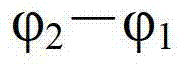
Figure BDA00003110433500102
(rad))。当用接收波的波长λ(m)来表示在该模型中产生的传播距离的差分Δ与相位差
Figure BDA00003110433500103
的关系时,成为下述式(9)那样。另外,在下述式中,Δ<λ。The reason for obtaining the angle of arrival by the above processing is that the geometric relationship shown in FIG. 5 is established. The angle formed by the radio waves arriving at the two receiving antennas 11 a , 11 b arranged at a distance d (m) apart based on a predetermined direction is assumed to be θ (rad). The propagation distance of the radio wave reaching the receiving antenna 11b is Δ(m) longer than the propagation distance of the radio wave reaching the receiving antenna 11a, and a phase delay (phase difference
Figure BDA00003110433500102
(rad)). When the wavelength λ(m) of the received wave is used to represent the difference Δ and phase difference of the propagation distance generated in this model
Figure BDA00003110433500103
In the case of the relationship, it becomes like the following formula (9). In addition, in the following formulae, Δ<λ.

【式9】[Formula 9]

&Delta;&Delta; == &lambda;&lambda; &CenterDot;&Center Dot; &phi;&phi; 22 -- &phi;&phi; 11 22 &pi;&pi; &CenterDot;&Center Dot; &CenterDot;&CenterDot; &CenterDot;&Center Dot; (( 99 ))

此外,根据上述模型中的传播距离的差分Δ、天线间隔d、到达角度θ的几何学关系,下述式(10)成立。In addition, the following formula (10) holds true from the geometric relationship of the propagation distance difference Δ, the antenna spacing d, and the arrival angle θ in the above model.

【式10】[Formula 10]

Δ=dsinθ    …(10)Δ=dsinθ ...(10)

即,到达角度θ就会表示为下述式(11)那样。另外,式(11)与到达角度变换部46中的处理相当。这样可知,能够由本实施方式的到达角度计算装置来计算到达角度。That is, the angle of arrival θ is expressed as in the following equation (11). In addition, Expression (11) corresponds to the processing in the arrival angle conversion unit 46 . Thus, it can be seen that the angle of arrival can be calculated by the angle of arrival calculation device of this embodiment.

【式11】[Formula 11]

&theta;&theta; == sinsin -- 11 &phi;&phi; 22 -- &phi;&phi; 11 22 &pi;&pi; &CenterDot;&Center Dot; &lambda;&lambda; dd &CenterDot;&Center Dot; &CenterDot;&Center Dot; &CenterDot;&Center Dot; (( 1111 ))

接着,对使用了到达角度计算装置的位置检测系统的例进行说明。图6所示的位置检测系统101构成为包括到达角度计算装置1a、与到达角度计算装置1a隔开规定距离D而配置的其它到达角度计算装置1b、接入点2或用户终端3。接入点2及用户终端3构成为,分别具备发送系统及接收系统(未图示),能够进行双向的信息传输(通信)。此外,接入点2及用户终端3构成为,可以通过各自具备的发送系统而向到达角度计算装置1a及到达角度计算装置1b发送到达角度计算用的电波。位置检测的对象为接入点2或用户终端3的任一个均可。Next, an example of a position detection system using an arrival angle calculation device will be described. The position detection system 101 shown in FIG. 6 is configured to include an angle-of-arrival calculation device 1a, another angle-of-arrival calculation device 1b arranged at a predetermined distance D from the angle-of-arrival calculation device 1a, an access point 2, or a user terminal 3. The access point 2 and the user terminal 3 are configured to include a transmission system and a reception system (not shown), respectively, and are capable of bidirectional information transmission (communication). In addition, the access point 2 and the user terminal 3 are configured to be able to transmit radio waves for calculating the angle of arrival to the angle-of-arrival calculating device 1 a and the angle-of-arriving calculating device 1 b through respective transmission systems. The object of location detection may be either the access point 2 or the user terminal 3 .

到达角度计算装置1a通过接收用天线11aa及11ab来接收从接入点2的发送用天线发送的电波,从而计算以到达角度计算装置1a为基准的到达角度。此外,到达角度计算装置1b通过接收用天线11ba及11bb来接收从接入点2的发送用天线发送的电波,从而计算以到达角度计算装置1b为基准的到达角度。如果到达角度计算装置1a和到达角度计算装置1b的位置关系已知,则可以根据以各自为基准的到达角度来决定接入点2的位置。The angle-of-arrival calculation device 1a receives radio waves transmitted from the transmission antenna of the access point 2 through the reception antennas 11aa and 11ab, and calculates the angle-of-arrival based on the angle-of-arrival calculation device 1a. Also, the angle-of-arrival calculation device 1b receives radio waves transmitted from the transmission antenna of the access point 2 through the reception antennas 11ba and 11bb, and calculates the angle-of-arrival based on the angle-of-arrival calculation device 1b. If the positional relationship between the angle-of-arrival calculation device 1a and the angle-of-arrival calculation device 1b is known, the position of the access point 2 can be determined based on the angles of arrival based on each.

此外,在用户终端3的位置检测的情况下,到达角度计算装置1a及到达角度计算装置1b计算从用户终端3发送的电波的到达角度。In addition, in the case of detecting the position of the user terminal 3 , the angle-of-arrival calculation device 1 a and the angle-of-arrival calculation device 1 b calculate the angle of arrival of radio waves transmitted from the user terminal 3 .

图7是本实施方式涉及的到达角度计算装置1中的到达角度计算的流程图。当到达角度计算装置1接收到达角度计算对象的电波时,接收部12a、12b向相关处理部21a、21b输出接收信号。此后,相关处理部21a、21b在步骤201中进行接收信号的相关处理及加法处理。FIG. 7 is a flowchart of the angle-of-arrival calculation in the angle-of-arrival calculation device 1 according to the present embodiment. When the angle-of-arrival calculation device 1 receives radio waves to be calculated for the angle-of-arrival, the receiving units 12a and 12b output reception signals to the correlation processing units 21a and 21b. Thereafter, the correlation processing units 21 a and 21 b perform correlation processing and addition processing of the received signals in step 201 .

此后,峰值检测部22a、22b在步骤202中根据相关处理部21a、21b的输出信号来检测电力的峰值Ppeak。此后,计算峰值点附近的期间(峰值期间)内的电力之和∑P1与从1位期间(信息单位的期间)除去了峰值期间以外的期间中的电力之和∑P2,并计算它们的比R(=∑P1/∑P2)。图8(a)示意地表示向峰值检测部22a、22b输入的信号。峰值电力Ppeak为图8(a)中的峰值点P上的电力,∑P1为峰值期间t1中的电力之和,∑P2为从1位期间除去了峰值期间t1的期间t2中的电力之和。此处,峰值期间t1为包括峰值的升降区间的期间。例如,如图9所示,在作为调制方式而使用DSSS的情况下,能够形成扩散码的周期tc的2倍的升降区间。因此,可以设该2·tc的期间为峰值期间t1。另外,在图9中,期间t2使用1位期间tb而表示为tb-2·tc。Thereafter, in step 202, the peak detection units 22a and 22b detect the peak value P peak of the electric power from the output signals of the correlation processing units 21a and 21b. Thereafter , the sum ΣP 1 of electric power in the period near the peak point (peak period) and the sum ΣP 2 of electric power in the period other than the peak period are calculated from the 1-bit period (period of information unit) are calculated and calculated. The ratio R (=∑P 1 /∑P 2 ). FIG. 8( a ) schematically shows signals input to the peak detection units 22 a and 22 b. The peak power P peak is the power at the peak point P in Fig. 8(a), ΣP 1 is the sum of power during the peak period t1 , and ΣP2 is the period t obtained by removing the peak period t1 from the 1-bit period The sum of the electricity in 2 . Here, the peak period t1 is a period including the ups and downs of the peak. For example, as shown in FIG. 9 , when DSSS is used as the modulation method, it is possible to form a rising and falling interval twice the period tc of the spreading code. Therefore, the period of 2·tc can be defined as the peak period t 1 . In addition, in FIG. 9 , period t2 is expressed as tb−2·tc using 1-bit period tb.

图10表示向使用AD变换器而取入了接收信号的情况下的峰值检测部22a、22b输入的信号的例。图10的横轴t表示样本编码,t取离散的值。在作为调制方式而使用DSSS的情况下,例如,如果扩散码为11码片、1位期间为1μs,则扩散码的1码片期间为0.091μs。如果设AD变换为1码片期间的4倍的过采样,则升降区间扩展1码片量,成为ips=ip-3、ipe=ip+3。在这种情况下,R表示为下述式(12)那样。FIG. 10 shows an example of signals input to the peak detection units 22a and 22b in the case where the received signal is captured using an AD converter. The horizontal axis t in FIG. 10 represents sample encoding, and t takes discrete values. When DSSS is used as the modulation method, for example, if the spreading code is 11 chips and the 1-bit period is 1 μs, the 1-chip period of the spreading code is 0.091 μs. If it is assumed that the AD conversion is 4 times oversampling during 1 chip period, the up-down interval is extended by 1 chip amount, and becomes ips=ip-3, ipe=ip+3. In this case, R is represented by the following formula (12).

【数12】【Number 12】

RR == &Sigma;&Sigma; ipip -- 33 ipip ++ 33 PP ii &Sigma;&Sigma; ii 11 ii 22 PP ii -- &Sigma;&Sigma; ipip -- 33 ipip ++ 33 PP ii &CenterDot;&Center Dot; &CenterDot;&CenterDot; &CenterDot;&Center Dot; (( 1212 ))

在步骤203中,峰值检测部22a、22b将所计算的比R(=∑P1/∑P2)与规定的阈值Rth相比较。在R比Rth大的情况下,峰值检测部22a、22b将该内容的信号向定时控制部23a、23b输出。定时控制部23a,当接受R比Rth大的内容的信号时,认为接收信号存在峰值,而将到达角度的计算所需的信号向到达角度计算部24输出。此后,在步骤204中,到达角度计算部24计算到达角度。另一方面,在R为Rth以下的情况下,峰值检测部22a、22b将该内容的信号向定时控制部23a、23b输出,定时控制部23a,认为接收信号不存在峰值,而停止向到达角度计算部24的输出。此后,到达角度计算装置1再次执行从步骤201开始的流程。Rth为任意的值。例如,可以将通过与R的比较来判定峰值的有无的程度的值设定为RthIn step 203 , the peak detection units 22 a and 22 b compare the calculated ratio R (=ΣP 1 /ΣP 2 ) with a predetermined threshold R th . When R is larger than Rth, the peak detection units 22a and 22b output signals of the content to the timing control units 23a and 23b. The timing control unit 23a, when receiving a signal that R is greater than Rth , considers that the received signal has a peak, and outputs a signal necessary for calculating the angle of arrival to the angle-of-arrival calculation unit 24 . Thereafter, in step 204 , the arrival angle calculation unit 24 calculates the arrival angle. On the other hand, when R is equal to or less than R th , the peak detection units 22a, 22b output signals of the content to the timing control units 23a, 23b, and the timing control unit 23a considers that there is no peak value in the received signal, and stops reporting to the arrival signal. The output of the angle calculation part 24. Thereafter, the angle-of-arrival calculation device 1 executes the flow from step 201 again. R th is an arbitrary value. For example, R th may be set to a value to which the presence or absence of a peak can be determined by comparison with R.

这样,通过将与所检测的峰值有关的指标(R)与阈值(Rth)相比较来判定峰值的有无,能够准确地判定峰值的有无。In this way, by comparing the index (R) related to the detected peak value with the threshold value (R th ) to determine the presence or absence of the peak value, it is possible to accurately determine the presence or absence of the peak value.

此处,单纯对将功率(电力)与功率的阈值相比较来判定峰值的有无的方法进行考察。图8(b)示意地表示背景值高的信号(实线)和背景值低的信号(虚线)。在图8(b)中,在如虚线所示那样背景值低的情况下,可以通过将功率的峰值与功率的阈值Pth相比较,来检测峰值。但是,在图8(b)中,当如实线所示那样背景值高到超过Pth的程度时,即使将功率的峰值与Pth相比较也不能够检测峰值。这是因为,在功率的峰值与功率的阈值的单纯的比较中,不能考虑背景值。所以,如本实施方式所示那样,通过在峰值的检测中使用考虑了背景值的指标,可以准确地判定峰值的有无。Here, a method of simply comparing power (electric power) with a threshold value of power to determine the presence or absence of a peak will be considered. Figure 8(b) schematically represents a signal with a high background value (solid line) and a signal with a low background value (dashed line). In FIG. 8( b ), when the background value is low as indicated by the dotted line, the peak value can be detected by comparing the peak value of the power with the threshold value P th of the power. However, in FIG. 8( b ), when the background value is high enough to exceed P th as indicated by the solid line, the peak value cannot be detected even if the peak value of the power is compared with P th . This is because the background value cannot be considered in a simple comparison of the peak value of the power and the threshold value of the power. Therefore, as shown in the present embodiment, by using an index that takes the background value into consideration for detection of a peak, the presence or absence of a peak can be accurately determined.

如以上所示那样,本实施方式涉及的到达角度计算装置,通过求出峰值期间的电力与峰值期间以外的剩余的期间中的电力的比、并比较该求出的比与阈值来判定峰值的有无,即使在接收波的背景值高的情况下也可以准确地检测期望波的峰值并用于到达角度的计算。即,没有根据期望波以外的信号分量来计算到达角度,因此可以提高到达角度的计算精度。As described above, the angle of arrival calculation device according to this embodiment determines the peak value by calculating the ratio of the power during the peak period to the power in the remaining periods other than the peak period, and comparing the calculated ratio with a threshold value. With or without, even when the background value of the received wave is high, the peak of the desired wave can be accurately detected and used for the calculation of the angle of arrival. That is, since the angle of arrival is not calculated from signal components other than the desired wave, the calculation accuracy of the angle of arrival can be improved.

图11是说明到达角度计算装置1中的到达角度计算部24的另一形态的框图。图11所示的到达角度计算部24具备:取定时控制部23a的输出Oa1的复共轭的复共轭部51;将复共轭部51的输出Oa1′与定时控制部23b的输出Oa2复数相乘的复数乘法部52;以及使用复数乘法部52的输出来进行反正切运算的反正切部53。复共轭部51、复数乘法部52、反正切部53的动作、功能,与上述的复共轭部41、复数乘法部42、反正切部43的动作、功能同样。此外具备:基于反正切部53的运算结果(相位差)来校正运算结果的相位差校正部54;将相位差校正部54的输出平均化的平均化部55;在相位差校正部54中进行了校正的情况下校正平均化部55的运算结果(平均值)的相位差再校正部56;以及使用相位差再校正部56的输出而变换为到达角度的到达角度变换部57。到达角度变换部57的动作、功能,与上述的到达角度变换部46的动作、功能同样。FIG. 11 is a block diagram illustrating another form of the arrival angle calculation unit 24 in the arrival angle calculation device 1 . The angle of arrival calculation unit 24 shown in FIG. 11 includes: a complex conjugate unit 51 that takes the complex conjugate of the output O a1 of the timing control unit 23a; O a2 A complex multiplication unit 52 for complex multiplication; and an arctangent unit 53 for performing an arctangent calculation using the output of the complex multiplication unit 52. The operations and functions of the complex conjugate unit 51 , complex multiplier 52 , and arctangent unit 53 are the same as those of the complex conjugate unit 41 , complex multiplier 42 , and arctangent unit 43 described above. In addition, it is equipped with: a phase difference correction unit 54 that corrects the calculation result based on the calculation result (phase difference) of the arctangent unit 53; an averaging unit 55 that averages the output of the phase difference correction unit 54; When corrected, the phase difference recorrector 56 corrects the calculation result (average value) of the averaging unit 55; and the arrival angle conversion unit 57 converts the output of the phase difference recorrector 56 into an arrival angle. The operation and function of the arrival angle conversion unit 57 are the same as those of the above-mentioned arrival angle conversion unit 46 .

相位差校正部54,在作为反正切部53的运算结果的相位差成为+180°(+π)附近、-180°(-π)附近的值的情况下,进行在反正切部的运算结果中加上规定的角度(相位差)的处理。如图12的I-Q平面所示,本实施方式的到达角度计算部24将相位差投影到-180°~+180°(-π~+π)的相位差范围的坐标上。因此,例如,如图13(a)所示,在由反正切部53计算的相位差不成为+180°及-180°附近的值的情况下,通过将其平均化,而可以适当地计算到达角度。但是,如图13(b)所示,在由反正切部53计算的相位差成为+180及-180附近的值的情况下,所计算的相位差的少许误差就会对角度计算施加大的影响。此处,假定为作为相位差数据而得到-178°及+178°的两个值,作为一方的值的+178°是基于作为本来的值的-178°产生-4°的误差后而成为+178°的。它们的差实际上仅为4°。但是,在平均化处理中,当作为-178°和+178°而平均化时,平均值成为0°。尽管实际上存在约180°的相位差,但通过平均化处理会作为0°来处理。这样,当所平均化的相位差从本来的相位差大幅度偏离时,适当的到达角度计算变得困难。The phase difference correcting unit 54 adds the phase difference to the calculation result of the arctangent unit when the phase difference as the calculation result of the arctangent unit 53 becomes a value near +180° (+π) or −180° (−π). processing on a specified angle (phase difference). As shown on the I-Q plane of FIG. 12 , the angle-of-arrival calculation unit 24 of this embodiment projects the phase difference onto coordinates in a phase difference range of −180° to +180° (−π to +π). Therefore, for example, as shown in FIG. 13( a ), when the phase difference calculated by the arctangent unit 53 does not have a value near +180° and -180°, by averaging them, it is possible to appropriately calculate the arrival phase difference. angle. However, as shown in FIG. 13(b), when the phase difference calculated by the arctangent unit 53 has a value in the vicinity of +180 and -180, a slight error in the calculated phase difference exerts a large influence on the angle calculation. . Here, it is assumed that two values of -178° and +178° are obtained as phase difference data, and one value of +178° is +178° with an error of -4° from the original value of -178°. of. Their difference is actually only 4°. However, in the averaging process, when averaging as -178° and +178°, the average value becomes 0°. Although there is actually a phase difference of about 180°, it is treated as 0° by the averaging process. In this way, when the averaged phase difference greatly deviates from the original phase difference, it becomes difficult to calculate an appropriate angle of arrival.

所以,图11所示的到达角度计算部24,在由反正切部53计算的相位差成为+180°及-180°附近的值的情况下,相位差校正部54进行在反正切部53的运算结果中加上规定的角度(相位差)的校正处理,而进行适当的平均化。反正切部53的运算结果是否为+180°或-180°附近的值,可以基于作为反正切部53的运算结果而得到的多个相位差的分布来判定。例如,在大于+90°(+π/2)或小于-90°(-π/2)的相位差的数量、比小于+90°并且大于-90°的相位差的数量多的情况下,可以判定为反正切部53的运算结果为+180°及-180°附近的值。可以使相位差校正部54所加上的角度(相位差)例如为+90°,但只要是能够进行适当的平均化处理的角度,并非限定于此。优选地,也可以为-90°、+180°或-180°的任一个。Therefore, in the angle-of-arrival calculation unit 24 shown in FIG. 11 , when the phase difference calculated by the arctangent unit 53 has a value around +180° and −180°, the phase difference correction unit 54 performs calculations by the arctangent unit 53 Correction processing of a predetermined angle (phase difference) is added to the result, and appropriate averaging is performed. Whether the calculation result of the arctangent unit 53 is a value near +180° or −180° can be determined based on the distribution of a plurality of phase differences obtained as the calculation result of the arctangent unit 53 . For example, when the number of phase differences greater than +90° (+π/2) or less than -90° (-π/2) is greater than the number of phase differences less than +90° and greater than -90°, it can be determined that The calculation result of the arctangent unit 53 is a value in the vicinity of +180° and −180°. The angle (phase difference) added by the phase difference correction unit 54 may be, for example, +90°, but it is not limited to this as long as it is an angle that can perform appropriate averaging processing. Preferably, it may be any one of -90°, +180° or -180°.

平均化部55将相位差校正部54的输出平均化。本实施方式的到达角度计算部24,在计算不适于平均化的相位差的情况下进行加上相位差的校正,因此能够在平均化部55中进行适当的平均化处理。相位差再校正部56,在相位差校正部54中进行了相位差的校正的情况下,校正平均化部55的输出。具体地,进行减去在相位差校正部54中作为校正值而加上了的角度(相位差)的校正。The averaging unit 55 averages the outputs of the phase difference correcting unit 54 . The angle-of-arrival calculation unit 24 of the present embodiment performs correction by adding a phase difference when calculating a phase difference that is not suitable for averaging, so that an appropriate averaging process can be performed in the averaging unit 55 . The phase difference recorrecting unit 56 corrects the output of the averaging unit 55 when the phase difference correction is performed by the phase difference correcting unit 54 . Specifically, correction is performed by subtracting the angle (phase difference) added as a correction value by the phase difference correction unit 54 .

图14示意地表示相位差成为+180°及-180°附近的情况下的到达角度计算的概略。在由反正切部53计算的相位差在I-Q平面中为+180°及-180°附近的情况下,相位差校正部54在相位差中加上校正值(+90°)而使坐标轴旋转,并变换为平均值计算用的坐标轴。平均化部55基于该数据来计算平均值(-92°)。相位差再校正部56进行从相位差校正部54的输出数据减去校正值(+90°)的校正,并向反正弦部57输出所校正后的数据(+178°)。FIG. 14 schematically shows the outline of calculation of the angle of arrival when the phase difference is in the vicinity of +180° and −180°. When the phase difference calculated by the arctangent unit 53 is around +180° and −180° in the I-Q plane, the phase difference correcting unit 54 adds a correction value (+90°) to the phase difference to rotate the coordinate axis, and Transform to the axis used for mean calculation. The averaging unit 55 calculates an average value (−92°) based on the data. The phase difference recorrection unit 56 performs correction by subtracting the correction value (+90°) from the output data of the phase difference correction unit 54 , and outputs the corrected data (+178°) to the arcsine unit 57 .

图15是上述到达角度计算部24中的处理流程图。到达角度计算部24的复共轭部51在步骤301中计算定时控制部23a的输出Oa1的复共轭。此外,复数乘法部52在步骤302中将定时控制部23b的输出Oa2和复共轭部51的输出Oa1′相乘。此后,反正切部53在步骤303中使用复数乘法部52的输出来进行反正切运算,计算接收信号间的相位差。FIG. 15 is a flowchart of processing in the above-mentioned angle-of-arrival calculation unit 24 . The complex conjugate unit 51 of the angle of arrival calculation unit 24 calculates the complex conjugate of the output O a1 of the timing control unit 23 a in step 301 . In addition, the complex multiplication unit 52 multiplies the output O a2 of the timing control unit 23 b and the output O a1 ′ of the complex conjugate unit 51 in step 302 . Thereafter, the arctangent unit 53 performs an arctangent calculation using the output of the complex multiplying unit 52 in step 303 to calculate the phase difference between the received signals.

在步骤304中,相位差校正部54判定所计算的相位差在I-Q平面中是否为+180°及-180°附近的值。在所计算的相位差并非+180°及-180°附近的值的情况下,进入步骤305,到达角度计算部24不校正相位差而计算到达角度。在所计算的相位差为+180°附近或-180°附近的值的情况下,进入步骤306。该判定,如上述那样,可以以大于+90°或小于-90°的相位差的数量是否比小于+90°并且大于-90°的相位差的数量多为基准来进行。In step 304 , the phase difference correction unit 54 determines whether or not the calculated phase difference is a value around +180° and −180° in the I-Q plane. When the calculated phase difference is not a value near +180° and −180°, the process proceeds to step 305 and the arrival angle calculation unit 24 calculates the arrival angle without correcting the phase difference. When the calculated phase difference is a value around +180° or around −180°, the process proceeds to step 306 . This determination can be made based on whether the number of phase differences greater than +90° or less than −90° is greater than the number of phase differences less than +90° and greater than −90° as described above.

在步骤306中,相位差校正部54进行在作为反正切部53的运算结果的相位差中加上90°的处理。在步骤307中,平均化部55将相位差校正部54的输出平均化。此后,在步骤308中,相位差再校正部56进行从作为平均化部55的运算结果的平均值减去90°的处理。此后,在步骤309中,到达角度变换部57根据相位差再校正部56的输出来计算到达角度。这样,在图11所示的到达角度计算部24中,通过在加上规定的相位差并平均化之后减去规定的相位差的一系列的处理而计算适当的平均值,因此到达角度的计算精度才没有降低。结果,可以充分提高到达角度的计算精度。In step 306 , the phase difference correction unit 54 performs a process of adding 90° to the phase difference that is the calculation result of the arctangent unit 53 . In step 307 , the averaging unit 55 averages the outputs of the phase difference correcting unit 54 . Thereafter, in step 308 , the phase difference recorrecting unit 56 performs a process of subtracting 90° from the average value that is the calculation result of the averaging unit 55 . Thereafter, in step 309 , the arrival angle conversion unit 57 calculates the arrival angle based on the output of the phase difference recorrection unit 56 . In this way, in the angle-of-arrival calculation unit 24 shown in FIG. 11 , an appropriate average value is calculated through a series of processes of subtracting a predetermined phase difference after adding and averaging a predetermined phase difference. Therefore, the calculation of the angle of arrival Accuracy is not reduced. As a result, the calculation accuracy of the angle of arrival can be sufficiently improved.

另外,此处,相位差校正部54进行在反正切部53的运算结果中加上规定的角度的处理,但只要可以实现适当的平均化处理,并非限定于此。例如,也可以使用图16所示那样的构成的到达角度计算部24。图16所示的到达角度计算部24具备:取定时控制部23a的输出Oa1的复共轭的复共轭部61;以及将复共轭部61的输出Oa1′与定时控制部23b的输出Oa2复数相乘的复数乘法部62。复共轭部61、复数乘法部62的动作、功能,与上述的复共轭部41、复数乘法部42的动作、功能同样。此外具备:将复数乘法部62的输出的同相分量(I分量)的绝对值与正交分量(Q分量)的绝对值相比较的IQ比较部63;以及使用复数乘法部62的输出,根据IQ比较部63的输出来选择、变更运算方法,而进行反正切运算的反正切部64。此外具备:将作为反正切部64的运算结果的相位差平均化的平均化部65;根据反正切部64的运算方法来校正作为平均化部65的运算结果的平均值的相位差再校正部66;以及使用相位差再校正部66的输出而变换为到达角度的到达角度变换部67。到达角度变换部67的动作、功能,与上述的到达角度变换部46的动作、功能同样。In addition, here, the phase difference correction unit 54 performs a process of adding a predetermined angle to the calculation result of the arctangent unit 53 , but it is not limited to this as long as an appropriate averaging process can be realized. For example, an arrival angle calculation unit 24 having a configuration as shown in FIG. 16 may also be used. The angle of arrival calculation unit 24 shown in FIG. 16 includes: a complex conjugate unit 61 that takes the complex conjugate of the output O a1 of the timing control unit 23a; The complex multiplication unit 62 that outputs O a2 complex numbers. The operations and functions of the complex conjugate unit 61 and the complex multiplier 62 are the same as those of the complex conjugate unit 41 and the complex multiplier 42 described above. In addition, it is equipped with: an IQ comparison unit 63 that compares the absolute value of the in-phase component (I component) of the output of the complex multiplication unit 62 with the absolute value of the quadrature component (Q component); The arc tangent unit 64 that performs arc tangent calculation by selecting and changing the calculation method based on the output of the comparison unit 63 . In addition, it is provided with: an averaging unit 65 that averages the phase difference that is the calculation result of the arctangent unit 64; and a phase difference recorrecting unit that corrects the average value that is the calculation result of the averaging unit 65 based on the calculation method of the arctangent unit 64. 66; and an arrival angle conversion unit 67 for converting the output of the phase difference recorrection unit 66 into an arrival angle. The operation and function of the arrival angle conversion unit 67 are the same as those of the above-mentioned arrival angle conversion unit 46 .

IQ比较部63判定复数乘法部的输出的同相分量(I分量)是否为负,并且比较复数乘法部62的输出的同相分量(I分量)的绝对值与正交分量(Q分量)的绝对值。具体地,IQ比较部63判定同相分量Ib的符号,并且判定同相分量的绝对值︱Ib︱与正交分量的绝对值︱Qb︱相比是否充分大(正交分量的绝对值︱Qb︱与同相分量的绝对值︱Ib︱相比是否充分小)。在接收信号的相位差在I-Q平面中取+180°及-180°附近的值的情况下,同相分量Ib为负(Ib<0),同相分量的绝对值︱Ib︱与正交分量的绝对值︱Qb︱相比充分大。因此,通过判定同相分量Ib的符号、并判定同相分量的绝对值︱Ib︱与正交分量的绝对值︱Qb︱相比是否充分大,可以判定相位差是否取+180°及-180°附近的值。The IQ comparison section 63 determines whether the in-phase component (I component) of the output of the complex multiplication section is negative, and compares the absolute value of the in-phase component (I component) of the output of the complex multiplication section 62 with the absolute value of the quadrature component (Q component). . Specifically, the IQ comparison section 63 judges the sign of the in-phase component Ib, and judges whether the absolute value of the in-phase component |Ib| is sufficiently larger than the absolute value of the quadrature component |Qb| (the absolute value of the quadrature component |Qb| Whether the absolute value of the in-phase component ︱Ib︱ is sufficiently small compared to that). When the phase difference of the received signal takes values around +180° and -180° in the I-Q plane, the in-phase component Ib is negative (Ib<0), the absolute value of the in-phase component︱Ib︱ and the absolute value of the quadrature component ︱Qb︱ is sufficiently larger than ︱Qb︱. Therefore, by judging the sign of the in-phase component Ib and judging whether the absolute value of the in-phase component︱Ib︱ is sufficiently large compared with the absolute value of the quadrature component︱Qb︱, it can be determined whether the phase difference is around +180° and -180° value.

反正切部64使用复数乘法部62的输出,根据IQ比较部63的输出来选择运算方法而进行反正切运算。在同相分量为正的情况下、同相分量为负并且同相分量的绝对值︱Ib︱与正交分量的绝对值︱Qb︱为相同程度或比其小的情况下,进行以复数乘法部62的输出Ib为分母、以输出Qb为分子的值的反正切运算。在同相分量为负并且同相分量的绝对值︱Ib︱与正交分量的绝对值︱Qb︱相比充分大的情况下,例如,进行以使复数乘法部62的输出Qb的符号反转了的-Qb为分母、以输出Ib为分子的值的反正切运算。另外,在同相分量的绝对值︱Ib︱与正交分量的绝对值︱Qb︱相比充分大的情况下的上述处理,与使坐标轴旋转+90°而进行反正切运算的处理相当。即,由该处理得到的相位差为在原来的相位差中加上了+90°的值。The arc tangent unit 64 uses the output of the complex multiplication unit 62 and selects a calculation method based on the output of the IQ comparison unit 63 to perform an arc tangent calculation. When the in-phase component is positive, the in-phase component is negative, and the absolute value |Ib| of the in-phase component is about the same as or smaller than the absolute value |Qb| of the quadrature component. The arc tangent operation of the value whose output Ib is the denominator and the output Qb is the numerator. In the case where the in-phase component is negative and the absolute value of the in-phase component |Ib| is sufficiently larger than the absolute value of the quadrature component |Qb|, for example, inverting the sign of the output Qb of the complex multiplying unit 62 is performed. - Arctangent operation of the value with Qb as the denominator and output Ib as the numerator. In addition, the above processing when the absolute value of the in-phase component |Ib| is sufficiently larger than the absolute value of the quadrature component |Qb| corresponds to the processing of rotating the coordinate axis by +90° and performing an arctangent calculation. That is, the phase difference obtained by this process is a value obtained by adding +90° to the original phase difference.

另外,在同相分量的绝对值︱Ib︱与正交分量的绝对值︱Qb︱相比充分大的情况下的处理,并非限定于上述的处理。例如,也可以进行以复数乘法部62的输出Qb为分母、以使输出Ib的符号反转了的-Ib为分子的值的反正切运算。该处理,与使坐标轴旋转-90°而进行反正切运算的处理相当。即,由该处理得到的相位差为在原来的相位差中加上了-90°的值(减去了+90°的值)。此外,例如也可以使复数乘法部62的输出Ib的符号和输出Qb的符号反转而进行反正切运算。该处理,与使坐标轴旋转+180°(或-180°)而进行反正切运算的处理相当。即,由该处理得到的相位差为在原来的相位差中加上了+180°(或-180°)的值。通过这种处理,也可以计算适当的平均值。In addition, the processing when the absolute value |Ib| of the in-phase component is sufficiently larger than the absolute value |Qb| of the quadrature component is not limited to the above-mentioned processing. For example, an arctangent calculation may be performed using the output Qb of the complex multiplication unit 62 as the denominator and −Ib having the sign of the output Ib inverted as the numerator. This processing corresponds to the processing of rotating the coordinate axis by −90° and performing an arctangent calculation. That is, the phase difference obtained by this process is a value obtained by adding −90° to the original phase difference (a value obtained by subtracting +90°). In addition, for example, the arctangent calculation may be performed by inverting the signs of the output Ib and the output Qb of the complex multiplying unit 62 . This processing corresponds to the processing of performing an arctangent calculation by rotating the coordinate axis by +180° (or -180°). That is, the phase difference obtained by this process is a value obtained by adding +180° (or −180°) to the original phase difference. Through this processing, an appropriate average value can also be calculated.

平均化部65将反正切部64的输出平均化。本实施方式的到达角度计算部24在计算不适于平均化的相位差的情况下进行实质上加上(或减去)相位差的校正,因此能够在平均化部65中进行适当的平均化处理。相位差再校正部66在反正切部64进行了使坐标轴旋转+90°的处理的情况下,校正平均化部65的输出。具体地,进行减去+90°的校正。另外,在反正切部64进行了使坐标轴旋转-90°的处理的情况下,进行减去-90°的校正(即加上+90°的校正)。同样,在反正切部64进行了使坐标轴旋转+180°(或-180°)的处理的情况下,进行减去+180°(或-180°)的校正。The averaging unit 65 averages the outputs of the arctangent unit 64 . The angle-of-arrival calculation unit 24 of the present embodiment performs correction that substantially adds (or subtracts) the phase difference when calculating a phase difference that is not suitable for averaging, so that an appropriate averaging process can be performed in the averaging unit 65 . The phase difference recorrecting unit 66 corrects the output of the averaging unit 65 when the arctangent unit 64 has performed the process of rotating the coordinate axis by +90°. Specifically, a correction of subtracting +90° is performed. In addition, when the arctangent unit 64 has performed the process of rotating the coordinate axis by −90°, correction by subtracting −90° (that is, correction by adding +90°) is performed. Similarly, when the arctangent unit 64 performs processing of rotating the coordinate axis by +180° (or −180°), correction of subtracting +180° (or −180°) is performed.

这样,图16所示的到达角度计算部24也可以与图11所示的到达角度计算部24同样地计算适当的平均值,因此到达角度的计算精度才没有降低。结果,可以充分提高到达角度的计算精度。In this way, the arrival angle calculation unit 24 shown in FIG. 16 can also calculate an appropriate average value similarly to the arrival angle calculation unit 24 shown in FIG. 11 , so the calculation accuracy of the arrival angle does not decrease. As a result, the calculation accuracy of the angle of arrival can be sufficiently improved.

图17是表示作为调制方式而使用正交频分复用(OFDM)的情况下的到达角度计算装置的具体的构成例的框图。另外,在图17中,仅示出了与图1中的运算部13相当的构成。FIG. 17 is a block diagram showing a specific configuration example of an angle-of-arrival calculation device when orthogonal frequency division multiplexing (OFDM) is used as a modulation scheme. In addition, in FIG. 17, only the structure corresponding to the calculation part 13 in FIG. 1 is shown.

在图17中,相关处理部21a具备:取接收部12a的输出的复共轭的复共轭部71a;使接收部12a的输出延迟规定期间的量并输出的延迟部72a;将复共轭部71a的输出和延迟部72a的输出复数相乘的复数乘法部73a;以及仅在GI(保护间隔)期间相加复数乘法部73a的输出并输出的加法器74a、74b。峰值检测部22a具备:计算从加法器74a、74b输出的信号的电力的电力计算部75a;以及检测其电力峰值并向定时控制部23a输出的峰值电力检测部76a。定时控制部23a具备基于来自峰值电力检测部76a的信号来控制来自接收部12a的信号向到达角度计算部24的输出定时的延迟部77a。同样,相关处理部21b具备复共轭部71b、延迟部72b、复数乘法部73b、加法器74c、74d,峰值检测部22b具备电力计算部75b、峰值电力检测部76b,定时控制部23b具备延迟部77b。到达角度计算部24具备:取延迟部77a的输出的复共轭的复共轭部81;将复共轭部81的输出和延迟部77b的输出复数相乘的复数乘法部82;仅在GI(保护间隔)期间相加复数乘法部42的输出并输出的加法部83a、83b;使用加法部83a、83b的输出来进行反正切运算的反正切部84;将反正切部84的输出平均化的平均化部85;以及使用平均化部85的输出来变换为到达角度的到达角度变换部86。In FIG. 17 , the correlation processing unit 21a includes: a complex conjugate unit 71a for taking the complex conjugate of the output of the receiving unit 12a; a delay unit 72a for delaying the output of the receiving unit 12a by a predetermined period and outputting it; The output of the part 71a and the output of the delay part 72a are complex multiplied by a complex multiplication part 73a; and the adders 74a, 74b which add the output of the complex multiplication part 73a and output only during the GI (Guard Interval) period. The peak detection unit 22a includes: a power calculation unit 75a that calculates the power of signals output from the adders 74a and 74b; and a peak power detection unit 76a that detects the power peak value and outputs it to the timing control unit 23a. The timing control unit 23a includes a delay unit 77a that controls the output timing of the signal from the reception unit 12a to the angle of arrival calculation unit 24 based on the signal from the peak power detection unit 76a. Similarly, the correlation processing unit 21b includes a complex conjugate unit 71b, a delay unit 72b, a complex multiplication unit 73b, and adders 74c and 74d. The peak detection unit 22b includes a power calculation unit 75b and a peak power detection unit 76b. The timing control unit 23b has a delay Section 77b. Arrival angle calculation unit 24 is equipped with: complex conjugate unit 81 that takes the complex conjugate of the output of delay unit 77a; complex multiplication unit 82 that multiplies the output of complex conjugate unit 81 and the output of delay unit 77b; During the (guard interval) period, adders 83a and 83b add the outputs of the complex multiplying unit 42 and output them; use the outputs of the adders 83a and 83b to perform an arctangent calculation; and average the outputs of the arctangent unit 84 The averaging unit 85; and the arrival angle conversion unit 86 that converts the output of the averaging unit 85 into an arrival angle.

延迟部72a、72b取OFDM符号串的自相关,因此使接收部12a的输出延迟规定期间的量并输出。具体地,延迟部72a、72b,为了将复共轭部71a输出的OFDM符号的尾部与延迟部72a、72b输出的GI(保护间隔)在相同的定时向复数乘法部73a输入,而使接收部12a的输出延迟规定期间的量并输出。复数乘法部73a将复共轭部71a的输出和延迟部72a的输出复数相乘。加法器74a及74b仅在GI期间相加复数乘法部73a的每个码片区间的输出并输出。The delay units 72a and 72b take the autocorrelation of the OFDM symbol sequence, and therefore delay the output of the reception unit 12a by a predetermined period and output it. Specifically, the delay units 72a and 72b input the tail of the OFDM symbol output by the complex conjugate unit 71a and the GI (guard interval) output by the delay units 72a and 72b to the complex multiplication unit 73a at the same timing, and make the receiving unit The output of 12a is delayed by a predetermined period and output. The complex multiplication unit 73a complex multiplies the output of the complex conjugate unit 71a and the output of the delay unit 72a. The adders 74a and 74b add the output of the complex multiplying unit 73a for each chip interval and output it only in the GI period.

图18(a)是表示OFDM符号串的构成的示意图。如图18(a)所示,OFDM符号串由作为数据部的OFDM符号和配置在OFDM符号的起始的GI构成。GI为拷贝了OFDM符号尾部的数据,为了防止OFDM符号间的干扰而被插入。图18(b)是表示相关处理部21a中的OFDM符号串的相关处理(自相关处理)的情况的示意图。如图18(a)所示,延迟部72a的输出相对复共轭部71a的输出延迟了OFDM符号长度的量。因此,在复数乘法部73a中,可以通过复共轭部71a的输出和延迟部72a的输出相乘而取自相关。自相关值(GI相关值)在复共轭部71a的输出和延迟部72a的输出中出现与GI相同的数据时示出峰值,因此通过使用这一点,而可以检测作为数据部的OFDM符号的起始。FIG. 18( a ) is a schematic diagram showing the structure of an OFDM symbol sequence. As shown in FIG. 18( a ), an OFDM symbol sequence is composed of an OFDM symbol as a data part and a GI arranged at the head of the OFDM symbol. The GI copies the data at the end of the OFDM symbol and is inserted to prevent interference between OFDM symbols. FIG. 18( b ) is a schematic diagram showing a state of correlation processing (autocorrelation processing) of OFDM symbol sequences in the correlation processing unit 21 a. As shown in FIG. 18( a ), the output of the delay unit 72 a is delayed by the OFDM symbol length relative to the output of the complex conjugate unit 71 a. Therefore, in the complex multiplying unit 73a, an autocorrelation can be obtained by multiplying the output of the complex conjugate unit 71a and the output of the delay unit 72a. The autocorrelation value (GI correlation value) shows a peak when the same data as GI appears in the output of the complex conjugate part 71a and the output of the delay part 72a, so by using this point, it is possible to detect the OFDM symbol that is the data part start.

加法器74a及74b的输出信号被输入峰值检测部22a的电力计算部75a。电力计算部75a根据加法器74a及74b的输出信号来计算每个码片区间的电力。具体地,电力计算部34a将与同相分量相当的输出信号的绝对值和与正交分量相当的输出信号的绝对值相加,作为每个码片区间的电力信息而向峰值电力检测部76a输出。另外,也可以将与同相分量相当的输出信号的平方值和与正交分量相当的输出信号的平方值相加并向峰值电力检测部76a输出。图19(a)表示来自电力计算部75a的输出波形的例。图19(b)是图19(a)所示的输出波形的部分放大图。峰值电力检测部76a当接受每个码片区间的电力信息时,检测接收信号中的电力峰值,作为电力峰值信息而向定时控制部23a的延迟部77a输出。The output signals of the adders 74a and 74b are input to the electric power calculation part 75a of the peak detection part 22a. The power calculation unit 75a calculates the power for each chip interval based on the output signals of the adders 74a and 74b. Specifically, the power calculation unit 34a adds the absolute value of the output signal corresponding to the in-phase component and the absolute value of the output signal corresponding to the quadrature component, and outputs it to the peak power detection unit 76a as power information for each chip interval. . Alternatively, the square value of the output signal corresponding to the in-phase component and the square value of the output signal corresponding to the quadrature component may be added and output to the peak power detection unit 76a. FIG. 19( a ) shows an example of an output waveform from the power calculation unit 75 a. Fig. 19(b) is a partially enlarged view of the output waveform shown in Fig. 19(a). When receiving power information for each chip interval, the peak power detection unit 76a detects the power peak value in the received signal, and outputs it as power peak information to the delay unit 77a of the timing control unit 23a.

从峰值检测部22a(峰值电力检测部35a)输出的电力峰值信息为判定接收信号的峰值的有无的信息。具体地,电力峰值信息为,表示接收信号的峰值点附近的期间(峰值期间)内的电力之和∑P1与从成为OFDM中的信息单位的1符号期间除去了峰值期间以外的期间中的电力之和∑P2的比R(=∑P1/∑P2)是否大于阈值Rth大的信息。在作为调制方式而使用OFDM的情况下,峰值期间与GI期间相等。此外,所谓1符号期间,与合计了GI期间和数据期间(OFDM符号期间)的期间相当。在电力峰值信息中,在R大于Rth的情况下,定时控制部23a(延迟部77a)认为在该定时接收信号具有峰值,而将来自接收部12a的接收信号向到达角度计算部24。另一方面,在R小于Rth的情况下,定时控制部23a(延迟部77a)认为在该定时接收信号不具有峰值,而停止向到达角度计算部24的输出。另外,此处,峰值检测部22a进行了与电力峰值信息有关的运算处理,但也可以在定时控制部23a中进行与电力峰值信息有关的运算处理。The power peak information output from the peak detection unit 22 a (peak power detection unit 35 a ) is information for determining the presence or absence of a peak of the received signal. Specifically, the power peak information is the sum ΣP 1 of the electric power in the period near the peak point of the received signal (peak period) and the period excluding the peak period from the 1-symbol period which is the information unit in OFDM. Information on whether the ratio R (=ΣP 1 /ΣP 2 ) of the electric power sum ΣP 2 is larger than the threshold value R th . When OFDM is used as the modulation scheme, the peak period is equal to the GI period. In addition, one symbol period corresponds to a period in which the GI period and the data period (OFDM symbol period) are combined. In the power peak information, when R is greater than R th , the timing control unit 23 a (delay unit 77 a ) considers that the received signal has a peak value at the timing, and sends the received signal from the receiving unit 12 a to the arrival angle calculation unit 24 . On the other hand, when R is smaller than R th , the timing control unit 23 a (delay unit 77 a ) considers that the received signal does not have a peak at the timing, and stops the output to the angle-of-arrival calculation unit 24 . In addition, here, although the peak detection unit 22a performed calculation processing related to the power peak information, the timing control unit 23a may perform calculation processing related to the power peak information.

相关处理部21b(复共轭部71b、延迟部72b、复数乘法部73b、加法器74c、74d)、峰值检测部22b(电力计算部75b、峰值电力检测部76b)、定时控制部23b(延迟部77b)的动作、功能,与相关处理部21a(复共轭部71a、延迟部72a、复数乘法部73a、加法器74a、74b)、峰值检测部22a(电力计算部75a、峰值电力检测部76a)、定时控制部23a(延迟部77a)的动作、功能同样。只是,向相关处理部21b输入的接收信号和向相关处理部21a输入的接收信号,由于在隔开规定间隔的二点接收了相同电波,因此相位稍微不同。因此,在从定时控制部23b输出的信号与从定时控制部23a输出的信号中,相位稍微不同。Correlation processing unit 21b (complex conjugate unit 71b, delay unit 72b, complex multiplication unit 73b, adders 74c, 74d), peak detection unit 22b (power calculation unit 75b, peak power detection unit 76b), timing control unit 23b (delay Part 77b), the action and function of the correlation processing part 21a (complex conjugate part 71a, delay part 72a, complex multiplication part 73a, adder 74a, 74b), peak detection part 22a (power calculation part 75a, peak power detection part 76a), the operation and function of the timing control unit 23a (delay unit 77a) are the same. However, the received signal input to the correlation processing unit 21b and the received signal input to the correlation processing unit 21a are slightly different in phase since the same radio wave is received at two points separated by a predetermined interval. Therefore, the phase is slightly different between the signal output from the timing control unit 23b and the signal output from the timing control unit 23a.

定时控制部23a的输出被输入到达角度计算部24的复共轭部81。复共轭部81将定时控制部23a的输出的复共轭向复数乘法部82输出。复数乘法部82将复共轭部81的输出和定时控制部23b的输出复数相乘,并将运算结果向加法部83a及83b输出。加法部83a及83b在GI期间相加复数乘法部82的每个码片区间的输出并向反正切部84输出。图19(c)表示来自加法部83a及83b的输出波形的例。在图中,加法部83a的输出波形由I表示,加法部83b的输出波形由Q表示。The output of the timing control unit 23 a is input to the complex conjugate unit 81 of the arrival angle calculation unit 24 . The complex conjugate unit 81 outputs the complex conjugate of the output of the timing control unit 23 a to the complex multiplication unit 82 . The complex multiplication unit 82 complex multiplies the output of the complex conjugate unit 81 and the output of the timing control unit 23b, and outputs the calculation result to the addition units 83a and 83b. The adders 83 a and 83 b add the outputs of the complex multiplier 82 for each chip interval in the GI period, and output to the arctangent unit 84 . FIG. 19( c ) shows an example of output waveforms from the adders 83 a and 83 b. In the figure, the output waveform of the adder 83a is represented by I, and the output waveform of the adder 83b is represented by Q.

反正切部84使用加法部83a及83b的输出来进行反正切运算,计算接收信号的相位差。图19(d)表示来自反正切部84的输出波形的例。平均化部85将反正切部84的输出平均化并向到达角度变换部86输出。另外,平均化部85也可以适当省略。到达角度变换部86使用平均化部85的输出(在不具有平均化部85的情况下,反正切部84的输出)并通过反三角函数运算来变换为到达角度。由该运算求出的值、即到达角度变换部86的输出与到达角度相当。The arctangent unit 84 performs an arctangent calculation using the outputs of the adders 83a and 83b, and calculates the phase difference of the received signal. FIG. 19( d ) shows an example of an output waveform from the arctangent unit 84 . The averaging unit 85 averages the output of the arctangent unit 84 and outputs it to the arrival angle conversion unit 86 . In addition, the averaging unit 85 may be appropriately omitted. The arrival angle conversion unit 86 uses the output of the averaging unit 85 (the output of the arctangent unit 84 when the averaging unit 85 is not provided) and converts it into an arrival angle by inverse trigonometric calculation. The value obtained by this calculation, that is, the output of the arrival angle conversion unit 86 corresponds to the arrival angle.

这样,在具有图17的运算部13的到达角度计算装置1中,也通过求出峰值期间的电力与峰值期间以外的剩余的期间中的电力的比、并比较该求出的比与阈值来判定峰值的有无,即使在接收波的背景值高的情况下也可以准确地检测期望波的峰值并用于到达角度的计算。即,没有根据期望波以外的信号分量来计算到达角度,因此可以提高到达角度的计算精度。In this way, also in the angle-of-arrival calculation device 1 having the calculation unit 13 of FIG. By judging the presence or absence of peaks, even when the background value of the received wave is high, the peak of the desired wave can be accurately detected and used to calculate the angle of arrival. That is, since the angle of arrival is not calculated from signal components other than the desired wave, the calculation accuracy of the angle of arrival can be improved.

图20是表示将到达角度计算装置1应用于胶囊内窥镜的位置特定的胶囊内窥镜系统的示意图。图20所示的胶囊内窥镜系统具备多个传感器阵列401、记录来自传感器阵列401的数据的数据记录器402。传感器阵列401具备与到达角度计算装置1的接收用天线相当的天线,并构成为可以接收来自患者吞下的胶囊内窥镜的电波。数据记录器402根据传感器阵列401中接收到的电波具有的相位信息,来确定患者吞下的胶囊内窥镜的位置。FIG. 20 is a schematic diagram showing a position-specific capsule endoscope system in which the angle-of-arrival calculation device 1 is applied to the capsule endoscope. The capsule endoscope system shown in FIG. 20 includes a plurality of sensor arrays 401 and a data logger 402 that records data from the sensor arrays 401 . The sensor array 401 includes an antenna corresponding to the receiving antenna of the angle-of-arrival calculation device 1 , and is configured to receive radio waves from a capsule endoscope swallowed by a patient. The data recorder 402 determines the position of the capsule endoscope swallowed by the patient according to the phase information of the electric wave received in the sensor array 401 .

患者吞下的胶囊内窥镜通过消化道的蠕动运动而移动。胶囊内窥镜的位置被监视,可以确认是否到达了诊察部位。当胶囊内窥镜到达诊察部位时,胶囊内窥镜将诊察部位的情况摄影并向数据记录器402发送,数据记录器402记录图像信息。这样,通过监视胶囊内窥镜的位置,而可以不看漏诊察部位而进行摄影。此外,能够在胶囊内窥镜到达了诊察部位的定时接通照相机等的电源,并在脱离了诊察部位的情况下切断照相机等的电源,因此可以减小电池容量。此外,能够削减传感器(天线)的数量。此外,如果电池容量相同,与以往类型的胶囊内窥镜相比较可以发送大量的图像,可以得到鲜明的图像。The endoscope capsule, swallowed by the patient, is moved by the peristaltic motion of the digestive tract. The position of the capsule endoscope is monitored, and it can be confirmed whether it has reached the examination site. When the capsule endoscope arrives at the examination site, the capsule endoscope takes pictures of the examination site and sends them to the data recorder 402, and the data recorder 402 records the image information. In this way, by monitoring the position of the capsule endoscope, imaging can be performed without missing the examination site. In addition, since the power of the camera and the like can be turned on at the timing when the capsule endoscope reaches the examination site, and can be turned off when the capsule endoscope departs from the examination site, the battery capacity can be reduced. In addition, the number of sensors (antennas) can be reduced. In addition, if the battery capacity is the same, a large number of images can be transmitted compared with conventional capsule endoscopes, and clearer images can be obtained.

这样,通过将到达角度计算装置1应用于胶囊内窥镜的位置确定,可以构筑优良的胶囊内窥镜系统。In this way, by applying the angle-of-arrival calculation device 1 to determine the position of a capsule endoscope, an excellent capsule endoscope system can be constructed.

如以上那样,根据本发明的到达角度计算装置,求出峰值期间的电力与峰值期间以外的剩余的期间中的电力的比,并比较该求出的比和阈值,在比大于阈值的情况下计算到达角度,因此即使在接收波的期望波以外的信号电平高的情况下,也可以准确地检测期望波的峰值,并计算到达角度。即,没有根据期望波以外的部分计算到达角度,因此可以提高到达角度的计算精度。As described above, according to the angle-of-arrival calculation device of the present invention, the ratio of the electric power during the peak period to the electric power during the remaining periods other than the peak period is obtained, and the obtained ratio is compared with the threshold value. If the ratio is greater than the threshold value, The angle of arrival is calculated, so even when the signal level of the received wave other than the desired wave is high, the peak of the desired wave can be accurately detected and the angle of arrival can be calculated. That is, since the angle of arrival is not calculated from parts other than the desired wave, the calculation accuracy of the angle of arrival can be improved.

另外,本发明并非限定于上述实施方式的记载,可以以发挥其效果的方式适当变更。例如,在上述实施方式中,将峰值期间的电力之和与除了峰值期间以外的期间的电力之和的比、与阈值相比较,但只要能够进行考虑了期望波以外的信号的电平的到达角度计算,并不限定于此。例如,也可以使用峰值期间的某个定时的电力和除了峰值期间以外的期间的某个定时的电力作为参数。In addition, this invention is not limited to description of said embodiment, It can change suitably so that the effect may be exhibited. For example, in the above-mentioned embodiment, the ratio of the sum of the electric power during the peak period to the sum of the electric power during periods other than the peak period is compared with the threshold, but as long as the arrival of the level of the signal other than the desired wave can be considered Angle calculation is not limited to this. For example, power at a certain timing during the peak period and power at a certain timing during periods other than the peak period may be used as parameters.

此外,在上述实施方式中,附图所示的构成等并非限定于此,能够在发挥本发明的效果的范围内适当变更。In addition, in the said embodiment, the structure etc. which are shown in drawing are not limited to this, It can change suitably within the range which exhibits the effect of this invention.

产业上的可利用性Industrial availability

本发明的到达角度计算装置可以用于确定对象的位置的系统、及其它各种用途。The angle-of-arrival calculation device of the present invention can be used in a system for specifying the position of an object, and in various other applications.

本申请是基于2010年11月12日提出的日本特愿2010-254011号,并包含了其全部内容。This application is based on Japanese Patent Application No. 2010-254011 filed on November 12, 2010 and incorporates the entire content thereof.

Claims (9)

1.一种到达角度计算装置,其特征在于,1. A device for calculating an angle of arrival, characterized in that, 具备:多个天线,接收从某个位置发送的电波;多个接收信号处理部,与所述各天线对应地设置;以及到达角度计算部,从由所述多个接收信号处理部输出的输出信号取入在接收信号处理部间成为相同信息单位的信号分量从而计算所述电波的到达角度,It is provided with: a plurality of antennas for receiving radio waves transmitted from a certain position; a plurality of received signal processing units provided corresponding to the antennas; The signal takes in the signal components that become the same information unit between the received signal processing units to calculate the angle of arrival of the radio wave, 所述各接收信号处理部具备:接收部,将由对应的所述天线接收到的电波变换为具有该电波的相位信息的接收信号并输出;相关处理部,将从所述接收部输出的接收信号进行相关处理;峰值检测部,检测进行了所述相关处理的接收信号的峰值;以及定时控制部,以从所述相关处理部的输出信号切出在所述接收信号处理部间成为相同信息单位的信号分量的方式,与由所述峰值检测部检测到的峰值的定时相配合,从而控制从所述相关处理部输出的输出信号的取入定时,Each of the received signal processing units includes: a receiving unit that converts the radio wave received by the corresponding antenna into a received signal having phase information of the radio wave and outputs it; and a correlation processing unit that converts the received signal output from the receiving unit Correlation processing is performed; a peak detection unit detects the peak value of the received signal subjected to the correlation processing; and a timing control unit cuts out the output signal from the correlation processing unit to become the same information unit between the received signal processing units. The manner of the signal component is matched with the timing of the peak value detected by the peak detection part, thereby controlling the acquisition timing of the output signal output from the correlation processing part, 在与所述信息单位相当的期间中的峰值期间的电力与除了该峰值期间以外的期间的电力之比大于阈值的情况下,所述定时控制部将来自所述相关处理部的信号向所述到达角度计算部输出。When the ratio of the power in the peak period to the power in periods other than the peak period in the period corresponding to the information unit is greater than a threshold value, the timing control unit sends a signal from the correlation processing unit to the The output of the angle of arrival calculation unit. 2.如权利要求1所述的到达角度计算装置,其特征在于,2. The angle of arrival computing device according to claim 1, wherein: 将∑P1和∑P2之比∑P1/∑P2与阈值进行比较,在所述比∑P1/∑P2大于所述阈值的情况下,所述定时控制部将来自所述相关处理部的信号向所述到达角度计算部输出,其中上述∑P1是与所述信息单位相当的期间中的峰值期间的电力之和,上述∑P2是与所述信息单位相当的期间中除了所述峰值期间以外的期间中的电力之和。The ratio ΣP 1 /ΣP 2 of ΣP 1 and ΣP 2 is compared with a threshold value, and if the ratio ΣP 1 /ΣP 2 is greater than the threshold value, the timing control section will The signal from the correlation processing unit is output to the angle-of-arrival calculation unit, wherein the above-mentioned ΣP 1 is the sum of electric power during the peak period in the period corresponding to the information unit, and the above-mentioned ΣP 2 is the period corresponding to the information unit The sum of the power in periods other than the peak period in . 3.如权利要求1或2所述的到达角度计算装置,其特征在于,3. The angle of arrival computing device according to claim 1 or 2, wherein: 所述到达角度计算部具备:The angle of arrival calculation unit has: 复共轭部,取来自一方的接收信号处理部的定时控制部的信号的复共轭,该一方的接收信号处理部与一方的天线对应;The complex conjugate part is used to obtain the complex conjugate of the signal from the timing control part of one received signal processing part, and the one received signal processing part corresponds to one antenna; 复数乘法部,将所述复共轭部的输出和来自另一方的接收信号处理部的定时控制部的信号相乘,该另一方的接收信号处理部与另一方的天线对应;a complex multiplication unit that multiplies the output of the complex conjugate unit by a signal from the timing control unit of the other received signal processing unit that corresponds to the other antenna; 反正切部,使用所述复数乘法部的输出来进行反正切运算,计算所述天线间的所述接收电波的相位差;an arctangent unit performing an arctangent calculation using an output of the complex multiplying unit to calculate a phase difference of the received radio waves between the antennas; 平均化部,对所述反正切部的输出进行平均化;以及an averaging unit that averages the output of the arctangent unit; and 到达角度变换部,使用所述平均化部的输出来进行反三角函数运算,从而变换为到达角度。The arrival angle conversion unit performs an inverse trigonometric calculation using the output of the averaging unit to convert the arrival angle. 4.如权利要求3所述的到达角度计算装置,其特征在于,4. The angle of arrival calculation device according to claim 3, wherein: 在计算出的所述相位差分布在I-Q平面上的+180°及/或-180°附近的情况下,所述到达角度计算部在使各相位差旋转规定角度后进行平均化,从该平均值减去所述规定角度后进行反三角函数运算,从而变换为到达角度。When the calculated phase differences are distributed in the vicinity of +180° and/or -180° on the I-Q plane, the angle-of-arrival calculation unit rotates each phase difference by a predetermined angle and averages them, and obtains the average After subtracting the predetermined angle, an inverse trigonometric function operation is performed to convert it into an arrival angle. 5.如权利要求4所述的到达角度计算装置,其特征在于,5. The angle of arrival computing device according to claim 4, wherein: 在所述I-Q平面上,在大于+90°或小于-90°的相位差的数量比小于+90°且大于-90°的相位差的数量多的情况下,判断为分布在所述I-Q平面上的+180°及/或-180°附近。On the I-Q plane, when the number of phase differences greater than +90° or less than -90° is greater than the number of phase differences less than +90° and greater than -90°, it is determined that the number of phase differences distributed on the I-Q plane Around +180° and/or -180°. 6.如权利要求4或5所述的到达角度计算装置,其特征在于,6. The angle-of-arrival calculating device according to claim 4 or 5, characterized in that, 所述规定角度为+90°、-90°、+180°或-180°的任一个角度。The predetermined angle is any angle of +90°, -90°, +180° or -180°. 7.如权利要求3所述的到达角度计算装置,其特征在于,7. The angle-of-arrival computing device according to claim 3, wherein: 在所述复数乘法部的输出的I分量为负、且所述复数乘法部的输出的I分量的绝对值与Q分量的绝对值相比充分大的情况下,通过在反转了所述Q分量的符号后进行调换了I分量与Q分量的关系的反正切运算,来计算校正后的相位差,对所述校正后的相位差进行平均化,从该平均值减去90°后进行反三角函数运算,从而变换为到达角度。When the I component of the output of the complex multiplication unit is negative and the absolute value of the I component of the output of the complex multiplication unit is sufficiently larger than the absolute value of the Q component, by inverting the Q After the sign of the component is reversed, an arctangent operation is performed in which the relationship between the I component and the Q component is exchanged to calculate the corrected phase difference, the corrected phase difference is averaged, and the inverse Trigonometric function operation, thus transforming into angle of arrival. 8.如权利要求3所述的到达角度计算装置,其特征在于,8. The angle of arrival computing device according to claim 3, wherein: 在所述复数乘法部的输出的I分量为负、且所述复数乘法部的输出的I分量的绝对值与Q分量的绝对值相比充分大的情况下,通过在反转了所述I分量的符号后进行调换了I分量与Q分量的关系的反正切运算,来计算校正后的相位差,对所述校正后的相位差进行平均化,对该平均值加上90°后进行反三角函数运算,从而变换为到达角度。When the I component of the output of the complex multiplication unit is negative and the absolute value of the I component of the output of the complex multiplication unit is sufficiently larger than the absolute value of the Q component, by inverting the I After the signs of the components are exchanged, the arctangent operation of the relationship between the I component and the Q component is performed to calculate the corrected phase difference, and the corrected phase difference is averaged, and the average value is added to 90° and then reversed. Trigonometric function operation, thus transforming into angle of arrival. 9.如权利要求3所述的到达角度计算装置,其特征在于,9. The angle-of-arrival computing device according to claim 3, wherein: 在所述复数乘法部的输出的I分量为负、且所述复数乘法部的输出的I分量的绝对值与Q分量的绝对值相比充分大的情况下,通过在反转了所述I分量的符号和Q分量的符号后进行反正切运算来计算校正后的相位差,对所述校正后的相位差进行平均化,从该平均值减去180°后进行反三角函数运算,从而变换为到达角度。When the I component of the output of the complex multiplication unit is negative and the absolute value of the I component of the output of the complex multiplication unit is sufficiently larger than the absolute value of the Q component, by inverting the I The sign of the Q component and the sign of the Q component are followed by an arctangent operation to calculate the corrected phase difference, the corrected phase difference is averaged, and an inverse trigonometric function operation is performed after subtracting 180° from the average value, thereby transforming is the angle of arrival.
CN201180051904.1A 2010-11-12 2011-08-10 Arrival angle calculation device Active CN103180751B (en)

Applications Claiming Priority (3)

Application Number Priority Date Filing Date Title
JP2010254011 2010-11-12
JP2010-254011 2010-11-12
PCT/JP2011/068281 WO2012063532A1 (en) 2010-11-12 2011-08-10 Arrival angle calculation device

Publications (2)

Publication Number Publication Date
CN103180751A true CN103180751A (en) 2013-06-26
CN103180751B CN103180751B (en) 2015-01-21

Family

ID=46050690

Family Applications (1)

Application Number Title Priority Date Filing Date
CN201180051904.1A Active CN103180751B (en) 2010-11-12 2011-08-10 Arrival angle calculation device

Country Status (3)

Country Link
JP (1) JP5677452B2 (en)
CN (1) CN103180751B (en)
WO (1) WO2012063532A1 (en)

Cited By (7)

* Cited by examiner, † Cited by third party
Publication number Priority date Publication date Assignee Title
CN107037396A (en) * 2016-01-22 2017-08-11 通用汽车环球科技运作有限责任公司 Angle-of- arrival estimation
CN110115103A (en) * 2016-12-30 2019-08-09 华为技术有限公司 Systems and methods for fast system acquisition and channel estimation
CN110388943A (en) * 2018-04-19 2019-10-29 日本电产三协株式会社 Encoder
CN110718740A (en) * 2018-07-13 2020-01-21 苹果公司 Electronic device with angle of arrival detection capability
CN111148020A (en) * 2019-12-30 2020-05-12 上海美迪索科电子科技有限公司 Positioning system, method, device and computer readable storage medium
CN112468962A (en) * 2020-11-27 2021-03-09 Oppo广东移动通信有限公司 Angle measuring method, terminal and computer storage medium
CN114487993A (en) * 2022-04-18 2022-05-13 湖南艾科诺维科技有限公司 Direction finding method and system for uniform circular array correlation interferometer

Families Citing this family (6)

* Cited by examiner, † Cited by third party
Publication number Priority date Publication date Assignee Title
US10384028B2 (en) 2012-09-12 2019-08-20 Silverbow Development, Llc Nasal interface apparatus and systems for use with a respiratory assist device
US11904096B2 (en) 2012-09-12 2024-02-20 Inogen, Inc. Nasal interface apparatus and systems for use with a respiratory assist device
US9706514B2 (en) 2014-12-02 2017-07-11 Cisco Technology, Inc. Wideband angle-of-arrival location determination using bandwidth partitioning
US10330770B2 (en) 2017-11-09 2019-06-25 Cisco Technology, Inc. Channel estimation in OFDMA for switched antenna array based angle-of-arrival location
JP7070243B2 (en) * 2018-08-27 2022-05-18 沖電気工業株式会社 Arrival direction estimation device
EP3745155A1 (en) * 2019-05-29 2020-12-02 Assa Abloy AB Determining a position of a mobile key device based on phase difference of samples

Citations (5)

* Cited by examiner, † Cited by third party
Publication number Priority date Publication date Assignee Title
US5406286A (en) * 1992-11-17 1995-04-11 Honeywell Inc. Real time passive threat positioning system
JP3004015B1 (en) * 1999-03-18 2000-01-31 株式会社ワイ・アール・ピー移動通信基盤技術研究所 Arriving wave measuring method and arriving wave measuring device
JP2000214248A (en) * 1999-01-28 2000-08-04 Nec Corp Target detection device and method therefor
US6119013A (en) * 1996-05-17 2000-09-12 Ksi, Inc. Enhanced time-difference localization system
US20020158799A1 (en) * 2000-01-17 2002-10-31 Masayuki Hoshino Direction of Arrival Estimation Method and Radio Reception Apparatus

Family Cites Families (3)

* Cited by examiner, † Cited by third party
Publication number Priority date Publication date Assignee Title
JPS6266180A (en) * 1985-09-19 1987-03-25 Nec Corp Radar response correlating circuit
JPH07159521A (en) * 1993-12-10 1995-06-23 Nec Eng Ltd Sonar image display processing device
JP2009014688A (en) * 2007-07-09 2009-01-22 Nippon Telegr & Teleph Corp <Ntt> Radio wave arrival direction estimation device

Patent Citations (5)

* Cited by examiner, † Cited by third party
Publication number Priority date Publication date Assignee Title
US5406286A (en) * 1992-11-17 1995-04-11 Honeywell Inc. Real time passive threat positioning system
US6119013A (en) * 1996-05-17 2000-09-12 Ksi, Inc. Enhanced time-difference localization system
JP2000214248A (en) * 1999-01-28 2000-08-04 Nec Corp Target detection device and method therefor
JP3004015B1 (en) * 1999-03-18 2000-01-31 株式会社ワイ・アール・ピー移動通信基盤技術研究所 Arriving wave measuring method and arriving wave measuring device
US20020158799A1 (en) * 2000-01-17 2002-10-31 Masayuki Hoshino Direction of Arrival Estimation Method and Radio Reception Apparatus

Cited By (13)

* Cited by examiner, † Cited by third party
Publication number Priority date Publication date Assignee Title
CN107037396B (en) * 2016-01-22 2021-03-12 通用汽车环球科技运作有限责任公司 Angle of arrival estimation
CN107037396A (en) * 2016-01-22 2017-08-11 通用汽车环球科技运作有限责任公司 Angle-of- arrival estimation
CN110115103A (en) * 2016-12-30 2019-08-09 华为技术有限公司 Systems and methods for fast system acquisition and channel estimation
CN110115103B (en) * 2016-12-30 2021-09-14 华为技术有限公司 System and method for fast system acquisition and channel estimation
CN110388943B (en) * 2018-04-19 2022-04-01 日本电产三协株式会社 Encoder for encoding a video signal
CN110388943A (en) * 2018-04-19 2019-10-29 日本电产三协株式会社 Encoder
US11095017B2 (en) 2018-07-13 2021-08-17 Apple Inc. Electronic device having angle of arrival detection capabilities
CN110718740A (en) * 2018-07-13 2020-01-21 苹果公司 Electronic device with angle of arrival detection capability
US12044788B2 (en) 2018-07-13 2024-07-23 Apple Inc. Electronic device having angle of arrival detection capabilities
CN111148020A (en) * 2019-12-30 2020-05-12 上海美迪索科电子科技有限公司 Positioning system, method, device and computer readable storage medium
CN112468962A (en) * 2020-11-27 2021-03-09 Oppo广东移动通信有限公司 Angle measuring method, terminal and computer storage medium
CN114487993A (en) * 2022-04-18 2022-05-13 湖南艾科诺维科技有限公司 Direction finding method and system for uniform circular array correlation interferometer
CN114487993B (en) * 2022-04-18 2022-08-02 湖南艾科诺维科技有限公司 Direction finding method and system for uniform circular array correlation interferometer

Also Published As

Publication number Publication date
JPWO2012063532A1 (en) 2014-05-12
JP5677452B2 (en) 2015-02-25
CN103180751B (en) 2015-01-21
WO2012063532A1 (en) 2012-05-18

Similar Documents

Publication Publication Date Title
CN103180751B (en) Arrival angle calculation device
CN104115021B (en) Multipath detection method and angle of arrival calculation device
JP5810287B2 (en) Radar equipment
US8797213B2 (en) Methods and systems for estimating angle of arrival
CN103534605A (en) Radar device
US11089566B1 (en) Communication device, information processing method, and storage medium
CN104115428B (en) Multipath detection method, multipath detection device and arrival angle calculation device
JP5188204B2 (en) Ranging communication device
CN115208724A (en) Method and technique for highly accurate carrier frequency offset estimation
WO2004088867A1 (en) Reception apparatus
US9191254B2 (en) Method and apparatus for detecting envelope using difference between sampling signals
US20110032974A1 (en) Carrier frequency synchronization detection circuit and correlation calculator
US20250052849A1 (en) Angular position measurement system utilizing radio frequency signal
JP4486950B2 (en) OQPSK demodulator timing estimator
KR20170128899A (en) Apparatus And Method for Calculating Receiving Time Of Wireless Communication Signal
CN119743822A (en) Arrival time ToA determining method, device, apparatus, chip and readable storage medium
CN116232485B (en) Angle of arrival and angle of departure direction finding equipment and carrier frequency offset estimation methods
JP3945623B2 (en) Frequency synchronization method and OFDM receiver using the same
JP2001223671A (en) Fading pitch detection device and portable information terminal using the same
KR100665259B1 (en) Symbol Synchronization Estimation Method of OPSP Demodulator
US20260012376A1 (en) Signal processing apparatus
KR100764356B1 (en) A timing estimator in a oqpsk demodulator
JP4320949B2 (en) Signal incident angle estimation method
TWI418160B (en) Method and circuit for calculating signal correlation
JP2009135844A (en) Frequency control device, frequency control method, and program

Legal Events

Date Code Title Description
C06 Publication
PB01 Publication
C10 Entry into substantive examination
SE01 Entry into force of request for substantive examination
C14 Grant of patent or utility model
GR01 Patent grant
CP01 Change in the name or title of a patent holder

Address after: Tokyo, Japan, Japan

Patentee after: Alpine Alpine Company

Address before: Tokyo, Japan, Japan

Patentee before: Alps Electric Co., Ltd.

CP01 Change in the name or title of a patent holder