CN103153978A - Compounds and methods for the treatment or prevention of flaviviridae viral infections - Google Patents
Compounds and methods for the treatment or prevention of flaviviridae viral infections Download PDFInfo
- Publication number
- CN103153978A CN103153978A CN2011800478412A CN201180047841A CN103153978A CN 103153978 A CN103153978 A CN 103153978A CN 2011800478412 A CN2011800478412 A CN 2011800478412A CN 201180047841 A CN201180047841 A CN 201180047841A CN 103153978 A CN103153978 A CN 103153978A
- Authority
- CN
- China
- Prior art keywords
- thiophene
- compound
- trans
- mmol
- methyl
- Prior art date
- Legal status (The legal status is an assumption and is not a legal conclusion. Google has not performed a legal analysis and makes no representation as to the accuracy of the status listed.)
- Pending
Links
- 0 CC(CC(C(CC1)CC1*(CCCCCN)O)C1*CCC1)*C(C)C(*)=*=C Chemical compound CC(CC(C(CC1)CC1*(CCCCCN)O)C1*CCC1)*C(C)C(*)=*=C 0.000 description 12
- ZBAXJUPCYVIBSP-UHFFFAOYSA-N CC(CC1)C(C)CC1O Chemical compound CC(CC1)C(C)CC1O ZBAXJUPCYVIBSP-UHFFFAOYSA-N 0.000 description 1
- VNZYSAKXGMUTSI-UHFFFAOYSA-N CCc1n[o]c(CN(/C(/C2CCC(C)CC2)=[O]/C)c2c(C(O)=O)[s]c(C#CC(C)(C)C)c2)n1 Chemical compound CCc1n[o]c(CN(/C(/C2CCC(C)CC2)=[O]/C)c2c(C(O)=O)[s]c(C#CC(C)(C)C)c2)n1 VNZYSAKXGMUTSI-UHFFFAOYSA-N 0.000 description 1
- HPXRVTGHNJAIIH-UHFFFAOYSA-N OC1CCCCC1 Chemical compound OC1CCCCC1 HPXRVTGHNJAIIH-UHFFFAOYSA-N 0.000 description 1
Images


Classifications
-
- A—HUMAN NECESSITIES
- A61—MEDICAL OR VETERINARY SCIENCE; HYGIENE
- A61K—PREPARATIONS FOR MEDICAL, DENTAL OR TOILETRY PURPOSES
- A61K31/00—Medicinal preparations containing organic active ingredients
- A61K31/33—Heterocyclic compounds
- A61K31/395—Heterocyclic compounds having nitrogen as a ring hetero atom, e.g. guanethidine or rifamycins
- A61K31/41—Heterocyclic compounds having nitrogen as a ring hetero atom, e.g. guanethidine or rifamycins having five-membered rings with two or more ring hetero atoms, at least one of which being nitrogen, e.g. tetrazole
- A61K31/425—Thiazoles
- A61K31/427—Thiazoles not condensed and containing further heterocyclic rings
-
- A—HUMAN NECESSITIES
- A61—MEDICAL OR VETERINARY SCIENCE; HYGIENE
- A61K—PREPARATIONS FOR MEDICAL, DENTAL OR TOILETRY PURPOSES
- A61K31/00—Medicinal preparations containing organic active ingredients
- A61K31/33—Heterocyclic compounds
- A61K31/38—Heterocyclic compounds having sulfur as a ring hetero atom
- A61K31/381—Heterocyclic compounds having sulfur as a ring hetero atom having five-membered rings
-
- A—HUMAN NECESSITIES
- A61—MEDICAL OR VETERINARY SCIENCE; HYGIENE
- A61K—PREPARATIONS FOR MEDICAL, DENTAL OR TOILETRY PURPOSES
- A61K31/00—Medicinal preparations containing organic active ingredients
- A61K31/33—Heterocyclic compounds
- A61K31/395—Heterocyclic compounds having nitrogen as a ring hetero atom, e.g. guanethidine or rifamycins
- A61K31/41—Heterocyclic compounds having nitrogen as a ring hetero atom, e.g. guanethidine or rifamycins having five-membered rings with two or more ring hetero atoms, at least one of which being nitrogen, e.g. tetrazole
- A61K31/42—Oxazoles
- A61K31/422—Oxazoles not condensed and containing further heterocyclic rings
-
- A—HUMAN NECESSITIES
- A61—MEDICAL OR VETERINARY SCIENCE; HYGIENE
- A61K—PREPARATIONS FOR MEDICAL, DENTAL OR TOILETRY PURPOSES
- A61K31/00—Medicinal preparations containing organic active ingredients
- A61K31/33—Heterocyclic compounds
- A61K31/395—Heterocyclic compounds having nitrogen as a ring hetero atom, e.g. guanethidine or rifamycins
- A61K31/41—Heterocyclic compounds having nitrogen as a ring hetero atom, e.g. guanethidine or rifamycins having five-membered rings with two or more ring hetero atoms, at least one of which being nitrogen, e.g. tetrazole
- A61K31/4245—Oxadiazoles
-
- A—HUMAN NECESSITIES
- A61—MEDICAL OR VETERINARY SCIENCE; HYGIENE
- A61K—PREPARATIONS FOR MEDICAL, DENTAL OR TOILETRY PURPOSES
- A61K31/00—Medicinal preparations containing organic active ingredients
- A61K31/33—Heterocyclic compounds
- A61K31/395—Heterocyclic compounds having nitrogen as a ring hetero atom, e.g. guanethidine or rifamycins
- A61K31/435—Heterocyclic compounds having nitrogen as a ring hetero atom, e.g. guanethidine or rifamycins having six-membered rings with one nitrogen as the only ring hetero atom
- A61K31/44—Non condensed pyridines; Hydrogenated derivatives thereof
- A61K31/4427—Non condensed pyridines; Hydrogenated derivatives thereof containing further heterocyclic ring systems
- A61K31/4436—Non condensed pyridines; Hydrogenated derivatives thereof containing further heterocyclic ring systems containing a heterocyclic ring having sulfur as a ring hetero atom
-
- A—HUMAN NECESSITIES
- A61—MEDICAL OR VETERINARY SCIENCE; HYGIENE
- A61K—PREPARATIONS FOR MEDICAL, DENTAL OR TOILETRY PURPOSES
- A61K31/00—Medicinal preparations containing organic active ingredients
- A61K31/33—Heterocyclic compounds
- A61K31/395—Heterocyclic compounds having nitrogen as a ring hetero atom, e.g. guanethidine or rifamycins
- A61K31/435—Heterocyclic compounds having nitrogen as a ring hetero atom, e.g. guanethidine or rifamycins having six-membered rings with one nitrogen as the only ring hetero atom
- A61K31/44—Non condensed pyridines; Hydrogenated derivatives thereof
- A61K31/445—Non condensed piperidines, e.g. piperocaine
- A61K31/4523—Non condensed piperidines, e.g. piperocaine containing further heterocyclic ring systems
- A61K31/4535—Non condensed piperidines, e.g. piperocaine containing further heterocyclic ring systems containing a heterocyclic ring having sulfur as a ring hetero atom, e.g. pizotifen
-
- A—HUMAN NECESSITIES
- A61—MEDICAL OR VETERINARY SCIENCE; HYGIENE
- A61K—PREPARATIONS FOR MEDICAL, DENTAL OR TOILETRY PURPOSES
- A61K31/00—Medicinal preparations containing organic active ingredients
- A61K31/33—Heterocyclic compounds
- A61K31/395—Heterocyclic compounds having nitrogen as a ring hetero atom, e.g. guanethidine or rifamycins
- A61K31/495—Heterocyclic compounds having nitrogen as a ring hetero atom, e.g. guanethidine or rifamycins having six-membered rings with two or more nitrogen atoms as the only ring heteroatoms, e.g. piperazine or tetrazines
- A61K31/4965—Non-condensed pyrazines
- A61K31/497—Non-condensed pyrazines containing further heterocyclic rings
-
- A—HUMAN NECESSITIES
- A61—MEDICAL OR VETERINARY SCIENCE; HYGIENE
- A61K—PREPARATIONS FOR MEDICAL, DENTAL OR TOILETRY PURPOSES
- A61K31/00—Medicinal preparations containing organic active ingredients
- A61K31/33—Heterocyclic compounds
- A61K31/395—Heterocyclic compounds having nitrogen as a ring hetero atom, e.g. guanethidine or rifamycins
- A61K31/535—Heterocyclic compounds having nitrogen as a ring hetero atom, e.g. guanethidine or rifamycins having six-membered rings with at least one nitrogen and one oxygen as the ring hetero atoms, e.g. 1,2-oxazines
- A61K31/5375—1,4-Oxazines, e.g. morpholine
- A61K31/5377—1,4-Oxazines, e.g. morpholine not condensed and containing further heterocyclic rings, e.g. timolol
-
- A—HUMAN NECESSITIES
- A61—MEDICAL OR VETERINARY SCIENCE; HYGIENE
- A61K—PREPARATIONS FOR MEDICAL, DENTAL OR TOILETRY PURPOSES
- A61K31/00—Medicinal preparations containing organic active ingredients
- A61K31/70—Carbohydrates; Sugars; Derivatives thereof
- A61K31/7042—Compounds having saccharide radicals and heterocyclic rings
- A61K31/7052—Compounds having saccharide radicals and heterocyclic rings having nitrogen as a ring hetero atom, e.g. nucleosides, nucleotides
- A61K31/7056—Compounds having saccharide radicals and heterocyclic rings having nitrogen as a ring hetero atom, e.g. nucleosides, nucleotides containing five-membered rings with nitrogen as a ring hetero atom
-
- A—HUMAN NECESSITIES
- A61—MEDICAL OR VETERINARY SCIENCE; HYGIENE
- A61K—PREPARATIONS FOR MEDICAL, DENTAL OR TOILETRY PURPOSES
- A61K38/00—Medicinal preparations containing peptides
- A61K38/16—Peptides having more than 20 amino acids; Gastrins; Somatostatins; Melanotropins; Derivatives thereof
- A61K38/17—Peptides having more than 20 amino acids; Gastrins; Somatostatins; Melanotropins; Derivatives thereof from animals; from humans
- A61K38/19—Cytokines; Lymphokines; Interferons
- A61K38/21—Interferons [IFN]
- A61K38/212—IFN-alpha
-
- A—HUMAN NECESSITIES
- A61—MEDICAL OR VETERINARY SCIENCE; HYGIENE
- A61P—SPECIFIC THERAPEUTIC ACTIVITY OF CHEMICAL COMPOUNDS OR MEDICINAL PREPARATIONS
- A61P1/00—Drugs for disorders of the alimentary tract or the digestive system
- A61P1/16—Drugs for disorders of the alimentary tract or the digestive system for liver or gallbladder disorders, e.g. hepatoprotective agents, cholagogues, litholytics
-
- A—HUMAN NECESSITIES
- A61—MEDICAL OR VETERINARY SCIENCE; HYGIENE
- A61P—SPECIFIC THERAPEUTIC ACTIVITY OF CHEMICAL COMPOUNDS OR MEDICINAL PREPARATIONS
- A61P31/00—Antiinfectives, i.e. antibiotics, antiseptics, chemotherapeutics
- A61P31/12—Antivirals
-
- A—HUMAN NECESSITIES
- A61—MEDICAL OR VETERINARY SCIENCE; HYGIENE
- A61P—SPECIFIC THERAPEUTIC ACTIVITY OF CHEMICAL COMPOUNDS OR MEDICINAL PREPARATIONS
- A61P31/00—Antiinfectives, i.e. antibiotics, antiseptics, chemotherapeutics
- A61P31/12—Antivirals
- A61P31/14—Antivirals for RNA viruses
-
- A—HUMAN NECESSITIES
- A61—MEDICAL OR VETERINARY SCIENCE; HYGIENE
- A61P—SPECIFIC THERAPEUTIC ACTIVITY OF CHEMICAL COMPOUNDS OR MEDICINAL PREPARATIONS
- A61P43/00—Drugs for specific purposes, not provided for in groups A61P1/00-A61P41/00
-
- C—CHEMISTRY; METALLURGY
- C07—ORGANIC CHEMISTRY
- C07D—HETEROCYCLIC COMPOUNDS
- C07D333/00—Heterocyclic compounds containing five-membered rings having one sulfur atom as the only ring hetero atom
- C07D333/02—Heterocyclic compounds containing five-membered rings having one sulfur atom as the only ring hetero atom not condensed with other rings
- C07D333/04—Heterocyclic compounds containing five-membered rings having one sulfur atom as the only ring hetero atom not condensed with other rings not substituted on the ring sulphur atom
- C07D333/26—Heterocyclic compounds containing five-membered rings having one sulfur atom as the only ring hetero atom not condensed with other rings not substituted on the ring sulphur atom with hetero atoms or with carbon atoms having three bonds to hetero atoms with at the most one bond to halogen, e.g. ester or nitrile radicals, directly attached to ring carbon atoms
- C07D333/38—Carbon atoms having three bonds to hetero atoms with at the most one bond to halogen, e.g. ester or nitrile radicals
-
- C—CHEMISTRY; METALLURGY
- C07—ORGANIC CHEMISTRY
- C07D—HETEROCYCLIC COMPOUNDS
- C07D333/00—Heterocyclic compounds containing five-membered rings having one sulfur atom as the only ring hetero atom
- C07D333/02—Heterocyclic compounds containing five-membered rings having one sulfur atom as the only ring hetero atom not condensed with other rings
- C07D333/04—Heterocyclic compounds containing five-membered rings having one sulfur atom as the only ring hetero atom not condensed with other rings not substituted on the ring sulphur atom
- C07D333/26—Heterocyclic compounds containing five-membered rings having one sulfur atom as the only ring hetero atom not condensed with other rings not substituted on the ring sulphur atom with hetero atoms or with carbon atoms having three bonds to hetero atoms with at the most one bond to halogen, e.g. ester or nitrile radicals, directly attached to ring carbon atoms
- C07D333/38—Carbon atoms having three bonds to hetero atoms with at the most one bond to halogen, e.g. ester or nitrile radicals
- C07D333/40—Thiophene-2-carboxylic acid
-
- C—CHEMISTRY; METALLURGY
- C07—ORGANIC CHEMISTRY
- C07D—HETEROCYCLIC COMPOUNDS
- C07D409/00—Heterocyclic compounds containing two or more hetero rings, at least one ring having sulfur atoms as the only ring hetero atoms
- C07D409/02—Heterocyclic compounds containing two or more hetero rings, at least one ring having sulfur atoms as the only ring hetero atoms containing two hetero rings
- C07D409/06—Heterocyclic compounds containing two or more hetero rings, at least one ring having sulfur atoms as the only ring hetero atoms containing two hetero rings linked by a carbon chain containing only aliphatic carbon atoms
-
- C—CHEMISTRY; METALLURGY
- C07—ORGANIC CHEMISTRY
- C07D—HETEROCYCLIC COMPOUNDS
- C07D409/00—Heterocyclic compounds containing two or more hetero rings, at least one ring having sulfur atoms as the only ring hetero atoms
- C07D409/02—Heterocyclic compounds containing two or more hetero rings, at least one ring having sulfur atoms as the only ring hetero atoms containing two hetero rings
- C07D409/12—Heterocyclic compounds containing two or more hetero rings, at least one ring having sulfur atoms as the only ring hetero atoms containing two hetero rings linked by a chain containing hetero atoms as chain links
-
- C—CHEMISTRY; METALLURGY
- C07—ORGANIC CHEMISTRY
- C07D—HETEROCYCLIC COMPOUNDS
- C07D413/00—Heterocyclic compounds containing two or more hetero rings, at least one ring having nitrogen and oxygen atoms as the only ring hetero atoms
- C07D413/02—Heterocyclic compounds containing two or more hetero rings, at least one ring having nitrogen and oxygen atoms as the only ring hetero atoms containing two hetero rings
- C07D413/12—Heterocyclic compounds containing two or more hetero rings, at least one ring having nitrogen and oxygen atoms as the only ring hetero atoms containing two hetero rings linked by a chain containing hetero atoms as chain links
-
- C—CHEMISTRY; METALLURGY
- C07—ORGANIC CHEMISTRY
- C07D—HETEROCYCLIC COMPOUNDS
- C07D417/00—Heterocyclic compounds containing two or more hetero rings, at least one ring having nitrogen and sulfur atoms as the only ring hetero atoms, not provided for by group C07D415/00
- C07D417/02—Heterocyclic compounds containing two or more hetero rings, at least one ring having nitrogen and sulfur atoms as the only ring hetero atoms, not provided for by group C07D415/00 containing two hetero rings
- C07D417/12—Heterocyclic compounds containing two or more hetero rings, at least one ring having nitrogen and sulfur atoms as the only ring hetero atoms, not provided for by group C07D415/00 containing two hetero rings linked by a chain containing hetero atoms as chain links
Landscapes
- Chemical & Material Sciences (AREA)
- Health & Medical Sciences (AREA)
- Organic Chemistry (AREA)
- Life Sciences & Earth Sciences (AREA)
- Pharmacology & Pharmacy (AREA)
- Veterinary Medicine (AREA)
- Public Health (AREA)
- General Health & Medical Sciences (AREA)
- Medicinal Chemistry (AREA)
- Animal Behavior & Ethology (AREA)
- Epidemiology (AREA)
- General Chemical & Material Sciences (AREA)
- Chemical Kinetics & Catalysis (AREA)
- Nuclear Medicine, Radiotherapy & Molecular Imaging (AREA)
- Engineering & Computer Science (AREA)
- Bioinformatics & Cheminformatics (AREA)
- Virology (AREA)
- Gastroenterology & Hepatology (AREA)
- Molecular Biology (AREA)
- Communicable Diseases (AREA)
- Oncology (AREA)
- Zoology (AREA)
- Immunology (AREA)
- Proteomics, Peptides & Aminoacids (AREA)
- Pharmaceuticals Containing Other Organic And Inorganic Compounds (AREA)
- Medicines That Contain Protein Lipid Enzymes And Other Medicines (AREA)
- Heterocyclic Compounds Containing Sulfur Atoms (AREA)
- Plural Heterocyclic Compounds (AREA)
Abstract
Description
发明人:Jeremy Green,Laval Chan Chun Kong,Sanjoy KumarDas,Carl Poisson,Suganthini Nanthakumar,Nathan Waal,Pan Li,Steven Ronkin,David J.Lauffer和Dean M.WilsonInventors: Jeremy Green, Laval Chan Chun Kong, Sanjoy KumarDas, Carl Poisson, Suganthini Nanthakumar, Nathan Waal, Pan Li, Steven Ronkin, David J. Lauffer and Dean M. Wilson
代理人编号:VPI/10-128WOAttorney No.: VPI/10-128WO
相关申请related application
本申请要求2010年08月17日提交的美国临时申请号U.S.S.N.61/374,396的利益。将该申请的全部教导内容引入本文参考。This application claims the benefit of U.S. Provisional Application No. U.S.S.N. 61/374,396, filed August 17, 2010. The entire teachings of this application are incorporated herein by reference.
发明背景Background of the invention
丙型肝炎病毒(HCV)是属于黄病毒科的一种正链RNA病毒,并与包括猪霍乱病毒和牛病毒性腹泻病毒(BVDV)在内的瘟病毒有密切的关系。HCV被认为是通过产生互补性负链RNA模板进行复制的。由于没有用于该病毒的有效的培养物复制系统,HCV颗粒是从汇集的人血浆分离得到的,并且通过电子显微镜检查显示具有约50-60nm的直径。HCV基因组是约9,600bp的单链正义RNA,其编码3009-3030个氨基酸的多蛋白,所述多蛋白在转译同时和之后裂解为成熟的病毒蛋白(核、E1、E2、p7、NS2、NS3、NS4A、NS4B、NS5A、NS5B)。认为结构糖蛋白E1和E2被包埋在病毒的脂质被膜中并且形成稳定的杂二聚体。还认为结构核蛋白与病毒RNA基因组相互作用,形成核壳体。被称为NS2到NS5的非结构蛋白包括具有参与病毒复制和蛋白质加工的酶促功能的蛋白,包括聚合酶、蛋白酶和解旋酶。Hepatitis C virus (HCV) is a positive-sense RNA virus belonging to the Flaviviridae family and is closely related to pestiviruses including hog cholera virus and bovine viral diarrhea virus (BVDV). HCV is thought to replicate by producing a complementary negative-strand RNA template. Since there is no efficient culture replication system for this virus, HCV particles were isolated from pooled human plasma and were shown to have a diameter of approximately 50-60 nm by electron microscopy. The HCV genome is a single-stranded positive-sense RNA of approximately 9,600 bp that encodes a 3009-3030 amino acid polyprotein that is cleaved into mature viral proteins (nucleus, E1, E2, p7, NS2, NS3) simultaneously with and after translation. , NS4A, NS4B, NS5A, NS5B). The structural glycoproteins E1 and E2 are thought to be embedded in the lipid envelope of the virus and form stable heterodimers. The structural nucleoprotein is also thought to interact with the viral RNA genome to form the nucleocapsid. The nonstructural proteins, designated NS2 to NS5, include proteins with enzymatic functions involved in viral replication and protein processing, including polymerases, proteases, and helicases.
HCV的主要污染源是血液。作为健康问题的HCV感染的重大性是通过高危组中的发病率来说明的。例如,在西方国家,60%到90%的血友病患者和超过80%的静脉内药物滥用者长期地感染HCV。对于静脉内药物滥用者而言,根据研究的群体,发病率从约28%到70%变化。由于在用于筛选献血者的诊断工具方面的进步,与输血后有关的新的HCV感染的比例最近已经显著降低。The main source of contamination with HCV is blood. The significance of HCV infection as a health problem is illustrated by the incidence in high risk groups. For example, in Western countries, 60% to 90% of hemophiliacs and more than 80% of intravenous drug abusers are chronically infected with HCV. For intravenous drug abusers, the incidence varies from about 28% to 70%, depending on the population studied. The proportion of new HCV infections associated with blood transfusions has recently decreased significantly due to advances in diagnostic tools used to screen blood donors.
聚乙二醇化的干扰素与利巴韦林的组合是用于慢性HCV感染的选择治疗。这种治疗在感染最流行的基因型(1a和1b)的大多数患者中不能提供持续病毒反应(SVR)。此外,显著的副作用妨碍了对目前的疗法的顺从性,并且在一些患者中可能需要降低剂量或停药。The combination of pegylated interferon and ribavirin is the treatment of choice for chronic HCV infection. This treatment fails to provide a sustained viral response (SVR) in most patients infected with the most prevalent genotypes (1a and 1b). Furthermore, significant side effects prevent compliance with current therapies and may require dose reduction or discontinuation in some patients.
因此,对用于治疗或预防黄病毒科感染的抗病毒药的研发存在巨大需求。Therefore, there is a great need for the development of antiviral drugs for the treatment or prevention of Flaviviridae infections.
发明概述Summary of the invention
本发明一般地涉及用于治疗或预防黄病毒科感染例如HCV感染的化合物。The present invention generally relates to compounds for use in the treatment or prevention of Flaviviridae infection, such as HCV infection.
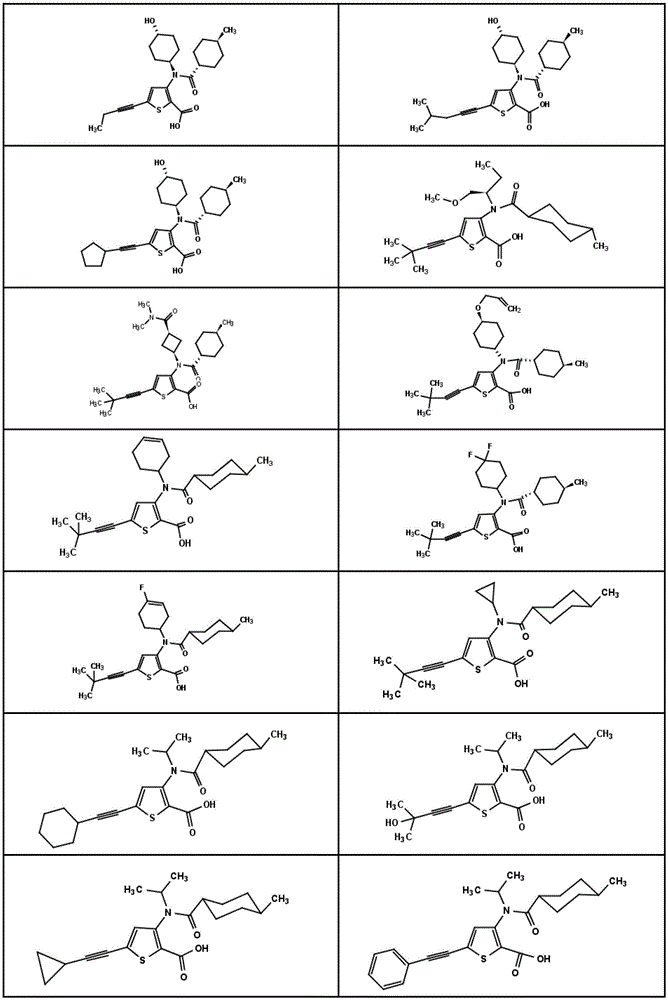
在一个实施方案中,本发明涉及选自如下或图1中所示的结构式的化合物或其药学上可接受的盐:In one embodiment, the present invention relates to a compound selected from the structural formulas shown below or in Figure 1 , or a pharmaceutically acceptable salt thereof:



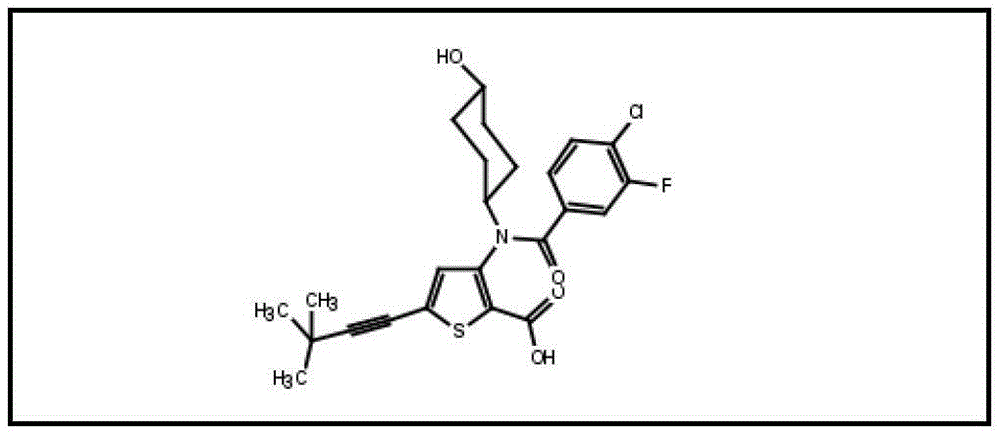
在另一个实施方案中,本发明涉及如下所示的化合物或其药学上可接受的盐:In another embodiment, the present invention relates to a compound as shown below or a pharmaceutically acceptable salt thereof:
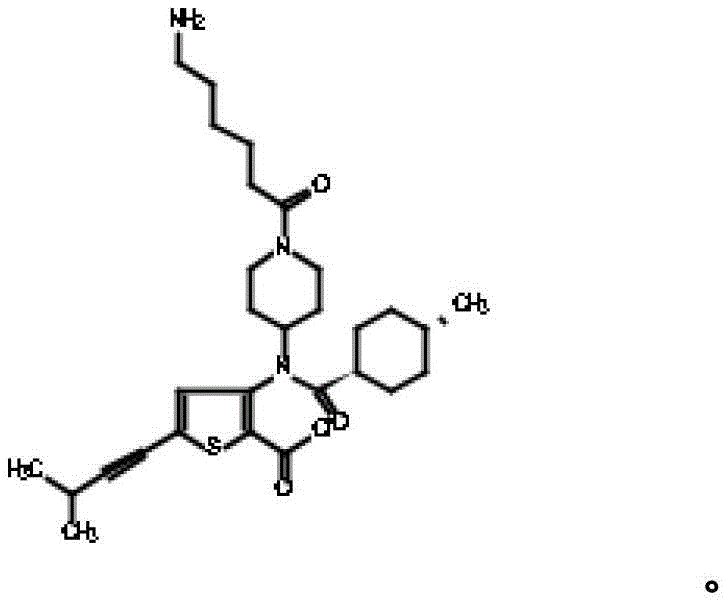
在另一个实施方案中,本发明涉及药物组合物,其包含本文所述的本发明化合物和药学上可接受的载体或赋形剂。In another embodiment, the invention is directed to a pharmaceutical composition comprising a compound of the invention as described herein and a pharmaceutically acceptable carrier or excipient.
在另一个实施方案中,本发明提供了治疗受试者HCV感染的方法,所述方法包括对该受试者给予治疗有效量的本文所述的本发明化合物。In another embodiment, the invention provides a method of treating HCV infection in a subject comprising administering to the subject a therapeutically effective amount of a compound of the invention described herein.
在另一个实施方案中,本发明涉及抑制或降低受试者中HCV聚合酶活性的方法,所述方法包括对该受试者给予治疗有效量的本文所述的本发明化合物。In another embodiment, the present invention is directed to a method of inhibiting or reducing HCV polymerase activity in a subject, the method comprising administering to the subject a therapeutically effective amount of a compound of the present invention described herein.
在另一个实施方案中,本发明涉及涉及抑制或降低体外生物样品中HCV聚合酶活性的方法,所述方法包括对该受试者给予有效量的本文所述的本发明化合物。In another embodiment, the present invention is directed to a method involving the inhibition or reduction of HCV polymerase activity in a biological sample in vitro, said method comprising administering to the subject an effective amount of a compound of the present invention described herein.
本发明还提供了本文所述的本发明化合物在制备用于治疗受试者HCV感染或抑制或降低受试者中HCV聚合酶活性的药物中的应用。The present invention also provides the use of the compounds of the present invention described herein for the manufacture of a medicament for treating HCV infection in a subject or inhibiting or reducing the activity of HCV polymerase in a subject.
本文还提供了本文所述的本发明化合物在治疗受试者HCV感染或抑制或降低受试者中HCV聚合酶活性中的应用。Also provided herein is the use of a compound of the invention described herein for treating HCV infection in a subject or for inhibiting or reducing HCV polymerase activity in a subject.
附图描述Description of drawings
图1显示了本发明的一些化合物。Figure 1 shows some compounds of the invention.
发明详述Detailed description of the invention
在一个方面中,本发明涉及由图1中所示的和以下示例的结构式表示的化合物或其药学上可接受的盐。In one aspect, the present invention relates to a compound represented by the structural formula shown in Figure 1 and exemplified below, or a pharmaceutically acceptable salt thereof.
在一个具体的实施方案中,所述化合物选自如下结构式或其药学上可接受的盐:In a specific embodiment, the compound is selected from the following structural formulas or pharmaceutically acceptable salts thereof:

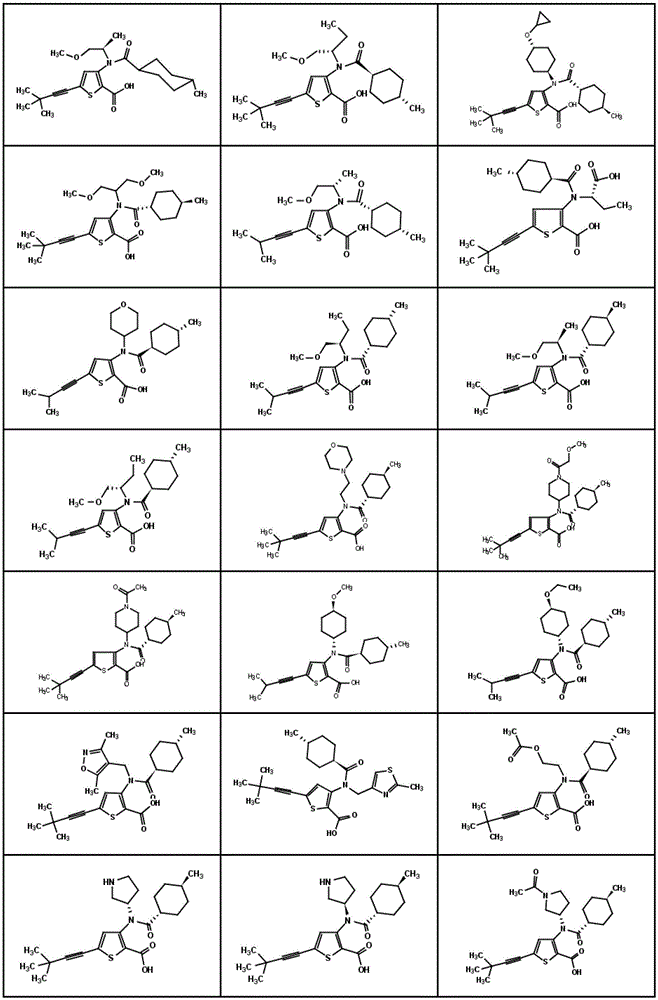

在另一个具体的实施方案中,所述化合物选自如下结构式或其药学上可接受的盐:In another specific embodiment, the compound is selected from the following structural formulas or pharmaceutically acceptable salts thereof:


在另一个具体的实施方案中,所述化合物选自如下结构式或其药学上可接受的盐:In another specific embodiment, the compound is selected from the following structural formulas or pharmaceutically acceptable salts thereof:

本领域技术人员可以理解,在本发明的方法中,起始试剂或中间体化合物上的一些官能团例如羟基或氨基可能需要被保护基保护。因此,化合物的制备在不同阶段可能涉及添加和除去一个或多个保护基。官能团的保护和脱保护描述在“Protective Groups in OrganicChemistry”,J.W.F.McOmie编辑,Plenum Press(1973)和“ProtectiveGroups in Organic Synthesis”,第3版,T.W.Greene和P.G.M.Wuts,Wiley Interscience,和“Protecting Groups,”第3版,P.J.Kocienski,Thieme(2005)中。Those skilled in the art can understand that in the method of the present invention, some functional groups such as hydroxyl or amino groups on the starting reagents or intermediate compounds may need to be protected by protecting groups. Thus, the preparation of a compound may involve, at various stages, the addition and removal of one or more protecting groups. Protection and deprotection of functional groups are described in "Protective Groups in Organic Chemistry", edited by J.W.F. McOmie, Plenum Press (1973) and "Protective Groups in Organic Synthesis", 3rd edition, T.W. Greene and P.G.M. Wuts, Wiley Interscience, and "Protecting Groups, 3rd edition, P.J. Kocienski, Thieme (2005).
出于本发明的目的,化学元素根据元素周期表(Periodic Table ofthe Elements),CAS版,Handbook of Chemistry and Physics,第75版鉴定。另外,有机化学的一般原理描述在“Organic Chemistry”,Thomas Sorrell,University Science Books,Sausolito:1999和“March's Advanced Organic Chemistry”,第5版,Ed.:Smith,M.B.和March,J.,John Wiley&Sons,New York:2001中,其完整内容引用在此作为参考。For purposes of this invention, chemical elements are identified according to the Periodic Table of the Elements, CAS Edition, Handbook of Chemistry and Physics, 75th Edition. Additionally, general principles of organic chemistry are described in "Organic Chemistry", Thomas Sorrell, University Science Books, Sausolito: 1999 and "March's Advanced Organic Chemistry", 5th ed., Ed.: Smith, M.B. and March, J., John Wiley & Sons , New York: 2001, the entire contents of which are incorporated herein by reference.
如本文所述,本发明化合物可以任选地被一个或多个取代基取代,例如如下所示例的,或者以上述化合物的确切大类、小类和品种为典型。将被领会到,措辞“任选取代的”可与措辞“取代或未取代的”互换使用。一般而言,术语“取代”无论前面有无术语“任选”都表示给定结构中的氢原子团被指定取代基的原子团代替。除非另有说明,否则任选取代的基团可以在该基团每一可取代的位置具有取代基,当任意给定结构中一个以上位置可以被一个以上选自指定基团的取代基取代时,取代基在每一位置可以是相同或不同的。当术语“任选取代的”位于清单之前时,该术语是指所列清单中所有后面可取代的基团。如果取代基或结构未鉴定或定义为“任选取代的”,则该取代基或结构未被取代。例如,如果X是任选取代的C1-C3烷基或苯基,则X可以是任选取代的C1-C3烷基或任选取代的苯基。同样,除非另有指示,否则如果术语“任选取代的”后面跟随清单,则该术语还指在前面的清单中的所有可取代的基团。例如:如果X是C1-C3烷基或苯基,其中X任选和独立地被JX取代,则C1-C3烷基和苯基可以任选被JX取代。正如本领域技术人员显而易见的,基团例如H、卤素、NO2、CN、NH2、OH或OCF3可以不是可取代的基团。As described herein, the compounds of the present invention may be optionally substituted with one or more substituents, such as exemplified below, or as typified by the exact class, subclass and species of compounds described above. It will be appreciated that the phrase "optionally substituted" may be used interchangeably with the phrase "substituted or unsubstituted." In general, the term "substituted" whether preceded by the term "optionally" means that a hydrogen radical in a given structure is replaced by a radical of the designated substituent. Unless otherwise stated, an optionally substituted group may have a substituent at each substitutable position of the group, when more than one position in any given structure may be substituted with one or more substituents selected from the specified group , the substituents may be the same or different at each position. When the term "optionally substituted" precedes a listing, the term refers to all subsequent substitutable groups in the listed listing. If a substituent or structure is not identified or defined as "optionally substituted," then that substituent or structure is unsubstituted. For example, if X is optionally substituted C 1 -C 3 alkyl or phenyl, X may be optionally substituted C 1 -C 3 alkyl or optionally substituted phenyl. Likewise, if the term "optionally substituted" is followed by a list, the term also refers to all substitutable groups in the preceding list, unless otherwise indicated. For example: if X is C1 - C3 alkyl or phenyl, wherein X is optionally and independently substituted with JX , then C1 - C3 alkyl and phenyl may be optionally substituted with JX . Groups such as H, halogen, NO2 , CN, NH2 , OH or OCF3 may not be substitutable groups, as will be apparent to those skilled in the art.
本文所用的措词“至多”是指零或等于或小于如下措词数量的任意整数。例如,“至多是3”是指0、1、2和3的任意一个。本文所用的具体原子数范围包括其中的任意整数。例如,具有1-4个原子的基团可以具有1、2、3或4个原子。The expression "up to" used herein refers to zero or any integer equal to or less than the number of the following expressions. For example, "up to 3" means any one of 0, 1, 2 and 3. As used herein, specific atomic number ranges include any integer therein. For example, a group having 1-4 atoms may have 1, 2, 3 or 4 atoms.
由本发明所涵盖的取代基和取代基组合的选择是导致稳定的或化学上可行的化合物生成的那些。本文所用的术语“稳定的”表示当出于本文公开的一种或多种目的而受到允许它们的生产、检测、特别地是回收、纯化和使用的条件处理时基本上不改变的化合物。在一些实施方案中,稳定的化合物或化学上可行的化合物是当在没有水分的存在或其他化学反应性条件下、在40℃或以下的温度下保持至少一周时基本上没有改变的化合物。仅关注那些产生稳定结构的取代基的选择和组合。这种选择和组合对本领域技术人员而言显而易见且可以在不进行过度实验的情况下确定。The selection of substituents and combinations of substituents contemplated by this invention are those that result in the formation of stable or chemically feasible compounds. The term "stable" as used herein denotes compounds that are substantially unchanged when subjected to conditions that permit their production, detection, especially recovery, purification and use for one or more of the purposes disclosed herein. In some embodiments, a stable compound or chemically feasible compound is a compound that does not substantially change when maintained at a temperature of 40° C. or below for at least one week in the absence of moisture or other chemically reactive conditions. Attention is paid to only those selections and combinations of substituents that result in stable structures. Such selections and combinations will be apparent to those skilled in the art and can be determined without undue experimentation.
本文所用的术语“脂族基”或“脂族基团”表示直链(即未分支)或支链烃链,它是完全饱和的或者含有一个或多个不饱和单元,但不是芳族的。除非另有指定,否则脂族基团包含1-10个脂族碳原子。在一些实施方案中,脂族基团包含1-6个脂族碳原子。在其他实施方案中,脂族基团包含1-4个脂族碳原子。脂族基团可以是直链或支链的取代或未取代的烷基、烯基或炔基。具体实例包括、但不限于甲基、乙基、异丙基、正丙基、仲丁基、乙烯基、正丁烯基、乙炔基和叔丁基和乙炔。As used herein, the term "aliphatic" or "aliphatic group" means a straight (ie, unbranched) or branched hydrocarbon chain, which is fully saturated or contains one or more units of unsaturation, but is not aromatic . Unless otherwise specified, aliphatic groups contain 1-10 aliphatic carbon atoms. In some embodiments, aliphatic groups contain 1-6 aliphatic carbon atoms. In other embodiments, aliphatic groups contain 1-4 aliphatic carbon atoms. An aliphatic group may be a linear or branched substituted or unsubstituted alkyl, alkenyl or alkynyl group. Specific examples include, but are not limited to, methyl, ethyl, isopropyl, n-propyl, sec-butyl, vinyl, n-butenyl, ethynyl, and t-butyl and acetylene.
术语“烷基”是指饱和直链或支链烃。本文所用的术语“烯基”是指包含一个或多个双键的直链或支链烃。本文所用的术语“炔基”是指包含一个或多个三键的直链或支链烃。本文所用的“烷基”、“烯基”或“炔基”各自可以任选如下所述被取代。在一些实施方案中,“烷基”是C1-C6烷基或C1-C4烷基。在一些实施方案中,“烯基”是C2-C6烯基或C2-C4烯基。在一些实施方案中,“炔基”是C2-C6炔基或C2-C4炔基。The term "alkyl" refers to a saturated straight or branched chain hydrocarbon. As used herein, the term "alkenyl" refers to a straight or branched chain hydrocarbon containing one or more double bonds. As used herein, the term "alkynyl" refers to a straight or branched chain hydrocarbon containing one or more triple bonds. Each of "alkyl", "alkenyl" or "alkynyl" as used herein may be optionally substituted as described below. In some embodiments, "alkyl" is C 1 -C 6 alkyl or C 1 -C 4 alkyl. In some embodiments, "alkenyl" is C 2 -C 6 alkenyl or C 2 -C 4 alkenyl. In some embodiments, "alkynyl" is C 2 -C 6 alkynyl or C 2 -C 4 alkynyl.
本文所用的术语“脂环族基团”(或“碳环”或“碳环基”或“碳环基团”)是指仅包含非芳香碳的环系,其可以是饱和的或包含一个或多个不饱和单元,具有3-14个环碳原子。在一些实施方案中,碳原子数是3-10。在其他实施方案中,碳原子数是4-7。在其他实施方案中,碳原子数是5或6。该术语包括单环、双环或多环稠合、螺或桥连碳环环系。该术语还包括多环环系,其中碳环可以与一个或多个非芳香碳环或杂环或一个或多个芳香环或其组合“稠合”,其中连接基团或点位于碳环上。“稠合”双环环系包含两个共有两个相邻环原子的环。桥连双环基团包含两个共有3或4个相邻环原子的环。螺双环环系共有一个环原子。脂环族基团的实例包括、但不限于环烷基和环烯基。具体实例包括、但不限于环己基、环丙烯基和环丁基。The term "cycloaliphatic" (or "carbocycle" or "carbocyclyl" or "carbocyclic group") as used herein refers to a ring system containing only non-aromatic carbons, which may be saturated or contain one or multiple unsaturated units with 3-14 ring carbon atoms. In some embodiments, the number of carbon atoms is 3-10. In other embodiments, the number of carbon atoms is 4-7. In other embodiments, the number of carbon atoms is 5 or 6. The term includes monocyclic, bicyclic or polycyclic fused, spiro or bridged carbocyclic ring systems. The term also includes polycyclic ring systems in which a carbocycle may be "fused" to one or more non-aromatic carbocyclic or heterocyclic rings or one or more aromatic rings or combinations thereof, wherein the group or point of attachment is on the carbocycle . A "fused" bicyclic ring system comprises two rings that share two adjacent ring atoms. A bridged bicyclic group comprises two rings which share 3 or 4 adjacent ring atoms. Spirobicyclic ring systems share one ring atom. Examples of cycloaliphatic groups include, but are not limited to, cycloalkyl and cycloalkenyl. Specific examples include, but are not limited to, cyclohexyl, cyclopropenyl, and cyclobutyl.
本文所用的术语“杂环”(或“杂环基”或“杂环基团”或“非芳香杂环”)是指非芳香环系,其可以是饱和的或包含一个或多个不饱和单元,具有3-14个环原子,其中一个或多个环碳被杂原子例如N、S或O替代。在一些实施方案中,非芳香杂环在环内包含至多3个选自N、S和O的杂原子。在其他实施方案中,非芳香杂环在环系内包含至多2个选自N、S和O的杂原子。在其他实施方案中,非芳香杂环在环系内包含至多3个选自N和O的杂原子。在其他实施方案中,非芳香杂环在环系内包含至多2个选自N和O的杂原子。该术语包括单环、双环或多环稠合、螺或桥连杂环环系。该术语还包括多环环系,其中杂环可以与一个或多个非芳香碳环或杂环或一个或多个芳香环或其组合稠合,其中连接基团或点位于杂环上。杂环的实例包括、但不限于哌啶基、哌嗪基、吡咯烷基、吡唑烷基、咪唑烷基、氮杂庚环基、二氮杂庚环基、三氮杂庚环基、氮杂环辛烷基、二氮杂环辛烷基、三氮杂环辛烷基、噁唑烷基、异噁唑烷基、噻唑烷基、异噻唑烷基、氧杂氮杂环辛烷基、氧杂氮杂环庚烷基、硫杂氮杂环庚烷基、硫杂氮杂环辛烷基、苯并咪唑酮基、四氢呋喃基、四氢呋喃基、四氢噻吩基、四氢噻吩基、吗啉代包括例如3-吗啉代、4-吗啉代、2-硫吗啉代、3-硫吗啉代、4-硫吗啉代、1-吡咯烷基、2-吡咯烷基、3-吡咯烷基、1-四氢吡嗪基、2-四氢吡嗪基、3-四氢吡嗪基、1-哌啶基、2-哌啶基、3-哌啶基、1-吡唑啉基、3-吡唑啉基、4-吡唑啉基、5-吡唑啉基、1-哌啶基、2-哌啶基、3-哌啶基、4-哌啶基、2-噻唑烷基、3-噻唑烷基、4-噻唑烷基、1-咪唑烷基、2-咪唑烷基、4-咪唑烷基、5-咪唑烷基、二氢吲哚基、四氢喹啉基、四氢异喹啉基、苯并二硫戊环基、苯并二噻烷基、3-(1-烷基)-苯并咪唑-2-酮基和1,3-二氢-咪唑-2-酮基。The term "heterocycle" (or "heterocyclyl" or "heterocyclic group" or "non-aromatic heterocycle") as used herein refers to a non-aromatic ring system which may be saturated or contain one or more unsaturated Units having 3-14 ring atoms in which one or more ring carbons are replaced by heteroatoms such as N, S or O. In some embodiments, the non-aromatic heterocycle contains up to 3 heteroatoms selected from N, S, and O within the ring. In other embodiments, non-aromatic heterocycles contain up to 2 heteroatoms selected from N, S, and O within the ring system. In other embodiments, non-aromatic heterocycles contain up to 3 heteroatoms selected from N and O within the ring system. In other embodiments, non-aromatic heterocycles contain up to 2 heteroatoms selected from N and O within the ring system. The term includes monocyclic, bicyclic or polycyclic fused, spiro or bridged heterocyclic ring systems. The term also includes polycyclic ring systems in which the heterocyclic ring may be fused to one or more non-aromatic carbocyclic or heterocyclic rings or one or more aromatic rings or combinations thereof, wherein the group or point of attachment is on the heterocyclic ring. Examples of heterocycles include, but are not limited to, piperidinyl, piperazinyl, pyrrolidinyl, pyrazolidinyl, imidazolidinyl, azepanyl, diazepanyl, triazepanyl, Azacyclooctyl, diazacyclooctyl, triazoctanyl, oxazolidinyl, isoxazolidinyl, thiazolidinyl, isothiazolidinyl, oxazoctanyl base, oxazepanyl, thiazepanyl, thiazacyclooctyl, benzimidazolone, tetrahydrofuryl, tetrahydrofuryl, tetrahydrothiophenyl, tetrahydrothiophenyl , Morpholino include for example 3-morpholino, 4-morpholino, 2-thiomorpholino, 3-thiomorpholino, 4-thiomorpholino, 1-pyrrolidinyl, 2-pyrrolidinyl , 3-pyrrolidinyl, 1-tetrahydropyrazinyl, 2-tetrahydropyrazinyl, 3-tetrahydropyrazinyl, 1-piperidinyl, 2-piperidinyl, 3-piperidinyl, 1 -pyrazolinyl, 3-pyrazolinyl, 4-pyrazolinyl, 5-pyrazolinyl, 1-piperidinyl, 2-piperidinyl, 3-piperidinyl, 4-piperidinyl , 2-thiazolidinyl, 3-thiazolidinyl, 4-thiazolidinyl, 1-imidazolidinyl, 2-imidazolidinyl, 4-imidazolidinyl, 5-imidazolidinyl, indolinyl, four Hydroquinolyl, tetrahydroisoquinolyl, benzodithiolanyl, benzodithianyl, 3-(1-alkyl)-benzimidazol-2-one and 1,3-di Hydrogen-imidazol-2-one group.
术语“芳基”(或“芳基环”或“芳基基团”)单独使用或作为较大部分如“芳烷基”、“芳烷氧基”、“芳氧基烷基”或“杂芳基”的组成部分是指碳环和杂环芳香环系。术语“芳基”可以与术语“芳基环”或“芳基基团”互换使用。“碳环芳香环”基团仅具有碳环原子(典型地6-14)且包括单环芳香环,例如苯基和稠合多环芳香环系,其中两个或多个碳环芳香环彼此稠合。实例包括1-萘基、2-萘基、1-蒽基和2-蒽基。本文所用的术语“碳环芳香环”或“碳环芳香化合物”范围内还包括这样的基团,其中芳香环与一个或多个非芳香环(碳环或杂环)“稠合”,例如在茚满基、邻苯二甲酰亚胺基、萘酰亚胺基、菲啶基或四氢萘基中,其中连接基团或点位于芳香环上。The term "aryl" (or "aryl ring" or "aryl group") is used alone or as a larger moiety such as "aralkyl", "aralkoxy", "aryloxyalkyl" or " "Heteroaryl" moieties refer to carbocyclic and heterocyclic aromatic ring systems. The term "aryl" is used interchangeably with the terms "aryl ring" or "aryl group". "Carbocyclic aromatic ring" groups have only carbon ring atoms (typically 6-14) and include monocyclic aromatic rings such as phenyl and fused polycyclic aromatic ring systems in which two or more carbocyclic aromatic rings are separated from each other fused. Examples include 1-naphthyl, 2-naphthyl, 1-anthracenyl and 2-anthracenyl. Also included within the term "carbocyclic aromatic ring" or "carbocyclic aromatic compound" as used herein are groups in which an aromatic ring is "fused" to one or more non-aromatic rings (carbocyclic or heterocyclic), for example In indanyl, phthalimide, naphthimidyl, phenanthridinyl or tetrahydronaphthyl, wherein the linking group or point is on the aromatic ring.
术语“杂芳基”、“杂芳香化合物”、“杂芳基环”、“杂芳基基团”和“杂芳香基团”单独使用或作为较大部分如“杂芳烷基”或“杂芳烷氧基”的组成部分是指具有5-14个成员的杂芳香环基团,其中一个或多个环碳被杂原子例如N、S或O替代。在一些实施方案中,杂芳基环在环内包含至多3个选自N、S和O的杂原子。在其他实施方案中,杂芳基环在环系内包含至多2个选自N、S和O的杂原子。在其他实施方案中,杂芳基环在环系内包含至多3个选自N和O的杂原子。在其他实施方案中,杂芳基环在环系内包含至多2个选自N和O的杂原子。杂芳基环包括单环杂芳香环和多环芳香环,其中单环芳香环与一个或多个另外的芳香环稠合。本文所用的术语“杂芳基”范围内还包括这样的基团,其中芳香环与一个或多个非芳香环(碳环或杂环)“稠合”,其中连接基团或点位于芳香环上。本文所用的双环6,5杂芳香环例如是与第二个5元环稠合的6元杂芳香环,其中连接基团或点位于6元环上。杂芳基的实例包括吡啶基、吡嗪基、嘧啶基、哒嗪基、咪唑基、吡咯基、吡唑基、三唑基、四唑基、噁唑基、异噁唑基、噁二唑基、噻唑基、异噻唑基或噻二唑基包括例如2-呋喃基、3-呋喃基、N-咪唑基、2-咪唑基、4-咪唑基、5-咪唑基、3-异噁唑基、4-异噁唑基、5-异噁唑基、2-噁二唑基、5-噁二唑基、2-噁唑基、4-噁唑基、5-噁唑基、3-吡唑基、4-吡唑基、1-吡咯基、2-吡咯基、3-吡咯基、2-吡啶基、3-吡啶基、4-吡啶基、2-嘧啶基、4-嘧啶基、5-嘧啶基、3-哒嗪基、2-噻唑基、4-噻唑基、5-噻唑基、2-三唑基、5-三唑基、四唑基、2-噻吩基、3-噻吩基、咔唑基、苯并咪唑基、苯并噻吩基、苯并呋喃基、吲哚基、苯并三唑基、苯并噻唑基、苯并噁唑基、苯并咪唑基、异喹啉基、吲哚基、异吲哚基、吖啶基、苯并异噁唑基、异噻唑基、1,2,3-噁二唑基、1,2,5-噁二唑基、1,2,4-噁二唑基、1,2,3-三唑基、1,2,3-噻二唑基、1,3,4-噻二唑基、1,2,5-噻二唑基、嘌呤基、吡嗪基、1,3,5-三嗪基、喹啉基(例如2-喹啉基、3-喹啉基、4-喹啉基)和异喹啉基(例如1-异喹啉基、3-异喹啉基或4-异喹啉基)。The terms "heteroaryl", "heteroaromatic compound", "heteroaryl ring", "heteroaryl group" and "heteroaromatic group" are used alone or as a larger part such as "heteroaralkyl" or " The "heteroaralkoxy" moiety refers to a heteroaromatic ring group having 5-14 members in which one or more ring carbons are replaced by a heteroatom such as N, S or O. In some embodiments, the heteroaryl ring contains up to 3 heteroatoms selected from N, S, and O within the ring. In other embodiments, heteroaryl rings contain up to 2 heteroatoms selected from N, S, and O within the ring system. In other embodiments, the heteroaryl ring contains up to 3 heteroatoms selected from N and O within the ring system. In other embodiments, heteroaryl rings contain up to 2 heteroatoms selected from N and O within the ring system. Heteroaryl rings include monocyclic heteroaromatic rings and polycyclic aromatic rings, wherein a monocyclic aromatic ring is fused to one or more additional aromatic rings. Also included within the term "heteroaryl" as used herein are groups in which an aromatic ring is "fused" to one or more non-aromatic rings (carbocyclic or heterocyclic) where the radical or point of attachment is at the aromatic ring superior. A bicyclic 6,5 heteroaromatic ring as used herein is, for example, a 6-membered heteroaromatic ring fused to a second 5-membered ring, wherein the attachment group or point is on the 6-membered ring. Examples of heteroaryl groups include pyridyl, pyrazinyl, pyrimidinyl, pyridazinyl, imidazolyl, pyrrolyl, pyrazolyl, triazolyl, tetrazolyl, oxazolyl, isoxazolyl, oxadiazole Base, thiazolyl, isothiazolyl or thiadiazolyl include, for example, 2-furyl, 3-furyl, N-imidazolyl, 2-imidazolyl, 4-imidazolyl, 5-imidazolyl, 3-isoxazole Base, 4-isoxazolyl, 5-isoxazolyl, 2-oxadiazolyl, 5-oxadiazolyl, 2-oxazolyl, 4-oxazolyl, 5-oxazolyl, 3- Pyrazolyl, 4-pyrazolyl, 1-pyrrolyl, 2-pyrrolyl, 3-pyrrolyl, 2-pyridyl, 3-pyridyl, 4-pyridyl, 2-pyrimidinyl, 4-pyrimidinyl, 5-pyrimidinyl, 3-pyridazinyl, 2-thiazolyl, 4-thiazolyl, 5-thiazolyl, 2-triazolyl, 5-triazolyl, tetrazolyl, 2-thienyl, 3-thiophene Base, carbazolyl, benzimidazolyl, benzothienyl, benzofuryl, indolyl, benzotriazolyl, benzothiazolyl, benzoxazolyl, benzimidazolyl, isoquinoline Base, indolyl, isoindolyl, acridinyl, benzisoxazolyl, isothiazolyl, 1,2,3-oxadiazolyl, 1,2,5-oxadiazolyl, 1, 2,4-oxadiazolyl, 1,2,3-triazolyl, 1,2,3-thiadiazolyl, 1,3,4-thiadiazolyl, 1,2,5-thiadiazolyl base, purinyl, pyrazinyl, 1,3,5-triazinyl, quinolinyl (such as 2-quinolyl, 3-quinolyl, 4-quinolyl) and isoquinolyl (such as 1 -isoquinolinyl, 3-isoquinolinyl or 4-isoquinolinyl).
本文所用的“环”、“环状”、“环状基团”或“环部分”包括单-、双-和三-环环系,包括脂环族基团、杂脂环族基团、芳基或杂芳基,其各自如上述所定义。"Ring", "cyclic", "cyclic group" or "ring moiety" as used herein includes mono-, bi- and tri-cyclic ring systems, including cycloaliphatic groups, heteroalicyclic groups, Aryl or heteroaryl, each as defined above.
本文所用的“桥连环系”包括构成两个环的8-12(例如9、10或11)元结构,其中所述的两个环具有至少一个共用的原子(例如共用2个原子)。桥连环系包括双环脂族基团(例如双环烷基或双环烯基)、双环杂脂族基团、双环芳基和双环杂芳基。As used herein, "bridged ring system" includes 8-12 (eg, 9, 10 or 11) membered structures comprising two rings having at least one atom in common (eg, 2 atoms in common). Bridged ring systems include bicyclic aliphatics (eg, bicycloalkyl or bicycloalkenyl), bicyclic heteroaliphatics, bicyclic aryls, and bicyclic heteroaryls.
本文所用的“桥连双环环系”是指双环杂脂环族环系或双环脂环族环系,其中所述环是桥连的。桥连环系的实例包括、但不限于金刚烷基、降莰烷基、双环[3.2.1]辛基、双环[2.2.2]辛基、双环[3.3.1]壬基、双环[3.2.3]壬基、2-氧杂-双环[2.2.2]辛基、1-氮杂-双环[2.2.2]辛基、3-氮杂-双环[3.2.1]辛基和2,6-二氧杂-三环[3.3.1.03,7]壬基。桥连双环环系可以任选被一个或多个取代基取代,所述取代基例如烷基(包括羧基烷基、羟基烷基和卤代烷基例如三氟甲基)、烯基、炔基、环烷基、(环烷基)烷基、杂环烷基、(杂环烷基)烷基、芳基、杂芳基、烷氧基、环烷氧基、杂环烷氧基、芳氧基、杂芳氧基、芳烷氧基、杂芳烷氧基、芳酰基、杂芳酰基、硝基、羧基、烷氧羰基、烷基羰基氧基、氨基羰基、烷基羰基氨基、环烷基羰基氨基、(环烷基烷基)羰基氨基、芳基羰基氨基、芳烷基羰基氨基、(杂环烷基)羰基氨基、(杂环烷基烷基)羰基氨基、杂芳基羰基氨基、杂芳烷基羰基氨基、氰基、卤素、羟基、酰基、巯基、烷基硫烷基、磺氧基、脲、硫脲、氨磺酰基、磺酰胺、氧代或氨基甲酰基。As used herein, "bridged bicyclic ring system" refers to a bicyclic heteroalicyclic ring system or a bicyclic alicyclic ring system wherein the rings are bridged. Examples of bridged ring systems include, but are not limited to, adamantyl, norbornyl, bicyclo[3.2.1]octyl, bicyclo[2.2.2]octyl, bicyclo[3.3.1]nonyl, bicyclo[3.2. 3] nonyl, 2-oxa-bicyclo[2.2.2]octyl, 1-aza-bicyclo[2.2.2]octyl, 3-aza-bicyclo[3.2.1]octyl and 2,6 -Dioxa-tricyclo[3.3.1.03,7]nonyl. The bridged bicyclic ring system may be optionally substituted with one or more substituents such as alkyl (including carboxyalkyl, hydroxyalkyl and haloalkyl such as trifluoromethyl), alkenyl, alkynyl, cyclic Alkyl, (cycloalkyl)alkyl, heterocycloalkyl, (heterocycloalkyl)alkyl, aryl, heteroaryl, alkoxy, cycloalkoxy, heterocycloalkoxy, aryloxy , heteroaryloxy, aralkoxy, heteroaralkoxy, aroyl, heteroaroyl, nitro, carboxyl, alkoxycarbonyl, alkylcarbonyloxy, aminocarbonyl, alkylcarbonylamino, cycloalkyl Carbonylamino, (cycloalkylalkyl)carbonylamino, arylcarbonylamino, aralkylcarbonylamino, (heterocycloalkyl)carbonylamino, (heterocycloalkylalkyl)carbonylamino, heteroarylcarbonylamino, Heteroaralkylcarbonylamino, cyano, halogen, hydroxy, acyl, mercapto, alkylsulfanyl, sulfoxy, urea, thiourea, sulfamoyl, sulfonamide, oxo or carbamoyl.
本文所用的“桥”是键或原子或连接分子的两个不同部分的无支链原子。通过桥连接的两个原子(通常、但并非始终是两个叔碳原子)称作“桥头”。A "bridge" as used herein is a bond or an atom or unbranched chain of atoms connecting two different parts of a molecule. Two atoms (usually, but not always, two tertiary carbon atoms) connected by a bridge are called "bridgeheads".
本文所用的术语“螺”是指在两个环之间具有一个原子(通常是季碳)作为唯一共用原子的环系。The term "spiro" as used herein refers to a ring system having one atom (usually a quaternary carbon) as the only shared atom between two rings.
术语“环原子”是原子,例如C、N、O或S,其位于芳香基团、环烷基或非芳香杂环的环上。The term "ring atom" is an atom, such as C, N, O or S, which is located in the ring of an aromatic group, cycloalkyl group or non-aromatic heterocycle.
芳香基团上“可取代的环原子”是或通过氢原子键合的环碳氮原子。氢可以任选被适合的取代基替代。因此,术语“可取代的环原子”不包括两个环稠合时共用的氮或碳原子。此外,“可取代的环原子”不包括结构描述它们已经结合非氢的部分时的环碳或氮原子。A "substitutable ring atom" on an aromatic group is a ring carbon nitrogen atom bonded to or through a hydrogen atom. Hydrogen may optionally be replaced by suitable substituents. Thus, the term "substitutable ring atom" does not include nitrogen or carbon atoms that are common to two rings that are fused. Furthermore, "substitutable ring atoms" do not include ring carbon or nitrogen atoms when the structure depicts them as having bonded to a moiety other than hydrogen.
术语“杂原子”是指一个或多个氧、硫、氮、磷或硅(包括氮、硫、磷或硅的任意氧化形式;任意碱性氮的季铵化形式;或杂环的可取代氮,例如N(如在3,4-二氢-2H-吡咯基上)、NH(如在吡咯烷基上)或NR+(如在N-取代的吡咯烷基上))。The term "heteroatom" refers to one or more of oxygen, sulfur, nitrogen, phosphorus, or silicon (including any oxidized form of nitrogen, sulfur, phosphorus, or silicon; quaternized form of any basic nitrogen; or substitutable Nitrogen, eg N (as on 3,4-dihydro-2H-pyrrolyl), NH (as on pyrrolidinyl) or NR + (as on N-substituted pyrrolidinyl)).
本文所用的任选取代的芳烷基可以在烷基和芳基部分上被取代。除非另有指示,否则本文所用的任选取代的芳烷基任选在芳基部分上被取代。Optionally substituted aralkyl groups used herein may be substituted on both the alkyl and aryl moieties. As used herein, unless otherwise indicated, optionally substituted aralkyl is optionally substituted on the aryl moiety.
在一些实施方案中,脂族基团和杂环可以独立地包含一个或多个取代基。脂族基团或非芳香杂环的饱和碳上适合的取代基选自上述那些。其他适合的取代基包括适合于芳基或杂芳基的不饱和碳所列的那些并且还包括如下取代基:=O、=S、=NNHR*、=NN(R*)2、=NNHC(O)R*、=NNHCO2(烷基)、=NNHSO2(烷基)或=NR*,其中R*各自独立地选自氢或任选取代的C1-6脂族基团。R*的脂族基团上任选取代基选自NH2、NH(C1-4脂族基团)、N(C1-4脂族基团)2、卤素、C1-4脂族基团、OH、O(C1-4脂族基团)、NO2、CN、CO2H、CO2(C1-4脂族基团)、O(卤代C1-4脂族基团)或卤代(C1-4脂族基团),其中上述R*的C1-4脂族基团各自未被取代。In some embodiments, aliphatic groups and heterocycles may independently contain one or more substituents. Suitable substituents on an aliphatic group or on a saturated carbon of a non-aromatic heterocyclic ring are selected from those mentioned above. Other suitable substituents include those listed for unsaturated carbons of aryl or heteroaryl groups and also include the following substituents: =O, =S, =NNHR * , =NN(R * ) 2 , =NNHC( O) R * , = NNHCO2 (alkyl), = NNHSO2 (alkyl), or =NR * , wherein each R * is independently selected from hydrogen or an optionally substituted C1-6 aliphatic group. The optional substituent on the aliphatic group of R * is selected from NH 2 , NH(C 1-4 aliphatic group), N(C 1-4 aliphatic group) 2 , halogen, C 1-4 aliphatic group group, OH, O(C 1-4 aliphatic group), NO 2 , CN, CO 2 H, CO 2 (C 1-4 aliphatic group), O(halogenated C 1-4 aliphatic group group) or halogenated (C 1-4 aliphatic group), wherein each of the above-mentioned C 1-4 aliphatic groups of R * is unsubstituted.
在一些实施方案中,杂环氮上的任选取代基包括上述那些。这种适合的取代基的实例包括-OH、-NH2、-NH(C1-C4烷基)、-N(C1-C4烷基)2、-CO(C1-C4烷基)、-CO2H、-CO2(C1-C4烷基)、-O(C1-C4烷基)和C1-C4脂族基团,其任选被一个或多个取代基取代,所述的取代基独立地选自卤素、氧代、-CN、-OH、-NH2、-NH(C1-C4烷基)、-N(C1-C4烷基)2、-OCO(C1-C4烷基)、-CO(C1-C4烷基)、-CO2H、-CO2(C1-C4烷基)、-O(C1-C4烷基)、C3-7环烷基和C3-7环(卤代烷基)。其他适合的取代基包括-R+、-N(R+)2、-C(O)R+、-CO2R+、-C(O)C(O)R+、-C(O)CH2C(O)R+、-SO2R+、-SO2N(R+)2、-C(=S)N(R+)2、-C(=NH)-N(R+)2或-NR+SO2R+;其中R+是氢。任选取代的C1-6脂族基团、任选取代的苯基、任选取代的-O(Ph)、任选取代的-CH2(Ph)、任选取代的-(CH2)2(Ph);任选取代的-CH=CH(Ph);或具有1-4个独立地选自氧、氮或硫的杂原子的未取代的5-6元杂芳基或杂环;或相同取代基或不同取代基上两次独立出现的R+与R+基团所键合的原子一起形成5-8-元杂环基、芳基或杂芳基环或3-8-元环烷基环,其中所述杂芳基或杂环具有1-3个独立地选自氮、氧或硫的杂原子。R+的脂族基团或苯环上的任选取代基选自NH2、NH(C1-4脂族基团)、N(C1-4脂族基团)2、卤素、C1-4脂族基团、OH、O(C1-4脂族基团)、NO2、CN、CO2H、CO2(C1-4脂族基团)、O(卤代C1-4脂族基团)或卤代(C1-4脂族基团),其中上述R+的C1-4脂族基团各自未被取代。In some embodiments, optional substituents on the heterocyclic nitrogen include those described above. Examples of such suitable substituents include -OH, -NH 2 , -NH(C 1 -C 4 alkyl), -N(C 1 -C 4 alkyl) 2 , -CO(C 1 -C 4 alk radical), -CO 2 H, -CO 2 (C 1 -C 4 alkyl), -O (C 1 -C 4 alkyl) and C 1 -C 4 aliphatic groups, which are optionally replaced by one or more Substituents are substituted, and the substituents are independently selected from halogen, oxo, -CN, -OH, -NH 2 , -NH(C 1 -C 4 alkyl), -N(C 1 -C 4 alkane group) 2 , -OCO(C 1 -C 4 alkyl), -CO(C 1 -C 4 alkyl), -CO 2 H, -CO 2 (C 1 -C 4 alkyl), -O(C 1 -C 4 alkyl), C 3-7 cycloalkyl and C 3-7 ring (haloalkyl). Other suitable substituents include -R + , -N(R + ) 2 , -C(O)R + , -CO 2 R + , -C(O)C(O)R + , -C(O)CH 2 C(O)R + , -SO 2 R + , -SO 2 N(R + ) 2 , -C(=S)N(R + ) 2 , -C(=NH)-N(R + ) 2 or - NR + SO 2 R + ; where R + is hydrogen. Optionally substituted C 1-6 aliphatic group, optionally substituted phenyl, optionally substituted -O(Ph), optionally substituted -CH 2 (Ph), optionally substituted -(CH 2 ) 2 (Ph); optionally substituted -CH=CH(Ph); or an unsubstituted 5-6 membered heteroaryl or heterocycle having 1-4 heteroatoms independently selected from oxygen, nitrogen, or sulfur; Or two independent occurrences of R + on the same substituent or different substituents together with the atom to which the R + group is bonded form a 5-8-membered heterocyclyl, aryl or heteroaryl ring or a 3-8-membered Cycloalkyl rings, wherein the heteroaryl or heterocycle has 1-3 heteroatoms independently selected from nitrogen, oxygen or sulfur. The aliphatic group of R + or the optional substituent on the benzene ring is selected from NH 2 , NH(C 1-4 aliphatic group), N(C 1-4 aliphatic group) 2 , halogen, C 1 -4 aliphatic group, OH, O(C 1-4 aliphatic group), NO 2 , CN, CO 2 H, CO 2 (C 1-4 aliphatic group), O(halogenated C 1-4 4 aliphatic group) or halogenated (C 1-4 aliphatic group), wherein each of the above R + C 1-4 aliphatic groups is unsubstituted.
在一些实施方案中,芳基(包括芳烷基、芳烷氧基、芳氧基烷基等)或杂芳基(包括杂芳烷基和杂芳基烷氧基等)可以包含一个或多个取代基。芳基或杂芳基的不饱和碳原子上适合的取代基选自上述那些。具体实例包括卤素、-CN、-OH、-NH2、-NH(C1-C4烷基)、-N(C1-C4烷基)2、-OCO(C1-C4烷基)、-CO(C1-C4烷基)、-CO2H、-CO2(C1-C4烷基)、-O(C1-C4烷基)和任选被一个或多个取代基取代的C1-C4脂族基团,所述取代基独立地选自卤素、氧代、-CN、-OH、-NH2、-NH(C1-C4烷基)、-N(C1-C4烷基)2、-OCO(C1-C4烷基)、-CO(C1-C4烷基)、-CO2H、-CO2(C1-C4烷基)、-O(C1-C4烷基)、C3-7环烷基和C3-7环(卤代烷基)。其他适合的取代基包括:卤素;-R°;-OR°;-SR°;1,2-亚甲二氧基;1,2-亚乙二氧基;任选被R°取代的苯基(Ph);任选被R°取代的-O(Ph);任选被R°取代的-(CH2)1-2(Ph);任选被R°取代的-CH=CH(Ph);-NO2;-CN;-N(R°)2;-NR°C(O)R°;-NR°C(S)R°;-NR°C(O)N(R°)2;-NR°C(S)N(R°)2;-NR°CO2R°;-NR°NR°C(O)R°;-NR°NR°C(O)N(R°)2;-NR°NR°CO2R°;-C(O)C(O)R°;-C(O)CH2C(O)R°;-CO2R°;-C(O)R°;-C(S)R°;-C(O)N(R°)2;-C(S)N(R°)2;-OC(O)N(R°)2;-OC(O)R°;-C(O)N(OR°)R°;-C(NOR°)R°;-S(O)2R°;-S(O)3R°;-SO2N(R°)2;-S(O)R°;-NR°SO2N(R°)2;-NR°SO2R°;-N(OR°)R°;-C(=NH)-N(R°)2;或-(CH2)0-2NHC(O)R°;其中每个独立出现的R°选自氢、任选取代的C1-6脂族基团、未取代的5-6元杂芳基或杂环、苯基、-O(Ph)或-CH2(Ph);或相同取代基或不同取代基上两个独立出现的R°与每个R°基团所键合的原子一起形成5-8-元杂环基、芳基或杂芳基环或3-8-元环烷基环,其中所述杂芳基或杂环基环具有1-3个独立地选自氮、氧或硫的杂原子。R°的脂族基团上的任选取代基选自NH2、NH(C1-4脂族基团)、N(C1-4脂族基团)2、卤素、C1-4脂族基团、OH、O(C1-4脂族基团)、NO2、CN、CO2H、CO2(C1-4脂族基团)、O(卤代C1-4脂族基团)或卤代C1-4脂族基团、CHO、N(CO)(C1-4脂族基团)、C(O)N(C1-4脂族基团)、其中上述R°的C1-4脂族基团各自未被取代。In some embodiments, an aryl group (including aralkyl, aralkoxy, aryloxyalkyl, etc.) or heteroaryl (including heteroaralkyl and heteroarylalkoxy, etc.) may contain one or more a substituent. Suitable substituents on unsaturated carbon atoms of aryl or heteroaryl are selected from those mentioned above. Specific examples include halogen, -CN, -OH, -NH 2 , -NH(C 1 -C 4 alkyl), -N(C 1 -C 4 alkyl) 2 , -OCO(C 1 -C 4 alkyl ), -CO(C 1 -C 4 alkyl), -CO 2 H, -CO 2 (C 1 -C 4 alkyl), -O(C 1 -C 4 alkyl) and optionally one or more A C 1 -C 4 aliphatic group substituted by substituents independently selected from halogen, oxo, -CN, -OH, -NH 2 , -NH(C 1 -C 4 alkyl), -N(C 1 -C 4 alkyl) 2 , -OCO(C 1 -C 4 alkyl), -CO(C 1 -C 4 alkyl), -CO 2 H, -CO 2 (C 1 -C 4 alkyl), -O(C 1 -C 4 alkyl), C 3-7 cycloalkyl and C 3-7 ring (haloalkyl). Other suitable substituents include: halogen; -R°; -OR°; -SR°; 1,2-methylenedioxy; 1,2-ethylenedioxy; phenyl optionally substituted by R° (Ph); optionally substituted by R° -O(Ph); optionally substituted by R° -(CH 2 ) 1-2 (Ph); optionally substituted by R° -CH=CH(Ph) ;-NO 2 ;-CN;-N(R°) 2 ;-NR°C(O)R°;-NR°C(S)R°;-NR°C(O)N(R°) 2 ; -NR°C(S)N(R°) 2 ;-NR° CO2R °;-NR°NR°C(O)R°;-NR°NR°C(O)N(R°) 2 ; -NR°NR°CO 2 R°; -C(O)C(O)R°; -C(O)CH 2 C(O)R°; -CO 2 R°; -C(O)R°; -C(S)R°; -C(O)N(R°) 2 ; -C(S)N(R°) 2 ; -OC(O)N(R°) 2 ; -OC(O)R °; -C(O)N(OR°)R°; -C(NOR°)R°; -S(O) 2 R°; -S(O) 3 R°; -SO 2 N(R°) 2 ;-S(O)R°;-NR°SO 2 N(R°) 2 ;-NR°SO 2 R°;-N(OR°)R°;-C(=NH)-N(R° ) 2 ; or -(CH 2 ) 0-2 NHC(O)R °; wherein each independently occurring R ° is selected from hydrogen, optionally substituted C 1-6 aliphatic group, unsubstituted 5-6 membered heteroaryl or heterocycle, phenyl, -O(Ph) or -CH 2 (Ph); or two independently occurring R° on the same substituent or different substituents are bonded to each R° group The atoms together form a 5-8-membered heterocyclyl, aryl or heteroaryl ring or a 3-8-membered cycloalkyl ring, wherein the heteroaryl or heterocyclyl ring has 1-3 independently selected A heteroatom from nitrogen, oxygen or sulfur. Optional substituents on the aliphatic group of R° are selected from NH 2 , NH(C 1-4 aliphatic group), N(C 1-4 aliphatic group) 2 , halogen, C 1-4 aliphatic group aliphatic group, OH, O(C 1-4 aliphatic group), NO 2 , CN, CO 2 H, CO 2 (C 1-4 aliphatic group), O(halogenated C 1-4 aliphatic group group) or halogenated C 1-4 aliphatic group, CHO, N(CO)(C 1-4 aliphatic group), C(O)N(C 1-4 aliphatic group), wherein the above The C 1-4 aliphatic groups of R° are each unsubstituted.
认为在环氮上被取代并且连接环碳原子上分子的其余部分的非芳香含氮杂环基环是N取代的。例如,N烷基哌啶基在哌啶基环的两个、三个或四个位置上结合分子的其余部分并且在环氮上被烷基取代,含氮的非芳香杂环基环例如吡嗪基在环氮上被取代并且在第二个环碳原子上连接分子的其余部分,认为这种杂环基环是N'取代的-N-杂环。例如,N'酰基N-吡嗪基在环氮原子上连接分子的其余部分并且在第二个环氮原子上被酰基取代。A non-aromatic nitrogen-containing heterocyclyl ring that is substituted on a ring nitrogen and that is attached to the rest of the molecule at a ring carbon atom is considered to be N-substituted. For example, N-alkylpiperidinyl is bound to the rest of the molecule at two, three or four positions on the piperidinyl ring and is substituted with an alkyl group on the ring nitrogen, nitrogen-containing non-aromatic heterocyclyl rings such as pyridyl An azinyl group substituted on a ring nitrogen and attached to the remainder of the molecule at a second ring carbon atom is said to be an N'substituted-N-heterocycle. For example, an N'acyl N-pyrazinyl group is attached to the rest of the molecule at a ring nitrogen atom and is substituted with an acyl group at a second ring nitrogen atom.
本文所用的术语“不饱和的”是指部分具有一个或多个不饱和单元。As used herein, the term "unsaturated" means that a moiety has one or more units of unsaturation.
如上所述,在一些实施方案中,两个独立出现的R°(或R+或本文类似地定义的任意其他变化形式)可以与每个变量所结合的原子一起形成5-8-元杂环基、芳基或杂芳基环或3-8-元环烷基环。两个独立出现的R°(或R+或本文类似地定义的任意其他变化形式)与每个变量所结合的原子一起形成的典型环包括、但不限于如下:a)两个独立地出现的R°(或R+或本文类似地定义的任意其他变化形式)与每个变量所结合的原子一起形成环,例如N(R°)2,其中两个出现的R°与氮原子一起形成哌啶-1-基、哌嗪-1-基或吗啉-4-基;和b)两个独立地出现的R°(或R+或本文类似地定义的任意其他变化形式)结合不同的原子并且与两个原子一起形成环,例如,其中苯基被两个出现的OR°
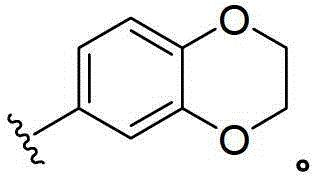
本文所用的“氨基”是指-NH2。"Amino" as used herein refers to -NH2 .
术语“羟基”或“醇部分”是指-OH。The term "hydroxyl" or "alcohol moiety" refers to -OH.
本文所用的“氧代”是指=O。"Oxo" as used herein refers to =O.
本文所用的术语“烷氧基”或“烷硫基”是指如上述所定义的通过氧(“烷氧基”,例如-O-烷基)或硫(“烷硫基”,例如-S-烷基)原子与分子连接的烷基。The term "alkoxy" or "alkylthio" as used herein refers to a group as defined above through oxygen ("alkoxy", eg -O-alkyl) or sulfur ("alkylthio", eg -S - Alkyl) Alkyl group whose atom is attached to the molecule.
本文所用的术语“卤素”、“卤代”和“hal”是指F、Cl、Br或I。The terms "halogen", "halo" and "hal" as used herein refer to F, Cl, Br or I.
本文所用的术语“氰基”或“腈”是指-CN或-C≡N。The term "cyano" or "nitrile" as used herein refers to -CN or -C≡N.
术语“烷氧基烷基”、“烷氧基烯基”、“烷氧基脂族基团”和“烷氧基烷氧基”是指烷基、烯基、脂族基团或烷氧基,在这种情况中,其可以被一个或多个烷氧基取代。The terms "alkoxyalkyl", "alkoxyalkenyl", "alkoxyaliphatic" and "alkoxyalkoxy" refer to an alkyl, alkenyl, aliphatic or alkoxy radical, in which case it may be substituted by one or more alkoxy groups.
术语“卤代烷基”、“卤代烯基”、“卤代脂族基团”、“卤代烷氧基”和“环(卤代烷基)”是指烷基、烯基、脂族基团、烷氧基或环烷基,在这种情况中,其可以被一个或多个卤原子取代。该术语包括全氟烷基,例如-CF3和-CF2CF3。The terms "haloalkyl", "haloalkenyl", "haloaliphatic", "haloalkoxy" and "cyclo(haloalkyl)" refer to alkyl, alkenyl, aliphatic, alkoxy radical or cycloalkyl, in which case it may be substituted by one or more halogen atoms. The term includes perfluoroalkyl groups such as -CF3 and -CF2CF3 .
术语“氰基烷基”、“氰基烯基”、“氰基脂族基团”和“氰基烷氧基”是指烷基、烯基、脂族基团或烷氧基,在这种情况中,其可以被一个或多个氰基取代。在一些实施方案中,氰基烷基是(NC)-烷基-。The terms "cyanoalkyl", "cyanoalkenyl", "cyanoaliphatic" and "cyanoalkoxy" refer to an alkyl, alkenyl, aliphatic or alkoxy group, where In either case, it may be substituted by one or more cyano groups. In some embodiments, cyanoalkyl is (NC)-alkyl-.
术语“氨基烷基”、“氨基烯基”、“氨基脂族基团”和“氨基烷氧基”是指烷基、烯基、脂族基团或烷氧基,在这种情况中,其可以被一个或多个氨基取代,其中氨基如上述所定义。The terms "aminoalkyl", "aminoalkenyl", "aminoaliphatic" and "aminoalkoxy" refer to an alkyl, alkenyl, aliphatic or alkoxy group, in which case It may be substituted by one or more amino groups, wherein amino groups are as defined above.
术语“羟基烷基”、“羟基脂族基团”和“羟基烷氧基”是指烷基、脂族基团或烷氧基,在这种情况中,其可以被一个或多个-OH取代。The terms "hydroxyalkyl", "hydroxyaliphatic" and "hydroxyalkoxy" refer to an alkyl, aliphatic or alkoxy group, in which case it may be replaced by one or more -OH replace.
术语“烷氧基烷基”、“烷氧基脂族基团”和“烷氧基烷氧基”是指烷基、脂族基团或烷氧基,在这种情况中,其可以被一个或多个烷氧基取代。例如,“烷氧基烷基”是指烷基,例如(烷基-O)-烷基-,其中烷基如上述所定义。The terms "alkoxyalkyl", "alkoxyaliphatic" and "alkoxyalkoxy" refer to an alkyl, aliphatic or alkoxy group, in which case it may be Substituted by one or more alkoxy groups. For example, "alkoxyalkyl" refers to an alkyl group, such as (alkyl-O)-alkyl-, wherein alkyl is as defined above.
本文所用的术语“保护基团”和“保护基”可互换使用并且是指用于暂时封闭具有多个反应位置的化合物上一个或多个期望官能团的试剂。在一些实施方案中,保护基具有一个或多个或优选全部如下特征:a)以良好收率被选择性添加到官能团上以得到被保护底物;所述被保护底物b)对于在一个或多个其他反应位置上发生的反应是稳定;和c)以良好收率被不攻击再生、脱保护的官能团的试剂选择性除去。正如本领域技术人员可以理解的,在一些情况中,试剂不攻击化合物上的其他反应基团。在其他情况中,试剂也可以与化合物上的其他反应基团反应。保护基的实例详细描述在Greene,T.W.,Wuts,P.G的“Protective Groups in Organic Synthesis”,第3版,John Wiley&Sons,New York:1999(和该书的其他版本)中,将这些文献的全部内容引入本文参考。本文所用的术语“氮保护基”是指用于暂时封闭多官能化合物上一个或多个期望氮反应位置的试剂。优选的氮保护基还具有上述保护基的典型特性并且一些典型氮保护基也详细描述在Greene,T.W.,Wuts,P.G的“Protective Groups in OrganicSynthesis”,第7章,第3版,John Wiley&Sons,New York:1999中,将该文献的全部内容引入本文参考。As used herein, the terms "protecting group" and "protecting group" are used interchangeably and refer to an agent used to temporarily block one or more desired functional groups on a compound having multiple reactive sites. In some embodiments, the protecting group has one or more or preferably all of the following characteristics: a) is selectively added to a functional group in good yield to obtain a protected substrate; or multiple other reaction sites are stable; and c) are selectively removed in good yields by reagents that do not attack the regenerated, deprotected functional group. As will be appreciated by those skilled in the art, in some cases the reagent does not attack other reactive groups on the compound. In other cases, reagents may also react with other reactive groups on the compound. Examples of protecting groups are described in detail in Greene, T.W., Wuts, P.G., "Protective Groups in Organic Synthesis", 3rd ed., John Wiley & Sons, New York: 1999 (and other editions of this book), the entire content of these documents This article is incorporated by reference. As used herein, the term "nitrogen protecting group" refers to an agent used to temporarily block one or more desired nitrogen reactive sites on a polyfunctional compound. Preferred nitrogen protecting groups also have the typical properties of the above protecting groups and some typical nitrogen protecting groups are also described in detail in Greene, T.W., Wuts, P.G, "Protective Groups in Organic Synthesis", Chapter 7, 3rd Edition, John Wiley & Sons, New York: 1999, which is incorporated herein by reference in its entirety.
本文所用的术语“可替代部分”或“离去基”是指与如本文所定义的脂族基团或芳香基团结合并且是亲核体的亲核攻击替代的主体的基团。The term "substitutable moiety" or "leaving group" as used herein refers to a group which is bound to an aliphatic or aromatic group as defined herein and which is the subject of nucleophilic attack substitution by a nucleophile.
除非另有指示,否则本文所述的结构还意指包括该结构的所有的异构体(例如对映异构体、非对映异构体、顺-反异构体、构象异构体和旋转异构体)形式。例如,除非特别绘制了唯一一种异构体,否则不对称中心各自的R和S构型、(Z)和(E)双键异构体和(Z)和(E)构象异构体包括在本发明中。正如本领域技术人员可以理解的,取代基可以围绕任意可旋转的键自由旋转。例如,绘制成
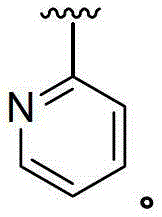
因此,本发明化合物的单一立体化学异构体和对映异构体、非对映异构体、顺/反异构体、构象异构体和旋转异构体混合物属于本发明的范围。Thus, single stereochemical isomers and mixtures of enantiomers, diastereomers, cis/trans isomers, conformers and rotamers of the compounds of the present invention are within the scope of the present invention.
除非另有指示,否则本发明化合物的所有互变体形式属于本发明的范围。Unless otherwise indicated, all tautomeric forms of the compounds of the invention are within the scope of the invention.
另外,除非另有指示,否则本文所述的结构还意指包括仅仅因存在一个或多个富含同位素的原子而不同的化合物。例如,除氢被氘或氚替代或碳被富含13C-或14C的碳替代外具有本发明结构的化合物属于本发明的范围。这种化合物是有用的,例如作为生物测定中的分析工具或探针。这种化合物、尤其是氘代(D)类似物也具有治疗应用。Additionally, unless otherwise indicated, structures depicted herein are also meant to include compounds that differ only by the presence of one or more isotopically enriched atoms. For example, compounds having the structure of the invention except that the hydrogen is replaced by deuterium or tritium or the carbon is replaced by a13C- or14C -enriched carbon are within the scope of the invention. Such compounds are useful, for example, as analytical tools or probes in biological assays. Such compounds, especially deuterated (D) analogs, also have therapeutic applications.
术语“键”和“不存在”可以互换使用以表示不存在基团。The terms "bond" and "absent" are used interchangeably to denote the absence of a group.
本发明的化合物根据其化学结构和/或化学名定义。如果化合物涉及化学结构和化学名且化学结构和化学名矛盾,则化学结构是该化合物身份的决定因素。The compounds of the present invention are defined by their chemical structures and/or chemical names. If a chemical structure and chemical name are involved in a compound and the chemical structure and chemical name conflict, the chemical structure is the determinant of the compound's identity.
本发明的化合物可以以游离形式存在,或如果适合,作为盐的形式存在。药学上可接受的那些盐具有特别的意义,因为它们为医学目的用于给予上述化合物。非药学上可接受的盐用于制备方法,分离和纯化方法,在一些情况中,用于分离本发明化合物的立体异构体形式或其中间体。The compounds of the invention may exist in free form or, if appropriate, in the form of a salt. Those salts which are pharmaceutically acceptable are of particular interest since they are used for administering the aforementioned compounds for medical purposes. Non-pharmaceutically acceptable salts are used in methods of preparation, methods of isolation and purification, and, in some cases, in the isolation of stereoisomeric forms of compounds of the invention or intermediates thereof.
本文所用的术语“药学上可接受的盐”是指化合物的盐,在合理的医学判断范围内,它们适用于人体和低等动物组织,没有过度的副作用,例如毒性、刺激性、变态反应等,与合理的利益/风险比相称。The term "pharmaceutically acceptable salt" as used herein refers to salts of compounds which are suitable for use in humans and lower animal tissues without undue side effects such as toxicity, irritation, allergic reactions, etc., within the scope of sound medical judgment , commensurate with a reasonable benefit/risk ratio.
药学上可接受的盐是本领域熟知的。例如,S.M.Berge等人在J.Pharmaceutical Sciences,1977,66,1-19中详细描述了药学上可接受的盐,引用在此作为参考。本文所述的化合物的药学上可接受的盐包括从适合的无机和有机酸与碱衍生的那些。这些盐可以在最终分离和纯化化合物过程中在原位制备。Pharmaceutically acceptable salts are well known in the art. For example, S.M. Berge et al. describe pharmaceutically acceptable salts in detail in J. Pharmaceutical Sciences, 1977, 66, 1-19, incorporated herein by reference. Pharmaceutically acceptable salts of the compounds described herein include those derived from suitable inorganic and organic acids and bases. These salts can be prepared in situ during the final isolation and purification of the compounds.
如果本文所述的化合物包含碱性基团或足够碱性的生物电子等排体,则可以通过下列步骤制备酸加成盐:1)使纯化的游离碱形式的化合物与适合的有机或无机酸反应;和2)分离由此形成的盐。实际上,酸加成盐可以是更便利的应用形式且盐的应用相当于游离碱形式的应用。If the compounds described herein contain a basic group or a sufficiently basic bioisostere, acid addition salts can be prepared by: 1) reacting the purified free base form of the compound with a suitable organic or inorganic acid reacting; and 2) isolating the salt thus formed. In practice, acid addition salts may be the more convenient form for use and the use of the salts is equivalent to that of the free base form.
药学上可接受的无毒性酸加成盐的实例是与无机酸或有机酸生成的氨基盐,无机酸例如盐酸、氢溴酸、磷酸、硫酸和高氯酸,有机酸例如乙酸、草酸、马来酸、酒石酸、柠檬酸、琥珀酸或丙二酸,或者利用本领域所用的其他方法,例如离子交换形成的盐。其他药学上可接受的盐包括己二酸盐、藻酸盐、抗坏血酸盐、天冬氨酸盐、苯磺酸盐、苯甲酸盐、硫酸氢盐、硼酸盐、丁酸盐、樟脑酸盐、樟脑磺酸盐、柠檬酸盐、环戊烷丙酸盐、二葡糖酸盐、十二烷基硫酸盐、乙磺酸盐、甲酸盐、富马酸盐、葡庚糖酸盐、甘油磷酸盐、甘醇酸盐、葡糖酸盐、甘醇酸盐、半硫酸盐、庚酸盐、己酸盐、氢氯酸盐、氢溴酸盐、氢碘酸盐、2-羟基乙磺酸盐、乳糖酸盐、乳酸盐、月桂酸盐、月桂基硫酸盐、苹果酸盐、马来酸盐、丙二酸盐、甲磺酸盐、2-萘磺酸盐、烟酸盐、硝酸盐、油酸盐、草酸盐、棕榈酸盐、双羟萘酸盐、果胶酸盐、过硫酸盐、3-苯基丙酸盐、磷酸盐、苦味酸盐、新戊酸盐、丙酸盐、水杨酸盐、硬脂酸盐、琥珀酸盐、硫酸盐、酒石酸盐、硫氰酸盐、对-甲苯磺酸盐、十一烷酸盐、戊酸盐等。Examples of pharmaceutically acceptable non-toxic acid addition salts are amino salts with inorganic acids such as hydrochloric acid, hydrobromic acid, phosphoric acid, sulfuric acid and perchloric acid, organic acids such as acetic acid, oxalic acid, equine toric acid, tartaric acid, citric acid, succinic acid, or malonic acid, or by other methods used in the art, such as ion exchange. Other pharmaceutically acceptable salts include adipate, alginate, ascorbate, aspartate, besylate, benzoate, bisulfate, borate, butyrate, camphorate Salt, camphorsulfonate, citrate, cyclopentanepropionate, digluconate, lauryl sulfate, ethanesulfonate, formate, fumarate, glucoheptonate , glycerophosphate, glycolate, gluconate, glycolate, hemisulfate, heptanoate, hexanoate, hydrochlorate, hydrobromide, hydroiodide, 2-hydroxy Esylate, lactobionate, lactate, laurate, lauryl sulfate, malate, maleate, malonate, methanesulfonate, 2-naphthalenesulfonate, niacin Salt, nitrate, oleate, oxalate, palmitate, pamoate, pectate, persulfate, 3-phenylpropionate, phosphate, picrate, pivalic acid Salt, propionate, salicylate, stearate, succinate, sulfate, tartrate, thiocyanate, p-toluenesulfonate, undecanoate, valerate, etc.
如果本文所述的化合物包含羧基或足够酸性的生物电子等排体,则可以通过下列步骤制备碱加成盐,例如:1)使纯化的化合物以其酸的形式与适合的有机碱或无机碱反应;和2)分离由此形成的盐。实际上,碱加成盐的应用可能更为便利且盐形式的应用固然导致游离酸形式的应用。衍生自适合的碱的盐包括碱金属(例如钠、锂和钾)、碱土金属(例如镁和钙)、铵和N+(C1-4烷基)4盐。本发明还涵盖任意本文公开的包含碱性氮基团的化合物的季铵化。可以通过这种季铵化得到水溶性或油溶性或可分散的产品。If the compounds described herein contain a carboxyl group or a sufficiently acidic bioisostere, base addition salts can be prepared by, for example: 1) reacting the purified compound in its acid form with a suitable organic or inorganic base reacting; and 2) isolating the salt thus formed. In practice, the use of base addition salts may be more convenient and the use of the salt form certainly leads to the use of the free acid form. Salts derived from appropriate bases include alkali metal (eg sodium, lithium and potassium), alkaline earth metal (eg magnesium and calcium), ammonium and N + (C 1-4 alkyl) 4 salts. This invention also encompasses the quaternization of any of the compounds disclosed herein that contain basic nitrogen groups. Water-soluble or oil-soluble or dispersible products can be obtained by this quaternization.
碱加成盐包括药学上可接受的金属和胺盐。适合的金属盐包括钠、钾、钙、钡、锌、镁和铝。通常优选钠和钾盐。如果适合,则另外的药学上可接受的盐包括使用抗衡例子例如卤化物、氢氧化物、羧酸盐、硫酸盐、磷酸盐、硝酸盐、低级烷基磺酸盐和芳基磺酸盐形成的无毒性铵、季铵和胺阳离子。适合的无机碱加成盐由金属碱制备,包括氢化钠、氢氧化钠、氢氧化钾、氢氧化钙、氢氧化铝、氢氧化锂、氢氧化镁、氢氧化锌等。适合的胺加成的盐由胺类制备,所述的胺类因其低毒性和医疗应用的可接受性而频繁用于药物化学:氨、乙二胺、N-甲基-葡糖胺、赖氨酸、精氨酸、鸟氨酸、胆碱、N,N'-二苄基乙二胺、氯普鲁卡因、二乙醇胺、普鲁卡因、N-苄基苯乙胺、二乙胺、哌嗪、三(羟基甲基)-氨基甲烷、氢氧化四甲基铵、三乙胺、二苄胺、二苯羟甲胺、去氢枞胺、N-乙基哌啶、苄胺、四甲基铵、四乙基铵、甲胺、二甲胺、三甲胺、乙胺、碱性氨基酸、二环己胺等。Base addition salts include pharmaceutically acceptable metal and amine salts. Suitable metal salts include sodium, potassium, calcium, barium, zinc, magnesium and aluminium. Sodium and potassium salts are generally preferred. Additional pharmaceutically acceptable salts include those formed using counter examples such as halides, hydroxides, carboxylates, sulfates, phosphates, nitrates, lower alkylsulfonates and arylsulfonates, where appropriate. non-toxic ammonium, quaternary ammonium and amine cations. Suitable inorganic base addition salts are prepared from metal bases, including sodium hydride, sodium hydroxide, potassium hydroxide, calcium hydroxide, aluminum hydroxide, lithium hydroxide, magnesium hydroxide, zinc hydroxide, and the like. Suitable amine addition salts are prepared from amines that are frequently used in medicinal chemistry because of their low toxicity and acceptability for medical applications: ammonia, ethylenediamine, N-methyl-glucamine, Lysine, arginine, ornithine, choline, N,N'-dibenzylethylenediamine, chloroprocaine, diethanolamine, procaine, N-benzylphenethylamine, di Ethylamine, piperazine, tris(hydroxymethyl)-aminomethane, tetramethylammonium hydroxide, triethylamine, dibenzylamine, benzhydrylamine, dehydroabietylamine, N-ethylpiperidine, benzyl Amine, tetramethylammonium, tetraethylammonium, methylamine, dimethylamine, trimethylamine, ethylamine, basic amino acid, dicyclohexylamine, etc.
其他酸和碱,无论其自身是否为药学上可接受的,都可以用于制备用作得到本文所述化合物及其药学上可接受的酸或碱加成盐的中间体。Other acids and bases, whether themselves pharmaceutically acceptable or not, may be used in the preparation of intermediates useful in obtaining the compounds described herein and their pharmaceutically acceptable acid or base addition salts.
应理解本发明包括不同药学上可接受的盐的混合物/组合且还包括游离形式和药学上可接受的盐形式的化合物的混合物/组合。It is to be understood that the present invention includes mixtures/combinations of different pharmaceutically acceptable salts and also mixtures/combinations of compounds in free form and pharmaceutically acceptable salt forms.
除本文所述的化合物外,本发明的方法还可以用于制备这些化合物的药学上可接受的溶剂合物(例如水合物)和笼形包合物。In addition to the compounds described herein, the methods of the invention can also be used to prepare pharmaceutically acceptable solvates (eg, hydrates) and clathrates of these compounds.
本文所用的术语“药学上可接受的溶剂合物”是由一种或多种药学上可接受的溶剂分子与本发明化合物之一缔合形成的溶剂合物。术语溶剂合物包括水合物(例如半水合物、一水合物、二水合物、三水合物、四水合物等)。The term "pharmaceutically acceptable solvate" as used herein is a solvate formed by the association of one or more pharmaceutically acceptable solvent molecules with one of the compounds of the present invention. The term solvate includes hydrates (eg, hemihydrate, monohydrate, dihydrate, trihydrate, tetrahydrate, etc.).
本文所用的术语“水合物”是指还包括通过非共价分子间力与化学计算量或非化学计算量的水结合的本发明化合物或其盐。The term "hydrate" as used herein is meant to also include a compound of the present invention or a salt thereof bound to a stoichiometric or non-stoichiometric amount of water by non-covalent intermolecular forces.
本文所用的术语“笼形包合物”是指晶格形式的本发明化合物或其盐,所述晶格包含具有被俘获在其内的包嵌分子(例如溶剂或水)的空间(例如通道)。As used herein, the term "clathrate" refers to a compound of the invention or a salt thereof in the form of a crystal lattice comprising spaces (e.g. channels) with trapped molecules (e.g. solvent or water) trapped therein. ).
除本文所述的化合物外,本发明的方法也可以用于制备这些化合物的药学上可接受的衍生物或前体药物。In addition to the compounds described herein, the methods of the invention can also be used to prepare pharmaceutically acceptable derivatives or prodrugs of these compounds.
“药学上可接受的衍生物或前体药物”包括本文所述化合物的任意药学上可接受的酯、酯的盐或其他衍生物或其盐,在对接受者给予时,它们能够直接或间接提供本文所述的化合物或其抑制性活性代谢物或残留物。特别有利的衍生物或前体药物是在将这种化合物给予患者(例如通过口服给予更易于吸收入血液的化合物)时增加生物利用度或相对于母体种类增强母体化合物递送至生物隔室(例如脑或淋巴系统)的那些化合物。"Pharmaceutically acceptable derivative or prodrug" includes any pharmaceutically acceptable ester, salt of an ester, or other derivative or salt thereof of a compound described herein which, when administered to a recipient, can directly or indirectly Compounds described herein, or inhibitory active metabolites or residues thereof, are provided. Particularly advantageous derivatives or prodrugs are those that increase bioavailability when such compounds are administered to a patient (e.g., by oral administration of compounds that are more readily absorbed into the blood) or that enhance the delivery of the parent compound to biological compartments relative to the parent species (e.g. brain or lymphatic system).
如本文所用且除非另有指示,否则本文所用的术语“前体药物”是指可以在生物条件(体外或体内)下水解、氧化否则就是反应而提供本发明化合物的化合物的衍生物。前体药物可以在这种反应时在生物条件下变成具有活性的或它们可以在其未反应形式下具有活性。本发明关注的前体药物的实例包括、但不限于本发明化合物的类似物或衍生物,其包含可生物水解的结构部分,例如可生物水解的酰胺类、可生物水解的酯类、可生物水解的氨基甲酸酯类、可生物水解的碳酸脂类、可生物水解的酰脲类和可生物水解的磷酸酯类似物。前体药物的其他实例包括包含-NO、-NO2、-ONO或-ONO2部分的本文所述化合物的衍生物。可以典型地使用众所周知的方法制备前体药物,如BURGER'SMEDICINAL CHEMISTRY AND DRUG DISCOVERY(1995)172-178,949-982(Manfred E.Wolff编辑,第5版)中所述的那些方法。As used herein and unless otherwise indicated, the term "prodrug" as used herein refers to a derivative of a compound that can hydrolyze, oxidize or otherwise react under biological conditions (in vitro or in vivo) to provide the compound of the invention. Prodrugs may become active under biological conditions upon such reaction or they may be active in their unreacted form. Examples of prodrugs contemplated by the present invention include, but are not limited to, analogs or derivatives of compounds of the present invention comprising biohydrolyzable moieties such as biohydrolyzable amides, biohydrolyzable esters, biohydrolyzable Hydrolyzable carbamates, biohydrolyzable carbonates, biohydrolyzable ureides and biohydrolyzable phosphate analogs. Other examples of prodrugs include derivatives of the compounds described herein comprising a -NO, -NO2 , -ONO or -ONO2 moiety. Prodrugs may typically be prepared using well-known methods, such as those described in BURGER'SMEDICINAL CHEMISTRY AND DRUG DISCOVERY (1995) 172-178, 949-982 (Edited by Manfred E. Wolff, 5th ed.).
“药学上可接受的衍生物”是在对需要的患者给药时能够直接或间接提供本文所述的其他化合物或其代谢物或残余物的加合物或衍生物。药学上可接受的衍生物的实例包括、但不限于酯类和这种酯类的盐。A "pharmaceutically acceptable derivative" is an adduct or derivative that, when administered to a patient in need thereof, is capable of providing, directly or indirectly, other compounds described herein, or metabolites or residues thereof. Examples of pharmaceutically acceptable derivatives include, but are not limited to, esters and salts of such esters.
上述化合物的药学上可接受的前体药物包括、但不限于酯类、氨基酸酯类、磷酸酯类、金属盐和磺酸酯类。Pharmaceutically acceptable prodrugs of the above compounds include, but are not limited to, esters, amino acid esters, phosphate esters, metal salts and sulfonate esters.
本领域技术人员可以理解,本发明的化合物可以作为立体异构体(例如旋光(+和-)、几何异构体(顺式和反式)和构象异构体(轴向和平伏)形式存在。所有这种立体异构体都包括在本发明范围内。It will be appreciated by those skilled in the art that the compounds of the present invention may exist as stereoisomers (e.g. optical (+ and -), geometric isomers (cis and trans) and conformational isomers (axial and planar) forms All such stereoisomers are included within the scope of the present invention.
本领域技术人员可以理解,本发明的化合物可以包含手性中心。通式化合物由此可以以两种不同旋光异构体形式存在(即(+)或(-)对映异构体)。所有这种对映异构体及其混合物包括外消旋混合物都包括在本发明范围内。可以通过本领域众所周知的方法例如手性HPLC、酶拆分和手性助剂得到单一旋光异构体或对映异构体。It will be appreciated by those skilled in the art that the compounds of the present invention may contain chiral centers. Compounds of general formula may thus exist in two different optical isomeric forms (ie (+) or (-) enantiomers). All such enantiomers and mixtures thereof, including racemic mixtures, are included within the scope of the present invention. Individual optical isomers or enantiomers can be obtained by methods well known in the art such as chiral HPLC, enzymatic resolution and chiral auxiliaries.
在一个实施方案中,以单一立体异构体形式提供本发明的化合物,其中至少95%、至少97%和至少99%不含相应的对映异构体。In one embodiment, a compound of the invention is provided as a single stereoisomer which is at least 95%, at least 97% and at least 99% free of the corresponding enantiomer.
在另一个实施方案中,本发明的化合物是(+)对映异构体形式,至少95%不含相应的(-)对映异构体。In another embodiment, the compounds of the invention are in the form of the (+) enantiomer at least 95% free of the corresponding (-) enantiomer.
在另一个实施方案中,本发明的化合物是(+)对映异构体形式,至少97%不含相应的(-)对映异构体。In another embodiment, the compounds of the invention are in the form of the (+) enantiomer at least 97% free of the corresponding (-) enantiomer.
在另一个实施方案中,本发明的化合物是(+)对映异构体形式,至少99%不含相应的(-)对映异构体。In another embodiment, the compounds of the invention are in the form of the (+) enantiomer at least 99% free of the corresponding (-) enantiomer.
在另一个实施方案中,本发明的化合物是(-)对映异构体形式,至少95%不含相应的(+)对映异构体。In another embodiment, the compounds of the invention are in the form of the (-) enantiomer at least 95% free of the corresponding (+) enantiomer.
在另一个实施方案中,本发明的化合物是(-)对映异构体形式,至少97%不含相应的(+)对映异构体。In another embodiment, the compounds of the invention are in the form of the (-) enantiomer at least 97% free of the corresponding (+) enantiomer.
在另一个实施方案中,本发明的化合物是(-)对映异构体形式,至少99%不含相应的(+)对映异构体。In another embodiment, the compounds of the invention are in the form of the (-) enantiomer at least 99% free of the corresponding (+) enantiomer.
在一些实施方案中,本发明的化合物作为药学上可接受的盐提供(例如Handbook of Pharmaceutical Salts Properties,Selectionand Use,Wiley,2002,(P.Heinrich Stahl,Camille G.Wermuth,ed.))。如上所述,这种药学上可接受的盐可以衍生自药学上可接受的无机酸和有机酸和有机碱和有机碱。适合的酸的实例包括盐酸、氢溴酸、硫酸、硝酸、高氯酸、富马酸、马来酸、磷酸、乙醇酸、乳酸、水杨酸、琥珀酸、甲苯-对-磺酸、酒石酸、乙酸、三氟乙酸、柠檬酸、甲磺酸、甲酸、苯甲酸、丙二酸、萘-2-磺酸和苯磺酸。其他酸例如草酸,尽管自身不是药学上可接受的,但是仍然可以用作得到本发明化合物及其药学上可接受的酸加成盐的中间体。In some embodiments, compounds of the invention are provided as pharmaceutically acceptable salts (eg, Handbook of Pharmaceutical Salts Properties, Selection and Use, Wiley, 2002, (P. Heinrich Stahl, Camille G. Wermuth, ed.)). As noted above, such pharmaceutically acceptable salts may be derived from pharmaceutically acceptable inorganic and organic acids and bases. Examples of suitable acids include hydrochloric acid, hydrobromic acid, sulfuric acid, nitric acid, perchloric acid, fumaric acid, maleic acid, phosphoric acid, glycolic acid, lactic acid, salicylic acid, succinic acid, toluene-p-sulfonic acid, tartaric acid , acetic acid, trifluoroacetic acid, citric acid, methanesulfonic acid, formic acid, benzoic acid, malonic acid, naphthalene-2-sulfonic acid and benzenesulfonic acid. Other acids such as oxalic acid, although not pharmaceutically acceptable by themselves, can be used as intermediates to obtain compounds of the invention and their pharmaceutically acceptable acid addition salts.
还包括衍生自氨基酸的盐(例如L-精氨酸、L-赖氨酸)。Also included are salts derived from amino acids (eg, L-arginine, L-lysine).
衍生自适合的碱的盐包括碱金属(例如钠、锂、钾)、碱土金属(例如钙、镁)、铵、NR4 +(其中R是C1-4烷基)盐、胆碱和氨丁三醇。Salts derived from suitable bases include alkali metal (e.g. sodium, lithium, potassium), alkaline earth metal (e.g. calcium, magnesium), ammonium, NR (where R is C 1-4 alkyl) salts, choline and ammonia Butanetriol.
在本发明的一个实施方案中,药学上可接受的盐是钠盐。In one embodiment of the invention, the pharmaceutically acceptable salt is the sodium salt.
在本发明的一个实施方案中,药学上可接受的盐是钾盐。In one embodiment of the invention, the pharmaceutically acceptable salt is the potassium salt.
在本发明的一个实施方案中,药学上可接受的盐是锂盐。In one embodiment of the invention, the pharmaceutically acceptable salt is a lithium salt.
在本发明的一个实施方案中,药学上可接受的盐是氨丁三醇盐。In one embodiment of the invention, the pharmaceutically acceptable salt is a tromethamine salt.
在本发明的一个实施方案中,药学上可接受的盐是L-精氨酸盐。In one embodiment of the invention, the pharmaceutically acceptable salt is L-arginine salt.
在本发明的一个实施方案中,药学上可接受的盐是钙盐。In one embodiment of the invention, the pharmaceutically acceptable salt is a calcium salt.
本领域技术人员可以理解,本文所述的本发明的化合物可以以不同的多晶型形式存在。正如本领域已知的,同质多晶现象是化合物结晶为一种以上不同结晶或“多晶形物”种类的能力。多晶形物是具有固态化合物分子的至少两种不同排列或多晶型的化合物的固体结晶相。将任意指定化合物的多晶型定义为同一化学式或组成且在化学结构上与作为两种不同化学化合物的晶体结构不同。Those skilled in the art will appreciate that the compounds of the invention described herein may exist in different polymorphic forms. As known in the art, polymorphism is the ability of a compound to crystallize in more than one different crystalline or "polymorph" species. A polymorph is a solid crystalline phase of a compound having at least two different arrangements or polymorphs of the solid compound's molecules. Polymorphs of any given compound are defined as having the same chemical formula or composition and differing in chemical structure from crystal structures that are two different chemical compounds.
本领域技术人员还可以理解,本发明的化合物可以以不同的溶剂合物形式存在,例如水合物。在结晶过程中,当溶剂分子结合到化合物分子的晶格结构时,本发明化合物的溶剂合物也可以形成。Those skilled in the art will also understand that the compounds of the present invention may exist in different solvated forms, such as hydrates. Solvates of the compounds of the invention may also form when solvent molecules are incorporated into the molecular lattice structure of the compound during crystallization.
术语“受试者”、“宿主”或“患者”包括动物和人(例如男性或女性,例如儿童、青少年或成人)。优选“受试者”、“宿主”或“患者”是人。The term "subject", "host" or "patient" includes animals and humans (eg, male or female, eg, children, adolescents or adults). Preferably a "subject", "host" or "patient" is a human.
在一个实施方案中,本发明提供了用于治疗或预防宿主黄病毒科病毒感染的方法,该方法包括对该宿主给予治疗有效量的至少一种本文所述的本发明的化合物。In one embodiment, the invention provides a method for treating or preventing a Flaviviridae virus infection in a host, the method comprising administering to the host a therapeutically effective amount of at least one compound of the invention described herein.
在一个实施方案中,所述病毒感染选自黄病毒科感染。在一个实施方案中,所述黄病毒科感染是丙型肝炎(HCV)、牛病毒性腹泻病毒(BVDV)、猪霍乱病毒、登革热病毒、日本脑炎病毒或黄热病毒。In one embodiment, the viral infection is selected from a Flaviviridae infection. In one embodiment, the Flaviviridae infection is hepatitis C (HCV), bovine viral diarrhea virus (BVDV), hog cholera virus, dengue virus, Japanese encephalitis virus, or yellow fever virus.
在一个实施方案中,所述黄病毒科病毒感染是丙型肝炎病毒感染(HCV)。In one embodiment, the Flaviviridae viral infection is hepatitis C virus infection (HCV).
在一个实施方案中,本发明的方法涉及治疗HCV基因型1感染。在另一个实施方案中,HCV是基因型1a或基因型1b。In one embodiment, the methods of the invention relate to the treatment of HCV genotype 1 infection. In another embodiment, the HCV is genotype 1a or genotype 1b.
在一个实施方案中,本发明提供了用于治疗或预防宿主黄病毒科病毒感染的方法,该方法包括对该宿主给予治疗有效量的至少一种本文所述的本发明的化合物,并且还包括给予至少一种另外的活性剂,所述的至少一种另外的活性剂选自病毒丝氨酸蛋白酶抑制剂、病毒聚合酶抑制剂、病毒解旋酶抑制剂、免疫调节剂、抗氧化剂、抗细菌剂、治疗性疫苗、肝保护剂、反义药物、HCV NS2/3蛋白酶的抑制剂和内核糖体进入位点(IRES)的抑制剂。In one embodiment, the invention provides a method for treating or preventing a Flaviviridae virus infection in a host, the method comprising administering to the host a therapeutically effective amount of at least one compound of the invention described herein, and further comprising Administration of at least one additional active agent selected from the group consisting of viral serine protease inhibitors, viral polymerase inhibitors, viral helicase inhibitors, immunomodulators, antioxidants, antibacterial agents , therapeutic vaccines, hepatoprotectants, antisense drugs, inhibitors of HCV NS2/3 protease and inhibitors of the internal ribosomal entry site (IRES).
在一个实施方案中,提供了抑制或降低宿主病毒聚合酶活性的方法,该方法包括给予治疗有效量的本文所述的本发明的化合物。In one embodiment, there is provided a method of inhibiting or reducing viral polymerase activity in a host comprising administering a therapeutically effective amount of a compound of the invention described herein.
在一个实施方案中,提供了抑制或降低宿主病毒聚合酶活性的方法,该方法包括给予治疗有效量的本文所述的本发明的化合物,并且还包括给予一种或多种病毒聚合酶抑制剂。In one embodiment, there is provided a method of inhibiting or reducing the activity of a host viral polymerase comprising administering a therapeutically effective amount of a compound of the invention described herein, and further comprising administering one or more viral polymerase inhibitors .
在一个实施方案中,病毒聚合酶是黄病毒科病毒聚合酶。In one embodiment, the viral polymerase is a Flaviviridae viral polymerase.
在一个实施方案中,病毒聚合酶是RNA-依赖性RNA-聚合酶。In one embodiment, the viral polymerase is an RNA-dependent RNA-polymerase.
在一个实施方案中,病毒聚合酶是HCV聚合酶。In one embodiment, the viral polymerase is HCV polymerase.
在一个实施方案中,病毒聚合酶是HCV5B聚合酶。In one embodiment, the viral polymerase is HCV5B polymerase.
在治疗或预防一种或多种上述病症/疾病的过程中,将上述化合物配制成药学上可接受的制剂,其任选还包含药学上可接受的载体、佐剂或媒介物。In the process of treating or preventing one or more of the above-mentioned disorders/diseases, the above-mentioned compounds are formulated into pharmaceutically acceptable preparations, which optionally further comprise pharmaceutically acceptable carriers, adjuvants or vehicles.
在一个实施方案中,本发明提供了药物组合物,其包含至少一种本文所述的本发明化合物和至少一种药学上可接受的载体、佐剂或媒介物,本文所用的载体、佐剂或媒介物包括适合于期望的特定剂型的任意的和所有的溶剂、稀释剂或其他液体媒介物、分散剂或助悬剂、表面活性剂、等渗剂、增稠剂或乳化剂、防腐剂、固体粘合剂、润滑剂等。Remington's Pharmaceutical Sciences,第16版,E.W.Martin(Mack Publishing Co.,Easton,Pa.,1980)公开了用于配制药学上可接受的组合物的各种载体及其已知的制备技术。除任意常规的载体介质与本发明化合物不相容外,例如通过产生任意的不期望的生物效应,否则就是以有害方式与药学上可接受的组合物的任意其他成分发生相互作用,关注其在本发明范围内的应用。本文所用的措词“副作用”包括疗法(例如预防剂或治疗剂)的不需要的和不良反应。副作用是始终不需要的,而不需要的作用不一定是不良反应。来自疗法(例如预防剂或治疗剂)的不良反应可能有害或不适或危险。In one embodiment, the invention provides a pharmaceutical composition comprising at least one compound of the invention described herein and at least one pharmaceutically acceptable carrier, adjuvant or vehicle, as used herein, a carrier, adjuvant Or vehicles include any and all solvents, diluents or other liquid vehicles, dispersing or suspending agents, surfactants, isotonic agents, thickening or emulsifying agents, preservatives, suitable for the particular dosage form desired , solid adhesives, lubricants, etc. Remington's Pharmaceutical Sciences, 16th Edition, E.W. Martin (Mack Publishing Co., Easton, Pa., 1980) discloses various carriers for formulating pharmaceutically acceptable compositions and known preparation techniques thereof. In addition to the incompatibility of any conventional carrier medium with the compounds of the present invention, for example by producing any undesired biological effects, or otherwise interacting in a deleterious manner with any other ingredient of the pharmaceutically acceptable composition, it is of concern in the application within the scope of the present invention. As used herein, the phrase "side effect" includes unwanted and adverse effects of a therapy (eg, a prophylactic or therapeutic agent). Side effects are always unwanted, and unwanted effects are not necessarily adverse reactions. An adverse reaction from a therapy (eg, a prophylactic or therapeutic agent) may be harmful or uncomfortable or dangerous.
药学上可接受的载体可以包含惰性成分,其不会不适当地抑制化合物的生物活性。药学上可接受的载体应是生物相容性的,例如在对受试者给予时无毒性、无炎症、无免疫原性或没有其他不期望的反应或副作用。可以使用标准制药技术。Pharmaceutically acceptable carriers can contain inert ingredients that do not unduly inhibit the biological activity of the compound. A pharmaceutically acceptable carrier should be biocompatible, eg, non-toxic, non-inflammatory, non-immunogenic, or otherwise undesired reactions or side effects when administered to a subject. Standard pharmaceutical techniques can be used.
能够作为药学上可接受的载体的材料的一些实例包括但不限于:离子交换剂、氧化铝、硬脂酸铝、卵磷脂、血清蛋白质(例如人血清白蛋白)、缓冲物质(例如twin80、磷酸盐、甘氨酸、山梨酸或山梨酸钾)、饱和植物脂肪酸的偏甘油酯混合物、水、盐或电解质(例如硫酸鱼精蛋白、磷酸氢二钠、磷酸氢钾、氯化钠、锌盐)、胶体二氧化硅、三硅酸镁、聚乙烯吡咯烷酮、聚丙烯酸酯、蜡类、聚乙烯-聚氧丙烯嵌段共聚物、甲基纤维素、羟丙基甲基纤维素、羊毛脂、糖类(例如乳糖、葡萄糖和蔗糖)、淀粉(例如玉米淀粉和马铃薯淀粉)、纤维素及其衍生物,例如羧甲基纤维素钠、乙基纤维素和醋酸纤维素;西黄蓍胶粉;麦芽;明胶;滑石粉;赋形剂例如可可脂和栓剂用蜡;油类例如花生油、棉籽油;红花油;芝麻油;橄榄油;玉米油和大豆油;二醇例如丙二醇或聚乙二醇;酯类,例如油酸乙酯和月桂酸乙酯;琼脂;缓冲剂,例如氢氧化镁和氢氧化铝;海藻酸;无热原的水;等渗盐水;林格液;乙醇;和磷酸盐缓冲液,以及其他无毒的可相容的润滑剂,例如月桂基硫酸钠和硬脂酸镁;根据制剂人员的判断,在组合物中也可以存在着色剂、释放剂、包衣剂、甜味剂、调味剂和芳香剂、防腐剂和抗氧化剂。Some examples of materials that can serve as pharmaceutically acceptable carriers include, but are not limited to: ion exchangers, alumina, aluminum stearate, lecithin, serum proteins (e.g. human serum albumin), buffer substances (e.g. twin80, phosphoric acid salt, glycine, sorbic acid or potassium sorbate), partial glyceride mixtures of saturated vegetable fatty acids, water, salts or electrolytes (e.g. protamine sulfate, disodium hydrogen phosphate, potassium hydrogen phosphate, sodium chloride, zinc salts), Colloidal silicon dioxide, magnesium trisilicate, polyvinylpyrrolidone, polyacrylates, waxes, polyethylene-polyoxypropylene block copolymers, methylcellulose, hydroxypropylmethylcellulose, lanolin, sugars (such as lactose, glucose, and sucrose), starches (such as cornstarch and potato starch), cellulose and its derivatives, such as sodium carboxymethylcellulose, ethylcellulose, and cellulose acetate; tragacanth powder; malt ; gelatin; talc; excipients such as cocoa butter and suppository waxes; oils such as peanut oil, cottonseed oil; safflower oil; sesame oil; olive oil; corn oil and soybean oil; glycols such as propylene glycol or polyethylene glycol; Esters, such as ethyl oleate and ethyl laurate; agar; buffers, such as magnesium hydroxide and aluminum hydroxide; alginic acid; pyrogen-free water; isotonic saline; Ringer's solution; ethanol; and phosphates Buffers, and other nontoxic compatible lubricants such as sodium lauryl sulfate and magnesium stearate; coloring agents, release agents, coating agents, sweeteners, flavoring, flavoring and fragrance agents, preservatives and antioxidants.
可以通过口服、直肠、胃肠外、脑池内、阴道内、腹膜内、局部(如作为粉末、软膏剂或滴剂)、口含或鼻部等给予上述化合物及其药学上可接受的组合物,视所治疗的感染的严重性而定。本文所用的术语“胃肠外”包括、但不限于皮下、静脉内、肌内、关节内、滑膜内、胸骨内、鞘内、肝内、损害内和颅内注射或输注技术。特别地,通过口服、腹膜内或静脉内给予组合物。The above compounds and pharmaceutically acceptable compositions thereof can be administered orally, rectally, parenterally, intracisternally, intravaginally, intraperitoneally, topically (such as as a powder, ointment or drops), buccally or nasally, etc. , depending on the severity of the infection being treated. The term "parenteral" as used herein includes, but is not limited to, subcutaneous, intravenous, intramuscular, intra-articular, intrasynovial, intrasternal, intrathecal, intrahepatic, intralesional and intracranial injection or infusion techniques. In particular, the compositions are administered orally, intraperitoneally or intravenously.
任意口服可接受的剂型包括、但不限于胶囊、片剂、水性混悬液或水溶液可以用于口服给药。就口服应用的片剂而言,常用载体包括、但不限于乳糖和玉米淀粉。也典型地加入润滑剂,例如硬脂酸镁。就胶囊形式的口服给药而言,有用的稀释剂包括乳糖和干玉米淀粉。当口服应用需要水性混悬液时,将活性成分与乳化剂和助悬剂合并。如果需要,则还可以加入一些甜味剂、调味剂或着色剂。Any orally acceptable dosage form including, but not limited to, capsules, tablets, aqueous suspensions or solutions can be used for oral administration. In the case of tablets for oral use, carriers commonly used include, but are not limited to, lactose and corn starch. Lubricating agents, such as magnesium stearate, are also typically added. For oral administration in a capsule form, useful diluents include lactose and dried cornstarch. When aqueous suspensions are required for oral use, the active ingredient is combined with emulsifying and suspending agents. If desired, some sweetening, flavoring or coloring agents can also be added.
口服给药的液体剂型包括、但不限于药学上可接受的乳剂、微乳剂、溶液、混悬液、糖浆剂和酏剂。除了活性化合物以外(上述化合物),液体剂型可以含有本领域常用的惰性稀释剂,例如水或其他溶剂,增溶剂和乳化剂,例如乙醇、异丙醇、碳酸乙酯、乙酸乙酯、苄醇、苯甲酸苄基酯、丙二醇、1,3-丁二醇、二甲基甲酰胺、油(特别是棉籽油、花生油、玉米油、麦胚油、橄榄油、蓖麻油和芝麻油)、甘油、四氢糠醇、聚乙二醇和脱水山梨醇的脂肪酸酯,和它们的混合物。除了惰性稀释剂以外,口服组合物还可以包括佐剂,例如湿润剂、乳化与悬浮剂、甜味剂、矫味剂和香料。Liquid dosage forms for oral administration include, but are not limited to, pharmaceutically acceptable emulsions, microemulsions, solutions, suspensions, syrups and elixirs. In addition to the active compound (compound mentioned above), liquid dosage forms may contain inert diluents customary in the art, such as water or other solvents, solubilizers and emulsifiers, such as ethanol, isopropanol, ethyl carbonate, ethyl acetate, benzyl alcohol , benzyl benzoate, propylene glycol, 1,3-butanediol, dimethylformamide, oils (especially cottonseed oil, peanut oil, corn oil, wheat germ oil, olive oil, castor oil, and sesame oil), glycerin, Fatty acid esters of tetrahydrofurfuryl alcohol, polyethylene glycol, and sorbitan, and mixtures thereof. Besides inert diluents, the oral compositions can also include adjuvants such as wetting agents, emulsifying and suspending agents, sweetening, flavoring, and perfuming agents.
用于口服的固体剂型包括胶囊、片剂、丸剂、粉剂和颗粒剂。在这些固体剂型中,将活性化合物与至少一种惰性的药学上可接受的赋形剂或载体混合,所述赋形剂或载体例如为柠檬酸钠或磷酸二钙,和/或a)填充剂或增量剂,例如淀粉、乳糖、蔗糖、葡萄糖、甘露糖醇和硅酸,b)粘合剂,例如羧甲基纤维素、藻酸盐、明胶、聚乙烯吡咯烷酮、蔗糖和阿拉伯胶,c)润湿剂,例如甘油,d)崩解剂,例如琼脂、碳酸钙、马铃薯或木薯淀粉、海藻酸、某些硅酸盐和碳酸钠,e)溶解迟延剂,例如石蜡,f)吸附促进剂,例如季铵化合物,g)湿润剂,例如鲸蜡醇和甘油单硬脂酸酯,h)吸附剂,例如高岭土和膨润土,和i)润滑剂,例如滑石粉、硬脂酸钙、硬脂酸镁、固体聚乙二醇、月桂基硫酸钠及其混合物。对于胶囊、片剂和丸剂,这些剂型还可以包含缓冲剂。Solid dosage forms for oral administration include capsules, tablets, pills, powders and granules. In these solid dosage forms, the active compound is mixed with at least one inert pharmaceutically acceptable excipient or carrier, such as sodium citrate or dicalcium phosphate, and/or a) filling or bulking agents such as starch, lactose, sucrose, glucose, mannitol and silicic acid, b) binders such as carboxymethylcellulose, alginate, gelatin, polyvinylpyrrolidone, sucrose and acacia, c ) wetting agents such as glycerol, d) disintegrants such as agar, calcium carbonate, potato or tapioca starch, alginic acid, certain silicates and sodium carbonate, e) dissolution delaying agents such as paraffin, f) adsorption promotion agents such as quaternary ammonium compounds, g) wetting agents such as cetyl alcohol and glyceryl monostearate, h) adsorbents such as kaolin and bentonite, and i) lubricants such as talc, calcium stearate, stearin magnesium sulfate, macrogol solid, sodium lauryl sulfate and mixtures thereof. In the case of capsules, tablets and pills, these dosage forms may also contain buffering agents.
也可以采用相似类型的固体组合物作为软或硬的填充胶囊中的填充剂,并使用赋形剂例如乳糖或奶糖以及高分子聚乙二醇等。片剂、锭剂、胶囊、丸剂和颗粒剂等固体剂型可以制备成具有包衣和外壳,例如肠溶衣和药物制剂领域中公知的其他包衣。它们可以任选地含有遮光剂,也可以是仅仅或优先在胃肠道的某一部分(任选以延迟的方式)释放活性成分的组合物。可以使用的包埋组合物的实例包括聚合物质和蜡类。也可以采用相似类型的固体组合物作为软或硬的填充胶囊中的填充剂,并使用赋形剂例如乳糖或奶糖以及高分子量聚乙二醇等。Solid compositions of a similar type can also be used as fillers in soft or hard filled capsules with excipients such as lactose or milk sugar and high molecular weight polyethylene glycols and the like. The solid dosage forms of tablets, dragees, capsules, pills, and granules can be prepared with coatings and shells such as enteric coatings and other coatings well known in the pharmaceutical formulating art. They may optionally contain opacifying agents and be of a composition to release the active ingredients only or preferentially, optionally in a delayed manner, in a certain part of the gastrointestinal tract. Examples of embedding compositions that can be used include polymeric substances and waxes. Solid compositions of a similar type can also be employed as fillers in soft or hard-filled capsules with excipients such as lactose or milk sugar and high molecular weight polyethylene glycols and the like.
活性化合物也可以是微囊包封的形式,并含有一种或多种如上所述的赋形剂。片剂、锭剂、胶囊、丸剂和颗粒剂等固体剂型可以制备成带有包衣和外壳,例如肠溶衣、释放控制性包衣和药物制剂领域公知的其他包衣。在这些固体剂型中,可以将活性化合物与至少一种惰性稀释剂,例如蔗糖、乳糖或淀粉混合。在正常情况下,这些剂型还可以包含除惰性稀释剂以外的其他物质,例如压片润滑剂和其他压片助剂,例如硬脂酸镁和微晶纤维素。对于胶囊、片剂和丸剂,这些剂型还可以包含缓冲剂。它们可以任选地含有遮光剂,也可以是仅仅或优先在胃肠道的某一部分(任选以延迟的方式)释放活性成分的组合物。可以使用的包埋组合物的实例包括聚合物质和蜡类。The active compounds can also be in micro-encapsulated form with one or more excipients as noted above. The solid dosage forms of tablets, dragees, capsules, pills, and granules can be prepared with coatings and shells such as enteric coatings, release controlling coatings and other coatings well known in the pharmaceutical formulating art. In these solid dosage forms, the active compound may be admixed with at least one inert diluent such as sucrose, lactose or starch. These dosage forms may also normally contain substances other than inert diluents, such as tableting lubricants and other tableting aids, such as magnesium stearate and microcrystalline cellulose. In the case of capsules, tablets and pills, these dosage forms may also contain buffering agents. They may optionally contain opacifying agents and be of a composition to release the active ingredients only or preferentially, optionally in a delayed manner, in a certain part of the gastrointestinal tract. Examples of embedding compositions that can be used include polymeric substances and waxes.
可注射制剂(例如无菌注射的水性或油性混悬液)可以根据已知技术使用适合的分散剂或湿润剂和助悬剂来配制。无菌注射制剂也可以是在无毒的胃肠外可接受的稀释剂或溶剂中的无菌注射溶液、混悬液或乳液,例如在1,3-丁二醇中的溶液。可以采用的可接受的媒介物和溶剂有水、林格液,U.S.P.和等渗氯化钠溶液。另外,一般使用无菌的固定油作为溶剂或混悬介质。为此,可以使用任何温和的固定油,包括合成的甘油单酯或甘油二酯。另外,在注射剂的制备中也可以使用脂肪酸,例如油酸。Injectable preparations such as sterile injectable aqueous or oily suspensions can be formulated according to known techniques using suitable dispersing or wetting agents and suspending agents. The sterile injectable preparation can also be a sterile injectable solution, suspension or emulsion in a non-toxic parenterally acceptable diluent or solvent, for example a solution in 1,3-butanediol. Among the acceptable vehicles and solvents that may be employed are water, Ringer's solution, U.S.P. and isotonic sodium chloride solution. In addition, sterile fixed oils are generally employed as a solvent or suspending medium. For this purpose any bland fixed oil may be employed including synthetic mono- or diglycerides. In addition, fatty acids such as oleic acid are used in the preparation of injectables.
可注射制剂可以在使用前进行灭菌,例如通过细菌截留性过滤器过滤,或者掺入灭菌固体组合物形式的灭菌剂,其中该灭菌固体组合物可以在使用前溶解或分散在无菌的水或其他无菌注射介质中。Injectable formulations can be sterilized before use, for example, by filtration through a bacteria-retaining filter, or by incorporating sterilizing agents in the form of sterile solid compositions which can be dissolved or dispersed in sterile sterile water or other sterile injection medium.
无菌可注射剂型可以是水性或油性混悬液。可以根据本领域公知的技术、使用适合的分散剂或湿润剂和助悬剂配制这些混悬液。无菌可注射制剂还可以是在无毒性胃肠外可接受的稀释剂或溶剂中的无菌注射溶液或混悬液,例如作为在1,3-丁二醇中的溶液。可以采用的可接受的媒介物和溶剂有水、林格液和等渗氯化钠溶液。另外,一般使用无菌的固定油作为溶剂或混悬介质。为此,可以使用任何温和的固定油,包括合成的甘油单酯或甘油二酯。脂肪酸例如油酸及其甘油酯衍生物用于制备注射剂,因为它们是天然的药学上可接受的油,例如橄榄油或蓖麻油,尤其是其聚氧乙基化形式。这些油溶液或混悬液还可以包含长链醇稀释剂或分散剂,例如羧甲基纤维素或类似的常用于药学上可接受的剂型包括乳剂和混悬液配制的分散剂。其他常用的表面活性剂,例如吐温类、司盘类和常用于制备药学上可接受的固体、液体或其他剂型的其他乳化剂或生物利用度促进剂也可以用于制剂目的。Sterile injectable forms may be aqueous or oleaginous suspensions. These suspensions may be formulated according to techniques known in the art using suitable dispersing or wetting agents and suspending agents. The sterile injectable preparation may also be a sterile injectable solution or suspension in a nontoxic parenterally-acceptable diluent or solvent, for example, as a solution in 1,3-butanediol. Among the acceptable vehicles and solvents that may be employed are water, Ringer's solution and isotonic sodium chloride solution. In addition, sterile fixed oils are generally employed as a solvent or suspending medium. For this purpose any bland fixed oil may be employed including synthetic mono- or diglycerides. Fatty acids, such as oleic acid and its glyceride derivatives are used in the preparation of injectables, as are natural pharmaceutically-acceptable oils, such as olive oil or castor oil, especially in their polyoxyethylated versions. These oil solutions or suspensions may also contain a long-chain alcohol diluent or dispersant, such as carboxymethyl cellulose or similar dispersing agents commonly used in the formulation of pharmaceutically acceptable dosage forms including emulsions and suspensions. Other commonly used surfactants, such as Tweens, Spans and other emulsifying agents or bioavailability enhancers which are commonly used in the manufacture of pharmaceutically acceptable solid, liquid, or other dosage forms can also be used for the purpose of formulation.
为了延长给予的活性化合物的作用,经常需要延缓化合物在皮下或肌内注射后的吸收。这可以利用水溶性差的晶体或无定形物质的液体混悬液来实现。化合物的吸收速率取决于它的溶解速率,而后者又取决于晶体大小和晶型。可替代地,将化合物溶解或混悬在油类媒介物中,实现了胃肠外给药的化合物形式的延迟吸收。可注射的储库型制剂可以通过在生物可降解的聚合物例如聚丙交酯-乙交酯中形成化合物的微囊基质来制备。根据化合物与聚合物的比例和所使用的特定聚合物的性质,可以控制化合物的释放速率。其他生物可降解聚合物的实例包括聚(原酸酯)和聚(酸酐)。储库型可注射制剂也可以通过将化合物包埋在与机体组织相容的脂质体或微乳中来制备。In order to prolong the effect of an administered active compound, it is often desirable to delay the absorption of the compound following subcutaneous or intramuscular injection. This can be achieved using liquid suspensions of poorly water soluble crystalline or amorphous materials. The rate of absorption of a compound depends upon its rate of dissolution, which in turn depends upon crystal size and crystalline form. Alternatively, delayed absorption of a parenterally administered compound form is achieved by dissolving or suspending the compound in an oil vehicle. Injectable depot formulations are made by forming microencapsule matrices of the compound in biodegradable polymers such as polylactide-glycolide. Depending upon the ratio of compound to polymer and the nature of the particular polymer employed, the rate of compound release can be controlled. Examples of other biodegradable polymers include poly(orthoesters) and poly(anhydrides). Depot injectable formulations are also prepared by entrapping the compound in liposomes or microemulsions which are compatible with body tissues.
如果期望,则可以使用上述适合于提供活性成分缓释的制剂。If desired, the formulations described above which are suitable to provide sustained release of the active ingredient may be used.
用于直肠或阴道给药的组合物特别是栓剂,它们可通过将活性化合物与适当的无刺激性赋形剂或载体如可可脂、聚乙二醇或栓剂用蜡混合来制备,所述无刺激性的赋形剂或载体在环境温度下是固体,但是在体温下是液体,因此在直肠或阴道腔中融化,释放出活性化合物。Compositions for rectal or vaginal administration, especially suppositories, which can be prepared by mixing the active compound with suitable non-irritating excipients or carriers, such as cocoa butter, polyethylene glycol or suppository waxes, which Irritant excipients or carriers are solid at ambient temperature, but liquid at body temperature and therefore melt in the rectum or vaginal cavity, releasing the active compound.
用于局部或透皮给药的剂型包括软膏剂、糊剂、乳剂(霜剂)、洗剂、凝胶剂、粉剂、溶液、喷雾剂、吸入剂或贴剂。根据需要,在无菌条件下将活性成分与药学上可接受的载体和任何需要的防腐剂或缓冲剂混合。眼科制剂、滴耳剂和滴眼剂也涵盖在本发明的范围内。另外,还可以使用透皮贴剂,它们具有控制化合物向机体递送的附加优点。这种剂型可以通过将化合物溶解或分散在恰当的介质中来制备。还可以使用吸收增强剂以增加化合物穿过皮肤的通量。可以通过提供速率控制膜或者将化合物分散在聚合物基质或凝胶中来控制速率。Dosage forms for topical or transdermal administration include ointments, pastes, emulsions (creams), lotions, gels, powders, solutions, sprays, inhalants or patches. The active ingredient is mixed under sterile conditions with a pharmaceutically acceptable carrier and any necessary preservatives or buffers, as required. Ophthalmic formulations, ear drops and eye drops are also encompassed within the scope of this invention. In addition, transdermal patches can also be used which have the added advantage of controlling the delivery of the compound to the body. Such dosage forms can be prepared by dissolving or dispersing the compound in the proper medium. Absorption enhancers can also be used to increase the flux of the compound across the skin. Rate can be controlled by providing a rate controlling membrane or by dispersing the compound in a polymer matrix or gel.
或者,还可以通过鼻部喷雾或吸入给予上述化合物及其药学上可接受的组合物。根据药物制剂领域众所周知的技术制备这种组合物并且可以使用苄醇或其他适合的防腐剂、提高生物利用度的吸收促进剂、氟碳化合物和/或其他常用增溶剂或分散剂将其制备成在盐水中的溶液。Alternatively, the above compounds and pharmaceutically acceptable compositions thereof may also be administered by nasal spray or inhalation. Such compositions are prepared according to techniques well known in the art of pharmaceutical formulation and may be prepared using benzyl alcohol or other suitable preservatives, absorption enhancers to enhance bioavailability, fluorocarbons and/or other commonly used solubilizing or dispersing agents. solution in saline.
上述化合物及其药学上可接受的组合物优选可以配制成单位剂型。术语“单位剂型”是指适合进行治疗的受试者的单位剂量的物理分离单元,其中每个单元包含预定量的经计算可以产生期望的治疗效果的活性物质,任选与适合的药用载体结合。单位剂型可以用于单一每日剂量或多个每日剂量之一(例如约1-4或以上/天)。当使用多个每日剂量时,对于每一剂量单位剂型可以相同或不同。单位剂型中活性化合物的量将根据例如所治疗的宿主和特定给药方式的不同而改变,例如0.01mg/kg体重/天-100mg/kg体重/天。The above-mentioned compounds and pharmaceutically acceptable compositions thereof can preferably be formulated in unit dosage form. The term "unit dosage form" refers to physically discrete units suitable as unitary dosages for the subjects to be treated, each unit containing a predetermined quantity of active material calculated to produce the desired therapeutic effect, optionally in association with a suitable pharmaceutical carrier. combined. Unit dosage forms can be for a single daily dose or one of multiple daily doses (eg, about 1-4 or more per day). When multiple daily dosages are used, the unit dosage form may be the same or different for each dosage. The amount of active compound in a unit dosage form will vary depending, for example, on the host treated and the particular mode of administration, for example 0.01 mg/kg body weight/day to 100 mg/kg body weight/day.
应该理解,用于治疗所需的本文所述的本发明化合物的量不仅随所选择的特定化合物而不同,而且随给药途径、需要治疗的病况的性质以及患者的年龄和一般状况的不同而不同,并且最终由在场的医生或兽医决定。然而,通常,适合的剂量为每天约0.1-约750mg/kg体重,例如为0.5-60mg/kg/天,或者为例如1-20mg/kg/天。It will be appreciated that the amount of a compound of the invention described herein required for treatment will vary not only with the particular compound selected, but also with the route of administration, the nature of the condition being treated, and the age and general condition of the patient. , and ultimately at the discretion of the physician or veterinarian present. In general, however, a suitable dosage is from about 0.1 to about 750 mg/kg body weight per day, eg 0.5-60 mg/kg/day, or eg 1-20 mg/kg/day.
所需剂量可以方便地以单剂量或者分开的剂量以适当的间隔给予,例如每天两个、三个、四个或更多个剂量。The desired dose may conveniently be administered in a single dose or in divided doses at appropriate intervals, for example two, three, four or more doses per day.
在一个实施方案中,本发明提供了药物组合物,其包含至少一种本文所述的本发明的化合物,且还包含一种或多种另外的活性剂,所述一种或多种另外的活性剂选自病毒丝氨酸蛋白酶抑制剂、病毒聚合酶抑制剂、病毒NS5A抑制剂、病毒解旋酶抑制剂、免疫调节剂、抗氧化剂、抗细菌剂、治疗性疫苗、肝保护剂、反义药物、HCV NS2/3蛋白酶的抑制剂和内核糖体进入位点(IRES)的抑制剂。In one embodiment, the invention provides a pharmaceutical composition comprising at least one compound of the invention as described herein, and further comprising one or more additional active agents, said one or more additional The active agent is selected from viral serine protease inhibitors, viral polymerase inhibitors, viral NS5A inhibitors, viral helicase inhibitors, immunomodulators, antioxidants, antibacterial agents, therapeutic vaccines, hepatoprotectants, antisense drugs , an inhibitor of HCV NS2/3 protease and an inhibitor of the inner ribosomal entry site (IRES).
在另一个实施方案中,提供了至少一种本文所述的本发明的化合物和一种或多种另外的活性剂的联合疗法,所述一种或多种另外的活性剂选自病毒丝氨酸蛋白酶抑制剂、病毒聚合酶抑制剂、病毒解旋酶抑制剂、免疫调节剂、抗氧化剂、抗细菌剂、治疗性疫苗、肝保护剂、反义药物、HCV NS2/3蛋白酶的抑制剂和内核糖体进入位点(IRES)的抑制剂。In another embodiment, there is provided a combination therapy of at least one compound of the invention described herein and one or more additional active agents selected from viral serine proteases Inhibitors, viral polymerase inhibitors, viral helicase inhibitors, immunomodulators, antioxidants, antibacterial agents, therapeutic vaccines, hepatoprotectants, antisense drugs, inhibitors of HCV NS2/3 protease, and endosomes Inhibitors of body entry sites (IRES).
用于所述组合物和组合的另外的活性剂包括,例如利巴韦林、金刚烷胺、美泊地布、左旋韦林(Levovirin)、Viramidine和二盐酸组胺。Additional active agents for use in such compositions and combinations include, for example, ribavirin, amantadine, mepodebut, levovirin, viramidine, and histamine dihydrochloride.
在一种组合的实施方案中,依次给予所述的化合物和另外的活性剂。In a combination embodiment, the compound and the additional active agent are administered sequentially.
在另一种组合的实施方案中,同时给予所述的化合物和另外的活性剂。上述涉及的组合可以便利地以药物制剂形式提供应用,因此,由此包含如上述所定义的组合与药学上可接受的载体的药物制剂占据本发明的另一个方面。In another combination embodiment, the compound and the additional active agent are administered simultaneously. The combinations referred to above may conveniently be presented for use in the form of pharmaceutical formulations, thus pharmaceutical formulations comprising a combination as defined above together with a pharmaceutically acceptable carrier thus form a further aspect of the invention.
本文所用的术语“病毒丝氨酸蛋白酶抑制剂”是指有效抑制哺乳动物病毒丝氨酸蛋白酶(包括HCV丝氨酸蛋白酶)功能的活性剂。HCV丝氨酸蛋白酶抑制剂包括,例如描述在下列文献中的那些化合物:WO99/07733(Boehringer Ingelheim)、WO99/07734(BoehringerIngelheim)、WO00/09558(Boehringer Ingelheim)、WO00/09543(Boehringer Ingelheim)、WO00/59929(Boehringer Ingelheim)、WO02/060926(BMS)、WO2006039488(Vertex)、WO2005077969(Vertex)、WO2005035525(Vertex)、WO2005028502(Vertex)WO2005007681(Vertex)、WO2004092162(Vertex)、WO2004092161(Vertex)、WO2003035060(Vertex)或WO03/087092(Vertex)、WO02/18369(Vertex)或WO98/17679(Vertex)。As used herein, the term "viral serine protease inhibitor" refers to an agent effective to inhibit the function of mammalian viral serine proteases, including HCV serine proteases. HCV serine protease inhibitors include, for example, those compounds described in WO99/07733 (Boehringer Ingelheim), WO99/07734 (Boehringer Ingelheim), WO00/09558 (Boehringer Ingelheim), WO00/09543 (Boehringer Ingelheim), WO00/ 59929(Boehringer Ingelheim)、WO02/060926(BMS)、WO2006039488(Vertex)、WO2005077969(Vertex)、WO2005035525(Vertex)、WO2005028502(Vertex)WO2005007681(Vertex)、WO2004092162(Vertex)、WO2004092161(Vertex)、WO2003035060(Vertex ) or WO03/087092 (Vertex), WO02/18369 (Vertex) or WO98/17679 (Vertex).
本文所用的术语“病毒聚合酶抑制剂”是指有效抑制哺乳动物病毒聚合酶(包括HCV聚合酶)功能的活性剂。HCV聚合酶抑制剂包括非核苷类,例如描述在下列文献中的那些化合物:WO03/010140(Boehringer Ingelheim)、WO03/026587(Bristol Myers Squibb);WO02/100846A1、WO02/100851A2、WO01/85172A1(GSK)、WO02/098424A1(GSK)、WO00/06529(Merck)、WO02/06246A1(Merck)、WO01/47883(Japan Tobacco)、WO03/000254(Japan Tobacco)和EP1256628A2(Agouron)。As used herein, the term "viral polymerase inhibitor" refers to an agent effective to inhibit the function of a mammalian viral polymerase, including HCV polymerase. HCV polymerase inhibitors include non-nucleosides, such as those compounds described in the following documents: WO03/010140 (Boehringer Ingelheim), WO03/026587 (Bristol Myers Squibb); WO02/100846A1, WO02/100851A2, WO01/85172A1 (GSK ), WO02/098424A1 (GSK), WO00/06529 (Merck), WO02/06246A1 (Merck), WO01/47883 (Japan Tobacco), WO03/000254 (Japan Tobacco) and EP1256628A2 (Agouron).
此外,HCV聚合酶的其他抑制剂还包括核苷类似物,例如描述在下列文献中的那些化合物:WO01/90121A2(Idenix)、WO02/069903A2(Biocryst Pharmaceuticals Inc.)和WO02/057287A2(Merck/Isis)和WO02/057425A2(Merck/lsis)。In addition, other inhibitors of HCV polymerase include nucleoside analogs, such as those compounds described in the following documents: WO01/90121A2 (Idenix), WO02/069903A2 (Biocryst Pharmaceuticals Inc.) and WO02/057287A2 (Merck/Isis ) and WO02/057425A2 (Merck/lsis).
HCV聚合酶核苷抑制剂的具体实例包括R1626、R1479(Roche)、R7128(Roche)、MK-0608(Merck)、R1656(Roche-Pharmasset)和伐洛他滨(Idenix)。HCV聚合酶抑制剂的具体实例包括JTK-002/003和JTK-109(Japan Tobacco)、HCV-796(Viropharma)、GS-9190(Gilead)和PF-868,554(Pfizer)。Specific examples of HCV polymerase nucleoside inhibitors include R1626, R1479 (Roche), R7128 (Roche), MK-0608 (Merck), R1656 (Roche-Pharmasset) and valocitabine (Idenix). Specific examples of HCV polymerase inhibitors include JTK-002/003 and JTK-109 (Japan Tobacco), HCV-796 (Viropharma), GS-9190 (Gilead) and PF-868,554 (Pfizer).
本文所用的术语“病毒NS5A抑制剂”是指有效抑制哺乳动物病毒NS5A蛋白酶功能的活性剂。HCV NS5A抑制剂包括,例如描述在下列文献中的那些化合物:WO2010/117635、WO2010/117977、WO2010/117704、WO2010/1200621、WO2010/096302、WO2010/017401、WO2009/102633、WO2009/102568、WO2009/102325、WO2009/102318、WO2009020828、WO2009020825、WO2008144380、WO2008/021936、WO2008/021928、WO2008/021927、WO2006/133326、WO2004/014852、WO2004/014313、WO2010/096777、WO2010/065681、WO2010/065668、WO2010/065674、WO2010/062821、WO2010/099527、WO2010/096462、WO2010/091413、WO2010/094077、WO2010/111483、WO2010/120935、WO2010/126967、WO2010/132538和WO2010/122162。HCV NS5A抑制剂的具体实例包括:EDP-239(由Enanta研发);ACH-2928(由Achillion研发);PPI-1301(由Presido Pharmaceuticals研发);PPI-461(由Presido Pharmaceuticals研发);AZD-7295(由AstraZeneca研发);GS-5885(由研发Gilead);BMS-824393(由Bristol-Myers Squibb研发);BMS-790052(由Bristol-Myers Squibb研发)As used herein, the term "viral NS5A inhibitor" refers to an agent effective to inhibit the function of mammalian viral NS5A protease. HCV NS5A inhibitors include, for example, those compounds described in WO2010/117635, WO2010/117977, WO2010/117704, WO2010/1200621, WO2010/096302, WO2010/017401, WO2009/102633, WO2009/102568/WO2 102325、WO2009/102318、WO2009020828、WO2009020825、WO2008144380、WO2008/021936、WO2008/021928、WO2008/021927、WO2006/133326、WO2004/014852、WO2004/014313、WO2010/096777、WO2010/065681、WO2010/065668、WO2010/ 065674, WO2010/062821, WO2010/099527, WO2010/096462, WO2010/091413, WO2010/094077, WO2010/111483, WO2010/120935, WO2010/126967, WO20610/1321038 and WO222.1 Specific examples of HCV NS5A inhibitors include: EDP-239 (developed by Enanta); ACH-2928 (developed by Achillion); PPI-1301 (developed by Presido Pharmaceuticals); PPI-461 (developed by Presido Pharmaceuticals); (Developed by AstraZeneca); GS-5885 (Developed by Gilead); BMS-824393 (Developed by Bristol-Myers Squibb); BMS-790052 (Developed by Bristol-Myers Squibb)

(Gao M.等人Nature,465,96-100(2010);核苷或核苷聚合酶抑制剂,例如PSI-661(由Pharmasset研发)、PSI-938(由Pharmasset研发)、PSI-7977(由Pharmasset研发)、INX-189(由Inhibitex研发)、JTK-853(由Japan Tobacco研发)、TMC-647055(TibotecPharmaceuticals)、RO-5303253(由Hoffmann-La Roche研发)和IDX-184(由Idenix Pharmaceuticals研发)。(Gao M. et al. Nature, 465, 96-100 (2010); nucleoside or nucleoside polymerase inhibitors, such as PSI-661 (developed by Pharmasset), PSI-938 (developed by Pharmasset), PSI-7977 ( Pharmasset), INX-189 (Inhibitex), JTK-853 (Japan Tobacco), TMC-647055 (Tibotec Pharmaceuticals), RO-5303253 (Hoffmann-La Roche), and IDX-184 (Idenix Pharmaceuticals research and development).
本文所用的术语“病毒解旋酶抑制剂”是指有效抑制哺乳动物病毒解旋酶(包括黄病毒科解旋酶)功能的活性剂。As used herein, the term "viral helicase inhibitor" refers to an agent effective to inhibit the function of mammalian viral helicases, including Flaviviridae helicases.
本文所用的“免疫调节剂”是指那些有效提高或增强哺乳动物免疫系统应答的活性剂。免疫调节剂包括,例如I类干扰素(例如α-、β-、δ-和Ω-干扰素、x-干扰素、复合干扰素(consensus interferons)和脱唾液酸基(asialo)-干扰素)、II类干扰素(例如γ-干扰素)和聚乙二醇化干扰素。As used herein, "immunomodulators" refers to those active agents that are effective to enhance or enhance the immune system response of a mammal. Immunomodulators include, for example, class I interferons (eg, alpha-, beta-, delta-, and omega-interferons, x-interferons, consensus interferons, and asialo-interferons) , class II interferon (eg gamma-interferon) and pegylated interferon.
典型的免疫调节剂包括、但不限于:沙立度胺、IL-2、红细胞生成素、IMPDH抑制剂例如美泊地布(Vertex Pharmaceuticals Inc.)、干扰素包括天然干扰素(例如OMNIFERON、Viragen和SUMIFERON,Sumitomo,天然干扰素掺合物)、天然干扰素α(ALFERON,HemispherxBiopharma,Inc.)、来自类淋巴母细胞的干扰素αn1(WELLFERON,Glaxo Wellcome)、口服α干扰素、Peg-干扰素、Peg-干扰素α2a(PEGASYS,Roche)、重组干扰素α2a(ROFERON,Roche)、吸入干扰素α2b(AERX,Aradigm)、Peg-干扰素α2b(ALBUFERON,Human GenomeSciences/Novartis,PEGINTRON,Schering)、重组干扰素α2b(INTRON A,Schering)、聚乙二醇化干扰素α2b(PEG-INTRON,Schering,VIRAFERONPEG,Schering)、干扰素β-1a(REBIF,Serono,Inc.和Pfizer)、复合干扰素(onsensus干扰素)α(INFERGEN,Valeant Pharmaceutical)、干扰素γ-1b(ACTIMMUNE,Intermune,Inc.)、非聚乙二醇化干扰素α、α干扰素及其类似物和合成胸腺素α1(ZADAXIN,SciClone Pharmaceuticals Inc.)。Typical immunomodulators include, but are not limited to: thalidomide, IL-2, erythropoietin, IMPDH inhibitors such as mepodesibut (Vertex Pharmaceuticals Inc.), interferons including natural interferons (such as OMNIFERON, Viragen and SUMIFERON, Sumitomo, natural interferon blend), natural interferon alpha (ALFERON, Hemispherx Biopharma, Inc.), interferon alpha n1 from lymphoblastoid cells (WELLFERON, Glaxo Wellcome), oral interferon alpha, Peg-interferon , Peg-interferon α2a (PEGASYS, Roche), recombinant interferon α2a (ROFERON, Roche), inhaled interferon α2b (AERX, Aradigm), Peg-interferon α2b (ALBUFERON, Human GenomeSciences/Novartis, PEGINTRON, Schering), Recombinant interferon α2b (INTRON A, Schering), pegylated interferon α2b (PEG-INTRON, Schering, VIRAFERONPEG, Schering), interferon β-1a (REBIF, Serono, Inc. and Pfizer), consensus interferon ( onsensus interferon) alpha (INFERGEN, Valeant Pharmaceutical), interferon gamma-1b (ACTIMMUNE, Intermune, Inc.), non-pegylated interferon alpha, alpha interferon and its analogs, and synthetic thymosin alpha 1 (ZADAXIN, SciClone Pharmaceuticals Inc.).
本文所用的术语“I类干扰素”是指选自均结合1型受体的干扰素。其包括天然和合成产生的I类干扰素。I类干扰素的实例包括α-、β-、δ-和Ω-干扰素、τ-干扰素、复合干扰素和脱唾液酸基-干扰素。本文所用的术语“II类干扰素”是指选自均结合II型受体的干扰素。II类干扰素的实例包括γ-干扰素。The term "class I interferon" as used herein refers to interferons selected from the group that all bind to type 1 receptors. It includes naturally and synthetically produced class I interferons. Examples of class I interferons include alpha-, beta-, delta- and omega-interferons, tau-interferons, consensus interferons, and asialo-interferons. As used herein, the term "class II interferon" refers to interferons selected from the group that all bind to type II receptors. Examples of class II interferons include gamma-interferon.
反义药物包括,例如ISIS-14803。Antisense drugs include, for example, ISIS-14803.
HCV NS3蛋白酶抑制剂的具体实例包括BILN-2061(BoehringerIngelheim)SCH-6和SCH-503034/波普瑞韦(Schering-Plough)、VX-950/替拉瑞韦(Vertex)和ITMN-B(InterMune)、GS9132(Gilead)、TMC-435350(Tibotec/Medivir)、ITMN-191(InterMune)、MK-7009(Merck)。Specific examples of HCV NS3 protease inhibitors include BILN-2061 (Boehringer Ingelheim) SCH-6 and SCH-503034/boceprevir (Schering-Plough), VX-950/telaprevir (Vertex) and ITMN-B (InterMune ), GS9132 (Gilead), TMC-435350 (Tibotec/Medivir), ITMN-191 (InterMune), MK-7009 (Merck).
内核糖体进入位点(IRES)的抑制剂包括ISIS-14803(ISISPharmaceuticals)和那些描述在WO2006019831(PTC therapeutics)中的化合物。Inhibitors of the inner ribosome entry site (IRES) include ISIS-14803 (ISIS Pharmaceuticals) and those compounds described in WO2006019831 (PTC therapeutics).
在一个实施方案中,另外的活性剂是干扰素α、利巴韦林、水飞蓟、白细胞介素-12、金刚烷胺、核酶、胸腺素、N-乙酰半胱氨酸或环孢菌素。In one embodiment, the additional active agent is interferon alpha, ribavirin, milk thistle, interleukin-12, amantadine, ribozyme, thymosin, N-acetylcysteine, or cyclosporine Bacteria.
在一个实施方案中,另外的活性剂是干扰素α1A、干扰素α1B、干扰素α2A或干扰素α2B。干扰素以聚乙二醇化和非聚乙二醇化形式得到。聚乙二醇化干扰素包括PEGASYSTM和Peg-intronTM。In one embodiment, the additional active agent is interferon alpha 1A, interferon alpha 1B, interferon alpha 2A or interferon alpha 2B. Interferons are available in pegylated and non-pegylated forms. Pegylated interferons include PEGASYS ™ and Peg-intron ™ .
用于慢性丙型肝炎的PEGASYSTM单一疗法的推荐剂量是180mg(1.0mL小瓶或0.5mL预装注射器),每周一次,持续48周,通过在腹部或股部皮下给药进行。The recommended dose of PEGASYS TM monotherapy for chronic hepatitis C is 180 mg (1.0 mL vial or 0.5 mL prefilled syringe) once weekly for 48 weeks by subcutaneous administration in the abdomen or thigh.
当与利巴韦林联用时,用于慢性丙型肝炎的PEGASYSTM的推荐剂量是180mg(1.0mL小瓶或0.5mL预装注射器),每周一次。The recommended dose of PEGASYS ™ for chronic hepatitis C is 180 mg (1.0 mL vial or 0.5 mL prefilled syringe) once weekly when used in combination with ribavirin.
典型地通过口服给予利巴韦林,且利巴韦林的片剂形式是目前市售的。一般标准的每日剂量利巴韦林片(例如约200mg片)约为800mg-约1200mg。例如,以约1000mg对体重低于75kg的受试者给予利巴韦林片,或以约1200mg对体重大于或等于75kg的受试者给予利巴韦林片。尽管如此,本文不将本发明的方法或组合限于任何具体的剂型或方案。典型地,根据商品标签上所述的剂量方案给予利巴韦林。Ribavirin is typically administered orally and is currently marketed in tablet form. A typical standard daily dosage of ribavirin tablets (eg, about 200 mg tablets) is about 800 mg to about 1200 mg. For example, ribavirin tablets are administered at about 1000 mg to subjects weighing less than 75 kg, or at about 1200 mg to subjects weighing greater than or equal to 75 kg. Nevertheless, nothing herein limits the methods or combinations of the invention to any particular dosage form or regimen. Typically, ribavirin is administered according to the dosage regimen stated on the commercial label.
PEG-lntronTM方案的推荐剂量是皮下1.0mg/kg/周,持续1年。应在每周的同一天给予该剂量。The recommended dose of the PEG-lntron TM regimen is 1.0 mg/kg/week subcutaneously for 1 year. This dose should be given on the same day each week.
当与利巴韦林联用时,PEG-lntron的推荐剂量是1.5微克/kg/周。When combined with ribavirin, the recommended dose of PEG-lntron is 1.5 micrograms/kg/week.
在一个实施方案中,病毒丝氨酸蛋白酶抑制剂是黄病毒科丝氨酸蛋白酶抑制剂。In one embodiment, the viral serine protease inhibitor is a Flaviviridae serine protease inhibitor.
在一个实施方案中,病毒聚合酶抑制剂是黄病毒科聚合酶抑制剂。In one embodiment, the viral polymerase inhibitor is a Flaviviridae polymerase inhibitor.
在一个实施方案中,病毒解旋酶抑制剂是黄病毒科解旋酶抑制剂。In one embodiment, the viral helicase inhibitor is a Flaviviridae helicase inhibitor.
在其他实施方案中:病毒丝氨酸蛋白酶抑制剂是HCV丝氨酸蛋白酶抑制剂;病毒聚合酶抑制剂是HCV聚合酶抑制剂;病毒解旋酶抑制剂是HCV解旋酶抑制剂。In other embodiments: the viral serine protease inhibitor is an HCV serine protease inhibitor; the viral polymerase inhibitor is an HCV polymerase inhibitor; the viral helicase inhibitor is an HCV helicase inhibitor.
在一个实施方案中,本发明提供了药物组合物,其包含至少一种本文所述的本发明化合物、一种或多种选自非核苷HCV聚合酶抑制剂(例如HCV-796)、核苷HCV聚合酶抑制剂(例如R7128、R1626、R1479)、HCV NS3蛋白酶抑制剂(例如VX-950/替拉瑞韦和ITMN-191)、干扰素和利巴韦林的另外的活性剂和至少一种药学上可接受的载体或赋形剂。In one embodiment, the invention provides a pharmaceutical composition comprising at least one compound of the invention described herein, one or more compounds selected from the group consisting of non-nucleoside HCV polymerase inhibitors (e.g. HCV-796), nucleoside Additional active agents of HCV polymerase inhibitors (e.g. R7128, R1626, R1479), HCV NS3 protease inhibitors (e.g. VX-950/telaprevir and ITMN-191), interferon and ribavirin and at least one a pharmaceutically acceptable carrier or excipient.
上述涉及的组合可以便利地以药物制剂形式提供应用,由此包含如上述所定义的组合与药学上可接受的载体的药物制剂占据本发明的另一个方面。可以依次或同时以单独或组合药物制剂的形式给予用于本发明方法或本发明组合的各成分。The combinations referred to above may conveniently be provided for use in the form of pharmaceutical formulations, whereby pharmaceutical formulations comprising a combination as defined above together with a pharmaceutically acceptable carrier form a further aspect of the invention. The components used in the method of the invention or in the combination of the invention may be administered sequentially or simultaneously in separate or combined pharmaceutical formulations.
在一个实施方案中,本发明提供了本文所述的本发明的化合物在治疗或预防宿主黄病毒科病毒感染中的应用。In one embodiment, the invention provides the use of a compound of the invention as described herein for the treatment or prevention of a Flaviviridae virus infection in a host.
在一个实施方案中,本发明提供了本文所述的本发明的化合物在制备用于治疗或预防宿主黄病毒科病毒感染的药物中的应用。In one embodiment, the invention provides the use of a compound of the invention as described herein for the manufacture of a medicament for treating or preventing a Flaviviridae virus infection in a host.
在一个实施方案中,本发明提供了本文所述的本发明的化合物用于抑制或降低宿主病毒聚合酶活性中的应用。In one embodiment, the invention provides the use of a compound of the invention as described herein for inhibiting or reducing the activity of a host viral polymerase.
在另一个实施方案中,本发明的组合物或组合还包含至少一种本文所述的本发明的化合物;一种或多种选自非核苷HCV聚合酶抑制剂(例如HCV-796)、核苷HCV聚合酶抑制剂(例如R7128,R1626,R1479)和HCV NS3蛋白酶抑制剂(例如VX-950/替拉瑞韦和ITMN-191);和干扰素和/或利巴韦林的另外的活性剂。In another embodiment, the composition or combination of the present invention further comprises at least one compound of the present invention described herein; one or more selected from non-nucleoside HCV polymerase inhibitors (eg HCV-796), nuclear Glycoside HCV polymerase inhibitors (e.g., R7128, R1626, R1479) and HCV NS3 protease inhibitors (e.g., VX-950/telaprevir and ITMN-191); and additional activity of interferon and/or ribavirin agent.
在一个实施方案中,另外的活性剂是干扰素α1A、干扰素α1B、干扰素α2A或干扰素α2B,和任选地利巴韦林。In one embodiment, the additional active agent is interferon alpha 1A, interferon alpha 1B, interferon alpha 2A or interferon alpha 2B, and optionally ribavirin.
在一个实施方案中,本发明提供了治疗或预防宿主HCV病毒感染的方法,该方法包括对该宿主给予组合的治疗有效量的至少一种本文所述的本发明的化合物和一种或多种选自非核苷HCV聚合酶抑制剂(例如HCV-796)、核苷HCV聚合酶抑制剂(例如R7128、R1626、R1479)、HCV NS3蛋白酶抑制剂(例如VX-950/替拉瑞韦和ITMN-191)、干扰素和利巴韦林的另外的活性剂。In one embodiment, the present invention provides a method for treating or preventing HCV viral infection in a host, the method comprising administering to the host a therapeutically effective amount of at least one compound of the invention described herein and one or more selected from non-nucleoside HCV polymerase inhibitors (e.g. HCV-796), nucleoside HCV polymerase inhibitors (e.g. R7128, R1626, R1479), HCV NS3 protease inhibitors (e.g. VX-950/telaprevir and ITMN- 191), interferon and ribavirin additional active agents.
在一种组合的实施方案中,依次给予所述的化合物和另外的活性剂。In a combination embodiment, the compound and the additional active agent are administered sequentially.
在另一种组合的实施方案中,同时给予所述的化合物和另外的活性剂。In another combination embodiment, the compound and the additional active agent are administered simultaneously.
在一个实施方案中,提供了抑制或降低宿主HCV病毒聚合酶活性的方法,该方法包括对该宿主给予组合的治疗有效量的至少一种本发明的化合物和一种或多种选自非核苷HCV聚合酶抑制剂(例如HCV-796)和核苷HCV聚合酶抑制剂(例如R7128,R1626,R1479)、干扰素和利巴韦林的另外的活性剂。In one embodiment, there is provided a method for inhibiting or reducing the activity of HCV viral polymerase in a host, the method comprising administering to the host a combined therapeutically effective amount of at least one compound of the present invention and one or more compounds selected from non-nucleoside Additional active agents of HCV polymerase inhibitors (eg HCV-796) and nucleoside HCV polymerase inhibitors (eg R7128, R1626, R1479), interferon and ribavirin.
上述涉及的组合可以便利地以药物制剂形式提供应用,因此,由此包含如上述所定义的组合与药学上可接受的载体的药物制剂或组合物占据本发明的另一个方面。The combinations referred to above may conveniently be provided for use in the form of pharmaceutical formulations, thus pharmaceutical formulations or compositions comprising a combination as defined above together with a pharmaceutically acceptable carrier thus constitute a further aspect of the invention.
可以依次或同时以单独或组合的药物制剂的形式给予用于本发明方法或本发明组合的各成分。The components used in the method of the invention or in the combination of the invention may be administered sequentially or simultaneously in separate or combined pharmaceutical formulations.
在一个实施方案中,本发明提供了至少一种本发明的化合物与一种或多种选自非核苷HCV聚合酶抑制剂(例如HCV-796)、核苷HCV聚合酶抑制剂(例如R7128、R1626、R1479)、HCV NS3蛋白酶抑制剂(例如VX-950/替拉瑞韦和ITMN-191)、干扰素和利巴韦林的另外的活性剂的组合在制备用于治疗或预防宿主HCV感染的药物中的应用。In one embodiment, the present invention provides at least one compound of the present invention in combination with one or more compounds selected from the group consisting of non-nucleoside HCV polymerase inhibitors (e.g. HCV-796), nucleoside HCV polymerase inhibitors (e.g. R7128, R1626, R1479), HCV NS3 protease inhibitors (such as VX-950/telaprevir and ITMN-191), interferon and ribavirin in combination with other active agents in the preparation for the treatment or prevention of host HCV infection application in medicines.
当将本文所述的本发明化合物与至少一种针对同一病毒的第二种活性剂联用时,每种化合物的剂量可以与单独使用该化合物时的剂量相同或与之不同。适合的剂量易于由本领域技术人员理解。When a compound of the invention described herein is used in combination with at least one second agent active against the same virus, the dosage of each compound may be the same or different than when the compound is used alone. Appropriate dosages are readily understood by those skilled in the art.
本文所述的本发明化合物的给药量相对于另外的活性剂(非核苷HCV聚合酶抑制剂(例如HCV-796)、核苷HCV聚合酶抑制剂(例如R7128、R1626、R1479)、HCV NS3蛋白酶抑制剂(例如VX-950/替拉瑞韦和ITMN-191)、干扰素或利巴韦林)的给药量之比根据所述化合物和另外的活性剂的选择的不同而改变。The administered amounts of the compounds of the invention described herein are relative to additional active agents (non-nucleoside HCV polymerase inhibitors (e.g. HCV-796), nucleoside HCV polymerase inhibitors (e.g. R7128, R1626, R1479), HCV NS3 The ratio of the doses of protease inhibitors (such as VX-950/telaprevir and ITMN-191), interferon or ribavirin) varies depending on the choice of the compound and the additional active agent.
除非另有定义,否则本文所用的全部技术和科学术语具有与本发明所述技术领域普通技术人员通常所理解的相同的含义。将本文举出的全部公开文献、专利申请、专利和其他参考文献完整地引入参考。如果出现矛盾,则本说明书包括定义加以控制。此外,方法和实施例仅是示例性的,而不预以起限定作用。Unless defined otherwise, all technical and scientific terms used herein have the same meaning as commonly understood by one of ordinary skill in the art to which this invention belongs. All publications, patent applications, patents, and other references cited herein are incorporated by reference in their entirety. In case of conflict, the present specification, including definitions, will control. In addition, the methods and examples are illustrative only and are not intended to be limiting.
可以通过本领域公知的任意适合的方法制备本文所述的本发明化合物。例如,可以根据US6,881,741、US2005/0009804、US2006/0276533、WO2002/100851和WO08/58393中所述的方法制备化合物,将这些文献的公开内容引入本文参考。具体的典型制备详细描述在如下实验部分中。Compounds of the invention described herein may be prepared by any suitable method known in the art. For example, compounds may be prepared according to the methods described in US6,881,741, US2005/0009804, US2006/0276533, WO2002/100851 and WO08/58393, the disclosures of which are incorporated herein by reference. Specific typical preparations are described in detail in the experimental section below.
示例example
实施例1:本发明化合物的合成Embodiment 1: the synthesis of compound of the present invention
可以通过本领域公知的任意适合的方法制备本文所述的本发明化合物,例如US6,881,741、US2005/0009804、US2006/0276533、WO2002/100851和WO08/58393。一些典型化合物的制备详细描述如下。本发明的一些典型化合物的合成如下所述。一般而言,可以如那些任选具有任意期望的适当修改的合成方法制备本发明的化合物。Compounds of the invention described herein may be prepared by any suitable method known in the art, eg US6,881,741, US2005/0009804, US2006/0276533, WO2002/100851 and WO08/58393. The preparation of some typical compounds is described in detail below. The synthesis of some typical compounds of the invention is described below. In general, the compounds of the invention may be prepared by synthetic methods as those optionally with any desired suitable modifications.
A.一般分析方法A. General Analytical Methods
本文所用的术语RT(min)是指以分钟计的与化合物相关的LCMS保留时间。除非另有指示,否则用于得到所报道的保留时间的方法如下:As used herein, the term RT(min) refers to the LCMS retention time in minutes associated with a compound. Unless otherwise indicated, the method used to obtain the reported retention times is as follows:
柱:YMC-Pack Pro C18,50mm×4.6mm idColumn: YMC-Pack Pro C18, 50mm×4.6mm id
梯度:10-95%甲醇/H2O。流速:1.5ml/min。UV-vis检测。Gradient: 10-95% methanol/ H2O . Flow rate: 1.5ml/min. UV-vis detection.
B.化合物的一般分析方法和合成方法以及表征B. General Analytical and Synthetic Methods and Characterization of Compounds
本文所用的术语RT(min)是指以分钟计的与化合物相关的LCMS保留时间。将一些具体化合物的NMR和质谱数据总结在表1中。As used herein, the term RT(min) refers to the LCMS retention time in minutes associated with a compound. The NMR and mass spectral data for some specific compounds are summarized in Table 1.
在标准条件下使用Phenomenex Gemini C18柱,21.2mmID×250mm,5□m,
可以如下使用下列缩写:The following abbreviations can be used as follows:
aq 含水的aq aqueous
conc 浓的conc thick
DCM 二氯甲烷DCM Dichloromethane
DIPEA 二异丙基乙胺DIPEA Diisopropylethylamine
DMF 二甲基甲酰胺DMF Dimethylformamide
DMSO 二甲亚砜DMSO Dimethyl sulfoxide
EtOAc 乙酸乙酯EtOAc ethyl acetate
Mol 摩尔Mol Moore
MeOH 甲醇MeOH Methanol
MTBE 甲基叔丁基醚MTBE Methyl tert-butyl ether
n-BuLi 正丁基锂n-BuLi n-butyllithium
PdCl2dppf 二氯化(1,1'-双-(二苯基膦基)-二茂铁)钯(II)PdCl 2 dppf (1,1'-bis-(diphenylphosphino)-ferrocene)palladium(II) dichloride
Pd(PPh3)2Cl2 反式-二氯双(三苯基膦)钯(II)Pd(PPh 3 ) 2 Cl 2 trans-dichlorobis(triphenylphosphine)palladium(II)
RT 室温RT room temperature
TEA 三乙胺TEA Triethylamine
THF 四氢呋喃THF Tetrahydrofuran
C.化合物的合成C. Synthesis of Compounds
化合物83的制备:3-[(2,4-二甲基-苯甲酰基)-(反式-4-羟基-环己基)-氨基]-5-(3,3-二甲基-丁-1-炔基)-噻吩-2-甲酸Preparation of Compound 83: 3-[(2,4-Dimethyl-benzoyl)-(trans-4-hydroxy-cyclohexyl)-amino]-5-(3,3-Dimethyl-butyl- 1-Alkynyl)-thiophene-2-carboxylic acid

步骤IStep I
在氮气气氛中向3-氨基-5-(3,3-二甲基-丁-1-炔基)-噻吩-2-甲酸甲酯(3.18g,13.1mmol)在甲苯(16mL)中的溶液中依次加入1,4-环己二酮单乙二醇缩酮(4.09g,26.2mmol)、乙酸(750μL,0.0131mmol)和三乙酰氧基硼氢化钠(5.55g,26.2mmol)。将该反应混合物在RT搅拌过夜,过滤,用甲苯(10mL)洗涤。用饱和碳酸氢钠溶液(1×10mL),EtOAc(1×20mL)洗涤有机层,浓缩至干。通过快速硅胶色谱法纯化残余物(100%DCM),得到5-(3,3-二甲基-丁-1-炔基)-3-(1,4-二氧杂-螺[4.5]癸-8-基氨基)-噻吩-2-甲酸甲酯(4.1g,83%)。To a solution of 3-amino-5-(3,3-dimethyl-but-1-ynyl)-thiophene-2-carboxylic acid methyl ester (3.18 g, 13.1 mmol) in toluene (16 mL) under nitrogen atmosphere 1,4-Cyclohexanedione monoethylene glycol ketal (4.09 g, 26.2 mmol), acetic acid (750 μL, 0.0131 mmol) and sodium triacetoxyborohydride (5.55 g, 26.2 mmol) were sequentially added to . The reaction mixture was stirred overnight at RT, filtered and washed with toluene (10 mL). The organic layer was washed with saturated sodium bicarbonate solution (1 x 10 mL), EtOAc (1 x 20 mL), and concentrated to dryness. Purification of the residue by flash silica gel chromatography (100% DCM) afforded 5-(3,3-dimethyl-but-1-ynyl)-3-(1,4-dioxa-spiro[4.5]decane -8-ylamino)-thiophene-2-carboxylic acid methyl ester (4.1 g, 83%).
步骤IIStep II
在氮气气氛中向5-(3,3-二甲基-丁-1-炔基)-3-(1,4-二氧杂-螺[4.5]癸-8-基氨基)-噻吩-2-甲酸甲酯(4.0g,10.16mmol)在THF(20mL)中的溶液中加入HCl水溶液(20mL,3.6N)。将该反应混合物在40℃搅拌过夜。加入另外的THF(30mL)和HCl(5mL,12N),将该化合物在40℃搅拌过夜,冷却至RT,用THF(10mL)稀释。用水(1×20mL)稀释有机层并将THF蒸发以在H2O中形成沉淀。过滤沉淀,用H2O洗涤,与甲苯一起共蒸发,得到5-(3,3-二甲基-丁-1-炔基)-3-(4-氧代-环己基氨基)-噻吩-2-甲酸甲酯(2.75g,73%)。5-(3,3-Dimethyl-but-1-ynyl)-3-(1,4-dioxa-spiro[4.5]dec-8-ylamino)-thiophene-2 - To a solution of methyl formate (4.0 g, 10.16 mmol) in THF (20 mL) was added aqueous HCl (20 mL, 3.6N). The reaction mixture was stirred overnight at 40 °C. Additional THF (30 mL) and HCl (5 mL, 12N) were added and the compound was stirred at 40 °C overnight, cooled to RT and diluted with THF (10 mL). The organic layer was diluted with water (1 x 20 mL) and THF was evaporated to form a precipitate in H2O . The precipitate was filtered, washed with H2O , and co-evaporated with toluene to give 5-(3,3-dimethyl-but-1-ynyl)-3-(4-oxo-cyclohexylamino)-thiophene- Methyl 2-carboxylate (2.75 g, 73%).
步骤IIIStep III
在氮气气氛中向5-(3,3-二甲基-丁-1-炔基)-3-(4-氧代-环己基氨基)-噻吩-2-甲酸甲酯(200mg,0.539mmol)在甲苯(5mL)中的溶液中依次加入吡啶(85mL,1.08mmol)和2,4-二甲基苯甲酰氯(182mL,1.08mmol)。将该反应混合物在110℃在密封试管内加热过夜,冷却至RT,用EtOAc(10mL)稀释。用饱和碳酸氢钠溶液(1×5mL)洗涤该反应混合物,用Na2SO4干燥,过滤,浓缩至干。通过快速硅胶色谱法纯化残余物(0-50%EtOAc的己烷溶液),得到3-[(2,4-二甲基-苯甲酰基)-(4-氧代-环己基)-氨基]-5-(3,3-二甲基-丁-1-炔基)-噻吩-2-甲酸甲酯(200mg,80%)。Add 5-(3,3-dimethyl-but-1-ynyl)-3-(4-oxo-cyclohexylamino)-thiophene-2-carboxylic acid methyl ester (200mg, 0.539mmol) under nitrogen atmosphere To a solution in toluene (5 mL) was added pyridine (85 mL, 1.08 mmol) followed by 2,4-dimethylbenzoyl chloride (182 mL, 1.08 mmol). The reaction mixture was heated at 110 °C overnight in a sealed tube, cooled to RT and diluted with EtOAc (10 mL). The reaction mixture was washed with saturated sodium bicarbonate solution (1 x 5 mL), dried over Na2SO4 , filtered and concentrated to dryness . Purification of the residue by flash silica gel chromatography (0-50% EtOAc in hexanes) gave 3-[(2,4-dimethyl-benzoyl)-(4-oxo-cyclohexyl)-amino] - Methyl 5-(3,3-dimethyl-but-1-ynyl)-thiophene-2-carboxylate (200 mg, 80%).
步骤IVStep IV
在氮气气氛中在-20℃将硼氢化钠(16mg,0.43mmol)加入到THF(2mL)和H2O(40μL)中。向该混合物中加入3-[(2,4-二甲基-苯甲酰基)-(4-氧代-环己基)-氨基]-5-(3,3-二甲基-丁-1-炔基)-噻吩-2-甲酸甲酯(200mg,0.43mmol)在THF(4mL)中的溶液。将该反应混合物在-20℃搅拌30分钟,加入HCl1N水溶液(2mL)。用EtOAc(2×5mL)萃取该反应混合物,用Na2SO4干燥有机层,过滤,浓缩至干。通过快速硅胶色谱法纯化残余物(0-50%EtOAc的己烷溶液),得到3-[(2,4-二甲基-苯甲酰基)-(反式-4-羟基-环己基)-氨基]-5-(3,3-二甲基-丁-1-炔基)-噻吩-2-甲酸甲酯(123mg,61%)。Sodium borohydride (16 mg, 0.43 mmol) was added to THF (2 mL) and H2O (40 μL) at -20 °C under nitrogen atmosphere. To this mixture was added 3-[(2,4-dimethyl-benzoyl)-(4-oxo-cyclohexyl)-amino]-5-(3,3-dimethyl-butan-1- Alkynyl)-thiophene-2-carboxylic acid methyl ester (200 mg, 0.43 mmol) in THF (4 mL). The reaction mixture was stirred at -20°C for 30 minutes, and aqueous HCl 1N (2 mL) was added. The reaction mixture was extracted with EtOAc (2 x 5 mL), the organic layer was dried over Na2SO4 , filtered and concentrated to dryness. Purification of the residue by flash silica gel chromatography (0-50% EtOAc in hexanes) gave 3-[(2,4-dimethyl-benzoyl)-(trans-4-hydroxy-cyclohexyl)- Amino]-5-(3,3-Dimethyl-but-1-ynyl)-thiophene-2-carboxylic acid methyl ester (123 mg, 61%).
步骤VStep V
在氮气气氛中向3-[(2,4-二甲基-苯甲酰基)-(反式-4-羟基-环己基)-氨基]-5-(3,3-二甲基-丁-1-炔基)-噻吩-2-甲酸甲酯(80mg,0.171mmol)在THF:甲醇:H2O的3:2:1混合物(2mL)中的溶液中加入一水合氢氧化锂(20mg,0.856mmol)。将该反应混合物搅拌过夜,用HCl1N水溶液酸化至pH3-4。用EtOAc(2×5mL)萃取该反应混合物,用Na2SO4干燥合并的有机层,过滤,浓缩至干。通过快速硅胶色谱法纯化残余物(0-10%甲醇的DCM溶液),得到3-[(2,4-二甲基-苯甲酰基)-(反式-4-羟基-环己基)-氨基]-5-(3,3-二甲基-丁-1-炔基)-噻吩-2-甲酸(35g,45%)。To 3-[(2,4-dimethyl-benzoyl)-(trans-4-hydroxy-cyclohexyl)-amino]-5-(3,3-dimethyl-butan- To a solution of methyl 1-alkynyl)-thiophene-2-carboxylate (80 mg, 0.171 mmol) in a 3:2:1 mixture (2 mL) of THF:methanol:H 2 O was added lithium hydroxide monohydrate (20 mg, 0.856 mmol). The reaction mixture was stirred overnight and acidified to pH 3-4 with aqueous HCl 1N. The reaction mixture was extracted with EtOAc (2 x 5 mL), the combined organic layers were dried over Na2SO4 , filtered and concentrated to dryness. Purification of the residue by flash silica gel chromatography (0-10% methanol in DCM) gave 3-[(2,4-Dimethyl-benzoyl)-(trans-4-hydroxy-cyclohexyl)-amino ]-5-(3,3-Dimethyl-but-1-ynyl)-thiophene-2-carboxylic acid (35 g, 45%).
1H NMR(400MHz,DMSO-d6):δ7.15-7.01(m,2H),6.86(s,1H),6.72(d,J=7.7Hz,1H),4.61-4.33(m,2H),3.44-3.21(m,2H),2.18(d,J=17.2Hz,6H),2.03-1.96(d,J=11.9Hz,1H),1.90-1.75(m,3H),1.45-1.28(m,3H),1.25(s,9H),0.99-0.85(m,1H)。 1 H NMR (400MHz, DMSO-d 6 ): δ7.15-7.01(m,2H),6.86(s,1H),6.72(d,J=7.7Hz,1H),4.61-4.33(m,2H) ,3.44-3.21(m,2H),2.18(d,J=17.2Hz,6H),2.03-1.96(d,J=11.9Hz,1H),1.90-1.75(m,3H),1.45-1.28(m ,3H), 1.25(s,9H),0.99-0.85(m,1H).
LC/MS:m/z=454.13(M+H+)。LC/MS: m/z=454.13 (M+H + ).
化合物90、91、92和82的制备Preparation of
使用基本上与上述化合物83所述相同的方法制备如下化合物:Using essentially the same procedure as described above for compound 83, the following compound was prepared:
化合物90:3-[(2,4-二氯-苯甲酰基)-(反式-4-羟基-环己基)-氨基]-5-(3,3-二甲基-丁-1-炔基)-噻吩-2-甲酸Compound 90: 3-[(2,4-Dichloro-benzoyl)-(trans-4-hydroxy-cyclohexyl)-amino]-5-(3,3-dimethyl-but-1-yne base)-thiophene-2-carboxylic acid
1H NMR(400MHz,DMSO-d6):δ13.71(s,1H),7.54(d,1H),7.35(dd,1H),7.25(d,1H),7.21(s,1H),4.58(s,1H),4.44-4.34(m,1H),3.30-3.23(m,1H),2.05-1.99(m,1H),1.93-1.69(m,4H),1.53-1.41(m,2H),1.27(s,9H),1.02-0.90(m,2H)。 1 H NMR (400MHz, DMSO-d 6 ): δ13.71(s,1H),7.54(d,1H),7.35(dd,1H),7.25(d,1H),7.21(s,1H),4.58 (s,1H),4.44-4.34(m,1H),3.30-3.23(m,1H),2.05-1.99(m,1H),1.93-1.69(m,4H),1.53-1.41(m,2H) ,1.27(s,9H),1.02-0.90(m,2H).
LC/MS:m/z=494.03(M+H+)。LC/MS: m/z=494.03 (M+H + ).
化合物91:3-[(4-氯-2-氟-苯甲酰基)-(反式-4-羟基-环己基)-氨基]-5-(3,3-二甲基-丁-1-炔基)-噻吩-2-甲酸Compound 91: 3-[(4-chloro-2-fluoro-benzoyl)-(trans-4-hydroxy-cyclohexyl)-amino]-5-(3,3-dimethyl-butan-1- Alkynyl)-thiophene-2-carboxylic acid
1H NMR(400MHz,DMSO-d6):δ7.51(m,1H),7.26(m,1H),7.08(m,1H),6.84(s,1H),4.53(bs,1H),4.34(m,1H),3.25(m,1H),1.95-1.84(m,3H),1.82-1.73(m,1H),1.44-1.12(m,12H),0.99-0.84(m,1H)。 1 H NMR (400MHz, DMSO-d 6 ): δ7.51(m,1H),7.26(m,1H),7.08(m,1H),6.84(s,1H),4.53(bs,1H),4.34 (m,1H),3.25(m,1H),1.95-1.84(m,3H),1.82-1.73(m,1H),1.44-1.12(m,12H),0.99-0.84(m,1H).
LC/MS:m/z=478.04(M+H+)。LC/MS: m/z=478.04 (M+H + ).
化合物92:5-(3,3-二甲基-丁-1-炔基)-3-[(4-氟-苯甲酰基)-(反式-4-羟基-环己基)-氨基]-噻吩-2-甲酸Compound 92: 5-(3,3-Dimethyl-but-1-ynyl)-3-[(4-fluoro-benzoyl)-(trans-4-hydroxy-cyclohexyl)-amino]- Thiophene-2-carboxylic acid
LC/MS:m/z=444.09(M+H+)。LC/MS: m/z=444.09 (M+H + ).
化合物82:5-(3,3-二甲基-丁-1-炔基)-3-[(反式-4-羟基-环己基)-(4-三氟甲基-苯甲酰基)-氨基]-噻吩-2-甲酸)Compound 82: 5-(3,3-Dimethyl-but-1-ynyl)-3-[(trans-4-hydroxy-cyclohexyl)-(4-trifluoromethyl-benzoyl)- Amino]-thiophene-2-carboxylic acid)
LC/MS:m/z=494.08(M+H+)。LC/MS: m/z=494.08 (M+H + ).
化合物84的制备:3-[(2-氯-4-甲基-苯甲酰基)-(反式-4-羟基-环己基)-氨基]-5-(3,3-二甲基-丁-1-炔基)-噻吩-2-甲酸Preparation of Compound 84: 3-[(2-Chloro-4-methyl-benzoyl)-(trans-4-hydroxy-cyclohexyl)-amino]-5-(3,3-dimethyl-butanol -1-alkynyl)-thiophene-2-carboxylic acid

步骤IStep I
在-15℃将硼氢化钠(170mg,4.49mmol)加入到THF(15mL)和H2O(300μL)的混合物中。在氮气气氛中向该混合物中加入5-(3,3-二甲基-丁-1-炔基)-3-(4-氧代-环己基氨基)-噻吩-2-甲酸甲酯(1.58g,4.49mmol)在THF(15mL)中的溶液。将该反应混合物在-15℃搅拌45分钟,温热至RT,加入HCl水溶液(2mL,1N)。用EtOAc(2×20mL)萃取该反应混合物,用Na2SO4干燥有机层,过滤,浓缩至干。通过快速硅胶色谱法纯化残余物(0-50%EtOAc的己烷溶液),得到5-(3,3-二甲基-丁-1-炔基)-3-(反式-4-羟基-环己基氨基)-噻吩-2-甲酸甲酯(1.32g,88%)。Sodium borohydride (170 mg, 4.49 mmol) was added to a mixture of THF (15 mL) and H2O (300 μL) at -15 °C. To this mixture was added methyl 5-(3,3-dimethyl-but-1-ynyl)-3-(4-oxo-cyclohexylamino)-thiophene-2-carboxylate (1.58 g, 4.49 mmol) in THF (15 mL). The reaction mixture was stirred at -15 °C for 45 min, warmed to RT, and aqueous HCl (2 mL, 1 N) was added. The reaction mixture was extracted with EtOAc (2 x 20 mL), the organic layer was dried over Na2SO4 , filtered and concentrated to dryness. Purification of the residue by flash silica gel chromatography (0-50% EtOAc in hexanes) afforded 5-(3,3-dimethyl-but-1-ynyl)-3-(trans-4-hydroxy- Cyclohexylamino)-thiophene-2-carboxylic acid methyl ester (1.32 g, 88%).
步骤IIStep II
在氮气气氛中向2-氯-4-甲基苯甲酰氯(280mg,1.48mmol)在甲苯(2mL)中的溶液中依次加入5-(3,3-二甲基-丁-1-炔基)-3-(反式-4-羟基-环己基氨基)-噻吩-2-甲酸甲酯(125g,0.37mmol)和吡啶(140μL,1.74mmol)。将该反应混合物在100℃搅拌过夜,冷却至RT,浓缩至干。通过快速硅胶色谱法纯化残余物(0-50%EtOAc的己烷溶液),得到3-{(2-氯-4-甲基-苯甲酰基)-[反式-4-(2-氯-4-甲基-苯甲酰氧基)-环己基]-氨基}-5-(3,3-二甲基-丁-1-炔基)-噻吩-2-甲酸甲酯(175mg,74%)。To a solution of 2-chloro-4-methylbenzoyl chloride (280mg, 1.48mmol) in toluene (2mL) was added successively 5-(3,3-dimethyl-but-1-ynyl under nitrogen atmosphere )-3-(trans-4-hydroxy-cyclohexylamino)-thiophene-2-carboxylic acid methyl ester (125 g, 0.37 mmol) and pyridine (140 μL, 1.74 mmol). The reaction mixture was stirred overnight at 100 °C, cooled to RT and concentrated to dryness. The residue was purified by flash silica gel chromatography (0-50% EtOAc in hexanes) to give 3-{(2-chloro-4-methyl-benzoyl)-[trans-4-(2-chloro- 4-Methyl-benzoyloxy)-cyclohexyl]-amino}-5-(3,3-dimethyl-but-1-ynyl)-thiophene-2-carboxylic acid methyl ester (175mg, 74% ).
步骤IIIStep III
在氮气气氛中向3-{(2-氯-4-甲基-苯甲酰基)-[反式-4-(2-氯-4-甲基-苯甲酰氧基)-环己基]-氨基}-5-(3,3-二甲基-丁-1-炔基)-噻吩-2-甲酸甲酯(175mg,0.21mmol)在THF:甲醇:H2O的3:2:1混合物(2mL)中的溶液中加入氢氧化锂(170mg,2.7mmol)。将该反应混合物搅拌过夜,用HCl1N水溶液酸化至pH3-4。用EtOAc(2×3mL)萃取该反应混合物,用Na2SO4干燥合并的有机层,过滤,浓缩至干。通过快速硅胶色谱法纯化残余物(0-10%甲醇的DCM溶液),得到3-[(2-氯-4-甲基-苯甲酰基)-(反式-4-羟基-环己基)-氨基]-5-(3,3-二甲基-丁-1-炔基)-噻吩-2-甲酸(35g,45%)。To 3-{(2-chloro-4-methyl-benzoyl)-[trans-4-(2-chloro-4-methyl-benzoyloxy)-cyclohexyl]- Amino}-5-(3,3-dimethyl-but-1-ynyl)-thiophene-2-carboxylic acid methyl ester (175 mg, 0.21 mmol) in a 3:2:1 mixture of THF:methanol: H2O To the solution in (2 mL) was added lithium hydroxide (170 mg, 2.7 mmol). The reaction mixture was stirred overnight and acidified to pH 3-4 with aqueous HCl 1N. The reaction mixture was extracted with EtOAc (2 x 3 mL), the combined organic layers were dried over Na2SO4 , filtered and concentrated to dryness. Purification of the residue by flash silica gel chromatography (0-10% methanol in DCM) gave 3-[(2-chloro-4-methyl-benzoyl)-(trans-4-hydroxy-cyclohexyl)- Amino]-5-(3,3-Dimethyl-but-1-ynyl)-thiophene-2-carboxylic acid (35 g, 45%).
1H NMR(400MHz,DMSO-d6):δ7.14(d,3H),7.00(d,1H),4.56(bs,1H),4.45-4.33(m,1H),3.30(m,1H),2.21(s,3H),2.06-1.98(m,1H),1.93-1.70(m,4H),1.52-1.39(m,2H),1.34-1.28(m,2H),1.26(s,9H),1.24-1.12(m,2H),1.01-0.88(m,1H)。 1 H NMR (400MHz, DMSO-d 6 ): δ7.14(d,3H),7.00(d,1H),4.56(bs,1H),4.45-4.33(m,1H),3.30(m,1H) ,2.21(s,3H),2.06-1.98(m,1H),1.93-1.70(m,4H),1.52-1.39(m,2H),1.34-1.28(m,2H),1.26(s,9H) ,1.24-1.12(m,2H),1.01-0.88(m,1H).
LC/MS:m/z=474.07(M+H+)。LC/MS: m/z=474.07 (M+H + ).
化合物85、86、87、88、89、81、93和94的制备Preparation of
使用基本上与上述对化合物84所述相同的方法制备如下化合物:Using essentially the same procedure as described above for compound 84, the following compound was prepared:
化合物85:5-(3,3-二甲基-丁-1-炔基)-3-[(2-氟-4-甲基-苯甲酰基)-(反式-4-羟基-环己基)-氨基]-噻吩-2-甲酸Compound 85: 5-(3,3-Dimethyl-but-1-ynyl)-3-[(2-fluoro-4-methyl-benzoyl)-(trans-4-hydroxy-cyclohexyl )-amino]-thiophene-2-carboxylic acid
1H NMR(400MHz,DMSO-d6):δ13.48(s,1H),7.17(s,1H),7.10(t,1H),6.86(d,2H),4.55(d,1H),4.45-4.32(m,1H),3.31-3.20(m,1H),2.22(s,3H),2.00-1.69(m,5H),1.55-1.39(m,2H),1.28(s,9H),1.07-0.89(m,2H)。 1 H NMR (400MHz, DMSO-d 6 ): δ13.48(s,1H),7.17(s,1H),7.10(t,1H),6.86(d,2H),4.55(d,1H),4.45 -4.32(m,1H),3.31-3.20(m,1H),2.22(s,3H),2.00-1.69(m,5H),1.55-1.39(m,2H),1.28(s,9H),1.07 -0.89(m,2H).
LC/MS:m/z=458.11(M+H+)。LC/MS: m/z=458.11 (M+H + ).
化合物86:5-(3,3-二甲基-丁-1-炔基)-3-[(反式-4-羟基-环己基)-(4-甲基-苯甲酰基)-氨基]-噻吩-2-甲酸Compound 86: 5-(3,3-Dimethyl-but-1-ynyl)-3-[(trans-4-hydroxy-cyclohexyl)-(4-methyl-benzoyl)-amino] - Thiophene-2-carboxylic acid
LC/MS:m/z=440.13(M+H+)。LC/MS: m/z=440.13 (M+H + ).
化合物87:3-[(2-氯-苯甲酰基)-(反式-4-羟基-环己基)-氨基]-5-(3,3-二甲基-丁-1-炔基)-噻吩-2-甲酸Compound 87: 3-[(2-chloro-benzoyl)-(trans-4-hydroxy-cyclohexyl)-amino]-5-(3,3-dimethyl-but-1-ynyl)- Thiophene-2-carboxylic acid
1H NMR(400MHz,DMSO-d6):δ13.66(s,1H),7.36-7.12(m,5H),4.57(s,1H),4.41(s,1H),3.30-3.22(m,1H),2.09-1.70(m,5H),1.54-1.39(m,2H),1.35-1.18(m,9H),1.03-0.89(m,1H)。 1 H NMR (400MHz, DMSO-d 6 ): δ13.66(s,1H),7.36-7.12(m,5H),4.57(s,1H),4.41(s,1H),3.30-3.22(m, 1H), 2.09-1.70 (m, 5H), 1.54-1.39 (m, 2H), 1.35-1.18 (m, 9H), 1.03-0.89 (m, 1H).
LC/MS:m/z=461.94(M+H+)。LC/MS: m/z=461.94 (M+H + ).
化合物88:5-(3,3-二甲基-丁-1-炔基)-3-[(反式-4-羟基-环己基)-(2-甲基-苯甲酰基)-氨基]-噻吩-2-甲酸Compound 88: 5-(3,3-Dimethyl-but-1-ynyl)-3-[(trans-4-hydroxy-cyclohexyl)-(2-methyl-benzoyl)-amino] - Thiophene-2-carboxylic acid
1H NMR(400MHz,DMSO-d6):δ13.49(s,1H),7.24(s,1H),7.13-6.92(m,4H),4.56(d,1H),4.48-4.36(m,1H),3.31-3.22(m,1H),2.23(s,3H),2.06-1.72(m,5H),1.54-1.39(m,2H),1.33-1.31(m,1H),1.26(s,9H),1.04-0.90(m,2H)。 1 H NMR (400MHz, DMSO-d 6 ): δ13.49(s,1H),7.24(s,1H),7.13-6.92(m,4H),4.56(d,1H),4.48-4.36(m, 1H),3.31-3.22(m,1H),2.23(s,3H),2.06-1.72(m,5H),1.54-1.39(m,2H),1.33-1.31(m,1H),1.26(s, 9H), 1.04-0.90 (m, 2H).
LC/MS:m/z=439.98(M+H+)。LC/MS: m/z=439.98 (M+H + ).
化合物89:3-[(2,3-二氟-4-甲基-苯甲酰基)-(反式-4-羟基-环己基)-氨基]-5-(3,3-二甲基-丁-1-炔基)-噻吩-2-甲酸Compound 89: 3-[(2,3-difluoro-4-methyl-benzoyl)-(trans-4-hydroxy-cyclohexyl)-amino]-5-(3,3-dimethyl- But-1-ynyl)-thiophene-2-carboxylic acid
1H NMR(400MHz,DMSO-d6):δ13.56(s,1H),7.25(s,1H),7.03-6.83(m,2H),4.56(d,1H),4.45-4.30(m,1H),3.30-3.17(m,1H),2.19(s,3H),2.05-1.65(m,5H),1.58-1.38(m,1H),1.37-1.15(m,10H),1.07-0.90(m,1H)。 1 H NMR (400MHz, DMSO-d 6 ): δ13.56(s,1H),7.25(s,1H),7.03-6.83(m,2H),4.56(d,1H),4.45-4.30(m, 1H),3.30-3.17(m,1H),2.19(s,3H),2.05-1.65(m,5H),1.58-1.38(m,1H),1.37-1.15(m,10H),1.07-0.90( m, 1H).
LC/MS:m/z=475.97(M+H+)。LC/MS: m/z=475.97 (M+H + ).
化合物81:3-[(4-氯-苯甲酰基)-(反式-4-羟基-环己基)-氨基]-5-(3,3-二甲基-丁-1-炔基)-噻吩-2-甲酸Compound 81: 3-[(4-chloro-benzoyl)-(trans-4-hydroxy-cyclohexyl)-amino]-5-(3,3-dimethyl-but-1-ynyl)- Thiophene-2-carboxylic acid
1H NMR(400MHz,DMSO-d6):δ7.29(d,2H),7.20(d,2H),6.99(s,1H),4.60(d,1H),4.39-4.28(m,1H),4.28-4.19(m,1H),3.29-3.17(m,1H),3.15(d,2H),1.97-1.82(m,3H),1.82-1.71(m,1H),1.29-1.20(m,9H),1.01-0.86(m,2H)。 1 H NMR (400MHz, DMSO-d 6 ): δ7.29(d,2H),7.20(d,2H),6.99(s,1H),4.60(d,1H),4.39-4.28(m,1H) ,4.28-4.19(m,1H),3.29-3.17(m,1H),3.15(d,2H),1.97-1.82(m,3H),1.82-1.71(m,1H),1.29-1.20(m, 9H), 1.01-0.86 (m, 2H).
LC/MS:m/z=460.01(M+H+)。LC/MS: m/z=460.01 (M+H + ).
化合物93:5-(3,3-二甲基-丁-1-炔基)-3-[(3-氟-4-甲基-苯甲酰基)-(反式-4-羟基-环己基)-氨基]-噻吩-2-甲酸Compound 93: 5-(3,3-Dimethyl-but-1-ynyl)-3-[(3-fluoro-4-methyl-benzoyl)-(trans-4-hydroxy-cyclohexyl )-amino]-thiophene-2-carboxylic acid
LC/MS:m/z=458.11(M+H+)。LC/MS: m/z=458.11 (M+H + ).
化合物94:3-[(4-氯-3-氟-苯甲酰基)-(反式-4-羟基-环己基)-氨基]-5-(3,3-二甲基-丁-1-炔基)-噻吩-2-甲酸Compound 94: 3-[(4-chloro-3-fluoro-benzoyl)-(trans-4-hydroxy-cyclohexyl)-amino]-5-(3,3-dimethyl-butan-1- Alkynyl)-thiophene-2-carboxylic acid
1H NMR(400MHz,DMSO-d6):δ13.59-13.40(m,1H),7.48(t,1H),7.38(s,1H),7.20(d,1H),7.03(d,1H),4.55(d,1H),4.43-4.32(m,1H),3.31-3.21(m,1H),2.02-1.71(m,5H),1.51-1.39(m,2H),1.29(s,9H),1.27-1.17(m,1H),1.08-0.94(m,1H)。 1 H NMR (400MHz, DMSO-d 6 ): δ13.59-13.40(m,1H),7.48(t,1H),7.38(s,1H),7.20(d,1H),7.03(d,1H) ,4.55(d,1H),4.43-4.32(m,1H),3.31-3.21(m,1H),2.02-1.71(m,5H),1.51-1.39(m,2H),1.29(s,9H) ,1.27-1.17(m,1H),1.08-0.94(m,1H).
LC/MS:m/z=478.06(M+H+)。LC/MS: m/z=478.06 (M+H + ).
化合物1的制备:5-(3,3-二甲基-丁-1-炔基)-3-[(反式-4-甲基-环己烷羰基)-吡啶-3-基甲基-氨基]-噻吩-2-甲酸Preparation of Compound 1: 5-(3,3-Dimethyl-but-1-ynyl)-3-[(trans-4-methyl-cyclohexanecarbonyl)-pyridin-3-ylmethyl- Amino]-thiophene-2-carboxylic acid

步骤IStep I
在氮气气氛中向3-氨基-5-(3,3-二甲基-丁-1-炔基)-噻吩-2-甲酸甲酯(280mg,1.05mmol)在1,2-二氯-乙烷(2mL)中的溶液中加入反式-4-甲基环己烷羰基氯(254mg,1.58mmol)。将该反应混合物在80℃加热过夜,冷却至RT,浓缩至干。通过快速硅胶色谱法纯化残余物(0-20%EtOAc的己烷溶液),得到5-(3,3-二甲基-丁-1-炔基)-3-[(反式-4-甲基-环己烷羰基)-氨基]-噻吩-2-甲酸甲酯(360mg,95%)。Add 3-amino-5-(3,3-dimethyl-but-1-ynyl)-thiophene-2-carboxylic acid methyl ester (280 mg, 1.05 mmol) in 1,2-dichloro-ethane under nitrogen atmosphere To a solution in alkanes (2 mL) was added trans-4-methylcyclohexanecarbonyl chloride (254 mg, 1.58 mmol). The reaction mixture was heated at 80 °C overnight, cooled to RT and concentrated to dryness. Purification of the residue by flash silica gel chromatography (0-20% EtOAc in hexanes) gave 5-(3,3-dimethyl-but-1-ynyl)-3-[(trans-4-methano [Cyclohexanecarbonyl)-amino]-thiophene-2-carboxylic acid methyl ester (360 mg, 95%).
步骤IIStep II
在氮气气氛中在0℃向5-(3,3-二甲基-丁-1-炔基)-3-[(反式-4-甲基-环己烷羰基)-氨基]-噻吩-2-甲酸甲酯(100mg,0.277mmol)在DMF(1mL)中的溶液中加入60%的氢化钠矿物油溶液(3.8mg,0.9695mmol)。将该混合物在冰浴中搅拌10分钟,达到RT。加入3-(溴甲基)吡啶氢溴酸盐(105mg,0.415mmol),将该混合物搅拌2小时,用H2O(1mL)猝灭。用EtOAc(2×5mL)萃取该反应混合物,用Na2SO4干燥有机相,过滤,浓缩至干,得到5-(3,3-二甲基-丁-1-炔基)-3-[(反式-4-甲基-环己烷羰基)-吡啶-3-基甲基-氨基]-噻吩-2-甲酸甲酯(60mg),将其用于下一步。In a nitrogen atmosphere at 0 ° C to 5-(3,3-dimethyl-but-1-ynyl)-3-[(trans-4-methyl-cyclohexanecarbonyl)-amino]-thiophene- To a solution of methyl 2-carboxylate (100 mg, 0.277 mmol) in DMF (1 mL) was added 60% sodium hydride in mineral oil (3.8 mg, 0.9695 mmol). The mixture was stirred in an ice bath for 10 min to RT. 3-(Bromomethyl)pyridine hydrobromide (105 mg, 0.415 mmol) was added, the mixture was stirred for 2 hours and quenched with H2O (1 mL). The reaction mixture was extracted with EtOAc (2 x 5 mL), the organic phase was dried over Na2SO4 , filtered and concentrated to dryness to give 5-(3,3-dimethyl-but-1-ynyl)-3-[ (trans-4-Methyl-cyclohexanecarbonyl)-pyridin-3-ylmethyl-amino]-thiophene-2-carboxylic acid methyl ester (60 mg) which was used in the next step.
步骤IIIStep III
在氮气气氛中向5-(3,3-二甲基-丁-1-炔基)-3-[(反式-4-甲基-环己烷羰基)-吡啶-3-基甲基-氨基]-噻吩-2-甲酸甲酯(60mg,0.191mmol)在THF:甲醇:H2O的3:2:1混合物(0.6mL)中的溶液中加入氢氧化锂(80mg,1.91mmol)。将该反应混合物在RT搅拌过夜,用HCl1N水溶液酸化至pH3-4,浓缩至干,与甲苯共蒸发。将残余物溶于H2O,用DCM(2×3mL)萃取。用Na2SO4干燥合并的有机层,过滤,浓缩至干。通过快速硅胶色谱法纯化残余物(0-10%甲醇的DCM溶液),得到5-(3,3-二甲基-丁-1-炔基)-3-[(反式-4-甲基-环己烷羰基)-吡啶-3-基甲基-氨基]-噻吩-2-甲酸(15mg,25%)。To 5-(3,3-dimethyl-but-1-ynyl)-3-[(trans-4-methyl-cyclohexanecarbonyl)-pyridin-3-ylmethyl- To a solution of methyl amino]-thiophene-2-carboxylate (60 mg, 0.191 mmol) in a 3:2:1 mixture of THF:methanol:H 2 O (0.6 mL) was added lithium hydroxide (80 mg, 1.91 mmol). The reaction mixture was stirred overnight at RT, acidified to pH 3-4 with aqueous HCl 1N, concentrated to dryness and co-evaporated with toluene. The residue was dissolved in H2O and extracted with DCM (2 x 3 mL). The combined organic layers were dried over Na2SO4 , filtered and concentrated to dryness. Purification of the residue by flash silica gel chromatography (0-10% methanol in DCM) gave 5-(3,3-dimethyl-but-1-ynyl)-3-[(trans-4-methyl -cyclohexanecarbonyl)-pyridin-3-ylmethyl-amino]-thiophene-2-carboxylic acid (15 mg, 25%).
LC/MS:m/z=439.00(M+H+)。LC/MS: m/z=439.00 (M+H + ).
化合物2的制备:3-[羧基甲基-(反式-4-甲基-环己烷羰基)-氨基]-5-(3,3-二甲基-丁-1-炔基)-噻吩-2-甲酸Preparation of Compound 2: 3-[Carboxymethyl-(trans-4-methyl-cyclohexanecarbonyl)-amino]-5-(3,3-dimethyl-but-1-ynyl)-thiophene -2-Formic acid

步骤IStep I
在氮气气氛中在0℃向5-(3,3-二甲基-丁-1-炔基)-3-[(反式-4-甲基-环己烷羰基)-氨基]-噻吩-2-甲酸甲酯(100mg,0.276mmol)在DMF(1mL)中的溶液中加入60%的氢化钠矿物油溶液(27.6mg,0.69mmol)。将该混合物在冰浴中搅拌10分钟,达到RT。滴加溴乙酸叔丁酯(61.3mL,0.415mmol),将该混合物在RT搅拌40分钟。用H2O(2mL)使该反应混合物猝灭,用EtOAc(1×3mL)萃取。用H2O(2×2mL)洗涤有机相,用Na2SO4干燥,过滤,浓缩至干,得到3-[叔丁氧基羰基甲基-(反式-4-甲基-环己烷羰基)-氨基]-5-(3,3-二甲基-丁-1-炔基)-噻吩-2-甲酸甲酯(125mg,97%)。In a nitrogen atmosphere at 0 ° C to 5-(3,3-dimethyl-but-1-ynyl)-3-[(trans-4-methyl-cyclohexanecarbonyl)-amino]-thiophene- To a solution of methyl 2-carboxylate (100 mg, 0.276 mmol) in DMF (1 mL) was added 60% sodium hydride in mineral oil (27.6 mg, 0.69 mmol). The mixture was stirred in an ice bath for 10 min to RT. tert-Butyl bromoacetate (61.3 mL, 0.415 mmol) was added dropwise and the mixture was stirred at RT for 40 min. The reaction mixture was quenched with H2O (2 mL), extracted with EtOAc (1 x 3 mL). The organic phase was washed with H2O (2 x 2 mL), dried over Na2SO4 , filtered and concentrated to dryness to give 3-[tert-butoxycarbonylmethyl-(trans-4-methyl-cyclohexane Carbonyl)-amino]-5-(3,3-Dimethyl-but-1-ynyl)-thiophene-2-carboxylic acid methyl ester (125 mg, 97%).
步骤IIStep II
在氮气气氛中在0℃向3-[叔丁氧基羰基甲基-(反式-4-甲基-环己烷羰基)-氨基]-5-(3,3-二甲基-丁-1-炔基)-噻吩-2-甲酸甲酯(91mg,0.29mmol)在DCM(5mL)中的溶液中加入三氟乙酸(5mL,65.3mmol)。将该混合物在冰浴中搅拌,在1小时内达到RT。将该反应混合物浓缩至干,溶于H2O(3mL),用饱和Na2CO3溶液中和。用二氯甲烷(2×2mL)萃取该反应混合物,过滤,将滤液浓缩至干,得到3-[羧基甲基-(反式-4-甲基-环己烷羰基)-氨基]-5-(3,3-二甲基-丁-1-炔基)-噻吩-2-甲酸甲酯(90.3mg,100%)。To 3-[tert-butoxycarbonylmethyl-(trans-4-methyl-cyclohexanecarbonyl)-amino]-5-(3,3-dimethyl-butane- To a solution of 1-alkynyl)-thiophene-2-carboxylic acid methyl ester (91 mg, 0.29 mmol) in DCM (5 mL) was added trifluoroacetic acid (5 mL, 65.3 mmol). The mixture was stirred in an ice bath to reach RT over 1 hour. The reaction mixture was concentrated to dryness, dissolved in H2O (3 mL), and neutralized with saturated Na2CO3 solution. The reaction mixture was extracted with dichloromethane (2 x 2 mL), filtered, and the filtrate was concentrated to dryness to give 3-[carboxymethyl-(trans-4-methyl-cyclohexanecarbonyl)-amino]-5- (3,3-Dimethyl-but-1-ynyl)-thiophene-2-carboxylic acid methyl ester (90.3 mg, 100%).
步骤IIIStep III
在氮气气氛中向3-[羧基甲基-(反式-4-甲基-环己烷羰基)-氨基]-5-(3,3-二甲基-丁-1-炔基)-噻吩-2-甲酸甲酯(13.4mg,0.032mmol)在THF:甲醇:H2O的3:2:1混合物(0.13mL)中的溶液中加入氢氧化锂(13.3mg,0.32mmol)。将该反应混合物在RT搅拌过夜,蒸发至干。通过反相制备型HPLC纯化残余物,得到3-[羧基甲基-(反式-4-甲基-环己烷羰基)-氨基]-5-(3,3-二甲基-丁-1-炔基)-噻吩-2-甲酸(11.39mg,87%)。To 3-[carboxymethyl-(trans-4-methyl-cyclohexanecarbonyl)-amino]-5-(3,3-dimethyl-but-1-ynyl)-thiophene in a nitrogen atmosphere - To a solution of methyl 2-carboxylate (13.4 mg, 0.032 mmol) in a 3:2:1 mixture of THF:methanol:H 2 O (0.13 mL) was added lithium hydroxide (13.3 mg, 0.32 mmol). The reaction mixture was stirred overnight at RT and evaporated to dryness. Purification of the residue by reverse phase preparative HPLC afforded 3-[carboxymethyl-(trans-4-methyl-cyclohexanecarbonyl)-amino]-5-(3,3-dimethyl-butan-1 -alkynyl)-thiophene-2-carboxylic acid (11.39 mg, 87%).
LC/MS:m/z=405.93(M+H+)。LC/MS: m/z=405.93 (M+H + ).
化合物24的制备:5-(3,3-二甲基-丁-1-炔基)-3-[(反式-4-甲基-环己烷羰基)-(5-甲基-[1,3,4]噁二唑-2-基甲基)-氨基]-噻吩-2-甲酸Preparation of Compound 24: 5-(3,3-Dimethyl-but-1-ynyl)-3-[(trans-4-methyl-cyclohexanecarbonyl)-(5-methyl-[1 ,3,4]oxadiazol-2-ylmethyl)-amino]-thiophene-2-carboxylic acid
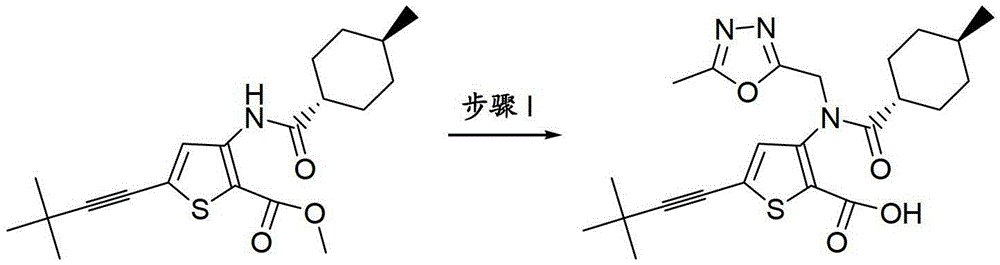
在氮气气氛中向5-(3,3-二甲基-丁-1-炔基)-3-[(反式-4-甲基-环己烷羰基)-氨基]-噻吩-2-甲酸甲酯(88.3mg,0.244mmol)在乙腈(2.4mL)中的溶液中依次加入2-氯甲基-5-甲基-[1,3,4]噁二唑(97mg,0.733mmol)和三乙胺(0.170mL,1.221mmol)。将该反应混合物在150℃在微波照射下加热30分钟,冷却至RT,浓缩至干。通过快速硅胶色谱法纯化残余物(0-35%EtOAc的己烷溶液),重结晶,得到5-(3,3-二甲基-丁-1-炔基)-3-[(反式-4-甲基-环己烷羰基)-(5-甲基-[1,3,4]噁二唑-2-基甲基)-氨基]-噻吩-2-甲酸(51mg,29%)。To 5-(3,3-dimethyl-but-1-ynyl)-3-[(trans-4-methyl-cyclohexanecarbonyl)-amino]-thiophene-2-carboxylic acid in nitrogen atmosphere To a solution of the methyl ester (88.3 mg, 0.244 mmol) in acetonitrile (2.4 mL) was added 2-chloromethyl-5-methyl-[1,3,4]oxadiazole (97 mg, 0.733 mmol) and tris Ethylamine (0.170 mL, 1.221 mmol). The reaction mixture was heated at 150 °C for 30 min under microwave irradiation, cooled to RT and concentrated to dryness. The residue was purified by flash silica gel chromatography (0-35% EtOAc in hexanes) and recrystallized to give 5-(3,3-dimethyl-but-1-ynyl)-3-[(trans- 4-Methyl-cyclohexanecarbonyl)-(5-methyl-[1,3,4]oxadiazol-2-ylmethyl)-amino]-thiophene-2-carboxylic acid (51 mg, 29%).
1H NMR(400MHz,CDCl3):δ10.02(s,1H),8.13(d,1H),5.45(s,2H),2.58(s,3H),2.30-2.19(m,1H),2.05-1.98(m,2H),1.84-1.77(m,2H),1.60-1.47(m,2H),1.29(s,9H),1.06-0,94(m,3H),0.91(d,3H)。 1 H NMR (400MHz, CDCl 3 ): δ10.02(s,1H),8.13(d,1H),5.45(s,2H),2.58(s,3H),2.30-2.19(m,1H),2.05 -1.98(m,2H),1.84-1.77(m,2H),1.60-1.47(m,2H),1.29(s,9H),1.06-0,94(m,3H),0.91(d,3H) .
LC/MS:m/z=444.05(M+H+)。LC/MS: m/z=444.05 (M+H + ).
化合物13的制备:(3-[环己-3-烯基-(反式-4-甲基-环己烷羰基)-氨基]-5-(3,3-二甲基-丁-1-炔基)-噻吩-2-甲酸)Preparation of compound 13: (3-[cyclohex-3-enyl-(trans-4-methyl-cyclohexanecarbonyl)-amino]-5-(3,3-dimethyl-but-1- Alkynyl)-thiophene-2-carboxylic acid)
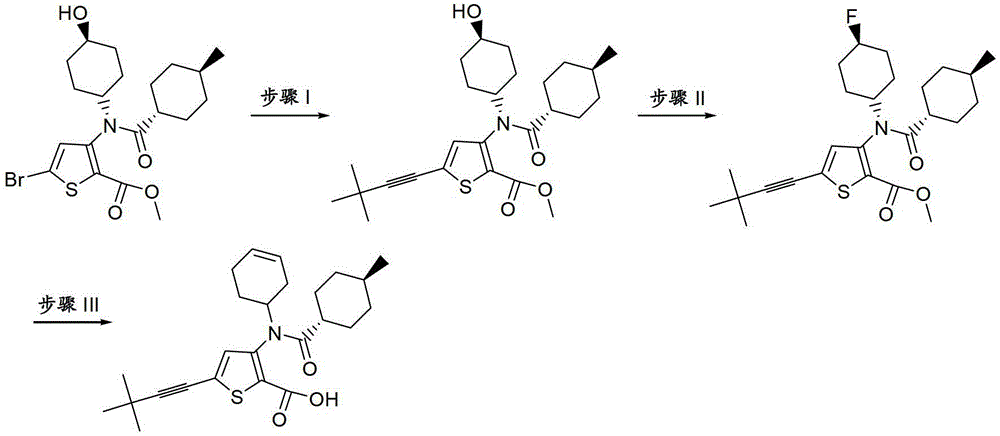
步骤IStep I
在氮气气氛中向5-溴-3-[(反式-4-羟基-环己基)-(反式-4-甲基-环己烷-羰基)-氨基]-噻吩-2-甲酸甲酯(1.273g,2.78mmol)在DMF(15mL)中的溶液中依次加入三(二亚苄基丙酮)二钯(0)(127mg,0.14mmol)和碘化亚铜(I)(11mg,0.06mmol)。通过使氮气发泡10分钟给该反应混合物脱氧,依次加入叔丁基乙炔(1.37mL,11.12mmol)、2,2'-双(二苯基膦基)-1,1'-联萘(156mg,0.25mmol)和三乙胺(1.94mL,13.9mmol)。将该反应混合物在60℃加热过夜,用DCM稀释,用C盐过滤,用DCM洗涤。用盐水洗涤滤液,用Na2SO4干燥,过滤,浓缩至干。通过快速硅胶色谱法纯化残余物(0-100%EtOAc的己烷溶液),得到5-(3,3-二甲基-丁-1-炔基)-3-[(反式-4-羟基-环己基)-(反式-4-甲基-环己烷羰基)-氨基]-噻吩-2-甲酸甲酯(1.124g,88%)。To 5-bromo-3-[(trans-4-hydroxy-cyclohexyl)-(trans-4-methyl-cyclohexane-carbonyl)-amino]-thiophene-2-carboxylic acid methyl ester under nitrogen atmosphere (1.273g, 2.78mmol) in DMF (15mL) were added successively tris(dibenzylideneacetone)dipalladium (0) (127mg, 0.14mmol) and copper (I) iodide (11mg, 0.06mmol ). The reaction mixture was deoxygenated by bubbling nitrogen for 10 minutes, tert-butylacetylene (1.37 mL, 11.12 mmol), 2,2'-bis(diphenylphosphino)-1,1'-binaphthyl (156 mg , 0.25mmol) and triethylamine (1.94mL, 13.9mmol). The reaction mixture was heated at 60 °C overnight, diluted with DCM, filtered through celite and washed with DCM. The filtrate was washed with brine, dried over Na2SO4 , filtered and concentrated to dryness. Purification of the residue by flash silica gel chromatography (0-100% EtOAc in hexanes) afforded 5-(3,3-dimethyl-but-1-ynyl)-3-[(trans-4-hydroxy -Cyclohexyl)-(trans-4-methyl-cyclohexanecarbonyl)-amino]-thiophene-2-carboxylic acid methyl ester (1.124 g, 88%).
步骤IIStep II
在氮气气氛中向5-(3,3-二甲基-丁-1-炔基)-3-[(反式-4-羟基-环己基)-(反式-4-甲基-环己烷羰基)-氨基]-噻吩-2-甲酸甲酯(191mg,0.41mmol)在二氯甲烷(3mL)中的溶液中加入三氟化二乙基氨基硫(109μL,0.83mmol)。将该反应混合物在RT搅拌1小时,用二氯甲烷稀释,用盐水和H2O洗涤。用Na2SO4干燥有机相,过滤,浓缩至干。通过快速硅胶色谱法纯化残余物(0-50%EtOAc的己烷溶液),得到5-(3,3-二甲基-丁-1-炔基)-3-[(反式-4-氟-环己基)-(反式-4-甲基-环己烷羰基)-氨基]-噻吩-2-甲酸甲酯(136mg,72%)。To 5-(3,3-dimethyl-but-1-ynyl)-3-[(trans-4-hydroxy-cyclohexyl)-(trans-4-methyl-cyclohexyl) in a nitrogen atmosphere Alkylcarbonyl)-amino]-thiophene-2-carboxylic acid methyl ester (191 mg, 0.41 mmol) in dichloromethane (3 mL) was added diethylaminosulfur trifluoride (109 μL, 0.83 mmol). The reaction mixture was stirred at RT for 1 h, diluted with dichloromethane, washed with brine and H2O . The organic phase was dried over Na2SO4 , filtered and concentrated to dryness. Purification of the residue by flash silica gel chromatography (0-50% EtOAc in hexanes) afforded 5-(3,3-dimethyl-but-1-ynyl)-3-[(trans-4-fluoro -Cyclohexyl)-(trans-4-methyl-cyclohexanecarbonyl)-amino]-thiophene-2-carboxylic acid methyl ester (136 mg, 72%).
步骤IIIStep III
在氮气气氛中向5-(3,3-二甲基-丁-1-炔基)-3-[(反式-4-氟-环己基)-(反式-4-甲基-环己烷羰基)-氨基]-噻吩-2-甲酸甲酯(136g,0.29mmol)在THF:H2O(5mL,4:1)中的溶液中加入一水合氢氧化锂(37mg,0.88mmol)。将该反应混合物在50℃加热3小时,冷却至RT,浓缩至其体积的1/3。用DCM稀释该反应混合物,用HCl1N酸化至pH3。用DCM萃取该反应混合物,用盐水洗涤有机层,用Na2SO4干燥,过滤,浓缩至干。通过快速硅胶色谱法纯化残余物(0-5%甲醇的DCM溶液),得到3-[环己-3-烯基-(反式-4-甲基-环己烷羰基)-氨基]-5-(3,3-二甲基-丁-1-炔基)-噻吩-2-甲酸甲酯(82mg,66%)。To 5-(3,3-dimethyl-but-1-ynyl)-3-[(trans-4-fluoro-cyclohexyl)-(trans-4-methyl-cyclohexyl) in a nitrogen atmosphere Alkylcarbonyl)-amino]-thiophene-2-carboxylic acid methyl ester (136 g, 0.29 mmol) in THF:H 2 O (5 mL, 4:1 ) was added lithium hydroxide monohydrate (37 mg, 0.88 mmol). The reaction mixture was heated at 50 °C for 3 hours, cooled to RT and concentrated to 1/3 of its volume. The reaction mixture was diluted with DCM and acidified to
1H NMR(400MHz,DMSO-d6):δ13.55(s,1H),7.27-7.17(m,1H),5.66-5.47(m,2H),4.66-4.28(m,2H),3.95-3.83(m,1H),2.16-1.42(m,12H),1.26(s,9H),0.82-0.70(m,3H),0.67-0.54(m,2H)。 1 H NMR (400MHz, DMSO-d 6 ): δ13.55(s,1H),7.27-7.17(m,1H),5.66-5.47(m,2H),4.66-4.28(m,2H),3.95- 3.83 (m, 1H), 2.16-1.42 (m, 12H), 1.26 (s, 9H), 0.82-0.70 (m, 3H), 0.67-0.54 (m, 2H).
LC/MS:m/z=442.36(M+H+)。LC/MS: m/z=442.36 (M+H + ).
化合物12的制备:3-[(反式-4-烯丙基氧基-环己基)-(反式-4-甲基-环己烷羰基)-氨基]-5-(3,3-二甲基-丁-1-炔基)-噻吩-2-甲酸Preparation of Compound 12: 3-[(trans-4-allyloxy-cyclohexyl)-(trans-4-methyl-cyclohexanecarbonyl)-amino]-5-(3,3-di Methyl-but-1-ynyl)-thiophene-2-carboxylic acid

步骤IStep I
在氮气气氛中向脱气的5-(3,3-二甲基-丁-1-炔基)-3-[(反式-4-羟基-环己基)-(反式-4-甲基-环己烷羰基)-氨基]-噻吩-2-甲酸甲酯(1.87g,4.07mmol)在THF(40mL)中的溶液中依次加入碳酸烯丙基甲基酯(1042μL,9.17mmol)和四(三苯基膦)钯(0)(235mg,5mol%)。给该反应混合物脱气,加热至65℃过夜。将该反应混合物冷却至RT,浓缩至干。通过快速硅胶色谱法纯化残余物(0-30%EtOAc的己烷溶液),得到3-[(反式-4-烯丙基氧基-环己基)-(反式-4-甲基-环己烷羰基)-氨基]-5-(3,3-二甲基-丁-1-炔基)-噻吩-2-甲酸甲酯(470mg,23%)。To degassed 5-(3,3-dimethyl-but-1-ynyl)-3-[(trans-4-hydroxy-cyclohexyl)-(trans-4-methyl -Cyclohexanecarbonyl)-amino]-thiophene-2-carboxylic acid methyl ester (1.87g, 4.07mmol) in THF (40mL) were added successively allylmethyl carbonate (1042μL, 9.17mmol) and four (Triphenylphosphine)palladium(0) (235mg, 5mol%). The reaction mixture was degassed and heated to 65°C overnight. The reaction mixture was cooled to RT and concentrated to dryness. Purification of the residue by flash silica gel chromatography (0-30% EtOAc in hexanes) gave 3-[(trans-4-allyloxy-cyclohexyl)-(trans-4-methyl-cyclo Hexanecarbonyl)-amino]-5-(3,3-dimethyl-but-1-ynyl)-thiophene-2-carboxylic acid methyl ester (470 mg, 23%).
步骤IIStep II
在氮气气氛中向3-[(反式-4-烯丙基氧基-环己基)-(反式-4-甲基-环己烷羰基)-氨基]-5-(3,3-二甲基-丁-1-炔基)-噻吩-2-甲酸甲酯(220mg,0.44mmol)在THF:H2O:甲醇的1:1:4混合物(12mL)中的溶液中加入一水合氢氧化锂(74mg,1.76mmol)。将该反应混合物在50℃加热过夜,冷却至RT,浓缩。用H2O(10mL)稀释该水溶液,用HCl2M水溶液酸化至pH2。用DCM(3×10mL)萃取该反应混合物,用Na2SO4干燥有机层,过滤,浓缩至干。通过反相制备型HPLC纯化残余物,得到3-[(反式-4-烯丙基氧基-环己基)-(反式-4-甲基-环己烷羰基)-氨基]-5-(3,3-二甲基-丁-1-炔基)-噻吩-2-甲酸(210mg,98%)。To 3-[(trans-4-allyloxy-cyclohexyl)-(trans-4-methyl-cyclohexanecarbonyl)-amino]-5-(3,3-di To a solution of methyl-but-1-ynyl)-thiophene-2-carboxylate (220 mg, 0.44 mmol) in a 1:1:4 mixture of THF: H2O :methanol (12 mL) was added hydrogen monohydrate Lithium oxide (74 mg, 1.76 mmol). The reaction mixture was heated at 50 °C overnight, cooled to RT and concentrated. The aqueous solution was diluted with H2O (10 mL), acidified to
LC/MS:m/z=486.18(M+H+)。LC/MS: m/z=486.18 (M+H + ).
化合物16的制备:3-[环丙基-(反式-4-甲基-环己烷羰基)-氨基]-5-(3,3-二甲基-丁-1-炔基)-噻吩-2-甲酸Preparation of Compound 16: 3-[Cyclopropyl-(trans-4-methyl-cyclohexanecarbonyl)-amino]-5-(3,3-dimethyl-but-1-ynyl)-thiophene -2-Formic acid

步骤IStep I
在氮气气氛中向冷却至0℃的溴化亚铜在乙腈(40ml)中的混悬液中加入亚硝酸叔丁酯(1.24mL,1.073mmol)。将该混合物在0℃搅拌15分钟,在25分钟内分部分加入3-氨基-5-(3,3-二甲基-丁-1-炔基)-噻吩-2-甲酸甲酯(2.272g,6.94mmol)。将该反应混合物避光,温热至RT,搅拌过夜,浓缩至干。将残余物溶于DCM(50mL),加入HCl(50mL,1%水溶液),将该混合物在RT搅拌30分钟。用盐水洗涤有机层,用Na2SO4干燥,浓缩至干,得到3-溴-5-(3,3-二甲基-丁-1-炔基)-噻吩-2-甲酸甲酯(2.905g),将其用于下一步。To a suspension of cuprous bromide in acetonitrile (40 ml) cooled to 0 °C was added tert-butyl nitrite (1.24 mL, 1.073 mmol) under nitrogen atmosphere. The mixture was stirred at 0° C. for 15 minutes, methyl 3-amino-5-(3,3-dimethyl-but-1-ynyl)-thiophene-2-carboxylate (2.272 g ,6.94mmol). The reaction mixture was protected from light, warmed to RT, stirred overnight, and concentrated to dryness. The residue was dissolved in DCM (50 mL), HCl (50 mL, 1% in water) was added and the mixture was stirred at RT for 30 min. The organic layer was washed with brine, dried over Na2SO4 and concentrated to dryness to give 3-bromo-5-(3,3-dimethyl-but-1-ynyl)-thiophene-2-carboxylic acid methyl ester (2.905 g), use it for the next step.
步骤IIStep II
在氮气气氛中向3-溴-5-(3,3-二甲基-丁-1-炔基)-噻吩-2-甲酸甲酯(1.189g,3.75mmol)在二噁烷(30mL)中的溶液中依次加入三(二亚苄基丙酮)二钯(0)(343mg,0.375mmol)和碳酸铯(3.665g,11.25mmol)。通过使氮气发泡10分钟给该反应混合物脱氧,依次加入环丙胺(315μL,4.50mmol)和2,2'-双(二苯基膦基)-1,1'-联萘(374mg,0.60mmol)。将该反应混合物在60℃加热24小时,18小时后再加入等量的环丙胺(265μL,3.75mmol)。用DCM稀释该反应混合物,用C盐过滤,用DCM洗涤。将滤液浓缩至干,通过快速硅胶色谱法纯化残余物(0-100%EtOAc的己烷溶液),得到3-环丙基氨基-5-(3,3-二甲基-丁-1-炔基)-噻吩-2-甲酸甲酯(742mg,67%),为3:2的原料:产物混合物。To 3-bromo-5-(3,3-dimethyl-but-1-ynyl)-thiophene-2-carboxylic acid methyl ester (1.189 g, 3.75 mmol) in dioxane (30 mL) under nitrogen atmosphere Tris(dibenzylideneacetone)dipalladium(0) (343mg, 0.375mmol) and cesium carbonate (3.665g, 11.25mmol) were added successively to the solution of the solution. The reaction mixture was deoxygenated by bubbling nitrogen for 10 minutes, and cyclopropylamine (315 μL, 4.50 mmol) and 2,2'-bis(diphenylphosphino)-1,1'-binaphthyl (374 mg, 0.60 mmol) were added sequentially. ). The reaction mixture was heated at 60 °C for 24 hours, after which an equivalent amount of cyclopropylamine (265 μL, 3.75 mmol) was added after 18 hours. The reaction mixture was diluted with DCM, filtered through celite and washed with DCM. The filtrate was concentrated to dryness and the residue was purified by flash silica gel chromatography (0-100% EtOAc in hexanes) to give 3-cyclopropylamino-5-(3,3-dimethyl-but-1-yne base)-thiophene-2-carboxylic acid methyl ester (742 mg, 67%) in a 3:2 starting material:product mixture.
步骤IIIStep III
在氮气气氛中向3-环丙基氨基-5-(3,3-二甲基-丁-1-炔基)-噻吩-2-甲酸甲酯(742mg,2.53mmol)在甲苯(10mL)中的溶液中依次加入吡啶(245μL,3.04mmol)和反式-4-甲基环己烷羰基氯(1.15mL,5.05mmol)。将该反应混合物在110℃加热24小时,加入吡啶和甲醇。将该反应混合物冷却至RT,用DCM稀释。用盐水洗涤有机层,用Na2SO4干燥,过滤,浓缩至干。通过快速硅胶色谱法纯化残余物(0-100%EtOAc的己烷溶液),得到3-[环丙基-(反式-4-甲基-环己烷羰基)-氨基]-5-(3,3-二甲基-丁-1-炔基)-噻吩-2-甲酸甲酯(448mg,42%)。Add 3-cyclopropylamino-5-(3,3-dimethyl-but-1-ynyl)-thiophene-2-carboxylic acid methyl ester (742 mg, 2.53 mmol) in toluene (10 mL) under nitrogen atmosphere Pyridine (245 μL, 3.04 mmol) and trans-4-methylcyclohexanecarbonyl chloride (1.15 mL, 5.05 mmol) were added sequentially to the solution of the solution. The reaction mixture was heated at 110°C for 24 hours and pyridine and methanol were added. The reaction mixture was cooled to RT and diluted with DCM. The organic layer was washed with brine, dried over Na2SO4 , filtered and concentrated to dryness. The residue was purified by flash silica gel chromatography (0-100% EtOAc in hexanes) to afford 3-[cyclopropyl-(trans-4-methyl-cyclohexanecarbonyl)-amino]-5-(3 , 3-Dimethyl-but-1-ynyl)-thiophene-2-carboxylic acid methyl ester (448 mg, 42%).
步骤IVStep IV
在氮气气氛中向3-[环丙基-(反式-4-甲基-环己烷羰基)-氨基]-5-(3,3-二甲基-丁-1-炔基)-噻吩-2-甲酸甲酯(435mg,1.04mmol)在THF:H2O的4:1混合物(10mL)中的溶液中加入一水合氢氧化锂(262mg,6.25mmol)。将该反应混合物在60℃加热3小时,冷却至RT。用DCM稀释该反应混合物,用HCl1N酸化至pH2-3。用DCM萃取该反应混合物,用盐水洗涤有机层,用Na2SO4干燥,过滤,浓缩至干。通过快速硅胶色谱法纯化残余物(0-5%甲醇的DCM溶液),得到3-[环丙基-(反式-4-甲基-环己烷羰基)-氨基]-5-(3,3-二甲基-丁-1-炔基)-噻吩-2-甲酸(326mg,78%)。To 3-[cyclopropyl-(trans-4-methyl-cyclohexanecarbonyl)-amino]-5-(3,3-dimethyl-but-1-ynyl)-thiophene in nitrogen atmosphere - To a solution of methyl 2-carboxylate (435 mg, 1.04 mmol) in a 4:1 mixture of THF:H 2 O (10 mL) was added lithium hydroxide monohydrate (262 mg, 6.25 mmol). The reaction mixture was heated at 60 °C for 3 hours and cooled to RT. The reaction mixture was diluted with DCM and acidified to pH 2-3 with HCl 1N. The reaction mixture was extracted with DCM, the organic layer was washed with brine, dried over Na2SO4 , filtered and concentrated to dryness. Purification of the residue by flash silica gel chromatography (0-5% methanol in DCM) gave 3-[cyclopropyl-(trans-4-methyl-cyclohexanecarbonyl)-amino]-5-(3, 3-Dimethyl-but-1-ynyl)-thiophene-2-carboxylic acid (326 mg, 78%).
LC/MS:m/z=388.26(M+H+)。LC/MS: m/z=388.26 (M+H + ).
化合物17的制备:5-(3,3-二甲基-丁-1-炔基)-3-[异丙基-(反式-4-甲基-环己烷羰基)-氨基]-噻吩-2-甲酸Preparation of Compound 17: 5-(3,3-Dimethyl-but-1-ynyl)-3-[isopropyl-(trans-4-methyl-cyclohexanecarbonyl)-amino]-thiophene -2-Formic acid
步骤IStep I
在氮气气氛中向3-氨基-5-溴-噻吩-2-甲酸甲酯(4.0g,16.95mmol)在1,2-二氯乙烷(20mL)中的溶液中依次加入2-甲氧基丙烯(6.5mL,67.79mmol)、乙酸(3.8mL,67.79mmol)和三乙酰氧基硼氢化钠(7.2g,67.79mmol)。将该反应混合物在RT搅拌过夜,用氯仿稀释。用H2O洗涤有机层,用Na2SO4干燥,过滤,浓缩至干。通过快速硅胶色谱法纯化残余物(2%EtOAc的己烷溶液),得到5-溴-3-异丙基氨基-噻吩-2-甲酸甲酯(4.0g,85%)。To a solution of methyl 3-amino-5-bromo-thiophene-2-carboxylate (4.0 g, 16.95 mmol) in 1,2-dichloroethane (20 mL) was sequentially added 2-methoxy Propylene (6.5 mL, 67.79 mmol), acetic acid (3.8 mL, 67.79 mmol) and sodium triacetoxyborohydride (7.2 g, 67.79 mmol). The reaction mixture was stirred overnight at RT and diluted with chloroform. The organic layer was washed with H2O , dried over Na2SO4 , filtered and concentrated to dryness. The residue was purified by flash silica gel chromatography (2% EtOAc in hexanes) to give methyl 5-bromo-3-isopropylamino-thiophene-2-carboxylate (4.0 g, 85%).
步骤IIStep II
在氮气气氛中向5-溴-3-异丙基氨基-噻吩-2-甲酸甲酯(4.0g,14.388mmol)在甲苯(50mL)中的溶液中依次加入吡啶(1.3mL,15.83mmol)和反式-4-甲基环己烷羰基氯(4.6g,28.776mmol)。将该反应混合物在110℃加热过夜,冷却至RT,用EtOAc稀释。用饱和碳酸氢钠水溶液洗涤有机层,用Na2SO4干燥,过滤,浓缩至干。通过快速硅胶色谱法纯化残余物(1-10%EtOAc的己烷溶液),得到5-溴-3-[异丙基-(反式-4-甲基-环己烷羰基)-氨基]-噻吩-2-甲酸甲酯(2.5g,44%)。To a solution of methyl 5-bromo-3-isopropylamino-thiophene-2-carboxylate (4.0 g, 14.388 mmol) in toluene (50 mL) was added pyridine (1.3 mL, 15.83 mmol) and trans-4-methylcyclohexanecarbonyl chloride (4.6 g, 28.776 mmol). The reaction mixture was heated at 110 °C overnight, cooled to RT and diluted with EtOAc. The organic layer was washed with saturated aqueous sodium bicarbonate, dried over Na2SO4 , filtered and concentrated to dryness . Purification of the residue by flash silica gel chromatography (1-10% EtOAc in hexanes) afforded 5-bromo-3-[isopropyl-(trans-4-methyl-cyclohexanecarbonyl)-amino]- Methyl thiophene-2-carboxylate (2.5 g, 44%).
步骤IIIStep III
在氮气气氛中向5-溴-3-[异丙基-(反式-4-甲基-环己烷羰基)-氨基]-噻吩-2-甲酸甲酯(150mg,0.387mmol)在DMF(2mL)中的溶液中依次加入三(二亚苄基丙酮)二钯(0)(25mg,7mol%)和碘化亚铜(I)(1.5mg,2mol%)。通过使氮气发泡10分钟给该反应混合物脱氧,依次加入叔丁基乙炔(136mg,1.55mmol)、三苯基膦(10mg,10mol%)和三乙胺(381μL,2.75mmol)。将该反应混合物在60℃加热过夜,浓缩至干。用EtOAc萃取该反应混合物,用H2O洗涤有机层,用Na2SO4干燥,过滤,浓缩至干。通过快速硅胶色谱法纯化残余物(0-60%EtOAc的己烷溶液),得到5-(3,3-二甲基-丁-1-炔基)-3-[异丙基-(反式-4-甲基-环己烷羰基)-氨基]-噻吩-2-甲酸甲酯(125g,80%)。Add 5-bromo-3-[isopropyl-(trans-4-methyl-cyclohexanecarbonyl)-amino]-thiophene-2-carboxylic acid methyl ester (150 mg, 0.387 mmol) in DMF ( To the solution in 2mL), tris(dibenzylideneacetone)dipalladium(0)(25mg, 7mol%) and copper iodide(I)(1.5mg, 2mol%) were added successively. The reaction mixture was deoxygenated by bubbling nitrogen for 10 minutes and tert-butylacetylene (136 mg, 1.55 mmol), triphenylphosphine (10 mg, 10 mol%) and triethylamine (381 μL, 2.75 mmol) were added sequentially. The reaction mixture was heated at 60 °C overnight and concentrated to dryness. The reaction mixture was extracted with EtOAc, the organic layer was washed with H2O , dried over Na2SO4 , filtered and concentrated to dryness. Purification of the residue by flash silica gel chromatography (0-60% EtOAc in hexanes) gave 5-(3,3-dimethyl-but-1-ynyl)-3-[isopropyl-(trans -4-Methyl-cyclohexanecarbonyl)-amino]-thiophene-2-carboxylic acid methyl ester (125 g, 80%).
步骤IVStep IV
在氮气气氛中向5-(3,3-二甲基-丁-1-炔基)-3-[异丙基-(反式-4-甲基-环己烷羰基)-氨基]-噻吩-2-甲酸甲酯(125mg,0.310mmol)在THF:甲醇:H2O的3:2:1混合物(3mL)中的溶液中加入一水合氢氧化锂(930μL,1N)。将该反应混合物在70℃加热过夜,冷却至RT,浓缩至干,用H2O稀释。用HCl水溶液(1N)将该水溶液酸化至pH2-3。用EtOAc萃取该反应混合物,用Na2SO4干燥有机层,过滤,浓缩至干。通过反相制备型HPLC纯化残余物,得到5-(3,3-二甲基-丁-1-炔基)-3-[异丙基-(反式-4-甲基-环己烷羰基)-氨基]-噻吩-2-甲酸(90mg,75%)。To 5-(3,3-dimethyl-but-1-ynyl)-3-[isopropyl-(trans-4-methyl-cyclohexanecarbonyl)-amino]-thiophene in a nitrogen atmosphere - To a solution of methyl 2-carboxylate (125 mg, 0.310 mmol) in a 3:2:1 mixture of THF:methanol:H 2 O (3 mL) was added lithium hydroxide monohydrate (930 μL, 1 N). The reaction mixture was heated at 70 °C overnight, cooled to RT, concentrated to dryness and diluted with H2O . The aqueous solution was acidified to pH 2-3 with aqueous HCl (1 N). The reaction mixture was extracted with EtOAc, the organic layer was dried over Na2SO4 , filtered and concentrated to dryness. Purification of the residue by reverse-phase preparative HPLC afforded 5-(3,3-dimethyl-but-1-ynyl)-3-[isopropyl-(trans-4-methyl-cyclohexanecarbonyl )-amino]-thiophene-2-carboxylic acid (90 mg, 75%).
1H NMR(400MHz,CDCl3):δ6.8(s,1H),4.9(bs,1H),1.9(m,1H),1.7-0.6(m,27H)。 1 H NMR (400 MHz, CDCl 3 ): δ 6.8 (s, 1H), 4.9 (bs, 1H), 1.9 (m, 1H), 1.7-0.6 (m, 27H).
LC/MS:m/z=390.33(M+H+)。LC/MS: m/z=390.33 (M+H + ).
化合物18、19、20、21和22的制备Preparation of
使用基本上与上述对化合物17所述相同的方法制备如下化合物:Using essentially the same procedure as described above for
化合物18:5-环己基乙炔基-3-[异丙基-(反式-4-甲基-环己烷羰基)-氨基]-噻吩-2-甲酸Compound 18: 5-Cyclohexylethynyl-3-[isopropyl-(trans-4-methyl-cyclohexanecarbonyl)-amino]-thiophene-2-carboxylic acid
1H NMR(400MHz,CDCl3):δ6.84(s,1H),5.00-4.84(m,1H),2.68-2.58(m,1H),2.04-1.85(m,3H),1.81-1.70(m,2H),1.70-1.48(m,8H),1.48-1.23(m,5H),1.15(d,3H),0.92(d,3H),0.79(d,3H),0.76-0.58(d,2H)。 1 H NMR (400MHz, CDCl 3 ): δ6.84(s, 1H), 5.00-4.84(m, 1H), 2.68-2.58(m, 1H), 2.04-1.85(m, 3H), 1.81-1.70( m,2H),1.70-1.48(m,8H),1.48-1.23(m,5H),1.15(d,3H),0.92(d,3H),0.79(d,3H),0.76-0.58(d, 2H).
LC/MS:m/z=416.25(M+H+)。LC/MS: m/z=416.25 (M+H + ).
化合物19:5-(3-羟基-3-甲基-丁-1-炔基)-3-[异丙基-(反式-4-甲基-环己烷羰基)-氨基]-噻吩-2-甲酸Compound 19: 5-(3-Hydroxy-3-methyl-but-1-ynyl)-3-[isopropyl-(trans-4-methyl-cyclohexanecarbonyl)-amino]-thiophene- 2-Formic acid
LC/MS:m/z=392.22(M+H+)。LC/MS: m/z=392.22 (M+H + ).
化合物20:5-环丙基乙炔基-3-[异丙基-(反式-4-甲基-环己烷羰基)-氨基]-噻吩-2-甲酸Compound 20: 5-Cyclopropylethynyl-3-[isopropyl-(trans-4-methyl-cyclohexanecarbonyl)-amino]-thiophene-2-carboxylic acid
1H NMR(400MHz,CDCl3):δ6.83(s,1H),4.96-4.85(m,1H),1.95(bs,1H),1.70-1.55(m,4H),1.56-1.46(m,1H),1.45-1.22(m,2H),1.13(d,3H),1.03-0.85(m,7H),0.78(d,3H),0.75-0.56(s,2H)。 1 H NMR (400MHz, CDCl 3 ): δ6.83(s, 1H), 4.96-4.85(m, 1H), 1.95(bs, 1H), 1.70-1.55(m, 4H), 1.56-1.46(m, 1H), 1.45-1.22(m, 2H), 1.13(d, 3H), 1.03-0.85(m, 7H), 0.78(d, 3H), 0.75-0.56(s, 2H).
LC/MS:m/z=374.02(M+H+)。LC/MS: m/z=374.02 (M+H + ).
化合物21:3-[异丙基-(反式-4-甲基-环己烷羰基)-氨基]-5-苯基乙炔基-噻吩-2-甲酸Compound 21: 3-[isopropyl-(trans-4-methyl-cyclohexanecarbonyl)-amino]-5-phenylethynyl-thiophene-2-carboxylic acid
1H NMR(400MHz,CDCl3):δ9.91(bs,1H),7.60-7.51(m,2H),7.44-7.35(m,3H),7.03(s,1H),5.04-4.89(m,1H),2.08-1.91(m,1H),1.76-1.24(m,5H),1.19(d,J=6.6Hz,3H),0.97(d,J=6.8Hz,3H),0.80(d,J=6.5Hz,3H),0.77-0.59(m,2H)。 1 H NMR (400MHz, CDCl 3 ): δ9.91(bs,1H),7.60-7.51(m,2H),7.44-7.35(m,3H),7.03(s,1H),5.04-4.89(m, 1H),2.08-1.91(m,1H),1.76-1.24(m,5H),1.19(d,J=6.6Hz,3H),0.97(d,J=6.8Hz,3H),0.80(d,J =6.5Hz, 3H), 0.77-0.59(m, 2H).
LC/MS:m/z=410.11(M+H+)。LC/MS: m/z = 410.11 (M+H + ).
化合物22:3-[异丙基-(反式-4-甲基-环己烷羰基)-氨基]-5-(3-甲氧基-3-甲基-丁-1-炔基)-噻吩-2-甲酸Compound 22: 3-[isopropyl-(trans-4-methyl-cyclohexanecarbonyl)-amino]-5-(3-methoxy-3-methyl-but-1-ynyl)- Thiophene-2-carboxylic acid
1H NMR(400MHz,CDCl3):δ8.00(bs,1H),6.93(s,1H),4.93(s,1H),3.43(s,3H),1.96(bs,1H),1.74-1.58(m,4H),1.56(s,6H),1.52-1.20(m,3H),1.16(d,3H),0.93(d,3H),0.79(d,3H),0.73-0.58(m,2H)。 1 H NMR (400MHz, CDCl 3 ): δ8.00(bs,1H),6.93(s,1H),4.93(s,1H),3.43(s,3H),1.96(bs,1H),1.74-1.58 (m,4H),1.56(s,6H),1.52-1.20(m,3H),1.16(d,3H),0.93(d,3H),0.79(d,3H),0.73-0.58(m,2H ).
LC/MS:m/z=406.15(M+H+)。LC/MS: m/z=406.15 (M+H + ).
化合物14的制备:3-[(4,4-二氟-环己基)-(反式-4-甲基-环己烷羰基)-氨基]-5-(3,3-二甲基-丁-1-炔基)-噻吩-2-甲酸Preparation of compound 14: 3-[(4,4-difluoro-cyclohexyl)-(trans-4-methyl-cyclohexanecarbonyl)-amino]-5-(3,3-dimethyl-butanol -1-alkynyl)-thiophene-2-carboxylic acid
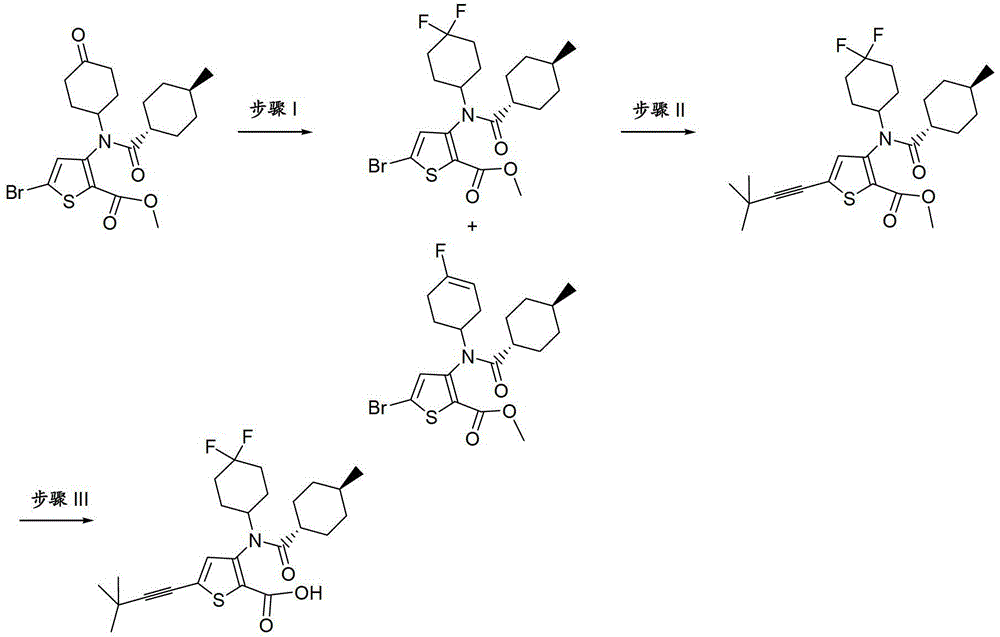
步骤IStep I
在氮气气氛中向5-溴-3-[(反式-4-甲基-环己烷羰基)-(4-氧代-环己基)-氨基]-噻吩-2-甲酸甲酯(420mg,0.92mmol)在甲苯(5mL)中的溶液中加入三氟化二乙基氨基硫(362μL,2.76mmol)。将该反应混合物在RT搅拌过夜,用DCM稀释,用盐水和H2O洗涤。用Na2SO4干燥有机相,过滤,浓缩至干。通过快速硅胶色谱法纯化残余物(0-100%EtOAc的己烷溶液),得到5-溴-3-[(4,4-二氟-环己基)-(反式-4-甲基-环己烷羰基)-氨基]-噻吩-2-甲酸甲酯(196mg,44.5%)和5-溴-3-[(4-氟-环己-3-烯基)-(反式-4-甲基-环己烷羰基)-氨基]-噻吩-2-甲酸甲酯(148mg,35%)。Add 5-bromo-3-[(trans-4-methyl-cyclohexanecarbonyl)-(4-oxo-cyclohexyl)-amino]-thiophene-2-carboxylic acid methyl ester (420mg, To a solution of 0.92 mmol) in toluene (5 mL) was added diethylaminosulfur trifluoride (362 μL, 2.76 mmol). The reaction mixture was stirred overnight at RT, diluted with DCM, washed with brine and H2O . The organic phase was dried over Na2SO4 , filtered and concentrated to dryness. Purification of the residue by flash silica gel chromatography (0-100% EtOAc in hexanes) afforded 5-bromo-3-[(4,4-difluoro-cyclohexyl)-(trans-4-methyl-cyclo Hexanecarbonyl)-amino]-thiophene-2-carboxylic acid methyl ester (196 mg, 44.5%) and 5-bromo-3-[(4-fluoro-cyclohex-3-enyl)-(trans-4-methyl [Cyclohexanecarbonyl)-amino]-thiophene-2-carboxylic acid methyl ester (148 mg, 35%).
步骤IIStep II
在氮气气氛中向5-溴-3-[(4,4-二氟-环己基)-(反式-4-甲基-环己烷羰基)-氨基]-噻吩-2-甲酸甲酯(193mg,0.40mmol)在DMF(5mL)中的溶液中依次加入三(二亚苄基丙酮)二钯(0)(18mg,0.02mmol)和碘化亚铜(I)(1.5mg,0.008mmol)。通过氮气发泡10分钟给该反应混合物脱氧,依次加入叔丁基乙炔(199μL,1.61mmol)、2,2'-双(二苯基膦基)-1,1'-联萘(20mg,0.03mmol)和三乙胺(279μL,2.0mmol)。将该反应混合物在60℃加热过夜,用DCM稀释,用C盐过滤,用DCM洗涤。用盐水洗涤滤液,用Na2SO4干燥,过滤,浓缩至干。通过快速硅胶色谱法纯化残余物(0-100%EtOAc的己烷溶液),得到3-[(4,4-二氟-环己基)-(反式-4-甲基-环己烷羰基)-氨基]-5-(3,3-二甲基-丁-1-炔基)-噻吩-2-甲酸甲酯(183mg,95%)。To 5-bromo-3-[(4,4-difluoro-cyclohexyl)-(trans-4-methyl-cyclohexanecarbonyl)-amino]-thiophene-2-carboxylic acid methyl ester ( To a solution of 193 mg, 0.40 mmol) in DMF (5 mL) was added tris(dibenzylideneacetone) dipalladium(0) (18 mg, 0.02 mmol) and cuprous(I) iodide (1.5 mg, 0.008 mmol) in sequence . The reaction mixture was deoxygenated by bubbling nitrogen for 10 minutes, tert-butylacetylene (199 μL, 1.61 mmol), 2,2'-bis(diphenylphosphino)-1,1'-binaphthyl (20 mg, 0.03 mmol) and triethylamine (279 μL, 2.0 mmol). The reaction mixture was heated at 60 °C overnight, diluted with DCM, filtered through celite and washed with DCM. The filtrate was washed with brine, dried over Na2SO4 , filtered and concentrated to dryness. Purification of the residue by flash silica gel chromatography (0-100% EtOAc in hexanes) gave 3-[(4,4-difluoro-cyclohexyl)-(trans-4-methyl-cyclohexanecarbonyl) -Amino]-5-(3,3-Dimethyl-but-1-ynyl)-thiophene-2-carboxylic acid methyl ester (183 mg, 95%).
步骤IIIStep III
在氮气气氛中向3-[(4,4-二氟-环己基)-(反式-4-甲基-环己烷羰基)-氨基]-5-(3,3-二甲基-丁-1-炔基)-噻吩-2-甲酸甲酯(183mg,0.38mmol)在THF:H2O的4:1混合物(5mL)中的溶液中加入一水合氢氧化锂(96mg,2.29mmol)。将该反应混合物在60℃加热3.5小时,冷却至RT,蒸发THF。用DCM稀释残余物,用HCl1N水溶液酸化至pH2-3。用DCM萃取该反应混合物,用盐水洗涤有机层,用Na2SO4干燥,过滤,浓缩至干。通过反相制备型HPLC纯化残余物,得到3-[(4,4-二氟-环己基)-(反式-4-甲基-环己烷羰基)-氨基]-5-(3,3-二甲基-丁-1-炔基)-噻吩-2-甲酸(30mg,17%)。To 3-[(4,4-difluoro-cyclohexyl)-(trans-4-methyl-cyclohexanecarbonyl)-amino]-5-(3,3-dimethyl-butane To a solution of methyl-1-alkynyl)-thiophene-2-carboxylate (183 mg, 0.38 mmol) in a 4:1 mixture of THF:H 2 O (5 mL) was added lithium hydroxide monohydrate (96 mg, 2.29 mmol) . The reaction mixture was heated at 60°C for 3.5 hours, cooled to RT and THF was evaporated. The residue was diluted with DCM and acidified to pH 2-3 with aqueous HCl 1N. The reaction mixture was extracted with DCM, the organic layer was washed with brine, dried over Na2SO4 , filtered and concentrated to dryness. Purification of the residue by reverse phase preparative HPLC afforded 3-[(4,4-difluoro-cyclohexyl)-(trans-4-methyl-cyclohexanecarbonyl)-amino]-5-(3,3 -Dimethyl-but-1-ynyl)-thiophene-2-carboxylic acid (30 mg, 17%).
LC/MS:m/z=466.24(M+H+)。LC/MS: m/z=466.24 (M+H + ).
化合物15的制备:5-(3,3-二甲基-丁-1-炔基)-3-[(4-氟-环己-3-烯基)-(反式-4-甲基-环己烷羰基)-氨基]-噻吩-2-甲酸:Preparation of Compound 15: 5-(3,3-Dimethyl-but-1-ynyl)-3-[(4-fluoro-cyclohex-3-enyl)-(trans-4-methyl- Cyclohexanecarbonyl)-amino]-thiophene-2-carboxylic acid:
使用基本上与上述对化合物14所述相同的方法制备化合物15:
LC/MS:m/z=446.26(M+H+)。LC/MS: m/z=446.26 (M+H + ).
化合物23的制备:3-[异丙基-(反式-4-甲基-环己烷羰基)-氨基]-5-三氟丙-1-炔基-噻吩-2-甲酸Preparation of compound 23: 3-[isopropyl-(trans-4-methyl-cyclohexanecarbonyl)-amino]-5-trifluoroprop-1-ynyl-thiophene-2-carboxylic acid

步骤IStep I
在-78℃使过量的三氟乙炔在THF(3mL)中发泡,向该溶液中滴加丁基锂(1.5mL,1.5M的己烷溶液)。将该反应混合物在-78℃搅拌30分钟,加入氯化锌(13.4mL,0.5M的THF溶液)。将得到的溶液在1.5小时内温热至RT,搅拌30分钟,冷却至0℃,依次加入四(三苯基膦)钯(0)(64mg,0.055mmol)和(5-碘-3-[异丙基-(反式-4-甲基-环己烷羰基)-氨基]-噻吩-2-甲酸甲酯(500mg,1.113mmol)。将该反应混合物在RT搅拌30分钟,在50℃搅拌4小时,用H2O稀释。用乙醚(1×50mL)萃取该反应混合物,用MgSO4干燥有机层,过滤,浓缩至干。通过快速硅胶色谱法纯化残余物(0-12%EtOAc的DCM溶液),得到3-[异丙基-(反式-4-甲基-环己烷羰基)-氨基]-5-三氟丙-1-炔基-噻吩-2-甲酸甲酯(51.2mg,11%)。Excess trifluoroacetylene was bubbled in THF (3 mL) at -78°C, and to this solution was added dropwise butyllithium (1.5 mL, 1.5M in hexane). The reaction mixture was stirred at -78°C for 30 minutes and zinc chloride (13.4 mL, 0.5M in THF) was added. The resulting solution was warmed to RT within 1.5 hours, stirred for 30 minutes, cooled to 0°C, and tetrakis(triphenylphosphine)palladium(0) (64mg, 0.055mmol) and (5-iodo-3-[ Isopropyl-(trans-4-methyl-cyclohexanecarbonyl)-amino]-thiophene-2-carboxylic acid methyl ester (500 mg, 1.113 mmol). The reaction mixture was stirred at RT for 30 minutes and at 50 °C 4 hours, diluted with H2O . The reaction mixture was extracted with diethyl ether (1 x 50 mL), the organic layer was dried over MgSO4 , filtered and concentrated to dryness. The residue was purified by flash silica gel chromatography (0-12% EtOAc in DCM solution) to give 3-[isopropyl-(trans-4-methyl-cyclohexanecarbonyl)-amino]-5-trifluoroprop-1-ynyl-thiophene-2-carboxylic acid methyl ester (51.2mg ,11%).
步骤IIStep II
在氮气气氛中向3-[异丙基-(反式-4-甲基-环己烷羰基)-氨基]-5-三氟丙-1-炔基-噻吩-2-甲酸甲酯(94mg,0.226mmol)在THF:H2O的1:1混合物(2mL)中的溶液中加入一水合氢氧化锂(38mg,0.904mmol)。将该反应混合物在RT搅拌过夜,用HCl1N水溶液酸化至pH2-3。用H2O(10mL)稀释该反应混合物,用EtOAc(2×15mL)萃取,用Na2SO4干燥有机层,过滤,浓缩至干。通过反相制备型HPLC纯化残余物,得到3-[异丙基-(反式-4-甲基-环己烷羰基)-氨基]-5-三氟丙-1-炔基-噻吩-2-甲酸(10.5mg,11.6%)。3-[isopropyl-(trans-4-methyl-cyclohexanecarbonyl)-amino]-5-trifluoroprop-1-ynyl-thiophene-2-carboxylic acid methyl ester (94mg , 0.226 mmol) in a 1:1 mixture of THF:H 2 O (2 mL) was added lithium hydroxide monohydrate (38 mg, 0.904 mmol). The reaction mixture was stirred overnight at RT and acidified to pH 2-3 with aqueous HCl 1N. The reaction mixture was diluted with H2O (10 mL), extracted with EtOAc (2 x 15 mL), the organic layer was dried over Na2SO4 , filtered and concentrated to dryness . Purification of the residue by reverse phase preparative HPLC afforded 3-[isopropyl-(trans-4-methyl-cyclohexanecarbonyl)-amino]-5-trifluoroprop-1-ynyl-thiophene-2 - Formic acid (10.5 mg, 11.6%).
1H NMR(400MHz,DMSO-d6):δ7.88(s,1H),4.79-4.66(m,1H),1.82(t,1H),1.62-1.13(m,8H),1.05(d,3H),0.83(d,3H),0.76(d,3H),0.68-0.53(m,2H)。 1 H NMR (400MHz, DMSO-d 6 ): δ7.88(s,1H), 4.79-4.66(m,1H), 1.82(t,1H), 1.62-1.13(m,8H), 1.05(d, 3H), 0.83(d,3H), 0.76(d,3H), 0.68-0.53(m,2H).
LC/MS:m/z=402.17(M+H+)。LC/MS: m/z=402.17 (M+H + ).
实施例1B:Example 1B:
化合物3的制备Preparation of
通过下述一般方案中的一般方法制备化合物3。
MS:m/z(obs.):460.6[M+H]+;Rt=6.05minMS: m/z(obs.): 460.6[M+H] + ; Rt=6.05min
1H NMR(300MHz,MeOD)δ6.99(s,1H),4.39(dd,J=15.9,7.6Hz,1H),2.75(dd,J=13.4,6.7Hz,1H),2.05-1.84(m,4H),1.56(ddd,J=18.4,12.9,10.4Hz,10H),1.32(ddd,J=14.5,11.3,4.8Hz,8H),1.13-0.85(m,5H),0.76(t,J=21.8Hz,5H)。 1 H NMR (300MHz,MeOD)δ6.99(s,1H),4.39(dd,J=15.9,7.6Hz,1H),2.75(dd,J=13.4,6.7Hz,1H),2.05-1.84(m ,4H),1.56(ddd,J=18.4,12.9,10.4Hz,10H),1.32(ddd,J=14.5,11.3,4.8Hz,8H),1.13-0.85(m,5H),0.76(t,J =21.8Hz, 5H).
一般方案general plan
步骤1step 1
向5-碘-3-[(1,4-二氧杂螺[4.5]癸-8-基)-(4-反式-甲基环己烷羰基)氨基]噻吩-2-甲酸甲酯(1mmol)在DMF(10-20mL)中的溶液中加入Et3N(1mmol),CuI(0.1-0.25mol%)、三(二亚苄基丙酮)二钯(0)(Pd2(dba)3)(0.01-0.05mol%)和2-取代的丁-1-炔(1mmol)。将该混合物在60℃加热过夜,然后用乙酸乙酯稀释,用水和盐水洗涤,干燥(Na2SO4),然后浓缩。通过硅胶色谱法纯化产物(10-90%EtOAc的己烷溶液),得到期望的5-(2-取代的-乙炔-1-基)-3-[(1,4-二氧杂螺[4.5]癸-8-基)-(4-反式-甲基环己烷羰基)氨基]噻吩-2-甲酸甲酯。To 5-iodo-3-[(1,4-dioxaspiro[4.5]dec-8-yl)-(4-trans-methylcyclohexanecarbonyl)amino]thiophene-2-carboxylic acid methyl ester ( 1 mmol) in DMF (10-20 mL) were added Et 3 N (1 mmol), CuI (0.1-0.25 mol%), tris(dibenzylideneacetone) dipalladium(0) (Pd 2 (dba) 3 ) (0.01-0.05mol%) and 2-substituted but-1-yne (1mmol). The mixture was heated at 60° C. overnight, then diluted with ethyl acetate, washed with water and brine, dried (Na 2 SO 4 ), and concentrated. The product was purified by silica gel chromatography (10-90% EtOAc in hexanes) to afford the desired 5-(2-substituted-ethyn-1-yl)-3-[(1,4-dioxaspiro[4.5 ]dec-8-yl)-(4-trans-methylcyclohexanecarbonyl)amino]thiophene-2-carboxylic acid methyl ester.
步骤2
将5-(2-取代的-乙炔-1-基)-3-[(1,4-二氧杂螺[4.5]癸-8-基)-(4-反式-甲基环己烷羰基)氨基]噻吩-2-甲酸甲酯(0.2mmol)溶于THF(10mL),加入3.6M HCl(5mL),搅拌过夜。用水稀释该反应混合物,用乙酸乙酯萃取。用盐水洗涤有机层,干燥(Na2SO4),浓缩。通过硅胶色谱法纯化产物(10-90%乙酸乙酯的己烷溶液),得到5-(2-取代的-乙炔-1-基)-3-[(4-氧代环己基)-(4-反式-甲基环己烷羰基)氨基]噻吩-2-甲酸甲酯。5-(2-substituted-ethyn-1-yl)-3-[(1,4-dioxaspiro[4.5]dec-8-yl)-(4-trans-methylcyclohexanecarbonyl )Amino]thiophene-2-carboxylic acid methyl ester (0.2 mmol) was dissolved in THF (10 mL), added with 3.6M HCl (5 mL), and stirred overnight. The reaction mixture was diluted with water and extracted with ethyl acetate. The organic layer was washed with brine, dried ( Na2SO4 ), and concentrated. The product was purified by silica gel chromatography (10-90% ethyl acetate in hexanes) to afford 5-(2-substituted-ethyn-1-yl)-3-[(4-oxocyclohexyl)-(4 - trans-methylcyclohexanecarbonyl)amino]thiophene-2-carboxylic acid methyl ester.
步骤3
将5-(2-取代的-乙炔-1-基)-3-[(4-氧代环己基)-(4-反式-甲基环己烷羰基)氨基]噻吩-2-甲酸甲酯(0.1mmol)溶于THF(10mL)和水(2滴),将该反应混合物冷却至-25℃。然后加入NaBH4(1当量),搅拌2小时。然后通过添加1N HCl使反应停止,然后用乙酸乙酯和水稀释。用盐水洗涤有机层,用Na2SO4干燥,然后浓缩,得到期望的产物5-(2-取代的-乙炔-1-基)-3-[(4-反式-羟基环己基)-(4-反式-甲基环己烷羰基)氨基]噻吩-2-甲酸甲酯。5-(2-substituted-ethyn-1-yl)-3-[(4-oxocyclohexyl)-(4-trans-methylcyclohexanecarbonyl)amino]thiophene-2-carboxylic acid methyl ester (0.1 mmol) was dissolved in THF (10 mL) and water (2 drops), and the reaction mixture was cooled to -25°C. Then NaBH4 (1 equiv) was added and stirred for 2 hours. The reaction was then quenched by the addition of 1N HCl, then diluted with ethyl acetate and water. The organic layer was washed with brine, dried over Na2SO4 , and concentrated to give the desired product 5-(2-substituted-ethyn-1-yl)-3-[(4-trans-hydroxycyclohexyl)-( 4-trans-Methylcyclohexanecarbonyl)amino]thiophene-2-carboxylic acid methyl ester.
步骤4step 4
将5-(2-取代的-乙炔-1-基)-3-[(4-反式-羟基环己基)-(4-反式-甲基环己烷羰基)氨基]噻吩-2-甲酸甲酯(0.1mmol)溶于THF(10mL)和H2O(2mL),加入LiOH(0.1mmol)。将该反应混合物在RT搅拌过夜,然后用乙酸乙酯洗涤。用1N HCl酸化水层,用乙酸乙酯萃取。用盐水洗涤合并的有机萃取物,用Na2SO4干燥,浓缩。通过硅胶色谱法和反相HPLC(60-95%甲醇的H2O溶液(0.1%TFA),30min内)分离产物,得到5-(2-取代的-乙炔-1-基)-3-[(4-反式-羟基环己基)-(4-反式-甲基环己烷羰基)氨基]噻吩-2-甲酸。5-(2-substituted-ethyn-1-yl)-3-[(4-trans-hydroxycyclohexyl)-(4-trans-methylcyclohexanecarbonyl)amino]thiophene-2-carboxylic acid The methyl ester (0.1 mmol) was dissolved in THF (10 mL) and H2O (2 mL), and LiOH (0.1 mmol) was added. The reaction mixture was stirred overnight at RT, then washed with ethyl acetate. The aqueous layer was acidified with 1N HCl and extracted with ethyl acetate. The combined organic extracts were washed with brine, dried over Na2SO4 and concentrated. The product was isolated by silica gel chromatography and reverse phase HPLC (60-95% methanol in H 2 O (0.1% TFA) within 30 min) to give 5-(2-substituted-ethyn-1-yl)-3-[ (4-trans-hydroxycyclohexyl)-(4-trans-methylcyclohexanecarbonyl)amino]thiophene-2-carboxylic acid.
化合物4的制备Preparation of Compound 4

步骤1step 1
将5-碘-3-[(1,4-二氧杂螺[4.5]癸-8-基)-(4-反式-甲基环己烷羰基)氨基]噻吩-2-甲酸甲酯(200mg,0.37mmol)溶于DMF(10mL),加入Et3N(127μL,0.91mmol)、CuI(17mg,0.09mmol)、三(二亚苄基丙酮)二钯(0)(Pd2(dba)3)(3.3mg,0.0036mmol)和3-甲基丁-1-炔(25mg,0.36mmol)。然后将该反应混合物在60℃加热过夜。然后用乙酸乙酯稀释该反应混合物,用水和盐水洗涤,干燥(Na2SO4),然后浓缩。通过硅胶色谱法纯化(10-90%乙酸乙酯的己烷溶液)产物,得到5-(3-甲基丁-1-炔基)-3-[(1,4-二氧杂螺[4.5]癸-8-基)-(4-反式-甲基环己烷羰基)氨基]噻吩-2-甲酸甲酯。5-iodo-3-[(1,4-dioxaspiro[4.5]dec-8-yl)-(4-trans-methylcyclohexanecarbonyl)amino]thiophene-2-carboxylic acid methyl ester ( 200mg, 0.37mmol) was dissolved in DMF (10mL), Et 3 N (127μL, 0.91mmol), CuI (17mg, 0.09mmol), tris (dibenzylideneacetone) dipalladium (0) (Pd 2 (dba) 3 ) (3.3mg, 0.0036mmol) and 3-methylbut-1-yne (25mg, 0.36mmol). The reaction mixture was then heated at 60 °C overnight. The reaction mixture was then diluted with ethyl acetate, washed with water and brine, dried ( Na2SO4 ), and concentrated. The product was purified by silica gel chromatography (10-90% ethyl acetate in hexanes) to give 5-(3-methylbut-1-ynyl)-3-[(1,4-dioxaspiro[4.5 ]dec-8-yl)-(4-trans-methylcyclohexanecarbonyl)amino]thiophene-2-carboxylic acid methyl ester.
步骤2
将5-(3-甲基丁-1-炔-1-基)-3-[(1,4-二氧杂螺[4.5]癸-8-基)-(4-反式-甲基环己烷羰基)氨基]噻吩-2-甲酸甲酯(100mg,0.21mmol)溶于THF(10mL),加入3.6M HCl(5mL),将该反应混合物搅拌过夜。然后用水稀释该反应混合物,用乙酸乙酯萃取。用盐水洗涤有机层,干燥(Na2SO4),浓缩,得到淡黄色油状物。通过硅胶色谱法纯化(10-90%乙酸乙酯的己烷溶液)该淡黄色油状物,得到5-(3-甲基丁-1-炔基)-3-[(4-氧代环己基)-(4-反式-甲基环己烷羰基)氨基]噻吩-2-甲酸甲酯。5-(3-Methylbut-1-yn-1-yl)-3-[(1,4-dioxaspiro[4.5]dec-8-yl)-(4-trans-methylcyclo Hexanecarbonyl)amino]thiophene-2-carboxylic acid methyl ester (100 mg, 0.21 mmol) was dissolved in THF (10 mL), 3.6M HCl (5 mL) was added, and the reaction mixture was stirred overnight. The reaction mixture was then diluted with water and extracted with ethyl acetate. The organic layer was washed with brine , dried ( Na2SO4 ), and concentrated to give a light yellow oil. The pale yellow oil was purified by silica gel chromatography (10-90% ethyl acetate in hexanes) to give 5-(3-methylbut-1-ynyl)-3-[(4-oxocyclohexyl )-methyl(4-trans-methylcyclohexanecarbonyl)amino]thiophene-2-carboxylate.
MS:m/z(obs.):444.5[M+H]+;Rt=5.62minMS: m/z(obs.): 444.5[M+H] + ; Rt=5.62min
步骤3
将5-(3-甲基丁-1-炔基)-3-[(4-氧代环己基)-(4-反式-甲基环己烷羰基)氨基]噻吩-2-甲酸甲酯(50mg,0.11mmol)溶于THF(10mL)和2滴水,将该反应混合物冷却至-25℃。然后加入NaBH4(4.2mg,0.11mmol),搅拌2h。然后通过添加1N HCl使反应停止,然后用乙酸乙酯和水稀释。用盐水洗涤有机层,用Na2SO4干燥,然后浓缩,得到期望的产物5-(3-甲基丁-1-炔基)-3-[(4-反式-羟基环己基)-(4-反式-甲基环己烷羰基)氨基]噻吩-2-甲酸甲酯。Methyl 5-(3-methylbut-1-ynyl)-3-[(4-oxocyclohexyl)-(4-trans-methylcyclohexanecarbonyl)amino]thiophene-2-carboxylate (50 mg, 0.11 mmol) was dissolved in THF (10 mL) and 2 drops of water, and the reaction mixture was cooled to -25°C. Then NaBH 4 (4.2 mg, 0.11 mmol) was added and stirred for 2 h. The reaction was then quenched by the addition of 1N HCl, then diluted with ethyl acetate and water. The organic layer was washed with brine, dried over Na2SO4 , and concentrated to give the desired product 5-(3-methylbut-1-ynyl)-3-[(4-trans-hydroxycyclohexyl)-( 4-trans-Methylcyclohexanecarbonyl)amino]thiophene-2-carboxylic acid methyl ester.
MS:m/z(obs.):446.5[M+H]+;Rt=5.64minMS: m/z(obs.): 446.5[M+H] + ; Rt=5.64min
步骤4step 4
将5-(3-甲基丁-1-炔基)-3-[(4-反式-羟基环己基)-(4-反式-甲基环己烷羰基)氨基]噻吩-2-甲酸甲酯(30mg,0.067mmol)溶于THF(10mL),加入H2O(2mL),然后加入LiOH(1.6mg,0.067mmol)。然后将该反应混合物在RT搅拌过夜。用乙酸乙酯稀释该反应混合物,用水萃取,然后用1N HCl酸化水层,用乙酸乙酯萃取。用盐水洗涤有机相,用Na2SO4干燥,浓缩,得到黄色油状物。通过硅胶色谱法和反相HPLC(60-95%甲醇H2O溶液(0.1%TFA),30min内)纯化,得到5-(3-甲基丁-1-炔基)-3-[(4-反式-羟基环己基)-(4-反式-甲基环己烷羰基)氨基]噻吩-2-甲酸。5-(3-Methylbut-1-ynyl)-3-[(4-trans-hydroxycyclohexyl)-(4-trans-methylcyclohexanecarbonyl)amino]thiophene-2-carboxylic acid The methyl ester (30 mg, 0.067 mmol) was dissolved in THF (10 mL), H 2 O (2 mL) was added, followed by LiOH (1.6 mg, 0.067 mmol). The reaction mixture was then stirred overnight at RT. The reaction mixture was diluted with ethyl acetate and extracted with water, then the aqueous layer was acidified with 1N HCl and extracted with ethyl acetate. The organic phase was washed with brine, dried over Na2SO4 and concentrated to give a yellow oil. Purification by silica gel chromatography and reverse phase HPLC (60-95% methanolic H 2 O (0.1% TFA) within 30 min) afforded 5-(3-methylbut-1-ynyl)-3-[(4 -trans-hydroxycyclohexyl)-(4-trans-methylcyclohexanecarbonyl)amino]thiophene-2-carboxylic acid.
MS:m/z(obs.):432.4[M+H]+;Rt=5.27minMS: m/z(obs.): 432.4[M+H] + ; Rt=5.27min
1H NMR(300MHz,d6-DMSO)δ13.44(s,1H),7.18(s,1H),4.46(s,1H),4.27(t,J=9.8Hz,1H),3.19(s,1H),2.89(dt,J=13.7,6.9Hz,1H),1.78(dd,J=19.7,8.6Hz,4H),1.67-1.34(m,6H),1.31-1.00(m,11H),0.97-0.68(m,4H),0.59(dd,J=22.2,10.2Hz,2H)。 1 H NMR(300MHz,d6-DMSO)δ13.44(s,1H),7.18(s,1H),4.46(s,1H),4.27(t,J=9.8Hz,1H),3.19(s,1H ),2.89(dt,J=13.7,6.9Hz,1H),1.78(dd,J=19.7,8.6Hz,4H),1.67-1.34(m,6H),1.31-1.00(m,11H),0.97- 0.68(m,4H),0.59(dd,J=22.2,10.2Hz,2H).
化合物5、6、7、8、9和25的制备Preparation of
通过对化合物4所述的一般方法制备下列化合物。The following compounds were prepared by the general method described for compound 4.
化合物5
MS:m/z(obs.):430.5[M+H]+;Rt=4.97minMS: m/z(obs.): 430.5[M+H] + ; Rt=4.97min
1H NMR(300MHz,MeOD)δ6.99(s,1H),4.39(dd,J=15.9,7.6Hz,1H),2.75(dd,J=13.4,6.7Hz,1H),2.09-1.43(m,10H),1.32(ddd,J=14.5,11.3,4.8Hz,8H),1.15-0.85(m,5H),0.76(t,J=21.8Hz,5H)。 1 H NMR (300MHz,MeOD)δ6.99(s,1H),4.39(dd,J=15.9,7.6Hz,1H),2.75(dd,J=13.4,6.7Hz,1H),2.09-1.43(m ,10H), 1.32(ddd,J=14.5,11.3,4.8Hz,8H),1.15-0.85(m,5H),0.76(t,J=21.8Hz,5H).
化合物6Compound 6
MS:m/z(obs.):404.5[M+H]+;Rt=4.80minMS: m/z(obs.): 404.5[M+H] + ; Rt=4.80min
1H NMR(300MHz,d6-DMSO)δ7.18(s,1H),4.32(dd,J=42.1,30.5Hz,2H),3.24(d,J=35.7Hz,8H),2.68-2.30(m,7H),2.12(s,2H),1.90-1.67(m,3H),1.63-1.35(m,4H),1.18(d,J=8.7Hz,3H),0.91-0.39(m,4H)。 1 H NMR (300MHz,d6-DMSO)δ7.18(s,1H),4.32(dd,J=42.1,30.5Hz,2H),3.24(d,J=35.7Hz,8H),2.68-2.30(m ,7H),2.12(s,2H),1.90-1.67(m,3H),1.63-1.35(m,4H),1.18(d,J=8.7Hz,3H),0.91-0.39(m,4H).
化合物7Compound 7
MS:m/z(obs.):418.5[M+H]+;Rt=5.26minMS: m/z(obs.): 418.5[M+H] + ; Rt=5.26min
1H NMR(300MHz,d6-DMSO)δ13.40(s,2H),7.18(s,1H),4.26(dd,J=15.1,7.3Hz,2H),3.64-3.03(m,8H),2.19-1.67(m,6H),1.77-1.38(m,10H),1.38-1.04(m,10H),2.05-0.24(m,32H),0.96-0.35(m,9H)。 1 H NMR(300MHz,d6-DMSO)δ13.40(s,2H),7.18(s,1H),4.26(dd,J=15.1,7.3Hz,2H),3.64-3.03(m,8H),2.19 -1.67(m,6H),1.77-1.38(m,10H),1.38-1.04(m,10H),2.05-0.24(m,32H),0.96-0.35(m,9H).
化合物8Compound 8
MS:m/z(obs.):446.5[M+H]+;Rt=5.69minMS: m/z(obs.): 446.5[M+H] + ; Rt=5.69min
1H NMR(300MHz,MeOD)δ7.00(s,1H),4.38(t,J=7.6Hz,1H),3.41-3.30(m,1H,被溶剂峰遮蔽),2.38(d,J=6.5Hz,2H),1.86(dddd,J=21.4,18.0,9.9,7.3Hz,6H),1.59(dd,J=29.1,16.6Hz,4H),1.32(ddd,J=12.5,10.6,3.2Hz,6H),1.03(t,J=6.6Hz,6H),1.00-0.49(m,7H)。 1 H NMR (300MHz, MeOD) δ7.00(s, 1H), 4.38(t, J=7.6Hz, 1H), 3.41-3.30(m, 1H, covered by solvent peak), 2.38(d, J=6.5 Hz,2H),1.86(dddd,J=21.4,18.0,9.9,7.3Hz,6H),1.59(dd,J=29.1,16.6Hz,4H),1.32(ddd,J=12.5,10.6,3.2Hz, 6H), 1.03(t, J=6.6Hz, 6H), 1.00-0.49(m, 7H).
化合物9Compound 9
MS:m/z(obs.):458.5[M+H]+;Rt=5.86minMS: m/z(obs.): 458.5[M+H] + ; Rt=5.86min
1H NMR(300MHz,MeOD)δ6.98(s,1H),4.54-4.27(m,1H),3.31(tt,J=6.1,3.2Hz,1H和溶剂),2.93(dd,J=14.8,7.5Hz,1H),2.25-1.83(m,8H),1.83-1.47(m,8H),1.46-1.15(m,8H),1.12-0.51(m,5H)。 1 H NMR (300MHz,MeOD)δ6.98(s,1H),4.54-4.27(m,1H),3.31(tt,J=6.1,3.2Hz,1H and solvent),2.93(dd,J=14.8, 7.5Hz, 1H), 2.25-1.83(m, 8H), 1.83-1.47(m, 8H), 1.46-1.15(m, 8H), 1.12-0.51(m, 5H).
化合物25
MS:m/z(obs.):446.5[M+H]+;Rt=5.72minMS: m/z(obs.): 446.5[M+H] + ; Rt=5.72min
化合物26的制备Preparation of

为了制备化合物26,如上述一般方案中所述,按照与如上述对化合物4的制备所述类似的方式、通过使用3-乙炔基-3-甲基氧杂环丁烷而不是3-甲基丁-1-炔制备化合物26。For the preparation of
MS:m/z(obs.):460.6[M+H]+;Rt=4.24minMS: m/z(obs.): 460.6[M+H] + ; Rt=4.24min
3-乙炔基-3-甲基氧杂环丁烷3-ethynyl-3-methyloxetane

将(3-甲基氧杂环丁烷-3-基)甲醇(200mg,1.96mmol)溶于CH2Cl2(30mL)和IBX-聚苯乙烯(Novabiochem,3.2g,9.8mmol)。将该反应体系在室温搅拌过夜,然后过滤。蒸发溶剂,将产物直接用于下一步。(3-Methyloxetan-3-yl)methanol (200 mg, 1.96 mmol) was dissolved in CH 2 Cl 2 (30 mL) and IBX-polystyrene (Novabiochem, 3.2 g, 9.8 mmol). The reaction was stirred overnight at room temperature, then filtered. The solvent was evaporated and the product was used directly in the next step.
将3-甲基氧杂环丁烷-3-甲醛(1.9mmol推定的)溶于MeOH(20mL),加入K2CO3(1.38g,10mmol),然后在0℃加入(重氮基甲基)膦酸二甲酯(Bestmann试剂,384mg,1.99mmol)。然后将该反应混合物温热至RT,搅拌过夜。使该反应混合物通过短硅胶垫,用乙醚洗脱。蒸发溶剂,将产物炔直接用于下一步。3-Methyloxetane-3-carbaldehyde (1.9 mmol deduced) was dissolved in MeOH (20 mL), K 2 CO 3 (1.38 g, 10 mmol) was added, then (diazomethyl ) dimethyl phosphonate (Bestmann reagent, 384 mg, 1.99 mmol). The reaction mixture was then warmed to RT and stirred overnight. The reaction mixture was passed through a short pad of silica gel, eluting with ether. The solvent was evaporated and the product alkyne was used directly in the next step.
化合物27的制备Preparation of
3-乙炔基四氢呋喃通过化合物26中所述的方法由(四氢呋喃-3-基)甲醇制备,并用于通过上述一般方法制备化合物27。3-Ethynyltetrahydrofuran was prepared from (tetrahydrofuran-3-yl)methanol by the method described in
MS:m/z(obs.):460.5[M+H]+;Rt=4.08minMS: m/z(obs.): 460.5[M+H] + ; Rt=4.08min
1H NMR(300MHz,MeOD)δ7.08(s,1H),4.98(s,4H),4.59-4.27(m,1H),4.16-3.70(m,5H),3.57-3.23(m,3H),2.44-2.25(m,1H),2.18-1.30(m,20H),1.26(dd,J=9.5,4.8Hz,2H),1.19-0.83(m,3H),0.83-0.12(m,5H)。 1 H NMR (300MHz,MeOD)δ7.08(s,1H),4.98(s,4H),4.59-4.27(m,1H),4.16-3.70(m,5H),3.57-3.23(m,3H) ,2.44-2.25(m,1H),2.18-1.30(m,20H),1.26(dd,J=9.5,4.8Hz,2H),1.19-0.83(m,3H),0.83-0.12(m,5H) .
化合物28的制备Preparation of
为了制备化合物28,如上述一般方案中所述,按照与如上述对化合物4的制备所述类似的方式、通过使用1-乙炔基-1-甲基环丙烷而不是3-甲基丁-1-炔制备化合物28。For the preparation of
MS:m/z(obs.):444.5[M+H]+;Rt=5.34minMS: m/z(obs.): 444.5[M+H] + ; Rt=5.34min
1H NMR(300MHz,MeOD)δ6.95(s,1H),4.81(s,5H),4.49-4.20(m,1H),3.51-3.22(m,4H),2.01-1.14(m,23H),1.08-0.83(m,4H),0.83-0.10(m,7H)。 1 H NMR (300MHz,MeOD)δ6.95(s,1H),4.81(s,5H),4.49-4.20(m,1H),3.51-3.22(m,4H),2.01-1.14(m,23H) ,1.08-0.83(m,4H),0.83-0.10(m,7H).
1-乙炔基-1-甲基环丙烷1-ethynyl-1-methylcyclopropane

将2-环丙基乙炔基-三甲基硅烷(3g,21.69mmol)溶于乙醚(20mL),冷却至0℃,在0℃滴加1.6M n-BuLi的己烷溶液(13.6mL,21.7mmol)。将该反应混合物在RT搅拌过夜。然后在-10℃滴加硫酸二甲酯(6.62g,54.2mmol),将该反应体系维持在20℃30min。通过添加饱和NH4Cl水溶液和25%氨水溶液(1:3,100mL)使反应停止,在环境温度搅拌1小时。用乙醚(3×50mL)萃取水相,用5%HCl和5%NaHCO3水溶液(100mL)和水(100mL)洗涤合并的有机层,然后用无水Na2SO4干燥,在环境压力下在氮气流中谨慎地浓缩。取产物进行下一步,未表征。2-Cyclopropylethynyl-trimethylsilane (3g, 21.69mmol) was dissolved in ether (20mL), cooled to 0°C, and 1.6M n-BuLi in hexane (13.6mL, 21.7 mmol). The reaction mixture was stirred overnight at RT. Then dimethyl sulfate (6.62 g, 54.2 mmol) was added dropwise at -10°C, and the reaction system was maintained at 20°C for 30 min. The reaction was quenched by the addition of saturated aqueous NH4Cl and 25% aqueous ammonia (1:3, 100 mL) and stirred at ambient temperature for 1 hour. The aqueous phase was extracted with diethyl ether (3×50 mL), the combined organic layer was washed with 5% HCl and 5% NaHCO 3 aqueous solution (100 mL) and water (100 mL), then dried over anhydrous Na 2 SO 4 at ambient pressure at Carefully concentrate in a nitrogen stream. The product was taken for the next step, not characterized.
将(2-(1-甲基环丙基)-乙炔基)-三甲基硅烷(500mg,3.3mmol)溶于THF(20mL),加入1M氟化四丁基铵的THF溶液(6.6mL,6.6mmol)。将该反应混合物搅拌过夜,然后将该反应混合物倾入水。分离有机层,用盐水洗涤,用Na2SO4干燥,部分蒸发(不加热)。在下一步中产物1-乙炔基-1-甲基环丙烷以在THF中得到的浓溶液形式使用。Dissolve (2-(1-methylcyclopropyl)-ethynyl)-trimethylsilane (500mg, 3.3mmol) in THF (20mL), add 1M THF solution of tetrabutylammonium fluoride (6.6mL, 6.6 mmol). The reaction mixture was stirred overnight, then the reaction mixture was poured into water. The organic layer was separated, washed with brine , dried over Na2SO4 and partially evaporated (without heating). The product 1-ethynyl-1-methylcyclopropane was used in the next step as a concentrated solution in THF.
化合物30的制备Preparation of
按照与如上述对化合物28所述类似的方式制备化合物30。
MS:m/z(obs.):448.5[M+H]+;Rt=3.67minMS: m/z(obs.): 448.5[M+H] + ; Rt=3.67min
1H NMR(300MHz,DMSO)δ13.50(s,1H),7.22(s,1H),5.63(s,1H),4.47(s,1H),4.28(s,1H),3.18(s,1H),1.92-1.70(m,4H),1.71-1.36(m,11H),1.33-1.03(m,6H),0.97-0.82(m,1H),0.76(d,J=6.4Hz,3H),0.68-0.40(m,2H)。 1 H NMR (300MHz,DMSO)δ13.50(s,1H),7.22(s,1H),5.63(s,1H),4.47(s,1H),4.28(s,1H),3.18(s,1H ),1.92-1.70(m,4H),1.71-1.36(m,11H),1.33-1.03(m,6H),0.97-0.82(m,1H),0.76(d,J=6.4Hz,3H), 0.68-0.40 (m,2H).
化合物32的制备Preparation of

步骤1AStep 1A
将5-碘-3-[(1,4-二氧杂螺[4.5]癸-8-基)-(4-反式-甲基环己烷羰基)氨基]噻吩-2-甲酸甲酯(500mg,0.91mmol)溶于DMF(20mL),加入碘化亚铜(I)(17mg,0.09mmol)、Pd2(dba)3(84mg,0.09mmol)和三乙胺(127μL,0.91mmol)。将该反应混合物在60℃加热过夜。然后用乙酸乙酯稀释该反应混合物,用水和盐水洗涤,干燥(Na2SO4)。5-iodo-3-[(1,4-dioxaspiro[4.5]dec-8-yl)-(4-trans-methylcyclohexanecarbonyl)amino]thiophene-2-carboxylic acid methyl ester ( 500 mg, 0.91 mmol) was dissolved in DMF (20 mL), and copper(I) iodide (17 mg, 0.09 mmol), Pd 2 (dba) 3 (84 mg, 0.09 mmol) and triethylamine (127 μL, 0.91 mmol) were added. The reaction mixture was heated at 60 °C overnight. The reaction mixture was then diluted with ethyl acetate, washed with water and brine, dried ( Na2SO4 ).
浓缩该溶液,通过硅胶色谱法纯化残余物(10-90%乙酸乙酯的己烷溶液),得到5-(三甲基甲硅烷基乙炔-1-基)-3-[(1,4-二氧杂螺[4.5]癸-8-基)-(4-反式-甲基环己烷羰基)氨基]噻吩-2-甲酸甲酯,将得到的该产物在下一步中使用。The solution was concentrated and the residue was purified by silica gel chromatography (10-90% ethyl acetate in hexanes) to give 5-(trimethylsilylethyn-1-yl)-3-[(1,4- Dioxaspiro[4.5]dec-8-yl)-(4-trans-methylcyclohexanecarbonyl)amino]thiophene-2-carboxylic acid methyl ester, the product obtained was used in the next step.
MS:m/z(obs.):518.5[M+H]+;Rt=6.2minMS: m/z(obs.): 518.5[M+H] + ; Rt=6.2min
步骤1BStep 1B
将5-(三甲基甲硅烷基乙炔-1-基)-3-[(1,4-二氧杂螺[4.5]癸-8-基)-(4-反式-甲基环己烷羰基)氨基]噻吩-2-甲酸甲酯(350mg,0.68mmol)溶于丙酮(20mL),加入硝酸银(73mg,0.68mmol),然后加入N-溴琥珀酰亚胺(120.3mg,0.68mmol)。将该反应体系在室温搅拌2小时,然后冷却至0℃,用水使反应停止。用乙酸乙酯萃取该反应混合物,干燥,浓缩。得到棕色油状物。将其不经进一步纯化用于下一步。5-(Trimethylsilylethyn-1-yl)-3-[(1,4-dioxaspiro[4.5]dec-8-yl)-(4-trans-methylcyclohexane Carbonyl)amino]thiophene-2-carboxylic acid methyl ester (350mg, 0.68mmol) was dissolved in acetone (20mL), silver nitrate (73mg, 0.68mmol) was added, and then N-bromosuccinimide (120.3mg, 0.68mmol) was added . The reaction was stirred at room temperature for 2 hours, then cooled to 0°C and quenched with water. The reaction mixture was extracted with ethyl acetate, dried and concentrated. A brown oil was obtained. It was used in the next step without further purification.
MS:m/z(obs.):524.3[M+H]+;Rt=5.49minMS: m/z(obs.): 524.3[M+H] + ; Rt=5.49min
步骤1CStep 1C
将5-(溴乙炔-1-基)-3-[(1,4-二氧杂螺[4.5]癸-8-基)-(4-反式-甲基环己烷羰基)氨基]噻吩-2-甲酸甲酯(300.0mg,0.57mmol)溶于DMF(15mL),加入Pd2(dba)3(174.6mg,0.19mmol)、碘化亚铜(I)(3.6mg,0.019mmol)、Et3N(79μL,0.57mmol)和3,3-二甲基丁-1-炔(23μL,0.19mmol)。然后将该反应混合物在60℃加热过夜。然后用乙酸乙酯稀释该反应混合物,用水和盐水洗涤,干燥(Na2SO4)。通过硅胶色谱法纯化产物(10-90%乙酸乙酯的己烷溶液),得到5-(5,5-二甲基己-1,3-二炔-1-基)-3-[(1,4-二氧杂螺[4.5]癸-8-基)-(4-反式-甲基环己烷羰基)氨基]噻吩-2-甲酸甲酯。5-(bromoethyn-1-yl)-3-[(1,4-dioxaspiro[4.5]dec-8-yl)-(4-trans-methylcyclohexanecarbonyl)amino]thiophene - Methyl 2-carboxylate (300.0mg, 0.57mmol) was dissolved in DMF (15mL), and Pd 2 (dba) 3 (174.6mg, 0.19mmol), copper iodide (I) (3.6mg, 0.019mmol), Et 3 N (79 μL, 0.57 mmol) and 3,3-dimethylbut-1-yne (23 μL, 0.19 mmol). The reaction mixture was then heated at 60 °C overnight. The reaction mixture was then diluted with ethyl acetate, washed with water and brine, dried ( Na2SO4 ). The product was purified by silica gel chromatography (10-90% ethyl acetate in hexanes) to afford 5-(5,5-dimethylhex-1,3-diyn-1-yl)-3-[(1 , methyl 4-dioxaspiro[4.5]dec-8-yl)-(4-trans-methylcyclohexanecarbonyl)amino]thiophene-2-carboxylate.
使用如上所述的一般方法步骤2-4由5-(5,5-二甲基己-1,3-二炔-1-基)-3-[(1,4-二氧杂螺[4.5]癸-8-基)-(4-反式-甲基环己烷羰基)氨基]噻吩-2-甲酸甲酯制备化合物32。5-(5,5-Dimethylhex-1,3-diyn-1-yl)-3-[(1,4-dioxaspiro[4.5
MS:m/z(obs.):470.5[M+H]+;Rt=6.0minMS: m/z(obs.): 470.5[M+H] + ; Rt=6.0min
1H NMR(300MHz,DMSO)δ7.45(s,1H),4.48(d,J=4.1Hz,1H),4.27(s,1H),3.18(s,1H),1.80(d,J=10.1Hz,4H),1.56(d,J=11.8Hz,6H),1.25(d,J=10.0Hz,9H),1.23-1.02(m,4H),0.92-0.79(m,1H),0.76(d,J=6.4Hz,3H),0.59(dd,J=24.9,12.5Hz,2H)。 1 H NMR(300MHz,DMSO)δ7.45(s,1H),4.48(d,J=4.1Hz,1H),4.27(s,1H),3.18(s,1H),1.80(d,J=10.1 Hz,4H),1.56(d,J=11.8Hz,6H),1.25(d,J=10.0Hz,9H),1.23-1.02(m,4H),0.92-0.79(m,1H),0.76(d ,J=6.4Hz,3H),0.59(dd,J=24.9,12.5Hz,2H).
化合物34,55和56的制备Preparation of
按照与如上述对化合物32的制备所述类似的方式制备下列化合物。The following compounds were prepared in a similar manner as described above for the preparation of
化合物34
MS:m/z(obs.):462.4[M+H]+;Rt=4.67minMS: m/z(obs.): 462.4[M+H] + ; Rt=4.67min
1H NMR(300MHz,DMSO)δ13.54(s,1H),7.30(s,1H),4.47(s,1H),4.28(s,1H),3.30(s,3H),3.20(s,1H),1.79(dd,J=18.5,8.2Hz,4H),1.67-1.31(m,12H),1.21(dd,J=21.6,11.9Hz,5H),0.92-0.44(m,6H)。 1 H NMR (300MHz,DMSO)δ13.54(s,1H),7.30(s,1H),4.47(s,1H),4.28(s,1H),3.30(s,3H),3.20(s,1H ), 1.79(dd, J=18.5, 8.2Hz, 4H), 1.67-1.31(m, 12H), 1.21(dd, J=21.6, 11.9Hz, 5H), 0.92-0.44(m, 6H).
化合物55
MS:m/z(obs.):459.5[M+H]+;Rt=0.83minMS: m/z(obs.): 459.5[M+H] + ; Rt=0.83min
化合物56
MS:m/z(obs.):434.4[M+H]+;Rt=3.21minMS: m/z(obs.): 434.4[M+H] + ; Rt=3.21min
化合物29的制备Preparation of
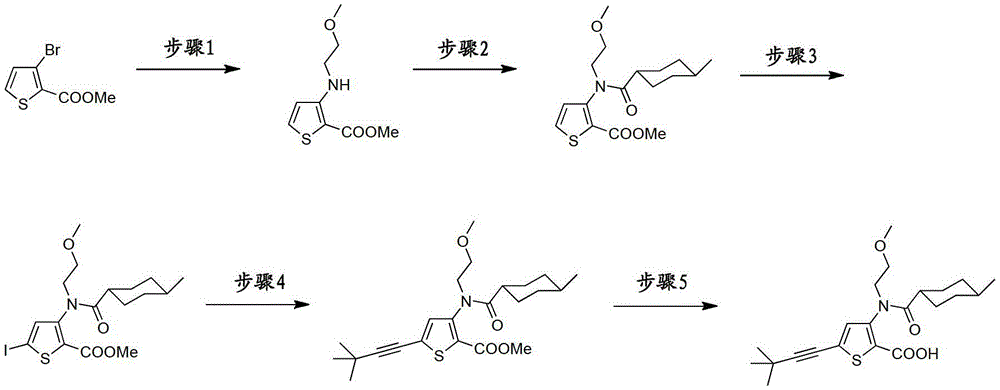
3-(2-甲氧基乙基)氨基)噻吩-2-甲酸甲酯Methyl 3-(2-methoxyethyl)amino)thiophene-2-carboxylate
在室温向甲基-3-氨基噻吩-2-甲酸酯(3g,19.1mmol,1eq)在DMF(100mL)中的溶液中加入2-溴乙基甲基醚(26.5g,191mmol,10eq)、碘化钾(31g,95.5mmol,10eq),然后加入DIPEA(20mL,115mmol,6eq),将该混合物在钢瓶中加热至120℃约20h,通过TLC(20%EtOAc:石油醚,Rf=0.66)分析反应进程。将该反应混合物冷却至室温,在50℃蒸发DMF,加入水(150ml),用EtOAc(250mL,150mL,100mL)萃取。用水(100mL×3)和盐水溶液(50mL×2)洗涤合并的有机层,干燥(Na2SO4),在45℃蒸发,得到粗化合物(5g),通过中性氧化铝柱色谱法纯化。用0-3%EtOAc/石油醚梯度洗脱,得到3-((2-甲氧基乙基)氨基)噻吩-2-甲酸甲酯(1.5g,36.5%),为棕色液体与未反应的原料(1g)。To a solution of methyl-3-aminothiophene-2-carboxylate (3 g, 19.1 mmol, 1 eq) in DMF (100 mL) was added 2-bromoethyl methyl ether (26.5 g, 191 mmol, 10 eq) at room temperature , Potassium iodide (31g, 95.5mmol, 10eq), then DIPEA (20mL, 115mmol, 6eq) was added, the mixture was heated to 120°C for about 20h in a steel bottle, and passed through TLC (20%EtOAc: petroleum ether, R f =0.66) Analyze the progress of the reaction. The reaction mixture was cooled to room temperature, DMF was evaporated at 50 °C, water (150 mL) was added, extracted with EtOAc (250 mL, 150 mL, 100 mL). The combined organic layers were washed with water (100 mL x 3) and brine solution (50 mL x 2), dried (Na 2 SO 4 ), evaporated at 45 °C to give crude compound (5 g), which was purified by neutral alumina column chromatography. Gradient elution with 0-3% EtOAc/petroleum ether afforded methyl 3-((2-methoxyethyl)amino)thiophene-2-carboxylate (1.5 g, 36.5%) as a brown liquid with unreacted Raw material (1 g).
MS:m/z(obs.):216[M+H]+;MS: m/z(obs.): 216[M+H] + ;
1H NMR CDCl3,400MHz:7.33(d,J=5.6Hz,1H),6.92(br.s,与D2O交换,1H),6.65(d,J=5.6Hz,1H),3.81(s,3H),3.57(t,J=6.0Hz,2H),3.43-3.47(q,2H),3.39(s,3H)。 1 H NMR CDCl 3 , 400MHz: 7.33(d, J=5.6Hz, 1H), 6.92(br.s, exchanged with D2O, 1H), 6.65(d, J=5.6Hz, 1H), 3.81(s, 3H ), 3.57(t, J=6.0Hz, 2H), 3.43-3.47(q, 2H), 3.39(s, 3H).
3-(N-(2-甲氧基乙基)-4-反式-甲基-环己烷甲酰氨基)噻吩-2-甲酸甲酯Methyl 3-(N-(2-methoxyethyl)-4-trans-methyl-cyclohexanecarboxamido)thiophene-2-carboxylate
向反式-4-甲基环己烷甲酸(132mg,0.93mmol,1eq)在CH2Cl2(4mL)中的溶液中加入催化量的DMF(1滴),冷却至0℃,加入草酰氯(0.1ml,1.02mmol,1.1eq),在室温搅拌30min。在另一个烧瓶中,向3-((2-甲氧基乙基)氨基)噻吩-2-甲酸甲酯(200mg,0.93mmol,1eq)在CH2Cl2(4mL)中的溶液中加入三乙胺(0.26mL,1.86mmol,2eq),冷却至0℃,向该溶液中滴加上述酰氯溶液,搅拌至室温,通过TLC(20%EtOAc:CHCl3,Rf:0.5,16h,室温)分析反应进程。用饱和NaHCO3水溶液(25mL)使该反应混合物猝灭,加入水(20mL),用EtOAc(50mL×4)萃取,用盐水溶液(20mL)洗涤合并的有机层,干燥(Na2SO4),在45℃蒸发,得到粗化合物(261mg),通过柱色谱法纯化(100-200目硅胶,0-10%EtOAc:CHCl3),得到3-(N-(2-甲氧基乙基)-4-反式-甲基-环己烷甲酰氨基)噻吩-2-甲酸甲酯(180mg,57%),为黄白色固体。To a solution of trans-4-methylcyclohexanecarboxylic acid (132mg, 0.93mmol, 1eq) in CH2Cl2 ( 4mL ) was added a catalytic amount of DMF (1 drop), cooled to 0°C and added oxalyl chloride (0.1ml, 1.02mmol, 1.1eq), stirred at room temperature for 30min. In another flask, to a solution of methyl 3-((2-methoxyethyl)amino)thiophene-2-carboxylate (200 mg, 0.93 mmol, 1 eq) in CH 2 Cl 2 (4 mL) was added Tris Ethylamine (0.26mL, 1.86mmol, 2eq), cooled to 0°C, added the above acid chloride solution dropwise to the solution, stirred to room temperature, passed TLC (20%EtOAc:CHCl 3 , Rf : 0.5, 16h, room temperature) Analyze the progress of the reaction. The reaction mixture was quenched with saturated aqueous NaHCO 3 (25 mL), added water (20 mL), extracted with EtOAc (50 mL×4), the combined organic layers were washed with brine solution (20 mL), dried (Na 2 SO 4 ), Evaporation at 45 °C gave crude compound (261 mg), which was purified by column chromatography (100-200 mesh silica gel, 0-10% EtOAc: CHCl3 ) to give 3-(N-(2-methoxyethyl)- 4-trans-methyl-cyclohexanecarboxamido)thiophene-2-carboxylic acid methyl ester (180 mg, 57%), as a yellow-white solid.
MS:m/z(obs.):340[M+H]+;MS: m/z(obs.): 340[M+H] + ;
5-碘-3-(N-(2-甲氧基乙基)-4-反式-甲基-环己烷甲酰氨基)噻吩-2-甲酸甲酯5-iodo-3-(N-(2-methoxyethyl)-4-trans-methyl-cyclohexanecarboxamido)thiophene-2-carboxylic acid methyl ester
将3-(N-(2-甲氧基乙基)-4-反式-甲基-环己烷甲酰氨基)噻吩-2-甲酸甲酯(136mg,0.40mmol,1eq)在THF(3mL)中的溶液冷却至-78℃,在-78℃加入LDA(2M的THF溶液)(0.6ml,1.20mmol,3eq)(观察到淡绿色澄清溶液),缓慢搅拌至-20℃45min(观察到浓稠棕色溶液),再冷却至-78℃,然后在-78℃加入I2(305mg,1.20mmol,3eq)的THF(2ml)溶液,搅拌至室温。用冰水(10mL)使该反应混合物猝灭,用EtOAc(25mL×5)萃取,用盐水溶液(20ml)洗涤合并的有机层,干燥(Na2SO4),在40℃蒸发,得到粗化合物(150mg),通过柱色谱法、使用(100-200目硅胶,用0-15%EtOAc:石油醚洗脱)纯化,得到5-碘-3-(N-(2-甲氧基乙基)-4-反式-甲基-环己烷甲酰氨基)噻吩-2-甲酸甲酯(30mg,16%,Rf:0.55(30%EtOAc:石油醚),为黄白色固体。3-(N-(2-Methoxyethyl)-4-trans-methyl-cyclohexanecarboxamido)thiophene-2-carboxylic acid methyl ester (136mg, 0.40mmol, 1eq) in THF (3mL ) solution was cooled to -78°C, LDA (2M solution in THF) (0.6ml, 1.20mmol, 3eq) was added at -78°C (light green clear solution was observed), stirred slowly to -20°C for 45min (observed thick brown solution), then cooled to -78°C, then added a solution of I 2 (305mg, 1.20mmol, 3eq) in THF (2ml) at -78°C, and stirred to room temperature. The reaction mixture was quenched with ice water (10 mL), extracted with EtOAc (25 mL x 5), the combined organic layers were washed with brine solution (20 mL), dried (Na 2 SO 4 ), evaporated at 40 °C to give crude compound (150 mg), purified by column chromatography using (100-200 mesh silica gel, eluting with 0-15% EtOAc:petroleum ether) to give 5-iodo-3-(N-(2-methoxyethyl) - Methyl 4-trans-methyl-cyclohexanecarboxamido)thiophene-2-carboxylate (30 mg, 16%, Rf : 0.55 (30% EtOAc: Petroleum ether) as a yellow-white solid.
MS:m/z(obs.):466[M+H]+;MS: m/z(obs.): 466[M+H] + ;
1H NMR CDCl3,400MHz:7.17(s,1H),4.10-4.04(m,1H),3.83(s,3H),3.58-3.54(m,1H),3.47-3.41(m,2H),3.25(s,1H),2.04-2.02(m,1H),1.66-1.60(m,4H),1.51-1.44(m,2H),1.35-1.27(m,1H),0.81(d,J=6.4Hz,3H),0.72-0.68(m,2H) 1 H NMR CDCl 3 , 400MHz: 7.17(s,1H),4.10-4.04(m,1H),3.83(s,3H),3.58-3.54(m,1H),3.47-3.41(m,2H),3.25 (s,1H),2.04-2.02(m,1H),1.66-1.60(m,4H),1.51-1.44(m,2H),1.35-1.27(m,1H),0.81(d,J=6.4Hz ,3H),0.72-0.68(m,2H)
5-(3,3-二甲基丁-1-炔基)-3-(N-(2-甲氧基乙基)-4-反式-甲基环己烷甲酰氨基)噻吩-2-甲酸甲酯5-(3,3-Dimethylbut-1-ynyl)-3-(N-(2-methoxyethyl)-4-trans-methylcyclohexanecarboxamido)thiophene-2 -Methyl formate
将5-碘-3-(N-(2-甲氧基乙基)-4-反式-甲基-环己烷甲酰氨基)噻吩-2-甲酸甲酯(100mg,0.21mmol,1eq)在THF(5mL)中的溶液冷却至-10℃,通过用氩气流发泡10min脱氧,加入TEA(26mg,0.25mmol,1.2eq)和碘化亚铜(1.23mg,0.065mmol,0.03eq),在-10℃用氩气净化30min,在-10℃加入Pd(PPh3)2Cl2(4.5mg,0.0065mmol,0.03eq),再用氩气净化10min,最终在-10℃加入3,3-二甲基丁炔(0.1ml,0.32mmol,1.5eq)5h。向该反应混合物中加入水(20ml),用EtOAc(50mL×3)萃取,用水(10ml)和盐水溶液(20ml)洗涤合并的有机层,干燥(Na2SO4),在40℃蒸发,得到粗化合物(100mg),通过柱色谱法纯化(100-200目硅胶,用25%EtOAc:石油醚洗脱),得到5-(3,3-二甲基丁-1-炔基)-3-(N-(2-甲氧基乙基)-4-反式-甲基环己烷甲酰氨基)噻吩-2-甲酸甲酯(50mg,55.5%,TLC(Rf:0.54(40%EtOAc:石油醚)),为棕色液体。5-iodo-3-(N-(2-methoxyethyl)-4-trans-methyl-cyclohexanecarboxamido)thiophene-2-carboxylic acid methyl ester (100mg, 0.21mmol, 1eq) A solution in THF (5 mL) was cooled to -10 °C, deoxygenated by bubbling with argon flow for 10 min, TEA (26 mg, 0.25 mmol, 1.2 eq) and cuprous iodide (1.23 mg, 0.065 mmol, 0.03 eq) were added, Purged with argon for 30min at -10°C, added Pd(PPh 3 ) 2 Cl 2 (4.5mg, 0.0065mmol, 0.03eq) at -10°C, purged with argon for 10min, and finally added 3,3 at -10°C - Dimethylbutyne (0.1 ml, 0.32 mmol, 1.5 eq) 5h. To the reaction mixture was added water (20ml), extracted with EtOAc (50mL x 3), the combined organic layers were washed with water (10ml) and brine solution ( 20ml ), dried ( Na2SO4 ), evaporated at 40°C to give Crude compound (100 mg), purified by column chromatography (100-200 mesh silica gel, eluting with 25% EtOAc: petroleum ether) afforded 5-(3,3-dimethylbut-1-ynyl)-3- Methyl (N-(2-methoxyethyl)-4-trans-methylcyclohexanecarboxamido)thiophene-2-carboxylate (50 mg, 55.5%, TLC (R f : 0.54 (40% EtOAc : petroleum ether)), brown liquid.
MS:m/z(obs.):420[M+H]+;MS: m/z(obs.): 420[M+H] + ;
1H NMR CDCl3,400MHz:6.94(s,1H),4.09-4.06(m,1H),3.83(s3H),3.55-3.43(m,3H),3.25(s,3H),2.04-2.02(m,1H),1.65-1.59(m,5H),1.33(s,9H),1.30-1.25(m,2H),0.80(d,J=6.8Hz,3H),0.72-0.69(m,2H)。 1 H NMR CDCl 3 , 400MHz: 6.94(s,1H), 4.09-4.06(m,1H), 3.83(s3H), 3.55-3.43(m,3H), 3.25(s,3H), 2.04-2.02(m ,1H),1.65-1.59(m,5H),1.33(s,9H),1.30-1.25(m,2H),0.80(d,J=6.8Hz,3H),0.72-0.69(m,2H).
5-(3,3-二甲基丁-1-炔基)-3-(N-(2-甲氧基乙基)-4-反式-甲基环己烷甲酰氨基)噻吩-2-甲酸5-(3,3-Dimethylbut-1-ynyl)-3-(N-(2-methoxyethyl)-4-trans-methylcyclohexanecarboxamido)thiophene-2 - formic acid
将5-(3,3-二甲基丁-1-炔基)-3-(N-(2-甲氧基乙基)-4-反式-甲基环己烷甲酰氨基)噻吩-2-甲酸甲酯(450mg,1.073mmol,1eq)在THF:MeOH(10ml:10ml)中的溶液冷却至0℃,在0℃加入LiOH.H2O(270mg,6.44mmol,6eq),在室温搅拌16h。通过TLC(20%MeOH:CHCl3,Rf:0.4)分析反应进程。在35℃完全蒸发溶剂,得到粗化合物(400mg),通过柱色谱法(100-200目硅胶,用5%MeOH:CHCl3洗脱)和HPLC纯化,得到5-(3,3-二甲基丁-1-炔基)-3-(N-(2-甲氧基乙基)-4-反式-甲基环己烷甲酰氨基)噻吩-2-甲酸(180mg,41%),为黄白色固体。5-(3,3-Dimethylbut-1-ynyl)-3-(N-(2-methoxyethyl)-4-trans-methylcyclohexanecarboxamido)thiophene- A solution of methyl 2-carboxylate (450mg, 1.073mmol, 1eq) in THF:MeOH (10ml:10ml) was cooled to 0°C, LiOH.H 2 O (270mg, 6.44mmol, 6eq) was added at 0°C, and at room temperature Stir for 16h. The progress of the reaction was analyzed by TLC (20% MeOH:CHCl 3 , R f : 0.4). Complete evaporation of the solvent at 35 °C afforded the crude compound (400 mg), which was purified by column chromatography (100-200 mesh silica gel, eluting with 5% MeOH:CHCl 3 ) and HPLC to give 5-(3,3-dimethyl But-1-ynyl)-3-(N-(2-methoxyethyl)-4-trans-methylcyclohexanecarboxamido)thiophene-2-carboxylic acid (180 mg, 41%), as Yellow-white solid.
MS:m/z(obs.):460[M+H]+;MS: m/z(obs.): 460[M+H] + ;
1H NMR CDCl3,400MHz:6.92(s,1H),3.90-3.75(m,2H),3.8-3.40(m,2H),3.30(s,3H),2.20-2.05(m,1H),1.65-1.58(m,7H),1.33(s,9H),0.80(d,J=6.8Hz,3H),0.72(m,2H)。 1 H NMR CDCl 3 , 400MHz: 6.92(s,1H),3.90-3.75(m,2H),3.8-3.40(m,2H),3.30(s,3H),2.20-2.05(m,1H),1.65 -1.58(m,7H),1.33(s,9H),0.80(d,J=6.8Hz,3H),0.72(m,2H).
化合物39的制备Preparation of
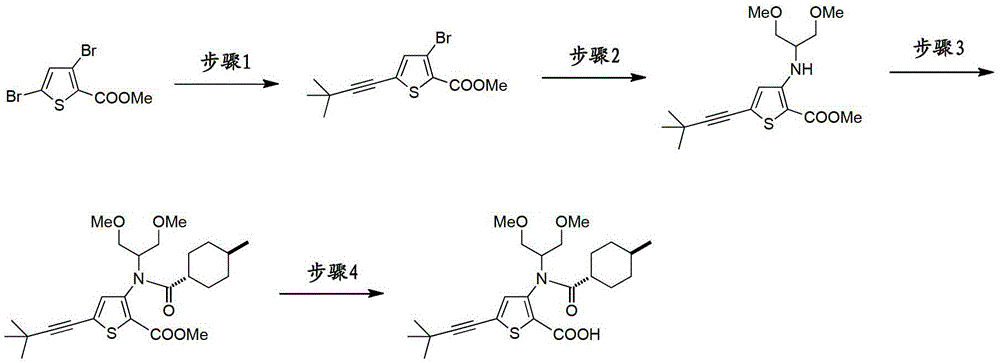
步骤1:3-溴-5-(3,3-二甲基丁-1-炔-1-基)噻吩-2-甲酸甲酯Step 1: Methyl 3-bromo-5-(3,3-dimethylbut-1-yn-1-yl)thiophene-2-carboxylate
通过在室温用氩气发泡30min给CuI(0.95g,4.99mmol)在1,4二噁烷(300mL)中的混悬液脱氧,加入Pd(PPh3)2Cl2(3.5g,4.99mmol),此后持续净化。15min后,加入二异丙基胺(35.5mL,250mmol),然后加入3,5-二溴噻吩-2-甲酸甲酯(50g,166.6mmol)。在室温搅拌15min后,冷却该反应混合物,在5-10℃(最初10mL)加入3,3-二甲基-1-丁炔(22.1mL,183mmol)的二噁烷(360mL)溶液。将该反应体系搅拌15min,然后加入剩余量的3-甲基-1-丁炔的二噁烷溶液(维持内部温度低于20℃)。添加后,将该反应混合物在室温搅拌2h。通过TLC和GC监测反应进程(GC显示SM完全耗尽)。用乙酸乙酯(800mL)稀释该反应混合物,通过C盐过滤,用乙醚(2×50mL)洗涤滤饼。浓缩合并的滤液,通过柱色谱法纯化得到的粗化合物(100-200目硅胶),使用4%EtOAc的己烷溶液作为洗脱剂,得到3-溴-5-(3,3-二甲基丁-1-炔-1-基)噻吩-2-甲酸甲酯(48.0gm,95.8%),为白色固体。(TLC系统:3%CH2Cl2的石油醚溶液,Rf:0.35)A suspension of CuI (0.95 g, 4.99 mmol) in 1,4 dioxane (300 mL) was deoxygenated by bubbling argon for 30 min at room temperature and Pd(PPh 3 ) 2 Cl 2 (3.5 g, 4.99 mmol) was added ), and continue to purify thereafter. After 15 min, diisopropylamine (35.5 mL, 250 mmol) was added followed by
MS:m/z(obs.):301,303[M+H]+;MS: m/z(obs.): 301,303[M+H] + ;
1H NMR CDCl3,400MHz:7.04(s,1H),3.87(s,3H),1.30(s,9H)。 1 H NMR CDCl 3 , 400 MHz: 7.04 (s, 1H), 3.87 (s, 3H), 1.30 (s, 9H).
步骤2:3-(1,3-二甲氧基丙-2-基氨基)-5-(3,3-二甲基丁-1-炔基)噻吩-2-甲酸甲酯Step 2: Methyl 3-(1,3-dimethoxypropan-2-ylamino)-5-(3,3-dimethylbut-1-ynyl)thiophene-2-carboxylate
在室温向3-溴-5-(3,3-二甲基丁-1-炔-1-基)噻吩-2-甲酸甲酯(0.1g,0.332mmol,1eq)在1,4-二噁烷(4ml)中的溶液中加入Cs2CO3(0.32g,0.99mmol,3eq)和BINAP(35mg,0.05mmol,0.17eq)。通过使氩气发泡15min给该反应混合物脱氧,然后添加Pd2(dba)3(30.3mg,0.03mmol,0.1eq),在室温再持续10min。在室温加入2-氨基-1,3-二甲氧基丙烷(55mg,0.46mmol,1.4eq)。将该反应混合物在90℃搅拌20h。通过TLC(10%EtOAc的石油醚溶液,Rf:0.5)监测反应进程。浓缩该反应混合物,得到粗化合物;通过使用8%EtOAc的石油醚溶液的柱色谱法纯化(硅胶100-200目),得到3-(1,3-二甲氧基丙-2-基氨基)-5-(3,3-二甲基丁-1-炔基)噻吩-2-甲酸甲酯(40mg,36.3%),为淡黄色液体。3-Bromo-5-(3,3-dimethylbut-1-yn-1-yl)thiophene-2-carboxylic acid methyl ester (0.1g, 0.332mmol, 1eq) in 1,4-diox To a solution in alkanes (4ml) was added Cs2CO3 (0.32g, 0.99mmol, 3eq) and BINAP (35mg, 0.05mmol , 0.17eq). The reaction mixture was deoxygenated by bubbling argon for 15 min, then Pd 2 (dba) 3 (30.3 mg, 0.03 mmol, 0.1 eq) was added for a further 10 min at room temperature. 2-Amino-1,3-dimethoxypropane (55 mg, 0.46 mmol, 1.4 eq) was added at room temperature. The reaction mixture was stirred at 90 °C for 20 h. The progress of the reaction was monitored by TLC (10% EtOAc in petroleum ether, Rf : 0.5). Concentration of the reaction mixture gave crude compound; purification by column chromatography (silica gel 100-200 mesh) using 8% EtOAc in petroleum ether gave 3-(1,3-dimethoxypropan-2-ylamino) - Methyl 5-(3,3-dimethylbut-1-ynyl)thiophene-2-carboxylate (40mg, 36.3%), a pale yellow liquid.
MS:m/z(obs.):340[M+H]+;MS: m/z(obs.): 340[M+H] + ;
1H NMR CDCl3,400MHz:7.01(br d,D2O可交换,1H),6.64(s,1H),3.79(s,3H),3.63-3.60(m,1H),3.50-3.49(m,4H),3.38(s,6H),1.30(s,9H)。 1 H NMR CDCl 3 , 400MHz: 7.01(br d, D 2 O exchangeable, 1H), 6.64(s, 1H), 3.79(s, 3H), 3.63-3.60(m, 1H), 3.50-3.49(m ,4H), 3.38(s,6H), 1.30(s,9H).
步骤3:3-(-N-(1,3-二甲氧基丙-2-基)-4-反式-甲基环己烷甲酰氨基)-5-(3,3-二甲基丁-1-炔-1-基)噻吩-2-甲酸甲酯Step 3: 3-(-N-(1,3-dimethoxypropan-2-yl)-4-trans-methylcyclohexanecarboxamido)-5-(3,3-dimethyl But-1-yn-1-yl)thiophene-2-carboxylic acid methyl ester
在室温向反式-4-甲基环己烷羧酸(0.5g,3.52mmol,1eq)在1,2-二氯乙烷(4.5mL)中的溶液中加入DMF(0.005mL,0.07mmol,0.02eq),然后加入草酰氯(0.32mL,3.87mmole,1.1eq)。添加后,将该反应混合物在室温搅拌1h。在另一个烧瓶中,在室温向3-(1,3-二甲氧基丙-2-基氨基)-5-(3,3-二甲基丁-1-炔基)噻吩-2-甲酸甲酯(50mg,0.14mmole,1eq)在1,2-二氯乙烷(2.3mL)中的溶液中加入DMAP(6mg,0.04mmol,0.3eq)和吡啶(0.13mL,1.62mmol,11eq)。在室温向该溶液中滴加上述制备酰氯溶液。添加后,将该反应混合物在85℃搅拌8h。通过TLC(20%EtOAc的CHCl3溶液,Rf:0.3)监测反应进程。将该反应混合物冷却至室温,用水(25ml)猝灭,用EtOAc(20ml×5)萃取。用2NHCl(10ml)、盐水(10ml)洗涤合并的有机层,用Na2SO4干燥,浓缩,得到粗化合物(60mg);通过使用5-8%EtOAc的石油醚溶液作为洗脱剂的柱色谱法纯化(硅胶100-200目),得到3-(-N-(1,3-二甲氧基丙-2-基)-4-反式-甲基环己烷甲酰氨基)-5-(3,3-二甲基丁-1-炔-1-基)噻吩-2-甲酸甲酯(20mg,29.4%),为无色液体。To a solution of trans-4-methylcyclohexanecarboxylic acid (0.5 g, 3.52 mmol, 1 eq) in 1,2-dichloroethane (4.5 mL) was added DMF (0.005 mL, 0.07 mmol, 0.02eq), then oxalyl chloride (0.32mL, 3.87mmole, 1.1eq) was added. After the addition, the reaction mixture was stirred at room temperature for 1 h. In another flask, 3-(1,3-dimethoxyprop-2-ylamino)-5-(3,3-dimethylbut-1-ynyl)thiophene-2-carboxylic acid To a solution of the methyl ester (50 mg, 0.14 mmole, 1 eq) in 1,2-dichloroethane (2.3 mL) was added DMAP (6 mg, 0.04 mmole, 0.3 eq) and pyridine (0.13 mL, 1.62 mmole, 11 eq). To this solution was added dropwise the acid chloride solution prepared above at room temperature. After the addition, the reaction mixture was stirred at 85 °C for 8 h. The progress of the reaction was monitored by TLC (20% EtOAc in CHCl 3 , R f : 0.3). The reaction mixture was cooled to room temperature, quenched with water (25ml), extracted with EtOAc (20ml x 5). The combined organic layers were washed with 2N HCl (10ml), brine ( 10ml ), dried over Na2SO4 and concentrated to give crude compound (60mg); by column chromatography using 5-8% EtOAc in petroleum ether as eluent Purified by the method (silica gel 100-200 mesh) to obtain 3-(-N-(1,3-dimethoxyprop-2-yl)-4-trans-methylcyclohexanecarboxamido)-5- Methyl (3,3-dimethylbut-1-yn-1-yl)thiophene-2-carboxylate (20 mg, 29.4%), a colorless liquid.
MS:m/z(obs.):464[M+H]+;MS: m/z(obs.): 464[M+H] + ;
1H NMR CDCl3,400MHz:7.01(s,1H),4.70-4.64(m,1H),3.82(s,3H),3.60-3.43(m,3H),3.38-3.34(m,1H),3.31(s,3H),3.16(s,3H),2.27-2.20(m,1H),2.04-1.97(m,3H),1.78-1.74(m,2H),1.67-1.60(m,5H),1.49-1.39(m,3H),1.33(s,9H),0.96。 1 H NMR CDCl 3 , 400MHz: 7.01(s,1H),4.70-4.64(m,1H),3.82(s,3H),3.60-3.43(m,3H),3.38-3.34(m,1H),3.31 (s,3H),3.16(s,3H),2.27-2.20(m,1H),2.04-1.97(m,3H),1.78-1.74(m,2H),1.67-1.60(m,5H),1.49 -1.39(m,3H),1.33(s,9H),0.96.
步骤4:3-(-N-(1,3-二甲氧基丙-2-基)-4-反式-甲基环己烷甲酰氨基)-5-(3,3-二甲基丁-1-炔-1-基)噻吩-2-甲酸(化合物39)Step 4: 3-(-N-(1,3-dimethoxypropan-2-yl)-4-trans-methylcyclohexanecarboxamido)-5-(3,3-dimethyl But-1-yn-1-yl)thiophene-2-carboxylic acid (compound 39)
如对化合物29的制备中所述,通过水解3-(-N-(1,3-二甲氧基丙-2-基)-4-反式-甲基环己烷甲酰氨基)-5-(3,3-二甲基丁-1-炔-1-基)噻吩-2-甲酸甲酯(80mg)制备标题化合物。收率31mg,40%。As described for the preparation of
MS:m/z(obs.):450.6[M+H]+;MS: m/z(obs.): 450.6[M+H] + ;
1H NMR DMSO,400MHz(80℃):6.86(s,1H),4.54-4.48(m,1H),3.60-3.39(m,4H),3.20(s,3H),3.12(s,3H),2.04(m,1H),1.76-1.73(m,1H),1.58-1.35(m,5H),1.29(s,9H),0.76(d,J=6.8Hz,3H),0.64-0.61(m,2H)。 1 H NMR DMSO, 400MHz(80℃):6.86(s,1H),4.54-4.48(m,1H),3.60-3.39(m,4H),3.20(s,3H),3.12(s,3H), 2.04(m,1H),1.76-1.73(m,1H),1.58-1.35(m,5H),1.29(s,9H),0.76(d,J=6.8Hz,3H),0.64-0.61(m, 2H).
化合物33的制备Preparation of
按照对化合物39所述的方式由S-1-甲氧基丙基-2-胺制备化合物33。
MS:m/z(obs.):420.5[M+H]+;MS: m/z(obs.): 420.5[M+H] + ;
1H NMR DMSO,400MHz(80℃):6.94(s,1H),4.74(s,1H),3.45(s,1H),3.24(s,3H),3.12(s,2H),1.93-1.84(m,2H),1.65-1.56(m,4H),1.30(s,9H),0.96-0.93(m,3H),0.77(d,J=6.4Hz,3H),0.63(s,2H)。 1 H NMR DMSO, 400MHz (80°C): 6.94(s,1H), 4.74(s,1H), 3.45(s,1H), 3.24(s,3H), 3.12(s,2H), 1.93-1.84( m,2H),1.65-1.56(m,4H),1.30(s,9H),0.96-0.93(m,3H),0.77(d,J=6.4Hz,3H),0.63(s,2H).
化合物36的制备Preparation of
按照对化合物39所述的方式由R-1-甲氧基丙基-2-胺制备化合物36。
MS:m/z(obs.):418.0[M-H]-;MS: m/z(obs.): 418.0[MH] - ;
1H NMR CDCl3,400MHz:6.89(s,1H),6.83(s,1H),4.99(s,1H),4.80(br.s,1H),3.80-3.70(m,1H),3.52-3.40(m,2H),3.36(s,3H),1.98-1.84(m,2H),1.71-1.49(m,4H),1.33(s,9H),0.98-0.86(m,2H),0.77(s,3H),0.67(s,2H)。 1 H NMR CDCl 3 , 400MHz: 6.89(s,1H),6.83(s,1H),4.99(s,1H),4.80(br.s,1H),3.80-3.70(m,1H),3.52-3.40 (m,2H),3.36(s,3H),1.98-1.84(m,2H),1.71-1.49(m,4H),1.33(s,9H),0.98-0.86(m,2H),0.77(s ,3H), 0.67(s,2H).
化合物37的制备Preparation of
按照对化合物39所述的方式由S-1-甲氧基丁基-2-胺制备化合物37。
MS:m/z(obs.):434.5[M+H]+;MS: m/z(obs.): 434.5[M+H] + ;
1H NMR CDCl3,400MHz:6.81(s,1H),4.9(brs,1H),4.2(brs,1H),3.48(m,1H),3.27(s,3H),2.07-1.97(m,2H),1.79-1.48(m,9H),1.32(s,9H),1.0-0.65(系列的m,7H)。 1 H NMR CDCl 3 , 400MHz: 6.81(s,1H), 4.9(brs,1H), 4.2(brs,1H), 3.48(m,1H), 3.27(s,3H), 2.07-1.97(m,2H ), 1.79-1.48 (m, 9H), 1.32 (s, 9H), 1.0-0.65 (series of m, 7H).
化合物10的制备Preparation of
按照对化合物39所述的方式由R-1-甲氧基丁基-2-胺制备化合物10。
MS:m/z(obs.):434.1[M+H]+;MS: m/z(obs.): 434.1[M+H] + ;
1H NMR CDCl3,400MHz:6.92(s,1H),4.9(Bs,1H),3.74(m,1H),3.48(m,1H),3.35(s,3H),2.07-1.97(m,2H),1.79-1.48(m,5H),1.32(s,9H),0.88(d,j=6.4Hz,3H),0.78(d,j=5.2Hz,3H),0.73(bs,2H)。 1 H NMR CDCl 3 , 400MHz: 6.92(s,1H), 4.9(Bs,1H), 3.74(m,1H), 3.48(m,1H), 3.35(s,3H), 2.07-1.97(m,2H ),1.79-1.48(m,5H),1.32(s,9H),0.88(d,j=6.4Hz,3H),0.78(d,j=5.2Hz,3H),0.73(bs,2H).
化合物38的制备Preparation of
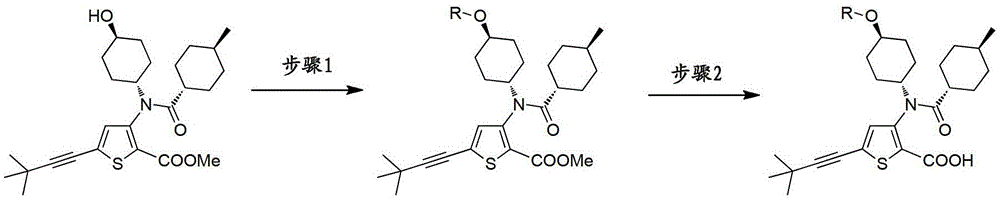
R=环丙基。R = cyclopropyl.
步骤1step 1
在室温下,向搅拌的化合物5-(3,3-二甲基丁-1-炔-1-基)-3-((N-4-反式-羟基环己基)-4-反式-甲基环己烷甲酰氨基)噻吩-2-甲酸甲酯(80mg,0.174mmol,1eq)在环丙基溴(5mL)中的溶液中加入氧化银(806mg,3.48mmol,20eq)、分子筛
MS:m/z(obs.):3[M+H]+;MS: m/z(obs.): 3[M+H] + ;
1H NMR CDCl3,400MHz:6.78(s,1H),5.90-5.82(s,1H,不纯),5.2-5.1(m,2H,不纯)4.57-4.49(m,1H),4.30-4.24(m,2H),4.24-4.18(m,2H),3.95(d,J=8.0Hz,不纯),3.45*(s,3H),2.06-0.61(系列的m,24H)。 1 H NMR CDCl 3 , 400MHz: 6.78(s,1H),5.90-5.82(s,1H,impure),5.2-5.1(m,2H,impure)4.57-4.49(m,1H),4.30-4.24 (m,2H), 4.24-4.18(m,2H), 3.95(d, J=8.0Hz, impure), 3.45*(s,3H), 2.06-0.61(series of m,24H).
步骤2:5-(3,3-二甲基丁-1-炔-1-基)-3-((N-4-反式-环丙氧基环己基)-4-反式-甲基环己烷甲酰氨基)噻吩-2-甲酸Step 2: 5-(3,3-Dimethylbut-1-yn-1-yl)-3-((N-4-trans-cyclopropoxycyclohexyl)-4-trans-methyl Cyclohexanecarboxamido)thiophene-2-carboxylic acid
在室温向搅拌的5-(3,3-二甲基丁-1-炔-1-基)-3-((N-4-反式-环丙氧基环己基)-4-反式-甲基环己烷甲酰氨基)噻吩-2-甲酸甲酯(10mg,0.02mmol,1eq)在1:1THF/MEOH混合物(2mL)中的溶液中加入LiOH.H2O(8.4mg,0.2mmol,10eq),同时通过TLC分析(10%MeOH:CHCl3,Rf:0.32)监测反应进程。在35℃减压浓缩该反应混合物,得到残余物(20mg),通过制备型TLC(5%MeOH:CHCl3)纯化,得到化合物38(1.9mg,19.5%),为黄白色固体。5-(3,3-Dimethylbut-1-yn-1-yl)-3-((N-4-trans-cyclopropoxycyclohexyl)-4-trans- To a solution of methylcyclohexanecarboxamido)thiophene-2-carboxylate (10 mg, 0.02 mmol, 1 eq) in a 1:1 THF/MEOH mixture (2 mL) was added LiOH.H 2 O (8.4 mg, 0.2 mmol , 10eq), while monitoring the progress of the reaction by TLC analysis (10%MeOH:CHCl 3 , R f : 0.32). The reaction mixture was concentrated under reduced pressure at 35 °C to give a residue (20 mg), which was purified by preparative TLC (5% MeOH:CHCl 3 ) to give compound 38 (1.9 mg, 19.5%) as an off-white solid.
MS:m/z(obs.):486.0[M+H]+;MS: m/z(obs.): 486.0[M+H] + ;
1H NMR CDCl3,400MHz:6.78(br.s,1H),5.95-5.83(m,1H不纯),5.22(d,J=17Hz,不纯,1H),5.13(d,J=10.0Hz,不纯,1H),4.49(s,1H),3.93(s,1H),3.07(s,1H),2.03-0.68(系列的m,26H)。 1 H NMR CDCl 3 , 400MHz: 6.78(br.s, 1H), 5.95-5.83(m, 1H impure), 5.22(d, J=17Hz, impure, 1H), 5.13(d, J=10.0Hz , impure, 1H), 4.49 (s, 1H), 3.93 (s, 1H), 3.07 (s, 1H), 2.03-0.68 (series of m, 26H).
化合物35的制备Preparation of

R=乙基。R = ethyl.
如对化合物38所述在两步中制备化合物35。
步骤1:5-(3,3-二甲基丁-1-炔-1-基)-3-((N-4-反式-乙氧基环己基)-4-反式-甲基环己烷甲酰氨基)噻吩-2-甲酸甲酯Step 1: 5-(3,3-Dimethylbut-1-yn-1-yl)-3-((N-4-trans-ethoxycyclohexyl)-4-trans-methylcyclo Hexanecarboxamido)thiophene-2-carboxylate methyl ester
分离,57%收率(60mg):Isolated, 57% yield (60 mg):
MS:m/z(obs.):488.1[M+H]+;MS: m/z(obs.): 488.1[M+H] + ;
1H NMR CDCl3,400MHz:6.78(s,1H),4.57-4.51(m,1H),3.82(s,3H),3.45-3.41(m,2H),3.06-3.00(m,1H),2.06-1.91(m,4H),1.77-1.74(m,1H),1.66-1.59(m,4H),1.34(s,9H),1.29-1.22(m,2H),1.15(t,J=6.8,6.8Hz,3H),0.95-0.86(m,2H),0.79(d,J=6.4Hz,3H),0.70-0.60(m,2H)。 1 H NMR CDCl 3 , 400MHz: 6.78(s,1H),4.57-4.51(m,1H),3.82(s,3H),3.45-3.41(m,2H),3.06-3.00(m,1H),2.06 -1.91(m,4H),1.77-1.74(m,1H),1.66-1.59(m,4H),1.34(s,9H),1.29-1.22(m,2H),1.15(t,J=6.8, 6.8Hz, 3H), 0.95-0.86(m, 2H), 0.79(d, J=6.4Hz, 3H), 0.70-0.60(m, 2H).
步骤2:5-(3,3-二甲基丁-1-炔-1-基)-3-((N-4-反式-乙氧基环己基)-4-反式-甲基环己烷甲酰氨基)噻吩-2-甲酸Step 2: 5-(3,3-Dimethylbut-1-yn-1-yl)-3-((N-4-trans-ethoxycyclohexyl)-4-trans-methylcyclo Hexanecarboxamido)thiophene-2-carboxylic acid
收率13mg,黄白色固体。Yield 13mg, yellow-white solid.
MS:m/z(obs.):474.0[M+H]+;MS: m/z(obs.): 474.0[M+H] + ;
1H NMR CDCl3,400MHz:6.89(s,1H),4.50(m,1H),3.50-3.42(m,2H),3.02(m,1H),2.01-1.84(m,6H),1.59-1.40(m,4H)1.32(s,9H),1.25(m,2H),1.15(t,J=6.8,7.2Hz,3H),0.89-0.65(m,6H)。 1 H NMR CDCl 3 , 400MHz: 6.89(s,1H),4.50(m,1H),3.50-3.42(m,2H),3.02(m,1H),2.01-1.84(m,6H),1.59-1.40 (m,4H)1.32(s,9H),1.25(m,2H),1.15(t,J=6.8,7.2Hz,3H),0.89-0.65(m,6H).
化合物43的制备Preparation of

步骤1:3-溴-5-碘-噻吩-2-甲酸甲酯Step 1: 3-Bromo-5-iodo-thiophene-2-carboxylic acid methyl ester
向搅拌的冷却至0℃的二异丙基胺(29.76g,41.22mL,294.1mmol)在2-MeTHF(400mL)中的溶液中滴加n-BuLi(108.6mL的2.5M,271.4mmol),搅拌30分钟。将该反应混合物冷却至-70℃,在30分钟内滴加3-溴噻吩-2-甲酸甲酯(50g,226.2mmol)的2-MeTHF(200mL)溶液,添加后,将该反应混合物搅拌30分钟,此时HPLC-分析揭示出5-10%原料。在30分钟内滴加碘(63.15g,12.81mL,248.8mmol)的2-MeTHF(100mL)溶液,维持内部物温度在-60℃,在该温度搅拌45分钟,达到0℃,用饱和NH4Cl水溶液(300mL)猝灭,用MTBE(1.0L)稀释,分离有机层。用1M Na2S2O3水溶液(200mL)、水(200mL)、盐水(200mL)洗涤有机层,用Na2SO4干燥,过滤,减压浓缩。通过硅胶垫、使用10%乙酸乙酯的己烷溶液作为洗脱剂纯化粗产物,得到产物,~85%纯度,将其与甲醇一起研磨,得到3-溴-5-碘-噻吩-2-甲酸甲酯(35.4g,45%收率),为淡黄色固体。To a stirred solution of diisopropylamine (29.76 g, 41.22 mL, 294.1 mmol) in 2-MeTHF (400 mL) cooled to 0 °C was added n-BuLi (108.6 mL of 2.5M, 271.4 mmol) dropwise, Stir for 30 minutes. The reaction mixture was cooled to -70 °C, a solution of methyl 3-bromothiophene-2-carboxylate (50 g, 226.2 mmol) in 2-MeTHF (200 mL) was added dropwise within 30 minutes, and after the addition, the reaction mixture was stirred for 30 min, at which point HPLC-analysis revealed 5-10% starting material. A solution of iodine (63.15 g, 12.81 mL, 248.8 mmol) in 2-MeTHF (100 mL) was added dropwise over 30 min, maintaining the internal temperature at -60 °C, stirring at this temperature for 45 min, reaching 0 °C, and adding saturated NH 4 Aqueous Cl solution (300 mL) was quenched, diluted with MTBE (1.0 L), and the organic layer was separated. The organic layer was washed with 1M aqueous Na 2 S 2 O 3 (200 mL), water (200 mL), brine (200 mL), dried over Na 2 SO 4 , filtered, and concentrated under reduced pressure. Purification of the crude product through a pad of silica gel using 10% ethyl acetate in hexanes as eluent afforded the product, ~85% purity, which was triturated with methanol to give 3-bromo-5-iodo-thiophene-2- Methyl formate (35.4 g, 45% yield) as a light yellow solid.
1H NMR CDCl3,300MHz:7.26(s,1H),3.90(s,3H)。 1 H NMR CDCl 3 , 300 MHz: 7.26 (s, 1H), 3.90 (s, 3H).
步骤2:3-溴-5-(3-甲基丁-1-炔-1-基)噻吩-2-甲酸甲酯Step 2: Methyl 3-bromo-5-(3-methylbut-1-yn-1-yl)thiophene-2-carboxylate
在0℃-5℃向搅拌的3-溴-5-碘-噻吩-2-甲酸甲酯(3.0g,10.0mmol)在THF(45ml)中的溶液中加入CuI(76mg,0.4mmol),然后加入Et3N(2.1mL,15.0mmol)。通过在-5℃用氩气流净化30min给该反应混合物脱氧。加入Pd(PPh3)2Cl2(0.28g,0.4mmol.)。持续净化。10min后,在-5℃加入3-甲基1-丁炔(0.81g,12.0mmol),在RT搅拌16h。通过TLC监测反应进程(反应块的颜色从棕色变成深黑色,表明反应完成)。用乙酸乙酯(50mL)稀释该反应混合物,通过C盐垫过滤,用乙醚(2×10mL)洗涤。浓缩滤液。通过使用3%EtOAc的己烷溶液的柱色谱法纯化得到的粗化合物(100-200目硅胶),得到3-溴-5-(3-甲基丁-1-炔-1-基)噻吩-2-甲酸甲酯(1.0g,35%),为黄色液体。To a stirred solution of methyl 3-bromo-5-iodo-thiophene-2-carboxylate (3.0 g, 10.0 mmol) in THF (45 ml) was added CuI (76 mg, 0.4 mmol) at 0°C-5°C, then Et3N (2.1 mL, 15.0 mmol) was added. The reaction mixture was deoxygenated by purging with a stream of argon for 30 min at -5°C. Pd(PPh 3 ) 2 Cl 2 (0.28 g, 0.4 mmol.) was added. Purify continuously. After 10 min, 3-methyl 1-butyne (0.81 g, 12.0 mmol) was added at -5°C, stirred at RT for 16 h. The progress of the reaction was monitored by TLC (the color of the reaction mass changed from brown to dark black, indicating the completion of the reaction). The reaction mixture was diluted with ethyl acetate (50 mL), filtered through a pad of celite, washing with ether (2 x 10 mL). The filtrate was concentrated. The resulting crude compound was purified by column chromatography using 3% EtOAc in hexanes (100-200 mesh silica gel) to give 3-bromo-5-(3-methylbut-1-yn-1-yl)thiophene- 2-Methyl carboxylate (1.0 g, 35%), a yellow liquid.
MS:m/z(obs.):289.0[M+H]+;MS: m/z(obs.): 289.0[M+H] + ;
1H NMR CDCl3,400MHz:7.04(s,1H),3.88(s,3H),2.83-2.76(m,1H),1.25(d,J=6.8Hz;6H)。 1 H NMR CDCl 3 , 400 MHz: 7.04 (s, 1H), 3.88 (s, 3H), 2.83-2.76 (m, 1H), 1.25 (d, J=6.8Hz; 6H).
步骤3:5-(3-甲基丁-1-炔-1-基)-3-((四氢-2H-吡喃-4-基)氨基)噻吩-2-甲酸甲酯Step 3: Methyl 5-(3-methylbut-1-yn-1-yl)-3-((tetrahydro-2H-pyran-4-yl)amino)thiophene-2-carboxylate
通过在RT氩气流发泡30min给3-溴-5-(3-甲基丁-1-炔-1-基)噻吩-2-甲酸甲酯(1.0mmol)、Cs2CO3(3.0mmol)、BINAP(0.17mmol)在干甲苯(5-10vol)中的混悬液脱氧。加入Pd(OAc)2(0.1mmol),持续净化10min,在RT加入四氢-2H-吡喃-4-胺(1.2mmol)。将该反应混合物在95℃搅拌16h。通过TLC监测反应进程。冷却至RT,用EtOAc(50mL)稀释,通过C盐过滤。浓缩滤液。通过柱色谱法纯化得到的粗化合物(100-200目硅胶),使用6%EtOAc:石油醚作为洗脱剂,得到5-(3-甲基丁-1-炔-1-基)-3-((四氢-2H-吡喃-4-基)氨基)噻吩-2-甲酸甲酯(800mg,38%)。Methyl 3-bromo-5-(3-methylbut-1-yn-1-yl)thiophene- 2 -carboxylate (1.0 mmol), Cs2CO3 (3.0 mmol) was given by bubbling argon stream at RT for 30 min A suspension of BINAP (0.17 mmol) in dry toluene (5-10 vol) was deoxygenated. Pd(OAc) 2 (0.1 mmol) was added, purging was continued for 10 min and tetrahydro-2H-pyran-4-amine (1.2 mmol) was added at RT. The reaction mixture was stirred at 95 °C for 16 h. The progress of the reaction was monitored by TLC. Cool to RT, dilute with EtOAc (50 mL), filter through celite. The filtrate was concentrated. The resulting crude compound was purified by column chromatography (100-200 mesh silica gel) using 6% EtOAc:petroleum ether as eluent to give 5-(3-methylbut-1-yn-1-yl)-3- Methyl ((tetrahydro-2H-pyran-4-yl)amino)thiophene-2-carboxylate (800 mg, 38%).
MS:m/z(obs.):308.1[M+H]+;MS: m/z(obs.): 308.1[M+H] + ;
1H NMR CDCl3,400MHz:6.75(br d,D2O可交换,1H),6.62(s,1H),3.99-3.96(m,2H),3.79(s,3H),3.51-3.46(m,3H),2.82-2.75(m,1H),1.97(br d,J=13.2Hz;2H),1.62-1.53(m,2H),1.25(d,J=6.8Hz;6H)。 1 H NMR CDCl 3 , 400MHz: 6.75(br d, D 2 O exchangeable, 1H), 6.62(s, 1H), 3.99-3.96(m, 2H), 3.79(s, 3H), 3.51-3.46(m , 3H), 2.82-2.75(m, 1H), 1.97(br d, J=13.2Hz; 2H), 1.62-1.53(m, 2H), 1.25(d, J=6.8Hz; 6H).
步骤4:3-(N-(四氢-2H-吡喃-4-基)-4-反式-甲基-环己烷甲酰氨基)-5-(3-甲基丁-1-炔-1-基)噻吩-2-甲酸甲酯Step 4: 3-(N-(Tetrahydro-2H-pyran-4-yl)-4-trans-methyl-cyclohexanecarboxamido)-5-(3-methylbut-1-yne -1-yl)thiophene-2-carboxylic acid methyl ester
通过上述方法用反式-4-甲基环己烷羰基氯使5-(3-甲基丁-1-炔-1-基)-3-((四氢-2H-吡喃-4-基)氨基)噻吩-2-甲酸甲酯酰化,得到期望的产物,硅胶色谱(30%EtOAc的石油醚溶液)后分离,100mg(48%)。5-(3-Methylbut-1-yn-1-yl)-3-((tetrahydro-2H-pyran-4-yl )amino)thiophene-2-carboxylic acid methyl ester to give the desired product, which was isolated after silica gel chromatography (30% EtOAc in petroleum ether), 100 mg (48%).
MS:m/z(obs.):432.5[M+H]+;MS: m/z(obs.): 432.5[M+H] + ;
1H NMR CDCl3,400MHz:6.81(s,1H),4.80-4.79(m,1H),3.97-3.86(m,2H),3.81(s,3H),3.51-3.41(m,2H),2.84-2.81(m,1H),2.04-1.91(m,2H),1.80-1.75(m,2H),1.66-1.50(m,7H),1.46-1.39(m,2H),1.29(d,J=6.8Hz,6H),1.24-1.18(m,1H)。 1 H NMR CDCl 3 , 400MHz: 6.81(s,1H),4.80-4.79(m,1H),3.97-3.86(m,2H),3.81(s,3H),3.51-3.41(m,2H),2.84 -2.81(m,1H),2.04-1.91(m,2H),1.80-1.75(m,2H),1.66-1.50(m,7H),1.46-1.39(m,2H),1.29(d,J= 6.8Hz, 6H), 1.24-1.18(m, 1H).
步骤5:3-(N-(四氢-2H-吡喃-4-基)-4-反式-甲基-环己烷甲酰氨基)-5-(3-甲基丁-1-炔-1-基)噻吩-2-甲酸Step 5: 3-(N-(Tetrahydro-2H-pyran-4-yl)-4-trans-methyl-cyclohexanecarboxamido)-5-(3-methylbut-1-yne -1-yl)thiophene-2-carboxylic acid
通过上述方法使用LiOH水解3-(N-(四氢-2H-吡喃-4-基)-4-反式-甲基-环己烷甲酰氨基)-5-(3-甲基丁-1-炔-1-基)噻吩-2-甲酸甲酯,得到期望的产物,硅胶色谱(11%MeOH的CHCl3溶液)后分离化合物43,290mg(61%)。Hydrolysis of 3-(N-(tetrahydro-2H-pyran-4-yl)-4-trans-methyl-cyclohexanecarboxamido)-5-(3-methylbutyl- 1-Alkyn-1-yl)thiophene-2-carboxylic acid methyl ester gave the desired product and
MS:m/z(obs.):418.1[M+H]+;MS: m/z(obs.): 418.1[M+H] + ;
1H NMR CDCl3,400MHz:6.82(s,1H),4.49-4.43(m,1H),3.82-3.73(m,2H),3.31-3.23(m,2H),2.86-2.79(m,1H),2.03-1.97(m,1H),1.79-1.48(m,6H),1.37-1.28(m,2H),1.2(d,J=7.2Hz;6H),1.18-1.01(m,3H),0.75(d,J=6.0Hz;3H),0.63-0.50(m,2H)。 1 H NMR CDCl 3 , 400MHz: 6.82(s,1H), 4.49-4.43(m,1H), 3.82-3.73(m,2H), 3.31-3.23(m,2H), 2.86-2.79(m,1H) ,2.03-1.97(m,1H),1.79-1.48(m,6H),1.37-1.28(m,2H),1.2(d,J=7.2Hz;6H),1.18-1.01(m,3H),0.75 (d, J=6.0Hz; 3H), 0.63-0.50 (m, 2H).
化合物52的制备Preparation of
根据对化合物43所述的方案由反式-4-甲基环己基胺和3-溴-5-(3-甲基丁-1-炔-1-基)噻吩-2-甲酸甲酯制备化合物52。Compound was prepared according to the protocol described for
MS:m/z(obs.):446.1[M+H]+;MS: m/z(obs.): 446.1[M+H] + ;
1H NMR CDCl3,400MHz:6.82(s,1H),4.50(m,1H),3.28(s,3H),2.95-2.94(m,1H),2.85-2.82(m,1H),2.09-2.06(m,1H),2.01-1.93(m,2H),1.84-1.81(m,1H),1.65-1.55(m,5H),1.42-1.33(m,4H),1.29(d,J=6.4Hz;6H),0.94-0.88(m,1H),0.79(d,3H),0.75-0.60(m,2H)。 1 H NMR CDCl 3 , 400MHz: 6.82(s,1H), 4.50(m,1H), 3.28(s,3H), 2.95-2.94(m,1H), 2.85-2.82(m,1H), 2.09-2.06 (m,1H),2.01-1.93(m,2H),1.84-1.81(m,1H),1.65-1.55(m,5H),1.42-1.33(m,4H),1.29(d,J=6.4Hz ; 6H), 0.94-0.88 (m, 1H), 0.79 (d, 3H), 0.75-0.60 (m, 2H).
化合物61和化合物62的制备Preparation of
步骤1:5-(3-甲基丁-1-炔-1-基)-3-[(1,4-二氧杂螺[4.5]癸-8-基)-(4-反式-甲基环己烷羰基)氨基]噻吩-2-甲酸甲酯Step 1: 5-(3-Methylbut-1-yn-1-yl)-3-[(1,4-dioxaspiro[4.5]dec-8-yl)-(4-trans-methyl Methylcyclohexanecarbonyl)amino]thiophene-2-carboxylate
在0-10℃下,通过Ar发泡20min给化合物5-碘-3-[(1,4-二氧杂螺[4.5]癸-8-基)-(4-反式-甲基环己烷羰基)氨基]噻吩-2-甲酸甲酯(300mg,0.548mmol)、Et3N(66.4mg,0.658mmol)、CuI(5.2mg,0.027mmol)在THF(7mL)中的混悬液脱氧,添加Pd(PPh3)2Cl2(19mg,0.027mmol)并持续净化10min,然后加入3-甲基-1-丁炔(0.16mL,1.64mmol)。添加后,将棕色反应混合物温热至RT,搅拌2h,得到深色。通过TLC监测反应进程。用乙醚(100mL)稀释该反应混合物,通过C盐床过滤,用过量乙醚(2×50mL)洗涤。浓缩滤液;通过柱色谱法纯化得到的粗化合物(100-200目硅胶),使用10%EtOAc/石油醚作为洗脱剂,得到5-(3-甲基丁-1-炔-1-基)-3-[(1,4-二氧杂螺[4.5]癸-8-基)-(4-反式-甲基环己烷羰基)-氨基]-噻吩-2-甲酸甲酯(150mg,56%),为淡黄色固体。Bubbled by Ar at 0-10°C for 20 min to give the compound 5-iodo-3-[(1,4-dioxaspiro[4.5]dec-8-yl)-(4-trans-methylcyclohexyl A suspension of methyl carbonyl)amino]thiophene-2-carboxylate (300 mg, 0.548 mmol), Et 3 N (66.4 mg, 0.658 mmol), CuI (5.2 mg, 0.027 mmol) in THF (7 mL) was deoxygenated, Pd(PPh 3 ) 2 Cl 2 (19 mg, 0.027 mmol) was added and purging was continued for 10 min, then 3-methyl-1-butyne (0.16 mL, 1.64 mmol) was added. After the addition, the brown reaction mixture was warmed to RT and stirred for 2 h to obtain a dark color. The progress of the reaction was monitored by TLC. The reaction mixture was diluted with ether (100 mL), filtered through a bed of celite, washing with excess ether (2 x 50 mL). The filtrate was concentrated; the resulting crude compound was purified by column chromatography (100-200 mesh silica gel) using 10% EtOAc/petroleum ether as eluent to give 5-(3-methylbut-1-yn-1-yl) -3-[(1,4-dioxaspiro[4.5]dec-8-yl)-(4-trans-methylcyclohexanecarbonyl)-amino]-thiophene-2-carboxylic acid methyl ester (150mg, 56%), as light yellow solid.
MS:m/z(obs.):488.2[M+H]+;MS: m/z(obs.): 488.2[M+H] + ;
1H NMR CDCl3,400MHz:6.81(s,1H),4.68-4.56(m,1H),3.89-3.86(m,4H),3.81(s,3H),2.83-2.76(m,1H),1.87-1.80(m,2H),1.75-1.55(m,7H),1.52-1.36(m,3H),1.36-1.22(m,7H),0.79(d,J=6.6Hz;3H),0.72-0.58(m,2H)。 1 H NMR CDCl 3 , 400MHz: 6.81(s,1H),4.68-4.56(m,1H),3.89-3.86(m,4H),3.81(s,3H),2.83-2.76(m,1H),1.87 -1.80(m,2H),1.75-1.55(m,7H),1.52-1.36(m,3H),1.36-1.22(m,7H),0.79(d,J=6.6Hz;3H),0.72-0.58 (m,2H).
步骤2:Step 2:
5-(3-甲基丁-1-炔-1-基)-3-((N-4-顺式-(2-羟基乙氧基)-环己基)-4-反式-甲基环己烷甲酰氨基)噻吩-2-甲酸甲酯5-(3-Methylbut-1-yn-1-yl)-3-((N-4-cis-(2-hydroxyethoxy)-cyclohexyl)-4-trans-methylcyclo Hexanecarboxamido)thiophene-2-carboxylate methyl ester
和and
5-(3-甲基丁-1-炔-1-基)-3-((N-4-反式-(2-羟基乙氧基)-环己基)-4-反式-甲基环己烷甲酰氨基)噻吩-2-甲酸甲酯5-(3-Methylbut-1-yn-1-yl)-3-((N-4-trans-(2-hydroxyethoxy)-cyclohexyl)-4-trans-methylcyclo Hexanecarboxamido)thiophene-2-carboxylate methyl ester
在0℃向NaCNBH3(1.5g,24.63mmol)在THF(40mL)中的混悬液中缓慢加入醚合三氟化硼(1.4ml,12.31mmol),搅拌1h。向得到的混合物中加入5-(3-甲基丁-1-炔-1-基)-3-[(1,4-二氧杂螺[4.5]癸-8-基)-(4-反式-甲基环己烷羰基)-氨基]-噻吩-2-甲酸甲酯(1g,2.05mmol)在THF(10mL)中的溶液,将该反应混合物在RT搅拌20h。通过TLC监测反应进程,观察到未反应的SM。用冰水(100mL)使该反应混合物猝灭,用二氯甲烷(4×100mL)萃取。用NaHCO3(3×50mL)、盐水(50mL)洗涤合并的有机层,用NaSO4干燥,浓缩。通过柱色谱法纯化得到的粗化合物(100-200目硅胶),使用50%EtoAc/石油醚作为洗脱剂,得到顺式异构体5-(3-甲基丁-1-炔-1-基)-3-((N-4-顺式-(2-羟基乙氧基)-环己基)-4-反式-甲基环己烷甲酰氨基)噻吩-2-甲酸甲酯(110mg);使用70%EtOAc/石油醚作为洗脱剂,得到反式异构体5-(3-甲基丁-1-炔-1-基)-3-((N-4-反式-(2-羟基乙氧基)-环己基)-4-反式-甲基环己烷甲酰氨基)噻吩-2-甲酸甲酯(275mg)。(TLC系统:80%EtOAC/石油醚,Rf斑点A(顺式):0.4,斑点B(反式):0.2)。To a suspension of NaCNBH 3 (1.5 g, 24.63 mmol) in THF (40 mL) was slowly added boron trifluoride etherate (1.4 ml, 12.31 mmol) at 0 °C and stirred for 1 h. To the resulting mixture was added 5-(3-methylbut-1-yn-1-yl)-3-[(1,4-dioxaspiro[4.5]dec-8-yl)-(4-trans A solution of formula -methylcyclohexanecarbonyl)-amino]-thiophene-2-carboxylate (1 g, 2.05 mmol) in THF (10 mL), the reaction mixture was stirred at RT for 20 h. The progress of the reaction was monitored by TLC and unreacted SM was observed. The reaction mixture was quenched with ice water (100 mL), extracted with dichloromethane (4 x 100 mL). The combined organic layers were washed with NaHCO3 (3 x 50 mL), brine (50 mL), dried over NaSO4 and concentrated. The resulting crude compound was purified by column chromatography (100-200 mesh silica gel) using 50% EtoAc/petroleum ether as eluent to give the cis isomer 5-(3-methylbut-1-yne-1- Base)-3-((N-4-cis-(2-hydroxyethoxy)-cyclohexyl)-4-trans-methylcyclohexanecarboxamido)thiophene-2-carboxylic acid methyl ester (110mg ); using 70% EtOAc/petroleum ether as eluent, the trans isomer 5-(3-methylbut-1-yn-1-yl)-3-((N-4-trans-( 2-Hydroxyethoxy)-cyclohexyl)-4-trans-methylcyclohexanecarboxamido)thiophene-2-carboxylic acid methyl ester (275 mg). (TLC system: 80% EtOAC/petroleum ether, Rf spot A (cis): 0.4, spot B (trans): 0.2).
顺式产物:Cis product:
MS:m/z(obs.):490.2[M+H]+;MS: m/z(obs.): 490.2[M+H] + ;
1H NMR DMSO-d6,400MHz:7.25(s,1H),4.45-4.35(m,2H),3.75(s,3H),3.42-3.36(m,4H),3.32-3.25(m,2H),2.90(m,1H),1.86-1.77(m,2H),1.57-1.50(m,5H),1.47-1.33(m,4H),1.23-1.18(m,6H),1.08-1.04(m,2H),0.88-0.84(m,1H),0.76 1 H NMR DMSO-d 6 ,400MHz: 7.25(s,1H),4.45-4.35(m,2H),3.75(s,3H),3.42-3.36(m,4H),3.32-3.25(m,2H) ,2.90(m,1H),1.86-1.77(m,2H),1.57-1.50(m,5H),1.47-1.33(m,4H),1.23-1.18(m,6H),1.08-1.04(m, 2H),0.88-0.84(m,1H),0.76
反式产物:Trans product:
MS:m/z(obs.):490.2[M+H]+;MS: m/z(obs.): 490.2[M+H] + ;
1H NMR DMSO-d6,400MHz:7.25(s,1H),4.45-4.35(m,2H),3.75(s,3H),3.42-3.36(m,4H),3.32-3.25(m,2H),2.90(m,1H),1.86-1.77(m,2H),1.57-1.50(m,5H),1.47-1.33(m,4H),1.23-1.18(m,6H),1.08-1.04(m,2H),0.88-0.84(m,1H),0.76 1 H NMR DMSO-d 6 ,400MHz: 7.25(s,1H),4.45-4.35(m,2H),3.75(s,3H),3.42-3.36(m,4H),3.32-3.25(m,2H) ,2.90(m,1H),1.86-1.77(m,2H),1.57-1.50(m,5H),1.47-1.33(m,4H),1.23-1.18(m,6H),1.08-1.04(m, 2H),0.88-0.84(m,1H),0.76
步骤3A:5-(3-甲基丁-1-炔-1-基)-3-((N-4-顺式-(2-羟基)-乙氧基环己基)-(4-反式-甲基环己烷)甲酰氨基)噻吩-2-甲酸(化合物61)Step 3A: 5-(3-Methylbut-1-yn-1-yl)-3-((N-4-cis-(2-hydroxy)-ethoxycyclohexyl)-(4-trans -Methylcyclohexane)formylamino)thiophene-2-carboxylic acid (compound 61)
如上所述进行酯水解。60mg,57%。Ester hydrolysis was performed as described above. 60mg, 57%.
MS:m/z(obs.):476.2[M+H]+;MS: m/z(obs.): 476.2[M+H] + ;
1H NMR DMSO-d6,400MHz:6.90(s,1H),4.49(m,1H),4.29(m,1H),3.39-3.16(m,5H),2.88-2.81(m,1H),1.99-1.71(m,4H),1.6-1.40(m,2H),1.37-1.30(m,2H),1.21-1.16(m,8H),1.12-1.00(m,1H),0.75(d,J=6.6Hz;3H),0.62-0.49(m,2H)。 1 H NMR DMSO-d 6 ,400MHz: 6.90(s,1H),4.49(m,1H),4.29(m,1H),3.39-3.16(m,5H),2.88-2.81(m,1H),1.99 -1.71(m,4H),1.6-1.40(m,2H),1.37-1.30(m,2H),1.21-1.16(m,8H),1.12-1.00(m,1H),0.75(d,J= 6.6Hz; 3H), 0.62-0.49(m, 2H).
步骤3B:5-(3-甲基丁-1-炔-1-基)-3-((N-4-反式-(2-羟基)-乙氧基环己基)-(4-反式-甲基环己烷)甲酰氨基)噻吩-2-甲酸(化合物62)Step 3B: 5-(3-Methylbut-1-yn-1-yl)-3-((N-4-trans-(2-hydroxy)-ethoxycyclohexyl)-(4-trans -methylcyclohexane)formylamino)thiophene-2-carboxylic acid (compound 62)
如上所述进行酯水解。60mg,57%。Ester hydrolysis was performed as described above. 60mg, 57%.
MS:m/z(obs.):476.1[M+H]+;MS: m/z(obs.): 476.1[M+H] + ;
1H NMR DMSO-d6,400MHz:6.98(s,1H),4.51(brs,1H),4.28-4.25(m,1H),3.41-3.34(m,4H),3.02-2.99(m,1H),2.87-2.84(m,1H),1.95-1.88(m,2H),1.77-1.65(m,2H),1.56-1.35(m,4H),1.23-1.05(m,8H),0.85-0.78(m,1H),0.75(d,J=6.6Hz;3H),0.63-0.52(m,2H)。 1 H NMR DMSO-d 6 , 400MHz: 6.98(s,1H), 4.51(brs,1H), 4.28-4.25(m,1H), 3.41-3.34(m,4H), 3.02-2.99(m,1H) ,2.87-2.84(m,1H),1.95-1.88(m,2H),1.77-1.65(m,2H),1.56-1.35(m,4H),1.23-1.05(m,8H),0.85-0.78( m, 1H), 0.75 (d, J=6.6Hz; 3H), 0.63-0.52 (m, 2H).
化合物45的制备Preparation of
如对化合物36所述制备化合物45。
MS:m/z(obs.):406.2[M+H]+;MS: m/z(obs.): 406.2[M+H] + ;
1H NMR CDCl3,400MHz:13.6(br),7.02(s,1H),4.81-4.78(m,1H),3.23(s,3H),3.22-3.20(m,2H),3.09(s,2H),2.91-2.84(m,2H),1.92-1.84(m,2H),1.70-1.4(m,6H),1.21(d,J=7.2Hz,9H),0.76(d,J=7.2Hz,3H)。 1 H NMR CDCl 3 , 400MHz: 13.6(br), 7.02(s,1H), 4.81-4.78(m,1H), 3.23(s,3H), 3.22-3.20(m,2H), 3.09(s,2H) ),2.91-2.84(m,2H),1.92-1.84(m,2H),1.70-1.4(m,6H),1.21(d,J=7.2Hz,9H),0.76(d,J=7.2Hz, 3H).
化合物40的制备Preparation of
如对化合物33所述制备化合物40。
MS:m/z(obs.):406.2[M+H]+;MS: m/z(obs.): 406.2[M+H] + ;
1H NMR DMSO-d6,400MHz:6.93-6.88(m,1H),4.74-4.72(m,1H),4.38(b s,1H),3.54(b s,1H),3.26-3.07(m,6H),2.89-2.81(m,1H),2.08-1.98(b s,1H),1.70-1.32(m,4H),1.29-1.17(m,6H),1.05(2H,m),0.96-0.50(m,10H)。 1 H NMR DMSO-d 6 , 400MHz: 6.93-6.88(m,1H), 4.74-4.72(m,1H), 4.38(b s,1H), 3.54(b s,1H), 3.26-3.07(m,6H) ,2.89-2.81(m,1H),2.08-1.98(b s,1H),1.70-1.32(m,4H),1.29-1.17(m,6H),1.05(2H,m),0.96-0.50(m, 10H).
化合物44的制备Preparation of
如对化合物927251所述制备化合物44。
MS:m/z(obs.):420.1[M+H]+;MS: m/z(obs.): 420.1[M+H] + ;
1H NMR DMSO-d6,400MHz:6.85(s,1H),4.4(br s,1H),3.2(s,3H),3.05(s,2H),2.9-2.8(m,1H),2.08-1.98(br s,1H),1.70-1.4(m,7H),1.21(d,J6.8Hz,6H),1.2-1.14(m,2H),0.9-0.5(m,9H)。 1 H NMR DMSO-d 6 , 400MHz: 6.85(s,1H), 4.4(br s,1H), 3.2(s,3H), 3.05(s,2H), 2.9-2.8(m,1H), 2.08- 1.98 (br s, 1H), 1.70-1.4 (m, 7H), 1.21 (d, J6.8Hz, 6H), 1.2-1.14 (m, 2H), 0.9-0.5 (m, 9H).
化合物47的制备Preparation of
如对化合物37所述由S-1-甲氧基丁基-2-胺制备化合物47。
MS:m/z(obs.):420.1[M+H]+;MS: m/z(obs.): 420.1[M+H] + ;
1H NMR DMSO-d6,400MHz:6.85(s,1H),4.4(br s,1H),3.2(s,3H),3.05(s,2H),2.9-2.8(m,1H),2.08-1.98(br s,1H),1.70-1.4(m,7H),1.21(d,J6.8Hz,6H),1.2-1.14(m,2H),0.9-0.5(m,9H) 1 H NMR DMSO-d 6 , 400MHz: 6.85(s,1H), 4.4(br s,1H), 3.2(s,3H), 3.05(s,2H), 2.9-2.8(m,1H), 2.08- 1.98(br s,1H),1.70-1.4(m,7H),1.21(d,J6.8Hz,6H),1.2-1.14(m,2H),0.9-0.5(m,9H)
化合物53的制备Preparation of
如对化合物35所述制备化合物53。
MS:m/z(obs.):460.2[M+H]+;MS: m/z(obs.): 460.2[M+H] + ;
1H NMR DMSO-d6,400MHz:6.89(s,1H),4.23(m,1H),3.37(q,J=7.2Hz;2H),2.99(m,1H),2.87-2.80(m,1H),1.95-1.72(m,6H),1.55-1.48(m,3H),1.40-1.31(m,1H),1.20(d,J=6.8Hz;6H),1.16-1.08(m,3H),1.04(t,J=6.8Hz;3H),0.86-0.74(m,4H)。 1 H NMR DMSO-d 6 , 400MHz: 6.89(s,1H), 4.23(m,1H), 3.37(q,J=7.2Hz; 2H), 2.99(m,1H), 2.87-2.80(m,1H ),1.95-1.72(m,6H),1.55-1.48(m,3H),1.40-1.31(m,1H),1.20(d,J=6.8Hz;6H),1.16-1.08(m,3H), 1.04(t, J=6.8Hz; 3H), 0.86-0.74(m, 4H).
化合物50的制备Preparation of

步骤1step 1
将3-溴-5-(3,3-二甲基丁-1-炔基)噻吩-2-甲酸甲酯(1000mg,3.320mmol)、4-氨基哌啶-1-甲酸叔丁酯(797.9mg,3.984mmol)、碳酸铯(3.245g,9.960mmol)和二环己基-[2-(2,6-二甲氧基苯基)苯基]磷杂环丁烷(136.3mg,0.3320mmol)溶于15mL1,4-二噁烷。在100℃加热18h,然后冷却,用乙酸乙酯稀释。用饱和碳酸氢钠、水和盐水洗涤该混合物。用无水硫酸钠干燥乙酸乙酯萃取物,过滤,真空蒸发。通过柱色谱法纯化粗产物(40g SiO2柱),用己烷-50%乙酸乙酯的己烷溶液梯度洗脱。合并期望的级分,真空蒸发,得到870mg期望的产物。Methyl 3-bromo-5-(3,3-dimethylbut-1-ynyl)thiophene-2-carboxylate (1000mg, 3.320mmol), tert-butyl 4-aminopiperidine-1-carboxylate (797.9 mg, 3.984mmol), cesium carbonate (3.245g, 9.960mmol) and dicyclohexyl-[2-(2,6-dimethoxyphenyl)phenyl]phosphetidine (136.3mg, 0.3320mmol) Soluble in 15mL1,4-dioxane. Heated at 100°C for 18h, then cooled and diluted with ethyl acetate. The mixture was washed with saturated sodium bicarbonate, water and brine. The ethyl acetate extract was dried over anhydrous sodium sulfate, filtered and evaporated in vacuo. The crude product was purified by column chromatography (40 g SiO2 column) eluting with a gradient of hexane-50% ethyl acetate in hexane. The desired fractions were combined and evaporated in vacuo to give 870 mg of the desired product.
MS:m/z(obs.):365.3[M+H]+;MS: m/z(obs.): 365.3[M+H] + ;
步骤2
将4-[[5-(3,3-二甲基丁-1-炔基)-2-甲氧基羰基-3-噻吩基]氨基]哌啶-1-甲酸叔丁酯(870mg,2.069mmol)溶于甲苯(10mL)和吡啶(840μL,10.3mmol)。将反式-4-甲基环己烷羰基氯(1.1g,6.85mmol)加入到该混合物中,加热至110C48小时。tert-butyl 4-[[5-(3,3-dimethylbut-1-ynyl)-2-methoxycarbonyl-3-thienyl]amino]piperidine-1-carboxylate (870mg, 2.069 mmol) was dissolved in toluene (10 mL) and pyridine (840 μL, 10.3 mmol). Trans-4-methylcyclohexanecarbonyl chloride (1.1 g, 6.85 mmol) was added to the mixture and heated to 110 C for 48 hours.
将该混合物冷却至室温,将1mL吡啶加入到该混合物中,然后添加1mL甲醇。用二氯甲烷稀释该反应体系,用盐水洗涤,用无水硫酸钠干燥,过滤,真空蒸发,得到黄色固体,通过柱色谱法纯化,用己烷-70%乙酸乙酯的己烷溶液梯度洗脱。合并期望的级分,蒸发,真空干燥得到的结晶固体,得到870mg期望的产物。The mixture was cooled to room temperature, 1 mL of pyridine was added to the mixture, and then 1 mL of methanol was added. The reaction was diluted with dichloromethane, washed with brine, dried over anhydrous sodium sulfate, filtered and evaporated in vacuo to give a yellow solid which was purified by column chromatography with a gradient of hexane-70% ethyl acetate in hexane take off. The desired fractions were combined, evaporated and the resulting crystalline solid dried in vacuo to afford 870 mg of the desired product.
MS:m/z(obs.):545.4[M+H]+;MS: m/z(obs.): 545.4[M+H] + ;
步骤3
将4-[[5-(3,3-二甲基丁-1-炔基)-2-甲氧基羰基-3-噻吩基]-(4-反式-甲基环己烷羰基)氨基]哌啶-1-甲酸叔丁酯(860mg,1.579mmol)溶于5mL二氯甲烷,加入1mL TFA。将该反应体系在室温搅拌1小时。真空蒸发该反应体系,将残余物溶于二氯甲烷,用饱和碳酸氢钠和盐水洗涤。用无水硫酸钠干燥有机层,过滤,真空蒸发,得到679mg期望的产物。4-[[5-(3,3-Dimethylbut-1-ynyl)-2-methoxycarbonyl-3-thienyl]-(4-trans-methylcyclohexanecarbonyl)amino ]piperidine-1-carboxylic acid tert-butyl ester (860mg, 1.579mmol) was dissolved in 5mL of dichloromethane, and 1mL of TFA was added. The reaction was stirred at room temperature for 1 hour. The reaction was evaporated in vacuo, the residue was dissolved in dichloromethane, washed with saturated sodium bicarbonate and brine. The organic layer was dried over anhydrous sodium sulfate, filtered and evaporated in vacuo to give 679 mg of the desired product.
MS:m/z(obs.):445.3[M+H]+;MS: m/z(obs.): 445.3[M+H] + ;
步骤4(R=CH3OCH2-)Step 4 (R=CH 3 OCH 2 -)
将5-(3,3-二甲基丁-1-炔基)-3-[(4-反式-甲基环己烷羰基)-(4-哌啶基)氨基]噻吩-2-甲酸甲酯(350.0mg,0.7872mmol)溶于三乙胺(143μL,1.02mmol)和二氯甲烷(5mL)。用冰浴将该混合物冷却至0℃,将2-甲氧基乙酰氯(85.4mg,0.79mmol)加入到该混合物中,搅拌过夜,使温度温热至室温。用二氯甲烷稀释该反应体系,用水、饱和碳酸氢钠溶液和盐水洗涤。用无水硫酸钠干燥有机层,过滤,真空蒸发,得到树胶状物,通过色谱法纯化(SiO2),用二氯甲烷-乙酸乙酯梯度洗脱。合并期望的级分,蒸发,得到370mg期望的产物。5-(3,3-Dimethylbut-1-ynyl)-3-[(4-trans-methylcyclohexanecarbonyl)-(4-piperidinyl)amino]thiophene-2-carboxylic acid The methyl ester (350.0 mg, 0.7872 mmol) was dissolved in triethylamine (143 μL, 1.02 mmol) and dichloromethane (5 mL). The mixture was cooled to 0° C. with an ice bath, 2-methoxyacetyl chloride (85.4 mg, 0.79 mmol) was added to the mixture, stirred overnight, and the temperature was allowed to warm to room temperature. The reaction was diluted with dichloromethane, washed with water, saturated sodium bicarbonate solution and brine. The organic layer was dried over anhydrous sodium sulfate, filtered and evaporated in vacuo to give a gum which was purified by chromatography (SiO2) eluting with a dichloromethane-ethyl acetate gradient. The desired fractions were combined and evaporated to give 370 mg of the desired product.
MS:m/z(obs.):517.4[M+H]+;MS: m/z(obs.): 517.4[M+H] + ;
步骤5(R=CH3OCH2-)5-(3,3-二甲基丁-1-炔基)-3-[[1-(2-甲氧基乙酰基)-4-哌啶基]-(4-反式-甲基环己烷羰基)氨基]噻吩-2-甲酸(化合物50)Step 5 (R=CH 3 OCH 2 -)5-(3,3-Dimethylbut-1-ynyl)-3-[[1-(2-methoxyacetyl)-4-piperidinyl ]-(4-trans-methylcyclohexanecarbonyl)amino]thiophene-2-carboxylic acid (compound 50)
将5-(3,3-二甲基丁-1-炔基)-3-[[1-(2-甲氧基乙酰基)-4-哌啶基]-(4-反式-甲基环己烷羰基)氨基]噻吩-2-甲酸甲酯(360mg,0.70mmol)溶于MeOH和水的1:1混合物(5ml)。向该溶液中加入氢氧化锂(33.4mg,1.39mmol),将该混合物搅拌过夜。LC/MS检查显示有产物且还有酰胺适度水解。5-(3,3-Dimethylbut-1-ynyl)-3-[[1-(2-methoxyacetyl)-4-piperidinyl]-(4-trans-methyl Methyl cyclohexanecarbonyl)amino]thiophene-2-carboxylate (360mg, 0.70mmol) was dissolved in a 1:1 mixture of MeOH and water (5ml). Lithium hydroxide (33.4 mg, 1.39 mmol) was added to the solution, and the mixture was stirred overnight. LC/MS check showed product and also moderate hydrolysis of the amide.
通过柱色谱法纯化化合物,用二氯甲烷-10%甲醇和0.5%甲酸的二氯甲烷溶液梯度洗脱。合并期望的级分,蒸发,得到期望的产物。The compound was purified by column chromatography eluting with a gradient of dichloromethane-10% methanol and 0.5% formic acid in dichloromethane. The desired fractions were combined and evaporated to give the desired product.
MS:m/z(obs.):503.4[M+H]+;MS: m/z(obs.): 503.4[M+H] + ;
1H NMR DMSO-d6,300MHz:6.78(d,J=8.9Hz,1H),4.85(d,J=19.3Hz,1H),4.71(m,2H),4.43(br s,1H),4.11-4.02(m,2H),3.87(dd,J=25.7,14.0Hz,1H,3.39(d,J=6.2Hz,3H),3.11(dd,J=26.7,12.9Hz,1H),2.66(dd,J=24.0,11.5Hz,1H),2.05-1.78(m,3H),1.65-1.5(m,5H),1.49-1.39(m,2H),1.36(s,9H),1.110(m,1H),0.82(d,J=6.5Hz,3H),0.76(m,2H)。 1 H NMR DMSO-d 6 ,300MHz: 6.78(d,J=8.9Hz,1H),4.85(d,J=19.3Hz,1H),4.71(m,2H),4.43(br s,1H),4.11 -4.02(m,2H),3.87(dd,J=25.7,14.0Hz,1H,3.39(d,J=6.2Hz,3H),3.11(dd,J=26.7,12.9Hz,1H),2.66(dd ,J=24.0,11.5Hz,1H),2.05-1.78(m,3H),1.65-1.5(m,5H),1.49-1.39(m,2H),1.36(s,9H),1.110(m,1H ),0.82(d,J=6.5Hz,3H),0.76(m,2H).
化合物51的制备(R=CH3-)Preparation of Compound 51 (R=CH 3 -)
通过对化合物50所述的方法制备化合物51。
MS:m/z(obs.):473.3[M+H]+;MS: m/z(obs.): 473.3[M+H] + ;
1H NMR DMSO-d6,300MHz:13.64(br s,1H),7.19(d,J=7.2Hz,1H),4.64-4.26(m,2H),3.79(m,1H),3.04(m,1H),1.93(d,J=9.4Hz,3H),1.84(d,J=11.5Hz,2H),1.70-1.35(m,5H),1.30(s,9H),1.25-1.04(m,4H),1.04-0.81(m,1H),0.76(d,J=6.4Hz,3H),0.59(dd,J=26.9,14.8Hz,3H)。 1 H NMR DMSO-d 6 ,300MHz: 13.64(br s,1H),7.19(d,J=7.2Hz,1H),4.64-4.26(m,2H),3.79(m,1H),3.04(m, 1H),1.93(d,J=9.4Hz,3H),1.84(d,J=11.5Hz,2H),1.70-1.35(m,5H),1.30(s,9H),1.25-1.04(m,4H ), 1.04-0.81 (m, 1H), 0.76 (d, J=6.4Hz, 3H), 0.59 (dd, J=26.9, 14.8Hz, 3H).
化合物54的制备Preparation of
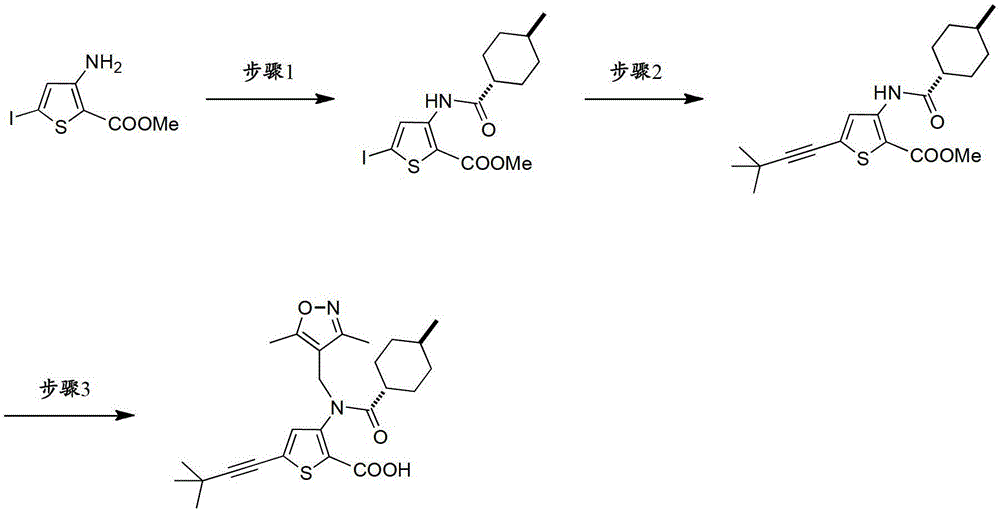
步骤1.5-碘-3-(反式-4-甲基环己烷甲酰氨基)噻吩-2-甲酸甲酯Step 1. Methyl 5-iodo-3-(trans-4-methylcyclohexanecarboxamido)thiophene-2-carboxylate
将3-氨基-5-碘-噻吩-2-甲酸甲酯(50g,174.9mmol)溶于CH2Cl2(500mL)和吡啶(30mL),冷却至0℃,然后滴加反式-4-甲基环己烷羰基氯(60.2g,210mmol)(净),用少量DCM冲洗。5min后,除去浴,当反应达到RT时搅拌。1.25小时后,从反应体系中取等分部分,用DCM稀释,TLC(5%EtOAc/己烷)检查发现SM消失;反应完成。1.)通过添加盐水后处理,然后用DCM(2x500mL)萃取,合并,用1N HCl(500mL)洗涤,用1:1-1N NaOH(50mL)、盐水(500mL)洗涤;反萃取1x,然后用硫酸钠干燥,过滤,蒸发,然后将产物浴己烷一起研磨。67.3g,(93%)。3-Amino-5-iodo-thiophene-2-carboxylic acid methyl ester (50g, 174.9mmol) was dissolved in CH 2 Cl 2 (500mL) and pyridine (30mL), cooled to 0°C, then trans-4- Methylcyclohexanecarbonyl chloride (60.2 g, 210 mmol) (neat), rinsed with a little DCM. After 5 min, the bath was removed and the reaction was stirred when it reached RT. After 1.25 hours, an aliquot was taken from the reaction, diluted with DCM, and checked by TLC (5% EtOAc/Hexanes) to reveal the disappearance of the SM; the reaction was complete. 1.) Workup by adding brine, then extract with DCM (2x500mL), combine, wash with 1N HCl (500mL), wash with 1:1-1N NaOH (50mL), brine (500mL); back extract 1x, then with Dry over sodium sulfate, filter, evaporate and triturate the product with hexane. 67.3g, (93%).
MS:m/z(obs.):407.95[M+H]+;MS: m/z(obs.): 407.95[M+H] + ;
步骤2.5-(3,3-二甲基丁-1-炔-1-基)-3-(反式-4-甲基环己烷-甲酰氨基)-噻吩-2-甲酸甲酯
在氮气气氛中在干燥烧瓶中混合5-碘-3-[(4-反式-甲基环己烷羰基)氨基]噻吩-2-甲酸甲酯(52g,128mmol)、3,3-二甲基丁-1-炔(12.58g,18.3mL,153.2mmol)、三乙胺(53.4mL,383mmol),然后在0℃用冰浴冷却,然后添加碘化亚(2.95g,15.5mmol)和Pd2(dba)3(1.27g,1.39mmol);除去浴,当反应在几小时内达到RT时搅拌。加入盐水(800mL)和DI水(200mL)和醋酸异丙酯(1000mL),搅拌,通过C盐过滤。用硫酸钠干燥有机相,过滤,蒸发,然后用使用5%EtOAc/己烷的硅胶纯化,得到期望的产物,46g(97%)。Mix 5-iodo-3-[(4-trans-methylcyclohexanecarbonyl)amino]thiophene-2-carboxylic acid methyl ester (52 g, 128 mmol), 3,3-dimethyl But-1-yne (12.58g, 18.3mL, 153.2mmol), triethylamine (53.4mL, 383mmol), then cooled in an ice bath at 0°C, then added iodide (2.95g, 15.5mmol) and Pd 2 (dba) 3 (1.27g, 1.39mmol); the bath was removed and stirred when the reaction reached RT within a few hours. Add brine (800 mL) and DI water (200 mL) and isopropyl acetate (1000 mL), stir and filter through celite. The organic phase was dried over sodium sulfate, filtered, evaporated and purified on silica gel with 5% EtOAc/hexanes to give the desired product, 46 g (97%).
MS:m/z(obs.):362.4[M+H]+;MS: m/z(obs.): 362.4[M+H] + ;
步骤3.5-(3,3-二甲基丁-1-炔-1-基)-3-(N-((3,5-二甲基异噁唑-4-基)甲基)-4-反式-甲基环己烷甲酰氨基)噻吩-2-甲酸
用NaH(1当量)和4-(氯甲基)-3,5-二甲基异噁唑(1当量)处理在DMF(5mL)中的5-(3,3-二甲基丁-1-炔-1-基)-3-(反式-4-甲基环己烷-甲酰氨基)-噻吩-2-甲酸甲酯(50mg)。在室温搅拌1h,然后加入LiOH和H2O,搅拌24h。通过制备型HPLC分离期望的产物。5-(3,3-Dimethylbutan-1 in DMF (5 mL) was treated with NaH (1 eq) and 4-(chloromethyl)-3,5-dimethylisoxazole (1 eq) -Alkyn-1-yl)-3-(trans-4-methylcyclohexane-carboxamido)-thiophene-2-carboxylic acid methyl ester (50 mg). Stir at room temperature for 1 h, then add LiOH and H2O and stir for 24 h. The desired product was isolated by preparative HPLC.
MS:m/z(obs.):457.41。MS: m/z (obs.): 457.41.
化合物41的制备Preparation of

步骤1.3-((1-(叔丁氧基)-1-氧代丁-2-基)氨基)-5-(3,3-二甲基丁-1-炔-1-基)噻吩-2-甲酸(S)-甲酯Step 1. 3-((1-(tert-butoxy)-1-oxobut-2-yl)amino)-5-(3,3-dimethylbut-1-yn-1-yl)thiophene-2 -(S)-methyl formate
用于反应的1,4-二噁烷是无水的且通过用氮气净化30min脱氧。将3-溴-5-(3,3-二甲基丁-1-炔基)噻吩-2-甲酸甲酯(500mg,1.660mmol)、二环己基-[2-(2,6-二甲氧基苯基)苯基]磷杂环丁烷(68mg,0.17mmol)和碳酸铯(1.62g,4.98mmol)溶于5mL甲苯,使氩气通过该混合物发泡5分钟。将催化剂Pd2dba3(76mg,0.083mmol)加入到该混合物中,密封该反应体系,在90℃加热过夜18h。冷却,用EtOAc稀释,用饱和NaHCO3和水洗涤,用MgSO4干燥,过滤,与硅胶一起蒸发,通过硅胶色谱法纯化,用0-35%EtOAc的己烷溶液在35min内洗脱,得到期望的产物,为油状物(67%)。The 1,4-dioxane used in the reaction was anhydrous and deoxygenated by purging with nitrogen for 30 min. 3-Bromo-5-(3,3-dimethylbut-1-ynyl)thiophene-2-carboxylic acid methyl ester (500mg, 1.660mmol), Oxyphenyl)phenyl]phosphetidine (68 mg, 0.17 mmol) and cesium carbonate (1.62 g, 4.98 mmol) were dissolved in 5 mL of toluene and argon was bubbled through the mixture for 5 minutes. The catalyst Pd 2 dba 3 (76mg, 0.083mmol) was added to the mixture, the reaction system was sealed and heated at 90°C overnight for 18h. Cool, dilute with EtOAc, wash with saturated NaHCO 3 and water, dry over MgSO 4 , filter, evaporate with silica gel, and purify by chromatography on silica gel, eluting with 0-35% EtOAc in hexanes in 35 min, to give the desired The product as an oil (67%).
MS:m/z(obs.):380.3[M+H]+;MS: m/z (obs.): 380.3 [M+H] + ;
1H NMR(300MHz,CDCl3)δ7.01(d,J=8.3Hz,1H),6.47(s,1H),3.82(dt,J=8.4,6.1Hz,1H),3.73(s,3H),1.89-1.65(m,3H),1.38(s,9H),1.23(s,9H),0.91(t,J=7.4Hz,3H)。 1 H NMR (300MHz, CDCl 3 )δ7.01(d, J=8.3Hz, 1H), 6.47(s, 1H), 3.82(dt, J=8.4, 6.1Hz, 1H), 3.73(s, 3H) ,1.89-1.65(m,3H),1.38(s,9H),1.23(s,9H),0.91(t,J=7.4Hz,3H).
步骤2.5-(3,3-二甲基丁-1-炔-1-基)-3-((1-甲氧基-1-氧代丁-2-基)氨基)噻吩-2-甲酸(S)-甲酯
向3-[[(1S)-1-叔丁氧基羰基丙基]氨基]-5-(3,3-二甲基丁-1-炔基)噻吩-2-甲酸甲酯(200mg,0.53mmol)在干MeOH(4mL)中的溶液中加入6M氯化氢的MeOH溶液(880μL,5.3mmol),将该混合物在室温搅拌15h。LCMS显示主要产物是甲酯。蒸发溶剂,将残余物直接用于下一步。To 3-[[(1S)-1-tert-butoxycarbonylpropyl]amino]-5-(3,3-dimethylbut-1-ynyl)thiophene-2-carboxylic acid methyl ester (200mg, 0.53 To a solution of mmol) in dry MeOH (4 mL) was added 6M hydrogen chloride in MeOH (880 μL, 5.3 mmol), and the mixture was stirred at room temperature for 15 h. LCMS showed that the major product was the methyl ester. The solvent was evaporated and the residue was used directly in the next step.
MS:m/z(obs.):338.2[M+H]+;MS: m/z(obs.): 338.2[M+H] + ;
步骤3.5-(3,3-二甲基丁-1-炔-1-基)-3-(N-((S)-1-甲氧基-1-氧代丁-2-基)-(4-反式-甲基环己烷)-甲酰氨基)噻吩-2-甲酸甲酯
向粗5-(3,3-二甲基丁-1-炔-1-基)-3-((1-甲氧基-1-氧代丁-2-基)氨基)噻吩-2-甲酸(S)-甲酯(200mg,0.59mmol)在DCE(4mL)中的溶液中加入吡啶(57μL,0.71mmol),然后添加4-甲基环己烷-羰基氯(143mg,0.89mmol);将该混合物在90℃加热过夜。通过硅胶色谱法纯化粗产物,用5-35%EtOAc的己烷溶液洗脱,得到澄清油状物(55%)。To crude 5-(3,3-dimethylbut-1-yn-1-yl)-3-((1-methoxy-1-oxobut-2-yl)amino)thiophene-2-carboxylic acid To a solution of (S)-methyl ester (200 mg, 0.59 mmol) in DCE (4 mL) was added pyridine (57 μL, 0.71 mmol) followed by 4-methylcyclohexane-carbonyl chloride (143 mg, 0.89 mmol); The mixture was heated at 90°C overnight. The crude product was purified by silica gel chromatography eluting with 5-35% EtOAc in hexanes to give a clear oil (55%).
MS:m/z(obs.):462.3[M+H]+;MS: m/z(obs.): 462.3[M+H] + ;
步骤4.3-(N-((S)-1-羧基丙基)-(4-反式-甲基环己烷)-甲酰氨基)-5-(3,3-二甲基丁-1-炔-1-基)噻吩-2-甲酸Step 4. 3-(N-((S)-1-carboxypropyl)-(4-trans-methylcyclohexane)-formylamino)-5-(3,3-dimethylbutan-1- Alkyn-1-yl)thiophene-2-carboxylic acid
向5-(3,3-二甲基丁-1-炔-1-基)-3-(N-((S)-1-甲氧基-1-氧代丁-2-基)-(4-反式-甲基环己烷)-甲酰氨基)噻吩-2-甲酸甲酯(150mg,0.32mmol)在水(3mL)和THF(3mL)中的溶液中加入LiOH(78mg,3.25mmol),在室温搅拌12h。用6N HCl酸化至pH1,使用氮气吹出THF,过滤,得到树胶状固体,在过滤漏斗中真空干燥,树胶状固体变成黄白色粉末,然后再进行真空干燥(95%)。To 5-(3,3-dimethylbut-1-yn-1-yl)-3-(N-((S)-1-methoxy-1-oxobutan-2-yl)-( To a solution of methyl 4-trans-methylcyclohexane)-formylamino)thiophene-2-carboxylate (150 mg, 0.32 mmol) in water (3 mL) and THF (3 mL) was added LiOH (78 mg, 3.25 mmol ), stirred at room temperature for 12h. Acidify to pH 1 with 6N HCl, blow out THF with nitrogen, filter to obtain a gummy solid, vacuum dry in a filter funnel, the gummy solid becomes a yellow-white powder, and then vacuum dry (95%).
MS:m/z(obs.):434.3[M+H]+;MS: m/z(obs.): 434.3[M+H] + ;
1H NMR(300MHz,CDCl3)δ7.21(s,0.6H),7.18(s,0.4H),4.71(t,0.6H),4.20(t,0.4H),2.20-1.15(m,11H),1.28(s,9H),0.91-0.50(m,7H)。 1 H NMR (300MHz, CDCl 3 )δ7.21(s,0.6H),7.18(s,0.4H),4.71(t,0.6H),4.20(t,0.4H),2.20-1.15(m,11H ), 1.28(s,9H), 0.91-0.50(m,7H).
化合物72的制备Preparation of

步骤1.5-(3,3-二甲基丁-1-炔-1-基)-3-((1-吗啉代丙-2-基)氨基)噻吩-2-甲酸甲酯Step 1. Methyl 5-(3,3-dimethylbut-1-yn-1-yl)-3-((1-morpholinopropan-2-yl)amino)thiophene-2-carboxylate
按照对化合物54所述的方式制备标题化合物。The title compound was prepared as described for
MS:m/z(obs.):365.2[M+H]+;MS: m/z(obs.): 365.2[M+H] + ;
步骤2.5-(3,3-二甲基丁-1-炔-1-基)-3-(反式-4-甲基-N-(1-吗啉代丙-2-基)环己烷甲酰氨基)噻吩-2-甲酸甲酯
按照对化合物54所述的方式制备标题化合物。The title compound was prepared as described for
MS:m/z(obs.):489.3[M+H]+;MS: m/z(obs.): 489.3[M+H] + ;
步骤3.5-(3,3-二甲基丁-1-炔-1-基)-3-(反式-4-甲基-N-(1-吗啉代丙-2-基)环己烷甲酰氨基)噻吩-2-甲酸
按照对化合物54所述的方法制备标题化合物72。The
MS:m/z(obs.):475.24[M+H]+;MS: m/z(obs.): 475.24[M+H] + ;
1H NMR(300MHz,CDCl3)δ6.75(s,1H),5.65(br,1H),4.25-3.80(m,4H),3.15-2.65(m,6H),2.20-1.48(m,7H),1.40-1.28(m,14H),0.85-0.60(m,4H)。 1 H NMR (300MHz, CDCl 3 )δ6.75(s,1H),5.65(br,1H),4.25-3.80(m,4H),3.15-2.65(m,6H),2.20-1.48(m,7H ), 1.40-1.28 (m, 14H), 0.85-0.60 (m, 4H).
化合物64的制备Preparation of
步骤1.5-(3,3-二甲基丁-1-炔基)-3-((1-甲基-1H-咪唑-2-基)甲基氨基)噻吩-2-甲酸甲酯Step 1. Methyl 5-(3,3-dimethylbut-1-ynyl)-3-((1-methyl-1H-imidazol-2-yl)methylamino)thiophene-2-carboxylate
向3-氨基-5-(3,3-二甲基丁-1-炔基)噻吩-2-甲酸甲酯(125mg,0.53mmol)和冰醋酸(120μL,2.10mmol)在1,2-二氯乙烷(1.5mL)中的溶液中加入1-甲基咪唑-2-甲醛(174mg,1.58mmol),搅拌1h。加入三乙酰氧基硼氢化钠(279mg,1.32mmol),搅拌过夜,使用LC/MS监测进程。通过添加饱和NaHCO3水溶液(10mL)使该反应体系呈碱性,搅拌20min。用DCM(2×10mL)萃取,用盐水洗涤合并的有机相,用硫酸钠干燥,真空浓缩。得到168mg期望的产物,收率96%。Add 3-amino-5-(3,3-dimethylbut-1-ynyl)thiophene-2-carboxylate (125 mg, 0.53 mmol) and glacial acetic acid (120 μL, 2.10 mmol) in 1,2-di To a solution in ethyl chloride (1.5 mL) was added 1-methylimidazole-2-carbaldehyde (174 mg, 1.58 mmol), and stirred for 1 h. Add sodium triacetoxyborohydride (279mg, 1.32mmol) and stir overnight, monitoring progress using LC/MS. The reaction was made basic by adding saturated aqueous NaHCO 3 (10 mL) and stirred for 20 min. Extracted with DCM (2 x 10 mL), washed the combined organic phases with brine, dried over sodium sulfate and concentrated in vacuo. 168mg of desired product was obtained, yield 96%.
MS:m/z(obs.):332[M+H]+ MS: m/z(obs.): 332[M+H] +
步骤2.5-(3,3-二甲基丁-1-炔基)-3-(N-((1-甲基-1H-咪唑-2-基)甲基)-4-反式-4-甲基环己烷甲酰氨基)-噻吩-2-甲酸甲酯
向5-(3,3-二甲基丁-1-炔基)-3-((1-甲基-1H-咪唑-2-基)甲基氨基)噻吩-2-甲酸甲酯(168mg,0.51mmol)在二氯乙烷(5mL)中的混合物中加入吡啶(410μL,5.07mmol)、N,N-二甲基氨基吡啶(6mg,0.05mmol)和4-甲基环己烷羰基氯(407mg,2.5mmol)。将该混合物回流24h,用LC/MS监测。将该反应体系冷却至室温,用乙酸乙酯(30mL)稀释,用水(15mL)和饱和NaHCO3水溶液(15mL)洗涤。真空浓缩有机相。通过硅胶色谱法纯化,使用0-50%乙酸乙酯/己烷梯度作为洗脱剂。得到150mg,收率65%。To 5-(3,3-dimethylbut-1-ynyl)-3-((1-methyl-1H-imidazol-2-yl)methylamino)thiophene-2-carboxylic acid methyl ester (168mg, 0.51 mmol) in dichloroethane (5 mL) were added pyridine (410 μL, 5.07 mmol), N,N-dimethylaminopyridine (6 mg, 0.05 mmol) and 4-methylcyclohexanecarbonyl chloride ( 407 mg, 2.5 mmol). The mixture was refluxed for 24h, monitored by LC/MS. The reaction was cooled to room temperature, diluted with ethyl acetate (30 mL), washed with water (15 mL) and saturated aqueous NaHCO 3 (15 mL). The organic phase was concentrated in vacuo. Purified by silica gel chromatography using a gradient of 0-50% ethyl acetate/hexanes as eluent. 150 mg was obtained, yield 65%.
MS:m/z(obs.):456[M+H]+。MS: m/z (obs.): 456 [M+H] + .
步骤3.5-(3,3-二甲基丁-1-炔基)-3-((反式)-4-甲基-N-((1-甲基-1H-咪唑-2-基)甲基)环己烷甲酰氨基)噻吩-2-甲酸
向5-(3,3-二甲基丁-1-炔基)-3-(N-((1-甲基-1H-咪唑-2-基)甲基)-4-反式-4-甲基环己烷甲酰氨基)-噻吩-2-甲酸甲酯To 5-(3,3-dimethylbut-1-ynyl)-3-(N-((1-methyl-1H-imidazol-2-yl)methyl)-4-trans-4- Methylcyclohexanecarboxamido)-thiophene-2-carboxylate
(150mg,0.33mmol)在甲醇(5mL)中的溶液中加入氢氧化钠(1.65mmol,1M),搅拌过夜。通过LC/MS发现原料耗尽。用1N HCl将该反应混合物酸化至pH~6,用二氯甲烷(2×15mL)萃取。用硫酸钠干燥合并的有机相,真空浓缩。将得到的残余物进行12g硅胶色谱,使用0-15%MeOH/DCM梯度作为洗脱剂。得到60mg,收率38%。(150mg, 0.33mmol) in methanol (5mL) was added sodium hydroxide (1.65mmol, 1M) and stirred overnight. Starting material was found to be consumed by LC/MS. The reaction mixture was acidified to pH~6 with 1N HCl and extracted with dichloromethane (2 x 15 mL). The combined organic phases were dried over sodium sulfate and concentrated in vacuo. The resulting residue was chromatographed over 12 g of silica gel using a 0-15% MeOH/DCM gradient as eluent. Obtained 60mg, yield 38%.
MS:m/z(obs.):442[M+H]+;MS: m/z(obs.): 442[M+H] + ;
1H NMR(300MHz,CDCl3)d7.03(s,1H),6.90(s,1H),6.77(s,1H),5.53(d,J=16.4Hz,1H),4.47(d,J=16.1Hz,1H),3.72(s,3H),2.42(t,J=11.8Hz,1H),1.93(d,J=13.0Hz,1H),1.71-1.13(m,15H),0.96-0.68(m,5H)。 1 H NMR (300MHz, CDCl 3 )d7.03(s,1H),6.90(s,1H),6.77(s,1H),5.53(d,J=16.4Hz,1H),4.47(d,J= 16.1Hz,1H),3.72(s,3H),2.42(t,J=11.8Hz,1H),1.93(d,J=13.0Hz,1H),1.71-1.13(m,15H),0.96-0.68( m,5H).
化合物66的制备Preparation of
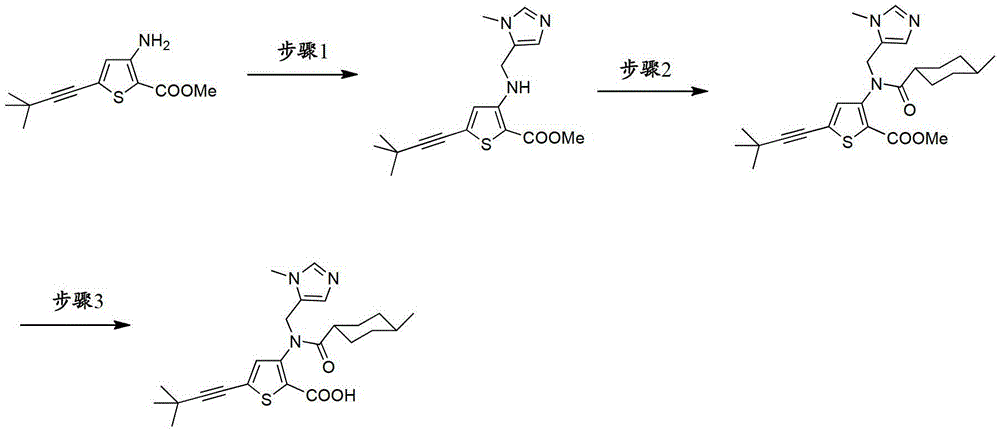
步骤1.5-(3,3-二甲基丁-1-炔基)-3-((1-甲基-1H-咪唑-5-基)甲基氨基)噻吩-2-甲酸甲酯Step 1. Methyl 5-(3,3-dimethylbut-1-ynyl)-3-((1-methyl-1H-imidazol-5-yl)methylamino)thiophene-2-carboxylate
向3-氨基-5-(3,3-二甲基丁-1-炔基)噻吩-2-甲酸甲酯(125mg,0.53mmol)和冰醋酸(126mg,120μL,2.1mmol)在1,2-二氯乙烷(5mL)中的溶液中加入3-甲基咪唑-4-甲醛(174mg,1.58mmol),搅拌1h。加入三乙酰氧基硼氢化钠(279mg,1.32mmol),搅拌过夜,使用LC/MS监测进程。通过添加饱和NaHCO3水溶液(10mL)使该反应体系呈碱性,搅拌20min。用DCM(2×10mL)萃取,用盐水洗涤合并的有机相,用硫酸钠干燥,真空浓缩。得到175mg期望的产物,收率100%。To 3-amino-5-(3,3-dimethylbut-1-ynyl)thiophene-2-carboxylic acid methyl ester (125mg, 0.53mmol) and glacial acetic acid (126mg, 120μL, 2.1mmol) in 1,2 - Add 3-methylimidazole-4-carbaldehyde (174 mg, 1.58 mmol) to a solution in dichloroethane (5 mL), and stir for 1 h. Add sodium triacetoxyborohydride (279mg, 1.32mmol) and stir overnight, monitoring progress using LC/MS. The reaction was made basic by adding saturated aqueous NaHCO 3 (10 mL) and stirred for 20 min. Extracted with DCM (2 x 10 mL), washed the combined organic phases with brine, dried over sodium sulfate and concentrated in vacuo. 175 mg of the desired product was obtained, yield 100%.
MS:m/z(obs.):332[M+H]+。MS: m/z (obs.): 332 [M+H] + .
步骤2.5-(3,3-二甲基丁-1-炔基)-3-((反式)-4-甲基-N-((1-甲基-1H-咪唑-5-基)甲基)环己烷甲酰氨基)噻吩-2-甲酸甲酯
向5-(3,3-二甲基丁-1-炔基)-3-((1-甲基-1H-咪唑-5-基)甲基氨基)噻吩-2-甲酸甲酯(175mg,0.53mmol))在二氯乙烷(5mL)中的混合物中加入吡啶(430μL,5.310mmol)、N,N-二甲基氨基吡啶(6.5mg,0.05mmol)和4-甲基环己烷羰基氯(427mg,2.65mmol)。将该混合物回流24h,用LC/MS监测。将该反应体系冷却至室温,用乙酸乙酯(30mL)稀释,用水(15mL)和饱和NaHCO3水溶液(15mL)洗涤。真空浓缩有机相。得到230mg,收率92%。To 5-(3,3-dimethylbut-1-ynyl)-3-((1-methyl-1H-imidazol-5-yl)methylamino)thiophene-2-carboxylic acid methyl ester (175mg, 0.53 mmol)) in dichloroethane (5 mL) was added pyridine (430 μL, 5.310 mmol), N,N-dimethylaminopyridine (6.5 mg, 0.05 mmol) and 4-methylcyclohexanecarbonyl Chlorine (427 mg, 2.65 mmol). The mixture was refluxed for 24h, monitored by LC/MS. The reaction was cooled to room temperature, diluted with ethyl acetate (30 mL), washed with water (15 mL) and saturated aqueous NaHCO 3 (15 mL). The organic phase was concentrated in vacuo. Obtained 230mg, yield 92%.
MS:m/z(obs.):456[M+H]+ MS: m/z(obs.): 456[M+H] +
步骤3.5-(3,3-二甲基丁-1-炔基)-3-((反式)-4-甲基-N-((1-甲基-1H-咪唑-5-基)甲基)环己烷甲酰氨基)噻吩-2-甲酸
向5-(3,3-二甲基丁-1-炔基)-3-((反式)-4-甲基-N-((1-甲基-1H-咪唑-5-基)甲基)环己烷甲酰氨基)噻吩-2-甲酸甲酯(230mg,0.50mmol)在甲醇(5mL)中的溶液中加入1M氢氧化钠(2.5mL),搅拌过夜。通过LC/MS发现原料耗尽。用1N HCl将该反应混合物酸化至pH~6,用二氯甲烷(2×15mL)萃取。用硫酸钠干燥合并的有机相,真空浓缩。将得到的残余物进行12g硅胶色谱,使用0-20%MeOH/DCM梯度作为洗脱剂。得到51mg,收率20%。To 5-(3,3-dimethylbut-1-ynyl)-3-((trans)-4-methyl-N-((1-methyl-1H-imidazol-5-yl)methyl To a solution of methyl cyclohexanecarboxamido)thiophene-2-carboxylate (230mg, 0.50mmol) in methanol (5mL) was added 1M sodium hydroxide (2.5mL) and stirred overnight. Starting material was found to be consumed by LC/MS. The reaction mixture was acidified to pH~6 with 1N HCl and extracted with dichloromethane (2 x 15 mL). The combined organic phases were dried over sodium sulfate and concentrated in vacuo. The resulting residue was chromatographed over 12 g of silica gel using a 0-20% MeOH/DCM gradient as eluent. Obtained 51 mg, yield 20%.
MS:m/z(obs.):442[M+H]+;MS: m/z(obs.): 442[M+H] + ;
1H NMR(300MHz,CDCl3)δ11.84(s,1H),8.00(s,1H),6.78(s,1H),6.58(s,1H),5.56(d,J=13.6Hz,1H),4.16-3.93(m,1H),3.73(s,3H),2.20(t,J=11.5Hz,1H),1.91-1.14(m,15H),0.98-0.52(m,5H)。 1 H NMR(300MHz,CDCl 3 )δ11.84(s,1H),8.00(s,1H),6.78(s,1H),6.58(s,1H),5.56(d,J=13.6Hz,1H) ,4.16-3.93(m,1H),3.73(s,3H),2.20(t,J=11.5Hz,1H),1.91-1.14(m,15H),0.98-0.52(m,5H).
化合物67的制备Preparation of

步骤1.5-(3,3-二甲基丁-1-炔基)-3-((1-甲基-1H-吡唑-4-基)甲基氨基)噻吩-2-甲酸甲酯Step 1. Methyl 5-(3,3-dimethylbut-1-ynyl)-3-((1-methyl-1H-pyrazol-4-yl)methylamino)thiophene-2-carboxylate
向3-氨基-5-(3,3-二甲基丁-1-炔基)噻吩-2-甲酸甲酯(130mg,0.55mmol)和冰醋酸(125μL,2.19mmol)在1,2-二氯乙烷(5mL)中的溶液中加入1-甲基吡唑-4-甲醛(181mg,1.64mmol),搅拌1h。加入三乙酰氧基硼氢化钠(290mg,1.37mmol),搅拌过夜,使用LC/MS监测进程。通过添加饱和NaHCO3水溶液(10mL)使该反应体系呈碱性,搅拌20min。用DCM(2×10mL)萃取,用硫酸钠干燥合并的有机相,真空浓缩。将得到的残余物进行12g硅胶色谱法。使用0-50%EtOAc/Hex梯度作为洗脱剂。得到142mg。Add 3-amino-5-(3,3-dimethylbut-1-ynyl)thiophene-2-carboxylate (130 mg, 0.55 mmol) and glacial acetic acid (125 μL, 2.19 mmol) in 1,2-di To a solution in ethyl chloride (5 mL) was added 1-methylpyrazole-4-carbaldehyde (181 mg, 1.64 mmol), and stirred for 1 h. Add sodium triacetoxyborohydride (290mg, 1.37mmol) and stir overnight, monitoring progress using LC/MS. The reaction was made basic by adding saturated aqueous NaHCO 3 (10 mL) and stirred for 20 min. Extracted with DCM (2 x 10 mL), dried the combined organic phases over sodium sulfate and concentrated in vacuo. The residue obtained was chromatographed on 12 g of silica gel. A 0-50% EtOAc/Hex gradient was used as eluent. Obtained 142 mg.
MS:m/z(obs.):332[M+H]+ MS: m/z(obs.): 332[M+H] +
1H NMR(300MHz,CDCl3)δ7.42(s,1H),7.29(s,1H),6.87(s,1H),6.63(s,1H),4.28(d,J=5.7Hz,2H),3.86(d,J=4.7Hz,3H),3.78(s,3H),1.35-1.24(m,9H)。 1 H NMR (300MHz, CDCl 3 )δ7.42(s,1H),7.29(s,1H),6.87(s,1H),6.63(s,1H),4.28(d,J=5.7Hz,2H) , 3.86 (d, J=4.7Hz, 3H), 3.78 (s, 3H), 1.35-1.24 (m, 9H).
步骤2.5-(3,3-二甲基丁-1-炔基)-3-((反式)-4-甲基-N-((1-甲基-1H-吡唑-4-基)甲基)环己烷甲酰氨基)噻吩-2-甲酸甲酯
向5-(3,3-二甲基丁-1-炔基)-3-[(1-甲基吡唑-4-基)甲基氨基]噻吩-2-甲酸甲酯(142mg,0.43mmol)在二氯乙烷(5mL)中的混合物中加入吡啶(350μL,4.28mmol)、二甲基氨基吡啶(5mg,0.04mmol)和4-甲基环己烷羰基氯(344mg,2.1mmol)。将该混合物回流24h,用LC/MS监测。将该反应体系冷却至室温,用乙酸乙酯(30mL)稀释,用水(15mL)和饱和NaHCO3水溶液(15mL)洗涤。真空浓缩有机相,将得到的残余物进行12g硅胶色谱,使用0-50%EtOAc/hex作为洗脱剂。得到152mg,收率78%。To 5-(3,3-dimethylbut-1-ynyl)-3-[(1-methylpyrazol-4-yl)methylamino]thiophene-2-carboxylic acid methyl ester (142mg, 0.43mmol ) in dichloroethane (5 mL) were added pyridine (350 μL, 4.28 mmol), dimethylaminopyridine (5 mg, 0.04 mmol) and 4-methylcyclohexanecarbonyl chloride (344 mg, 2.1 mmol). The mixture was refluxed for 24h, monitored by LC/MS. The reaction was cooled to room temperature, diluted with ethyl acetate (30 mL), washed with water (15 mL) and saturated aqueous NaHCO 3 (15 mL). The organic phase was concentrated in vacuo and the resulting residue was chromatographed over 12 g of silica gel using 0-50% EtOAc/hex as eluent. Obtained 152mg, yield 78%.
MS:m/z(obs.):456[M+H]+。MS: m/z (obs.): 456 [M+H] + .
步骤3.5-(3,3-二甲基丁-1-炔基)-3-((反式)-4-甲基-N-((1-甲基-1H-吡唑-4-基)甲基)环己烷甲酰氨基)噻吩-2-甲酸
向5-(3,3-二甲基丁-1-炔基)-3-((反式)-4-甲基-N-((1-甲基-1H-吡唑-4-基)甲基)环己烷甲酰氨基)噻吩-2-甲酸甲酯(152mg,0.33mmol)在甲醇(3.3mL)中的溶液中加入1M氢氧化钠(1.7mL),搅拌过夜。通过LC/MS发现原料耗尽。用1N HCl将该反应混合物酸化至pH~6,用二氯甲烷(2×15mL)萃取。用硫酸钠干燥合并的有机相,真空浓缩。将得到的残余物进行12g硅胶色谱,使用0-15%MeOH/DCM梯度作为洗脱剂。To 5-(3,3-dimethylbut-1-ynyl)-3-((trans)-4-methyl-N-((1-methyl-1H-pyrazol-4-yl) To a solution of methyl (methyl)cyclohexanecarboxamido)thiophene-2-carboxylate (152mg, 0.33mmol) in methanol (3.3mL) was added 1M sodium hydroxide (1.7mL) and stirred overnight. Starting material was found to be consumed by LC/MS. The reaction mixture was acidified to pH~6 with 1N HCl and extracted with dichloromethane (2 x 15 mL). The combined organic phases were dried over sodium sulfate and concentrated in vacuo. The resulting residue was chromatographed over 12 g of silica gel using a 0-15% MeOH/DCM gradient as eluent.
MS:m/z(obs.):442[M+H]+;MS: m/z(obs.): 442[M+H] + ;
1H NMR(300MHz,CDCl3)δ10.97(s,1H),7.34(s,1H),7.29(s,1H),6.75(s,1H),4.61(dd,J=32.1,14.7Hz,2H),3.82(s,3H),2.10(t,J=11.5Hz,1H),1.81-1.36(m,6H),1.40-1.20(m,10H),0.89-0.58(m,5H)。 1 H NMR (300MHz, CDCl 3 )δ10.97(s,1H),7.34(s,1H),7.29(s,1H),6.75(s,1H),4.61(dd,J=32.1,14.7Hz, 2H), 3.82(s, 3H), 2.10(t, J=11.5Hz, 1H), 1.81-1.36(m, 6H), 1.40-1.20(m, 10H), 0.89-0.58(m, 5H).
化合物71的制备Preparation of
步骤1.5-(3,3-二甲基丁-1-炔基)-3-((1-甲基-1H-吡唑-3-基)甲基氨基)噻吩-2-甲酸甲酯Step 1. Methyl 5-(3,3-dimethylbut-1-ynyl)-3-((1-methyl-1H-pyrazol-3-yl)methylamino)thiophene-2-carboxylate
向3-氨基-5-(3,3-二甲基丁-1-炔基)噻吩-2-甲酸甲酯(125mg,0.53mmol)和冰醋酸(120μL,2.1mmol)在1,2-二氯乙烷(5mL)中的溶液中加入1-甲基吡唑-3-甲醛(174mg,1.58mmol),搅拌30min。加入三乙酰氧基硼氢化钠(279mg,1.32mmol),搅拌过夜。通过添加饱和NaHCO3水溶液(10mL)使该反应体系呈碱性,搅拌20min。用DCM(2×10mL)萃取,用硫酸钠干燥合并的有机相,真空浓缩。将得到的残余物进行12g硅胶色谱法。使用0-40%的EtOAc/Hex梯度作为洗脱剂。得到164mg,收率93%。Add 3-amino-5-(3,3-dimethylbut-1-ynyl)thiophene-2-carboxylate (125 mg, 0.53 mmol) and glacial acetic acid (120 μL, 2.1 mmol) in 1,2-di To a solution in ethyl chloride (5 mL) was added 1-methylpyrazole-3-carbaldehyde (174 mg, 1.58 mmol), and stirred for 30 min. Sodium triacetoxyborohydride (279 mg, 1.32 mmol) was added and stirred overnight. The reaction was made basic by adding saturated aqueous NaHCO 3 (10 mL) and stirred for 20 min. Extracted with DCM (2 x 10 mL), dried the combined organic phases over sodium sulfate and concentrated in vacuo. The residue obtained was chromatographed on 12 g of silica gel. A gradient of 0-40% EtOAc/Hex was used as eluent. 164mg was obtained, yield 93%.
MS:m/z(obs.):332[M+H]+。MS: m/z (obs.): 332 [M+H] + .
步骤2.5-(3,3-二甲基丁-1-炔基)-3-((反式)-4-甲基-N-((1-甲基-1H-吡唑-3-基)甲基)环己烷甲酰氨基)噻吩-2-甲酸甲酯
向5-(3,3-二甲基丁-1-炔基)-3-((1-甲基-1H-吡唑-3-基)甲基氨基)噻吩-2-甲酸甲酯(160mg,0.48mmol)在二氯乙烷(5mL)中的混合物中加入吡啶(390μL,4.8mmol)、N,N-二甲基氨基吡啶(6mg,0.05mmol)和4-甲基环己烷羰基氯(388mg,2.4mmol)。将该混合物回流24h,用LC/MS监测。将该反应体系冷却至室温,用乙酸乙酯(30mL)稀释,用水(15mL)和饱和NaHCO3水溶液(15mL)洗涤。真空浓缩有机相,将得到的残余物进行12g硅胶色谱,使用0-50%EtOAc/hex作为洗脱剂。得到127mg,收率58%。To 5-(3,3-dimethylbut-1-ynyl)-3-((1-methyl-1H-pyrazol-3-yl)methylamino)thiophene-2-carboxylic acid methyl ester (160mg , 0.48 mmol) in dichloroethane (5 mL) was added pyridine (390 μL, 4.8 mmol), N,N-dimethylaminopyridine (6 mg, 0.05 mmol) and 4-methylcyclohexanecarbonyl chloride (388 mg, 2.4 mmol). The mixture was refluxed for 24h, monitored by LC/MS. The reaction was cooled to room temperature, diluted with ethyl acetate (30 mL), washed with water (15 mL) and saturated aqueous NaHCO 3 (15 mL). The organic phase was concentrated in vacuo and the resulting residue was chromatographed over 12 g of silica gel using 0-50% EtOAc/hex as eluent. Obtained 127mg, yield 58%.
MS:m/z(obs.):456[M+H]+。MS: m/z (obs.): 456 [M+H] + .
1H NMR(300MHz,CDCl3)δ7.23(d,J=2.1Hz,1H),6.73(s,1H),6.18(d,J=2.2Hz,1H),5.13(d,J=14.8Hz,1H),4.43(d,J=14.8Hz,1H),3.78(d,J=7.1Hz,6H),2.05(s,1H),1.64(d,J=7.6Hz,6H),1.38-1.18(m,10H),0.80(d,J=6.5Hz,3H),0.70(d,J=11.2Hz,2H)。 1 H NMR(300MHz,CDCl 3 )δ7.23(d,J=2.1Hz,1H),6.73(s,1H),6.18(d,J=2.2Hz,1H),5.13(d,J=14.8Hz ,1H),4.43(d,J=14.8Hz,1H),3.78(d,J=7.1Hz,6H),2.05(s,1H),1.64(d,J=7.6Hz,6H),1.38-1.18 (m,10H),0.80(d,J=6.5Hz,3H),0.70(d,J=11.2Hz,2H).
步骤3.5-(3,3-二甲基丁-1-炔基)-3-((反式)-4-甲基-N-((1-甲基-1H-吡唑-3-基)甲基)环己烷甲酰氨基)噻吩-2-甲酸
向5-(3,3-二甲基丁-1-炔基)-3-((反式)-4-甲基-N-((1-甲基-1H-吡唑-3-基)甲基)环己烷甲酰氨基)噻吩-2-甲酸甲酯(122mg,0.27mmol)在甲醇(3mL)中的溶液中加入1M氢氧化钠(1.4mL),搅拌60h。通过LC/MS发现原料耗尽。用1N HCl将该反应混合物酸化至pH~4,用二氯甲烷(2×15mL)萃取。用硫酸钠干燥合并的有机相,真空浓缩。用EtOAc(~1mL)稀释得到的固体,滴加己烷,直到产物沉淀。过滤白色固体,得到87mg,收率70%。To 5-(3,3-dimethylbut-1-ynyl)-3-((trans)-4-methyl-N-((1-methyl-1H-pyrazol-3-yl) To a solution of methyl (methyl)cyclohexanecarboxamido)thiophene-2-carboxylate (122mg, 0.27mmol) in methanol (3mL) was added 1M sodium hydroxide (1.4mL), and stirred for 60h. Starting material was found to be consumed by LC/MS. The reaction mixture was acidified to pH~4 with 1N HCl and extracted with dichloromethane (2 x 15 mL). The combined organic phases were dried over sodium sulfate and concentrated in vacuo. The resulting solid was diluted with EtOAc (-1 mL) and hexanes were added dropwise until the product precipitated. The white solid was filtered to obtain 87mg, yield 70%.
MS:m/z(obs.):442[M+H]+;MS: m/z(obs.): 442[M+H] + ;
1H NMR(300MHz,CDCl3)d7.29(d,J=2.3Hz,1H),6.89(s,1H),6.09(d,J=2.3Hz,1H),5.56(d,J=16.4Hz,1H),4.38(d,J=16.3Hz,1H),3.83(s,3H),2.35(t,J=11.3Hz,1H),1.88(d,J=11.5Hz,1H),1.75-1.46(m,4H),1.45-1.14(m,10H),0.91-0.58(m,5H)。 1 H NMR(300MHz,CDCl 3 )d7.29(d,J=2.3Hz,1H),6.89(s,1H),6.09(d,J=2.3Hz,1H),5.56(d,J=16.4Hz ,1H),4.38(d,J=16.3Hz,1H),3.83(s,3H),2.35(t,J=11.3Hz,1H),1.88(d,J=11.5Hz,1H),1.75-1.46 (m, 4H), 1.45-1.14 (m, 10H), 0.91-0.58 (m, 5H).
化合物77的制备Preparation of
步骤1.5-(3,3-二甲基丁-1-炔基)-3-((1-甲基-1H-吡唑-5-基)甲基氨基)噻吩-2-甲酸甲酯Step 1. Methyl 5-(3,3-dimethylbut-1-ynyl)-3-((1-methyl-1H-pyrazol-5-yl)methylamino)thiophene-2-carboxylate
向3-氨基-5-(3,3-二甲基丁-1-炔基)噻吩-2-甲酸甲酯(130mg,0.55mmol)和冰醋酸(125μL,2.19mmol)在1,2-二氯乙烷(5mL)中的溶液中加入,搅拌30min。加入三乙酰氧基硼氢化钠(290mg,1.37mmol),搅拌过夜。通过添加饱和NaHCO3水溶液(10mL)使该反应体系呈碱性,搅拌20min。用DCM(2×10mL)萃取,用硫酸钠干燥合并的有机层,真空浓缩。将得到的残余物进行12g硅胶色谱,使用0-50%EtOAc/Hex梯度作为洗脱剂。得到139mg,收率76%。Add 3-amino-5-(3,3-dimethylbut-1-ynyl)thiophene-2-carboxylate (130 mg, 0.55 mmol) and glacial acetic acid (125 μL, 2.19 mmol) in 1,2-di A solution in ethyl chloride (5 mL) was added and stirred for 30 min. Sodium triacetoxyborohydride (290 mg, 1.37 mmol) was added and stirred overnight. The reaction was made basic by adding saturated aqueous NaHCO 3 (10 mL) and stirred for 20 min. Extracted with DCM (2 x 10 mL), dried the combined organic layers over sodium sulfate and concentrated in vacuo. The resulting residue was chromatographed over 12 g of silica gel using a 0-50% EtOAc/Hex gradient as eluent. Obtained 139mg, yield 76%.
MS:m/z(obs.):332[M+H]+;MS: m/z(obs.): 332[M+H] + ;
1H NMR(300MHz,CDCl3)δ7.39(d,J=1.8Hz,1H),6.94(s,1H),6.61(s,1H),6.19(d,J=1.7Hz,1H),4.41(d,J=5.7Hz,2H),3.85(s,3H),3.79(s,3H),1.30(s,9H)。 1 H NMR(300MHz,CDCl 3 )δ7.39(d,J=1.8Hz,1H),6.94(s,1H),6.61(s,1H),6.19(d,J=1.7Hz,1H),4.41 (d, J=5.7Hz, 2H), 3.85(s, 3H), 3.79(s, 3H), 1.30(s, 9H).
步骤2.5-(3,3-二甲基丁-1-炔基)-3-((反式)-4-甲基-N-((1-甲基-1H-吡唑-5-基)甲基)环己烷甲酰氨基)噻吩-2-甲酸甲酯
向5-(3,3-二甲基丁-1-炔基)-3-((1-甲基-1H-吡唑-5-基)甲基氨基)噻吩-2-甲酸甲酯(136mg,0.41mmol)在DCE(4mL)中的混合物中加入吡啶(330μL,4.1mmol)、N,N-二甲基氨基吡啶(5mg,0.04mmol)和4-甲基环己烷羰基氯(330mg,2.05mmol)。将该混合物回流24h,用LC/MS监测。将该反应体系冷却至室温,用乙酸乙酯(30mL)稀释,用水(15mL)和饱和NaHCO3水溶液(15mL)洗涤。真空浓缩有机相,将得到的残余物进行12g硅胶色谱,使用0-40%EtOAc/hex作为洗脱剂。得到174mg,收率93%。To 5-(3,3-dimethylbut-1-ynyl)-3-((1-methyl-1H-pyrazol-5-yl)methylamino)thiophene-2-carboxylic acid methyl ester (136mg , 0.41 mmol) in DCE (4 mL) was added pyridine (330 μL, 4.1 mmol), N,N-dimethylaminopyridine (5 mg, 0.04 mmol) and 4-methylcyclohexanecarbonyl chloride (330 mg, 2.05 mmol). The mixture was refluxed for 24h, monitored by LC/MS. The reaction was cooled to room temperature, diluted with ethyl acetate (30 mL), washed with water (15 mL) and saturated aqueous NaHCO 3 (15 mL). The organic phase was concentrated in vacuo and the resulting residue was chromatographed over 12 g of silica gel using 0-40% EtOAc/hex as eluent. 174mg was obtained, yield 93%.
MS:m/z(obs.):456[M+H]+ MS: m/z(obs.): 456[M+H] +
1H NMR(300MHz,CDCl3)δ7.29(t,J=3.5Hz,1H),6.60(s,1H),5.81(d,J=1.8Hz,1H),5.02(d,J=15.2Hz,1H),4.73(d,J=15.2Hz,1H),3.83(s,3H),3.74(s,3H),2.03(d,J=6.6Hz,1H),1.71-1.52(m,6H),1.58-1.38(m,1H),1.34-1.21(m,10H),0.87-0.60(m,4H)。 1 H NMR(300MHz,CDCl 3 )δ7.29(t,J=3.5Hz,1H),6.60(s,1H),5.81(d,J=1.8Hz,1H),5.02(d,J=15.2Hz ,1H),4.73(d,J=15.2Hz,1H),3.83(s,3H),3.74(s,3H),2.03(d,J=6.6Hz,1H),1.71-1.52(m,6H) ,1.58-1.38(m,1H),1.34-1.21(m,10H),0.87-0.60(m,4H).
步骤3.5-(3,3-二甲基丁-1-炔基)-3-((反式)-4-甲基-N-((1-甲基-1H-吡唑-5-基)甲基)环己烷甲酰氨基)噻吩-2-甲酸
向5-(3,3-二甲基丁-1-炔基)-3-((反式)-4-甲基-N-((1-甲基-1H-吡唑-5-基)甲基)环己烷甲酰氨基)噻吩-2-甲酸甲酯(174mg,0.38mmol)在甲醇(5mL)中的溶液中加入1M氢氧化钠(1.9mL),搅拌过夜。通过LC/MS发现原料耗尽。用1N HCl将该反应混合物酸化至pH~6,用二氯甲烷(2×20mL)萃取。用硫酸钠干燥合并的有机相,真空浓缩。用EtOAc(~1mL)稀释得到的固体,滴加己烷,直到产物沉淀。过滤白色固体,得到123mg,收率68%。To 5-(3,3-dimethylbut-1-ynyl)-3-((trans)-4-methyl-N-((1-methyl-1H-pyrazol-5-yl) To a solution of methyl (methyl)cyclohexanecarboxamido)thiophene-2-carboxylate (174mg, 0.38mmol) in methanol (5mL) was added 1M sodium hydroxide (1.9mL) and stirred overnight. Starting material was found to be consumed by LC/MS. The reaction mixture was acidified to pH~6 with 1N HCl and extracted with dichloromethane (2 x 20 mL). The combined organic phases were dried over sodium sulfate and concentrated in vacuo. The resulting solid was diluted with EtOAc (-1 mL) and hexanes were added dropwise until the product precipitated. The white solid was filtered to obtain 123mg, yield 68%.
MS:m/z(obs.):442[M+H]+;MS: m/z(obs.): 442[M+H] + ;
1H NMR(300MHz,CDCl3)d11.02(s,1H),7.27(d,J=2.1Hz,1H),6.87(s,1H),5.81-5.57(m,J=9.2Hz,2H),4.04(d,J=15.0Hz,1H),3.91(s,3H),2.30-2.00(m,1H),1.81(d,J=11.1Hz,1H),1.76-1.43(m,5H),1.43-1.16(m,10H),0.93-0.54(m,5H)。 1 H NMR (300MHz, CDCl 3 )d11.02(s,1H),7.27(d,J=2.1Hz,1H),6.87(s,1H),5.81-5.57(m,J=9.2Hz,2H) ,4.04(d,J=15.0Hz,1H),3.91(s,3H),2.30-2.00(m,1H),1.81(d,J=11.1Hz,1H),1.76-1.43(m,5H), 1.43-1.16(m,10H),0.93-0.54(m,5H).
化合物80的制备Preparation of compound 80

步骤1.5-(3,3-二甲基丁-1-炔基)-3-[(1-甲基-2-吡唑-1-基-乙基)氨基]噻吩-2-甲酸甲酯Step 1. 5-(3,3-Dimethylbut-1-ynyl)-3-[(1-methyl-2-pyrazol-1-yl-ethyl)amino]thiophene-2-carboxylic acid methyl ester
将3-溴-5-(3,3-二甲基丁-1-炔基)噻吩-2-甲酸甲酯(430mg,1.43mmol)、碳酸铯(1.39g,4.28mmol)和1-吡唑-1-基丙-2-胺(215mg,1.71mmol)溶于2mL无水1,4-二噁烷,用氩气脱气。15min后,加入S-PHOS(二环己基-[2-(2,6-二甲氧基苯基)苯基]磷杂环丁烷(117mg,0.29mmol))和Pd2dba3(131mg,0.14mmol),给该混合物脱气5分钟以上,然后密封该,加热至100℃16小时。反应混合物的LC/MS证实形成产物。用乙酸乙酯稀释该反应混合物,用水和盐水洗涤,用无水硫酸钠干燥有机层,过滤,蒸发,得到粗产物。通过硅胶柱色谱法纯化,用己烷-70%乙酸乙酯梯度洗脱。蒸发期望的级分,得到291mg标题化合物。收率291mg,59%。Methyl 3-bromo-5-(3,3-dimethylbut-1-ynyl)thiophene-2-carboxylate (430mg, 1.43mmol), cesium carbonate (1.39g, 4.28mmol) and 1-pyrazole -1-ylpropan-2-amine (215 mg, 1.71 mmol) was dissolved in 2 mL of anhydrous 1,4-dioxane and degassed with argon. After 15min, S-PHOS (dicyclohexyl-[2-(2,6-dimethoxyphenyl)phenyl]phosphetane (117mg, 0.29mmol)) and Pd 2 dba 3 (131mg, 0.14 mmol), the mixture was degassed for more than 5 minutes, then sealed and heated to 100 °C for 16 hours. LC/MS of the reaction mixture confirmed product formation. The reaction mixture was diluted with ethyl acetate, washed with water and brine, the organic layer was dried over anhydrous sodium sulfate, filtered and evaporated to give crude product. Purified by column chromatography on silica gel, eluting with a gradient of hexane-70% ethyl acetate. Evaporation of the desired fractions gave 291 mg of the title compound. Yield 291 mg, 59%.
MS:m/z(obs):346.04[M+H]+;MS: m/z(obs): 346.04[M+H] + ;
1H NMR(300MHz,CDCl3)δ7.57(d,J=1.7Hz,1H),7.36(d,J=2.1Hz,1H),6.49(s,1H),6.23-6.20(m,1H),4.19(d,J=6.1Hz,2H),4.05-3.91(m,2H),3.82(s,3H),1.31(d,J=4.1Hz,9H),1.23(d,J=6.6Hz,3H)。 1 H NMR (300MHz, CDCl 3 ) δ7.57(d, J=1.7Hz, 1H), 7.36(d, J=2.1Hz, 1H), 6.49(s, 1H), 6.23-6.20(m, 1H) ,4.19(d,J=6.1Hz,2H),4.05-3.91(m,2H),3.82(s,3H),1.31(d,J=4.1Hz,9H),1.23(d,J=6.6Hz, 3H).
步骤2.5-(3,3-二甲基丁-1-炔基)-3-[(反式-4-甲基环己烷羰基)-(1-甲基-2-吡唑-1-基-乙基)氨基]噻吩-2-甲酸甲酯.
将5-(3,3-二甲基丁-1-炔基)-3-[(1-甲基-2-吡唑-1-基-乙基)氨基]噻吩-2-甲酸甲酯(285mg,0.83mmol)溶于1,2-二氯乙烷(5mL)和吡啶(170μL,2.06mmol)。在室温将4-反式-甲基环己烷羰基氯(331mg,2.06mmol)加入到该溶液中。添加后,将该反应体系在密封试管内在110C加热过夜。将该反应体系冷却至室温。将三乙胺(2mL)加入到该混合物中,然后添加1mL甲醇。将该混合物在室温搅拌1小时,然后真空蒸发。将粗树胶状物溶于二氯甲烷,吸附在SiO2上。通过硅胶柱色谱法纯化,用己烷-100%乙酸乙酯梯度洗脱。合并期望的级分,真空蒸发,得到期望的产物,为澄清油状物,在室温静置时结晶。收率150mg,38.7%。5-(3,3-dimethylbut-1-ynyl)-3-[(1-methyl-2-pyrazol-1-yl-ethyl)amino]thiophene-2-carboxylic acid methyl ester ( 285mg, 0.83mmol) was dissolved in 1,2-dichloroethane (5mL) and pyridine (170μL, 2.06mmol). 4-trans-methylcyclohexanecarbonyl chloride (331 mg, 2.06 mmol) was added to the solution at room temperature. After the addition, the reaction was heated at 110 C overnight in a sealed tube. The reaction system was cooled to room temperature. Triethylamine (2 mL) was added to the mixture, followed by 1 mL of methanol. The mixture was stirred at room temperature for 1 hour, then evaporated in vacuo. The crude gum was dissolved in dichloromethane and adsorbed on SiO2. Purified by column chromatography on silica gel, eluting with a gradient of hexane-100% ethyl acetate. The desired fractions were combined and evaporated in vacuo to give the desired product as a clear oil which crystallized on standing at room temperature. Yield 150mg, 38.7%.
步骤3.5-(3,3-二甲基丁-1-炔基)-3-[(4-反式-甲基环己烷羰基)-(1-甲基-2-吡唑-1-基-乙基)氨基]噻吩-2-甲酸
如对化合物29的制备所述通过水解5-(3,3-二甲基丁-1-炔基)-3-[(4-反式-甲基环己烷羰基)-(1-甲基-2-吡唑-1-基-乙基)氨基]噻吩-2-甲酸甲酯(170mg,0.3620mmol)制备标题化合物。收率157mg,90%。By hydrolysis of 5-(3,3-dimethylbut-1-ynyl)-3-[(4-trans-methylcyclohexanecarbonyl)-(1-methyl -2-Pyrazol-1-yl-ethyl)amino]thiophene-2-carboxylic acid methyl ester (170 mg, 0.3620 mmol) The title compound was prepared. Yield 157mg, 90%.
MS:m/z(obs):456.26[M+H]+;MS: m/z(obs): 456.26[M+H] + ;
1H NMR(300MHz,CDCl3)δ7.65-7.48(m,2H),6.90&6.40(2×s,1H),6.29(dd,J=5.3,2.2Hz,1H),4.98-4.76(m,1H),4.59-4.40(m,1.5H),4.10(dd,J=13.5,7.6Hz,0.5H),1.96(q,J=11.6Hz,1H),1.76-1.39(m,6H),1.34(2×s,9H),1.24(d,J=11.1Hz,1H),1.15&1.05(2×d,J=6.9Hz,3H),0.84-0.73(m,3H),0.73-0.51(m,2H)。 1 H NMR (300MHz, CDCl 3 )δ7.65-7.48(m,2H),6.90&6.40(2×s,1H),6.29(dd,J=5.3,2.2Hz,1H),4.98-4.76( m,1H),4.59-4.40(m,1.5H),4.10(dd,J=13.5,7.6Hz,0.5H),1.96(q,J=11.6Hz,1H),1.76-1.39(m,6H) ,1.34(2×s,9H),1.24(d,J=11.1Hz,1H),1.15&1.05(2×d,J=6.9Hz,3H),0.84-0.73(m,3H),0.73- 0.51(m,2H).
化合物79的制备Preparation of compound 79

步骤1.5-(3,3-二甲基丁-1-炔基)-3-[1-(3-异丙基-1,2,4-噁二唑-5-基)乙基氨基]噻吩-2-甲酸甲酯.Step 1. 5-(3,3-Dimethylbut-1-ynyl)-3-[1-(3-isopropyl-1,2,4-oxadiazol-5-yl)ethylamino]thiophene -Methyl 2-carboxylate.
将3-溴-5-(3,3-二甲基丁-1-炔基)噻吩-2-甲酸甲酯(373mg,1.24mmol)、1-(3-异丙基-1,2,4-噁二唑-5-基)乙胺(400mg,1.49mmol)和碳酸铯(1.61g,4.95mmol)溶于12mL无水二噁烷,用氩气脱气。30分钟后,加入S-PHOS(二环己基-[2-(2,6-二甲氧基苯基)苯基]磷杂环丁烷(102mg,0.25mmol))和Pd2dba3(113mg,0.12mmol),给该反应体系脱气5分钟,然后密封该,在100℃加热过夜。用乙酸乙酯稀释该反应体系,用水和盐水洗涤,用无水硫酸钠干燥,真空蒸发,得到棕色残余物。通过硅胶柱色谱法纯化,用己烷-乙酸乙酯梯度洗脱,得到278mg期望的产物。NMR证实了该结构。3-Bromo-5-(3,3-dimethylbut-1-ynyl)thiophene-2-carboxylic acid methyl ester (373mg, 1.24mmol), 1-(3-isopropyl-1,2,4 -Oxadiazol-5-yl)ethylamine (400 mg, 1.49 mmol) and cesium carbonate (1.61 g, 4.95 mmol) were dissolved in 12 mL of dry dioxane and degassed with argon. After 30 minutes, S-PHOS (dicyclohexyl-[2-(2,6-dimethoxyphenyl)phenyl]phosphetane (102 mg, 0.25 mmol)) and Pd 2 dba 3 (113 mg , 0.12 mmol), the reaction system was degassed for 5 minutes, then sealed and heated at 100°C overnight. The reaction was diluted with ethyl acetate, washed with water and brine, dried over anhydrous sodium sulfate and evaporated in vacuo to give a brown residue. Purification by column chromatography on silica gel, eluting with a hexane-ethyl acetate gradient, afforded 278 mg of the desired product. NMR confirmed the structure.
1H NMR(300MHz,CDCl3)δ7.14(t,J=10.0Hz,1H),6.64(s,1H),4.85(dq,J=14.1,7.0Hz,1H),3.83(s,3H),3.09(dq,J=13.9,7.0Hz,1H),1.73(d,J=7.0Hz,3H),1.35(d,J=7.0Hz,6H),1.31(s,9H)。 1 H NMR(300MHz,CDCl 3 )δ7.14(t,J=10.0Hz,1H),6.64(s,1H),4.85(dq,J=14.1,7.0Hz,1H),3.83(s,3H) ,3.09(dq,J=13.9,7.0Hz,1H),1.73(d,J=7.0Hz,3H),1.35(d,J=7.0Hz,6H),1.31(s,9H).
步骤2.5-(3,3-二甲基丁-1-炔基)-3-[1-(3-异丙基-1,2,4-噁二唑-5-基)乙基-(4-反式-甲基环己烷羰基)氨基]噻吩-2-甲酸甲酯.
将5-(3,3-二甲基丁-1-炔基)-3-[1-(3-异丙基-1,2,4-噁二唑-5-基)乙基氨基]噻吩-2-甲酸甲酯(265mg,0.7058mmol)溶于1,2-二氯乙烷(5mL)和吡啶(150μL,1.77mmol)。将4-反式-甲基-环己烷羰基氯(283mg,1.76mmol)加入到该混合物中,在100℃在密封试管内加热过夜。5-(3,3-Dimethylbut-1-ynyl)-3-[1-(3-isopropyl-1,2,4-oxadiazol-5-yl)ethylamino]thiophene -Methyl 2-carboxylate (265 mg, 0.7058 mmol) was dissolved in 1,2-dichloroethane (5 mL) and pyridine (150 μL, 1.77 mmol). 4-trans-methyl-cyclohexanecarbonyl chloride (283mg, 1.76mmol) was added to the mixture and heated at 100°C in a sealed tube overnight.
将反应体系冷却至室温,用二氯甲烷稀释。用饱和碳酸氢钠、水和盐水洗涤该溶液,用无水硫酸钠干燥,真空蒸发,得到粗产物。通过硅胶柱色谱法纯化,用己烷-100%乙酸乙酯梯度洗脱。合并期望的级分,真空蒸发,得到澄清粘性树胶状物。wt.191mg,54%。The reaction system was cooled to room temperature and diluted with dichloromethane. The solution was washed with saturated sodium bicarbonate, water and brine, dried over anhydrous sodium sulfate and evaporated in vacuo to give crude product. Purified by column chromatography on silica gel, eluting with a gradient of hexane-100% ethyl acetate. The desired fractions were combined and evaporated in vacuo to give a clear sticky gum. wt. 191mg, 54%.
MS:m/z(obs):500.28[M+H]+。MS: m/z (obs): 500.28 [M+H] + .
步骤3.5-(3,3-二甲基丁-1-炔基)-3-[1-(3-异丙基-1,2,4-噁二唑-5-基)乙基-(4-反式-甲基环己烷羰基)氨基]噻吩-2-甲酸.
如对化合物29的制备所述通过水解5-(3,3-二甲基丁-1-炔基)-3-[1-(3-异丙基-1,2,4-噁二唑-5-基)乙基-(4-反式-甲基环己烷羰基)氨基]噻吩-2-甲酸甲酯(191mg,0.38mmol)制备标题化合物。收率171mg,87.5%。By hydrolysis of 5-(3,3-dimethylbut-1-ynyl)-3-[1-(3-isopropyl-1,2,4-oxadiazole- 5-yl)ethyl-(4-trans-methylcyclohexanecarbonyl)amino]thiophene-2-carboxylic acid methyl ester (191 mg, 0.38 mmol) The title compound was prepared. Yield 171 mg, 87.5%.
MS:m/z(obs):486.27[M+H]+。MS: m/z (obs): 486.27 [M+H] + .
1H NMR(300MHz,CDCl3)δ7.03&6.89(2×s,1H),6.07(q,J=7.3Hz)&5.75(q,J=7.0Hz)(2×q,1H),3.21-2.97(m,1H),2.08(dd,J=14.8,7.7Hz,1H),1.79-1.52(m,8H),1.45-1.24(m,18H),0.82(d,J=6.5Hz,3H),0.71(m,1H)。 1 H NMR (300MHz, CDCl 3 )δ7.03&6.89(2×s,1H),6.07(q,J=7.3Hz)&5.75(q,J=7.0Hz)(2×q,1H), 3.21-2.97(m,1H),2.08(dd,J=14.8,7.7Hz,1H),1.79-1.52(m,8H),1.45-1.24(m,18H),0.82(d,J=6.5Hz, 3H), 0.71(m, 1H).
化合物78的制备Preparation of compound 78

步骤1.5-(3,3-二甲基丁-1-炔基)-3-[(3-乙基-1,2,4-噁二唑-5-基)甲基氨基]噻吩-2-甲酸甲酯Step 1. 5-(3,3-Dimethylbut-1-ynyl)-3-[(3-ethyl-1,2,4-oxadiazol-5-yl)methylamino]thiophene-2- Methyl formate
将3-溴-5-(3,3-二甲基丁-1-炔基)噻吩-2-甲酸甲酯(400mg,1.33mmol)、(3-乙基-1,2,4-噁二唑-5-基)甲胺(261mg,1.59mmol)和碳酸铯(1.73g,5.31mmol)溶于12ml无水二噁烷,用氩气脱气。30分钟后,将S-PHOS(二环己基-[2-(2,6-二甲氧基苯基)苯基]磷杂环丁烷(109.0mg,0.2656mmol))和Pd2dba3(121.6mg,0.1328mmol)加入到该混合物中,再脱气10min。密封该反应体系,加热至100℃过夜。用乙酸乙酯稀释该反应体系,用水和盐水洗涤,用无水硫酸钠干燥,过滤,蒸发,得到粗产物。通过硅胶柱色谱法纯化,用己烷-100%乙酸乙酯梯度洗脱,得到89mg期望的产物。收率89mg,19.3%。3-Bromo-5-(3,3-dimethylbut-1-ynyl)thiophene-2-carboxylic acid methyl ester (400mg, 1.33mmol), (3-ethyl-1,2,4-oxadi Azol-5-yl)methanamine (261 mg, 1.59 mmol) and cesium carbonate (1.73 g, 5.31 mmol) were dissolved in 12 ml of anhydrous dioxane and degassed with argon. After 30 minutes, S-PHOS (dicyclohexyl-[2-(2,6-dimethoxyphenyl)phenyl]phosphatidine (109.0 mg, 0.2656 mmol)) and Pd 2 dba 3 ( 121.6 mg, 0.1328 mmol) was added to the mixture and degassed for 10 min. The reaction was sealed and heated to 100°C overnight. The reaction was diluted with ethyl acetate, washed with water and brine, dried over anhydrous sodium sulfate, filtered and evaporated to give crude product. Purification by column chromatography on silica gel eluting with a gradient of hexane-100% ethyl acetate afforded 89 mg of the desired product. Yield 89mg, 19.3%.
MS:m/z(obs):348.07[M+H]+。MS: m/z (obs): 348.07 [M+H] + .
1H NMR(300MHz,CDCl3)δ6.57(s,1H),4.55(d,J=6.5Hz,2H),3.75(s,3H),2.70(q,J=7.6Hz,2H),1.26(t,J=6.0Hz,3H),1.23(s,9H)。 1 H NMR (300MHz, CDCl 3 )δ6.57(s,1H),4.55(d,J=6.5Hz,2H),3.75(s,3H),2.70(q,J=7.6Hz,2H),1.26 (t, J=6.0Hz, 3H), 1.23(s, 9H).
步骤2.5-(3,3-二甲基丁-1-炔基)-3-[(3-乙基-1,2,4-噁二唑-5-基)甲基-(4-甲基环己烷羰基)氨基]噻吩-2-甲酸甲酯
将5-(3,3-二甲基丁-1-炔基)-3-[(3-乙基-1,2,4-噁二唑-5-基)甲基氨基]噻吩-2-甲酸甲酯(86mg,0.25mmol)溶于1,2-二氯乙烷(4mL)和吡啶(50μL,0.62mmol)。将4-反式-甲基-环己烷羰基氯(100mg,0.62mmol)加入到该混合物中,在100℃在密封试管内加热。用二氯甲烷稀释该反应体系,用饱和碳酸氢钠、水和盐水洗涤。用无水硫酸钠干燥有机层,过滤,真空蒸发,得到金色油状物。通过硅胶柱色谱法纯化,用己烷-100%乙酸乙酯梯度洗脱。合并期望的级分,真空蒸发,得到40mg标题化合物。收率40mg,34%。将产物不经进一步表征使用。5-(3,3-Dimethylbut-1-ynyl)-3-[(3-ethyl-1,2,4-oxadiazol-5-yl)methylamino]thiophene-2- Methyl formate (86 mg, 0.25 mmol) was dissolved in 1,2-dichloroethane (4 mL) and pyridine (50 μL, 0.62 mmol). 4-trans-methyl-cyclohexanecarbonyl chloride (100 mg, 0.62 mmol) was added to the mixture and heated at 100°C in a sealed test tube. The reaction was diluted with dichloromethane, washed with saturated sodium bicarbonate, water and brine. The organic layer was dried over anhydrous sodium sulfate, filtered and evaporated in vacuo to give a golden oil. Purified by column chromatography on silica gel, eluting with a gradient of hexane-100% ethyl acetate. The desired fractions were combined and evaporated in vacuo to give 40 mg of the title compound. Yield 40mg, 34%. The product was used without further characterization.
MS:m/z(obs):472.25[M+H]+。MS: m/z (obs): 472.25 [M+H] + .
步骤3.5-(3,3-二甲基丁-1-炔基)-3-[(3-乙基-1,2,4-噁二唑-5-基)甲基-(4-反式-甲基环己烷羰基)氨基]噻吩-2-甲酸.
如对化合物29的制备所述通过水解5-(3,3-二甲基丁-1-炔基)-3-[(3-乙基-1,2,4-噁二唑-5-基)甲基-(4-反式-甲基环己烷羰基)氨基]噻吩-2-甲酸甲酯(90mg,0.1908mmol)制备标题化合物。收率77mg,84%。By hydrolysis of 5-(3,3-dimethylbut-1-ynyl)-3-[(3-ethyl-1,2,4-oxadiazol-5-yl as described for the preparation of compound 29 ) Methyl-(4-trans-methylcyclohexanecarbonyl)amino]thiophene-2-carboxylate (90 mg, 0.1908 mmol) The title compound was prepared. Yield 77mg, 84%.
MS:m/z(obs):458.24[M+H]+。MS: m/z (obs): 458.24 [M+H] + .
1H NMR(300MHz,CDCl3)δ7.09(s,1H),5.44(d,J=17.0Hz,1H),4.66(d,J=17.0Hz,1H),2.77(q,J=7.6Hz,2H),2.19(dd,J=15.7,7.4Hz,1H),1.84-1.43(m,8H),1.35(s,9H),1.33-1.27(t,3H),0.84(d,J=6.5Hz,3H),0.75(m,1H)。 1 H NMR (300MHz, CDCl 3 )δ7.09(s,1H),5.44(d,J=17.0Hz,1H),4.66(d,J=17.0Hz,1H),2.77(q,J=7.6Hz ,2H),2.19(dd,J=15.7,7.4Hz,1H),1.84-1.43(m,8H),1.35(s,9H),1.33-1.27(t,3H),0.84(d,J=6.5 Hz,3H), 0.75(m,1H).
化合物75的制备Preparation of

步骤1.5-(3,3-二甲基丁-1-炔基)-3-[1-(3-乙基-1,2,4-噁二唑-5-基)乙基氨基]噻吩-2-甲酸甲酯Step 1. 5-(3,3-Dimethylbut-1-ynyl)-3-[1-(3-ethyl-1,2,4-oxadiazol-5-yl)ethylamino]thiophene- Methyl 2-carboxylate
将3-溴-5-(3,3-二甲基丁-1-炔基)噻吩-2-甲酸甲酯(393mg,1.30mmol)、1-(3-乙基-1,2,4-噁二唑-5-基)乙胺(400mg,1.57mmol)和碳酸铯(1.70g,5.2mmol)溶于10mL无水二噁烷,用氩气脱气。30分钟后,将S-PHOS(二环己基-[2-(2,6-二甲氧基苯基)苯基]磷杂环丁烷(107mg,0.26mmol))和Pd2dba3(119mg,0.13mmol)加入到该混合物中,再脱气5分钟。密封该反应体系,加热至100℃过夜。用乙酸乙酯稀释该反应体系,用水和盐水洗涤,用无水硫酸钠干燥,真空蒸发,得到粗棕色半固体。通过硅胶柱色谱法纯化,用己烷-100%乙酸乙酯梯度洗脱,得到标题化合物,为结晶固体。收率211mg,44.7%。3-Bromo-5-(3,3-dimethylbut-1-ynyl)thiophene-2-carboxylic acid methyl ester (393mg, 1.30mmol), 1-(3-ethyl-1,2,4- Oxadiazol-5-yl)ethylamine (400 mg, 1.57 mmol) and cesium carbonate (1.70 g, 5.2 mmol) were dissolved in 10 mL of anhydrous dioxane and degassed with argon. After 30 minutes, S-PHOS (dicyclohexyl-[2-(2,6-dimethoxyphenyl)phenyl]phosphatidine (107mg, 0.26mmol)) and Pd 2 dba 3 (119mg , 0.13 mmol) was added to the mixture and degassed for 5 minutes. The reaction was sealed and heated to 100°C overnight. The reaction was diluted with ethyl acetate, washed with water and brine, dried over anhydrous sodium sulfate and evaporated in vacuo to give a crude brown semi-solid. Purification by column chromatography on silica gel eluting with a gradient of hexane-100% ethyl acetate afforded the title compound as a crystalline solid. Yield 211 mg, 44.7%.
MS:m/z(obs):362.00[M+H]+。MS: m/z (obs): 362.00 [M+H] + .
1H NMR(300MHz,CDCl3)δ7.08(d,J=7.9Hz,1H),6.53(s,1H),4.82-4.66(m,1H),3.78-3.69(m,3H),2.69(q,J=7.6Hz,2H),1.64(d,J=7.0Hz,3H),1.26(t,J=6.3Hz,3H),1.22(s,9H)。 1 H NMR (300MHz, CDCl 3 ) δ7.08(d, J=7.9Hz, 1H), 6.53(s, 1H), 4.82-4.66(m, 1H), 3.78-3.69(m, 3H), 2.69( q, J=7.6Hz, 2H), 1.64(d, J=7.0Hz, 3H), 1.26(t, J=6.3Hz, 3H), 1.22(s, 9H).
步骤2.5-(3,3-二甲基丁-1-炔基)-3-[1-(3-乙基-1,2,4-噁二唑-5-基)乙基-(4-反式-甲基环己烷羰基)氨基]噻吩-2-甲酸甲酯
将5-(3,3-二甲基丁-1-炔基)-3-[1-(3-乙基-1,2,4-噁二唑-5-基)乙基氨基]噻吩-2-甲酸甲酯(207mg,0.57mmol)溶于1,2-二氯乙烷(5mL)和吡啶(115μL,1.43mmol)。将4-反式-甲基-环己烷羰基氯(230mg,1.43mmol)加入到该混合物中,在100℃在密封试管内加热过夜。真空蒸发该反应体系。通过硅胶柱色谱法纯化粗产物,用己烷-100%乙酸乙酯梯度洗脱,得到标题化合物。收率125mg,45%。5-(3,3-Dimethylbut-1-ynyl)-3-[1-(3-ethyl-1,2,4-oxadiazol-5-yl)ethylamino]thiophene- Methyl 2-carboxylate (207 mg, 0.57 mmol) was dissolved in 1,2-dichloroethane (5 mL) and pyridine (115 μL, 1.43 mmol). 4-trans-methyl-cyclohexanecarbonyl chloride (230mg, 1.43mmol) was added to the mixture and heated at 100°C in a sealed tube overnight. The reaction was evaporated in vacuo. The crude product was purified by silica gel column chromatography eluting with a gradient of hexane-100% ethyl acetate to afford the title compound. Yield 125mg, 45%.
MS:m/z(obs):486.26[M+H]+。MS: m/z (obs): 486.26 [M+H] + .
步骤3.5-(3,3-二甲基丁-1-炔基)-3-[1-(3-乙基-1,2,4-噁二唑-5-基)乙基-(4-反式-甲基环己烷羰基)氨基]噻吩-2-甲酸
如对化合物29的制备所述通过水解5-(3,3-二甲基丁-1-炔基)-3-[1-(3-乙基-1,2,4-噁二唑-5-基)乙基-(4-反式-甲基环己烷羰基)氨基]噻吩-2-甲酸甲酯(120mg,0.2471mmol)制备标题化合物。收率111mg,90.5%。By hydrolysis of 5-(3,3-dimethylbut-1-ynyl)-3-[1-(3-ethyl-1,2,4-oxadiazole-5 -yl)ethyl-(4-trans-methylcyclohexanecarbonyl)amino]thiophene-2-carboxylic acid methyl ester (120 mg, 0.2471 mmol) The title compound was prepared. Yield 111 mg, 90.5%.
MS:m/z(obs):472.32[M+H]+。MS: m/z (obs): 472.32 [M+H] + .
1H NMR(300MHz,CDCl3)d7.05(s,0.33H),6.94(s,0.67H),6.05(q,J=7.3Hz,0.67H),5.73-5.58(q,0.33H),2.87-2.65(2×q,2H),2.07(m,1H),1.80-1.56(m,6H),1.48-1.18(m&2×s,16H),0.82(2×d,3H),0.74(m,2H) 1 H NMR (300MHz, CDCl 3 )d7.05(s,0.33H),6.94(s,0.67H),6.05(q,J=7.3Hz,0.67H),5.73-5.58(q,0.33H), 2.87-2.65(2×q,2H),2.07(m,1H),1.80-1.56(m,6H),1.48-1.18(m&2×s,16H),0.82(2×d,3H),0.74(m ,2H)
化合物73的制备Preparation of

步骤1.5-(3,3-二甲基丁-1-炔基)-3-(2-吡唑-1-基丙基氨基)噻吩-2-甲酸甲酯Step 1. 5-(3,3-Dimethylbut-1-ynyl)-3-(2-pyrazol-1-ylpropylamino)thiophene-2-carboxylic acid methyl ester
将3-溴-5-(3,3-二甲基丁-1-炔基)噻吩-2-甲酸甲酯(400mg,1.33mmol)、2-吡唑-1-基丙-1-胺(200mg,1.59mmol)和碳酸铯(1.08g,3.32mmol)溶于无水1,4-二噁烷(10mL)和,用氩气脱气。30分钟后,加入S-PHOS(二环己基-[2-(2,6-二甲氧基苯基)苯基]磷杂环丁烷)(109.0mg,0.2656mmol)和Pd2dba3(122mg,0.13mmol),再给该混合物脱气5分钟,然后密封,加热至100℃16小时。用乙酸乙酯稀释该反应体系,用水、饱和碳酸氢钠和盐水洗涤,用无水硫酸钠干燥,真空蒸发,得到金色树胶状物。通过硅胶柱色谱法纯化,用己烷100%乙酸乙酯梯度洗脱,得到标题化合物。收率301mg,65.6%。Methyl 3-bromo-5-(3,3-dimethylbut-1-ynyl)thiophene-2-carboxylate (400 mg, 1.33 mmol), 2-pyrazol-1-ylpropan-1-amine ( 200mg, 1.59mmol) and cesium carbonate (1.08g, 3.32mmol) were dissolved in anhydrous 1,4-dioxane (10mL) and degassed with argon. After 30 minutes, S-PHOS (dicyclohexyl-[2-(2,6-dimethoxyphenyl)phenyl]phosphatidine) (109.0 mg, 0.2656 mmol) and Pd 2 dba 3 ( 122mg, 0.13mmol), the mixture was degassed for 5 minutes, then sealed and heated to 100°C for 16 hours. The reaction was diluted with ethyl acetate, washed with water, saturated sodium bicarbonate and brine, dried over anhydrous sodium sulfate and evaporated in vacuo to give a golden gum. Purification by column chromatography on silica gel eluting with a gradient of 100% ethyl acetate in hexanes afforded the title compound. Yield 301mg, 65.6%.
MS:m/z(obs):346.04[M+H]+。MS: m/z (obs): 346.04 [M+H] + .
1H NMR(300MHz,CDCl3)δ7.59(d,J=1.7Hz,0H),7.39(d,J=2.1Hz,0H),6.49(s,0H),6.24(t,J=2.1Hz,0H),4.57-4.42(m,0H),3.78(s,0H),3.73-3.46(m,0H),1.61(d,J=6.9Hz,0H),1.32(s,1H)。 1 H NMR(300MHz,CDCl 3 )δ7.59(d,J=1.7Hz,0H),7.39(d,J=2.1Hz,0H),6.49(s,0H),6.24(t,J=2.1Hz ,0H),4.57-4.42(m,0H),3.78(s,0H),3.73-3.46(m,0H),1.61(d,J=6.9Hz,0H),1.32(s,1H).
步骤2.5-(3,3-二甲基丁-1-炔基)-3-[(4-反式-甲基环己烷羰基)-(2-吡唑-1-基丙基)氨基]噻吩-2-甲酸甲酯
将5-(3,3-二甲基丁-1-炔基)-3-(2-吡唑-1-基丙基氨基)噻吩-2-甲酸甲酯(240mg,0.69mmol)溶于吡啶(110μL,1.38mmol)和1,2-二氯乙烷(5mL)。将4-反式-甲基环己烷羰基氯(279mg,1.73mmol)加入到该混合物中,在90℃在密封试管内加热过夜。将该反应体系冷却至室温。将甲醇加入到该反应体系中,真空蒸发该反应体系。通过柱色谱法纯化得到的粗产物,用己烷-70%乙酸乙酯梯度洗脱。蒸发期望的级分,得到标题产物。收率310mg,95%。Dissolve methyl 5-(3,3-dimethylbut-1-ynyl)-3-(2-pyrazol-1-ylpropylamino)thiophene-2-carboxylate (240 mg, 0.69 mmol) in pyridine (110 μL, 1.38 mmol) and 1,2-dichloroethane (5 mL). 4-trans-Methylcyclohexanecarbonyl chloride (279mg, 1.73mmol) was added to the mixture and heated at 90°C in a sealed tube overnight. The reaction system was cooled to room temperature. Methanol was added to the reaction system, and the reaction system was evaporated in vacuo. The resulting crude product was purified by column chromatography eluting with a gradient of hexane-70% ethyl acetate. Evaporation of the desired fractions gave the title product. Yield 310mg, 95%.
MS:m/z(obs):470.27[M+H]+。MS: m/z (obs): 470.27 [M+H] + .
步骤3.5-(3,3-二甲基丁-1-炔基)-3-[(4-反式-甲基环己烷羰基)-(2-吡唑-1-基丙基)氨基]噻吩-2-甲酸
如对化合物29的制备所述通过水解5-(3,3-二甲基丁-1-炔基)-3-[(4-反式-甲基环己烷羰基)-(2-吡唑-1-基丙基)氨基]噻吩-2-甲酸甲酯(350mg,0.75mmol)制备标题化合物。收率335mg,94%。By hydrolysis of 5-(3,3-dimethylbut-1-ynyl)-3-[(4-trans-methylcyclohexanecarbonyl)-(2-pyrazole) as described for the preparation of compound 29 -1-ylpropyl)amino]thiophene-2-carboxylic acid methyl ester (350 mg, 0.75 mmol) to prepare the title compound. Yield 335mg, 94%.
MS:m/z(obs):456.26[M+H]+。MS: m/z (obs): 456.26 [M+H] + .
1H NMR(300MHz,CDCl3)d7.48(d,J=3.8Hz,0.7H),7.40(d,J=1.4Hz,0.3H),7.35(s,0.3H),6.76(d,J=6.6Hz,0.7H),6.24&6.15(d,J=2.0&J=1.9Hz,1H),5.64(d,J=6.8Hz,1H),4.89(s,1H),4.70-4.46(m,1H),4.38(m,1H),3.55(d,J=8.9Hz,1H),3.26(dd,J=13.8,9.8Hz,1H),2.58(t,J=6.6Hz,1H),1.93(d,J=45.9Hz,1H),1.50(m,7H),1.32(2×s,&M,10H),1.28-1.05(m,3H),0.84-0.46(m,2H)。 1 H NMR (300MHz, CDCl 3 )d7.48(d, J=3.8Hz,0.7H),7.40(d,J=1.4Hz,0.3H),7.35(s,0.3H),6.76(d,J =6.6Hz,0.7H),6.24&6.15(d,J=2.0&J=1.9Hz,1H),5.64(d,J=6.8Hz,1H),4.89(s,1H),4.70-4.46(m ,1H),4.38(m,1H),3.55(d,J=8.9Hz,1H),3.26(dd,J=13.8,9.8Hz,1H),2.58(t,J=6.6Hz,1H),1.93 (d,J=45.9Hz,1H),1.50(m,7H),1.32(2×s,&M,10H),1.28-1.05(m,3H),0.84-0.46(m,2H).
化合物74的制备Preparation of

步骤1.5-碘-3-[(4-甲基环己烷羰基)氨基]噻吩-2-甲酸甲酯Step 1. Methyl 5-iodo-3-[(4-methylcyclohexanecarbonyl)amino]thiophene-2-carboxylate
将4-反式-甲基环己烷羰基氯(6.24g,38.9mmol)滴加到冷却的(0℃)3-氨基-5-碘-噻吩-2-甲酸甲酯(10g,35.3mmol)在二氯甲烷(90mL)和吡啶(6mL)中的溶液中。将该反应体系温热至室温,搅拌过夜。用水、1N HCl和盐水洗涤该反应混合物。用无水硫酸钠干燥有机层,真空浓缩,得到标题化合物,为淡黄色固体。收率14.45g,99%。4-trans-Methylcyclohexanecarbonyl chloride (6.24 g, 38.9 mmol) was added dropwise to cooled (0° C.) methyl 3-amino-5-iodo-thiophene-2-carboxylate (10 g, 35.3 mmol) In solution in dichloromethane (90 mL) and pyridine (6 mL). The reaction was warmed to room temperature and stirred overnight. The reaction mixture was washed with water, 1N HCl and brine. The organic layer was dried over anhydrous sodium sulfate and concentrated in vacuo to afford the title compound as a pale yellow solid. Yield 14.45g, 99%.
MS:m/z(obs):408.14[M+H]+。MS: m/z (obs): 408.14 [M+H] + .
步骤2.5-(3,3-二甲基丁-1-炔基)-3-[(4-反式-甲基环己烷羰基)氨基]噻吩-2-甲酸甲酯
将5-碘-3-[(4-反式-甲基环己烷羰基)氨基]噻吩-2-甲酸甲酯(14.4g,35.4mmol)和N,N-二异丙基胺(7.5mL,53mmol)溶于100mL二噁烷,通过使氮气进入高混合物发泡10分钟脱气。将二氯化双(三苯基膦)钯(II)(995.3mg,1.414mmol)和碘化亚铜(I)(269.3mg,1.414mmol)加入到该混合物中,然后在室温滴加3,3-二甲基丁-1-炔(3.195g,38.9mmol)在40mL1,4-二噁烷中的溶液。将该反应体系在室温搅拌60小时。用乙酸乙酯稀释该反应体系,用水和1N HCl洗涤。用无水硫酸钠干燥有机层,真空浓缩,得到粗黄色固体。通过硅胶柱色谱法纯化,用5-20%乙酸乙酯的己烷溶液梯度洗脱。合并期望的级分,真空蒸发,得到黄白色固体。收率9g,70%。Methyl 5-iodo-3-[(4-trans-methylcyclohexanecarbonyl)amino]thiophene-2-carboxylate (14.4g, 35.4mmol) and N,N-diisopropylamine (7.5mL , 53 mmol) was dissolved in 100 mL of dioxane and degassed by bubbling nitrogen into the high mixture for 10 minutes. Bis(triphenylphosphine)palladium(II) dichloride (995.3mg, 1.414mmol) and cuprous(I) iodide (269.3mg, 1.414mmol) were added to the mixture, followed by dropwise addition of 3, A solution of 3-dimethylbut-1-yne (3.195 g, 38.9 mmol) in 40 mL of 1,4-dioxane. The reaction was stirred at room temperature for 60 hours. The reaction was diluted with ethyl acetate, washed with water and 1N HCl. The organic layer was dried over anhydrous sodium sulfate and concentrated in vacuo to give a crude yellow solid. Purified by column chromatography on silica gel eluting with a gradient of 5-20% ethyl acetate in hexanes. The desired fractions were combined and evaporated in vacuo to give an off-white solid.
MS:m/z(obs):362.33[M+H]+。MS: m/z (obs): 362.33 [M+H] + .
步骤3.3-[苄基-(4-反式-甲基环己烷羰基)氨基]-5-(3,3-二甲基丁-1-炔基)噻吩-2-甲酸甲酯
将5-(3,3-二甲基丁-1-炔基)-3-[(4-反式-甲基环己烷羰基)氨基]噻吩-2-甲酸甲酯(100mg,0.28mmol)溶于无水THF(10mL),在氩气气氛中冷却至0℃,然后添加60%氢化钠(11mg,0.28mmol)的矿物油溶液。将该反应体系搅拌30分钟,然后添加苄基氯(35μL,0.30mmol)。1小时后,将该反应体系在50℃加热过夜。用乙酸乙酯稀释该反应体系,用水和盐水洗涤。用无水硫酸钠干燥有机层,过滤,真空蒸发,得到粗产物。通过硅胶柱色谱法纯化,用己烷-50%乙酸乙酯梯度洗脱。蒸发期望的级分,得到49mg标题化合物,为泡沫。收率49.6mg,39.7%。Methyl 5-(3,3-dimethylbut-1-ynyl)-3-[(4-trans-methylcyclohexanecarbonyl)amino]thiophene-2-carboxylate (100mg, 0.28mmol) Dissolve in anhydrous THF (10mL), cool to 0°C in an argon atmosphere, then add 60% sodium hydride (11mg, 0.28mmol) in mineral oil. The reaction was stirred for 30 minutes, then benzyl chloride (35 μL, 0.30 mmol) was added. After 1 hour, the reaction was heated at 50 °C overnight. The reaction was diluted with ethyl acetate, washed with water and brine. The organic layer was dried over anhydrous sodium sulfate, filtered and evaporated in vacuo to give crude product. Purified by column chromatography on silica gel, eluting with a gradient of hexane-50% ethyl acetate. Evaporation of the desired fractions gave 49 mg of the title compound as a foam. Yield 49.6mg, 39.7%.
MS:m/z(obs):452.0[M+H]+。MS: m/z (obs): 452.0 [M+H] + .
1H NMR(300MHz,CDCl3)δ7.28-7.24(m,3H),7.19-7.16(m,2H),6.64(s,1H),5.12(d,1H),4.47(d,1H),3.72(s,3H),2.10-2.02(m,1H),1.69-1.48(m,6H),1.32(s,9H),1.31-1.28(m,1H),0.83(d,3H),0.74-0.61(m,2H)。 1 H NMR (300MHz, CDCl 3 )δ7.28-7.24(m,3H),7.19-7.16(m,2H),6.64(s,1H),5.12(d,1H),4.47(d,1H), 3.72(s,3H),2.10-2.02(m,1H),1.69-1.48(m,6H),1.32(s,9H),1.31-1.28(m,1H),0.83(d,3H),0.74- 0.61(m,2H).
步骤4.3-[苄基-(4-反式-甲基环己烷羰基)氨基]-5-(3,3-二甲基丁-1-炔基)噻吩-2-甲酸Step 4. 3-[Benzyl-(4-trans-methylcyclohexanecarbonyl)amino]-5-(3,3-dimethylbut-1-ynyl)thiophene-2-carboxylic acid
通过如对化合物29的制备所述水解3-[苄基-(4-甲基环己烷羰基)氨基]-5-(3,3-二甲基丁-1-炔基)噻吩-2-甲酸甲酯(49mg,0.108mmol)制备标题化合物。收率41mg,83%。By hydrolysis of 3-[benzyl-(4-methylcyclohexanecarbonyl)amino]-5-(3,3-dimethylbut-1-ynyl)thiophene-2- as described for the preparation of
MS:m/z(obs):438.28[M+H]+。MS: m/z (obs): 438.28 [M+H] + .
1H NMR(300MHz,CDCl3)δ7.29-7.24(m,3H),7.19(d,J=7.7Hz,2H),6.60(s,1H),5.37(d,J=14.9Hz,1H),4.30(d,J=14.2Hz,1H),2.11(s,1H),1.78-1.46(m,7H),1.32(s,9H),0.83(d,J=6.5Hz,3H),0.75(d,J=12.1Hz,2H)。 1 H NMR(300MHz, CDCl 3 )δ7.29-7.24(m,3H),7.19(d,J=7.7Hz,2H),6.60(s,1H),5.37(d,J=14.9Hz,1H) ,4.30(d,J=14.2Hz,1H),2.11(s,1H),1.78-1.46(m,7H),1.32(s,9H),0.83(d,J=6.5Hz,3H),0.75( d, J=12.1Hz, 2H).
化合物48的制备Preparation of

步骤1.5-(3,3-二甲基丁-1-炔-1-基)-3-((2-吗啉代乙基)氨基)噻吩-2-甲酸甲酯Step 1. Methyl 5-(3,3-dimethylbut-1-yn-1-yl)-3-((2-morpholinoethyl)amino)thiophene-2-carboxylate
向在微波试管中的3-溴-5-(3,3-二甲基丁-1-炔基)噻吩-2-甲酸甲酯(900mg,3.0mmol)、2-吗啉代乙胺(390μL,3.0mmol)和碳酸铯(2.92g,9.0mmol)中加入脱气的1,4-二噁烷(11mL)。使氩气进入该溶液发泡5分钟。加入Pd2(dba)3(137mg,0.15mmol)和S-Phos(二环己基-[2-(2,6-二甲氧基苯基)苯基]磷杂环丁烷)(123mg,0.3mmol)。密封试管,在90℃搅拌过夜。过滤该混合物,浓缩滤液,然后通过硅胶色谱法纯化,用10-100%EtOAc的己烷溶液在20分钟内洗脱,得到220mg期望的产物,为黄色油状物。To 3-bromo-5-(3,3-dimethylbut-1-ynyl)thiophene-2-carboxylic acid methyl ester (900 mg, 3.0 mmol), 2-morpholinoethylamine (390 μL , 3.0 mmol) and cesium carbonate (2.92 g, 9.0 mmol) were added degassed 1,4-dioxane (11 mL). Argon was bubbled into the solution for 5 minutes. Add Pd 2 (dba) 3 (137 mg, 0.15 mmol) and S-Phos (dicyclohexyl-[2-(2,6-dimethoxyphenyl) phenyl] phosphetidine) (123 mg, 0.3 mmol). The tube was sealed and stirred overnight at 90°C. The mixture was filtered and the filtrate was concentrated, then purified by silica gel chromatography eluting with 10-100% EtOAc in hexanes over 20 minutes to afford 220 mg of the desired product as a yellow oil.
MS:m/z(obs.):351.3[M+H]+;MS: m/z(obs.): 351.3[M+H] + ;
步骤2.5-(3,3-二甲基丁-1-炔-1-基)-3-(反式-4-甲基-N-(2-吗啉代乙基)环己烷甲酰氨基)噻吩-2-甲酸甲酯
如对化合物73所述制备。Prepared as described for
MS:m/z(obs.):475.4[M+H]+;MS: m/z(obs.): 475.4[M+H] + ;
步骤3.5-(3,3-二甲基丁-1-炔-1-基)-3-(反式-4-甲基-N-(2-吗啉代乙基)环己烷甲酰氨基)噻吩-2-甲酸
通过如对于化合物29所述进行水解制备。收率97%。Prepared by hydrolysis as described for
MS:m/z(obs.):461.0[M+H]+;MS: m/z(obs.): 461.0[M+H] + ;
1H NMR(300MHz,DMSO)δ7.22(s,1H),4.60(s,1H),3.87-2.80(m,12H),2.14(t,J=11.6Hz,1H),1.73-1.00(m,16H),0.77(d,J=6.5Hz,5H)。 1 H NMR(300MHz,DMSO)δ7.22(s,1H),4.60(s,1H),3.87-2.80(m,12H),2.14(t,J=11.6Hz,1H),1.73-1.00(m ,16H),0.77(d,J=6.5Hz,5H).
化合物57的制备Preparation of
步骤1.3-((5-(3,3-二甲基丁-1-炔-1-基)-2-(甲氧基羰基)噻吩-3-基)氨基)吡咯烷-1-甲酸(S)-叔丁酯Step 1. 3-((5-(3,3-Dimethylbut-1-yn-1-yl)-2-(methoxycarbonyl)thiophen-3-yl)amino)pyrrolidine-1-carboxylic acid (S )-tert-butyl ester
如对化合物48所述进行3-溴-5-(3,3-二甲基丁-1-炔基)噻吩-2-甲酸甲酯(1g,3.3mmol)与3-氨基吡咯烷-1-甲酸(S)-叔丁酯(620mg,3.2mmol)的Buchwald偶合。收率1.11g。3-Bromo-5-(3,3-dimethylbut-1-ynyl)thiophene-2-carboxylic acid methyl ester (1 g, 3.3 mmol) and 3-aminopyrrolidine-1-carboxylate were performed as described for
步骤2.3-(-N-(5-(3,3-二甲基丁-1-炔-1-基)-2-(甲氧基羰基)噻吩-3-基)-4-反式-甲基环己烷甲酰氨基)吡咯烷-1-甲酸(S)-叔丁酯
向在二氯乙烷中的3-((5-(3,3-二甲基丁-1-炔-1-基)-2-(甲氧基羰基)噻吩-3-基)氨基)吡咯烷-1-甲酸(S)-叔丁酯(1.1g,2.7mmol)和反式-4-甲基环己烷羰基氯(1.15g,7.16mmol)中加入吡啶(1.1mL,13.5mmol)。将该反应体系在90℃在密封试管内加热过夜。LCMS证实因N-Boc耗尽和吡咯烷氮的酰化得到产物+一些副产物。用水相使该反应混合物,用1M HCl洗涤。干燥有机层,浓缩,然后通过快速色谱法纯化,用15-70%EtOAc的己烷溶液在20分钟内洗脱(Rf产物0.55和副产物0.15,在1:1hex/EtOAc中)。合并和浓缩纯的级分,得到900mg期望的产物,为白色泡沫。To 3-((5-(3,3-dimethylbut-1-yn-1-yl)-2-(methoxycarbonyl)thiophen-3-yl)amino)pyrrole in dichloroethane To (S)-tert-butyl alkane-1-carboxylate (1.1 g, 2.7 mmol) and trans-4-methylcyclohexanecarbonyl chloride (1.15 g, 7.16 mmol) was added pyridine (1.1 mL, 13.5 mmol). The reaction was heated overnight at 90°C in a sealed tube. LCMS confirmed product + some side products due to N-Boc depletion and acylation of the pyrrolidine nitrogen. The reaction mixture was taken into aqueous phase and washed with 1M HCl. The organic layer was dried, concentrated, and purified by flash chromatography eluting with 15-70% EtOAc in hexanes over 20 minutes (Rf product 0.55 and by-product 0.15 in 1:1 hex/EtOAc). The pure fractions were combined and concentrated to give 900 mg of the desired product as a white foam.
MS:m/z(obs.):531.4[M+H]+;MS: m/z(obs.): 531.4[M+H] + ;
步骤3.5-(3,3-二甲基丁-1-炔-1-基)-3-(反式-4-甲基-N-((S)-吡咯烷-3-基)环己烷甲酰氨基)噻吩-2-甲酸甲酯
向在二氯甲烷(5mL)中的步骤2的产物(900mg,1.7mmol)中加入三氟乙酸(5mL)。将该反应体系搅拌30分钟,除去溶剂。用DCM稀释,用饱和碳酸氢钠洗涤2x。干燥有机层,浓缩,得到723mg期望的产物,为黄白色固体。To the product of Step 2 (900 mg, 1.7 mmol) in dichloromethane (5 mL) was added trifluoroacetic acid (5 mL). The reaction was stirred for 30 minutes and the solvent was removed. Dilute with DCM and wash 2x with saturated sodium bicarbonate. The organic layer was dried and concentrated to give 723 mg of the desired product as an off-white solid.
MS:m/z(obs.):431.3[M+H]+;MS: m/z(obs.): 431.3[M+H] + ;
步骤4.5-(3,3-二甲基丁-1-炔-1-基)-3-((反式)-4-甲基-N-((S)-吡咯烷-3-基)环己烷甲酰氨基)噻吩-2-甲酸Step 4. 5-(3,3-Dimethylbut-1-yn-1-yl)-3-((trans)-4-methyl-N-((S)-pyrrolidin-3-yl) ring Hexanecarboxamido)thiophene-2-carboxylic acid
向在3:1四氢呋喃和水中的5-(3,3-二甲基丁-1-炔-1-基)-3-(反式-4-甲基-N-((S)-吡咯烷-3-基)环己烷甲酰氨基)噻吩-2-甲酸甲酯(100mg,0.23mmol)中加入一水合氢氧化锂(97mg,2.3mmol)。将该反应体系在室温搅拌过夜,使用2M HCl酸化至pH~4,然后除去有机溶剂。过滤白色沉淀,溶于MeOH,滴入搅拌的乙醚。再过滤白色固体,在50℃真空干燥过夜。To 5-(3,3-dimethylbut-1-yn-1-yl)-3-(trans-4-methyl-N-((S)-pyrrolidine in 3:1 tetrahydrofuran and water -3-yl)cyclohexanecarboxamido)thiophene-2-carboxylic acid methyl ester (100 mg, 0.23 mmol) was added lithium hydroxide monohydrate (97 mg, 2.3 mmol). The reaction was stirred overnight at room temperature, acidified to pH~4 using 2M HCl, and the organic solvent was removed. The white precipitate was filtered, dissolved in MeOH, and added dropwise to stirring ether. The white solid was then filtered and dried under vacuum at 50°C overnight.
MS:m/z(obs.):417.0[M+H]+;MS: m/z(obs.): 417.0[M+H] + ;
1H NMR DMSO-d6,300MHz:δ7.35(d,J=29.1Hz,1H),4.79-4.50(m,1H),3.53-2.86(m,7H),2.20-1.96(m,1H),1.94-1.03(m,16H),0.75-0.52(m,4H)。 1 H NMR DMSO-d 6 ,300MHz: δ7.35(d,J=29.1Hz,1H),4.79-4.50(m,1H),3.53-2.86(m,7H),2.20-1.96(m,1H) ,1.94-1.03(m,16H),0.75-0.52(m,4H).
化合物58的制备Preparation of
如对化合物57所述制备化合物58(5-(3,3-二甲基丁-1-炔-1-基)-3-((反式)-4-甲基-N-((R)-吡咯烷-3-基)环己烷甲酰氨基)噻吩-2-甲酸)。Compound 58 (5-(3,3-Dimethylbut-1-yn-1-yl)-3-((trans)-4-methyl-N-((R) -pyrrolidin-3-yl)cyclohexanecarboxamido)thiophene-2-carboxylic acid).
MS:m/z(obs.):417.0[M+H]+;MS: m/z(obs.): 417.0[M+H] + ;
1H NMR DMSO-d6,300MHz:δ7.35(d,J=29.1Hz,1H),4.79-4.50(m,1H),3.53-2.86(m,7H),2.20-1.96(m,1H),1.94-1.03(m,16H),0.75-0.52(m,4H)。 1 H NMR DMSO-d 6 ,300MHz: δ7.35(d,J=29.1Hz,1H),4.79-4.50(m,1H),3.53-2.86(m,7H),2.20-1.96(m,1H) ,1.94-1.03(m,16H),0.75-0.52(m,4H).
化合物59的制备Preparation of
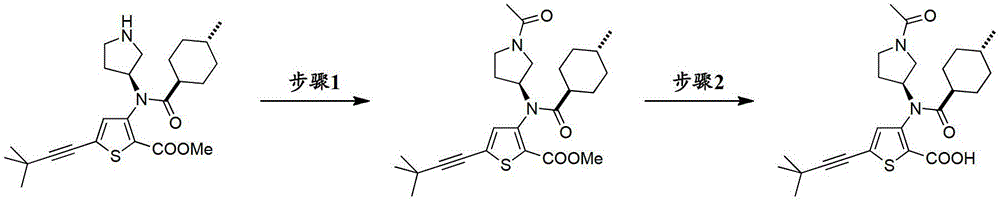
步骤1.3-(N-((S)-1-乙酰基吡咯烷-3-基)-4-反式-甲基环己烷甲酰氨基)-5-(3,3-二甲基丁-1-炔-1-基)噻吩-2-甲酸甲酯Step 1. 3-(N-((S)-1-acetylpyrrolidin-3-yl)-4-trans-methylcyclohexanecarboxamido)-5-(3,3-dimethylbutan- 1-Alkyn-1-yl)thiophene-2-carboxylic acid methyl ester
向在N,N-二甲基甲酰胺(2mL)中的5-(3,3-二甲基丁-1-炔-1-基)-3-(反式-4-甲基-N-((S)-吡咯烷-3-基)环己烷甲酰氨基)噻吩-2-甲酸甲酯(150mg,0.35mmol)中加入乙酐(50μL,0.52mmol)和吡啶(85μL,1.04mmol)。将该反应体系搅拌过夜,用DCM稀释,用1M HCl洗涤。干燥有机层,浓缩,通过快速色谱法纯化(4g ISCO柱),用1-10%MeOH的DCM溶液在15分钟内洗脱。合并纯的级分,浓缩,得到140mg期望的产物,为淡黄色油状物。To 5-(3,3-dimethylbut-1-yn-1-yl)-3-(trans-4-methyl-N- Add acetic anhydride (50 μL, 0.52 mmol) and pyridine (85 μL, 1.04 mmol) to ((S)-pyrrolidin-3-yl)cyclohexanecarboxamido)thiophene-2-carboxylic acid methyl ester (150 mg, 0.35 mmol) . The reaction was stirred overnight, diluted with DCM, washed with 1M HCl. The organic layer was dried, concentrated, and purified by flash chromatography (4 g ISCO column), eluting with 1-10% MeOH in DCM over 15 minutes. The pure fractions were combined and concentrated to give 140 mg of the desired product as a pale yellow oil.
MS:m/z(obs.):473.4[M+H]+;MS: m/z(obs.): 473.4[M+H] + ;
步骤2.3-(N-((S)-1-乙酰基吡咯烷-3-基)-4-反式-甲基环己烷甲酰氨基)-5-(3,3-二甲基丁-1-炔-1-基)噻吩-2-甲酸
向在四氢呋喃和水中的3-(N-((S)-1-乙酰基吡咯烷-3-基)-4-反式-甲基环己烷甲酰氨基)-5-(3,3-二甲基丁-1-炔-1-基)噻吩-2-甲酸甲酯(145mg,0.31mmol)中加入一水合氢氧化锂(64mg,1.53mmol)。将该反应体系在室温搅拌过夜,然后使用1M HCl酸化。除去溶剂,过滤得到的白色沉淀,用水洗涤2x,在50℃真空干燥过夜。To 3-(N-((S)-1-acetylpyrrolidin-3-yl)-4-trans-methylcyclohexanecarboxamido)-5-(3,3- To methyl dimethylbut-1-yn-1-yl)thiophene-2-carboxylate (145 mg, 0.31 mmol) was added lithium hydroxide monohydrate (64 mg, 1.53 mmol). The reaction was stirred overnight at room temperature, then acidified using 1M HCl. The solvent was removed and the resulting white precipitate was filtered, washed 2x with water, and dried under vacuum at 50 °C overnight.
MS:m/z(obs.):459.0[M+H]+;MS: m/z(obs.): 459.0[M+H] + ;
1H NMR DMSO-d6,300MHz:δ7.31(dd,J=9.9,6.6Hz,1H),4.95-4.72(m,1H),3.30(s,7H),2.22-1.10(m,19H),0.70-0.52(m,4H)。 1 H NMR DMSO-d 6 ,300MHz: δ7.31(dd,J=9.9,6.6Hz,1H),4.95-4.72(m,1H),3.30(s,7H),2.22-1.10(m,19H) ,0.70-0.52(m,4H).
化合物60的制备Preparation of
如对化合物59所述制备化合物60(3-(N-((R)-1-乙酰基吡咯烷-3-基)-4-反式-甲基环己烷-甲酰氨基)-5-(3,3-二甲基丁-1-炔-1-基)噻吩-2-甲酸)。
MS:m/z(obs.):459.0[M+H]+;MS: m/z(obs.): 459.0[M+H] + ;
1H NMR DMSO-d6,300MHz:δ7.31(dd,J=9.9,6.6Hz,1H),4.95-4.72(m,1H),3.30(s,7H),2.22-1.10(m,19H),0.70-0.52(m,4H)。 1 H NMR DMSO-d 6 ,300MHz: δ7.31(dd,J=9.9,6.6Hz,1H),4.95-4.72(m,1H),3.30(s,7H),2.22-1.10(m,19H) ,0.70-0.52(m,4H).
化合物63的制备Preparation of

步骤1.反式-(3-叔丁氧基羰基氨基)-环丁烷羧酸二甲基酰胺Step 1. trans-(3-tert-butoxycarbonylamino)-cyclobutanecarboxylic acid dimethylamide
向反式-(3-叔丁氧基羰基氨基)-环丁烷羧酸(500mg,2.32mmol)、EDC(535mg,2.79mmol)和HOBt(377mg,2.79mmol)中加入二甲胺(560μL,11.6mmol)的THF溶液。用10mL DCM稀释该反应体系,在室温搅拌过夜。用10mL DCM稀释该混合物,然后用水、1M HCl和饱和碳酸氢钠洗涤。干燥有机层,浓缩,得到360mg期望的产物,为白色固体。Dimethylamine (560 μL, 11.6 mmol) in THF. The reaction was diluted with 10 mL of DCM and stirred overnight at room temperature. The mixture was diluted with 10 mL of DCM, then washed with water, 1M HCl and saturated sodium bicarbonate. The organic layer was dried and concentrated to give 360 mg of the desired product as a white solid.
步骤2.反式-3-氨基环丁烷羧酸二甲基酰胺
向反式-(3-叔丁氧基羰基氨基)-环丁烷羧酸二甲基酰胺(360mg,2.14mmol)中加入4M HCl的1,4-二噁烷(5mL)溶液。将该反应体系搅拌3h。除去溶剂,将得到的物质溶于少量MeOH,然后缓慢滴入搅拌的乙醚。白色沉淀形成,过滤,在50℃真空干燥过夜,得到期望的产物。To trans-(3-tert-butoxycarbonylamino)-cyclobutanecarboxylic acid dimethylamide (360 mg, 2.14 mmol) was added 4M HCl in 1,4-dioxane (5 mL). The reaction was stirred for 3 h. The solvent was removed and the resulting material was dissolved in a small amount of MeOH, then slowly added dropwise to stirring diethyl ether. A white precipitate formed which was filtered and dried under vacuum at 50 °C overnight to yield the desired product.

步骤3.5-(3,3-二甲基丁-1-炔-1-基)-3-((反式-3-(二甲基氨基甲酰基)-环丁基)氨基)噻吩-2-甲酸甲酯
如化合物48的制备中所述由235mg反式-3-氨基环丁烷羧酸二甲基酰胺进行偶合,得到285mg期望的产物,为橙色固体。Coupling from 235 mg of trans-3-aminocyclobutanecarboxylic acid dimethylamide as described in the preparation of
MS:m/z(obs.):363.2[M+H]+;MS: m/z(obs.): 363.2[M+H] + ;
步骤4.5-(3,3-二甲基丁-1-炔-1-基)-3-(N-(3-反式-(二甲基氨基甲酰基)-环丁基)-4-反式-甲基环己烷甲酰氨基)噻吩-2-甲酸甲酯Step 4. 5-(3,3-Dimethylbut-1-yn-1-yl)-3-(N-(3-trans-(dimethylcarbamoyl)-cyclobutyl)-4-trans Formula - Methylcyclohexanecarboxamido)thiophene-2-carboxylate
如化合物48的制备中所述进行酰化。通过快速色谱法纯化产物,用0-3%MeOH的DCM溶液洗脱。合并纯的级分,浓缩,得到314mg期望的产物,为淡黄色油状物。Acylation was performed as described in the preparation of
MS:m/z(obs.):487.3[M+H]+;MS: m/z(obs.): 487.3[M+H] + ;
步骤5.5-(3,3-二甲基丁-1-炔-1-基)-3-(N-(3-反式-(二甲基氨基甲酰基)-环丁基)-4-反式-甲基环己烷甲酰氨基)噻吩-2-甲酸
如化合物48的制备中所述进行酯水解。Ester hydrolysis was performed as described in the preparation of
MS:m/z(obs.):473.0[M+H]+;MS: m/z(obs.): 473.0[M+H] + ;
1H NMR DMSO-d6,300MHz:δ7.28(s,1H),4.92-4.70(m,1H),3.30(s,2H),2.80(d,J=8.3Hz,7H),2.35-1.75(m,5H),1.64-1.14(m,15H),0.76(d,J=6.5Hz,4H)。 1 H NMR DMSO-d 6 ,300MHz: δ7.28(s,1H),4.92-4.70(m,1H),3.30(s,2H),2.80(d,J=8.3Hz,7H),2.35-1.75 (m,5H),1.64-1.14(m,15H),0.76(d,J=6.5Hz,4H).
化合物11的制备Preparation of
如对化合物63所述制备化合物11(5-(3,3-二甲基丁-1-炔-1-基)-3-(反式-4-甲基-N-(顺式-3-(二甲基氨基甲酰基)环丁基)环己烷甲酰氨基)噻吩-2-甲酸)。Compound 11 (5-(3,3-dimethylbut-1-yn-1-yl)-3-(trans-4-methyl-N-(cis-3-yl) was prepared as described for compound 63 (dimethylcarbamoyl)cyclobutyl)cyclohexanecarboxamido)thiophene-2-carboxylic acid).
MS:m/z(obs.):473.3[M+H]+ MS: m/z(obs.): 473.3[M+H] +
1H NMR DMSO-d6,300MHz:δ7.21(s,1H),4.73(s,1H),3.60(s,0.66H),3.30(s,1.33H),2.83(t,J=29.7Hz,7H),2.36-2.21(m,1H),2.16-2.00(m,1H),1.92-1.11(m,18H),0.72-0.51(m,4H)。 1 H NMR DMSO-d 6 ,300MHz: δ7.21(s,1H),4.73(s,1H),3.60(s,0.66H),3.30(s,1.33H),2.83(t,J=29.7Hz ,7H), 2.36-2.21(m,1H), 2.16-2.00(m,1H), 1.92-1.11(m,18H), 0.72-0.51(m,4H).
化合物68的制备Preparation of

步骤1.5-(3,3-二甲基丁-1-炔-1-基)-3-(反式-4-甲基-N-((S)-1-甲基磺酰基)吡咯烷-3-基)环己烷甲酰氨基)噻吩-2-甲酸甲酯Step 1. 5-(3,3-Dimethylbut-1-yn-1-yl)-3-(trans-4-methyl-N-((S)-1-methylsulfonyl)pyrrolidine- 3-yl)cyclohexanecarboxamido)thiophene-2-carboxylic acid methyl ester
向5-(3,3-二甲基丁-1-炔-1-基)-3-(反式-4-甲基-N-((S)-吡咯烷-3-基)环己烷甲酰氨基)噻吩-2-甲酸甲酯(100mg,0.23mmol)在DCM(2mL)与三乙胺(36μL,0.26mmol)中的溶液中加入甲磺酰氯(20μL,0.26mmol)。将该反应体系在室温搅拌过夜,用1M HCl洗涤,浓缩,通过快速色谱法纯化,用25-60%EtOAc的己烷溶液洗脱。合并纯级分,浓缩,得到54mg期望的产物,为无色薄膜状物。To 5-(3,3-dimethylbut-1-yn-1-yl)-3-(trans-4-methyl-N-((S)-pyrrolidin-3-yl)cyclohexane To a solution of methyl formylamino)thiophene-2-carboxylate (100 mg, 0.23 mmol) in DCM (2 mL) and triethylamine (36 μL, 0.26 mmol) was added methanesulfonyl chloride (20 μL, 0.26 mmol). The reaction was stirred at room temperature overnight, washed with 1M HCl, concentrated, and purified by flash chromatography, eluting with 25-60% EtOAc in hexanes. The pure fractions were combined and concentrated to give 54 mg of the desired product as a colorless film.
MS:m/z(obs.):509.2[M+H]+。MS: m/z (obs.): 509.2 [M+H] + .
步骤2.5-(3,3-二甲基丁-1-炔-1-基)-3-(反式-4-甲基-N-((S)-1-甲基磺酰基)吡咯烷-3-基)噻吩-2-甲酸
向在THF和水的3:1混合物中的5-(3,3-二甲基丁-1-炔-1-基)-3-(反式-4-甲基-N-((S)-1-甲基磺酰基)吡咯烷-3-基)环己烷甲酰氨基)噻吩-2-甲酸甲酯(54mg,0.11mmol)中加入一水合氢氧化锂(45mg,1.06mmol)。将该反应体系在室温搅拌过夜,浓缩以除去有机溶剂。过滤得到的沉淀,用水洗涤,在50℃干燥过夜,得到20mg期望的产物。To 5-(3,3-dimethylbut-1-yn-1-yl)-3-(trans-4-methyl-N-((S) -1-Methylsulfonyl)pyrrolidin-3-yl)cyclohexanecarboxamido)thiophene-2-carboxylic acid methyl ester (54 mg, 0.11 mmol) was added lithium hydroxide monohydrate (45 mg, 1.06 mmol). The reaction was stirred overnight at room temperature and concentrated to remove the organic solvent. The resulting precipitate was filtered, washed with water and dried overnight at 50°C to yield 20 mg of the desired product.
MS:m/z(obs.):495.2[M+H]+。MS: m/z (obs.): 495.2 [M+H] + .
1H NMR DMSO-d6,300MHz:δ7.36(d,J=12.4Hz,1H),4.96-4.67(m,1H),3.59(d,J=6.5Hz,2H),3.22-2.98(m,2H),2.87(d,J=18.7,12.4Hz,3H),2.18-1.08(m,19H),0.88-0.50(m,5H)。 1 H NMR DMSO-d 6 ,300MHz: δ7.36(d,J=12.4Hz,1H),4.96-4.67(m,1H),3.59(d,J=6.5Hz,2H),3.22-2.98(m ,2H),2.87(d,J=18.7,12.4Hz,3H),2.18-1.08(m,19H),0.88-0.50(m,5H).
化合物69的制备Preparation of
化合物(5-(3,3-二甲基丁-1-炔-1-基)-3-(反式-4-甲基-N-((R)-1-甲基磺酰基)吡咯烷-3-基)噻吩-2-甲酸)如对所述制备化合物68。Compound (5-(3,3-dimethylbut-1-yn-1-yl)-3-(trans-4-methyl-N-((R)-1-methylsulfonyl)pyrrolidine -3-yl)thiophene-2-carboxylic acid)
MS:m/z(obs.):495.2[M+H]+。MS: m/z (obs.): 495.2 [M+H] + .
1H NMR DMSO-d6,300MHz:δ7.36(d,J=12.4Hz,1H),4.96-4.67(m,1H),3.59(d,J=6.5Hz,2H),3.22-2.98(m,2H),2.87(d,J=18.7,12.4Hz,3H),2.18-1.08(m,19H),0.88-0.50(m,5H)。 1 H NMR DMSO-d 6 ,300MHz: δ7.36(d,J=12.4Hz,1H),4.96-4.67(m,1H),3.59(d,J=6.5Hz,2H),3.22-2.98(m ,2H),2.87(d,J=18.7,12.4Hz,3H),2.18-1.08(m,19H),0.88-0.50(m,5H).
化合物70的制备Preparation of
步骤1:甲基-5-(3,3-二甲基丁-1-炔-1-基)-3-(反式-4-甲基-N-((反式-3-(二甲基氨基)甲基)环丁基)环己烷甲酰氨基)噻吩-2甲酸酯Step 1: Methyl-5-(3,3-dimethylbut-1-yn-1-yl)-3-(trans-4-methyl-N-((trans-3-(dimethyl (amino)methyl)cyclobutyl)cyclohexanecarboxamido)thiophene-2 carboxylate
在室温向在DCM(2mL)中的甲基-5-(3,3-二甲基丁-1-炔-1-基)-3-(反式-4-甲基-N-(反式-3-(二甲基氨基甲酰基)环丁基)环己烷甲酰氨基)噻吩-2甲酸酯中加入三氟甲磺酸酐(60μL,0.36mmol)。将该混合物在室温搅拌5分钟,然后加入2,6-二甲基-1,4-二氢吡啶-3,5-二甲酸二乙酯(225μL,0.82mmol)。搅拌30分钟后,加入饱和碳酸氢钠,用乙醚(2×5mL)萃取该混合物。合并有机层,浓缩,通过快速色谱法纯化,用1-20%氨/MeOH的DCM溶液在15分钟内洗脱。合并纯的级分,浓缩,得到73mg期望的产物,为淡黄色油状物。Methyl-5-(3,3-dimethylbut-1-yn-1-yl)-3-(trans-4-methyl-N-(trans -3-(Dimethylcarbamoyl)cyclobutyl)cyclohexanecarboxamido)thiophene-2carboxylate was added trifluoromethanesulfonic anhydride (60 μL, 0.36 mmol). The mixture was stirred at room temperature for 5 minutes, then diethyl 2,6-dimethyl-1,4-dihydropyridine-3,5-dicarboxylate (225 μL, 0.82 mmol) was added. After stirring for 30 minutes, saturated sodium bicarbonate was added and the mixture was extracted with diethyl ether (2 x 5 mL). The combined organic layers were concentrated and purified by flash chromatography eluting with 1-20% ammonia/MeOH in DCM over 15 minutes. The pure fractions were combined and concentrated to give 73 mg of the desired product as a pale yellow oil.
MS:m/z(obs.):473.3[M+H]+。MS: m/z (obs.): 473.3 [M+H] + .
步骤2:5-(3,3-二甲基丁-1-炔-1-基)-3-(反式-4-甲基-N((反式-3-(二甲基氨基)甲基)环丁基)环己烷甲酰氨基)噻吩-2甲酸Step 2: 5-(3,3-Dimethylbut-1-yn-1-yl)-3-(trans-4-methyl-N((trans-3-(dimethylamino)methyl base) cyclobutyl) cyclohexanecarboxamido) thiophene-2 carboxylic acid
向在THF和水的3:1混合物(1mL)中的甲基-5-(3,3-二甲基丁-1-炔-1-基)-3-(反式-4-甲基-N-((反式-3-(二甲基氨基)甲基)环丁基)环己烷甲酰氨基)噻吩-2甲酸叔丁酯(73mg,0.15mmol)中加入一水合氢氧化锂(65mg,1.54mmol)。将该反应体系在室温搅拌过夜,减压除去有机溶剂。过滤得到的沉淀,用水洗涤,在50℃真空干燥,得到44mg期望的产物,为盐酸盐。To methyl-5-(3,3-dimethylbut-1-yn-1-yl)-3-(trans-4-methyl- Lithium hydroxide monohydrate ( 65 mg, 1.54 mmol). The reaction system was stirred overnight at room temperature, and the organic solvent was removed under reduced pressure. The resulting precipitate was filtered, washed with water, and dried under vacuum at 50°C to give 44 mg of the desired product as the hydrochloride salt.
MS:m/z(obs.):459.3[M+H]+。MS: m/z (obs.): 459.3 [M+H] + .
1H NMR DMSO-d6,300MHz:δ7.25(d,J=25.5Hz,1H),5.04-4.87(m,0.65H),4.68-4.52(m,0.35H),3.22(d,J=7.7Hz,1H),2.93(d,J=6.2Hz,1H),2.63(d,J=11.1Hz,6H),1.97(dd,J=64.8,9.0Hz,6H),1.67-1.11(m,16H),0.69(dd,J=43.4,9.1Hz,5H)。 1 H NMR DMSO-d 6 ,300MHz: δ7.25(d,J=25.5Hz,1H),5.04-4.87(m,0.65H),4.68-4.52(m,0.35H),3.22(d,J= 7.7Hz,1H),2.93(d,J=6.2Hz,1H),2.63(d,J=11.1Hz,6H),1.97(dd,J=64.8,9.0Hz,6H),1.67-1.11(m, 16H), 0.69 (dd, J=43.4, 9.1Hz, 5H).
化合物65的制备Preparation of
如对化合物70所述制备化合物65(甲基-5-(3,3-二甲基丁-1-炔-1-基)-3-(反式-4-甲基-N-(顺式-3-((二甲基氨基)甲基)环丁基)环己烷甲酰氨基)噻吩-2甲酸酯。Compound 65 (methyl-5-(3,3-dimethylbut-1-yn-1-yl)-3-(trans-4-methyl-N-(cis -3-((Dimethylamino)methyl)cyclobutyl)cyclohexanecarboxamido)thiophene-2-carboxylate.
MS:m/z(obs.):459.3[M+H]+。MS: m/z (obs.): 459.3 [M+H] + .
1H NMR DMSO-d6,300MHz:δ7.21(s,1H),4.71-4.51(m,1H),3.34(s,2H),2.93(d,J=6.3Hz,2H),2.62(s,6H),2.31(s,3H),1.85(dd,J=22.9,11.0Hz,1H),1.67-1.08(m,16H),0.69-0.51(m,5H)。 1 H NMR DMSO-d 6 ,300MHz: δ7.21(s,1H),4.71-4.51(m,1H),3.34(s,2H),2.93(d,J=6.3Hz,2H),2.62(s ,6H),2.31(s,3H),1.85(dd,J=22.9,11.0Hz,1H),1.67-1.08(m,16H),0.69-0.51(m,5H).
化合物76的制备Preparation of
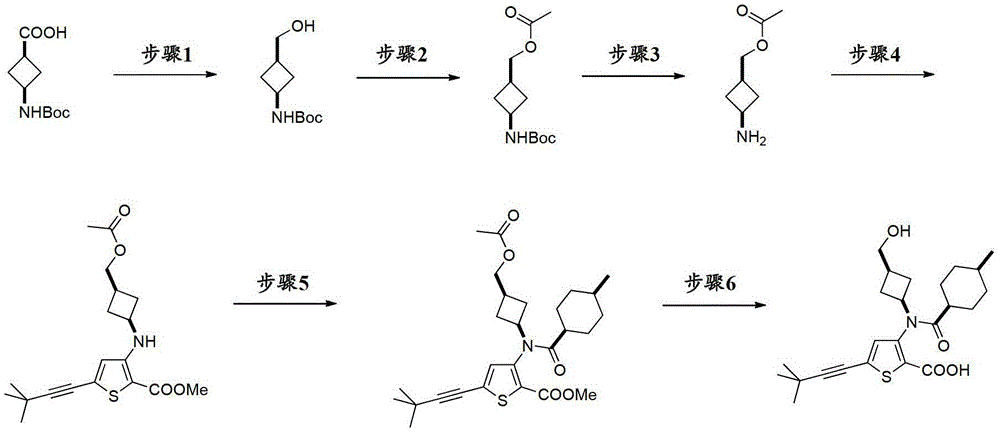
步骤1.顺式-3-(羟基甲基)环丁基氨基甲酸叔丁酯Step 1. tert-butyl cis-3-(hydroxymethyl)cyclobutylcarbamate
在室温向在THF(10mL)中的顺式-3-(叔丁氧基羰基氨基)环丁烷羧酸(440mg,2.04mmol)滴加10M BH3-DMS(410μL)。将该反应体系搅拌过夜,通过滴加1M HCl使反应停止,用EtOAc(3×10mL)萃取。通过快速色谱法纯化粗物质,用20-60%EtOAc的己烷溶液洗脱。合并纯的级分,浓缩,得到270mg(65%)期望的产物,为白色固体。To cis-3-(tert-butoxycarbonylamino)cyclobutanecarboxylic acid (440 mg, 2.04 mmol) in THF (10 mL) was added 10M BH3 -DMS (410 μL) dropwise at room temperature. The reaction was stirred overnight, quenched by dropwise addition of 1M HCl, extracted with EtOAc (3 x 10 mL). The crude material was purified by flash chromatography eluting with 20-60% EtOAc in hexanes. The pure fractions were combined and concentrated to give 270 mg (65%) of the desired product as a white solid.
步骤2:乙酸(顺式-3-(叔丁氧基羰基氨基)环丁基)甲酯Step 2: (cis-3-(tert-butoxycarbonylamino)cyclobutyl)methyl acetate
在室温向在DCM(7mL)与DIEA(260μL,1.48mmol)中的顺式-3-(羟基甲基)环丁基氨基甲酸叔丁酯(270mg,1.34mmol)中加入乙酐(135μL,1.4mmol)。将该反应体系在室温搅拌过夜,浓缩至约反应体积的三分之一,通过色谱法纯化,用0-50%EtOAc的己烷溶液洗脱。合并纯的级分,浓缩,得到250mg(77%)期望的产物,为无色油状物。To tert-butyl cis-3-(hydroxymethyl)cyclobutylcarbamate (270 mg, 1.34 mmol) in DCM (7 mL) and DIEA (260 μL, 1.48 mmol) was added acetic anhydride (135 μL, 1.4 mmol). The reaction was stirred at room temperature overnight, concentrated to about one-third of the reaction volume, and purified by chromatography, eluting with 0-50% EtOAc in hexanes. The pure fractions were combined and concentrated to afford 250 mg (77%) of the desired product as a colorless oil.
步骤3:乙酸(顺式-3-氨基环丁基)甲酯Step 3: (cis-3-aminocyclobutyl)methyl acetate
向乙酸(顺式-3-(叔丁氧基羰基氨基)环丁基)甲酯(250mg,1.03mmol)中加入4M HCl的二噁烷溶液(2.6mL)。将该反应体系在室温搅拌过夜,浓缩至干,真空干燥过夜,得到184mg期望的产物,将其不经进一步纯化作为盐酸盐使用。To (cis-3-(tert-butoxycarbonylamino)cyclobutyl)methyl acetate (250 mg, 1.03 mmol) was added 4M HCl in dioxane (2.6 mL). The reaction was stirred at room temperature overnight, concentrated to dryness, and dried in vacuo overnight to afford 184 mg of the desired product, which was used as the hydrochloride salt without further purification.
步骤4:5-(3,3-二甲基丁-1-炔-1-基)-3-((顺式-3-乙酰氧基甲基)环丁基氨基)噻吩-2-甲酸甲酯Step 4: 5-(3,3-Dimethylbut-1-yn-1-yl)-3-((cis-3-acetoxymethyl)cyclobutylamino)thiophene-2-carboxylic acid ester
向包含3-溴-5-(3,3-二甲基丁-1-炔-1-基)噻吩-2-甲酸甲酯(308mg,1.02mmol)、乙酸(顺式-3-氨基环丁基)甲酯(184mg,1.02mmol)、碳酸铯(1.00g,3.07mmol)和S-Phos(42.0mg,0.10mmol)在无水二噁烷(10mL)中的混悬液的高压试管中加入Pd2(dba)3。用氩气流给该混悬液脱气5分钟,然后密封试管,在90℃加热过夜。将粗混合物冷却至室温,用C盐过滤,浓缩至干,通过快速色谱法纯化,用EtOAc和己烷洗脱,得到200mg(54%)期望的产物。To a solution containing 3-bromo-5-(3,3-dimethylbut-1-yn-1-yl)thiophene-2-carboxylic acid methyl ester (308 mg, 1.02 mmol), acetic acid (cis-3-aminocyclobutane (184mg, 1.02mmol), cesium carbonate (1.00g, 3.07mmol) and S-Phos (42.0mg, 0.10mmol) suspension in anhydrous dioxane (10mL) in a high pressure test tube was added Pd 2 (dba) 3 . The suspension was degassed with a stream of argon for 5 minutes, then the tube was sealed and heated at 90°C overnight. The crude mixture was cooled to room temperature, filtered through celite, concentrated to dryness, and purified by flash chromatography eluting with EtOAc and hexanes to afford 200 mg (54%) of the desired product.
MS:m/z(obs.):364.2[M+H]+。MS: m/z (obs.): 364.2 [M+H] + .
步骤5:5-(3,3-二甲基丁-1-炔-1-基)-3-(反式-4-甲基-N-((顺式-3-乙酰氧基甲基)环丁基)环己烷甲酰氨基)噻吩-2-甲酸甲酯Step 5: 5-(3,3-Dimethylbut-1-yn-1-yl)-3-(trans-4-methyl-N-((cis-3-acetoxymethyl) Methyl cyclobutyl)cyclohexanecarboxamido)thiophene-2-carboxylate
在室温向在二氯乙烷与吡啶(225μL,2.75mmol)中的5-(3,3-二甲基丁-1-炔-1-基)-3-((顺式-3-乙酰氧基甲基)-环丁基氨基)噻吩-2-甲酸甲酯(200mg,0.55mmol)中加入反式-4-甲基环己烷羰基氯(265mg,1.65mmol)。将该反应体系在90℃加热过夜,用1M HCl洗涤,浓缩,然后通过快速色谱法纯化。合并纯的级分,浓缩,得到52mg(19%)期望的产物,为无色薄膜状物。5-(3,3-Dimethylbut-1-yn-1-yl)-3-((cis-3-acetoxy To methyl)-cyclobutylamino)thiophene-2-carboxylate (200 mg, 0.55 mmol) was added trans-4-methylcyclohexanecarbonyl chloride (265 mg, 1.65 mmol). The reaction was heated at 90 °C overnight, washed with 1M HCl, concentrated, then purified by flash chromatography. The pure fractions were combined and concentrated to afford 52 mg (19%) of the desired product as a colorless film.
MS:m/z(obs.):488.3[M+H]+。MS: m/z (obs.): 488.3 [M+H] + .
步骤6:5-(3,3-二甲基丁-1-炔-1-基)-3-(反式-4-甲基-N-(顺式-3-(羟基甲基)环丁基)环己烷甲酰氨基)噻吩-2-甲酸Step 6: 5-(3,3-Dimethylbut-1-yn-1-yl)-3-(trans-4-methyl-N-(cis-3-(hydroxymethyl)cyclobutane base) cyclohexanecarboxamido) thiophene-2-carboxylic acid
向5-(3,3-二甲基丁-1-炔-1-基)-3-(反式-4-甲基-N-((顺式-3-乙酰氧基甲基)环丁基)环己烷甲酰氨基)噻吩-2-甲酸甲酯(52mg,0.11mmol)在THF和水的3:1混合物(1mL)中加入一水合氢氧化锂(45mg,1.07mmol)。将该反应体系在室温搅拌过夜,用1M HCl酸化,然后浓缩以除去有机溶剂。过滤得到的沉淀,用水洗涤,真空干燥过夜,得到38mg(83%)期望的产物。To 5-(3,3-dimethylbut-1-yn-1-yl)-3-(trans-4-methyl-N-((cis-3-acetoxymethyl)cyclobutane To a 3:1 mixture (1 mL) of THF and water was added lithium hydroxide monohydrate (45 mg, 1.07 mmol). The reaction was stirred overnight at room temperature, acidified with 1M HCl, and concentrated to remove the organic solvent. The resulting precipitate was filtered, washed with water and dried under vacuum overnight to afford 38 mg (83%) of the desired product.
MS:m/z(obs.):432.3[M+H]+。MS: m/z (obs.): 432.3 [M+H] + .
1H NMR DMSO-d6,300MHz:δ13.41(s,1H),7.17(s,1H),4.63(ddd,J=17.3,9.7,7.5Hz,1H),4.34(s,1H),3.14(s,2H),2.10(dt,J=17.2,7.0Hz,1H),2.02-1.13(m,21H),0.72(t,J=20.6Hz,5H)。 1 H NMR DMSO-d 6 ,300MHz: δ13.41(s,1H),7.17(s,1H),4.63(ddd,J=17.3,9.7,7.5Hz,1H),4.34(s,1H),3.14 (s,2H),2.10(dt,J=17.2,7.0Hz,1H),2.02-1.13(m,21H),0.72(t,J=20.6Hz,5H).
化合物95的制备Preparation of Compound 95

步骤1.3-((1-叔丁氧基羰基-哌啶-4-基)氨基)-5-(3-甲基丁-1-炔基)噻吩-2-甲酸甲酯的制备Step 1. Preparation of methyl 3-((1-tert-butoxycarbonyl-piperidin-4-yl)amino)-5-(3-methylbut-1-ynyl)thiophene-2-carboxylate
将3-溴-5-(3-甲基丁-1-炔基)噻吩-2-甲酸甲酯(500mg,1.74mmol)、4-氨基哌啶-1-甲酸叔丁酯(418.4mg,2.09mmol)、碳酸铯(1.702g,5.2mmol)和二环己基-[2-(2,6-二异丙氧基苯基)苯基]磷杂环丁烷(81mg,0.17mmol)溶于15mL脱气的1,4-二噁烷。将该反应体系在90℃加热24h。用乙酸乙酯稀释该反应体系,用饱和碳酸氢钠、水和盐水洗涤。用无水硫酸钠干燥乙酸乙酯萃取物,过滤,真空蒸发。通过柱色谱法纯化粗产物(40g,SiO2柱),用己烷-50%乙酸乙酯的己烷溶液梯度洗脱。合并期望的级分,真空蒸发,得到360mg期望的产物。Methyl 3-bromo-5-(3-methylbut-1-ynyl)thiophene-2-carboxylate (500mg, 1.74mmol), tert-butyl 4-aminopiperidine-1-carboxylate (418.4mg, 2.09 mmol), cesium carbonate (1.702g, 5.2mmol) and dicyclohexyl-[2-(2,6-diisopropoxyphenyl)phenyl]phosphetidine (81mg, 0.17mmol) were dissolved in 15mL Degassed 1,4-dioxane. The reaction system was heated at 90 °C for 24 h. The reaction was diluted with ethyl acetate, washed with saturated sodium bicarbonate, water and brine. The ethyl acetate extract was dried over anhydrous sodium sulfate, filtered and evaporated in vacuo. The crude product was purified by column chromatography (40 g, SiO 2 column), eluting with a gradient of hexane-50% ethyl acetate in hexane. The desired fractions were combined and evaporated in vacuo to give 360 mg of the desired product.
MS:m/z(obs.):407.3[M+H]+;Rt=5.82minMS: m/z(obs.): 407.3[M+H] + ; Rt=5.82min
1H NMR(300MHz,CDCl3)d6.76(d,1H),6.63(s,1H),3.98(d,2H),3.82(d,3H),3.44(dt,1H),2.98(dd,2H),2.80(dq,1H),2.02-1.89(m,2H),1.48(s,10H),1.27(d,7H)。 1 H NMR (300MHz, CDCl 3 )d6.76(d,1H),6.63(s,1H),3.98(d,2H),3.82(d,3H),3.44(dt,1H),2.98(dd, 2H), 2.80(dq,1H), 2.02-1.89(m,2H), 1.48(s,10H), 1.27(d,7H).
步骤2.3-((反式-4-甲基环己烷羰基)-(1-叔丁氧基羰基-哌啶-4-基)氨基)-5-(3-甲基丁-1-炔基)噻吩-2-甲酸甲酯的制备
将3-溴-5-(3-甲基丁-1-炔基)噻吩-2-甲酸甲酯(500mg,1.74mmol)、4-氨基哌啶-1-甲酸叔丁酯(360mg,0.89mmol)和吡啶(215μL,2.6mmol)溶于甲苯(5mL);将4-甲基环己烷羰基氯(285mg,1.77mmol)加入到该混合物中,加热至90℃24小时。通过HPLC几乎未发现产物形成。将反应体系加热至110℃24小时,大部分原料耗尽。将该反应体系冷却至室温,将0.5mL吡啶加入到该反应体系中,然后加入1ml甲醇。Methyl 3-bromo-5-(3-methylbut-1-ynyl)thiophene-2-carboxylate (500mg, 1.74mmol), tert-butyl 4-aminopiperidine-1-carboxylate (360mg, 0.89mmol ) and pyridine (215 μL, 2.6 mmol) were dissolved in toluene (5 mL); 4-methylcyclohexanecarbonyl chloride (285 mg, 1.77 mmol) was added to the mixture and heated to 90° C. for 24 hours. Little product formation was observed by HPLC. The reaction system was heated to 110°C for 24 hours, and most of the starting material was consumed. The reaction system was cooled to room temperature, 0.5 mL of pyridine was added to the reaction system, and then 1 ml of methanol was added.
用盐水洗涤该反应体系,用无水硫酸钠干燥,过滤,真空蒸发,得到粗黄色树胶状物。通过柱色谱法(SiO2)纯化该物质,用己烷-50%乙酸乙酯的己烷溶液洗脱。合并期望的级分,真空蒸发,得到238mg期望的产物。The reaction was washed with brine, dried over anhydrous sodium sulfate, filtered and evaporated in vacuo to give a crude yellow gum. The material was purified by column chromatography ( SiO2 ) eluting with hexanes - 50% ethyl acetate in hexanes. The desired fractions were combined and evaporated in vacuo to give 238 mg of the desired product.
MS:m/z(obs.):531.4[M+H]+;Rt=3.20minMS: m/z(obs.): 531.4[M+H] + ; Rt=3.20min
步骤3.3-((反式-4-甲基环己烷羰基)-(哌啶-4-基)氨基)-5-(3-甲基丁-1-炔基)噻吩-2-甲酸甲酯的制备
将3-((反式-4-甲基环己烷羰基)-(1-叔丁氧基羰基-哌啶-4-基)氨基)-5-(3-甲基丁-1-炔基)噻吩-2-甲酸甲酯(238mg,0.45mmol)溶于5mL二氯甲烷和0.5mL三氟乙酸(500μL,6.49mmol)。将该反应体系在室温搅拌1小时,真空蒸发,溶于二氯甲烷,用饱和碳酸氢钠洗涤(2X),用盐水洗涤一次。用无水硫酸钠干燥,过滤,蒸发,得到190mg期望的产物。3-((trans-4-methylcyclohexanecarbonyl)-(1-tert-butoxycarbonyl-piperidin-4-yl)amino)-5-(3-methylbut-1-ynyl ) methyl thiophene-2-carboxylate (238 mg, 0.45 mmol) was dissolved in 5 mL of dichloromethane and 0.5 mL of trifluoroacetic acid (500 μL, 6.49 mmol). The reaction was stirred at room temperature for 1 hour, evaporated in vacuo, dissolved in dichloromethane, washed with saturated sodium bicarbonate (2X), and washed once with brine. Drying over anhydrous sodium sulfate, filtration and evaporation gave 190 mg of the desired product.
MS:m/z(obs.):431.4[M+H]+;Rt=2.20minMS: m/z(obs.): 431.4[M+H] + ; Rt=2.20min
步骤4.3-((反式-4-甲基环己烷羰基)-(1-(6-(叔丁氧基羰基氨基)-己酰基)-哌啶-4-基)氨基)-5-(3-甲基丁-1-炔基)噻吩-2-甲酸甲酯的制备。Step 4. 3-((trans-4-methylcyclohexanecarbonyl)-(1-(6-(tert-butoxycarbonylamino)-hexanoyl)-piperidin-4-yl)amino)-5-( Preparation of methyl 3-methylbut-1-ynyl)thiophene-2-carboxylate.
将6-(叔丁氧基羰基氨基)己酸(112mg,0.48mmol)和3-((反式-4-甲基环己烷羰基)-(哌啶-4-基)氨基)-5-(3-甲基丁-1-炔基)噻吩-2-甲酸甲酯(190mg,0.44mmol)溶于4mL DMF和二异丙基乙胺(230μL,1.32mmol)。向该溶液中加入HBTU((苯并三唑-1-基氧基-二甲基氨基-亚甲基)-二甲基-铵六氟磷酸盐(251mg,0.66mmol)),将该反应体系在室温搅拌过夜。用乙酸乙酯(50mL)稀释该反应体系,用饱和碳酸氢钠、水和盐水洗涤。用无水硫酸钠干燥有机层,过滤,蒸发,得到黄橙色树胶状物。通过硅胶柱色谱法纯化,用己烷-乙酸乙酯梯度洗脱。合并期望的级分,真空蒸发,得到259mg期望的产物。Mix 6-(tert-butoxycarbonylamino)hexanoic acid (112mg, 0.48mmol) and 3-((trans-4-methylcyclohexanecarbonyl)-(piperidin-4-yl)amino)-5- Methyl (3-methylbut-1-ynyl)thiophene-2-carboxylate (190 mg, 0.44 mmol) was dissolved in 4 mL of DMF and diisopropylethylamine (230 μL, 1.32 mmol). Add HBTU ((benzotriazol-1-yloxy-dimethylamino-methylene)-dimethyl-ammonium hexafluorophosphate (251 mg, 0.66 mmol)) to the solution, and the reaction system Stir overnight at room temperature. The reaction was diluted with ethyl acetate (50 mL), washed with saturated sodium bicarbonate, water and brine. The organic layer was dried over anhydrous sodium sulfate, filtered and evaporated to give a yellow-orange gum. Purified by column chromatography on silica gel, eluting with a hexane-ethyl acetate gradient. The desired fractions were combined and evaporated in vacuo to give 259 mg of the desired product.
MS:m/z(obs.):644.4[M+H]+;Rt=2.53minMS: m/z(obs.): 644.4[M+H] + ; Rt=2.53min
步骤5.3-((反式-4-甲基环己烷羰基)-(1-(6-(叔丁氧基羰基氨基)-己酰基)-哌啶-4-基)氨基)-5-(3-甲基丁-1-炔基)噻吩-2-甲酸的制备。
将3-((反式-4-甲基环己烷羰基)-(1-(6-(叔丁氧基羰基氨基)-己酰基)-哌啶-4-基)氨基)-5-(3-甲基丁-1-炔基)噻吩-2-甲酸甲酯(259mg,0.40mmol)和氢氧化锂(48mg,2.01mmol)溶于4mL1:1甲醇水的混合物。将该反应体系在室温搅拌2.5小时。一旦完成,真空蒸发该反应体系,将残余物溶于水,用10%硫酸氢钠酸化,用二氯甲烷萃取。用硫酸钠干燥有机相,过滤,蒸发,得到产物(235mg),为白色固体。3-((trans-4-methylcyclohexanecarbonyl)-(1-(6-(tert-butoxycarbonylamino)-hexanoyl)-piperidin-4-yl)amino)-5-( Methyl 3-methylbut-1-ynyl)thiophene-2-carboxylate (259 mg, 0.40 mmol) and lithium hydroxide (48 mg, 2.01 mmol) were dissolved in 4 mL of a 1:1 mixture of methanol and water. The reaction was stirred at room temperature for 2.5 hours. Once complete, the reaction was evaporated in vacuo, the residue was dissolved in water, acidified with 10% sodium bisulfate, and extracted with dichloromethane. The organic phase was dried over sodium sulfate, filtered and evaporated to give the product (235mg) as a white solid.
MS:m/z(obs.):630.4[M+H]+;Rt=1.64minMS: m/z(obs.): 630.4[M+H] + ; Rt=1.64min
步骤6.3-((反式-4-甲基环己烷羰基)-(1-(6-氨基-己酰基)-哌啶-4-基)氨基)-5-(3-甲基丁-1-炔基)噻吩-2-甲酸(化合物96)的制备。Step 6. 3-((trans-4-methylcyclohexanecarbonyl)-(1-(6-amino-hexanoyl)-piperidin-4-yl)amino)-5-(3-methylbutan-1 Preparation of -alkynyl)thiophene-2-carboxylic acid (Compound 96).
将3-((反式-4-甲基环己烷羰基)-(1-(6-(叔丁氧基羰基氨基)-己酰基)-哌啶-4-基)氨基)-5-(3-甲基丁-1-炔基)噻吩-2-甲酸(50mg,0.079mmol)溶于乙酸乙酯,冷却(0℃)。使无水HCl气体进入该溶液发泡1分钟。将该反应体系搅拌1小时,在室温蒸发产物。将该物质溶于乙醚,然后蒸发溶剂,真空干燥残余物,得到36mg产物。3-((trans-4-methylcyclohexanecarbonyl)-(1-(6-(tert-butoxycarbonylamino)-hexanoyl)-piperidin-4-yl)amino)-5-( 3-Methylbut-1-ynyl)thiophene-2-carboxylic acid (50mg, 0.079mmol) was dissolved in ethyl acetate and cooled (0°C). Anhydrous HCl gas was bubbled into the solution for 1 min. The reaction was stirred for 1 hour and the product was evaporated at room temperature. This material was dissolved in ether, then the solvent was evaporated and the residue was dried in vacuo to give 36 mg of product.
MS:m/z(obs.):530.4[M+H]+;Rt=2.10minMS: m/z(obs.): 530.4[M+H] + ; Rt=2.10min
1H NMR(300MHz,DMSO)7.94(br s,3H),7.21(d,J=5.5Hz,1H),4.65-4.27(m,2H),3.81(d,1H),3.38(m,3H),2.98(m,1H),2.88(dd,1H),2.72(s,2H),2.24(m,2H),1.83(m,2H),1.76-1.40(m,9H),1.3-1.15(m,4H),1.20(t,6H),0.89(m,1H),0.75(d,3H),0.61(m,2H)。 1 H NMR(300MHz,DMSO)7.94(br s,3H),7.21(d,J=5.5Hz,1H),4.65-4.27(m,2H),3.81(d,1H),3.38(m,3H) ,2.98(m,1H),2.88(dd,1H),2.72(s,2H),2.24(m,2H),1.83(m,2H),1.76-1.40(m,9H),1.3-1.15(m ,4H), 1.20(t,6H), 0.89(m,1H), 0.75(d,3H), 0.61(m,2H).
实施例2:HCV复制子试验Embodiment 2: HCV replicon test
A.原理A. Principle
如下这种方法描述了使用包含高度细胞培养物-适应性复制子的Huh7肝癌细胞系(基因型1b)(下文称作细胞系ET)的HCV复制子试验。ET细胞包含高度细胞培养物-适应性复制子I389luc-ubi-neo/NS3-3'/5.1构建体,其除携带新霉素基因外还携带荧火虫荧光素酶基因的完整拷贝(Krieger,N;Lohmann,V;Bartenschlager,R.Enhancement ofhepatitis C virus RNA replication by cell culture-adaptivemutations.J.Virol.2001,75,4614-4624)。还使用包含HCV1a基因型的复制子细胞系W11.8。这两种细胞系(基因型1b和1a)能够通过测定荧光素酶活性(对基因型1b)或通过使用ELISA测定法测定NS5A水平(对基因型1a)测量RNA复制和翻译。已经证实荧光素酶活性紧密地遵循ET细胞中的复制子RNA水平。将ET细胞系以近汇合水平(<85%)维持在培养物中。用于细胞传代的培养基由补充了10%胎牛血清与1%青霉素/链霉素、1%谷氨酰胺、1%丙酮酸钠、1%非必需氨基酸和180μg/ml G418终浓度的DMEM(Gibco BRL Laboratories,Mississauga,ON,Canada)组成。The following method describes the HCV replicon assay using the Huh7 hepatoma cell line (genotype 1b) (hereinafter referred to as cell line ET) containing a highly cell culture-adapted replicon. ET cells contained the highly cell culture-adapted replicon I 389 luc-ubi-neo/NS3-3'/5.1 construct, which carried an intact copy of the firefly luciferase gene in addition to the neomycin gene ( Krieger, N; Lohmann, V; Bartenschlager, R. Enhancement of hepatitis C virus RNA replication by cell culture-adaptive mutations. J. Virol. 2001, 75, 4614-4624). A replicon cell line W11.8 containing the HCV1a genotype was also used. These two cell lines (genotype 1b and 1a) were able to measure RNA replication and translation by measuring luciferase activity (for genotype 1b) or by measuring NS5A levels (for genotype 1a) using an ELISA assay. It has been demonstrated that luciferase activity closely follows replicon RNA levels in ET cells. ET cell lines were maintained in culture at sub-confluent levels (<85%). The medium used for cell passaging consists of DMEM supplemented with 10% fetal bovine serum with 1% penicillin/streptomycin, 1% glutamine, 1% sodium pyruvate, 1% non-essential amino acids, and 180 μg/ml G418 final concentration (Gibco BRL Laboratories, Mississauga, ON, Canada).
B.荧光素酶活性测定(Luci-ET-1b)B. Luciferase Activity Assay (Luci-ET-1b)
为了用测试药物处理细胞,通过抽吸从175cm2T烧瓶中取出培养基。在室温用10mL PBS1X冲洗细胞单层。通过抽吸除去PBS。使用1mL胰蛋白酶/EDTA使细胞受胰蛋白酶作用。将烧瓶在37℃(保温箱)温育7分钟。然后加入不含G418且不含酚红的完全培养基(9mL)。通过上下吸移几次破坏细胞团块。然后将细胞混悬液转入50mL Falcon聚丙烯试管。然后使用血细胞计数器对细胞计数几次。用不含G418且不含酚红的完全DMEM以30000细胞/mL稀释细胞,然后转入无菌贮器。使用多通道吸量管将约3000活细胞(100μL)在白色不透明96-孔微量滴定板中的每个孔中铺板。在37℃在5%CO2保温箱中2-4小时温育期后,加入不同浓度的化合物。To treat the cells with the test drug, remove the medium from the 175 cm 2 T flask by aspiration. Rinse the cell monolayer with 10 mL PBS 1X at room temperature. Remove PBS by aspiration. Trypsinize the cells using 1 mL of trypsin/EDTA. The flask was incubated at 37°C (incubator) for 7 minutes. Then complete medium (9 mL) without G418 and without phenol red was added. Disrupt cell clumps by pipetting up and down several times. The cell suspension was then transferred to a 50 mL Falcon polypropylene tube. Cells were then counted several times using a hemocytometer. Cells were diluted at 30000 cells/mL with complete DMEM without G418 and without phenol red, then transferred to sterile reservoirs. Approximately 3000 viable cells (100 μL) were plated in each well of a white opaque 96-well microtiter plate using a multichannel pipette. After a 2–4 h incubation period at 37 °C in a 5% CO2 incubator, various concentrations of compounds were added.
将测试中的化合物以储备浓度100mM重新混悬于DMSO。然后以在无菌96-深孔培养板中在上述相同培养基(不含G418)中2倍的终浓度并且根据特定模板稀释。然后向包含细胞的每个孔或不含细胞的对照孔中加入1个体积(100μL)的每种化合物稀释液。最终药物浓度通常在200μM-0.0001μM。将10个孔用作不含药物的阳性对照。在37℃在5%CO2保温箱中再将细胞温育4天。与上述相同浓度的对照化合物用作内标。Compounds under test were resuspended in DMSO at a stock concentration of 100 mM. It was then diluted at 2-fold final concentration in the same medium as above (without G418) in sterile 96-deep-well culture plates and according to the specific template. One volume (100 [mu]L) of each compound dilution was then added to each well containing cells or control wells without cells. The final drug concentration is usually in the range of 200 μM-0.0001 μM. Ten wells were used as positive controls without drug. Cells were further incubated for 4 days at 37°C in a 5% CO2 incubator. A control compound at the same concentration as above was used as an internal standard.
4天温育时间后,除去培养基,倒置在一叠无菌吸附纸上快速干燥。然后通过使用多通道吸量管添加95μL荧光素酶缓冲液A裂解细胞,用TopSealTM胶粘密封薄膜密封,将该反应混合物在室温温育,避免直接光照至少10分钟。使用光度计(Wallac MicroΒeta Trilux,Perkin ElmerTM,MA,USA)读取培养板的荧光素酶计数。After the 4 day incubation period, the medium was removed and dried quickly by inversion on a stack of sterile absorbent paper. Cells were then lysed by adding 95 μL luciferase buffer A using a multichannel pipette, sealed with TopSeal ™ adhesive sealing film, and the reaction mixture was incubated at room temperature protected from direct light for at least 10 minutes. Plates were read for luciferase counts using a luminometer (Wallac MicroBeta Trilux, Perkin Elmer ™ , MA, USA).
计算每种测试药物浓度(一式两份)的抑制百分比。然后根据剂量响应曲线、使用非线性回归分析(例如GraphPad Prism软件,2.0版(GraphPad Software Inc.,San Diego,CA,US A))测定将病毒复制减少50%所需的浓度(IC50)。将IC50值总结在表1-3中:Percent inhibition was calculated for each drug concentration tested (in duplicate). The concentration required to reduce viral replication by 50% ( IC50 ) is then determined from dose response curves using non-linear regression analysis (eg, GraphPad Prism software, version 2.0 (GraphPad Software Inc., San Diego, CA, USA)). The IC50 values are summarized in Tables 1-3:
A:IC50值(平均值)≤0.1μM;A: IC50 value (average) ≤ 0.1μM;
B:0.1μM<IC50值(平均值)≤1μM;B: 0.1μM<IC 50 value (average value)≤1μM;
C:1μM<IC50值(平均值)≤10μM;C: 1μM<IC 50 value (average value)≤10μM;
D:IC50值(平均值)>10μM。D: IC50 value (average value) >10 μM.
C.Elisa测定(ELISA W11.8-1a)C. Elisa assay (ELISA W11.8-1a)
包含基因型1a的亚基因组复制子的复制子细胞系W11.8用于使用ELISA的基于HCV复制子细胞的检测。在这些细胞中根据药物处理4天时NS5A蛋白质含量水平间接测定不同药物浓度存在下的RNA复制。NS5A是HCV的非结构蛋白并且用作本测定中HCV复制的标记。The replicon cell line W11.8 containing the subgenomic replicon of genotype la was used for HCV replicon cell-based detection using ELISA. RNA replication in the presence of different drug concentrations was measured indirectly in these cells based on NS5A protein levels at 4 days of drug treatment. NS5A is a nonstructural protein of HCV and was used as a marker for HCV replication in this assay.
为了用测试药物处理细胞,通过抽吸从175cm2T烧瓶中取出培养基。在室温用10-20mL PBS1X冲洗细胞单层。通过抽吸除去PBS。使用3mL胰蛋白酶(0.25%)/EDTA(0.1%)溶液使细胞受胰蛋白酶作用。将烧瓶在37℃(保温箱)温育7分钟。然后加入不含G418的完全培养基(9mL)。通过上下吸移几次破坏细胞团块。To treat the cells with the test drug, remove the medium from the 175 cm 2 T flask by aspiration. Rinse the cell monolayer with 10-20 mL PBS 1X at room temperature. Remove PBS by aspiration. Trypsinize the cells using 3 mL of trypsin (0.25%)/EDTA (0.1%) solution. The flask was incubated at 37°C (incubator) for 7 minutes. Then complete medium (9 mL) without G418 was added. Disrupt cell clumps by pipetting up and down several times.
然后将细胞混悬液转入50mL Falcon聚丙烯试管。然后使用血细胞计数器对细胞计数几次。用不含G418的完全DMEM以50,000细胞/mL稀释细胞,然后转入无菌贮器。使用多通道吸量管将约5,000活细胞(100μL)在白色不透明96-孔微量滴定板中的每个孔中铺板。在37℃在5%CO2保温箱中2-4小时温育期后,加入不同浓度的化合物。The cell suspension was then transferred to a 50 mL Falcon polypropylene tube. Cells were then counted several times using a hemocytometer. Cells were diluted at 50,000 cells/mL with complete DMEM without G418 and transferred to sterile reservoirs. Approximately 5,000 viable cells (100 μL) were plated in each well of a white opaque 96-well microtiter plate using a multichannel pipette. After a 2–4 h incubation period at 37 °C in a 5% CO2 incubator, various concentrations of compounds were added.
将药物以储备浓度100mM或10mM重新混悬于DMSO。一些情况中(药物具有低于nmol值的效力),必须用DMSO将化合物稀释成1mM或100μM作为起始溶液。然后以在无菌96-深孔培养板中在上述相同培养基(不含G418)中2倍的终浓度并且根据特定模板稀释药物(参见附录)。然后向包含细胞的每个孔中加入1个体积(100μL)的每种化合物稀释液。Drugs were resuspended in DMSO at stock concentrations of 100 mM or 10 mM. In some cases (drugs with potency below nmol values) it was necessary to dilute the compound to 1 mM or 100 [mu]M in DMSO as a starting solution. Drugs were then diluted at 2-fold final concentration in the same medium above (without G418) in sterile 96-deep-well culture plates and according to specific templates (see Appendix). One volume (100 [mu]L) of each compound dilution was then added to each well containing cells.
16个孔用作不含药物的对照(0%抑制)。8个孔用作包含2μM(终浓度)参比化合物的背景对照(100抑制)。显示参比化合物在2μM抑制NS5A表达≈100%并且对细胞无毒性。求来自100%抑制细胞的值的平均值并且用作背景值。将细胞在37℃在5%CO2保温箱中在温育4天。16 wells were used as no drug control (0% inhibition). Eight wells were used as background controls (100 inhibition) containing 2 μM (final concentration) of reference compound. It was shown that the reference compound inhibited NS5A expression by ≈100% at 2 μM and was not toxic to cells. Values from 100% suppressed cells were averaged and used as background values. Cells were incubated for 4 days at 37°C in a 5% CO 2 incubator.
为了测定NS5A蛋白质含量,在4天温育时间后,通过倒置培养板将培养基丢弃入适合的废物容器。通过在吸附纸上缓慢轻敲几次除去任何残留的液体。然后用150μL PBS/孔将培养板洗涤一次,然后在室温在振荡器上(500rpm)温育5分钟。将150μL/孔冷(-20℃)固定液(50%甲醇/50%丙酮混合物)加入培养板,将培养板在室温温育5分钟。然后倒置培养板,通过在吸附纸上缓慢轻敲几次除去任何残留的液体。然后用150μL PBS/孔将培养板洗涤两次,对每次的洗涤在室温在振荡器上(500rpm)温育5分钟。将150μL封闭溶液/孔加入培养板。然后使用TopSealTM胶粘密封薄膜密封培养板,在37℃温育1小时或在4℃温育过夜以封闭非特异性位点。To determine NS5A protein content, after the 4 day incubation period, the medium was discarded into a suitable waste container by inverting the plate. Remove any remaining liquid by tapping slowly several times on absorbent paper. Plates were then washed once with 150 [mu]L PBS/well and incubated on a shaker (500 rpm) for 5 minutes at room temperature. 150 μL/well of cold (-20°C) fixative (50% methanol/50% acetone mixture) was added to the culture plate, and the culture plate was incubated at room temperature for 5 minutes. The plate was then inverted and any remaining liquid was removed by tapping slowly several times on absorbent paper. Plates were then washed twice with 150 [mu]L PBS/well and incubated for 5 minutes at room temperature on a shaker (500 rpm) for each wash. Add 150 μL of blocking solution/well to the culture plate. Plates were then sealed using TopSeal ™ adhesive seal film and incubated for 1 hour at 37°C or overnight at 4°C to block non-specific sites.
倒置培养板,将封闭溶液丢弃入适合的废物容器。通过在吸附纸上缓慢轻敲几次除去任何残留的液体。然后用150μL PBS/孔将培养板洗涤两次,用150μL PBSTS溶液/孔将培养板洗涤一次,然后对每次的洗涤在室温在振荡器上(500rpm)温育5分钟。然后向培养板中加入用封闭溶液按照1/1,000稀释的50μL/孔抗-人NS5A抗体(Ab1)。然后使用TopSealTM胶粘密封薄膜密封培养板,在4℃温育过夜。Invert the plate and discard the blocking solution into a suitable waste container. Remove any remaining liquid by tapping slowly several times on absorbent paper. The plate was then washed twice with 150 μL PBS/well and once with 150 μL PBSTS solution/well, followed by incubation for 5 minutes at room temperature on a shaker (500 rpm) for each wash. Then 50 μL/well of anti-human NS5A antibody (Ab1 ) diluted 1/1,000 with blocking solution was added to the culture plate. Plates were then sealed using TopSeal ™ adhesive seal film and incubated overnight at 4°C.
第2天,将培养板倒置以将溶液丢弃入适合的废物容器。通过在吸附纸上缓慢轻敲几次除去残留的液体。用150μL PBS/孔将培养板洗涤5次,对每次的洗涤在室温在振荡器上(500rpm)温育5分钟。然后向培养板中加入用封闭溶液按照1/10,000稀释的50μL/孔过氧化酶-轭合的驴抗-鼠抗体(Ab2)。然后使用TopSealTM胶粘密封薄膜密封培养板,在室温在振荡器上(500rpm)温育3小时。接近3小时温育期结束时,制备商业上可获得的化学发光底物溶液。制备等体积鲁米诺/增强剂和稳定的过氧化物试剂的混合物并避免光照。然后将培养板倒置以将溶液丢弃入适合的废物容器。通过在吸附纸上缓慢轻敲几次除去任何残留的液体。然后用150μL PBS/孔将培养板洗涤4次,用150μL PBS溶液将培养板洗涤一次,然后对每次的洗涤在室温在振荡器上(500rpm)温育5分钟。然后将100μL底物溶液/孔加入培养板。然后使用TopSealTM胶粘密封薄膜密封培养板,在室温在振荡器上(500rpm)温育1分钟,然后在室温温育30-60分钟(避光),然后用Analyst HT培养板读出器(LJL Default Luminescence Method)读取发光度(相关光单位)。On
计算每种测试药物浓度(一式两份)的抑制百分比。然后根据剂量响应曲线、使用非线性回归分析(例如GraphPad Prism软件,2.0版(GraphPad Software Inc.,San Diego,CA,USA))测定将病毒复制减少50%所需的浓度(IC50)。将IC50值总结在表1中:Percent inhibition was calculated for each drug concentration tested (in duplicate). The concentration required to reduce viral replication by 50% ( IC50 ) is then determined from dose response curves using non-linear regression analysis (eg, GraphPad Prism software, version 2.0 (GraphPad Software Inc., San Diego, CA, USA)). The IC50 values are summarized in Table 1:
A:IC50值(平均值)≤0.1μM;A: IC50 value (average) ≤ 0.1μM;
B:0.1μM<IC50值(平均值)≤1μM;B: 0.1μM<IC 50 value (average value)≤1μM;
C:1μM<IC50值(平均值)≤10μM;C: 1μM<IC 50 value (average value)≤10μM;
D:IC50值(平均值)>10μM。D: IC50 value (average value) >10 μM.
实施例3.[3H]胸苷结合试验Example 3. [ 3 H]thymidine binding assay
将总共2,000细胞/孔接种在96孔簇培养皿中的补充有10%FBS(Wisent.,St Bruno,QC)和2mM谷氨酰胺(Life Technologies,Inc.)的100[mu]l体积的DMEM(Wisent.,St Bruno,QC)中。加入青霉素和链霉素(Life Technologies,Inc.)使最终浓度分别为500U/mL和50μg/mL。在37℃在5%CO2的气氛中温育至少3h之后,以终浓度两倍制备的化合物加入到细胞中。在一式两份的培养板中测试11个2至4倍稀释的药物。在进一步72h的温育之后,加入体积为20μL的在培养基中的[3H]甲基胸苷的10μCi/mL溶液(Amersham Life Science,Inc.,Arlington Heights,III;2Ci/mmol)并将板在37℃温育另外的24h。然后将细胞用磷酸盐缓冲盐水(PBS)洗涤,胰蛋白酶消化2分钟,并且使用Tomtec细胞收集器(Tomtec,Orange,Conn.)收集到玻璃纤维过滤器上。将过滤器在37℃干燥1h并且置于具有4.5mL液体闪烁混合液(Wallac Oy,Turku,Finland)的袋中。使用液体闪烁计数器(1450-Microbeta;Wallac Oy)测量代表有活力的复制性细胞的[3H]甲基胸苷的蓄积。参考SOP:265-162-03。对于这个实验,使用的细胞系是:Huh-7ET(得自Huh-7细胞系(肝细胞癌,人)并且包含HCV亚基因组复制子的细胞),Molt-4(外周血,急性淋巴母细胞性白血病,人),DU-145(前列腺癌,转移到脑,人),Hep-G2(肝细胞癌,人),和SH-SY5Y(神经母细胞瘤,人)细胞。A total of 2,000 cells/well were seeded in 100 [mu]l volumes of DMEM supplemented with 10% FBS (Wisent., St Bruno, QC) and 2 mM glutamine (Life Technologies, Inc.) in 96-well cluster culture dishes. (Wisent., St Bruno, QC). Penicillin and streptomycin (Life Technologies, Inc.) were added so that the final concentrations were 500 U/mL and 50 μg/mL, respectively. After incubation at 37°C for at least 3 h in an atmosphere of 5% CO 2 , compounds prepared at twice the final concentration were added to the cells. Eleven 2- to 4-fold dilutions of the drug were tested in duplicate culture plates. After a further 72h of incubation, a 10 μCi/mL solution of [3H]methylthymidine (Amersham Life Science, Inc., Arlington Heights, III; 2Ci/mmol) in a medium in a volume of 20 μL was added and the plates were plated. Incubate for an additional 24 h at 37°C. Cells were then washed with phosphate-buffered saline (PBS), trypsinized for 2 minutes, and harvested onto glass fiber filters using a Tomtec cell harvester (Tomtec, Orange, Conn.). Filters were dried at 37°C for 1 h and placed in bags with 4.5 mL of liquid scintillation mix (Wallac Oy, Turku, Finland). Accumulation of [3H]methylthymidine representing viable replicating cells was measured using a liquid scintillation counter (1450-Microbeta; Wallac Oy). Reference SOP: 265-162-03. For this experiment, the cell lines used were: Huh-7ET (cells derived from the Huh-7 cell line (hepatocellular carcinoma, human) and containing the HCV subgenomic replicon), Molt-4 (peripheral blood, acute lymphoblastic leukemia, human), DU-145 (prostate cancer, metastasis to brain, human), Hep-G2 (hepatocellular carcinoma, human), and SH-SY5Y (neuroblastoma, human) cells.
从一式三份使用每个化合物的六到八个浓度得到的剂量反应曲线测定细胞毒性的50%细胞毒浓度(CC50)。使用非线性回归分析为数据点拟合曲线,并且使用GraphPad Prism软件2.0版(GraphPad SoftwareInc.,San Diego,CA,USA)从得到的曲线内推得到IC50值。The 50% cytotoxic concentration ( CC50 ) for cytotoxicity was determined from dose response curves obtained in triplicate using six to eight concentrations of each compound. Curves were fitted to the data points using nonlinear regression analysis, and IC50 values were interpolated from the resulting curves using GraphPad Prism software version 2.0 (GraphPad Software Inc., San Diego, CA, USA).
将本发明化合物的CC50值总结在表1中:The CC50 values of the compounds of the invention are summarized in Table 1:
A:CC50值(平均值)≥100μM;A: CC50 value (average) ≥ 100μM;
B:10μM≤CC50值(平均值)<100μM;B: 10μM≤CC 50 value (average value)<100μM;
C:CC50值(平均值)≤10μM。C: CC 50 value (mean value) ≦10 μM.
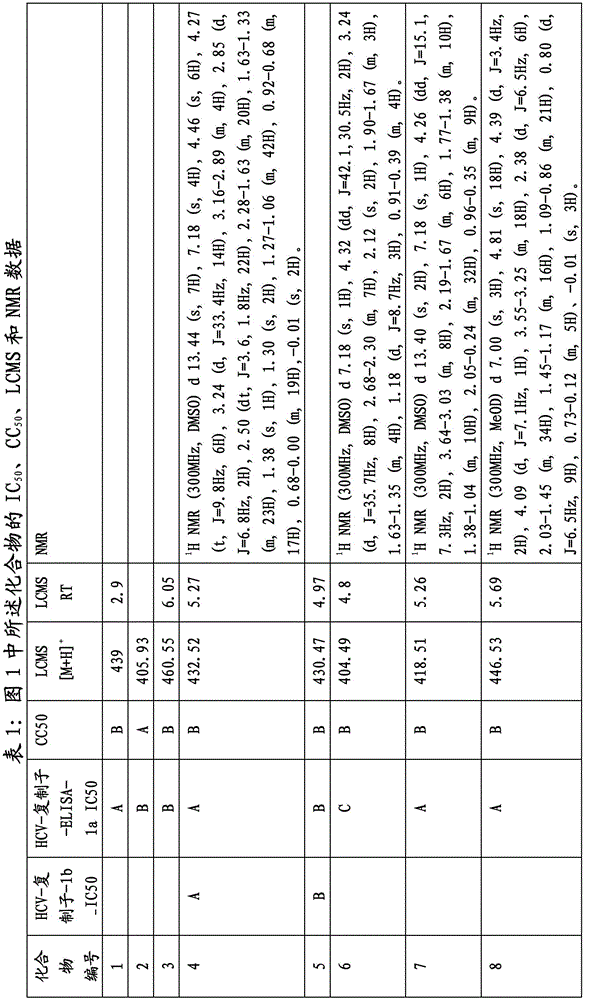


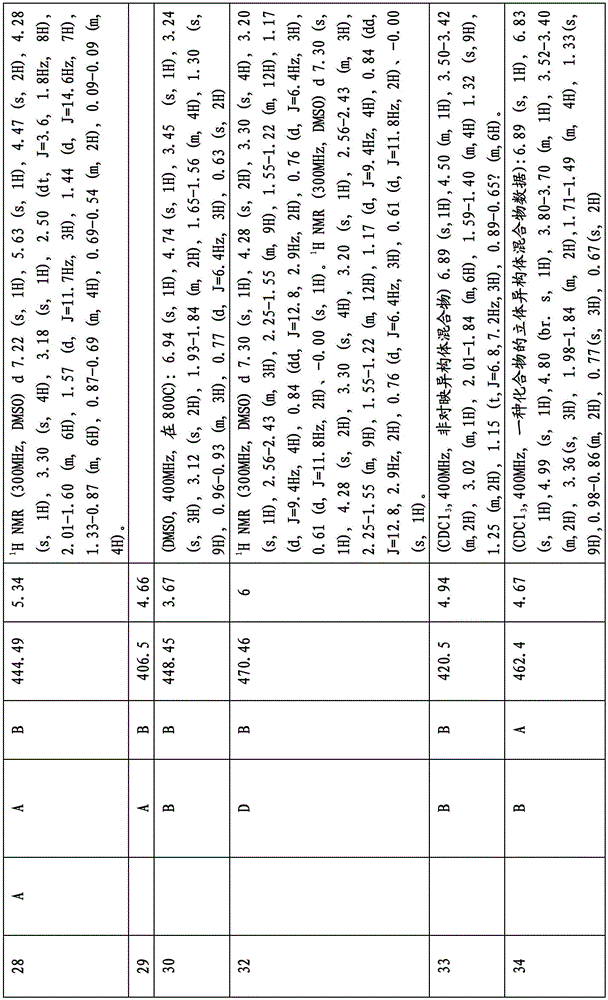


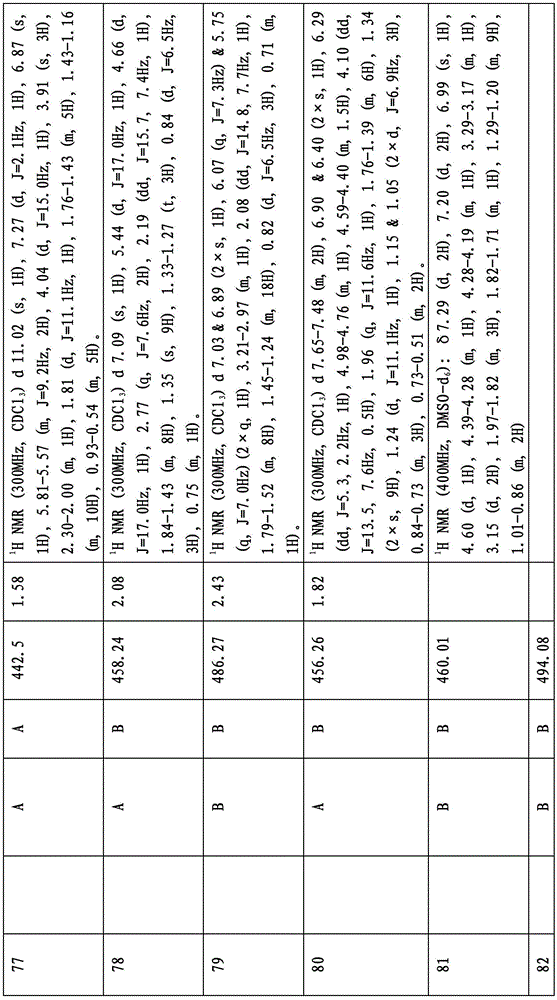


将本文提供的全部参考文献完整地引入本文参考。本文所用的全部缩写、符号和规定与当代的科学文献中所用的一致。例如,参见Janet S.Dodd,ed.,The ACS Style Guide:A Manual for Authorsand Editors,第2版,Washington,D.C.:American ChemicalSociety,1997。All references provided herein are hereby incorporated by reference in their entirety. All abbreviations, symbols and conventions used herein are consistent with those used in the contemporary scientific literature. See, eg, Janet S. Dodd, ed., The ACS Style Guide: A Manual for Authors and Editors, 2nd ed., Washington, D.C.: American Chemical Society, 1997.
应理解,尽管与详细描述相结合描述了本发明,但是上述描述的目的在于示例,而非限定本发明的范围,本发明的范围由待批权利要求的范围定义。其他方面、优点和变型属于如下权利要求的范围。It will be understood that while the invention has been described in conjunction with the detailed description, that the foregoing description is for purposes of illustration and not limitation of the scope of the invention, which is defined by the scope of the appended claims. Other aspects, advantages, and modifications are within the scope of the following claims.
Claims (20)
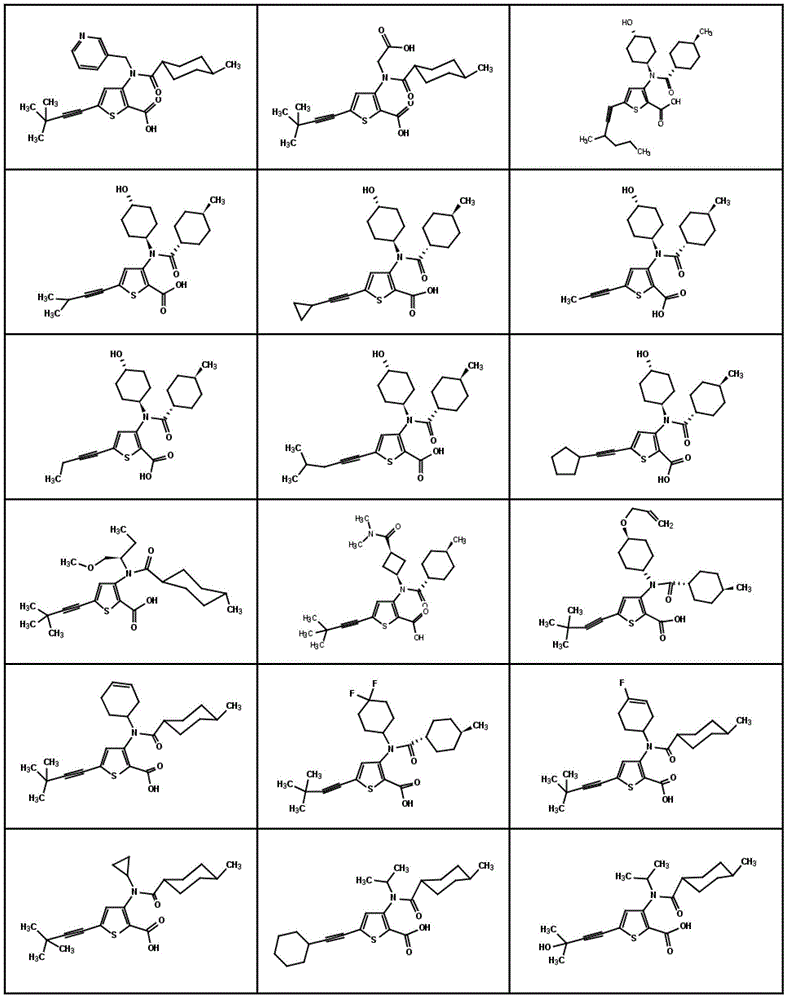


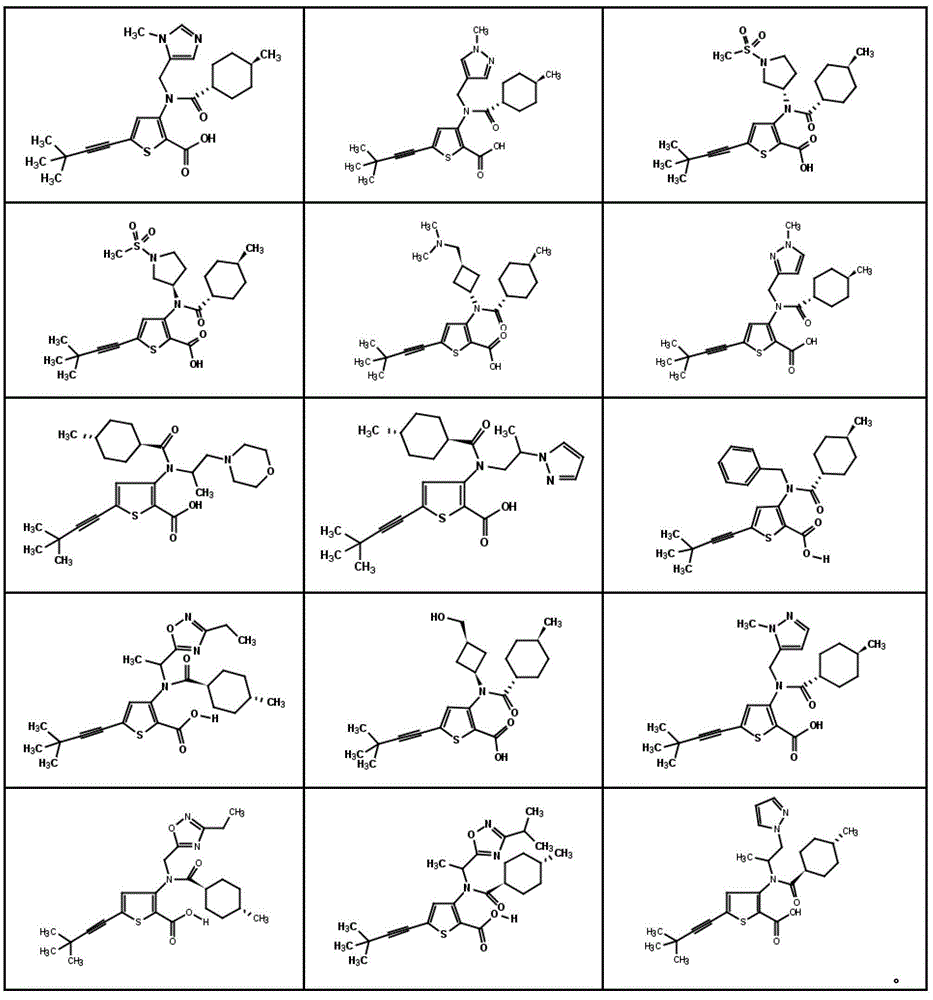

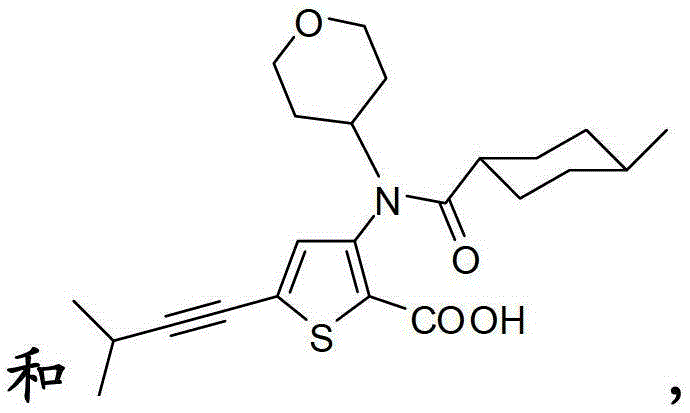

Applications Claiming Priority (3)
| Application Number | Priority Date | Filing Date | Title |
|---|---|---|---|
| US37439610P | 2010-08-17 | 2010-08-17 | |
| US61/374,396 | 2010-08-17 | ||
| PCT/US2011/048027 WO2012024363A2 (en) | 2010-08-17 | 2011-08-17 | Compounds and methods for the treatment or prevention of flaviviridae viral infections |
Publications (1)
| Publication Number | Publication Date |
|---|---|
| CN103153978A true CN103153978A (en) | 2013-06-12 |
Family
ID=44533193
Family Applications (1)
| Application Number | Title | Priority Date | Filing Date |
|---|---|---|---|
| CN2011800478412A Pending CN103153978A (en) | 2010-08-17 | 2011-08-17 | Compounds and methods for the treatment or prevention of flaviviridae viral infections |
Country Status (8)
| Country | Link |
|---|---|
| US (1) | US20140065103A1 (en) |
| EP (1) | EP2606041A2 (en) |
| JP (1) | JP2013534249A (en) |
| CN (1) | CN103153978A (en) |
| AU (1) | AU2011292040A1 (en) |
| CA (1) | CA2808291A1 (en) |
| MX (1) | MX2013001869A (en) |
| WO (1) | WO2012024363A2 (en) |
Cited By (1)
| Publication number | Priority date | Publication date | Assignee | Title |
|---|---|---|---|---|
| CN108096562A (en) * | 2017-12-25 | 2018-06-01 | 武汉百药联科科技有限公司 | Purposes of the 20S proteasome inhibitors in the drug for preparing treatment Japanese B encephalitis virus infection |
Families Citing this family (3)
| Publication number | Priority date | Publication date | Assignee | Title |
|---|---|---|---|---|
| US20140206888A1 (en) * | 2011-07-26 | 2014-07-24 | Vertex Pharmaceuticals Incorporated | Methods for preparation of thiophene compounds |
| WO2013030750A1 (en) | 2011-09-01 | 2013-03-07 | Lupin Limited | Antiviral compounds |
| NZ628515A (en) | 2012-02-10 | 2016-06-24 | Lupin Ltd | Antiviral compounds with a dibenzooxaheterocycle moiety |
Family Cites Families (67)
| Publication number | Priority date | Publication date | Assignee | Title |
|---|---|---|---|---|
| UA66767C2 (en) | 1996-10-18 | 2004-06-15 | Вертекс Фармасьютикалс Інкорпорейтед | Serine proteases inhibitors, pharmaceutical composition, a method for inhibitining activity and a method for treatment or prevention of viral infection of hepatitis c |
| IL134232A0 (en) | 1997-08-11 | 2001-04-30 | Boehringer Ingelheim Ca Ltd | Hepatitis c inhibitor peptides |
| AU757072B2 (en) | 1997-08-11 | 2003-01-30 | Boehringer Ingelheim (Canada) Ltd. | Hepatitis C inhibitor peptide analogues |
| WO2000006529A1 (en) | 1998-07-27 | 2000-02-10 | Istituto Di Ricerche Di Biologia Molecolare P Angeletti S.P.A. | Diketoacid-derivatives as inhibitors of polymerases |
| AR022061A1 (en) | 1998-08-10 | 2002-09-04 | Boehringer Ingelheim Ca Ltd | INHIBITING PEPTIDES OF HEPATITIS C, A PHARMACEUTICAL COMPOSITION CONTAINING THEM, THE USE OF THE SAME TO PREPARE A PHARMACEUTICAL COMPOSITION, THE USE OF AN INTERMEDIATE PRODUCT FOR THE PREPARATION OF THESE PEPTIDES AND A PROCEDURE FOR THE PREPARATION OF ANOGRAPH . |
| US6323180B1 (en) | 1998-08-10 | 2001-11-27 | Boehringer Ingelheim (Canada) Ltd | Hepatitis C inhibitor tri-peptides |
| UA74546C2 (en) | 1999-04-06 | 2006-01-16 | Boehringer Ingelheim Ca Ltd | Macrocyclic peptides having activity relative to hepatitis c virus, a pharmaceutical composition and use of the pharmaceutical composition |
| SK13752001A3 (en) | 1999-12-27 | 2002-07-02 | Japan Tobacco, Inc. | Fused-ring compounds and use thereof as drugs |
| EP1292310A1 (en) | 2000-05-10 | 2003-03-19 | SmithKline Beecham Corporation | Novel anti-infectives |
| MY164523A (en) | 2000-05-23 | 2017-12-29 | Univ Degli Studi Cagliari | Methods and compositions for treating hepatitis c virus |
| GB0017676D0 (en) | 2000-07-19 | 2000-09-06 | Angeletti P Ist Richerche Bio | Inhibitors of viral polymerase |
| SV2003000617A (en) | 2000-08-31 | 2003-01-13 | Lilly Co Eli | INHIBITORS OF PROTEASA PEPTIDOMIMETICA REF. X-14912M |
| CA2429359A1 (en) | 2000-11-20 | 2002-08-08 | Bristol-Myers Squibb Company | Hepatitis c tripeptide inhibitors |
| RS50236B (en) | 2001-01-22 | 2009-07-15 | Merck & Co.Inc., | NUCLEOSIDE DERIVATIVES AS INVESTORS OF RNA-DEPENDENT RNA VIRAL POLYMERASES |
| AU2002252183A1 (en) | 2001-03-06 | 2002-09-19 | Biocryst Pharmaceuticals, Inc. | Nucleosides, preparation thereof and use as inhibitors of rna viral polymerases |
| EP1256628A3 (en) | 2001-05-10 | 2003-03-19 | Agouron Pharmaceuticals, Inc. | Hepatitis c virus (hcv) ns5b rna polymerase and mutants thereof |
| AR036081A1 (en) | 2001-06-07 | 2004-08-11 | Smithkline Beecham Corp | COMPOSITE OF 1,2-DIHYDROQUINOLINE, ITS USE TO PREPARE A PHARMACEUTICAL COMPOSITION, METHODS TO PREPARE IT AND N-RENTED 2-AMINOBENZOIC ACID OF UTILITY AS INTERMEDIARY IN SUCH METHODS |
| WO2002100846A1 (en) | 2001-06-11 | 2002-12-19 | Shire Biochem Inc. | Compounds and methods for the treatment or prevention of flavivirus infections |
| AP1753A (en) | 2001-06-11 | 2007-07-18 | Shire Biochem Inc | Thiophene derivatives as antiviral agents for flavvivirus infection |
| AR035543A1 (en) | 2001-06-26 | 2004-06-16 | Japan Tobacco Inc | THERAPEUTIC AGENT FOR HEPATITIS C THAT INCLUDES A CONDENSED RING COMPOUND, CONDENSED RING COMPOUND, PHARMACEUTICAL COMPOSITION THAT UNDERSTANDS, BENZIMIDAZOL, THIAZOL AND BIFENYL COMPOUNDS USED AS INTERMEDIARY COMPARTMENTS OF COMPARTMENTS |
| EP2335700A1 (en) | 2001-07-25 | 2011-06-22 | Boehringer Ingelheim (Canada) Ltd. | Hepatitis C virus polymerase inhibitors with a heterobicylic structure |
| EP1429759A4 (en) | 2001-09-26 | 2004-12-15 | Bristol Myers Squibb Co | Compounds useful for treating hepatitus c virus |
| JP4460294B2 (en) | 2001-10-24 | 2010-05-12 | バーテックス ファーマシューティカルズ インコーポレイテッド | Inhibitors of serine proteases, particularly hepatitis C virus NS3-NS4A protease, incorporating a condensed ring system |
| MXPA04009938A (en) | 2002-04-11 | 2004-12-13 | Vertex Pharma | Inhibitors of serine proteases, particularly hepatitis c virus ns3 - ns4 protease. |
| AU2003264038A1 (en) | 2002-08-12 | 2004-02-25 | Bristol-Myers Squibb Company | Combination pharmaceutical agents as inhibitors of hcv replication |
| EP1569929B9 (en) * | 2002-12-10 | 2011-09-14 | Virochem Pharma Inc. | Compounds and methods for the treatment or prevention of flavivirus infections |
| CN100413861C (en) | 2002-12-10 | 2008-08-27 | 维勒凯姆制药股份有限公司 | Compounds for use in the treatment or prevention of flavivirus infections |
| EP1613620A1 (en) | 2003-04-11 | 2006-01-11 | Vertex Pharmaceuticals Incorporated | Inhibitors of serine proteases, particularly hcv ns3-ns4a protease |
| US20050090450A1 (en) | 2003-04-11 | 2005-04-28 | Farmer Luc J. | Inhibitors of serine proteases, particularly HCV NS3-NS4A protease |
| NZ544789A (en) | 2003-07-18 | 2010-01-29 | Vertex Pharma | Dithia-azaspiro-nonane and decane derivatives as inhibitors of serine proteases |
| AR045596A1 (en) | 2003-09-05 | 2005-11-02 | Vertex Pharma | INHIBITORS OF SERINE PROTEASES IN PARTICULAR HCV PROTEASA NS3-NS4A |
| AU2004274468B2 (en) | 2003-09-18 | 2009-07-23 | Vertex Pharmaceuticals, Incorporated | Inhibitors of serine proteases, particularly HCV NS3-NS4A protease |
| EP1711515A2 (en) | 2004-02-04 | 2006-10-18 | Vertex Pharmaceuticals Incorporated | Inhibitors of serine proteases, particularly hcv ns3-ns4a protease |
| EP1804821A4 (en) | 2004-10-01 | 2009-07-15 | Vertex Pharma | Hcv ns3-ns4a protease inhibition |
| DE102004061746A1 (en) * | 2004-12-22 | 2006-07-06 | Bayer Healthcare Ag | Alkynyl-substituted thiophenes |
| ES2415742T3 (en) | 2005-05-13 | 2013-07-26 | Vertex Pharmaceuticals (Canada) Incorporated | Compounds and procedures for the treatment or prevention of flavivirus infections |
| US8143288B2 (en) | 2005-06-06 | 2012-03-27 | Bristol-Myers Squibb Company | Inhibitors of HCV replication |
| US10071416B2 (en) | 2005-10-20 | 2018-09-11 | Nucor Corporation | High strength thin cast strip product and method for making the same |
| US7759495B2 (en) | 2006-08-11 | 2010-07-20 | Bristol-Myers Squibb Company | Hepatitis C virus inhibitors |
| US7659270B2 (en) | 2006-08-11 | 2010-02-09 | Bristol-Myers Squibb Company | Hepatitis C virus inhibitors |
| US8329159B2 (en) | 2006-08-11 | 2012-12-11 | Bristol-Myers Squibb Company | Hepatitis C virus inhibitors |
| AP2579A (en) | 2006-11-15 | 2013-01-29 | Virochem Pharma Inc | Thiophene analogues for the treatment or prevention of flavivirus infections |
| US7741347B2 (en) | 2007-05-17 | 2010-06-22 | Bristol-Myers Squibb Company | Hepatitis C virus inhibitors |
| US8629171B2 (en) | 2007-08-08 | 2014-01-14 | Bristol-Myers Squibb Company | Crystalline form of methyl ((1S)-1-((25)-2-(5-(4'-(2-((25)-1((2S)-2-((methoxycarbonyl)amino)-3-methylbutanoyl)-2-pyrrolidinyl)-1H-imidazol-2-yl)-1-pyrrolidinyl)carbonyl)-2-methylpropyl)carbamate dihydrochloride salt |
| US7728027B2 (en) | 2007-08-08 | 2010-06-01 | Bristol-Myers Squibb Company | Process for synthesizing compounds useful for treating hepatitis C |
| WO2009102318A1 (en) | 2008-02-12 | 2009-08-20 | Bristol-Myers Squibb Company | Hepatitis c virus inhibitors |
| US8147818B2 (en) | 2008-02-13 | 2012-04-03 | Bristol-Myers Squibb Company | Hepatitis C virus inhibitors |
| US7704992B2 (en) | 2008-02-13 | 2010-04-27 | Bristol-Myers Squibb Company | Hepatitis C virus inhibitors |
| BRPI0822323A2 (en) | 2008-02-13 | 2015-06-16 | Bristol Myers Squibb Co | Imidazolyl biphenyl imidazoles as hepatitis c virus inhibitors |
| US7906655B2 (en) | 2008-08-07 | 2011-03-15 | Bristol-Myers Squibb Company | Hepatitis C virus inhibitors |
| US8729077B2 (en) | 2008-11-28 | 2014-05-20 | Glaxosmithkline Llc | Anti-viral compounds, compositions, and methods of use |
| EP2682393A1 (en) | 2008-12-03 | 2014-01-08 | Presidio Pharmaceuticals, Inc. | Inhibitors of HCV NS5A comprising a bicyclic core. |
| KR20110098779A (en) | 2008-12-03 | 2011-09-01 | 프레시디오 파마슈티칼스, 인코포레이티드 | Inhibitors of HBCVNS5A |
| WO2010091413A1 (en) | 2009-02-09 | 2010-08-12 | Enanta Pharmaceuticals, Inc. | Linked dibenzimidazole derivatives |
| WO2010096462A1 (en) | 2009-02-17 | 2010-08-26 | Enanta Pharmaceuticals, Inc | Linked diimidazole derivatives |
| TWI438200B (en) | 2009-02-17 | 2014-05-21 | 必治妥美雅史谷比公司 | Hepatitis c virus inhibitors |
| WO2010096777A1 (en) | 2009-02-23 | 2010-08-26 | Presidio Pharmaceuticals, Inc. | Inhibitors of hcv ns5a |
| RU2544010C2 (en) | 2009-02-27 | 2015-03-10 | Энанта Фармасьютикалс, Инк. | Hepatitis c virus inhibitors |
| AU2010229833B2 (en) | 2009-03-27 | 2014-03-13 | Merck Sharp & Dohme Llc | Inhibitors of hepatitis C virus replication |
| TWI476190B (en) | 2009-03-30 | 2015-03-11 | 必治妥美雅史谷比公司 | Hepatitis c virus inhibitors |
| US8796466B2 (en) | 2009-03-30 | 2014-08-05 | Bristol-Myers Squibb Company | Hepatitis C virus inhibitors |
| TW201038559A (en) | 2009-04-09 | 2010-11-01 | Bristol Myers Squibb Co | Hepatitis C virus inhibitors |
| US8143414B2 (en) | 2009-04-13 | 2012-03-27 | Bristol-Myers Squibb Company | Hepatitis C virus inhibitors |
| RU2541571C2 (en) | 2009-04-15 | 2015-02-20 | Эббви Инк. | Antiviral compounds |
| RU2528231C2 (en) | 2009-04-24 | 2014-09-10 | Тиботек Фармасьютикалз | Diaryl ethers |
| CA2760305A1 (en) | 2009-04-28 | 2010-11-04 | Boehringer Ingelheim International Gmbh | Ex-vivo treatment of immunological disorders with pkc-theta inhibitors |
| US9139569B2 (en) | 2009-05-12 | 2015-09-22 | Merck Sharp & Dohme Corp. | Fused tricyclic aryl compounds useful for the treatment of viral diseases |
-
2011
- 2011-08-17 CN CN2011800478412A patent/CN103153978A/en active Pending
- 2011-08-17 WO PCT/US2011/048027 patent/WO2012024363A2/en not_active Ceased
- 2011-08-17 EP EP11749659.6A patent/EP2606041A2/en not_active Withdrawn
- 2011-08-17 JP JP2013524949A patent/JP2013534249A/en not_active Withdrawn
- 2011-08-17 AU AU2011292040A patent/AU2011292040A1/en not_active Abandoned
- 2011-08-17 CA CA2808291A patent/CA2808291A1/en not_active Abandoned
- 2011-08-17 MX MX2013001869A patent/MX2013001869A/en unknown
-
2013
- 2013-02-14 US US13/767,347 patent/US20140065103A1/en not_active Abandoned
Cited By (2)
| Publication number | Priority date | Publication date | Assignee | Title |
|---|---|---|---|---|
| CN108096562A (en) * | 2017-12-25 | 2018-06-01 | 武汉百药联科科技有限公司 | Purposes of the 20S proteasome inhibitors in the drug for preparing treatment Japanese B encephalitis virus infection |
| CN108096562B (en) * | 2017-12-25 | 2021-05-11 | 武汉百药联科科技有限公司 | Application of 20S proteasome inhibitor in preparation of medicine for treating Japanese encephalitis virus infection |
Also Published As
| Publication number | Publication date |
|---|---|
| JP2013534249A (en) | 2013-09-02 |
| MX2013001869A (en) | 2013-06-28 |
| WO2012024363A3 (en) | 2012-05-31 |
| US20140065103A1 (en) | 2014-03-06 |
| CA2808291A1 (en) | 2012-02-23 |
| EP2606041A2 (en) | 2013-06-26 |
| AU2011292040A1 (en) | 2013-03-07 |
| WO2012024363A2 (en) | 2012-02-23 |
Similar Documents
| Publication | Publication Date | Title |
|---|---|---|
| JP5841531B2 (en) | Inhibitors of Flaviviridae virus | |
| JP5777223B2 (en) | Inhibitors of Flaviviridae virus | |
| TWI537272B (en) | Method for preparing pyrazolo[1,5-a]pyrimidines for antiviral therapy | |
| CN106854205B (en) | Inhibitors of influenza virus replication and methods and uses thereof | |
| CN101218224B (en) | Compositions and methods for treating or preventing flavivirus infection | |
| US20130190289A1 (en) | Compounds and methods for the treatment or prevention of flavivirus infections | |
| CN108218873B (en) | Inhibitors of influenza virus replication and uses thereof | |
| WO2018214980A1 (en) | Aromatic amide as kv2.1 inhibitor and preparation method, pharmaceutical composition, and use thereof | |
| JP2013512247A (en) | 5-Alkynyl-thiophene-2-carboxylic acid derivatives and their use for the treatment or prevention of flavivirus infections | |
| CN103153978A (en) | Compounds and methods for the treatment or prevention of flaviviridae viral infections | |
| CN103298791B (en) | Viral polymerase inhibitors | |
| CN101775003A (en) | Benzothiophene derivative, preparation method and application thereof | |
| WO2013016491A1 (en) | Thiophene compounds | |
| US20130183266A1 (en) | Compounds and methods for the treatment or prevention of flavivirus infections | |
| HK1186184A (en) | Compounds and methods for the treatment or prevention of flaviviridae viral infections | |
| WO2013016499A1 (en) | Methods for preparation of thiophene compounds | |
| US20130203706A1 (en) | Compounds and methods for the treatment or prevention of flavivirus infections | |
| WO2012006060A1 (en) | Compounds and methods for the treatment or prevention of flavivirus infections | |
| HK40041774B (en) | Lysophosphatidic acid receptor antagonists and preparation method therefor | |
| TW201215604A (en) | Compounds and methods for the treatment or prevention of flavivirus infections |
Legal Events
| Date | Code | Title | Description |
|---|---|---|---|
| C06 | Publication | ||
| PB01 | Publication | ||
| C10 | Entry into substantive examination | ||
| SE01 | Entry into force of request for substantive examination | ||
| REG | Reference to a national code |
Ref country code: HK Ref legal event code: DE Ref document number: 1186184 Country of ref document: HK |
|
| C02 | Deemed withdrawal of patent application after publication (patent law 2001) | ||
| WD01 | Invention patent application deemed withdrawn after publication |
Application publication date: 20130612 |
|
| REG | Reference to a national code |
Ref country code: HK Ref legal event code: WD Ref document number: 1186184 Country of ref document: HK |